Physics Circle home Home Practice Hub Register / Login

Home›Practice Hub›Chapters›Capacitors

Physics PYQs · MHT CET · JEE Main · NEET

Capacitors

Questions
365
MHT CET
140
JEE Main
178
NEET
47
Years
1992–2026
0 of 365 attemptedPick an answer to see the solution

Q1MHT CET 2026 · 12 MAY · SHIFT 2Easy

Capacitance of a Conductor · Capacitance & C = Q/V

A capacitor of unknown capacitance is connected across a battery of ′V′'V' volt. The charge stored in it is ′Q′'Q' C. When potential across the capacitor is reduced by ′V1′'V_1' volt, the charge stored in it becomes ′Q1′'Q_1' C. The potential ′V′'V' is

Show answer and solution

Answer: (a)

  1. Capacitance is constant: C=QV=Q1V−V1C = \frac{Q}{V} = \frac{Q_1}{V - V_1}.
  2. Q(V−V1)=Q1V⇒V(Q−Q1)=QV1Q(V - V_1) = Q_1 V \Rightarrow V(Q - Q_1) = QV_1
  3. So the answer is (a) V=QV1Q−Q1V = \frac{QV_1}{Q - Q_1}.
Report a mistake
Q2MHT CET 2026 · 19 MAY · SHIFT 1Easy

Capacitance of a Conductor · Isolated sphere & earth

Consider the earth to be a sphere, having charge QQ. Let R,VR, V and AA be its radius, volume and area respectively. The capacitance of the earth is [ε0\varepsilon_0 = permittivity of free space]

Show answer and solution

Answer: (d)

  1. Capacitance of a sphere: C=4πε0RC = 4\pi\varepsilon_0 R.
  2. VA=43πR34πR2=R3⇒R=3VA\frac{V}{A} = \frac{\frac{4}{3}\pi R^3}{4\pi R^2} = \frac{R}{3} \Rightarrow R = \frac{3V}{A}
  3. C=4πε0⋅3VAC = 4\pi\varepsilon_0 \cdot \frac{3V}{A}
  4. So the answer is (d) 12πε0VA12\pi\varepsilon_0\frac{V}{A}.
Report a mistake
Q3MHT CET 2026 · 11 APR · SHIFT 2Easy

Capacitance of a Conductor · Isolated sphere & earth

The earth is assumed to be a charged conducting sphere having volume 'V' and surface area 'A'. The capacitance of the earth in free space is (ϵ0\epsilon_0 = permittivity of free space)

Show answer and solution

Answer: (d)

  1. Capacitance of a sphere: C=4πε0RC = 4\pi\varepsilon_0 R.
  2. VA=43πR34πR2=R3⇒R=3VA\frac{V}{A} = \frac{\frac{4}{3}\pi R^3}{4\pi R^2} = \frac{R}{3} \Rightarrow R = \frac{3V}{A}
  3. C=4πε0⋅3VAC = 4\pi\varepsilon_0 \cdot \frac{3V}{A}
  4. So the answer is (d) 12πϵ0V/A12\pi\epsilon_0 V/A.
Report a mistake
Q4MHT CET 2025 · 26 APR · SHIFT 2Easy

Capacitance of a Conductor · Capacitance & C = Q/V

A capacitor of unknown capacity is connected across a battery of V volt. The charge stored in it is Q coulomb. When potential across the capacitor is reduced by V1V_1 volt, the charge stored in it becomes Q1Q_1 coulomb. The potential V is

Show answer and solution

Answer: (a)

  1. Capacitance is constant: C=QV=Q1V−V1C = \frac{Q}{V} = \frac{Q_1}{V - V_1}.
  2. Q(V−V1)=Q1V⇒V(Q−Q1)=QV1Q(V - V_1) = Q_1 V \Rightarrow V(Q - Q_1) = QV_1
  3. So the answer is (a) V=QV1Q−Q1V = \frac{QV_1}{Q - Q_1}.
Report a mistake
Q5MHT CET 2025 · 22 APR · SHIFT 1Easy

Capacitance of a Conductor · Capacitance & C = Q/V

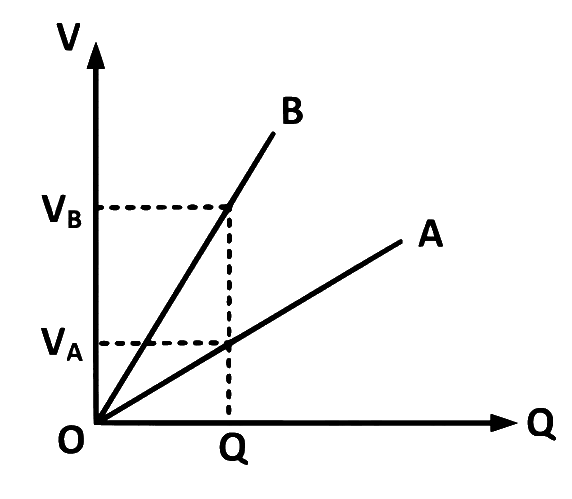
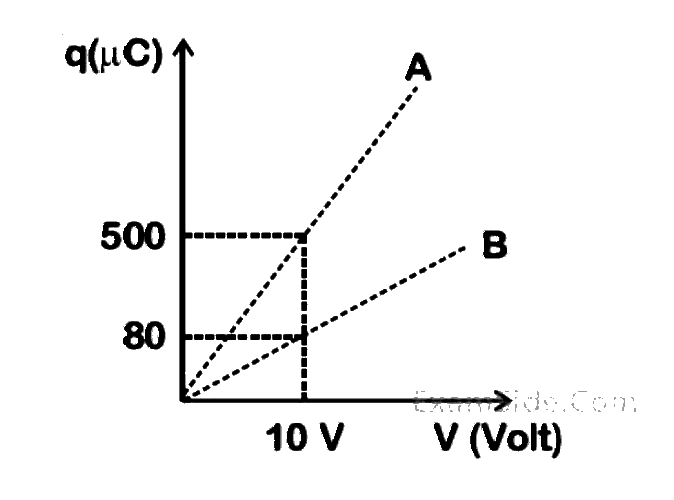
The graph shows the variation of voltage (v) across the plates of two parallel plate capacitos AA and BB versus increase of charge QQ stored in them. Then

Figure

Show answer and solution

Answer: (b)

  1. For a capacitor V=QCV = \frac{Q}{C}, so the slope of the VV–QQ line is 1C\frac{1}{C}.
  2. For the same QQ, VA<VBV_A < V_B, so line A has the smaller slope.
  3. Smaller slope means larger capacitance: CA>CBC_A > C_B.
  4. So the answer is (b) capacity of AA is higher than BB.
Report a mistake
Q6MHT CET 2024 · 16 MAY · SHIFT 2Easy

Capacitance of a Conductor · Capacitance & C = Q/V

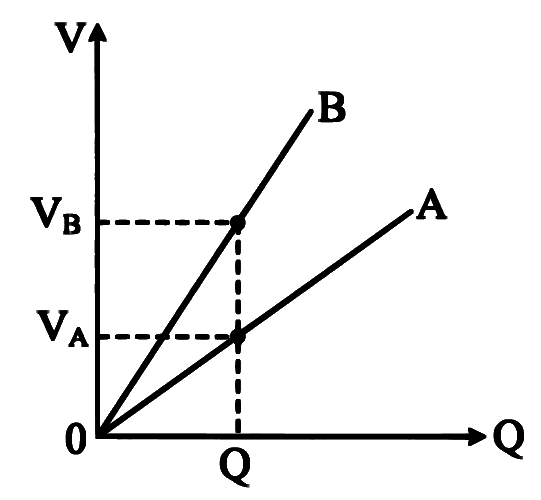
The graph shows the variation of voltage ' V ' across the plates of two capacitors AA and BB versus increase in charge ' QQ ' stored in them. Then

Figure

Show answer and solution

Answer: (a)

  1. For a capacitor V=QCV = \frac{Q}{C}, so the slope of the VV–QQ line is 1C\frac{1}{C}.
  2. For the same QQ, VA<VBV_A < V_B, so line A has the smaller slope.
  3. Smaller slope means larger capacitance: CA>CBC_A > C_B.
  4. So the answer is (a) capacitor A has the higher capacity.
Report a mistake
Q7NEET 2024Easy

Capacitance of a Conductor · Capacitance & C = Q/V

The capacitance of a capacitor with charge qq and a potential difference VV depends on

Show answer and solution

Answer: (b)

  1. C=qVC = \frac{q}{V}, but qq and VV change in the same proportion, so their ratio is fixed.
  2. CC depends only on size, shape, separation of conductors and the medium, e.g. C=ε0AdC = \frac{\varepsilon_0 A}{d}.
  3. So the answer is (b) the geometry of the capacitor.
Report a mistake
Q8MHT CET 2023 · 12 MAY · SHIFT 1Easy

Capacitance of a Conductor · Capacitance & C = Q/V

The potential on the plates of capacitor are +20 V+20\text{ V} and −20 V-20\text{ V}. The charge on the plate is 40 C40\text{ C}. The capacitance of the capacitor is

Show answer and solution

Answer: (b)

  1. Potential difference V=20−(−20)=40 VV = 20 - (-20) = 40\text{ V}.
  2. C=QV=4040C = \frac{Q}{V} = \frac{40}{40}
  3. So the answer is (b) 1 F1\text{ F}.
Report a mistake
Q9JEE Main 2023 · 1 FEB · SHIFT 2Easy

Capacitance of a Conductor · Spheres, drops & spherical capacitor

Given below are two statements: One is labeled as Assertion A and the other is labeled as Reason R.

Assertion A: Two metallic spheres are charged to the same potential. One of them is hollow and another is solid, and both have the same radii. Solid sphere will have lower charge than the hollow one.

Reason R: Capacitance of metallic spheres depends on the radii of spheres

In light of the above statements, choose the correct answer from the options given below.

Show answer and solution

Answer: (c)

  1. Charge on a conductor stays on its outer surface, so a solid and a hollow sphere of the same radius have the same C=4πε0RC = 4\pi\varepsilon_0 R.
  2. At the same potential they hold the same charge Q=CVQ = CV, so A is false.
  3. R is true: C∝RC \propto R.
  4. So the answer is (c) A is false but R is true.
Report a mistake
Q10MHT CET 2023 · 11 MAY · SHIFT 2Medium

Capacitance of a Conductor · Spheres, drops & spherical capacitor

Two spherical conductors of capacities 3 μF3\ \mu\text{F} and 2 μF2\ \mu\text{F} are charged to same potential having radii 3 cm3\text{ cm} and 2 cm2\text{ cm} respectively. If 'σ1\sigma_1 ' and 'σ2\sigma_2' represent surface density of charge on respective conductors then σ1σ2\frac{\sigma_1}{\sigma_2} is

Show answer and solution

Answer: (c)

  1. Same potential: Q=CVQ = CV, and C∝rC \propto r, so Q∝rQ \propto r.
  2. σ=Q4πr2∝rr2=1r\sigma = \frac{Q}{4\pi r^2} \propto \frac{r}{r^2} = \frac{1}{r}
  3. σ1σ2=r2r1=23\frac{\sigma_1}{\sigma_2} = \frac{r_2}{r_1} = \frac{2}{3}
  4. So the answer is (c) 23\frac{2}{3}.
Report a mistake
Q11JEE Main 2022 · 25 JUL · SHIFT 1Easy

Capacitance of a Conductor · Capacitance & C = Q/V

A condenser of 2 μF2\ \mu\text{F} capacitance is charged steadily from 0 to 5 C5\text{ C}. Which of the following graph represents correctly the variation of potential difference (V)(V) across it's plates with respect to the charge (Q)(Q) on the condenser?

Show answer and solution

Answer: (a)

  1. V=QCV = \frac{Q}{C} with constant CC, so V∝QV \propto Q: a straight line through the origin.
  2. At Q=5 CQ = 5\text{ C}: V=52×10−6=2.5×10⁶ VV = \frac{5}{2\times10^{-6}} = 2.5\times10^{6}\text{ V}.
  3. So the answer is (a), the straight line ending at 2.5×10⁶ V2.5\times10^{6}\text{ V}.
Report a mistake
Q12JEE Main 2022 · 25 JUL · SHIFT 2Medium

Capacitance of a Conductor · Spheres, drops & spherical capacitor

Capacitance of an isolated conducting sphere of radius R1 becomes n times when it is enclosed by a concentric conducting sphere of radius R2 connected to earth. The ratio of their radii (R2R1)\left(\frac{R_2}{R_1}\right) is:

Show answer and solution

Answer: (a)

  1. Isolated sphere: C=4πε0R1C = 4\pi\varepsilon_0 R_1.
  2. With earthed outer shell (spherical capacitor): C′=4πε0R1R2R2−R1C' = \frac{4\pi\varepsilon_0 R_1R_2}{R_2 - R_1}.
  3. C′=nC⇒R2R2−R1=n⇒R2(n−1)=nR1C' = nC \Rightarrow \frac{R_2}{R_2 - R_1} = n \Rightarrow R_2(n-1) = nR_1
  4. So the answer is (a) R2R1=nn−1\frac{R_2}{R_1} = \frac{n}{n-1}.
Report a mistake
Q13JEE Main 2017 · 8 APR · SHIFT 1Medium

Capacitance of a Conductor · Spheres, drops & spherical capacitor

The energy stored in the electric field produced by a metal sphere is 4.5 J. If the sphere contains 4 μ\muC charge, its radius will be:

[ Take: 14πϵ0=\frac{1}{4\pi\epsilon_0} = 9 ×\times 109 N -\text{-} m2/C2 ]

Show answer and solution

Answer: (d)

  1. U=Q22C=Q28πε0R⇒R=14πε0⋅Q22UU = \frac{Q^2}{2C} = \frac{Q^2}{8\pi\varepsilon_0 R} \Rightarrow R = \frac{1}{4\pi\varepsilon_0}\cdot\frac{Q^2}{2U}
  2. R=9×109×(4×10−6)22×4.5=0.1449R = \frac{9\times10^{9}\times(4\times10^{-6})^2}{2\times4.5} = \frac{0.144}{9}
  3. R=0.016 m=16 mmR = 0.016\text{ m} = 16\text{ mm}
  4. So the answer is (d) 16 mm.
Report a mistake
Q14JEE Main 2002 · AIEEEEasy

Capacitance of a Conductor · Isolated sphere & earth

Capacitance (in FF) of a spherical conductor with radius 1 m1\text{ m} is

Show answer and solution

Answer: (a)

  1. C=4πε0R=R9×109C = 4\pi\varepsilon_0 R = \frac{R}{9\times10^{9}}
  2. C=19×109≈1.1×10⁻¹⁰ FC = \frac{1}{9\times10^{9}} \approx 1.1\times10^{-10}\text{ F}
  3. So the answer is (a) 1.1×10−101.1\times10^{-10}.
Report a mistake
Q15MHT CET 2026 · 18 APR · SHIFT 1Easy

Parallel Plate Capacitor · Capacitance of parallel plates

Two circular plates each of radius 'rr' are kept parallel to each other distance 'dd' apart. The capacitance of the capacitor formed is 'C1C_1 '. If the radius of each of the plates is increased to 3\sqrt{3} times the earlier radius and their distance of separation decreased to half the initial value, the capacitance now becomes 'C2C_2'. The ratio C1:C2C_1 : C_2 is

Show answer and solution

Answer: (c)

  1. C=ε0πr2d∝r2dC = \frac{\varepsilon_0 \pi r^2}{d} \propto \frac{r^2}{d}
  2. C2C1=(3)21/2=6\frac{C_2}{C_1} = \frac{(\sqrt{3})^2}{1/2} = 6
  3. So the answer is (c) C1:C2=1:6C_1 : C_2 = 1 : 6.
Report a mistake
Q16MHT CET 2026 · 17 APR · SHIFT 2Medium

Parallel Plate Capacitor · Plates with unequal charges

Two indentical metal plates are given charges q1q_1 and q2 (q2<q1)q_2\ (q_2 < q_1) respectively. They are brought close together to form a parallel plate capacitor with capacitance 'C'. The potential difference 'V' between the plates is

Show answer and solution

Answer: (c)

  1. Charge on outer faces =q1+q22= \frac{q_1 + q_2}{2} each; inner faces carry ±q1−q22\pm\frac{q_1 - q_2}{2}.
  2. Only the inner charges make the field between the plates, so effective charge Q=q1−q22Q = \frac{q_1 - q_2}{2}.
  3. V=QC=q1−q22CV = \frac{Q}{C} = \frac{q_1 - q_2}{2C}
  4. So the answer is (c) q1−q22C\frac{q_1 - q_2}{2C}.
Report a mistake
Q17JEE Main 2025 · 24 JAN · SHIFT 1Easy

Parallel Plate Capacitor · Capacitance of parallel plates

A parallel plate capacitor was made with two rectangular plates, each with a length of l=3 cml = 3\text{ cm} and breadth of b=1 cmb = 1\text{ cm}. The distance between the plates is 3 μm3\ \mu\text{m}. Out of the following, which are the ways to increase the capacitance by a factor of 10?

A. l=30 cm, b=1 cm, d=1 μml = 30\text{ cm},\ b = 1\text{ cm},\ d = 1\ \mu\text{m}

B. l=3 cm, b=1 cm, d=30 μml = 3\text{ cm},\ b = 1\text{ cm},\ d = 30\ \mu\text{m}

C. l=6 cm, b=5 cm, d=3 μml = 6\text{ cm},\ b = 5\text{ cm},\ d = 3\ \mu\text{m}

D. l=1 cm, b=1 cm, d=10 μml = 1\text{ cm},\ b = 1\text{ cm},\ d = 10\ \mu\text{m}

E. l=5 cm, b=2 cm, d=1 μml = 5\text{ cm},\ b = 2\text{ cm},\ d = 1\ \mu\text{m}

Choose the correct answer from the options given below:

Show answer and solution

Answer: (d)

  1. C=ε0lbd∝lbdC = \frac{\varepsilon_0 lb}{d} \propto \frac{lb}{d}. Original: 3×13=1\frac{3\times1}{3} = 1 (cm² per μm); need 10.
  2. A: 301=30\frac{30}{1} = 30; B: 330=0.1\frac{3}{30} = 0.1; C: 303=10\frac{30}{3} = 10 ✓
  3. D: 110=0.1\frac{1}{10} = 0.1; E: 101=10\frac{10}{1} = 10 ✓
  4. So the answer is (d) C and E only.
Report a mistake
Q18MHT CET 2025 · 25 APR · SHIFT 2Medium

Parallel Plate Capacitor · Plates with unequal charges

Two identical metal plates are given charges q1q_1 and q2 (q2<q1)q_2\ (q_2 < q_1) respectively. If they are now brought close together to form a parallel plate capacitor with capacitance ' C ', the potential difference ' VV ' between the plates is

Show answer and solution

Answer: (c)

  1. Charge on outer faces =q1+q22= \frac{q_1 + q_2}{2} each; inner faces carry ±q1−q22\pm\frac{q_1 - q_2}{2}.
  2. Only the inner charges make the field between the plates, so effective charge Q=q1−q22Q = \frac{q_1 - q_2}{2}.
  3. V=QC=q1−q22CV = \frac{Q}{C} = \frac{q_1 - q_2}{2C}
  4. So the answer is (c) q1−q22C\frac{q_1 - q_2}{2C}.
Report a mistake
Q19JEE Main 2025 · 22 JAN · SHIFT 1Difficult

Parallel Plate Capacitor · Charges between the plates

An electron is made to enter symmetrically between two parallel and equally but oppositely charged metal plates, each of 10 cm length. The electron emerges out of the electric field region with a horizontal component of velocity 106 m/s10^{6}\text{ m/s}. If the magnitude of the electric field between the plates is 9.1 V/cm9.1\text{ V/cm}, then the vertical component of velocity of electron is (mass of electron =9.1×10⁻³¹ kg= 9.1 \times 10^{-31}\text{ kg} and charge of electron =1.6×10⁻¹⁹ C= 1.6 \times 10^{-19}\text{ C})

Show answer and solution

Answer: (b)

  1. Acceleration: a=eEm=1.6×10−19×9109.1×10−31=1.6×10¹⁴ m/s2a = \frac{eE}{m} = \frac{1.6\times10^{-19}\times910}{9.1\times10^{-31}} = 1.6\times10^{14}\text{ m/s}^2 (9.1 V/cm=910 V/m9.1\text{ V/cm} = 910\text{ V/m}).
  2. Time between plates: t=0.1106=10−7 st = \frac{0.1}{10^{6}} = 10^{-7}\text{ s}
  3. vy=at=1.6×1014×10−7=1.6×10⁷ m/sv_y = at = 1.6\times10^{14}\times10^{-7} = 1.6\times10^{7}\text{ m/s}
  4. So the answer is (b) 16×106 m/s16\times10^{6}\text{ m/s}.
Report a mistake
Q20MHT CET 2024 · 3 MAY · SHIFT 1Easy

Parallel Plate Capacitor · Capacitance of parallel plates

Two circular metal plates each of radius ' rr ' are kept parallel to each other distance ' dd ' apart. The capacitance of the capacitor formed is ' C1C_1 '. If the radius of each of the plates is increased to 2\sqrt{2} times the earlier radius and their distance of separation decreased to half the initial value, the capacitance now becomes ' C2C_2 '. The ratio of the capacitances C1:C2C_1 : C_2 is

Show answer and solution

Answer: (c)

  1. C=ε0πr2d∝r2dC = \frac{\varepsilon_0 \pi r^2}{d} \propto \frac{r^2}{d}
  2. C2C1=(2)21/2=4\frac{C_2}{C_1} = \frac{(\sqrt{2})^2}{1/2} = 4
  3. So the answer is (c) C1:C2=1:4C_1 : C_2 = 1 : 4.
Report a mistake
Q21MHT CET 2024 · 2 MAY · SHIFT 2Easy

Parallel Plate Capacitor · Capacitance of parallel plates

Charge on a parallel plate capacitor of capacity C is Q, the electric field intensity between its two plates separated by a distance of tt is

Show answer and solution

Answer: (b)

  1. Uniform field: E=VtE = \frac{V}{t}, and V=QCV = \frac{Q}{C}.
  2. So the answer is (b) E=QCtE = \frac{Q}{Ct}.
Report a mistake
Q22JEE Main 2023 · 11 APR · SHIFT 2Easy

Parallel Plate Capacitor · Charges between the plates

A capacitor of capacitance CC is charged to a potential V. The flux of the electric field through a closed surface enclosing the positive plate of the capacitor is:

Show answer and solution

Answer: (b)

  1. Gauss's law: ϕ=qencε0\phi = \frac{q_{enc}}{\varepsilon_0}.
  2. The surface encloses only the positive plate, charge Q=CVQ = CV.
  3. So the answer is (b) CVε0\frac{CV}{\varepsilon_0}.
Report a mistake
Q23NEET 2022 · PHASE 2Easy

Parallel Plate Capacitor · Capacitance of parallel plates

The distance between the two plates of a parallel plate capacitor is doubled and the area of each plate is halved. If C is its initial capacitance, its final capacitance is equal to

Show answer and solution

Answer: (a)

  1. C=ε0AdC = \frac{\varepsilon_0 A}{d}
  2. C′=ε0(A/2)2d=C4C' = \frac{\varepsilon_0 (A/2)}{2d} = \frac{C}{4}
  3. So the answer is (a) C4\frac{C}{4}.
Report a mistake
Q24JEE Main 2022 · 29 JUL · SHIFT 2Medium

Parallel Plate Capacitor · Plates with unequal charges

Two identical thin metal plates have charges q1q_1 and q2q_2 respectively such that q1>q2q_1 > q_2. The plates were brought close to each other to form a parallel plate capacitor of capacitance C. The potential difference between them is:

Show answer and solution

Answer: (c)

  1. Charge on outer faces =q1+q22= \frac{q_1 + q_2}{2} each; inner faces carry ±q1−q22\pm\frac{q_1 - q_2}{2}.
  2. Only the inner charges make the field between the plates, so effective charge Q=q1−q22Q = \frac{q_1 - q_2}{2}.
  3. V=QC=q1−q22CV = \frac{Q}{C} = \frac{q_1 - q_2}{2C}
  4. So the answer is (c) q1−q22C\frac{q_1 - q_2}{2C}.
Report a mistake
Q25JEE Main 2022 · 27 JUN · SHIFT 1Medium

Parallel Plate Capacitor · Charges between the plates

A force of 10 N acts on a charged particle placed between two plates of a charged capacitor. If one plate of capacitor is removed, then the force acting on that particle will be.

Show answer and solution

Answer: (a)

  1. Between the plates each plate gives σ2ε0\frac{\sigma}{2\varepsilon_0}; together E=σε0E = \frac{\sigma}{\varepsilon_0}.
  2. With one plate removed, E′=σ2ε0=E2E' = \frac{\sigma}{2\varepsilon_0} = \frac{E}{2}.
  3. F′=F2=102F' = \frac{F}{2} = \frac{10}{2}
  4. So the answer is (a) 5 N5\text{ N}.
Report a mistake
Q26MHT CET 2021 · 24 SEP · SHIFT 1Easy

Parallel Plate Capacitor · Capacitance of parallel plates

The plates of a parallel plate capacitor of capacity 'C1C_1' are moved closer together until they ant half their original separation. The new capacitance 'C2C_2' is

Show answer and solution

Answer: (c)

  1. C=ε0Ad∝1dC = \frac{\varepsilon_0 A}{d} \propto \frac{1}{d}
  2. d→d2⇒Cd \to \frac{d}{2} \Rightarrow C doubles.
  3. So the answer is (c) C2=2C1C_2 = 2C_1.
Report a mistake
Q27JEE Main 2021 · 27 JUL · SHIFT 2Medium

Parallel Plate Capacitor · Charges between the plates

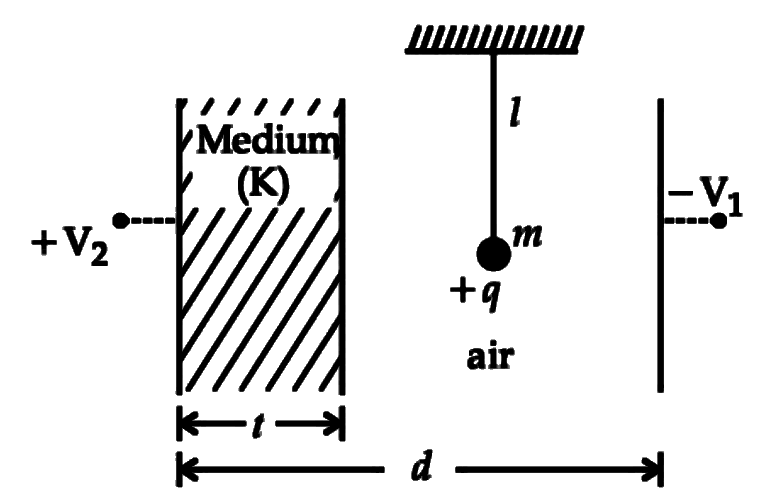
A simple pendulum of mass 'm', length 'l' and charge '+ q' suspended in the electric field produced by two conducting parallel plates as shown. The value of deflection of pendulum in equilibrium position will be

Figure

Show answer and solution

Answer: (c)

  1. Slab region and air region are in series. Take C2=Kε0AtC_2 = \frac{K\varepsilon_0 A}{t} (slab, beside the +V2+V_2 plate) and C1=ε0Ad−tC_1 = \frac{\varepsilon_0 A}{d-t} (air).
  2. Total p.d. =V2−(−V1)=V1+V2= V_2 - (-V_1) = V_1 + V_2, so Q=C1C2C1+C2(V1+V2)Q = \frac{C_1C_2}{C_1 + C_2}(V_1 + V_2).
  3. Field in air: E=Q/C1d−t=C2(V1+V2)(C1+C2)(d−t)E = \frac{Q/C_1}{d - t} = \frac{C_2(V_1 + V_2)}{(C_1 + C_2)(d - t)}
  4. Equilibrium: tan⁡θ=qEmg\tan\theta = \frac{qE}{mg}
  5. So the answer is (c) tan⁡−1[qmg×C2(V1+V2)(C1+C2)(d−t)]\tan^{-1}\left[\frac{q}{mg}\times\frac{C_2(V_1+V_2)}{(C_1+C_2)(d-t)}\right].
Report a mistake
Q28JEE Main 2021 · 25 FEB · SHIFT 2Difficult

Parallel Plate Capacitor · Charges between the plates

An electron with kinetic energy K1 enters between parallel plates of a capacitor at an angle 'α\alpha' with the plates. It leaves the plates at angle 'β\beta' with kinetic energy K2. Then the ratio of kinetic energies K1: K2 will be:

Show answer and solution

Answer: (a)

  1. The field is perpendicular to the plates, so the velocity component parallel to the plates is unchanged.
  2. v1cos⁡α=v2cos⁡β⇒v1v2=cos⁡βcos⁡αv_1\cos\alpha = v_2\cos\beta \Rightarrow \frac{v_1}{v_2} = \frac{\cos\beta}{\cos\alpha}
  3. K1K2=v12v22\frac{K_1}{K_2} = \frac{v_1^2}{v_2^2}
  4. So the answer is (a) cos⁡2βcos⁡2α\frac{\cos^2\beta}{\cos^2\alpha}.
Report a mistake
Q29JEE Main 2020 · 8 JAN · SHIFT 2Difficult

Parallel Plate Capacitor · Capacitance of parallel plates

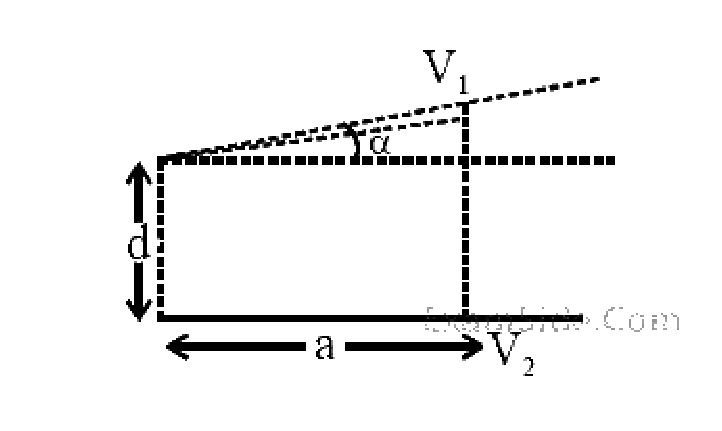
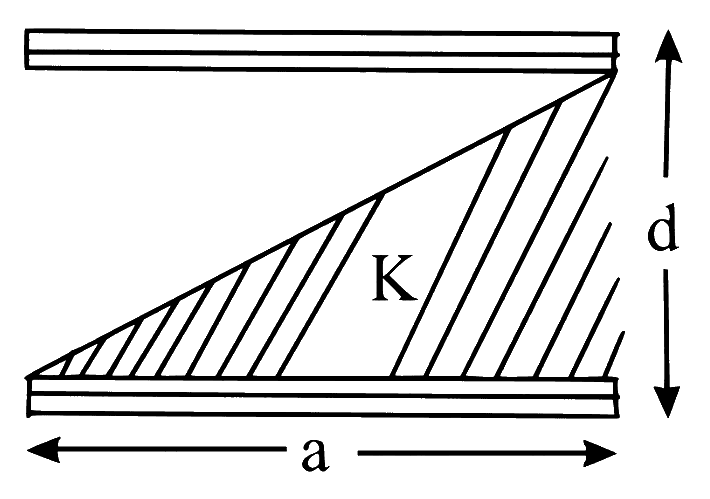
A capacitor is made of two square plates each of side 'a' making a very small angle α\alpha between them, as shown in figure. The capacitance will be close to:

Figure

Show answer and solution

Answer: (c)

  1. At distance xx from the narrow edge the gap is d+αxd + \alpha x; strips of width dxdx are in parallel.
  2. C=∫0aε0a dxd+αx=ε0aαln⁡(1+αad)C = \int_0^a \frac{\varepsilon_0 a\,dx}{d + \alpha x} = \frac{\varepsilon_0 a}{\alpha}\ln\left(1 + \frac{\alpha a}{d}\right)
  3. Using ln⁡(1+x)≈x−x22\ln(1+x) \approx x - \frac{x^2}{2}: C≈ε0aα(αad−α2a22d2)C \approx \frac{\varepsilon_0 a}{\alpha}\left(\frac{\alpha a}{d} - \frac{\alpha^2a^2}{2d^2}\right)
  4. So the answer is (c) ε0a2d(1−αa2d)\frac{\varepsilon_0 a^2}{d}\left(1 - \frac{\alpha a}{2d}\right).
Report a mistake
Q30JEE Main 2019 · 12 JAN · SHIFT 2Easy

Parallel Plate Capacitor · Capacitance of parallel plates

A parallel plate capacitor with plates of area 1 m2 each, are at a separation of 0.1 m. If the electric field between the plates is 100 N/C, the magnitude of charge on each plate is:

(Take ε\varepsilon0 = 8.85 ×\times 10−-12 C2N-m2\frac{C^2}{N\text{-}m^2})

Show answer and solution

Answer: (b)

  1. E=σε0=Qε0A⇒Q=ε0AEE = \frac{\sigma}{\varepsilon_0} = \frac{Q}{\varepsilon_0 A} \Rightarrow Q = \varepsilon_0 AE
  2. Q=8.85×10−12×1×100=8.85×10⁻¹⁰ CQ = 8.85\times10^{-12}\times1\times100 = 8.85\times10^{-10}\text{ C}
  3. So the answer is (b) 8.85×10⁻¹⁰ C8.85\times10^{-10}\text{ C}.
Report a mistake
Q31JEE Main 2019 · 8 APR · SHIFT 2Easy

Parallel Plate Capacitor · Plates with unequal charges

A parallel plate capacitor has 1μF capacitance. One of its two plates is given +2μC charge and the other plate, +4μC charge. The potential difference developed across the capacitor is:-

Show answer and solution

Answer: (a)

  1. With plate charges q1q_1, q2q_2, the inner faces carry ±q1−q22\pm\frac{q_1 - q_2}{2}.
  2. V=q1−q22C=(4−2) μC2×1 μFV = \frac{q_1 - q_2}{2C} = \frac{(4 - 2)\ \mu\text{C}}{2\times1\ \mu\text{F}}
  3. So the answer is (a) 1 V1\text{ V}.
Report a mistake
Q32JEE Main 2019 · 10 APR · SHIFT 2Medium

Parallel Plate Capacitor · Charges between the plates

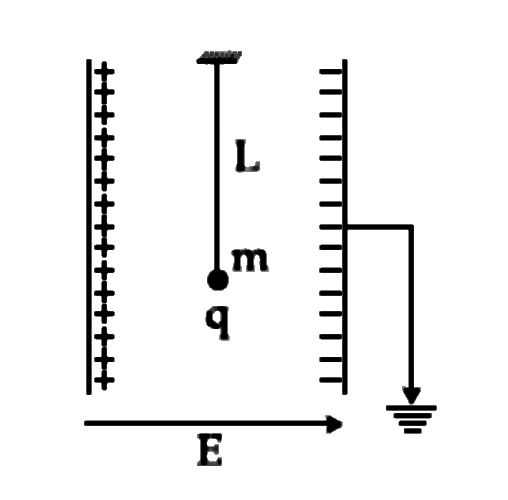
A simple pendulum of length L is placed between the plates of a parallel plate capacitor having electric field E, as shown in figure. Its bob has mass m and charge q. The time period of the pendulum is given by:

Figure

Show answer and solution

Answer: (c)

mgqEmg_eff
  1. On the bob: weight mgmg downward and qEqE horizontal, perpendicular to each other.
  2. Effective gravity: geff=g2+(qEm)2g_{eff} = \sqrt{g^2 + \left(\frac{qE}{m}\right)^2}
  3. T=2πLgeffT = 2\pi\sqrt{\frac{L}{g_{eff}}}
  4. So the answer is (c) 2πLg2+q2E2m22\pi\sqrt{\frac{L}{\sqrt{g^2 + \frac{q^2E^2}{m^2}}}}.
Report a mistake
Q33MHT CET 2026 · 20 APR · SHIFT 1Easy

Energy Stored & Force between Plates · Energy stored

A parallel plate air capacitor having area of each plate 'AA' and the distance between the plates 'dd' has uniform electric field E in the space between the plates. The energy stored in the capacitor is (ϵ0\epsilon_0 = permittivity of free space.)

Show answer and solution

Answer: (c)

  1. Energy density u=12ε0E2u = \frac{1}{2}\varepsilon_0 E^2.
  2. Volume between plates =Ad= Ad, so U=12ε0E2AdU = \frac{1}{2}\varepsilon_0 E^2 Ad.
  3. So the answer is (c) 12Aϵ0E2d\frac{1}{2}A\epsilon_0 E^2 d.
Report a mistake
Q34MHT CET 2026 · 18 APR · SHIFT 1Easy

Energy Stored & Force between Plates · Energy stored

A capacitor of capacitance C has charge Q and energy stored in it is W. If the charge is increased to 3Q, the energy stored in the capacitor W' will be

Show answer and solution

Answer: (a)

  1. W=Q22C∝Q2W = \frac{Q^2}{2C} \propto Q^2 for fixed CC.
  2. Q→3Q⇒W′=9WQ \to 3Q \Rightarrow W' = 9W
  3. So the answer is (a) 9W9W.
Report a mistake
Q35MHT CET 2026 · 15 MAY · SHIFT 1Easy

Energy Stored & Force between Plates · Force between plates

The electrostatic force (FF) between the metal plates of an isolated parallel plate capacitor (CC) having a charge QQ and area AA is (dd = distance between the plates)

Show answer and solution

Answer: (c)

  1. Each plate feels the field of the other plate only: E′=σ2ε0E' = \frac{\sigma}{2\varepsilon_0}.
  2. F=QE′=Q22ε0AF = QE' = \frac{Q^2}{2\varepsilon_0 A}
  3. For an isolated capacitor QQ is fixed, and dd does not appear in FF.
  4. So the answer is (c) independent of dd.
Report a mistake
Q36MHT CET 2026 · 16 APR · SHIFT 1Easy

Energy Stored & Force between Plates · Force between plates

The electric field between the plates of a parallel plate capacitor is 'E'. If the charge on the plates is Q then the force on each plate is

Show answer and solution

Answer: (c)

  1. Total field between plates E=σε0E = \frac{\sigma}{\varepsilon_0}; half of it, E2\frac{E}{2}, is due to each plate.
  2. A plate cannot push itself, so it feels only the other plate's field E2\frac{E}{2}.
  3. F=Q⋅E2F = Q \cdot \frac{E}{2}
  4. So the answer is (c) QE2\frac{QE}{2}.
Report a mistake
Q37MHT CET 2026 · 12 MAY · SHIFT 2Medium

Energy Stored & Force between Plates · Work done & heat

A capacitor of capacity 5 μF5\ \mu\text{F} is charged by a battery of e.m.f. 1010 V. At an instant, the potential difference across the capacitor is 44 V and the time rate of change of potential difference across the capacitor is 0.60.6 V/s. Then the time rate at which energy is stored in the capacitor at that instant is

Show answer and solution

Answer: (a)

  1. U=12CV2⇒dUdt=CVdVdtU = \frac{1}{2}CV^2 \Rightarrow \frac{dU}{dt} = CV\frac{dV}{dt}
  2. dUdt=5×10−6×4×0.6\frac{dU}{dt} = 5 \times 10^{-6} \times 4 \times 0.6
  3. dUdt=12×10−6 J/s\frac{dU}{dt} = 12 \times 10^{-6}\text{ J/s}
  4. So the answer is (a) 12×10−612 \times 10^{-6} J/s.
Report a mistake
Q38JEE Main 2026 · 4 APR · SHIFT 1Difficult

Energy Stored & Force between Plates · Work done & heat

A parallel plate air capacitor is connected to a battery. The plates are pulled apart at uniform speed vv. If xx is the separation between the plates at any instant, then the time rate of change of electrostatic energy of the capacitor is proportional to xαx^{\alpha}, where α\alpha is ______.

Show answer and solution

Answer: (a)

  1. Battery connected: VV constant, U=12CV2=ε0AV22xU = \frac{1}{2}CV^2 = \frac{\varepsilon_0 AV^2}{2x}.
  2. dUdt=−ε0AV22x2dxdt=−ε0AV2v2x2\frac{dU}{dt} = -\frac{\varepsilon_0 AV^2}{2x^2}\frac{dx}{dt} = -\frac{\varepsilon_0 AV^2 v}{2x^2}
  3. With vv constant, dUdt∝x−2\frac{dU}{dt} \propto x^{-2}.
  4. So the answer is (a) α=−2\alpha = -2.
Report a mistake
Q39JEE Main 2025 · 24 JAN · SHIFT 1Easy

Energy Stored & Force between Plates · Energy stored

Consider a parallel plate capacitor of area A (of each plate) and separation ' dd ' between the plates. If EE is the electric field and ε0\varepsilon_0 is the permittivity of free space between the plates, then potential energy stored in the capacitor is

Show answer and solution

Answer: (d)

  1. U=12CV2U = \frac{1}{2}CV^2 with C=ε0AdC = \frac{\varepsilon_0 A}{d} and V=EdV = Ed.
  2. U=12⋅ε0Ad⋅E2d2=12ε0E2AdU = \frac{1}{2}\cdot\frac{\varepsilon_0 A}{d}\cdot E^2 d^2 = \frac{1}{2}\varepsilon_0 E^2 Ad
  3. So the answer is (d) 12ε0E2Ad\frac{1}{2}\varepsilon_0 E^2 Ad.
Report a mistake
Q40MHT CET 2025 · 21 APR · SHIFT 2Medium

Energy Stored & Force between Plates · Energy stored

If the charge on the capacitor is increased by 3C, the energy stored in it increases by 21%21\%. The original charge on the capacitor is

Show answer and solution

Answer: (c)

  1. U=q22C⇒U∝q2U = \frac{q^2}{2C} \Rightarrow U \propto q^2.
  2. (q+3)2q2=1.21⇒q+3q=1.1\frac{(q+3)^2}{q^2} = 1.21 \Rightarrow \frac{q+3}{q} = 1.1
  3. 0.1q=3⇒q=30 C0.1q = 3 \Rightarrow q = 30\text{ C}
  4. So the answer is (c) 30 C.
Report a mistake
Q41JEE Main 2025 · 28 JAN · SHIFT 2Medium

Energy Stored & Force between Plates · Energy density

A parallel plate capacitor of capacitance 1 µF is charged to a potential difference of 20 V. The distance between plates is 1 µm. The energy density between plates of capacitor is:

Show answer and solution

Answer: (a)

  1. E=Vd=2010−6=2×10⁷ V/mE = \frac{V}{d} = \frac{20}{10^{-6}} = 2 \times 10^{7}\text{ V/m}
  2. u=12ε0E2=12×8.85×10−12×4×1014u = \frac{1}{2}\varepsilon_0 E^2 = \frac{1}{2} \times 8.85 \times 10^{-12} \times 4 \times 10^{14}
  3. u=1770≈1.8×10³ J/m3u = 1770 \approx 1.8 \times 10^{3}\text{ J/m}^3
  4. So the answer is (a) 1.8×1031.8 \times 10^{3} J/m3^3.
Report a mistake
Q42MHT CET 2025 · 21 APR · SHIFT 2Medium

Energy Stored & Force between Plates · Work done & heat

A parallel plate capacitor having plate area ' AA ' and separation ' dd ' is charged to a potential difference ' VV '. The charging battery is disconnected and the plates are pulled apart to four times the initial separation. The work required to increase the distance between the plates is ( ε0=\varepsilon_0 = permittivity of free space)

Show answer and solution

Answer: (d)

  1. Battery disconnected: QQ constant, U=Q22CU = \frac{Q^2}{2C}.
  2. d→4d⇒C→C4d \to 4d \Rightarrow C \to \frac{C}{4}, so Uf=4UiU_f = 4U_i.
  3. W=Uf−Ui=3Ui=3×12ε0AdV2W = U_f - U_i = 3U_i = 3 \times \frac{1}{2}\frac{\varepsilon_0 A}{d}V^2
  4. So the answer is (d) 3ε0AV22d\frac{3\varepsilon_0 AV^2}{2d}.
Report a mistake
Q43MHT CET 2024 · 3 MAY · SHIFT 2Easy

Energy Stored & Force between Plates · Energy stored

A parallel plate capacitor is charged and then isolated. If the separation between the plates is increased, which one of the following statement is NOT correct?

Show answer and solution

Answer: (b)

  1. Isolated: QQ constant, so (a) is correct.
  2. C=ε0AdC = \frac{\varepsilon_0 A}{d} falls as dd increases, so (d) is correct.
  3. V=QCV = \frac{Q}{C} increases, so (c) is correct and (b) is wrong.
  4. So the answer is (b).
Report a mistake
Q44NEET 2024Easy

Energy Stored & Force between Plates · Work done & heat

A 12 pF12\text{ pF} capacitor is connected to a 50 V50\text{ V} battery, the electrostatic energy stored in the capacitor in nJ\text{nJ} is

Show answer and solution

Answer: (a)

  1. U=12CV2U = \frac{1}{2}CV^2
  2. U=12×12×10−12×502=6×10−12×2500U = \frac{1}{2} \times 12 \times 10^{-12} \times 50^2 = 6 \times 10^{-12} \times 2500
  3. U=1.5×10⁻⁸ J=15 nJU = 1.5 \times 10^{-8}\text{ J} = 15\text{ nJ}
  4. So the answer is (a) 15.
Report a mistake
Q45MHT CET 2024 · 2 MAY · SHIFT 2Medium

Energy Stored & Force between Plates · Work done & heat

The amount of work done in increasing the voltage across the plates of a capacitor form 5 V to 10 V is ' W '. The work done in increasing it from 10 V to 15 V will be (nearly)

Show answer and solution

Answer: (d)

  1. W=12C(V22−V12)W = \frac{1}{2}C(V_2^2 - V_1^2)
  2. 5 V to 10 V: W∝100−25=75W \propto 100 - 25 = 75; 10 V to 15 V: W′∝225−100=125W' \propto 225 - 100 = 125
  3. W′W=12575=53≈1.67\frac{W'}{W} = \frac{125}{75} = \frac{5}{3} \approx 1.67
  4. So the answer is (d) 1.67 W.
Report a mistake
Q46NEET 2024Medium

Energy Stored & Force between Plates · Work done & heat

If the plates of a parallel plate capacitor connected to a battery are moved close to each other, then A. the charge stored in it, increases.

B. the energy stored in it, decreases.

C. its capacitance increases.

D. the ratio of charge to its potential remains the same.

E. the product of charge and voltage increases.

Choose the most appropriate answer from the options given below:

Show answer and solution

Answer: (b)

  1. Battery connected: VV constant; dd decreases so C=ε0AdC = \frac{\varepsilon_0 A}{d} increases (C true).
  2. A: Q=CVQ = CV increases, true. B: U=12CV2U = \frac{1}{2}CV^2 increases, so false.
  3. D: QV=C\frac{Q}{V} = C changes, false. E: QV=CV2QV = CV^2 increases, true.
  4. So the answer is (b) A, C and E only.
Report a mistake
Q47MHT CET 2023 · 10 MAY · SHIFT 1Easy

Energy Stored & Force between Plates · Energy density

The mean electrical energy density between plates of a charged air capacitor is (where q=q = charge on capacitor, A=A = Area of capacitor plate)

Show answer and solution

Answer: (a)

  1. Field between plates: E=σε0=qε0AE = \frac{\sigma}{\varepsilon_0} = \frac{q}{\varepsilon_0 A}.
  2. Energy density u=12ε0E2=12ε0⋅q2ε02A2u = \frac{1}{2}\varepsilon_0 E^2 = \frac{1}{2}\varepsilon_0 \cdot \frac{q^2}{\varepsilon_0^2 A^2}
  3. u=q22ε0A2u = \frac{q^2}{2\varepsilon_0 A^2}
  4. So the answer is (a) q22ε0A2\frac{q^2}{2\varepsilon_0 A^2}.
Report a mistake
Q48MHT CET 2023 · 12 MAY · SHIFT 2Medium

Energy Stored & Force between Plates · Energy stored

If the charge on the capacitor is increased by 3 coulombs, the energy stored in it increases by 44%44\%. The original charge on the capacitor is

Show answer and solution

Answer: (b)

  1. U∝q2U \propto q^2, so (q+3)2q2=1.44\frac{(q+3)^2}{q^2} = 1.44.
  2. q+3q=1.2⇒0.2q=3\frac{q+3}{q} = 1.2 \Rightarrow 0.2q = 3
  3. q=15 Cq = 15\text{ C}
  4. So the answer is (b) 15 C.
Report a mistake
Q49MHT CET 2023 · 10 MAY · SHIFT 2Medium

Energy Stored & Force between Plates · Energy stored

If a capacitor of capacity 900 μF900\ \mu\text{F} is charged to 100 V100\text{ V} and its total energy is transferred to a capacitor of capacity 100 μF100\ \mu\text{F}, then its potential will be

Show answer and solution

Answer: (c)

  1. U=12C1V12=12×900×10−6×1002=4.5 JU = \frac{1}{2}C_1V_1^2 = \frac{1}{2} \times 900 \times 10^{-6} \times 100^2 = 4.5\text{ J}
  2. Same energy in C2C_2: 12C2V22=4.5\frac{1}{2}C_2V_2^2 = 4.5
  3. V22=9100×10−6=9×10⁴⇒V2=300 VV_2^2 = \frac{9}{100 \times 10^{-6}} = 9 \times 10^4 \Rightarrow V_2 = 300\text{ V}
  4. So the answer is (c) 300 V300\text{ V}.
Report a mistake
Q50MHT CET 2023 · 10 MAY · SHIFT 1Medium

Energy Stored & Force between Plates · Work done & heat

A parallel plate capacitor has plate area 'AA' and separation between plates is 'dd'. It is charged to a potential difference of V0V_0 volt. The charging battery is then disconnected and plates are pulled apart three times the initial distance. The work done to increase the distance between the plates is (ε0=(\varepsilon_0 = permittivity of free space)

Show answer and solution

Answer: (d)

  1. Battery disconnected: QQ constant, U=Q22CU = \frac{Q^2}{2C}.
  2. d→3d⇒C→C3d \to 3d \Rightarrow C \to \frac{C}{3}, so Uf=3UiU_f = 3U_i.
  3. W=2Ui=2×12ε0AdV02=ε0AV02dW = 2U_i = 2 \times \frac{1}{2}\frac{\varepsilon_0 A}{d}V_0^2 = \frac{\varepsilon_0 AV_0^2}{d}
  4. So the answer is (d) ε0AV02d\frac{\varepsilon_0 AV_0^2}{d}.
Report a mistake
Q51MHT CET 2022 · 11 AUG · SHIFT 2Easy

Energy Stored & Force between Plates · Energy stored

A parallel plate air capacitor has a uniform electric field 'E' in the space between the plates. Area of each plate is A and the distance between the plates is 'dd'. The energy stored in the capacitor is [ε0=[\varepsilon_0 = permittivity of free space)

Show answer and solution

Answer: (b)

  1. Energy density u=12ε0E2u = \frac{1}{2}\varepsilon_0 E^2.
  2. Volume between plates =Ad= Ad, so U=12ε0E2AdU = \frac{1}{2}\varepsilon_0 E^2 Ad.
  3. So the answer is (b) 12ε0E2Ad\frac{1}{2}\varepsilon_0 E^2 Ad.
Report a mistake
Q52MHT CET 2022 · 11 AUG · SHIFT 2Easy

Energy Stored & Force between Plates · Force between plates

The force between the plates of a parallel plate capacitor of capacitance 'CC' and distance of separation of the plates 'dd' with a potential difference 'VV' between the plates is

Show answer and solution

Answer: (c)

  1. F=Q22ε0AF = \frac{Q^2}{2\varepsilon_0 A} and Q=CVQ = CV.
  2. Using ε0A=Cd\varepsilon_0 A = Cd: F=C2V22CdF = \frac{C^2V^2}{2Cd}
  3. F=CV22dF = \frac{CV^2}{2d}
  4. So the answer is (c) CV22d\frac{CV^2}{2d}.
Report a mistake
Q53MHT CET 2022 · 11 AUG · SHIFT 2Easy

Energy Stored & Force between Plates · Work done & heat

A parallel plate capacitor is charged and then disconnected from the charging battery. If the plates are now moved further apart by pulling them by means of insulating handles, then

Show answer and solution

Answer: (c)

  1. Battery removed, so QQ stays constant.
  2. dd increases ⇒C=ε0Ad\Rightarrow C = \frac{\varepsilon_0 A}{d} decreases.
  3. V=QCV = \frac{Q}{C} increases; U=Q22CU = \frac{Q^2}{2C} also increases.
  4. So the answer is (c) the voltage across the capacitor increases.
Report a mistake
Q54JEE Main 2022 · 24 JUN · SHIFT 2Medium

Energy Stored & Force between Plates · Energy stored

If the charge on a capacitor is increased by 2 C, the energy stored in it increases by 44%. The original charge on the capacitor is (in C)

Show answer and solution

Answer: (a)

  1. U∝q2U \propto q^2, so (q+2)2q2=1.44\frac{(q+2)^2}{q^2} = 1.44.
  2. q+2q=1.2⇒0.2q=2\frac{q+2}{q} = 1.2 \Rightarrow 0.2q = 2
  3. q=10 Cq = 10\text{ C}
  4. So the answer is (a) 10.
Report a mistake
Q55MHT CET 2021 · 23 SEP · SHIFT 2Easy

Energy Stored & Force between Plates · Energy stored

If the potential difference across a capacitor is increased from 5 V5\text{ V} to 15 V15\text{ V}, then the ratio of final energy to initial energy stored in the capacitor is

Show answer and solution

Answer: (d)

  1. U=12CV2∝V2U = \frac{1}{2}CV^2 \propto V^2
  2. UfUi=(155)2=9\frac{U_f}{U_i} = \left(\frac{15}{5}\right)^2 = 9
  3. So the answer is (d) 9:19 : 1.
Report a mistake
Q56NEET 2021Easy

Energy Stored & Force between Plates · Energy stored

A parallel plate capacitor has a uniform electric field E⃗\vec{E} in the space between the plates. If the distance between the plates is 'd' and the area of each plate is 'A', the energy stored in the capacitor is: (ε\varepsilon0 = permittivity of free space)

Show answer and solution

Answer: (d)

  1. Energy density u=12ε0E2u = \frac{1}{2}\varepsilon_0 E^2.
  2. Volume between plates =Ad= Ad, so U=12ε0E2AdU = \frac{1}{2}\varepsilon_0 E^2 Ad.
  3. So the answer is (d) 12ε0E2Ad\frac{1}{2}\varepsilon_0 E^2 Ad.
Report a mistake
Q57MHT CET 2021 · 22 SEP · SHIFT 2Easy

Energy Stored & Force between Plates · Force between plates

In parallel plate capacitor, electric field between the plates is 'EE'. If the charge on the plates is 'QQ' then the force on each plate is

Show answer and solution

Answer: (d)

  1. Field due to one plate =σ2ε0=E2= \frac{\sigma}{2\varepsilon_0} = \frac{E}{2}.
  2. Force on the other plate: F=Q⋅E2F = Q \cdot \frac{E}{2}
  3. So the answer is (d) QE2\frac{QE}{2}.
Report a mistake
Q58MHT CET 2021 · 24 SEP · SHIFT 2Easy

Energy Stored & Force between Plates · Work done & heat

A battery is used to charge a parallel plate capacitor till the potential difference between the plates becomes equal to the e.m.f. of the battery. The ratio of the energy stored int he capacitor to the work done by the battery will be

Show answer and solution

Answer: (b)

  1. Charge delivered Q=CEQ = CE; battery work W=QE=CE2W = QE = CE^2.
  2. Energy stored U=12CE2U = \frac{1}{2}CE^2 (the other half is lost as heat).
  3. UW=12\frac{U}{W} = \frac{1}{2}
  4. So the answer is (b) 12\frac{1}{2}.
Report a mistake
Q59MHT CET 2021 · 22 SEP · SHIFT 1Medium

Energy Stored & Force between Plates · Energy stored

If the charge on the capacitor is increased by 2 C the energy stored in it increased by 21%. Total original charge on the capacitor is

Show answer and solution

Answer: (c)

  1. U∝q2U \propto q^2, so (q+2)2q2=1.21\frac{(q+2)^2}{q^2} = 1.21.
  2. q+2q=1.1⇒0.1q=2\frac{q+2}{q} = 1.1 \Rightarrow 0.1q = 2
  3. q=20 Cq = 20\text{ C}
  4. So the answer is (c) 20 C.
Report a mistake
Q60JEE Main 2019 · 9 APR · SHIFT 1Medium

Energy Stored & Force between Plates · Work done & heat

A capacitor with capacitance 5μF is charged to 5μC. If the plates are pulled apart to reduce the capacitance to 2μF, how much work is done?

Show answer and solution

Answer: (c)

  1. Isolated capacitor: QQ constant, W=Q22(1C2−1C1)W = \frac{Q^2}{2}\left(\frac{1}{C_2} - \frac{1}{C_1}\right).
  2. W=(5×10⁻⁶)22(12×10−6−15×10−6)W = \frac{(5 \times 10^{-6})^2}{2}\left(\frac{1}{2 \times 10^{-6}} - \frac{1}{5 \times 10^{-6}}\right)
  3. W=12.5×10−12×0.3×106=3.75×10⁻⁶ JW = 12.5 \times 10^{-12} \times 0.3 \times 10^{6} = 3.75 \times 10^{-6}\text{ J}
  4. So the answer is (c) 3.75×10−63.75 \times 10^{-6} J.
Report a mistake
Q61NEET 2018Easy

Energy Stored & Force between Plates · Force between plates

The electrostatic force between the metal plates of an isolated parallel plate capacitor C having a charge Q and area A, is

Show answer and solution

Answer: (a)

  1. F=Q⋅σ2ε0=Q22ε0AF = Q \cdot \frac{\sigma}{2\varepsilon_0} = \frac{Q^2}{2\varepsilon_0 A}
  2. Isolated capacitor: QQ stays constant, and FF has no dd in it.
  3. So the answer is (a) independent of the distance between the plates.
Report a mistake
Q62JEE Main 2018 · 15 APR · SHIFT 2Medium

Energy Stored & Force between Plates · Force between plates

A parallel plate capacitor with area 200 cm2 and separation between the plates 1.5 cm, is connected across a battery of emf V. If the force of attraction between the plates is 25×10−6 N,25 \times 10^{-6}\text{ N}, the value of V is approximately: (ϵ0=8.85×10⁻¹² C2N⋅m2)\left(\epsilon_0 = 8.85 \times 10^{-12}\ \frac{C^2}{N \cdot m^2}\right)

Show answer and solution

Answer: (a)

  1. F=ε0AV22d2⇒V2=2Fd2ε0AF = \frac{\varepsilon_0 A V^2}{2d^2} \Rightarrow V^2 = \frac{2Fd^2}{\varepsilon_0 A}
  2. A=2×10⁻² m2A = 2 \times 10^{-2}\text{ m}^2, d=1.5×10⁻² md = 1.5 \times 10^{-2}\text{ m}
  3. V2=2×25×10−6×2.25×10−48.85×10−12×2×10−2≈6.36×10⁴V^2 = \frac{2 \times 25 \times 10^{-6} \times 2.25 \times 10^{-4}}{8.85 \times 10^{-12} \times 2 \times 10^{-2}} \approx 6.36 \times 10^{4}
  4. V≈252 VV \approx 252\text{ V}
  5. So the answer is (a) 250 V.
Report a mistake
Q63NEET 2015 · AIPMTEasy

Energy Stored & Force between Plates · Force between plates

A parallel plate air capacitor has capacity C, distance of separation between plates is d and potential difference VV is applied between the plates. Force of attraction between the plates of the parallel plate air capacitor is

Show answer and solution

Answer: (d)

  1. F=Q22ε0AF = \frac{Q^2}{2\varepsilon_0 A} with Q=CVQ = CV and ε0A=Cd\varepsilon_0 A = Cd.
  2. F=C2V22Cd=CV22dF = \frac{C^2V^2}{2Cd} = \frac{CV^2}{2d}
  3. So the answer is (d) CV22d\frac{CV^2}{2d}.
Report a mistake
Q64NEET 2012 · AIPMT · MAINSEasy

Energy Stored & Force between Plates · Energy stored

A parallel plate capacitor has a uniform electric field E in the space between the plates. If the distance between the plates is d and area of each plate is A, the energy stored in the capacitor is

Show answer and solution

Answer: (c)

  1. Energy density u=12ε0E2u = \frac{1}{2}\varepsilon_0 E^2.
  2. Volume between plates =Ad= Ad, so U=12ε0E2AdU = \frac{1}{2}\varepsilon_0 E^2 Ad.
  3. So the answer is (c) 12ε0E2Ad\frac{1}{2}\varepsilon_0 E^2 Ad.
Report a mistake
Q65NEET 2011 · AIPMT · PRELIMSEasy

Energy Stored & Force between Plates · Energy stored

A parallel plate capacitor has a uniform electric field E in the space between the plates. If the distance between the plates is d and area of each plate is A, the energy stored in the capacitor is

Show answer and solution

Answer: (c)

  1. Energy density u=12ε0E2u = \frac{1}{2}\varepsilon_0 E^2.
  2. Volume between plates =Ad= Ad, so U=12ε0E2AdU = \frac{1}{2}\varepsilon_0 E^2 Ad.
  3. So the answer is (c) 12ε0E2Ad\frac{1}{2}\varepsilon_0 E^2 Ad.
Report a mistake
Q66NEET 2008 · AIPMTEasy

Energy Stored & Force between Plates · Energy stored

The energy required to charge a parallel plate condenser of plate separation dd and plate area of cross-section AA such that the uniform electric field between the plates is EE, is

Show answer and solution

Answer: (b)

  1. Energy density in the field: u=12ε0E2u = \frac{1}{2}\varepsilon_0 E^2.
  2. Volume between the plates =Ad= Ad, so U=u×AdU = u \times Ad.
  3. So the answer is (b) 12ε0E2Ad\frac{1}{2}\varepsilon_0 E^2 Ad.
Report a mistake
Q67JEE Main 2007 · AIEEEEasy

Energy Stored & Force between Plates · Work done & heat

A battery is used to charge a parallel plate capacitor till the potential difference between the plates becomes equal to the electromotive force of the battery. The ratio of the energy stored in the capacitor and the work done by the battery will be

Show answer and solution

Answer: (a)

  1. Battery work W=QE=CE2W = QE = CE^2.
  2. Energy stored U=12CE2U = \frac{1}{2}CE^2.
  3. UW=12\frac{U}{W} = \frac{1}{2}
  4. So the answer is (a) 1/21/2.
Report a mistake
Q68NEET 2006 · AIPMTEasy

Energy Stored & Force between Plates · Work done & heat

A parallel plate air capacitor is charged to a potential difference of V volts. After disconnecting the charging battery the distance between the plates of the capacitor is increased using an insulting handle. As a result the potential difference between the plates

Show answer and solution

Answer: (a)

  1. Battery disconnected, so QQ is constant.
  2. dd increases ⇒C=ε0Ad\Rightarrow C = \frac{\varepsilon_0 A}{d} decreases.
  3. V=QCV = \frac{Q}{C} therefore increases.
  4. So the answer is (a) increases.
Report a mistake
Q69JEE Main 2005 · AIEEEMedium

Energy Stored & Force between Plates · Work done & heat

A fully charged capacitor has a capacitance ′C′'C'. It is discharged through a small coil of resistance wire embedded in a thermally insulated block of specific heat capacity ′s′'s' and mass ′m′.'m'. If the temperature of the block is raised by ′ΔT′,'\Delta T', the potential difference ′v′'v' across the capacitor is

Show answer and solution

Answer: (c)

  1. Stored energy becomes heat in the block: 12Cv2=msΔT\frac{1}{2}Cv^2 = ms\Delta T.
  2. v2=2msΔTCv^2 = \frac{2ms\Delta T}{C}
  3. So the answer is (c) 2msΔTC\sqrt{\frac{2ms\Delta T}{C}}.
Report a mistake
Q70JEE Main 2003 · AIEEEEasy

Energy Stored & Force between Plates · Work done & heat

The work done in placing a charge of 8×10−188 \times 10^{-18} coulomb on a condenser of capacity 100100 micro-farad is

Show answer and solution

Answer: (d)

  1. W=q22CW = \frac{q^2}{2C}
  2. W=(8×10⁻¹⁸)22×100×10−6=64×10−362×10−4W = \frac{(8 \times 10^{-18})^2}{2 \times 100 \times 10^{-6}} = \frac{64 \times 10^{-36}}{2 \times 10^{-4}}
  3. W=32×10−32 JW = 32 \times 10^{-32}\text{ J}
  4. So the answer is (d) 32×10−3232 \times 10^{-32} joule.
Report a mistake
Q71NEET 2001 · AIPMTEasy

Energy Stored & Force between Plates · Energy density

Energy per unit volume for a capacitor having area A and separation d kept at potential difference V is given by

Show answer and solution

Answer: (a)

  1. Energy density u=12ε0E2u = \frac{1}{2}\varepsilon_0 E^2.
  2. Uniform field E=VdE = \frac{V}{d}, so u=12ε0V2d2u = \frac{1}{2}\varepsilon_0 \frac{V^2}{d^2}.
  3. Options (c) and (d) are total energy, not energy per unit volume.
  4. So the answer is (a) 12ε0V2d2\frac{1}{2}\varepsilon_0\frac{V^2}{d^2}.
Report a mistake
Q72NEET 1996 · AIPMTEasy

Energy Stored & Force between Plates · Energy stored

The energy stored in a capacitor of capacity CC and potential VV is given by

Show answer and solution

Answer: (d)

  1. Work done in charging: U=∫0QqC dq=Q22CU = \int_0^Q \frac{q}{C}\,dq = \frac{Q^2}{2C}.
  2. With Q=CVQ = CV: U=12CV2U = \frac{1}{2}CV^2.
  3. So the answer is (d) CV22\frac{CV^2}{2}.
Report a mistake
Q73NEET 1995 · AIPMTEasy

Energy Stored & Force between Plates · Work done & heat

A 4 μF4\ \mu\text{F} capacitor is charged to 400 V400\text{ V}. If its plates are joined through a resistance of 2 kΩ2\text{ k}\Omega, then heat produced in the resistance is

Show answer and solution

Answer: (d)

  1. All stored energy becomes heat in the resistor (the value of RR does not matter).
  2. H=12CV2=12×4×10−6×(400)2H = \frac{1}{2}CV^2 = \frac{1}{2} \times 4 \times 10^{-6} \times (400)^2
  3. H=2×10−6×1.6×105=0.32 JH = 2 \times 10^{-6} \times 1.6 \times 10^{5} = 0.32\text{ J}
  4. So the answer is (d) 0.32 J0.32\text{ J}.
Report a mistake
Q74MHT CET 2026 · 19 APR · SHIFT 2Easy

Dielectrics · Dielectric basics & full filling

A parallel plate air capacitor has capacity 'C' farad, potential 'V' volt and energy 'E' joule. When the gap between the plates is completely filled with dielectric

Show answer and solution

Answer: (d)

  1. Charge on the plates stays the same (no battery connected); C→KCC \to KC.
  2. V=QC→VKV = \frac{Q}{C} \to \frac{V}{K}, decreases.
  3. E=Q22C→EKE = \frac{Q^2}{2C} \to \frac{E}{K}, decreases.
  4. So the answer is (d) both V and E decrease.
Report a mistake
Q75MHT CET 2026 · 15 APR · SHIFT 1Easy

Dielectrics · Dielectric basics & full filling

The function of a dielectric in a capacitor is to

Show answer and solution

Answer: (c)

  1. The dielectric gets polarised; its induced charges set up a field opposing the plate field.
  2. Net field drops to E0K\frac{E_0}{K}, so for the same charge V=V0KV = \frac{V_0}{K} falls and C=KC0C = KC_0 rises.
  3. It does not change the plate area.
  4. So the answer is (c) reduce the effective potential on plates.
Report a mistake
Q76MHT CET 2026 · 13 APR · SHIFT 2Easy

Dielectrics · Dielectric basics & full filling

A parallel plate capacitor with air between the plate has a capacitance of 1515 pF. The separation between the plates becomes twice and the space between them is filled with a medium of dielectric constant 3.53.5. Then the capacitance becomes x/4x/4 pF.

The value of xx is

Show answer and solution

Answer: (a)

  1. C=Kε0AdC = \frac{K\varepsilon_0 A}{d}; new C′=3.5 ε0A2d=3.52CC' = \frac{3.5\,\varepsilon_0 A}{2d} = \frac{3.5}{2}C.
  2. C′=1.75×15=26.25 pF=1054 pFC' = 1.75 \times 15 = 26.25\text{ pF} = \frac{105}{4}\text{ pF}
  3. So the answer is (a) x=105x = 105.
Report a mistake
Q77MHT CET 2026 · 15 MAY · SHIFT 2Easy

Dielectrics · Partial slab & metal sheet

A parallel plate capacitor of plate separation 22 mm and plate area 4040 cm22 is filled with dielectric whose area is same as plates of capacitor. Thickness is 11 mm and dielectric constant is 55. New capacitance is (ϵ0\epsilon_0 = permittivity of free space)

Show answer and solution

Answer: (b)

  1. Partial slab: C=ϵ0Ad−t+tKC = \frac{\epsilon_0 A}{d - t + \frac{t}{K}}.
  2. d−t+tK=1 mm+0.2 mm=1.2×10⁻³d - t + \frac{t}{K} = 1\text{ mm} + 0.2\text{ mm} = 1.2 \times 10^{-3} m, A=4×10⁻³ m2A = 4 \times 10^{-3}\ \text{m}^2.
  3. C=4×10−31.2×10−3ϵ0=10ϵ03C = \frac{4 \times 10^{-3}}{1.2 \times 10^{-3}}\epsilon_0 = \frac{10\epsilon_0}{3} F.
  4. So the answer is (b) 10ϵ03\frac{10\epsilon_0}{3} F.
Report a mistake
Q78MHT CET 2026 · 13 MAY · SHIFT 2Easy

Dielectrics · Partial slab & metal sheet

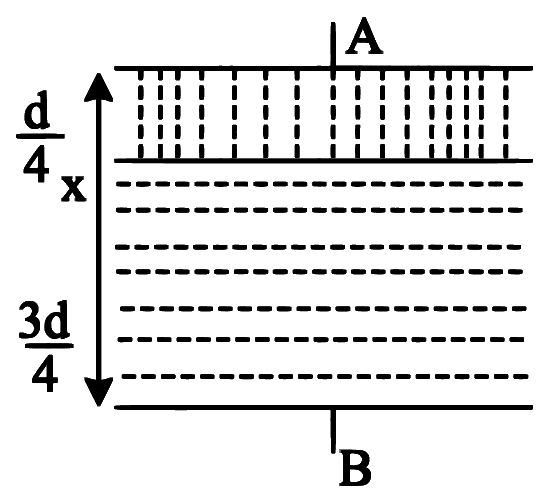
A slab of material of dielectric constant kk has the same area as the plates of the parallel plate capacitor but has thickness 3d4\frac{3d}{4}, where dd is the separation of the plates. How is the capacitance changed, when the slab is inserted between the plates? (CC = original capacitance)

Show answer and solution

Answer: (a)

  1. C′=ϵ0Ad−t+tkC' = \frac{\epsilon_0 A}{d - t + \frac{t}{k}} with t=3d4t = \frac{3d}{4}.
  2. d−t+tk=d4+3d4k=d(k+3)4kd - t + \frac{t}{k} = \frac{d}{4} + \frac{3d}{4k} = \frac{d(k+3)}{4k}.
  3. C′=4kk+3⋅ϵ0Ad=4kCk+3C' = \frac{4k}{k+3}\cdot\frac{\epsilon_0 A}{d} = \frac{4kC}{k+3}.
  4. So the answer is (a).
Report a mistake
Q79MHT CET 2026 · 12 MAY · SHIFT 1Easy

Dielectrics · Partial slab & metal sheet

A parallel plate air capacitor consists of two metal plates of area AA and separation dd. A slab of thickness tt and dielectric constant 2k2k is inserted between the plates with its faces parallel to the plates. The effective capacitance of the system is (ϵ0=\epsilon_0 = permittivity of free space)

Show answer and solution

Answer: (a)

  1. Slab of thickness tt and constant KK: C=ϵ0A(d−t)+tKC = \frac{\epsilon_0 A}{(d-t) + \frac{t}{K}}.
  2. Here K=2kK = 2k, so C=ϵ0A(d−t)+t2kC = \frac{\epsilon_0 A}{(d-t) + \frac{t}{2k}}.
  3. So the answer is (a).
Report a mistake
Q80MHT CET 2026 · 19 APR · SHIFT 1Easy

Dielectrics · Partial slab & metal sheet

A slab of material of dielectric constant KK has the same area as the plates of a parallel plate capacitor but has a thickness (4/5)d(4/5)d, where dd is the separation of the plates. The capacitance in the presence and absence of dielectric are CC and C0C_0 respectively. The ratio (C/C0)(C/C_0) is

Show answer and solution

Answer: (c)

  1. C=ϵ0Ad−t+tKC = \frac{\epsilon_0 A}{d - t + \frac{t}{K}} with t=4d5t = \frac{4d}{5}.
  2. d−t+tK=d5+4d5K=d(K+4)5Kd - t + \frac{t}{K} = \frac{d}{5} + \frac{4d}{5K} = \frac{d(K+4)}{5K}.
  3. CC0=5KK+4\frac{C}{C_0} = \frac{5K}{K+4}.
  4. So the answer is (c).
Report a mistake
Q81MHT CET 2026 · 16 APR · SHIFT 2Easy

Dielectrics · Partial slab & metal sheet

A capacitor has capacity C when it's parallel plates are separated by air medium of thickness 'd'. A slab of material of dielectric constant K having area equal to that of plates but thickness d2\frac{d}{2} is inserted between the plates. Capacitance of the capacitor in the presence of slab will be

Show answer and solution

Answer: (d)

  1. C′=ϵ0Ad−t+tKC' = \frac{\epsilon_0 A}{d - t + \frac{t}{K}} with t=d2t = \frac{d}{2}.
  2. d2+d2K=d(K+1)2K\frac{d}{2} + \frac{d}{2K} = \frac{d(K+1)}{2K}.
  3. C′=2KCK+1C' = \frac{2KC}{K+1}.
  4. So the answer is (d).
Report a mistake
Q82MHT CET 2026 · 11 APR · SHIFT 1Easy

Dielectrics · Partial slab & metal sheet

A parallel plate capacitor has plate area 4040 cm22 and plates separation 22 mm. The space between the plates is filled with a dielectric medium of a thickness 11 mm and dielectric constant 55. The capacitance of the system is

Show answer and solution

Answer: (c)

  1. C=ϵ0Ad−t+tKC = \frac{\epsilon_0 A}{d - t + \frac{t}{K}}, A=40×10−4=4×10⁻³ m2A = 40 \times 10^{-4} = 4 \times 10^{-3}\ \text{m}^2.
  2. d−t+tK=1+15=1.2d - t + \frac{t}{K} = 1 + \frac{1}{5} = 1.2 mm =1.2×10−3= 1.2 \times 10^{-3} m.
  3. C=4×10−31.2×10−3ϵ0=103ϵ0C = \frac{4 \times 10^{-3}}{1.2 \times 10^{-3}}\epsilon_0 = \frac{10}{3}\epsilon_0 F.
  4. So the answer is (c).
Report a mistake
Q83JEE Main 2026 · 21 JAN · SHIFT 1Easy

Dielectrics · Partial slab & metal sheet

A parallel plate capacitor has capacitance CC, when there is vacuum within the parallel plates. A sheet having thickness (13)rd\left(\frac{1}{3}\right)^{\text{rd}} of the separation between the plates and relative permittivity KK is introduced between the plates. The new capacitance of the system is:

Show answer and solution

Answer: (d)

  1. C′=ε0Ad−t+tKC' = \frac{\varepsilon_0 A}{d - t + \frac{t}{K}} with t=d3t = \frac{d}{3}.
  2. 2d3+d3K=d(2K+1)3K\frac{2d}{3} + \frac{d}{3K} = \frac{d(2K+1)}{3K}.
  3. C′=3KC2K+1C' = \frac{3KC}{2K+1}.
  4. So the answer is (d).
Report a mistake
Q84JEE Main 2026 · 2 APR · SHIFT 1Easy

Dielectrics · Compound dielectrics

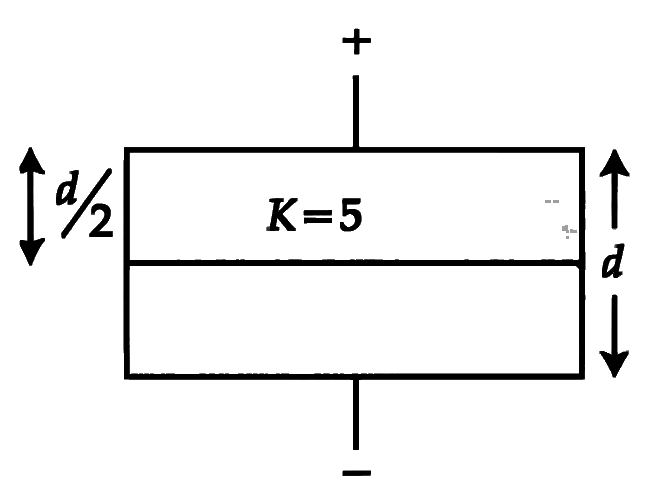
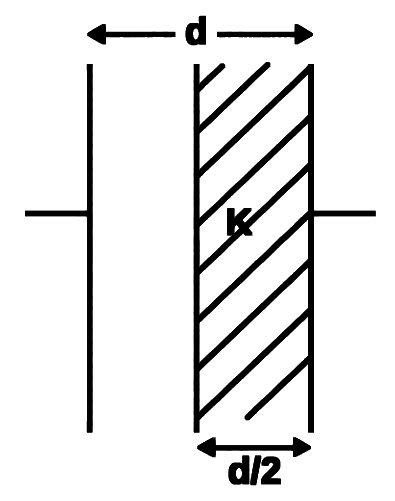
A parallel plate air capacitor has a capacitance CC. When it is half filled as shown in figure with a dielectric constant K=5K = 5, the percentage increase in the capacitance is ________.

Figure

Show answer and solution

Answer: (b)

K = 5 : 10Cair : 2CseriesC' = 5C/3
  1. The dielectric fills half the gap (layer parallel to the plates), so the two layers are in series.
  2. Air layer: 2C2C; dielectric layer: 2KC=10C2KC = 10C.
  3. C′=2C×10C12C=5C3C' = \frac{2C \times 10C}{12C} = \frac{5C}{3}.
  4. Increase =5C/3−CC×100=66.67%= \frac{5C/3 - C}{C} \times 100 = 66.67\%.
  5. So the answer is (b) 66.67.
Report a mistake
Q85JEE Main 2026 · 28 JAN · SHIFT 2Medium

Dielectrics · Dielectric basics & full filling

Identify the correct statements:

A. Effective capacitance of a series combination of capacitors is always smaller than the smallest capacitance of the capacitor in the combination.

B. When a dielectric medium is placed between the charged plates of a capacitor, displacement of charges cannot occur due to insulation property of dielectric.

C. Increasing of area of capacitor plate or decreasing of thickness of dielectric is an alternate method to increase the capacitance.

D. For a point charge, concentric spherical shells centered at the location of the charge are equipotential surfaces.

Choose the correct answer from the options given below:

Show answer and solution

Answer: (a)

  1. A: true; in series 1Ceq>1Ci\frac{1}{C_{eq}} > \frac{1}{C_i} for every CiC_i, so CeqC_{eq} is less than the smallest.
  2. B: false; the dielectric gets polarised, i.e. bound charges are displaced slightly.
  3. C: true; C=Kε0AdC = \frac{K\varepsilon_0 A}{d} grows with larger AA or smaller dd.
  4. D: true; V=kqrV = \frac{kq}{r} is constant on any sphere centred on the charge.
  5. So A, C and D are correct: answer (a).
Report a mistake
Q86MHT CET 2026 · 14 MAY · SHIFT 1Medium

Dielectrics · Battery connected vs removed

A parallel plate capacitor having capacity 1212 pF is charged by a battery of 1010 V between its plates. The battery is now disconnected and a slab of dielectric constant 66 is kept between the plates. The work done by the capacitor on the slab is

Show answer and solution

Answer: (c)

  1. Battery disconnected, so QQ is fixed and U′=UKU' = \frac{U}{K}.
  2. U=12CV2=12×12×10−12×100=6×10⁻¹⁰U = \frac{1}{2}CV^2 = \frac{1}{2} \times 12 \times 10^{-12} \times 100 = 6 \times 10^{-10} J.
  3. U′=6×10−106=1×10⁻¹⁰U' = \frac{6 \times 10^{-10}}{6} = 1 \times 10^{-10} J.
  4. Work done on the slab =U−U′=5×10−10= U - U' = 5 \times 10^{-10} J.
  5. So the answer is (c).
Report a mistake
Q87JEE Main 2026 · 23 JAN · SHIFT 2Medium

Dielectrics · Battery connected vs removed

A parallel plate capacitor with plate separation 5 mm is charged by a battery. On introducing a mica sheet of 2 mm and maintaining the connections of the plates with the terminals of the battery, it is found that it draws 25%25\% more charge from the battery. The dielectric constant of mica is ______

Show answer and solution

Answer: (d)

  1. Battery connected, so Q∝CQ \propto C: C′=1.25CC' = 1.25C.
  2. C′C=dd−t+tK=53+2K=1.25\frac{C'}{C} = \frac{d}{d - t + \frac{t}{K}} = \frac{5}{3 + \frac{2}{K}} = 1.25.
  3. 3+2K=4⇒K=23 + \frac{2}{K} = 4 \Rightarrow K = 2.
  4. So the answer is (d) 2.0.
Report a mistake
Q88MHT CET 2026 · 20 APR · SHIFT 1Medium

Dielectrics · Partial slab & metal sheet

In a parallel plate air capacitor of plate separation 'dd', a dielectric slab of thickness 'tt' is introduced between the plates. The capacitance becomes one-third of the original value. The dielectric constant of the slab will be

Show answer and solution

Answer: (b)

  1. With a slab of thickness tt: C′=ϵ0Ad−t+tKC'=\frac{\epsilon_0A}{d-t+\frac{t}{K}}.
  2. C′=C3⇒d−t+tK=3dC'=\frac{C}{3} \Rightarrow d-t+\frac{t}{K}=3d
  3. tK=2d+t⇒K=t2d+t\frac{t}{K}=2d+t \Rightarrow K=\frac{t}{2d+t}
  4. So the answer is (b) t2d+t\frac{t}{2d+t}.
Report a mistake
Q89MHT CET 2026 · 13 APR · SHIFT 1Medium

Dielectrics · Partial slab & metal sheet

The capacitance of a capacitor becomes 76\frac{7}{6} times the original value if dielectric slab of thickness t=2d3t = \frac{2d}{3} is introduced between the plates, where 'd' is the distance of separation between the plates. The dielectric constant of the slab is

Show answer and solution

Answer: (b)

  1. C′C=dd−t+tK=76\frac{C'}{C}=\frac{d}{d-t+\frac{t}{K}}=\frac{7}{6} with t=2d3t=\frac{2d}{3}.
  2. 13+23K=67⇒23K=1121\frac{1}{3}+\frac{2}{3K}=\frac{6}{7} \Rightarrow \frac{2}{3K}=\frac{11}{21}
  3. K=4233=1411K=\frac{42}{33}=\frac{14}{11}
  4. So the answer is (b) 1411\frac{14}{11}.
Report a mistake
Q90MHT CET 2026 · 20 MAY · SHIFT 1Medium

Dielectrics · Compound dielectrics

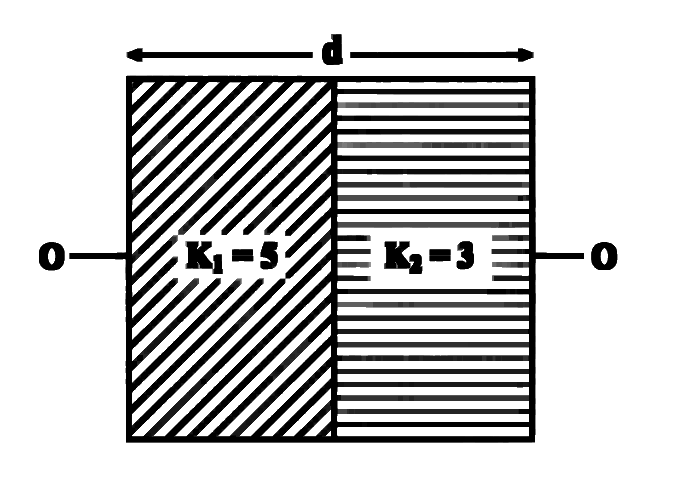
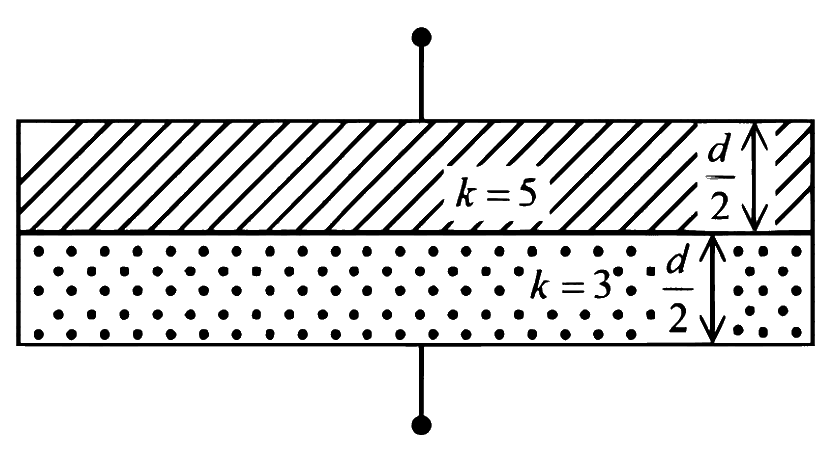
Air capacitor has capacitance C1C_1. The space between two plates of capacitor is filled with two dielectric as shown in figure. The new capacitance of the capacitor is C2C_2. Then C1C2\frac{C_1}{C_2} is [dd = distance between two plates, K1K_1 and K2K_2 are dielectric constants of first and second dielectrics respectively]

Figure

Show answer and solution

Answer: (b)

  1. The two slabs, each d2\frac{d}{2} thick, are in series.
  2. C2=ϵ0Ad2(5)+d2(3)=ϵ0Ad⋅6016=154C1C_2=\frac{\epsilon_0A}{\frac{d}{2(5)}+\frac{d}{2(3)}}=\frac{\epsilon_0A}{d}\cdot\frac{60}{16}=\frac{15}{4}C_1
  3. C1C2=415=830\frac{C_1}{C_2}=\frac{4}{15}=\frac{8}{30}
  4. So the answer is (b) 830\frac{8}{30}.
Report a mistake
Q91MHT CET 2026 · 14 MAY · SHIFT 1Medium

Dielectrics · Compound dielectrics

A parallel plate air capacitor has capacity CC and plate area AA. Now the space between its plates is filled by two slabs of thickness d2\frac{d}{2} each, having dielectric constants K1K_1 and K2K_2. Distance of separation between plates is dd. The capacity of the capacitor is (ε0\varepsilon_0 = permittivity of free space)

Show answer and solution

Answer: (b)

  1. Two layers of thickness d2\frac{d}{2} are in series: C′=ϵ0Ad2K1+d2K2C'=\frac{\epsilon_0A}{\frac{d}{2K_1}+\frac{d}{2K_2}}
  2. C′=2ϵ0Ad⋅K1K2K1+K2C'=\frac{2\epsilon_0A}{d}\cdot\frac{K_1K_2}{K_1+K_2}, with C=ϵ0AdC=\frac{\epsilon_0A}{d}
  3. So the answer is (b) 2C(K1K2K1+K2)2C\left(\frac{K_1K_2}{K_1+K_2}\right).
Report a mistake
Q92MHT CET 2026 · 13 MAY · SHIFT 1Medium

Dielectrics · Compound dielectrics

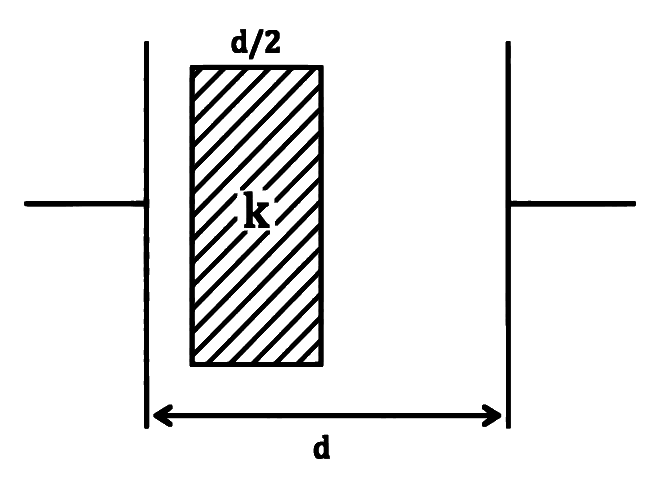
Find the capacitance of the Parallel plate capacitor shown in the figure.

(A = area of each plate, ε0\varepsilon_0 = permittivity of free space)

Figure

Show answer and solution

Answer: (a)

  1. Slab of thickness d2\frac{d}{2} and air gap d2\frac{d}{2} act in series.
  2. C=ϵ0Ad2+d2K=2KAϵ0(K+1)dC=\frac{\epsilon_0A}{\frac{d}{2}+\frac{d}{2K}}=\frac{2KA\epsilon_0}{(K+1)d}
  3. So the answer is (a).
Report a mistake
Q93JEE Main 2026 · 24 JAN · SHIFT 2Medium

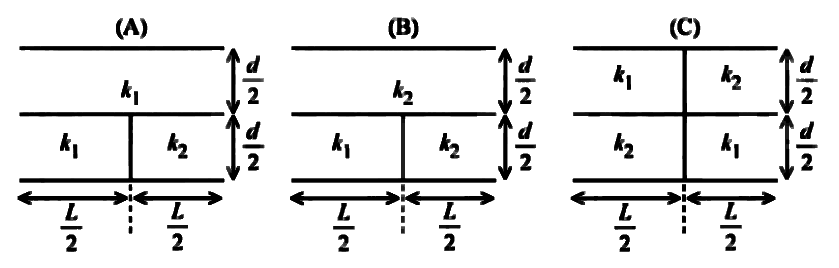
Dielectrics · Compound dielectrics

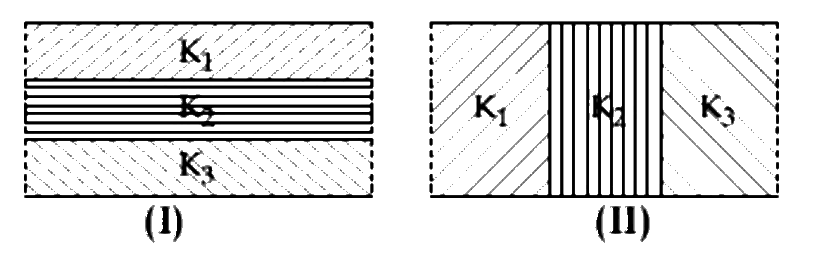
Three parallel plate capacitors each with area AA and separation dd are filled with two dielectrics ( k1k_1 and k2k_2) in the following fashion. Which of the following is true?

(k1>k2)(k_1 > k_2)

Figure

Show answer and solution

Answer: (c)

  1. Take C0=ϵ0AdC_0=\frac{\epsilon_0A}{d}, k1=2k_1=2, k2=1k_2=1 to compare.
  2. A: top k1k_1 layer (2k1C02k_1C_0) in series with bottom pair in parallel ((k1+k2)C0(k_1+k_2)C_0): CA=2k1(k1+k2)3k1+k2C0=127C0C_A=\frac{2k_1(k_1+k_2)}{3k_1+k_2}C_0=\frac{12}{7}C_0
  3. B: same with k2k_2 on top: CB=2k2(k1+k2)3k2+k1C0=65C0C_B=\frac{2k_2(k_1+k_2)}{3k_2+k_1}C_0=\frac{6}{5}C_0
  4. C: two columns, each k1,k2k_1,k_2 in series: CC=2k1k2k1+k2C0=43C0C_C=\frac{2k_1k_2}{k_1+k_2}C_0=\frac{4}{3}C_0
  5. 1.71>1.33>1.21.71>1.33>1.2, so the answer is (c) CA>CC>CBC_A>C_C>C_B.
Report a mistake
Q94MHT CET 2026 · 19 MAY · SHIFT 1Medium

Dielectrics · Dielectric in a combination

Two parallel plate air capacitors of same capacity 'CC' are connected in series to a battery of emf 'EE'. Then one of the capacitors is completely filled with dielectric material of constant 'KK'. The change in the effective capacity of the series combination is

Show answer and solution

Answer: (d)

  1. Initially two equal capacitors in series: Ci=C2C_i = \frac{C}{2}.
  2. After filling one: Cf=KC⋅CKC+C=KCK+1C_f = \frac{KC \cdot C}{KC + C} = \frac{KC}{K+1}.
  3. ΔC=KCK+1−C2=C(2K−K−1)2(K+1)=C2[K−1K+1]\Delta C = \frac{KC}{K+1} - \frac{C}{2} = \frac{C(2K - K - 1)}{2(K+1)} = \frac{C}{2}\left[\frac{K-1}{K+1}\right]
  4. So the answer is (d).
Report a mistake
Q95MHT CET 2026 · 16 APR · SHIFT 1Medium

Dielectrics · Dielectric in a combination

Two condensers of capacities, '2C' and 'C' are joined in parallel and charged upto potential 'V'. The battery is then disconnected and condenser of capacity 'C' is filled completely with a medium of dielectric constant 'K'. The potential difference across the capacitors in the second case is

Show answer and solution

Answer: (a)

  1. Charge stored: Q=(2C+C)V=3CVQ = (2C + C)V = 3CV; battery removed, so QQ stays constant.
  2. New capacitance: C′=2C+KC=(K+2)CC' = 2C + KC = (K+2)C.
  3. V′=QC′=3CV(K+2)C=3VK+2V' = \frac{Q}{C'} = \frac{3CV}{(K+2)C} = \frac{3V}{K+2}
  4. So the answer is (a) 3VK+2\frac{3V}{K+2}.
Report a mistake
Q96MHT CET 2026 · 13 APR · SHIFT 1Medium

Dielectrics · Dielectric in a combination

Two identical parallel plate air capacitors are connected in series to a battery of e.m.f. 'V'. If one of the capacitor is inserted in liquid of dielectric constant 'K' then potential difference of the other capacitor will become

Show answer and solution

Answer: (a)

  1. In series the charge is the same, so V∝1CV \propto \frac{1}{C}.
  2. Capacitances become KCKC and CC; the unfilled one (CC) takes the larger share.
  3. Vother=V⋅KCKC+C=KVK+1V_{other} = V \cdot \frac{KC}{KC + C} = \frac{KV}{K+1}
  4. So the answer is (a) KVK+1\frac{KV}{K+1}.
Report a mistake
Q97JEE Main 2026 · 23 JAN · SHIFT 1Difficult

Dielectrics · Compound dielectrics

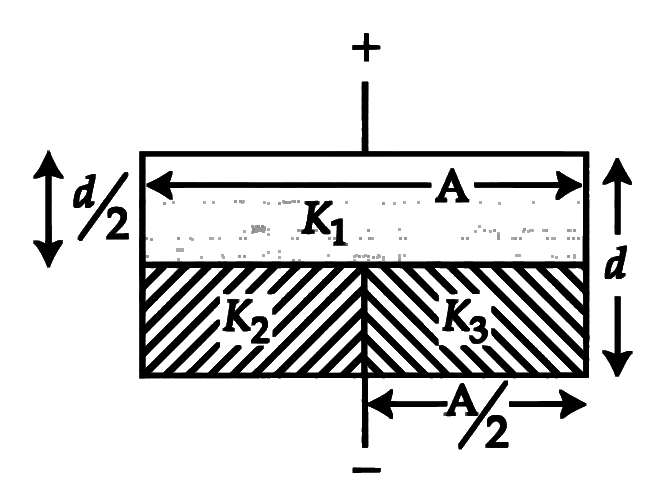
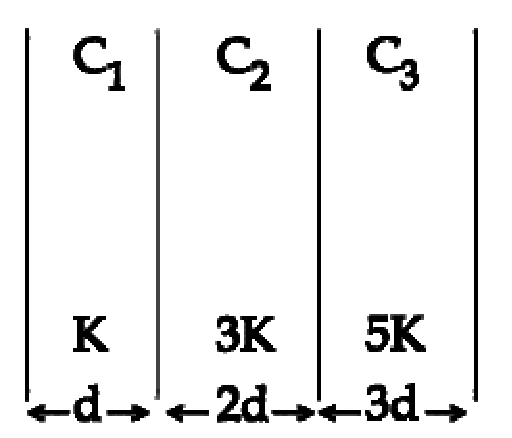
The space between the plates of a parallel plate capacitor of capacitance C (without any dielectric) is now filled with three dielectric slabs of dielectric constants K1=2,K2=3K_1 = 2, K_2 = 3 and K3=5K_3 = 5 (as shown in figure). If new capacitance is n3C\frac{n}{3}C then the value of nn is ______.

Figure

Numerical answer type. Work it out, then open the answer.

Show answer and solution

Answer: 8

  1. Top layer (K1K_1, area AA, thickness d/2d/2): C1=2K1C=4CC_1 = 2K_1 C = 4C.
  2. Bottom layer: K2K_2 and K3K_3 in parallel, each area A/2A/2, thickness d/2d/2: K2C+K3C=8CK_2 C + K_3 C = 8C.
  3. Top and bottom in series: C′=4C×8C12C=83CC' = \frac{4C \times 8C}{12C} = \frac{8}{3}C
  4. So n=8n = 8.
Report a mistake
Q98MHT CET 2025 · 26 APR · SHIFT 2Easy

Dielectrics · Dielectric basics & full filling

The function of a dielectric in a capacitor is

Show answer and solution

Answer: (a)

  1. Induced charges on the dielectric reduce the field between the plates to E0K\frac{E_0}{K}.
  2. For the same charge the potential falls to V0K\frac{V_0}{K}, so CC increases KK times.
  3. So the answer is (a) to reduce the effective potential on plates.
Report a mistake
Q99MHT CET 2025 · 23 APR · SHIFT 1Easy

Dielectrics · Partial slab & metal sheet

A parallel plate air capacitor has capacity ' CC ' and distance of separation between plates is ' dd '. If a conducting sheet of thickness 2d3\frac{2d}{3} is inserted in between the plates, the capacitance becomes C1C_1. The ratio of C1C\frac{C_1}{C} is

Show answer and solution

Answer: (c)

  1. A conducting sheet of thickness tt acts like K→∞K \to \infty: C1=ϵ0Ad−tC_1 = \frac{\epsilon_0 A}{d - t}.
  2. d−t=d−2d3=d3d - t = d - \frac{2d}{3} = \frac{d}{3}, so C1=3CC_1 = 3C.
  3. So C1:C=3:1C_1 : C = 3:1, answer (c).
Report a mistake
Q100MHT CET 2025 · 21 APR · SHIFT 2Easy

Dielectrics · Partial slab & metal sheet

A parallel plate capacitor has plate area 50 cm250\text{ cm}^2 and plate separation 3 mm. The space between the plates is filled with a dielectric medium of thickness 1 mm and dielectric constant 4. The capacitance becomes ( ε0=\varepsilon_0 = permittivity of free space)

Show answer and solution

Answer: (b)

  1. C=ε0Ad−t+tKC = \frac{\varepsilon_0 A}{d - t + \frac{t}{K}}, A=50×10−4=5×10⁻³ m2A = 50 \times 10^{-4} = 5 \times 10^{-3}\ \text{m}^2.
  2. d−t+tK=2+14=2.25d - t + \frac{t}{K} = 2 + \frac{1}{4} = 2.25 mm =2.25×10−3= 2.25 \times 10^{-3} m.
  3. C=52.25ε0=20ε09C = \frac{5}{2.25}\varepsilon_0 = \frac{20\varepsilon_0}{9}.
  4. So the answer is (b).
Report a mistake
Q101MHT CET 2025 · 26 APR · SHIFT 1Easy

Dielectrics · Compound dielectrics

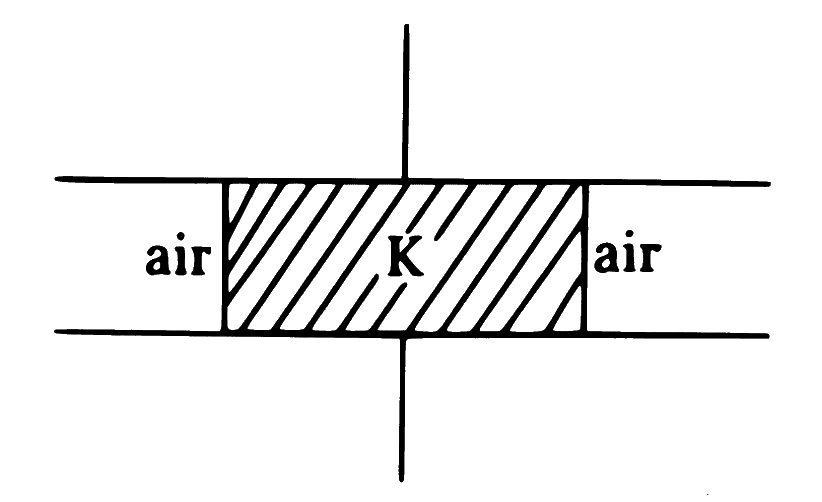
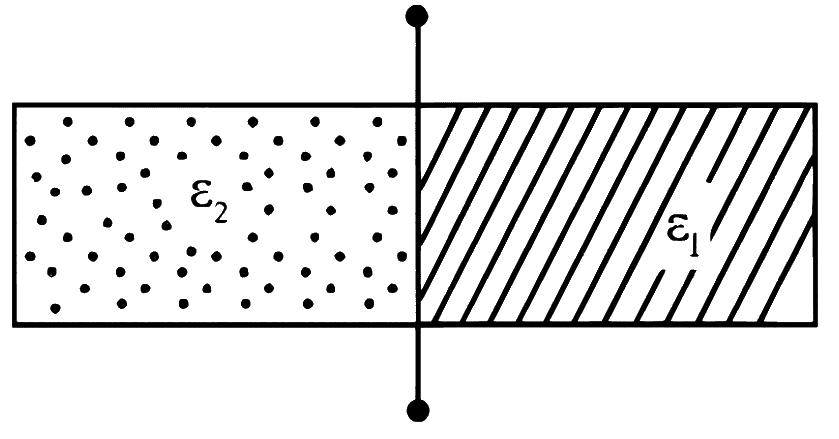
The capacity of air filled parallel plate capacitor is C0C_0. One-half of the space between the plates is filled with a dielectric constant ' K ' as shown in figure. The new capacity becomes CnC_n. The ratio CnC_n to C0C_0 is

Figure

Show answer and solution

Answer: (a)

  1. The dielectric fills half the plate area across the full gap, so the two halves are in parallel.
  2. Each half alone has capacitance C02\frac{C_0}{2}; the dielectric half becomes KC02\frac{KC_0}{2}.
  3. Cn=KC02+C02=(K+1)C02C_n = \frac{KC_0}{2} + \frac{C_0}{2} = \frac{(K+1)C_0}{2}.
  4. So CnC0=K+12\frac{C_n}{C_0} = \frac{K+1}{2}, answer (a).
Report a mistake
Q102MHT CET 2025 · 20 APR · SHIFT 2Easy

Dielectrics · Compound dielectrics

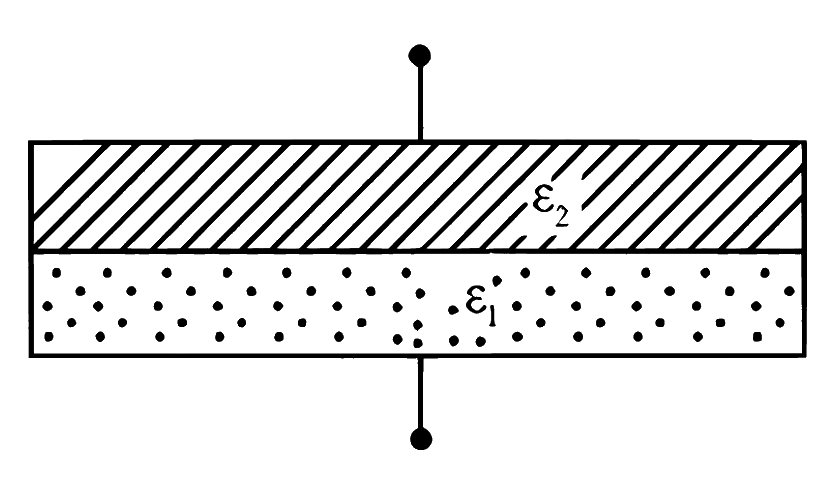
A parallel plate air capacitor has capacitance CPC_P. It is equally filled with parallel layers of materials of dielectric constants K1K_1 and K2K_2. Now its capacity becomes CKC_K. The ratio CPC_P to CKC_K is

Show answer and solution

Answer: (c)

  1. Layers parallel to the plates, each of thickness d2\frac{d}{2}, act in series.
  2. Each layer: C1=2K1CPC_1 = 2K_1C_P, C2=2K2CPC_2 = 2K_2C_P.
  3. CK=C1C2C1+C2=2K1K2CPK1+K2C_K = \frac{C_1C_2}{C_1 + C_2} = \frac{2K_1K_2C_P}{K_1 + K_2}.
  4. So CPCK=K1+K22K1K2\frac{C_P}{C_K} = \frac{K_1 + K_2}{2K_1K_2}, answer (c).
Report a mistake
Q103JEE Main 2025 · 7 APR · SHIFT 2Easy

Dielectrics · Dielectric strength & induced charge

A parallel plate capacitor has charge 5×10⁻⁶ C5 \times 10^{-6}\text{ C}. A dielectric slab is inserted between the plates and almost fills the space between the plates. If the induced charge on one face of the slab is 4×10⁻⁶ C4 \times 10^{-6}\text{ C} then the dielectric constant of the slab is _______________.

Numerical answer type. Work it out, then open the answer.

Show answer and solution

Answer: 5

  1. Induced charge: qb=qf(1−1K)q_b = q_f\left(1 - \frac{1}{K}\right).
  2. 4×10−6=5×10⁻⁶(1−1K)⇒1K=0.24 \times 10^{-6} = 5 \times 10^{-6}\left(1 - \frac{1}{K}\right) \Rightarrow \frac{1}{K} = 0.2.
  3. So K=5K = 5.
Report a mistake
Q104MHT CET 2025 · 19 APR · SHIFT 2Easy

Dielectrics · Dielectric in a combination

Two parallel plate air capacitors of same capacity ' C ' are connected in parallel to a battery of e.m.f. ' EE '. Then one of the capacitors is completely filled with dielectric material of constant ' K '. The change in the effective capacity of the parallel combination is

Show answer and solution

Answer: (d)

  1. Initially Ceq=C+C=2CC_{eq} = C + C = 2C.
  2. After filling one: Ceq′=KC+CC_{eq}' = KC + C.
  3. Change =KC+C−2C=C(K−1)= KC + C - 2C = C(K-1).
  4. So the answer is (d) C(K−1)C(K-1).
Report a mistake
Q105JEE Main 2025 · 22 JAN · SHIFT 1Medium

Dielectrics · Battery connected vs removed

A parallel-plate capacitor of capacitance 40μ F40\mu\text{ F} is connected to a 100 V power supply. Now the intermediate space between the plates is filled with a dielectric material of dielectric constant K=2K = 2. Due to the introduction of dielectric material, the extra charge and the change in the electrostatic energy in the capacitor, respectively, are

Show answer and solution

Answer: (b)

  1. Supply stays connected, so V=100V = 100 V is fixed and C′=KC=80 μFC' = KC = 80\ \mu\text{F}.
  2. Extra charge =(C′−C)V=40×10−6×100=4×10−3= (C' - C)V = 40 \times 10^{-6} \times 100 = 4 \times 10^{-3} C =4= 4 mC.
  3. Change in energy =12(C′−C)V2=12×40×10−6×104=0.2= \frac{1}{2}(C' - C)V^2 = \frac{1}{2} \times 40 \times 10^{-6} \times 10^4 = 0.2 J.
  4. So the answer is (b) 4 mC and 0.2 J.
Report a mistake
Q106MHT CET 2025 · 19 APR · SHIFT 1Medium

Dielectrics · Partial slab & metal sheet

The plates of a parallel plate capacitor are separated by a distance 'd' with air as the medium between them. A dielectric slab of dielectric constant 3 is introduced between the plates so as to increase the capacity by 50%50\%. The thickness of the dielectric slab is

Show answer and solution

Answer: (a)

  1. C′C=dd−t+t3=1.5\frac{C'}{C}=\frac{d}{d-t+\frac{t}{3}}=1.5
  2. d−2t3=2d3⇒t=d2d-\frac{2t}{3}=\frac{2d}{3} \Rightarrow t=\frac{d}{2}
  3. So the answer is (a) d2\frac{d}{2}.
Report a mistake
Q107NEET 2025Medium

Dielectrics · Compound dielectrics

The plates of a parallel plate capacitor are separated by dd. Two slabs of different dielectric constant K1K_1 and K2K_2 with thickness 38d\frac{3}{8}d and d2\frac{d}{2}, respectively are inserted in the capacitor. Due to this, the capacitance becomes two times larger than when there is nothing between the plates. If K1=1.25K2K_1 = 1.25K_2, the value of K1K_1 is:

Show answer and solution

Answer: (c)

  1. Air gap left =d−3d8−d2=d8=d-\frac{3d}{8}-\frac{d}{2}=\frac{d}{8}. All in series: d8+3d8K1+d2K2=d2\frac{d}{8}+\frac{3d}{8K_1}+\frac{d}{2K_2}=\frac{d}{2}
  2. K2=K11.25⇒12K2=0.625K1K_2=\frac{K_1}{1.25} \Rightarrow \frac{1}{2K_2}=\frac{0.625}{K_1}
  3. 0.375+0.625K1=12−18=38⇒K1=83\frac{0.375+0.625}{K_1}=\frac{1}{2}-\frac{1}{8}=\frac{3}{8} \Rightarrow K_1=\frac{8}{3}
  4. So the answer is (c) 2.66.
Report a mistake
Q108JEE Main 2025 · 3 APR · SHIFT 1Medium

Dielectrics · Compound dielectrics

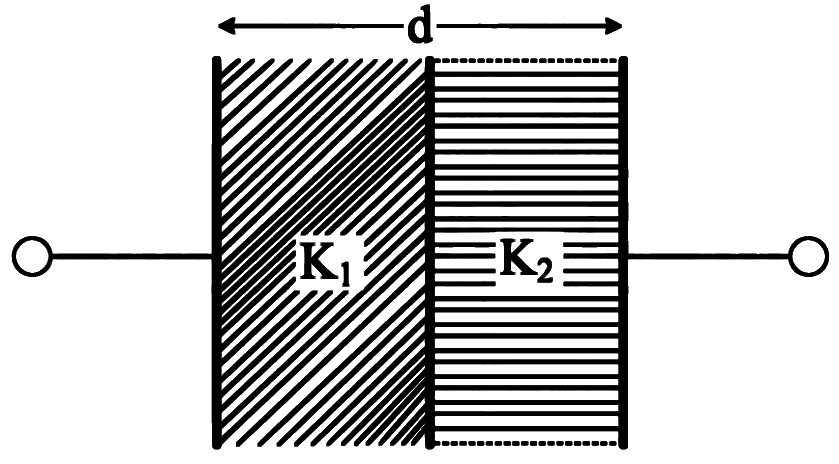
A parallel plate capacitor is filled equally(half) with two dielectrics of dielectric constants ε1\varepsilon_1 and ε2\varepsilon_2, as shown in figures. The distance between the plates is dd and area of each plate is AA. If capacitance in first configuration and second configuration are C1C_1 and C2C_2 respectively, then C1C2\frac{C_1}{C_2} is: First Configuration

Figure

Second Configuration

Figure

Show answer and solution

Answer: (c)

  1. First configuration: layers stacked between the plates, series: C1=ϵ0Ad⋅2ε1ε2ε1+ε2C_1=\frac{\epsilon_0A}{d}\cdot\frac{2\varepsilon_1\varepsilon_2}{\varepsilon_1+\varepsilon_2}
  2. Second configuration: side by side, parallel: C2=ϵ0Ad⋅ε1+ε22C_2=\frac{\epsilon_0A}{d}\cdot\frac{\varepsilon_1+\varepsilon_2}{2}
  3. C1C2=4ε1ε2(ε1+ε2)2\frac{C_1}{C_2}=\frac{4\varepsilon_1\varepsilon_2}{(\varepsilon_1+\varepsilon_2)^2}. So the answer is (c).
Report a mistake
Q109JEE Main 2025 · 4 APR · SHIFT 2Medium

Dielectrics · Dielectric in a combination

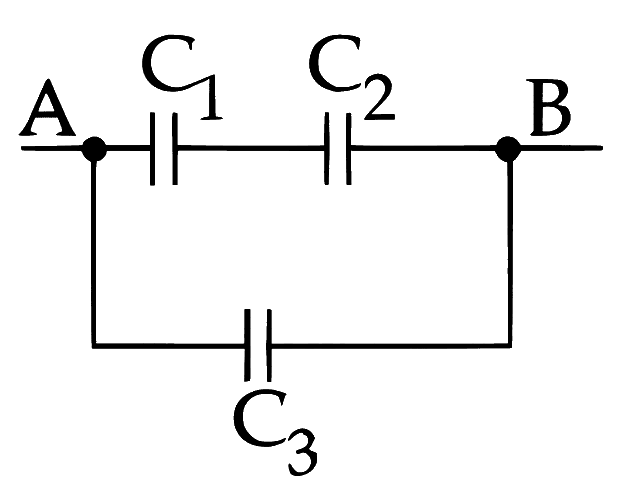
Three parallel plate capacitors C1,C2C_1, C_2 and C3C_3 each of capacitance 5 μF5\ \mu\text{F} are connected as shown in figure. The effective capacitance between points AA and BB, when the space between the parallel plates of C1C_1 capacitor is filled with a dielectric medium having dielectric constant of 4, is:

Figure

Show answer and solution

Answer: (a)

  1. C1C_1 with dielectric: C1=4×5=20 μFC_1 = 4 \times 5 = 20\ \mu\text{F}.
  2. C1C_1 and C2C_2 in series: 20×520+5=4 μF\frac{20 \times 5}{20 + 5} = 4\ \mu\text{F}.
  3. This branch is in parallel with C3C_3: CAB=4+5=9 μFC_{AB} = 4 + 5 = 9\ \mu\text{F}.
  4. So the answer is (a) 9 μF9\ \mu\text{F}.
Report a mistake
Q110JEE Main 2025 · 8 APR · SHIFT 2Medium

Dielectrics · Dielectric in a combination

Figure

Space between the plates of a parallel plate capacitor of plate area 4 cm2 and separation of 1.77 mm, is filled with uniform dielectric materials with dielectric constants (3 and 5) as shown in figure. Another capacitor of capacitance 7.5 pF is connected in parallel with it. The effective capacitance of this combination is _ pF.

(Given ϵ0=8.85×10⁻¹²\epsilon_0 = 8.85 \times 10^{-12} F/m)

Numerical answer type. Work it out, then open the answer.

Show answer and solution

Answer: 15

  1. The two layers (d/2d/2 each) are in series: C5=5ϵ0Ad/2=10ϵ0AdC_5 = \frac{5\epsilon_0 A}{d/2} = 10\frac{\epsilon_0 A}{d}, C3=6ϵ0AdC_3 = 6\frac{\epsilon_0 A}{d}.
  2. C=10×616ϵ0Ad=3.75ϵ0AdC = \frac{10 \times 6}{16}\frac{\epsilon_0 A}{d} = 3.75\frac{\epsilon_0 A}{d}
  3. ϵ0Ad=8.85×10−12×4×10−41.77×10−3=2×10⁻¹² F=2 pF\frac{\epsilon_0 A}{d} = \frac{8.85 \times 10^{-12} \times 4 \times 10^{-4}}{1.77 \times 10^{-3}} = 2 \times 10^{-12}\text{ F} = 2\text{ pF}, so C=7.5 pFC = 7.5\text{ pF}.
  4. In parallel with 7.5 pF7.5\text{ pF}: Ceff=7.5+7.5=15 pFC_{eff} = 7.5 + 7.5 = 15\text{ pF}.
Report a mistake
Q111MHT CET 2024 · 9 MAY · SHIFT 1Easy

Dielectrics · Dielectric basics & full filling

The function of dielectric in a capacitor is

Show answer and solution

Answer: (a)

  1. Polarisation of the dielectric weakens the field between the plates: E=E0KE = \frac{E_0}{K}.
  2. Potential difference falls to V0K\frac{V_0}{K} and capacitance rises to KC0KC_0; area is unchanged.
  3. So the answer is (a) to reduce the effective potential on plates.
Report a mistake
Q112MHT CET 2024 · 4 MAY · SHIFT 1Easy

Dielectrics · Partial slab & metal sheet

A parallel plate capacitor has plate area 40 cm240\text{ cm}^2 and plate separation 2 mm. The space between the plates is filled with a dielectric medium of thickness 1 mm and dielectric constant 5. The capacitance of the system is ( ε0=\varepsilon_0 = permittivity of vacuum)

Show answer and solution

Answer: (c)

  1. C=ε0Ad−t+tKC = \frac{\varepsilon_0 A}{d - t + \frac{t}{K}}, A=4×10⁻³ m2A = 4 \times 10^{-3}\ \text{m}^2.
  2. d−t+tK=1+0.2=1.2d - t + \frac{t}{K} = 1 + 0.2 = 1.2 mm.
  3. C=41.2ε0=103ε0C = \frac{4}{1.2}\varepsilon_0 = \frac{10}{3}\varepsilon_0 F.
  4. So the answer is (c).
Report a mistake
Q113JEE Main 2024 · 4 APR · SHIFT 2Medium

Dielectrics · Battery connected vs removed

A parallel plate capacitor of capacitance 12.5 pF12.5\text{ pF} is charged by a battery connected between its plates to potential difference of 12.0 V12.0\text{ V}. The battery is now disconnected and a dielectric slab (ϵr=6)(\epsilon_r = 6) is inserted between the plates. The change in its potential energy after inserting the dielectric slab is ________ ×10−12 J\times 10^{-12}\text{ J}.

Numerical answer type. Work it out, then open the answer.

Show answer and solution

Answer: 750

  1. Battery removed, QQ constant: Uf=UiϵrU_f=\frac{U_i}{\epsilon_r}.
  2. Ui=12(12.5×10⁻¹²)(12)2=900×10−12 JU_i=\frac{1}{2}(12.5\times10^{-12})(12)^2=900\times10^{-12}\text{ J}
  3. Uf=9006=150×10−12 JU_f=\frac{900}{6}=150\times10^{-12}\text{ J}
  4. ∣ΔU∣=900−150=750×10−12 J|\Delta U|=900-150=750\times10^{-12}\text{ J} (a decrease). Answer: 750
Report a mistake
Q114JEE Main 2024 · 31 JAN · SHIFT 1Medium

Dielectrics · Battery connected vs removed

A parallel plate capacitor with plate separation 5 mm5\text{ mm} is charged up by a battery. It is found that on introducing a dielectric sheet of thickness 2 mm2\text{ mm}, while keeping the battery connections intact, the capacitor draws 25%25\% more charge from the battery than before. The dielectric constant of the sheet is _________.

Numerical answer type. Work it out, then open the answer.

Show answer and solution

Answer: 2

  1. Battery connected, Q∝CQ\propto C, so C′=1.25CC'=1.25C.
  2. C′=ϵ0Ad−t+tKC'=\frac{\epsilon_0A}{d-t+\frac{t}{K}} with d=5d=5 mm, t=2t=2 mm.
  3. 53+2K=1.25⇒3+2K=4\frac{5}{3+\frac{2}{K}}=1.25 \Rightarrow 3+\frac{2}{K}=4
  4. K=2K=2
Report a mistake
Q115MHT CET 2024 · 16 MAY · SHIFT 2Medium

Dielectrics · Compound dielectrics

Air capacitor has capacitance ' C1C_1 '. The space between two plates of capacitor is filled with two dielectrics as shown in figure. The new capacitance of the capacitor is ' C2C_2 '. The ratio C1C2\frac{C_1}{C_2} is (d=(d = distance between two plates of capacitor, K1K_1 and K2K_2 are dielectric constants of two dielectrics respectively)

Figure

Show answer and solution

Answer: (d)

  1. The two dielectrics fill the gap one after the other, each d2\frac{d}{2} thick: series.
  2. C2=ϵ0Ad2K1+d2K2=C1⋅2K1K2K1+K2C_2=\frac{\epsilon_0A}{\frac{d}{2K_1}+\frac{d}{2K_2}}=C_1\cdot\frac{2K_1K_2}{K_1+K_2}
  3. C1C2=K1+K22K1K2\frac{C_1}{C_2}=\frac{K_1+K_2}{2K_1K_2}. So the answer is (d).
Report a mistake
Q116MHT CET 2024 · 9 MAY · SHIFT 2Medium

Dielectrics · Compound dielectrics

Air capacitor has capacitance of 1μ F1\mu\text{ F}. Now the space between two plates of capacitor is filled with two dielectrics as shown in figure. The capacitance of the capacitor is [ d=d = distance between two plates of capacitor, K1K_1 and K2K_2 are dielectric constants of first dielectric and second dielectric respectively]

Figure

Show answer and solution

Answer: (a)

  1. Each dielectric spans the full gap dd over half the area: parallel.
  2. C=K1+K22C0=4+22×1C=\frac{K_1+K_2}{2}C_0=\frac{4+2}{2}\times1
  3. So the answer is (a) 3 μF3\ \mu\text{F}.
Report a mistake
Q117MHT CET 2024 · 4 MAY · SHIFT 1Medium

Dielectrics · Compound dielectrics

A parallel plate air capacitor, with plate separation ' d ' has a capacitance of 9 pF. The space between the plates is now filled with two dielectrics, the first having K1=3K_1 = 3 and thickness d1=d/3d_1 = d/3, while the 22nd has K2=6K_2 = 6 and thickness d2=2d/3d_2 = 2d/3. The capacitance of the new capacitor is:

Show answer and solution

Answer: (c)

  1. Layers in series: C=ϵ0Ad/33+2d/36=ϵ0A2d9=4.5C0C=\frac{\epsilon_0A}{\frac{d/3}{3}+\frac{2d/3}{6}}=\frac{\epsilon_0A}{\frac{2d}{9}}=4.5C_0
  2. C=4.5×9=40.5 pFC=4.5\times9=40.5\text{ pF}
  3. So the answer is (c) 40.5 pF.
Report a mistake
Q118MHT CET 2024 · 16 MAY · SHIFT 1Medium

Dielectrics · Dielectric in a combination

Two identical capacitors A and B are connected in series to a battery of E.M.F., 'E'. Capacitor B contains a slab of dielectric constant K, QAK,\ Q_{A} and QBQ_{B} are the charges stored in A and B. When the dielectric slab is removed, the corresponding charges are QA′Q'_{A} and QB′Q'_{B}. Then

Show answer and solution

Answer: (d)

  1. In series QA=QBQ_A = Q_B always.
  2. With slab: Ceq=KC⋅C(K+1)C=KCK+1C_{eq} = \frac{KC \cdot C}{(K+1)C} = \frac{KC}{K+1}, so Q=KCEK+1Q = \frac{KCE}{K+1}.
  3. Without slab: Ceq=C2C_{eq} = \frac{C}{2}, so Q′=CE2Q' = \frac{CE}{2}.
  4. QB′QB=QA′QA=K+12K\frac{Q'_B}{Q_B} = \frac{Q'_A}{Q_A} = \frac{K+1}{2K}
  5. So the answer is (d).
Report a mistake
Q119MHT CET 2024 · 11 MAY · SHIFT 1Medium

Dielectrics · Dielectric in a combination

Two parallel plate air capacitors of same capacity ' C ' are connected in series to a battery of emf ' EE '. Then one of the capacitors is completely filled with dielectric material of constant ' K '. The change in the effective capacity of the series combination is

Show answer and solution

Answer: (c)

  1. Initially: Ci=C2C_i = \frac{C}{2}. After filling one: Cf=KCK+1C_f = \frac{KC}{K+1}.
  2. ΔC=KCK+1−C2=C2[K−1K+1]\Delta C = \frac{KC}{K+1} - \frac{C}{2} = \frac{C}{2}\left[\frac{K-1}{K+1}\right]
  3. So the answer is (c).
Report a mistake
Q120JEE Main 2024 · 8 APR · SHIFT 2Difficult

Dielectrics · Partial slab & metal sheet

A capacitor has air as dielectric medium and two conducting plates of area 12 cm212\text{ cm}^2 and they are 0.6 cm0.6\text{ cm} apart. When a slab of dielectric having area 12 cm212\text{ cm}^2 and 0.6 cm0.6\text{ cm} thickness is inserted between the plates, one of the conducting plates has to be moved by 0.2 cm0.2\text{ cm} to keep the capacitance same as in previous case. The dielectric constant of the slab is: (Given ϵ0=8.834×10⁻¹² F/m\epsilon_0 = 8.834 \times 10^{-12}\text{ F/m})

Show answer and solution

Answer: (a)

  1. Slab of thickness t=0.6t = 0.6 cm in gap d′d': C=ϵ0Ad′−t+t/KC = \frac{\epsilon_0 A}{d' - t + t/K}.
  2. New gap d′=0.6+0.2=0.8d' = 0.6 + 0.2 = 0.8 cm; same CC needs 0.2+0.6K=0.60.2 + \frac{0.6}{K} = 0.6.
  3. 0.6K=0.4⇒K=1.5\frac{0.6}{K} = 0.4 \Rightarrow K = 1.5
  4. So the answer is (a) 1.50.
Report a mistake
Q121JEE Main 2024 · 6 APR · SHIFT 2Difficult

Dielectrics · Variable dielectric & slab force

A capacitor of 10 μF10\ \mu\text{F} capacitance whose plates are separated by 10 mm10\text{ mm} through air and each plate has area 4 cm24\text{ cm}^2 is now filled equally with two dielectric media of K1=2,K2=3K_1 = 2, K_2 = 3 respectively as shown in figure. If new force between the plates is 8 N8\text{ N}. The supply voltage is ________ V.

Figure

Numerical answer type. Work it out, then open the answer.

Show answer and solution

Answer: 80

  1. The two media sit side by side (parallel), each over half the area: C′=K1+K22C=2.5×10=25 μFC' = \frac{K_1 + K_2}{2}C = 2.5 \times 10 = 25\ \mu\text{F}.
  2. Force between plates: F=Q22C′d=C′V22dF = \frac{Q^2}{2C'd} = \frac{C'V^2}{2d}.
  3. 8=25×10−6×V22×10−2⇒V2=64008 = \frac{25 \times 10^{-6} \times V^2}{2 \times 10^{-2}} \Rightarrow V^2 = 6400
  4. V=80 VV = 80\text{ V} (using the given 10 μF10\ \mu\text{F}).
Report a mistake
Q122MHT CET 2023 · 13 MAY · SHIFT 2Easy

Dielectrics · Dielectric basics & full filling

In a parallel plate capacitor with air between the plates, the distance dd between the plates is changed and the space is filled with dielectric constant 8. The capacity of the capacitor is increased 16 times, the distance between the plates is

Show answer and solution

Answer: (c)

  1. C=ε0AdC = \frac{\varepsilon_0 A}{d}, C′=8ε0Ad′C' = \frac{8\varepsilon_0 A}{d'}
  2. C′C=8dd′=16\frac{C'}{C} = \frac{8d}{d'} = 16
  3. d′=d2d' = \frac{d}{2}
  4. So the answer is (c) d/2.
Report a mistake
Q123JEE Main 2023 · 24 JAN · SHIFT 2Easy

Dielectrics · Dielectric basics & full filling

A parallel plate capacitor with air between the plates has a capacitance of 15pF. The separation between the plates becomes twice and the space between them is filled with a medium of dielectric constant 3.5. Then the capacitance becomes x4\frac{x}{4} pF. The value of xx is ____________.

Numerical answer type. Work it out, then open the answer.

Show answer and solution

Answer: 105

  1. C=Kε0AdC = \frac{K\varepsilon_0 A}{d}, so C′=C×K2C' = C \times \frac{K}{2} when dd doubles.
  2. C′=15×3.52=26.25C' = 15 \times \frac{3.5}{2} = 26.25 pF =1054= \frac{105}{4} pF.
  3. So x=105x = 105.
Report a mistake
Q124MHT CET 2023 · 11 MAY · SHIFT 2Easy

Dielectrics · Battery connected vs removed

A parallel plate capacitor is charged by a battery and battery remains connected. The dielectric slab of constant 'KK' is inserted between the plates and then taken out. Then electric field between the plates

Show answer and solution

Answer: (a)

  1. Battery stays connected, so VV is fixed.
  2. E=VdE = \frac{V}{d} depends only on VV and dd, which are the same after the slab is taken out.
  3. So the field remains the same: answer (a).
Report a mistake
Q125MHT CET 2023 · 9 MAY · SHIFT 1Easy

Dielectrics · Battery connected vs removed

The potential energy of charged parallel plate capacitor is v0v_0. If a slab of dielectric constant KK is inserted between the plates, then the new potential energy will be

Show answer and solution

Answer: (a)

  1. A charged capacitor (no battery) keeps its charge QQ.
  2. U=Q22CU = \frac{Q^2}{2C} and C′=KCC' = KC, so U′=UKU' = \frac{U}{K}.
  3. So the answer is (a) v0K\frac{v_0}{K}.
Report a mistake
Q126JEE Main 2023 · 10 APR · SHIFT 2Easy

Dielectrics · Partial slab & metal sheet

The distance between two plates of a capacitor is dd and its capacitance is C1C_1, when air is the medium between the plates. If a metal sheet of thickness 2d3\frac{2d}{3} and of the same area as plate is introduced between the plates, the capacitance of the capacitor becomes C2C_2. The ratio C2C1\frac{C_2}{C_1} is

Show answer and solution

Answer: (b)

  1. A metal sheet of thickness tt reduces the effective gap to d−td - t: C2=ε0Ad−tC_2 = \frac{\varepsilon_0 A}{d - t}.
  2. d−2d3=d3d - \frac{2d}{3} = \frac{d}{3}, so C2=3C1C_2 = 3C_1.
  3. So C2:C1=3:1C_2 : C_1 = 3:1, answer (b).
Report a mistake
Q127JEE Main 2023 · 25 JAN · SHIFT 1Easy

Dielectrics · Partial slab & metal sheet

A parallel plate capacitor has plate area 40 cm22 and plates separation 2 mm. The space between the plates is filled with a dielectric medium of a thickness 1 mm and dielectric constant 5. The capacitance of the system is:

Show answer and solution

Answer: (d)

  1. C=ε0Ad−t+tKC = \frac{\varepsilon_0 A}{d - t + \frac{t}{K}}, A=4×10⁻³ m2A = 4 \times 10^{-3}\ \text{m}^2.
  2. d−t+tK=1+0.2=1.2d - t + \frac{t}{K} = 1 + 0.2 = 1.2 mm.
  3. C=41.2ε0=103ε0C = \frac{4}{1.2}\varepsilon_0 = \frac{10}{3}\varepsilon_0 F.
  4. So the answer is (d).
Report a mistake
Q128JEE Main 2023 · 25 JAN · SHIFT 2Easy

Dielectrics · Partial slab & metal sheet

A capacitor has capacitance 5μ\muF when its parallel plates are separated by air medium of thickness d. A slab of material of dielectric constant 1.5 having area equal to that of plates but thickness d2\frac{d}{2} is inserted between the plates. Capacitance of the capacitor in the presence of slab will be __________ μ\muF.

Numerical answer type. Work it out, then open the answer.

Show answer and solution

Answer: 6

  1. Slab of thickness d2\frac{d}{2}: C′=2KCK+1C' = \frac{2KC}{K+1}.
  2. C′=2×1.5×52.5=6 μFC' = \frac{2 \times 1.5 \times 5}{2.5} = 6\ \mu\text{F}.
  3. So the capacitance is 6 μF6\ \mu\text{F}.
Report a mistake
Q129MHT CET 2023 · 14 MAY · SHIFT 2Easy

Dielectrics · Compound dielectrics

A parallel plate capacitor with air medium between the plates has a capacitance of 10μF10\mu\text{F}. The area of capacitor is divided into two equal halves and filled with two media (as shown in figure) having dielectric constant K1=2K_1 = 2 and K2=4K_2 = 4. The capacitance of the system will be

Figure

Show answer and solution

Answer: (c)

  1. The area is split into two halves, each filling the full gap, so they are in parallel.
  2. Each half with air: 5 μF5\ \mu\text{F}; with dielectrics: 2×5=10 μF2 \times 5 = 10\ \mu\text{F} and 4×5=20 μF4 \times 5 = 20\ \mu\text{F}.
  3. C=10+20=30 μFC = 10 + 20 = 30\ \mu\text{F}.
  4. So the answer is (c) 30 μF30\ \mu\text{F}.
Report a mistake
Q130JEE Main 2023 · 6 APR · SHIFT 1Medium

Dielectrics · Partial slab & metal sheet

A parallel plate capacitor with plate area AA and plate separation dd is filled with a dielectric material of dielectric constant K=4K = 4. The thickness of the dielectric material is xx, where x<dx < d.

Figure

Let C1C_1 and C2C_2 be the capacitance of the system for x=13dx = \frac{1}{3}d and x=2d3x = \frac{2d}{3}, respectively. If C1=2μFC_1 = 2\mu\text{F} the value of C2C_2 is __________ μF\mu\text{F}

Numerical answer type. Work it out, then open the answer.

Show answer and solution

Answer: 3

  1. C=ϵ0Ad−x+x4=ϵ0Ad−3x4C=\frac{\epsilon_0A}{d-x+\frac{x}{4}}=\frac{\epsilon_0A}{d-\frac{3x}{4}}
  2. x=d3x=\frac{d}{3}: gap term =3d4=\frac{3d}{4}; x=2d3x=\frac{2d}{3}: gap term =d2=\frac{d}{2}
  3. C2C1=3/41/2=1.5\frac{C_2}{C_1}=\frac{3/4}{1/2}=1.5
  4. C2=1.5×2=3 μFC_2=1.5\times2=3\ \mu\text{F}
Report a mistake
Q131MHT CET 2023 · 10 MAY · SHIFT 2Medium

Dielectrics · Compound dielectrics

Two dielectric slabs having dielectric constant 'K1K_1 ' and 'K2K_2 ' of thickness d4\frac{d}{4} and 3d4\frac{3d}{4} are inserted between the plates as shown in figure. The net capacitance between AA and BB is [ε0[\varepsilon_0 is permittivity of free space]

Figure

Show answer and solution

Answer: (d)

  1. Layers between A and B are in series: C=Aϵ0d4K1+3d4K2C=\frac{A\epsilon_0}{\frac{d}{4K_1}+\frac{3d}{4K_2}}
  2. d4K1+3d4K2=d(K2+3K1)4K1K2\frac{d}{4K_1}+\frac{3d}{4K_2}=\frac{d(K_2+3K_1)}{4K_1K_2}
  3. C=4Aϵ0d[K1K23K1+K2]C=\frac{4A\epsilon_0}{d}\left[\frac{K_1K_2}{3K_1+K_2}\right]. So the answer is (d).
Report a mistake
Q132MHT CET 2023 · 9 MAY · SHIFT 1Medium

Dielectrics · Compound dielectrics

The capacitance of a parallel plate capacitor is 2.5 μF2.5\ \mu\text{F}. When it is half filled with a dielectric as shown in figure, its capacitance becomes 5 μF5\ \mu\text{F}. The dielectric constant of the dielectric is

Figure

Show answer and solution

Answer: (b)

  1. Dielectric fills full gap over half the area: parallel, C=C02(1+K)C=\frac{C_0}{2}(1+K).
  2. 5=2.52(1+K)⇒1+K=45=\frac{2.5}{2}(1+K) \Rightarrow 1+K=4
  3. So the answer is (b) K=3K=3.
Report a mistake
Q133JEE Main 2023 · 31 JAN · SHIFT 2Difficult

Dielectrics · Dielectric in a combination

Two parallel plate capacitors C1C_1 and C2C_2 each having capacitance of 10 μF10\ \mu\text{F} are individually charged by a 100 V D.C. source. Capacitor C1C_1 is kept connected to the source and a dielectric slab is inserted between its plates. Capacitor C2C_2 is disconnected from the source and then a dielectric slab is inserted in it. Afterwards the capacitor C1C_1 is also disconnected from the source and the two capacitors are finally connected in parallel combination. The common potential of the combination will be ________ V.

(Assuming Dielectric constant =10= 10)

Numerical answer type. Work it out, then open the answer.

Show answer and solution

Answer: 55

  1. C1C_1 stays connected: C1′=100 μFC_1' = 100\ \mu\text{F} at 100 V, so Q1=10000 μCQ_1 = 10000\ \mu\text{C}.
  2. C2C_2 disconnected first: Q2=10×100=1000 μCQ_2 = 10 \times 100 = 1000\ \mu\text{C}, C2′=100 μFC_2' = 100\ \mu\text{F}.
  3. In parallel: V=Q1+Q2C1′+C2′=11000200=55 VV = \frac{Q_1 + Q_2}{C_1' + C_2'} = \frac{11000}{200} = 55\text{ V}
Report a mistake
Q134JEE Main 2022 · 28 JUL · SHIFT 2Easy

Dielectrics · Partial slab & metal sheet

A slab of dielectric constant KK has the same cross-sectional area as the plates of a parallel plate capacitor and thickness 34d\frac{3}{4}d, where dd is the separation of the plates. The capacitance of the capacitor when the slab is inserted between the plates will be:

(Given C0C_0 = capacitance of capacitor with air as medium between plates.)

Show answer and solution

Answer: (a)

  1. C=ε0Ad−t+tKC = \frac{\varepsilon_0 A}{d - t + \frac{t}{K}} with t=3d4t = \frac{3d}{4}.
  2. d4+3d4K=d(K+3)4K\frac{d}{4} + \frac{3d}{4K} = \frac{d(K+3)}{4K}.
  3. C=4KC03+KC = \frac{4KC_0}{3+K}.
  4. So the answer is (a).
Report a mistake
Q135JEE Main 2022 · 25 JUN · SHIFT 2Easy

Dielectrics · Partial slab & metal sheet

Two metallic plates form a parallel plate capacitor. The distance between the plates is 'd'. A metal sheet of thickness d2\frac{d}{2} and of area equal to area of each plate is introduced between the plates. What will be the ratio of the new capacitance to the original capacitance of the capacitor?

Show answer and solution

Answer: (a)

  1. Metal sheet: C′=ε0Ad−tC' = \frac{\varepsilon_0 A}{d - t}.
  2. d−d2=d2d - \frac{d}{2} = \frac{d}{2}, so C′=2CC' = 2C.
  3. So the ratio is 2:12:1, answer (a).
Report a mistake
Q136JEE Main 2022 · 29 JUN · SHIFT 1Medium

Dielectrics · Battery connected vs removed

A parallel plate capacitor filled with a medium of dielectric constant 10, is connected across a battery and is charged. The dielectric slab is replaced by another slab of dielectric constant 15. Then the energy of capacitor will:

Show answer and solution

Answer: (a)

  1. Battery stays connected, so VV is constant and U=12CV2∝C∝KU=\frac{1}{2}CV^2 \propto C \propto K.
  2. U′U=1510=1.5\frac{U'}{U}=\frac{15}{10}=1.5
  3. So the answer is (a) energy increases by 50%.
Report a mistake
Q137JEE Main 2022 · 30 JUN · SHIFT 1Medium

Dielectrics · Compound dielectrics

Co is the capacitance of a parallel plate capacitor with air as a medium between the plates (as shown in Fig. 1). If half space between the plates is filled with a dielectric of relative permittivity ε\varepsilonr (as shown in Fig. 2), the new capacitance of the capacitor will be:

Figure

Show answer and solution

Answer: (a)

  1. Dielectric fills full gap over half the area: two capacitors in parallel.
  2. C=Co2+εrCo2=Co2(1+εr)C=\frac{C_o}{2}+\frac{\varepsilon_rC_o}{2}=\frac{C_o}{2}(1+\varepsilon_r)
  3. So the answer is (a).
Report a mistake
Q138JEE Main 2022 · 26 JUN · SHIFT 2Medium

Dielectrics · Compound dielectrics

A parallel plate capacitor with plate area A and plate separation d = 2 m has a capacitance of 4 μ\muF. The new capacitance of the system if half of the space between them is filled with a dielectric material of dielectric constant K = 3 (as shown in figure) will be:

Figure

Show answer and solution

Answer: (c)

  1. Slab fills half the gap (d2\frac{d}{2}) over the full area: series with air.
  2. C=ϵ0Ad2+d6=32⋅ϵ0Ad=1.5×4C=\frac{\epsilon_0A}{\frac{d}{2}+\frac{d}{6}}=\frac{3}{2}\cdot\frac{\epsilon_0A}{d}=1.5\times4
  3. So the answer is (c) 6 μF6\ \mu\text{F}.
Report a mistake
Q139JEE Main 2022 · 26 JUL · SHIFT 1Medium

Dielectrics · Compound dielectrics

A composite parallel plate capacitor is made up of two different dielectric materials with different thickness (t1(t_1 and t2)t_2) as shown in figure. The two different dielectric materials are separated by a conducting foil F\text{F}. The voltage of the conducting foil is ____________ V.

Figure

Numerical answer type. Work it out, then open the answer.

Show answer and solution

Answer: 60

  1. The foil splits it into two capacitors in series, C∝εrtC\propto\frac{\varepsilon_r}{t}.
  2. C1∝30.5=6C_1\propto\frac{3}{0.5}=6, C2∝41=4C_2\propto\frac{4}{1}=4; series charge is the same, so V∝1CV\propto\frac{1}{C}.
  3. V1=100×410=40 VV_1=100\times\frac{4}{10}=40\text{ V}, V2=60 VV_2=60\text{ V}
  4. Taking the negative (lower) plate at 0 V, foil potential =V2=60 V=V_2=60\text{ V}
Report a mistake
Q140JEE Main 2022 · 24 JUN · SHIFT 1Medium

Dielectrics · Dielectric strength & induced charge

A parallel plate capacitor is formed by two plates each of area 30π\pi cm2 separated by 1 mm. A material of dielectric strength 3.6 ×\times 107 Vm−1{}^{-1} is filled between the plates. If the maximum charge that can be stored on the capacitor without causing any dielectric breakdown is 7 ×\times 10−-6C, the value of dielectric constant of the material is:

[Use 14πε0=9×10⁹\frac{1}{4\pi\varepsilon_0} = 9 \times 10^{9} Nm2 C−2{}^{-2}]

Show answer and solution

Answer: (d)

  1. Field in dielectric E=QKAϵ0⇒K=QAϵ0EmaxE=\frac{Q}{KA\epsilon_0} \Rightarrow K=\frac{Q}{A\epsilon_0E_{max}}
  2. Aϵ0=30π×10−44π×9×109=56×10−13A\epsilon_0=\frac{30\pi\times10^{-4}}{4\pi\times9\times10^9}=\frac{5}{6}\times10^{-13}
  3. Aϵ0Emax=56×10−13×3.6×107=3×10⁻⁶A\epsilon_0E_{max}=\frac{5}{6}\times10^{-13}\times3.6\times10^7=3\times10^{-6}
  4. K=7×10−63×10−6≈2.33K=\frac{7\times10^{-6}}{3\times10^{-6}}\approx2.33. So the answer is (d).
Report a mistake
Q141JEE Main 2022 · 28 JUL · SHIFT 1Medium

Dielectrics · Dielectric in a combination

Two capacitors, each having capacitance 40 μF40\ \mu\text{F} are connected in series. The space between one of the capacitors is filled with dielectric material of dielectric constant KK such that the equivalence capacitance of the system became 24 μF24\ \mu\text{F}. The value of KK will be:

Show answer and solution

Answer: (a)

  1. Series: 40K⋅4040K+40=24⇒40KK+1=24\frac{40K \cdot 40}{40K + 40} = 24 \Rightarrow \frac{40K}{K+1} = 24.
  2. 40K=24K+24⇒16K=24⇒K=1.540K = 24K + 24 \Rightarrow 16K = 24 \Rightarrow K = 1.5
  3. So the answer is (a) 1.5.
Report a mistake
Q142JEE Main 2022 · 25 JUL · SHIFT 2Medium

Dielectrics · Dielectric in a combination

Two parallel plate capacitors of capacity C and 3C are connected in parallel combination and charged to a potential difference 18 V. The battery is then disconnected and the space between the plates of the capacitor of capacity C is completely filled with a material of dielectric constant 9. The final potential difference across the combination of capacitors will be ___________ V.

Numerical answer type. Work it out, then open the answer.

Show answer and solution

Answer: 6

  1. Charge: Q=(C+3C)×18=72CQ = (C + 3C) \times 18 = 72C, constant after disconnection.
  2. New capacitance: 9C+3C=12C9C + 3C = 12C.
  3. V′=72C12C=6 VV' = \frac{72C}{12C} = 6\text{ V}
Report a mistake
Q143JEE Main 2022 · 27 JUL · SHIFT 2Difficult

Dielectrics · Battery connected vs removed

A parallel plate capacitor with width 4 cm4\text{ cm}, length 8 cm8\text{ cm} and separation between the plates of 4 mm4\text{ mm} is connected to a battery of 20 V20\text{ V}. A dielectric slab of dielectric constant 5 having length 1 cm1\text{ cm}, width 4 cm4\text{ cm} and thickness 4 mm4\text{ mm} is inserted between the plates of parallel plate capacitor. The electrostatic energy of this system will be ____________ ϵ0\epsilon_0 J. (Where ϵ0\epsilon_0 is the permittivity of free space)

Numerical answer type. Work it out, then open the answer.

Show answer and solution

Answer: 240

  1. Slab part and air part are in parallel: C=ϵ0d[KA1+A2]C = \frac{\epsilon_0}{d}[K A_1 + A_2].
  2. A1=1×4=4 cm2A_1 = 1 \times 4 = 4\text{ cm}^2, A2=7×4=28 cm2A_2 = 7 \times 4 = 28\text{ cm}^2: C=ϵ0(5×4+28)×10−44×10−3=1.2ϵ0C = \frac{\epsilon_0 (5 \times 4 + 28) \times 10^{-4}}{4 \times 10^{-3}} = 1.2\epsilon_0.
  3. U=12CV2=12×1.2ϵ0×202=240ϵ0 JU = \frac{1}{2}CV^2 = \frac{1}{2} \times 1.2\epsilon_0 \times 20^2 = 240\epsilon_0\text{ J}
Report a mistake
Q144MHT CET 2021 · 21 SEP · SHIFT 1Easy

Dielectrics · Dielectric basics & full filling

An air filled parallel plate capacitor has a capacity 2 pF2\text{ pF}. The sepeartion of the plates is doubled and the interspace between the plates is filled with dielectric material, then the capacity is increased to 6 pF6\text{ pF}. The dielectric constant of the material is

Show answer and solution

Answer: (b)

  1. C′=Kε0A2d=K2CC' = \frac{K\varepsilon_0 A}{2d} = \frac{K}{2}C
  2. 6=K2×26 = \frac{K}{2} \times 2
  3. K=6K = 6
  4. So the answer is (b) 6.
Report a mistake
Q145MHT CET 2021 · 20 SEP · SHIFT 1Easy

Dielectrics · Dielectric basics & full filling

A parallel plate capacitor filled with oil of a dielectric constant 3 between the plates has capacitance 'C'. If the oil is removed, then the capacitance of the capacitor will be

Show answer and solution

Answer: (d)

  1. A dielectric filling the gap multiplies capacitance by KK: C=KC0C = K C_0.
  2. With oil, C=3C0⇒C0=C3C = 3C_0 \Rightarrow C_0 = \frac{C}{3}.
  3. So the answer is (d) C3\frac{C}{3}.
Report a mistake
Q146MHT CET 2021 · 22 SEP · SHIFT 1Easy

Dielectrics · Battery connected vs removed

When the battery across the plates of a charged condenser is disconnected and a dielectric slab is introduced between its plates then the energy stored

Show answer and solution

Answer: (d)

  1. Battery disconnected: QQ is constant.
  2. U=Q22CU = \frac{Q^2}{2C}; slab makes C′=KCC' = KC, so U′=UK<UU' = \frac{U}{K} < U.
  3. So the energy decreases: answer (d).
Report a mistake
Q147JEE Main 2021 · 18 MAR · SHIFT 1Easy

Dielectrics · Partial slab & metal sheet

A parallel plate capacitor has plate area 100 m2 and plate separation of 10 m. The space between the plates is filled up to a thickness 5 m with a material of dielectric constant of 10. The resultant capacitance of the system is 'x' pF.

The value of ε\varepsilon0 = 8.85 ×\times 10−-12 F.m−1{}^{-1}.

The value of 'x' to the nearest integer is _____________.

Numerical answer type. Work it out, then open the answer.

Show answer and solution

Answer: 161

  1. C=ε0Ad−t+tKC = \frac{\varepsilon_0 A}{d - t + \frac{t}{K}} with A=100 m2A = 100\ \text{m}^2, d=10d = 10 m, t=5t = 5 m, K=10K = 10.
  2. d−t+tK=5+0.5=5.5d - t + \frac{t}{K} = 5 + 0.5 = 5.5 m.
  3. C=8.85×10−12×1005.5=1.609×10⁻¹⁰C = \frac{8.85 \times 10^{-12} \times 100}{5.5} = 1.609 \times 10^{-10} F ≈161\approx 161 pF.
  4. So x=161x = 161.
Report a mistake
Q148JEE Main 2021 · 16 MAR · SHIFT 2Easy

Dielectrics · Partial slab & metal sheet

In a parallel plate capacitor set up, the plate area of capacitor is 2 m2 and the plates are separated by 1 m. If the space between the plates are filled with a dielectric material of thickness 0.5 m and area 2 m2 (see fig.) the capacitance of the set-up will be __________ε\varepsilono. (Dielectric constant of the material = 3.2) (Round off to the Nearest Integer)

Figure

Numerical answer type. Work it out, then open the answer.

Show answer and solution

Answer: 3

  1. Slab fills half the gap (layer parallel to plates): C=ε0Ad−t+tKC = \frac{\varepsilon_0 A}{d - t + \frac{t}{K}}.
  2. d−t+tK=0.5+0.53.2=0.5+0.156=0.656d - t + \frac{t}{K} = 0.5 + \frac{0.5}{3.2} = 0.5 + 0.156 = 0.656 m.
  3. C=20.656ε0≈3.05ε0C = \frac{2}{0.656}\varepsilon_0 \approx 3.05\varepsilon_0.
  4. So the capacitance is 3ε03\varepsilon_0 (nearest integer).
Report a mistake
Q149JEE Main 2021 · 25 JUL · SHIFT 2Easy

Dielectrics · Dielectric strength & induced charge

If qf is the free charge on the capacitor plates and qb is the bound charge on the dielectric slab of dielectric constant k placed between the capacitor plates, then bound charge qb an be expressed as:

Show answer and solution

Answer: (b)

  1. Field inside the dielectric is 1k\frac{1}{k} of the free-charge field: qf−qb=qfkq_f - q_b = \frac{q_f}{k}.
  2. qb=qf(1−1k)q_b = q_f\left(1 - \frac{1}{k}\right).
  3. So the answer is (b).
Report a mistake
Q150JEE Main 2021 · 31 AUG · SHIFT 2Medium

Dielectrics · Battery connected vs removed

A parallel plate capacitor of capacitance 200 μ\muF is connected to a battery of 200 V. A dielectric slab of dielectric constant 2 is now inserted into the space between plates of capacitor while the battery remain connected. The change in the electrostatic energy in the capacitor will be ____________J.

Numerical answer type. Work it out, then open the answer.

Show answer and solution

Answer: 4

  1. Battery connected, VV constant: ΔU=12(K−1)CV2\Delta U=\frac{1}{2}(K-1)CV^2.
  2. ΔU=12(2−1)(200×10−6)(200)2\Delta U=\frac{1}{2}(2-1)(200\times10^{-6})(200)^2
  3. ΔU=4 J\Delta U=4\text{ J}
Report a mistake
Q151JEE Main 2021 · 17 MAR · SHIFT 1Medium

Dielectrics · Battery connected vs removed

A parallel plate capacitor whose capacitance C is 14 pF is charged by a battery to a potential difference V = 12 V between its plates. The charging battery is now disconnected and a porcelain plate with k = 7 is inserted between the plates, then the plate would oscillate back and forth between the plates with a constant mechanical energy of _____________ pJ. (Assume no friction)

Numerical answer type. Work it out, then open the answer.

Show answer and solution

Answer: 864

  1. Battery removed, QQ constant. Energy lost by the field becomes the slab's mechanical energy.
  2. Ui=12CV2=12(14)(12)2=1008 pJU_i=\frac{1}{2}CV^2=\frac{1}{2}(14)(12)^2=1008\text{ pJ}, Uf=Uik=144 pJU_f=\frac{U_i}{k}=144\text{ pJ}
  3. Mechanical energy =1008−144=864 pJ=1008-144=864\text{ pJ}
Report a mistake
Q152MHT CET 2021 · 20 SEP · SHIFT 2Medium

Dielectrics · Partial slab & metal sheet

A parallel plate air capacitor is charged upto 100 V. A plate 2 mm thick is inserted between the plates. Then to maintain the same potential difference, the distance between the plates is increased by 1.6 mm. The dielectric constant of the thick plate is

Show answer and solution

Answer: (b)

  1. A slab of thickness tt reduces the effective gap by t(1−1K)t\left(1-\frac{1}{K}\right).
  2. To keep CC (and VV) the same, the gap must grow by this amount: t(1−1K)=1.6t\left(1-\frac{1}{K}\right)=1.6 mm
  3. 2(1−1K)=1.6⇒1K=0.22\left(1-\frac{1}{K}\right)=1.6 \Rightarrow \frac{1}{K}=0.2
  4. So the answer is (b) K=5K=5.
Report a mistake
Q153JEE Main 2021 · 16 MAR · SHIFT 1Medium

Dielectrics · Partial slab & metal sheet

For changing the capacitance of a given parallel plate capacitor, a dielectric material of dielectric constant K is used, which has the same area as the plates of the capacitor. The thickness of the dielectric slab is 34\frac{3}{4} d, where 'd' is the separation between the plates of parallel plate capacitor. The new capacitance (C') in terms of original capacitance (C0) is given by the following relation:

Show answer and solution

Answer: (c)

  1. C′=ϵ0A(d−t)+tKC'=\frac{\epsilon_0A}{(d-t)+\frac{t}{K}} with t=3d4t=\frac{3d}{4}.
  2. C′=ϵ0Ad4+3d4K=ϵ0Ad⋅4KK+3C'=\frac{\epsilon_0A}{\frac{d}{4}+\frac{3d}{4K}}=\frac{\epsilon_0A}{d}\cdot\frac{4K}{K+3}
  3. So the answer is (c) C′=4KK+3C0C'=\frac{4K}{K+3}C_0.
Report a mistake
Q154MHT CET 2021 · 23 SEP · SHIFT 1Medium

Dielectrics · Compound dielectrics

Two parallel plates with dielectric placed between the plates are as shown in figure. The resultant capacity of capacitor will be [A = area of plate. t1,t2t_1, t_2 and t3t_3 are thickness of dielectric slabs, k1,k2k_1, k_2 and k3k_3 are dielectric constants.]

Figure

Show answer and solution

Answer: (d)

  1. Slabs placed one after another between X and Y are in series.
  2. 1C=t1k1Aϵ0+t2k2Aϵ0+t3k3Aϵ0\frac{1}{C}=\frac{t_1}{k_1A\epsilon_0}+\frac{t_2}{k_2A\epsilon_0}+\frac{t_3}{k_3A\epsilon_0}
  3. C=Aϵ0t1k1+t2k2+t3k3C=\frac{A\epsilon_0}{\frac{t_1}{k_1}+\frac{t_2}{k_2}+\frac{t_3}{k_3}}. So the answer is (d).
Report a mistake
Q155JEE Main 2021 · 26 AUG · SHIFT 2Medium

Dielectrics · Compound dielectrics

A parallel plate capacitor with plate area A has separation d between the plates. Two dielectric slabs of dielectric constant K1 and K2 of same area A/2 and thickness d/2 are inserted in the space between the plates. The capacitance of the capacitor will be given by:

Figure

Show answer and solution

Answer: (a)

  1. Left half (area A2\frac{A}{2}, air, gap dd): ϵ0A2d\frac{\epsilon_0A}{2d}.
  2. Right half: K1,K2K_1,K_2 layers of d2\frac{d}{2} in series: ϵ0A/2d2K1+d2K2=ϵ0Ad⋅K1K2K1+K2\frac{\epsilon_0A/2}{\frac{d}{2K_1}+\frac{d}{2K_2}}=\frac{\epsilon_0A}{d}\cdot\frac{K_1K_2}{K_1+K_2}
  3. The two halves are in parallel: C=ϵ0Ad(12+K1K2K1+K2)C=\frac{\epsilon_0A}{d}\left(\frac{1}{2}+\frac{K_1K_2}{K_1+K_2}\right)
  4. So the answer is (a).
Report a mistake
Q156JEE Main 2021 · 27 JUL · SHIFT 1Medium

Dielectrics · Compound dielectrics

In the reported figure, a capacitor is formed by placing a compound dielectric between the plates of parallel plate capacitor. The expression for the capacity of the said capacitor will be: (Given area of plate = A)

Figure

Show answer and solution

Answer: (a)

  1. Three layers in series: dK+2d3K+3d5K=dK⋅15+10+915=34d15K\frac{d}{K}+\frac{2d}{3K}+\frac{3d}{5K}=\frac{d}{K}\cdot\frac{15+10+9}{15}=\frac{34d}{15K}
  2. C=ϵ0A34d/(15K)=1534Kϵ0AdC=\frac{\epsilon_0A}{34d/(15K)}=\frac{15}{34}\frac{K\epsilon_0A}{d}
  3. So the answer is (a).
Report a mistake
Q157MHT CET 2021 · 21 SEP · SHIFT 2Medium

Dielectrics · Dielectric in a combination

Two identical parallel plate air capacitors are connected in series to a battery of emf 'VV'. If one of the capacitor is inserted in liquid of dielectric constant 'KK' then, potential difference of the other capacitor will become

Show answer and solution

Answer: (c)

  1. Series: same charge, so V∝1CV \propto \frac{1}{C}. Capacitances are KCKC and CC.
  2. Vother=V⋅KCKC+C=KVK+1V_{other} = V \cdot \frac{KC}{KC + C} = \frac{KV}{K+1}
  3. So the answer is (c) KVK+1\frac{KV}{K+1}.
Report a mistake
Q158JEE Main 2021 · 27 JUL · SHIFT 1Medium

Dielectrics · Dielectric in a combination

Two capacitors of capacities 2C and C are joined in parallel and charged up to potential V. The battery is removed and the capacitor of capacity C is filled completely with a medium of dielectric constant K. The potential difference across the capacitors will now be:

Show answer and solution

Answer: (c)

  1. Charge: Q=3CVQ = 3CV, constant after the battery is removed.
  2. New capacitance: 2C+KC=(K+2)C2C + KC = (K+2)C.
  3. V′=3CV(K+2)C=3VK+2V' = \frac{3CV}{(K+2)C} = \frac{3V}{K+2}
  4. So the answer is (c).
Report a mistake
Q159JEE Main 2021 · 25 JUL · SHIFT 1Difficult

Dielectrics · Variable dielectric & slab force

A parallel plate capacitor with plate area 'A' and distance of separation 'd' is filled with a dielectric. What is the capacity of the capacitor when permittivity of the dielectric varies as: ε(x)=ε0+kx\varepsilon(x) = \varepsilon_0 + kx, for (0<x≤d2)\left(0 < x \le \frac{d}{2}\right)

ε(x)=ε0+k(d−x)\varepsilon(x) = \varepsilon_0 + k(d-x), for (d2≤x≤d)\left(\frac{d}{2} \le x \le d\right)

Show answer and solution

Answer: (b)

  1. Layers in series: 1C=∫0ddxε(x)A\frac{1}{C} = \int_0^d \frac{dx}{\varepsilon(x) A}; by symmetry, twice the first half.
  2. 1C=2A∫0d/2dxε0+kx=2kAln⁡(2ε0+kd2ε0)\frac{1}{C} = \frac{2}{A}\int_0^{d/2} \frac{dx}{\varepsilon_0 + kx} = \frac{2}{kA}\ln\left(\frac{2\varepsilon_0 + kd}{2\varepsilon_0}\right)
  3. C=kA2ln⁡(2ε0+kd2ε0)C = \frac{kA}{2\ln\left(\frac{2\varepsilon_0 + kd}{2\varepsilon_0}\right)}, so the answer is (b).
Report a mistake
Q160MHT CET 2020 · 16 OCT · SHIFT 1Easy

Dielectrics · Dielectric basics & full filling

The capacitance of a parallel plate capacitor with air as medium is 3 μF3\ \mu\text{F}. With the introduction of a dielectric medium between the plates, the capacitance becomes 15 μF15\ \mu\text{F}. The permittivity of the medium in SI\text{SI} unit is [ε0=8.85×10⁻¹² SI[\varepsilon_0 = 8.85 \times 10^{-12}\text{ SI} unit]

Show answer and solution

Answer: (b)

  1. K=CC0=153=5K = \frac{C}{C_0} = \frac{15}{3} = 5.
  2. ε=Kε0=5×8.85×10−12=4.425×10⁻¹¹\varepsilon = K\varepsilon_0 = 5 \times 8.85 \times 10^{-12} = 4.425 \times 10^{-11}
  3. =0.4425×10−10= 0.4425 \times 10^{-10} SI unit.
  4. So the answer is (b) 0.4425×10−100.4425 \times 10^{-10}.
Report a mistake
Q161NEET 2020 · PHASE 1Easy

Dielectrics · Dielectric basics & full filling

The capacitance of a parallel plate capacitor with air as medium is 6μ\muF. With the introduction of a dielectric medium, the capacitance becomes 30 μ\muF. The permittivity of the medium is: (ε0=8.85×10⁻¹² C2N−1m−2)\left(\varepsilon_0 = 8.85 \times 10^{-12}\ C^2 N^{-1} m^{-2}\right)

Show answer and solution

Answer: (b)

  1. K=CC0=306=5K = \frac{C}{C_0} = \frac{30}{6} = 5.
  2. ε=Kε0=5×8.85×10−12=4.425×10⁻¹¹≈0.44×10⁻¹⁰ C2N−1m−2\varepsilon = K\varepsilon_0 = 5 \times 8.85 \times 10^{-12} = 4.425 \times 10^{-11} \approx 0.44 \times 10^{-10}\ C^2N^{-1}m^{-2}.
  3. So the answer is (b).
Report a mistake
Q162NEET 2020 · PHASE 2Medium

Dielectrics · Compound dielectrics

A parallel plate capacitor having cross-sectional area AA and separation dd has air in between the plates. Now an insulating slab of same area but thickness d/2d/2 is inserted between the plates as shown in figure having dielectric constant K(=4)K(=4). The ratio of new capacitance to its original capacitance will be,

Figure

Show answer and solution

Answer: (c)

  1. Air d2\frac{d}{2} and slab d2\frac{d}{2} in series: C=ϵ0Ad2+d2KC=\frac{\epsilon_0A}{\frac{d}{2}+\frac{d}{2K}}
  2. With K=4K=4: C=ϵ0A5d8=85C0C=\frac{\epsilon_0A}{\frac{5d}{8}}=\frac{8}{5}C_0
  3. So the answer is (c) 8:58:5.
Report a mistake
Q163JEE Main 2020 · 5 SEP · SHIFT 2Difficult

Dielectrics · Battery connected vs removed

A parallel plate capacitor has plate of length 'l', width ‘w’ and separation of plates is ‘d’. It is connected to a battery of emf V. A dielectric slab of the same thickness ‘d’ and of dielectric constant k = 4 is being inserted between the plates of the capacitor. At what length of the slab inside plates, will the energy stored in the capacitor be two times the initial energy stored?

Show answer and solution

Answer: (d)

  1. Battery connected, so VV is constant and U=12CV2∝CU = \frac{1}{2}CV^2 \propto C; need C′=2C0C' = 2C_0.
  2. With slab length xx inside (parallel parts): C′=ϵ0wd[Kx+(l−x)]=ϵ0wd(l+3x)C' = \frac{\epsilon_0 w}{d}[Kx + (l - x)] = \frac{\epsilon_0 w}{d}(l + 3x).
  3. l+3x=2l⇒x=l3l + 3x = 2l \Rightarrow x = \frac{l}{3}
  4. So the answer is (d) l3\frac{l}{3}.
Report a mistake
Q164JEE Main 2020 · 7 JAN · SHIFT 1Difficult

Dielectrics · Variable dielectric & slab force

Figure

A parallel plate capacitor has plates of area A separated by distance 'd' between them. It is filled with a dielectric which has a dielectric constant that varies as k(x) = K(1 + α\alphax) where 'x' is the distance measured from one of the plates. If (ad) << 1, the total capacitance of the system is best given by the expression:

Show answer and solution

Answer: (b)

  1. Thin layers in series: 1C=∫0ddxϵ0K(1+αx)A=ln⁡(1+αd)ϵ0KAα\frac{1}{C} = \int_0^d \frac{dx}{\epsilon_0 K(1 + \alpha x)A} = \frac{\ln(1 + \alpha d)}{\epsilon_0 K A \alpha}.
  2. For αd≪1\alpha d \ll 1: ln⁡(1+αd)≈αd−α2d22\ln(1 + \alpha d) \approx \alpha d - \frac{\alpha^2 d^2}{2}, so 1C≈dϵ0KA(1−αd2)\frac{1}{C} \approx \frac{d}{\epsilon_0 K A}\left(1 - \frac{\alpha d}{2}\right).
  3. C≈Aϵ0Kd(1+αd2)C \approx \frac{A\epsilon_0 K}{d}\left(1 + \frac{\alpha d}{2}\right), so the answer is (b).
Report a mistake
Q165MHT CET 2019 · 2 MAY · SHIFT 2Easy

Dielectrics · Dielectric basics & full filling

In a parallel plate air capacitor the distance between plates is reduced to one fourth and the space between them is filled with a dielectric medium of constant 2. If the initial capacity of the capacitor is 4 μF4\ \mu\text{F}. then its new capacity is

Show answer and solution

Answer: (a)

  1. C=Kε0AdC = \frac{K\varepsilon_0 A}{d}, so C∝KdC \propto \frac{K}{d}.
  2. d′=d4d' = \frac{d}{4}, K=2K = 2: C′=2×4×C=8CC' = 2 \times 4 \times C = 8C.
  3. C′=8×4=32 μFC' = 8 \times 4 = 32\ \mu\text{F}.
  4. So the answer is (a) 32 μF32\ \mu\text{F}.
Report a mistake
Q166JEE Main 2019 · 10 JAN · SHIFT 2Medium

Dielectrics · Battery connected vs removed

A parallel plate capacitor having capacitance 12 pF is charged by a battery to a potential difference of 10 V between its plates. The charging battery is now disconnected and a porcelain slab of dielectric constant 6.5 is slipped between the plates. The work done by the capacitor on the slab is:

Show answer and solution

Answer: (a)

  1. Battery removed, so QQ is constant: U=Q22CU=\frac{Q^2}{2C}.
  2. Ui=12CV2=12(12)(10)2=600 pJU_i=\frac{1}{2}CV^2=\frac{1}{2}(12)(10)^2=600\text{ pJ}
  3. Uf=UiK=6006.5≈92.3 pJU_f=\frac{U_i}{K}=\frac{600}{6.5}\approx 92.3\text{ pJ}
  4. Work done on slab =Ui−Uf≈508 pJ=U_i-U_f\approx 508\text{ pJ}
  5. So the answer is (a) 508 pJ.
Report a mistake
Q167JEE Main 2019 · 12 APR · SHIFT 1Medium

Dielectrics · Compound dielectrics

Two identical parallel plate capacitors, of capacitance C each, have plates of area A, separated by a distance d. The space between the plates of the two capacitors, is filled with three dielectrics, of equal thickness and dielectric constants K1, K2 and K3. The first capacitor is filled as shown in fig.I, and the second one is filled as shown in fig II. If these two modified capacitors are charged by the same potential V, the ratio of the energy stored in the two, would be (E1 refers to capacitor (I) and E2 to capacitor (II)):

Figure

Show answer and solution

Answer: (d)

  1. Fig I (layers stacked between plates) is series: C1=3CK1K2K3K1K2+K2K3+K3K1C_1=\frac{3CK_1K_2K_3}{K_1K_2+K_2K_3+K_3K_1}
  2. Fig II (side by side) is parallel: C2=C(K1+K2+K3)3C_2=\frac{C(K_1+K_2+K_3)}{3}
  3. Same VV, so E1E2=C1C2=9K1K2K3(K1+K2+K3)(K2K3+K3K1+K1K2)\frac{E_1}{E_2}=\frac{C_1}{C_2}=\frac{9K_1K_2K_3}{(K_1+K_2+K_3)(K_2K_3+K_3K_1+K_1K_2)}
  4. So the answer is (d).
Report a mistake
Q168JEE Main 2019 · 10 JAN · SHIFT 1Medium

Dielectrics · Compound dielectrics

A parallel plate capacitor is of area 6 cm2 and a separation 3 mm. The gap is filled with three dielectric materials of equal thickness (see figure) with dielectric constants K1 = 10, K2 = 12 and K3 = 14. The dielectric constant of a material which when fully inserted in above capacitor, gives same capacitance would be -

Figure

Show answer and solution

Answer: (a)

  1. Each material spans the full 3 mm gap over one third of the area: parallel.
  2. Keq=K1+K2+K33=10+12+143K_{eq}=\frac{K_1+K_2+K_3}{3}=\frac{10+12+14}{3}
  3. So the answer is (a) 12.
Report a mistake
Q169JEE Main 2019 · 8 APR · SHIFT 1Medium

Dielectrics · Dielectric strength & induced charge

Voltage rating of a parallel plate capacitor is 500V. Its dielectric can withstand a maximum electric field of 106 V/m. The plate area is 10–4 m2. What is the dielectric constant if the capacitance is 15 pF? (given ε\varepsilon0 = 8.86 × 10⁻¹² C2/Nm2)

Show answer and solution

Answer: (a)

  1. Minimum separation d=VEmax=500106=5×10⁻⁴ md=\frac{V}{E_{max}}=\frac{500}{10^6}=5\times10^{-4}\text{ m}
  2. C=Kϵ0Ad⇒K=Cdϵ0A=15×10−12×5×10−48.86×10−12×10−4C=\frac{K\epsilon_0A}{d} \Rightarrow K=\frac{Cd}{\epsilon_0A}=\frac{15\times10^{-12}\times5\times10^{-4}}{8.86\times10^{-12}\times10^{-4}}
  3. K≈8.47K\approx8.47. So the answer is (a) 8.5.
Report a mistake
Q170JEE Main 2019 · 9 JAN · SHIFT 2Difficult

Dielectrics · Compound dielectrics

A parallel plate capacitor with square plates is filled with four dielectrics of dielectric constants K1, K2, K3, K4 arranged as shown in the figure. The effective dielectric constant K will be:

Figure

Show answer and solution

Answer: (a)

  1. Each half (area A/2A/2) has two layers of thickness d/2d/2 in series: each layer gives Kϵ0(A/2)d/2=Kϵ0Ad\frac{K\epsilon_0 (A/2)}{d/2} = K\frac{\epsilon_0 A}{d}.
  2. Top: K1K2K1+K2ϵ0Ad\frac{K_1 K_2}{K_1 + K_2}\frac{\epsilon_0 A}{d}; bottom: K3K4K3+K4ϵ0Ad\frac{K_3 K_4}{K_3 + K_4}\frac{\epsilon_0 A}{d}.
  3. The two halves are in parallel: K=K1K2K1+K2+K3K4K3+K4K = \frac{K_1 K_2}{K_1 + K_2} + \frac{K_3 K_4}{K_3 + K_4}
  4. So the answer is (a).
Report a mistake
Q171JEE Main 2019 · 9 JAN · SHIFT 1Difficult

Dielectrics · Compound dielectrics

A parallel plate capacitor is made of two square plates of side 'a', separated by a distance d (d < < a). The lower triangular portion is filled with a dielectric of dielectric constant K, as shown in the figure. Capacitance of this capacitor is:

Figure

Show answer and solution

Answer: (b)

  1. At distance xx, dielectric thickness is y=dxay = \frac{d x}{a}; the strip of width dxdx is air + dielectric in series: dC=ϵ0a dxd−y+y/KdC = \frac{\epsilon_0 a\, dx}{d - y + y/K}.
  2. d−y(1−1K)=d[1−(K−1)xKa]d - y\left(1 - \frac{1}{K}\right) = d\left[1 - \frac{(K-1)x}{Ka}\right]
  3. C=∫0aϵ0a dxd[1−(K−1)x/(Ka)]=ϵ0a2Kd(K−1)ln⁡KC = \int_0^a \frac{\epsilon_0 a\, dx}{d[1 - (K-1)x/(Ka)]} = \frac{\epsilon_0 a^2 K}{d(K-1)}\ln K
  4. So the answer is (b).
Report a mistake
Q172JEE Main 2019 · 9 APR · SHIFT 2Difficult

Dielectrics · Dielectric in a combination

The parallel combination of two air filled parallel plate capacitors of capacitance C and nC is connected to a battery of voltage, V. When the capacitors are fully charged, the battery is removed and after that a dielectric material of dielectric constant K is placed between the two plates of the first capacitor. The new potential difference of the combined system is :-

Show answer and solution

Answer: (c)

  1. Charge: Q=(C+nC)V=(n+1)CVQ = (C + nC)V = (n+1)CV, constant after the battery is removed.
  2. New capacitance: KC+nC=(K+n)CKC + nC = (K + n)C.
  3. V′=(n+1)VK+nV' = \frac{(n+1)V}{K+n}, so the answer is (c).
Report a mistake
Q173JEE Main 2018Medium

Dielectrics · Dielectric strength & induced charge

A parallel plate capacitor of capacitance 90 pF is connected to a battery of emf 20 V. If a dielectric material of dielectric constant K = 5/3 is inserted between the plates, the magnitude of the induced charge will be:

Show answer and solution

Answer: (b)

  1. Battery connected: new charge Q=KCV=53×90×20 pC=3 nCQ=KCV=\frac{5}{3}\times90\times20\text{ pC}=3\text{ nC}
  2. Induced charge Qi=Q(1−1K)=3×25Q_i=Q\left(1-\frac{1}{K}\right)=3\times\frac{2}{5}
  3. So the answer is (b) 1.2 nC.
Report a mistake
Q174JEE Main 2017 · 9 APR · SHIFT 1Medium

Dielectrics · Dielectric in a combination

A combination of parallel plate capacitors is maintained at a certain potential difference.

Figure

When a 3 mm thick slab is introduced between all the plates, in order to maintain the same potential difference, the distance between the plates is increased by 2.4 mm. Find the dielectric constant of the slab.

Show answer and solution

Answer: (c)

  1. The wires join D to E and C to the right node, so all three capacitors sit between the same two nodes (in parallel) at the same potential difference.
  2. Same VV needs each capacitance unchanged: a slab of thickness tt acts like air of thickness t/Kt/K, so the gap must grow by t(1−1K)t\left(1 - \frac{1}{K}\right).
  3. 3(1−1K)=2.4⇒1K=0.2⇒K=53\left(1 - \frac{1}{K}\right) = 2.4 \Rightarrow \frac{1}{K} = 0.2 \Rightarrow K = 5
  4. So the answer is (c) 5.
Report a mistake
Q175NEET 2016 · PHASE 2Difficult

Dielectrics · Compound dielectrics

A parallel-plate capacitor of area A, plate separation d and capacitance C is filled with four dielectric materials having dielectric constants k1, k2, k3 and k4 as shown in the figure. If a single dielectric material is to be used to have the same capacitance C in this capacitor, then its dielectric constant k is given by

Figure

Show answer and solution

Answer: (c)

  1. Top half (thickness d/2d/2): k1,k2,k3k_1, k_2, k_3 side by side in parallel, each taken as area A/3A/3: Ctop=2ϵ0Ad⋅k1+k2+k33C_{top} = \frac{2\epsilon_0 A}{d} \cdot \frac{k_1 + k_2 + k_3}{3}.
  2. Bottom half: C4=2ϵ0Ak4dC_4 = \frac{2\epsilon_0 A k_4}{d}, in series with the top.
  3. 1C=d2ϵ0A[3k1+k2+k3+1k4]\frac{1}{C} = \frac{d}{2\epsilon_0 A}\left[\frac{3}{k_1 + k_2 + k_3} + \frac{1}{k_4}\right] with C=kϵ0AdC = \frac{k\epsilon_0 A}{d}
  4. 2k=3k1+k2+k3+1k4\frac{2}{k} = \frac{3}{k_1 + k_2 + k_3} + \frac{1}{k_4}, so the answer is (c).
Report a mistake
Q176NEET 2015 · AIPMT · CANCELLED PAPEREasy

Dielectrics · Battery connected vs removed

A parallel plate air capacitor of capacitance C is connected to a cell of emf V and then disconnected from it. A dielectric slab of dieletric constant K, which can just fill the air gap of the capacitor, is now inserted in it. Which of the following is incorrect?

Show answer and solution

Answer: (b)

  1. Disconnected capacitor: charge Q=CVQ = CV is conserved, so (b) is incorrect.
  2. C′=KCC' = KC, V′=VKV' = \frac{V}{K}: (c) is correct.
  3. U′=UKU' = \frac{U}{K}, ΔU=12CV2(1K−1)\Delta U = \frac{1}{2}CV^2\left(\frac{1}{K} - 1\right): (a) and (d) are correct.
  4. So the incorrect statement is (b).
Report a mistake
Q177JEE Main 2014Medium

Dielectrics · Partial slab & metal sheet

A parallel plate capacitor is made of two circular plates separated by a distance 5 mm5\text{ mm} and with a dielectric of dielectric constant 2.22.2 between them. When the electric field in the dielectric is 3×10⁴ V/m3 \times 10^{4}\text{ V/m} the charge density of the positive plate will be close to:

Show answer and solution

Answer: (a)

  1. Field in dielectric E=σKϵ0⇒σ=Kϵ0EE=\frac{\sigma}{K\epsilon_0} \Rightarrow \sigma=K\epsilon_0E.
  2. σ=2.2×8.85×10−12×3×104≈5.8×10⁻⁷ C/m2\sigma=2.2\times8.85\times10^{-12}\times3\times10^4\approx5.8\times10^{-7}\text{ C/m}^2
  3. So the answer is (a) 6×10⁻⁷ C/m26\times10^{-7}\text{ C/m}^2.
Report a mistake
Q178NEET 2014 · AIPMTMedium

Dielectrics · Compound dielectrics

Two thin dielectric slabs of dielectric constants K1 and K2(K1 < K2) are inserted between plates of a parallel plate capacitor, as shown in the figure. The variation of electric field E between the plates with distance d as measured from plate P is correctly shown by

Figure

Show answer and solution

Answer: (c)

E₀E₀/K₁E₀/K₂PQ
  1. In air between the plates E0=σϵ0E_0=\frac{\sigma}{\epsilon_0}; inside a slab E=E0KE=\frac{E_0}{K}.
  2. K1<K2K_1<K_2, so the dip in the K1K_1 slab is smaller than the dip in the K2K_2 slab.
  3. Between the slabs and next to the plates E=E0E=E_0; beyond plate Q, E=0E=0.
  4. So the answer is (c).
Report a mistake
Q179JEE Main 2014 · 19 APR · SHIFT 1Difficult

Dielectrics · Variable dielectric & slab force

The gap between the plates of a parallel plate capacitor of area A and distance between plates d, is filled with a dielectric whose permittivity varies linearly from ϵ\epsilon1 at one plate to ϵ\epsilon2 at the other. The capacitance of capacitor is:

Show answer and solution

Answer: (d)

  1. ϵ(x)=ϵ1+(ϵ2−ϵ1)xd\epsilon(x) = \epsilon_1 + \frac{(\epsilon_2 - \epsilon_1)x}{d}; layers in series: 1C=∫0ddxϵ0ϵ(x)A\frac{1}{C} = \int_0^d \frac{dx}{\epsilon_0 \epsilon(x) A}.
  2. 1C=dϵ0A(ϵ2−ϵ1)ln⁡ϵ2ϵ1\frac{1}{C} = \frac{d}{\epsilon_0 A(\epsilon_2 - \epsilon_1)}\ln\frac{\epsilon_2}{\epsilon_1}
  3. C=ϵ0(ϵ2−ϵ1)Adln⁡(ϵ2/ϵ1)C = \frac{\epsilon_0(\epsilon_2 - \epsilon_1)A}{d\ln(\epsilon_2/\epsilon_1)}, so the answer is (d).
Report a mistake
Q180JEE Main 2014 · 12 APR · SHIFT 1Difficult

Dielectrics · Variable dielectric & slab force

The space between the plates of a parallel plate capacitor is filled with a 'dielectric' whose 'dielectric constant' varies with distance as per the relation:

K(x) = K0 + λ\lambdax (λ\lambda = a constant)

The capacitance C, of this capacitor, would be related to its 'vacuum' capacitance C0 as per relation:

Show answer and solution

Answer: (c)

  1. Layers in series: 1C=∫0ddxϵ0A(K0+λx)=1ϵ0Aλln⁡(1+λdK0)\frac{1}{C} = \int_0^d \frac{dx}{\epsilon_0 A(K_0 + \lambda x)} = \frac{1}{\epsilon_0 A\lambda}\ln\left(1 + \frac{\lambda d}{K_0}\right).
  2. C=ϵ0Aλln⁡(1+λd/K0)=λdln⁡(1+λd/K0)C0C = \frac{\epsilon_0 A \lambda}{\ln(1 + \lambda d/K_0)} = \frac{\lambda d}{\ln(1 + \lambda d/K_0)}C_0 with C0=ϵ0AdC_0 = \frac{\epsilon_0 A}{d}
  3. So the answer is (c).
Report a mistake
Q181JEE Main 2014 · 11 APR · SHIFT 1Difficult

Dielectrics · Variable dielectric & slab force

A parallel plate capacitor is made of two plates of length l, width w and separated by distance d. A dielectric slab (dielectric constant K) that fits exactly between the plates is held near the edge of the plates. It is pulled into the capacitor by a force F = −∂U∂x-\frac{\partial U}{\partial x} where U is the energy of the capacitor when dielectric is inside the capacitor up to distance x (see figure). If the charge on the capacitor is Q then the force on the dielectric when it is near the edge is:

Figure

Show answer and solution

Answer: (c)

  1. With slab in up to xx (parallel parts): C(x)=ϵ0wd[l+(K−1)x]C(x) = \frac{\epsilon_0 w}{d}[l + (K-1)x].
  2. Charge constant: U=Q22CU = \frac{Q^2}{2C}, so F=−dUdx=Q22C2dCdx=Q22C2⋅ϵ0w(K−1)dF = -\frac{dU}{dx} = \frac{Q^2}{2C^2}\frac{dC}{dx} = \frac{Q^2}{2C^2}\cdot\frac{\epsilon_0 w(K-1)}{d}.
  3. Near the edge x≈0x \approx 0: C=ϵ0wldC = \frac{\epsilon_0 w l}{d}, so F=Q2d2wl2ϵ0(K−1)F = \frac{Q^2 d}{2wl^2\epsilon_0}(K-1).
  4. So the answer is (c).
Report a mistake
Q182JEE Main 2013 · 25 APR · SHIFT 1Medium

Dielectrics · Partial slab & metal sheet

A parallel plate capacitor having a separation between the plates d, plate area A and material with dielectric constant K has capacitance C0C_0. Now one-third of the material is replaced by another material with dielectric constant 2K, so that effectively there are two capacitors one with area 13\frac{1}{3} A, dielectric constant 2K and another with area 23\frac{2}{3} A and dielectric constant K. If the capacitance of this new capacitor is C then CC0\frac{C}{C_0} is

Show answer and solution

Answer: (b)

  1. Side-by-side parts are in parallel: C=ϵ0d(2K⋅A3+K⋅2A3)=43⋅Kϵ0AdC=\frac{\epsilon_0}{d}\left(2K\cdot\frac{A}{3}+K\cdot\frac{2A}{3}\right)=\frac{4}{3}\cdot\frac{K\epsilon_0A}{d}
  2. C0=Kϵ0AdC_0=\frac{K\epsilon_0A}{d}
  3. So the answer is (b) 43\frac{4}{3}.
Report a mistake
Q183NEET 2010 · AIPMT · MAINSEasy

Dielectrics · Dielectric basics & full filling

Two parallel metal plates having charges +Q and −-Q face each other at a certain distance between them. If the plates are now dipped in kerosene oil tank, the electric field between the plates will

Show answer and solution

Answer: (c)

  1. The plates are isolated, so charge QQ stays the same.
  2. In a dielectric the field becomes E=E0KE = \frac{E_0}{K}; kerosene has K>1K > 1.
  3. So the field decreases: answer (c).
Report a mistake
Q184JEE Main 2008 · AIEEEMedium

Dielectrics · Compound dielectrics

A parallel plate capacitor with air between the plates has capacitance of 9 pF.9\text{ pF}. The separation between its plates is ′d′.'d'. The space between the plates is now filled with two dielectrics. One of the dielectrics has dielectric constant k1=3k_1 = 3 and thickness d3\frac{d}{3} while the other one has dielectric constant k2=6k_2 = 6 and thickness 2d3\frac{2d}{3}. Capacitance of the capacitor is now

Show answer and solution

Answer: (c)

  1. Layers in series: C=ϵ0Ad9+2d18=92⋅ϵ0AdC=\frac{\epsilon_0A}{\frac{d}{9}+\frac{2d}{18}}=\frac{9}{2}\cdot\frac{\epsilon_0A}{d}
  2. C=4.5×9=40.5 pFC=4.5\times9=40.5\text{ pF}
  3. So the answer is (c) 40.5 pF.
Report a mistake
Q185JEE Main 2007 · AIEEEMedium

Dielectrics · Battery connected vs removed

A parallel plate condenser with a dielectric of dielectric constant KK between the plates has a capacity CC and is charged to a potential VV volt. The dielectric slab is slowly removed from between the plates and then reinserted. The net work done by the system in this process is

Show answer and solution

Answer: (a)

  1. After removing and reinserting the slab, the capacitor returns to the same CC, QQ and VV.
  2. Initial and final stored energy are equal, so ΔU=0\Delta U=0.
  3. Net work done by the system =0=0. So the answer is (a) zero.
Report a mistake
Q186JEE Main 2003 · AIEEEEasy

Dielectrics · Partial slab & metal sheet

A sheet of aluminium foil of negligible thickness is introduced between the plates of a capacitor. The capacitance of the capacitor

Show answer and solution

Answer: (b)

  1. Metal sheet of thickness tt: C′=ε0Ad−tC' = \frac{\varepsilon_0 A}{d - t}.
  2. Negligible thickness, t→0t \to 0: C′=ε0Ad=CC' = \frac{\varepsilon_0 A}{d} = C.
  3. So the capacitance remains unchanged: answer (b).
Report a mistake
Q187NEET 1999 · AIPMTEasy

Dielectrics · Dielectric basics & full filling

A parallel plate condenser with oil (dielectric constant 2) between the plates has capacitance CC. If oil is removed, the capacitance of capacitor becomes

Show answer and solution

Answer: (d)

  1. With oil, C=KC0=2C0C = K C_0 = 2C_0.
  2. Removing oil: C0=C2C_0 = \frac{C}{2}.
  3. So the answer is (d) C2\frac{C}{2}.
Report a mistake
Q188MHT CET 2026 · 15 APR · SHIFT 2Easy

Combination of Capacitors · Series combination

Capacitors of capacities C1C_1 and C2C_2 are connected in series. If the combination is connected to a supply of V volt then the potential difference across capacitor C2C_2 is

Show answer and solution

Answer: (b)

  1. Series charge: Q=C1C2C1+C2VQ = \frac{C_1 C_2}{C_1 + C_2}V.
  2. V2=QC2=C1VC1+C2V_2 = \frac{Q}{C_2} = \frac{C_1 V}{C_1 + C_2}
  3. So the answer is (b).
Report a mistake
Q189MHT CET 2026 · 19 MAY · SHIFT 2Easy

Combination of Capacitors · Parallel combination

Four parallel plate capacitors are connected in parallel. Each capacitor has a plate area A4\frac{A}{4} and the separation between the plates is d,2d,3dd, 2d, 3d and 4d4d respectively. The equivalent capacity of the combination is [ε0=\varepsilon_0 = permittivity of free space]

Show answer and solution

Answer: (d)

  1. Parallel: add the capacitances ε0(A/4)di\frac{\varepsilon_0 (A/4)}{d_i}.
  2. C=Aε04d(1+12+13+14)=Aε04d⋅2512C = \frac{A\varepsilon_0}{4d}\left(1 + \frac{1}{2} + \frac{1}{3} + \frac{1}{4}\right) = \frac{A\varepsilon_0}{4d} \cdot \frac{25}{12}
  3. C=25Aε048dC = \frac{25A\varepsilon_0}{48d}, so the answer is (d).
Report a mistake
Q190MHT CET 2026 · 15 APR · SHIFT 2Easy

Combination of Capacitors · Parallel combination

Two parallel plate air capacitors are connected in parallel. Each capacitor has plate area A/2A/2 and separation between the plates is dd and 2d2d respectively. The equivalent capacity of the combination is

( ϵ0\epsilon_0 = absolute permittivity of free space)

Show answer and solution

Answer: (b)

  1. Parallel: C=ϵ0(A/2)d+ϵ0(A/2)2dC = \frac{\epsilon_0 (A/2)}{d} + \frac{\epsilon_0 (A/2)}{2d}.
  2. C=Aϵ02d(1+12)=3Aϵ04dC = \frac{A\epsilon_0}{2d}\left(1 + \frac{1}{2}\right) = \frac{3A\epsilon_0}{4d}
  3. So the answer is (b).
Report a mistake
Q191MHT CET 2026 · 11 APR · SHIFT 2Easy

Combination of Capacitors · Parallel combination

Three parallel plate air capacitors are connected in parallel. Each capacitor has plate area A/3 and separation between the plates is d, 2d and 3d respectively. The equivalent capacity of the combination is (ϵ0\epsilon_0-permittivity of free space)

Show answer and solution

Answer: (c)

  1. Parallel: C=ϵ0A3d(1+12+13)C = \frac{\epsilon_0 A}{3d}\left(1 + \frac{1}{2} + \frac{1}{3}\right).
  2. C=ϵ0A3d⋅116=11ϵ0A18dC = \frac{\epsilon_0 A}{3d} \cdot \frac{11}{6} = \frac{11\epsilon_0 A}{18d}
  3. So the answer is (c).
Report a mistake
Q192MHT CET 2026 · 18 APR · SHIFT 2Easy

Combination of Capacitors · Energy in combinations

Three identical capacitors connected in series have net capacitance 'xx'. Then they are connected in parallel. The ratio of energy stored in series configuration to that in parallel configuration is (if both configurations are connected to the same source)

Show answer and solution

Answer: (c)

  1. Series: Cs=C3C_s = \frac{C}{3}; parallel: Cp=3CC_p = 3C.
  2. Same source: U=12CV2∝CU = \frac{1}{2}C V^2 \propto C.
  3. UsUp=C/33C=19\frac{U_s}{U_p} = \frac{C/3}{3C} = \frac{1}{9}.
  4. So the answer is (c) 1:91 : 9.
Report a mistake
Q193MHT CET 2026 · 17 APR · SHIFT 1Easy

Combination of Capacitors · Networks & multi-plate arrangements

Three capacitors C1,C2C_1, C_2 and C3C_3 are connected to voltage source V as shown in figure. The voltage across C3C_3 will be

Figure

Show answer and solution

Answer: (d)

  1. C1C_1 and C2C_2 are in parallel: C12=C1+C2C_{12} = C_1 + C_2, and this is in series with C3C_3.
  2. In series the charge is the same: q=(C1+C2)C3C1+C2+C3Vq = \frac{(C_1+C_2)C_3}{C_1+C_2+C_3}V.
  3. V3=qC3=(C1+C2)VC1+C2+C3V_3 = \frac{q}{C_3} = \frac{(C_1+C_2)V}{C_1+C_2+C_3}.
  4. So the answer is (d).
Report a mistake
Q194MHT CET 2026 · 11 APR · SHIFT 2Medium

Combination of Capacitors · Mixed & n identical capacitors

Initially, 'n' identical capacitors are joined in parallel, are charged to potential 'V'. Now they are separated and joined in series. Then

Show answer and solution

Answer: (c)

  1. Each capacitor gets q=CVq = CV; initial energy Ui=12(nC)V2U_i = \frac{1}{2}(nC)V^2.
  2. In series the voltages add: V′=nVV' = nV.
  3. Cs=CnC_s = \frac{C}{n}, so Uf=12⋅Cn(nV)2=12nCV2=UiU_f = \frac{1}{2}\cdot\frac{C}{n}(nV)^2 = \frac{1}{2}nCV^2 = U_i.
  4. So the answer is (c) p.d. becomes nVnV and energy remains the same.
Report a mistake
Q195MHT CET 2026 · 18 APR · SHIFT 2Medium

Combination of Capacitors · Energy in combinations

Figure shows a network of five capacitors connected to a supply voltage 'V'. The equivalent capacitance and the energy stored in the network is respectively

Figure

Show answer and solution

Answer: (a)

6C3C2CLRT
  1. Name the nodes: left/bottom-left LL, top TT, bottom-right RR (battery across LL and RR).
  2. Between TT and LL: 3C3C and 3C3C in parallel =6C= 6C. Between TT and RR: 1C1C and 2C2C in parallel =3C= 3C.
  3. 6C6C and 3C3C in series: 6C⋅3C9C=2C\frac{6C\cdot3C}{9C} = 2C; this is in parallel with the bottom 2C2C across LL–RR.
  4. Ceq=2C+2C=4CC_{eq} = 2C + 2C = 4C; U=12(4C)V2=2CV2U = \frac{1}{2}(4C)V^2 = 2CV^2.
  5. So the answer is (a) 4C,2CV24C, 2CV^2.
Report a mistake
Q196MHT CET 2026 · 17 APR · SHIFT 1Medium

Combination of Capacitors · Energy in combinations

Two capacitors, C1C_1 and C2C_2 have their capacitances in the ratio 1:2. VsV_s and VpV_p are the potential differences applied across the series and parallel combination of C1C_1 and C2C_2 respectively, so that the energy stored in the two cases becomes same. The ratio VsV_s to VpV_p is

Show answer and solution

Answer: (b)

  1. Take C1=CC_1 = C, C2=2CC_2 = 2C: Cs=2C3C_s = \frac{2C}{3}, Cp=3CC_p = 3C.
  2. Equal energy: 12CsVs2=12CpVp2⇒Vs2Vp2=CpCs=92\frac{1}{2}C_sV_s^2 = \frac{1}{2}C_pV_p^2 \Rightarrow \frac{V_s^2}{V_p^2} = \frac{C_p}{C_s} = \frac{9}{2}.
  3. VsVp=32\frac{V_s}{V_p} = \frac{3}{\sqrt{2}}.
  4. So the answer is (b) 3:23 : \sqrt{2}.
Report a mistake
Q197MHT CET 2026 · 15 APR · SHIFT 1Medium

Combination of Capacitors · Energy in combinations

The potential difference that must be applied across the parallel and series combination of three identical capacitors such that the energy stored in them becomes the same. The ratio of potential difference in parallel to series combination is

Show answer and solution

Answer: (a)

  1. Cp=3CC_p = 3C, Cs=C3C_s = \frac{C}{3}.
  2. Equal energy: CpVp2=CsVs2⇒VpVs=CsCp=19C_pV_p^2 = C_sV_s^2 \Rightarrow \frac{V_p}{V_s} = \sqrt{\frac{C_s}{C_p}} = \sqrt{\frac{1}{9}}.
  3. VpVs=13\frac{V_p}{V_s} = \frac{1}{3}.
  4. So the answer is (a) 1:31 : 3.
Report a mistake
Q198NEET 2026 · RE-NEETMedium

Combination of Capacitors · Energy in combinations

Three identical capacitors, P,QP, Q and SS, each of the capacitance CC, are connected to a battery of voltage VV, as shown in the figure. If the energy stored in the capacitor PP and total energy stored in the system are UPU_P and UTU_T, respectively, then the ratio UPUT\frac{U_P}{U_T} is:

Figure

Show answer and solution

Answer: (a)

  1. SS is directly across VV: US=12CV2U_S = \frac{1}{2}CV^2.
  2. PP and QQ are identical and in series, so each has V2\frac{V}{2}: UP=UQ=12C(V2)2=CV28U_P = U_Q = \frac{1}{2}C\left(\frac{V}{2}\right)^2 = \frac{CV^2}{8}.
  3. UT=CV22+CV28+CV28=34CV2U_T = \frac{CV^2}{2} + \frac{CV^2}{8} + \frac{CV^2}{8} = \frac{3}{4}CV^2.
  4. UPUT=1/83/4=16\frac{U_P}{U_T} = \frac{1/8}{3/4} = \frac{1}{6}. So the answer is (a).
Report a mistake
Q199MHT CET 2026 · 15 MAY · SHIFT 2Medium

Combination of Capacitors · Networks & multi-plate arrangements

Four capacitors each of 16 μF16\ \mu\text{F} are connected as shown. The capacitance between points AA and BB is (in μF\mu\text{F})

Figure

Show answer and solution

Answer: (c)

  1. Label the junctions along the row n0,n1,n2,n3,n4n_0, n_1, n_2, n_3, n_4. The outer loop joins n0n_0 and n4n_4 to BB; AA joins n1n_1 and n3n_3.
  2. The two middle capacitors go A→n2→AA \to n_2 \to A: both ends at the same potential, so they hold no charge.
  3. The end capacitors are each between AA and BB, i.e. in parallel: CAB=2C=2×16=32 μFC_{AB} = 2C = 2\times16 = 32\ \mu\text{F}.
  4. So the answer is (c) 3232.
Report a mistake
Q200MHT CET 2026 · 12 MAY · SHIFT 2Medium

Combination of Capacitors · Networks & multi-plate arrangements

What will be the charge on any one of the 4 μF4\ \mu\text{F} capacitors and 2 μF2\ \mu\text{F} capacitor in μC\mu\text{C}?

Figure

Show answer and solution

Answer: (d)

  1. The 2 μF2\ \mu\text{F} capacitor's ends are wired straight to the battery terminals, so it has 2 V2\ \text{V}: q=2×2=4 μCq = 2\times2 = 4\ \mu\text{C}.
  2. The two 4 μF4\ \mu\text{F} are in series across the same 2 V2\ \text{V}: Cs=2 μFC_s = 2\ \mu\text{F}, q=2×2=4 μCq = 2\times2 = 4\ \mu\text{C} on each.
  3. So the answer is (d) 4,44, 4.
Report a mistake
Q201MHT CET 2026 · 17 APR · SHIFT 2Medium

Combination of Capacitors · Networks & multi-plate arrangements

If the equivalent capacitance between points A and B of the combination of capacitors shown in figure, is 6C, the capacitor C′C' is

Figure

Show answer and solution

Answer: (c)

  1. 2C,3C,4C2C, 3C, 4C in parallel: 9C9C, in series with C′C'.
  2. 9C⋅C′9C+C′=6C⇒9C′=54C+6C′\frac{9C\cdot C'}{9C + C'} = 6C \Rightarrow 9C' = 54C + 6C'.
  3. C′=18CC' = 18C. So the answer is (c) 18C18C.
Report a mistake
Q202MHT CET 2026 · 15 APR · SHIFT 1Medium

Combination of Capacitors · Networks & multi-plate arrangements

Four capacitors are connected to a battery as shown in figure. The ratio of charges on capacitors C2C_2 and C4C_4 is

Figure

Show answer and solution

Answer: (b)

  1. C4=4CC_4 = 4C is directly across VV: Q4=4CVQ_4 = 4CV.
  2. C3,C2,C1C_3, C_2, C_1 (3C,2C,C3C, 2C, C) are in series across VV: 1Cs=13C+12C+1C=116C⇒Cs=6C11\frac{1}{C_s} = \frac{1}{3C} + \frac{1}{2C} + \frac{1}{C} = \frac{11}{6C} \Rightarrow C_s = \frac{6C}{11}.
  3. Q2=6CV11Q_2 = \frac{6CV}{11}.
  4. Q2Q4=6/114=322\frac{Q_2}{Q_4} = \frac{6/11}{4} = \frac{3}{22}. So the answer is (b).
Report a mistake
Q203NEET 2026Medium

Combination of Capacitors · Networks & multi-plate arrangements

Five capacitors of capacitances

C1=C2=C3=C4=10 μFC_1 = C_2 = C_3 = C_4 = 10\ \mu\text{F} and C5=2.5 μFC_5 = 2.5\ \mu\text{F} are connected as shown, along with a battery of 50 V.

Figure

The equivalent capacitance and the charges on each capacitor respectively are:

Show answer and solution

Answer: (b)

  1. C1C_1 to C4C_4 are in series: 104=2.5 μF\frac{10}{4} = 2.5\ \mu\text{F}; this chain is in parallel with C5C_5 across the battery.
  2. Ceq=2.5+2.5=5 μFC_{eq} = 2.5 + 2.5 = 5\ \mu\text{F}
  3. Charge on each of C1C_1 to C4C_4 (series): 2.5×50=125 μC2.5\times 50 = 125\ \mu\text{C}.
  4. Charge on C5C_5: 2.5×50=125 μC2.5\times 50 = 125\ \mu\text{C}.
  5. So the answer is (b) 5 μF5\ \mu\text{F}, 125 μC125\ \mu\text{C} on all.
Report a mistake
Q204JEE Main 2026 · 4 APR · SHIFT 2Medium

Combination of Capacitors · Networks & multi-plate arrangements

From the circuit given below, the capacitance between terminals AA and BB shown in the circuit is ‾ μF\underline{\qquad}\ \mu\text{F}.

(take C1=C2=C3=1 μFC_1 = C_2 = C_3 = 1\ \mu\text{F} and C4=2 μFC_4 = 2\ \mu\text{F}.)

Figure

Show answer and solution

Answer: (a)

  1. The top wire puts A and the node between C2C_2 and C3C_3 at the same potential.
  2. So C1C_1 and C2C_2 are in parallel between A and the node after C1C_1: 1+1=2 μF1 + 1 = 2\ \mu\text{F}; C3C_3 is directly between A and B.
  3. C4C_4 joins that node to B: (C1∥C2)(C_1 \parallel C_2) in series with C4C_4 =2×24=1 μF= \frac{2\times 2}{4} = 1\ \mu\text{F}.
  4. CAB=1+C3=1+1=2 μFC_{AB} = 1 + C_3 = 1 + 1 = 2\ \mu\text{F}
  5. So the answer is (a) 2.
Report a mistake
Q205MHT CET 2025 · 22 APR · SHIFT 1Easy

Combination of Capacitors · Series combination

Three capacitors each of capacitance ' C ' and breakdown voltage ' VV ' are connected in series. The capacitance and breakdown voltage of the series combination will be respectively

Show answer and solution

Answer: (d)

  1. Series of three equal capacitors: Ceq=C3C_{eq} = \frac{C}{3}.
  2. Equal charge, so each gets one third of the applied voltage; each can take VV, so the combination can take 3V3V.
  3. So the answer is (d) C3,3V\frac{C}{3}, 3V.
Report a mistake
Q206MHT CET 2025 · 25 APR · SHIFT 2Medium

Combination of Capacitors · Mixed & n identical capacitors

Seven capacitors each of capacitance 2 μF2\ \mu\text{F} are to be connected in a configuration to obtain an effective capacitance (1011)μF\left(\frac{10}{11}\right)\mu\text{F}. The combination is

Show answer and solution

Answer: (a)

  1. Option (a): 5 in parallel give 10 μF10\ \mu\text{F}, followed by two 2 μF2\ \mu\text{F} in series.
  2. 1C=110+12+12=1110\frac{1}{C} = \frac{1}{10} + \frac{1}{2} + \frac{1}{2} = \frac{11}{10}.
  3. C=1011 μFC = \frac{10}{11}\ \mu\text{F}.
  4. So the answer is (a).
Report a mistake
Q207MHT CET 2025 · 22 APR · SHIFT 2Medium

Combination of Capacitors · Mixed & n identical capacitors

Initially nn identical capacitors are joined in parallel and are charged to potential V. Now they are separated and joined in series. Then

Show answer and solution

Answer: (c)

  1. Each capacitor gets q=CVq = CV; initial energy Ui=12(nC)V2U_i = \frac{1}{2}(nC)V^2.
  2. In series the voltages add: V′=nVV' = nV.
  3. Uf=12⋅Cn(nV)2=12nCV2=UiU_f = \frac{1}{2}\cdot\frac{C}{n}(nV)^2 = \frac{1}{2}nCV^2 = U_i.
  4. So the answer is (c) p.d. becomes nVnV and energy remains the same.
Report a mistake
Q208MHT CET 2025 · 22 APR · SHIFT 1Medium

Combination of Capacitors · Energy in combinations

A series combination of 10 capacitors, each of value ' C1C_1 ' is charged by a source of potential difference ' 4 V '. When another parallel combination of 8 capacitors, each of value ' C2C_2 ' is charged by a source of potential difference ' V ', it has the same total energy stored in it as in the first combination. The value of ' C2C_2 ' is

Show answer and solution

Answer: (a)

  1. Series: Cs=C110C_s = \frac{C_1}{10}, U1=12⋅C110(4V)2=0.8 C1V2U_1 = \frac{1}{2}\cdot\frac{C_1}{10}(4V)^2 = 0.8\,C_1V^2.
  2. Parallel: Cp=8C2C_p = 8C_2, U2=12(8C2)V2=4C2V2U_2 = \frac{1}{2}(8C_2)V^2 = 4C_2V^2.
  3. U1=U2⇒C2=0.84C1=C15U_1 = U_2 \Rightarrow C_2 = \frac{0.8}{4}C_1 = \frac{C_1}{5}.
  4. So the answer is (a) C15\frac{C_1}{5}.
Report a mistake
Q209JEE Main 2025 · 28 JAN · SHIFT 1Medium

Combination of Capacitors · Energy in combinations

Two capacitors C1C_1 and C2C_2 are connected in parallel to a battery. Charge-time graph is shown below for the two capacitors. The energy stored with them are U1U_1 and U2U_2, respectively. Which of the given statements is true?

Figure

Show answer and solution

Answer: (a)

  1. In parallel both have the same final voltage VV, and final charge q=CVq = CV.
  2. From the graph, C2C_2 reaches a higher final charge, so C2>C1C_2 > C_1.
  3. U=12qVU = \frac{1}{2}qV with the same VV, so U2>U1U_2 > U_1.
  4. So the answer is (a) C2>C1,U2>U1C_2 > C_1, U_2 > U_1.
Report a mistake
Q210MHT CET 2025 · 5 MAY · SHIFT 2Medium

Combination of Capacitors · Networks & multi-plate arrangements

The potential difference across the 4 μF capacitor in the following circuit is

Figure

Show answer and solution

Answer: (c)

  1. 2 μF2\ \mu\text{F} and 4 μF4\ \mu\text{F} in parallel: 6 μF6\ \mu\text{F}, in series with the other 4 μF4\ \mu\text{F}.
  2. Ceq=4×610=2.4 μFC_{eq} = \frac{4\times6}{10} = 2.4\ \mu\text{F}, Q=2.4×9=21.6 μCQ = 2.4\times9 = 21.6\ \mu\text{C}.
  3. Series 4 μF4\ \mu\text{F}: V=21.64=5.4 VV = \frac{21.6}{4} = 5.4\ \text{V} (the parallel pair has 3.6 V3.6\ \text{V}).
  4. So the answer is (c) 5.4 V5.4\ \text{V}.
Report a mistake
Q211MHT CET 2025 · 26 APR · SHIFT 1Medium

Combination of Capacitors · Networks & multi-plate arrangements

Three capacitors are connected to a battery as shown in figure. The ratio of charge on capacitors C3C_3 and C1C_1 is

Figure

Show answer and solution

Answer: (d)

  1. The lower element in parallel with C3C_3 is the battery, so C3C_3 is directly across VV: Q3=3CVQ_3 = 3CV.
  2. C1C_1 and C2C_2 are in series across the same VV: Cs=1⋅21+2C=2C3C_s = \frac{1\cdot 2}{1+2}C = \frac{2C}{3}, so Q1=2CV3Q_1 = \frac{2CV}{3}.
  3. Q3Q1=3CV2CV/3=4.5\frac{Q_3}{Q_1} = \frac{3CV}{2CV/3} = 4.5
  4. So the answer is (d) 4.5.
Report a mistake
Q212MHT CET 2025 · 25 APR · SHIFT 1Medium

Combination of Capacitors · Networks & multi-plate arrangements

Five capacitors, each of capacity ' CC ' are connected as shown in the figure. The resultant capacity between A and B is 14 μF14\ \mu\text{F}. The capacity of each capacitor is

Figure

Show answer and solution

Answer: (c)

  1. Top group: three CC in parallel =3C= 3C.
  2. Bottom group: two CC in series =C2= \frac{C}{2}.
  3. Both groups are between A and B: CAB=3C+C2=3.5CC_{AB} = 3C + \frac{C}{2} = 3.5C.
  4. 3.5C=14 μF⇒C=4 μF3.5C = 14\ \mu\text{F} \Rightarrow C = 4\ \mu\text{F}
  5. So the answer is (c) 4 μF4\ \mu\text{F}.
Report a mistake
Q213MHT CET 2025 · 21 APR · SHIFT 1Medium

Combination of Capacitors · Networks & multi-plate arrangements

The equivalent capacitance between plates ' A ' and ' B ' ( A -area of each plate, d-separation between plates) ( ε0\varepsilon_0 - permittivity of free space) is

Figure

Show answer and solution

Answer: (c)

  1. Left half (K1K_1, area A/2A/2, gap dd): C1=4ε0(A/2)d=2ε0AdC_1 = \frac{4\varepsilon_0 (A/2)}{d} = \frac{2\varepsilon_0 A}{d}.
  2. Right half: K2K_2 and K3K_3 layers (area A/2A/2, gap d/2d/2 each) in series: C2=3ε0AdC_2 = \frac{3\varepsilon_0 A}{d}, C3=6ε0AdC_3 = \frac{6\varepsilon_0 A}{d}.
  3. Series: 3×63+6ε0Ad=2ε0Ad\frac{3\times 6}{3+6}\frac{\varepsilon_0 A}{d} = \frac{2\varepsilon_0 A}{d}.
  4. Two halves in parallel: C=2ε0Ad+2ε0Ad=4ε0AdC = \frac{2\varepsilon_0 A}{d} + \frac{2\varepsilon_0 A}{d} = \frac{4\varepsilon_0 A}{d}.
  5. So the answer is (c) 4Aε0d\frac{4A\varepsilon_0}{d}.
Report a mistake
Q214JEE Main 2025 · 4 APR · SHIFT 1Medium

Combination of Capacitors · Networks & multi-plate arrangements

Four capacitors each of capacitance 16 μF16\ \mu\text{F} are connected as shown in the figure. The capacitance between points AA and BB is: _________ (in μF\mu\text{F}).

Figure

Numerical answer type. Work it out, then open the answer.

Show answer and solution

Answer: 64

  1. The top wire joins the left end, the middle junction and the right end; these are all at B.
  2. The bottom wire joins the other two junctions to A.
  3. So each of the four capacitors has one plate at A and the other at B: all in parallel.
  4. CAB=4×16=64 μFC_{AB} = 4\times 16 = 64\ \mu\text{F}
  5. Answer: 64 μ\muF
Report a mistake
Q215MHT CET 2025 · 26 APR · SHIFT 2Difficult

Combination of Capacitors · Networks & multi-plate arrangements

Five capacitors, each of capacitance ' CC ' are connected as shown in the figure. The ratio of equivalent capacitance between P and R and the equivalent capacitance between P and Q is

Figure

Show answer and solution

Answer: (b)

  1. Between P and R: path P–Q–R (2 in series, C2\frac{C}{2}) in parallel with path P–T–S–R (3 in series, C3\frac{C}{3}): 5C6\frac{5C}{6}.
  2. Between P and Q: one CC in parallel with the other four in series (C4\frac{C}{4}): 5C4\frac{5C}{4}.
  3. Ratio =5C/65C/4=23= \frac{5C/6}{5C/4} = \frac{2}{3}
  4. So the answer is (b) 2:32 : 3.
Report a mistake
Q216MHT CET 2024 · 15 MAY · SHIFT 1Easy

Combination of Capacitors · Series combination

Three condensers of capacities ' C1C_1 ', ' C2C_2 ', ' C3C_3 ' are connected in series with a source of e.m.f. ' VV '. The potentials across the three condensers are in the ratio

Show answer and solution

Answer: (d)

  1. In series every capacitor carries the same charge QQ, so Vi=QCiV_i = \frac{Q}{C_i}.
  2. V1:V2:V3=1C1:1C2:1C3V_1 : V_2 : V_3 = \frac{1}{C_1} : \frac{1}{C_2} : \frac{1}{C_3}
  3. So the answer is (d).
Report a mistake
Q217MHT CET 2024 · 11 MAY · SHIFT 1Easy

Combination of Capacitors · Mixed & n identical capacitors

When three capacitors of equal capacities are connected in parallel and one of the same capacity, capacitor is connected in series with the combination. The resultant capacity is 4.5 μF4.5\ \mu\text{F}. The capacity of each capacitor is

Show answer and solution

Answer: (c)

  1. Three in parallel: 3C3C; in series with CC: Ceq=3C⋅C4C=3C4C_{eq} = \frac{3C \cdot C}{4C} = \frac{3C}{4}.
  2. 3C4=4.5⇒C=6 μF\frac{3C}{4} = 4.5 \Rightarrow C = 6\ \mu\text{F}
  3. So the answer is (c) 6 μF6\ \mu\text{F}.
Report a mistake
Q218MHT CET 2024 · 10 MAY · SHIFT 1Medium

Combination of Capacitors · Mixed & n identical capacitors

Seven capacitors each of capacitance 2 μF2\ \mu\text{F} are connected in a configuration to obtain an effective capacitance 613 μF\frac{6}{13}\ \mu\text{F}. The combination which will achieve this will have

Show answer and solution

Answer: (c)

  1. 3 in parallel: 6 μF6\ \mu\text{F}; then 4 of 2 μF2\ \mu\text{F} in series.
  2. 1C=16+42=136\frac{1}{C} = \frac{1}{6} + \frac{4}{2} = \frac{13}{6}.
  3. C=613 μFC = \frac{6}{13}\ \mu\text{F}.
  4. So the answer is (c).
Report a mistake
Q219MHT CET 2024 · 16 MAY · SHIFT 1Medium

Combination of Capacitors · Energy in combinations

A series combination of n1n_1 capacitors, each of value C1C_1 is charged by a source of potential difference 6 V. Another parallel combination of n2n_2 capacitors, each of value C2C_2 is charged by a source of potential difference 2 V. Total energy of both the combinations is same. The value of C2C_2 in terms of C1C_1 is

Show answer and solution

Answer: (d)

  1. Series: 12⋅C1n1(6)2=18C1n1\frac{1}{2}\cdot\frac{C_1}{n_1}(6)^2 = \frac{18C_1}{n_1}.
  2. Parallel: 12(n2C2)(2)2=2n2C2\frac{1}{2}(n_2C_2)(2)^2 = 2n_2C_2.
  3. Equal: 2n2C2=18C1n1⇒C2=9C1n1n22n_2C_2 = \frac{18C_1}{n_1} \Rightarrow C_2 = \frac{9C_1}{n_1n_2}.
  4. So the answer is (d).
Report a mistake
Q220MHT CET 2024 · 9 MAY · SHIFT 2Medium

Combination of Capacitors · Energy in combinations

The potential difference that must be applied across the series and parallel combination of 4 identical capacitors is such that the energy stored in them becomes the same. The ratio of potential difference in series to parallel combination is

Show answer and solution

Answer: (c)

  1. Cs=C4C_s = \frac{C}{4}, Cp=4CC_p = 4C.
  2. Equal energy: VsVp=CpCs=16=4\frac{V_s}{V_p} = \sqrt{\frac{C_p}{C_s}} = \sqrt{16} = 4.
  3. So the answer is (c) 4:14 : 1.
Report a mistake
Q221JEE Main 2024 · 5 APR · SHIFT 1Medium

Combination of Capacitors · Energy in combinations

Three capacitors of capacitances 25 μF,30 μF25\ \mu\text{F}, 30\ \mu\text{F} and 45 μF45\ \mu\text{F} are connected in parallel to a supply of 100 V100\text{ V}. Energy stored in the above combination is E. When these capacitors are connected in series to the same supply, the stored energy is 9xE\frac{9}{x}E. The value of xx is _________.

Numerical answer type. Work it out, then open the answer.

Show answer and solution

Answer: 86

  1. Same supply: U∝CU \propto C, so EsE=CsCp\frac{E_s}{E} = \frac{C_s}{C_p}.
  2. Cp=25+30+45=100 μFC_p = 25 + 30 + 45 = 100\ \mu\text{F}.
  3. 1Cs=125+130+145=18+15+10450=43450⇒Cs=45043 μF\frac{1}{C_s} = \frac{1}{25} + \frac{1}{30} + \frac{1}{45} = \frac{18+15+10}{450} = \frac{43}{450} \Rightarrow C_s = \frac{450}{43}\ \mu\text{F}.
  4. EsE=45043×100=986\frac{E_s}{E} = \frac{450}{43\times100} = \frac{9}{86}, so x=86x = 86.
Report a mistake
Q222MHT CET 2024 · 15 MAY · SHIFT 2Medium

Combination of Capacitors · Networks & multi-plate arrangements

In the circuit shown in the following figure, the potential difference cross 3 μF3\ \mu\text{F} capacitor is

Figure

Show answer and solution

Answer: (c)

  1. The two cells oppose each other, so the net emf in the loop is 20−4=1620 - 4 = 16 V.
  2. 3 μF3\ \mu\text{F} and 5 μF5\ \mu\text{F} are in series: Cs=3×58=158 μFC_s = \frac{3\times 5}{8} = \frac{15}{8}\ \mu\text{F}.
  3. Q=CsV=158×16=30 μCQ = C_s V = \frac{15}{8}\times 16 = 30\ \mu\text{C}
  4. V3=Q3=303=10V_3 = \frac{Q}{3} = \frac{30}{3} = 10 V
  5. So the answer is (c) 10 V.
Report a mistake
Q223NEET 2024Medium

Combination of Capacitors · Networks & multi-plate arrangements

In the following circuit, the equivalent capacitance between terminal A and terminal B is:

Figure

Show answer and solution

Answer: (a)

  1. This is a Wheatstone bridge with all arms 2 μF2\ \mu\text{F}: 22=22\frac{2}{2} = \frac{2}{2}, so it is balanced and the middle capacitor carries no charge.
  2. Each path: two 2 μF2\ \mu\text{F} in series =1 μF= 1\ \mu\text{F}.
  3. Two paths in parallel: CAB=2 μFC_{AB} = 2\ \mu\text{F}.
  4. So the answer is (a) 2 μ\muF.
Report a mistake
Q224JEE Main 2024 · 9 APR · SHIFT 1Difficult

Combination of Capacitors · Networks & multi-plate arrangements

A capacitor is made of a flat plate of area A and a second plate having a stair-like structure as shown in figure. If the area of each stair is A3\frac{A}{3} and the height is dd, the capacitance of the arrangement is:

Figure

Show answer and solution

Answer: (d)

  1. Each step faces the flat plate with area A3\frac{A}{3} at gaps dd, 2d2d, 3d3d; these act as three capacitors in parallel.
  2. C=ϵ0A3(1d+12d+13d)=ϵ0A3d×116C = \frac{\epsilon_0 A}{3}\left(\frac{1}{d} + \frac{1}{2d} + \frac{1}{3d}\right) = \frac{\epsilon_0 A}{3d}\times\frac{11}{6}
  3. C=11ϵ0A18dC = \frac{11\epsilon_0 A}{18d}
  4. So the answer is (d) 11ϵ0A18d\frac{11\epsilon_0 A}{18d}.
Report a mistake
Q225JEE Main 2024 · 29 JAN · SHIFT 2Difficult

Combination of Capacitors · Networks & multi-plate arrangements

In the given figure, the charge stored in 6 μF6\ \mu\text{F} capacitor, when points AA and BB are joined by a connecting wire is __________ μC\mu\text{C}.

Figure

Numerical answer type. Work it out, then open the answer.

Show answer and solution

Answer: 36

  1. With A and B joined, in steady state current flows 9 V →6 Ω→\to 6\ \Omega \to wire →3 Ω→\to 3\ \Omega \to ground: I=99=1I = \frac{9}{9} = 1 A.
  2. VA=VB=9−1×6=3V_A = V_B = 9 - 1\times 6 = 3 V
  3. The 6 μF6\ \mu\text{F} is between 9 V and B: voltage =9−3=6= 9 - 3 = 6 V.
  4. Q=6×6=36 μCQ = 6\times 6 = 36\ \mu\text{C}
  5. Answer: 36 μ\muC
Report a mistake
Q226MHT CET 2023 · 10 MAY · SHIFT 1Easy

Combination of Capacitors · Series combination

Two capacitors C1=3 μFC_1 = 3\ \mu\text{F} and C2=2 μFC_2 = 2\ \mu\text{F} are connected in series across d.c. source of 100 V100\text{ V}. The ratio of the potential across C2C_2 to C1C_1 is

Show answer and solution

Answer: (b)

  1. Series: same charge, so V∝1CV \propto \frac{1}{C}.
  2. V2V1=C1C2=32\frac{V_2}{V_1} = \frac{C_1}{C_2} = \frac{3}{2}
  3. So the answer is (b) 3:23 : 2.
Report a mistake
Q227MHT CET 2023 · 11 MAY · SHIFT 2Easy

Combination of Capacitors · Mixed & n identical capacitors

Three identical capacitors of capacitance 'CC' each are connected in series and this connection is connected in parallel with one more such identical capacitor. Then the capacitance of whole combination is

Show answer and solution

Answer: (c)

  1. Three CC in series give Cs=C3C_s = \frac{C}{3}.
  2. This is in parallel with one more CC: Ceq=C3+C=43CC_{eq} = \frac{C}{3} + C = \frac{4}{3}C.
  3. So the answer is (c) 43C\frac{4}{3}C.
Report a mistake
Q228MHT CET 2023 · 14 MAY · SHIFT 1Medium

Combination of Capacitors · Mixed & n identical capacitors

Which of the following combination of 7 identical capacitors each of 2 μF2\ \mu\text{F} gives a capacitance of 1011 μF\frac{10}{11}\ \mu\text{F}?

Show answer and solution

Answer: (a)

  1. 5 in parallel: 10 μF10\ \mu\text{F}; then 2 of 2 μF2\ \mu\text{F} in series.
  2. 1C=110+22=1110\frac{1}{C} = \frac{1}{10} + \frac{2}{2} = \frac{11}{10}.
  3. C=1011 μFC = \frac{10}{11}\ \mu\text{F}.
  4. So the answer is (a) 5 in parallel and 2 in series.
Report a mistake
Q229MHT CET 2023 · 14 MAY · SHIFT 2Medium

Combination of Capacitors · Energy in combinations

Two condensers one of capacity C2\frac{C}{2} and other capacity CC are connected to a battery of voltage VV as shown. The work done in charging fully both the condensers is

Figure

Show answer and solution

Answer: (b)

  1. Both condensers are directly across the battery, so they are in parallel: Cp=C+C2=3C2C_p = C + \frac{C}{2} = \frac{3C}{2}.
  2. Energy stored =12CpV2=12⋅3C2V2=34CV2= \frac{1}{2}C_pV^2 = \frac{1}{2}\cdot\frac{3C}{2}V^2 = \frac{3}{4}CV^2.
  3. So the answer is (b) 34CV2\frac{3}{4}CV^2.
Report a mistake
Q230MHT CET 2023 · 9 MAY · SHIFT 2Medium

Combination of Capacitors · Energy in combinations

A parallel combination of two capacitors of capacities '2C2C' and 'CC' is connected across 5 V5\text{ V} battery. When they are fully charged, the charges and energies stored in them be 'Q1Q_1 ', 'Q2Q_2' and 'E1E_1 ', 'E2E_2' respectively. Then E1−E2Q1−Q2\frac{E_1-E_2}{Q_1-Q_2} in J/C\text{J/C} is (capacity is in Farad, charge in Coulomb and energy in J)

Show answer and solution

Answer: (c)

  1. Same V=5 VV = 5\ \text{V}: Q1=10CQ_1 = 10C, Q2=5CQ_2 = 5C.
  2. E1=12(2C)(25)=25CE_1 = \frac{1}{2}(2C)(25) = 25C, E2=12C(25)=12.5CE_2 = \frac{1}{2}C(25) = 12.5C.
  3. E1−E2Q1−Q2=12.5C5C=2.5=52 J/C\frac{E_1 - E_2}{Q_1 - Q_2} = \frac{12.5C}{5C} = 2.5 = \frac{5}{2}\ \text{J/C}.
  4. So the answer is (c) 52\frac{5}{2}.
Report a mistake
Q231MHT CET 2023 · 9 MAY · SHIFT 1Medium

Combination of Capacitors · Energy in combinations

The ratio of potential difference that must be applied across parallel and series combination of two capacitors C1C_1 and C2C_2 with their capacitance in the ratio 1:21 : 2 so that energy stored in these two cases becomes same is

Show answer and solution

Answer: (b)

  1. Take C1=CC_1 = C, C2=2CC_2 = 2C: Cp=3CC_p = 3C, Cs=2C3C_s = \frac{2C}{3}.
  2. Equal energy: VpVs=CsCp=2/33=29\frac{V_p}{V_s} = \sqrt{\frac{C_s}{C_p}} = \sqrt{\frac{2/3}{3}} = \sqrt{\frac{2}{9}}.
  3. VpVs=23\frac{V_p}{V_s} = \frac{\sqrt{2}}{3}.
  4. So the answer is (b) 2:3\sqrt{2} : 3.
Report a mistake
Q232MHT CET 2023 · 13 MAY · SHIFT 2Medium

Combination of Capacitors · Networks & multi-plate arrangements

In the given figure, the equivalent capacitance between points A and B is

Figure

Show answer and solution

Answer: (a)

  1. First block: the two side wires make all three CC (top, diagonal, bottom) join the same two nodes, so they are in parallel: 3C3C.
  2. Second block: the two loop wires connect the outer ends so that each of the three CC lies between the same two nodes: again 3C3C in parallel.
  3. The two blocks are in series: CAB=3C×3C6C=1.5CC_{AB} = \frac{3C\times 3C}{6C} = 1.5C.
  4. So the answer is (a) 1.5 C.
Report a mistake
Q233MHT CET 2023 · 12 MAY · SHIFT 1Medium

Combination of Capacitors · Networks & multi-plate arrangements

In the given capacitive network the resultant capacitance between point AA and BB is

Figure

Show answer and solution

Answer: (b)

  1. C5C_5 and C6C_6 are in parallel: 4+4=8 μF4 + 4 = 8\ \mu\text{F}; in series with C2C_2: 8×816=4 μF\frac{8\times 8}{16} = 4\ \mu\text{F}.
  2. C3C_3 and C4C_4 in series: 4 μF4\ \mu\text{F}.
  3. These two 4 μF4\ \mu\text{F} branches are in parallel: 8 μF8\ \mu\text{F}.
  4. In series with C1C_1: CAB=8×816=4 μFC_{AB} = \frac{8\times 8}{16} = 4\ \mu\text{F}.
  5. So the answer is (b) 4 μ\muF.
Report a mistake
Q234MHT CET 2023 · 12 MAY · SHIFT 1Medium

Combination of Capacitors · Networks & multi-plate arrangements

The equivalent capacity between terminal AA and BB is

Figure

Show answer and solution

Answer: (d)

  1. The top wire joins A to the right plate of the last capacitor, and B is at the junction before it.
  2. So the last CC is directly between A and B.
  3. The other three CC form a series chain from A to B: C3\frac{C}{3}.
  4. CAB=C+C3=4C3C_{AB} = C + \frac{C}{3} = \frac{4C}{3}
  5. So the answer is (d) 4C3\frac{4C}{3}.
Report a mistake
Q235NEET 2023Medium

Combination of Capacitors · Networks & multi-plate arrangements

The equivalent capacitance of the arrangement shown in figure is:

Figure

Show answer and solution

Answer: (d)

  1. The middle 15 μF15\ \mu\text{F} is directly across E.
  2. The other three 15 μF15\ \mu\text{F} form one series loop across the same two points: 153=5 μF\frac{15}{3} = 5\ \mu\text{F}.
  3. Ceq=15+5=20 μFC_{eq} = 15 + 5 = 20\ \mu\text{F}
  4. So the answer is (d) 20 μ\muF.
Report a mistake
Q236NEET 2023Medium

Combination of Capacitors · Networks & multi-plate arrangements

The equivalent capacitance of the system shown in the following circuit is:

Figure

Show answer and solution

Answer: (d)

  1. The two 3 μF3\ \mu\text{F} on the right are in parallel: 6 μF6\ \mu\text{F}.
  2. In series with 3 μF3\ \mu\text{F}: 3×69=2 μF\frac{3\times 6}{9} = 2\ \mu\text{F}.
  3. So the answer is (d) 2μ\muF.
Report a mistake
Q237JEE Main 2023 · 10 APR · SHIFT 1Medium

Combination of Capacitors · Networks & multi-plate arrangements

The equivalent capacitance of the combination shown is:

Figure

Show answer and solution

Answer: (d)

  1. The right vertical wire joins the top and bottom rails, so both vertical capacitors have both plates at the same potential: shorted.
  2. The top and bottom CC then both join the left terminal to the right terminal: parallel.
  3. Ceq=C+C=2CC_{eq} = C + C = 2C
  4. So the answer is (d) 2C.
Report a mistake
Q238JEE Main 2023 · 15 APR · SHIFT 1Medium

Combination of Capacitors · Networks & multi-plate arrangements

In the given figure the total charge stored in the combination of capacitors is 100 μC100\ \mu\text{C}. The value of ' xx ' is _________.

Figure

Numerical answer type. Work it out, then open the answer.

Show answer and solution

Answer: 5

  1. All three capacitors are in parallel across 10 V: Ceq=2+x+3=5+xC_{eq} = 2 + x + 3 = 5 + x.
  2. Q=CeqV⇒100=(5+x)×10Q = C_{eq}V \Rightarrow 100 = (5 + x)\times 10
  3. x=5x = 5
  4. Answer: 5
Report a mistake
Q239JEE Main 2023 · 6 APR · SHIFT 2Medium

Combination of Capacitors · Networks & multi-plate arrangements

As shown in the figure, two parallel plate capacitors having equal plate area of 200 cm2200\text{ cm}^{2} are joined in such a way that a≠ba \neq b. The equivalent capacitance of the combination is xϵ0 Fx\epsilon_0\text{ F}. The value of xx is ____________.

Figure

Numerical answer type. Work it out, then open the answer.

Show answer and solution

Answer: 5

  1. The two middle plates are joined, so the capacitors with gaps aa and bb are in series: C=ϵ0Aa+bC = \frac{\epsilon_0 A}{a + b}.
  2. a+b=d−c=5−1=4a + b = d - c = 5 - 1 = 4 mm =4×10−3= 4\times10^{-3} m
  3. C=ϵ0×200×10−44×10−3=5ϵ0C = \frac{\epsilon_0\times 200\times10^{-4}}{4\times10^{-3}} = 5\epsilon_0
  4. Answer: x=5x = 5
Report a mistake
Q240NEET 2022 · PHASE 2Easy

Combination of Capacitors · Series combination

The effective capacitances of two capacitors are 3 μ\muF and 16 μ\muF, when they are connected in series and parallel respectively. The capacitance of two capacitors are:

Show answer and solution

Answer: (d)

  1. C1+C2=16C_1 + C_2 = 16 and C1C2C1+C2=3⇒C1C2=48\frac{C_1 C_2}{C_1 + C_2} = 3 \Rightarrow C_1 C_2 = 48.
  2. Numbers with sum 16 and product 48: 12 and 4.
  3. So the answer is (d) 12 μF,4 μF12\ \mu\text{F}, 4\ \mu\text{F}.
Report a mistake
Q241JEE Main 2022 · 26 JUL · SHIFT 1Easy

Combination of Capacitors · Parallel combination

The total charge on the system of capacitors C1=1 μF,C2=2 μF,C3=4 μFC_1 = 1\ \mu\text{F}, C_2 = 2\ \mu\text{F}, C_3 = 4\ \mu\text{F} and C4=3 μFC_4 = 3\ \mu\text{F} connected in parallel is:

(Assume a battery of 20 V20\text{ V} is connected to the combination)

Show answer and solution

Answer: (a)

  1. Parallel: C=1+2+4+3=10 μFC = 1 + 2 + 4 + 3 = 10\ \mu\text{F}.
  2. Q=CV=10×20=200 μCQ = CV = 10 \times 20 = 200\ \mu\text{C}
  3. So the answer is (a) 200 μC200\ \mu\text{C}.
Report a mistake
Q242JEE Main 2022 · 26 JUL · SHIFT 2Medium

Combination of Capacitors · Energy in combinations

A source of potential difference VV is connected to the combination of two identical capacitors as shown in the figure. When key 'KK' is closed, the total energy stored across the combination is E1E_1. Now key 'KK' is opened and dielectric of dielectric constant 5 is introduced between the plates of the capacitors. The total energy stored across the combination is now E2E_2. The ratio E1/E2E_1/E_2 will be:

Figure

Show answer and solution

Answer: (c)

  1. KK closed: both CC in parallel across VV: E1=12(2C)V2=CV2E_1 = \frac{1}{2}(2C)V^2 = CV^2.
  2. KK opened: left capacitor stays on the battery; with dielectric 5C5C at VV: U=12(5C)V2=2.5CV2U = \frac{1}{2}(5C)V^2 = 2.5CV^2.
  3. Right capacitor is isolated with q=CVq = CV; with dielectric: U=q22(5C)=0.1CV2U = \frac{q^2}{2(5C)} = 0.1CV^2.
  4. E2=2.6CV2E_2 = 2.6CV^2, so E1E2=12.6=513\frac{E_1}{E_2} = \frac{1}{2.6} = \frac{5}{13}.
  5. So the answer is (c) 513\frac{5}{13}.
Report a mistake
Q243JEE Main 2022 · 26 JUN · SHIFT 2Medium

Combination of Capacitors · Networks & multi-plate arrangements

The charge on capacitor of capacitance 15μ\muF in the figure given below is:

Figure

Show answer and solution

Answer: (a)

  1. Series: 1C=110+115+120=6+4+360=1360\frac{1}{C} = \frac{1}{10} + \frac{1}{15} + \frac{1}{20} = \frac{6+4+3}{60} = \frac{13}{60}, so C=6013 μFC = \frac{60}{13}\ \mu\text{F}.
  2. Q=CV=6013×13=60 μCQ = CV = \frac{60}{13}\times 13 = 60\ \mu\text{C}
  3. In series every capacitor has the same charge, so the 15 μF15\ \mu\text{F} has 60 μC60\ \mu\text{C}.
  4. So the answer is (a) 60μ\muC.
Report a mistake
Q244JEE Main 2022 · 30 JUL · SHIFT 2Medium

Combination of Capacitors · Networks & multi-plate arrangements

Combination of four parallel plate air capacitors is shown in figure. Separation between the plate P1P_1 & P2P_2 is d3\frac{d}{3} and separation between the plates P2P_2 and P3P_3 is dd. The equivalent capacitance of the configuration is _______ μF\mu\text{F}.

(Given ϵ0Ad=4 μF\frac{\epsilon_0 A}{d} = 4\ \mu\text{F}. Where A=Area of plates)

Figure

Numerical answer type. Work it out, then open the answer.

Show answer and solution

Answer: 3

  1. Between P1P_1 and P2P_2 the three parts (A/6A/6, A/3A/3, A/2A/2) are in parallel, total area AA, gap d/3d/3: C1=3ϵ0Ad=12 μFC_1 = \frac{3\epsilon_0 A}{d} = 12\ \mu\text{F}.
  2. Between P2P_2 and P3P_3: C2=ϵ0Ad=4 μFC_2 = \frac{\epsilon_0 A}{d} = 4\ \mu\text{F}.
  3. In series: C=12×416=3 μFC = \frac{12\times 4}{16} = 3\ \mu\text{F}
  4. Answer: 3 μ\muF
Report a mistake
Q245JEE Main 2022 · 25 JUN · SHIFT 1Medium

Combination of Capacitors · Networks & multi-plate arrangements

The equivalent capacitance between points A and B in below shown figure will be __________ μ\muF.

Figure

Numerical answer type. Work it out, then open the answer.

Show answer and solution

Answer: 6

  1. The wires make the first three 8 μF8\ \mu\text{F} all lie between A and one node N: parallel, 24 μF24\ \mu\text{F}.
  2. The 4th and 5th capacitors form a closed loop hanging from N with no other connection, so they carry no charge.
  3. The last 8 μF8\ \mu\text{F} is between N and B.
  4. CAB=24×832=6 μFC_{AB} = \frac{24\times 8}{32} = 6\ \mu\text{F}
  5. Answer: 6 μ\muF
Report a mistake
Q246JEE Main 2022 · 27 JUN · SHIFT 2Difficult

Combination of Capacitors · Networks & multi-plate arrangements

A parallel plate capacitor is made up of stair like structure with a plate area A of each stair and that is connected with a wire of length b, as shown in the figure. The capacitance of the arrangement is x15ϵ0Ab\frac{x}{15}\frac{\epsilon_0 A}{b}. The value of x is ____________.

Figure

Numerical answer type. Work it out, then open the answer.

Show answer and solution

Answer: 23

  1. Facing stairs of the two plates form three capacitors of area AA each, all joined by the plates, so they are in parallel.
  2. Gaps: innermost pair bb, next pair b+2b=3bb + 2b = 3b, outer pair 3b+2b=5b3b + 2b = 5b.
  3. C=ϵ0Ab(1+13+15)=2315ϵ0AbC = \frac{\epsilon_0 A}{b}\left(1 + \frac{1}{3} + \frac{1}{5}\right) = \frac{23}{15}\frac{\epsilon_0 A}{b}
  4. So x=23x = 23.
Report a mistake
Q247MHT CET 2021 · 24 SEP · SHIFT 2Easy

Combination of Capacitors · Series combination

Capacitors of capacities C1,C2C_1, C_2 and C3C_3 are connected in series. If the combination is connected to a supply of 'VV' volt, then potential difference across capacitor 'C1C_1' is

Show answer and solution

Answer: (c)

  1. 1Ceq=C2C3+C1C3+C1C2C1C2C3\frac{1}{C_{eq}} = \frac{C_2 C_3 + C_1 C_3 + C_1 C_2}{C_1 C_2 C_3}, so Q=C1C2C3VC2C3+C1C3+C1C2Q = \frac{C_1 C_2 C_3 V}{C_2 C_3 + C_1 C_3 + C_1 C_2}.
  2. V1=QC1=C2C3VC2C3+C1C3+C1C2V_1 = \frac{Q}{C_1} = \frac{C_2 C_3 V}{C_2 C_3 + C_1 C_3 + C_1 C_2}
  3. So the answer is (c).
Report a mistake
Q248JEE Main 2021 · 24 FEB · SHIFT 1Easy

Combination of Capacitors · Series combination

Two equal capacitors are first connected in series and then in parallel. The ratio of the equivalent capacities in the two cases will be:

Show answer and solution

Answer: (d)

  1. Series: Cs=C2C_s = \frac{C}{2}. Parallel: Cp=2CC_p = 2C.
  2. CsCp=C/22C=14\frac{C_s}{C_p} = \frac{C/2}{2C} = \frac{1}{4}
  3. So the answer is (d) 1:41 : 4.
Report a mistake
Q249JEE Main 2021 · 27 AUG · SHIFT 2Easy

Combination of Capacitors · Networks & multi-plate arrangements

Three capacitors C1 = 2μ\muF, C2 = 6μ\muF and C3 = 12μ\muF are connected as shown in figure. Find the ratio of the charges on capacitors C1, C2 and C3 respectively:

Figure

Show answer and solution

Answer: (c)

  1. C1C_1 is directly across VV: Q1=2V μCQ_1 = 2V\ \mu\text{C}.
  2. C2C_2 and C3C_3 are in series: C23=6×1218=4 μFC_{23} = \frac{6\times12}{18} = 4\ \mu\text{F}, so Q2=Q3=4V μCQ_2 = Q_3 = 4V\ \mu\text{C}.
  3. Q1:Q2:Q3=2:4:4=1:2:2Q_1 : Q_2 : Q_3 = 2 : 4 : 4 = 1 : 2 : 2.
  4. So the answer is (c) 1:2:21:2:2.
Report a mistake
Q250JEE Main 2021 · 26 FEB · SHIFT 1Medium

Combination of Capacitors · Series combination

Consider the combination of 2 capacitors C1 and C2 with C2 > C1, when connected in parallel, the equivalent capacitance is 154\frac{15}{4} times the equivalent capacitance of the same connected in series. Calculate the ratio of capacitors, C2C1\frac{C_2}{C_1}.

Show answer and solution

Answer: (b)

  1. CpCs=(C1+C2)2C1C2=154\frac{C_p}{C_s} = \frac{(C_1+C_2)^2}{C_1C_2} = \frac{15}{4}.
  2. Put r=C2C1r = \frac{C_2}{C_1}: (1+r)2r=154⇒4r2−7r+4=0\frac{(1+r)^2}{r} = \frac{15}{4} \Rightarrow 4r^2 - 7r + 4 = 0.
  3. Discriminant =49−64<0= 49 - 64 < 0, so no real rr. (Also (1+r)2r≥4\frac{(1+r)^2}{r} \ge 4 always.)
  4. So the answer is (b) No Solutions.
Report a mistake
Q251MHT CET 2021 · 23 SEP · SHIFT 2Medium

Combination of Capacitors · Networks & multi-plate arrangements

The charge on each capacitor when a voltage source os 15 V is connected in the circuit as shown, is

Figure

Show answer and solution

Answer: (a)

  1. The left pair joins A and B directly; the right pair joins B to the top wire, which goes back to A.
  2. So all four 5 μF5\ \mu\text{F} capacitors are in parallel across the 15 V source.
  3. Each gets Q=CV=5×15=75 μCQ = CV = 5\times 15 = 75\ \mu\text{C}.
  4. So the answer is (a) 75 μ\muC.
Report a mistake
Q252MHT CET 2021 · 22 SEP · SHIFT 1Medium

Combination of Capacitors · Networks & multi-plate arrangements

In the given figure potential at point 'A' is 900 volt and point 'B' is earthed. What will be the potential at point 'P'?

Figure

Show answer and solution

Answer: (c)

  1. C2∥C3=8+4=12 μFC_2 \parallel C_3 = 8 + 4 = 12\ \mu\text{F}, in series with C1=6 μFC_1 = 6\ \mu\text{F}.
  2. In series, voltage divides inversely to capacitance: VPB=900×66+12=300V_{PB} = 900\times\frac{6}{6+12} = 300 V.
  3. B is earthed, so VP=300V_P = 300 V.
  4. So the answer is (c) 300 V.
Report a mistake
Q253MHT CET 2021 · 21 SEP · SHIFT 1Medium

Combination of Capacitors · Networks & multi-plate arrangements

The resultant capacity between points A and B in the given circuit is

Figure

Show answer and solution

Answer: (c)

  1. Start from the bottom right: the two lowest CC are both between the same node and the B line: C+C=2CC + C = 2C.
  2. In series with the 2C2C above: CC; in parallel with the next CC to the B line: 2C2C.
  3. In series with the top 2C2C: CC between A and B.
  4. In parallel with the left 2C2C: CAB=C+2C=3CC_{AB} = C + 2C = 3C.
  5. So the answer is (c) 3C.
Report a mistake
Q254MHT CET 2021 · 20 SEP · SHIFT 2Medium

Combination of Capacitors · Networks & multi-plate arrangements

In the arrangement of the capacitors as shown in figure, each capacitor is of 6 μ\muF, then equivalent capacity between points A and B is

Figure

Show answer and solution

Answer: (d)

  1. A is on the left loop, B on the top-right loop, so C4C_4 is directly between A and B: 6 μF6\ \mu\text{F}.
  2. C1C_1 and C3C_3 both join the middle node to B: 6+6=12 μF6 + 6 = 12\ \mu\text{F}.
  3. In series with C2C_2: 6×1218=4 μF\frac{6\times 12}{18} = 4\ \mu\text{F}.
  4. CAB=6+4=10 μFC_{AB} = 6 + 4 = 10\ \mu\text{F}
  5. So the answer is (d) 10 μ\muF.
Report a mistake
Q255NEET 2021Medium

Combination of Capacitors · Networks & multi-plate arrangements

The equivalent capacitance of the combination shown in the figure is:

Figure

Show answer and solution

Answer: (c)

  1. The right rectangle is plain wire, so both ends of the middle CC are at the right terminal: it is shorted.
  2. The top and bottom CC both join the left terminal to the right terminal: parallel.
  3. Ceq=C+C=2CC_{eq} = C + C = 2C
  4. So the answer is (c) 2C.
Report a mistake
Q256JEE Main 2021 · 17 MAR · SHIFT 1Difficult

Combination of Capacitors · Networks & multi-plate arrangements

Four identical rectangular plates with length, l = 2 cm and breadth, b = 32\frac{3}{2} cm are arranged as shown in figure. The equivalent capacitance between A and C is xε0d\frac{x\varepsilon_0}{d}. The value of x is ______________. (Round off to the Nearest Integer)

Figure

Numerical answer type. Work it out, then open the answer.

Show answer and solution

Answer: 2

  1. Each facing pair forms C0=ε0AdC_0 = \frac{\varepsilon_0 A}{d} with A=lb=2×32=3 cm2A = lb = 2 \times \frac{3}{2} = 3\ \text{cm}^2.
  2. B and D are joined, so C faces B and D: the two capacitors C-B and C-D are in parallel, giving 2C02C_0.
  3. A-B (C0C_0) is in series with this: CAC=C0⋅2C03C0=23C0=23⋅3ε0d=2ε0dC_{AC} = \frac{C_0 \cdot 2C_0}{3C_0} = \frac{2}{3}C_0 = \frac{2}{3} \cdot \frac{3\varepsilon_0}{d} = \frac{2\varepsilon_0}{d} (area in cm2\text{cm}^2)
  4. So x=2x = 2.
Report a mistake
Q257MHT CET 2020 · 19 OCT · SHIFT 2Medium

Combination of Capacitors · Mixed & n identical capacitors

Two capacitors of capacities 2 μF2\ \mu\text{F} and 4 μF4\ \mu\text{F} are connected in parallel. A third capacitor of 6 μF6\ \mu\text{F} capacity is connected in series with this combination. A battery of 12 V is connected across this combination. The charge on 2 μF2\ \mu\text{F} capacitor is

Show answer and solution

Answer: (a)

  1. 2+4=6 μF2 + 4 = 6\ \mu\text{F} in parallel, in series with 6 μF6\ \mu\text{F}: Ceq=3 μFC_{eq} = 3\ \mu\text{F}.
  2. Total charge Q=3×12=36 μCQ = 3\times12 = 36\ \mu\text{C}.
  3. Voltage across parallel part =366=6 V= \frac{36}{6} = 6\ \text{V}.
  4. Charge on 2 μF2\ \mu\text{F} =2×6=12 μC= 2\times6 = 12\ \mu\text{C}. So the answer is (a).
Report a mistake
Q258JEE Main 2020 · 8 JAN · SHIFT 1Medium

Combination of Capacitors · Energy in combinations

Effective capacitance of parallel combination of two capacitors C1 and C2 is 10 μF. When these capacitors are individually connected to a voltage source of 1V, the energy stored in the capacitor C2 is 4 times that of C1. If these capacitors are connected in series, their effective capacitance will be:

Show answer and solution

Answer: (c)

  1. Same VV: U∝CU \propto C, so C2=4C1C_2 = 4C_1.
  2. C1+C2=10⇒C1=2 μFC_1 + C_2 = 10 \Rightarrow C_1 = 2\ \mu\text{F}, C2=8 μFC_2 = 8\ \mu\text{F}.
  3. Series: Cs=2×82+8=1.6 μFC_s = \frac{2\times8}{2+8} = 1.6\ \mu\text{F}.
  4. So the answer is (c) 1.6 μF1.6\ \mu\text{F}.
Report a mistake
Q259MHT CET 2020 · 16 OCT · SHIFT 2Medium

Combination of Capacitors · Networks & multi-plate arrangements

Five capacitors each of capacity CC are connected as shown in figure. If their resultant capacity is 2 μF2\ \mu\text{F}, then the capacity of each condenser is

Figure

Show answer and solution

Answer: (d)

  1. All five capacitors lie in one chain from A to B, so they are in series: Ceq=C5C_{eq} = \frac{C}{5}.
  2. C5=2 μF⇒C=10 μF\frac{C}{5} = 2\ \mu\text{F} \Rightarrow C = 10\ \mu\text{F}
  3. So the answer is (d) 10 μ\muF.
Report a mistake
Q260JEE Main 2020 · 5 SEP · SHIFT 2Medium

Combination of Capacitors · Networks & multi-plate arrangements

In the circuit shown, charge on the 5 μ\muF capacitor is:

Figure

Show answer and solution

Answer: (d)

  1. Take the bottom middle node at 0 V; both cells put the left and right corners at +6+6 V.
  2. Let the top junction be at xx. Total charge on its plates is zero: 2(x−6)+4(x−6)+5(x−0)=02(x-6) + 4(x-6) + 5(x-0) = 0.
  3. 11x=36⇒x=361111x = 36 \Rightarrow x = \frac{36}{11} V
  4. Q5=5×3611=18011≈16.36 μCQ_5 = 5\times\frac{36}{11} = \frac{180}{11} \approx 16.36\ \mu\text{C}
  5. So the answer is (d) 16.36 μ\muC.
Report a mistake
Q261JEE Main 2020 · 3 SEP · SHIFT 1Medium

Combination of Capacitors · Networks & multi-plate arrangements

In the circuit shown in the figure, the total charge is 750 μ\muC and the voltage across capacitor C2 is 20 V. Then the charge on capacitor C2 is:

Figure

Show answer and solution

Answer: (c)

  1. C1C_1 carries the total charge, 750 μC750\ \mu\text{C}, and so does the C2∥C3C_2 \parallel C_3 pair together.
  2. C2C_2 and C3C_3 are in parallel at 20 V: Q3=8×20=160 μCQ_3 = 8\times 20 = 160\ \mu\text{C}.
  3. Q2=750−160=590 μCQ_2 = 750 - 160 = 590\ \mu\text{C}
  4. So the answer is (c) 590 μ\muC.
Report a mistake
Q262JEE Main 2019 · 10 APR · SHIFT 1Medium

Combination of Capacitors · Parallel combination

Figure shows charge (q) versus voltage (V) graph for series and parallel combination of two given capacitors. The capacitances are:

Figure

Show answer and solution

Answer: (a)

  1. Larger slope is parallel: Cp=50010=50 μFC_p = \frac{500}{10} = 50\ \mu\text{F}; smaller is series: Cs=8010=8 μFC_s = \frac{80}{10} = 8\ \mu\text{F}.
  2. C1+C2=50C_1 + C_2 = 50 and C1C2C1+C2=8⇒C1C2=400\frac{C_1C_2}{C_1+C_2} = 8 \Rightarrow C_1C_2 = 400.
  3. So C1,C2C_1, C_2 are roots of x2−50x+400=0x^2 - 50x + 400 = 0: 4040 and 1010.
  4. So the answer is (a) 40 μF40\ \mu\text{F} and 10 μF10\ \mu\text{F}.
Report a mistake
Q263MHT CET 2019 · 2 MAY · SHIFT 1Medium

Combination of Capacitors · Mixed & n identical capacitors

Which of the following combinations of 7 identical capacitors each of 2 μF2\ \mu\text{F} gives a resultant capacitance of 10/11 μF10/11\ \mu\text{F}?

Show answer and solution

Answer: (d)

  1. 5 in parallel: 10 μF10\ \mu\text{F}; then 2 of 2 μF2\ \mu\text{F} in series.
  2. 1C=110+22=1110\frac{1}{C} = \frac{1}{10} + \frac{2}{2} = \frac{11}{10}.
  3. C=1011 μFC = \frac{10}{11}\ \mu\text{F}.
  4. So the answer is (d) 5 in parallel and 2 in series.
Report a mistake
Q264JEE Main 2019 · 11 JAN · SHIFT 2Medium

Combination of Capacitors · Mixed & n identical capacitors

Seven capacitors, each of capacitance 2 μ\muF, are to be connected in a configuration to obtain an effective capacitance of (613)μF.\left(\frac{6}{13}\right)\mu\text{F}. Which of the combinations, shown in figures below, will achieve the desired value

Show answer and solution

Answer: (a)

  1. Figure (a): 3 in parallel give 6 μF6\ \mu\text{F}, followed by four 2 μF2\ \mu\text{F} in series.
  2. 1C=16+42=136\frac{1}{C} = \frac{1}{6} + \frac{4}{2} = \frac{13}{6}.
  3. C=613 μFC = \frac{6}{13}\ \mu\text{F}.
  4. So the answer is (a).
Report a mistake
Q265JEE Main 2019 · 12 APR · SHIFT 2Medium

Combination of Capacitors · Networks & multi-plate arrangements

In the given circuit, the charge on 4 μ\muF capacitor will be:

Figure

Show answer and solution

Answer: (d)

  1. The 11 and 5 μF5\ \mu\text{F} are in parallel: 6 μF6\ \mu\text{F}; in series with 4 μF4\ \mu\text{F}: 4×610=2.4 μF\frac{4\times 6}{10} = 2.4\ \mu\text{F}.
  2. This branch is directly across 10 V (the 3 μF3\ \mu\text{F} is a separate parallel branch).
  3. Branch charge =2.4×10=24 μC= 2.4\times 10 = 24\ \mu\text{C}, which is the charge on the 4 μF4\ \mu\text{F}.
  4. So the answer is (d) 24 μ\muC.
Report a mistake
Q266JEE Main 2019 · 12 JAN · SHIFT 2Medium

Combination of Capacitors · Networks & multi-plate arrangements

In the circuit shown, find C if the effective capacitance of the whole circuit is to be 0.5 μ\muF. All values in the circuit are in μ\muF.

Figure

Show answer and solution

Answer: (b)

  1. Left branch: two 22 in parallel =4= 4, in series with 22: 43\frac{4}{3}.
  2. Right branch: 22 and 22 in series =1= 1, in parallel with 11: 22; in series with the top 22: 11.
  3. Below C: 43+1=73\frac{4}{3} + 1 = \frac{7}{3}.
  4. 1C+37=10.5=2⇒1C=117⇒C=711 μF\frac{1}{C} + \frac{3}{7} = \frac{1}{0.5} = 2 \Rightarrow \frac{1}{C} = \frac{11}{7} \Rightarrow C = \frac{7}{11}\ \mu\text{F}
  5. So the answer is (b) 711 μF\frac{7}{11}\ \mu\text{F}.
Report a mistake
Q267JEE Main 2019 · 11 JAN · SHIFT 1Medium

Combination of Capacitors · Networks & multi-plate arrangements

In the figure shown below, the charge on the left plate of the 10μ\muF capacitor is –30μ\muC. The charge on the right plate of the 6 μ\muF capacitor is:

Figure

Show answer and solution

Answer: (b)

  1. Left plate of 10 μF10\ \mu\text{F} is −30 μC-30\ \mu\text{C}, so its right plate is +30 μC+30\ \mu\text{C} and the left plates of 66 and 44 together hold −30 μC-30\ \mu\text{C}.
  2. 66 and 44 are in parallel (same VV), so charge divides as 6:46:4: −18-18 and −12 μC-12\ \mu\text{C}.
  3. Right plate of 6 μF6\ \mu\text{F}: +18 μC+18\ \mu\text{C}.
  4. So the answer is (b) +18 μ\muC.
Report a mistake
Q268JEE Main 2018 · 15 APR · SHIFT 1Medium

Combination of Capacitors · Networks & multi-plate arrangements

The equivalent capacitance between AA and BB in the circuit given below, is:

Figure

Show answer and solution

Answer: (a)

  1. The two 5 μF5\ \mu\text{F} and the top 2 μF2\ \mu\text{F} all join the node after 6 μF6\ \mu\text{F} to the same lower node: 5+5+2=12 μF5 + 5 + 2 = 12\ \mu\text{F}.
  2. From that lower node to B: 4∥2=6 μF4 \parallel 2 = 6\ \mu\text{F}.
  3. 1212 in series with 66: 4 μF4\ \mu\text{F}; in series with 66: 6×410=2.4 μF\frac{6\times 4}{10} = 2.4\ \mu\text{F}.
  4. So the answer is (a) 2.4 μF2.4\ \mu\text{F}.
Report a mistake
Q269JEE Main 2017Difficult

Combination of Capacitors · Mixed & n identical capacitors

A capacitance of 2 μ\muF is required in an electrical circuit across a potential difference of 1.0 kV. A large number of 1 μ\muF capacitors are available which can withstand a potential difference of not more than 300 V. The minimum number of capacitors required to achieve this is:

Show answer and solution

Answer: (c)

  1. Each can take 300 V, so a series row must have nn with 300n≥1000300n \ge 1000: n=4n = 4.
  2. One row: 14 μF\frac{1}{4}\ \mu\text{F}. Rows in parallel needed: m×14=2⇒m=8m\times\frac{1}{4} = 2 \Rightarrow m = 8.
  3. Total =nm=4×8=32= n m = 4\times 8 = 32
  4. So the answer is (c) 32.
Report a mistake
Q270JEE Main 2016 · 9 APR · SHIFT 1Easy

Combination of Capacitors · Mixed & n identical capacitors

Three capacitors each of 4 μ\muF are to be connected in such a way that the effective capacitance is 6 μ\muF. This can be done by connecting them:

Show answer and solution

Answer: (b)

  1. Two 4 μF4\ \mu\text{F} in series: 4×48=2 μF\frac{4\times4}{8} = 2\ \mu\text{F}.
  2. Add the third in parallel: 2+4=6 μF2 + 4 = 6\ \mu\text{F}.
  3. So the answer is (b) two in series and one in parallel.
Report a mistake
Q271JEE Main 2016 · 10 APR · SHIFT 1Medium

Combination of Capacitors · Networks & multi-plate arrangements

Figure shows a network of capacitors where the numbers indicates capacitances in micro Farad. The value of capacitance C if the equivalent capacitance between point A and B is to be 1 μ\muF is:

Figure

Show answer and solution

Answer: (b)

  1. Left branch: 2∥2=42 \parallel 2 = 4, in series with 88: 83\frac{8}{3}.
  2. Right branch: 66 and 1212 in series =4= 4, in parallel with 44: 88; in series with 11: 89\frac{8}{9}.
  3. Below C: 83+89=329\frac{8}{3} + \frac{8}{9} = \frac{32}{9}.
  4. 1C+932=1⇒C=3223 μF\frac{1}{C} + \frac{9}{32} = 1 \Rightarrow C = \frac{32}{23}\ \mu\text{F}
  5. So the answer is (b) 3223 μF\frac{32}{23}\ \mu\text{F}.
Report a mistake
Q272JEE Main 2016Medium

Combination of Capacitors · Networks & multi-plate arrangements

A combination of capacitors is set up as shown in the figure. The magnitude of the electric field, due to a point charge QQ (having a charge equal to the sum of the charges on the 4 μF4\ \mu\text{F} and 9 μF9\ \mu\text{F} capacitors), at a point distance 30 m30\text{ m} from it, would equal:

Figure

Show answer and solution

Answer: (a)

  1. 3∥9=12 μF3 \parallel 9 = 12\ \mu\text{F}, in series with 44: 3 μF3\ \mu\text{F}, across 8 V: Q=24 μCQ = 24\ \mu\text{C} (on the 4 μF4\ \mu\text{F}).
  2. Voltage on the parallel pair: 2412=2\frac{24}{12} = 2 V, so Q9=18 μCQ_9 = 18\ \mu\text{C}.
  3. Q=24+18=42 μCQ = 24 + 18 = 42\ \mu\text{C}
  4. E=kQr2=9×109×42×10−6900=420E = \frac{kQ}{r^2} = \frac{9\times10^9 \times 42\times10^{-6}}{900} = 420 N/C
  5. So the answer is (a) 420 N/C.
Report a mistake
Q273JEE Main 2015 · 11 APR · SHIFT 1Difficult

Combination of Capacitors · Networks & multi-plate arrangements

In figure is shown a system of four capacitors connected across a 10 V battery. Charge that flow from switch S when it is closed is:

Figure

Show answer and solution

Answer: (a)

  1. Switch open: each branch is 22 and 33 in series, Q=65×10=12 μCQ = \frac{6}{5}\times 10 = 12\ \mu\text{C}. Nodes a and b each hold net charge −12+12=0-12 + 12 = 0.
  2. Switch closed: left pair 2+3=52 + 3 = 5, right pair 3+2=53 + 2 = 5, so the junction sits at 5 V and each capacitor has 5 V.
  3. Node a now: −2×5+3×5=+5 μC-2\times5 + 3\times5 = +5\ \mu\text{C}; node b: −3×5+2×5=−5 μC-3\times5 + 2\times5 = -5\ \mu\text{C}.
  4. So 5 μC5\ \mu\text{C} moves through S from b to a.
  5. So the answer is (a) 5 μ\muC from b to a.
Report a mistake
Q274JEE Main 2014 · 9 APR · SHIFT 1Easy

Combination of Capacitors · Mixed & n identical capacitors

Three capacitances, each of 3 μ\muF, are provided. These cannot be combined to provide the resultant capacitance of:

Show answer and solution

Answer: (d)

  1. All series: 33=1 μF\frac{3}{3} = 1\ \mu\text{F}; all parallel: 9 μF9\ \mu\text{F}.
  2. Two series + one parallel: 1.5+3=4.5 μF1.5 + 3 = 4.5\ \mu\text{F}.
  3. Two parallel + one series: 6×36+3=2 μF\frac{6\times3}{6+3} = 2\ \mu\text{F}.
  4. 6 μF6\ \mu\text{F} is not possible using all three. So the answer is (d) 6 μF6\ \mu\text{F}.
Report a mistake
Q275NEET 2010 · AIPMT · PRELIMSMedium

Combination of Capacitors · Energy in combinations

A series combination of n1 capacitors, each of value C1, is charged by a source of potential difference 4V. When another parallel combination of n2 capacitors, each of value C2, is charged by a source of potential difference V, it has the same (total) energy stored in it. as the first combination has. The value of C2. in terms of C1, is then

Show answer and solution

Answer: (d)

  1. Series: 12⋅C1n1(4V)2=8C1V2n1\frac{1}{2}\cdot\frac{C_1}{n_1}(4V)^2 = \frac{8C_1V^2}{n_1}.
  2. Parallel: 12(n2C2)V2\frac{1}{2}(n_2C_2)V^2.
  3. Equal: n2C22=8C1n1⇒C2=16C1n1n2\frac{n_2C_2}{2} = \frac{8C_1}{n_1} \Rightarrow C_2 = \frac{16C_1}{n_1n_2}.
  4. So the answer is (d).
Report a mistake
Q276NEET 2009 · AIPMTEasy

Combination of Capacitors · Series combination

Three capacitors each of capacitance C and of breakdown voltage V are joined in series. The capacitance and breakdown voltages of the combination will be

Show answer and solution

Answer: (b)

  1. Series of three equal capacitors: Ceq=C3C_{eq} = \frac{C}{3}.
  2. The voltage divides equally, so each can take VV and the combination can take 3V3V.
  3. So the answer is (b) C3,3V\frac{C}{3}, 3V.
Report a mistake
Q277NEET 2007 · AIPMTMedium

Combination of Capacitors · Energy in combinations

Two condensers, one of capacity C and other of capacity C/2 are connected to a V-volt battery, as shown in the figure. The work done in charging fully both the condensers is

Figure

Show answer and solution

Answer: (b)

  1. Both condensers are across the battery, i.e. in parallel: Cp=C+C2=3C2C_p = C + \frac{C}{2} = \frac{3C}{2}.
  2. Energy stored =12CpV2=34CV2= \frac{1}{2}C_pV^2 = \frac{3}{4}CV^2.
  3. So the answer is (b) 34CV2\frac{3}{4}CV^2.
Report a mistake
Q278JEE Main 2005 · AIEEEEasy

Combination of Capacitors · Networks & multi-plate arrangements

A parallel plate capacitor is made by stacking nn equally spaced plates connected alternatively. If the capacitance between any two adjacent plates is CC then the resultant capacitance is

Show answer and solution

Answer: (b)

  1. With nn plates connected alternately, there are (n−1)(n-1) capacitors formed between adjacent plates.
  2. They are all in parallel, so Ceq=(n−1)CC_{eq} = (n-1)C.
  3. So the answer is (b) (n−1)C(n-1)C.
Report a mistake
Q279NEET 2005 · AIPMTMedium

Combination of Capacitors · Networks & multi-plate arrangements

A network of four capacitors of capacity equal to C1 = C, C2 = 2C, C3 = 3C and C4 = 4C are connected to a battery as shown in the figure. The ratio of the charges on C2 and C4 is

Figure

Show answer and solution

Answer: (b)

  1. C4C_4 is directly across the battery: Q4=4CVQ_4 = 4CV.
  2. C1C_1, C2C_2, C3C_3 are in series across VV: 1Cs=1C+12C+13C=116C\frac{1}{C_s} = \frac{1}{C} + \frac{1}{2C} + \frac{1}{3C} = \frac{11}{6C}, so Cs=6C11C_s = \frac{6C}{11}.
  3. Series charge Q2=6CV11Q_2 = \frac{6CV}{11}.
  4. Q2Q4=6/114=322\frac{Q_2}{Q_4} = \frac{6/11}{4} = \frac{3}{22}
  5. So the answer is (b) 3/22.
Report a mistake
Q280NEET 2003 · AIPMTEasy

Combination of Capacitors · Mixed & n identical capacitors

Three capacitors each of capacity 4 μ\muF are to be connected in such a way that the effective capacitance is 6 μF.6\ \mu\text{F}. This can be done by

Show answer and solution

Answer: (c)

  1. Two 4 μF4\ \mu\text{F} in series: 4×44+4=2 μF\frac{4\times4}{4+4} = 2\ \mu\text{F}.
  2. Third 4 μF4\ \mu\text{F} in parallel with this: 2+4=6 μF2 + 4 = 6\ \mu\text{F}.
  3. So the answer is (c) two in series and one in parallel.
Report a mistake
Q281JEE Main 2002 · AIEEEEasy

Combination of Capacitors · Energy in combinations

If there are nn capacitors in parallel connected to VV volt source, then the energy stored is equal to

Show answer and solution

Answer: (b)

  1. nn capacitors in parallel: Cp=nCC_p = nC.
  2. U=12CpV2=12nCV2U = \frac{1}{2}C_pV^2 = \frac{1}{2}nCV^2.
  3. So the answer is (b) 12nCV2\frac{1}{2}nCV^2.
Report a mistake
Q282NEET 1999 · AIPMTMedium

Combination of Capacitors · Networks & multi-plate arrangements

The effective capacitance between points XX and YY of figure shown is

Figure

Show answer and solution

Answer: (a)

  1. Nodes: X = A, Y = D. Arms A–C, A–B, C–D, B–D are all 6 μF6\ \mu\text{F}, with C–B as the bridge.
  2. Bridge is balanced (66=66\frac{6}{6} = \frac{6}{6}), so the C–B capacitor carries no charge.
  3. Each path: two 6 μF6\ \mu\text{F} in series =3 μF= 3\ \mu\text{F}; two paths in parallel: 6 μF6\ \mu\text{F}.
  4. So the answer is (a) 6 μF6\ \mu\text{F}.
Report a mistake
Q283MHT CET 2026 · 14 MAY · SHIFT 2Easy

Charge Sharing & Loss of Energy · Common potential

A capacitor of 20 μ20\ \muF is charged up to 500500 V is connected in parallel with another capacitor of 10 μ10\ \muF which is charged up to 200200 V. Then, the common potential will be

Show answer and solution

Answer: (a)

  1. Common potential V=C1V1+C2V2C1+C2V = \frac{C_1V_1 + C_2V_2}{C_1 + C_2}
  2. V=20×500+10×20030=1200030=400 VV = \frac{20 \times 500 + 10 \times 200}{30} = \frac{12000}{30} = 400\ \text{V}
  3. So the answer is (a) 400400 V.
Report a mistake
Q284MHT CET 2026 · 13 APR · SHIFT 1Easy

Charge Sharing & Loss of Energy · Common potential

A condenser of capacity C1C_1 is charged to potential V1V_1 and then disconnected. Uncharged capacitor of capacity C2C_2 is connected in parallel with C1C_1. The resultant potential V2V_2 is

Show answer and solution

Answer: (b)

  1. Charge is conserved: C1V1=(C1+C2)V2C_1V_1 = (C_1 + C_2)V_2.
  2. V2=C1V1C1+C2V_2 = \frac{C_1V_1}{C_1 + C_2}
  3. So the answer is (b).
Report a mistake
Q285JEE Main 2026 · 22 JAN · SHIFT 2Easy

Charge Sharing & Loss of Energy · Common potential

A capacitor PP with capacitance 10×10−6 F10 \times 10^{-6}\text{ F} is fully charged with a potential difference of 6.0 V and disconnected from the battery. The charged capacitor PP is connected across another capacitor QQ with capacitance 20×10−6 F20 \times 10^{-6}\text{ F}. The charge on capacitor QQ when equilibrium is established will be α×10−5 C\alpha \times 10^{-5}\text{ C} (assume capacitor QQ does not have any charge initially), the value of α\alpha is ______.

Numerical answer type. Work it out, then open the answer.

Show answer and solution

Answer: 4

  1. Q=10 μF×6 V=60 μQ = 10\ \mu\text{F} \times 6\ \text{V} = 60\ \muC
  2. Common potential V=6010+20=2V = \frac{60}{10 + 20} = 2 V
  3. qQ=20 μF×2 V=40 μC=4×10⁻⁵q_Q = 20\ \mu\text{F} \times 2\ \text{V} = 40\ \mu\text{C} = 4 \times 10^{-5} C
  4. So α=4\alpha = 4.
Report a mistake
Q286NEET 2026Easy

Charge Sharing & Loss of Energy · Energy loss on sharing

Consider two uncharged capacitors of equal capacitance 200 pF. One of them is charged by a 100 V supply and disconnected. Now this capacitor is connected to the uncharged capacitor. The amount of electrostatic energy lost in the process is:

Show answer and solution

Answer: (a)

  1. Initial energy Ui=12CV2=12×200×10−12×1002=1.0×10⁻⁶U_i = \frac{1}{2}CV^2 = \frac{1}{2} \times 200 \times 10^{-12} \times 100^2 = 1.0 \times 10^{-6} J
  2. For equal capacitors half the energy is lost: ΔU=14CV2\Delta U = \frac{1}{4}CV^2.
  3. ΔU=0.5×10⁻⁶\Delta U = 0.5 \times 10^{-6} J, so the answer is (a).
Report a mistake
Q287JEE Main 2026 · 6 APR · SHIFT 2Easy

Charge Sharing & Loss of Energy · Energy loss on sharing

A sphere of capacitance 100 pF is charged to a potential of 100 V. Another identical uncharged metal sphere is brought in contact with the charged sphere, then the change in the total energy stored on these spheres, when they touch is α×10−7 J\alpha \times 10^{-7}\text{ J}. The value of α\alpha is ______. (combined capacitance of spheres is 200 pF)

Show answer and solution

Answer: (b)

  1. Ui=12CV2=12×100×10−12×1002=5×10⁻⁷U_i = \frac{1}{2}CV^2 = \frac{1}{2} \times 100 \times 10^{-12} \times 100^2 = 5 \times 10^{-7} J
  2. Same charge on 200 pF: Uf=Q22(2C)=Ui2=2.5×10⁻⁷U_f = \frac{Q^2}{2(2C)} = \frac{U_i}{2} = 2.5 \times 10^{-7} J
  3. Change =2.5×10−7= 2.5 \times 10^{-7} J, so α=52\alpha = \frac{5}{2}, option (b).
Report a mistake
Q288MHT CET 2026 · 19 APR · SHIFT 1Medium

Charge Sharing & Loss of Energy · Reverse-polarity joining

A parallel plate capacitor of capacitance 'C' is connected to a battery and charged to a potential 'V'. Another capacitor of capacitance '3C3C' is charged to a potential '3V3V'. The charging battery is then disconnected and both the capacitors are connected in parallel to each other such that positive terminal of one is connected to negative terminal of the other. The final energy of the configuration is

Show answer and solution

Answer: (c)

  1. Charges: Q1=CVQ_1 = CV, Q2=3C×3V=9CVQ_2 = 3C \times 3V = 9CV; opposite plates joined, so net charge =9CV−CV=8CV= 9CV - CV = 8CV.
  2. Common potential V′=8CVC+3C=2VV' = \frac{8CV}{C + 3C} = 2V
  3. U=12(4C)(2V)2=8CV2U = \frac{1}{2}(4C)(2V)^2 = 8CV^2
  4. So the answer is (c) 8.0 CV28.0\,CV^2.
Report a mistake
Q289MHT CET 2025 · 23 APR · SHIFT 2Easy

Charge Sharing & Loss of Energy · Common potential

Two capacitors of 100 μF100\ \mu\text{F} and 50 μF50\ \mu\text{F} are connected in parallel. If the potential difference across 100 μF100\ \mu\text{F} is 20 V and across 50 μF50\ \mu\text{F} is 40 V, then the common potential of the parallel combination will be (same polarities of the capacitor connected together)

Show answer and solution

Answer: (d)

  1. V=C1V1+C2V2C1+C2V = \frac{C_1V_1 + C_2V_2}{C_1 + C_2}
  2. V=100×20+50×40150=4000150=803 VV = \frac{100 \times 20 + 50 \times 40}{150} = \frac{4000}{150} = \frac{80}{3}\ \text{V}
  3. So the answer is (d) 803\frac{80}{3} V.
Report a mistake
Q290JEE Main 2025 · 3 APR · SHIFT 2Easy

Charge Sharing & Loss of Energy · Common potential

Using a battery, a 100 pF capacitor is charged to 60 V and then the battery is removed. After that, a second uncharged capacitor is connected to the first capacitor in parallel. If the final voltage across the second capacitor is 20 V, its capacitance is: (in pF)

Show answer and solution

Answer: (d)

  1. Charge Q=100×60=6000Q = 100 \times 60 = 6000 pC stays the same.
  2. 6000=(100+C2)×20⇒100+C2=3006000 = (100 + C_2) \times 20 \Rightarrow 100 + C_2 = 300
  3. C2=200C_2 = 200 pF, so the answer is (d).
Report a mistake
Q291JEE Main 2025 · 29 JAN · SHIFT 2Medium

Charge Sharing & Loss of Energy · Common potential

A capacitor, C1=6 μFC_1 = 6\ \mu\text{F} is charged to a potential difference of V0=5 VV_0 = 5\text{ V} using a 5V battery. The battery is removed and another capacitor, C2=12 μFC_2 = 12\ \mu\text{F} is inserted in place of the battery. When the switch 'S' is closed, the charge flows between the capacitors for some time until equilibrium condition is reached. What are the charges (q1q_1 and q2q_2) on the capacitors C1C_1 and C2C_2 when equilibrium condition is reached.

Figure

Show answer and solution

Answer: (a)

  1. Q=C1V0=6×5=30 μQ = C_1V_0 = 6 \times 5 = 30\ \muC
  2. Common potential V=306+12=53V = \frac{30}{6 + 12} = \frac{5}{3} V
  3. q1=6×53=10 μq_1 = 6 \times \frac{5}{3} = 10\ \muC, q2=12×53=20 μq_2 = 12 \times \frac{5}{3} = 20\ \muC
  4. So the answer is (a).
Report a mistake
Q292JEE Main 2024 · 30 JAN · SHIFT 1Medium

Charge Sharing & Loss of Energy · Energy loss on sharing

A capacitor of capacitance CC and potential VV has energy EE. It is connected to another capacitor of capacitance 2C2C and potential 2V2V. Then the loss of energy is x3E\frac{x}{3}E, where xx is _______.

Numerical answer type. Work it out, then open the answer.

Show answer and solution

Answer: 2

  1. Loss on joining like plates: ΔU=12C1C2C1+C2(V1−V2)2\Delta U = \frac{1}{2}\frac{C_1C_2}{C_1 + C_2}(V_1 - V_2)^2
  2. ΔU=12⋅2C3⋅V2=13CV2\Delta U = \frac{1}{2} \cdot \frac{2C}{3} \cdot V^2 = \frac{1}{3}CV^2
  3. With E=12CV2E = \frac{1}{2}CV^2: ΔU=23E\Delta U = \frac{2}{3}E
  4. So x=2x = 2.
Report a mistake
Q293MHT CET 2024 · 10 MAY · SHIFT 1Medium

Charge Sharing & Loss of Energy · Reverse-polarity joining

Two identical capacitors have the same capacitance ' CC '. One of them is charged to potential V1V_1 and other to V2V_2. The negative ends of capacitors are connected together. When positive ends are also connected, the decrease in energy of the combined system is

Show answer and solution

Answer: (d)

  1. Loss on joining like plates: ΔU=12C1C2C1+C2(V1−V2)2\Delta U = \frac{1}{2}\frac{C_1C_2}{C_1 + C_2}(V_1 - V_2)^2
  2. With C1=C2=CC_1 = C_2 = C: C1C2C1+C2=C2\frac{C_1C_2}{C_1 + C_2} = \frac{C}{2}
  3. ΔU=14C(V1−V2)2\Delta U = \frac{1}{4}C(V_1 - V_2)^2, so the answer is (d).
Report a mistake
Q294MHT CET 2024 · 9 MAY · SHIFT 1Medium

Charge Sharing & Loss of Energy · Reverse-polarity joining

A parallel plate capacitor of capacitance ' CC ' is connected to a battery and charged to a potential difference ' VV '. Another capacitor of capacitance 3 C is similarly charged to a potential difference 3 V. The charging battery is then disconnected and capacitors are connected in parallel to each other in such a way that positive terminal of one is connected to the negative terminal of the other. The final energy of the configuration is

Show answer and solution

Answer: (b)

  1. Charges CVCV and 3C×3V=9CV3C \times 3V = 9CV; opposite plates joined, net charge =8CV= 8CV.
  2. Common potential V′=8CV4C=2VV' = \frac{8CV}{4C} = 2V
  3. U=12(4C)(2V)2=8CV2U = \frac{1}{2}(4C)(2V)^2 = 8CV^2
  4. So the answer is (b).
Report a mistake
Q295JEE Main 2024 · 1 FEB · SHIFT 1Medium

Charge Sharing & Loss of Energy · Reverse-polarity joining

Two identical capacitors have same capacitance CC. One of them is charged to the potential VV and other to the potential 2 V2\text{ V}. The negative ends of both are connected together. When the positive ends are also joined together, the decrease in energy of the combined system is:

Show answer and solution

Answer: (a)

  1. For identical capacitors joined like plates: ΔU=14C(V1−V2)2\Delta U = \frac{1}{4}C(V_1 - V_2)^2
  2. ΔU=14C(2V−V)2=14CV2\Delta U = \frac{1}{4}C(2V - V)^2 = \frac{1}{4}CV^2
  3. So the answer is (a).
Report a mistake
Q296JEE Main 2023 · 11 APR · SHIFT 1Easy

Charge Sharing & Loss of Energy · Energy loss on sharing

A parallel plate capacitor of capacitance 2 F2\text{ F} is charged to a potential VV, The energy stored in the capacitor is E1E_1. The capacitor is now connected to another uncharged identical capacitor in parallel combination. The energy stored in the combination is E2E_2. The ratio E2/E1E_2/E_1 is:

Show answer and solution

Answer: (a)

  1. Charge is fixed and capacitance doubles: E=Q22CE = \frac{Q^2}{2C}.
  2. E2=Q22(2C)=E12E_2 = \frac{Q^2}{2(2C)} = \frac{E_1}{2}
  3. E2:E1=1:2E_2 : E_1 = 1 : 2, so the answer is (a).
Report a mistake
Q297JEE Main 2023 · 8 APR · SHIFT 2Easy

Charge Sharing & Loss of Energy · Energy loss on sharing

A 600 pF600\text{ pF} capacitor is charged by 200 V200\text{ V} supply. It is then disconnected from the supply and is connected to another uncharged 600 pF600\text{ pF} capacitor. Electrostatic energy lost in the process is ____________ μJ\mu\text{J}

Numerical answer type. Work it out, then open the answer.

Show answer and solution

Answer: 6

  1. For two equal capacitors, loss =14CV2= \frac{1}{4}CV^2.
  2. ΔU=14×600×10−12×2002=6×10⁻⁶\Delta U = \frac{1}{4} \times 600 \times 10^{-12} \times 200^2 = 6 \times 10^{-6} J
  3. Energy lost =6 μ= 6\ \muJ
Report a mistake
Q298MHT CET 2023 · 11 MAY · SHIFT 1Medium

Charge Sharing & Loss of Energy · Reverse-polarity joining

Two identical capacitors have the same capacitance 'CC'. One of them is charged to a potential V1V_1 and the other to V2V_2. The negative ends of the capacitors are connected together. When the positive ends are also connected, the decrease in energy of the combined system is

Show answer and solution

Answer: (c)

  1. Loss on joining like plates: ΔU=12C1C2C1+C2(V1−V2)2\Delta U = \frac{1}{2}\frac{C_1C_2}{C_1 + C_2}(V_1 - V_2)^2
  2. With equal CC: C1C2C1+C2=C2\frac{C_1C_2}{C_1 + C_2} = \frac{C}{2}
  3. ΔU=14C(V1−V2)2\Delta U = \frac{1}{4}C(V_1 - V_2)^2, so the answer is (c).
Report a mistake
Q299JEE Main 2023 · 30 JAN · SHIFT 1Medium

Charge Sharing & Loss of Energy · Reverse-polarity joining

A capacitor of capacitance 900 μF900\ \mu\text{F} is charged by a 100 V100\text{ V} battery. The capacitor is disconnected from the battery and connected to another uncharged identical capacitor such that one plate of uncharged capacitor connected to positive plate and another plate of uncharged capacitor connected to negative plate of the charged capacitor. The loss of energy in this process is measured as x×10−2 Jx\times 10^{-2}\text{ J}. The value of xx is _____________.

Numerical answer type. Work it out, then open the answer.

Show answer and solution

Answer: 225

  1. The uncharged capacitor is simply put across the charged one, i.e. in parallel with it.
  2. For identical capacitors, loss =14CV2=14×900×10−6×1002=2.25= \frac{1}{4}CV^2 = \frac{1}{4} \times 900 \times 10^{-6} \times 100^2 = 2.25 J
  3. 2.252.25 J =225×10−2= 225 \times 10^{-2} J, so x=225x = 225.
Report a mistake
Q300NEET 2022 · PHASE 1Easy

Charge Sharing & Loss of Energy · Common potential

A capacitor of capacitance C = 900 pF is charged fully by 100 V battery B as shown in figure (a). Then it is disconnected from the battery and connected to another uncharged capacitor of capacitance C = 900 pF as shown in figure (b). The electrostatic energy stored by the system (b) is

Figure

Show answer and solution

Answer: (c)

  1. Charge Q=CV=900×10−12×100=9×10⁻⁸Q = CV = 900 \times 10^{-12} \times 100 = 9 \times 10^{-8} C.
  2. Shared equally between two equal capacitors: common V′=50V' = 50 V.
  3. U=12(2C)V′2=12×1800×10−12×2500=2.25×10⁻⁶U = \frac{1}{2}(2C)V'^2 = \frac{1}{2} \times 1800 \times 10^{-12} \times 2500 = 2.25 \times 10^{-6} J
  4. So the answer is (c) 2.25×10−62.25 \times 10^{-6} J.
Report a mistake
Q301JEE Main 2022 · 27 JUN · SHIFT 1Easy

Charge Sharing & Loss of Energy · Energy loss on sharing

A capacitor of capacitance 50 pF is charged by 100 V source. It is then connected to another uncharged identical capacitor. Electrostatic energy loss in the process is ___________ nJ.

Numerical answer type. Work it out, then open the answer.

Show answer and solution

Answer: 125

  1. For two identical capacitors, loss =14CV2= \frac{1}{4}CV^2.
  2. ΔU=14×50×10−12×1002=1.25×10⁻⁷\Delta U = \frac{1}{4} \times 50 \times 10^{-12} \times 100^2 = 1.25 \times 10^{-7} J
  3. Energy loss =125= 125 nJ
Report a mistake
Q302JEE Main 2022 · 26 JUN · SHIFT 1Medium

Charge Sharing & Loss of Energy · Common potential

Two capacitors having capacitance C1 and C2 respectively are connected as shown in figure. Initially, capacitor C1 is charged to a potential difference V volt by a battery. The battery is then removed and the charged capacitor C1 is now connected to uncharged capacitor C2 by closing the switch S. The amount of charge on the capacitor C2, after equilibrium, is:

Figure

Show answer and solution

Answer: (a)

  1. Charge C1VC_1V is shared; common potential V′=C1VC1+C2V' = \frac{C_1V}{C_1 + C_2}.
  2. q2=C2V′=C1C2C1+C2Vq_2 = C_2V' = \frac{C_1C_2}{C_1 + C_2}V
  3. So the answer is (a).
Report a mistake
Q303JEE Main 2022 · 28 JUN · SHIFT 2Medium

Charge Sharing & Loss of Energy · Common potential

A capacitor C1 of capacitance 5 μ\muF is charged to a potential of 30 V using a battery. The battery is then removed and the charged capacitor is connected to an uncharged capacitor C2 of capacitance 10 μ\muF as shown in figure. When the switch is closed charge flows between the capacitors. At equilibrium, the charge on the capacitor C2 is __________ μ\muC.

Figure

Numerical answer type. Work it out, then open the answer.

Show answer and solution

Answer: 100

  1. Q=5×30=150 μQ = 5 \times 30 = 150\ \muC
  2. Common potential V=1505+10=10V = \frac{150}{5 + 10} = 10 V
  3. q2=10×10=100 μq_2 = 10 \times 10 = 100\ \muC
Report a mistake
Q304MHT CET 2021 · 21 SEP · SHIFT 2Easy

Charge Sharing & Loss of Energy · Common potential

A condenser of capacity 'C1C_1' is charged to potential 'V1V_1 ' and then disconnected. Uncharged capacitor of capacity 'C2C_2' is connected in parallel with 'C1C_1'. The resultant potential 'V2V_2' is

Show answer and solution

Answer: (d)

  1. Charge is conserved: C1V1=(C1+C2)V2C_1V_1 = (C_1 + C_2)V_2.
  2. V2=C1V1C1+C2V_2 = \frac{C_1V_1}{C_1 + C_2}
  3. So the answer is (d).
Report a mistake
Q305JEE Main 2021 · 17 MAR · SHIFT 2Easy

Charge Sharing & Loss of Energy · Common potential

A 2μ\muF capacitor C1 is first charged to a potential difference of 10V using a battery. Then the battery is removed and the capacitor is connected to an uncharged capacitor C2 of 8 μ\muF. The charge in C2 on equilibrium condition is ____________ μ\muC. (Round off to the Nearest Integer)

Figure

Numerical answer type. Work it out, then open the answer.

Show answer and solution

Answer: 16

  1. Q=2×10=20 μQ = 2 \times 10 = 20\ \muC
  2. Common potential V=202+8=2V = \frac{20}{2 + 8} = 2 V
  3. q2=8×2=16 μq_2 = 8 \times 2 = 16\ \muC
Report a mistake
Q306MHT CET 2021 · 24 SEP · SHIFT 1Medium

Charge Sharing & Loss of Energy · Reverse-polarity joining

Two identical capacitors have the same capacitance 'CC'. One of them is charged to potential 'V1V_1' and the other to V2V_2. The negative ends of the capacitors are connected together. When positive ends are also connected, the decrease in energy of the combined system is

Show answer and solution

Answer: (a)

  1. Loss on joining like plates: ΔU=12C1C2C1+C2(V1−V2)2\Delta U = \frac{1}{2}\frac{C_1C_2}{C_1 + C_2}(V_1 - V_2)^2
  2. With equal CC: C1C2C1+C2=C2\frac{C_1C_2}{C_1 + C_2} = \frac{C}{2}
  3. ΔU=14C(V1−V2)2\Delta U = \frac{1}{4}C(V_1 - V_2)^2, so the answer is (a).
Report a mistake
Q307JEE Main 2020 · 2 SEP · SHIFT 2Easy

Charge Sharing & Loss of Energy · Common potential

A 10 μ\muF capacitor is fully charged to a potential difference of 50 V. After removing the source voltage it is connected to an uncharged capacitor in parallel. Now the potential difference across them becomes 20 V. The capacitance of the second capacitor is:

Show answer and solution

Answer: (b)

  1. Charge Q=10×50=500 μQ = 10 \times 50 = 500\ \muC stays the same.
  2. 500=(10+C2)×20⇒10+C2=25500 = (10 + C_2) \times 20 \Rightarrow 10 + C_2 = 25
  3. C2=15 μC_2 = 15\ \muF, so the answer is (b).
Report a mistake
Q308JEE Main 2020 · 4 SEP · SHIFT 2Easy

Charge Sharing & Loss of Energy · Energy loss on sharing

A capacitor C is fully charged with voltage V0. After disconnecting the voltage source, it is connected in parallel with another uncharged capacitor of capacitance C2\frac{C}{2}. The energy loss in the process after the charge is distributed between the two capacitors is:

Show answer and solution

Answer: (d)

  1. Energy loss on sharing ΔU=12C1C2C1+C2(V1−V2)2\Delta U = \frac{1}{2}\frac{C_1C_2}{C_1 + C_2}(V_1 - V_2)^2
  2. C1C2C1+C2=C⋅C/23C/2=C3\frac{C_1C_2}{C_1 + C_2} = \frac{C \cdot C/2}{3C/2} = \frac{C}{3}, V1−V2=V0V_1 - V_2 = V_0
  3. ΔU=16CV02\Delta U = \frac{1}{6}CV_0^2, so the answer is (d).
Report a mistake
Q309JEE Main 2020 · 7 JAN · SHIFT 2Easy

Charge Sharing & Loss of Energy · Energy loss on sharing

A 60 pF capacitor is fully charged by a 20 V supply. It is then disconnected from the supply and is conneced to another uncharged 60 pF capacitor in parallel. The electrostatic energy that is lost in this process by the time the charge is redistributed between them is (in nJ) _____

Numerical answer type. Work it out, then open the answer.

Show answer and solution

Answer: 6

  1. For two identical capacitors, loss =14CV2= \frac{1}{4}CV^2.
  2. ΔU=14×60×10−12×202=6×10⁻⁹\Delta U = \frac{1}{4} \times 60 \times 10^{-12} \times 20^2 = 6 \times 10^{-9} J
  3. Energy lost =6= 6 nJ
Report a mistake
Q310JEE Main 2020 · 2 SEP · SHIFT 1Medium

Charge Sharing & Loss of Energy · Energy loss on sharing

A 5 μ\muF capacitor is charged fully by a 220 V supply. It is then disconnected from the supply and is connected in series to another uncharged 2.5 μ\muF capacitor. If the energy change during the charge redistribution is X100 J\frac{X}{100}\text{ J} then value of X to the nearest integer is _____.

Numerical answer type. Work it out, then open the answer.

Show answer and solution

Answer: 4

  1. Joining the two capacitors in a loop shares charge: ΔU=12C1C2C1+C2V2\Delta U = \frac{1}{2}\frac{C_1C_2}{C_1 + C_2}V^2
  2. C1C2C1+C2=5×2.57.5=53 μ\frac{C_1C_2}{C_1 + C_2} = \frac{5 \times 2.5}{7.5} = \frac{5}{3}\ \muF
  3. ΔU=12×53×10−6×2202≈0.0403\Delta U = \frac{1}{2} \times \frac{5}{3} \times 10^{-6} \times 220^2 \approx 0.0403 J =4.03100= \frac{4.03}{100} J
  4. So X=4X = 4.
Report a mistake
Q311JEE Main 2020 · 5 SEP · SHIFT 1Medium

Charge Sharing & Loss of Energy · Reverse-polarity joining

Two capacitors of capacitances C and 2C are charged to potential differences V and 2V, respectively. These are then connected in parallel in such a manner that the positive terminal of one is connected to the negative terminal of the other. The final energy of this configuration is:

Show answer and solution

Answer: (b)

  1. Charges CVCV and 2C×2V=4CV2C \times 2V = 4CV; opposite plates joined, net charge =3CV= 3CV.
  2. Common potential V′=3CVC+2C=VV' = \frac{3CV}{C + 2C} = V
  3. U=12(3C)V2=32CV2U = \frac{1}{2}(3C)V^2 = \frac{3}{2}CV^2
  4. So the answer is (b).
Report a mistake
Q312NEET 2019Medium

Charge Sharing & Loss of Energy · Energy loss on sharing

Two identical capacitors C1C_1 and C2C_2 of equal capacitance are connected as shown in the circuit. Terminals a and b of the key k are connected to charge capacitor C1C_1 using battery of emf V volt. Now disconnecting a and b the terminals b and c are connected. Due to this, what will be the percentage loss of energy?

Figure

Show answer and solution

Answer: (d)

  1. Ui=12CV2U_i = \frac{1}{2}CV^2; after sharing with an equal capacitor, V′=V2V' = \frac{V}{2}.
  2. Uf=12(2C)(V2)2=14CV2=Ui2U_f = \frac{1}{2}(2C)\left(\frac{V}{2}\right)^2 = \frac{1}{4}CV^2 = \frac{U_i}{2}
  3. Loss =50%= 50\%, so the answer is (d).
Report a mistake
Q313JEE Main 2019 · 12 JAN · SHIFT 1Medium

Charge Sharing & Loss of Energy · Energy loss on sharing

In the figure shown, after the switch 'S' is turned from position 'A' to position 'B', the energy dissipated in the circuit in terms of capacitance 'C' and total charge 'Q' is:

Figure

Show answer and solution

Answer: (d)

  1. At A, CC is charged to ε\varepsilon: Q=CεQ = C\varepsilon, Ui=Q22CU_i = \frac{Q^2}{2C}.
  2. At B, QQ is shared with 3C3C: Uf=Q22(4C)=Q28CU_f = \frac{Q^2}{2(4C)} = \frac{Q^2}{8C}
  3. ΔU=Q22C−Q28C=38Q2C\Delta U = \frac{Q^2}{2C} - \frac{Q^2}{8C} = \frac{3}{8}\frac{Q^2}{C}
  4. So the answer is (d).
Report a mistake
Q314JEE Main 2018 · 15 APR · SHIFT 2Difficult

Charge Sharing & Loss of Energy · Common potential

A capacitor C1 = 1.0 μ\muF is charged up to a voltage V = 60 V by connecting it to battery B through switch (1). Now C1 is disconnected from battery and connected to a circuit consisting of two uncharged capacitors C2=3.0 μFC_2=3.0\ \mu\text{F} and C3 = 6.0 μ\muF through switch (2), as shown in the figure. The sum of final charges on C2 and C3 is:

Figure

Show answer and solution

Answer: (a)

  1. C2C_2 and C3C_3 in series: C23=3×69=2 μC_{23} = \frac{3 \times 6}{9} = 2\ \muF.
  2. Q=C1V=1×60=60 μQ = C_1V = 1 \times 60 = 60\ \muC is shared between C1C_1 and C23C_{23}: V′=601+2=20V' = \frac{60}{1 + 2} = 20 V.
  3. Charge on the series branch =2×20=40 μ= 2 \times 20 = 40\ \muC (each of C2C_2 and C3C_3 carries this same 40 μ40\ \muC).
  4. So the answer is (a) 40 μ40\ \muC.
Report a mistake
Q315NEET 2017Easy

Charge Sharing & Loss of Energy · Energy loss on sharing

A capacitor is charged by a battery. The battery is removed and another identical uncharged capacitor is connected in parallel. The total electrostatic energy of resulting system

Show answer and solution

Answer: (a)

  1. Charge QQ is shared, capacitance doubles to 2C2C.
  2. Uf=Q22(2C)=12⋅Q22C=Ui2U_f = \frac{Q^2}{2(2C)} = \frac{1}{2} \cdot \frac{Q^2}{2C} = \frac{U_i}{2}
  3. So the answer is (a): energy decreases by a factor of 2.
Report a mistake
Q316NEET 2016 · PHASE 1Medium

Charge Sharing & Loss of Energy · Energy loss on sharing

A capacitor of 2 μ\muF is charged as shown in the diagram. When the switch S is turned to position 2, the percentage of its stored energy dissipated is

Figure

Show answer and solution

Answer: (b)

  1. Fraction lost on sharing =ΔUUi=C2C1+C2= \frac{\Delta U}{U_i} = \frac{C_2}{C_1 + C_2} (from Uf=Q22(C1+C2)U_f = \frac{Q^2}{2(C_1 + C_2)}).
  2. 82+8=0.8\frac{8}{2 + 8} = 0.8
  3. So 80% is dissipated, answer (b).
Report a mistake
Q317JEE Main 2013Medium

Charge Sharing & Loss of Energy · Reverse-polarity joining

Two capacitors C1C_1 and C2C_2 are charged to 120 V120\text{ V} and 200 V200\text{ V} respectively. It is found that connecting them together the potential on each one can be made zero. Then

Show answer and solution

Answer: (b)

  1. Potential becomes zero only if opposite plates are joined and the charges cancel: Q1=Q2Q_1 = Q_2.
  2. 120C1=200C2120C_1 = 200C_2
  3. 3C1=5C23C_1 = 5C_2, so the answer is (b).
Report a mistake
Q318NEET 2002 · AIPMTEasy

Charge Sharing & Loss of Energy · Common potential

A capacitor of capacity C1 charged upto V volt and then connected to an uncharged capacitor of capacity C2. The final potential difference across each will be

Show answer and solution

Answer: (a)

  1. Charge conservation: C1V=(C1+C2)V′C_1V = (C_1 + C_2)V'.
  2. V′=C1VC1+C2V' = \frac{C_1V}{C_1 + C_2}
  3. So the answer is (a).
Report a mistake
Q319NEET 2000 · AIPMTEasy

Charge Sharing & Loss of Energy · Energy loss on sharing

A capacitor is charged with a battery and energy stored is U. After disconnecting battery another capacitor of same capacity is connected in parallel to the first capacitor. Then energy stored in each capacitor is

Show answer and solution

Answer: (b)

  1. U=Q22CU = \frac{Q^2}{2C}; after sharing each capacitor has Q2\frac{Q}{2}.
  2. Energy in each =(Q/2)22C=U4= \frac{(Q/2)^2}{2C} = \frac{U}{4}
  3. So the answer is (b) U/4U/4.
Report a mistake
Q320JEE Main 2026 · 5 APR · SHIFT 2Medium

Capacitors in DC Circuits & RC · Steady-state DC circuits

Under steady state condition the potential difference across the capacitor in the circuit is ______ V.

Figure

Show answer and solution

Answer: (a)

  1. In steady state the capacitor branch carries no current, so current flows through 6 Ω6\ \Omega and 2 Ω2\ \Omega only.
  2. I=26+2=0.25 AI = \dfrac{2}{6+2} = 0.25\text{ A}
  3. The capacitor branch is across the 2 Ω2\ \Omega resistor, and no current flows in its 4 Ω4\ \Omega: VC=0.25×2=0.5 VV_C = 0.25\times2 = 0.5\text{ V}
  4. So the answer is (a) 0.5 V.
Report a mistake
Q321JEE Main 2026 · 8 APR · SHIFT 2Medium

Capacitors in DC Circuits & RC · Steady-state DC circuits

The stored charge in the capacitor in steady state of the following circuit is  μC\rule{2.5em}{0.4pt}\ \mu\text{C}.

Figure

Numerical answer type. Work it out, then open the answer.

Show answer and solution

Answer: 200

  1. Steady state: capacitor branch carries no current. Right part: 4+4+2=10 Ω4+4+2 = 10\ \Omega in parallel with the middle 10 Ω10\ \Omega gives 5 Ω5\ \Omega.
  2. Total with 5 Ω5\ \Omega and 2 Ω2\ \Omega: 12 Ω12\ \Omega across 12 V, so I=1 AI = 1\text{ A} and 5 V across the middle 10 Ω10\ \Omega.
  3. Current in the right path =0.5 A= 0.5\text{ A}, so the right 4 Ω4\ \Omega has 0.5×4=2 V0.5\times4 = 2\text{ V}.
  4. Capacitor is across that 4 Ω4\ \Omega: Q=100×2=200 μCQ = 100\times2 = 200\ \mu\text{C}.
Report a mistake
Q322JEE Main 2026 · 8 APR · SHIFT 2Medium

Capacitors in DC Circuits & RC · Charging & discharging (RC)

A parallel plate capacitor is having separation between plates 0.885 mm. It has a capacitance of 1 μF1\ \mu\text{F} when the space between the plates is filled with an insulating material of resistivity 1×10¹³ Ω m1\times 10^{13}\ \Omega\text{ m} and resistance 17.7×10¹⁴ Ω17.7\times 10^{14}\ \Omega. Relative permittivity of the insulating material is α×107\alpha\times 10^{7}. The value of α\alpha is ______.

(Take permittivity of free space =8.85×10⁻¹² F/m=8.85\times 10^{-12}\text{ F/m})

Numerical answer type. Work it out, then open the answer.

Show answer and solution

Answer: 2

  1. R=ρdA⇒A=ρdR=1013×0.885×10−317.7×1014=5×10⁻⁶ m2R = \dfrac{\rho d}{A} \Rightarrow A = \dfrac{\rho d}{R} = \dfrac{10^{13}\times0.885\times10^{-3}}{17.7\times10^{14}} = 5\times10^{-6}\text{ m}^2
  2. C=Kε0Ad⇒K=Cdε0AC = \dfrac{K\varepsilon_0A}{d} \Rightarrow K = \dfrac{Cd}{\varepsilon_0A}
  3. K=10−6×0.885×10−38.85×10−12×5×10−6=2×10⁷K = \dfrac{10^{-6}\times0.885\times10^{-3}}{8.85\times10^{-12}\times5\times10^{-6}} = 2\times10^{7}
  4. So α=2\alpha = 2.
Report a mistake
Q323MHT CET 2025 · 21 APR · SHIFT 1Easy

Capacitors in DC Circuits & RC · Displacement current & LC

The voltage between the plates of a parallel plate capacitor of capacity 1 μF1\ \mu\text{F} is changing at the rate of 4 V/s4\text{ V/s}. the displacement current in the capacitor is

Show answer and solution

Answer: (a)

  1. Displacement current Id=CdVdtI_d = C\dfrac{dV}{dt}.
  2. Id=(1×10⁻⁶)(4)=4×10⁻⁶ AI_d = (1\times10^{-6})(4) = 4\times10^{-6}\text{ A}
  3. So the answer is (a) 4 μA4\ \mu\text{A}.
Report a mistake
Q324MHT CET 2025 · 20 APR · SHIFT 2Easy

Capacitors in DC Circuits & RC · Displacement current & LC

A parallel plate capacitor with plate area A and plate separation dd is charged by constant current II. A plane surface of area A2\frac{A}{2}, parallel to the plates is drawn simultaneously between the plates. The displacement current through this area is

Show answer and solution

Answer: (b)

  1. Between the plates the field is uniform, so the displacement current is spread evenly over the plate area AA.
  2. Total displacement current through area AA equals the conduction current II.
  3. Through area A2\dfrac{A}{2}: Id=I⋅A/2A=I2I_d = I\cdot\dfrac{A/2}{A} = \dfrac{I}{2}
  4. So the answer is (b) I2\dfrac{I}{2}.
Report a mistake
Q325JEE Main 2025 · 23 JAN · SHIFT 2Medium

Capacitors in DC Circuits & RC · Steady-state DC circuits

At steady state the charge on the capacitor, as shown in the circuit below, is _________ μ\muC.

Figure

Numerical answer type. Work it out, then open the answer.

Show answer and solution

Answer: 16

  1. Steady state: capacitor draws no current; I=510+15=0.2 AI = \dfrac{5}{10+15} = 0.2\text{ A}.
  2. Capacitor is across 10 Ω10\ \Omega: V=0.2×10=2 VV = 0.2\times10 = 2\text{ V}
  3. Q=8×2=16 μCQ = 8\times2 = 16\ \mu\text{C}
Report a mistake
Q326JEE Main 2025 · 23 JAN · SHIFT 1Medium

Capacitors in DC Circuits & RC · Charging & discharging (RC)

Identify the valid statements relevant to the given circuit at the instant when the key is closed.

Figure

A. There will be no current through resistor RR.

B. There will be maximum current in the connecting wires.

C. Potential difference between the capacitor plates A and B is minimum.

D. Charge on the capacitor plates is minimum.

Choose the correct answer from the options given below:

Show answer and solution

Answer: (d)

  1. At the instant of closing, the capacitor is uncharged and acts like a short wire.
  2. A: false, current 5R\dfrac{5}{R} flows through RR. B: true, current is maximum at t=0t=0.
  3. C: true, VAB=0V_{AB} = 0 (minimum). D: true, charge is zero (minimum).
  4. So the answer is (d) B, C, D only.
Report a mistake
Q327MHT CET 2025 · 23 APR · SHIFT 2Medium

Capacitors in DC Circuits & RC · Displacement current & LC

A 4 μF4\ \mu\text{F} capacitor is charged to 10 V. The battery is then disconnected and a pure 10 mH coil is connected across the capacitor so that LC oscillations are set up. The maximum current in the coil is

Show answer and solution

Answer: (a)

  1. Energy conservation: 12CV2=12LImax2⇒Imax=VCL\dfrac{1}{2}CV^2 = \dfrac{1}{2}LI_{max}^2 \Rightarrow I_{max} = V\sqrt{\dfrac{C}{L}}
  2. Imax=104×10−610×10−3=10×0.02I_{max} = 10\sqrt{\dfrac{4\times10^{-6}}{10\times10^{-3}}} = 10\times0.02
  3. So the answer is (a) 0.2 A.
Report a mistake
Q328JEE Main 2025 · 29 JAN · SHIFT 2Medium

Capacitors in DC Circuits & RC · Displacement current & LC

A parallel plate capacitor consisting of two circular plates of radius 10 cm is being charged by a constant current of 0.15 A. If the rate of change of potential difference between the plates is 7×10⁸ V/s7\times 10^{8}\text{ V/s} then the integer value of the distance between the parallel plates is (( Take, ϵ0=9×10⁻¹²Fm, π=227)\epsilon_0=9\times 10^{-12}\frac{\text{F}}{\text{m}},\ \pi=\frac{22}{7}) ____________ μm\mu\text{m}.

Numerical answer type. Work it out, then open the answer.

Show answer and solution

Answer: 1320

  1. I=CdVdt=ε0AddVdt⇒d=ε0AIdVdtI = C\dfrac{dV}{dt} = \dfrac{\varepsilon_0A}{d}\dfrac{dV}{dt} \Rightarrow d = \dfrac{\varepsilon_0A}{I}\dfrac{dV}{dt}
  2. A=πr2=227×(0.1)2=0.227 m2A = \pi r^2 = \dfrac{22}{7}\times(0.1)^2 = \dfrac{0.22}{7}\text{ m}^2
  3. d=9×10−12×(0.22/7)×7×1080.15=1.98×10−40.15=1.32×10−3 md = \dfrac{9\times10^{-12}\times(0.22/7)\times7\times10^{8}}{0.15} = \dfrac{1.98\times10^{-4}}{0.15} = 1.32\times10^{-3}\text{ m}
  4. d=1320 μmd = 1320\ \mu\text{m}
Report a mistake
Q329MHT CET 2024 · 9 MAY · SHIFT 1Medium

Capacitors in DC Circuits & RC · Steady-state DC circuits

In the given circuit diagram, in the steady state the current through the battery and the charge on the capacitor respectively are

Figure

Show answer and solution

Answer: (c)

  1. In steady state no current flows in the capacitor branch, so only 1 Ω1\ \Omega, 2 Ω2\ \Omega, 3 Ω3\ \Omega (in parallel) carry current.
  2. 1R=1+12+13=116⇒R=611 Ω\dfrac{1}{R} = 1 + \dfrac{1}{2} + \dfrac{1}{3} = \dfrac{11}{6} \Rightarrow R = \dfrac{6}{11}\ \Omega
  3. I=66/11=11 AI = \dfrac{6}{6/11} = 11\text{ A}
  4. No current through 4 Ω4\ \Omega, so the capacitor gets the full 6 V: Q=0.5×6=3 μCQ = 0.5\times6 = 3\ \mu\text{C}.
  5. So the answer is (c) 11 A and 3 μC3\ \mu\text{C}.
Report a mistake
Q330NEET 2024Medium

Capacitors in DC Circuits & RC · Steady-state DC circuits

The steady state current in the circuit shown below is:

Figure

Show answer and solution

Answer: (c)

  1. In steady state the capacitor branch (5 μF5\ \mu\text{F}, 5 Ω5\ \Omega) carries no current.
  2. Current flows through 2 Ω2\ \Omega and 3 Ω3\ \Omega in series: I=102+3I = \dfrac{10}{2+3}
  3. So the answer is (c) 2 A.
Report a mistake
Q331JEE Main 2024 · 1 FEB · SHIFT 2Medium

Capacitors in DC Circuits & RC · Steady-state DC circuits

A galvanometer (G)(G) of 2 Ω2\ \Omega resistance is connected in the given circuit. The ratio of charge stored in C1C_1 and C2C_2 is:

Figure

Show answer and solution

Answer: (d)

  1. Steady state: current flows left node →4 Ω→G (2 Ω)→6 Ω→\to 4\ \Omega \to G\,(2\ \Omega) \to 6\ \Omega \to right node; I=64+2+6=0.5 AI = \dfrac{6}{4+2+6} = 0.5\text{ A}.
  2. Drops: 4 Ω4\ \Omega: 2 V, GG: 1 V, 6 Ω6\ \Omega: 3 V.
  3. C1C_1 is across 6 Ω6\ \Omega: V1=3 VV_1 = 3\text{ V}, Q1=4×3=12 μCQ_1 = 4\times3 = 12\ \mu\text{C}.
  4. C2C_2 is across GG and 6 Ω6\ \Omega: V2=1+3=4 VV_2 = 1+3 = 4\text{ V}, Q2=6×4=24 μCQ_2 = 6\times4 = 24\ \mu\text{C}.
  5. Q1Q2=1224\dfrac{Q_1}{Q_2} = \dfrac{12}{24}, so the answer is (d) 12\dfrac{1}{2}.
Report a mistake
Q332JEE Main 2024 · 1 FEB · SHIFT 2Medium

Capacitors in DC Circuits & RC · Steady-state DC circuits

In an electrical circuit drawn below the amount of charge stored in the capacitor is _______ μ\mu C.

Figure

Numerical answer type. Work it out, then open the answer.

Show answer and solution

Answer: 60

  1. Steady state: no current in the CC–R2R_2 branch; I=104+6=1 AI = \dfrac{10}{4+6} = 1\text{ A}.
  2. Capacitor branch is across R3R_3: VC=1×6=6 VV_C = 1\times6 = 6\text{ V} (no drop on R2R_2).
  3. Q=10×6=60 μCQ = 10\times6 = 60\ \mu\text{C}
Report a mistake
Q333JEE Main 2024 · 29 JAN · SHIFT 1Medium

Capacitors in DC Circuits & RC · Steady-state DC circuits

A 16 Ω16\ \Omega wire is bent to form a square loop. A 9 V9\text{ V} battery with internal resistance 1 Ω1\ \Omega is connected across one of its sides. If a 4 μF4\ \mu\text{F} capacitor is connected across one of its diagonals, the energy stored by the capacitor will be x2 μJ\frac{x}{2}\ \mu\text{J}, where x=x= _________

Numerical answer type. Work it out, then open the answer.

Show answer and solution

Answer: 81

  1. Each side =4 Ω= 4\ \Omega. Across the battery: 4 Ω∥12 Ω=3 Ω4\ \Omega \parallel 12\ \Omega = 3\ \Omega, so I=93+1=94 AI = \dfrac{9}{3+1} = \dfrac{9}{4}\text{ A}.
  2. Voltage across that side =94×3=274 V= \dfrac{9}{4}\times3 = \dfrac{27}{4}\text{ V}; current in the other three sides =27/412=916 A= \dfrac{27/4}{12} = \dfrac{9}{16}\text{ A}.
  3. A diagonal spans two sides of this path: V=2×4×916=4.5 VV = 2\times4\times\dfrac{9}{16} = 4.5\text{ V}.
  4. U=12CV2=12(4)(4.5)2=812 μJU = \dfrac{1}{2}CV^2 = \dfrac{1}{2}(4)(4.5)^2 = \dfrac{81}{2}\ \mu\text{J}, so x=81x = 81.
Report a mistake
Q334JEE Main 2024 · 27 JAN · SHIFT 1Medium

Capacitors in DC Circuits & RC · Steady-state DC circuits

The charge accumulated on the capacitor connected in the following circuit is _______ μC\mu\text{C} (Given C=150 μF)C=150\ \mu\text{F})

Figure

Numerical answer type. Work it out, then open the answer.

Show answer and solution

Answer: 400

  1. Take the bottom node at 0 V and top at 10 V. Left arm: VA=10−10⋅11+2=203 VV_A = 10 - 10\cdot\dfrac{1}{1+2} = \dfrac{20}{3}\text{ V}.
  2. Right arm: VB=10−10⋅66+4=4 VV_B = 10 - 10\cdot\dfrac{6}{6+4} = 4\text{ V}.
  3. VAB=203−4=83 VV_{AB} = \dfrac{20}{3} - 4 = \dfrac{8}{3}\text{ V}
  4. Q=150×83=400 μCQ = 150\times\dfrac{8}{3} = 400\ \mu\text{C}
Report a mistake
Q335MHT CET 2024 · 2 MAY · SHIFT 1Medium

Capacitors in DC Circuits & RC · Displacement current & LC

A circuit having a self inductance of 1 henry carries a current of 1 A. To prevent the sparking when the circuit is broken, a capacitor which can withstand 500 V is connected across the switch. What is the minimum value of the capacitance of the capacitor?

Show answer and solution

Answer: (b)

  1. The inductor's energy is transferred to the capacitor: 12LI2=12CV2\dfrac{1}{2}LI^2 = \dfrac{1}{2}CV^2.
  2. C=LI2V2=1×125002=4×10⁻⁶ FC = \dfrac{LI^2}{V^2} = \dfrac{1\times1^2}{500^2} = 4\times10^{-6}\text{ F}
  3. So the answer is (b) 4 μF4\ \mu\text{F}.
Report a mistake
Q336JEE Main 2024 · 5 APR · SHIFT 1Difficult

Capacitors in DC Circuits & RC · Charging & discharging (RC)

The electric field between the two parallel plates of a capacitor of 1.5 μF1.5\ \mu\text{F} capacitance drops to one third of its initial value in 6.6 μs6.6\ \mu\text{s} when the plates are connected by a thin wire. The resistance of this wire is ________ Ω\Omega. (Given, log⁡e3=1.1\log_e 3=1.1)

Numerical answer type. Work it out, then open the answer.

Show answer and solution

Answer: 4

  1. E=qε0A∝qE = \frac{q}{\varepsilon_0 A} \propto q, and on discharge q=q0e−t/RCq = q_0e^{-t/RC}.
  2. e−t/RC=13⇒t=RCln⁡3e^{-t/RC} = \frac{1}{3} \Rightarrow t = RC\ln 3
  3. R=tCln⁡3=6.6×10−61.5×10−6×1.1R = \frac{t}{C\ln 3} = \frac{6.6\times10^{-6}}{1.5\times10^{-6}\times 1.1}
  4. R=4 ΩR = 4\ \Omega
Report a mistake
Q337NEET 2023Easy

Capacitors in DC Circuits & RC · Displacement current & LC

To produce an instantaneous displacement current of 2 mA2\text{ mA} in the space between the parallel plates of a capacitor of capacitance 4 μF4\ \mu\text{F}, the rate of change of applied variable potential difference (dVdt)\left(\frac{dV}{dt}\right) must be :-

Show answer and solution

Answer: (b)

  1. Id=CdVdt⇒dVdt=IdCI_d = C\dfrac{dV}{dt} \Rightarrow \dfrac{dV}{dt} = \dfrac{I_d}{C}
  2. dVdt=2×10−34×10−6=500 V/s\dfrac{dV}{dt} = \dfrac{2\times10^{-3}}{4\times10^{-6}} = 500\text{ V/s}
  3. So the answer is (b) 500 V/s500\text{ V/s}.
Report a mistake
Q338JEE Main 2023 · 13 APR · SHIFT 2Medium

Capacitors in DC Circuits & RC · Steady-state DC circuits

In the network shown below, the charge accumulated in the capacitor in steady state will be:

Figure

Show answer and solution

Answer: (b)

  1. Steady state: no current in the capacitor branch, so I=34+6=0.3 AI = \dfrac{3}{4+6} = 0.3\text{ A} through the bottom 6 Ω6\ \Omega.
  2. Capacitor branch is across that 6 Ω6\ \Omega: VC=0.3×6=1.8 VV_C = 0.3\times6 = 1.8\text{ V}
  3. Q=CV=4×1.8=7.2 μCQ = CV = 4\times1.8 = 7.2\ \mu\text{C}
  4. So the answer is (b) 7.2 μC7.2\ \mu\text{C}.
Report a mistake
Q339JEE Main 2023 · 8 APR · SHIFT 1Medium

Capacitors in DC Circuits & RC · Steady-state DC circuits

In this figure the resistance of the coil of galvanometer G is 2 Ω2\ \Omega. The emf of the cell is 4 V4\text{ V}. The ratio of potential difference across C1C_1 and C2C_2 is:

Figure

Show answer and solution

Answer: (d)

  1. Steady state: current flows A→6 Ω→B→G→C→8 Ω→DA \to 6\ \Omega \to B \to G \to C \to 8\ \Omega \to D; I=46+2+8=0.25 AI = \dfrac{4}{6+2+8} = 0.25\text{ A}.
  2. Drops: VAB=1.5 VV_{AB} = 1.5\text{ V}, VBC=0.5 VV_{BC} = 0.5\text{ V}, VCD=2 VV_{CD} = 2\text{ V}.
  3. C1C_1 is across AA–CC: V1=1.5+0.5=2 VV_1 = 1.5+0.5 = 2\text{ V}; C2C_2 is across BB–DD: V2=0.5+2=2.5 VV_2 = 0.5+2 = 2.5\text{ V}.
  4. V1V2=22.5\dfrac{V_1}{V_2} = \dfrac{2}{2.5}, so the answer is (d) 45\dfrac{4}{5}.
Report a mistake
Q340JEE Main 2023 · 13 APR · SHIFT 2Medium

Capacitors in DC Circuits & RC · Steady-state DC circuits

In the circuit shown, the energy stored in the capacitor is n μJn\ \mu\text{J}. The value of nn is __________

Figure

Numerical answer type. Work it out, then open the answer.

Show answer and solution

Answer: 75

  1. Top at 12 V, bottom at 0. Left arm (3 Ω3\ \Omega, 9 Ω9\ \Omega): VL=12−12⋅312=9 VV_L = 12 - 12\cdot\dfrac{3}{12} = 9\text{ V}.
  2. Right arm (4 Ω4\ \Omega, 2 Ω2\ \Omega): VR=12−12⋅46=4 VV_R = 12 - 12\cdot\dfrac{4}{6} = 4\text{ V}.
  3. VC=9−4=5 VV_C = 9-4 = 5\text{ V}
  4. U=12(6)(5)2=75 μJU = \dfrac{1}{2}(6)(5)^2 = 75\ \mu\text{J}, so n=75n = 75.
Report a mistake
Q341JEE Main 2023 · 11 APR · SHIFT 2Medium

Capacitors in DC Circuits & RC · Steady-state DC circuits

In the given circuit, C1=2 μF,C2=0.2 μF,C3=2 μF,C4=4 μF,C5=2 μF,C6=2 μFC_1=2\ \mu\text{F}, C_2=0.2\ \mu\text{F}, C_3=2\ \mu\text{F}, C_4=4\ \mu\text{F}, C_5=2\ \mu\text{F}, C_6=2\ \mu\text{F}, The charge stored on capacitor C4C_4 is ____________ μC\mu\text{C}.

Figure

Numerical answer type. Work it out, then open the answer.

Show answer and solution

Answer: 4

  1. C3,C4,C5C_3, C_4, C_5 in series: 1C′=12+14+12⇒C′=0.8 μF\dfrac{1}{C'} = \dfrac{1}{2}+\dfrac{1}{4}+\dfrac{1}{2} \Rightarrow C' = 0.8\ \mu\text{F}.
  2. C′C' parallel with C2C_2: 0.8+0.2=1 μF0.8+0.2 = 1\ \mu\text{F}; in series with C1,C6C_1, C_6: 1Ceq=12+1+12⇒Ceq=0.5 μF\dfrac{1}{C_{eq}} = \dfrac{1}{2}+1+\dfrac{1}{2} \Rightarrow C_{eq} = 0.5\ \mu\text{F}.
  3. Q=0.5×10=5 μCQ = 0.5\times10 = 5\ \mu\text{C}, so the middle block has V=51=5 VV = \dfrac{5}{1} = 5\text{ V}.
  4. Charge on the C3C4C5C_3C_4C_5 chain =0.8×5=4 μC= 0.8\times5 = 4\ \mu\text{C}, which is the charge on C4C_4: 4 μC4\ \mu\text{C}.
Report a mistake
Q342JEE Main 2023 · 31 JAN · SHIFT 2Medium

Capacitors in DC Circuits & RC · Steady-state DC circuits

For the given circuit, in the steady state, ∣VB−VD∣=|V_B-V_D|= ________ V.

Figure

Numerical answer type. Work it out, then open the answer.

Show answer and solution

Answer: 1

  1. Steady state: no current through the capacitor branches, so current from BB to CC goes through the plain wire, making VB=VCV_B = V_C.
  2. Arm AA–DD–CC: I=610+2=0.5 AI = \dfrac{6}{10+2} = 0.5\text{ A}, so VD−VC=0.5×2=1 VV_D - V_C = 0.5\times2 = 1\text{ V}.
  3. ∣VB−VD∣=∣VC−VD∣=1 V|V_B - V_D| = |V_C - V_D| = 1\text{ V}
Report a mistake
Q343JEE Main 2022 · 27 JUL · SHIFT 2Medium

Capacitors in DC Circuits & RC · Steady-state DC circuits

As shown in the figure, in steady state, the charge stored in the capacitor is ____________ ×10−6\times 10^{-6} C.

Figure

Numerical answer type. Work it out, then open the answer.

Show answer and solution

Answer: 10

  1. Steady state: no current in the CC–R′R' branch; I=1010+100=111 AI = \dfrac{10}{10+100} = \dfrac{1}{11}\text{ A}.
  2. Capacitor is across RR: V=10011 VV = \dfrac{100}{11}\text{ V} (no drop on R′R').
  3. Q=1.1×10−6×10011=10×10−6 CQ = 1.1\times10^{-6}\times\dfrac{100}{11} = 10\times10^{-6}\text{ C}
Report a mistake
Q344JEE Main 2022 · 29 JUN · SHIFT 2Difficult

Capacitors in DC Circuits & RC · Charging & discharging (RC)

A capacitor is discharging through a resistor R. Consider in time t1, the energy stored in the capacitor reduces to half of its initial value and in time t2, the charge stored reduces to one eighth of its initial value. The ratio t1/t2 will be

Show answer and solution

Answer: (d)

  1. Discharging: q=q0e−t/τq = q_0e^{-t/\tau} and U=U0e−2t/τU = U_0e^{-2t/\tau}, with τ=RC\tau = RC.
  2. Energy halves: e−2t1/τ=12⇒t1=τln⁡22e^{-2t_1/\tau} = \frac{1}{2} \Rightarrow t_1 = \frac{\tau\ln 2}{2}
  3. Charge to one eighth: e−t2/τ=18⇒t2=3τln⁡2e^{-t_2/\tau} = \frac{1}{8} \Rightarrow t_2 = 3\tau\ln 2
  4. t1t2=1/23=16\frac{t_1}{t_2} = \frac{1/2}{3} = \frac{1}{6}
  5. So the answer is (d) 1/61/6.
Report a mistake
Q345JEE Main 2021 · 27 AUG · SHIFT 1Medium

Capacitors in DC Circuits & RC · Steady-state DC circuits

Calculate the amount of charge on capacitor of 4μ\muF. The internal resistance of battery is 1Ω\Omega:

Figure

Show answer and solution

Answer: (a)

  1. Steady state: current only through the 4 Ω4\ \Omega: I=54+1=1 AI = \dfrac{5}{4+1} = 1\text{ A}, terminal voltage =4 V= 4\text{ V}.
  2. Capacitor branch: 4 μF4\ \mu\text{F} in series with (2+2)=4 μF(2+2) = 4\ \mu\text{F}, so Ceq=2 μFC_{eq} = 2\ \mu\text{F} across 4 V.
  3. Series charge Q=2×4=8 μCQ = 2\times4 = 8\ \mu\text{C}, same on the 4 μF4\ \mu\text{F}.
  4. So the answer is (a) 8 μC8\ \mu\text{C}.
Report a mistake
Q346JEE Main 2021 · 31 AUG · SHIFT 1Medium

Capacitors in DC Circuits & RC · Steady-state DC circuits

A capacitor of 50 μ\muF is connected in a circuit as shown in figure. The charge on the upper plate of the capacitor is ______________μ\muC.
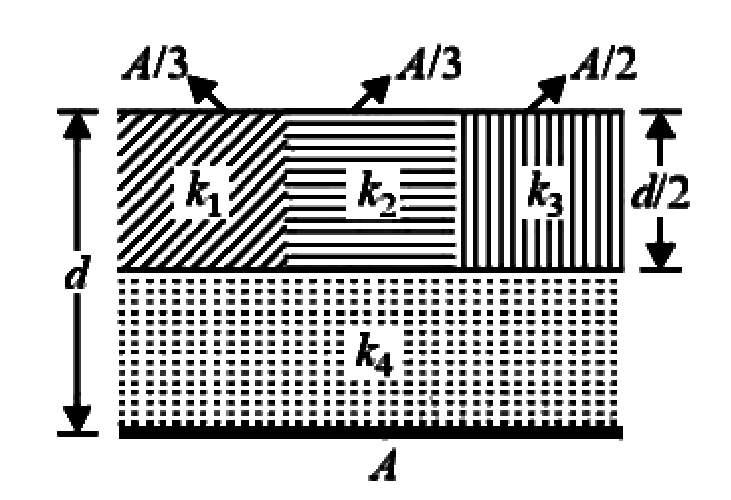
Figure

Numerical answer type. Work it out, then open the answer.
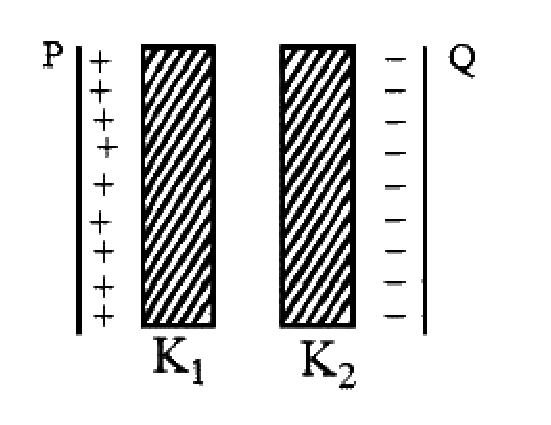
Show answer and solution

Answer: 100

  1. Steady state: capacitor draws no current; three 2 kΩ2\ \text{k}\Omega in series share 6 V, 2 V each.
  2. Capacitor is across the bottom 2 kΩ2\ \text{k}\Omega: V=2 VV = 2\text{ V}, upper plate at the higher potential.
  3. Q=50×2=100 μCQ = 50\times2 = 100\ \mu\text{C} (positive on the upper plate).
Report a mistake
Q347JEE Main 2021 · 1 SEP · SHIFT 2Medium

Capacitors in DC Circuits & RC · Charging & discharging (RC)

A capacitor is connected to a 20 V battery through a resistance of 10Ω\Omega. It is found that the potential difference across the capacitor rises to 2 V in 1 μ\mus. The capacitance of the capacitor is __________ μ\muF. Given: ln⁡(109)=0.105\ln\left(\frac{10}{9}\right)=0.105

Show answer and solution

Answer: (b)

  1. Charging: V=V0(1−e−t/RC)V = V_0(1-e^{-t/RC}), so 2=20(1−e−t/RC)⇒e−t/RC=0.92 = 20(1-e^{-t/RC}) \Rightarrow e^{-t/RC} = 0.9.
  2. tRC=ln⁡109=0.105\dfrac{t}{RC} = \ln\dfrac{10}{9} = 0.105
  3. C=t0.105R=10−60.105×10=0.95×10⁻⁶ FC = \dfrac{t}{0.105R} = \dfrac{10^{-6}}{0.105\times10} = 0.95\times10^{-6}\text{ F}
  4. So the answer is (b) 0.95 μ\muF.
Report a mistake
Q348JEE Main 2021 · 26 AUG · SHIFT 1Medium

Capacitors in DC Circuits & RC · Charging & discharging (RC)

The material filled between the plates of a parallel plate capacitor has resistivity 200 Ω\Omegam. The value of capacitance of the capacitor is 2 pF. If a potential difference of 40 V is applied across the plates of the capacitor, then the value of leakage current flowing out of the capacitor is: (given the value of relative permittivity of material is 50)

Show answer and solution

Answer: (c)

  1. For a filled capacitor RC=ρε=ρKε0RC = \rho\varepsilon = \rho K\varepsilon_0.
  2. RC=200×50×8.85×10−12=8.85×10⁻⁸ sRC = 200\times50\times8.85\times10^{-12} = 8.85\times10^{-8}\text{ s}, so R=8.85×10−82×10−12=4.4×10⁴ ΩR = \dfrac{8.85\times10^{-8}}{2\times10^{-12}} = 4.4\times10^{4}\ \Omega.
  3. I=VR=404.4×10⁴≈0.9×10⁻³ AI = \dfrac{V}{R} = \dfrac{40}{4.4\times10^{4}} \approx 0.9\times10^{-3}\text{ A}
  4. So the answer is (c) 0.9 mA.
Report a mistake
Q349JEE Main 2021 · 27 JUL · SHIFT 1Medium

Capacitors in DC Circuits & RC · Charging & discharging (RC)

Figure

A capacitor of capacitance C = 1 μ\muF is suddenly connected to a battery of 100 volt through a resistance R = 100 Ω\Omega. The time taken for the capacitor to be charged to get 50 V is: [Take ln 2 = 0.69]

Show answer and solution

Answer: (c)

  1. V=V0(1−e−t/RC)V = V_0(1-e^{-t/RC}); 50=100(1−e−t/RC)⇒e−t/RC=1250 = 100(1-e^{-t/RC}) \Rightarrow e^{-t/RC} = \dfrac{1}{2}.
  2. t=RCln⁡2=(100)(10−6)(0.69)t = RC\ln2 = (100)(10^{-6})(0.69)
  3. t=0.69×10⁻⁴ st = 0.69\times10^{-4}\text{ s}, so the answer is (c).
Report a mistake
Q350JEE Main 2021 · 18 MAR · SHIFT 1Medium

Capacitors in DC Circuits & RC · Charging & discharging (RC)

The circuit shown in the figure consists of a charged capacitor of capacity 3 μ\muF and a charge of 30 μ\muC. At time t = 0, when the key is closed, the value of current flowing through the 5 MΩ\Omega resistor is 'x' μ\mu-A. The value of 'x' to the nearest integer is ___________.

Figure

Numerical answer type. Work it out, then open the answer.

Show answer and solution

Answer: 2

  1. Initial capacitor voltage V0=qC=303=10 VV_0 = \dfrac{q}{C} = \dfrac{30}{3} = 10\text{ V}.
  2. At t=0t=0 all of it is across the resistor: I=V0R=105×106I = \dfrac{V_0}{R} = \dfrac{10}{5\times10^{6}}
  3. I=2×10⁻⁶ A=2 μAI = 2\times10^{-6}\text{ A} = 2\ \mu\text{A}, so x=2x = 2.
Report a mistake
Q351JEE Main 2020 · 2 SEP · SHIFT 2Medium

Capacitors in DC Circuits & RC · Steady-state DC circuits

An ideal cell of emf 10 V is connected in circuit shown in figure. Each resistance is 2 Ω\Omega. The potential difference (in V) across the capacitor when it is fully charged is ______.

Figure

Numerical answer type. Work it out, then open the answer.

Show answer and solution

Answer: 8

  1. Steady state: no current through CC and R5R_5. R1+R2=4 ΩR_1+R_2 = 4\ \Omega in parallel with R3R_3 gives 43 Ω\dfrac{4}{3}\ \Omega; plus R4R_4: 103 Ω\dfrac{10}{3}\ \Omega.
  2. I=1010/3=3 AI = \dfrac{10}{10/3} = 3\text{ A}; drop on R4=6 VR_4 = 6\text{ V}, so 4 V across the parallel part and 1 A1\text{ A} in R1R_1.
  3. Capacitor is between the R1R_1–R2R_2 junction and the negative terminal: VC=10−1×2=8 VV_C = 10 - 1\times2 = 8\text{ V}.
Report a mistake
Q352JEE Main 2020 · 6 SEP · SHIFT 1Medium

Capacitors in DC Circuits & RC · Charging & discharging (RC)

For the given input voltage waveform Vin(t), the output voltage waveform V0(t), across the capacitor is correctly depicted by:

Figure

Show answer and solution

Answer: (b)

  1. τ=RC=103×10×10−9=10 μs\tau = RC = 10^{3}\times10\times10^{-9} = 10\ \mu\text{s}.
  2. 0–5 μ\mus: charges, V=5(1−e−0.5)≈2 VV = 5(1-e^{-0.5}) \approx 2\text{ V}.
  3. 5–10 μ\mus (input 0): discharges, V=2e−0.5≈1.2 VV = 2e^{-0.5} \approx 1.2\text{ V}, not to zero.
  4. 10–15 μ\mus: charges again, V=5−(5−1.2)e−0.5≈2.7 VV = 5-(5-1.2)e^{-0.5} \approx 2.7\text{ V}, close to 3 V.
  5. So the answer is (b).
Report a mistake
Q353JEE Main 2019 · 12 JAN · SHIFT 2Easy

Capacitors in DC Circuits & RC · Charging & discharging (RC)

The charge on a capacitor plate in a circuit, as a function of time, is shown in the figure:

Figure

What is the value of current at t = 4 s?

Show answer and solution

Answer: (a)

  1. Current is the slope of the qq–tt graph: I=dqdtI = \dfrac{dq}{dt}.
  2. Between t=2t = 2 s and t=6t = 6 s the charge stays constant at 3 μC3\ \mu\text{C}, so the slope is zero.
  3. So the answer is (a) zero.
Report a mistake
Q354NEET 2019Easy

Capacitors in DC Circuits & RC · Displacement current & LC

A parallel plate capacitor of capacitance 20 μ\muF is being charged by a voltage source whose potential is changing at the rate of 3V/s. The conduction current through the connecting wires, and the displacement current through the plates of the capacitor, would be, respectively:

Show answer and solution

Answer: (c)

  1. Conduction current in the wires I=CdVdt=(20×10−6)(3)=60 μAI = C\dfrac{dV}{dt} = (20\times10^{-6})(3) = 60\ \mu\text{A}.
  2. Displacement current between the plates always equals the conduction current in the wires.
  3. So the answer is (c) 60 μA60\ \mu\text{A}, 60 μA60\ \mu\text{A}.
Report a mistake
Q355JEE Main 2019 · 9 APR · SHIFT 1Medium

Capacitors in DC Circuits & RC · Steady-state DC circuits

Determine the charge on the capacitor in the following circuit:

Figure

Show answer and solution

Answer: (a)

  1. Steady state: capacitor branch open. 2+10=12 Ω2+10 = 12\ \Omega in parallel with 4 Ω4\ \Omega gives 3 Ω3\ \Omega; total 6+3=9 Ω6+3 = 9\ \Omega.
  2. I=729=8 AI = \dfrac{72}{9} = 8\text{ A}; voltage across the parallel part =8×3=24 V= 8\times3 = 24\text{ V}.
  3. Current in 2 Ω+10 Ω2\ \Omega + 10\ \Omega: 2412=2 A\dfrac{24}{12} = 2\text{ A}, so V10=20 VV_{10} = 20\text{ V} (capacitor is across it).
  4. Q=10×20=200 μCQ = 10\times20 = 200\ \mu\text{C}, so the answer is (a) 200 μC200\ \mu\text{C}.
Report a mistake
Q356JEE Main 2018 · 16 APR · SHIFT 1Difficult

Capacitors in DC Circuits & RC · Charging & discharging (RC)

In the following circuit, the switch S is closed at t = 0. The charge on the capacitor C1 as a function of time will be given by (Ceq=C1C2C1+C2)\left(C_{eq}=\frac{C_1C_2}{C_1+C_2}\right)

Figure

Show answer and solution

Answer: (c)

  1. C1C_1, C2C_2, RR and EE are all in one series loop, so the two capacitors act as one capacitor Ceq=C1C2C1+C2C_{eq} = \frac{C_1C_2}{C_1+C_2}.
  2. Series capacitors carry the same charge, so the charge on C1C_1 equals the charge on CeqC_{eq}.
  3. Charging an uncharged capacitor: q=CeqE(1−e−t/RCeq)q = C_{eq}E\left(1 - e^{-t/RC_{eq}}\right)
  4. So the answer is (c) CeqE[1−exp⁡(−t/RCeq)]C_{eq}E\left[1-\exp\left(-t/RC_{eq}\right)\right].
Report a mistake
Q357JEE Main 2017Medium

Capacitors in DC Circuits & RC · Steady-state DC circuits

In the given circuit diagram when the current reaches steady state in the circuit, the charge on the capacitor of capacitance C will be:

Figure

Show answer and solution

Answer: (d)

  1. Steady state: no current through r1r_1, so current flows only through rr and r2r_2: I=Er+r2I = \dfrac{E}{r+r_2}.
  2. Capacitor (with r1r_1, no drop) is across r2r_2: VC=Er2r+r2V_C = \dfrac{Er_2}{r+r_2}
  3. Q=CVC=CEr2r+r2Q = CV_C = CE\dfrac{r_2}{r+r_2}
  4. So the answer is (d).
Report a mistake
Q358JEE Main 2015Difficult

Capacitors in DC Circuits & RC · Steady-state DC circuits

In the given circuit, charges Q2Q_2 on the 2 μF2\ \mu\text{F} capacitor changes as CC is varied from 1 μF1\ \mu\text{F} to 3 μF. Q23\ \mu\text{F}.\ Q_2 as a function of ′C′'C' is given properly by:

(figures are drawn schematically and are not to scale)\text{(figures are drawn schematically and are not to scale)}

Figure

Show answer and solution

Answer: (d)

  1. 1 μF1\ \mu\text{F} and 2 μF2\ \mu\text{F} in parallel give 3 μF3\ \mu\text{F}, in series with CC: Q=3CC+3EQ = \dfrac{3C}{C+3}E.
  2. The 2 μF2\ \mu\text{F} takes 23\dfrac{2}{3} of it: Q2=2CEC+3Q_2 = \dfrac{2CE}{C+3}.
  3. dQ2dC=6E(C+3)2>0\dfrac{dQ_2}{dC} = \dfrac{6E}{(C+3)^2} > 0 and decreasing, so Q2Q_2 rises with a decreasing slope (concave down).
  4. So the answer is (d).
Report a mistake
Q359JEE Main 2014 · 12 APR · SHIFT 1Medium

Capacitors in DC Circuits & RC · Steady-state DC circuits

The circuit shown here has two batteries of 8.0 V and 16.0 V and three resistors 3 Ω\Omega, 9 Ω\Omega and 9 Ω\Omega and a capacitor 5.0 μ\muF.

Figure

How much is the current I in the circuit in steady state?

Show answer and solution

Answer: (b)

  1. Steady state: the capacitor branch (with its 9 Ω9\ \Omega) carries no current.
  2. Outer loop: 8 V cell with 3 Ω3\ \Omega and 16 V cell with 9 Ω9\ \Omega; the cells oppose each other in this loop.
  3. I=16−83+9=812=0.67 AI = \dfrac{16-8}{3+9} = \dfrac{8}{12} = 0.67\text{ A}
  4. So the answer is (b) 0.67 A.
Report a mistake
Q360JEE Main 2013 · 22 APR · SHIFT 1Easy

Capacitors in DC Circuits & RC · Displacement current & LC

To establish an instantaneous current of 2 A through a 1μ\muF capacitor; the potential difference across the capacitor plates should be changed at the rate of:

Show answer and solution

Answer: (c)

  1. I=CdVdt⇒dVdt=ICI = C\dfrac{dV}{dt} \Rightarrow \dfrac{dV}{dt} = \dfrac{I}{C}
  2. dVdt=21×10−6=2×10⁶ V/s\dfrac{dV}{dt} = \dfrac{2}{1\times10^{-6}} = 2\times10^{6}\text{ V/s}
  3. So the answer is (c) 2×1062\times10^{6} V/s.
Report a mistake
Q361JEE Main 2012 · AIEEEMedium

Capacitors in DC Circuits & RC · Charging & discharging (RC)

The figure shows an experimental plot for discharging of a capacitor in an R-C circuit. The time constant τ\tau of this circuit lies between

Figure

Show answer and solution

Answer: (a)

  1. At t=τt = \tau, V=V0e=252.718≈9.2 VV = \dfrac{V_0}{e} = \dfrac{25}{2.718} \approx 9.2\text{ V}.
  2. From the graph V≈12.5 VV \approx 12.5\text{ V} at 100 s and ≈7.5 V\approx 7.5\text{ V} at 150 s, so 9.2 V lies between them.
  3. So the answer is (a) 100 s and 150 s.
Report a mistake
Q362JEE Main 2011 · AIEEEDifficult

Capacitors in DC Circuits & RC · Charging & discharging (RC)

A resistor ′R′'R' and 2 μF2\ \mu\text{F} capacitor in series is connected through a switch to 200 V200\text{ V} direct supply. Across the capacitor is a neon bulb that lights up at 120 V.120\text{ V}. Calculate the value of RR to make the bulb light up 5 s5\text{ s} after the switch has been closed. (log⁡102.5=0.4)(\log_{10}2.5=0.4)

Show answer and solution

Answer: (b)

  1. Charging: V=V0(1−e−t/RC)V = V_0\left(1 - e^{-t/RC}\right)
  2. 120=200(1−e−t/RC)⇒e−t/RC=0.4⇒tRC=ln⁡2.5=2.303×0.4=0.921120 = 200\left(1 - e^{-t/RC}\right) \Rightarrow e^{-t/RC} = 0.4 \Rightarrow \frac{t}{RC} = \ln 2.5 = 2.303 \times 0.4 = 0.921
  3. R=t0.921 C=50.921×2×10−6R = \frac{t}{0.921\,C} = \frac{5}{0.921 \times 2\times10^{-6}}
  4. R≈2.7×10⁶ ΩR \approx 2.7\times10^{6}\ \Omega
  5. So the answer is (b) 2.7×10⁶ Ω2.7\times 10^{6}\ \Omega.
Report a mistake
Q363JEE Main 2010 · AIEEEDifficult

Capacitors in DC Circuits & RC · Charging & discharging (RC)

Let CC be the capacitance of a capacitor discharging through a resistor R.R. Suppose t1t_1 is the time taken for the energy stored in the capacitor to reduce to half its initial value and t2t_2 is the time taken for the charge to reduce to one-fourth its initial value. Then the ratio t1/t2t_1/t_2 will be

Show answer and solution

Answer: (c)

  1. Discharging: q=q0e−t/τq = q_0e^{-t/\tau} and U=U0e−2t/τU = U_0e^{-2t/\tau}, with τ=RC\tau = RC.
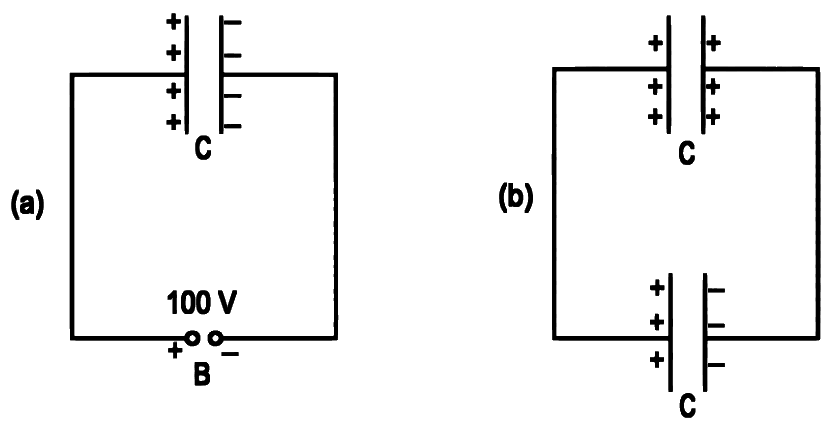
  2. Energy halves: e−2t1/τ=12⇒t1=τln⁡22e^{-2t_1/\tau} = \frac{1}{2} \Rightarrow t_1 = \frac{\tau\ln 2}{2}
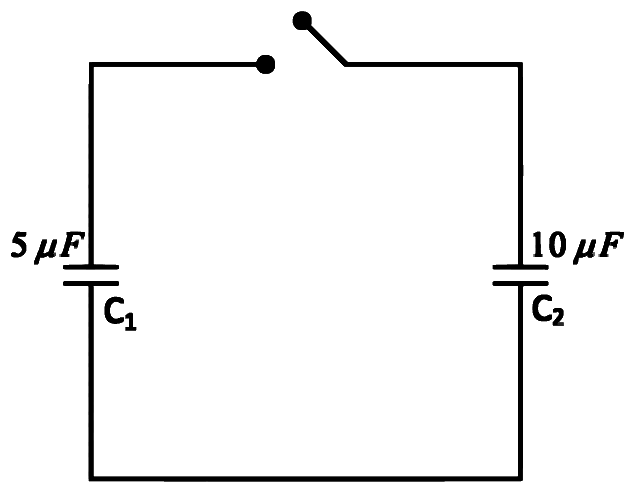
  3. Charge to one fourth: e−t2/τ=14⇒t2=2τln⁡2e^{-t_2/\tau} = \frac{1}{4} \Rightarrow t_2 = 2\tau\ln 2
  4. t1t2=1/22=14\frac{t_1}{t_2} = \frac{1/2}{2} = \frac{1}{4}
  5. So the answer is (c) 14\frac{1}{4}.
Report a mistake
Q364NEET 1995 · AIPMTMedium

Capacitors in DC Circuits & RC · Charging & discharging (RC)

When the key KK is pressed at time t=0t=0, then which of the following statement about the current II in the resistor ABAB of the given circuit is true?

Figure

Show answer and solution

Answer: (b)

  1. At t=0t=0 the uncharged capacitor acts as a short across the right 1000 Ω1000\ \Omega: I=21000=2 mAI = \dfrac{2}{1000} = 2\text{ mA}.
  2. In steady state the capacitor is open: I=21000+1000=1 mAI = \dfrac{2}{1000+1000} = 1\text{ mA}.
  3. So the answer is (b): 2 mA at t=0t=0, falling to 1 mA.
Report a mistake
Q365NEET 1992 · AIPMTEasy

Capacitors in DC Circuits & RC · Charging & discharging (RC)

The time constant of C-RC\text{-}R circuit is

Show answer and solution

Answer: (c)

  1. Charge on an RC circuit grows as q=q0(1−e−t/RC)q = q_0(1 - e^{-t/RC}).
  2. The time constant is τ=CR\tau = CR (unit: Ω⋅F=s\Omega \cdot \text{F} = \text{s}).
  3. So the answer is (c) CRCR.
Report a mistake