0 of 64 attemptedPick an answer to see the solution
Q1MHT CET 2026 · 19 APR · SHIFT 2Easy
Centre of Mass of Discrete Particles · Two-particle system
Two particles of masses 2 g and 4 g are situated at the opposite ends, A and B of a wooden bar respectively. Let l(AB)=9 cm. The center of mass of the system will be
Centre of Mass of Discrete Particles · Many-particle system
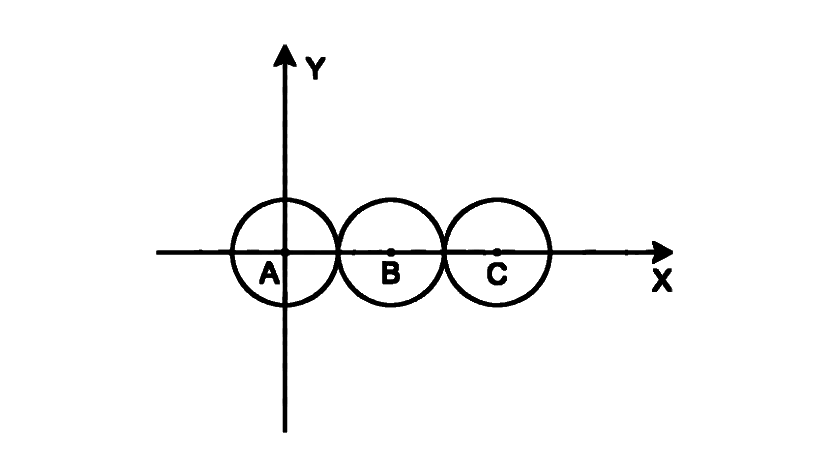
Three identical spheres, each of mass 'm' kg, are kept as shown in the figure, touching each other, with their centers on a straight line. If their centers are marked as A, B, C respectively, the distance of center of mass of the system from A is
Show answer and solution
Answer: (b)
Equal masses at A, B, C on a line; take A as origin, so the positions are 0, AB and AC.
Centre of Mass of Discrete Particles · Many-particle system
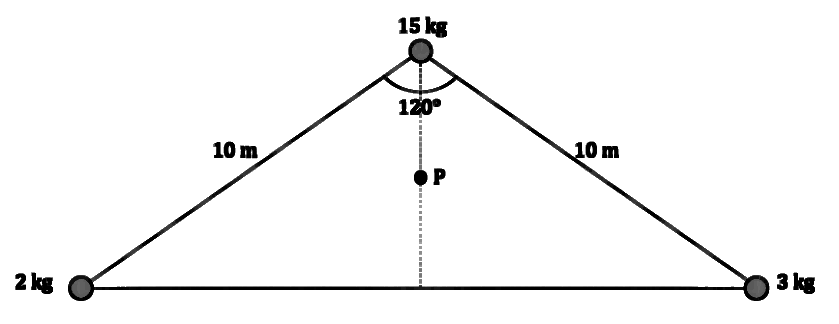
The position of center of mass of three masses 2 kg,3 kg and 15 kg placed with respect to mid point (p) of normal bisector, as shown in the figure is ______.
Show answer and solution
Answer: (a)
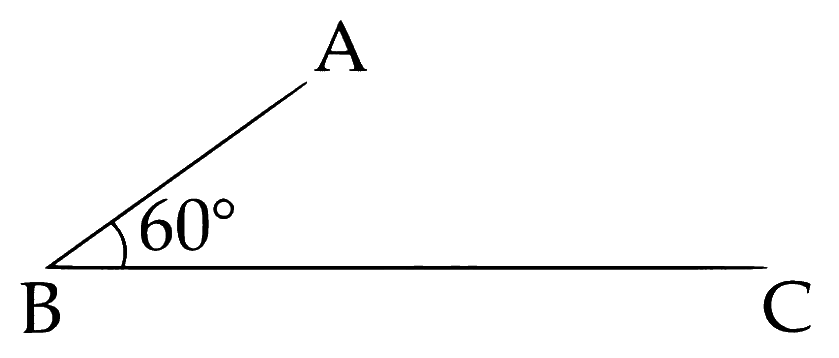
Apex angle 120∘, sides 10 m: half-base =10sin60∘=53 m, height =10cos60∘=5 m.
P is the mid-point of the 5 m bisector, so relative to P: 2 kg at (−53,−2.5), 3 kg at (53,−2.5), 15 kg at (0,2.5).
Centre of Mass of Discrete Particles · Shifting a particle
In the system of two particles of masses ' m1 ' and ' m2 ', the first particle is moved by a distance 'd' towards the centre of mass. To keep the centre of mass unchanged, the second particle will have to be moved by a distance
Show answer and solution
Answer: (c)
For the centre of mass to stay fixed, m1Δx1+m2Δx2=0.
m1 moves d towards the CM, so m2 must also move towards the CM by d2 with m1d=m2d2.
d2=m2m1d
So the answer is (c) m2m1d, towards the centre of mass.
Centre of Mass of Discrete Particles · Shifting a particle
In a system two particles of masses m1=3 kg and m2=2 kg are placed at certain distance from each other. The particle of mass m1 is moved towards the center of mass of the system through a distance 2 cm. In order to keep the center of mass of the system at the original position, the particle of mass m2 should move towards the center of mass by the distance _________ cm.
Numerical answer type. Work it out, then open the answer.
Centre of Mass of Discrete Particles · Many-particle system
Three identical metal balls each of radius ' r ' are placed such that an equilateral triangle is formed when centres of three ball are joined. The centre of mass of the system is located at
Show answer and solution
Answer: (b)
Each uniform ball acts as a point mass m at its centre.
Three equal masses at the vertices of a triangle have their CM at the centroid.
The centroid is the point of intersection of the medians.
So the answer is (b) point of intersection of medians.
Centre of Mass of Discrete Particles · Many-particle system
Three identical spheres each of mass 2M are placed at the corners of a right angled triangle with mutually perpendicular sides equal to 4 m each. Taking point of intersection of these two sides as origin, the magnitude of position vector of the centre of mass of the system is x42, where the value of x is ___________.
Numerical answer type. Work it out, then open the answer.
Centre of Mass of Discrete Particles · Meaning of centre of mass
A metal rod of weight ' W ' is supported by two parallel knife-edges A and B. The rod is in equilibrium in horizontal position. The distance ' between two knife-edges is ' r '. The centre of mass of the rod is at a distance ' x ' from A. The normal reaction on A is
Show answer and solution
Answer: (d)
Weight W acts at the CM, distance x from A and (r−x) from B.
Centre of Mass of Discrete Particles · Two-particle system
Two objects of mass 10 kg and 20 kg respectively are connected to the two ends of a rigid rod of length 10 m with negligible mass. The distance of the center of mass of the system from the 10 kg mass is:
Centre of Mass of Discrete Particles · Two-particle system
Two bodies of mass 1 kg and 3 kg have position vectors i^+2j^+k^ and −3i^−2j^+k^ respectively. The magnitude of position vector of centre of mass of this system will be similar to the magnitude of vector:
Centre of Mass of Discrete Particles · Shifting a particle
Two blocks of masses 10 kg and 30 kg are placed on the same straight line with coordinates (0, 0) cm and (x, 0) cm respectively. The block of 10 kg is moved on the same line through a distance of 6 cm towards the other block. The distance through which the block of 30 kg must be moved to keep the position of centre of mass of the system unchanged is:
Show answer and solution
Answer: (c)
CM unchanged: m1d1=m2d2, with both blocks moving towards the CM.
10×6=30×d2⇒d2=2 cm
Moving towards the CM means the 30 kg block moves towards the 10 kg block.
So the answer is (c) 2 cm towards the 10 kg block.
Centre of Mass of Discrete Particles · Many-particle system
Three identical spheres each of mass M are placed at the corners of a right angled triangle with mutually perpendicular sides equal to 3 m each. Taking point of intersection of mutually perpendicular sides as origin, the magnitude of position vector of centre of mass of the system will be x m. The value of x is ____________.
Numerical answer type. Work it out, then open the answer.
Centre of Mass of Discrete Particles · Shifting a particle
In system of two particles of masses m1 and m2, the first particle is moved by a distance d towards the centre of mass. To keep the centre of mass unchanged, the second particle will have to be moved by a distance
Show answer and solution
Answer: (c)
For the centre of mass to stay fixed, m1Δx1+m2Δx2=0.
m1 moves d towards the CM, so m2 must move towards the CM by d2 with m1d=m2d2.
d2=m2m1d
So the answer is (c) m2m1d, towards the centre of mass.
Centre of Mass of Discrete Particles · Many-particle system
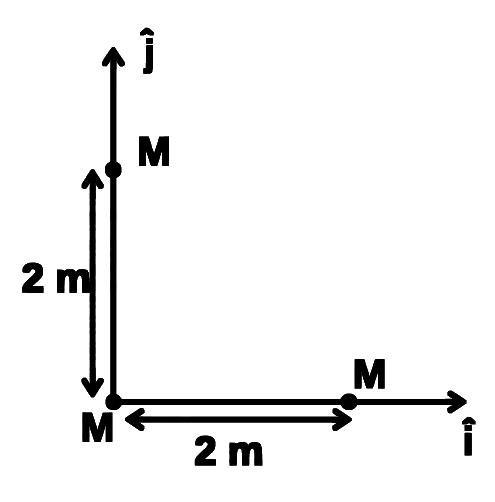
Three identical spheres, each of mass M, are placed at the corners of a right angle triangle with mutually perpendicular sides equal to 2 m (see figure). Taking the point of intersection of the two mutually perpendicular sides as the origin, find the position vector of centre of mass.
Centre of Mass of Discrete Particles · Many-particle system
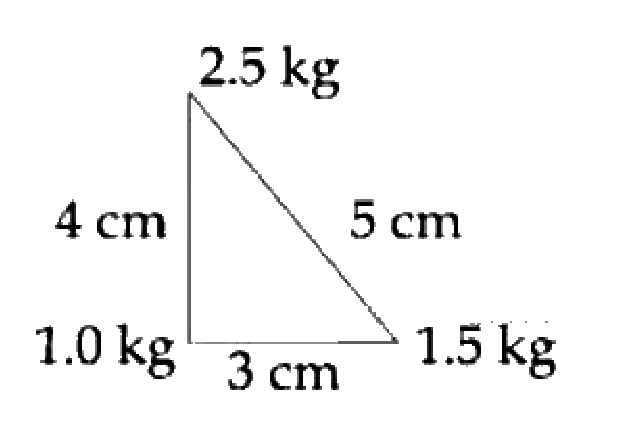
Three point particles of masses 1.0 kg, 1.5 kg and 2.5 kg are placed at three corners of a right angle triangle of sides 4.0 cm, 3.0 cm and 5.0 cm as shown in the figure. The center of mass of the system is at a point:
Show answer and solution
Answer: (b)
Origin at the 1 kg mass: 1.5 kg at (3,0) cm and 2.5 kg at (0,4) cm.
xcm=51.5×3=0.9 cm
ycm=52.5×4=2.0 cm
So the answer is (b) 0.9 cm right and 2.0 cm above the 1 kg mass.
Centre of Mass of Discrete Particles · Many-particle system
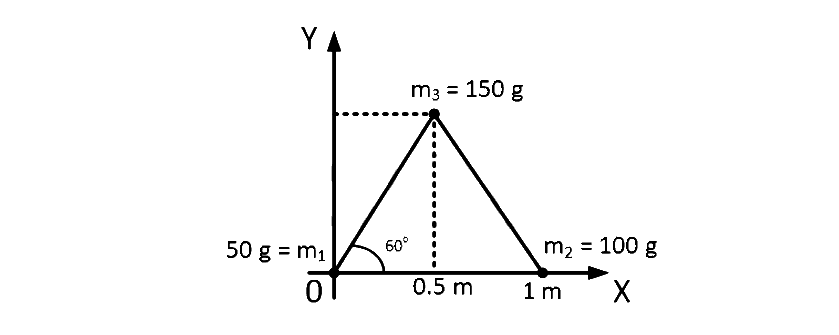
Three particles of masses 50 g, 100 g and 150 g are placed at the vertices of an equilateral triangle of side 1 m (as shown in the figure). The (x, y) coordinates of the centre of mass will be:
Show answer and solution
Answer: (c)
Positions: 50 g at (0,0), 100 g at (1,0), 150 g at (0.5,23) m.
Centre of Mass of Discrete Particles · Meaning of centre of mass
Which of the following statements are correct?
(1) Centre of mass of a body always coincides with the centre of gravity of the body. (2) Centre of mass of a body is the point at which the total gravitational torque on the body is zero. (3) A couple on a body produces both translational and rotational motion in a body (4) Mechanical advantage greater than one means that small effort can be used to lift a large load.
Show answer and solution
Answer: (d)
(1) False: CM and centre of gravity coincide only when g is uniform over the body.
(2) Taken as correct: in uniform g the gravitational torque about the CM is zero.
(3) False: a couple gives zero net force, so it produces only rotation.
(4) True: MA=effortload>1 means a small effort lifts a large load.
Centre of Mass of Discrete Particles · Many-particle system
Three masses are placed on the x-axis: 300 g at origin, 500 g at x = 40 cm and 400 g at x = 70cm. The distance of the centre of mass from the orgin is:
Centre of Mass of Discrete Particles · Two-particle system
Two bodies of mass 1 kg and 3 kg have position vectors i^+2j^+k^ and −3i^−2j^+k^, respectively. The center of mass of this system has a position vector:
Centre of Mass of Discrete Particles · Shifting a particle
Consider a two particle system with particles having masses m1 and m2. If the first particle is pushed towards the center of mass through a distance d, by what distance should the second particle is moved, so as to keep the center of mass at the same position?
Centre of Mass of Discrete Particles · Shifting a particle
Consider a system of two particles having masses m1 and m2. If the particle of mass m1 is pushed towards the mass centre of particles through a distance d. by what distance would be particle of mass m2 move so as to keep the mass centre of particles at the original position?
Show answer and solution
Answer: (b)
CM unchanged: m1Δx1+m2Δx2=0, so the displacements are opposite and m1d=m2d2.
Centre of Mass of Discrete Particles · Many-particle system
Three identical metal balls each of radius r are placed touching each other on a horizontal surface such that an equilateral triangle is formed with centres of three balls joined. The centre of mass of the system is located at
Show answer and solution
Answer: (d)
Each identical ball acts as an equal point mass at its centre.
Three equal masses at the vertices of a triangle have their CM at the centroid, where the medians meet.
So the answer is (d) point of intersection of the medians.
Continuous Bodies: Standard Results & Variable Density · Variable density rods and plates
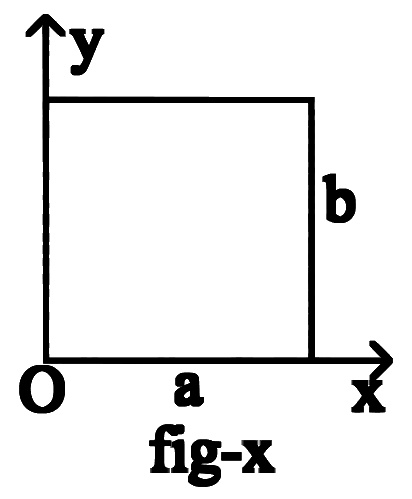
The center of mass of a thin rectangular plate (fig - x) with sides of length a and b, whose mass per unit area (σ) varies as σ=abσ0x (where σ0 is a constant), would be __________.
Show answer and solution
Answer: (b)
σ∝x only, so along y the plate is uniform: ycm=2b.
Continuous Bodies: Standard Results & Variable Density · Variable density rods and plates
The distance of centre of mass from end A of a one dimensional rod (AB) having mass density ρ=ρ0(1−L2x2) kg/m and length L (in meter) is α3L m. The value of α is ___________. (where x is the distance from end A)
Numerical answer type. Work it out, then open the answer.
Continuous Bodies: Standard Results & Variable Density · Uniform bodies: standard results
The position of the centre of mass of a uniform semi-circular wire of radius 'R' placed in x-y plane with its centre at the origin and the line joining its ends as x-axis is given by (0,πxR). Then, the value of | x | is ______________.
Numerical answer type. Work it out, then open the answer.
Show answer and solution
Answer: 2
For a uniform semicircular wire, ycm=π2R from the centre.
Continuous Bodies: Standard Results & Variable Density · Uniform bodies: standard results
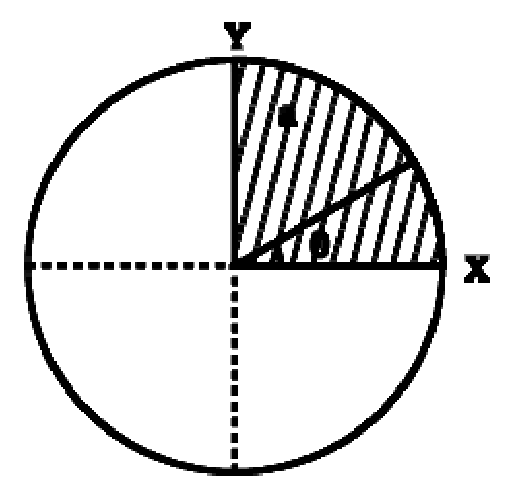
The disc of mass M with uniform surface mass density σ is shown in the figure. The centre of mass of the quarter disc (the shaded area) is at the position 3xπa,3xπa where x is _____________. (Round off to the Nearest Integer).
[a is an area as shown in the figure]
Numerical answer type. Work it out, then open the answer.
Show answer and solution
Answer: 4
In the figure a is the radius of the disc.
For a uniform quarter disc of radius a, xcm=ycm=3π4a.
Continuous Bodies: Standard Results & Variable Density · Uniform bodies: standard results
Distance of the center of mass of a solid uniform cone from its vertex is z0. If the radius of its base is R and its height is h then z0 is equal to:
Show answer and solution
Answer: (d)
For a solid cone the CM lies on the axis at 4h from the base.
Continuous Bodies: Standard Results & Variable Density · Variable density rods and plates
A uniform thin rod AB of length L has linear mass density μ (x) = a + Lbx, where x is measured from A. If the CM of the rod lies at a distance of (127L) from A, then a and b are related as:
Continuous Bodies: Standard Results & Variable Density · Variable density rods and plates
A thin bar of length L has a mass per unit length λ, that increases linearly with distance from one end. If its total mass is M and its mass per unit length at the lighter end is λo, then the distance of the center of mass from the lighter end is:
Continuous Bodies: Standard Results & Variable Density · Variable density rods and plates
A thin rod of length ′L′ is lying along the x-axis with its ends at x=0 and x=L. Its linear density (mass/length) varies with x as k(Lx)n, where n can be zero or any positive number. If the position XCM of the center of mass of the rod is plotted against ′n′, which of the following graphs best approximates the dependence of XCM on n?
Show answer and solution
Answer: (a)
XCM=∫0Lxndx∫0Lxn+1dx=n+2n+1L
At n=0: XCM=2L (uniform rod).
As n increases, XCM rises steadily and approaches L as n→∞, rising fast at first then levelling off.
Continuous Bodies: Standard Results & Variable Density · Variable density rods and plates
A rod of length is 3 m and its mass acting per unit length is directly proportional to distance x from one of its end then its centre of gravity from that end will be at:
Consider a circular disc of radius 20 cm with centre located at the origin. A circular hole of radius 5 cm is cut from this disc in such a way that the edge of the hole touches the edge of the disc. The distance of centre of mass of residual or remaining disc from the origin will be
Show answer and solution
Answer: (d)
Hole touches the edge, so its centre is at 20−5=15 cm from O. Mass ∝ area ∝r2.
Disc: 202=400 units at x=0; hole: 52=25 units at x=15 cm.
xcm=400−25400(0)−25(15)=−375375=−1 cm
So the answer is (d) 1.0 cm (on the side opposite the hole).
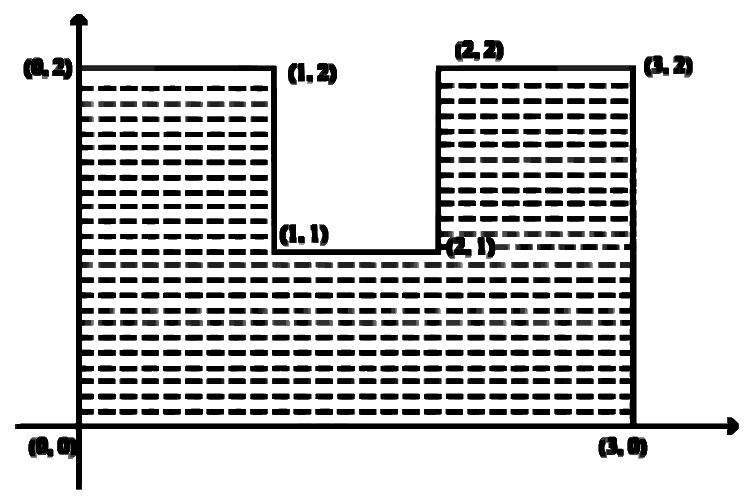
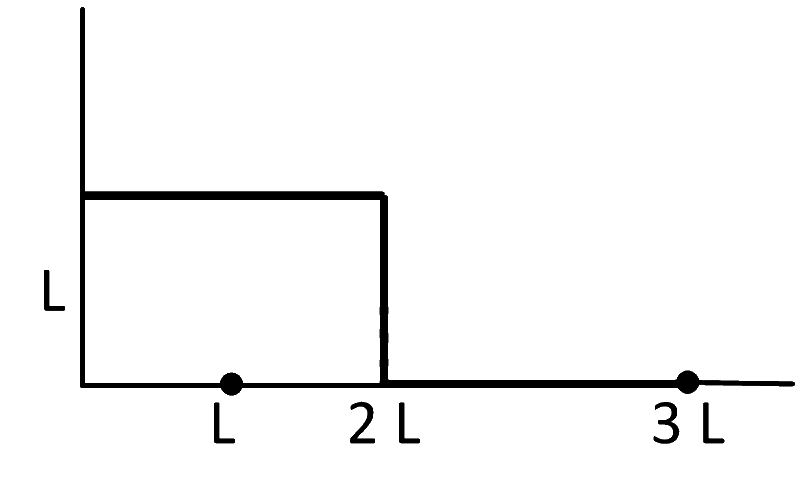
A uniform thin metal plate of mass 10 kg with dimensions is shown. The ratio of x and y coordinates of center of mass of plate is 9n. The value of n is ________.
Numerical answer type. Work it out, then open the answer.
Show answer and solution
Answer: 15
Plate = full rectangle 3×2 (area 6, centre (1.5,1)) minus square 1≤x≤2,1≤y≤2 (area 1, centre (1.5,1.5)).
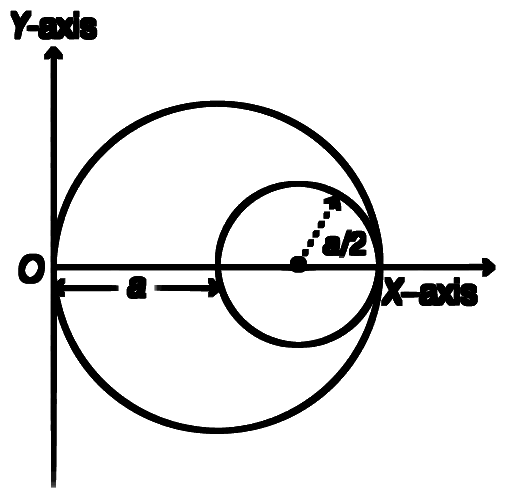
A circular hole of radius (2a) is cut out of a circular disc of radius 'a' as shown in figure. The centroid of the remaining circular portion with respect to point 'O' will be:
Show answer and solution
Answer: (c)
Full disc: area πa2, centre at x=a. Hole: area 4πa2, centre at x=23a.
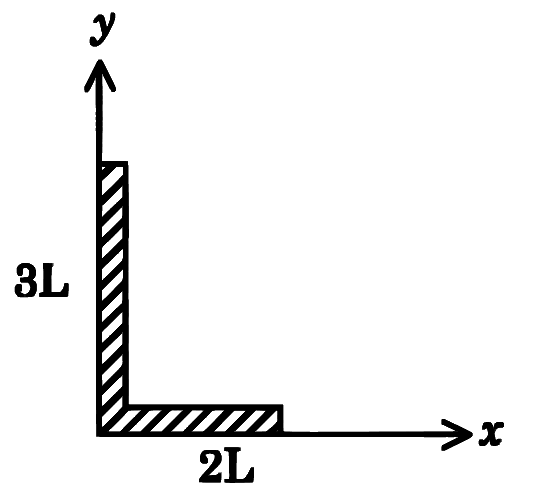
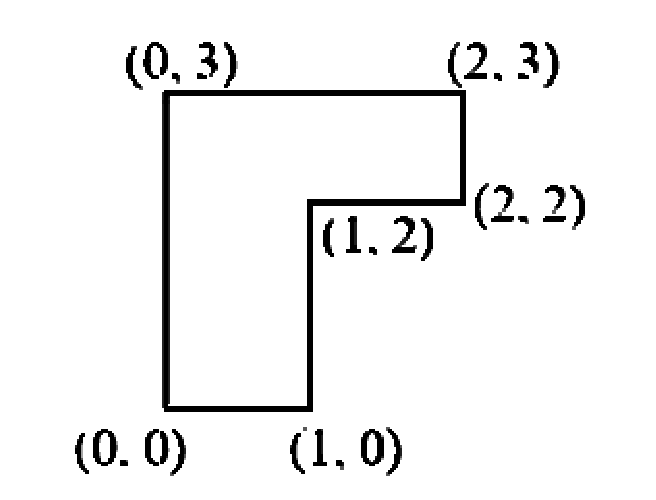
The coordinates of centre of mass of a uniform flag shaped lamina (thin flat plate) of mass 4kg. (The coordinates of the same are shown in figure) are:
Show answer and solution
Answer: (a)
Split the flag into two rectangles of uniform density, so mass ∝ area.
Rectangle 1: 0≤x≤1,0≤y≤3, area 3, centre (0.5,1.5).
Rectangle 2: 1≤x≤2,2≤y≤3, area 1, centre (1.5,2.5).
xcm=43(0.5)+1(1.5)=0.75 m, ycm=43(1.5)+1(2.5)=1.75 m
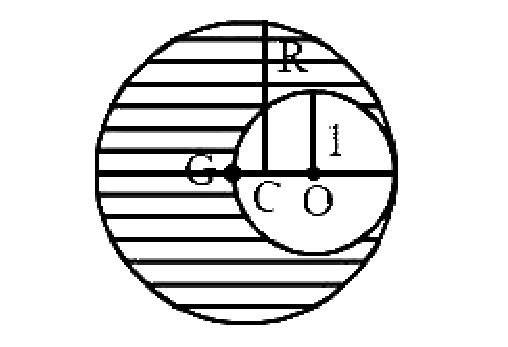
As shown in figure, when a spherical cavity (centered at O) of radius 1 is cut out of a uniform sphere of radius R (centered at C), the centre of mass of remaining (shaded) part of sphere is at G, i.e, on the surface of the cavity. R can be determined by the equation:
Show answer and solution
Answer: (d)
Take C as origin. The cavity touches the sphere surface, so CO=R−1; mass ∝ volume ∝r3.
xG=R3−1−13(R−1)=−(R−1)(R2+R+1)R−1=−R2+R+11
G lies on the cavity surface on the far side: xG=(R−1)−1=−(2−R).
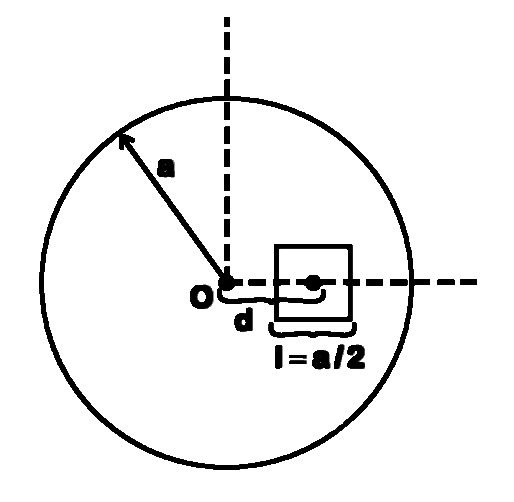
A square shaped hole of side l = 2a is carved out at a distance d = 2a from the centre ‘O’ of a uniform circular disk of radius a. If the distance of the centre of mass of the remaining portion from O is −Xa, value of X (to the nearest integer) is:
Numerical answer type. Work it out, then open the answer.
Show answer and solution
Answer: 23
Mass ∝ area. Disc: πa2 at O. Square hole: 4a2 at x=2a.
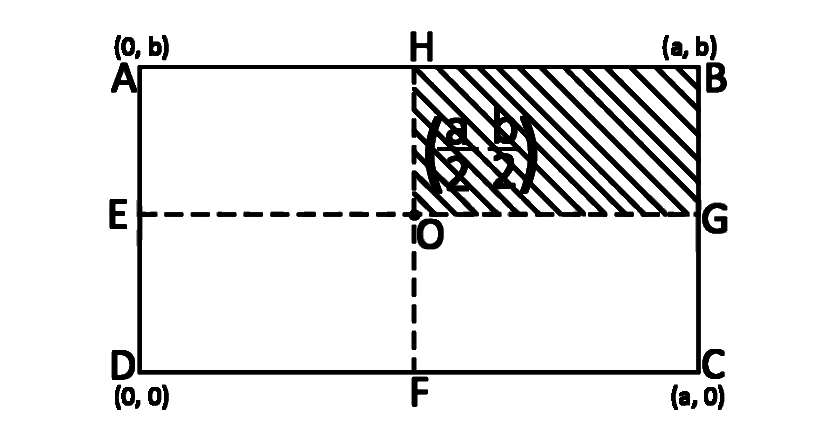
A uniform rectangular thin sheet ABCD of mass M has length a and breadth b, as shown in the figure. If the shaded portion HBGO is cut-off, the coordinates of the centre of mass of the remaining portion will be :-
Show answer and solution
Answer: (c)
Full sheet: mass M at (2a,2b). Cut part HBGO is a quarter: mass 4M at (43a,43b).
A circular disc of radius R is removed from a bigger circular disc of radius 2R such that the circumferences of the discs coincide. The center of mass of the new disc is αR from the center of the bigger disc. The value of α is
Show answer and solution
Answer: (b)
Mass ∝ area: big disc 4m at O, removed disc m with centre at distance R from O.
Treat the hole as mass −m: xcm=4m−m4m(0)−m(R)=−3R
The CM is 3R from O, on the side away from the hole, so α=31.
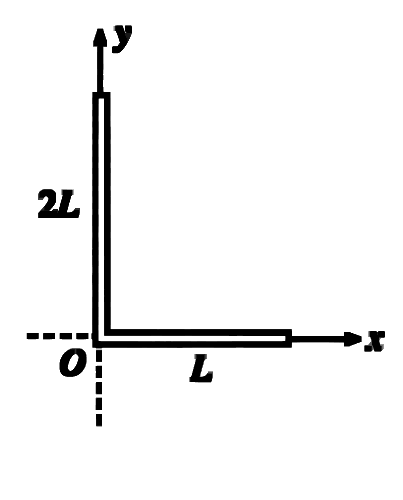
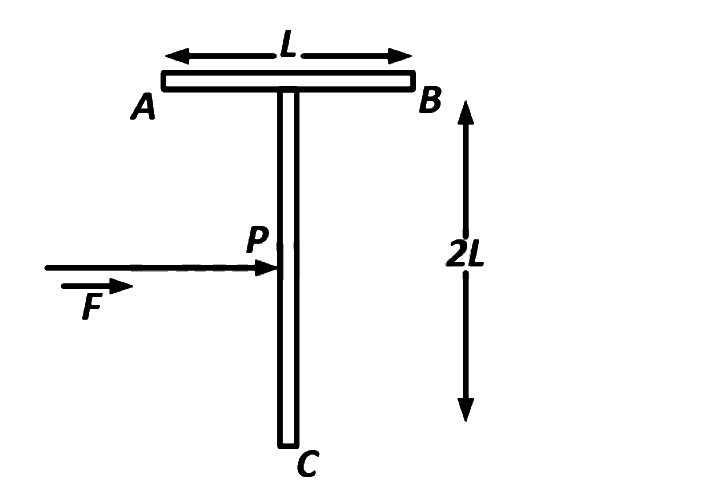
A T shaped object with dimensions shown in the figure, is lying on a smooth floor. A force ′F′ is applied at the point P parallel to AB, such that the object has only the translational motion without rotation. Find the location of P with respect to C.
Show answer and solution
Answer: (d)
For pure translation, F must pass through the centre of mass.
Same rod material: AB has mass m (length L), stem has mass 2m (length 2L).
Motion of Centre of Mass · Velocity and acceleration of COM
Given below are two statements:
Statement I: For a mechanical system of many particles total kinetic energy is the sum of kinetic energies of all the particles.
Statement II: The total kinetic energy can be the sum of kinetic energy of the center of mass w.r.t. the origin and the kinetic energy of all the particles w.r.t. the center of mass as the reference. In the light of the above statements, choose the correct answer from the options given below:
Show answer and solution
Answer: (d)
Statement I: kinetic energy is a scalar, so the total is the sum over all particles. True.
Statement II: K=21Mvcm2+∑21mivi,cm2, i.e. KE of the CM plus KE relative to the CM. True.
Motion of Centre of Mass · Velocity and acceleration of COM
Two identical bodies A and B of equal masses have initial velocities v1=4i^ m/s and v2=4j^ m/s respectively. The body A has acceleration a1=6i^+6j^ m/s2 while the acceleration of the other body B is zero. The centre of mass of the two bodies moves in ______ path.
Show answer and solution
Answer: (c)
Equal masses: vcm=24i^+4j^=2i^+2j^ m/s.
acm=2(6i^+6j^)+0=3i^+3j^ m/s2.
acm is constant and parallel to vcm, so the CM only speeds up along the same line.
Motion of Centre of Mass · Velocity and acceleration of COM
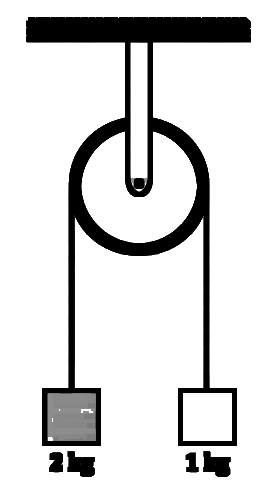
Two blocks of masses 2 kg and 1 kg respectively, are tied to the ends of a string which passes over a light frictionless pulley as shown in the figure below. The masses are held at rest at the same horizontal level and then released. The distance traversed by the centre of mass in 2 s is _______ m. (Take g=10 m/s2)
Show answer and solution
Answer: (c)
Block acceleration: a=2+1(2−1)g=310 m/s2 (2 kg down, 1 kg up).
Motion of Centre of Mass · Velocity and acceleration of COM
In projectile motion two particles of masses m1 and m2 have velocities V1, and V2 respectively at time t=0. Their velocities becomeV1′and V2′ at time 2 t while still moving in air. The value of [(m1V1′+m2V2′)−(m1V1+m2V2)] is ( g= acceleration due to gravity)
Show answer and solution
Answer: (d)
The external force on the pair is (m1+m2)g downward, so Δp=(m1+m2)gΔt.
Motion of Centre of Mass · Internal forces: COM stays put
Two particles A and B initially at rest, move towards each other under mutual force of attraction. At an instance when the speed of A is v and speed of B is 3v, the speed of centre of mass is:
Show answer and solution
Answer: (b)
Only internal (mutual) forces act, so total momentum stays at its initial value, zero.
Given below are two statements: One is labelled as Assertion (A) and the other is labelled as Reason (R).
Assertion (A): When a fire cracker (rocket) explodes in mid air, its fragments fly in such a way that they continue moving in the same path, which the fire cracker would have followed, had it not exploded.
Reason (R): Explosion of cracker (rocket) occurs due to internal force only and no external force acts for this explosion.
In the light of the above statements, choose the most appropriate answer from the options given below
Show answer and solution
Answer: (a)
Assertion: only the centre of mass of the fragments continues on the original parabolic path; individual fragments fly off in different directions. So (A) is false.
Reason: the explosion is caused by internal forces only. True.
So the answer is (a) (A) is not correct but (R) is correct.
Motion of Centre of Mass · Velocity and acceleration of COM
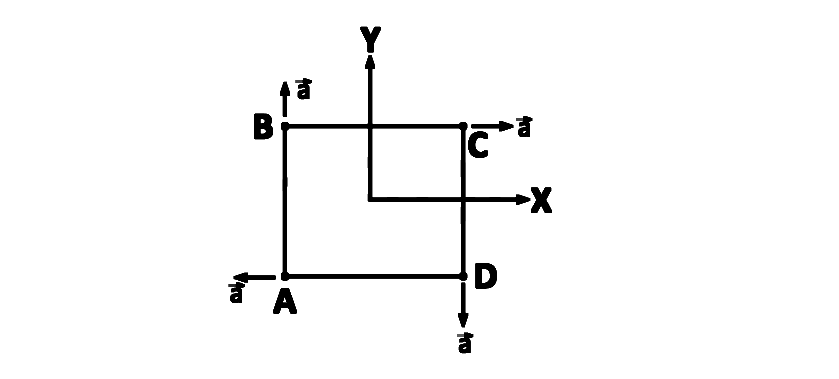
Four particles A, B, C and D with masses mA = m, mB = 2m, mC = 3m and mD = 4m are at the corners of a square. They have accelerations of equal magnitude with directions as shown. The acceleration of the centre of mass of the particles is:
Show answer and solution
Answer: (b)
From the figure: aA=−ai^, aB=aj^, aC=ai^, aD=−aj^.
Motion of Centre of Mass · Internal forces: COM stays put
Two spherical bodies of mass M and 5M and radii R and 2R are released in free space with initial separation between their centres equal to 12R. If they attract each other due to gravitational force only, then the distance covered by the smaller body before collision is:
Show answer and solution
Answer: (a)
Only mutual gravity acts, so the CM stays fixed; distances moved are inversely proportional to masses.
They touch when the centres are R+2R=3R apart, so the gap closed is 12R−3R=9R.
Motion of Centre of Mass · Internal forces: COM stays put
A boy of mass 20 kg is standing on a 80 kg free to move long cart. There is negligible friction between cart and ground. Initially, the boy is standing 25 m from a wall. If he walks 10 m on the cart towards the wall, then the final distance of the boy from the wall will be
Show answer and solution
Answer: (d)
No horizontal external force, so the CM stays fixed: 20xb+80xc=0 (ground displacements).
The boy walks 10 m relative to the cart: xb−xc=10.
A projectile of mass M is fired so that the horizontal range is 4 km. At the highest point the projectile explodes in two parts of masses M/4 and 3M/4 respectively and the heavier part starts falling down vertically with zero initial speed. The horizontal range (distance from point of firing) of the lighter part is:
Show answer and solution
Answer: (c)
The explosion is internal, so the CM still lands at the original range, 4 km.
The heavier part 43M falls vertically from the highest point, landing at 2 km.
Motion of Centre of Mass · Internal forces: COM stays put
Two persons of masses 55 kg and 65 kg respectively, are at the opposite ends of a boat. The length of the boat is 3.0 m and weights 100 kg. The 55 kg man walks up to the 65 kg man and sits with him. If the boat is in still water the centre of mass of the system shifts by:
Show answer and solution
Answer: (c)
Water is still and friction-free horizontally, so no external horizontal force acts on man + man + boat.
The man walking is an internal motion; the boat moves back to compensate.
So the centre of mass does not shift: answer (c) zero.
Motion of Centre of Mass · Internal forces: COM stays put
Two particles which are initially at rest, move towards each other under the action of their internal attraction. If their speeds are v and 2v at any instant, then the speed of centre of mass of the system will be:
Show answer and solution
Answer: (b)
Internal attraction only, and the system starts at rest, so total momentum stays zero.
A body A of mass M while falling vertically downwards under gravity breaks into two-parts; a body B of mass 31M and a body C of mass 32M. The center of mass of bodies B and C taken together shifts compared to that of body A towards
Show answer and solution
Answer: (a)
Breaking up is due to internal forces; the only external force is still gravity Mg.
So acm=g before and after, and the CM motion is unchanged.
So the answer is (a) the centre of mass does not shift.