Physics Circle home Home Practice Hub Register / Login

Home›Practice Hub›Chapters›Circular Motion

Physics PYQs · MHT CET · JEE Main · NEET

Circular Motion

Questions
181
MHT CET
104
JEE Main
77
NEET
0
Years
2002–2026
0 of 181 attemptedPick an answer to see the solution

Q1MHT CET 2026 · 20 APR · SHIFT 2Easy

Angular Variables · Angular displacement & distance

A particle completes 2 revolutions in a circular path of radius 3 cm. The angular displacement of the particle will be (in radian)

Show answer and solution

Answer: (d)

  1. One revolution is an angular displacement of 2π2\pi rad.
  2. θ=2×2π=4π\theta = 2 \times 2\pi = 4\pi rad (the radius does not matter).
  3. So the answer is (d) 4π4\pi.
Report a mistake
Q2MHT CET 2026 · 19 APR · SHIFT 2Easy

Angular Variables · Angular displacement & distance

A particle is performing U.C.M. along a circle of radius RR. In half the period of revolution, its displacement and distance covered are respectively

Show answer and solution

Answer: (b)

  1. In half a period the particle goes to the diametrically opposite point.
  2. Displacement = diameter =2R= 2R.
  3. Distance = half the circumference =πR= \pi R.
  4. So the answer is (b) 2R,πR2R, \pi R.
Report a mistake
Q3MHT CET 2026 · 19 MAY · SHIFT 1Easy

Angular Variables · Angular velocity, period & frequency

A particle moves along a circular path of radius 'rr' with uniform speed 'vv'. The angle described by the particle in two seconds in radians is

Show answer and solution

Answer: (c)

  1. Angular speed ω=v/r\omega = v/r.
  2. Angle in t=2t = 2 s: θ=ωt=2v/r\theta = \omega t = 2v/r.
  3. So the answer is (c) 2v/r2v/r.
Report a mistake
Q4MHT CET 2026 · 19 APR · SHIFT 1Easy

Angular Variables · Angular velocity, period & frequency

Two particles having mass 'M' and 'm' are moving in a circular path with radius 'R' and 'r' respectively. The time period for both the particles is same. The ratio of angular velocity of the first particle to that of the second particle will be

Show answer and solution

Answer: (a)

  1. ω=2π/T\omega = 2\pi/T depends only on the period, not on mass or radius.
  2. Same T⇒ω1=ω2T \Rightarrow \omega_1 = \omega_2.
  3. So the answer is (a) 1:11:1.
Report a mistake
Q5MHT CET 2026 · 18 APR · SHIFT 1Easy

Angular Variables · Angular velocity, period & frequency

A body moves along a circular path of diameter 3030 cm. It starts from one end of diameter, moves along the circular path and reaches the other end of diameter in 3 second. The angular speed of the body in radian per second is

Show answer and solution

Answer: (c)

  1. From one end of a diameter to the other is half a revolution: θ=π\theta = \pi rad.
  2. ω=θ/t=π/3\omega = \theta/t = \pi/3 rad/s.
  3. So the answer is (c) π3\frac{\pi}{3}.
Report a mistake
Q6MHT CET 2026 · 15 MAY · SHIFT 1Easy

Angular Variables · Clock hands

Angular velocity of hour hand of a watch is (in rad/s)

Show answer and solution

Answer: (c)

  1. Hour hand: T=12T = 12 h =43200= 43200 s.
  2. ω=2π43200=π21600\omega = \frac{2\pi}{43200} = \frac{\pi}{21600} rad/s.
  3. So the answer is (c) π21600\frac{\pi}{21600}.
Report a mistake
Q7MHT CET 2026 · 13 MAY · SHIFT 2Easy

Angular Variables · Clock hands

The difference between angular speed of minute hand and second hand of a clock is (in rad/s)

Show answer and solution

Answer: (b)

  1. Second hand: ωs=2π60=60π1800\omega_s = \frac{2\pi}{60} = \frac{60\pi}{1800} rad/s.
  2. Minute hand: ωm=2π3600=π1800\omega_m = \frac{2\pi}{3600} = \frac{\pi}{1800} rad/s.
  3. ωs−ωm=59π1800\omega_s - \omega_m = \frac{59\pi}{1800} rad/s.
  4. So the answer is (b) 59π1800\frac{59\pi}{1800}.
Report a mistake
Q8MHT CET 2026 · 13 APR · SHIFT 1Easy

Angular Variables · Clock hands

The relative angular speed of hour hand and minute hand of clock is

Show answer and solution

Answer: (c)

  1. Minute hand: ωm=2π3600=12π21600\omega_m = \frac{2\pi}{3600} = \frac{12\pi}{21600} rad/s.
  2. Hour hand: ωh=2π43200=π21600\omega_h = \frac{2\pi}{43200} = \frac{\pi}{21600} rad/s.
  3. ωm−ωh=11π21600\omega_m - \omega_h = \frac{11\pi}{21600} rad/s.
  4. So the answer is (c) 11π21600\frac{11\pi}{21600}.
Report a mistake
Q9MHT CET 2026 · 11 APR · SHIFT 2Easy

Angular Variables · Clock hands

The angular speed of the minute hand of a clock in degrees per second is

Show answer and solution

Answer: (b)

  1. The minute hand turns 360∘360^\circ in 36003600 s.
  2. ω=360/3600=0.1∘\omega = 360/3600 = 0.1^\circ/s.
  3. So the answer is (b) 0.10.1.
Report a mistake
Q10MHT CET 2026 · 15 APR · SHIFT 1Easy

Angular Variables · Linear speed: v = rω

A particle performing U.C.M. of radius π2\frac{\pi}{2} m makes 'x' revolutions in time t. Its tangential velocity is

Show answer and solution

Answer: (b)

  1. ω=2πxt\omega = \frac{2\pi x}{t} for xx revolutions in time tt.
  2. v=rω=π2⋅2πxt=π2xtv = r\omega = \frac{\pi}{2} \cdot \frac{2\pi x}{t} = \frac{\pi^2 x}{t}.
  3. So the answer is (b) π2xt\frac{\pi^2 x}{t}.
Report a mistake
Q11MHT CET 2026 · 12 MAY · SHIFT 1Medium

Angular Variables · Angular velocity, period & frequency

Two particles A and B are moving in uniform circular motion in concentric circles of radii rAr_A and rBr_B with speeds vAv_A and vBv_B respectively. TAT_A and TBT_B are the time periods of rotation of the particles respectively and their relation is TA=3TBT_A = 3T_B. The ratio of angular speed of B to that of A will be

Show answer and solution

Answer: (d)

  1. ω=2π/T⇒ω∝1/T\omega = 2\pi/T \Rightarrow \omega \propto 1/T.
  2. ωBωA=TATB=3\frac{\omega_B}{\omega_A} = \frac{T_A}{T_B} = 3.
  3. So the answer is (d) 3:13:1.
Report a mistake
Q12MHT CET 2026 · 11 APR · SHIFT 1Medium

Angular Variables · Linear speed: v = rω

The position vector of a particle is r⃗=acos⁡ωt i^+asin⁡ωt j^\vec{r} = a\cos\omega t\,\hat{i} + a\sin\omega t\,\hat{j}. Calculate the angle between its position vector and the velocity vector.

(cos⁡0=1,cos⁡90=0,cos⁡60=0.5,sin⁡30=0.5,sin⁡0=0\cos 0 = 1, \cos 90 = 0, \cos 60 = 0.5, \sin 30 = 0.5, \sin 0 = 0)

Show answer and solution

Answer: (c)

  1. v⃗=dr⃗dt=−aωsin⁡ωt i^+aωcos⁡ωt j^\vec v = \frac{d\vec r}{dt} = -a\omega\sin\omega t\,\hat i + a\omega\cos\omega t\,\hat j.
  2. r⃗⋅v⃗=−a2ωsin⁡ωtcos⁡ωt+a2ωsin⁡ωtcos⁡ωt=0\vec r \cdot \vec v = -a^2\omega\sin\omega t\cos\omega t + a^2\omega\sin\omega t\cos\omega t = 0.
  3. Zero dot product means r⃗⊥v⃗\vec r \perp \vec v.
  4. So the answer is (c) 90∘90^\circ.
Report a mistake
Q13JEE Main 2025 · 2 APR · SHIFT 2Easy

Angular Variables · Angular displacement & distance

A sportsman runs around a circular track of radius rr such that he traverses the path ABABABAB. The distance travelled and displacement, respectively, are

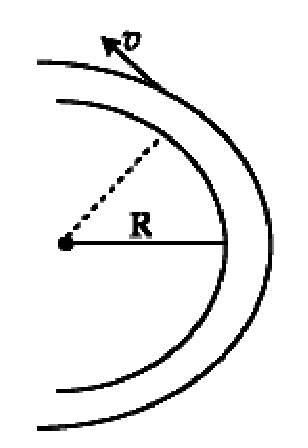
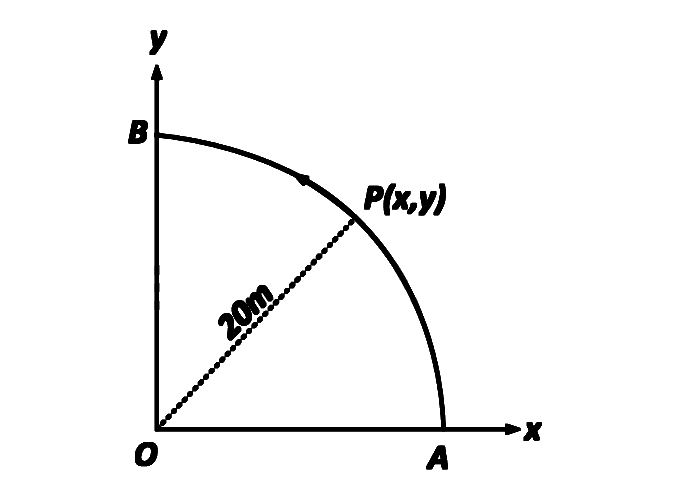
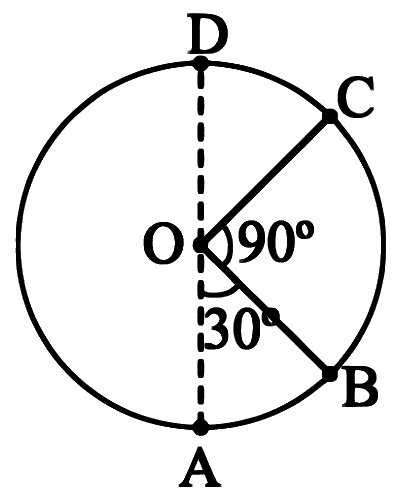
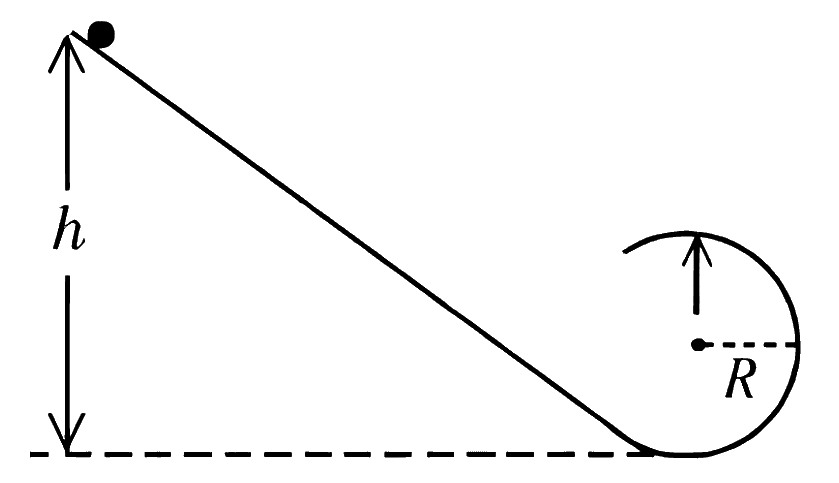
Figure

Show answer and solution

Answer: (c)

  1. A and B are ends of a diameter. Path A→B→A→BA\to B \to A \to B is three half-circles.
  2. Distance =3×πr=3πr= 3 \times \pi r = 3\pi r.
  3. The runner ends at B, so displacement =AB=2r= AB = 2r.
  4. So the answer is (c) 3πr,2r3\pi r, 2r.
Report a mistake
Q14MHT CET 2025 · 19 APR · SHIFT 2Easy

Angular Variables · Linear speed: v = rω

A particle performing uniform circular motion of radius π2 m\frac{\pi}{2}\text{ m} makes xx revolutions in time tt. Its tangential velocity is

Show answer and solution

Answer: (c)

  1. ω=2πxt\omega = \frac{2\pi x}{t} for xx revolutions in time tt.
  2. v=rω=π2⋅2πxt=π2xtv = r\omega = \frac{\pi}{2} \cdot \frac{2\pi x}{t} = \frac{\pi^2 x}{t}.
  3. So the answer is (c) π2xt\frac{\pi^2 x}{t}.
Report a mistake
Q15JEE Main 2024 · 4 APR · SHIFT 2Easy

Angular Variables · Angular displacement & distance

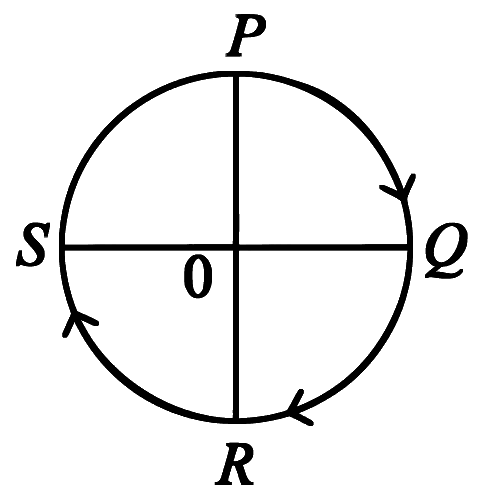
A cyclist starts from the point PP of a circular ground of radius 2 km2\text{ km} and travels along its circumference to the point SS. The displacement of a cyclist is:

Figure

Show answer and solution

Answer: (a)

  1. Going P→Q→R→SP \to Q \to R \to S covers 3/43/4 of the circle, but only the end points matter for displacement.
  2. OP⊥OSOP \perp OS, so PS=r2+r2=r2PS = \sqrt{r^2 + r^2} = r\sqrt{2}.
  3. PS=22=8PS = 2\sqrt{2} = \sqrt{8} km.
  4. So the answer is (a) 8\sqrt{8} km.
Report a mistake
Q16MHT CET 2024 · 4 MAY · SHIFT 2Easy

Angular Variables · Angular velocity, period & frequency

A body moves along a circular path of radius 15 cm. It starts from a point on the circular path and reaches the end of diameter in 3 seconds. The angular speed of the body in rad/s\text{rad/s} is

Show answer and solution

Answer: (b)

  1. Reaching the other end of the diameter means half a revolution: θ=π\theta = \pi rad.
  2. ω=θ/t=π/3\omega = \theta/t = \pi/3 rad/s.
  3. So the answer is (b) π3\frac{\pi}{3}.
Report a mistake
Q17MHT CET 2024 · 16 MAY · SHIFT 2Easy

Angular Variables · Linear speed: v = rω

Two objects of masses ' m1m_1 ' and ' m2m_2 ' are moving in the circles of radii ' r1r_1 ' and ' r2r_2 ' respectively. Their respective angular speeds ' ω1\omega_1 ' and ' ω2\omega_2 ' are such that they both complete one revolution in the same time ' tt '. The ratio of linear speed of ' m2m_2 ' to that of ' m1m_1 ' is

Show answer and solution

Answer: (d)

  1. Same period ⇒\Rightarrow same angular speed ω\omega.
  2. v=rω⇒v∝rv = r\omega \Rightarrow v \propto r.
  3. v2:v1=r2:r1v_2 : v_1 = r_2 : r_1.
  4. So the answer is (d) r2:r1r_2 : r_1.
Report a mistake
Q18JEE Main 2024 · 8 APR · SHIFT 1Medium

Angular Variables · Clock hands

A clock has 75 cm,60 cm75\text{ cm}, 60\text{ cm} long second hand and minute hand respectively. In 30 minutes duration the tip of second hand will travel xx distance more than the tip of minute hand. The value of xx in meter is nearly (Take π=3.14\pi = 3.14):

Show answer and solution

Answer: (c)

  1. In 30 min the second hand makes 30 revolutions: s1=30×2π(0.75)=45πs_1 = 30 \times 2\pi(0.75) = 45\pi m.
  2. The minute hand makes half a revolution: s2=π(0.60)=0.6πs_2 = \pi(0.60) = 0.6\pi m.
  3. x=s1−s2=44.4π=44.4×3.14≈139.4x = s_1 - s_2 = 44.4\pi = 44.4 \times 3.14 \approx 139.4 m.
  4. So the answer is (c) 139.4.
Report a mistake
Q19MHT CET 2024 · 16 MAY · SHIFT 2Medium

Angular Variables · Linear speed: v = rω

The linear speed of a particle at the equator of the earth due to its spin motion is ' V '. The linear speed of the particle at latitude 30∘30^\circ is

[sin⁡30∘=cos⁡60∘=1/2cos⁡30∘=sin⁡60∘=3/2]\left[\begin{matrix} \sin 30^\circ = \cos 60^\circ = 1/2 \\ \cos 30^\circ = \sin 60^\circ = \sqrt{3}/2 \end{matrix}\right]

Show answer and solution

Answer: (c)

  1. At latitude λ\lambda the radius of the circle is Rcos⁡λR\cos\lambda, and ω\omega is the same.
  2. v=ωRcos⁡λ=Vcos⁡30∘=32Vv = \omega R\cos\lambda = V\cos 30^\circ = \frac{\sqrt3}{2}V.
  3. So the answer is (c) 32V\frac{\sqrt{3}}{2}V.
Report a mistake
Q20MHT CET 2024 · 3 MAY · SHIFT 2Difficult

Angular Variables · Angular displacement & distance

A wheel of radius 1 m rolls through 180∘180^\circ over a plane surface. The magnitude of the displacement of the point of the wheel initially in contact with the surface is.

Show answer and solution

Answer: (c)

  1. Rolling through 180∘180^\circ moves the centre forward by πR=π\pi R = \pi m.
  2. The contact point goes from the bottom to the top: it rises 2R=22R = 2 m.
  3. Displacement =π2+22=π2+4= \sqrt{\pi^2 + 2^2} = \sqrt{\pi^2 + 4} m.
  4. So the answer is (c) π2+4\sqrt{\pi^2 + 4}.
Report a mistake
Q21MHT CET 2023 · 12 MAY · SHIFT 1Easy

Angular Variables · Angular velocity, period & frequency

Two particles having mass 'MM' and 'mm' are moving in a circular path with radius 'RR' and 'rr' respectively. The time period for both the particles is same. The ratio of angular velocity of the first particle to the second particle will be

Show answer and solution

Answer: (a)

  1. ω=2π/T\omega = 2\pi/T depends only on the period.
  2. Same T⇒ω1:ω2=1:1T \Rightarrow \omega_1 : \omega_2 = 1:1.
  3. So the answer is (a) 1 : 1.
Report a mistake
Q22MHT CET 2023 · 10 MAY · SHIFT 2Easy

Angular Variables · Linear speed: v = rω

A particle performing uniform circular motion of radius π2 m\frac{\pi}{2}\text{ m} makes 'xx' revolutions in time 'tt'. Its tangential velocity is

Show answer and solution

Answer: (d)

  1. ω=2πxt\omega = \frac{2\pi x}{t} for xx revolutions in time tt.
  2. v=rω=π2⋅2πxt=π2xtv = r\omega = \frac{\pi}{2} \cdot \frac{2\pi x}{t} = \frac{\pi^2 x}{t}.
  3. So the answer is (d) π2xt\frac{\pi^2 x}{t}.
Report a mistake
Q23JEE Main 2023 · 31 JAN · SHIFT 2Medium

Angular Variables · Linear speed: v = rω

A body is moving with constant speed, in a circle of radius 10 m10\text{ m}. The body completes one revolution in 4 s4\text{ s}. At the end of 3rd second, the displacement of body (in m\text{m}) from its starting point is:

Show answer and solution

Answer: (c)

  1. In 3 s the body covers 3/43/4 of a revolution, i.e. 270∘270^\circ.
  2. Start and end radii are perpendicular, so displacement =r2+r2=r2= \sqrt{r^2 + r^2} = r\sqrt2.
  3. =102= 10\sqrt{2} m.
  4. So the answer is (c) 10210\sqrt{2}.
Report a mistake
Q24MHT CET 2023 · 14 MAY · SHIFT 1Medium

Angular Variables · Change in velocity & average acceleration

A particle moves around a circular path of radius 'rr' with uniform speed 'VV'. After moving half the circle, the average acceleration of the particle is

Show answer and solution

Answer: (c)

  1. After half a circle the velocity reverses: ∣Δv⃗∣=2V|\Delta \vec v| = 2V.
  2. Time taken t=πrVt = \frac{\pi r}{V}.
  3. aavg=2Vπr/V=2V2πra_{avg} = \frac{2V}{\pi r / V} = \frac{2V^2}{\pi r}.
  4. So the answer is (c) 2V2πr\frac{2V^2}{\pi r}.
Report a mistake
Q25MHT CET 2023 · 12 MAY · SHIFT 2Medium

Angular Variables · Change in velocity & average acceleration

A particle is moving in a circle with uniform speed 'vv'. In moving from a point to another diametrically opposite point

Show answer and solution

Answer: (b)

  1. At the diametrically opposite point the velocity is reversed: v⃗→−v⃗\vec v \to -\vec v.
  2. ∣Δp⃗∣=mv−(−mv)=2mv|\Delta \vec p| = mv - (-mv) = 2mv.
  3. Speed is unchanged, so kinetic energy does not change.
  4. So the answer is (b) the momentum changes by 2mv2mv.
Report a mistake
Q26JEE Main 2023 · 6 APR · SHIFT 2Medium

Angular Variables · Change in velocity & average acceleration

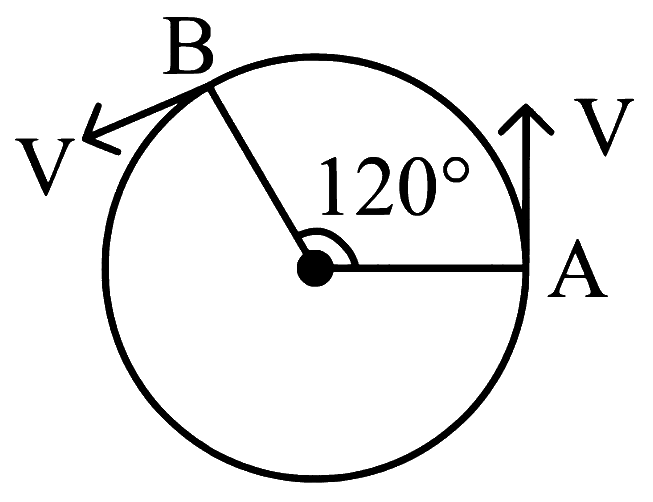
As shown in the figure, a particle is moving with constant speed π m/s\pi\text{ m/s}. Considering its motion from AA to BB, the magnitude of the average velocity is:

Figure

Show answer and solution

Answer: (b)

  1. Displacement ABAB = chord for 120∘120^\circ: 2rsin⁡60∘=r32r\sin 60^\circ = r\sqrt3.
  2. Arc AB=2πr3AB = \frac{2\pi r}{3}, so time t=2πr/3π=2r3t = \frac{2\pi r/3}{\pi} = \frac{2r}{3} s.
  3. vavg=r32r/3=1.53v_{avg} = \frac{r\sqrt3}{2r/3} = 1.5\sqrt3 m/s.
  4. So the answer is (b) 1.531.5\sqrt{3} m/s.
Report a mistake
Q27JEE Main 2023 · 6 APR · SHIFT 1Medium

Angular Variables · Change in velocity & average acceleration

A particle is moving with constant speed in a circular path. When the particle turns by an angle 90∘90^\circ, the ratio of instantaneous velocity to its average velocity is π:x2\pi : x\sqrt{2}. The value of xx will be -

Show answer and solution

Answer: (d)

  1. For a 90∘90^\circ turn: displacement =r2= r\sqrt2, arc =πr2= \frac{\pi r}{2}, time t=πr2vt = \frac{\pi r}{2v}.
  2. vavg=r2πr/2v=22 vπv_{avg} = \frac{r\sqrt2}{\pi r/2v} = \frac{2\sqrt2\,v}{\pi}.
  3. vvavg=π22=π:x2⇒x=2\frac{v}{v_{avg}} = \frac{\pi}{2\sqrt2} = \pi : x\sqrt2 \Rightarrow x = 2.
  4. So the answer is (d) 2.
Report a mistake
Q28JEE Main 2022 · 25 JUL · SHIFT 1Medium

Angular Variables · Angular displacement & distance

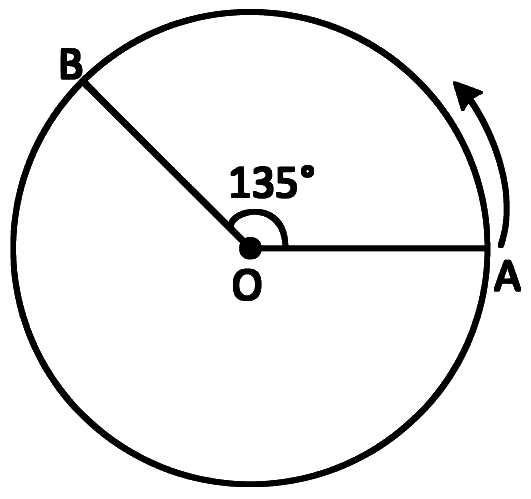
A person moved from A to B on a circular path as shown in figure. If the distance travelled by him is 60 m60\text{ m}, then the magnitude of displacement would be:

(Given cos⁡135∘=−0.7)\cos 135^\circ = -0.7)

Figure

Show answer and solution

Answer: (b)

  1. Arc length s=rθs = r\theta with θ=135∘=3π4\theta = 135^\circ = \frac{3\pi}{4}: r=60×43π≈25.5r = \frac{60 \times 4}{3\pi} \approx 25.5 m.
  2. Displacement AB=r2+r2−2r2cos⁡135∘=r2(1+0.7)=r3.4AB = \sqrt{r^2 + r^2 - 2r^2\cos 135^\circ} = r\sqrt{2(1 + 0.7)} = r\sqrt{3.4}.
  3. AB≈25.5×1.84≈47AB \approx 25.5 \times 1.84 \approx 47 m.
  4. So the answer is (b) 47 m.
Report a mistake
Q29JEE Main 2022 · 30 JUN · SHIFT 1Medium

Angular Variables · Angular displacement & distance

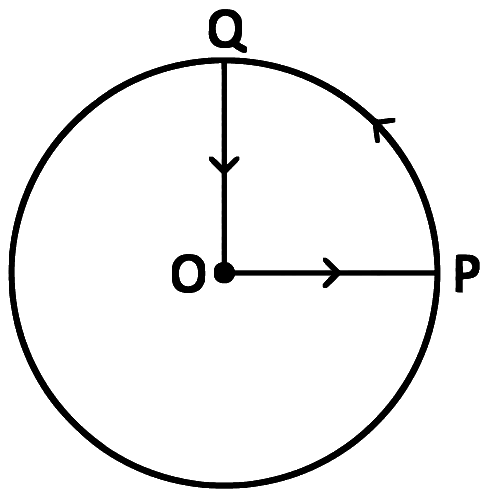
A person starts his journey from centre 'O' of the park and comes back to the same position following path OPQO as shown in the figure. The radius of path taken by the person is 200 m and he takes 3 min 58 sec to complete his journey. The average speed of the person is _____________ ms−1{}^{-1}. (take π\pi = 3.14)

Figure

Numerical answer type. Work it out, then open the answer.

Show answer and solution

Answer: 3

  1. Path: OP=rOP = r, arc PQPQ = quarter circle =πr2= \frac{\pi r}{2}, QO=rQO = r.
  2. Distance =2r+πr2=400+314=714= 2r + \frac{\pi r}{2} = 400 + 314 = 714 m.
  3. Time =3= 3 min 5858 s =238= 238 s.
  4. Average speed =714/238=3= 714/238 = 3 m/s.
Report a mistake
Q30MHT CET 2021 · 22 SEP · SHIFT 1Easy

Angular Variables · Angular velocity, period & frequency

The angular displacement of body performing circular motion is given by θ=5sin⁡πt6\theta = 5\sin\frac{\pi t}{6}. The angular velocity of the body at t=3t = 3 second will be [sin⁡π2=1,cos⁡π2=0]\left[\sin\frac{\pi}{2} = 1, \cos\frac{\pi}{2} = 0\right]

Show answer and solution

Answer: (d)

  1. ω=dθdt=5⋅π6cos⁡πt6\omega = \frac{d\theta}{dt} = 5 \cdot \frac{\pi}{6}\cos\frac{\pi t}{6}.
  2. At t=3t = 3 s: cos⁡π2=0\cos\frac{\pi}{2} = 0, so ω=0\omega = 0.
  3. So the answer is (d) zero.
Report a mistake
Q31MHT CET 2021 · 22 SEP · SHIFT 1Easy

Angular Variables · Clock hands

If ω1\omega_1 is angular velocity of hour hand of clock and ω2\omega_2 is angular velocity of the earth, then the ratio ω1\omega_1: ω2\omega_2 is

Show answer and solution

Answer: (d)

  1. ω∝1/T\omega \propto 1/T. Hour hand T1=12T_1 = 12 h, Earth spin T2=24T_2 = 24 h.
  2. ω1:ω2=T2:T1=24:12=2:1\omega_1 : \omega_2 = T_2 : T_1 = 24 : 12 = 2:1.
  3. So the answer is (d) 2 : 1.
Report a mistake
Q32JEE Main 2021 · 27 AUG · SHIFT 1Medium

Angular Variables · Angular displacement & distance

A huge circular arc of length 4.4 ly subtends an angle of 4″ (4 seconds of arc) at the centre of the circle. How long it would take for a body to complete 4 revolutions if its speed is 8 AU per second? Given: 1 ly = 9.46 ×\times 1015 m

1 AU = 1.5 ×\times 1011 m

Show answer and solution

Answer: (b)

  1. θ=4′′=43600×π180≈1.94×10⁻⁵\theta = 4'' = \frac{4}{3600} \times \frac{\pi}{180} \approx 1.94 \times 10^{-5} rad.
  2. r=sθ=4.4×9.46×10151.94×10−5≈2.15×10²¹r = \frac{s}{\theta} = \frac{4.4 \times 9.46 \times 10^{15}}{1.94 \times 10^{-5}} \approx 2.15 \times 10^{21} m.
  3. Distance for 4 revolutions =4×2πr≈5.4×1022= 4 \times 2\pi r \approx 5.4 \times 10^{22} m.
  4. Speed =8×1.5×1011=1.2×1012= 8 \times 1.5 \times 10^{11} = 1.2 \times 10^{12} m/s, so t=5.4×10221.2×1012≈4.5×10¹⁰t = \frac{5.4 \times 10^{22}}{1.2 \times 10^{12}} \approx 4.5 \times 10^{10} s.
  5. So the answer is (b) 4.5×10104.5 \times 10^{10} s.
Report a mistake
Q33MHT CET 2020 · 16 OCT · SHIFT 1Medium

Angular Variables · Change in velocity & average acceleration

A particle is moving in a radius RR with constant speed vv. The magnitude of average acceleration after half revolution is

Show answer and solution

Answer: (c)

  1. After half a revolution the velocity reverses: ∣Δv⃗∣=2v|\Delta \vec v| = 2v.
  2. Time taken t=πRvt = \frac{\pi R}{v}.
  3. aavg=2vπR/v=2v2πRa_{avg} = \frac{2v}{\pi R / v} = \frac{2v^2}{\pi R}.
  4. So the answer is (c) 2v2πR\frac{2v^2}{\pi R}.
Report a mistake
Q34JEE Main 2019 · 11 JAN · SHIFT 1Easy

Angular Variables · Change in velocity & average acceleration

A particle is moving along a circular path with a constant speed of 10 ms–1. What is the magnitude of the change in velocity of the particle, when it moves through an angle of 60o around the centre of the circle?

Show answer and solution

Answer: (b)

60°v₁ = 10v₂ = 10Δv = 10
  1. Speed is constant, only direction changes by θ=60∘\theta = 60^\circ.
  2. ∣Δv⃗∣=2vsin⁡θ2=2×10×sin⁡30∘|\Delta \vec v| = 2v\sin\frac{\theta}{2} = 2 \times 10 \times \sin 30^\circ.
  3. ∣Δv⃗∣=10|\Delta \vec v| = 10 m/s (the vector triangle is equilateral).
  4. So the answer is (b) 10 m/s.
Report a mistake
Q35MHT CET 2019 · 2 MAY · SHIFT 2Medium

Angular Variables · Change in velocity & average acceleration

In U.C.M., when time interval δt→0\delta t \to 0, the angle between change in velocity ( δv⃗\delta \vec{v}) and linear velocity (v⃗)(\vec{v}) will be

Show answer and solution

Answer: (b)

  1. As δt→0\delta t \to 0, δv⃗\delta \vec v points towards the centre (it gives the centripetal acceleration).
  2. The velocity is along the tangent, which is perpendicular to the radius.
  3. So the answer is (b) 90∘90^\circ.
Report a mistake
Q36MHT CET 2026 · 13 MAY · SHIFT 1Medium

Centripetal Acceleration & Force · Centripetal force & ratios

The real force F acting on particle of mass m performing circular motion acts along the radius of circle r and is directed forwards the centre of the circle. The magnitude of square root of such a force is (T = periodic time)

Show answer and solution

Answer: (a)

  1. Centripetal force F=mω2r=4π2mrT2F = m\omega^2 r = \frac{4\pi^2 m r}{T^2}.
  2. F=2πmrT\sqrt{F} = \frac{2\pi\sqrt{mr}}{T}
  3. So the answer is (a) 2πmrT\frac{2\pi\sqrt{mr}}{T}.
Report a mistake
Q37MHT CET 2026 · 19 APR · SHIFT 1Medium

Centripetal Acceleration & Force · Centripetal force & ratios

Two stones of masses mm and 3m3m are whirled in horizontal circles, the heavier one in a radius r3\frac{r}{3} and the lighter one in radius rr. When both the stones experience same centripetal forces, the tangential speed of lighter stone is 'nn' times that of the value of heavier stone. The value of 'nn' is

Show answer and solution

Answer: (c)

  1. Equal forces: mv12r=3mv22r/3=9mv22r\frac{m v_1^2}{r} = \frac{3m v_2^2}{r/3} = \frac{9 m v_2^2}{r}.
  2. v12=9v22⇒v1=3v2v_1^2 = 9 v_2^2 \Rightarrow v_1 = 3 v_2
  3. So n=3n = 3. The answer is (c) 33.
Report a mistake
Q38MHT CET 2025 · 23 APR · SHIFT 1Easy

Centripetal Acceleration & Force · Centripetal acceleration

Two bodies of mass 10 kg and 5 kg are moving in concentric circular orbits of radii ' R ' and ' r ' respectively such that their periods are same. The ratio between their centripetal acceleration is

Show answer and solution

Answer: (a)

  1. Same period ⇒\Rightarrow same ω\omega. Centripetal acceleration a=ω2ra = \omega^2 r.
  2. a1:a2=R:ra_1 : a_2 = R : r (mass does not matter).
  3. So the answer is (a) R/rR/r.
Report a mistake
Q39MHT CET 2025 · 20 APR · SHIFT 1Easy

Centripetal Acceleration & Force · What stays constant in UCM

For a particle moving in a circle with constant angular speed, which of the following statements is 'false'?

Show answer and solution

Answer: (b)

  1. (a) True: velocity is always along the tangent.
  2. (b) False: in uniform circular motion the acceleration is centripetal, along the radius, not along the tangent.
  3. (c) True: radial acceleration is perpendicular to tangential velocity.
  4. (d) True: acceleration v2r\frac{v^2}{r} points to the centre.
  5. So the answer is (b).
Report a mistake
Q40MHT CET 2025 · 23 APR · SHIFT 2Medium

Centripetal Acceleration & Force · Centripetal force & ratios

Two stones of masses m and 3 m are whirled in horizontal circles, the heavier one in a radius (r3)\left(\frac{r}{3}\right) and lighter one in a radius r. The tangential speed of lighter stone is ' nn ' times the value of heavier stone. When the magnitude of centripetal force becomes equal the value of nn is

Show answer and solution

Answer: (b)

  1. Equal forces: mv12r=3mv22r/3=9mv22r\frac{m v_1^2}{r} = \frac{3m v_2^2}{r/3} = \frac{9 m v_2^2}{r}.
  2. v12=9v22⇒v1=3v2v_1^2 = 9 v_2^2 \Rightarrow v_1 = 3 v_2
  3. So n=3n = 3. The answer is (b) 3.
Report a mistake
Q41MHT CET 2025 · 23 APR · SHIFT 1Medium

Centripetal Acceleration & Force · Spring or string provides the force

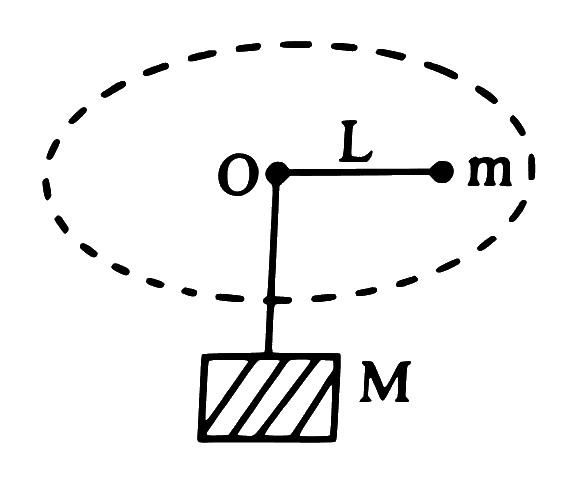
The figure shows two masses ' mm ' and ' MM ' connected by a light string that passes through a\text{a} small hole ' OO ' at the centre of the table. Mass ' mm ' is moved round in a horizontal circle with ' OO ' as the centre. The frequency with which ' mm ' should be revolved so that ' MM ' remains stationary is ( g=g = gravitational acceleration)

Figure

Show answer and solution

Answer: (b)

  1. M stays at rest, so string tension T=MgT = Mg.
  2. The same tension gives the centripetal force on m: Mg=mω2LMg = m\omega^2 L.
  3. ω=MgmL\omega = \sqrt{\frac{Mg}{mL}}, and f=ω2πf = \frac{\omega}{2\pi}.
  4. So the answer is (b) 12πMgmL\frac{1}{2\pi}\sqrt{\frac{Mg}{mL}}.
Report a mistake
Q42MHT CET 2025 · 22 APR · SHIFT 1Medium

Centripetal Acceleration & Force · Spring or string provides the force

A body of mass 100 gram is tied to a spring of spring constant 8 N/m8\text{ N/m}, while the other end of a spring is fixed. If the body moves in a circular path on smooth horizontal surface with constant angular speed 8 rad/s8\text{ rad/s} then the ratio of extension in the spring to its natured length will be

Show answer and solution

Answer: (d)

  1. Spring force gives the centripetal force: kx=mω2(l+x)kx = m\omega^2(l + x), where ll is the natural length.
  2. 8x=0.1×64 (l+x)=6.4(l+x)8x = 0.1 \times 64\,(l + x) = 6.4(l + x)
  3. 1.6x=6.4l⇒xl=41.6x = 6.4l \Rightarrow \frac{x}{l} = 4
  4. So the answer is (d) 4:14 : 1.
Report a mistake
Q43JEE Main 2025 · 22 JAN · SHIFT 2Difficult

Centripetal Acceleration & Force · Spring or string provides the force

A tube of length 1 m is filled completely with an ideal liquid of mass 2 M, and closed at both ends. The tube is rotated uniformly in horizontal plane about one of its ends. If the force exerted by the liquid at the other end is F then angular velocity of the tube is FαM\sqrt{\frac{F}{\alpha M}} in SI unit. The value of α\alpha is _________.

Numerical answer type. Work it out, then open the answer.

Show answer and solution

Answer: 1

  1. The end wall must supply the centripetal force for the whole liquid column.
  2. Element dm=2MLdxdm = \frac{2M}{L}dx at distance xx needs dm ω2xdm\,\omega^2 x.
  3. F=∫0L2MLω2x dx=Mω2L=Mω2F = \int_0^L \frac{2M}{L}\omega^2 x\,dx = M\omega^2 L = M\omega^2 (with L=1L = 1 m).
  4. ω=FM⇒α=1\omega = \sqrt{\frac{F}{M}} \Rightarrow \alpha = 1
  5. Answer: α=1\alpha = 1.
Report a mistake
Q44MHT CET 2024 · 16 MAY · SHIFT 2Easy

Centripetal Acceleration & Force · Centripetal acceleration

A body performing uniform circular motion of radius ' RR ' has frequency ' nn '. Its centripetal acceleration per unit radius is proportional to (n)x(n)^x. The value of xx is

Show answer and solution

Answer: (b)

  1. a=ω2R=4π2n2Ra = \omega^2 R = 4\pi^2 n^2 R.
  2. aR=4π2n2∝n2\frac{a}{R} = 4\pi^2 n^2 \propto n^2, so x=2x = 2.
  3. So the answer is (b) 2.
Report a mistake
Q45MHT CET 2024 · 2 MAY · SHIFT 1Easy

Centripetal Acceleration & Force · Centripetal acceleration

A particle is performing uniform circular motion along the circumference of the circle of diameter 1 m with frequency 4 Hz. The acceleration of the particle in m/s2\text{m/s}^2 is

Show answer and solution

Answer: (d)

  1. r=0.5r = 0.5 m, ω=2πn=8π\omega = 2\pi n = 8\pi rad/s.
  2. a=ω2r=64π2×0.5=32π2a = \omega^2 r = 64\pi^2 \times 0.5 = 32\pi^2 m/s2^2.
  3. So the answer is (d) 32π232\pi^2.
Report a mistake
Q46JEE Main 2024 · 5 APR · SHIFT 2Easy

Centripetal Acceleration & Force · Centripetal acceleration

A man carrying a monkey on his shoulder does cycling smoothly on a circular track of radius 9 m9\text{ m} and completes 120 revolutions in 3 minutes. The magnitude of centripetal acceleration of monkey is (in m/s2\text{m/s}^2):

Show answer and solution

Answer: (b)

  1. Frequency n=120180 s=23 Hzn = \frac{120}{180\text{ s}} = \frac{2}{3}\text{ Hz}, so ω=2πn=4π3 rad/s\omega = 2\pi n = \frac{4\pi}{3}\text{ rad/s}.
  2. The monkey moves with the man on the same circle, so a=ω2ra = \omega^2 r.
  3. a=16π29×9=16π2 m/s2a = \frac{16\pi^2}{9} \times 9 = 16\pi^2\text{ m/s}^2
  4. So the answer is (b) 16π2 m s−216\pi^2\text{ m s}^{-2}.
Report a mistake
Q47MHT CET 2024 · 15 MAY · SHIFT 2Easy

Centripetal Acceleration & Force · What stays constant in UCM

A particle is moving in a circle with uniform speed. It has constant

Show answer and solution

Answer: (c)

  1. Velocity and acceleration change direction every instant, so they are not constant vectors.
  2. Displacement keeps changing as the particle moves.
  3. Speed is constant, so KE=12mv2KE = \frac{1}{2}mv^2 is constant.
  4. So the answer is (c) kinetic energy.
Report a mistake
Q48MHT CET 2024 · 10 MAY · SHIFT 1Easy

Centripetal Acceleration & Force · What stays constant in UCM

For a particle in uniform circular motion

Show answer and solution

Answer: (b)

  1. In UCM velocity is along the tangent and its magnitude (speed) stays the same.
  2. Acceleration is radial (towards the centre), not tangential and not along the axis.
  3. So the answer is (b).
Report a mistake
Q49JEE Main 2024 · 29 JAN · SHIFT 1Easy

Centripetal Acceleration & Force · Centripetal force & ratios

If the radius of curvature of the path of two particles of same mass are in the ratio 3:43 : 4, then in order to have constant centripetal force, their velocities will be in the ratio of:

Show answer and solution

Answer: (c)

  1. F=mv2rF = \frac{mv^2}{r} with same mm and same FF gives v2∝rv^2 \propto r.
  2. v1v2=r1r2=34=32\frac{v_1}{v_2} = \sqrt{\frac{r_1}{r_2}} = \sqrt{\frac{3}{4}} = \frac{\sqrt{3}}{2}
  3. So the answer is (c) 3:2\sqrt{3} : 2.
Report a mistake
Q50MHT CET 2024 · 11 MAY · SHIFT 2Medium

Centripetal Acceleration & Force · Centripetal force & ratios

A particle of mass ' mm ' is performing uniform circular motion along a circular path of radius ' rr '. Its angular momentum about the axis passing through the centre and perpendicular to the plane is ' LL '. The kinetic energy of the particle is

Show answer and solution

Answer: (a)

  1. Angular momentum L=mvr⇒v=LmrL = mvr \Rightarrow v = \frac{L}{mr}.
  2. KE=12mv2=12mL2m2r2KE = \frac{1}{2}mv^2 = \frac{1}{2}m\frac{L^2}{m^2r^2}
  3. KE=L22mr2KE = \frac{L^2}{2mr^2}
  4. So the answer is (a).
Report a mistake
Q51MHT CET 2024 · 10 MAY · SHIFT 2Medium

Centripetal Acceleration & Force · Centripetal force & ratios

A particle of mass ' mm ' performs uniform circular motion of radius ' rr ' with linear speed ' vv ' under the application of force ' FF '. If ' mm ', ' vv ' and rr ' are all increased by 20%20\% the necessary change in force required to maintain the particle in uniform circular motion, is

Show answer and solution

Answer: (b)

  1. F=mv2rF = \frac{mv^2}{r}
  2. F′=(1.2m)(1.2v)21.2r=1.44 FF' = \frac{(1.2m)(1.2v)^2}{1.2r} = 1.44\,F
  3. Increase =44%= 44\%
  4. So the answer is (b) 44%44\%.
Report a mistake
Q52JEE Main 2024 · 1 FEB · SHIFT 1Medium

Centripetal Acceleration & Force · Radius of curvature

A particle moving in a circle of radius RR with uniform speed takes time TT to complete one revolution.

If this particle is projected with the same speed at an angle θ\theta to the horizontal, the maximum height attained by it is equal to 4R4R. The angle of projection θ\theta is then given by:

Show answer and solution

Answer: (a)

  1. Speed in the circle: v=2πRTv = \frac{2\pi R}{T}.
  2. Maximum height: H=v2sin⁡2θ2g=4R⇒sin⁡2θ=8gRv2H = \frac{v^2\sin^2\theta}{2g} = 4R \Rightarrow \sin^2\theta = \frac{8gR}{v^2}.
  3. sin⁡2θ=8gR T24π2R2=2gT2π2R\sin^2\theta = \frac{8gR\,T^2}{4\pi^2R^2} = \frac{2gT^2}{\pi^2 R}
  4. So the answer is (a) θ=sin⁡−1[2gT2π2R]1/2\theta = \sin^{-1}\left[\frac{2gT^2}{\pi^2 R}\right]^{1/2}.
Report a mistake
Q53JEE Main 2023 · 30 JAN · SHIFT 2Easy

Centripetal Acceleration & Force · Centripetal acceleration

A stone tied to 180 cm180\text{ cm} long string at its end is making 28 revolutions in horizontal circle in every minute. The magnitude of acceleration of stone is 1936x m s−2\frac{1936}{x}\text{ m s}^{-2}. The value of xx ________. (Take π=227\pi = \frac{22}{7})

Numerical answer type. Work it out, then open the answer.

Show answer and solution

Answer: 125

  1. r=1.8 mr = 1.8\text{ m}, n=2860=715 Hzn = \frac{28}{60} = \frac{7}{15}\text{ Hz}.
  2. ω=2πn=2×227×715=4415 rad/s\omega = 2\pi n = 2 \times \frac{22}{7} \times \frac{7}{15} = \frac{44}{15}\text{ rad/s}
  3. a=ω2r=1936225×1.8=1936125 m/s2a = \omega^2 r = \frac{1936}{225} \times 1.8 = \frac{1936}{125}\text{ m/s}^2
  4. So x=125x = 125.
Report a mistake
Q54JEE Main 2023 · 13 APR · SHIFT 2Easy

Centripetal Acceleration & Force · Centripetal force & ratios

A vehicle of mass 200 kg200\text{ kg} is moving along a levelled curved road of radius 70 m70\text{ m} with angular velocity of 0.2 rad/s0.2\text{ rad/s}. The centripetal force acting on the vehicle is:

Show answer and solution

Answer: (a)

  1. F=mω2rF = m\omega^2 r
  2. F=200×(0.2)2×70=200×0.04×70F = 200 \times (0.2)^2 \times 70 = 200 \times 0.04 \times 70
  3. F=560 NF = 560\text{ N}
  4. So the answer is (a) 560 N560\text{ N}.
Report a mistake
Q55JEE Main 2023 · 6 APR · SHIFT 2Easy

Centripetal Acceleration & Force · Centripetal force & ratios

A child of mass 5 kg5\text{ kg} is going round a merry-go-round that makes 1 rotation in 3.14 s3.14\text{ s}. The radius of the merry-go-round is 2 m2\text{ m}. The centrifugal force on the child will be

Show answer and solution

Answer: (d)

  1. ω=2πT=2×3.143.14=2 rad/s\omega = \frac{2\pi}{T} = \frac{2 \times 3.14}{3.14} = 2\text{ rad/s}
  2. Centrifugal force (in the rotating frame) =mω2r=5×4×2= m\omega^2 r = 5 \times 4 \times 2
  3. =40 N= 40\text{ N}
  4. So the answer is (d) 40 N.
Report a mistake
Q56JEE Main 2023 · 29 JAN · SHIFT 2Medium

Centripetal Acceleration & Force · Centripetal acceleration

An object moves at a constant speed along a circular path in a horizontal plane with center at the origin. When the object is at x=+2 mx = +2\text{ m}, its velocity is −4j^-4\hat{j} m/s. The object's velocity (v) and acceleration (a) at x=−2 mx = -2\text{ m} will be

Show answer and solution

Answer: (b)

O-4jx=+2v = +4ja = +8ix=-2
  1. Radius r=2 mr = 2\text{ m}, speed v=4 m/sv = 4\text{ m/s}. At (2,0)(2, 0) velocity is −j^-\hat{j}, so the motion is clockwise.
  2. At (−2,0)(-2, 0), half a turn later, the velocity is reversed: v⃗=+4j^ m/s\vec v = +4\hat{j}\text{ m/s}.
  3. a=v2r=162=8 m/s2a = \frac{v^2}{r} = \frac{16}{2} = 8\text{ m/s}^2, pointing to the centre, i.e. along +i^+\hat{i}.
  4. So the answer is (b) v=4j^v = 4\hat{j}, a=8i^a = 8\hat{i}.
Report a mistake
Q57MHT CET 2023 · 10 MAY · SHIFT 1Medium

Centripetal Acceleration & Force · Spring or string provides the force

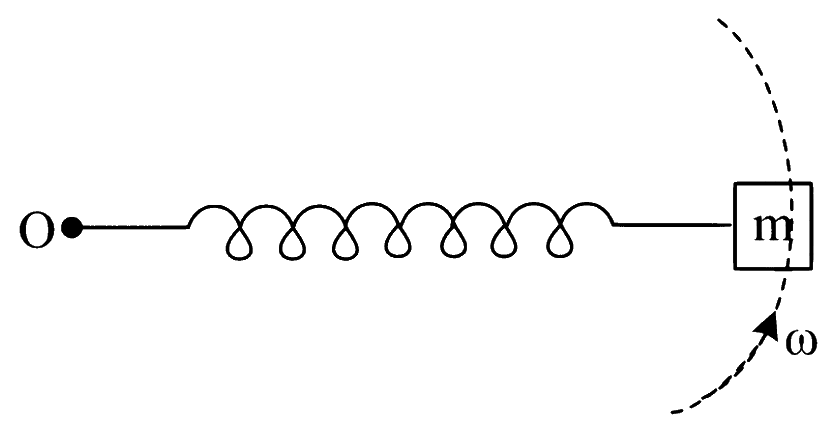
A body of mass 200 gram is tied to a spring of spring constant 12.5 N/m12.5\text{ N/m}, while other end of spring is fixed at point 'OO'. If the body moves about 'OO' in a circular path on a smooth horizontal surface with constant angular speed 5 rad/s5\text{ rad/s} then the ratio of extension in the spring to its natural length will be

Figure

Show answer and solution

Answer: (c)

  1. Spring force gives the centripetal force: kx=mω2(l+x)kx = m\omega^2(l + x).
  2. mω2=0.2×25=5m\omega^2 = 0.2 \times 25 = 5, so 12.5x=5(l+x)12.5x = 5(l + x).
  3. 7.5x=5l⇒xl=237.5x = 5l \Rightarrow \frac{x}{l} = \frac{2}{3}
  4. So the answer is (c) 2:32 : 3.
Report a mistake
Q58JEE Main 2023 · 6 APR · SHIFT 1Medium

Centripetal Acceleration & Force · Spring or string provides the force

A small block of mass 100 g100\text{ g} is tied to a spring of spring constant 7.5 N/m7.5\text{ N/m} and length 20 cm20\text{ cm}. The other end of spring is fixed at a particular point A. If the block moves in a circular path on a smooth horizontal surface with constant angular velocity 5 rad/s5\text{ rad/s} about point AA, then tension in the spring is -

Show answer and solution

Answer: (c)

  1. Spring force gives the centripetal force: kx=mω2(l+x)kx = m\omega^2(l + x).
  2. mω2=0.1×25=2.5m\omega^2 = 0.1 \times 25 = 2.5, so 7.5x=2.5(0.2+x)7.5x = 2.5(0.2 + x).
  3. 5x=0.5⇒x=0.1 m5x = 0.5 \Rightarrow x = 0.1\text{ m}
  4. Tension =kx=7.5×0.1=0.75 N= kx = 7.5 \times 0.1 = 0.75\text{ N}. So the answer is (c) 0.75 N.
Report a mistake
Q59JEE Main 2023 · 24 JAN · SHIFT 2Medium

Centripetal Acceleration & Force · Spring or string provides the force

A body of mass 200g is tied to a spring of spring constant 12.5 N/m, while the other end of spring is fixed at point O. If the body moves about O in a circular path on a smooth horizontal surface with constant angular speed 5 rad/s, then the ratio of extension in the spring to its natural length will be:

Show answer and solution

Answer: (b)

  1. Spring force gives the centripetal force: kx=mω2(l+x)kx = m\omega^2(l + x).
  2. mω2=0.2×25=5m\omega^2 = 0.2 \times 25 = 5, so 12.5x=5(l+x)12.5x = 5(l + x).
  3. 7.5x=5l⇒xl=237.5x = 5l \Rightarrow \frac{x}{l} = \frac{2}{3}
  4. So the answer is (b) 2:32 : 3.
Report a mistake
Q60MHT CET 2023 · 13 MAY · SHIFT 2Medium

Centripetal Acceleration & Force · Radius of curvature

A stone is projected at angle θ\theta with velocity uu. If it executes nearly a circular motion at its maximum point for short time, then the radius of the circular path will be ( g=g = acceleration due to gravity)

Show answer and solution

Answer: (b)

  1. At the highest point the velocity is horizontal: v=ucos⁡θv = u\cos\theta.
  2. Gravity is perpendicular to the velocity there, so it supplies the centripetal force: g=v2rg = \frac{v^2}{r}.
  3. r=u2cos⁡2θgr = \frac{u^2\cos^2\theta}{g}
  4. So the answer is (b) u2cos⁡2θg\frac{u^2 \cos^2 \theta}{g}.
Report a mistake
Q61MHT CET 2022 · 11 AUG · SHIFT 2Easy

Centripetal Acceleration & Force · What stays constant in UCM

A body moving in a circular path with a constant speed has constant

Show answer and solution

Answer: (d)

  1. Momentum, velocity and acceleration are vectors whose direction keeps changing.
  2. Speed is constant, so KE=12mv2KE = \frac{1}{2}mv^2 is constant.
  3. So the answer is (d) kinetic energy.
Report a mistake
Q62JEE Main 2022 · 25 JUN · SHIFT 2Medium

Centripetal Acceleration & Force · Centripetal acceleration

For a particle in uniform circular motion, the accelerationa⃗\vec{a}at any point P(R, θ\theta) on the circular path of radius R is (when θ\theta is measured from the positive x-axis and v is uniform speed):

Show answer and solution

Answer: (c)

  1. In UCM the acceleration has magnitude v2R\frac{v^2}{R} and points from P towards the centre.
  2. Position unit vector of P is cos⁡θ i^+sin⁡θ j^\cos\theta\,\hat{i} + \sin\theta\,\hat{j}; the acceleration is opposite to it.
  3. a⃗=−v2Rcos⁡θ i^−v2Rsin⁡θ j^\vec a = -\frac{v^2}{R}\cos\theta\,\hat{i} - \frac{v^2}{R}\sin\theta\,\hat{j}
  4. So the answer is (c).
Report a mistake
Q63MHT CET 2022 · 11 AUG · SHIFT 2Medium

Centripetal Acceleration & Force · Centripetal force & ratios

Two bodies of masses 'mm' and '3m3m' are rotating in horizontal circles of radii 'rr' and ' r3\frac{r}{3}' respectively. The tangential speed of the body of mass 'mm' is nn times that of the heavier body; while the centripetal force is same for both. The value of nn is

Show answer and solution

Answer: (a)

  1. Equal forces: mv12r=3mv22r/3=9mv22r\frac{m v_1^2}{r} = \frac{3m v_2^2}{r/3} = \frac{9 m v_2^2}{r}.
  2. v12=9v22⇒v1=3v2v_1^2 = 9 v_2^2 \Rightarrow v_1 = 3 v_2
  3. So n=3n = 3. The answer is (a) 3.
Report a mistake
Q64JEE Main 2022 · 30 JUL · SHIFT 2Medium

Centripetal Acceleration & Force · Spring or string provides the force

A mass of 0.5 kg0.5\text{ kg} is attached to one end of a massless spring whose natural length is 1 m1\text{ m} and spring constant is 800 N/m800\text{ N/m} The other end of the spring is fixed while the mass moves in a circular path in a horizontal plane with an angular speed of 20 rad/s20\text{ rad/s}. The extension in the length of the spring will be:

Show answer and solution

Answer: (c)

  1. Spring force gives the centripetal force: kx=mω2(l+x)kx = m\omega^2(l + x).
  2. mω2=0.5×400=200m\omega^2 = 0.5 \times 400 = 200, so 800x=200(1+x)800x = 200(1 + x).
  3. 600x=200⇒x=13 m600x = 200 \Rightarrow x = \frac{1}{3}\text{ m}
  4. So the answer is (c) 13 m\frac{1}{3}\text{ m}.
Report a mistake
Q65JEE Main 2022 · 29 JUL · SHIFT 1Medium

Centripetal Acceleration & Force · Spring or string provides the force

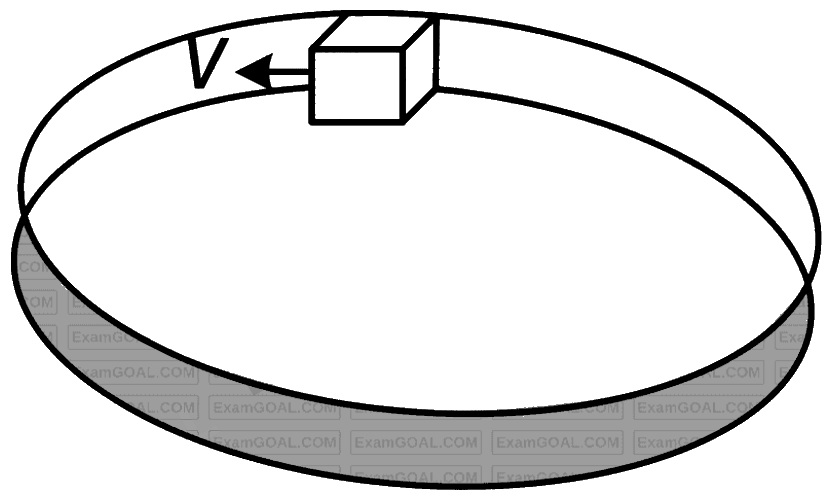
A smooth circular groove has a smooth vertical wall as shown in figure. A block of mass m moves against the wall with a speed v. Which of the following curve represents the correct relation between the normal reaction on the block by the wall (N) and speed of the block (v)?

Figure

Show answer and solution

Answer: (a)

  1. The wall's normal reaction provides the centripetal force: N=mv2RN = \frac{mv^2}{R}.
  2. So N∝v2N \propto v^2: a parabola through the origin, curving upward.
  3. So the answer is (a).
Report a mistake
Q66MHT CET 2021 · 24 SEP · SHIFT 2Easy

Centripetal Acceleration & Force · Centripetal acceleration

A particle is moving along the circular path with constant speed and centripetal acceleration 'a'. If the speed is doubled, the ratio of its acceleration after and before the change is

Show answer and solution

Answer: (d)

  1. a=v2r⇒a∝v2a = \frac{v^2}{r} \Rightarrow a \propto v^2 for the same radius.
  2. Doubling vv gives a′=4aa' = 4a.
  3. So the answer is (d) 4:14:1.
Report a mistake
Q67MHT CET 2021 · 23 SEP · SHIFT 2Easy

Centripetal Acceleration & Force · Centripetal acceleration

A particle is performing U.C.M. along the circumference of a circle of diameter 50 cm50\text{ cm} with frequency 2 Hz2\text{ Hz}. The acceleration of the particle in m/s2\text{m/s}^2 is

Show answer and solution

Answer: (b)

  1. r=25r = 25 cm =0.25= 0.25 m, ω=2πn=4π\omega = 2\pi n = 4\pi rad/s.
  2. a=ω2r=16π2×0.25=4π2a = \omega^2 r = 16\pi^2 \times 0.25 = 4\pi^2 m/s2^2.
  3. So the answer is (b) 4π24\pi^2.
Report a mistake
Q68MHT CET 2021 · 22 SEP · SHIFT 1Easy

Centripetal Acceleration & Force · Centripetal acceleration

A body performing uniform circular motion of radius 'R' has frequency 'n'. It centripetal acceleration is

Show answer and solution

Answer: (b)

  1. Centripetal acceleration a=ω2Ra = \omega^2 R with ω=2πn\omega = 2\pi n.
  2. a=(2πn)2R=4π2n2Ra = (2\pi n)^2 R = 4\pi^2 n^2 R
  3. So the answer is (b) 4π2n2R4\pi^2 n^2 R.
Report a mistake
Q69JEE Main 2021 · 16 MAR · SHIFT 1Easy

Centripetal Acceleration & Force · Spring or string provides the force

A block of 200 g mass moves with a uniform speed in a horizontal circular groove, with vertical side walls of radius 20 cm. If the block takes 40 s to complete one round, the normal force by the side walls of the groove is:

Show answer and solution

Answer: (c)

  1. The side wall's normal force provides the centripetal force: N=mω2rN = m\omega^2 r.
  2. ω=2π40=0.157 rad/s\omega = \frac{2\pi}{40} = 0.157\text{ rad/s}, ω2=0.02467\omega^2 = 0.02467
  3. N=0.2×0.02467×0.2=9.87×10⁻⁴ NN = 0.2 \times 0.02467 \times 0.2 = 9.87 \times 10^{-4}\text{ N}
  4. So the answer is (c) 9.859×10⁻⁴ N9.859 \times 10^{-4}\text{ N}.
Report a mistake
Q70MHT CET 2021 · 24 SEP · SHIFT 2Medium

Centripetal Acceleration & Force · Centripetal force & ratios

A body of mass 'm' is moving with speed 'V' along a circular path of radius 'r'. Now the speed is reduced to V2\frac{V}{2} and radius is increased to '3r'. For this change, initial centripetal force needs to be

Show answer and solution

Answer: (c)

  1. F=mV2rF = \frac{mV^2}{r}
  2. F′=m(V/2)23r=112mV2r=F12F' = \frac{m(V/2)^2}{3r} = \frac{1}{12}\frac{mV^2}{r} = \frac{F}{12}
  3. Change =F−F12=1112F= F - \frac{F}{12} = \frac{11}{12}F, a decrease.
  4. So the answer is (c) decreased by 1112\frac{11}{12}.
Report a mistake
Q71MHT CET 2021 · 21 SEP · SHIFT 1Medium

Centripetal Acceleration & Force · Central force orbits

A particle moves in a circular orbit of radius 'rr' under a central attractive force, F=−krF = -\frac{k}{r}, where kk is a constant. The periodic time of its motion is proportional to

Show answer and solution

Answer: (c)

  1. Central force gives the centripetal force: mv2r=kr\frac{mv^2}{r} = \frac{k}{r}.
  2. v=kmv = \sqrt{\frac{k}{m}}, independent of rr.
  3. T=2πrv∝rT = \frac{2\pi r}{v} \propto r
  4. So the answer is (c) rr.
Report a mistake
Q72JEE Main 2021 · 26 FEB · SHIFT 1Medium

Centripetal Acceleration & Force · Central force orbits

A particle is moving with uniform speed along the circumference of a circle of radius R under the action of a central fictitious force F which is inversely proportional to R3. Its time period of revolution will be given by:

Show answer and solution

Answer: (d)

  1. mω2R=F∝1R3m\omega^2 R = F \propto \frac{1}{R^3}
  2. ω2∝R−4⇒ω∝R−2\omega^2 \propto R^{-4} \Rightarrow \omega \propto R^{-2}
  3. T=2πω∝R2T = \frac{2\pi}{\omega} \propto R^2
  4. So the answer is (d) T∝R2T \propto R^2.
Report a mistake
Q73MHT CET 2021 · 23 SEP · SHIFT 2Medium

Centripetal Acceleration & Force · Radius of curvature

A projectile is thrown with an initial velocity (ai^+bj^) m/s(a\hat{i} + b\hat{j})\text{ m/s}, where i^\hat{i} and j^\hat{j} are unit vectors along horizontal and vertical directions respectively. If the range of the projectile is twice the maximum height reached by it, then

Show answer and solution

Answer: (a)

  1. Here ux=au_x = a, uy=bu_y = b. Range R=2uxuyg=2abgR = \frac{2u_xu_y}{g} = \frac{2ab}{g}, maximum height H=uy22g=b22gH = \frac{u_y^2}{2g} = \frac{b^2}{2g}.
  2. R=2H⇒2abg=b2gR = 2H \Rightarrow \frac{2ab}{g} = \frac{b^2}{g}
  3. b=2ab = 2a
  4. So the answer is (a) b=2ab = 2a.
Report a mistake
Q74JEE Main 2021 · 18 MAR · SHIFT 2Difficult

Centripetal Acceleration & Force · Central force orbits

A particle of mass m moves in a circular orbit under the central potential field, U(r)=−CrU(r) = -\frac{C}{r}, where C is a positive constant. The correct radius −- velocity graph of the particle's motion is:

Show answer and solution

Answer: (b)

  1. Force F=−dUdr=−Cr2F = -\frac{dU}{dr} = -\frac{C}{r^2} (attractive), magnitude Cr2\frac{C}{r^2}.
  2. mv2r=Cr2⇒v2=Cmr\frac{mv^2}{r} = \frac{C}{r^2} \Rightarrow v^2 = \frac{C}{mr}
  3. r∝1v2r \propto \frac{1}{v^2}: rr falls steeply as vv rises, a decreasing curve approaching both axes.
  4. So the answer is (b).
Report a mistake
Q75JEE Main 2020 · 6 SEP · SHIFT 1Easy

Centripetal Acceleration & Force · Centripetal acceleration

A clock has a continuously moving second's hand of 0.1 m length. The average acceleration of the tip of the hand (in units of ms–2) is of the order of:

Show answer and solution

Answer: (a)

  1. Second hand: T=60 sT = 60\text{ s}, so ω=2π60≈0.105 rad/s\omega = \frac{2\pi}{60} \approx 0.105\text{ rad/s}.
  2. Tip moves uniformly, so its acceleration is centripetal: a=ω2ra = \omega^2 r.
  3. a=(0.105)2×0.1≈1.1×10⁻³ m/s2a = (0.105)^2 \times 0.1 \approx 1.1 \times 10^{-3}\text{ m/s}^2
  4. So the answer is (a) of the order 10−310^{-3}.
Report a mistake
Q76MHT CET 2020 · 16 OCT · SHIFT 2Medium

Centripetal Acceleration & Force · Centripetal force & ratios

A particle of mass mm is performing UCM along a circle of radius rr. The relation between centripetal acceleration aa and kinetic energy EE is given by

Show answer and solution

Answer: (a)

  1. E=12mv2⇒v2=2EmE = \frac{1}{2}mv^2 \Rightarrow v^2 = \frac{2E}{m}
  2. a=v2r=2Emra = \frac{v^2}{r} = \frac{2E}{mr}
  3. So the answer is (a) a=2Emra = \frac{2E}{mr}.
Report a mistake
Q77JEE Main 2020 · 8 JAN · SHIFT 1Difficult

Centripetal Acceleration & Force · Spring or string provides the force

A particle of mass m is fixed to one end of a light spring having force constant k and unstretched length ℓ\ell. The other end is fixed. The system is given an angular speed ω\omega about the fixed end of the spring such that it rotates in a circle in gravity free space. Then the stretch in the spring is:

Show answer and solution

Answer: (a)

  1. Spring force provides the centripetal force; radius of the circle is ℓ+x\ell + x.
  2. kx=mω2(ℓ+x)kx = m\omega^2(\ell + x)
  3. x(k−mω2)=mℓω2⇒x=mℓω2k−mω2x(k - m\omega^2) = m\ell\omega^2 \Rightarrow x = \frac{m\ell\omega^2}{k - m\omega^2}
  4. So the answer is (a).
Report a mistake
Q78MHT CET 2019 · 2 MAY · SHIFT 2Easy

Centripetal Acceleration & Force · Centripetal acceleration

A particle is performing U.C.M. along the circumference of a circle of diameter 50 cm with frequency 2 Hz. The acceleration of the particle in m/s2\text{m/s}^2 is

Show answer and solution

Answer: (d)

  1. Radius r=50/2=25 cm=0.25 mr = 50/2 = 25\text{ cm} = 0.25\text{ m}, n=2 Hzn = 2\text{ Hz}.
  2. a=4π2n2r=4π2(4)(0.25)a = 4\pi^2 n^2 r = 4\pi^2 (4)(0.25)
  3. a=4π2 m/s2a = 4\pi^2\text{ m/s}^2
  4. So the answer is (d) 4π24\pi^2.
Report a mistake
Q79MHT CET 2019 · 3 MAY · SHIFT 1Easy

Centripetal Acceleration & Force · What stays constant in UCM

A body of mass mm is performing a UCM in a circle of radius rr with speed vv. The work done by the centripetal force in moving it through (23)rd\left(\frac{2}{3}\right)\text{rd} of the circular path is

Show answer and solution

Answer: (a)

  1. Centripetal force is along the radius; displacement at every instant is along the tangent.
  2. dW=F dscos⁡90∘=0dW = F\,ds\cos 90^\circ = 0 at every point.
  3. So the work over any part of the circle is zero. The answer is (a) zero.
Report a mistake
Q80MHT CET 2019 · 3 MAY · SHIFT 1Medium

Centripetal Acceleration & Force · Centripetal force & ratios

A mass is whirled in a circular path with constant angular velocity and its linear velocity is vv. If the string is now halved keeping the angular momentum same, the linear velocity is

Show answer and solution

Answer: (a)

  1. Angular momentum L=mvrL = mvr is kept the same.
  2. String halved: r′=r2r' = \frac{r}{2}, so mv′r2=mvrm v' \frac{r}{2} = mvr.
  3. v′=2vv' = 2v
  4. So the answer is (a) 2v2v.
Report a mistake
Q81MHT CET 2019 · 2 MAY · SHIFT 1Medium

Centripetal Acceleration & Force · Centripetal force & ratios

The real force ' FF ' acting on a particle of mass mm ' performing circular motion acts along the radius of circle ' rr ' and is directed towards the centre of circle. The square root of magnitude of such force is ( T=T = periodic time)

Show answer and solution

Answer: (a)

  1. Centripetal force F=mω2r=4π2mrT2F = m\omega^2 r = \frac{4\pi^2 m r}{T^2}.
  2. F=2πTmr\sqrt{F} = \frac{2\pi}{T}\sqrt{mr}
  3. So the answer is (a) 2πTmr\frac{2\pi}{T}\sqrt{mr}.
Report a mistake
Q82JEE Main 2019 · 11 JAN · SHIFT 1Difficult

Centripetal Acceleration & Force · Radius of curvature

A body is projected at t = 0 with a velocity 10 ms–1 at an angle of 60o with the horizontal. The radius of curvature of its trajectory at t = 1s is R. neglecting air resistance and taking acceleration due to gravity g = 10 ms–2, the value of R is:

Show answer and solution

Answer: (a)

  1. ux=10cos⁡60∘=5u_x = 10\cos 60^\circ = 5 m/s, uy=10sin⁡60∘=53≈8.66u_y = 10\sin 60^\circ = 5\sqrt{3} \approx 8.66 m/s.
  2. At t=1t = 1 s: vy=8.66−10=−1.34v_y = 8.66 - 10 = -1.34 m/s, v2=25+1.80=26.8v^2 = 25 + 1.80 = 26.8, v≈5.18v \approx 5.18 m/s.
  3. Normal acceleration an=gcos⁡ϕ=gvxv=10×55.18≈9.66a_n = g\cos\phi = g\frac{v_x}{v} = 10 \times \frac{5}{5.18} \approx 9.66 m/s2^2.
  4. R=v2an=26.89.66≈2.8R = \frac{v^2}{a_n} = \frac{26.8}{9.66} \approx 2.8 m
  5. So the answer is (a) 2.8 m.
Report a mistake
Q83JEE Main 2015 · 10 APR · SHIFT 1Easy

Centripetal Acceleration & Force · Centripetal acceleration

If a body moving in a circular path maintains constant speed of 10ms−1{}^{-1}, then which of the following correctly describes relation between acceleration and radius?

Show answer and solution

Answer: (c)

  1. For constant speed vv, a=v2r=100ra = \frac{v^2}{r} = \frac{100}{r}.
  2. So a∝1ra \propto \frac{1}{r}: a rectangular hyperbola, aa falls as rr grows.
  3. So the answer is (c), the falling hyperbola-shaped curve.
Report a mistake
Q84JEE Main 2013 · 23 APR · SHIFT 1Medium

Centripetal Acceleration & Force · Spring or string provides the force

A body of mass 'm' is tied to one end of a spring and whirled round in a horizontal plane with a constant angular velocity. The elongation in the spring is 1 cm. If the angular velocity is doubled, the elongation in the spring is 5 cm. The original length of the spring is:

Show answer and solution

Answer: (a)

  1. Spring force gives the centripetal force: kx=mω2(l+x)kx = m\omega^2(l + x).
  2. Case 1: k(1)=mω2(l+1)k(1) = m\omega^2(l + 1). Case 2: k(5)=m(4ω2)(l+5)k(5) = m(4\omega^2)(l + 5).
  3. Dividing: 5=4(l+5)l+1⇒5l+5=4l+205 = \frac{4(l + 5)}{l + 1} \Rightarrow 5l + 5 = 4l + 20
  4. l=15 cml = 15\text{ cm}. So the answer is (a) 15 cm.
Report a mistake
Q85JEE Main 2012 · AIEEEEasy

Centripetal Acceleration & Force · Centripetal acceleration

Two cars of masses m1 and m2 are moving in circles of radii r1 and r2, respectively. Their speeds are such that they make complete circles in the same time t. The ratio of their centripetal acceleration is

Show answer and solution

Answer: (c)

  1. Same time period tt means same angular speed ω=2πt\omega = \frac{2\pi}{t}.
  2. a=ω2ra = \omega^2 r, so a∝ra \propto r (mass does not matter).
  3. a1:a2=r1:r2a_1 : a_2 = r_1 : r_2
  4. So the answer is (c) r1:r2r_1 : r_2.
Report a mistake
Q86JEE Main 2010 · AIEEEMedium

Centripetal Acceleration & Force · Centripetal acceleration

For a particle in uniform circular motion the accelerationa⃗\vec{a}at a point P(R, θ) on the circle of radius R is (here θ is measured from the x–axis)

Show answer and solution

Answer: (c)

  1. Acceleration in UCM is v2R\frac{v^2}{R} directed from P to the centre O.
  2. Unit vector from O to P is cos⁡θ i^+sin⁡θ j^\cos\theta\,\hat{i} + \sin\theta\,\hat{j}, so a⃗\vec a is along its negative.
  3. a⃗=−v2Rcos⁡θ i^−v2Rsin⁡θ j^\vec a = -\frac{v^2}{R}\cos\theta\,\hat{i} - \frac{v^2}{R}\sin\theta\,\hat{j}
  4. So the answer is (c).
Report a mistake
Q87JEE Main 2004 · AIEEEEasy

Centripetal Acceleration & Force · What stays constant in UCM

Which of the following statements is FALSE for a particle moving in a circle with a constant angular speed?

Show answer and solution

Answer: (b)

  1. With constant angular speed, acceleration is only centripetal, a=ω2ra = \omega^2 r towards the centre.
  2. Velocity is tangential, so v⃗⊥a⃗\vec v \perp \vec a; (a), (c), (d) are true.
  3. The acceleration is not tangent to the circle.
  4. So the answer is (b).
Report a mistake
Q88JEE Main 2026 · 2 APR · SHIFT 2Easy

Level Road & Rotating Platform · Drum & wall of death

A 0.5 kg mass is in contact against the inner wall of a cylindrical drum of radius 4 m rotating about its vertical axis. The minimum rotational speed of the drum to enable the mass to remain stuck to the wall (without falling) is 5 rad/s. The coefficient of friction between the drum’s inner wall surface and mass is _________. (Take g=10 m/s2g = 10\text{ m/s}^2)

Show answer and solution

Answer: (a)

  1. Wall's normal force gives the centripetal force: N=mω2rN = m\omega^2 r.
  2. Friction holds the weight: μN≥mg⇒μ=gωmin2r\mu N \ge mg \Rightarrow \mu = \frac{g}{\omega_{min}^2 r}.
  3. μ=1025×4=0.1\mu = \frac{10}{25 \times 4} = 0.1
  4. So the answer is (a) 0.1.
Report a mistake
Q89MHT CET 2026 · 19 MAY · SHIFT 1Medium

Level Road & Rotating Platform · Skidding on a level road

On a dry curved (banked) road, with banking angle of zero, the maximum safe speed for a moving vehicle is 'vv'. After heavy rain, the maximum safe speed for the same road was reduced by 60%. The ratio of the coefficient of friction for the dry road to that of the wet road is

Show answer and solution

Answer: (d)

  1. Flat road: vmax=μrgv_{max} = \sqrt{\mu r g}, so μ∝v2\mu \propto v^2.
  2. Speed reduced by 60%: v′=0.4vv' = 0.4v.
  3. μdryμwet=v2(0.4v)2=10.16=254\frac{\mu_{dry}}{\mu_{wet}} = \frac{v^2}{(0.4v)^2} = \frac{1}{0.16} = \frac{25}{4}
  4. So the answer is (d) 25:425 : 4.
Report a mistake
Q90JEE Main 2026 · 21 JAN · SHIFT 2Medium

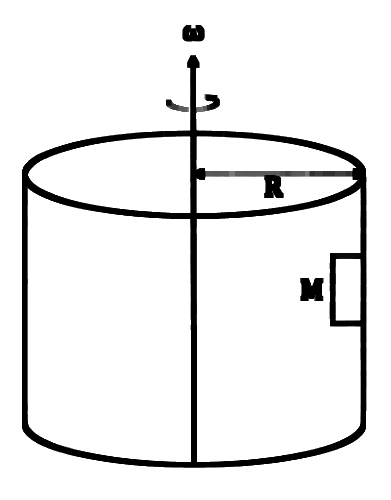
Level Road & Rotating Platform · Drum & wall of death

A large drum having radius RR is spinning around its axis with angular velocity ω\omega, as shown in figure. The minimum value of ω\omega so that a body of mass MM remains stuck to the inner wall of the drum, taking the coefficient of friction between the drum surface and mass MM as μ\mu, is:

Figure

Show answer and solution

Answer: (d)

  1. Normal force from the wall: N=Mω2RN = M\omega^2 R (towards the axis).
  2. Friction holds the weight: μMω2R≥Mg\mu M\omega^2 R \ge Mg.
  3. ωmin=gμR\omega_{min} = \sqrt{\frac{g}{\mu R}}
  4. So the answer is (d).
Report a mistake
Q91MHT CET 2025 · 23 APR · SHIFT 2Medium

Level Road & Rotating Platform · Drum & wall of death

A motor cyclist has to rotate in horizontal circles inside the cylindrical wall of inner radius ' RR ' metre. If the coefficient of friction between the wall and the tyres is ' μs\mu_s ', then the minimum speed required is ( g=g = acceleration due to gravity)

Show answer and solution

Answer: (b)

  1. Wall's normal force gives the centripetal force: N=mv2RN = \frac{mv^2}{R}.
  2. Friction must balance weight: μsN≥mg⇒μsmv2R≥mg\mu_s N \ge mg \Rightarrow \mu_s\frac{mv^2}{R} \ge mg.
  3. vmin=Rgμsv_{min} = \sqrt{\frac{Rg}{\mu_s}}
  4. So the answer is (b).
Report a mistake
Q92JEE Main 2024 · 31 JAN · SHIFT 1Easy

Level Road & Rotating Platform · Coin on a rotating disc

A coin is placed on a disc. The coefficient of friction between the coin and the disc is μ\mu. If the distance of the coin from the center of the disc is rr, the maximum angular velocity which can be given to the disc, so that the coin does not slip away, is:

Show answer and solution

Answer: (b)

  1. Static friction provides the centripetal force: mω2r≤μmgm\omega^2 r \le \mu m g.
  2. ωmax=μgr\omega_{max} = \sqrt{\frac{\mu g}{r}}
  3. So the answer is (b).
Report a mistake
Q93MHT CET 2023 · 14 MAY · SHIFT 1Easy

Level Road & Rotating Platform · Skidding on a level road

On dry road, the maximum speed of a vehicle along a circular path is 'VV'. When the road becomes wet, maximum speed becomes V2\frac{V}{2}. If coefficient of friction of dry road is 'μ\mu' then that of wet road is

Show answer and solution

Answer: (b)

  1. On a level road vmax=μrgv_{max} = \sqrt{\mu r g}, so μ∝v2\mu \propto v^2.
  2. μ′μ=(V/2V)2=14\frac{\mu'}{\mu} = \left(\frac{V/2}{V}\right)^2 = \frac{1}{4}
  3. So the answer is (b) μ4\frac{\mu}{4}.
Report a mistake
Q94JEE Main 2023 · 29 JAN · SHIFT 1Easy

Level Road & Rotating Platform · Skidding on a level road

A car is moving on a horizontal curved road with radius 50 m. The approximate maximum speed of car will be, if the coefficient of friction between tyres and road is 0.34. [take g = 10 ms −2^{-2}]

Show answer and solution

Answer: (b)

  1. vmax=μrgv_{max} = \sqrt{\mu r g}
  2. vmax=0.34×50×10=170≈13v_{max} = \sqrt{0.34 \times 50 \times 10} = \sqrt{170} \approx 13 m/s
  3. So the answer is (b) 13 m/s.
Report a mistake
Q95JEE Main 2023 · 11 APR · SHIFT 1Medium

Level Road & Rotating Platform · Coin on a rotating disc

A coin placed on a rotating table just slips when it is placed at a distance of 1 cm1\text{ cm} from the center. If the angular velocity of the table is halved, it will just slip when placed at a distance of _________ from the centre:

Show answer and solution

Answer: (c)

  1. Just slipping: mω2r=μmgm\omega^2 r = \mu m g, so ω2r\omega^2 r is constant.
  2. r′=r(ωω/2)2=4r=4×1r' = r\left(\frac{\omega}{\omega/2}\right)^2 = 4r = 4 \times 1 cm
  3. So the answer is (c) 4 cm.
Report a mistake
Q96JEE Main 2022 · 25 JUN · SHIFT 2Easy

Level Road & Rotating Platform · Coin on a rotating disc

A disc with a flat small bottom beaker placed on it at a distance R from its center is revolving about an axis passing through the center and perpendicular to its plane with an angular velocity ω\omega. The coefficient of static friction between the bottom of the beaker and the surface of the disc is μ\mu. The beaker will revolve with the disc if:

Show answer and solution

Answer: (b)

  1. Friction must supply the centripetal force: mω2R≤μmgm\omega^2 R \le \mu m g.
  2. R≤μgω2R \le \frac{\mu g}{\omega^2}
  3. So the answer is (b).
Report a mistake
Q97JEE Main 2022 · 25 JUN · SHIFT 2Medium

Level Road & Rotating Platform · Skidding on a level road

A curve in a level road has a radius 75 m. The maximum speed of a car turning this curved road can be 30 m/s without skidding. If radius of curved road is changed to 48 m and the coefficient of friction between the tyres and the road remains same, then maximum allowed speed would be ___________ m/s.

Numerical answer type. Work it out, then open the answer.

Show answer and solution

Answer: 24

  1. vmax=μrgv_{max} = \sqrt{\mu r g}, so v∝rv \propto \sqrt{r} for the same μ\mu.
  2. v′=304875=300.64=30×0.8v' = 30\sqrt{\frac{48}{75}} = 30\sqrt{0.64} = 30 \times 0.8
  3. v′=24v' = 24 m/s
Report a mistake
Q98JEE Main 2021 · 16 MAR · SHIFT 2Medium

Level Road & Rotating Platform · Skidding on a level road

Statement I: A cyclist is moving on an unbanked road with a speed of 7 kmh−1{}^{-1} and takes a sharp circular turn along a path of radius of 2m without reducing the speed. The static friction coefficient is 0.2. The cyclist will not slip and pass the curve. (g = 9.8 m/s2)

Statement II: If the road is banked at an angle of 45∘^\circ, cyclist can cross the curve of 2m radius with the speed of 18.5 kmh−1{}^{-1} without slipping.

In the light of the above statements, choose the correct answer from the options given below.

Show answer and solution

Answer: (b)

  1. Statement I: v=7v = 7 km/h =1.94= 1.94 m/s, v2=3.78v^2 = 3.78; limit μrg=0.2×2×9.8=3.92\mu r g = 0.2 \times 2 \times 9.8 = 3.92. Since 3.78<3.923.78 < 3.92, no slipping: true.
  2. Statement II: vmax2=rgμ+tan⁡θ1−μtan⁡θ=19.6×1.20.8=29.4v_{max}^2 = rg\frac{\mu + \tan\theta}{1 - \mu\tan\theta} = 19.6 \times \frac{1.2}{0.8} = 29.4, vmax≈5.42v_{max} \approx 5.42 m/s ≈19.5\approx 19.5 km/h.
  3. 18.518.5 km/h <19.5< 19.5 km/h (and above the minimum ≈13\approx 13 km/h), so no slipping: true.
  4. So the answer is (b) both statements are true.
Report a mistake
Q99JEE Main 2021 · 17 MAR · SHIFT 1Difficult

Level Road & Rotating Platform · Skidding on a level road

A modern grand - prix racing car of mass m is travelling on a flat track in a circular arc of radius R with a speed v. If the coefficient of static friction between the tyres and the track is μ\mus, then the magnitude of negative lift FL acting downwards on the car is: (Assume forces on the four tyres are identical and g = acceleration due to gravity)

Figure

Show answer and solution

Answer: (c)

  1. Normal force on the car: N=mg+FLN = mg + F_L (downforce adds to weight).
  2. Friction provides the centripetal force: μsN=mv2R\mu_s N = \frac{mv^2}{R}.
  3. μs(mg+FL)=mv2R⇒FL=mv2μsR−mg\mu_s(mg + F_L) = \frac{mv^2}{R} \Rightarrow F_L = \frac{mv^2}{\mu_s R} - mg
  4. So the answer is (c) m(v2μsR−g)m\left(\frac{v^2}{\mu_s R} - g\right).
Report a mistake
Q100JEE Main 2018 · 15 APR · SHIFT 2Medium

Level Road & Rotating Platform · Coin on a rotating disc

A disc rotates about its axis of symmetry in a horizontal plane at a steady rate of 3.53.5 revolutions per second. A coin placed at a distance of 1.25 cm from the axis of rotation remains at rest on the disc. The coefficient of friction between the coin and the disc is: (g = 10 m/s2)

Show answer and solution

Answer: (d)

  1. ω=2πf=2π×3.5=7π≈22\omega = 2\pi f = 2\pi \times 3.5 = 7\pi \approx 22 rad/s, ω2≈483.6\omega^2 \approx 483.6.
  2. Coin stays: μg≥ω2r⇒μ≥ω2rg\mu g \ge \omega^2 r \Rightarrow \mu \ge \frac{\omega^2 r}{g}.
  3. μ=483.6×0.012510≈0.60\mu = \frac{483.6 \times 0.0125}{10} \approx 0.60
  4. So the answer is (d) 0.6.
Report a mistake
Q101JEE Main 2016 · 10 APR · SHIFT 1Medium

Level Road & Rotating Platform · Drum & wall of death

Concrete mixture is made by mixing cement, stone and sand in a rotating cylindrical drum. If the drum rotates too fast, the ingredients remain stuck to the wall of the drum and proper mixing of ingredients does not take place. The maximum rotational speed of the drum in revolutions per minute(rpm) to ensure proper mixing is close to:

(Take the radius of the drum to be 1.25 m and its axle to be horizontal):

Show answer and solution

Answer: (d)

  1. With a horizontal axle, material sticks if at the top mω2R≥mgm\omega^2 R \ge mg. For mixing, ω<gR\omega < \sqrt{\frac{g}{R}}.
  2. ωmax=9.81.25=7.84=2.8\omega_{max} = \sqrt{\frac{9.8}{1.25}} = \sqrt{7.84} = 2.8 rad/s
  3. rpm =2.8×602π≈26.7≈27= \frac{2.8 \times 60}{2\pi} \approx 26.7 \approx 27
  4. So the answer is (d) 27.0.
Report a mistake
Q102JEE Main 2002 · AIEEEEasy

Level Road & Rotating Platform · Skidding on a level road

The maximum velocity (in m s−1\text{m s}^{-1}) with which a car driver must traverse a flat curve of radius 150 m and coefficient of friction 0.60.6 to avoid skidding is

Show answer and solution

Answer: (b)

  1. vmax=μrgv_{max} = \sqrt{\mu r g}
  2. vmax=0.6×150×10=900=30v_{max} = \sqrt{0.6 \times 150 \times 10} = \sqrt{900} = 30 m/s (taking g=10g = 10 m/s2^2)
  3. So the answer is (b) 30.
Report a mistake
Q103JEE Main 2026 · 8 APR · SHIFT 2Easy

Banking of Roads & Bridges · Bending of a cyclist & bob in a turning vehicle

A car moving with a speed of 54 km/h54\text{ km/h} takes a turn of radius 20 m. A simple pendulum is suspended from the ceiling of the car. Determine the angle made by the string of the pendulum with the vertical during the turning. (Take g=10 m/s2g = 10\text{ m/s}^2)

Show answer and solution

Answer: (c)

  1. v=54v = 54 km/h =15= 15 m/s.
  2. tan⁡θ=v2rg=22520×10=1.125\tan\theta = \frac{v^2}{rg} = \frac{225}{20 \times 10} = 1.125
  3. So the answer is (c) tan⁡−1(1.125)\tan^{-1}(1.125).
Report a mistake
Q104MHT CET 2026 · 15 APR · SHIFT 2Easy

Banking of Roads & Bridges · Concave & convex bridges

A car of mass m is crossing the convex bridge of radius of curvature R with speed V. At the highest point the thrust is (gg = gravitational acceleration)

Show answer and solution

Answer: (c)

  1. At the top of a convex bridge the net force points down towards the centre.
  2. mg−N=mV2Rmg - N = \frac{mV^2}{R}
  3. N=mg−mV2RN = mg - \frac{mV^2}{R}
  4. So the answer is (c).
Report a mistake
Q105MHT CET 2025 · 22 APR · SHIFT 1Easy

Banking of Roads & Bridges · Bending of a cyclist & bob in a turning vehicle

A vehicle is moving with a constant speed of 10 m/s10\text{ m/s} in a circular horizontal track of radius 20 m. A bob is suspended from the roof of a vehicle by a massless string. The angle made by the string with the vertical will be (acceleration due to gravity, g=10 m/s2g = 10\text{ m/s}^2)

Show answer and solution

Answer: (a)

  1. In the car frame, the bob is in equilibrium under TT, mgmg and centrifugal mv2r\frac{mv^2}{r}.
  2. tan⁡θ=v2rg=10020×10=0.5\tan\theta = \frac{v^2}{rg} = \frac{100}{20 \times 10} = 0.5
  3. So the answer is (a) tan⁡−1(0.5)\tan^{-1}(0.5).
Report a mistake
Q106MHT CET 2025 · 23 APR · SHIFT 1Easy

Banking of Roads & Bridges · Banked road without friction

Radius of curved road is ' RR ', width of road is ' bb '. The outer edge of road is raised by ' hh ' with respect to inner edge so that a car with velocity ' VV ' can pass safe over it, then value of ' hh ' is ( g=g = acceleration due to gravity)

Show answer and solution

Answer: (a)

  1. Correct banking: tan⁡θ=V2Rg\tan\theta = \frac{V^2}{Rg}.
  2. For small angle, tan⁡θ≈sin⁡θ=hb\tan\theta \approx \sin\theta = \frac{h}{b}.
  3. h=V2bRgh = \frac{V^2 b}{Rg}
  4. So the answer is (a).
Report a mistake
Q107MHT CET 2025 · 22 APR · SHIFT 1Easy

Banking of Roads & Bridges · Concave & convex bridges

A vehicle is moving with uniform speed along 3 different shaped roads as horizontal, concave and convex. The surface of road on which, the normal reaction on vehicle is maximum is

Show answer and solution

Answer: (b)

  1. Horizontal: N=mgN = mg.
  2. Convex (top): N=mg−mv2rN = mg - \frac{mv^2}{r}, less than mgmg.
  3. Concave (bottom): N=mg+mv2rN = mg + \frac{mv^2}{r}, more than mgmg.
  4. So the answer is (b) concave.
Report a mistake
Q108MHT CET 2025 · 22 APR · SHIFT 2Medium

Banking of Roads & Bridges · Banked road without friction

A car is driven on the banked road of radius of curvature 20 m with maximum safe speed. In order to increase its safety speed by 20%20\%, without changing the angle of banking, the increase in the radius of curvature will be [Assume friction is same on the road]

Show answer and solution

Answer: (c)

  1. For fixed banking angle and friction, vmax2=rgμ+tan⁡θ1−μtan⁡θ∝rv_{max}^2 = rg\frac{\mu + \tan\theta}{1 - \mu\tan\theta} \propto r.
  2. r′r=(1.2)2=1.44⇒r′=1.44×20=28.8\frac{r'}{r} = (1.2)^2 = 1.44 \Rightarrow r' = 1.44 \times 20 = 28.8 m
  3. Increase =28.8−20=8.8= 28.8 - 20 = 8.8 m
  4. So the answer is (c) 8.8 m.
Report a mistake
Q109JEE Main 2025 · 24 JAN · SHIFT 1Difficult

Banking of Roads & Bridges · Banked road with friction

A car of mass ' mm ' moves on a banked road having radius ' rr ' and banking angle θ\theta. To avoid slipping from banked road, the maximum permissible speed of the car is v0v_0. The coefficient of friction μ\mu between the wheels of the car and the banked road is

Show answer and solution

Answer: (c)

  1. At maximum speed friction acts down the slope: v02=rgμ+tan⁡θ1−μtan⁡θv_0^2 = rg\frac{\mu + \tan\theta}{1 - \mu\tan\theta}.
  2. v02−μv02tan⁡θ=μrg+rgtan⁡θv_0^2 - \mu v_0^2\tan\theta = \mu rg + rg\tan\theta
  3. μ(rg+v02tan⁡θ)=v02−rgtan⁡θ\mu(rg + v_0^2\tan\theta) = v_0^2 - rg\tan\theta
  4. So the answer is (c) μ=v02−rgtan⁡θrg+v02tan⁡θ\mu = \frac{v_0^2 - rg\tan\theta}{rg + v_0^2\tan\theta}.
Report a mistake
Q110JEE Main 2024 · 27 JAN · SHIFT 1Easy

Banking of Roads & Bridges · Railway track

A train is moving with a speed of 12 m/s12\text{ m/s} on rails which are 1.5 m1.5\text{ m} apart. To negotiate a curve of radius 400 m400\text{ m}, the height by which the outer rail should be raised with respect to the inner rail is (Given, g=10 m/s2)g = 10\text{ m/s}^2):

Show answer and solution

Answer: (b)

  1. tan⁡θ=v2rg≈hd⇒h=dv2rg\tan\theta = \frac{v^2}{rg} \approx \frac{h}{d} \Rightarrow h = \frac{d v^2}{rg}
  2. h=1.5×144400×10=0.054h = \frac{1.5 \times 144}{400 \times 10} = 0.054 m
  3. h=5.4h = 5.4 cm
  4. So the answer is (b) 5.4 cm.
Report a mistake
Q111JEE Main 2024 · 6 APR · SHIFT 2Medium

Banking of Roads & Bridges · Banked road with friction

A car of 800 kg800\text{ kg} is taking turn on a banked road of radius 300 m300\text{ m} and angle of banking 30∘30^\circ. If coefficient of static friction is 0.2 then the maximum speed with which car can negotiate the turn safely: (g=10 m/s2,3=1.73)(g = 10\text{ m/s}^2, \sqrt{3} = 1.73)

Show answer and solution

Answer: (a)

  1. vmax2=rgμ+tan⁡θ1−μtan⁡θv_{max}^2 = rg\frac{\mu + \tan\theta}{1 - \mu\tan\theta}, with tan⁡30∘=11.73=0.578\tan 30^\circ = \frac{1}{1.73} = 0.578.
  2. 0.2+0.5781−0.2×0.578=0.7780.884≈0.880\frac{0.2 + 0.578}{1 - 0.2 \times 0.578} = \frac{0.778}{0.884} \approx 0.880
  3. vmax2=300×10×0.880≈2640v_{max}^2 = 300 \times 10 \times 0.880 \approx 2640, vmax≈51.4v_{max} \approx 51.4 m/s
  4. So the answer is (a) 51.4 m/s.
Report a mistake
Q112JEE Main 2023 · 25 JAN · SHIFT 1Easy

Banking of Roads & Bridges · Bending of a cyclist & bob in a turning vehicle

A car is moving with a constant speed of 20 m/s in a circular horizontal track of radius 40 m. A bob is suspended from the roof of the car by a massless string. The angle made by the string with the vertical will be: (Take g = 10 m/s2^{2})

Show answer and solution

Answer: (c)

  1. tan⁡θ=v2rg\tan\theta = \frac{v^2}{rg}
  2. tan⁡θ=40040×10=1⇒θ=45∘\tan\theta = \frac{400}{40 \times 10} = 1 \Rightarrow \theta = 45^\circ
  3. So the answer is (c) π4\frac{\pi}{4}.
Report a mistake
Q113MHT CET 2023 · 12 MAY · SHIFT 1Easy

Banking of Roads & Bridges · Railway track

A railway track is banked for a speed ',vv' by elevating outer rail by a height 'hh' above the inner rail. The distance between two rails is 'd' then the radius of curvature of track is ( g=g = gravitational acceleration)

Show answer and solution

Answer: (a)

  1. Banking: tan⁡θ=v2rg\tan\theta = \frac{v^2}{rg}, and for small θ\theta, tan⁡θ≈hd\tan\theta \approx \frac{h}{d}.
  2. hd=v2rg⇒r=v2dgh\frac{h}{d} = \frac{v^2}{rg} \Rightarrow r = \frac{v^2 d}{gh}
  3. So the answer is (a).
Report a mistake
Q114MHT CET 2021 · 21 SEP · SHIFT 2Easy

Banking of Roads & Bridges · Railway track

The angle of banking 'θ\theta' for a meter gauge railway line is given by θ=tan⁡−1(120)\theta = \tan^{-1}\left(\frac{1}{20}\right). What is the elevation of the outer rail above the inner rail?

Show answer and solution

Answer: (d)

  1. Metre gauge: distance between rails d=1d = 1 m.
  2. Small angle: h=dsin⁡θ≈dtan⁡θ=1×120h = d\sin\theta \approx d\tan\theta = 1 \times \frac{1}{20} m
  3. h=0.05h = 0.05 m =5= 5 cm
  4. So the answer is (d) 5 cm.
Report a mistake
Q115JEE Main 2021 · 20 JUL · SHIFT 1Difficult

Banking of Roads & Bridges · Banked road with friction

The normal reaction 'N' for a vehicle of 800 kg mass, negotiating a turn on a 30∘^\circ banked road at maximum possible speed without skidding is ____________ ×\times 103 kg m/s2. [Given cos30∘^\circ = 0.87, μ\mus = 0.2]

Show answer and solution

Answer: (d)

θNμNmgcentre of turn ←
  1. At maximum speed friction μsN\mu_s N acts down the slope.
  2. Vertical balance: Ncos⁡θ−μsNsin⁡θ=mgN\cos\theta - \mu_s N\sin\theta = mg.
  3. N=mgcos⁡θ−μssin⁡θ=800×9.80.87−0.2×0.5=78400.77N = \frac{mg}{\cos\theta - \mu_s\sin\theta} = \frac{800 \times 9.8}{0.87 - 0.2 \times 0.5} = \frac{7840}{0.77}
  4. N≈10.2×10³N \approx 10.2 \times 10^3 kg m/s2^2
  5. So the answer is (d) 10.2.
Report a mistake
Q116MHT CET 2026 · 20 APR · SHIFT 2Easy

Non-Uniform Circular Motion · Tangential, radial & net acceleration

A car is travelling at 40 m/s on a circular path of radius 40 m. It is increasing its speed at the rate of 22 m/s2^{2}. Its net acceleration is (in m/s2^{2}) nearly

Show answer and solution

Answer: (d)

  1. Radial: ar=v2r=160040=40a_r = \frac{v^2}{r} = \frac{1600}{40} = 40 m/s2^2; tangential at=2a_t = 2 m/s2^2.
  2. a=ar2+at2=1600+4≈40a = \sqrt{a_r^2 + a_t^2} = \sqrt{1600 + 4} \approx 40 m/s2^2
  3. So the answer is (d) 40 m/s2^2.
Report a mistake
Q117MHT CET 2026 · 11 APR · SHIFT 2Easy

Non-Uniform Circular Motion · Tangential, radial & net acceleration

In non uniform circular motion, the ratio of radial acceleration to tangential acceleration is (V is the velocity, r is the radius and α\alpha is the angular acceleration)

Show answer and solution

Answer: (b)

  1. ar=V2ra_r = \frac{V^2}{r}, at=rαa_t = r\alpha.
  2. arat=V2/rrα=V2r2α\frac{a_r}{a_t} = \frac{V^2/r}{r\alpha} = \frac{V^2}{r^2\alpha}
  3. So the answer is (b).
Report a mistake
Q118JEE Main 2026 · 2 APR · SHIFT 1Easy

Non-Uniform Circular Motion · Equations of circular motion

A particle is rotating in a circular path and at any instant its motion can be described as θ=5t440−t33\theta = \frac{5t^4}{40} - \frac{t^3}{3}.

The angular acceleration of the particle after 10 seconds is _________ rad/s2.

Show answer and solution

Answer: (c)

  1. θ=t48−t33\theta = \frac{t^4}{8} - \frac{t^3}{3}
  2. ω=dθdt=t32−t2\omega = \frac{d\theta}{dt} = \frac{t^3}{2} - t^2
  3. α=dωdt=3t22−2t\alpha = \frac{d\omega}{dt} = \frac{3t^2}{2} - 2t
  4. At t=10t = 10 s: α=150−20=130\alpha = 150 - 20 = 130 rad/s2^2
  5. So the answer is (c) 130.
Report a mistake
Q119MHT CET 2026 · 16 APR · SHIFT 1Medium

Non-Uniform Circular Motion · When tangential & centripetal acceleration are equal

A particle is moving with constant angular acceleration 44 rad/s2^{2} in circular path. At what time the magnitudes of its tangential acceleration and centripetal acceleration will be equal?

Show answer and solution

Answer: (c)

  1. Starting from rest: ω=αt\omega = \alpha t
  2. at=rαa_t = r\alpha, ac=ω2r=α2t2ra_c = \omega^2 r = \alpha^2 t^2 r
  3. Equal: α2t2r=rα⇒t=1α=14\alpha^2 t^2 r = r\alpha \Rightarrow t = \frac{1}{\sqrt{\alpha}} = \frac{1}{\sqrt{4}}
  4. So the answer is (c) 0.50.5 s.
Report a mistake
Q120MHT CET 2026 · 15 APR · SHIFT 2Medium

Non-Uniform Circular Motion · When tangential & centripetal acceleration are equal

A particle at rest starts moving with constant angular acceleration 'α\alpha' in a circular path of radius 'r'. At certain instant, the magnitude of centripetal acceleration is (13)rd\left(\frac{1}{3}\right)^{rd} the tangential acceleration. The relation between linear speed (V) and angular acceleration (α\alpha) is

Show answer and solution

Answer: (c)

  1. at=rαa_t = r\alpha, ac=V2ra_c = \frac{V^2}{r}
  2. Given ac=at3a_c = \frac{a_t}{3}: V2r=rα3\frac{V^2}{r} = \frac{r\alpha}{3}
  3. V2=r2α3⇒V=rα3V^2 = \frac{r^2\alpha}{3} \Rightarrow V = r\sqrt{\frac{\alpha}{3}}
  4. So the answer is (c).
Report a mistake
Q121MHT CET 2025 · 20 APR · SHIFT 2Easy

Non-Uniform Circular Motion · Equations of circular motion

A wheel initially at rest, begins to rotate about its axis with constant angular acceleration. If it rotates through an angle θ1\theta_1 in first 2 s and a further angle θ2\theta_2 in the next 2 s, the ratio θ1:θ2\theta_1 : \theta_2 is

Show answer and solution

Answer: (d)

  1. From rest: θ=12αt2\theta = \frac{1}{2}\alpha t^2.
  2. θ1=12α(2)2=2α\theta_1 = \frac{1}{2}\alpha(2)^2 = 2\alpha; total in 4 s =12α(4)2=8α= \frac{1}{2}\alpha(4)^2 = 8\alpha.
  3. θ2=8α−2α=6α\theta_2 = 8\alpha - 2\alpha = 6\alpha
  4. So the answer is (d) 1:31 : 3.
Report a mistake
Q122MHT CET 2025 · 19 APR · SHIFT 1Medium

Non-Uniform Circular Motion · Equations of circular motion

When a ceiling fan is switched off, its angular velocity falls to (13)\left(\frac{1}{3}\right)rd while it makes 24 rotations. How many more rotations will it make before coming to rest?

Show answer and solution

Answer: (a)

  1. Use ω2=ω02−2αθ\omega^2 = \omega_0^2 - 2\alpha\theta with θ\theta in rotations.
  2. First stage: ω02−ω029=2α(24)⇒89ω02=48α\omega_0^2 - \frac{\omega_0^2}{9} = 2\alpha(24) \Rightarrow \frac{8}{9}\omega_0^2 = 48\alpha
  3. Second stage: ω029=2αn\frac{\omega_0^2}{9} = 2\alpha n
  4. Divide: 18=n24⇒n=3\frac{1}{8} = \frac{n}{24} \Rightarrow n = 3
  5. So the answer is (a) 3.
Report a mistake
Q123MHT CET 2024 · 2 MAY · SHIFT 1Medium

Non-Uniform Circular Motion · When tangential & centripetal acceleration are equal

A particle at rest starts moving with a constant angular acceleration of 4 rad/s24\text{ rad/s}^2 in a circular path. The time at which magnitudes of its centripetal acceleration and tangential acceleration will be equal, is (in second)

Show answer and solution

Answer: (c)

  1. From rest: ω=αt\omega = \alpha t, so ac=α2t2ra_c = \alpha^2 t^2 r and at=αra_t = \alpha r
  2. Equal: α2t2=α⇒t=1α=12\alpha^2 t^2 = \alpha \Rightarrow t = \frac{1}{\sqrt{\alpha}} = \frac{1}{2} s
  3. So the answer is (c) 12\frac{1}{2}.
Report a mistake
Q124MHT CET 2024 · 9 MAY · SHIFT 2Medium

Non-Uniform Circular Motion · Equations of circular motion

A disc at rest is subjected to a uniform angular acceleration about its axis. Let θ\theta and θ1\theta_1 be the angle made by the disc in 22nd and 33rd second of its motion. The ratio θθ1\frac{\theta}{\theta_1} is

Show answer and solution

Answer: (d)

  1. From rest, angle turned in the nnth second: θn=α2(2n−1)\theta_n = \frac{\alpha}{2}(2n - 1)
  2. 2nd second: θ=3α2\theta = \frac{3\alpha}{2}; 3rd second: θ1=5α2\theta_1 = \frac{5\alpha}{2}
  3. θθ1=35\frac{\theta}{\theta_1} = \frac{3}{5}
  4. So the ratio is 3:53 : 5, which is not among the options.
Report a mistake
Q125MHT CET 2024 · 16 MAY · SHIFT 1Medium

Non-Uniform Circular Motion · Average velocity from rest

A particle starting from rest moves along the circumference of a circle of radius ' rr ' with angular acceleration ' α\alpha '. The magnitude of the average velocity in time it completes the small angular displacement ' θ\theta ' is

Show answer and solution

Answer: (d)

  1. From rest: θ=12αt2⇒t=2θα\theta = \frac{1}{2}\alpha t^2 \Rightarrow t = \sqrt{\frac{2\theta}{\alpha}}
  2. For small θ\theta, displacement ≈\approx arc =rθ= r\theta
  3. vavg=rθt=rθα2θ=r2αθv_{avg} = \frac{r\theta}{t} = r\theta\sqrt{\frac{\alpha}{2\theta}} = \frac{r}{\sqrt{2}}\sqrt{\alpha\theta}
  4. So the answer is (d).
Report a mistake
Q126JEE Main 2024 · 29 JAN · SHIFT 2Difficult

Non-Uniform Circular Motion · When tangential & centripetal acceleration are equal

A particle is moving in a circle of radius 50 cm50\text{ cm} in such a way that at any instant the normal and tangential components of it's acceleration are equal. If its speed at t=0t = 0 is 4 m/s4\text{ m/s}, the time taken to complete the first revolution will be 1α[1−e−2π] s\frac{1}{\alpha}\left[1 - e^{-2\pi}\right]\text{ s}, where α=\alpha = _________.

Numerical answer type. Work it out, then open the answer.

Show answer and solution

Answer: 8

  1. dvdt=v2R⇒1v=1v0−tR\frac{dv}{dt} = \frac{v^2}{R} \Rightarrow \frac{1}{v} = \frac{1}{v_0} - \frac{t}{R}
  2. So v=dsdt=v0RR−v0t⇒s=−Rln⁡(1−v0tR)v = \frac{ds}{dt} = \frac{v_0 R}{R - v_0 t} \Rightarrow s = -R\ln\left(1 - \frac{v_0 t}{R}\right)
  3. One revolution, s=2πRs = 2\pi R: 1−v0tR=e−2π⇒t=Rv0(1−e−2π)1 - \frac{v_0 t}{R} = e^{-2\pi} \Rightarrow t = \frac{R}{v_0}\left(1 - e^{-2\pi}\right)
  4. Rv0=0.54=18\frac{R}{v_0} = \frac{0.5}{4} = \frac{1}{8}, so α=8\alpha = 8
Report a mistake
Q127MHT CET 2023 · 9 MAY · SHIFT 2Medium

Non-Uniform Circular Motion · When tangential & centripetal acceleration are equal

A particle at rest starts moving with constant angular acceleration 4 rad/s24\text{ rad/s}^2 in circular path. At what time the magnitudes of its tangential acceleration and centrifugal acceleration will be equal?

Show answer and solution

Answer: (b)

  1. Centrifugal acceleration has the same magnitude as centripetal: ω2r=α2t2r\omega^2 r = \alpha^2 t^2 r
  2. Tangential: at=αra_t = \alpha r
  3. Equal: α2t2=α⇒t=14=0.5\alpha^2 t^2 = \alpha \Rightarrow t = \frac{1}{\sqrt{4}} = 0.5 s
  4. So the answer is (b) 0.5 s.
Report a mistake
Q128MHT CET 2023 · 9 MAY · SHIFT 2Medium

Non-Uniform Circular Motion · Kinetic energy & power

A particle of mass 'mm' moves along a circle of radius 'rr' with constant tangential acceleration. If K.E. of the particle is 'EE' by the end of third revolution after beginning of the motion, then magnitude of tangential acceleration is

Show answer and solution

Answer: (b)

  1. Work done by tangential force = gain in KE: E=matsE = m a_t s
  2. Distance in 3 revolutions: s=3(2πr)=6πrs = 3(2\pi r) = 6\pi r
  3. at=E6πrma_t = \frac{E}{6\pi r m}
  4. So the answer is (b).
Report a mistake
Q129JEE Main 2023 · 29 JAN · SHIFT 2Difficult

Non-Uniform Circular Motion · When tangential & centripetal acceleration are equal

A car is moving on a circular path of radius 600 m such that the magnitudes of the tangential acceleration and centripetal acceleration are equal. The time taken by the car to complete first quarter of revolution, if it is moving with an initial speed of 54 km/hr is t(1−e−π/2) st(1 - e^{-\pi/2})\text{ s}. The value of t is ____________.

Numerical answer type. Work it out, then open the answer.

Show answer and solution

Answer: 40

  1. at=aca_t = a_c: dvdt=v2R\frac{dv}{dt} = \frac{v^2}{R} gives s=−Rln⁡(1−v0tR)s = -R\ln\left(1 - \frac{v_0 t}{R}\right)
  2. Quarter revolution, s=πR2s = \frac{\pi R}{2}: t=Rv0(1−e−π/2)t = \frac{R}{v_0}\left(1 - e^{-\pi/2}\right)
  3. v0=54v_0 = 54 km/h =15= 15 m/s, Rv0=60015=40\frac{R}{v_0} = \frac{600}{15} = 40
  4. So t=40t = 40 s
Report a mistake
Q130JEE Main 2022 · 28 JUN · SHIFT 1Difficult

Non-Uniform Circular Motion · Kinetic energy & power

A particle of mass m is moving in a circular path of constant radius r such that its centripetal acceleration (a) is varying with time t as a = k2rt2, where k is a constant. The power delivered to the particle by the force acting on it is given as

Show answer and solution

Answer: (c)

  1. ac=v2r=k2rt2⇒v=krta_c = \frac{v^2}{r} = k^2 r t^2 \Rightarrow v = krt
  2. Tangential acceleration: at=dvdt=kra_t = \frac{dv}{dt} = kr
  3. Only the tangential force does work: P=matv=m(kr)(krt)=mk2r2tP = m a_t v = m(kr)(krt) = mk^2r^2t
  4. So the answer is (c).
Report a mistake
Q131MHT CET 2021 · 20 SEP · SHIFT 2Medium

Non-Uniform Circular Motion · When tangential & centripetal acceleration are equal

A particle at rest starts moving with a constant angular acceleration of 4 rad/s24\text{ rad/s}^2 in a circular path. At what time the magnitude of its centripetal acceleration and tangential acceleration will be equal?

Show answer and solution

Answer: (c)

  1. From rest: ac=ω2r=α2t2ra_c = \omega^2 r = \alpha^2 t^2 r, at=αra_t = \alpha r
  2. Equal: t=1α=14=12t = \frac{1}{\sqrt{\alpha}} = \frac{1}{\sqrt{4}} = \frac{1}{2} s
  3. So the answer is (c) 12 s\frac{1}{2}\text{ s}.
Report a mistake
Q132MHT CET 2020 · 19 OCT · SHIFT 2Easy

Non-Uniform Circular Motion · Tangential, radial & net acceleration

A body is moving along a circular track of radius 100 m with velocity 20 m/s20\text{ m/s}. Its tangential acceleration is 3 m/s23\text{ m/s}^2, then its resultant acceleration will be

Show answer and solution

Answer: (a)

  1. ar=v2r=400100=4a_r = \frac{v^2}{r} = \frac{400}{100} = 4 m/s2^2, at=3a_t = 3 m/s2^2.
  2. a=42+32=5a = \sqrt{4^2 + 3^2} = 5 m/s2^2
  3. So the answer is (a) 5 m/s2^2.
Report a mistake
Q133MHT CET 2020 · 16 OCT · SHIFT 1Easy

Non-Uniform Circular Motion · Tangential, radial & net acceleration

In non-uniform circular motion, the ratio of tangential to radial acceleration is (r=r = radius, α=\alpha = angular acceleration and v=v = linear velocity)

Show answer and solution

Answer: (d)

  1. at=rαa_t = r\alpha, ar=v2ra_r = \frac{v^2}{r}.
  2. atar=rαv2/r=r2αv2\frac{a_t}{a_r} = \frac{r\alpha}{v^2/r} = \frac{r^2\alpha}{v^2}
  3. So the answer is (d).
Report a mistake
Q134MHT CET 2020 · 16 OCT · SHIFT 2Medium

Non-Uniform Circular Motion · Average velocity from rest

A particle starting from rest moves along the circumference of a circle of radius rr with angular acceleration α\alpha. The magnitude of the average velocity, in the time it completes the small angular displacement θ\theta is

Show answer and solution

Answer: (d)

  1. From rest: θ=12αt2⇒t=2θα\theta = \frac{1}{2}\alpha t^2 \Rightarrow t = \sqrt{\frac{2\theta}{\alpha}}
  2. Small θ\theta: displacement ≈rθ\approx r\theta
  3. vavg=rθt=r(αθ2)1/2v_{avg} = \frac{r\theta}{t} = r\left(\frac{\alpha\theta}{2}\right)^{1/2}
  4. So the answer is (d).
Report a mistake
Q135MHT CET 2020 · 19 OCT · SHIFT 2Difficult

Non-Uniform Circular Motion · Tangential, radial & net acceleration

A child starts running from rest along a circular track of radius rr with constant tangential acceleration a. After time tt he feels that slipping of shoes on the ground has started. The coefficient of friction between shoes and the ground is

[g = acceleration due to gravity]

Show answer and solution

Answer: (a)

  1. After time tt: v=atv = at, so ac=a2t2ra_c = \frac{a^2t^2}{r}
  2. Net acceleration: anet=a2+a4t4r2=a4t4+a2r2ra_{net} = \sqrt{a^2 + \frac{a^4t^4}{r^2}} = \frac{\sqrt{a^4t^4 + a^2r^2}}{r}
  3. Slipping starts when friction is at maximum: μmg=manet\mu m g = m a_{net}
  4. μ=[a4t4+a2r2]1/2rg\mu = \frac{\left[a^4t^4 + a^2r^2\right]^{1/2}}{rg}, so the answer is (a).
Report a mistake
Q136JEE Main 2010 · AIEEEMedium

Non-Uniform Circular Motion · Tangential, radial & net acceleration

A point PP moves in counter-clockwise direction on a circular path as shown in the figure. The movement of PP is such that it sweeps out a length s=t3+5,s = t^3 + 5, where ss is in metres and tt is in seconds. The radius of the path is 20 m.20\text{ m}. The acceleration of ′P′'P' when t=2 st = 2\text{ s} is nearly.

Figure

Show answer and solution

Answer: (d)

  1. v=dsdt=3t2=12v = \frac{ds}{dt} = 3t^2 = 12 m/s at t=2t = 2 s
  2. Tangential: at=dvdt=6t=12a_t = \frac{dv}{dt} = 6t = 12 m/s2^2
  3. Centripetal: ac=v2R=14420=7.2a_c = \frac{v^2}{R} = \frac{144}{20} = 7.2 m/s2^2
  4. a=at2+ac2=144+51.84≈14a = \sqrt{a_t^2 + a_c^2} = \sqrt{144 + 51.84} \approx 14 m/s2^2
  5. So the answer is (d) 14 m/s214\text{ m/s}^2.
Report a mistake
Q137MHT CET 2026 · 14 MAY · SHIFT 2Easy

Vertical Circle: Speed & Tension · Tension at the lowest point

A stone of mass m is tied to a string and is moved in a vertical circle of radius r making 'n' r.p.m. The total tension in the string when the stone is at the lowest point is (gg = acceleration due to gravity)

Show answer and solution

Answer: (d)

  1. ω=2πn60=πn30\omega = \frac{2\pi n}{60} = \frac{\pi n}{30} rad/s
  2. At the lowest point: T=mg+mω2rT = mg + m\omega^2 r
  3. T=m[g+π2n2r900]T = m\left[g + \frac{\pi^2 n^2 r}{900}\right], so the answer is (d).
Report a mistake
Q138MHT CET 2026 · 19 APR · SHIFT 2Easy

Vertical Circle: Speed & Tension · Tension at the lowest point

A stone of mass 4040 g is tied to a light inextensible string of length 5050 cm and whirled in a vertical circle at the rate of 3030 revolutions per minute. The tension in the string when it is at the lowest point of the circle is

(Take gravitational acceleration, g=10g = 10 m/s2^{2} and π2=10\pi^2 = 10)

Show answer and solution

Answer: (c)

  1. ω=2π(30)60=π\omega = \frac{2\pi(30)}{60} = \pi rad/s, ω2=10\omega^2 = 10
  2. T=m(g+ω2r)=0.04(10+10×0.5)T = m(g + \omega^2 r) = 0.04(10 + 10 \times 0.5)
  3. T=0.04×15=0.6T = 0.04 \times 15 = 0.6 N
  4. So the answer is (c) 0.60.6 N.
Report a mistake
Q139MHT CET 2026 · 15 MAY · SHIFT 1Medium

Vertical Circle: Speed & Tension · Maximum & minimum tension

The maximum and minimum tensions in the string whirling in a circle of radius 2.52.5 m are in the ratio 5:35 : 3 then its velocity is (g=10g = 10 m/s2^{2})

Show answer and solution

Answer: (a)

  1. Uniform speed in vertical circle: Tmax=mv2r+mgT_{max} = \frac{mv^2}{r} + mg, Tmin=mv2r−mgT_{min} = \frac{mv^2}{r} - mg
  2. v2/r+gv2/r−g=53⇒v2r=4g\frac{v^2/r + g}{v^2/r - g} = \frac{5}{3} \Rightarrow \frac{v^2}{r} = 4g
  3. v2=4(10)(2.5)=100⇒v=10v^2 = 4(10)(2.5) = 100 \Rightarrow v = 10 m/s
  4. So the answer is (a) 1010 m/s.
Report a mistake
Q140MHT CET 2026 · 13 APR · SHIFT 1Medium

Vertical Circle: Speed & Tension · Pendulum swinging

A simple pendulum oscillates with an angular amplitude θ\theta. If the maximum tension in the string is twice the minimum tension then θ\theta is

Show answer and solution

Answer: (a)

  1. Pendulum: Tmin=mgcos⁡θT_{min} = mg\cos\theta (extreme), Tmax=mg(3−2cos⁡θ)T_{max} = mg(3 - 2\cos\theta) (mean)
  2. 3−2cos⁡θ=2cos⁡θ⇒cos⁡θ=0.753 - 2\cos\theta = 2\cos\theta \Rightarrow \cos\theta = 0.75
  3. So the answer is (a) cos⁡−1(0.75)\cos^{-1}(0.75).
Report a mistake
Q141MHT CET 2025 · 5 MAY · SHIFT 2Easy

Vertical Circle: Speed & Tension · Tension at the lowest point

A stone of mass ' m ' kg is tied to a string of length ' LL ' mm and moved in a vertical circle of radius 49 cm in a vertical plane. If it completes 30 revolutions per minute, the tension in the string when it is at the lowermost point is nearly [Take π2=10\pi^2 = 10 and acceleration due to gravity, g=10 m/s2g = 10\text{ m/s}^2 ]

Show answer and solution

Answer: (d)

  1. ω=2π(30)60=π\omega = \frac{2\pi(30)}{60} = \pi rad/s, ω2=10\omega^2 = 10
  2. T=m(g+ω2r)=m(10+10×0.49)=14.9 mT = m(g + \omega^2 r) = m(10 + 10 \times 0.49) = 14.9\,m
  3. T≈15 mT \approx 15\,m N, so the answer is (d).
Report a mistake
Q142MHT CET 2025 · 21 APR · SHIFT 2Easy

Vertical Circle: Speed & Tension · Speed at any angle

A pendulum bob has a speed 4 m/s4\text{ m/s} at its lowest position. The pendulum is 1 m long. When the length of the string makes an angle of 60∘60^\circ with the vertical, the speed of the bob at that position is (acceleration due to gravity, g=10 m/s2,cos⁡60∘=0.5g = 10\text{ m/s}^2, \cos 60^\circ = 0.5)

Show answer and solution

Answer: (c)

  1. Energy: v2=u2−2gL(1−cos⁡60∘)v^2 = u^2 - 2gL(1 - \cos 60^\circ)
  2. v2=16−2(10)(1)(0.5)=6v^2 = 16 - 2(10)(1)(0.5) = 6
  3. So the answer is (c) 6 m/s\sqrt{6}\text{ m/s}.
Report a mistake
Q143MHT CET 2025 · 19 APR · SHIFT 2Medium

Vertical Circle: Speed & Tension · Maximum & minimum tension

A weightless thread can bear tension up to 3.7 kg wt. A stone of mass 500 gram is tied to it and revolved in circular path of radius 4 m in vertical plane. Maximum angular velocity of the stone will be (acceleration due to gravity, g=10 m/s2g = 10\text{ m/s}^2)

Show answer and solution

Answer: (b)

  1. Maximum tension is at the lowest point: T=m(g+ω2r)T = m(g + \omega^2 r)
  2. Tmax=3.7×10=37T_{max} = 3.7 \times 10 = 37 N: 37=0.5(10+4ω2)37 = 0.5(10 + 4\omega^2)
  3. 74=10+4ω2⇒ω2=16⇒ω=474 = 10 + 4\omega^2 \Rightarrow \omega^2 = 16 \Rightarrow \omega = 4 rad/s
  4. So the answer is (b) 4 rad/s4\text{ rad/s}.
Report a mistake
Q144JEE Main 2025 · 22 JAN · SHIFT 2Medium

Vertical Circle: Speed & Tension · Speed at any angle

A body of mass 100 g is moving in circular path of radius 2 m on vertical plane as shown in figure. The velocity of the body at point AA is 10 m/s10\text{ m/s}. The ratio of its kinetic energies at point B and C is:

Figure

(Take acceleration due to gravity as 10 m/s210\text{ m/s}^2)

Show answer and solution

Answer: (d)

ABCO30°h_B = 2−√3 mh_C = 3 m
  1. A is the lowest point; B is 30∘30^\circ and C is 120∘120^\circ from OA.
  2. Heights above A: hB=R(1−cos⁡30∘)=2−3h_B = R(1 - \cos 30^\circ) = 2 - \sqrt{3} m, hC=R(1−cos⁡120∘)=3h_C = R(1 - \cos 120^\circ) = 3 m
  3. vB2=100−20(2−3)=60+203v_B^2 = 100 - 20(2 - \sqrt{3}) = 60 + 20\sqrt{3}, vC2=100−60=40v_C^2 = 100 - 60 = 40
  4. KBKC=vB2vC2=60+20340=3+32\frac{K_B}{K_C} = \frac{v_B^2}{v_C^2} = \frac{60 + 20\sqrt{3}}{40} = \frac{3 + \sqrt{3}}{2}
  5. So the answer is (d).
Report a mistake
Q145MHT CET 2025 · 21 APR · SHIFT 2Medium

Vertical Circle: Speed & Tension · Pendulum swinging

A simple pendulum oscillates with an angular amplitude θ\theta. If the maximum tension in the string is 4 times the minimum tension then the value of θ\theta is

Show answer and solution

Answer: (b)

  1. Tmin=mgcos⁡θT_{min} = mg\cos\theta, Tmax=mg(3−2cos⁡θ)T_{max} = mg(3 - 2\cos\theta)
  2. 3−2cos⁡θ=4cos⁡θ⇒cos⁡θ=0.53 - 2\cos\theta = 4\cos\theta \Rightarrow \cos\theta = 0.5
  3. So the answer is (b) cos⁡−1(0.5)\cos^{-1}(0.5).
Report a mistake
Q146JEE Main 2024 · 29 JAN · SHIFT 2Easy

Vertical Circle: Speed & Tension · Tension at the lowest point

A stone of mass 900 g900\text{ g} is tied to a string and moved in a vertical circle of radius 1 m1\text{ m} making 10 rpm10\text{ rpm}. The tension in the string, when the stone is at the lowest point is (if π2=9.8\pi^2 = 9.8 and g=9.8 m/s2g = 9.8\text{ m/s}^2):

Show answer and solution

Answer: (c)

  1. ω=2π(10)60=π3\omega = \frac{2\pi(10)}{60} = \frac{\pi}{3}, ω2=9.89\omega^2 = \frac{9.8}{9}
  2. ω2r=1.089\omega^2 r = 1.089 m/s2^2
  3. T=m(g+ω2r)=0.9(9.8+1.089)=9.8T = m(g + \omega^2 r) = 0.9(9.8 + 1.089) = 9.8 N
  4. So the answer is (c) 9.8 N.
Report a mistake
Q147MHT CET 2024 · 2 MAY · SHIFT 2Medium

Vertical Circle: Speed & Tension · Pendulum swinging

The string of pendulum of length ' LL ' is displaced through 90∘90^\circ from the vertical and released. Then the maximum strength of the string in order to withstand the tension, as the pendulum passes through the mean position is ( m=m = mass of pendulum, g=g = acceleration due to gravity)

Show answer and solution

Answer: (b)

  1. From 90∘90^\circ: v2=2gLv^2 = 2gL at the mean position
  2. T=mg+mv2L=mg+2mg=3mgT = mg + \frac{mv^2}{L} = mg + 2mg = 3mg
  3. So the answer is (b) 3 mg.
Report a mistake
Q148MHT CET 2023 · 9 MAY · SHIFT 2Medium

Vertical Circle: Speed & Tension · Pendulum swinging

A simple pendulum of length 2 m2\text{ m} is given a horizontal push through angular displacement of 60∘60^\circ. If the mass of bob is 200 gram, the angular velocity of the bob will be (Take Acceleration due to gravity =10 m/s2= 10\text{ m/s}^2) (sin⁡30∘=cos⁡60∘=0.5,cos⁡30∘=sin⁡60∘=3/2)\left(\sin 30^\circ = \cos 60^\circ = 0.5, \cos 30^\circ = \sin 60^\circ = \sqrt{3}/2\right)

Show answer and solution

Answer: (c)

  1. Bob rises through 60∘60^\circ: h=L(1−cos⁡60∘)=1h = L(1 - \cos 60^\circ) = 1 m
  2. Speed at the lowest point: v=2gh=20v = \sqrt{2gh} = \sqrt{20} m/s
  3. ω=vL=202=5≈2.24\omega = \frac{v}{L} = \frac{\sqrt{20}}{2} = \sqrt{5} \approx 2.24 rad/s
  4. This equals 21.252\sqrt{1.25} rad/s, which is not among the options.
Report a mistake
Q149JEE Main 2022 · 24 JUN · SHIFT 2Easy

Vertical Circle: Speed & Tension · Maximum & minimum tension

A stone of mass m, tied to a string is being whirled in a vertical circle with a uniform speed. The tension in the string is

Show answer and solution

Answer: (b)

  1. At angle θ\theta from the top: T+mgcos⁡θ=mv2rT + mg\cos\theta = \frac{mv^2}{r}
  2. With constant vv, T=mv2r−mgcos⁡θT = \frac{mv^2}{r} - mg\cos\theta is least when cos⁡θ=1\cos\theta = 1 (top)
  3. So the answer is (b) minimum at the highest position.
Report a mistake
Q150JEE Main 2022 · 27 JUN · SHIFT 2Medium

Vertical Circle: Speed & Tension · Speed at any angle

A stone tied to a string of length L is whirled in a vertical circle with the other end of the string at the centre. At a certain instant of time, the stone is at its lowest position and has a speed u. The magnitude of change in its velocity, as it reaches a position where the string is horizontal, is 2(u2−gL)\sqrt{2(u^2 - gL)}. The value of x is -

Show answer and solution

Answer: (b)

  1. Energy: speed when the string is horizontal, v2=u2−2gLv^2 = u^2 - 2gL
  2. u⃗\vec{u} (horizontal) and v⃗\vec{v} (vertical) are perpendicular, so ∣Δv⃗∣=u2+v2|\Delta \vec{v}| = \sqrt{u^2 + v^2}
  3. ∣Δv⃗∣=2u2−2gL=2(u2−gL)|\Delta \vec{v}| = \sqrt{2u^2 - 2gL} = \sqrt{2(u^2 - gL)}
  4. Comparing with x(u2−gL)\sqrt{x(u^2 - gL)}: x=2x = 2, so the answer is (b).
Report a mistake
Q151JEE Main 2021 · 25 FEB · SHIFT 1Medium

Vertical Circle: Speed & Tension · Maximum & minimum tension

A small bob tied at one end of a thin string of length 1 m is describing a vertical circle so that the maximum and minimum tension in the string are in the ratio 5: 1. The velocity of the bob at the highest position is ________ m/s. (Take g = 10 m/s2)

Numerical answer type. Work it out, then open the answer.

Show answer and solution

Answer: 5

  1. For a vertical circle: Tmax−Tmin=6mgT_{max} - T_{min} = 6mg
  2. Tmax=5Tmin⇒4Tmin=6mg⇒Tmin=1.5mgT_{max} = 5T_{min} \Rightarrow 4T_{min} = 6mg \Rightarrow T_{min} = 1.5mg
  3. At the top: Tmin+mg=mv2l⇒v2=2.5gl=25T_{min} + mg = \frac{mv^2}{l} \Rightarrow v^2 = 2.5gl = 25
  4. v=5v = 5 m/s
Report a mistake
Q152MHT CET 2019 · 2 MAY · SHIFT 1Medium

Vertical Circle: Speed & Tension · Maximum & minimum tension

A stone of mass 1 kg is tied to a string 2 m long and it's rotated at constant speed of 40 m s−140\text{ m s}^{-1} in a vertical circle. The ratio of the tension at the top and the bottom is [Take g=10 m s−2g = 10\text{ m s}^{-2} ]

Show answer and solution

Answer: (b)

  1. mv2r=1×16002=800\frac{mv^2}{r} = \frac{1 \times 1600}{2} = 800 N
  2. Top: Tt=800−10=790T_t = 800 - 10 = 790 N; bottom: Tb=800+10=810T_b = 800 + 10 = 810 N
  3. TtTb=7981\frac{T_t}{T_b} = \frac{79}{81}, so the answer is (b).
Report a mistake
Q153MHT CET 2026 · 19 APR · SHIFT 2Easy

Critical Speed & Looping · Just completing the circle

A body of mass 'm' attached at the end of a string is just completing the loop in a vertical circle. The apparent weight of the body at the lowest point in its path is

(gg = gravitational acceleration)

Show answer and solution

Answer: (a)

  1. Just completing the loop: vtop2=gr⇒vbottom2=5grv_{top}^2 = gr \Rightarrow v_{bottom}^2 = 5gr
  2. At the lowest point: T=mg+mv2r=mg+5mg=6mgT = mg + \frac{mv^2}{r} = mg + 5mg = 6mg
  3. Apparent weight = tension, so the answer is (a) 6 mg6\,mg.
Report a mistake
Q154MHT CET 2026 · 15 APR · SHIFT 2Easy

Critical Speed & Looping · Bucket of water

A bucket containing water is revolved in vertical circle of radius r. To prevent the water from falling down, the period of revolution required is (gg = gravitational acceleration)

Show answer and solution

Answer: (b)

  1. Water stays in if at the top mv2r≥mg⇒v≥gr\frac{mv^2}{r} \ge mg \Rightarrow v \ge \sqrt{gr}
  2. Period T=2πrv≤2πrgr=2πrgT = \frac{2\pi r}{v} \le \frac{2\pi r}{\sqrt{gr}} = 2\pi\sqrt{\frac{r}{g}}
  3. So the answer is (b) 2πrg2\pi\sqrt{\frac{r}{g}}.
Report a mistake
Q155JEE Main 2026 · 6 APR · SHIFT 1Medium

Critical Speed & Looping · String going slack

A smooth inclined plane ends in a vertical circular loop, as shown in the figure. A small body is released from height hh as shown. If the body exerts a force of three times its weight on the plane at the highest point of circle then the height h=αRh = \alpha R. The value of α\alpha is ______

Figure

Show answer and solution

Answer: (b)

  1. At the top: N+mg=mv2RN + mg = \frac{mv^2}{R} with N=3mg⇒v2=4gRN = 3mg \Rightarrow v^2 = 4gR
  2. Top of loop is at height 2R2R: mgh=mg(2R)+12m(4gR)mgh = mg(2R) + \frac{1}{2}m(4gR)
  3. h=2R+2R=4R⇒α=4h = 2R + 2R = 4R \Rightarrow \alpha = 4
  4. So the answer is (b) 4.
Report a mistake
Q156JEE Main 2026 · 24 JAN · SHIFT 2Difficult

Critical Speed & Looping · String going slack

In case of vertical circular motion of a particle by a thread of length rr if the tension in the thread is zero at an angle 30∘30^\circ shown in figure, the velocity at the bottom point (A)(A) of the circular path is (g = gravitational acceleration)

Figure

Show answer and solution

Answer: (a)

  1. At the point 30∘30^\circ above the horizontal, the radial component of gravity is mgsin⁡30∘mg\sin 30^\circ.
  2. Tension zero: mgsin⁡30∘=mv2r⇒v2=gr2mg\sin 30^\circ = \frac{mv^2}{r} \Rightarrow v^2 = \frac{gr}{2}.
  3. Height of this point above A: r+rsin⁡30∘=3r2r + r\sin 30^\circ = \frac{3r}{2}.
  4. Energy: vA2=v2+2g⋅3r2=gr2+3gr=72grv_A^2 = v^2 + 2g \cdot \frac{3r}{2} = \frac{gr}{2} + 3gr = \frac{7}{2}gr
  5. So the answer is (a) 72gr\sqrt{\frac{7}{2}gr}.
Report a mistake
Q157MHT CET 2025 · 25 APR · SHIFT 1Medium

Critical Speed & Looping · Just completing the circle

A point mass ' mm ' attached at one end of a massless, inextensible string of length ' ll ' performs a vertical circular motion and the string rotates in vertical plane, as shown in the diagram. The increase in the centripetal acceleration of the point mass when it moves from point A to point C is [ g=g = acceleration due to gravity.]

Figure

Show answer and solution

Answer: (b)

  1. From the figure, A is the top and C is at the level of O, so C is ll below A.
  2. Energy: vC2=vA2+2glv_C^2 = v_A^2 + 2gl
  3. Increase in ac=vC2−vA2l=2gll=2ga_c = \frac{v_C^2 - v_A^2}{l} = \frac{2gl}{l} = 2g
  4. So the answer is (b) 2 g.
Report a mistake
Q158JEE Main 2025 · 29 JAN · SHIFT 1Medium

Critical Speed & Looping · Just completing the circle

A body of mass ‘m’ connected to a massless and unstretchable string goes in vertical circle of radius ‘R’ under gravity g. The other end of the string is fixed at the center of circle. If velocity at top of circular path is ngRn\sqrt{gR}, where, n ≥ 1, then ratio of kinetic energy of the body at bottom to that at top of the circle is:

Show answer and solution

Answer: (a)

  1. vtop2=n2gRv_{top}^2 = n^2 gR
  2. Energy: vbottom2=vtop2+2g(2R)=(n2+4)gRv_{bottom}^2 = v_{top}^2 + 2g(2R) = (n^2 + 4)gR
  3. KbottomKtop=n2+4n2\frac{K_{bottom}}{K_{top}} = \frac{n^2 + 4}{n^2}, so the answer is (a).
Report a mistake
Q159JEE Main 2025 · 22 JAN · SHIFT 1Medium

Critical Speed & Looping · String going slack

A bob of mass mm is suspended at a point OO by a light string of length ll and left to perform vertical motion (circular) as shown in figure. Initially, by applying horizontal velocity v0v_0 at the point ' A ', the string becomes slack when, the bob reaches at the point ' DD '. The ratio of the kinetic energy of the bob at the points B and C is _________.

Figure

Show answer and solution

Answer: (c)

  1. String goes slack at the top D, so tension is zero there: mg=mvD2l⇒KED=12mglmg = \frac{mv_D^2}{l} \Rightarrow KE_D = \frac{1}{2}mgl.
  2. Heights above A: hB=l(1−cos⁡60∘)=l2h_B = l(1-\cos 60^\circ) = \frac{l}{2}, hC=l+lcos⁡60∘=3l2h_C = l + l\cos 60^\circ = \frac{3l}{2}, hD=2lh_D = 2l.
  3. KEB=KED+mg(2l−l2)=12mgl+32mgl=2mglKE_B = KE_D + mg(2l - \frac{l}{2}) = \frac{1}{2}mgl + \frac{3}{2}mgl = 2mgl
  4. KEC=KED+mg(2l−3l2)=12mgl+12mgl=mglKE_C = KE_D + mg(2l - \frac{3l}{2}) = \frac{1}{2}mgl + \frac{1}{2}mgl = mgl
  5. So KEB:KEC=2KE_B : KE_C = 2, the answer is (c) 2.
Report a mistake
Q160MHT CET 2023 · 12 MAY · SHIFT 2Easy

Critical Speed & Looping · Just completing the circle

A body of mass 'mm' attached at the end of a string is just completing the loop in a vertical circle. The apparent weight of the body at the lowest point in its path is ( gg = gravitational acceleration)

Show answer and solution

Answer: (d)

  1. Just completing: vbottom2=5grv_{bottom}^2 = 5gr
  2. T=mg+5mg=6mgT = mg + 5mg = 6mg
  3. So the answer is (d) 6 mg6\,mg.
Report a mistake
Q161MHT CET 2022 · 11 AUG · SHIFT 2Easy

Critical Speed & Looping · Bucket of water

A bucket containing water is revolved in a vertical circle of radius rr. To prevent the water from falling down, the minimum frequency of revolution required is

(g=g = acceleration due to gravity)

Show answer and solution

Answer: (c)

  1. At the top: ω2r≥g⇒ωmin=gr\omega^2 r \ge g \Rightarrow \omega_{min} = \sqrt{\frac{g}{r}}
  2. fmin=ωmin2π=12πgrf_{min} = \frac{\omega_{min}}{2\pi} = \frac{1}{2\pi}\sqrt{\frac{g}{r}}
  3. So the answer is (c).
Report a mistake
Q162JEE Main 2022 · 26 JUN · SHIFT 1Medium

Critical Speed & Looping · Body leaving a smooth surface

A ball is released from rest from point P of a smooth semi-spherical vessel as shown in figure. The ratio of the centripetal force and normal reaction on the ball at point Q is A while angular position of point Q is α\alpha with respect to point P. Which of the following graphs represent the correct relation between A and α\alpha when ball goes from Q to R?

Figure

Show answer and solution

Answer: (c)

  1. At angle α\alpha below the horizontal through O, the ball has fallen Rsin⁡αR\sin\alpha, so v2=2gRsin⁡αv^2 = 2gR\sin\alpha.
  2. Centripetal force Fc=mv2R=2mgsin⁡αF_c = \frac{mv^2}{R} = 2mg\sin\alpha.
  3. Radial equation: N−mgsin⁡α=mv2R⇒N=3mgsin⁡αN - mg\sin\alpha = \frac{mv^2}{R} \Rightarrow N = 3mg\sin\alpha.
  4. A=FcN=23A = \frac{F_c}{N} = \frac{2}{3}, independent of α\alpha.
  5. So the graph is a horizontal straight line: the answer is (c).
Report a mistake
Q163JEE Main 2022 · 27 JUN · SHIFT 1Difficult

Critical Speed & Looping · Just completing the circle

A pendulum of length 2 m consists of a wooden bob of mass 50 g. A bullet of mass 75 g is fired towards the stationary bob with a speed v. The bullet emerges out of the bob with a speed v3\frac{v}{3} and the bob just completes the vertical circle. The value of v is ___________ ms______1. (if g = 10 m/s2).

Numerical answer type. Work it out, then open the answer.

Show answer and solution

Answer: 10

  1. To just complete the vertical circle the bob needs u=5gl=5×10×2=10u = \sqrt{5gl} = \sqrt{5 \times 10 \times 2} = 10 m/s at the bottom.
  2. Momentum conservation: 0.075 v=0.075⋅v3+0.05×100.075\,v = 0.075 \cdot \frac{v}{3} + 0.05 \times 10
  3. 0.05 v=0.5⇒v=100.05\,v = 0.5 \Rightarrow v = 10 m/s
  4. So v=10v = 10 m s−1^{-1}.
Report a mistake
Q164MHT CET 2021 · 24 SEP · SHIFT 1Easy

Critical Speed & Looping · Just completing the circle

A body attached to one end of a string performs motion along a vertical circle. Its centripetal acceleration, when the string is horizontal, will be [g=g = acceleration due to gravity]

Show answer and solution

Answer: (c)

  1. Taking the body just completing the circle: vtop2=grv_{top}^2 = gr
  2. String horizontal is rr below the top: v2=gr+2gr=3grv^2 = gr + 2gr = 3gr
  3. ac=v2r=3ga_c = \frac{v^2}{r} = 3g, so the answer is (c) 3g.
Report a mistake
Q165JEE Main 2014 · 19 APR · SHIFT 1Difficult

Critical Speed & Looping · Body leaving a smooth surface

A particle is released on a vertical smooth semicircular track from point X so that OX makes angle θ\theta from the vertical (see figure). The normal reaction of the track on the particle vanishes at point Y where OY makes angle ϕ\phi with the horizontal. Then:

Figure

Show answer and solution

Answer: (c)

  1. Height of X above O is Rcos⁡θR\cos\theta; height of Y is Rsin⁡ϕR\sin\phi.
  2. Energy: v2=2gR(cos⁡θ−sin⁡ϕ)v^2 = 2gR(\cos\theta - \sin\phi) at Y.
  3. Normal reaction vanishes when the radial part of gravity alone gives the centripetal force: mgsin⁡ϕ=mv2Rmg\sin\phi = \frac{mv^2}{R}.
  4. sin⁡ϕ=2(cos⁡θ−sin⁡ϕ)⇒3sin⁡ϕ=2cos⁡θ\sin\phi = 2(\cos\theta - \sin\phi) \Rightarrow 3\sin\phi = 2\cos\theta
  5. So the answer is (c) sin⁡ϕ=23cos⁡θ\sin\phi = \frac{2}{3}\cos\theta.
Report a mistake
Q166MHT CET 2026 · 13 APR · SHIFT 1Easy

Conical Pendulum & Funnel · Conical pendulum

A string of length 'L' fixed at one end carries a mass 'm' at the other end. The string makes 3π\frac{3}{\pi} r.p.s. π\pi around the vertical axis through fixed end. The tension in the string is

Show answer and solution

Answer: (b)

  1. ω=2πn=2π×3π=6\omega = 2\pi n = 2\pi \times \frac{3}{\pi} = 6 rad/s
  2. Conical pendulum: Tsin⁡θ=mω2(Lsin⁡θ)⇒T=mω2LT\sin\theta = m\omega^2 (L\sin\theta) \Rightarrow T = m\omega^2 L.
  3. T=36 mLT = 36\,mL
  4. So the answer is (b) 36mL36mL.
Report a mistake
Q167MHT CET 2026 · 16 APR · SHIFT 1Easy

Conical Pendulum & Funnel · Particle in a funnel

A particle describes a horizontal circle of radius 'r' in conical funnel with smooth inner surface with a speed of 0.50.5 m/s. The height of the plane of the circle from the vertex of the funnel is (acceleration due to gravity, g=10g = 10 m/s2{}^{2})

Show answer and solution

Answer: (b)

  1. Smooth funnel, semi-vertical angle θ\theta: Nsin⁡θ=mgN\sin\theta = mg, Ncos⁡θ=mv2rN\cos\theta = \frac{mv^2}{r}, so tan⁡θ=grv2\tan\theta = \frac{gr}{v^2}.
  2. Geometry: r=htan⁡θr = h\tan\theta, which gives h=v2gh = \frac{v^2}{g}.
  3. h=(0.5)210=0.025h = \frac{(0.5)^2}{10} = 0.025 m
  4. So h=2.5h = 2.5 cm, the answer is (b).
Report a mistake
Q168MHT CET 2025 · 23 APR · SHIFT 2Easy

Conical Pendulum & Funnel · Conical pendulum

An inextensible string of length ' ll ' fixed at one end, carries a mass ' mm ' at the other end. If the string makes 1π\frac{1}{\pi} revolutions per second around the vertical axis through the fixed end, the tension in the string is [The string makes an angle θ\theta with the vertical]

Show answer and solution

Answer: (c)

  1. ω=2πn=2π×1π=2\omega = 2\pi n = 2\pi \times \frac{1}{\pi} = 2 rad/s
  2. Horizontal: Tsin⁡θ=mω2(lsin⁡θ)⇒T=mω2lT\sin\theta = m\omega^2 (l\sin\theta) \Rightarrow T = m\omega^2 l.
  3. T=4 mlT = 4\,ml
  4. So the answer is (c) 4 ml.
Report a mistake
Q169MHT CET 2025 · 23 APR · SHIFT 2Easy

Conical Pendulum & Funnel · Particle in a funnel

A particle describes a horizontal circle on smooth inner surface of a cone as shown in figure. If the height of the circle above the vertex is 10 cm. The speed of the particle is (g(g, acceleration due to gravity =10 m/s2)= 10\text{ m/s}^2)

Figure

Show answer and solution

Answer: (c)

  1. For a particle on the smooth inner surface of a cone, h=v2gh = \frac{v^2}{g}.
  2. v=gh=10×0.1v = \sqrt{gh} = \sqrt{10 \times 0.1}
  3. v=1v = 1 m/s
  4. So the answer is (c) 1 m/s.
Report a mistake
Q170JEE Main 2025 · 24 JAN · SHIFT 2Medium

Conical Pendulum & Funnel · Conical pendulum

Figure

A string of length LL is fixed at one end and carries a mass of MM at the other end. The mass makes (3π)\left(\frac{3}{\pi}\right) rotations per second about the vertical axis passing through end of the string as shown. The tension in the string is __________ ML.

Numerical answer type. Work it out, then open the answer.

Show answer and solution

Answer: 36

  1. ω=2πn=2π×3π=6\omega = 2\pi n = 2\pi \times \frac{3}{\pi} = 6 rad/s
  2. Tsin⁡θ=Mω2(Lsin⁡θ)⇒T=Mω2LT\sin\theta = M\omega^2 (L\sin\theta) \Rightarrow T = M\omega^2 L
  3. T=36 MLT = 36\,ML
  4. So the answer is 36.
Report a mistake
Q171JEE Main 2024 · 1 FEB · SHIFT 1Easy

Conical Pendulum & Funnel · Stone whirled in a horizontal circle

A ball of mass 0.5 kg0.5\text{ kg} is attached to a string of length 50 cm50\text{ cm}. The ball is rotated on a horizontal circular path about its vertical axis. The maximum tension that the string can bear is 400 N400\text{ N}. The maximum possible value of angular velocity of the ball in rad/s\text{rad/s} is:

Show answer and solution

Answer: (c)

  1. For fast whirling, the tension supplies the centripetal force: T=mω2LT = m\omega^2 L (weight neglected).
  2. 400=0.5×ω2×0.5400 = 0.5 \times \omega^2 \times 0.5
  3. ω2=1600⇒ω=40\omega^2 = 1600 \Rightarrow \omega = 40 rad/s
  4. So the answer is (c) 40.
Report a mistake
Q172MHT CET 2024 · 10 MAY · SHIFT 2Easy

Conical Pendulum & Funnel · Particle in a funnel

A particle rotates in a horizontal circle of radius 'R' in a conical funnel with constant speed 'V'. The inner surface of the funnel is smooth. The height of the plane of the circle from the vertex of the funnel is (g-acceleration due to gravity)

Show answer and solution

Answer: (d)

  1. Normal reaction: vertical part balances mgmg, horizontal part gives mV2R\frac{mV^2}{R}, so tan⁡θ=gRV2\tan\theta = \frac{gR}{V^2} (θ\theta = semi-vertical angle).
  2. Geometry of the cone: R=htan⁡θ=hgRV2R = h\tan\theta = h\frac{gR}{V^2}.
  3. h=V2gh = \frac{V^2}{g}
  4. So the answer is (d).
Report a mistake
Q173MHT CET 2023 · 11 MAY · SHIFT 2Easy

Conical Pendulum & Funnel · Conical pendulum

In a conical pendulum the bob of mass 'mm' moves in a horizontal circle of radius 'rr' with uniform speed 'VV'. The string of length 'LL' describes a cone of semi vertical angle 'θ\theta'. The centripetal force acting on the bob is ( g=g = acceleration due to gravity)

Show answer and solution

Answer: (a)

  1. Tcos⁡θ=mgT\cos\theta = mg and Tsin⁡θ=FcT\sin\theta = F_c, so Fc=mgtan⁡θF_c = mg\tan\theta.
  2. Geometry: sin⁡θ=rL\sin\theta = \frac{r}{L}, height of cone =L2−r2= \sqrt{L^2 - r^2}, so tan⁡θ=rL2−r2\tan\theta = \frac{r}{\sqrt{L^2-r^2}}.
  3. Fc=mgrL2−r2F_c = \frac{mgr}{\sqrt{L^2-r^2}}
  4. So the answer is (a).
Report a mistake
Q174MHT CET 2023 · 11 MAY · SHIFT 1Easy

Conical Pendulum & Funnel · Conical pendulum

A ball of mass 'mm' is attached to the free end of a string of length 'll'. The ball is moving in horizontal circular path about the vertical axis as shown in the diagram.

The angular velocity 'ω\omega' of the ball will be [ T=T = Tension in the string.]

Figure

Show answer and solution

Answer: (d)

  1. Radius of the circle r=lsin⁡θr = l\sin\theta.
  2. Horizontal component of tension gives centripetal force: Tsin⁡θ=mω2lsin⁡θT\sin\theta = m\omega^2 l\sin\theta.
  3. T=mω2l⇒ω=TmlT = m\omega^2 l \Rightarrow \omega = \sqrt{\frac{T}{ml}}
  4. So the answer is (d).
Report a mistake
Q175JEE Main 2023 · 31 JAN · SHIFT 2Easy

Conical Pendulum & Funnel · Stone whirled in a horizontal circle

A stone of mass 1 kg1\text{ kg} is tied to end of a massless string of length 1 m1\text{ m}. If the breaking tension of the string is 400 N400\text{ N}, then maximum linear velocity, the stone can have without breaking the string, while rotating in horizontal plane, is:

Show answer and solution

Answer: (a)

  1. Tension supplies the centripetal force: T=mv2LT = \frac{mv^2}{L} (weight neglected).
  2. 400=1×v21⇒v2=400400 = \frac{1 \times v^2}{1} \Rightarrow v^2 = 400
  3. v=20v = 20 m s−1^{-1}
  4. So the answer is (a) 20 ms−120\text{ ms}^{-1}.
Report a mistake
Q176MHT CET 2023 · 14 MAY · SHIFT 1Medium

Conical Pendulum & Funnel · Conical pendulum

A string of length 'LL' fixed at one end carries a body of mass 'mm' at the other end. The mass is revolved in a circle in the horizontal plane about a vertical axis passing through the fixed end of the string. The string makes angle 'θ\theta' with the vertical. The angular frequency of the body is 'ω\omega'. The tension in the string is

Show answer and solution

Answer: (b)

  1. Radius of the circle r=Lsin⁡θr = L\sin\theta.
  2. Tsin⁡θ=mω2Lsin⁡θT\sin\theta = m\omega^2 L\sin\theta
  3. T=mLω2T = mL\omega^2
  4. So the answer is (b).
Report a mistake
Q177JEE Main 2022 · 24 JUN · SHIFT 1Medium

Conical Pendulum & Funnel · Stone whirled in a horizontal circle

A boy ties a stone of mass 100 g to the end of a 2 m long string and whirls it around in a horizontal plane. The string can withstand the maximum tension of 80 N. If the maximum speed with which the stone can revolve is Kπ\frac{K}{\pi} rev./min. The value of K is:

(Assume the string is massless and unstretchable)

Show answer and solution

Answer: (c)

  1. Tension gives the centripetal force: T=mω2LT = m\omega^2 L.
  2. 80=0.1×ω2×2⇒ω2=40080 = 0.1 \times \omega^2 \times 2 \Rightarrow \omega^2 = 400, ω=20\omega = 20 rad/s
  3. In rev/min: n=202π×60=600πn = \frac{20}{2\pi} \times 60 = \frac{600}{\pi} rev/min
  4. So K=600K = 600, the answer is (c).
Report a mistake
Q178JEE Main 2021 · 26 AUG · SHIFT 2Medium

Conical Pendulum & Funnel · Conical pendulum

A particle of mass m is suspended from a ceiling through a string of length L. The particle moves in a horizontal circle of radius r such that r=L2r = \frac{L}{\sqrt{2}}. The speed of particle will be:

Show answer and solution

Answer: (a)

  1. sin⁡θ=rL=12⇒θ=45∘\sin\theta = \frac{r}{L} = \frac{1}{\sqrt{2}} \Rightarrow \theta = 45^\circ
  2. Conical pendulum: tan⁡θ=v2rg⇒v2=rgtan⁡45∘=rg\tan\theta = \frac{v^2}{rg} \Rightarrow v^2 = rg\tan 45^\circ = rg.
  3. So the answer is (a) rg\sqrt{rg}.
Report a mistake
Q179JEE Main 2020 · 2 SEP · SHIFT 1Difficult

Conical Pendulum & Funnel · Bead on a rotating wire

A bead of mass m stays at point P(a, b) on a wire bent in the shape of a parabola y = 4Cx2 and rotating with angular speed ω\omega (see figure). The value of ω\omega is (neglect friction):

Figure

Show answer and solution

Answer: (a)

  1. In the rotating frame, normal reaction balances mgmg and the centrifugal force mω2xm\omega^2 x, so the wire's slope satisfies tan⁡θ=ω2xg\tan\theta = \frac{\omega^2 x}{g}.
  2. Slope of the parabola: dydx=8Cx\frac{dy}{dx} = 8Cx, so at P it is 8Ca8Ca.
  3. 8Ca=ω2ag⇒ω2=8gC8Ca = \frac{\omega^2 a}{g} \Rightarrow \omega^2 = 8gC
  4. So the answer is (a) ω=22gC\omega = 2\sqrt{2gC}.
Report a mistake
Q180JEE Main 2019 · 12 APR · SHIFT 2Difficult

Conical Pendulum & Funnel · Bead on a rotating wire

A smooth wire of length 2π\pir is bent into a circle and kept in a vertical plane. A bead can slide smoothly on the wire. When the circle is rotating with angular speed ω\omega about the vertical diameter AB, as shown in figure, the bead is at rest with respect to the circular ring at position P as shown. Then the value of ω\omega2 is equal to -

Figure

Show answer and solution

Answer: (b)

OPNmgr/2θ
  1. P is at distance r2\frac{r}{2} from the axis, so the radius OP makes angle θ\theta with the downward vertical where sin⁡θ=12\sin\theta = \frac{1}{2}, cos⁡θ=32\cos\theta = \frac{\sqrt{3}}{2}.
  2. Normal reaction N acts along PO. Vertical: Ncos⁡θ=mgN\cos\theta = mg.
  3. Horizontal: Nsin⁡θ=mω2(rsin⁡θ)⇒N=mω2rN\sin\theta = m\omega^2 (r\sin\theta) \Rightarrow N = m\omega^2 r.
  4. mω2r⋅32=mg⇒ω2=2g3 rm\omega^2 r \cdot \frac{\sqrt{3}}{2} = mg \Rightarrow \omega^2 = \frac{2g}{\sqrt{3}\,r}
  5. So the answer is (b).
Report a mistake
Q181JEE Main 2017 · 9 APR · SHIFT 1Easy

Conical Pendulum & Funnel · Conical pendulum

A conical pendulum of length 1 m makes an angle θ\theta = 45o w.r.t. Z-axis and moves in a circle in the XY plane. The radius of the circle is 0.4 m and its center is vertically below O. The speed of the pendulum, in its circular path, will be: (Take g = 10 ms−2)

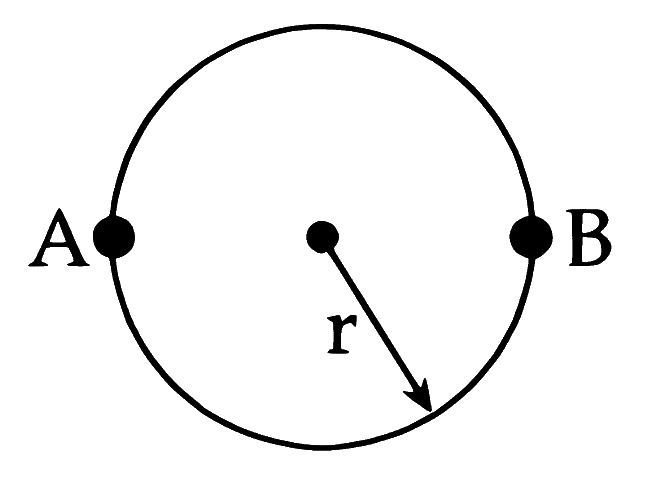
Figure

Show answer and solution

Answer: (d)

  1. Conical pendulum: tan⁡θ=v2rg⇒v2=rgtan⁡θ\tan\theta = \frac{v^2}{rg} \Rightarrow v^2 = rg\tan\theta.
  2. v2=0.4×10×tan⁡45∘=4v^2 = 0.4 \times 10 \times \tan 45^\circ = 4
  3. v=2v = 2 m/s
  4. So the answer is (d) 2 m/s.
Report a mistake