Physics Circle home Home Practice Hub Register / Login

Home›Practice Hub›Chapters›Electromagnetic Induction

Physics PYQs · MHT CET · JEE Main · NEET

Electromagnetic Induction

Questions
412
MHT CET
205
JEE Main
156
NEET
51
Years
1988–2026
0 of 412 attemptedPick an answer to see the solution

Q1MHT CET 2026 · 20 APR · SHIFT 2Easy

Magnetic Flux & Faraday's Law · Magnetic flux

A circular disc of radius 20 cm is placed in uniform magnetic field of induction 722\frac{7}{22} Wb/m2^{2} in such a way that its axis makes an angle of 60∘60^\circ with B⃗\vec{B}. The magnetic flux linked with the disc is (cos⁡60∘=0.5)(\cos 60^\circ = 0.5)

Show answer and solution

Answer: (b)

  1. Flux Φ=BAcos⁡θ\Phi = BA\cos\theta, where θ\theta is the angle between B⃗\vec{B} and the axis (normal) of the disc.
  2. A=πr2=227(0.2)2=227×0.04A = \pi r^{2} = \frac{22}{7}(0.2)^{2} = \frac{22}{7}\times 0.04 m2^{2}
  3. Φ=722×227×0.04×0.5=0.02\Phi = \frac{7}{22}\times\frac{22}{7}\times 0.04\times 0.5 = 0.02 Wb
  4. So the answer is (b) 0.020.02 Wb.
Report a mistake
Q2MHT CET 2026 · 20 MAY · SHIFT 1Easy

Magnetic Flux & Faraday's Law · Faraday's law and average emf

A coil having effective area 'A' is held with its plane normal to a magnetic field of induction 'B'. The magnetic induction is quickly reduced to 25%25\% of its initial value in 22 second. Then e.m.f. induced across the coil will be

Show answer and solution

Answer: (d)

  1. Average emf e=ΔΦΔt=A ΔBΔte = \frac{\Delta\Phi}{\Delta t} = \frac{A\,\Delta B}{\Delta t}.
  2. Field falls to 25%25\%: ΔB=B−0.25B=0.75B=3B4\Delta B = B - 0.25B = 0.75B = \frac{3B}{4}
  3. e=A(3B/4)2=3AB8e = \frac{A(3B/4)}{2} = \frac{3AB}{8}
  4. So the answer is (d) 3AB8\frac{3AB}{8}.
Report a mistake
Q3MHT CET 2026 · 19 MAY · SHIFT 1Easy

Magnetic Flux & Faraday's Law · Faraday's law and average emf

Whenever a magnet is moved either towards or away from a conducting coil, magnetic flux linked with the coil changes. This change is dependent on

(a) the strength of the magnetic field.

(b) the area of cross-section of the coil.

(c) the resistance of the coil.

(d) the number of turns in the coil.

Show answer and solution

Answer: (c)

  1. Flux linkage NΦ=NBAcos⁡θN\Phi = NBA\cos\theta.
  2. It depends on field strength BB, area AA and number of turns NN.
  3. Resistance affects only the induced current, not the flux.
  4. So the answer is (c) (a), (b), (d).
Report a mistake
Q4MHT CET 2026 · 20 APR · SHIFT 1Easy

Magnetic Flux & Faraday's Law · Faraday's law and average emf

A coil of effective area 33 m2^{2} is placed at right angles to a magnetic field of induction 0.050.05 Wb/m2^{2}. If the field is decreased to 20%20\% of its original value in 1010 second, the e.m.f. induced in the coil will be

Show answer and solution

Answer: (b)

  1. e=A ΔBΔte = \frac{A\,\Delta B}{\Delta t}
  2. Field falls to 20%20\%: ΔB=0.8×0.05=0.04\Delta B = 0.8\times 0.05 = 0.04 Wb/m2^{2}
  3. e=3×0.0410=0.012e = \frac{3\times 0.04}{10} = 0.012 V =12= 12 mV
  4. So the answer is (b) 1212 mV.
Report a mistake
Q5MHT CET 2026 · 13 APR · SHIFT 2Easy

Magnetic Flux & Faraday's Law · Faraday's law and average emf

A conducting loop of radius 10/[π]1/210/[\pi]^{1/2} cm is placed perpendicular to a uniform magnetic field 0.50.5 T. The magnetic field is decreased to zero in 0.50.5 s at a steady rate. The induced emf in the circular loop at 0.250.25 s is

Show answer and solution

Answer: (b)

  1. A=πr2=π(10π)2=100A = \pi r^{2} = \pi\left(\frac{10}{\sqrt{\pi}}\right)^{2} = 100 cm2=10−2^{2} = 10^{-2} m2^{2}
  2. Steady decrease, so the emf is constant: e=AΔBΔt=10−2×0.50.5e = A\frac{\Delta B}{\Delta t} = 10^{-2}\times\frac{0.5}{0.5}
  3. e=10−2e = 10^{-2} V =10= 10 mV at any instant, including 0.250.25 s.
  4. So the answer is (b) 1010 mV.
Report a mistake
Q6MHT CET 2026 · 19 APR · SHIFT 1Easy

Magnetic Flux & Faraday's Law · Flux as a function of time

Magnetic flux linked with the coil in weber is given by the equation Φ=5t2+6t+11\Phi = 5t^{2} + 6t + 11. The e.m.f. induced in the coil in the 55th second will be

Show answer and solution

Answer: (b)

  1. "In the 5th second" means the interval t=4t = 4 s to t=5t = 5 s, so use average emf e=ΔΦΔte = \frac{\Delta\Phi}{\Delta t}.
  2. Φ(5)=125+30+11=166\Phi(5) = 125 + 30 + 11 = 166 Wb, Φ(4)=80+24+11=115\Phi(4) = 80 + 24 + 11 = 115 Wb
  3. e=166−1151=51e = \frac{166 - 115}{1} = 51 V
  4. So the answer is (b) 5151 V.
Report a mistake
Q7MHT CET 2026 · 15 APR · SHIFT 1Easy

Magnetic Flux & Faraday's Law · Induced current

A coil of 'n' turns and resistance R ΩR\,\Omega is connected in series with a resistance R/4R/4. The combination is moved for time 't' second through flux Φ1\Phi_1 to Φ2\Phi_2. The induced current in the circuit is

Show answer and solution

Answer: (a)

  1. Total resistance R+R4=5R4R + \frac{R}{4} = \frac{5R}{4}
  2. Emf e=n(Φ1−Φ2)te = \frac{n(\Phi_1 - \Phi_2)}{t}
  3. I=e5R/4=4n(Φ1−Φ2)5RtI = \frac{e}{5R/4} = \frac{4n(\Phi_1 - \Phi_2)}{5Rt}
  4. So the answer is (a) 4n(Φ1−Φ2)5Rt\frac{4n(\Phi_1 - \Phi_2)}{5Rt}.
Report a mistake
Q8MHT CET 2026 · 11 APR · SHIFT 2Easy

Magnetic Flux & Faraday's Law · Induced current

A coil having 'n' turns and resistance 'R' is connected with a galvanometer of resistance '2R'. This combination is moved in time 't' from flux ϕ1\phi_1 to ϕ2\phi_2 Wb. The induced current in the circuit is

Show answer and solution

Answer: (c)

  1. Total resistance R+2R=3RR + 2R = 3R
  2. Emf magnitude e=n(ϕ2−ϕ1)te = \frac{n(\phi_2 - \phi_1)}{t}
  3. I=e3R=n(ϕ2−ϕ1)3RtI = \frac{e}{3R} = \frac{n(\phi_2 - \phi_1)}{3Rt} (in magnitude)
  4. So the answer is (c) n(ϕ2−ϕ1)3Rt\frac{n(\phi_2 - \phi_1)}{3Rt}.
Report a mistake
Q9MHT CET 2026 · 19 MAY · SHIFT 1Easy

Magnetic Flux & Faraday's Law · Induced charge

The magnetic flux through a coil of resistance 'RR' changes by an amount Δϕ\Delta\phi in the time Δt\Delta t. The total quantity of induced current and charge is respectively

Show answer and solution

Answer: (c)

  1. Average emf e=ΔϕΔte = \frac{\Delta\phi}{\Delta t}, so current I=eR=ΔϕRΔtI = \frac{e}{R} = \frac{\Delta\phi}{R\Delta t}.
  2. Charge q=IΔt=ΔϕRq = I\Delta t = \frac{\Delta\phi}{R}.
  3. So the answer is (c) ΔϕRΔt\frac{\Delta\phi}{R\Delta t} and ΔϕR\frac{\Delta\phi}{R}.
Report a mistake
Q10MHT CET 2026 · 12 MAY · SHIFT 2Easy

Magnetic Flux & Faraday's Law · Induced charge

An induced current of 22A flows through a coil. The resistance of the coil is 10 Ω10\ \Omega. What is the change in magnetic flux associated with a coil in 11 ms?

Show answer and solution

Answer: (b)

  1. I=eR=ΔϕRΔt⇒Δϕ=IRΔtI = \frac{e}{R} = \frac{\Delta\phi}{R\Delta t} \Rightarrow \Delta\phi = IR\Delta t
  2. Δϕ=2×10×10−3=2×10⁻²\Delta\phi = 2 \times 10 \times 10^{-3} = 2 \times 10^{-2} Wb
  3. So the answer is (b) 2×10⁻²² \times 10^{-2} Wb.
Report a mistake
Q11MHT CET 2026 · 14 MAY · SHIFT 2Medium

Magnetic Flux & Faraday's Law · Magnetic flux

A square of side L metre lies in the XY plane in a region, where the magnetic field is B⃗=B0 (2i^+3j^+4k^)\vec{B} = B_0\,(2\hat{i} + 3\hat{j} + 4\hat{k}), where B0B_0 constant. The magnitude of flux passing through the square is

Show answer and solution

Answer: (c)

  1. Square in the XY plane: area vector A⃗=L2k^\vec{A} = L^2\hat{k}.
  2. ϕ=B⃗⋅A⃗=B0(2i^+3j^+4k^)⋅L2k^=4B0L2\phi = \vec{B}\cdot\vec{A} = B_0(2\hat{i} + 3\hat{j} + 4\hat{k})\cdot L^2\hat{k} = 4B_0L^2
  3. Only the zz-component of B⃗\vec{B} crosses the square.
  4. So the answer is (c) 4B0L24B_0L^2 Wb.
Report a mistake
Q12MHT CET 2026 · 12 MAY · SHIFT 2Medium

Magnetic Flux & Faraday's Law · Faraday's law and average emf

The coil of area 0.10.1 m2^{2} has 10001000 turns. It is placed in a magnetic field of strength 5×10−45 \times 10^{-4} T. The average e.m.f. induced in the coil, if rotated through 180∘180^\circ in 0.10.1 s is (cos⁡0∘=1,cos⁡180∘=−1\cos 0^\circ = 1, \cos 180^\circ = -1)

Show answer and solution

Answer: (c)

  1. Rotating through 180∘180^\circ: flux goes from NBANBA to −NBA-NBA, so ∣Δϕ∣=2NBA|\Delta\phi| = 2NBA.
  2. 2NBA=2×1000×5×10−4×0.1=0.12NBA = 2 \times 1000 \times 5 \times 10^{-4} \times 0.1 = 0.1 Wb
  3. e=ΔϕΔt=0.10.1=1e = \frac{\Delta\phi}{\Delta t} = \frac{0.1}{0.1} = 1 V
  4. So the answer is (c) 1 V.
Report a mistake
Q13MHT CET 2026 · 13 MAY · SHIFT 2Medium

Magnetic Flux & Faraday's Law · Flux as a function of time

A varying magnetic flux linking a coil is Φ=xt2\Phi = xt^{2}. If at time t=3t = 3 s, the e.m.f. induced is 99V then the magnitude of xx is (in Wb/s2/\text{s}^{2})

Show answer and solution

Answer: (a)

  1. e=dΦdt=2xte = \frac{d\Phi}{dt} = 2xt
  2. At t=3t = 3 s: 9=2x×3=6x9 = 2x \times 3 = 6x
  3. x=1.5x = 1.5 Wb/s2^2
  4. So the answer is (a) 1.5.
Report a mistake
Q14JEE Main 2026 · 6 APR · SHIFT 2Medium

Magnetic Flux & Faraday's Law · Flux as a function of time

A square loop of side 2 cm is placed in a time varying magnetic field with magnitude as B=0.4sin⁡(300t)B = 0.4\sin(300t) Tesla. The normal to the plane of loop makes an angle of 60∘60^\circ with the field. The maximum induced emf produced in the loop is ______ mV.

Show answer and solution

Answer: (d)

  1. ϕ=BAcos⁡60∘=0.4sin⁡(300t)×A×12\phi = BA\cos 60^\circ = 0.4\sin(300t) \times A \times \frac{1}{2}, with A=(0.02)2=4×10⁻⁴A = (0.02)^2 = 4 \times 10^{-4} m2^2.
  2. e=dϕdt=0.4×300×4×10−4×12cos⁡(300t)e = \frac{d\phi}{dt} = 0.4 \times 300 \times 4 \times 10^{-4} \times \frac{1}{2}\cos(300t)
  3. emax=120×2×10−4=0.024e_{max} = 120 \times 2 \times 10^{-4} = 0.024 V
  4. So the answer is (d) 24 mV.
Report a mistake
Q15JEE Main 2026 · 23 JAN · SHIFT 2Medium

Magnetic Flux & Faraday's Law · Changing area of a loop

A circular loop of radius 7 cm is placed in uniform magnetic field of 0.2 T directed perpendicular to plane of loop. The loop is converted into a square loop in 0.5 s. The EMF induced in the loop is ______ mV.

Show answer and solution

Answer: (c)

  1. Same wire, so perimeter is constant: 2πr=2×227×7=442\pi r = 2 \times \frac{22}{7} \times 7 = 44 cm, square side =11= 11 cm.
  2. Circle area =227×49=154= \frac{22}{7} \times 49 = 154 cm2^2; square area =121= 121 cm2^2; ΔA=33\Delta A = 33 cm2=33×10−4^2 = 33 \times 10^{-4} m2^2.
  3. e=BΔAΔt=0.2×33×10−40.5=1.32×10⁻³e = \frac{B\Delta A}{\Delta t} = \frac{0.2 \times 33 \times 10^{-4}}{0.5} = 1.32 \times 10^{-3} V
  4. So the answer is (c) 1.32 mV.
Report a mistake
Q16MHT CET 2026 · 13 MAY · SHIFT 1Medium

Magnetic Flux & Faraday's Law · Induced charge

A circular ring of diameter 2020 cm has a resistance of 0.01 Ω0.01\ \Omega. The charge that will flow through the ring, if it is turned from a position perpendicular to a uniform magnetic field of 22T to a position parallel to the field is (in coulomb) (∵cos⁡0∘=1, cos⁡90∘=0\because \cos 0^\circ = 1,\ \cos 90^\circ = 0)

Show answer and solution

Answer: (b)

  1. Radius =0.1= 0.1 m, area A=π(0.1)2=0.01πA = \pi (0.1)^2 = 0.01\pi m2^2.
  2. Perpendicular to parallel: flux goes from BABA to 00, so Δϕ=2×0.01π=0.02π\Delta\phi = 2 \times 0.01\pi = 0.02\pi Wb.
  3. q=ΔϕR=0.02π0.01=2πq = \frac{\Delta\phi}{R} = \frac{0.02\pi}{0.01} = 2\pi C
  4. So the answer is (b) 2π2\pi.
Report a mistake
Q17MHT CET 2026 · 12 MAY · SHIFT 2Medium

Magnetic Flux & Faraday's Law · Induced charge

A closed coil consists of 500500 turns on a rectangular frame of area 4.04.0 cm2^{2} and has a resistance of 50 Ω50\ \Omega. The coil is kept with its plane perpendicular to a uniform magnetic field of 0.20.2 T. The amount of charge flowing through the coil if it is turned through 180∘180^\circ will be 1.6×10−x1.6 \times 10^{-x} C. The Value of xx is

Show answer and solution

Answer: (c)

  1. Turning through 180∘180^\circ: Δϕ=2NBA=2×500×0.2×4×10−4=0.08\Delta\phi = 2NBA = 2 \times 500 \times 0.2 \times 4 \times 10^{-4} = 0.08 Wb.
  2. q=ΔϕR=0.0850=1.6×10⁻³q = \frac{\Delta\phi}{R} = \frac{0.08}{50} = 1.6 \times 10^{-3} C
  3. So x=3x = 3, answer (c).
Report a mistake
Q18MHT CET 2026 · 15 MAY · SHIFT 2Medium

Magnetic Flux & Faraday's Law · Power and heat in a loop

A rectangular wire loop of resistance 1.5 Ω1.5\ \Omega placed in a region of uniform magnetic field of magnitude 0.30.3 T directed normal to the loop. If the area of the loop decreases at a rate of 0.050.05 m2/s{}^{2}/\text{s} in this magnetic field, the heat produced in it is x×10−6x \times 10^{-6} W. The value of xx is

Show answer and solution

Answer: (d)

  1. e=BdAdt=0.3×0.05=0.015e = B\frac{dA}{dt} = 0.3 \times 0.05 = 0.015 V
  2. Heat produced per second P=e2R=(0.015)21.5=1.5×10⁻⁴P = \frac{e^2}{R} = \frac{(0.015)^2}{1.5} = 1.5 \times 10^{-4} W
  3. P=150×10−6P = 150 \times 10^{-6} W
  4. So the answer is (d) 150.
Report a mistake
Q19NEET 2026 · RE-NEETMedium

Magnetic Flux & Faraday's Law · Power and heat in a loop

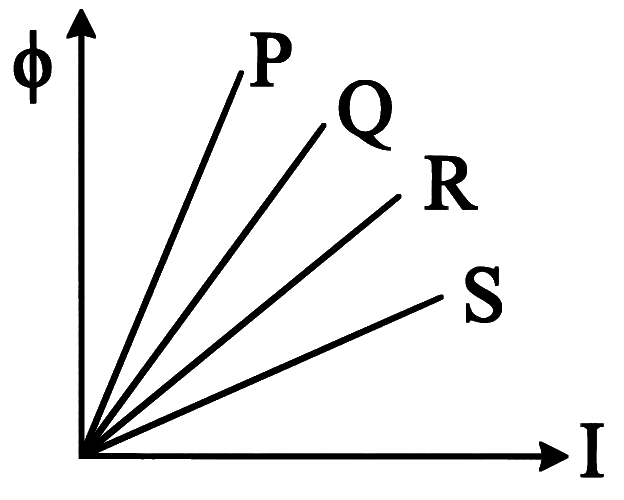
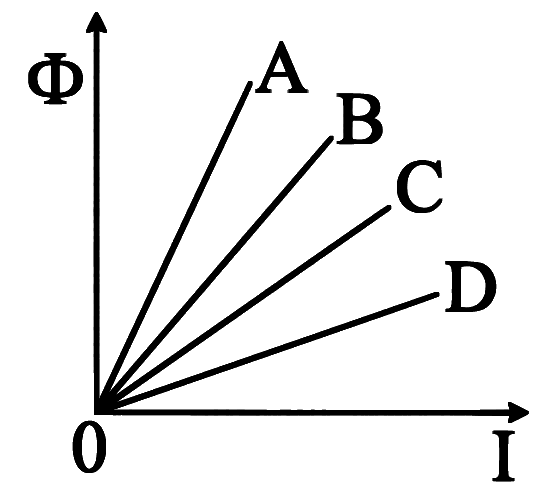
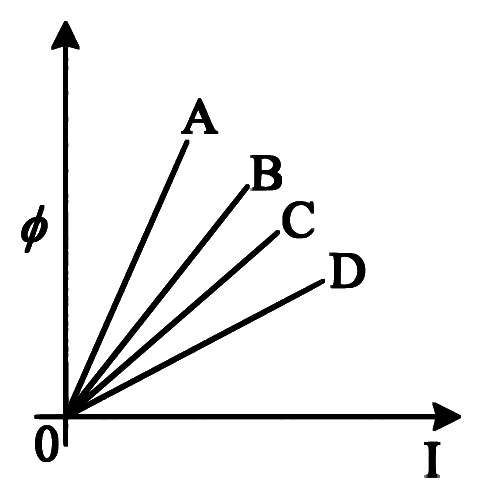
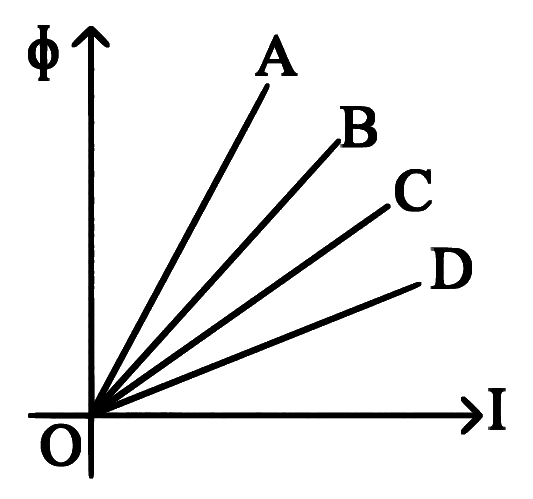
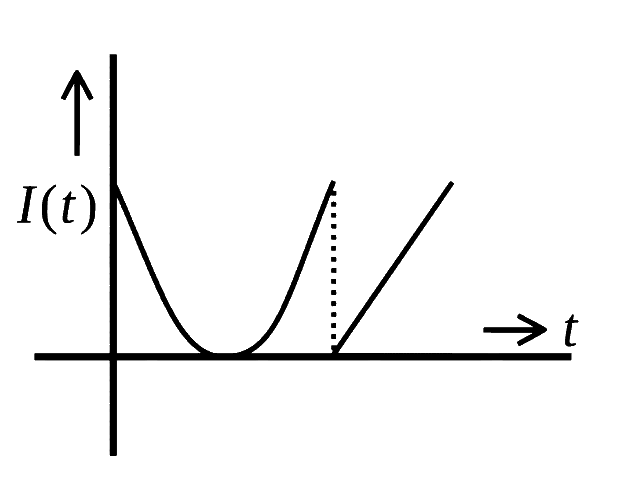
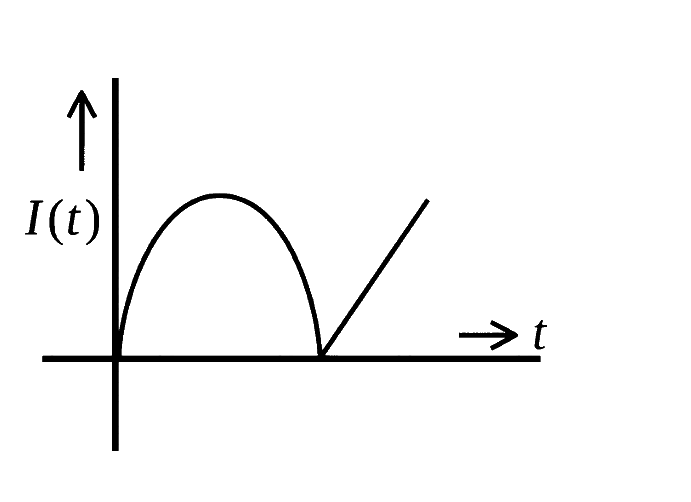
A conducting loop of finite resistance lies on the x−yx-y plane. There is a constant magnetic field in the zz direction. The area of the loop varies with time tt, as A=A0(1+sin⁡t)A = A_0(1+\sin t) in appropriate units. The figure that correctly indicates the qualitative behaviour of the power PP dissipated in the loop as a function of time is:

Show answer and solution

Answer: (c)

  1. Flux ϕ=BA=BA0(1+sin⁡t)\phi = BA = BA_0(1+\sin t), so e=−dϕdt=−BA0cos⁡te = -\dfrac{d\phi}{dt} = -BA_0\cos t.
  2. Power P=e2R=B2A02Rcos⁡2tP = \dfrac{e^2}{R} = \dfrac{B^2A_0^2}{R}\cos^2 t.
  3. At t=0t=0, PP is maximum; it falls to zero at t=π/2t=\pi/2 and rises again (a cos⁡2t\cos^2 t curve).
  4. So the answer is (c).
Report a mistake
Q20JEE Main 2026 · 21 JAN · SHIFT 1Medium

Magnetic Flux & Faraday's Law · Power and heat in a loop

A conducting circular loop of area 1.0 m21.0\text{ m}^{2} is placed perpendicular to a magnetic field which varies as B=sin⁡(100t)B = \sin(100t) Tesla. If the resistance of the loop is 100 Ω100\ \Omega, then the average thermal energy dissipated in the loop in one period is ______ J.

Show answer and solution

Answer: (c)

  1. e=AdBdt=1×100cos⁡(100t)=100cos⁡(100t)e = A\dfrac{dB}{dt} = 1 \times 100\cos(100t) = 100\cos(100t) V.
  2. P=e2R=104cos⁡2(100t)100=100cos⁡2(100t)P = \dfrac{e^2}{R} = \dfrac{10^4\cos^2(100t)}{100} = 100\cos^2(100t), so Pavg=50P_{avg} = 50 W.
  3. Period T=2π100T = \dfrac{2\pi}{100} s.
  4. Energy in one period =50×2π100=π= 50 \times \dfrac{2\pi}{100} = \pi J. So the answer is (c) π\pi.
Report a mistake
Q21JEE Main 2026 · 5 APR · SHIFT 2Difficult

Magnetic Flux & Faraday's Law · Flux as a function of time

A circular loop of radius 20 cm and resistance 2 Ω2\ \Omega is placed in a time varying magnetic field B⃗=(2t2+2t+3)T\vec{B} = \left(2t^{2}+2t+3\right)T. At t=0t = 0, for the plane of the loop being perpendicular to the magnetic field and, the induced current in the loop at t=3 st = 3\text{ s} is α50 A\frac{\alpha}{50}\text{ A}. The value of α\alpha is ______. (Take π=22/7\pi = 22/7)

Numerical answer type. Work it out, then open the answer.

Show answer and solution

Answer: 44

  1. A=πr2=227×(0.2)2=227×0.04A = \pi r^2 = \dfrac{22}{7}\times(0.2)^2 = \dfrac{22}{7}\times0.04 m2^2.
  2. dBdt=4t+2=14\dfrac{dB}{dt} = 4t + 2 = 14 T/s at t=3t = 3 s.
  3. e=AdBdt=227×0.04×14=1.76e = A\dfrac{dB}{dt} = \dfrac{22}{7}\times0.04\times14 = 1.76 V, so I=1.762=0.88I = \dfrac{1.76}{2} = 0.88 A.
  4. 0.88=α50⇒α=440.88 = \dfrac{\alpha}{50} \Rightarrow \alpha = 44.
Report a mistake
Q22JEE Main 2026 · 2 APR · SHIFT 1Difficult

Magnetic Flux & Faraday's Law · Power and heat in a loop

When a coil is placed in a time dependent magnetic field the power dissipated in it is PP. The number of turns, area of the coil and radius of the coil wire are N, AN,\ A and rr respectively. For a second coil number of turns, area of the coil and radius of the coil wire are 2N, 2A2N,\ 2A and 3r3r respectively. When the first coil is replaced with second coil the power dissipated in it is 2 αP\sqrt{2}\,\alpha P. The value of α\alpha is ______.

Show answer and solution

Answer: (a)

  1. e∝NAe \propto NA; wire length ∝NA\propto N\sqrt{A}, so R∝NAr2R \propto \dfrac{N\sqrt{A}}{r^2}.
  2. P=e2R∝N2A2r2NA=NA3/2r2P = \dfrac{e^2}{R} \propto \dfrac{N^2A^2 r^2}{N\sqrt{A}} = N A^{3/2} r^2.
  3. P′P=2×23/2×32=18×22=362\dfrac{P'}{P} = 2 \times 2^{3/2} \times 3^2 = 18\times 2\sqrt{2} = 36\sqrt{2}.
  4. 2 α=362⇒α=36\sqrt{2}\,\alpha = 36\sqrt{2} \Rightarrow \alpha = 36. So the answer is (a) 36.
Report a mistake
Q23MHT CET 2025 · 5 MAY · SHIFT 2Easy

Magnetic Flux & Faraday's Law · Faraday's law and average emf

A coil of effective area 3 m23\text{ m}^{2} is placed at right angles to a magnetic field of induction 0.05 Wb/m20.05\text{ Wb/m}^{2} If the field is decreased to 20%20\% of its original value in 10 second, the e.m.f. induced in the coil will be

Show answer and solution

Answer: (b)

  1. e=A ΔBΔte = \frac{A\,\Delta B}{\Delta t}
  2. ΔB=0.05−0.2×0.05=0.04\Delta B = 0.05 - 0.2\times 0.05 = 0.04 Wb/m2^{2}
  3. e=3×0.0410=0.012e = \frac{3\times 0.04}{10} = 0.012 V =12= 12 mV
  4. So the answer is (b) 12 mV.
Report a mistake
Q24MHT CET 2025 · 26 APR · SHIFT 1Easy

Magnetic Flux & Faraday's Law · Faraday's law and average emf

A magnetic field 4×10⁻² T4 \times 10^{-2}\text{ T} acts at right angles to a coil of area 100 cm2100\text{ cm}^{2} with 50 turns. The average e.m.f. induced in the coil is 0.1 V, when it is removed from the field in time ' tt '. The value of ' tt ' is

Show answer and solution

Answer: (c)

  1. Removing the coil takes flux from NBANBA to 00: e=NBAte = \frac{NBA}{t}.
  2. t=NBAe=50×4×10−2×10−20.1t = \frac{NBA}{e} = \frac{50\times 4\times 10^{-2}\times 10^{-2}}{0.1}
  3. t=0.020.1=0.2t = \frac{0.02}{0.1} = 0.2 s
  4. So the answer is (c) 0.2 second.
Report a mistake
Q25MHT CET 2025 · 5 MAY · SHIFT 2Easy

Magnetic Flux & Faraday's Law · Induced current

A coil having ' NN ' turns and resistance ' RR ' Ω\Omega is connected to a galvanometer of resistance ' 6 R ' Ω\Omega. The magnetic flux linked with this coil changes from ϕ1\phi_1 weber to ϕ2\phi_2 weber in time ' t ' second. The induced current in the circuit is

Show answer and solution

Answer: (b)

  1. Total resistance R+6R=7RR + 6R = 7R
  2. Emf e=N(ϕ2−ϕ1)te = \frac{N(\phi_2 - \phi_1)}{t} (magnitude)
  3. I=e7R=N(ϕ2−ϕ1)7RtI = \frac{e}{7R} = \frac{N(\phi_2 - \phi_1)}{7Rt}
  4. So the answer is (b) N(ϕ2−ϕ1)7Rt\frac{N(\phi_2 - \phi_1)}{7Rt}.
Report a mistake
Q26MHT CET 2025 · 25 APR · SHIFT 2Easy

Magnetic Flux & Faraday's Law · Induced current

A coil of ' nn ' turns and resistance RΩR\Omega is connected in series with a resistance R2\frac{R}{2}. The combination is moved for time ' tt ' second through magnetic flux ϕ1\phi_1 to ϕ2\phi_2. The induced current in the circuit is

Show answer and solution

Answer: (b)

  1. Total resistance R+R2=3R2R + \frac{R}{2} = \frac{3R}{2}
  2. Emf e=n(ϕ1−ϕ2)te = \frac{n(\phi_1 - \phi_2)}{t}
  3. I=e3R/2=2n(ϕ1−ϕ2)3RtI = \frac{e}{3R/2} = \frac{2n(\phi_1 - \phi_2)}{3Rt}
  4. So the answer is (b) 2n(ϕ1−ϕ2)3Rt\frac{2n(\phi_1 - \phi_2)}{3Rt}.
Report a mistake
Q27MHT CET 2025 · 23 APR · SHIFT 2Easy

Magnetic Flux & Faraday's Law · Induced current

A coil of n turns and resistance RΩR\Omega is connected in series with resistance R/4R/4. The combination is moved for time tt second through magnetic flux ϕ1\phi_1 to ϕ2\phi_2. The induced current in the circuit is

Show answer and solution

Answer: (b)

  1. Total resistance R+R4=5R4R + \frac{R}{4} = \frac{5R}{4}
  2. Emf e=n(ϕ1−ϕ2)te = \frac{n(\phi_1 - \phi_2)}{t}
  3. I=e5R/4=4n(ϕ1−ϕ2)5RtI = \frac{e}{5R/4} = \frac{4n(\phi_1 - \phi_2)}{5Rt}
  4. So the answer is (b) 4n(ϕ1−ϕ2)5Rt\frac{4n(\phi_1 - \phi_2)}{5Rt}.
Report a mistake
Q28MHT CET 2025 · 22 APR · SHIFT 1Easy

Magnetic Flux & Faraday's Law · Induced current

A coil of resistance 400 Ω400\,\Omega is placed in a magnetic field. If the magnetic flux ' ϕ\phi ' ( Wb) linked with the coil varies with time ' tt ' ( s\text{s}) is ϕ=50t2+4\phi = 50t^{2} + 4, the current in the coil at t=2 st = 2\text{ s} will be

Show answer and solution

Answer: (c)

  1. ∣e∣=dϕdt=100t|e| = \frac{d\phi}{dt} = 100t; at t=2t = 2 s, ∣e∣=200|e| = 200 V
  2. I=eR=200400=0.5I = \frac{e}{R} = \frac{200}{400} = 0.5 A
  3. So the answer is (c) 0.5 A.
Report a mistake
Q29MHT CET 2025 · 22 APR · SHIFT 1Easy

Magnetic Flux & Faraday's Law · Induced charge

The total charge induced in a conducting loop when it is moved in a uniform magnetic field depends on

Show answer and solution

Answer: (c)

  1. q=∫I dt=∫1Rdϕdtdt=ΔϕRq = \int I\,dt = \int \frac{1}{R}\frac{d\phi}{dt}dt = \frac{\Delta\phi}{R}
  2. The time taken cancels, so qq depends only on the total change in flux (for a given RR), not on its rate.
  3. So the answer is (c) the total change in magnetic flux.
Report a mistake
Q30MHT CET 2025 · 19 APR · SHIFT 2Medium

Magnetic Flux & Faraday's Law · Faraday's law and average emf

The magnetic flux through a coil is 4×10⁻⁴ Wb4 \times 10^{-4}\text{ Wb} at time t=0t = 0. It reduces to 30%30\% of its original value in time tt second. If e.m.f. induced in the coil is 0.56 mV then the value of tt is

Show answer and solution

Answer: (a)

  1. Flux falls to 30%30\%, so Δϕ=0.7×4×10−4=2.8×10⁻⁴\Delta\phi = 0.7 \times 4 \times 10^{-4} = 2.8 \times 10^{-4} Wb.
  2. e=Δϕt⇒t=Δϕee = \frac{\Delta\phi}{t} \Rightarrow t = \frac{\Delta\phi}{e}
  3. t=2.8×10−40.56×10−3=0.5t = \frac{2.8 \times 10^{-4}}{0.56 \times 10^{-3}} = 0.5 s
  4. So the answer is (a) 0.5 s.
Report a mistake
Q31MHT CET 2025 · 23 APR · SHIFT 2Medium

Magnetic Flux & Faraday's Law · Induced charge

A coil of ' nn ' turns and area ' AA ' is suddenly removed from a magnetic field, a charge ' qq ' flows through the coil. If resistance of the coil is ' RR ' then the magnetic flux density is (in Wb/m2\text{Wb/m}^{2})

Show answer and solution

Answer: (b)

  1. Removing the coil: flux changes from nBAnBA to 00, so Δϕ=nBA\Delta\phi = nBA.
  2. q=ΔϕR=nBARq = \frac{\Delta\phi}{R} = \frac{nBA}{R}
  3. B=qRnAB = \frac{qR}{nA}
  4. So the answer is (b) qRnA\frac{qR}{nA}.
Report a mistake
Q32MHT CET 2024 · 4 MAY · SHIFT 2Easy

Magnetic Flux & Faraday's Law · Faraday's law and average emf

A magnetic field of 2×10⁻² T2 \times 10^{-2}\text{ T} acts at right angles to a coil of area 100 cm2100\text{ cm}^{2} with 50 turns, The average e.m.f. induced in the coil is 0.1 V, when it is removed from the field in time tt. The value of ' tt ' is (in second)

Show answer and solution

Answer: (a)

  1. e=NBAt⇒t=NBAee = \frac{NBA}{t} \Rightarrow t = \frac{NBA}{e}
  2. A=100A = 100 cm2=10−2^{2} = 10^{-2} m2^{2}
  3. t=50×2×10−2×10−20.1=0.010.1=0.1t = \frac{50\times 2\times 10^{-2}\times 10^{-2}}{0.1} = \frac{0.01}{0.1} = 0.1 s
  4. So the answer is (a) 0.1 s.
Report a mistake
Q33MHT CET 2024 · 16 MAY · SHIFT 1Easy

Magnetic Flux & Faraday's Law · Induced current

A coil of resistance 250 Ω250\,\Omega is placed in a magnetic field. If the magnetic flux (ϕ)(\phi) linked with the coil varies with time t(s)t(\text{s}) as ϕ=50t2+7\phi = 50t^{2} + 7. The current in the coil at t=4 st = 4\text{ s} is

Show answer and solution

Answer: (d)

  1. ∣e∣=dϕdt=100t|e| = \frac{d\phi}{dt} = 100t; at t=4t = 4 s, ∣e∣=400|e| = 400 V
  2. I=eR=400250=1.6I = \frac{e}{R} = \frac{400}{250} = 1.6 A
  3. So the answer is (d) 1.6 A.
Report a mistake
Q34JEE Main 2024 · 31 JAN · SHIFT 2Easy

Magnetic Flux & Faraday's Law · Induced current

The magnetic flux ϕ\phi (in weber) linked with a closed circuit of resistance 8 Ω8\,\Omega varies with time (in seconds) as ϕ=5t2−36t+1\phi = 5t^{2} - 36t + 1. The induced current in the circuit at t=2 st = 2\text{ s} is __________ A.

Numerical answer type. Work it out, then open the answer.

Show answer and solution

Answer: 2

  1. dϕdt=10t−36\frac{d\phi}{dt} = 10t - 36; at t=2t = 2 s, dϕdt=20−36=−16\frac{d\phi}{dt} = 20 - 36 = -16 Wb/s, so ∣e∣=16|e| = 16 V
  2. I=∣e∣R=168=2I = \frac{|e|}{R} = \frac{16}{8} = 2 A
  3. So the answer is 2 A.
Report a mistake
Q35MHT CET 2024 · 9 MAY · SHIFT 1Easy

Magnetic Flux & Faraday's Law · Induced charge

The magnetic flux through a coil of resistance ' RR ' changes by an amount ' Δϕ\Delta\phi ' in time ' Δt\Delta t '. The amount of induced current and induced charge in the coil are respectively

Show answer and solution

Answer: (d)

  1. Average emf e=ΔϕΔte = \frac{\Delta\phi}{\Delta t}, so I=eR=(ΔϕΔt)1RI = \frac{e}{R} = \left(\frac{\Delta\phi}{\Delta t}\right)\frac{1}{R}.
  2. Charge q=IΔt=ΔϕRq = I\Delta t = \frac{\Delta\phi}{R}.
  3. So the answer is (d) (ΔϕΔt)×1R\left(\frac{\Delta\phi}{\Delta t}\right)\times\frac{1}{R} and ΔϕR\frac{\Delta\phi}{R}.
Report a mistake
Q36JEE Main 2024 · 31 JAN · SHIFT 1Medium

Magnetic Flux & Faraday's Law · Faraday's law and average emf

A coil is placed perpendicular to a magnetic field of 5000 T5000\text{ T}. When the field is changed to 3000 T3000\text{ T} in 2 s2\text{ s}, an induced emf of 22 V22\text{ V} is produced in the coil. If the diameter of the coil is 0.02 m0.02\text{ m}, then the number of turns in the coil is:

Show answer and solution

Answer: (b)

  1. e=NAΔBΔte = NA\frac{\Delta B}{\Delta t} with A=πr2=227(0.01)2=227×10−4A = \pi r^2 = \frac{22}{7}(0.01)^2 = \frac{22}{7} \times 10^{-4} m2^2.
  2. ΔBΔt=5000−30002=1000\frac{\Delta B}{\Delta t} = \frac{5000 - 3000}{2} = 1000 T/s
  3. 22=N×227×10−4×1000⇒N=7022 = N \times \frac{22}{7} \times 10^{-4} \times 1000 \Rightarrow N = 70
  4. So the answer is (b) 70.
Report a mistake
Q37JEE Main 2024 · 27 JAN · SHIFT 1Medium

Magnetic Flux & Faraday's Law · Faraday's law and average emf

A rectangular loop of length 2.5 m2.5\text{ m} and width 2 m2\text{ m} is placed at 60∘60^\circ to a magnetic field of 4 T4\text{ T}. The loop is removed from the field in 10 sec10\text{ sec}. The average emf induced in the loop during this time is

Show answer and solution

Answer: (c)

  1. Taking 60∘60^\circ as the angle between B⃗\vec{B} and the normal: ϕ=BAcos⁡60∘\phi = BA\cos 60^\circ.
  2. ϕ=4×(2.5×2)×12=10\phi = 4 \times (2.5 \times 2) \times \frac{1}{2} = 10 Wb, and it falls to 00 when the loop is removed.
  3. e=−ΔϕΔt=−0−1010=+1e = -\frac{\Delta\phi}{\Delta t} = -\frac{0 - 10}{10} = +1 V
  4. So the answer is (c) +1+1 V.
Report a mistake
Q38JEE Main 2024 · 29 JAN · SHIFT 1Medium

Magnetic Flux & Faraday's Law · Faraday's law and average emf

A square loop of side 10 cm10\text{ cm} and resistance 0.7 Ω0.7\,\Omega is placed vertically in east-west plane. A uniform magnetic field of 0.20 T0.20\text{ T} is set up across the plane in north east direction. The magnetic field is decreased to zero in 1 s1\text{ s} at a steady rate. Then, magnitude of induced emf is x×10−3 V\sqrt{x} \times 10^{-3}\text{ V}. The value of xx is __________.

Numerical answer type. Work it out, then open the answer.

Show answer and solution

Answer: 2

loop (E-W)NEB (NE)45°top view: normal along N, angle 45°
  1. Loop in the east-west vertical plane, so its normal points north-south.
  2. Field along north-east makes 45∘45^\circ with the normal: ϕ=BAcos⁡45∘=0.2×0.01×12=2×10⁻³\phi = BA\cos 45^\circ = 0.2 \times 0.01 \times \frac{1}{\sqrt{2}} = \sqrt{2} \times 10^{-3} Wb.
  3. Flux falls to zero steadily in 1 s: e=2×10−31=2×10⁻³e = \frac{\sqrt{2} \times 10^{-3}}{1} = \sqrt{2} \times 10^{-3} V.
  4. So x=2x = 2.
Report a mistake
Q39NEET 2023Easy

Magnetic Flux & Faraday's Law · Magnetic flux

The net magnetic flux through any closed surface is:

Show answer and solution

Answer: (d)

  1. Magnetic field lines are closed loops; there are no isolated magnetic poles.
  2. Every line entering a closed surface also leaves it, so ∮B⃗⋅dA⃗=0\oint \vec{B}\cdot d\vec{A} = 0 (Gauss's law for magnetism).
  3. So the answer is (d) Zero.
Report a mistake
Q40JEE Main 2023 · 1 FEB · SHIFT 2Easy

Magnetic Flux & Faraday's Law · Magnetic flux

A coil is placed in magnetic field such that plane of coil is perpendicular to the direction of magnetic field. The magnetic flux through a coil can be changed:

A. By changing the magnitude of the magnetic field within the coil.

B. By changing the area of coil within the magnetic field.

C. By changing the angle between the direction of magnetic field and the plane of the coil. D. By reversing the magnetic field direction abruptly without changing its magnitude. Choose the most appropriate answer from the options given below:

Show answer and solution

Answer: (b)

  1. Φ=BAcos⁡θ\Phi = BA\cos\theta, so flux changes if BB, AA or θ\theta changes.
  2. A: changing BB changes Φ\Phi. B: changing AA changes Φ\Phi. C: changing the angle changes cos⁡θ\cos\theta.
  3. D: reversing B⃗\vec{B} takes Φ\Phi from +BA+BA to −BA-BA; the magnitude of Φ\Phi is unchanged, which is why the official answer leaves it out.
  4. So the answer is (b) A, B and C only.
Report a mistake
Q41MHT CET 2023 · 14 MAY · SHIFT 2Easy

Magnetic Flux & Faraday's Law · Faraday's law and average emf

A coil having effective area A, is held with its plane normal to magnetic field of induction B. The magnetic induction is quickly reduced by 25%25\% of its initial value in 2 second. Then the e.m.f. induced across the coil will be

Show answer and solution

Answer: (a)

  1. e=A ΔBΔte = \frac{A\,\Delta B}{\Delta t}
  2. Reduced BY 25%25\%: ΔB=0.25B=B4\Delta B = 0.25B = \frac{B}{4}
  3. e=A(B/4)2=AB8e = \frac{A(B/4)}{2} = \frac{AB}{8}
  4. So the answer is (a) AB8\frac{AB}{8}.
Report a mistake
Q42MHT CET 2023 · 14 MAY · SHIFT 1Easy

Magnetic Flux & Faraday's Law · Faraday's law and average emf

A magnetic field of 2×10⁻² T2 \times 10^{-2}\text{ T} acts at right angles to a coil of area 100 cm2100\text{ cm}^{2} with 50 turns. The average e.m.f. induced in the coil is 0.1 V0.1\text{ V}, when it is removed from the field in time 'tt'. The value of 'tt' is

Show answer and solution

Answer: (c)

  1. t=NBAet = \frac{NBA}{e}
  2. t=50×2×10−2×10−20.1=0.1t = \frac{50\times 2\times 10^{-2}\times 10^{-2}}{0.1} = 0.1 s
  3. So the answer is (c) 0.10.1 s.
Report a mistake
Q43MHT CET 2023 · 11 MAY · SHIFT 2Easy

Magnetic Flux & Faraday's Law · Faraday's law and average emf

A coil having effective area 'AA' is held with its plane normal to a magnitude field of induction 'BB'. The magnetic induction is quickly reduced to 25%25\% of its initial value in 1 second. The e.m.f. induced in the coil (in volt) will be

Show answer and solution

Answer: (d)

  1. e=A ΔBΔte = \frac{A\,\Delta B}{\Delta t}
  2. Reduced TO 25%25\%: ΔB=0.75B=3B4\Delta B = 0.75B = \frac{3B}{4}
  3. e=3BA/41=3BA4e = \frac{3BA/4}{1} = \frac{3BA}{4}
  4. So the answer is (d) 3BA4\frac{3BA}{4}.
Report a mistake
Q44JEE Main 2023 · 6 APR · SHIFT 1Easy

Magnetic Flux & Faraday's Law · Faraday's law and average emf

The induced emf can be produced in a coil by

A. moving the coil with uniform speed inside uniform magnetic field

B. moving the coil with non uniform speed inside uniform magnetic field

C. rotating the coil inside the uniform magnetic field

D. changing the area of the coil inside the uniform magnetic field

Choose the correct answer from the options given below:

Show answer and solution

Answer: (b)

  1. An emf is induced only if the flux BAcos⁡θBA\cos\theta changes.
  2. A, B: moving the coil (uniform or non-uniform speed) inside a uniform field keeps Φ\Phi constant, so no emf.
  3. C: rotation changes θ\theta, so Φ\Phi changes. D: changing AA changes Φ\Phi.
  4. So the answer is (b) C and D only.
Report a mistake
Q45JEE Main 2023 · 24 JAN · SHIFT 1Easy

Magnetic Flux & Faraday's Law · Faraday's law and average emf

A conducting circular loop of radius 10π\frac{10}{\sqrt{\pi}} cm is placed perpendicular to a uniform magnetic field of 0.5 T. The magnetic field is decreased to zero in 0.5 s at a steady rate. The induced emf in the circular loop at 0.25 s is:

Show answer and solution

Answer: (a)

  1. A=π(10π)2=100A = \pi\left(\frac{10}{\sqrt{\pi}}\right)^{2} = 100 cm2=10−2^{2} = 10^{-2} m2^{2}
  2. Steady rate, so emf is the same at every instant: e=AΔBΔt=10−2×0.50.5e = A\frac{\Delta B}{\Delta t} = 10^{-2}\times\frac{0.5}{0.5}
  3. e=10−2e = 10^{-2} V =10= 10 mV
  4. So the answer is (a) emf = 10 mV.
Report a mistake
Q46MHT CET 2023 · 11 MAY · SHIFT 2Easy

Magnetic Flux & Faraday's Law · Induced charge

The magnetic flux through a circuit of resistance 'RR' changes by an amount Δϕ\Delta\phi in the time Δt\Delta t. The total quantity of electric charge 'QQ' which passes during this time through any point of the circuit is

Show answer and solution

Answer: (b)

  1. I=1RΔϕΔtI = \frac{1}{R}\frac{\Delta\phi}{\Delta t} and Q=IΔtQ = I\Delta t.
  2. Q=ΔϕRQ = \frac{\Delta\phi}{R}, independent of Δt\Delta t.
  3. So the answer is (b) ΔϕR\frac{\Delta\phi}{R}.
Report a mistake
Q47JEE Main 2023 · 11 APR · SHIFT 1Medium

Magnetic Flux & Faraday's Law · Faraday's law and average emf

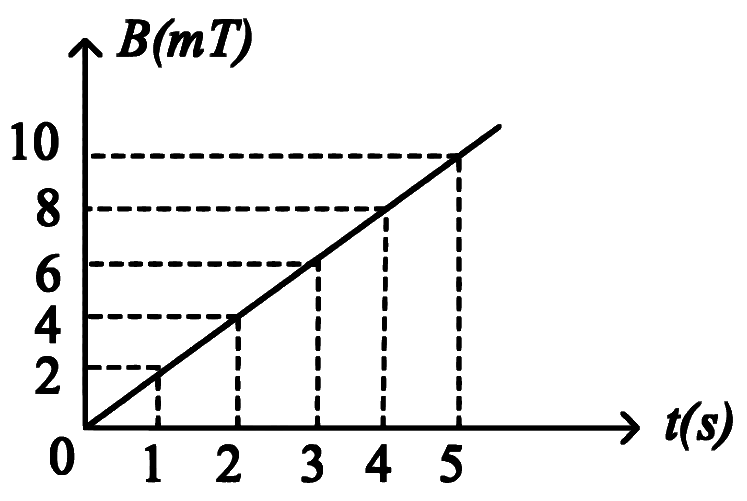
The magnetic field B crossing normally a square metallic plate of area 4 m24\text{ m}^{2} is changing with time as shown in figure. The magnitude of induced emf in the plate during t=2 st = 2\text{ s} to t=4 st = 4\text{ s}, is __________ mV\text{mV}.

Figure

Numerical answer type. Work it out, then open the answer.

Show answer and solution

Answer: 8

  1. From the graph, BB rises uniformly: dBdt=8−44−2=2\frac{dB}{dt} = \frac{8 - 4}{4 - 2} = 2 mT/s.
  2. e=AdBdt=4×2×10−3e = A\frac{dB}{dt} = 4 \times 2 \times 10^{-3} V
  3. So the induced emf is 88 mV.
Report a mistake
Q48MHT CET 2023 · 9 MAY · SHIFT 1Medium

Magnetic Flux & Faraday's Law · Flux as a function of time

The magnetic flux through a loop of resistance 10 Ω10\ \Omega varying according to the relation ϕ=6t2+7t+1\phi = 6t^{2} + 7t + 1, where ϕ\phi is in milliweber, time is in second at time t=1 st = 1\text{ s} the induced e.m.f. is

Show answer and solution

Answer: (c)

  1. e=dϕdt=12t+7e = \frac{d\phi}{dt} = 12t + 7 (in mV, since ϕ\phi is in mWb)
  2. At t=1t = 1 s: e=12+7=19e = 12 + 7 = 19 mV
  3. So the answer is (c) 19 mV.
Report a mistake
Q49JEE Main 2023 · 12 APR · SHIFT 1Medium

Magnetic Flux & Faraday's Law · Changing area of a loop

A conducting circular loop is placed in a uniform magnetic field of 0.4 T0.4\text{ T} with its plane perpendicular to the field. Somehow, the radius of the loop starts expanding at a constant rate of 1 mm/s1\text{ mm/s}. The magnitude of induced emf in the loop at an instant when the radius of the loop is 2 cm2\text{ cm} will be ___________ μV\mu\text{V}.

Numerical answer type. Work it out, then open the answer.

Show answer and solution

Answer: 50

  1. e=B⋅2πrdrdte = B \cdot 2\pi r\frac{dr}{dt}
  2. e=0.4×2π×0.02×10−3=1.6π×10−5e = 0.4 \times 2\pi \times 0.02 \times 10^{-3} = 1.6\pi \times 10^{-5} V
  3. e≈5.0×10⁻⁵e \approx 5.0 \times 10^{-5} V
  4. So the induced emf is about 50 μ50\ \muV.
Report a mistake
Q50JEE Main 2023 · 29 JAN · SHIFT 1Medium

Magnetic Flux & Faraday's Law · Changing area of a loop

A certain elastic conducting material is stretched into a circular loop. It is placed with its plane perpendicular to a uniform magnetic field B = 0.8 T. When released the radius of the loop starts shrinking at a constant rate of 2 cms −1^{-1}. The induced emf in the loop at an instant when the radius of the loop is 10 cm will be __________ mV.

Numerical answer type. Work it out, then open the answer.

Show answer and solution

Answer: 10

  1. e=B⋅2πrdrdte = B \cdot 2\pi r\frac{dr}{dt}
  2. e=0.8×2π×0.1×0.02=3.2π×10−3e = 0.8 \times 2\pi \times 0.1 \times 0.02 = 3.2\pi \times 10^{-3} V
  3. e≈10.05×10⁻³e \approx 10.05 \times 10^{-3} V
  4. So the induced emf is about 1010 mV.
Report a mistake
Q51JEE Main 2023 · 13 APR · SHIFT 2Medium

Magnetic Flux & Faraday's Law · Induced charge

An insulated copper wire of 100 turns is wrapped around a wooden cylindrical core of the cross- sectional area 24 cm224\text{ cm}^{2}. The two ends of the wire are connected to a resistor. The total resistance in the circuit is 12 Ω12\ \Omega. If an externally applied uniform magnetic field in the core along its axis changes from 1.5 T1.5\text{ T} in one direction to 1.5 T1.5\text{ T} in the opposite direction, the charge flowing through a point in the circuit during the change of magnetic field will be ___________ mC\text{mC}.

Numerical answer type. Work it out, then open the answer.

Show answer and solution

Answer: 60

  1. Field reverses, so ΔB=3\Delta B = 3 T and Δϕ=NAΔB=100×24×10−4×3=0.72\Delta\phi = NA\Delta B = 100 \times 24 \times 10^{-4} \times 3 = 0.72 Wb.
  2. q=ΔϕR=0.7212=0.06q = \frac{\Delta\phi}{R} = \frac{0.72}{12} = 0.06 C
  3. So the charge is 6060 mC.
Report a mistake
Q52NEET 2022 · PHASE 1Easy

Magnetic Flux & Faraday's Law · Magnetic flux

A square loop of side 1 m and resistance 1 Ω\Omega is placed in a magnetic field of 0.5 T. If the plane of loop is perpendicular to the direction of magnetic field, the magnetic flux through the loop is

Show answer and solution

Answer: (b)

  1. Plane perpendicular to B⃗\vec{B} means the normal is along B⃗\vec{B}, so Φ=BA\Phi = BA.
  2. A=1×1=1A = 1\times 1 = 1 m2^{2}, Φ=0.5×1=0.5\Phi = 0.5\times 1 = 0.5 Wb (resistance is not needed).
  3. So the answer is (b) 0.5 weber.
Report a mistake
Q53NEET 2022 · PHASE 2Easy

Magnetic Flux & Faraday's Law · Flux as a function of time

The magnetic flux linked to a circular coil of radius R is

ϕ=2t3+4t2+2t+5\phi = 2t^{3} + 4t^{2} + 2t + 5 Wb

The magnitude of induced emf in the coil at t = 5 s is

Show answer and solution

Answer: (a)

  1. ∣e∣=dϕdt=6t2+8t+2|e| = \frac{d\phi}{dt} = 6t^{2} + 8t + 2
  2. At t=5t = 5 s: ∣e∣=150+40+2=192|e| = 150 + 40 + 2 = 192 V
  3. So the answer is (a) 192 V.
Report a mistake
Q54JEE Main 2022 · 26 JUN · SHIFT 1Easy

Magnetic Flux & Faraday's Law · Induced current

The magnetic flux through a coil perpendicular to its plane is varying according to the relation ϕ=(5t3+4t2+2t−5)\phi = (5t^{3} + 4t^{2} + 2t - 5) Weber. If the resistance of the coil is 5 ohm, then the induced current through the coil at t = 2 s will be,

Show answer and solution

Answer: (a)

  1. ∣e∣=dϕdt=15t2+8t+2|e| = \frac{d\phi}{dt} = 15t^{2} + 8t + 2
  2. At t=2t = 2 s: ∣e∣=60+16+2=78|e| = 60 + 16 + 2 = 78 V
  3. I=785=15.6I = \frac{78}{5} = 15.6 A
  4. So the answer is (a) 15.6 A.
Report a mistake
Q55JEE Main 2022 · 25 JUL · SHIFT 2Easy

Magnetic Flux & Faraday's Law · Induced current

Magnetic flux (in weber) in a closed circuit of resistance 20 Ω\Omega varies with time t(s) at ϕ\phi = 8t2 −- 9t + 5. The magnitude of the induced current at t = 0.25 s will be ____________ mA.

Numerical answer type. Work it out, then open the answer.

Show answer and solution

Answer: 250

  1. e=∣dϕdt∣e = \left|\frac{d\phi}{dt}\right| with ϕ=8t2−9t+5\phi = 8t^2 - 9t + 5, so dϕdt=16t−9\frac{d\phi}{dt} = 16t - 9.
  2. At t=0.25t = 0.25 s: dϕdt=4−9=−5\frac{d\phi}{dt} = 4 - 9 = -5 V, so ∣e∣=5|e| = 5 V.
  3. I=eR=520=0.25I = \frac{e}{R} = \frac{5}{20} = 0.25 A
  4. So the induced current is 250250 mA.
Report a mistake
Q56MHT CET 2022 · 11 AUG · SHIFT 2Easy

Magnetic Flux & Faraday's Law · Induced charge

The magnetic flux through a coil of resistance 'RR' changes by an amount 'Δϕ\Delta\phi' in time 'Δt\Delta t'. The total quantity of induced electric charge 'QQ' is

Show answer and solution

Answer: (c)

  1. I=1RΔϕΔtI = \frac{1}{R}\frac{\Delta\phi}{\Delta t} and Q=IΔtQ = I\Delta t.
  2. Q=ΔϕRQ = \frac{\Delta\phi}{R}
  3. So the answer is (c) ΔϕR\frac{\Delta\phi}{R}.
Report a mistake
Q57JEE Main 2022 · 27 JUL · SHIFT 2Medium

Magnetic Flux & Faraday's Law · Flux as a function of time

A conducting circular loop is placed in X−YX - Y plane in presence of magnetic field B⃗=(3t3j^+3t2k^)\vec{B} = \left(3t^{3}\hat{j} + 3t^{2}\hat{k}\right) in SI unit. If the radius of the loop is 1 m1\text{ m}, the induced emf in the loop, at time, t=2 st = 2\text{ s} is nπ Vn\pi\text{ V}. The value of nn is ___________.

Numerical answer type. Work it out, then open the answer.

Show answer and solution

Answer: 12

  1. Loop in the XY plane: area vector along k^\hat{k}, so only Bz=3t2B_z = 3t^2 gives flux.
  2. ϕ=3t2×π(1)2=3πt2\phi = 3t^2 \times \pi(1)^2 = 3\pi t^2
  3. e=dϕdt=6πt=12πe = \frac{d\phi}{dt} = 6\pi t = 12\pi V at t=2t = 2 s
  4. So n=12n = 12.
Report a mistake
Q58JEE Main 2022 · 28 JUN · SHIFT 2Medium

Magnetic Flux & Faraday's Law · Power and heat in a loop

A coil is placed in a time varying magnetic field. If the number of turns in the coil were to be halved and the radius of wire doubled, the electrical power dissipated due to the current induced in the coil would be:

(Assume the coil to be short circuited.)

Show answer and solution

Answer: (d)

  1. e∝Ne \propto N (same coil area, same dB/dtdB/dt).
  2. Wire length ∝N\propto N, so R=ρLπr2∝Nr2R = \dfrac{\rho L}{\pi r^2} \propto \dfrac{N}{r^2}.
  3. P=e2R∝N2r2N=Nr2P = \dfrac{e^2}{R} \propto \dfrac{N^2 r^2}{N} = N r^2.
  4. N→N/2N \to N/2, r→2rr \to 2r: P′=12×4 P=2PP' = \dfrac{1}{2}\times 4\,P = 2P. So the answer is (d) Doubled.
Report a mistake
Q59JEE Main 2022 · 26 JUL · SHIFT 2Medium

Magnetic Flux & Faraday's Law · Power and heat in a loop

In a coil of resistance 8 Ω8\ \Omega, the magnetic flux due to an external magnetic field varies with time as ϕ=23(9−t2)\phi = \frac{2}{3}\left(9-t^{2}\right). The value of total heat produced in the coil, till the flux becomes zero, will be _____________ J\text{J}.

Numerical answer type. Work it out, then open the answer.

Show answer and solution

Answer: 2

  1. e=−dϕdt=43te = -\dfrac{d\phi}{dt} = \dfrac{4}{3}t; flux becomes zero when 9−t2=09 - t^2 = 0, i.e. t=3t = 3 s.
  2. H=∫03e2Rdt=169×8∫03t2 dtH = \int_0^3 \dfrac{e^2}{R}dt = \dfrac{16}{9 \times 8}\int_0^3 t^2\,dt
  3. =29×273=29×9= \dfrac{2}{9} \times \dfrac{27}{3} = \dfrac{2}{9}\times 9
  4. So the heat produced is 22 J.
Report a mistake
Q60MHT CET 2021 · 23 SEP · SHIFT 1Easy

Magnetic Flux & Faraday's Law · Flux as a function of time

The magnitude of flux linked with coil varies with time as ϕ=3t2+4t+7\phi = 3t^{2} + 4t + 7. The magnitude of induced e.m.f. at t=2 st = 2\text{ s} is

Show answer and solution

Answer: (b)

  1. ∣e∣=dϕdt=6t+4|e| = \frac{d\phi}{dt} = 6t + 4
  2. At t=2t = 2 s: ∣e∣=12+4=16|e| = 12 + 4 = 16 V
  3. So the answer is (b) 16 V.
Report a mistake
Q61MHT CET 2021 · 23 SEP · SHIFT 1Easy

Magnetic Flux & Faraday's Law · Induced current

At what rate a single conductor should cut the magnetic flux so that current of 1.5 mA1.5\text{ mA} flows through it when a resistance of 5 Ω5\,\Omega is connected across its ends?

Show answer and solution

Answer: (d)

  1. Rate of cutting flux = induced emf: dϕdt=e=IR\frac{d\phi}{dt} = e = IR
  2. e=1.5×10−3×5=7.5×10⁻³e = 1.5\times 10^{-3}\times 5 = 7.5\times 10^{-3} V
  3. So the answer is (d) 7.5×10−37.5\times 10^{-3} Wb/s.
Report a mistake
Q62MHT CET 2021 · 22 SEP · SHIFT 2Easy

Magnetic Flux & Faraday's Law · Induced current

the magnetic flux (in weber) in a closed circuit of resistance 20 Ω20\,\Omega varies with time tt second according to equation ϕ=5t2−6t+9\phi = 5t^{2} - 6t + 9. The magnitude of induced current at t=0.2t = 0.2 second is

Show answer and solution

Answer: (c)

  1. dϕdt=10t−6\frac{d\phi}{dt} = 10t - 6; at t=0.2t = 0.2 s, dϕdt=2−6=−4\frac{d\phi}{dt} = 2 - 6 = -4 Wb/s, so ∣e∣=4|e| = 4 V
  2. I=∣e∣R=420=0.2I = \frac{|e|}{R} = \frac{4}{20} = 0.2 A
  3. So the answer is (c) 0.2 A.
Report a mistake
Q63MHT CET 2021 · 23 SEP · SHIFT 2Easy

Magnetic Flux & Faraday's Law · Induced charge

A conducting loop of resistance 'R' is moved to magnetic field, the total induced charge depends upon

Show answer and solution

Answer: (c)

  1. q=ΔϕRq = \frac{\Delta\phi}{R}, obtained by integrating I=1RdϕdtI = \frac{1}{R}\frac{d\phi}{dt} over time.
  2. It depends on the net change in flux and on RR, not on how fast the flux changes.
  3. So the answer is (c) the total change in magnetic flux and RR.
Report a mistake
Q64MHT CET 2021 · 24 SEP · SHIFT 1Medium

Magnetic Flux & Faraday's Law · Faraday's law and average emf

A coil has an area 0.06 m20.06\text{ m}^{2} and it has 600 turns. After placing the coil in a magnetic field of strength 5×10⁻⁵ Wb m−25 \times 10^{-5}\text{ Wb m}^{-2}, it is rotated through 90∘90^\circ in 0.2 second. The magnitude of average e.m.f induced in the coil is

[cos⁡0∘=sin⁡90∘=1[\cos 0^\circ = \sin 90^\circ = 1 and sin⁡0∘=cos⁡90∘=0]\sin 0^\circ = \cos 90^\circ = 0]

Show answer and solution

Answer: (d)

  1. Rotating through 90∘90^\circ from the perpendicular position: flux goes from NBANBA to 00, so Δϕ=NBA\Delta\phi = NBA.
  2. NBA=600×5×10−5×0.06=1.8×10⁻³NBA = 600 \times 5 \times 10^{-5} \times 0.06 = 1.8 \times 10^{-3} Wb
  3. e=1.8×10−30.2=9×10⁻³e = \frac{1.8 \times 10^{-3}}{0.2} = 9 \times 10^{-3} V
  4. So the answer is (d) 9×10−39 \times 10^{-3} V.
Report a mistake
Q65JEE Main 2021 · 27 JUL · SHIFT 2Medium

Magnetic Flux & Faraday's Law · Flux as a function of time

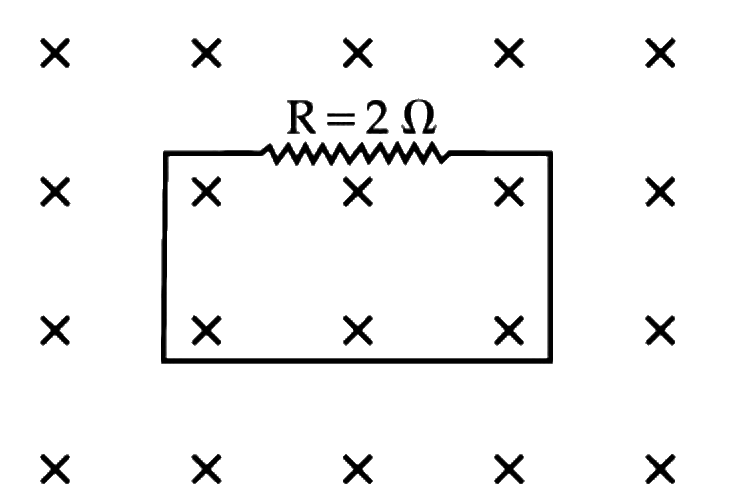
In the given figure the magnetic flux through the loop increases according to the relation ϕ\phiB(t) = 10t2 + 20t, where ϕ\phiB is in milliwebers and t is in seconds.

The magnitude of current through R = 2Ω\Omega resistor at t = 5 s is ___________ mA.

Figure

Numerical answer type. Work it out, then open the answer.

Show answer and solution

Answer: 60

  1. e=dϕBdt=20t+20e = \frac{d\phi_B}{dt} = 20t + 20 mV
  2. At t=5t = 5 s: e=100+20=120e = 100 + 20 = 120 mV
  3. I=eR=1202=60I = \frac{e}{R} = \frac{120}{2} = 60 mA
  4. So the current is 6060 mA.
Report a mistake
Q66JEE Main 2021 · 25 JUL · SHIFT 1Medium

Magnetic Flux & Faraday's Law · Power and heat in a loop

A circular conducting coil of radius 1 m is being heated by the change of magnetic field B⃗\vec{B}passing perpendicular to the plane in which the coil is laid. The resistance of the coil is 2 μΩ\mu\Omega. The magnetic field is slowly switched off such that its magnitude changes in time as

B=4π×10−3 T(1−t100)B = \frac{4}{\pi} \times 10^{-3}\,T\left(1-\frac{t}{100}\right)

The energy dissipated by the coil before the magnetic field is switched off completely is E = ___________ mJ.

Numerical answer type. Work it out, then open the answer.

Show answer and solution

Answer: 80

  1. A=π(1)2=πA = \pi(1)^2 = \pi m2^2, ∣dBdt∣=4π×10−3×1100=4π×10−5\left|\dfrac{dB}{dt}\right| = \dfrac{4}{\pi}\times 10^{-3}\times\dfrac{1}{100} = \dfrac{4}{\pi}\times10^{-5} T/s.
  2. e=AdBdt=4×10⁻⁵e = A\dfrac{dB}{dt} = 4\times10^{-5} V (constant).
  3. P=e2R=16×10−102×10−6=8×10⁻⁴P = \dfrac{e^2}{R} = \dfrac{16\times10^{-10}}{2\times10^{-6}} = 8\times10^{-4} W.
  4. Field reaches zero at t=100t = 100 s, so E=8×10−4×100=0.08E = 8\times10^{-4}\times100 = 0.08 J =80= 80 mJ.
Report a mistake
Q67JEE Main 2020 · 8 JAN · SHIFT 1Easy

Magnetic Flux & Faraday's Law · Faraday's law and average emf

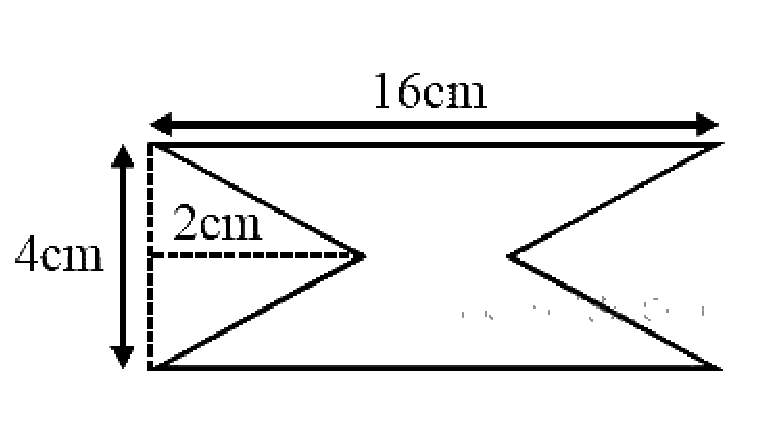
At time t = 0 magnetic field of 1000 Gauss is passing perpendicularly through the area defined by the closed loop shown in the figure. If the magnetic field reduces linearly to 500 Gauss, in the next 5s, then induced EMF in the loop is:

Figure

Show answer and solution

Answer: (c)

  1. Loop area = rectangle minus the two triangular cut-outs (base 4 cm, height 2 cm each).
  2. A=16×4−2×12×4×2=64−8=56A = 16\times 4 - 2\times\frac{1}{2}\times 4\times 2 = 64 - 8 = 56 cm2=56×10−4^{2} = 56\times 10^{-4} m2^{2}
  3. ΔB=1000−500=500\Delta B = 1000 - 500 = 500 G =0.05= 0.05 T, ΔBΔt=0.055=0.01\frac{\Delta B}{\Delta t} = \frac{0.05}{5} = 0.01 T/s
  4. e=AΔBΔt=56×10−4×0.01=56×10−6e = A\frac{\Delta B}{\Delta t} = 56\times 10^{-4}\times 0.01 = 56\times 10^{-6} V
  5. So the answer is (c) 56 μ\muV.
Report a mistake
Q68NEET 2020 · PHASE 2Easy

Magnetic Flux & Faraday's Law · Flux as a function of time

The magnetic flux linked with a coil (in Wb) is given by the equation

ϕ=5t2+3t+16\phi = 5t^{2} + 3t + 16

The magnitude of induced emf in the coil at the fourth second will be

Show answer and solution

Answer: (c)

  1. ∣e∣=dϕdt=10t+3|e| = \frac{d\phi}{dt} = 10t + 3
  2. At t=4t = 4 s: ∣e∣=40+3=43|e| = 40 + 3 = 43 V
  3. So the answer is (c) 4343 V.
Report a mistake
Q69MHT CET 2020 · 16 OCT · SHIFT 1Easy

Magnetic Flux & Faraday's Law · Induced current

A coil of nn turns and resistance RΩR\Omega is connected in series with a resistance R2\frac{R}{2}. The combination is moved for time tt second through magnetic flux ϕ1\phi_1 to ϕ2\phi_2. The induced current in the circuit is

Show answer and solution

Answer: (b)

  1. Total resistance R+R2=3R2R + \frac{R}{2} = \frac{3R}{2}
  2. Emf e=n(ϕ1−ϕ2)te = \frac{n(\phi_1 - \phi_2)}{t}
  3. I=e3R/2=2n(ϕ1−ϕ2)3RtI = \frac{e}{3R/2} = \frac{2n(\phi_1 - \phi_2)}{3Rt}
  4. So the answer is (b) 2n(ϕ1−ϕ2)3Rt\frac{2n(\phi_1 - \phi_2)}{3Rt}.
Report a mistake
Q70JEE Main 2020 · 7 JAN · SHIFT 1Medium

Magnetic Flux & Faraday's Law · Magnetic flux

Consider a circular coil of wire carrying constant current I, forming a magnetic dipole. The magnetic flux through an infinite plane that contains the circular coil and excluding the circular coil area is given by ϕ\phii. The magnetic flux through the area of the circular coil area is given by ϕ\phi0. Which of the following option is correct?

Show answer and solution

Answer: (d)

  1. Magnetic field lines form closed loops, so the net flux through the whole infinite plane is zero.
  2. Lines going up through the coil area (ϕ0\phi_0) return down through the plane outside the coil (ϕi\phi_i).
  3. ϕi+ϕ0=0⇒ϕi=−ϕ0\phi_i + \phi_0 = 0 \Rightarrow \phi_i = -\phi_0
  4. So the answer is (d) ϕi=−ϕ0\phi_i = -\phi_0.
Report a mistake
Q71JEE Main 2020 · 3 SEP · SHIFT 2Medium

Magnetic Flux & Faraday's Law · Induced current

A uniform magnetic field B exists in a direction perpendicular to the plane of a square loop made of a metal wire. The wire has a diameter of 4 mm and a total length of 30 cm. The magnetic field changes with time at a steady rate dBdt\frac{dB}{dt} = 0.032 Ts–1. The induced current in the loop is close to (Resistivity of the metal wire is 1.23 ×\times 10–8 Ω\Omegam)

Show answer and solution

Answer: (d)

  1. Square side =304=7.5= \frac{30}{4} = 7.5 cm, area A=(0.075)2=5.625×10⁻³A = (0.075)^2 = 5.625 \times 10^{-3} m2^2.
  2. e=AdBdt=5.625×10−3×0.032=1.8×10⁻⁴e = A\frac{dB}{dt} = 5.625 \times 10^{-3} \times 0.032 = 1.8 \times 10^{-4} V
  3. R=ρlπr2=1.23×10−8×0.3π(2×10⁻³)2≈2.94×10⁻⁴ ΩR = \frac{\rho l}{\pi r^2} = \frac{1.23 \times 10^{-8} \times 0.3}{\pi (2 \times 10^{-3})^2} \approx 2.94 \times 10^{-4}\ \Omega
  4. I=eR=1.8×10−42.94×10−4≈0.61I = \frac{e}{R} = \frac{1.8 \times 10^{-4}}{2.94 \times 10^{-4}} \approx 0.61 A
  5. So the answer is (d) 0.61 A.
Report a mistake
Q72JEE Main 2020 · 7 JAN · SHIFT 1Difficult

Magnetic Flux & Faraday's Law · Magnetic flux

A loop ABCDEFA of straight edges has six corner points A(0, 0, 0), B(5, 0, 0), C(5, 5, 0), D (0, 5, 0), E(0, 5, 5) and F(0, 0, 5). The magnetic field in this region is B⃗=(3i^+4k^)T\vec{B} = \left(3\hat{i}+4\hat{k}\right)T. The quantity of flux through the loop ABCDEFA (in Wb) is _______.

Numerical answer type. Work it out, then open the answer.

Show answer and solution

Answer: 175

  1. Split the loop into two squares: ABCD in the z=0z=0 plane and ADEF in the x=0x=0 plane, each of area 2525 m2^2.
  2. Going A→B→C→D, the area vector of ABCD is 25k^25\hat{k}; going D→E→F→A, the area vector of ADEF is 25i^25\hat{i}.
  3. A⃗=(25i^+25k^)\vec{A} = (25\hat{i} + 25\hat{k}) m2^2.
  4. ϕ=B⃗⋅A⃗=3(25)+4(25)=175\phi = \vec{B}\cdot\vec{A} = 3(25) + 4(25) = 175 Wb.
Report a mistake
Q73NEET 2019Medium

Magnetic Flux & Faraday's Law · Faraday's law and average emf

A 800 turn coil of effective area 0.05 m2 is kept perpendicular to a magnetic field 5 × 10⁻⁵ T. When the plane of the coil is rotated by 90° around any of its coplanar axis in 0.1 s, the emf induced in the coil will be:

Show answer and solution

Answer: (b)

  1. Rotating by 90∘90^\circ: flux goes from NBANBA to 00, so Δϕ=NBA\Delta\phi = NBA.
  2. NBA=800×5×10−5×0.05=2×10⁻³NBA = 800 \times 5 \times 10^{-5} \times 0.05 = 2 \times 10^{-3} Wb
  3. e=2×10−30.1=0.02e = \frac{2 \times 10^{-3}}{0.1} = 0.02 V
  4. So the answer is (b) 0.02 V.
Report a mistake
Q74JEE Main 2019 · 9 JAN · SHIFT 1Medium

Magnetic Flux & Faraday's Law · Induced charge

A conducting circular loop made of a thin wire, has area 3.5 ×\times 10−-3 m2 and resistance 10 Ω\Omega. It is placed perpendicular to a time dependent magnetic field B(t) = (0.4T)sin(50π\pit). The field is uniform in space. Then the net charge flowing through the loop during t = 0 s and t = 10 ms is close to:

Show answer and solution

Answer: (a)

  1. At t=0t = 0: B=0B = 0. At t=10t = 10 ms: B=0.4sin⁡(50π×0.01)=0.4sin⁡π2=0.4B = 0.4\sin(50\pi \times 0.01) = 0.4\sin\frac{\pi}{2} = 0.4 T.
  2. Δϕ=0.4×3.5×10−3=1.4×10⁻³\Delta\phi = 0.4 \times 3.5 \times 10^{-3} = 1.4 \times 10^{-3} Wb
  3. q=ΔϕR=1.4×10−310=1.4×10⁻⁴q = \frac{\Delta\phi}{R} = \frac{1.4 \times 10^{-3}}{10} = 1.4 \times 10^{-4} C
  4. So the answer is (a) 0.14 mC.
Report a mistake
Q75JEE Main 2017Easy

Magnetic Flux & Faraday's Law · Induced charge

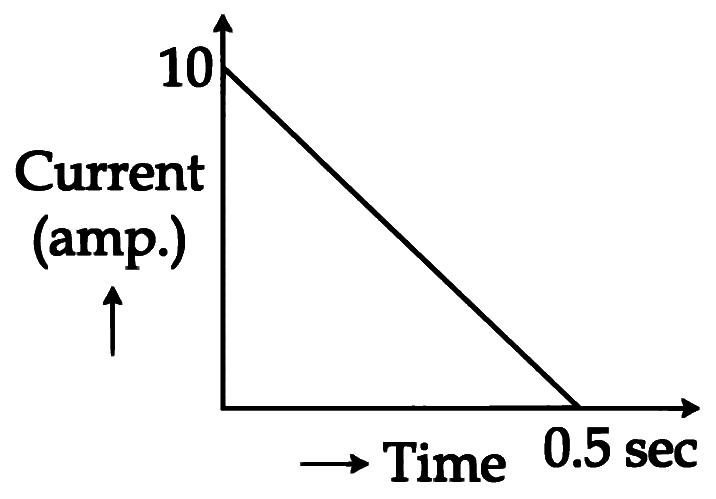
In a coil of resistance 100 Ω\Omega, a current is induced by changing the magnetic flux through it as shown in the figure. The magnitude of change in flux through the coil is:

Figure

Show answer and solution

Answer: (d)

  1. Charge qq = area under the II–tt graph =12×10×0.5=2.5= \frac{1}{2} \times 10 \times 0.5 = 2.5 C.
  2. q=ΔϕR⇒Δϕ=qRq = \frac{\Delta\phi}{R} \Rightarrow \Delta\phi = qR
  3. Δϕ=2.5×100=250\Delta\phi = 2.5 \times 100 = 250 Wb
  4. So the answer is (d) 250 Wb.
Report a mistake
Q76NEET 2017Medium

Magnetic Flux & Faraday's Law · Induced charge

A long solenoid of diameter 0.1 m has 2 ×\times 104 turns per meter. At the centre of the solenoid, a coil of 100 turns and radius 0.01 m is placed with its axis coinciding with the solenoid axis. The current in the solenoid reduces at a constant rate to 0 A from 4 A in 0.05 s. If the resistance of the coil is 10 π\pi2 Ω\Omega, the total charge flowing through the coil during this time is

Show answer and solution

Answer: (b)

  1. Solenoid field B=μ0nI=4π×10−7×2×104×4=32π×10−3B = \mu_0 nI = 4\pi \times 10^{-7} \times 2 \times 10^4 \times 4 = 32\pi \times 10^{-3} T.
  2. Flux through the coil: ϕ=NBπr2=100×32π×10−3×π×10−4=32π2×10⁻⁵\phi = NB\pi r^2 = 100 \times 32\pi \times 10^{-3} \times \pi \times 10^{-4} = 32\pi^2 \times 10^{-5} Wb; it falls to 00.
  3. q=ΔϕR=32π2×10−510π2=3.2×10⁻⁵q = \frac{\Delta\phi}{R} = \frac{32\pi^2 \times 10^{-5}}{10\pi^2} = 3.2 \times 10^{-5} C
  4. So the answer is (b) 32 μ\muC.
Report a mistake
Q77JEE Main 2016 · 10 APR · SHIFT 1Difficult

Magnetic Flux & Faraday's Law · Power and heat in a loop

A conducting metal circular-wire-loop of radius r is placed perpendicular to a magnetic field which varies with time as

B = B0e−tτ\frac{-t}{\tau}, where B0 and τ\tau are constants, at time t = 0. If the resistance of the loop is R then the heat generated in the loop after a long time (t →∞\to \infty) is:

Show answer and solution

Answer: (b)

  1. e=−ddt(πr2B0e−t/τ)=πr2B0τe−t/τe = -\dfrac{d}{dt}(\pi r^2 B_0 e^{-t/\tau}) = \dfrac{\pi r^2 B_0}{\tau}e^{-t/\tau}.
  2. H=∫0∞e2Rdt=π2r4B02τ2R∫0∞e−2t/τdtH = \int_0^\infty \dfrac{e^2}{R}dt = \dfrac{\pi^2 r^4 B_0^2}{\tau^2 R}\int_0^\infty e^{-2t/\tau}dt.
  3. ∫0∞e−2t/τdt=τ2\int_0^\infty e^{-2t/\tau}dt = \dfrac{\tau}{2}.
  4. H=π2r4B022τRH = \dfrac{\pi^2 r^4 B_0^2}{2\tau R}. So the answer is (b).
Report a mistake
Q78JEE Main 2014 · 11 APR · SHIFT 1Easy

Magnetic Flux & Faraday's Law · Faraday's law and average emf

A coil of circular cross-section having 1000 turns and 4 cm2 face area is placed with its axis parallel to a magnetic field which decreases by 10−-2 Wb m−2{}^{-2} in 0.01 s. The e.m.f. induced in the coil is:

Show answer and solution

Answer: (a)

  1. e=NAΔBΔte = NA\frac{\Delta B}{\Delta t}
  2. N=1000N = 1000, A=4×10⁻⁴A = 4\times 10^{-4} m2^{2}, ΔBΔt=10−20.01=1\frac{\Delta B}{\Delta t} = \frac{10^{-2}}{0.01} = 1 T/s
  3. e=1000×4×10−4×1=0.4e = 1000\times 4\times 10^{-4}\times 1 = 0.4 V =400= 400 mV
  4. So the answer is (a) 400 mV.
Report a mistake
Q79NEET 2012 · AIPMT · PRELIMSEasy

Magnetic Flux & Faraday's Law · Induced current

A coil of resistance 400 Ω\Omega is placed in a magnetic field. If the magnetic flux ϕ\phi (Wb) linked with the coil varies with time t (sec) as ϕ=50t2+4\phi = 50t^{2} + 4.

The current in the coil at t = 2 sec is

Show answer and solution

Answer: (a)

  1. ∣e∣=dϕdt=100t|e| = \frac{d\phi}{dt} = 100t; at t=2t = 2 s, ∣e∣=200|e| = 200 V
  2. I=200400=0.5I = \frac{200}{400} = 0.5 A
  3. So the answer is (a) 0.5 A.
Report a mistake
Q80NEET 2012 · AIPMT · MAINSMedium

Magnetic Flux & Faraday's Law · Induced charge

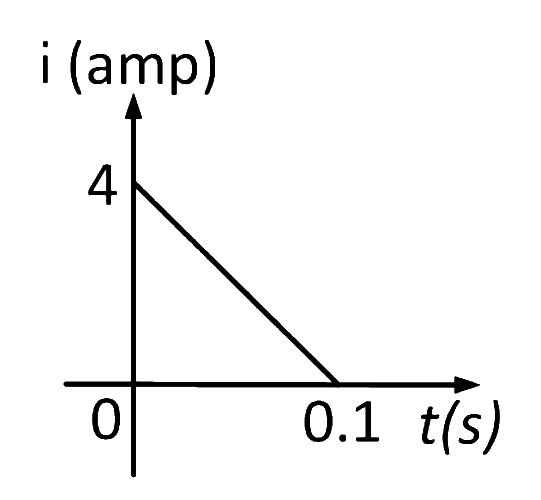
In a coil of resistance 10 Ω\Omega, the induced current developed by changing magnetic flux through it, is shown in figure as a function of time. The magnitude of change in flux through the coil in weber is

Figure

Show answer and solution

Answer: (b)

  1. Charge qq = area under the ii–tt graph =12×4×0.1=0.2= \frac{1}{2} \times 4 \times 0.1 = 0.2 C.
  2. q=ΔϕR⇒Δϕ=qR=0.2×10q = \frac{\Delta\phi}{R} \Rightarrow \Delta\phi = qR = 0.2 \times 10
  3. Δϕ=2\Delta\phi = 2 Wb
  4. So the answer is (b) 2.
Report a mistake
Q81NEET 2010 · AIPMT · PRELIMSMedium

Magnetic Flux & Faraday's Law · Changing area of a loop

A conducting circular loop is placed in a uniform magnetic field, B = 0.025 T with its plane perpendicular to the loop. The radius of the loop is made to shrink at a constant rate of 1 mm s−1{}^{-1}. The induced emf when the radius is 2 cm, is

Show answer and solution

Answer: (b)

  1. Field is perpendicular to the plane of the loop: ϕ=Bπr2⇒e=B⋅2πrdrdt\phi = B\pi r^2 \Rightarrow e = B \cdot 2\pi r\frac{dr}{dt}
  2. e=0.025×2π×0.02×10−3e = 0.025 \times 2\pi \times 0.02 \times 10^{-3}
  3. e=π×10−6e = \pi \times 10^{-6} V =π μ= \pi\ \muV
  4. So the answer is (b) π μ\pi\ \muV.
Report a mistake
Q82NEET 2009 · AIPMTMedium

Magnetic Flux & Faraday's Law · Changing area of a loop

A conducting circular loop is placed in a uniform magnetic field 0.04 T with its plane perpendicular to the magnetic field. The radius of the loop starts shrinking at 2 mm/s. The induced emf in the loop when the radius is 2 cm is

Show answer and solution

Answer: (d)

  1. e=B⋅2πrdrdte = B \cdot 2\pi r\frac{dr}{dt}
  2. e=0.04×2π×0.02×2×10−3e = 0.04 \times 2\pi \times 0.02 \times 2 \times 10^{-3}
  3. e=3.2π×10−6e = 3.2\pi \times 10^{-6} V
  4. So the answer is (d) 3.2π μ3.2\pi\ \muV.
Report a mistake
Q83NEET 2008 · AIPMTEasy

Magnetic Flux & Faraday's Law · Magnetic flux

A circular disc of radius 0.2 meter is placed in a uniform magnetic field of induction 1π(Wbm2)\frac{1}{\pi}\left(\frac{\text{Wb}}{\text{m}^{2}}\right) in such a way that its axis makes an angle of 60° with B⃗.\vec{B}. The magnetic flux linked with the disc is

Show answer and solution

Answer: (c)

  1. Φ=BAcos⁡θ\Phi = BA\cos\theta with θ=60∘\theta = 60^\circ between B⃗\vec{B} and the disc's axis.
  2. A=π(0.2)2=0.04πA = \pi(0.2)^{2} = 0.04\pi m2^{2}
  3. Φ=1π×0.04π×0.5=0.02\Phi = \frac{1}{\pi}\times 0.04\pi\times 0.5 = 0.02 Wb
  4. So the answer is (c) 0.02 Wb.
Report a mistake
Q84JEE Main 2006 · AIEEEEasy

Magnetic Flux & Faraday's Law · Flux as a function of time

The flux linked with a coil at any instant ’t’\text{'}t\text{'} is given by

ϕ=10t2−50t+250\phi = 10t^{2} - 50t + 250

The induced emfemf at t=3 st = 3\text{ s} is

Show answer and solution

Answer: (b)

  1. e=−dϕdt=−(20t−50)e = -\frac{d\phi}{dt} = -(20t - 50)
  2. At t=3t = 3 s: e=−(60−50)=−10e = -(60 - 50) = -10 V
  3. So the answer is (b) −10-10 V.
Report a mistake
Q85JEE Main 2004 · AIEEEEasy

Magnetic Flux & Faraday's Law · Induced current

A coil having nn turns and resistance RΩR\Omega is connected with a galvanometer of resistance 4RΩ.4R\Omega. This combination is moved in time tt seconds from a magnetic field W1W_1 weber to W2W_2 weber. The induced current in the circuit is

Show answer and solution

Answer: (b)

  1. Total resistance R+4R=5RR + 4R = 5R
  2. Faraday-Lenz: e=−n(W2−W1)te = -\frac{n(W_2 - W_1)}{t}
  3. I=e5R=−n(W2−W1)5RtI = \frac{e}{5R} = -\frac{n(W_2 - W_1)}{5Rt}
  4. So the answer is (b) −n(W2−W1)5Rt-\frac{n(W_2 - W_1)}{5Rt}.
Report a mistake
Q86NEET 2004 · AIPMTEasy

Magnetic Flux & Faraday's Law · Induced charge

The magnetic flux through a circuit of resistance R changes by an amount Δϕ\Delta\phi in a time Δ\Deltat. Then the total quantity of electric charge Q that passes any point in the circuit during the time Δ\Deltat is represented by

Show answer and solution

Answer: (b)

  1. I=1RΔϕΔtI = \frac{1}{R}\frac{\Delta\phi}{\Delta t} and Q=IΔtQ = I\Delta t.
  2. Q=ΔϕRQ = \frac{\Delta\phi}{R}
  3. So the answer is (b) Q=ΔϕRQ = \frac{\Delta\phi}{R}.
Report a mistake
Q87NEET 1992 · AIPMTEasy

Magnetic Flux & Faraday's Law · Induced current

A rectangular coil of 20 turns and area of cross-section 25 sq. cm has a resistance of 100 Ω100\ \Omega. If a magnetic field which is perpendicular to the plane of coil changes at a rate of 1000 tesla per second, the current in the coil is

Show answer and solution

Answer: (c)

  1. e=NAdBdte = NA\frac{dB}{dt}
  2. A=25A = 25 cm2=25×10−4^{2} = 25\times 10^{-4} m2^{2}: e=20×25×10−4×1000=50e = 20\times 25\times 10^{-4}\times 1000 = 50 V
  3. I=eR=50100=0.5I = \frac{e}{R} = \frac{50}{100} = 0.5 A
  4. So the answer is (c) 0.50.5 A.
Report a mistake
Q88NEET 1992 · AIPMTEasy

Magnetic Flux & Faraday's Law · Induced charge

The total charge, induced in a conducting loop when it is moved in magnetic field depend on

Show answer and solution

Answer: (c)

  1. q=ΔϕRq = \frac{\Delta\phi}{R}: the time of change cancels out.
  2. So the charge depends on the total change in flux, not on its rate or on the initial or final flux alone.
  3. So the answer is (c) the total change in magnetic flux.
Report a mistake
Q89NEET 1991 · AIPMTEasy

Magnetic Flux & Faraday's Law · Faraday's law and average emf

A magnetic field of 2×10⁻² T2 \times 10^{-2}\text{ T} acts at right angles to a coil of area 100 cm2100\text{ cm}^{2}, with 50 turns. The average e.m.f. induced in the coil is 0.1 V, when it is removed from the field in tt sec. The value of tt is

Show answer and solution

Answer: (b)

  1. t=NBAet = \frac{NBA}{e}
  2. t=50×2×10−2×10−20.1=0.1t = \frac{50\times 2\times 10^{-2}\times 10^{-2}}{0.1} = 0.1 s
  3. So the answer is (b) 0.10.1 s.
Report a mistake
Q90MHT CET 2026 · 15 MAY · SHIFT 1Easy

Lenz's Law, Eddy Currents & Induced Electric Field · Lenz's law and direction of current

Two similar circular loops carry equal currents in the same direction. On moving coils further apart, the electric current will

Show answer and solution

Answer: (a)

  1. Currents in the same direction mean each loop's field adds to the flux through the other.
  2. Moving the loops apart decreases this flux in each loop.
  3. By Lenz's law the induced current opposes the decrease, so it flows in the same direction as the existing current.
  4. So the current increases in both, answer (a).
Report a mistake
Q91MHT CET 2026 · 20 MAY · SHIFT 1Easy

Lenz's Law, Eddy Currents & Induced Electric Field · Magnet falling through a ring or pipe

A bar magnet falls from a height through a metal pipe. Its acceleration will be (gg = acceleration due to gravity)

Show answer and solution

Answer: (a)

  1. The falling magnet changes the flux through the metal pipe, inducing eddy currents.
  2. By Lenz's law these currents oppose the motion, giving an upward force.
  3. Net downward force <mg< mg, so acceleration is less than gg. Answer (a).
Report a mistake
Q92MHT CET 2026 · 15 APR · SHIFT 1Easy

Lenz's Law, Eddy Currents & Induced Electric Field · Magnet falling through a ring or pipe

A bar magnet falls from a height 'h' through a metal pipe, its acceleration after coming out of pipe is

Show answer and solution

Answer: (c)

  1. Outside the pipe there is no metal around the magnet, so no eddy currents and no magnetic drag.
  2. Only gravity acts (air resistance neglected), so a=g=9.8a = g = 9.8 m/s2^2.
  3. So the answer is (c).
Report a mistake
Q93MHT CET 2026 · 13 APR · SHIFT 2Easy

Lenz's Law, Eddy Currents & Induced Electric Field · Magnet falling through a ring or pipe

Spherical insulating ball and a spherical metallic ball of same size and mass are dropped from the same height. Choose the correct statement out of the following {Assume negligible air friction}

Show answer and solution

Answer: (c)

  1. The only magnetic field present is the Earth's field, which is practically uniform over the ball's path.
  2. The flux through any part of the metal ball hardly changes, so eddy currents (and their drag) are negligible.
  3. Both balls fall with acceleration gg from the same height.
  4. So both reach the ground simultaneously, answer (c).
Report a mistake
Q94JEE Main 2026 · 22 JAN · SHIFT 1Medium

Lenz's Law, Eddy Currents & Induced Electric Field · Lenz's law and direction of current

Three identical coils C1,C2C_1, C_2 and C3C_3 are closely placed such that they share a common axis. C2C_2 is exactly midway. C1C_1 carries current II in anti-clockwise direction while C3C_3 carries current II in clockwise direction. An induced current flows through C2C_2 will be in clockwise direction when

Show answer and solution

Answer: (b)

  1. Viewed from one side, anticlockwise II in C1C_1 gives a field towards the viewer at C2C_2; clockwise II in C3C_3 gives a field away from the viewer. At the midpoint they cancel.
  2. (a) and (c): both changes are equal and opposite, so no net flux change and no current.
  3. (b): C1C_1 approaching increases the 'towards viewer' flux and C3C_3 receding reduces the 'away' flux; both increase net flux towards the viewer.
  4. Induced current in C2C_2 must give a field away from the viewer, i.e. clockwise. Answer (b).
Report a mistake
Q95MHT CET 2025 · 19 APR · SHIFT 2Easy

Lenz's Law, Eddy Currents & Induced Electric Field · Lenz's law and direction of current

Out of the following which law obeys the law of conservation of energy?

Show answer and solution

Answer: (b)

  1. Lenz's law: the induced current opposes the change causing it, so work must be done against it.
  2. This work appears as electrical energy; if the induced current aided the change, energy would be created from nothing.
  3. So the answer is (b) Lenz's law.
Report a mistake
Q96MHT CET 2025 · 25 APR · SHIFT 2Easy

Lenz's Law, Eddy Currents & Induced Electric Field · Magnet falling through a ring or pipe

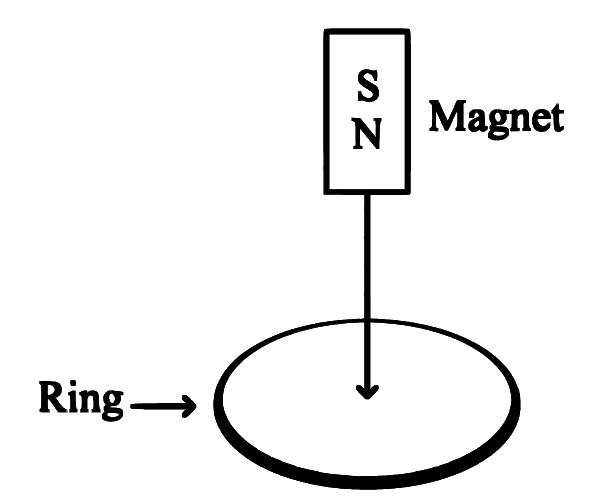
A copper ring having a cut such as not to form a complete loop is held horizontally and a bar magnet is dropped through the ring with its length along the axis of the ring as shown in figure. The acceleration of the falling magnet is ( g=g = acceleration due to gravity)

Figure

Show answer and solution

Answer: (a)

  1. The ring has a cut, so it is not a closed loop.
  2. An emf is induced but no current can flow, so there is no opposing magnetic force on the magnet.
  3. The magnet falls freely, acceleration =g= g. Answer (a).
Report a mistake
Q97MHT CET 2025 · 22 APR · SHIFT 1Easy

Lenz's Law, Eddy Currents & Induced Electric Field · Magnet falling through a ring or pipe

A copper ring is held horizontally and a bar magnet is dropped through the ring with its length along the axis of the ring. The acceleration of the falling magnet while it is passing through the ring is

Show answer and solution

Answer: (b)

  1. The magnet's flux through the closed ring changes as it falls, inducing a current.
  2. By Lenz's law the induced current opposes the motion (repels while approaching, attracts while leaving).
  3. So the magnet's acceleration is less than gg, answer (b).
Report a mistake
Q98MHT CET 2025 · 23 APR · SHIFT 1Medium

Lenz's Law, Eddy Currents & Induced Electric Field · Lenz's law and direction of current

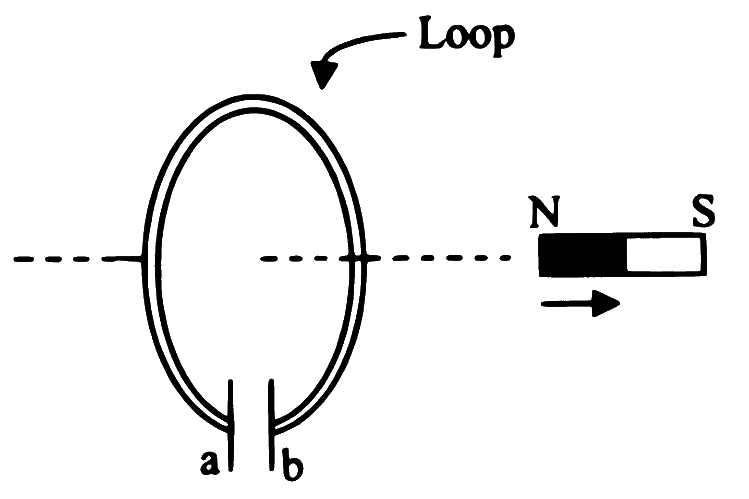
Figure shows the north pole of a magnet moving away from a thick conducting loop containing a capacitor. The excess positive charge will arrive on

Figure

Show answer and solution

Answer: (b)

  1. The field of the N pole at the loop points away from the magnet (to the left), and this flux decreases as the magnet moves away.
  2. Lenz's law: the induced current must make a leftward field inside the loop.
  3. Seen from the magnet's side, this current is clockwise: it flows down the right-hand side of the loop towards plate bb.
  4. So positive charge collects on plate bb, answer (b).
Report a mistake
Q99MHT CET 2025 · 21 APR · SHIFT 2Medium

Lenz's Law, Eddy Currents & Induced Electric Field · Lenz's law and direction of current

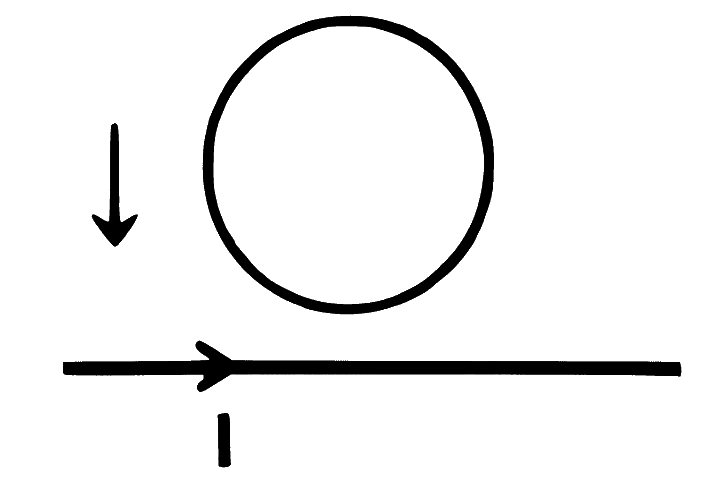
A conducting ring of certain resistance is falling towards a current carrying straight long conductor. The ring and conductor are in the same plane. Then

Figure

Show answer and solution

Answer: (c)

  1. Above a wire carrying current to the right, the field is out of the page.
  2. As the ring falls towards the wire, the field and hence the outward flux increase.
  3. The induced current must give an into-the-page field, so it is clockwise.
  4. So the answer is (c).
Report a mistake
Q100MHT CET 2024 · 2 MAY · SHIFT 2Easy

Lenz's Law, Eddy Currents & Induced Electric Field · Lenz's law and direction of current

The coil and magnet are moved in the same direction with same speed (V). The induced e.m.f. is

Figure

Show answer and solution

Answer: (a)

  1. Induced emf needs a change in flux through the coil, which needs relative motion between coil and magnet.
  2. Both move in the same direction with the same speed VV, so their separation stays constant.
  3. Flux is constant, so e=0e = 0. So the answer is (a) zero.
Report a mistake
Q101JEE Main 2024 · 30 JAN · SHIFT 2Easy

Lenz's Law, Eddy Currents & Induced Electric Field · Induced electric field

Match List I with List II

Choose the correct answer from the options given below:

List IList II
(A)Gauss's law of magnetostatics(I)∮E⃗⋅da⃗=1ε0∫ρ dV\oint \vec{E} \cdot d\vec{a} = \frac{1}{\varepsilon_0}\int \rho\, dV
(B)Faraday's law of electromagnetic induction(II)∮B⃗⋅da⃗=0\oint \vec{B} \cdot d\vec{a} = 0
(C)Ampere's law(III)∫E⃗⋅dl⃗=−ddt∫B⃗⋅da⃗\int \vec{E} \cdot d\vec{l} = \frac{-d}{dt}\int \vec{B} \cdot d\vec{a}
(D)Gauss's law of electrostatics(IV)∮B⃗⋅dl⃗=μ0I\oint \vec{B} \cdot d\vec{l} = \mu_0 I
Show answer and solution

Answer: (c)

  1. Gauss's law of magnetostatics: ∮B⃗⋅da⃗=0\oint \vec{B}\cdot d\vec{a} = 0 → A-II.
  2. Faraday's law: ∮E⃗⋅dl⃗=−ddt∫B⃗⋅da⃗\oint \vec{E}\cdot d\vec{l} = -\dfrac{d}{dt}\int \vec{B}\cdot d\vec{a} → B-III.
  3. Ampere's law: ∮B⃗⋅dl⃗=μ0I\oint \vec{B}\cdot d\vec{l} = \mu_0 I → C-IV; Gauss's law of electrostatics: ∮E⃗⋅da⃗=1ε0∫ρ dV\oint \vec{E}\cdot d\vec{a} = \dfrac{1}{\varepsilon_0}\int \rho\,dV → D-I.
  4. So the answer is (c) A-II, B-III, C-IV, D-I.
Report a mistake
Q102JEE Main 2024 · 29 JAN · SHIFT 1Easy

Lenz's Law, Eddy Currents & Induced Electric Field · Induced electric field

Match List I with List II

Choose the correct answer from the options given below:

List - IList - II
(A)∮B⃗⋅dl⃗=μoic+μoεodϕEdt\oint \vec{B} \cdot \vec{dl} = \mu_o i_c + \mu_o \varepsilon_o \frac{d\phi_E}{dt}(I)Gauss' law for electricity
(B)∮E⃗⋅dl⃗=dϕBdt\oint \vec{E} \cdot \vec{dl} = \frac{d\phi_B}{dt}(II)Gauss' law for magnetism
(C)∮E⃗⋅dA⃗=Qεo\oint \vec{E} \cdot d\vec{A} = \frac{Q}{\varepsilon_o}(III)Faraday law
(D)∮B⃗⋅dA⃗=0\oint \vec{B} \cdot d\vec{A} = 0(IV)Ampere - Maxwell law
Show answer and solution

Answer: (a)

  1. ∮B⃗⋅dl⃗=μ0ic+μ0ε0dϕEdt\oint \vec{B}\cdot d\vec{l} = \mu_0 i_c + \mu_0\varepsilon_0\dfrac{d\phi_E}{dt} is the Ampere-Maxwell law → A-IV.
  2. ∮E⃗⋅dl⃗\oint \vec{E}\cdot d\vec{l} in terms of dϕBdt\dfrac{d\phi_B}{dt} is Faraday's law → B-III.
  3. ∮E⃗⋅dA⃗=Q/ε0\oint \vec{E}\cdot d\vec{A} = Q/\varepsilon_0 is Gauss's law for electricity → C-I; ∮B⃗⋅dA⃗=0\oint \vec{B}\cdot d\vec{A} = 0 is Gauss's law for magnetism → D-II.
  4. So the answer is (a) A-IV, B-III, C-I, D-II.
Report a mistake
Q103MHT CET 2023 · 10 MAY · SHIFT 2Easy

Lenz's Law, Eddy Currents & Induced Electric Field · Magnet falling through a ring or pipe

A hollow metal pipe is held vertically and bar magnet is dropped through it with its length along the axis of the pipe. The acceleration of the falling magnet is ( g=g = acceleration due to gravity)

Show answer and solution

Answer: (b)

  1. The moving magnet induces eddy currents in the metal pipe.
  2. By Lenz's law these oppose the fall, giving an upward retarding force.
  3. So acceleration is less than gg, answer (b).
Report a mistake
Q104JEE Main 2023 · 10 APR · SHIFT 2Easy

Lenz's Law, Eddy Currents & Induced Electric Field · Magnet falling through a ring or pipe

A bar magnet is released from rest along the axis of a very long vertical copper tube. After some time the magnet will

Show answer and solution

Answer: (a)

  1. Eddy currents in the tube give a retarding force that grows with the magnet's speed.
  2. Speed increases until this force equals mgmg; then net force is zero.
  3. The magnet then moves down with almost constant (terminal) speed. Answer (a).
Report a mistake
Q105JEE Main 2023 · 31 JAN · SHIFT 1Easy

Lenz's Law, Eddy Currents & Induced Electric Field · Magnet falling through a ring or pipe

Spherical insulating ball and a spherical metallic ball of same size and mass are dropped from the same height. Choose the correct statement out of the following

{Assume negligible air friction}

Show answer and solution

Answer: (c)

  1. The metal ball moves through the Earth's magnetic field, so small eddy currents can be induced in it.
  2. By Lenz's law these oppose its motion, slightly reducing its acceleration.
  3. The insulating ball has no eddy currents and falls with gg.
  4. So the insulating ball reaches earlier, answer (c).
Report a mistake
Q106JEE Main 2023 · 8 APR · SHIFT 1Easy

Lenz's Law, Eddy Currents & Induced Electric Field · Eddy currents

Certain galvanometers have a fixed core made of non magnetic metallic material. The function of this metallic material is

Show answer and solution

Answer: (a)

  1. When the coil moves, eddy currents are induced in the metallic core.
  2. By Lenz's law they oppose the motion, giving electromagnetic damping.
  3. So the coil comes to rest quickly (dead-beat galvanometer). Answer (a).
Report a mistake
Q107MHT CET 2023 · 13 MAY · SHIFT 1Medium

Lenz's Law, Eddy Currents & Induced Electric Field · Lenz's law and direction of current

The magnet is moved towards the coil with speed 'VV'. The induced e.m.f. in the coil is 'ee'. The magnet and the coil move away from one another each moving with speed 'VV'. The induced e.m.f. in the coil is

Figure

Show answer and solution

Answer: (b)

  1. Induced emf depends on the rate of flux change, i.e. on the relative speed of magnet and coil.
  2. First case: relative speed VV gives emf ee.
  3. Second case: each moves away with VV, relative speed 2V2V, so emf =2e= 2e (opposite sign).
  4. So the answer is (b) 2e2e.
Report a mistake
Q108JEE Main 2023 · 11 APR · SHIFT 2Medium

Lenz's Law, Eddy Currents & Induced Electric Field · Magnet falling through a ring or pipe

Given below are two statements: one is labelled as Assertion A\mathbf{A} and the other is labelled as Reason R\mathbf{R}

Assertion A: A bar magnet dropped through a metallic cylindrical pipe takes more time to come down compared to a non-magnetic bar with same geometry and mass.

Reason R: For the magnetic bar, Eddy currents are produced in the metallic pipe which oppose the motion of the magnetic bar.

In the light of the above statements, choose the correct answer from the options given below

Show answer and solution

Answer: (d)

  1. A falling magnet changes the flux through the metal pipe, inducing eddy currents (R is true).
  2. By Lenz's law these currents oppose the magnet's motion, so it falls more slowly than a non-magnetic bar, which induces no currents (A is true).
  3. R directly explains A. So the answer is (d).
Report a mistake
Q109MHT CET 2021 · 20 SEP · SHIFT 1Easy

Lenz's Law, Eddy Currents & Induced Electric Field · Lenz's law and direction of current

Two conducting wire loops are concentric and lie in the same plane. The current in the outer loop is clockwise and increasing with time. The induced current in the inner loop is

Show answer and solution

Answer: (b)

  1. Clockwise current in the outer loop gives an inward (into the plane) field inside it.
  2. This inward flux through the inner loop increases with time.
  3. The induced current must give an outward field, so it is anticlockwise.
  4. So the answer is (b) anticlockwise.
Report a mistake
Q110MHT CET 2021 · 23 SEP · SHIFT 1Easy

Lenz's Law, Eddy Currents & Induced Electric Field · Eddy currents

Eddy currents are produced when

Show answer and solution

Answer: (d)

  1. Eddy currents need a changing magnetic flux through a bulk conductor.
  2. A steady field or steady current gives no flux change, so (a), (b), (c) give no eddy currents.
  3. A thick metal plate in a varying field has changing flux. Answer (d).
Report a mistake
Q111JEE Main 2021 · 31 AUG · SHIFT 2Medium

Lenz's Law, Eddy Currents & Induced Electric Field · Lenz's law and direction of current

A coil is placed in a magnetic field B⃗\vec{B}as shown below:

Figure

A current is induced in the coil because B⃗\vec{B}is:

Show answer and solution

Answer: (a)

  1. The induced current shown is anticlockwise, which produces an outward field inside the coil.
  2. By Lenz's law, the induced field opposes the change, so the outward flux must be decreasing (or an inward one increasing).
  3. A field parallel to the plane gives no flux and no induced current.
  4. So B⃗\vec{B} is outward and decreasing, answer (a).
Report a mistake
Q112JEE Main 2021 · 27 AUG · SHIFT 1Medium

Lenz's Law, Eddy Currents & Induced Electric Field · Lenz's law and direction of current

A bar magnet is passing through a conducting loop of radius R with velocity vv. The radius of the bar magnet is such that it just passes through the loop. The induced e.m.f. in the loop can be represented by the approximate curve:

Figure

Show answer and solution

Answer: (c)

  1. As the N end approaches and passes the loop, flux increases quickly, giving a sharp emf pulse.
  2. As the S end leaves, the flux decreases, giving a pulse of the opposite sign.
  3. While the uniform middle part passes, flux hardly changes, so emf is nearly zero; the pulses are l/vl/v apart.
  4. So the curve has two opposite pulses separated by l/vl/v; with the chosen sign convention this is (c).
Report a mistake
Q113MHT CET 2020 · 19 OCT · SHIFT 2Medium

Lenz's Law, Eddy Currents & Induced Electric Field · Lenz's law and direction of current

Metal rings PP and QQ are lying in the same plane, where current I is increasing steadily. The induced current in metal rings is shown correctly in figure

Figure

Show answer and solution

Answer: (c)

  1. Above the wire (ring P) the field is out of the page; below (ring Q) it is into the page. Both grow as II increases.
  2. P: outward flux increasing, so induced current gives an inward field, i.e. clockwise.
  3. Q: inward flux increasing, so induced current gives an outward field, i.e. anticlockwise.
  4. Figure (c) shows P clockwise and Q anticlockwise. Answer (c).
Report a mistake
Q114JEE Main 2020 · 4 SEP · SHIFT 1Medium

Lenz's Law, Eddy Currents & Induced Electric Field · Lenz's law and direction of current

A small bar magnet is moved through a coil at constant speed from one end to the other. Which of the following series of observations will be seen on the galvanometer G attached across the coil?

Figure

Three positions shown describe:

(a) the magnet's entry

(b) magnet is completely inside and

(c) magnet's exit.

Show answer and solution

Answer: (c)

  1. Entry: flux through the coil increases, so G deflects one way.
  2. Fully inside (small magnet in a long coil): flux nearly constant, so no deflection.
  3. Exit: flux decreases, so G deflects the opposite way.
  4. This matches (c): deflection, zero, opposite deflection.
Report a mistake
Q115JEE Main 2020 · 7 JAN · SHIFT 1Difficult

Lenz's Law, Eddy Currents & Induced Electric Field · Lenz's law and direction of current

A long solenoid of radius R carries a time (t) - dependent current

I(t)=I0t(1 - t). A ring of radius 2R is placed coaxially near its middle. During the time interval 0 ≤\le t ≤\le 1, the induced current (IR) and the induced EMF(VR) in the ring change as:

Show answer and solution

Answer: (d)

  1. Flux through the ring comes only from inside the solenoid: ϕ=μ0nI πR2∝I\phi = \mu_0 n I\,\pi R^2 \propto I.
  2. VR∝dIdt=I0(1−2t)V_R \propto \frac{dI}{dt} = I_0(1-2t).
  3. At t=0.5t = 0.5: dIdt=0\frac{dI}{dt} = 0, so VR=0V_R = 0; for t<0.5t<0.5 it is positive, for t>0.5t>0.5 negative, so IRI_R reverses.
  4. So the answer is (d) at t=0.5t = 0.5 the direction of IRI_R reverses and VRV_R is zero.
Report a mistake
Q116NEET 2019Easy

Lenz's Law, Eddy Currents & Induced Electric Field · Eddy currents

In which of the following devices, the eddy current effect is not used?

Show answer and solution

Answer: (c)

  1. Magnetic braking and induction furnaces work on eddy currents; an electromagnet's core is linked to them too (laminated to reduce them).
  2. An electric heater works on Joule heating of a current passed directly through a resistive coil, not eddy currents.
  3. So the answer is (c) electric heater.
Report a mistake
Q117JEE Main 2019 · 9 APR · SHIFT 2Difficult

Lenz's Law, Eddy Currents & Induced Electric Field · Lenz's law and direction of current

A very long solenoid of radius R is carrying current I(t) = kte–at(k > 0), as a function of time (t ≥\ge 0). counter clockwise current is taken to be positive. A circular conducting coil of radius 2R is placed in the equatorial plane of the solenoid and concentric with the solenoid. The current induced in the outer coil is correctly depicted, as a function of time, by :-

Show answer and solution

Answer: (a)

  1. Induced current in the coil ∝−dIdt\propto -\frac{dI}{dt} (Lenz's law), since the flux ∝I\propto I.
  2. dIdt=ke−at(1−at)\frac{dI}{dt} = k e^{-at}(1 - at): equal to kk (non-zero) at t=0t=0, zero at t=1at = \frac{1}{a}, negative after that and tending to zero.
  3. So the induced current starts negative (non-zero), crosses zero at t=1/at = 1/a, becomes positive, peaks and decays to zero.
  4. So the answer is (a).
Report a mistake
Q118NEET 2016 · PHASE 2Medium

Lenz's Law, Eddy Currents & Induced Electric Field · Induced electric field

A uniform magnetic field is restricted within a region of radius r. The magnetic field changes with time at a rate dB⃗dt\frac{d\vec{B}}{dt}. Loop 1 of radius R > r encloses the region r and loop 2 of radius R is outside the region of magnetic field as shown in the figure. Then the e.m.f. generated is

Figure

Show answer and solution

Answer: (d)

  1. Induced emf =−dϕdt= -\frac{d\phi}{dt}, and flux counts only the area where BB exists.
  2. Loop 1 encloses the whole field region of area πr2\pi r^2 (not πR2\pi R^2): ϕ1=Bπr2⇒ε1=−dBdtπr2\phi_1 = B\pi r^2 \Rightarrow \varepsilon_1 = -\frac{dB}{dt}\pi r^2.
  3. Loop 2 encloses no field: ϕ2=0⇒ε2=0\phi_2 = 0 \Rightarrow \varepsilon_2 = 0.
  4. So the answer is (d) −dBdtπr2-\frac{dB}{dt}\pi r^2 in loop 1 and zero in loop 2.
Report a mistake
Q119NEET 2015 · AIPMTMedium

Lenz's Law, Eddy Currents & Induced Electric Field · Lenz's law and direction of current

An electron moves on a straight line path XY as shown. The abcd is a coil adjacent to the path of electron. What will be the direction of current, if any, induced in the coil?

Figure

Show answer and solution

Answer: (a)

  1. A moving electron is a current (opposite to its motion), so it sets up a magnetic field through the coil.
  2. As the electron approaches, the flux through the coil increases; after it passes, the flux decreases.
  3. By Lenz's law the induced current has one direction while flux increases and the opposite while it decreases.
  4. So the current reverses as the electron goes past, answer (a).
Report a mistake
Q120JEE Main 2014 · 19 APR · SHIFT 1Medium

Lenz's Law, Eddy Currents & Induced Electric Field · Induced electric field

Figure

Figure shows a circular area of radius R where a uniform magnetic field B⃗\vec{B}is going into the plane of paper and increasing in magnitude at a constant rate. In that case, which of the following graphs, drawn schematically, correctly shows the variation of the induced electric field E(r)?

Show answer and solution

Answer: (a)

RrEE ∝ rE ∝ 1/r
  1. Use ∮E⃗⋅dl⃗=dϕdt\oint \vec E\cdot d\vec l = \frac{d\phi}{dt} on a circle of radius rr.
  2. Inside (r<Rr<R): E 2πr=πr2dBdt⇒E=r2dBdtE\,2\pi r = \pi r^2\frac{dB}{dt} \Rightarrow E = \frac{r}{2}\frac{dB}{dt}, linear in rr.
  3. Outside (r>Rr>R): E 2πr=πR2dBdt⇒E=R22rdBdtE\,2\pi r = \pi R^2\frac{dB}{dt} \Rightarrow E = \frac{R^2}{2r}\frac{dB}{dt}, falls as 1r\frac{1}{r}.
  4. Straight rise to a peak at r=Rr=R, then a 1/r1/r decay. So the answer is (a).
Report a mistake
Q121JEE Main 2012 · AIEEEMedium

Lenz's Law, Eddy Currents & Induced Electric Field · Eddy currents

A coil is suspended in a uniform magnetic field, with the plane of the coil parallel to the magnetic lines of force. When a current is passed through the coil it starts oscillating; It is very difficult to stop. But if an aluminium plate is placed near to the coil, it stops. This is due to:

Show answer and solution

Answer: (d)

  1. The oscillating coil changes the magnetic flux through the nearby aluminium plate.
  2. Eddy currents are induced in the plate; by Lenz's law they oppose the coil's motion.
  3. This electromagnetic damping stops the coil. Answer (d).
Report a mistake
Q122NEET 2005 · AIPMTMedium

Lenz's Law, Eddy Currents & Induced Electric Field · Induced electric field

As a result of change in the magnetic flux linked to the closed loop as shown in the figure, an e.m.f. VV volt is induced in the loop. The work done (joule) in taking a charge Q coulomb once along the loop is

Figure

Show answer and solution

Answer: (a)

  1. Emf is the work done per unit charge in taking it once round the loop: ε=WQ\varepsilon = \frac{W}{Q}.
  2. W=Qε=QVW = Q\varepsilon = QV (the induced electric field is non-conservative, so the round-trip work is not zero).
  3. So the answer is (a) QVQV.
Report a mistake
Q123NEET 1996 · AIPMTEasy

Lenz's Law, Eddy Currents & Induced Electric Field · Magnet falling through a ring or pipe

A metal ring is held horizontally and bar magnet is dropped through the ring with its length along the axis of the ring. The acceleration of the falling magnet is

Show answer and solution

Answer: (c)

  1. Induced current in the ring opposes the relative motion of the magnet (Lenz's law).
  2. This gives an upward force on the magnet both while approaching and while leaving.
  3. So acceleration is less than gg, answer (c).
Report a mistake
Q124NEET 1991 · AIPMTEasy

Lenz's Law, Eddy Currents & Induced Electric Field · Lenz's law and direction of current

Faraday's laws are consequence of conservation of

Show answer and solution

Answer: (a)

  1. The direction of induced emf (Lenz's law, the minus sign in Faraday's law) ensures that work done against the induced current becomes electrical energy.
  2. So Faraday's laws follow from conservation of energy, answer (a).
Report a mistake
Q125NEET 1988 · AIPMTEasy

Lenz's Law, Eddy Currents & Induced Electric Field · Eddy currents

Eddy currents are produced when

Show answer and solution

Answer: (a)

  1. Eddy currents are induced only when the magnetic flux through a conductor changes.
  2. A metal piece in a varying magnetic field has changing flux.
  3. So the answer is (a).
Report a mistake
Q126MHT CET 2026 · 17 APR · SHIFT 2Easy

Motional EMF · Straight conductor and moving loops

A straight line conductor of length 0.4 m is moved with a speed of 7.07.0 ms−1^{-1} perpendicular to magnetic field of intensity 0.80.8 Wb m−2^{-2}. The induced e.m.f. across the conductor is

Show answer and solution

Answer: (a)

  1. Motional emf ε=Blv\varepsilon = Blv.
  2. ε=0.8×0.4×7.0=2.24\varepsilon = 0.8 \times 0.4 \times 7.0 = 2.24 V
  3. So the answer is (a) 2.242.24 V.
Report a mistake
Q127NEET 2026Medium

Motional EMF · Straight conductor and moving loops

A rectangular wire loop of sides 8 cm and 3 cm with a small cut, is moving out of a region of uniform magnetic field of magnitude 0.3 T directed normal to the plane of the loop. The emf developed across the cut, if the velocity of the loop is 2 cm s−12\text{ cm s}^{-1}, in a direction normal to the shorter side of the loop, will be:

Show answer and solution

Answer: (d)

  1. Only the side perpendicular to the velocity cuts the field boundary: ε=Bℓv\varepsilon = B\ell v.
  2. Velocity is normal to the shorter side, so ℓ=3\ell = 3 cm =0.03= 0.03 m, v=0.02v = 0.02 m/s.
  3. ε=0.3×0.03×0.02=1.8×10⁻⁴\varepsilon = 0.3 \times 0.03 \times 0.02 = 1.8\times10^{-4} V
  4. So the answer is (d) 1.8×10−41.8\times10^{-4} volt.
Report a mistake
Q128MHT CET 2026 · 20 APR · SHIFT 2Medium

Motional EMF · Earth's field, aeroplane and falling wire

An aeroplane having a wing span of 30 m flies due north with the speed of 170 m/s. Magnetic field B=3.6×10⁻⁵B = 3.6 \times 10^{-5} T. The potential difference between the tips of the wings will be

Show answer and solution

Answer: (b)

  1. Horizontal wings cut the vertical component of the field: ε=Blv\varepsilon = Blv.
  2. ε=3.6×10−5×30×170=0.1836\varepsilon = 3.6\times10^{-5} \times 30 \times 170 = 0.1836 V
  3. =183.6= 183.6 mV. So the answer is (b).
Report a mistake
Q129JEE Main 2026 · 23 JAN · SHIFT 1Medium

Motional EMF · Earth's field, aeroplane and falling wire

A 20 m long uniform copper wire held horizontally is allowed to fall under the gravity (g=10 m/s2)\left(g = 10\text{ m/s}^{2}\right) through a uniform horizontal magnetic field of 0.5 Gauss perpendicular to the length of the wire. The induced EMF across the wire when it travels a vertical distance of 200 m is ______ mV.

Show answer and solution

Answer: (c)

  1. Speed after falling 200 m: v=2gh=2×10×200=2010v = \sqrt{2gh} = \sqrt{2\times10\times200} = 20\sqrt{10} m/s.
  2. B=0.5B = 0.5 G =5×10−5= 5\times10^{-5} T.
  3. ε=Blv=5×10−5×20×2010=0.0210\varepsilon = Blv = 5\times10^{-5} \times 20 \times 20\sqrt{10} = 0.02\sqrt{10} V
  4. =2010= 20\sqrt{10} mV. So the answer is (c).
Report a mistake
Q130MHT CET 2026 · 20 MAY · SHIFT 1Medium

Motional EMF · Force, power and work on a moving rod

A long metal rod of length 'L' completes the circuit. The area of the coil is perpendicular to magnetic field 'B'. Total resistance of the circuit is 'R'. The force needed to move the rod in the direction as shown with constant speed 'V' is

Figure

Show answer and solution

Answer: (c)

  1. Emf ε=BLV\varepsilon = BLV, current I=BLVRI = \frac{BLV}{R}.
  2. Magnetic force on the rod opposes motion: Fm=BIL=B2L2VRF_m = BIL = \frac{B^2L^2V}{R}.
  3. Constant speed needs an equal applied force: F=B2L2VRF = \frac{B^2L^2V}{R}. So the answer is (c).
Report a mistake
Q131MHT CET 2026 · 16 APR · SHIFT 1Medium

Motional EMF · Force, power and work on a moving rod

A metal rod of length 'L' completes the circuit as shown. The area of the circuit is perpendicular to magnetic field 'B'. Total resistance of the circuit is 'R'. The force needed to move the rod in the direction as shown with constant speed 'V' is

Figure

Show answer and solution

Answer: (b)

  1. Emf ε=BLV\varepsilon = BLV, current I=BLVRI = \frac{BLV}{R}.
  2. Opposing magnetic force Fm=BIL=B2L2VRF_m = BIL = \frac{B^2L^2V}{R}.
  3. For constant speed, applied force F=B2L2VRF = \frac{B^2L^2V}{R}. So the answer is (b).
Report a mistake
Q132MHT CET 2026 · 11 APR · SHIFT 1Medium

Motional EMF · Force, power and work on a moving rod

A square loop of area 2525 cm2^{2} has a resistance of 10 Ω10\ \Omega. The loop is placed in uniform magnetic field of magnitude 4040 T. The plane of the loop is perpendicular to the magnetic field. The work done in pulling the loop out of the magnetic field slowly and uniformly in one second will be

Show answer and solution

Answer: (b)

  1. Side =25= \sqrt{25} cm =0.05= 0.05 m; pulled out in 1 s, so v=0.05v = 0.05 m/s.
  2. ε=Blv=40×0.05×0.05=0.1\varepsilon = Blv = 40 \times 0.05 \times 0.05 = 0.1 V, I=0.110=0.01I = \frac{0.1}{10} = 0.01 A.
  3. Work done = heat produced =εIt=0.1×0.01×1=1.0×10−3= \varepsilon I t = 0.1 \times 0.01 \times 1 = 1.0\times10^{-3} J
  4. So the answer is (b) 1.0×10−31.0\times10^{-3} J.
Report a mistake
Q133JEE Main 2026 · 21 JAN · SHIFT 1Medium

Motional EMF · Force, power and work on a moving rod

A 1 m long metal rod AB completes the circuit as shown in figure. The area of circuit is perpendicular to the magnetic field of 0.10 T. If the resistance of the total circuit is 2 Ω2\ \Omega then the force needed to move the rod towards right with constant speed (v)(v) of 1.5 m/s1.5\text{ m/s} is ______ N.

Figure

Show answer and solution

Answer: (b)

  1. e=Blv=0.10×1×1.5=0.15 Ve = Blv = 0.10 \times 1 \times 1.5 = 0.15\text{ V}
  2. I=eR=0.152=0.075 AI = \dfrac{e}{R} = \dfrac{0.15}{2} = 0.075\text{ A}
  3. Applied force balances the magnetic drag: F=BIl=0.10×0.075×1F = BIl = 0.10 \times 0.075 \times 1
  4. F=7.5×10⁻³ NF = 7.5 \times 10^{-3}\text{ N}, so the answer is (b).
Report a mistake
Q134MHT CET 2026 · 11 APR · SHIFT 1Medium

Motional EMF · Terminal velocity

A long rectangular conducting loop of width 'll' mass 'mm' and resistance 'RR' is placed partly in a perpendicular magnetic field 'BB'. With what velocity should it be pushed downwards so that it may continue to fall without any acceleration? (gg = acceleration due to gravity)

Figure

Show answer and solution

Answer: (b)

  1. Falling with speed vv, the loop has emf e=Blve = Blv and current I=BlvRI = \dfrac{Blv}{R}.
  2. Magnetic force on the side of length ll: F=BIl=B2l2vRF = BIl = \dfrac{B^2l^2v}{R}, upward.
  3. No acceleration: B2l2vR=mg\dfrac{B^2l^2v}{R} = mg
  4. So the answer is (b) v=mgRB2l2v = \dfrac{mgR}{B^2l^2}.
Report a mistake
Q135JEE Main 2026 · 22 JAN · SHIFT 1Medium

Motional EMF · Terminal velocity

XPQYXPQY is a vertical smooth long loop having a total resistance RR where PXPX is parallel to QYQY and separation between them is ll. A constant magnetic field BB perpendicular to the plane of the loop exists in the entire space. A rod CDCD of length L(L>l)L(L > l) and mass mm is made to slide down from rest under the gravity as shown in figure. The terminal speed acquired by the rod is ‾ m/s. (g=\underline{\qquad}\ \text{m/s. }(g = acceleration due to gravity)

Figure

Show answer and solution

Answer: (a)

  1. Only the part of rod between the rails (length ll) is in the circuit, so e=Blve = Blv.
  2. I=BlvRI = \dfrac{Blv}{R}, magnetic force F=BIl=B2l2vRF = BIl = \dfrac{B^2l^2v}{R} upward.
  3. At terminal speed F=mgF = mg: vt=mgRB2l2v_t = \dfrac{mgR}{B^2l^2}
  4. So the answer is (a) mgRB2l2\dfrac{mgR}{B^2l^2}.
Report a mistake
Q136JEE Main 2026 · 23 JAN · SHIFT 1Difficult

Motional EMF · Earth's field, aeroplane and falling wire

A simple pendulum made of mass 10 g and a metallic wire of length 10 cm is suspended vertically in a uniform magnetic field of 2 T. The magnetic field direction is perpendicular to the plane of oscillations of the pendulum. If the pendulum is released from an angle of 60∘60^\circ with vertical, then maximum induced EMF between the point of suspension and point of oscillation is ______ mV. (Take g=10 m/s2g = 10\text{ m/s}^2)

Numerical answer type. Work it out, then open the answer.

Show answer and solution

Answer: 100

  1. Speed at the lowest point: v=2gl(1−cos⁡60∘)=2×10×0.1×0.5=1 m/sv = \sqrt{2gl(1 - \cos 60^\circ)} = \sqrt{2 \times 10 \times 0.1 \times 0.5} = 1\text{ m/s}
  2. Maximum angular speed ω=vl=10.1=10 rad/s\omega = \dfrac{v}{l} = \dfrac{1}{0.1} = 10\text{ rad/s}
  3. Wire rotating about one end: e=12Bωl2=12×2×10×(0.1)2e = \tfrac{1}{2}B\omega l^2 = \tfrac{1}{2} \times 2 \times 10 \times (0.1)^2
  4. e=0.1 V=100 mVe = 0.1\text{ V} = 100\text{ mV}
Report a mistake
Q137MHT CET 2025 · 21 APR · SHIFT 1Medium

Motional EMF · Straight conductor and moving loops

Initially a rectangular coil with length vertical is moving out with constant velocity ' vv ' in a constant magnetic field ' BB ' towards right. Now the same coil is rotated through 90∘90^\circ in same plane in same magnetic field B and the coil is moving with same velocity v\mathbf{v}. The magnitude of induced e.m.f. is now

Show answer and solution

Answer: (a)

  1. Emf of a coil leaving the field: ε=Bℓv\varepsilon = B\ell v, where ℓ\ell is the side perpendicular to v⃗\vec v (the vertical side here).
  2. Initially the length ll (longer side) is vertical: ε1=Blv\varepsilon_1 = Blv.
  3. After rotating by 90∘90^\circ the breadth bb (shorter side) is vertical: ε2=Bbv\varepsilon_2 = Bbv.
  4. Since b<lb < l, ε2<ε1\varepsilon_2 < \varepsilon_1. So the working gives (b) less than the initial emf.
Report a mistake
Q138JEE Main 2025 · 22 JAN · SHIFT 2Medium

Motional EMF · Straight conductor and moving loops

A rectangular metallic loop is moving out of a uniform magnetic field region to a field free region with a constant speed. When the loop is partially inside the magnetic field, the plot of magnitude of induced emf (ε)(\varepsilon) with time (t)(t) is given by

Show answer and solution

Answer: (b)

  1. While partly inside, the cutting edge length ℓ\ell (side along the boundary) is fixed.
  2. Flux decreases at a steady rate: ε=Bℓv=\varepsilon = B\ell v = constant.
  3. The ε\varepsilon–tt graph is a horizontal line. So the answer is (b).
Report a mistake
Q139JEE Main 2025 · 4 APR · SHIFT 1Medium

Motional EMF · Straight conductor and moving loops

Conductor wire ABCDE with each arm 10 cm in length is placed in magnetic field of 12\frac{1}{\sqrt{2}} Tesla, perpendicular to its plane. When conductor is pulled towards right with constant velocity of 10 cm/s10\text{ cm/s}, induced emf between points A and E is ________ mV.

Figure

Numerical answer type. Work it out, then open the answer.

Show answer and solution

Answer: 10

AEBCD10√2 cmv
  1. Emf between A and E equals that of the straight line AE, using its length perpendicular to v⃗\vec v.
  2. AB and DE are along v⃗\vec v; BC and CD are at 45∘45^\circ, each giving 10sin⁡45∘=10210\sin45^\circ = \frac{10}{\sqrt2} cm across.
  3. Effective length =2×102=102= 2\times\frac{10}{\sqrt2} = 10\sqrt2 cm =0.12= 0.1\sqrt2 m.
  4. ε=12×0.12×0.1=0.01\varepsilon = \frac{1}{\sqrt2}\times0.1\sqrt2\times0.1 = 0.01 V
  5. Answer: 1010 mV.
Report a mistake
Q140MHT CET 2025 · 20 APR · SHIFT 2Medium

Motional EMF · Earth's field, aeroplane and falling wire

A simple pendulum with bob of mass m and conducting wire of length LL swings under gravity through an angle θ\theta. The component of earth's magnetic field in the direction perpendicular to swing is B. Maximum e.m.f. induced across the pendulum is ( g=g = acceleration due to gravity)

Show answer and solution

Answer: (a)

  1. Maximum speed at the lowest point: v=2gL(1−cos⁡θ)=2gLsin⁡θ2v = \sqrt{2gL(1-\cos\theta)} = 2\sqrt{gL}\sin\frac{\theta}{2}.
  2. Taking εmax=BLvmax\varepsilon_{max} = BLv_{max} (the usual exam approach):
  3. εmax=2BLgLsin⁡θ2\varepsilon_{max} = 2BL\sqrt{gL}\sin\frac{\theta}{2}
  4. So the answer is (a).
Report a mistake
Q141JEE Main 2025 · 28 JAN · SHIFT 2Medium

Motional EMF · Force, power and work on a moving rod

Figure

A conducting bar moves on two conducting rails as shown in the figure. A constant magnetic field B exists into the page. The bar starts to move from the vertex at time t = 0 with a constant velocity. If the induced EMF is E ∝ tn, then value of n is _________.

Numerical answer type. Work it out, then open the answer.

Show answer and solution

Answer: 1

  1. Bar starts at the vertex and moves up with constant vv, so its height is y=vty = vt.
  2. Length of bar between the rails l=2ytan⁡α∝tl = 2y\tan\alpha \propto t (α\alpha = half-angle of the V).
  3. E=Blv∝tE = Blv \propto t, so E∝t1E \propto t^1.
  4. So n=1n = 1.
Report a mistake
Q142MHT CET 2025 · 26 APR · SHIFT 2Medium

Motional EMF · Terminal velocity

A long rectangular conducting loop of width ' ll ', mass ' mm ' and resistance ' RR ' is placed partly in a perpendicular magnetic field ' B '. It is pushed downwards with velocity ' VV ' so that it may continue to fall freely. The velocity ' VV ' is

Figure

Show answer and solution

Answer: (c)

  1. emf e=BlVe = BlV, current I=BlVRI = \dfrac{BlV}{R}.
  2. Magnetic force F=BIl=B2l2VRF = BIl = \dfrac{B^2l^2V}{R} opposes the fall.
  3. For uniform motion: B2l2VR=mg\dfrac{B^2l^2V}{R} = mg
  4. So the answer is (c) V=mgRB2l2V = \dfrac{mgR}{B^2l^2}.
Report a mistake
Q143JEE Main 2024 · 29 JAN · SHIFT 2Easy

Motional EMF · Earth's field, aeroplane and falling wire

A horizontal straight wire 5 m5\text{ m} long extending from east to west is falling freely at right angle to horizontal component of earths magnetic field 0.60×10⁻⁴ Wb m−20.60 \times 10^{-4}\text{ Wb m}^{-2}. The instantaneous value of emf induced in the wire when its velocity is 10 ms−110\text{ ms}^{-1} is _________ ×10−3 V\times 10^{-3}\text{ V}.

Numerical answer type. Work it out, then open the answer.

Show answer and solution

Answer: 3

  1. Wire (E–W), velocity (down) and BHB_H (N) are mutually perpendicular, so ε=BHlv\varepsilon = B_H l v.
  2. ε=0.60×10−4×5×10=3×10⁻³\varepsilon = 0.60\times10^{-4} \times 5 \times 10 = 3\times10^{-3} V
  3. Answer: 33 (i.e. 3×10⁻³³\times10^{-3} V).
Report a mistake
Q144JEE Main 2024 · 9 APR · SHIFT 2Medium

Motional EMF · Straight conductor and moving loops

A square loop of side 15 cm15\text{ cm} is being moved towards right at a constant speed of 2 cm/s2\text{ cm/s} as shown in figure. The front edge enters the 50 cm50\text{ cm} wide magnetic field at t=0t = 0. The value of induced emf in the loop at t=10 st = 10\text{ s} will be:

Figure

Show answer and solution

Answer: (a)

  1. Distance moved in 10 s: 2×10=202 \times 10 = 20 cm, so the front edge is 20 cm inside the field.
  2. Back edge is 20−15=520 - 15 = 5 cm inside; the front edge is still within the 50 cm width.
  3. The whole loop is in the field, so flux is constant and ε=0\varepsilon = 0.
  4. So the answer is (a) zero.
Report a mistake
Q145MHT CET 2024 · 9 MAY · SHIFT 2Medium

Motional EMF · Force, power and work on a moving rod

A square loop ABCD is moving with constant velocity ' v⃗\vec{v} ' in a uniform magnetic field ' B⃗\vec{B} ' which is perpendicular to the plane of paper and directed outward. The resistance of coil is ' RR ', then the rate of production of heat energy in the loop is [ L - length of side of loop]

Show answer and solution

Answer: (b)

  1. Only the side cutting the field edge gives motional emf e=BLve = BLv.
  2. Current I=BLvRI = \dfrac{BLv}{R}, heat rate P=I2R=e2RP = I^2R = \dfrac{e^2}{R}.
  3. P=B2L2v2RP = \dfrac{B^2L^2v^2}{R}
  4. So the answer is (b) B2L2V2R\dfrac{B^2L^2V^2}{R}.
Report a mistake
Q146MHT CET 2024 · 4 MAY · SHIFT 1Medium

Motional EMF · Force, power and work on a moving rod

A square loop of area 25 cm225\text{ cm}^{2} has a resistance of 10 Ω10\ \Omega. The loop is placed in uniform magnetic field of magnitude 40 T. The plane of loop is perpendicular to the magnetic field. The work done in pulling the loop out of the magnetic field slowly and uniformly in 1 second, will be

Show answer and solution

Answer: (b)

  1. Side L=25 cm2=5 cm=0.05 mL = \sqrt{25\text{ cm}^2} = 5\text{ cm} = 0.05\text{ m}; pulled out in 1 s, so v=0.05 m/sv = 0.05\text{ m/s}.
  2. e=BLv=40×0.05×0.05=0.1 Ve = BLv = 40 \times 0.05 \times 0.05 = 0.1\text{ V}
  3. P=e2R=0.0110=10−3 WP = \dfrac{e^2}{R} = \dfrac{0.01}{10} = 10^{-3}\text{ W}
  4. W=Pt=10−3×1=1.0×10⁻³ JW = Pt = 10^{-3} \times 1 = 1.0 \times 10^{-3}\text{ J}
  5. So the answer is (b) 1.0×10⁻³ J1.0 \times 10^{-3}\text{ J}.
Report a mistake
Q147JEE Main 2024 · 1 FEB · SHIFT 1Difficult

Motional EMF · Force, power and work on a moving rod

A rectangular loop of sides 12 cm12\text{ cm} and 5 cm5\text{ cm}, with its sides parallel to the xx-axis and yy-axis respectively, moves with a velocity of 5 cm/s5\text{ cm/s} in the positive xx axis direction, in a space containing a variable magnetic field in the positive zz direction. The field has a gradient of 10−3 T/cm10^{-3}\text{ T/cm} along the negative xx direction and it is decreasing with time at the rate of 10−3 T/s10^{-3}\text{ T/s}. If the resistance of the loop is 6 mΩ6\text{ m}\Omega, the power dissipated by the loop as heat is __________ ×10−9 W\times 10^{-9}\text{ W}.

Numerical answer type. Work it out, then open the answer.

Show answer and solution

Answer: 216

  1. Rate of change of BB seen by the moving loop: dBdt=∂B∂t+v∂B∂x\dfrac{dB}{dt} = \dfrac{\partial B}{\partial t} + v\dfrac{\partial B}{\partial x}
  2. ∂B∂x=−10−3 T/cm=−0.1 T/m\dfrac{\partial B}{\partial x} = -10^{-3}\text{ T/cm} = -0.1\text{ T/m}, so dBdt=−10−3+0.05×(−0.1)=−6×10⁻³ T/s\dfrac{dB}{dt} = -10^{-3} + 0.05 \times (-0.1) = -6 \times 10^{-3}\text{ T/s}
  3. Area A=0.12×0.05=6×10⁻³ m2A = 0.12 \times 0.05 = 6 \times 10^{-3}\text{ m}^2, so e=A∣dBdt∣=3.6×10⁻⁵ Ve = A\left|\dfrac{dB}{dt}\right| = 3.6 \times 10^{-5}\text{ V}
  4. P=e2R=1.296×10−96×10−3=2.16×10⁻⁷ WP = \dfrac{e^2}{R} = \dfrac{1.296 \times 10^{-9}}{6 \times 10^{-3}} = 2.16 \times 10^{-7}\text{ W}
  5. So P=216×10−9 WP = 216 \times 10^{-9}\text{ W}, answer 216.
Report a mistake
Q148MHT CET 2023 · 13 MAY · SHIFT 2Easy

Motional EMF · Straight conductor and moving loops

A conductor 10 cm10\text{ cm} long is moves with a speed 1 m/s1\text{ m/s} perpendicular to a field of strength 1000 A/m1000\text{ A/m}. The emf induced in the conductor is (Given: μ0=4π×10−7 Wb/Am\mu_0 = 4\pi \times 10^{-7}\text{ Wb/Am})

Show answer and solution

Answer: (c)

  1. Field strength HH is given, so B=μ0H=4π×10−7×1000=4π×10−4B = \mu_0 H = 4\pi\times10^{-7}\times1000 = 4\pi\times10^{-4} T.
  2. ε=Blv=4π×10−4×0.1×1=4π×10−5\varepsilon = Blv = 4\pi\times10^{-4}\times0.1\times1 = 4\pi\times10^{-5} V
  3. =40π μ= 40\pi\ \muV. So the answer is (c).
Report a mistake
Q149JEE Main 2023 · 8 APR · SHIFT 2Easy

Motional EMF · Straight conductor and moving loops

An emf of 0.08 V0.08\text{ V} is induced in a metal rod of length 10 cm10\text{ cm} held normal to a uniform magnetic field of 0.4 T0.4\text{ T}, when moves with a velocity of:

Show answer and solution

Answer: (b)

  1. ε=Blv⇒v=εBl\varepsilon = Blv \Rightarrow v = \frac{\varepsilon}{Bl}
  2. v=0.080.4×0.1=2v = \frac{0.08}{0.4 \times 0.1} = 2 m/s
  3. So the answer is (b) 22 m s−1^{-1}.
Report a mistake
Q150JEE Main 2023 · 25 JAN · SHIFT 2Easy

Motional EMF · Straight conductor and moving loops

A wire of length 1m moving with velocity 8 m/s at right angles to a magnetic field of 2T. The magnitude of induced emf, between the ends of wire will be __________.

Show answer and solution

Answer: (c)

  1. ε=Blv\varepsilon = Blv
  2. ε=2×1×8=16\varepsilon = 2 \times 1 \times 8 = 16 V
  3. So the answer is (c) 16 V.
Report a mistake
Q151MHT CET 2023 · 12 MAY · SHIFT 2Easy

Motional EMF · Earth's field, aeroplane and falling wire

An air craft of wing span 40 m40\text{ m} flies horizontally in earth's magnetic field 5×10⁻⁵ T5 \times 10^{-5}\text{ T} at a speed of 500 m/s500\text{ m/s}. The e.m.f. generated between the tips of the wings of the air craft is

Show answer and solution

Answer: (b)

  1. Emf between wing tips ε=Blv\varepsilon = Blv (with BB the field component cutting the wings).
  2. ε=5×10−5×40×500=1\varepsilon = 5\times10^{-5} \times 40 \times 500 = 1 V
  3. So the answer is (b) 1 V.
Report a mistake
Q152MHT CET 2023 · 9 MAY · SHIFT 2Easy

Motional EMF · Force, power and work on a moving rod

If current 'II' is flowing in the closed circuit with collective resistance 'RR', the rate of production of heat energy in the loop as we pull it along with a constant speed 'VV' is ( L=L = length of conductor, B=B = magnetic field)

Show answer and solution

Answer: (d)

  1. Induced emf ε=BLV\varepsilon = BLV, current I=BLVRI = \frac{BLV}{R}.
  2. Heat produced per second P=I2R=ε2RP = I^2R = \frac{\varepsilon^2}{R}.
  3. P=B2L2V2RP = \frac{B^2L^2V^2}{R}. So the answer is (d).
Report a mistake
Q153JEE Main 2023 · 11 APR · SHIFT 2Medium

Motional EMF · Straight conductor and moving loops

A metallic cube of side 15 cm15\text{ cm} moving along yy-axis at a uniform velocity of 2 ms−12\text{ ms}^{-1}. In a region of uniform magnetic field of magnitude 0.5 T0.5\text{ T} directed along zz-axis. In equilibrium the potential difference between the faces of higher and lower potential developed because of the motion through the field will be _________ mV.

Figure

Numerical answer type. Work it out, then open the answer.

Show answer and solution

Answer: 150

  1. v⃗\vec v along yy, B⃗\vec B along zz: qv⃗×B⃗q\vec v\times\vec B is along xx, so charges collect on the faces normal to xx.
  2. Equilibrium: qE=qvB⇒V=BvaqE = qvB \Rightarrow V = Bva.
  3. V=0.5×2×0.15=0.15V = 0.5 \times 2 \times 0.15 = 0.15 V
  4. Answer: 150150 mV.
Report a mistake
Q154MHT CET 2023 · 9 MAY · SHIFT 1Medium

Motional EMF · Earth's field, aeroplane and falling wire

A conducting wire of length 2500 m2500\text{ m} is kept in east-west direction, at a height of 10 m10\text{ m} from the ground. If it falls freely on the ground then the current induced in the wire is (Resistance of wire =252 Ω= 25\sqrt{2}\ \Omega, acceleration due to gravity g=10 m/s2, BH=2×10⁻⁵ Tg = 10\text{ m/s}^{2},\ B_H = 2 \times 10^{-5}\text{ T})

Show answer and solution

Answer: (b)

  1. Speed on reaching the ground: v=2gh=2×10×10=102v = \sqrt{2gh} = \sqrt{2\times10\times10} = 10\sqrt2 m/s.
  2. ε=BHlv=2×10−5×2500×102=0.52\varepsilon = B_H l v = 2\times10^{-5} \times 2500 \times 10\sqrt2 = 0.5\sqrt2 V.
  3. I=εR=0.52252=0.02I = \frac{\varepsilon}{R} = \frac{0.5\sqrt2}{25\sqrt2} = 0.02 A
  4. So the answer is (b) 0.020.02 A.
Report a mistake
Q155MHT CET 2023 · 10 MAY · SHIFT 1Medium

Motional EMF · Force, power and work on a moving rod

A square loop of area 25 cm225\text{ cm}^{2} has a resistance of 10 Ω10\ \Omega. This loop is placed in a uniform magnetic field of magnitude 40 T40\text{ T}. The plane of loop is perpendicular to the magnetic field. The work done in pulling the loop out of the magnetic field slowly and uniformly in one second, will be

Show answer and solution

Answer: (b)

  1. Side L=0.05 mL = 0.05\text{ m}; pulled out in 1 s, so v=0.05 m/sv = 0.05\text{ m/s}.
  2. e=BLv=40×0.05×0.05=0.1 Ve = BLv = 40 \times 0.05 \times 0.05 = 0.1\text{ V}
  3. P=e2R=0.0110=10−3 WP = \dfrac{e^2}{R} = \dfrac{0.01}{10} = 10^{-3}\text{ W}
  4. W=Pt=1.0×10⁻³ JW = Pt = 1.0 \times 10^{-3}\text{ J}
  5. So the answer is (b) 1.0×10⁻³ J1.0 \times 10^{-3}\text{ J}.
Report a mistake
Q156JEE Main 2023 · 29 JAN · SHIFT 2Medium

Motional EMF · Force, power and work on a moving rod

A square loop of area 25 cm2^{2} has a resistance of 10 Ω\Omega. The loop is placed in uniform magnetic field of magnitude 40.0 T. The plane of loop is perpendicular to the magnetic field. The work done in pulling the loop out of the magnetic field slowly and uniformly in 1.0 sec, will be

Show answer and solution

Answer: (a)

  1. Side L=0.05 mL = 0.05\text{ m}; pulled out in 1 s, so v=0.05 m/sv = 0.05\text{ m/s}.
  2. e=BLv=40×0.05×0.05=0.1 Ve = BLv = 40 \times 0.05 \times 0.05 = 0.1\text{ V}
  3. P=e2R=0.0110=10−3 WP = \dfrac{e^2}{R} = \dfrac{0.01}{10} = 10^{-3}\text{ W}
  4. W=Pt=1.0×10⁻³ JW = Pt = 1.0 \times 10^{-3}\text{ J}
  5. So the answer is (a) 1.0×10⁻³ J1.0 \times 10^{-3}\text{ J}.
Report a mistake
Q157JEE Main 2023 · 10 APR · SHIFT 1Medium

Motional EMF · Force, power and work on a moving rod

A 1 m long metal rod XY completes the circuit as shown in figure. The plane of the circuit is perpendicular to the magnetic field of flux density 0.15 T. If the resistance of the circuit is 5Ω\Omega, the force needed to move the rod in direction, as indicated, with a constant speed of 4 m/s will be ____________ 10−3-3 N.

Figure

Numerical answer type. Work it out, then open the answer.

Show answer and solution

Answer: 18

  1. e=Blv=0.15×1×4=0.6 Ve = Blv = 0.15 \times 1 \times 4 = 0.6\text{ V}
  2. I=eR=0.65=0.12 AI = \dfrac{e}{R} = \dfrac{0.6}{5} = 0.12\text{ A}
  3. F=BIl=0.15×0.12×1=0.018 NF = BIl = 0.15 \times 0.12 \times 1 = 0.018\text{ N}
  4. So F=18×10−3 NF = 18 \times 10^{-3}\text{ N}, answer 18.
Report a mistake
Q158JEE Main 2022 · 27 JUN · SHIFT 2Medium

Motional EMF · Earth's field, aeroplane and falling wire

A metallic rod of length 20 cm is placed in North-South direction and is moved at a constant speed of 20 m/s towards East. The horizontal component of the Earth's magnetic field at that place is 4 ×\times 10−-3 T and the angle of dip is 45∘^{\circ}. The emf induced in the rod is ___________ mV.

Numerical answer type. Work it out, then open the answer.

Show answer and solution

Answer: 16

  1. Rod N–S moving east: BHB_H (north) is along the rod, so it gives no emf; only BVB_V is cut.
  2. BV=BHtan⁡δ=4×10⁻³×tan⁡45∘=4×10⁻³B_V = B_H\tan\delta = 4\times10^{-3} \times \tan45^\circ = 4\times10^{-3} T.
  3. ε=BVlv=4×10−3×0.2×20=0.016\varepsilon = B_V l v = 4\times10^{-3} \times 0.2 \times 20 = 0.016 V
  4. Answer: 1616 mV.
Report a mistake
Q159MHT CET 2021 · 20 SEP · SHIFT 1Easy

Motional EMF · Straight conductor and moving loops

A straight conductor of length 0.6 M is moved with a speed of 10 ms−1^{-1} perpendicular to magnetic field of induction 1.2 weber m −2^{-2}. The induced e.m.f. across the conductor is

Show answer and solution

Answer: (b)

  1. ε=Blv\varepsilon = Blv
  2. ε=1.2×0.6×10=7.2\varepsilon = 1.2 \times 0.6 \times 10 = 7.2 V
  3. So the answer is (b) 7.2 V.
Report a mistake
Q160MHT CET 2021 · 24 SEP · SHIFT 2Easy

Motional EMF · Force, power and work on a moving rod

A rectangular loop PQMNPQMN with movable arm PQPQ of length 12 cm12\text{ cm} and resistance 2 Ω2\ \Omega is placed in a uniform magnetic field of 0.1 T0.1\text{ T} acting perpendicular to the plane of the loop as shown in figure. The resistances of the arms MN, NP and MQ are negligible. The current induced in the loop when arm PQ is moved with velocity 20 ms−120\text{ ms}^{-1} is

Figure

Show answer and solution

Answer: (a)

  1. Emf in moving arm: ε=Blv=0.1×0.12×20=0.24\varepsilon = Blv = 0.1 \times 0.12 \times 20 = 0.24 V.
  2. Only PQ has resistance: I=εR=0.242I = \frac{\varepsilon}{R} = \frac{0.24}{2}.
  3. I=0.12I = 0.12 A. So the answer is (a).
Report a mistake
Q161JEE Main 2021 · 27 AUG · SHIFT 2Medium

Motional EMF · Straight conductor and moving loops

A constant magnetic field of 1T is applied in the x > 0 region. A metallic circular ring of radius 1m is moving with a constant velocity of 1 m/s along the x-axis. At t = 0s, the centre of O of the ring is at x = −-1m. What will be the value of the induced emf in the ring at t = 1s? (Assume the velocity of the ring does not change.)

Figure

Show answer and solution

Answer: (c)

  1. At t=1t = 1 s the centre is at x=−1+1=0x = -1 + 1 = 0, on the field boundary.
  2. The ring cuts the boundary along a diameter: effective length =2R=2= 2R = 2 m.
  3. ε=B(2R)v=1×2×1=2\varepsilon = B(2R)v = 1 \times 2 \times 1 = 2 V
  4. So the answer is (c) 2 V.
Report a mistake
Q162MHT CET 2021 · 21 SEP · SHIFT 1Medium

Motional EMF · Earth's field, aeroplane and falling wire

A wire of length 'LL'; having resistance 'RR' falls from a height 'ℓ\ell' in earth's horizontal magnetic field 'BB'. The current through the wire is ( g=g = acceleration due to gravity)

Show answer and solution

Answer: (a)

  1. Speed after falling height ℓ\ell: v=2gℓv = \sqrt{2g\ell}.
  2. ε=BLv=BL2gℓ\varepsilon = BLv = BL\sqrt{2g\ell}
  3. I=εR=BL2gℓRI = \frac{\varepsilon}{R} = \frac{BL\sqrt{2g\ell}}{R}. So the answer is (a).
Report a mistake
Q163MHT CET 2021 · 20 SEP · SHIFT 2Medium

Motional EMF · Earth's field, aeroplane and falling wire

A metal wire of length 2500 m2500\text{ m} is kept in east-west direction, at a height of 10 m10\text{ m} from the ground. If it falls freely on the ground then the current induced in the wire is (Resistance of wire =252 Ω, g=10 m/s2= 25\sqrt{2}\ \Omega,\ g = 10\text{ m/s}^{2} and Earth's horizontal component of magnetic field BH=2×10⁻⁵ T)B_H = 2 \times 10^{-5}\text{ T})

Show answer and solution

Answer: (b)

  1. v=2gh=2×10×10=102v = \sqrt{2gh} = \sqrt{2\times10\times10} = 10\sqrt2 m/s.
  2. ε=BHlv=2×10−5×2500×102=0.52\varepsilon = B_H l v = 2\times10^{-5} \times 2500 \times 10\sqrt2 = 0.5\sqrt2 V.
  3. I=0.52252=0.02I = \frac{0.5\sqrt2}{25\sqrt2} = 0.02 A
  4. So the answer is (b) 0.02 A.
Report a mistake
Q164JEE Main 2021 · 26 FEB · SHIFT 2Medium

Motional EMF · Earth's field, aeroplane and falling wire

An aeroplane, with its wings spread 10 m, is flying at a speed of 180 km/h in a horizontal direction. The total intensity of earth's field at that part is 2.5 ×\times 10−-4 Wb/m2 and the angle of dip is 60∘^{\circ}. The emf induced between the tips of the plane wings will be __________.

Show answer and solution

Answer: (d)

  1. Horizontal wings cut the vertical component: BV=Bsin⁡δ=2.5×10⁻⁴×sin⁡60∘=2.165×10⁻⁴B_V = B\sin\delta = 2.5\times10^{-4} \times \sin60^\circ = 2.165\times10^{-4} T.
  2. v=180v = 180 km/h =50= 50 m/s.
  3. ε=BVlv=2.165×10−4×10×50=0.10825\varepsilon = B_V l v = 2.165\times10^{-4} \times 10 \times 50 = 0.10825 V
  4. =108.25= 108.25 mV. So the answer is (d).
Report a mistake
Q165MHT CET 2021 · 22 SEP · SHIFT 1Medium

Motional EMF · Force, power and work on a moving rod

A wire of length 1 m is moving at a speed of 2 m/s perpendicular homogenous magnetic field of 0.5 T. The ends of the wire are joined to resistance 6Ω\Omega. The rate at which work is being done to keep the wire moving at that speed is

Show answer and solution

Answer: (b)

  1. e=Blv=0.5×1×2=1 Ve = Blv = 0.5 \times 1 \times 2 = 1\text{ V}
  2. At constant speed, mechanical power = electrical power P=e2RP = \dfrac{e^2}{R}.
  3. P=126=16 WP = \dfrac{1^2}{6} = \dfrac{1}{6}\text{ W}
  4. So the answer is (b) 16\dfrac{1}{6} W.
Report a mistake
Q166JEE Main 2021 · 16 MAR · SHIFT 2Medium

Motional EMF · Force, power and work on a moving rod

The magnetic field in a region is given by B⃗=Bo(xa)k^\vec{B} = B_o\left(\frac{x}{a}\right)\hat{k}. A square loop of side d is placed with its edges along the x and y axes. The loop is moved with a constant velocityv⃗\vec{v}= v0i^\hat{i}. The emf induced in the loop is:

Figure

Show answer and solution

Answer: (d)

  1. Sides parallel to xx give no net emf; each side parallel to yy (length dd) has emf Bdv0B d v_0.
  2. Left side at xx: B1=B0xaB_1 = B_0\dfrac{x}{a}; right side at x+dx + d: B2=B0x+daB_2 = B_0\dfrac{x+d}{a}.
  3. The two emfs oppose, so e=(B2−B1)dv0=B0da⋅dv0e = (B_2 - B_1) d v_0 = \dfrac{B_0 d}{a} \cdot d v_0
  4. So the answer is (d) B0v0d2a\dfrac{B_0 v_0 d^2}{a}.
Report a mistake
Q167JEE Main 2021 · 16 MAR · SHIFT 1Medium

Motional EMF · Force, power and work on a moving rod

A conducting bar of length L is free to slide on two parallel conducting rails as shown in the figure

Figure

Two resistors R1 and R2 are connected across the ends of the rails. There is a uniform magnetic field B⃗\vec{B} pointing into the page. An external agent pulls the bar to the left at a constant speed v. The correct statement about the directions of induced currents I1 and I2 flowing through R1 and R2 respectively is:

Show answer and solution

Answer: (b)

  1. Bar moves left with B⃗\vec{B} into the page: force on + charge qv⃗×B⃗q\vec{v} \times \vec{B} points down the bar.
  2. So current flows downward in the bar.
  3. Left loop (R1R_1): bar is its right side, downward current there means clockwise (also: its inward flux decreases, so induced current is clockwise).
  4. Right loop (R2R_2): bar is its left side, downward current there means anticlockwise (its inward flux increases).
  5. So the answer is (b) I1I_1 clockwise, I2I_2 anticlockwise.
Report a mistake
Q168JEE Main 2021 · 20 JUL · SHIFT 1Difficult

Motional EMF · Straight conductor and moving loops

The arm PQ of a rectangular conductor is moving from x = 0 to x = 2b outwards and then inwards from x = 2b to x = 0 as shown in the figure. A uniform magnetic field perpendicular to the plane is acting from x = 0 to x = b. Identify the graph showing the variation of different quantities with distance.

Figure

Show answer and solution

Answer: (b)

  1. Flux: rises linearly from 00 to bb (area in field grows), stays constant from bb to 2b2b and back to bb, then falls to zero. This is graph A.
  2. EMF =−dϕdt= -\dfrac{d\phi}{dt}: constant while going out (00 to bb), zero outside the field, constant with opposite sign while coming back. This is graph B.
  3. Power =e2R= \dfrac{e^2}{R}: same positive value in both field stretches, zero elsewhere. This is graph C.
  4. So the answer is (b) A-Flux, B-EMF, C-Power dissipated.
Report a mistake
Q169JEE Main 2021 · 1 SEP · SHIFT 2Difficult

Motional EMF · Force, power and work on a moving rod

A square loop of side 20 cm and resistance 1Ω\Omega is moved towards right with a constant speed v0. The right arm of the loop is in a uniform magnetic field of 5T. The field is perpendicular to the plane of the loop and is going into it. The loop is connected to a network of resistors each of value 4Ω\Omega. What should be the value of v0 so that a steady current of 2 mA flows in the loop?

Figure

Show answer and solution

Answer: (b)

  1. Only the right arm is in the field: e=Blv0=5×0.2×v0=v0e = Blv_0 = 5 \times 0.2 \times v_0 = v_0
  2. Between P and Q there are two paths, each 4+4=8 Ω4 + 4 = 8\ \Omega, in parallel: RPQ=4 ΩR_{PQ} = 4\ \Omega.
  3. Total resistance =1+4=5 Ω= 1 + 4 = 5\ \Omega, so I=v05I = \dfrac{v_0}{5}.
  4. v05=2×10⁻³⇒v0=10−2 m/s=1 cm/s\dfrac{v_0}{5} = 2 \times 10^{-3} \Rightarrow v_0 = 10^{-2}\text{ m/s} = 1\text{ cm/s}
  5. So the answer is (b) 1 cm/s.
Report a mistake
Q170JEE Main 2020 · 5 SEP · SHIFT 2Difficult

Motional EMF · Force, power and work on a moving rod

An infinitely long, straight wire carrying current I, one side opened rectangular loop and a conductor C with a sliding connector are located in the same plane, as shown, in the figure. The connector has length ll and resistance R. It slides to the right with a velocity v. The resistance of the conductor and the self inductance of the loop are negligible. The induced current in the loop, as a function of separation r, between the connector and the straight wire is:

Figure

Show answer and solution

Answer: (c)

  1. Field of the long wire at the connector: B=μ0I2πrB = \dfrac{\mu_0 I}{2\pi r}
  2. Motional emf in the connector: e=Blv=μ0Ilv2πre = Blv = \dfrac{\mu_0 I l v}{2\pi r}
  3. Only resistance is RR, so i=eR=μ02πIvlRri = \dfrac{e}{R} = \dfrac{\mu_0}{2\pi}\dfrac{Ivl}{Rr}
  4. So the answer is (c).
Report a mistake
Q171JEE Main 2019 · 10 JAN · SHIFT 1Medium

Motional EMF · Straight conductor and moving loops

A solid metal cube of edge length 2 cm is moving in a positive y-direction at a constant speed of 6 m/s. There is a uniform magnetic field of 0.1 T in the positive z-direction. The potential difference between the two faces of the cube perpendicular to the x-axis, is -

Show answer and solution

Answer: (b)

  1. Force on charges qv⃗×B⃗q\vec v\times\vec B: j^×k^=i^\hat j \times \hat k = \hat i, so charges separate along xx.
  2. In equilibrium the faces normal to xx have V=BvdV = Bvd, with dd = edge.
  3. V=0.1×6×0.02=0.012V = 0.1 \times 6 \times 0.02 = 0.012 V
  4. =12= 12 mV. So the answer is (b).
Report a mistake
Q172JEE Main 2019 · 12 JAN · SHIFT 2Medium

Motional EMF · Earth's field, aeroplane and falling wire

A 10 m long horizontal wire extends from North East to South West. It is falling with a speed of 5.0 ms–1, at right angles to the horizontal component of the earth's magnetic field of 0.3 ×\times 10–4 Wb/m2. The value of the induced emf in wire is:

Show answer and solution

Answer: (d)

  1. BHB_H points north; only the wire's component perpendicular to it (east–west) matters.
  2. NE–SW wire: effective length =10cos⁡45∘=7.07= 10\cos45^\circ = 7.07 m.
  3. ε=BHleffv=0.3×10−4×7.07×5≈1.06×10⁻³\varepsilon = B_H l_{eff} v = 0.3\times10^{-4} \times 7.07 \times 5 \approx 1.06\times10^{-3} V
  4. So the answer is (d) 1.1×10−31.1\times10^{-3} V.
Report a mistake
Q173JEE Main 2019 · 12 APR · SHIFT 1Difficult

Motional EMF · Force, power and work on a moving rod

The figure shows a square loop L of side 5 cm which is connected to a network of resistances. The whole setup is moving towards right with a constant speed of 1 cm s-1. At some instant, a part of L is in a uniform magnetic field of 1 T, perpendicular to the plane of the loop. If the resistance of L is 1.7 Ω\Omega, the current in the loop at that instant will be close to:

Figure

Show answer and solution

Answer: (b)

  1. emf in loop: e=Blv=1×0.05×0.01=5×10⁻⁴ Ve = Blv = 1 \times 0.05 \times 0.01 = 5 \times 10^{-4}\text{ V}
  2. Bridge fed at B and D is symmetric top-bottom, so A and C are at the same potential: no current in the 3 Ω3\ \Omega.
  3. RBD=(1+1)∥(2+2)=2×46=43 ΩR_{BD} = (1+1) \parallel (2+2) = \dfrac{2 \times 4}{6} = \dfrac{4}{3}\ \Omega
  4. Total R=1.7+1.33=3.03 ΩR = 1.7 + 1.33 = 3.03\ \Omega, I=5×10−43.03≈1.65×10⁻⁴ A≈170 μAI = \dfrac{5 \times 10^{-4}}{3.03} \approx 1.65 \times 10^{-4}\text{ A} \approx 170\ \mu\text{A}
  5. So the answer is (b) 170 μ\muA.
Report a mistake
Q174JEE Main 2018 · 15 APR · SHIFT 2Difficult

Motional EMF · Terminal velocity

Figure

A copper rod of mass m slides under gravity on two smooth parallel rails, with separation l and set at an angle of θ\theta with the horizontal. At the bottom rails are joined by a resistance R. There is a uniform magnetic field B normal to the plane of the rails, as shown in the igure. The terminal speed of the copper rod is:

Show answer and solution

Answer: (c)

θmg sinθF = B²l²v/R
  1. Gravity component along the rails: mgsin⁡θmg\sin\theta.
  2. B⃗\vec{B} is normal to the rails' plane, so e=Blve = Blv, I=BlvRI = \dfrac{Blv}{R}, and drag force F=BIl=B2l2vRF = BIl = \dfrac{B^2l^2v}{R} up the incline.
  3. Terminal speed: B2l2vR=mgsin⁡θ\dfrac{B^2l^2v}{R} = mg\sin\theta
  4. So the answer is (c) v=mgRsin⁡θB2l2v = \dfrac{mgR\sin\theta}{B^2l^2}.
Report a mistake
Q175JEE Main 2016 · 10 APR · SHIFT 1Difficult

Motional EMF · Straight conductor and moving loops

Consider a thin metallic sheet perpendicular to the plane of the paper moving with speed ‘v’ in a uniform magnetic field B going into the plane of the paper (See figure). If charge densities σ\sigma1 and σ\sigma2 are induced on the left and right surfaces, respectively, of the sheet then (ignore fringe effects):

Figure

Show answer and solution

Answer: (a)

  1. Force on + charge: qv⃗×B⃗q\vec{v} \times \vec{B} with v⃗\vec{v} up and B⃗\vec{B} into the page points to the left.
  2. So the left surface becomes positive and the right surface negative.
  3. Equilibrium inside: qE=qvB⇒E=vBqE = qvB \Rightarrow E = vB.
  4. Field between two opposite charged surfaces: E=σϵ0⇒σ=ϵ0vBE = \dfrac{\sigma}{\epsilon_0} \Rightarrow \sigma = \epsilon_0 vB
  5. So the answer is (a) σ1=ϵ0vB\sigma_1 = \epsilon_0 vB, σ2=−ϵ0vB\sigma_2 = -\epsilon_0 vB.
Report a mistake
Q176JEE Main 2016 · 10 APR · SHIFT 1DifficultOld syllabus

Motional EMF · Earth's field, aeroplane and falling wire

A fighter plane of length 20 m, wing span (distance from tip of one wing to the tip of the other wing) of 15 m and height 5 m is flying towards east over Delhi. Its speed is 240 ms−1. The earth’s magnetic field over Delhi is 5 ×\times 10−5 T with the declination angle ~ 0° and dip of θ\theta such that sin θ\theta = 2/3. If the voltage developed is VB between the lower and upper side of the plane and VW between the tips of the wings then VB and VW are close to:

Show answer and solution

Answer: (b)

  1. BV=Bsin⁡θ=5×10−5×23=3.33×10−5 TB_V = B\sin\theta = 5 \times 10^{-5} \times \tfrac{2}{3} = 3.33 \times 10^{-5}\text{ T}, BH=Bcos⁡θ=5×10−5×53=3.73×10−5 TB_H = B\cos\theta = 5 \times 10^{-5} \times \tfrac{\sqrt{5}}{3} = 3.73 \times 10^{-5}\text{ T}
  2. Wings (horizontal, along N-S) cut BVB_V: VW=BVlv=3.33×10−5×15×240≈0.12 V=120 mVV_W = B_V l v = 3.33 \times 10^{-5} \times 15 \times 240 \approx 0.12\text{ V} = 120\text{ mV}
  3. Height (vertical) cuts BHB_H: VB=BHhv=3.73×10−5×5×240≈45 mVV_B = B_H h v = 3.73 \times 10^{-5} \times 5 \times 240 \approx 45\text{ mV}
  4. Flying east with BVB_V downward, v⃗×B⃗\vec{v} \times \vec{B} points north, which is the pilot's left, so the left wing tip is at higher potential.
  5. So the answer is (b).
Report a mistake
Q177NEET 2014 · AIPMTMedium

Motional EMF · Straight conductor and moving loops

A thin semicircular conducting ring (PQR) of radius r is falling with its plane vertical in a horizontal magnetic field B, as shown in the figure.

Figure

The potential difference developed across the ring when its speed is vv, is

Show answer and solution

Answer: (d)

  1. A curved conductor moving with velocity v⃗\vec v has the same emf as the straight line joining its ends, taken perpendicular to v⃗\vec v.
  2. The ends P and R are a diameter apart: effective length 2r2r, so ε=2rBv\varepsilon = 2rBv.
  3. Force on positive charges qv⃗×B⃗q\vec v \times \vec B: v⃗\vec v downward, B⃗\vec B into the page gives a force towards R.
  4. So R is at higher potential. The answer is (d) 2rBv2rBv, R at higher potential.
Report a mistake
Q178JEE Main 2014 · 19 APR · SHIFT 1Difficult

Motional EMF · Force, power and work on a moving rod

Figure

A square frame of side 10 cm and a long straight wire carrying current 1 A are in the plane of the paper. Starting from close to the wire, the frame moves towards the right with a constant speed of 10 ms−1{}^{-1} (see figure). The e.m.f induced at the time the left arm of the frame is at x = 10 cm from the wire is:

Show answer and solution

Answer: (b)

  1. Left arm at x1=0.1 mx_1 = 0.1\text{ m}, right arm at x2=0.2 mx_2 = 0.2\text{ m}; their emfs oppose.
  2. e=μ0I2π(1x1−1x2)lve = \dfrac{\mu_0 I}{2\pi}\left(\dfrac{1}{x_1} - \dfrac{1}{x_2}\right) l v
  3. e=2×10−7×1×(10−5)×0.1×10=1×10⁻⁶ Ve = 2 \times 10^{-7} \times 1 \times (10 - 5) \times 0.1 \times 10 = 1 \times 10^{-6}\text{ V}
  4. So the answer is (b) 1 μ\muV.
Report a mistake
Q179JEE Main 2011 · AIEEEEasy

Motional EMF · Earth's field, aeroplane and falling wire

A boat is moving due east in a region where the earth's magnetic field is 5.0×10⁻⁵ N A−1 m−15.0 \times 10^{-5}\text{ N A}^{-1}\text{ m}^{-1} due north and horizontal. The boat carries a vertical aerial 2 m2\text{ m} long. If the speed of the boat is 1.50 ms−1,1.50\text{ ms}^{-1}, the magnitude of the induced emf\text{emf} in the wire of aerial is:

Show answer and solution

Answer: (c)

  1. Aerial is vertical, velocity east, BB north: all three mutually perpendicular, so ε=Blv\varepsilon = Blv.
  2. ε=5×10−5×2×1.5=1.5×10⁻⁴\varepsilon = 5\times10^{-5} \times 2 \times 1.5 = 1.5\times10^{-4} V
  3. =0.15= 0.15 mV. So the answer is (c).
Report a mistake
Q180JEE Main 2010 · AIEEEDifficult

Motional EMF · Force, power and work on a moving rod

A rectangular loop has a sliding connector PQPQ of length ll and resistance R ΩR\,\Omega and it is moving with a speed vv as shown. The set-up is placed in a uniform magnetic field going into the plane of the paper. The three currents I1,I2I_1, I_2 and II are

Figure

Show answer and solution

Answer: (b)

  1. PQ acts as a cell of emf BlvBlv and internal resistance RR.
  2. The two side resistors RR are in parallel: R2\dfrac{R}{2}.
  3. I=BlvR+R/2=2Blv3RI = \dfrac{Blv}{R + R/2} = \dfrac{2Blv}{3R}, and it splits equally: I1=I2=Blv3RI_1 = I_2 = \dfrac{Blv}{3R}
  4. So the answer is (b).
Report a mistake
Q181NEET 2009 · AIPMTMedium

Motional EMF · Straight conductor and moving loops

A rectangular, a square, a circular and an elliptical loop, all in the (x-y) plane, are moving out of a uniform magnetic field with a constant velocity. V⃗=vi^\vec{V} = v\hat{i}. The magnetic field is directed along the negative z axis direction. The induced emf, during the passes of these loops, out of the field region, will not remain constant for

Show answer and solution

Answer: (a)

  1. ε=Bℓv\varepsilon = B\ell v, where ℓ\ell is the length of the loop cut by the field boundary at that instant.
  2. Rectangle and square: the boundary cuts a constant width, so emf is constant.
  3. Circle and ellipse: the chord at the boundary changes with time, so emf changes.
  4. So the answer is (a) the circular and the elliptical loops.
Report a mistake
Q182JEE Main 2005 · AIEEEMedium

Motional EMF · Straight conductor and moving loops

One conducting UU tube can slide inside another as shown in figure, maintaining electrical contacts between the tubes. The magnetic field BB is perpendicular to the plane of the figure. If each tube moves towards the other at a constant speed v,v, then the emf\text{emf} induced in the circuit in terms of B,lB, l and vv where ll is the width of each tube, will be

Figure

Show answer and solution

Answer: (c)

  1. Both closed ends move towards each other, so the loop length shrinks at rate 2v2v.
  2. dAdt=l(2v)⇒ε=BdAdt\frac{dA}{dt} = l(2v) \Rightarrow \varepsilon = B\frac{dA}{dt}.
  3. ε=2Blv\varepsilon = 2Blv. So the answer is (c).
Report a mistake
Q183JEE Main 2002 · AIEEEMedium

Motional EMF · Straight conductor and moving loops

A conducting square loop of side LL and resistance RR moves in its plane with a uniform velocity vv perpendicular to one of its sides. A magnetic induction BB constant in time and space, pointing perpendicular and into the plane at the loop exists everywhere with half the loop outside the field, as shown in figure. The induced emf\text{emf} is

Figure

Show answer and solution

Answer: (d)

  1. Only the left side (length LL) lies in the field; as the loop moves the area inside the field changes at rate LvLv.
  2. ε=dϕdt=BLv\varepsilon = \frac{d\phi}{dt} = BLv (emf does not depend on RR).
  3. So the answer is (d) vBLvBL.
Report a mistake
Q184NEET 1995 · AIPMTEasy

Motional EMF · Straight conductor and moving loops

A straight line conductor of length 0.4 m0.4\text{ m} is moved with a speed of 7 m/s7\text{ m/s} perpendicular to a magnetic field of intensity 0.9 Wb/m20.9\text{ Wb/m}^{2}. The induced e.m.f. across the conductor is

Show answer and solution

Answer: (d)

  1. ε=Blv\varepsilon = Blv
  2. ε=0.9×0.4×7=2.52\varepsilon = 0.9 \times 0.4 \times 7 = 2.52 V
  3. So the answer is (d) 2.522.52 V.
Report a mistake
Q185MHT CET 2026 · 14 MAY · SHIFT 1Easy

Rotating Conductors & AC Generator · Rotating rod

A conductor of length 11 m rotates vertically about one of its ends at angular velocity 55 rad/s. If the horizontal component of earth's magnetic field is 0.2×10−40.2 \times 10^{-4} T, then the e.m.f. developed between the ends of the conductor is

Show answer and solution

Answer: (c)

  1. Rod rotating about one end: e=12Bωl2e = \tfrac{1}{2}B\omega l^2, with BB the field normal to the plane of rotation (BHB_H here).
  2. e=12×0.2×10−4×5×12=5×10⁻⁵ Ve = \tfrac{1}{2} \times 0.2 \times 10^{-4} \times 5 \times 1^2 = 5 \times 10^{-5}\text{ V}
  3. So the answer is (c) 50 μ50\ \muV.
Report a mistake
Q186MHT CET 2026 · 15 MAY · SHIFT 1Medium

Rotating Conductors & AC Generator · Rotating rod

A conducting rod AC of length 4L4L is rotated counter-clockwise about a point O in a uniform magnetic field BB directed into the paper. If AO=LAO = L and OC=3LOC = 3L then (ω\omega = angular speed)

Figure

Show answer and solution

Answer: (c)

ACOL3LV_O − V_A = BωL²/2V_O − V_C = 9BωL²/2
  1. For a rod rotating about a pivot, the emf between the pivot and a point at distance rr is 12Bωr2\frac{1}{2}B\omega r^2.
  2. With B⃗\vec B into the page and counter-clockwise rotation, qv⃗×B⃗q\vec v \times \vec B pushes positive charge towards O, so O is at the higher potential.
  3. VO−VA=12BωL2V_O - V_A = \frac{1}{2}B\omega L^2, VO−VC=12Bω(3L)2=92BωL2V_O - V_C = \frac{1}{2}B\omega(3L)^2 = \frac{9}{2}B\omega L^2
  4. VA−VC=(VO−VC)−(VO−VA)=92BωL2−12BωL2=4BωL2V_A - V_C = (V_O - V_C) - (V_O - V_A) = \frac{9}{2}B\omega L^2 - \frac{1}{2}B\omega L^2 = 4B\omega L^2
  5. So the answer is (c) VA−VC=4BωL2V_A - V_C = 4B\omega L^2.
Report a mistake
Q187MHT CET 2026 · 12 MAY · SHIFT 1Medium

Rotating Conductors & AC Generator · Rotating rod

A conducting rod AB of length ll is rotated about point O which lies between point A and B in a uniform magnetic field B⃗\vec{B} directed into the paper. If length AO=l3AO = \frac{l}{3}, then (VA−VB)(V_A - V_B) is {ω=\{\omega = angular velocity}\}

Show answer and solution

Answer: (c)

  1. Emf between pivot O and a point at distance rr: 12Bωr2\frac{1}{2}B\omega r^2; both ends are at lower potential than O (same sense).
  2. AO=l3AO = \frac{l}{3}: VO−VA=12Bωl29=Bωl218V_O - V_A = \frac{1}{2}B\omega\frac{l^2}{9} = \frac{B\omega l^2}{18}
  3. OB=2l3OB = \frac{2l}{3}: VO−VB=12Bω4l29=4Bωl218V_O - V_B = \frac{1}{2}B\omega\frac{4l^2}{9} = \frac{4B\omega l^2}{18}
  4. VA−VB=4Bωl218−Bωl218=Bωl26V_A - V_B = \frac{4B\omega l^2}{18} - \frac{B\omega l^2}{18} = \frac{B\omega l^2}{6}
  5. So the answer is (c) Bl2ω6\frac{Bl^2\omega}{6}.
Report a mistake
Q188JEE Main 2026 · 22 JAN · SHIFT 2Medium

Rotating Conductors & AC Generator · Rotating coil and ac generator

A conducting circular loop is rotated about its diameter at a constant angular speed of 100 rad/s100\text{ rad/s} in a magnetic field of 0.5 T perpendicular to the axis of rotation. When the loop is rotated by 30∘30^\circ from the horizontal position, the induced EMF is 15.4 mV. The radius of the loop is ______ mm. (( Take π=227)\pi = \frac{22}{7})

Numerical answer type. Work it out, then open the answer.

Show answer and solution

Answer: 14

  1. Starting from the horizontal position (plane perpendicular to BB): e=BAωsin⁡θe = BA\omega\sin\theta.
  2. At θ=30∘\theta = 30^\circ: 15.4×10−3=0.5×πr2×100×12=25πr215.4\times10^{-3} = 0.5 \times \pi r^2 \times 100 \times \frac{1}{2} = 25\pi r^2
  3. πr2=6.16×10⁻⁴⇒r2=6.16×10−4×722=1.96×10⁻⁴ m2\pi r^2 = 6.16\times10^{-4} \Rightarrow r^2 = 6.16\times10^{-4} \times \frac{7}{22} = 1.96\times10^{-4}\text{ m}^2
  4. r=1.4×10⁻² m=14 mmr = 1.4\times10^{-2}\text{ m} = 14\text{ mm}
Report a mistake
Q189JEE Main 2026 · 5 APR · SHIFT 2Difficult

Rotating Conductors & AC Generator · Rotating rod

A metal rod of length LL rotates about one end at origin with a uniform angular velocity ω\omega. The magnetic field radially falls off as B(r)=Boe−λr; λB(r) = B_o e^{-\lambda r};\ \lambda being a positive constant. The emf induced (neglecting the centripetal force on electrons in the rod) is:

Show answer and solution

Answer: (a)

  1. Element drdr at distance rr moves with speed ωr\omega r: de=B(r) ωr drde = B(r)\,\omega r\,dr.
  2. e=Boω∫0Lre−λrdre = B_o\omega\int_0^L r e^{-\lambda r}dr
  3. Integrating by parts: ∫0Lre−λrdr=1λ2−e−λL(Lλ+1λ2)\int_0^L re^{-\lambda r}dr = \frac{1}{\lambda^2} - e^{-\lambda L}\left(\frac{L}{\lambda} + \frac{1}{\lambda^2}\right)
  4. So the answer is (a) Boω[1λ2−e−λL(1λ2+Lλ)]B_o\omega\left[\frac{1}{\lambda^2} - e^{-\lambda L}\left(\frac{1}{\lambda^2} + \frac{L}{\lambda}\right)\right].
Report a mistake
Q190JEE Main 2025 · 28 JAN · SHIFT 2Easy

Rotating Conductors & AC Generator · Wheel and disc

A uniform magnetic field of 0.4 T acts perpendicular to a circular copper disc 20 cm in radius. The disc is having a uniform angular velocity of 10 π\pi rad s-1 about an axis through its centre and perpendicular to the disc. What is the potential difference developed between the axis of the disc and the rim? (π=3.14)(\pi = 3.14)

Show answer and solution

Answer: (c)

  1. e=12BωR2e = \tfrac{1}{2}B\omega R^2
  2. e=12×0.4×10π×(0.2)2=0.08πe = \tfrac{1}{2} \times 0.4 \times 10\pi \times (0.2)^2 = 0.08\pi
  3. e=0.08×3.14=0.2512 Ve = 0.08 \times 3.14 = 0.2512\text{ V}, so the answer is (c).
Report a mistake
Q191MHT CET 2025 · 21 APR · SHIFT 2Easy

Rotating Conductors & AC Generator · Rotating coil and ac generator

What is the phase difference between the flux linked with a coil rotating in a uniform magnetic field and the induced e.m.f. produced in it?

Show answer and solution

Answer: (d)

  1. Flux ϕ=NBAcos⁡ωt\phi = NBA\cos\omega t.
  2. emf e=−dϕdt=NBAωsin⁡ωte = -\dfrac{d\phi}{dt} = NBA\omega\sin\omega t
  3. sin⁡\sin and cos⁡\cos differ in phase by π2\dfrac{\pi}{2}, so the answer is (d).
Report a mistake
Q192JEE Main 2025 · 29 JAN · SHIFT 1Easy

Rotating Conductors & AC Generator · Rotating coil and ac generator

A coil of area A and N turns is rotating with angular velocity ω\omega in a uniform magnetic field B⃗\vec{B} about an axis perpendicular to B⃗\vec{B}. Magnetic flux φ\varphi and induced emf ε\varepsilon across it, at an instant when B⃗\vec{B} is parallel to the plane of coil, are:

Show answer and solution

Answer: (d)

  1. B⃗\vec{B} parallel to the plane of coil means the area vector is perpendicular to B⃗\vec{B} (θ=90∘\theta = 90^\circ).
  2. ϕ=BAcos⁡90∘=0\phi = BA\cos 90^\circ = 0
  3. e=NABωsin⁡90∘=NABωe = NAB\omega\sin 90^\circ = NAB\omega (maximum)
  4. So the answer is (d) φ=0\varphi = 0, ε=NABω\varepsilon = NAB\omega.
Report a mistake
Q193MHT CET 2024 · 9 MAY · SHIFT 1Easy

Rotating Conductors & AC Generator · Rotating rod

A metal rod of length ' ll ' rotates about one of its ends in a plane perpendicular to a magnetic field of induction ' BB '. If the e.m.f. induced between the ends of the rod is ' ee ', then the number of revolutions made by the rod per second is

Show answer and solution

Answer: (b)

  1. e=12Bωl2e = \tfrac{1}{2}B\omega l^2 with ω=2πn\omega = 2\pi n.
  2. e=12B(2πn)l2=πBnl2e = \tfrac{1}{2}B(2\pi n)l^2 = \pi B n l^2
  3. So the answer is (b) n=eBπl2n = \dfrac{e}{B\pi l^2}.
Report a mistake
Q194MHT CET 2024 · 3 MAY · SHIFT 2Easy

Rotating Conductors & AC Generator · Rotating rod

A rod of length ' ll ' is rotated with angular velocity ' ω\omega ' about its one end, perpendicular to a magnetic field of induction ' BB '. The e.m.f. induced in the rod is

Show answer and solution

Answer: (b)

  1. A point at distance xx moves with v=ωxv = \omega x; de=Bωx dxde = B\omega x\,dx.
  2. e=∫0lBωx dx=12Bl2ωe = \int_0^l B\omega x\,dx = \tfrac{1}{2}Bl^2\omega
  3. So the answer is (b) 0.5 Bl2ω0.5\,Bl^2\omega.
Report a mistake
Q195MHT CET 2024 · 15 MAY · SHIFT 2Easy

Rotating Conductors & AC Generator · Wheel and disc

A metal disc of radius R rotates with an angular velocity ω\omega about an axis perpendicular to its plane passing through its centre in a magnetic field of induction B acting perpendicular to the plane of the disc. The induced e.m.f. between the rim and axis of the disc is

Show answer and solution

Answer: (d)

  1. The disc acts like many radial rods from axis to rim, all in parallel.
  2. Each radius gives e=∫0RBωx dx=12BωR2e = \int_0^R B\omega x\,dx = \tfrac{1}{2}B\omega R^2
  3. So the answer is (d) BR2ω2\dfrac{BR^2\omega}{2}.
Report a mistake
Q196MHT CET 2024 · 3 MAY · SHIFT 1Easy

Rotating Conductors & AC Generator · Rotating coil and ac generator

In an a. c. generator, when the plane of the coil is perpendicular to the magnetic field

Show answer and solution

Answer: (b)

  1. Plane of coil perpendicular to B⃗\vec{B} means θ=0\theta = 0 between B⃗\vec{B} and the area vector.
  2. ϕ=NBAcos⁡0=\phi = NBA\cos 0 = maximum.
  3. e=NBAωsin⁡0=0e = NBA\omega\sin 0 = 0
  4. So the answer is (b) flux maximum, emf zero.
Report a mistake
Q197JEE Main 2024 · 4 APR · SHIFT 2Medium

Rotating Conductors & AC Generator · Rotating rod

A rod of length 60 cm60\text{ cm} rotates with a uniform angular velocity 20 rad s−120\text{ rad s}^{-1} about its perpendicular bisector, in a uniform magnetic field 0.5 T0.5\text{ T}. The direction of magnetic field is parallel to the axis of rotation. The potential difference between the two ends of the rod is _________ V.

Numerical answer type. Work it out, then open the answer.

Show answer and solution

Answer: 0

  1. Rotating about the perpendicular bisector, each half is a rod of length l2\frac{l}{2} rotating about the centre.
  2. Each end is at the same potential difference 12Bω(l2)2\frac{1}{2}B\omega\left(\frac{l}{2}\right)^2 from the centre, in the same sense.
  3. So both ends are at the same potential: V1−V2=0 VV_1 - V_2 = 0\text{ V}.
Report a mistake
Q198MHT CET 2024 · 2 MAY · SHIFT 1Medium

Rotating Conductors & AC Generator · Wheel and disc

A bicycle wheel of radius ' RR ' has ' nn ' spokes. It is rotating at the rate of ' FF ' r.p.m. perpendicular to the horizontal component of earth's magnetic field B⃗\vec{B}. The e.m.f. induced between the rim and the centre of the wheel is

Show answer and solution

Answer: (b)

  1. Each spoke is a rod of length RR rotating about one end: e=12BωR2e = \frac{1}{2}B\omega R^2. Spokes are in parallel, so nn does not matter.
  2. With ω=2πF\omega = 2\pi F: e=12B(2πF)R2=BπFR2e = \frac{1}{2}B(2\pi F)R^2 = B\pi FR^2
  3. So the answer is (b) BπFR2B\pi FR^2.
Report a mistake
Q199MHT CET 2024 · 16 MAY · SHIFT 2Medium

Rotating Conductors & AC Generator · Rotating coil and ac generator

A circular coil of resistance ' RR ', area ' AA ', number of turns ' N ' is rotated about its vertical diameter with angular speed ' ω\omega ' in a uniform magnetic field of magnitude ' BB '. The average power dissipated in a complete cycle is

Show answer and solution

Answer: (a)

  1. Induced emf: e=NBAωsin⁡ωte = NBA\omega\sin\omega t, peak e0=NBAωe_0 = NBA\omega.
  2. Average power: P=erms2R=e022RP = \frac{e_{rms}^2}{R} = \frac{e_0^2}{2R}
  3. P=N2A2B2ω22RP = \frac{N^2A^2B^2\omega^2}{2R}
  4. So the answer is (a).
Report a mistake
Q200MHT CET 2024 · 4 MAY · SHIFT 1Medium

Rotating Conductors & AC Generator · Rotating coil and ac generator

A circular coil of resistance RR, area AA, number of turns ' NN ' is rotated about its vertical diameter with angular speed ' ω\omega ' in a uniform magnetic field of magnitude ' BB '. The average power dissipated in a complete cycle is

Show answer and solution

Answer: (a)

  1. Induced emf: e=NBAωsin⁡ωte = NBA\omega\sin\omega t, peak e0=NBAωe_0 = NBA\omega.
  2. Average power: P=⟨e2⟩R=e022RP = \frac{\langle e^2 \rangle}{R} = \frac{e_0^2}{2R} since ⟨sin⁡2ωt⟩=12\langle\sin^2\omega t\rangle = \frac{1}{2}.
  3. P=N2A2B2ω22RP = \frac{N^2A^2B^2\omega^2}{2R}
  4. So the answer is (a).
Report a mistake
Q201JEE Main 2024 · 1 FEB · SHIFT 2Medium

Rotating Conductors & AC Generator · Rotating coil and ac generator

A coil of 200 turns and area 0.20 m20.20\text{ m}^2 is rotated at half a revolution per second and is placed in uniform magnetic field of 0.01 T0.01\text{ T} perpendicular to axis of rotation of the coil. The maximum voltage generated in the coil is 2πβ\frac{2\pi}{\beta} volt. The value of β\beta is _______.

Numerical answer type. Work it out, then open the answer.

Show answer and solution

Answer: 5

  1. Peak emf: e0=NBAωe_0 = NBA\omega with ω=2π×0.5=π\omega = 2\pi \times 0.5 = \pi rad/s.
  2. e0=200×0.01×0.20×π=0.4π=2π5 Ve_0 = 200 \times 0.01 \times 0.20 \times \pi = 0.4\pi = \frac{2\pi}{5}\text{ V}
  3. Comparing with 2πβ\frac{2\pi}{\beta}: β=5\beta = 5
Report a mistake
Q202JEE Main 2024 · 30 JAN · SHIFT 1Difficult

Rotating Conductors & AC Generator · Wheel and disc

A ceiling fan having 3 blades of length 80 cm80\text{ cm} each is rotating with an angular velocity of 1200 rpm\text{rpm}. The magnetic field of earth in that region is 0.5 G0.5\text{ G} and angle of dip is 30∘30^\circ. The emf induced across the blades is Nπ×10−5 VN\pi \times 10^{-5}\text{ V}. The value of NN is _________.

Numerical answer type. Work it out, then open the answer.

Show answer and solution

Answer: 32

  1. A ceiling fan rotates in a horizontal plane, so only the vertical component acts: BV=Bsin⁡30∘=0.25×10−4 TB_V = B\sin 30^\circ = 0.25\times10^{-4}\text{ T}.
  2. ω=1200 rpm=20 rev/s=40π\omega = 1200\text{ rpm} = 20\text{ rev/s} = 40\pi rad/s
  3. Emf between centre and tip: e=12BVωl2=12×0.25×10−4×40π×0.64e = \frac{1}{2}B_V\omega l^2 = \frac{1}{2} \times 0.25\times10^{-4} \times 40\pi \times 0.64
  4. e=3.2π×10−4=32π×10−5 Ve = 3.2\pi\times10^{-4} = 32\pi\times10^{-5}\text{ V}, so N=32N = 32
Report a mistake
Q203JEE Main 2023 · 24 JAN · SHIFT 2Easy

Rotating Conductors & AC Generator · Rotating rod

A metallic rod of length 'L' is rotated with an angular speed of 'ω\omega' normal to a uniform magnetic field 'B' about an axis passing through one end of rod as shown in figure. The induced emf will be:

Figure

Show answer and solution

Answer: (b)

  1. Each element dxdx at distance xx has speed ωx\omega x: de=Bωx dxde = B\omega x\,dx.
  2. e=∫0LBωx dx=12BL2ωe = \int_0^L B\omega x\,dx = \tfrac{1}{2}BL^2\omega
  3. So the answer is (b) 12BL2ω\tfrac{1}{2}BL^2\omega.
Report a mistake
Q204JEE Main 2023 · 15 APR · SHIFT 1Easy

Rotating Conductors & AC Generator · Rotating rod

A 20 cm20\text{ cm} long metallic rod is rotated with 210 rpm210\text{ rpm} about an axis normal to the rod passing through its one end. The other end of the rod is in contact with a circular metallic ring. A constant and uniform magnetic field 0.2 T0.2\text{ T} parallel to the axis exists everywhere. The emf developed between the centre and the ring is ____________ mV\text{mV}.

Take π=227\pi = \frac{22}{7}

Numerical answer type. Work it out, then open the answer.

Show answer and solution

Answer: 88

  1. ω=2π×21060=7π=7×227=22 rad/s\omega = \dfrac{2\pi \times 210}{60} = 7\pi = 7 \times \dfrac{22}{7} = 22\text{ rad/s}
  2. e=12Bωl2=12×0.2×22×(0.2)2e = \tfrac{1}{2}B\omega l^2 = \tfrac{1}{2} \times 0.2 \times 22 \times (0.2)^2
  3. e=0.088 V=88 mVe = 0.088\text{ V} = 88\text{ mV}
Report a mistake
Q205MHT CET 2023 · 13 MAY · SHIFT 2Easy

Rotating Conductors & AC Generator · Wheel and disc

A metal disc of radius RR rotates with an angular velocity ω\omega about an axis perpendicular to its plane passing through its centre in a magnetic field of induction BB acting perpendicular to the plane of the disc. The magnitude of induced emf between the rim and axis of the disc is

Show answer and solution

Answer: (d)

  1. Each radius of the disc behaves like a rod rotating about one end.
  2. e=∫0RBωx dx=12BωR2e = \int_0^R B\omega x\,dx = \tfrac{1}{2}B\omega R^2
  3. So the answer is (d) BR2ω2\dfrac{BR^2\omega}{2}.
Report a mistake
Q206NEET 2023Easy

Rotating Conductors & AC Generator · Rotating coil and ac generator

An emf is generated by an ac generator having 100 turn coil, of loop area 1 m21\text{ m}^2. The coil rotates at a speed of one revolution per second and placed in a uniform magnetic field of 0.05 T0.05\text{ T} perpendicular to the axis of rotation of the coil. The maximum value of emf is :-

Show answer and solution

Answer: (b)

  1. e0=NBAωe_0 = NBA\omega with ω=2πf=2π rad/s\omega = 2\pi f = 2\pi\text{ rad/s}.
  2. e0=100×0.05×1×2π=10πe_0 = 100 \times 0.05 \times 1 \times 2\pi = 10\pi
  3. e0=31.4 Ve_0 = 31.4\text{ V}, so the answer is (b).
Report a mistake
Q207JEE Main 2022 · 26 JUN · SHIFT 2Easy

Rotating Conductors & AC Generator · Rotating rod

A metallic conductor of length 1 m rotates in a vertical plane parallel to east-west direction about one of its end with angular velocity 5 rad s−1{}^{-1}. If the horizontal component of earth's magnetic field is 0.2 ×\times 10−-4 T, then emf induced between the two ends of the conductor is:

Show answer and solution

Answer: (b)

  1. Plane of rotation is vertical E-W, so the horizontal (northward) component BHB_H is normal to it.
  2. e=12BHωl2=12×0.2×10−4×5×12=5×10⁻⁵ Ve = \tfrac{1}{2}B_H\omega l^2 = \tfrac{1}{2} \times 0.2 \times 10^{-4} \times 5 \times 1^2 = 5 \times 10^{-5}\text{ V}
  3. So the answer is (b) 50 μ\muV.
Report a mistake
Q208JEE Main 2022 · 24 JUN · SHIFT 2Easy

Rotating Conductors & AC Generator · Rotating coil and ac generator

A circular coil of 1000 turns each with area 1m2 is rotated about its vertical diameter at the rate of one revolution per second in a uniform horizontal magnetic field of 0.07T. The maximum voltage generation will be ___________ V.

Numerical answer type. Work it out, then open the answer.

Show answer and solution

Answer: 440

  1. Peak emf of a rotating coil: e0=NBAωe_0 = NBA\omega, with ω=2πf=2π\omega = 2\pi f = 2\pi rad/s.
  2. e0=1000×0.07×1×2π=140πe_0 = 1000 \times 0.07 \times 1 \times 2\pi = 140\pi
  3. e0≈439.8≈440 Ve_0 \approx 439.8 \approx 440\text{ V}
Report a mistake
Q209JEE Main 2021 · 26 AUG · SHIFT 2Easy

Rotating Conductors & AC Generator · Rotating coil and ac generator

A circular coil of radius 8.0 cm and 20 turns is rotated about its vertical diameter with an angular speed of 50 rad s−1{}^{-1} in a uniform horizontal magnetic field of 3.0 ×\times 10−-2 T. The maximum emf induced the coil will be ................. ×\times 10−-2 volt (rounded off to the nearest integer)

Numerical answer type. Work it out, then open the answer.

Show answer and solution

Answer: 60

  1. Peak emf: e0=NBAωe_0 = NBA\omega with A=πr2=π(0.08)2=0.0201 m2A = \pi r^2 = \pi(0.08)^2 = 0.0201\text{ m}^2.
  2. e0=20×3×10−2×0.0201×50e_0 = 20 \times 3\times10^{-2} \times 0.0201 \times 50
  3. e0≈0.603 V=60×10−2 Ve_0 \approx 0.603\text{ V} = 60 \times 10^{-2}\text{ V}
  4. Answer: 6060
Report a mistake
Q210NEET 2020 · PHASE 2Medium

Rotating Conductors & AC Generator · Wheel and disc

A wheel with 20 metallic spokes each 1 m1\text{ m} long is rotated with a speed of 120 rpm120\text{ rpm} in a plane perpendicular to a magnetic field of 0.4 G0.4\text{ G}. The induced emf between the axle and rim of the wheel will be (1 G=10−4 T)(1\text{ G} = 10^{-4}\text{ T})

Show answer and solution

Answer: (b)

  1. Each spoke: e=12BωR2=BπfR2e = \frac{1}{2}B\omega R^2 = B\pi fR^2; the number of spokes does not matter (parallel).
  2. f=120 rpm=2 rev/sf = 120\text{ rpm} = 2\text{ rev/s}, B=0.4×10−4 TB = 0.4\times10^{-4}\text{ T}
  3. e=0.4×10⁻⁴×π×2×12=2.51×10⁻⁴ Ve = 0.4\times10^{-4} \times \pi \times 2 \times 1^2 = 2.51\times10^{-4}\text{ V}
  4. So the answer is (b) 2.51×10⁻⁴ V2.51\times10^{-4}\text{ V}.
Report a mistake
Q211JEE Main 2020 · 3 SEP · SHIFT 1Medium

Rotating Conductors & AC Generator · Rotating coil and ac generator

An elliptical loop having resistance R, of semi major axis a, and semi minor axis b is placed in magnetic field as shown in the figure. If the loop is rotated about the x-axis with angular frequency ω\omega, the average power loss in the loop due to Joule heating is:

Figure

Show answer and solution

Answer: (c)

  1. Area of the ellipse A=πabA = \pi ab; rotating about the x-axis, ϕ=Bπabcos⁡ωt\phi = B\pi ab\cos\omega t.
  2. e=Bπab ωsin⁡ωte = B\pi ab\,\omega\sin\omega t, so e0=πabBωe_0 = \pi abB\omega.
  3. Average Joule power: P=e022R=π2a2b2B2ω22RP = \frac{e_0^2}{2R} = \frac{\pi^2a^2b^2B^2\omega^2}{2R}
  4. So the answer is (c).
Report a mistake
Q212JEE Main 2020 · 7 JAN · SHIFT 2Medium

Rotating Conductors & AC Generator · Rotating coil and ac generator

A planar loop of wire rotates in a uniform magnetic field. Initially at t = 0, the plane of the loop is perpendicular to the magnetic field. If it rotates with a period of 10 s about an axis in its plane then the magnitude of induced emf will be maximum and minimum, respectively at:

Show answer and solution

Answer: (d)

  1. At t=0t = 0 the plane is perpendicular to BB: ϕ=BAcos⁡ωt\phi = BA\cos\omega t, so e=BAωsin⁡ωte = BA\omega\sin\omega t.
  2. ω=2π10\omega = \frac{2\pi}{10}: ∣e∣|e| is maximum when ωt=π2\omega t = \frac{\pi}{2}, i.e. t=2.5 st = 2.5\text{ s}.
  3. ∣e∣|e| is minimum (zero) when ωt=π\omega t = \pi, i.e. t=5.0 st = 5.0\text{ s}.
  4. So the answer is (d) 2.5 s and 5.0 s.
Report a mistake
Q213JEE Main 2020 · 2 SEP · SHIFT 1Medium

Rotating Conductors & AC Generator · Rotating coil and ac generator

A circular coil of radius 10 cm is placed in a uniform magnetic field of 3.0 ×\times 10–5 T with its plane perpendicular to the field initially. It is rotated at constant angular speed about an axis along the diameter of coil and perpendicular to magnetic field so that it undergoes half of rotation in 0.2 s. The maximum value of EMF induced (in μ\muV) in the coil will be close to the integer _______.

Numerical answer type. Work it out, then open the answer.

Show answer and solution

Answer: 15

  1. Half rotation in 0.2 s, so T=0.4 sT = 0.4\text{ s} and ω=2π0.4=5π\omega = \frac{2\pi}{0.4} = 5\pi rad/s.
  2. A=π(0.1)2=0.01π m2A = \pi(0.1)^2 = 0.01\pi\text{ m}^2
  3. e0=BAω=3×10−5×0.01π×5π=1.5×10⁻⁶π2e_0 = BA\omega = 3\times10^{-5} \times 0.01\pi \times 5\pi = 1.5\times10^{-6}\pi^2
  4. e0≈1.48×10⁻⁵ V≈15 μVe_0 \approx 1.48\times10^{-5}\text{ V} \approx 15\ \mu\text{V}
Report a mistake
Q214NEET 2019Easy

Rotating Conductors & AC Generator · Wheel and disc

A cycle wheel of radius 0.5 m is rotated with constant angular velocity of 10 rad/s in a region of magnetic field of 0.1 T which is perpendicular to the plane of the wheel. The EMF generated between its centre and the rim is,

Show answer and solution

Answer: (c)

  1. Each spoke is a rod rotating about one end; spokes are in parallel, so the emf is that of one spoke.
  2. e=12Bωr2=12×0.1×10×(0.5)2e = \tfrac{1}{2}B\omega r^2 = \tfrac{1}{2} \times 0.1 \times 10 \times (0.5)^2
  3. e=0.125 Ve = 0.125\text{ V}, so the answer is (c).
Report a mistake
Q215JEE Main 2018 · 16 APR · SHIFT 1Easy

Rotating Conductors & AC Generator · Rotating coil and ac generator

A coil of cross-sectional area A having n turns is placed in a uniform magnetic field B. When it is rotated with an angular velocity ω,\omega, the maxium e.m.f. induced in the coil will be:

Show answer and solution

Answer: (c)

  1. Flux through the coil: ϕ=nBAcos⁡ωt\phi = nBA\cos\omega t.
  2. Induced emf: e=−dϕdt=nBAωsin⁡ωte = -\frac{d\phi}{dt} = nBA\omega\sin\omega t.
  3. Maximum when sin⁡ωt=1\sin\omega t = 1: e0=nBAωe_0 = nBA\omega.
  4. So the answer is (c) nBAωnBA\omega.
Report a mistake
Q216NEET 2013Easy

Rotating Conductors & AC Generator · Rotating coil and ac generator

A wire loop is rotated in a magnetic field. The frequency of change of direction of the induced e.m.f. is

Show answer and solution

Answer: (d)

  1. e=e0sin⁡ωte = e_0\sin\omega t changes sign when sin⁡ωt\sin\omega t passes through zero.
  2. In one revolution (00 to 2π2\pi) that happens at π\pi and 2π2\pi: two times.
  3. So the answer is (d) twice per revolution.
Report a mistake
Q217JEE Main 2013Medium

Rotating Conductors & AC Generator · Rotating rod

A metallic rod of length ′ℓ′'\ell' is tied to a string of length 2ℓ2\ell and made to rotate with angular speed ω\omega on a horizontal table with one end of the string fixed. If there is a vertical magnetic field ′B′'B' in the region, the e.m.fe.m.f induced across the ends of the rod is

Figure

Show answer and solution

Answer: (d)

  1. The rod lies between distances 2ℓ2\ell and 3ℓ3\ell from the fixed point of rotation.
  2. e=∫2ℓ3ℓBωr dr=12Bω[(3ℓ)2−(2ℓ)2]e = \int_{2\ell}^{3\ell} B\omega r\,dr = \frac{1}{2}B\omega\left[(3\ell)^2 - (2\ell)^2\right]
  3. e=12Bω(9ℓ2−4ℓ2)=5Bωℓ22e = \frac{1}{2}B\omega(9\ell^2 - 4\ell^2) = \frac{5B\omega\ell^2}{2}
  4. So the answer is (d) 5Bωℓ22\frac{5B\omega\ell^2}{2}.
Report a mistake
Q218JEE Main 2004 · AIEEEEasy

Rotating Conductors & AC Generator · Rotating rod

A metal conductor of length 1 m1\text{ m} rotates vertically about one of its ends at angular velocity 55 radians per second. If the horizontal component of earth's magnetic field is 0.2×10⁻⁴ T,0.2 \times 10^{-4}\text{ T}, then the e.m.f.e.m.f. developed between the two ends of the conductor is

Show answer and solution

Answer: (b)

  1. Rotating about one end in a vertical plane, the rod cuts BHB_H: e=12BHωl2e = \tfrac{1}{2}B_H\omega l^2
  2. e=12×0.2×10−4×5×1=5×10⁻⁵ Ve = \tfrac{1}{2} \times 0.2 \times 10^{-4} \times 5 \times 1 = 5 \times 10^{-5}\text{ V}
  3. So the answer is (b) 50 μ50\ \muV.
Report a mistake
Q219JEE Main 2004 · AIEEEDifficult

Rotating Conductors & AC Generator · Rotating coil and ac generator

In a uniform magnetic field of induction BB a wire in the form of a semicircle of radius rr rotates about the diameter of the circle with an angular frequency ω.\omega. The axis of rotation is perpendicular to the field. If the total resistance of the circuit is R,R, the mean power generated per period of rotation is

Show answer and solution

Answer: (b)

  1. Area of the semicircle A=πr22A = \frac{\pi r^2}{2}, so peak emf e0=BAω=Bπr2ω2e_0 = BA\omega = \frac{B\pi r^2\omega}{2}.
  2. Mean power: P=e022R=12R(Bπr2ω2)2P = \frac{e_0^2}{2R} = \frac{1}{2R}\left(\frac{B\pi r^2\omega}{2}\right)^2
  3. P=(Bπr2ω)28RP = \frac{(B\pi r^2\omega)^2}{8R}
  4. So the answer is (b).
Report a mistake
Q220MHT CET 2026 · 20 MAY · SHIFT 1Easy

Self-Inductance & Energy · L from flux and emf

The current flowing through an inductor of self-inductance L is continuously increasing at constant rate. The variation of induced e.m.f. (e) versus time tt is shown graphically by

Show answer and solution

Answer: (d)

  1. Self-induced emf: e=−LdIdte = -L\frac{dI}{dt}.
  2. dIdt\frac{dI}{dt} is a positive constant, so ee is a constant negative value at all times.
  3. The graph is a horizontal line below the time axis.
  4. So the answer is (d).
Report a mistake
Q221MHT CET 2026 · 18 APR · SHIFT 2Easy

Self-Inductance & Energy · L from flux and emf

Two coils A and B have 180 and 360 turns respectively. The current of 1A flows through both the coils. Due to current of 1A in coil A, flux per turn of 0.8×10−30.8 \times 10^{-3} Wb is linked with coil A. Due to current of 1A in coil B, flux per turn of 1×10⁻³¹ \times 10^{-3} Wb is linked with coil B. The self inductance of coil A is LAL_A and the self inductance of coil B is LBL_B. The ratio LAL_A to LBL_B is

Show answer and solution

Answer: (b)

  1. Self-inductance L=NϕIL = \frac{N\phi}{I} (flux per turn ϕ\phi).
  2. LA=180×0.8×10−31=0.144 HL_A = \frac{180 \times 0.8\times10^{-3}}{1} = 0.144\text{ H}, LB=360×1×10−31=0.36 HL_B = \frac{360 \times 1\times10^{-3}}{1} = 0.36\text{ H}
  3. LALB=0.1440.36=25\frac{L_A}{L_B} = \frac{0.144}{0.36} = \frac{2}{5}
  4. So the answer is (b) 25\frac{2}{5}.
Report a mistake
Q222MHT CET 2026 · 16 APR · SHIFT 2Easy

Self-Inductance & Energy · L from flux and emf

A graph of magnetic flux (Φ\Phi) versus current (I) is shown for four inductors A, B, C, D. The smallest value of self inductance is for inductor.

Figure

Show answer and solution

Answer: (d)

  1. ϕ=LI\phi = LI, so LL is the slope of the ϕ\phi–II graph.
  2. Line D has the smallest slope.
  3. So the answer is (d) D.
Report a mistake
Q223MHT CET 2026 · 13 APR · SHIFT 1Easy

Self-Inductance & Energy · L from flux and emf

The current flowing through the inductor of self inductance 'L' is continuously increasing at constant rate. The variation of induced e.m.f. (e) versus dIdt\frac{dI}{dt} is shown graphically by figure

Figure

Show answer and solution

Answer: (c)

  1. e=−LdIdte = -L\frac{dI}{dt}: ee is directly proportional to dIdt\frac{dI}{dt} with a negative constant −L-L.
  2. The graph is a straight line through the origin going into negative ee.
  3. That is graph C, so the answer is (c).
Report a mistake
Q224MHT CET 2026 · 15 MAY · SHIFT 2Easy

Self-Inductance & Energy · L of a solenoid and its dependence

The inductance of a coil is proportional to

Show answer and solution

Answer: (d)

  1. For a coil (solenoid) L=μ0N2AlL = \dfrac{\mu_0 N^2 A}{l}.
  2. So L∝N2L \propto N^2; it is inversely proportional to length and does not depend on resistance.
  3. So the answer is (d) the square of the number of turns.
Report a mistake
Q225MHT CET 2026 · 14 MAY · SHIFT 1Easy

Self-Inductance & Energy · L of a solenoid and its dependence

What is the self inductance of a solenoid of length 10π10\pi cm, area of cross-section 10−310^{-3} m2{}^{2} and total number of turns 10310^{3}? (μ0=4π×10−7\mu_0 = 4\pi \times 10^{-7} SI unit)

Show answer and solution

Answer: (a)

  1. L=μ0N2AlL = \dfrac{\mu_0 N^2 A}{l} with l=10π cm=0.1π ml = 10\pi\text{ cm} = 0.1\pi\text{ m}.
  2. L=4π×10−7×106×10−30.1πL = \dfrac{4\pi\times10^{-7}\times10^{6}\times10^{-3}}{0.1\pi}
  3. L=4×10−40.1=4×10⁻³ HL = \dfrac{4\times10^{-4}}{0.1} = 4\times10^{-3}\text{ H}
  4. So the answer is (a) 4 mH.
Report a mistake
Q226MHT CET 2026 · 13 MAY · SHIFT 2Easy

Self-Inductance & Energy · L of a solenoid and its dependence

A coil of wire of radius rr has 600600 turns and a self-inductance of 108108 mH. The self inductance of a coil with same radius and 500500 turns is

Show answer and solution

Answer: (b)

  1. Same radius (same coil shape): L∝N2L \propto N^2.
  2. L2=108×(500600)2=108×2536L_2 = 108\times\left(\dfrac{500}{600}\right)^2 = 108\times\dfrac{25}{36}
  3. L2=75 mHL_2 = 75\text{ mH}
  4. So the answer is (b) 75 mH.
Report a mistake
Q227MHT CET 2026 · 20 APR · SHIFT 1Easy

Self-Inductance & Energy · L of a solenoid and its dependence

The self inductance of an air-core inductor (solenoid) is 0.030.03 mH. By introducing an iron core into inductor the self-inductance increases to 3030 mH. The relative permeability of the core used is

Show answer and solution

Answer: (d)

  1. With a core, L=μrL0L = \mu_r L_0.
  2. μr=LL0=300.03=1000\mu_r = \dfrac{L}{L_0} = \dfrac{30}{0.03} = 1000
  3. So the answer is (d) 10310^{3}.
Report a mistake
Q228NEET 2026 · RE-NEETEasy

Self-Inductance & Energy · L of a solenoid and its dependence

Consider a long solenoid of length ll and radius rr. If nn is the number of turns per unit length and μ0\mu_0 is the permeability of free space, the inductance of the solenoid is:

Show answer and solution

Answer: (b)

  1. L=μ0n2AlL = \mu_0 n^2 A l for a long solenoid.
  2. A=πr2⇒L=μ0πn2r2lA = \pi r^2 \Rightarrow L = \mu_0 \pi n^2 r^2 l
  3. So the answer is (b) μ0πn2r2l\mu_0 \pi n^2 r^2 l.
Report a mistake
Q229MHT CET 2026 · 19 APR · SHIFT 2Easy

Self-Inductance & Energy · Energy stored in an inductor

The magnetic energy stored in an inductor of inductance 44 H carrying a current of 1.51.5 A is

Show answer and solution

Answer: (d)

  1. U=12LI2U = \tfrac12 L I^2
  2. U=12×4×(1.5)2=2×2.25=4.5 JU = \tfrac12\times4\times(1.5)^2 = 2\times2.25 = 4.5\text{ J}
  3. 4.5 J=4500 mJ4.5\text{ J} = 4500\text{ mJ}
  4. So the answer is (d) 45004500 mJ.
Report a mistake
Q230MHT CET 2026 · 18 APR · SHIFT 2Easy

Self-Inductance & Energy · Energy stored in an inductor

If current of 4 A produces magnetic flux of 3×10⁻³³ \times 10^{-3} Wb through a coil of 400 turns, the energy stored in the coil will be

Show answer and solution

Answer: (b)

  1. L=NϕI=400×3×10−34=0.3 HL = \dfrac{N\phi}{I} = \dfrac{400\times3\times10^{-3}}{4} = 0.3\text{ H}
  2. U=12LI2=12×0.3×16=2.4 JU = \tfrac12 L I^2 = \tfrac12\times0.3\times16 = 2.4\text{ J}
  3. So the answer is (b) 2.42.4 J.
Report a mistake
Q231MHT CET 2026 · 18 APR · SHIFT 1Easy

Self-Inductance & Energy · Energy stored in an inductor

The magnetic potential energy stored in a certain inductor is 4949 mJ when the current in the inductor is 7070 mA. The inductance of the inductor is

Show answer and solution

Answer: (c)

  1. U=12LI2⇒L=2UI2U = \tfrac12 L I^2 \Rightarrow L = \dfrac{2U}{I^2}
  2. L=2×49×10−3(70×10−3)2=98×10−34.9×10−3L = \dfrac{2\times49\times10^{-3}}{(70\times10^{-3})^2} = \dfrac{98\times10^{-3}}{4.9\times10^{-3}}
  3. L=20 HL = 20\text{ H}
  4. So the answer is (c) 2020 H.
Report a mistake
Q232MHT CET 2026 · 13 MAY · SHIFT 1Medium

Self-Inductance & Energy · L of a solenoid and its dependence

An air cored coil has a self inductance of 0.10.1 H. A soft iron core of relative permeability 10001000 is th\text{th}

introduced inside cored coil and number of turns reduced to (110)\left(\frac{1}{10}\right). The value of self inductance now becomes

Show answer and solution

Answer: (c)

  1. For a coil L=μrμ0N2AlL = \dfrac{\mu_r \mu_0 N^2 A}{l}, so L∝μrN2L \propto \mu_r N^2.
  2. L′=0.1×1000×(110)2=0.1×10L' = 0.1 \times 1000 \times \left(\dfrac{1}{10}\right)^2 = 0.1 \times 10
  3. So the answer is (c) 11 H.
Report a mistake
Q233MHT CET 2026 · 19 APR · SHIFT 2Medium

Self-Inductance & Energy · L of a solenoid and its dependence

A solenoid is connected to a battery so that a steady current flows through it. If an iron core is inserted into the solenoid, then the current in the coil

Show answer and solution

Answer: (c)

  1. Inserting the iron core raises μr\mu_r, so LL and the flux through the coil increase.
  2. By Lenz's law a back emf −LdIdt-L\dfrac{dI}{dt} (from the rising flux) opposes the battery while the core is moving in.
  3. So the current falls while the core is being inserted (it returns to V/RV/R once the core stops).
  4. So the answer is (c) will decrease.
Report a mistake
Q234MHT CET 2026 · 15 APR · SHIFT 2Medium

Self-Inductance & Energy · L of a solenoid and its dependence

Two solenoids A and B of equal number of turns have their lengths and radii in the same ratio 1:31 : 3. The ratio of the self-inductance of solenoid A to that of B will be

Show answer and solution

Answer: (b)

  1. L=μ0N2πr2lL = \dfrac{\mu_0 N^2 \pi r^2}{l}; with equal NN, L∝r2lL \propto \dfrac{r^2}{l}.
  2. LALB=(13)2×31=13\dfrac{L_A}{L_B} = \left(\dfrac{1}{3}\right)^2 \times \dfrac{3}{1} = \dfrac{1}{3}
  3. So the answer is (b) 1:31 : 3.
Report a mistake
Q235JEE Main 2026 · 8 APR · SHIFT 2Medium

Self-Inductance & Energy · L of a solenoid and its dependence

A 30 cm long solenoid has 10 turns per cm and area of 5 cm25\text{ cm}^{2}. The current through the solenoid coil varies from 2 A to 4 A in 3.14 s. The e.m.f. induced in the coil is α×10−5 V\alpha \times 10^{-5}\text{ V}. The value α\alpha is ______.

Show answer and solution

Answer: (b)

  1. L=μ0n2AlL = \mu_0 n^2 A l with n=1000n = 1000 m−1^{-1}, A=5×10⁻⁴A = 5\times 10^{-4} m2^2, l=0.3l = 0.3 m.
  2. L=4π×10−7×106×5×10−4×0.3=6π×10−5L = 4\pi \times 10^{-7} \times 10^6 \times 5\times 10^{-4} \times 0.3 = 6\pi \times 10^{-5} H
  3. dIdt=23.14=2π\dfrac{dI}{dt} = \dfrac{2}{3.14} = \dfrac{2}{\pi} A/s
  4. e=LdIdt=6π×10−5×2π=12×10−5e = L\dfrac{dI}{dt} = 6\pi \times 10^{-5} \times \dfrac{2}{\pi} = 12 \times 10^{-5} V
  5. So α=12\alpha = 12, answer (b).
Report a mistake
Q236MHT CET 2026 · 14 MAY · SHIFT 2Medium

Self-Inductance & Energy · Energy stored in an inductor

The self induced e.m.f. of a coil is 2525 V. When the current in it is changed at uniform rate from 1010 A to 2525 A in 11 s, the change in the energy of the inductance is

Show answer and solution

Answer: (a)

  1. e=LΔIΔt⇒L=2515/1=53e = L\dfrac{\Delta I}{\Delta t} \Rightarrow L = \dfrac{25}{15/1} = \dfrac{5}{3} H
  2. ΔU=12L(I22−I12)=12×53×(625−100)\Delta U = \dfrac{1}{2}L(I_2^2 - I_1^2) = \dfrac{1}{2}\times\dfrac{5}{3}\times(625-100)
  3. ΔU=56×525=437.5\Delta U = \dfrac{5}{6}\times 525 = 437.5 J
  4. So the answer is (a) 437.5437.5 J.
Report a mistake
Q237MHT CET 2026 · 19 APR · SHIFT 1Medium

Self-Inductance & Energy · Energy stored in an inductor

Two different coils have self-inductance 3L3L and LL. The current in both the coils is increased at the same constant rate. At certain instant of time, the power given to the two coils is same. At that time there was current and voltage induced in the two coils. At the same instant, the ratio of energy stored in the first coil to that in the second coil is

Show answer and solution

Answer: (b)

  1. Power to a coil P=eI=LIdIdtP = e I = L I \dfrac{dI}{dt}; same PP and same dIdt\dfrac{dI}{dt} give L1I1=L2I2L_1 I_1 = L_2 I_2.
  2. 3L I1=L I2⇒I1I2=133L\, I_1 = L\, I_2 \Rightarrow \dfrac{I_1}{I_2} = \dfrac{1}{3}
  3. U1U2=12(L1I1)I112(L2I2)I2=I1I2=13\dfrac{U_1}{U_2} = \dfrac{\tfrac12 (L_1 I_1) I_1}{\tfrac12 (L_2 I_2) I_2} = \dfrac{I_1}{I_2} = \dfrac{1}{3}
  4. So the answer is (b) 1:31 : 3.
Report a mistake
Q238MHT CET 2026 · 17 APR · SHIFT 1Medium

Self-Inductance & Energy · Energy stored in an inductor

Two coils have self inductance L1L_1 and L2L_2. The current through them is increasing at constant rate. If the power dissipated in both the coils is same, then the ratio of energy stored in the coil having inductance L1L_1 to that in L2L_2 is

Show answer and solution

Answer: (d)

  1. P=LIdIdtP = L I \dfrac{dI}{dt}; equal PP and equal rate give L1I1=L2I2L_1 I_1 = L_2 I_2, so I1I2=L2L1\dfrac{I_1}{I_2} = \dfrac{L_2}{L_1}.
  2. U1U2=12L1I1212L2I22=I1I2=L2L1\dfrac{U_1}{U_2} = \dfrac{\tfrac12 L_1 I_1^2}{\tfrac12 L_2 I_2^2} = \dfrac{I_1}{I_2} = \dfrac{L_2}{L_1}
  3. So the answer is (d) L2L1\dfrac{L_2}{L_1}.
Report a mistake
Q239JEE Main 2026 · 22 JAN · SHIFT 1Difficult

Self-Inductance & Energy · Energy stored in an inductor

Inductance of a coil with 10410^{4} turns is 10 mH and it is connected to a dc source of 10 V with internal resistance of 10 Ω10\ \Omega. The energy density in the inductor when the current reaches (1e)\left(\frac{1}{e}\right) of its maximum value is απ×1e2 J/m3\alpha \pi \times \frac{1}{e^2}\text{ J/m}^{3}. The value of α\alpha is

______.

(μ0=4π×10−7 Tm/A).\left(\mu_0 = 4\pi \times 10^{-7}\text{ Tm/A}\right).

Numerical answer type. Work it out, then open the answer.

Show answer and solution

Answer: 20

  1. Maximum current I0=1010=1I_0 = \dfrac{10}{10} = 1 A, so I=1eI = \dfrac{1}{e} A.
  2. Energy density u=B22μ0u = \dfrac{B^2}{2\mu_0} with B=μ0nIB = \mu_0 n I, so u=μ0n2I22u = \dfrac{\mu_0 n^2 I^2}{2}.
  3. Taking n=104n = 10^4 turns per metre: u=4π×10−7×1082×1e2=20π×1e2u = \dfrac{4\pi\times 10^{-7}\times 10^{8}}{2}\times\dfrac{1}{e^2} = 20\pi \times \dfrac{1}{e^2} J/m3^3
  4. So α=20\alpha = 20.
Report a mistake
Q240MHT CET 2025 · 26 APR · SHIFT 2Easy

Self-Inductance & Energy · L from flux and emf

The plot of magnetic flux ' ϕ\phi ' linked with the coil versus current ' I ' is as shown in figure for two inductors L1L_1 and L2L_2. The self inductance of

Figure

Show answer and solution

Answer: (c)

  1. ϕ=LI\phi = LI, so LL is the slope of the ϕ\phi–II graph (the vertical axis label in the figure stands for ϕ\phi).
  2. The line for L1L_1 is steeper than that for L2L_2.
  3. So the answer is (c): L1L_1 is greater than L2L_2.
Report a mistake
Q241MHT CET 2025 · 23 APR · SHIFT 1Easy

Self-Inductance & Energy · L from flux and emf

When a current in the conducting coil is changed from 5 A in one direction to 5 A in opposite direction in 0.5 second, an average induced e.m.f in the coil is 2 V. The selfinductance of the coil is

Show answer and solution

Answer: (d)

  1. ∣e∣=LΔIΔt|e| = L\frac{\Delta I}{\Delta t}, with ΔI=5−(−5)=10 A\Delta I = 5 - (-5) = 10\text{ A}.
  2. 2=L×100.5=20L2 = L \times \frac{10}{0.5} = 20L
  3. L=0.1 H=100 mHL = 0.1\text{ H} = 100\text{ mH}
  4. So the answer is (d) 100 mH.
Report a mistake
Q242MHT CET 2025 · 22 APR · SHIFT 2Easy

Self-Inductance & Energy · L from flux and emf

A graph of magnetic flux (ϕ)(\phi) versus current (I)(I) is shown for four inductors P,Q,R,SP, Q, R, S. The largest value of self-inductance is for inductor

Figure

Show answer and solution

Answer: (b)

  1. ϕ=LI\phi = LI, so LL is the slope of the ϕ\phi–II graph.
  2. Line P is the steepest.
  3. So the answer is (b) P.
Report a mistake
Q243MHT CET 2025 · 20 APR · SHIFT 1Easy

Self-Inductance & Energy · L from flux and emf

The current flowing through an inductor of selfinductance L is continuously increasing at constant rate. The variation of induced e.m.f. (e) verses dI/dtdI/dt is shown graphically by figure

Figure

Show answer and solution

Answer: (b)

  1. e=−LdIdte = -L\frac{dI}{dt}: ee is directly proportional to dIdt\frac{dI}{dt} with a negative constant −L-L.
  2. The graph must be a straight line through the origin going into negative ee.
  3. That is graph (B), which is option (a).
Report a mistake
Q244JEE Main 2025 · 23 JAN · SHIFT 1Easy

Self-Inductance & Energy · L from flux and emf

Regarding self-inductance:

A. The self-inductance of the coil depends on its geometry.

B. Self-inductance does not depend on the permeability of the medium.

C. Self-induced e.m.f. opposes any change in the current in a circuit.

D. Self-inductance is electromagnetic analogue of mass in mechanics.

E. Work needs to be done against self-induced e.m.f. in establishing the current. Choose the correct answer from the options given below:

Show answer and solution

Answer: (c)

  1. A: true, LL depends on number of turns, size and shape of the coil.
  2. B: false, L=μN2A/lL = \mu N^2A/l depends on the permeability μ\mu of the medium (core).
  3. C: true, by Lenz's law the self-induced emf opposes the change of current.
  4. D: true, LL resists change of current just as mass resists change of velocity (12LI2↔12mv2\tfrac12 LI^2 \leftrightarrow \tfrac12 mv^2).
  5. E: true, work done against the back emf is stored as 12LI2\tfrac12 LI^2.
  6. So the answer is (c) A, C, D, E only.
Report a mistake
Q245MHT CET 2025 · 25 APR · SHIFT 2Easy

Self-Inductance & Energy · L of a solenoid and its dependence

A coil of wire of radius ' rr ' has 600 turns and a self-inductance of 108 mH. The self-inductance of a coil with same radius and 500 turns is

Show answer and solution

Answer: (b)

  1. Same radius: L∝N2L \propto N^2.
  2. L2=108×(500600)2=108×2536=75 mHL_2 = 108\times\left(\dfrac{500}{600}\right)^2 = 108\times\dfrac{25}{36} = 75\text{ mH}
  3. So the answer is (b) 75 mH.
Report a mistake
Q246MHT CET 2025 · 19 APR · SHIFT 1Easy

Self-Inductance & Energy · Energy stored in an inductor

The self-inductance of a circuit is numerically equal to

Show answer and solution

Answer: (b)

  1. Work done in establishing current II: W=12LI2W = \tfrac12 L I^2.
  2. For unit current (I=1I = 1): W=12L⇒L=2WW = \tfrac12 L \Rightarrow L = 2W.
  3. So the answer is (b) twice the work done in establishing the flux associated with unit current.
Report a mistake
Q247MHT CET 2025 · 21 APR · SHIFT 2Medium

Self-Inductance & Energy · L of a solenoid and its dependence

A coil is wound on a core of rectangular cross-section. If all the linear dimensions of core are increased by a factor 3 and number of turns per unit length of coil remains same, the self- inductance increases by a factor

Show answer and solution

Answer: (d)

  1. L=μ0n2AlL = \mu_0 n^2 A l with nn (turns per unit length) fixed, so L∝AlL \propto A l.
  2. Linear size ×3\times 3: A×9A \times 9, l×3l \times 3, so L×27L \times 27.
  3. So the answer is (d) 27.
Report a mistake
Q248MHT CET 2025 · 21 APR · SHIFT 1Medium

Self-Inductance & Energy · L of a solenoid and its dependence

To manufacture a solenoid of length ' ll ' and inductance ' LL ', the length of the thin wire required is (Diameter of the solenoid is very less than length, μ0=\mu_0 = permeability of free space)

Show answer and solution

Answer: (a)

  1. L=μ0N2πr2lL = \dfrac{\mu_0 N^2 \pi r^2}{l}. Wire length w=N(2πr)w = N(2\pi r), so Nr=w2πNr = \dfrac{w}{2\pi}.
  2. L=μ0πl(w2π)2=μ0w24πlL = \dfrac{\mu_0 \pi}{l}\left(\dfrac{w}{2\pi}\right)^2 = \dfrac{\mu_0 w^2}{4\pi l}
  3. w=[4πlLμ0]1/2w = \left[\dfrac{4\pi l L}{\mu_0}\right]^{1/2}
  4. So the answer is (a).
Report a mistake
Q249MHT CET 2025 · 5 MAY · SHIFT 2Medium

Self-Inductance & Energy · Energy stored in an inductor

Two inductors of 80 mH each are joined in parallel. The current passing through the combination is 2.1 A. The energy stored in this combination of inductors is

Show answer and solution

Answer: (c)

  1. Parallel: Lp=80×80160=40L_p = \dfrac{80 \times 80}{160} = 40 mH.
  2. U=12LpI2=12×0.04×(2.1)2=0.02×4.41U = \dfrac{1}{2}L_p I^2 = \dfrac{1}{2}\times 0.04 \times (2.1)^2 = 0.02 \times 4.41
  3. U=8.82×10⁻²U = 8.82\times 10^{-2} J
  4. So the answer is (c).
Report a mistake
Q250MHT CET 2025 · 26 APR · SHIFT 1Medium

Self-Inductance & Energy · Energy stored in an inductor

Two circuits A and B are connected to identical d.c. sources each of e.m.f. 10 volt. Self-inductances of circuits A and B are respectively LA=10 HL_A = 10\text{ H} and LB=10 mHL_B = 10\text{ mH}. The total resistance of each circuit is 40 Ω40\ \Omega. The ratio of energy consumed in circuit A and circuit B to build up the current to steady value is

Show answer and solution

Answer: (b)

  1. Steady current in both: I=ER=1040=0.25I = \dfrac{E}{R} = \dfrac{10}{40} = 0.25 A.
  2. Energy stored in building up the current: U=12LI2U = \dfrac{1}{2}L I^2, so U∝LU \propto L for the same II.
  3. UAUB=1010×10−3=1000\dfrac{U_A}{U_B} = \dfrac{10}{10\times 10^{-3}} = 1000
  4. So the answer is (b) 1000.
Report a mistake
Q251MHT CET 2025 · 19 APR · SHIFT 1Medium

Self-Inductance & Energy · Energy stored in an inductor

When three inductors of same inductance ' LL ' are connected in series and ' I ' is the current passing through the circuit. The energy stored in the circuit is

Show answer and solution

Answer: (b)

  1. Series: Ls=L+L+L=3LL_s = L + L + L = 3L.
  2. U=12(3L)I2=32LI2U = \dfrac{1}{2}(3L)I^2 = \dfrac{3}{2}LI^2
  3. So the answer is (b).
Report a mistake
Q252JEE Main 2025 · 2 APR · SHIFT 2Medium

Self-Inductance & Energy · Energy stored in an inductor

A solenoid having area A and length ' ll ' is filled with a material having relative permeability 2. The magnetic energy stored in the solenoid is:

Show answer and solution

Answer: (a)

  1. Magnetic energy density in a medium u=B22μu = \dfrac{B^2}{2\mu} with μ=μrμ0=2μ0\mu = \mu_r\mu_0 = 2\mu_0.
  2. U=u×(volume)=B24μ0×AlU = u \times (\text{volume}) = \dfrac{B^2}{4\mu_0}\times A l
  3. So the answer is (a) B2Al4μ0\dfrac{B^2 A l}{4\mu_0}.
Report a mistake
Q253MHT CET 2024 · 16 MAY · SHIFT 1Easy

Self-Inductance & Energy · L from flux and emf

A graph of magnetic flux (ϕ)(\phi) versus current (I) is shown for 4 different inductors P,Q,R,SP, Q, R, S. Minimum value of inductance is for inductor

Figure

Show answer and solution

Answer: (d)

  1. ϕ=LI\phi = LI, so LL is the slope of the ϕ\phi–II graph.
  2. Line S has the smallest slope.
  3. So the answer is (d) S.
Report a mistake
Q254MHT CET 2024 · 4 MAY · SHIFT 2Easy

Self-Inductance & Energy · L from flux and emf

A current of 0.5 A is passed through winding of a long solenoid having 400 turns. The magnetic flux linked with each turn is 3×10⁻³ Wb3 \times 10^{-3}\text{ Wb}. The self inductance of the solenoid is

Show answer and solution

Answer: (a)

  1. L=NϕIL = \frac{N\phi}{I}
  2. L=400×3×10−30.5=1.20.5L = \frac{400 \times 3\times10^{-3}}{0.5} = \frac{1.2}{0.5}
  3. L=2.4 HL = 2.4\text{ H}, so the answer is (a).
Report a mistake
Q255MHT CET 2024 · 4 MAY · SHIFT 1Easy

Self-Inductance & Energy · L from flux and emf

A graph of magnetic flux (ϕ)(\phi) versus current ( 1) is shown for four inductors A, B, C, D. Smaller value of self inductance is for inductor

Figure

Show answer and solution

Answer: (a)

  1. ϕ=LI\phi = LI, so LL is the slope of the ϕ\phi–II graph.
  2. Line D has the smallest slope.
  3. So the answer is (a) D.
Report a mistake
Q256JEE Main 2024 · 6 APR · SHIFT 2Easy

Self-Inductance & Energy · L from flux and emf

In a coil, the current changes from −2 A-2\text{ A} to +2 A+2\text{ A} in 0.2 s0.2\text{ s} and induces an emf of 0.1 V0.1\text{ V}. The self inductance of the coil is:

Show answer and solution

Answer: (d)

  1. e=L ΔIΔt⇒L=e ΔtΔIe = L\,\dfrac{\Delta I}{\Delta t} \Rightarrow L = \dfrac{e\,\Delta t}{\Delta I}
  2. ΔI=2−(−2)=4 A\Delta I = 2-(-2) = 4\text{ A}
  3. L=0.1×0.24=5×10⁻³ HL = \dfrac{0.1\times0.2}{4} = 5\times10^{-3}\text{ H}
  4. So the answer is (d) 5 mH.
Report a mistake
Q257MHT CET 2024 · 15 MAY · SHIFT 1Easy

Self-Inductance & Energy · L of a solenoid and its dependence

When the number of turns in a coil are made 3 times without any change in the length of the coil, its self inductance becomes

Show answer and solution

Answer: (a)

  1. L=μ0N2AlL = \dfrac{\mu_0 N^2 A}{l}; with ll and AA fixed, L∝N2L \propto N^2.
  2. N′=3N⇒L′=9LN' = 3N \Rightarrow L' = 9L
  3. So the answer is (a) 9 times.
Report a mistake
Q258MHT CET 2024 · 11 MAY · SHIFT 2Easy

Self-Inductance & Energy · L of a solenoid and its dependence

If number of turns per unit length in a solenoid is tripled, the self inductance of solenoid will

Show answer and solution

Answer: (c)

  1. L=μ0n2AlL = \mu_0 n^2 A l, so for fixed AA and ll, L∝n2L \propto n^2.
  2. n′=3n⇒L′=9Ln' = 3n \Rightarrow L' = 9L
  3. So the answer is (c) become 9 times.
Report a mistake
Q259MHT CET 2024 · 11 MAY · SHIFT 1Easy

Self-Inductance & Energy · L of a solenoid and its dependence

When the number of turns in a coil is doubled without any change in the length of the coil, its self- inductance

Show answer and solution

Answer: (a)

  1. L=μ0N2Al∝N2L = \dfrac{\mu_0 N^2 A}{l} \propto N^2 for fixed ll and AA.
  2. N′=2N⇒L′=4LN' = 2N \Rightarrow L' = 4L
  3. So the answer is (a) becomes 4 times.
Report a mistake
Q260MHT CET 2024 · 10 MAY · SHIFT 2Easy

Self-Inductance & Energy · Energy stored in an inductor

If current of 4 A produces magnetic flux of 3×10⁻³ Wb3 \times 10^{-3}\text{ Wb} through a coil of 400 turns, the energy stored in the coil will be

Show answer and solution

Answer: (b)

  1. L=NϕI=400×3×10−34=0.3 HL = \dfrac{N\phi}{I} = \dfrac{400\times3\times10^{-3}}{4} = 0.3\text{ H}
  2. U=12LI2=12×0.3×42=2.4 JU = \tfrac12 L I^2 = \tfrac12\times0.3\times4^2 = 2.4\text{ J}
  3. So the answer is (b) 2.4 J.
Report a mistake
Q261MHT CET 2024 · 10 MAY · SHIFT 1Easy

Self-Inductance & Energy · Energy stored in an inductor

The current in LR circuit if reduced to half What will be the energy stored in it?

Show answer and solution

Answer: (d)

  1. U=12LI2∝I2U = \tfrac12 L I^2 \propto I^2.
  2. I′=I2⇒U′=U4I' = \dfrac{I}{2} \Rightarrow U' = \dfrac{U}{4}
  3. So the answer is (d) 14\tfrac14th times.
Report a mistake
Q262MHT CET 2024 · 2 MAY · SHIFT 1Easy

Self-Inductance & Energy · Energy stored in an inductor

The magnetic energy stored in an inductor of inductance 5 μH5\ \mu\text{H} carrying a current of 2 A is

Show answer and solution

Answer: (c)

  1. U=12LI2=12×5×10−6×22U = \tfrac12 L I^2 = \tfrac12\times5\times10^{-6}\times2^2
  2. U=10×10−6 J=10 μJU = 10\times10^{-6}\text{ J} = 10\ \mu\text{J}
  3. So the answer is (c) 10 μ10\ \muJ.
Report a mistake
Q263JEE Main 2024 · 5 APR · SHIFT 2Medium

Self-Inductance & Energy · L from flux and emf

The current in an inductor is given by I=(3t+8)I = (3t + 8) where tt is in second. The magnitude of induced emf produced in the inductor is 12 mV12\text{ mV}. The self-inductance of the inductor _________ mH\text{mH}.

Numerical answer type. Work it out, then open the answer.

Show answer and solution

Answer: 4

  1. dIdt=ddt(3t+8)=3 A/s\dfrac{dI}{dt} = \dfrac{d}{dt}(3t+8) = 3\text{ A/s}
  2. ∣e∣=L dIdt⇒L=12×10−33=4×10⁻³ H|e| = L\,\dfrac{dI}{dt} \Rightarrow L = \dfrac{12\times10^{-3}}{3} = 4\times10^{-3}\text{ H}
  3. So the self-inductance is 4 mH.
Report a mistake
Q264MHT CET 2024 · 16 MAY · SHIFT 2Medium

Self-Inductance & Energy · L of a solenoid and its dependence

A coil is wound on a core of rectangular crosssection. If all the linear dimensions of the core are increased by a factor 2 and number of turns per unit length of coil remains same, the self inductance increases by a factor of (Assume, permeability is same)

Show answer and solution

Answer: (b)

  1. L=μ0n2AlL = \mu_0 n^2 A l with nn fixed, so L∝Al∝(linear size)3L \propto A l \propto (\text{linear size})^3.
  2. Factor =23=8= 2^3 = 8
  3. So the answer is (b) 8.
Report a mistake
Q265MHT CET 2024 · 15 MAY · SHIFT 2Medium

Self-Inductance & Energy · L of a solenoid and its dependence

An air cored coil has a self inductance 0.1 H. A soft iron core of relative permeability 1000 is introduced and the number of turns is reduced (110)\left(\frac{1}{10}\right)th. The value of self inductance is

Show answer and solution

Answer: (c)

  1. L∝μrN2L \propto \mu_r N^2 for the same coil shape.
  2. L′=0.1×1000×1100=1L' = 0.1 \times 1000 \times \dfrac{1}{100} = 1 H
  3. So the answer is (c) 1 H.
Report a mistake
Q266MHT CET 2024 · 15 MAY · SHIFT 1Medium

Self-Inductance & Energy · L of a solenoid and its dependence

Two solenoids of equal number of turns have their lengths as well as radii in the same ratio 1:31 : 3. The ratio of their self inductance will be

Show answer and solution

Answer: (a)

  1. L=μ0N2πr2l∝r2lL = \dfrac{\mu_0 N^2 \pi r^2}{l} \propto \dfrac{r^2}{l} for equal NN.
  2. L1L2=(1/3)21/3=13\dfrac{L_1}{L_2} = \dfrac{(1/3)^2}{1/3} = \dfrac{1}{3}
  3. So the answer is (a) 1:31 : 3.
Report a mistake
Q267MHT CET 2024 · 11 MAY · SHIFT 2Medium

Self-Inductance & Energy · L of a solenoid and its dependence

A closely wound coil of 100 turns and of cross-section 1 cm21\text{ cm}^{2} has coefficient of self inductance 1 mH. The magnetic induction at the centre of the core of a coil when a current of 2 A flows in it, will be (in Wb/m2\text{Wb/m}^{2})

Show answer and solution

Answer: (a)

  1. Flux linkage NBA=LIN B A = L I, so B=LINAB = \dfrac{L I}{N A}.
  2. B=10−3×2100×10−4=2×10−310−2=0.2B = \dfrac{10^{-3} \times 2}{100 \times 10^{-4}} = \dfrac{2\times 10^{-3}}{10^{-2}} = 0.2 Wb/m2^2
  3. So the answer is (a) 0.2.
Report a mistake
Q268MHT CET 2024 · 2 MAY · SHIFT 2Medium

Self-Inductance & Energy · L of a solenoid and its dependence

An air cored coil has self inductance of 0.1 H. A soft iron core of relative permeability 1000 is introduced and the number of turns is reduced to (110)\left(\frac{1}{10}\right)th. The value of self inductance is now

Show answer and solution

Answer: (c)

  1. L∝μrN2L \propto \mu_r N^2.
  2. L′=0.1×1000×(110)2=1L' = 0.1 \times 1000 \times \left(\dfrac{1}{10}\right)^2 = 1 H
  3. So the answer is (c) 1 H.
Report a mistake
Q269NEET 2024Medium

Self-Inductance & Energy · L of a solenoid and its dependence

Let us consider two solenoids AA and BB, made from same magnetic material of relative permeability μr\mu_r and equal area of cross-section. Length of AA is twice that of BB and the number of turns per unit length in AA is half that of BB. The ratio of self inductances of the two solenoids, LA:LBL_A : L_B is

Show answer and solution

Answer: (a)

  1. L=μrμ0n2AlL = \mu_r \mu_0 n^2 A l; same μr\mu_r and AA, so L∝n2lL \propto n^2 l.
  2. LALB=(12)2×2=12\dfrac{L_A}{L_B} = \left(\dfrac{1}{2}\right)^2 \times 2 = \dfrac{1}{2}
  3. So the answer is (a) 1:21 : 2.
Report a mistake
Q270MHT CET 2023 · 14 MAY · SHIFT 2Easy

Self-Inductance & Energy · L from flux and emf

A long solenoid has 1500 turns. When a current of 3.5 A3.5\text{ A} flows through it, the magnetic flux linked with each turn of solenoid is 2.8×10−32.8 \times 10^{-3} weber. The self-inductance of solenoid is

Show answer and solution

Answer: (a)

  1. L=NϕIL = \frac{N\phi}{I}
  2. L=1500×2.8×10−33.5=4.23.5L = \frac{1500 \times 2.8\times10^{-3}}{3.5} = \frac{4.2}{3.5}
  3. L=1.2 HL = 1.2\text{ H}, so the answer is (a).
Report a mistake
Q271MHT CET 2023 · 12 MAY · SHIFT 2Easy

Self-Inductance & Energy · L from flux and emf

SI units of self inductance is

Show answer and solution

Answer: (c)

  1. From e=LdIdte = L\frac{dI}{dt}: L=edI/dtL = \frac{e}{dI/dt}.
  2. Unit: VA/s=V sA\frac{\text{V}}{\text{A/s}} = \frac{\text{V s}}{\text{A}} (= henry).
  3. So the answer is (c).
Report a mistake
Q272MHT CET 2023 · 11 MAY · SHIFT 1Easy

Self-Inductance & Energy · L from flux and emf

When a current of 1 A1\text{ A} is passed through a coil of 100 turns, the flux associated with it is 2.5×10⁻⁵ Wb/2.5 \times 10^{-5}\text{ Wb/} turn. The self inductance of the coil in millihenry is

Show answer and solution

Answer: (d)

  1. L=NϕIL = \frac{N\phi}{I}
  2. L=100×2.5×10−51=2.5×10⁻³ HL = \frac{100 \times 2.5\times10^{-5}}{1} = 2.5\times10^{-3}\text{ H}
  3. L=2.5 mHL = 2.5\text{ mH}, so the answer is (d).
Report a mistake
Q273MHT CET 2023 · 10 MAY · SHIFT 1Easy

Self-Inductance & Energy · L from flux and emf

A graph of magnetic flux (ϕ)(\phi) versus current (I) is plotted for four inductors A, B, C, D. Larger value of self inductance is for inductor

Figure

Show answer and solution

Answer: (a)

  1. ϕ=LI\phi = LI, so LL is the slope of the ϕ\phi–II graph.
  2. Line A is the steepest.
  3. So the answer is (a) A.
Report a mistake
Q274MHT CET 2023 · 14 MAY · SHIFT 2Easy

Self-Inductance & Energy · L of a solenoid and its dependence

The self induction (L) produced by solenoid of length 'll' having 'NN' number of turns and cross sectional area 'AA' is given by the formula (ϕ=\phi = magnetic flux, μ0=\mu_0 = permeability of vacuum)

Show answer and solution

Answer: (c)

  1. Field inside: B=μ0NIlB = \dfrac{\mu_0 N I}{l}; total flux linkage Nϕ=N BA=μ0N2AIlN\phi = N\,BA = \dfrac{\mu_0 N^2 A I}{l}.
  2. L=NϕI=μ0N2AlL = \dfrac{N\phi}{I} = \dfrac{\mu_0 N^2 A}{l}
  3. So the answer is (c) L=μ0N2AlL = \dfrac{\mu_0 N^2 A}{l}.
Report a mistake
Q275MHT CET 2023 · 11 MAY · SHIFT 2Easy

Self-Inductance & Energy · L of a solenoid and its dependence

The self inductance 'LL' of a solenoid of length 'll' and area of cross-section 'AA', with a fixed number of turns 'NN' increases as

Show answer and solution

Answer: (b)

  1. L=μ0N2AlL = \dfrac{\mu_0 N^2 A}{l} with NN fixed, so L∝AlL \propto \dfrac{A}{l}.
  2. LL increases when AA increases and ll decreases.
  3. So the answer is (b) ll decreases and AA increases.
Report a mistake
Q276MHT CET 2023 · 9 MAY · SHIFT 1Easy

Self-Inductance & Energy · L of a solenoid and its dependence

Self inductance of solenoid is

Show answer and solution

Answer: (c)

  1. L=μ0N2AlL = \dfrac{\mu_0 N^2 A}{l}: independent of current, inversely proportional to ll.
  2. It is directly proportional to the area AA.
  3. So the answer is (c) directly proportional to its area of cross-section.
Report a mistake
Q277JEE Main 2023 · 15 APR · SHIFT 1Medium

Self-Inductance & Energy · L from flux and emf

12 V12\text{ V} battery connected to a coil of resistance 6 Ω6\ \Omega through a switch, drives a constant current in the circuit. The switch is opened in 1 ms1\text{ ms}. The emf induced across the coil is 20 V20\text{ V}. The inductance of the coil is:

Show answer and solution

Answer: (c)

  1. Steady current I=VR=126=2 AI = \dfrac{V}{R} = \dfrac{12}{6} = 2\text{ A}, falls to 0 in 1 ms.
  2. e=L ΔIΔt⇒L=e ΔtΔI=20×10−32e = L\,\dfrac{\Delta I}{\Delta t} \Rightarrow L = \dfrac{e\,\Delta t}{\Delta I} = \dfrac{20\times10^{-3}}{2}
  3. L=10×10−3 HL = 10\times10^{-3}\text{ H}
  4. So the answer is (c) 10 mH10\text{ mH}.
Report a mistake
Q278MHT CET 2023 · 12 MAY · SHIFT 2Medium

Self-Inductance & Energy · L of a solenoid and its dependence

Inductance per unit length near the middle of a long solenoid is (μ0=(\mu_0 = permeability of free space, n=n = number of turns per unit length, d=d = the diameter of the solenoid)

Show answer and solution

Answer: (a)

  1. For a long solenoid L=μ0n2AlL = \mu_0 n^2 A l, so Ll=μ0n2A\dfrac{L}{l} = \mu_0 n^2 A.
  2. A=πd24A = \dfrac{\pi d^2}{4}, so Ll=μ0πn2d24=μ0π(nd2)2\dfrac{L}{l} = \mu_0 \pi \dfrac{n^2 d^2}{4} = \mu_0 \pi \left(\dfrac{nd}{2}\right)^2
  3. So the answer is (a).
Report a mistake
Q279MHT CET 2023 · 11 MAY · SHIFT 1Medium

Self-Inductance & Energy · L of a solenoid and its dependence

To manufacture a solenoid of length 1 m1\text{ m} and inductance 1 mH1\text{ mH}, the length of thin wire required is (cross - sectional diameter of a solenoid is considerably less than the length)

Show answer and solution

Answer: (b)

  1. Wire length needed: w=4πlLμ0w = \sqrt{\dfrac{4\pi l L}{\mu_0}} (from L=μ0w24πlL = \dfrac{\mu_0 w^2}{4\pi l}).
  2. w=4π×1×10−34π×10−7=104=100w = \sqrt{\dfrac{4\pi \times 1 \times 10^{-3}}{4\pi \times 10^{-7}}} = \sqrt{10^4} = 100 m
  3. So the answer is (b) 0.10 km.
Report a mistake
Q280MHT CET 2023 · 12 MAY · SHIFT 1Medium

Self-Inductance & Energy · Energy stored in an inductor

Two inductors of 60 mH60\text{ mH} each are joined in parallel. The current passing through this combination is 2.2 A2.2\text{ A}. The energy stored in this combination of inductors in joule is

Show answer and solution

Answer: (c)

  1. Parallel: Lp=602=30L_p = \dfrac{60}{2} = 30 mH.
  2. U=12×0.03×(2.2)2=0.015×4.84=0.0726U = \dfrac{1}{2}\times 0.03 \times (2.2)^2 = 0.015 \times 4.84 = 0.0726 J
  3. So the answer is (c) 0.0726.
Report a mistake
Q281MHT CET 2022 · 11 AUG · SHIFT 2Easy

Self-Inductance & Energy · L from flux and emf

A graph of magnetic flux (ϕ)(\phi) versus current (I) is drawn for four inductors A, B, C, D. Larger value of self inductance is for inductor.

Figure

Show answer and solution

Answer: (d)

  1. ϕ=LI\phi = LI, so LL is the slope of the ϕ\phi–II graph.
  2. Line A is the steepest.
  3. So the answer is (d) A.
Report a mistake
Q282JEE Main 2022 · 26 JUN · SHIFT 1Easy

Self-Inductance & Energy · L from flux and emf

A 10 Ω\Omega, 20 mH coil carrying constant current is connected to a battery of 20 V through a switch. Now after switch is opened current becomes zero in 100 μ\mus. The average e.m.f. induced in the coil is ____________ V.

Numerical answer type. Work it out, then open the answer.

Show answer and solution

Answer: 400

  1. Steady current I=VR=2010=2 AI = \dfrac{V}{R} = \dfrac{20}{10} = 2\text{ A}.
  2. Average emf e=L ΔIΔt=20×10−3×2100×10−6e = L\,\dfrac{\Delta I}{\Delta t} = 20\times10^{-3}\times\dfrac{2}{100\times10^{-6}}
  3. e=20×10−3×2×104=400 Ve = 20\times10^{-3}\times2\times10^{4} = 400\text{ V}
  4. So the average induced emf is 400 V.
Report a mistake
Q283MHT CET 2022 · 11 AUG · SHIFT 2Easy

Self-Inductance & Energy · L of a solenoid and its dependence

Self inductance of a solenoid cannot be increased by

Show answer and solution

Answer: (c)

  1. L=μ0N2AlL = \dfrac{\mu_0 N^2 A}{l} depends only on geometry and the medium.
  2. Decreasing ll, increasing AA or increasing NN all raise LL; the current does not appear in the formula.
  3. So the answer is (c) increasing the current through it.
Report a mistake
Q284JEE Main 2022 · 25 JUN · SHIFT 1Medium

Self-Inductance & Energy · Energy stored in an inductor

The current in a coil of self inductance 2.0 H is increasing according to I = 2 sin(t2) A. The amount of energy spent during the period when current changes from 0 to 2 A is ____________ J.

Numerical answer type. Work it out, then open the answer.

Show answer and solution

Answer: 4

  1. Energy spent in raising the current = energy stored, U=12LI2U = \dfrac{1}{2}LI^2 (it depends only on the final current).
  2. U=12×2×22−0=4U = \dfrac{1}{2}\times 2 \times 2^2 - 0 = 4 J
  3. So the energy spent is 44 J.
Report a mistake
Q285MHT CET 2021 · 24 SEP · SHIFT 2Easy

Self-Inductance & Energy · L from flux and emf

A current 'I' produces a magnetic flux 'ϕ\phi' per turn in a coil of 'nn' turns. Self inductance of the coil is 'LL'. The relation between them is

Show answer and solution

Answer: (d)

  1. Total flux linkage nϕn\phi equals LILI.
  2. nϕ=LI⇒ϕ=LInn\phi = LI \Rightarrow \phi = \frac{LI}{n}
  3. So the answer is (d).
Report a mistake
Q286MHT CET 2021 · 23 SEP · SHIFT 2Easy

Self-Inductance & Energy · L of a solenoid and its dependence

The self inductance of solenoid of length 31.4 cm31.4\text{ cm}, area of cross section 10−3 m210^{-3}\text{ m}^{2} having total number of turns 500 will be nearly [μ0=4π×10−7\mu_0 = 4\pi \times 10^{-7} SI unit]

Show answer and solution

Answer: (b)

  1. L=μ0N2AlL = \dfrac{\mu_0 N^2 A}{l} with l=0.314 m=0.1π ml = 0.314\text{ m} = 0.1\pi\text{ m}.
  2. L=4π×10−7×(500)2×10−30.1πL = \dfrac{4\pi\times10^{-7}\times(500)^2\times10^{-3}}{0.1\pi}
  3. L=4×10−7×2.5×105×10−30.1=1×10⁻³ HL = \dfrac{4\times10^{-7}\times2.5\times10^{5}\times10^{-3}}{0.1} = 1\times10^{-3}\text{ H}
  4. None of the options matches; the key gives (b) 2×10⁻⁶ H2\times10^{-6}\text{ H}.
Report a mistake
Q287MHT CET 2021 · 22 SEP · SHIFT 1Easy

Self-Inductance & Energy · L of a solenoid and its dependence

A circular coil of radius 'RR' has 'NN' turns of a wire. The coefficient of self induction of the coil will be ( μ0=\mu_0 = permeability of free space)

Show answer and solution

Answer: (c)

  1. Field at centre of the coil: B=μ0NI2RB = \dfrac{\mu_0 N I}{2R}.
  2. Flux linkage Nϕ=N⋅B⋅πR2=μ0N2IπR2N\phi = N\cdot B\cdot\pi R^2 = \dfrac{\mu_0 N^2 I \pi R}{2}.
  3. L=NϕI=μ0N2πR2L = \dfrac{N\phi}{I} = \dfrac{\mu_0 N^2 \pi R}{2}
  4. So the answer is (c) μ0N2πR2\dfrac{\mu_0 N^2 \pi R}{2}.
Report a mistake
Q288MHT CET 2021 · 24 SEP · SHIFT 1Easy

Self-Inductance & Energy · Energy stored in an inductor

. If the current of 'II' A gives rise to a magnetic flux 'ϕ\phi' through a coil having 'NN' turns then mangetic energy stored in the medium surrounding the coil is

Show answer and solution

Answer: (b)

  1. LI=Nϕ⇒L=NϕILI = N\phi \Rightarrow L = \dfrac{N\phi}{I}
  2. U=12LI2=12⋅NϕI⋅I2=NϕI2U = \tfrac12 L I^2 = \tfrac12\cdot\dfrac{N\phi}{I}\cdot I^2 = \dfrac{N\phi I}{2}
  3. So the answer is (b) NϕI2\dfrac{N\phi I}{2}.
Report a mistake
Q289MHT CET 2021 · 21 SEP · SHIFT 1Easy

Self-Inductance & Energy · Energy stored in an inductor

The magnetic potential energy stored in a certain inductor is 25 mJ25\text{ mJ}, when the current in the inductor is 50 mA50\text{ mA}. This inductor is of inductance

Show answer and solution

Answer: (d)

  1. L=2UI2L = \dfrac{2U}{I^2}
  2. L=2×25×10−3(50×10−3)2=50×10−32.5×10−3L = \dfrac{2\times25\times10^{-3}}{(50\times10^{-3})^2} = \dfrac{50\times10^{-3}}{2.5\times10^{-3}}
  3. L=20 HL = 20\text{ H}
  4. So the answer is (d) 20 H.
Report a mistake
Q290JEE Main 2021 · 25 FEB · SHIFT 1Medium

Self-Inductance & Energy · Energy stored in an inductor

A coil of inductance 2 H having negligible resistance is connected to a source of supply whose voltage is given by V = 3t volt. (where t is in second). If the voltage is applied when t = 0, then the energy stored in the coil after 4 s is _______J.

Numerical answer type. Work it out, then open the answer.

Show answer and solution

Answer: 144

  1. With no resistance V=LdIdtV = L\dfrac{dI}{dt}, so dIdt=3t2\dfrac{dI}{dt} = \dfrac{3t}{2}.
  2. I=∫0t3t2 dt=3t24I = \displaystyle\int_0^t \dfrac{3t}{2}\,dt = \dfrac{3t^2}{4}; at t=4t = 4 s, I=12I = 12 A.
  3. U=12LI2=12×2×144=144U = \dfrac{1}{2}LI^2 = \dfrac{1}{2}\times 2 \times 144 = 144 J
  4. So the energy stored is 144144 J.
Report a mistake
Q291JEE Main 2020 · 9 JAN · SHIFT 1Medium

Self-Inductance & Energy · L from flux and emf

In a fluorescent lamp choke (a small transformer) 100 V of reverse voltage is produced when the choke current changes uniformly from 0.25 A to 0 in a duration of 0.025 ms. The self-inductance of the choke (in mH) is estimated to be ________.

Numerical answer type. Work it out, then open the answer.

Show answer and solution

Answer: 10

  1. Self-induced emf e=LΔIΔte = L\dfrac{\Delta I}{\Delta t}, so L=e ΔtΔIL = \dfrac{e\,\Delta t}{\Delta I}.
  2. L=100×0.025×10−30.25=10−2L = \dfrac{100 \times 0.025 \times 10^{-3}}{0.25} = 10^{-2} H
  3. So L=10L = 10 mH.
Report a mistake
Q292MHT CET 2020 · 16 OCT · SHIFT 2Difficult

Self-Inductance & Energy · L of a solenoid and its dependence

The length of solenoid is II whose windings are made of material of density DD and resistivity ρ\rho. The winding resistance is RR. The inductance of solenoid is [m=m = mass of winding wire, μ0=\mu_0 = permeability of free space]

Show answer and solution

Answer: (a)

  1. With wire length ww: L=μ0w24πIL = \dfrac{\mu_0 w^2}{4\pi I} (from L=μ0N2πr2IL = \dfrac{\mu_0 N^2\pi r^2}{I} and w=2πrNw = 2\pi r N).
  2. Wire cross-section aa: R=ρwaR = \dfrac{\rho w}{a} and m=Dwam = D w a, so Rm=ρDw2Rm = \rho D w^2.
  3. w2=RmρD⇒L=μ04πI(RmρD)w^2 = \dfrac{Rm}{\rho D} \Rightarrow L = \dfrac{\mu_0}{4\pi I}\left(\dfrac{Rm}{\rho D}\right)
  4. So the answer is (a).
Report a mistake
Q293JEE Main 2019 · 9 APR · SHIFT 1Medium

Self-Inductance & Energy · L of a solenoid and its dependence

The total number of turns and cross-section area in a solenoid is fixed. However, its length L is varied by adjusting the separation between windings. The inductance of solenoid will be proportional to:

Show answer and solution

Answer: (b)

  1. L=μ0N2ALlenL = \dfrac{\mu_0 N^2 A}{L_{\text{len}}} with total NN and AA fixed.
  2. So inductance ∝1L\propto \dfrac{1}{L}.
  3. So the answer is (b) 1/L1/L.
Report a mistake
Q294JEE Main 2019 · 11 JAN · SHIFT 2Medium

Self-Inductance & Energy · L of a solenoid and its dependence

A copper wire is wound on a wooden frame, whose shape is that of an equilateral triangle. If the linear dimension of each side of the frame is increased by a factor of 3, keeping the number of turns of the coil per unit length of the frame the same, then the self inductance of the coil:

Show answer and solution

Answer: (d)

  1. The wire is wound around the bars of the frame, like a solenoid bent along the triangle: L=μ0n2A lL = \mu_0 n^2 A\, l.
  2. Here AA is the cross-section of the frame bar (unchanged) and ll is the total wound length (perimeter).
  3. With nn fixed, L∝lL \propto l; each side ×3\times 3 gives l×3l \times 3.
  4. So the answer is (d) increases by a factor of 3.
Report a mistake
Q295JEE Main 2019 · 10 JAN · SHIFT 2Medium

Self-Inductance & Energy · Energy stored in an inductor

The self induced emf of a coil is 25 volts. When the current in it is changed at uniform rate from 10 A to 25 A in 1s, the change in the energy of the inductance is -

Show answer and solution

Answer: (d)

  1. L=eΔI/Δt=2515=53L = \dfrac{e}{\Delta I/\Delta t} = \dfrac{25}{15} = \dfrac{5}{3} H
  2. ΔU=12×53×(252−102)=56×525=437.5\Delta U = \dfrac{1}{2}\times\dfrac{5}{3}\times(25^2 - 10^2) = \dfrac{5}{6}\times 525 = 437.5 J
  3. So the answer is (d) 437.5 J.
Report a mistake
Q296NEET 2016 · PHASE 1Easy

Self-Inductance & Energy · L from flux and emf

A long solenoid has 1000 turns. When a current of 4 A flows through it, the magnetic flux linked with each turn of the solenoid is 4 ×10⁻³\times 10^{-3} Wb. The self-inductance of the solenoid is

Show answer and solution

Answer: (b)

  1. L=NϕIL = \frac{N\phi}{I}
  2. L=1000×4×10−34L = \frac{1000 \times 4\times10^{-3}}{4}
  3. L=1 HL = 1\text{ H}, so the answer is (b).
Report a mistake
Q297JEE Main 2015 · 10 APR · SHIFT 1Easy

Self-Inductance & Energy · L from flux and emf

When current in a coil changes from 5 A to 2 A in 0.1 s, an average voltage of 50 V is produced. The self - inductance of the coil is:

Show answer and solution

Answer: (b)

  1. L=e ΔtΔIL = \dfrac{e\,\Delta t}{\Delta I} with ΔI=5−2=3 A\Delta I = 5-2 = 3\text{ A}.
  2. L=50×0.13=53 HL = \dfrac{50\times0.1}{3} = \dfrac{5}{3}\text{ H}
  3. So the answer is (b) 1.67 H.
Report a mistake
Q298NEET 2013Easy

Self-Inductance & Energy · L from flux and emf

A current of 2.5 A flows through a coil of inductance 5 H. The magnetic flux linked with the coil is

Show answer and solution

Answer: (b)

  1. Flux linked: ϕ=LI\phi = LI
  2. ϕ=5×2.5=12.5 Wb\phi = 5 \times 2.5 = 12.5\text{ Wb}
  3. So the answer is (b) 12.5 Wb.
Report a mistake
Q299NEET 2011 · AIPMT · PRELIMSMedium

Self-Inductance & Energy · L from flux and emf

The current ii in a coil varies with time as shown in the figure. The variation of induced emf with time would be

Figure

Show answer and solution

Answer: (a)

  1. e=−L didte = -L\,\dfrac{di}{dt}, so emf is constant where ii is a straight line.
  2. 00 to T/4T/4: ii rises, di/dt>0di/dt > 0, so ee is a constant negative value.
  3. T/4T/4 to T/2T/2 and 3T/43T/4 to TT: ii constant, so e=0e = 0.
  4. T/2T/2 to 3T/43T/4: ii falls at the same rate, so ee is an equal constant positive value.
  5. So the answer is (a) (negative pulse, then positive pulse).
Report a mistake
Q300NEET 2008 · AIPMTEasy

Self-Inductance & Energy · L from flux and emf

A long solenoid has 500 turns. When a current of 2 ampere is passed through it, the resulting magnetic flux linked with each turn of the solenoid is 4 ×\times 10−-3 Wb. The self-inductance of the solenoid is

Show answer and solution

Answer: (a)

  1. L=NϕIL = \frac{N\phi}{I}
  2. L=500×4×10−32L = \frac{500 \times 4\times10^{-3}}{2}
  3. L=1.0 HL = 1.0\text{ H}, so the answer is (a).
Report a mistake
Q301JEE Main 2003 · AIEEEEasy

Self-Inductance & Energy · L from flux and emf

When the current changes from +2 A+2\text{ A} to −2 A-2\text{ A} in 0.050.05 second, an e.m.f.e.m.f. of 8 V8\text{ V} is inducted in a coil. The coefficient of self- induction of the coil is

Show answer and solution

Answer: (d)

  1. L=e ΔtΔIL = \dfrac{e\,\Delta t}{\Delta I} with ΔI=2−(−2)=4 A\Delta I = 2-(-2) = 4\text{ A}.
  2. L=8×0.054=0.1 HL = \dfrac{8\times0.05}{4} = 0.1\text{ H}
  3. So the answer is (d) 0.1 H0.1\text{ H}.
Report a mistake
Q302NEET 2001 · AIPMTMedium

Self-Inductance & Energy · L from flux and emf

For a coil having L = 2 mH, current flow through it is I=t2e−tI = t^2 e^{-t} then, the time at which emf become zero

Show answer and solution

Answer: (a)

  1. e=−L dIdte = -L\,\dfrac{dI}{dt}, so e=0e = 0 when dIdt=0\dfrac{dI}{dt} = 0.
  2. dIdt=2te−t−t2e−t=te−t(2−t)\dfrac{dI}{dt} = 2te^{-t} - t^2e^{-t} = te^{-t}(2-t)
  3. dIdt=0⇒t=2 s\dfrac{dI}{dt} = 0 \Rightarrow t = 2\text{ s} (for t>0t > 0)
  4. So the answer is (a) 2 sec.
Report a mistake
Q303NEET 1994 · AIPMTMedium

Self-Inductance & Energy · L from flux and emf

The current II in an A.C. circuit with inductance coil varies with time according to the graph given below.

Figure

Which one of the following graphs gives the variation of voltage with time?

Show answer and solution

Answer: (b)

VtI risingI falling
  1. Voltage across the inductor V=L dIdtV = L\,\dfrac{dI}{dt}.
  2. Rising part: constant positive slope, so VV is a constant positive value.
  3. Falling part: constant negative slope, so VV is a constant negative value.
  4. So VV vs tt is a rectangular (square) pulse: positive then negative. None of the given graphs shows this; the key gives (b).
Report a mistake
Q304NEET 1993 · AIPMTEasy

Self-Inductance & Energy · L from flux and emf

What is the self-inductance of a coil which produces 5 V when the current changes from 3 ampere to 2 ampere in one millisecond?

Show answer and solution

Answer: (b)

  1. ∣e∣=LΔIΔt|e| = L\frac{\Delta I}{\Delta t} with ΔI=1 A\Delta I = 1\text{ A}, Δt=10−3 s\Delta t = 10^{-3}\text{ s}.
  2. 5=L×110−3⇒L=5×10⁻³ H5 = L \times \frac{1}{10^{-3}} \Rightarrow L = 5\times10^{-3}\text{ H}
  3. L=5 mHL = 5\text{ mH}, so the answer is (b).
Report a mistake
Q305NEET 1993 · AIPMTEasy

Self-Inductance & Energy · L of a solenoid and its dependence

If NN is the number of turns in a coil, the value of self inductance varies as

Show answer and solution

Answer: (c)

  1. L=μ0N2AlL = \dfrac{\mu_0 N^2 A}{l}, so L∝N2L \propto N^2.
  2. So the answer is (c) N2N^{2}.
Report a mistake
Q306NEET 1991 · AIPMTEasy

Self-Inductance & Energy · L of a solenoid and its dependence

If the number of turns per unit length of a coil of solenoid is doubled, the self-inductance of the solenoid will

Show answer and solution

Answer: (d)

  1. L=μ0n2Al∝n2L = \mu_0 n^2 A l \propto n^2.
  2. n′=2n⇒L′=4Ln' = 2n \Rightarrow L' = 4L
  3. So the answer is (d) become four times.
Report a mistake
Q307NEET 1991 · AIPMTEasy

Self-Inductance & Energy · Energy stored in an inductor

A 100 millihenry coil carries a current of 1 A. Energy stored in its magnetic field is

Show answer and solution

Answer: (c)

  1. U=12LI2=12×0.1×12U = \tfrac12 L I^2 = \tfrac12\times0.1\times1^2
  2. U=0.05 JU = 0.05\text{ J}
  3. So the answer is (c) 0.05 J0.05\text{ J}.
Report a mistake
Q308NEET 1990 · AIPMTEasy

Self-Inductance & Energy · L from flux and emf

The current in self inductance L=40 mHL = 40\text{ mH} is to be increased uniformly from 1 amp to 11 amp in 4 milliseconds. The e.m.f. induced in inductor during process is

Show answer and solution

Answer: (a)

  1. Induced emf e=L ΔIΔte = L\,\dfrac{\Delta I}{\Delta t}.
  2. e=40×10−3×11−14×10−3=40×10−3×2500e = 40\times10^{-3}\times\dfrac{11-1}{4\times10^{-3}} = 40\times10^{-3}\times 2500
  3. e=100 Ve = 100\text{ V}
  4. So the answer is (a) 100 volt.
Report a mistake
Q309NEET 1990 · AIPMTEasy

Self-Inductance & Energy · Energy stored in an inductor

An inductor may store energy in

Show answer and solution

Answer: (c)

  1. Current in an inductor sets up a magnetic field; the energy 12LI2\tfrac12 LI^2 is stored in that field (density B22μ0\dfrac{B^2}{2\mu_0}).
  2. So the answer is (c) its magnetic field.
Report a mistake
Q310NEET 1989 · AIPMTEasy

Self-Inductance & Energy · Energy stored in an inductor

Energy in a current carrying coil is stored in the form of

Show answer and solution

Answer: (b)

  1. A current-carrying coil produces a magnetic field; its energy 12LI2\tfrac12 LI^2 is stored in that field only.
  2. So the answer is (b) magnetic field only.
Report a mistake
Q311MHT CET 2026 · 15 MAY · SHIFT 2Easy

Mutual Inductance · M from flux and emf

Two coils PP and QQ are separated by some distance. When a current of 3 A3\text{ A} flows through coil PP, a magnetic flux of 10−310^{-3} Wb passes through QQ. No current is passed through QQ. When no current passes through PP and a current of 2 A2\text{ A} passes through QQ, the flux through PP is x×10−3x \times 10^{-3} Wb. The value of xx is

Show answer and solution

Answer: (b)

  1. Mutual inductance is the same both ways: M=ΦQIP=10−33M = \dfrac{\Phi_Q}{I_P} = \dfrac{10^{-3}}{3} H.
  2. ΦP=MIQ=10−33×2=0.667×10⁻³\Phi_P = M I_Q = \dfrac{10^{-3}}{3}\times 2 = 0.667\times 10^{-3} Wb
  3. So x=0.667x = 0.667, answer (b).
Report a mistake
Q312MHT CET 2026 · 14 MAY · SHIFT 1Easy

Mutual Inductance · M from flux and emf

A current i=10sin⁡(100πt)i = 10\sin(100\pi t) A is passed in first coil, which induces a maximum e.m.f. 5π5\pi V in second coil. The mutual inductance between the coils is

Show answer and solution

Answer: (d)

  1. e=Mdidte = M\dfrac{di}{dt}, so emax⁡=MI0ωe_{\max} = M I_0 \omega.
  2. 5π=M×10×100π⇒M=5×10⁻³⁵\pi = M \times 10 \times 100\pi \Rightarrow M = 5\times 10^{-3} H
  3. So the answer is (d) 55 mH.
Report a mistake
Q313MHT CET 2026 · 19 APR · SHIFT 1Easy

Mutual Inductance · M from flux and emf

Consider two coils in which a current in one coil carrying 66 A causes the change in the flux in the second coil 12×10−412 \times 10^{-4} weber/turn. The second coil has 20002000 turns. The mutual inductance between the coils is

Show answer and solution

Answer: (c)

  1. M=N2ϕ2I1M = \dfrac{N_2 \phi_2}{I_1}
  2. M=2000×12×10−46=2.46=0.4M = \dfrac{2000 \times 12\times 10^{-4}}{6} = \dfrac{2.4}{6} = 0.4 H
  3. So the answer is (c) 0.40.4 H.
Report a mistake
Q314MHT CET 2026 · 18 APR · SHIFT 1Easy

Mutual Inductance · M from flux and emf

Two coils have a mutual inductance of 0.0050.005 H. The current changes in the first coil according to equation I=I0sin⁡ωtI = I_0 \sin \omega t, where I0=10I_0 = 10 A and ω=60π\omega = 60\pi rad s−1{}^{-1}. The maximum values of e.m.f. in the second coil in volt will be

Show answer and solution

Answer: (b)

  1. emax⁡=MI0ωe_{\max} = M I_0 \omega
  2. emax⁡=0.005×10×60π=3πe_{\max} = 0.005 \times 10 \times 60\pi = 3\pi V
  3. So the answer is (b) 3π3\pi.
Report a mistake
Q315MHT CET 2026 · 15 APR · SHIFT 1Easy

Mutual Inductance · M from flux and emf

The coefficient of mutual induction is 33H and induced e.m.f. across secondary is 44 kV. Current in primary is reduced from 77A to 22A. The time required for the change of current is

Show answer and solution

Answer: (a)

  1. e=MΔIΔt⇒Δt=M ΔIee = M\dfrac{\Delta I}{\Delta t} \Rightarrow \Delta t = \dfrac{M\,\Delta I}{e}
  2. Δt=3×54000=3.75×10⁻³\Delta t = \dfrac{3 \times 5}{4000} = 3.75\times 10^{-3} s
  3. So the answer is (a).
Report a mistake
Q316MHT CET 2026 · 13 APR · SHIFT 1Easy

Mutual Inductance · M from flux and emf

Two coils P and Q have mutual inductance 'M' H. If the current in the coil P is I=I0sin⁡ωtI = I_0 \sin \omega t, then the maximum value of e.m.f. induced in coil Q is

Show answer and solution

Answer: (c)

  1. eQ=−MdIdt=−MI0ωcos⁡ωte_Q = -M\dfrac{dI}{dt} = -M I_0 \omega \cos\omega t
  2. Maximum value when ∣cos⁡ωt∣=1|\cos\omega t| = 1: emax⁡=MωI0e_{\max} = M\omega I_0.
  3. So the answer is (c).
Report a mistake
Q317MHT CET 2026 · 11 APR · SHIFT 2Easy

Mutual Inductance · M from flux and emf

Alternating current of peak value (2π)\left(\frac{2}{\pi}\right) A flows through the primary coil of a transformer. The coefficient of mutual inductance between primary and secondary coils is 11 H. The peak em.f. induced in secondary coil is (Frequency of a. c. is 5050 Hz)

Show answer and solution

Answer: (d)

  1. emax⁡=MI0ωe_{\max} = M I_0 \omega with ω=2πf=100π\omega = 2\pi f = 100\pi rad/s.
  2. emax⁡=1×2π×100π=200e_{\max} = 1 \times \dfrac{2}{\pi} \times 100\pi = 200 V
  3. So the answer is (d) 200200 V.
Report a mistake
Q318MHT CET 2026 · 19 MAY · SHIFT 2Easy

Mutual Inductance · Coefficient of coupling

Two coils of self inductance, 22 mH and 88 mH are placed so closed together that the effective flux in one coil is completely linked with the other. The mutual inductance between these coils is,

Show answer and solution

Answer: (d)

  1. Complete flux linkage means coupling coefficient k=1k = 1, so M=L1L2M = \sqrt{L_1L_2}
  2. M=2×8=4 mHM = \sqrt{2 \times 8} = 4\text{ mH}
  3. So the answer is (d) 44 mH.
Report a mistake
Q319MHT CET 2026 · 17 APR · SHIFT 2Easy

Mutual Inductance · Coefficient of coupling

Two coils having self-inductance L1=75L_1 = 75 mH and L2=48L_2 = 48 mH are coupled with each other. If the mutual inductance of the coils is 37.2 mH, then coefficient of coupling will be

Show answer and solution

Answer: (c)

  1. k=ML1L2k = \dfrac{M}{\sqrt{L_1L_2}}
  2. 75×48=3600=60 mH\sqrt{75 \times 48} = \sqrt{3600} = 60\text{ mH}
  3. k=37.260=0.62k = \dfrac{37.2}{60} = 0.62
  4. So the answer is (c) 0.620.62.
Report a mistake
Q320MHT CET 2026 · 19 MAY · SHIFT 2Easy

Mutual Inductance · Concentric loops and coaxial solenoids

Two conducting circular loops of radii r1r_1 and r2r_2 are placed in the same plane with their centres coinciding. If r1≫r2r_1 \gg r_2, then the mutual inductance MM between them is proportional to [I1=I_1 = current flowing through coil 1 and I2=I_2 = current flowing through coil 2]

Show answer and solution

Answer: (c)

  1. Field at centre of big loop: B=μ0I12r1B = \dfrac{\mu_0 I_1}{2r_1}, nearly uniform over the small loop since r1≫r2r_1 \gg r_2
  2. Flux through small loop: Φ=Bπr22=μ0πr222r1I1\Phi = B\pi r_2^2 = \dfrac{\mu_0\pi r_2^2}{2r_1}I_1
  3. M=ΦI1=μ0πr222r1∝r22r1M = \dfrac{\Phi}{I_1} = \dfrac{\mu_0\pi r_2^2}{2r_1} \propto \dfrac{r_2^2}{r_1}
  4. So the answer is (c) r22r1\dfrac{r_2^2}{r_1}.
Report a mistake
Q321MHT CET 2026 · 12 MAY · SHIFT 1Easy

Mutual Inductance · Concentric loops and coaxial solenoids

Two conducting circular loops of radii rr and 2r2r are placed in the same plane with their centres coinciding. The mutual inductance MM between them is {same current is passing through both the coils} (μ0=\mu_0 = permeability of free space)

Show answer and solution

Answer: (b)

  1. Using the small-inner-loop result M=μ0πr222r1M = \dfrac{\mu_0\pi r_2^2}{2r_1} with r1=2rr_1 = 2r, r2=rr_2 = r
  2. M=μ0πr22(2r)=μ0πr4M = \dfrac{\mu_0\pi r^2}{2(2r)} = \dfrac{\mu_0\pi r}{4}
  3. So the answer is (b) μ0πr4\dfrac{\mu_0\pi r}{4}.
Report a mistake
Q322MHT CET 2026 · 17 APR · SHIFT 2Easy

Mutual Inductance · Concentric loops and coaxial solenoids

Two planar concentric rings of metal wire having radii 'r1r_1' and 'r2r_2' (with r1>r2r_1 > r_2) are placed in air. The current 'I' is flowing through the coil of larger radius. The mutual inductance between the coils is given by ( μ0\mu_0 = permeability of free space)

Show answer and solution

Answer: (b)

  1. Field of larger ring at centre: B=μ0I2r1B = \dfrac{\mu_0 I}{2r_1}, taken uniform over the smaller ring
  2. Flux through smaller ring: Φ=μ0I2r1πr22\Phi = \dfrac{\mu_0 I}{2r_1}\pi r_2^2
  3. M=ΦI=μ0πr222r1M = \dfrac{\Phi}{I} = \dfrac{\mu_0\pi r_2^2}{2r_1}
  4. So the answer is (b) μ0πr222r1\dfrac{\mu_0\pi r_2^2}{2r_1}.
Report a mistake
Q323MHT CET 2026 · 16 APR · SHIFT 2Easy

Mutual Inductance · Concentric loops and coaxial solenoids

A circular coil of radius 'r' is placed on another circular coil whose radius is 'R' and the current flowing through it is changing and their centers coincide. (R≫rR \gg r). If both the coils are coplanar, then the mutual inductance between them is proportional to

Show answer and solution

Answer: (d)

  1. Field of big coil at centre: B=μ0I2RB = \dfrac{\mu_0 I}{2R}, uniform over the small coil (R≫rR \gg r)
  2. Φ=Bπr2⇒M=μ0πr22R\Phi = B\pi r^2 \Rightarrow M = \dfrac{\mu_0\pi r^2}{2R}
  3. So M∝r2RM \propto \dfrac{r^2}{R}; the answer is (d).
Report a mistake
Q324MHT CET 2026 · 15 APR · SHIFT 2Easy

Mutual Inductance · Concentric loops and coaxial solenoids

Two concentric circular coils having radii r1r_1 and r2r_2 (r2≪r1r_2 \ll r_1) are placed co-axially with centres coinciding. The mutual inductance of the arrangement is (Both coils have single turn, μ0\mu_0 = permeability of free space)

Show answer and solution

Answer: (d)

  1. Field of outer coil at centre: B=μ0I2r1B = \dfrac{\mu_0 I}{2r_1}, uniform over inner coil since r2≪r1r_2 \ll r_1
  2. Flux through inner coil: Φ=μ0I2r1πr22\Phi = \dfrac{\mu_0 I}{2r_1}\pi r_2^2
  3. M=ΦI=μ0r22π2r1M = \dfrac{\Phi}{I} = \dfrac{\mu_0 r_2^2\pi}{2r_1}
  4. So the answer is (d) μ0r22π2r1\dfrac{\mu_0 r_2^2\pi}{2r_1}.
Report a mistake
Q325JEE Main 2026 · 2 APR · SHIFT 2Medium

Mutual Inductance · Concentric loops and coaxial solenoids

A circular current loop of radius RR is placed inside square loop of side length LL (L≫RL \gg R) such that they are co-planar and their centers coincide. The permeability of free space is μ0\mu_0. The mutual inductance between circular loop and square loop is ______.

Show answer and solution

Answer: (d)

  1. Field at the centre of a square loop (current II, side LL): each side gives μ0I4π(L/2)(sin⁡45∘+sin⁡45∘)\frac{\mu_0 I}{4\pi (L/2)}(\sin 45^\circ + \sin 45^\circ).
  2. B=4×μ0I2πL2=22 μ0IπLB = 4 \times \frac{\mu_0 I}{2\pi L}\sqrt{2} = \frac{2\sqrt{2}\,\mu_0 I}{\pi L}
  3. Since R≪LR \ll L, BB is uniform over the small loop: ϕ=B πR2=22 μ0IR2L\phi = B\,\pi R^2 = \frac{2\sqrt{2}\,\mu_0 I R^2}{L}
  4. M=ϕ/I=22 μ0R2LM = \phi / I = \frac{2\sqrt{2}\,\mu_0 R^2}{L}
  5. So the answer is (d) 22 μ0R2L2\sqrt{2}\,\frac{\mu_0 R^2}{L}.
Report a mistake
Q326JEE Main 2026 · 23 JAN · SHIFT 2Difficult

Mutual Inductance · M from flux and emf

Suppose a long solenoid of 100 cm length, radius 2 cm having 500 turns per unit length, carries a current I=10sin⁡(ωt) AI = 10 \sin(\omega t)\text{ A}, where ω=1000 rad/s\omega = 1000\text{ rad/s}. A circular conducting loop (B)(B) of radius 1 cm coaxially slided through the solenoid at a speed v=1 cm/sv = 1\text{ cm/s}. The r.m.s. current through the loop when the coil BB is inserted 10 cm inside the solenoid is α2μA\frac{\alpha}{\sqrt{2}} \mu A. The value of α\alpha is ______. [Resistance of the loop =10 Ω= 10\,\Omega ]

Show answer and solution

Answer: (d)

  1. Inside a long solenoid B=μ0nIB = \mu_0 n I is uniform, so sliding the loop does not change flux; only I(t)I(t) does.
  2. ϕ=μ0nI0sin⁡ωt πr2\phi = \mu_0 n I_0 \sin\omega t\,\pi r^2, so e0=μ0nI0ωπr2e_0 = \mu_0 n I_0 \omega \pi r^2
  3. e0=4π×10−7×500×10×1000×π×10−4=2π2×10⁻⁴≈1.974×10⁻³ Ve_0 = 4\pi\times10^{-7}\times500\times10\times1000\times\pi\times10^{-4} = 2\pi^2\times10^{-4} \approx 1.974\times10^{-3}\text{ V}
  4. i0=e0/R=1.974×10−4 A≈197 μAi_0 = e_0/R = 1.974\times10^{-4}\text{ A} \approx 197\,\mu\text{A}, so irms=1972 μAi_{rms} = \frac{197}{\sqrt{2}}\,\mu\text{A}
  5. So α=197\alpha = 197, answer (d).
Report a mistake
Q327MHT CET 2025 · 26 APR · SHIFT 2Easy

Mutual Inductance · M from flux and emf

Two coils P and Q are kept near each other. When no current flows through coil P and current increases in coil Q at the rate 10 A/s10\text{ A/s}, the emf in coil P is 12 mV. When coil Q carries no current and current of 1.5 A flows through coil P, the magnetic flux linked with the coil Q in mWb is

Show answer and solution

Answer: (d)

  1. M=ePdIQ/dt=12×10−310=1.2×10−3M = \dfrac{e_P}{dI_Q/dt} = \dfrac{12\times 10^{-3}}{10} = 1.2\times 10^{-3} H
  2. Same MM both ways: ΦQ=MIP=1.2×10−3×1.5=1.8×10⁻³\Phi_Q = M I_P = 1.2\times 10^{-3}\times 1.5 = 1.8\times 10^{-3} Wb
  3. So the answer is (d) 1.8 mWb.
Report a mistake
Q328MHT CET 2025 · 26 APR · SHIFT 1Easy

Mutual Inductance · M from flux and emf

When magnetic flux changes from 6.5×10⁻² Wb6.5 \times 10^{-2}\text{ Wb} to 11×10−2 Wb11 \times 10^{-2}\text{ Wb} and the change in current is 0.03 A, the coefficient of mutual inductance will be

Show answer and solution

Answer: (c)

  1. M=ΔΦΔIM = \dfrac{\Delta\Phi}{\Delta I}
  2. M=(11−6.5)×10−20.03=4.5×10−23×10−2=1.5M = \dfrac{(11 - 6.5)\times 10^{-2}}{0.03} = \dfrac{4.5\times 10^{-2}}{3\times 10^{-2}} = 1.5 H
  3. So the answer is (c) 1.5 H.
Report a mistake
Q329MHT CET 2025 · 21 APR · SHIFT 1Easy

Mutual Inductance · M from flux and emf

Two coils PP and QQ are kept near each other. When no current flows through coil PP and current increases in coil Q at the rate of 10 A/s10\text{ A/s}, the e.m.f. in coil P is 15 mV. When coil Q carries no current and current of 1.8 A flows through coil PP, the magnetic flux linked with coil Q is

Show answer and solution

Answer: (b)

  1. M=ePdIQ/dt=15×10−310=1.5×10−3M = \dfrac{e_P}{dI_Q/dt} = \dfrac{15\times 10^{-3}}{10} = 1.5\times 10^{-3} H
  2. ΦQ=MIP=1.5×10−3×1.8=2.7×10⁻³\Phi_Q = M I_P = 1.5\times 10^{-3}\times 1.8 = 2.7\times 10^{-3} Wb
  3. So the answer is (b) 2.7 mWb.
Report a mistake
Q330MHT CET 2025 · 20 APR · SHIFT 1Easy

Mutual Inductance · M from flux and emf

The coefficient of mutual induction is 2 H and induced e.m.f. across secondary is 2 kV. Current in the primary is reduced from 6 A to 3 A. The time required for the change of current is

Show answer and solution

Answer: (d)

  1. Induced emf in secondary: e=MΔIΔt⇒Δt=M ΔIee = M\dfrac{\Delta I}{\Delta t} \Rightarrow \Delta t = \dfrac{M\,\Delta I}{e}
  2. Δt=2×(6−3)2000=3×10⁻³ s\Delta t = \dfrac{2 \times (6-3)}{2000} = 3 \times 10^{-3}\text{ s}
  3. So the answer is (d) 3×10⁻³ s3 \times 10^{-3}\text{ s}.
Report a mistake
Q331MHT CET 2025 · 20 APR · SHIFT 1Easy

Mutual Inductance · Concentric loops and coaxial solenoids

Two planar concentric rings of metal wire having radii r1r_1 and r2 (r1>r2)r_2 \ (r_1 > r_2) are placed in air. The current I is flowing through the coil of larger radius. The mutual inductance between the coils is given by ( μ0=\mu_0 = permeability of free space)

Show answer and solution

Answer: (b)

  1. Field of larger ring at centre: B=μ0I2r1B = \dfrac{\mu_0 I}{2r_1}, taken uniform over the smaller ring
  2. Flux through smaller ring: Φ=μ0I2r1πr22\Phi = \dfrac{\mu_0 I}{2r_1}\pi r_2^2
  3. M=ΦI=μ0πr222r1M = \dfrac{\Phi}{I} = \dfrac{\mu_0\pi r_2^2}{2r_1}
  4. So the answer is (b) μ0πr222r1\dfrac{\mu_0\pi r_2^2}{2r_1}.
Report a mistake
Q332MHT CET 2025 · 19 APR · SHIFT 1Easy

Mutual Inductance · Concentric loops and coaxial solenoids

Two conducting circular loops of radii R1R_1 and R2R_2 are placed in the same plane with their centres coinciding. If R1>R2R_1 > R_2, the mutual inductance M between them will be directly proportional to

Show answer and solution

Answer: (d)

  1. Field of loop R1R_1 at centre: B=μ0I2R1B = \dfrac{\mu_0 I}{2R_1}, taken uniform over loop R2R_2
  2. Φ=BπR22⇒M=μ0πR222R1\Phi = B\pi R_2^2 \Rightarrow M = \dfrac{\mu_0\pi R_2^2}{2R_1}
  3. So M∝R22R1M \propto \dfrac{R_2^2}{R_1}; the answer is (d).
Report a mistake
Q333JEE Main 2025 · 29 JAN · SHIFT 1Medium

Mutual Inductance · M from flux and emf

Consider I1 and I2 are the currents flowing simultaneously in two nearby coils 1 & 2, respectively. If L1 = self inductance of coil 1, M12 = mutual inductance of coil 1 with respect to coil 2, then the value of induced emf in coil 1 will be:

Show answer and solution

Answer: (d)

  1. Total flux linked with coil 1: Φ1=L1I1+M12I2\Phi_1 = L_1I_1 + M_{12}I_2
  2. e1=−dΦ1dt=−L1dI1dt−M12dI2dte_1 = -\dfrac{d\Phi_1}{dt} = -L_1\dfrac{dI_1}{dt} - M_{12}\dfrac{dI_2}{dt}
  3. So the answer is (d).
Report a mistake
Q334MHT CET 2024 · 11 MAY · SHIFT 1Easy

Mutual Inductance · M from flux and emf

The coefficient of mutual induction is 2 H and induced e.m.f. across secondary is 2 kV. Current in the primary is reduced from 6 A to 3 A. The time required for the change of current is

Show answer and solution

Answer: (a)

  1. Induced emf in secondary: e=MΔIΔt⇒Δt=M ΔIee = M\dfrac{\Delta I}{\Delta t} \Rightarrow \Delta t = \dfrac{M\,\Delta I}{e}
  2. Δt=2×(6−3)2000=3×10⁻³ s\Delta t = \dfrac{2 \times (6-3)}{2000} = 3 \times 10^{-3}\text{ s}
  3. So the answer is (a) 3×10⁻³ s3 \times 10^{-3}\text{ s}.
Report a mistake
Q335MHT CET 2024 · 10 MAY · SHIFT 1Easy

Mutual Inductance · M from flux and emf

Two coils have a mutual inductance 0.003 H. The current changes in the first coil according to equation I=I0sin⁡ωtI = I_0 \sin \omega t, where I0=8 AI_0 = 8\text{ A} and ω=100π rad s−1\omega = 100\pi\text{ rad s}^{-1}. The maximum value of e.m.f. in the second coil is

Show answer and solution

Answer: (b)

  1. e=−MdIdt=−MI0ωcos⁡ωte = -M\dfrac{dI}{dt} = -MI_0\omega\cos\omega t, so emax=MI0ωe_{max} = MI_0\omega
  2. emax=0.003×8×100π=2.4π Ve_{max} = 0.003 \times 8 \times 100\pi = 2.4\pi\text{ V}
  3. So the answer is (b) 2.4π V2.4\pi\text{ V}.
Report a mistake
Q336MHT CET 2024 · 9 MAY · SHIFT 1Easy

Mutual Inductance · M from flux and emf

Two coils have a mutual inductance 5×10⁻³ H5 \times 10^{-3}\text{ H}. The current changes in the first coil according to the equation I1=I0sin⁡ωtI_1 = I_0 \sin \omega t where I0=10 AI_0 = 10\text{ A} and ω=100π rad/s\omega = 100\pi\text{ rad/s}. What is the value of the maximum e.m.f. in the coil?

Show answer and solution

Answer: (d)

  1. e=−MdI1dt=−MI0ωcos⁡ωte = -M\dfrac{dI_1}{dt} = -MI_0\omega\cos\omega t, so emax=MI0ωe_{max} = MI_0\omega
  2. emax=5×10−3×10×100π=5π Ve_{max} = 5 \times 10^{-3} \times 10 \times 100\pi = 5\pi\text{ V}
  3. So the answer is (d) 5π V5\pi\text{ V}.
Report a mistake
Q337MHT CET 2024 · 3 MAY · SHIFT 2Easy

Mutual Inductance · M from flux and emf

Two coils are kept near each other. When no current passes through first coil and current in the 22nd coil increases at the rate 10 A/s10\text{ A/s}, the e.m.f. in the 11st coil is 20 mV. When no current passes through 22nd coil and 3.6 A current passes through 11st coil the flux linkage in coil 2 is

Show answer and solution

Answer: (d)

  1. M=e1dI2/dt=20×10−310=2×10−3 HM = \dfrac{e_1}{dI_2/dt} = \dfrac{20 \times 10^{-3}}{10} = 2 \times 10^{-3}\text{ H}
  2. M12=M21=MM_{12} = M_{21} = M, so flux linkage in coil 2: Φ2=MI1=2×10−3×3.6\Phi_2 = MI_1 = 2 \times 10^{-3} \times 3.6
  3. Φ2=7.2×10⁻³ Wb\Phi_2 = 7.2 \times 10^{-3}\text{ Wb}
  4. So the answer is (d) 7.2×10⁻³ Wb7.2 \times 10^{-3}\text{ Wb}.
Report a mistake
Q338JEE Main 2024 · 27 JAN · SHIFT 1Easy

Mutual Inductance · M from flux and emf

Two coils have mutual inductance 0.002 H0.002\text{ H}. The current changes in the first coil according to the relation i=i0sin⁡ωti = i_0 \sin \omega t, where i0=5 Ai_0 = 5\text{ A} and ω=50π\omega = 50\pi rad/s. The maximum value of emf in the second coil is πα V\frac{\pi}{\alpha}\text{ V}. The value of α\alpha is _______.

Numerical answer type. Work it out, then open the answer.

Show answer and solution

Answer: 2

  1. emax=Mi0ω=0.002×5×50π=0.5π Ve_{max} = Mi_0\omega = 0.002 \times 5 \times 50\pi = 0.5\pi\text{ V}
  2. 0.5π=πα⇒α=20.5\pi = \dfrac{\pi}{\alpha} \Rightarrow \alpha = 2
  3. So α=2\alpha = 2.
Report a mistake
Q339MHT CET 2024 · 16 MAY · SHIFT 1Easy

Mutual Inductance · Coefficient of coupling

The mutual inductance of two coils is 45 mH. The self-inductance of the coils are L1=75 mHL_1 = 75\text{ mH} and L2=48 mHL_2 = 48\text{ mH}. The coefficient of coupling between the two coils is

Show answer and solution

Answer: (c)

  1. k=ML1L2k = \dfrac{M}{\sqrt{L_1L_2}}
  2. 75×48=60 mH\sqrt{75 \times 48} = 60\text{ mH}
  3. k=4560=0.75k = \dfrac{45}{60} = 0.75
  4. So the answer is (c) 0.75.
Report a mistake
Q340MHT CET 2024 · 9 MAY · SHIFT 2Easy

Mutual Inductance · Coefficient of coupling

Two coils of self-inductance 25 mH and 9 mH are placed close together such that the effective flux in one coil is completely linked with the other The mutual inductance between these coils is

Show answer and solution

Answer: (c)

  1. Complete flux linkage: k=1k = 1, so M=L1L2M = \sqrt{L_1L_2}
  2. M=25×9=15 mHM = \sqrt{25 \times 9} = 15\text{ mH}
  3. So the answer is (c) 15 mH.
Report a mistake
Q341MHT CET 2024 · 10 MAY · SHIFT 2Easy

Mutual Inductance · Concentric loops and coaxial solenoids

Two concentric circular coils having radii ' r1r_1 and ' r2r_2 ' (r2≪r1)(r_2 \ll r_1) are placed co-axially with centres coinciding. The mutual inductance of the arrangement is ( μ0=\mu_0 = permeability of free space) (Both coils have single turn)

Show answer and solution

Answer: (d)

  1. Field of outer coil at centre: B=μ0I2r1B = \dfrac{\mu_0 I}{2r_1}, uniform over inner coil since r2≪r1r_2 \ll r_1
  2. Flux through inner coil: Φ=μ0I2r1πr22\Phi = \dfrac{\mu_0 I}{2r_1}\pi r_2^2
  3. M=ΦI=μ0πr222r1M = \dfrac{\Phi}{I} = \dfrac{\mu_0\pi r_2^2}{2r_1}
  4. So the answer is (d) μ0πr222r1\dfrac{\mu_0\pi r_2^2}{2r_1}.
Report a mistake
Q342MHT CET 2024 · 4 MAY · SHIFT 2Easy

Mutual Inductance · Concentric loops and coaxial solenoids

The planar concentric rings of metal wire having radii r1r_1 and r2r_2 (with r1>r2r_1 > r_2) are placed in air. The current II is flowing through the coil of larger radius. The mutual inductance between the coils is given by ( μ0=\mu_0 = permeability of free space)

Show answer and solution

Answer: (d)

  1. Field of larger ring at centre: B=μ0I2r1B = \dfrac{\mu_0 I}{2r_1}, taken uniform over the smaller ring
  2. Flux through smaller ring: Φ=μ0I2r1πr22\Phi = \dfrac{\mu_0 I}{2r_1}\pi r_2^2
  3. M=ΦI=μ0πr222r1M = \dfrac{\Phi}{I} = \dfrac{\mu_0\pi r_2^2}{2r_1}
  4. So the answer is (d) μ0πr222r1\dfrac{\mu_0\pi r_2^2}{2r_1}.
Report a mistake
Q343JEE Main 2024 · 5 APR · SHIFT 1Easy

Mutual Inductance · Concentric loops and coaxial solenoids

Two conducting circular loops A and B are placed in the same plane with their centres coinciding as shown in figure. The mutual inductance between them is:

Figure

Show answer and solution

Answer: (b)

  1. From the figure, inner loop A has radius aa, outer loop B has radius b≫ab \gg a.
  2. Current II in B gives at the centre B0=μ0I2bB_0 = \dfrac{\mu_0 I}{2b}, nearly uniform over A
  3. Flux through A: Φ=μ0I2bπa2⇒M=ΦI=μ0πa22b\Phi = \dfrac{\mu_0 I}{2b}\pi a^2 \Rightarrow M = \dfrac{\Phi}{I} = \dfrac{\mu_0\pi a^2}{2b}
  4. So the answer is (b) μ0πa22b\dfrac{\mu_0\pi a^2}{2b}.
Report a mistake
Q344MHT CET 2024 · 11 MAY · SHIFT 2Easy

Mutual Inductance · Transformer

The number of turns in the primary of a transformer are 1000 and in secondary 3000. If 80 V a.c. is applied to the primary, the potential difference per turn of the secondary coil is

Show answer and solution

Answer: (c)

  1. VsVp=NsNp⇒Vs=80×30001000=240 V\dfrac{V_s}{V_p} = \dfrac{N_s}{N_p} \Rightarrow V_s = 80 \times \dfrac{3000}{1000} = 240\text{ V}
  2. Voltage per turn =2403000=0.08 V= \dfrac{240}{3000} = 0.08\text{ V} (same as 80/100080/1000 for the primary)
  3. So the answer is (c) 0.08 V.
Report a mistake
Q345JEE Main 2024 · 31 JAN · SHIFT 1Medium

Mutual Inductance · Concentric loops and coaxial solenoids

A small square loop of wire of side ll is placed inside a large square loop of wire of side L(L=l2)L \left(L = l^2\right). The loops are coplanar and their centers coincide. The value of the mutual inductance of the system is x×10−7 H\sqrt{x} \times 10^{-7}\text{ H}, where x=x = _________.

Numerical answer type. Work it out, then open the answer.

Show answer and solution

Answer: 128

  1. For a small square inside a large square (centres coinciding): M=22 μ0l2πLM = \frac{2\sqrt{2}\,\mu_0 l^2}{\pi L}
  2. With L=l2L = l^2: M=22 μ0π=22×4π×10−7π=82×10−7 HM = \frac{2\sqrt{2}\,\mu_0}{\pi} = \frac{2\sqrt{2}\times 4\pi\times10^{-7}}{\pi} = 8\sqrt{2}\times10^{-7}\text{ H}
  3. 82=1288\sqrt{2} = \sqrt{128}, so M=128×10−7 HM = \sqrt{128}\times10^{-7}\text{ H}
  4. So x=128x = 128.
Report a mistake
Q346MHT CET 2023 · 12 MAY · SHIFT 1Easy

Mutual Inductance · M from flux and emf

Two coils have a mutual inductance of 0.004 H0.004\text{ H}. The current changes in the first coil according to equation I=I0sin⁡ωtI = I_0 \sin \omega t, where I0=10 AI_0 = 10\text{ A} and ω=50π rad s−1\omega = 50\pi\text{ rad s}^{-1}. The maximum value of e.m.f. in the second coil in volt is

Show answer and solution

Answer: (d)

  1. emax=M(dIdt)max=MI0ωe_{max} = M\left(\dfrac{dI}{dt}\right)_{max} = MI_0\omega
  2. emax=0.004×10×50π=2π Ve_{max} = 0.004 \times 10 \times 50\pi = 2\pi\text{ V}
  3. So the answer is (d) 2π2\pi.
Report a mistake
Q347MHT CET 2023 · 9 MAY · SHIFT 2Easy

Mutual Inductance · M from flux and emf

Two coils AA and BB have mutual inductance 0.008 H\text{H}. The current changes in the coil A, according to the equation I=Imsin⁡ωtI = I_m \sin \omega t, where Im=5 AI_m = 5\text{ A} and ω=200π rad s−1\omega = 200\pi\text{ rad s}^{-1}. The maximum value of the e.m.f. induced in the coil BB in volt is

Show answer and solution

Answer: (b)

  1. emax=M(dIdt)max=MImωe_{max} = M\left(\dfrac{dI}{dt}\right)_{max} = MI_m\omega
  2. emax=0.008×5×200π=8π Ve_{max} = 0.008 \times 5 \times 200\pi = 8\pi\text{ V}
  3. So the answer is (b) 8π8\pi.
Report a mistake
Q348MHT CET 2023 · 9 MAY · SHIFT 2Easy

Mutual Inductance · Coefficient of coupling

The mutual inductance (M) of the two coils is 3 H3\text{ H}. The self inductances of the coils are 4 H4\text{ H} and 9 H9\text{ H} respectively. The coefficient of coupling between the coils is

Show answer and solution

Answer: (c)

  1. k=ML1L2=34×9k = \dfrac{M}{\sqrt{L_1L_2}} = \dfrac{3}{\sqrt{4 \times 9}}
  2. k=36=0.5k = \dfrac{3}{6} = 0.5
  3. So the answer is (c) 0.5.
Report a mistake
Q349MHT CET 2023 · 11 MAY · SHIFT 1Easy

Mutual Inductance · Concentric loops and coaxial solenoids

A coil of radius 'rr' is placed on another coil (whose radius is RR and current flowing through it is changing) so that their centres coincide (R≫r)(R \gg r). If both the coils are coplanar then the mutual inductance between them is ( μ0=\mu_0 = permeability of free space)

Show answer and solution

Answer: (b)

  1. Field of big coil at centre: B=μ0I2RB = \dfrac{\mu_0 I}{2R}, uniform over the small coil (R≫rR \gg r)
  2. Flux through small coil: Φ=μ0I2Rπr2\Phi = \dfrac{\mu_0 I}{2R}\pi r^2
  3. M=ΦI=μ0πr22RM = \dfrac{\Phi}{I} = \dfrac{\mu_0\pi r^2}{2R}
  4. So the answer is (b) μ0πr22R\dfrac{\mu_0\pi r^2}{2R}.
Report a mistake
Q350MHT CET 2023 · 10 MAY · SHIFT 2Easy

Mutual Inductance · Concentric loops and coaxial solenoids

Two concentric circular coils having radii r1r_1 and r2 (r2≪r1)r_2 \ (r_2 \ll r_1) are placed co-axially with centres coinciding. The mutual induction of the arrangement is (Both coils have single turn, μ0=\mu_0 = permeability of free space)

Show answer and solution

Answer: (a)

  1. Field of outer coil at centre: B=μ0I2r1B = \dfrac{\mu_0 I}{2r_1}, uniform over inner coil since r2≪r1r_2 \ll r_1
  2. Flux through inner coil: Φ=μ0I2r1πr22\Phi = \dfrac{\mu_0 I}{2r_1}\pi r_2^2
  3. M=ΦI=μ0πr222r1M = \dfrac{\Phi}{I} = \dfrac{\mu_0\pi r_2^2}{2r_1}
  4. So the answer is (a) μ0πr222r1\dfrac{\mu_0\pi r_2^2}{2r_1}.
Report a mistake
Q351MHT CET 2023 · 10 MAY · SHIFT 1Easy

Mutual Inductance · Concentric loops and coaxial solenoids

Two conducting circular loops of radii 'R1R_1' and 'R2R_2' are placed in the same plane with their centres coinciding. If R1>R2R_1 > R_2, the mutual inductance MM between them will be directly proportional to

Show answer and solution

Answer: (d)

  1. Field of loop R1R_1 at centre: B=μ0I2R1B = \dfrac{\mu_0 I}{2R_1}, taken uniform over loop R2R_2
  2. Φ=BπR22⇒M=μ0πR222R1\Phi = B\pi R_2^2 \Rightarrow M = \dfrac{\mu_0\pi R_2^2}{2R_1}
  3. So M∝R22R1M \propto \dfrac{R_2^2}{R_1}; the answer is (d).
Report a mistake
Q352MHT CET 2023 · 14 MAY · SHIFT 1Easy

Mutual Inductance · Transformer

The alternating e.m.f. induced in the secondary coil of a transformer is mainly due to

Show answer and solution

Answer: (b)

  1. The alternating primary current produces a changing magnetic flux in the core.
  2. This changing flux linked with the secondary induces the emf (Faraday's law); the core only guides the flux.
  3. So the answer is (b) varying magnetic field.
Report a mistake
Q353MHT CET 2023 · 13 MAY · SHIFT 1Easy

Mutual Inductance · Transformer

A transformer has 20 turns in the primary and 100 turns in the secondary coil. An ac voltage of VVin =600sin⁡314t= 600 \sin 314 t is applied to primary terminal of transformer. Then maximum value of secondary output voltage obtained in volt is

Show answer and solution

Answer: (c)

  1. Peak primary voltage Vp=600 VV_p = 600\text{ V}
  2. Vs=VpNsNp=600×10020=3000 VV_s = V_p\dfrac{N_s}{N_p} = 600 \times \dfrac{100}{20} = 3000\text{ V}
  3. So the answer is (c) 3000.
Report a mistake
Q354MHT CET 2023 · 11 MAY · SHIFT 1Medium

Mutual Inductance · M from flux and emf

The mutual inductance of a pair of coils, each of 'NN' turns, is 'MM' henry. If a current of 'II' ampere in one of the coils is brought to zero in 'tt' second, the e. m. f. induced per turn in the other coil in volt is

Show answer and solution

Answer: (a)

  1. MM is defined by total flux linkage: Nϕ2=MIN\phi_2 = MI, so total emf in the other coil e=MIte = M\dfrac{I}{t}
  2. Emf per turn =eN=MINt= \dfrac{e}{N} = \dfrac{MI}{Nt}
  3. So the working gives (d) MINt\dfrac{MI}{Nt}; the key gives (a) MIt\dfrac{MI}{t}, which is the total emf of the coil.
Report a mistake
Q355JEE Main 2023 · 29 JAN · SHIFT 1Medium

Mutual Inductance · Concentric loops and coaxial solenoids

Find the mutual inductance in the arrangement, when a small circular loop of wire of radius 'RR' is placed inside a large square loop of wire of side L (L≫R)L \ (L \gg R). The loops are coplanar and their centres coincide:

Figure

Show answer and solution

Answer: (c)

  1. Field at the centre of the square loop: B=4×μ0I4π(L/2)×2sin⁡45∘=22 μ0IπLB = 4 \times \frac{\mu_0 I}{4\pi (L/2)} \times 2\sin 45^\circ = \frac{2\sqrt{2}\,\mu_0 I}{\pi L}
  2. Flux through the small circle (R≪LR \ll L): ϕ=BπR2=22 μ0IR2L\phi = B \pi R^2 = \frac{2\sqrt{2}\,\mu_0 I R^2}{L}
  3. M=ϕ/I=22 μ0R2LM = \phi / I = \frac{2\sqrt{2}\,\mu_0 R^2}{L}
  4. So the answer is (c).
Report a mistake
Q356JEE Main 2023 · 6 APR · SHIFT 2Medium

Mutual Inductance · Concentric loops and coaxial solenoids

Two concentric circular coils with radii 1 cm1\text{ cm} and 1000 cm1000\text{ cm}, and number of turns 10 and 200 respectively are placed coaxially with centers coinciding. The mutual inductance of this arrangement will be ___________ ×10−8 H\times 10^{-8}\text{ H}. (Take, π2=10\pi^2 = 10)

Numerical answer type. Work it out, then open the answer.

Show answer and solution

Answer: 4

  1. Field of the big coil at its centre: B=μ0N2I2r2B = \frac{\mu_0 N_2 I}{2 r_2}; flux through the small coil: N1Bπr12N_1 B \pi r_1^2.
  2. M=μ0N1N2πr122r2=4π×10−7×10×200×π×10−42×10M = \frac{\mu_0 N_1 N_2 \pi r_1^2}{2 r_2} = \frac{4\pi\times10^{-7}\times 10 \times 200 \times \pi \times 10^{-4}}{2\times 10}
  3. M=4π2×10−7×0.01=40×10−9=4×10⁻⁸ HM = 4\pi^2 \times 10^{-7} \times 0.01 = 40\times10^{-9} = 4\times10^{-8}\text{ H}
  4. So the answer is 4.
Report a mistake
Q357JEE Main 2023 · 10 APR · SHIFT 2Difficult

Mutual Inductance · M from flux and emf

A square loop of side 2.0 cm2.0\text{ cm} is placed inside a long solenoid that has 50 turns per centimetre and carries a sinusoidally varying current of amplitude 2.5 A2.5\text{ A} and angular frequency 700 rad s−1700\text{ rad s}^{-1}. The central axes of the loop and solenoid coincide. The amplitude of the emf induced in the loop is x×10−4 Vx \times 10^{-4}\text{ V}. The value of xx is __________.

(Take, π=227\pi = \frac{22}{7})

Numerical answer type. Work it out, then open the answer.

Show answer and solution

Answer: 44

  1. B=μ0nIB = \mu_0 n I with n=50 per cm=5000 m−1n = 50\text{ per cm} = 5000\text{ m}^{-1}; emf amplitude e0=μ0nI0ωAe_0 = \mu_0 n I_0 \omega A
  2. e0=4π×10−7×5000×2.5×700×(0.02)2e_0 = 4\pi\times10^{-7}\times5000\times2.5\times700\times(0.02)^2
  3. e0=1.4π×10−3=1.4×227×10−3=4.4×10−3=44×10−4 Ve_0 = 1.4\pi\times10^{-3} = 1.4\times\frac{22}{7}\times10^{-3} = 4.4\times10^{-3} = 44\times10^{-4}\text{ V}
  4. So x=44x = 44.
Report a mistake
Q358JEE Main 2022 · 25 JUL · SHIFT 1Medium

Mutual Inductance · Concentric loops and coaxial solenoids

A small square loop of wire of side ll is placed inside a large square loop of wire L(L≫l)L (L \gg l). Both loops are coplanar and their centres coincide at point OO as shown in figure. The mutual inductance of the system is:

Figure

Show answer and solution

Answer: (c)

  1. Field at the centre of the big square: B=22 μ0IπLB = \frac{2\sqrt{2}\,\mu_0 I}{\pi L} (four sides, each μ0I4π(L/2)⋅2sin⁡45∘\frac{\mu_0 I}{4\pi (L/2)} \cdot 2\sin 45^\circ).
  2. Since l≪Ll \ll L, flux through the small square: ϕ=Bl2=22 μ0Il2πL\phi = B l^2 = \frac{2\sqrt{2}\,\mu_0 I l^2}{\pi L}
  3. M=ϕ/I=22 μ0l2πLM = \phi / I = \frac{2\sqrt{2}\,\mu_0 l^2}{\pi L}
  4. So the answer is (c).
Report a mistake
Q359MHT CET 2021 · 24 SEP · SHIFT 2Easy

Mutual Inductance · M from flux and emf

A current I=10sin⁡(100πt)I = 10\sin(100\pi t) ampere, is passed in a coil which induces a maximum emf 5π5\pi volt in neighbouring coil. The mutual inductance of two coils is

Show answer and solution

Answer: (a)

  1. emax=MI0ωe_{max} = MI_0\omega with I0=10 AI_0 = 10\text{ A}, ω=100π rad/s\omega = 100\pi\text{ rad/s}
  2. M=emaxI0ω=5π10×100π=5×10⁻³ HM = \dfrac{e_{max}}{I_0\omega} = \dfrac{5\pi}{10 \times 100\pi} = 5 \times 10^{-3}\text{ H}
  3. So the answer is (a) 5 mH5\text{ mH}.
Report a mistake
Q360MHT CET 2021 · 21 SEP · SHIFT 1Easy

Mutual Inductance · Concentric loops and coaxial solenoids

A coil of radius 'rr' is placed on another coil (whose radius is 'RR' and current through it is changing) so that their centres coincide. ( R>rR > r ). If both coplanar, then the mutual inductance between them is proportional to

Show answer and solution

Answer: (d)

  1. Field of big coil at centre: B=μ0I2RB = \dfrac{\mu_0 I}{2R}, taken uniform over the small coil
  2. Φ=Bπr2⇒M=μ0πr22R\Phi = B\pi r^2 \Rightarrow M = \dfrac{\mu_0\pi r^2}{2R}
  3. So M∝r2RM \propto \dfrac{r^2}{R}; the answer is (d).
Report a mistake
Q361NEET 2021Easy

Mutual Inductance · Concentric loops and coaxial solenoids

Two conducting circular loops of radii R1 and R2 are placed in the same plane with their centres coinciding. If R1 >> R2, the mutual inductance M between them will be directly proportional to:

Show answer and solution

Answer: (a)

  1. Field of loop R1R_1 at centre: B=μ0I2R1B = \dfrac{\mu_0 I}{2R_1}, uniform over loop R2R_2 since R1≫R2R_1 \gg R_2
  2. Φ=BπR22⇒M=μ0πR222R1\Phi = B\pi R_2^2 \Rightarrow M = \dfrac{\mu_0\pi R_2^2}{2R_1}
  3. So M∝R22R1M \propto \dfrac{R_2^2}{R_1}; the answer is (a).
Report a mistake
Q362JEE Main 2021 · 31 AUG · SHIFT 1Medium

Mutual Inductance · Concentric loops and coaxial solenoids

A small square loop of side 'a' and one turn is placed inside a larger square loop of side b and one turn (b >> a). The two loops are coplanar with their centres coinciding. If a current I is passed in the square loop of side 'b', then the coefficient of mutual inductance between the two loops is:

Show answer and solution

Answer: (a)

  1. Field at the centre of the big square of side bb: B=22 μ0IπbB = \frac{2\sqrt{2}\,\mu_0 I}{\pi b}
  2. Flux through the small square: ϕ=Ba2=22 μ0Ia2πb\phi = B a^2 = \frac{2\sqrt{2}\,\mu_0 I a^2}{\pi b}
  3. M=22 μ0a2πb=μ04π⋅82 a2bM = \frac{2\sqrt{2}\,\mu_0 a^2}{\pi b} = \frac{\mu_0}{4\pi}\cdot 8\sqrt{2}\,\frac{a^2}{b}
  4. So the answer is (a).
Report a mistake
Q363JEE Main 2020 · 5 SEP · SHIFT 1Medium

Mutual Inductance · Concentric loops and coaxial solenoids

Two concentric circular coils, C1 and C2 are

placed in the XY plane. C1 has 500 turns, and

a radius of 1 cm. C2 has 200 turns and radius

of 20 cm. C2 carries a time dependent current

I(t) = (5t2 – 2t + 3) A where t is in s. The emf

induced in C1 (in mV), at the instant t = 1 s is

4x\frac{4}{x}. The value of x is ___.

Numerical answer type. Work it out, then open the answer.

Show answer and solution

Answer: 5

  1. M=μ0N1N2πr122r2=4π×10−7×500×200×π×10−42×0.2=10π2×10⁻⁶ HM = \frac{\mu_0 N_1 N_2 \pi r_1^2}{2 r_2} = \frac{4\pi\times10^{-7}\times500\times200\times\pi\times10^{-4}}{2\times0.2} = 10\pi^2\times10^{-6}\text{ H}
  2. dIdt=10t−2=8 A/s\frac{dI}{dt} = 10t - 2 = 8\text{ A/s} at t=1 st = 1\text{ s}
  3. e=MdIdt=80π2×10⁻⁶ V≈0.8 mVe = M\frac{dI}{dt} = 80\pi^2\times10^{-6}\text{ V} \approx 0.8\text{ mV} (taking π2≈10\pi^2 \approx 10)
  4. 4x=0.8⇒x=5\frac{4}{x} = 0.8 \Rightarrow x = 5
Report a mistake
Q364MHT CET 2019 · 2 MAY · SHIFT 1Easy

Mutual Inductance · M from flux and emf

Two coils have a mutual inductance of 0.01 H. The current in the first coil changes according to equation, I=5sin⁡200πtI = 5\sin 200\pi t. The maximum value of emf induced in the second coil is

Show answer and solution

Answer: (a)

  1. emax=MI0ωe_{max} = MI_0\omega with I0=5 AI_0 = 5\text{ A}, ω=200π rad/s\omega = 200\pi\text{ rad/s}
  2. emax=0.01×5×200π=10π Ve_{max} = 0.01 \times 5 \times 200\pi = 10\pi\text{ V}
  3. So the answer is (a) 10π V10\pi\text{ V}.
Report a mistake
Q365JEE Main 2019 · 9 APR · SHIFT 2Easy

Mutual Inductance · M from flux and emf

Two coils 'P' and 'Q' are separated by some distance. When a current of 3 A flows through coil 'P', a magnetic flux of 10–3 Wb passes through 'Q'. No current is passed through 'Q'. When no current passes through 'P' and a current of 2 A passes through 'Q', the flux through 'P' is :-

Show answer and solution

Answer: (c)

  1. M=ΦQIP=10−33 HM = \dfrac{\Phi_Q}{I_P} = \dfrac{10^{-3}}{3}\text{ H}
  2. Since MPQ=MQPM_{PQ} = M_{QP}: ΦP=MIQ=10−33×2\Phi_P = MI_Q = \dfrac{10^{-3}}{3} \times 2
  3. ΦP=6.67×10⁻⁴ Wb\Phi_P = 6.67 \times 10^{-4}\text{ Wb}
  4. So the answer is (c) 6.67×10⁻⁴ Wb6.67 \times 10^{-4}\text{ Wb}.
Report a mistake
Q366JEE Main 2019 · 11 JAN · SHIFT 1Medium

Mutual Inductance · Concentric loops and coaxial solenoids

There are two long co-axial solenoids of same length ll. The inner and outer coils have radii r1 and r2 and number of turns per unit length n1 and n2, respectively. The ratio of mutual inductance to the self - inductance of the inner-coil is:

Show answer and solution

Answer: (b)

  1. Mutual inductance: field of outer coil μ0n2I\mu_0 n_2 I links the inner coil, so M=μ0n1n2πr12lM = \mu_0 n_1 n_2 \pi r_1^2 l.
  2. Self-inductance of inner coil: L1=μ0n12πr12lL_1 = \mu_0 n_1^2 \pi r_1^2 l
  3. ML1=n2n1\frac{M}{L_1} = \frac{n_2}{n_1}
  4. So the answer is (b) n2n1\frac{n_2}{n_1}.
Report a mistake
Q367JEE Main 2018 · 15 APR · SHIFT 2Difficult

Mutual Inductance · Concentric loops and coaxial solenoids

At the center of a fixed large circular coil of radius R, a much smaller circular coil of radius r is placed. The two coils are concentric and are in the same plane. The larger coil carries a current I. The smaller coil is set to rotate with a constant angular velocity ω\omega about an axis along their common diameter. Calculate the emf induced in the smaller coil after a time t of its start of rotation.

Show answer and solution

Answer: (a)

  1. Field at the centre: B=μ0I2RB = \frac{\mu_0 I}{2R}, uniform over the small coil.
  2. As the coil rotates: ϕ=Bπr2cos⁡ωt\phi = B\pi r^2\cos\omega t
  3. e=−dϕdt=μ0I2R ωπr2sin⁡ωte = -\frac{d\phi}{dt} = \frac{\mu_0 I}{2R}\,\omega\pi r^2 \sin\omega t
  4. So the answer is (a).
Report a mistake
Q368JEE Main 2017 · 8 APR · SHIFT 1Medium

Mutual Inductance · Concentric loops and coaxial solenoids

A small circular loop of wire of radius a is located at the centre of a much larger circular wire loop of radius b. The two loops are in the same plane. The outer loop of radius b carries an alternating current I = Io cos (ω\omegat). The emf induced in the smaller inner loop is nearly:

Show answer and solution

Answer: (a)

  1. Field at the centre of the big loop: B=μ0I2bB = \frac{\mu_0 I}{2b}, nearly uniform over the small loop.
  2. Flux: ϕ=μ0I0cos⁡ωt2b πa2\phi = \frac{\mu_0 I_0 \cos\omega t}{2b}\,\pi a^2
  3. e=−dϕdt=πμ0I02⋅a2b ωsin⁡ωte = -\frac{d\phi}{dt} = \frac{\pi \mu_0 I_0}{2}\cdot\frac{a^2}{b}\,\omega \sin\omega t
  4. So the answer is (a).
Report a mistake
Q369JEE Main 2013 · 9 APR · SHIFT 1Medium

Mutual Inductance · M from flux and emf

Two coils, X and Y, are kept in close vicinity of each other. When a varying current, I(t)I(t), flows through coil X, the induced emf (V(t))(V(t)) in coil Y, varies in the manner shown here. The variation of I(t)I(t), with time, can then be represented by the graph labelled as graph:

Figure

Figure

(A)

Figure

(B)

Figure

(C)

Figure

(D)

Show answer and solution

Answer: (b)

I(t)tV>0V<0V=0
  1. V=−MdIdtV = -M\dfrac{dI}{dt}, so the slope of I(t)I(t) is opposite in sign to VV and proportional to it.
  2. First part: V>0V > 0, starting and ending at zero, so II falls with zero slope at both ends (a smooth cosine-like fall).
  3. Second part: VV is a negative constant, so II rises linearly.
  4. After that V=0V = 0, so II stays constant. Only graph C has this shape.
  5. So the answer is (b) C.
Report a mistake
Q370JEE Main 2013Difficult

Mutual Inductance · M from flux and emf

A circular loop of radius 0.3 cm0.3\text{ cm} lies parallel to a much bigger circular loop of radius 20 cm20\text{ cm}. The center of the small loop is on the axis of the bigger loop. The distance between their centers is 15 cm.15\text{ cm.} If a current of 2.0 A2.0\text{ A} flows through the smaller loop, then the flux linked with bigger loop is

Show answer and solution

Answer: (a)

  1. Use M12=M21M_{12} = M_{21}: find flux through the small loop when current II flows in the big loop.
  2. On the axis: B=μ0IR22(R2+x2)3/2B = \frac{\mu_0 I R^2}{2(R^2+x^2)^{3/2}}, with R=0.2R = 0.2, x=0.15x = 0.15: (R2+x2)3/2=0.06253/2=0.015625(R^2+x^2)^{3/2} = 0.0625^{3/2} = 0.015625
  3. M=μ0R2πr22(R2+x2)3/2=4π×10−7×0.04×π×9×10−60.03125≈4.55×10−11 HM = \frac{\mu_0 R^2 \pi r^2}{2(R^2+x^2)^{3/2}} = \frac{4\pi\times10^{-7}\times0.04\times\pi\times9\times10^{-6}}{0.03125} \approx 4.55\times10^{-11}\text{ H}
  4. Flux in big loop =MI=4.55×10−11×2≈9.1×10⁻¹¹ Wb= M I = 4.55\times10^{-11}\times2 \approx 9.1\times10^{-11}\text{ Wb}
  5. So the answer is (a).
Report a mistake
Q371JEE Main 2008 · AIEEEMedium

Mutual Inductance · Concentric loops and coaxial solenoids

Two coaxial solenoids are made by winding thin insulated wire over a pipe of cross-sectional area A=10 cm2A = 10\text{ cm}^2 and length =20 cm= 20\text{ cm}. If one of the solenoid has 300300 turns and the other 400400 turns, their mutual inductance is

(μ0=4π×10−7 T m A−1)\left(\mu_0 = 4\pi \times 10^{-7}\text{ T m A}^{-1}\right)

Show answer and solution

Answer: (d)

  1. For coaxial solenoids on the same pipe: M=μ0N1N2AlM = \frac{\mu_0 N_1 N_2 A}{l}
  2. M=4π×10−7×300×400×10×10−40.20M = \frac{4\pi\times10^{-7}\times 300 \times 400 \times 10\times10^{-4}}{0.20}
  3. M=4π×10−7×600=2.4π×10−4 HM = 4\pi\times10^{-7}\times 600 = 2.4\pi\times10^{-4}\text{ H}
  4. So the answer is (d).
Report a mistake
Q372NEET 2006 · AIPMTEasy

Mutual Inductance · Coefficient of coupling

Two coils of self inductance 2 mH and 8 mH are placed so close together that the effective flux in one coil is completely linked with the other. The mutual inductance between these coils is

Show answer and solution

Answer: (d)

  1. Complete flux linkage: k=1k = 1, so M=L1L2M = \sqrt{L_1L_2}
  2. M=2×8=4 mHM = \sqrt{2 \times 8} = 4\text{ mH}
  3. So the answer is (d) 4 mH.
Report a mistake
Q373JEE Main 2003 · AIEEEEasy

Mutual Inductance · M from flux and emf

Two coils are placed close to each other. The mutual inductance of the pair of coils depends upon

Show answer and solution

Answer: (b)

  1. MM depends only on geometry: number of turns, sizes, separation, relative orientation and the core medium.
  2. It does not depend on the currents, their rates of change, or the wire material.
  3. So the answer is (b) relative position and orientation of the two coils.
Report a mistake
Q374NEET 1998 · AIPMTEasy

Mutual Inductance · M from flux and emf

Two coils have a mutual inductance of 0.005 H0.005\text{ H}. The current changes in the first coil according to equation I=I0sin⁡ωtI = I_0 \sin \omega t, where I0=10 AI_0 = 10\text{ A} and ω=100π rad/s\omega = 100\pi\text{ rad/s}. The maximum value of emf in the second coil is

Show answer and solution

Answer: (b)

  1. emax=MI0ωe_{max} = MI_0\omega
  2. emax=0.005×10×100π=5π Ve_{max} = 0.005 \times 10 \times 100\pi = 5\pi\text{ V}
  3. So the answer is (b) 5π5\pi.
Report a mistake
Q375MHT CET 2026 · 12 MAY · SHIFT 1Easy

Combination of Inductors, LR & LC Circuits · Series and parallel inductors

By combining three inductances, 22 H, 44 H and 66 H, the minimum value of effective inductance that can be obtained is (in H)

Show answer and solution

Answer: (a)

  1. Minimum inductance is obtained with all three in parallel.
  2. 1L=12+14+16=6+3+212=1112\frac{1}{L} = \frac{1}{2} + \frac{1}{4} + \frac{1}{6} = \frac{6+3+2}{12} = \frac{11}{12}
  3. L=1211 HL = \frac{12}{11}\text{ H}
  4. So the answer is (a).
Report a mistake
Q376MHT CET 2026 · 19 MAY · SHIFT 2Medium

Combination of Inductors, LR & LC Circuits · Series and parallel inductors

Two inductors, L1L_1 and L2L_2 are connected in parallel and a time varying current flows as shown in the figure. The ratio of currents I2I1\frac{I_2}{I_1} at any time, it is

Figure

Show answer and solution

Answer: (b)

  1. In parallel both inductors have the same voltage: L1dI1dt=L2dI2dtL_1\frac{dI_1}{dt} = L_2\frac{dI_2}{dt}
  2. Integrating from zero current: L1I1=L2I2L_1 I_1 = L_2 I_2
  3. I2I1=L1L2\frac{I_2}{I_1} = \frac{L_1}{L_2}
  4. So the answer is (b).
Report a mistake
Q377MHT CET 2026 · 12 MAY · SHIFT 1Medium

Combination of Inductors, LR & LC Circuits · Series and parallel inductors

Two inductors, L1L_1 and L2L_2, are connected in parallel and time-varying current flows the combination. If I1I_1 and I2I_2 are the currents passing through the inductor L1L_1 and L2L_2 respectively, the ratio I2I1\frac{I_2}{I_1} is

Show answer and solution

Answer: (b)

  1. Parallel inductors have equal emf: L1dI1dt=L2dI2dtL_1\frac{dI_1}{dt} = L_2\frac{dI_2}{dt}, so L1I1=L2I2L_1 I_1 = L_2 I_2
  2. I2I1=L1L2\frac{I_2}{I_1} = \frac{L_1}{L_2}
  3. So the answer is (b).
Report a mistake
Q378MHT CET 2026 · 18 APR · SHIFT 2Medium

Combination of Inductors, LR & LC Circuits · Series and parallel inductors

The equivalent inductance between A and B is equal to

Figure

Show answer and solution

Answer: (c)

  1. Let PP = junction after 1 H, QQ = junction after 3 H. The top wire joins AA to QQ; the bottom wire joins PP to BB.
  2. So Q≡AQ \equiv A, P≡BP \equiv B: 1 H (AA–PP), 2 H (PP–top), 3 H (PP–QQ) and 4 H (QQ–BB) all lie between AA and BB.
  3. 1L=1+12+13+14=2512\frac{1}{L} = 1 + \frac{1}{2} + \frac{1}{3} + \frac{1}{4} = \frac{25}{12}
  4. So the answer is (c) 1225 H\frac{12}{25}\text{ H}.
Report a mistake
Q379MHT CET 2026 · 17 APR · SHIFT 1Medium

Combination of Inductors, LR & LC Circuits · Series and parallel inductors

Three coils of inductance, L1L_1 = 2 H, L2L_2 = 3 H and L3L_3 = 6 H are connected so that they are separated from each other. To obtain the effective inductance of 1811\frac{18}{11} H between points A and B, out of the following figures, the correct one is

Figure

Show answer and solution

Answer: (b)

  1. (P) series: 1111 H; (Q) parallel: 11 H.
  2. (R): (L1+L2)∥L3=5×611=3011(L_1 + L_2) \parallel L_3 = \frac{5\times6}{11} = \frac{30}{11} H.
  3. (S): L1∥(L2+L3)=2×92+9=1811L_1 \parallel (L_2 + L_3) = \frac{2\times9}{2+9} = \frac{18}{11} H.
  4. So the answer is (b) S.
Report a mistake
Q380NEET 2026 · RE-NEETMedium

Combination of Inductors, LR & LC Circuits · Series and parallel inductors

Two identical inductors are connected in two different configurations PP and QQ, where a time varying current I(t)I(t) is flowing, as shown in the figure. The induced emf between points aa and bb for configuration PP is EPE_P and that for configuration QQ is EQE_Q. The ratio EP/EQE_P / E_Q is:

[Neglect the effect of mutual inductance.]

Figure

Show answer and solution

Answer: (a)

  1. In P, aa and bb are across only the top inductor: EP=LdIdtE_P = L\frac{dI}{dt}
  2. In Q, aa and bb are across the parallel pair: EQ=L2dIdtE_Q = \frac{L}{2}\frac{dI}{dt}
  3. EPEQ=2\frac{E_P}{E_Q} = 2
  4. So the answer is (a) 2.
Report a mistake
Q381MHT CET 2026 · 16 APR · SHIFT 2Medium

Combination of Inductors, LR & LC Circuits · Potential difference across an inductor

In the given circuit, if dI/dt=−1dI/dt = -1 A/s then the value of VABV_{AB} at this instant will be

Figure

Show answer and solution

Answer: (d)

  1. Go from AA to BB along the current: VA−IR−LdIdt−6=VBV_A - IR - L\frac{dI}{dt} - 6 = V_B (battery crossed from ++ to −-).
  2. IR=2×6=12 VIR = 2\times6 = 12\text{ V}, LdIdt=3×(−1)=−3 VL\frac{dI}{dt} = 3\times(-1) = -3\text{ V}
  3. VA−VB=12−3+6=15 VV_A - V_B = 12 - 3 + 6 = 15\text{ V}
  4. So the answer is (d) 15 V.
Report a mistake
Q382MHT CET 2026 · 11 APR · SHIFT 1Medium

Combination of Inductors, LR & LC Circuits · LR growth and decay

The following figure represents two bulbs B1B_1 and B2B_2, resistor R and an inductor L. When the switch S is turned off, which of the following statement is true?

Figure

Show answer and solution

Answer: (c)

  1. When SS is opened, the battery is cut off, but RR–B1B_1 and LL–B2B_2 still form one closed loop.
  2. The inductor keeps the current flowing and it decays as e−t/τe^{-t/\tau} around this loop.
  3. The same current passes through both bulbs, so both go off together after the same delay.
  4. So the answer is (c).
Report a mistake
Q383JEE Main 2026 · 6 APR · SHIFT 1Medium

Combination of Inductors, LR & LC Circuits · LR growth and decay

An inductor of inductance 10 mH having resistance of 100 Ω100\,\Omega is connected to battery of E.M.F. 1.0 V through a switch as shown in the figure below. After switch is closed, the ratio of instantaneous voltages across the inductor when the current passing through it is 2 mA and 4 mA is ______.

Figure

Show answer and solution

Answer: (a)

  1. Voltage across the inductor: VL=E−IRV_L = E - IR
  2. I=2 mAI = 2\text{ mA}: VL=1−0.2=0.8 VV_L = 1 - 0.2 = 0.8\text{ V}; I=4 mAI = 4\text{ mA}: VL=1−0.4=0.6 VV_L = 1 - 0.4 = 0.6\text{ V}
  3. Ratio =0.80.6=43= \frac{0.8}{0.6} = \frac{4}{3}
  4. So the answer is (a).
Report a mistake
Q384JEE Main 2026 · 22 JAN · SHIFT 2Medium

Combination of Inductors, LR & LC Circuits · LR growth and decay

Figure shows the circuit that contains three resistances ( 9 Ω9\,\Omega each) and two inductors ( 4 mH each). The reading of ammeter at the moment switch KK is turned ON, is ______ A.

Figure

Show answer and solution

Answer: (c)

  1. At the instant of switching on, an inductor blocks current (acts as an open circuit).
  2. Only the middle 9 Ω9\,\Omega branch carries current.
  3. I=99=1 AI = \frac{9}{9} = 1\text{ A}
  4. So the answer is (c) 1.
Report a mistake
Q385JEE Main 2026 · 5 APR · SHIFT 1Medium

Combination of Inductors, LR & LC Circuits · LR growth and decay

In the given circuit below inductance values of L1,L2L_1, L_2 and L3L_3 are same. The magnetic energy stored in the entire circuit is (Ut)(U_t) and that stored in the L2L_2 inductor is (Ul)⋅Ut/Ul(U_l) \cdot U_t / U_l is ______. (Ignore the mutual inductance if any)

Figure

Numerical answer type. Work it out, then open the answer.

Show answer and solution

Answer: 6

  1. L1L_1 carries the full current II; L2L_2 and L3L_3 are equal and in parallel, so each carries I/2I/2.
  2. Ut=12LI2+2⋅12L(I2)2=34LI2U_t = \frac{1}{2}LI^2 + 2\cdot\frac{1}{2}L\left(\frac{I}{2}\right)^2 = \frac{3}{4}LI^2
  3. Ul=12L(I2)2=18LI2U_l = \frac{1}{2}L\left(\frac{I}{2}\right)^2 = \frac{1}{8}LI^2
  4. Ut/Ul=3/41/8=6U_t/U_l = \frac{3/4}{1/8} = 6
Report a mistake
Q386MHT CET 2026 · 18 APR · SHIFT 1Difficult

Combination of Inductors, LR & LC Circuits · Potential difference across an inductor

In the circuit shown, when the current 'ii' is 33A and increasing at the rate of 11A/s the measurement of the potential difference between A and B is 1212 V. But when the same current 33A is decreasing at the rate of 11A/s, the measured potential difference VABV_{AB} between A and B is 66V. The value of 'R' in the circuit is

Figure

Show answer and solution

Answer: (a)

  1. Current flows from AA through RR and LL to BB, so VAB=iR+LdidtV_{AB} = iR + L\frac{di}{dt}.
  2. Increasing: 12=3R+L(1)12 = 3R + L(1)
  3. Decreasing: 6=3R−L(1)6 = 3R - L(1)
  4. Adding: 6R=18⇒R=3 Ω6R = 18 \Rightarrow R = 3\,\Omega (and L=3 HL = 3\text{ H}).
  5. So the answer is (a) 3 Ω3\,\Omega.
Report a mistake
Q387MHT CET 2025 · 25 APR · SHIFT 1Medium

Combination of Inductors, LR & LC Circuits · Series and parallel inductors

The equivalent inductance between A and B is equal to

Figure

Show answer and solution

Answer: (a)

  1. The top wire joins AA to the junction after 4 H, and the bottom wire joins the junction after 2 H to BB.
  2. So all four coils (2 H, 3 H, 4 H, 6 H) are connected directly between AA and BB: all in parallel.
  3. 1L=12+13+14+16=1512\frac{1}{L} = \frac{1}{2}+\frac{1}{3}+\frac{1}{4}+\frac{1}{6} = \frac{15}{12}
  4. So the answer is (a) 45 H\frac{4}{5}\text{ H}.
Report a mistake
Q388MHT CET 2025 · 23 APR · SHIFT 2Medium

Combination of Inductors, LR & LC Circuits · Series and parallel inductors

Two identical coils of inductance LL joined in series are placed very close to each other such that the winding direction of one coil is exactly opposite to that of the other. The net inductance is

Show answer and solution

Answer: (c)

  1. Series coils with opposing flux: Leq=L1+L2−2ML_{eq} = L_1 + L_2 - 2M
  2. Placed very close (perfect coupling): M=L⋅L=LM = \sqrt{L\cdot L} = L
  3. Leq=L+L−2L=0L_{eq} = L + L - 2L = 0
  4. So the answer is (c) zero.
Report a mistake
Q389MHT CET 2025 · 20 APR · SHIFT 2Medium

Combination of Inductors, LR & LC Circuits · Series and parallel inductors

Three inductances are connected as shown in the figure. The equivalent inductance between A and B is

Figure

Show answer and solution

Answer: (b)

  1. Two 0.7 H in parallel: 0.72=0.35 H\frac{0.7}{2} = 0.35\text{ H}
  2. In series with 0.85 H: L=0.35+0.85=1.20 HL = 0.35 + 0.85 = 1.20\text{ H}
  3. So the answer is (b).
Report a mistake
Q390NEET 2025Medium

Combination of Inductors, LR & LC Circuits · Potential difference across an inductor

ABAB is a part of an electrical circuit (see figure). The potential difference " VA−VBV_A - V_B ", at the instant when current i=2 Ai = 2\text{ A} and is increasing at a rate of 1 amp/1\text{ amp/} second is:

Figure

Show answer and solution

Answer: (b)

  1. Go from AA to BB along ii: VA−Ldidt−5−iR=VBV_A - L\frac{di}{dt} - 5 - iR = V_B (battery crossed from ++ to −-).
  2. VA−VB=1×1+5+2×2=10 VV_A - V_B = 1\times1 + 5 + 2\times2 = 10\text{ V}
  3. So the answer is (b) 10 volt.
Report a mistake
Q391JEE Main 2025 · 23 JAN · SHIFT 1Medium

Combination of Inductors, LR & LC Circuits · Potential difference across an inductor

Figure

In the given circuit the sliding contact is pulled outwards such that electric current in the circuit changes at the rate of 8 A/s8\text{ A/s}. At an instant when R is 12 Ω12\,\Omega, the value of the current in the circuit will be ________ A.

Numerical answer type. Work it out, then open the answer.

Show answer and solution

Answer: 3

  1. Pulling the contact out increases RR, so current decreases: dIdt=−8 A/s\frac{dI}{dt} = -8\text{ A/s}.
  2. KVL: E−LdIdt=IR⇒12+3×8=12IE - L\frac{dI}{dt} = IR \Rightarrow 12 + 3\times8 = 12 I
  3. I=3612=3 AI = \frac{36}{12} = 3\text{ A}
Report a mistake
Q392MHT CET 2024 · 10 MAY · SHIFT 1Medium

Combination of Inductors, LR & LC Circuits · Series and parallel inductors

An inductor coil of inductance LL is divided into two parts and both parts are connected in parallel. The net inductance is

Show answer and solution

Answer: (d)

  1. Taking each half as L/2L/2 (as the question intends):
  2. Parallel: Leq=(L/2)(L/2)L/2+L/2=L4L_{eq} = \frac{(L/2)(L/2)}{L/2 + L/2} = \frac{L}{4}
  3. So the answer is (d) L4\frac{L}{4}.
Report a mistake
Q393MHT CET 2024 · 9 MAY · SHIFT 2Medium

Combination of Inductors, LR & LC Circuits · LC oscillation

Consider the following circuit. By keeping S1S_1 closed, the capacitor is fully charged and then S1S_1 is opened and S2S_2 is closed, then

Figure

Show answer and solution

Answer: (d)

  1. At t=0t = 0 the capacitor holds charge CVCV and the current is zero, so all energy is electric: (a) is false.
  2. Energy keeps passing back and forth between CC and LL (LC oscillation): (b) is false.
  3. The current is sinusoidal, so it reverses direction every half cycle: (c) is false.
  4. Maximum current from 12CV2=12LI02\frac{1}{2}CV^2 = \frac{1}{2}LI_0^2: I0=VC/LI_0 = V\sqrt{C/L}, which the current reaches at some instants.
  5. So the answer is (d).
Report a mistake
Q394MHT CET 2023 · 13 MAY · SHIFT 1Medium

Combination of Inductors, LR & LC Circuits · Series and parallel inductors

Three coils of inductance L1=2 H,L2=3 HL_1 = 2\text{ H}, L_2 = 3\text{ H} and L3=6 HL_3 = 6\text{ H} are connected such that they are separated from each other. To obtain the effective inductance of 1 henry, out of the following combinations as shown in figure, the correct one is

Figure

Show answer and solution

Answer: (d)

  1. (P) series gives 2+3+6=112+3+6 = 11 H.
  2. (Q) parallel: 1L=12+13+16=1⇒L=1\frac{1}{L} = \frac{1}{2}+\frac{1}{3}+\frac{1}{6} = 1 \Rightarrow L = 1 H.
  3. So the answer is (d) Q.
Report a mistake
Q395JEE Main 2023 · 30 JAN · SHIFT 1Medium

Combination of Inductors, LR & LC Circuits · Potential difference across an inductor

Figure

As per the given figure, if dIdt=−1 A/s\frac{dI}{dt} = -1\text{ A/s} then the value of VABV_{AB} at this instant will be ____________ V\text{V}.

Numerical answer type. Work it out, then open the answer.

Show answer and solution

Answer: 30

  1. Go from AA to BB along the current: VA−IR−LdIdt−E=VBV_A - IR - L\frac{dI}{dt} - E = V_B (battery crossed from ++ to −-).
  2. IR=2×12=24 VIR = 2\times12 = 24\text{ V}, LdIdt=6×(−1)=−6 VL\frac{dI}{dt} = 6\times(-1) = -6\text{ V}
  3. VAB=24−6+12=30 VV_{AB} = 24 - 6 + 12 = 30\text{ V}
Report a mistake
Q396JEE Main 2023 · 24 JAN · SHIFT 2Medium

Combination of Inductors, LR & LC Circuits · LR growth and decay

Three identical resistors with resistance R = 12Ω\Omega and two identical inductors with self inductance L = 5 mH are connected to an ideal battery with emf of 12 V as shown in figure. The current through the battery long after the switch has been closed will be _____________ A.

Figure

Numerical answer type. Work it out, then open the answer.

Show answer and solution

Answer: 3

  1. Long after closing, di/dt=0di/dt = 0, so each inductor acts as a plain wire.
  2. The three branches then each have resistance R=12 ΩR = 12\,\Omega, all in parallel: Req=12/3=4 ΩR_{eq} = 12/3 = 4\,\Omega.
  3. I=12/4=3 AI = 12/4 = 3\text{ A}
Report a mistake
Q397JEE Main 2022 · 26 JUN · SHIFT 2Medium

Combination of Inductors, LR & LC Circuits · Series and parallel inductors

Two coils of self inductance L1 and L2 are connected in series combination having mutual inductance of the coils as M. The equivalent self inductance of the combination will be:

Figure

Show answer and solution

Answer: (d)

  1. In the figure the current flows through the two coils in opposite senses, so their mutual fluxes oppose the self fluxes.
  2. Total emf: e=−(L1−M)dIdt−(L2−M)dIdte = -(L_1 - M)\frac{dI}{dt} - (L_2 - M)\frac{dI}{dt}
  3. Leq=L1+L2−2ML_{eq} = L_1 + L_2 - 2M
  4. So the answer is (d).
Report a mistake
Q398JEE Main 2022 · 28 JUL · SHIFT 2Medium

Combination of Inductors, LR & LC Circuits · LR growth and decay

For the given circuit the current through battery of 6 V just after closing the switch 'S' will be _________ A.

Figure

Numerical answer type. Work it out, then open the answer.

Show answer and solution

Answer: 1

  1. Just after closing SS, the inductor opposes any sudden change, so its branch carries zero current (acts as an open circuit).
  2. Current then flows only through 2 Ω2\,\Omega and 4 Ω4\,\Omega in series with the battery.
  3. I=62+4=1 AI = \frac{6}{2 + 4} = 1\text{ A}
Report a mistake
Q399JEE Main 2021 · 26 AUG · SHIFT 1Medium

Combination of Inductors, LR & LC Circuits · LR growth and decay

An inductor coil stores 64 J of magnetic field energy and dissipates energy at the rate of 640 W when a current of 8A is passed through it. If this coil is joined across an ideal battery, find the time constant of the circuit in seconds:

Show answer and solution

Answer: (d)

  1. 12LI2=64⇒L=12864=2 H\frac{1}{2}LI^2 = 64 \Rightarrow L = \frac{128}{64} = 2\text{ H}
  2. I2R=640⇒R=64064=10 ΩI^2 R = 640 \Rightarrow R = \frac{640}{64} = 10\,\Omega
  3. τ=L/R=0.2 s\tau = L/R = 0.2\text{ s}
  4. So the answer is (d).
Report a mistake
Q400JEE Main 2021 · 18 MAR · SHIFT 2Medium

Combination of Inductors, LR & LC Circuits · LR growth and decay

The time taken for the magnetic energy to reach 25% of its maximum value, when a solenoid of resistance R, inductance L is connected to a battery, is:

Show answer and solution

Answer: (c)

  1. U=12LI2∝I2U = \frac{1}{2}LI^2 \propto I^2, so U=0.25 UmaxU = 0.25\,U_{max} when I=0.5 I0I = 0.5\,I_0.
  2. 1−e−Rt/L=12⇒e−Rt/L=121 - e^{-Rt/L} = \frac{1}{2} \Rightarrow e^{-Rt/L} = \frac{1}{2}
  3. t=LRln⁡2t = \frac{L}{R}\ln 2
  4. So the answer is (c).
Report a mistake
Q401JEE Main 2021 · 24 FEB · SHIFT 2Medium

Combination of Inductors, LR & LC Circuits · LR growth and decay

Figure shows a circuit that contains four identical resistors with resistance R = 2.0Ω\Omega, two identical inductors with inductance L = 2.0 mH and an ideal battery with emf E = 9V. The current 'i' just after the switch 'S' is closed will be:

Figure

Show answer and solution

Answer: (d)

  1. Just after closing SS, both inductor branches carry no current (inductors act as open circuits).
  2. Current flows only through the series RR and the single RR branch: total 2R=4 Ω2R = 4\,\Omega.
  3. i=94=2.25 Ai = \frac{9}{4} = 2.25\text{ A}
  4. So the answer is (d).
Report a mistake
Q402MHT CET 2021 · 23 SEP · SHIFT 2Medium

Combination of Inductors, LR & LC Circuits · LC oscillation

A circuit has self-inductance 'L' H and carries a current 'I' A. To prevent sparking when the circuit is switched off, a capacitor which can withstand 'V' volt is used. The least capacitance of the capacitor connected across the switch must be equal to

Show answer and solution

Answer: (c)

  1. On switching off, the magnetic energy of the inductor must be taken up by the capacitor.
  2. 12LI2=12CV2\frac{1}{2}LI^2 = \frac{1}{2}CV^2
  3. C=LI2V2=L(IV)2C = \frac{LI^2}{V^2} = L\left(\frac{I}{V}\right)^2
  4. So the answer is (c).
Report a mistake
Q403JEE Main 2020 · 6 SEP · SHIFT 1Medium

Combination of Inductors, LR & LC Circuits · Potential difference across an inductor

A part of a complete circuit is shown in the figure. At some instant, the value of current I is 1A and it is decreasing at a rate

of 102 A s–1. The value of the potential difference VP – VQ, (in volts) at that instant, is _________.

Figure

Numerical answer type. Work it out, then open the answer.

Show answer and solution

Answer: 33

  1. Current flows from QQ to PP. Go from QQ to PP: VQ−IR+30−LdIdt=VPV_Q - IR + 30 - L\frac{dI}{dt} = V_P
  2. IR=1×2=2 VIR = 1\times2 = 2\text{ V}, LdIdt=0.05×(−100)=−5 VL\frac{dI}{dt} = 0.05\times(-100) = -5\text{ V}
  3. VP−VQ=−2+30+5=33 VV_P - V_Q = -2 + 30 + 5 = 33\text{ V}
Report a mistake
Q404JEE Main 2020 · 8 JAN · SHIFT 2Difficult

Combination of Inductors, LR & LC Circuits · LR growth and decay

A shown in the figure, a battery of emf ε\varepsilon is connected to an inductor L and resistance R in series. The switch is closed at t = 0. The total charge that flows from the battery, between t = 0 and t = tc (tc is the time constant of the circuit) is:

Figure

Show answer and solution

Answer: (a)

  1. Growth of current: i=εR(1−e−t/τ)i = \frac{\varepsilon}{R}\left(1 - e^{-t/\tau}\right), τ=L/R\tau = L/R.
  2. q=∫0τi dt=εR[t+τe−t/τ]0τ=εR(τ+τe−τ)q = \int_0^{\tau} i\,dt = \frac{\varepsilon}{R}\left[t + \tau e^{-t/\tau}\right]_0^{\tau} = \frac{\varepsilon}{R}\left(\tau + \frac{\tau}{e} - \tau\right)
  3. q=ετeR=εLeR2q = \frac{\varepsilon\tau}{eR} = \frac{\varepsilon L}{eR^2}
  4. So the answer is (a).
Report a mistake
Q405JEE Main 2019 · 8 APR · SHIFT 1Difficult

Combination of Inductors, LR & LC Circuits · LR growth and decay

A 20 Henry inductor coil is connected to a 10 ohm resistance in series as shown in figure. The time at which rate of dissipation of energy (joule's heat) across resistance is equal to the rate at which magnetic energy is stored in the inductor is:

Figure

Show answer and solution

Answer: (c)

  1. Condition: i2R=Lididti^2R = Li\frac{di}{dt}, i.e. iR=LdidtiR = L\frac{di}{dt} (voltage across RR = voltage across LL).
  2. iR=E(1−e−t/τ)iR = E\left(1 - e^{-t/\tau}\right) and Ldidt=Ee−t/τL\frac{di}{dt} = Ee^{-t/\tau}, so e−t/τ=12e^{-t/\tau} = \frac{1}{2}.
  3. t=τln⁡2t = \tau\ln 2 with τ=L/R=20/10=2 s\tau = L/R = 20/10 = 2\text{ s}
  4. So the answer is (c) 2ln⁡22\ln 2 s.
Report a mistake
Q406JEE Main 2007 · AIEEEMedium

Combination of Inductors, LR & LC Circuits · LR growth and decay

An ideal coil of 10 H10\text{ H} is connected in series with a resistance of 5 Ω5\,\Omega and a battery of 5 V⋅25\text{ V} \cdot 2 second after the connection is made, the current flowing in ampere in the circuit is

Show answer and solution

Answer: (a)

  1. I=ER(1−e−Rt/L)I = \frac{E}{R}(1 - e^{-Rt/L}), with ER=1 A\frac{E}{R} = 1\text{ A}
  2. RtL=5×210=1\frac{Rt}{L} = \frac{5\times2}{10} = 1
  3. I=(1−e−1) AI = (1 - e^{-1})\text{ A}
  4. So the answer is (a).
Report a mistake
Q407JEE Main 2006 · AIEEEMedium

Combination of Inductors, LR & LC Circuits · LR growth and decay

An inductor (L=100 mH)(L = 100\text{ mH}), a resistor (R=100 Ω)(R = 100\,\Omega) and a battery (E=100 V)(E = 100\text{ V}) are initially connected in series as shown in the figure. After a long time the battery is disconnected after short circuiting the points AA and BB. The current in the circuit 1 ms1\text{ ms} after the short circuit is

Figure

Show answer and solution

Answer: (a)

  1. Steady current before shorting: I0=E/R=100/100=1 AI_0 = E/R = 100/100 = 1\text{ A}.
  2. After shorting, the current decays: i=I0e−t/τi = I_0 e^{-t/\tau} with τ=L/R=0.1/100=1 ms\tau = L/R = 0.1/100 = 1\text{ ms}.
  3. At t=1 ms=τt = 1\text{ ms} = \tau: i=1⋅e−1=1/e Ai = 1 \cdot e^{-1} = 1/e\text{ A}
  4. So the answer is (a) 1/e A1/e\text{ A}.
Report a mistake
Q408JEE Main 2005 · AIEEEEasy

Combination of Inductors, LR & LC Circuits · LR growth and decay

A coil of inductance 300 mH300\text{ mH} and resistance 2 Ω2\,\Omega is connected to a source of voltage 2 V2\text{ V}. The current reaches half of its steady state value in

Show answer and solution

Answer: (a)

  1. Growth of current: I=I0(1−e−t/τ)I = I_0(1 - e^{-t/\tau}), τ=L/R=0.3/2=0.15 s\tau = L/R = 0.3/2 = 0.15\text{ s}
  2. I=I0/2⇒e−t/τ=12⇒t=τln⁡2I = I_0/2 \Rightarrow e^{-t/\tau} = \frac{1}{2} \Rightarrow t = \tau\ln 2
  3. t=0.15×0.693≈0.1 st = 0.15 \times 0.693 \approx 0.1\text{ s}
  4. So the answer is (a).
Report a mistake
Q409JEE Main 2002 · AIEEEEasy

Combination of Inductors, LR & LC Circuits · Series and parallel inductors

The inductance between AA and DD is

Figure

Show answer and solution

Answer: (d)

AD3 H3 H3 H
  1. Label the junctions: AA, PP (after 1st coil), QQ (after 2nd coil), DD.
  2. The top wire joins AA to QQ; the bottom wire joins PP to DD. So Q≡AQ \equiv A and P≡DP \equiv D.
  3. Each 3 H coil now lies between AA and DD: all three are in parallel.
  4. 1L=13+13+13=1⇒L=1 H\frac{1}{L} = \frac{1}{3}+\frac{1}{3}+\frac{1}{3} = 1 \Rightarrow L = 1\text{ H}
  5. So the answer is (d) 1 H1\text{ H}.
Report a mistake
Q410MHT CET 2023 · 9 MAY · SHIFT 1Easy

Other / Mixed

An electron (mass mm) is accelerated through a potential difference of 'VV' and then it enters in a magnetic field of induction 'BB' normal to the lines. The radius of the circular path is (e=e = electronic charge)

Show answer and solution

Answer: (b)

  1. After acceleration: 12mv2=eV⇒v=2eV/m\frac{1}{2}mv^2 = eV \Rightarrow v = \sqrt{2eV/m}.
  2. In the field: r=mveB=1B2mVer = \frac{mv}{eB} = \frac{1}{B}\sqrt{\frac{2mV}{e}}
  3. r=2VmeB2r = \sqrt{\frac{2Vm}{eB^2}}
  4. So the answer is (b).
Report a mistake
Q411JEE Main 2023 · 10 APR · SHIFT 1Medium

Other / Mixed

Given below are two statements:

Statement I: If the number of turns in the coil of a moving coil galvanometer is doubled then the current sensitivity becomes double.

Statement II: Increasing current sensitivity of a moving coil galvanometer by only increasing the number of turns in the coil will also increase its voltage sensitivity in the same ratio In the light of the above statements, choose the correct answer from the options given below:

Show answer and solution

Answer: (a)

  1. Current sensitivity θI=NABk\frac{\theta}{I} = \frac{NAB}{k}, so doubling NN doubles it: Statement I is true.
  2. Voltage sensitivity θV=NABkR\frac{\theta}{V} = \frac{NAB}{kR}; doubling NN also doubles the wire length, so RR doubles and voltage sensitivity stays the same: Statement II is false.
  3. So the answer is (a).
Report a mistake
Q412JEE Main 2015Difficult

Other / Mixed

Two coaxial solenoids of different radius carry current II in the same direction. F1⃗\vec{F_1} be the magnetic force on the inner solenoid due to the outer one and F2⃗\vec{F_2} be the magnetic force on the outer solenoid due to the inner one. Then:

Show answer and solution

Answer: (c)

  1. The field of the inner solenoid is zero outside it, so the outer solenoid feels no force: F2⃗=0\vec{F_2} = 0.
  2. The outer solenoid's field inside is uniform and axial; on the inner coil's circular turns the forces I dl⃗×B⃗I\,d\vec{l} \times \vec{B} are radial and cancel around each turn.

  3. Net force F1⃗=0\vec{F_1} = 0.
  4. So the answer is (c) F1⃗=F2⃗=0\vec{F_1} = \vec{F_2} = 0.
Report a mistake