Q1 JEE Main 2026 · 2 APR · SHIFT 2 Easy ☆
Nature of EM Waves & Wave Equation · Field values: E0 = cB0
An electromagnetic wave travels in free space along the x-direction. At a particular point in space and time, B ⃗ = 2 × 1 0 − 7 j ^ \vec{B} = 2\times 10^{-7}\hat{j} B = 2 × 1 0 − 7 j ^ E ⃗ \vec{E} E
(a) 60 k ^ 60\,\hat{k} 60 k ^ (b) − 60 k ^ -60\,\hat{k} − 60 k ^ (c) 30 k ^ 30\,\hat{k} 30 k ^ (d) − 600 k ^ -600\,\hat{k} − 600 k ^ Show answer and solution
Answer: (b)
Magnitude: E = c B = 3 × 1 0 8 × 2 × 1 0 − 7 = 60 V/m E = cB = 3\times 10^{8}\times 2\times 10^{-7} = 60\ \text{V/m} E = c B = 3 × 1 0 8 × 2 × 1 0 − 7 = 60 V/m Direction: E ⃗ × B ⃗ \vec{E}\times\vec{B} E × B + i ^ +\hat{i} + i ^ B ⃗ \vec{B} B j ^ \hat{j} j ^ ( − k ^ ) × j ^ = − ( k ^ × j ^ ) = i ^ (-\hat{k})\times\hat{j} = -(\hat{k}\times\hat{j}) = \hat{i} ( − k ^ ) × j ^ = − ( k ^ × j ^ ) = i ^ E ⃗ \vec{E} E − k ^ -\hat{k} − k ^ So the answer is (b) − 60 k ^ -60\,\hat{k} − 60 k ^ Report a mistake Q2 JEE Main 2026 · 6 APR · SHIFT 2 Medium ☆
Nature of EM Waves & Wave Equation · Direction of E, B and propagation
For an electromagnetic wave propagating through vacuum, k ⃗ , E ⃗ \vec{k}, \vec{E} k , E ω \omega ω
(a) E ⃗ × k ⃗ ω \frac{\vec{E}\times\vec{k}}{\omega} ω E × k (b) k ⃗ × E ⃗ ω \frac{\vec{k}\times\vec{E}}{\omega} ω k × E (c) ω ( E ⃗ × k ⃗ ) \omega(\vec{E}\times\vec{k}) ω ( E × k ) (d) ω ( k ⃗ × E ⃗ ) \omega(\vec{k}\times\vec{E}) ω ( k × E ) Show answer and solution
Answer: (b)
From Faraday's law for a plane wave, k ⃗ × E ⃗ = ω B ⃗ \vec k\times\vec E = \omega\vec B k × E = ω B Check: ∣ B ∣ = k E / ω = E / c |B| = kE/\omega = E/c ∣ B ∣ = k E / ω = E / c E ⃗ × B ⃗ \vec E\times\vec B E × B k ⃗ \vec k k So the answer is (b) k ⃗ × E ⃗ ω \dfrac{\vec k\times\vec E}{\omega} ω k × E Report a mistake Q3 JEE Main 2026 · 4 APR · SHIFT 2 Medium ☆
Nature of EM Waves & Wave Equation · Writing B from E and E from B
A magnetic field vector in an electromagnetic wave is represented by B ⃗ = B 0 sin ( 2 π ν t − 2 π x λ ) j ^ \vec{B} = B_0\sin\left(2\pi\nu t - \frac{2\pi x}{\lambda}\right)\hat{j} B = B 0 sin ( 2 π ν t − λ 2 π x ) j ^ ______ .
(a) E ⃗ = − ν λ B 0 sin ( 2 π ν t − 2 π x λ ) k ^ \vec{E} = -\nu\lambda B_0\sin\left(2\pi\nu t - \frac{2\pi x}{\lambda}\right)\hat{k} E = − ν λ B 0 sin ( 2 π ν t − λ 2 π x ) k ^ (b) E ⃗ = − ν λ B 0 sin ( 2 π ν t − 2 π x λ ) i ^ \vec{E} = -\nu\lambda B_0\sin\left(2\pi\nu t - \frac{2\pi x}{\lambda}\right)\hat{i} E = − ν λ B 0 sin ( 2 π ν t − λ 2 π x ) i ^ (c) E ⃗ = ν λ B 0 sin ( 2 π ν t − 2 π x λ ) k ^ \vec{E} = \nu\lambda B_0\sin\left(2\pi\nu t - \frac{2\pi x}{\lambda}\right)\hat{k} E = ν λ B 0 sin ( 2 π ν t − λ 2 π x ) k ^ (d) E ⃗ = ν λ B 0 sin ( 2 π ν t − 2 π x λ ) i ^ \vec{E} = \nu\lambda B_0\sin\left(2\pi\nu t - \frac{2\pi x}{\lambda}\right)\hat{i} E = ν λ B 0 sin ( 2 π ν t − λ 2 π x ) i ^ Show answer and solution
Answer: (a)
Phase ( ω t − k x ) (\omega t - kx) ( ω t − k x ) + x +x + x E 0 = c B 0 = ν λ B 0 E_0 = cB_0 = \nu\lambda B_0 E 0 = c B 0 = ν λ B 0 Need E ^ × j ^ = + i ^ \hat E\times\hat j = +\hat i E ^ × j ^ = + i ^ ( − k ^ ) × j ^ = i ^ (-\hat k)\times\hat j = \hat i ( − k ^ ) × j ^ = i ^ E ⃗ \vec E E − k ^ -\hat k − k ^ So the answer is (a) E ⃗ = − ν λ B 0 sin ( 2 π ν t − 2 π x / λ ) k ^ \vec E = -\nu\lambda B_0\sin(2\pi\nu t - 2\pi x/\lambda)\hat k E = − ν λ B 0 sin ( 2 π ν t − 2 π x / λ ) k ^ Report a mistake Q4 JEE Main 2026 · 28 JAN · SHIFT 2 Medium ☆
Nature of EM Waves & Wave Equation · Writing B from E and E from B
A plane electromagnetic wave is moving in free space with velocity c = 3 × 1 0 8 c = 3\times 10^{8} c = 3 × 1 0 8 E ⃗ = 54 sin ( k z − ω t ) j ^ \vec{E} = 54\sin(kz - \omega t)\,\hat{j} E = 54 sin ( k z − ω t ) j ^ j ^ \hat{j} j ^ B ⃗ \vec{B} B
(a) − 1.8 × 1 0 − 7 sin ( k z − ω t ) i ^ -1.8\times 10^{-7}\sin(kz - \omega t)\,\hat{i} − 1.8 × 1 0 − 7 sin ( k z − ω t ) i ^ (b) + 1.8 × 1 0 − 7 sin ( k z − ω t ) i ^ +1.8\times 10^{-7}\sin(kz - \omega t)\,\hat{i} + 1.8 × 1 0 − 7 sin ( k z − ω t ) i ^ (c) 1.4 × 1 0 − 7 sin ( k z − ω t ) k ^ 1.4\times 10^{-7}\sin(kz - \omega t)\,\hat{k} 1.4 × 1 0 − 7 sin ( k z − ω t ) k ^ (d) 1.4 × 1 0 − 7 sin ( k z − ω t ) i ^ 1.4\times 10^{-7}\sin(kz - \omega t)\,\hat{i} 1.4 × 1 0 − 7 sin ( k z − ω t ) i ^ Show answer and solution
Answer: (a)
sin ( k z − ω t ) \sin(kz-\omega t) sin ( k z − ω t ) + z +z + z B 0 = 54 3 × 1 0 8 = 1.8 × 1 0 − 7 B_0 = \dfrac{54}{3\times10^{8}} = 1.8\times10^{-7} B 0 = 3 × 1 0 8 54 = 1.8 × 1 0 − 7 Need j ^ × B ^ = k ^ \hat j\times\hat B = \hat k j ^ × B ^ = k ^ j ^ × ( − i ^ ) = k ^ \hat j\times(-\hat i) = \hat k j ^ × ( − i ^ ) = k ^ B ⃗ \vec B B − i ^ -\hat i − i ^ So the answer is (a) − 1.8 × 1 0 − 7 sin ( k z − ω t ) i ^ -1.8\times10^{-7}\sin(kz-\omega t)\hat i − 1.8 × 1 0 − 7 sin ( k z − ω t ) i ^ Report a mistake Q5 JEE Main 2026 · 21 JAN · SHIFT 1 Medium ☆
Nature of EM Waves & Wave Equation · Writing B from E and E from B
The electric field in a plane electromagnetic wave is given by:
E y = 69 sin [ 0.6 × 1 0 3 x − 1.8 × 1 0 11 t ] V/m. E_y = 69\sin\left[0.6\times 10^{3}x - 1.8\times 10^{11}t\right]\text{ V/m.} E y = 69 sin [ 0.6 × 1 0 3 x − 1.8 × 1 0 11 t ] V/m.
The expression for magnetic field associated with this electromagnetic wave is ______ T.
(a) B z = 2.3 × 1 0 − 7 sin [ 0.6 × 1 0 3 x − 1.8 × 1 0 11 t ] B_z = 2.3\times 10^{-7}\sin\left[0.6\times 10^{3}x - 1.8\times 10^{11}t\right] B z = 2.3 × 1 0 − 7 sin [ 0.6 × 1 0 3 x − 1.8 × 1 0 11 t ] (b) B z = 2.3 × 1 0 − 7 sin [ 0.6 × 1 0 3 x + 1.8 × 1 0 11 t ] B_z = 2.3\times 10^{-7}\sin\left[0.6\times 10^{3}x + 1.8\times 10^{11}t\right] B z = 2.3 × 1 0 − 7 sin [ 0.6 × 1 0 3 x + 1.8 × 1 0 11 t ] (c) B y = 2.3 × 1 0 − 7 sin [ 0.6 × 1 0 3 x − 1.8 × 1 0 11 t ] B_y = 2.3\times 10^{-7}\sin\left[0.6\times 10^{3}x - 1.8\times 10^{11}t\right] B y = 2.3 × 1 0 − 7 sin [ 0.6 × 1 0 3 x − 1.8 × 1 0 11 t ] (d) B y = 69 sin [ 0.6 × 1 0 3 x + 1.8 × 1 0 11 t ] B_y = 69\sin\left[0.6\times 10^{3}x + 1.8\times 10^{11}t\right] B y = 69 sin [ 0.6 × 1 0 3 x + 1.8 × 1 0 11 t ] Show answer and solution
Answer: (a)
( k x − ω t ) (kx - \omega t) ( k x − ω t ) + x +x + x v = 1.8 × 1 0 11 0.6 × 1 0 3 = 3 × 1 0 8 v = \dfrac{1.8\times10^{11}}{0.6\times10^{3}} = 3\times10^{8} v = 0.6 × 1 0 3 1.8 × 1 0 11 = 3 × 1 0 8 B 0 = 69 3 × 1 0 8 = 2.3 × 1 0 − 7 B_0 = \dfrac{69}{3\times10^{8}} = 2.3\times10^{-7} B 0 = 3 × 1 0 8 69 = 2.3 × 1 0 − 7 y ^ × z ^ = x ^ \hat y\times\hat z = \hat x y ^ × z ^ = x ^ B ⃗ \vec B B + z +z + z So the answer is (a) B z = 2.3 × 1 0 − 7 sin [ 0.6 × 1 0 3 x − 1.8 × 1 0 11 t ] B_z = 2.3\times10^{-7}\sin[0.6\times10^{3}x - 1.8\times10^{11}t] B z = 2.3 × 1 0 − 7 sin [ 0.6 × 1 0 3 x − 1.8 × 1 0 11 t ] Report a mistake Q6 JEE Main 2026 · 2 APR · SHIFT 1 Medium ☆
Nature of EM Waves & Wave Equation · Force on a charge
An electromagnetic wave travelling in x-direction is described by field equation
E y = 300 sin ω ( t − x c ) E_y = 300 \sin \omega \left(t - \frac{x}{c}\right) E y = 300 sin ω ( t − c x )
If the electron is restricted to move in y-direction only with speed of 1.5 × 1 0 6 1.5 \times 10^{6} 1.5 × 1 0 6
Show answer and solution
Answer: (a)
Electric force F E = e E 0 F_E = eE_0 F E = e E 0 B ⃗ \vec B B z z z B 0 = E 0 / c B_0 = E_0/c B 0 = E 0 / c v ⃗ ⊥ B ⃗ \vec v\perp\vec B v ⊥ B F B = e v B 0 F_B = evB_0 F B = e v B 0 F E F B = E 0 v B 0 = c v \dfrac{F_E}{F_B} = \dfrac{E_0}{vB_0} = \dfrac{c}{v} F B F E = v B 0 E 0 = v c 3 × 1 0 8 1.5 × 1 0 6 = 200 \dfrac{3\times10^{8}}{1.5\times10^{6}} = 200 1.5 × 1 0 6 3 × 1 0 8 = 200 So the answer is (a) 200. Report a mistake Q7 JEE Main 2025 · 29 JAN · SHIFT 2 Easy ☆
Nature of EM Waves & Wave Equation · Direction of E, B and propagation
A plane electromagnetic wave propagates along the + x direction in free space. The components of the electric field, E ⃗ \vec{E} E B ⃗ \vec{B} B
(a) E x , B y E_x, B_y E x , B y (b) E y , B x E_y, B_x E y , B x (c) E y , B z E_y, B_z E y , B z (d) E z , B y E_z, B_y E z , B y Show answer and solution
Answer: (c)
For propagation along + x +x + x E ⃗ \vec{E} E B ⃗ \vec{B} B E ⃗ × B ⃗ ∥ + i ^ \vec{E}\times\vec{B}\parallel+\hat{i} E × B ∥ + i ^ (a), (b), (d) contain an x-component, not allowed for a transverse wave. j ^ × k ^ = i ^ \hat{j}\times\hat{k} = \hat{i} j ^ × k ^ = i ^ E y , B z E_y, B_z E y , B z So the answer is (c) E y , B z E_y, B_z E y , B z Report a mistake Q8 NEET 2025 Easy ☆
Nature of EM Waves & Wave Equation · Writing B from E and E from B
The electric field in a plane electromagnetic wave is given by E z = 60 cos ( 5 x + 1.5 × 1 0 9 t ) V/m E_z = 60\cos\left(5x + 1.5\times 10^{9}t\right)\text{ V/m} E z = 60 cos ( 5 x + 1.5 × 1 0 9 t ) V/m
(a) B z = 60 cos ( 5 x + 1.5 × 1 0 9 t ) T B_z = 60\cos\left(5x + 1.5\times 10^{9}t\right)\text{ T} B z = 60 cos ( 5 x + 1.5 × 1 0 9 t ) T (b) B y = 60 sin ( 5 x + 1.5 × 1 0 9 t ) T B_y = 60\sin\left(5x + 1.5\times 10^{9}t\right)\text{ T} B y = 60 sin ( 5 x + 1.5 × 1 0 9 t ) T (c) B y = 2 × 1 0 − 7 cos ( 5 x + 1.5 × 1 0 9 t ) T B_y = 2\times 10^{-7}\cos\left(5x + 1.5\times 10^{9}t\right)\text{ T} B y = 2 × 1 0 − 7 cos ( 5 x + 1.5 × 1 0 9 t ) T (d) B x = 2 × 1 0 − 7 cos ( 5 x + 1.5 × 1 0 9 t ) T B_x = 2\times 10^{-7}\cos\left(5x + 1.5\times 10^{9}t\right)\text{ T} B x = 2 × 1 0 − 7 cos ( 5 x + 1.5 × 1 0 9 t ) T Show answer and solution
Answer: (c)
From cos ( k x + ω t ) \cos(kx+\omega t) cos ( k x + ω t ) k = 5 k=5 k = 5 ω = 1.5 × 1 0 9 \omega = 1.5\times10^{9} ω = 1.5 × 1 0 9 v = ω / k = 3 × 1 0 8 v = \omega/k = 3\times10^{8} v = ω / k = 3 × 1 0 8 − x -x − x B 0 = E 0 c = 60 3 × 1 0 8 = 2 × 1 0 − 7 T B_0 = \dfrac{E_0}{c} = \dfrac{60}{3\times10^{8}} = 2\times10^{-7}\text{ T} B 0 = c E 0 = 3 × 1 0 8 60 = 2 × 1 0 − 7 T E ⃗ × B ⃗ \vec E\times\vec B E × B − x ^ -\hat x − x ^ z ^ × y ^ = − x ^ \hat z\times\hat y = -\hat x z ^ × y ^ = − x ^ B ⃗ \vec B B + y +y + y So the answer is (c) B y = 2 × 1 0 − 7 cos ( 5 x + 1.5 × 1 0 9 t ) B_y = 2\times10^{-7}\cos(5x+1.5\times10^{9}t) B y = 2 × 1 0 − 7 cos ( 5 x + 1.5 × 1 0 9 t ) Report a mistake Q9 JEE Main 2025 · 23 JAN · SHIFT 2 Medium ☆
Nature of EM Waves & Wave Equation · Field values: E0 = cB0
A plane electromagnetic wave of frequency 20 MHz travels in free space along the + x +x + x E y = 9.3 V m − 1 E_y = 9.3\text{ V m}^{-1} E y = 9.3 V m − 1
(a) B z = 1.55 × 1 0 − 8 T B_z = 1.55\times 10^{-8}\text{ T} B z = 1.55 × 1 0 − 8 T (b) B z = 6.2 × 1 0 − 8 T B_z = 6.2\times 10^{-8}\text{ T} B z = 6.2 × 1 0 − 8 T (c) B z = 3.1 × 1 0 − 8 T B_z = 3.1\times 10^{-8}\text{ T} B z = 3.1 × 1 0 − 8 T (d) B z = 9.3 × 1 0 − 8 T B_z = 9.3\times 10^{-8}\text{ T} B z = 9.3 × 1 0 − 8 T Show answer and solution
Answer: (c)
B = E c = 9.3 3 × 1 0 8 = 3.1 × 1 0 − 8 B = \dfrac{E}{c} = \dfrac{9.3}{3\times10^{8}} = 3.1\times10^{-8} B = c E = 3 × 1 0 8 9.3 = 3.1 × 1 0 − 8 y ^ × z ^ = x ^ \hat y\times\hat z = \hat x y ^ × z ^ = x ^ B ⃗ \vec B B z z z So the answer is (c) B z = 3.1 × 1 0 − 8 B_z = 3.1\times10^{-8} B z = 3.1 × 1 0 − 8 Report a mistake Q10 JEE Main 2025 · 28 JAN · SHIFT 2 Medium ☆
Nature of EM Waves & Wave Equation · Writing B from E and E from B
The magnetic field of an E.M. wave is given by B ⃗ = ( 3 2 i ^ + 1 2 j ^ ) 30 sin [ ω ( t − z c ) ] \vec{B} = \left(\frac{\sqrt{3}}{2}\hat{i} + \frac{1}{2}\hat{j}\right)30\sin\left[\omega\left(t - \frac{z}{c}\right)\right] B = ( 2 3 i ^ + 2 1 j ^ ) 30 sin [ ω ( t − c z ) ]
(a) E ⃗ = ( 1 2 i ^ + 3 2 j ^ ) 30 c sin [ ω ( t + z c ) ] \vec{E} = \left(\frac{1}{2}\hat{i} + \frac{\sqrt{3}}{2}\hat{j}\right)30c\sin\left[\omega\left(t + \frac{z}{c}\right)\right] E = ( 2 1 i ^ + 2 3 j ^ ) 30 c sin [ ω ( t + c z ) ] (b) E ⃗ = ( 1 2 i ^ − 3 2 j ^ ) 30 c sin [ ω ( t − z c ) ] \vec{E} = \left(\frac{1}{2}\hat{i} - \frac{\sqrt{3}}{2}\hat{j}\right)30c\sin\left[\omega\left(t - \frac{z}{c}\right)\right] E = ( 2 1 i ^ − 2 3 j ^ ) 30 c sin [ ω ( t − c z ) ] (c) E ⃗ = ( 3 2 i ^ − 1 2 j ^ ) 30 c sin [ ω ( t + z c ) ] \vec{E} = \left(\frac{\sqrt{3}}{2}\hat{i} - \frac{1}{2}\hat{j}\right)30c\sin\left[\omega\left(t + \frac{z}{c}\right)\right] E = ( 2 3 i ^ − 2 1 j ^ ) 30 c sin [ ω ( t + c z ) ] (d) E ⃗ = ( 3 4 i ^ + 1 4 j ^ ) 30 c cos [ ω ( t − z c ) ] \vec{E} = \left(\frac{3}{4}\hat{i} + \frac{1}{4}\hat{j}\right)30c\cos\left[\omega\left(t - \frac{z}{c}\right)\right] E = ( 4 3 i ^ + 4 1 j ^ ) 30 c cos [ ω ( t − c z ) ] Show answer and solution
Answer: (b)
ω ( t − z / c ) \omega(t - z/c) ω ( t − z / c ) + z +z + z E ⃗ = c B ⃗ × k ^ \vec E = c\,\vec B\times\hat k E = c B × k ^ ( 3 2 i ^ + 1 2 j ^ ) × k ^ = − 3 2 j ^ + 1 2 i ^ \left(\tfrac{\sqrt3}{2}\hat i + \tfrac12\hat j\right)\times\hat k = -\tfrac{\sqrt3}{2}\hat j + \tfrac12\hat i ( 2 3 i ^ + 2 1 j ^ ) × k ^ = − 2 3 j ^ + 2 1 i ^ E ⃗ = ( 1 2 i ^ − 3 2 j ^ ) 30 c sin [ ω ( t − z / c ) ] \vec E = \left(\tfrac12\hat i - \tfrac{\sqrt3}{2}\hat j\right)30c\sin[\omega(t - z/c)] E = ( 2 1 i ^ − 2 3 j ^ ) 30 c sin [ ω ( t − z / c )] So the answer is (b). Report a mistake Q11 JEE Main 2025 · 23 JAN · SHIFT 1 Medium ☆
Nature of EM Waves & Wave Equation · Writing B from E and E from B
The electric field of an electromagnetic wave in free space is
E ⃗ = 57 cos [ 7.5 × 1 0 6 t − 5 × 1 0 − 3 ( 3 x + 4 y ) ] ( 4 i ^ − 3 j ^ ) N/C \vec{E} = 57\cos\left[7.5\times 10^{6}t - 5\times 10^{-3}(3x + 4y)\right](4\hat{i} - 3\hat{j})\text{ N/C} E = 57 cos [ 7.5 × 1 0 6 t − 5 × 1 0 − 3 ( 3 x + 4 y ) ] ( 4 i ^ − 3 j ^ ) N/C
(a) B ⃗ = 57 3 × 1 0 8 cos [ 7.5 × 1 0 6 t − 5 × 1 0 − 3 ( 3 x + 4 y ) ] ( k ^ ) \vec{B} = \frac{57}{3\times 10^{8}}\cos\left[7.5\times 10^{6}t - 5\times 10^{-3}(3x + 4y)\right](\hat{k}) B = 3 × 1 0 8 57 cos [ 7.5 × 1 0 6 t − 5 × 1 0 − 3 ( 3 x + 4 y ) ] ( k ^ ) (b) B ⃗ = 57 3 × 1 0 8 cos [ 7.5 × 1 0 6 t − 5 × 1 0 − 3 ( 3 x + 4 y ) ] ( 5 k ^ ) \vec{B} = \frac{57}{3\times 10^{8}}\cos\left[7.5\times 10^{6}t - 5\times 10^{-3}(3x + 4y)\right](5\hat{k}) B = 3 × 1 0 8 57 cos [ 7.5 × 1 0 6 t − 5 × 1 0 − 3 ( 3 x + 4 y ) ] ( 5 k ^ ) (c) B ⃗ = − 57 3 × 1 0 8 cos [ 7.5 × 1 0 6 t − 5 × 1 0 − 3 ( 3 x + 4 y ) ] ( k ^ ) \vec{B} = -\frac{57}{3\times 10^{8}}\cos\left[7.5\times 10^{6}t - 5\times 10^{-3}(3x + 4y)\right](\hat{k}) B = − 3 × 1 0 8 57 cos [ 7.5 × 1 0 6 t − 5 × 1 0 − 3 ( 3 x + 4 y ) ] ( k ^ ) (d) B ⃗ = − 57 3 × 1 0 8 cos [ 7.5 × 1 0 6 t − 5 × 1 0 − 3 ( 3 x + 4 y ) ] ( 5 k ^ ) \vec{B} = -\frac{57}{3\times 10^{8}}\cos\left[7.5\times 10^{6}t - 5\times 10^{-3}(3x + 4y)\right](5\hat{k}) B = − 3 × 1 0 8 57 cos [ 7.5 × 1 0 6 t − 5 × 1 0 − 3 ( 3 x + 4 y ) ] ( 5 k ^ ) Show answer and solution
Answer: (d)
k ⃗ = 5 × 1 0 − 3 ( 3 i ^ + 4 j ^ ) \vec k = 5\times10^{-3}(3\hat i + 4\hat j) k = 5 × 1 0 − 3 ( 3 i ^ + 4 j ^ ) ∣ k ⃗ ∣ = 2.5 × 1 0 − 2 |\vec k| = 2.5\times10^{-2} ∣ k ∣ = 2.5 × 1 0 − 2 k ^ = 3 i ^ + 4 j ^ 5 \hat k = \tfrac{3\hat i+4\hat j}{5} k ^ = 5 3 i ^ + 4 j ^ ω / ∣ k ⃗ ∣ = 3 × 1 0 8 \omega/|\vec k| = 3\times10^{8} ω /∣ k ∣ = 3 × 1 0 8 B ⃗ = k ^ × E ⃗ c \vec B = \dfrac{\hat k\times\vec E}{c} B = c k ^ × E ( 3 i ^ + 4 j ^ ) 5 × ( 4 i ^ − 3 j ^ ) = − 9 − 16 5 k ^ = − 5 k ^ \tfrac{(3\hat i+4\hat j)}{5}\times(4\hat i - 3\hat j) = \tfrac{-9-16}{5}\hat k = -5\hat k 5 ( 3 i ^ + 4 j ^ ) × ( 4 i ^ − 3 j ^ ) = 5 − 9 − 16 k ^ = − 5 k ^ B ⃗ = − 57 3 × 1 0 8 cos [ … ] ( 5 k ^ ) \vec B = -\dfrac{57}{3\times10^{8}}\cos[\dots](5\hat k) B = − 3 × 1 0 8 57 cos [ … ] ( 5 k ^ ) So the answer is (d). Report a mistake Q12 NEET 2024 Easy ☆
Nature of EM Waves & Wave Equation · Nature of EM waves
The property which is not of an electromagnetic wave travelling in free space is that:
(a) They are transverse in nature (b) The energy density in electric field is equal to energy density in magnetic field (c) They travel with a speed equal to 1 μ 0 ε 0 \frac{1}{\sqrt{\mu_0\varepsilon_0}} μ 0 ε 0 1 (d) They originate from charges moving with uniform speed Show answer and solution
Answer: (d)
EM waves in free space are transverse and travel at c = 1 μ 0 ε 0 c = \frac{1}{\sqrt{\mu_0\varepsilon_0}} c = μ 0 ε 0 1 Average energy density is shared equally: 1 2 ε 0 E 2 = B 2 2 μ 0 \frac{1}{2}\varepsilon_0 E^2 = \frac{B^2}{2\mu_0} 2 1 ε 0 E 2 = 2 μ 0 B 2 A charge moving with uniform speed gives steady fields only; EM waves come from accelerated charges. So the answer is (d). Report a mistake Q13 JEE Main 2024 · 1 FEB · SHIFT 2 Easy ☆
Nature of EM Waves & Wave Equation · Reading the wave equation
If frequency of electromagnetic wave is 60 MHz 60\text{ MHz} 60 MHz z z z m \text{m} m
Show answer and solution
Answer: (b)
λ = c ν \lambda = \frac{c}{\nu} λ = ν c λ = 3 × 1 0 8 60 × 1 0 6 = 5 m \lambda = \frac{3\times 10^{8}}{60\times 10^{6}} = 5\ \text{m} λ = 60 × 1 0 6 3 × 1 0 8 = 5 m So the answer is (b) 5. Report a mistake Q14 JEE Main 2024 · 29 JAN · SHIFT 2 Easy ☆
Nature of EM Waves & Wave Equation · Field values: E0 = cB0
A plane electromagnetic wave of frequency 35 MHz 35\text{ MHz} 35 MHz x x x E ⃗ = 9.6 j ^ V/m \vec{E} = 9.6\hat{j}\text{ V/m} E = 9.6 j ^ V/m
(a) 9.6 j ^ T 9.6\hat{j}\text{ T} 9.6 j ^ T (b) 3.2 × 1 0 − 8 i ^ T 3.2\times 10^{-8}\hat{i}\text{ T} 3.2 × 1 0 − 8 i ^ T (c) 9.6 × 1 0 − 8 k ^ T 9.6\times 10^{-8}\hat{k}\text{ T} 9.6 × 1 0 − 8 k ^ T (d) 3.2 × 1 0 − 8 k ^ T 3.2\times 10^{-8}\hat{k}\text{ T} 3.2 × 1 0 − 8 k ^ T Show answer and solution
Answer: (d)
Magnitude: B = E c = 9.6 3 × 1 0 8 = 3.2 × 1 0 − 8 T B = \frac{E}{c} = \frac{9.6}{3\times 10^{8}} = 3.2\times 10^{-8}\ \text{T} B = c E = 3 × 1 0 8 9.6 = 3.2 × 1 0 − 8 T Direction: j ^ × B ^ = i ^ \hat{j}\times\hat{B} = \hat{i} j ^ × B ^ = i ^ B ^ = k ^ \hat{B} = \hat{k} B ^ = k ^ So the answer is (d) 3.2 × 1 0 − 8 k ^ 3.2\times 10^{-8}\hat{k} 3.2 × 1 0 − 8 k ^ Report a mistake Q15 JEE Main 2024 · 9 APR · SHIFT 2 Medium ☆
Nature of EM Waves & Wave Equation · Writing B from E and E from B
The magnetic field in a plane electromagnetic wave is
B y = ( 3.5 × 1 0 − 7 ) sin ( 1.5 × 1 0 3 x + 0.5 × 1 0 11 t ) T B_y = \left(3.5\times 10^{-7}\right)\sin\left(1.5\times 10^{3}x + 0.5\times 10^{11}t\right)\text{ T} B y = ( 3.5 × 1 0 − 7 ) sin ( 1.5 × 1 0 3 x + 0.5 × 1 0 11 t ) T
(a) E z = 105 sin ( 1.5 × 1 0 3 x + 0.5 × 1 0 11 t ) V m − 1 E_z = 105\sin\left(1.5\times 10^{3}x + 0.5\times 10^{11}t\right)\text{ V m}^{-1} E z = 105 sin ( 1.5 × 1 0 3 x + 0.5 × 1 0 11 t ) V m − 1 (b) E y = 10.5 sin ( 1.5 × 1 0 3 x + 0.5 × 1 0 11 t ) V m − 1 E_y = 10.5\sin\left(1.5\times 10^{3}x + 0.5\times 10^{11}t\right)\text{ V m}^{-1} E y = 10.5 sin ( 1.5 × 1 0 3 x + 0.5 × 1 0 11 t ) V m − 1 (c) E y = 1.17 sin ( 1.5 × 1 0 3 x + 0.5 × 1 0 11 t ) V m − 1 E_y = 1.17\sin\left(1.5\times 10^{3}x + 0.5\times 10^{11}t\right)\text{ V m}^{-1} E y = 1.17 sin ( 1.5 × 1 0 3 x + 0.5 × 1 0 11 t ) V m − 1 (d) E z = 1.17 sin ( 1.5 × 1 0 3 x + 0.5 × 1 0 11 t ) V m − 1 E_z = 1.17\sin\left(1.5\times 10^{3}x + 0.5\times 10^{11}t\right)\text{ V m}^{-1} E z = 1.17 sin ( 1.5 × 1 0 3 x + 0.5 × 1 0 11 t ) V m − 1 Show answer and solution
Answer: (a)
( k x + ω t ) (kx+\omega t) ( k x + ω t ) − x -x − x B ⃗ \vec B B j ^ \hat j j ^ E ^ × j ^ = − i ^ \hat E\times\hat j = -\hat i E ^ × j ^ = − i ^ E ⃗ \vec E E k ^ \hat k k ^ E z E_z E z E 0 = c B 0 = 3 × 1 0 8 × 3.5 × 1 0 − 7 = 105 E_0 = cB_0 = 3\times10^{8}\times3.5\times10^{-7} = 105 E 0 = c B 0 = 3 × 1 0 8 × 3.5 × 1 0 − 7 = 105 So the answer is (a) E z = 105 sin ( 1.5 × 1 0 3 x + 0.5 × 1 0 11 t ) E_z = 105\sin(1.5\times10^{3}x + 0.5\times10^{11}t) E z = 105 sin ( 1.5 × 1 0 3 x + 0.5 × 1 0 11 t ) − 1 ^{-1} − 1 Report a mistake Q16 JEE Main 2024 · 9 APR · SHIFT 1 Medium ☆
Nature of EM Waves & Wave Equation · Writing B from E and E from B
A plane EM wave is propagating along x x x 4 mm 4\text{ mm} 4 mm y y y 60 V m − 1 60\text{ V m}^{-1} 60 V m − 1
(a) B z = 2 × 1 0 − 7 sin [ π 2 ( x − 3 × 1 0 8 t ) ] k ^ T B_z = 2\times 10^{-7}\sin\left[\frac{\pi}{2}\left(x - 3\times 10^{8}t\right)\right]\hat{k}\text{ T} B z = 2 × 1 0 − 7 sin [ 2 π ( x − 3 × 1 0 8 t ) ] k ^ T (b) B z = 2 × 1 0 − 7 sin [ π 2 × 1 0 3 ( x − 3 × 1 0 8 t ) ] k ^ T B_z = 2\times 10^{-7}\sin\left[\frac{\pi}{2}\times 10^{3}\left(x - 3\times 10^{8}t\right)\right]\hat{k}\text{ T} B z = 2 × 1 0 − 7 sin [ 2 π × 1 0 3 ( x − 3 × 1 0 8 t ) ] k ^ T (c) B z = 60 sin [ π 2 ( x − 3 × 1 0 8 t ) ] k ^ T B_z = 60\sin\left[\frac{\pi}{2}\left(x - 3\times 10^{8}t\right)\right]\hat{k}\text{ T} B z = 60 sin [ 2 π ( x − 3 × 1 0 8 t ) ] k ^ T (d) B x = 60 sin [ π 2 ( x − 3 × 1 0 8 t ) ] i ^ T B_x = 60\sin\left[\frac{\pi}{2}\left(x - 3\times 10^{8}t\right)\right]\hat{i}\text{ T} B x = 60 sin [ 2 π ( x − 3 × 1 0 8 t ) ] i ^ T Show answer and solution
Answer: (b)
k = 2 π λ = 2 π 4 × 1 0 − 3 = π 2 × 1 0 3 k = \dfrac{2\pi}{\lambda} = \dfrac{2\pi}{4\times10^{-3}} = \dfrac{\pi}{2}\times10^{3} k = λ 2 π = 4 × 1 0 − 3 2 π = 2 π × 1 0 3 − 1 ^{-1} − 1 B 0 = 60 3 × 1 0 8 = 2 × 1 0 − 7 B_0 = \dfrac{60}{3\times10^{8}} = 2\times10^{-7} B 0 = 3 × 1 0 8 60 = 2 × 1 0 − 7 y ^ × z ^ = x ^ \hat y\times\hat z = \hat x y ^ × z ^ = x ^ B ⃗ \vec B B z z z B z = B 0 sin [ k ( x − c t ) ] B_z = B_0\sin[k(x - ct)] B z = B 0 sin [ k ( x − c t )] So the answer is (b) B z = 2 × 1 0 − 7 sin [ π 2 × 1 0 3 ( x − 3 × 1 0 8 t ) ] k ^ B_z = 2\times10^{-7}\sin[\tfrac{\pi}{2}\times10^{3}(x - 3\times10^{8}t)]\hat k B z = 2 × 1 0 − 7 sin [ 2 π × 1 0 3 ( x − 3 × 1 0 8 t )] k ^ Report a mistake Q17 JEE Main 2024 · 4 APR · SHIFT 1 Medium ☆
Nature of EM Waves & Wave Equation · Writing B from E and E from B
The electric field in an electromagnetic wave is given by E ⃗ = i ^ 40 cos ω ( t − z / c ) NC − 1 \vec{E} = \hat{i}\,40\cos\omega(t - z/c)\text{ NC}^{-1} E = i ^ 40 cos ω ( t − z / c ) NC − 1
(a) B ⃗ = j ^ 40 c cos ω ( t − z / c ) \vec{B} = \hat{j}\frac{40}{c}\cos\omega(t - z/c) B = j ^ c 40 cos ω ( t − z / c ) (b) B ⃗ = i ^ 40 c cos ω ( t − z / c ) \vec{B} = \hat{i}\frac{40}{c}\cos\omega(t - z/c) B = i ^ c 40 cos ω ( t − z / c ) (c) B ⃗ = j ^ 40 cos ω ( t − z / c ) \vec{B} = \hat{j}\,40\cos\omega(t - z/c) B = j ^ 40 cos ω ( t − z / c ) (d) B ⃗ = k ^ 40 c cos ω ( t − z / c ) \vec{B} = \hat{k}\frac{40}{c}\cos\omega(t - z/c) B = k ^ c 40 cos ω ( t − z / c ) Show answer and solution
Answer: (a)
ω ( t − z / c ) \omega(t - z/c) ω ( t − z / c ) + z +z + z B ⃗ = k ^ × E ⃗ c \vec B = \dfrac{\hat k\times\vec E}{c} B = c k ^ × E k ^ × i ^ = j ^ \hat k\times\hat i = \hat j k ^ × i ^ = j ^ B 0 = 40 / c B_0 = 40/c B 0 = 40/ c So the answer is (a) B ⃗ = j ^ 40 c cos ω ( t − z / c ) \vec B = \hat j\,\dfrac{40}{c}\cos\omega(t - z/c) B = j ^ c 40 cos ω ( t − z / c ) Report a mistake Q18 JEE Main 2024 · 30 JAN · SHIFT 1 Medium ☆
Nature of EM Waves & Wave Equation · Writing B from E and E from B
The electric field of an electromagnetic wave in free space is represented as E ⃗ = E 0 cos ( ω t − k z ) i ^ \vec{E} = E_0\cos(\omega t - kz)\hat{i} E = E 0 cos ( ω t − k z ) i ^
(a) B ⃗ = E 0 C cos ( ω t + k z ) j ^ \vec{B} = E_0 C\cos(\omega t + kz)\hat{j} B = E 0 C cos ( ω t + k z ) j ^ (b) B ⃗ = E 0 C cos ( ω t − k z ) j ^ \vec{B} = \frac{E_0}{C}\cos(\omega t - kz)\hat{j} B = C E 0 cos ( ω t − k z ) j ^ (c) B ⃗ = E 0 C cos ( ω t − k z ) j ^ \vec{B} = E_0 C\cos(\omega t - kz)\hat{j} B = E 0 C cos ( ω t − k z ) j ^ (d) B ⃗ = E 0 C cos ( ω t + k z ) j ^ \vec{B} = \frac{E_0}{C}\cos(\omega t + kz)\hat{j} B = C E 0 cos ( ω t + k z ) j ^ Show answer and solution
Answer: (b)
( ω t − k z ) (\omega t - kz) ( ω t − k z ) + z +z + z B 0 = E 0 / c B_0 = E_0/c B 0 = E 0 / c k ^ × i ^ = j ^ \hat k\times\hat i = \hat j k ^ × i ^ = j ^ B ⃗ \vec B B j ^ \hat j j ^ So the answer is (b) B ⃗ = E 0 c cos ( ω t − k z ) j ^ \vec B = \dfrac{E_0}{c}\cos(\omega t - kz)\hat j B = c E 0 cos ( ω t − k z ) j ^ Report a mistake Q19 MHT CET 2023 · 13 MAY · SHIFT 1 Easy ☆
Nature of EM Waves & Wave Equation · Nature of EM waves
Select the 'WRONG' statement out of the following.
(a) Electromagnetic waves do not require any medium for their propagation. (b) Electromagnetic waves can travel through vacuum with speed of light (c) Material medium is necessary for propagation of electromagnetic waves. (d) Electromagnetic waves are transverse in nature. Show answer and solution
Answer: (c)
EM waves are self-sustaining oscillating E ⃗ \vec{E} E B ⃗ \vec{B} B They travel through vacuum at c = 3 × 1 0 8 m/s c = 3\times 10^{8}\ \text{m/s} c = 3 × 1 0 8 m/s Statement (c) says a medium is necessary, which is false. So the answer is (c). Report a mistake Q20 JEE Main 2023 · 29 JAN · SHIFT 2 Easy ☆
Nature of EM Waves & Wave Equation · Nature of EM waves
Given below are two statements:
Statement I: Electromagnetic waves are not deflected by electric and magnetic field. Statement II: The amplitude of electric field and the magnetic field in electromagnetic waves are related to each other as E 0 = μ 0 ε 0 B 0 E_0 = \sqrt{\frac{\mu_0}{\varepsilon_0}}\,B_0 E 0 = ε 0 μ 0 B 0
In the light of the above statements, choose the correct answer from the options given below:
(a) Both Statement I and Statement II are true (b) Statement I is true and Statement II is false (c) Both Statement I and Statement II are false (d) Statement I is false but Statement II is true Show answer and solution
Answer: (b)
Statement I: EM waves carry no charge, so electric and magnetic fields do not deflect them. True. Correct relation: E 0 = c B 0 = B 0 μ 0 ε 0 E_0 = cB_0 = \frac{B_0}{\sqrt{\mu_0\varepsilon_0}} E 0 = c B 0 = μ 0 ε 0 B 0 μ 0 / ε 0 ≈ 377 Ω \sqrt{\mu_0/\varepsilon_0} \approx 377\ \Omega μ 0 / ε 0 ≈ 377 Ω c c c So the answer is (b). Report a mistake Q21 JEE Main 2023 · 13 APR · SHIFT 2 Easy ☆
Nature of EM Waves & Wave Equation · Direction of E, B and propagation
In an electromagnetic wave, at an instant and at particular position, the electric field is along the negative z z z x x x
(a) at 4 5 ∘ 45^\circ 4 5 ∘ (b) positive y y y (c) negative y y y (d) positive z-axis Show answer and solution
Answer: (c)
Propagation is along E ⃗ × B ⃗ \vec{E}\times\vec{B} E × B ( − k ^ ) × i ^ = − ( k ^ × i ^ ) = − j ^ (-\hat{k})\times\hat{i} = -(\hat{k}\times\hat{i}) = -\hat{j} ( − k ^ ) × i ^ = − ( k ^ × i ^ ) = − j ^ So the answer is (c) negative y-axis. Report a mistake Q22 JEE Main 2023 · 25 JAN · SHIFT 1 Easy ☆
Nature of EM Waves & Wave Equation · Direction of E, B and propagation
An electromagnetic wave is transporting energy in the negative z z z y y y
(a) Negative direction of y y y (b) Positive direction of z z z (c) Positive direction of x x x (d) Negative direction x x x Show answer and solution
Answer: (c)
Propagation is along E ⃗ × B ⃗ \vec{E}\times\vec{B} E × B − k ^ -\hat{k} − k ^ With E ^ = j ^ \hat{E} = \hat{j} E ^ = j ^ j ^ × i ^ = − k ^ \hat{j}\times\hat{i} = -\hat{k} j ^ × i ^ = − k ^ B ^ = + i ^ \hat{B} = +\hat{i} B ^ = + i ^ So the answer is (c) positive x direction. Report a mistake Q23 JEE Main 2023 · 24 JAN · SHIFT 1 Easy ☆
Nature of EM Waves & Wave Equation · Direction of E, B and propagation
If E ⃗ \vec{E} E K ⃗ \vec{K} K
(ω \omega ω
(a) 1 ω ( K ⃗ × E ⃗ ) \frac{1}{\omega}\left(\vec{K}\times\vec{E}\right) ω 1 ( K × E ) (b) K ⃗ × E ⃗ \vec{K}\times\vec{E} K × E (c) ω ( K ⃗ × E ⃗ ) \omega\left(\vec{K}\times\vec{E}\right) ω ( K × E ) (d) ω ( E ⃗ × K ⃗ ) \omega\left(\vec{E}\times\vec{K}\right) ω ( E × K ) Show answer and solution
Answer: (a)
For a plane wave ∇ × E ⃗ = − ∂ B ⃗ ∂ t \nabla\times\vec{E} = -\frac{\partial\vec{B}}{\partial t} ∇ × E = − ∂ t ∂ B K ⃗ × E ⃗ = ω B ⃗ \vec{K}\times\vec{E} = \omega\vec{B} K × E = ω B Check magnitude: B = K E ω = E c B = \frac{KE}{\omega} = \frac{E}{c} B = ω K E = c E B ⃗ = 1 ω ( K ⃗ × E ⃗ ) \vec{B} = \frac{1}{\omega}(\vec{K}\times\vec{E}) B = ω 1 ( K × E ) So the answer is (a). Report a mistake Q24 NEET 2023 Easy ☆
Nature of EM Waves & Wave Equation · Field values: E0 = cB0
In a plane electromagnetic wave travelling in free space, the electric field component oscillates sinusoidally at a frequency of 2.0 × 1 0 10 Hz 2.0\times 10^{10}\text{ Hz} 2.0 × 1 0 10 Hz 48 V m − 1 48\text{ V m}^{-1} 48 V m − 1 = 3 × 1 0 8 m s − 1 = 3\times 10^{8}\text{ m s}^{-1} = 3 × 1 0 8 m s − 1
(a) 1.6 × 1 0 − 8 T 1.6\times 10^{-8}\text{ T} 1.6 × 1 0 − 8 T (b) 1.6 × 1 0 − 7 T 1.6\times 10^{-7}\text{ T} 1.6 × 1 0 − 7 T (c) 1.6 × 1 0 − 6 T 1.6\times 10^{-6}\text{ T} 1.6 × 1 0 − 6 T (d) 1.6 × 1 0 − 9 T 1.6\times 10^{-9}\text{ T} 1.6 × 1 0 − 9 T Show answer and solution
Answer: (b)
B 0 = E 0 c B_0 = \frac{E_0}{c} B 0 = c E 0 B 0 = 48 3 × 1 0 8 = 1.6 × 1 0 − 7 T B_0 = \frac{48}{3\times 10^{8}} = 1.6\times 10^{-7}\ \text{T} B 0 = 3 × 1 0 8 48 = 1.6 × 1 0 − 7 T So the answer is (b). Report a mistake Q25 JEE Main 2023 · 11 APR · SHIFT 2 Easy ☆
Nature of EM Waves & Wave Equation · Field values: E0 = cB0
A plane electromagnetic wave of frequency 20 MHz 20\text{ MHz} 20 MHz x x x E ⃗ = 6.6 j ^ V/m \vec{E} = 6.6\hat{j}\text{ V/m} E = 6.6 j ^ V/m B ⃗ \vec{B} B
(a) − 2.2 × 1 0 − 8 i ^ T -2.2\times 10^{-8}\hat{i}\text{ T} − 2.2 × 1 0 − 8 i ^ T (b) 2.2 × 1 0 − 8 i ^ T 2.2\times 10^{-8}\hat{i}\text{ T} 2.2 × 1 0 − 8 i ^ T (c) 2.2 × 1 0 − 8 k ^ T 2.2\times 10^{-8}\hat{k}\text{ T} 2.2 × 1 0 − 8 k ^ T (d) − 2.2 × 1 0 − 8 k ^ T -2.2\times 10^{-8}\hat{k}\text{ T} − 2.2 × 1 0 − 8 k ^ T Show answer and solution
Answer: (c)
Magnitude: B = E c = 6.6 3 × 1 0 8 = 2.2 × 1 0 − 8 T B = \frac{E}{c} = \frac{6.6}{3\times 10^{8}} = 2.2\times 10^{-8}\ \text{T} B = c E = 3 × 1 0 8 6.6 = 2.2 × 1 0 − 8 T Direction: j ^ × B ^ = i ^ \hat{j}\times\hat{B} = \hat{i} j ^ × B ^ = i ^ B ^ = k ^ \hat{B} = \hat{k} B ^ = k ^ So the answer is (c) 2.2 × 1 0 − 8 k ^ 2.2\times 10^{-8}\hat{k} 2.2 × 1 0 − 8 k ^ Report a mistake Q26 JEE Main 2023 · 10 APR · SHIFT 2 Easy ☆
Nature of EM Waves & Wave Equation · Field values: E0 = cB0
The amplitude of magnetic field in an electromagnetic wave propagating along y-axis is 6.0 × 1 0 − 7 T 6.0\times 10^{-7}\text{ T} 6.0 × 1 0 − 7 T
(a) 6.0 × 1 0 − 7 V m − 1 6.0\times 10^{-7}\text{ V m}^{-1} 6.0 × 1 0 − 7 V m − 1 (b) 5 × 1 0 14 V m − 1 5\times 10^{14}\text{ V m}^{-1} 5 × 1 0 14 V m − 1 (c) 180 V m − 1 180\text{ V m}^{-1} 180 V m − 1 (d) 2 × 1 0 15 V m − 1 2\times 10^{15}\text{ V m}^{-1} 2 × 1 0 15 V m − 1 Show answer and solution
Answer: (c)
E 0 = c B 0 E_0 = cB_0 E 0 = c B 0 E 0 = 3 × 1 0 8 × 6.0 × 1 0 − 7 = 180 V/m E_0 = 3\times 10^{8}\times 6.0\times 10^{-7} = 180\ \text{V/m} E 0 = 3 × 1 0 8 × 6.0 × 1 0 − 7 = 180 V/m So the answer is (c). Report a mistake Q27 JEE Main 2023 · 24 JAN · SHIFT 2 Easy ☆
Nature of EM Waves & Wave Equation · Field values: E0 = cB0
The electric field and magnetic field components of an electromagnetic wave going through vacuum is described by
E x = E 0 sin ( k z − ω t ) E_x = E_0\sin(kz - \omega t) E x = E 0 sin ( k z − ω t )
B y = B 0 sin ( k z − ω t ) B_y = B_0\sin(kz - \omega t) B y = B 0 sin ( k z − ω t )
Then the correct relation between E0 {}_0 0 0 {}_0 0
(a) E 0 B 0 = ω k E_0 B_0 = \omega k E 0 B 0 = ωk (b) E 0 = k B 0 E_0 = k B_0 E 0 = k B 0 (c) k E 0 = ω B 0 k E_0 = \omega B_0 k E 0 = ω B 0 (d) ω E 0 = k B 0 \omega E_0 = k B_0 ω E 0 = k B 0 Show answer and solution
Answer: (c)
Wave speed c = ω k c = \frac{\omega}{k} c = k ω E 0 = c B 0 E_0 = cB_0 E 0 = c B 0 E 0 = ω k B 0 ⇒ k E 0 = ω B 0 E_0 = \frac{\omega}{k}B_0 \Rightarrow kE_0 = \omega B_0 E 0 = k ω B 0 ⇒ k E 0 = ω B 0 So the answer is (c). Report a mistake Q28 MHT CET 2023 · 9 MAY · SHIFT 2 Easy ☆
Nature of EM Waves & Wave Equation · Force on a charge
A charge 'q q q v v v
(a) q ( v ⃗ × B ⃗ ) q(\vec{v}\times\vec{B}) q ( v × B ) (b) q ( B ⃗ × v ⃗ ) q(\vec{B}\times\vec{v}) q ( B × v ) (c) q ( E ⃗ × v ⃗ ) q(\vec{E}\times\vec{v}) q ( E × v ) (d) q E ⃗ + q ( v ⃗ × B ⃗ ) q\vec{E} + q(\vec{v}\times\vec{B}) q E + q ( v × B ) Show answer and solution
Answer: (d)
Electric force q E ⃗ q\vec E q E q ( v ⃗ × B ⃗ ) q(\vec v\times\vec B) q ( v × B ) So the answer is (d) q E ⃗ + q ( v ⃗ × B ⃗ ) q\vec E + q(\vec v\times\vec B) q E + q ( v × B ) Report a mistake Q29 NEET 2022 · PHASE 2 Easy ☆
Nature of EM Waves & Wave Equation · Field values: E0 = cB0
The ratio of the magnitude of the magnetic field and electric field intensity of a plane electromagnetic wave in free space of permeability μ 0 \mu_0 μ 0 ε 0 \varepsilon_0 ε 0
(a) μ 0 ε 0 c \frac{\sqrt{\mu_0\varepsilon_0}}{c} c μ 0 ε 0 (b) c (c) 1 c \frac{1}{c} c 1 (d) c μ 0 ε 0 \frac{c}{\sqrt{\mu_0\varepsilon_0}} μ 0 ε 0 c Show answer and solution
Answer: (c)
In free space E = c B E = cB E = c B B E = 1 c \frac{B}{E} = \frac{1}{c} E B = c 1 So the answer is (c). Report a mistake Q30 JEE Main 2022 · 30 JUL · SHIFT 2 Easy ☆
Nature of EM Waves & Wave Equation · Field values: E0 = cB0
A plane electromagnetic wave propagating in free space has amplitude of electric field of 900 N C 900\ \frac{\text{N}}{\text{C}} 900 C N
(a) 9 μ T 9\ \mu\text{T} 9 μ T (b) 27 μ T 27\ \mu\text{T} 27 μ T (c) 3 μ T 3\ \mu\text{T} 3 μ T (d) 270 GT 270\text{ GT} 270 GT Show answer and solution
Answer: (c)
B 0 = E 0 c B_0 = \frac{E_0}{c} B 0 = c E 0 B 0 = 900 3 × 1 0 8 = 3 × 1 0 − 6 T = 3 μ T B_0 = \frac{900}{3\times 10^{8}} = 3\times 10^{-6}\ \text{T} = 3\ \mu\text{T} B 0 = 3 × 1 0 8 900 = 3 × 1 0 − 6 T = 3 μ T So the answer is (c). Report a mistake Q31 JEE Main 2022 · 26 JUL · SHIFT 2 Easy ☆
Nature of EM Waves & Wave Equation · Field values: E0 = cB0
The oscillating magnetic field in a plane electromagnetic wave is given by
B y = 5 × 1 0 − 6 sin 1000 π ( 5 x − 4 × 1 0 8 t ) T B_y = 5\times 10^{-6}\sin 1000\pi\left(5x - 4\times 10^{8}t\right)\text{ T} B y = 5 × 1 0 − 6 sin 1000 π ( 5 x − 4 × 1 0 8 t ) T
(a) 15 × 1 0 2 V m − 1 15\times 10^{2}\text{ V m}^{-1} 15 × 1 0 2 V m − 1 (b) 5 × 1 0 − 6 V m − 1 5\times 10^{-6}\text{ V m}^{-1} 5 × 1 0 − 6 V m − 1 (c) 16 × 1 0 12 V m − 1 16\times 10^{12}\text{ V m}^{-1} 16 × 1 0 12 V m − 1 (d) 4 × 1 0 2 V m − 1 4\times 10^{2}\text{ V m}^{-1} 4 × 1 0 2 V m − 1 Show answer and solution
Answer: (d)
From the equation: k = 1000 π × 5 k = 1000\pi\times 5 k = 1000 π × 5 ω = 1000 π × 4 × 1 0 8 \omega = 1000\pi\times 4\times 10^{8} ω = 1000 π × 4 × 1 0 8 Wave speed v = ω k = 4 × 1 0 8 5 = 8 × 1 0 7 m/s v = \frac{\omega}{k} = \frac{4\times 10^{8}}{5} = 8\times 10^{7}\ \text{m/s} v = k ω = 5 4 × 1 0 8 = 8 × 1 0 7 m/s E 0 = v B 0 = 8 × 1 0 7 × 5 × 1 0 − 6 = 400 V/m E_0 = vB_0 = 8\times 10^{7}\times 5\times 10^{-6} = 400\ \text{V/m} E 0 = v B 0 = 8 × 1 0 7 × 5 × 1 0 − 6 = 400 V/m So the answer is (d) 4 × 1 0 2 V m − 1 4\times 10^{2}\ \text{V m}^{-1} 4 × 1 0 2 V m − 1 Report a mistake Q32 JEE Main 2022 · 25 JUL · SHIFT 2 Easy ☆
Nature of EM Waves & Wave Equation · Field values: E0 = cB0
Light wave travelling in air along x-direction is given by E y = 540 sin π × 1 0 4 ( x − c t ) V m − 1 E_y = 540\sin\pi\times 10^{4}(x - ct)\text{ V m}^{-1} E y = 540 sin π × 1 0 4 ( x − c t ) V m − 1 × \times × − 1 {}^{-1} − 1
(a) 18 × \times × − - − (b) 54 × \times × − - − (c) 54 × \times × − - − (d) 18 × \times × − - − Show answer and solution
Answer: (a)
Peak electric field E 0 = 540 V/m E_0 = 540\ \text{V/m} E 0 = 540 V/m B 0 = E 0 c = 540 3 × 1 0 8 = 1.8 × 1 0 − 6 T B_0 = \frac{E_0}{c} = \frac{540}{3\times 10^{8}} = 1.8\times 10^{-6}\ \text{T} B 0 = c E 0 = 3 × 1 0 8 540 = 1.8 × 1 0 − 6 T 1.8 × 1 0 − 6 = 18 × 1 0 − 7 T 1.8\times 10^{-6} = 18\times 10^{-7}\ \text{T} 1.8 × 1 0 − 6 = 18 × 1 0 − 7 T So the answer is (a). Report a mistake Q33 JEE Main 2022 · 30 JUN · SHIFT 1 Easy ☆
Nature of EM Waves & Wave Equation · Field values: E0 = cB0
An expression for oscillating electric field in a plane electromagnetic wave is given as Ez = 300 sin(5π × \pi\times π × − - − π × \pi\times π × − 1 {}^{-1} − 1
Then, the value of magnetic field amplitude will be:
(Given: speed of light in Vacuum c = 3 × \times × − 1 {}^{-1} − 1
(a) 1 × \times × − - − (b) 5 × \times × − - − (c) 18 × \times × (d) 21 × \times × Show answer and solution
Answer: (b)
From the equation: k = 5 π × 1 0 3 k = 5\pi\times 10^{3} k = 5 π × 1 0 3 ω = 3 π × 1 0 11 \omega = 3\pi\times 10^{11} ω = 3 π × 1 0 11 Wave speed v = ω k = 3 × 1 0 11 5 × 1 0 3 = 6 × 1 0 7 m/s v = \frac{\omega}{k} = \frac{3\times 10^{11}}{5\times 10^{3}} = 6\times 10^{7}\ \text{m/s} v = k ω = 5 × 1 0 3 3 × 1 0 11 = 6 × 1 0 7 m/s B 0 = E 0 v = 300 6 × 1 0 7 = 5 × 1 0 − 6 T B_0 = \frac{E_0}{v} = \frac{300}{6\times 10^{7}} = 5\times 10^{-6}\ \text{T} B 0 = v E 0 = 6 × 1 0 7 300 = 5 × 1 0 − 6 T So the answer is (b). Report a mistake Q34 JEE Main 2022 · 27 JUL · SHIFT 2 Medium ☆
Nature of EM Waves & Wave Equation · Nature of EM waves
Identify the correct statements from the following descriptions of various properties of electromagnetic waves.
(A) In a plane electromagnetic wave electric field and magnetic field must be perpendicular to each other and direction of propagation of wave should be along electric field or magnetic field. (B) The energy in electromagnetic wave is divided equally between electric and magnetic fields. (C) Both electric field and magnetic field are parallel to each other and perpendicular to the direction of propagation of wave.
(D) The electric field, magnetic field and direction of propagation of wave must be perpendicular to each other.
(E) The ratio of amplitude of magnetic field to the amplitude of electric field is equal to speed of light.
Choose the most appropriate answer from the options given below:
(a) (D) only (b) (B) and (D) only (c) (B), (C) and (E) only (d) (A), (B) and (E) only Show answer and solution
Answer: (b)
(A) False: the wave travels perpendicular to both E ⃗ \vec E E B ⃗ \vec B B (B) True: average electric and magnetic energy densities are equal. (C) False: E ⃗ \vec E E B ⃗ \vec B B (D) True: E ⃗ \vec E E B ⃗ \vec B B (E) False: B 0 / E 0 = 1 / c B_0/E_0 = 1/c B 0 / E 0 = 1/ c c c c So the answer is (b) (B) and (D) only. Report a mistake Q35 JEE Main 2022 · 26 JUL · SHIFT 1 Medium ☆
Nature of EM Waves & Wave Equation · Field values: E0 = cB0
The magnetic field of a plane electromagnetic wave is given by:
B ⃗ = 2 × 1 0 − 8 sin ( 0.5 × 1 0 3 x + 1.5 × 1 0 11 t ) j ^ T \vec{B} = 2\times 10^{-8}\sin\left(0.5\times 10^{3}x + 1.5\times 10^{11}t\right)\hat{j}\text{ T} B = 2 × 1 0 − 8 sin ( 0.5 × 1 0 3 x + 1.5 × 1 0 11 t ) j ^ T
The amplitude of the electric field would be:
(a) 6 V m − 1 6\text{ V m}^{-1} 6 V m − 1 x x x (b) 3 V m − 1 3\text{ V m}^{-1} 3 V m − 1 z z z (c) 6 V m − 1 6\text{ V m}^{-1} 6 V m − 1 z z z (d) 2 × 1 0 − 8 V m − 1 2\times 10^{-8}\text{ V m}^{-1} 2 × 1 0 − 8 V m − 1 z z z Show answer and solution
Answer: (c)
E 0 = c B 0 = 3 × 1 0 8 × 2 × 1 0 − 8 = 6 E_0 = cB_0 = 3\times10^{8}\times2\times10^{-8} = 6 E 0 = c B 0 = 3 × 1 0 8 × 2 × 1 0 − 8 = 6 ( k x + ω t ) (kx+\omega t) ( k x + ω t ) − x -x − x B ⃗ \vec B B j ^ \hat j j ^ Need E ^ × j ^ = − i ^ \hat E\times\hat j = -\hat i E ^ × j ^ = − i ^ k ^ × j ^ = − i ^ \hat k\times\hat j = -\hat i k ^ × j ^ = − i ^ E ⃗ \vec E E z z z So the answer is (c) 6 V m− 1 ^{-1} − 1 Report a mistake Q36 JEE Main 2022 · 26 JUN · SHIFT 1 Medium ☆
Nature of EM Waves & Wave Equation · Field values: E0 = cB0
If Electric field intensity of a uniform plane electromagnetic wave is given as
E = − 301.6 sin ( k z − ω t ) a ^ x + 452.4 sin ( k z − ω t ) a ^ y V m E = -301.6\sin(kz - \omega t)\hat{a}_x + 452.4\sin(kz - \omega t)\hat{a}_y\,\frac{\text{V}}{\text{m}} E = − 301.6 sin ( k z − ω t ) a ^ x + 452.4 sin ( k z − ω t ) a ^ y m V − 1 {}^{-1} − 1
[Given: Speed of light in vacuum c = 3 × 1 0 8 c = 3\times 10^{8} c = 3 × 1 0 8 − 1 {}^{-1} − 1 μ 0 = 4 π × 1 0 − 7 \mu_0 = 4\pi\times 10^{-7} μ 0 = 4 π × 1 0 − 7 − 2 {}^{-2} − 2
(a) + 0.8 sin ( k z − ω t ) a ^ y + 0.8 sin ( k z − ω t ) a ^ x +0.8\sin(kz - \omega t)\hat{a}_y + 0.8\sin(kz - \omega t)\hat{a}_x + 0.8 sin ( k z − ω t ) a ^ y + 0.8 sin ( k z − ω t ) a ^ x (b) + 1.0 × 1 0 − 6 sin ( k z − ω t ) a ^ y + 1.5 × 1 0 − 6 sin ( k z − ω t ) a ^ x +1.0\times 10^{-6}\sin(kz - \omega t)\hat{a}_y + 1.5\times 10^{-6}\sin(kz - \omega t)\hat{a}_x + 1.0 × 1 0 − 6 sin ( k z − ω t ) a ^ y + 1.5 × 1 0 − 6 sin ( k z − ω t ) a ^ x (c) − 0.8 sin ( k z − ω t ) a ^ y − 1.2 sin ( k z − ω t ) a ^ x -0.8\sin(kz - \omega t)\hat{a}_y - 1.2\sin(kz - \omega t)\hat{a}_x − 0.8 sin ( k z − ω t ) a ^ y − 1.2 sin ( k z − ω t ) a ^ x (d) − 1.0 × 1 0 − 6 sin ( k z − ω t ) a ^ y − 1.5 × 1 0 − 6 sin ( k z − ω t ) a ^ x -1.0\times 10^{-6}\sin(kz - \omega t)\hat{a}_y - 1.5\times 10^{-6}\sin(kz - \omega t)\hat{a}_x − 1.0 × 1 0 − 6 sin ( k z − ω t ) a ^ y − 1.5 × 1 0 − 6 sin ( k z − ω t ) a ^ x Show answer and solution
Answer: (c)
H = B μ 0 = E μ 0 c H = \dfrac{B}{\mu_0} = \dfrac{E}{\mu_0 c} H = μ 0 B = μ 0 c E μ 0 c = 4 π × 1 0 − 7 × 3 × 1 0 8 = 377 Ω \mu_0 c = 4\pi\times10^{-7}\times3\times10^{8} = 377\ \Omega μ 0 c = 4 π × 1 0 − 7 × 3 × 1 0 8 = 377 Ω 301.6 377 = 0.8 \dfrac{301.6}{377} = 0.8 377 301.6 = 0.8 452.4 377 = 1.2 \dfrac{452.4}{377} = 1.2 377 452.4 = 1.2 Wave moves along + z +z + z H ⃗ = k ^ × E ⃗ 377 \vec H = \dfrac{\hat k\times\vec E}{377} H = 377 k ^ × E k ^ × ( − 0.8 a ^ x ) = − 0.8 a ^ y \hat k\times(-0.8\hat a_x) = -0.8\hat a_y k ^ × ( − 0.8 a ^ x ) = − 0.8 a ^ y k ^ × ( 1.2 a ^ y ) = − 1.2 a ^ x \hat k\times(1.2\hat a_y) = -1.2\hat a_x k ^ × ( 1.2 a ^ y ) = − 1.2 a ^ x So the answer is (c) − 0.8 sin ( k z − ω t ) a ^ y − 1.2 sin ( k z − ω t ) a ^ x -0.8\sin(kz-\omega t)\hat a_y - 1.2\sin(kz-\omega t)\hat a_x − 0.8 sin ( k z − ω t ) a ^ y − 1.2 sin ( k z − ω t ) a ^ x Report a mistake Q37 NEET 2022 · PHASE 2 Medium ☆
Nature of EM Waves & Wave Equation · Writing B from E and E from B
The magnetic field of a plane electromagnetic wave is given by
B ⃗ = 3 × 1 0 − 8 cos ( 1.6 × 1 0 3 x + 48 × 1 0 10 t ) j ^ \vec{B} = 3\times 10^{-8}\cos(1.6\times 10^{3}x + 48\times 10^{10}t)\hat{j} B = 3 × 1 0 − 8 cos ( 1.6 × 1 0 3 x + 48 × 1 0 10 t ) j ^
(a) 9 cos ( 1.6 × 1 0 3 x + 48 × 1 0 10 t ) k ^ 9\cos(1.6\times 10^{3}x + 48\times 10^{10}t)\hat{k} 9 cos ( 1.6 × 1 0 3 x + 48 × 1 0 10 t ) k ^ (b) 3 × 1 0 − 8 cos ( 1.6 × 1 0 3 x + 48 × 1 0 10 t ) i ^ 3\times 10^{-8}\cos(1.6\times 10^{3}x + 48\times 10^{10}t)\hat{i} 3 × 1 0 − 8 cos ( 1.6 × 1 0 3 x + 48 × 1 0 10 t ) i ^ (c) 3 × 1 0 − 8 sin ( 1.6 × 1 0 3 x + 48 × 1 0 10 t ) i ^ 3\times 10^{-8}\sin(1.6\times 10^{3}x + 48\times 10^{10}t)\hat{i} 3 × 1 0 − 8 sin ( 1.6 × 1 0 3 x + 48 × 1 0 10 t ) i ^ (d) 9 sin ( 1.6 × 1 0 3 x − 48 × 1 0 10 t ) k ^ 9\sin(1.6\times 10^{3}x - 48\times 10^{10}t)\hat{k} 9 sin ( 1.6 × 1 0 3 x − 48 × 1 0 10 t ) k ^ Show answer and solution
Answer: (a)
v = ω / k = 48 × 1 0 10 1.6 × 1 0 3 = 3 × 1 0 8 v = \omega/k = \dfrac{48\times10^{10}}{1.6\times10^{3}} = 3\times10^{8} v = ω / k = 1.6 × 1 0 3 48 × 1 0 10 = 3 × 1 0 8 − x -x − x E 0 = c B 0 = 3 × 1 0 8 × 3 × 1 0 − 8 = 9 E_0 = cB_0 = 3\times10^{8}\times3\times10^{-8} = 9 E 0 = c B 0 = 3 × 1 0 8 × 3 × 1 0 − 8 = 9 Need E ^ × j ^ = − i ^ \hat E\times\hat j = -\hat i E ^ × j ^ = − i ^ k ^ × j ^ = − i ^ \hat k\times\hat j = -\hat i k ^ × j ^ = − i ^ E ⃗ \vec E E k ^ \hat k k ^ So the answer is (a) 9 cos ( 1.6 × 1 0 3 x + 48 × 1 0 10 t ) k ^ 9\cos(1.6\times10^{3}x+48\times10^{10}t)\hat k 9 cos ( 1.6 × 1 0 3 x + 48 × 1 0 10 t ) k ^ Report a mistake Q38 JEE Main 2022 · 28 JUN · SHIFT 2 Medium ☆
Nature of EM Waves & Wave Equation · Writing B from E and E from B
An EM wave propagating in x-direction has a wavelength of 8 mm. The electric field vibrating y- direction has maximum magnitude of 60 Vm− 1 {}^{-1} − 1
(a) E y = 60 sin [ π 4 × 1 0 3 ( x − 3 × 1 0 8 t ) ] j ^ V m − 1 B z = 2 sin [ π 4 × 1 0 3 ( x − 3 × 1 0 8 t ) ] k ^ T E_y = 60\sin\left[\frac{\pi}{4}\times 10^{3}(x - 3\times 10^{8}t)\right]\hat{j}\text{ V m}^{-1}\quad B_z = 2\sin\left[\frac{\pi}{4}\times 10^{3}(x - 3\times 10^{8}t)\right]\hat{k}\text{ T} E y = 60 sin [ 4 π × 1 0 3 ( x − 3 × 1 0 8 t ) ] j ^ V m − 1 B z = 2 sin [ 4 π × 1 0 3 ( x − 3 × 1 0 8 t ) ] k ^ T (b) E y = 60 sin [ π 4 × 1 0 3 ( x − 3 × 1 0 8 t ) ] j ^ V m − 1 B z = 2 × 1 0 − 7 sin [ π 4 × 1 0 3 ( x − 3 × 1 0 8 t ) ] k ^ T E_y = 60\sin\left[\frac{\pi}{4}\times 10^{3}(x - 3\times 10^{8}t)\right]\hat{j}\text{ V m}^{-1}\quad B_z = 2\times 10^{-7}\sin\left[\frac{\pi}{4}\times 10^{3}(x - 3\times 10^{8}t)\right]\hat{k}\text{ T} E y = 60 sin [ 4 π × 1 0 3 ( x − 3 × 1 0 8 t ) ] j ^ V m − 1 B z = 2 × 1 0 − 7 sin [ 4 π × 1 0 3 ( x − 3 × 1 0 8 t ) ] k ^ T (c) E y = 2 × 1 0 − 7 sin [ π 4 × 1 0 3 ( x − 3 × 1 0 8 t ) ] j ^ V m − 1 B z = 60 sin [ π 4 × 1 0 3 ( x − 3 × 1 0 8 t ) ] k ^ T E_y = 2\times 10^{-7}\sin\left[\frac{\pi}{4}\times 10^{3}(x - 3\times 10^{8}t)\right]\hat{j}\text{ V m}^{-1}\quad B_z = 60\sin\left[\frac{\pi}{4}\times 10^{3}(x - 3\times 10^{8}t)\right]\hat{k}\text{ T} E y = 2 × 1 0 − 7 sin [ 4 π × 1 0 3 ( x − 3 × 1 0 8 t ) ] j ^ V m − 1 B z = 60 sin [ 4 π × 1 0 3 ( x − 3 × 1 0 8 t ) ] k ^ T (d) E y = 2 × 1 0 − 7 sin [ π 4 × 1 0 4 ( x − 4 × 1 0 8 t ) ] j ^ V m − 1 B z = 60 sin [ π 4 × 1 0 4 ( x − 4 × 1 0 8 t ) ] k ^ T E_y = 2\times 10^{-7}\sin\left[\frac{\pi}{4}\times 10^{4}(x - 4\times 10^{8}t)\right]\hat{j}\text{ V m}^{-1}\quad B_z = 60\sin\left[\frac{\pi}{4}\times 10^{4}(x - 4\times 10^{8}t)\right]\hat{k}\text{ T} E y = 2 × 1 0 − 7 sin [ 4 π × 1 0 4 ( x − 4 × 1 0 8 t ) ] j ^ V m − 1 B z = 60 sin [ 4 π × 1 0 4 ( x − 4 × 1 0 8 t ) ] k ^ T Show answer and solution
Answer: (b)
k = 2 π 8 × 1 0 − 3 = π 4 × 1 0 3 k = \dfrac{2\pi}{8\times10^{-3}} = \dfrac{\pi}{4}\times10^{3} k = 8 × 1 0 − 3 2 π = 4 π × 1 0 3 − 1 ^{-1} − 1 3 × 1 0 8 3\times10^{8} 3 × 1 0 8 B 0 = 60 3 × 1 0 8 = 2 × 1 0 − 7 B_0 = \dfrac{60}{3\times10^{8}} = 2\times10^{-7} B 0 = 3 × 1 0 8 60 = 2 × 1 0 − 7 z z z y ^ × z ^ = x ^ \hat y\times\hat z = \hat x y ^ × z ^ = x ^ So the answer is (b). Report a mistake Q39 JEE Main 2022 · 27 JUL · SHIFT 1 Medium ☆
Nature of EM Waves & Wave Equation · Force on a charge
A beam of light travelling along X X X E y = 900 sin ω ( t − x / c ) E_y = 900 \sin \omega (t - x/c) E y = 900 sin ω ( t − x / c ) q q q Y Y Y 3 × 1 0 7 ms − 1 3 \times 10^{7}\text{ ms}^{-1} 3 × 1 0 7 ms − 1
(Given speed of light = 3 × 1 0 8 ms − 1 = 3 \times 10^{8}\text{ ms}^{-1} = 3 × 1 0 8 ms − 1
(a) 1: 1 (b) 1: 10 (c) 10: 1 (d) 1: 2 Show answer and solution
Answer: (c)
F E = q E F_E = qE F E = qE F B = q v B F_B = qvB F B = q v B B = E / c B = E/c B = E / c z z z v ⃗ \vec v v F E F B = c v = 3 × 1 0 8 3 × 1 0 7 = 10 \dfrac{F_E}{F_B} = \dfrac{c}{v} = \dfrac{3\times10^{8}}{3\times10^{7}} = 10 F B F E = v c = 3 × 1 0 7 3 × 1 0 8 = 10 So the answer is (c) 10 : 1. Report a mistake Q40 NEET 2021 Easy ☆
Nature of EM Waves & Wave Equation · Direction of E, B and propagation
For a plane electromagnetic wave propagating in x-direction, which one of the following combination gives the correct possible directions for electric field (E) and magnetic field (B) respectively?
(a) − j ^ + k ^ , − j ^ + k ^ -\hat{j}+\hat{k},\ -\hat{j}+\hat{k} − j ^ + k ^ , − j ^ + k ^ (b) j ^ + k ^ , j ^ + k ^ \hat{j}+\hat{k},\ \hat{j}+\hat{k} j ^ + k ^ , j ^ + k ^ (c) − j ^ + k ^ , − j ^ − k ^ -\hat{j}+\hat{k},\ -\hat{j}-\hat{k} − j ^ + k ^ , − j ^ − k ^ (d) j ^ + k ^ , − j ^ − k ^ \hat{j}+\hat{k},\ -\hat{j}-\hat{k} j ^ + k ^ , − j ^ − k ^ Show answer and solution
Answer: (c)
Need E ⃗ ⋅ B ⃗ = 0 \vec{E}\cdot\vec{B} = 0 E ⋅ B = 0 E ⃗ × B ⃗ \vec{E}\times\vec{B} E × B + i ^ +\hat{i} + i ^ (a), (b), (d): E ⃗ ∥ B ⃗ \vec{E}\parallel\vec{B} E ∥ B E ⃗ × B ⃗ = 0 \vec{E}\times\vec{B} = 0 E × B = 0 (c): ( − j ^ + k ^ ) ⋅ ( − j ^ − k ^ ) = 1 − 1 = 0 (-\hat{j}+\hat{k})\cdot(-\hat{j}-\hat{k}) = 1-1 = 0 ( − j ^ + k ^ ) ⋅ ( − j ^ − k ^ ) = 1 − 1 = 0 ( − j ^ + k ^ ) × ( − j ^ − k ^ ) = j ^ × k ^ − k ^ × j ^ = 2 i ^ (-\hat{j}+\hat{k})\times(-\hat{j}-\hat{k}) = \hat{j}\times\hat{k} - \hat{k}\times\hat{j} = 2\hat{i} ( − j ^ + k ^ ) × ( − j ^ − k ^ ) = j ^ × k ^ − k ^ × j ^ = 2 i ^ + x +x + x So the answer is (c). Report a mistake Q41 JEE Main 2021 · 20 JUL · SHIFT 2 Easy ☆
Nature of EM Waves & Wave Equation · Direction of E, B and propagation
In an electromagnetic wave the electric field vector and magnetic field vector are given as E ⃗ = E 0 i ^ \vec{E} = E_0\hat{i} E = E 0 i ^ B ⃗ = B 0 k ^ \vec{B} = B_0\hat{k} B = B 0 k ^
(a) ( k ^ ) \left(\hat{k}\right) ( k ^ ) (b) j ^ \hat{j} j ^ (c) ( − k ^ ) \left(-\hat{k}\right) ( − k ^ ) (d) ( − j ^ ) \left(-\hat{j}\right) ( − j ^ ) Show answer and solution
Answer: (d)
Propagation is along E ⃗ × B ⃗ \vec{E}\times\vec{B} E × B i ^ × k ^ = − j ^ \hat{i}\times\hat{k} = -\hat{j} i ^ × k ^ = − j ^ So the answer is (d) − j ^ -\hat{j} − j ^ Report a mistake Q42 JEE Main 2021 · 18 MAR · SHIFT 2 Easy ☆
Nature of EM Waves & Wave Equation · Direction of E, B and propagation
A plane electromagnetic wave propagating along y-direction can have the following pair of electric field ( E ⃗ ) \left(\vec{E}\right) ( E ) ( B ⃗ ) \left(\vec{B}\right) ( B )
(a) Ex, Bz or Ez, Bx (b) Ex, By or Ey, Bx (c) Ey, By or Ez, Bz (d) Ey, Bx or Ex, By Show answer and solution
Answer: (a)
For propagation along y, E ⃗ \vec{E} E B ⃗ \vec{B} B So the pair can only be (x, z) or (z, x); any y-component is not allowed. i ^ × k ^ = − j ^ \hat{i}\times\hat{k} = -\hat{j} i ^ × k ^ = − j ^ k ^ × i ^ = j ^ \hat{k}\times\hat{i} = \hat{j} k ^ × i ^ = j ^ So the answer is (a) E x , B z E_x, B_z E x , B z E z , B x E_z, B_x E z , B x Report a mistake Q43 JEE Main 2021 · 18 MAR · SHIFT 1 Easy ☆
Nature of EM Waves & Wave Equation · Field values: E0 = cB0
A plane electromagnetic wave of frequency 100 MHz is travelling in vacuum along the x-direction. At a particular point in space and time, B ⃗ = 2.0 × 1 0 − 8 k ^ T \vec{B} = 2.0\times 10^{-8}\hat{k}\text{ T} B = 2.0 × 1 0 − 8 k ^ T k ^ \hat{k} k ^ E ⃗ \vec{E} E
(a) 0.6 j ^ \hat{j} j ^ (b) 6.0 k ^ \hat{k} k ^ (c) 6.0 j ^ \hat{j} j ^ (d) 0.6 k ^ \hat{k} k ^ Show answer and solution
Answer: (c)
Magnitude: E = c B = 3 × 1 0 8 × 2.0 × 1 0 − 8 = 6.0 V/m E = cB = 3\times 10^{8}\times 2.0\times 10^{-8} = 6.0\ \text{V/m} E = c B = 3 × 1 0 8 × 2.0 × 1 0 − 8 = 6.0 V/m Direction: E ^ × k ^ = i ^ \hat{E}\times\hat{k} = \hat{i} E ^ × k ^ = i ^ E ^ = j ^ \hat{E} = \hat{j} E ^ = j ^ j ^ × k ^ = i ^ \hat{j}\times\hat{k} = \hat{i} j ^ × k ^ = i ^ So the answer is (c) 6.0 j ^ 6.0\hat{j} 6.0 j ^ Report a mistake Q44 JEE Main 2021 · 16 MAR · SHIFT 1 Easy ☆
Nature of EM Waves & Wave Equation · Field values: E0 = cB0
A plane electromagnetic wave of frequency 500 MHz is travelling in vacuum along y-direction. At a particular point in space and time,
B ⃗ \vec{B} B × \times × − - − z ^ \hat{z} z ^
(speed of light = 3 × \times × − 1 {}^{-1} − 1
x ^ y ^ z ^ \hat{x}\ \hat{y}\ \hat{z} x ^ y ^ z ^
(a) 2.6 x ^ \hat{x} x ^ (b) − - − x ^ \hat{x} x ^ (c) 24 x ^ \hat{x} x ^ (d) − - − y ^ \hat{y} y ^ Show answer and solution
Answer: (b)
Magnitude: E = c B = 3 × 1 0 8 × 8.0 × 1 0 − 8 = 24 V/m E = cB = 3\times 10^{8}\times 8.0\times 10^{-8} = 24\ \text{V/m} E = c B = 3 × 1 0 8 × 8.0 × 1 0 − 8 = 24 V/m Direction: E ^ × z ^ = y ^ \hat{E}\times\hat{z} = \hat{y} E ^ × z ^ = y ^ x ^ × z ^ = − y ^ \hat{x}\times\hat{z} = -\hat{y} x ^ × z ^ = − y ^ E ^ = − x ^ \hat{E} = -\hat{x} E ^ = − x ^ So the answer is (b) − 24 x ^ -24\hat{x} − 24 x ^ Report a mistake Q45 JEE Main 2021 · 27 AUG · SHIFT 2 Easy ☆
Nature of EM Waves & Wave Equation · Field values: E0 = cB0
A plane electromagnetic wave with frequency of 30 MHz travels in free space. At particular point in space and time, electric field is 6 V/m. The magnetic field at this point will be x × \times × − - −
Numerical answer type. Work it out, then open the answer.
Show answer and solution
Answer: 2
B = E c B = \dfrac{E}{c} B = c E B = 6 3 × 1 0 8 = 2 × 1 0 − 8 T B = \dfrac{6}{3\times10^{8}} = 2\times10^{-8}\text{ T} B = 3 × 1 0 8 6 = 2 × 1 0 − 8 T So x = 2 x = 2 x = 2 Report a mistake Q46 JEE Main 2021 · 26 AUG · SHIFT 2 Medium ☆
Nature of EM Waves & Wave Equation · Force on a charge
A light beam is described by E = 800 sin ω ( t − x c ) E = 800 \sin \omega \left(t - \frac{x}{c}\right) E = 800 sin ω ( t − c x ) × \times × − 1 {}^{-1} − 1
(a) 1.28 × \times × − - − (b) 1.28 × \times × − - − (c) 12.8 × \times × − - − (d) 12.8 × \times × − - − Show answer and solution
Answer: (d)
Peak magnetic field B 0 = E 0 c = 800 3 × 1 0 8 = 2.67 × 1 0 − 6 B_0 = \dfrac{E_0}{c} = \dfrac{800}{3 \times 10^{8}} = 2.67 \times 10^{-6} B 0 = c E 0 = 3 × 1 0 8 800 = 2.67 × 1 0 − 6 Maximum magnetic force (velocity normal to B B B F = e v B 0 F = evB_0 F = e v B 0 F = 1.6 × 1 0 − 19 × 3 × 1 0 7 × 2.67 × 1 0 − 6 = 1.28 × 1 0 − 17 F = 1.6 \times 10^{-19} \times 3 \times 10^{7} \times 2.67 \times 10^{-6} = 1.28 \times 10^{-17} F = 1.6 × 1 0 − 19 × 3 × 1 0 7 × 2.67 × 1 0 − 6 = 1.28 × 1 0 − 17 So the answer is (d) 12.8 × 1 0 − 18 12.8 \times 10^{-18} 12.8 × 1 0 − 18 Report a mistake Q47 JEE Main 2021 · 25 JUL · SHIFT 1 Difficult ☆
Nature of EM Waves & Wave Equation · Writing B from E and E from B
A linearly polarized electromagnetic wave in vacuum
E = 3.1 cos [ ( 1.8 ) z − ( 5.4 × 1 0 6 ) t ] i ^ N/C E = 3.1 \cos\left[(1.8)z - (5.4 \times 10^{6})t\right] \hat{i}\text{ N/C} E = 3.1 cos [ ( 1.8 ) z − ( 5.4 × 1 0 6 ) t ] i ^ N/C
is incident normally on a perfectly reflecting wall at z = a. Choose the correct option
(a) The wavelength is 5.4 m (b) The frequency of electromagnetic wave is 54 × \times × (c) The transmitted wave will be 3.1 cos [ ( 1.8 ) z − ( 5.4 × 1 0 6 ) t ] i ^ N/C 3.1 \cos\left[(1.8)z - (5.4 \times 10^{6})t\right] \hat{i}\text{ N/C} 3.1 cos [ ( 1.8 ) z − ( 5.4 × 1 0 6 ) t ] i ^ N/C (d) The reflected wave will be 3.1 cos [ ( 1.8 ) z + ( 5.4 × 1 0 6 ) t ] i ^ N/C 3.1 \cos\left[(1.8)z + (5.4 \times 10^{6})t\right] \hat{i}\text{ N/C} 3.1 cos [ ( 1.8 ) z + ( 5.4 × 1 0 6 ) t ] i ^ N/C Show answer and solution
Answer: (d)
k = 1.8 k = 1.8 k = 1.8 − 1 ^{-1} − 1 λ = 2 π / 1.8 ≈ 3.5 \lambda = 2\pi/1.8 \approx 3.5 λ = 2 π /1.8 ≈ 3.5 ω = 5.4 × 1 0 6 \omega = 5.4 \times 10^{6} ω = 5.4 × 1 0 6 f = ω / 2 π ≈ 8.6 × 1 0 5 f = \omega/2\pi \approx 8.6 \times 10^{5} f = ω /2 π ≈ 8.6 × 1 0 5 A perfectly reflecting wall transmits nothing, so (c) is wrong. The reflected wave travels along − z -z − z ( 1.8 z + 5.4 × 1 0 6 t ) (1.8z + 5.4 \times 10^{6} t) ( 1.8 z + 5.4 × 1 0 6 t ) So the answer is (d). Report a mistake Q48 JEE Main 2021 · 31 AUG · SHIFT 2 Difficult ☆
Nature of EM Waves & Wave Equation · Force on a charge
The magnetic field vector of an electromagnetic wave is given by B = B 0 i ^ + j ^ 2 cos ( k z − ω t ) B = B_0 \frac{\hat{i} + \hat{j}}{\sqrt{2}} \cos(kz - \omega t) B = B 0 2 i ^ + j ^ cos ( k z − ω t ) i ^ , j ^ \hat{i}, \hat{j} i ^ , j ^ π \pi π π \pi π ( 0 , 0 , π k ) \left(0, 0, \frac{\pi}{k}\right) ( 0 , 0 , k π ) ( 0 , 0 , 3 π k ) \left(0, 0, \frac{3\pi}{k}\right) ( 0 , 0 , k 3 π ) i ^ \hat{i} i ^
(a) 2 2 : 1 2\sqrt{2} : 1 2 2 : 1 (b) 1 : 2 1 : \sqrt{2} 1 : 2 (c) 2: 1 (d) 2 : 1 \sqrt{2} : 1 2 : 1 Show answer and solution
Answer: (c)
At t = 0 t = 0 t = 0 cos ( k ⋅ π / k ) = cos π = − 1 \cos(k \cdot \pi/k) = \cos \pi = -1 cos ( k ⋅ π / k ) = cos π = − 1 cos ( 3 π ) = − 1 \cos(3\pi) = -1 cos ( 3 π ) = − 1 E ⃗ \vec{E} E B ⃗ \vec{B} B Both have the same velocity 0.5 c i ^ 0.5c\,\hat{i} 0.5 c i ^ E ⃗ + v ⃗ × B ⃗ \vec{E} + \vec{v} \times \vec{B} E + v × B Force F ⃗ = q ( E ⃗ + v ⃗ × B ⃗ ) ∝ q \vec{F} = q(\vec{E} + \vec{v} \times \vec{B}) \propto q F = q ( E + v × B ) ∝ q F 1 : F 2 = q 1 : q 2 = 4 π : 2 π F_1 : F_2 = q_1 : q_2 = 4\pi : 2\pi F 1 : F 2 = q 1 : q 2 = 4 π : 2 π So the answer is (c) 2 : 1 2 : 1 2 : 1 Report a mistake Q49 JEE Main 2020 · 2 SEP · SHIFT 2 Easy ☆
Nature of EM Waves & Wave Equation · Direction of E, B and propagation
In a plane electromagnetic wave, the directions of electric field and magnetic field are represented by k ^ \hat{k} k ^ 2 i ^ − 2 j ^ 2\hat{i}-2\hat{j} 2 i ^ − 2 j ^
(a) 1 5 ( i ^ + 2 j ^ ) \frac{1}{\sqrt{5}}\left(\hat{i}+2\hat{j}\right) 5 1 ( i ^ + 2 j ^ ) (b) 1 5 ( 2 i ^ + j ^ ) \frac{1}{\sqrt{5}}\left(2\hat{i}+\hat{j}\right) 5 1 ( 2 i ^ + j ^ ) (c) 1 2 ( i ^ + j ^ ) \frac{1}{\sqrt{2}}\left(\hat{i}+\hat{j}\right) 2 1 ( i ^ + j ^ ) (d) 1 2 ( j ^ + k ^ ) \frac{1}{\sqrt{2}}\left(\hat{j}+\hat{k}\right) 2 1 ( j ^ + k ^ ) Show answer and solution
Answer: (c)
Propagation direction is along E ⃗ × B ⃗ \vec{E}\times\vec{B} E × B k ^ × ( 2 i ^ − 2 j ^ ) = 2 j ^ + 2 i ^ \hat{k}\times(2\hat{i}-2\hat{j}) = 2\hat{j} + 2\hat{i} k ^ × ( 2 i ^ − 2 j ^ ) = 2 j ^ + 2 i ^ Unit vector: 2 i ^ + 2 j ^ 2 2 = 1 2 ( i ^ + j ^ ) \frac{2\hat{i}+2\hat{j}}{2\sqrt{2}} = \frac{1}{\sqrt{2}}(\hat{i}+\hat{j}) 2 2 2 i ^ + 2 j ^ = 2 1 ( i ^ + j ^ ) So the answer is (c). Report a mistake Q50 NEET 2020 · PHASE 2 Easy ☆
Nature of EM Waves & Wave Equation · Reading the wave equation
The magnetic field in a plane electromagnetic wave is given by,
B y = 2 × 1 0 − 7 sin ( π × 1 0 3 x + 3 π × 1 0 11 t ) T B_y = 2\times 10^{-7}\sin(\pi\times 10^{3}x + 3\pi\times 10^{11}t)\text{ T} B y = 2 × 1 0 − 7 sin ( π × 1 0 3 x + 3 π × 1 0 11 t ) T
Calculate the wavelength.
(a) π × 1 0 − 3 m \pi\times 10^{-3}\text{ m} π × 1 0 − 3 m (b) π × 1 0 3 m \pi\times 10^{3}\text{ m} π × 1 0 3 m (c) 2 × 1 0 − 3 m 2\times 10^{-3}\text{ m} 2 × 1 0 − 3 m (d) 2 × 1 0 3 m 2\times 10^{3}\text{ m} 2 × 1 0 3 m Show answer and solution
Answer: (c)
Compare with B 0 sin ( k x + ω t ) B_0\sin(kx+\omega t) B 0 sin ( k x + ω t ) k = π × 1 0 3 m − 1 k = \pi\times 10^{3}\ \text{m}^{-1} k = π × 1 0 3 m − 1 λ = 2 π k = 2 π π × 1 0 3 \lambda = \frac{2\pi}{k} = \frac{2\pi}{\pi\times 10^{3}} λ = k 2 π = π × 1 0 3 2 π λ = 2 × 1 0 − 3 m \lambda = 2\times 10^{-3}\ \text{m} λ = 2 × 1 0 − 3 m So the answer is (c). Report a mistake Q51 JEE Main 2020 · 6 SEP · SHIFT 2 Medium ☆
Nature of EM Waves & Wave Equation · Writing B from E and E from B
For a plane electromagnetic wave, the magnetic field at a point x and time t is
B ⃗ ( x , t ) = [ 1.2 × 1 0 − 7 sin ( 0.5 × 1 0 3 x + 1.5 × 1 0 11 t ) k ^ ] \vec{B}(x,t) = \left[1.2\times 10^{-7}\sin\left(0.5\times 10^{3}x + 1.5\times 10^{11}t\right)\hat{k}\right] B ( x , t ) = [ 1.2 × 1 0 − 7 sin ( 0.5 × 1 0 3 x + 1.5 × 1 0 11 t ) k ^ ]
The instantaneous electric field E ⃗ \vec{E} E B ⃗ \vec{B} B
(speed of light c = 3 × 10⁸ ms–1)
(a) E ⃗ ( x , t ) = [ 36 sin ( 1 × 1 0 3 x + 1.5 × 1 0 11 t ) i ^ ] V m \vec{E}(x,t) = \left[36\sin\left(1\times 10^{3}x + 1.5\times 10^{11}t\right)\hat{i}\right]\frac{\text{V}}{\text{m}} E ( x , t ) = [ 36 sin ( 1 × 1 0 3 x + 1.5 × 1 0 11 t ) i ^ ] m V (b) E ⃗ ( x , t ) = [ 36 sin ( 0.5 × 1 0 3 x + 1.5 × 1 0 11 t ) k ^ ] V m \vec{E}(x,t) = \left[36\sin\left(0.5\times 10^{3}x + 1.5\times 10^{11}t\right)\hat{k}\right]\frac{\text{V}}{\text{m}} E ( x , t ) = [ 36 sin ( 0.5 × 1 0 3 x + 1.5 × 1 0 11 t ) k ^ ] m V (c) E ⃗ ( x , t ) = [ 36 sin ( 1 × 1 0 3 x + 0.5 × 1 0 11 t ) j ^ ] V m \vec{E}(x,t) = \left[36\sin\left(1\times 10^{3}x + 0.5\times 10^{11}t\right)\hat{j}\right]\frac{\text{V}}{\text{m}} E ( x , t ) = [ 36 sin ( 1 × 1 0 3 x + 0.5 × 1 0 11 t ) j ^ ] m V (d) E ⃗ ( x , t ) = [ − 36 sin ( 0.5 × 1 0 3 x + 1.5 × 1 0 11 t ) j ^ ] V m \vec{E}(x,t) = \left[-36\sin\left(0.5\times 10^{3}x + 1.5\times 10^{11}t\right)\hat{j}\right]\frac{\text{V}}{\text{m}} E ( x , t ) = [ − 36 sin ( 0.5 × 1 0 3 x + 1.5 × 1 0 11 t ) j ^ ] m V Show answer and solution
Answer: (d)
v = 1.5 × 1 0 11 0.5 × 1 0 3 = 3 × 1 0 8 v = \dfrac{1.5\times10^{11}}{0.5\times10^{3}} = 3\times10^{8} v = 0.5 × 1 0 3 1.5 × 1 0 11 = 3 × 1 0 8 ( k x + ω t ) (kx+\omega t) ( k x + ω t ) − x -x − x E 0 = c B 0 = 3 × 1 0 8 × 1.2 × 1 0 − 7 = 36 E_0 = cB_0 = 3\times10^{8}\times1.2\times10^{-7} = 36 E 0 = c B 0 = 3 × 1 0 8 × 1.2 × 1 0 − 7 = 36 Need E ^ × k ^ = − i ^ \hat E\times\hat k = -\hat i E ^ × k ^ = − i ^ ( − j ^ ) × k ^ = − i ^ (-\hat j)\times\hat k = -\hat i ( − j ^ ) × k ^ = − i ^ E ⃗ \vec E E − j ^ -\hat j − j ^ So the answer is (d) E ⃗ = − 36 sin ( 0.5 × 1 0 3 x + 1.5 × 1 0 11 t ) j ^ \vec E = -36\sin(0.5\times10^{3}x + 1.5\times10^{11}t)\hat j E = − 36 sin ( 0.5 × 1 0 3 x + 1.5 × 1 0 11 t ) j ^ Report a mistake Q52 JEE Main 2020 · 4 SEP · SHIFT 2 Medium ☆
Nature of EM Waves & Wave Equation · Writing B from E and E from B
The electric field of a plane electromagnetic wave is given by
E ⃗ = E 0 ( x ^ + y ^ ) sin ( k z − ω t ) \vec{E} = E_0\left(\hat{x} + \hat{y}\right)\sin(kz - \omega t) E = E 0 ( x ^ + y ^ ) sin ( k z − ω t )
Its magnetic field will be given by:
(a) E 0 c ( x ^ + y ^ ) sin ( k z − ω t ) \frac{E_0}{c}\left(\hat{x} + \hat{y}\right)\sin(kz - \omega t) c E 0 ( x ^ + y ^ ) sin ( k z − ω t ) (b) E 0 c ( x ^ − y ^ ) sin ( k z − ω t ) \frac{E_0}{c}\left(\hat{x} - \hat{y}\right)\sin(kz - \omega t) c E 0 ( x ^ − y ^ ) sin ( k z − ω t ) (c) E 0 c ( x ^ − y ^ ) cos ( k z − ω t ) \frac{E_0}{c}\left(\hat{x} - \hat{y}\right)\cos(kz - \omega t) c E 0 ( x ^ − y ^ ) cos ( k z − ω t ) (d) E 0 c ( − x ^ + y ^ ) sin ( k z − ω t ) \frac{E_0}{c}\left(-\hat{x} + \hat{y}\right)\sin(kz - \omega t) c E 0 ( − x ^ + y ^ ) sin ( k z − ω t ) Show answer and solution
Answer: (d)
sin ( k z − ω t ) \sin(kz - \omega t) sin ( k z − ω t ) + z +z + z B ⃗ = k ^ × E ⃗ c \vec B = \dfrac{\hat k\times\vec E}{c} B = c k ^ × E k ^ × ( x ^ + y ^ ) = y ^ − x ^ \hat k\times(\hat x + \hat y) = \hat y - \hat x k ^ × ( x ^ + y ^ ) = y ^ − x ^ So the answer is (d) E 0 c ( − x ^ + y ^ ) sin ( k z − ω t ) \dfrac{E_0}{c}(-\hat x + \hat y)\sin(kz - \omega t) c E 0 ( − x ^ + y ^ ) sin ( k z − ω t ) Report a mistake Q53 JEE Main 2020 · 3 SEP · SHIFT 2 Medium ☆
Nature of EM Waves & Wave Equation · Writing B from E and E from B
The electric field of a plane electromagnetic wave propagating along the x direction in vacuum is E ⃗ = E 0 j ^ cos ( ω t − k x ) \vec{E} = E_0\hat{j}\cos(\omega t - kx) E = E 0 j ^ cos ( ω t − k x )
The magnetic field B ⃗ \vec{B} B
(a) B ⃗ = E 0 μ 0 ε 0 cos ( k x ) j ^ \vec{B} = \frac{E_0}{\sqrt{\mu_0\varepsilon_0}}\cos(kx)\hat{j} B = μ 0 ε 0 E 0 cos ( k x ) j ^ (b) B ⃗ = E 0 μ 0 ε 0 cos ( k x ) k ^ \vec{B} = \frac{E_0}{\sqrt{\mu_0\varepsilon_0}}\cos(kx)\hat{k} B = μ 0 ε 0 E 0 cos ( k x ) k ^ (c) B ⃗ = E 0 μ 0 ε 0 cos ( k x ) k ^ \vec{B} = E_0\sqrt{\mu_0\varepsilon_0}\cos(kx)\hat{k} B = E 0 μ 0 ε 0 cos ( k x ) k ^ (d) B ⃗ = E 0 μ 0 ε 0 cos ( k x ) j ^ \vec{B} = E_0\sqrt{\mu_0\varepsilon_0}\cos(kx)\hat{j} B = E 0 μ 0 ε 0 cos ( k x ) j ^ Show answer and solution
Answer: (c)
B ⃗ = E 0 c cos ( ω t − k x ) k ^ \vec B = \dfrac{E_0}{c}\cos(\omega t - kx)\hat k B = c E 0 cos ( ω t − k x ) k ^ i ^ × j ^ = k ^ \hat i\times\hat j = \hat k i ^ × j ^ = k ^ 1 c = μ 0 ε 0 \dfrac1c = \sqrt{\mu_0\varepsilon_0} c 1 = μ 0 ε 0 At t = 0 t = 0 t = 0 cos ( − k x ) = cos k x \cos(-kx) = \cos kx cos ( − k x ) = cos k x So the answer is (c) B ⃗ = E 0 μ 0 ε 0 cos ( k x ) k ^ \vec B = E_0\sqrt{\mu_0\varepsilon_0}\cos(kx)\hat k B = E 0 μ 0 ε 0 cos ( k x ) k ^ Report a mistake Q54 JEE Main 2020 · 3 SEP · SHIFT 1 Medium ☆
Nature of EM Waves & Wave Equation · Writing B from E and E from B
The magnetic field of a plane electromagnetic wave is
B ⃗ = 3 × 1 0 − 8 sin [ 200 π ( y + c t ) ] i ^ \vec{B} = 3\times 10^{-8}\sin\left[200\pi(y + ct)\right]\hat{i} B = 3 × 1 0 − 8 sin [ 200 π ( y + c t ) ] i ^
where c = 3 × \times ×
(a) E ⃗ = − 1 0 − 6 sin [ 200 π ( y + c t ) ] k ^ \vec{E} = -10^{-6}\sin\left[200\pi(y + ct)\right]\hat{k} E = − 1 0 − 6 sin [ 200 π ( y + c t ) ] k ^ (b) E ⃗ = − 9 sin [ 200 π ( y + c t ) ] k ^ \vec{E} = -9\sin\left[200\pi(y + ct)\right]\hat{k} E = − 9 sin [ 200 π ( y + c t ) ] k ^ (c) E ⃗ = 9 sin [ 200 π ( y + c t ) ] k ^ \vec{E} = 9\sin\left[200\pi(y + ct)\right]\hat{k} E = 9 sin [ 200 π ( y + c t ) ] k ^ (d) E ⃗ = 3 × 1 0 − 8 sin [ 200 π ( y + c t ) ] k ^ \vec{E} = 3\times 10^{-8}\sin\left[200\pi(y + ct)\right]\hat{k} E = 3 × 1 0 − 8 sin [ 200 π ( y + c t ) ] k ^ Show answer and solution
Answer: (b)
( y + c t ) (y + ct) ( y + c t ) − y -y − y E 0 = c B 0 = 3 × 1 0 8 × 3 × 1 0 − 8 = 9 E_0 = cB_0 = 3\times10^{8}\times3\times10^{-8} = 9 E 0 = c B 0 = 3 × 1 0 8 × 3 × 1 0 − 8 = 9 Need E ^ × i ^ = − j ^ \hat E\times\hat i = -\hat j E ^ × i ^ = − j ^ ( − k ^ ) × i ^ = − j ^ (-\hat k)\times\hat i = -\hat j ( − k ^ ) × i ^ = − j ^ E ⃗ \vec E E − k ^ -\hat k − k ^ So the answer is (b) E ⃗ = − 9 sin [ 200 π ( y + c t ) ] k ^ \vec E = -9\sin[200\pi(y + ct)]\hat k E = − 9 sin [ 200 π ( y + c t )] k ^ Report a mistake Q55 JEE Main 2020 · 8 JAN · SHIFT 2 Medium ☆
Nature of EM Waves & Wave Equation · Writing B from E and E from B
A plane electromagnetic wave of frequency 25 GHz is propagating in vacuum along the z-direction. At a particular point in space and time, the magnetic field is given by B ⃗ = 5 × 1 0 − 8 j ^ T \vec{B} = 5\times 10^{-8}\hat{j}\text{ T} B = 5 × 1 0 − 8 j ^ T E ⃗ \vec{E} E
(a) 15 i ^ \hat{i} i ^ (b) -15 i ^ \hat{i} i ^ (c) 1.66 × 10⁻¹⁶ i ^ \hat{i} i ^ (d) -1.66 × 10⁻¹⁶ i ^ \hat{i} i ^ Show answer and solution
Answer: (a)
E = c B = 3 × 1 0 8 × 5 × 1 0 − 8 = 15 E = cB = 3\times10^{8}\times5\times10^{-8} = 15 E = c B = 3 × 1 0 8 × 5 × 1 0 − 8 = 15 Need E ^ × j ^ = k ^ \hat E\times\hat j = \hat k E ^ × j ^ = k ^ i ^ × j ^ = k ^ \hat i\times\hat j = \hat k i ^ × j ^ = k ^ E ⃗ \vec E E + i ^ +\hat i + i ^ So the answer is (a) 15 i ^ 15\,\hat i 15 i ^ Report a mistake Q56 JEE Main 2020 · 7 JAN · SHIFT 1 Medium ☆
Nature of EM Waves & Wave Equation · Writing B from E and E from B
If the magnetic field in a plane electromagnetic wave is given by
B ⃗ \vec{B} B × \times × × \times × × \times × j ^ \hat{j} j ^
(a) E ⃗ \vec{E} E × \times × × \times × k ^ \hat{k} k ^ (b) E ⃗ \vec{E} E × \times × × \times × k ^ \hat{k} k ^ (c) E ⃗ \vec{E} E × \times × × \times × × \times × i ^ \hat{i} i ^ (d) E ⃗ \vec{E} E × \times × × \times × × \times × j ^ \hat{j} j ^ Show answer and solution
Answer: (a)
v = 48 × 1 0 10 1.6 × 1 0 3 = 3 × 1 0 8 v = \dfrac{48\times10^{10}}{1.6\times10^{3}} = 3\times10^{8} v = 1.6 × 1 0 3 48 × 1 0 10 = 3 × 1 0 8 − x -x − x E 0 = c B 0 = 9 E_0 = cB_0 = 9 E 0 = c B 0 = 9 k ^ × j ^ = − i ^ \hat k\times\hat j = -\hat i k ^ × j ^ = − i ^ E ⃗ \vec E E k ^ \hat k k ^ So the answer is (a) 9 sin ( 1.6 × 1 0 3 x + 48 × 1 0 10 t ) k ^ 9\sin(1.6\times10^{3}x + 48\times10^{10}t)\hat k 9 sin ( 1.6 × 1 0 3 x + 48 × 1 0 10 t ) k ^ Report a mistake Q57 JEE Main 2020 · 5 SEP · SHIFT 1 Medium ☆
Nature of EM Waves & Wave Equation · Force on a charge
An electron is constrained to move along the y-axis with a speed of 0.1 c (c is the speed of light) in the presence of electromagnetic wave, whose electric field is
E ⃗ = 30 j ^ sin ( 1.5 × 1 0 7 t − 5 × 1 0 − 2 x ) \vec{E} = 30\hat{j} \sin\left(1.5 \times 10^{7} t - 5 \times 10^{-2} x\right) E = 30 j ^ sin ( 1.5 × 1 0 7 t − 5 × 1 0 − 2 x )
The maximum magnetic force experienced by the electron will be:
(given c = 3 × \times × × \times ×
(a) 4.8 × \times × (b) 2.4 × \times × (c) 3.2 × \times × (d) 1.6 × \times × Show answer and solution
Answer: (a)
B 0 = E 0 c = 30 3 × 1 0 8 = 1 0 − 7 B_0 = \dfrac{E_0}{c} = \dfrac{30}{3 \times 10^{8}} = 10^{-7} B 0 = c E 0 = 3 × 1 0 8 30 = 1 0 − 7 k ^ \hat{k} k ^ x x x E E E y y y Electron velocity v = 0.1 c = 3 × 1 0 7 v = 0.1c = 3 \times 10^{7} v = 0.1 c = 3 × 1 0 7 y y y B B B F m a x = e v B 0 = 1.6 × 1 0 − 19 × 3 × 1 0 7 × 1 0 − 7 = 4.8 × 1 0 − 19 F_{max} = evB_0 = 1.6 \times 10^{-19} \times 3 \times 10^{7} \times 10^{-7} = 4.8 \times 10^{-19} F ma x = e v B 0 = 1.6 × 1 0 − 19 × 3 × 1 0 7 × 1 0 − 7 = 4.8 × 1 0 − 19 So the answer is (a) 4.8 × 1 0 − 19 4.8 \times 10^{-19} 4.8 × 1 0 − 19 Report a mistake Q58 JEE Main 2020 · 9 JAN · SHIFT 2 Difficult ☆
Nature of EM Waves & Wave Equation · Direction of E, B and propagation
A plane electromagnetic wave is propagating along the direction i ^ + j ^ 2 \frac{\hat{i} + \hat{j}}{\sqrt{2}} 2 i ^ + j ^ k ^ \hat{k} k ^
(a) B 0 i ^ − j ^ 2 cos ( ω t − k i ^ + j ^ 2 ) B_0 \frac{\hat{i} - \hat{j}}{\sqrt{2}} \cos\left(\omega t - k\frac{\hat{i} + \hat{j}}{\sqrt{2}}\right) B 0 2 i ^ − j ^ cos ( ω t − k 2 i ^ + j ^ ) (b) B 0 i ^ + j ^ 2 cos ( ω t − k i ^ + j ^ 2 ) B_0 \frac{\hat{i} + \hat{j}}{\sqrt{2}} \cos\left(\omega t - k\frac{\hat{i} + \hat{j}}{\sqrt{2}}\right) B 0 2 i ^ + j ^ cos ( ω t − k 2 i ^ + j ^ ) (c) B 0 j ^ − i ^ 2 cos ( ω t + k i ^ + j ^ 2 ) B_0 \frac{\hat{j} - \hat{i}}{\sqrt{2}} \cos\left(\omega t + k\frac{\hat{i} + \hat{j}}{\sqrt{2}}\right) B 0 2 j ^ − i ^ cos ( ω t + k 2 i ^ + j ^ ) (d) B 0 k ^ cos ( ω t − k i ^ + j ^ 2 ) B_0 \hat{k} \cos\left(\omega t - k\frac{\hat{i} + \hat{j}}{\sqrt{2}}\right) B 0 k ^ cos ( ω t − k 2 i ^ + j ^ ) Show answer and solution
Answer: (a)
x y n (i+j) B (i−j) E along k E ⃗ × B ⃗ \vec{E} \times \vec{B} E × B B ^ = n ^ × E ^ \hat{B} = \hat{n} \times \hat{E} B ^ = n ^ × E ^ B ^ = i ^ + j ^ 2 × k ^ = − j ^ + i ^ 2 = i ^ − j ^ 2 \hat{B} = \dfrac{\hat{i} + \hat{j}}{\sqrt{2}} \times \hat{k} = \dfrac{-\hat{j} + \hat{i}}{\sqrt{2}} = \dfrac{\hat{i} - \hat{j}}{\sqrt{2}} B ^ = 2 i ^ + j ^ × k ^ = 2 − j ^ + i ^ = 2 i ^ − j ^ A wave moving along + n ^ +\hat{n} + n ^ ( ω t − k n ^ ⋅ r ⃗ ) (\omega t - k\,\hat{n}\cdot\vec{r}) ( ω t − k n ^ ⋅ r ) So the answer is (a) B 0 i ^ − j ^ 2 cos ( ω t − k i ^ + j ^ 2 ) B_0 \dfrac{\hat{i} - \hat{j}}{\sqrt{2}} \cos\left(\omega t - k\dfrac{\hat{i} + \hat{j}}{\sqrt{2}}\right) B 0 2 i ^ − j ^ cos ( ω t − k 2 i ^ + j ^ ) Report a mistake Q59 JEE Main 2020 · 9 JAN · SHIFT 1 Difficult ☆
Nature of EM Waves & Wave Equation · Force on a charge
The electric fields of two plane electromagnetic plane waves in vacuum are given by
At t = 0, a particle of charge q is at origin with
a velocityv ⃗ = 0.8 c j ^ \vec{v} = 0.8c\hat{j} v = 0.8 c j ^
(a) E 0 q ( 0.8 i ^ − j ^ + 0.4 k ^ ) E_0 q \left(0.8\hat{i} - \hat{j} + 0.4\hat{k}\right) E 0 q ( 0.8 i ^ − j ^ + 0.4 k ^ ) (b) E 0 q ( − 0.8 i ^ + j ^ + k ^ ) E_0 q \left(-0.8\hat{i} + \hat{j} + \hat{k}\right) E 0 q ( − 0.8 i ^ + j ^ + k ^ ) (c) E 0 q ( 0.8 i ^ + j ^ + 0.2 k ^ ) E_0 q \left(0.8\hat{i} + \hat{j} + 0.2\hat{k}\right) E 0 q ( 0.8 i ^ + j ^ + 0.2 k ^ ) (d) E 0 q ( 0.4 i ^ − 3 j ^ + 0.8 k ^ ) E_0 q \left(0.4\hat{i} - 3\hat{j} + 0.8\hat{k}\right) E 0 q ( 0.4 i ^ − 3 j ^ + 0.8 k ^ ) Show answer and solution
Answer: (c)
B ⃗ = 1 c n ^ × E ⃗ \vec{B} = \dfrac{1}{c}\hat{n} \times \vec{E} B = c 1 n ^ × E x x x B ⃗ 1 = E 0 c k ^ cos ( ω t − k x ) \vec{B}_1 = \dfrac{E_0}{c}\hat{k}\cos(\omega t - kx) B 1 = c E 0 k ^ cos ( ω t − k x ) y y y B ⃗ 2 = E 0 c i ^ cos ( ω t − k y ) \vec{B}_2 = \dfrac{E_0}{c}\hat{i}\cos(\omega t - ky) B 2 = c E 0 i ^ cos ( ω t − k y ) At origin, t = 0 t = 0 t = 0 E ⃗ = E 0 ( j ^ + k ^ ) \vec{E} = E_0(\hat{j} + \hat{k}) E = E 0 ( j ^ + k ^ ) B ⃗ = E 0 c ( i ^ + k ^ ) \vec{B} = \dfrac{E_0}{c}(\hat{i} + \hat{k}) B = c E 0 ( i ^ + k ^ ) v ⃗ × B ⃗ = 0.8 c j ^ × E 0 c ( i ^ + k ^ ) = 0.8 E 0 ( − k ^ + i ^ ) \vec{v} \times \vec{B} = 0.8c\,\hat{j} \times \dfrac{E_0}{c}(\hat{i} + \hat{k}) = 0.8E_0(-\hat{k} + \hat{i}) v × B = 0.8 c j ^ × c E 0 ( i ^ + k ^ ) = 0.8 E 0 ( − k ^ + i ^ ) F ⃗ = q E 0 ( j ^ + k ^ + 0.8 i ^ − 0.8 k ^ ) = E 0 q ( 0.8 i ^ + j ^ + 0.2 k ^ ) \vec{F} = qE_0(\hat{j} + \hat{k} + 0.8\hat{i} - 0.8\hat{k}) = E_0 q(0.8\hat{i} + \hat{j} + 0.2\hat{k}) F = q E 0 ( j ^ + k ^ + 0.8 i ^ − 0.8 k ^ ) = E 0 q ( 0.8 i ^ + j ^ + 0.2 k ^ ) So the answer is (c). Report a mistake Q60 JEE Main 2020 · 7 JAN · SHIFT 2 Difficult ☆
Nature of EM Waves & Wave Equation · Force on a charge
The electric field of a plane electromagnetic wave is given by
E ⃗ = E 0 i ^ + j ^ 2 cos ( k z + ω t ) \vec{E} = E_0 \frac{\hat{i} + \hat{j}}{\sqrt{2}} \cos(kz + \omega t) E = E 0 2 i ^ + j ^ cos ( k z + ω t )
At t = 0, a positively charged particle is at the point (x, y, z) = ( 0 , 0 , π k ) \left(0, 0, \frac{\pi}{k}\right) ( 0 , 0 , k π )
If its instantaneous velocity at (t = 0) is v 0 k ^ v_0 \hat{k} v 0 k ^
(a) parallel to k ^ \hat{k} k ^ (b) parallel to i ^ + j ^ 2 \frac{\hat{i} + \hat{j}}{\sqrt{2}} 2 i ^ + j ^ (c) antiparallel to i ^ + j ^ 2 \frac{\hat{i} + \hat{j}}{\sqrt{2}} 2 i ^ + j ^ (d) zero Show answer and solution
Answer: (c)
Phase ( k z + ω t ) (kz + \omega t) ( k z + ω t ) − k ^ -\hat{k} − k ^ t = 0 t = 0 t = 0 z = π / k z = \pi/k z = π / k cos π = − 1 \cos \pi = -1 cos π = − 1 E ⃗ = − E 0 i ^ + j ^ 2 \vec{E} = -E_0\dfrac{\hat{i} + \hat{j}}{\sqrt{2}} E = − E 0 2 i ^ + j ^ B ⃗ = 1 c ( − k ^ ) × E ⃗ = E 0 c j ^ − i ^ 2 \vec{B} = \dfrac{1}{c}(-\hat{k}) \times \vec{E} = \dfrac{E_0}{c}\dfrac{\hat{j} - \hat{i}}{\sqrt{2}} B = c 1 ( − k ^ ) × E = c E 0 2 j ^ − i ^ v ⃗ × B ⃗ = v 0 k ^ × E 0 c j ^ − i ^ 2 = − v 0 E 0 c i ^ + j ^ 2 \vec{v} \times \vec{B} = v_0\hat{k} \times \dfrac{E_0}{c}\dfrac{\hat{j} - \hat{i}}{\sqrt{2}} = -\dfrac{v_0 E_0}{c}\dfrac{\hat{i} + \hat{j}}{\sqrt{2}} v × B = v 0 k ^ × c E 0 2 j ^ − i ^ = − c v 0 E 0 2 i ^ + j ^ Both q E ⃗ q\vec{E} q E q v ⃗ × B ⃗ q\vec{v} \times \vec{B} q v × B − ( i ^ + j ^ ) -(\hat{i} + \hat{j}) − ( i ^ + j ^ ) So the answer is (c) antiparallel to i ^ + j ^ 2 \dfrac{\hat{i} + \hat{j}}{\sqrt{2}} 2 i ^ + j ^ Report a mistake Q61 JEE Main 2019 · 12 APR · SHIFT 1 Easy ☆
Nature of EM Waves & Wave Equation · Direction of E, B and propagation
An electromagnetic wave is represented by the electric field E ⃗ = E 0 n ^ sin [ ω t + ( 6 y − 8 z ) ] \vec{E} = E_0\hat{n}\sin\left[\omega t + (6y - 8z)\right] E = E 0 n ^ sin [ ω t + ( 6 y − 8 z ) ] i ^ , j ^ , k ^ \hat{i}, \hat{j}, \hat{k} i ^ , j ^ , k ^ s ^ \hat{s} s ^
(a) s ^ = 3 i ^ − 4 j ^ 5 \hat{s} = \frac{3\hat{i}-4\hat{j}}{5} s ^ = 5 3 i ^ − 4 j ^ (b) s ^ = − 4 k ^ + 3 j ^ 5 \hat{s} = \frac{-4\hat{k}+3\hat{j}}{5} s ^ = 5 − 4 k ^ + 3 j ^ (c) s ^ = ( − 3 j ^ + 4 k ^ 5 ) \hat{s} = \left(\frac{-3\hat{j}+4\hat{k}}{5}\right) s ^ = ( 5 − 3 j ^ + 4 k ^ ) (d) s ^ = 4 j ^ − 3 k ^ 5 \hat{s} = \frac{4\hat{j}-3\hat{k}}{5} s ^ = 5 4 j ^ − 3 k ^ Show answer and solution
Answer: (c)
Phase ω t + k ⃗ ⋅ r ⃗ \omega t + \vec{k}\cdot\vec{r} ω t + k ⋅ r k ⃗ = 6 j ^ − 8 k ^ \vec{k} = 6\hat{j} - 8\hat{k} k = 6 j ^ − 8 k ^ + ω t +\omega t + ω t − k ⃗ -\vec{k} − k − k ⃗ = − 6 j ^ + 8 k ^ -\vec{k} = -6\hat{j} + 8\hat{k} − k = − 6 j ^ + 8 k ^ 36 + 64 = 10 \sqrt{36+64} = 10 36 + 64 = 10 s ^ = − 6 j ^ + 8 k ^ 10 = − 3 j ^ + 4 k ^ 5 \hat{s} = \frac{-6\hat{j}+8\hat{k}}{10} = \frac{-3\hat{j}+4\hat{k}}{5} s ^ = 10 − 6 j ^ + 8 k ^ = 5 − 3 j ^ + 4 k ^ So the answer is (c). Report a mistake Q62 JEE Main 2019 · 8 APR · SHIFT 1 Easy ☆
Nature of EM Waves & Wave Equation · Field values: E0 = cB0
A plane electromagnetic wave travels in free space along the x-direction. The electric field component of the wave at a particular point of space and time is E = 6 V m–1 along y-direction. Its corresponding magnetic field component, B would be:
(a) 2 × 10⁻⁸ T along y-direction (b) 6 × 10⁻⁸ T along z-direction (c) 2 × 10⁻⁸ T along z-direction (d) 6 × 10⁻⁸ T along x-direction Show answer and solution
Answer: (c)
x: k (wave) y: E z: B In an EM wave B = E c B = \dfrac{E}{c} B = c E E ⃗ × B ⃗ \vec E \times \vec B E × B B = 6 3 × 1 0 8 = 2 × 1 0 − 8 T B = \dfrac{6}{3\times10^{8}} = 2\times10^{-8}\text{ T} B = 3 × 1 0 8 6 = 2 × 1 0 − 8 T Travel along + x +x + x E ⃗ \vec E E y y y y ^ × z ^ = x ^ \hat y \times \hat z = \hat x y ^ × z ^ = x ^ B ⃗ \vec B B z z z So the answer is (c) 2 × 1 0 − 8 2\times10^{-8} 2 × 1 0 − 8 Report a mistake Q63 JEE Main 2019 · 10 JAN · SHIFT 1 Easy ☆
Nature of EM Waves & Wave Equation · Field values: E0 = cB0
If the magnetic field of a plane electromagnetic wave is given by (the speed of light = 3 × 10⁸ m/s) B = 100 × 10–6 sin [ 2 π × 2 × 1 0 15 ( t − x c ) ] \left[2\pi\times 2\times 10^{15}\left(t - \frac{x}{c}\right)\right] [ 2 π × 2 × 1 0 15 ( t − c x ) ]
(a) 4.5 × \times × (b) 4 × \times × (c) 6 × \times × (d) 3 × \times × Show answer and solution
Answer: (d)
E 0 = c B 0 E_0 = cB_0 E 0 = c B 0 E 0 = 3 × 1 0 8 × 100 × 1 0 − 6 = 3 × 1 0 4 N/C E_0 = 3\times10^{8}\times100\times10^{-6} = 3\times10^{4}\text{ N/C} E 0 = 3 × 1 0 8 × 100 × 1 0 − 6 = 3 × 1 0 4 N/C So the answer is (d) 3 × 1 0 4 3\times10^{4} 3 × 1 0 4 Report a mistake Q64 JEE Main 2019 · 9 JAN · SHIFT 1 Easy ☆
Nature of EM Waves & Wave Equation · Field values: E0 = cB0
A plane electromagnetic wave of frequency 50 MHz travels in free space along the positive x- direction. At a particular point in space and time, E ⃗ = 6.3 j ^ V/m \vec{E} = 6.3\hat{j}\text{ V/m} E = 6.3 j ^ V/m B ⃗ \vec{B} B
(a) 18.9 × \times × − - − k ^ \hat{k} k ^ (b) 2.1 × \times × − - − k ^ \hat{k} k ^ (c) 6.3 × \times × − - − k ^ \hat{k} k ^ (d) 18.9 × \times × k ^ \hat{k} k ^ Show answer and solution
Answer: (b)
B = E c = 6.3 3 × 1 0 8 = 2.1 × 1 0 − 8 T B = \dfrac{E}{c} = \dfrac{6.3}{3\times10^{8}} = 2.1\times10^{-8}\text{ T} B = c E = 3 × 1 0 8 6.3 = 2.1 × 1 0 − 8 T Travel along + x +x + x E ⃗ \vec E E j ^ \hat j j ^ j ^ × k ^ = i ^ \hat j\times\hat k = \hat i j ^ × k ^ = i ^ B ⃗ \vec B B k ^ \hat k k ^ So the answer is (b) 2.1 × 1 0 − 8 k ^ 2.1\times10^{-8}\,\hat k 2.1 × 1 0 − 8 k ^ Report a mistake Q65 JEE Main 2019 · 12 APR · SHIFT 2 Medium ☆
Nature of EM Waves & Wave Equation · Writing B from E and E from B
A plane electromagnetic wave having a frequency v = 23.9 GHz propagates along the positive z- direction in free space. The peak value of the Electric Field is 60 V/m. Which among the following is the acceptable magnetic field component in the electromagnetic wave?
(a) B ⃗ \vec{B} B j ^ \hat{j} j ^ (b) B ⃗ \vec{B} B k ^ \hat{k} k ^ (c) B ⃗ \vec{B} B i ^ \hat{i} i ^ (d) B ⃗ \vec{B} B i ^ \hat{i} i ^ Show answer and solution
Answer: (d)
ω = 2 π × 23.9 × 1 0 9 ≈ 1.5 × 1 0 11 \omega = 2\pi\times23.9\times10^{9} \approx 1.5\times10^{11} ω = 2 π × 23.9 × 1 0 9 ≈ 1.5 × 1 0 11 k = ω / c = 0.5 × 1 0 3 k = \omega/c = 0.5\times10^{3} k = ω / c = 0.5 × 1 0 3 − 1 ^{-1} − 1 B 0 = 60 3 × 1 0 8 = 2 × 1 0 − 7 B_0 = \dfrac{60}{3\times10^{8}} = 2\times10^{-7} B 0 = 3 × 1 0 8 60 = 2 × 1 0 − 7 Travel along + z +z + z ( k z − ω t ) (kz - \omega t) ( k z − ω t ) B ⃗ ⊥ z ^ \vec B\perp\hat z B ⊥ z ^ i ^ \hat i i ^ So the answer is (d) 2 × 1 0 − 7 sin ( 0.5 × 1 0 3 z − 1.5 × 1 0 11 t ) i ^ 2\times10^{-7}\sin(0.5\times10^{3}z - 1.5\times10^{11}t)\hat i 2 × 1 0 − 7 sin ( 0.5 × 1 0 3 z − 1.5 × 1 0 11 t ) i ^ Report a mistake Q66 JEE Main 2019 · 10 APR · SHIFT 1 Medium ☆
Nature of EM Waves & Wave Equation · Writing B from E and E from B
The electric field of a plane electromagnetic wave is given by
E ⃗ = E 0 i ^ cos ( k z ) cos ( ω t ) \vec{E} = E_0 \hat{i} \cos(kz) \cos(\omega t) E = E 0 i ^ cos ( k z ) cos ( ω t )
The corresponding magnetic field B ⃗ \vec{B} B
(a) B ⃗ = E 0 C j ^ sin ( k z ) sin ( ω t ) \vec{B} = \frac{E_0}{C} \hat{j} \sin(kz) \sin(\omega t) B = C E 0 j ^ sin ( k z ) sin ( ω t ) (b) B ⃗ = E 0 C j ^ sin ( k z ) cos ( ω t ) \vec{B} = \frac{E_0}{C} \hat{j} \sin(kz) \cos(\omega t) B = C E 0 j ^ sin ( k z ) cos ( ω t ) (c) B ⃗ = E 0 C j ^ cos ( k z ) sin ( ω t ) \vec{B} = \frac{E_0}{C} \hat{j} \cos(kz) \sin(\omega t) B = C E 0 j ^ cos ( k z ) sin ( ω t ) (d) B ⃗ = E 0 C k ^ sin ( k z ) cos ( ω t ) \vec{B} = \frac{E_0}{C} \hat{k} \sin(kz) \cos(\omega t) B = C E 0 k ^ sin ( k z ) cos ( ω t ) Show answer and solution
Answer: (a)
This is a standing wave; use ∇ × E ⃗ = − ∂ B ⃗ ∂ t \nabla\times\vec E = -\dfrac{\partial\vec B}{\partial t} ∇ × E = − ∂ t ∂ B ∇ × ( E x i ^ ) = ∂ E x ∂ z j ^ = − k E 0 sin k z cos ω t j ^ \nabla\times(E_x\hat i) = \dfrac{\partial E_x}{\partial z}\hat j = -kE_0\sin kz\cos\omega t\,\hat j ∇ × ( E x i ^ ) = ∂ z ∂ E x j ^ = − k E 0 sin k z cos ω t j ^ ∂ B y ∂ t = k E 0 sin k z cos ω t ⇒ B y = k E 0 ω sin k z sin ω t = E 0 c sin k z sin ω t \dfrac{\partial B_y}{\partial t} = kE_0\sin kz\cos\omega t \Rightarrow B_y = \dfrac{kE_0}{\omega}\sin kz\sin\omega t = \dfrac{E_0}{c}\sin kz\sin\omega t ∂ t ∂ B y = k E 0 sin k z cos ω t ⇒ B y = ω k E 0 sin k z sin ω t = c E 0 sin k z sin ω t So the answer is (a) B ⃗ = E 0 c j ^ sin ( k z ) sin ( ω t ) \vec B = \dfrac{E_0}{c}\hat j\sin(kz)\sin(\omega t) B = c E 0 j ^ sin ( k z ) sin ( ω t ) Report a mistake Q67 JEE Main 2019 · 8 APR · SHIFT 2 Medium ☆
Nature of EM Waves & Wave Equation · Writing B from E and E from B
The magnetic field of an electromagnetic wave is given by :-
B ⃗ = 1.6 × 1 0 − 6 cos ( 2 × 1 0 7 z + 6 × 1 0 15 t ) ( 2 i ^ + j ^ ) Wb m 2 \vec{B} = 1.6 \times 10^{-6} \cos\left(2 \times 10^{7} z + 6 \times 10^{15} t\right) \left(2\hat{i} + \hat{j}\right) \frac{\text{Wb}}{\text{m}^2} B = 1.6 × 1 0 − 6 cos ( 2 × 1 0 7 z + 6 × 1 0 15 t ) ( 2 i ^ + j ^ ) m 2 Wb
The associated electric field will be :-
(a) E ⃗ = 4.8 × 1 0 2 cos ( 2 × 1 0 7 z − 6 × 1 0 15 t ) ( − 2 i ^ + j ^ ) V m \vec{E} = 4.8 \times 10^{2} \cos\left(2 \times 10^{7} z - 6 \times 10^{15} t\right) \left(-2\hat{i} + \hat{j}\right) \frac{\text{V}}{\text{m}} E = 4.8 × 1 0 2 cos ( 2 × 1 0 7 z − 6 × 1 0 15 t ) ( − 2 i ^ + j ^ ) m V (b) E ⃗ = 4.8 × 1 0 2 cos ( 2 × 1 0 7 z − 6 × 1 0 15 t ) ( 2 i ^ + j ^ ) V m \vec{E} = 4.8 \times 10^{2} \cos\left(2 \times 10^{7} z - 6 \times 10^{15} t\right) \left(2\hat{i} + \hat{j}\right) \frac{\text{V}}{\text{m}} E = 4.8 × 1 0 2 cos ( 2 × 1 0 7 z − 6 × 1 0 15 t ) ( 2 i ^ + j ^ ) m V (c) E ⃗ = 4.8 × 1 0 2 cos ( 2 × 1 0 7 z + 6 × 1 0 15 t ) ( i ^ − 2 j ^ ) V m \vec{E} = 4.8 \times 10^{2} \cos\left(2 \times 10^{7} z + 6 \times 10^{15} t\right) \left(\hat{i} - 2\hat{j}\right) \frac{\text{V}}{\text{m}} E = 4.8 × 1 0 2 cos ( 2 × 1 0 7 z + 6 × 1 0 15 t ) ( i ^ − 2 j ^ ) m V (d) E ⃗ = 4.8 × 1 0 2 cos ( 2 × 1 0 7 z + 6 × 1 0 15 t ) ( − i ^ + 2 j ^ ) V m \vec{E} = 4.8 \times 10^{2} \cos\left(2 \times 10^{7} z + 6 \times 10^{15} t\right) \left(-\hat{i} + 2\hat{j}\right) \frac{\text{V}}{\text{m}} E = 4.8 × 1 0 2 cos ( 2 × 1 0 7 z + 6 × 1 0 15 t ) ( − i ^ + 2 j ^ ) m V Show answer and solution
Answer: (c)
v = 6 × 1 0 15 2 × 1 0 7 = 3 × 1 0 8 v = \dfrac{6\times10^{15}}{2\times10^{7}} = 3\times10^{8} v = 2 × 1 0 7 6 × 1 0 15 = 3 × 1 0 8 ( k z + ω t ) (kz + \omega t) ( k z + ω t ) − z -z − z E 0 = c B 0 = 3 × 1 0 8 × 1.6 × 1 0 − 6 = 4.8 × 1 0 2 E_0 = cB_0 = 3\times10^{8}\times1.6\times10^{-6} = 4.8\times10^{2} E 0 = c B 0 = 3 × 1 0 8 × 1.6 × 1 0 − 6 = 4.8 × 1 0 2 E ⃗ = c B ⃗ × n ^ \vec E = c\,\vec B\times\hat n E = c B × n ^ n ^ = − k ^ \hat n = -\hat k n ^ = − k ^ ( 2 i ^ + j ^ ) × ( − k ^ ) = 2 j ^ − i ^ (2\hat i + \hat j)\times(-\hat k) = 2\hat j - \hat i ( 2 i ^ + j ^ ) × ( − k ^ ) = 2 j ^ − i ^ Check: ( − i ^ + 2 j ^ ) × ( 2 i ^ + j ^ ) = − 5 k ^ (-\hat i + 2\hat j)\times(2\hat i + \hat j) = -5\hat k ( − i ^ + 2 j ^ ) × ( 2 i ^ + j ^ ) = − 5 k ^ − z -z − z ( i ^ − 2 j ^ ) (\hat i - 2\hat j) ( i ^ − 2 j ^ ) + 5 k ^ +5\hat k + 5 k ^ So the working gives (d) E ⃗ = 4.8 × 1 0 2 cos ( 2 × 1 0 7 z + 6 × 1 0 15 t ) ( − i ^ + 2 j ^ ) \vec E = 4.8\times10^{2}\cos(2\times10^{7}z + 6\times10^{15}t)(-\hat i + 2\hat j) E = 4.8 × 1 0 2 cos ( 2 × 1 0 7 z + 6 × 1 0 15 t ) ( − i ^ + 2 j ^ ) Report a mistake Q68 JEE Main 2019 · 10 JAN · SHIFT 2 Difficult ☆
Nature of EM Waves & Wave Equation · Writing B from E and E from B
The electric field of a plane polarized electromagnetic wave in free space at time t = 0 is given by an expression E ⃗ ( x , y ) = 10 j ^ cos [ ( 6 x + 8 z ) ] . \vec{E}(x, y) = 10\hat{j} \cos[(6x + 8z)]. E ( x , y ) = 10 j ^ cos [( 6 x + 8 z )] . B ⃗ \vec{B} B − - −
(a) 1 c ( 6 k ^ + 8 i ^ ) cos [ ( 6 x + 8 z − 10 c t ) ] \frac{1}{c}\left(6\hat{k} + 8\hat{i}\right) \cos[(6x + 8z - 10ct)] c 1 ( 6 k ^ + 8 i ^ ) cos [( 6 x + 8 z − 10 c t )] (b) 1 c ( 6 k ^ − 8 i ^ ) cos [ ( 6 x + 8 z − 10 c t ) ] \frac{1}{c}\left(6\hat{k} - 8\hat{i}\right) \cos[(6x + 8z - 10ct)] c 1 ( 6 k ^ − 8 i ^ ) cos [( 6 x + 8 z − 10 c t )] (c) 1 c ( 6 k ^ + 8 i ^ ) cos [ ( 6 x − 8 z + 10 c t ) ] \frac{1}{c}\left(6\hat{k} + 8\hat{i}\right) \cos[(6x - 8z + 10ct)] c 1 ( 6 k ^ + 8 i ^ ) cos [( 6 x − 8 z + 10 c t )] (d) 1 c ( 6 k ^ − 8 i ^ ) cos [ ( 6 x − 8 z + 10 c t ) ] \frac{1}{c}\left(6\hat{k} - 8\hat{i}\right) \cos[(6x - 8z + 10ct)] c 1 ( 6 k ^ − 8 i ^ ) cos [( 6 x − 8 z + 10 c t )] Show answer and solution
Answer: (b)
k ⃗ = 6 i ^ + 8 k ^ \vec{k} = 6\hat{i} + 8\hat{k} k = 6 i ^ + 8 k ^ ∣ k ⃗ ∣ = 10 |\vec{k}| = 10 ∣ k ∣ = 10 ω = c ∣ k ⃗ ∣ = 10 c \omega = c|\vec{k}| = 10c ω = c ∣ k ∣ = 10 c ( 6 x + 8 z − 10 c t ) (6x + 8z - 10ct) ( 6 x + 8 z − 10 c t ) B ⃗ = 1 c n ^ × E ⃗ \vec{B} = \dfrac{1}{c}\,\hat{n} \times \vec{E} B = c 1 n ^ × E n ^ = 6 i ^ + 8 k ^ 10 \hat{n} = \dfrac{6\hat{i} + 8\hat{k}}{10} n ^ = 10 6 i ^ + 8 k ^ E ⃗ = 10 j ^ \vec{E} = 10\hat{j} E = 10 j ^ n ^ × 10 j ^ = 6 ( i ^ × j ^ ) + 8 ( k ^ × j ^ ) = 6 k ^ − 8 i ^ \hat{n} \times 10\hat{j} = 6(\hat{i} \times \hat{j}) + 8(\hat{k} \times \hat{j}) = 6\hat{k} - 8\hat{i} n ^ × 10 j ^ = 6 ( i ^ × j ^ ) + 8 ( k ^ × j ^ ) = 6 k ^ − 8 i ^ So the answer is (b) 1 c ( 6 k ^ − 8 i ^ ) cos ( 6 x + 8 z − 10 c t ) \dfrac{1}{c}(6\hat{k} - 8\hat{i})\cos(6x + 8z - 10ct) c 1 ( 6 k ^ − 8 i ^ ) cos ( 6 x + 8 z − 10 c t ) Report a mistake Q69 JEE Main 2019 · 9 APR · SHIFT 1 Difficult ☆
Nature of EM Waves & Wave Equation · Force on a charge
The magnetic field of a plane electromagnetic wave is given by:
B ⃗ = B 0 i ^ [ cos ( k z − ω t ) ] + B 0 j ^ cos ( k z + ω t ) \vec{B} = B_0 \hat{i} [\cos(kz - \omega t)] + B_0 \hat{j} \cos(kz + \omega t) B = B 0 i ^ [ cos ( k z − ω t )] + B 0 j ^ cos ( k z + ω t )
B0 = 3 × 10⁻⁵ T and B1 = 2 × 10⁻⁶ T.
The rms value of the force experienced by a stationary charge Q = 10–4 C at z = 0 is closest to:
(a) 0.6 N (b) 0.9 N (c) 3 × 10⁻² N (d) 0.1 N Show answer and solution
Answer: (a)
A stationary charge feels only the electric force. Each wave has E = c B E = cB E = c B B ⃗ ∥ i ^ \vec{B} \parallel \hat{i} B ∥ i ^ + z +z + z E ⃗ 1 ∥ j ^ \vec{E}_1 \parallel \hat{j} E 1 ∥ j ^ B ⃗ ∥ j ^ \vec{B} \parallel \hat{j} B ∥ j ^ − z -z − z E ⃗ 2 ∥ i ^ \vec{E}_2 \parallel \hat{i} E 2 ∥ i ^ At z = 0 z = 0 z = 0 cos ω t \cos \omega t cos ω t ∣ E ⃗ ∣ = c B 0 2 + B 1 2 ∣ cos ω t ∣ |\vec{E}| = c\sqrt{B_0^2 + B_1^2}\,|\cos \omega t| ∣ E ∣ = c B 0 2 + B 1 2 ∣ cos ω t ∣ E r m s = c B 0 2 + B 1 2 2 = 3 × 1 0 8 × 3.007 × 1 0 − 5 1.414 ≈ 6.38 × 1 0 3 E_{rms} = \dfrac{c\sqrt{B_0^2 + B_1^2}}{\sqrt{2}} = \dfrac{3 \times 10^{8} \times 3.007 \times 10^{-5}}{1.414} \approx 6.38 \times 10^{3} E r m s = 2 c B 0 2 + B 1 2 = 1.414 3 × 1 0 8 × 3.007 × 1 0 − 5 ≈ 6.38 × 1 0 3 F r m s = Q E r m s = 1 0 − 4 × 6.38 × 1 0 3 ≈ 0.64 F_{rms} = QE_{rms} = 10^{-4} \times 6.38 \times 10^{3} \approx 0.64 F r m s = Q E r m s = 1 0 − 4 × 6.38 × 1 0 3 ≈ 0.64 So the answer is (a) 0.6 N. Report a mistake Q70 NEET 2018 Easy ☆
Nature of EM Waves & Wave Equation · Direction of E, B and propagation
An EM wave is propagating in a medium with a velocityv ⃗ = v i ^ \vec{v} = v\hat{i} v = v i ^
(a) –z direction (b) +z direction (c) –y direction (d) –x direction Show answer and solution
Answer: (b)
v (+x) E (+y) B (+z) Direction of propagation is E ⃗ × B ⃗ \vec{E}\times\vec{B} E × B i ^ = j ^ × B ^ \hat{i} = \hat{j}\times\hat{B} i ^ = j ^ × B ^ B ^ = k ^ \hat{B} = \hat{k} B ^ = k ^ j ^ × k ^ = i ^ \hat{j}\times\hat{k} = \hat{i} j ^ × k ^ = i ^ So the answer is (b) +z direction. Report a mistake Q71 JEE Main 2018 · 16 APR · SHIFT 1 Difficult ☆
Nature of EM Waves & Wave Equation · Direction of E, B and propagation
A plane electromagnetic wave of wavelength λ \lambda λ
Show answer and solution
Answer: (a)
Wave along + y +y + y ( y − c t ) (y - ct) ( y − c t ) Intensity I = 1 2 ε 0 c E 0 2 ⇒ E 0 = 2 I ε 0 c I = \frac{1}{2}\varepsilon_0 c E_0^2 \Rightarrow E_0 = \sqrt{\dfrac{2I}{\varepsilon_0 c}} I = 2 1 ε 0 c E 0 2 ⇒ E 0 = ε 0 c 2 I Check direction: E ⃗ ∥ k ^ \vec{E} \parallel \hat{k} E ∥ k ^ B ⃗ ∥ i ^ \vec{B} \parallel \hat{i} B ∥ i ^ k ^ × i ^ = j ^ \hat{k} \times \hat{i} = \hat{j} k ^ × i ^ = j ^ B = E / c B = E/c B = E / c So the answer is (a). Report a mistake Q72 JEE Main 2018 · 15 APR · SHIFT 1 Difficult ☆
Nature of EM Waves & Wave Equation · Direction of E, B and propagation
A monochromatic beam of light has a frequency ν = 3 2 π × 1 0 12 Hz \nu = \frac{3}{2\pi} \times 10^{12}\text{ Hz} ν = 2 π 3 × 1 0 12 Hz i ^ + j ^ 2 . \frac{\hat{i} + \hat{j}}{\sqrt{2}}. 2 i ^ + j ^ .
It is polarized along the k ^ \hat{k} k ^
Show answer and solution
Answer: (a)
ω = 2 π ν = 3 × 1 0 12 \omega = 2\pi\nu = 3 \times 10^{12} ω = 2 π ν = 3 × 1 0 12 k = ω c = 3 × 1 0 12 3 × 1 0 8 = 1 0 4 k = \dfrac{\omega}{c} = \dfrac{3 \times 10^{12}}{3 \times 10^{8}} = 10^{4} k = c ω = 3 × 1 0 8 3 × 1 0 12 = 1 0 4 − 1 ^{-1} − 1 Wave along + n ^ +\hat{n} + n ^ ( 1 0 4 n ^ ⋅ r ⃗ − 3 × 1 0 12 t ) \left(10^{4}\,\hat{n}\cdot\vec{r} - 3 \times 10^{12} t\right) ( 1 0 4 n ^ ⋅ r − 3 × 1 0 12 t ) n ^ = i ^ + j ^ 2 \hat{n} = \dfrac{\hat{i} + \hat{j}}{\sqrt{2}} n ^ = 2 i ^ + j ^ B ^ = n ^ × E ^ = i ^ + j ^ 2 × k ^ = i ^ − j ^ 2 \hat{B} = \hat{n} \times \hat{E} = \dfrac{\hat{i} + \hat{j}}{\sqrt{2}} \times \hat{k} = \dfrac{\hat{i} - \hat{j}}{\sqrt{2}} B ^ = n ^ × E ^ = 2 i ^ + j ^ × k ^ = 2 i ^ − j ^ B 0 = E 0 / c B_0 = E_0/c B 0 = E 0 / c So the answer is (a) E 0 c i ^ − j ^ 2 cos [ 1 0 4 i ^ + j ^ 2 ⋅ r ⃗ − ( 3 × 1 0 12 ) t ] \dfrac{E_0}{c}\dfrac{\hat{i} - \hat{j}}{\sqrt{2}}\cos\left[10^{4}\dfrac{\hat{i} + \hat{j}}{\sqrt{2}}\cdot\vec{r} - (3 \times 10^{12})t\right] c E 0 2 i ^ − j ^ cos [ 1 0 4 2 i ^ + j ^ ⋅ r − ( 3 × 1 0 12 ) t ] Report a mistake Q73 JEE Main 2018 · 15 APR · SHIFT 2 Difficult ☆
Nature of EM Waves & Wave Equation · Reading the wave equation
A plane polarized monochromatic EM wave is traveling in vacuum along z direction such that at t = t1 it is found that the electric field is zero at a spatial point z1. The next zero that occurs in its neighbourhood is at z2. The frequency of the electromagnetic wave is:
(a) 3 × 1 0 8 ∣ z 2 − z 1 ∣ \frac{3 \times 10^{8}}{|z_2 - z_1|} ∣ z 2 − z 1 ∣ 3 × 1 0 8 (b) 1.5 × 1 0 8 ∣ z 2 − z 1 ∣ \frac{1.5 \times 10^{8}}{|z_2 - z_1|} ∣ z 2 − z 1 ∣ 1.5 × 1 0 8 (c) 6 × 1 0 8 ∣ z 2 − z 1 ∣ \frac{6 \times 10^{8}}{|z_2 - z_1|} ∣ z 2 − z 1 ∣ 6 × 1 0 8 (d) 1 t 1 + ∣ z 2 − z 1 ∣ 3 × 1 0 8 \frac{1}{t_1 + \frac{|z_2 - z_1|}{3 \times 10^{8}}} t 1 + 3 × 1 0 8 ∣ z 2 − z 1 ∣ 1 Show answer and solution
Answer: (b)
Neighbouring zeros of a sine wave are half a wavelength apart: ∣ z 2 − z 1 ∣ = λ / 2 |z_2 - z_1| = \lambda/2 ∣ z 2 − z 1 ∣ = λ /2 λ = 2 ∣ z 2 − z 1 ∣ \lambda = 2|z_2 - z_1| λ = 2∣ z 2 − z 1 ∣ ν = c λ = 3 × 1 0 8 2 ∣ z 2 − z 1 ∣ \nu = \dfrac{c}{\lambda} = \dfrac{3 \times 10^{8}}{2|z_2 - z_1|} ν = λ c = 2∣ z 2 − z 1 ∣ 3 × 1 0 8 So the answer is (b) 1.5 × 1 0 8 ∣ z 2 − z 1 ∣ \dfrac{1.5 \times 10^{8}}{|z_2 - z_1|} ∣ z 2 − z 1 ∣ 1.5 × 1 0 8 Report a mistake Q74 NEET 2017 Medium ☆
Nature of EM Waves & Wave Equation · Field values: E0 = cB0
In an electromagnetic wave in free space that root mean square value of the electric field is Erms = 6 V m− 1 {}^{-1} − 1
(a) 2.83 × \times × − - − (b) 0.70 × \times × − - − (c) 4.23 × \times × − - − (d) 1.41 × \times × − - − Show answer and solution
Answer: (a)
E 0 = 2 E r m s = 6 2 = 8.49 E_0 = \sqrt2\,E_{rms} = 6\sqrt2 = 8.49 E 0 = 2 E r m s = 6 2 = 8.49 B 0 = E 0 c = 8.49 3 × 1 0 8 = 2.83 × 1 0 − 8 B_0 = \dfrac{E_0}{c} = \dfrac{8.49}{3\times10^{8}} = 2.83\times10^{-8} B 0 = c E 0 = 3 × 1 0 8 8.49 = 2.83 × 1 0 − 8 So the answer is (a) 2.83 × 1 0 − 8 2.83\times10^{-8} 2.83 × 1 0 − 8 Report a mistake Q75 JEE Main 2017 · 8 APR · SHIFT 1 Medium ☆
Nature of EM Waves & Wave Equation · Writing B from E and E from B
Magnetic field in a plane electromagnetic wave is given by
B ⃗ \vec{B} B ω \omega ω j ^ T \hat{j}\,\text{T} j ^ T
Expression for corresponding electric field will be:
Where c is speed of light.
(a) E ⃗ \vec{E} E ω \omega ω k ^ \hat{k} k ^ (b) E ⃗ = B 0 c \vec{E} = \frac{B_0}{c} E = c B 0 ω \omega ω k ^ \hat{k} k ^ (c) E ⃗ = − \vec{E} = - E = − ω \omega ω k ^ \hat{k} k ^ (d) E ⃗ \vec{E} E − ω -\omega − ω k ^ \hat{k} k ^ Show answer and solution
Answer: (a)
( k x + ω t ) (kx + \omega t) ( k x + ω t ) − x -x − x E 0 = c B 0 E_0 = cB_0 E 0 = c B 0 Need E ^ × j ^ = − i ^ \hat E\times\hat j = -\hat i E ^ × j ^ = − i ^ k ^ × j ^ = − i ^ \hat k\times\hat j = -\hat i k ^ × j ^ = − i ^ E ⃗ \vec E E + k ^ +\hat k + k ^ So the answer is (a) E ⃗ = B 0 c sin ( k x + ω t ) k ^ \vec E = B_0c\sin(kx + \omega t)\hat k E = B 0 c sin ( k x + ω t ) k ^ Report a mistake Q76 JEE Main 2017 · 9 APR · SHIFT 1 Difficult ☆
Nature of EM Waves & Wave Equation · Writing B from E and E from B
The electric field component of a monochromatic radiation is given by
E ⃗ \vec{E} E i ^ \hat{i} i ^ ω \omega ω
Its magnetic field B ⃗ \vec{B} B
(a) 2 E 0 c j ^ \frac{2E_0}{c} \hat{j} c 2 E 0 j ^ ω \omega ω (b) − 2 E 0 c j ^ -\frac{2E_0}{c} \hat{j} − c 2 E 0 j ^ ω \omega ω (c) 2 E 0 c j ^ \frac{2E_0}{c} \hat{j} c 2 E 0 j ^ ω \omega ω (d) 2 E 0 c j ^ \frac{2E_0}{c} \hat{j} c 2 E 0 j ^ ω \omega ω Show answer and solution
Answer: (c)
Faraday's law: ∇ × E ⃗ = − ∂ B ⃗ ∂ t \nabla \times \vec{E} = -\dfrac{\partial \vec{B}}{\partial t} ∇ × E = − ∂ t ∂ B E ⃗ = E x ( z , t ) i ^ \vec{E} = E_x(z,t)\hat{i} E = E x ( z , t ) i ^ ( ∇ × E ⃗ ) y = ∂ E x ∂ z (\nabla \times \vec{E})_y = \dfrac{\partial E_x}{\partial z} ( ∇ × E ) y = ∂ z ∂ E x ∂ E x ∂ z = − 2 E 0 k sin k z cos ω t \dfrac{\partial E_x}{\partial z} = -2E_0 k \sin kz \cos \omega t ∂ z ∂ E x = − 2 E 0 k sin k z cos ω t ∂ B y ∂ t = 2 E 0 k sin k z cos ω t \dfrac{\partial B_y}{\partial t} = 2E_0 k \sin kz \cos \omega t ∂ t ∂ B y = 2 E 0 k sin k z cos ω t Integrate: B y = 2 E 0 k ω sin k z sin ω t = 2 E 0 c sin k z sin ω t B_y = \dfrac{2E_0 k}{\omega} \sin kz \sin \omega t = \dfrac{2E_0}{c} \sin kz \sin \omega t B y = ω 2 E 0 k sin k z sin ω t = c 2 E 0 sin k z sin ω t So the answer is (c) 2 E 0 c j ^ sin k z sin ω t \dfrac{2E_0}{c}\hat{j} \sin kz \sin \omega t c 2 E 0 j ^ sin k z sin ω t Report a mistake Q77 JEE Main 2016 · 10 APR · SHIFT 1 Medium ☆
Nature of EM Waves & Wave Equation · Direction of E, B and propagation
Consider an electromagnetic wave propagating in vacuum. Choose the correct statement:
(a) For an electromagnetic wave propagating in +x direction the electric field is E ⃗ = 1 2 E y z ( x , t ) ( y ^ − z ^ ) \vec{E} = \frac{1}{\sqrt{2}}E_{yz}(x,t)\left(\hat{y} - \hat{z}\right) E = 2 1 E yz ( x , t ) ( y ^ − z ^ ) B ⃗ = 1 2 B y z ( x , t ) ( y ^ + z ^ ) \vec{B} = \frac{1}{\sqrt{2}}B_{yz}(x,t)\left(\hat{y} + \hat{z}\right) B = 2 1 B yz ( x , t ) ( y ^ + z ^ ) (b) For an electromagnetic wave propagating in +x direction the electric field is E ⃗ = 1 2 E y z ( y , z , t ) ( y ^ + z ^ ) \vec{E} = \frac{1}{\sqrt{2}}E_{yz}(y,z,t)\left(\hat{y} + \hat{z}\right) E = 2 1 E yz ( y , z , t ) ( y ^ + z ^ ) B ⃗ = 1 2 B y z ( y , z , t ) ( y ^ + z ^ ) \vec{B} = \frac{1}{\sqrt{2}}B_{yz}(y,z,t)\left(\hat{y} + \hat{z}\right) B = 2 1 B yz ( y , z , t ) ( y ^ + z ^ ) (c) For an electromagnetic wave propagating in + y direction the electric field is E ⃗ = 1 2 E y z ( x , t ) y ^ \vec{E} = \frac{1}{\sqrt{2}}E_{yz}(x,t)\hat{y} E = 2 1 E yz ( x , t ) y ^ B ⃗ = 1 2 B y z ( x , t ) z ^ \vec{B} = \frac{1}{\sqrt{2}}B_{yz}(x,t)\hat{z} B = 2 1 B yz ( x , t ) z ^ (d) For an electromagnetic wave propagating in + y direction the electric field is E ⃗ = 1 2 E y z ( x , t ) z ^ \vec{E} = \frac{1}{\sqrt{2}}E_{yz}(x,t)\hat{z} E = 2 1 E yz ( x , t ) z ^ B ⃗ = 1 2 B z ( x , t ) y ^ \vec{B} = \frac{1}{\sqrt{2}}B_{z}(x,t)\hat{y} B = 2 1 B z ( x , t ) y ^ Show answer and solution
Answer: (a)
For travel along + x +x + x ( x , t ) (x,t) ( x , t ) E ⃗ ⊥ B ⃗ \vec E\perp\vec B E ⊥ B E ⃗ × B ⃗ \vec E\times\vec B E × B + x ^ +\hat x + x ^ (a): ( y ^ − z ^ ) ⋅ ( y ^ + z ^ ) = 0 (\hat y-\hat z)\cdot(\hat y+\hat z) = 0 ( y ^ − z ^ ) ⋅ ( y ^ + z ^ ) = 0 ( y ^ − z ^ ) × ( y ^ + z ^ ) = 2 x ^ (\hat y-\hat z)\times(\hat y+\hat z) = 2\hat x ( y ^ − z ^ ) × ( y ^ + z ^ ) = 2 x ^ (b): E ⃗ ∥ B ⃗ \vec E\parallel\vec B E ∥ B ( y , z ) (y,z) ( y , z ) x x x y y y y y y So the answer is (a). Report a mistake Q78 JEE Main 2015 · 11 APR · SHIFT 1 Easy ☆
Nature of EM Waves & Wave Equation · Direction of E, B and propagation
For plane electromagnetic waves propagating in the z direction, which one of the following combination gives the correct possible direction for E ⃗ \vec{E} E B ⃗ \vec{B} B
(a) ( i ^ + 2 j ^ ) \left(\hat{i}+2\hat{j}\right) ( i ^ + 2 j ^ ) ( 2 i ^ − j ^ ) \left(2\hat{i}-\hat{j}\right) ( 2 i ^ − j ^ ) (b) ( − 2 i ^ − 3 j ^ ) \left(-2\hat{i}-3\hat{j}\right) ( − 2 i ^ − 3 j ^ ) ( 3 i ^ − 2 j ^ ) \left(3\hat{i}-2\hat{j}\right) ( 3 i ^ − 2 j ^ ) (c) ( 2 i ^ + 3 j ^ ) \left(2\hat{i}+3\hat{j}\right) ( 2 i ^ + 3 j ^ ) ( i ^ + 2 j ^ ) \left(\hat{i}+2\hat{j}\right) ( i ^ + 2 j ^ ) (d) ( 3 i ^ + 4 j ^ ) \left(3\hat{i}+4\hat{j}\right) ( 3 i ^ + 4 j ^ ) ( 4 i ^ − 3 j ^ ) \left(4\hat{i}-3\hat{j}\right) ( 4 i ^ − 3 j ^ ) Show answer and solution
Answer: (b)
Need E ⃗ ⋅ B ⃗ = 0 \vec{E}\cdot\vec{B} = 0 E ⋅ B = 0 E ⃗ × B ⃗ \vec{E}\times\vec{B} E × B + k ^ +\hat{k} + k ^ E ⃗ × B ⃗ \vec{E}\times\vec{B} E × B E x B y − E y B x E_xB_y - E_yB_x E x B y − E y B x (a): dot = 0 = 0 = 0 z z z = ( 1 ) ( − 1 ) − ( 2 ) ( 2 ) = − 5 = (1)(-1)-(2)(2) = -5 = ( 1 ) ( − 1 ) − ( 2 ) ( 2 ) = − 5 − z -z − z (b): dot = − 6 + 6 = 0 = -6+6 = 0 = − 6 + 6 = 0 z z z = ( − 2 ) ( − 2 ) − ( − 3 ) ( 3 ) = 13 = (-2)(-2)-(-3)(3) = 13 = ( − 2 ) ( − 2 ) − ( − 3 ) ( 3 ) = 13 + z +z + z (c): dot = 8 ≠ 0 = 8 \neq 0 = 8 = 0 = 0 = 0 = 0 z z z = − 9 − 16 = − 25 = -9-16 = -25 = − 9 − 16 = − 25 − z -z − z So the answer is (b). Report a mistake Q79 JEE Main 2015 · 10 APR · SHIFT 1 Medium ☆
Nature of EM Waves & Wave Equation · Writing B from E and E from B
An electromagnetic wave travelling in the x-direction has frequency of 2 × \times × − 1 {}^{-1} − 1
(a) B ⃗ \vec{B} B × \times × − - − j ^ \hat{j} j ^ π \pi π × \times × − - − − - − × \times × (b) B ⃗ \vec{B} B × \times × − - − k ^ \hat{k} k ^ π \pi π × \times × − - − − - − × \times × (c) B ⃗ \vec{B} B × \times × − - − i ^ \hat{i} i ^ π \pi π × \times × − - − − - − × \times × (d) B ⃗ \vec{B} B × \times × − - − j ^ \hat{j} j ^ × \times × − - − − - − × \times × Show answer and solution
Answer: (b)
B 0 = E 0 c = 27 3 × 1 0 8 = 9 × 1 0 − 8 B_0 = \dfrac{E_0}{c} = \dfrac{27}{3\times10^{8}} = 9\times10^{-8} B 0 = c E 0 = 3 × 1 0 8 27 = 9 × 1 0 − 8 B ⃗ \vec B B x x x i ^ \hat i i ^ λ = c / f = 1.5 × 1 0 − 6 \lambda = c/f = 1.5\times10^{-6} λ = c / f = 1.5 × 1 0 − 6 2 π ( x / λ − f t ) 2\pi(x/\lambda - ft) 2 π ( x / λ − f t ) 2 π 2\pi 2 π So the answer is (b). Report a mistake Q80 JEE Main 2013 · 23 APR · SHIFT 1 Easy ☆
Nature of EM Waves & Wave Equation · Nature of EM waves
Select the correct statement from the following:
(a) Electromagnetic waves cannot travel in vacuum. (b) Electromagnetic waves are longitudinal waves. (c) Electromagnetic waves are produced by charges moving with uniform velocity. (d) Electromagnetic waves carry both energy and momentum as they propagate through space. Show answer and solution
Answer: (d)
EM waves travel in vacuum: (a) false. They are transverse: (b) false. Uniformly moving charges do not radiate; accelerated charges do: (c) false. EM waves carry energy and momentum p = U / c p = U/c p = U / c So the answer is (d). Report a mistake Q81 JEE Main 2013 Easy ☆
Nature of EM Waves & Wave Equation · Field values: E0 = cB0
The magnetic field in a travelling electromagnetic wave has a peak value of 20 nT 20\text{ nT} 20 nT
(a) 3 V/m 3\text{ V/m} 3 V/m (b) 6 V/m 6\text{ V/m} 6 V/m (c) 9 V/m 9\text{ V/m} 9 V/m (d) 12 V/m 12\text{ V/m} 12 V/m Show answer and solution
Answer: (b)
E 0 = c B 0 E_0 = cB_0 E 0 = c B 0 E 0 = 3 × 1 0 8 × 20 × 1 0 − 9 = 6 V/m E_0 = 3\times10^{8}\times20\times10^{-9} = 6\text{ V/m} E 0 = 3 × 1 0 8 × 20 × 1 0 − 9 = 6 V/m So the answer is (b) 6 6 6 Report a mistake Q82 JEE Main 2012 · AIEEE Easy ☆
Nature of EM Waves & Wave Equation · Direction of E, B and propagation
An electromagnetic wave in vacuum has the electric and magnetic field E ⃗ \vec{E} E B ⃗ \vec{B} B X ⃗ \vec{X} X k ⃗ \vec{k} k
(a) X ⃗ ∥ B ⃗ \vec{X}\parallel\vec{B} X ∥ B X ⃗ ∥ B ⃗ × E ⃗ \vec{X}\parallel\vec{B}\times\vec{E} X ∥ B × E (b) X ⃗ ∥ E ⃗ \vec{X}\parallel\vec{E} X ∥ E k ⃗ ∥ E ⃗ × B ⃗ \vec{k}\parallel\vec{E}\times\vec{B} k ∥ E × B (c) X ⃗ ∥ B ⃗ \vec{X}\parallel\vec{B} X ∥ B k ⃗ ∥ E ⃗ × B ⃗ \vec{k}\parallel\vec{E}\times\vec{B} k ∥ E × B (d) X ⃗ ∥ E ⃗ \vec{X}\parallel\vec{E} X ∥ E k ⃗ ∥ B ⃗ × E ⃗ \vec{k}\parallel\vec{B}\times\vec{E} k ∥ B × E Show answer and solution
Answer: (b)
The polarization direction is defined as the direction of the electric field, so X ⃗ ∥ E ⃗ \vec{X}\parallel\vec{E} X ∥ E The wave travels along the Poynting vector, so k ⃗ ∥ E ⃗ × B ⃗ \vec{k}\parallel\vec{E}\times\vec{B} k ∥ E × B So the answer is (b). Report a mistake Q83 NEET 2012 · AIPMT · PRELIMS Easy ☆
Nature of EM Waves & Wave Equation · Reading the wave equation
The electric field associated with an em wave in vacuum is given by
E = i ^ \hat{i} i ^ − - − × \times ×
(a) 2 m− 1 {}^{-1} − 1 (b) 0.5 m− 1 {}^{-1} − 1 (c) 6 m− 1 {}^{-1} − 1 (d) 3 m− 1 {}^{-1} − 1 Show answer and solution
Answer: (a)
From E = 40 cos ( k z − ω t ) E = 40\cos(kz - \omega t) E = 40 cos ( k z − ω t ) ω = 6 × 1 0 8 rad/s \omega = 6\times 10^{8}\ \text{rad/s} ω = 6 × 1 0 8 rad/s In vacuum c = ω k c = \frac{\omega}{k} c = k ω k = ω c = 6 × 1 0 8 3 × 1 0 8 k = \frac{\omega}{c} = \frac{6\times 10^{8}}{3\times 10^{8}} k = c ω = 3 × 1 0 8 6 × 1 0 8 k = 2 m − 1 k = 2\ \text{m}^{-1} k = 2 m − 1 So the answer is (a). Report a mistake Q84 NEET 2012 · AIPMT · MAINS Easy ☆
Nature of EM Waves & Wave Equation · Field values: E0 = cB0
The ratio of amplitude of magnetic field to the amplitude of electric field for an electromagnetic wave propagatting in vacuum is equal to
(a) the speed of light in vacuum (b) reciprocal of speed of light in vacuum (c) the ratio of magnetic permeability to the electric susceptibility of vacuum (d) unity Show answer and solution
Answer: (b)
In vacuum E 0 = c B 0 E_0 = cB_0 E 0 = c B 0 B 0 E 0 = 1 c \frac{B_0}{E_0} = \frac{1}{c} E 0 B 0 = c 1 So the answer is (b). Report a mistake Q85 NEET 2011 · AIPMT · PRELIMS Easy ☆
Nature of EM Waves & Wave Equation · Direction of E, B and propagation
The electric and the magnetic field, associated with an e.m. wave, propagating along the +z-axis, can be represented by
(a) [ E ⃗ = E 0 i ^ , B ⃗ = B 0 j ^ ] \left[\vec{E} = E_0\hat{i},\ \vec{B} = B_0\hat{j}\right] [ E = E 0 i ^ , B = B 0 j ^ ] (b) [ E ⃗ = E 0 k ^ , B ⃗ = B 0 i ^ ] \left[\vec{E} = E_0\hat{k},\ \vec{B} = B_0\hat{i}\right] [ E = E 0 k ^ , B = B 0 i ^ ] (c) [ E ⃗ = E 0 j ^ , B ⃗ = B 0 i ^ ] \left[\vec{E} = E_0\hat{j},\ \vec{B} = B_0\hat{i}\right] [ E = E 0 j ^ , B = B 0 i ^ ] (d) [ E ⃗ = E 0 j ^ , B ⃗ = B 0 k ^ ] \left[\vec{E} = E_0\hat{j},\ \vec{B} = B_0\hat{k}\right] [ E = E 0 j ^ , B = B 0 k ^ ] Show answer and solution
Answer: (a)
Propagation direction is E ⃗ × B ⃗ \vec{E}\times\vec{B} E × B + k ^ +\hat{k} + k ^ (a): i ^ × j ^ = k ^ \hat{i}\times\hat{j} = \hat{k} i ^ × j ^ = k ^ (b) k ^ × i ^ = j ^ \hat{k}\times\hat{i} = \hat{j} k ^ × i ^ = j ^ j ^ × i ^ = − k ^ \hat{j}\times\hat{i} = -\hat{k} j ^ × i ^ = − k ^ j ^ × k ^ = i ^ \hat{j}\times\hat{k} = \hat{i} j ^ × k ^ = i ^ So the answer is (a). Report a mistake Q86 NEET 2010 · AIPMT · PRELIMS Easy ☆
Nature of EM Waves & Wave Equation · Nature of EM waves
Which of the following statements is false for the properties of electromagnetic waves?
(a) Both electric and magnetic field vectors attain the maxima and minima at the same place and same time. (b) The energy in electromagnetic wave is divided equally between electric and magnetic vectors. (c) Both electric and magnetic field vectors are parallel to each other and perpendicular to the direction of propagation of wave. (d) These waves do not require any material medium for propagation. Show answer and solution
Answer: (c)
In an EM wave E ⃗ \vec{E} E B ⃗ \vec{B} B Energy is shared equally between electric and magnetic fields: (b) true. No medium is needed: (d) true. E ⃗ \vec{E} E B ⃗ \vec{B} B So the false statement is (c). Report a mistake Q87 NEET 2010 · AIPMT · MAINS Medium ☆
Nature of EM Waves & Wave Equation · Reading the wave equation
The electric field of an electromagnetic wave in free space is given by E ⃗ = 10 cos ( 1 0 7 t + k x ) j ^ V/m , \vec{E} = 10\cos(10^{7}t + kx)\hat{j}\text{ V/m}, E = 10 cos ( 1 0 7 t + k x ) j ^ V/m ,
(1) the wavelength λ \lambda λ
(2) the wave number k is 0.33 rad/m.
(3) the wave amplitude is 10 V/m.
(4) the wave is propagating along +x direction.
Which one of the following pairs of statements is correct?
(a) (3) and (4) (b) (1) and (2) (c) (2) and (3) (d) (1) and (3) Show answer and solution
Answer: (d)
ω = 1 0 7 \omega = 10^{7} ω = 1 0 7 k = ω / c = 1 0 7 3 × 1 0 8 = 0.033 k = \omega/c = \dfrac{10^{7}}{3\times10^{8}} = 0.033 k = ω / c = 3 × 1 0 8 1 0 7 = 0.033 λ = 2 π / k = 2 π × 30 = 188.4 \lambda = 2\pi/k = 2\pi\times30 = 188.4 λ = 2 π / k = 2 π × 30 = 188.4 Amplitude = 10 = 10 = 10 ( ω t + k x ) (\omega t + kx) ( ω t + k x ) − x -x − x So the answer is (d) (1) and (3). Report a mistake Q88 NEET 2009 · AIPMT Medium ☆
Nature of EM Waves & Wave Equation · Reading the wave equation
The electric field part of an electromagnetic wave in a medium is represented by Ex = 0; E y = 2.5 N C cos [ ( 2 π × 1 0 6 rad s ) t − ( π × 1 0 − 2 rad m ) x ] ; E_y = 2.5\frac{\text{N}}{\text{C}}\cos\left[\left(2\pi\times 10^{6}\frac{\text{rad}}{\text{s}}\right)t - \left(\pi\times 10^{-2}\frac{\text{rad}}{\text{m}}\right)x\right]; E y = 2.5 C N cos [ ( 2 π × 1 0 6 s rad ) t − ( π × 1 0 − 2 m rad ) x ] ;
Ez = 0. The wave is
(a) moving along x direction with frequency 106 Hz and wavelength 100 m. (b) moving along x direction with frequency 106 Hz and wavelength 200 m. (c) moving along − - − (d) moving along y direction with frequency 2 π × 1 0 6 Hz 2\pi\times 10^{6}\text{ Hz} 2 π × 1 0 6 Hz Show answer and solution
Answer: (b)
ω = 2 π × 1 0 6 ⇒ f = 1 0 6 \omega = 2\pi\times10^{6} \Rightarrow f = 10^{6} ω = 2 π × 1 0 6 ⇒ f = 1 0 6 k = π × 1 0 − 2 ⇒ λ = 2 π k = 200 k = \pi\times10^{-2} \Rightarrow \lambda = \dfrac{2\pi}{k} = 200 k = π × 1 0 − 2 ⇒ λ = k 2 π = 200 Phase ( ω t − k x ) (\omega t - kx) ( ω t − k x ) + x +x + x So the answer is (b) along x, 1 0 6 10^{6} 1 0 6 Report a mistake Q89 NEET 2007 · AIPMT Easy ☆
Nature of EM Waves & Wave Equation · Nature of EM waves
The electric and magnetic field of an electromagnetic wave are
(a) in opposite phase and perpendicular to each other (b) in opposite phase and parallel to each other (c) in phase and perpendicular to each other (d) in phase and parallel to each other. Show answer and solution
Answer: (c)
For a plane EM wave E = E 0 sin ( k x − ω t ) E = E_0\sin(kx-\omega t) E = E 0 sin ( k x − ω t ) B = B 0 sin ( k x − ω t ) B = B_0\sin(kx-\omega t) B = B 0 sin ( k x − ω t ) E ⃗ ⊥ B ⃗ \vec{E}\perp\vec{B} E ⊥ B E ⃗ × B ⃗ \vec{E}\times\vec{B} E × B So the answer is (c) in phase and perpendicular to each other. Report a mistake Q90 JEE Main 2002 · AIEEE Easy ☆
Nature of EM Waves & Wave Equation · Nature of EM waves
Electromagnetic waves are transverse in nature is evident by
(a) polarization (b) interference (c) reflection (d) diffraction Show answer and solution
Answer: (a)
Interference, diffraction and reflection occur for both longitudinal and transverse waves. Polarization needs a vibration direction perpendicular to propagation, so only transverse waves show it. So the answer is (a) polarization. Report a mistake Q91 NEET 2002 · AIPMT Easy ☆
Nature of EM Waves & Wave Equation · Direction of E, B and propagation
The velocity of electromagnetic wave is parallel to
(a) B ⃗ × E ⃗ \vec{B}\times\vec{E} B × E (b) E ⃗ × B ⃗ \vec{E}\times\vec{B} E × B (c) E ⃗ \vec{E} E (d) B ⃗ \vec{B} B Show answer and solution
Answer: (b)
The Poynting vector S ⃗ = 1 μ 0 E ⃗ × B ⃗ \vec{S} = \frac{1}{\mu_0}\vec{E}\times\vec{B} S = μ 0 1 E × B So the answer is (b) E ⃗ × B ⃗ \vec{E}\times\vec{B} E × B Report a mistake Q92 NEET 1999 · AIPMT Easy ☆
Nature of EM Waves & Wave Equation · Reading the wave equation
The wavelength of light of frequency 100 Hz 100\text{ Hz} 100 Hz
(a) 2 × 1 0 6 m 2\times 10^{6}\text{ m} 2 × 1 0 6 m (b) 3 × 1 0 6 m 3\times 10^{6}\text{ m} 3 × 1 0 6 m (c) 4 × 1 0 6 m 4\times 10^{6}\text{ m} 4 × 1 0 6 m (d) 5 × 1 0 6 m 5\times 10^{6}\text{ m} 5 × 1 0 6 m Show answer and solution
Answer: (b)
λ = c ν \lambda = \frac{c}{\nu} λ = ν c λ = 3 × 1 0 8 100 = 3 × 1 0 6 m \lambda = \frac{3\times 10^{8}}{100} = 3\times 10^{6}\ \text{m} λ = 100 3 × 1 0 8 = 3 × 1 0 6 m So the answer is (b). Report a mistake Q93 NEET 1994 · AIPMT Easy ☆
Nature of EM Waves & Wave Equation · Nature of EM waves
The electric and magnetic field of an electromagnetic wave are
(a) in opposite phase and perpendicular to each other (b) in opposite phase and parallel to each other (c) in phase and perpendicular to each other (d) in phase and parallel to each other Show answer and solution
Answer: (c)
For a plane EM wave E = E 0 sin ( k x − ω t ) E = E_0\sin(kx-\omega t) E = E 0 sin ( k x − ω t ) B = B 0 sin ( k x − ω t ) B = B_0\sin(kx-\omega t) B = B 0 sin ( k x − ω t ) E ⃗ ⊥ B ⃗ \vec{E}\perp\vec{B} E ⊥ B E ⃗ × B ⃗ \vec{E}\times\vec{B} E × B So the answer is (c) in phase and perpendicular to each other. Report a mistake Q94 JEE Main 2026 · 23 JAN · SHIFT 1 Easy ☆
Displacement Current, Maxwell's Equations & Production · Maxwell's equations
Match List - I with List - II.
Choose the correct answer from the options given below:
List - I Relation List - II Law A. ∮ E ⃗ ⋅ d l ⃗ = − d d t ∮ B ⃗ ⋅ d a ⃗ \oint \vec{E} \cdot \vec{dl} = -\frac{d}{dt} \oint \vec{B} \cdot \vec{da} ∮ E ⋅ d l = − d t d ∮ B ⋅ d a I. Ampere's circuital law B. ∮ B ⃗ ⋅ d l ⃗ = μ 0 ( I + ϵ 0 d ϕ E d t ) \oint \vec{B} \cdot \vec{dl} = \mu_0 \left(I + \epsilon_0 \frac{d\phi_E}{dt}\right) ∮ B ⋅ d l = μ 0 ( I + ϵ 0 d t d ϕ E ) II. Faraday's laws of electromagnetic induction C. ∮ E ⃗ ⋅ d a ⃗ = 1 ϵ 0 ∫ V ρ d V \oint \vec{E} \cdot \vec{da} = \frac{1}{\epsilon_0} \int_V \rho \, dV ∮ E ⋅ d a = ϵ 0 1 ∫ V ρ d V III. Ampere - Maxwell law D. ∮ B ⃗ ⋅ d l ⃗ = μ 0 I \oint \vec{B} \cdot \vec{dl} = \mu_0 I ∮ B ⋅ d l = μ 0 I IV. Gauss's law of electrostatics
(a) A-I, B-IV, C-III, D-II (b) A-II, B-III, C-IV, D-I (c) A-IV, B-I, C-II, D-III (d) A-II, B-III, C-I, D-IV Show answer and solution
Answer: (b)
A: line integral of E ⃗ \vec{E} E − d ϕ B / d t -d\phi_B/dt − d ϕ B / d t B: μ 0 ( I + ϵ 0 d ϕ E / d t ) \mu_0(I + \epsilon_0 d\phi_E/dt) μ 0 ( I + ϵ 0 d ϕ E / d t ) C: closed-surface flux of E ⃗ \vec{E} E / ϵ 0 /\epsilon_0 / ϵ 0 D: ∮ B ⃗ ⋅ d l ⃗ = μ 0 I \oint \vec{B}\cdot\vec{dl} = \mu_0 I ∮ B ⋅ d l = μ 0 I So the answer is (b) A-II, B-III, C-IV, D-I. Report a mistake Q95 JEE Main 2026 · 5 APR · SHIFT 1 Medium ☆
Displacement Current, Maxwell's Equations & Production · Displacement current
A displacement current of 4.0 A can be set up in the space between two parallel plates of 6 μ F 6\ \mu\text{F} 6 μ F α × 1 0 6 V/s \alpha \times 10^{6}\text{ V/s} α × 1 0 6 V/s α \alpha α ______ .
(a) 0.58 (b) 0.67 (c) 0.82 (d) 0.75 Show answer and solution
Answer: (b)
Displacement current I d = C d V d t I_d = C\dfrac{dV}{dt} I d = C d t d V d V d t = 4.0 6 × 1 0 − 6 = 0.67 × 1 0 6 \dfrac{dV}{dt} = \dfrac{4.0}{6 \times 10^{-6}} = 0.67 \times 10^{6} d t d V = 6 × 1 0 − 6 4.0 = 0.67 × 1 0 6 So the answer is (b) α = 0.67 \alpha = 0.67 α = 0.67 Report a mistake Q96 JEE Main 2026 · 21 JAN · SHIFT 2 Difficult ☆
Displacement Current, Maxwell's Equations & Production · Displacement current
An electromagnetic wave of frequency 100 MHz propagates through a medium of conductivity, σ = 10 mho/m \sigma = 10\text{ mho/m} σ = 10 mho/m ______ .
[ [ [ 1 4 π ϵ 0 = 9 × 1 0 9 Nm 2 / C 2 ] \frac{1}{4\pi\epsilon_0} = 9 \times 10^{9}\text{ Nm}^2/\text{C}^2 ] 4 π ϵ 0 1 = 9 × 1 0 9 Nm 2 / C 2 ]
Numerical answer type. Work it out, then open the answer.
Show answer and solution
Answer: 1800
J c = σ E 0 J_c = \sigma E_0 J c = σ E 0 J d = ε 0 ω E 0 J_d = \varepsilon_0 \omega E_0 J d = ε 0 ω E 0 J c J d = σ ω ε 0 \dfrac{J_c}{J_d} = \dfrac{\sigma}{\omega \varepsilon_0} J d J c = ω ε 0 σ ε 0 = 1 4 π × 9 × 1 0 9 \varepsilon_0 = \dfrac{1}{4\pi \times 9 \times 10^{9}} ε 0 = 4 π × 9 × 1 0 9 1 ω = 2 π × 1 0 8 \omega = 2\pi \times 10^{8} ω = 2 π × 1 0 8 ω ε 0 = 1 0 8 18 × 1 0 9 = 1 180 \omega\varepsilon_0 = \dfrac{10^{8}}{18 \times 10^{9}} = \dfrac{1}{180} ω ε 0 = 18 × 1 0 9 1 0 8 = 180 1 J c J d = 10 × 180 = 1800 \dfrac{J_c}{J_d} = 10 \times 180 = 1800 J d J c = 10 × 180 = 1800 Answer: 1800. Report a mistake Q97 JEE Main 2025 · 7 APR · SHIFT 1 Easy ☆
Displacement Current, Maxwell's Equations & Production · Displacement current
If ϵ 0 \epsilon_0 ϵ 0 Φ E \Phi_E Φ E ( ϵ 0 d ϕ E d t ) \left(\epsilon_0 \frac{d\phi_E}{dt}\right) ( ϵ 0 d t d ϕ E )
(a) electric charge (b) electric field (c) electric current (d) electric potential Show answer and solution
Answer: (c)
Maxwell's displacement current is I d = ϵ 0 d ϕ E d t I_d = \epsilon_0 \dfrac{d\phi_E}{dt} I d = ϵ 0 d t d ϕ E It enters Ampere-Maxwell law alongside the conduction current I I I [ A ] [A] [ A ] So the answer is (c) electric current. Report a mistake Q98 JEE Main 2025 · 23 JAN · SHIFT 2 Medium ☆
Displacement Current, Maxwell's Equations & Production · Displacement current
A time varying potential difference is applied between the plates of a parallel plate capacitor of capacitance 2.5 μ F 2.5\ \mu\text{F} 2.5 μ F Vs − 1 \text{Vs}^{-1} Vs − 1
Numerical answer type. Work it out, then open the answer.
Show answer and solution
Answer: 100
I d = C d V d t ⇒ d V d t = I d C I_d = C\dfrac{dV}{dt} \Rightarrow \dfrac{dV}{dt} = \dfrac{I_d}{C} I d = C d t d V ⇒ d t d V = C I d d V d t = 0.25 × 1 0 − 3 2.5 × 1 0 − 6 = 100 \dfrac{dV}{dt} = \dfrac{0.25 \times 10^{-3}}{2.5 \times 10^{-6}} = 100 d t d V = 2.5 × 1 0 − 6 0.25 × 1 0 − 3 = 100 Answer: 100 V s− 1 ^{-1} − 1 Report a mistake Q99 JEE Main 2025 · 22 JAN · SHIFT 2 Difficult ☆
Displacement Current, Maxwell's Equations & Production · Displacement current
A parallel plate capacitor of area A = 16 cm 2 A = 16\text{ cm}^{2} A = 16 cm 2 A 0 = 3.2 cm 2 \text{A}_0 = 3.2\text{ cm}^{2} A 0 = 3.2 cm 2 A 0 \text{A}_0 A 0
Numerical answer type. Work it out, then open the answer.
Show answer and solution
Answer: 1200
Inside the capacitor the displacement current equals the circuit current, 6 A, spread uniformly over the plate area A A A Through area A 0 A_0 A 0 I d = 6 × A 0 A = 6 × 3.2 16 = 1.2 I_d = 6 \times \dfrac{A_0}{A} = 6 \times \dfrac{3.2}{16} = 1.2 I d = 6 × A A 0 = 6 × 16 3.2 = 1.2 Answer: 1200 mA. Report a mistake Q100 JEE Main 2024 · 5 APR · SHIFT 1 Medium ☆
Displacement Current, Maxwell's Equations & Production · Displacement current
An alternating voltage of amplitude 40 V 40\text{ V} 40 V 4 kHz 4\text{ kHz} 4 kHz 12 μ F 12\ \mu\text{F} 12 μ F
(a) 10 A (b) 8 A (c) 13 A (d) 12 A Show answer and solution
Answer: (d)
I d = C d V d t I_d = C\dfrac{dV}{dt} I d = C d t d V V = V 0 sin ω t V = V_0 \sin \omega t V = V 0 sin ω t I d , m a x = C ω V 0 I_{d,max} = C\omega V_0 I d , ma x = C ω V 0 ω = 2 π × 4000 = 2.51 × 1 0 4 \omega = 2\pi \times 4000 = 2.51 \times 10^{4} ω = 2 π × 4000 = 2.51 × 1 0 4 I d , m a x = 12 × 1 0 − 6 × 2.51 × 1 0 4 × 40 ≈ 12.06 I_{d,max} = 12 \times 10^{-6} \times 2.51 \times 10^{4} \times 40 \approx 12.06 I d , ma x = 12 × 1 0 − 6 × 2.51 × 1 0 4 × 40 ≈ 12.06 So the answer is (d) 12 A. Report a mistake Q101 JEE Main 2023 · 13 APR · SHIFT 1 Easy ☆
Displacement Current, Maxwell's Equations & Production · Maxwell's equations
Which of the following Maxwell's equation is valid for time varying conditions but not valid for static conditions:
(a) ∮ E ⃗ ⋅ d l ⃗ = 0 \oint \vec{E} \cdot \vec{dl} = 0 ∮ E ⋅ d l = 0 (b) ∮ B ⃗ ⋅ d l ⃗ = μ 0 I \oint \vec{B} \cdot \vec{dl} = \mu_0 I ∮ B ⋅ d l = μ 0 I (c) ∮ E ⃗ ⋅ d l ⃗ = − ∂ ϕ B ∂ t \oint \vec{E} \cdot \vec{dl} = -\frac{\partial \phi_B}{\partial t} ∮ E ⋅ d l = − ∂ t ∂ ϕ B (d) ∮ D ⃗ ⋅ d A → = Q \oint \vec{D} \cdot \overrightarrow{dA} = Q ∮ D ⋅ d A = Q Show answer and solution
Answer: (c)
In static conditions ϕ B \phi_B ϕ B E ⃗ \vec{E} E ∮ E ⃗ ⋅ d l ⃗ = 0 \oint \vec{E}\cdot\vec{dl} = 0 ∮ E ⋅ d l = 0 (b) misses displacement current, so it also holds only for steady conditions; (d) is Gauss's law, valid always. Faraday's law ∮ E ⃗ ⋅ d l ⃗ = − ∂ ϕ B ∂ t \oint \vec{E}\cdot\vec{dl} = -\dfrac{\partial \phi_B}{\partial t} ∮ E ⋅ d l = − ∂ t ∂ ϕ B So the answer is (c). Report a mistake Q102 JEE Main 2023 · 25 JAN · SHIFT 2 Easy ☆
Displacement Current, Maxwell's Equations & Production · Maxwell's equations
Match List I with List II
Choose the correct answer from the options given below:
List I List II A. Gauss's Law in Electrostatics I. ∮ E ⃗ ⋅ d l ⃗ = − d ϕ B d t \oint \vec{E} \cdot \vec{dl} = -\frac{d\phi_B}{dt} ∮ E ⋅ d l = − d t d ϕ B B. Faraday's Law II. ∮ B ⃗ ⋅ d A → = 0 \oint \vec{B} \cdot \overrightarrow{dA} = 0 ∮ B ⋅ d A = 0 C. Gauss's Law in Magnetism III. ∮ B ⃗ ⋅ d l ⃗ = μ 0 i c + μ 0 ϵ 0 d ϕ E d t \oint \vec{B} \cdot \vec{dl} = \mu_0 i_c + \mu_0 \epsilon_0 \frac{d\phi_E}{dt} ∮ B ⋅ d l = μ 0 i c + μ 0 ϵ 0 d t d ϕ E D. Ampere-Maxwell Law IV. ∮ E ⃗ ⋅ d s ⃗ = q ϵ 0 \oint \vec{E} \cdot \vec{ds} = \frac{q}{\epsilon_0} ∮ E ⋅ d s = ϵ 0 q
(a) A-I, B-II, C-III, D-IV (b) A-III, B-IV, C-I, D-II (c) A-IV, B-I, C-II, D-III (d) A-II, B-III, C-IV, D-I Show answer and solution
Answer: (c)
Gauss's law in electrostatics: ∮ E ⃗ ⋅ d s ⃗ = q / ϵ 0 \oint \vec{E}\cdot\vec{ds} = q/\epsilon_0 ∮ E ⋅ d s = q / ϵ 0 Faraday's law: ∮ E ⃗ ⋅ d l ⃗ = − d ϕ B / d t \oint \vec{E}\cdot\vec{dl} = -d\phi_B/dt ∮ E ⋅ d l = − d ϕ B / d t Gauss's law in magnetism: ∮ B ⃗ ⋅ d A ⃗ = 0 \oint \vec{B}\cdot\vec{dA} = 0 ∮ B ⋅ d A = 0 Ampere-Maxwell law: ∮ B ⃗ ⋅ d l ⃗ = μ 0 i c + μ 0 ϵ 0 d ϕ E / d t \oint \vec{B}\cdot\vec{dl} = \mu_0 i_c + \mu_0\epsilon_0 d\phi_E/dt ∮ B ⋅ d l = μ 0 i c + μ 0 ϵ 0 d ϕ E / d t So the answer is (c). Report a mistake Q103 JEE Main 2022 · 25 JUL · SHIFT 1 Medium ☆
Displacement Current, Maxwell's Equations & Production · Displacement current
The rms value of conduction current in a parallel plate capacitor is 6.9 μ A 6.9\ \mu\text{A} 6.9 μ A 230 V 230\text{ V} 230 V 600 rad/s 600\text{ rad/s} 600 rad/s
(a) 5 pF (b) 50 pF (c) 100 pF (d) 200 pF Show answer and solution
Answer: (b)
For a capacitor on ac: I r m s = V r m s X C = V r m s ω C I_{rms} = \dfrac{V_{rms}}{X_C} = V_{rms}\,\omega C I r m s = X C V r m s = V r m s ω C C = I r m s ω V r m s = 6.9 × 1 0 − 6 600 × 230 = 6.9 × 1 0 − 6 1.38 × 1 0 5 C = \dfrac{I_{rms}}{\omega V_{rms}} = \dfrac{6.9 \times 10^{-6}}{600 \times 230} = \dfrac{6.9 \times 10^{-6}}{1.38 \times 10^{5}} C = ω V r m s I r m s = 600 × 230 6.9 × 1 0 − 6 = 1.38 × 1 0 5 6.9 × 1 0 − 6 C = 5 × 1 0 − 11 C = 5 \times 10^{-11} C = 5 × 1 0 − 11 = 50 = 50 = 50 So the answer is (b) 50 pF. Report a mistake Q104 JEE Main 2022 · 29 JUN · SHIFT 2 Medium ☆
Displacement Current, Maxwell's Equations & Production · Displacement current
The displacement current of 4.425 μ \mu μ − 1 {}^{-1} − 1 × \times × − - −
(Permittivity of free space, ε 0 \varepsilon_0 ε 0 × \times × − - − − 1 {}^{-1} − 1 − 2 {}^{-2} − 2
Numerical answer type. Work it out, then open the answer.
Show answer and solution
Answer: 8
I d = C d V d t = ε 0 A d d V d t ⇒ d = ε 0 A I d d V d t I_d = C\dfrac{dV}{dt} = \dfrac{\varepsilon_0 A}{d}\dfrac{dV}{dt} \Rightarrow d = \dfrac{\varepsilon_0 A}{I_d}\dfrac{dV}{dt} I d = C d t d V = d ε 0 A d t d V ⇒ d = I d ε 0 A d t d V d = 8.85 × 1 0 − 12 × 40 × 1 0 − 4 × 1 0 6 4.425 × 1 0 − 6 = 3.54 × 1 0 − 8 4.425 × 1 0 − 6 d = \dfrac{8.85 \times 10^{-12} \times 40 \times 10^{-4} \times 10^{6}}{4.425 \times 10^{-6}} = \dfrac{3.54 \times 10^{-8}}{4.425 \times 10^{-6}} d = 4.425 × 1 0 − 6 8.85 × 1 0 − 12 × 40 × 1 0 − 4 × 1 0 6 = 4.425 × 1 0 − 6 3.54 × 1 0 − 8 d = 8 × 1 0 − 3 d = 8 \times 10^{-3} d = 8 × 1 0 − 3 Answer: x = 8 x = 8 x = 8 Report a mistake Q105 JEE Main 2021 · 17 MAR · SHIFT 2 Difficult ☆
Displacement Current, Maxwell's Equations & Production · Displacement current
Seawater at a frequency f = 9 × \times × ε \varepsilon ε ε \varepsilon ε ρ \rho ρ Ω \Omega Ω π \pi π 1 800 \frac{1}{800} 800 1 1 4 π ε 0 = 9 × 1 0 9 \frac{1}{4\pi\varepsilon_0} = 9 \times 10^{9} 4 π ε 0 1 = 9 × 1 0 9 − 2 {}^{-2} − 2
Numerical answer type. Work it out, then open the answer.
Show answer and solution
Answer: 6
E = V 0 d sin ω t E = \dfrac{V_0}{d}\sin \omega t E = d V 0 sin ω t J c = E ρ = V 0 ρ d sin ω t J_c = \dfrac{E}{\rho} = \dfrac{V_0}{\rho d}\sin \omega t J c = ρ E = ρ d V 0 sin ω t J d = ε d E d t = ε ω V 0 d cos ω t J_d = \varepsilon\dfrac{dE}{dt} = \dfrac{\varepsilon \omega V_0}{d}\cos \omega t J d = ε d t d E = d ε ω V 0 cos ω t J c J d = tan ω t ρ ε ω \dfrac{J_c}{J_d} = \dfrac{\tan \omega t}{\rho \varepsilon \omega} J d J c = ρε ω tan ω t ω t = 2 π × 900 × 1 800 = 2.25 π \omega t = 2\pi \times 900 \times \dfrac{1}{800} = 2.25\pi ω t = 2 π × 900 × 800 1 = 2.25 π tan ω t = tan π 4 = 1 \tan \omega t = \tan\dfrac{\pi}{4} = 1 tan ω t = tan 4 π = 1 ρ ε ω = 0.25 × 80 36 π × 1 0 9 × 1800 π = 1 0 − 6 \rho\varepsilon\omega = 0.25 \times \dfrac{80}{36\pi \times 10^{9}} \times 1800\pi = 10^{-6} ρε ω = 0.25 × 36 π × 1 0 9 80 × 1800 π = 1 0 − 6 J c J d = 1 0 6 \dfrac{J_c}{J_d} = 10^{6} J d J c = 1 0 6 Answer: x = 6 x = 6 x = 6 Report a mistake Q106 NEET 2016 · PHASE 1 Easy ☆
Displacement Current, Maxwell's Equations & Production · Production of EM waves
Out of the following options which one can be used to produce a propagating electromagnetic wave?
(a) A chargeless particle (b) An accelerating charge (c) A charge moving at constant velocity (d) A stationary charge Show answer and solution
Answer: (b)
A stationary charge gives only a static E E E An accelerating charge produces time-varying E E E B B B So the answer is (b) an accelerating charge. Report a mistake Q107 JEE Main 2013 · 23 APR · SHIFT 1 Difficult ☆
Displacement Current, Maxwell's Equations & Production · Displacement current
A parallel plate capacitor of area 60 cm2 ^{2} 2 μ \mu μ 2.5 × 1 0 − 8 2.5 \times 10^{-8} 2.5 × 1 0 − 8
(a) 2.5 × 1 0 − 8 2.5 \times 10^{-8} 2.5 × 1 0 − 8 (b) 2.0 × 1 0 − 7 2.0 \times 10^{-7} 2.0 × 1 0 − 7 (c) 1.63 × 1 0 − 11 1.63 \times 10^{-11} 1.63 × 1 0 − 11 (d) Zero Show answer and solution
Answer: (d)
Charge leaks through the medium, so a conduction current I c = − d q d t I_c = -\dfrac{dq}{dt} I c = − d t d q The field falls, giving displacement current I d = ε 0 d ϕ E d t = d q d t I_d = \varepsilon_0 \dfrac{d\phi_E}{dt} = \dfrac{dq}{dt} I d = ε 0 d t d ϕ E = d t d q Total current between the plates I c + I d = 0 I_c + I_d = 0 I c + I d = 0 B = 0 B = 0 B = 0 So the answer is (d) zero. Report a mistake Q108 NEET 1999 · AIPMT Easy ☆
Displacement Current, Maxwell's Equations & Production · Production of EM waves
The electromagnetic radiations are caused by
(a) a stationary charge (b) uniformly moving charges (c) accelerated charges (d) all of the above Show answer and solution
Answer: (c)
Radiation needs time-varying fields that detach from the source. Stationary and uniformly moving charges give no such fields; only accelerated charges radiate. So the answer is (c) accelerated charges. Report a mistake Q109 JEE Main 2026 · 23 JAN · SHIFT 2 Easy ☆
Speed of EM Waves in a Medium · Speed in a medium
The ratio of speeds of electromagnetic waves in vacuum and a medium, having dielectric constant k = 3 k = 3 k = 3 μ = 2 μ 0 \mu = 2\mu_0 μ = 2 μ 0 μ 0 = \mu_0 = μ 0 =
(a) 6 : 1 6 : 1 6 : 1 (b) 3 : 2 3 : 2 3 : 2 (c) 6 : 1 \sqrt{6} : 1 6 : 1 (d) 36 : 1 36 : 1 36 : 1 Show answer and solution
Answer: (c)
c v = μ r ε r \dfrac{c}{v} = \sqrt{\mu_r\varepsilon_r} v c = μ r ε r ε r = k = 3 \varepsilon_r = k = 3 ε r = k = 3 μ r = 2 \mu_r = 2 μ r = 2 c v = 6 \dfrac{c}{v} = \sqrt{6} v c = 6 So the answer is (c) 6 : 1 \sqrt{6} : 1 6 : 1 Report a mistake Q110 NEET 2026 · RE-NEET Medium ☆
Speed of EM Waves in a Medium · Refractive index and dielectric constant
An electromagnetic wave travelling in a lossless dielectric medium having a dielectric constant, ε r = 9 \varepsilon_r = 9 ε r = 9 E x = E 0 sin ( k z − 2 π × 1 0 6 t ) V m − 1 E_x = E_0 \sin\left(kz - 2\pi \times 10^{6} t\right)\text{ V m}^{-1} E x = E 0 sin ( k z − 2 π × 1 0 6 t ) V m − 1 E 0 E_0 E 0 k k k
(a) The direction of propagation of the electromagnetic wave is along + z +z + z (b) The speed of the electromagnetic wave inside the medium is 1 0 8 ms − 1 10^{8}\text{ ms}^{-1} 1 0 8 ms − 1 (c) The wavelength of the electromagnetic wave inside the medium is 300 m (d) The magnetic field is given by the relation B y = B 0 v sin ( k z − 2 π × 1 0 6 t ) B_y = \frac{B_0}{v} \sin\left(kz - 2\pi \times 10^{6} t\right) B y = v B 0 sin ( k z − 2 π × 1 0 6 t ) v v v Show answer and solution
Answer: (c)
Phase ( k z − ω t ) (kz - \omega t) ( k z − ω t ) + z +z + z n = ε r = 3 ⇒ v = c / 3 = 1 0 8 n = \sqrt{\varepsilon_r} = 3 \Rightarrow v = c/3 = 10^{8} n = ε r = 3 ⇒ v = c /3 = 1 0 8 ν = 2 π × 1 0 6 2 π = 1 0 6 \nu = \dfrac{2\pi \times 10^{6}}{2\pi} = 10^{6} ν = 2 π 2 π × 1 0 6 = 1 0 6 ⇒ λ = v / ν = 100 \Rightarrow \lambda = v/\nu = 100 ⇒ λ = v / ν = 100 For E x E_x E x + z +z + z B B B y y y B = E / v B = E/v B = E / v E E E So the answer is (c). Report a mistake Q111 JEE Main 2026 · 28 JAN · SHIFT 1 Medium ☆
Speed of EM Waves in a Medium · Refractive index and dielectric constant
The electric field of an electromagnetic wave travelling through a medium is given by E ⃗ ( x , t ) = 25 sin ( 2.0 × 1 0 15 t − 1 0 7 x ) n ^ \vec{E}(x, t) = 25 \sin\left(2.0 \times 10^{15} t - 10^{7} x\right) \hat{n} E ( x , t ) = 25 sin ( 2.0 × 1 0 15 t − 1 0 7 x ) n ^ ______ . (All given measurement are in SI units)
Show answer and solution
Answer: (c)
From E = E 0 sin ( ω t − k x ) E = E_0 \sin(\omega t - kx) E = E 0 sin ( ω t − k x ) ω = 2.0 × 1 0 15 \omega = 2.0 \times 10^{15} ω = 2.0 × 1 0 15 k = 1 0 7 k = 10^{7} k = 1 0 7 − 1 ^{-1} − 1 v = ω / k = 2 × 1 0 8 v = \omega/k = 2 \times 10^{8} v = ω / k = 2 × 1 0 8 n = c / v = 3 × 1 0 8 2 × 1 0 8 = 1.5 n = c/v = \dfrac{3 \times 10^{8}}{2 \times 10^{8}} = 1.5 n = c / v = 2 × 1 0 8 3 × 1 0 8 = 1.5 So the answer is (c) 1.5. Report a mistake Q112 JEE Main 2026 · 22 JAN · SHIFT 1 Medium ☆
Speed of EM Waves in a Medium · Refractive index and dielectric constant
The electric field of a plane electromagnetic wave, travelling in an unknown nonmagnetic medium is given by,
E y = 20 sin ( 3 × 1 0 6 x − 4.5 × 1 0 14 t ) V/m E_y = 20 \sin\left(3 \times 10^{6} x - 4.5 \times 10^{14} t\right)\text{ V/m} E y = 20 sin ( 3 × 1 0 6 x − 4.5 × 1 0 14 t ) V/m
(where x , t x, t x , t ______ (speed of light in free space is 3 × 1 0 8 m/s 3 \times 10^{8}\text{ m/s} 3 × 1 0 8 m/s
Numerical answer type. Work it out, then open the answer.
Show answer and solution
Answer: 4
v = ω / k = 4.5 × 1 0 14 3 × 1 0 6 = 1.5 × 1 0 8 v = \omega/k = \dfrac{4.5 \times 10^{14}}{3 \times 10^{6}} = 1.5 \times 10^{8} v = ω / k = 3 × 1 0 6 4.5 × 1 0 14 = 1.5 × 1 0 8 n = c / v = 2 n = c/v = 2 n = c / v = 2 Non-magnetic: K = n 2 = 4 K = n^2 = 4 K = n 2 = 4 So the answer is 4. Report a mistake Q113 JEE Main 2025 · 4 APR · SHIFT 2 Easy ☆
Speed of EM Waves in a Medium · Speed in a medium
If an optical medium possesses a relative permeability of 10 π \frac{10}{\pi} π 10 1 0.0885 \frac{1}{0.0885} 0.0885 1 ( μ 0 = 4 π × 1 0 − 7 H/m , ϵ 0 = 8.85 × 1 0 − 12 F/m , c = 3 × 1 0 8 m/s ) \left(\mu_0 = 4\pi \times 10^{-7}\text{ H/m}, \epsilon_0 = 8.85 \times 10^{-12}\text{ F/m}, c = 3 \times 10^{8}\text{ m/s}\right) ( μ 0 = 4 π × 1 0 − 7 H/m , ϵ 0 = 8.85 × 1 0 − 12 F/m , c = 3 × 1 0 8 m/s )
Numerical answer type. Work it out, then open the answer.
Show answer and solution
Answer: 6
c v = μ r ε r \dfrac{c}{v} = \sqrt{\mu_r\varepsilon_r} v c = μ r ε r μ r ε r = 10 π × 1 0.0885 = 10 0.278 ≈ 36 \mu_r\varepsilon_r = \dfrac{10}{\pi} \times \dfrac{1}{0.0885} = \dfrac{10}{0.278} \approx 36 μ r ε r = π 10 × 0.0885 1 = 0.278 10 ≈ 36 c v = 36 = 6 \dfrac{c}{v} = \sqrt{36} = 6 v c = 36 = 6 Answer: 6. Report a mistake Q114 JEE Main 2024 · 6 APR · SHIFT 1 Easy ☆
Speed of EM Waves in a Medium · Speed in a medium
Electromagnetic waves travel in a medium with speed of 1.5 × 1 0 8 m s − 1 1.5 \times 10^{8}\text{ m s}^{-1} 1.5 × 1 0 8 m s − 1
Show answer and solution
Answer: (c)
v = c μ r ε r ⇒ μ r ε r = ( c v ) 2 = ( 3 × 1 0 8 1.5 × 1 0 8 ) 2 = 4 v = \dfrac{c}{\sqrt{\mu_r\varepsilon_r}} \Rightarrow \mu_r\varepsilon_r = \left(\dfrac{c}{v}\right)^2 = \left(\dfrac{3 \times 10^{8}}{1.5 \times 10^{8}}\right)^2 = 4 v = μ r ε r c ⇒ μ r ε r = ( v c ) 2 = ( 1.5 × 1 0 8 3 × 1 0 8 ) 2 = 4 ε r = 4 2.0 = 2 \varepsilon_r = \dfrac{4}{2.0} = 2 ε r = 2.0 4 = 2 So the answer is (c) 2. Report a mistake Q115 NEET 2024 Medium ☆
Speed of EM Waves in a Medium · Speed in a medium
If the ratio of relative permeability and relative permittivity of a uniform medium is 1 : 4 1 : 4 1 : 4 ( E ) (E) ( E ) ( H ) (H) ( H ) μ 0 ε 0 = 120 π \sqrt{\frac{\mu_0}{\varepsilon_0}} = 120\pi ε 0 μ 0 = 120 π
(a) 30 π : 1 30\pi : 1 30 π : 1 (b) 1 : 120 π 1 : 120\pi 1 : 120 π (c) 60 π : 1 60\pi : 1 60 π : 1 (d) 120 π : 1 120\pi : 1 120 π : 1 Show answer and solution
Answer: (c)
Wave impedance E H = μ ε = μ 0 ε 0 μ r ε r \dfrac{E}{H} = \sqrt{\dfrac{\mu}{\varepsilon}} = \sqrt{\dfrac{\mu_0}{\varepsilon_0}}\sqrt{\dfrac{\mu_r}{\varepsilon_r}} H E = ε μ = ε 0 μ 0 ε r μ r E H = 120 π × 1 4 = 60 π \dfrac{E}{H} = 120\pi \times \sqrt{\dfrac{1}{4}} = 60\pi H E = 120 π × 4 1 = 60 π So the answer is (c) 60 π : 1 60\pi : 1 60 π : 1 Report a mistake Q116 JEE Main 2023 · 29 JAN · SHIFT 1 Medium ☆
Speed of EM Waves in a Medium · Speed in a medium
Which of the following are true?
A. Speed of light in vacuum is dependent on the direction of propagation.
B. Speed of light in a medium is independent of the wavelength of light.
C. The speed of light is independent of the motion of the source.
D. The speed of light in a medium is independent of intensity.
Choose the correct answer from the options given below:
(a) B and D only (b) B and C only (c) A and C only (d) C and D only Show answer and solution
Answer: (d)
A: false, speed of light in vacuum is the same in every direction. B: false, in a medium n n n λ \lambda λ C: true, speed of light does not depend on motion of the source. D: true, speed in a medium does not depend on intensity. So the answer is (d) C and D only. Report a mistake Q117 JEE Main 2023 · 31 JAN · SHIFT 1 Medium ☆
Speed of EM Waves in a Medium · Speed in a medium
In a medium the speed of light wave decreases to 0.2 0.2 0.2 x : 1 x : 1 x : 1 x x x = 3 × 1 0 8 m s − 1 = 3 \times 10^{8}\text{ m s}^{-1} = 3 × 1 0 8 m s − 1 μ r = 1 \mu_r = 1 μ r = 1
Numerical answer type. Work it out, then open the answer.
Show answer and solution
Answer: 5
v = 0.2 c ⇒ n = c / v = 5 v = 0.2c \Rightarrow n = c/v = 5 v = 0.2 c ⇒ n = c / v = 5 With μ r = 1 \mu_r = 1 μ r = 1 n = ε r ⇒ ε r = n 2 = 25 n = \sqrt{\varepsilon_r} \Rightarrow \varepsilon_r = n^2 = 25 n = ε r ⇒ ε r = n 2 = 25 ε r n = 25 5 = 5 \dfrac{\varepsilon_r}{n} = \dfrac{25}{5} = 5 n ε r = 5 25 = 5 So x = 5 x = 5 x = 5 Report a mistake Q118 MHT CET 2023 · 11 MAY · SHIFT 2 Medium ☆
Speed of EM Waves in a Medium · Refractive index and dielectric constant
An electromagnetic wave, whose wave normal makes an angle of 4 5 ∘ 45^\circ 4 5 ∘ 1 5 ∘ 15^\circ 1 5 ∘ 3 × 1 0 8 m/s 3 \times 10^{8}\text{ m/s} 3 × 1 0 8 m/s ( sin 3 0 ∘ = 0.5 , sin 4 5 ∘ = 1 2 ) \left(\sin 30^\circ = 0.5, \sin 45^\circ = \frac{1}{\sqrt{2}}\right) ( sin 3 0 ∘ = 0.5 , sin 4 5 ∘ = 2 1 )
(a) 2 3 × 1 0 8 m/s \frac{\sqrt{2}}{3} \times 10^{8}\text{ m/s} 3 2 × 1 0 8 m/s (b) 1.5 × 1 0 8 m/s 1.5 \times 10^{8}\text{ m/s} 1.5 × 1 0 8 m/s (c) 2.1 × 1 0 8 m/s 2.1 \times 10^{8}\text{ m/s} 2.1 × 1 0 8 m/s (d) 2.5 × 1 0 8 m/s 2.5 \times 10^{8}\text{ m/s} 2.5 × 1 0 8 m/s Show answer and solution
Answer: (c)
45° 30° air liquid normal Angle of incidence (wave normal with the vertical, i.e. the surface normal) i = 4 5 ∘ i = 45^\circ i = 4 5 ∘ Deviation 1 5 ∘ ⇒ 15^\circ \Rightarrow 1 5 ∘ ⇒ r = 4 5 ∘ − 1 5 ∘ = 3 0 ∘ r = 45^\circ - 15^\circ = 30^\circ r = 4 5 ∘ − 1 5 ∘ = 3 0 ∘ n = sin 4 5 ∘ sin 3 0 ∘ = 1 / 2 0.5 = 2 n = \dfrac{\sin 45^\circ}{\sin 30^\circ} = \dfrac{1/\sqrt{2}}{0.5} = \sqrt{2} n = sin 3 0 ∘ sin 4 5 ∘ = 0.5 1/ 2 = 2 v = c n = 3 × 1 0 8 1.414 ≈ 2.1 × 1 0 8 v = \dfrac{c}{n} = \dfrac{3 \times 10^{8}}{1.414} \approx 2.1 \times 10^{8} v = n c = 1.414 3 × 1 0 8 ≈ 2.1 × 1 0 8 So the answer is (c) 2.1 × 1 0 8 2.1 \times 10^{8} 2.1 × 1 0 8 Report a mistake Q119 NEET 2022 · PHASE 1 Easy ☆
Speed of EM Waves in a Medium · Speed in a medium
When light propagates through a material medium of relative permittivity ε \varepsilon ε μ \mu μ
(a) v = c (b) v = μ r ε r v = \sqrt{\frac{\mu_r}{\varepsilon_r}} v = ε r μ r (c) v = ε r μ r v = \sqrt{\frac{\varepsilon_r}{\mu_r}} v = μ r ε r (d) v = c ε r μ r v = \frac{c}{\sqrt{\varepsilon_r \mu_r}} v = ε r μ r c Show answer and solution
Answer: (d)
v = 1 μ ε = 1 μ 0 ε 0 μ r ε r v = \dfrac{1}{\sqrt{\mu\varepsilon}} = \dfrac{1}{\sqrt{\mu_0\varepsilon_0}\sqrt{\mu_r\varepsilon_r}} v = μ ε 1 = μ 0 ε 0 μ r ε r 1 1 μ 0 ε 0 = c \dfrac{1}{\sqrt{\mu_0\varepsilon_0}} = c μ 0 ε 0 1 = c So the answer is (d) v = c ε r μ r v = \dfrac{c}{\sqrt{\varepsilon_r\mu_r}} v = ε r μ r c Report a mistake Q120 JEE Main 2022 · 27 JUN · SHIFT 2 Easy ☆
Speed of EM Waves in a Medium · Speed in a medium
Given below are two statements:
Statement I: A time varying electric field is a source of changing magnetic field and vice-versa. Thus a disturbance in electric or magnetic field creates EM waves.
Statement II: In a material medium, the EM wave travels with speed v = 1 μ 0 ϵ 0 v = \frac{1}{\sqrt{\mu_0 \epsilon_0}} v = μ 0 ϵ 0 1
(a) Both Statement I and Statement II are true (b) Both Statement I and Statement II are false (c) Statement I is correct but Statement II is false (d) Statement I is incorrect but Statement II is true Show answer and solution
Answer: (c)
Statement I: a changing E E E B B B Statement II: 1 μ 0 ϵ 0 = c \dfrac{1}{\sqrt{\mu_0\epsilon_0}} = c μ 0 ϵ 0 1 = c v = 1 μ ϵ v = \dfrac{1}{\sqrt{\mu\epsilon}} v = μ ϵ 1 So the answer is (c). Report a mistake Q121 JEE Main 2022 · 25 JUN · SHIFT 2 Easy ☆
Speed of EM Waves in a Medium · Speed in a medium
The electromagnetic waves travel in a medium at a speed of 2.0 × \times ×
(a) 2.25 (b) 4.25 (c) 6.25 (d) 8.25 Show answer and solution
Answer: (a)
μ r ε r = ( c v ) 2 = ( 3 × 1 0 8 2 × 1 0 8 ) 2 = 2.25 \mu_r\varepsilon_r = \left(\dfrac{c}{v}\right)^2 = \left(\dfrac{3 \times 10^{8}}{2 \times 10^{8}}\right)^2 = 2.25 μ r ε r = ( v c ) 2 = ( 2 × 1 0 8 3 × 1 0 8 ) 2 = 2.25 With μ r = 1 \mu_r = 1 μ r = 1 ε r = 2.25 \varepsilon_r = 2.25 ε r = 2.25 So the answer is (a) 2.25. Report a mistake Q122 JEE Main 2022 · 28 JUN · SHIFT 1 Medium ☆
Speed of EM Waves in a Medium · Speed in a medium
A radar sends an electromagnetic signal of electric field (E0) = 2.25 V/m and magnetic field (B0) = 1.5 × \times × − - −
(a) 2.0 × \times × − - − (b) 4.0 × \times × − - − (c) 1.0 × \times × − - − (d) 8.0 × \times × − - − Show answer and solution
Answer: (b)
Speed in the medium v = E 0 B 0 = 2.25 1.5 × 1 0 − 8 = 1.5 × 1 0 8 v = \dfrac{E_0}{B_0} = \dfrac{2.25}{1.5 \times 10^{-8}} = 1.5 \times 10^{8} v = B 0 E 0 = 1.5 × 1 0 − 8 2.25 = 1.5 × 1 0 8 Echo travels to the target and back: distance = 2 × 3000 = 6000 = 2 \times 3000 = 6000 = 2 × 3000 = 6000 t = 6000 1.5 × 1 0 8 = 4.0 × 1 0 − 5 t = \dfrac{6000}{1.5 \times 10^{8}} = 4.0 \times 10^{-5} t = 1.5 × 1 0 8 6000 = 4.0 × 1 0 − 5 So the answer is (b) 4.0 × 1 0 − 5 4.0 \times 10^{-5} 4.0 × 1 0 − 5 Report a mistake Q123 JEE Main 2022 · 24 JUN · SHIFT 1 Difficult ☆
Speed of EM Waves in a Medium · Speed in a medium
A plane electromagnetic wave travels in a medium of relative permeability 1.61 and relative permittivity 6.44. If magnitude of magnetic intensity is 4.5 × \times × − - − − 1 {}^{-1} − 1
(Given: Permeability of free space μ \mu μ π × \pi \times π × − - − − 2 {}^{-2} − 2 × \times × − 1 {}^{-1} − 1
(a) 16.96 Vm− 1 {}^{-1} − 1 (b) 2.25 × \times × − - − − 1 {}^{-1} − 1 (c) 8.48 Vm− 1 {}^{-1} − 1 (d) 6.75 × \times × − 1 {}^{-1} − 1 Show answer and solution
Answer: (c)
E H = μ ε = μ 0 ε 0 μ r ε r \dfrac{E}{H} = \sqrt{\dfrac{\mu}{\varepsilon}} = \sqrt{\dfrac{\mu_0}{\varepsilon_0}}\sqrt{\dfrac{\mu_r}{\varepsilon_r}} H E = ε μ = ε 0 μ 0 ε r μ r μ 0 / ε 0 = μ 0 c = 120 π ≈ 377 Ω \sqrt{\mu_0/\varepsilon_0} = \mu_0 c = 120\pi \approx 377\ \Omega μ 0 / ε 0 = μ 0 c = 120 π ≈ 377 Ω 1.61 6.44 = 0.25 = 0.5 ⇒ E / H = 60 π ≈ 188.5 Ω \sqrt{\dfrac{1.61}{6.44}} = \sqrt{0.25} = 0.5 \Rightarrow E/H = 60\pi \approx 188.5\ \Omega 6.44 1.61 = 0.25 = 0.5 ⇒ E / H = 60 π ≈ 188.5 Ω E = 188.5 × 4.5 × 1 0 − 2 ≈ 8.48 E = 188.5 \times 4.5 \times 10^{-2} \approx 8.48 E = 188.5 × 4.5 × 1 0 − 2 ≈ 8.48 So the answer is (c) 8.48 V m− 1 ^{-1} − 1 Report a mistake Q124 JEE Main 2021 · 27 AUG · SHIFT 1 Easy ☆
Speed of EM Waves in a Medium · Speed in a medium
Electric field in a plane electromagnetic wave is given by E = 50 sin(500x − - − × \times ×
(Given C = speed of light in vacuum)
(a) 3 2 \frac{3}{2} 2 3 (b) C (c) 2 3 \frac{2}{3} 3 2 (d) C 2 \frac{C}{2} 2 C Show answer and solution
Answer: (c)
Compare with E 0 sin ( k x − ω t ) E_0\sin(kx - \omega t) E 0 sin ( k x − ω t ) k = 500 k = 500 k = 500 − 1 ^{-1} − 1 ω = 10 × 1 0 10 \omega = 10 \times 10^{10} ω = 10 × 1 0 10 v = ω k = 1 0 11 500 = 2 × 1 0 8 v = \dfrac{\omega}{k} = \dfrac{10^{11}}{500} = 2 \times 10^{8} v = k ω = 500 1 0 11 = 2 × 1 0 8 v C = 2 × 1 0 8 3 × 1 0 8 = 2 3 \dfrac{v}{C} = \dfrac{2 \times 10^{8}}{3 \times 10^{8}} = \dfrac{2}{3} C v = 3 × 1 0 8 2 × 1 0 8 = 3 2 So the answer is (c) 2 3 C \dfrac{2}{3}C 3 2 C Report a mistake Q125 JEE Main 2021 · 27 JUL · SHIFT 1 Easy ☆
Speed of EM Waves in a Medium · Speed in a medium
The relative permittivity of distilled water is 81. The velocity of light in it will be: (Given μ \mu μ
(a) 4.33 × \times × (b) 2.33 × \times × (c) 3.33 × \times × (d) 5.33 × \times × Show answer and solution
Answer: (c)
v = c μ r ε r = 3 × 1 0 8 81 v = \dfrac{c}{\sqrt{\mu_r\varepsilon_r}} = \dfrac{3 \times 10^{8}}{\sqrt{81}} v = μ r ε r c = 81 3 × 1 0 8 v = 3 × 1 0 8 9 = 3.33 × 1 0 7 v = \dfrac{3 \times 10^{8}}{9} = 3.33 \times 10^{7} v = 9 3 × 1 0 8 = 3.33 × 1 0 7 So the answer is (c) 3.33 × 1 0 7 3.33 \times 10^{7} 3.33 × 1 0 7 Report a mistake Q126 JEE Main 2021 · 24 FEB · SHIFT 1 Easy ☆
Speed of EM Waves in a Medium · Speed in a medium
An electromagnetic wave of frequency 5 GHz, is travelling in a medium whose relative electric permittivity and relative magnetic permeability both are 2. Its velocity in this medium is ____________ × \times ×
Numerical answer type. Work it out, then open the answer.
Show answer and solution
Answer: 15
v = c μ r ε r = 3 × 1 0 8 2 × 2 v = \dfrac{c}{\sqrt{\mu_r\varepsilon_r}} = \dfrac{3 \times 10^{8}}{\sqrt{2 \times 2}} v = μ r ε r c = 2 × 2 3 × 1 0 8 v = 1.5 × 1 0 8 = 15 × 1 0 7 v = 1.5 \times 10^{8} = 15 \times 10^{7} v = 1.5 × 1 0 8 = 15 × 1 0 7 Answer: 15. Report a mistake Q127 JEE Main 2021 · 24 FEB · SHIFT 2 Easy ☆
Speed of EM Waves in a Medium · Frequency and wavelength in a medium
An electromagnetic wave of frequency 3 GHz enters a dielectric medium of relative electric permittivity 2.25 from vacuum. The wavelength of this wave in that medium will be _________ × \times × − - −
Numerical answer type. Work it out, then open the answer.
Show answer and solution
Answer: 667
In vacuum λ 0 = c / ν = 3 × 1 0 8 3 × 1 0 9 = 0.1 \lambda_0 = c/\nu = \dfrac{3 \times 10^{8}}{3 \times 10^{9}} = 0.1 λ 0 = c / ν = 3 × 1 0 9 3 × 1 0 8 = 0.1 = 10 = 10 = 10 n = ε r = 2.25 = 1.5 n = \sqrt{\varepsilon_r} = \sqrt{2.25} = 1.5 n = ε r = 2.25 = 1.5 λ = λ 0 / n = 10 / 1.5 = 6.67 \lambda = \lambda_0/n = 10/1.5 = 6.67 λ = λ 0 / n = 10/1.5 = 6.67 = 667 × 1 0 − 2 = 667 \times 10^{-2} = 667 × 1 0 − 2 So the answer is 667. Report a mistake Q128 JEE Main 2021 · 1 SEP · SHIFT 2 Medium ☆
Speed of EM Waves in a Medium · Refractive index and dielectric constant
Electric field of plane electromagnetic wave propagating through a non-magnetic medium is given by
E = 20cos(2 × \times × − - − μ \mu μ
(a) 9 (b) 2 (c) 1 3 \frac{1}{3} 3 1 (d) 3 Show answer and solution
Answer: (a)
v = ω / k = 2 × 1 0 10 200 = 1 0 8 v = \omega/k = \dfrac{2 \times 10^{10}}{200} = 10^{8} v = ω / k = 200 2 × 1 0 10 = 1 0 8 n = c / v = 3 n = c/v = 3 n = c / v = 3 Non-magnetic: K = n 2 = 9 K = n^2 = 9 K = n 2 = 9 So the answer is (a) 9. Report a mistake Q129 NEET 2019 Easy ☆
Speed of EM Waves in a Medium · Speed in a medium
For a transparent medium, relative permeability and permittivity, μ r \mu_r μ r ε r \varepsilon_r ε r
(a) 4.32 × 1 0 8 m/s 4.32 \times 10^{8}\text{ m/s} 4.32 × 1 0 8 m/s (b) 2.5 × 1 0 8 m/s 2.5 \times 10^{8}\text{ m/s} 2.5 × 1 0 8 m/s (c) 3 × 1 0 8 m/s 3 \times 10^{8}\text{ m/s} 3 × 1 0 8 m/s (d) 2.08 × 1 0 8 m/s 2.08 \times 10^{8}\text{ m/s} 2.08 × 1 0 8 m/s Show answer and solution
Answer: (b)
v = c μ r ε r = 3 × 1 0 8 1.0 × 1.44 v = \dfrac{c}{\sqrt{\mu_r\varepsilon_r}} = \dfrac{3 \times 10^{8}}{\sqrt{1.0 \times 1.44}} v = μ r ε r c = 1.0 × 1.44 3 × 1 0 8 v = 3 × 1 0 8 1.2 = 2.5 × 1 0 8 v = \dfrac{3 \times 10^{8}}{1.2} = 2.5 \times 10^{8} v = 1.2 3 × 1 0 8 = 2.5 × 1 0 8 So the answer is (b) 2.5 × 1 0 8 2.5 \times 10^{8} 2.5 × 1 0 8 Report a mistake Q130 JEE Main 2019 · 11 JAN · SHIFT 1 Difficult ☆
Speed of EM Waves in a Medium · Refractive index and dielectric constant
An electromagnetic wave of intensity 50 Wm–2 enters in a medium of refractive index 'n' without any loss. The ratio of the magnitudes of electric, and the ratio of the magnitudes of magnetic fields of the wave before and after entering into the medium are respectively, given by:
(a) ( 1 n , 1 n ) \left(\frac{1}{\sqrt{n}}, \frac{1}{\sqrt{n}}\right) ( n 1 , n 1 ) (b) ( n , n ) \left(\sqrt{n}, \sqrt{n}\right) ( n , n ) (c) ( n , 1 n ) \left(\sqrt{n}, \frac{1}{\sqrt{n}}\right) ( n , n 1 ) (d) ( 1 n , n ) \left(\frac{1}{\sqrt{n}}, \sqrt{n}\right) ( n 1 , n ) Show answer and solution
Answer: (c)
No loss, so intensity is the same: I = 1 2 ε v E 0 2 I = \tfrac{1}{2}\varepsilon v E_0^2 I = 2 1 ε v E 0 2 Non-magnetic medium: ε = n 2 ε 0 \varepsilon = n^2\varepsilon_0 ε = n 2 ε 0 v = c / n v = c/n v = c / n I = 1 2 n ε 0 c E 0 2 ⇒ E 0 ∝ 1 / n I = \tfrac{1}{2} n \varepsilon_0 c E_0^2 \Rightarrow E_0 \propto 1/\sqrt{n} I = 2 1 n ε 0 c E 0 2 ⇒ E 0 ∝ 1/ n E 1 / E 2 = n E_1/E_2 = \sqrt{n} E 1 / E 2 = n B 0 = E 0 / v = n E 0 / c ∝ n / n = n B_0 = E_0/v = nE_0/c \propto n/\sqrt{n} = \sqrt{n} B 0 = E 0 / v = n E 0 / c ∝ n / n = n B 1 / B 2 = 1 / n B_1/B_2 = 1/\sqrt{n} B 1 / B 2 = 1/ n So the answer is (c) ( n , 1 n ) \left(\sqrt{n}, \frac{1}{\sqrt{n}}\right) ( n , n 1 ) Report a mistake Q131 JEE Main 2018 Difficult ☆
Speed of EM Waves in a Medium · Refractive index and dielectric constant
An EM wave from air enters a medium. The electric fields are
E ⃗ 1 = E 01 x ^ cos [ 2 π ν ( z c − t ) ] \vec{E}_1 = E_{01} \hat{x} \cos\left[2\pi\nu \left(\frac{z}{c} - t\right)\right] E 1 = E 01 x ^ cos [ 2 π ν ( c z − t ) ]
E ⃗ 2 = E 02 x ^ cos [ k ( 2 z − c t ) ] \vec{E}_2 = E_{02} \hat{x} \cos\left[k(2z - ct)\right] E 2 = E 02 x ^ cos [ k ( 2 z − c t ) ]
where the wave number k and frequency ν \nu ν ε r 1 \varepsilon_{r_1} ε r 1 ε r 2 \varepsilon_{r_2} ε r 2
(a) ε r 1 ε r 2 = 4 \frac{\varepsilon_{r_1}}{\varepsilon_{r_2}} = 4 ε r 2 ε r 1 = 4 (b) ε r 1 ε r 2 = 2 \frac{\varepsilon_{r_1}}{\varepsilon_{r_2}} = 2 ε r 2 ε r 1 = 2 (c) ε r 1 ε r 2 = 1 4 \frac{\varepsilon_{r_1}}{\varepsilon_{r_2}} = \frac{1}{4} ε r 2 ε r 1 = 4 1 (d) ε r 1 ε r 2 = 1 2 \frac{\varepsilon_{r_1}}{\varepsilon_{r_2}} = \frac{1}{2} ε r 2 ε r 1 = 2 1 Show answer and solution
Answer: (c)
In air: k = 2 π ν / c k = 2\pi\nu/c k = 2 π ν / c E 1 = E 01 cos ( k z − ω t ) E_1 = E_{01}\cos(kz - \omega t) E 1 = E 01 cos ( k z − ω t ) ω = k c \omega = kc ω = k c In medium: cos [ k ( 2 z − c t ) ] = cos ( 2 k z − ω t ) \cos[k(2z - ct)] = \cos(2kz - \omega t) cos [ k ( 2 z − c t )] = cos ( 2 k z − ω t ) 2 k 2k 2 k ω \omega ω v 2 = ω / ( 2 k ) = c / 2 ⇒ n = 2 v_2 = \omega/(2k) = c/2 \Rightarrow n = 2 v 2 = ω / ( 2 k ) = c /2 ⇒ n = 2 Non-magnetic: ε r 2 / ε r 1 = n 2 = 4 ⇒ ε r 1 / ε r 2 = 1 / 4 \varepsilon_{r_2}/\varepsilon_{r_1} = n^2 = 4 \Rightarrow \varepsilon_{r_1}/\varepsilon_{r_2} = 1/4 ε r 2 / ε r 1 = n 2 = 4 ⇒ ε r 1 / ε r 2 = 1/4 So the answer is (c). Report a mistake Q132 NEET 2013 Easy ☆
Speed of EM Waves in a Medium · Frequency and wavelength in a medium
An electromagnetic wave of frequency ν = 3.0 \nu = 3.0 ν = 3.0 ε r \varepsilon_r ε r
(a) Wavelength is doubled and frequency becomes half. (b) Wavelength is halved and frequency remains unchanged. (c) Wavelength and frequency both remain unchanged. (d) Wavelength is doubled and frequency unchanged. Show answer and solution
Answer: (b)
Frequency is set by the source, so it does not change when the wave enters a new medium. Refractive index n = ε r = 4 = 2 n = \sqrt{\varepsilon_r} = \sqrt{4} = 2 n = ε r = 4 = 2 v = c / 2 v = c/2 v = c /2 λ = v / ν ⇒ λ ′ = λ / 2 \lambda = v/\nu \Rightarrow \lambda' = \lambda/2 λ = v / ν ⇒ λ ′ = λ /2 So the answer is (b) wavelength is halved and frequency remains unchanged. Report a mistake Q133 JEE Main 2013 · 22 APR · SHIFT 1 Medium ☆
Speed of EM Waves in a Medium · Refractive index and dielectric constant
A plane electromagnetic wave in a non-magnetic dielectric medium is given by
E ⃗ = E ⃗ 0 sin ( 4 × 1 0 − 7 x − 50 t ) \vec{E} = \vec{E}_0 \sin(4 \times 10^{-7} x - 50t) E = E 0 sin ( 4 × 1 0 − 7 x − 50 t )
Show answer and solution
Answer: (b)
k = 4 × 1 0 − 7 k = 4 \times 10^{-7} k = 4 × 1 0 − 7 − 1 ^{-1} − 1 ω = 50 \omega = 50 ω = 50 v = ω / k = 50 4 × 1 0 − 7 = 1.25 × 1 0 8 v = \omega/k = \dfrac{50}{4 \times 10^{-7}} = 1.25 \times 10^{8} v = ω / k = 4 × 1 0 − 7 50 = 1.25 × 1 0 8 n = c / v = 3 × 1 0 8 1.25 × 1 0 8 = 2.4 n = c/v = \dfrac{3 \times 10^{8}}{1.25 \times 10^{8}} = 2.4 n = c / v = 1.25 × 1 0 8 3 × 1 0 8 = 2.4 K = n 2 = 5.76 ≈ 5.8 K = n^2 = 5.76 \approx 5.8 K = n 2 = 5.76 ≈ 5.8 So the answer is (b) 5.8. Report a mistake Q134 NEET 2008 · AIPMT Easy ☆
Speed of EM Waves in a Medium · Speed in a medium
The velocity of electromagnetic radiation in a medium of permittivity ε \varepsilon ε μ \mu μ
(a) 1 μ 0 ε 0 \frac{1}{\sqrt{\mu_0 \varepsilon_0}} μ 0 ε 0 1 (b) μ 0 ε 0 \sqrt{\frac{\mu_0}{\varepsilon_0}} ε 0 μ 0 (c) ε 0 μ 0 \sqrt{\frac{\varepsilon_0}{\mu_0}} μ 0 ε 0 (d) μ 0 ε 0 \sqrt{\mu_0 \varepsilon_0} μ 0 ε 0 Show answer and solution
Answer: (a)
From Maxwell's equations, EM wave speed v = 1 μ ε v = \dfrac{1}{\sqrt{\mu\varepsilon}} v = μ ε 1 With μ 0 \mu_0 μ 0 ε 0 \varepsilon_0 ε 0 v = 1 μ 0 ε 0 v = \dfrac{1}{\sqrt{\mu_0\varepsilon_0}} v = μ 0 ε 0 1 So the answer is (a). Report a mistake Q135 JEE Main 2004 · AIEEE Easy ☆
Speed of EM Waves in a Medium · Frequency and wavelength in a medium
An electromagnetic wave of frequency ν = 3.0 MHz \nu = 3.0\text{ MHz} ν = 3.0 MHz ϵ = 4.0. \epsilon = 4.0. ϵ = 4.0.
(a) wave length is halved and frequency remains unchanged (b) wave length is doubled and the frequency becomes half (c) wave length is doubled and the frequency remains unchanged (d) wave length and frequency both remain unchanged. Show answer and solution
Answer: (a)
Frequency stays the same across the boundary. n = ε r = 4 = 2 ⇒ v = c / 2 n = \sqrt{\varepsilon_r} = \sqrt{4} = 2 \Rightarrow v = c/2 n = ε r = 4 = 2 ⇒ v = c /2 λ = v / ν ⇒ \lambda = v/\nu \Rightarrow λ = v / ν ⇒ So the answer is (a) wavelength is halved and frequency remains unchanged. Report a mistake Q136 NEET 1997 · AIPMT Easy ☆
Speed of EM Waves in a Medium · Refractive index and dielectric constant
If ε 0 \varepsilon_0 ε 0 μ 0 \mu_0 μ 0 ε \varepsilon ε μ \mu μ
(a) ε 0 μ 0 ε μ \sqrt{\frac{\varepsilon_0 \mu_0}{\varepsilon \mu}} ε μ ε 0 μ 0 (b) ε μ ε 0 μ 0 \sqrt{\frac{\varepsilon \mu}{\varepsilon_0 \mu_0}} ε 0 μ 0 ε μ (c) ε 0 μ ε μ 0 \sqrt{\frac{\varepsilon_0 \mu}{\varepsilon \mu_0}} ε μ 0 ε 0 μ (d) ε ε 0 \sqrt{\frac{\varepsilon}{\varepsilon_0}} ε 0 ε Show answer and solution
Answer: (b)
n = c v n = \dfrac{c}{v} n = v c c = 1 ε 0 μ 0 c = \dfrac{1}{\sqrt{\varepsilon_0\mu_0}} c = ε 0 μ 0 1 v = 1 ε μ v = \dfrac{1}{\sqrt{\varepsilon\mu}} v = ε μ 1 n = ε μ ε 0 μ 0 n = \sqrt{\dfrac{\varepsilon\mu}{\varepsilon_0\mu_0}} n = ε 0 μ 0 ε μ So the answer is (b). Report a mistake Q137 JEE Main 2026 · 6 APR · SHIFT 1 Easy ☆
Energy Density & Intensity · Point source and bulb
A point light source emits E.M. waves in free space. A detector, placed at a distance of L m L\text{ m} L m I o I_o I o 4 5 ∘ 45^\circ 4 5 ∘ ______ .
(a) I o 4 \frac{I_o}{4} 4 I o (b) I o I_o I o (c) I 0 2 \frac{I_0}{\sqrt{2}} 2 I 0 (d) I o 2 \frac{I_o}{2} 2 I o Show answer and solution
Answer: (b)
A point source radiates equally in all directions: I = P 4 π L 2 I = \dfrac{P}{4\pi L^2} I = 4 π L 2 P Every point on the same sphere is at the same distance L L L I I I So the answer is (b) I o I_o I o Report a mistake Q138 JEE Main 2026 · 22 JAN · SHIFT 2 Medium ☆
Energy Density & Intensity · Intensity from field amplitudes
A laser beam has intensity of 4.0 × 1 0 14 W/m 2 4.0 \times 10^{14}\text{ W/m}^2 4.0 × 1 0 14 W/m 2 ______ T.
(Take ϵ o = 8.85 × 1 0 − 12 C 2 / N m 2 \epsilon_o = 8.85 \times 10^{-12}\text{ C}^2/\text{N m}^2 ϵ o = 8.85 × 1 0 − 12 C 2 / N m 2 c = 3 × 1 0 8 m/s c = 3 \times 10^{8}\text{ m/s} c = 3 × 1 0 8 m/s
(a) 1.83 (b) 2.0 (c) 5.5 (d) 18.3 Show answer and solution
Answer: (a)
I = 1 2 ε 0 c E 0 2 I = \tfrac{1}{2}\varepsilon_0 c E_0^2 I = 2 1 ε 0 c E 0 2 E 0 = c B 0 ⇒ I = 1 2 ε 0 c 3 B 0 2 E_0 = cB_0 \Rightarrow I = \tfrac{1}{2}\varepsilon_0 c^3 B_0^2 E 0 = c B 0 ⇒ I = 2 1 ε 0 c 3 B 0 2 B 0 2 = 2 I ε 0 c 3 = 8 × 1 0 14 8.85 × 1 0 − 12 × 2.7 × 1 0 25 = 3.35 B_0^2 = \dfrac{2I}{\varepsilon_0 c^3} = \dfrac{8 \times 10^{14}}{8.85 \times 10^{-12} \times 2.7 \times 10^{25}} = 3.35 B 0 2 = ε 0 c 3 2 I = 8.85 × 1 0 − 12 × 2.7 × 1 0 25 8 × 1 0 14 = 3.35 B 0 ≈ 1.83 B_0 \approx 1.83 B 0 ≈ 1.83 So the answer is (a) 1.83. Report a mistake Q139 JEE Main 2026 · 23 JAN · SHIFT 1 Medium ☆
Energy Density & Intensity · Intensity from field amplitudes
The equation of the electric field of an electromagnetic wave propagating through free space is given by: E = 377 sin ( 6.27 × 1 0 3 t − 2.09 × 1 0 − 5 x ) N/C E = \sqrt{377} \sin\left(6.27 \times 10^{3} t - 2.09 \times 10^{-5} x\right)\text{ N/C} E = 377 sin ( 6.27 × 1 0 3 t − 2.09 × 1 0 − 5 x ) N/C
The average power of the electromagnetic wave is ( 1 α ) W/m 2 \left(\frac{1}{\alpha}\right)\text{ W/m}^2 ( α 1 ) W/m 2 α \alpha α ‾ . ( \underline{\qquad}\,.\ \Big( . ( μ 0 ε o = 377 \sqrt{\frac{\mu_0}{\varepsilon_o}} = 377 ε o μ 0 = 377 ) \Big) )
Numerical answer type. Work it out, then open the answer.
Show answer and solution
Answer: 2
Average intensity I = E 0 2 2 ε 0 μ 0 = E 0 2 2 × 377 I = \dfrac{E_0^2}{2}\sqrt{\dfrac{\varepsilon_0}{\mu_0}} = \dfrac{E_0^2}{2 \times 377} I = 2 E 0 2 μ 0 ε 0 = 2 × 377 E 0 2 E 0 = 377 ⇒ E 0 2 = 377 E_0 = \sqrt{377} \Rightarrow E_0^2 = 377 E 0 = 377 ⇒ E 0 2 = 377 I = 377 754 = 1 2 W/m 2 I = \dfrac{377}{754} = \dfrac{1}{2}\ \text{W/m}^2 I = 754 377 = 2 1 W/m 2 So 1 α = 1 2 \dfrac{1}{\alpha} = \dfrac{1}{2} α 1 = 2 1 α = 2 \alpha = 2 α = 2 Report a mistake Q140 JEE Main 2025 · 28 JAN · SHIFT 1 Medium ☆
Energy Density & Intensity · Energy density from amplitude and energy in a volume
Due to presence of an em-wave whose electric component is given by E = 100 sin ( ω t − k x ) N C − 1 E = 100 \sin(\omega t - kx)\text{ N C}^{-1} E = 100 sin ( ω t − k x ) N C − 1
(a) 50 sin ( ω t − k x ) N C − 1 50 \sin(\omega t - kx)\text{ N C}^{-1} 50 sin ( ω t − k x ) N C − 1 (b) 400 sin ( ω t − k x ) N C − 1 400 \sin(\omega t - kx)\text{ N C}^{-1} 400 sin ( ω t − k x ) N C − 1 (c) 200 sin ( ω t − k x ) N C − 1 200 \sin(\omega t - kx)\text{ N C}^{-1} 200 sin ( ω t − k x ) N C − 1 (d) 25 sin ( ω t − k x ) N C − 1 25 \sin(\omega t - kx)\text{ N C}^{-1} 25 sin ( ω t − k x ) N C − 1 Show answer and solution
Answer: (c)
Energy U = 1 2 ε 0 E 0 2 × π r 2 L U = \tfrac{1}{2}\varepsilon_0 E_0^2 \times \pi r^2 L U = 2 1 ε 0 E 0 2 × π r 2 L Half diameter ⇒ \Rightarrow ⇒ 1 / 4 1/4 1/4 L L L Same U ⇒ E 0 2 U \Rightarrow E_0^2 U ⇒ E 0 2 ⇒ E 0 ′ = 2 × 100 = 200 \Rightarrow E_0' = 2 \times 100 = 200 ⇒ E 0 ′ = 2 × 100 = 200 So the answer is (c) 200 sin ( ω t − k x ) 200 \sin(\omega t - kx) 200 sin ( ω t − k x ) − 1 ^{-1} − 1 Report a mistake Q141 JEE Main 2025 · 7 APR · SHIFT 2 Medium ☆
Energy Density & Intensity · Intensity from field amplitudes
The unit of 2 I ε 0 c \sqrt{\frac{2I}{\varepsilon_0 c}} ε 0 c 2 I
(I = intensity of an electromagnetic wave, c = speed of light)
Show answer and solution
Answer: (b)
I = 1 2 ε 0 c E 0 2 ⇒ 2 I ε 0 c = E 0 I = \tfrac{1}{2}\varepsilon_0 c E_0^2 \Rightarrow \sqrt{\dfrac{2I}{\varepsilon_0 c}} = E_0 I = 2 1 ε 0 c E 0 2 ⇒ ε 0 c 2 I = E 0 So the expression is an electric field, with unit N C− 1 ^{-1} − 1 − 1 ^{-1} − 1 So the answer is (b) NC− 1 ^{-1} − 1 Report a mistake Q142 JEE Main 2024 · 6 APR · SHIFT 2 Easy ☆
Energy Density & Intensity · Intensity from field amplitudes
In the given electromagnetic wave E y = 600 sin ( ω t − k x ) V m − 1 E_y = 600 \sin(\omega t - kx)\text{ V m}^{-1} E y = 600 sin ( ω t − k x ) V m − 1 W/m 2 \text{W/m}^2 W/m 2 ϵ 0 = 9 × 1 0 − 12 C 2 N − 1 m − 2 \epsilon_0 = 9 \times 10^{-12}\text{ C}^2\text{ N}^{-1}\text{ m}^{-2} ϵ 0 = 9 × 1 0 − 12 C 2 N − 1 m − 2
Show answer and solution
Answer: (a)
I = 1 2 ε 0 c E 0 2 I = \tfrac{1}{2}\varepsilon_0 c E_0^2 I = 2 1 ε 0 c E 0 2 I = 1 2 × 9 × 1 0 − 12 × 3 × 1 0 8 × 60 0 2 = 1.35 × 1 0 − 3 × 3.6 × 1 0 5 I = \tfrac{1}{2} \times 9 \times 10^{-12} \times 3 \times 10^{8} \times 600^2 = 1.35 \times 10^{-3} \times 3.6 \times 10^{5} I = 2 1 × 9 × 1 0 − 12 × 3 × 1 0 8 × 60 0 2 = 1.35 × 1 0 − 3 × 3.6 × 1 0 5 I = 486 I = 486 I = 486 2 ^2 2 So the answer is (a) 486. Report a mistake Q143 JEE Main 2024 · 27 JAN · SHIFT 1 Easy ☆
Energy Density & Intensity · Intensity from field amplitudes
A plane electromagnetic wave propagating in x x x
E y = ( 200 V m − 1 ) sin [ 1.5 × 1 0 7 t − 0.05 x ] E_y = \left(200\text{ V m}^{-1}\right) \sin\left[1.5 \times 10^{7} t - 0.05 x\right] E y = ( 200 V m − 1 ) sin [ 1.5 × 1 0 7 t − 0.05 x ]
The intensity of the wave is:
(Use ϵ 0 = 8.85 × 1 0 − 12 C 2 N − 1 m − 2 \epsilon_0 = 8.85 \times 10^{-12}\text{ C}^2\text{ N}^{-1}\text{ m}^{-2} ϵ 0 = 8.85 × 1 0 − 12 C 2 N − 1 m − 2
(a) 35.4 W m − 2 35.4\text{ W m}^{-2} 35.4 W m − 2 (b) 53.1 W m − 2 53.1\text{ W m}^{-2} 53.1 W m − 2 (c) 26.6 W m − 2 26.6\text{ W m}^{-2} 26.6 W m − 2 (d) 106.2 W m − 2 106.2\text{ W m}^{-2} 106.2 W m − 2 Show answer and solution
Answer: (b)
I = 1 2 ε 0 c E 0 2 I = \tfrac{1}{2}\varepsilon_0 c E_0^2 I = 2 1 ε 0 c E 0 2 I = 1 2 × 8.85 × 1 0 − 12 × 3 × 1 0 8 × ( 200 ) 2 = 1.3275 × 1 0 − 3 × 4 × 1 0 4 I = \tfrac{1}{2} \times 8.85 \times 10^{-12} \times 3 \times 10^{8} \times (200)^2 = 1.3275 \times 10^{-3} \times 4 \times 10^{4} I = 2 1 × 8.85 × 1 0 − 12 × 3 × 1 0 8 × ( 200 ) 2 = 1.3275 × 1 0 − 3 × 4 × 1 0 4 I ≈ 53.1 I \approx 53.1 I ≈ 53.1 − 2 ^{-2} − 2 So the answer is (b) 53.1 53.1 53.1 − 2 ^{-2} − 2 Report a mistake Q144 JEE Main 2024 · 31 JAN · SHIFT 1 Medium ☆
Energy Density & Intensity · Energy density from amplitude and energy in a volume
In a plane EM wave, the electric field oscillates sinusoidally at a frequency of 5 × 1 0 10 Hz 5 \times 10^{10}\text{ Hz} 5 × 1 0 10 Hz 50 V m − 1 50\text{ V m}^{-1} 50 V m − 1 ε 0 = 8.85 × 1 0 − 12 C 2 / N m 2 \varepsilon_0 = 8.85 \times 10^{-12}\text{ C}^2/\text{N m}^2 ε 0 = 8.85 × 1 0 − 12 C 2 / N m 2
(a) 4.425 × 1 0 − 8 J m − 3 4.425 \times 10^{-8}\text{ J m}^{-3} 4.425 × 1 0 − 8 J m − 3 (b) 2.212 × 1 0 − 10 J m − 3 2.212 \times 10^{-10}\text{ J m}^{-3} 2.212 × 1 0 − 10 J m − 3 (c) 2.212 × 1 0 − 8 J m − 3 2.212 \times 10^{-8}\text{ J m}^{-3} 2.212 × 1 0 − 8 J m − 3 (d) 1.106 × 1 0 − 8 J m − 3 1.106 \times 10^{-8}\text{ J m}^{-3} 1.106 × 1 0 − 8 J m − 3 Show answer and solution
Answer: (d)
Total average energy density u = 1 2 ε 0 E 0 2 u = \tfrac{1}{2}\varepsilon_0 E_0^2 u = 2 1 ε 0 E 0 2 u = 1 2 × 8.85 × 1 0 − 12 × 5 0 2 = 1.106 × 1 0 − 8 u = \tfrac{1}{2} \times 8.85 \times 10^{-12} \times 50^2 = 1.106 \times 10^{-8} u = 2 1 × 8.85 × 1 0 − 12 × 5 0 2 = 1.106 × 1 0 − 8 − 3 ^{-3} − 3 So the answer is (d) 1.106 × 1 0 − 8 1.106 \times 10^{-8} 1.106 × 1 0 − 8 − 3 ^{-3} − 3 Report a mistake Q145 JEE Main 2023 · 6 APR · SHIFT 2 Easy ☆
Energy Density & Intensity · Energy density of E and B fields
The energy density associated with electric field E ⃗ \vec{E} E B ⃗ \vec{B} B ( ϵ 0 − (\epsilon_0 - ( ϵ 0 − μ 0 − \mu_0 - μ 0 −
(a) U E = ϵ 0 E 2 2 , U B = B 2 2 μ 0 U_E = \frac{\epsilon_0 E^2}{2}, U_B = \frac{B^2}{2\mu_0} U E = 2 ϵ 0 E 2 , U B = 2 μ 0 B 2 (b) U E = E 2 2 ϵ 0 , U B = μ 0 B 2 2 U_E = \frac{E^2}{2\epsilon_0}, U_B = \frac{\mu_0 B^2}{2} U E = 2 ϵ 0 E 2 , U B = 2 μ 0 B 2 (c) U E = ϵ 0 E 2 2 , U B = μ 0 B 2 2 U_E = \frac{\epsilon_0 E^2}{2}, U_B = \frac{\mu_0 B^2}{2} U E = 2 ϵ 0 E 2 , U B = 2 μ 0 B 2 (d) U E = E 2 2 ϵ 0 , U B = B 2 2 μ 0 U_E = \frac{E^2}{2\epsilon_0}, U_B = \frac{B^2}{2\mu_0} U E = 2 ϵ 0 E 2 , U B = 2 μ 0 B 2 Show answer and solution
Answer: (a)
Electric energy density U E = 1 2 ϵ 0 E 2 U_E = \tfrac{1}{2}\epsilon_0 E^2 U E = 2 1 ϵ 0 E 2 Magnetic energy density U B = B 2 2 μ 0 U_B = \dfrac{B^2}{2\mu_0} U B = 2 μ 0 B 2 So the answer is (a). Report a mistake Q146 JEE Main 2023 · 6 APR · SHIFT 1 Easy ☆
Energy Density & Intensity · Energy density of E and B fields
For the plane electromagnetic wave given by E = E 0 sin ( ω t − k x ) E = E_0 \sin(\omega t - kx) E = E 0 sin ( ω t − k x ) B = B 0 sin ( ω t − k x ) B = B_0 \sin(\omega t - kx) B = B 0 sin ( ω t − k x )
Show answer and solution
Answer: (a)
⟨ u E ⟩ = 1 4 ε 0 E 0 2 \langle u_E \rangle = \tfrac{1}{4}\varepsilon_0 E_0^2 ⟨ u E ⟩ = 4 1 ε 0 E 0 2 ⟨ u B ⟩ = B 0 2 4 μ 0 \langle u_B \rangle = \dfrac{B_0^2}{4\mu_0} ⟨ u B ⟩ = 4 μ 0 B 0 2 With B 0 = E 0 / c B_0 = E_0/c B 0 = E 0 / c c 2 = 1 / ( μ 0 ε 0 ) c^2 = 1/(\mu_0\varepsilon_0) c 2 = 1/ ( μ 0 ε 0 ) B 0 2 μ 0 = ε 0 E 0 2 \dfrac{B_0^2}{\mu_0} = \varepsilon_0 E_0^2 μ 0 B 0 2 = ε 0 E 0 2 So ⟨ u E ⟩ = ⟨ u B ⟩ \langle u_E \rangle = \langle u_B \rangle ⟨ u E ⟩ = ⟨ u B ⟩ = 1 = 1 = 1 So the answer is (a) 1. Report a mistake Q147 JEE Main 2023 · 1 FEB · SHIFT 2 Easy ☆
Energy Density & Intensity · Energy density of E and B fields
The ratio of average electric energy density and total average energy density of electromagnetic wave is:
(a) 1 (b) 3 (c) 2 (d) 1 2 \frac{1}{2} 2 1 Show answer and solution
Answer: (d)
In an EM wave the electric and magnetic average energy densities are equal. ⟨ u ⟩ = ⟨ u E ⟩ + ⟨ u B ⟩ = 2 ⟨ u E ⟩ \langle u \rangle = \langle u_E \rangle + \langle u_B \rangle = 2\langle u_E \rangle ⟨ u ⟩ = ⟨ u E ⟩ + ⟨ u B ⟩ = 2 ⟨ u E ⟩ ⟨ u E ⟩ ⟨ u ⟩ = 1 2 \dfrac{\langle u_E \rangle}{\langle u \rangle} = \dfrac{1}{2} ⟨ u ⟩ ⟨ u E ⟩ = 2 1 So the answer is (d) 1 2 \frac{1}{2} 2 1 Report a mistake Q148 JEE Main 2023 · 11 APR · SHIFT 1 Easy ☆
Energy Density & Intensity · Energy density from amplitude and energy in a volume
The electric field in an electromagnetic wave is given as
E ⃗ = 20 sin ω ( t − x c ) j ^ N C − 1 \vec{E} = 20 \sin \omega \left(t - \frac{x}{c}\right) \hat{j}\ \text{N C}^{-1} E = 20 sin ω ( t − c x ) j ^ N C − 1
where ω \omega ω c c c 5 × 1 0 − 4 m 3 5 \times 10^{-4}\text{ m}^{3} 5 × 1 0 − 4 m 3
(Given ε 0 = 8.85 × 1 0 − 12 C 2 / N m 2 \varepsilon_0 = 8.85 \times 10^{-12}\text{ C}^2/\text{N m}^2 ε 0 = 8.85 × 1 0 − 12 C 2 / N m 2
(a) 17.7 × 1 0 − 13 J 17.7 \times 10^{-13}\text{ J} 17.7 × 1 0 − 13 J (b) 28.5 × 1 0 − 13 J 28.5 \times 10^{-13}\text{ J} 28.5 × 1 0 − 13 J (c) 8.85 × 1 0 − 13 J 8.85 \times 10^{-13}\text{ J} 8.85 × 1 0 − 13 J (d) 88.5 × 1 0 − 13 J 88.5 \times 10^{-13}\text{ J} 88.5 × 1 0 − 13 J Show answer and solution
Answer: (c)
Average total energy density u = 1 2 ε 0 E 0 2 = 1 2 × 8.85 × 1 0 − 12 × 2 0 2 = 1.77 × 1 0 − 9 u = \tfrac{1}{2}\varepsilon_0 E_0^2 = \tfrac{1}{2} \times 8.85 \times 10^{-12} \times 20^2 = 1.77 \times 10^{-9} u = 2 1 ε 0 E 0 2 = 2 1 × 8.85 × 1 0 − 12 × 2 0 2 = 1.77 × 1 0 − 9 3 ^3 3 Energy = u V = 1.77 × 1 0 − 9 × 5 × 1 0 − 4 = 8.85 × 1 0 − 13 = uV = 1.77 \times 10^{-9} \times 5 \times 10^{-4} = 8.85 \times 10^{-13} = u V = 1.77 × 1 0 − 9 × 5 × 1 0 − 4 = 8.85 × 1 0 − 13 So the answer is (c) 8.85 × 1 0 − 13 8.85 \times 10^{-13} 8.85 × 1 0 − 13 Report a mistake Q149 JEE Main 2023 · 10 APR · SHIFT 1 Medium ☆
Energy Density & Intensity · Energy density of E and B fields
The energy of an electromagnetic wave contained in a small volume oscillates with
(a) double the frequency of the wave (b) the frequency of the wave (c) half the frequency of the wave (d) zero frequency Show answer and solution
Answer: (a)
Energy density u ∝ E 2 = E 0 2 sin 2 ( ω t − k x ) = E 0 2 2 [ 1 − cos 2 ( ω t − k x ) ] u \propto E^2 = E_0^2 \sin^2(\omega t - kx) = \tfrac{E_0^2}{2}[1 - \cos 2(\omega t - kx)] u ∝ E 2 = E 0 2 sin 2 ( ω t − k x ) = 2 E 0 2 [ 1 − cos 2 ( ω t − k x )] The varying part has angular frequency 2 ω 2\omega 2 ω So the answer is (a) double the frequency of the wave. Report a mistake Q150 JEE Main 2023 · 30 JAN · SHIFT 2 Medium ☆
Energy Density & Intensity · Point source and bulb
A point source of 100 W 100\text{ W} 100 W 5 % 5\% 5% 5 m 5\text{ m} 5 m
(a) 1 40 π W m 2 \frac{1}{40\pi} \frac{W}{m^2} 40 π 1 m 2 W (b) 1 10 π W m 2 \frac{1}{10\pi} \frac{W}{m^2} 10 π 1 m 2 W (c) 1 20 π W m 2 \frac{1}{20\pi} \frac{W}{m^2} 20 π 1 m 2 W (d) 1 2 π W m 2 \frac{1}{2\pi} \frac{W}{m^2} 2 π 1 m 2 W Show answer and solution
Answer: (a)
Radiated power = 5 % = 5\% = 5% 100 W = 5 W 100\ \text{W} = 5\ \text{W} 100 W = 5 W Total intensity I = P 4 π r 2 = 5 4 π × 25 = 1 20 π W/m 2 I = \dfrac{P}{4\pi r^2} = \dfrac{5}{4\pi \times 25} = \dfrac{1}{20\pi}\ \text{W/m}^2 I = 4 π r 2 P = 4 π × 25 5 = 20 π 1 W/m 2 Energy is shared equally by E E E B B B I 2 = 1 40 π W/m 2 \dfrac{I}{2} = \dfrac{1}{40\pi}\ \text{W/m}^2 2 I = 40 π 1 W/m 2 So the answer is (a) 1 40 π W/m 2 \dfrac{1}{40\pi}\ \text{W/m}^2 40 π 1 W/m 2 Report a mistake Q151 JEE Main 2022 · 25 JUN · SHIFT 1 Easy ☆
Energy Density & Intensity · Intensity from field amplitudes
The electric field in an electromagnetic wave is given by E = 56.5 sin ω \omega ω − - − − 1 {}^{-1} − 1
(Given: ε \varepsilon ε × \times × − - − − 1 m − -1\,\text{m}- − 1 m −
(a) 5.65 Wm− 2 {}^{-2} − 2 (b) 4.24 Wm− 2 {}^{-2} − 2 (c) 1.9 × \times × − - − − 2 {}^{-2} − 2 (d) 56.5 Wm− 2 {}^{-2} − 2 Show answer and solution
Answer: (b)
I = 1 2 ε 0 c E 0 2 I = \tfrac{1}{2}\varepsilon_0 c E_0^2 I = 2 1 ε 0 c E 0 2 E 0 = 56.5 E_0 = 56.5 E 0 = 56.5 I = 1 2 × 8.85 × 1 0 − 12 × 3 × 1 0 8 × 56. 5 2 = 1.3275 × 1 0 − 3 × 3192 I = \tfrac{1}{2} \times 8.85 \times 10^{-12} \times 3 \times 10^{8} \times 56.5^2 = 1.3275 \times 10^{-3} \times 3192 I = 2 1 × 8.85 × 1 0 − 12 × 3 × 1 0 8 × 56. 5 2 = 1.3275 × 1 0 − 3 × 3192 I ≈ 4.24 I \approx 4.24 I ≈ 4.24 − 2 ^{-2} − 2 So the answer is (b) 4.24 W m− 2 ^{-2} − 2 Report a mistake Q152 JEE Main 2022 · 29 JUN · SHIFT 1 Medium ☆
Energy Density & Intensity · Intensity from field amplitudes
The intensity of the light from a bulb incident on a surface is 0.22 W/m2. The amplitude of the magnetic field in this light-wave is ______________ × \times × − - −
(Given: Permittivity of vacuum ε \varepsilon ε × \times × − - − − 1 {}^{-1} − 1 − 2 {}^{-2} − 2 × \times × − 1 {}^{-1} − 1
Numerical answer type. Work it out, then open the answer.
Show answer and solution
Answer: 43
I = c B 0 2 2 μ 0 I = \dfrac{c B_0^2}{2\mu_0} I = 2 μ 0 c B 0 2 μ 0 = 1 ε 0 c 2 \mu_0 = \dfrac{1}{\varepsilon_0 c^2} μ 0 = ε 0 c 2 1 B 0 = 2 I ε 0 c 3 B_0 = \sqrt{\dfrac{2I}{\varepsilon_0 c^3}} B 0 = ε 0 c 3 2 I B 0 = 2 × 0.22 8.85 × 1 0 − 12 × 27 × 1 0 24 = 1.84 × 1 0 − 15 B_0 = \sqrt{\dfrac{2 \times 0.22}{8.85 \times 10^{-12} \times 27 \times 10^{24}}} = \sqrt{1.84 \times 10^{-15}} B 0 = 8.85 × 1 0 − 12 × 27 × 1 0 24 2 × 0.22 = 1.84 × 1 0 − 15 B 0 ≈ 4.3 × 1 0 − 8 T = 43 × 1 0 − 9 T B_0 \approx 4.3 \times 10^{-8}\ \text{T} = 43 \times 10^{-9}\ \text{T} B 0 ≈ 4.3 × 1 0 − 8 T = 43 × 1 0 − 9 T So the answer is 43 43 43 Report a mistake Q153 JEE Main 2022 · 24 JUN · SHIFT 2 Medium ☆
Energy Density & Intensity · Point source and bulb
An electric bulb is rated as 200 W. What will be the peak magnetic field at 4 m distance produced by the radiations coming from this bulb? Consider this bulb as a point source with 3.5% efficiency.
(a) 1.19 × \times × − - − (b) 1.71 × \times × − - − (c) 0.84 × \times × − - − (d) 3.36 × \times × − - − Show answer and solution
Answer: (b)
Radiated power P = 0.035 × 200 = 7 W P = 0.035 \times 200 = 7\ \text{W} P = 0.035 × 200 = 7 W I = P 4 π r 2 = 7 4 π × 16 ≈ 0.0348 W/m 2 I = \dfrac{P}{4\pi r^2} = \dfrac{7}{4\pi \times 16} \approx 0.0348\ \text{W/m}^2 I = 4 π r 2 P = 4 π × 16 7 ≈ 0.0348 W/m 2 I = c B 0 2 2 μ 0 ⇒ B 0 = 2 μ 0 I c = 2 × 4 π × 1 0 − 7 × 0.0348 3 × 1 0 8 I = \dfrac{c B_0^2}{2\mu_0} \Rightarrow B_0 = \sqrt{\dfrac{2\mu_0 I}{c}} = \sqrt{\dfrac{2 \times 4\pi \times 10^{-7} \times 0.0348}{3 \times 10^8}} I = 2 μ 0 c B 0 2 ⇒ B 0 = c 2 μ 0 I = 3 × 1 0 8 2 × 4 π × 1 0 − 7 × 0.0348 B 0 ≈ 1.71 × 1 0 − 8 T B_0 \approx 1.71 \times 10^{-8}\ \text{T} B 0 ≈ 1.71 × 1 0 − 8 T Report a mistake Q154 JEE Main 2022 · 29 JUL · SHIFT 2 Medium ☆
Energy Density & Intensity · Point source and bulb
Nearly 10% of the power of a 110 W 110\text{ W} 110 W 1 m 1\text{ m} 1 m 5 m 5\text{ m} 5 m a × 1 0 − 2 W/m 2 a \times 10^{-2}\text{ W/m}^2 a × 1 0 − 2 W/m 2
Numerical answer type. Work it out, then open the answer.
Show answer and solution
Answer: 84
Visible power P = 10 % P = 10\% P = 10% 110 W = 11 W 110\ \text{W} = 11\ \text{W} 110 W = 11 W I = P 4 π r 2 I = \dfrac{P}{4\pi r^2} I = 4 π r 2 P I 1 = 11 4 π ( 1 ) 2 ≈ 0.875 W/m 2 I_1 = \dfrac{11}{4\pi (1)^2} \approx 0.875\ \text{W/m}^2 I 1 = 4 π ( 1 ) 2 11 ≈ 0.875 W/m 2 I 5 = 11 4 π ( 5 ) 2 ≈ 0.035 W/m 2 I_5 = \dfrac{11}{4\pi (5)^2} \approx 0.035\ \text{W/m}^2 I 5 = 4 π ( 5 ) 2 11 ≈ 0.035 W/m 2 Δ I = 0.875 − 0.035 = 0.84 W/m 2 = 84 × 1 0 − 2 W/m 2 \Delta I = 0.875 - 0.035 = 0.84\ \text{W/m}^2 = 84 \times 10^{-2}\ \text{W/m}^2 Δ I = 0.875 − 0.035 = 0.84 W/m 2 = 84 × 1 0 − 2 W/m 2 So a = 84 a = 84 a = 84 Report a mistake Q155 JEE Main 2021 · 16 MAR · SHIFT 1 Easy ☆
Energy Density & Intensity · Energy density of E and B fields
For an electromagnetic wave travelling in free space, the relation between average energy densities due to electric (Ue) and magnetic (Um) fields is:
(a) Ue = Um (b) Ue ≠ \neq = (c) Ue < Um (d) Ue > Um Show answer and solution
Answer: (a)
U e = 1 4 ε 0 E 0 2 U_e = \tfrac{1}{4}\varepsilon_0 E_0^2 U e = 4 1 ε 0 E 0 2 U m = B 0 2 4 μ 0 = E 0 2 4 μ 0 c 2 = 1 4 ε 0 E 0 2 U_m = \dfrac{B_0^2}{4\mu_0} = \dfrac{E_0^2}{4\mu_0 c^2} = \tfrac{1}{4}\varepsilon_0 E_0^2 U m = 4 μ 0 B 0 2 = 4 μ 0 c 2 E 0 2 = 4 1 ε 0 E 0 2 So U e = U m U_e = U_m U e = U m So the answer is (a). Report a mistake Q156 JEE Main 2021 · 31 AUG · SHIFT 1 Medium ☆
Energy Density & Intensity · Energy density from amplitude and energy in a volume
The electric field in an electromagnetic wave is given by E = (50 NC− 1 {}^{-1} − 1 ω \omega ω − - − × \times × − - − ε \varepsilon ε × \times × − - − − 1 m − -1\,\text{m}- − 1 m −
Numerical answer type. Work it out, then open the answer.
Show answer and solution
Answer: 500
Average energy density u = 1 2 ε 0 E 0 2 = 1 2 × 8.8 × 1 0 − 12 × 5 0 2 = 1.1 × 1 0 − 8 u = \tfrac{1}{2}\varepsilon_0 E_0^2 = \tfrac{1}{2} \times 8.8 \times 10^{-12} \times 50^2 = 1.1 \times 10^{-8} u = 2 1 ε 0 E 0 2 = 2 1 × 8.8 × 1 0 − 12 × 5 0 2 = 1.1 × 1 0 − 8 3 ^3 3 V = U u = 5.5 × 1 0 − 12 1.1 × 1 0 − 8 = 5 × 1 0 − 4 V = \dfrac{U}{u} = \dfrac{5.5 \times 10^{-12}}{1.1 \times 10^{-8}} = 5 \times 10^{-4} V = u U = 1.1 × 1 0 − 8 5.5 × 1 0 − 12 = 5 × 1 0 − 4 3 ^3 3 V = 500 V = 500 V = 500 3 ^3 3 Report a mistake Q157 JEE Main 2021 · 22 JUL · SHIFT 2 Medium ☆
Energy Density & Intensity · Intensity from field amplitudes
Intensity of sunlight is observed as 0.092 Wm− 2 {}^{-2} − 2
(ε 0 = 8.85 × 1 0 − 12 C 2 N − 1 m − 2 \varepsilon_0 = 8.85 \times 10^{-12} C^2 N^{-1} m^{-2} ε 0 = 8.85 × 1 0 − 12 C 2 N − 1 m − 2
(a) 2.77 × \times × − - − (b) 1.96 × \times × − - − (c) 8.31 T (d) 5.88 T Show answer and solution
Answer: (a)
E 0 = 2 I ε 0 c = 0.184 8.85 × 1 0 − 12 × 3 × 1 0 8 = 69.3 ≈ 8.32 E_0 = \sqrt{\dfrac{2I}{\varepsilon_0 c}} = \sqrt{\dfrac{0.184}{8.85 \times 10^{-12} \times 3 \times 10^{8}}} = \sqrt{69.3} \approx 8.32 E 0 = ε 0 c 2 I = 8.85 × 1 0 − 12 × 3 × 1 0 8 0.184 = 69.3 ≈ 8.32 B 0 = E 0 c = 8.32 3 × 1 0 8 ≈ 2.77 × 1 0 − 8 B_0 = \dfrac{E_0}{c} = \dfrac{8.32}{3 \times 10^{8}} \approx 2.77 \times 10^{-8} B 0 = c E 0 = 3 × 1 0 8 8.32 ≈ 2.77 × 1 0 − 8 So the answer is (a) 2.77 × 1 0 − 8 2.77 \times 10^{-8} 2.77 × 1 0 − 8 Report a mistake Q158 JEE Main 2021 · 17 MAR · SHIFT 2 Medium ☆
Energy Density & Intensity · Point source and bulb
The electric field intensity produced by the radiation coming from a 100 W bulb at a distance of 3 m is E. The electric field intensity produced by the radiation coming from 60W at the same distance is x 5 \sqrt{\frac{x}{5}} 5 x
Numerical answer type. Work it out, then open the answer.
Show answer and solution
Answer: 3
I = P 4 π r 2 = 1 2 ε 0 c E 0 2 I = \dfrac{P}{4\pi r^2} = \tfrac{1}{2}\varepsilon_0 c E_0^2 I = 4 π r 2 P = 2 1 ε 0 c E 0 2 r r r E 0 ∝ P E_0 \propto \sqrt{P} E 0 ∝ P E ′ E = 60 100 = 3 5 \dfrac{E'}{E} = \sqrt{\dfrac{60}{100}} = \sqrt{\dfrac{3}{5}} E E ′ = 100 60 = 5 3 So x = 3 x = 3 x = 3 Report a mistake Q159 JEE Main 2021 · 26 FEB · SHIFT 1 Medium ☆
Energy Density & Intensity · Point source and bulb
A radiation is emitted by 1000W bulb and it generates an electric field and magnetic field at P, placed at a distance of 2m. The efficiency of the bulb is 1.25%. The value of peak electric field at P is x × \times × − - − ε 0 = 8.85 × 1 0 − 12 \varepsilon_0 = 8.85 \times 10^{-12} ε 0 = 8.85 × 1 0 − 12 − 1 {}^{-1} − 1 − 2 {}^{-2} − 2 3 × 1 0 8 3 \times 10^{8} 3 × 1 0 8 − 1 {}^{-1} − 1
Numerical answer type. Work it out, then open the answer.
Show answer and solution
Answer: 137
Radiated power P = 0.0125 × 1000 = 12.5 W P = 0.0125 \times 1000 = 12.5\ \text{W} P = 0.0125 × 1000 = 12.5 W I = 12.5 4 π × 4 ≈ 0.249 W/m 2 I = \dfrac{12.5}{4\pi \times 4} \approx 0.249\ \text{W/m}^2 I = 4 π × 4 12.5 ≈ 0.249 W/m 2 E 0 = 2 I ε 0 c = 0.497 8.85 × 1 0 − 12 × 3 × 1 0 8 = 187 E_0 = \sqrt{\dfrac{2I}{\varepsilon_0 c}} = \sqrt{\dfrac{0.497}{8.85 \times 10^{-12} \times 3 \times 10^8}} = \sqrt{187} E 0 = ε 0 c 2 I = 8.85 × 1 0 − 12 × 3 × 1 0 8 0.497 = 187 E 0 ≈ 13.7 V/m = 137 × 1 0 − 1 V/m E_0 \approx 13.7\ \text{V/m} = 137 \times 10^{-1}\ \text{V/m} E 0 ≈ 13.7 V/m = 137 × 1 0 − 1 V/m x = 137 x = 137 x = 137 Report a mistake Q160 JEE Main 2021 · 25 FEB · SHIFT 2 Medium ☆
Energy Density & Intensity · Point source and bulb
The peak electric field produced by the radiation coming from the 8W bulb at a distance of 10 m is x 10 μ 0 c π V m \frac{x}{10} \sqrt{\frac{\mu_0 c}{\pi}} \frac{V}{m} 10 x π μ 0 c m V
Numerical answer type. Work it out, then open the answer.
Show answer and solution
Answer: 2
I = 1 2 ε 0 c E 0 2 I = \tfrac{1}{2}\varepsilon_0 c E_0^2 I = 2 1 ε 0 c E 0 2 1 ε 0 c = μ 0 c \dfrac{1}{\varepsilon_0 c} = \mu_0 c ε 0 c 1 = μ 0 c E 0 2 = 2 μ 0 c I E_0^2 = 2\mu_0 c\, I E 0 2 = 2 μ 0 c I With 10% efficiency: P = 0.8 W P = 0.8\ \text{W} P = 0.8 W I = 0.8 4 π × 100 = 1 500 π I = \dfrac{0.8}{4\pi \times 100} = \dfrac{1}{500\pi} I = 4 π × 100 0.8 = 500 π 1 E 0 = 1 250 μ 0 c π ≈ 0.063 μ 0 c π E_0 = \sqrt{\dfrac{1}{250}}\sqrt{\dfrac{\mu_0 c}{\pi}} \approx 0.063\sqrt{\dfrac{\mu_0 c}{\pi}} E 0 = 250 1 π μ 0 c ≈ 0.063 π μ 0 c The official answer uses the full 8 W 8\ \text{W} 8 W I = 8 400 π = 0.02 π I = \dfrac{8}{400\pi} = \dfrac{0.02}{\pi} I = 400 π 8 = π 0.02 E 0 2 = 2 μ 0 c × 0.02 π = 0.04 μ 0 c π ⇒ E 0 = 2 10 μ 0 c π E_0^2 = 2\mu_0 c \times \dfrac{0.02}{\pi} = 0.04\,\dfrac{\mu_0 c}{\pi} \Rightarrow E_0 = \dfrac{2}{10}\sqrt{\dfrac{\mu_0 c}{\pi}} E 0 2 = 2 μ 0 c × π 0.02 = 0.04 π μ 0 c ⇒ E 0 = 10 2 π μ 0 c So x = 2 x = 2 x = 2 Report a mistake Q161 NEET 2020 · PHASE 1 Easy ☆
Energy Density & Intensity · Intensity from field amplitudes
The ratio of contributions made by the electric field and magnetic field components to the intensity of an electromagnetic wave is: (c = speed of electromagnetic waves)
(a) 1: 1 (b) 1: c (c) 1: c2 (d) c: 1 Show answer and solution
Answer: (a)
Intensity I = ⟨ u ⟩ c I = \langle u \rangle c I = ⟨ u ⟩ c So each field contributes half of the intensity. So the answer is (a) 1 : 1. Report a mistake Q162 JEE Main 2020 · 2 SEP · SHIFT 1 Medium ☆
Energy Density & Intensity · Energy density from amplitude and energy in a volume
A plane electromagnetic wave, has
frequency of 2.0 × \times × × \times ×
( 1 4 π ε 0 = 9 × 1 0 9 N m 2 C 2 \frac{1}{4\pi\varepsilon_0} = 9 \times 10^{9} \frac{Nm^2}{C^2} 4 π ε 0 1 = 9 × 1 0 9 C 2 N m 2
= 3 × \times ×
(a) 190 nT (b) 150 nT (c) 160 nT (d) 180 nT Show answer and solution
Answer: (c)
Average energy density u = B 0 2 2 μ 0 ⇒ B 0 = 2 μ 0 u u = \dfrac{B_0^2}{2\mu_0} \Rightarrow B_0 = \sqrt{2\mu_0 u} u = 2 μ 0 B 0 2 ⇒ B 0 = 2 μ 0 u μ 0 = 1 ε 0 c 2 = 4 π × 9 × 1 0 9 9 × 1 0 16 = 4 π × 1 0 − 7 \mu_0 = \dfrac{1}{\varepsilon_0 c^2} = \dfrac{4\pi \times 9 \times 10^{9}}{9 \times 10^{16}} = 4\pi \times 10^{-7} μ 0 = ε 0 c 2 1 = 9 × 1 0 16 4 π × 9 × 1 0 9 = 4 π × 1 0 − 7 B 0 = 2 × 4 π × 1 0 − 7 × 1.02 × 1 0 − 8 = 2.56 × 1 0 − 14 = 1.6 × 1 0 − 7 B_0 = \sqrt{2 \times 4\pi \times 10^{-7} \times 1.02 \times 10^{-8}} = \sqrt{2.56 \times 10^{-14}} = 1.6 \times 10^{-7} B 0 = 2 × 4 π × 1 0 − 7 × 1.02 × 1 0 − 8 = 2.56 × 1 0 − 14 = 1.6 × 1 0 − 7 So the answer is (c) 160 nT. Report a mistake Q163 JEE Main 2020 · 6 SEP · SHIFT 1 Medium ☆
Energy Density & Intensity · Intensity from field amplitudes
Suppose that intensity of a laser is 315 π \frac{315}{\pi} π 315
The rms electric field, in units of V/m associated with this source is close to the nearest integer is __________.
ε \varepsilon ε
Numerical answer type. Work it out, then open the answer.
Show answer and solution
Answer: 194
I = c ε 0 E r m s 2 ⇒ E r m s = I c ε 0 I = c\,\varepsilon_0 E_{rms}^2 \Rightarrow E_{rms} = \sqrt{\dfrac{I}{c\,\varepsilon_0}} I = c ε 0 E r m s 2 ⇒ E r m s = c ε 0 I E r m s 2 = 315 / π 3 × 1 0 8 × 8.86 × 1 0 − 12 = 100.3 2.658 × 1 0 − 3 ≈ 3.77 × 1 0 4 E_{rms}^2 = \dfrac{315/\pi}{3 \times 10^8 \times 8.86 \times 10^{-12}} = \dfrac{100.3}{2.658 \times 10^{-3}} \approx 3.77 \times 10^4 E r m s 2 = 3 × 1 0 8 × 8.86 × 1 0 − 12 315/ π = 2.658 × 1 0 − 3 100.3 ≈ 3.77 × 1 0 4 E r m s ≈ 194 V/m E_{rms} \approx 194\ \text{V/m} E r m s ≈ 194 V/m Report a mistake Q164 JEE Main 2019 · 9 JAN · SHIFT 2 Easy ☆
Energy Density & Intensity · Energy density of E and B fields
The energy associated with electric field is (UE) and with magnetic field is (UB) for an electromagnetic wave in free space. Then:
(a) U E = U B 2 U_E = \frac{U_B}{2} U E = 2 U B (b) U E > U B U_E > U_B U E > U B (c) U E < U B U_E < U_B U E < U B (d) U E = U B U_E = U_B U E = U B Show answer and solution
Answer: (d)
1 2 ε 0 E 2 = B 2 2 μ 0 \tfrac{1}{2}\varepsilon_0 E^2 = \dfrac{B^2}{2\mu_0} 2 1 ε 0 E 2 = 2 μ 0 B 2 E = c B E = cB E = c B c 2 = 1 / ( μ 0 ε 0 ) c^2 = 1/(\mu_0\varepsilon_0) c 2 = 1/ ( μ 0 ε 0 ) Energy is shared equally between the electric and magnetic fields. So the answer is (d) U E = U B U_E = U_B U E = U B Report a mistake Q165 JEE Main 2019 · 12 JAN · SHIFT 2 Medium ☆
Energy Density & Intensity · Intensity from field amplitudes
The mean intensity of radiation on the surface of the Sun is about 108 W/m2. The rms value of the corresponding magnetic field is closet to:
(a) 102 T (b) 10− - − (c) 10− - − (d) 1 T Show answer and solution
Answer: (c)
I = c B r m s 2 μ 0 ⇒ B r m s = μ 0 I c I = \dfrac{c B_{rms}^2}{\mu_0} \Rightarrow B_{rms} = \sqrt{\dfrac{\mu_0 I}{c}} I = μ 0 c B r m s 2 ⇒ B r m s = c μ 0 I B r m s = 4 π × 1 0 − 7 × 1 0 8 3 × 1 0 8 = 4.2 × 1 0 − 7 ≈ 6.5 × 1 0 − 4 B_{rms} = \sqrt{\dfrac{4\pi \times 10^{-7} \times 10^{8}}{3 \times 10^{8}}} = \sqrt{4.2 \times 10^{-7}} \approx 6.5 \times 10^{-4} B r m s = 3 × 1 0 8 4 π × 1 0 − 7 × 1 0 8 = 4.2 × 1 0 − 7 ≈ 6.5 × 1 0 − 4 Closest order of magnitude is 1 0 − 4 10^{-4} 1 0 − 4 So the answer is (c) 1 0 − 4 10^{-4} 1 0 − 4 Report a mistake Q166 JEE Main 2019 · 11 JAN · SHIFT 2 Medium ☆
Energy Density & Intensity · Intensity from field amplitudes
A 27 mW laser beam has a cross-sectional area of 10 mm2. The magnitude of the maximum electric field in this electromagnetic wave is given by:
[Given permittivity of space ε \varepsilon ε × \times × × \times ×
(a) 2 kV/m (b) 1 kV/m (c) 1.4 kV/m (d) 0.7 kV/m Show answer and solution
Answer: (c)
I = P A = 27 × 1 0 − 3 10 × 1 0 − 6 = 2700 I = \dfrac{P}{A} = \dfrac{27 \times 10^{-3}}{10 \times 10^{-6}} = 2700 I = A P = 10 × 1 0 − 6 27 × 1 0 − 3 = 2700 2 ^2 2 E 0 = 2 I ε 0 c = 5400 9 × 1 0 − 12 × 3 × 1 0 8 = 2 × 1 0 6 E_0 = \sqrt{\dfrac{2I}{\varepsilon_0 c}} = \sqrt{\dfrac{5400}{9 \times 10^{-12} \times 3 \times 10^{8}}} = \sqrt{2 \times 10^{6}} E 0 = ε 0 c 2 I = 9 × 1 0 − 12 × 3 × 1 0 8 5400 = 2 × 1 0 6 E 0 ≈ 1414 E_0 \approx 1414 E 0 ≈ 1414 ≈ 1.4 \approx 1.4 ≈ 1.4 So the answer is (c) 1.4 kV/m. Report a mistake Q167 JEE Main 2019 · 12 JAN · SHIFT 1 Difficult ☆
Energy Density & Intensity · Intensity from field amplitudes
A light wave is incident normally on a glass slab of refractive index 1.5. If 4 % of light gets reflected and the amplitude of the electric field of the incident light is 30 V/m, then the amplitude of the electric field for the wave propagating in the glass medium will be:
(a) 6 V/m (b) 10 V/m (c) 30 V/m (d) 24 V/m Show answer and solution
Answer: (d)
Transmitted intensity = 96 % = 96\% = 96% In a medium I = 1 2 ε v E 2 = 1 2 n ε 0 c E 2 I = \tfrac{1}{2}\varepsilon v E^2 = \tfrac{1}{2} n \varepsilon_0 c E^2 I = 2 1 ε v E 2 = 2 1 n ε 0 c E 2 ε = n 2 ε 0 \varepsilon = n^2\varepsilon_0 ε = n 2 ε 0 v = c / n v = c/n v = c / n n E t 2 = 0.96 E 0 2 ⇒ E t 2 = 0.96 × 900 1.5 = 576 n E_t^2 = 0.96\,E_0^2 \Rightarrow E_t^2 = \dfrac{0.96 \times 900}{1.5} = 576 n E t 2 = 0.96 E 0 2 ⇒ E t 2 = 1.5 0.96 × 900 = 576 E t = 24 V/m E_t = 24\ \text{V/m} E t = 24 V/m Report a mistake Q168 JEE Main 2015 Medium ☆
Energy Density & Intensity · Point source and bulb
A red L E D LED L E D 0.1 0.1 0.1 1 m 1\ m 1 m
(a) 5.48 V / m 5.48\ V/m 5.48 V / m (b) 7.75 V / m 7.75\ V/m 7.75 V / m (c) 1.73 V / m 1.73\ V/m 1.73 V / m (d) 2.45 V / m 2.45\ V/m 2.45 V / m Show answer and solution
Answer: (d)
I = P 4 π r 2 = 0.1 4 π × 1 2 ≈ 7.96 × 1 0 − 3 W/m 2 I = \dfrac{P}{4\pi r^2} = \dfrac{0.1}{4\pi \times 1^2} \approx 7.96 \times 10^{-3}\ \text{W/m}^2 I = 4 π r 2 P = 4 π × 1 2 0.1 ≈ 7.96 × 1 0 − 3 W/m 2 I = 1 2 ε 0 c E 0 2 ⇒ E 0 = 2 I ε 0 c = 2 × 7.96 × 1 0 − 3 2.655 × 1 0 − 3 I = \tfrac{1}{2}\varepsilon_0 c E_0^2 \Rightarrow E_0 = \sqrt{\dfrac{2I}{\varepsilon_0 c}} = \sqrt{\dfrac{2 \times 7.96 \times 10^{-3}}{2.655 \times 10^{-3}}} I = 2 1 ε 0 c E 0 2 ⇒ E 0 = ε 0 c 2 I = 2.655 × 1 0 − 3 2 × 7.96 × 1 0 − 3 E 0 = 6.0 ≈ 2.45 V/m E_0 = \sqrt{6.0} \approx 2.45\ \text{V/m} E 0 = 6.0 ≈ 2.45 V/m Report a mistake Q169 JEE Main 2014 Easy ☆
Energy Density & Intensity · Energy density of E and B fields
During the propagation of electromagnetic waves in a medium:
(a) Electric energy density is double of the magnetic energy density. (b) Electric energy density is half of the magnetic energy density. (c) Electric energy density is equal to the magnetic energy density. (d) Both electric and magnetic energy of densities are zero. Show answer and solution
Answer: (c)
In a medium E = v B E = vB E = v B v = 1 / μ ε v = 1/\sqrt{\mu\varepsilon} v = 1/ μ ε 1 2 ε E 2 = 1 2 ε v 2 B 2 = B 2 2 μ \tfrac{1}{2}\varepsilon E^2 = \tfrac{1}{2}\varepsilon v^2 B^2 = \dfrac{B^2}{2\mu} 2 1 ε E 2 = 2 1 ε v 2 B 2 = 2 μ B 2 So electric and magnetic energy densities are equal; the answer is (c). Report a mistake Q170 JEE Main 2014 · 11 APR · SHIFT 1 Easy ☆
Energy Density & Intensity · Energy density from amplitude and energy in a volume
An electromagnetic wave of frequency 1 × \times × ε \varepsilon ε × \times × − - −
(a) 35.2 × \times × − - − (b) 35.2 × \times × − - − (c) 35.2 × \times × − - − (d) 35.2 × \times × − - − Show answer and solution
Answer: (c)
Average electric energy density ⟨ u E ⟩ = 1 4 ε 0 E 0 2 \langle u_E \rangle = \tfrac{1}{4}\varepsilon_0 E_0^2 ⟨ u E ⟩ = 4 1 ε 0 E 0 2 ⟨ u E ⟩ = 1 4 × 8.8 × 1 0 − 12 × 16 = 35.2 × 1 0 − 12 \langle u_E \rangle = \tfrac{1}{4} \times 8.8 \times 10^{-12} \times 16 = 35.2 \times 10^{-12} ⟨ u E ⟩ = 4 1 × 8.8 × 1 0 − 12 × 16 = 35.2 × 1 0 − 12 3 ^3 3 So the answer is (c) 35.2 × 1 0 − 12 35.2 \times 10^{-12} 35.2 × 1 0 − 12 3 ^3 3 Report a mistake Q171 JEE Main 2014 · 12 APR · SHIFT 1 Medium ☆
Energy Density & Intensity · Point source and bulb
A lamp emits monochromatic green light uniformly in all directions. The lamp is 3% efficient in converting electrical power to electromagnetic waves and consumes 100 W of power. The amplitude of the electric field associated with the electromagnetic radiation at a distance of 5 m from the lamp will be nearly:
(a) 1.34 V/m (b) 2.68 V/m (c) 4.02 V/m (d) 5.36 V/m Show answer and solution
Answer: (b)
Radiated power P = 0.03 × 100 = 3 W P = 0.03 \times 100 = 3\ \text{W} P = 0.03 × 100 = 3 W I = 3 4 π × 25 ≈ 9.55 × 1 0 − 3 W/m 2 I = \dfrac{3}{4\pi \times 25} \approx 9.55 \times 10^{-3}\ \text{W/m}^2 I = 4 π × 25 3 ≈ 9.55 × 1 0 − 3 W/m 2 E 0 = 2 I ε 0 c = 2 × 9.55 × 1 0 − 3 2.655 × 1 0 − 3 = 7.19 E_0 = \sqrt{\dfrac{2I}{\varepsilon_0 c}} = \sqrt{\dfrac{2 \times 9.55 \times 10^{-3}}{2.655 \times 10^{-3}}} = \sqrt{7.19} E 0 = ε 0 c 2 I = 2.655 × 1 0 − 3 2 × 9.55 × 1 0 − 3 = 7.19 E 0 ≈ 2.68 V/m E_0 \approx 2.68\ \text{V/m} E 0 ≈ 2.68 V/m Report a mistake Q172 JEE Main 2006 · AIEEE Easy ☆
Energy Density & Intensity · Energy density from amplitude and energy in a volume
The r m s rms r m s 720 N/C . 720\text{ N/C}. 720 N/C .
(a) 4.58 × 1 0 − 6 J/m 3 4.58 \times 10^{-6}\text{ J/m}^3 4.58 × 1 0 − 6 J/m 3 (b) 6.37 × 1 0 − 9 J/m 3 6.37 \times 10^{-9}\text{ J/m}^3 6.37 × 1 0 − 9 J/m 3 (c) 81.35 × 1 0 − 12 J/m 3 81.35 \times 10^{-12}\text{ J/m}^3 81.35 × 1 0 − 12 J/m 3 (d) 3.3 × 1 0 − 3 J/m 3 3.3 \times 10^{-3}\text{ J/m}^3 3.3 × 1 0 − 3 J/m 3 Show answer and solution
Answer: (a)
Average total energy density u = ε 0 E r m s 2 u = \varepsilon_0 E_{rms}^2 u = ε 0 E r m s 2 u = 8.85 × 1 0 − 12 × 72 0 2 = 8.85 × 1 0 − 12 × 5.18 × 1 0 5 u = 8.85 \times 10^{-12} \times 720^2 = 8.85 \times 10^{-12} \times 5.18 \times 10^{5} u = 8.85 × 1 0 − 12 × 72 0 2 = 8.85 × 1 0 − 12 × 5.18 × 1 0 5 u ≈ 4.58 × 1 0 − 6 u \approx 4.58 \times 10^{-6} u ≈ 4.58 × 1 0 − 6 3 ^3 3 So the answer is (a) 4.58 × 1 0 − 6 4.58 \times 10^{-6} 4.58 × 1 0 − 6 3 ^3 3 Report a mistake Q173 JEE Main 2026 · 5 APR · SHIFT 2 Easy ☆
Momentum & Radiation Pressure · Momentum of EM waves
Given below are two statements: one is labelled as Assertion (A) and the other is labelled as Reason (R).
Assertion (A): The electromagnetic wave exerts pressure on the surface on which they are allowed to fall.
Reason (R): There is no mass associated with the electromagnetic waves.
In the light of the above statements, choose the correct answer from the options given below:
(a) Both (A) and (R) are true and (R) is the correct explanation of (A) (b) Both (A) and (R) are true but (R) is not the correct explanation of (A) (c) (A) is true but (R) is false (d) (A) is false but (R) is true Show answer and solution
Answer: (b)
(A) True: EM waves carry momentum p = U / c p = U/c p = U / c (R) True: EM waves (photons) have no rest mass. Pressure arises from the momentum carried by the wave, not from the absence of mass, so (R) does not explain (A). So the answer is (b). Report a mistake Q174 JEE Main 2025 · 29 JAN · SHIFT 1 Easy ☆
Momentum & Radiation Pressure · Momentum of EM waves
Given below are two statements: one is labelled as Assertion (A) and the other is labelled as Reason (R).
Assertion (A): Electromagnetic waves carry energy but not momentum.
Reason (R): Mass of a photon is zero.
In the light of the above statements, choose the most appropriate answer from the options given below:
(a) Both (A) and (R) are true and (R) is the correct explanation of (A) (b) Both (A) and (R) are true but (R) is not the correct explanation of (A) (c) (A) is false but (R) is true (d) (A) is true but (R) is false Show answer and solution
Answer: (c)
(A) False: EM waves carry both energy and momentum, p = U / c p = U/c p = U / c (R) True: the rest mass of a photon is zero. So the answer is (c). Report a mistake Q175 JEE Main 2024 · 31 JAN · SHIFT 2 Easy ☆
Momentum & Radiation Pressure · Momentum of EM waves
Given below are two statements:
Statement I: Electromagnetic waves carry energy as they travel through space and this energy is equally shared by the electric and magnetic fields.
Statement II: When electromagnetic waves strike a surface, a pressure is exerted on the surface. In the light of the above statements, choose the most appropriate answer from the options given below:
(a) Statement I is incorrect but Statement II is correct. (b) Both Statement I and Statement II are correct. (c) Statement I is correct but Statement II is incorrect. (d) Both Statement I and Statement II are incorrect. Show answer and solution
Answer: (b)
Statement I correct: average energy density of the E E E B B B 1 2 ε 0 E 2 = B 2 2 μ 0 \tfrac{1}{2}\varepsilon_0 E^2 = \dfrac{B^2}{2\mu_0} 2 1 ε 0 E 2 = 2 μ 0 B 2 Statement II correct: EM waves carry momentum, so they exert radiation pressure on a surface. So the answer is (b). Report a mistake Q176 JEE Main 2024 · 8 APR · SHIFT 1 Medium ☆
Momentum & Radiation Pressure · Radiation pressure and force
Average force exerted on a non-reflecting surface at normal incidence is 2.4 × 1 0 − 4 N 2.4 \times 10^{-4}\text{ N} 2.4 × 1 0 − 4 N 360 W/cm 2 360\text{ W/cm}^2 360 W/cm 2
(a) 20 m 2 20\text{ m}^{2} 20 m 2 (b) 0.2 m 2 0.2\text{ m}^{2} 0.2 m 2 (c) 0.1 m 2 0.1\text{ m}^{2} 0.1 m 2 (d) 0.02 m 2 0.02\text{ m}^{2} 0.02 m 2 Show answer and solution
Answer: (d)
Non-reflecting (absorbing) surface: F = I A c F = \dfrac{IA}{c} F = c I A I = 360 W/cm 2 = 3.6 × 1 0 6 W/m 2 I = 360\ \text{W/cm}^2 = 3.6 \times 10^6\ \text{W/m}^2 I = 360 W/cm 2 = 3.6 × 1 0 6 W/m 2 A = F c I = 2.4 × 1 0 − 4 × 3 × 1 0 8 3.6 × 1 0 6 = 0.02 m 2 A = \dfrac{Fc}{I} = \dfrac{2.4 \times 10^{-4} \times 3 \times 10^8}{3.6 \times 10^6} = 0.02\ \text{m}^2 A = I F c = 3.6 × 1 0 6 2.4 × 1 0 − 4 × 3 × 1 0 8 = 0.02 m 2 So the answer is (d). Report a mistake Q177 JEE Main 2024 · 27 JAN · SHIFT 2 Medium ☆
Momentum & Radiation Pressure · Radiation pressure and force
An object is placed in a medium of refractive index 3. An electromagnetic wave of intensity 6 × 1 0 8 W/m 2 6 \times 10^{8}\text{ W/m}^2 6 × 1 0 8 W/m 2 = 3 × 1 0 8 m/s = 3 \times 10^{8}\text{ m/s} = 3 × 1 0 8 m/s
(a) 6 N m − 2 6\text{ N m}^{-2} 6 N m − 2 (b) 36 N m − 2 36\text{ N m}^{-2} 36 N m − 2 (c) 18 N m − 2 18\text{ N m}^{-2} 18 N m − 2 (d) 2 N m − 2 2\text{ N m}^{-2} 2 N m − 2 Show answer and solution
Answer: (a)
In a medium the wave speed is v = c / n = 1 0 8 m/s v = c/n = 10^8\ \text{m/s} v = c / n = 1 0 8 m/s For complete absorption, pressure = I v = n I c = \dfrac{I}{v} = \dfrac{nI}{c} = v I = c n I P = 3 × 6 × 1 0 8 3 × 1 0 8 = 6 N m − 2 P = \dfrac{3 \times 6 \times 10^8}{3 \times 10^8} = 6\ \text{N m}^{-2} P = 3 × 1 0 8 3 × 6 × 1 0 8 = 6 N m − 2 So the answer is (a). Report a mistake Q178 JEE Main 2023 · 30 JAN · SHIFT 1 Difficult ☆
Momentum & Radiation Pressure · Radiation pressure and force
A point source of light is placed at the centre of curvature of a hemispherical surface. The source emits a power of 24 W 24\text{ W} 24 W 10 cm 10\text{ cm} 10 cm × 1 0 − 8 N \times 10^{-8}\text{ N} × 1 0 − 8 N
Numerical answer type. Work it out, then open the answer.
Show answer and solution
Answer: 4
F = P/2c P = 24 W R Light hits the hemisphere normally with I = P 4 π R 2 I = \dfrac{P}{4\pi R^2} I = 4 π R 2 P 2 I c \dfrac{2I}{c} c 2 I Sideways parts cancel; the axial part is 2 I c cos θ d A \dfrac{2I}{c}\cos\theta\,dA c 2 I cos θ d A ∫ cos θ d A = π R 2 \int \cos\theta\, dA = \pi R^2 ∫ cos θ d A = π R 2 F = 2 I c π R 2 = 2 P 4 π R 2 c π R 2 = P 2 c F = \dfrac{2I}{c}\pi R^2 = \dfrac{2P}{4\pi R^2 c}\pi R^2 = \dfrac{P}{2c} F = c 2 I π R 2 = 4 π R 2 c 2 P π R 2 = 2 c P F = 24 2 × 3 × 1 0 8 = 4 × 1 0 − 8 N F = \dfrac{24}{2 \times 3 \times 10^8} = 4 \times 10^{-8}\ \text{N} F = 2 × 3 × 1 0 8 24 = 4 × 1 0 − 8 N Report a mistake Q179 JEE Main 2022 · 28 JUL · SHIFT 2 Medium ☆
Momentum & Radiation Pressure · Radiation pressure and force
Sun light falls normally on a surface of area 36 cm 2 36\text{ cm}^{2} 36 cm 2 7.2 × 1 0 − 9 N 7.2 \times 10^{-9}\text{ N} 7.2 × 1 0 − 9 N
(a) 25.92 × 1 0 2 W/cm 2 25.92 \times 10^{2}\text{ W/cm}^2 25.92 × 1 0 2 W/cm 2 (b) 8.64 × 1 0 − 6 W/cm 2 8.64 \times 10^{-6}\text{ W/cm}^2 8.64 × 1 0 − 6 W/cm 2 (c) 6.0 W/cm 2 6.0\text{ W/cm}^2 6.0 W/cm 2 (d) 0.06 W/cm 2 0.06\text{ W/cm}^2 0.06 W/cm 2 Show answer and solution
Answer: (d)
Complete absorption: F = I A c ⇒ I = F c A F = \dfrac{IA}{c} \Rightarrow I = \dfrac{Fc}{A} F = c I A ⇒ I = A F c I = 7.2 × 1 0 − 9 × 3 × 1 0 8 36 cm 2 = 2.16 W 36 cm 2 I = \dfrac{7.2 \times 10^{-9} \times 3 \times 10^8}{36\ \text{cm}^2} = \dfrac{2.16\ \text{W}}{36\ \text{cm}^2} I = 36 cm 2 7.2 × 1 0 − 9 × 3 × 1 0 8 = 36 cm 2 2.16 W I = 0.06 W/cm 2 I = 0.06\ \text{W/cm}^2 I = 0.06 W/cm 2 Report a mistake Q180 JEE Main 2021 · 26 AUG · SHIFT 1 Medium ☆
Momentum & Radiation Pressure · Radiation pressure and force
The electric field in a plane electromagnetic wave is given by
E ⃗ = 200 cos [ ( 0.5 × 1 0 3 m ) x − ( 1.5 × 1 0 11 r a d s × t ) ] V m j ^ \vec{E} = 200 \cos\left[\left(\frac{0.5 \times 10^{3}}{m}\right) x - \left(1.5 \times 10^{11} \frac{rad}{s} \times t\right)\right] \frac{V}{m} \hat{j} E = 200 cos [ ( m 0.5 × 1 0 3 ) x − ( 1.5 × 1 0 11 s r a d × t ) ] m V j ^ x 1 0 9 N m 2 \frac{x}{10^{9}} \frac{N}{m^2} 1 0 9 x m 2 N
Numerical answer type. Work it out, then open the answer.
Show answer and solution
Answer: 354
E 0 = 200 V/m E_0 = 200\ \text{V/m} E 0 = 200 V/m I = 1 2 ε 0 c E 0 2 = 1 2 × 8.85 × 1 0 − 12 × 3 × 1 0 8 × 4 × 1 0 4 ≈ 53.1 W/m 2 I = \tfrac{1}{2}\varepsilon_0 c E_0^2 = \tfrac{1}{2} \times 8.85 \times 10^{-12} \times 3 \times 10^8 \times 4 \times 10^4 \approx 53.1\ \text{W/m}^2 I = 2 1 ε 0 c E 0 2 = 2 1 × 8.85 × 1 0 − 12 × 3 × 1 0 8 × 4 × 1 0 4 ≈ 53.1 W/m 2 Perfect reflector: P r a d = 2 I c = 106.2 3 × 1 0 8 P_{rad} = \dfrac{2I}{c} = \dfrac{106.2}{3 \times 10^8} P r a d = c 2 I = 3 × 1 0 8 106.2 P r a d ≈ 3.54 × 1 0 − 7 = 354 1 0 9 N/m 2 P_{rad} \approx 3.54 \times 10^{-7} = \dfrac{354}{10^9}\ \text{N/m}^2 P r a d ≈ 3.54 × 1 0 − 7 = 1 0 9 354 N/m 2 So x = 354 x = 354 x = 354 Report a mistake Q181 JEE Main 2021 · 17 MAR · SHIFT 1 Medium ☆
Momentum & Radiation Pressure · Radiation pressure and force
If 2.5 × \times × − - −
(Assume complete absorption and normal incidence conditions are there)
Numerical answer type. Work it out, then open the answer.
Show answer and solution
Answer: 25
Complete absorption: F = I A c ⇒ I = F c A F = \dfrac{IA}{c} \Rightarrow I = \dfrac{Fc}{A} F = c I A ⇒ I = A F c I = 2.5 × 1 0 − 6 × 3 × 1 0 8 30 cm 2 = 750 W 30 cm 2 I = \dfrac{2.5 \times 10^{-6} \times 3 \times 10^8}{30\ \text{cm}^2} = \dfrac{750\ \text{W}}{30\ \text{cm}^2} I = 30 cm 2 2.5 × 1 0 − 6 × 3 × 1 0 8 = 30 cm 2 750 W I = 25 W/cm 2 I = 25\ \text{W/cm}^2 I = 25 W/cm 2 Report a mistake Q182 JEE Main 2019 · 10 APR · SHIFT 2 Medium ☆
Momentum & Radiation Pressure · Momentum of EM waves
Light is incident normally on a completely absorbing surface with an energy flux of 25 W cm–2. If the surface has an area of 25 cm2, the momentum transferred to the surface in 40 min time duration will be:
(a) 6.3 × 10⁻⁴ Ns (b) 5.0 × 10⁻³ Ns (c) 1.4 × 10⁻⁶ Ns (d) 3.5 × 10⁻⁶ Ns Show answer and solution
Answer: (b)
Power on the surface P = 25 W/cm 2 × 25 cm 2 = 625 W P = 25\ \text{W/cm}^2 \times 25\ \text{cm}^2 = 625\ \text{W} P = 25 W/cm 2 × 25 cm 2 = 625 W Energy in 40 min 40\ \text{min} 40 min U = 625 × 2400 = 1.5 × 1 0 6 J U = 625 \times 2400 = 1.5 \times 10^6\ \text{J} U = 625 × 2400 = 1.5 × 1 0 6 J Complete absorption: p = U c = 1.5 × 1 0 6 3 × 1 0 8 = 5.0 × 1 0 − 3 N s p = \dfrac{U}{c} = \dfrac{1.5 \times 10^6}{3 \times 10^8} = 5.0 \times 10^{-3}\ \text{N s} p = c U = 3 × 1 0 8 1.5 × 1 0 6 = 5.0 × 1 0 − 3 N s So the answer is (b). Report a mistake Q183 JEE Main 2019 · 9 APR · SHIFT 2 Medium ☆
Momentum & Radiation Pressure · Radiation pressure and force
50 W/m2 energy density of sunlight is normally incident on the surface of a solar panel. Some part of incident energy (25%) is reflected from the surface and the rest is absorbed. The force exerted on 1m2 surface area will be close to (c = 3 × 10⁸ m/s) :-
(a) 20 × 10–8 N (b) 35 × 10–8 N (c) 10 × 10–8 N (d) 15 × 10–8 N Show answer and solution
Answer: (a)
Absorbed part gives F = I A c F = \dfrac{IA}{c} F = c I A 2 I A c \dfrac{2IA}{c} c 2 I A F = I A c ( 0.75 + 2 × 0.25 ) = 50 × 1 × 1.25 3 × 1 0 8 F = \dfrac{IA}{c}(0.75 + 2 \times 0.25) = \dfrac{50 \times 1 \times 1.25}{3 \times 10^8} F = c I A ( 0.75 + 2 × 0.25 ) = 3 × 1 0 8 50 × 1 × 1.25 F ≈ 20.8 × 1 0 − 8 N ≈ 20 × 1 0 − 8 N F \approx 20.8 \times 10^{-8}\ \text{N} \approx 20 \times 10^{-8}\ \text{N} F ≈ 20.8 × 1 0 − 8 N ≈ 20 × 1 0 − 8 N Report a mistake Q184 NEET 2015 · AIPMT · CANCELLED PAPER Easy ☆
Momentum & Radiation Pressure · Momentum of EM waves
A radiation of energy 'E' falls normally on a perfectly reflecting surface. The momentum transferred to the surface is (C = Velocity of light)
(a) 2 E C 2 \frac{2E}{C^2} C 2 2 E (b) E C 2 \frac{E}{C^2} C 2 E (c) E C \frac{E}{C} C E (d) 2 E C \frac{2E}{C} C 2 E Show answer and solution
Answer: (d)
Incident momentum p = E C p = \dfrac{E}{C} p = C E On perfect reflection the momentum reverses: Δ p = E C − ( − E C ) = 2 E C \Delta p = \dfrac{E}{C} - \left(-\dfrac{E}{C}\right) = \dfrac{2E}{C} Δ p = C E − ( − C E ) = C 2 E So the answer is (d) 2 E C \dfrac{2E}{C} C 2 E Report a mistake Q185 NEET 2014 · AIPMT Medium ☆
Momentum & Radiation Pressure · Radiation pressure and force
Light with an energy flux of 25 × \times × − 2 {}^{-2} − 2
(a) 1.25 × \times × − - − (b) 2.50 × \times × − - − (c) 1.20 × \times × − - − (d) 3.0 × \times × − - − Show answer and solution
Answer: (b)
Perfect reflector: F = 2 I A c F = \dfrac{2IA}{c} F = c 2 I A F = 2 × 25 × 1 0 4 × 15 × 1 0 − 4 3 × 1 0 8 = 750 3 × 1 0 8 F = \dfrac{2 \times 25 \times 10^4 \times 15 \times 10^{-4}}{3 \times 10^8} = \dfrac{750}{3 \times 10^8} F = 3 × 1 0 8 2 × 25 × 1 0 4 × 15 × 1 0 − 4 = 3 × 1 0 8 750 F = 2.50 × 1 0 − 6 N F = 2.50 \times 10^{-6}\ \text{N} F = 2.50 × 1 0 − 6 N Report a mistake Q186 JEE Main 2004 · AIEEE Easy ☆
Momentum & Radiation Pressure · Momentum of EM waves
A radiation of energy E E E
(a) E c Ec E c (b) 2 E / c 2E/c 2 E / c (c) E / c E/c E / c (d) E / c 2 E/c^2 E / c 2 Show answer and solution
Answer: (b)
Incident momentum p = E / c p = E/c p = E / c Perfect reflection reverses it: Δ p = 2 E / c \Delta p = 2E/c Δ p = 2 E / c So the answer is (b) 2 E / c 2E/c 2 E / c Report a mistake Q187 NEET 2026 · RE-NEET Easy ☆
Electromagnetic Spectrum & Atmosphere · Uses of EM waves
The following table presents the part of the electromagnetic spectrum and their corresponding major applications.
The correct option is:
(a) P-II, Q-IV, R-III, S-I (b) P-I, Q-II, R-III, S-IV (c) P-I, Q-IV, R-II, S-III (d) P-II, Q-I, R-IV, S-III Show answer and solution
Answer: (d)
Microwave (P): warming food (II). UV rays (Q): purifying water by killing germs (I). Gamma rays (R): treating cancer cells (IV). Radio waves (S): AM and FM communication (III). So the answer is (d) P-II, Q-I, R-IV, S-III. Report a mistake Q188 NEET 2026 Medium ☆
Electromagnetic Spectrum & Atmosphere · How each wave is produced
Match List I with List II:
Choose the correct answer from the options given below:
List-I (Electromagnetic wave) List-II (Production) A. Microwave I. Electrons in atoms emit light when they move from a higher energy level to a lower energy level B. Visible light II. Radioactive decay of nucleus C. Gamma rays III. Vibration of atoms and molecules D. Infra-red rays IV. Klystron valve or magnetron valve
(a) A-III, B-I, C-II, D-IV (b) A-III, B-IV, C-I, D-II (c) A-IV, B-I, C-II, D-III (d) A-IV, B-III, C-II, D-I Show answer and solution
Answer: (c)
Microwaves: produced by klystron or magnetron valve (IV). Visible light: electrons in atoms jumping from higher to lower energy level (I). Gamma rays: radioactive decay of nucleus (II). Infra-red: vibration of atoms and molecules (III). So the answer is (c) A-IV, B-I, C-II, D-III. Report a mistake Q189 JEE Main 2026 · 24 JAN · SHIFT 1 Medium ☆
Electromagnetic Spectrum & Atmosphere · How each wave is produced
Match the LIST-I with LIST-II
Choose the correct answer from the options given below:
(a) A-IV, B-II, C-I, D-III (b) A-IV, B-III, C-I, D-II (c) A-IV, B-I, C-II, D-III (d) A-II, B-IV, C-III, D-I Show answer and solution
Answer: (c)
Radio waves: rapid acceleration of electrons in aerials (IV). Microwaves: produced by magnetron valve (I). Infrared: change in vibrational modes of atoms/molecules (II). X-rays: inner-shell electron transitions (III). So the answer is (c) A-IV, B-I, C-II, D-III. Report a mistake Q190 JEE Main 2025 · 24 JAN · SHIFT 2 Easy ☆
Electromagnetic Spectrum & Atmosphere · Order of the spectrum and wavelength ranges
Arrange the following in the ascending order of wavelength ( λ ) (\lambda) ( λ )
(A) Microwaves ( λ 1 ) (\lambda_1) ( λ 1 )
(B) Ultraviolet rays ( λ 2 ) (\lambda_2) ( λ 2 )
(C) Infrared rays ( λ 3 ) (\lambda_3) ( λ 3 )
(D) X-rays ( λ 4 ) (\lambda_4) ( λ 4 )
Choose the most appropriate answer from the options given below:
(a) λ 4 < λ 3 < λ 2 < λ 1 \lambda_4 < \lambda_3 < \lambda_2 < \lambda_1 λ 4 < λ 3 < λ 2 < λ 1 (b) λ 4 < λ 2 < λ 3 < λ 1 \lambda_4 < \lambda_2 < \lambda_3 < \lambda_1 λ 4 < λ 2 < λ 3 < λ 1 (c) λ 3 < λ 4 < λ 2 < λ 1 \lambda_3 < \lambda_4 < \lambda_2 < \lambda_1 λ 3 < λ 4 < λ 2 < λ 1 (d) λ 4 < λ 3 < λ 1 < λ 2 \lambda_4 < \lambda_3 < \lambda_1 < \lambda_2 λ 4 < λ 3 < λ 1 < λ 2 Show answer and solution
Answer: (b)
Ascending wavelength: X-rays < UV < IR < microwaves. So λ 4 < λ 2 < λ 3 < λ 1 \lambda_4 < \lambda_2 < \lambda_3 < \lambda_1 λ 4 < λ 2 < λ 3 < λ 1 Report a mistake Q191 NEET 2024 Easy ☆
Electromagnetic Spectrum & Atmosphere · Order of the spectrum and wavelength ranges
The electromagnetic radiation which has the smallest wavelength are
(a) X-rays (b) Gamma rays (c) Ultraviolet rays (d) Microwaves Show answer and solution
Answer: (b)
Order of wavelength: gamma < X-rays < UV < visible < IR < microwaves < radio. So the answer is (b) Gamma rays. Report a mistake Q192 JEE Main 2024 · 4 APR · SHIFT 2 Easy ☆
Electromagnetic Spectrum & Atmosphere · Order of the spectrum and wavelength ranges
Arrange the following in the ascending order of wavelength:
A. Gamma rays ( λ 1 ) (\lambda_1) ( λ 1 )
B. x x x ( λ 2 ) (\lambda_2) ( λ 2 )
C. Infrared waves ( λ 3 ) (\lambda_3) ( λ 3 )
D. Microwaves ( λ 4 ) (\lambda_4) ( λ 4 )
Choose the most appropriate answer from the options given below
(a) λ 1 < λ 2 < λ 3 < λ 4 \lambda_1 < \lambda_2 < \lambda_3 < \lambda_4 λ 1 < λ 2 < λ 3 < λ 4 (b) λ 2 < λ 1 < λ 4 < λ 3 \lambda_2 < \lambda_1 < \lambda_4 < \lambda_3 λ 2 < λ 1 < λ 4 < λ 3 (c) λ 4 < λ 3 < λ 2 < λ 1 \lambda_4 < \lambda_3 < \lambda_2 < \lambda_1 λ 4 < λ 3 < λ 2 < λ 1 (d) λ 4 < λ 3 < λ 1 < λ 2 \lambda_4 < \lambda_3 < \lambda_1 < \lambda_2 λ 4 < λ 3 < λ 1 < λ 2 Show answer and solution
Answer: (a)
Ascending wavelength: gamma < X-rays < infrared < microwaves. So λ 1 < λ 2 < λ 3 < λ 4 \lambda_1 < \lambda_2 < \lambda_3 < \lambda_4 λ 1 < λ 2 < λ 3 < λ 4 Report a mistake Q193 JEE Main 2024 · 5 APR · SHIFT 2 Medium ☆
Electromagnetic Spectrum & Atmosphere · Order of the spectrum and wavelength ranges
Match List I with List II:
Choose the correct answer from the options given below:
(a) (A)-(I), (B)-(III), (C)-(II), (D)-(IV) (b) (A)-(III), (B)-(II), (C)-(IV), (D)-(I) (c) (A)-(IV), (B)-(III), (C)-(II), (D)-(I) (d) (A)-(II), (B)-(I), (C)-(IV), (D)-(III) Show answer and solution
Answer: (b)
Infra-red: 1 mm 1\ \text{mm} 1 mm 700 nm 700\ \text{nm} 700 nm Ultraviolet: 400 nm 400\ \text{nm} 400 nm 1 nm 1\ \text{nm} 1 nm X-rays: 1 nm 1\ \text{nm} 1 nm 1 0 − 3 nm 10^{-3}\ \text{nm} 1 0 − 3 nm Gamma rays: < 1 0 − 3 nm < 10^{-3}\ \text{nm} < 1 0 − 3 nm So the answer is (b) A-III, B-II, C-IV, D-I. Report a mistake Q194 JEE Main 2023 · 31 JAN · SHIFT 2 Easy ☆
Electromagnetic Spectrum & Atmosphere · Uses of EM waves
Match List I with List II
Choose the correct answer from the options given below:
(a) A - IV, B - III, C - I, D - II (b) A - II, B - IV, C - III, D - I (c) A - III, B - II, C - I, D - IV (d) A - IV, B - I, C - II, D - III Show answer and solution
Answer: (a)
Microwaves (A): radar used for aircraft navigation (IV). UV rays (B): LASIK eye surgery uses UV lasers (III). Infra-red (C): heat therapy in physiotherapy (I). X-ray (D): radiotherapy for cancer (II). So the answer is (a) A-IV, B-III, C-I, D-II. Report a mistake Q195 JEE Main 2023 · 15 APR · SHIFT 1 Medium ☆
Electromagnetic Spectrum & Atmosphere · Order of the spectrum and wavelength ranges
Match List I with List II of Electromagnetic waves with corresponding wavelength range:
Choose the correct answer from the options given below:
(a) (A)-(I), (B)-(IV), (C)-(II), (D)-(III) (b) (A)-(IV), (B)-(I), (C)-(II), (D)-(III) (c) (A)-(IV), (B)-(I), (C)-(III), (D) -(II) (d) (A)-(IV), (B)-(II), (C)-(I), (D)-(III) Show answer and solution
Answer: (b)
Microwave: 0.1 m 0.1\ \text{m} 0.1 m 1 mm 1\ \text{mm} 1 mm Ultraviolet: 400 nm 400\ \text{nm} 400 nm 1 nm 1\ \text{nm} 1 nm X-ray: 1 nm 1\ \text{nm} 1 nm 1 0 − 3 nm 10^{-3}\ \text{nm} 1 0 − 3 nm Infra-red: 1 mm 1\ \text{mm} 1 mm 700 nm 700\ \text{nm} 700 nm So the answer is (b) A-IV, B-I, C-II, D-III. Report a mistake Q196 JEE Main 2023 · 12 APR · SHIFT 1 Medium ☆
Electromagnetic Spectrum & Atmosphere · Order of the spectrum and wavelength ranges
Given below are two statements: one is labelled as Assertion A \mathbf{A} A R \mathbf{R} R
Assertion A: EM waves used for optical communication have longer wavelengths than that of microwave, employed in Radar technology.
Reason R: Infrared EM waves are more energetic than microwaves, (used in Radar) In the light of given statements, choose the correct answer from the options given below.
(a) Both A \mathrm{A} A R \mathrm{R} R R \mathrm{R} R A \mathrm{A} A (b) A \mathrm{A} A R \mathrm{R} R (c) Both A \mathrm{A} A R \mathrm{R} R R \mathrm{R} R A \mathrm{A} A (d) A \mathrm{A} A R \mathrm{R} R Show answer and solution
Answer: (d)
Optical communication uses infrared/visible light (λ ∼ 1 μ m \lambda \sim 1\ \mu\text{m} λ ∼ 1 μ m λ ∼ cm \lambda \sim \text{cm} λ ∼ cm So optical waves have shorter wavelength than radar microwaves: A is false. E = h ν E = h\nu E = h ν ν \nu ν So the answer is (d) A is false but R is true. Report a mistake Q197 JEE Main 2023 · 1 FEB · SHIFT 1 Medium ☆
Electromagnetic Spectrum & Atmosphere · How each wave is produced
Match List I with List II:
Choose the correct answer from the options given below:
List I List II A. Microwaves I. Radioactive decay of the nucleus B. Gamma rays II. Rapid acceleration and deceleration of electron in aerials C. Radio waves III. Inner shell electrons D. X-rays IV. Klystron valve
(a) A-I, B-III, C-IV, D-II (b) A-IV, B-III, C-II, D-I (c) A-IV, B-I, C-II, D-III (d) A-I, B-II, C-III, D-IV Show answer and solution
Answer: (c)
Microwaves: klystron valve (IV). Gamma rays: radioactive decay of nucleus (I). Radio waves: rapid acceleration and deceleration of electrons in aerials (II). X-rays: inner-shell electrons (III). So the answer is (c) A-IV, B-I, C-II, D-III. Report a mistake Q198 JEE Main 2022 · 26 JUN · SHIFT 2 Easy ☆
Electromagnetic Spectrum & Atmosphere · Order of the spectrum and wavelength ranges
Which is the correct ascending order of wavelengths?
(a) λ \lambda λ λ \lambda λ λ \lambda λ λ \lambda λ (b) λ \lambda λ λ \lambda λ λ \lambda λ λ \lambda λ (c) λ \lambda λ λ \lambda λ λ \lambda λ λ \lambda λ (d) λ \lambda λ λ \lambda λ λ \lambda λ λ \lambda λ Show answer and solution
Answer: (b)
Ascending wavelength: gamma rays < X-rays < visible < microwaves. So the answer is (b). Report a mistake Q199 JEE Main 2022 · 29 JUL · SHIFT 1 Easy ☆
Electromagnetic Spectrum & Atmosphere · Uses of EM waves
Match List - I with List - II:
Choose the correct answer from the options given below:
List - I List - II (a) UV rays (i) Diagnostic tool in medicine (b) X-rays (ii) Water purification (c) Microwave (iii) Communication, Radar (d) Infrared wave (iv) Improving visibility in foggy days
(a) (a)-(iii), (b)-(ii), (c)-(i), (d)-(iv) (b) (a)-(ii), (b)-(i), (c)-(iii), (d)-(iv) (c) (a)-(ii), (b)-(iv), (c)-(iii), (d)-(i) (d) (a)-(iii), (b)-(i), (c)-(ii), (d)-(iv) Show answer and solution
Answer: (b)
UV rays: kill germs, water purification (ii). X-rays: diagnostic tool in medicine (i). Microwaves: communication and radar (iii). Infrared: penetrates haze and fog, improves visibility (iv). So the answer is (b) (a)-(ii), (b)-(i), (c)-(iii), (d)-(iv). Report a mistake Q200 JEE Main 2022 · 27 JUN · SHIFT 1 Easy ☆
Electromagnetic Spectrum & Atmosphere · Uses of EM waves
Match List-I with List-II:
Choose the correct answer from the options given below:
List - I List - II (a) Ultraviolet rays (i) Study crystal structure (b) Microwaves (ii) Greenhouse effect (c) Infrared rays (iii) Sterilizing surgical instrument (d) X-rays (iv) Radar system
(a) (a)-(iii), (b)-(iv), (c)-(ii), (d)-(i) (b) (a)-(iii), (b)-(i), (c)-(ii), (d)-(iv) (c) (a)-(iv), (b)-(iii), (c)-(ii), (d)-(i) (d) (a)-(iii), (b)-(iv), (c)-(i), (d)-(ii) Show answer and solution
Answer: (a)
UV rays: sterilizing surgical instruments (iii). Microwaves: radar system (iv). Infrared: trapped by atmosphere, greenhouse effect (ii). X-rays: study of crystal structure (i). So the answer is (a) (a)-(iii), (b)-(iv), (c)-(ii), (d)-(i). Report a mistake Q201 JEE Main 2022 · 26 JUN · SHIFT 1 Easy ☆
Electromagnetic Spectrum & Atmosphere · Uses of EM waves
In free space, an electromagnetic wave of 3 GHz frequency strikes over the edge of an object of size λ 100 \frac{\lambda}{100} 100 λ λ \lambda λ
(a) Reflection (b) Refraction (c) Diffraction (d) Scattering Show answer and solution
Answer: (d)
λ = c ν = 3 × 1 0 8 3 × 1 0 9 = 0.1 m \lambda = \dfrac{c}{\nu} = \dfrac{3\times10^8}{3\times10^9} = 0.1\ \text{m} λ = ν c = 3 × 1 0 9 3 × 1 0 8 = 0.1 m Object size = λ 100 = 1 mm = \dfrac{\lambda}{100} = 1\ \text{mm} = 100 λ = 1 mm λ \lambda λ When the obstacle is much smaller than the wavelength, the wave is scattered (diffraction needs size comparable to λ \lambda λ So the answer is (d) Scattering. Report a mistake Q202 NEET 2022 · PHASE 1 Medium ☆
Electromagnetic Spectrum & Atmosphere · Order of the spectrum and wavelength ranges
Match List - I with List - II
Choose the correct answer from the options given below
(a) (a) - (iv), (b) - (iii), (c) - (ii), (d) - (i) (b) (a) - (iii), (b) - (ii), (c) - (i), (d) - (iv) (c) (a) - (iii), (b) - (iv), (c) - (ii), (d) - (i) (d) (a) - (ii), (b) - (iii), (c) - (iv), (d) - (i) Show answer and solution
Answer: (d)
AM radio waves: λ ∼ 1 0 2 m \lambda \sim 10^{2}\ \text{m} λ ∼ 1 0 2 m Microwaves: λ ∼ 1 0 − 2 m \lambda \sim 10^{-2}\ \text{m} λ ∼ 1 0 − 2 m Infrared: λ ∼ 1 0 − 4 m \lambda \sim 10^{-4}\ \text{m} λ ∼ 1 0 − 4 m X-rays: λ ∼ 1 0 − 10 m \lambda \sim 10^{-10}\ \text{m} λ ∼ 1 0 − 10 m So the answer is (d) (a)-(ii), (b)-(iii), (c)-(iv), (d)-(i). Report a mistake Q203 JEE Main 2021 · 24 FEB · SHIFT 2 Medium ☆
Electromagnetic Spectrum & Atmosphere · How each wave is produced
Match List - I with List - II.
Choose the correct answer from the options given below:
List I List II (a) Source of microwave frequency (i) Radioactive decay of nucleus (b) Source of infrared frequency (ii) Magnetron (c) Source of Gamma Rays (iii) Inner shell electrons (d) Source of X-rays (iv) Vibration of atoms and molecules (v) LASER (vi) RC circuit
(a) (a)-(vi), (b)-(v), (c)-(i), (d)-(iv) (b) (a)-(ii), (b)-(iv), (c)-(i), (d)-(iii) (c) (a)-(ii), (b)-(iv), (c)-(vi), (d)-(iii) (d) (a)-(vi), (b)-(iv), (c)-(i), (d)-(v) Show answer and solution
Answer: (b)
Microwave source: magnetron (ii). Infrared source: vibration of atoms and molecules (iv). Gamma rays: radioactive decay of nucleus (i). X-rays: inner-shell electron transitions (iii). So the answer is (b) (a)-(ii), (b)-(iv), (c)-(i), (d)-(iii). Report a mistake Q204 NEET 2020 · PHASE 2 Easy ☆
Electromagnetic Spectrum & Atmosphere · Order of the spectrum and wavelength ranges
The E.M. wave with shortest wavelength among the following is,
(a) Microwaves (b) Ultraviolet rays (c) X-rays (d) Gamma-rays Show answer and solution
Answer: (d)
Gamma rays have the highest frequency and so the shortest wavelength (< 1 0 − 11 m < 10^{-11}\ \text{m} < 1 0 − 11 m So the answer is (d) Gamma-rays. Report a mistake Q205 JEE Main 2020 · 4 SEP · SHIFT 1 Easy ☆
Electromagnetic Spectrum & Atmosphere · Order of the spectrum and wavelength ranges
Choose the correct option relating wave lengths of different parts of electromagnetic wave spectrum:
(a) λ \lambda λ λ \lambda λ λ \lambda λ λ \lambda λ (b) λ \lambda λ λ \lambda λ λ \lambda λ λ \lambda λ (c) λ \lambda λ λ \lambda λ λ \lambda λ λ \lambda λ (d) λ \lambda λ λ \lambda λ λ \lambda λ λ \lambda λ Show answer and solution
Answer: (a)
Order of wavelength (longest to shortest): radio > microwave > infrared > visible > UV > X-rays > γ \gamma γ So λ r a d i o > λ m i c r o > λ v i s i b l e > λ X \lambda_{radio} > \lambda_{micro} > \lambda_{visible} > \lambda_{X} λ r a d i o > λ mi cro > λ v i s ib l e > λ X So the answer is (a). Report a mistake Q206 MHT CET 2020 · 16 OCT · SHIFT 1 Easy ☆
Electromagnetic Spectrum & Atmosphere · Greenhouse, ozone and radio propagation
(a) amplitude remains constant but frequency. changes according to information signal (b) amplitude of carrier wave changes according to information signal (c) both amplitude and frequency changes according to information signal (d) both amplitude and frequency do not change according to information signal Show answer and solution
Answer: (b)
In AM, the carrier frequency is kept constant. The amplitude of the carrier is varied according to the instantaneous value of the message signal. So the answer is (b). Report a mistake Q207 JEE Main 2020 · 5 SEP · SHIFT 2 Medium ☆
Electromagnetic Spectrum & Atmosphere · Order of the spectrum and wavelength ranges
The correct match between the entries in column I and column II are:
(a) (a)-(ii), (b)-(i), (c)-(iv), (d)-(iii) (b) (a)-(iv), (b)-(ii), (c)-(i), (d)-(iii) (c) (a)-(iii), (b)-(ii), (c)-(i), (d)-(iv) (d) (a)-(i), (b)-(iii), (c)-(iv), (d)-(ii) Show answer and solution
Answer: (b)
Microwave: λ ∼ 1 0 − 3 m \lambda \sim 10^{-3}\ \text{m} λ ∼ 1 0 − 3 m Gamma rays: λ ∼ 1 0 − 15 m \lambda \sim 10^{-15}\ \text{m} λ ∼ 1 0 − 15 m AM radio waves: λ ∼ 100 m \lambda \sim 100\ \text{m} λ ∼ 100 m X-rays: λ ∼ 1 0 − 10 m \lambda \sim 10^{-10}\ \text{m} λ ∼ 1 0 − 10 m So the answer is (b) (a)-(iv), (b)-(ii), (c)-(i), (d)-(iii). Report a mistake Q208 NEET 2019 Easy ☆
Electromagnetic Spectrum & Atmosphere · Order of the spectrum and wavelength ranges
Which colour of the light has the longest wavelength?
(a) blue (b) violet (c) red (d) green Show answer and solution
Answer: (c)
Visible order (VIBGYOR): violet ≈ 400 nm \approx 400\ \text{nm} ≈ 400 nm ≈ 700 nm \approx 700\ \text{nm} ≈ 700 nm So the answer is (c) red. Report a mistake Q209 JEE Main 2016 Easy ☆
Electromagnetic Spectrum & Atmosphere · Order of the spectrum and wavelength ranges
Arrange the following electromagnetic radiations per quantum in the order of increasing energy: A: Blue light B: Yellow light
C: X-ray D: Radiowave.
(a) C, A, B, D (b) B, A, D, C (c) D, B, A, C (d) A, B, D, C Show answer and solution
Answer: (c)
Photon energy E = h ν = h c λ E = h\nu = \dfrac{hc}{\lambda} E = h ν = λ h c ν \nu ν Frequency increases: radio wave < yellow < blue < X-ray. Increasing energy: D, B, A, C. So the answer is (c). Report a mistake Q210 JEE Main 2016 · 9 APR · SHIFT 1 Easy ☆
Electromagnetic Spectrum & Atmosphere · Uses of EM waves
Microwave oven acts on the principle of:
(a) transferring electrons from lower to higher energy levels in water molecule (b) giving rotational energy to water molecules (c) giving vibrational energy to water molecules (d) giving translational energy to water molecules Show answer and solution
Answer: (c)
Microwave oven frequency (≈ 2.45 GHz \approx 2.45\ \text{GHz} ≈ 2.45 GHz The oscillating electric field makes the water dipoles rotate back and forth; this energy is shared as heat. Vibrational energy levels of molecules correspond to infrared, not microwave, frequencies. So, physically, the answer is (b) rotational energy to water molecules. Report a mistake Q211 NEET 2015 · AIPMT Easy ☆
Electromagnetic Spectrum & Atmosphere · Order of the spectrum and wavelength ranges
The energy of the em waves is of the order of 15 keV. To which part of the spectrum does it belong?
(a) Ultraviolet rays (b) γ \gamma γ (c) X-rays (d) Infra-red rays Show answer and solution
Answer: (c)
λ = h c E = 12400 eV A ˚ 15000 eV ≈ 0.83 A ˚ \lambda = \dfrac{hc}{E} = \dfrac{12400\ \text{eV Å}}{15000\ \text{eV}} \approx 0.83\ \text{Å} λ = E h c = 15000 eV 12400 eV A ˚ ≈ 0.83 A ˚ Wavelengths around 0.1 0.1 0.1 10 A ˚ 10\ \text{Å} 10 A ˚ So the answer is (c) X-rays. Report a mistake Q212 JEE Main 2014 · 19 APR · SHIFT 1 Easy ☆
Electromagnetic Spectrum & Atmosphere · Order of the spectrum and wavelength ranges
If microwaves, X rays, infrared, gamma rays, ultra-violet, radio waves and visible parts of the electromagnetic spectrum are represented by M, X, I, G, U, R and V, the following is the arrangement in ascending order of wavelength:
(a) R, M, I, V, U, X and G (b) M, R, V, X, U, G and I (c) G, X, U, V, I, M and R (d) I, M, R, U, V, X and G Show answer and solution
Answer: (c)
G X U V I M R wavelength increases Ascending wavelength means from the high-frequency end of the spectrum. γ \gamma γ So the order is G, X, U, V, I, M, R. So the answer is (c). Report a mistake Q213 JEE Main 2014 · 9 APR · SHIFT 1 Medium ☆
Electromagnetic Spectrum & Atmosphere · How each wave is produced
Numerical answer type. Work it out, then open the answer.
Show answer and solution
Answer: d
700 nm 700\ \text{nm} 700 nm 1 mm 1\ \text{mm} 1 mm 1 nm 1\ \text{nm} 1 nm 400 nm 400\ \text{nm} 400 nm < 1 0 − 3 nm < 10^{-3}\ \text{nm} < 1 0 − 3 nm 1 mm 1\ \text{mm} 1 mm 0.1 m 0.1\ \text{m} 0.1 m So the answer is (D) (a)-(i), (b)-(ii), (c)-(iii), (d)-(iv). Report a mistake Q214 JEE Main 2014 · 11 APR · SHIFT 1 Medium ☆
Electromagnetic Spectrum & Atmosphere · Uses of EM waves
Match the List - I (Phenomenon associated with electromagnetic radiation) with List - II (Part of
electromagnetic spectrum) and select the correct code from the choices given below the lists:
List - I List - II (I) Doublet of sodium (A) Visible radiation (II) Wavelength (B) Microwave corresponding to temperature associated with the isotropic radiation filling all space (III) Wavelength emitted by (C) Short radiowave atomic hydrogen in interstellar space (IV) Wavelength of radiation (D) X - rays arising from two close energy levels in hydrogen
(a) (I)-(A), (II)-(B), (III)-(B), (IV)-(C) (b) (I)-(A), (II)-(B), (III)-(C), (IV)-(C) (c) (I)-(D), (II)-(C), (III)-(A), (IV)-(B) (d) (I)-(B), (II)-(A), (III)-(D), (IV)-(A) Show answer and solution
Answer: (b)
Sodium doublet (589.0 589.0 589.0 589.6 nm 589.6\ \text{nm} 589.6 nm Cosmic background radiation filling all space (T ≈ 2.7 K T \approx 2.7\ \text{K} T ≈ 2.7 K λ ∼ 1 mm \lambda \sim 1\ \text{mm} λ ∼ 1 mm Atomic hydrogen in interstellar space emits the 21 cm 21\ \text{cm} 21 cm Two very close (hyperfine) levels in hydrogen give the same 21 cm 21\ \text{cm} 21 cm So the answer is (b) (I)-(A), (II)-(B), (III)-(C), (IV)-(C). Report a mistake Q215 JEE Main 2014 Medium ☆
Electromagnetic Spectrum & Atmosphere · Uses of EM waves
Match List - 1 1 1 2 2 2
correct option from the choices given below the lists:
(a) 1 − i v , 2 − i i i , 3 − i i , 4 − i 1 - iv,\ 2 - iii,\ 3 - ii,\ 4 - i 1 − i v , 2 − iii , 3 − ii , 4 − i (b) 1 − i , 2 − i i , 3 − i v , 4 − i i i 1 - i,\ 2 - ii,\ 3 - iv,\ 4 - iii 1 − i , 2 − ii , 3 − i v , 4 − iii (c) 1 − i i i , 2 − i i , 3 − i , 4 − i v 1 - iii,\ 2 - ii,\ 3 - i,\ 4 - iv 1 − iii , 2 − ii , 3 − i , 4 − i v (d) 1 − i , 2 − i i , 3 − i i i , 4 − i v 1 - i,\ 2 - ii,\ 3 - iii,\ 4 - iv 1 − i , 2 − ii , 3 − iii , 4 − i v Show answer and solution
Answer: (d)
Infrared waves: heat therapy for muscular strain (i). Radio waves: broadcasting (ii). X-rays: detecting bone fractures (iii). Ultraviolet rays: absorbed by the ozone layer (iv). So the answer is (d) 1-i, 2-ii, 3-iii, 4-iv. Report a mistake Q216 JEE Main 2013 · 9 APR · SHIFT 1 Easy ☆
Electromagnetic Spectrum & Atmosphere · Order of the spectrum and wavelength ranges
Photons of an electromagnetic radiation has an energy 11 keV each. To which region of electromagnetic spectrum does it belong?
(a) X-ray region (b) Ultra violet region (c) Infrared region (d) Visible region Show answer and solution
Answer: (a)
λ ( A ˚ ) = 12400 E ( eV ) \lambda (\text{Å}) = \dfrac{12400}{E(\text{eV})} λ ( A ˚ ) = E ( eV ) 12400 λ = 12400 11000 ≈ 1.1 A ˚ ≈ 0.11 nm \lambda = \dfrac{12400}{11000} \approx 1.1\ \text{Å} \approx 0.11\ \text{nm} λ = 11000 12400 ≈ 1.1 A ˚ ≈ 0.11 nm Wavelengths of about 0.01 0.01 0.01 10 nm 10\ \text{nm} 10 nm So the answer is (a) X-ray region. Report a mistake Q217 NEET 2013 Medium ☆
Electromagnetic Spectrum & Atmosphere · Uses of EM waves
The condition under which a microwave oven heats up a food item containing water molecules most efficiently is
(a) Microwaves are heat waves, so always produce heating. (b) Infra-red waves produce heating in a microwave oven. (c) The frequency of the microwaves must match the resonant frequency of the water molecules. (d) The frequency of the microwaves has no relation with natural frequency of water molecules. Show answer and solution
Answer: (c)
Microwave energy is absorbed best when its frequency matches the natural (resonant) frequency of water molecules. Then energy transfer to the molecules' kinetic energy is maximum, heating the food. So the answer is (c). Report a mistake Q218 JEE Main 2013 · 25 APR · SHIFT 1 Medium ☆
Electromagnetic Spectrum & Atmosphere · Uses of EM waves
This question has Statement-1 and Statement-2. Of the four choices given after the Statements, choose the one that best describes the two Statements.
Statement-1: Out of radio waves and microwaves, the radio waves undergo more diffraction. Statement-2: Radio waves have greater frequency compared to microwaves.
(a) Statement-1 is true, Statement-2 is true and Statement-2 is the correct explanation of Statement-1 (b) Statement-1 is false, Statement-2 is true. (c) Statement-1 is true, Statement-2 is false. (d) Statement-1 is true, Statement-2 is true but Statement-2 is not the correct explanation of Statement-1 Show answer and solution
Answer: (c)
Diffraction is significant when λ \lambda λ λ \lambda λ Radio waves have lower frequency than microwaves: Statement-2 false. So the answer is (c). Report a mistake Q219 NEET 2011 · AIPMT · PRELIMS Easy ☆
Electromagnetic Spectrum & Atmosphere · Order of the spectrum and wavelength ranges
The decreasing order of wavelength of infrared, microwave, ultraviolet and gamma rays is
(a) microwave, infrared, ultraviolet, gamma rays (b) gamma rays, ultraviolet, infraref, microwaves (c) microwaves, gamma rays, infrared, ultraviolet (d) infrared, microwave, ultraviolet, gamma rays Show answer and solution
Answer: (a)
Wavelength decreases as: microwave > infrared > ultraviolet > gamma rays. So the answer is (a). Report a mistake Q220 NEET 2005 · AIPMT Easy ☆
Electromagnetic Spectrum & Atmosphere · Order of the spectrum and wavelength ranges
If λ \lambda λ λ \lambda λ λ \lambda λ
(a) λ m > λ x > λ v \lambda_m > \lambda_x > \lambda_v λ m > λ x > λ v (b) λ m > λ v > λ x \lambda_m > \lambda_v > \lambda_x λ m > λ v > λ x (c) λ v > λ x > λ m \lambda_v > \lambda_x > \lambda_m λ v > λ x > λ m (d) λ v > λ m > λ x \lambda_v > \lambda_m > \lambda_x λ v > λ m > λ x Show answer and solution
Answer: (b)
Microwaves (mm to cm) > visible (400 to 700 nm) > X-rays (about 0.1 nm). So λ m > λ v > λ x \lambda_m > \lambda_v > \lambda_x λ m > λ v > λ x Report a mistake Q221 NEET 2003 · AIPMT Easy ☆
Electromagnetic Spectrum & Atmosphere · Order of the spectrum and wavelength ranges
Which of the following rays are not electromagnetic waves?
(a) X-rays (b) γ \gamma γ (c) β \beta β (d) heat rays Show answer and solution
Answer: (c)
X-rays, gamma rays and heat (infrared) rays are EM waves. β \beta β So the answer is (c) β \beta β Report a mistake Q222 NEET 2003 · AIPMT Easy ☆
Electromagnetic Spectrum & Atmosphere · Uses of EM waves
We consider the radiation emitted by the human body. Which one of the following statements is true?
(a) The radiation emitted is in the infra-red region (b) The radiation emitted only during the day (c) The radiation is emitted during the summers and absorbed during the winters (d) The radiation emitted lies in the ultraviolet region and hence is not visible Show answer and solution
Answer: (a)
Human body is at about 310 K 310\ \text{K} 310 K Wien's law: λ m = b T = 2.9 × 1 0 − 3 310 ≈ 9.4 μ m \lambda_m = \dfrac{b}{T} = \dfrac{2.9\times10^{-3}}{310} \approx 9.4\ \mu\text{m} λ m = T b = 310 2.9 × 1 0 − 3 ≈ 9.4 μ m A body emits at all times, day or night, summer or winter. So the answer is (a) infra-red region. Report a mistake Q223 NEET 2002 · AIPMT Easy ☆
Electromagnetic Spectrum & Atmosphere · Order of the spectrum and wavelength ranges
Which of the following has minimum wavelength?
(a) X-rays (b) Ultraviolet rays (c) γ \gamma γ (d) Cosmic rays Show answer and solution
Answer: (d)
Cosmic radiation has the highest energy, beyond gamma rays, so it is taken as having the smallest wavelength. Order: cosmic < gamma < X-rays < UV. So the answer is (d) Cosmic rays. Report a mistake Q224 JEE Main 2002 · AIEEE Easy ☆
Electromagnetic Spectrum & Atmosphere · Order of the spectrum and wavelength ranges
Which of the following are not electromagnetic waves?
(a) cosmic rays (b) gamma rays (c) β \beta β (d) X X X Show answer and solution
Answer: (c)
γ \gamma γ β \beta β So the answer is (c) β \beta β Report a mistake Q225 NEET 2002 · AIPMT Easy ☆
Electromagnetic Spectrum & Atmosphere · Greenhouse, ozone and radio propagation
What is the cause of Green house effect?
(a) infra-red rays (b) ultra violet rays (c) X-rays (d) radio waves. Show answer and solution
Answer: (a)
Earth's surface re-radiates absorbed sunlight as infrared. Greenhouse gases (CO 2 \text{CO}_2 CO 2 So the answer is (a) infra-red rays. Report a mistake Q226 NEET 2001 · AIPMT Easy ☆
Electromagnetic Spectrum & Atmosphere · Greenhouse, ozone and radio propagation
Biological importance of ozone layer is
(a) it stops ultraviolet rays (b) ozone layer reduces green house effect (c) ozone layer reflects radio waves (d) ozone layer controls O2/H2 ratio in atmosphere. Show answer and solution
Answer: (a)
The ozone layer absorbs most of the Sun's harmful ultraviolet radiation. UV causes skin cancer, eye damage and harm to living cells. So the answer is (a) it stops ultraviolet rays. Report a mistake Q227 NEET 2000 · AIPMT Easy ☆
Electromagnetic Spectrum & Atmosphere · Order of the spectrum and wavelength ranges
The frequency order for γ \gamma γ
(a) b > > > > > > (b) a > > > > > > (c) c > > > > > > (d) a > > > > > > Show answer and solution
Answer: (b)
Frequency decreases from gamma rays to X-rays to UV. So ν γ > ν X > ν U V \nu_\gamma > \nu_X > \nu_{UV} ν γ > ν X > ν U V Report a mistake Q228 NEET 1999 · AIPMT Easy ☆
Electromagnetic Spectrum & Atmosphere · Greenhouse, ozone and radio propagation
Ozone layer blocks the radiations of wave length
(a) less than 3 × 1 0 − 7 m 3 \times 10^{-7}\text{ m} 3 × 1 0 − 7 m (b) equal to 3 × 1 0 − 7 m 3 \times 10^{-7}\text{ m} 3 × 1 0 − 7 m (c) more than 3 × 1 0 − 7 m 3 \times 10^{-7}\text{ m} 3 × 1 0 − 7 m (d) all of the above Show answer and solution
Answer: (a)
Ozone strongly absorbs UV with wavelength below about 300 nm 300\ \text{nm} 300 nm 300 nm = 3 × 1 0 − 7 m 300\ \text{nm} = 3\times10^{-7}\ \text{m} 300 nm = 3 × 1 0 − 7 m So the answer is (a) less than 3 × 1 0 − 7 m 3\times10^{-7}\ \text{m} 3 × 1 0 − 7 m Report a mistake Q229 NEET 1994 · AIPMT Easy ☆
Electromagnetic Spectrum & Atmosphere · Order of the spectrum and wavelength ranges
Which of the following electromagnetic radiations have the smaller wavelength?
(a) X-rays (b) γ \gamma γ (c) UV waves (d) microwaves Show answer and solution
Answer: (b)
Among X-rays, gamma rays, UV and microwaves, gamma rays have the highest frequency and smallest wavelength. So the answer is (b) γ \gamma γ Report a mistake Q230 NEET 1993 · AIPMT Easy Old syllabus ☆
Electromagnetic Spectrum & Atmosphere · Greenhouse, ozone and radio propagation
A signal emitted by an antenna from a certain point can be received at another point of the surface in the form of
(a) sky wave (b) ground wave (c) sea wave (d) both (1) and (2) Show answer and solution
Answer: (d)
A ground wave travels along the Earth's surface to the receiver. A sky wave is reflected back to the Earth by the ionosphere. Both modes can carry the signal to another point on the surface. So the answer is (d) both sky wave and ground wave. Report a mistake Q231 NEET 1992 · AIPMT Easy ☆
Electromagnetic Spectrum & Atmosphere · Uses of EM waves
The structure of solids is investigated by using
(a) cosmic rays (b) X-rays (c) γ \gamma γ (d) infra-red radiations Show answer and solution
Answer: (b)
X-ray wavelength (∼ 1 A ˚ \sim 1\ \text{Å} ∼ 1 A ˚ So X-rays diffract from crystal planes (Bragg diffraction) and reveal the structure. So the answer is (b) X-rays. Report a mistake Q232 NEET 1991 · AIPMT Medium ☆
Electromagnetic Spectrum & Atmosphere · Uses of EM waves
The frequency of electromagnetic wave, which best suited to observe a particle of radius 3 × 1 0 − 4 cm 3 \times 10^{-4}\text{ cm} 3 × 1 0 − 4 cm
(a) 1 0 15 10^{15} 1 0 15 (b) 1 0 14 10^{14} 1 0 14 (c) 1 0 13 10^{13} 1 0 13 (d) 1 0 12 10^{12} 1 0 12 Show answer and solution
Answer: (b)
To observe a particle, the wavelength should be of the order of its size. λ ≈ 3 × 1 0 − 4 cm = 3 × 1 0 − 6 m \lambda \approx 3\times10^{-4}\ \text{cm} = 3\times10^{-6}\ \text{m} λ ≈ 3 × 1 0 − 4 cm = 3 × 1 0 − 6 m ν = c λ = 3 × 1 0 8 3 × 1 0 − 6 = 1 0 14 Hz \nu = \dfrac{c}{\lambda} = \dfrac{3\times10^{8}}{3\times10^{-6}} = 10^{14}\ \text{Hz} ν = λ c = 3 × 1 0 − 6 3 × 1 0 8 = 1 0 14 Hz So the answer is (b) 1 0 14 10^{14} 1 0 14 Report a mistake Q233 NEET 1989 · AIPMT Easy ☆
Electromagnetic Spectrum & Atmosphere · Order of the spectrum and wavelength ranges
Which of the following electromagnetic radiations have the longest wavelength?
(a) X-rays (b) γ \gamma γ (c) Microwaves (d) Radiowaves Show answer and solution
Answer: (d)
Radio waves are at the long-wavelength end of the spectrum (longer than microwaves). So the answer is (d) Radiowaves. Report a mistake
No questions match these filters.

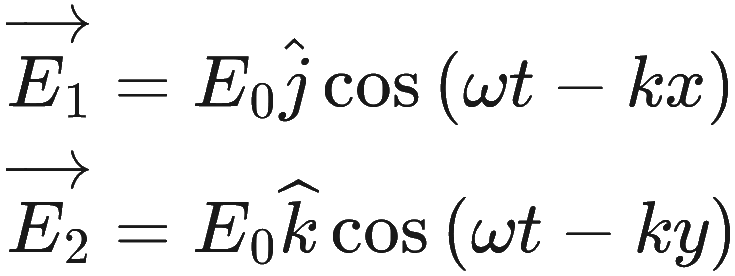 and