Physics Circle home Home Practice Hub Register / Login

Home›Practice Hub›Chapters›Electrostatics

Physics PYQs · MHT CET · JEE Main · NEET

Electrostatics

Questions
591
MHT CET
201
JEE Main
296
NEET
94
Years
1988–2026
0 of 591 attemptedPick an answer to see the solution

Q1MHT CET 2026 · 16 APR · SHIFT 2Easy

Electric Charge & Coulomb's Law · Properties of charge & charging

Two spherical hollow spheres of radii 'R1R_1' and 'R2R_2' are charged with same charge. Let 'σ1\sigma_1' and 'σ2\sigma_2 ' are their respective charge densities, then the ratio σ1\sigma_1 to σ2\sigma_2 is
Show answer and solution

Answer: (c)

  1. Surface charge density of a hollow sphere: σ=q4πR2\sigma = \dfrac{q}{4\pi R^2}.
  2. Same qq, so σ∝1R2\sigma \propto \dfrac{1}{R^2}.
  3. σ1σ2=R22R12\dfrac{\sigma_1}{\sigma_2} = \dfrac{R_2^2}{R_1^2}
  4. So the answer is (c) R22:R12R_2^2 : R_1^2.
Report a mistake
Q2MHT CET 2026 · 15 MAY · SHIFT 2Easy

Electric Charge & Coulomb's Law · Coulomb's law & medium

Two point charges placed at a certain distance rr in air exert force FF on each other. Then the distance r1r_1 at which these charges will exert the same force in a medium of dielectric constant KK is

Show answer and solution

Answer: (c)

  1. In air F=kq1q2r2F = \dfrac{kq_1q_2}{r^2}; in medium F=kq1q2Kr12F = \dfrac{kq_1q_2}{K r_1^2}.
  2. Equal forces: Kr12=r2⇒r1=rKK r_1^2 = r^2 \Rightarrow r_1 = \dfrac{r}{\sqrt{K}}
  3. So the answer is (c) rK\dfrac{r}{\sqrt{K}}.
Report a mistake
Q3MHT CET 2026 · 20 APR · SHIFT 1Easy

Electric Charge & Coulomb's Law · Coulomb's law & medium

Two point charges q1q_1 and q2q_2 are 'll' distance apart. If one of the charges is doubled and the distance between them is halved. The magnitude of the force becomes 'n' times, where 'n' is

Show answer and solution

Answer: (c)

  1. F∝q1q2l2F \propto \dfrac{q_1q_2}{l^2}.
  2. F′∝2q1q2(l/2)2=8q1q2l2=8FF' \propto \dfrac{2q_1q_2}{(l/2)^2} = \dfrac{8q_1q_2}{l^2} = 8F
  3. So the answer is (c) n=8n = 8.
Report a mistake
Q4MHT CET 2026 · 18 APR · SHIFT 2Easy

Electric Charge & Coulomb's Law · Coulomb's law & medium

Two equal point charges exert a force F on each other when they are placed distance 'd' apart in air. When they are placed distance 'D' apart in a medium of dielectric constant K, they exert the same force. The distance D is equal to

Show answer and solution

Answer: (a)

  1. kq2d2=kq2KD2\dfrac{kq^2}{d^2} = \dfrac{kq^2}{K D^2}
  2. D2=d2K⇒D=dKD^2 = \dfrac{d^2}{K} \Rightarrow D = \dfrac{d}{\sqrt{K}}
  3. So the answer is (a) dK\dfrac{d}{\sqrt{K}}.
Report a mistake
Q5MHT CET 2026 · 13 APR · SHIFT 2Easy

Electric Charge & Coulomb's Law · Coulomb's law & medium

If two charges q1q_1 and q2q_2 are separated with distance 'd' and placed in a medium of dielectric constant KK. What will be the equivalent distance between charges in air for the same electrostatic force?

Show answer and solution

Answer: (a)

  1. In medium F=kq1q2Kd2F = \dfrac{kq_1q_2}{K d^2}; in air at distance d′d': F=kq1q2d′2F = \dfrac{kq_1q_2}{d'^2}.
  2. d′2=Kd2⇒d′=dKd'^2 = K d^2 \Rightarrow d' = d\sqrt{K}
  3. So the answer is (a) d[K]1/2d[K]^{1/2}.
Report a mistake
Q6JEE Main 2026 · 8 APR · SHIFT 2Easy

Electric Charge & Coulomb's Law · Coulomb's law & medium

Two point charges q1=3 μCq_1 = 3\ \mu\text{C} and q2=−4 μCq_2 = -4\ \mu\text{C} are placed at points (2i^+3j^+3k^)(2\hat{i} + 3\hat{j} + 3\hat{k}) and (i^+j^+k^)(\hat{i} + \hat{j} + \hat{k}) respectively. Force on charge q2q_2 is ______ N. (Take 14πϵ0=9×10⁹\frac{1}{4\pi\epsilon_0} = 9 \times 10^{9} SI Units)

Show answer and solution

Answer: (b)

  1. Vector from q1q_1 to q2q_2: r⃗=(i^+j^+k^)−(2i^+3j^+3k^)=−i^−2j^−2k^\vec r = (\hat i+\hat j+\hat k)-(2\hat i+3\hat j+3\hat k) = -\hat i-2\hat j-2\hat k, ∣r⃗∣=3 m|\vec r| = 3\ \text{m}.
  2. F⃗2=kq1q2r3r⃗=9×109×3×10−6×(−4×10⁻⁶)27(−i^−2j^−2k^)\vec F_2 = \dfrac{kq_1q_2}{r^3}\vec r = \dfrac{9\times10^9\times3\times10^{-6}\times(-4\times10^{-6})}{27}(-\hat i-2\hat j-2\hat k)
  3. =−4×10⁻³(−i^−2j^−2k^)=(4i^+8j^+8k^)×10−3 N= -4\times10^{-3}(-\hat i-2\hat j-2\hat k) = (4\hat i+8\hat j+8\hat k)\times10^{-3}\ \text{N}
  4. So the answer is (b).
Report a mistake
Q7MHT CET 2026 · 12 MAY · SHIFT 1Easy

Electric Charge & Coulomb's Law · Equilibrium of charges

A charge qq is placed at the centre of the line joining two equal charges QQ. The system of the three charges will be in equilibrium if qq is equal to

Show answer and solution

Answer: (b)

  1. qq at the centre is in equilibrium for any value. Each end charge QQ must also be in equilibrium.
  2. Let separation be 2r2r: kQ2(2r)2+kQqr2=0\dfrac{kQ^2}{(2r)^2} + \dfrac{kQq}{r^2} = 0
  3. Q4+q=0⇒q=−Q4\dfrac{Q}{4} + q = 0 \Rightarrow q = -\dfrac{Q}{4}
  4. So the answer is (b) −Q4-\dfrac{Q}{4}.
Report a mistake
Q8MHT CET 2026 · 17 APR · SHIFT 2Easy

Electric Charge & Coulomb's Law · Equilibrium of charges

Two point charges +e and +4e are kept at a distance 'd' units apart. Third point charge +q is placed between the two charges at a distance 'x' units from charge +e so as to be in equilibrium. The value of 'x' is

Show answer and solution

Answer: (a)

  1. Net force on +q+q zero: keqx2=k(4e)q(d−x)2\dfrac{ke q}{x^2} = \dfrac{k(4e)q}{(d-x)^2}.
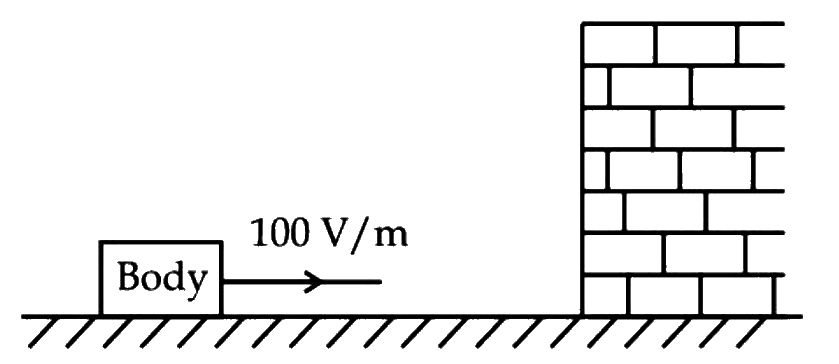
  2. d−xx=2⇒x=d3\dfrac{d-x}{x} = 2 \Rightarrow x = \dfrac{d}{3}
  3. So the answer is (a) d3\dfrac{d}{3} units.
Report a mistake
Q9MHT CET 2026 · 15 APR · SHIFT 2Easy

Electric Charge & Coulomb's Law · Equilibrium of charges

A point charge 'Q' is placed at the centre of the line joining two equal charges '+q' and '+q'. The value of 'Q' when the system is in equilibrium is

Show answer and solution

Answer: (d)

  1. For an end charge +q+q (separation 2r2r): kq24r2+kqQr2=0\dfrac{kq^2}{4r^2} + \dfrac{kqQ}{r^2} = 0.
  2. Q=−q4Q = -\dfrac{q}{4}
  3. So the answer is (d) −q4\dfrac{-q}{4}.
Report a mistake
Q10MHT CET 2026 · 15 MAY · SHIFT 1Medium

Electric Charge & Coulomb's Law · Coulomb's law & medium

Two charged identical metal spheres A and B repel each other with a force 3×10−53 \times 10^{-5} N. Another identical uncharged sphere C is touched with A and then placed at the mid-point between A and B. Net force on C is x×10−5x \times 10^{-5} N. The value of xx is

Show answer and solution

Answer: (d)

  1. Let A, B carry qq each at distance rr: F=kq2r2=3×10⁻⁵ NF = \dfrac{kq^2}{r^2} = 3\times10^{-5}\ \text{N}.
  2. C touches A: A and C each get q2\dfrac{q}{2}. C at midpoint, distance r2\dfrac r2 from each.
  3. From B: k(q/2)q(r/2)2=2F\dfrac{k(q/2)q}{(r/2)^2} = 2F (towards A); from A: k(q/2)2(r/2)2=F\dfrac{k(q/2)^2}{(r/2)^2} = F (towards B).
  4. Net force on C =2F−F=F=3×10⁻⁵ N= 2F - F = F = 3\times10^{-5}\ \text{N}
  5. So the answer is (d) x=3x = 3.
Report a mistake
Q11MHT CET 2026 · 13 MAY · SHIFT 2Medium

Electric Charge & Coulomb's Law · Coulomb's law & medium

Charge q2q_2 of mass 'mm' revolves around a stationary charge q1q_1 in a circular orbit of radius 'rr'. The orbital periodic time of q2q_2 would be (k=14πϵ0)\left(k = \frac{1}{4\pi\epsilon_0}\right)

Show answer and solution

Answer: (a)

  1. Coulomb force gives centripetal force: kq1q2r2=mω2r=4π2mrT2\dfrac{kq_1q_2}{r^2} = m\omega^2 r = \dfrac{4\pi^2 m r}{T^2}.
  2. T2=4π2mr3kq1q2T^2 = \dfrac{4\pi^2 m r^3}{kq_1q_2}
  3. So the answer is (a) T=[4π2mr3kq1q2]1/2T = \left[\dfrac{4\pi^2 m r^3}{kq_1q_2}\right]^{1/2}.
Report a mistake
Q12MHT CET 2026 · 13 MAY · SHIFT 1Medium

Electric Charge & Coulomb's Law · Coulomb's law & medium

Two point charges, +2C+2C and +6C+6C repel each other with a force of 1212N. If a charge of (−4C)(-4C) is given to each of these charges, the force now is

Show answer and solution

Answer: (b)

  1. F∝q1q2F \propto q_1q_2: initially 2×6=12⇒F=122\times6 = 12 \Rightarrow F = 12 N, so F=q1q2F = q_1q_2 (in N) at this distance.
  2. New charges: 2−4=−2 C2-4 = -2\ \text{C} and 6−4=+2 C6-4 = +2\ \text{C}.
  3. F′=∣−2×2∣=4F' = |-2\times2| = 4 N; unlike charges, so attractive.
  4. So the answer is (b) 4 N, attractive.
Report a mistake
Q13MHT CET 2026 · 20 APR · SHIFT 2Medium

Electric Charge & Coulomb's Law · Coulomb's law & medium

Two point charges placed in air separated by distance RR exert a force FF on each other. Now the space between those charges is filled with dielectric constant KK. At distance R1R_1 between the charges, the same force is exerted as FF. Then

Show answer and solution

Answer: (d)

  1. In air F=kq1q2R2F = \dfrac{kq_1q_2}{R^2}; in a medium F′=kq1q2KR12F' = \dfrac{kq_1q_2}{KR_1^2}.
  2. Same force: 1R2=1KR12⇒R12=R2K\dfrac{1}{R^2} = \dfrac{1}{KR_1^2} \Rightarrow R_1^2 = \dfrac{R^2}{K}
  3. So the answer is (d) R1=RKR_1 = \dfrac{R}{\sqrt{K}}.
Report a mistake
Q14MHT CET 2026 · 11 APR · SHIFT 1Medium

Electric Charge & Coulomb's Law · Superposition of forces

Three charges q, Qq,\ Q and +4q+4q are placed in a straight line of length dd at points at distance 0, d3, 2d30,\ \frac{d}{3},\ \frac{2d}{3} respectively. In order to make the net force on qq be zero, the value of QQ should be

Show answer and solution

Answer: (b)

  1. Force on qq from QQ (distance d/3d/3): kqQ(d/3)2=9kqQd2\dfrac{kqQ}{(d/3)^2} = \dfrac{9kqQ}{d^2}.
  2. Force on qq from 4q4q (distance 2d/32d/3): kq(4q)(2d/3)2=9kq2d2\dfrac{kq(4q)}{(2d/3)^2} = \dfrac{9kq^2}{d^2}.
  3. Both act along the same line; for zero net force 9kqQ=−9kq2⇒Q=−q9kqQ = -9kq^2 \Rightarrow Q = -q.
  4. With the data as printed Q=−qQ = -q, which is not among the options; the key gives (b) −3q2-\dfrac{3q}{2}.
Report a mistake
Q15MHT CET 2026 · 19 MAY · SHIFT 1Medium

Electric Charge & Coulomb's Law · Equilibrium of charges

Two charged particles each having a charge '+q+q' and mass 'm' are kept at a distance 'd'. If they are in equilibrium under the gravitational force and the electric force between them, then the ratio qm\frac{q}{m} (specific charge) of each particle is (GG- Universal gravitation constant, ε0\varepsilon_0 = permittivity of free space)

Show answer and solution

Answer: (c)

  1. Equilibrium: electric repulsion = gravitational attraction.
  2. 14πε0q2d2=Gm2d2⇒q2m2=4πε0G\dfrac{1}{4\pi\varepsilon_0}\dfrac{q^2}{d^2} = \dfrac{Gm^2}{d^2} \Rightarrow \dfrac{q^2}{m^2} = 4\pi\varepsilon_0 G
  3. So the answer is (c) qm=4πε0G\dfrac{q}{m} = \sqrt{4\pi\varepsilon_0 G}.
Report a mistake
Q16MHT CET 2026 · 14 MAY · SHIFT 2Medium

Electric Charge & Coulomb's Law · Equilibrium of charges

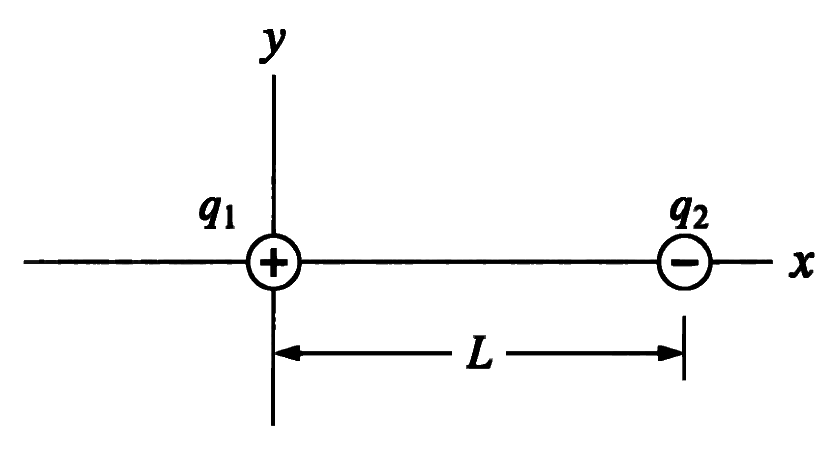
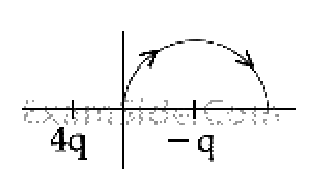
Two particles of charges q1=8qq_1 = 8q and q2=−2qq_2 = -2q are placed as shown in figure. At what point away from q2q_2 on x-axis can a proton be placed placed so that it is in equilibrium?

Figure

Show answer and solution

Answer: (a)

  1. The null point lies outside the charges, beyond the smaller charge q2q_2 (at x>Lx > L).
  2. k(8q)ex2=k(2q)e(x−L)2⇒xx−L=2\dfrac{k(8q)e}{x^2} = \dfrac{k(2q)e}{(x - L)^2} \Rightarrow \dfrac{x}{x - L} = 2
  3. x=2x−2L⇒x=2Lx = 2x - 2L \Rightarrow x = 2L. So the answer is (a) x=2Lx = 2L.
Report a mistake
Q17MHT CET 2025 · 25 APR · SHIFT 1Easy

Electric Charge & Coulomb's Law · Coulomb's law & medium

Two point charges q1q_1 and q2q_2 are ' ll ' distance apart. If one of the charges is doubled and distance between them is halved. The magnitude of force becomes nn times, where nn is

Show answer and solution

Answer: (c)

  1. F∝q1q2l2F \propto \dfrac{q_1q_2}{l^2}.
  2. F′∝2q1q2(l/2)2=8q1q2l2F' \propto \dfrac{2q_1q_2}{(l/2)^2} = 8\dfrac{q_1q_2}{l^2}
  3. So the answer is (c) n=8n = 8.
Report a mistake
Q18JEE Main 2025 · 23 JAN · SHIFT 1Easy

Electric Charge & Coulomb's Law · Coulomb's law & medium

A positive ion AA and a negative ion BB has charges 6.67×10⁻¹⁹ C6.67 \times 10^{-19}\text{ C} and 9.6×10⁻¹⁰ C9.6 \times 10^{-10}\text{ C}, and masses 19.2×10⁻²⁷ kg19.2 \times 10^{-27}\text{ kg} and 9×10⁻²⁷ kg9 \times 10^{-27}\text{ kg} respectively. At an instant, the ions are separated by a certain distance rr. At that instant the ratio of the magnitudes of electrostatic force to gravitational force is P×10−13P \times 10^{-13}, where the value of P is _________.

(Take 14πε0=9×10⁹ N m2 C−2\frac{1}{4\pi\varepsilon_0} = 9 \times 10^{9}\text{ N m}^2\text{ C}^{-2} and universal gravitational constant as 6.67×10⁻¹¹ N m2 kg−26.67 \times 10^{-11}\text{ N m}^2\text{ kg}^{-2})

Numerical answer type. Work it out, then open the answer.

Show answer and solution

Answer: b

  1. FeFg=kqAqBGmAmB\dfrac{F_e}{F_g} = \dfrac{kq_Aq_B}{Gm_Am_B} (rr cancels).
  2. =9×109×6.67×10−19×9.6×10−106.67×10−11×19.2×10−27×9×10−27= \dfrac{9\times10^9\times6.67\times10^{-19}\times9.6\times10^{-10}}{6.67\times10^{-11}\times19.2\times10^{-27}\times9\times10^{-27}}
  3. =9×9.6×10−20172.8×10−65=5×1044= \dfrac{9\times9.6\times10^{-20}}{172.8\times10^{-65}} = 5\times10^{44}
  4. With the data as printed the ratio is 5×10445\times10^{44}, which cannot be written as P×10−13P\times10^{-13} with a sensible PP.
Report a mistake
Q19MHT CET 2025 · 23 APR · SHIFT 1Easy

Electric Charge & Coulomb's Law · Superposition of forces

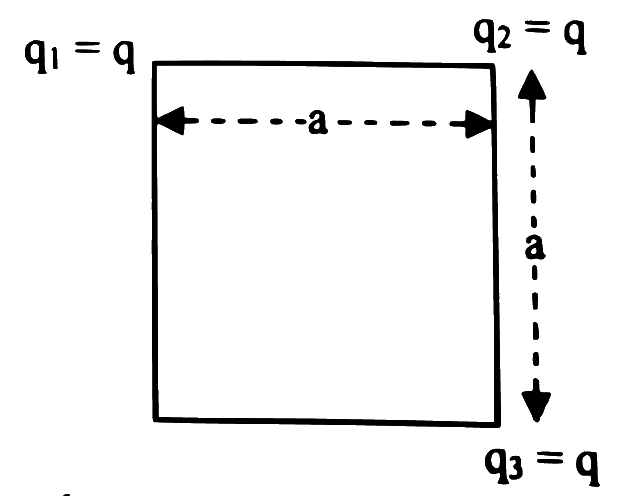
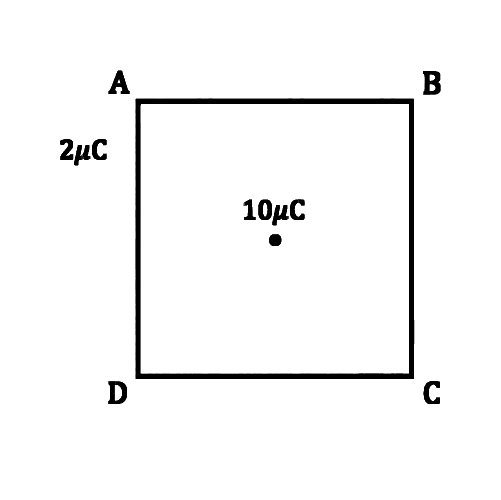
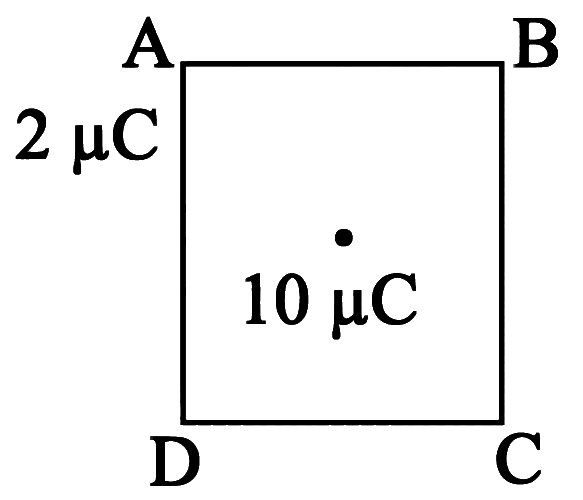
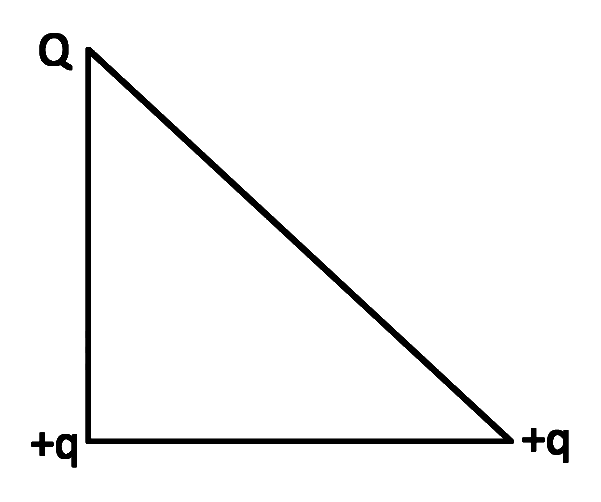
Three equal charges are placed on the three corners of a square as shown below. If the magnitude of force between ' q1q_1 ' and ' q2q_2 ' is ' F12F_{12} ' and that between ' q1q_1 ' and ' q3q_3 ' is F13F_{13}, then the ratio of F13F_{13} to F12F_{12} is

Figure

Show answer and solution

Answer: (c)

  1. From the figure, q1q2q_1q_2 is a side (aa) and q1q3q_1q_3 is the diagonal (2a\sqrt2 a).
  2. F12=kq2a2F_{12} = \dfrac{kq^2}{a^2}, F13=kq22a2F_{13} = \dfrac{kq^2}{2a^2}
  3. F13F12=12\dfrac{F_{13}}{F_{12}} = \dfrac{1}{2}
  4. So the answer is (c) 12\dfrac12.
Report a mistake
Q20MHT CET 2025 · 25 APR · SHIFT 2Medium

Electric Charge & Coulomb's Law · Coulomb's law & medium

Two equally charged small balls placed at a fixed distance experience a force ' FF '. A similar uncharged ball after touching one of them is placed at the middle point between the two balls. the force experienced by this ball is

Show answer and solution

Answer: (b)

  1. Initially F=kq2r2F = \dfrac{kq^2}{r^2}. After touching, the third ball and the touched ball each have q/2q/2.
  2. At the midpoint (distance r/2r/2 from each): force from the untouched ball =kq(q/2)(r/2)2=2F= \dfrac{kq(q/2)}{(r/2)^2} = 2F.
  3. Force from the touched ball =k(q/2)(q/2)(r/2)2=F= \dfrac{k(q/2)(q/2)}{(r/2)^2} = F, in the opposite direction.
  4. Net force =2F−F=F= 2F - F = F. So the answer is (b) FF.
Report a mistake
Q21NEET 2025Medium

Electric Charge & Coulomb's Law · Coulomb's law & medium

Two identical charged conducting spheres AA and BB have their centres separated by a certain distance. Charge on each sphere is qq and the force of repulsion between them is FF. A third identical uncharged conducting sphere is brought in contact with sphere AA first and then with BB and finally removed from both. New force of repulsion between spheres AA and BB (Radii of AA and BB are negligible compared to the distance of separation so that for calculating force between them they can be considered as point charges) is best given as:

Show answer and solution

Answer: (b)

  1. Identical spheres share charge equally on contact.
  2. C touches A: A=C=q2A = C = \dfrac{q}{2}. C touches B: B=C=q/2+q2=3q4B = C = \dfrac{q/2 + q}{2} = \dfrac{3q}{4}.
  3. F′=k(q/2)(3q/4)r2=38kq2r2=3F8F' = \dfrac{k(q/2)(3q/4)}{r^2} = \dfrac{3}{8}\dfrac{kq^2}{r^2} = \dfrac{3F}{8}
  4. So the answer is (b) 3F8\dfrac{3F}{8}.
Report a mistake
Q22JEE Main 2025 · 24 JAN · SHIFT 2Medium

Electric Charge & Coulomb's Law · Coulomb's law & medium

A small uncharged conducting sphere is placed in contact with an identical sphere but having 4×10⁻⁸ C4 \times 10^{-8}\text{ C} charge and then removed to a distance such that the force of repulsion between them is 9×10⁻³ N9 \times 10^{-3}\text{ N}. The distance between them is (Take 14πϵ0\frac{1}{4\pi\epsilon_0} as 9×1099 \times 10^{9} in SI units)

Show answer and solution

Answer: (b)

  1. After contact each sphere has q=2×10⁻⁸ Cq = 2 \times 10^{-8}\text{ C}.
  2. F=kq2r2⇒r2=9×109×4×10−169×10−3=4×10⁻⁴ m2F = \dfrac{kq^2}{r^2} \Rightarrow r^2 = \dfrac{9 \times 10^9 \times 4 \times 10^{-16}}{9 \times 10^{-3}} = 4 \times 10^{-4}\text{ m}^2
  3. r=2×10⁻² mr = 2 \times 10^{-2}\text{ m}. So the answer is (b) 2 cm.
Report a mistake
Q23MHT CET 2025 · 23 APR · SHIFT 2Medium

Electric Charge & Coulomb's Law · Superposition of forces

Three charges ' +3q+3q ', ' QQ ' and ' +q+q ' are placed in a straight line of length ' ll ' at points at distances 0, l20,\ \frac{l}{2} and ll respectively. The value of Q in order to have the net force on +q to be zero, Q=xqQ = xq. The value of xx is

Show answer and solution

Answer: (b)

  1. Force on +q+q (at ll) from +3q+3q (distance ll): 3kq2l2\dfrac{3kq^2}{l^2}, away from +3q+3q.
  2. Force on +q+q from QQ (distance l/2l/2): kQq(l/2)2=4kQql2\dfrac{kQq}{(l/2)^2} = \dfrac{4kQq}{l^2}, same line.
  3. Net zero: 3q+4Q=0⇒Q=−34q3q + 4Q = 0 \Rightarrow Q = -\dfrac{3}{4}q.
  4. So x=−34x = -\dfrac{3}{4}, answer (b).
Report a mistake
Q24MHT CET 2025 · 19 APR · SHIFT 1Medium

Electric Charge & Coulomb's Law · Equilibrium of charges

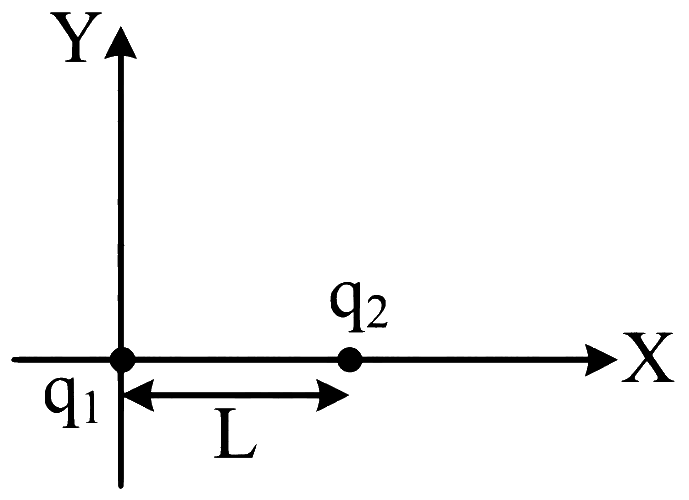
Two charges q1=+6qq_1 = +6q and q2=−3qq_2 = -3q placed as shown in figure. A proton is placed on x -axis away from q2q_2. To remain proton in equilibrium, the distance between q1q_1 and proton is

Figure

Show answer and solution

Answer: (a)

  1. Proton beyond q2q_2 at distance xx from q1q_1: forces from q1q_1 (repulsion) and q2q_2 (attraction) must balance.
  2. 6qx2=3q(x−L)2⇒xx−L=2\dfrac{6q}{x^2} = \dfrac{3q}{(x - L)^2} \Rightarrow \dfrac{x}{x - L} = \sqrt{2}
  3. x(2−1)=2L⇒x=22−1Lx(\sqrt{2} - 1) = \sqrt{2}L \Rightarrow x = \dfrac{\sqrt{2}}{\sqrt{2} - 1}L
  4. So the answer is (a).
Report a mistake
Q25NEET 2024Easy

Electric Charge & Coulomb's Law · Properties of charge & charging

A metal cube of side 5 cm5\text{ cm} is charged with 6 μC6\ \mu\text{C}. The surface charge density on the cube is

Show answer and solution

Answer: (d)

  1. Charge spreads over the outer surface: area =6a2=6×(0.05)2=0.015 m2= 6a^2 = 6\times(0.05)^2 = 0.015\ \text{m}^2.
  2. σ=qA=6×10−60.015=4×10⁻⁴ C m−2\sigma = \dfrac{q}{A} = \dfrac{6\times10^{-6}}{0.015} = 4\times10^{-4}\ \text{C m}^{-2}
  3. So the answer is (d) 0.4×10⁻³ C m−20.4\times10^{-3}\ \text{C m}^{-2}.
Report a mistake
Q26JEE Main 2024 · 5 APR · SHIFT 1Easy

Electric Charge & Coulomb's Law · Properties of charge & charging

In hydrogen like system the ratio of coulombian force and gravitational force between an electron and a proton is in the order of:

Show answer and solution

Answer: (b)

  1. FeFg=ke2Gmemp\dfrac{F_e}{F_g} = \dfrac{ke^2}{G m_e m_p} (both ∝1/r2\propto 1/r^2, so rr cancels).
  2. =9×109×(1.6×10−19)26.67×10−11×9.1×10−31×1.67×10−27≈2.3×1039= \dfrac{9\times10^9\times(1.6\times10^{-19})^2}{6.67\times10^{-11}\times9.1\times10^{-31}\times1.67\times10^{-27}} \approx 2.3\times10^{39}
  3. So the answer is (b) 103910^{39} (options mean 1019,1039,…10^{19}, 10^{39}, \ldots).
Report a mistake
Q27MHT CET 2024 · 3 MAY · SHIFT 1Easy

Electric Charge & Coulomb's Law · Coulomb's law & medium

Two equal point charges ' qq ' each exert a force ' FF ' on each other, when they are placed distance ' xx ' apart in air. When the same charges are placed distance ' yy ' apart in a medium of dielectric constant ' kk ', they exert the same force. The ratio of distance ' yy ' to ' xx ' is equal to

Show answer and solution

Answer: (a)

  1. kq2x2=kq2kd y2\dfrac{kq^2}{x^2} = \dfrac{kq^2}{k_d\, y^2} with kd=kk_d = k the dielectric constant.
  2. y2=x2k⇒yx=1ky^2 = \dfrac{x^2}{k} \Rightarrow \dfrac{y}{x} = \dfrac{1}{\sqrt{k}}
  3. So the answer is (a) 1k\dfrac{1}{\sqrt{k}}.
Report a mistake
Q28JEE Main 2024 · 31 JAN · SHIFT 2Easy

Electric Charge & Coulomb's Law · Coulomb's law & medium

Force between two point charges q1q_1 and q2q_2 placed in vacuum at 'rr' cm apart is FF. Force between them when placed in a medium having dielectric constant K=5K = 5 at 'r/5r/5' cm\text{cm} apart will be:

Show answer and solution

Answer: (a)

  1. F′=1Kkq1q2(r/5)2=25KFF' = \dfrac{1}{K}\dfrac{kq_1q_2}{(r/5)^2} = \dfrac{25}{K}F
  2. With K=5K = 5: F′=5FF' = 5F
  3. So the answer is (a) 5F5F.
Report a mistake
Q29MHT CET 2024 · 15 MAY · SHIFT 2Medium

Electric Charge & Coulomb's Law · Coulomb's law & medium

Two point charges +q1+q_1 and q2q_2 repel each other with a force of 100 N. q1100\text{ N}.\ q_1 is increased by 10%10\% and q2q_2 is decreased by 10%10\%. If they are kept at their original positions the change in the force of repulsion between them is

Show answer and solution

Answer: (d)

  1. F∝q1q2F \propto q_1q_2 at fixed distance.
  2. F′=(1.1 q1)(0.9 q2) kr2=0.99F=99 NF' = (1.1\,q_1)(0.9\,q_2)\,\dfrac{k}{r^2} = 0.99F = 99\text{ N}
  3. Change =99−100=−1 N= 99 - 100 = -1\text{ N}. So the answer is (d) decreased by 1 N.
Report a mistake
Q30MHT CET 2024 · 10 MAY · SHIFT 2Medium

Electric Charge & Coulomb's Law · Coulomb's law & medium

Two point charges (A(A and B)+4qB) + 4q and −4q-4q are placed along a line separated by a distance I '. Force acting between them is F. If 25%25\% of charge from point AA is transferred to that at point B, the force between the charges now becomes

Show answer and solution

Answer: (c)

  1. F=k(4q)(4q)l2=16kq2l2F = \dfrac{k(4q)(4q)}{l^2} = \dfrac{16kq^2}{l^2}
  2. 25% of 4q4q is qq. After transfer: A=+3qA = +3q, B=−4q+q=−3qB = -4q + q = -3q.
  3. F′=9kq2l2=916FF' = \dfrac{9kq^2}{l^2} = \dfrac{9}{16}F
  4. So the answer is (c) 916F\dfrac{9}{16}F.
Report a mistake
Q31JEE Main 2024 · 6 APR · SHIFT 2Medium

Electric Charge & Coulomb's Law · Coulomb's law & medium

Two identical conducting spheres P and S with charge Q on each, repel each other with a force 16 N16\text{ N}. A third identical uncharged conducting sphere RR is successively brought in contact with the two spheres. The new force of repulsion between PP and SS is:

Show answer and solution

Answer: (b)

  1. R touches P: P=Q2P = \dfrac{Q}{2}, R=Q2R = \dfrac{Q}{2}. R touches S: S=Q/2+Q2=3Q4S = \dfrac{Q/2 + Q}{2} = \dfrac{3Q}{4}.
  2. F′=k(Q/2)(3Q/4)r2=38FF' = \dfrac{k(Q/2)(3Q/4)}{r^2} = \dfrac{3}{8}F
  3. F′=38×16=6 NF' = \dfrac{3}{8} \times 16 = 6\text{ N}. So the answer is (b) 6 N.
Report a mistake
Q32MHT CET 2024 · 3 MAY · SHIFT 2Medium

Electric Charge & Coulomb's Law · Superposition of forces

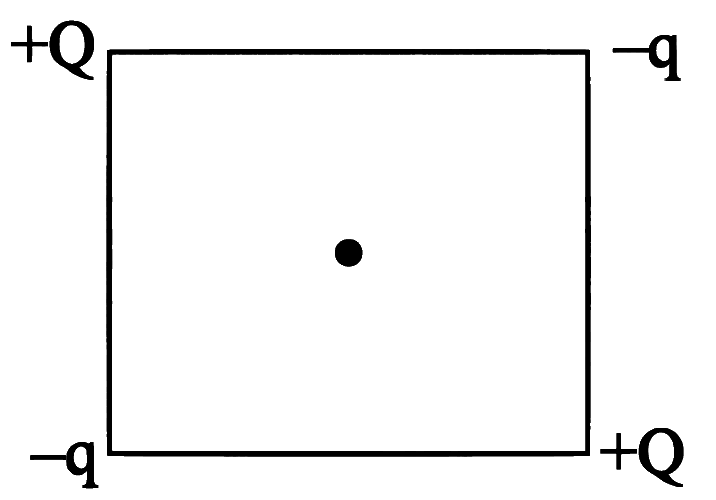
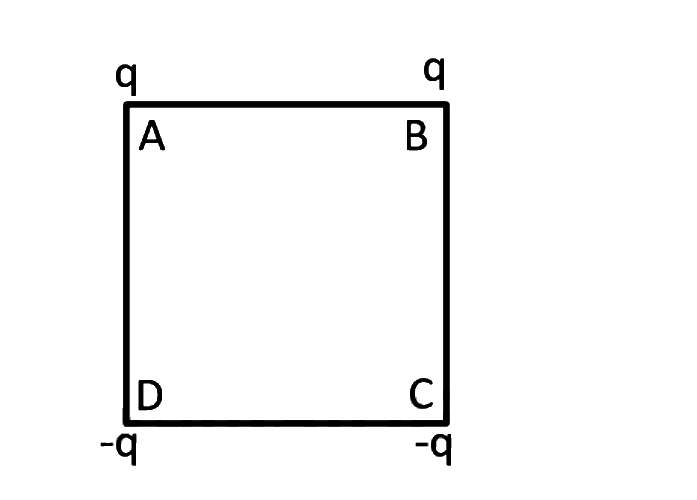
A charge +Q+Q is placed at each of the diagonally opposite corners of a square. A charge -q is placed at each of the other diagonally opposite corners as shown. If the net electrical force on +Q+Q is zero, then +Q−q\frac{+Q}{-q} is equal to

Figure

Show answer and solution

Answer: (d)

+Q-q-q+QkQq/a²kQq/a²kQ²/2a²
  1. Let the side be aa. Repulsion of +Q+Q by the other +Q+Q (distance 2a\sqrt{2}a): kQ22a2\dfrac{kQ^2}{2a^2} along the diagonal, outward.
  2. Attraction by each −q-q (distance aa): kQqa2\dfrac{kQq}{a^2}; the two are perpendicular, resultant 2kQqa2\dfrac{\sqrt{2}kQq}{a^2} along the diagonal, inward.
  3. Balance: kQ22a2=2kQqa2⇒Q=22 q\dfrac{kQ^2}{2a^2} = \dfrac{\sqrt{2}kQq}{a^2} \Rightarrow Q = 2\sqrt{2}\,q.
  4. So +Q−q=−22\dfrac{+Q}{-q} = -2\sqrt{2}, answer (d).
Report a mistake
Q33MHT CET 2024 · 11 MAY · SHIFT 1Medium

Electric Charge & Coulomb's Law · Equilibrium of charges

Charges 3Q,q3Q, q and Q are placed along x -axis at positions x=0,x=13x = 0, x = \frac{1}{3} and x=1x = 1 respectively. When the force on charge Q is zero, the value of qq is

Show answer and solution

Answer: (d)

  1. Force on QQ (at x=1x = 1) from 3Q3Q (distance 1): 3kQ212\dfrac{3kQ^2}{1^2}, along +x+x.
  2. Force on QQ from qq (distance 23\tfrac{2}{3}): kqQ(2/3)2=9kqQ4\dfrac{kqQ}{(2/3)^2} = \dfrac{9kqQ}{4}, along the same line.
  3. Net zero: 3Q+9q4=0⇒q=−43Q3Q + \dfrac{9q}{4} = 0 \Rightarrow q = -\dfrac{4}{3}Q.
  4. So the answer is (d) −43Q-\dfrac{4}{3}Q.
Report a mistake
Q34JEE Main 2024 · 1 FEB · SHIFT 1Medium

Electric Charge & Coulomb's Law · Equilibrium of charges

Two identical charged spheres are suspended by strings of equal lengths. The strings make an angle θ\theta with each other. When suspended in water the angle remains the same. If density of the material of the sphere is 1.5 g/cc1.5\text{ g/cc}, the dielectric constant of water will be __________. (Take density of water =1 g/cc= 1\text{ g/cc})

Numerical answer type. Work it out, then open the answer.

Show answer and solution

Answer: 3

  1. Same angle in air and liquid needs K=ρρ−σK = \dfrac{\rho}{\rho - \sigma} (electric force ÷K\div K, weight reduced by buoyancy).
  2. K=1.51.5−1=3K = \dfrac{1.5}{1.5 - 1} = 3
  3. Dielectric constant of water =3= 3.
Report a mistake
Q35JEE Main 2024 · 30 JAN · SHIFT 2Medium

Electric Charge & Coulomb's Law · Equilibrium of charges

Two identical charged spheres are suspended by strings of equal lengths. The strings make an angle of 37∘37^\circ with each other. When suspended in a liquid of density 0.7 g/cm30.7\text{ g/cm}^{3}, the angle remains same. If density of material of the sphere is 1.4 g/cm31.4\text{ g/cm}^{3}, the dielectric constant of the liquid is _______ (tan⁡37∘=34)\left(\tan 37^\circ = \frac{3}{4}\right)

Numerical answer type. Work it out, then open the answer.

Show answer and solution

Answer: 2

  1. Same angle in air and liquid: Fmg=F/Kmg(1−σ/ρ)⇒K=ρρ−σ\dfrac{F}{mg} = \dfrac{F/K}{mg(1 - \sigma/\rho)} \Rightarrow K = \dfrac{\rho}{\rho - \sigma}.
  2. K=1.41.4−0.7=2K = \dfrac{1.4}{1.4 - 0.7} = 2
  3. Dielectric constant of the liquid =2= 2.
Report a mistake
Q36JEE Main 2024 · 27 JAN · SHIFT 1Difficult

Electric Charge & Coulomb's Law · Superposition of forces

A thin metallic wire having cross sectional area of 10−4 m210^{-4}\text{ m}^{2} is used to make a ring of radius 30 cm30\text{ cm}. A positive charge of 2π C2\pi\text{ C} is uniformly distributed over the ring, while another positive charge of 30 pC\text{pC} is kept at the centre of the ring. The tension in the ring is ______ N\text{N}; provided that the ring does not get deformed (neglect the influence of gravity). (given, 14πϵ0=9×10⁹\frac{1}{4\pi\epsilon_0} = 9 \times 10^{9} SI units)

Numerical answer type. Work it out, then open the answer.

Show answer and solution

Answer: 3

  1. Small element R dθR\,d\theta with charge λR dθ\lambda R\,d\theta (λ=Q/2πR\lambda = Q/2\pi R) is pushed outward by the centre charge: kqλR dθR2\dfrac{kq\lambda R\,d\theta}{R^2}.
  2. Balanced by tension: 2Tsin⁡dθ2=T dθ⇒T=kqλR=kqQ2πR22T\sin\dfrac{d\theta}{2} = T\,d\theta \Rightarrow T = \dfrac{kq\lambda}{R} = \dfrac{kqQ}{2\pi R^2}
  3. T=9×109×30×10−12×2π2π×0.09=0.270.09T = \dfrac{9 \times 10^9 \times 30 \times 10^{-12} \times 2\pi}{2\pi \times 0.09} = \dfrac{0.27}{0.09}
  4. T=3 NT = 3\text{ N} (the cross-sectional area is not needed).
Report a mistake
Q37MHT CET 2023 · 12 MAY · SHIFT 2Easy

Electric Charge & Coulomb's Law · Coulomb's law & medium

Select the correct statement from the following.

Show answer and solution

Answer: (c)

  1. (a) False: electrostatic force is about 103610^{36} times stronger.
  2. (b) False: electrostatic force can be repulsive.
  3. (c) True: both are central forces along the line joining the bodies.
  4. (d) False: Coulomb force obeys F∝1/r2F \propto 1/r^2.
  5. So the answer is (c).
Report a mistake
Q38MHT CET 2023 · 11 MAY · SHIFT 1Easy

Electric Charge & Coulomb's Law · Coulomb's law & medium

Two positively charged identical spheres separated by a distance 'd' exert some force (F) on each other when they are kept in air. If both the spheres are immersed in a liquid of dielectric constant 5, the force experienced by each is (All other parameters are unchanged.)

Show answer and solution

Answer: (d)

  1. In a medium Fm=FairKF_m = \dfrac{F_{air}}{K}.
  2. Fm=F5F_m = \dfrac{F}{5}
  3. So the answer is (d) F5\dfrac{F}{5}.
Report a mistake
Q39JEE Main 2023 · 13 APR · SHIFT 2Easy

Electric Charge & Coulomb's Law · Coulomb's law & medium

A 10 μC10\ \mu\text{C} charge is divided into two parts and placed at 1 cm1\text{ cm} distance so that the repulsive force between them is maximum. The charges of the two parts are:

Show answer and solution

Answer: (b)

  1. F∝q(Q−q)F \propto q(Q-q); dFdq=Q−2q=0⇒q=Q2\dfrac{dF}{dq} = Q - 2q = 0 \Rightarrow q = \dfrac{Q}{2}.
  2. q=102=5 μCq = \dfrac{10}{2} = 5\ \mu\text{C} each.
  3. So the answer is (b) 5 μC,5 μC5\ \mu\text{C}, 5\ \mu\text{C}.
Report a mistake
Q40JEE Main 2023 · 24 JAN · SHIFT 1Easy

Electric Charge & Coulomb's Law · Coulomb's law & medium

If two charges q1{}_1 and q2{}_2 are separated with distance 'd' and placed in a medium of dielectric constant K. What will be the equivalent distance between charges in air for the same electrostatic force?

Show answer and solution

Answer: (a)

  1. In medium F=kq1q2Kd2F = \dfrac{kq_1q_2}{K d^2}; in air F=kq1q2d′2F = \dfrac{kq_1q_2}{d'^2}.
  2. d′=dKd' = d\sqrt{K}
  3. So the answer is (a) dKd\sqrt{K}.
Report a mistake
Q41JEE Main 2023 · 13 APR · SHIFT 2Medium

Electric Charge & Coulomb's Law · Superposition of forces

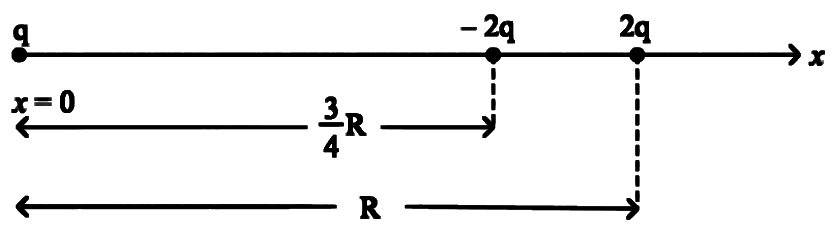
Three point charges q,−2qq, -2q and 2q2q are placed on xx-axis at a distance x=0,x=34Rx = 0, x = \frac{3}{4}R and x=Rx = R respectively from origin as shown. If q=2×10⁻⁶ Cq = 2 \times 10^{-6}\text{ C} and R=2 cmR = 2\text{ cm}, the magnitude of net force experienced by the charge −2q-2q is ___________ N.

Figure

Numerical answer type. Work it out, then open the answer.

Show answer and solution

Answer: 5440

  1. On −2q-2q (at 34R\tfrac{3}{4}R): qq at distance 34R\tfrac{3}{4}R attracts it towards −x-x: k(q)(2q)(3R/4)2=329kq2R2\dfrac{k(q)(2q)}{(3R/4)^2} = \dfrac{32}{9}\dfrac{kq^2}{R^2}.
  2. 2q2q at distance R4\tfrac{R}{4} attracts it towards +x+x: k(2q)(2q)(R/4)2=64kq2R2\dfrac{k(2q)(2q)}{(R/4)^2} = 64\dfrac{kq^2}{R^2}.
  3. Net =(64−329)kq2R2=5449kq2R2= \left(64 - \dfrac{32}{9}\right)\dfrac{kq^2}{R^2} = \dfrac{544}{9}\dfrac{kq^2}{R^2}
  4. kq2R2=9×109×4×10−124×10−4=90 N\dfrac{kq^2}{R^2} = \dfrac{9 \times 10^9 \times 4 \times 10^{-12}}{4 \times 10^{-4}} = 90\text{ N}
  5. Net force =5449×90=5440 N= \dfrac{544}{9} \times 90 = 5440\text{ N}.
Report a mistake
Q42JEE Main 2023 · 11 APR · SHIFT 1Medium

Electric Charge & Coulomb's Law · Equilibrium of charges

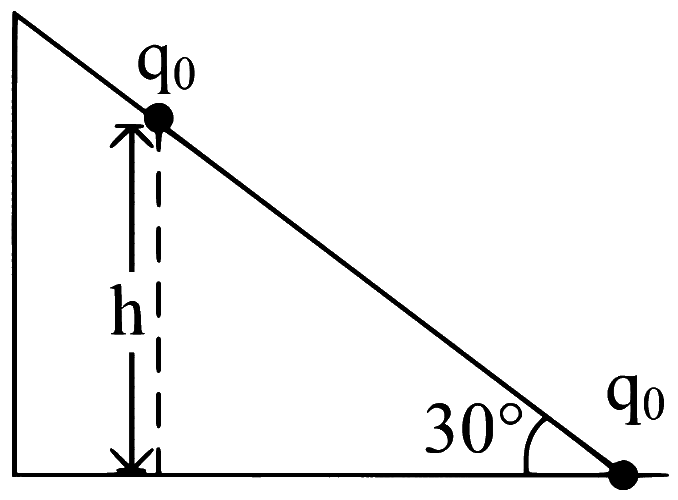
As shown in the figure, a configuration of two equal point charges (q0=+2 μC)(q_0 = +2\,\mu\text{C}) is placed on an inclined plane. Mass of each point charge is 20 g20\text{ g}. Assume that there is no friction between charge and plane. For the system of two point charges to be in equilibrium (at rest) the height h=x×10−3 mh = x \times 10^{-3}\text{ m}.

The value of xx is ____________.

(Take 14πε0=9×10⁹ N m2C−2,g=10 m s−2\frac{1}{4\pi\varepsilon_0} = 9 \times 10^{9}\text{ N m}^{2}\text{C}^{-2}, g = 10\text{ m s}^{-2})

Figure

Numerical answer type. Work it out, then open the answer.

Show answer and solution

Answer: 300

  1. Distance between the charges along the incline: r=hsin⁡30∘=2hr = \dfrac{h}{\sin 30^\circ} = 2h.
  2. Upper charge in equilibrium: kq02(2h)2=mgsin⁡30∘\dfrac{kq_0^2}{(2h)^2} = mg\sin 30^\circ.
  3. kq02=9×109×4×10−12=0.036kq_0^2 = 9 \times 10^9 \times 4 \times 10^{-12} = 0.036; mgsin⁡30∘=0.02×10×0.5=0.1 Nmg\sin 30^\circ = 0.02 \times 10 \times 0.5 = 0.1\text{ N}.
  4. 4h2=0.36⇒h=0.3 m=300×10−3 m4h^2 = 0.36 \Rightarrow h = 0.3\text{ m} = 300 \times 10^{-3}\text{ m}
  5. So x=300x = 300.
Report a mistake
Q43JEE Main 2023 · 29 JAN · SHIFT 1Medium

Electric Charge & Coulomb's Law · Equilibrium of charges

A point charge q1=4q0q_1 = 4q_0 is placed at origin. Another point charge q2=−q0q_2 = -q_0 is placed at x=12x = 12 cm. Charge of proton is q0q_0. The proton is placed on xx axis so that the electrostatic force on the proton is zero. In this situation, the position of the proton from the origin is ___________ cm.

Numerical answer type. Work it out, then open the answer.

Show answer and solution

Answer: 24

  1. Zero force point lies beyond the smaller charge q2q_2, at x>12x > 12 cm.
  2. 4q0x2=q0(x−12)2⇒xx−12=2\dfrac{4q_0}{x^2} = \dfrac{q_0}{(x - 12)^2} \Rightarrow \dfrac{x}{x - 12} = 2
  3. x=24 cmx = 24\text{ cm}.
Report a mistake
Q44JEE Main 2022 · 27 JUL · SHIFT 2Easy

Electric Charge & Coulomb's Law · Coulomb's law & medium

A charge of 4 μC4\ \mu\text{C} is to be divided into two. The distance between the two divided charges is constant. The magnitude of the divided charges so that the force between them is maximum, will be:

Show answer and solution

Answer: (b)

  1. F∝q(Q−q)F \propto q(Q-q) is maximum when q=Q2q = \dfrac{Q}{2}.
  2. q=42=2 μCq = \dfrac{4}{2} = 2\ \mu\text{C}
  3. So the answer is (b) 2 μC2\ \mu\text{C} and 2 μC2\ \mu\text{C}.
Report a mistake
Q45MHT CET 2022 · 11 AUG · SHIFT 2Easy

Electric Charge & Coulomb's Law · Superposition of forces

Three equal charges 'q1q_1', 'q2q_2 ' and 'q3q_3' are placed on the three corners of a square of side 'a'. If the force between q1q_1 and q2q_2 is 'F12F_{12}' and that between q1q_1 and q3q_3 is 'F13F_{13}', then the ratio of magnitudes (F12F13)\left(\frac{F_{12}}{F_{13}}\right) is

Show answer and solution

Answer: (d)

q1q2q3a√2 a
  1. q1,q2q_1, q_2 are adjacent (distance aa); q1,q3q_1, q_3 are diagonal (distance 2a\sqrt2 a).
  2. F∝1r2⇒F12F13=(2a)2a2=2F \propto \dfrac{1}{r^2} \Rightarrow \dfrac{F_{12}}{F_{13}} = \dfrac{(\sqrt2 a)^2}{a^2} = 2
  3. So the answer is (d) 22.
Report a mistake
Q46JEE Main 2022 · 29 JUL · SHIFT 2Medium

Electric Charge & Coulomb's Law · Coulomb's law & medium

Two identical metallic spheres AA and BB when placed at certain distance in air repel each other with a force of FF. Another identical uncharged sphere CC is first placed in contact with AA and then in contact with BB and finally placed at midpoint between spheres A and B. The force experienced by sphere C will be:

Show answer and solution

Answer: (b)

  1. Let each charge be qq, F=kq2r2F = \dfrac{kq^2}{r^2}. After contacts: A=q2A = \dfrac{q}{2}, B=C=3q4B = C = \dfrac{3q}{4}.
  2. C at midpoint, distance r/2r/2 from each. Force from A on C =k(q/2)(3q/4)r2/4=32F= \dfrac{k(q/2)(3q/4)}{r^2/4} = \dfrac{3}{2}F (towards B).
  3. Force from B on C =k(3q/4)2r2/4=94F= \dfrac{k(3q/4)^2}{r^2/4} = \dfrac{9}{4}F (towards A).
  4. Net =94F−32F=34F= \dfrac{9}{4}F - \dfrac{3}{2}F = \dfrac{3}{4}F. So the answer is (b) 3F/43F/4.
Report a mistake
Q47JEE Main 2022 · 26 JUL · SHIFT 2Medium

Electric Charge & Coulomb's Law · Superposition of forces

Three point charges of magnitude 5 μC,0.16 μC5\,\mu\text{C}, 0.16\,\mu\text{C} and 0.3 μC0.3\,\mu\text{C} are located at the vertices A,B,CA, B, C of a right angled triangle whose sides are AB=3 cm,BC=32 cmAB = 3\text{ cm}, BC = 3\sqrt{2}\text{ cm} and CA=3 cmCA = 3\text{ cm} and point AA is the right angle corner. Charge at point AA experiences ____________ N\text{N} of electrostatic force due to the other two charges.

Numerical answer type. Work it out, then open the answer.

Show answer and solution

Answer: 17

  1. Right angle at A, so forces from B and C on A are perpendicular; AB=AC=0.03 mAB = AC = 0.03\text{ m}.
  2. FB=9×109×5×10−6×0.16×10−69×10−4=8 NF_B = \dfrac{9 \times 10^9 \times 5 \times 10^{-6} \times 0.16 \times 10^{-6}}{9 \times 10^{-4}} = 8\text{ N}
  3. FC=9×109×5×10−6×0.3×10−69×10−4=15 NF_C = \dfrac{9 \times 10^9 \times 5 \times 10^{-6} \times 0.3 \times 10^{-6}}{9 \times 10^{-4}} = 15\text{ N}
  4. F=82+152=289=17 NF = \sqrt{8^2 + 15^2} = \sqrt{289} = 17\text{ N}.
Report a mistake
Q48JEE Main 2022 · 24 JUN · SHIFT 2Medium

Electric Charge & Coulomb's Law · Equilibrium of charges

Two identical charged particles each having a mass 10 g and charge 2.0 ×\times 10−-7C are placed on a horizontal table with a separation of L between them such that they stay in limiting equilibrium. If the coefficient of friction between each particle and the table is 0.25, find the value of L. [Use g = 10 ms−2{}^{-2}]

Show answer and solution

Answer: (a)

  1. Limiting equilibrium: kq2L2=μmg\dfrac{kq^2}{L^2} = \mu mg.
  2. kq2=9×109×4×10−14=3.6×10⁻⁴kq^2 = 9 \times 10^9 \times 4 \times 10^{-14} = 3.6 \times 10^{-4}; μmg=0.25×0.01×10=0.025 N\mu mg = 0.25 \times 0.01 \times 10 = 0.025\text{ N}.
  3. L2=3.6×10−40.025=0.0144 m2⇒L=0.12 mL^2 = \dfrac{3.6 \times 10^{-4}}{0.025} = 0.0144\text{ m}^2 \Rightarrow L = 0.12\text{ m}
  4. So the answer is (a) 12 cm.
Report a mistake
Q49JEE Main 2022 · 27 JUN · SHIFT 2Difficult

Electric Charge & Coulomb's Law · Equilibrium of charges

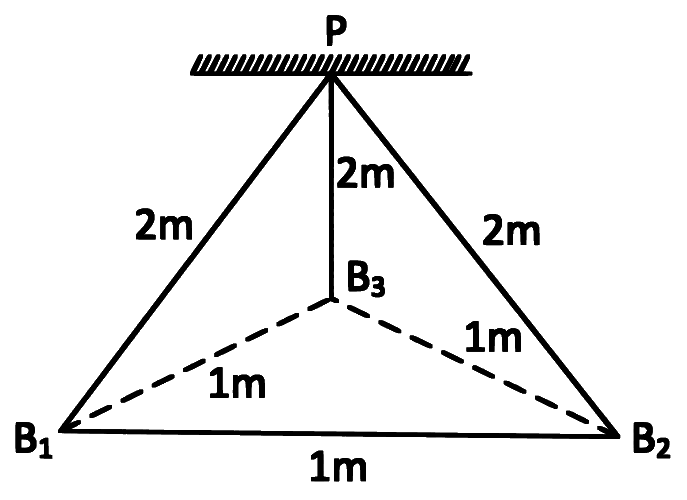
Three identical charged balls each of charge 2 C are suspended from a common point P by silk threads of 2 m each (as shown in figure). They form an equilateral triangle of side 1m. The ratio of net force on a charged ball to the force between any two charged balls will be:

Figure

Show answer and solution

Answer: (d)

  1. Force between any two balls: F=kq2(1)2F = \dfrac{kq^2}{(1)^2}.
  2. On one ball, the other two balls exert two forces of magnitude FF with 60∘60^\circ between them.
  3. Net electric force =F2+F2+2F2cos⁡60∘=3F= \sqrt{F^2 + F^2 + 2F^2\cos 60^\circ} = \sqrt{3}F
  4. Ratio =3F:F=3:1= \sqrt{3}F : F = \sqrt{3} : 1
  5. So the answer is (d) 3:1\sqrt{3} : 1.
Report a mistake
Q50MHT CET 2021 · 23 SEP · SHIFT 2Easy

Electric Charge & Coulomb's Law · Properties of charge & charging

Two positive ions, each carrying a charge 'q' are separated by a distance 'd'. If 'F' is the force of repulsion between the ions, the number of electrons from each ion will be (ee = charge on electron,ε0\text{electron}, \varepsilon_0 = permittivity of free space)

Show answer and solution

Answer: (d)

  1. Each ion has charge q=neq = ne, where nn = electrons missing.
  2. F=14πε0n2e2d2⇒n2=4πε0Fd2e2F = \dfrac{1}{4\pi\varepsilon_0}\dfrac{n^2e^2}{d^2} \Rightarrow n^2 = \dfrac{4\pi\varepsilon_0 F d^2}{e^2}
  3. So the answer is (d) n=4πε0Fd2e2n = \sqrt{\dfrac{4\pi\varepsilon_0 F d^2}{e^2}}.
Report a mistake
Q51MHT CET 2021 · 21 SEP · SHIFT 2Easy

Electric Charge & Coulomb's Law · Properties of charge & charging

When a piece of polythene is rubbed with wool, a negative charge of 4×10⁻⁷ C4 \times 10^{-7}\text{ C} is developed on the polythene. The number of electrons transferred from wool to polythene is [e=1.6×10⁻¹⁹ C][e = 1.6 \times 10^{-19}\text{ C}]

Show answer and solution

Answer: (d)

  1. Quantisation of charge: q=ne⇒n=qeq = ne \Rightarrow n = \dfrac{q}{e}.
  2. n=4×10−71.6×10−19=2.5×10¹²n = \dfrac{4\times10^{-7}}{1.6\times10^{-19}} = 2.5\times10^{12}
  3. So the answer is (d) 2.5×10122.5\times10^{12}.
Report a mistake
Q52MHT CET 2021 · 21 SEP · SHIFT 1Easy

Electric Charge & Coulomb's Law · Coulomb's law & medium

'FF' is the force between the two identical charged particles placed at a distance 'YY' from each other. If the distance between the charges is reduced to half the previous distance then force between them becomes

Show answer and solution

Answer: (b)

  1. F∝1r2F \propto \dfrac{1}{r^2}.
  2. r→Y2⇒F′=F(1/2)2=4Fr \to \dfrac{Y}{2} \Rightarrow F' = \dfrac{F}{(1/2)^2} = 4F
  3. So the answer is (b) 4F4F.
Report a mistake
Q53JEE Main 2021 · 20 JUL · SHIFT 1Easy

Electric Charge & Coulomb's Law · Coulomb's law & medium

A certain charge Q is divided into two parts q and (Q −- q). How should the charges Q and q be divided so that q and (Q −- q) placed at a certain distance apart experience maximum electrostatic repulsion?

Show answer and solution

Answer: (a)

  1. F∝q(Q−q)F \propto q(Q-q); dFdq=Q−2q=0\dfrac{dF}{dq} = Q-2q = 0.
  2. q=Q2⇒Q=2qq = \dfrac{Q}{2} \Rightarrow Q = 2q
  3. So the answer is (a) Q=2qQ = 2q.
Report a mistake
Q54MHT CET 2021 · 24 SEP · SHIFT 2Easy

Electric Charge & Coulomb's Law · Superposition of forces

Three charges each of +1 μC+1\ \mu\text{C} are placed at the corners of an equilateral triangle. If the repulsive force between any two charges is FF, then the net force on either charge will be [cos⁡60∘=0.5\cos 60^\circ = 0.5]

Show answer and solution

Answer: (d)

  1. The two forces on a charge are each FF, with 60∘60^\circ between them.
  2. Fnet=F2+F2+2F2cos⁡60∘=3F2F_{net} = \sqrt{F^2+F^2+2F^2\cos60^\circ} = \sqrt{3F^2}
  3. So the answer is (d) 3F\sqrt3 F.
Report a mistake
Q55MHT CET 2021 · 22 SEP · SHIFT 1Easy

Electric Charge & Coulomb's Law · Equilibrium of charges

A point charge QQ is placed at the centre of the line joining two equal point charges +q+q and +q+q. The value of QQ if the system of the charges is in equilibrium, is

Show answer and solution

Answer: (b)

  1. For an end charge +q+q (separation 2r2r): kq2(2r)2+kqQr2=0\dfrac{kq^2}{(2r)^2} + \dfrac{kqQ}{r^2} = 0.
  2. Q=−q4Q = -\dfrac{q}{4}
  3. So the answer is (b) −q4-\dfrac{q}{4}.
Report a mistake
Q56JEE Main 2021 · 31 AUG · SHIFT 1Easy

Electric Charge & Coulomb's Law · Equilibrium of charges

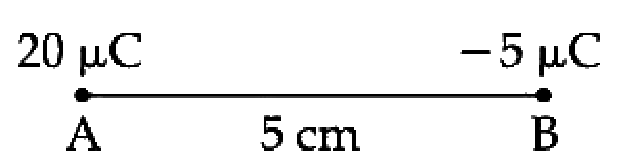
Two particles A and B having charges 20μ\muC and −5μ-5\muC respectively are held fixed with a separation of 5 cm. At what position a third charged particle should be placed so that it does not experience a net electric force?

Figure

Show answer and solution

Answer: (b)

A 20 μCB −5 μCP5 cm5 cm
  1. Unlike charges: the null point lies outside, nearer the smaller charge (−5 μC-5\ \mu\text{C} at B), i.e. to the right of B.
  2. Let it be xx cm right of B: 20(5+x)2=5x2\dfrac{20}{(5+x)^2} = \dfrac{5}{x^2}
  3. 5+xx=2⇒x=5 cm\dfrac{5+x}{x} = 2 \Rightarrow x = 5\ \text{cm}
  4. So the answer is (b) at 5 cm from −5 μC-5\ \mu\text{C} on the right side.
Report a mistake
Q57MHT CET 2021 · 23 SEP · SHIFT 2Medium

Electric Charge & Coulomb's Law · Coulomb's law & medium

Two point charges +3 μC+3\ \mu\text{C} and +8 μC+8\ \mu\text{C} repel each other with a force of 40 N40\text{ N}. If a charge of −5 μC-5\ \mu\text{C} is added to each of them, then force between them will become

Show answer and solution

Answer: (a)

  1. F∝q1q2F \propto q_1q_2: initially q1q2=3×8=24 (μC)2q_1q_2 = 3 \times 8 = 24\ (\mu\text{C})^2 gives 40 N40\text{ N}.
  2. New charges: 3−5=−2 μC3 - 5 = -2\ \mu\text{C} and 8−5=+3 μC8 - 5 = +3\ \mu\text{C}, product =−6= -6.
  3. F′=40×−624=−10 NF' = 40 \times \dfrac{-6}{24} = -10\text{ N} (negative sign means attraction).
  4. So the answer is (a) −10-10 N.
Report a mistake
Q58JEE Main 2021 · 25 FEB · SHIFT 2Medium

Electric Charge & Coulomb's Law · Coulomb's law & medium

Two identical conducting spheres with negligible volume have 2.1 nC and −-0.1 nC charges, respectively. They are brought into contact and then separated by a distance of 0.5 m. The electrostatic force acting between the spheres is __________ ×\times 10−-9 N.

[Given: 4πε0=19×1094\pi\varepsilon_0 = \frac{1}{9 \times 10^{9}} SI unit]

Numerical answer type. Work it out, then open the answer.

Show answer and solution

Answer: 36

  1. After contact each sphere has 2.1+(−0.1)2=1.0 nC\dfrac{2.1 + (-0.1)}{2} = 1.0\text{ nC}.
  2. F=kq2r2=9×109×(10−9)2(0.5)2F = \dfrac{kq^2}{r^2} = \dfrac{9 \times 10^9 \times (10^{-9})^2}{(0.5)^2}
  3. F=36×10−9 NF = 36 \times 10^{-9}\text{ N}. So the answer is 36.
Report a mistake
Q59JEE Main 2021 · 18 MAR · SHIFT 2Medium

Electric Charge & Coulomb's Law · Superposition of forces

An infinite number of point charges, each carrying 1 μ\muC charge, are placed along the y-axis at y = 1 m, 2 m, 4 m, 8 m ...............

The total force on a 1C point charge, placed at the origin, is x ×\times 103 N.

The value of x, to the nearest integer, is __________. [Take 14πε0=9×10⁹\frac{1}{4\pi\varepsilon_0} = 9 \times 10^{9} Nm2/C2]

Numerical answer type. Work it out, then open the answer.

Show answer and solution

Answer: 12

  1. All forces on the charge at the origin act along the same line (along −y-y, repulsion).
  2. F=kq Q(112+122+142+… )F = kq\,Q\left(\dfrac{1}{1^2} + \dfrac{1}{2^2} + \dfrac{1}{4^2} + \dots\right), a GP with ratio 14\tfrac{1}{4}, sum =11−1/4=43= \dfrac{1}{1 - 1/4} = \dfrac{4}{3}.
  3. F=9×109×10−6×1×43=12×103 NF = 9 \times 10^9 \times 10^{-6} \times 1 \times \dfrac{4}{3} = 12 \times 10^3\text{ N}
  4. So x=12x = 12.
Report a mistake
Q60JEE Main 2021 · 27 JUL · SHIFT 1Medium

Electric Charge & Coulomb's Law · Equilibrium of charges

Two identical tennis balls each having mass 'm' and charge 'q' are suspended from a fixed point by threads of length 'l'. What is the equilibrium separation when each thread makes a small angle 'θ\theta' with the vertical?

Show answer and solution

Answer: (b)

  1. For each ball tan⁡θ=Fmg\tan\theta = \dfrac{F}{mg}; for small θ\theta, tan⁡θ≈sin⁡θ=x/2l\tan\theta \approx \sin\theta = \dfrac{x/2}{l}.
  2. x2l=q24πε0x2mg\dfrac{x}{2l} = \dfrac{q^2}{4\pi\varepsilon_0 x^2 mg}
  3. x3=2lq24πε0mg=q2l2πε0mgx^3 = \dfrac{2lq^2}{4\pi\varepsilon_0 mg} = \dfrac{q^2 l}{2\pi\varepsilon_0 mg}
  4. So the answer is (b) x=(q2l2πε0mg)1/3x = \left(\dfrac{q^2 l}{2\pi\varepsilon_0 mg}\right)^{1/3}.
Report a mistake
Q61JEE Main 2021 · 25 FEB · SHIFT 2Medium

Electric Charge & Coulomb's Law · Equilibrium of charges

Two small spheres each of mass 10 mg are suspended from a point by threads 0.5 m long. They are equally charged and repel each other to a distance of 0.20 m. The charge on each of the sphere is a21×10−8\frac{a}{21} \times 10^{-8} C. The value of 'a' will be ___________. [Given g = 10 ms−2{}^{-2}]

Numerical answer type. Work it out, then open the answer.

Show answer and solution

Answer: 20

  1. Half separation 0.1 m0.1\text{ m}, thread 0.5 m0.5\text{ m}: tan⁡θ=0.10.25−0.01=126≈0.204\tan\theta = \dfrac{0.1}{\sqrt{0.25 - 0.01}} = \dfrac{1}{2\sqrt{6}} \approx 0.204.
  2. F=mgtan⁡θ=10−5×10×0.204=2.04×10⁻⁵ NF = mg\tan\theta = 10^{-5} \times 10 \times 0.204 = 2.04 \times 10^{-5}\text{ N}
  3. q2=Fr2k=2.04×10−5×0.049×109=9.07×10⁻¹⁷⇒q=9.52×10⁻⁹ Cq^2 = \dfrac{Fr^2}{k} = \dfrac{2.04 \times 10^{-5} \times 0.04}{9 \times 10^9} = 9.07 \times 10^{-17} \Rightarrow q = 9.52 \times 10^{-9}\text{ C}
  4. a21×10−8=0.952×10⁻⁸⇒a=20\dfrac{a}{21} \times 10^{-8} = 0.952 \times 10^{-8} \Rightarrow a = 20.
Report a mistake
Q62NEET 2020 · PHASE 2Easy

Electric Charge & Coulomb's Law · Coulomb's law & medium

The acceleration of an electron due to the mutual attraction between the electron and a proton when they are 1.6 Å apart is,

(me≃9×10⁻³¹ kg, e=1.6×10⁻¹⁹ C)(m_e \simeq 9 \times 10^{-31}\text{ kg},\ e = 1.6 \times 10^{-19}\text{ C})

(Take 14πϵ0=9×10⁹ N m2 C−2\frac{1}{4\pi\epsilon_0} = 9 \times 10^{9}\text{ N m}^2\text{ C}^{-2})

Show answer and solution

Answer: (d)

  1. F=ke2r2F = \dfrac{ke^2}{r^2} and a=Fmea = \dfrac{F}{m_e}.
  2. a=9×109×(1.6×10−19)29×10−31×(1.6×10−10)2a = \dfrac{9\times10^9\times(1.6\times10^{-19})^2}{9\times10^{-31}\times(1.6\times10^{-10})^2}
  3. =9×109×10−189×10−31=1022 m/s2= \dfrac{9\times10^9\times10^{-18}}{9\times10^{-31}} = 10^{22}\ \text{m/s}^2
  4. So the answer is (d) 1022 m/s210^{22}\ \text{m/s}^2.
Report a mistake
Q63MHT CET 2019 · 3 MAY · SHIFT 1Easy

Electric Charge & Coulomb's Law · Properties of charge & charging

In case of dimensions of electric field and electric dipole moment the power of mass is respectively,

Show answer and solution

Answer: (b)

  1. E=Fq=[MLT−2][AT]=[M1L1T−3A−1]E = \dfrac{F}{q} = \dfrac{[MLT^{-2}]}{[AT]} = [M^1L^1T^{-3}A^{-1}], power of mass =1= 1.
  2. p=q⋅2l=[A1T1L1]p = q\cdot 2l = [A^1T^1L^1], power of mass =0= 0.
  3. So the answer is (b) 1,01, 0.
Report a mistake
Q64JEE Main 2019 · 9 JAN · SHIFT 1Easy

Electric Charge & Coulomb's Law · Superposition of forces

Three charges + Q, q, + Q are placed respectively, at distance, 0, d/2 and d from the origin, on the x- axis. If the net force experienced by + Q, placed at x = 0, is zero, then value of q is:

Show answer and solution

Answer: (a)

  1. On +Q+Q at x=0x=0: force from +Q+Q at dd is kQ2d2\dfrac{kQ^2}{d^2}; from qq at d/2d/2 is kQq(d/2)2=4kQqd2\dfrac{kQq}{(d/2)^2} = \dfrac{4kQq}{d^2}.
  2. Net zero: kQ2d2+4kQqd2=0⇒q=−Q4\dfrac{kQ^2}{d^2} + \dfrac{4kQq}{d^2} = 0 \Rightarrow q = -\dfrac{Q}{4}
  3. So the answer is (a) −Q4-\dfrac{Q}{4}.
Report a mistake
Q65NEET 2019Medium

Electric Charge & Coulomb's Law · Coulomb's law & medium

Two point charges A and B, having charges +Q and – Q respectively, are placed at certain distance apart and force acting between them is F. If 25% charge of A is transferred to B, then force between the charges becomes:

Show answer and solution

Answer: (c)

  1. F=kQ2r2F = \dfrac{kQ^2}{r^2}. 25% of A's charge is Q/4Q/4.
  2. After transfer: A=3Q4A = \dfrac{3Q}{4}, B=−Q+Q4=−3Q4B = -Q + \dfrac{Q}{4} = -\dfrac{3Q}{4}.
  3. F′=k(3Q/4)2r2=916FF' = \dfrac{k(3Q/4)^2}{r^2} = \dfrac{9}{16}F
  4. So the answer is (c) 9F16\dfrac{9F}{16}.
Report a mistake
Q66JEE Main 2018 · 16 APR · SHIFT 1Medium

Electric Charge & Coulomb's Law · Coulomb's law & medium

Two identical conducting spheres A and B, carry equal charge. They are separated by a distance much larger than their diameters, and the force between them is F. A third identical conducting sphere, C, is uncharged. Sphere C is first touched to A, then to B, and then removed. As a result, the force between A and B would be equal to:

Show answer and solution

Answer: (c)

  1. C touches A: A=q2A = \dfrac{q}{2}, C=q2C = \dfrac{q}{2}.
  2. C touches B: B=q/2+q2=3q4B = \dfrac{q/2 + q}{2} = \dfrac{3q}{4}.
  3. F′=k(q/2)(3q/4)r2=38FF' = \dfrac{k(q/2)(3q/4)}{r^2} = \dfrac{3}{8}F
  4. So the answer is (c) 3F8\dfrac{3F}{8}.
Report a mistake
Q67NEET 2017Difficult

Electric Charge & Coulomb's Law · Coulomb's law & medium

Suppose the charge of a proton and an electron differ slightly. One of them is −-e, the other is (e + Δ\Deltae). If the net of electrostatic force and gravitational force between two hydrogen atoms placed at a distance d (musch greater than atomic size) apart is zero, then Δ\Deltae is of the order of [Given: mass of hydrogen mh = 1.67 ×\times 10−-27 kg]

Show answer and solution

Answer: (b)

  1. Each hydrogen atom has net charge Δe\Delta e, so the electric repulsion must equal the gravitational attraction.
  2. k(Δe)2d2=Gmh2d2⇒Δe=mhGk\dfrac{k(\Delta e)^2}{d^2} = \dfrac{Gm_h^2}{d^2} \Rightarrow \Delta e = m_h\sqrt{\dfrac{G}{k}}
  3. Δe=1.67×10−276.67×10−119×109≈1.67×10−27×8.6×10−11≈1.4×10−37 C\Delta e = 1.67 \times 10^{-27}\sqrt{\dfrac{6.67 \times 10^{-11}}{9 \times 10^9}} \approx 1.67 \times 10^{-27} \times 8.6 \times 10^{-11} \approx 1.4 \times 10^{-37}\text{ C}
  4. So the answer is (b) 10−3710^{-37} C.
Report a mistake
Q68NEET 2016 · PHASE 1Difficult

Electric Charge & Coulomb's Law · Equilibrium of charges

Two identical charged spheres suspended from a common point by two massless strings of lengths ll, are initially at a distance d(d < < ll) apart because of their mutual repulsion. The charges begin to leak from both the spheres at a constant rate. As a result, the spheres approach each other with a velocity v. Then v varies as a function of the distance x between the spheres, as

Show answer and solution

Answer: (a)

  1. Equilibrium of each sphere: tan⁡θ=Fmg\tan\theta = \dfrac{F}{mg}, and for small angles tan⁡θ≈x/2l\tan\theta \approx \dfrac{x/2}{l}.
  2. x2l=kq2x2mg⇒q2∝x3⇒q∝x3/2\dfrac{x}{2l} = \dfrac{kq^2}{x^2 mg} \Rightarrow q^2 \propto x^3 \Rightarrow q \propto x^{3/2}
  3. Charge leaks at a constant rate: dqdt∝32x1/2dxdt=constant\dfrac{dq}{dt} \propto \dfrac{3}{2}x^{1/2}\dfrac{dx}{dt} = \text{constant}
  4. So v=dxdt∝x−1/2v = \dfrac{dx}{dt} \propto x^{-1/2}.
  5. So the answer is (a) v∝x−1/2v \propto x^{-1/2}.
Report a mistake
Q69NEET 2013Easy

Electric Charge & Coulomb's Law · Equilibrium of charges

A charge q is placed at the centre of the line joining two equal charges Q. The system of the three charges will be in equilibrium if q is equal to

Show answer and solution

Answer: (a)

  1. For an end charge QQ (separation 2r2r): kQ2(2r)2+kQqr2=0\dfrac{kQ^2}{(2r)^2} + \dfrac{kQq}{r^2} = 0.
  2. q=−Q4q = -\dfrac{Q}{4}
  3. So the answer is (a) −Q/4-Q/4.
Report a mistake
Q70NEET 2013Medium

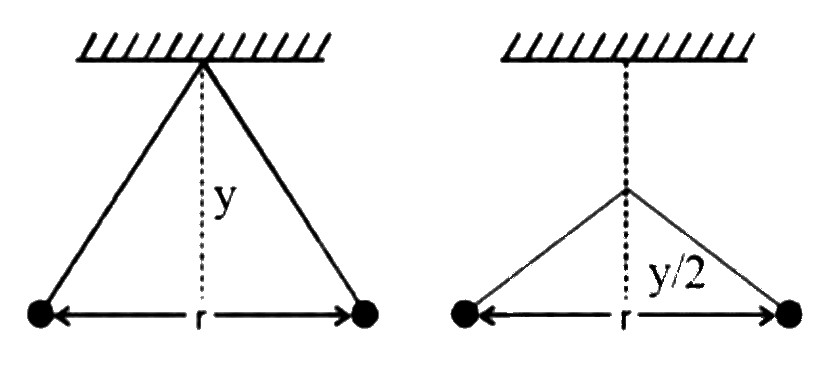
Electric Charge & Coulomb's Law · Equilibrium of charges

Two pith balls carrying equal charges are suspended from a common point by strings of equal length, the equilibrium separation between them is r. Now the strings are rigidly clamped at half the height. The equilibrium separation between the balls now becomes

Figure

Show answer and solution

Answer: (d)

  1. For each ball tan⁡θ=Fmg\tan\theta = \dfrac{F}{mg} and from the geometry tan⁡θ=r/2y\tan\theta = \dfrac{r/2}{y}.
  2. kq2r2mg=r2y⇒r3=2kq2ymg∝y\dfrac{kq^2}{r^2 mg} = \dfrac{r}{2y} \Rightarrow r^3 = \dfrac{2kq^2y}{mg} \propto y
  3. Height becomes y/2y/2: r′3=r32⇒r′=r23r'^3 = \dfrac{r^3}{2} \Rightarrow r' = \dfrac{r}{\sqrt[3]{2}}
  4. So the answer is (d).
Report a mistake
Q71JEE Main 2013 · 22 APR · SHIFT 1Medium

Electric Charge & Coulomb's Law · Equilibrium of charges

Two small equal point charges of magnitude qq are suspended from a common point on the ceiling by insulating mass less strings of equal lengths. They come to equilibrium with each string making angle θ\theta from the vertical. If the mass of each charge is mm, then the electrostatic potential at the centre of line joining them will be (14πϵ0=k)\left(\frac{1}{4\pi\epsilon_0} = k\right).

Show answer and solution

Answer: (c)

  1. Equilibrium of each charge: kq2r2=mgtan⁡θ⇒qr=mgtan⁡θk\dfrac{kq^2}{r^2} = mg\tan\theta \Rightarrow \dfrac{q}{r} = \sqrt{\dfrac{mg\tan\theta}{k}}.
  2. At the midpoint each charge is at r/2r/2: V=2×kqr/2=4kqrV = 2 \times \dfrac{kq}{r/2} = \dfrac{4kq}{r}.
  3. V=4kmgtan⁡θk=4kmgtan⁡θV = 4k\sqrt{\dfrac{mg\tan\theta}{k}} = 4\sqrt{kmg\tan\theta}
  4. So the answer is (c).
Report a mistake
Q72JEE Main 2013 · 9 APR · SHIFT 1Medium

Electric Charge & Coulomb's Law · Equilibrium of charges

Two balls of same mass and carrying equal charge are hung from a fixed support by threads of length ll. At electrostatic equilibrium, assuming that angles made by each thread is small, the separation, x between the balls is proportional to:

Show answer and solution

Answer: (d)

  1. Small angle: tan⁡θ≈x2l=Fmg=kq2x2mg\tan\theta \approx \dfrac{x}{2l} = \dfrac{F}{mg} = \dfrac{kq^2}{x^2 mg}.
  2. x3=2kq2lmg⇒x∝l1/3x^3 = \dfrac{2kq^2 l}{mg} \Rightarrow x \propto l^{1/3}
  3. So the answer is (d) l1/3l^{1/3}.
Report a mistake
Q73JEE Main 2011 · AIEEEDifficult

Electric Charge & Coulomb's Law · Equilibrium of charges

Two identical charged spheres suspended from a common point by two massless strings of length ll are initially a distance d (d<<l)d\,(d << l) apart because of their mutual repulsion. The charge begins to leak from both the spheres at a constant rate. As a result charges approach each other with a velocity vv. Then as a function of distance xx between them,

Show answer and solution

Answer: (d)

  1. For small angles: x2l=Fmg=kq2x2mg⇒q∝x3/2\dfrac{x}{2l} = \dfrac{F}{mg} = \dfrac{kq^2}{x^2 mg} \Rightarrow q \propto x^{3/2}.
  2. Constant leakage rate: dqdt∝x1/2dxdt=constant\dfrac{dq}{dt} \propto x^{1/2}\dfrac{dx}{dt} = \text{constant}
  3. So v=dxdt∝x−1/2v = \dfrac{dx}{dt} \propto x^{-1/2}.
  4. So the answer is (d) v∝x−1/2v \propto x^{-1/2}.
Report a mistake
Q74NEET 2010 · AIPMT · PRELIMSEasy

Electric Charge & Coulomb's Law · Properties of charge & charging

Two positive ions, each carrying a charge q, are separated by a distance d. If F is the force of repulsion between the ions, the number of electrons missing from each ion will be (e being the charge on an electron)

Show answer and solution

Answer: (c)

  1. Charge on each ion q=neq = ne.
  2. F=14πε0n2e2d2⇒n=4πε0Fd2e2F = \dfrac{1}{4\pi\varepsilon_0}\dfrac{n^2e^2}{d^2} \Rightarrow n = \sqrt{\dfrac{4\pi\varepsilon_0 F d^2}{e^2}}
  3. So the answer is (c).
Report a mistake
Q75JEE Main 2010 · AIEEEMedium

Electric Charge & Coulomb's Law · Equilibrium of charges

Two identical charged spheres are suspended by strings of equal lengths. The strings make an angle of 30∘30^\circ with each other. When suspended in a liquid of density 0.8 g cm−3,0.8\text{ g cm}^{-3}, the angle remains the same. If density of the material of the sphere is 1.6 g cm−3,1.6\text{ g cm}^{-3}, the dielectric constant of the liquid is

Show answer and solution

Answer: (c)

  1. In air tan⁡θ=Fmg\tan\theta = \dfrac{F}{mg}. In the liquid force becomes FK\dfrac{F}{K} and effective weight mg(1−σρ)mg\left(1 - \dfrac{\sigma}{\rho}\right).
  2. Same angle: K=11−σ/ρ=ρρ−σK = \dfrac{1}{1 - \sigma/\rho} = \dfrac{\rho}{\rho - \sigma}
  3. K=1.61.6−0.8=2K = \dfrac{1.6}{1.6 - 0.8} = 2
  4. So the answer is (c) 2.
Report a mistake
Q76JEE Main 2009 · AIEEEMedium

Electric Charge & Coulomb's Law · Superposition of forces

A charge QQ is placed at each of the opposite corners of a square. A charge qq is placed at each of the other two corners. If the net electrical force on QQ is zero, then Q/qQ/q equals:

Show answer and solution

Answer: (d)

  1. Side aa. Force on QQ from the opposite QQ (distance 2a\sqrt{2}a): kQ22a2\dfrac{kQ^2}{2a^2} along the diagonal, outward.
  2. Forces from the two qq charges (distance aa, perpendicular) give a resultant 2kQqa2\dfrac{\sqrt{2}kQq}{a^2} along the same diagonal.
  3. For zero net force qq must attract QQ (opposite sign): Q22=−2Qq⇒Qq=−22\dfrac{Q^2}{2} = -\sqrt{2}Qq \Rightarrow \dfrac{Q}{q} = -2\sqrt{2}.
  4. So the answer is (d) −22-2\sqrt{2}.
Report a mistake
Q77JEE Main 2004 · AIEEEMedium

Electric Charge & Coulomb's Law · Coulomb's law & medium

Two spherical conductors BB and CC having equal radii and carrying equal charges on them repel each other with a force FF when kept apart at some distance. A third spherical conductor having same radius as that of BB but uncharged is brought in contact with B,B, then brought in contact with CC and finally removed away from both. The new force of repulsion between BB and CC is

Show answer and solution

Answer: (d)

  1. Equal radii, so charge is shared equally on contact.
  2. After touching B: B=q2B = \dfrac{q}{2}. After touching C: C=q/2+q2=3q4C = \dfrac{q/2 + q}{2} = \dfrac{3q}{4}.
  3. F′=k(q/2)(3q/4)r2=3F8F' = \dfrac{k(q/2)(3q/4)}{r^2} = \dfrac{3F}{8}
  4. So the answer is (d) 3F/83F/8.
Report a mistake
Q78JEE Main 2004 · AIEEEMedium

Electric Charge & Coulomb's Law · Equilibrium of charges

Four charges equal to -QQ are placed at the four corners of a square and a charge qq is at its center. If the system is in equilibrium the value of qq is

Show answer and solution

Answer: (b)

  1. Consider one corner charge −Q-Q, side aa. Repulsion from the two adjacent −Q-Q: resultant 2kQ2a2\dfrac{\sqrt{2}kQ^2}{a^2} along the diagonal, outward.
  2. Repulsion from the opposite corner (distance 2a\sqrt{2}a): kQ22a2\dfrac{kQ^2}{2a^2}, outward along the same diagonal.
  3. qq at the centre (distance a/2a/\sqrt{2}) must attract: 2kQqa2=kQ2a2(2+12)\dfrac{2kQq}{a^2} = \dfrac{kQ^2}{a^2}\left(\sqrt{2} + \dfrac{1}{2}\right)
  4. q=Q4(1+22)q = \dfrac{Q}{4}\left(1 + 2\sqrt{2}\right) (positive). So the answer is (b).
Report a mistake
Q79JEE Main 2003 · AIEEEMedium

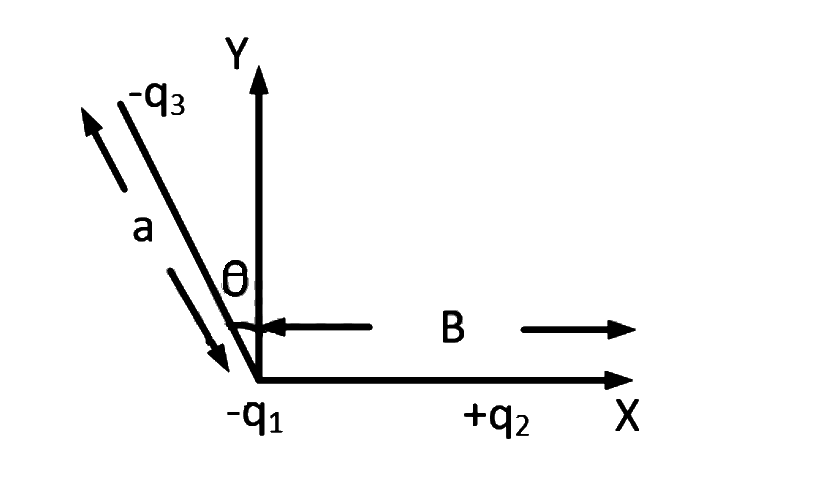
Electric Charge & Coulomb's Law · Superposition of forces

Three charges −q1,+q2-q_1, +q_2 and −q3-q_3 are placed as shown in the figure. The xx-component of the force on −q1-q_1 is proportional to

Figure

Show answer and solution

Answer: (b)

  1. +q2+q_2 on the x-axis at distance bb attracts −q1-q_1: force kq1q2b2\dfrac{kq_1q_2}{b^2} along +x+x.
  2. −q3-q_3 at distance aa along a line making θ\theta with the y-axis (upper left) repels −q1-q_1 towards the lower right.
  3. x-component of this repulsion =kq1q3a2sin⁡θ= \dfrac{kq_1q_3}{a^2}\sin\theta, also along +x+x.
  4. Fx∝q2b2+q3a2sin⁡θF_x \propto \dfrac{q_2}{b^2} + \dfrac{q_3}{a^2}\sin\theta. So the answer is (b).
Report a mistake
Q80JEE Main 2002 · AIEEEEasy

Electric Charge & Coulomb's Law · Equilibrium of charges

If a charge qq is placed at the center of the line joining two equal charges QQ such that the system is in equilibrium then the value of qq is

Show answer and solution

Answer: (d)

  1. For an end charge QQ (separation 2r2r): kQ2(2r)2+kQqr2=0\dfrac{kQ^2}{(2r)^2} + \dfrac{kQq}{r^2} = 0.
  2. q=−Q4q = -\dfrac{Q}{4}
  3. So the answer is (d) −Q/4-Q/4.
Report a mistake
Q81NEET 1999 · AIPMTEasy

Electric Charge & Coulomb's Law · Coulomb's law & medium

When air is replaced by a dielectric medium of constant KK, the maximum force of attraction between two charges, separated by a distance

Show answer and solution

Answer: (a)

  1. Fm=14πε0Kq1q2r2=FairKF_m = \dfrac{1}{4\pi\varepsilon_0 K}\dfrac{q_1q_2}{r^2} = \dfrac{F_{air}}{K}
  2. So the answer is (a) the force decreases KK times.
Report a mistake
Q82NEET 1995 · AIPMTEasy

Electric Charge & Coulomb's Law · Equilibrium of charges

A charge qq is placed at the centre of the line joining two exactly equal positive charges QQ. The system of three charges will be in equilibrium, if qq is equal to

Show answer and solution

Answer: (c)

  1. For an end charge QQ (separation 2r2r): kQ24r2+kQqr2=0\dfrac{kQ^2}{4r^2} + \dfrac{kQq}{r^2} = 0.
  2. q=−Q4q = -\dfrac{Q}{4}
  3. So the answer is (c) −Q/4-Q/4.
Report a mistake
Q83NEET 1988 · AIPMTMedium

Electric Charge & Coulomb's Law · Equilibrium of charges

Point charges +4q,−q+4q, -q, −q-q and +4q+4q are kept on the XX-axis at point x=0,x=ax = 0, x = a and x=2ax = 2a respectively. Then

Show answer and solution

Answer: (c)

  1. Reading the charges as +4q,−q,+4q+4q, -q, +4q at x=0,a,2ax = 0, a, 2a.
  2. −q-q at the middle: equal and opposite pulls from the two +4q+4q, so net force zero.
  3. +4q+4q at x=0x = 0: attraction 4kq2a2\dfrac{4kq^2}{a^2} towards −q-q, repulsion 16kq24a2=4kq2a2\dfrac{16kq^2}{4a^2} = \dfrac{4kq^2}{a^2} away; net zero. Same for the other end.
  4. A small shift of any charge makes the nearer attraction grow faster than the balancing force, so it moves further away: all equilibria are unstable.
  5. So the answer is (c).
Report a mistake
Q84JEE Main 2026 · 28 JAN · SHIFT 2Easy

Electric Field & Field Lines · Electric field lines

Identify the correct statements:

A. Electrostatic field lines form closed loops.

B. The electric field lines point radially outward when charge is greater than zero. C. The Gauss - Law is valid only for inverse-square force.

D. The work done in moving a charged particle in a static electric field around a closed path is zero. E. The motion of a particle under Coulomb's force must take place in a plane.

Choose the correct answer from the options given below:

Show answer and solution

Answer: (c)

  1. A: False, electrostatic field lines start and end on charges, so they never form closed loops.
  2. B: True, the field of a positive charge points radially outward.
  3. C: True, Gauss's law follows from the 1/r21/r^2 dependence of the force.
  4. D: True, the electrostatic field is conservative, so ∮E⃗⋅dl⃗=0\oint \vec{E}\cdot d\vec{l} = 0.
  5. E: True, the Coulomb force is central, so angular momentum is conserved and the motion stays in a plane.
  6. So the answer is (c) B, C, D, E only.
Report a mistake
Q85MHT CET 2026 · 18 APR · SHIFT 1Medium

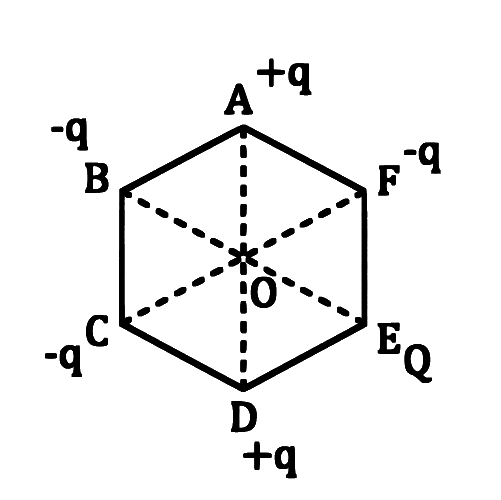
Electric Field & Field Lines · Field of point charges

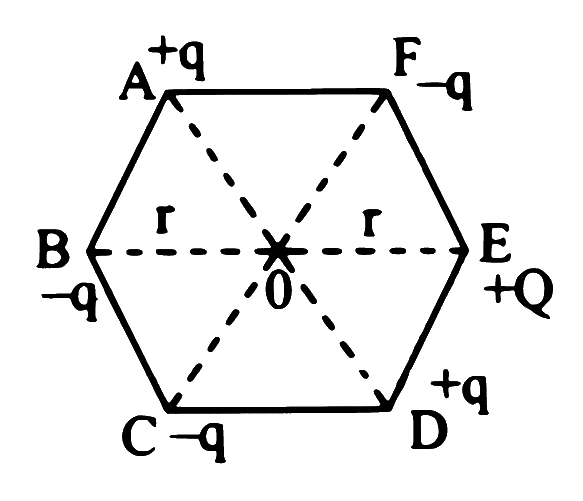
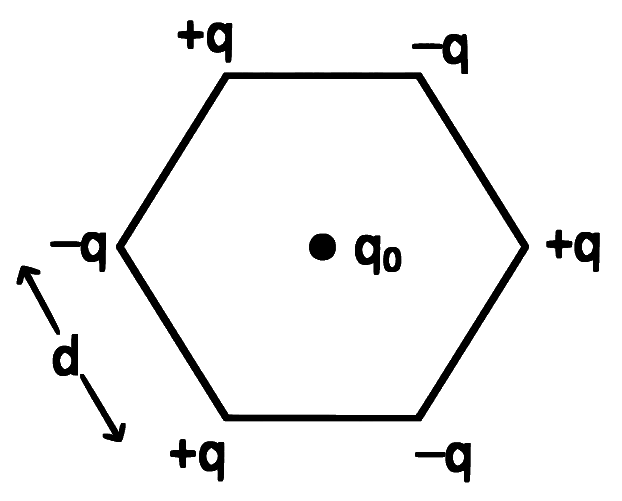
The point charges +q,−q,−q,+q,+Q+q, -q, -q, +q, +Q and −q-q are placed at the vertices of a regular hexagon ABCDEF as shown in the figure.

Figure

The electric field at the centre of the hexagon 'O' due to the five charges at A, B, C, D and F is thrice the electric field at centre 'O' due to charge +Q+Q at E alone. The value of Q is

Show answer and solution

Answer: (a)

  1. Opposite vertices are at equal distance rr: AA and DD both have +q+q, CC and FF both have −q-q, so their fields at OO cancel.
  2. Field of the five charges = field of −q-q at BB: kqr2\dfrac{kq}{r^2}, directed from OO towards BB.
  3. Field of +Q+Q at EE: kQr2\dfrac{kQ}{r^2}, directed away from EE, i.e. also towards BB.
  4. kqr2=3kQr2⇒Q=q3\dfrac{kq}{r^2} = 3\dfrac{kQ}{r^2} \Rightarrow Q = \dfrac{q}{3}
  5. So the answer is (a) q3\dfrac{q}{3}.
Report a mistake
Q86JEE Main 2026 · 22 JAN · SHIFT 1Medium

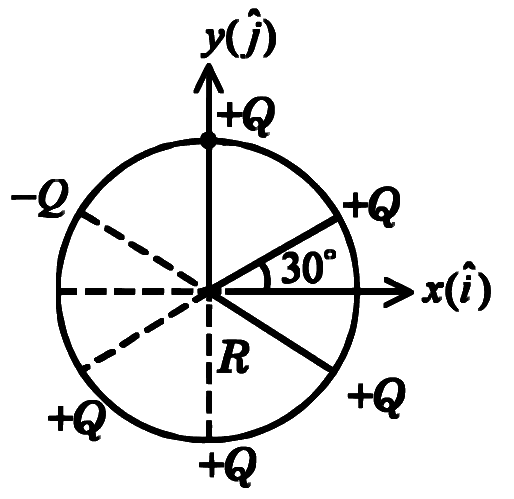
Electric Field & Field Lines · Field of point charges

Six point charges are kept 60∘60^\circ apart from each other on the circumference of a circle of radius RR as shown in figure. The net electric field at the center of the circle is ______.

( ϵ0\epsilon_0 is permittivity of free space)

Figure

Show answer and solution

Answer: (c)

  1. From the figure: +Q+Q at 90∘,30∘,−30∘,−90∘,210∘90^\circ, 30^\circ, -30^\circ, -90^\circ, 210^\circ and −Q-Q at 150∘150^\circ; let E0=Q4πϵ0R2E_0 = \dfrac{Q}{4\pi\epsilon_0 R^2}.
  2. Equal charges at opposite points cancel: 90∘90^\circ with −90∘-90^\circ, and 30∘30^\circ with 210∘210^\circ.
  3. +Q+Q at −30∘-30^\circ: field points away from it, E0(−32i^+12j^)E_0\left(-\frac{\sqrt{3}}{2}\hat{i} + \frac{1}{2}\hat{j}\right)
  4. −Q-Q at 150∘150^\circ: field points towards it, E0(−32i^+12j^)E_0\left(-\frac{\sqrt{3}}{2}\hat{i} + \frac{1}{2}\hat{j}\right)
  5. E⃗=E0(−3i^+j^)=−Q4πϵ0R2(3i^−j^)\vec{E} = E_0(-\sqrt{3}\hat{i} + \hat{j}) = -\dfrac{Q}{4\pi\epsilon_0 R^2}(\sqrt{3}\hat{i} - \hat{j})
  6. So the answer is (c).
Report a mistake
Q87JEE Main 2026 · 6 APR · SHIFT 1Medium

Electric Field & Field Lines · Field of rod, arc, ring & disc

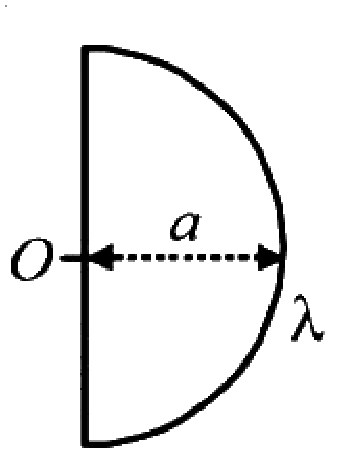
A thin half ring of radius 35 cm is uniformly charged with a total charge of QQ coulomb. If the magnitude of the electric field at centre of the half ring is 100 V/m100\text{ V/m}, then the value of QQ is ______ nC. (ϵ0=8.85×10⁻¹² C2/N m2(\epsilon_0 = 8.85 \times 10^{-12}\text{ C}^{2}/\text{N m}^{2} and π=3.14)\pi = 3.14)

Show answer and solution

Answer: (a)

  1. For a half ring: E=2kλRE = \dfrac{2k\lambda}{R} with λ=QπR\lambda = \dfrac{Q}{\pi R}, so E=Q2π2ε0R2E = \dfrac{Q}{2\pi^2\varepsilon_0 R^2}.
  2. Q=2π2ε0R2E=2(3.14)2(8.85×10⁻¹²)(0.35)2(100)Q = 2\pi^2\varepsilon_0 R^2 E = 2(3.14)^2(8.85\times10^{-12})(0.35)^2(100)
  3. Q=1971.9×8.85×10−12×0.1225≈2.14×10⁻⁹ CQ = 1971.9 \times 8.85\times10^{-12} \times 0.1225 \approx 2.14\times10^{-9}\text{ C}
  4. So the answer is (a) 2.14 nC.
Report a mistake
Q88JEE Main 2026 · 24 JAN · SHIFT 2Medium

Electric Field & Field Lines · Field of rod, arc, ring & disc

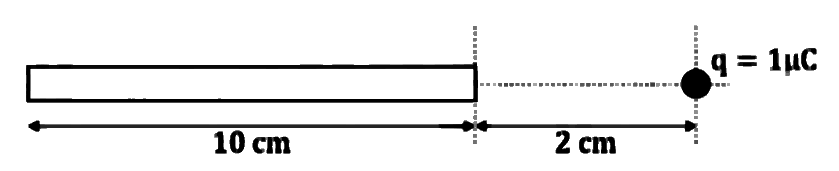
A point charge q=1 μCq = 1\ \mu\text{C} is located at a distance 2 cm from one end of a thin insulating wire of length 10 cm having a charge Q=24 μCQ = 24\ \mu\text{C}, distributed uniformly along its length, as shown in figure. Force between qq and wire is ______ N.

(Use: 14πϵ0=9×10⁹ N m2/C2\frac{1}{4\pi\epsilon_0} = 9 \times 10^{9}\text{ N m}^2/\text{C}^2)

Figure

Numerical answer type. Work it out, then open the answer.

Show answer and solution

Answer: 90

  1. Field on the axis of a rod at distance dd from its near end: E=kQd(d+L)E = \dfrac{kQ}{d(d+L)}, so F=kqQd(d+L)F = \dfrac{kqQ}{d(d+L)}.
  2. F=9×109×1×10−6×24×10−60.02×0.12F = \dfrac{9\times10^9 \times 1\times10^{-6}\times 24\times10^{-6}}{0.02\times0.12}
  3. F=0.2160.0024=90 NF = \dfrac{0.216}{0.0024} = 90\text{ N}
  4. So the force is 90 N.
Report a mistake
Q89JEE Main 2025 · 2 APR · SHIFT 1Easy

Electric Field & Field Lines · Neutral point

A point charge +q+q is placed at the origin. A second point charge +9q+9q is placed at (d,0,0d, 0, 0) in Cartesian coordinate system. The point in between them where the electric field vanishes is:

Show answer and solution

Answer: (b)

  1. Let the null point be at distance xx from +q+q: kqx2=k(9q)(d−x)2\dfrac{kq}{x^2} = \dfrac{k(9q)}{(d-x)^2}.
  2. d−xx=3⇒x=d4\dfrac{d-x}{x} = 3 \Rightarrow x = \dfrac{d}{4}
  3. So the answer is (b) (d/4,0,0)(d/4, 0, 0).
Report a mistake
Q90MHT CET 2025 · 26 APR · SHIFT 1Easy

Electric Field & Field Lines · Electric field lines

Out of the following statements which is NOT the characteristics of electric lines of force?

Show answer and solution

Answer: (c)

  1. (a), (b) and (d) are true properties of field lines.
  2. Inside a conductor in electrostatic equilibrium E=0E = 0, so field lines do not pass through a conductor; they meet its surface normally.
  3. So the answer is (c).
Report a mistake
Q91MHT CET 2025 · 26 APR · SHIFT 2Medium

Electric Field & Field Lines · Field of point charges

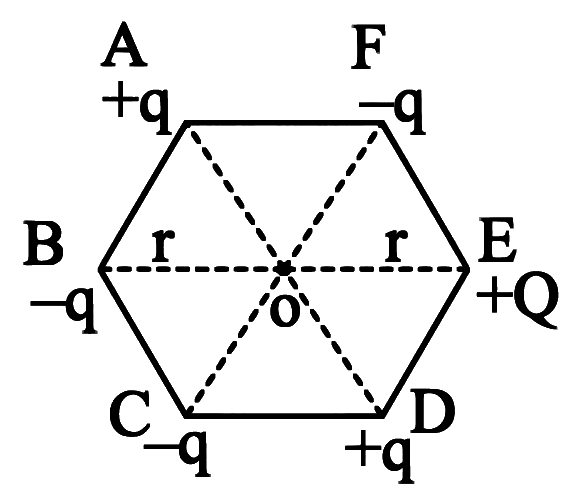
The point charges +q,−q,−q,+q,+Q+q, -q, -q, +q, +Q and -q are placed at the vertices of a regular hexagon ABCDEF as shown in figure. The electric field at the centre of hexagon ' OO ' due to the five charges at A,B,C,DA, B, C, D and F is twice the electric field at centre ' O ' due to charge +Q at E alone. The value of QQ is

Figure

Show answer and solution

Answer: (a)

  1. Opposite pairs A,DA, D (+q,+q+q, +q) and C,FC, F (−q,−q-q, -q) give zero field at OO.
  2. Field of the five charges = field of −q-q at BB: kqr2\dfrac{kq}{r^2} towards BB.
  3. Field of +Q+Q at EE: kQr2\dfrac{kQ}{r^2}, also towards BB.
  4. kqr2=2kQr2⇒Q=q2\dfrac{kq}{r^2} = 2\dfrac{kQ}{r^2} \Rightarrow Q = \dfrac{q}{2}
  5. So the answer is (a) q2\dfrac{q}{2}.
Report a mistake
Q92JEE Main 2025 · 4 APR · SHIFT 2Medium

Electric Field & Field Lines · Field of rod, arc, ring & disc

A metallic ring is uniformly charged as shown in figure. AC and BD are two mutually perpendicular diameters. Electric field due to arc ABAB at ' OO ' is ' EE ' in magnitude. What would be the magnitude of electric field at ' O ' due to arc ABC?

Figure

Show answer and solution

Answer: (d)

  1. Quarter arc AB gives field EE at O along the bisector of AB (pointing away from the arc).
  2. Arc ABC = arc AB + arc BC; arc BC gives an equal field EE along its own bisector.
  3. The two bisectors are 90∘90^\circ apart, so Enet=E2+E2=2EE_{net} = \sqrt{E^2 + E^2} = \sqrt{2}E.
  4. So the answer is (d) 2E\sqrt{2}E.
Report a mistake
Q93JEE Main 2025 · 2 APR · SHIFT 2Medium

Electric Field & Field Lines · Field of rod, arc, ring & disc

Consider a circular loop that is uniformly charged and has a radius a2a\sqrt{2}. Find the position along the positive zz-axis of the cartesian coordinate system where the electric field is maximum if the ring was assumed to be placed in xyxy plane at the origin:

Show answer and solution

Answer: (a)

  1. On the axis of a ring: E=kQz(z2+R2)3/2E = \dfrac{kQz}{(z^2+R^2)^{3/2}}; setting dEdz=0\dfrac{dE}{dz} = 0 gives z=R2z = \dfrac{R}{\sqrt{2}}.
  2. Here R=a2R = a\sqrt{2}, so z=a22=az = \dfrac{a\sqrt{2}}{\sqrt{2}} = a.
  3. So the answer is (a) aa.
Report a mistake
Q94JEE Main 2024 · 31 JAN · SHIFT 1Easy

Electric Field & Field Lines · Neutral point

Two charges qq and 3q3q are separated by a distance 'rr' in air. At a distance xx from charge qq, the resultant electric field is zero. The value of xx is:

Show answer and solution

Answer: (c)

  1. For like charges the null point lies between them: kqx2=k(3q)(r−x)2\dfrac{kq}{x^2} = \dfrac{k(3q)}{(r-x)^2}.
  2. r−xx=3⇒x=r1+3\dfrac{r-x}{x} = \sqrt{3} \Rightarrow x = \dfrac{r}{1+\sqrt{3}}
  3. So the answer is (c) r1+3\dfrac{r}{1+\sqrt{3}}.
Report a mistake
Q95MHT CET 2024 · 2 MAY · SHIFT 2Easy

Electric Field & Field Lines · Electric field lines

Which of the following statement is correct?

Show answer and solution

Answer: (c)

  1. (a) False: lines start on positive and end on negative charges.
  2. (b) False: lines cannot exist inside a conductor (E=0E = 0), but can pass through an insulator.
  3. (c) True: two lines never intersect, otherwise the field would have two directions at one point.
  4. (d) False: crowded lines mean a strong field.
  5. So the answer is (c).
Report a mistake
Q96MHT CET 2024 · 11 MAY · SHIFT 2Medium

Electric Field & Field Lines · Field of point charges

A sphere ' AA ' of radius ' RR ' has a charge ' QQ ' on it. The field at point B outside the sphere is ' EE '. Now another sphere of radius ' 2R2R ' having a charge ' −2Q-2Q ' is placed at B. The total field at the point midway between A and B due to both the spheres is

Show answer and solution

Answer: (c)

  1. Let AB=dAB = d. Field of sphere A at B: E=kQd2E = \dfrac{kQ}{d^2}.
  2. At the midpoint (distance d/2d/2 from each centre), field of A: kQ(d/2)2=4E\dfrac{kQ}{(d/2)^2} = 4E, directed away from A, towards B.
  3. Field of the −2Q-2Q sphere: k(2Q)(d/2)2=8E\dfrac{k(2Q)}{(d/2)^2} = 8E, directed towards B.
  4. Both are in the same direction: Enet=4E+8E=12EE_{net} = 4E + 8E = 12E
  5. So the answer is (c) 12E12E.
Report a mistake
Q97MHT CET 2024 · 11 MAY · SHIFT 2Medium

Electric Field & Field Lines · Field of point charges

The point charges +q,−q,−q,+q,+Q+q, -q, -q, +q, +Q and -q are placed at the vertices of a regular hexagon ABCDEF as shown in figure. The electric field at the centre of hexagon ' OO ' due to the five charges at A,B,C,DA, B, C, D and FF is thrice the electric field at centre ' OO ' due to charge +Q at E alone. The value of Q is

Figure

Show answer and solution

Answer: (a)

  1. Opposite pairs A,DA, D (+q,+q+q, +q) and C,FC, F (−q,−q-q, -q) cancel at OO.
  2. Field of the five charges = field of −q-q at BB: kqr2\dfrac{kq}{r^2} towards BB.
  3. Field of +Q+Q at EE: kQr2\dfrac{kQ}{r^2}, also towards BB.
  4. kqr2=3kQr2⇒Q=q3\dfrac{kq}{r^2} = 3\dfrac{kQ}{r^2} \Rightarrow Q = \dfrac{q}{3}
  5. So the answer is (a) +q3\dfrac{+q}{3}.
Report a mistake
Q98MHT CET 2024 · 16 MAY · SHIFT 1Medium

Electric Field & Field Lines · Neutral point

Two point charges +8q+8q and −2q-2q are located at x=0x = 0 and x=Lx = L respectively. The location of a point on the xx-axis from the origin, at which the net electric field due to these two point charges is zero is

Show answer and solution

Answer: (d)

  1. For unlike charges the null point lies outside, nearer the smaller charge, i.e. beyond x=Lx = L.
  2. k(8q)x2=k(2q)(x−L)2⇒x−Lx=12\dfrac{k(8q)}{x^2} = \dfrac{k(2q)}{(x-L)^2} \Rightarrow \dfrac{x-L}{x} = \dfrac{1}{2}
  3. x=2Lx = 2L
  4. So the answer is (d) 2L2L.
Report a mistake
Q99MHT CET 2024 · 15 MAY · SHIFT 1Medium

Electric Field & Field Lines · Neutral point

Two point charges +8q+8q and −2q-2q are located at X=0X = 0 (origin) and X=LX = L respectively. The net electric field due to these two charges is zero at point PP on XX-axis. The location of point PP from the origin is

Show answer and solution

Answer: (b)

  1. The null point lies beyond the smaller charge −2q-2q (at x>Lx > L).
  2. 8qx2=2q(x−L)2⇒x−L=x2\dfrac{8q}{x^2} = \dfrac{2q}{(x-L)^2} \Rightarrow x - L = \dfrac{x}{2}
  3. x=2Lx = 2L
  4. So the answer is (b) 2L2L.
Report a mistake
Q100MHT CET 2024 · 10 MAY · SHIFT 1Medium

Electric Field & Field Lines · Neutral point

Two point charges +10 q and -4 q are located at x=0x = 0 and x=Lx = L respectively. What is the location of a point on the xx-axis from the origin, which the net electric field due to these two point charges is zero?( r=r = required distance))

Show answer and solution

Answer: (a)

  1. The null point lies beyond the smaller charge −4q-4q at B, at distance rr to its right.
  2. 10q(L+r)2=4qr2⇒rL+r=25\dfrac{10q}{(L+r)^2} = \dfrac{4q}{r^2} \Rightarrow \dfrac{r}{L+r} = \dfrac{\sqrt{2}}{\sqrt{5}}
  3. r5=2L+2r⇒r=2 L5−2r\sqrt{5} = \sqrt{2}L + \sqrt{2}r \Rightarrow r = \dfrac{\sqrt{2}\,L}{\sqrt{5} - \sqrt{2}}, right of B
  4. So the answer is (a).
Report a mistake
Q101JEE Main 2024 · 8 APR · SHIFT 2Medium

Electric Field & Field Lines · Neutral point

If the net electric field at point PP along YY axis is zero, then the ratio of ∣q2q3∣\left|\frac{q_2}{q_3}\right| is 85x\frac{8}{5\sqrt{x}}, where x=x = ________.

Figure

Numerical answer type. Work it out, then open the answer.

Show answer and solution

Answer: 5

  1. Distances: r2=22+42=20r_2 = \sqrt{2^2 + 4^2} = \sqrt{20} cm, r3=32+42=5r_3 = \sqrt{3^2 + 4^2} = 5 cm.
  2. The yy-component of +q2+q_2's field (upward) must cancel that of −q3-q_3's field (downward).
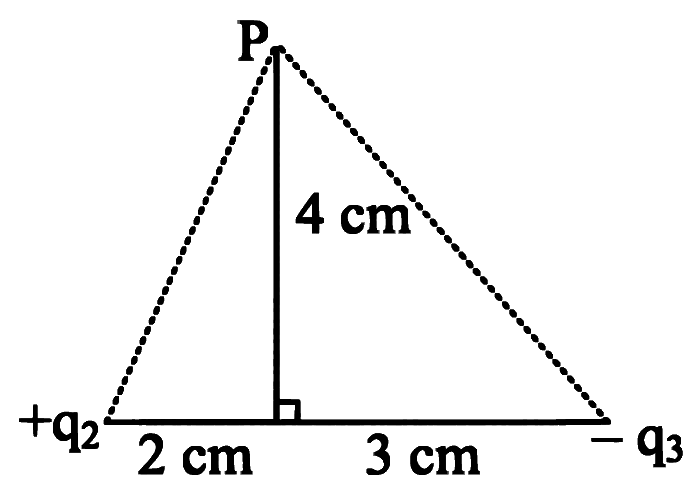
  3. kq220⋅420=kq325⋅45\dfrac{kq_2}{20}\cdot\dfrac{4}{\sqrt{20}} = \dfrac{kq_3}{25}\cdot\dfrac{4}{5}
  4. q2q3=2020125=8525=855\dfrac{q_2}{q_3} = \dfrac{20\sqrt{20}}{125} = \dfrac{8\sqrt{5}}{25} = \dfrac{8}{5\sqrt{5}}
  5. So x=5x = 5.
Report a mistake
Q102JEE Main 2023 · 30 JAN · SHIFT 1Easy

Electric Field & Field Lines · Field of point charges

Electric field in a certain region is given by E⃗=(Ax2i^+By3j^)\vec{E} = \left(\frac{A}{x^2}\hat{i} + \frac{B}{y^3}\hat{j}\right). The SI\text{SI} unit of AA and BB are:

Show answer and solution

Answer: (d)

  1. Each term must have the unit of EE, i.e. N C−1\text{N C}^{-1}.
  2. Ax2=N C−1⇒A=N m2C−1\dfrac{A}{x^2} = \text{N C}^{-1} \Rightarrow A = \text{N m}^2\text{C}^{-1}
  3. By3=N C−1⇒B=N m3C−1\dfrac{B}{y^3} = \text{N C}^{-1} \Rightarrow B = \text{N m}^3\text{C}^{-1}
  4. So the answer is (d).
Report a mistake
Q103JEE Main 2023 · 1 FEB · SHIFT 1Medium

Electric Field & Field Lines · Field of point charges

Two equal positive point charges are separated by a distance 2a2a. The distance of a point from the centre of the line joining two charges on the equatorial line (perpendicular bisector) at which force experienced by a test charge q0q_0 becomes maximum is ax\frac{a}{\sqrt{x}}. The value of xx is __________.

Numerical answer type. Work it out, then open the answer.

Show answer and solution

Answer: 2

  1. On the bisector at distance yy: F=2kqq0 y(y2+a2)3/2F = \dfrac{2kqq_0\,y}{(y^2 + a^2)^{3/2}}.
  2. dFdy=0⇒y2+a2=3y2⇒y=a2\dfrac{dF}{dy} = 0 \Rightarrow y^2 + a^2 = 3y^2 \Rightarrow y = \dfrac{a}{\sqrt{2}}
  3. So x=2x = 2.
Report a mistake
Q104JEE Main 2023 · 25 JAN · SHIFT 2Medium

Electric Field & Field Lines · Neutral point

A point charge of 10 μ\muC is placed at the origin. At what location on the X-axis should a point charge of 40 μ\muC be placed so that the net electric field is zero at x=2x = 2cm on the X-axis?

Show answer and solution

Answer: (a)

  1. Field of 10 μC10\,\mu\text{C} at x=2x = 2 cm points along +x+x, so the 40 μC40\,\mu\text{C} charge must be to the right of x=2x = 2 cm.
  2. k(10)22=k(40)r2⇒r2=16⇒r=4\dfrac{k(10)}{2^2} = \dfrac{k(40)}{r^2} \Rightarrow r^2 = 16 \Rightarrow r = 4 cm
  3. Position =2+4=6= 2 + 4 = 6 cm
  4. So the answer is (a) x=6x = 6 cm.
Report a mistake
Q105MHT CET 2023 · 14 MAY · SHIFT 1Medium

Electric Field & Field Lines · Field of rod, arc, ring & disc

A uniformly charged semicircular arc of radius 'rr' has linear charge density 'λ\lambda'. The electric field at its centre is ( ε0=\varepsilon_0 = permittivity of free space)

Show answer and solution

Answer: (b)

  1. Element dq=λr dθdq = \lambda r\,d\theta gives dE=kλr dθr2dE = \dfrac{k\lambda r\,d\theta}{r^2}; components along the diameter cancel.
  2. E=∫0πkλrsin⁡θ dθ=2kλrE = \displaystyle\int_0^{\pi} \dfrac{k\lambda}{r}\sin\theta\,d\theta = \dfrac{2k\lambda}{r}
  3. E=2λ4πε0r=λ2πε0rE = \dfrac{2\lambda}{4\pi\varepsilon_0 r} = \dfrac{\lambda}{2\pi\varepsilon_0 r}
  4. So the field is λ2πε0r\dfrac{\lambda}{2\pi\varepsilon_0 r}; none of the printed options matches this exactly.
Report a mistake
Q106JEE Main 2022 · 28 JUN · SHIFT 2Easy

Electric Field & Field Lines · Field of point charges

Two point charges A and B of magnitude +8 ×\times 10−-6 C and −-8 ×\times 10−-6 C respectively are placed at a distance d apart. The electric field at the middle point O between the charges is 6.4 ×\times 104 NC−1{}^{-1}. The distance 'd' between the point charges A and B is:

Show answer and solution

Answer: (b)

  1. At the midpoint the fields of +q+q and −q-q both point towards BB, so they add.
  2. E=2kq(d/2)2=8kqd2E = 2\dfrac{kq}{(d/2)^2} = \dfrac{8kq}{d^2}
  3. 6.4×104=8×9×109×8×10−6d2=5.76×10⁵d26.4 \times 10^4 = \dfrac{8 \times 9 \times 10^9 \times 8 \times 10^{-6}}{d^2} = \dfrac{5.76 \times 10^5}{d^2}
  4. d2=9⇒d=3 md^2 = 9 \Rightarrow d = 3\text{ m}
  5. So the answer is (b) 3.0 m.
Report a mistake
Q107JEE Main 2022 · 29 JUN · SHIFT 2Medium

Electric Field & Field Lines · Field of point charges

Two point charges Q each are placed at a distance d apart. A third point charge q is placed at a distance x from mid-point on the perpendicular bisector. The value of x at which charge q will experience the maximum Coulomb's force is:

Show answer and solution

Answer: (d)

  1. On the bisector the horizontal components cancel: F=2kQq x(x2+d2/4)3/2F = \dfrac{2kQq\,x}{\left(x^2 + d^2/4\right)^{3/2}}.
  2. Set dFdx=0\dfrac{dF}{dx} = 0: (x2+d24)−3x2=0⇒x2=d28\left(x^2 + \frac{d^2}{4}\right) - 3x^2 = 0 \Rightarrow x^2 = \dfrac{d^2}{8}
  3. x=d22x = \dfrac{d}{2\sqrt{2}}
  4. So the answer is (d) x=d22x = \dfrac{d}{2\sqrt{2}}.
Report a mistake
Q108JEE Main 2022 · 28 JUN · SHIFT 1Medium

Electric Field & Field Lines · Field of point charges

The three charges q/2, q and q/2 are placed at the corners A, B and C of a square of side 'a' as shown in figure. The magnitude of electric field (E) at the corner D of the square, is:

Figure

Show answer and solution

Answer: (a)

  1. Let E0=q4πε0a2E_0 = \dfrac{q}{4\pi\varepsilon_0 a^2}. AA and CC (q/2q/2 each, distance aa) give E02\dfrac{E_0}{2} each, at right angles.
  2. Their resultant along diagonal BDBD: 2⋅E02=E02\sqrt{2}\cdot\dfrac{E_0}{2} = \dfrac{E_0}{\sqrt{2}}
  3. BB (qq, distance 2a\sqrt{2}a) gives E02\dfrac{E_0}{2}, also along BDBD away from BB.
  4. E=E0(12+12)E = E_0\left(\dfrac{1}{\sqrt{2}} + \dfrac{1}{2}\right)
  5. So the answer is (a).
Report a mistake
Q109JEE Main 2022 · 28 JUN · SHIFT 1Medium

Electric Field & Field Lines · Neutral point

Given below are two statements:

Statement I: A point charge is brought in an electric field. The value of electric field at a point near to the charge may increase if the charge is positive.

Statement II: An electric dipole is placed in a non-uniform electric field. The net electric force on the dipole will not be zero.

Choose the correct answer from the options given below:

Show answer and solution

Answer: (a)

  1. Statement I: true, at points where the existing field already points away from the positive charge, its own field adds to it, so the net field there can increase.
  2. Statement II: true, in a non-uniform field the forces on +q+q and −q-q are unequal, so the net force is not zero.
  3. So the answer is (a) both true.
Report a mistake
Q110JEE Main 2022 · 30 JUL · SHIFT 2Medium

Electric Field & Field Lines · Field of rod, arc, ring & disc

A charge qq is uniformly distributed along the length LL of a rod. It is then bent in the shape of a semicircle. The magnitude of electric field at the centre of semicircle will be:

Show answer and solution

Answer: (a)

  1. Bent into a semicircle: πR=L⇒R=Lπ\pi R = L \Rightarrow R = \dfrac{L}{\pi}, and λ=qL\lambda = \dfrac{q}{L}.
  2. Field at centre of semicircle: E=2kλR=24πε0⋅qL⋅πLE = \dfrac{2k\lambda}{R} = \dfrac{2}{4\pi\varepsilon_0}\cdot\dfrac{q}{L}\cdot\dfrac{\pi}{L}
  3. E=q2ε0L2E = \dfrac{q}{2\varepsilon_0 L^2}
  4. So the answer is (a) q2ϵ0L2\dfrac{q}{2\epsilon_0 L^2}.
Report a mistake
Q111MHT CET 2021 · 23 SEP · SHIFT 1Easy

Electric Field & Field Lines · Field of point charges

In hydrogen atom an electron revolves around a proton (in nucleus) at a distance 'r' m. the intensity of electric field due to the proton at distance 'r' is 5×10¹¹ NC−15 \times 10^{11}\text{ NC}^{-1}, the magnitude of force between the electron and proton is [charge on electron =1.6×10⁻¹⁹ C= 1.6 \times 10^{-19}\text{ C}]

Show answer and solution

Answer: (d)

  1. Force on the electron in the proton's field: F=eEF = eE.
  2. F=1.6×10−19×5×1011=8×10⁻⁸ NF = 1.6 \times 10^{-19} \times 5 \times 10^{11} = 8 \times 10^{-8}\text{ N}
  3. So the answer is (d) 8×10⁻⁸ N8 \times 10^{-8}\text{ N}.
Report a mistake
Q112JEE Main 2021 · 27 JUL · SHIFT 2Medium

Electric Field & Field Lines · Field of point charges

What will be the magnitude of electric field at point O as shown in the figure? Each side of the figure is l and perpendicular to each other.

Figure

Show answer and solution

Answer: (b)

  1. Take OO as origin, E0=q4πε0l2E_0 = \dfrac{q}{4\pi\varepsilon_0 l^2}. Side charges (distance ll): B(+q)B(+q) and G(2q)G(2q) give −E0i^-E_0\hat{i} net; C(2q)C(2q) and F(q)F(q) give −E0j^-E_0\hat{j} net.
  2. Corner charges at distance 2l\sqrt{2}l give fields E02⋅chargeq\dfrac{E_0}{2}\cdot\dfrac{\text{charge}}{q} along the diagonals.
  3. A(−q)A(-q), D(+q)D(+q), H(−q)H(-q), E(2q)E(2q) together: E022(i^+j^)\dfrac{E_0}{2\sqrt{2}}(\hat{i} + \hat{j})
  4. E⃗=E0(−1+122)(i^+j^)\vec{E} = E_0\left(-1 + \dfrac{1}{2\sqrt{2}}\right)(\hat{i} + \hat{j}), so ∣E⃗∣=E0(2−12)=q4πε0(2l2)(22−1)|\vec{E}| = E_0\left(\sqrt{2} - \dfrac{1}{2}\right) = \dfrac{q}{4\pi\varepsilon_0 (2l^2)}(2\sqrt{2} - 1)
  5. So the answer is (b).
Report a mistake
Q113JEE Main 2021 · 24 FEB · SHIFT 1Medium

Electric Field & Field Lines · Field of point charges

A cube of side 'a' has point charges +Q located at each of its vertices except at the origin where the charge is −- Q. The electric field at the centre of cube is:

Figure

Show answer and solution

Answer: (d)

  1. Write −Q-Q at the origin as +Q+Q plus −2Q-2Q. Eight equal +Q+Q charges give zero field at the centre.
  2. So only −2Q-2Q at the origin acts; distance to centre =3a2= \dfrac{\sqrt{3}a}{2}.
  3. E=14πε02Q3a2/4=2Q3πε0a2E = \dfrac{1}{4\pi\varepsilon_0}\dfrac{2Q}{3a^2/4} = \dfrac{2Q}{3\pi\varepsilon_0 a^2}, directed towards the origin, i.e. along −(x^+y^+z^)3-\dfrac{(\hat{x}+\hat{y}+\hat{z})}{\sqrt{3}}
  4. E⃗=−2Q33πε0a2(x^+y^+z^)\vec{E} = \dfrac{-2Q}{3\sqrt{3}\pi\varepsilon_0 a^2}(\hat{x} + \hat{y} + \hat{z})
  5. So the answer is (d).
Report a mistake
Q114MHT CET 2021 · 20 SEP · SHIFT 2Medium

Electric Field & Field Lines · Field of rod, arc, ring & disc

A uniformly charged semicircular arc of radius 'rr' has linear charge density (λ)(\lambda). What is the electric field at its centre? ( ε0=\varepsilon_0 = permittivity of free space)

Show answer and solution

Answer: (b)

  1. Element dq=λr dθdq = \lambda r\,d\theta gives dE=kλrdθdE = \dfrac{k\lambda}{r}d\theta; components along the diameter cancel.
  2. E=∫0πkλrsin⁡θ dθ=2kλrE = \displaystyle\int_0^{\pi} \dfrac{k\lambda}{r}\sin\theta\,d\theta = \dfrac{2k\lambda}{r}
  3. E=λ2πε0rE = \dfrac{\lambda}{2\pi\varepsilon_0 r}
  4. So the field is λ2πε0r\dfrac{\lambda}{2\pi\varepsilon_0 r}; option (b) appears to be this expression printed upside down.
Report a mistake
Q115JEE Main 2021 · 27 AUG · SHIFT 2Medium

Electric Field & Field Lines · Field of rod, arc, ring & disc

Figure shows a rod AB, which is bent in a 120∘^\circ circular arc of radius R. A charge (−-Q) is uniformly distributed over rod AB. What is the electric field E⃗\vec{E}at the centre of curvature O?

Figure

Show answer and solution

Answer: (b)

  1. Arc of angle 2θ2\theta: E=2kλsin⁡θRE = \dfrac{2k\lambda\sin\theta}{R}; here 2θ=120∘2\theta = 120^\circ, θ=60∘\theta = 60^\circ.
  2. λ=QR(2π/3)=3Q2πR\lambda = \dfrac{Q}{R(2\pi/3)} = \dfrac{3Q}{2\pi R}
  3. E=2⋅14πε0⋅3Q2πR⋅32⋅1R=33Q8π2ε0R2E = 2\cdot\dfrac{1}{4\pi\varepsilon_0}\cdot\dfrac{3Q}{2\pi R}\cdot\dfrac{\sqrt3}{2}\cdot\dfrac{1}{R} = \dfrac{3\sqrt3 Q}{8\pi^2\varepsilon_0 R^2}
  4. The charge is negative, so the field at O points towards the arc, i.e. along +i^+\hat i.
  5. So the answer is (b) 33Q8π2ε0R2i^\dfrac{3\sqrt3 Q}{8\pi^2\varepsilon_0 R^2}\hat i.
Report a mistake
Q116JEE Main 2021 · 27 AUG · SHIFT 1Medium

Electric Field & Field Lines · Field of rod, arc, ring & disc

A uniformly charged disc of radius R having surface charge density σ\sigma is placed in the xy plane with its center at the origin. Find the electric field intensity along the z-axis at a distance Z from origin :-

Show answer and solution

Answer: (a)

  1. Split the disc into rings of radius rr, width drdr: dE=k(σ2πr dr)Z(Z2+r2)3/2dE = \dfrac{k(\sigma 2\pi r\,dr)Z}{(Z^2+r^2)^{3/2}}.
  2. Integrating from 00 to RR: E=σZ2ε0[1Z−1Z2+R2]E = \dfrac{\sigma Z}{2\varepsilon_0}\left[\dfrac{1}{Z} - \dfrac{1}{\sqrt{Z^2+R^2}}\right]
  3. E=σ2ε0(1−ZZ2+R2)E = \dfrac{\sigma}{2\varepsilon_0}\left(1 - \dfrac{Z}{\sqrt{Z^2+R^2}}\right)
  4. So the answer is (a).
Report a mistake
Q117JEE Main 2021 · 26 FEB · SHIFT 1Medium

Electric Field & Field Lines · Field of rod, arc, ring & disc

Find the electric field at point P (as shown in figure) on the perpendicular bisector of a uniformly charged thin wire of length L carrying a charge Q. The distance of the point P from the centre of the wire is a = 32L\frac{\sqrt{3}}{2}L.

Figure

Show answer and solution

Answer: (c)

  1. On the perpendicular bisector of a rod: E=kQaa2+L2/4E = \dfrac{kQ}{a\sqrt{a^2 + L^2/4}}.
  2. With a=32La = \dfrac{\sqrt3}{2}L: a2+L24=L2a^2 + \dfrac{L^2}{4} = L^2, so E=kQ(3L/2)LE = \dfrac{kQ}{(\sqrt3 L/2)L}.
  3. E=2Q4πε03L2=Q23πε0L2E = \dfrac{2Q}{4\pi\varepsilon_0\sqrt3 L^2} = \dfrac{Q}{2\sqrt3\pi\varepsilon_0 L^2}
  4. So the answer is (c).
Report a mistake
Q118JEE Main 2020 · 6 SEP · SHIFT 1Medium

Electric Field & Field Lines · Field of point charges

Charges Q1 and Q2 are at points A and B of a right angle triangle OAB (see figure). The resultant electric field at point O is perpendicular to the hypotenuse, then

Q1Q2\frac{Q_1}{Q_2} is proportional to:

Figure

Show answer and solution

Answer: (c)

  1. At OO: E1=kQ1x12E_1 = \dfrac{kQ_1}{x_1^2} along OAOA and E2=kQ2x22E_2 = \dfrac{kQ_2}{x_2^2} along OBOB (in magnitude).
  2. Hypotenuse ABAB has direction (x2,−x1)(x_2, -x_1), so a perpendicular has direction (x1,x2)(x_1, x_2), i.e. E2E1=x1x2\dfrac{E_2}{E_1} = \dfrac{x_1}{x_2}.
  3. Q2x12Q1x22=x1x2⇒Q1Q2=x1x2\dfrac{Q_2 x_1^2}{Q_1 x_2^2} = \dfrac{x_1}{x_2} \Rightarrow \dfrac{Q_1}{Q_2} = \dfrac{x_1}{x_2}
  4. So the answer is (c) x1x2\dfrac{x_1}{x_2}.
Report a mistake
Q119JEE Main 2020 · 5 SEP · SHIFT 2Medium

Electric Field & Field Lines · Field of point charges

Ten charges are placed on the circumference of a circle of radius R with constant angular separation between successive charges. Alternate charges 1, 3, 5, 7, 9 have charge (+q) each, while 2, 4, 6, 8, 10 have charge (–q) each. The potential V and the electric field E at the centre of the circle are respectively.

(Take V = 0 at infinity)

Show answer and solution

Answer: (a)

  1. V=∑kqiR=kR(5q−5q)=0V = \sum \dfrac{kq_i}{R} = \dfrac{k}{R}(5q - 5q) = 0
  2. The five +q+q charges sit at the corners of a regular pentagon, so their fields at the centre cancel; the same holds for the five −q-q charges.
  3. So E=0E = 0.
  4. So the answer is (a) V=0V = 0; E=0E = 0.
Report a mistake
Q120JEE Main 2020 · 8 JAN · SHIFT 1Medium

Electric Field & Field Lines · Field of point charges

Three charged particles A, B and C with charges –4q, 2q and –2q are present on the circumference of a circle of radius d. The charged particles A, C and centre O of the circle form an equilateral triangle as shown in figure. Electric field at O along x-direction is:

Figure

Show answer and solution

Answer: (c)

  1. Let E0=q4πε0d2E_0 = \dfrac{q}{4\pi\varepsilon_0 d^2}. A (−4q-4q) at 30∘30^\circ, C (−2q-2q) at −30∘-30^\circ, and B (2q2q) is on line COCO extended (at 150∘150^\circ).
  2. A: field towards A, xx-component 4E0cos⁡30∘=23E04E_0\cos 30^\circ = 2\sqrt{3}E_0
  3. C: field towards C, xx-component 2E0cos⁡30∘=3E02E_0\cos 30^\circ = \sqrt{3}E_0
  4. B: field away from B (towards C), xx-component 2E0cos⁡30∘=3E02E_0\cos 30^\circ = \sqrt{3}E_0
  5. Ex=43E0=3qπε0d2E_x = 4\sqrt{3}E_0 = \dfrac{\sqrt{3}q}{\pi\varepsilon_0 d^2}
  6. So the answer is (c).
Report a mistake
Q121JEE Main 2020 · 4 SEP · SHIFT 1Medium

Electric Field & Field Lines · Electric field lines

Two charged thin infinite plane sheets of

uniform surface charge density σ+\sigma_{+} and σ−\sigma_{-},

where |σ+\sigma_{+}| > |σ−\sigma_{-} |, intersect at right angle.

Which of the following best represents the

electric field lines for this system:

Show answer and solution

Answer: (b)

  1. Each infinite sheet gives a uniform field σ2ε0\dfrac{\sigma}{2\varepsilon_0} normal to it, so in each quadrant the net field is uniform and the field lines are straight.
  2. Field of σ+\sigma_+ (horizontal sheet) points away from it vertically; field of σ−\sigma_- (vertical sheet) points towards it horizontally.
  3. Since ∣σ+∣>∣σ−∣|\sigma_+| > |\sigma_-|, the vertical component is larger, so lines are steeper than 45∘45^\circ, giving a tall diamond pattern going away from σ+\sigma_+ and towards σ−\sigma_-.
  4. So the answer is (b).
Report a mistake
Q122JEE Main 2019 · 9 JAN · SHIFT 2Medium

Electric Field & Field Lines · Field of point charges

Two point charges q1 (10 μC)\left(\sqrt{10}\,\mu\text{C}\right) and q2(−- 25 μ\muC) are placed on the x-axis at x = 1 m and x = 4 m respectively. The electric field (in V/m) at a point y = 3 m on y-axis is,

[take 14πε0\frac{1}{4\pi\varepsilon_0} = 9 ×\times 109 Nm2C−2{}^{-2}]

Show answer and solution

Answer: (a)

  1. q1q_1 at (1,0)(1, 0): r⃗1=(−1,3)\vec{r}_1 = (-1, 3), r1=10r_1 = \sqrt{10}; E⃗1=kq1r13r⃗1=9×109×10×10−61010(−1,3)=(−9i^+27j^)×102\vec{E}_1 = \dfrac{kq_1}{r_1^3}\vec{r}_1 = \dfrac{9\times10^9 \times \sqrt{10}\times10^{-6}}{10\sqrt{10}}(-1, 3) = (-9\hat{i} + 27\hat{j})\times10^2
  2. q2q_2 at (4,0)(4, 0): r⃗2=(−4,3)\vec{r}_2 = (-4, 3), r2=5r_2 = 5; E⃗2=9×10⁹×(−25×10−6)125(−4,3)=(72i^−54j^)×102\vec{E}_2 = \dfrac{9\times10^9 \times (-25\times10^{-6})}{125}(-4, 3) = (72\hat{i} - 54\hat{j})\times10^2
  3. E⃗=(63i^−27j^)×102 V/m\vec{E} = (63\hat{i} - 27\hat{j})\times 10^2\text{ V/m}
  4. So the answer is (a).
Report a mistake
Q123JEE Main 2019 · 9 JAN · SHIFT 1Medium

Electric Field & Field Lines · Field of rod, arc, ring & disc

For a uniformly charged ring of radius R, the electric field on its axis has the largest magnitude at a distance h from its center. Then value of h is:

Show answer and solution

Answer: (b)

  1. E=kQh(h2+R2)3/2E = \dfrac{kQh}{(h^2+R^2)^{3/2}}; dEdh=0⇒(h2+R2)−3h2=0\dfrac{dE}{dh} = 0 \Rightarrow (h^2+R^2) - 3h^2 = 0.
  2. 2h2=R2⇒h=R22h^2 = R^2 \Rightarrow h = \dfrac{R}{\sqrt2}
  3. So the answer is (b) R2\dfrac{R}{\sqrt2}.
Report a mistake
Q124JEE Main 2019 · 9 APR · SHIFT 2Difficult

Electric Field & Field Lines · Field of point charges

Four point charges –q, +q, +q and –q are placed on y-axis at y = –2d, y = –d, y = +d and y = +2d, respectively. The magnitude of the electric field E at a point on the x-axis at x = D, with D >> d, will behave as :-

Show answer and solution

Answer: (c)

  1. Net charge =0= 0 and dipole moment ∑qiyi=2qd−qd+qd−2qd=0\sum q_i y_i = 2qd - qd + qd - 2qd = 0, so the system is a quadrupole.
  2. On the x-axis the y-components cancel: E=2kqD[(D2+d2)−3/2−(D2+4d2)−3/2]E = 2kqD\left[(D^2+d^2)^{-3/2} - (D^2+4d^2)^{-3/2}\right].
  3. For D≫dD \gg d: E≈2kqD⋅32⋅3d2D5=9kqd2D4E \approx 2kqD\cdot\dfrac{3}{2}\cdot\dfrac{3d^2}{D^5} = \dfrac{9kqd^2}{D^4}
  4. So the answer is (c) E∝1D4E \propto \dfrac{1}{D^4}.
Report a mistake
Q125JEE Main 2015Medium

Electric Field & Field Lines · Electric field lines

A long cylindrical shell carries positive surface charge σ\sigma in the upper half and negative surface charge - σ\sigma in the lower half. The electric field lines around the cylinder will look like figure given in: (figures are schematic and not drawn to scale)

Show answer and solution

Answer: (c)

  1. The cylinder behaves like an electric dipole: positive charge on top, negative below.
  2. Outside, field lines leave the positive upper half, curve around the sides and end on the negative lower half.
  3. Lines start on ++ and end on −- only; they do not go radially outwards to infinity from both halves.
  4. So the answer is (c).
Report a mistake
Q126JEE Main 2015 · 11 APR · SHIFT 1Difficult

Electric Field & Field Lines · Field of rod, arc, ring & disc

A wire, of length L(=20 cm), is bent into a semi-circular arc. If the two equal halves, of the arc, were each to be uniformly charged with charges ±\pmQ, [ ∣Q∣|Q| = 103 ε\varepsilon0 Coulomb where ε\varepsilon0 is the permittivity (in SI units) of free space ] the net electric field at the center O of the semi-circular arc would be:

Figure

Show answer and solution

Answer: (b)

+Q−QOE(+Q)E(−Q)E net (+x)
  1. πR=L⇒R=0.2π\pi R = L \Rightarrow R = \dfrac{0.2}{\pi} m; each quarter arc has λ=QL/2=2QL\lambda = \dfrac{Q}{L/2} = \dfrac{2Q}{L}.
  2. Quarter arc field: E1=2kλsin⁡45∘RE_1 = \dfrac{2k\lambda\sin45^\circ}{R}, along its bisector at 45∘45^\circ to the x-axis.
  3. For +Q+Q and −Q-Q halves the y-components cancel and x-components add: E=2E1cos⁡45∘=2kλR=Qε0L2E = 2E_1\cos45^\circ = \dfrac{2k\lambda}{R} = \dfrac{Q}{\varepsilon_0 L^2}.
  4. With Q=103ε0Q = 10^3\varepsilon_0: E=103(0.2)2=25×103E = \dfrac{10^3}{(0.2)^2} = 25\times10^3 N/C along i^\hat i.
  5. So the answer is (b) (25×103 N/C)i^(25\times10^3\text{ N/C})\hat i.
Report a mistake
Q127JEE Main 2015 · 10 APR · SHIFT 1Difficult

Electric Field & Field Lines · Field of rod, arc, ring & disc

A thin disc of radius b = 2a has a concentric hole of radius 'a' in it (see figure). It carries uniform surface charge 'σ\sigma' on it. If the electric field on its axis at height 'h' (h < < a) from its centre is given as 'Ch' then value of 'C' is:

Figure

Show answer and solution

Answer: (c)

  1. Annulus = disc of radius 2a2a minus disc of radius aa: E=σ2ε0[hh2+a2−hh2+4a2]E = \dfrac{\sigma}{2\varepsilon_0}\left[\dfrac{h}{\sqrt{h^2+a^2}} - \dfrac{h}{\sqrt{h^2+4a^2}}\right].
  2. For h≪ah \ll a: E≈σh2ε0(1a−12a)=σh4aε0E \approx \dfrac{\sigma h}{2\varepsilon_0}\left(\dfrac{1}{a} - \dfrac{1}{2a}\right) = \dfrac{\sigma h}{4a\varepsilon_0}
  3. So C=σ4aε0C = \dfrac{\sigma}{4a\varepsilon_0}, answer (c).
Report a mistake
Q128JEE Main 2013 · 25 APR · SHIFT 1Medium

Electric Field & Field Lines · Field of rod, arc, ring & disc

The surface charge density of a thin charged disc of radius R is σ\sigma. The value of the electric field at the centre of the disc is σ2ϵ0\frac{\sigma}{2\epsilon_0}. With respect to the field at the centre, the electric field along the axis at a distance R from the centre of the disc:

Show answer and solution

Answer: (a)

  1. On the axis of a disc: E=σ2ε0(1−zz2+R2)E = \dfrac{\sigma}{2\varepsilon_0}\left(1 - \dfrac{z}{\sqrt{z^2+R^2}}\right).
  2. At z=Rz = R: E=σ2ε0(1−12)=0.293 σ2ε0E = \dfrac{\sigma}{2\varepsilon_0}\left(1 - \dfrac{1}{\sqrt2}\right) = 0.293\,\dfrac{\sigma}{2\varepsilon_0}
  3. The field falls to 29.3% of the centre value, a reduction of 100−29.3=70.7%100 - 29.3 = 70.7\%.
  4. So the answer is (a) reduces by 70.7%.
Report a mistake
Q129JEE Main 2010 · AIEEEMedium

Electric Field & Field Lines · Field of rod, arc, ring & disc

A thin semi-circular ring of radius rr has a positive charges qq distributed uniformly over it. The net field E⃗\vec{E} at the center OO is

Figure

Show answer and solution

Answer: (c)

  1. Semicircle: E=2kλrE = \dfrac{2k\lambda}{r} with λ=qπr\lambda = \dfrac{q}{\pi r}, so E=2q4πε0πr2=q2π2ε0r2E = \dfrac{2q}{4\pi\varepsilon_0\pi r^2} = \dfrac{q}{2\pi^2\varepsilon_0 r^2}.
  2. The ring lies above O and is positive, so the field at O points down, along −j^-\hat j.
  3. So the answer is (c) −q2π2ε0r2j^-\dfrac{q}{2\pi^2\varepsilon_0 r^2}\hat j.
Report a mistake
Q130JEE Main 2009 · AIEEEMedium

Electric Field & Field Lines · Electric field lines

(This question contains Statement-1 and Statement-2. Of the four choices given after the statements, choose the one that best describes the two statements.)

Statement-1: For a charged particle moving from point PP to point QQ, the net work done by an electrostatic field on the particle is independent of the path connecting point PP to point Q.Q. Statement-2: The net work done by a conservative force on an object moving along a closed loop is zero.

Show answer and solution

Answer: (a)

  1. Statement-2 is true: a conservative force does zero net work around a closed loop.
  2. The electrostatic force is conservative, so the work from PP to QQ is the same along any path; Statement-1 is true.
  3. Path independence follows directly from zero work over a closed loop, so Statement-2 explains Statement-1.
  4. So the answer is (a).
Report a mistake
Q131NEET 2008 · AIPMTMedium

Electric Field & Field Lines · Field of rod, arc, ring & disc

A thin conducting ring of radius R is given a charge +Q. The electric field at the centre O of the ring due to the charge on the part AKB of the ring is E. The electric field at the centre due to the charge on the part ACDB of the ring is

Figure

Show answer and solution

Answer: (d)

  1. A complete uniformly charged ring gives zero field at its centre: E⃗AKB+E⃗ACDB=0\vec E_{AKB} + \vec E_{ACDB} = 0.
  2. Charge on AKB is positive, so its field at O points away from K, i.e. along KO, with magnitude EE.
  3. Hence E⃗ACDB=−E⃗AKB\vec E_{ACDB} = -\vec E_{AKB}: magnitude EE, directed along OK.
  4. So the answer is (d) E along OK.
Report a mistake
Q132NEET 2007 · AIPMTMedium

Electric Field & Field Lines · Field of point charges

Three point charges +q, −- 2q and + q are placed at points (x = 0, y = a, z = 0), (x = 0, y = 0, z = 0) and (x = aa, y = 0, z = 0) respectively. The magnitude and direction of the electric dipole moment vector of this charge assembly are

Show answer and solution

Answer: (a)

  1. Split −2q-2q at the origin into two −q-q charges, forming two dipoles.
  2. +q+q at (0,a,0)(0, a, 0) with −q-q at origin: p⃗1=qa j^\vec{p}_1 = qa\,\hat{j}
  3. +q+q at (a,0,0)(a, 0, 0) with −q-q at origin: p⃗2=qa i^\vec{p}_2 = qa\,\hat{i}
  4. p⃗=qa(i^+j^)\vec{p} = qa(\hat{i} + \hat{j}), ∣p⃗∣=2qa|\vec{p}| = \sqrt{2}qa, along the line from (0,0,0)(0,0,0) to (a,a,0)(a, a, 0).
  5. So the answer is (a).
Report a mistake
Q133JEE Main 2007 · AIEEEMedium

Electric Field & Field Lines · Field of point charges

Charges are placed on the vertices of a square as shown. Let E⃗\vec{E}be the electric field and VV the potential at the center. If the charges on AA and BB are interchanged with those on DD and CC respectively, then

Figure

Show answer and solution

Answer: (a)

  1. Initially +q+q at A,BA, B (top) and −q-q at C,DC, D (bottom); V=kr(q+q−q−q)=0V = \dfrac{k}{r}(q + q - q - q) = 0.
  2. After interchange the top has −q-q and the bottom has +q+q: every charge changes sign at its position.
  3. So E⃗\vec{E} reverses direction (changes), while VV stays 00.
  4. So the answer is (a).
Report a mistake
Q134JEE Main 2005 · AIEEEMedium

Electric Field & Field Lines · Neutral point

Two point charges +8q+8q and −2q-2q are located at x=0x = 0 and x=Lx = L respectively. The location of a point on the xx axis at which the net electric field due to these two point charges is zero is

Show answer and solution

Answer: (b)

  1. The null point lies beyond the smaller charge −2q-2q, at x>Lx > L.
  2. 8qx2=2q(x−L)2⇒x−Lx=12\dfrac{8q}{x^2} = \dfrac{2q}{(x-L)^2} \Rightarrow \dfrac{x-L}{x} = \dfrac{1}{2}
  3. x=2Lx = 2L
  4. So the answer is (b) 2L2L.
Report a mistake
Q135NEET 2000 · AIPMTMedium

Electric Field & Field Lines · Field of rod, arc, ring & disc

Electric field at centre O of semicircle of radius aa having linear charge density λ\lambda given as

Figure

Show answer and solution

Answer: (c)

  1. Field at the centre of a uniformly charged semicircular arc: E=2kλa=2λ4πε0aE = \dfrac{2k\lambda}{a} = \dfrac{2\lambda}{4\pi\varepsilon_0 a}.
  2. E=λ2πε0aE = \dfrac{\lambda}{2\pi\varepsilon_0 a}
  3. So the answer is (c) λ2πε0a\dfrac{\lambda}{2\pi\varepsilon_0 a}.
Report a mistake
Q136NEET 1994 · AIPMTEasy

Electric Field & Field Lines · Electric field lines

The given figure gives electric lines of force due to two charges q1q_1 and q2q_2. What are the signs of the two charges?

Figure

Show answer and solution

Answer: (c)

  1. Field lines end on negative charges and start from positive charges.
  2. In the figure all the lines point into q1q_1 and into q2q_2; no line leaves either charge.
  3. So the answer is (c) both are negative.
Report a mistake
Q137MHT CET 2026 · 16 APR · SHIFT 1Easy

Electric Flux & Gauss's Law · Electric flux

The electric field in the region is E⃗=ai^+bj^\vec{E} = a\hat{i} + b\hat{j} where 'a' and 'b' are constants. The net electric flux passing through a square area of side 'l' parallel to Y-Z plane is

Show answer and solution

Answer: (d)

  1. A square parallel to the Y-Z plane has area vector A⃗=l2i^\vec A = l^2\hat i.
  2. ϕ=E⃗⋅A⃗=(ai^+bj^)⋅l2i^=al2\phi = \vec E\cdot\vec A = (a\hat i + b\hat j)\cdot l^2\hat i = al^2
  3. So the answer is (d) al2al^2.
Report a mistake
Q138MHT CET 2026 · 15 APR · SHIFT 1Easy

Electric Flux & Gauss's Law · Electric flux

The number of lines of force originating from a point charge of 2×8.85×10−92 \times 8.85 \times 10^{-9} C in a medium of dielectric constant 1010 is (ϵ0=8.85×10⁻¹²\epsilon_0 = 8.85 \times 10^{-12} SI unit)

Show answer and solution

Answer: (b)

  1. Number of lines of force = flux =qε0K= \dfrac{q}{\varepsilon_0 K}.
  2. N=2×8.85×10−98.85×10−12×10=200N = \dfrac{2\times8.85\times10^{-9}}{8.85\times10^{-12}\times10} = 200
  3. So the answer is (b) 200.
Report a mistake
Q139MHT CET 2026 · 14 MAY · SHIFT 1Easy

Electric Flux & Gauss's Law · Gauss's law & enclosed charge

The electric flux entering and leaving an enclosed surface are Φ1\Phi_1 and Φ2\Phi_2 respectively. The electric charge inside the surface will be (ε0\varepsilon_0 = permittivity of vacuum)

Show answer and solution

Answer: (d)

  1. Net outward flux =Φ2−Φ1= \Phi_2 - \Phi_1 (leaving minus entering).
  2. Gauss's law: Φ2−Φ1=qε0⇒q=ε0(Φ2−Φ1)\Phi_2 - \Phi_1 = \dfrac{q}{\varepsilon_0} \Rightarrow q = \varepsilon_0(\Phi_2 - \Phi_1)
  3. So the answer is (d).
Report a mistake
Q140MHT CET 2026 · 13 APR · SHIFT 1Easy

Electric Flux & Gauss's Law · Gauss's law & enclosed charge

A charge 'Q' C is placed at the centre of a cube. The electric flux through two opposite faces of the cube is

(ϵ0\epsilon_0 = permittivity of free space)

Show answer and solution

Answer: (b)

  1. Total flux =Qε0= \dfrac{Q}{\varepsilon_0}, shared equally by 6 faces by symmetry: Q6ε0\dfrac{Q}{6\varepsilon_0} per face.
  2. Two faces: 2×Q6ε0=Q3ε02\times\dfrac{Q}{6\varepsilon_0} = \dfrac{Q}{3\varepsilon_0}
  3. So the answer is (b).
Report a mistake
Q141MHT CET 2026 · 11 APR · SHIFT 2Easy

Electric Flux & Gauss's Law · Gauss's law & enclosed charge

If the radius of the spherical Gaussian surface is increased then the electric flux due to a point charge enclosed by the surface

Show answer and solution

Answer: (b)

  1. Gauss's law: ϕ=qencε0\phi = \dfrac{q_{enc}}{\varepsilon_0} depends only on the enclosed charge, not on the size of the surface.
  2. So the answer is (b) remains unchanged.
Report a mistake
Q142JEE Main 2026 · 2 APR · SHIFT 2Easy

Electric Flux & Gauss's Law · Gauss's law & enclosed charge

Two point charges 8 μC8\ \mu\text{C} and −2 μC-2\ \mu\text{C} are located at x=2x = 2 cm and x=4x = 4 cm, respectively on the xx-axis. The ratio of electric flux due to these charges through two spheres of radii 3 cm and 5 cm with their centers at the origin is ________.

Show answer and solution

Answer: (c)

  1. Sphere of radius 3 cm encloses only 8 μ8\ \muC (at 2 cm): ϕ1=8 μCε0\phi_1 = \dfrac{8\ \mu\text{C}}{\varepsilon_0}.
  2. Sphere of radius 5 cm encloses both: ϕ2=(8−2) μCε0=6 μCε0\phi_2 = \dfrac{(8-2)\ \mu\text{C}}{\varepsilon_0} = \dfrac{6\ \mu\text{C}}{\varepsilon_0}.
  3. ϕ1:ϕ2=8:6=4:3\phi_1 : \phi_2 = 8 : 6 = 4 : 3
  4. So the answer is (c) 4 : 3.
Report a mistake
Q143MHT CET 2026 · 14 MAY · SHIFT 2Easy

Electric Flux & Gauss's Law · Field of line, sheet & sphere (Gauss)

An infinite line charge produces a field of 9×1089 \times 10^{8} N/C at a distance of 22 cm. The linear charge density is

(14πε0=9×10⁹\left(\frac{1}{4\pi\varepsilon_0} = 9 \times 10^{9}\right. SI unit)\left.\right)

Show answer and solution

Answer: (a)

  1. Line charge: E=λ2πε0r=2kλrE = \dfrac{\lambda}{2\pi\varepsilon_0 r} = \dfrac{2k\lambda}{r}, with k=9×10⁹k = 9 \times 10^{9}.
  2. λ=Er2k=9×108×0.022×9×109\lambda = \dfrac{E r}{2k} = \dfrac{9 \times 10^{8} \times 0.02}{2 \times 9 \times 10^{9}}
  3. λ=10−3\lambda = 10^{-3} C/m
  4. So the answer is (a).
Report a mistake
Q144MHT CET 2026 · 15 APR · SHIFT 2Easy

Electric Flux & Gauss's Law · Field of line, sheet & sphere (Gauss)

For a uniformly charged plane sheet, the variation of electric field (E) with distance (d) is correctly shown graphically in graph

Figure

Show answer and solution

Answer: (c)

  1. Infinite sheet: E=σ2ε0E = \dfrac{\sigma}{2\varepsilon_0}, independent of distance dd.
  2. So EE vs dd is a horizontal line.
  3. So the answer is (c) graph C.
Report a mistake
Q145MHT CET 2026 · 14 MAY · SHIFT 2Easy

Electric Flux & Gauss's Law · Conductors

The electric field intensity at a point near and outside the surface of a charged conductor of any shape is E1E_1. The electric field intensity due to a uniformly charged infinite thin plane sheet having the same surface charge density is E2E_2. The relation between E1E_1 and E2E_2 is

Show answer and solution

Answer: (c)

  1. Just outside a charged conductor: E1=σε0E_1 = \frac{\sigma}{\varepsilon_0}.
  2. Infinite thin sheet (field on both sides): E2=σ2ε0E_2 = \frac{\sigma}{2\varepsilon_0}.
  3. So E1=2E2E_1 = 2E_2, answer (c).
Report a mistake
Q146NEET 2026Easy

Electric Flux & Gauss's Law · Conductors

Which of the following statements are correct?

A. Inside a conductor, the electrostatic field is zero.

B. Electric field at the surface of a charged conductor does not depend on its surface charge density.

C. The interior of a charged conductor can have no excess charge in the static situation. D. At the surface of a charged conductor, the electrostatic field must be normal to the surface at every point.

E. The electrostatic potential is zero everywhere inside a charged conductor.

Choose the correct answer from the options given below:

Show answer and solution

Answer: (c)

  1. A: True, E=0E = 0 inside a conductor.
  2. B: False, E=σε0E = \frac{\sigma}{\varepsilon_0} depends on σ\sigma.
  3. C: True, excess charge lies only on the surface.
  4. D: True, the field is normal to the surface at every point.
  5. E: False, the potential inside is constant (equal to the surface value), not zero.
  6. So the answer is (c) A, C and D only.
Report a mistake
Q147JEE Main 2026 · 4 APR · SHIFT 2Easy

Electric Flux & Gauss's Law · Conductors

Given below are two statements: one is labelled as Assertion A and the other is labelled as Reason R\mathbf{R}

Assertion A: In electrostatics, a conductor does not store any net charge inside. Reason R: Inside the capacitor (with no dielectric medium), the free charge carriers, if placed between the plates of capacitor, experience force and drift.

Choose the correct answer from the options given below

Show answer and solution

Answer: (b)

  1. A is true: in electrostatics any net charge of a conductor resides on its surface, so E=0E = 0 inside.
  2. R is true: between capacitor plates E≠0E \neq 0, so free charge carriers placed there feel a force qE⃗q\vec E and drift.
  3. R is about a capacitor gap, not the inside of a conductor, so it does not explain A.
  4. So the answer is (b).
Report a mistake
Q148JEE Main 2026 · 23 JAN · SHIFT 1Medium

Electric Flux & Gauss's Law · Gauss's law & enclosed charge

Two point charges 2q2q and qq are placed at vertex AA and centre of face CDEFCDEF of the cube as shown in figure. The electric flux passing through the cube is:

Figure

Show answer and solution

Answer: (b)

  1. Charge at a vertex is shared by 8 cubes: flux =2q8ε0=q4ε0= \frac{2q}{8\varepsilon_0} = \frac{q}{4\varepsilon_0}.
  2. Charge at a face centre is shared by 2 cubes: flux =q2ε0= \frac{q}{2\varepsilon_0}.
  3. Total =q4ε0+q2ε0=3q4ε0= \frac{q}{4\varepsilon_0} + \frac{q}{2\varepsilon_0} = \frac{3q}{4\varepsilon_0}, answer (b).
Report a mistake
Q149MHT CET 2026 · 12 MAY · SHIFT 2Medium

Electric Flux & Gauss's Law · Conductors

A spherical conductor of diameter 33 mm is kept in a uniform electric field of intensity 4×1074 \times 10^{7} N/C. The maximum charge on the conductor is (14πϵ0=9×10⁹ SI units)\left(\frac{1}{4\pi\epsilon_0} = 9 \times 10^{9}\text{ SI units}\right)

Show answer and solution

Answer: (b)

  1. The given field is the largest field the surrounding air can bear, so the surface field must not exceed it: Q4πε0r2≤E\frac{Q}{4\pi\varepsilon_0 r^2} \le E.
  2. r=1.5r = 1.5 mm =1.5×10−3= 1.5 \times 10^{-3} m.
  3. Qmax=Er29×109=4×107×2.25×10−69×109=10−8Q_{max} = \frac{E r^2}{9 \times 10^9} = \frac{4 \times 10^7 \times 2.25 \times 10^{-6}}{9 \times 10^9} = 10^{-8} C
  4. So the answer is (b) 10−810^{-8} C.
Report a mistake
Q150NEET 2026 · RE-NEETMedium

Electric Flux & Gauss's Law · Conductors

A point charge QQ is placed inside a cavity within a solid isolated conducting sphere. Consider points A,BA, B and CC as shown in the figure, where the magnitudes of the electric fields are EA,EB,ECE_A, E_B, E_C, respectively. The points BB and CC are at the same distance from the center of the solid sphere. The correct option is:

Figure

Show answer and solution

Answer: (c)

  1. Inside the cavity the charge QQ and the induced charge on the cavity wall give a nonzero field, so EA≠0E_A \neq 0.
  2. The conductor shields the outside from the cavity's details; the outer surface gets charge +Q+Q spread uniformly.
  3. Outside, the field is that of QQ at the sphere's centre, so equal distances give EB=ECE_B = E_C.
  4. So the answer is (c) EA≠0, EB=ECE_A \neq 0,\ E_B = E_C.
Report a mistake
Q151JEE Main 2025 · 23 JAN · SHIFT 1Easy

Electric Flux & Gauss's Law · Electric flux

The electric flux is ϕ=ασ+βλ\phi = \alpha\sigma + \beta\lambda where λ\lambda and σ\sigma are linear and surface charge density, respectively. (αβ)\left(\frac{\alpha}{\beta}\right) represents

Show answer and solution

Answer: (a)

  1. Both terms have the same dimensions: ασ=βλ\alpha\sigma = \beta\lambda dimensionally.
  2. αβ=λσ=C/mC/m2=m\dfrac{\alpha}{\beta} = \dfrac{\lambda}{\sigma} = \dfrac{\text{C/m}}{\text{C/m}^2} = \text{m}
  3. A length, so the answer is (a) displacement.
Report a mistake
Q152JEE Main 2025 · 7 APR · SHIFT 2Easy

Electric Flux & Gauss's Law · Electric flux

The electric field in a region is given by E⃗=(2i^+4j^+6k^)×103 N/C\vec{E} = (2\hat{i} + 4\hat{j} + 6\hat{k}) \times 10^{3}\text{ N/C}. The flux of the field through a rectangular surface parallel to x−zx - z plane is 6.0 N m2C−16.0\text{ N m}^2\text{C}^{-1}. The area of the surface is _____________ cm2\text{cm}^2.

Numerical answer type. Work it out, then open the answer.

Show answer and solution

Answer: 15

  1. Surface parallel to the x-z plane has area vector along j^\hat j, so ϕ=EyA\phi = E_y A.
  2. A=6.04×103=1.5×10⁻³ m2A = \dfrac{6.0}{4\times10^3} = 1.5\times10^{-3}\text{ m}^2
  3. A=1.5×10−3×104=15 cm2A = 1.5\times10^{-3}\times10^4 = 15\text{ cm}^2
Report a mistake
Q153MHT CET 2025 · 5 MAY · SHIFT 2Easy

Electric Flux & Gauss's Law · Gauss's law & enclosed charge

The electric flux through the surface

Figure

Show answer and solution

Answer: (c)

  1. Each closed surface encloses the same charge +q+q.
  2. By Gauss's law ϕ=qε0\phi = \dfrac{q}{\varepsilon_0} for each, whatever the shape.
  3. So the answer is (c) the same for all the figures.
Report a mistake
Q154MHT CET 2025 · 5 MAY · SHIFT 2Easy

Electric Flux & Gauss's Law · Gauss's law & enclosed charge

A charge is uniformly distributed on the surface of a spherical rubber balloon. As it is blown up, the total electric flux coming out of the surface

Show answer and solution

Answer: (c)

  1. Total flux through the balloon surface =qε0= \dfrac{q}{\varepsilon_0} (charge on the surface counts as enclosed).
  2. Blowing up the balloon does not change qq.
  3. So the answer is (c) remains unchanged.
Report a mistake
Q155MHT CET 2025 · 22 APR · SHIFT 2Easy

Electric Flux & Gauss's Law · Gauss's law & enclosed charge

A charge Q μCQ\ \mu\text{C} is placed at the centre of a cube. The flux through two opposite faces of the cube is ( ε0=\varepsilon_0 = permittivity of free space)

Show answer and solution

Answer: (b)

  1. Total flux =Qε0= \dfrac{Q}{\varepsilon_0}; each of the 6 faces gets Q6ε0\dfrac{Q}{6\varepsilon_0} by symmetry.
  2. Two opposite faces: 2Q6ε0=Q3ε0\dfrac{2Q}{6\varepsilon_0} = \dfrac{Q}{3\varepsilon_0}
  3. So the answer is (b).
Report a mistake
Q156MHT CET 2025 · 22 APR · SHIFT 1Easy

Electric Flux & Gauss's Law · Gauss's law & enclosed charge

Four charges 2 μC, −3 μC, 4 μC, −4 μC2\ \mu\text{C},\ -3\ \mu\text{C},\ 4\ \mu\text{C},\ -4\ \mu\text{C} and −1 μC-1\ \mu\text{C} are enclosed by the Gaussian surface of radius 2 m. Net outward flux through the Gaussian surface is (in μV-m\mu\text{V-m}) [ ε0=\varepsilon_0 = permittivity of free space]

Show answer and solution

Answer: (a)

  1. Net enclosed charge =2−3+4−4−1=−2 μ= 2 - 3 + 4 - 4 - 1 = -2\ \muC.
  2. Gauss's law: ϕ=qencε0=−2ε0\phi = \dfrac{q_{enc}}{\varepsilon_0} = -\dfrac{2}{\varepsilon_0} (in μ\muV m); the radius does not matter.
  3. The magnitude is 2ε0\dfrac{2}{\varepsilon_0}, which matches option (a).
Report a mistake
Q157MHT CET 2025 · 20 APR · SHIFT 2Easy

Electric Flux & Gauss's Law · Gauss's law & enclosed charge

A hollow cylinder has a charge ' qq ' coulomb within it. If ' ϕ\phi ' is the electric flux in unit of V-m associated with the curved surface C, the flux linked with the plane surface ' AA ' in unit of V-m will be [ ε0=\varepsilon_0 = permittivity of free space]0

Figure

Show answer and solution

Answer: (c)

  1. Total flux through the closed cylinder: ϕA+ϕB+ϕC=qε0\phi_A + \phi_B + \phi_C = \dfrac{q}{\varepsilon_0}.
  2. With the charge at the centre, the two flat faces get equal flux: ϕA=ϕB\phi_A = \phi_B, and ϕC=ϕ\phi_C = \phi.
  3. 2ϕA=qε0−ϕ⇒ϕA=12(qε0−ϕ)2\phi_A = \dfrac{q}{\varepsilon_0} - \phi \Rightarrow \phi_A = \dfrac{1}{2}\left(\dfrac{q}{\varepsilon_0} - \phi\right)
  4. So the answer is (c).
Report a mistake
Q158MHT CET 2025 · 20 APR · SHIFT 1Easy

Electric Flux & Gauss's Law · Gauss's law & enclosed charge

A hollow cylinder has a charge of ' qq ' CC within it. If ϕ\phi is the electric flux associated with the curved surface B, the flux linked with the plane surface A will be

Figure

Show answer and solution

Answer: (d)

  1. Total flux: ϕA+ϕB+ϕC=qε0\phi_A + \phi_B + \phi_C = \dfrac{q}{\varepsilon_0}, with ϕB=ϕ\phi_B = \phi (curved surface).
  2. By symmetry the flat ends share equally: ϕA=ϕC\phi_A = \phi_C.
  3. ϕA=12(qε0−ϕ)\phi_A = \dfrac{1}{2}\left(\dfrac{q}{\varepsilon_0} - \phi\right)
  4. So the answer is (d).
Report a mistake
Q159JEE Main 2025 · 29 JAN · SHIFT 2Easy

Electric Flux & Gauss's Law · Gauss's law & enclosed charge

A point charge causes an electric flux of −2×10⁴ N m2C−1-2 \times 10^{4}\text{ N m}^2\text{C}^{-1} to pass through a spherical Gaussian surface of 8.0 cm radius, centred on the charge. The value of the point charge is: (Given ϵ0=8.85×10⁻¹² C2N−1m−2\epsilon_0 = 8.85 \times 10^{-12}\text{ C}^2\text{N}^{-1}\text{m}^{-2})

Show answer and solution

Answer: (b)

  1. Gauss's law: q=ε0ϕq = \varepsilon_0 \phi (radius does not matter).
  2. q=8.85×10⁻¹²×(−2×10⁴)=−1.77×10⁻⁷q = 8.85 \times 10^{-12} \times (-2 \times 10^{4}) = -1.77 \times 10^{-7} C
  3. =−17.7×10−8= -17.7 \times 10^{-8} C
  4. So the answer is (b).
Report a mistake
Q160MHT CET 2025 · 21 APR · SHIFT 2Easy

Electric Flux & Gauss's Law · Field of line, sheet & sphere (Gauss)

The electric field intensity on the surface of a solid charged sphere of radius r\mathbf{r} and volume charge density σ\sigma is ( ε0=\varepsilon_0 = permittivity of free space)

Show answer and solution

Answer: (d)

  1. Gauss's law on the surface: E⋅4πr2=σ⋅43πr3ε0E \cdot 4\pi r^2 = \dfrac{\sigma \cdot \frac{4}{3}\pi r^3}{\varepsilon_0} (here σ\sigma is the volume charge density).
  2. E=σr3ε0E = \dfrac{\sigma r}{3\varepsilon_0}
  3. So the answer is (d).
Report a mistake
Q161MHT CET 2025 · 23 APR · SHIFT 1Easy

Electric Flux & Gauss's Law · Conductors

The electric field intensity near a conducting surface having uniform surface charge density ' σ\sigma ' is given by ( ε0=\varepsilon_0 = permittivity of free space)

Show answer and solution

Answer: (c)

  1. Gauss's law with a small pillbox at the surface gives E=σε0E = \frac{\sigma}{\varepsilon_0}.
  2. A tangential component would move surface charges, so in equilibrium E⃗\vec E is normal to the surface.
  3. So the answer is (c) σε0\frac{\sigma}{\varepsilon_0}, normal to the surface.
Report a mistake
Q162JEE Main 2025 · 8 APR · SHIFT 2Easy

Electric Flux & Gauss's Law · Conductors

Electric charge is transferred to an irregular metallic disk as shown in the figure. If σ1,σ2,σ3\sigma_1, \sigma_2, \sigma_3 and σ4\sigma_4 are charge densities at given points then, choose the correct answer from the options given below:

Figure

A. σ1>σ3;σ2=σ4\sigma_1 > \sigma_3; \sigma_2 = \sigma_4

B. σ1>σ2;σ3>σ4\sigma_1 > \sigma_2; \sigma_3 > \sigma_4

C. σ1>σ3>σ2=σ4\sigma_1 > \sigma_3 > \sigma_2 = \sigma_4

D. σ1<σ3<σ2=σ4\sigma_1 < \sigma_3 < \sigma_2 = \sigma_4

E. σ1=σ2=σ3=σ4\sigma_1 = \sigma_2 = \sigma_3 = \sigma_4

Show answer and solution

Answer: (d)

  1. On a conductor, surface charge density is larger where the radius of curvature is smaller: σ∝1r\sigma \propto \frac{1}{r}.
  2. The pointed top (1) has the smallest radius, the lower tip (3) is sharper than the round sides, and points 2 and 4 are symmetric.
  3. So σ1>σ3>σ2=σ4\sigma_1 > \sigma_3 > \sigma_2 = \sigma_4: C is true, hence A (σ1>σ3\sigma_1 > \sigma_3, σ2=σ4\sigma_2 = \sigma_4) and B (σ1>σ2\sigma_1 > \sigma_2, σ3>σ4\sigma_3 > \sigma_4) are true.
  4. D and E are false, so the answer is (d) A, B and C only.
Report a mistake
Q163JEE Main 2025 · 7 APR · SHIFT 2Easy

Electric Flux & Gauss's Law · Conductors

Given below are two statements: one is labelled as Assertion (A) and the other is labelled as Reason (R).

Assertion (A): The outer body of an aircraft is made of metal which protects persons sitting inside from lightning strikes.

Reason (R): The electric field inside the cavity enclosed by a conductor is zero. In the light of the above statements, choose the most−-appropriate answer from the options given below:

Show answer and solution

Answer: (c)

  1. A metal body acts as a closed conductor (electrostatic shielding).
  2. The field inside a cavity enclosed by a conductor is zero, so the charge of a lightning strike stays on the outer skin.
  3. Both are correct and R explains A, so the answer is (c).
Report a mistake
Q164JEE Main 2025 · 2 APR · SHIFT 1Easy

Electric Flux & Gauss's Law · Conductors

Consider two infinitely large plane parallel conducting plates as shown below. The plates are uniformly charged with a surface charge density +σ+\sigma and −2σ-2\sigma. The force experienced by a point charge +q placed at the mid point between two plates will be:

Figure

Show answer and solution

Answer: (b)

+σ−2σ+qσ/2ε₀σ/ε₀
  1. Each plate acts as a charged sheet: E=σ2ε0E = \frac{\sigma}{2\varepsilon_0}.
  2. +σ+\sigma plate: σ2ε0\frac{\sigma}{2\varepsilon_0} away from it (towards the right).
  3. −2σ-2\sigma plate: 2σ2ε0=σε0\frac{2\sigma}{2\varepsilon_0} = \frac{\sigma}{\varepsilon_0} towards it (also to the right).
  4. E=3σ2ε0E = \frac{3\sigma}{2\varepsilon_0}, so F=qE=3σq2ε0F = qE = \frac{3\sigma q}{2\varepsilon_0}, answer (b).
Report a mistake
Q165MHT CET 2025 · 19 APR · SHIFT 2Medium

Electric Flux & Gauss's Law · Gauss's law & enclosed charge

A uniformly charged conducting sphere of diameter 3.5 cm has a surface charge density of 20 μC m−220\ \mu\text{C m}^{-2}. The total electric flux leaving the surface of the sphere is nearly [permittivity of free space, ε0=8.85×10⁻¹² SI\varepsilon_0 = 8.85 \times 10^{-12}\text{ SI} unit]

Show answer and solution

Answer: (c)

  1. q=σ⋅4πR2q = \sigma\cdot4\pi R^2 with R=1.75R = 1.75 cm =0.0175= 0.0175 m, and ϕ=qε0\phi = \frac{q}{\varepsilon_0}.
  2. q=20×10−6×4π(0.0175)2=7.70×10⁻⁸q = 20\times10^{-6}\times4\pi(0.0175)^2 = 7.70\times10^{-8} C
  3. ϕ=7.70×10−88.85×10−12≈8.7×103=87×102\phi = \frac{7.70\times10^{-8}}{8.85\times10^{-12}} \approx 8.7\times10^{3} = 87\times10^{2} (SI unit)
  4. So the answer is (c).
Report a mistake
Q166JEE Main 2025 · 8 APR · SHIFT 2Medium

Electric Flux & Gauss's Law · Gauss's law & enclosed charge

An infinitely long wire has uniform linear charge density λ=2\lambda = 2 nC/m. The net flux through a Gaussian cube of side length 3\sqrt{3} cm, if the wire passes through any two corners of the cube, that are maximally displaced from each other, would be xx Nm2C−1{}^{2}\text{C}^{-1}, where xx is:

[Neglect any edge effects and use 14πϵ0=9×10⁹\frac{1}{4\pi\epsilon_0} = 9 \times 10^{9} SI units]

Show answer and solution

Answer: (d)

  1. The wire runs along a body diagonal: length inside =3×3= \sqrt3\times\sqrt3 cm =3= 3 cm =0.03= 0.03 m.
  2. q=λl=2×10−9×0.03=6×10⁻¹¹q = \lambda l = 2\times10^{-9}\times0.03 = 6\times10^{-11} C
  3. ϕ=qε0=q×4π×9×109=6×10−11×36π×109=2.16π\phi = \frac{q}{\varepsilon_0} = q\times4\pi\times9\times10^{9} = 6\times10^{-11}\times36\pi\times10^{9} = 2.16\pi
  4. So the answer is (d).
Report a mistake
Q167JEE Main 2025 · 22 JAN · SHIFT 1Medium

Electric Flux & Gauss's Law · Gauss's law & enclosed charge

A line charge of length a2\frac{a}{2} is kept at the center of an edge BCBC of a cube ABCDEFGH having edge length ' aa ' as shown in the figure. If the density of line charge is λ C\lambda\text{ C} per unit length, then the total electric flux through all the faces of the cube will be ___________. (Take, ϵ0\epsilon_0 as the free space permittivity)

Figure

Show answer and solution

Answer: (b)

  1. Charge on the edge: q=λa2q = \lambda\frac{a}{2}.
  2. A charge on an edge is shared equally by 4 cubes, so this cube gets 14\frac14 of its flux.
  3. ϕ=λa2⋅14ε0=λa8ε0\phi = \frac{\lambda a}{2}\cdot\frac{1}{4\varepsilon_0} = \frac{\lambda a}{8\varepsilon_0}, answer (b).
Report a mistake
Q168JEE Main 2025 · 24 JAN · SHIFT 1Medium

Electric Flux & Gauss's Law · Gauss's law & enclosed charge

A square loop of sides a=1 ma = 1\text{ m} is held normally in front of a point charge q=1 Cq = 1\text{ C} at a distance a2\frac{a}{2}. The flux of the electric field through the shaded region is 5p×1ε0 Nm2C\frac{5}{p} \times \frac{1}{\varepsilon_0}\,\frac{\text{Nm}^{2}}{\text{C}}, where the value of p is ________.

Figure

Numerical answer type. Work it out, then open the answer.

Show answer and solution

Answer: 48

  1. The square is one face of a cube of side aa with qq at its centre: whole-square flux =q6ε0= \frac{q}{6\varepsilon_0}, each quarter =q24ε0= \frac{q}{24\varepsilon_0}.
  2. The shaded region is the lower half (2 quarters) plus one triangle cut by the diagonal of an upper quarter through the centre (half a quarter).
  3. ϕ=2q24ε0+q48ε0=5q48ε0\phi = \frac{2q}{24\varepsilon_0} + \frac{q}{48\varepsilon_0} = \frac{5q}{48\varepsilon_0}, with q=1q = 1 C
  4. So p=48p = 48.
Report a mistake
Q169JEE Main 2025 · 4 APR · SHIFT 1Medium

Electric Flux & Gauss's Law · Field of line, sheet & sphere (Gauss)

Two infinite identical charged sheets and a charged spherical body of charge density ' ρ\rho ' are arranged as shown in figure. Then the correct relation between the electrical fields at A,B,CA, B, C and D points is:

Figure

Show answer and solution

Answer: (c)

  1. Each sheet gives σ2ε0\frac{\sigma}{2\varepsilon_0} pointing away from it. Between the two identical sheets these cancel; outside they add to σε0\frac{\sigma}{\varepsilon_0}.
  2. At A and B only the sphere's field remains, E∝1d2E \propto \frac{1}{d^2}. A is closer to the sphere, so EA>EBE_A > E_B.
  3. At C the total field points left, at D it points right, and D is much closer to the sphere than C, so E⃗C≠E⃗D\vec{E}_C \neq \vec{E}_D (different direction and magnitude).
  4. So the answer is (c) E⃗C≠E⃗D; EA>EB\vec{E}_C \neq \vec{E}_D;\ E_A > E_B.
Report a mistake
Q170JEE Main 2025 · 29 JAN · SHIFT 1Medium

Electric Flux & Gauss's Law · Field of line, sheet & sphere (Gauss)

Match List - I with List - II.

Choose the correct answer from the options given below:

List - IList - II
(A) Electric field inside (distance r > 0 from center) of a uniformly charged spherical shell with surface charge density σ, and radius R.(I) σ/ε0
(B) Electric field at distance r>0 from a uniformly charged infinite plane sheet with surface charge density σ.(II) σ/2ε0
(C) Electric field outside (distance r>0 from center) of a uniformly charged spherical shell with surface charge density σ, and radius R.(III) 0
(D) Electric field between 2 oppositely charged infinite plane parallel sheets with uniform surface charge density σ.(IV) σϵ0r2\frac{\sigma}{\epsilon_0 r^{2}}
Show answer and solution

Answer: (c)

  1. (A) Inside a charged shell there is no enclosed charge, so E=0E = 0 → (III).
  2. (B) Infinite sheet: E=σ2ε0E = \frac{\sigma}{2\varepsilon_0} → (II).
  3. (C) Outside a shell: E=σ4πR24πε0r2=σR2ε0r2E = \frac{\sigma 4\pi R^2}{4\pi\varepsilon_0 r^2} = \frac{\sigma R^2}{\varepsilon_0 r^2}, the 1r2\frac{1}{r^2} form → (IV).
  4. (D) Between oppositely charged sheets the fields add: E=σε0E = \frac{\sigma}{\varepsilon_0} → (I).
  5. So the answer is (c) A-III, B-II, C-IV, D-I.
Report a mistake
Q171JEE Main 2024 · 29 JAN · SHIFT 2Easy

Electric Flux & Gauss's Law · Electric flux

An electric field is given by (6i^+5j^+3k^) N/C(6\hat{i} + 5\hat{j} + 3\hat{k})\text{ N/C}. The electric flux through a surface area 30i^ m230\hat{i}\text{ m}^2 lying in YZ-plane (in SI unit) is:

Show answer and solution

Answer: (c)

  1. ϕ=E⃗⋅A⃗=(6i^+5j^+3k^)⋅30i^\phi = \vec E\cdot\vec A = (6\hat i + 5\hat j + 3\hat k)\cdot 30\hat i
  2. ϕ=6×30=180\phi = 6\times30 = 180 N m2^2/C
  3. So the answer is (c) 180.
Report a mistake
Q172JEE Main 2024 · 8 APR · SHIFT 1Easy

Electric Flux & Gauss's Law · Electric flux

An electric field, E⃗=2i^+6j^+8k^6\vec{E} = \frac{2\hat{i} + 6\hat{j} + 8\hat{k}}{\sqrt{6}} passes through the surface of 4 m24\text{ m}^2 area having unit vector n^=(2i^+j^+k^6)\hat{n} = \left(\frac{2\hat{i} + \hat{j} + \hat{k}}{\sqrt{6}}\right). The electric flux for that surface is _________ V m\text{V m}.

Numerical answer type. Work it out, then open the answer.

Show answer and solution

Answer: 12

  1. ϕ=(E⃗⋅n^)A\phi = (\vec E\cdot\hat n)A
  2. E⃗⋅n^=2(2)+6(1)+8(1)6⋅6=186=3\vec E\cdot\hat n = \dfrac{2(2) + 6(1) + 8(1)}{\sqrt6\cdot\sqrt6} = \dfrac{18}{6} = 3 V/m
  3. ϕ=3×4=12\phi = 3\times4 = 12 V m
Report a mistake
Q173MHT CET 2024 · 16 MAY · SHIFT 2Easy

Electric Flux & Gauss's Law · Gauss's law & enclosed charge

A hollow cylinder has charge ' qq ' CC within it. If ' ϕ\phi ' is the electric flux associated with the curved surface B, the flux linked with the plane surface A will be:

Figure

Show answer and solution

Answer: (a)

  1. Total flux: ϕA+ϕB+ϕC=qε0\phi_A + \phi_B + \phi_C = \dfrac{q}{\varepsilon_0}, with ϕB=ϕ\phi_B = \phi (curved surface).
  2. By symmetry the flat ends share equally: ϕA=ϕC\phi_A = \phi_C.
  3. ϕA=12(qε0−ϕ)\phi_A = \dfrac{1}{2}\left(\dfrac{q}{\varepsilon_0} - \phi\right)
  4. So the answer is (a).
Report a mistake
Q174MHT CET 2024 · 9 MAY · SHIFT 2Easy

Electric Flux & Gauss's Law · Gauss's law & enclosed charge

The electric flux over a sphere of radius ' rr ' is ' ϕ\phi '. If the radius of the sphere is doubled without changing the charge, the flux will be

Show answer and solution

Answer: (c)

  1. Gauss's law: ϕ=qε0\phi = \dfrac{q}{\varepsilon_0}, independent of the radius of the sphere.
  2. Charge unchanged, so flux stays ϕ\phi.
  3. So the answer is (c) ϕ\phi.
Report a mistake
Q175MHT CET 2024 · 9 MAY · SHIFT 1Easy

Electric Flux & Gauss's Law · Gauss's law & enclosed charge

If the electric flux entering and leaving an enclosed surface is ϕ1\phi_1 and ϕ2\phi_2 then charge enclosed in the surface is (ε0=\varepsilon_0 = permittivity of free space)

Show answer and solution

Answer: (d)

  1. Net outward flux =ϕ2−ϕ1= \phi_2 - \phi_1.
  2. ϕ2−ϕ1=qε0⇒q=ε0(ϕ2−ϕ1)\phi_2 - \phi_1 = \dfrac{q}{\varepsilon_0} \Rightarrow q = \varepsilon_0(\phi_2 - \phi_1)
  3. So the answer is (d).
Report a mistake
Q176MHT CET 2024 · 4 MAY · SHIFT 2Easy

Electric Flux & Gauss's Law · Gauss's law & enclosed charge

Two surfaces A and B are enclosing the charges as shown below. The total normal electric induction (T.N.E.I) through the surfaces A and B are respectively.

Figure

Show answer and solution

Answer: (c)

  1. T.N.E.I. through a closed surface equals the net charge enclosed (∮ε0E⃗⋅dA⃗=qenc\oint \varepsilon_0\vec E\cdot d\vec A = q_{enc}).
  2. Surface A encloses +2q+2q and −q-q: +q+q.
  3. Surface B encloses +3q+3q and −q-q: +2q+2q.
  4. So the answer is (c) +q+q and +2q+2q.
Report a mistake
Q177MHT CET 2024 · 4 MAY · SHIFT 2Easy

Electric Flux & Gauss's Law · Gauss's law & enclosed charge

A spherical rubber balloon carries a charge, uniformly distributed over the surface. As the balloon is blown up and increases in size, the total electric flux coming out of the surface

Show answer and solution

Answer: (d)

  1. Total flux out of the balloon =qε0= \dfrac{q}{\varepsilon_0}, which depends only on the charge, not on the size.
  2. So the answer is (d) remains unchanged.
Report a mistake
Q178MHT CET 2024 · 4 MAY · SHIFT 2Easy

Electric Flux & Gauss's Law · Gauss's law & enclosed charge

If the electric flux entering and leaving an enclosed surface are ϕ1\phi_1 and ϕ2\phi_2 respectively, the electric charge inside the surface will be

Show answer and solution

Answer: (d)

  1. Net outward flux ϕnet=ϕleaving−ϕentering=ϕ2−ϕ1\phi_{net} = \phi_{leaving} - \phi_{entering} = \phi_2 - \phi_1.
  2. Gauss's law: ϕnet=qε0⇒q=ε0(ϕ2−ϕ1)\phi_{net} = \dfrac{q}{\varepsilon_0} \Rightarrow q = \varepsilon_0(\phi_2 - \phi_1).
  3. So the answer is (d) ε0(ϕ2−ϕ1)\varepsilon_0(\phi_2 - \phi_1).
Report a mistake
Q179JEE Main 2024 · 9 APR · SHIFT 2Easy

Electric Flux & Gauss's Law · Gauss's law & enclosed charge

Five charges +q,+5q,−2q,+3q+q, +5q, -2q, +3q and −4q-4q are situated as shown in the figure. The electric flux due to this configuration through the surface SS is:

Figure

Show answer and solution

Answer: (d)

  1. Only charges inside SS contribute: +5q, +q, −2q+5q,\ +q,\ -2q (the −4q-4q and +3q+3q lie outside).
  2. qenc=5q+q−2q=4qq_{enc} = 5q + q - 2q = 4q
  3. ϕ=4qϵ0\phi = \dfrac{4q}{\epsilon_0}
  4. So the answer is (d).
Report a mistake
Q180JEE Main 2024 · 4 APR · SHIFT 2Easy

Electric Flux & Gauss's Law · Gauss's law & enclosed charge

A charge qq is placed at the center of one of the surfaces of a cube. The flux linked with the cube is:

Show answer and solution

Answer: (a)

  1. A charge at the centre of a face is shared by two identical cubes on either side of that face.
  2. Flux through this cube =12⋅qϵ0=q2ϵ0= \dfrac{1}{2}\cdot\dfrac{q}{\epsilon_0} = \dfrac{q}{2\epsilon_0}.
  3. So the answer is (a).
Report a mistake
Q181JEE Main 2024 · 1 FEB · SHIFT 2Easy

Electric Flux & Gauss's Law · Gauss's law & enclosed charge

C1C_1 and C2C_2 are two hollow concentric cubes enclosing charges 2Q2Q and 3Q3Q respectively as shown in figure. The ratio of electric flux passing through C1C_1 and C2C_2 is:

Figure

Show answer and solution

Answer: (c)

  1. Inner cube C1C_1 encloses only 2Q2Q: ϕ1=2Qε0\phi_1 = \dfrac{2Q}{\varepsilon_0}.
  2. Outer cube C2C_2 encloses 2Q+3Q=5Q2Q + 3Q = 5Q: ϕ2=5Qε0\phi_2 = \dfrac{5Q}{\varepsilon_0}.
  3. ϕ1:ϕ2=2:5\phi_1 : \phi_2 = 2 : 5
  4. So the answer is (c).
Report a mistake
Q182JEE Main 2024 · 29 JAN · SHIFT 1Easy

Electric Flux & Gauss's Law · Gauss's law & enclosed charge

Two charges of 5Q5Q and −2Q-2Q are situated at the points (3a,0)(3a, 0) and (−5a,0)(-5a, 0) respectively. The electric flux through a sphere of radius '4a4a' having center at origin is:

Show answer and solution

Answer: (d)

  1. 5Q5Q at distance 3a<4a3a < 4a is inside; −2Q-2Q at distance 5a>4a5a > 4a is outside.
  2. ϕ=qencε0=5Qε0\phi = \dfrac{q_{enc}}{\varepsilon_0} = \dfrac{5Q}{\varepsilon_0}
  3. So the answer is (d).
Report a mistake
Q183JEE Main 2024 · 6 APR · SHIFT 1Easy

Electric Flux & Gauss's Law · Field of line, sheet & sphere (Gauss)

σ\sigma is the uniform surface charge density of a thin spherical shell of radius R. The electric field at any point on the surface of the spherical shell is:

Show answer and solution

Answer: (b)

  1. Total charge Q=σ⋅4πR2Q = \sigma \cdot 4\pi R^2.
  2. At the surface E=Q4πϵ0R2=σ⋅4πR24πϵ0R2=σϵ0E = \dfrac{Q}{4\pi\epsilon_0 R^2} = \dfrac{\sigma \cdot 4\pi R^2}{4\pi\epsilon_0 R^2} = \dfrac{\sigma}{\epsilon_0}
  3. So the answer is (b).
Report a mistake
Q184MHT CET 2024 · 9 MAY · SHIFT 2Easy

Electric Flux & Gauss's Law · Conductors

The van de Graaff Generator is not based on

Show answer and solution

Answer: (b)

  1. A van de Graaff generator uses corona discharge (point action) to spray charge on the belt and to transfer it to the dome.
  2. Charge given to a hollow conductor goes to its outer surface, so charge keeps building up and the potential keeps rising.
  3. No magnetic field is involved, so crossed E⃗\vec E and B⃗\vec B fields are not its basis.
  4. So the answer is (b).
Report a mistake
Q185JEE Main 2024 · 5 APR · SHIFT 2Easy

Electric Flux & Gauss's Law · Conductors

The vehicles carrying inflammable fluids usually have metallic chains touching the ground:

Show answer and solution

Answer: (d)

  1. Friction with air charges the vehicle body.
  2. A metal chain touching the ground conducts this charge to earth, so no spark can ignite the fuel.
  3. So the answer is (d).
Report a mistake
Q186JEE Main 2024 · 9 APR · SHIFT 2Medium

Electric Flux & Gauss's Law · Electric flux

An electric field E⃗=(2xi^) NC−1\vec{E} = (2x\hat{i})\text{ NC}^{-1} exists in space. A cube of side 2 m2\text{ m} is placed in the space as per figure given below. The electric flux through the cube is ______ Nm2/C\text{Nm}^{2}/\text{C}.

Figure

Numerical answer type. Work it out, then open the answer.

Show answer and solution

Answer: 16

  1. E⃗=2xi^\vec E = 2x\hat i gives flux only through the faces x=2x = 2 m and x=4x = 4 m, each of area 44 m2^2.
  2. Out at x=4x = 4: 8×4=328\times4 = 32. In at x=2x = 2: 4×4=164\times4 = 16.
  3. Net flux =32−16=16= 32 - 16 = 16 N m2^2/C.
Report a mistake
Q187MHT CET 2024 · 2 MAY · SHIFT 1Medium

Electric Flux & Gauss's Law · Gauss's law & enclosed charge

A uniformly charged conducting sphere of diameter 14 cm has surface charge density of 40 μC m−240\ \mu\text{C m}^{-2}. The total electric flux leaving the surface of the sphere is nearly (Permittivity of free space =8.85×10−12= 8.85 \times 10^{-12} SI unit)

Show answer and solution

Answer: (d)

  1. q=σ⋅4πR2q = \sigma\cdot4\pi R^2 with R=7R = 7 cm =0.07= 0.07 m, and ϕ=qε0\phi = \frac{q}{\varepsilon_0}.
  2. q=40×10−6×4π(0.07)2=2.46×10⁻⁶q = 40\times10^{-6}\times4\pi(0.07)^2 = 2.46\times10^{-6} C
  3. ϕ=2.46×10−68.85×10−12≈2.8×105=280\phi = \frac{2.46\times10^{-6}}{8.85\times10^{-12}} \approx 2.8\times10^{5} = 280 k (SI unit)
  4. So the answer is (d).
Report a mistake
Q188MHT CET 2024 · 15 MAY · SHIFT 1Medium

Electric Flux & Gauss's Law · Field of line, sheet & sphere (Gauss)

Consider a long uniformly charged cylinder having constant volume charge density ' λ\lambda ' and radius ' RR '. A Gaussian surface is in the form of a cylinder of radius ' rr ' such that vertical axis of both the cylinders coincide. For a point inside the cylinder (r<R)(r < R), electric field is directly proportional to

Show answer and solution

Answer: (b)

  1. Gaussian cylinder of radius r<Rr < R and length ll: E(2πrl)=ρπr2lε0E(2\pi rl) = \frac{\rho\pi r^2l}{\varepsilon_0}.
  2. E=ρr2ε0E = \frac{\rho r}{2\varepsilon_0}, so E∝rE \propto r.
  3. So the answer is (b) rr.
Report a mistake
Q189JEE Main 2024 · 6 APR · SHIFT 1Medium

Electric Flux & Gauss's Law · Field of line, sheet & sphere (Gauss)

Three infinitely long charged thin sheets are placed as shown in figure. The magnitude of electric field at the point PP is xσϵ0\frac{x\sigma}{\epsilon_0}. The value of xx is _________ (all quantities are measured in SI units).

Figure

Numerical answer type. Work it out, then open the answer.

Show answer and solution

Answer: 2

  1. Each sheet gives ∣σ∣2ε0\frac{|\sigma|}{2\varepsilon_0}: away from a positive sheet, towards a negative sheet. P lies between x=ax = a and x=3ax = 3a.
  2. Sheet −σ-\sigma at x=−ax = -a (left of P): towards it, −x-x, magnitude σ2ε0\frac{\sigma}{2\varepsilon_0}.
  3. Sheet −2σ-2\sigma at x=ax = a (left of P): towards it, −x-x, magnitude σε0\frac{\sigma}{\varepsilon_0}.
  4. Sheet +σ+\sigma at x=3ax = 3a (right of P): away from it, −x-x, magnitude σ2ε0\frac{\sigma}{2\varepsilon_0}.
  5. All along −x-x: E=σ2ε0+σε0+σ2ε0=2σε0E = \frac{\sigma}{2\varepsilon_0} + \frac{\sigma}{\varepsilon_0} + \frac{\sigma}{2\varepsilon_0} = \frac{2\sigma}{\varepsilon_0}
  6. So x=2x = 2.
Report a mistake
Q190JEE Main 2024 · 4 APR · SHIFT 1Medium

Electric Flux & Gauss's Law · Field of line, sheet & sphere (Gauss)

An infinite plane sheet of charge having uniform surface charge density +σs C/m2+\sigma_s\text{ C/m}^{2} is placed on x-yx\text{-}y plane. Another infinitely long line charge having uniform linear charge density +λe C/m+\lambda_e\text{ C/m} is placed at z=4 mz = 4\text{ m} plane and parallel to yy-axis. If the magnitude values ∣σs∣=2∣λe∣|\sigma_s| = 2|\lambda_e| then at point (0,0,2)(0, 0, 2), the ratio of magnitudes of electric field values due to sheet charge to that of line charge is πn:1\pi\sqrt{n} : 1. The value of nn is _________.

Numerical answer type. Work it out, then open the answer.

Show answer and solution

Answer: 16

  1. Sheet: Es=σs2ε0E_s = \frac{\sigma_s}{2\varepsilon_0} (independent of distance).
  2. Line at z=4z = 4 m is 22 m from (0,0,2)(0,0,2): El=λe2πε0(2)=λe4πε0E_l = \frac{\lambda_e}{2\pi\varepsilon_0 (2)} = \frac{\lambda_e}{4\pi\varepsilon_0}.
  3. EsEl=σs2ε0⋅4πε0λe=2πσsλe=4π=π16\frac{E_s}{E_l} = \frac{\sigma_s}{2\varepsilon_0} \cdot \frac{4\pi\varepsilon_0}{\lambda_e} = 2\pi \frac{\sigma_s}{\lambda_e} = 4\pi = \pi\sqrt{16}
  4. So n=16n = 16.
Report a mistake
Q191NEET 2023Easy

Electric Flux & Gauss's Law · Gauss's law & enclosed charge

According to Gauss law of electrostatics, electric flux through a closed surface depends on:

Show answer and solution

Answer: (b)

  1. Gauss's law: ∮E⃗⋅dS⃗=qencε0\oint \vec{E}\cdot d\vec{S} = \dfrac{q_{enc}}{\varepsilon_0}.
  2. Flux depends only on the charge enclosed, not on area, shape or volume.
  3. So the answer is (b).
Report a mistake
Q192NEET 2023Easy

Electric Flux & Gauss's Law · Gauss's law & enclosed charge

A charge Q μCQ\ \mu\text{C} is placed at the centre of a cube. The flux coming out from any one of its faces will be (in SI unit):

Show answer and solution

Answer: (d)

  1. Total flux from the charge =qε0= \dfrac{q}{\varepsilon_0}; by symmetry each of the 6 faces gets 16\dfrac{1}{6} of it.
  2. q=Q μC=Q×10−6 Cq = Q\ \mu\text{C} = Q \times 10^{-6}\ \text{C}
  3. ϕface=Q6ϵ0×10−6\phi_{face} = \dfrac{Q}{6\epsilon_0} \times 10^{-6}
  4. So the answer is (d).
Report a mistake
Q193NEET 2023Easy

Electric Flux & Gauss's Law · Gauss's law & enclosed charge

If ∮sE⃗⋅dS→=0\oint_s \vec{E} \cdot \overrightarrow{dS} = 0 over a surface, then:

Show answer and solution

Answer: (d)

  1. ∮E⃗⋅dS⃗=0\oint \vec{E}\cdot d\vec{S} = 0 means the net flux is zero, i.e. qenc=0q_{enc} = 0.
  2. It does not require EE to be constant or uniform; charges may lie outside.
  3. Zero net flux means flux lines entering = flux lines leaving.
  4. So the answer is (d).
Report a mistake
Q194JEE Main 2023 · 12 APR · SHIFT 1Easy

Electric Flux & Gauss's Law · Gauss's law & enclosed charge

Given below are two statements: one is labelled as Assertion A and the other is labelled as Reason R

Assertion A: If an electric dipole of dipole moment 30×10−5 C m30 \times 10^{-5}\text{ C m} is enclosed by a closed surface, the net flux coming out of the surface will be zero.

Reason R: Electric dipole consists of two equal and opposite charges.

In the light of the above statements, choose the correct answer from the options given below.

Show answer and solution

Answer: (d)

  1. A dipole has charges +q+q and −q-q, so net enclosed charge is zero.
  2. By Gauss's law the net flux is zero, so A is true.
  3. R is true and is exactly why the enclosed charge is zero.
  4. So the answer is (d).
Report a mistake
Q195MHT CET 2023 · 14 MAY · SHIFT 2Easy

Electric Flux & Gauss's Law · Field of line, sheet & sphere (Gauss)

A charge 17.7×10⁻⁴ C17.7 \times 10^{-4}\text{ C} is distributed uniformly over a large sheet of area 200 m2200\text{ m}^2. The electric field intensity at a distance 20 cm20\text{ cm} from it in air will be [ε0=8.85×10⁻¹² C2/N m2]\left[\varepsilon_0 = 8.85 \times 10^{-12}\text{ C}^2/\text{N m}^2\right]

Show answer and solution

Answer: (a)

  1. σ=qA=17.7×10−4200=8.85×10⁻⁶ C/m2\sigma = \dfrac{q}{A} = \dfrac{17.7 \times 10^{-4}}{200} = 8.85 \times 10^{-6}\ \text{C/m}^2
  2. Large sheet: E=σ2ε0=8.85×10−62×8.85×10−12E = \dfrac{\sigma}{2\varepsilon_0} = \dfrac{8.85 \times 10^{-6}}{2 \times 8.85 \times 10^{-12}}, independent of distance.
  3. E=5×10⁵E = 5 \times 10^{5} N/C
  4. So the answer is (a).
Report a mistake
Q196MHT CET 2023 · 14 MAY · SHIFT 1Easy

Electric Flux & Gauss's Law · Field of line, sheet & sphere (Gauss)

The electric field intensity on the surface of a solid charged sphere of radius 'rr' and volume charge density 'ρ\rho' is (ε0=\varepsilon_0 = permittivity of free space)

Show answer and solution

Answer: (a)

  1. Gauss's law: E⋅4πr2=ρ⋅43πr3ε0E \cdot 4\pi r^2 = \dfrac{\rho \cdot \frac{4}{3}\pi r^3}{\varepsilon_0}
  2. E=ρr3ε0E = \dfrac{\rho r}{3\varepsilon_0}
  3. So the answer is (a).
Report a mistake
Q197JEE Main 2023 · 8 APR · SHIFT 1Easy

Electric Flux & Gauss's Law · Field of line, sheet & sphere (Gauss)

Graphical variation of electric field due to a uniformly charged insulating solid sphere of radius RR, with distance rr from the centre O is represented by:

Figure

Show answer and solution

Answer: (d)

  1. Inside (r<Rr < R): E=ρr3ε0∝rE = \dfrac{\rho r}{3\varepsilon_0} \propto r, a straight line from the origin.
  2. Outside (r>Rr > R): E=Q4πε0r2∝1r2E = \dfrac{Q}{4\pi\varepsilon_0 r^2} \propto \dfrac{1}{r^2}, a falling curve.
  3. Maximum at r=Rr = R, continuous there.
  4. So the answer is (d).
Report a mistake
Q198JEE Main 2023 · 1 FEB · SHIFT 1Easy

Electric Flux & Gauss's Law · Field of line, sheet & sphere (Gauss)

Let σ\sigma be the uniform surface charge density of two infinite thin plane sheets shown in figure. Then the electric fields in three different regions EI,EIIE_{I}, E_{II} and EIIIE_{III} are:

Figure

Show answer and solution

Answer: (c)

  1. Each sheet gives σ2ϵ0\dfrac{\sigma}{2\epsilon_0} directed away from it; take n^\hat{n} pointing from region I towards III.
  2. Region I: both fields point left, E⃗I=−σϵ0n^\vec{E}_I = -\dfrac{\sigma}{\epsilon_0}\hat{n}.
  3. Region II: fields are opposite and cancel, E⃗II=0\vec{E}_{II} = 0.
  4. Region III: both point right, E⃗III=σϵ0n^\vec{E}_{III} = \dfrac{\sigma}{\epsilon_0}\hat{n}.
  5. So the answer is (c).
Report a mistake
Q199MHT CET 2023 · 13 MAY · SHIFT 1Easy

Electric Flux & Gauss's Law · Conductors

Which of the following statements is 'WRONG' for the conductors?

Show answer and solution

Answer: (c)

  1. (a) True: any net charge sits on the surface in the static case.
  2. (b) True: E=0E = 0 inside, otherwise free charges would move.
  3. (c) Wrong: the field just outside is normal to the surface, not tangential.
  4. (d) True: E=0E = 0 inside means VV is constant throughout the conductor.
  5. So the answer is (c).
Report a mistake
Q200JEE Main 2023 · 30 JAN · SHIFT 2Easy

Electric Flux & Gauss's Law · Conductors

As shown in the figure, a point charge QQ is placed at the centre of conducting spherical shell of inner radius aa and outer radius bb. The electric field due to charge QQ in three different regions I, II\text{I, II} and III\text{III} is given by:

(I:r<a,II:a<r<b(\text{I}: r < a, \text{II}: a < r < b, III: r>br > b)

Figure

Show answer and solution

Answer: (c)

  1. Region I (r<ar < a): only QQ is enclosed, so EI=kQr2≠0E_I = \frac{kQ}{r^2} \neq 0.
  2. Region II (a<r<ba < r < b): inside the conducting material, EII=0E_{II} = 0 (inner surface carries −Q-Q).
  3. Region III (r>br > b): enclosed charge =Q−Q+Q=Q= Q - Q + Q = Q, so EIII=kQr2≠0E_{III} = \frac{kQ}{r^2} \neq 0.
  4. So the answer is (c).
Report a mistake
Q201JEE Main 2023 · 1 FEB · SHIFT 2Medium

Electric Flux & Gauss's Law · Electric flux

A cubical volume is bounded by the surfaces x=0,x=a,y=0,y=a,z=0,z=ax = 0, x = a, y = 0, y = a, z = 0, z = a. The electric field in the region is given by E⃗=E0xi^\vec{E} = E_0 x\hat{i}. Where E0=4×10⁴ NC−1 m−1E_0 = 4 \times 10^{4}\text{ NC}^{-1}\text{ m}^{-1}. If a=2 cma = 2\text{ cm}, the charge contained in the cubical volume is Q×10−14 CQ \times 10^{-14}\text{ C}. The value of QQ is ________________. (Take ϵ0=9×10⁻¹² C2/Nm2\epsilon_0 = 9 \times 10^{-12}\text{ C}^{2}/\text{Nm}^{2})

Numerical answer type. Work it out, then open the answer.

Show answer and solution

Answer: 288

  1. Only the faces x=0x = 0 and x=ax = a give flux; at x=0x = 0, E=0E = 0.
  2. ϕ=E0a⋅a2=E0a3=4×104×(0.02)3=0.32\phi = E_0a\cdot a^2 = E_0a^3 = 4\times10^{4}\times(0.02)^3 = 0.32 N m2^2/C
  3. Q=ε0ϕ=9×10−12×0.32=2.88×10−12=288×10−14Q = \varepsilon_0\phi = 9\times10^{-12}\times0.32 = 2.88\times10^{-12} = 288\times10^{-14} C
  4. So Q=288Q = 288.
Report a mistake
Q202JEE Main 2023 · 31 JAN · SHIFT 1Medium

Electric Flux & Gauss's Law · Electric flux

Expression for an electric field is given by E⃗=4000x2i^ Vm\vec{E} = 4000x^{2}\hat{i}\ \frac{\text{V}}{\text{m}}. The electric flux through the cube of side 20 cm20\text{ cm} when placed in electric field (as shown in the figure) is __________ V cm\text{V cm}.

Figure

Numerical answer type. Work it out, then open the answer.

Show answer and solution

Answer: 640

  1. The cube lies from x=0x = 0 to x=0.2x = 0.2 m; only the faces normal to xx give flux.
  2. At x=0x = 0: E=0E = 0. At x=0.2x = 0.2: E=4000(0.2)2=160E = 4000(0.2)^2 = 160 V/m.
  3. ϕ=160×(0.2)2=6.4\phi = 160\times(0.2)^2 = 6.4 V m =640= 640 V cm.
Report a mistake
Q203JEE Main 2023 · 29 JAN · SHIFT 1Medium

Electric Flux & Gauss's Law · Gauss's law & enclosed charge

In a cuboid of dimension 2L×2L×L2L \times 2L \times L, a charge qq is placed at the center of the surface 'SS' having area of 4L24L^{2}. The flux through the opposite surface to 'SS' is given by

Show answer and solution

Answer: (d)

  1. Put an identical cuboid on the other side of S: together they form a cube of side 2L2L with qq at its centre.
  2. Each face of that cube gets q6ε0\frac{q}{6\varepsilon_0}.
  3. The face opposite S is one such face, so ϕ=q6ε0\phi = \frac{q}{6\varepsilon_0}, answer (d).
Report a mistake
Q204JEE Main 2023 · 30 JAN · SHIFT 2Medium

Electric Flux & Gauss's Law · Gauss's law & enclosed charge

As shown in figure, a cuboid lies in a region with electric field E=2x2i^−4yj^+6k^ N/CE = 2x^{2}\hat{i} - 4y\hat{j} + 6\hat{k}\text{ N/C}. The magnitude of charge within the cuboid is nϵ0 Cn\epsilon_0\text{ C}.

The value of nn is _________ (if dimension of cuboid is 1×2×3 m31 \times 2 \times 3\text{ m}^{3})

Figure

Numerical answer type. Work it out, then open the answer.

Show answer and solution

Answer: 12

  1. Cuboid: 0≤x≤10\le x\le1, 0≤y≤20\le y\le2, 0≤z≤30\le z\le3.
  2. x=1x = 1 face: 2(1)2×(2×3)=122(1)^2\times(2\times3) = 12; x=0x = 0 face: 0.
  3. y=2y = 2 face: −4(2)×(1×3)=−24-4(2)\times(1\times3) = -24; y=0y = 0 face: 0. The constant EzE_z gives zero net flux.
  4. ϕ=12−24=−12\phi = 12 - 24 = -12, so ∣q∣=12ε0|q| = 12\varepsilon_0 and n=12n = 12.
Report a mistake
Q205JEE Main 2023 · 13 APR · SHIFT 1Medium

Electric Flux & Gauss's Law · Field of line, sheet & sphere (Gauss)

A thin infinite sheet charge and an infinite line charge of respective charge densities +σ+\sigma and +λ+\lambda are placed parallel at 5 m5\text{ m} distance from each other. Points 'P' and 'Q' are at 3π\frac{3}{\pi} m and 4π\frac{4}{\pi} m perpendicular distances from line charge towards sheet charge, respectively. 'EPE_P ' and 'EQE_Q' are the magnitudes of resultant electric field intensities at point 'P' and 'Q', respectively. If EPEQ=4a\frac{E_P}{E_Q} = \frac{4}{a} for 2∣σ∣=∣λ∣2|\sigma| = |\lambda|, then the value of aa is ___________.

Numerical answer type. Work it out, then open the answer.

Show answer and solution

Answer: 6

  1. Between line and sheet, the line's field (away from line) and the sheet's field (away from sheet) are opposite: E=λ2πε0r−σ2ε0E = \frac{\lambda}{2\pi\varepsilon_0 r} - \frac{\sigma}{2\varepsilon_0}.
  2. With λ=2σ\lambda = 2\sigma: E=σπε0r−σ2ε0E = \frac{\sigma}{\pi\varepsilon_0 r} - \frac{\sigma}{2\varepsilon_0}.
  3. At P, r=3πr = \frac{3}{\pi}: EP=∣σ3ε0−σ2ε0∣=σ6ε0E_P = \left|\frac{\sigma}{3\varepsilon_0} - \frac{\sigma}{2\varepsilon_0}\right| = \frac{\sigma}{6\varepsilon_0}.
  4. At Q, r=4πr = \frac{4}{\pi}: EQ=∣σ4ε0−σ2ε0∣=σ4ε0E_Q = \left|\frac{\sigma}{4\varepsilon_0} - \frac{\sigma}{2\varepsilon_0}\right| = \frac{\sigma}{4\varepsilon_0}.
  5. EPEQ=46\frac{E_P}{E_Q} = \frac{4}{6}, so a=6a = 6.
Report a mistake
Q206MHT CET 2023 · 14 MAY · SHIFT 1Medium

Electric Flux & Gauss's Law · Conductors

A conducting sphere of radius 0.1 m0.1\text{ m} has uniform charge density 1.8 μC/m21.8\ \mu\text{C/m}^{2} on its surface. The electric field in free space at radial distance 0.2 m0.2\text{ m} from a point on the surface is ( ε0=\varepsilon_0 = permittivity of free space)

Show answer and solution

Answer: (c)

  1. Outside a charged sphere: E=σ4πR24πε0r2=σR2ε0r2E = \frac{\sigma 4\pi R^2}{4\pi\varepsilon_0 r^2} = \frac{\sigma R^2}{\varepsilon_0 r^2}, with rr from the centre.
  2. r=0.1+0.2=0.3r = 0.1 + 0.2 = 0.3 m.
  3. E=1.8×10−6×0.01ε0×0.09=2×10⁻⁷ε0E = \frac{1.8 \times 10^{-6} \times 0.01}{\varepsilon_0 \times 0.09} = \frac{2 \times 10^{-7}}{\varepsilon_0} V m−1^{-1}
  4. So the answer is (c).
Report a mistake
Q207MHT CET 2023 · 9 MAY · SHIFT 1Medium

Electric Flux & Gauss's Law · Conductors

A solid metallic sphere has a charge +3Q+3Q. Concentric with this sphere is a conducting spherical shell having charge −Q-Q. The radius of the sphere is 'AA' and that of the spherical shell is 'BB'. (B>A)(B > A). The electric field at a distance 'RR' (A<R<B)(A < R < B) from the centre is ( ε0=\varepsilon_0 = permittivity of vacuum)

Show answer and solution

Answer: (c)

  1. A Gaussian sphere of radius RR (A<R<BA < R < B) encloses only the inner sphere's charge +3Q+3Q; the shell's charge lies outside.
  2. E=3Q4πε0R2E = \frac{3Q}{4\pi\varepsilon_0 R^2}
  3. So the answer is (c).
Report a mistake
Q208MHT CET 2022 · 11 AUG · SHIFT 2Easy

Electric Flux & Gauss's Law · Gauss's law & enclosed charge

If the radius of the spherical gaussian surface is increased then the electric flux due to a point charge enclosed by the surface

Show answer and solution

Answer: (b)

  1. Gauss's law: ϕ=qencε0\phi = \dfrac{q_{enc}}{\varepsilon_0}, independent of size or shape of the surface.
  2. Increasing the radius does not change the enclosed charge.
  3. So the answer is (b) remains unchanged.
Report a mistake
Q209JEE Main 2022 · 25 JUN · SHIFT 1Easy

Electric Flux & Gauss's Law · Field of line, sheet & sphere (Gauss)

In the figure, a very large plane sheet of positive charge is shown. P1 and P2 are two points at distance l and 2l from the charge distribution. If σ\sigma is the surface charge density, then the magnitude of electric fields E1 and E2 at P1 and P2 respectively are:

Figure

Show answer and solution

Answer: (c)

  1. Infinite sheet: E=σ2ε0E = \dfrac{\sigma}{2\varepsilon_0}, independent of distance.
  2. So E1=E2=σ2ε0E_1 = E_2 = \dfrac{\sigma}{2\varepsilon_0}.
  3. So the answer is (c).
Report a mistake
Q210JEE Main 2022 · 27 JUL · SHIFT 1Easy

Electric Flux & Gauss's Law · Field of line, sheet & sphere (Gauss)

A long cylindrical volume contains a uniformly distributed charge of density ρ C m−3\rho\text{ C m}^{-3}. The electric field inside the cylindrical volume at a distance x=2ε0ρ mx = \frac{2\varepsilon_0}{\rho}\text{ m} from its axis is ________ V m−1\text{V m}^{-1}.

Figure

Numerical answer type. Work it out, then open the answer.

Show answer and solution

Answer: 1

  1. Gaussian cylinder of radius xx, length LL: E⋅2πxL=ρπx2Lε0E \cdot 2\pi x L = \dfrac{\rho \pi x^2 L}{\varepsilon_0}
  2. E=ρx2ε0E = \dfrac{\rho x}{2\varepsilon_0}
  3. Put x=2ε0ρx = \dfrac{2\varepsilon_0}{\rho}: E=ρ2ε0⋅2ε0ρ=1E = \dfrac{\rho}{2\varepsilon_0}\cdot\dfrac{2\varepsilon_0}{\rho} = 1
  4. So E=1E = 1 V m−1^{-1}.
Report a mistake
Q211JEE Main 2022 · 29 JUL · SHIFT 1Easy

Electric Flux & Gauss's Law · Conductors

Given below are two statements.

Statement I: Electric potential is constant within and at the surface of each conductor. Statement II: Electric field just outside a charged conductor is perpendicular to the surface of the conductor at every point.

In the light of the above statements, choose the most appropriate answer from the options given below.

Show answer and solution

Answer: (a)

  1. Statement I: E=0E = 0 inside, so VV is the same everywhere within and on the conductor. Correct.
  2. Statement II: a tangential component would move surface charges, so E⃗\vec E just outside is normal to the surface. Correct.
  3. So the answer is (a).
Report a mistake
Q212JEE Main 2022 · 27 JUN · SHIFT 2Medium

Electric Flux & Gauss's Law · Gauss's law & enclosed charge

If a charge q is placed at the centre of a closed hemispherical non-conducting surface, the total flux passing through the flat surface would be:

Figure

Show answer and solution

Answer: (b)

  1. The charge sits at the centre of the flat face, so half of its field lines go into the hemisphere side.
  2. Flux through the closed hemisphere =q2ε0= \frac{q}{2\varepsilon_0} (half of the total qε0\frac{q}{\varepsilon_0}).
  3. The intended answer is (b) q2ε0\frac{q}{2\varepsilon_0}.
Report a mistake
Q213JEE Main 2022 · 25 JUL · SHIFT 1Medium

Electric Flux & Gauss's Law · Field of line, sheet & sphere (Gauss)

The volume charge density of a sphere of radius 6 m6\text{ m} is 2 μC cm−32\ \mu\text{C cm}^{-3}. The number of lines of force per unit surface area coming out from the surface of the sphere is _______________ ×1010 NC−1\times 10^{10}\text{ NC}^{-1}. [Given: Permittivity of vacuum ϵ0=8.85×10⁻¹² C2 N−1-m−2\epsilon_0 = 8.85 \times 10^{-12}\text{ C}^{2}\text{ N}^{-1}\text{-m}^{-2} ]

Numerical answer type. Work it out, then open the answer.

Show answer and solution

Answer: 45

  1. Lines of force per unit area = field at the surface, E=ρR3ε0E = \frac{\rho R}{3\varepsilon_0}.
  2. ρ=2 μ\rho = 2\ \muC cm−3^{-3} =2= 2 C m−3^{-3}, R=6R = 6 m.
  3. E=2×63×8.85×10−12=4.52×10¹¹≈45×1010E = \frac{2 \times 6}{3 \times 8.85 \times 10^{-12}} = 4.52 \times 10^{11} \approx 45 \times 10^{10} N C−1^{-1}
  4. So the answer is 45.
Report a mistake
Q214JEE Main 2022 · 29 JUL · SHIFT 1Difficult

Electric Flux & Gauss's Law · Field of line, sheet & sphere (Gauss)

A spherically symmetric charge distribution is considered with charge density varying as ρ(r)=ρ0(34−rR)\rho(r) = \rho_0\left(\frac{3}{4} - \frac{r}{R}\right) for r≤Rr \leq R

zero for r>Rr > R

Where, r (r<R)r\,(r < R) is the distance from the centre O (as shown in figure). The electric field at point P will be:

Figure

Show answer and solution

Answer: (c)

  1. Enclosed charge: q=∫0rρ0(34−rR)4πr2dr=4πρ0(r34−r44R)=πρ0r3(1−rR)q = \int_0^r \rho_0\left(\frac{3}{4} - \frac{r}{R}\right)4\pi r^2 dr = 4\pi\rho_0\left(\frac{r^3}{4} - \frac{r^4}{4R}\right) = \pi\rho_0 r^3\left(1 - \frac{r}{R}\right)
  2. Gauss's law: E=q4πε0r2=ρ0r4ε0(1−rR)E = \frac{q}{4\pi\varepsilon_0 r^2} = \frac{\rho_0 r}{4\varepsilon_0}\left(1 - \frac{r}{R}\right)
  3. So the answer is (c).
Report a mistake
Q215JEE Main 2021 · 17 MAR · SHIFT 2Easy

Electric Flux & Gauss's Law · Electric flux

The electric field in a region is given by E⃗=25E0i^+35E0j^\vec{E} = \frac{2}{5}E_0\hat{i} + \frac{3}{5}E_0\hat{j} with E0=4.0×10³ NCE_0 = 4.0 \times 10^{3}\ \frac{\text{N}}{\text{C}}. The flux of this field through a rectangular surface area 0.4 m2 parallel to the Y-Z plane is __________ Nm2C−1{}^{-1}.

Numerical answer type. Work it out, then open the answer.

Show answer and solution

Answer: 640

  1. Surface parallel to the Y-Z plane: area vector along i^\hat i, so ϕ=ExA\phi = E_x A.
  2. ϕ=25(4.0×10³)(0.4)\phi = \dfrac{2}{5}(4.0\times10^3)(0.4)
  3. ϕ=1600×0.4=640\phi = 1600\times0.4 = 640 N m2^2 C−1^{-1}
Report a mistake
Q216JEE Main 2021 · 25 FEB · SHIFT 1Easy

Electric Flux & Gauss's Law · Electric flux

The electric field in a region is given by E⃗=(35E0i^+45E0j^)NC\vec{E} = \left(\frac{3}{5}E_0\hat{i} + \frac{4}{5}E_0\hat{j}\right)\frac{\text{N}}{\text{C}}. The ratio of flux of reported field through the rectangular surface of area 0.2 m2 (parallel to y −- z plane) to that of the surface of area 0.3 m2 (parallel to x −- z plane) is a: b, where a = __________ [Here i^ j^\hat{i}\ \hat{j} and k^\hat{k} are unit vectors along x, y and z-axes respectively.]

Numerical answer type. Work it out, then open the answer.

Show answer and solution

Answer: 1

  1. Y-Z surface: ϕ1=ExA1=35E0(0.2)=0.12E0\phi_1 = E_x A_1 = \dfrac{3}{5}E_0(0.2) = 0.12E_0.
  2. X-Z surface: ϕ2=EyA2=45E0(0.3)=0.24E0\phi_2 = E_y A_2 = \dfrac{4}{5}E_0(0.3) = 0.24E_0.
  3. ϕ1:ϕ2=1:2\phi_1 : \phi_2 = 1 : 2, so a=1a = 1.
Report a mistake
Q217JEE Main 2021 · 26 FEB · SHIFT 2Easy

Electric Flux & Gauss's Law · Gauss's law & enclosed charge

Given below are two statements:

Statement I: An electric dipole is placed at the center of a hollow sphere. The flux of the electric field through the sphere is zero but the electric field is not zero anywhere in the sphere. Statement II: If R is the radius of a solid metallic sphere and Q be the total charge on it. The electric field at any point on the spherical surface of radius r (< R) is zero but the electric flux passing through this closed spherical surface of radius r is not zero.

In the light of the above statements, choose the correct answer from the options given below:

Show answer and solution

Answer: (c)

  1. Statement I: dipole has net charge zero, so flux is zero, but the dipole field is non-zero at points in the sphere. True.
  2. Statement II: inside a conductor qenc=0q_{enc} = 0 for r<Rr < R, so E=0E = 0 and flux is also zero. The claim that flux is not zero is false.
  3. So the answer is (c).
Report a mistake
Q218MHT CET 2021 · 24 SEP · SHIFT 1Easy

Electric Flux & Gauss's Law · Field of line, sheet & sphere (Gauss)

The electric field intensity on the surface of a charged solid sphere of radius 'rr' and volume charge density 'ρ\rho' is given by (ϵ0=\epsilon_0 = permittivity of free space)

Show answer and solution

Answer: (b)

  1. Gauss's law: E⋅4πr2=ρ⋅43πr3ϵ0E \cdot 4\pi r^2 = \dfrac{\rho \cdot \frac{4}{3}\pi r^3}{\epsilon_0}
  2. E=ρr3ϵ0E = \dfrac{\rho r}{3\epsilon_0}
  3. So the answer is (b).
Report a mistake
Q219JEE Main 2021 · 1 SEP · SHIFT 2Medium

Electric Flux & Gauss's Law · Electric flux

A cube is placed inside an electric field, E⃗=150y2j^\vec{E} = 150y^{2}\hat{j}. The side of the cube is 0.5 m and is placed in the field as shown in the given figure. The charge inside the cube is:

Figure

Show answer and solution

Answer: (b)

  1. E⃗=150y2j^\vec E = 150y^2\hat j has flux only through the faces y=0y = 0 and y=0.5y = 0.5 m.
  2. At y=0y = 0: E=0E = 0. At y=0.5y = 0.5: ϕ=150(0.5)2(0.5)2=9.375\phi = 150(0.5)^2(0.5)^2 = 9.375 N m2^2/C.
  3. q=ε0ϕ=8.85×10−12×9.375≈8.3×10⁻¹¹q = \varepsilon_0\phi = 8.85\times10^{-12}\times9.375 \approx 8.3\times10^{-11} C
  4. So the answer is (b).
Report a mistake
Q220JEE Main 2021 · 31 AUG · SHIFT 2Medium

Electric Flux & Gauss's Law · Gauss's law & enclosed charge

Choose the incorrect statement:

(1) The electric lines of force entering into a Gaussian surface provide negative flux. (2) A charge 'q' is placed at the centre of a cube. The flux through all the faces will be the same. (3) In a uniform electric field net flux through a closed Gaussian surface containing no net charge, is zero.

(4) When electric field is parallel to a Gaussian surface, it provides a finite non-zero flux. Choose the most appropriate answer from the options given below

Show answer and solution

Answer: (c)

  1. (1) Correct: lines entering a closed surface give negative flux.
  2. (2) Correct: by symmetry each face gets q6ε0\frac{q}{6\varepsilon_0}.
  3. (3) Correct: with no net charge enclosed, the net flux is zero.
  4. (4) Incorrect: if E⃗\vec E is parallel to the surface, E⃗⋅dA⃗=0\vec E\cdot d\vec A = 0, so the flux is zero.
  5. So the answer is (c) (4) only.
Report a mistake
Q221JEE Main 2021 · 25 FEB · SHIFT 2Medium

Electric Flux & Gauss's Law · Gauss's law & enclosed charge

A charge 'q' is placed at one corner of a cube as shown in figure. The flux of electrostatic field E⃗\vec{E} through the shaded area is:

Figure

Show answer and solution

Answer: (a)

  1. A charge at a corner is shared by 8 cubes; the three far faces each carry 13⋅q8ε0=q24ε0\frac{1}{3}\cdot\frac{q}{8\varepsilon_0} = \frac{q}{24\varepsilon_0}.
  2. The shaded top triangle is cut by the diagonal through the charge's projection, so it is exactly half of a face: q48ε0\frac{q}{48\varepsilon_0}.
  3. Taking the side triangle also as half a face: q48ε0\frac{q}{48\varepsilon_0}.
  4. Total =q48ε0+q48ε0=q24ε0= \frac{q}{48\varepsilon_0} + \frac{q}{48\varepsilon_0} = \frac{q}{24\varepsilon_0}, answer (a).
Report a mistake
Q222JEE Main 2021 · 22 JUL · SHIFT 2Medium

Electric Flux & Gauss's Law · Gauss's law & enclosed charge

The total charge enclosed in an incremental volume of 2 ×\times 10−-9 m3 located at the origin is ___________ nC, if electric flux density of its field is found as

D = e−-x sin y i^−\hat{i} - e−-x cos y j^\hat{j} + 2z k^\hat{k} C/m2

Numerical answer type. Work it out, then open the answer.

Show answer and solution

Answer: 4

  1. Gauss's law in point form: ρ=∇⋅D⃗\rho = \nabla\cdot\vec D.
  2. ∇⋅D⃗=−e−xsin⁡y+e−xsin⁡y+2=2\nabla\cdot\vec D = -e^{-x}\sin y + e^{-x}\sin y + 2 = 2 C/m3^3
  3. Q=ρV=2×2×10−9=4×10⁻⁹Q = \rho V = 2\times2\times10^{-9} = 4\times10^{-9} C =4= 4 nC.
Report a mistake
Q223JEE Main 2021 · 24 FEB · SHIFT 2Medium

Electric Flux & Gauss's Law · Gauss's law & enclosed charge

A point charge of +12μ\muC is at a distance 6 cm vertically above the centre of a square of side 12 cm as shown in figure. The magnitude of the electric flux through the square will be __________ ×\times 103 Nm2/C.

Figure

Numerical answer type. Work it out, then open the answer.

Show answer and solution

Answer: 226

  1. Charge at height 66 cm =a2= \frac{a}{2} above the centre of a square of side a=12a = 12 cm: the square is one face of a cube with qq at its centre.
  2. ϕ=q6ε0=12×10−66×8.85×10−12\phi = \frac{q}{6\varepsilon_0} = \frac{12\times10^{-6}}{6\times8.85\times10^{-12}}
  3. ϕ=2.26×105=226×103\phi = 2.26\times10^{5} = 226\times10^{3} N m2^2/C.
Report a mistake
Q224JEE Main 2021 · 16 MAR · SHIFT 2Medium

Electric Flux & Gauss's Law · Field of line, sheet & sphere (Gauss)

Find out the surface charge density at the intersection of point x = 3 m plane and x-axis, in the region of uniform line charge of 8 nC/m lying along the z-axis in free space.

Show answer and solution

Answer: (a)

  1. Here 'surface charge density' means electric flux density D=ε0ED = \varepsilon_0 E at the point.
  2. For a line charge, E=λ2πε0rE = \frac{\lambda}{2\pi\varepsilon_0 r}, so D=λ2πrD = \frac{\lambda}{2\pi r}.
  3. D=82π×3=0.424D = \frac{8}{2\pi \times 3} = 0.424 nC m−2^{-2}
  4. So the answer is (a) 0.424 nC m−2^{-2}.
Report a mistake
Q225MHT CET 2021 · 20 SEP · SHIFT 1Medium

Electric Flux & Gauss's Law · Conductors

A spherical conducting shell of inner radius 'r 1{}_{1}' and outer radius 'r2{}_{2} ' has a charge 'Q'. A charge −-q is placed at the centre of the shell. The surface charge density on the inner and outer surface of the shell will be

Figure

Show answer and solution

Answer: (a)

  1. Field inside the conductor is zero, so the inner surface carries +q+q to cancel the central −q-q.
  2. Total shell charge is QQ, so the outer surface carries Q−qQ - q.
  3. σin=q4πr12\sigma_{in} = \frac{q}{4\pi r_1^2}, σout=Q−q4πr22\sigma_{out} = \frac{Q - q}{4\pi r_2^2}
  4. So the answer is (a).
Report a mistake
Q226MHT CET 2020 · 16 OCT · SHIFT 2Easy

Electric Flux & Gauss's Law · Gauss's law & enclosed charge

A spherical rubber balloon carries a charge, uniformly distributed over the surface. As the balloon is blown up and increases in size, the total electric flux coming out of the surface

Show answer and solution

Answer: (b)

  1. Total flux through the balloon surface =qε0= \dfrac{q}{\varepsilon_0}, where qq is the charge on it.
  2. Blowing up the balloon changes its size, not its charge.
  3. So the answer is (b) remains unchanged.
Report a mistake
Q227JEE Main 2020 · 8 JAN · SHIFT 1Easy

Electric Flux & Gauss's Law · Gauss's law & enclosed charge

In finding the electric field using Gauss Law the formula ∣E⃗∣=qencε0∣A∣\left|\vec{E}\right| = \frac{q_{enc}}{\varepsilon_0 |A|} is applicable. In the formula ε0\varepsilon_0 is permittivity of free space, A is the area of Gaussian surface and qenc is charge enclosed by the Gaussian surface. The equation can be used in which of the following situation?

Show answer and solution

Answer: (d)

  1. ∮E⃗⋅dA⃗=EA\oint \vec{E}\cdot d\vec{A} = E A only if E⃗\vec{E} is normal to the surface everywhere and ∣E⃗∣|\vec{E}| is the same at every point.
  2. E⃗\vec{E} is normal to a surface when the surface is equipotential.
  3. So both conditions are needed: (d).
Report a mistake
Q228JEE Main 2020 · 6 SEP · SHIFT 2Easy

Electric Flux & Gauss's Law · Field of line, sheet & sphere (Gauss)

Consider the force F on a charge 'q' due to a uniformly charged spherical shell of radius R carrying charge Q distributed uniformly over it. Which one of the following statements is true for F, if 'q' is placed at distance r from the centre of the shell?

Show answer and solution

Answer: (b)

  1. Inside a uniformly charged shell (r<Rr < R): E=0E = 0, so F=0F = 0.
  2. Outside (r>Rr > R): the shell acts as a point charge at the centre, F=14πε0qQr2F = \dfrac{1}{4\pi\varepsilon_0}\dfrac{qQ}{r^2}.
  3. So the answer is (b).
Report a mistake
Q229MHT CET 2020 · 19 OCT · SHIFT 2Easy

Electric Flux & Gauss's Law · Conductors

Van de Graaff generator produces

Show answer and solution

Answer: (b)

  1. The dome potential can reach millions of volts.
  2. Charge is carried up slowly by the belt, so the current is only a few μ\muA.
  3. So the answer is (b) high voltage and low current.
Report a mistake
Q230NEET 2020 · PHASE 1Easy

Electric Flux & Gauss's Law · Conductors

A spherical conductor of radius 10 cm has a charge of 3.2 ×\times 10-7 C distributed uniformly. What is the magnitude of electric field at a point 15 cm from the centre of the sphere?

(14πε0=9×10⁹ N m2/C2)\left(\frac{1}{4\pi\varepsilon_0} = 9 \times 10^{9}\text{ N m}^2/\text{C}^2\right)

Show answer and solution

Answer: (a)

  1. Outside a charged sphere it acts as a point charge: E=kQr2E = \frac{kQ}{r^2}.
  2. E=9×109×3.2×10−7(0.15)2=28800.0225E = \frac{9\times10^{9}\times3.2\times10^{-7}}{(0.15)^2} = \frac{2880}{0.0225}
  3. E=1.28×10⁵E = 1.28\times10^{5} N/C, so the answer is (a).
Report a mistake
Q231JEE Main 2020 · 9 JAN · SHIFT 2Medium

Electric Flux & Gauss's Law · Electric flux

An electric field E⃗=4xi^−(y2+1)j^\vec{E} = 4x\hat{i} - (y^{2} + 1)\hat{j} N/C

passes through the box shown in figure. The

flux of the electric field through surfaces ABCD

and BCGF are marked as ϕI\phi_{I} and ϕII\phi_{II}

respectively. The difference between (ϕI−ϕII)(\phi_{I} - \phi_{II}) is (in Nm2/C) _______.

Figure

Numerical answer type. Work it out, then open the answer.

Show answer and solution

Answer: -48

  1. ABCD is the top face z=2z = 2 (normal k^\hat k); E⃗\vec E has no zz-component, so ϕI=0\phi_I = 0.
  2. BCGF is the face x=3x = 3 (normal i^\hat i, area 2×2=42\times2 = 4 m2^2): Ex=4(3)=12E_x = 4(3) = 12, so ϕII=48\phi_{II} = 48.
  3. ϕI−ϕII=0−48=−48\phi_I - \phi_{II} = 0 - 48 = -48 N m2^2/C.
Report a mistake
Q232JEE Main 2020 · 7 JAN · SHIFT 1Medium

Electric Flux & Gauss's Law · Field of line, sheet & sphere (Gauss)

Two infinite planes each with uniform surface charge density σ\sigma are kept in such a way that the angle between them is 30o. The electric field in the region shown between them is given by:

Figure

Show answer and solution

Answer: (d)

+σ+σ30°E₁ (from lower sheet)E₂ ⊥ slantP
  1. Each sheet gives σ2ε0\frac{\sigma}{2\varepsilon_0}, perpendicular to the sheet and pointing away from it.
  2. Lower (horizontal) sheet: region is above it, so E⃗1=σ2ε0y^\vec{E}_1 = \frac{\sigma}{2\varepsilon_0}\hat{y}.
  3. Inclined sheet (at 30∘30^\circ): region is below it, so its normal away from the sheet is −sin⁡30∘ x^−cos⁡30∘ y^-\sin 30^\circ\,\hat{x} - \cos 30^\circ\,\hat{y}: E⃗2=σ2ε0(−12x^−32y^)\vec{E}_2 = \frac{\sigma}{2\varepsilon_0}\left(-\frac{1}{2}\hat{x} - \frac{\sqrt{3}}{2}\hat{y}\right).
  4. E⃗=E⃗1+E⃗2=σ2ε0[(1−32)y^−x^2]\vec{E} = \vec{E}_1 + \vec{E}_2 = \frac{\sigma}{2\varepsilon_0}\left[\left(1 - \frac{\sqrt{3}}{2}\right)\hat{y} - \frac{\hat{x}}{2}\right]
  5. So the answer is (d).
Report a mistake
Q233MHT CET 2020 · 16 OCT · SHIFT 1Medium

Electric Flux & Gauss's Law · Conductors

Surface density of charge on a charged conducting sphere of radius RR in terms of electric field intensity EE at a distance rr in free space is (r>R,ε0=r > R, \varepsilon_0 = permittivity of free space)

Show answer and solution

Answer: (c)

  1. Charge q=4πR2σq = 4\pi R^2 \sigma; outside, E=q4πε0r2=σR2ε0r2E = \frac{q}{4\pi\varepsilon_0 r^2} = \frac{\sigma R^2}{\varepsilon_0 r^2}.
  2. σ=ε0E(rR)2\sigma = \varepsilon_0 E \left(\frac{r}{R}\right)^2
  3. So the answer is (c).
Report a mistake
Q234JEE Main 2020 · 9 JAN · SHIFT 1Difficult

Electric Flux & Gauss's Law · Field of line, sheet & sphere (Gauss)

Consider a sphere of radius R which carries a uniform charge density ρ\rho. If a sphere of radius R2\frac{R}{2} is carved out of it, as shown, the ratio Figure of magnitude of electric field E⃗A\vec{E}_A and E⃗B\vec{E}_B, respectively, at points A and B due to the remaining portion is:
Figure

Show answer and solution

Answer: (c)

  1. Treat the cavity as a full sphere of +ρ+\rho plus a small sphere of −ρ-\rho (radius R2\frac{R}{2}, centre R2\frac{R}{2} above O). A is at O, B is at distance RR below O.
  2. At A: big sphere gives 0 (centre); small sphere, A on its surface: ρ(R/2)3ε0\frac{\rho (R/2)}{3\varepsilon_0}. So EA=ρR6ε0E_A = \frac{\rho R}{6\varepsilon_0}.
  3. At B: big sphere gives ρR3ε0\frac{\rho R}{3\varepsilon_0}; small sphere, B at 3R2\frac{3R}{2} from its centre: ρ(R/2)33ε0(3R/2)2=ρR54ε0\frac{\rho (R/2)^3}{3\varepsilon_0 (3R/2)^2} = \frac{\rho R}{54\varepsilon_0}, opposite in direction.
  4. EB=ρR3ε0−ρR54ε0=17ρR54ε0E_B = \frac{\rho R}{3\varepsilon_0} - \frac{\rho R}{54\varepsilon_0} = \frac{17\rho R}{54\varepsilon_0}
  5. EAEB=1/617/54=917=1834\frac{E_A}{E_B} = \frac{1/6}{17/54} = \frac{9}{17} = \frac{18}{34}
  6. So the answer is (c) 1834\frac{18}{34}.
Report a mistake
Q235NEET 2019Easy

Electric Flux & Gauss's Law · Gauss's law & enclosed charge

A sphere encloses an electric dipole with charges ±3×10⁻⁶ C\pm 3 \times 10^{-6}\text{ C}. What is the total electric flux across the sphere?

Show answer and solution

Answer: (c)

  1. Net charge of a dipole =+q+(−q)=0= +q + (-q) = 0.
  2. Gauss's law: ϕ=qencε0=0\phi = \dfrac{q_{enc}}{\varepsilon_0} = 0.
  3. So the answer is (c) zero.
Report a mistake
Q236NEET 2019Easy

Electric Flux & Gauss's Law · Conductors

A hollow metal sphere of radius R is uniformly charged. The electric field due to the sphere at a distance r from the centre:

Show answer and solution

Answer: (a)

  1. For r<Rr < R the Gaussian sphere encloses no charge, so E=0E = 0.
  2. For r>Rr > R: E=kQr2E = \frac{kQ}{r^2}, which decreases as rr increases.
  3. So the answer is (a).
Report a mistake
Q237NEET 2019Medium

Electric Flux & Gauss's Law · Field of line, sheet & sphere (Gauss)

Two parallel infinite line charges with linear charge densities +λ\lambda C/m and -λ\lambda C/m are placed at a distance of 2R in free space. What is the electric field mid-way between the two line charges?

Show answer and solution

Answer: (c)

  1. Field of an infinite line charge: E=λ2πε0rE = \frac{\lambda}{2\pi\varepsilon_0 r}; here r=Rr = R from each line.
  2. At the midpoint the field of +λ+\lambda points away from it and the field of −λ-\lambda points towards it, so both point the same way (towards −λ-\lambda) and add.
  3. E=2×λ2πε0R=λπε0RE = 2 \times \frac{\lambda}{2\pi\varepsilon_0 R} = \frac{\lambda}{\pi\varepsilon_0 R}
  4. So the answer is (c) λπε0R\frac{\lambda}{\pi\varepsilon_0 R} N/C.
Report a mistake
Q238JEE Main 2019 · 11 JAN · SHIFT 1Medium

Electric Flux & Gauss's Law · Field of line, sheet & sphere (Gauss)

The given graph shows variation (with distance r from centre) of:

Figure

Show answer and solution

Answer: (d)

  1. The graph is constant for r<r0r < r_0 and falls as 1r\frac{1}{r} for r>r0r > r_0.
  2. Field of a shell is zero inside (not a nonzero constant); field of a sphere rises linearly inside. Neither fits.
  3. Potential of a solid sphere varies (parabolically) inside, so it is not flat.
  4. Potential of a shell is kQr0\frac{kQ}{r_0} (constant) inside and kQr\frac{kQ}{r} outside, which matches.
  5. So the answer is (d) potential of a uniformly charged spherical shell.
Report a mistake
Q239MHT CET 2019 · 3 MAY · SHIFT 1Medium

Electric Flux & Gauss's Law · Conductors

A charged conductor produces an electric field of intensity 103 V/m10^{3}\text{ V/m} just outside its surface in vacuum. Then, it produces the electric field of intensity E just outside its surface, when it is placed in a medium of dielectric constant 4. The value of EE will be

Show answer and solution

Answer: (c)

  1. Just outside a conductor, E=σKε0E = \frac{\sigma}{K\varepsilon_0}; for the same charge, E∝1KE \propto \frac{1}{K}.
  2. E=1034=250E = \frac{10^3}{4} = 250 V/m
  3. So the answer is (c) 250 V/m.
Report a mistake
Q240JEE Main 2019 · 12 APR · SHIFT 1Medium

Electric Flux & Gauss's Law · Conductors

Shown in the figure is a shell made of a conductor. It has inner radius a and outer radius b, and carries charge Q. At its centre is a dipole P⃗\vec{P}as shown. In this case:

Figure

Show answer and solution

Answer: (d)

  1. The dipole has net charge zero, so the inner surface has total induced charge zero, but nonuniform (negative near ++ end, positive near −- end). So (a), (b) are wrong.
  2. The outer surface carries the shell's charge QQ, spread uniformly because the conductor shields the cavity; it does not depend on ∣P⃗∣|\vec{P}|. So (c) is wrong.
  3. A uniform charge QQ on the outer sphere gives an outside field like a point charge QQ at the centre.
  4. So the answer is (d).
Report a mistake
Q241JEE Main 2019 · 12 APR · SHIFT 2Difficult

Electric Flux & Gauss's Law · Field of line, sheet & sphere (Gauss)

Let a total charge 2Q be distributed in a sphere of radius R, with the charge density given by ρ\rho(r) = kr, where r is the distance from the centre. Two charges A and B, of –Q each, are placed on diametrically opposite points, at equal distance, aa from the centre. If A and B do not experience any force, then:

Show answer and solution

Answer: (a)

  1. Total charge: ∫0Rkr⋅4πr2dr=kπR4=2Q⇒k=2QπR4\int_0^R kr \cdot 4\pi r^2 dr = k\pi R^4 = 2Q \Rightarrow k = \frac{2Q}{\pi R^4}. Charge within aa: 2Qa4R4\frac{2Qa^4}{R^4}.
  2. Field at A due to the sphere: E=2Qa24πε0R4E = \frac{2Qa^2}{4\pi\varepsilon_0 R^4}; force on −Q-Q is inward, 2Q2a24πε0R4\frac{2Q^2a^2}{4\pi\varepsilon_0 R^4}.
  3. Repulsion from B (at 2a2a) is outward: Q24πε0(2a)2\frac{Q^2}{4\pi\varepsilon_0 (2a)^2}.
  4. Equate: 2a2R4=14a2⇒a4=R48⇒a=8−1/4R\frac{2a^2}{R^4} = \frac{1}{4a^2} \Rightarrow a^4 = \frac{R^4}{8} \Rightarrow a = 8^{-1/4}R
  5. So the answer is (a).
Report a mistake
Q242JEE Main 2019 · 9 JAN · SHIFT 2Difficult

Electric Flux & Gauss's Law · Field of line, sheet & sphere (Gauss)

Charge is distributed within a sphere of radius R with a volume charge density ρ(r)=Ar2e−2ra,\rho(r) = \frac{A}{r^{2}}e^{-\frac{2r}{a}}, where A and a are constants. If Q is the total charge of this charge distribution, the radius R is:

Show answer and solution

Answer: (b)

  1. Q=∫0RAr2e−2r/a4πr2dr=4πA⋅a2(1−e−2R/a)=2πaA(1−e−2R/a)Q = \int_0^R \frac{A}{r^2}e^{-2r/a} 4\pi r^2 dr = 4\pi A \cdot \frac{a}{2}\left(1 - e^{-2R/a}\right) = 2\pi aA\left(1 - e^{-2R/a}\right)
  2. e−2R/a=1−Q2πaAe^{-2R/a} = 1 - \frac{Q}{2\pi aA}
  3. R=a2log⁡(11−Q2πaA)R = \frac{a}{2}\log\left(\frac{1}{1 - \frac{Q}{2\pi aA}}\right)
  4. So the answer is (b).
Report a mistake
Q243JEE Main 2018 · 15 APR · SHIFT 1Medium

Electric Flux & Gauss's Law · Gauss's law & enclosed charge

A charge QQ is placed at a distance a/2a/2 above the center of the square surface of edge a as shown in the figure.

Figure

The electric flux through the square surface is

Show answer and solution

Answer: (d)

  1. Imagine a cube of side aa with QQ at its centre; the square is one face of that cube.
  2. By symmetry each face gets 16\frac{1}{6} of Qε0\frac{Q}{\varepsilon_0}.
  3. ϕ=Q6ε0\phi = \frac{Q}{6\varepsilon_0}, answer (d).
Report a mistake
Q244JEE Main 2018 · 15 APR · SHIFT 2Difficult

Electric Flux & Gauss's Law · Field of line, sheet & sphere (Gauss)

A solid ball of radius R has a charge density ρ\rho

given by ρ=ρ\rho = \rhoo (1 −rR-\frac{r}{R}) for 0 ≤\leq r ≤\leq R. The electric field outside the ball is:

Show answer and solution

Answer: (b)

  1. Total charge: Q=∫0Rρ0(1−rR)4πr2dr=4πρ0(R33−R34)=πρ0R33Q = \int_0^R \rho_0\left(1 - \frac{r}{R}\right)4\pi r^2 dr = 4\pi\rho_0\left(\frac{R^3}{3} - \frac{R^3}{4}\right) = \frac{\pi\rho_0 R^3}{3}
  2. Outside: E=Q4πε0r2=ρ0R312ε0r2E = \frac{Q}{4\pi\varepsilon_0 r^2} = \frac{\rho_0 R^3}{12\varepsilon_0 r^2}
  3. So the answer is (b).
Report a mistake
Q245JEE Main 2017 · 9 APR · SHIFT 1Easy

Electric Flux & Gauss's Law · Gauss's law & enclosed charge

Four closed surfaces and corresponding charge distributions are shown below.

Figure

Let the respective electric fluxes through the surfaces be Φ1,Φ2,Φ3\Phi_1, \Phi_2, \Phi_3 and Φ4\Phi_4. Then:

Show answer and solution

Answer: (c)

  1. Φ1\Phi_1: qenc=2qq_{enc} = 2q.
  2. Φ2\Phi_2: q+q+q−q=2qq + q + q - q = 2q.
  3. Φ3\Phi_3: q+q=2qq + q = 2q (5q5q is outside).
  4. Φ4\Phi_4: 8q−2q−4q=2q8q - 2q - 4q = 2q (3q3q is outside). All equal 2qε0\dfrac{2q}{\varepsilon_0}.
  5. So the answer is (c).
Report a mistake
Q246JEE Main 2016Difficult

Electric Flux & Gauss's Law · Field of line, sheet & sphere (Gauss)

The region between two concentric spheres of radii aa and b,b, respectively (see figure), has volume charge density ρ=Ar,\rho = \frac{A}{r}, where AA is a constant and rr is the distance from the center. At the center of the spheres is a point charge QQ. The value of AA such that the electric field in the region between the spheres will be constant, is:

Figure

Show answer and solution

Answer: (c)

  1. Charge within rr (a<r<ba < r < b): q=Q+∫arAr4πr2dr=Q+2πA(r2−a2)q = Q + \int_a^r \frac{A}{r}4\pi r^2 dr = Q + 2\pi A(r^2 - a^2).
  2. E=q4πε0r2=14πε0(2πA+Q−2πAa2r2)E = \frac{q}{4\pi\varepsilon_0 r^2} = \frac{1}{4\pi\varepsilon_0}\left(2\pi A + \frac{Q - 2\pi A a^2}{r^2}\right)
  3. For EE to be constant the 1r2\frac{1}{r^2} term must vanish: Q=2πAa2⇒A=Q2πa2Q = 2\pi A a^2 \Rightarrow A = \frac{Q}{2\pi a^2}.
  4. So the answer is (c).
Report a mistake
Q247NEET 2015 · AIPMT · CANCELLED PAPERMedium

Electric Flux & Gauss's Law · Gauss's law & enclosed charge

The electric field in a certain region is acting radially outward and is given by E = Ar. A charge contained in a sphere of radius 'a' centred at the origin of the field, will be given by

Show answer and solution

Answer: (a)

  1. On the sphere r=ar = a: E=AaE = Aa, radially outward.
  2. ϕ=Aa⋅4πa2=4πAa3\phi = Aa\cdot4\pi a^2 = 4\pi Aa^3
  3. q=ε0ϕ=4πε0Aa3q = \varepsilon_0\phi = 4\pi\varepsilon_0Aa^3, so the answer is (a).
Report a mistake
Q248JEE Main 2015 · 10 APR · SHIFT 1Medium

Electric Flux & Gauss's Law · Conductors

Shown in the figure are two point charges + Q and −- Q inside the cavity of a spherical shell. The charges are kept near the surface of the cavity on opposite sides of the centre of the shell. If σ\sigma1 is the surface charge on the inner surface and Q1 net charge on it and σ\sigma2 the surface charge on the outer surface and Q2 net charge on it then:

Figure

Show answer and solution

Answer: (c)

  1. Inner surface: induced charges are opposite to the nearby charges, so σ1≠0\sigma_1 \neq 0, but their total is −(+Q−Q)=0-(+Q - Q) = 0, so Q1=0Q_1 = 0.
  2. The shell is uncharged, so the outer surface has Q2=0−Q1=0Q_2 = 0 - Q_1 = 0.
  3. With zero charge and shielding from the cavity, the outer surface density is σ2=0\sigma_2 = 0.
  4. So the answer is (c).
Report a mistake
Q249JEE Main 2014 · 19 APR · SHIFT 1Medium

Electric Flux & Gauss's Law · Electric flux

The electric field in a region of space is given by, E⃗=E0i^\vec{E} = E_0\hat{i} + 2E0j^E_0\hat{j} where E0 = 100 N/C. The flux of this field through a circular surface of a radius 0.02 m parallel to the Y-Z plane is nearly:

Show answer and solution

Answer: (a)

  1. A surface parallel to the Y-Z plane has area vector along i^\hat i, so only Ex=E0E_x = E_0 gives flux.
  2. ϕ=E0πr2=100×π×(0.02)2\phi = E_0\pi r^2 = 100\times\pi\times(0.02)^2
  3. ϕ=0.1257≈0.125\phi = 0.1257 \approx 0.125 N m2^2/C, answer (a).
Report a mistake
Q250JEE Main 2014 · 11 APR · SHIFT 1Medium

Electric Flux & Gauss's Law · Electric flux

A cone of base radius R and height h is located in a uniform electric field E⃗\vec{E}parallel to its base. The electric flux entering the cone is:

Show answer and solution

Answer: (b)

  1. Flux entering = E×E\times (area of the cone projected on a plane normal to E⃗\vec E).
  2. With E⃗\vec E parallel to the base, the projection is a triangle of base 2R2R and height hh: area =12(2R)h=Rh= \frac{1}{2}(2R)h = Rh.
  3. ϕin=EhR\phi_{in} = EhR, so the answer is (b).
Report a mistake
Q251JEE Main 2014 · 9 APR · SHIFT 1Medium

Electric Flux & Gauss's Law · Field of line, sheet & sphere (Gauss)

The magnitude of the average electric field normally present in the atmosphere just above the surface of the Earth is about 150 N/C, directed inward towards the center of the Earth. This gives the total net surface charge carried by the Earth to be:

[Given ϵ\epsilon0 = 8.85 ×\times 10−-12 C2/N-m2, RE = 6.37 ×\times 106 m]

Show answer and solution

Answer: (c)

  1. Earth acts like a charged sphere: E=Q4πε0RE2E = \frac{Q}{4\pi\varepsilon_0 R_E^2}, so Q=4πε0RE2EQ = 4\pi\varepsilon_0 R_E^2 E.
  2. Q=4π(8.85×10⁻¹²)(6.37×10⁶)2(150)≈6.8×10⁵Q = 4\pi (8.85 \times 10^{-12})(6.37 \times 10^{6})^2 (150) \approx 6.8 \times 10^{5} C
  3. The field points inward, so the charge is negative.
  4. So the answer is (c) −680-680 kC.
Report a mistake
Q252JEE Main 2014 · 12 APR · SHIFT 1Difficult

Electric Flux & Gauss's Law · Field of line, sheet & sphere (Gauss)

A spherically symmetric charge distribution is characterised by a charge density having the following variation:

ρ\rho(r) = ρ\rho0 (1−rR)\left(1 - \frac{r}{R}\right) for r < R

ρ\rho(r) = 0 for r ≥\geq R

Where r is the distance from the center of the charge distribution and ρ\rho0 is a constant. The electric field at an internal point (r < R) is:

Show answer and solution

Answer: (b)

  1. Enclosed charge: q=4πρ0∫0r(r2−r3R)dr=4πρ0(r33−r44R)q = 4\pi\rho_0\int_0^r\left(r^2 - \frac{r^3}{R}\right)dr = 4\pi\rho_0\left(\frac{r^3}{3} - \frac{r^4}{4R}\right)
  2. E=q4πε0r2=ρ0ε0(r3−r24R)E = \frac{q}{4\pi\varepsilon_0 r^2} = \frac{\rho_0}{\varepsilon_0}\left(\frac{r}{3} - \frac{r^2}{4R}\right)
  3. So the answer is (b).
Report a mistake
Q253NEET 2012 · AIPMT · PRELIMSEasy

Electric Flux & Gauss's Law · Gauss's law & enclosed charge

What is the flux through a cube of side aa if a point charge of q is at one of its corners?

Show answer and solution

Answer: (b)

  1. A charge at a corner is shared by 8 identical cubes meeting at that corner.
  2. Flux through one cube =18⋅qε0=q8ε0= \dfrac{1}{8}\cdot\dfrac{q}{\varepsilon_0} = \dfrac{q}{8\varepsilon_0}.
  3. So the answer is (b).
Report a mistake
Q254JEE Main 2012 · AIEEEEasy

Electric Flux & Gauss's Law · Field of line, sheet & sphere (Gauss)

In a uniformly charged sphere of total charge QQ and radius R,R, the electric field EE is plotted as a function of distance from the center. The graph which would correspond to the above will be:

Show answer and solution

Answer: (c)

  1. Uniformly charged (non-conducting) sphere: inside E∝rE \propto r, outside E∝1r2E \propto \dfrac{1}{r^2}.
  2. Graph rises linearly to a peak at RR, then falls as 1r2\dfrac{1}{r^2}.
  3. So the answer is (c).
Report a mistake
Q255JEE Main 2012 · AIEEEMedium

Electric Flux & Gauss's Law · Field of line, sheet & sphere (Gauss)

This question has statement- 11 and statement- 2.2. Of the four choices given after the statements, choose the one that best describes the two statements.

An insulating solid sphere of radius RR has a uniformly positive charge density ρ\rho. As a result of this uniform charge distribution there is a finite value of electric potential at the center of the sphere, at the surface of the sphere and also at a point outside the sphere. The electric potential at infinity is zero.

Statement- 1:1: When a charge qq is taken from the centre to the surface of the sphere its potential energy changes by qρ3ε0\frac{q\rho}{3\varepsilon_0}

Statement- 2:2: The electric field at a distance r (r<R)r\,(r < R) from the center of the sphere is ρr3ε0\frac{\rho r}{3\varepsilon_0}

Show answer and solution

Answer: (c)

  1. Statement 2: Gauss's law inside, E⋅4πr2=ρ43πr3ε0⇒E=ρr3ε0E \cdot 4\pi r^2 = \frac{\rho \frac{4}{3}\pi r^3}{\varepsilon_0} \Rightarrow E = \frac{\rho r}{3\varepsilon_0}. True.
  2. Statement 1: Vcentre−Vsurface=∫0Rρr3ε0dr=ρR26ε0V_{centre} - V_{surface} = \int_0^R \frac{\rho r}{3\varepsilon_0}dr = \frac{\rho R^2}{6\varepsilon_0}.
  3. So ΔU=qρR26ε0\Delta U = \frac{q\rho R^2}{6\varepsilon_0}, not qρ3ε0\frac{q\rho}{3\varepsilon_0} (that is not even in energy units). False.
  4. So the answer is (c) Statement 1 false, Statement 2 true.
Report a mistake
Q256NEET 2011 · AIPMT · PRELIMSEasy

Electric Flux & Gauss's Law · Gauss's law & enclosed charge

A charge Q is enclosed by a Gaussian spherical surface of radius R. If the radius is doubled, then the outward electric flux will

Show answer and solution

Answer: (c)

  1. Flux =Qε0= \dfrac{Q}{\varepsilon_0} depends only on enclosed charge, not on RR.
  2. Doubling the radius keeps QQ enclosed the same.
  3. So the answer is (c) remain the same.
Report a mistake
Q257NEET 2010 · AIPMT · PRELIMSEasy

Electric Flux & Gauss's Law · Electric flux

A square surface of side L meter in the plane of the paper is placed in a uniform electric field EE(volt/m) acting along the same plane at an angle θ\theta with the horizontal side of the square as shown in figurre.

Figure

The electric flux linked to the surface, in units of volt m is

Show answer and solution

Answer: (d)

  1. ϕ=EAcos⁡α\phi = EA\cos\alpha, where α\alpha is the angle between E⃗\vec E and the normal to the surface.
  2. E⃗\vec E lies in the plane of the square, so it is perpendicular to the normal: α=90∘\alpha = 90^\circ.
  3. ϕ=EL2cos⁡90∘=0\phi = EL^2\cos90^\circ = 0; the angle θ\theta does not matter.
  4. So the answer is (d) zero.
Report a mistake
Q258NEET 2010 · AIPMT · MAINSEasy

Electric Flux & Gauss's Law · Conductors

The electric field at a distance 3R2\frac{3R}{2} from the centre of a charged conducting spherical shell of radius R is E. The electric field at a distance R2\frac{R}{2} from the centre of the sphere is

Show answer and solution

Answer: (a)

  1. All charge of a conducting shell lies on its surface.
  2. At r=R2<Rr = \frac{R}{2} < R the enclosed charge is zero, so E=0E = 0.
  3. So the answer is (a) zero.
Report a mistake
Q259JEE Main 2010 · AIEEEDifficult

Electric Flux & Gauss's Law · Field of line, sheet & sphere (Gauss)

Let there be a spherically symmetric charge distribution with charge density varying as ρ(r)=ρ0(54−rR)\rho(r) = \rho_0\left(\frac{5}{4} - \frac{r}{R}\right) upto r=R,r = R, and ρ(r)=0\rho(r) = 0 for r>R,r > R, where rr is the distance from the origin. The electric field at a distance r (r<R)r\ (r < R) from the origin is given by

Show answer and solution

Answer: (a)

  1. Enclosed charge: q=4πρ0∫0r(54r2−r3R)dr=4πρ0(5r312−r44R)=πρ0r3(53−rR)q = 4\pi\rho_0\int_0^r\left(\frac{5}{4}r^2 - \frac{r^3}{R}\right)dr = 4\pi\rho_0\left(\frac{5r^3}{12} - \frac{r^4}{4R}\right) = \pi\rho_0 r^3\left(\frac{5}{3} - \frac{r}{R}\right)
  2. E=q4πε0r2=ρ0r4ε0(53−rR)E = \frac{q}{4\pi\varepsilon_0 r^2} = \frac{\rho_0 r}{4\varepsilon_0}\left(\frac{5}{3} - \frac{r}{R}\right)
  3. So the answer is (a).
Report a mistake
Q260JEE Main 2009 · AIEEEMedium

Electric Flux & Gauss's Law · Field of line, sheet & sphere (Gauss)

Let ρ(r)=QπR4r\rho(r) = \frac{Q}{\pi R^{4}}r be the charge density distribution for a solid sphere of radius RR and total charge QQ. For a point pp inside the sphere at distance r1r_1 from the center of the sphere, the magnitude of electric field is:
Show answer and solution

Answer: (b)

  1. Charge enclosed within r1r_1: q=∫0r1QrπR44πr2 dr=Qr14R4q = \int_0^{r_1} \frac{Q r}{\pi R^4} 4\pi r^2\,dr = \frac{Q r_1^4}{R^4}.
  2. Gauss's law: E=q4πε0r12=Qr124πε0R4E = \frac{q}{4\pi\varepsilon_0 r_1^2} = \frac{Q r_1^2}{4\pi\varepsilon_0 R^4}
  3. So the answer is (b) Qr124πϵ0R4\frac{Q r_1^2}{4\pi\epsilon_0 R^4}.
Report a mistake
Q261JEE Main 2008 · AIEEEEasy

Electric Flux & Gauss's Law · Field of line, sheet & sphere (Gauss)

A thin spherical shell of radius RR has charge QQ spread uniformly over its surface. Which of the following graphs most closely represents the electric field E(r)E(r) produced by the shell in the range 0≤r<∞,0 \le r < \infty, where rr is the distance from the center of the shell?

Show answer and solution

Answer: (a)

  1. Thin shell: E=0E = 0 for r<Rr < R (no enclosed charge).
  2. For r≥Rr \ge R: E=Q4πε0r2E = \dfrac{Q}{4\pi\varepsilon_0 r^2}, jumping to its maximum at RR then falling.
  3. So the answer is (a).
Report a mistake
Q262NEET 2007 · AIPMTEasy

Electric Flux & Gauss's Law · Gauss's law & enclosed charge

A hollow cylinder has a charge q coulomb within it. If ϕ\phi is the electric flux in units of volt-metre associated with the curved surface B, the flux linked with the plane surface A in units of V-m will be

Figure

Show answer and solution

Answer: (d)

qCAB: φφA = φC (symmetry)
  1. Total flux =qε0=ϕA+ϕB+ϕC= \dfrac{q}{\varepsilon_0} = \phi_A + \phi_B + \phi_C, with ϕB=ϕ\phi_B = \phi.
  2. By symmetry the two flat ends get equal flux: ϕA=ϕC\phi_A = \phi_C.
  3. 2ϕA=qε0−ϕ⇒ϕA=12(qε0−ϕ)2\phi_A = \dfrac{q}{\varepsilon_0} - \phi \Rightarrow \phi_A = \dfrac{1}{2}\left(\dfrac{q}{\varepsilon_0} - \phi\right)
  4. So the answer is (d).
Report a mistake
Q263NEET 2006 · AIPMTEasy

Electric Flux & Gauss's Law · Electric flux

A square surface of side L metres is in the plane of the paper. A uniform electric field E⃗\vec{E}(volt/m), also in the plane of the paper is limited only to the lower half of the square surface (see figure). The electric flux in SI inits associated with the surface is

Figure

Show answer and solution

Answer: (d)

  1. E⃗\vec E lies in the plane of the square, so it is perpendicular to the area vector.
  2. ϕ=E⃗⋅A⃗=EAcos⁡90∘=0\phi = \vec E\cdot\vec A = EA\cos90^\circ = 0, whether the field covers half or all of the surface.
  3. So the answer is (d) zero.
Report a mistake
Q264NEET 2003 · AIPMTEasy

Electric Flux & Gauss's Law · Gauss's law & enclosed charge

A charge q is located at the centre of a cube. The electric flux through any face is

Show answer and solution

Answer: (b)

  1. Flux through one face =q6ε0= \dfrac{q}{6\varepsilon_0}.
  2. Write it as 4πq6(4πε0)\dfrac{4\pi q}{6(4\pi\varepsilon_0)} to match the options.
  3. So the answer is (b).
Report a mistake
Q265JEE Main 2003 · AIEEEEasy

Electric Flux & Gauss's Law · Gauss's law & enclosed charge

If the electric flux entering and leaving an enclosed surface respectively is ϕ1\phi_1 and ϕ2,\phi_2, the electric charge inside the surface will be

Show answer and solution

Answer: (a)

  1. Net outward flux =ϕ2−ϕ1= \phi_2 - \phi_1.
  2. q=ε0(ϕ2−ϕ1)q = \varepsilon_0(\phi_2 - \phi_1)
  3. So the answer is (a).
Report a mistake
Q266JEE Main 2002 · AIEEEEasy

Electric Flux & Gauss's Law · Gauss's law & enclosed charge

A charged particle qq is placed at the centre OO of cube of length L(ABCDEFGH).L(ABCDEFGH). Another same charge qq is placed at a distance LL from OO. Then the electric flux through ABCDABCD is

Figure

Show answer and solution

Answer: (b)

  1. Intended reading: plane ABCDABCD contains the line joining OO and the outside charge qq.
  2. Field of each point charge is radial from it, so at every point of ABCDABCD the total field lies in that plane.
  3. E⃗⊥dS⃗\vec{E} \perp d\vec{S} everywhere, so ϕABCD=∮E⃗⋅dS⃗=0\phi_{ABCD} = \oint \vec{E}\cdot d\vec{S} = 0.
  4. So the answer is (b) zero.
Report a mistake
Q267NEET 2001 · AIPMTEasy

Electric Flux & Gauss's Law · Gauss's law & enclosed charge

A charge Qμ\muC is placed at the centre of a cube, the flux coming out from each face will be

Show answer and solution

Answer: (a)

  1. Each face gets 16\dfrac{1}{6} of total flux qε0\dfrac{q}{\varepsilon_0}.
  2. q=Q×10−6q = Q \times 10^{-6} C, so ϕface=Q6ε0×10−6\phi_{face} = \dfrac{Q}{6\varepsilon_0} \times 10^{-6}.
  3. So the answer is (a).
Report a mistake
Q268NEET 2000 · AIPMTEasy

Electric Flux & Gauss's Law · Gauss's law & enclosed charge

A charge Q is situated at the corner of a cube, the electric flux passed through all the six faces of the cube is

Show answer and solution

Answer: (b)

  1. A corner charge is shared equally by 8 cubes meeting at that corner.
  2. Flux through this cube =Q8ε0= \dfrac{Q}{8\varepsilon_0}.
  3. So the answer is (b).
Report a mistake
Q269NEET 1998 · AIPMTEasy

Electric Flux & Gauss's Law · Conductors

A hollow insulated conducting sphere is given a positive charge of 10 μC10\ \mu\text{C}. What will be the electric field at the centre of the sphere if its radius is 2 m2\text{ m}?

Show answer and solution

Answer: (a)

  1. The charge sits on the outer surface of the hollow conducting sphere.
  2. A Gaussian sphere through the centre region encloses no charge, so E=0E = 0 at the centre.
  3. So the answer is (a) zero.
Report a mistake
Q270NEET 1996 · AIPMTEasy

Electric Flux & Gauss's Law · Gauss's law & enclosed charge

A point charge +q+q is placed at the centre of a cube of side ll. The electric flux emerging from the cube is

Show answer and solution

Answer: (d)

  1. The charge is fully enclosed by the cube.
  2. Gauss's law: ϕ=qε0\phi = \dfrac{q}{\varepsilon_0}, independent of ll.
  3. So the answer is (d).
Report a mistake
Q271MHT CET 2026 · 20 MAY · SHIFT 1Easy

Motion of Charges in an Electric Field · Force, acceleration & energy in a field

An electric charge of magnitude '2e2e' and mass '2m2m' is moving in an electric field 'E'. The acceleration imparted to the charge is

Show answer and solution

Answer: (b)

  1. a=Fm=qEma = \frac{F}{m} = \frac{qE}{m}
  2. a=2eE2m=eEma = \frac{2eE}{2m} = \frac{eE}{m}
  3. So the answer is (b) eEm\frac{eE}{m}.
Report a mistake
Q272JEE Main 2026 · 22 JAN · SHIFT 1Medium

Motion of Charges in an Electric Field · Charged pendulum & oscillations

A simple pendulum has a bob with mass mm and charge qq. The pendulum string has negligible mass. When a uniform and horizontal electric field E⃗\vec{E} is applied, the tension in the string changes. The final tension in the string, when pendulum attains an equilibrium position is ______.

Show answer and solution

Answer: (b)

  1. At equilibrium the tension balances the resultant of mgmg (down) and qEqE (horizontal).
  2. These are perpendicular, so T=(mg)2+(qE)2T = \sqrt{(mg)^2 + (qE)^2}.
  3. So the answer is (b) m2g2+q2E2\sqrt{m^2g^2 + q^2E^2}.
Report a mistake
Q273JEE Main 2026 · 2 APR · SHIFT 2Difficult

Motion of Charges in an Electric Field · Force, acceleration & energy in a field

Two metal plates (A, B) are kept horizontally with separation of (12π)\left(\frac{12}{\pi}\right) cm, with plate A on the top. An atomizer jet sprays oil (density 1.5 g/cm3) droplets of radius 1 mm horizontally. All oil droplets carry a charge 5 nC. The potentials VA and VB are required on plates A and B respectively in order to ensure the droplets do not descend. The values of VA and VB are ______.

(Neglect the air resistance to the droplets and take g = 10 m/s2)

Show answer and solution

Answer: (a)

  1. Drop mass: m=1500×43π(10−3)3=2π×10−6 kgm = 1500 \times \frac{4}{3}\pi(10^{-3})^3 = 2\pi \times 10^{-6}\text{ kg}, so mg=2π×10−5 Nmg = 2\pi \times 10^{-5}\text{ N}.
  2. Balance: qE=mg⇒E=2π×10−55×10−9=4000π V/mqE = mg \Rightarrow E = \frac{2\pi \times 10^{-5}}{5 \times 10^{-9}} = 4000\pi\text{ V/m}, directed upward.
  3. VB−VA=Ed=4000π×0.12π=480 VV_B - V_A = Ed = 4000\pi \times \frac{0.12}{\pi} = 480\text{ V} (lower plate B at higher potential).
  4. Only option (a) gives VB−VA=580−100=480 VV_B - V_A = 580 - 100 = 480\text{ V}.
  5. So the answer is (a) 100 V and 580 V.
Report a mistake
Q274MHT CET 2025 · 19 APR · SHIFT 2Easy

Motion of Charges in an Electric Field · Force, acceleration & energy in a field

A charged particle of mass ' mm ' and charge ' qq ' is at rest. It is acce:lerated in a uniform electric field of intensity ' EE ': for time ' tt '. The kinetic energy of the particles after time tt is

Show answer and solution

Answer: (b)

  1. a=qEma = \frac{qE}{m}, so from rest v=at=qEtmv = at = \frac{qEt}{m}.
  2. K=12mv2=12mq2E2t2m2=E2q2t22mK = \frac{1}{2}mv^2 = \frac{1}{2}m\frac{q^2E^2t^2}{m^2} = \frac{E^2q^2t^2}{2m}
  3. So the answer is (b).
Report a mistake
Q275JEE Main 2025 · 2 APR · SHIFT 1Medium

Motion of Charges in an Electric Field · Charged pendulum & oscillations

A small bob of mass 100 mg and charge +10 μC+10\,\mu\text{C} is connected to an insulating string of length 1 m. It is brought near to an infinitely long non-conducting sheet of charge density ' σ\sigma ' as shown in figure. If string subtends an angle of 45∘45^\circ with the sheet at equilibrium the charge density of sheet will be. (Given, ϵ0=8.85×10⁻¹² Fm\epsilon_0 = 8.85 \times 10^{-12}\,\frac{\text{F}}{\text{m}} and acceleration due to gravity, g=10 ms2g = 10\,\frac{\text{m}}{\text{s}^2})

Figure

Show answer and solution

Answer: (a)

  1. At equilibrium tan⁡45∘=qEmg⇒qE=mg=10−4×10=10−3 N\tan 45^\circ = \frac{qE}{mg} \Rightarrow qE = mg = 10^{-4} \times 10 = 10^{-3}\text{ N}
  2. E=10−310−5=100 N/CE = \frac{10^{-3}}{10^{-5}} = 100\text{ N/C}
  3. Non-conducting sheet: E=σ2ϵ0⇒σ=2×8.85×10−12×100=1.77×10⁻⁹ C/m2E = \frac{\sigma}{2\epsilon_0} \Rightarrow \sigma = 2 \times 8.85 \times 10^{-12} \times 100 = 1.77 \times 10^{-9}\text{ C/m}^2
  4. So the answer is (a) 1.77 nC/m21.77\text{ nC/m}^2.
Report a mistake
Q276JEE Main 2025 · 28 JAN · SHIFT 1Difficult

Motion of Charges in an Electric Field · Charged pendulum & oscillations

A particle of mass ' mm ' and charge ' qq ' is fastened to one end ' AA ' of a massless string having equilibrium length ll, whose other end is fixed at point ' OO '. The whole system is placed on a frictionless horizontal plane and is initially at rest. If uniform electric field is switched on along the direction as shown in figure, then the speed of the particle when it crosses the xx-axis is

Figure

Show answer and solution

Answer: (c)

  1. The force qEqE along +x+x swings AA about OO on a circle of radius ll until the string lies on the xx-axis.
  2. Displacement along E⃗\vec{E}: from x=lcos⁡60∘=l2x = l\cos 60^\circ = \frac{l}{2} to x=lx = l, i.e. l2\frac{l}{2}.
  3. Work–energy: 12mv2=qEl2⇒v=qElm\frac{1}{2}mv^2 = qE\frac{l}{2} \Rightarrow v = \sqrt{\frac{qEl}{m}}
  4. So the answer is (c).
Report a mistake
Q277MHT CET 2024 · 11 MAY · SHIFT 2Easy

Motion of Charges in an Electric Field · Force, acceleration & energy in a field

A particle ' AA ' has charge ' +q+q ' and a particle ' BB ' has charge ' +4q+4q '. Each has same mass ' mm '. When they are allowed to fall from rest through the same potential, the ratio of their speeds will become (particle A to particle B)

Show answer and solution

Answer: (b)

  1. Energy gained: 12mv2=qV⇒v∝q\frac{1}{2}mv^2 = qV \Rightarrow v \propto \sqrt{q} for the same mm and VV.
  2. vAvB=q4q=12\frac{v_A}{v_B} = \sqrt{\frac{q}{4q}} = \frac{1}{2}
  3. So the answer is (b) 1:21:2.
Report a mistake
Q278MHT CET 2024 · 4 MAY · SHIFT 2Easy

Motion of Charges in an Electric Field · Force, acceleration & energy in a field

An electron of mass ' mm ' and charge ' qq ' is accelerated from rest in a uniform electric field of intensity ' EE '. The velocity acquired by it as it travels a distance ' ll ' is ' vv '. The ratio qm\frac{q}{m} in terms of E,lE, l and vv is

Show answer and solution

Answer: (a)

  1. a=qEma = \frac{qE}{m}; from rest, v2=2al=2qElmv^2 = 2al = \frac{2qEl}{m}.
  2. qm=v22El\frac{q}{m} = \frac{v^2}{2El}
  3. So the answer is (a).
Report a mistake
Q279MHT CET 2024 · 11 MAY · SHIFT 1Medium

Motion of Charges in an Electric Field · Force, acceleration & energy in a field

A small particle carrying a negative charge of 1.6×10⁻¹⁹ C1.6 \times 10^{-19}\text{ C} is suspended in equilibrium between two horizontal metal plates 8 cm apart having a potential difference of 980 V across them. The mass of the particle is [g=9.8 m/s2]\left[g = 9.8\text{ m/s}^2\right]

Show answer and solution

Answer: (a)

  1. Balance: qE=mgqE = mg with E=VdE = \frac{V}{d}, so m=qVgdm = \frac{qV}{gd}.
  2. m=1.6×10−19×9809.8×0.08=1.568×10−160.784m = \frac{1.6 \times 10^{-19} \times 980}{9.8 \times 0.08} = \frac{1.568 \times 10^{-16}}{0.784}
  3. m=2×10⁻¹⁶ kgm = 2 \times 10^{-16}\text{ kg}
  4. So the answer is (a) 2×10⁻¹⁶ kg2 \times 10^{-16}\text{ kg}.
Report a mistake
Q280JEE Main 2024 · 4 APR · SHIFT 1Medium

Motion of Charges in an Electric Field · Force, acceleration & energy in a field

An infinitely long positively charged straight thread has a linear charge density λ C m−1\lambda\text{ C m}^{-1}. An electron revolves along a circular path having axis along the length of the wire. The graph that correctly represents the variation of the kinetic energy of electron as a function of radius of circular path from the wire is:

Show answer and solution

Answer: (d)

  1. Field of the line: E=λ2πε0rE = \frac{\lambda}{2\pi\varepsilon_0 r}; attraction gives the centripetal force.
  2. mv2r=eλ2πε0r⇒mv2=eλ2πε0\frac{mv^2}{r} = \frac{e\lambda}{2\pi\varepsilon_0 r} \Rightarrow mv^2 = \frac{e\lambda}{2\pi\varepsilon_0}
  3. KE=12mv2=eλ4πε0KE = \frac{1}{2}mv^2 = \frac{e\lambda}{4\pi\varepsilon_0}, independent of rr.
  4. So the answer is (d), a horizontal line.
Report a mistake
Q281JEE Main 2024 · 30 JAN · SHIFT 2Medium

Motion of Charges in an Electric Field · Force, acceleration & energy in a field

A particle of charge '−q-q' and mass 'mm' moves in a circle of radius 'rr' around an infinitely long line charge of linear charge density '+λ+\lambda'. Then time period will be given as:

(Consider kk as Coulomb's constant)

Show answer and solution

Answer: (d)

  1. Force from the line: qE=2kλqrqE = \frac{2k\lambda q}{r}, which supplies mv2r\frac{mv^2}{r}.
  2. v=2kλqmv = \sqrt{\frac{2k\lambda q}{m}} (same for every rr).
  3. T=2πrv=2πrm2kλqT = \frac{2\pi r}{v} = 2\pi r\sqrt{\frac{m}{2k\lambda q}}
  4. So the answer is (d).
Report a mistake
Q282JEE Main 2024 · 29 JAN · SHIFT 1Medium

Motion of Charges in an Electric Field · Force, acceleration & energy in a field

An electron is moving under the influence of the electric field of a uniformly charged infinite plane sheet SS having surface charge density +σ+\sigma. The electron at t=0t = 0 is at a distance of 1 m1\text{ m} from SS and has a speed of 1 m/s1\text{ m/s}. The maximum value of σ\sigma if the electron strikes SS at t=1 st = 1\text{ s} is α[mϵ0e]Cm2\alpha\left[\frac{m\epsilon_0}{e}\right]\frac{C}{m^2}, the value of α\alpha is ___________.

Numerical answer type. Work it out, then open the answer.

Show answer and solution

Answer: 8

  1. The sheet attracts the electron with constant acceleration a=eEm=eσ2ε0ma = \frac{eE}{m} = \frac{e\sigma}{2\varepsilon_0 m}.
  2. Largest σ\sigma needs the largest aa: the electron must first move away from SS at 1 m/s.
  3. Taking distance from SS: 0=1+(1)(1)−12a(1)2⇒a=4 m/s20 = 1 + (1)(1) - \frac{1}{2}a(1)^2 \Rightarrow a = 4\text{ m/s}^2
  4. σ=2ε0mae=8[mε0e]\sigma = \frac{2\varepsilon_0 m a}{e} = 8\left[\frac{m\varepsilon_0}{e}\right]
  5. So α=8\alpha = 8.
Report a mistake
Q283JEE Main 2024 · 1 FEB · SHIFT 2Medium

Motion of Charges in an Electric Field · Charged pendulum & oscillations

Suppose a uniformly charged wall provides a uniform electric field of 2×10⁴ N/C2 \times 10^{4}\text{ N/C} normally. A charged particle of mass 2 g2\text{ g} being suspended through a silk thread of length 20 cm20\text{ cm} and remain stayed at a distance of 10 cm10\text{ cm} from the wall.

Then the charge on the particle will be 1x μC\frac{1}{\sqrt{x}}\,\mu\text{C} where x=x = ___________. [use g=10 m/s2g = 10\text{ m/s}^2 ]

Numerical answer type. Work it out, then open the answer.

Show answer and solution

Answer: 3

  1. Thread of length 20 cm from the wall with the particle 10 cm away: sin⁡θ=1020⇒θ=30∘\sin\theta = \frac{10}{20} \Rightarrow \theta = 30^\circ.
  2. Equilibrium: tan⁡θ=qEmg⇒q=mgtan⁡30∘E\tan\theta = \frac{qE}{mg} \Rightarrow q = \frac{mg\tan 30^\circ}{E}
  3. q=2×10−3×103×2×104=13×10−6 C=13 μCq = \frac{2 \times 10^{-3} \times 10}{\sqrt{3} \times 2 \times 10^{4}} = \frac{1}{\sqrt{3}} \times 10^{-6}\text{ C} = \frac{1}{\sqrt{3}}\,\mu\text{C}
  4. So x=3x = 3.
Report a mistake
Q284MHT CET 2023 · 11 MAY · SHIFT 2Easy

Motion of Charges in an Electric Field · Force, acceleration & energy in a field

An electron of mass 'mm' and charge 'qq' is accelerated from rest in a uniform electric field of strength 'EE'. The velocity acquired by the electron, when it travels a distance 'LL', is

Show answer and solution

Answer: (b)

  1. a=qEma = \frac{qE}{m}; from rest, v2=2aLv^2 = 2aL.
  2. v=2qELmv = \sqrt{\frac{2qEL}{m}}
  3. So the answer is (b).
Report a mistake
Q285JEE Main 2023 · 10 APR · SHIFT 2Medium

Motion of Charges in an Electric Field · Force, acceleration & energy in a field

An electron revolves around an infinite cylindrical wire having uniform linear charge density 2×10⁻⁸ C m−12 \times 10^{-8}\text{ C m}^{-1} in circular path under the influence of attractive electrostatic field as shown in the figure. The velocity of electron with which it is revolving is ___________ ×106 m s−1\times 10^{6}\text{ m s}^{-1}. Given mass of electron =9×10⁻³¹ kg= 9 \times 10^{-31}\text{ kg}

Figure

Numerical answer type. Work it out, then open the answer.

Show answer and solution

Answer: 8

  1. Attraction by the line charge gives the centripetal force: mv2r=2kλer\frac{mv^2}{r} = \frac{2k\lambda e}{r}.
  2. v=2kλem=2×9×109×2×10−8×1.6×10−199×10−31v = \sqrt{\frac{2k\lambda e}{m}} = \sqrt{\frac{2 \times 9 \times 10^{9} \times 2 \times 10^{-8} \times 1.6 \times 10^{-19}}{9 \times 10^{-31}}}
  3. v=6.4×1013=8×10⁶ m/sv = \sqrt{6.4 \times 10^{13}} = 8 \times 10^{6}\text{ m/s}
  4. So the answer is 8.
Report a mistake
Q286JEE Main 2023 · 25 JAN · SHIFT 1Medium

Motion of Charges in an Electric Field · Deflection across a field

A uniform electric field of 10 N/C is created between two parallel charged plates (as shown in figure). An electron enters the field symmetrically between the plates with a kinetic energy 0.5 eV. The length of each plate is 10 cm. The angle (θ\theta) of deviation of the path of electron as it comes out of the field is ___________ (in degree).

Figure

Numerical answer type. Work it out, then open the answer.

Show answer and solution

Answer: 45

  1. Entry speed: 12mv2=0.5 eV⇒v2=em\frac{1}{2}mv^2 = 0.5\text{ eV} \Rightarrow v^2 = \frac{e}{m} (in SI with ee in C).
  2. vy=at=eEm⋅Lvv_y = at = \frac{eE}{m}\cdot\frac{L}{v}, so tan⁡θ=vyv=eELmv2\tan\theta = \frac{v_y}{v} = \frac{eEL}{mv^2}.
  3. tan⁡θ=eELe=EL=10×0.1=1\tan\theta = \frac{eEL}{e} = EL = 10 \times 0.1 = 1
  4. So θ=45∘\theta = 45^\circ.
Report a mistake
Q287JEE Main 2023 · 24 JAN · SHIFT 1Medium

Motion of Charges in an Electric Field · Deflection across a field

A stream of positively charged particles having qm=2×10¹¹ Ckg\frac{q}{m} = 2 \times 10^{11}\,\frac{C}{kg} and velocityv⃗0=3×10⁷i^ m/s\vec{v}_0 = 3 \times 10^{7}\hat{i}\text{ m/s} is deflected by an electric field 1.8j^1.8\hat{j} kV/m. The electric field exists in a region of 10 cm along xx direction. Due to the electric field, the deflection of the charged particles in the yy direction is _________ mm.

Numerical answer type. Work it out, then open the answer.

Show answer and solution

Answer: 2

  1. ay=qmE=2×1011×1.8×103=3.6×10¹⁴ m/s2a_y = \frac{q}{m}E = 2 \times 10^{11} \times 1.8 \times 10^{3} = 3.6 \times 10^{14}\text{ m/s}^2
  2. Time in field: t=0.13×107=13×10−8 st = \frac{0.1}{3 \times 10^{7}} = \frac{1}{3} \times 10^{-8}\text{ s}
  3. y=12ayt2=12×3.6×1014×19×10−16=2×10⁻³ my = \frac{1}{2}a_y t^2 = \frac{1}{2} \times 3.6 \times 10^{14} \times \frac{1}{9} \times 10^{-16} = 2 \times 10^{-3}\text{ m}
  4. So the deflection is 2 mm.
Report a mistake
Q288MHT CET 2023 · 11 MAY · SHIFT 1Medium

Motion of Charges in an Electric Field · Charged pendulum & oscillations

The bob of a simple pendulum of length 'LL' has a mass 'mm' and charge 'qq'. The pendulum is suspended between the plates of a charged parallel plate capacitor. The direction of electric field is shown in figure. The period of oscillations of the simple pendulum is (acceleration due to gravity g>qE/mg > qE/m)

Figure

Show answer and solution

Answer: (c)

  1. E⃗\vec{E} is upward, so the force qEqE on the (positive) bob is upward, opposite to gravity.
  2. Effective gravity: geff=g−qEmg_{\text{eff}} = g - \frac{qE}{m} (positive since g>qEmg > \frac{qE}{m}).
  3. T=2πLg−qEmT = 2\pi\sqrt{\frac{L}{g - \frac{qE}{m}}}
  4. So the answer is (c).
Report a mistake
Q289JEE Main 2022 · 24 JUN · SHIFT 1Easy

Motion of Charges in an Electric Field · Force, acceleration & energy in a field

A vertical electric field of magnitude 4.9 ×\times 105 N/C just prevents a water droplet of a mass 0.1 g from falling. The value of charge on the droplet will be:

(Given: g = 9.8 m/s2)

Show answer and solution

Answer: (b)

  1. Balance: qE=mg⇒q=mgEqE = mg \Rightarrow q = \frac{mg}{E}, with m=0.1m = 0.1 g =10−4= 10^{-4} kg.
  2. q=10−4×9.84.9×105=2.0×10⁻⁹q = \frac{10^{-4} \times 9.8}{4.9 \times 10^5} = 2.0 \times 10^{-9} C
  3. So the answer is (b) 2.0×10−92.0 \times 10^{-9} C.
Report a mistake
Q290JEE Main 2022 · 29 JUN · SHIFT 1Medium

Motion of Charges in an Electric Field · Force, acceleration & energy in a field

A positive charge particle of 100 mg is thrown in opposite direction to a uniform electric field of strength 1 ×\times 105 NC−1{}^{-1}. If the charge on the particle is 40 μ\muC and the initial velocity is 200 ms−1{}^{-1}, how much distance it will travel before coming to the rest momentarily:

Show answer and solution

Answer: (d)

  1. Retardation a=qEm=40×10−6×105100×10−6=4×10⁴ m/s2a = \frac{qE}{m} = \frac{40 \times 10^{-6} \times 10^{5}}{100 \times 10^{-6}} = 4 \times 10^{4}\text{ m/s}^2
  2. Distance to stop: s=u22a=(200)22×4×104s = \frac{u^2}{2a} = \frac{(200)^2}{2 \times 4 \times 10^{4}}
  3. s=0.5 ms = 0.5\text{ m}
  4. So the answer is (d) 0.5 m.
Report a mistake
Q291JEE Main 2022 · 24 JUN · SHIFT 2Medium

Motion of Charges in an Electric Field · Force, acceleration & energy in a field

A long cylindrical volume contains a uniformly distributed charge of density ρ\rho. The radius of cylindrical volume is R. A charge particle (q) revolves around the cylinder in a circular path. The kinetic energy of the particle is:

Show answer and solution

Answer: (a)

  1. Gauss's law outside the cylinder (r>Rr > R): E⋅2πrl=ρπR2lε0⇒E=ρR22ε0rE \cdot 2\pi r l = \frac{\rho\pi R^2 l}{\varepsilon_0} \Rightarrow E = \frac{\rho R^2}{2\varepsilon_0 r}
  2. Centripetal force: mv2r=qE=qρR22ε0r\frac{mv^2}{r} = qE = \frac{q\rho R^2}{2\varepsilon_0 r}
  3. KE=12mv2=ρqR24ε0KE = \frac{1}{2}mv^2 = \frac{\rho q R^2}{4\varepsilon_0}
  4. So the answer is (a).
Report a mistake
Q292JEE Main 2022 · 28 JUL · SHIFT 2Medium

Motion of Charges in an Electric Field · Deflection across a field

A uniform electric field E=(8 m/e) V/mE = (8\,m/e)\text{ V/m} is created between two parallel plates of length 1 m1\text{ m} as shown in figure, (where m=m = mass of electron and e = charge of electron). An electron enters the field symmetrically between the plates with a speed of 2 m/s2\text{ m/s}. The angle of the deviation (θ)(\theta) of the path of the electron as it comes out of the field will be _________.

Figure

Show answer and solution

Answer: (b)

  1. Acceleration across the plates: a=eEm=8 m/s2a = \frac{eE}{m} = 8\text{ m/s}^2.
  2. Time inside: t=Lu=12=0.5 st = \frac{L}{u} = \frac{1}{2} = 0.5\text{ s}.
  3. vy=at=4 m/sv_y = at = 4\text{ m/s}, vx=2 m/sv_x = 2\text{ m/s}, so tan⁡θ=42=2\tan\theta = \frac{4}{2} = 2.
  4. So the answer is (b) tan⁡−1(2)\tan^{-1}(2).
Report a mistake
Q293JEE Main 2022 · 27 JUL · SHIFT 1Medium

Motion of Charges in an Electric Field · Charged pendulum & oscillations

Two identical positive charges QQ each are fixed at a distance of '2a' apart from each other. Another point charge q0q_0 with mass 'm' is placed at midpoint between two fixed charges. For a small displacement along the line joining the fixed charges, the charge q0q_0 executes SHM\text{SHM}. The time period of oscillation of charge q0q_0 will be:

Show answer and solution

Answer: (a)

  1. Displace q0q_0 by xx towards one charge: F=kQq0[1(a+x)2−1(a−x)2]≈−4kQq0a3xF = kQq_0\left[\frac{1}{(a+x)^2} - \frac{1}{(a-x)^2}\right] \approx -\frac{4kQq_0}{a^3}x
  2. ω2=4kQq0ma3=Qq0πε0ma3\omega^2 = \frac{4kQq_0}{ma^3} = \frac{Qq_0}{\pi\varepsilon_0 m a^3}
  3. T=2ππε0ma3q0Q=4π3ε0ma3q0QT = 2\pi\sqrt{\frac{\pi\varepsilon_0 m a^3}{q_0 Q}} = \sqrt{\frac{4\pi^3\varepsilon_0 m a^3}{q_0 Q}}
  4. So the answer is (a).
Report a mistake
Q294MHT CET 2021 · 22 SEP · SHIFT 2Easy

Motion of Charges in an Electric Field · Force, acceleration & energy in a field

An electron of mass 'mm' and charge 'qq' is accelerated from rest in a uniform electric field of strength 'EE'. The velocity acquired by the electron when it travels a distance 'LL' is

Show answer and solution

Answer: (c)

  1. a=qEma = \frac{qE}{m}; from rest, v2=2aLv^2 = 2aL.
  2. v=2qELmv = \sqrt{\frac{2qEL}{m}}
  3. So the answer is (c).
Report a mistake
Q295MHT CET 2021 · 22 SEP · SHIFT 2Easy

Motion of Charges in an Electric Field · Force, acceleration & energy in a field

Two particles AA and BB having same mass have charge +q+q and +4q+4q respectively. When they are allowed to fall from rest through same electric potential difference, the ratio of their speeds 'VAV_A' to 'VBV_B' will become

Show answer and solution

Answer: (a)

  1. 12mv2=qV⇒v∝q\frac{1}{2}mv^2 = qV \Rightarrow v \propto \sqrt{q} for the same mm and VV.
  2. VAVB=q4q=12\frac{V_A}{V_B} = \sqrt{\frac{q}{4q}} = \frac{1}{2}
  3. So the answer is (a) 1:21:2.
Report a mistake
Q296MHT CET 2021 · 20 SEP · SHIFT 1Easy

Motion of Charges in an Electric Field · Force, acceleration & energy in a field

A charge of magnitude '2e' and mass '4m' is moving in an electric field E⃗\vec{E}. The acceleration imparted to the above charge is

Show answer and solution

Answer: (b)

  1. a=qEm=2eE4ma = \frac{qE}{m} = \frac{2eE}{4m}
  2. a=Ee2ma = \frac{Ee}{2m}
  3. So the answer is (b).
Report a mistake
Q297JEE Main 2021 · 18 MAR · SHIFT 1Medium

Motion of Charges in an Electric Field · Force, acceleration & energy in a field

An oil drop of radius 2 mm with a density 3g cm−3{}^{-3} is held stationary under a constant electric field 3.55 ×\times 105 V m−1{}^{-1} in the Millikan's oil drop experiment. What is the number of excess electrons that the oil drop will possess? (consider g = 9.81 m/s2)

Show answer and solution

Answer: (b)

  1. Mass: m=ρ43πr3=3000×43π(2×10⁻³)3≈1.005×10⁻⁴ kgm = \rho\frac{4}{3}\pi r^3 = 3000 \times \frac{4}{3}\pi(2 \times 10^{-3})^3 \approx 1.005 \times 10^{-4}\text{ kg}
  2. Balance: neE=mg⇒n=mgeEneE = mg \Rightarrow n = \frac{mg}{eE}
  3. n=1.005×10−4×9.811.6×10−19×3.55×105≈1.73×10¹⁰n = \frac{1.005 \times 10^{-4} \times 9.81}{1.6 \times 10^{-19} \times 3.55 \times 10^{5}} \approx 1.73 \times 10^{10}
  4. So the answer is (b) 1.73×10101.73 \times 10^{10}.
Report a mistake
Q298JEE Main 2021 · 26 FEB · SHIFT 2Medium

Motion of Charges in an Electric Field · Deflection across a field

An inclined plane making an angle of 30∘^\circ with the horizontal is placed in a uniform horizontal electric field 200 NC200\,\frac{N}{C} as shown in the figure. A body of mass 1 kg and charge 5 mC is allowed to slide down from rest at a height of 1 m. If the coefficient of friction is 0.2, find the time taken by the body to reach the bottom.

[g = 9.8 m/s2; sin⁡30∘=12\sin 30^\circ = \frac{1}{2}; cos⁡30∘=32\cos 30^\circ = \frac{\sqrt{3}}{2}]

Figure

Show answer and solution

Answer: (c)

30°mgqENf = 0.2Nslides down
  1. qE=5×10−3×200=1 NqE = 5 \times 10^{-3} \times 200 = 1\text{ N} (horizontal, towards the incline); mg=9.8 Nmg = 9.8\text{ N}.
  2. Normal reaction: N=mgcos⁡30∘+qEsin⁡30∘=8.49+0.5=8.99 NN = mg\cos 30^\circ + qE\sin 30^\circ = 8.49 + 0.5 = 8.99\text{ N}, so friction =0.2N=1.80 N= 0.2N = 1.80\text{ N}.
  3. Net force down the slope: mgsin⁡30∘−qEcos⁡30∘−0.2N=4.9−0.87−1.80=2.24 Nmg\sin 30^\circ - qE\cos 30^\circ - 0.2N = 4.9 - 0.87 - 1.80 = 2.24\text{ N}, so a=2.24 m/s2a = 2.24\text{ m/s}^2.
  4. Slope length s=1sin⁡30∘=2 ms = \frac{1}{\sin 30^\circ} = 2\text{ m}; t=2sa=42.24≈1.3 st = \sqrt{\frac{2s}{a}} = \sqrt{\frac{4}{2.24}} \approx 1.3\text{ s}
  5. So the answer is (c) 1.3 s.
Report a mistake
Q299JEE Main 2021 · 24 FEB · SHIFT 2Medium

Motion of Charges in an Electric Field · Charged pendulum & oscillations

Two electrons each are fixed at a distance '2d'. A third charge proton placed at the midpoint is displaced slightly by a distance x (x << d) perpendicular to the line joining the two fixed charges. Proton will execute simple harmonic motion having angular frequency: (m = mass of charged particle)

Show answer and solution

Answer: (b)

  1. Each electron attracts the proton with F=kq2d2+x2F = \frac{kq^2}{d^2 + x^2}; the components along the line cancel.
  2. Net restoring force: 2Fxd2+x2≈2kq2d3x2F\frac{x}{\sqrt{d^2 + x^2}} \approx \frac{2kq^2}{d^3}x for x≪dx \ll d.
  3. ω2=2kq2md3=q22πε0md3\omega^2 = \frac{2kq^2}{md^3} = \frac{q^2}{2\pi\varepsilon_0 m d^3}
  4. So the answer is (b) (q22πε0md3)1/2\left(\frac{q^2}{2\pi\varepsilon_0 m d^3}\right)^{1/2}.
Report a mistake
Q300JEE Main 2021 · 25 JUL · SHIFT 1Medium

Motion of Charges in an Electric Field · Charged pendulum & oscillations

A particle of mass 1 mg and charge q is lying at the mid-point of two stationary particles kept at a distance '2 m' when each is carrying same charge 'q'. If the free charged particle is displaced from its equilibrium position through distance 'x' (x << 1 m), the particle executes SHM. Its angular frequency of oscillation will be ____________ ×\times 105 rad/s if q2 = 10 C2.

Numerical answer type. Work it out, then open the answer.

Show answer and solution

Answer: 6000

  1. Fixed charges at distance a=1 ma = 1\text{ m} on each side; displacement xx along the line gives F≈−4kq2a3xF \approx -\frac{4kq^2}{a^3}x.
  2. ω=4kq2ma3=4×9×109×1010−6×1=3.6×10¹⁷\omega = \sqrt{\frac{4kq^2}{ma^3}} = \sqrt{\frac{4 \times 9 \times 10^{9} \times 10}{10^{-6} \times 1}} = \sqrt{3.6 \times 10^{17}}
  3. ω=6×108=6000×105 rad/s\omega = 6 \times 10^{8} = 6000 \times 10^{5}\text{ rad/s}
  4. So the answer is 6000.
Report a mistake
Q301JEE Main 2021 · 20 JUL · SHIFT 1Medium

Motion of Charges in an Electric Field · Charged pendulum & oscillations

A body having specific charge 8 μ\muC/g is resting on a frictionless plane at a distance 10 cm from the wall (as shown in the figure). It starts moving towards the wall when a uniform electric field of 100 V/m is applied horizontally towards the wall. If the collision of the body with the wall is perfectly elastic, then the time period of the motion will be _______________ s.

Figure

Numerical answer type. Work it out, then open the answer.

Show answer and solution

Answer: 1

  1. Specific charge qm=8 μC/g=8×10−3 C/kg\frac{q}{m} = 8\,\mu\text{C/g} = 8 \times 10^{-3}\text{ C/kg}, so a=qmE=0.8 m/s2a = \frac{q}{m}E = 0.8\text{ m/s}^2.
  2. Time to reach the wall from rest: 0.1=12(0.8)t2⇒t=0.5 s0.1 = \frac{1}{2}(0.8)t^2 \Rightarrow t = 0.5\text{ s}.
  3. After the elastic bounce it decelerates back to rest at the start in another 0.5 s0.5\text{ s}.
  4. Time period =2t=1 s= 2t = 1\text{ s}.
Report a mistake
Q302JEE Main 2020 · 8 JAN · SHIFT 2Easy

Motion of Charges in an Electric Field · Force, acceleration & energy in a field

A particle of mass m and charge q is released from rest in a uniform electric field. If there is no other force on the particle, the dependence of its speed v on the distance x travelled by it is correctly given by (graphs are schematic and not drawn to scale)

Show answer and solution

Answer: (b)

  1. Constant force qEqE gives constant acceleration a=qEma = \frac{qE}{m}.
  2. From rest: v2=2ax=2qEmxv^2 = 2ax = \frac{2qE}{m}x, so v∝xv \propto \sqrt{x}.
  3. The vv–xx graph is a parabola opening along xx: steep at the origin, then flattening.
  4. So the answer is (b).
Report a mistake
Q303JEE Main 2020 · 2 SEP · SHIFT 2Easy

Motion of Charges in an Electric Field · Deflection across a field

A small point mass carrying some positive charge on it, is released from the edge of a table. There is a uniform electric field in this region in the horizontal direction. Which of the following options then correctly describe the trajectory of the mass?

(Curves are drawn schematically and are not to scale).

Figure

Show answer and solution

Answer: (a)

  1. The mass starts from rest and both forces are constant: mgmg along +y+y and qEqE along +x+x.
  2. Starting from rest under a constant net force, it moves along the direction of that net force.
  3. So the path is a straight line through the origin with yx=mgqE\frac{y}{x} = \frac{mg}{qE}.
  4. So the answer is (a).
Report a mistake
Q304JEE Main 2020 · 2 SEP · SHIFT 1Medium

Motion of Charges in an Electric Field · Deflection across a field

A charged particle (mass m and charge q)

moves along X-axis with velocity V0. When it

passes through the origin it enters a region having uniform electric field

E⃗=−Ej^\vec{E} = -E\hat{j} which extends upto x = d.

Equation of path of electron in the region x > d is

Figure

Show answer and solution

Answer: (b)

  1. Inside the field (0<x<d0 < x < d): ay=−qEma_y = -\frac{qE}{m}, time t=dV0t = \frac{d}{V_0}.
  2. At x=dx = d: yd=−qEd22mV02y_d = -\frac{qEd^2}{2mV_0^2} and slope dydx=vyV0=−qEdmV02\frac{dy}{dx} = \frac{v_y}{V_0} = -\frac{qEd}{mV_0^2}.
  3. For x>dx > d the path is straight: y=yd−qEdmV02(x−d)y = y_d - \frac{qEd}{mV_0^2}(x - d)
  4. y=qEdmV02(−d2−x+d)=qEdmV02(d2−x)y = \frac{qEd}{mV_0^2}\left(-\frac{d}{2} - x + d\right) = \frac{qEd}{mV_0^2}\left(\frac{d}{2} - x\right)
  5. So the answer is (b).
Report a mistake
Q305JEE Main 2020 · 4 SEP · SHIFT 2Difficult

Motion of Charges in an Electric Field · Force, acceleration & energy in a field

A particle of charge q and mass m is subjected to an electric field

E = E0 (1 – aax2) in the x-direction, where aa and E0 are constants. Initially the particle was at rest at x = 0. Other than the initial position the kinetic energy of the particle becomes zero when the distance of the particle from the origin is:

Show answer and solution

Answer: (c)

  1. Work–energy: KE=∫0xqE0(1−ax2) dx=qE0(x−ax33)KE = \int_0^x qE_0(1 - ax^2)\,dx = qE_0\left(x - \frac{ax^3}{3}\right)
  2. KE=0KE = 0 again when 1−ax23=01 - \frac{ax^2}{3} = 0.
  3. x=3ax = \sqrt{\frac{3}{a}}
  4. So the answer is (c).
Report a mistake
Q306JEE Main 2019 · 8 APR · SHIFT 1Easy

Motion of Charges in an Electric Field · Charged pendulum & oscillations

The bob of a simple pendulum has mass 2g and a charge of 5.0 μC. It is at rest in a uniform horizontal electric field of intensity 2000 V/m. At equilibrium, the angle that the pendulum makes with the vertical is: (take g = 10 m/s2)

Show answer and solution

Answer: (c)

  1. At equilibrium tan⁡θ=qEmg\tan\theta = \frac{qE}{mg}.
  2. qE=5×10−6×2000=10−2 NqE = 5 \times 10^{-6} \times 2000 = 10^{-2}\text{ N}; mg=2×10−3×10=2×10⁻² Nmg = 2 \times 10^{-3} \times 10 = 2 \times 10^{-2}\text{ N}
  3. tan⁡θ=0.5\tan\theta = 0.5
  4. So the answer is (c) tan⁡−1(0.5)\tan^{-1}(0.5).
Report a mistake
Q307NEET 2018Medium

Motion of Charges in an Electric Field · Force, acceleration & energy in a field

An electron falls from rest through a vertical distance h in a uniform and vertically upward directed electric field E. The direction of electric field is now reversed, keeping its magnitude the same. A proton is allowed to fall from rest in it through the same vertical distance h. The time of fall of the electron, in comparison to the time of fall of the proton is

Show answer and solution

Answer: (a)

  1. Field up: force on electron eEeE is downward, so ae=g+eEmea_e = g + \frac{eE}{m_e}.
  2. Field reversed (down): force on proton eEeE is downward, so ap=g+eEmpa_p = g + \frac{eE}{m_p}.
  3. me≪mp⇒ae>apm_e \ll m_p \Rightarrow a_e > a_p, and t=2hat = \sqrt{\frac{2h}{a}}, so te<tpt_e < t_p.
  4. So the answer is (a) smaller.
Report a mistake
Q308JEE Main 2018 · 15 APR · SHIFT 1Medium

Motion of Charges in an Electric Field · Charged pendulum & oscillations

A body of mass MM and charge qq is connected to spring of spring constant k.k. It is oscillating along xx-direction about its equilibrium position, taken to be at x=0,x = 0, with an amplitude AA. An electric field EE is applied along the xx-direction. Which of the following statements is correct?

Show answer and solution

Answer: (b)

  1. The field adds a constant force qEqE, so the new mean position is at x0=qEkx_0 = \frac{qE}{k} (rules out (a) and (d)).
  2. Take the field switched on as the body passes x=0x = 0 with speed ωA\omega A; it is then x0x_0 from the new mean.
  3. Energy of the new oscillation: 12mω2A2+12kx02=12mω2A2+12q2E2k\frac{1}{2}m\omega^2A^2 + \frac{1}{2}kx_0^2 = \frac{1}{2}m\omega^2A^2 + \frac{1}{2}\frac{q^2E^2}{k}
  4. So the answer is (b).
Report a mistake
Q309JEE Main 2013 · 9 APR · SHIFT 1Easy

Motion of Charges in an Electric Field · Deflection across a field

A uniform electric field E⃗\vec{E} exists between the plates of a charged condenser. A charged particle enters the space between the plates and perpendicular to E⃗\vec{E}. The path of the particle between the plates is a:

Show answer and solution

Answer: (c)

  1. Along the plates (perpendicular to E⃗\vec{E}): no force, so x=utx = ut.
  2. Along E⃗\vec{E}: constant acceleration, so y=12qEmt2y = \frac{1}{2}\frac{qE}{m}t^2.
  3. Eliminating tt: y=qE2mu2x2y = \frac{qE}{2mu^2}x^2, a parabola.
  4. So the answer is (c) parabola.
Report a mistake
Q310JEE Main 2013 · 23 APR · SHIFT 1Medium

Motion of Charges in an Electric Field · Force, acceleration & energy in a field

A liquid drop having 6 excess electrons is kept stationary under a uniform electric field of 25.5 kVm −1-1. The density of liquid is 1.26×1031.26 \times 10^{3} kg m −3-3. The radius of the drop is (neglect buoyancy).

Show answer and solution

Answer: (b)

  1. Balance: 6eE=ρ43πr3g6eE = \rho\frac{4}{3}\pi r^3 g
  2. r3=6×1.6×10−19×25.5×1031.26×103×43π×9.8=2.45×10−145.17×10⁴≈4.73×10⁻¹⁹ m3r^3 = \frac{6 \times 1.6 \times 10^{-19} \times 25.5 \times 10^{3}}{1.26 \times 10^{3} \times \frac{4}{3}\pi \times 9.8} = \frac{2.45 \times 10^{-14}}{5.17 \times 10^{4}} \approx 4.73 \times 10^{-19}\text{ m}^3
  3. r≈7.8×10⁻⁷ mr \approx 7.8 \times 10^{-7}\text{ m}
  4. So the answer is (b) 7.8×10⁻⁷ m7.8 \times 10^{-7}\text{ m}.
Report a mistake
Q311JEE Main 2013Medium

Motion of Charges in an Electric Field · Charged pendulum & oscillations

Two charges, each equals to q,q, are kept at x=−ax = -a and x=ax = a on the xx-axis. A particle of mass mm and charge q0=q2q_0 = \frac{q}{2} is placed at the origin. If charge q0q_0 is given a small displacement (y≪a)(y \ll a) along the yy-axis, the net force acting on the particle is proportional to

Show answer and solution

Answer: (a)

  1. Each charge qq repels q0q_0 with F=kqq0a2+y2F = \frac{kqq_0}{a^2 + y^2}; the xx-components cancel.
  2. Net force along yy: 2Fya2+y2≈2kqq0a3y=kq2a3y2F\frac{y}{\sqrt{a^2 + y^2}} \approx \frac{2kqq_0}{a^3}y = \frac{kq^2}{a^3}y for y≪ay \ll a.
  3. It points away from the origin, so F∝+yF \propto +y (not restoring).
  4. So the answer is (a) yy.
Report a mistake
Q312JEE Main 2006 · AIEEEMedium

Motion of Charges in an Electric Field · Force, acceleration & energy in a field

Two insulating plates are both uniformly charged in such a way that the potential difference between them is V2−V1=20 V.V_2 - V_1 = 20\text{ V}. (i.e., plate 22 is at a higher potential). The plates are separated by d=0.1 md = 0.1\text{ m} and can be treated as infinitely large. An electron is released from rest on the inner surface of plate 1.1. What is its speed when it hits plate 22?

(e=1.6×10⁻¹⁹ C, me=9.11×10⁻³¹ kg)\left(e = 1.6 \times 10^{-19}\text{ C},\ m_e = 9.11 \times 10^{-31}\text{ kg}\right)

Figure

Show answer and solution

Answer: (a)

  1. The electron gains energy eVeV moving to the higher-potential plate: 12mv2=eV\frac{1}{2}mv^2 = eV.
  2. v=2eVm=2×1.6×10−19×209.11×10−31=7.02×10¹²v = \sqrt{\frac{2eV}{m}} = \sqrt{\frac{2 \times 1.6 \times 10^{-19} \times 20}{9.11 \times 10^{-31}}} = \sqrt{7.02 \times 10^{12}}
  3. v≈2.65×10⁶ m/sv \approx 2.65 \times 10^{6}\text{ m/s}
  4. So the answer is (a) 2.65×10⁶ m/s2.65 \times 10^{6}\text{ m/s}.
Report a mistake
Q313JEE Main 2005 · AIEEEMedium

Motion of Charges in an Electric Field · Charged pendulum & oscillations

A charged ball BB hangs from a silk thread S,S, which makes angle θ\theta with a large charged conducting sheet P,P, as shown in the figure. The surface charge density σ\sigma of the sheet is proportional to

Figure

Show answer and solution

Answer: (c)

  1. Ball in equilibrium under TT, mgmg and horizontal force qEqE: tan⁡θ=qEmg\tan\theta = \frac{qE}{mg}.
  2. Near a charged conducting sheet E=σε0E = \frac{\sigma}{\varepsilon_0}.
  3. σ=ε0mgqtan⁡θ⇒σ∝tan⁡θ\sigma = \frac{\varepsilon_0 mg}{q}\tan\theta \Rightarrow \sigma \propto \tan\theta
  4. So the answer is (c) tan⁡θ\tan\theta.
Report a mistake
Q314JEE Main 2004 · AIEEEEasy

Motion of Charges in an Electric Field · Force, acceleration & energy in a field

A charged oil drop is suspended in a uniform field of 3×10⁴ V/m3 \times 10^{4}\text{ V/m} so that it neither falls nor rises. The charge on the drop will be (Take the mass of the charge =9.9×10⁻¹⁵ kg= 9.9 \times 10^{-15}\text{ kg} and g=10 m/s2g = 10\text{ m/s}^2)

Show answer and solution

Answer: (c)

  1. Balance: qE=mgqE = mg, so q=mgEq = \frac{mg}{E}.
  2. q=9.9×10−15×103×104=3.3×10⁻¹⁸ Cq = \frac{9.9 \times 10^{-15} \times 10}{3 \times 10^{4}} = 3.3 \times 10^{-18}\text{ C}
  3. So the answer is (c) 3.3×10⁻¹⁸ C3.3 \times 10^{-18}\text{ C}.
Report a mistake
Q315NEET 1998 · AIPMTEasy

Motion of Charges in an Electric Field · Force, acceleration & energy in a field

A particle of mass mm and charge qq is placed at rest in a uniform electric field EE and then released. The kinetic energy attained by the particle after moving a distance yy is

Show answer and solution

Answer: (c)

  1. Work done by the field = gain in kinetic energy: K=Fy=qEyK = Fy = qEy.
  2. So the answer is (c) qEyqEy.
Report a mistake
Q316MHT CET 2026 · 20 APR · SHIFT 2Easy

Electric Potential & Equipotentials · Potential of point charges

A charge QQ is placed at each corner of a cube of side rr. The potential at the centre of the cube is (ϵ0\epsilon_0 = permittivity of free space)

Show answer and solution

Answer: (a)

  1. Centre-to-corner distance =32r= \frac{\sqrt{3}}{2}r; all 8 charges contribute equally.
  2. V=8×Q4πϵ0⋅23r=16Q4πϵ03rV = 8 \times \frac{Q}{4\pi\epsilon_0}\cdot\frac{2}{\sqrt{3}r} = \frac{16Q}{4\pi\epsilon_0\sqrt{3}r}
  3. V=4Qπϵ0r3V = \frac{4Q}{\pi\epsilon_0 r\sqrt{3}}
  4. So the answer is (a).
Report a mistake
Q317JEE Main 2026 · 22 JAN · SHIFT 2Easy

Electric Potential & Equipotentials · Potential of point charges

Five positive charges each having charge qq are placed at the vertices of a pentagon as shown in the figure. The electric potential (V)(V) and the electric field (E⃗)(\vec{E}) at the center OO of the pentagon due to these five positive charges are:

Figure

Show answer and solution

Answer: (b)

  1. Potential is a scalar: each charge is at distance rr from OO, so V=5⋅q4πε0r=5q4πε0rV = 5\cdot\frac{q}{4\pi\varepsilon_0 r} = \frac{5q}{4\pi\varepsilon_0 r}
  2. Field is a vector: five equal fields of magnitude q4πε0r2\frac{q}{4\pi\varepsilon_0 r^2} point at 72∘72^\circ to each other, forming a closed regular pentagon, so E⃗=0\vec{E} = 0
  3. So the answer is (b) V=5q4πε0rV = \frac{5q}{4\pi\varepsilon_0 r}, E⃗=0\vec{E} = 0.
Report a mistake
Q318MHT CET 2026 · 19 APR · SHIFT 1Easy

Electric Potential & Equipotentials · Spheres: concentric, connected & drops

'nn' small spherical drops of the same size which are charged to 'V' volt each coalesce to form a single big drop. The potential of a big drop is

Show answer and solution

Answer: (d)

  1. Charge is conserved: Q=nqQ = nq; volume is conserved: 43πR3=n⋅43πr3⇒R=n1/3r\frac{4}{3}\pi R^3 = n\cdot\frac{4}{3}\pi r^3 \Rightarrow R = n^{1/3}r
  2. V′=kQR=knqn1/3r=n2/3VV' = \frac{kQ}{R} = \frac{knq}{n^{1/3}r} = n^{2/3}V
  3. So the answer is (d) n2/3Vn^{2/3}V.
Report a mistake
Q319JEE Main 2026 · 22 JAN · SHIFT 2Easy

Electric Potential & Equipotentials · Spheres: concentric, connected & drops

Three small identical bubbles of water having same charge on each coalesce to form a bigger bubble. Then the ratio of the potentials on one initial bubble and that on the resultant bigger bubble is:

Show answer and solution

Answer: (a)

  1. Charge is conserved: Q=nqQ = nq; volume is conserved: 43πR3=n⋅43πr3⇒R=n1/3r\frac{4}{3}\pi R^3 = n\cdot\frac{4}{3}\pi r^3 \Rightarrow R = n^{1/3}r
  2. V′=kQR=knqn1/3r=n2/3VV' = \frac{kQ}{R} = \frac{knq}{n^{1/3}r} = n^{2/3}V
  3. VV′=132/3\frac{V}{V'} = \frac{1}{3^{2/3}}
  4. So the answer is (a) 1:32/31 : 3^{2/3}.
Report a mistake
Q320JEE Main 2026 · 6 APR · SHIFT 2Easy

Electric Potential & Equipotentials · Relation between E and V

The electric potential as a function of x,yx, y is given by V=5(x2−y2)VV = 5\left(x^2 - y^2\right)V. The electric field at a point (2,3) m(2, 3)\text{ m} is ‾ V/m\underline{\qquad}\ \text{V/m}.

Show answer and solution

Answer: (a)

  1. Ex=−∂V∂x=−10xE_x = -\dfrac{\partial V}{\partial x} = -10x, Ey=−∂V∂y=+10yE_y = -\dfrac{\partial V}{\partial y} = +10y
  2. At (2,3)(2, 3): Ex=−20E_x = -20, Ey=30E_y = 30
  3. So the answer is (a) (−20i^+30j^)(-20\hat i + 30\hat j) V/m.
Report a mistake
Q321MHT CET 2026 · 20 APR · SHIFT 2Easy

Electric Potential & Equipotentials · Equipotential surfaces

If charge +q+q is taken from one point to another over an equipotential surface, then

Show answer and solution

Answer: (d)

  1. On an equipotential surface ΔV=0\Delta V = 0.
  2. W=q ΔV=0W = q\,\Delta V = 0
  3. So the answer is (d) no work is done.
Report a mistake
Q322MHT CET 2026 · 11 APR · SHIFT 1Easy

Electric Potential & Equipotentials · Equipotential surfaces

Which of the following statements is NOT TRUE?

a. Work done to move a charge on an equipotential surface is not zero.

b. Equipotential surfaces are the surfaces where the potential is constant.

c. Equipotential surfaces for a uniform electric field are parallel and equidistant from each other. d. Electric field is always perpendicular to an equipotential surface.

Show answer and solution

Answer: (b)

  1. a: on an equipotential surface W=qΔV=0W = q\Delta V = 0, so a is NOT true.
  2. b: true by definition.
  3. c: true, for uniform EE the surfaces are parallel planes equally spaced for equal ΔV\Delta V.
  4. d: true, EE has no component along the surface.
  5. So the answer is (b) a.
Report a mistake
Q323MHT CET 2026 · 13 MAY · SHIFT 2Medium

Electric Potential & Equipotentials · Potential of point charges

Three charges 2q,−q2q, -q and −q-q are located at the vertices of an equilateral triangle. At the centre of the triangle

Show answer and solution

Answer: (b)

  1. All vertices are at the same distance rr from the centre.
  2. V=kr(2q−q−q)=0V = \dfrac{k}{r}(2q - q - q) = 0
  3. Field: 2q2q gives 2E02E_0 away from its vertex; the two −q-q give E0E_0 each towards their vertices, which add to E0E_0 also directed away from the 2q2q vertex.
  4. Enet=3E0≠0E_{net} = 3E_0 \neq 0
  5. So the answer is (b) the field is not zero but potential is zero.
Report a mistake
Q324MHT CET 2026 · 20 APR · SHIFT 1Medium

Electric Potential & Equipotentials · Potential of point charges

Four electric charges +q,+q,−q+q, +q, -q, and −q-q are placed in order at the corners of a square of side '2r2r'. The electric potential at a point midway between the two negative charges is

Show answer and solution

Answer: (a)

  1. Midpoint P of the side joining the two −q-q: distance rr to each −q-q.
  2. Distance to each +q+q: (2r)2+r2=5 r\sqrt{(2r)^2 + r^2} = \sqrt5\,r.
  3. V=k[−2qr+2q5 r]V = k\left[-\dfrac{2q}{r} + \dfrac{2q}{\sqrt5\,r}\right]
  4. V=14πϵ02qr[15−1]V = \dfrac{1}{4\pi\epsilon_0}\dfrac{2q}{r}\left[\dfrac{1}{\sqrt5} - 1\right]
  5. So the answer is (a).
Report a mistake
Q325MHT CET 2026 · 19 MAY · SHIFT 1Medium

Electric Potential & Equipotentials · Potential of ring, sphere & shell

A semicircular arc of radius 'RR' is charged uniformly and has charge per unit length as λ\lambda. The electric potential VV at the centre of curvature is [ε0\varepsilon_0 = permittivity of vacuum]

Show answer and solution

Answer: (a)

  1. All charge is at distance RR from the centre: V=kqRV = \dfrac{kq}{R} with q=λπRq = \lambda\pi R.
  2. V=λπR4πε0R=λ4ε0V = \dfrac{\lambda\pi R}{4\pi\varepsilon_0 R} = \dfrac{\lambda}{4\varepsilon_0}
  3. So the answer is (a) λ4ε0\dfrac{\lambda}{4\varepsilon_0}.
Report a mistake
Q326MHT CET 2026 · 13 APR · SHIFT 2Medium

Electric Potential & Equipotentials · Potential of ring, sphere & shell

The electric potential at the center of two concentric half rings of radii R1R_1 and R2R_2, having same linear charge density λ\lambda is (ϵ0\epsilon_0 = permittivity of free space)

Figure

Show answer and solution

Answer: (b)

  1. Half ring: V=k(λπR)R=λ4ϵ0V = \dfrac{k(\lambda\pi R)}{R} = \dfrac{\lambda}{4\epsilon_0}, independent of RR.
  2. Potential is a scalar, so add both rings.
  3. V=λ4ϵ0+λ4ϵ0=λ2ϵ0V = \dfrac{\lambda}{4\epsilon_0} + \dfrac{\lambda}{4\epsilon_0} = \dfrac{\lambda}{2\epsilon_0}
  4. So the answer is (b) λ/2ϵ0\lambda/2\epsilon_0.
Report a mistake
Q327NEET 2026 · RE-NEETMedium

Electric Potential & Equipotentials · Potential of ring, sphere & shell

A unit positive point charge is taken slowly through an infinitesimally thin tube that is inside a charged dielectric sphere of radius RR, having uniform positive charge density ρ\rho, as shown in the figure. The initial and final positions of the charge are marked by AA and BB at distance 2R2R and 3R3R respectively, from the centre of the sphere. In this process, the magnitude of the total work done on the point charge is ρR2nε0\frac{\rho R^2}{n\varepsilon_0}. The value of nn is: ( ε0\varepsilon_0 is the permittivity of vacuum)

Figure

Show answer and solution

Answer: (a)

  1. Electric force is conservative, so work by the slow external agent =q(VB−VA)= q(V_B - V_A) for any path, including through the sphere.
  2. Outside the sphere V=Q4πε0rV = \dfrac{Q}{4\pi\varepsilon_0 r} with Q=43πR3ρQ = \dfrac43\pi R^3\rho, so V=ρR33ε0rV = \dfrac{\rho R^3}{3\varepsilon_0 r}.
  3. VA=ρR26ε0V_A = \dfrac{\rho R^2}{6\varepsilon_0}, VB=ρR29ε0V_B = \dfrac{\rho R^2}{9\varepsilon_0}
  4. ∣W∣=ρR2ε0(16−19)=ρR218ε0|W| = \dfrac{\rho R^2}{\varepsilon_0}\left(\dfrac16 - \dfrac19\right) = \dfrac{\rho R^2}{18\varepsilon_0}
  5. So n=18n = 18, answer (a).
Report a mistake
Q328MHT CET 2026 · 19 MAY · SHIFT 2Medium

Electric Potential & Equipotentials · Spheres: concentric, connected & drops

Two spheres A and B of radius aa and bb respectively are at the same electric potential. The ratio of the surface charge densities of A to that of B is

Show answer and solution

Answer: (c)

  1. For a sphere V=kQR=σRε0V = \dfrac{kQ}{R} = \dfrac{\sigma R}{\varepsilon_0}.
  2. Same VV: σAa=σBb\sigma_A a = \sigma_B b
  3. σAσB=ba\dfrac{\sigma_A}{\sigma_B} = \dfrac{b}{a}
  4. So the answer is (c).
Report a mistake
Q329MHT CET 2026 · 15 MAY · SHIFT 2Medium

Electric Potential & Equipotentials · Spheres: concentric, connected & drops

Two concentric spheres kept in air have radii RR and rr. They have similar charge and equal surface charge density σ\sigma. The electric potential at their common centre is (ϵ0\epsilon_0 = permittivity of free space)

Show answer and solution

Answer: (a)

  1. A shell gives potential kQR=σRϵ0\dfrac{kQ}{R} = \dfrac{\sigma R}{\epsilon_0} at every point inside it, including the centre.
  2. V=σRϵ0+σrϵ0V = \dfrac{\sigma R}{\epsilon_0} + \dfrac{\sigma r}{\epsilon_0}
  3. V=σ(R+r)ϵ0V = \dfrac{\sigma(R + r)}{\epsilon_0}
  4. So the answer is (a).
Report a mistake
Q330MHT CET 2026 · 15 MAY · SHIFT 1Medium

Electric Potential & Equipotentials · Spheres: concentric, connected & drops

A large insulated sphere of radius rr, charged with QQ C is placed in contact with a small insulated uncharged sphere of radius r1r_1 and is then separated. The charge on the smaller sphere will now be

Show answer and solution

Answer: (d)

  1. In contact both spheres reach the same potential: q1r1=q2r\dfrac{q_1}{r_1} = \dfrac{q_2}{r}, so charge divides in proportion to radius.
  2. q1+q2=Qq_1 + q_2 = Q
  3. q1=Qr1r+r1q_1 = \dfrac{Q r_1}{r + r_1}
  4. So the answer is (d).
Report a mistake
Q331MHT CET 2026 · 13 APR · SHIFT 2Medium

Electric Potential & Equipotentials · Spheres: concentric, connected & drops

Two isolated metallic spheres of radii RR and 2R2R are charged such that both have the same charge density σ\sigma. The spheres are then connected by a thin conducting wire. If the new charge density of the larger sphere is σ1\sigma_1. The ratio σ1\sigma_1 to σ\sigma is

Show answer and solution

Answer: (d)

  1. Initial charges: Q1=4πR2σQ_1 = 4\pi R^2\sigma, Q2=16πR2σQ_2 = 16\pi R^2\sigma, total 20πR2σ20\pi R^2\sigma.
  2. After connecting, charge divides in ratio of radii 1:21:2: Q2′=23×20πR2σ=403πR2σQ_2' = \dfrac23\times20\pi R^2\sigma = \dfrac{40}{3}\pi R^2\sigma
  3. σ1=Q2′4π(2R)2=403×16σ=56σ\sigma_1 = \dfrac{Q_2'}{4\pi(2R)^2} = \dfrac{40}{3\times16}\sigma = \dfrac56\sigma
  4. So the answer is (d) 5:65:6.
Report a mistake
Q332MHT CET 2026 · 11 APR · SHIFT 1Medium

Electric Potential & Equipotentials · Spheres: concentric, connected & drops

Two metal sphere of radius RR and 3R3R have same surface charge density σ\sigma. If they are brought in contact and then separated, the surface charge density on smaller and bigger sphere becomes σ1\sigma_1 and σ2\sigma_2, respectively. The ratio σ1σ2\frac{\sigma_1}{\sigma_2} is.

Show answer and solution

Answer: (d)

  1. After contact both are at the same potential: σ1R=σ2(3R)\sigma_1 R = \sigma_2(3R).
  2. σ1σ2=3RR=3\dfrac{\sigma_1}{\sigma_2} = \dfrac{3R}{R} = 3
  3. So the answer is (d) 3.
Report a mistake
Q333JEE Main 2026 · 2 APR · SHIFT 1Medium

Electric Potential & Equipotentials · Spheres: concentric, connected & drops

Two charged conducting spheres S1S_1 and S2S_2 of radii 8 cm and 18 cm are connected to each other by a wire. After equilibrium is established, the ratio of electric fields on S1S_1 and S2S_2 spheres are ES1E_{S1} and ES2E_{S2} respectively. The value of ES1ES2\frac{E_{S1}}{E_{S2}} is ________.

Show answer and solution

Answer: (d)

  1. Connected spheres: kq1r1=kq2r2\frac{kq_1}{r_1} = \frac{kq_2}{r_2}, and E=kqr2=Vr∝1rE = \frac{kq}{r^2} = \frac{V}{r} \propto \frac{1}{r}.
  2. ES1ES2=r2r1=188=94\frac{E_{S1}}{E_{S2}} = \frac{r_2}{r_1} = \frac{18}{8} = \frac{9}{4}
  3. So the answer is (d) 94\frac{9}{4}.
Report a mistake
Q334MHT CET 2026 · 11 APR · SHIFT 1Medium

Electric Potential & Equipotentials · Relation between E and V

Following figure indicates the electric potential V as a function through 4 regions on x-axis. Which of the following is correct for the electric field E in these regions?

Figure

Show answer and solution

Answer: (c)

  1. E=−dVdxE = -\frac{dV}{dx}: magnitude of EE equals the slope of the VV–xx graph.
  2. Regions 1 (AB) and 3 (CD) are flat: E1=E3=0E_1 = E_3 = 0.
  3. Region 4 (DE) is much steeper than region 2 (BC), so E2<E4E_2 < E_4.
  4. So the answer is (c) E1=E3E_1 = E_3 and E2<E4E_2 < E_4.
Report a mistake
Q335JEE Main 2026 · 22 JAN · SHIFT 1Medium

Electric Potential & Equipotentials · Relation between E and V

Electric field in a region is given by E⃗=Axi^+Byj^\vec{E} = Ax\hat{i} + By\hat{j}, where A=10 V/m2A = 10\text{ V/m}^2 and B=5 V/m2B = 5\text{ V/m}^2. If the electric potential at a point (10,20)(10, 20) is 500 V, then the electric potential at origin is ______ V.

Show answer and solution

Answer: (c)

  1. VO−VP=−∫POE⃗⋅dr⃗=[Ax22+By22]OPV_O - V_P = -\int_P^O \vec{E}\cdot d\vec{r} = \left[\frac{Ax^2}{2} + \frac{By^2}{2}\right]_{O}^{P}
  2. =10(10)22+5(20)22=500+1000=1500 V= \frac{10(10)^2}{2} + \frac{5(20)^2}{2} = 500 + 1000 = 1500\,\text{V}
  3. VO=500+1500=2000 VV_O = 500 + 1500 = 2000\,\text{V}
  4. So the answer is (c) 2000.
Report a mistake
Q336MHT CET 2026 · 19 MAY · SHIFT 2Difficult

Electric Potential & Equipotentials · Spheres: concentric, connected & drops

Three concentric metallic spherical shells of radii R,3RR, 3R and 9R9R are given charges Q1,Q2Q_1, Q_2 and Q3Q_3, respectively. It is found that surface charge densities on the outer surfaces of the shells are equal. Then the ratio of charges given to shells Q1:Q2:Q3Q_1 : Q_2 : Q_3, is (Neglect the induction effects)

Show answer and solution

Answer: (c)

  1. Neglecting induction, each shell's charge stays on it: σ=Q4πr2\sigma = \frac{Q}{4\pi r^2} equal ⇒Q∝r2\Rightarrow Q \propto r^2.
  2. Q1:Q2:Q3=R2:9R2:81R2=1:9:81Q_1 : Q_2 : Q_3 = R^2 : 9R^2 : 81R^2 = 1 : 9 : 81
  3. 1:9:81=13:3:271 : 9 : 81 = \frac{1}{3} : 3 : 27
  4. So the answer is (c).
Report a mistake
Q337JEE Main 2026 · 24 JAN · SHIFT 1Difficult

Electric Potential & Equipotentials · Spheres: concentric, connected & drops

There are three concentric conducting spherical shells A,BA, B and CC of radii a,ba, b and cc respectively ( c>b>ac > b > a) and they are charged with charge q1,q2q_1, q_2 and q3q_3 respectively. The potentials of the spheres A,BA, B and CC respectively, are:

Show answer and solution

Answer: (d)

  1. A shell gives kqr\frac{kq}{r} outside it and kqRshell\frac{kq}{R_{shell}} inside it.
  2. VA=k(q1a+q2b+q3c)V_A = k\left(\frac{q_1}{a} + \frac{q_2}{b} + \frac{q_3}{c}\right) (A is inside B and C).
  3. VB=k(q1+q2b+q3c)V_B = k\left(\frac{q_1 + q_2}{b} + \frac{q_3}{c}\right), VC=k q1+q2+q3cV_C = k\,\frac{q_1 + q_2 + q_3}{c}
  4. So the answer is (d).
Report a mistake
Q338JEE Main 2026 · 24 JAN · SHIFT 1Difficult

Electric Potential & Equipotentials · Relation between E and V

The electrostatic potential in a charged spherical region of radius rr varies as V=ar3+bV = ar^3 + b, where aa and bb are constants. The total charge in the sphere of unit radius is α×πaϵ0\alpha \times \pi a\epsilon_0. The value of α\alpha is ______. (permittivity of vacuum is ϵ0\epsilon_0)

Show answer and solution

Answer: (a)

  1. E=−dVdr=−3ar2E = -\dfrac{dV}{dr} = -3ar^2
  2. Gauss's law: qin=ε0E(4πr2)=−12πaε0r4q_{in} = \varepsilon_0 E(4\pi r^2) = -12\pi a\varepsilon_0 r^4
  3. For r=1r = 1: qin=−12πaε0q_{in} = -12\pi a\varepsilon_0, so α=−12\alpha = -12.
  4. So the answer is (a) −12-12.
Report a mistake
Q339MHT CET 2025 · 23 APR · SHIFT 1Easy

Electric Potential & Equipotentials · Potential of point charges

A regular hexagon of side 6 cm has a charge of 2 μC2\,\mu\text{C} at each of its vertices, what is the potential at the centre of the hexagon?

[14πε0=9×10⁹\Bigg[\frac{1}{4\pi\varepsilon_0} = 9 \times 10^{9} SI unit ]\Bigg]

Show answer and solution

Answer: (b)

  1. In a regular hexagon each vertex is one side length from the centre: r=0.06 mr = 0.06\text{ m}.
  2. V=6×9×109×2×10−60.06=6×3×105V = 6 \times \frac{9 \times 10^{9} \times 2 \times 10^{-6}}{0.06} = 6 \times 3 \times 10^{5}
  3. V=1.8×10⁶ VV = 1.8 \times 10^{6}\text{ V}
  4. So the answer is (b).
Report a mistake
Q340MHT CET 2025 · 26 APR · SHIFT 1Easy

Electric Potential & Equipotentials · Zero-potential points

Charges of 2 μC2\,\mu\text{C} and −3 μC-3\,\mu\text{C} are placed at two points A and B separated by distance of 1 m. The distance of the point from AA where net potential is zero is

Show answer and solution

Answer: (c)

  1. Between the charges at distance xx from A: k(2)x+k(−3)1−x=0\frac{k(2)}{x} + \frac{k(-3)}{1-x} = 0
  2. 2(1−x)=3x⇒5x=2⇒x=0.4 m2(1-x) = 3x \Rightarrow 5x = 2 \Rightarrow x = 0.4\text{ m}
  3. So the answer is (c) 0.4 m.
Report a mistake
Q341MHT CET 2025 · 20 APR · SHIFT 1Easy

Electric Potential & Equipotentials · Potential of ring, sphere & shell

A conducting sphere of radius ' R ' is given a charge ' QQ ' uniformly. The electric field and the electric potential at the centre of the sphere are respectively [ ε0=\varepsilon_0 = permittivity of free space]

Show answer and solution

Answer: (a)

  1. Inside a conductor in equilibrium E=0E = 0, so the field at the centre is zero.
  2. The whole conductor is equipotential: Vcentre=Vsurface=Q4πε0RV_{\text{centre}} = V_{\text{surface}} = \frac{Q}{4\pi\varepsilon_0 R}
  3. So the answer is (a) zero and Q4πε0R\frac{Q}{4\pi\varepsilon_0 R}.
Report a mistake
Q342JEE Main 2025 · 8 APR · SHIFT 2Easy

Electric Potential & Equipotentials · Potential of ring, sphere & shell

Given below are two statements: one is labelled as Assertion A\mathbf{A} and the other is labelled as Reason R\mathbf{R}

Assertion A: Work done in moving a test charge between two points inside a uniformly charged spherical shell is zero, no matter which path is chosen.

Reason R: Electrostatic potential inside a uniformly charged spherical shell is constant and is same as that on the surface of the shell.

In the light of the above statements, choose the correct answer from the options given below.

Show answer and solution

Answer: (b)

  1. R: inside a shell E=0E = 0, so V=kQRV = \frac{kQ}{R} everywhere inside, same as the surface. True.
  2. A: W=q(VB−VA)=0W = q(V_B - V_A) = 0 since VA=VBV_A = V_B, for any path. True.
  3. R directly gives A, so the answer is (b).
Report a mistake
Q343JEE Main 2025 · 3 APR · SHIFT 1Easy

Electric Potential & Equipotentials · Potential of ring, sphere & shell

The electrostatic potential on the surface of uniformly charged spherical shell of radius R=10 cmR = 10\text{ cm} is 120 V. The potential at the centre of shell, at a distance r=5 cmr = 5\text{ cm} from centre, and at a distance r=15r = 15 cm from the centre of the shell respectively, are:

Show answer and solution

Answer: (b)

  1. Inside the shell (r≤Rr \le R): V=Vsurface=120 VV = V_{\text{surface}} = 120\text{ V}, so at the centre and at 5 cm it is 120 V.
  2. Outside: V∝1r⇒V(15)=120×1015=80 VV \propto \frac{1}{r} \Rightarrow V(15) = 120 \times \frac{10}{15} = 80\text{ V}
  3. So the answer is (b) 120 V,120 V,80 V120\text{ V}, 120\text{ V}, 80\text{ V}.
Report a mistake
Q344MHT CET 2025 · 25 APR · SHIFT 2Easy

Electric Potential & Equipotentials · Spheres: concentric, connected & drops

Assuming the drops to be spherical, 27 identical drops of mercury are charged simultaneously to the same potential of 20 volt. If all the charged drops are made to combine to form one big drop, then potential of big drop will be

Show answer and solution

Answer: (b)

  1. Charge is conserved: Q=nqQ = nq; volume is conserved: 43πR3=n⋅43πr3⇒R=n1/3r\frac{4}{3}\pi R^3 = n\cdot\frac{4}{3}\pi r^3 \Rightarrow R = n^{1/3}r
  2. V′=kQR=knqn1/3r=n2/3VV' = \frac{kQ}{R} = \frac{knq}{n^{1/3}r} = n^{2/3}V
  3. V′=272/3×20=9×20=180 VV' = 27^{2/3}\times 20 = 9 \times 20 = 180\text{ V}
  4. So the answer is (b) 180 V.
Report a mistake
Q345MHT CET 2025 · 25 APR · SHIFT 1Easy

Electric Potential & Equipotentials · Spheres: concentric, connected & drops

' nn ' identical small spherical drops of water, each of radius ' rr ' and charged to the same potential ' v ' are combined to form a big drop. The potential of a big drop is

Show answer and solution

Answer: (d)

  1. Charge is conserved: Q=nqQ = nq; volume is conserved: 43πR3=n⋅43πr3⇒R=n1/3r\frac{4}{3}\pi R^3 = n\cdot\frac{4}{3}\pi r^3 \Rightarrow R = n^{1/3}r
  2. V′=kQR=knqn1/3r=n2/3VV' = \frac{kQ}{R} = \frac{knq}{n^{1/3}r} = n^{2/3}V
  3. So the answer is (d) n2/3vn^{2/3}v.
Report a mistake
Q346MHT CET 2025 · 20 APR · SHIFT 1Easy

Electric Potential & Equipotentials · Spheres: concentric, connected & drops

' n ' small spherical drops of same size which are charged to ' VV ' volt each coalesce to form a single big drop. The potential of the big drop is

Show answer and solution

Answer: (d)

  1. Charge is conserved: Q=nqQ = nq; volume is conserved: 43πR3=n⋅43πr3⇒R=n1/3r\frac{4}{3}\pi R^3 = n\cdot\frac{4}{3}\pi r^3 \Rightarrow R = n^{1/3}r
  2. V′=kQR=knqn1/3r=n2/3VV' = \frac{kQ}{R} = \frac{knq}{n^{1/3}r} = n^{2/3}V
  3. So the answer is (d) n2/3⋅Vn^{2/3}\cdot V.
Report a mistake
Q347MHT CET 2025 · 19 APR · SHIFT 2Easy

Electric Potential & Equipotentials · Relation between E and V

The electric potential ' V ' is given as a function of distance ' xx ' (metre) by V=(4x2+8x−3)VV = \left(4x^2 + 8x - 3\right)V. The value of electric field at x=0.5 mx = 0.5\text{ m}, in V/m\text{V/m} is

Show answer and solution

Answer: (b)

  1. E=−dVdx=−(8x+8)E = -\frac{dV}{dx} = -(8x + 8)
  2. At x=0.5x = 0.5: E=−(4+8)=−12 V/mE = -(4 + 8) = -12\text{ V/m}
  3. So the answer is (b) −12-12.
Report a mistake
Q348MHT CET 2025 · 21 APR · SHIFT 1Medium

Electric Potential & Equipotentials · Potential of point charges

The electric charges ' +2q+2q ', ' +2q+2q ', ' −2q-2q ' and ' −2q-2q ' are placed at the corners of square of side ' 2 L ' as shown in figure. The electric potential at point 'A', midway between the two charges ' +2q+2q ' and ' +2q+2q ' is

( ε0=\varepsilon_0 = permittivity of free space)

Figure

Show answer and solution

Answer: (b)

  1. A is at distance LL from each +2q+2q and (2L)2+L2=5 L\sqrt{(2L)^2 + L^2} = \sqrt5\,L from each −2q-2q.
  2. VA=k[4qL−4q5 L]=14πε04qL[1−15]V_A = k\left[\dfrac{4q}{L} - \dfrac{4q}{\sqrt5\,L}\right] = \dfrac{1}{4\pi\varepsilon_0}\dfrac{4q}{L}\left[1 - \dfrac{1}{\sqrt5}\right]
  3. VA=qπε0L[1−15]V_A = \dfrac{q}{\pi\varepsilon_0 L}\left[1 - \dfrac{1}{\sqrt5}\right]
  4. So the answer is (b).
Report a mistake
Q349JEE Main 2025 · 8 APR · SHIFT 2Medium

Electric Potential & Equipotentials · Spheres: concentric, connected & drops

Two metal spheres of radius R and 3R have same surface charge density σ. If they are brought in contact and then separated, the surface charge density on smaller and bigger sphere becomes σ1 and σ2, respectively. The ratio σ1σ2\frac{\sigma_1}{\sigma_2} is

Show answer and solution

Answer: (d)

  1. After contact both spheres are at the same potential: V=σrε0V = \frac{\sigma r}{\varepsilon_0} equal ⇒σ∝1r\Rightarrow \sigma \propto \frac{1}{r}.
  2. σ1σ2=3RR=3\frac{\sigma_1}{\sigma_2} = \frac{3R}{R} = 3
  3. So the answer is (d) 3.
Report a mistake
Q350JEE Main 2025 · 2 APR · SHIFT 2Medium

Electric Potential & Equipotentials · Relation between E and V

Two large plane parallel conducting plates are kept 10 cm apart as shown in figure. The potential difference between them is V. The potential difference between the points A and BB (shown in the figure) is:

Figure

Show answer and solution

Answer: (d)

  1. Field between the plates is uniform and perpendicular to them: E=V0.10 mE = \frac{V}{0.10\,\text{m}}.
  2. Only the component of AB along the field matters: CB=52−32=4 cmCB = \sqrt{5^2 - 3^2} = 4\,\text{cm} (AC is parallel to the plates).
  3. VAB=E×0.04=V0.1×0.04=25VV_{AB} = E\times 0.04 = \frac{V}{0.1}\times 0.04 = \frac{2}{5}V
  4. So the answer is (d) 25V\frac{2}{5}V.
Report a mistake
Q351JEE Main 2025 · 28 JAN · SHIFT 1Medium

Electric Potential & Equipotentials · Equipotential surfaces

Three infinitely long wires with linear charge density λ\lambda are placed along the x-axis,y-axisx\text{-axis}, y\text{-axis} and z-z\text{-} axis respectively. Which of the following denotes an equipotential surface?

Show answer and solution

Answer: (a)

  1. Potential of a line charge: V=−λ2πε0ln⁡d+CV = -\frac{\lambda}{2\pi\varepsilon_0}\ln d + C, dd = distance from the line.
  2. Distances from x, y, z axes: y2+z2\sqrt{y^2 + z^2}, z2+x2\sqrt{z^2 + x^2}, x2+y2\sqrt{x^2 + y^2}.
  3. V=−λ4πε0ln⁡[(x2+y2)(y2+z2)(z2+x2)]+C′V = -\frac{\lambda}{4\pi\varepsilon_0}\ln\left[(x^2 + y^2)(y^2 + z^2)(z^2 + x^2)\right] + C'
  4. VV constant ⇒(x2+y2)(y2+z2)(z2+x2)=\Rightarrow (x^2 + y^2)(y^2 + z^2)(z^2 + x^2) = constant. So the answer is (a).
Report a mistake
Q352MHT CET 2025 · 20 APR · SHIFT 2Difficult

Electric Potential & Equipotentials · Spheres: concentric, connected & drops

Three concentric charged metallic spherical sheets A,BA, B and CC have radii a,b,ca, b, c potentials VA,VB,VCV_A, V_B, V_C and charge densities +σ,−σ+\sigma, -\sigma and +σ+\sigma respectively. The value of potential VAV_A is ( ε0=\varepsilon_0 = permittivity of free space)

Show answer and solution

Answer: (c)

  1. Charges: 4πa2σ4\pi a^2\sigma, −4πb2σ-4\pi b^2\sigma, 4πc2σ4\pi c^2\sigma. Inside all shells each adds q4πε0r\frac{q}{4\pi\varepsilon_0 r}.
  2. VA=14πε0(4πa2σa−4πb2σb+4πc2σc)V_A = \frac{1}{4\pi\varepsilon_0}\left(\frac{4\pi a^2\sigma}{a} - \frac{4\pi b^2\sigma}{b} + \frac{4\pi c^2\sigma}{c}\right)
  3. VA=σε0(a−b+c)V_A = \frac{\sigma}{\varepsilon_0}(a - b + c)
  4. So the answer is (c).
Report a mistake
Q353MHT CET 2024 · 3 MAY · SHIFT 2Easy

Electric Potential & Equipotentials · Potential of point charges

A regular hexagon of side 10 cm has a charge 1 μC1\,\mu\text{C} at each of its vertices. The potential at the centre of hexagon is [14πε0=9×10⁹\Bigg[\frac{1}{4\pi\varepsilon_0} = 9 \times 10^{9} SI unit ]\Bigg]

Show answer and solution

Answer: (c)

  1. Each vertex is one side length from the centre: r=0.1 mr = 0.1\text{ m}.
  2. V=6×9×109×10−60.1=6×9×104V = 6 \times \frac{9 \times 10^{9} \times 10^{-6}}{0.1} = 6 \times 9 \times 10^{4}
  3. V=5.4×10⁵ VV = 5.4 \times 10^{5}\text{ V}
  4. So the answer is (c).
Report a mistake
Q354MHT CET 2024 · 2 MAY · SHIFT 2Easy

Electric Potential & Equipotentials · Potential of point charges

Four point charges each +q is placed on the circumference of a circle of diameter 2 d in such a way that they form a square. The potential at the centre is proportional to

Show answer and solution

Answer: (b)

  1. Each charge is at the radius dd from the centre.
  2. V=4×kqd=4kqdV = 4 \times \frac{kq}{d} = \frac{4kq}{d} (a scalar sum, no cancellation).
  3. So V∝qdV \propto \frac{q}{d}; the answer is (b).
Report a mistake
Q355NEET 2024Easy

Electric Potential & Equipotentials · Potential of point charges

The value of electric potential at a distance of 9 cm9\text{ cm} from the point charge 4×10⁻⁷ C4 \times 10^{-7}\text{ C} is [Given 14πε0=9×10⁹ N m2C−2\frac{1}{4\pi\varepsilon_0} = 9 \times 10^{9}\text{ N m}^2\text{C}^{-2} ]:

Show answer and solution

Answer: (d)

  1. V=kqr=9×109×4×10−70.09V = \frac{kq}{r} = \frac{9 \times 10^{9} \times 4 \times 10^{-7}}{0.09}
  2. V=36000.09=4×10⁴ VV = \frac{3600}{0.09} = 4 \times 10^{4}\text{ V}
  3. So the answer is (d) 4×10⁴ V4 \times 10^{4}\text{ V}.
Report a mistake
Q356JEE Main 2024 · 27 JAN · SHIFT 1Easy

Electric Potential & Equipotentials · Potential of point charges

An electric charge 10−6 μC10^{-6}\,\mu\text{C} is placed at origin (0,0) m(0, 0)\text{ m} of X−YX - Y co-ordinate system. Two points PP and QQ are situated at (3,3) m(\sqrt{3}, \sqrt{3})\text{ m} and (6,0) m(\sqrt{6}, 0)\text{ m} respectively. The potential difference between the points PP and QQ will be:

Show answer and solution

Answer: (c)

  1. V=kqrV = \frac{kq}{r} depends only on distance from the charge.
  2. rP=3+3=6 mr_P = \sqrt{3+3} = \sqrt{6}\text{ m}, rQ=6 mr_Q = \sqrt{6}\text{ m}
  3. rP=rQ⇒VP−VQ=0r_P = r_Q \Rightarrow V_P - V_Q = 0
  4. So the answer is (c) 0 V0\text{ V}.
Report a mistake
Q357MHT CET 2024 · 15 MAY · SHIFT 2Easy

Electric Potential & Equipotentials · Zero-potential points

Charges of 2 μC2\,\mu\text{C} and −3 μC-3\,\mu\text{C} are placed at two points A and B separated by 1 m. The distance of the point from A, where net potential is zero, is

Figure

Show answer and solution

Answer: (c)

  1. Between A and B at distance xx from A: 2x=31−x\frac{2}{x} = \frac{3}{1-x}
  2. 2−2x=3x⇒x=0.4 m2 - 2x = 3x \Rightarrow x = 0.4\text{ m}
  3. So the answer is (c) 0.4 m.
Report a mistake
Q358NEET 2024Easy

Electric Potential & Equipotentials · Potential of ring, sphere & shell

A thin spherical shell is charged by some source. The potential difference between the two points CC and PP (in V) shown in the figure is:

(Take 14πε0=9×10⁹\frac{1}{4\pi\varepsilon_0} = 9 \times 10^{9} SI units)

Figure

Show answer and solution

Answer: (d)

  1. Inside a charged spherical shell E=0E = 0, so the potential is constant and equal to the surface value.
  2. CC (centre) and PP (on the surface) are therefore at the same potential: VC=VP=kqRV_C = V_P = \frac{kq}{R}
  3. VC−VP=0V_C - V_P = 0
  4. So the answer is (d) Zero.
Report a mistake
Q359JEE Main 2024 · 27 JAN · SHIFT 2Easy

Electric Potential & Equipotentials · Potential of ring, sphere & shell

The electric potential at the surface of an atomic nucleus (z=50)(z = 50) of radius 9×10⁻¹³ cm9 \times 10^{-13}\text{ cm} is __________ ×106 V\times 10^{6}\text{ V}.

Numerical answer type. Work it out, then open the answer.

Show answer and solution

Answer: 8

  1. Nucleus charge q=Ze=50×1.6×10−19=8×10⁻¹⁸ Cq = Ze = 50 \times 1.6\times10^{-19} = 8\times10^{-18}\text{ C}, radius R=9×10⁻¹⁵ mR = 9\times10^{-15}\text{ m}
  2. V=kqR=9×109×8×10−189×10−15V = \frac{kq}{R} = \frac{9\times10^9 \times 8\times10^{-18}}{9\times10^{-15}}
  3. V=8×10⁶ VV = 8\times10^{6}\text{ V}
  4. So the answer is 8.
Report a mistake
Q360MHT CET 2024 · 16 MAY · SHIFT 2Easy

Electric Potential & Equipotentials · Spheres: concentric, connected & drops

' nn ' small drops of same size are charged to ' VV ' volt each. If they coalesce to form a single large drop, then its potential will be

Show answer and solution

Answer: (b)

  1. Charge is conserved: Q=nqQ = nq; volume is conserved: 43πR3=n⋅43πr3⇒R=n1/3r\frac{4}{3}\pi R^3 = n\cdot\frac{4}{3}\pi r^3 \Rightarrow R = n^{1/3}r
  2. V′=kQR=knqn1/3r=n2/3VV' = \frac{kQ}{R} = \frac{knq}{n^{1/3}r} = n^{2/3}V
  3. So the answer is (b) Vn2/3Vn^{2/3}.
Report a mistake
Q361JEE Main 2024 · 8 APR · SHIFT 1Easy

Electric Potential & Equipotentials · Spheres: concentric, connected & drops

Two charged conducting spheres of radii aa and bb are connected to each other by a conducting wire. The ratio of charges of the two spheres respectively is:

Show answer and solution

Answer: (c)

  1. Connected by a wire, both spheres are at the same potential: kq1a=kq2b\frac{kq_1}{a} = \frac{kq_2}{b}
  2. q1q2=ab\frac{q_1}{q_2} = \frac{a}{b}
  3. So the answer is (c) ab\frac{a}{b}.
Report a mistake
Q362MHT CET 2024 · 10 MAY · SHIFT 2Easy

Electric Potential & Equipotentials · Equipotential surfaces

If a unit charge is taken from one point to another point over an equipotential surface, then

Show answer and solution

Answer: (d)

  1. All points on an equipotential surface have the same potential, ΔV=0\Delta V = 0.
  2. W=q ΔV=0W = q\,\Delta V = 0
  3. So the answer is (d) work done to move a charge is zero.
Report a mistake
Q363JEE Main 2024 · 27 JAN · SHIFT 2Easy

Electric Potential & Equipotentials · Equipotential surfaces

Given below are two statements: one is labelled as Assertion (A) and the other is labelled as Reason (R).

Assertion (A): Work done by electric field on moving a positive charge on an equipotential surface is always zero.

Reason (R): Electric lines of forces are always perpendicular to equipotential surfaces. In the light of the above statements, choose the most appropriate answer from the options given below:

Show answer and solution

Answer: (a)

  1. A: on an equipotential surface ΔV=0\Delta V = 0, so W=qΔV=0W = q\Delta V = 0. True.
  2. R: field lines are normal to equipotentials. True.
  3. Since F⃗\vec F is perpendicular to the displacement along the surface, W=F⃗⋅ds⃗=0W = \vec F\cdot d\vec s = 0, so R explains A.
  4. So the answer is (a).
Report a mistake
Q364MHT CET 2024 · 10 MAY · SHIFT 1Medium

Electric Potential & Equipotentials · Potential of point charges

Four electric charges +q,+q,−q+q, +q, -q and -q are placed in order at the corners of a square of side 2 L. The electric potential at point midway between the two positive charges is

Show answer and solution

Answer: (b)

  1. Midpoint of the +q,+q+q,+q side: distance LL to each +q+q, 4L2+L2=5 L\sqrt{4L^2 + L^2} = \sqrt5\,L to each −q-q.
  2. V=k[2qL−2q5 L]V = k\left[\dfrac{2q}{L} - \dfrac{2q}{\sqrt5\,L}\right]
  3. V=14πε02qL(1−15)V = \dfrac{1}{4\pi\varepsilon_0}\dfrac{2q}{L}\left(1 - \dfrac{1}{\sqrt5}\right)
  4. So the answer is (b).
Report a mistake
Q365MHT CET 2024 · 3 MAY · SHIFT 1Medium

Electric Potential & Equipotentials · Potential of point charges

Three charges 2q,−q2q, -q and −q-q are located at the vertices of an equilateral triangle. At the centre of the triangle

Show answer and solution

Answer: (b)

  1. Each charge is at the same distance rr from the centre.
  2. V=kr(2q−q−q)=0V = \dfrac{k}{r}(2q - q - q) = 0
  3. Field of 2q2q points away from its vertex; fields of both −q-q point towards their vertices and their resultant also points away from the 2q2q vertex, so they add: E≠0E \neq 0.
  4. So the answer is (b) the field is non-zero but potential is zero.
Report a mistake
Q366MHT CET 2024 · 4 MAY · SHIFT 1Medium

Electric Potential & Equipotentials · Potential of ring, sphere & shell

The electric potential at the centre of two concentric half rings of radii R1R_1 and R2R_2, having same linear charge density ' λ\lambda ' is (ε0=\varepsilon_0 = permittivity of free space)

Figure

Show answer and solution

Answer: (b)

  1. Half ring: V=k(λπR)R=λ4ε0V = \dfrac{k(\lambda\pi R)}{R} = \dfrac{\lambda}{4\varepsilon_0}, independent of RR.
  2. Both rings have the same λ\lambda; potentials add as scalars.
  3. V=2×λ4ε0=λ2ε0V = 2\times\dfrac{\lambda}{4\varepsilon_0} = \dfrac{\lambda}{2\varepsilon_0}
  4. So the answer is (b).
Report a mistake
Q367JEE Main 2024 · 9 APR · SHIFT 1Medium

Electric Potential & Equipotentials · Potential of ring, sphere & shell

At the centre of a half ring of radius R=10 cmR = 10\text{ cm} and linear charge density 4 nC m−14\text{ nC m}^{-1}, the potential is xπ Vx\pi\text{ V}. The value of xx is _________.

Numerical answer type. Work it out, then open the answer.

Show answer and solution

Answer: 36

  1. Half ring: V=k(λπR)R=kλπV = \dfrac{k(\lambda\pi R)}{R} = k\lambda\pi
  2. V=9×109×4×10−9×π=36πV = 9\times10^9\times4\times10^{-9}\times\pi = 36\pi V
  3. So x=36x = 36.
Report a mistake
Q368MHT CET 2024 · 4 MAY · SHIFT 1Medium

Electric Potential & Equipotentials · Spheres: concentric, connected & drops

A metallic sphere ' A ' isolated from ground is charged to +50 μC+50\,\mu\text{C}. This sphere is brought in contact with other isolated metallic sphere ' BB ' of half the radius of sphere ' AA '. Then the charge on the two isolated spheres A \& B are in the ratio

Show answer and solution

Answer: (b)

  1. On contact both spheres reach the same potential: kqArA=kqBrB⇒q∝r\frac{kq_A}{r_A} = \frac{kq_B}{r_B} \Rightarrow q \propto r.
  2. rB=rA2⇒qA:qB=rA:rB=2:1r_B = \frac{r_A}{2} \Rightarrow q_A : q_B = r_A : r_B = 2 : 1
  3. So the answer is (b) 2:12 : 1.
Report a mistake
Q369MHT CET 2024 · 2 MAY · SHIFT 1Difficult

Electric Potential & Equipotentials · Relation between E and V

The electrostatic potential inside a charged spherical ball is given by V=ar2+bV = ar^2 + b where ' r ' is the distance from its centre and ' aa ' and ' bb ' are constants. The volume charge density of the ball is [ ε0=\varepsilon_0 = permittivity of free space ]]

Show answer and solution

Answer: (d)

  1. E=−dVdr=−2arE = -\dfrac{dV}{dr} = -2ar (radially).
  2. Gauss's law inside a uniform ball: E=ρr3ε0E = \dfrac{\rho r}{3\varepsilon_0}.
  3. ρr3ε0=−2ar⇒ρ=−6aε0\dfrac{\rho r}{3\varepsilon_0} = -2ar \Rightarrow \rho = -6a\varepsilon_0
  4. So the answer is (d) −6aε0-6a\varepsilon_0.
Report a mistake
Q370JEE Main 2023 · 8 APR · SHIFT 2Easy

Electric Potential & Equipotentials · Potential of point charges

Electric potential at a point 'PP' due to a point charge of 5×10⁻⁹ C5 \times 10^{-9}\text{ C} is 50 V50\text{ V}. The distance of 'PP' from the point charge is:

(Assume, 14πε0=9×10+9 N m2C−2\frac{1}{4\pi\varepsilon_0} = 9 \times 10^{+9}\text{ N m}^2\text{C}^{-2})

Show answer and solution

Answer: (b)

  1. V=kqr⇒r=kqVV = \frac{kq}{r} \Rightarrow r = \frac{kq}{V}
  2. r=9×109×5×10−950=4550=0.9 mr = \frac{9\times10^9 \times 5\times10^{-9}}{50} = \frac{45}{50} = 0.9\text{ m}
  3. So the answer is (b) 90 cm.
Report a mistake
Q371JEE Main 2023 · 31 JAN · SHIFT 2Easy

Electric Potential & Equipotentials · Zero-potential points

Considering a group of positive charges, which of the following statements is correct?

Show answer and solution

Answer: (a)

  1. Each positive charge gives V=kqr>0V = \frac{kq}{r} > 0, so the sum of potentials can never be zero.
  2. Fields are vectors and can cancel, e.g. midway between two equal positive charges E=0E = 0.
  3. So the answer is (a).
Report a mistake
Q372NEET 2023Easy

Electric Potential & Equipotentials · Potential of ring, sphere & shell

If a conducting sphere of radius RR is charged. Then the electric field at a distance r (r>R)r\,(r > R) from the centre of the sphere would be, (V=(V = potential on the surface of the sphere)

Show answer and solution

Answer: (c)

  1. Surface potential: V=Q4πε0R⇒Q=4πε0RVV = \frac{Q}{4\pi\varepsilon_0 R} \Rightarrow Q = 4\pi\varepsilon_0 RV
  2. Outside: E=Q4πε0r2=RVr2E = \frac{Q}{4\pi\varepsilon_0 r^2} = \frac{RV}{r^2}
  3. So the answer is (c) RVr2\frac{RV}{r^2}.
Report a mistake
Q373JEE Main 2023 · 6 APR · SHIFT 1Easy

Electric Potential & Equipotentials · Potential of ring, sphere & shell

For a uniformly charged thin spherical shell, the electric potential (V) radially away from the centre (O) of shell can be graphically represented as -

Figure

Show answer and solution

Answer: (a)

  1. Inside the shell E=0E = 0, so V=kQRV = \frac{kQ}{R} is constant from OO to AA (r≤Rr \le R).
  2. Outside V=kQrV = \frac{kQ}{r}, a smooth 1/r1/r fall towards zero.
  3. Graph (a) is flat up to r=Rr = R then falls as 1/r1/r, so the answer is (a).
Report a mistake
Q374JEE Main 2023 · 31 JAN · SHIFT 1Easy

Electric Potential & Equipotentials · Potential of ring, sphere & shell

Which of the following correctly represents the variation of electric potential (V)(V) of a charged spherical conductor of radius (R)(R) with radial distance (r)(r) from the center?

Show answer and solution

Answer: (d)

  1. Inside a charged conductor E=0E = 0, so V=kQRV = \frac{kQ}{R} is constant for 0≤r≤R0 \le r \le R.
  2. For r>Rr > R: V=kQrV = \frac{kQ}{r}, a 1/r1/r fall.
  3. Graph (d) is flat from 00 to RR then falls as 1/r1/r, so the answer is (d).
Report a mistake
Q375JEE Main 2023 · 12 APR · SHIFT 1Easy

Electric Potential & Equipotentials · Spheres: concentric, connected & drops

64 identical drops each charged upto potential of 10 mV10\text{ mV} are combined to form a bigger drop. The potential of the bigger drop will be __________ mV\text{mV}.

Numerical answer type. Work it out, then open the answer.

Show answer and solution

Answer: 160

  1. Charge is conserved: Q=nqQ = nq; volume is conserved: 43πR3=n⋅43πr3⇒R=n1/3r\frac{4}{3}\pi R^3 = n\cdot\frac{4}{3}\pi r^3 \Rightarrow R = n^{1/3}r
  2. V′=kQR=knqn1/3r=n2/3VV' = \frac{kQ}{R} = \frac{knq}{n^{1/3}r} = n^{2/3}V
  3. V′=642/3×10=16×10=160 mVV' = 64^{2/3}\times 10 = 16 \times 10 = 160\text{ mV}
  4. So the answer is 160 mV.
Report a mistake
Q376MHT CET 2023 · 9 MAY · SHIFT 2Easy

Electric Potential & Equipotentials · Relation between E and V

When a charge of 3 C3\text{ C} is placed in uniform electric field, it experiences a force of 3000 N3000\text{ N}. Within this field, potential difference between two points separated by a distance of 1 cm1\text{ cm} is

Show answer and solution

Answer: (a)

  1. E=Fq=30003=1000 N/CE = \frac{F}{q} = \frac{3000}{3} = 1000\text{ N/C}
  2. Uniform field: V=Ed=1000×0.01=10 VV = Ed = 1000 \times 0.01 = 10\text{ V}
  3. So the answer is (a) 10 V10\text{ V}.
Report a mistake
Q377MHT CET 2023 · 9 MAY · SHIFT 2Medium

Electric Potential & Equipotentials · Potential of point charges

The charges 2q,−q,−q2q, -q, -q are located at the vertices of an equilateral triangle. At the circumcentre of the triangle

Show answer and solution

Answer: (b)

  1. Circumcentre is equidistant (rr) from all vertices.
  2. V=kr(2q−q−q)=0V = \dfrac{k}{r}(2q - q - q) = 0
  3. Fields do not cancel: all components add along the line from the 2q2q vertex through the centre, E=3kq/r2≠0E = 3kq/r^2 \neq 0.
  4. So the answer is (b) the field is non-zero but the potential is zero.
Report a mistake
Q378JEE Main 2023 · 24 JAN · SHIFT 2Medium

Electric Potential & Equipotentials · Potential of ring, sphere & shell

The electric potential at the centre of two concentric half rings of radii R 1{}_1 and R2{}_2, having same linear charge density λ\lambda is:

Figure

Show answer and solution

Answer: (a)

  1. Each half ring: V=kλπRR=λ4ϵ0V = \dfrac{k\lambda\pi R}{R} = \dfrac{\lambda}{4\epsilon_0}, independent of radius.
  2. V=λ4ϵ0+λ4ϵ0=λ2ϵ0V = \dfrac{\lambda}{4\epsilon_0} + \dfrac{\lambda}{4\epsilon_0} = \dfrac{\lambda}{2\epsilon_0}
  3. So the answer is (a) λ2ϵ0\dfrac{\lambda}{2\epsilon_0}.
Report a mistake
Q379JEE Main 2023 · 29 JAN · SHIFT 2Medium

Electric Potential & Equipotentials · Potential of ring, sphere & shell

For a charged spherical ball, electrostatic potential inside the ball varies with rr as V=2ar2+bV = 2ar^2 + b. Here, aa and bb are constant and r is the distance from the center. The volume charge density inside the ball is −λaε-\lambda a\varepsilon. The value of λ\lambda is ____________.

ε\varepsilon = permittivity of the medium

Numerical answer type. Work it out, then open the answer.

Show answer and solution

Answer: 12

  1. E=−dVdr=−4arE = -\dfrac{dV}{dr} = -4ar
  2. Gauss's law inside a uniform ball: E=ρr3εE = \dfrac{\rho r}{3\varepsilon}
  3. ρr3ε=−4ar⇒ρ=−12aε\dfrac{\rho r}{3\varepsilon} = -4ar \Rightarrow \rho = -12a\varepsilon
  4. So λ=12\lambda = 12.
Report a mistake
Q380MHT CET 2023 · 13 MAY · SHIFT 1Medium

Electric Potential & Equipotentials · Spheres: concentric, connected & drops

A charged spherical conductor of radius 'RR' is connected momentarily to another uncharged spherical conductor of radius 'rr' by means of a thin conducting wire, then the ratio of the surface charge density of the first to the second conductor is

Show answer and solution

Answer: (c)

  1. After connection the potentials are equal, so q∝q \propto radius.
  2. σ=q4πr2∝rr2=1r\sigma = \frac{q}{4\pi r^2} \propto \frac{r}{r^2} = \frac{1}{r}
  3. σRσr=rR\frac{\sigma_R}{\sigma_r} = \frac{r}{R}
  4. So the answer is (c) r:Rr : R.
Report a mistake
Q381JEE Main 2023 · 30 JAN · SHIFT 1Medium

Electric Potential & Equipotentials · Spheres: concentric, connected & drops

Two isolated metallic solid spheres of radii RR and 2R2R are charged such that both have same charge density σ\sigma. The spheres are then connected by a thin conducting wire. If the new charge density of the bigger sphere is σ′\sigma'. The ratio σ′σ\frac{\sigma'}{\sigma} is:

Show answer and solution

Answer: (b)

  1. Charges: q1=4πR2σq_1 = 4\pi R^2\sigma, q2=16πR2σq_2 = 16\pi R^2\sigma; total 20πR2σ20\pi R^2\sigma.
  2. Connected ⇒q∝r\Rightarrow q \propto r: q2′=23×20πR2σ=403πR2σq_2' = \frac{2}{3}\times 20\pi R^2\sigma = \frac{40}{3}\pi R^2\sigma.
  3. σ′=q2′4π(2R)2=56σ\sigma' = \frac{q_2'}{4\pi(2R)^2} = \frac{5}{6}\sigma
  4. So the answer is (b) 56\frac{5}{6}.
Report a mistake
Q382MHT CET 2023 · 10 MAY · SHIFT 2Medium

Electric Potential & Equipotentials · Relation between E and V

Assume that an electric field E⃗=30x2i^\vec{E} = 30x^{2}\hat{i} exists in space. If 'V0V_0' is the potential at the origin and 'VAV_A' is the potential at x=2 mx = 2\text{ m}, then the potential difference (VA−V0)(V_A - V_0) is

Show answer and solution

Answer: (a)

  1. VA−V0=−∫02E dx=−∫0230x2 dxV_A - V_0 = -\int_0^2 E\,dx = -\int_0^2 30x^2\,dx
  2. =−[10x3]02=−80= -\left[10x^3\right]_0^2 = -80
  3. So the answer is (a) −80-80 (the unit should be V or J/C; 'J' in the options is a misprint).
Report a mistake
Q383JEE Main 2023 · 10 APR · SHIFT 1Difficult

Electric Potential & Equipotentials · Spheres: concentric, connected & drops

Three concentric spherical metallic shells X, Y and Z of radius a, b and c respectively [a < b < c] have surface charge densities σ,−σ\sigma, -\sigma and σ\sigma respectively. The shells X and Z are at same potential. If the radii of X & Y are 2 cm and 3 cm, respectively. The radius of shell Z is _________ cm.

Numerical answer type. Work it out, then open the answer.

Show answer and solution

Answer: 5

  1. VX=σε0(a−b+c)V_X = \frac{\sigma}{\varepsilon_0}(a - b + c), VZ=σε0⋅a2−b2+c2cV_Z = \frac{\sigma}{\varepsilon_0}\cdot\frac{a^2 - b^2 + c^2}{c}
  2. VX=VZ⇒c(a−b)+c2=a2−b2+c2⇒c=a+bV_X = V_Z \Rightarrow c(a - b) + c^2 = a^2 - b^2 + c^2 \Rightarrow c = a + b
  3. c=2+3=5 cmc = 2 + 3 = 5\,\text{cm}
  4. So the radius of Z is 5 cm.
Report a mistake
Q384NEET 2022 · PHASE 1Easy

Electric Potential & Equipotentials · Spheres: concentric, connected & drops

Two hollow conducting spheres of radii R1 and R2 (R1 >> R2) have equal charges. The potential would be

Show answer and solution

Answer: (b)

  1. For a sphere V=kQRV = \frac{kQ}{R}; with equal QQ, V∝1RV \propto \frac{1}{R}
  2. R1≫R2⇒V2>V1R_1 \gg R_2 \Rightarrow V_2 > V_1
  3. So the answer is (b) more on the smaller sphere.
Report a mistake
Q385JEE Main 2022 · 25 JUN · SHIFT 2Easy

Electric Potential & Equipotentials · Spheres: concentric, connected & drops

27 identical drops are charged at 22V each. They combine to form a bigger drop. The potential of the bigger drop will be _____________ V.

Numerical answer type. Work it out, then open the answer.

Show answer and solution

Answer: 198

  1. Charge is conserved: Q=nqQ = nq; volume is conserved: 43πR3=n⋅43πr3⇒R=n1/3r\frac{4}{3}\pi R^3 = n\cdot\frac{4}{3}\pi r^3 \Rightarrow R = n^{1/3}r
  2. V′=kQR=knqn1/3r=n2/3VV' = \frac{kQ}{R} = \frac{knq}{n^{1/3}r} = n^{2/3}V
  3. V′=272/3×22=9×22=198 VV' = 27^{2/3}\times 22 = 9 \times 22 = 198\text{ V}
  4. So the answer is 198 V.
Report a mistake
Q386JEE Main 2022 · 29 JUN · SHIFT 2Easy

Electric Potential & Equipotentials · Relation between E and V

If the electric potential at any point (x, y, z) m in space is given by V = 3x2 volt. The electric field at the point (1, 0, 3) m will be:

Show answer and solution

Answer: (d)

  1. Ex=−dVdx=−6xE_x = -\dfrac{dV}{dx} = -6x
  2. At x=1x = 1 m: Ex=−6E_x = -6 V/m
  3. So the answer is (d) 6 V m−1^{-1} along negative x-axis.
Report a mistake
Q387NEET 2022 · PHASE 1Easy

Electric Potential & Equipotentials · Equipotential surfaces

The angle between the electric lines of force and the equipotential surface is

Show answer and solution

Answer: (c)

  1. If EE had a component along the surface, potential would change along it.
  2. So field lines are always normal to equipotential surfaces.
  3. So the answer is (c) 90∘90^\circ.
Report a mistake
Q388JEE Main 2022 · 26 JUL · SHIFT 2Medium

Electric Potential & Equipotentials · Spheres: concentric, connected & drops

Two uniformly charged spherical conductors AA and BB of radii 5 mm5\text{ mm} and 10 mm10\text{ mm} are separated by a distance of 2 cm2\text{ cm}. If the spheres are connected by a conducting wire, then in equilibrium condition, the ratio of the magnitudes of the electric fields at the surface of the sphere AA and BB will be:

Show answer and solution

Answer: (b)

  1. Connected spheres are at equal potential, so E=Vr∝1rE = \frac{V}{r} \propto \frac{1}{r} (separation is large compared with radii).
  2. EAEB=rBrA=105=2\frac{E_A}{E_B} = \frac{r_B}{r_A} = \frac{10}{5} = 2
  3. So the answer is (b) 2:12 : 1.
Report a mistake
Q389JEE Main 2022 · 26 JUN · SHIFT 2Medium

Electric Potential & Equipotentials · Spheres: concentric, connected & drops

Sixty four conducting drops each of radius 0.02 m and each carrying a charge of 5 μ\muC are combined to form a bigger drop. The ratio of surface charge density of bigger drop to the smaller drop will be:

Show answer and solution

Answer: (b)

  1. Volume conserved: 43πR3=64⋅43πr3⇒R=4r\frac{4}{3}\pi R^3 = 64\cdot\frac{4}{3}\pi r^3 \Rightarrow R = 4r; charge Q=64qQ = 64q.
  2. σbigσsmall=Q/R2q/r2=6416=4\frac{\sigma_{big}}{\sigma_{small}} = \frac{Q/R^2}{q/r^2} = \frac{64}{16} = 4
  3. So the answer is (b) 4:14 : 1.
Report a mistake
Q390NEET 2021Easy

Electric Potential & Equipotentials · Spheres: concentric, connected & drops

Two charged spherical conductors of radius R1 and R2 are connected by a wire. Then the ratio of surface charge densities of the spheres (σ\sigma1 / σ\sigma2) is:

Show answer and solution

Answer: (c)

  1. Connected spheres reach the same potential: kq1R1=kq2R2⇒q1q2=R1R2\frac{kq_1}{R_1} = \frac{kq_2}{R_2} \Rightarrow \frac{q_1}{q_2} = \frac{R_1}{R_2}
  2. σ1σ2=q1/4πR12q2/4πR22=R1R2⋅R22R12=R2R1\frac{\sigma_1}{\sigma_2} = \frac{q_1/4\pi R_1^2}{q_2/4\pi R_2^2} = \frac{R_1}{R_2}\cdot\frac{R_2^2}{R_1^2} = \frac{R_2}{R_1}
  3. So the answer is (c) R2R1\frac{R_2}{R_1}.
Report a mistake
Q391NEET 2021Easy

Electric Potential & Equipotentials · Spheres: concentric, connected & drops

Twenty seven drops of same size are charged at 220V each. They combine to form a bigger drop. Calculate the potential of the bigger drop.

Show answer and solution

Answer: (a)

  1. Charge is conserved: Q=nqQ = nq; volume is conserved: 43πR3=n⋅43πr3⇒R=n1/3r\frac{4}{3}\pi R^3 = n\cdot\frac{4}{3}\pi r^3 \Rightarrow R = n^{1/3}r
  2. V′=kQR=knqn1/3r=n2/3VV' = \frac{kQ}{R} = \frac{knq}{n^{1/3}r} = n^{2/3}V
  3. V′=272/3×220=9×220=1980 VV' = 27^{2/3}\times 220 = 9 \times 220 = 1980\text{ V}
  4. So the answer is (a) 1980 V.
Report a mistake
Q392JEE Main 2021 · 25 FEB · SHIFT 1Easy

Electric Potential & Equipotentials · Spheres: concentric, connected & drops

512 identical drops of mercury are charged to a potential of 2V each. The drops are joined to form a single drop. The potential of this drop is ________ V.

Numerical answer type. Work it out, then open the answer.

Show answer and solution

Answer: 128

  1. Charge is conserved: Q=nqQ = nq; volume is conserved: 43πR3=n⋅43πr3⇒R=n1/3r\frac{4}{3}\pi R^3 = n\cdot\frac{4}{3}\pi r^3 \Rightarrow R = n^{1/3}r
  2. V′=kQR=knqn1/3r=n2/3VV' = \frac{kQ}{R} = \frac{knq}{n^{1/3}r} = n^{2/3}V
  3. V′=5122/3×2=64×2=128 VV' = 512^{2/3}\times 2 = 64 \times 2 = 128\text{ V}
  4. So the answer is 128 V.
Report a mistake
Q393MHT CET 2021 · 24 SEP · SHIFT 1Easy

Electric Potential & Equipotentials · Relation between E and V

Let A, B and C be the three points in a uniform electric field ( E⃗)\vec{E}) as shown. The electric potential is

Figure

Show answer and solution

Answer: (c)

  1. Potential decreases along the direction of E⃗\vec{E} (here left to right).
  2. Only the position along the field matters: B is farthest left, then C, then A.
  3. VB>VC>VAV_B > V_C > V_A, so the answer is (c) maximum at point B.
Report a mistake
Q394MHT CET 2021 · 24 SEP · SHIFT 2Medium

Electric Potential & Equipotentials · Zero-potential points

Four electric charges +q,+q,−q+q, +q, -q and −q-q are placed in order at the corners of a square of side 2L2L. The electric potential at point midway between the two positive charges is

Show answer and solution

Answer: (d)

  1. Midpoint of the +q,+q+q,+q side: distance LL to each +q+q, 5 L\sqrt5\,L to each −q-q.
  2. V=k[2qL−2q5 L]V = k\left[\dfrac{2q}{L} - \dfrac{2q}{\sqrt5\,L}\right]
  3. V=14πϵ02qL(1−15)V = \dfrac{1}{4\pi\epsilon_0}\dfrac{2q}{L}\left(1 - \dfrac{1}{\sqrt5}\right)
  4. So the answer is (d).
Report a mistake
Q395MHT CET 2021 · 20 SEP · SHIFT 1Medium

Electric Potential & Equipotentials · Potential of ring, sphere & shell

A uniformly charged half ring of a radius ' RR ' has linear charge density 'σ\sigma'. The electric potential at the centre of the half ring is ( ϵ0=\epsilon_0 = permittivity of free space)

Show answer and solution

Answer: (d)

  1. Charge on half ring q=σπRq = \sigma\pi R, all at distance RR from the centre.
  2. V=σπR4πϵ0R=σ4ϵ0V = \dfrac{\sigma\pi R}{4\pi\epsilon_0 R} = \dfrac{\sigma}{4\epsilon_0}
  3. So the answer is (d).
Report a mistake
Q396JEE Main 2021 · 26 AUG · SHIFT 2Medium

Electric Potential & Equipotentials · Potential of ring, sphere & shell

The two thin coaxial rings, each of radius 'a' and having charges +Q and −-Q respectively are separated by a distance of 's'. The potential difference between the centres of the two rings is:

Show answer and solution

Answer: (d)

  1. Every point of a ring is at distance aa from its own centre and a2+s2\sqrt{a^2 + s^2} from the other centre.
  2. V1=kQa−kQs2+a2V_1 = \dfrac{kQ}{a} - \dfrac{kQ}{\sqrt{s^2 + a^2}}, V2=−kQa+kQs2+a2V_2 = -\dfrac{kQ}{a} + \dfrac{kQ}{\sqrt{s^2 + a^2}}
  3. V1−V2=2kQ[1a−1s2+a2]=Q2πε0[1a−1s2+a2]V_1 - V_2 = 2kQ\left[\dfrac1a - \dfrac{1}{\sqrt{s^2 + a^2}}\right] = \dfrac{Q}{2\pi\varepsilon_0}\left[\dfrac1a - \dfrac{1}{\sqrt{s^2 + a^2}}\right]
  4. So the answer is (d).
Report a mistake
Q397MHT CET 2021 · 23 SEP · SHIFT 1Medium

Electric Potential & Equipotentials · Spheres: concentric, connected & drops

Two charged metallic spheres are joined by a very thin metal wire. If the radius of the larger sphere is four times that of the smaller sphere, the electric field near the larger sphere is

Show answer and solution

Answer: (b)

  1. Joined spheres are at equal potential, so q∝Rq \propto R and σ∝1R\sigma \propto \frac{1}{R}.
  2. Field just outside a conductor E=σε0∝1RE = \frac{\sigma}{\varepsilon_0} \propto \frac{1}{R}.
  3. Rbig=4Rsmall⇒Ebig=14EsmallR_{big} = 4R_{small} \Rightarrow E_{big} = \frac{1}{4}E_{small}
  4. So the answer is (b) quarter of that near the smaller sphere.
Report a mistake
Q398MHT CET 2021 · 22 SEP · SHIFT 2Medium

Electric Potential & Equipotentials · Spheres: concentric, connected & drops

Two spherical conductors of radii 4 cm4\text{ cm} and 5 cm5\text{ cm} are charged to the same potential. If 'σ1\sigma_1' and 'σ2\sigma_2' be the respective values of the surface density of charge on the two conductors then the ratio σ1:σ2\sigma_1 : \sigma_2 is

Show answer and solution

Answer: (a)

  1. V=kqr=σrε0V = \frac{kq}{r} = \frac{\sigma r}{\varepsilon_0}, so at equal VV: σ∝1r\sigma \propto \frac{1}{r}.
  2. σ1σ2=r2r1=54\frac{\sigma_1}{\sigma_2} = \frac{r_2}{r_1} = \frac{5}{4}
  3. So the answer is (a) 5:45 : 4.
Report a mistake
Q399JEE Main 2021 · 26 AUG · SHIFT 1Medium

Electric Potential & Equipotentials · Spheres: concentric, connected & drops

A solid metal sphere of radius R having charge q is enclosed inside the concentric spherical shell of inner radius a and outer radius b as shown in the figure. The approximate variation of electric field E⃗\vec{E} as a function of distance r from centre O is given by

Figure

Show answer and solution

Answer: (a)

ErRab
  1. r<Rr < R: inside the solid conductor, E=0E = 0.
  2. R<r<aR < r < a: E=kqr2E = \frac{kq}{r^2}, falling from its value at RR.
  3. a<r<ba < r < b: inside the metal of the shell, E=0E = 0 (charge −q-q induced on the inner surface).
  4. r>br > b: outer surface carries +q+q, so E=kqr2E = \frac{kq}{r^2} again, jumping up at r=br = b.
  5. So the answer is (a).
Report a mistake
Q400MHT CET 2021 · 23 SEP · SHIFT 1Medium

Electric Potential & Equipotentials · Relation between E and V

A charged spherical conductor has radius 'rr'. The potential difference between its surface and 3 point at a distance '3r3r' from the centre is 'vv' The electric intensity at a distance '3r3r' from the centre of the conductor is

Show answer and solution

Answer: (d)

  1. v=V(r)−V(3r)=kQ(1r−13r)=2kQ3r⇒kQ=3vr2v = V(r) - V(3r) = kQ\left(\frac{1}{r} - \frac{1}{3r}\right) = \frac{2kQ}{3r} \Rightarrow kQ = \frac{3vr}{2}
  2. E(3r)=kQ(3r)2=3vr2⋅9r2=v6rE(3r) = \frac{kQ}{(3r)^2} = \frac{3vr}{2\cdot 9r^2} = \frac{v}{6r}
  3. So the answer is (d) v6r\frac{v}{6r}.
Report a mistake
Q401MHT CET 2021 · 21 SEP · SHIFT 2Medium

Electric Potential & Equipotentials · Relation between E and V

A hollow metal sphere has a radius 'r'. The potential difference between a point on its surface and at a point at a distance '3r' from its centre is 'V'. The electric intensity at the distance '3r' from the centre of the sphere will be:

Show answer and solution

Answer: (d)

  1. V=kQ(1r−13r)=2kQ3r⇒kQ=3Vr2V = kQ\left(\frac{1}{r} - \frac{1}{3r}\right) = \frac{2kQ}{3r} \Rightarrow kQ = \frac{3Vr}{2}
  2. E(3r)=kQ9r2=V6rE(3r) = \frac{kQ}{9r^2} = \frac{V}{6r}
  3. So the answer is (d) V6r\frac{V}{6r}.
Report a mistake
Q402MHT CET 2021 · 20 SEP · SHIFT 2Medium

Electric Potential & Equipotentials · Relation between E and V

A hollow charged metal sphere has radius 'R'. If the potential difference between its surface and a point at a distance '5 R' from the centre is VV, then magnitude of electric field Intensity at a distance '5R' from the centre of sphere is
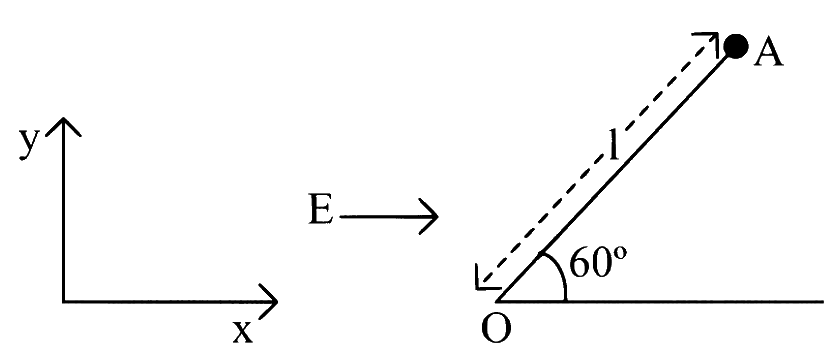
Show answer and solution

Answer: (b)

  1. V=kQ(1R−15R)=4kQ5R⇒kQ=5VR4V = kQ\left(\frac{1}{R} - \frac{1}{5R}\right) = \frac{4kQ}{5R} \Rightarrow kQ = \frac{5VR}{4}
  2. E(5R)=kQ25R2=5VR100R2=V20RE(5R) = \frac{kQ}{25R^2} = \frac{5VR}{100R^2} = \frac{V}{20R}
  3. So the answer is (b) V20R\frac{V}{20R}.
Report a mistake
Q403NEET 2020 · PHASE 2Easy

Electric Potential & Equipotentials · Potential of ring, sphere & shell

The variation of electrostatic potential with radial distance rr from the centre of a positively charged metallic thin shell of radius RR is given by the graph

Show answer and solution

Answer: (c)

  1. For r≤Rr \le R: E=0E = 0, so V=kQRV = \frac{kQ}{R} is constant (flat line).
  2. For r>Rr > R: V=kQrV = \frac{kQ}{r}, falling as 1r\frac{1}{r}.
  3. Graph (c) is flat up to RR and then falls as 1/r1/r, so the answer is (c).
Report a mistake
Q404NEET 2020 · PHASE 1Easy

Electric Potential & Equipotentials · Relation between E and V

In a certain region of space with volume 0.2 m3, the electric potential is found to be 5 V throughout. The magnitude of electric field in this region is:
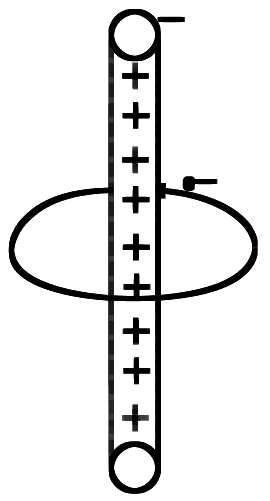
Show answer and solution

Answer: (d)

  1. E=−dVdrE = -\frac{dV}{dr}; if VV is constant everywhere in the region, its gradient is zero.
  2. E=0E = 0 (the volume value is not needed)
  3. So the answer is (d) zero.
Report a mistake
Q405JEE Main 2020 · 3 SEP · SHIFT 2Medium

Electric Potential & Equipotentials · Spheres: concentric, connected & drops

Concentric metallic hollow spheres of radii R and 4R hold charges Q1 and Q2 respectively. Given that surface charge densities of the concentric spheres are equal, the potential difference V(R) – V(4R) is:

Show answer and solution

Answer: (c)

  1. Equal σ\sigma: Q1R2=Q216R2⇒Q2=16Q1\frac{Q_1}{R^2} = \frac{Q_2}{16R^2} \Rightarrow Q_2 = 16Q_1 (not needed further).
  2. The outer shell adds the same potential at RR and 4R4R, so only Q1Q_1 matters.
  3. V(R)−V(4R)=Q14πε0(1R−14R)=3Q116πε0RV(R) - V(4R) = \frac{Q_1}{4\pi\varepsilon_0}\left(\frac{1}{R} - \frac{1}{4R}\right) = \frac{3Q_1}{16\pi\varepsilon_0 R}
  4. So the answer is (c).
Report a mistake
Q406JEE Main 2020 · 3 SEP · SHIFT 1Medium

Electric Potential & Equipotentials · Spheres: concentric, connected & drops

Two isolated conducting spheres S1 and S2 of radius 23R\frac{2}{3}R and 13R\frac{1}{3}R have 12 μ\muC and –3 μ\muC charges, respectively, and are at a large distance from each other. They are now connected by a conducting wire. A long time after this is done the charges on S1 and S2 are respectively:

Show answer and solution

Answer: (c)

  1. Total charge =12−3=9 μC= 12 - 3 = 9\,\mu\text{C}.
  2. Equal potential ⇒q∝r\Rightarrow q \propto r: q1:q2=23R:13R=2:1q_1 : q_2 = \frac{2}{3}R : \frac{1}{3}R = 2 : 1.
  3. q1=6 μCq_1 = 6\,\mu\text{C}, q2=3 μCq_2 = 3\,\mu\text{C}
  4. So the answer is (c).
Report a mistake
Q407JEE Main 2020 · 2 SEP · SHIFT 2Medium

Electric Potential & Equipotentials · Spheres: concentric, connected & drops

A charge Q is distributed over two concentric conducting thin spherical shells radii r and R (R > r). If the surface charge densities on the two shells are equal, the electric potential at the common centre is:

Figure

Show answer and solution

Answer: (a)

  1. Equal σ\sigma: q∝q \propto radius2^2, so qr=Qr2r2+R2q_r = \frac{Qr^2}{r^2 + R^2}, qR=QR2r2+R2q_R = \frac{QR^2}{r^2 + R^2}.
  2. Vcentre=14πε0(qrr+qRR)=14πε0⋅Q(r+R)r2+R2V_{centre} = \frac{1}{4\pi\varepsilon_0}\left(\frac{q_r}{r} + \frac{q_R}{R}\right) = \frac{1}{4\pi\varepsilon_0}\cdot\frac{Q(r + R)}{r^2 + R^2}
  3. So the answer is (a).
Report a mistake
Q408JEE Main 2020 · 8 JAN · SHIFT 2Medium

Electric Potential & Equipotentials · Spheres: concentric, connected & drops

Consider two charged metallic spheres S1 and S2 of radii R1 and R2, respectively. The electric fields E1 (on S1) and E2 (on S2) on their surfaces are such that E1/E2 = R1/R2. Then the ratio V1 (on S1) / V2 (on S2) of the electrostatic potentials on each sphere is:

Show answer and solution

Answer: (a)

  1. On a sphere's surface E=kQR2E = \frac{kQ}{R^2} and V=kQRV = \frac{kQ}{R}, so V=ERV = ER.
  2. V1V2=E1E2⋅R1R2=R1R2⋅R1R2=(R1R2)2\frac{V_1}{V_2} = \frac{E_1}{E_2}\cdot\frac{R_1}{R_2} = \frac{R_1}{R_2}\cdot\frac{R_1}{R_2} = \left(\frac{R_1}{R_2}\right)^2
  3. So the answer is (a) (R1/R2)2(R_1/R_2)^2.
Report a mistake
Q409JEE Main 2019 · 8 APR · SHIFT 1Medium

Electric Potential & Equipotentials · Potential of ring, sphere & shell

A solid conducting sphere, having a charge Q, is surrounded by an uncharged conducting hollow spherical shell. Let the potential difference between the surface of the solid sphere and that of the outer surface of the hollow shell be V. If the shell is now given a charge of –4 Q, the new potential difference between the same two surfaces is:

Show answer and solution

Answer: (a)

  1. Charge on the outer shell raises the potential of every point inside it by the same amount.
  2. So Vsphere−VshellV_{sphere} - V_{shell} depends only on the inner charge: ΔV=kQ(1a−1b)\Delta V = kQ\left(\dfrac1a - \dfrac1b\right).
  3. Adding −4Q-4Q to the shell does not change it.
  4. So the answer is (a) VV.
Report a mistake
Q410NEET 2019Medium

Electric Potential & Equipotentials · Spheres: concentric, connected & drops

Two metal spheres, one of radius RR and the other of radius 2R2R respectively have the same surface charge density σ\sigma. They are brought in contact and separated. What will be the new surface charge densities on them?

Show answer and solution

Answer: (a)

  1. Initial charges: q1=4πR2σq_1 = 4\pi R^2\sigma, q2=4π(2R)2σ=16πR2σq_2 = 4\pi(2R)^2\sigma = 16\pi R^2\sigma; total =20πR2σ= 20\pi R^2\sigma.
  2. After contact q∝q \propto radius, ratio 1:21 : 2: q1′=203πR2σq_1' = \frac{20}{3}\pi R^2\sigma, q2′=403πR2σq_2' = \frac{40}{3}\pi R^2\sigma.
  3. σ1=q1′4πR2=53σ\sigma_1 = \frac{q_1'}{4\pi R^2} = \frac{5}{3}\sigma, σ2=q2′16πR2=56σ\sigma_2 = \frac{q_2'}{16\pi R^2} = \frac{5}{6}\sigma
  4. So the answer is (a).
Report a mistake
Q411JEE Main 2019 · 10 JAN · SHIFT 1Medium

Electric Potential & Equipotentials · Spheres: concentric, connected & drops

A charge Q is distributed over three concentric spherical shells of radii a, b, c (a < b < c) such that their surface charge densities are equal to one another. The total potential at a point at distance r from their common centre, where r < a, would be -

Show answer and solution

Answer: (d)

  1. Equal σ\sigma: q∝q \propto radius2^2, so qa=Qa2a2+b2+c2q_a = \frac{Qa^2}{a^2 + b^2 + c^2}, etc.
  2. For r<ar < a the potential is the sum of the shell surface potentials: V=k(qaa+qbb+qcc)V = k\left(\frac{q_a}{a} + \frac{q_b}{b} + \frac{q_c}{c}\right).
  3. V=Q(a+b+c)4πε0(a2+b2+c2)V = \frac{Q(a + b + c)}{4\pi\varepsilon_0(a^2 + b^2 + c^2)}
  4. So the answer is (d).
Report a mistake
Q412JEE Main 2019 · 8 APR · SHIFT 2Medium

Electric Potential & Equipotentials · Relation between E and V

The electric field in a region is given by E⃗=(Ax+B)i^\vec{E} = (Ax + B)\hat{i}, where E is in NC–1 and x is in metres. The values of constants are A = 20 SI unit and B = 10 SI unit. If the potential at x = 1 is V1 and that at x = –5 is V2, then V1 – V2 is :-

Show answer and solution

Answer: (b)

  1. V1−V2=−∫−51(20x+10) dx=−[10x2+10x]−51V_1 - V_2 = -\int_{-5}^{1}(20x + 10)\,dx = -\left[10x^2 + 10x\right]_{-5}^{1}
  2. =−[(10+10)−(250−50)]=−(20−200)=180 V= -[(10 + 10) - (250 - 50)] = -(20 - 200) = 180\,\text{V}
  3. So the answer is (b) 180 V.
Report a mistake
Q413JEE Main 2018Medium

Electric Potential & Equipotentials · Spheres: concentric, connected & drops

Three concentric metal shells A, B and C of respective radii a, b and c (a < b < c) have surface charge densities +σ,−σ+\sigma, -\sigma and +σ+\sigma respectively. The potential of shell B is:

Show answer and solution

Answer: (c)

  1. Charges: qA=4πa2σq_A = 4\pi a^2\sigma, qB=−4πb2σq_B = -4\pi b^2\sigma, qC=4πc2σq_C = 4\pi c^2\sigma.
  2. VB=14πε0(qA+qBb+qCc)V_B = \frac{1}{4\pi\varepsilon_0}\left(\frac{q_A + q_B}{b} + \frac{q_C}{c}\right)
  3. VB=σε0[a2−b2b+c]V_B = \frac{\sigma}{\varepsilon_0}\left[\frac{a^2 - b^2}{b} + c\right]
  4. So the answer is (c).
Report a mistake
Q414NEET 2017Easy

Electric Potential & Equipotentials · Equipotential surfaces

The diagrams below show regions of equipotentials.

Figure

A positive charge is moved from A to B in each diagram.

Show answer and solution

Answer: (a)

  1. Work done W=q(VB−VA)W = q(V_B - V_A) depends only on end potentials, not on the shape of surfaces.
  2. In all four diagrams VA=10V_A = 10 V and VB=40V_B = 40 V.
  3. W=q(40−10)=30qW = q(40 - 10) = 30q in every case.
  4. So the answer is (a) the work done is the same in all four cases.
Report a mistake
Q415JEE Main 2017 · 8 APR · SHIFT 1Medium

Electric Potential & Equipotentials · Relation between E and V

There is a uniform electrostatic field in a region. The potential at various points on a small sphere centred at P,P, in the region, is found to vary between the limits 589.0 V to 589.8 V. What is the potential at a point on the sphere whose radius vector makes an angle of 60o with the direction of the field?

Show answer and solution

Answer: (c)

  1. In a uniform field V=VP−Ercos⁡θV = V_P - Er\cos\theta on the sphere, θ\theta measured from the field direction.
  2. Max 589.8589.8 at θ=180∘\theta = 180^\circ, min 589.0589.0 at θ=0\theta = 0: VP=589.4 VV_P = 589.4\,\text{V}, Er=0.4 VEr = 0.4\,\text{V}.
  3. At θ=60∘\theta = 60^\circ: V=589.4−0.4cos⁡60∘=589.4−0.2=589.2 VV = 589.4 - 0.4\cos 60^\circ = 589.4 - 0.2 = 589.2\,\text{V}
  4. So the working gives (b) 589.2 V.
Report a mistake
Q416JEE Main 2016 · 9 APR · SHIFT 1Difficult

Electric Potential & Equipotentials · Relation between E and V

The potential (in volts) of a charge distribution is given by.

V(z) = 30 −- 5z2 for ∣z∣≤|z| \le 1 m.

V(z) = 35 −- 10 ∣z∣|z| for ∣z∣≥|z| \ge1 m.

V(z) does not depend on x and y. If this potential is generated by a constant charge per unit volume ρ0\rho_0 (in units of ε0\varepsilon_0) which is spread over a certain region, then choose the correct statement.

Show answer and solution

Answer: (a)

  1. Ez=−dVdzE_z = -\dfrac{dV}{dz}.
  2. For ∣z∣≤1|z| \le 1: Ez=10zE_z = 10z, so ρ0ε0=dEzdz=10⇒ρ0=10ε0\dfrac{\rho_0}{\varepsilon_0} = \dfrac{dE_z}{dz} = 10 \Rightarrow \rho_0 = 10\varepsilon_0.
  3. For ∣z∣≥1|z| \ge 1: ∣Ez∣=10|E_z| = 10 constant, so dEzdz=0⇒ρ0=0\dfrac{dE_z}{dz} = 0 \Rightarrow \rho_0 = 0.
  4. So the answer is (a).
Report a mistake
Q417JEE Main 2016 · 10 APR · SHIFT 1Difficult

Electric Potential & Equipotentials · Equipotential surfaces

Within a spherical charge distribution of charge density ρ\rho(r), N equipotential surfaces of potential V0, V0 + Δ\DeltaV, V0 + 2Δ\DeltaV, .......... V0 + NΔ\DeltaV (Δ\Delta V > 0), are drawn and have increasing radii r0, r1, r2,..........rN, respectively. If the difference in the radii of the surfaces is constant for all values of V0 and Δ\DeltaV then:

Show answer and solution

Answer: (c)

  1. Equal ΔV\Delta V at equal Δr\Delta r means E=ΔVΔrE = \dfrac{\Delta V}{\Delta r} is constant.
  2. Gauss: E⋅4πr2=q(r)ε0⇒q(r)∝r2E \cdot 4\pi r^2 = \dfrac{q(r)}{\varepsilon_0} \Rightarrow q(r) \propto r^2.
  3. dq=ρ⋅4πr2 dr∝2r dr⇒ρ∝1rdq = \rho \cdot 4\pi r^2\,dr \propto 2r\,dr \Rightarrow \rho \propto \dfrac{1}{r}
  4. So the answer is (c) ρ∝1r\rho \propto \dfrac{1}{r}.
Report a mistake
Q418NEET 2015 · AIPMTEasy

Electric Potential & Equipotentials · Relation between E and V

If potential (in volts) in a region is expressed as V(x, y, z) = 6xy −- y + 2yz, the electric field (in N/C) at point (1, 1, 0) is

Show answer and solution

Answer: (d)

  1. E⃗=−(∂V∂xi^+∂V∂yj^+∂V∂zk^)\vec{E} = -\left(\frac{\partial V}{\partial x}\hat{i} + \frac{\partial V}{\partial y}\hat{j} + \frac{\partial V}{\partial z}\hat{k}\right)
  2. ∂V∂x=6y=6\frac{\partial V}{\partial x} = 6y = 6, ∂V∂y=6x−1+2z=5\frac{\partial V}{\partial y} = 6x - 1 + 2z = 5, ∂V∂z=2y=2\frac{\partial V}{\partial z} = 2y = 2 at (1,1,0)(1,1,0)
  3. E⃗=−(6i^+5j^+2k^)\vec{E} = -(6\hat{i} + 5\hat{j} + 2\hat{k})
  4. So the answer is (d).
Report a mistake
Q419JEE Main 2015 · 11 APR · SHIFT 1Medium

Electric Potential & Equipotentials · Relation between E and V

An electric field

E⃗=(25i^+30j^) N C−1\vec{E} = \left(25\hat{i} + 30\hat{j}\right)\text{ N C}^{-1} exists in a region of space. If the potential at the origin is taken to be zero then the potential at x = 2 m, y = 2 m is:

Show answer and solution

Answer: (d)

  1. V−VO=−E⃗⋅r⃗=−(25x+30y)V - V_O = -\vec{E}\cdot\vec{r} = -(25x + 30y) for a uniform field.
  2. At (2,2)(2, 2): V=−(50+60)=−110 VV = -(50 + 60) = -110\,\text{V}
  3. So the answer is (d) −110-110 V.
Report a mistake
Q420JEE Main 2015 · (One or more correct)Difficult

Electric Potential & Equipotentials · Equipotential surfaces

A uniformly charged solid sphere of radius RR has potential V0V_0 (measured with respect to ∞\infty) on its surface. For this sphere the equipotential surfaces with potentials 3V02,5V04,3V04\frac{3V_0}{2}, \frac{5V_0}{4}, \frac{3V_0}{4} and V04\frac{V_0}{4} have radius R1,R2,R3R_1, R_2, R_3 and R4R_4 respectively. Then

Show answer and solution

Answer: (a)

  1. Inside: V=V0(3R2−r2)2R2V = \dfrac{V_0(3R^2 - r^2)}{2R^2}; outside: V=V0RrV = \dfrac{V_0R}{r}.
  2. 3V02\dfrac{3V_0}{2} is the centre value, so R1=0R_1 = 0.
  3. 5V04\dfrac{5V_0}{4}: 3−r2R2=52⇒R2=R2≈0.71R3 - \dfrac{r^2}{R^2} = \dfrac{5}{2} \Rightarrow R_2 = \dfrac{R}{\sqrt2} \approx 0.71R.
  4. 3V04\dfrac{3V_0}{4}: R3=4R3R_3 = \dfrac{4R}{3}; V04\dfrac{V_0}{4}: R4=4RR_4 = 4R, so R4−R3=8R3>R2R_4 - R_3 = \dfrac{8R}{3} > R_2.
  5. So the answer is (a) R1=0R_1 = 0 and R2<(R4−R3)R_2 < (R_4 - R_3).
Report a mistake
Q421NEET 2014 · AIPMTEasy

Electric Potential & Equipotentials · Potential of ring, sphere & shell

A conducting sphere of radius R is given a charge Q. The electric potential and the electric field at the centre of the sphere rrespectively are

Show answer and solution

Answer: (b)

  1. Inside a conductor E=0E = 0, so the field at the centre is zero.
  2. Conductor is equipotential: Vcentre=Q4πε0RV_{\text{centre}} = \frac{Q}{4\pi\varepsilon_0 R}
  3. So the answer is (b) Q4πε0R\frac{Q}{4\pi\varepsilon_0 R} and zero.
Report a mistake
Q422NEET 2014 · AIPMTMedium

Electric Potential & Equipotentials · Relation between E and V

In a region, the potential is represented by V(x, y, z) = 6x −- 8xy −- 8y + 6yz, where VV is in volts and x, y, z are in metres. The electric force experienced by a charge of 2 coulomb situated at point (1, 1, 1) is

Show answer and solution

Answer: (d)

  1. E⃗=−∇V\vec{E} = -\nabla V: Ex=−(6−8y)E_x = -(6 - 8y), Ey=−(−8x−8+6z)E_y = -(-8x - 8 + 6z), Ez=−6yE_z = -6y.
  2. At (1,1,1)(1,1,1): E⃗=2i^+10j^−6k^\vec{E} = 2\hat{i} + 10\hat{j} - 6\hat{k}, ∣E⃗∣=4+100+36=235 V/m|\vec{E}| = \sqrt{4 + 100 + 36} = 2\sqrt{35}\,\text{V/m}.
  3. F=qE=2×235=435 NF = qE = 2\times 2\sqrt{35} = 4\sqrt{35}\,\text{N}
  4. So the answer is (d) 4354\sqrt{35} N.
Report a mistake
Q423JEE Main 2014Medium

Electric Potential & Equipotentials · Relation between E and V

Assume that an electric field E⃗=30x2i^\vec{E} = 30x^{2}\hat{i} exists in space. Then the potential difference VA−VO,V_A - V_O, where VOV_O is the potential at the origin and VAV_A the potential at x=2 mx = 2\text{ m} is:

Show answer and solution

Answer: (c)

  1. VA−VO=−∫0230x2 dx=−[10x3]02V_A - V_O = -\int_0^2 30x^2\,dx = -\left[10x^3\right]_0^2
  2. =−80 J/C= -80\,\text{J/C}
  3. So the answer is (c) −80-80 J/C.
Report a mistake
Q424NEET 2013Easy

Electric Potential & Equipotentials · Relation between E and V

A, B and C are three points in a uniform electric field. The electric potential is

Figure

Show answer and solution

Answer: (d)

  1. Potential decreases along the direction of the field: dV=−E dxdV = -E\,dx.
  2. The field points to the right, so the point farthest to the left has the highest potential.
  3. B lies farthest left (A is farthest right).
  4. So the answer is (d) maximum at B.
Report a mistake
Q425JEE Main 2013 · 25 APR · SHIFT 1Easy

Electric Potential & Equipotentials · Equipotential surfaces

This question has Statement-1 and Statement-2. Of the four choices given after the Statements, choose the one that best describes the two Statements.

Statement 1: No work is required to be done to move a test charge between any two points on an equipotential surface.

Statement 2: Electric lines of force at the equipotential surfaces are mutually perpendicular to each other.

Show answer and solution

Answer: (a)

  1. Statement 1: ΔV=0\Delta V = 0 between points on an equipotential, so W=qΔV=0W = q\Delta V = 0. True.
  2. Statement 2: field lines and equipotential surfaces are perpendicular to each other. True.
  3. Force is normal to the displacement along the surface, so no work: Statement 2 explains Statement 1.
  4. So the answer is (a).
Report a mistake
Q426JEE Main 2013 · 23 APR · SHIFT 1Medium

Electric Potential & Equipotentials · Potential of ring, sphere & shell

Consider a finite insulated, uncharged conductor placed near a finite positively charged conductor. The uncharged body must have a potential:

Show answer and solution

Answer: (a)

  1. Field lines start on the positive conductor and some end on the induced negative charge of the neutral body.
  2. Potential falls along field lines, so the neutral body is at lower potential than the charged one.
  3. Lines leave the neutral body's induced positive side and go to infinity, so it is at higher potential than infinity.
  4. So the answer is (a).
Report a mistake
Q427JEE Main 2013 · 22 APR · SHIFT 1Medium

Electric Potential & Equipotentials · Potential of ring, sphere & shell

A point charge of magnitude +1 μC+1\,\mu\text{C} is fixed at (0, 0, 0). An isolated uncharged spherical conductor, is fixed with its center at (4, 0, 0). The potential and the induced electric field at the centre of the sphere is:

Show answer and solution

Answer: (c)

  1. Induced charges on the sphere total zero and all lie at distance RR from its centre, so they add no potential there.
  2. V=kqrV = \dfrac{kq}{r}; with r=4r = 4 cm =0.04= 0.04 m: V=9×109×10−60.04=2.25×10⁵V = \dfrac{9\times10^9\times10^{-6}}{0.04} = 2.25\times10^5 V
  3. Net field inside a conductor is zero, so induced field =−kqr2=−9×10³(0.04)2=−5.625×106= -\dfrac{kq}{r^2} = -\dfrac{9\times10^3}{(0.04)^2} = -5.625\times10^6 V/m
  4. So the answer is (c).
Report a mistake
Q428JEE Main 2013Medium

Electric Potential & Equipotentials · Potential of ring, sphere & shell

A charge QQ is uniformly distributed over a long rod ABAB of length LL as shown in the figure. The electric potential at the point OO lying at distance LL from the end AA is

Figure

Show answer and solution

Answer: (d)

  1. Take OO as origin; the rod runs from x=Lx = L to x=2Lx = 2L with λ=Q/L\lambda = Q/L.
  2. V=∫L2Lkλ dxx=kλln⁡2V = \displaystyle\int_L^{2L} \dfrac{k\lambda\,dx}{x} = k\lambda\ln 2
  3. V=Qln⁡24πε0LV = \dfrac{Q\ln 2}{4\pi\varepsilon_0 L}
  4. So the answer is (d).
Report a mistake
Q429NEET 2012 · AIPMT · PRELIMSEasy

Electric Potential & Equipotentials · Zero-potential points

Four point charges −-Q, −-q, 2q and 2Q are placed, one at each corner of the square. The relation between Q and q for which the potential at the centre of the square is zero is

Show answer and solution

Answer: (a)

  1. All four charges are at the same distance aa from the centre, so V=ka(−Q−q+2q+2Q)V = \frac{k}{a}(-Q - q + 2q + 2Q)
  2. V=ka(Q+q)=0⇒Q=−qV = \frac{k}{a}(Q + q) = 0 \Rightarrow Q = -q
  3. So the answer is (a) Q=−qQ = -q.
Report a mistake
Q430NEET 2012 · AIPMT · MAINSMedium

Electric Potential & Equipotentials · Spheres: concentric, connected & drops

Two metallic spheres of radii 1 cm and 3 cm are given charges of−1{}^{-1} ×\times 10−-2 C and 5 ×\times 10−-2 C, respectively. If these are connected by a conducting wire, the final charge on the bigger sphere is

Show answer and solution

Answer: (b)

  1. Total charge =−1×10⁻²+5×10−2=4×10⁻² C= -1\times10^{-2} + 5\times10^{-2} = 4\times10^{-2}\,\text{C}.
  2. Equal potential ⇒q∝r\Rightarrow q \propto r: ratio 1:31 : 3.
  3. qbig=34×4×10−2=3×10⁻² Cq_{big} = \frac{3}{4}\times 4\times10^{-2} = 3\times10^{-2}\,\text{C}
  4. So the answer is (b) 3×10⁻² C3\times10^{-2}\,\text{C}.
Report a mistake
Q431NEET 2011 · AIPMT · MAINSEasy

Electric Potential & Equipotentials · Relation between E and V

The electric potential V at any point (x, y, z), all in metres in space is given by V = 4x2 volt. The electric field at the point (1, 0, 2) in volt/meter, is

Show answer and solution

Answer: (a)

  1. Ex=−∂V∂x=−ddx(4x2)=−8xE_x = -\dfrac{\partial V}{\partial x} = -\dfrac{d}{dx}(4x^2) = -8x
  2. At x=1x = 1: Ex=−8E_x = -8 V/m; Ey=Ez=0E_y = E_z = 0.
  3. So the answer is (a) 8 V/m along negative X-axis.
Report a mistake
Q432NEET 2011 · AIPMT · PRELIMSMedium

Electric Potential & Equipotentials · Potential of point charges

Four electric charges +q, +q, −- q and −- q are placed at the corners of a square of side 2L (see figure). The electric potential at point A, midway between the two charges + q and +q, is

Figure

Show answer and solution

Answer: (c)

  1. A is at distance LL from each +q+q and (2L)2+L2=5 L\sqrt{(2L)^2 + L^2} = \sqrt5\,L from each −q-q.
  2. VA=k[2qL−2q5 L]V_A = k\left[\dfrac{2q}{L} - \dfrac{2q}{\sqrt5\,L}\right]
  3. VA=14πε02qL(1−15)V_A = \dfrac{1}{4\pi\varepsilon_0}\dfrac{2q}{L}\left(1 - \dfrac{1}{\sqrt5}\right)
  4. So the answer is (c).
Report a mistake
Q433JEE Main 2011 · AIEEEMedium

Electric Potential & Equipotentials · Relation between E and V

The electrostatic potential inside a charged spherical ball is given by ϕ=ar2+b\phi = ar^2 + b where rr is the distance from the center and a,ba, b are constants. Then the charge density inside the ball is:

Show answer and solution

Answer: (c)

  1. E=−dϕdr=−2arE = -\frac{d\phi}{dr} = -2ar (radial).
  2. Gauss's law: E⋅4πr2=qinε0⇒qin=−8πε0ar3E\cdot 4\pi r^2 = \frac{q_{in}}{\varepsilon_0} \Rightarrow q_{in} = -8\pi\varepsilon_0 a r^3.
  3. ρ=dqin4πr2 dr=−24πε0ar24πr2=−6aε0\rho = \frac{dq_{in}}{4\pi r^2\,dr} = \frac{-24\pi\varepsilon_0 a r^2}{4\pi r^2} = -6a\varepsilon_0
  4. So the answer is (c) −6aε0-6a\varepsilon_0.
Report a mistake
Q434NEET 2009 · AIPMTEasy

Electric Potential & Equipotentials · Relation between E and V

The electric potential at a point (x, y, z) is given by V = −-x2y −- xz3 + 4

The electric field at that point is

Show answer and solution

Answer: (d)

  1. E⃗=−∇V\vec E = -\nabla V with V=−x2y−xz3+4V = -x^2y - xz^3 + 4.
  2. Ex=−∂V∂x=2xy+z3E_x = -\dfrac{\partial V}{\partial x} = 2xy + z^3
  3. Ey=−∂V∂y=x2E_y = -\dfrac{\partial V}{\partial y} = x^2, Ez=−∂V∂z=3xz2E_z = -\dfrac{\partial V}{\partial z} = 3xz^2
  4. So the answer is (d) E⃗=i^(2xy+z3)+j^x2+k^ 3xz2\vec E = \hat i(2xy + z^3) + \hat j x^2 + \hat k\,3xz^2.
Report a mistake
Q435NEET 2009 · AIPMTMedium

Electric Potential & Equipotentials · Spheres: concentric, connected & drops

Three concentric spherical shells have radii a, b and c (a < b < c) and have surface charge densities σ,−σ\sigma, -\sigma and σ\sigma respectively. If VA, VB and VC denote the potentials of the three shells, then, for c = a + b, we have

Show answer and solution

Answer: (d)

  1. Charges: q∝±σr2q \propto \pm\sigma r^2. Potential of a shell = (own + inner charges)/own radius + outer charges/their radii.
  2. VA=σε0(a−b+c)V_A = \frac{\sigma}{\varepsilon_0}(a - b + c), VB=σε0(a2b−b+c)V_B = \frac{\sigma}{\varepsilon_0}\left(\frac{a^2}{b} - b + c\right), VC=σε0⋅a2−b2+c2cV_C = \frac{\sigma}{\varepsilon_0}\cdot\frac{a^2 - b^2 + c^2}{c}
  3. With c=a+bc = a + b: VA=2aσε0V_A = \frac{2a\sigma}{\varepsilon_0}, and a2−b2+c2=2a(a+b)=2ac⇒VC=2aσε0a^2 - b^2 + c^2 = 2a(a+b) = 2ac \Rightarrow V_C = \frac{2a\sigma}{\varepsilon_0}.
  4. VB=σε0(a2b+a)≠2aσε0V_B = \frac{\sigma}{\varepsilon_0}\left(\frac{a^2}{b} + a\right) \neq \frac{2a\sigma}{\varepsilon_0} (unless a=ba = b).
  5. So the answer is (d) VC=VA≠VBV_C = V_A \neq V_B.
Report a mistake
Q436NEET 2008 · AIPMTMedium

Electric Potential & Equipotentials · Potential of point charges

The electric potential at a point in free space due to charge Q coulomb is Q ×\times 1011 volts. The electric field at that point is

Show answer and solution

Answer: (c)

  1. V=Q4πε0r=Q×1011⇒r=14πε0×1011V = \dfrac{Q}{4\pi\varepsilon_0 r} = Q\times10^{11} \Rightarrow r = \dfrac{1}{4\pi\varepsilon_0\times10^{11}}
  2. E=Vr=Q×1011×4πε0×1011E = \dfrac{V}{r} = Q\times10^{11}\times4\pi\varepsilon_0\times10^{11}
  3. E=4πε0Q×1022E = 4\pi\varepsilon_0 Q\times10^{22} V/m
  4. So the answer is (c).
Report a mistake
Q437JEE Main 2007 · AIEEEEasy

Electric Potential & Equipotentials · Potential of point charges

An electric charge 10−3 μC10^{-3}\,\mu\text{C} is placed at the origin (0,0)(0, 0) of X−YX - Y co-ordinate system. Two points AA and BB are situated at (2,2)\left(\sqrt{2}, \sqrt{2}\right) and (2,0)(2, 0) respectively. The potential difference between the points AA and BB will be

Show answer and solution

Answer: (c)

  1. V=kqrV = \frac{kq}{r} depends only on distance from the charge.
  2. rA=2+2=2r_A = \sqrt{2+2} = 2, rB=2r_B = 2
  3. rA=rB⇒VA−VB=0r_A = r_B \Rightarrow V_A - V_B = 0
  4. So the answer is (c) zero.
Report a mistake
Q438JEE Main 2007 · AIEEEMedium

Electric Potential & Equipotentials · Relation between E and V

The potential at a point xx (measured in μm\mu\text{m}) due to some charges situated on the xx-axis is given by V(x)=20/(x2−4)V(x) = 20/\left(x^2 - 4\right) volt

The electric field EE at x=4 μmx = 4\ \mu\text{m} is given by

Show answer and solution

Answer: (a)

  1. E=−dVdx=−ddx[20x2−4]=40x(x2−4)2E = -\frac{dV}{dx} = -\frac{d}{dx}\left[\frac{20}{x^2 - 4}\right] = \frac{40x}{(x^2 - 4)^2}
  2. At x=4x = 4: E=160144=109 V/μmE = \frac{160}{144} = \frac{10}{9}\,\text{V}/\mu\text{m}, positive.
  3. So the answer is (a) 109\frac{10}{9} V/μ\mum along +x+x.
Report a mistake
Q439JEE Main 2006 · AIEEEMedium

Electric Potential & Equipotentials · Spheres: concentric, connected & drops

Two spherical conductors AA and BB of radii 1 mm1\text{ mm} and 2 mm2\text{ mm} are separated by a distance of 5 cm5\text{ cm} and are uniformly charged. If the spheres are connected by a conducting wire then in equilibrium condition, the ratio of the magnitude of the electric fields at the surfaces of spheres AA and BB is

Show answer and solution

Answer: (c)

  1. Connected spheres are at equal potential, so E=Vr∝1rE = \frac{V}{r} \propto \frac{1}{r}.
  2. EAEB=rBrA=21\frac{E_A}{E_B} = \frac{r_B}{r_A} = \frac{2}{1}
  3. So the answer is (c) 2:12 : 1.
Report a mistake
Q440JEE Main 2005 · AIEEEMedium

Electric Potential & Equipotentials · Potential of ring, sphere & shell

Two thin wire rings each having a radius RR are placed at a distance dd apart with their axes coinciding. The charges on the two rings are +q+q and −q.-q. The potential difference between the centres of the two rings is

Show answer and solution

Answer: (a)

  1. V1=kqR−kqR2+d2V_1 = \dfrac{kq}{R} - \dfrac{kq}{\sqrt{R^2 + d^2}}, V2=−kqR+kqR2+d2V_2 = -\dfrac{kq}{R} + \dfrac{kq}{\sqrt{R^2 + d^2}}
  2. V1−V2=2kq[1R−1R2+d2]V_1 - V_2 = 2kq\left[\dfrac1R - \dfrac{1}{\sqrt{R^2 + d^2}}\right]
  3. =q2πϵ0[1R−1R2+d2]= \dfrac{q}{2\pi\epsilon_0}\left[\dfrac1R - \dfrac{1}{\sqrt{R^2 + d^2}}\right]
  4. So the answer is (a).
Report a mistake
Q441JEE Main 2003 · AIEEEEasy

Electric Potential & Equipotentials · Potential of ring, sphere & shell

A thin spherical conducting shell of radius RR has a charge q.q. Another charge QQ is placed at the center of the shell. The electrostatic potential at a point PP at a distance R2\frac{R}{2} from the center of the shell is

Show answer and solution

Answer: (c)

  1. Potential due to QQ at distance R2\frac{R}{2}: Q4πε0(R/2)=2Q4πε0R\frac{Q}{4\pi\varepsilon_0 (R/2)} = \frac{2Q}{4\pi\varepsilon_0 R}
  2. Point is inside the shell, so the shell contributes its surface value q4πε0R\frac{q}{4\pi\varepsilon_0 R}
  3. VP=2Q4πε0R+q4πε0RV_P = \frac{2Q}{4\pi\varepsilon_0 R} + \frac{q}{4\pi\varepsilon_0 R}
  4. So the answer is (c).
Report a mistake
Q442JEE Main 2002 · AIEEEEasy

Electric Potential & Equipotentials · Potential of point charges

On moving a charge of 2020 coulomb by 2 cm,2 J2\text{ cm}, 2\text{ J} of work is done, then the potential difference between the points is

Show answer and solution

Answer: (a)

  1. W=qV⇒V=WqW = qV \Rightarrow V = \frac{W}{q} (the 2 cm distance is not needed)
  2. V=220=0.1 VV = \frac{2}{20} = 0.1\text{ V}
  3. So the answer is (a) 0.1 V0.1\text{ V}.
Report a mistake
Q443NEET 2002 · AIPMTEasy

Electric Potential & Equipotentials · Potential of ring, sphere & shell

Some charge is being given to a conductor. Then its potential is

Show answer and solution

Answer: (c)

  1. In electrostatic equilibrium E=0E = 0 inside a conductor, and E=−dVdrE = -\frac{dV}{dr}, so VV cannot change.
  2. The whole conductor is one equipotential volume.
  3. So the answer is (c) remains same throughout the conductor.
Report a mistake
Q444NEET 1995 · AIPMTMedium

Electric Potential & Equipotentials · Spheres: concentric, connected & drops

Two metallic spheres of radii 1 cm1\text{ cm} and 2 cm2\text{ cm} are given charges 10−2 C10^{-2}\text{ C} and 5×10⁻² C5 \times 10^{-2}\text{ C} respectively. If they are connected by a conducting wire, the final charge on the smaller sphere is

Show answer and solution

Answer: (d)

  1. Total charge =10−2+5×10−2=6×10⁻² C= 10^{-2} + 5\times10^{-2} = 6\times10^{-2}\,\text{C}.
  2. Equal potential ⇒q∝r\Rightarrow q \propto r: ratio 1:21 : 2.
  3. qsmall=13×6×10−2=2×10⁻² Cq_{small} = \frac{1}{3}\times 6\times10^{-2} = 2\times10^{-2}\,\text{C}
  4. So the answer is (d) 2×10⁻² C2\times10^{-2}\,\text{C}.
Report a mistake
Q445NEET 1994 · AIPMTEasy

Electric Potential & Equipotentials · Potential of ring, sphere & shell

A hollow metallic sphere of radius 10 cm10\text{ cm} is charged such that potential of its surface is 80 V80\text{ V}. The potential at the centre of the sphere would be

Show answer and solution

Answer: (a)

  1. Inside a hollow charged conductor E=0E = 0, so VV is the same everywhere inside as on the surface.
  2. Vcentre=Vsurface=80 VV_{\text{centre}} = V_{\text{surface}} = 80\text{ V}
  3. So the answer is (a) 80 V80\text{ V}.
Report a mistake
Q446MHT CET 2026 · 20 MAY · SHIFT 1Easy

Electrostatic Potential Energy · PE of a system of charges

Three equal (+q)(+q) charges are placed in air at the vertices of equilateral triangle. If the side of equilateral triangle is ll, the net potential energy of the system is [K=14πϵ0]\left[K = \frac{1}{4\pi\epsilon_0}\right]

Show answer and solution

Answer: (c)

  1. Three pairs, each at distance ll: U=3×kq2lU = 3 \times \dfrac{kq^2}{l}
  2. So the answer is (c) 3kq2l\dfrac{3kq^2}{l}.
Report a mistake
Q447MHT CET 2026 · 15 MAY · SHIFT 1Easy

Electrostatic Potential Energy · Work done & electron volt

A charge 10 μC10\ \mu\text{C} exists at the centre of a square. The work done in moving a 2 μC2\ \mu\text{C} point charge from corner A to corner B of a square ABCD is

Figure

Show answer and solution

Answer: (a)

  1. A and B are equidistant from the centre charge, so VA=VBV_A = V_B.
  2. W=q(VB−VA)=0W = q(V_B - V_A) = 0
  3. So the answer is (a) zero.
Report a mistake
Q448MHT CET 2026 · 13 MAY · SHIFT 1Easy

Electrostatic Potential Energy · Work done & electron volt

If 100100 J of work has to be done in moving an electric charge of 44 C from a place, where potential is −10-10 V to another place where potential is V volt. The value of V is

Show answer and solution

Answer: (d)

  1. W=q(VB−VA)W = q(V_B - V_A)
  2. 100=4(V−(−10))⇒V+10=25100 = 4(V - (-10)) \Rightarrow V + 10 = 25
  3. V=15V = 15 V. So the answer is (d).
Report a mistake
Q449JEE Main 2026 · 28 JAN · SHIFT 1Easy

Electrostatic Potential Energy · Work done & electron volt

Two point charges of 1 nC and 2 nC are placed at the two corners of equilateral triangle of side 3 cm. The work done in bringing a charge of 3 nC from infinity to the third corner of the triangle is ‾ μJ\underline{\qquad}\ \mu\text{J}.

14πϵ0=9×10⁹ N⋅m2/C2\frac{1}{4\pi\epsilon_0} = 9 \times 10^{9}\text{ N}\cdot\text{m}^2/\text{C}^2

Show answer and solution

Answer: (c)

  1. Vcorner=k(q1+q2)r=9×109×3×10−90.03=900V_{corner} = \dfrac{k(q_1 + q_2)}{r} = \dfrac{9\times10^9 \times 3\times10^{-9}}{0.03} = 900 V
  2. W=qV=3×10−9×900=2.7×10⁻⁶W = qV = 3\times10^{-9} \times 900 = 2.7\times10^{-6} J
  3. W=2.7 μW = 2.7\ \muJ. So the answer is (c).
Report a mistake
Q450JEE Main 2026 · 21 JAN · SHIFT 1Easy

Electrostatic Potential Energy · Work done & electron volt

A point charge of 10−8 C10^{-8}\text{ C} is placed at origin. The work done in moving a point charge 2 μC2\ \mu\text{C} from point A(4,4,2) mA(4, 4, 2)\text{ m} to B(2,2,1) mB(2, 2, 1)\text{ m} is ______ J. (14πϵ0=9×10⁹(\frac{1}{4\pi\epsilon_0} = 9 \times 10^{9} in SI units)

Show answer and solution

Answer: (a)

  1. rA=16+16+4=6r_A = \sqrt{16+16+4} = 6 m, rB=4+4+1=3r_B = \sqrt{4+4+1} = 3 m.
  2. VA=9×109×10−86=15V_A = \dfrac{9\times10^9 \times 10^{-8}}{6} = 15 V, VB=903=30V_B = \dfrac{90}{3} = 30 V.
  3. W=q(VB−VA)=2×10−6×15=30×10−6W = q(V_B - V_A) = 2\times10^{-6} \times 15 = 30\times10^{-6} J
  4. So the answer is (a) 30×10−630\times10^{-6} J.
Report a mistake
Q451MHT CET 2026 · 13 MAY · SHIFT 2Medium

Electrostatic Potential Energy · PE of a system of charges

Two charges of equal magnitude 'qq' are placed in air at a distance '2a2a' apart and third charge −2q-2q is placed at mid-point. The potential energy of the system is (ϵ0\epsilon_0 = permittivity of free space)

Show answer and solution

Answer: (d)

  1. Pairs: (q,q)(q, q) at 2a2a; two pairs (q,−2q)(q, -2q) at aa.
  2. U=k[q22a−2q2a−2q2a]=−7kq22aU = k\left[\dfrac{q^2}{2a} - \dfrac{2q^2}{a} - \dfrac{2q^2}{a}\right] = -\dfrac{7kq^2}{2a}
  3. U=−7q28πϵ0aU = -\dfrac{7q^2}{8\pi\epsilon_0 a}. So the answer is (d).
Report a mistake
Q452MHT CET 2026 · 12 MAY · SHIFT 1Medium

Electrostatic Potential Energy · PE of a system of charges

The equal charges (say 'q') are placed at a distance of 4r4r and a third charge (−2q)(-2q) is placed at a mid-point. The potential energy of the system is (ϵ0=\epsilon_0 = permittivity of free space)

Show answer and solution

Answer: (c)

  1. Pairs: (q,q)(q, q) at 4r4r; two pairs (q,−2q)(q, -2q) at 2r2r.
  2. U=k[q24r−2q22r−2q22r]=−7kq24rU = k\left[\dfrac{q^2}{4r} - \dfrac{2q^2}{2r} - \dfrac{2q^2}{2r}\right] = -\dfrac{7kq^2}{4r}
  3. U=−7q216πϵ0rU = -\dfrac{7q^2}{16\pi\epsilon_0 r}. So the answer is (c).
Report a mistake
Q453MHT CET 2026 · 19 APR · SHIFT 2Medium

Electrostatic Potential Energy · PE of a system of charges

Two equal positive charges each of value 'q' are placed at points A and B, where AB=3xAB = 3x. A third charge −3q-3q is placed at point C at a distance xx from A on AB. The potential energy of the system is nearly (ϵ0\epsilon_0 = permittivity of free space)

Show answer and solution

Answer: (d)

  1. AB=3xAB = 3x, AC=xAC = x, CB=2xCB = 2x.
  2. U=k[q23x−3q2x−3q22x]=kq2x(13−3−32)U = k\left[\dfrac{q^2}{3x} - \dfrac{3q^2}{x} - \dfrac{3q^2}{2x}\right] = \dfrac{kq^2}{x}\left(\dfrac13 - 3 - \dfrac32\right)
  3. U=−4.17kq2x≈−4q24πϵ0xU = -4.17\dfrac{kq^2}{x} \approx \dfrac{-4q^2}{4\pi\epsilon_0 x}
  4. So the answer is (d).
Report a mistake
Q454MHT CET 2026 · 18 APR · SHIFT 2Medium

Electrostatic Potential Energy · PE of a system of charges

Three point charges Q, +2q+2q and +q+q are placed at the vertices of a right-angled isosceles triangle of length 2a\sqrt{2}a as shown in figure. The net electrostatic potential energy of the configuration is zero, if Q is equal to

Figure

Show answer and solution

Answer: (b)

  1. Q is at the right angle: legs 2a\sqrt2 a, hypotenuse 2a2a.
  2. U=k[2qQ2a+qQ2a+2q22a]=0U = k\left[\dfrac{2qQ}{\sqrt2 a} + \dfrac{qQ}{\sqrt2 a} + \dfrac{2q^2}{2a}\right] = 0
  3. 3Q2+q=0⇒Q=−23q\dfrac{3Q}{\sqrt2} + q = 0 \Rightarrow Q = -\dfrac{\sqrt2}{3}q
  4. So the answer is (b).
Report a mistake
Q455MHT CET 2026 · 17 APR · SHIFT 2Medium

Electrostatic Potential Energy · PE of a system of charges

Three point charges +q, +2q and +Q are placed at the vertices of an equilateral triangle. If the potential energy of the system of three charges is zero, the value of Q in terms of q is

Show answer and solution

Answer: (b)

  1. All three pairs are at the same distance, so the sum of charge products must be zero.
  2. q(2q)+qQ+2qQ=0⇒2q+3Q=0q(2q) + qQ + 2qQ = 0 \Rightarrow 2q + 3Q = 0
  3. Q=−2q3Q = -\dfrac{2q}{3}. So the answer is (b).
Report a mistake
Q456MHT CET 2026 · 16 APR · SHIFT 2Medium

Electrostatic Potential Energy · PE of a system of charges

Two charges q1q_1 and q2q_2 are separated by a distance of 30cm. A third charge q3q_3 initially at point C is shown in figure, is moved along the circular path of radius 40 cm from C to D. If the difference in potential energy due to movement of q3q_3 from C to D is q3k/4πε0q_3k/4\pi\varepsilon_0, the value of K is (ε0\varepsilon_0 = permittivity of free space)

Figure

Show answer and solution

Answer: (a)

  1. q3q_3 stays 40 cm from q1q_1, so only the q2q_2 term changes.
  2. BC=402+302=50BC = \sqrt{40^2 + 30^2} = 50 cm =0.5= 0.5 m; BD=40−30=10BD = 40 - 30 = 10 cm =0.1= 0.1 m.
  3. ΔU=q2q34πε0(10.1−10.5)=q3(8q2)4πε0\Delta U = \dfrac{q_2q_3}{4\pi\varepsilon_0}\left(\dfrac{1}{0.1} - \dfrac{1}{0.5}\right) = \dfrac{q_3(8q_2)}{4\pi\varepsilon_0}
  4. So k=8q2k = 8q_2, answer (a).
Report a mistake
Q457MHT CET 2026 · 16 APR · SHIFT 1Medium

Electrostatic Potential Energy · PE of a system of charges

Two point charges q1=6 μq_1 = 6\,\muC and q2=4 μq_2 = 4\,\muC are kept at points A and B in air where distance AB=10AB = 10 cm. What is the increase in potential energy of the system when q2q_2 is moved towards q1q_1, by 2 cm? (14πϵ0=9×10⁹\Bigg(\frac{1}{4\pi\epsilon_0} = 9 \times 10^{9} SI units)\Bigg)

Show answer and solution

Answer: (c)

  1. ΔU=kq1q2(1r2−1r1)\Delta U = kq_1q_2\left(\dfrac{1}{r_2} - \dfrac{1}{r_1}\right) with r1=0.10r_1 = 0.10 m, r2=0.08r_2 = 0.08 m.
  2. kq1q2=9×109×24×10−12=0.216kq_1q_2 = 9\times10^9 \times 24\times10^{-12} = 0.216
  3. ΔU=0.216(12.5−10)=0.54\Delta U = 0.216(12.5 - 10) = 0.54 J
  4. So the answer is (c) 0.54 J.
Report a mistake
Q458JEE Main 2026 · 23 JAN · SHIFT 2Medium

Electrostatic Potential Energy · PE of a system of charges

Two charges 7μC7\mu\text{C} and −2μC-2\mu\text{C} are placed at (−9,0,0) cm(-9, 0, 0)\text{ cm} and (9,0,0) cm(9, 0, 0)\text{ cm} respectively in an external field E=Ar2r^E = \frac{A}{r^2}\hat{r}, where A=9×10⁵ N/C⋅m2A = 9 \times 10^{5}\text{ N/C}\cdot\text{m}^2. Considering the potential at infinity is 0, the electrostatic energy of the configuration is ______ J.

Show answer and solution

Answer: (a)

  1. Energy =q1V(r1)+q2V(r2)+kq1q2r12= q_1V(r_1) + q_2V(r_2) + \frac{kq_1q_2}{r_{12}}, where the external potential is V=ArV = \frac{A}{r}.
  2. Both charges are at r=0.09r = 0.09 m: V=9×1050.09=107V = \frac{9\times10^5}{0.09} = 10^7 V, so q1V+q2V=70−20=50q_1V + q_2V = 70 - 20 = 50 J.
  3. Mutual term: 9×109×7×10−6×(−2×10⁻⁶)0.18=−0.7\frac{9\times10^9 \times 7\times10^{-6}\times(-2\times10^{-6})}{0.18} = -0.7 J
  4. Total =50−0.7=49.3= 50 - 0.7 = 49.3 J, answer (a).
Report a mistake
Q459MHT CET 2026 · 13 MAY · SHIFT 1Medium

Electrostatic Potential Energy · Work done & electron volt

Three point charges +q,−2q+q, -2q and −2q-2q are placed at the vertices of an equilateral triangle of side a. The work done by some external force to increase their separation to '2a2a' will be (K=14πε0)\left(K = \frac{1}{4\pi\varepsilon_0}\right)

Show answer and solution

Answer: (d)

  1. Initial PE: Ui=Ka[(q)(−2q)+(q)(−2q)+(−2q)(−2q)]=Ka(−2q2−2q2+4q2)=0U_i = \frac{K}{a}\left[(q)(-2q) + (q)(-2q) + (-2q)(-2q)\right] = \frac{K}{a}(-2q^2 - 2q^2 + 4q^2) = 0
  2. At side 2a2a the same bracket gives Uf=0U_f = 0.
  3. W=Uf−Ui=0W = U_f - U_i = 0
  4. So the answer is (d) zero.
Report a mistake
Q460MHT CET 2026 · 19 APR · SHIFT 2Medium

Electrostatic Potential Energy · Work done & electron volt

A particle of mass 'm' and charge 'q', initially at rest, is accelerated by a uniform electric field 'E' through a distance 'D' and is then allowed to approach a fixed static charge 'Q' of the same sign. The distance of the closest approach of the charge q is

[ ϵ0\epsilon_0 = permittivity of free space ]

Show answer and solution

Answer: (b)

  1. KE gained in the field: K=qEDK = qED.
  2. At closest approach all KE becomes PE: qQ4πϵ0r=qED\frac{qQ}{4\pi\epsilon_0 r} = qED
  3. r=Q4πϵ0EDr = \frac{Q}{4\pi\epsilon_0 ED}
  4. So the answer is (b).
Report a mistake
Q461JEE Main 2026 · 6 APR · SHIFT 1Medium

Electrostatic Potential Energy · Work done & electron volt

A three coulomb charge moves from the point (0,−2,−5)(0, -2, -5) to the point (5,1,2)(5, 1, 2) in an electric field expressed as E⃗=2xi^+3y2j^+4k^ N/C\vec{E} = 2x\hat{i} + 3y^2\hat{j} + 4\hat{k}\text{ N/C}. The work done in moving the charge is ______ J.

Numerical answer type. Work it out, then open the answer.

Show answer and solution

Answer: 186

  1. Work by the field: W=q∫E⃗⋅dl⃗=q[∫2x dx+∫3y2 dy+∫4 dz]W = q\int \vec{E}\cdot d\vec{l} = q\left[\int 2x\,dx + \int 3y^2\,dy + \int 4\,dz\right]
  2. ∫052x dx=25\int_0^5 2x\,dx = 25, ∫−213y2 dy=1−(−8)=9\int_{-2}^{1} 3y^2\,dy = 1 - (-8) = 9, ∫−524 dz=28\int_{-5}^{2} 4\,dz = 28
  3. W=3(25+9+28)=186W = 3(25 + 9 + 28) = 186 J
Report a mistake
Q462MHT CET 2026 · 14 MAY · SHIFT 2Medium

Electrostatic Potential Energy · Self-energy, energy density & pressure

In air, a charged soap bubble of radius R breaks in to 27 small soap bubbles of equal radii r. Then the ratio of mechanical force acting per unit area of big soap bubble to that of a small soap bubble is

Show answer and solution

Answer: (d)

  1. Electrostatic force per unit area on a charged surface: P=σ22ε0P = \frac{\sigma^2}{2\varepsilon_0}, so P∝σ2P \propto \sigma^2.
  2. Volume conserved: 27r3=R3⇒r=R327r^3 = R^3 \Rightarrow r = \frac{R}{3}. Charge conserved: each small bubble has Q27\frac{Q}{27}.
  3. σsmall=Q/274πR2/9=13σbig\sigma_{small} = \frac{Q/27}{4\pi R^2/9} = \frac{1}{3}\sigma_{big}
  4. PbigPsmall=9\frac{P_{big}}{P_{small}} = 9, answer (d) 9/19/1.
Report a mistake
Q463NEET 2026 · RE-NEETDifficult

Electrostatic Potential Energy · Work done & electron volt

Consider a fixed uniformly charged insulating sphere with radius RR and total charge +Q+Q. A point charge −q-q ( q≪Qq \ll Q) with mass mm is released from rest at a distance of 3R3R from the centre of the charged sphere. When the point charge reaches the surface of the sphere, its speed is: ( ε0\varepsilon_0 is the permittivity of vacuum, neglect gravitational forces).

Show answer and solution

Answer: (d)

  1. Outside the sphere, V=kQrV = \frac{kQ}{r}. The charge −q-q is attracted and loses PE.
  2. 12mv2=kQq(1R−13R)=2kQq3R\frac{1}{2}mv^2 = kQq\left(\frac{1}{R} - \frac{1}{3R}\right) = \frac{2kQq}{3R}
  3. v2=4Qq3⋅4πε0mR=Qq3πε0mRv^2 = \frac{4Qq}{3\cdot4\pi\varepsilon_0 mR} = \frac{Qq}{3\pi\varepsilon_0 mR}
  4. So the answer is (d) Qq3πε0mR\sqrt{\frac{Qq}{3\pi\varepsilon_0 mR}}.
Report a mistake
Q464JEE Main 2026 · 21 JAN · SHIFT 2Difficult

Electrostatic Potential Energy · Work done & electron volt

Consider two identical metallic spheres of radius RR each having charge QQ and mass mm. Their centers have an initial separation of 4R4R. Both the spheres are given an initial speed of uu towards each other. The minimum value of uu, so that they can just touch each other is:

(Take k=14πϵ0k = \frac{1}{4\pi\epsilon_0} and assume kQ2>Gm2kQ^2 > Gm^2 where GG is the Gravitational constant)

Show answer and solution

Answer: (d)

  1. Total KE =2⋅12mu2=mu2= 2\cdot\frac{1}{2}mu^2 = mu^2; they just touch when the centres are 2R2R apart and both stop.
  2. Electric PE rises by kQ2(12R−14R)=kQ24RkQ^2\left(\frac{1}{2R} - \frac{1}{4R}\right) = \frac{kQ^2}{4R}; gravitational PE falls by Gm24R\frac{Gm^2}{4R}.
  3. mu2=kQ2−Gm24Rmu^2 = \frac{kQ^2 - Gm^2}{4R}
  4. u=kQ24mR(1−Gm2kQ2)u = \sqrt{\frac{kQ^2}{4mR}\left(1 - \frac{Gm^2}{kQ^2}\right)}, answer (d).
Report a mistake
Q465MHT CET 2026 · 19 APR · SHIFT 2Difficult

Electrostatic Potential Energy · Self-energy, energy density & pressure

An uniformly charged thin spherical shell of radius 'R' has uniform surface charge density 'σ\sigma'. It is made of two hemispherical identical shells held together by pressing them with force 'F' as shown. F is proportional to

[ϵ0\epsilon_0 = permittivity of free space]

Figure

Show answer and solution

Answer: (c)

  1. Outward electrostatic pressure on the shell: P=σ22ϵ0P = \frac{\sigma^2}{2\epsilon_0}.
  2. Net push on one hemisphere = pressure ×\times projected area πR2\pi R^2.
  3. F=σ22ϵ0πR2∝1ϵ0σ2R2F = \frac{\sigma^2}{2\epsilon_0}\pi R^2 \propto \frac{1}{\epsilon_0}\sigma^2R^2
  4. So the answer is (c).
Report a mistake
Q466JEE Main 2025 · 23 JAN · SHIFT 2Easy

Electrostatic Potential Energy · PE of a system of charges

Two charges 7 μC7\ \mu\text{C} and −4 μC-4\ \mu\text{C} are placed at (−7 cm,0,0)(-7\text{ cm}, 0, 0) and (7 cm,0,0)(7\text{ cm}, 0, 0) respectively. Given, ϵ0=8.85×10⁻¹² C2 N−1 m−2\epsilon_0 = 8.85 \times 10^{-12}\text{ C}^2\text{ N}^{-1}\text{ m}^{-2}, the electrostatic potential energy of the charge configuration is:

Show answer and solution

Answer: (d)

  1. Separation r=14r = 14 cm =0.14= 0.14 m.
  2. U=kq1q2r=9×109×7×10−6×(−4×10⁻⁶)0.14U = \dfrac{kq_1q_2}{r} = \dfrac{9\times10^9 \times 7\times10^{-6} \times (-4\times10^{-6})}{0.14}
  3. U=−0.2520.14=−1.8U = \dfrac{-0.252}{0.14} = -1.8 J
  4. So the answer is (d) −1.8-1.8 J.
Report a mistake
Q467MHT CET 2025 · 19 APR · SHIFT 1Easy

Electrostatic Potential Energy · Work done & electron volt

Let ' WW ' joule be the work done to move an electric charge ' qq ' coulomb from a place AA, where potential is -5 volt to another place BB where potential is ' VV ' volt. The value of ' VV ' is

Show answer and solution

Answer: (d)

  1. W=q(VB−VA)=q(V+5)W = q(V_B - V_A) = q(V + 5)
  2. V=Wq−5V = \dfrac{W}{q} - 5
  3. So the answer is (d).
Report a mistake
Q468MHT CET 2025 · 25 APR · SHIFT 1Medium

Electrostatic Potential Energy · PE of a system of charges

Three charges Q,(−2q)Q, (-2q) and (−2q)(-2q) are placed at the vertices of an isosceles right angled triangle as shown in figure. The net electrostatic potential energy is zero if QQ is equal to

Figure

Show answer and solution

Answer: (c)

  1. Q is at the right angle: legs ll, hypotenuse 2l\sqrt2 l.
  2. U=k[2Q(−2q)l+4q22l]=0U = k\left[\dfrac{2Q(-2q)}{l} + \dfrac{4q^2}{\sqrt2 l}\right] = 0
  3. 4Q=22q⇒Q=q24Q = 2\sqrt2 q \Rightarrow Q = \dfrac{q}{\sqrt2}
  4. So the answer is (c).
Report a mistake
Q469MHT CET 2025 · 22 APR · SHIFT 2Medium

Electrostatic Potential Energy · PE of a system of charges

Three charges each of magnitude 3μC3\mu\text{C}, are placed on the vertices of an equilateral triangle of side 6 cm. The net potential energy of the system will be nearly [14πϵ0=9×10⁹\Bigg[\frac{1}{4\pi\epsilon_0} = 9 \times 10^{9} SI unit ]\Bigg]

Show answer and solution

Answer: (c)

  1. U=3×kq2aU = 3 \times \dfrac{kq^2}{a}
  2. U=3×9×109×9×10−120.06=3×1.35U = 3 \times \dfrac{9\times10^9 \times 9\times10^{-12}}{0.06} = 3 \times 1.35
  3. U≈4.1U \approx 4.1 J. So the answer is (c).
Report a mistake
Q470MHT CET 2025 · 20 APR · SHIFT 1Medium

Electrostatic Potential Energy · PE of a system of charges

Three point charges +Q,+2Q+Q, +2Q and qq are placed at the vertices of an equilateral triangle. The value of charge qq in terms of QQ, so that electrical potential energy of the system is zero, is given by

Show answer and solution

Answer: (c)

  1. Equal separations, so the sum of charge products must be zero.
  2. Q(2Q)+Qq+2Qq=0⇒2Q+3q=0Q(2Q) + Qq + 2Qq = 0 \Rightarrow 2Q + 3q = 0
  3. q=−23Qq = -\dfrac{2}{3}Q. So the answer is (c).
Report a mistake
Q471JEE Main 2025 · 7 APR · SHIFT 1Medium

Electrostatic Potential Energy · PE of a system of charges

Two charges q1q_1 and q2q_2 are separated by a distance of 30 cm. A third charge q3q_3 initially at ' C ' as shown in the figure, is moved along the circular path of radius 40 cm from C to D. If the difference in potential energy due to movement of q3q_3 from C to D is given by q3K4πϵ0\frac{q_3 K}{4\pi\epsilon_0}, the value of K is:

Figure

Show answer and solution

Answer: (d)

  1. q3q_3 moves on a circle centred at q1q_1, so the q1q3q_1q_3 energy does not change.
  2. Distance from q2q_2: at C, 302+402=50\sqrt{30^2+40^2} = 50 cm; at D, 40−30=1040 - 30 = 10 cm.
  3. ΔU=q2q34πϵ0(10.1−10.5)=q34πϵ0(8q2)\Delta U = \frac{q_2q_3}{4\pi\epsilon_0}\left(\frac{1}{0.1} - \frac{1}{0.5}\right) = \frac{q_3}{4\pi\epsilon_0}(8q_2)
  4. So K=8q2K = 8q_2, answer (d).
Report a mistake
Q472JEE Main 2025 · 24 JAN · SHIFT 2Medium

Electrostatic Potential Energy · PE of a system of charges

Figure

In the first configuration (1) as shown in the figure, four identical charges (q0)(q_0) are kept at the corners A, B, C and D of square of side length ' aa '. In the second configuration (2), the same charges are shifted to mid points G,E,HG, E, H and FF, of the square. If K=14πϵ0K = \frac{1}{4\pi\epsilon_0}, the difference between the potential energies of configuration (2) and (1) is given by:

Show answer and solution

Answer: (d)

  1. Config (1): 4 sides of length aa and 2 diagonals 2a\sqrt{2}a: U1=Kq02a(4+22)=Kq02a(4+2)U_1 = \frac{Kq_0^2}{a}\left(4 + \frac{2}{\sqrt{2}}\right) = \frac{Kq_0^2}{a}(4 + \sqrt{2})
  2. Mid-points form a square of side a2\frac{a}{\sqrt{2}} with diagonal aa.
  3. Config (2): U2=Kq02(42a+2a)=Kq02a(42+2)U_2 = Kq_0^2\left(\frac{4\sqrt{2}}{a} + \frac{2}{a}\right) = \frac{Kq_0^2}{a}(4\sqrt{2} + 2)
  4. U2−U1=Kq02a(32−2)U_2 - U_1 = \frac{Kq_0^2}{a}(3\sqrt{2} - 2), answer (d).
Report a mistake
Q473MHT CET 2025 · 23 APR · SHIFT 2Medium

Electrostatic Potential Energy · Work done & electron volt

Two point charges +10μC+10\mu\text{C} and 4μC4\mu\text{C} are placed 10 cm apart in air. The work required to be done to bring them 2 cm closer is

(14πε0=9×10⁹\Bigg(\frac{1}{4\pi\varepsilon_0} = 9 \times 10^{9} SI units )\Bigg)

Show answer and solution

Answer: (b)

  1. W=q1q24πε0(1r2−1r1)W = \frac{q_1q_2}{4\pi\varepsilon_0}\left(\frac{1}{r_2} - \frac{1}{r_1}\right) with r1=0.10r_1 = 0.10 m, r2=0.08r_2 = 0.08 m.
  2. q1q2×9×109=10×10−6×4×10−6×9×109=0.36q_1q_2 \times 9\times10^9 = 10\times10^{-6}\times4\times10^{-6}\times9\times10^9 = 0.36
  3. W=0.36 (12.5−10)=0.9W = 0.36\,(12.5 - 10) = 0.9 J
  4. So the answer is (b) 0.9 J.
Report a mistake
Q474MHT CET 2024 · 15 MAY · SHIFT 1Easy

Electrostatic Potential Energy · PE of a system of charges

If a unit positive charge is shifted from a region of low potential to a region of high potential, then the electric potential energy of the system

Show answer and solution

Answer: (a)

  1. U=qVU = qV; for q=+1q = +1, UU rises as VV rises.
  2. Moving from low to high potential needs work against the field, which is stored as PE.
  3. So the answer is (a) increases.
Report a mistake
Q475MHT CET 2024 · 15 MAY · SHIFT 2Easy

Electrostatic Potential Energy · Work done & electron volt

In an electric field due to charge QQ, a charge qq moves from point A to B as shown in the figure. The work done is ( ε0=\varepsilon_0 = permittivity of free space)

Figure

Show answer and solution

Answer: (d)

  1. A and B both lie at distance rr from QQ (same circle), so VA=VB=kQrV_A = V_B = \dfrac{kQ}{r}.
  2. W=q(VB−VA)=0W = q(V_B - V_A) = 0
  3. So the answer is (d) zero.
Report a mistake
Q476MHT CET 2024 · 4 MAY · SHIFT 2Easy

Electrostatic Potential Energy · Work done & electron volt

If a 10 μC10\ \mu\text{C} charge exists at the centre of a square, the work done in moving a 2 μC2\ \mu\text{C} point charge from corner A to corner B of a square ABCD is

Figure

Show answer and solution

Answer: (a)

  1. A and B are equidistant from the centre charge, so VA=VBV_A = V_B.
  2. W=q(VB−VA)=0W = q(V_B - V_A) = 0
  3. So the answer is (a) zero.
Report a mistake
Q477MHT CET 2024 · 2 MAY · SHIFT 1Easy

Electrostatic Potential Energy · Work done & electron volt

90 J of work is done to move an electric charge of magnitude 3 C from a place A, where potential is -10 V to another place B, where potential is ' V1V_1 ' volt. The value of V1V_1 is

Show answer and solution

Answer: (b)

  1. W=q(VB−VA)W = q(V_B - V_A)
  2. 90=3(V1+10)⇒V1+10=3090 = 3(V_1 + 10) \Rightarrow V_1 + 10 = 30
  3. V1=20V_1 = 20 V. So the answer is (b).
Report a mistake
Q478MHT CET 2024 · 10 MAY · SHIFT 2Medium

Electrostatic Potential Energy · PE of a system of charges

Two point charges q1=6μCq_1 = 6\mu\text{C} and q2=4μCq_2 = 4\mu\text{C} are kept at points AA and BB in air where AB=10 cmAB = 10\text{ cm}. What is the increase in potential energy of the system when q2q_2 is moved towards q1q_1 by 2 cm? (14πε0=9×10⁹\Bigg(\frac{1}{4\pi\varepsilon_0} = 9 \times 10^{9} SI units )\Bigg)

Show answer and solution

Answer: (b)

  1. ΔU=kq1q2(10.08−10.10)\Delta U = kq_1q_2\left(\dfrac{1}{0.08} - \dfrac{1}{0.10}\right)
  2. kq1q2=9×109×24×10−12=0.216kq_1q_2 = 9\times10^9 \times 24\times10^{-12} = 0.216
  3. ΔU=0.216×2.5=0.54\Delta U = 0.216 \times 2.5 = 0.54 J
  4. So the answer is (b) 0.54 J.
Report a mistake
Q479MHT CET 2024 · 2 MAY · SHIFT 1Medium

Electrostatic Potential Energy · PE of a system of charges

Three charges are placed at the vertices of an equilateral triangle as shown in the figure. For what value of charge ' QQ ', the electrostatic potential energy of the system is zero?

Figure

Show answer and solution

Answer: (d)

  1. Equal sides aa: q⋅q+qQ+qQ=0q\cdot q + qQ + qQ = 0
  2. q+2Q=0⇒Q=−q2q + 2Q = 0 \Rightarrow Q = -\dfrac{q}{2}
  3. So the answer is (d).
Report a mistake
Q480MHT CET 2024 · 3 MAY · SHIFT 2Medium

Electrostatic Potential Energy · Work done & electron volt

Two charged particles each having charge ' qq ' and mass ' mm ' are held at rest while their separation is ' rr '. The speed of the particles when their separation is ' r2\frac{r}{2} ' will be ( ε0=\varepsilon_0 = permittivity of the medium)

Show answer and solution

Answer: (c)

  1. Loss in PE: ΔU=q24πε0(2r−1r)=q24πε0r\Delta U = \frac{q^2}{4\pi\varepsilon_0}\left(\frac{2}{r} - \frac{1}{r}\right) = \frac{q^2}{4\pi\varepsilon_0 r}
  2. Both particles move with equal speed: total KE =2⋅12mv2=mv2= 2\cdot\frac{1}{2}mv^2 = mv^2.
  3. mv2=q24πε0r⇒v=q4πε0mrmv^2 = \frac{q^2}{4\pi\varepsilon_0 r} \Rightarrow v = \frac{q}{\sqrt{4\pi\varepsilon_0 mr}}
  4. So the answer is (c).
Report a mistake
Q481MHT CET 2023 · 13 MAY · SHIFT 2Easy

Electrostatic Potential Energy · Work done & electron volt

In the electric field due to a charge QQ, a charge qq moves from point AA to BB. The work done is ( ε0=\varepsilon_0 = permittivity of vacuum)

Figure

Show answer and solution

Answer: (d)

  1. A and B are on a circle of radius rr about QQ: an equipotential, VA=VBV_A = V_B.
  2. W=q(VB−VA)=0W = q(V_B - V_A) = 0
  3. So the answer is (d) zero.
Report a mistake
Q482JEE Main 2023 · 29 JAN · SHIFT 2Easy

Electrostatic Potential Energy · Work done & electron volt

A point charge 2×10⁻² C2 \times 10^{-2}\text{ C} is moved from P to S in a uniform electric field of 30 N C−130\text{ N C}^{-1} directed along positive x-axis. If coordinates of P and S are (1, 2, 0) m and (0, 0, 0) m respectively, the work done by electric field will be

Show answer and solution

Answer: (d)

  1. Work by field =qE Δx= qE\,\Delta x (field along xx only).
  2. Δx=0−1=−1\Delta x = 0 - 1 = -1 m
  3. W=2×10−2×30×(−1)=−0.6W = 2\times10^{-2} \times 30 \times (-1) = -0.6 J =−600= -600 mJ
  4. So the answer is (d) −600-600 mJ.
Report a mistake
Q483MHT CET 2023 · 12 MAY · SHIFT 2Medium

Electrostatic Potential Energy · PE of a system of charges

Two point charges 'q1q_1 ' and 'q2q_2' are separated by a distance 'dd'. What is the increase in potential energy of the system when 'q2q_2' is moved towards 'q1q_1' by a distance 'xx'? (x<d) (14πε0=K(x < d)\ (\frac{1}{4\pi\varepsilon_0} = K, constant)

Show answer and solution

Answer: (b)

  1. ΔU=Kq1q2(1d−x−1d)\Delta U = Kq_1q_2\left(\dfrac{1}{d - x} - \dfrac{1}{d}\right)
  2. ΔU=Kq1q2 xd(d−x)\Delta U = \dfrac{Kq_1q_2\,x}{d(d - x)}
  3. None of the options matches exactly; (a) has the right form but the wrong sign.
Report a mistake
Q484MHT CET 2023 · 12 MAY · SHIFT 2Medium

Electrostatic Potential Energy · PE of a system of charges

Three point charges +Q,+2q+Q, +2q and +q+q are placed at the vertices of a right angled isosceles triangle. The net electrostatic potential energy of the configuration is zero, if QQ is equal to

Figure

Show answer and solution

Answer: (a)

  1. Q is at the right angle: legs aa, hypotenuse 2a\sqrt2 a.
  2. U=k[2qQa+qQa+2q22a]=0U = k\left[\dfrac{2qQ}{a} + \dfrac{qQ}{a} + \dfrac{2q^2}{\sqrt2 a}\right] = 0
  3. 3Q=−2q⇒Q=−23q3Q = -\sqrt2 q \Rightarrow Q = -\dfrac{\sqrt2}{3}q
  4. So the answer is (a).
Report a mistake
Q485MHT CET 2023 · 11 MAY · SHIFT 1Medium

Electrostatic Potential Energy · PE of a system of charges

Two charges of equal magnitude 'qq' are placed in air at a distance '2r2r' apart and third charge '−2q-2q' is placed at mid point. The potential energy of the system is (ε0=(\varepsilon_0 = permittivity of free space)

Show answer and solution

Answer: (d)

  1. PE of a system: U=∑kqiqjrijU = \sum \frac{kq_iq_j}{r_{ij}} over every pair, k=14πε0k = \frac{1}{4\pi\varepsilon_0}.
  2. Pair q,qq,q at 2r2r: kq22r\frac{kq^2}{2r}. Each pair q,−2qq,-2q at rr: −2kq2r-\frac{2kq^2}{r}, and there are two such pairs.
  3. U=kq2r(12−4)=−7kq22r=−7q28πε0rU = \frac{kq^2}{r}\left(\frac{1}{2} - 4\right) = -\frac{7kq^2}{2r} = -\frac{7q^2}{8\pi\varepsilon_0 r}
  4. So the answer is (d) −7q28πε0r-\frac{7q^2}{8\pi\varepsilon_0 r}.
Report a mistake
Q486MHT CET 2023 · 11 MAY · SHIFT 1Medium

Electrostatic Potential Energy · PE of a system of charges

Three point charges +q,+2q+q, +2q and +Q+Q are placed at the three vertices of an equilateral triangle. If the potential energy of the system of three charges is zero, the value of QQ in terms of qq is

Show answer and solution

Answer: (a)

  1. All three pairs are at the same distance aa, so U=ka(q⋅2q+2q⋅Q+q⋅Q)U = \frac{k}{a}(q\cdot 2q + 2q\cdot Q + q\cdot Q).
  2. U=0⇒2q2+3qQ=0U = 0 \Rightarrow 2q^2 + 3qQ = 0
  3. Q=−2q3Q = -\frac{2q}{3}
  4. So the answer is (a) Q=−2q3Q = -\frac{2q}{3}.
Report a mistake
Q487MHT CET 2023 · 13 MAY · SHIFT 1Medium

Electrostatic Potential Energy · Work done & electron volt

Three charges each of value +q+q are placed at the corners of an isosceles triangle ABCABC of sides ABAB and ACAC each equal to 2a2a. The mid points of ABAB and ACAC are DD and EE respectively. The work done in taking a charge QQ from DD to EE is ( ε0=\varepsilon_0 = permittivity of free space)

Show answer and solution

Answer: (a)

  1. W=Q(VE−VD)W = Q(V_E - V_D).
  2. The triangle is symmetric about the bisector of angle A; this symmetry swaps B with C and D with E.
  3. So VD=VEV_D = V_E and W=0W = 0.
  4. So the answer is (a) zero.
Report a mistake
Q488NEET 2022 · PHASE 2Easy

Electrostatic Potential Energy · Work done & electron volt

Six charges +q, −-q, +q, −-q, +q, and −- q are fixed at the corners of a hexagon of side d as shown in the figure. The work done in bringing a charge q0 to the centre of the hexagon from infinity is (ε0\varepsilon_0 - permittivity of free space)

Figure

Show answer and solution

Answer: (b)

  1. All six charges are at distance dd from the centre.
  2. Vcentre=kd(q−q+q−q+q−q)=0V_{centre} = \dfrac{k}{d}(q - q + q - q + q - q) = 0
  3. W=q0(Vcentre−V∞)=0W = q_0(V_{centre} - V_\infty) = 0
  4. So the answer is (b) zero.
Report a mistake
Q489JEE Main 2022 · 30 JUN · SHIFT 1Medium

Electrostatic Potential Energy · Self-energy, energy density & pressure

Eight similar drops of mercury are maintained at 12 V each. All these spherical drops combine into a single big drop. The potential energy of bigger drop will be ____________ E. Where E is the potential energy of a single smaller drop.

Numerical answer type. Work it out, then open the answer.

Show answer and solution

Answer: 32

  1. Self-energy of a sphere: U=kQ22RU = \frac{kQ^2}{2R}, so U∝Q2RU \propto \frac{Q^2}{R}.
  2. 8 drops: R=2rR = 2r, Q=8qQ = 8q.
  3. UbigE=642=32\frac{U_{big}}{E} = \frac{64}{2} = 32
  4. So the big drop has energy 32E32E.
Report a mistake
Q490MHT CET 2021 · 23 SEP · SHIFT 2Medium

Electrostatic Potential Energy · PE of a system of charges

Three charges −q,Q-q, Q and −q-q are placed at equal distances on a straight line. If the total potential energy of the system of three charges is zero then the ratio Qq\frac{Q}{q} is

Show answer and solution

Answer: (c)

  1. Let the spacing be dd: QQ is in the middle, the two −q-q charges are 2d2d apart.
  2. U=k[−qQd−qQd+q22d]=0U = k\left[-\frac{qQ}{d} - \frac{qQ}{d} + \frac{q^2}{2d}\right] = 0
  3. 2Q=q2⇒Qq=142Q = \frac{q}{2} \Rightarrow \frac{Q}{q} = \frac{1}{4}
  4. So the answer is (c) 1:41:4.
Report a mistake
Q491JEE Main 2021 · 26 FEB · SHIFT 2Medium

Electrostatic Potential Energy · Self-energy, energy density & pressure

27 similar drops of mercury are maintained at 10V each. All these spherical drops combine into a single big drop. The potential energy of the bigger drop is __________ times that of a smaller drop.

Numerical answer type. Work it out, then open the answer.

Show answer and solution

Answer: 243

  1. Self-energy U=kQ22RU = \frac{kQ^2}{2R}, so U∝Q2RU \propto \frac{Q^2}{R}.
  2. 27 drops: R=3rR = 3r, Q=27qQ = 27q.
  3. UbigUsmall=2723=243\frac{U_{big}}{U_{small}} = \frac{27^2}{3} = 243
  4. So the answer is 243.
Report a mistake
Q492JEE Main 2020 · 4 SEP · SHIFT 1Medium

Electrostatic Potential Energy · Work done & electron volt

A two point charges 4q and -q are fixed on the x-axis at x = −d2-\frac{d}{2} and x = d2\frac{d}{2} respectively. If a third point charge 'q' is taken from the origin to x = d along the semicircle as shown in the figure, the energy of the charge will:

Figure

Show answer and solution

Answer: (d)

  1. At origin: VO=k 4qd/2−kqd/2=6kqdV_O = \frac{k\,4q}{d/2} - \frac{kq}{d/2} = \frac{6kq}{d}
  2. At x=dx = d: V=k 4q3d/2−kqd/2=2kq3dV = \frac{k\,4q}{3d/2} - \frac{kq}{d/2} = \frac{2kq}{3d}
  3. ΔU=q(V−VO)=−16kq23d=−4q23πε0d\Delta U = q(V - V_O) = -\frac{16kq^2}{3d} = -\frac{4q^2}{3\pi\varepsilon_0 d} (path does not matter)
  4. Energy decreases by 4q23πε0d\frac{4q^2}{3\pi\varepsilon_0 d}, answer (d).
Report a mistake
Q493JEE Main 2020 · 5 SEP · SHIFT 1Difficult

Electrostatic Potential Energy · Self-energy, energy density & pressure

A solid sphere of radius R carries a charge Q + q distributed uniformly over its volume. A very small point like piece of it of mass m gets detached from the bottom of the sphere and falls down vertically under gravity. This piece carries charge q. If it acquires a speed v when it has fallen through a vertical height y (see figure), then:

(assume the remaining portion to be spherical).

Figure

Show answer and solution

Answer: (c)

  1. The remaining sphere has charge QQ; outside it V=kQrV = \frac{kQ}{r}.
  2. Energy: 12mv2=mgy+kqQ(1R−1R+y)=mgy+kqQ yR(R+y)\frac{1}{2}mv^2 = mgy + kqQ\left(\frac{1}{R} - \frac{1}{R+y}\right) = mgy + \frac{kqQ\,y}{R(R+y)}
  3. v2=2y[qQ4πε0R(R+y)m+g]v^2 = 2y\left[\frac{qQ}{4\pi\varepsilon_0 R(R+y)m} + g\right]
  4. So the answer is (c).
Report a mistake
Q494JEE Main 2019 · 9 APR · SHIFT 1Medium

Electrostatic Potential Energy · PE of a system of charges

A system of three charges are placed as shown in the figure:

Figure

If D >> d, the potential energy of the system is best given by:

Show answer and solution

Answer: (c)

  1. DD is measured from the centre of the +q,−q+q,-q pair, so +q+q is at D+d2D + \frac{d}{2} and −q-q at D−d2D - \frac{d}{2} from QQ.
  2. U=14πε0[−q2d+qQ(1D+d/2−1D−d/2)]U = \frac{1}{4\pi\varepsilon_0}\left[-\frac{q^2}{d} + qQ\left(\frac{1}{D+d/2} - \frac{1}{D-d/2}\right)\right]
  3. For D≫dD \gg d: 1D+d/2−1D−d/2≈−dD2\frac{1}{D+d/2} - \frac{1}{D-d/2} \approx -\frac{d}{D^2}
  4. U=14πε0[−q2d−qQdD2]U = \frac{1}{4\pi\varepsilon_0}\left[-\frac{q^2}{d} - \frac{qQd}{D^2}\right], answer (c).
Report a mistake
Q495JEE Main 2019 · 11 JAN · SHIFT 1Medium

Electrostatic Potential Energy · PE of a system of charges

Three charges Q, + q and + q are placed at the vertices of a right-angle isosceles triangle as shown below. The net electrostatic energy of the configuration is zero, if the value of Q is:

Figure

Show answer and solution

Answer: (d)

  1. Let each leg be aa, so the hypotenuse is 2a\sqrt{2}a. QQ is aa from one +q+q and 2a\sqrt{2}a from the other; the two +q+q are aa apart.
  2. U=k[qQa+qQ2a+q2a]=0U = k\left[\frac{qQ}{a} + \frac{qQ}{\sqrt{2}a} + \frac{q^2}{a}\right] = 0
  3. Q(1+12)=−q⇒Q=−2q2+1Q\left(1 + \frac{1}{\sqrt{2}}\right) = -q \Rightarrow Q = -\frac{\sqrt{2}q}{\sqrt{2}+1}
  4. So the answer is (d).
Report a mistake
Q496JEE Main 2019 · 10 APR · SHIFT 2Medium

Electrostatic Potential Energy · Work done & electron volt

In free space, a particle A of charge 1μ\muC is held fixed at a point P. Another particle B of the same charge and mass 4μ\mug is kept at a distance of 1 mm from P. If B is released, then its velocity at a distance of 9 mm from P is: [Take 14πϵ0=9×10⁹ Nm2C−2]\left[\text{Take } \frac{1}{4\pi\epsilon_0} = 9 \times 10^{9}\text{ Nm}^2\text{C}^{-2}\right]

Show answer and solution

Answer: (b)

  1. KE gained == PE lost: 12mv2=kq2(1r1−1r2)\frac{1}{2}mv^2 = kq^2\left(\frac{1}{r_1} - \frac{1}{r_2}\right)
  2. =9×109×10−12(1000−10009)=8= 9\times10^9\times10^{-12}\left(1000 - \frac{1000}{9}\right) = 8 J
  3. v=2×84×10−9=4×109=6.32×10⁴v = \sqrt{\frac{2\times8}{4\times10^{-9}}} = \sqrt{4\times10^9} = 6.32\times10^4 m/s
  4. So the answer is (b) 6.32×1046.32\times10^4 m/s.
Report a mistake
Q497JEE Main 2019 · 8 APR · SHIFT 2Medium

Electrostatic Potential Energy · Work done & electron volt

A positive point charge is released from rest at a distance r0 from a positive line charge with uniform density. The speed (v) of the point charge, as a function of instantaneous distance r from line charge, is proportional to :-

Figure

Show answer and solution

Answer: (d)

  1. Field of a line charge: E=λ2πε0rE = \frac{\lambda}{2\pi\varepsilon_0 r}.
  2. Work done by the field from r0r_0 to rr: W=∫r0rqλ2πε0rdr=qλ2πε0ln⁡rr0W = \int_{r_0}^{r} \frac{q\lambda}{2\pi\varepsilon_0 r}dr = \frac{q\lambda}{2\pi\varepsilon_0}\ln\frac{r}{r_0}
  3. 12mv2=W⇒v∝ln⁡(rr0)\frac{1}{2}mv^2 = W \Rightarrow v \propto \sqrt{\ln\left(\frac{r}{r_0}\right)}
  4. So the answer is (d).
Report a mistake
Q498JEE Main 2019 · 10 JAN · SHIFT 2Medium

Electrostatic Potential Energy · Work done & electron volt

Four equal point charges Q each are placed in the xy plane at (0, 2), (4, 2), (4, –2) and (0, –2). The work required to put a fifth charge Q at the origin of the coordinate system will be -

Show answer and solution

Answer: (d)

  1. W=Q VoriginW = Q\,V_{origin}.
  2. Distances from origin: (0,±2)(0,\pm2) are 22; (4,±2)(4,\pm2) are 20=25\sqrt{20} = 2\sqrt{5}.
  3. V=Q4πε0(22+225)=Q4πε0(1+15)V = \frac{Q}{4\pi\varepsilon_0}\left(\frac{2}{2} + \frac{2}{2\sqrt{5}}\right) = \frac{Q}{4\pi\varepsilon_0}\left(1 + \frac{1}{\sqrt{5}}\right)
  4. W=Q24πε0(1+15)W = \frac{Q^2}{4\pi\varepsilon_0}\left(1 + \frac{1}{\sqrt{5}}\right), answer (d).
Report a mistake
Q499JEE Main 2019 · 10 APR · SHIFT 1Difficult

Electrostatic Potential Energy · Work done & electron volt

A uniformly charged ring of radius 3a and total charge q is placed in xy-plane centred at origin. A point charge q is moving towards the ring along the z-axis and has speed u at z = 4a. The minimum value of u such that it crosses the origin is:

Show answer and solution

Answer: (a)

  1. On the axis of a ring: V(z)=kq9a2+z2V(z) = \frac{kq}{\sqrt{9a^2 + z^2}}, k=14πε0k = \frac{1}{4\pi\varepsilon_0}.
  2. V(4a)=kq5aV(4a) = \frac{kq}{5a}, V(0)=kq3aV(0) = \frac{kq}{3a}; VV is largest at the origin, so the charge must reach it.
  3. 12mu2=q(kq3a−kq5a)=215kq2a\frac{1}{2}mu^2 = q\left(\frac{kq}{3a} - \frac{kq}{5a}\right) = \frac{2}{15}\frac{kq^2}{a}
  4. u=2m(215q24πε0a)1/2u = \sqrt{\frac{2}{m}}\left(\frac{2}{15}\frac{q^2}{4\pi\varepsilon_0 a}\right)^{1/2}, answer (a).
Report a mistake
Q500JEE Main 2019 · 12 JAN · SHIFT 1Difficult

Electrostatic Potential Energy · Self-energy, energy density & pressure

There is a uniform spherically symmetric surface charge density at a distance R0 from the origin. The charge distribution is initially at rest and starts expanding because of mutual repulsion. The figure that represents best the speed V (R(t)) of the distribution as a function of its instantaneous radius R (t) is:

Show answer and solution

Answer: (b)

  1. Self-energy of a charged shell: U=kQ22RU = \frac{kQ^2}{2R}.
  2. KE gained: 12MV2=kQ22(1R0−1R)\frac{1}{2}MV^2 = \frac{kQ^2}{2}\left(\frac{1}{R_0} - \frac{1}{R}\right)
  3. VV starts at 0 and rises steeply just after R0R_0, then levels off to V0=kQ2MR0V_0 = \sqrt{\frac{kQ^2}{MR_0}} as R→∞R \to \infty.
  4. This matches graph (b).
Report a mistake
Q501NEET 2011 · AIPMT · MAINSMedium

Electrostatic Potential Energy · Work done & electron volt

Three charges, each +q, are placed at the corners of an isosceles triangle ABC of sides BC and AC, 2aa. D and E are the mid points of BC and CA. The work done in taking a charge Q from D to E is

Figure

Show answer and solution

Answer: (d)

  1. W=Q(VE−VD)W = Q(V_E - V_D).
  2. With BC=ACBC = AC, the triangle is symmetric about the bisector of angle C, which swaps A with B and so D (mid BC) with E (mid CA).
  3. Equal charges at the corners give VD=VEV_D = V_E, so W=0W = 0.
  4. So the answer is (d) zero.
Report a mistake
Q502JEE Main 2009 · AIEEEEasy

Electrostatic Potential Energy · Work done & electron volt

Two points PP and QQ are maintained at the potentials of 10 V10\text{ V} and −4 V-4\text{ V}, respectively. The work done in moving 100100 electrons from PP to QQ is:

Show answer and solution

Answer: (c)

  1. W=q(VQ−VP)W = q(V_Q - V_P) with q=−100e=−1.6×10⁻¹⁷q = -100e = -1.6\times10^{-17} C.
  2. VQ−VP=−4−10=−14V_Q - V_P = -4 - 10 = -14 V
  3. W=(−1.6×10⁻¹⁷)(−14)=2.24×10⁻¹⁶W = (-1.6\times10^{-17})(-14) = 2.24\times10^{-16} J
  4. So the answer is (c).
Report a mistake
Q503NEET 2007 · AIPMTMedium

Electrostatic Potential Energy · Work done & electron volt

Charges +q and −- q are placed at points A and B respectively which are a distance 2L apart, C is the midpoint between A and B. The work done in moving a charge + Q along the semicircle CRD is

Figure

Show answer and solution

Answer: (c)

  1. The semicircle is centred at B with radius LL, so D is 3L3L from A and LL from B.
  2. VC=kqL−kqL=0V_C = \frac{kq}{L} - \frac{kq}{L} = 0, VD=kq3L−kqL=−2kq3LV_D = \frac{kq}{3L} - \frac{kq}{L} = -\frac{2kq}{3L}
  3. W=Q(VD−VC)=−2qQ3⋅4πε0L=−qQ6πε0LW = Q(V_D - V_C) = -\frac{2qQ}{3\cdot4\pi\varepsilon_0 L} = -\frac{qQ}{6\pi\varepsilon_0 L}
  4. So the answer is (c).
Report a mistake
Q504NEET 2005 · AIPMTEasy

Electrostatic Potential Energy · Work done & electron volt

As per the diagram a point charge +q is placed at the origin O. Work done in taking another point charge −- Q from the point A [coordinates (0, aa)] to another point B

Figure

Show answer and solution

Answer: (a)

  1. B is at (a,0)(a, 0), so OA=OB=aOA = OB = a.
  2. VA=VB=kqaV_A = V_B = \dfrac{kq}{a}, so W=−Q(VB−VA)=0W = -Q(V_B - V_A) = 0.
  3. So the answer is (a) zero.
Report a mistake
Q505NEET 2005 · AIPMTMedium

Electrostatic Potential Energy · PE of a system of charges

Two charges q1 and q2 are placed 30 cm apart, as shown in the figure. A third charge q3 is moved along the arc of a circle of radius 40 cm from C to D.

The change in the potential energy of the system is q34πε0k\frac{q_3}{4\pi\varepsilon_0}k where k is

Figure

Show answer and solution

Answer: (c)

A, q1B, q2DC40305010
  1. q3q_3 stays 4040 cm from q1q_1 (it moves on a circle centred at A), so only the q2q3q_2q_3 term changes.
  2. At C: BC=302+402=50BC = \sqrt{30^2 + 40^2} = 50 cm. At D: BD=40−30=10BD = 40 - 30 = 10 cm.
  3. ΔU=q2q34πε0(10.1−10.5)=q34πε0(8q2)\Delta U = \frac{q_2q_3}{4\pi\varepsilon_0}\left(\frac{1}{0.1} - \frac{1}{0.5}\right) = \frac{q_3}{4\pi\varepsilon_0}(8q_2)
  4. So k=8q2k = 8q_2, answer (c).
Report a mistake
Q506NEET 2004 · AIPMTEasy

Electrostatic Potential Energy · Work done & electron volt

A bullet of mass 2 g is having a charge of 2 μ\muC. Through what potential difference must it be accelerated, starting from rest, to acquire a speed of 10 m/s?

Show answer and solution

Answer: (b)

  1. qV=12mv2qV = \dfrac{1}{2}mv^2
  2. V=mv22q=2×10−3×1002×2×10−6=5×10⁴V = \dfrac{mv^2}{2q} = \dfrac{2\times10^{-3} \times 100}{2 \times 2\times10^{-6}} = 5\times10^4 V
  3. V=50V = 50 kV. So the answer is (b).
Report a mistake
Q507JEE Main 2004 · AIEEEMedium

Electrostatic Potential Energy · Work done & electron volt

A charged particle qq is shot towards another charged particle QQ which is fixed, with a speed vv. It approaches QQ upto a closest distance rr and then returns. If qq were given a speed of 2v2v the closest distance of approach would be

Show answer and solution

Answer: (d)

  1. At closest approach: 12mv2=kQqr\frac{1}{2}mv^2 = \frac{kQq}{r}, so r∝1v2r \propto \frac{1}{v^2}.
  2. Speed 2v⇒r′=r42v \Rightarrow r' = \frac{r}{4}
  3. So the answer is (d) r/4r/4.
Report a mistake
Q508NEET 2002 · AIPMTMedium

Electrostatic Potential Energy · PE of a system of charges

Identical charges (−-q) are placed at each corners of cube of side b then electrostatic potential energy of charge (+q) which is placed at centre of cube will be

Show answer and solution

Answer: (c)

  1. Centre of a cube is at half the body diagonal from each corner: r=3b2r = \frac{\sqrt{3}b}{2}.
  2. PE of +q+q at the centre: U=8×(−q)(q)4πε0⋅23bU = 8 \times \frac{(-q)(q)}{4\pi\varepsilon_0}\cdot\frac{2}{\sqrt{3}b}
  3. U=−16q243πε0b=−4q23πε0bU = -\frac{16q^2}{4\sqrt{3}\pi\varepsilon_0 b} = -\frac{4q^2}{\sqrt{3}\pi\varepsilon_0 b}
  4. So the answer is (c).
Report a mistake
Q509NEET 1999 · AIPMTEasy

Electrostatic Potential Energy · PE of a system of charges

In bringing an electron towards another electron, the electrostatic potential energy of the system

Show answer and solution

Answer: (b)

  1. U=k(−e)(−e)r=ke2r>0U = \dfrac{k(-e)(-e)}{r} = \dfrac{ke^2}{r} > 0
  2. As rr decreases, UU increases (work is done against repulsion).
  3. So the answer is (b) increases.
Report a mistake
Q510NEET 1999 · AIPMTEasy

Electrostatic Potential Energy · Work done & electron volt

When a proton is accelerated through 1 V1\text{ V} its kinetic energy will be

Show answer and solution

Answer: (c)

  1. K=qV=e×1 V=1K = qV = e \times 1\text{ V} = 1 eV (the charge of a proton is ee).
  2. So the answer is (c) 1 eV.
Report a mistake
Q511NEET 1995 · AIPMTEasy

Electrostatic Potential Energy · Work done & electron volt

There is an electric field EE in xx-direction. If the work done on moving a charge of 0.2 C0.2\text{ C} through a distance of 2 m2\text{ m} along a line making an angle 60∘60^\circ with xx-axis is 4 J4\text{ J}, then what is the value of EE?

Show answer and solution

Answer: (b)

  1. W=qEdcos⁡θW = qEd\cos\theta
  2. 4=0.2×E×2×cos⁡60∘=0.2E4 = 0.2 \times E \times 2 \times \cos 60^\circ = 0.2E
  3. E=20E = 20 N/C. So the answer is (b).
Report a mistake
Q512NEET 1994 · AIPMTEasy

Electrostatic Potential Energy · Work done & electron volt

Charge q2q_2 is at the centre of a circular path with radius rr. Work done in carrying charge q1q_1, once around this equipotential path, would be

Show answer and solution

Answer: (c)

  1. The circle is an equipotential: start and end potentials are equal.
  2. W=q1ΔV=0W = q_1 \Delta V = 0
  3. So the answer is (c) zero.
Report a mistake
Q513JEE Main 2026 · 24 JAN · SHIFT 1Easy

Electric Dipole · Dipole moment, field & potential

Three charges +2q,+3q+2q, +3q and −4q-4q are situated at (0,−3a),(2a,0)(0, -3a), (2a, 0) and (−2a,0)(-2a, 0) respectively in the xyxy plane. The resultant dipole moment about origin is ______.

Show answer and solution

Answer: (a)

  1. Dipole moment about origin: p⃗=∑qir⃗i\vec{p} = \sum q_i\vec{r}_i.
  2. 2q(−3aj^)=−6qaj^2q(-3a\hat{j}) = -6qa\hat{j}; 3q(2ai^)=6qai^3q(2a\hat{i}) = 6qa\hat{i}; −4q(−2ai^)=8qai^-4q(-2a\hat{i}) = 8qa\hat{i}
  3. p⃗=14qai^−6qaj^=2qa(7i^−3j^)\vec{p} = 14qa\hat{i} - 6qa\hat{j} = 2qa(7\hat{i} - 3\hat{j})
  4. So the answer is (a).
Report a mistake
Q514MHT CET 2026 · 19 MAY · SHIFT 2Easy

Electric Dipole · Dipole in a uniform field

A dipole of electric dipole moment P⃗\vec{P} is placed in an electric field of strength E⃗\vec{E}. The angle between P⃗\vec{P} and E⃗\vec{E} for which the potential energy of the electric dipole is maximum, is

Show answer and solution

Answer: (b)

  1. U=−pEcos⁡θU = -pE\cos\theta is maximum when cos⁡θ=−1\cos\theta = -1.
  2. So θ=cos⁡−1(−1)=180∘\theta = \cos^{-1}(-1) = 180^\circ.
  3. So the answer is (b) cos⁡−1(−1)\cos^{-1}(-1).
Report a mistake
Q515MHT CET 2026 · 17 APR · SHIFT 1Easy

Electric Dipole · Dipole in a uniform field

An electric dipole of length 33cm is placed with its axis making an angle of 60∘60^\circ with a uniform electric field of 5×1045 \times 10^{4}N/C. It experiences a torque of 939\sqrt{3} Nm. The magnitude of charge on the dipole is (sin⁡60∘=32)\left(\sin 60^\circ = \frac{\sqrt{3}}{2}\right)

Show answer and solution

Answer: (b)

  1. τ=q(2l)Esin⁡θ\tau = q(2l)E\sin\theta
  2. 93=q×0.03×5×104×32=7503 q9\sqrt{3} = q \times 0.03 \times 5\times10^{4} \times \frac{\sqrt{3}}{2} = 750\sqrt{3}\,q
  3. q=9750=1.2×10⁻²q = \frac{9}{750} = 1.2\times10^{-2} C
  4. So the answer is (b) 1.2×10−21.2 \times 10^{-2} C.
Report a mistake
Q516MHT CET 2026 · 16 APR · SHIFT 2Easy

Electric Dipole · Dipole in a uniform field

An electric dipole of length 0.5 μ0.5\,\mum is placed with its axis making an angle of 30∘30^\circ with uniform electric field 10410^{4} V/m. If it experiences a torque of 5×10−95 \times 10^{-9} Nm, the magnitude of the charge on the dipole is (sin⁡30∘=0.5\sin 30^\circ = 0.5)

Show answer and solution

Answer: (c)

  1. τ=q(2l)Esin⁡θ\tau = q(2l)E\sin\theta
  2. 5×10−9=q×0.5×10−6×104×0.5=2.5×10⁻³ q5\times10^{-9} = q \times 0.5\times10^{-6} \times 10^{4} \times 0.5 = 2.5\times10^{-3}\,q
  3. q=2×10⁻⁶q = 2\times10^{-6} C =2 μ= 2\,\muC
  4. So the answer is (c) 2 μ2\,\muC.
Report a mistake
Q517MHT CET 2026 · 20 MAY · SHIFT 1Easy

Electric Dipole · Polar molecules & dielectrics

Polar molecules are those in which

Show answer and solution

Answer: (b)

  1. In a polar molecule the centres of positive and negative charge do not coincide, giving a permanent dipole moment.
  2. So the answer is (b).
Report a mistake
Q518MHT CET 2026 · 14 MAY · SHIFT 1Easy

Electric Dipole · Polar molecules & dielectrics

When a dielectric is placed in an electric field, the electric field inside the dielectric

Show answer and solution

Answer: (b)

  1. The dielectric gets polarised; induced surface charges set up a field opposing the external field.
  2. Net field E=E0KE = \frac{E_0}{K} with K>1K > 1, so it decreases.
  3. So the answer is (b) decreases.
Report a mistake
Q519MHT CET 2026 · 12 MAY · SHIFT 1Easy

Electric Dipole · Polar molecules & dielectrics

When the dielectric is placed in an external electric field, the electric field inside the dielectric is

Show answer and solution

Answer: (b)

  1. Polarisation of the dielectric produces an opposing field, so E=E0K<E0E = \frac{E_0}{K} < E_0.
  2. So the answer is (b) less than the external electric field.
Report a mistake
Q520MHT CET 2026 · 20 APR · SHIFT 2Easy

Electric Dipole · Polar molecules & dielectrics

Select the 'WRONG' statement about polar molecules.

Show answer and solution

Answer: (d)

  1. (a), (b), (c) are correct: centres of charge do not coincide, so there is a permanent dipole moment and the molecule acts as a tiny dipole.
  2. Polar molecules have asymmetric shape (e.g. H2OH_2O), so (d) is wrong.
  3. So the answer is (d).
Report a mistake
Q521MHT CET 2026 · 17 APR · SHIFT 1Easy

Electric Dipole · Polar molecules & dielectrics

Select the WRONG statement about polar molecules.

Show answer and solution

Answer: (c)

  1. (a), (b), (d) are correct: centres of charge do not coincide, giving a permanent dipole moment, so the molecule acts as a tiny dipole.
  2. Polar molecules have asymmetric shape, so (c) is wrong.
  3. So the answer is (c).
Report a mistake
Q522MHT CET 2026 · 18 APR · SHIFT 1Medium

Electric Dipole · Dipole in a uniform field

When a dipole placed parallel to electric field is rotating through πc\pi^c, the work done is W. The work done in rotating the dipole through (π3)c\left(\frac{\pi}{3}\right)^c is

(cos⁡0∘=1, cos⁡60∘=12, cos⁡180∘=−1\cos 0^\circ = 1,\ \cos 60^\circ = \frac{1}{2},\ \cos 180^\circ = -1)

Show answer and solution

Answer: (a)

  1. Work from the parallel position: Wθ=pE(1−cos⁡θ)W_\theta = pE(1 - \cos\theta).
  2. θ=π\theta = \pi: W=pE(1+1)=2pEW = pE(1 + 1) = 2pE
  3. θ=π3\theta = \frac{\pi}{3}: W′=pE(1−12)=pE2=W4W' = pE\left(1 - \frac{1}{2}\right) = \frac{pE}{2} = \frac{W}{4}
  4. So the answer is (a) W4\frac{W}{4}.
Report a mistake
Q523JEE Main 2026 · 4 APR · SHIFT 2Medium

Electric Dipole · Dipole in a uniform field

A rigid dipole undergoes a simple harmonic motion about its centre in the presence of an electric field E⃗1=E0x^\vec{E}_1 = E_0\hat{x}. If another electric field E⃗2=2E0(y^+z^)\vec{E}_2 = 2E_0(\hat{y} + \hat{z}) is introduced to the system, what will be the percentage change in the frequency of the oscillation (approximate)?

Show answer and solution

Answer: (a)

  1. For small oscillations ω=pEI\omega = \sqrt{\frac{pE}{I}}, so f∝Ef \propto \sqrt{E}.
  2. New field E⃗=E0x^+2E0y^+2E0z^\vec E = E_0\hat x + 2E_0\hat y + 2E_0\hat z, ∣E⃗∣=E01+4+4=3E0|\vec E| = E_0\sqrt{1 + 4 + 4} = 3E_0.
  3. f′f=3≈1.73\frac{f'}{f} = \sqrt{3} \approx 1.73
  4. Change ≈73%\approx 73\%, so the answer is (a).
Report a mistake
Q524MHT CET 2026 · 19 APR · SHIFT 1Medium

Electric Dipole · Dipole in non-uniform field & dipole-dipole

Two electric dipoles of moment PP and 8P8P are placed in opposite directions on a line at a distance of 2424 cm. The electric field will be zero at the point between the dipoles whose distance from the dipole of moment PP will be x1x_1. When 8P8P is replaced by 27P27P keeping all other quantities the same, the distance x1x_1 now becomes x2x_2. The difference ∣x2−x1∣|x_2 - x_1| is ( All the distances are measured from the centers of the dipole.)

Show answer and solution

Answer: (a)

  1. Point between the dipoles is on both axes; the two axial fields are opposite because the dipoles are opposite.
  2. Zero field: 2kPx3=2k(nP)(24−x)3⇒24−x=n3 x\frac{2kP}{x^3} = \frac{2k(nP)}{(24 - x)^3} \Rightarrow 24 - x = \sqrt[3]{n}\,x
  3. n=8n = 8: 24−x1=2x1⇒x1=824 - x_1 = 2x_1 \Rightarrow x_1 = 8 cm
  4. n=27n = 27: 24−x2=3x2⇒x2=624 - x_2 = 3x_2 \Rightarrow x_2 = 6 cm
  5. ∣x2−x1∣=2|x_2 - x_1| = 2 cm, so the answer is (a).
Report a mistake
Q525JEE Main 2026 · 2 APR · SHIFT 1Medium

Electric Dipole · Dipole in non-uniform field & dipole-dipole

Two short electric dipoles A and B having dipole moment p1p_1 and p2p_2 respectively are placed with their axes mutually perpendicular as shown in the figure. The resultant electric field at a point xx is making an angle of 60∘60^\circ with the line joining points OO and xx. The ratio of the dipole moments p2/p1p_2/p_1 is _________.

Figure

Show answer and solution

Answer: (b)

  1. Point x is on the axis of A: EA=2kp1r3E_A = \frac{2kp_1}{r^3} (along the x-axis).
  2. Point x is on the equatorial line of B: EB=kp2r3E_B = \frac{kp_2}{r^3} (along the y-axis).
  3. tan⁡60∘=EBEA=p22p1\tan60^\circ = \frac{E_B}{E_A} = \frac{p_2}{2p_1}
  4. p2p1=23\frac{p_2}{p_1} = 2\sqrt3, so the answer is (b).
Report a mistake
Q526JEE Main 2026 · 23 JAN · SHIFT 2Medium

Electric Dipole · Dipole in non-uniform field & dipole-dipole

Two short dipoles (A,B),A(A, B), A having charges ±2 μC\pm 2\,\mu\text{C} and length 1 cm and BB having charges ±4 μC\pm 4\,\mu\text{C} and length 1 cm are placed with their centres 80 cm apart as shown in the figure. The electric field at a point PP, equi-distant from the centres of both dipoles is ______ N/C.

Figure

Show answer and solution

Answer: (b)

  1. P is 40 cm from each centre. pA=2×10−6×0.01=2×10⁻⁸p_A = 2\times10^{-6}\times0.01 = 2\times10^{-8} C m, pB=4×10⁻⁸p_B = 4\times10^{-8} C m.
  2. P on the axis of A: EA=2kpAr3=2×9×109×2×10−80.064=5625E_A = \frac{2kp_A}{r^3} = \frac{2\times9\times10^9\times2\times10^{-8}}{0.064} = 5625 N/C (horizontal).
  3. P on the equatorial line of B: EB=kpBr3=9×109×4×10−80.064=5625E_B = \frac{kp_B}{r^3} = \frac{9\times10^9\times4\times10^{-8}}{0.064} = 5625 N/C (vertical).
  4. E=56252=9162×104E = 5625\sqrt2 = \frac{9}{16}\sqrt2\times10^4 N/C
  5. So the answer is (b).
Report a mistake
Q527MHT CET 2025 · 5 MAY · SHIFT 2Easy

Electric Dipole · Dipole in a uniform field

An electric dipole of length 2 cm is placed with its axis making an angle of 60∘60^\circ to a uniform electric field of 10+5 N/C10^{+5}\text{ N/C}. If it experiences a torque of 93 Nm9\sqrt{3}\text{ Nm}, the magnitude of the charge on the dipole is (sin⁡60∘=32)\left(\sin 60^\circ = \frac{\sqrt{3}}{2}\right)

Show answer and solution

Answer: (c)

  1. τ=q(2l)Esin⁡θ\tau = q(2l)E\sin\theta
  2. 93=q×0.02×105×32=10003 q9\sqrt{3} = q \times 0.02 \times 10^{5} \times \frac{\sqrt{3}}{2} = 1000\sqrt{3}\,q
  3. q=9×10⁻³q = 9\times10^{-3} C
  4. So the answer is (c) 9×10−39 \times 10^{-3} C.
Report a mistake
Q528MHT CET 2025 · 21 APR · SHIFT 1Easy

Electric Dipole · Dipole in a uniform field

An electric dipole having each charge of magnitude 2μC2\mu\text{C} is placed in an electric field of intensity 8×10+4 N/C8 \times 10^{+4}\text{ N/C}. If the maximum torque acting on the dipole is 4×10⁻³ N-m4 \times 10^{-3}\text{ N-m}, the length of the dipole is

Show answer and solution

Answer: (b)

  1. Maximum torque (θ=90∘\theta = 90^\circ): τmax=q(2l)E\tau_{max} = q(2l)E
  2. 2l=4×10−32×10−6×8×104=4×10−30.16=0.0252l = \frac{4\times10^{-3}}{2\times10^{-6}\times 8\times10^{4}} = \frac{4\times10^{-3}}{0.16} = 0.025 m
  3. So the answer is (b) 25 mm.
Report a mistake
Q529MHT CET 2025 · 19 APR · SHIFT 1Easy

Electric Dipole · Dipole in a uniform field

An electric dipole of dipole moment ' pp ' is aligned parallel to a uniform electric field ' E '. The energy required to rotate the dipole by 90∘90^\circ is [sin⁡0∘=0,sin⁡90∘=1cos⁡0∘=1,cos⁡90∘=0]\left[\begin{matrix}\sin 0^\circ = 0, & \sin 90^\circ = 1 \\ \cos 0^\circ = 1, & \cos 90^\circ = 0\end{matrix}\right]

Show answer and solution

Answer: (a)

  1. W=pE(cos⁡θ1−cos⁡θ2)W = pE(\cos\theta_1 - \cos\theta_2)
  2. W=pE(cos⁡0∘−cos⁡90∘)=pE(1−0)=pEW = pE(\cos 0^\circ - \cos 90^\circ) = pE(1 - 0) = pE
  3. So the answer is (a) pEpE.
Report a mistake
Q530NEET 2025Easy

Electric Dipole · Dipole in a uniform field

An electric dipole with dipole moment 5×10⁻⁶ Cm5 \times 10^{-6}\text{ Cm} is aligned with the direction of a uniform electric field of magnitude 4×10⁵ N/C4 \times 10^{5}\text{ N/C}. The dipole is then rotated through an angle of 60∘60^\circ with respect to the electric field. The change in the potential energy of the dipole is:

Show answer and solution

Answer: (d)

  1. ΔU=pE(cos⁡θ1−cos⁡θ2)=pE(1−cos⁡60∘)\Delta U = pE(\cos\theta_1 - \cos\theta_2) = pE(1 - \cos 60^\circ)
  2. ΔU=5×10−6×4×105×12=1.0\Delta U = 5\times10^{-6} \times 4\times10^{5} \times \frac{1}{2} = 1.0 J
  3. So the answer is (d) 1.0 J.
Report a mistake
Q531JEE Main 2025 · 7 APR · SHIFT 2Easy

Electric Dipole · Dipole in a uniform field

A dipole with two electric charges of 2 µC magnitude each, with separation distance 0.5 µm, is placed between the plates of a capacitor such that its axis is parallel to an electric field established between the plates when a potential difference of 5 V is applied. Separation between the plates is 0.5 mm. If the dipole is rotated by 30° from the axis, it tends to realign in the direction due to a torque. The value of torque is:

Show answer and solution

Answer: (d)

  1. Field between plates: E=Vd=50.5×10−3=104E = \frac{V}{d} = \frac{5}{0.5\times10^{-3}} = 10^{4} V/m
  2. p=q(2l)=2×10−6×0.5×10−6=10−12p = q(2l) = 2\times10^{-6} \times 0.5\times10^{-6} = 10^{-12} C m
  3. τ=pEsin⁡30∘=10−12×104×12=5×10⁻⁹\tau = pE\sin 30^\circ = 10^{-12} \times 10^{4} \times \frac{1}{2} = 5\times10^{-9} N m
  4. So the answer is (d) 5×10−95\times10^{-9} Nm.
Report a mistake
Q532JEE Main 2025 · 29 JAN · SHIFT 2Easy

Electric Dipole · Dipole in a uniform field

An electric dipole is placed at a distance of 2 cm from an infinite plane sheet having positive charge density σ0\sigma_0. Choose the correct option from the following.

Figure

Show answer and solution

Answer: (b)

  1. Field of an infinite sheet E=σ02ϵ0E = \frac{\sigma_0}{2\epsilon_0} is uniform and points away from the positive sheet.
  2. p⃗\vec{p} points from −q-q to +q+q, i.e. away from the sheet, so p⃗∥E⃗\vec{p} \parallel \vec{E} (θ=0\theta = 0).
  3. Uniform field: net force zero; θ=0\theta = 0: torque =pEsin⁡0=0= pE\sin 0 = 0 and U=−pEU = -pE is minimum.
  4. So the answer is (b) potential energy is minimum and torque is zero.
Report a mistake
Q533JEE Main 2025 · 23 JAN · SHIFT 2Easy

Electric Dipole · Dipole in a uniform field

Two point charges −4 μC-4\,\mu\text{C} and 4 μC4\,\mu\text{C}, constituting an electric dipole, are placed at (−9,0,0) cm(-9, 0, 0)\text{ cm} and (9,0,0) cm(9, 0, 0)\text{ cm} in a uniform electric field of strength 104 NC−110^{4}\text{ NC}^{-1}. The work done on the dipole in rotating it from the equilibrium through 180∘180^\circ is:

Show answer and solution

Answer: (d)

  1. p=q(2l)=4×10−6×0.18=7.2×10⁻⁷p = q(2l) = 4\times10^{-6} \times 0.18 = 7.2\times10^{-7} C m
  2. From equilibrium through 180∘180^\circ: W=pE(cos⁡0∘−cos⁡180∘)=2pEW = pE(\cos 0^\circ - \cos 180^\circ) = 2pE
  3. W=2×7.2×10−7×104=14.4×10⁻³W = 2 \times 7.2\times10^{-7} \times 10^{4} = 14.4\times10^{-3} J
  4. So the answer is (d) 14.4 mJ.
Report a mistake
Q534JEE Main 2025 · 28 JAN · SHIFT 2Easy

Electric Dipole · Dipole in a uniform field

An electric dipole of dipole moment 6×10⁻⁶ Cm6 \times 10^{-6}\text{ Cm} is placed in uniform electric field of magnitude 106 V/m10^{6}\text{ V/m}. Initially, the dipole moment is parallel to electric field. The work that needs to be done on the dipole to make its dipole moment opposite to the field, will be _______ J.

Numerical answer type. Work it out, then open the answer.

Show answer and solution

Answer: 12

  1. From parallel to antiparallel: W=pE(cos⁡0∘−cos⁡180∘)=2pEW = pE(\cos 0^\circ - \cos 180^\circ) = 2pE
  2. W=2×6×10−6×106=12W = 2 \times 6\times10^{-6} \times 10^{6} = 12 J
  3. Answer: 12 J
Report a mistake
Q535MHT CET 2025 · 23 APR · SHIFT 2Easy

Electric Dipole · Polar molecules & dielectrics

Out of the following molecules the one which represents the polar molecule is

Figure

Show answer and solution

Answer: (b)

  1. N2N_2, CO2CO_2 (linear) and H2H_2 are symmetric: centres of charge coincide, so they are non-polar.
  2. H2OH_2O (diagram (a)) is bent, so the centres do not coincide: polar.
  3. Diagram (a) is option (b). So the answer is (b) (a).
Report a mistake
Q536JEE Main 2025 · 2 APR · SHIFT 2Easy

Electric Dipole · Polar molecules & dielectrics

Given below are two statements: one is labelled as Assertion (A) and the other is labelled as Reason (R).

Assertion (A): Net dipole moment of a polar linear isotropic dielectric substance is not zero even in the absence of an external electric field.

Reason (R): In absence of an external electric field, the different permanent dipoles of a polar dielectric substance are oriented in random directions.

In the light of the above statements, choose the most appropriate answer from the options given below:

Show answer and solution

Answer: (c)

  1. Without an external field the permanent dipoles of a polar dielectric point in random directions (thermal agitation).
  2. Their vector sum is zero, so the net dipole moment is zero: (A) is false.
  3. (R) is a correct statement.
  4. So the answer is (c).
Report a mistake
Q537JEE Main 2025 · 22 JAN · SHIFT 2Medium

Electric Dipole · Dipole moment, field & potential

For a short dipole placed at origin O, the dipole moment P is along xx-axis, as shown in the figure. If the electric potential and electric field at AA are V0V_0 and E0E_0, respectively, then the correct combination of the electric potential and electric field, respectively, at point B on the yy-axis is given by

Figure

Show answer and solution

Answer: (d)

  1. A is on the axis at rr: V0=kpr2V_0 = \frac{kp}{r^2}, E0=2kpr3E_0 = \frac{2kp}{r^3}.
  2. B is on the equatorial line, so VB=0V_B = 0.
  3. EB=kp(2r)3=kp8r3=E016E_B = \frac{kp}{(2r)^3} = \frac{kp}{8r^3} = \frac{E_0}{16}
  4. So the answer is (d) zero and E016\frac{E_0}{16}.
Report a mistake
Q538JEE Main 2025 · 4 APR · SHIFT 1Medium

Electric Dipole · Dipole in a uniform field

Two small spherical balls of mass 10 g each with charges −2 μC-2\,\mu\text{C} and 2 μC2\,\mu\text{C}, are attached to two ends of very light rigid rod of length 20 cm. The arrangement is now placed near an infinite nonconducting charge sheet with uniform charge density of 100 μC/m2100\,\mu\text{C/m}^2 such that length of rod makes an angle of 30∘30^\circ with electric field generated by charge sheet. Net torque acting on the rod is: (Take ε0:8.85×10⁻¹² C2/Nm2\varepsilon_0 : 8.85 \times 10^{-12}\text{ C}^2/\text{Nm}^2)

Show answer and solution

Answer: (a)

  1. Field of an infinite sheet: E=σ2ε0=100×10−62×8.85×10−12≈5.65×10⁶E = \frac{\sigma}{2\varepsilon_0} = \frac{100\times10^{-6}}{2\times8.85\times10^{-12}} \approx 5.65\times10^6 N/C
  2. p=q l=2×10−6×0.2=4×10⁻⁷p = q\,l = 2\times10^{-6}\times0.2 = 4\times10^{-7} C m
  3. τ=pEsin⁡30∘=4×10−7×5.65×106×0.5≈1.13\tau = pE\sin30^\circ = 4\times10^{-7}\times5.65\times10^6\times0.5 \approx 1.13 N m
  4. So the answer is (a) 1.12 N m.
Report a mistake
Q539JEE Main 2025 · 29 JAN · SHIFT 1Medium

Electric Dipole · Dipole in a uniform field

An electric dipole of mass mm, charge qq, and length ll is placed in a uniform electric field E⃗=E0i^\vec{E} = E_0\hat{i}. When the dipole is rotated slightly from its equilibrium position and released, the time period of its oscillations will be:

Show answer and solution

Answer: (b)

  1. Take each charge of mass mm at l2\frac{l}{2} from the centre: I=2m(l2)2=ml22I = 2m\left(\frac{l}{2}\right)^2 = \frac{ml^2}{2}.
  2. Restoring torque τ=pE0sin⁡θ≈qlE0 θ\tau = pE_0\sin\theta \approx qlE_0\,\theta.
  3. ω2=qlE0ml2/2=2qE0ml\omega^2 = \frac{qlE_0}{ml^2/2} = \frac{2qE_0}{ml}
  4. T=2πml2qE0T = 2\pi\sqrt{\frac{ml}{2qE_0}}, so the answer is (b).
Report a mistake
Q540JEE Main 2025 · 23 JAN · SHIFT 1Medium

Electric Dipole · Dipole in non-uniform field & dipole-dipole

A point particle of charge QQ is located at PP along the axis of an electric dipole 1 at a distance rr as shown in the figure. The point P is also on the equatorial plane of a second electric dipole 2 at a distance r. The dipoles are made of opposite charge q separated by a distance 2a2a. For the charge particle at P not to experience any net force, which of the following correctly describes the situation?

Figure

Show answer and solution

Answer: (b)

  1. Dipole 1 (axial, exact): E1=kq[1(r−a)2−1(r+a)2]=4kqar(r2−a2)2E_1 = kq\left[\frac{1}{(r-a)^2} - \frac{1}{(r+a)^2}\right] = \frac{4kqar}{(r^2 - a^2)^2}
  2. Dipole 2 (equatorial, exact): E2=2kqa(r2+a2)3/2E_2 = \frac{2kqa}{(r^2 + a^2)^{3/2}}; from the figure the two fields at P are opposite.
  3. No force: 2r(r2+a2)3/2=(r2−a2)22r(r^2 + a^2)^{3/2} = (r^2 - a^2)^2, i.e. 2(1+t2)3/2=(1−t2)22(1 + t^2)^{3/2} = (1 - t^2)^2 with t=art = \frac{a}{r}.
  4. t=3t = 3: LHS =2×10³/2≈63.2= 2\times10^{3/2} \approx 63.2, RHS =64= 64, nearly equal.
  5. So the answer is (b) ar∼3\frac{a}{r} \sim 3.
Report a mistake
Q541MHT CET 2024 · 10 MAY · SHIFT 2Easy

Electric Dipole · Dipole moment, field & potential

The electric potential at a point on the axis of an electric dipole is proportional to [r = distance between centre of the electric dipole and the point]

Show answer and solution

Answer: (b)

  1. Axial potential of a dipole: V=14πε0pr2V = \frac{1}{4\pi\varepsilon_0}\frac{p}{r^2} (for r≫r \gg length).
  2. So V∝1r2V \propto \frac{1}{r^2}, answer (b).
Report a mistake
Q542NEET 2024Easy

Electric Dipole · Dipole moment, field & potential

Given below are two statements: one is labelled as Assertion A and the other is labelled as Reason R.

Assertion A: The potential (V) at any axial point, at 2 m2\text{ m} distance (r)(r) from the centre of the dipole of dipole moment vector P⃗\vec{P} of magnitude, 4×10⁻⁶ Cm4 \times 10^{-6}\text{ Cm}, is ±9×10³ V\pm 9 \times 10^{3}\text{ V}.

(Take 14πϵ0=9×10⁹ SI\frac{1}{4\pi\epsilon_0} = 9 \times 10^{9}\text{ SI} units)

Reason R: V=±2P4πϵ0r2V = \pm\frac{2P}{4\pi\epsilon_0 r^2}, where rr is the distance of any axial point, situated at 2 m2\text{ m} from the centre of the dipole.

In the light of the above statements, choose the correct answer from the options given below:

Show answer and solution

Answer: (c)

  1. Axial potential: V=±P4πϵ0r2V = \pm\frac{P}{4\pi\epsilon_0 r^2} (sign depends on which side of the dipole).
  2. V=9×109×4×10−622=9×10³V = \frac{9\times10^9\times4\times10^{-6}}{2^2} = 9\times10^3 V, so A is true.
  3. R has an extra factor 2 (that belongs to the axial field), so R is false.
  4. So the answer is (c).
Report a mistake
Q543JEE Main 2024 · 30 JAN · SHIFT 1Easy

Electric Dipole · Dipole moment, field & potential

The electrostatic potential due to an electric dipole at a distance 'rr' varies as:

Show answer and solution

Answer: (c)

  1. Potential of a dipole at distance rr: V=pcos⁡θ4πϵ0r2V = \frac{p\cos\theta}{4\pi\epsilon_0 r^2}.
  2. So V∝1r2V \propto \frac{1}{r^2}.
  3. So the answer is (c) 1r2\frac{1}{r^2}.
Report a mistake
Q544MHT CET 2024 · 11 MAY · SHIFT 2Easy

Electric Dipole · Dipole in a uniform field

An electric dipole will have minimum potential energy when it subtends an angle [cos⁡0∘=1sin⁡0∘=0][cos⁡90∘=0cos⁡π=−1]\begin{bmatrix} \cos 0^\circ = 1 \\ \sin 0^\circ = 0 \end{bmatrix} \begin{bmatrix} \cos 90^\circ = 0 \\ \cos \pi = -1 \end{bmatrix}

Show answer and solution

Answer: (d)

  1. U=−pEcos⁡θU = -pE\cos\theta is minimum when cos⁡θ=1\cos\theta = 1.
  2. So θ=0\theta = 0: dipole along the field (stable equilibrium).
  3. So the answer is (d) zero with direction of field.
Report a mistake
Q545MHT CET 2024 · 16 MAY · SHIFT 1Easy

Electric Dipole · Polar molecules & dielectrics

When the dielectric is placed in an external electric field, the electric field inside the dielectric is

Show answer and solution

Answer: (a)

  1. Induced charges on the polarised dielectric oppose the external field: E=E0K<E0E = \frac{E_0}{K} < E_0.
  2. So the answer is (a) less than the external electric field.
Report a mistake
Q546JEE Main 2024 · 5 APR · SHIFT 2Medium

Electric Dipole · Dipole moment, field & potential

The electric field at point PP due to an electric dipole is EE. The electric field at point RR on equatorial line will be Ex\frac{E}{x}. The value of xx:

Figure

Numerical answer type. Work it out, then open the answer.

Show answer and solution

Answer: 16

  1. P is on the axis at distance rr: E=2kpr3E = \frac{2kp}{r^3}.
  2. R is on the equatorial line at 2r2r: ER=kp(2r)3=kp8r3E_R = \frac{kp}{(2r)^3} = \frac{kp}{8r^3}.
  3. ER=116⋅2kpr3=E16E_R = \frac{1}{16}\cdot\frac{2kp}{r^3} = \frac{E}{16}
  4. So x=16x = 16.
Report a mistake
Q547JEE Main 2024 · 31 JAN · SHIFT 2Medium

Electric Dipole · Dipole moment, field & potential

The distance between charges +q+q and −q-q is 2l2l and between +2q+2q and −2q-2q is 4l4l. The electrostatic potential at point PP at a distance rr from center OO is −α[qlr2]×109 V-\alpha \left[\frac{ql}{r^2}\right] \times 10^{9}\text{ V}, where the value of α\alpha is __________. (Use 14πε0=9×10⁹ Nm2C−2\frac{1}{4\pi\varepsilon_0} = 9 \times 10^{9}\text{ Nm}^2\text{C}^{-2})

Figure

Numerical answer type. Work it out, then open the answer.

Show answer and solution

Answer: 27

  1. Inner pair: p1=q(2l)=2qlp_1 = q(2l) = 2ql along +x+x (from −q-q to +q+q). Outer pair: p2=2q(4l)=8qlp_2 = 2q(4l) = 8ql along −x-x.
  2. Net dipole moment p=6qlp = 6ql along −x-x.
  3. OP makes 60∘60^\circ with +x+x, so the angle with p⃗\vec p is 120∘120^\circ, cos⁡120∘=−12\cos 120^\circ = -\frac{1}{2}.
  4. V=kpcos⁡θr2=9×109×6ql×(−12)1r2=−27qlr2×109V = \frac{kp\cos\theta}{r^2} = 9\times10^9 \times 6ql \times\left(-\frac{1}{2}\right)\frac{1}{r^2} = -27\frac{ql}{r^2}\times10^9 V
  5. So α=27\alpha = 27.
Report a mistake
Q548MHT CET 2024 · 3 MAY · SHIFT 1Medium

Electric Dipole · Dipole in a uniform field

An electric dipole of momentp⃗\vec{p}is lying along a uniform electric field E⃗\vec{E}. The work done in rotating the dipole through πc3\frac{\pi^c}{3} is [sin⁡30∘=cos⁡60∘=0.5, cos⁡30∘=sin⁡60∘=3/2]\left[\sin 30^\circ = \cos 60^\circ = 0.5,\ \cos 30^\circ = \sin 60^\circ = \sqrt{3}/2\right]

Show answer and solution

Answer: (d)

  1. W=pE(cos⁡θ1−cos⁡θ2)W = pE(\cos\theta_1 - \cos\theta_2) with θ1=0\theta_1 = 0, θ2=60∘\theta_2 = 60^\circ.
  2. W=pE(1−0.5)=pE2W = pE(1 - 0.5) = \frac{pE}{2}
  3. So the answer is (d) pE2\frac{pE}{2}.
Report a mistake
Q549JEE Main 2024 · 27 JAN · SHIFT 2Medium

Electric Dipole · Dipole in a uniform field

Two charges of −4 μC-4\,\mu\text{C} and +4 μC+4\,\mu\text{C} are placed at the points A(1,0,4) mA(1, 0, 4)\text{ m} and B(2,−1,5) mB(2, -1, 5)\text{ m} located in an electric field E⃗=0.20i^ V/cm\vec{E} = 0.20\hat{i}\text{ V/cm}. The magnitude of the torque acting on the dipole is 8α×10−5 Nm8\sqrt{\alpha} \times 10^{-5}\text{ Nm}, where α=\alpha = _________.

Numerical answer type. Work it out, then open the answer.

Show answer and solution

Answer: 2

  1. d⃗=B⃗−A⃗=(i^−j^+k^)\vec d = \vec B - \vec A = (\hat i - \hat j + \hat k) m, so p⃗=4×10⁻⁶(i^−j^+k^)\vec p = 4\times10^{-6}(\hat i - \hat j + \hat k) C m.
  2. E⃗=0.20\vec E = 0.20 V/cm =20 i^= 20\,\hat i V/m
  3. τ⃗=p⃗×E⃗=8×10⁻⁵ (i^−j^+k^)×i^=8×10⁻⁵(j^+k^)\vec\tau = \vec p\times\vec E = 8\times10^{-5}\,(\hat i - \hat j + \hat k)\times\hat i = 8\times10^{-5}(\hat j + \hat k)
  4. ∣τ⃗∣=82×10−5|\vec\tau| = 8\sqrt2\times10^{-5} N m, so α=2\alpha = 2.
Report a mistake
Q550MHT CET 2023 · 14 MAY · SHIFT 2Easy

Electric Dipole · Dipole moment, field & potential

If EaE_a and EqE_q represent the electric field intensity due to a short dipole at a point on its axial line and on the equatorial line at the same distance 'rr' from the centre of the dipole, then

Show answer and solution

Answer: (d)

  1. Short dipole: Ea=2kpr3E_a = \frac{2kp}{r^3} on the axis, Eq=kpr3E_q = \frac{kp}{r^3} on the equator.
  2. So Ea=2EqE_a = 2E_q, answer (d).
Report a mistake
Q551JEE Main 2023 · 15 APR · SHIFT 1Easy

Electric Dipole · Dipole moment, field & potential

The electric field due to a short electric dipole at a large distance (r)(r) from center of dipole on the equatorial plane varies with distance as:

Show answer and solution

Answer: (d)

  1. Equatorial field of a short dipole: E=p4πϵ0r3E = \frac{p}{4\pi\epsilon_0 r^3}.
  2. So E∝1r3E \propto \frac{1}{r^3}.
  3. So the answer is (d) 1r3\frac{1}{r^3}.
Report a mistake
Q552MHT CET 2023 · 10 MAY · SHIFT 1Easy

Electric Dipole · Dipole in a uniform field

An electric dipole consisting of two opposite charges of 2×10⁻⁶ C2 \times 10^{-6}\text{ C} separated by a distance of 3 cm3\text{ cm} placed in an electric field of 2×10⁵ N/C2 \times 10^{5}\text{ N/C} then the maximum torque acting on dipole is

Show answer and solution

Answer: (c)

  1. τmax=pE=q(2l)E\tau_{max} = pE = q(2l)E
  2. τmax=2×10−6×0.03×2×105=12×10−3\tau_{max} = 2\times10^{-6} \times 0.03 \times 2\times10^{5} = 12\times10^{-3} N m
  3. So the answer is (c) 12×10−312 \times 10^{-3} N-m.
Report a mistake
Q553NEET 2023Easy

Electric Dipole · Dipole in a uniform field

An electric dipole is placed at an angle of 30∘30^\circ with an electric field of intensity 2×10⁵ NC−12 \times 10^{5}\text{ NC}^{-1}. It experiences a torque equal to 4 N m4\text{ N m}. Calculate the magnitude of charge on the dipole, if the dipole length is 2 cm2\text{ cm}.

Show answer and solution

Answer: (c)

  1. τ=q(2l)Esin⁡θ\tau = q(2l)E\sin\theta
  2. 4=q×0.02×2×105×12=2000 q4 = q \times 0.02 \times 2\times10^{5} \times \frac{1}{2} = 2000\,q
  3. q=2×10⁻³q = 2\times10^{-3} C =2= 2 mC
  4. So the answer is (c) 2 mC.
Report a mistake
Q554JEE Main 2023 · 13 APR · SHIFT 1Easy

Electric Dipole · Dipole in a uniform field

Two charges each of magnitude 0.01 C0.01\text{ C} and separated by a distance of 0.4 mm0.4\text{ mm} constitute an electric dipole. If the dipole is placed in an uniform electric field 'E⃗\vec{E}' of 10 dyne/C making 30∘30^\circ angle with E⃗\vec{E}, the magnitude of torque acting on dipole is:

Show answer and solution

Answer: (d)

  1. E=10E = 10 dyne/C =10×10−5= 10 \times 10^{-5} N/C =10−4= 10^{-4} N/C
  2. p=0.01×0.4×10−3=4×10⁻⁶p = 0.01 \times 0.4\times10^{-3} = 4\times10^{-6} C m
  3. τ=pEsin⁡30∘=4×10−6×10−4×12=2×10⁻¹⁰\tau = pE\sin 30^\circ = 4\times10^{-6} \times 10^{-4} \times \frac{1}{2} = 2\times10^{-10} N m
  4. So the answer is (d) 2.0×10−102.0 \times 10^{-10} Nm.
Report a mistake
Q555JEE Main 2023 · 8 APR · SHIFT 1Easy

Electric Dipole · Dipole in a uniform field

An electric dipole of dipole moment 6.0×10⁻⁶ Cm6.0 \times 10^{-6}\text{ Cm} is placed in a uniform electric field of 1.5×10³ NC−11.5 \times 10^{3}\text{ NC}^{-1} in such a way that dipole moment is along electric field. The work done in rotating dipole by 180∘180^\circ in this field will be ___________ mJ\text{mJ}.

Numerical answer type. Work it out, then open the answer.

Show answer and solution

Answer: 18

  1. Rotating by 180∘180^\circ from the field direction: W=2pEW = 2pE
  2. W=2×6.0×10−6×1.5×103=18×10−3W = 2 \times 6.0\times10^{-6} \times 1.5\times10^{3} = 18\times10^{-3} J
  3. Answer: 18 mJ
Report a mistake
Q556MHT CET 2023 · 13 MAY · SHIFT 1Medium

Electric Dipole · Dipole moment, field & potential

If the magnitude of intensity of electric field at a distance 'r1r_1 ' on an axial line and at a distance 'r2r_2 ' on an equatorial line due to a given short dipole are equal, then r1:r2r_1 : r_2, is

Show answer and solution

Answer: (a)

  1. Short dipole: Eax=2kpr13E_{ax} = \frac{2kp}{r_1^3}, Eeq=kpr23E_{eq} = \frac{kp}{r_2^3}.
  2. Equal fields: 2r13=1r23⇒r13=2r23\frac{2}{r_1^3} = \frac{1}{r_2^3} \Rightarrow r_1^3 = 2r_2^3.
  3. r1:r2=23:1r_1 : r_2 = \sqrt[3]{2} : 1
  4. So the answer is (a).
Report a mistake
Q557NEET 2023Medium

Electric Dipole · Dipole moment, field & potential

An electric dipole is placed as shown in the figure.

Figure

The electric potential (in 102 V) at point P due to the dipole is (ϵ0\epsilon_0 = permittivity of free space and 14πϵ0\frac{1}{4\pi\epsilon_0} = K):

Show answer and solution

Answer: (d)

  1. P is on the axis, 5 cm from O: distance from +q+q is 22 cm, from −q-q is 88 cm.
  2. V=Kq(10.02−10.08)=Kq(50−12.5)=37.5 KqV = Kq\left(\frac{1}{0.02} - \frac{1}{0.08}\right) = Kq(50 - 12.5) = 37.5\,Kq
  3. 37.5 Kq=38Kq×10237.5\,Kq = \frac{3}{8}Kq \times 10^2 V
  4. So the answer is (d) (38)qK\left(\frac{3}{8}\right)qK.
Report a mistake
Q558MHT CET 2023 · 13 MAY · SHIFT 2Medium

Electric Dipole · Dipole in a uniform field

The work done in rotating a dipole placed parallel to the electric field through 180∘180^\circ is W. So, the work done in rotating it through 60∘60^\circ is (cos⁡0∘=1, cos⁡60∘=12, cos⁡180∘=−1)\left(\cos 0^\circ = 1,\ \cos 60^\circ = \frac{1}{2},\ \cos 180^\circ = -1\right)

Show answer and solution

Answer: (d)

  1. Wθ=pE(1−cos⁡θ)W_\theta = pE(1 - \cos\theta) from the parallel position.
  2. 180∘180^\circ: W=2pEW = 2pE; 60∘60^\circ: W′=pE2W' = \frac{pE}{2}
  3. W′=W4W' = \frac{W}{4}
  4. So the answer is (d) W/4W/4.
Report a mistake
Q559MHT CET 2023 · 12 MAY · SHIFT 1Medium

Electric Dipole · Dipole in non-uniform field & dipole-dipole

Two electric dipoles of moment PP and 27P27P are placed on a line with their centres 24 cm24\text{ cm} apart. Their dipole moments are in opposite direction. At which point the electric field will be zero between the dipoles from the centre of dipole of moment P?

Show answer and solution

Answer: (a)

  1. On the common axis the two axial fields are opposite (dipoles point opposite ways).
  2. 2kPx3=2k(27P)(24−x)3⇒24−x=3x\frac{2kP}{x^3} = \frac{2k(27P)}{(24 - x)^3} \Rightarrow 24 - x = 3x
  3. x=6x = 6 cm
  4. So the answer is (a) 6 cm.
Report a mistake
Q560JEE Main 2023 · 6 APR · SHIFT 2Difficult

Electric Dipole · Dipole in non-uniform field & dipole-dipole

A dipole comprises of two charged particles of identical magnitude qq and opposite in nature. The mass 'm' of the positive charged particle is half of the mass of the negative charged particle. The two charges are separated by a distance 'll'. If the dipole is placed in a uniform electric field 'E⃗\vec{E}'; in such a way that dipole axis makes a very small angle with the electric field, 'E⃗\vec{E}'. The angular frequency of the oscillations of the dipole when released is given by:

Show answer and solution

Answer: (a)

  1. Masses mm (+) and 2m2m (−): centre of mass is 2l3\frac{2l}{3} from mm and l3\frac{l}{3} from 2m2m.
  2. I=m(2l3)2+2m(l3)2=2ml23I = m\left(\frac{2l}{3}\right)^2 + 2m\left(\frac{l}{3}\right)^2 = \frac{2ml^2}{3}
  3. Restoring torque τ≈qlE θ\tau \approx qlE\,\theta, so ω2=qlE2ml2/3=3qE2ml\omega^2 = \frac{qlE}{2ml^2/3} = \frac{3qE}{2ml}
  4. So the answer is (a) 3qE2ml\sqrt{\frac{3qE}{2ml}}.
Report a mistake
Q561NEET 2022 · PHASE 1Easy

Electric Dipole · Dipole moment, field & potential

Two point charges −-q and +q are placed at a distance of L, as shown in the figure.

Figure

The magnitude of electric field intensity at a distance R(R >> L) varies as:
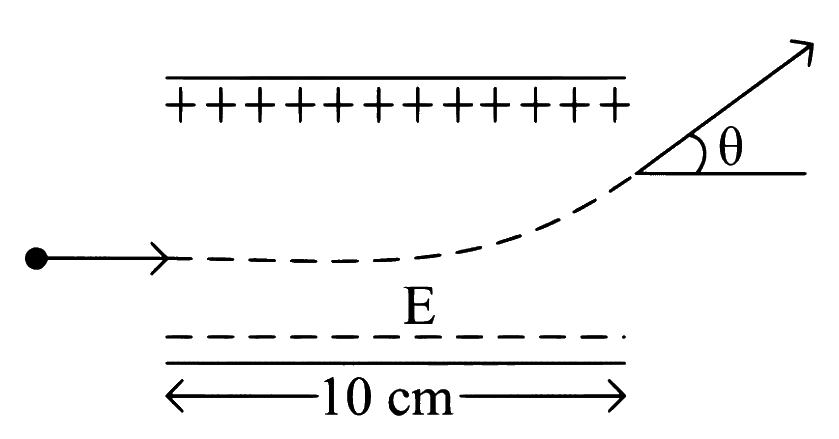
Show answer and solution

Answer: (b)

  1. For R≫LR \gg L the pair is a short dipole of moment p=qLp = qL.
  2. Dipole field at any direction: E=kpR31+3cos⁡2θE = \frac{kp}{R^3}\sqrt{1 + 3\cos^2\theta}
  3. So E∝1R3E \propto \frac{1}{R^3}, answer (b).
Report a mistake
Q562JEE Main 2022 · 28 JUL · SHIFT 1Easy

Electric Dipole · Dipole in a uniform field

Two electric dipoles of dipole moments 1.2×10⁻³⁰ Cm1.2 \times 10^{-30}\text{ Cm} and 2.4×10⁻³⁰ Cm2.4 \times 10^{-30}\text{ Cm} are placed in two different uniform electric fields of strengths 5×10⁴ NC−15 \times 10^{4}\text{ NC}^{-1} and 15×104 NC−115 \times 10^{4}\text{ NC}^{-1} respectively. The ratio of maximum torque experienced by the electric dipoles will be 1x\frac{1}{x}. The value of xx is __________.

Numerical answer type. Work it out, then open the answer.

Show answer and solution

Answer: 6

  1. τmax=pE\tau_{max} = pE, so τ1τ2=p1E1p2E2\frac{\tau_1}{\tau_2} = \frac{p_1E_1}{p_2E_2}
  2. τ1τ2=1.2×10−30×5×1042.4×10−30×15×104=636=16\frac{\tau_1}{\tau_2} = \frac{1.2\times10^{-30} \times 5\times10^{4}}{2.4\times10^{-30} \times 15\times10^{4}} = \frac{6}{36} = \frac{1}{6}
  3. Answer: x=6x = 6
Report a mistake
Q563JEE Main 2022 · 26 JUN · SHIFT 1Easy

Electric Dipole · Polar molecules & dielectrics

Given below two statements: One is labelled as Assertion (A) and other is labelled as Reason (R). Assertion (A): Non-polar materials do not have any permanent dipole moment. Reason (R): When a non-polar material is placed in an electric field, the centre of the positive charge distribution of it's individual atom or molecule coincides with the centre of the negative charge distribution.

In the light of above statements, choose the most appropriate answer from the options given below.

Show answer and solution

Answer: (c)

  1. In a non-polar molecule the positive and negative charge centres coincide, so there is no permanent dipole moment: (A) is true.
  2. In an external field these centres get displaced in opposite directions (induced dipole), so they no longer coincide: (R) is false.
  3. So the answer is (c).
Report a mistake
Q564MHT CET 2021 · 20 SEP · SHIFT 1Easy

Electric Dipole · Dipole in a uniform field

An electric dipole having dipole moment P=q×2ℓ\mathrm{P} = \mathrm{q} \times 2\ell is placed in a uniform electric field 'E\mathrm{E}'. The dipole moment is along the direction of the field. The force acting on it and its potential energy are respectively
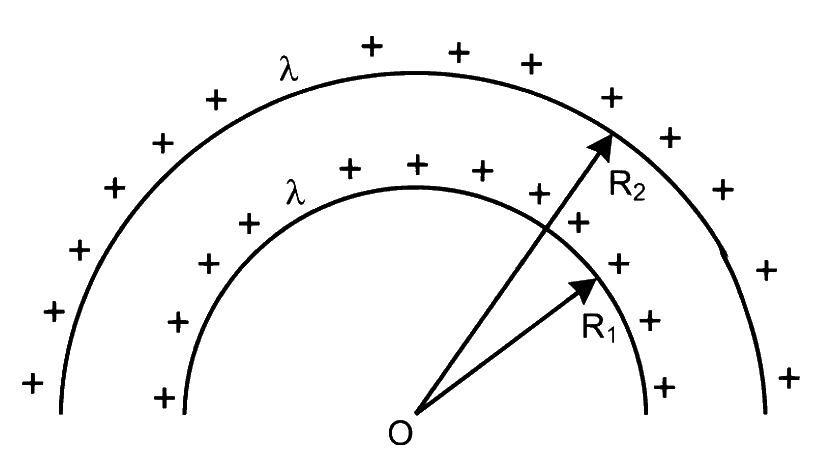
Show answer and solution

Answer: (d)

  1. In a uniform field, forces +qE+qE and −qE-qE cancel: net force =0= 0.
  2. p⃗\vec{p} along E⃗\vec{E}: θ=0\theta = 0, U=−pEU = -pE, the minimum value.
  3. So the answer is (d) zero and minimum.
Report a mistake
Q565NEET 2021Easy

Electric Dipole · Dipole in non-uniform field & dipole-dipole

A dipole is placed in an electric field as shown. In which direction will it move?
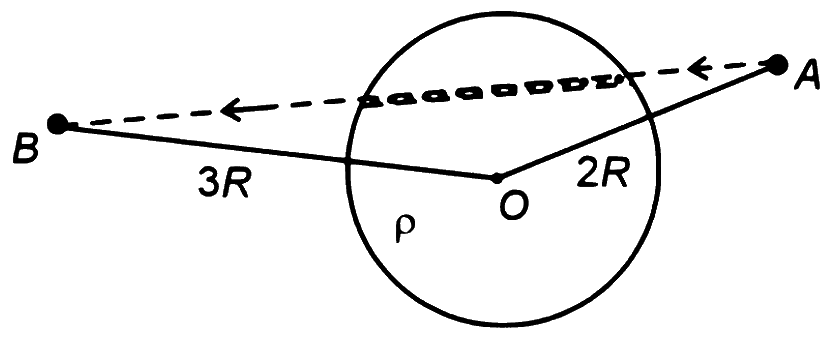
Figure

Show answer and solution

Answer: (c)

+q-qqE (strong)qE (weak)E
  1. Lines spread out to the right, so EE is stronger on the left, at +q+q.
  2. Force on +q+q (rightward, larger) exceeds force on −q-q (leftward, smaller): net force to the right.
  3. p⃗\vec{p} (from −q-q to +q+q) is opposite to E⃗\vec{E}, so U=−p⃗⋅E⃗=+pEU = -\vec{p}\cdot\vec{E} = +pE; moving right EE falls, so UU decreases.
  4. So the answer is (c) towards the right as its potential energy will decrease.
Report a mistake
Q566NEET 2021Easy

Electric Dipole · Polar molecules & dielectrics

Polar molecules are the molecules:

Show answer and solution

Answer: (a)

  1. In a polar molecule the centres of positive and negative charge do not coincide even without any external field.
  2. So it has a permanent electric dipole moment (e.g. H2O\text{H}_2\text{O}, HCl\text{HCl}).
  3. So the answer is (a).
Report a mistake
Q567JEE Main 2021 · 25 JUL · SHIFT 2Medium

Electric Dipole · Dipole in non-uniform field & dipole-dipole

Two ideal electric dipoles A and B, having their dipole moment p1 and p2 respectively are placed on a plane with their centres at O as shown in the figure. At point C on the axis of dipole A, the resultant electric field is making an angle of 37∘^\circ with the axis. The ratio of the dipole moment of A and B, p1p2\frac{p_1}{p_2} is: (take sin⁡37∘=35\sin 37^\circ = \frac{3}{5})
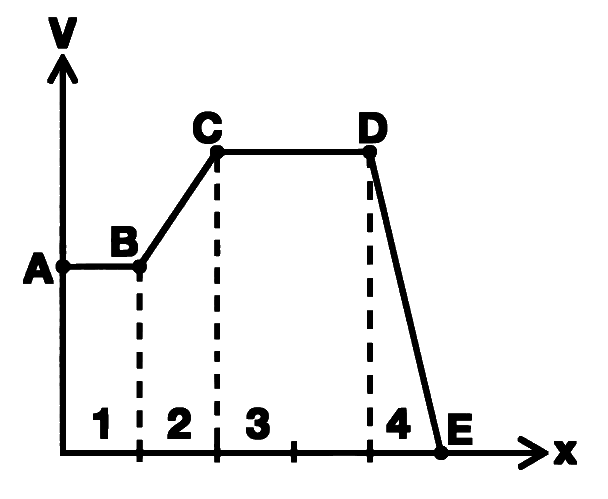
Figure

Show answer and solution

Answer: (c)

  1. C is on the axis of A: EA=2kp1r3E_A = \frac{2kp_1}{r^3} along the axis.
  2. C is on the equatorial line of B: EB=kp2r3E_B = \frac{kp_2}{r^3} perpendicular to the axis.
  3. tan⁡37∘=EBEA=p22p1=34\tan37^\circ = \frac{E_B}{E_A} = \frac{p_2}{2p_1} = \frac{3}{4}
  4. p1p2=23\frac{p_1}{p_2} = \frac{2}{3}, so the answer is (c).
Report a mistake
Q568JEE Main 2021 · 22 JUL · SHIFT 2Difficult

Electric Dipole · Dipole in non-uniform field & dipole-dipole

An electric dipole is placed on x-axis in proximity to a line charge of linear charge density 3.0 ×\times 10 −-6 C/m. Line charge is placed on z-axis and positive and negative charge of dipole is at a distance of 10 mm and 12 mm from the origin respectively. If total force of 4N is exerted on the dipole, find out the amount of positive or negative charge of the dipole.

Show answer and solution

Answer: (d)

  1. Line charge field: E=2kλrE = \frac{2k\lambda}{r}, with 2kλ=2×9×109×3×10−6=5.4×1042k\lambda = 2\times9\times10^9\times3\times10^{-6} = 5.4\times10^4.
  2. Net force: F=q⋅2kλ(10.010−10.012)=q×5.4×104×16.67=q×9×10⁵F = q\cdot2k\lambda\left(\frac{1}{0.010} - \frac{1}{0.012}\right) = q\times5.4\times10^4\times16.67 = q\times9\times10^5
  3. 4=q×9×10⁵⇒q=4.44×10−64 = q\times9\times10^5 \Rightarrow q = 4.44\times10^{-6} C
  4. So the answer is (d) 4.44 μ\muC.
Report a mistake
Q569NEET 2020 · PHASE 2Easy

Electric Dipole · Dipole moment, field & potential

The electric field at a point on the equatorial plane at a distance rr from the centre of a dipole having dipole moment p⃗\vec{p} is given by,
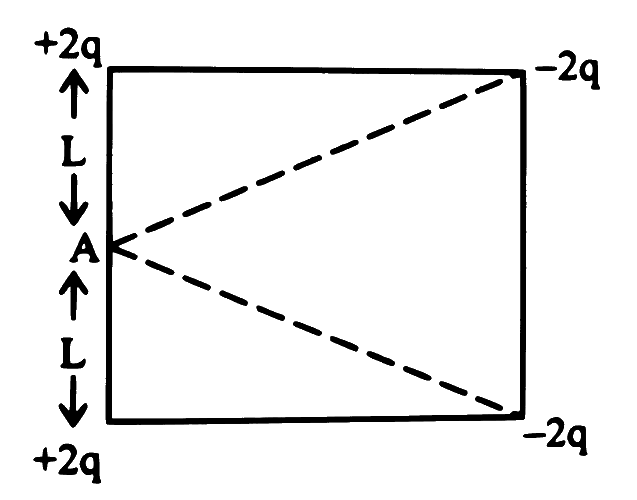
(r≫r \gg separation of two charges forming the dipole, ε0\varepsilon_0 - permittivity of free space)

Show answer and solution

Answer: (a)

  1. On the equatorial line the field has magnitude p4πε0r3\frac{p}{4\pi\varepsilon_0 r^3}.
  2. Its direction is opposite to p⃗\vec{p} (from +q+q side to −q-q side, parallel to the axis).
  3. E⃗=−p⃗4πε0r3\vec{E} = -\frac{\vec{p}}{4\pi\varepsilon_0 r^3}, answer (a).
Report a mistake
Q570NEET 2020 · PHASE 1Easy

Electric Dipole · Dipole moment, field & potential

A short electric dipole has a dipole moment of 16 ×\times 10-9 Cm. The electric potential due to the dipole at a point at a distance of 0.6 m from the centre of the dipole, situated on a line making an angle of 60∘60^\circ with the dipole axis is:

(14πε0=9×10⁹ Nm2/C2)\left(\frac{1}{4\pi\varepsilon_0} = 9 \times 10^{9}\text{ Nm}^2/\text{C}^2\right)

Show answer and solution

Answer: (a)

  1. Potential of a short dipole: V=kpcos⁡θr2V = \frac{kp\cos\theta}{r^2}
  2. V=9×109×16×10−9×0.50.36=720.36V = \frac{9\times10^9\times16\times10^{-9}\times0.5}{0.36} = \frac{72}{0.36}
  3. V=200V = 200 V, answer (a).
Report a mistake
Q571JEE Main 2020 · 9 JAN · SHIFT 1Medium

Electric Dipole · Dipole moment, field & potential

An electric dipole of moment

p⃗=(−i^−3j^+2k^)×10−29\vec{p} = \left(-\hat{i} - 3\hat{j} + 2\hat{k}\right) \times 10^{-29} C.m is

at the origin (0, 0, 0). The electric field due to this dipole at
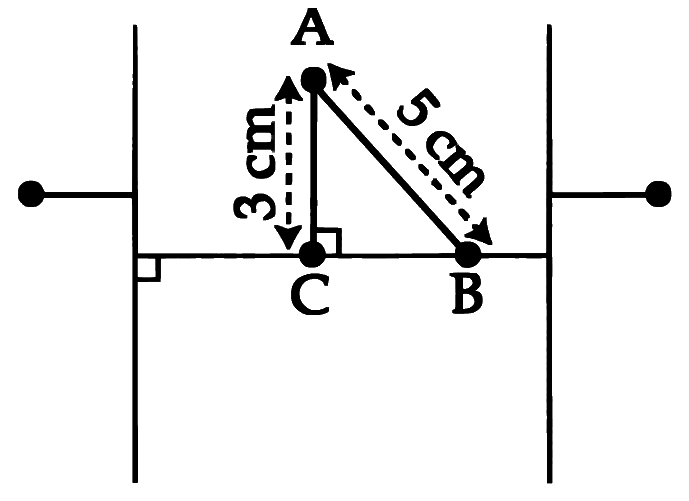
r⃗=+i^+3j^+5k^\vec{r} = +\hat{i} + 3\hat{j} + 5\hat{k} (note thatr⃗⋅p⃗=0\vec{r} \cdot \vec{p} = 0) is parallel to:

Show answer and solution

Answer: (a)

  1. r⃗⋅p⃗=0\vec r \cdot \vec p = 0, so the point lies on the equatorial plane of the dipole.
  2. On the equatorial plane E⃗=−kp⃗r3\vec E = -\frac{k\vec p}{r^3}, i.e. antiparallel to p⃗\vec p.
  3. −p⃗∝(i^+3j^−2k^)-\vec p \propto (\hat i + 3\hat j - 2\hat k)
  4. So the answer is (a).
Report a mistake
Q572JEE Main 2020 · 6 SEP · SHIFT 2Difficult

Electric Dipole · Dipole in non-uniform field & dipole-dipole

Two identical electric point dipoles have dipole moments p⃗1=pi^\vec{p}_1 = p\hat{i} and p⃗2=−pi^\vec{p}_2 = -p\hat{i} and are held on the x axis at distance 'aa' from each other. When released, they move along the x-axis with the direction of their dipole moments remaining unchanged. If the mass of each dipole is 'm', their speed when they are infinitely far apart is:

Show answer and solution

Answer: (c)

  1. Coaxial dipoles: U=−p⃗2⋅E⃗1=−(−p)2kpa3=2kp2a3U = -\vec p_2\cdot\vec E_1 = -(-p)\frac{2kp}{a^3} = \frac{2kp^2}{a^3} (positive, so they repel).
  2. By symmetry both move with the same speed: 2⋅12mv2=2kp2a32\cdot\frac12 mv^2 = \frac{2kp^2}{a^3}
  3. v2=2p24πϵ0ma3=p22πϵ0ma3v^2 = \frac{2p^2}{4\pi\epsilon_0 ma^3} = \frac{p^2}{2\pi\epsilon_0 ma^3}
  4. v=pa12πϵ0mav = \frac{p}{a}\sqrt{\frac{1}{2\pi\epsilon_0 ma}}, so the answer is (c).
Report a mistake
Q573JEE Main 2019 · 12 APR · SHIFT 1Easy

Electric Dipole · Dipole moment, field & potential

A point dipole p⃗=−p0x^\vec{p} = -p_0\hat{x} is kept at the origin. The potential and electric field due to this dipole on the y-axis at a distance d are, respectively: (Take V= 0 at infinity)
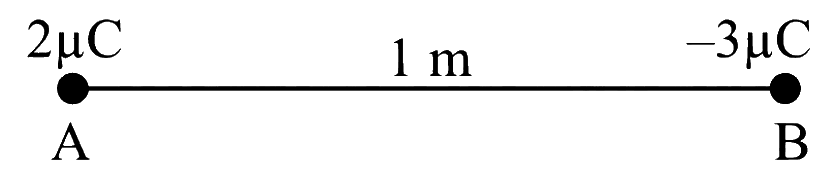
Show answer and solution

Answer: (d)

  1. The y-axis is the equatorial line of a dipole along the x-axis.
  2. On the equatorial line θ=90∘\theta = 90^\circ, so V=pcos⁡90∘4πϵ0d2=0V = \frac{p\cos 90^\circ}{4\pi\epsilon_0 d^2} = 0.
  3. Equatorial field is opposite to p⃗\vec{p}: E⃗=−p⃗4πϵ0d3\vec{E} = \frac{-\vec{p}}{4\pi\epsilon_0 d^3}.
  4. So the answer is (d) 0,−p⃗4πϵ0d30, \frac{-\vec{p}}{4\pi\epsilon_0 d^3}.
Report a mistake
Q574JEE Main 2019 · 12 JAN · SHIFT 1Easy

Electric Dipole · Dipole moment, field & potential

Determine the electric dipole moment of the system of the three charges, placed on the vertices of an equilateral triangle, as shown in the figure:

Figure

Show answer and solution

Answer: (d)

+q (0,0)+q (l, 0)-2q (l/2, √3l/2)xy
  1. Take +q+q at (0,0)(0,0), +q+q at (ℓ,0)(\ell,0) and −2q-2q at (ℓ2,3ℓ2)\left(\frac{\ell}{2},\frac{\sqrt{3}\ell}{2}\right).
  2. Net charge is zero, so p⃗=∑qir⃗i\vec{p} = \sum q_i\vec{r}_i.
  3. p⃗=qℓi^−2q(ℓ2i^+3ℓ2j^)=−3 qℓj^\vec{p} = q\ell\hat{i} - 2q\left(\frac{\ell}{2}\hat{i} + \frac{\sqrt{3}\ell}{2}\hat{j}\right) = -\sqrt{3}\,q\ell\hat{j}
  4. So the answer is (d) −3 qℓj^-\sqrt{3}\,q\ell\hat{j}.
Report a mistake
Q575JEE Main 2019 · 11 JAN · SHIFT 2Easy

Electric Dipole · Dipole in a uniform field

An electric field of 1000 V/m is applied to an electric dipole at angle of 45o. The value of electric dipole moment is 10–29 C.m. What is the potential energy of the electric dipole?
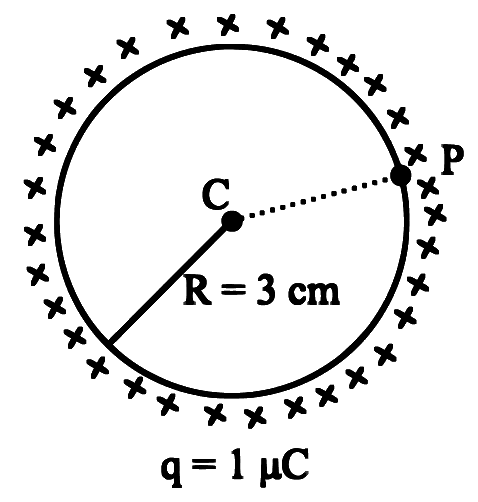
Show answer and solution

Answer: (a)

  1. U=−pEcos⁡θU = -pE\cos\theta
  2. U=−10−29×1000×12≈−7.07×10⁻²⁷U = -10^{-29} \times 1000 \times \frac{1}{\sqrt{2}} \approx -7.07\times10^{-27} J
  3. So the answer is (a) −7×10⁻²⁷-7 \times 10^{-27} J.
Report a mistake
Q576MHT CET 2019 · 3 MAY · SHIFT 1Easy

Electric Dipole · Polar molecules & dielectrics

Which of the following is the dimensional formula for electric polarisation?

Show answer and solution

Answer: (a)

  1. Polarisation = dipole moment per unit volume: P=pVP = \frac{p}{V}, unit C m−2^{-2}.
  2. [P]=[IT][L][L3]=[M0L−2T1I1][P] = \frac{[I T][L]}{[L^3]} = [M^0 L^{-2} T^1 I^1]
  3. So the answer is (a) [M0L−2T1I1][M^0L^{-2}T^1I^1].
Report a mistake
Q577MHT CET 2019 · 2 MAY · SHIFT 2Easy

Electric Dipole · Polar molecules & dielectrics

Which of the following molecules is a polar molecule?

Show answer and solution

Answer: (d)

  1. H2H_2, O2O_2 and CO2CO_2 (linear) are symmetric, so their dipole moment is zero.
  2. H2OH_2O is bent: centres of positive and negative charge do not coincide, so it is polar.
  3. So the answer is (d) H2OH_2O.
Report a mistake
Q578JEE Main 2019 · 10 JAN · SHIFT 2Medium

Electric Dipole · Dipole moment, field & potential

Charges –q and +q located at A and B, respectively, constitude an electric dipole. Distance AB = 2a, O is the mid point of the dipole and OP is perpendicular to AB. A charge Q is placed at P where OP = y and y >> 2a. The charge Q experiences an electrostatic force F. If Q is now moved along the equatorial line to P' such that OP' = (y3)\left(\frac{y}{3}\right), the force on Q will be close to - (y3≫2a)\left(\frac{y}{3} \gg 2a\right)

Figure

Show answer and solution

Answer: (d)

  1. Far on the equatorial line E=kpy3E = \frac{kp}{y^3}, so F=QE∝1y3F = QE \propto \frac{1}{y^3}.
  2. y→y3y \to \frac{y}{3}: F′=33F=27FF' = 3^3 F = 27F
  3. So the answer is (d) 27F27F.
Report a mistake
Q579JEE Main 2019 · 8 APR · SHIFT 2Medium

Electric Dipole · Dipole in a uniform field

An electric dipole is formed by two equal and opposite charges q with separation d. The charges have same mass m. It is kept in a uniform electric field E. If it is slightly rotated from its equilibrium orientation, then its angular frequency ω\omega is :-
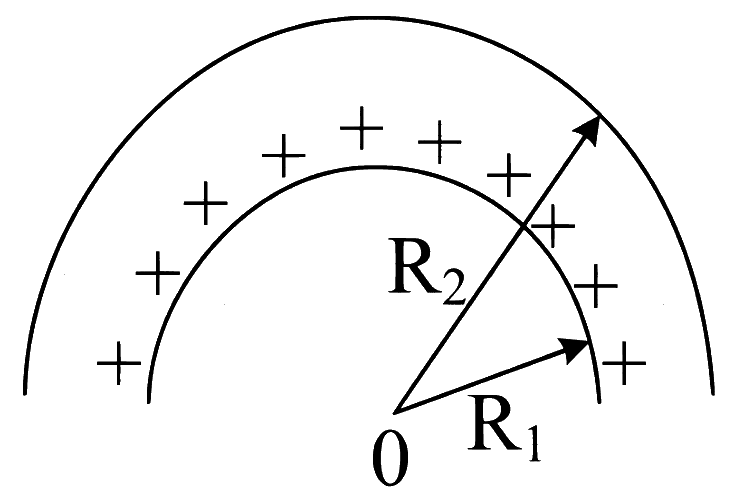
Show answer and solution

Answer: (d)

  1. Each mass mm at d2\frac{d}{2} from the centre: I=2m(d2)2=md22I = 2m\left(\frac{d}{2}\right)^2 = \frac{md^2}{2}.
  2. Restoring torque τ≈qdE θ\tau \approx qdE\,\theta.
  3. ω=qdEmd2/2=2qEmd\omega = \sqrt{\frac{qdE}{md^2/2}} = \sqrt{\frac{2qE}{md}}
  4. So the answer is (d).
Report a mistake
Q580JEE Main 2019 · 10 JAN · SHIFT 1Medium

Electric Dipole · Dipole in non-uniform field & dipole-dipole

Two electric dipoles, A, B with respective dipole moments d⃗A=−4qai^\vec{d}_A = -4qa\hat{i} and d⃗B=−2qai^\vec{d}_B = -2qa\hat{i} are placed on the x-axis with a separation R, as shown in the figure. The distance from A at which both of them produce the same potential is -

Figure

Show answer and solution

Answer: (c)

  1. V=k p⃗⋅r^r2V = \frac{k\,\vec p\cdot\hat r}{r^2}; both moments point along −x-x.
  2. Between A and B the two potentials have opposite signs, so the point lies beyond B, at distance xx from A.
  3. There 4qax2=2qa(x−R)2⇒x=2(x−R)\frac{4qa}{x^2} = \frac{2qa}{(x - R)^2} \Rightarrow x = \sqrt2(x - R)
  4. x=2R2−1x = \frac{\sqrt2 R}{\sqrt2 - 1}, so the answer is (c).
Report a mistake
Q581JEE Main 2017Medium

Electric Dipole · Dipole in a uniform field

An electric dipole has a fixed dipole moment p⃗\vec{p}, which makes angle θ\theta with respect to x-axis. When subjected to an electric field E⃗1=Ei^\vec{E}_1 = E\hat{i}, it experiences a torque T⃗1=τk^\vec{T}_1 = \tau\hat{k}. When subjected to another electric field E⃗2=3E1j^\vec{E}_2 = \sqrt{3}E_1\hat{j} it experiences a torque T⃗2=−T⃗1\vec{T}_2 = -\vec{T}_1. The angle θ\theta is:
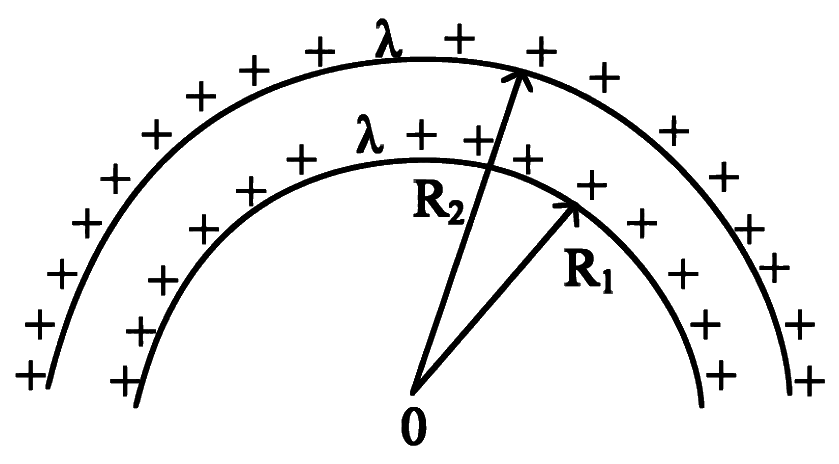
Show answer and solution

Answer: (d)

  1. p⃗=p(cos⁡θ i^+sin⁡θ j^)\vec p = p(\cos\theta\,\hat i + \sin\theta\,\hat j), τ⃗=p⃗×E⃗\vec \tau = \vec p \times \vec E.
  2. T⃗1=p⃗×Ei^=−pEsin⁡θ k^\vec T_1 = \vec p \times E\hat i = -pE\sin\theta\,\hat k
  3. T⃗2=p⃗×3Ej^=3 pEcos⁡θ k^\vec T_2 = \vec p \times \sqrt3 E\hat j = \sqrt3\,pE\cos\theta\,\hat k
  4. T⃗2=−T⃗1⇒3cos⁡θ=sin⁡θ⇒tan⁡θ=3\vec T_2 = -\vec T_1 \Rightarrow \sqrt3\cos\theta = \sin\theta \Rightarrow \tan\theta = \sqrt3
  5. So the answer is (d) 60∘60^\circ.
Report a mistake
Q582NEET 2016 · PHASE 2Easy

Electric Dipole · Dipole in a uniform field
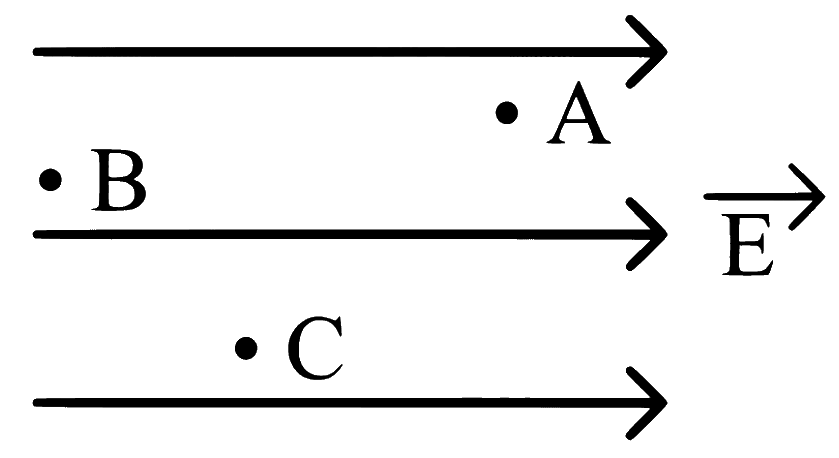
An electric dipole is placed at an angle of 30o with an electric field intensity 2 ×\times 105 N C−1{}^{-1}. It experiences a torque equal to 4 N m. The charge on the dipole, if the dipole length is 2 cm, is
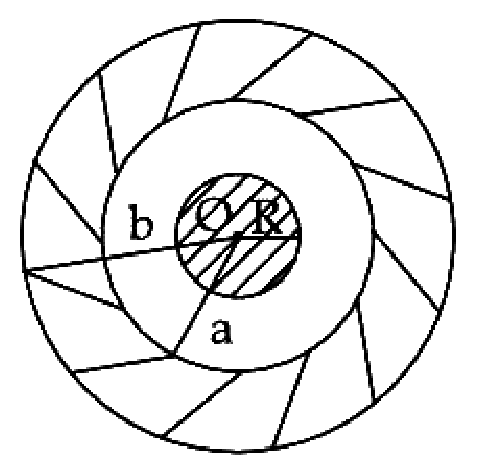
Show answer and solution

Answer: (b)

  1. τ=q(2l)Esin⁡θ\tau = q(2l)E\sin\theta
  2. 4=q×0.02×2×105×12=2000 q4 = q \times 0.02 \times 2\times10^{5} \times \frac{1}{2} = 2000\,q
  3. q=2×10⁻³q = 2\times10^{-3} C =2= 2 mC
  4. So the answer is (b) 2 mC.
Report a mistake
Q583NEET 2013Easy

Electric Dipole · Dipole in a uniform field
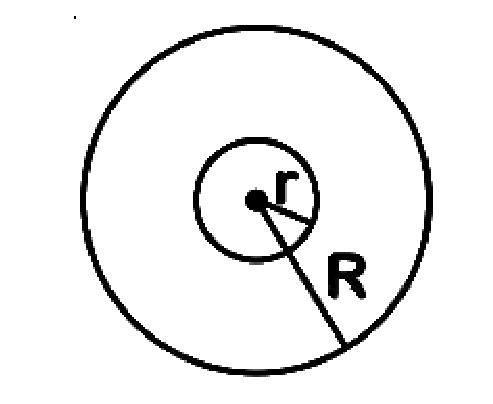
An electric dipole of dipole moment p is aligned parallel to a uniform electric field E. The energy required to rotate the dipole by 90o is
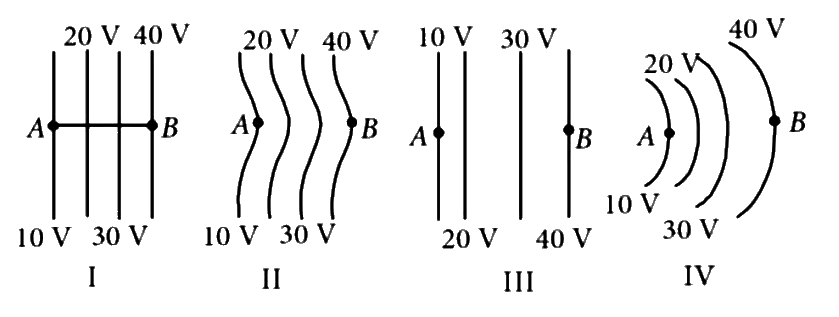
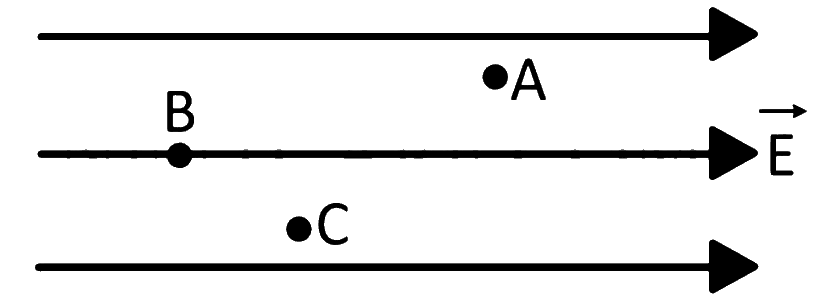
Show answer and solution

Answer: (b)

  1. W=pE(cos⁡θ1−cos⁡θ2)W = pE(\cos\theta_1 - \cos\theta_2)
  2. W=pE(cos⁡0∘−cos⁡90∘)=pEW = pE(\cos 0^\circ - \cos 90^\circ) = pE
  3. So the answer is (b) pEpE.
Report a mistake
Q584JEE Main 2013 · 9 APR · SHIFT 1Medium

Electric Dipole · Dipole in non-uniform field & dipole-dipole

Two point dipoles of dipole moment p⃗1\vec{p}_1 and p⃗2\vec{p}_2 are at a distance x from each other and p⃗1∥p⃗2\vec{p}_1 \parallel \vec{p}_2. The force between the dipoles is:

Show answer and solution

Answer: (c)

  1. Coaxial dipoles: field of p1p_1 on its axis E=2kp1x3E = \frac{2kp_1}{x^3}.
  2. Force on p2p_2: F=p2∣dEdx∣=p2⋅6kp1x4F = p_2\left|\frac{dE}{dx}\right| = p_2\cdot\frac{6kp_1}{x^4}
  3. F=14πϵ06p1p2x4F = \frac{1}{4\pi\epsilon_0}\frac{6p_1p_2}{x^4}
  4. So the answer is (c).
Report a mistake
Q585NEET 2012 · AIPMT · PRELIMSEasy

Electric Dipole · Dipole in a uniform field

An electric dipole of moment p is placed in an electric field of intensity E. The dipole acquires a position such that the axis of the dipole makes an angle θ\theta with the direction of the field. Assuming that the potential energy of the dipole to be zero when θ\theta = 90o, the torque and the potential energy of the dipole will respectively be

Show answer and solution

Answer: (a)

  1. Torque: τ=pEsin⁡θ\tau = pE\sin\theta.
  2. With U=0U = 0 at θ=90∘\theta = 90^\circ: U=−∫90∘θτ dθU = -\int_{90^\circ}^{\theta}\tau\,d\theta gives U=−pEcos⁡θU = -pE\cos\theta.
  3. So the answer is (a) pEsin⁡θ, −pEcos⁡θpE\sin\theta,\ -pE\cos\theta.
Report a mistake
Q586NEET 2006 · AIPMTEasy

Electric Dipole · Dipole in a uniform field

An electric dipole of moment p⃗\vec{p}is lying along a uniform electric field E⃗\vec{E}. The work done in rotating the dipole by 90o is

Show answer and solution

Answer: (a)

  1. W=pE(cos⁡0∘−cos⁡90∘)=pEW = pE(\cos 0^\circ - \cos 90^\circ) = pE
  2. So the answer is (a) pEpE.
Report a mistake
Q587JEE Main 2006 · AIEEEEasy

Electric Dipole · Dipole in non-uniform field & dipole-dipole

An electric dipole is placed at an angle of 30∘30^\circ to a non-uniform electric field. The dipole will experience

Show answer and solution

Answer: (c)

  1. In a non-uniform field E⃗\vec{E} differs at +q+q and −q-q, so the forces do not cancel: a net translational force.
  2. At 30∘30^\circ, p⃗×E⃗≠0\vec{p} \times \vec{E} \neq 0, so there is also a torque.
  3. So the answer is (c) a torque as well as a translational force.
Report a mistake
Q588NEET 2004 · AIPMTEasy

Electric Dipole · Dipole in a uniform field

An electric dipole has the magnitude of its charge as q and its dipole moment is p. It is placed in a uniform electric field E. If its dipole moment is along the direction of the field, the force on it and its potential energy are respectively

Show answer and solution

Answer: (c)

  1. Uniform field: forces +qE+qE and −qE-qE cancel, so net force is zero.
  2. p⃗\vec{p} along E⃗\vec{E}: U=−pEU = -pE, the minimum value.
  3. So the answer is (c) zero and minimum.
Report a mistake
Q589NEET 2001 · AIPMTEasy

Electric Dipole · Dipole in a uniform field

A dipole of dipole moment p⃗\vec{p}is placed in uniform electric field E⃗\vec{E}then torque acting on it is given by

Show answer and solution

Answer: (b)

  1. Torque on a dipole: τ⃗=p⃗×E⃗\vec{\tau} = \vec{p} \times \vec{E}, magnitude pEsin⁡θpE\sin\theta.
  2. So the answer is (b) τ⃗=p⃗×E⃗\vec{\tau} = \vec{p} \times \vec{E}.
Report a mistake
Q590NEET 1998 · AIPMTEasy

Electric Dipole · Dipole moment, field & potential

A point QQ lies on the perpendicular bisector of an electrical dipole of dipole moment pp. If the distance of QQ from the dipole is rr (much larger than the size of the dipole) then electric field at QQ is proportional to

Show answer and solution

Answer: (d)

  1. On the perpendicular bisector (equatorial line): E=14πε0pr3E = \frac{1}{4\pi\varepsilon_0}\frac{p}{r^3}
  2. So E∝pE \propto p and E∝r−3E \propto r^{-3}, answer (d).
Report a mistake
Q591NEET 1994 · AIPMTMedium

Electric Dipole · Dipole in a uniform field

An electric dipole of moment pp is placed in the position of stable equilibrium in uniform electric field of intensity EE. This is rotated through an angle θ\theta from the initial position. The potential energy of the electric dipole in the final position is

Show answer and solution

Answer: (a)

  1. Potential energy of a dipole: U=−p⃗⋅E⃗=−pEcos⁡θU = -\vec p \cdot \vec E = -pE\cos\theta, where θ\theta is the angle between p⃗\vec p and E⃗\vec E.
  2. Starting from stable equilibrium (θ=0\theta = 0) and rotating by θ\theta, the angle becomes θ\theta.
  3. So the answer is (a) −pEcos⁡θ-pE\cos\theta.
Report a mistake