Types of Flow, Reynolds Number & Continuity · Equation of continuity
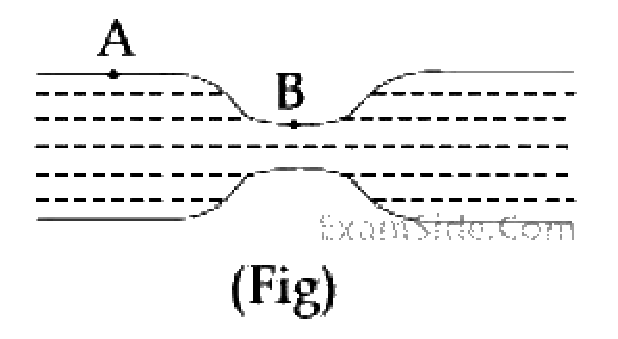
An in-compressible fluid flows steadily through a horizontal cylindrical pipe. The pipe has radius '3R' at point A and '1.5R' at point B, further along the flow direction at the same level. If the velocity at point A is 'v', then that at point B is
Types of Flow, Reynolds Number & Continuity · Equation of continuity
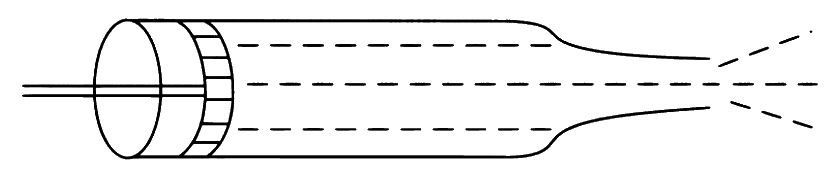
Water flows through a horizontal pipe at a speed 'V'. Internal diameter of the pipe is 'd'. If the water is emerging at a speed 'V1 ' then the diameter of the nozzle is
______
Show answer and solution
Answer: (a)
Continuity: 4πd2V=4πD2V1, where D is the nozzle diameter.
Types of Flow, Reynolds Number & Continuity · Equation of continuity
A water spray gun is attached to a hose of cross sectional area 30 cm2. The gun comprises of 10 perforations each of cross sectional area of 15 mm2. If the water flows in the hose with the speed of 50 cm/s, calculate the speed at which the water flows out from each perforation. (Neglect any edge effects)
Types of Flow, Reynolds Number & Continuity · Equation of continuity
Water flows through a horizontal pipe of varying cross-section at the rate of π×10−1 m3/s. The velocity of water at a point where the radius of the pipe is 10 cm is (π=3.14)
Types of Flow, Reynolds Number & Continuity · Equation of continuity
An incompressible fluid flows steadily through a cylindrical pipe having radius R at point A and (3R) at point B further along the direction of flow of liquid. If the velocity at point A is ' V ' then that at point B is
Types of Flow, Reynolds Number & Continuity · Types of flow & Reynolds number
A fluid of density 'ρ' is flowing through a uniform tube of diameter 'd'. The coefficient of viscosity of the fluid is 'η', then critical velocity of the fluid is
Types of Flow, Reynolds Number & Continuity · Equation of continuity
Water flows through a horizontal pipe at a speed 'V'. Internal diameter of the pipe is 'd'. If the water is coming out at a speed 'V1' then the diameter of the nozzle is
Show answer and solution
Answer: (b)
Continuity: d2V=D2V1, where D is the nozzle diameter.
Types of Flow, Reynolds Number & Continuity · Types of flow & Reynolds number
If ρ is the density and η is coefficient of viscosity of fluid which flows with a speed v in the pipe of diameter d, the correct formula for Reynolds number Re is:
Types of Flow, Reynolds Number & Continuity · Equation of continuity
A pressure-pump has a horizontal tube of cross sectional area 10 cm2 for the outflow of water at a speed of 20 m/s. The force exerted on the vertical wall just in front of the tube which stops water horizontally flowing out of the tube, is:
[given: density of water =1000 kg/m3]
Show answer and solution
Answer: (d)
Force = rate of change of momentum =dtdmv=(ρAv)v=ρAv2 (water stopped by the wall).
Types of Flow, Reynolds Number & Continuity · Equation of continuity
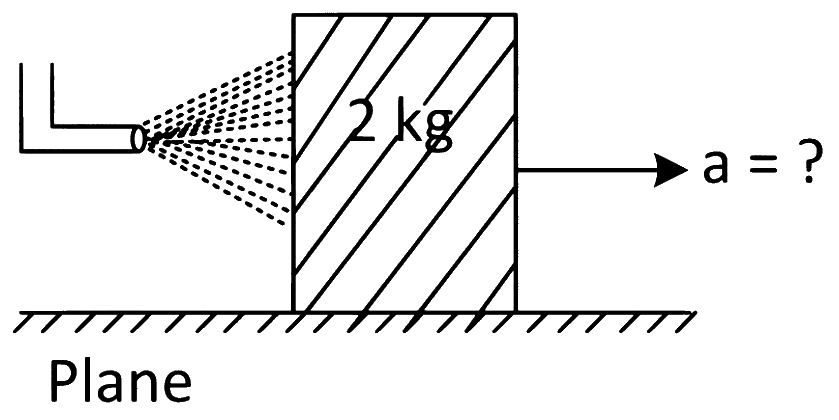
A block of metal weighing 2 kg is resting on a frictionless plane (as shown in figure). It is struck by a jet releasing water at a rate of 1 kgs−1 and at a speed of 10 ms−1. Then, the initial acceleration of the block, in ms−2, will be:
Show answer and solution
Answer: (c)
The jet loses its horizontal momentum on hitting the block: F=dtdmv.
Types of Flow, Reynolds Number & Continuity · Types of flow & Reynolds number
A glass tube of uniform cross-section is connected to a tap with a rubber tube. The tap is opened slowly. Initially the flow of water in the tube is streamline. The speed of flow of water to convert it into a turbulent flow is [radius of tube =1 cm,η=1×10⁻³m2Ns,Rn=2500 and density of water =103 kg/m3 ]
Types of Flow, Reynolds Number & Continuity · Types of flow & Reynolds number
What will be the nature of flow of water from a circular tap, when its flow rate increased from 0.18 L/min to 0.48 L/min? The radius of the tap and viscosity of water are 0.5 cm and 10−3 Pa s, respectively. (Density of water: 103 kg/m3)
Types of Flow, Reynolds Number & Continuity · Equation of continuity
An ideal fluid flows (laminar flow) through a pipe of non-uniform diameter. The maximum and minimum diameters of the pipes are 6.4 cm and 4.8 cm, respectively. The ratio of the minimum and the maximum velocities of fluid in this pipe is:
Show answer and solution
Answer: (b)
Continuity: v∝A1∝d21.
Minimum velocity is at maximum diameter: vmaxvmin=(dmaxdmin)2=(6.44.8)2
Types of Flow, Reynolds Number & Continuity · Types of flow & Reynolds number
Water from a pipe is coming at a rate of 100 litres per minute. If the radius of the pipe is 5 cm, the Reynolds number for the flow is of the order of: (density of water = 1000 kg/m3, coefficient of viscosity of water = 1mPas)
Types of Flow, Reynolds Number & Continuity · Equation of continuity
Water from a tap emerges vertically downwards with an initial speed of 1.0 ms–1. The cross- sectional area of the tap is 10–4 m2. Assume that the pressure is constant throughout the stream of water and that the flow is streamlined. The cross-sectional area of the stream, 0.15 m below the tap would be: (Take g = 10 ms–2)
Show answer and solution
Answer: (c)
Speed after falling h: v2=u2+2gh=1+2×10×0.15=4⇒v=2 m/s
Types of Flow, Reynolds Number & Continuity · Equation of continuity
A liquid of density ρ is coming out of a hose pipe of radius a with horizontal speed v and hits a mesh. 50% of the liquid passes through the mesh unaffected. 25% looses all of its momentum and 25% comes back with the same speed. The resultant pressure on the mesh will be:
Show answer and solution
Answer: (a)
Momentum carried per second by the jet =ρAv2.
50% passes through: no momentum change.
25% stops: change =0.25ρAv2; 25% rebounds with same speed: change =0.25×2ρAv2=0.5ρAv2.
Types of Flow, Reynolds Number & Continuity · Types of flow & Reynolds number
If it takes 5 minutes to fill a 15 litre bucket from a water tap of diameter π2 cm then the Reynolds number for the flow is (density of water = 103 kg/m3 and viscosity of water = 10−3 Pa.s) close to:
Types of Flow, Reynolds Number & Continuity · Equation of continuity
Water is flowing continuously from a tap having an internal diameter 8×10⁻³ m. The water velocity as it leaves the tap is 0.4 ms−1. The diameter of the water stream at a distance 2×10⁻¹ m below the tap is close to:
Show answer and solution
Answer: (c)
Speed at h=0.2 m below: v2=(0.4)2+2×10×0.2=4.16⇒v≈2.04 m/s
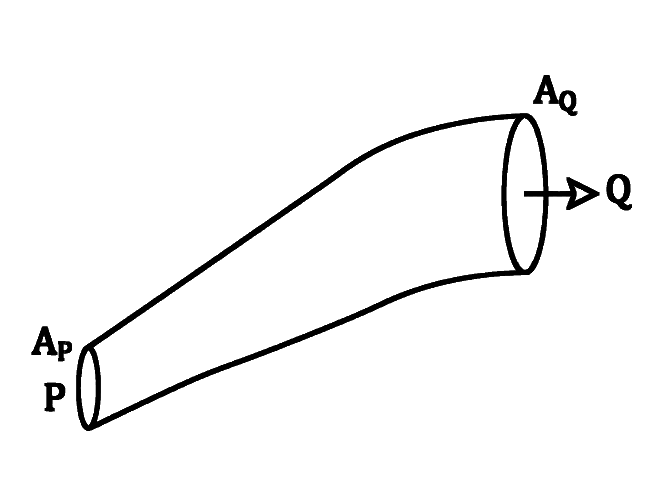
An incompressible fluid (ideal fluid) is flowing through non uniform cross-sectional tube PQ as shown in the figure from end P to end Q. If KP and KQ are the kinetic energy per unit volume of the fluid at end P and end Q respectively, then
Show answer and solution
Answer: (d)
From the figure AP<AQ; continuity APvP=AQvQ gives vP>vQ.
A horizontal pipe carries water in a streamline flow. At point along the pipe, where the cross- sectional area is A1, the velocity of water is V1 and the pressure is P1. What is the pressure of water at another point where the cross-sectional area is A2?
A closed pipe containing liquid showed a pressure P1 by gauge. When the valve was opened, pressure was reduced to P2. The speed of water flowing out of the pipe is (ρ=density of water)
Show answer and solution
Answer: (b)
Closed valve: v=0, pressure P1. Open valve: pressure P2, speed v.
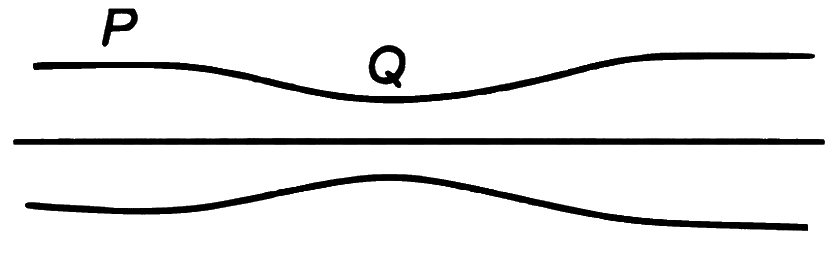
Water flows in a streamline motion through a horizontal pipe of circular cross-section as shown in the figure. The pressure difference of water between P and Q is 15 Nm−2. The area of cross-section at P and Q are 40 cm2 and 20 cm2, respectively. The rate of flow of water through the pipe, in cm3 s−1, is:
A liquid of density 600 kg/m3 flowing steadily in a tube of varying cross-section. The cross-section at a point A is 1.0 cm2 and that at B is 20 mm2. Both the points A and B are in same horizontal plane, the speed of the liquid at A is 10 cm/s. The difference in pressures at A and B points is ______ Pa.
Show answer and solution
Answer: (d)
AA=1.0 cm2=100 mm2, AB=20 mm2, so vB=5vA=50 cm/s=0.5 m/s
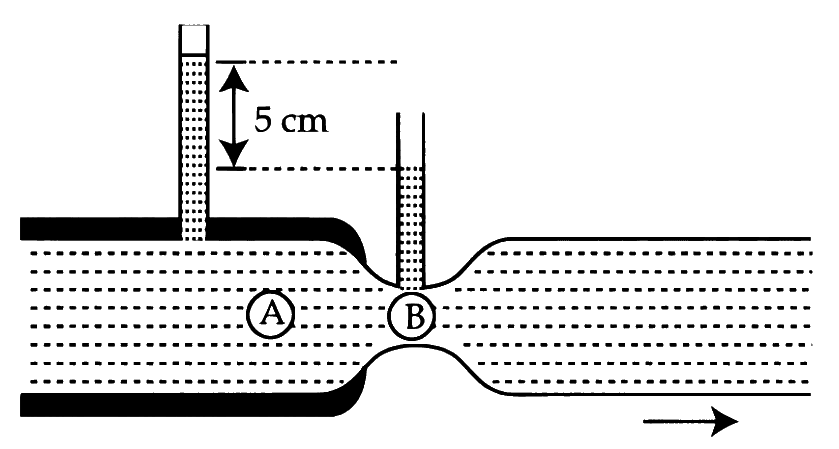
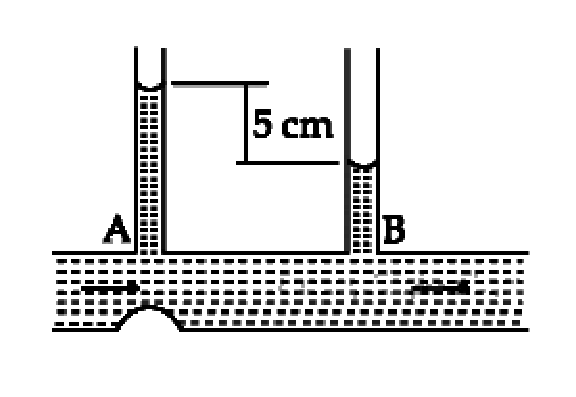
Water flows through a horizontal tube as shown in the figure. The difference in height between the water columns in vertical tubes is 5 cm and the area of cross-sections at A and B are 6 cm2 and 3 cm2 respectively. The rate of flow will be cm3/s. (take g=10 m/s2)
Show answer and solution
Answer: (d)
Pressure difference from the columns: PA−PB=ρgh.
A horizontal pipeline carries water in a streamline flow. At a point along the pipe, where the cross- sectional area is 10 cm2, the velocity of water is 1 m/s and pressure is 2000 Pa. The pressure of water at another point where the cross-sectional area 5 cm2 is
Water flows in a horizontal pipe whose one end is closed with a valve. The reading of the pressure gauge attached to the pipe is P1. The reading of the pressure gauge falls to P2 when the valve is opened. The speed of water flowing in the pipe is proportional to
Show answer and solution
Answer: (b)
Closed valve: v=0, gauge reads P1. Open valve: gauge reads P2 with speed v.
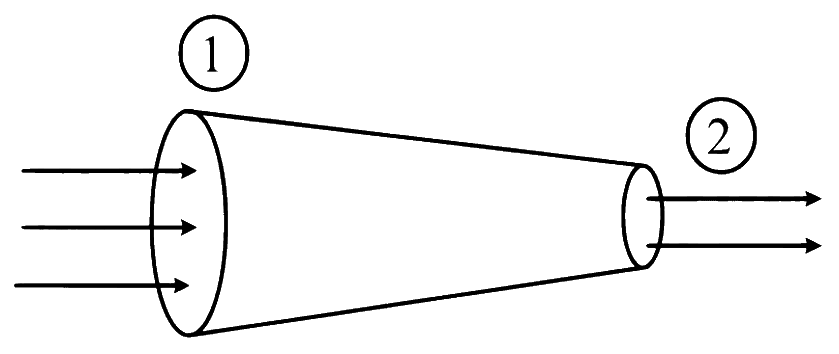
A tube of length L is shown in the figure. The radius of cross section at the point (1) is 2 cm and at the point (2) is 1 cm, respectively. If the velocity of water entering at point (1) is 2 m/s, then velocity of water leaving the point (2) will be
A closed pipe containing a liquid showed a pressure P1 by gauge. When the valve was opened, pressure was reduced to P2. The speed of water flowing out of the pipe is (ρ= density of water)
Show answer and solution
Answer: (c)
Closed valve: v=0, pressure P1. Open valve: pressure P2, speed v.
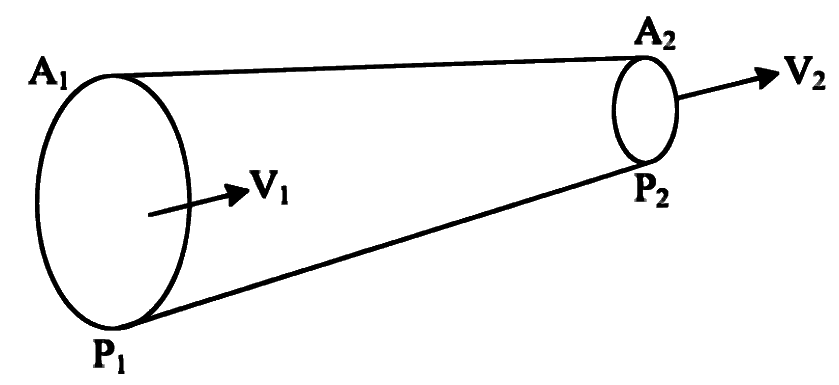
Water is flowing in a conical tube as shown in figure. Velocity of water at area ' A2 ' is 60 cm/s. The value of ' A1 ' and ' A2 ' is 10 cm2 and 5 cm2 respectively. The pressure difference at both the cross- section is
A streamline flow of a liquid of density ' ρ ' is passing through a horizontal pipe of crosssectional area A1 and A2 at two ends. If the pressure of liquid is ' P ' at a point where flow speed is ' v ', then pressure at another point where the flow of speed becomes 3 v is
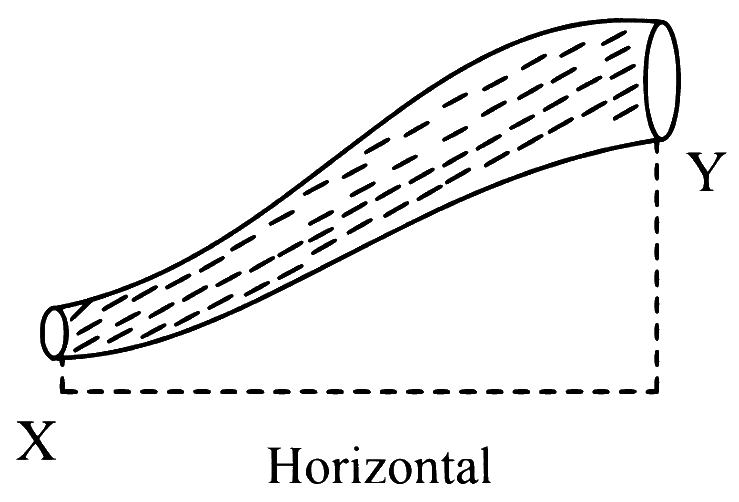
An ideal fluid is flowing in a non-uniform cross-sectional tube XY (as shown in the figure) from end X to end Y. If K1 and K2 are the kinetic energy per unit volume of the fluid at X and Y respectively, then the correct option is:
Show answer and solution
Answer: (c)
From the figure, end X is narrow and end Y is wide: AX<AY.
Continuity AXvX=AYvY gives vX>vY.
KE per unit volume =21ρv2, so K1>K2 (height does not affect it).
Glycerine of density 1.25×10³ kg/m3 is flowing in conical shaped horizontal pipe. Crosssectional area of the pipe at its both ends is 10 cm2 and 5 cm2 respectively. Pressure difference at both the ends is 3 N/m2. Rate of flow of liquid in the pipe is
The figure shows a liquid of given density flowing steadily in horizontal tube of varying cross - section. Cross sectional areas at A is 1.5 cm2, and B is 25 mm2, if the speed of liquid at B is 60 cm/s then (PA−PB) is:
(Given PA and PB are liquid pressures at A and B points.
Glycerin of density 1.25×10³ kg m−3 is flowing through the conical section of pipe. The area of cross-section of the pipe at its ends are 10 cm2 and 5 cm2 and pressure drop across its length is 3 Nm−2. The rate of flow of glycerin through the pipe is x×10−5 m3 s−1. The value of x is ___________.
Numerical answer type. Work it out, then open the answer.
Figure below shows a liquid being pushed out of the tube by a piston having area of cross section 2.0 cm2. The area of cross section at the outlet is 10 mm2. If the piston is pushed at a speed of 4 cm s−1, the speed of outgoing fluid is __________ cms−1
Numerical answer type. Work it out, then open the answer.
Show answer and solution
Answer: 80
Continuity: A1v1=A2v2, with A1=2.0 cm2=200 mm2
A liquid of density 750 kgm−3 flows smoothly through a horizontal pipe that tapers in cross- sectional area from A1 = 1.2 × 10⁻² m2 to A2 = 2A1. The pressure difference between the wide and narrow sections of the pipe is 4500 Pa. The rate of flow of liquid is ___________ × 10−3 m3s−1.
Numerical answer type. Work it out, then open the answer.
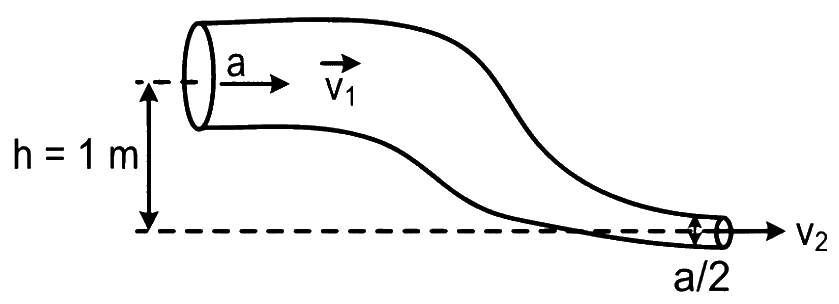
An ideal fluid of density 800 kgm−3, flows smoothly through a bent pipe (as shown in figure) that tapers in cross-sectional area from a to 2a. The pressure difference between the wide and narrow sections of pipe is 4100 Pa. At wider section, the velocity of fluid is 6x ms−1 for x = ___________. (Given g = 10 ms−2)
Numerical answer type. Work it out, then open the answer.
Show answer and solution
Answer: 363
Continuity: area a→2a, so v2=2v1. The wide end is h=1 m higher.
A tube of length 50 cm is filled completely with an incompressible liquid of mass 250 g and closed at both ends. The tube is then rotated in horizontal plane about one of its ends with a uniform angular velocity xF rad s−1. If F be the force exerted by the liquid at the other end then the value of x will be __________.
Numerical answer type. Work it out, then open the answer.
Show answer and solution
Answer: 4
The liquid moves in a circle; the end wall supplies the total centripetal force, acting on the centre of mass at 2L.
A fluid is flowing through a horizontal pipe of varying cross-section, with
speed v ms–1 at a point where the pressure is P pascal. At another point where pressure is 2P Pascal its speed is V ms–1. If the density of the fluid is ρ kg m–3 and the flow is streamline, then V is equal to:
A wind with speed 50 m/s blows parallel to the roof of a house. The area of the roof is 300 m2. Assume that the pressure inside the house is atmospheric pressure. Density of air is 1.2 kg/m3. The magnitude of the force exerted by the wind on the roof will be
Show answer and solution
Answer: (c)
Air inside is at rest, air above moves at v: ΔP=21ρv2
A plane is in level flight at constant speed and each of its two wings has an area of 40 m2. If the speed of the air is 180 km/h over the lower wing surface and 252 km/h over the upper wing surface, the mass of the plane is ___________ kg.
(Take air density to be 1 kg m−3 and g=10 ms−2)
Numerical answer type. Work it out, then open the answer.
In a test experiment on a model aeroplane in wind tunnel, the flow speeds on the upper and lower surfaces of the wings are 70 ms−1 and 65 ms−1 respectively. If the wing area is 2 m2, the lift of the wing is _________ N.
(Given density of air =1.2 kg m−3)
Numerical answer type. Work it out, then open the answer.
Show answer and solution
Answer: 810
ΔP=21ρ(vu2−vl2)=21(1.2)(702−652)=0.6×675=405 Pa
A fully loaded boeing aircraft has a mass of 5.4×10⁵ kg. Its total wing area is 500 m2. It is in level flight with a speed of 1080 km/h. If the density of air ρ is 1.2 kg m−3, the fractional increase in the speed of the air on the upper surface of the wing relative to the lower surface in percentage will be. (g=10 m/s2)
Show answer and solution
Answer: (d)
Level flight: lift =mg⇒ΔP=Amg=5005.4×106=1.08×10⁴ Pa
Bernoulli: ΔP=21ρ(vu2−vl2)≈ρvΔv, with v=1080 km/h=300 m/s
A wind with speed 40 m/s blows parallel to the roof of a house. The area of the roof is 250 m2. Assuming that the pressure inside the house is atmospheric pressure, the force exerted by the wind on the roof and the direction of the force will be (ρair=1.2kg/m3)
Show answer and solution
Answer: (a)
Pressure above the roof is lower: ΔP=21ρv2=21(1.2)(40)2=960 Pa
F=ΔP⋅A=960×250=2.4×10⁵ N
Higher pressure is inside, so the force acts upwards.
In the diagram shown, if the difference in the two tubes of the manometer is 5 cm, the cross section of the tube at A and B is 6 mm2 and 10 mm2 respectively. The rate at which water flows through the tube ( g = 10 ms−2)
Show answer and solution
Answer: (a)
Manometer: ΔP=ρgh=1000(10)(0.05)=500 Pa
Bernoulli: 21ρ(vA2−vB2)=ρgh⇒vA2−vB2=2gh=1
Continuity: 6vA=10vB⇒vB=0.6vA, so 0.64vA2=1⇒vA=1.25 m/s
Air of density 1.2 kg m−3 is blowing across the horizontal wings of an aeroplane in such a way that its speeds above and below the wings are 150 ms−1 and 100 ms −1, respectively. The pressure difference between the upper and lower sides of the wings, is:
A water tank of height ’h’ has a hole at the bottom. It is completely filled with water. The total pressure at the bottom is 4H and atmospheric pressure is H. The velocity of water flowing out of the hole is (ρ = density of water)
The surface of water in a water tank of cross-section area 750 cm2 on the top of a house is h m above the tap level. The speed of water coming out through the tap of cross-section area 500 mm2 is 30 cm/s. At that instant, dh/dt is y×10−3 m/s. The value of y will be
Show answer and solution
Answer: (a)
Continuity: Adtdh=av
dtdh=750×10−4(500×10−6)(0.30)=0.0751.5×10−4=2×10⁻³ m/s
A cylindrical vessel of 40 cm radius is completely filled with water and its capacity is 528 dm3 (dm: decimeter) The vessel is placed on a solid block of exactly same height as vessel. If a small hole is made at 70 cm below the top of water level, then horizontal range of water falling on the ground in the beginning is ______ cm.
Show answer and solution
Answer: (b)
Height of vessel: H=πr2V=722(0.4)20.528=1.05 m=105 cm
Block has the same height, so the water top is 210 cm above the ground; the hole is at y=210−70=140 cm above ground, depth h=70 cm.
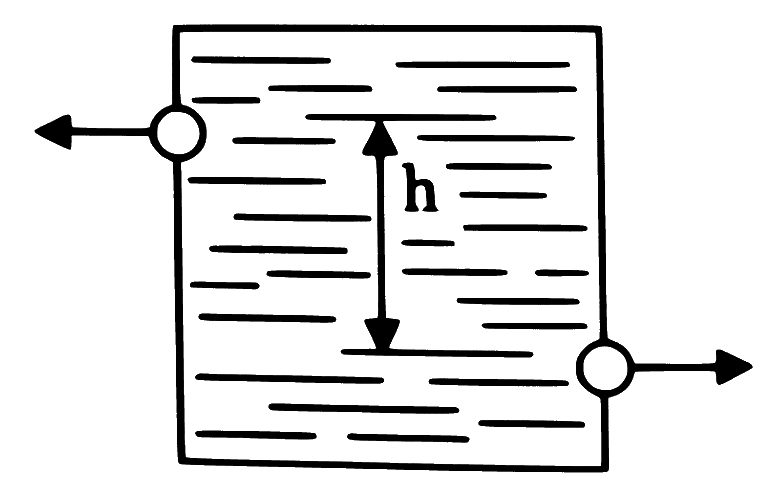
On opposite sides of a wide vertical vessel filled with water (density ρ), two identical holes are drilled, each having cross-section area A. The height difference between holes is x. The resultant force of reaction of water flowing out of vessel is (g = acceleration due to gravity)
Show answer and solution
Answer: (b)
Reaction force of a jet: F=ρAv2=ρA(2gh)=2ρAgh
The jets leave in opposite directions, so the reactions oppose each other.
A vessel completely filled with water has two holes ' P ' and ' Q ' at depths ' 2 h ' and ' 8 h ' from the top respectively. Hole ' P ' is square of side ' a ' and hole ' Q ' is a circle of radius ' r '. The water flowing out per second from both the holes is same, then side ' a ' of hole ' P ' is
Show answer and solution
Answer: (b)
Volume flow rate Q=(area)×v with efflux speed v=2gd at depth d.
There are two identical small holes on the opposite side of a tank containing full of a liquid. The tank is open at the top. The difference in height between the two holes is ' h '. As the liquid comes out of the two holes, the tank will experience a net horizontal force proportional to
Show answer and solution
Answer: (d)
Each jet pushes the tank back with thrust F=ρav2, and v2=2gd at depth d.
The two jets point in opposite directions, so Fnet=ρa(v22−v12)=ρa⋅2g(d2−d1)
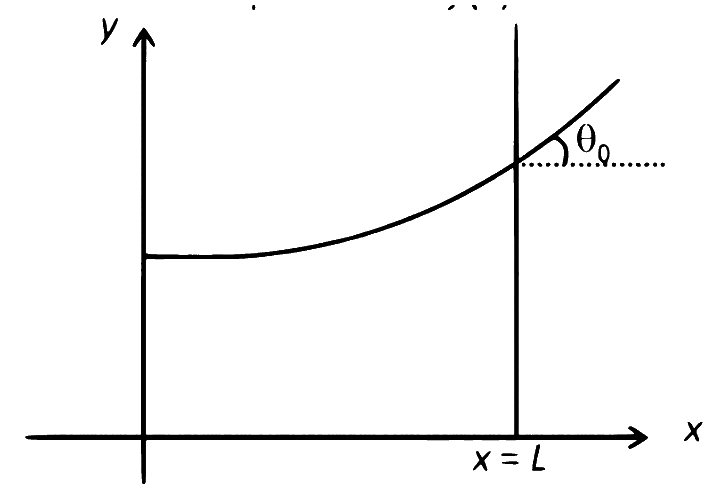
Consider a water tank shown in the figure. It has one wall at x=L and can be taken to be very wide in the z direction. When filled with a liquid of surface tension S and density ρ, the liquid surface makes angle θ0(θ0≪1) with the x-axis at x=L. If y(x) is the height of the surface then the equation for y(x) is:
(take θ(x)=sinθ(x)=tanθ(x)=dxdy,g is the acceleration due to gravity)
Show answer and solution
Answer: (d)
For small slope, curvature of the surface is R1=dx2d2y, so the pressure jump across it is RS=Sdx2d2y.
Liquid just below the surface at height y (above the flat level) has pressure p0−ρgy.
Consider a completely full cylindrical water tank of height 1.6 m and of cross-sectional area 0.5 m2. It has a small hole in its side at a height 90 cm from the bottom. Assume, the cross-sectional area of the hole to be negligibly small as compared to that of the water tank. If a load 50 kg is applied at the top surface of the water in the tank then the velocity of the water coming out at the instant when the hole is opened is:
(g=10 m/s2)
Show answer and solution
Answer: (d)
Extra pressure from load: P=Amg=0.550×10=1000 Pa
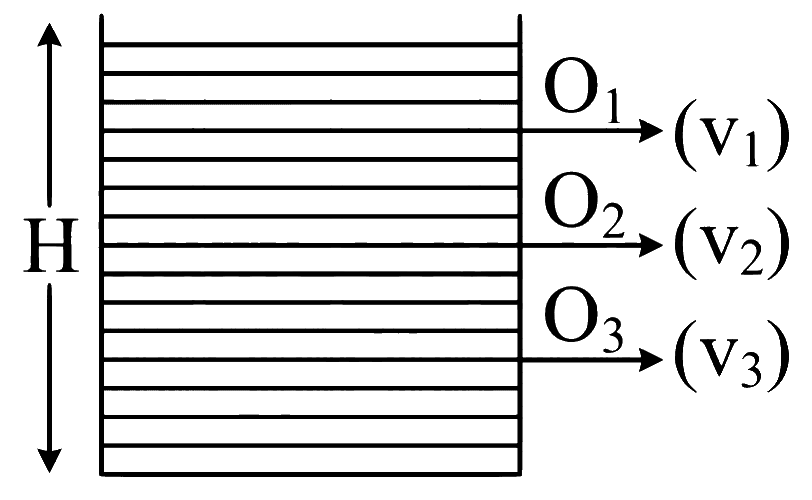
A cylinder contains water upto a height ' H '. It has three orifices O1,O2,O3 as shown in the figure. Let V1,V2,V3 be the speed of efflux of water from the three orifices. Then
Show answer and solution
Answer: (b)
Torricelli: v=2gh, where h is the depth of the orifice below the free surface.
O1 is shallowest and O3 deepest, so h1<h2<h3.
A completely filled water tank of height ' h ' has a hole at the bottom. The total pressure of the bottom is 4 H and atmospheric pressure is H. The velocity of water flowing out of the hole is ( ρ= density of water)
The surface of water in a water tank of cross section area 750 cm2 on the top of a house is ' h ' m above the tap level. The speed of water coming out through the tap of cross section area 500 mm2 is 30 cm/s. At that instant dtdh is x×10−3 m/s. The value of ' x ' will be
A gardening pipe having an internal radius ' R ' is connected to a water sprinkler having ' n ' holes each of radius ' r '. The water in the pipe has a speed ' v '. The speed of water leaving the sprinkler is
Show answer and solution
Answer: (b)
Continuity: flow in the pipe = total flow out of n holes
The reading of pressure metre attached with a closed pipe is 4.5×10⁴ N/m2. On opening the valve, water starts flowing and the reading of pressure metre falls to 2.0×10⁴ N/m2. The velocity of water is found to be V m/s. The value of V is _________.
Numerical answer type. Work it out, then open the answer.
Show answer and solution
Answer: 50
Fall in static pressure becomes kinetic energy: ΔP=21ρv2
There is hole of area A at the bottom of a cylindrical vessel. Water is filled to a height h and water flows out in t second. If water is filled to a height 4h, it will flow out in time (in second)
The surface of water in a water tank of cross section area 750 cm2 on the top of a house is h m above the tap level. The speed of water coming out through the tap of cross section area 500 mm2 is 30 cm/s. At that instant, dtdh is x×10−3 m/s. The value of x will be ____________.
Numerical answer type. Work it out, then open the answer.
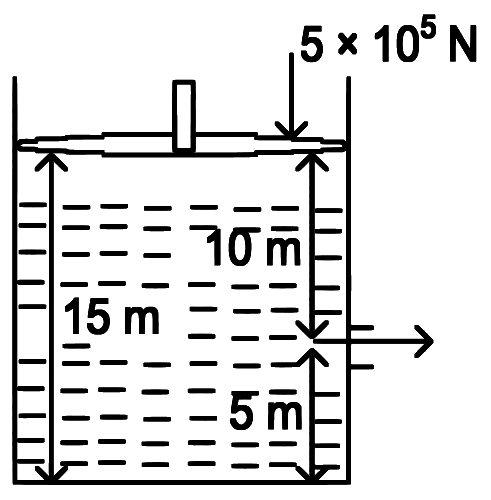
Consider a cylindrical tank of radius 1 m is filled with water. The top surface of water is at 15 m from the bottom of the cylinder. There is a hole on the wall of cylinder at a height of 5 m from the bottom. A force of 5×10⁵ N is applied on the top surface of water using a piston. The speed of efflux from the hole will be: (given atmospheric pressure PA=1.01×10⁵ Pa, density of water ρW=1000 kg/m3 and gravitational acceleration g=10 m/s2)
Show answer and solution
Answer: (c)
Extra pressure from the piston: πr2F=π(1)25×105≈1.59×10⁵ Pa
Full Bernoulli (top to hole, depth 10 m): 21ρv2=AF+ρg(10)=1.59×10⁵+1.0×10⁵⇒v≈22.8 m/s (not among the options)
The official answer uses only the piston pressure: 21ρv2=1.59×10⁵⇒v=318≈17.8 m/s
The area of cross-section of a large tank is 0.5 m2. It has a narrow opening near the bottom having area of cross-section 1 cm2. A load of 25 kg is applied on the water at the top in the tank. Neglecting the speed of water in the tank, the velocity of the water, coming out of the opening at the time when the height of water level in the tank is 40 cm above the bottom, will be ___________ cms−1. [Take g = 10 ms−2]
Numerical answer type. Work it out, then open the answer.
Show answer and solution
Answer: 300
Extra pressure from the load: Amg=0.525×10=500 Pa
The water is filled upto height of 12 m in a tank having vertical sidewalls. A hole is made in one of the walls at a depth 'h' below the water level. The value of 'h' for which the emerging steam of water strikes the ground at the maximum range is ________ m.
Numerical answer type. Work it out, then open the answer.
Show answer and solution
Answer: 6
Hole at depth h, height above ground H−h: range R=2h(H−h)
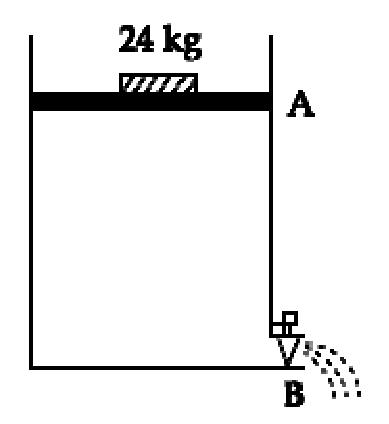
Consider a water tank as shown in the figure. It's cross-sectional area is 0.4 m2. The tank has an opening B near the bottom whose cross-section area is 1 cm2. A load of 24 kg is applied on the water at the top when the height of the water level is 40 cm above the bottom, the velocity of water coming out the opening B is v ms-1.
The value of v, to the nearest integer, is ___________. [Take value of g to be 10 ms-2]
Numerical answer type. Work it out, then open the answer.
Show answer and solution
Answer: 3
Extra pressure from the load: Amg=0.424×10=600 Pa
A light cylindrical vessel is kept on a horizontal surface. Area of base is A. A hole of cross-sectional area 'a' is made just at its bottom side. The minimum coefficient of friction necessary to prevent sliding the vessel due to the impact force of the emerging liquid is (a < < A):
Show answer and solution
Answer: (c)
Efflux speed v=2gh, so the jet's reaction force is F=ρav2=2ρagh.
Vessel is light, so normal force = weight of liquid: N=ρAhg.
A large open tank containing water has two holes to its wall. A square hole of side a is made at a depth y and a circular hole of radius r is made at a depth 16y from the surface of water. If equal amount of water comes out through both the holes per second, then the relation between r and a will be
A small hole of area of cross-section 2 mm2 present near the bottom of a fully filled open tank of height 2 m. Taking g = 10 m/s2, the rate of flow of water through the open hole would be nearly:
Water flows into a large tank with flat bottom at the rate of 10–4m3s–1. Water is also leaking out of a hole ofarea 1 cm2 at its bottom. If the height of the water in the tank remains steady, then this height is -
The top of a water tank is open to air and its water level is mainted. It is giving out 0.74 m3 water per minute through a circular opening of 2 cm radius in its wall. The depth of the center of the opening from the level of water in the tank is close to:
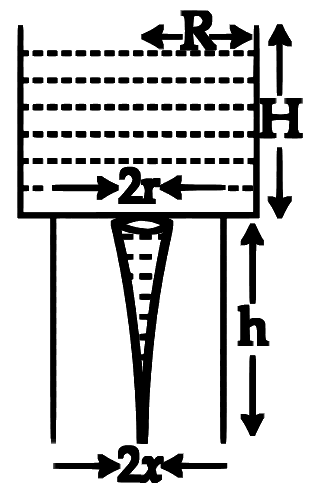
Consider a water jar of radius R that has water filled up to height H and is kept on astand of height h (see figure). Through a hole of radius r (r << R) at its bottom, the water leaks out and the stream of water coming down towards the ground has a shape like a funnel as shown in the figure. If the radius of the cross-section of water stream when it hits the ground is x. Then:
Show answer and solution
Answer: (c)
Speed at the hole: v1=2gH; speed at the ground: v2=2g(H+h).
The cylindrical tube of a spray pump has radius R, one end of which has n fine holes, each of radius r. If the speed of the liquid in the tube is V, the speed of the ejection of the liquid through the holes is
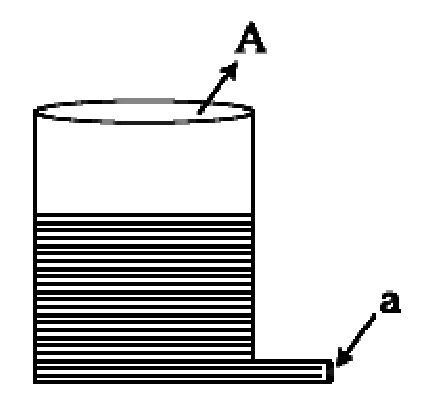
A cylindrical vessel of cross-section A contains water to a height h. There is a hole in the bottom of radius 'a'. The time in which it will be emptied is:
A tank with a small hole at the bottom has been filled with water and kerosene (specific gravity 0.8). The height of water is 3 m and that of kerosene 2 m. When the hole is opened the velocity of fluid coming out from it is nearly: (take g = 10 ms−2 and density of water = 103 kg m−3)
Show answer and solution
Answer: (b)
Gauge pressure at the bottom: ρkghk+ρwghw=800(10)(2)+1000(10)(3)=46000 Pa
A cylinder of height 20 m is completely filled with water. The velocity of efflux of water (in ms−1) through a small hole on the side wall of the cylinder near its bottom is