Statement I: Pressure of a fluid is exerted only on a solid surface in contact as the fluid-pressure does not exist everywhere in a still fluid.
Statement II: Excess potential energy of the molecules on the surface of a liquid, when compared to interior, results in surface tension.
In the light of the above statements, choose the correct answer from the options given below
Show answer and solution
Answer: (a)
Statement I: pressure exists at every point inside a fluid at rest, not only on solid surfaces, so it is false.
Statement II: surface molecules have extra potential energy compared with interior ones; this surface energy per unit area is surface tension, so it is true.
The pressure at half the depth of a lake is equal to two-third pressure at the bottom of the lake. So the depth 'h' of the lake is (ρ = density of water in the lake, g = acceleration due to gravity, P0 = atmospheric pressure).
When a large bubble rises from bottom of a water lake to its surface, then its radius doubles. If the atmospheric pressure is equal to the pressure of height H of a certain water column then the depth of lake will be
Show answer and solution
Answer: (c)
Radius doubles, so volume becomes 8V. At constant temperature, P1V1=P2V2.
Pressure in a Fluid · U-tube, barometer & connected vessels
Two cylindrical vessels of equal cross sectional area of 2 m2 contain water upto heights 10 m and 6 m, respectively. If the vessels are connected at their bottom then the work done by the force of gravity is (Density of water is 103 kg/m3 and g=10 m/s2)
Show answer and solution
Answer: (c)
Final common height =210+6=8 m, so a 2 m layer moves from vessel 1 to vessel 2.
Mass moved: m=ρA×2=1000×2×2=4000 kg.
Its centre of mass falls from 9 m to 7 m, i.e. 2 m.
Pressure in a Fluid · U-tube, barometer & connected vessels
A vessel with square cross-section and height of 6 m is vertically partitioned. A small window of 100 cm2 with hinged door is fitted at a depth of 3 m in the partition wall. One part of the vessel is filled completely with water and the other side is filled with the liquid having density 1.5×10³ kg/m3. What force one needs to apply on the hinged door so that it does not get opened? (Acceleration due to gravity =10 m/s2)
Numerical answer type. Work it out, then open the answer.
Show answer and solution
Answer: 150
Both sides are full (6 m), so the door at depth 3 m feels pressure from each liquid.
Net pressure: ΔP=(ρ2−ρ1)gh=(1500−1000)×10×3=1.5×10⁴ Pa.
The temperature of an air bubble while rising from bottom to surface of a lake remains constant but diameter is doubled. If pressure on the surface is h meter of mercury column and relative density of mercury is ' ρ ' then the depth of the lake is
Show answer and solution
Answer: (b)
Diameter doubles, so volume becomes 8 times. Boyle's law: PbottomV=Psurface(8V), so Pbottom=8Psurface.
When an air bubble rises from the bottom of lake to the surface, its radius is doubled. The atmospheric pressure is equal to that of a column of water of height ' H '. The depth of the lake is
Show answer and solution
Answer: (c)
Radius doubles, so volume becomes 8 times. Boyle's law: P1V=P2(8V).
A drum of radius ' R ' full of liquid of density ' d ' is rotated at angular velocity ' ω ' rad/s. The increase in pressure at the centre of the drum will be
Show answer and solution
Answer: (a)
In a rotating liquid, drdP=dω2r.
Integrating from centre to rim: ΔP=∫0Rdω2rdr=2dω2R2
So the pressure difference between rim and centre is 2ω2R2d; the answer is (a).
Statement I: Pressure in a reservoir of water is same at all points at the same level of water. Statement II: The pressure applied to enclosed water is transmitted in all directions equally. In the light of the above statements, choose the correct answer from the options given below:
Show answer and solution
Answer: (d)
Statement I: in a fluid at rest P=P0+ρgh, so all points at the same level have the same pressure. True.
Statement II: Pascal's law says pressure applied to an enclosed fluid is transmitted equally in all directions. True.
An air bubble of volume 1 cm3 rises from the bottom of a lake 40 m deep to the surface at a temperature of 12∘C. The atmospheric pressure is 1×10⁵ Pa the density of water is 1000 kg/m3 and g=10 m/s2. There is no difference of the temperature of water at the depth of 40 m and on the surface. The volume of air bubble when it reaches the surface will be:
Show answer and solution
Answer: (d)
Pressure at the bottom: P1=105+1000×10×40=5×10⁵ Pa.
Pressure in a Fluid · U-tube, barometer & connected vessels
Two copper vessels A and B have the same base area but of different shapes. A takes twice the volume of water as that B requires to fill upto a particular common height. Then the correct statement among the following is:
Show answer and solution
Answer: (b)
Pressure on the base depends only on the liquid height: P=P0+ρgh, not on the vessel shape or volume.
Both are filled to the same height, so the pressure on the bases is the same.
A holds more water, so A (with water) weighs more; (a) and (d) are wrong.
Pressure in a Fluid · U-tube, barometer & connected vessels
Two cylindrical vessels of equal cross-sectional area 16 cm2 contain water upto heights 100 cm and 150 cm respectively. The vessels are interconnected so that the water levels in them become equal. The work done by the force of gravity during the process, is [Take, density of water =103 kg/m3 and g=10 m s−2 ]:
Show answer and solution
Answer: (b)
Final common height =2100+150=125 cm, so a 25 cm layer moves across.
Mass moved: m=103×16×10−4×0.25=0.4 kg.
Its centre falls from 137.5 cm to 112.5 cm, i.e. 0.25 m.
The pressure acting on a submarine is 3 × 10⁵ Pa at a certain depth. If the depth is doubled, the percentage increase in the pressure acting on the submarine would be:
(Assume that atmospheric pressure is 1 × 10⁵ Pa and density of water is 103 kg m−3, g = 10 ms−2)
Pressure in a Fluid · U-tube, barometer & connected vessels
Two identical cylindrical vessels are kept on the ground and each contain the same liquid of density d. The area of the base of both vessels is S but the height of liquid in one vessel is x1 and in the other, x2. When both cylinders are connected through a pipe of negligible volume very close to the bottom, the liquid flows from one vessel to the other until it comes to equilibrium at a new height. The change in energy of the system in the process is:
Show answer and solution
Answer: (c)
PE of a liquid column of height x: U=21dgSx2.
Initial: Ui=21dgS(x12+x22). Final height h=2x1+x2, so Uf=dgSh2=41dgS(x1+x2)2.
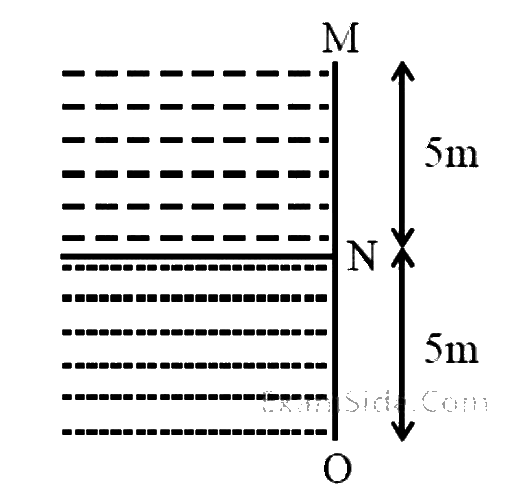
Two liquids of densities ρ1 and ρ2 (ρ2 = 2ρ1) are filled up behind a square wall of side 10 m as shown in figure. Each liquid has a height of 5 m. The ratio of the forces due to these liquids exerted on upper part MN to that at the lower part NO is (Assume that the liquids are not mixing)
Show answer and solution
Answer: (c)
Force on a vertical strip = average pressure × area; both parts have area 5×10=50 m2.
MN: average pressure =ρ1g×2.5, so F1=2.5ρ1g×50.
NO: average pressure =ρ1g×5+ρ2g×2.5=5ρ1g+5ρ1g=10ρ1g, so F2=10ρ1g×50.
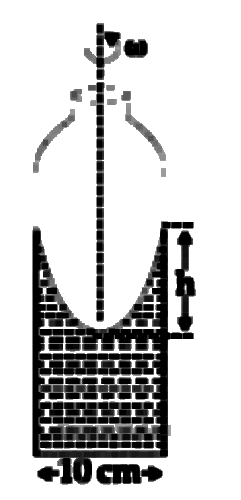
A cylindrical vessel containing a liquid is rotated about its axis so that the liquid rises at its sides as shown in the figure. The radius of vessel is 5 cm and the angular speed of rotation is ω rad s–1. The difference in the height, h (in cm) of liquid at the centre of vessel and at the side will be:
Show answer and solution
Answer: (c)
Free surface of a rotating liquid is a paraboloid: h=2gω2r2.
A submarine experiences a pressure of 5.05 × 10⁶ Pa at a depth of d1 in a sea. When it goes further to a depth of d2, it experiences a pressure of 8.08 × 10⁶ Pa. Then d2 –d1 is approximately (density of water = 103 kg/m3 and acceleration due to gravity = 10 ms–2):
Pressure in a Fluid · U-tube, barometer & connected vessels
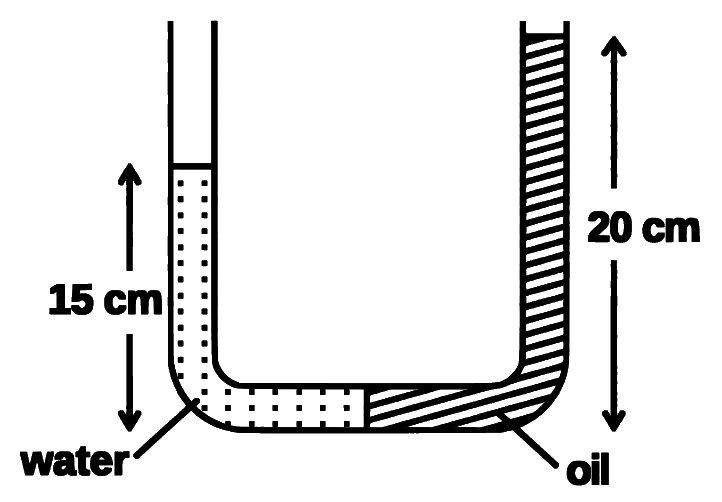
In a u-tube as shown in the fig. water and oil are in the left side and right side of the tube respectively. The heights from the bottom for water and oil columns are 15 cm and 20 cm respectively. The density of the oil is
[take ρwater=1000 kg/m3]
Show answer and solution
Answer: (c)
Pressures at the same level in the bottom (both sides open to air) must be equal: ρwghw=ρogho.
When a large bubble rises from bottom of a water lake to its surface, then its radius doubles. If the atmospheric pressure is equal to the pressure of height H of a certain water column, then the depth of lake will be
Show answer and solution
Answer: (c)
Radius doubles, so volume becomes 8 times. Boyle's law: P1V=P2(8V).
A long cylindrical vessel is half filled with a liquid. When the vessel is rotated about its own vertical axis, the liquid rises up near the wall. If the radius of vessel is 5 cm and its rotational speed is 2 rotations per second, then the difference in the heights between the centre and the sides, in cm, will be:
Show answer and solution
Answer: (a)
Height difference for a rotating liquid: h=2gω2r2.
When an air bubble of radius r rises from the bottom to the surface of a lake its radius becomes 45r Taking the atmospheric pressure to be equal to 10 m height of water column, the depth of the lake would approximately be (ignore the surface tension and the effect of temperature):
Show answer and solution
Answer: (c)
Volume ratio: V1V2=(45)3=64125.
Boyle's law in water-column units: (10+h)×64=10×125
Pressure in a Fluid · U-tube, barometer & connected vessels
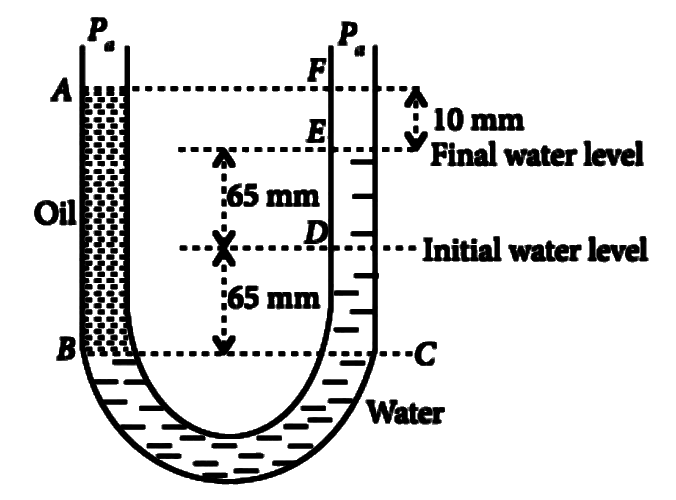
A U tube with both ends open to the atmosphere, is partially filled with water. Oil, which is immiscible with water, is poured into one side until it stands at a distance of 10 mm above the water level on the other side. Meanwhile the water rises by 65 mm from its original level (see diagram). The density of the oil is
Show answer and solution
Answer: (c)
Water rises 65 mm on one side and falls 65 mm on the other, so take level BC at the oil-water interface.
Water column above BC: 65+65=130 mm. Oil column above BC: 130+10=140 mm.
Density, Compressibility & Pascal's Law · Pascal's law & hydraulic lift
In a hydraulic press, the piston in the small cylinder has a diameter of d1 cm, while the larger piston has a diameter of d2 cm. If a force F1 is applied to the small piston, then the force F2 on the large piston is given by
Show answer and solution
Answer: (a)
Pascal's law: same pressure on both pistons, A1F1=A2F2.
Density, Compressibility & Pascal's Law · Pascal's law & hydraulic lift
In a hydraulic press, the small cylinder has a diameter of d1 cm, while the large cylinder has a diameter of d2 cm. If a force F1 is applied to a piston of small cylinder, then the force on the piston of large cylinder F2 is
Density, Compressibility & Pascal's Law · Pascal's law & hydraulic lift
A piston of cross-sectional area 2.5×10⁻² m2 is used in a hydraulic lift to exert a force of 250 N on water. The cross-sectional area of the other piston which supports a car of mass 3000 kg is (g=9.8 m/s2)
Density, Compressibility & Pascal's Law · Density, mixtures & compressibility
A sample of a liquid is kept at 1 atm. It is compressed to 5 atm which leads to a change of volume of 0.8 cm3. If the bulk modulus of the liquid is 2 GPa, the initial volume of the liquid was _______ litre. (Take 1 atm = 105 Pa)
Numerical answer type. Work it out, then open the answer.
Density, Compressibility & Pascal's Law · Density, mixtures & compressibility
The increase in pressure required to decrease the volume of a water sample by 0.2% is P×105 N m−2. Bulk modulus of water is 2.15×10⁹ N m−2. The value of P is _________.
Numerical answer type. Work it out, then open the answer.
Density, Compressibility & Pascal's Law · Pascal's law & hydraulic lift
In a hydraulic lift, the surface area of the input piston is 6 cm2 and that of the output piston is 1500 cm2. If 100 N force is applied to the input piston to raise the output piston by 20 cm, then the work done is _______ kJ.
Numerical answer type. Work it out, then open the answer.
Density, Compressibility & Pascal's Law · Density, mixtures & compressibility
The fractional compression (VΔV) of water at the depth of 2.5 km below the sea level is __________ %. Given, the Bulk modulus of water = 2×10⁹ N m−2, density of water = 103 kg m−3, acceleration due to gravity g=10 m s−2.
Show answer and solution
Answer: (b)
Extra pressure at depth h: P=ρgh=103×10×2500=2.5×10⁷ Pa.
Density, Compressibility & Pascal's Law · Pascal's law & hydraulic lift
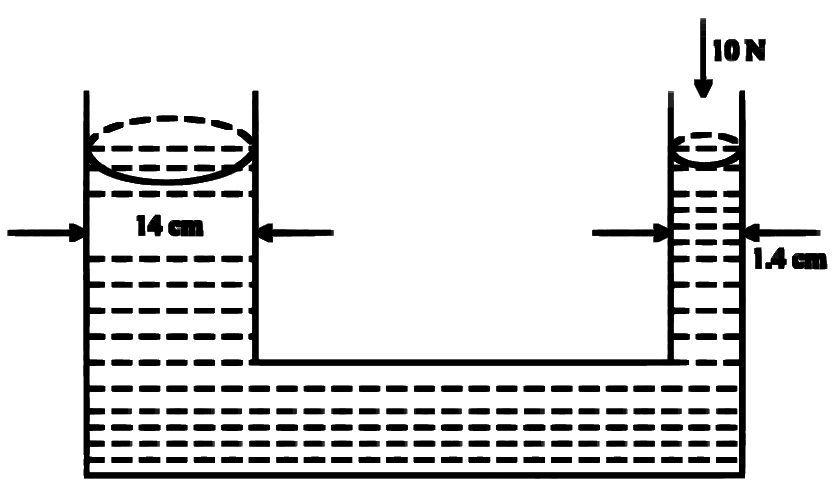
A hydraulic press containing water has two arms with diameters as mentioned in the figure. A force of 10 N is applied on the surface of water in the thinner arm. The force required to be applied on the surface of water in the thicker arm to maintain equilibrium of water is _________ N.
Numerical answer type. Work it out, then open the answer.
Density, Compressibility & Pascal's Law · Density, mixtures & compressibility
If average depth of an ocean is 4000 m and the bulk modulus of water is 2×10⁹ N m−2, then fractional compression VΔV of water at the bottom of ocean is α×10−2. The value of α is _______ (Given, g=10 m s−2,ρ=1000 kg m−3)
Numerical answer type. Work it out, then open the answer.
Show answer and solution
Answer: 2
Pressure at the bottom: P=ρgh=1000×10×4000=4×10⁷ Pa.
Density, Compressibility & Pascal's Law · Density, mixtures & compressibility
A certain pressure 'P' is applied to 1 litre of water and 2 litre of a liquid separately. Water gets compressed to 0.01% whereas the liquid gets compressed to 0.03%. The ratio of Bulk modulus of water to that of the liquid is x3. The value of x is ____________.
Numerical answer type. Work it out, then open the answer.
Show answer and solution
Answer: 1
B=ΔV/VP; with the same P, B∝ΔV/V1 (original volume does not matter).
Density, Compressibility & Pascal's Law · Pascal's law & hydraulic lift
A hydraulic automobile lift is designed to lift vehicles of mass 5000 kg. The area of cross section of the cylinder carrying the load is 250 cm2. The maximum pressure the smaller piston would have to bear is [ Assume g=10 m/s2]
Show answer and solution
Answer: (d)
Pressure is the same throughout the fluid (Pascal's law), so the small piston bears the same pressure as the load cylinder.
Density, Compressibility & Pascal's Law · Pascal's law & hydraulic lift
Given below are two statements: one is labelled as Assertion A and the other is labelled as Reason R
Assertion A: When you squeeze one end of a tube to get toothpaste out from the other end, Pascal's principle is observed.
Reason R: A change in the pressure applied to an enclosed incompressible fluid is transmitted undiminished to every portion of the fluid and to the walls of its container.
In the light of the above statements, choose the most appropriate answer from the options given below
Show answer and solution
Answer: (d)
Squeezing one end raises the pressure, and that pressure is transmitted through the paste to the open end, pushing it out: Pascal's principle. A is correct.
R is the statement of Pascal's law, which is correct and explains A.
Density, Compressibility & Pascal's Law · Pascal's law & hydraulic lift
A hydraulic press can lift 100 kg when a mass 'm' is placed on the smaller piston. It can lift ___________ kg when the diameter of the larger piston is increased by 4 times and that of the smaller piston is decreased by 4 times keeping the same mass 'm' on the smaller piston.
Numerical answer type. Work it out, then open the answer.
Show answer and solution
Answer: 25600
Load lifted M=mA1A2=m(dD)2.
New ratio: d/44D=16dD, so area ratio becomes 162=256 times larger.
Density, Compressibility & Pascal's Law · Density, mixtures & compressibility
An object is located at 2 km beneath the surface of the water. If the fractional compression VΔV is 1.36%, the ratio of hydraulic stress to the corresponding hydraulic strain will be ____________. [Given: density of water is 1000 kgm−3 and g = 9.8 ms−2]
Show answer and solution
Answer: (b)
Hydraulic stress =ρgh=1000×9.8×2000=1.96×10⁷ Pa.
Stress/strain is the bulk modulus: B=ΔV/Vρgh=0.01361.96×107
Density, Compressibility & Pascal's Law · Density, mixtures & compressibility
The normal density of a material is ρ and its bulk modulus of elasticity is K. The magnitude of increase in density of material, when a pressure P is applied uniformly on all sides, will be:
Density, Compressibility & Pascal's Law · Density, mixtures & compressibility
When a rubber ball is taken to a depth of __________m in deep sea, its volume decreases by 0.5%. (The bulk modulus of rubber = 9.8 × 10⁸ Nm−2, Density of sea water = 103 kgm−3, g = 9.8 m/s2)
Numerical answer type. Work it out, then open the answer.
Density, Compressibility & Pascal's Law · Density, mixtures & compressibility
A solid sphere of radius r made of a soft material of bulk modulus K is surrounded by a liquid in a cylindrical container. A massless piston of area a floats on the surface of the liquid, covering entire cross section of cylindrical container. When a mass m is placed on the surface of the piston to compress the liquid, the fractional decrement in the radius of the sphere, (rdr) is:
Show answer and solution
Answer: (d)
Extra pressure on the liquid (Pascal's law): P=amg, transmitted to the sphere.
Density, Compressibility & Pascal's Law · Density, mixtures & compressibility
The approximate depth of an ocean is 2700 m. The compressiblity of water is 45.4 × 10⁻¹¹ Pa−1 and density of water is 103 kg/m3. What fractional compression of water will be obtained at the bottom of the ocean?
Show answer and solution
Answer: (a)
Pressure at the bottom (gauge): P=ρgh=103×9.8×2700=2.65×10⁷ Pa.
Density, Compressibility & Pascal's Law · Density, mixtures & compressibility
The Bulk moduli of Ethanol, Mercury and water are given as 0.9, 25 and 2.2 respectively in units of 109 Nm−2. For a given value of pressure, the fractional compression in volume is VΔV. Which of the following statements about VΔV for these three liquids is correct?
Show answer and solution
Answer: (a)
VΔV=BP, so for the same pressure the smaller B gives larger compression.
Density, Compressibility & Pascal's Law · Density, mixtures & compressibility
A ball is made of a material of density ρ where ρoil<ρ<ρwater with ρoil and ρwater representing the densities of oil and water, respectively. The oil and water are immiscible. If the above ball is in equilibrium in a mixture of this oil and water, which of the following pictures represents its equilibrium position?
Show answer and solution
Answer: (b)
Oil is lighter than water, so oil forms the upper layer and water the lower layer.
ρ>ρoil: the ball sinks through oil. ρ<ρwater: it cannot sink into water fully.
So it rests at the oil–water interface, partly in each liquid.
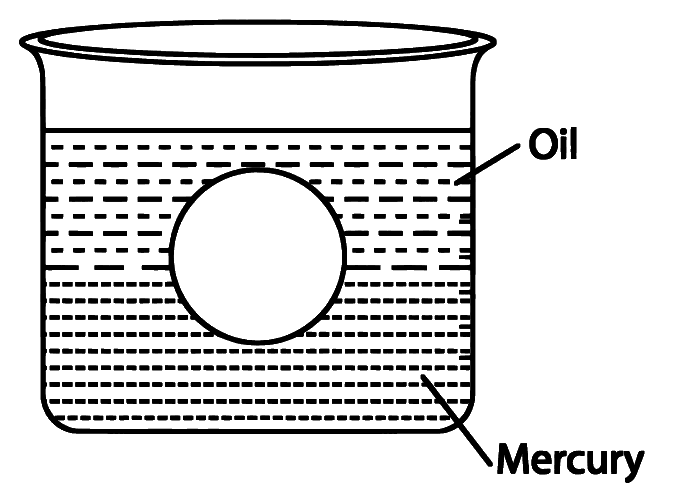
A vessel contains oil (density=0.6 g/cm3) over mercury (density=13.6 g/cm3). A homogeneous sphere floats with half its volume immersed in mercury and the remaining half in oil. The density of the material of the sphere in g/cm3 is
A vessel contains oil (density =0.8 gm/cm3) over mercury (density =13.6 gm/cm3). A homogeneous sphere floats with half of its volume immersed in mercury and the other half in oil. The density of the material of the sphere in gm/cm3 is
A cubical block of density ρb=600 kg/m3 floats in a liquid of density ρe=900 kg/m3. If the height of block is H=8.0 cm then height of the submerged part is
A tub is filled with water and a wooden cube 10 cm ×10 cm ×10 cm is placed in the water. The wooden cube is found to float on the water with a part of it submerged in water. When a metal coin is placed on the wooden cube, the submerged part is increased by 3.87 cm. The mass of the metal coin is ________ gram.
(Take water density as 1 g/cm3 and density of wood as 0.4 g/cm3)
Numerical answer type. Work it out, then open the answer.
Show answer and solution
Answer: 387
Coin weight = extra upthrust = weight of extra water displaced.
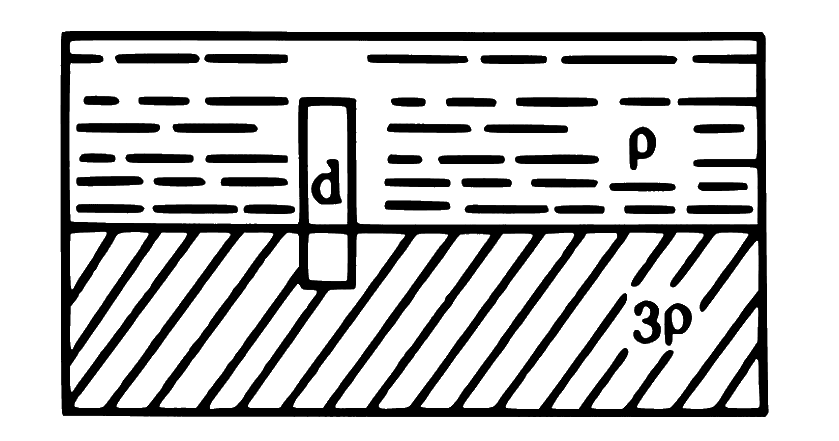
A solid cylinder of length l and cross-sectional area 5a is immersed such that it floats with its axis vertical at the liquid-liquid interface with length l/4 in the denser liquid as shown in figure. The lower density liquid ( ρ) is open to atmosphere having pressure P0. The density d of solid cylinder is
Show answer and solution
Answer: (b)
From the figure, the lower liquid has density 3ρ and the upper liquid ρ; the cylinder has l/4 in 3ρ and 3l/4 in ρ.
A small metal sphere of density ρ is dropped from height h into a jar containing liquid of density σ(σ>ρ). The maximum depth up to which the sphere sinks is (Neglect damping forces)
Show answer and solution
Answer: (d)
Speed on reaching the liquid: v2=2gh.
In the liquid, net upward force =V(σ−ρ)g, so retardation a=ρ(σ−ρ)g.
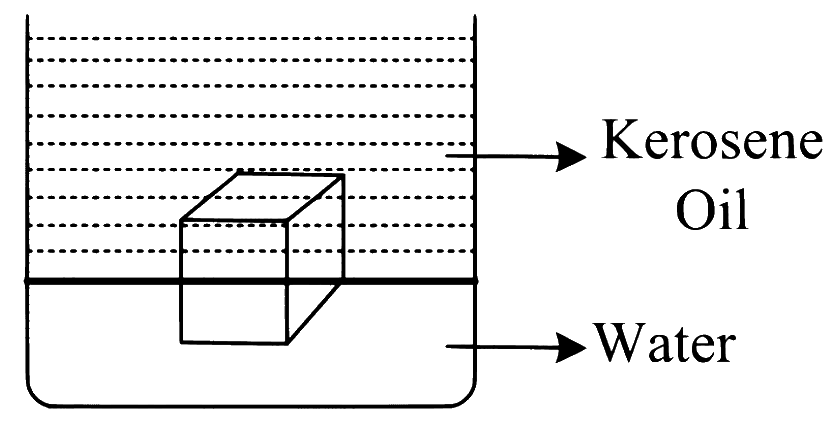
A cube of ice floats partly in water and partly in kerosene oil. The ratio of volume of ice immersed in water to that in kerosene oil (specific gravity of Kerosene oil = 0.8, specific gravity of ice = 0.9):
Show answer and solution
Answer: (d)
Let Vw, Vk be the volumes in water and kerosene, V=Vw+Vk.
A hemispherical portion of radius ' R ' is removed from the bottom of a cylinder of radius ' R '. The volume of the remaining cylinder is ' V ' and its mass is ' M '. It is suspended by a string in a liquid of density ' ρ ', where it stays vertical. The upper surface of the cylinder is at a depth ' h ' below the liquid surface. The force on the bottom of the cylinder by the liquid is
Show answer and solution
Answer: (d)
Upthrust = (force on bottom, upward) − (force on top, downward) =Vρg.
The fundamental frequency of a sonometer wire carrying a block of mass 'M' and density 'ρ' is 'n' Hz. When the block is completely immersed in a liquid of density 'σ' then the new frequency will be
A body of density 'ρ' is dropped from rest at a height 'h' into a lake of density 'σ(σ>ρ). The maximum depth to which the body sinks before returning to float on the surface is (neglect air dissipative forces)
Show answer and solution
Answer: (a)
Speed at the lake surface: v2=2gh.
In water, net upward force =V(σ−ρ)g, so retardation a=ρ(σ−ρ)g.
A body of density V is dropped from (at rest) height 'h' into a lake of density 'δ' (δ>ρ). The maximum depth to which the body sinks before returning to float on the surface is [Neglect all dissipative forces]
Show answer and solution
Answer: (d)
Speed at the lake surface: v2=2gh.
In water, net upward force =V(δ−ρ)g, so retardation a=ρ(δ−ρ)g.
A hollow spherical shell of outer radius R floats just submerged under the water surface. The inner radius of the shell is r. If the specific gravity of the shell material is 827 w.r.t water, the value of r is:
Show answer and solution
Answer: (d)
Just submerged: weight of shell = upthrust on full outer volume.
A leak proof cylinder of length 1m, made of a metal which has very low coefficient of expansion is floating vertically in water at 0°C such that its height above the water surface is 20 cm. When the temperature of water is increased to 4°C, the height of the cylinder above the water surface becomes 21 cm. The density of water at T = 4°C, relative to the density at T = 0°C is close to:
Show answer and solution
Answer: (c)
Weight is constant, so ρhsub = constant (same cross-section).
Submerged length: 100−20=80 cm at 0∘C, 100−21=79 cm at 4∘C.
A air bubble of radius 1 cm in water has an upward acceleration 9.8 cm s–2. The density of water is 1 gm cm–3 and water offers negligible drag force on the bubble. The mass of the bubble is (g = 980 cm/s2).
Show answer and solution
Answer: (d)
Newton's law for the bubble: Vρwg−mg=ma⇒m=g+aVρwg.
A cubical block of side 0.5 m floats on water with 30% of its volume under water. What is the maximum weight that can be put on the block without fully submerging it under water? [Take, density of water = 103 kg/m3]
Show answer and solution
Answer: (b)
Volume V=0.53=0.125 m3. Block mass = displaced water mass =0.3×0.125×103=37.5 kg.
Fully submerged, upthrust supports 0.125×103=125 kg.
A wooden block floating in a bucket of water has 4/5 of its volume submerged. When certain amount of an oil is poured into the bucket, it is found that the block is just under the oil surface with half of its volume under water and half in oil. The density of oil relative to that of water is :-
A thin uniform tube is bent into a circle of radius r in the vertical plane. Equal volumes of two immiscible liquids, whose densities are ρ1 and ρ2(ρ1>ρ2), fill half the circle. The angle θ between the radius vector passing through the common interface and the vertical is:
Show answer and solution
Answer: (c)
Each liquid fills a quarter circle (90∘). With the interface at angle θ from the vertical, the free surfaces are at angles θ−90∘ and θ+90∘.
Height of heavy liquid (ρ1) above the interface: r(cosθ−sinθ); of light liquid (ρ2): r(cosθ+sinθ).
Equal pressure at the interface: ρ1gr(cosθ−sinθ)=ρ2gr(cosθ+sinθ)
Two non-mixing liquids of densities ρ and nρ (n > 1) are put in a container. The height of each liquid is h. A solid cylinder of length L and density d is put in this container. The cylinder floats with its axis vertical and length pL (p < 1) in the denser liquid. The density d is equal to
An open glass tube is immersed in mercury in such a way that a length of 8 cm extends above the mercury level. The open end of the tube is then closed and sealed and the tube is raised vertically up by additional 46 cm. What will be length of the air column above mercury in the tube now? (Atmospheric pressure =76 cm of Hg)
Show answer and solution
Answer: (a)
Initially air column 8 cm at 76 cm Hg. After raising, the tube top is 8+46=54 cm above the outside mercury level.
Let air length be x; mercury column inside above outside level =54−x, so air pressure =76−(54−x)=22+x cm Hg.
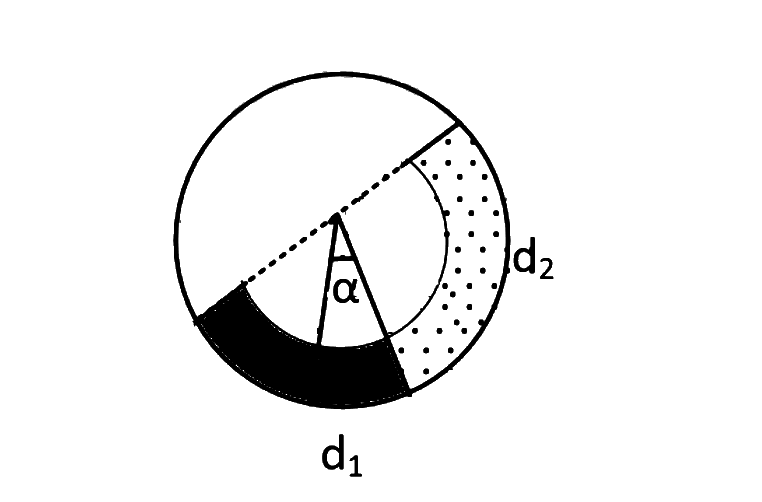
There is a circular tube in a vertical plane. Two liquids which do not mix and of densities d1 and d2 are filled in the tube. Each liquid subtends 90∘ angle at center. Radius joining their interface makes an angle α with vertical. Ratio d2d1 is:
Show answer and solution
Answer: (c)
Same as a quarter-circle each: heavy liquid d1 rises r(cosα−sinα) above the interface, light liquid d2 rises r(cosα+sinα).
Equal pressure at the interface: d1gr(cosα−sinα)=d2gr(cosα+sinα)
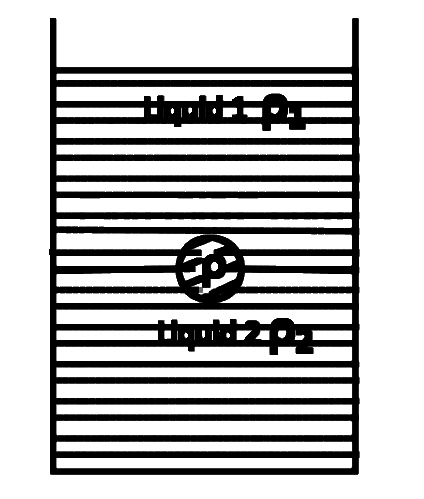
A jar is filled with two non-mixing liquids 1 and 2 having densities ρ1 and ρ2 respectively. A solid ball, made of a material of density ρ3, is dropped in the jar. It comes to equilibrium in the position shown in the figure. Which of the following is true for ρ1,ρ1 and ρ3?
Show answer and solution
Answer: (d)
Liquid 1 is on top of liquid 2, so ρ1<ρ2.
The ball sits at the interface: it sinks through liquid 1 (ρ3>ρ1) but floats on liquid 2 (ρ3<ρ2).