0 of 448 attemptedPick an answer to see the solution
Q1JEE Main 2026 · 22 JAN · SHIFT 1Medium
Newton's Law of Gravitation · Superposition: force due to many particles
Net gravitational force at the center of a square is found to be F1 when four particles having mass M,2M,3M and 4M are placed at the four corners of the square as shown in figure and it is F2 when the positions of 3M and 4M are interchanged. The ratio F2F1 is 5α. The value of α is ______.
Show answer and solution
Answer: (a)
Each corner is at the same distance r from the centre, so each pull is r2GMim along the unit vector to that corner, 2(±1,±1).
Take M(−1,−1), 2M(1,−1), 3M(1,1), 4M(−1,1): ∑Mi(x,y)=M(0,4), so F1∝24.
Newton's Law of Gravitation · Superposition: force due to many particles
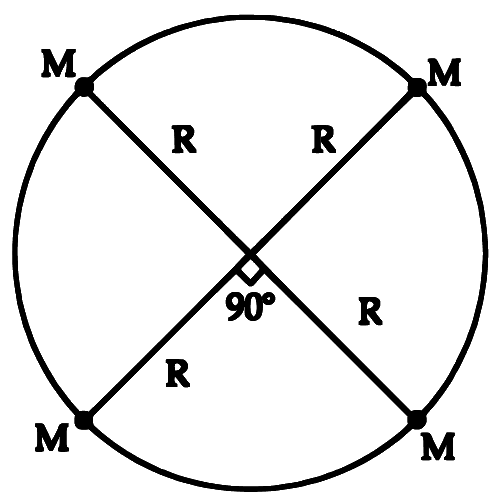
Three identical spheres of mass m, are placed at the vertices of an equilateral triangle of length a. When released, they interact only through gravitational force and collide after a time T=4 seconds. If the sides of the triangle are increased to length 2a and also the masses of the spheres are made 2 m, then they will collide after__________seconds.
Numerical answer type. Work it out, then open the answer.
Show answer and solution
Answer: 8
Acceleration scales as a2Gm and distance as a, so T∝Gm/a2a=Gma3.
Newton's Law of Gravitation · Finite bodies: spheres, cavities, rods, rings
A small point of mass m is placed at a distance 2R from the centre ' O ' of a big uniform solid sphere of mass M and radius R. The gravitational force on ' m ' due to M is F1. A spherical part of radius R/3 is removed from the big sphere as shown in the figure and the gravitational force on m due to remaining part of M is found to be F2. The value of ratio F1:F2 is
Show answer and solution
Answer: (b)
F1=(2R)2GMm=4R2GMm
Removed sphere: mass 27M, centre at R−3R=32R from O, so 34R from m.
Newton's Law of Gravitation · Superposition: force due to many particles
Four identical particles of mass m are kept at the four corners of a square. If the gravitational force exerted on one of the masses by the other masses is (3222+1)L2Gm2, the length of the sides of the square is
Show answer and solution
Answer: (a)
Let the side be a. Two adjacent masses each pull with a2Gm2 at 90∘: resultant a22Gm2 along the diagonal.
Diagonal mass at 2a pulls along the same diagonal: 2a2Gm2.
Newton's Law of Gravitation · Finite bodies: spheres, cavities, rods, rings
Two identical metal spheres are kept in contact with each other, each having radius ' R ' cm and ' ρ ' is the density of material of metal spheres. The gravitational force ' F ' of attraction between them is proportional to
Show answer and solution
Answer: (b)
Each mass M=34πR3ρ; centres in contact are 2R apart.
Newton's Law of Gravitation · Finite bodies: spheres, cavities, rods, rings
A metal wire of uniform mass density having length L and mass M is bent to form a semicircular arc and a particle of mass m is placed at the centre of the arc. The gravitational force on the particle by the wire is:
Show answer and solution
Answer: (d)
Semicircle of length L: radius r=πL, linear density λ=LM.
Components along the diameter cancel; along the symmetry axis F=∫0πr2Gmλrdθsinθ=r2Gmλ.
Newton's Law of Gravitation · Superposition: force due to many particles
A system consists of three particles each of mass 'm1 ' placed at the corners of an equilateral triangle of side ' 3L ', A particle of mass 'm2 ' is placed at the mid point of any one side of the triangle. Due to the system of particles, the force acting on m2 is
Show answer and solution
Answer: (d)
The two masses at the ends of the side pull m2 equally in opposite directions, so they cancel.
Only the opposite vertex acts, at distance equal to the height h=23⋅3L=63L.
Newton's Law of Gravitation · Finite bodies: spheres, cavities, rods, rings
If two identical spherical bodies of same material and dimensions are kept in contact, the gravitational force between them is proportional to Rx, where x is non zero integer [Given: R is radius of each spherical body]
Show answer and solution
Answer: (b)
Mass of each sphere M∝R3 (same density); separation of centres =2R.
Newton's Law of Gravitation · Newton's law, G & nature of the force
Two objects of equal masses placed at certain distance from each other attracts each other with a force of F. If one-third mass of one object is transferred to the other object, then the new force will be:
Show answer and solution
Answer: (c)
Initially F=r2Gm⋅m.
After transfer the masses are 32m and 34m, product 98m2.
Newton's Law of Gravitation · Newton's law, G & nature of the force
Given below are two statements:
Statement I: The law of gravitation holds good for any pair of bodies in the universe. Statement II: The weight of any person becomes zero when the person is at the centre of the earth. In the light of the above statements, choose the correct answer from the options given below.
Show answer and solution
Answer: (a)
Statement I: Newton's law of gravitation is universal, so it holds for any pair of bodies. True.
Statement II: gd=g(1−Rd)=0 at d=R, so weight mgd=0 at the centre. True.
Newton's Law of Gravitation · Superposition: force due to many particles
Three identical particles A,B and C of mass 100 kg each are placed in a straight line with AB=BC=13 m. The gravitational force on a fourth particle P of the same mass is F, when placed at a distance 13 m from the particle B on the perpendicular bisector of the line AC. The value of F will be approximately:
Show answer and solution
Answer: (b)
B pulls P from 13 m: FB=169G(100)2≈59.2G.
A and C are at 132 m: each 338G(100)2≈29.6G, at 45∘ to PB.
Sideways parts cancel; along PB: 2×29.6Gcos45∘≈41.8G.
Newton's Law of Gravitation · Finite bodies: spheres, cavities, rods, rings
Find the gravitational force of attraction between the ring and sphere as shown in the diagram, where the plane of the ring is perpendicular to the line joining the centres. If 8R is the distance between the centres of a ring (of mass 'm') and a sphere (mass 'M') where both have equal radius 'R'.
Show answer and solution
Answer: (c)
The sphere acts as a point mass M at its centre, on the axis of the ring.
Field of a ring on its axis: E=(R2+x2)3/2Gmx, with x=8R.
Newton's Law of Gravitation · Finite bodies: spheres, cavities, rods, rings
A solid sphere of radius R gravitationally attracts a particle placed at 3R from its centre with a force F1. Now a spherical cavity of radius (2R) is made in the sphere (as shown in figure) and the force becomes F2. The value of F1: F2 is
Show answer and solution
Answer: (c)
F1=(3R)2GMm=9R2GMm
Cavity of radius 2R has mass 8M; its centre B is 2R from O, so 3R−2R=25R from m.
Pull of the cavity part: (5R/2)2G(M/8)m=50R2GMm
F2=GMm(91−501)R21=450R241GMm
F1:F2=45050:45041=50:41, so the answer is (c).
Newton's Law of Gravitation · Finite bodies: spheres, cavities, rods, rings
A straight rod of length L extends from x = a to x = L + a. The gravitational force it exerts on a point mass 'm' at x = 0, if the mass per unit length of the rod is A + Bx2, is given by:
Show answer and solution
Answer: (b)
Element dx at x has mass (A+Bx2)dx and pulls m with dF=x2Gm(A+Bx2)dx.
Newton's Law of Gravitation · Newton's law, G & nature of the force
Take the mean distance of the moon and the sun from the earth to be 0.4×10⁶ km and 150×106 km respectively. Their masses are 8×10²² kg and 2×1030 kg respectively. The radius of the earth is 6400 km. Let ΔF1 be the difference in the forces exerted by the moon at the nearest and farthest points on the earth and ΔF2 be the difference in the force exerted by the sun at the nearest and farthest points on the earth. Then, the number closest to ΔF2ΔF1 is:
Show answer and solution
Answer: (a)
Difference between near and far points: ΔF≈d3GMm⋅2(2Re), so ΔF∝d3M.
Newton's Law of Gravitation · Finite bodies: spheres, cavities, rods, rings
From a sphere of mass M and radius R, a smaller sphere of radius 2R is carved out such that the cavity made in the original sphere is between its centre and the periphery. (See figure). For the configuration in the figure where the distance between the center of the original sphere and the removed sphere is 3R, the gravitational force between the two spheres is:
Show answer and solution
Answer: (a)
Removed sphere: mass 8M; it sits 3R from O. The cavity centre is 2R from O, so 3R−2R=25R from the removed sphere.
Remaining part = full sphere M minus cavity sphere 8M.
Newton's Law of Gravitation · Superposition: force due to many particles
The change in the value of acceleration of earth towards sun, when the moon comes from the position of solar eclipse to the position on the other side of earth in line with sun is: (mass of the moon = 7.36×10²² kg, radius of the moon's orbit = 3.8×10⁸ m).
Show answer and solution
Answer: (a)
Moon's pull gives the earth an acceleration a=r2GMm, toward the sun at eclipse and away from it on the other side.
Newton's Law of Gravitation · Newton's law, G & nature of the force
(1) Centre of gravity (C.G) of a body is the point at which the weight of the body acts (2) Centre of mass coincides with the centre of gravity if the earth is assumed to have infinitely large radius.
(3) To evaluate the gravitational field intensity due to any body at an external point, the entire mass of the body can be considered to be concentrated at its C.G.
(4) The radius of gyration of any body rotating about an axis is the length of the perpendicular dropped from the C.G. of the body to the axis.
Which one of the following pairs of statements is correct?
Show answer and solution
Answer: (a)
(1) True: C.G. is the point where the total weight of the body acts.
(2) True: for an earth of infinite radius g is uniform over the body, and then C.M. and C.G. coincide.
(3) False: treating the whole mass as concentrated at one point is exact only for spherically symmetric bodies.
(4) False: radius of gyration K is defined by I=MK2, not as the perpendicular distance of the C.G. from the axis.
Newton's Law of Gravitation · Newton's law, G & nature of the force
A man of 50 kg mass is standing in a gravity free space at a height of 10 m above the floor. He throws a stone of 0.5 kg mass downwards with a speed 2 m/s. When the stone reaches the floor, the distance of the man above the floor will be
Show answer and solution
Answer: (b)
No external force, so momentum is conserved: 50v=0.5×2⇒v=0.02 m/s upward for the man.
No gravity, so the stone moves uniformly: t=210=5 s.
Man rises 0.02×5=0.1 m, so his height =10+0.1=10.1 m.
Newton's Law of Gravitation · Newton's law, G & nature of the force
Two spheres of masses m and M are situated in air and the gravitational force between them is F. The space around the masses is now filled with a liquid of specific gravity 3. The gravitational force will now be
Show answer and solution
Answer: (b)
F=r2GMm does not depend on the medium between the masses (G is a universal constant).
So filling the space with a liquid leaves the force unchanged.
Newton's Law of Gravitation · Finite bodies: spheres, cavities, rods, rings
Two spherical bodies of mass M and 5M & radii R & 2R respectively are released in free space with initial separation between their centers equal to 12R. If they attract each other due to gravitational force only, then the distance covered by the smaller body just before collision is
Show answer and solution
Answer: (c)
Only internal forces act, so the centre of mass stays fixed.
They collide when the centres are R+2R=3R apart, so together they move 12R−3R=9R.
Distances are inversely proportional to masses: x2x1=M5M=5.
Acceleration Due to Gravity · g at the surface & comparing planets
The density of a planet is three times that of earth and radius 2.5 times that of earth. If gp and ge represents acceleration due to gravity on planet and earth respectively then ratio gp to ge is
Acceleration Due to Gravity · g above the surface (height)
Time period of a simple pendulum is T1 when on the earth's surface and T2 when taken to a height '2R' above the earth's surface, where 'R' is the radius of the earth. The ratio T1:T2 is
Acceleration Due to Gravity · g above the surface (height)
The time taken by simple pendulum for one oscillation is T on earth's surface. Its time period becomes xT when taken to a height R (equal to earth's radius) above the earth's surface. The value of x is
Acceleration Due to Gravity · g above the surface (height)
The height in terms of radius of the earth (R), at which the acceleration due to gravity becomes 9g, where g is acceleration due to gravity on earth's surface, is
Acceleration Due to Gravity · g above the surface (height)
The lengths of seconds pendulums on the surface of the earth and at an altitude 'h' from the surface of the earth are ls and lh respectively. The radius of the earth is
Acceleration Due to Gravity · g below the surface (depth)
If a capillary tube is immersed in water, rise of water in capillary is h1. When the whole arrangement is taken to a depth d in a mine, the water level rises to h2. The ratio h1h2 is (R=radius of earth)
Acceleration Due to Gravity · Height versus depth & the g–r graph
The acceleration due to gravity at a height 'h' above the surface of earth is 'gh'. At the depth 90 km below the earth's surface the acceleration due to gravity is also 'gh'. The value of 'h' is
Acceleration Due to Gravity · Height versus depth & the g–r graph
When one moves from a point 16 km below the earth's surface to a point 16 km above the earth's surface, the change in g is approximately α%. The value of α is ______.
Acceleration Due to Gravity · Shape & rotation of the earth
The speed with which the earth would have to rotate about its axis so that a person on the equator would weigh 53th as much as at present is (g = gravitational acceleration, R = equatorial radius of the earth.)
Acceleration Due to Gravity · g at the surface & comparing planets
Two planets A and B have densities ' ρ1 ', ' ρ2 ' and have radii ' r1 ', ' r2 ', respectively. The ratio of acceleration due to gravity on A to that of B is
Acceleration Due to Gravity · g at the surface & comparing planets
Acceleration due to gravity on the surface of earth is ' g '. If the diameter of earth is reduced to one third of its original value and mass remains unchanged, then the acceleration due to gravity on the surface of the earth is ________ g.
Numerical answer type. Work it out, then open the answer.
Acceleration Due to Gravity · g above the surface (height)
Time period of a simple pendulum on earth's surface is ' T '. It time period becomes ' xT ' when taken to a height ' 2R ' above earth's surface. The value of x will be (R= radius of earth)
Acceleration Due to Gravity · g above the surface (height)
A body weighs 48 N on the surface of the earth. The gravitational force experienced by the body due to the earth at a height equal to one-third the radius of the earth from its surface is:
Acceleration Due to Gravity · g below the surface (depth)
Water rises up to height ' x ' in a capillary tube immersed vertically in water. When the whole arrangement is taken to a depth ' d ' in a mine, the water level rises up to height Y. If R is the radius of the earth then the ratio Y:x is
Acceleration Due to Gravity · g at the surface & comparing planets
The density of a new planet is twice that of earth. The acceleration due to gravity at the surface of the planet is equal to that at the surface of earth. If R is the radius of earth, then radius of the planet would be
Acceleration Due to Gravity · g at the surface & comparing planets
The acceleration due to gravity at the surface of the planet is same as that at the surface of the earth, but the density of planet is thrice that of the earth. If 'R' is the radius of the earth, the radius of the planet will be
Acceleration Due to Gravity · g at the surface & comparing planets
The acceleration due to gravity on the surface of earth is g. If the diameter of earth reduces to half of its original value and mass remains constant, then acceleration due to gravity on the surface of earth would be:
Acceleration Due to Gravity · g above the surface (height)
A simple pendulum has a periodic time ' T1 ' when it is on the surface of earth of radius ' R '. Its periodic time is ' T2 ' when it is taken to a height ' R ' above the earth's surface. The value of T1T2 is
Acceleration Due to Gravity · g below the surface (depth)
Assuming the earth to be a sphere of uniform mass density, a body weighed 300 N on the surface of earth. How much it would weigh at R/4 depth under surface of earth?
Acceleration Due to Gravity · g above the surface (height)
The height ' h ' from the surface of the earth at which the value of ' g ' will be reduced by 64% than the value at surface of the earth is ( R= radius of the earth)
Acceleration Due to Gravity · g above the surface (height)
An object of mass 100 kg falls from point A to B as shown in figure. The change in its weight, corrected to the nearest integer is (RE is the radius of the earth)
Show answer and solution
Answer: (a)
A is at height 2Re and B at height 2Re−2Re=1.5Re; gh=(1+h/Re)2g.
Acceleration Due to Gravity · g above the surface (height)
If R is the radius of the earth and the acceleration due to gravity on the surface of earth is g=π2 m/s2, then the length of the second's pendulum at a height h=2R from the surface of earth will be:
Acceleration Due to Gravity · g above the surface (height)
A simple pendulum is placed at a place where its distance from the earth's surface is equal to the radius of the earth. If the length of the string is 4 m, then the time period of small oscillations will be __________ s. [take g=π2 m s−2]
Numerical answer type. Work it out, then open the answer.
Acceleration Due to Gravity · g below the surface (depth)
A pendulum is oscillating with frequency ' n ' on the surface of earth. If it is taken to a depth 4R below the surface of earth, new frequency of oscillation of depth 4R is ( R= radius of earth)
Acceleration Due to Gravity · Height versus depth & the g–r graph
The weights of an object are measured in a coal mine of depth ' h1 ', then at sea level of height ' h2 ' and lastly at the top of a mountain of height ' h3 ' as W1,W2 and W3 respectively. Which one of the following relations is correct? [h1≪R,h3≫h2=R,R= radius of the earth ]
Acceleration Due to Gravity · Shape & rotation of the earth
The speed with which the earth would have to rotate about its axis so that a person on the equator would weigh 53 th as much as at present weight is ( g= gravitational acceleration, R= equatorial radius of the earth)
Acceleration Due to Gravity · g at the surface & comparing planets
Consider a planet whose density is same as that of the earth but whose radius is three times the radius 'R' of the earth. The acceleration due to gravity 'gn' on the surface of planet is gn=x. g where g is acceleration due to gravity on surface of earth. The value of 'x' is
Acceleration Due to Gravity · g at the surface & comparing planets
The radii of two planets 'A' and 'B' are 'R' and '4R' and their densities are ρ and ρ/3 respectively. The ratio of acceleration due to gravity at their surfaces (gA:gB) will be:
Acceleration Due to Gravity · g above the surface (height)
Time period of simple pendulum on earth's surface is 'T'. Its time period becomes 'xT' when taken to a height R (equal to earth's radius) above the earth's surface. Then the value of 'x' will be
Acceleration Due to Gravity · g above the surface (height)
The weight of a body on the surface of the earth is 100 N. The gravitational force on it when taken at a height, from the surface of earth, equal to one-fourth the radius of the earth is:
Acceleration Due to Gravity · g above the surface (height)
A body weight W, is projected vertically upwards from earth's surface to reach a height above the earth which is equal to nine times the radius of earth. The weight of the body at that height will be:
Acceleration Due to Gravity · g above the surface (height)
The weight of a body at the surface of earth is 18 N. The weight of the body at an altitude of 3200 km above the earth's surface is (given, radius of earth Re=6400 km):
Acceleration Due to Gravity · g below the surface (depth)
A mine is located at depth R/3 below earth's surface. The acceleration due to gravity at that depth in mine is (R= radius of earth, g= acceleration due to gravity)
Acceleration Due to Gravity · g below the surface (depth)
Assuming the earth to be a sphere of uniform mass density, the weight of a body at a depth d=2R from the surface of earth, if its weight on the surface of earth is 200 N, will be:
Acceleration Due to Gravity · Height versus depth & the g–r graph
Given below are two statements:
Statement I: Acceleration due to gravity is different at different places on the surface of earth. Statement II: Acceleration due to gravity increases as we go down below the earth's surface. In the light of the above statements, choose the correct answer from the options given below
Show answer and solution
Answer: (d)
Statement I: g varies with latitude (rotation, g′=g−ω2Rcos2λ), the earth's shape and altitude. True.
Statement II: below the surface gd=g(1−Rd), so g decreases, not increases. False.
Acceleration Due to Gravity · Shape & rotation of the earth
Given below are two statements:
Statement I: Rotation of the earth shows effect on the value of acceleration due to gravity (g) Statement II: The effect of rotation of the earth on the value of 'g' at the equator is minimum and that at the pole is maximum.
In the light of the above statements, choose the correct answer from the options given below
Show answer and solution
Answer: (b)
g′=g−ω2Rcos2λ, so rotation does change g. Statement I is true.
At the equator (λ=0) the reduction ω2R is maximum; at the poles (λ=90∘) it is zero. Statement II is false.
Acceleration Due to Gravity · g at the surface & comparing planets
There is a second's pendulum on the surface of earth. It is taken to the surface of planet whose mass and radius are twice that of earth. The period of oscillation of second's pendulum on the planet will be
Show answer and solution
Answer: (a)
gp=(2R)2G(2M)=2g
T=2πgl∝g1⇒Tp=22 s (seconds pendulum has T=2 s on earth).
Acceleration Due to Gravity · g below the surface (depth)
A simple pendulum is oscillating with frequency 'F' on the surface of the earth. It is taken to a depth 3R below the surface of earth. ( R= radius of earth). The frequency of oscillation at depth R/3 is
Acceleration Due to Gravity · Height versus depth & the g–r graph
At a certain depth "d " below surface of earth, value of acceleration due to gravity becomes four times that of its value at a height 3R above earth surface. Where R is Radius of earth (Take R=6400 km ). The depth d is equal to
Acceleration Due to Gravity · Shape & rotation of the earth
Earth is assumed to be a sphere of radius R. If 'gϕ' is value of effective acceleration due to gravity at latitude 30∘ and 'g' is the value at equator, then the value of ∣g−gϕ∣ is (ω is angular velocity of rotation of earth, cos30∘=23)
Acceleration Due to Gravity · Shape & rotation of the earth
The radius of earth is 6400 km and acceleration due to gravity g=10 m s−2. For the weight of body of mass 5 kg to be zero on equator, rotational velocity of the earth must be (in rad/s)
Show answer and solution
Answer: (c)
Weightless at equator: g−ω2R=0⇒ω=Rg (mass does not matter)
Acceleration Due to Gravity · g below the surface (depth)
Assume that the earth is a solid sphere of uniform density and a tunnel is dug along its diameter throughout the earth. It is found that when a particle is released in this tunnel, it executes a simple harmonic motion. The mass of the particle is 100 g. The time period of the motion of the particle will be (approximately)
(Take g = 10 m s−2, radius of earth = 6400 km)
Show answer and solution
Answer: (b)
Inside earth g′=gRr, so a=−Rgr: SHM with ω=Rg (mass does not matter)
Acceleration Due to Gravity · g above the surface (height)
The height of any point P above the surface of earth is equal to diameter of earth. The value of acceleration due to gravity at point P will be: (Given g = acceleration due to gravity at the surface of earth).
Show answer and solution
Answer: (d)
h=2R (diameter), so the distance from the centre is 3R.
Acceleration Due to Gravity · g above the surface (height)
The length of a seconds pendulum at a height h = 2R from earth surface will be: (Given R = Radius of earth and acceleration due to gravity at the surface of earth, g = π2 ms−2)
Acceleration Due to Gravity · g above the surface (height)
An object is taken to a height above the surface of earth at a distance 45 R from the centre of the earth. Where radius of earth, R = 6400 km. The percentage decrease in the weight of the object will be:
Acceleration Due to Gravity · Height versus depth & the g–r graph
If the acceleration due to gravity experienced by a point mass at a height h above the surface of earth is same as that of the acceleration due to gravity at a depth αh(h≪Re) from the earth surface. The value of α will be _________.
(use Re=6400 km)
Numerical answer type. Work it out, then open the answer.
Acceleration Due to Gravity · Shape & rotation of the earth
Given below are two statements: One is labelled as Assertion A and the other is labelled as Reason R.
Assertion A: If we move from poles to equator, the direction of acceleration due to gravity of earth always points towards the center of earth without any variation in its magnitude. Reason R: At equator, the direction of acceleration due to the gravity is towards the center of earth. In the light of above statements, choose the correct answer from the options given below:
Show answer and solution
Answer: (d)
A is false: due to rotation, g changes in magnitude from pole to equator (gϕ=g−ω2Rcos2ϕ) and does not point exactly to the centre at other latitudes.
R is true: at the equator the centrifugal term is along the radius, so effective g points to the centre.
Acceleration Due to Gravity · g below the surface (depth)
The depth 'd' below the surface of the earth where the value of acceleration due to gravity becomes (n1) times the value at the surface of the earth is (R= radius of the earth)
Acceleration Due to Gravity · Height versus depth & the g–r graph
If RE be the radius of Earth, then the ratio between the acceleration due to gravity at a depth 'r' below and a height 'r' above the earth surface is: (Given: r < RE)
Show answer and solution
Answer: (d)
gdepth=g(1−x) and gheight=(1+x)2g, with x=REr.
Acceleration Due to Gravity · g at the surface & comparing planets
The length of the seconds pendulum is lm on earth. If the mass and diameter of the planet is 1.5 times that of the earth, the length of the seconds pendulum on the planet will be nearly
Acceleration Due to Gravity · g at the surface & comparing planets
The mass of a spherical planet is 4 times the mass of the earth, but its radius (R) is same as that of the earth. How much work is done is lifting a body of mass 5 kg through a distance of 2 m on the planet? (g = 10 ms −2)
Acceleration Due to Gravity · g at the surface & comparing planets
Consider a planet in some solar system which has a mass double the mass of earth and density equal to the average density of earth. If the weight of an object on earth is W, the weight of the same object on that planet will be:
Acceleration Due to Gravity · g above the surface (height)
For a body of mass 'm', the acceleration due to gravity at a distance 'R' from the surface of the earth is (4g). Its value at a distance (2R) from the surface of the earth is ( R= radius of the earth, g= acceleration due to gravity)
Show answer and solution
Answer: (c)
At height h: gh=g(R+h)2R2; at h=R this gives 4g, as stated.
Acceleration Due to Gravity · g below the surface (depth)
A pendulum is oscillating with frequency 'n' on the surface of the earth. It is taken to a depth 2R below the surface of earth. New frequency of oscillation at depth 2R is
Acceleration Due to Gravity · Height versus depth & the g–r graph
A person whose mass is 100 kg travels from Earth to Mars in a spaceship. Neglect all other objects in sky and take acceleration due to gravity on the surface of the Earth and Mars as 10 m/s2 and 4 m/s2 respectively. Identify from the below figures, the curve that fits best for the weight of the passenger as a function of time.
Show answer and solution
Answer: (b)
On Earth: W=100×10=1000 N; on Mars: W=100×4=400 N.
Leaving Earth, Earth's pull falls as 1/r2 while Mars' pull grows, so the net weight falls non-linearly.
At the neutral point the two pulls cancel, so weight becomes zero; then it rises to 400 N near Mars.
Weight (a magnitude) cannot be negative, so the curve touching zero and rising to 400 N is curve (c).
Acceleration Due to Gravity · Height versus depth & the g–r graph
In the reported figure of earth, the value of acceleration due to gravity is same at point A and C but it is smaller than that of its value at point B (surface of the earth). The value of OA: AB will be x: y. The value of x is ________.
Numerical answer type. Work it out, then open the answer.
Acceleration Due to Gravity · Shape & rotation of the earth
If the angular velocity of earth's spin is increased such that the bodies at the equator start floating, the duration of the day would be approximately: [Take g = 10 ms−2, the radius of earth, R = 6400 × 103 m, Take π = 3.14]
Show answer and solution
Answer: (a)
Bodies float when ω2R=g⇒ω=Rg=6.4×10610=8001 rad/s
Acceleration Due to Gravity · Shape & rotation of the earth
A body weights 49N on a spring balance at the north pole. What will be its weight recorded on the same weighing machine, if it is shifted to the equator?
[Use g=R2GM = 9.8 ms−2 and radius of earth, R = 6400 km.]
Acceleration Due to Gravity · Shape & rotation of the earth
A body of mass 'M' and radius 'R', situated on the surface of the earth becomes weightless at its equator when the rotational kinetic energy of the earth reaches a critical value 'K'. The value of 'K' is given by [Assume the earth as a solid sphere, g = gravitational acceleration on the earth's surfacde]
Acceleration Due to Gravity · Height versus depth & the g–r graph
The value of the acceleration due to gravity is g1 at a height h = 2R (R = radius of the earth) from the surface of the earth. It is again equal to g1 at a depth d below the surface of the earth. The ratio (Rd) equals:
Acceleration Due to Gravity · Shape & rotation of the earth
A box weight 196 N on a spring balance at the north pole. Its weight recorded on the same balance if it is shifted to the equator is close to (Take g = 10 ms–2 at the north pole and the radius of the earth = 6400 km):
Acceleration Due to Gravity · Height versus depth & the g–r graph
The height ‘h’ at which the weight of a body will be the same as that at the same depth ‘h’ from the surface of the earth is (Radius of the earth is R and effect of the rotation of the earth is neglected)
Acceleration Due to Gravity · Shape & rotation of the earth
The acceleration due to gravity on the earth’s surface at the poles is g and angular velocity of the earth about the axis passing through the pole is ω. An object is weighed at the equator and at a height h above the poles by using a spring balance. If the weights are found to be same, then h is (h << R, where R is the radius of the earth)
Acceleration Due to Gravity · g above the surface (height)
The value of acceleration due to gravity at Earth's surface is 9.8 ms–2. The altitude above its surface at which the acceleration due to gravity decreases to 4.9 ms–2, is close to: (Radius of earth = 6.4 × 10⁶ m)
Acceleration Due to Gravity · g below the surface (depth)
A hole is drilled half way to the centre of the earth. A body weighs 300 N on the surface of the earth. How much will, it weigh at the bottom of the hole?
Acceleration Due to Gravity · g at the surface & comparing planets
A mass falls from a height 'h' and its time of fall 't' is recorded in terms of time period T of a simple pendulum. On the surface of earth it is found that t=2T. The entire set up is taken on the surface of another planet whose mass is half of that of earth and radius the same. Same experiment is repeated and corresponding times noted as t′ and T′.
Acceleration Due to Gravity · g at the surface & comparing planets
The ratio of the weights of a body on the Earth’s surface to that on the surface of a planets is 9: 4. The mass of the planet is 91 th of that of the Earth. If 'R' is the radius of the Earth, what is the radius of the planet? (Take the planets to have the same mass density)
Acceleration Due to Gravity · Shape & rotation of the earth
Consider a particle of mass m suspended by a string at the equator. Let R and M denote radius and mass of the earth. If ω is the angular velocity of rotation of the earth about its own axis, then the tension on the string will be (cos0∘=1)
Show answer and solution
Answer: (d)
At the equator the particle moves in a circle of radius R with the earth.
Acceleration Due to Gravity · g at the surface & comparing planets
If the mass of the Sun were ten times smaller and the universal gravitational constant were ten times larger in magnitude, which of the following is not correct?
Show answer and solution
Answer: (d)
g=RE2GME does not involve the Sun's mass; G ten times larger makes g ten times larger.
Larger g: raindrops fall faster, walking is harder, and T=2πl/g decreases, so (a), (b), (c) are correct.
Acceleration Due to Gravity · Shape & rotation of the earth
If the Earth has no rotational motion, the weight of a person on the equator is W. Determine the speed with which the earth would have to rotate about its axis so that the person at the equator will weigh 43 W. Radius of the Earth is 6400 km and g=10 m/s2.
Acceleration Due to Gravity · g at the surface & comparing planets
A spherical planet has a mass MP and diameter DP. A particle of mass m falling freely near the surface of this planet will experience an acceleration due to gravity, equal to
Show answer and solution
Answer: (a)
Radius R=2DP; acceleration does not depend on m.
Acceleration Due to Gravity · Height versus depth & the g–r graph
The dependence of acceleration due to gravity g on the distance r from the centre of the earth, assumed to be a sphere of radius R of uniform density is as shown in figures below
The correct figure is
Show answer and solution
Answer: (a)
Inside (r<R): g∝r, a straight line from the origin.
Outside (r>R): g∝r21, a falling curve; peak at r=R.
Acceleration Due to Gravity · g above the surface (height)
The height at which the acceleration due to gravity becomes 9g (where g= the acceleration due to gravity on the surface of the earth) in terms of R, the radius of the earth, is:
Acceleration Due to Gravity · g at the surface & comparing planets
If gE and gM are the accelerations due to gravity on the surfaces of the earth and the moon respectively and if Millikan's oil drop experiment could be performed on the two surfaces, one will find the ratio
electronic charge on the earthelectronic charge on the moonto be
Show answer and solution
Answer: (b)
The electronic charge e is a fundamental constant; it does not depend on g.
Millikan's experiment measures the same e anywhere, so the ratio is 1.
Acceleration Due to Gravity · g at the surface & comparing planets
Imagine a new planet having the same density as that of earth but it is 3 times bigger than the earth in size. If the acceleration due to gravity on the surface of earth is g and that on the surface of the new planet is g', then
Acceleration Due to Gravity · Height versus depth & the g–r graph
The change in the value of g at a height h above the surface of the earth is the same as at a depth d below the surface of earth. When both d and h are much smaller than the radius of earth, then which one of the following is correct?
Acceleration Due to Gravity · g at the surface & comparing planets
The density of a newly discovered planet is twice that of earth. The acceleration due to gravity at the surface of the planet is equal to that at the surface of the earth. If the radius of the earth is R, the radius of the planet would be
Acceleration Due to Gravity · g at the surface & comparing planets
The acceleration due to gravity on the planet A is 9 times the acceleration due to gravity on planet B. A man jumps to a height of 2 m on the surface of A. What is the height of jump by the same person on the planet B?
Acceleration Due to Gravity · Mass & density of a planet
The acceleration due to gravity g and mean density of the earth ρ are related by which of the following relations? (where G is the gravitational constant and R is the radius of the earth.)
Acceleration Due to Gravity · g at the surface & comparing planets
The radius of earth is about 6400 km and that of mars is 3200 km. The mass of the earth is about 10 times mass of mars. An object weighs 200 N on the surface of earth. Its weight on the surface of mars will be
Gravitational Field · Field of sphere, shell & other bodies
The magnitude of gravitational field at distances r1 and r2 from the centre of a uniform sphere of radius R and mass M are I1 and I2 respectively. Given that r1>R and r2<R, the ratio I2I1 is
Gravitational Field · Field of sphere, shell & other bodies
The magnitude of gravitational field at distance r1 and r2 from the centre of a uniform sphere of radius R and mass M are E1 and E2 respectively. If r1>R and r2<R, then the ratio E1/E2 is
Gravitational Field · Field of sphere, shell & other bodies
A uniform sphere has radius ' R ' and mass ' M '. The magnitude of gravitational field at distances ' r1 ' and ' r2 ' from the centre of the sphere are ' E1 ' and ' E2 ' respectively. The ratio E1:E2 is (r1>R and r2<R)
Gravitational Field · Field of sphere, shell & other bodies
A uniform solid sphere of mass ' m ' and radius ' r ' is surrounded by a uniform thin spherical shell of radius ' 2r ' and mass ' m ' then the gravitational field
Show answer and solution
Answer: (b)
Inside the shell (r<2r) only the sphere acts; outside it (>2r) total mass 2m acts as a point mass.
(a) At 15r: E=225r22Gm, not 92r2Gm. False.
(b) At 2.5r: E=6.25r22Gm=258r2Gm. True.
(c) At 1.5r: E=2.25r2Gm=0. (d) Between them E∝r21, not uniform. Both false.
Gravitational Field · Field of sphere, shell & other bodies
The magnitude of gravitational field at distance ' r1 ' and ' r2 ' from the centre of a uniform sphere of radius ' R ' and mass ' M ' are ' F1 ' and ' F2 ' respectively. The ratio ' (F1/F2) ' will be (if r1>R and r2<R)
Gravitational Field · Field intensity & null point
A body of mass 60 g experiences a gravitational force of 3.0 N, when placed at a particular point. The magnitude of the gravitational field intensity at that point is
Gravitational Field · Field intensity & null point
The mass of earth is 81 times the mass of the moon and the distance between their centres is R. The distance from the centre of the earth, where gravitational force will be zero is
Show answer and solution
Answer: (c)
At the null point the pulls of earth and moon are equal: x2GMe=(R−x)2GMm, with x from the earth's centre.
Gravitational Field · Field of sphere, shell & other bodies
Consider two solid spheres of radii R1 = 1m, R2 = 2m and masses M1 and M2, respectively. The gravitational field due to sphere (1) and (2) are shown. The value of M2M1 is:
Show answer and solution
Answer: (b)
The peak of each graph is the surface field E=R2GM.
Gravitational Field · Field of sphere, shell & other bodies
A solid sphere of mass 'M' and radius 'a' is surrounded by a uniform concentric spherical shell of thickness 2a and mass 2M. The gravitational field at distance '3a' from the centre will be:
Show answer and solution
Answer: (a)
The shell extends from a to 3a, so at r=3a the whole mass M+2M=3M is enclosed.
Enclosed mass acts as a point mass at the centre: E=(3a)2G(3M)
Gravitational Field · Field of sphere, shell & other bodies
The gravitational field, due to the 'left over part' of a uniform sphere (from which a part as shown, has been 'removed out'), at a very far off point, P, located as shown, would be (nearly):
Show answer and solution
Answer: (c)
Removed sphere has radius 2R, so its mass is 8M (mass ∝ volume ∝r3).
For a very far point, both the full sphere and the removed part act as point masses at distance ≈x.
Gravitational Field · Field of sphere, shell & other bodies
Which one of the following plots represents the variation of gravitiational field on a particle with distance r due to a thin spherical shell of radius R? (r is measured from the centre of the spherical shell)
Show answer and solution
Answer: (b)
Inside a thin shell (r<R): E=0.
Outside (r≥R): E=r2GM, maximum at r=R and falling as r21.
So the graph is zero up to R, jumps to maximum at R, then decreases.
Gravitational Field · Field intensity & null point
This question contains Statement - 1 and Statement - 2. of the four choices given after the statements, choose the one that best describes the two statements.
Statement - 1:
For a mass M kept at the center of a cube of side ′a′, the flux of gravitational field passing through its sides 4πGM.
Statement - 2:
If the direction of a field due to a point source is radial and its dependence on the distance ′r′ from the source is given as r21, its flux through a closed surface depends only on the strength of the source enclosed by the surface and not on the size or shape of the surface.
Show answer and solution
Answer: (b)
Gauss's law for gravity: flux through any closed surface =4πGMenc (magnitude), for a r21 radial field.
Statement 2 is true: the flux depends only on the enclosed mass, not on the size or shape of the surface.
Statement 1 follows from it: the cube encloses M, so total flux =4πGM.
Gravitational Potential & Energy · Change in PE & work against gravity
A body of mass m is taken from earth surface to a height h equal to twice the radius of earth, the increase in potential energy will be (g = acceleration due to gravity on earth's surface) (R - radius of earth)
Gravitational Potential & Energy · Change in PE & work against gravity
A body of mass m is taken from the surface of earth to a height equal to twice the radius of earth (Re). The increase in potential energy will be ______.
( g is acceleration due to gravity at the surface of earth)
Gravitational Potential & Energy · Gravitational potential
Two particles of masses m and M are placed a distance d apart. The gravitational potential at the position where the gravitational field due to them is zero is V. Then
Show answer and solution
Answer: (d)
Null point at x from m: d−xx=Mm⇒x=m+Mmd, d−x=m+MMd
Gravitational Potential & Energy · Potential energy of a system of masses
Three masses 200 kg,300 kg and 400 kg are placed at the vertices of an equilateral triangle with sides 20 m. They are rearranged on the vertices of a bigger triangle of side 25 m and with the same centre. The work done in this process ______ J. (Gravitational constant G=6.7×10⁻¹¹ N m2/kg2)
Gravitational Potential & Energy · Change in PE & work against gravity
The magnitude of gravitational potential energy of a body at a distance ' R ' from the centre of the earth is ' E '. Its weight at a distance ' 1.5 R ' from the centre of the earth is
Gravitational Potential & Energy · Gravitational potential
The gravitational potential at a point above the surface of earth is −5.12×10⁷ J/kg and the acceleration due to gravity at that point is 6.4 m/s2. Assume that the mean radius of earth to be 6400 km. The height of this point above the earth's surface is:
Gravitational Potential & Energy · Gravitational potential
Two bodies of mass m and 9m are placed at a distance R. The gravitational potential on the line joining the bodies where the gravitational field equals zero, will be (G= gravitational constant):
Gravitational Potential & Energy · Gravitational potential
If the gravitational field in the space is given as (−r2K). Taking the reference point to be at r=2 cm with gravitational potential V=10 J/kg. Find the gravitational potential at r=3 cm in SI unit (Given, that K=6 J cm/kg)
Gravitational Potential & Energy · Change in PE & work against gravity
A body of mass 'm' is raised through a height above the earth's surface so that the increase in potential energy is 5mgR. The height to which the body is raised is ( R= radius of earth, g= acceleration due to gravity)
Gravitational Potential & Energy · Change in PE & work against gravity
A gravitational field is present in a region and a mass is shifted from A to B through different paths as shown. If W1, W2 and W3 represent the work done by the gravitational force along the respective paths, then:
Show answer and solution
Answer: (b)
Gravitational force is conservative: work done by it depends only on the initial and final positions.
Gravitational Potential & Energy · Potential energy of a system of masses
Four spheres each of mass m from a square of side d (as shown in figure). A fifth sphere of mass M is situated at the centre of square. The total gravitational potential energy of the system is:
Show answer and solution
Answer: (a)
Total PE = sum of −rijGmimj over every pair (10 pairs).
Gravitational Potential & Energy · Change in PE & work against gravity
An object of mass 1 kg is taken to a height from the surface of earth which is equal to three times the radius of earth. The gain in potential energy of the object will be [If, g=10 m s−2 and radius of earth =6400 km ]
Gravitational Potential & Energy · Change in PE & work against gravity
Water falls from a 40 m high dam at the rate of 9 × 10⁴ kg per hour. Fifty percentage of gravitational potential energy can be converted into electrical energy. Using this hydroelectric energy number of 100 W lamps, that can be lit, is:
Gravitational Potential & Energy · Gravitational potential
A mass of 50 kg is placed at the centre of a uniform spherical shell of mass 100 kg and radius 50 m. If the gravitational potential at a point, 25 m from the centre is V kg/m. The value of V is:
Gravitational Potential & Energy · Potential energy of a system of masses
A body of mass (2M) splits into four masses (m, M − m, m, M − m}, which are rearranged to form a square as shown in the figure. The ratio of mM for which, the gravitational potential energy of the system becomes maximum is x: 1. The value of x is .............
Numerical answer type. Work it out, then open the answer.
Show answer and solution
Answer: 2
Sides (4 pairs of m and M−m, distance d) and diagonals (m–m and (M−m)–(M−m), distance 2d):
Gravitational Potential & Energy · Potential energy of a system of masses
If one wants to remove all the mass of the earth to infinity in order to break it up completely. The amount of energy that needs to be supplied will be 5xRGM2 where x is __________ (Round off to the Nearest Integer) (M is the mass of earth, R is the radius of earth, G is the gravitational constant)
Numerical answer type. Work it out, then open the answer.
Show answer and solution
Answer: 3
Energy needed = gravitational self-energy (binding energy) of a uniform sphere.
Gravitational Potential & Energy · Gravitational potential
On the x-axis and at a distance x from the origin, the gravitational field due a mass distribution is given by (x2+a2)3/2Ax in the x-direction. The magnitude of gravitational potential on the x-axis at a distance x, taking its value to be zero at infinity, is:
Gravitational Potential & Energy · Change in PE & work against gravity
If W1,W2 and W3 represent the work done in moving a particle from A to B along three different paths 1,2 and 3 (as shown in fig) in the gravitational field of the point mass ' m '. Find the correct relation between ' W1 ', ' W2 ' and ' W3 '
Show answer and solution
Answer: (c)
Gravity is a conservative force: work depends only on the end points, not on the path.
Gravitational Potential & Energy · Change in PE & work against gravity
Assuming that the gravitational potential energy of an object at infinity is zero, the change in potential energy (final − initial) of an object of mass m, when taken to a height h from the surface of earth (of radius R), is given by,
Gravitational Potential & Energy · Gravitational potential
At what height from the surface of earth the gravitation potential and the value of g are −5.4 × 10⁷ J kg−1 and 6.0 m s−2 respectively? Take the radius of earth as 6400 km.
Gravitational Potential & Energy · Gravitational potential
Which of the following most closely depicts the correct variation of the gravitation potential V(r) due to a large planet of radius R and uniform mass density? (figuresarenotdrawntoscale)
Show answer and solution
Answer: (b)
Inside: V=−2R3GM(3R2−r2), a parabola with minimum −2R3GM and zero slope at the centre.
Outside: V=−rGM, negative and rising towards zero.
Potential is negative everywhere, smooth at R, flat-bottomed at r=0.
Gravitational Potential & Energy · Gravitational potential
From a solid sphere of mass M and radius R, a spherical portion of radius R/2 is removed, as shown in the figure. Taking gravitational potential V=0 at r=∞, the potential at the center of the cavity thus formed is:
(G=gravitational constant)
Show answer and solution
Answer: (d)
Treat the body as a full sphere M plus a sphere of mass −8M (radius 2R) at the cavity.
Full sphere at r=2R (inside): V1=−2R3GM(3R2−4R2)=−8R11GM
Removed sphere at its own centre: V2=−2(R/2)3G(M/8)=−8R3GM
Gravitational Potential & Energy · Gravitational potential
The gravitational field in a region is given byg=5 N/kgi^+12 N/kgj^. The change in the gravitational potential energy of a particle of mass 1 kg when it is taken from the origin to a point (7m, − 3m) is:
Gravitational Potential & Energy · Potential energy of a system of masses
Two hypothetical planets of masses m1 and m2 are at rest when they are infinite distance apart. Because of the gravitational force they move towards each other along the line joining their centres. What is their speed when their separation is 'd'?
(Speed of m1 is v1 and that of m2 is v2)
Show answer and solution
Answer: (b)
Momentum conservation (start from rest): m1v1=m2v2
Energy: 21m1v12+21m2v22=dGm1m2
Put v2=m2m1v1: 21m1v12⋅m2m1+m2=dGm1m2
v1=m2d(m1+m2)2G and similarly v2=m1d(m1+m2)2G
Gravitational Potential & Energy · Change in PE & work against gravity
A body of mass 'm' is taken from the earth's surface to the height equal to twice the radius (R) of the earth. The change in potential energy of body will be
Gravitational Potential & Energy · Gravitational potential
Infinite number of bodies, each of mass 2 kg are situated on x-axis at distance 1 m, 2 m, 4 m, 8 m,..., respectively, from the origin. The resulting gravitational potential due to this system at the origin will be
Gravitational Potential & Energy · Gravitational potential
The gravitational field in a region is given by: E=(5 N/kg)i^+(12 N/kg)j^. If the potential at the origin is taken to be zero, then the ratio of the potential at the points (12 m, 0) and (0, 5 m) is:
Gravitational Potential & Energy · Gravitational potential
A particle of mass M is situated at the centre of a spherical shell of same mass and radius a. The magnitude of the gravitational potential at a point situated at a/2 distance from the centre, will be:
Show answer and solution
Answer: (c)
Due to the particle at 2a: V1=−a/2GM=−a2GM
Inside the shell its potential is constant: V2=−aGM
Gravitational Potential & Energy · Gravitational potential
Two bodies of masses m and 4m are placed at a distance r. The gravitational potential at a point on the line joining them where the gravitational field is zero is:
Gravitational Potential & Energy · Gravitational potential
A particle of mass M is situated at the centre of a spherical shell of same mass and radius a. The magnitude of the gravitational potential at a point sutuated at a/2 distance from the centre, will be:
Show answer and solution
Answer: (c)
Due to the particle at 2a: V1=−a2GM
Inside the shell its potential is constant: V2=−aGM
Gravitational Potential & Energy · Change in PE & work against gravity
A particle of mass 10 g is kept on the surface of a uniform sphere of mass 100 kg and radius 10 cm. Find the work to be done against the gravitational force between them to take the particle far away from the sphere (you may take G=6.67×10⁻¹¹ N m2/kg2)
Show answer and solution
Answer: (c)
Work to take the particle to infinity =U∞−UR=RGMm
Gravitational Potential & Energy · Change in PE & work against gravity
If g is the acceleration due to gravity on the earth's surface, the gain in the potential energy of an object of mass m raised from the surface of the earth to a height equal to the radius R of the earth is
Gravitational Potential & Energy · Change in PE & work against gravity
A body of mass m is placed on earth's surface which is taken from earth surface to a height of h = 3R, then change in gravitational potential energy is
Two planets P1 and P2 with equal mass have radii R1 and R2, respectively, where R2=2R1. The escape speeds of P1 and P2 are v1 and v2, respectively. Then v1v2 is:
The escape velocity from a spherical planet A is 10 km/s. The escape velocity from another planet B whose density and radius are 10% of those of planet A, is m/s.
If earth has a mass nine times and radius twice to the planet P. Then 3vex ms−1 will be the minimum velocity required by a rocket to pull out of gravitational force of P, where ve is escape velocity on earth. The value of x is
Show answer and solution
Answer: (a)
ve=R2GM for earth; planet P has MP=9M, RP=2R.
Escape Velocity · Maximum height below escape speed
A particle of mass m is projected with a velocity v=KVe (K<1) from the surface of the earth. The maximum height above the surface reached by the particle is (Ve = escape velocity, R is radius of earth)
Escape Velocity · Maximum height below escape speed
A body is projected vertically upwards from earth's surface. If its kinetic energy of projection is equal to half of its minimum value required to escape from the gravitational influence then the height up to which it rises is (R = radius of earth)
Escape Velocity · Maximum height below escape speed
A body is projected vertically from earth's surface of radius R with velocity equal to half the escape velocity. The maximum height reached by the body is
Escape Velocity · Falling bodies: speed on reaching the surface
A body of mass 'm' is raised to a height '10R' from the surface of the earth, where 'R' is the radius of the earth. Suppose it is released now. The speed with which it will strike the surface of the earth is nearly
[g = acceleration due to gravity]
Show answer and solution
Answer: (a)
Released at distance 11R from the centre; energy conservation: 21v2=GM(R1−11R1).
Escape Velocity · Falling bodies: speed on reaching the surface
If a body of mass 1 kg falls on the earth from infinity, it attains velocity (v) and kinetic energy (k) on reaching the surface of earth. The values of v and k respectively are __________. (Take radius of earth to be 6400 km and g = 9.8 m/s2)
Show answer and solution
Answer: (a)
Falling from infinity, the body arrives with the escape speed: v=2gR.
Escape Velocity · Escape from an orbit, a height or two bodies
The masses and radii of the earth and moon are M1, R1 and M2, R2 and respectively, Their centres are at a distance 'd' apart. The minimum speed with which body of mass 'm' should be projected from a distance 2d/3 from the centre of M1 so as to escape to infinity is
Earth has mass 8 times and radius 2 times that of a planet. If the escape velocity from the earth is 11.2 km/s, the escape velocity in km/s from the planet will be:
Escape Velocity · Escape from an orbit, a height or two bodies
An object is kept at rest at a distance of 3R above the earth's surface where R is earth's radius. The minimum speed with which it must be projected so that it does not return to earth is: (Assume M= mass of earth, G= Universal gravitational constant)
The radius of the planet is double that of the earth, but their average densities are same. Vp and VE are the escape velocities of planet and earth respectively. If VEVP=x, the value of ' x ' is
To project a body of mass m from earth's surface to infinity, the required kinetic energy is (assume, the radius of earth is RE,g= acceleration due to gravity on the surface of earth):
The mass of the moon is 1441 times the mass of a planet and its diameter is 161 times the diameter of a planet. If the escape velocity on the planet is v, the escape velocity on the moon will be:
Escape velocity of a body from earth is 11.2 km/s. If the radius of a planet be one-third the radius of earth and mass be one-sixth that of earth, the escape velocity from the planet is:
The radius and mean density of the planet are four times as that of the earth. The ratio of escape velocity at the earth to the escape velocity at a planet is
Escape Velocity · Maximum height below escape speed
A body is projected in vertically upward direction from the surface of the earth of radius ' R ' into space with velocity ' nVe ' (n<1). The maximum height from the surface of earth to which a body can reach is
Escape Velocity · Falling bodies: speed on reaching the surface
A body starts from rest from a distance R0 from the centre of the earth. The velocity acquired by the body when it reaches the surface of the earth will be ( R= radius of earth, M= mass of earth)
Escape Velocity · Escape from an orbit, a height or two bodies
Earth has mass ' M1 ' radius ' R1 ' and for moon mass ' M2 ' and radius ' R2 '. Distance between their centres is ' r '. A body of mass ' M ' is placed on the line joining them at a distance 3r from the centre of the earth. To project a mass ' M ' to escape to infinity, the minimum speed required is
Given below are two statements: one is labelled as Assertion A and the other is labelled as Reason R.
Assertion A: Earth has atmosphere whereas moon doesn't have any atmosphere. Reason R: The escape velocity on moon is very small as compared to that on earth. In the light of the above statements, choose the correct answer from the options given below:
Show answer and solution
Answer: (c)
Moon's escape speed (about 2.4 km/s) is small, so gas molecules with thermal speeds escape; earth's (11.2 km/s) is large enough to hold air.
If earth has a mass nine times and radius twice to that of a planet P. Then 3vex m s−1 will be the minimum velocity required by a rocket to pull out of gravitational force of P, where ve is escape velocity on earth. The value of x is
The escape velocities of two planets A and B are in the ratio 1:2. If the ratio of their radii respectively is 1:3, then the ratio of acceleration due to gravity of planet A to the acceleration of gravity of planet B will be:
Escape Velocity · Maximum height below escape speed
A body is projected vertically upwards from earth's surface of radius 'R' with velocity equal to 31rd of escape velocity. The maximum height reached by the body is
Escape Velocity · Maximum height below escape speed
A body is projected vertically from earth's surface with velocity equal to half the escape velocity. The maximum height reached by the satellite is ( R = radius of earth)
Escape Velocity · Falling bodies: speed on reaching the surface
A body (mass m) starts its motion from rest from a point distant R0(R0>R) from the centre of the earth. The velocity acquired by the body when it reaches the surface of earth will be ( G= universal constant of gravitation, M= mass of earth, R = radius of earth)
Escape Velocity · Falling bodies: speed on reaching the surface
A body of mass 'm' kg starts falling from a distance 3R above earth's surface. When it reaches a distance 'R' above the surface of the earth of radius 'R' and Mass 'M', then its kinetic energy is
Show answer and solution
Answer: (d)
Start: 3R above surface, i.e. 4R from centre; end: 2R from centre.
Escape Velocity · Falling bodies: speed on reaching the surface
An object is allowed to fall from a height R above the earth, where R is the radius of earth. Its velocity when it strikes the earth's surface, ignoring air resistance, will be
Show answer and solution
Answer: (b)
Released at 2R from the centre: 21v2=GM(R1−2R1)=2RGM.
Escape Velocity · Escape from an orbit, a height or two bodies
A space ship of mass 2×10⁴ kg is launched into a circular orbit close to the earth surface. The additional velocity to be imparted to the space ship in the orbit to overcome the gravitational pull will be (if g=10 m/s2 and radius of earth =6400 km ):
Show answer and solution
Answer: (d)
Orbit close to the surface: vo=gR; escape speed from there: ve=2gR=2vo.
vo=10×6.4×106=8×10³ m/s=8 km/s
Extra speed =ve−vo=8(2−1) km/s (mass is not needed).
Escape Velocity · Speed at infinity above escape speed
The escape velocity of a body on the earth surface is 11.2 km/s. If the same body is projected upward with velocity 22.4 km/s, the velocity of this body at infinite distance from the centre of the earth will be:
The escape velocity of a body on a planet 'A' is 12 kms−1. The escape velocity of the body on another planet 'B', whose density is four times and radius is half of the planet 'A', is:
Escape Velocity · Maximum height below escape speed
A body of mass m is projected with velocity λve in vertically upward direction from the surface of the earth into space. It is given that ve is escape velocity and λ<1. If air resistance is considered to be negligible, then the maximum height from the centre of earth, to which the body can go, will be: (R: radius of earth)
Show answer and solution
Answer: (b)
Energy conservation: 21mλ2R2GM=GMm(R1−r1), r from the centre.
Escape Velocity · Maximum height below escape speed
A body is projected vertically upwards from the surface of earth with a velocity equal to one third of escape velocity. The maximum height attained by the body will be:
Escape Velocity · Escape from an orbit, a height or two bodies
The masses and radii of the moon and the earth are M1,R1 and M2,R2 respectively. Their centres are at a distance d apart. What should be the minimum speed with which a body of mass 'm' should be projected from a point midway between their centres, so as to escape to infinity?
Show answer and solution
Answer: (b)
At the midpoint each mass is d/2 away: V=−d2GM1−d2GM2=−d2G(M1+M2).
The radius of a planet is twice the radius of the earth. Both have almost equal average mass densities. If 'VP' and 'VE' are escape velocities of the planet and the earth respectively, then
The mass of a planet is six times that of the earth. The radius of the planet is twice that of the earth. If the escape velocity from the earth is 'Ve', then the escape velocity from the planet is
The escape velocity from the Earth's surface is v. The escape velocity from the surface of another planet having a radius, four times that of Earth and same mass density is:
Given below are two statements: one is labelled as Assertion A and the other is labelled as Reason R.
Assertion A: The escape velocities of planet A and B are same. But A and B are of unequal mass. Reason R: The product of their mass and radius must be same. M1R1 = M2R2
In the light of the above statements, choose the most appropriate answer from the options given below:
Show answer and solution
Answer: (c)
ve=R2GM, so equal ve needs equal RM, which is possible with unequal masses if radii differ in the same ratio. A is correct.
The condition is R1M1=R2M2, not M1R1=M2R2. R is wrong.
So the answer is (c) A is correct but R is not correct.
The radius in kilometer to which the present radius of earth (R = 6400 km) to be compressed so that the escape velocity is increased 10 times is ___________.
Numerical answer type. Work it out, then open the answer.
Escape Velocity · Maximum height below escape speed
The initial velocity vi required to project a body vertically upward from the surface of the earth to reach a height of 10R, where R is the radius of the earth, may be described in terms of escape velocity ve such that vi=yx×ve. The value of x will be ____________.
Numerical answer type. Work it out, then open the answer.
Show answer and solution
Answer: 10
To reach h=10R (distance 11R): 21vi2=GM(R1−11R1)=RGM⋅1110.
Escape Velocity · Escape from an orbit, a height or two bodies
A particle of mass 'm' is kept at rest at a height 3R from the surface of earth, where 'R' is radius of earth and 'M' is the mass of earth. The minimum speed with which it should be projected, so that it does not return back is ( g= acceleration due to gravity on the earth's surface)
Escape Velocity · Speed at infinity above escape speed
A body is projected from earth's surface with thrice the escape velocity from the surface of the earth. What will be its velocity when it will escape the gravitational pull?
Show answer and solution
Answer: (c)
Energy conservation: 21mv2−RGMm=21mv∞2, i.e. v∞2=v2−Ve2.
A body is projected vertically upwards from the surface of earth with a velocity sufficient enough to carry it to infinity. The time taken by it to reach height h is ___________ s.
Show answer and solution
Answer: (d)
Projected with escape speed, so at every distance r: v=r2GM=Rer2g.
Escape Velocity · Escape from an orbit, a height or two bodies
The masses and radii of the earth and moon are (M1, R1) and (M2, R2) respectively. Their centres are at a distance 'r' apart. Find the minimum escape velocity for a particle of mass 'm' to be projected from the middle of these two masses:
Show answer and solution
Answer: (b)
At the midpoint: V=−r2GM1−r2GM2=−r2G(M1+M2).
Escape Velocity · Escape from an orbit, a height or two bodies
Suppose two planets (spherical in shape) in radii R and 2R, but mass M and 9M respectively have a centre to centre separation 8 R as shown in the figure. A satellite of mass 'm' is projected from the surface of the planet of mass 'M' directly towards the centre of the second planet. The minimum speed 'v' required for the satellite to reach the surface of the second planet is 7aRGM then the value of 'a' is ____________.
[Given: The two planets are fixed in their position]
Numerical answer type. Work it out, then open the answer.
Show answer and solution
Answer: 4
Neutral point at x from M: x2M=(8R−x)29M⇒8R−x=3x⇒x=2R.
Satellite must just reach the neutral point; beyond it the bigger planet pulls it.
At surface of M: V1=−RGM−7R9GM=−7R16GM; at neutral point: VN=−2RGM−6R9GM=−7R14GM.
The escape velocity of a body from any planet, whose mass is six times the mass of earth and radius is twice the radius of earth will (ve = escape velocity of a body from the earth's surface)
Planet A has mass M and radius R. Planet B has half the mass and half the radius of Planet A. If the escape velocities from the Planets A and B are vA and vB, respectively, then vBvA=n4. The value of n is:
Escape Velocity · Escape from an orbit, a height or two bodies
A body is moving in a low circular orbit about a planet of mass M and radius R. The radius of the orbit can be taken to be R itself. Then the ratio of the speed of this body in the orbit to the escape velocity from the planet is:
Escape Velocity · Maximum height below escape speed
A body is thrown from the surface of the earth velocity v/s. The maximum height above the earth's surface upto which it will reach is (R= radius of earth, g= acceleration due to gravity)
Show answer and solution
Answer: (d)
Energy conservation: 21v2=GM(R1−R+h1)=gR2R(R+h)h.
Escape Velocity · Falling bodies: speed on reaching the surface
An asteroid is moving directly towards the centre of the earth. When at a distance of 10R (R is the radius of the earth) from the earths centre, it has a speed of 12 km/s. Neglecting the effect of earths atmosphere, what will be the speed of the asteroid when it hits the surface of the earth (escape velocity from the earth is 11.2 km/s)? Give your answer to the nearest integer in kilometer/s _____.
Numerical answer type. Work it out, then open the answer.
Show answer and solution
Answer: 16
Energy conservation: v2=u2+2GM(R1−10R1)=u2+0.9ve2, since ve2=R2GM.
Escape Velocity · Escape from an orbit, a height or two bodies
Earth has mass M1 and radius R1. Moon has mass M2 and radius R2. Distance between their centre is r. A body of mass M is placed on the line joining them at a distance 3r from centre of the earth. To project the mass M to escape to infinity, the minimum speed required is
Escape Velocity · Escape from an orbit, a height or two bodies
Two planets have masses M and 16 M and their radii are a and 2a, respectively. The separation between the centres of the planets is 10a. A body of mass m is fired from the surface of the larger planet towards the smaller planet along the line joining their centres. For the body to be able to reach at the surface of smaller planet, the minimum firing speed needed is:
Show answer and solution
Answer: (c)
Neutral point at x from M: x2M=(10a−x)216M⇒x=2a (i.e. 8a from the larger planet).
The body only needs to reach this point; after it, the smaller planet pulls it in.
At surface of larger: V1=−2a16GM−8aGM=−8a65GM; at neutral point: VN=−2aGM−8a16GM=−8a20GM.
A rocket has to be launched from earth in such a way that it never returns. If E is the minimum energy delivered by the rocket launcher, what should be the minimum energy that the launcher should have if the same rocket is to be launched from the surface of the moon? Assume that the density of the earth and the moon are equal and that the earth's volume is 64 times the volume of the moon :-
Show answer and solution
Answer: (b)
Minimum launch energy E=RGMm; with equal density M∝R3, so E∝R2.
Escape Velocity · Maximum height below escape speed
A body is projected vertically from the surface of the earth of radius ' R ' with velocity equal to half of the escape velocity. The maximum height reached by the body is
Escape Velocity · Escape from an orbit, a height or two bodies
A satellite is revolving in a circular orbit at a height h from the earth's surface, such that h < < R where R is the radius of the earth. Assuming that the effect of earth's atmosphere can be neglected the minimum increase in the speed required so that the satellite could escape from the gravitational field of earth is:
Escape Velocity · Escape from an orbit, a height or two bodies
A satellite is moving with a constant speed v in circular orbit around the earth. An object of mass ‘m’ is ejected from the satellite such that it just escapes from the gravitational pull of the earth. At the time of ejection, the kinetic energy of the object is -
Escape Velocity · Escape from an orbit, a height or two bodies
Two stars of masses 3 × 1031 kg each, and at distance 2 × 10¹¹ m rotate in a plane about their common centre of mass O. A meteorite passes through O moving perpendicular to the star’s rotation plane. In order to escape from the gravitational field of this double star, the minimum speed that meteorite should have at O is - (Take Gravitational constant; G = 6.67 × 10⁻¹¹ Nm2 kg–2)
Show answer and solution
Answer: (d)
O is the midpoint, d=1011 m from each star: VO=−d2Gm.
Escape Velocity · Escape from an orbit, a height or two bodies
A satellite is revolving in a circular orbit at a height ′h′ from the earth's surface (radius of earth R;h<<R). The minimum increase in its orbital velocity required, so that the satellite could escape from the earth's gravitational field, is close to: (Neglect the effect of atmosphere.)
A black hole is an object whose gravitational field is so strong that even light cannot escape from it. To what approximate radius would earth (mass = 5.98 × 1024 kg) have to be compressed to be a black hole?
Show answer and solution
Answer: (c)
Black hole: escape speed equals c, so R2GM=c⇒R=c22GM.
The radius of a planet is twice the radius of earth. Both have almost equal average mass densities. VP and VE are escape velocities of the planet and the earth, respectively, then
Escape Velocity · Escape from an orbit, a height or two bodies
A particle of mass 'm' is kept at rest at a height 3R from the surface of earth, where 'R' is radius of earth and 'M' is mass of earth. The minimum speed with which it should be projected, so that it does not return back, is
(g is acceleration due to gravity on the surface of earth)
The mass of a spaceship is 1000 kg. It is to be launched from the earth's surface out into free space. The value of g and R (radius of earth) are 10 m/s2 and 6400 km respectively. The required energy for this work will be:
Show answer and solution
Answer: (d)
Energy to send a body from the surface to free space: E=RGMm=mgR.
A particle of mass m is thrown upwards from the surface of the earth, with a velocity u. The mass and the radius of the earth are, respectively, M and R. G is gravitational constant and g is acceleration due to gravity on the surface of the earth. The minimum value of u so that the particle does not return back to earth, is
A planet in a distant solar system is 10 times more massive than the earth and its radius is 10 times smaller. Given that the escape velocity from the earth is 11 km s−1, the escape velocity from the surface of the planet would be
Escape Velocity · Escape from an orbit, a height or two bodies
The earth is assumed to be a sphere of radius R. A platform is arranged at a height R from the surface of the earth. The escape velocity of a body from this platform is fv, where v is its escape velocity from the surface of the Earth. The value of f is
Show answer and solution
Answer: (c)
Escape speed at distance r: r2GM; platform is at r=2R.
The escape velocity for a body projected vertically upwards from the surface of earth is 11 km/s. If the body is projected at an angle of 45∘ with the vertical, the escape velocity will be
Show answer and solution
Answer: (c)
Escape needs 21mv2≥RGMm; energy is a scalar, so the direction of projection does not matter.
The escape velocity of a body on the surface of the earth is 11.2 km/s. If the earth's mass increases to twice its present value and radius of the earth becomes half, the escape velocity becomes
The escape velocity from earth is 11.2 km/s. If a body is to be projected in a direction making an angle 45∘ to the vertical, then the escape velocity is
Show answer and solution
Answer: (b)
Escape needs only enough KE: 21mv2=RGMm, which has no direction in it.
So escape velocity is independent of the angle of projection.
A planet (P1) is moving around the star of mass 2M in the orbit of radius R. Another planet (P2) is moving around another star of mass 4M in a orbit of radius 2R. Ratio of time periods of revolution of P2 and P1 is ________.
Show answer and solution
Answer: (b)
Kepler's third law with star mass: T2=GM4π2r3, so T∝Mr3.
Kepler's Laws & Planetary Motion · Law of orbits & law of areas
Given below are two statements: one is labelled as Assertion (A) and the other is labelled as Reason (R).
Assertion (A): The radius vector from the Sun to a planet sweeps out equal areas in equal intervals of time and thus areal velocity of planet is constant.
Reason (R): For a central force field the angular momentum is a constant.
In the light of the above statements, choose the mostappropriate answer from the options given below:
Show answer and solution
Answer: (c)
(A) is Kepler's second law: correct.
(R) A central force has zero torque about the centre, so L is constant: correct.
Areal velocity dtdA=2mL, so constant L explains constant areal velocity.
The radius of Martian orbit around the Sun is about 4 times the radius of the orbit of Mercury. The Martian year is 687 Earth days. Then which of the following is the length of 1 year on Mercury?
Show answer and solution
Answer: (c)
Kepler's third law: T∝r3/2.
TMercTMars=43/2=8⇒TMerc=8687≈86 days
Closest option is 88 earth days, so the answer is (c).
A planet takes 200 days to complete one revolution around the Sun. If the distance of the planet from Sun is reduced to one fourth of the original distance, how many days will it take to complete one revolution:
Kepler's Laws & Planetary Motion · Law of orbits & law of areas
Every planet revolves around the sun in an elliptical orbit :-
A. The force acting on a planet is inversely proportional to square of distance from sun. B. Force acting on planet is inversely proportional to product of the masses of the planet and the sun.
C. The Centripetal force acting on the planet is directed away from the sun.
D. The square of time period of revolution of planet around sun is directly proportional to cube of semi-major axis of elliptical orbit.
Choose the correct answer from the options given below:
Show answer and solution
Answer: (c)
A: F∝1/r2: correct.
B: F∝Mm (directly, not inversely): wrong.
C: centripetal force points towards the sun: wrong.
If the distance of the earth from Sun is 1.5 × 10⁶ km. Then the distance of an imaginary planet from Sun, if its period of revolution is 2.83 years is:
Show answer and solution
Answer: (d)
Kepler's third law: T2∝r3, so r2=r1(T1T2)2/3.
Earth: T1=1 year, r1=1.5×10⁶ km (value as given).
Two planets A and B of equal mass are having their period of revolutions TA and TB such that TA = 2TB. These planets are revolving in the circular orbits of radii rA and rB respectively. Which out of the following would be the correct relationship of their orbits?
The time period of X planet of our solar system is 8 years. The distance of earth from the sun is 1.5×10¹¹ m. The distance of the X planet from the sun will be:
The period of revolution of planet A around the sun is 8 times that of planet B. How many times the distance of A from the sun is greater than that of B from the sun?
The maximum and minimum distances of a comet from the Sun are 1.6 × 10¹² m and 8.0 × 10¹⁰ m respectively. If the speed of the comet at the nearest point is 6 × 10⁴ ms−1, the speed at the farthest point is:
Show answer and solution
Answer: (a)
Conservation of angular momentum: vminrmax=vmaxrmin.
The minimum and maximum distances of a planet revolving around the sun are x1 and x2. If the minimum speed of the planet on its trajectory is v0 then its maximum speed will be:
Show answer and solution
Answer: (d)
Angular momentum is conserved: vmaxxmin=vminxmax.
Maximum speed is at minimum distance x1; minimum speed v0 is at x2.
A satellite is in an elliptical orbit around a planet P. It is observed that the velocity of the satellite when it is farthest from the planet is 6 times less than that when it is closest to the planet. The ratio of distances between the satellite and the planet at closest and farthest points is:
The radius of the earth and the radius of orbit around the sun are 6371 km and 149×106 km respectively. The order of magnitude of the diameter of the orbit is greater than that of earth by
Show answer and solution
Answer: (c)
Ratio of diameters = ratio of radii: 6371149×106≈2.3×10⁴.
The kinetic energies of a planet in an elliptical orbit about the Sun, at positions A, B and C are KA, KB and KC, respectively. AC is the major axis and SB is perpendicular to AC at the position of the Sun S as shown in the figure. Then
Show answer and solution
Answer: (b)
Angular momentum is conserved: mvr= constant, so speed (and KE) is larger when the planet is nearer the Sun.
Kepler's Laws & Planetary Motion · Law of orbits & law of areas
Figure shows elliptical path abcd of a planet around the sun S such that the area of triangle csa is 41 the area of the ellipse. (See figure) With db as the semimajor axis, and ca as the semiminor axis. If t1 is the time taken for planet to go over path abc and t2 for path taken over cda then:
Show answer and solution
Answer: (c)
Kepler's second law: time ∝ area swept by the line from S.
Path abc: half-ellipse on the b side of ca plus triangle csa: 21A+41A=43A.
Path cda: other half-ellipse minus triangle csa: 21A−41A=41A.
Kepler's third law states that square of period of revoluation (T) of a planet around the sun, is proportional to third power of average distance r between sun and planet i.e. T2 = Kr3 here K is constant. If the masses of sun and planet are M and m respectively then as per Newton's law of gravitation force of attraction between them is F = r2GMm, here G is gravitational constant. The relation between G and K is described as
India's Mangalyan was sent to the Mars by launching it into a transfer orbit EOM around the sun. It leaves the earth at E and meets Mars at M. If the semi-major axis of earth's orbit is ae = 1.5 × 10¹¹ m, that of Mars' orbit am = 2.28 × 10¹¹ m, then Kepler's laws give the estimate of time for Mangalyan to reach Mars from Earth to be close to:
Show answer and solution
Answer: (c)
The transfer orbit EOM is half an ellipse with semi-major axis a=2ae+am=21.5+2.28×1011=1.89×10¹¹ m.
Kepler's third law: T=Te(aea)3/2=365×(1.26)3/2 days.
A planet moving along an elliptical orbit is closest to the sun at a distance r1 and farthest away at a distance of r2. If v1 and v2 are the linear velocities at these points respectively, then the ratio v2v1 is
Show answer and solution
Answer: (b)
At the nearest and farthest points velocity is perpendicular to the radius, so angular momentum gives mv1r1=mv2r2.
Kepler's Laws & Planetary Motion · Law of orbits & law of areas
The figure shows elliptical orbit of a planet m about the sun S. The shaded area SCD is twice the shaded area SAB. If t1 is the time for the planet to move from C to D and t2 is the time to move from A to B then
Show answer and solution
Answer: (b)
Kepler's second law: areal velocity is constant, so time ∝ area swept.
The period of revolution of planet A around the sun is 8 times that of B. The distance of A from the sun is how many times greater than that of B from the sun?
Kepler's Laws & Planetary Motion · Law of orbits & law of areas
The earth (mass =6×1024 kg) revolves around the sun with an angular velocity of 2×10⁻⁷ rad/s in a circular orbit of radius 1.5×10⁸ km. The force exerted by the sun on the earth, in newton, is
Show answer and solution
Answer: (a)
Sun's pull supplies the centripetal force: F=mω2r.
A planet is moving in an elliptical orbit around the sun. If T, V, E and L stand respectively for its kinetic energy, gravitational potential energy, total energy and magnitude of angular momentum about the centre of force, which of the following is correct?
Show answer and solution
Answer: (c)
(a) Speed changes along the ellipse, so T is not conserved.
(b) V=−rGMm is always negative.
(c) A bound orbit has total energy E<0 always.
(d) Central force gives zero torque, so both magnitude and direction of L are constant.
The largest and the shortest distance of the earth from the sun are r1 and r2. Its distance from the sun when it is at perpendicular to the major-axis of the orbit drawn from the sun is
Show answer and solution
Answer: (c)
The required distance is the semi-latus rectum l of the ellipse.
Satellites - Orbital Velocity & Period · Orbital velocity
Two planets A and B are orbiting around the sun. The distances of the two planets A and B from the sun are rA and rB respectively. Also rB=225rA. If the orbital speed of the planet A is 'V' then the orbital speed of planet B will be
Satellites - Orbital Velocity & Period · Orbital velocity
The distance of the two planets A and B from the sun are 'rA' and 'rB' respectively such that rB=100rA. The ratio of the speed of planet A to that of planet B is (both the planets are revolving around the sun)
Satellites - Orbital Velocity & Period · Time period of a satellite
A satellite is revolving around a planet in a circular orbit close to its surface. Let ρ be mean density and R be the radius of the planet; then the period of the satellite is
Satellites - Orbital Velocity & Period · Time period of a satellite
Given below are two statements:
Statement I: A satellite is moving around earth in the orbit very close to the earth surface. The time period of revolution of satellite depends upon the density of earth.
Statement II: The time period of revolution of the satellite is T=2πgRe (for satellite very close to the earth surface), where Re radius of earth and g acceleration due to gravity. In the light of the above statements, choose the correct answer from the options given below:
Show answer and solution
Answer: (c)
Near the surface, gravity gives the centripetal force: mg=mω2Re⇒T=2πgRe. Statement II is true.
With g=34πGρRe: T=Gρ3π, which depends only on the density. Statement I is true.
Satellites - Orbital Velocity & Period · Height of a satellite & geostationary orbit
The geostationary satellite is revolving round the earth of mean radius R. If g is the acceleration due to gravity at earth's surface, ω is the angular speed of rotation of earth about its own axis and r is the radius of orbit of a satellite, then the correct relation between r, ω, g and R is
Satellites - Orbital Velocity & Period · Height of a satellite & geostationary orbit
If mean radius of earth is 'R', its angular velocity is 'ω' and acceleration due to gravity at the surface of the earth is 'g' then the cube of the radius of the orbit of geostationary satellite will be
Show answer and solution
Answer: (d)
For a geostationary satellite, gravity gives the centripetal force: r2GMm=mω2r, where ω is the earth's angular velocity.
Satellites - Orbital Velocity & Period · Height of a satellite & geostationary orbit
A geostationary satellite is orbiting the earth at a height of 4R above the surface of the earth, where R is the radius of the earth. Another satellite is orbiting the earth at a height 1.5R from the surface of the earth with periodic time 'T' in hour. The value of 'T' in hour is
Show answer and solution
Answer: (b)
Orbit radii from the centre: geostationary r1=5R (T1=24 h), other r2=2.5R.
Satellites - Orbital Velocity & Period · Orbits under mutual gravity
Four particles, each of mass M and equidistant from each other, move along a circle of radius R under the action of their gravitational attraction, the speed of each particle is
{sin(45)∘=cos(45)∘=1/(2)0.5}
Show answer and solution
Answer: (d)
Adjacent masses are 2R apart, the opposite one is 2R away.
Net force towards centre: F=2⋅2R2GM2cos45∘+4R2GM2=4R2GM2(22+1).
Satellites - Orbital Velocity & Period · Orbital velocity
Two satellites P and Q go round a planet in circular orbits having radii ' 3R ' and ' R ' respectively. If the speed of satellite P is ' 2V ', the speed of the satellite Q will be
Satellites - Orbital Velocity & Period · Orbital velocity
The radii of circular orbits of two satellites A and B of the earth are ' 4R ' and ' R ' respectively, where R is the radius of earth. If the speed of satellite B is 6 V, then the speed of satellite A will be
Satellites - Orbital Velocity & Period · Time period of a satellite
The time period of a satellite of earth is 24 hours. If the separation between the earth and the satellite is decreased to one fourth of the previous value then its new time period will become
Satellites - Orbital Velocity & Period · Time period of a satellite
If a satellite orbiting the Earth is 9 times closer to the Earth than the Moon, what is the time period of rotation of the satellite? Given rotational time period of Moon =27 days and gravitational attraction between the satellite and the moon is neglected.
Satellites - Orbital Velocity & Period · Time period of a satellite
A satellite is launched into a circular orbit of radius ' R ' around the earth. A second satellite is launched into an orbit of radius 1.03 R. The time period of revolution of the second satellite is larger than the first one approximately by
Satellites - Orbital Velocity & Period · Orbits under mutual gravity
Two particles of equal mass ' m ' move in a circle of radius ' r ' under the action of their mutual gravitational attraction. The speed of each particle will be ( G= Universal gravitational constant)
Show answer and solution
Answer: (a)
The two particles are at opposite ends of a diameter, so their separation is 2r.
Mutual attraction gives the centripetal force: (2r)2Gm2=rmv2
Satellites - Orbital Velocity & Period · Angular momentum of a satellite
Two planets, A and B are orbiting a common star in circular orbits of radii RA and RB, respectively, with RB=2RA. The planet B is 42 times more massive than planet A. The ratio (LALB) of angular momentum (LB) of planet B to that of planet A(LA) is closest to integer ________.
Numerical answer type. Work it out, then open the answer.
Satellites - Orbital Velocity & Period · Angular momentum of a satellite
A satellite of mass 2M is revolving around earth in a circular orbit at a height of 3R from earth surface. The angular momentum of the satellite is MxGMR. The value of x is _________, where M and R are the mass and radius of earth, respectively. ( G is the gravitational constant)
Numerical answer type. Work it out, then open the answer.
Satellites - Orbital Velocity & Period · Orbital velocity
The distance of the two planets A and B from the sun are rA and rB respectively. Also rB is equal to 100rA. If the orbital speed of the planet A is ' v ' then the orbital speed of the planet B is
Satellites - Orbital Velocity & Period · Time period of a satellite
A satellite is orbiting just above the surface of the planet of density ' ρ ' with periodic time ' T '. The quantity T2ρ is equal to ( G= universal gravitational constant)
Show answer and solution
Answer: (c)
Just above the surface: T2=GM4π2R3 with M=34πR3ρ.
Satellites - Orbital Velocity & Period · Time period of a satellite
A satellite is revolving around a planet in a circular orbit close to its surface. Let ' ρ ' be the mean density and ' R ' be the radius of the planet. Then the period of the satellite is ( G= universal constant of gravitation)
Satellites - Orbital Velocity & Period · Other force laws
A small planet is revolving around a very massive star in a circular orbit of radius ' R ' with a period of revolution ' T '. If the gravitational force between the planet and the star were proportional to 'R−5/2', then 'T' would be proportional to
Satellites - Orbital Velocity & Period · Other force laws
A light planet is revolving around a massive star in a circular orbit of radius R with a period of revolution T. If the force of attraction between planet and star is proportional to R−3/2 then choose the correct option:
Satellites - Orbital Velocity & Period · Height of a satellite & geostationary orbit
A satellite revolving around a planet in stationary orbit has time period 6 hours. The mass of planet is one-fourth the mass of earth. The radius of orbit of the satellite is:
(Given = Radius of geo-stationary orbit for earth is 4.2×10⁴ km)
Satellites - Orbital Velocity & Period · Angular momentum of a satellite
A satellite of mass ' m ' is revolving around the earth of mass ' M ' in an orbit of radius ' r ' with constant angular velocity ' ω '. The angular momentum of satellite is ( G= Universal constant of gravitation)
Satellites - Orbital Velocity & Period · Angular momentum of a satellite
Assuming that the earth is revolving around the sun in circular orbit of radius R, the angular momentum is directly proportional to Rn. The value of ' n ' is
Satellites - Orbital Velocity & Period · Angular momentum of a satellite
Two planets A and B having masses m1 and m2 move around the sun in circular orbits of r1 and r2 radii respectively. If angular momentum of A is L and that of B is 3L, the ratio of time period (TBTA) is:
Satellites - Orbital Velocity & Period · Orbital velocity
A satellite moves in a stable circular orbit round the earth if (where VH,Vc and Ve are the horizontal velocity, critical velocity and escape velocity respectively)
Show answer and solution
Answer: (c)
A stable circular orbit needs gravity to supply exactly the centripetal force: rmVH2=r2GMm.
This gives VH=rGM=Vc, the critical velocity.
If VH<Vc it falls back; if Vc<VH<Ve the orbit is elliptical; if VH≥Ve it escapes.
Satellites - Orbital Velocity & Period · Orbital velocity
Two satellites A and B move round the earth in the same orbit. The mass of A is twice the mass of B. The quantity which is same for the two satellites will be
Show answer and solution
Answer: (d)
Orbital speed v=rGM is independent of the satellite's mass, so it is the same for both.
PE =−rGMm, KE =2rGMm and TE =−2rGMm all depend on m, so they differ.
Satellites - Orbital Velocity & Period · Orbital velocity
Two satellites of masses m and 3m revolve around the earth in circular orbits of radii r & 3r respectively. The ratio of orbital speeds of the satellites respectively is
Show answer and solution
Answer: (b)
Orbital speed v=rGM, independent of satellite mass.
Satellites - Orbital Velocity & Period · Time period of a satellite
A satellite is orbiting just above the surface of the earth with period T. If d is the density of the earth and G is the universal constant of gravitation, the quantity Gd3π represents:
Show answer and solution
Answer: (a)
Just above the surface: T2=GM4π2R3 with M=34πR3d.
Satellites - Orbital Velocity & Period · Time period of a satellite
The time period of a satellite of earth is 24 hours. If the separation between the earth and the satellite is decreased to one fourth of the previous value, then its new time period will become.
Satellites - Orbital Velocity & Period · Height of a satellite & geostationary orbit
The radius of the orbit of a geostationary satellite is (mean radius of earth is 'R', angular velocity about own axis is 'ω' and acceleration due to gravity on earth's surface is 'g')
Satellites - Orbital Velocity & Period · Other force laws
Consider a light planet revolving around a massive star in a circular orbit of radius 'r' with time period 'T'. If the gravitational force of attraction between the planet and the star is proportional to r−27, then T2 is proportional to
Satellites - Orbital Velocity & Period · Orbits under mutual gravity
Two identical particles each of mass ' m ' go round a circle of radius a under the action of their mutual gravitational attraction. The angular speed of each particle will be:
Satellites - Orbital Velocity & Period · Orbits under mutual gravity
Two particles of equal mass 'm' move in a circle of radius 'r' under the action of their mutual gravitational attraction. The speed of each particle will be:
Satellites - Orbital Velocity & Period · Angular momentum of a satellite
The orbital angular momentum of a satellite is L, when it is revolving in a circular orbit at height h from earth surface. If the distance of satellite from the earth centre is increased by eight times to its initial value, then the new angular momentum will be -
Show answer and solution
Answer: (d)
L=mGMr, so L∝r.
Increasing the distance by eight times its value gives r′=r+8r=9r.
Satellites - Orbital Velocity & Period · Orbital velocity
Two satellites S1 and S2 are revolving in circular orbits around a planet with radius R1 = 3200 km and R2 = 800 km respectively. The ratio of speed of satellite S1 to be speed of satellite S2 in their respective orbits would be x1 where x = ___________.
Numerical answer type. Work it out, then open the answer.
Satellites - Orbital Velocity & Period · Time period of a satellite
The time period of a satellite revolving around earth in a given orbit is 7 hours. If the radius of orbit is increased to three times its previous value, then approximate new time period of the satellite will be
Satellites - Orbital Velocity & Period · Time period of a satellite
The time period of a satellite of earth is 5 hours. If the separation between the earth and the satellite is increased to four times the previous value, the new time period of the satellite will be
Satellites - Orbital Velocity & Period · Time period of a satellite
Consider two satellites S1 and S2 with periods of revolution 1 hr. and 8 hr. respectively revolving around a planet in circular orbits. The ratio of angular velocity of satellite S1 to the angular velocity of satellite S2 is:
Satellites - Orbital Velocity & Period · Orbital velocity
If the horizontal velocity given to a satellite is greater than critical velocity but less than the escape velocity at the height, then the satellite will
Show answer and solution
Answer: (d)
At exactly the critical (orbital) speed the orbit is a circle.
At the escape speed or more the path is open (parabola or hyperbola) and the satellite leaves.
Between the two, the total energy is still negative, so the orbit is a closed ellipse.
Satellites - Orbital Velocity & Period · Orbital velocity
The orbital velocity of an artificial satellite in a circular orbit just above the earth's surface is 'V'. For the satellite orbiting at an altitude of half the earth's radius, the orbital velocity is
Satellites - Orbital Velocity & Period · Time period of a satellite
A satellite is launched into a circular orbit of radius R around earth, while a second satellite is launched into a circular orbit of radius 1.02 R. The percentage difference in the time periods of the two satellites is:
Satellites - Orbital Velocity & Period · Orbits under mutual gravity
Two identical particles of mass 1 kg each go round a circle of radius R, under the action of their mutual gravitational attraction. The angular speed of each particle is:
Show answer and solution
Answer: (b)
With m=1 kg and separation 2R: (2R)2G(1)(1)=(1)ω2R
Satellites - Orbital Velocity & Period · Orbits under mutual gravity
Consider a binary star system of star A and star B with masses mA and mB revolving in a circular orbit of radii rA an rB, respectively. If TA and TB are the time period of star A and star B, respectively, Then:
Show answer and solution
Answer: (b)
In a binary system both stars revolve about their common centre of mass.
The line joining them always passes through the centre of mass, so they keep diametrically opposite positions.
Hence both have the same angular speed, whatever their masses or radii.
Satellites - Orbital Velocity & Period · Height of a satellite & geostationary orbit
A geostationary satellite is orbiting around an arbitrary planet 'P' at a height of 11R above the surface of 'P', R being the radius of 'P'. The time period of another satellite in hours at a height of 2R from the surface of 'P' is _________. 'P' has the time period of 24 hours.
Satellites - Orbital Velocity & Period · Time period of a satellite
Two satellites revolve around a planet in coplanar circular orbits in anticlockwise direction. Their period of revolutions are 1 hour and 8 hours respectively. The radius of the orbit of nearer satellite is 2 × 10³ km. The angular speed of the farther satellite as observed from the nearer satellite at the instant when both the satellites are closest is xπ rad h−1 where x is ____________.
Numerical answer type. Work it out, then open the answer.
Show answer and solution
Answer: 3
T∝r3/2: r1r2=(18)2/3=4, so r2=8×10³ km.
Speeds: v1=12π(2×10³)=4π×103 km/h, v2=82π(8×10³)=2π×103 km/h, both in the same direction.
When closest, the relative velocity is perpendicular to the line joining them: ωrel=r2−r1v1−v2=6×1032π×103=3π rad/h
Satellites - Orbital Velocity & Period · Orbits under mutual gravity
Three point masses, each of mass 'm' are kept at the corners of an equilateral triangle of side 'L'. The system rotates about the centre of the triangle without any change in the separation of masses during rotation. The period of rotation is directly proportional to (cos30∘=23)
Show answer and solution
Answer: (c)
Net force on each mass towards centre: F=2L2Gm2cos30∘=L23Gm2.
Satellites - Orbital Velocity & Period · Orbits under mutual gravity
Four particles each of mass M, move along a circle of radius R under the action of their mutual gravitational attraction as shown in figure. The speed of each particle is:
Satellites - Orbital Velocity & Period · Orbits under mutual gravity
Four identical particles of equal masses 1 kg made to move along the circumference of a circle of radius 1 m under the action of their own mutual gravitational attraction. The speed of each particle will be:
Show answer and solution
Answer: (d)
For four equal masses on a circle: v=21RGM(1+22) (net pull 4R2GM2(1+22)).
Satellites - Orbital Velocity & Period · Other force laws
The mass density of a spherical galaxy varies as rK over a large distance ‘r’ from its centre. In that region, a small star is in a circular orbit of radius R. Then the period of revolution, T depends on R as:
Satellites - Orbital Velocity & Period · Time period of a satellite
A spaceship orbits around a planet at a height of 20 km from its surface. Assuming that only gravitational field of the planet acts on the spaceship, what will be the number of complete revolutions made by the spaceship in 24 hours around the planet?
[Given; Mass of planet = 8 × 10²² kg, Radius of planet = 2 × 10⁶ m, Gravitational constant G = 6.67 × 10⁻¹¹ Nm2 /kg2]
Show answer and solution
Answer: (d)
r=R+h=2×10⁶+2×104=2.02×10⁶ m
T=2πGMr3=2π6.67×10−11×8×10228.24×1018=2π1.545×10⁶≈7.81×10³ s
Satellites - Orbital Velocity & Period · Height of a satellite & geostationary orbit
The time period of a geostationary satellite is 24 h, at a height 6RE (RE is radius of earth) from surface of earth. The time period of another satellite whose height is 2.5RE from surface will be,
Satellites - Orbital Velocity & Period · Other force laws
A test particle is moving in a circular orbit in the gravitational field produced by a mass density ρ(r)=r2K. Identify the correct relation between the radius R of the particle's orbit and its period T
Satellites - Orbital Velocity & Period · Orbits under mutual gravity
Four identical particles of mass M are located at the corners of a square of side 'a'. What should be their speed if each of them revolves under the influence of other's gravitational field in a circular orbit circumscribing the square?
Satellites - Orbital Velocity & Period · Other force laws
A particle is moving with a uniform speed in a circular orbit of radius R in a central force inversely proportional to the nth power of R. If the period of rotation of the particle is T, then:
Satellites - Orbital Velocity & Period · Orbital velocity
A remote-sensing satellite of earth revolves in a circular orbit at a height of 0.25 × 10⁶ m above the surface of earth. If earth's radius is 6.38 × 10⁶ m and g = 9.8 ms−2, then the orbital speed of the satellite is
Show answer and solution
Answer: (c)
v=rGM=RR+hg
R+h=6.38×10⁶+0.25×106=6.63×10⁶ m
v=6.38×1066.63×1069.8=6.38×106×1.216×10−3≈7.76×10³ m/s
Satellites - Orbital Velocity & Period · Other force laws
A very long (length L) cylindrical galaxy is made of uniformly distributed mass and has radius R ( R < < L). A star outside the galaxy is orbiting the galaxy in a plane perpendicular to the galaxy and passing through its centre. If the time period of star is T and its distance from the galaxy's axis is r, then:
Show answer and solution
Answer: (c)
Field of a long cylinder (mass per length λ) outside it: g=r2Gλ.
Satellites - Orbital Velocity & Period · Orbits under mutual gravity
Four particles, each of mass M and equidistant from each other, move along a circle of radius R under the action of their mutual gravitational attraction. The speed of each particle is:
Satellites - Orbital Velocity & Period · Height of a satellite & geostationary orbit
A geostationary satellite is orbiting the earth at a height of 5R above the surface of the earth, R being the radius of the earth. The time period of another satellite in hours at a height of 2R from the surface of the earth is
Satellites - Orbital Velocity & Period · Orbital velocity
The radii of circular orbits of two satellites A and B of the earth, are 4R and R, respectively. If the speed of satellite A is 3V, then the speed of satellite B will be
Satellites - Orbital Velocity & Period · Orbital velocity
Two satellites of earth, S1 and S2 are moving in the same orbit. The mass of S1 is four times the mass of S2. Which one of the following statements is true?
Show answer and solution
Answer: (b)
Orbital speed v=rGM does not depend on the satellite's mass.
Same orbit, so same speed and same period T=v2πr.
PE =−rGMm and KE =2rGMm depend on m, so they differ (S1 has 4 times S2's).
So the answer is (b) S1 and S2 move with the same speed.
Satellites - Orbital Velocity & Period · Orbital velocity
A satellite of mass m revolves around the earth of radius R at a height x from its surface. If g is the acceleration due to gravity on the surface of the earth, the orbital speed of the satellite is
Satellites - Orbital Velocity & Period · Other force laws
Suppose the gravitational force varies inversely as the nth power of distance. Then the time period of a planet in circular orbit of radius R around the sun will be proportional to
Satellites - Orbital Velocity & Period · Time period of a satellite
The time period of satellite of earth is 5 hours. If the separation between the earth and the satellite is increased to 4 times the previous value, the new time period will become
Satellites - Orbital Velocity & Period · Other force laws
If the gravitational force between two objects were proportional to 1/R (and not as 1/R2), where R is the distance between them, then a particle in a circular path (under such a force) would have its orbital speed v, proportional to
Satellites - Orbital Velocity & Period · Time period of a satellite
A satellite A of mass m is at a distance of r from the surface of the earth. Another satellite B of mass 2m is at a distance of 2r from the earth's centre. Their time periods are in the ratio of
Show answer and solution
Answer: (d)
Kepler's third law: T∝r3/2, independent of the satellite's mass.
Taking orbit radii r and 2r (from the earth's centre): TBTA=(2rr)3/2=221
Satellites - Orbital Velocity & Period · Height of a satellite & geostationary orbit
The mean radius of earth is R, its angular speed on its own axis is ω and the acceleration due to gravity at earth's surface is g. What will be the radius of the orbit of a geostationary satellite?
Show answer and solution
Answer: (a)
Geostationary satellite has angular speed ω: r2GM=ω2r.
Satellites - Orbital Velocity & Period · Other force laws
If the gravitational force between two objects were proportional to 1/R (and not as 1/R2), where R is the distance between them, then a particle in a circular path (under such a force) would have its orbital speed v, proportional to
Satellite Energy & Weightlessness · Launch energy & change of orbit
The minimum energy required to launch a satellite of mass m from the surface of a planet of mass M and radius R in a circular orbit at an altitude of 3R is {G= gravitational constant}
Show answer and solution
Answer: (d)
Orbit radius r=R+3R=4R; energy in orbit Ef=−8RGMm.
Satellite Energy & Weightlessness · Launch energy & change of orbit
Initially a satellite of 100 kg is in a circular orbit of radius 1.5RE. This satellite can be moved to a circular orbit of radius 3RE by supplying α×106 J of energy. The value of α is ______. (Take Radius of Earth RE=6×10⁶ m and g=10 m/s2)
Satellite Energy & Weightlessness · KE, PE & total energy of a satellite
A satellite of mass 1000 kg is launched to revolve around the earth in an orbit at a height of 270 km from the earth's surface. Kinetic energy of the satellite in this orbit is____________ ×1010 J. (Mass of earth =6×1024 kg, Radius of earth =6.4×10⁶ m, Gravitational constant =6.67×10⁻¹¹ N m2 kg−2)
Numerical answer type. Work it out, then open the answer.
Satellite Energy & Weightlessness · KE, PE & total energy of a satellite
Two satellites A and B having ratio of masses 3:1 are revolving in circular orbits of radii ' r ' and ' 4 r '. The ratio of total energy of satellites A to that of B is
Satellite Energy & Weightlessness · Launch energy & change of orbit
The minimum energy required to launch a satellite of mass m from the surface of a planet of mass M and radius R in a circular orbit at an altitude of 2R is
Satellite Energy & Weightlessness · Launch energy & change of orbit
The gravitational potential energy required to raise a satellite of mass ' m ' to height ' h ' above the earth's surface is ' E1 '. Let the energy required to put this satellite into the orbit at the same height be ' E2 '. If M and R are the mass and radius of the earth respectively then E1:E2 is
Show answer and solution
Answer: (d)
E1=ΔU=GMm(R1−R+h1)=R(R+h)GMmh.
E2 = orbital kinetic energy given at that height =2(R+h)GMm.
Satellite Energy & Weightlessness · Launch energy & change of orbit
The minimum energy required to launch a satellite of mass m from the surface of earth of mass M and radius R in a circular orbit at an altitude of 2R from the surface of the earth is:
Satellite Energy & Weightlessness · Launch energy & change of orbit
A satellite of 103 kg mass is revolving in circular orbit of radius 2R. If 6104R J energy is supplied to the satellite, it would revolve in a new circular orbit of radius
(use g=10 m/s2,R= radius of earth)
Show answer and solution
Answer: (b)
With GM=gR2: E=−2rGMm=−2rmgR2.
Initial (r=2R): Ei=−4mgR. Energy given 6104R=6mgR (since mg=104 N).
Satellite Energy & Weightlessness · Launch energy & change of orbit
An astronaut takes a ball of mass m from earth to space. He throws the ball into a circular orbit about earth at an altitude of 318.5 km. From earth's surface to the orbit, the change in total mechanical energy of the ball is x21ReGMem. The value of x is (take Re=6370 km):
Show answer and solution
Answer: (b)
h=318.5 km =20Re, so r=2021Re.
In orbit: Ef=−2rGMem=−21Re10GMem.
On the surface (at rest): Ei=−ReGMem=−21Re21GMem.
Satellite Energy & Weightlessness · Weightlessness
A seconds pendulum is placed in a space laboratory orbiting round the earth at a height '3R' from the earth's surface. The time period of the pendulum will be ( R= radius of earth)
Show answer and solution
Answer: (d)
Inside an orbiting satellite everything is in free fall, so effective geff=0.
Satellite Energy & Weightlessness · Launch energy & change of orbit
The ratio of energy required to raise a satellite to a height 'h' above the earth's surface to that required to put it into the orbit at the same height is (R= radius of earth)
Show answer and solution
Answer: (a)
Energy to raise: R(R+h)GMmh.
Energy to put into orbit (orbital KE): 2(R+h)GMm.
Satellite Energy & Weightlessness · KE, PE & total energy of a satellite
Two satellites A and B, having masses in the ratio 4:3, are revolving in circular orbits of radii 3r and 4r respectively around the earth. The ratio of total mechanical energy of A to B is:
Satellite Energy & Weightlessness · KE, PE & total energy of a satellite
Two satellites of same mass are launched in circular orbits at heights 'R' and '2R' above the surface of the earth. The ratio of their kinetic energies is (R= radius of the earth)
Satellite Energy & Weightlessness · Launch energy & change of orbit
The ratio of energy required to raise a satellite of mass 'm' to height 'h' above the earth's surface to that required to put it into the orbit at same height is [ R= radius of earth]
Show answer and solution
Answer: (d)
Energy to raise: R(R+h)GMmh.
Energy to put into orbit (orbital KE): 2(R+h)GMm.
Satellite Energy & Weightlessness · Launch energy & change of orbit
The ratio of energy required to raise a satellite of mass m to a height h above the earth's surface of that required to put it into the orbit at same height is [R= radius of the earth]
Show answer and solution
Answer: (d)
Energy to raise: R(R+h)GMmh.
Energy to put into orbit (orbital KE): 2(R+h)GMm.
Satellite Energy & Weightlessness · Launch energy & change of orbit
A satellite is moving in a low nearly circular orbit around the earth. Its radius is roughly equal to that of the earth’s radius Re. By firing rockets attached to it, its speed is instantaneously increased in the direction of its motion so that it become 23 times larger. Due to this the farthest distance from the centre of the earth that the satellite reaches is R. Value of R is:
Show answer and solution
Answer: (b)
Initial orbital speed v0=ReGM; new speed v=23v0 at Re (perigee).
Angular momentum: vRe=v′R⇒v′=RvRe. Let x=ReR.
Satellite Energy & Weightlessness · Launch energy & change of orbit
A body A of mass m is moving in a circular orbit of radius R about a planet. Another body B of mass 2m collides with A with a velocity which is half (2v) the instantaneous velocityvof A. The collision is completely inelastic. Then, the combined body:
Show answer and solution
Answer: (a)
Momentum conservation (B moves along v): mv+2m⋅2v=23mv′.
v′=3m/25mv/4=65v.
Orbital speed at radius R is v (independent of mass), and v′<v<2v (escape speed).
Speed differs from circular speed but is below escape speed, so the orbit becomes elliptical.
So the answer is (a) starts moving in an elliptical orbit.
Satellite Energy & Weightlessness · Launch energy & change of orbit
A satellite of mass m is launched vertically upwards with an initial speed u from the surface of the earth. After it reaches height R (R = radius of the earth), it ejects a rocket of mass 10m so that subsequently the satellite moves in a circular orbit. The kinetic energy of the rocket is (G is the gravitational constant; M is the mass of the earth):
Show answer and solution
Answer: (c)
Energy from surface to r=2R: 21u2−RGM=21v2−2RGM⇒v2=u2−RGM (radial).
After ejection the satellite (109m) has only tangential speed v0=2RGM and no radial speed.
Satellite Energy & Weightlessness · KE, PE & total energy of a satellite
Two satellites, A and B, have masses m and 2m respectively. A is in a circular orbit of radius R, and B is in a circular orbit of radius 2R around the earth. The ratio of their kinetic energies, TA/TB, is;
Satellite Energy & Weightlessness · Launch energy & change of orbit
What is the minimum energy required to launch a satellite of mass ' m ' from the surface of the earth of mass ' M ' and radius ' R ' at an altitude 2R?
Show answer and solution
Answer: (b)
Energy just to raise it to altitude 2R (r=3R): ΔU=GMm(R1−3R1)=3R2GMm.
If it must also orbit there, add K=6RGMm, giving 6R5GMm.
Taking 'launch to an altitude 2R' as only raising it, the answer is (b) 3R2GMm.
Satellite Energy & Weightlessness · Launch energy & change of orbit
The energy required to take a satellite to a height 'h' above Earth surface (radius of Earth = 6.4 × 10³ km) is E1 and kinetic energy required for the satellite to be in a circular orbit at this height is E2. The value of h for which E1 and E2 are equal, is
Satellite Energy & Weightlessness · Launch energy & change of orbit
A satellite of mass M is in a circular orbit of radius R about the centre of the earth. A meteorite of the same mass, falling towards the earth, collides with the satellite completely inelastically. The speeds of the satellite and the meteorite are the same, just before the collision. The subsequent motion of the combined body will be:
Show answer and solution
Answer: (d)
Satellite moves tangentially with speed v; the falling meteorite moves radially with the same speed v.
Momentum: 2MV=Mvt^+Mvr^⇒V=2v at 45∘ to the tangent.
The velocity has a radial component and V is less than both the circular speed v and escape speed 2v.
So the combined body moves in a bound non-circular path: (d) an elliptical orbit.
Satellite Energy & Weightlessness · Launch energy & change of orbit
A body of mass m is moving in a circular orbit of radius R about a planet of mass M. At some instant, it splits into two equal masses. The first mass moves in a circular orbit of radius 2R, and the other mass, in a circular orbit of radius 23R. The difference between the final and initial total energies is:
Satellite Energy & Weightlessness · KE, PE & total energy of a satellite
A satellite of mass m is orbiting the earth (of radius R) at a height h from its surface. The total energy of the satellite in terms of g0, the value of acceleration due to gravity at the earth's surface, is
Q442JEE Main 2016 · 10 APR · SHIFT 1 (One or more correct)Medium
Satellite Energy & Weightlessness · Weightlessness
An astronaut of mass m is working on a satellite orbiting the earth at a distance h from the earth’s surface. The radius of the earth is R, while its mass is M. The gravitational pull FG on the astronaut is:
Show answer and solution
Answer: (b)
Weightlessness means no normal reaction, not zero gravity; gravity still supplies the centripetal force.
At distance R+h from the centre: FG=(R+h)2GMm.
Since R+h>R, this value is less than R2GMm but greater than zero, so 0<FG<R2GMm.
Satellite Energy & Weightlessness · Launch energy & change of orbit
What is the minimum energy required to launch a satellite of mass m from the surface of a planet of mass M and radius R in a circular orbit at an altitude of 2R?
Show answer and solution
Answer: (a)
Energy on surface: E1=−RGMm (at rest).
In orbit of radius r=R+2R=3R: E2=−2rGMm=−6RGMm.
Satellite Energy & Weightlessness · Launch energy & change of orbit
The additional kinetic energy to be provided to a satellite of mass m revolving around a planet of mass M, to transfer it from a circular orbit of radius R1 to another of radius R2(R2 > R1) is
Show answer and solution
Answer: (d)
Energy in an orbit of radius r: E=−2rGMm.
Energy to be supplied =E2−E1=2GMm(R11−R21).

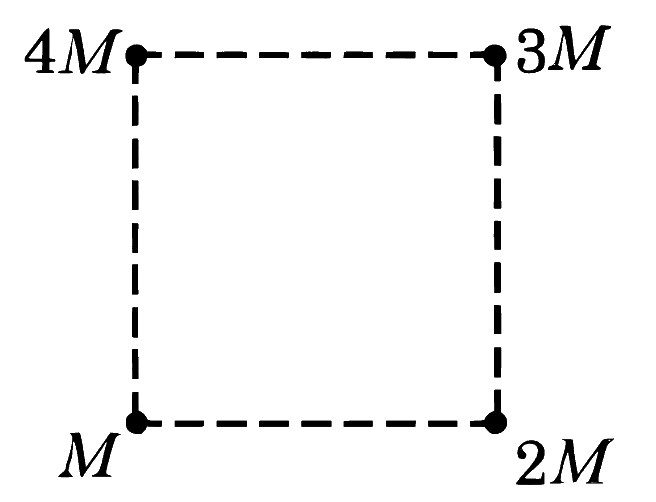
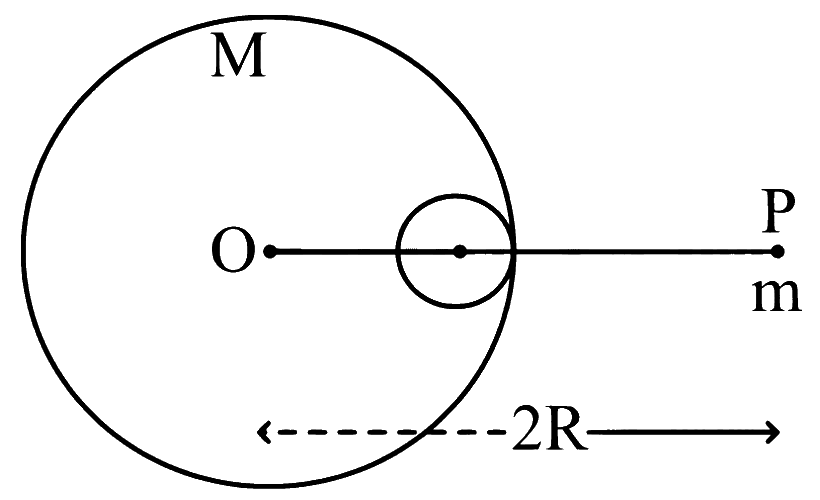
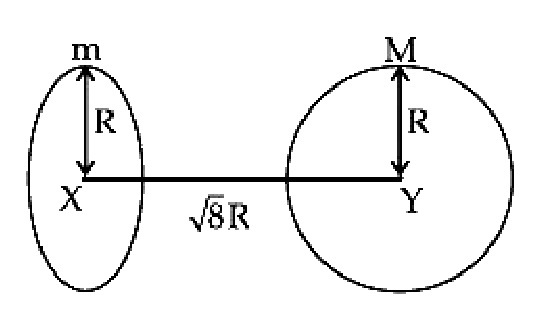
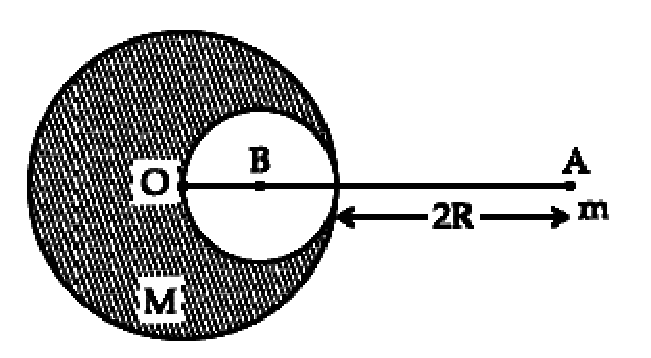
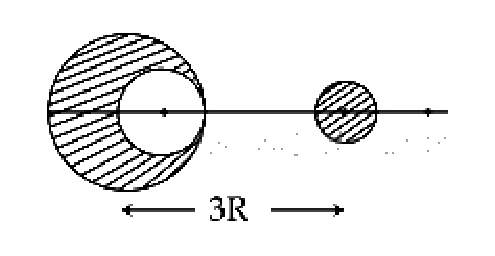
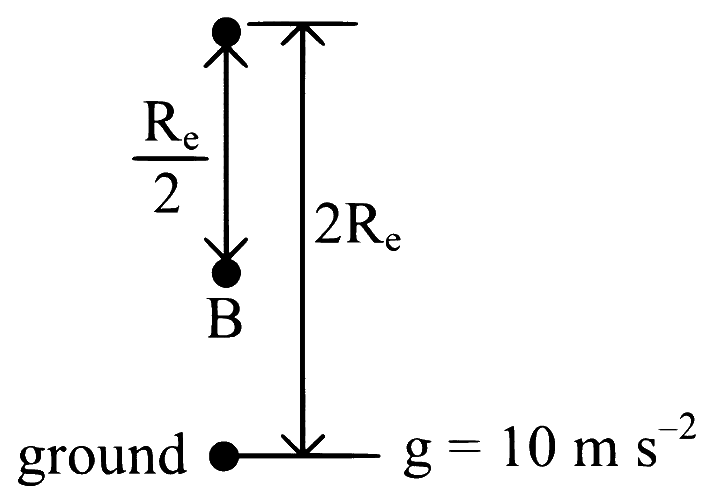
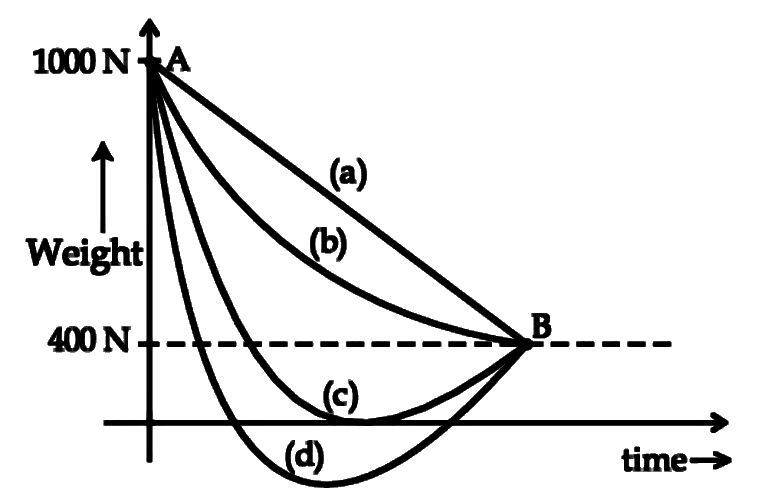
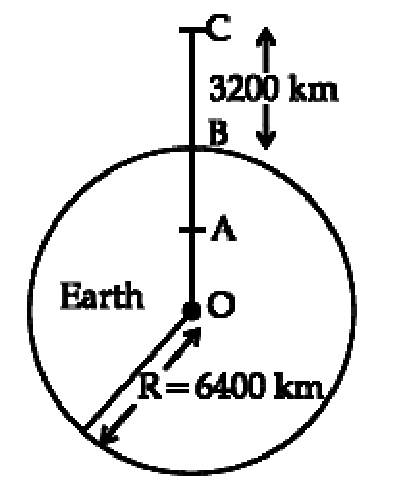
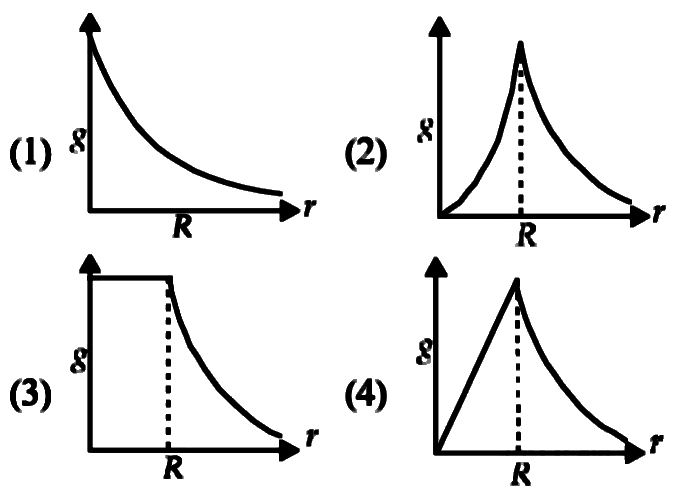
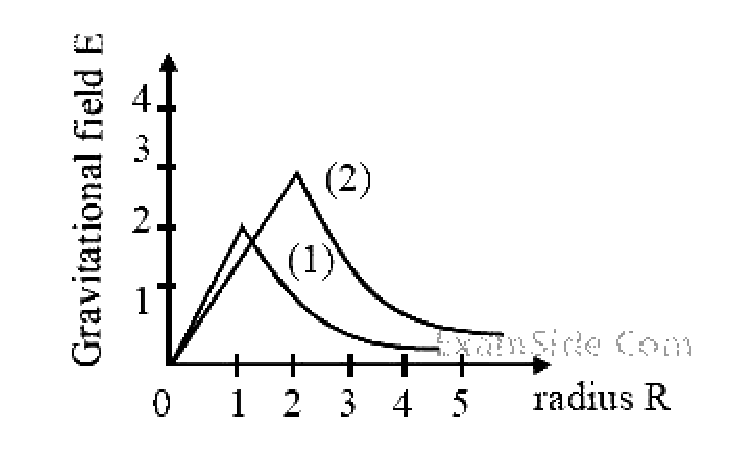
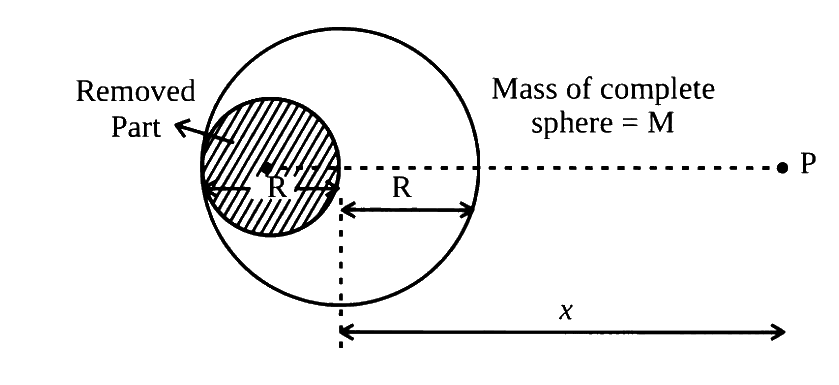
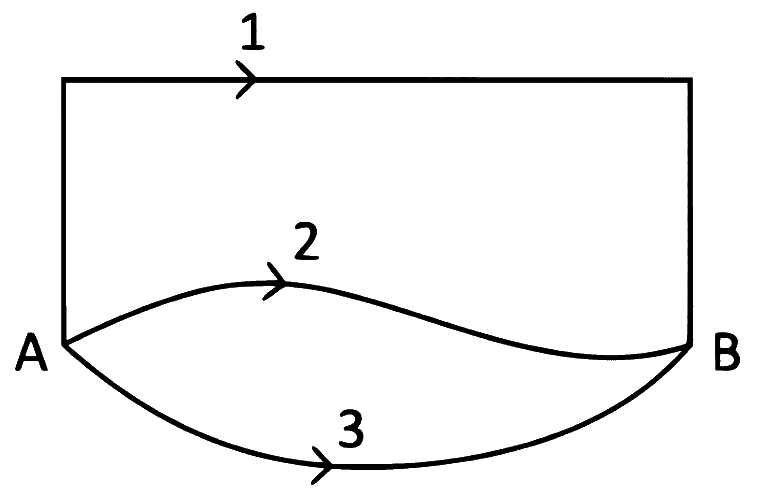
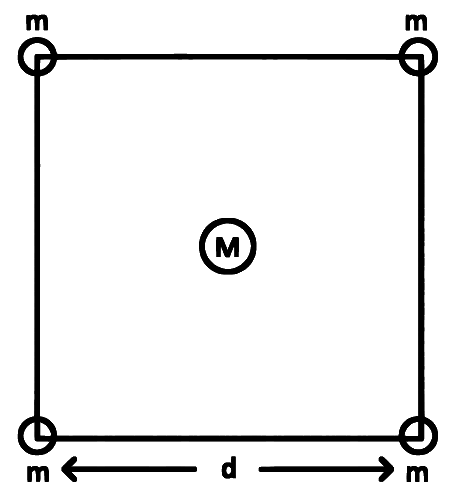
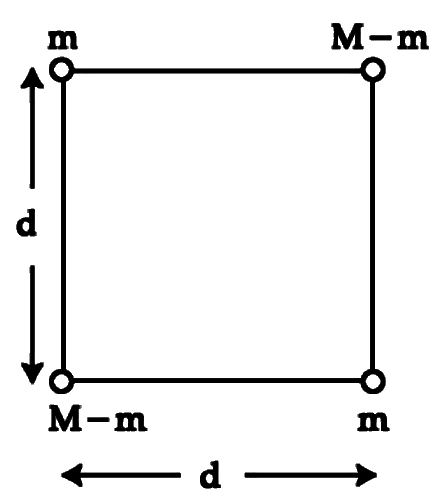
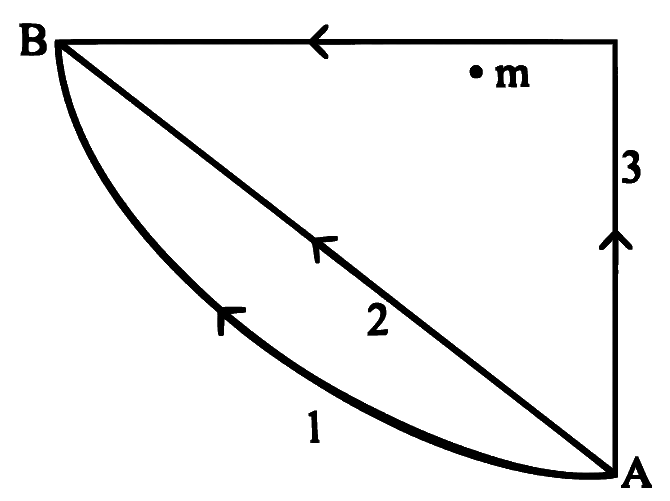
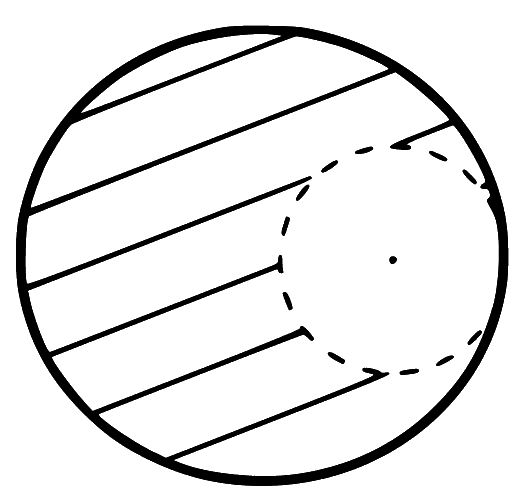
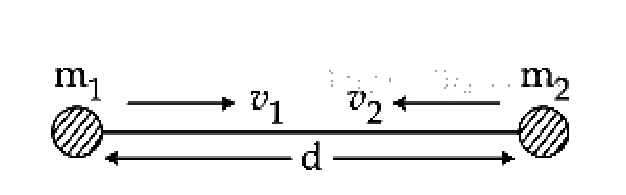
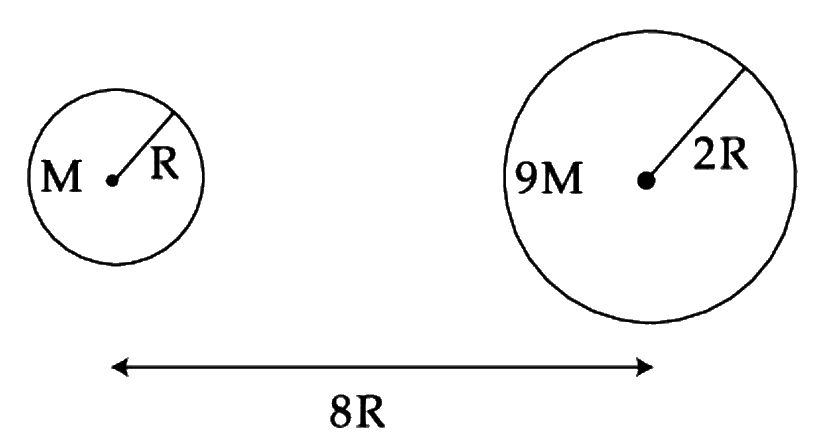
 appropriate answer from the options given below: