Physics Circle home Home Practice Hub Register / Login

Home›Practice Hub›Chapters›Gravitation

Physics PYQs · MHT CET · JEE Main · NEET

Gravitation

Questions
448
MHT CET
144
JEE Main
214
NEET
90
Years
1988–2026
0 of 448 attemptedPick an answer to see the solution

Q1JEE Main 2026 · 22 JAN · SHIFT 1Medium

Newton's Law of Gravitation · Superposition: force due to many particles

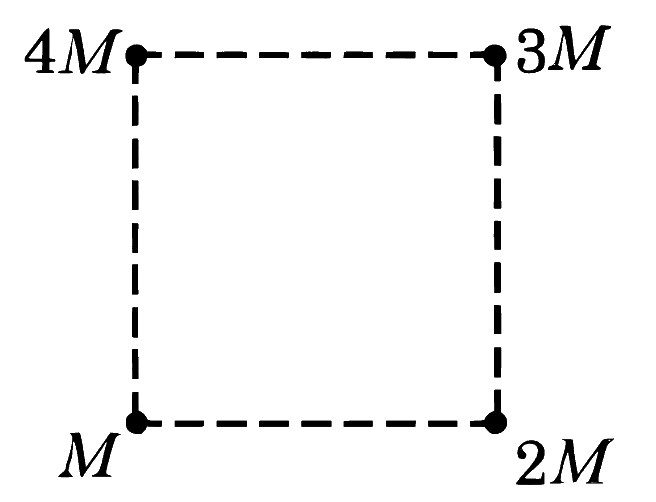
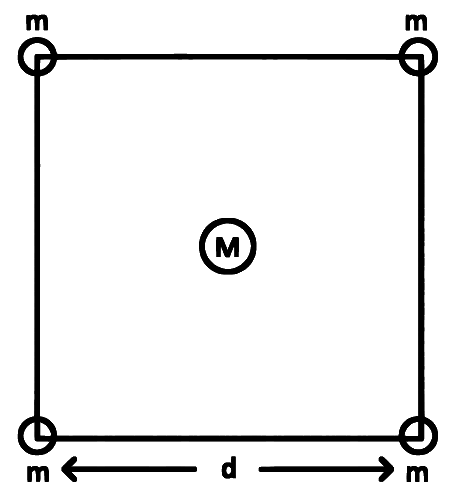
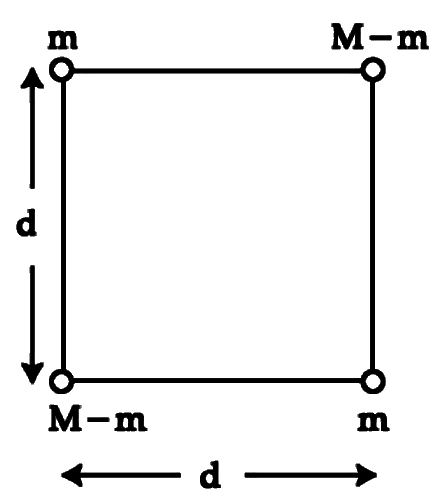
Net gravitational force at the center of a square is found to be F1F_1 when four particles having mass M,2M,3MM, 2M, 3M and 4M4M are placed at the four corners of the square as shown in figure and it is F2F_2 when the positions of 3M3M and 4M4M are interchanged. The ratio F1F2\frac{F_1}{F_2} is α5\frac{\alpha}{\sqrt{5}}. The value of α\alpha is ______.

Figure

Show answer and solution

Answer: (a)

4M3MM2MF1 (net up)x-pulls cancel
  1. Each corner is at the same distance rr from the centre, so each pull is GMimr2\frac{GM_im}{r^2} along the unit vector to that corner, (±1,±1)2\frac{(\pm1, \pm1)}{\sqrt{2}}.
  2. Take M(−1,−1)M(-1,-1), 2M(1,−1)2M(1,-1), 3M(1,1)3M(1,1), 4M(−1,1)4M(-1,1): ∑Mi(x,y)=M(0,4)\sum M_i(x,y) = M(0, 4), so F1∝42F_1 \propto \frac{4}{\sqrt{2}}.
  3. Swap 3M3M and 4M4M: ∑Mi(x,y)=M(2,4)\sum M_i(x,y) = M(2, 4), so F2∝202F_2 \propto \frac{\sqrt{20}}{\sqrt{2}}.
  4. F1F2=420=25⇒α=2\frac{F_1}{F_2} = \frac{4}{\sqrt{20}} = \frac{2}{\sqrt{5}} \Rightarrow \alpha = 2
  5. So the answer is (a) 2.
Report a mistake
Q2JEE Main 2025 · 3 APR · SHIFT 1Difficult

Newton's Law of Gravitation · Superposition: force due to many particles

Three identical spheres of mass m, are placed at the vertices of an equilateral triangle of length aa. When released, they interact only through gravitational force and collide after a time T=4T = 4 seconds. If the sides of the triangle are increased to length 2a2a and also the masses of the spheres are made 2 m, then they will collide after__________seconds.

Numerical answer type. Work it out, then open the answer.

Show answer and solution

Answer: 8

  1. Acceleration scales as Gma2\frac{Gm}{a^2} and distance as aa, so T∝aGm/a2=a3GmT \propto \sqrt{\frac{a}{Gm/a^2}} = \sqrt{\frac{a^3}{Gm}}.
  2. T′T=(2a)32m⋅ma3=4=2\frac{T'}{T} = \sqrt{\frac{(2a)^3}{2m} \cdot \frac{m}{a^3}} = \sqrt{4} = 2
  3. T′=2×4=8T' = 2 \times 4 = 8 s
Report a mistake
Q3JEE Main 2025 · 22 JAN · SHIFT 1Difficult

Newton's Law of Gravitation · Finite bodies: spheres, cavities, rods, rings

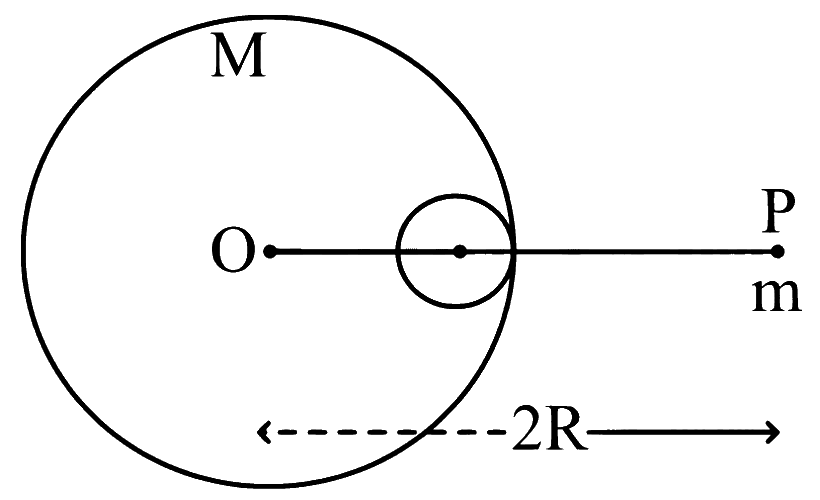
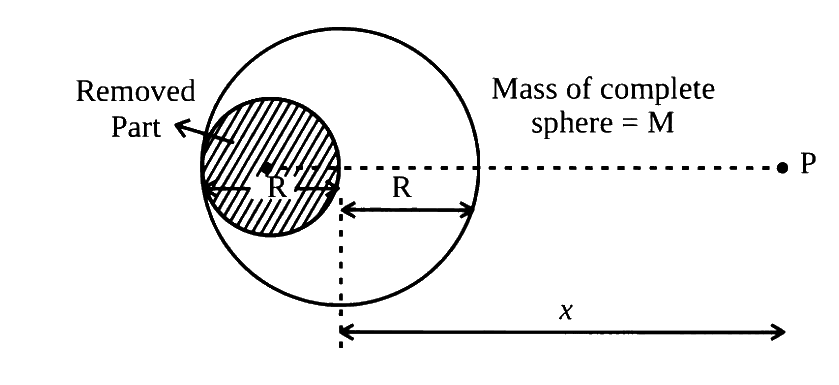
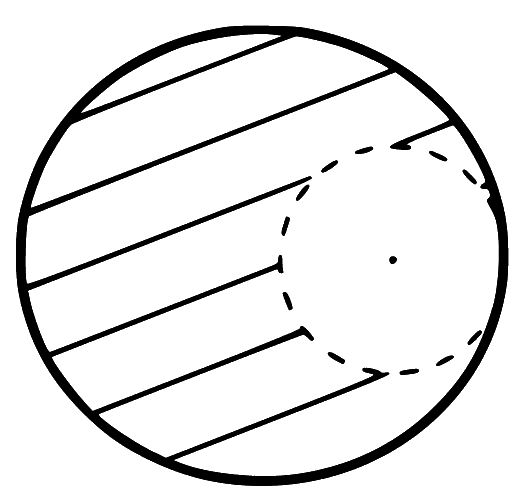
A small point of mass mm is placed at a distance 2R2R from the centre ' OO ' of a big uniform solid sphere of mass M and radius R. The gravitational force on ' m ' due to M is F1F_1. A spherical part of radius R/3R/3 is removed from the big sphere as shown in the figure and the gravitational force on m due to remaining part of MM is found to be F2F_2. The value of ratio F1:F2F_1 : F_2 is

Figure

Show answer and solution

Answer: (b)

  1. F1=GMm(2R)2=GMm4R2F_1 = \frac{GMm}{(2R)^2} = \frac{GMm}{4R^2}
  2. Removed sphere: mass M27\frac{M}{27}, centre at R−R3=2R3R - \frac{R}{3} = \frac{2R}{3} from OO, so 4R3\frac{4R}{3} from mm.
  3. Its pull: G(M/27)m(4R/3)2=GMm48R2\frac{G(M/27)m}{(4R/3)^2} = \frac{GMm}{48R^2}
  4. F2=GMm4R2−GMm48R2=11GMm48R2F_2 = \frac{GMm}{4R^2} - \frac{GMm}{48R^2} = \frac{11GMm}{48R^2}
  5. F1:F2=12:11F_1 : F_2 = 12 : 11, so the answer is (b).
Report a mistake
Q4JEE Main 2024 · 31 JAN · SHIFT 1Medium

Newton's Law of Gravitation · Superposition: force due to many particles

Four identical particles of mass mm are kept at the four corners of a square. If the gravitational force exerted on one of the masses by the other masses is (22+132)Gm2L2\left(\frac{2\sqrt{2}+1}{32}\right)\frac{Gm^{2}}{L^{2}}, the length of the sides of the square is

Show answer and solution

Answer: (a)

  1. Let the side be aa. Two adjacent masses each pull with Gm2a2\frac{Gm^2}{a^2} at 90∘90^\circ: resultant 2Gm2a2\frac{\sqrt{2}Gm^2}{a^2} along the diagonal.
  2. Diagonal mass at 2a\sqrt{2}a pulls along the same diagonal: Gm22a2\frac{Gm^2}{2a^2}.
  3. Total F=(2+12)Gm2a2=22+12⋅Gm2a2F = \left(\sqrt{2} + \frac{1}{2}\right)\frac{Gm^2}{a^2} = \frac{2\sqrt{2}+1}{2}\cdot\frac{Gm^2}{a^2}
  4. Set equal to 22+132⋅Gm2L2\frac{2\sqrt{2}+1}{32}\cdot\frac{Gm^2}{L^2}: a2=16L2⇒a=4La^2 = 16L^2 \Rightarrow a = 4L
  5. So the answer is (a) 4L4L.
Report a mistake
Q5MHT CET 2024 · 3 MAY · SHIFT 2Medium

Newton's Law of Gravitation · Finite bodies: spheres, cavities, rods, rings

Two identical metal spheres are kept in contact with each other, each having radius ' RR ' cm and ' ρ\rho ' is the density of material of metal spheres. The gravitational force ' FF ' of attraction between them is proportional to

Show answer and solution

Answer: (b)

  1. Each mass M=43πR3ρM = \frac{4}{3}\pi R^3\rho; centres in contact are 2R2R apart.
  2. F=GM2(2R)2=G4R2(43πR3ρ)2∝R4ρ2F = \frac{GM^2}{(2R)^2} = \frac{G}{4R^2}\left(\frac{4}{3}\pi R^3\rho\right)^2 \propto R^4\rho^2
  3. So the answer is (b) R4ρ2R^4\rho^2.
Report a mistake
Q6JEE Main 2024 · 4 APR · SHIFT 1Medium

Newton's Law of Gravitation · Finite bodies: spheres, cavities, rods, rings

A metal wire of uniform mass density having length LL and mass MM is bent to form a semicircular arc and a particle of mass mm is placed at the centre of the arc. The gravitational force on the particle by the wire is:

Show answer and solution

Answer: (d)

  1. Semicircle of length LL: radius r=Lπr = \frac{L}{\pi}, linear density λ=ML\lambda = \frac{M}{L}.
  2. Components along the diameter cancel; along the symmetry axis F=∫0πGmλr dθr2sin⁡θ=2GmλrF = \int_0^\pi \frac{Gm\lambda r\,d\theta}{r^2}\sin\theta = \frac{2Gm\lambda}{r}.
  3. F=2Gm(M/L)L/π=2πGMmL2F = \frac{2Gm(M/L)}{L/\pi} = \frac{2\pi GMm}{L^2}
  4. So the answer is (d).
Report a mistake
Q7MHT CET 2023 · 9 MAY · SHIFT 1Easy

Newton's Law of Gravitation · Superposition: force due to many particles

A thin rod of length 'LL' is bent in the form of a circle. Its mass is 'MM'. What force will act on mass 'mm' placed at the centre of this circle?

( G=G = constant of gravitation)

Show answer and solution

Answer: (a)

  1. Every small element of the ring has an equal element diametrically opposite it at the same distance from the centre.
  2. Their pulls on mm are equal and opposite, so they cancel in pairs.
  3. So the answer is (a) zero.
Report a mistake
Q8MHT CET 2023 · 10 MAY · SHIFT 2Medium

Newton's Law of Gravitation · Superposition: force due to many particles

A system consists of three particles each of mass 'm1m_1 ' placed at the corners of an equilateral triangle of side ' L3\frac{L}{3} ', A particle of mass 'm2m_2 ' is placed at the mid point of any one side of the triangle. Due to the system of particles, the force acting on m2m_2 is

Show answer and solution

Answer: (d)

  1. The two masses at the ends of the side pull m2m_2 equally in opposite directions, so they cancel.
  2. Only the opposite vertex acts, at distance equal to the height h=32⋅L3=3L6h = \frac{\sqrt{3}}{2} \cdot \frac{L}{3} = \frac{\sqrt{3}L}{6}.
  3. h2=3L236=L212h^2 = \frac{3L^2}{36} = \frac{L^2}{12}
  4. F=Gm1m2h2=12Gm1m2L2F = \frac{Gm_1m_2}{h^2} = \frac{12Gm_1m_2}{L^2}
  5. So the answer is (d).
Report a mistake
Q9MHT CET 2023 · 13 MAY · SHIFT 1Medium

Newton's Law of Gravitation · Finite bodies: spheres, cavities, rods, rings

If two identical spherical bodies of same material and dimensions are kept in contact, the gravitational force between them is proportional to RxR^{x}, where xx is non zero integer [Given: RR is radius of each spherical body]

Show answer and solution

Answer: (b)

  1. Mass of each sphere M∝R3M \propto R^3 (same density); separation of centres =2R= 2R.
  2. F=GM24R2∝R6R2=R4F = \frac{GM^2}{4R^2} \propto \frac{R^6}{R^2} = R^4
  3. So x=4x = 4, answer (b).
Report a mistake
Q10NEET 2022 · PHASE 1Easy

Newton's Law of Gravitation · Newton's law, G & nature of the force

Match List - I with List - II

Choose the correct answer from the options given below

List - IList - II
(a)Gravitational constant (G)(i)[L2T[L^{2}T −2]^{-2}]
(b)Gravitational potential energy(ii)[M[M −1L3T^{-1}L^{3}T −2]^{-2}]
(c)Gravitational potential(iii)[LT[LT −2]^{-2}]
(d)Gravitational intensity(iv)[ML2T[ML^{2}T −2]^{-2}]
Show answer and solution

Answer: (b)

  1. F=Gm1m2r2⇒G=Fr2m1m2=[M−1L3T−2]F = \frac{Gm_1m_2}{r^2} \Rightarrow G = \frac{Fr^2}{m_1m_2} = [M^{-1}L^3T^{-2}]: (a)-(ii).
  2. Potential energy is energy: [ML2T−2][ML^2T^{-2}]: (b)-(iv).
  3. Potential V=U/m=[L2T−2]V = U/m = [L^2T^{-2}]: (c)-(i).
  4. Intensity E=F/m=[LT−2]E = F/m = [LT^{-2}]: (d)-(iii).
  5. So the answer is (b).
Report a mistake
Q11JEE Main 2022 · 28 JUN · SHIFT 2Easy

Newton's Law of Gravitation · Newton's law, G & nature of the force

Two objects of equal masses placed at certain distance from each other attracts each other with a force of F. If one-third mass of one object is transferred to the other object, then the new force will be:

Show answer and solution

Answer: (c)

  1. Initially F=Gm⋅mr2F = \frac{Gm \cdot m}{r^2}.
  2. After transfer the masses are 2m3\frac{2m}{3} and 4m3\frac{4m}{3}, product 8m29\frac{8m^2}{9}.
  3. F′=G(8m2/9)r2=89FF' = \frac{G(8m^2/9)}{r^2} = \frac{8}{9}F
  4. So the answer is (c) 89F\frac{8}{9}F.
Report a mistake
Q12JEE Main 2022 · 27 JUN · SHIFT 1Easy

Newton's Law of Gravitation · Newton's law, G & nature of the force

Given below are two statements:

Statement I: The law of gravitation holds good for any pair of bodies in the universe. Statement II: The weight of any person becomes zero when the person is at the centre of the earth. In the light of the above statements, choose the correct answer from the options given below.

Show answer and solution

Answer: (a)

  1. Statement I: Newton's law of gravitation is universal, so it holds for any pair of bodies. True.
  2. Statement II: gd=g(1−dR)=0g_d = g\left(1 - \frac{d}{R}\right) = 0 at d=Rd = R, so weight mgd=0mg_d = 0 at the centre. True.
  3. So the answer is (a) both statements are true.
Report a mistake
Q13JEE Main 2022 · 25 JUL · SHIFT 1Difficult

Newton's Law of Gravitation · Superposition: force due to many particles

Three identical particles A,BA, B and CC of mass 100 kg100\text{ kg} each are placed in a straight line with AB=BC=13 mAB = BC = 13\text{ m}. The gravitational force on a fourth particle PP of the same mass is FF, when placed at a distance 13 m13\text{ m} from the particle BB on the perpendicular bisector of the line ACAC. The value of FF will be approximately:

Show answer and solution

Answer: (b)

ABCP13 m13 m13√2 m
  1. B pulls PP from 1313 m: FB=G(100)2169≈59.2GF_B = \frac{G(100)^2}{169} \approx 59.2G.
  2. A and C are at 13213\sqrt{2} m: each G(100)2338≈29.6G\frac{G(100)^2}{338} \approx 29.6G, at 45∘45^\circ to PBPB.
  3. Sideways parts cancel; along PBPB: 2×29.6Gcos⁡45∘≈41.8G2 \times 29.6G \cos45^\circ \approx 41.8G.
  4. F≈59.2G+41.8G≈101GF \approx 59.2G + 41.8G \approx 101G
  5. So the answer is (b) 100G100G.
Report a mistake
Q14JEE Main 2021 · 26 FEB · SHIFT 1Difficult

Newton's Law of Gravitation · Finite bodies: spheres, cavities, rods, rings

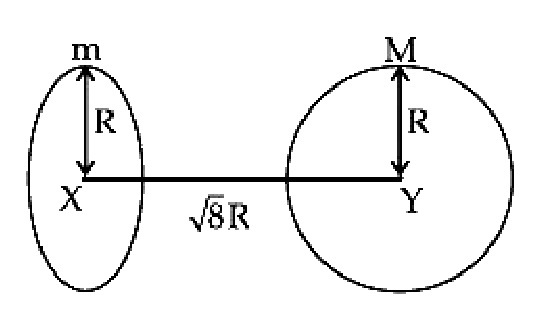
Find the gravitational force of attraction between the ring and sphere as shown in the diagram, where the plane of the ring is perpendicular to the line joining the centres. If 8\sqrt{8}R is the distance between the centres of a ring (of mass 'm') and a sphere (mass 'M') where both have equal radius 'R'.

Figure

Show answer and solution

Answer: (c)

  1. The sphere acts as a point mass MM at its centre, on the axis of the ring.
  2. Field of a ring on its axis: E=Gmx(R2+x2)3/2E = \frac{Gm x}{(R^2 + x^2)^{3/2}}, with x=8Rx = \sqrt{8}R.
  3. R2+x2=9R2⇒(9R2)3/2=27R3R^2 + x^2 = 9R^2 \Rightarrow (9R^2)^{3/2} = 27R^3
  4. F=GMm8R27R3=827⋅GMmR2F = \frac{GMm\sqrt{8}R}{27R^3} = \frac{\sqrt{8}}{27}\cdot\frac{GMm}{R^2}
  5. So the answer is (c).
Report a mistake
Q15JEE Main 2021 · 25 FEB · SHIFT 1Difficult

Newton's Law of Gravitation · Finite bodies: spheres, cavities, rods, rings

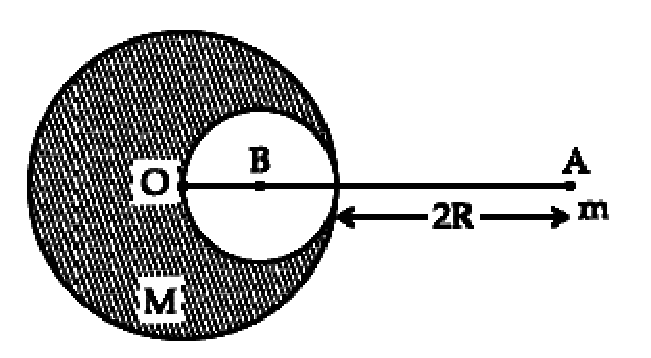
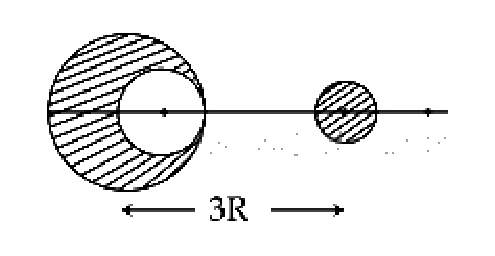
A solid sphere of radius R gravitationally attracts a particle placed at 3R from its centre with a force F1. Now a spherical cavity of radius (R2)\left(\frac{R}{2}\right) is made in the sphere (as shown in figure) and the force becomes F2. The value of F1: F2 is

Figure

Show answer and solution

Answer: (c)

  1. F1=GMm(3R)2=GMm9R2F_1 = \frac{GMm}{(3R)^2} = \frac{GMm}{9R^2}
  2. Cavity of radius R2\frac{R}{2} has mass M8\frac{M}{8}; its centre B is R2\frac{R}{2} from O, so 3R−R2=5R23R - \frac{R}{2} = \frac{5R}{2} from mm.
  3. Pull of the cavity part: G(M/8)m(5R/2)2=GMm50R2\frac{G(M/8)m}{(5R/2)^2} = \frac{GMm}{50R^2}
  4. F2=GMm(19−150)1R2=41GMm450R2F_2 = GMm\left(\frac{1}{9} - \frac{1}{50}\right)\frac{1}{R^2} = \frac{41GMm}{450R^2}
  5. F1:F2=50450:41450=50:41F_1 : F_2 = \frac{50}{450} : \frac{41}{450} = 50 : 41, so the answer is (c).
Report a mistake
Q16JEE Main 2019 · 12 JAN · SHIFT 1Difficult

Newton's Law of Gravitation · Finite bodies: spheres, cavities, rods, rings

A straight rod of length L extends from x = a to x = L + a. The gravitational force it exerts on a point mass 'm' at x = 0, if the mass per unit length of the rod is A + Bx2, is given by:

Show answer and solution

Answer: (b)

  1. Element dxdx at xx has mass (A+Bx2)dx(A + Bx^2)dx and pulls mm with dF=Gm(A+Bx2)dxx2dF = \frac{Gm(A + Bx^2)dx}{x^2}.
  2. F=Gm∫aa+L(Ax2+B)dxF = Gm\int_a^{a+L}\left(\frac{A}{x^2} + B\right)dx
  3. F=Gm[A(1a−1a+L)+BL]F = Gm\left[A\left(\frac{1}{a} - \frac{1}{a+L}\right) + BL\right]
  4. So the answer is (b).
Report a mistake
Q17JEE Main 2018 · 15 APR · SHIFT 1Difficult

Newton's Law of Gravitation · Newton's law, G & nature of the force

Take the mean distance of the moon and the sun from the earth to be 0.4×1060.4 \times 10^{6} km and 150×106150 \times 10^{6} km respectively. Their masses are 8×10228 \times 10^{22} kg and 2×10302 \times 10^{30} kg respectively. The radius of the earth is 64006400 km. Let ΔF1\Delta F_1 be the difference in the forces exerted by the moon at the nearest and farthest points on the earth and ΔF2\Delta F_2 be the difference in the force exerted by the sun at the nearest and farthest points on the earth. Then, the number closest to ΔF1ΔF2\frac{\Delta F_1}{\Delta F_2} is:

Show answer and solution

Answer: (a)

  1. Difference between near and far points: ΔF≈GMmd3⋅2(2Re)\Delta F \approx \frac{GMm}{d^3}\cdot 2(2R_e), so ΔF∝Md3\Delta F \propto \frac{M}{d^3}.
  2. ΔF1ΔF2=MmMs(dsdm)3=8×10222×1030(1500.4)3\frac{\Delta F_1}{\Delta F_2} = \frac{M_m}{M_s}\left(\frac{d_s}{d_m}\right)^3 = \frac{8 \times 10^{22}}{2 \times 10^{30}}\left(\frac{150}{0.4}\right)^3
  3. =4×10−8×3753=4×10−8×5.27×107≈2.1= 4 \times 10^{-8} \times 375^3 = 4 \times 10^{-8} \times 5.27 \times 10^{7} \approx 2.1
  4. So the answer is (a) 2.
Report a mistake
Q18NEET 2017Easy

Newton's Law of Gravitation · Newton's law, G & nature of the force

Two astronauts are floating in gravitational free space after having lost contact with their spaceship. The two will

Show answer and solution

Answer: (a)

  1. Gravity acts between every pair of masses, so the two astronauts attract each other.
  2. With no other force acting, this mutual attraction pulls them together.
  3. So the answer is (a) they move towards each other.
Report a mistake
Q19JEE Main 2014 · 11 APR · SHIFT 1Difficult

Newton's Law of Gravitation · Finite bodies: spheres, cavities, rods, rings

From a sphere of mass M and radius R, a smaller sphere of radius R2\frac{R}{2} is carved out such that the cavity made in the original sphere is between its centre and the periphery. (See figure). For the configuration in the figure where the distance between the center of the original sphere and the removed sphere is 3R, the gravitational force between the two spheres is:

Figure

Show answer and solution

Answer: (a)

  1. Removed sphere: mass M8\frac{M}{8}; it sits 3R3R from O. The cavity centre is R2\frac{R}{2} from O, so 3R−R2=5R23R - \frac{R}{2} = \frac{5R}{2} from the removed sphere.
  2. Remaining part = full sphere MM minus cavity sphere M8\frac{M}{8}.
  3. F=GM(M/8)(3R)2−G(M/8)(M/8)(5R/2)2=GM272R2−GM2400R2F = \frac{GM(M/8)}{(3R)^2} - \frac{G(M/8)(M/8)}{(5R/2)^2} = \frac{GM^2}{72R^2} - \frac{GM^2}{400R^2}
  4. F=(50−9)GM23600R2=41GM23600R2F = \frac{(50 - 9)GM^2}{3600R^2} = \frac{41GM^2}{3600R^2}
  5. So the answer is (a).
Report a mistake
Q20JEE Main 2013 · 22 APR · SHIFT 1Difficult

Newton's Law of Gravitation · Superposition: force due to many particles

The change in the value of acceleration of earth towards sun, when the moon comes from the position of solar eclipse to the position on the other side of earth in line with sun is: (mass of the moon = 7.36×10227.36 \times 10^{22} kg, radius of the moon's orbit = 3.8×1083.8 \times 10^{8} m).

Show answer and solution

Answer: (a)

  1. Moon's pull gives the earth an acceleration a=GMmr2a = \frac{GM_m}{r^2}, toward the sun at eclipse and away from it on the other side.
  2. a=6.67×10−11×7.36×1022(3.8×10⁸)2≈3.4×10⁻⁵a = \frac{6.67 \times 10^{-11} \times 7.36 \times 10^{22}}{(3.8 \times 10^{8})^2} \approx 3.4 \times 10^{-5} m/s2^2
  3. Change =2a≈6.7×10−5= 2a \approx 6.7 \times 10^{-5} m/s2^2
  4. So the answer is (a) 6.73×10−56.73 \times 10^{-5} m/s2^2.
Report a mistake
Q21NEET 2010 · AIPMT · MAINSMedium

Newton's Law of Gravitation · Newton's law, G & nature of the force

(1) Centre of gravity (C.G) of a body is the point at which the weight of the body acts (2) Centre of mass coincides with the centre of gravity if the earth is assumed to have infinitely large radius.

(3) To evaluate the gravitational field intensity due to any body at an external point, the entire mass of the body can be considered to be concentrated at its C.G.

(4) The radius of gyration of any body rotating about an axis is the length of the perpendicular dropped from the C.G. of the body to the axis.

Which one of the following pairs of statements is correct?

Show answer and solution

Answer: (a)

  1. (1) True: C.G. is the point where the total weight of the body acts.
  2. (2) True: for an earth of infinite radius gg is uniform over the body, and then C.M. and C.G. coincide.
  3. (3) False: treating the whole mass as concentrated at one point is exact only for spherically symmetric bodies.
  4. (4) False: radius of gyration KK is defined by I=MK2I = MK^2, not as the perpendicular distance of the C.G. from the axis.
  5. So the correct pair is (1) and (2), option (b).
Report a mistake
Q22NEET 2010 · AIPMT · PRELIMSMedium

Newton's Law of Gravitation · Newton's law, G & nature of the force

A man of 50 kg mass is standing in a gravity free space at a height of 10 m above the floor. He throws a stone of 0.5 kg mass downwards with a speed 2 m/s. When the stone reaches the floor, the distance of the man above the floor will be

Show answer and solution

Answer: (b)

  1. No external force, so momentum is conserved: 50v=0.5×2⇒v=0.0250v = 0.5 \times 2 \Rightarrow v = 0.02 m/s upward for the man.
  2. No gravity, so the stone moves uniformly: t=102=5t = \frac{10}{2} = 5 s.
  3. Man rises 0.02×5=0.10.02 \times 5 = 0.1 m, so his height =10+0.1=10.1= 10 + 0.1 = 10.1 m.
  4. So the answer is (b) 10.1 m.
Report a mistake
Q23NEET 2003 · AIPMTEasy

Newton's Law of Gravitation · Newton's law, G & nature of the force

Two spheres of masses m and M are situated in air and the gravitational force between them is F. The space around the masses is now filled with a liquid of specific gravity 3. The gravitational force will now be

Show answer and solution

Answer: (b)

  1. F=GMmr2F = \frac{GMm}{r^2} does not depend on the medium between the masses (GG is a universal constant).
  2. So filling the space with a liquid leaves the force unchanged.
  3. So the answer is (b) FF.
Report a mistake
Q24JEE Main 2003 · AIEEEDifficult

Newton's Law of Gravitation · Finite bodies: spheres, cavities, rods, rings

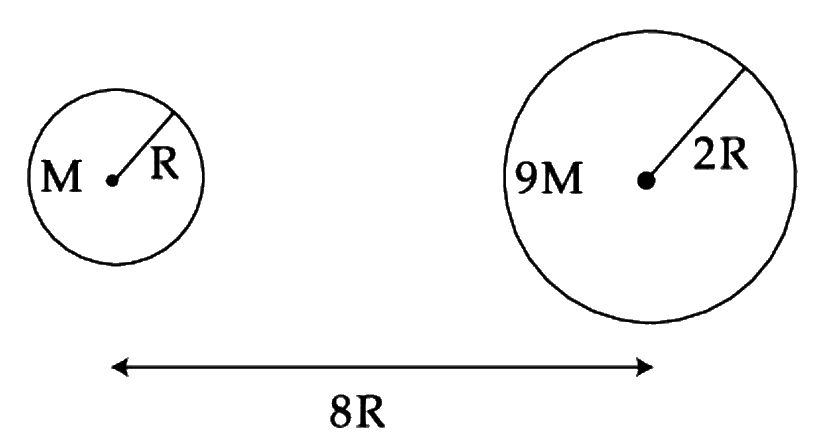
Two spherical bodies of mass MM and 5M5M & radii RR & 2R2R respectively are released in free space with initial separation between their centers equal to 12R12R. If they attract each other due to gravitational force only, then the distance covered by the smaller body just before collision is

Show answer and solution

Answer: (c)

  1. Only internal forces act, so the centre of mass stays fixed.
  2. They collide when the centres are R+2R=3RR + 2R = 3R apart, so together they move 12R−3R=9R12R - 3R = 9R.
  3. Distances are inversely proportional to masses: x1x2=5MM=5\frac{x_1}{x_2} = \frac{5M}{M} = 5.
  4. x1=56×9R=7.5Rx_1 = \frac{5}{6} \times 9R = 7.5R
  5. So the answer is (c) 7.5R7.5R.
Report a mistake
Q25MHT CET 2026 · 11 APR · SHIFT 2Easy

Acceleration Due to Gravity · g at the surface & comparing planets

The density of a planet is three times that of earth and radius 2.52.5 times that of earth. If gpg_p and geg_e represents acceleration due to gravity on planet and earth respectively then ratio gpg_p to geg_e is

Show answer and solution

Answer: (a)

  1. g=GMR2=43πGρRg = \frac{GM}{R^2} = \frac{4}{3}\pi G\rho R, so g∝ρRg \propto \rho R.
  2. gpge=3×2.5=7.5\frac{g_p}{g_e} = 3 \times 2.5 = 7.5
  3. So the answer is (a) 7.5.
Report a mistake
Q26MHT CET 2026 · 18 APR · SHIFT 1Easy

Acceleration Due to Gravity · g above the surface (height)

Time period of a simple pendulum is T1T_1 when on the earth's surface and T2T_2 when taken to a height '2R' above the earth's surface, where 'R' is the radius of the earth. The ratio T1:T2T_1 : T_2 is

Show answer and solution

Answer: (b)

  1. gh=g(1+h/R)2g_h = \frac{g}{(1 + h/R)^2}; for h=2Rh = 2R, gh=g9g_h = \frac{g}{9}.
  2. T=2πLg⇒T∝1gT = 2\pi\sqrt{\frac{L}{g}} \Rightarrow T \propto \frac{1}{\sqrt{g}}.
  3. T2T1=gg/9=3\frac{T_2}{T_1} = \sqrt{\frac{g}{g/9}} = 3
  4. So the answer is (b) T1:T2=1:3T_1 : T_2 = 1 : 3.
Report a mistake
Q27MHT CET 2026 · 16 APR · SHIFT 2Easy

Acceleration Due to Gravity · g above the surface (height)

The time taken by simple pendulum for one oscillation is T on earth's surface. Its time period becomes xT when taken to a height R (equal to earth's radius) above the earth's surface. The value of x is

Show answer and solution

Answer: (c)

  1. At h=Rh = R: gh=g(1+1)2=g4g_h = \frac{g}{(1+1)^2} = \frac{g}{4}.
  2. T∝1g⇒T′=T4=2TT \propto \frac{1}{\sqrt{g}} \Rightarrow T' = T\sqrt{4} = 2T
  3. So the answer is (c) x=2x = 2.
Report a mistake
Q28JEE Main 2026 · 4 APR · SHIFT 2Easy

Acceleration Due to Gravity · g above the surface (height)

The height in terms of radius of the earth (R)(R), at which the acceleration due to gravity becomes g9\frac{g}{9}, where gg is acceleration due to gravity on earth's surface, is

______.

Show answer and solution

Answer: (c)

  1. (RR+h)2=19\left(\frac{R}{R+h}\right)^2 = \frac{1}{9}
  2. R+h=3R⇒h=2RR + h = 3R \Rightarrow h = 2R
  3. So the answer is (c) 2R2R.
Report a mistake
Q29MHT CET 2026 · 20 APR · SHIFT 2Easy

Acceleration Due to Gravity · Height versus depth & the g–r graph

Select the correct statement out of the following

Show answer and solution

Answer: (a)

  1. (a) True: gh=gR2(R+h)2<gg_h = \frac{gR^2}{(R+h)^2} < g and gd=g(1−dR)<gg_d = g\left(1-\frac{d}{R}\right) < g.
  2. (b) False: for small heights gh≈g(1−2hR)g_h \approx g\left(1-\frac{2h}{R}\right) but gd=g(1−dR)g_d = g\left(1-\frac{d}{R}\right), so they differ when h=dh = d.
  3. (c) False: gh=g(1.1)2≈0.83gg_h = \frac{g}{(1.1)^2} \approx 0.83g, a decrease of about 17%17\%, not 10%10\%.
  4. (d) False: g′=g−ω2Rcos⁡2λg' = g - \omega^2 R\cos^2\lambda; at the poles λ=90∘\lambda = 90^\circ, so rotation causes no reduction there.
  5. So the answer is (a).
Report a mistake
Q30MHT CET 2026 · 11 APR · SHIFT 1Easy

Acceleration Due to Gravity · Height versus depth & the g–r graph

Given below are two statements:

Statement I: Acceleration due to earth's gravity decreases as you go 'up' or 'down' from earth's surface.

Statement II: Acceleration due to earth's gravity is same at a height 'hh' and depths 'dd' from earth's surface, if h=dh = d.

In the light of above statements, choose the most appropriate answer from the options given below.

Show answer and solution

Answer: (c)

  1. Statement I: gg is maximum at the surface; it falls going up (∝1/r2\propto 1/r^2) and going down (∝r\propto r). Correct.
  2. Statement II: gh≈g(1−2hR)g_h \approx g\left(1-\frac{2h}{R}\right), gd=g(1−dR)g_d = g\left(1-\frac{d}{R}\right), so for h=dh = d they are not equal. Incorrect.
  3. So the answer is (c).
Report a mistake
Q31MHT CET 2026 · 20 APR · SHIFT 1Medium

Acceleration Due to Gravity · g above the surface (height)

The percentage decrease in the weight of a body when taken to a height of 4848 km above the surface of the earth is (Radius of the earth is 64006400 km)

Show answer and solution

Answer: (b)

  1. For h≪Rh \ll R: gh≈g(1−2hR)g_h \approx g\left(1 - \frac{2h}{R}\right), so fractional decrease =2hR= \frac{2h}{R}.
  2. 2×486400×100%=1.5%\frac{2 \times 48}{6400} \times 100\% = 1.5\%
  3. So the answer is (b) 1.5%1.5\%.
Report a mistake
Q32MHT CET 2026 · 18 APR · SHIFT 1Medium

Acceleration Due to Gravity · g above the surface (height)

The lengths of seconds pendulums on the surface of the earth and at an altitude 'hh' from the surface of the earth are lsl_s and lhl_h respectively. The radius of the earth is

Show answer and solution

Answer: (a)

  1. Seconds pendulum: T=2πl/gT = 2\pi\sqrt{l/g} fixed, so l∝gl \propto g.
  2. lhls=ghg=R2(R+h)2⇒lhls=RR+h\frac{l_h}{l_s} = \frac{g_h}{g} = \frac{R^2}{(R+h)^2} \Rightarrow \frac{\sqrt{l_h}}{\sqrt{l_s}} = \frac{R}{R+h}
  3. Rls=(R+h)lh⇒R(ls−lh)=hlhR\sqrt{l_s} = (R+h)\sqrt{l_h} \Rightarrow R\left(\sqrt{l_s} - \sqrt{l_h}\right) = h\sqrt{l_h}
  4. So the answer is (a) R=hlhls−lhR = \frac{h\sqrt{l_h}}{\sqrt{l_s} - \sqrt{l_h}}.
Report a mistake
Q33MHT CET 2026 · 20 MAY · SHIFT 1Medium

Acceleration Due to Gravity · g below the surface (depth)

If a capillary tube is immersed in water, rise of water in capillary is h1h_1. When the whole arrangement is taken to a depth dd in a mine, the water level rises to h2h_2. The ratio h2h1\frac{h_2}{h_1} is (R=radius of earth)

Show answer and solution

Answer: (d)

  1. Capillary rise h=2Tcos⁡θrρgh = \frac{2T\cos\theta}{r\rho g}, so h∝1gh \propto \frac{1}{g}
  2. At depth dd: gd=g(1−dR)=g R−dRg_d = g\left(1 - \frac{d}{R}\right) = g\,\frac{R-d}{R}
  3. h2h1=ggd=RR−d\frac{h_2}{h_1} = \frac{g}{g_d} = \frac{R}{R-d}
  4. So the answer is (d) RR−d\frac{R}{R-d}.
Report a mistake
Q34MHT CET 2026 · 18 APR · SHIFT 2Medium

Acceleration Due to Gravity · Height versus depth & the g–r graph

The acceleration due to gravity at a height 'h' above the surface of earth is 'ghg_h'. At the depth 90 km below the earth's surface the acceleration due to gravity is also 'ghg_h'. The value of 'h' is

Show answer and solution

Answer: (d)

  1. Small height: gh=g(1−2hR)g_h = g\left(1 - \frac{2h}{R}\right); depth: gd=g(1−dR)g_d = g\left(1 - \frac{d}{R}\right)
  2. Equal values: 2hR=dR⇒h=d2\frac{2h}{R} = \frac{d}{R} \Rightarrow h = \frac{d}{2}
  3. h=902=45h = \frac{90}{2} = 45 km
  4. So the answer is (d) 45 km.
Report a mistake
Q35JEE Main 2026 · 5 APR · SHIFT 1Medium

Acceleration Due to Gravity · Height versus depth & the g–r graph

When one moves from a point 16 km below the earth's surface to a point 16 km above the earth's surface, the change in g is approximately α%\alpha\%. The value of α\alpha is ______.

(Take radius of the earth =6400 km= 6400\text{ km}.)

Show answer and solution

Answer: (b)

  1. 16 km below: g1=g(1−166400)=g(1−0.0025)g_1 = g\left(1 - \frac{16}{6400}\right) = g(1 - 0.0025)
  2. 16 km above: g2=g(1−2×166400)=g(1−0.005)g_2 = g\left(1 - \frac{2 \times 16}{6400}\right) = g(1 - 0.005)
  3. Change =g1−g2=0.0025g= g_1 - g_2 = 0.0025g, i.e. 0.25%0.25\%
  4. So α=0.25\alpha = 0.25, answer (b).
Report a mistake
Q36MHT CET 2026 · 17 APR · SHIFT 1Medium

Acceleration Due to Gravity · Shape & rotation of the earth

The speed with which the earth would have to rotate about its axis so that a person on the equator would weigh 35\frac{3}{5}th as much as at present is (gg = gravitational acceleration, RR = equatorial radius of the earth.)

Show answer and solution

Answer: (b)

  1. At the equator: g′=g−ω2Rg' = g - \omega^2 R
  2. g−ω2R=35g⇒ω2=2g5Rg - \omega^2 R = \frac{3}{5}g \Rightarrow \omega^2 = \frac{2g}{5R}
  3. ω=2g5R\omega = \sqrt{\frac{2g}{5R}} (angular speed)
  4. So the answer is (b).
Report a mistake
Q37MHT CET 2026 · 15 APR · SHIFT 1Medium

Acceleration Due to Gravity · Shape & rotation of the earth

What should be the angular velocity of earth due to rotation about its own axis so that the weight at thth

equator becomes (35)\left(\frac{3}{5}\right) of initial value? (g=g = acceleration due to gravity, R = radius of earth)

Show answer and solution

Answer: (b)

  1. At the equator: g′=g−ω2Rg' = g - \omega^2 R
  2. g−ω2R=35g⇒ω2=2g5Rg - \omega^2 R = \frac{3}{5}g \Rightarrow \omega^2 = \frac{2g}{5R}
  3. ω=(2g5R)1/2\omega = \left(\frac{2g}{5R}\right)^{1/2}
  4. So the answer is (b).
Report a mistake
Q38MHT CET 2025 · 25 APR · SHIFT 1Easy

Acceleration Due to Gravity · g at the surface & comparing planets

Two planets A and B have densities ' ρ1\rho_1 ', ' ρ2\rho_2 ' and have radii ' r1r_1 ', ' r2r_2 ', respectively. The ratio of acceleration due to gravity on AA to that of BB is

Show answer and solution

Answer: (b)

  1. g=43πGρrg = \frac{4}{3}\pi G\rho r, so g∝ρrg \propto \rho r.
  2. gA:gB=r1ρ1:r2ρ2g_A : g_B = r_1\rho_1 : r_2\rho_2
  3. So the answer is (b).
Report a mistake
Q39JEE Main 2025 · 24 JAN · SHIFT 2Easy

Acceleration Due to Gravity · g at the surface & comparing planets

Acceleration due to gravity on the surface of earth is ' gg '. If the diameter of earth is reduced to one third of its original value and mass remains unchanged, then the acceleration due to gravity on the surface of the earth is ________ g.

Numerical answer type. Work it out, then open the answer.

Show answer and solution

Answer: 9

  1. g=GMR2g = \frac{GM}{R^2}; with MM fixed, g∝1R2g \propto \frac{1}{R^2}.
  2. Diameter one third ⇒R′=R3⇒g′=9g\Rightarrow R' = \frac{R}{3} \Rightarrow g' = 9g
  3. So the answer is 9.
Report a mistake
Q40MHT CET 2025 · 26 APR · SHIFT 1Easy

Acceleration Due to Gravity · g above the surface (height)

A body weighs 45 N on the surface of the earth. The gravitational force on a body due to earth at a height equal to half the radius of earth will be

Show answer and solution

Answer: (a)

  1. Wh=W(1+h/R)2W_h = \frac{W}{(1 + h/R)^2} with h=R2h = \frac{R}{2}.
  2. Wh=45(3/2)2=45×49W_h = \frac{45}{(3/2)^2} = 45 \times \frac{4}{9}
  3. Wh=20 NW_h = 20\ \text{N}
  4. So the answer is (a) 20 N.
Report a mistake
Q41MHT CET 2025 · 22 APR · SHIFT 1Easy

Acceleration Due to Gravity · g above the surface (height)

Time period of a simple pendulum on earth's surface is ' T '. It time period becomes ' xT ' when taken to a height ' 2R2R ' above earth's surface. The value of xx will be (R=(R = radius of earth)

Show answer and solution

Answer: (d)

  1. At h=2Rh = 2R: gh=g(1+2)2=g9g_h = \frac{g}{(1+2)^2} = \frac{g}{9}.
  2. T∝1g⇒T′=T9=3TT \propto \frac{1}{\sqrt{g}} \Rightarrow T' = T\sqrt{9} = 3T
  3. So the answer is (d) x=3x = 3.
Report a mistake
Q42NEET 2025Easy

Acceleration Due to Gravity · g above the surface (height)

A body weighs 48 N on the surface of the earth. The gravitational force experienced by the body due to the earth at a height equal to one-third the radius of the earth from its surface is:

Show answer and solution

Answer: (d)

  1. Wh=W(1+h/R)2W_h = \frac{W}{(1 + h/R)^2} with h=R3h = \frac{R}{3}.
  2. Wh=48(4/3)2=48×916W_h = \frac{48}{(4/3)^2} = 48 \times \frac{9}{16}
  3. Wh=27 NW_h = 27\ \text{N}
  4. So the answer is (d) 27 N.
Report a mistake
Q43MHT CET 2025 · 25 APR · SHIFT 2Easy

Acceleration Due to Gravity · g below the surface (depth)

The depth at which the value of acceleration due to gravity becomes (1n)\left(\frac{1}{n}\right) times the value at the surface of the earth is

( R=R = radius of the earth)

Show answer and solution

Answer: (a)

  1. At depth dd: gd=g(1−dR)g_d = g\left(1 - \frac{d}{R}\right).
  2. 1−dR=1n1 - \frac{d}{R} = \frac{1}{n}
  3. d=R(1−1n)=R(n−1)nd = R\left(1 - \frac{1}{n}\right) = \frac{R(n-1)}{n}
  4. So the answer is (a) R(n−1)n\frac{R(n-1)}{n}.
Report a mistake
Q44MHT CET 2025 · 23 APR · SHIFT 2Medium

Acceleration Due to Gravity · g at the surface & comparing planets

The gravitational pull of the moon is (16)th\left(\frac{1}{6}\right)^{th} of the earth and mass of moon is (18)\left(\frac{1}{8}\right)th of the earth. This implies that the

Show answer and solution

Answer: (b)

  1. g=GMR2⇒gmge=MmMe(ReRm)2g = \frac{GM}{R^2} \Rightarrow \frac{g_m}{g_e} = \frac{M_m}{M_e}\left(\frac{R_e}{R_m}\right)^2
  2. 16=18(ReRm)2⇒(ReRm)2=43\frac{1}{6} = \frac{1}{8}\left(\frac{R_e}{R_m}\right)^2 \Rightarrow \left(\frac{R_e}{R_m}\right)^2 = \frac{4}{3}
  3. So the answer is (b) Re=43 RmR_e = \sqrt{\frac{4}{3}}\,R_m.
Report a mistake
Q45MHT CET 2025 · 26 APR · SHIFT 2Medium

Acceleration Due to Gravity · g below the surface (depth)

The depth at which acceleration due to gravity becomes gn\frac{g}{n} is ( R=R = radius of earth, g=g = acceleration due to gravity) ( n=n = integer)

Show answer and solution

Answer: (a)

  1. At depth dd: gd=g(1−dR)g_d = g\left(1 - \frac{d}{R}\right)
  2. g(1−dR)=gn⇒dR=1−1ng\left(1 - \frac{d}{R}\right) = \frac{g}{n} \Rightarrow \frac{d}{R} = 1 - \frac{1}{n}
  3. d=R(n−1)nd = \frac{R(n-1)}{n}
  4. So the answer is (a).
Report a mistake
Q46MHT CET 2025 · 21 APR · SHIFT 1Medium

Acceleration Due to Gravity · g below the surface (depth)

Water rises up to height ' xx ' in a capillary tube immersed vertically in water. When the whole arrangement is taken to a depth ' dd ' in a mine, the water level rises up to height Y. If R is the radius of the earth then the ratio Y:xY : x is

Show answer and solution

Answer: (b)

  1. Capillary rise h∝1gh \propto \frac{1}{g}
  2. At depth dd: gd=g R−dRg_d = g\,\frac{R-d}{R}
  3. Yx=ggd=RR−d\frac{Y}{x} = \frac{g}{g_d} = \frac{R}{R-d}
  4. So the answer is (b) R:(R−d)R : (R-d).
Report a mistake
Q47MHT CET 2024 · 15 MAY · SHIFT 2Easy

Acceleration Due to Gravity · g at the surface & comparing planets

The density of a new planet is twice that of earth. The acceleration due to gravity at the surface of the planet is equal to that at the surface of earth. If RR is the radius of earth, then radius of the planet would be

Show answer and solution

Answer: (b)

  1. g=43πGρRg = \frac{4}{3}\pi G\rho R, so equal gg needs equal ρR\rho R.
  2. 2ρ⋅Rp=ρR⇒Rp=R22\rho \cdot R_p = \rho R \Rightarrow R_p = \frac{R}{2}
  3. So the answer is (b) R/2R/2.
Report a mistake
Q48MHT CET 2024 · 11 MAY · SHIFT 1Easy

Acceleration Due to Gravity · g at the surface & comparing planets

The acceleration due to gravity at the surface of the planet is same as that at the surface of the earth, but the density of planet is thrice that of the earth. If 'R' is the radius of the earth, the radius of the planet will be

Show answer and solution

Answer: (b)

  1. g=43πGρRg = \frac{4}{3}\pi G\rho R, so equal gg needs equal ρR\rho R.
  2. 3ρ⋅Rp=ρR⇒Rp=R33\rho \cdot R_p = \rho R \Rightarrow R_p = \frac{R}{3}
  3. So the answer is (b) R3\frac{R}{3}.
Report a mistake
Q49NEET 2024Easy

Acceleration Due to Gravity · g at the surface & comparing planets

The mass of a planet is 110\frac{1}{10}th that of the earth and its diameter is half that of the earth. The acceleration due to gravity on that planet is:

Show answer and solution

Answer: (d)

  1. g=GMR2g = \frac{GM}{R^2}; diameter half means Rp=R2R_p = \frac{R}{2}.
  2. gpg=110×4=0.4\frac{g_p}{g} = \frac{1}{10} \times 4 = 0.4
  3. gp=0.4×9.8=3.92g_p = 0.4 \times 9.8 = 3.92 m s−2^{-2}
  4. So the answer is (d).
Report a mistake
Q50JEE Main 2024 · 27 JAN · SHIFT 1Easy

Acceleration Due to Gravity · g at the surface & comparing planets

The acceleration due to gravity on the surface of earth is gg. If the diameter of earth reduces to half of its original value and mass remains constant, then acceleration due to gravity on the surface of earth would be:

Show answer and solution

Answer: (d)

  1. g=GMR2g = \frac{GM}{R^2}; with MM fixed, g∝1R2g \propto \frac{1}{R^2}.
  2. Diameter half ⇒R′=R2⇒g′=4g\Rightarrow R' = \frac{R}{2} \Rightarrow g' = 4g
  3. So the answer is (d) 4g4g.
Report a mistake
Q51MHT CET 2024 · 4 MAY · SHIFT 1Easy

Acceleration Due to Gravity · Mass & density of a planet

If ' RR ' is the radius of earth \& ' gg ' is acceleration due to gravity on earth's surface, then mean density of earth is

Show answer and solution

Answer: (c)

  1. g=GMR2g = \frac{GM}{R^2} and M=ρ⋅43πR3M = \rho \cdot \frac{4}{3}\pi R^3.
  2. So g=43πGρRg = \frac{4}{3}\pi G \rho R.
  3. ρ=3g4πRG\rho = \frac{3g}{4\pi RG}
  4. So the answer is (c) 3g4πRG\frac{3g}{4\pi RG}.
Report a mistake
Q52MHT CET 2024 · 16 MAY · SHIFT 2Easy

Acceleration Due to Gravity · g above the surface (height)

A boy weighs 72 N on the surface of earth. The gravitational force on a body due to earth at a height equal to half the radius of earth will be

Show answer and solution

Answer: (a)

  1. Wh=W(1+h/R)2W_h = \frac{W}{(1 + h/R)^2} with h=R2h = \frac{R}{2}.
  2. Wh=72×49W_h = 72 \times \frac{4}{9}
  3. Wh=32 NW_h = 32\ \text{N}
  4. So the answer is (a) 32 N.
Report a mistake
Q53MHT CET 2024 · 16 MAY · SHIFT 1Easy

Acceleration Due to Gravity · g above the surface (height)

A simple pendulum has a periodic time ' T1T_1 ' when it is on the surface of earth of radius ' RR '. Its periodic time is ' T2T_2 ' when it is taken to a height ' RR ' above the earth's surface. The value of T2T1\frac{T_2}{T_1} is

Show answer and solution

Answer: (c)

  1. At h=Rh = R: gh=g4g_h = \frac{g}{4}.
  2. T2T1=ggh=4=2\frac{T_2}{T_1} = \sqrt{\frac{g}{g_h}} = \sqrt{4} = 2
  3. So the answer is (c) 2.
Report a mistake
Q54MHT CET 2024 · 4 MAY · SHIFT 1Easy

Acceleration Due to Gravity · g above the surface (height)

The height ' hh ' above the earth's surface at which the value of acceleration due to gravity (g)(g) becomes (g3)\left(\frac{g}{3}\right) is ( R=R = radius of the earth)

Show answer and solution

Answer: (b)

  1. ghg=(RR+h)2=13\frac{g_h}{g} = \left(\frac{R}{R+h}\right)^2 = \frac{1}{3}
  2. R+h=3RR + h = \sqrt{3}R
  3. h=(3−1)Rh = (\sqrt{3} - 1)R
  4. So the answer is (b) (3−1)R(\sqrt{3}-1)R.
Report a mistake
Q55MHT CET 2024 · 3 MAY · SHIFT 2Easy

Acceleration Due to Gravity · g above the surface (height)

The height at which the weight of the body becomes (116)th\left(\frac{1}{16}\right)^{\text{th}} of its weight on the surface of the earth of radius ' RR ' is

Show answer and solution

Answer: (b)

  1. WhW=(RR+h)2=116\frac{W_h}{W} = \left(\frac{R}{R+h}\right)^2 = \frac{1}{16}
  2. R+h=4R⇒h=3RR + h = 4R \Rightarrow h = 3R
  3. So the answer is (b) 3 R.
Report a mistake
Q56MHT CET 2024 · 2 MAY · SHIFT 1Easy

Acceleration Due to Gravity · g above the surface (height)

The height above the earth's surface at which the acceleration due to gravity becomes (1n)\left(\frac{1}{n}\right) times the value at the surface is ( R=R = radius of earth)

Show answer and solution

Answer: (d)

  1. (RR+h)2=1n\left(\frac{R}{R+h}\right)^2 = \frac{1}{n}
  2. R+h=nRR + h = \sqrt{n}R
  3. h=(n−1)Rh = (\sqrt{n} - 1)R
  4. So the answer is (d) (n−1)R(\sqrt{n}-1)R.
Report a mistake
Q57JEE Main 2024 · 4 APR · SHIFT 2Easy

Acceleration Due to Gravity · g above the surface (height)

A 90 kg90\text{ kg} body placed at 2R2R distance from surface of earth experiences gravitational pull of: (R=R = Radius of earth, g=10 m s−2g = 10\text{ m s}^{-2})

Show answer and solution

Answer: (c)

  1. Distance from the centre r=R+2R=3Rr = R + 2R = 3R, so g′=g(R3R)2=g9g' = g\left(\frac{R}{3R}\right)^2 = \frac{g}{9}.
  2. F=mg′=90×109F = mg' = 90 \times \frac{10}{9}
  3. F=100 NF = 100\ \text{N}
  4. So the answer is (c) 100 N.
Report a mistake
Q58MHT CET 2024 · 11 MAY · SHIFT 1Easy

Acceleration Due to Gravity · g below the surface (depth)

The depth 'd' at which the value of acceleration due to gravity becomes 1n−1\frac{1}{n-1} times the value at the earth's surface is (R=R = radius of the earth)

Show answer and solution

Answer: (b)

  1. gd=g(1−dR)=gn−1g_d = g\left(1 - \frac{d}{R}\right) = \frac{g}{n-1}
  2. dR=1−1n−1=n−2n−1\frac{d}{R} = 1 - \frac{1}{n-1} = \frac{n-2}{n-1}
  3. d=R(n−2n−1)d = R\left(\frac{n-2}{n-1}\right)
  4. So the answer is (b) R(n−2n−1)R\left(\frac{n-2}{n-1}\right).
Report a mistake
Q59JEE Main 2024 · 6 APR · SHIFT 2Easy

Acceleration Due to Gravity · g below the surface (depth)

Assuming the earth to be a sphere of uniform mass density, a body weighed 300 N300\text{ N} on the surface of earth. How much it would weigh at R/4 depth under surface of earth?

Show answer and solution

Answer: (d)

  1. Weight at depth: Wd=W(1−dR)W_d = W\left(1 - \frac{d}{R}\right).
  2. d=R4⇒Wd=300×34d = \frac{R}{4} \Rightarrow W_d = 300 \times \frac{3}{4}
  3. So the answer is (d) 225 N225\text{ N}.
Report a mistake
Q60MHT CET 2024 · 10 MAY · SHIFT 2Medium

Acceleration Due to Gravity · g above the surface (height)

The height ' h ' from the surface of the earth at which the value of ' gg ' will be reduced by 64%64\% than the value at surface of the earth is ( R=R = radius of the earth)

Show answer and solution

Answer: (b)

  1. Reduced by 64%64\%: gh=0.36g=gR2(R+h)2g_h = 0.36g = g\frac{R^2}{(R+h)^2}.
  2. RR+h=0.6⇒R+h=5R3\frac{R}{R+h} = 0.6 \Rightarrow R + h = \frac{5R}{3}
  3. So the answer is (b) h=23Rh = \frac{2}{3}R.
Report a mistake
Q61NEET 2024Medium

Acceleration Due to Gravity · g above the surface (height)

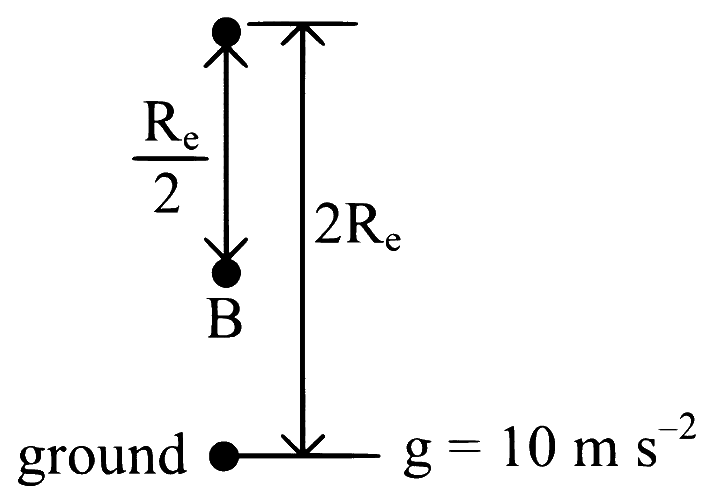
An object of mass 100 kg100\text{ kg} falls from point AA to BB as shown in figure. The change in its weight, corrected to the nearest integer is (RER_E is the radius of the earth)

Figure

Show answer and solution

Answer: (a)

  1. AA is at height 2Re2R_e and BB at height 2Re−Re2=1.5Re2R_e - \frac{R_e}{2} = 1.5R_e; gh=g(1+h/Re)2g_h = \frac{g}{(1 + h/R_e)^2}.
  2. gA=1032=1.11 m s−2g_A = \frac{10}{3^2} = 1.11\text{ m s}^{-2}, gB=10(2.5)2=1.60 m s−2g_B = \frac{10}{(2.5)^2} = 1.60\text{ m s}^{-2}
  3. ΔW=m(gB−gA)=100×0.49≈49 N\Delta W = m(g_B - g_A) = 100 \times 0.49 \approx 49\text{ N}
  4. So the answer is (a) 49 N49\text{ N}.
Report a mistake
Q62JEE Main 2024 · 1 FEB · SHIFT 1Medium

Acceleration Due to Gravity · g above the surface (height)

If RR is the radius of the earth and the acceleration due to gravity on the surface of earth is g=π2 m/s2g = \pi^2\text{ m/s}^2, then the length of the second's pendulum at a height h=2Rh = 2R from the surface of earth will be:

Show answer and solution

Answer: (a)

  1. At h=2Rh = 2R: g′=g(1+2)2=π29 m/s2g' = \frac{g}{(1+2)^2} = \frac{\pi^2}{9}\text{ m/s}^2.
  2. Seconds pendulum: T=2 s=2πlg′⇒l=g′π2T = 2\text{ s} = 2\pi\sqrt{\frac{l}{g'}} \Rightarrow l = \frac{g'}{\pi^2}
  3. l=19 ml = \frac{1}{9}\text{ m}
  4. So the answer is (a) 19 m\frac{1}{9}\text{ m}.
Report a mistake
Q63JEE Main 2024 · 30 JAN · SHIFT 2Medium

Acceleration Due to Gravity · g above the surface (height)

A simple pendulum is placed at a place where its distance from the earth's surface is equal to the radius of the earth. If the length of the string is 4 m4\text{ m}, then the time period of small oscillations will be __________ s. [take g=π2 m s−2g = \pi^2\text{ m s}^{-2}]

Numerical answer type. Work it out, then open the answer.

Show answer and solution

Answer: 8

  1. At h=Rh = R: g′=g(R2R)2=g4=π24g' = g\left(\frac{R}{2R}\right)^2 = \frac{g}{4} = \frac{\pi^2}{4}
  2. T=2πLg′=2π4×4π2T = 2\pi\sqrt{\frac{L}{g'}} = 2\pi\sqrt{\frac{4 \times 4}{\pi^2}}
  3. T=2π×4π=8T = 2\pi \times \frac{4}{\pi} = 8 s
  4. So T=8T = 8 s.
Report a mistake
Q64MHT CET 2024 · 4 MAY · SHIFT 2Medium

Acceleration Due to Gravity · g below the surface (depth)

A pendulum is oscillating with frequency ' nn ' on the surface of earth. If it is taken to a depth R4\frac{R}{4} below the surface of earth, new frequency of oscillation of depth R4\frac{R}{4} is ( R=R = radius of earth)

Show answer and solution

Answer: (b)

  1. Frequency n=12πgLn = \frac{1}{2\pi}\sqrt{\frac{g}{L}}, so n∝gn \propto \sqrt{g}
  2. At depth R4\frac{R}{4}: g′=g(1−14)=3g4g' = g\left(1 - \frac{1}{4}\right) = \frac{3g}{4}
  3. n′=n34=3 n2n' = n\sqrt{\frac{3}{4}} = \frac{\sqrt{3}\,n}{2}
  4. So the answer is (b).
Report a mistake
Q65MHT CET 2024 · 15 MAY · SHIFT 1Medium

Acceleration Due to Gravity · Height versus depth & the g–r graph

The weights of an object are measured in a coal mine of depth ' h1h_1 ', then at sea level of height ' h2h_2 ' and lastly at the top of a mountain of height ' h3h_3 ' as W1,W2W_1, W_2 and W3W_3 respectively. Which one of the following relations is correct? [h1≪R,h3≫h2=R,R=h_1 \ll R, h_3 \gg h_2 = R, R = radius of the earth ]

Show answer and solution

Answer: (d)

  1. gg is maximum at the surface (sea level).
  2. Inside the mine: gd=g(1−h1R)<gg_d = g\left(1 - \frac{h_1}{R}\right) < g, so W1<W2W_1 < W_2
  3. On the mountain: gh=g(RR+h3)2<gg_h = g\left(\frac{R}{R+h_3}\right)^2 < g, so W3<W2W_3 < W_2
  4. So the answer is (d) W1<W2>W3W_1 < W_2 > W_3.
Report a mistake
Q66JEE Main 2024 · 29 JAN · SHIFT 1Medium

Acceleration Due to Gravity · Height versus depth & the g–r graph

At what distance above and below the surface of the earth a body will have same weight. (take radius of earth as RR.)

Show answer and solution

Answer: (c)

  1. Equal weight: g(1−hR)=gR2(R+h)2g\left(1 - \frac{h}{R}\right) = \frac{gR^2}{(R+h)^2} (exact formulas, hh not small)
  2. Put x=hRx = \frac{h}{R}: (1−x)(1+x)2=1⇒x−x2−x3=0(1-x)(1+x)^2 = 1 \Rightarrow x - x^2 - x^3 = 0
  3. x2+x−1=0⇒x=5−12x^2 + x - 1 = 0 \Rightarrow x = \frac{\sqrt{5}-1}{2}
  4. h=5R−R2h = \frac{\sqrt{5}R - R}{2}, so the answer is (c).
Report a mistake
Q67MHT CET 2024 · 16 MAY · SHIFT 1Medium

Acceleration Due to Gravity · Shape & rotation of the earth

The speed with which the earth would have to rotate about its axis so that a person on the equator would weigh 35\frac{3}{5} th as much as at present weight is ( g=g = gravitational acceleration, R=R = equatorial radius of the earth)

Show answer and solution

Answer: (a)

  1. At the equator: g′=g−ω2Rg' = g - \omega^2 R
  2. g−ω2R=35g⇒ω2=2g5Rg - \omega^2 R = \frac{3}{5}g \Rightarrow \omega^2 = \frac{2g}{5R}
  3. ω=2g5R\omega = \sqrt{\frac{2g}{5R}} (angular speed)
  4. So the answer is (a).
Report a mistake
Q68MHT CET 2023 · 13 MAY · SHIFT 2Easy

Acceleration Due to Gravity · g at the surface & comparing planets

If two planets have their radii in the ratio x:yx : y and densities in the ratio m:nm : n, then the acceleration due to gravity on them are in the ratio

Show answer and solution

Answer: (d)

  1. g=43πGρRg = \frac{4}{3}\pi G\rho R, so g∝ρRg \propto \rho R.
  2. g1g2=mn⋅xy=mxny\frac{g_1}{g_2} = \frac{m}{n}\cdot\frac{x}{y} = \frac{mx}{ny}
  3. So the answer is (d).
Report a mistake
Q69MHT CET 2023 · 9 MAY · SHIFT 2Easy

Acceleration Due to Gravity · g at the surface & comparing planets

Consider a planet whose density is same as that of the earth but whose radius is three times the radius 'RR' of the earth. The acceleration due to gravity 'gng_n' on the surface of planet is gn=xg_n = x. gg where gg is acceleration due to gravity on surface of earth. The value of 'xx' is

Show answer and solution

Answer: (b)

  1. g=43πGρRg = \frac{4}{3}\pi G\rho R; same ρ\rho, so g∝Rg \propto R.
  2. gn=3g⇒x=3g_n = 3g \Rightarrow x = 3
  3. So the answer is (b) 3.
Report a mistake
Q70JEE Main 2023 · 13 APR · SHIFT 2Easy

Acceleration Due to Gravity · g at the surface & comparing planets

Two planets A and B of radii RR and 1.5 R have densities ρ\rho and ρ/2\rho/2 respectively. The ratio of acceleration due to gravity at the surface of BB to AA is:

Show answer and solution

Answer: (d)

  1. g=43πGρRg = \frac{4}{3}\pi G\rho R, so g∝ρRg \propto \rho R.
  2. gBgA=(ρ/2)(1.5R)ρR=0.75=34\frac{g_B}{g_A} = \frac{(\rho/2)(1.5R)}{\rho R} = 0.75 = \frac{3}{4}
  3. So the answer is (d) 3 : 4.
Report a mistake
Q71JEE Main 2023 · 11 APR · SHIFT 1Easy

Acceleration Due to Gravity · g at the surface & comparing planets

The radii of two planets 'A' and 'B' are 'R' and '4R' and their densities are ρ\rho and ρ/3\rho/3 respectively. The ratio of acceleration due to gravity at their surfaces (gA:gB)(g_A : g_B) will be:

Show answer and solution

Answer: (d)

  1. g=43πGρRg = \frac{4}{3}\pi G\rho R, so g∝ρRg \propto \rho R.
  2. gAgB=ρR(ρ/3)(4R)=34\frac{g_A}{g_B} = \frac{\rho R}{(\rho/3)(4R)} = \frac{3}{4}
  3. So the answer is (d) 3 : 4.
Report a mistake
Q72MHT CET 2023 · 14 MAY · SHIFT 1Easy

Acceleration Due to Gravity · Mass & density of a planet

Considering earth to be a sphere of radius 'RR' having uniform density 'ρ\rho', then value of acceleration due to gravity 'gg' in terms of R,ρR, \rho and GG is

Show answer and solution

Answer: (c)

  1. g=GMR2g = \frac{GM}{R^2} with M=43πR3ρM = \frac{4}{3}\pi R^3 \rho.
  2. g=GR2⋅43πR3ρ=43πρGRg = \frac{G}{R^2}\cdot\frac{4}{3}\pi R^3\rho = \frac{4}{3}\pi\rho GR
  3. So the answer is (c) g=43πρGRg = \frac{4}{3}\pi\rho GR.
Report a mistake
Q73NEET 2023Easy

Acceleration Due to Gravity · Mass & density of a planet

If RR is the radius of the earth and gg is the acceleration due to gravity on the earth surface. Then the mean density of the earth will be:

Show answer and solution

Answer: (c)

  1. g=GMR2g = \frac{GM}{R^2} and M=ρ⋅43πR3M = \rho \cdot \frac{4}{3}\pi R^3, so g=43πGρRg = \frac{4}{3}\pi G\rho R.
  2. ρ=3g4πRG\rho = \frac{3g}{4\pi RG}
  3. So the answer is (c) 3g4πRG\frac{3g}{4\pi RG}.
Report a mistake
Q74MHT CET 2023 · 12 MAY · SHIFT 1Easy

Acceleration Due to Gravity · g above the surface (height)

Time period of simple pendulum on earth's surface is 'TT'. Its time period becomes 'xTxT' when taken to a height RR (equal to earth's radius) above the earth's surface. Then the value of 'xx' will be

Show answer and solution

Answer: (b)

  1. At h=Rh = R: gh=g(1+1)2=g4g_h = \frac{g}{(1+1)^2} = \frac{g}{4}.
  2. T∝1g⇒T′=2TT \propto \frac{1}{\sqrt{g}} \Rightarrow T' = 2T
  3. So the answer is (b) x=2x = 2.
Report a mistake
Q75MHT CET 2023 · 12 MAY · SHIFT 1Easy

Acceleration Due to Gravity · g above the surface (height)

The height at which the weight of the body becomes (19)\left(\frac{1}{9}\right)th its weight on the surface of earth is (R=(R = radius of earth)

Show answer and solution

Answer: (d)

  1. (RR+h)2=19\left(\frac{R}{R+h}\right)^2 = \frac{1}{9}
  2. R+h=3R⇒h=2RR + h = 3R \Rightarrow h = 2R
  3. So the answer is (d) 2R.
Report a mistake
Q76JEE Main 2023 · 6 APR · SHIFT 2Easy

Acceleration Due to Gravity · g above the surface (height)

The weight of a body on the surface of the earth is 100 N100\text{ N}. The gravitational force on it when taken at a height, from the surface of earth, equal to one-fourth the radius of the earth is:

Show answer and solution

Answer: (b)

  1. Wh=W(1+h/R)2W_h = \frac{W}{(1 + h/R)^2} with h=R4h = \frac{R}{4}.
  2. Wh=100(5/4)2=100×1625W_h = \frac{100}{(5/4)^2} = 100 \times \frac{16}{25}
  3. Wh=64 NW_h = 64\ \text{N}
  4. So the answer is (b) 64 N.
Report a mistake
Q77JEE Main 2023 · 31 JAN · SHIFT 2Easy

Acceleration Due to Gravity · g above the surface (height)

A body weight WW, is projected vertically upwards from earth's surface to reach a height above the earth which is equal to nine times the radius of earth. The weight of the body at that height will be:

Show answer and solution

Answer: (c)

  1. At h=9Rh = 9R the distance from the centre is r=10Rr = 10R.
  2. Wh=W(R10R)2=W100W_h = W\left(\frac{R}{10R}\right)^2 = \frac{W}{100}
  3. So the answer is (c) W100\frac{W}{100}.
Report a mistake
Q78JEE Main 2023 · 24 JAN · SHIFT 2Easy

Acceleration Due to Gravity · g above the surface (height)

Given below are two statements: one is labelled as Assertion A and the other is labelled as Reason R.

Assertion A: A pendulum clock when taken to Mount Everest becomes fast.

Reason R: The value of g (acceleration due to gravity) is less at Mount Everest than its value on the surface of earth.

In the light of the above statements, choose the most appropriate answer from the options given below

Show answer and solution

Answer: (d)

  1. R is correct: gg decreases with height, so gg is smaller on Mount Everest.
  2. A is wrong: T=2πL/gT = 2\pi\sqrt{L/g}, so smaller gg gives a longer period and the clock runs slow, not fast.
  3. So the answer is (d) A is not correct but R is correct.
Report a mistake
Q79JEE Main 2023 · 24 JAN · SHIFT 1Easy

Acceleration Due to Gravity · g above the surface (height)

The weight of a body at the surface of earth is 18 N. The weight of the body at an altitude of 3200 km above the earth's surface is (given, radius of earth Re=6400 kmR_e = 6400\text{ km}):

Show answer and solution

Answer: (d)

  1. h=3200 km=R2h = 3200\ \text{km} = \frac{R}{2}.
  2. Wh=W(1+h/R)2=18×49W_h = \frac{W}{(1 + h/R)^2} = 18 \times \frac{4}{9}
  3. Wh=8 NW_h = 8\ \text{N}
  4. So the answer is (d) 8 N.
Report a mistake
Q80MHT CET 2023 · 13 MAY · SHIFT 2Easy

Acceleration Due to Gravity · g below the surface (depth)

A mine is located at depth R/3R/3 below earth's surface. The acceleration due to gravity at that depth in mine is (R=R = radius of earth, g=g = acceleration due to gravity)

Show answer and solution

Answer: (c)

  1. gd=g(1−dR)g_d = g\left(1 - \frac{d}{R}\right) with d=R3d = \frac{R}{3}.
  2. gd=g(1−13)=2g3g_d = g\left(1 - \frac{1}{3}\right) = \frac{2g}{3}
  3. So the answer is (c) 2g3\frac{2g}{3}.
Report a mistake
Q81MHT CET 2023 · 12 MAY · SHIFT 2Easy

Acceleration Due to Gravity · g below the surface (depth)

The depth at which acceleration due to gravity becomes g2n\frac{g}{2n} is (R=(R = radius of earth, g=g = acceleration due to gravity on earth's surface, nn is integer)

Show answer and solution

Answer: (d)

  1. g(1−dR)=g2ng\left(1 - \frac{d}{R}\right) = \frac{g}{2n}
  2. dR=1−12n=2n−12n\frac{d}{R} = 1 - \frac{1}{2n} = \frac{2n-1}{2n}
  3. d=R(2n−1)2nd = \frac{R(2n-1)}{2n}
  4. So the answer is (d) R(2n−1)2n\frac{R(2n-1)}{2n}.
Report a mistake
Q82MHT CET 2023 · 9 MAY · SHIFT 1Easy

Acceleration Due to Gravity · g below the surface (depth)

A body weighs 300 N300\text{ N} on the surface of the earth. How much will it weigh at a distance R2\frac{R}{2} below the surface of earth? ( R→R \rightarrow Radius of earth)

Show answer and solution

Answer: (d)

  1. Wd=W(1−dR)W_d = W\left(1 - \frac{d}{R}\right) with d=R2d = \frac{R}{2}.
  2. Wd=300×12=150 NW_d = 300 \times \frac{1}{2} = 150\ \text{N}
  3. So the answer is (d) 150 N150\ \text{N}.
Report a mistake
Q83JEE Main 2023 · 10 APR · SHIFT 1Easy

Acceleration Due to Gravity · g below the surface (depth)

Assuming the earth to be a sphere of uniform mass density, the weight of a body at a depth d=R2d = \frac{R}{2} from the surface of earth, if its weight on the surface of earth is 200 N, will be:

(Given R = radius of earth)

Show answer and solution

Answer: (a)

  1. Weight at depth: Wd=W(1−dR)W_d = W\left(1 - \frac{d}{R}\right).
  2. d=R2⇒Wd=200×12d = \frac{R}{2} \Rightarrow W_d = 200 \times \frac{1}{2}
  3. So the answer is (a) 100 N100\text{ N}.
Report a mistake
Q84JEE Main 2023 · 8 APR · SHIFT 1Easy

Acceleration Due to Gravity · g below the surface (depth)

The weight of a body on the earth is 400 N400\text{ N}. Then weight of the body when taken to a depth half of the radius of the earth will be:

Show answer and solution

Answer: (b)

  1. Weight at depth: Wd=W(1−dR)W_d = W\left(1 - \frac{d}{R}\right).
  2. d=R2⇒Wd=400×12d = \frac{R}{2} \Rightarrow W_d = 400 \times \frac{1}{2}
  3. So the answer is (b) 200 N200\text{ N}.
Report a mistake
Q85JEE Main 2023 · 1 FEB · SHIFT 1Easy

Acceleration Due to Gravity · Height versus depth & the g–r graph

Given below are two statements:

Statement I: Acceleration due to gravity is different at different places on the surface of earth. Statement II: Acceleration due to gravity increases as we go down below the earth's surface. In the light of the above statements, choose the correct answer from the options given below

Show answer and solution

Answer: (d)

  1. Statement I: gg varies with latitude (rotation, g′=g−ω2Rcos⁡2λg' = g - \omega^2R\cos^2\lambda), the earth's shape and altitude. True.
  2. Statement II: below the surface gd=g(1−dR)g_d = g\left(1 - \frac{d}{R}\right), so gg decreases, not increases. False.
  3. So the answer is (d).
Report a mistake
Q86JEE Main 2023 · 24 JAN · SHIFT 2Easy

Acceleration Due to Gravity · Height versus depth & the g–r graph

Given below are two statements:

Statement I: Acceleration due to earth's gravity decreases as you go 'up' or 'down' from earth's surface.

Statement II: Acceleration due to earth's gravity is same at a height 'h' and depth 'd' from earth's surface, if h = d.

In the light of above statements, choose the most appropriate answer from the options given below

Show answer and solution

Answer: (a)

  1. Statement I: gg is maximum at the surface and decreases both going up and going down. Correct.
  2. Statement II: gh≈g(1−2hR)≠gd=g(1−dR)g_h \approx g\left(1-\frac{2h}{R}\right) \ne g_d = g\left(1-\frac{d}{R}\right) for h=dh = d. Incorrect.
  3. So the answer is (a).
Report a mistake
Q87JEE Main 2023 · 10 APR · SHIFT 2Easy

Acceleration Due to Gravity · Shape & rotation of the earth

Given below are two statements:

Statement I: Rotation of the earth shows effect on the value of acceleration due to gravity (g) Statement II: The effect of rotation of the earth on the value of 'g' at the equator is minimum and that at the pole is maximum.

In the light of the above statements, choose the correct answer from the options given below

Show answer and solution

Answer: (b)

  1. g′=g−ω2Rcos⁡2λg' = g - \omega^2 R\cos^2\lambda, so rotation does change gg. Statement I is true.
  2. At the equator (λ=0\lambda = 0) the reduction ω2R\omega^2R is maximum; at the poles (λ=90∘\lambda = 90^\circ) it is zero. Statement II is false.
  3. So the answer is (b).
Report a mistake
Q88MHT CET 2023 · 10 MAY · SHIFT 1Medium

Acceleration Due to Gravity · g at the surface & comparing planets

There is a second's pendulum on the surface of earth. It is taken to the surface of planet whose mass and radius are twice that of earth. The period of oscillation of second's pendulum on the planet will be

Show answer and solution

Answer: (a)

  1. gp=G(2M)(2R)2=g2g_p = \frac{G(2M)}{(2R)^2} = \frac{g}{2}
  2. T=2πlg∝1g⇒Tp=22 sT = 2\pi\sqrt{\frac{l}{g}} \propto \frac{1}{\sqrt{g}} \Rightarrow T_p = 2\sqrt{2}\text{ s} (seconds pendulum has T=2 sT = 2\text{ s} on earth).
  3. So the answer is (a) 22 s2\sqrt{2}\text{ s}.
Report a mistake
Q89JEE Main 2023 · 6 APR · SHIFT 1Medium

Acceleration Due to Gravity · g at the surface & comparing planets

A planet has double the mass of the earth. Its average density is equal to that of the earth. An object weighing WW on earth will weigh on that planet:

Show answer and solution

Answer: (d)

  1. M=43πR3ρM = \frac{4}{3}\pi R^3\rho; same ρ\rho and Mp=2M⇒Rp=21/3RM_p = 2M \Rightarrow R_p = 2^{1/3}R.
  2. g=GMR2=43πGρR⇒g∝Rg = \frac{GM}{R^2} = \frac{4}{3}\pi G\rho R \Rightarrow g \propto R
  3. gp=21/3gg_p = 2^{1/3}g, so weight =21/3W= 2^{1/3}W.
  4. So the answer is (d) 21/3 W2^{1/3}\text{ W}.
Report a mistake
Q90JEE Main 2023 · 8 APR · SHIFT 2Medium

Acceleration Due to Gravity · g above the surface (height)

The acceleration due to gravity at height hh above the earth if h≪Rh \ll R (Radius of earth) is given by

Show answer and solution

Answer: (a)

  1. g′=g(RR+h)2=g(1+hR)−2g' = g\left(\frac{R}{R+h}\right)^2 = g\left(1+\frac{h}{R}\right)^{-2}
  2. For h≪Rh \ll R, binomial approximation: (1+x)−2≈1−2x(1+x)^{-2} \approx 1-2x
  3. g′=g(1−2hR)g' = g\left(1-\frac{2h}{R}\right)
  4. So the answer is (a).
Report a mistake
Q91MHT CET 2023 · 12 MAY · SHIFT 2Medium

Acceleration Due to Gravity · g below the surface (depth)

A simple pendulum is oscillating with frequency 'FF' on the surface of the earth. It is taken to a depth R3\frac{R}{3} below the surface of earth. ( R=R = radius of earth). The frequency of oscillation at depth R/3R/3 is

Show answer and solution

Answer: (b)

  1. F∝gF \propto \sqrt{g} for a simple pendulum
  2. At depth R3\frac{R}{3}: g′=g(1−13)=2g3g' = g\left(1 - \frac{1}{3}\right) = \frac{2g}{3}
  3. F′=F23=F1.5F' = F\sqrt{\frac{2}{3}} = \frac{F}{\sqrt{1.5}}
  4. So the answer is (b).
Report a mistake
Q92MHT CET 2023 · 14 MAY · SHIFT 1Medium

Acceleration Due to Gravity · Height versus depth & the g–r graph

The value of acceleration due to gravity at a depth 'dd' from the surface of earth and at an altitude 'hh' from the surface of earth are in the ratio

Show answer and solution

Answer: (c)

  1. Depth: gd=g(1−dR)g_d = g\left(1 - \frac{d}{R}\right); small altitude: gh=g(1−2hR)g_h = g\left(1 - \frac{2h}{R}\right)
  2. gdgh=R−dR−2h\frac{g_d}{g_h} = \frac{R-d}{R-2h}
  3. So the answer is (c).
Report a mistake
Q93JEE Main 2023 · 31 JAN · SHIFT 1Medium

Acceleration Due to Gravity · Height versus depth & the g–r graph

At a certain depth "d " below surface of earth, value of acceleration due to gravity becomes four times that of its value at a height 3R3R above earth surface. Where RR is Radius of earth (Take R=6400 kmR = 6400\text{ km} ). The depth dd is equal to

Show answer and solution

Answer: (d)

  1. At height 3R3R: gh=g(R4R)2=g16g_h = g\left(\frac{R}{4R}\right)^2 = \frac{g}{16}
  2. Given gd=4gh=g4g_d = 4g_h = \frac{g}{4}
  3. g(1−dR)=g4⇒d=3R4g\left(1 - \frac{d}{R}\right) = \frac{g}{4} \Rightarrow d = \frac{3R}{4}
  4. d=34×6400=4800d = \frac{3}{4} \times 6400 = 4800 km, so the answer is (d).
Report a mistake
Q94MHT CET 2023 · 14 MAY · SHIFT 2Medium

Acceleration Due to Gravity · Shape & rotation of the earth

Earth is assumed to be a sphere of radius R. If 'gϕg_\phi' is value of effective acceleration due to gravity at latitude 30∘30^\circ and 'gg' is the value at equator, then the value of ∣g−gϕ∣|g - g_\phi| is (ω\omega is angular velocity of rotation of earth, cos⁡30∘\cos 30^\circ =32= \frac{\sqrt{3}}{2})

Show answer and solution

Answer: (a)

  1. Effective gravity at latitude ϕ\phi: gϕ=g0−ω2Rcos⁡2ϕg_\phi = g_0 - \omega^2 R\cos^2\phi
  2. Equator (ϕ=0\phi = 0): g=g0−ω2Rg = g_0 - \omega^2 R; at 30∘30^\circ: gϕ=g0−34ω2Rg_\phi = g_0 - \frac{3}{4}\omega^2 R
  3. ∣g−gϕ∣=ω2R(1−34)=14ω2R|g - g_\phi| = \omega^2 R\left(1 - \frac{3}{4}\right) = \frac{1}{4}\omega^2 R
  4. So the answer is (a).
Report a mistake
Q95MHT CET 2023 · 11 MAY · SHIFT 1Medium

Acceleration Due to Gravity · Shape & rotation of the earth

The radius of earth is 6400 km6400\text{ km} and acceleration due to gravity g=10 m s−2g = 10\text{ m s}^{-2}. For the weight of body of mass 5 kg5\text{ kg} to be zero on equator, rotational velocity of the earth must be (in rad/s\text{rad/s})

Show answer and solution

Answer: (c)

  1. Weightless at equator: g−ω2R=0⇒ω=gRg - \omega^2 R = 0 \Rightarrow \omega = \sqrt{\frac{g}{R}} (mass does not matter)
  2. ω=106.4×106=1800\omega = \sqrt{\frac{10}{6.4 \times 10^6}} = \frac{1}{800} rad/s
  3. So the answer is (c) 1800\frac{1}{800}.
Report a mistake
Q96JEE Main 2023 · 25 JAN · SHIFT 1Difficult

Acceleration Due to Gravity · g below the surface (depth)

Assume that the earth is a solid sphere of uniform density and a tunnel is dug along its diameter throughout the earth. It is found that when a particle is released in this tunnel, it executes a simple harmonic motion. The mass of the particle is 100 g. The time period of the motion of the particle will be (approximately)

(Take g = 10 m s−2-2, radius of earth = 6400 km)

Show answer and solution

Answer: (b)

  1. Inside earth g′=grRg' = g\frac{r}{R}, so a=−gRra = -\frac{g}{R}r: SHM with ω=gR\omega = \sqrt{\frac{g}{R}} (mass does not matter)
  2. T=2πRg=2π6.4×10610=2π×800T = 2\pi\sqrt{\frac{R}{g}} = 2\pi\sqrt{\frac{6.4 \times 10^6}{10}} = 2\pi \times 800 s
  3. T≈5024T \approx 5024 s ≈84\approx 84 min =1= 1 h 2424 min
  4. So the answer is (b).
Report a mistake
Q97JEE Main 2022 · 28 JUL · SHIFT 1Easy

Acceleration Due to Gravity · g at the surface & comparing planets

If the radius of earth shrinks by 2%2\% while its mass remains same. The acceleration due to gravity on the earth's surface will approximately:

Show answer and solution

Answer: (d)

  1. g=GMR2⇒Δgg=−2ΔRRg = \frac{GM}{R^2} \Rightarrow \frac{\Delta g}{g} = -2\frac{\Delta R}{R}
  2. ΔRR=−2%⇒Δgg=+4%\frac{\Delta R}{R} = -2\% \Rightarrow \frac{\Delta g}{g} = +4\%
  3. So the answer is (d) increase by 4%4\%.
Report a mistake
Q98JEE Main 2022 · 30 JUN · SHIFT 1Easy

Acceleration Due to Gravity · g at the surface & comparing planets

The radii of two planets A and B are in the ratio 2: 3. Their densities are 3ρ\rho and 5ρ\rho respectively. The ratio of their acceleration due to gravity is:

Show answer and solution

Answer: (d)

  1. g=43πGρRg = \frac{4}{3}\pi G\rho R, so g∝ρRg \propto \rho R.
  2. gAgB=2×3ρ3×5ρ=615=25\frac{g_A}{g_B} = \frac{2 \times 3\rho}{3 \times 5\rho} = \frac{6}{15} = \frac{2}{5}
  3. So the answer is (d) 2 : 5.
Report a mistake
Q99JEE Main 2022 · 26 JUL · SHIFT 1Easy

Acceleration Due to Gravity · g above the surface (height)

The percentage decrease in the weight of a rocket, when taken to a height of 32 km32\text{ km} above the surface of earth will, be:

(( Radius of earth =6400 km)= 6400\text{ km})

Show answer and solution

Answer: (a)

  1. For h≪Rh \ll R: gh≈g(1−2hR)g_h \approx g\left(1 - \frac{2h}{R}\right), so the fractional decrease is 2hR\frac{2h}{R}.
  2. 2hR=2×326400=0.01\frac{2h}{R} = \frac{2 \times 32}{6400} = 0.01
  3. Percentage decrease =1%= 1\%
  4. So the answer is (a) 1%.
Report a mistake
Q100JEE Main 2022 · 25 JUN · SHIFT 1Easy

Acceleration Due to Gravity · g above the surface (height)

The height of any point P above the surface of earth is equal to diameter of earth. The value of acceleration due to gravity at point P will be: (Given g = acceleration due to gravity at the surface of earth).

Show answer and solution

Answer: (d)

  1. h=2Rh = 2R (diameter), so the distance from the centre is 3R3R.
  2. gP=g(R3R)2=g9g_P = g\left(\frac{R}{3R}\right)^2 = \frac{g}{9}
  3. So the answer is (d) g/9.
Report a mistake
Q101MHT CET 2022 · 11 AUG · SHIFT 2Easy

Acceleration Due to Gravity · g below the surface (depth)

A body weighs 500 N500\text{ N} on the surface of the earth. At what distance below the surface of the earth it weighs 250 N250\text{ N}? (Radius of earth, R=6400 kmR = 6400\text{ km})

Show answer and solution

Answer: (d)

  1. Wd=W(1−dR)W_d = W\left(1 - \frac{d}{R}\right), so 250500=1−dR\frac{250}{500} = 1 - \frac{d}{R}.
  2. dR=12⇒d=64002\frac{d}{R} = \frac{1}{2} \Rightarrow d = \frac{6400}{2}
  3. d=3200 kmd = 3200\ \text{km}
  4. So the answer is (d) 3200 km.
Report a mistake
Q102JEE Main 2022 · 26 JUN · SHIFT 1Easy

Acceleration Due to Gravity · Height versus depth & the g–r graph

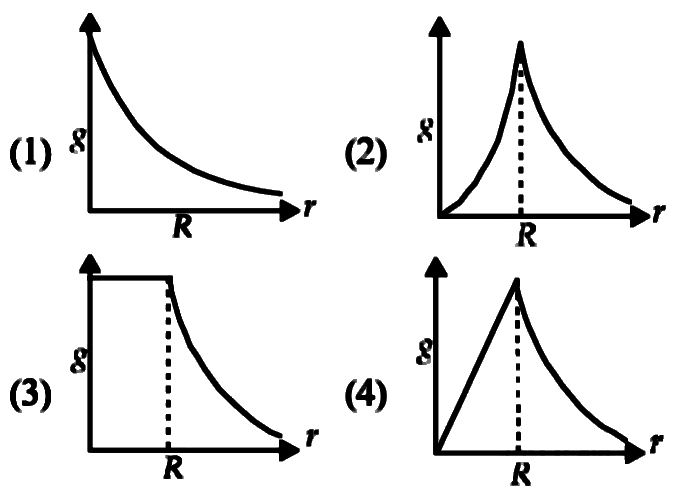
The variation of acceleration due to gravity (g) with distance (r) from the center of the earth is correctly represented by:

(Given R = radius of earth)

Show answer and solution

Answer: (a)

  1. Inside (r<Rr < R): g=GMR3r∝rg = \frac{GM}{R^3}r \propto r, straight line from 0.
  2. Outside (r>Rr > R): g=GMr2g = \frac{GM}{r^2}, decreasing curve; peak at r=Rr = R.
  3. So the answer is (a).
Report a mistake
Q103JEE Main 2022 · 25 JUL · SHIFT 2Medium

Acceleration Due to Gravity · g above the surface (height)

The length of a seconds pendulum at a height h = 2R from earth surface will be: (Given R = Radius of earth and acceleration due to gravity at the surface of earth, g = π\pi2 ms−2{}^{-2})

Show answer and solution

Answer: (d)

  1. At h=2Rh = 2R: g′=g(R3R)2=g9=π29g' = g\left(\frac{R}{3R}\right)^2 = \frac{g}{9} = \frac{\pi^2}{9}
  2. Seconds pendulum has T=2T = 2 s, so L=g′T24π2L = \frac{g'T^2}{4\pi^2}
  3. L=(π2/9)(4)4π2=19L = \frac{(\pi^2/9)(4)}{4\pi^2} = \frac{1}{9} m
  4. So the answer is (d) 19\frac{1}{9} m.
Report a mistake
Q104JEE Main 2022 · 25 JUL · SHIFT 2Medium

Acceleration Due to Gravity · g above the surface (height)

An object is taken to a height above the surface of earth at a distance 54\frac{5}{4} R from the centre of the earth. Where radius of earth, R = 6400 km. The percentage decrease in the weight of the object will be:

Show answer and solution

Answer: (a)

  1. g∝1r2g \propto \frac{1}{r^2}, with r=54Rr = \frac{5}{4}R
  2. g′=g(45)2=1625g=0.64gg' = g\left(\frac{4}{5}\right)^2 = \frac{16}{25}g = 0.64g
  3. Decrease in weight =(1−0.64)×100%=36%= (1-0.64)\times 100\% = 36\%
  4. So the answer is (a) 36%.
Report a mistake
Q105JEE Main 2022 · 24 JUN · SHIFT 1Medium

Acceleration Due to Gravity · g above the surface (height)

The approximate height from the surface of earth at which the weight of the body becomes 13\frac{1}{3} of its weight on the surface of earth is:

[Radius of earth R = 6400 km and 3\sqrt{3} = 1.732]

Show answer and solution

Answer: (b)

  1. W′W=(RR+h)2=13\frac{W'}{W} = \left(\frac{R}{R+h}\right)^2 = \frac{1}{3}
  2. R+h=3R⇒h=(3−1)RR + h = \sqrt{3}R \Rightarrow h = (\sqrt{3}-1)R
  3. h=0.732×6400≈4685h = 0.732 \times 6400 \approx 4685 km
  4. So the answer is (b) 4685 km.
Report a mistake
Q106JEE Main 2022 · 29 JUL · SHIFT 1Medium

Acceleration Due to Gravity · Height versus depth & the g–r graph

If the acceleration due to gravity experienced by a point mass at a height h above the surface of earth is same as that of the acceleration due to gravity at a depth αh (h≪Re)\alpha h\ (h \ll R_e) from the earth surface. The value of α\alpha will be _________.

(use Re=6400 km)R_e = 6400\text{ km})

Numerical answer type. Work it out, then open the answer.

Show answer and solution

Answer: 2

  1. Height h≪Rh \ll R: gh=g(1−2hR)g_h = g\left(1 - \frac{2h}{R}\right)
  2. Depth αh\alpha h: gd=g(1−αhR)g_d = g\left(1 - \frac{\alpha h}{R}\right)
  3. Equal: αh=2h⇒α=2\alpha h = 2h \Rightarrow \alpha = 2
  4. So α=2\alpha = 2.
Report a mistake
Q107JEE Main 2022 · 26 JUN · SHIFT 2Medium

Acceleration Due to Gravity · Shape & rotation of the earth

Given below are two statements: One is labelled as Assertion A and the other is labelled as Reason R.

Assertion A: If we move from poles to equator, the direction of acceleration due to gravity of earth always points towards the center of earth without any variation in its magnitude. Reason R: At equator, the direction of acceleration due to the gravity is towards the center of earth. In the light of above statements, choose the correct answer from the options given below:

Show answer and solution

Answer: (d)

  1. A is false: due to rotation, gg changes in magnitude from pole to equator (gϕ=g−ω2Rcos⁡2ϕg_\phi = g - \omega^2 R\cos^2\phi) and does not point exactly to the centre at other latitudes.
  2. R is true: at the equator the centrifugal term is along the radius, so effective gg points to the centre.
  3. So the answer is (d).
Report a mistake
Q108MHT CET 2021 · 24 SEP · SHIFT 2Easy

Acceleration Due to Gravity · Mass & density of a planet

The average density of the earth is [g is acceleration due to gravity]

Show answer and solution

Answer: (b)

  1. g=43πGρR⇒ρ=3g4πGRg = \frac{4}{3}\pi G\rho R \Rightarrow \rho = \frac{3g}{4\pi GR}.
  2. For fixed RR and GG, ρ∝g\rho \propto g.
  3. So the answer is (b) directly proportional to gg.
Report a mistake
Q109MHT CET 2021 · 22 SEP · SHIFT 2Easy

Acceleration Due to Gravity · g above the surface (height)

At a height 'R' above the earth's surface the gravitational acceleration is (R = radius of earth, g = acceleration due to gravity on earth's surface)

Show answer and solution

Answer: (c)

  1. gh=g(1+h/R)2g_h = \frac{g}{(1 + h/R)^2} with h=Rh = R.
  2. gh=g22=g4g_h = \frac{g}{2^2} = \frac{g}{4}
  3. So the answer is (c) g4\frac{g}{4}.
Report a mistake
Q110MHT CET 2021 · 21 SEP · SHIFT 1Easy

Acceleration Due to Gravity · g above the surface (height)

When the value of acceleration due to gravity 'gg' becomes g3\frac{g}{3} above surface of height 'hh' then relation between 'hh' and 'RR' is ( R=R = radius of earth)

Show answer and solution

Answer: (d)

  1. (RR+h)2=13\left(\frac{R}{R+h}\right)^2 = \frac{1}{3}
  2. R+h=3RR + h = \sqrt{3}R
  3. h=(3−1)Rh = (\sqrt{3} - 1)R
  4. So the answer is (d) h=(3−1)Rh = (\sqrt{3}-1)R.
Report a mistake
Q111MHT CET 2021 · 24 SEP · SHIFT 2Easy

Acceleration Due to Gravity · g below the surface (depth)

The depth from the surface of the earth of radius RR, at which acceleration due to gravity will be 60%60\% of the value on the earth surface is

Show answer and solution

Answer: (b)

  1. At depth dd: gd=g(1−dR)g_d = g\left(1 - \frac{d}{R}\right).
  2. 0.6g=g(1−dR)⇒dR=0.40.6g = g\left(1 - \frac{d}{R}\right) \Rightarrow \frac{d}{R} = 0.4
  3. So the answer is (b) d=2R5d = \frac{2R}{5}.
Report a mistake
Q112MHT CET 2021 · 20 SEP · SHIFT 2Easy

Acceleration Due to Gravity · g below the surface (depth)

The depth at which acceleration due to gravity becomes gn\frac{g}{n} is [ RR = radius of earth, g=g = acceleration due to gravity, n=n = integer ]]

Show answer and solution

Answer: (a)

  1. At depth dd: gd=g(1−dR)g_d = g\left(1 - \frac{d}{R}\right).
  2. gn=g(1−dR)⇒dR=1−1n=n−1n\frac{g}{n} = g\left(1 - \frac{d}{R}\right) \Rightarrow \frac{d}{R} = 1 - \frac{1}{n} = \frac{n-1}{n}
  3. So the answer is (a) d=R(n−1)nd = \frac{R(n-1)}{n}.
Report a mistake
Q113MHT CET 2021 · 20 SEP · SHIFT 1Easy

Acceleration Due to Gravity · g below the surface (depth)

The depth 'd' below the surface of the earth where the value of acceleration due to gravity becomes (1n)\left(\frac{1}{n}\right) times the value at the surface of the earth is (R=(R = radius of the earth)

Show answer and solution

Answer: (a)

  1. At depth dd: gd=g(1−dR)g_d = g\left(1 - \frac{d}{R}\right).
  2. 1n=1−dR⇒d=R(n−1n)\frac{1}{n} = 1 - \frac{d}{R} \Rightarrow d = R\left(\frac{n-1}{n}\right)
  3. So the answer is (a).
Report a mistake
Q114JEE Main 2021 · 31 AUG · SHIFT 2Easy

Acceleration Due to Gravity · Height versus depth & the g–r graph

If RE be the radius of Earth, then the ratio between the acceleration due to gravity at a depth 'r' below and a height 'r' above the earth surface is: (Given: r < RE)

Show answer and solution

Answer: (d)

  1. gdepth=g(1−x)g_{\text{depth}} = g\left(1 - x\right) and gheight=g(1+x)2g_{\text{height}} = \frac{g}{(1+x)^2}, with x=rREx = \frac{r}{R_E}.
  2. Ratio =(1−x)(1+x)2=(1−x)(1+2x+x2)= (1 - x)(1 + x)^2 = (1 - x)(1 + 2x + x^2)
  3. =1+x−x2−x3= 1 + x - x^2 - x^3
  4. So the answer is (d) 1+rRE−r2RE2−r3RE31 + \frac{r}{R_E} - \frac{r^2}{R_E^2} - \frac{r^3}{R_E^3}.
Report a mistake
Q115MHT CET 2021 · 24 SEP · SHIFT 2Medium

Acceleration Due to Gravity · g at the surface & comparing planets

The length of the seconds pendulum is lm on earth. If the mass and diameter of the planet is 1.5 times that of the earth, the length of the seconds pendulum on the planet will be nearly

Show answer and solution

Answer: (a)

  1. gp=G(1.5M)(1.5R)2=g1.5g_p = \frac{G(1.5M)}{(1.5R)^2} = \frac{g}{1.5}
  2. For a fixed period T=2πlgT = 2\pi\sqrt{\frac{l}{g}}, l∝gl \propto g.
  3. lp=11.5×1 m≈0.67 ml_p = \frac{1}{1.5}\times 1\text{ m} \approx 0.67\text{ m}
  4. So the answer is (a) 0.67 m0.67\text{ m}.
Report a mistake
Q116MHT CET 2021 · 23 SEP · SHIFT 1Medium

Acceleration Due to Gravity · g at the surface & comparing planets

The mass of a spherical planet is 4 times the mass of the earth, but its radius (R) is same as that of the earth. How much work is done is lifting a body of mass 5 kg through a distance of 2 m on the planet? (g = 10 ms −2-2)

Show answer and solution

Answer: (a)

  1. gp=G(4M)R2=4g=40 m s−2g_p = \frac{G(4M)}{R^2} = 4g = 40\text{ m s}^{-2}
  2. W=mgph=5×40×2W = mg_p h = 5 \times 40 \times 2
  3. So the answer is (a) 400 J400\text{ J}.
Report a mistake
Q117JEE Main 2021 · 25 JUL · SHIFT 2Medium

Acceleration Due to Gravity · g at the surface & comparing planets

Consider a planet in some solar system which has a mass double the mass of earth and density equal to the average density of earth. If the weight of an object on earth is W, the weight of the same object on that planet will be:

Show answer and solution

Answer: (c)

  1. Same density: M∝R3M \propto R^3, so Mp=2M⇒Rp=21/3RM_p = 2M \Rightarrow R_p = 2^{1/3}R.
  2. g=43πGρR∝R⇒gp=21/3gg = \frac{4}{3}\pi G\rho R \propto R \Rightarrow g_p = 2^{1/3}g
  3. So the answer is (c) 21/3 W2^{1/3}\,W.
Report a mistake
Q118MHT CET 2021 · 21 SEP · SHIFT 2Medium

Acceleration Due to Gravity · g above the surface (height)

For a body of mass 'mm', the acceleration due to gravity at a distance 'RR' from the surface of the earth is (g4)\left(\frac{g}{4}\right). Its value at a distance (R2)\left(\frac{R}{2}\right) from the surface of the earth is ( R=R = radius of the earth, g=g = acceleration due to gravity)

Show answer and solution

Answer: (c)

  1. At height hh: gh=gR2(R+h)2g_h = g\frac{R^2}{(R+h)^2}; at h=Rh = R this gives g4\frac{g}{4}, as stated.
  2. At h=R2h = \frac{R}{2}: gh=gR2(3R2)2=4g9g_h = g\frac{R^2}{\left(\frac{3R}{2}\right)^2} = \frac{4g}{9}
  3. So the answer is (c) 4g9\frac{4g}{9}.
Report a mistake
Q119MHT CET 2021 · 21 SEP · SHIFT 1Medium

Acceleration Due to Gravity · g below the surface (depth)

A pendulum is oscillating with frequency 'nn' on the surface of the earth. It is taken to a depth R2\frac{R}{2} below the surface of earth. New frequency of oscillation at depth R2\frac{R}{2} is

[ RR is the radius of earth]

Show answer and solution

Answer: (b)

  1. n∝gn \propto \sqrt{g} for a simple pendulum
  2. At depth R2\frac{R}{2}: g′=g(1−12)=g2g' = g\left(1 - \frac{1}{2}\right) = \frac{g}{2}
  3. n′=n12=n2n' = n\sqrt{\frac{1}{2}} = \frac{n}{\sqrt{2}}
  4. So the answer is (b).
Report a mistake
Q120JEE Main 2021 · 20 JUL · SHIFT 1Medium

Acceleration Due to Gravity · Height versus depth & the g–r graph

A person whose mass is 100 kg travels from Earth to Mars in a spaceship. Neglect all other objects in sky and take acceleration due to gravity on the surface of the Earth and Mars as 10 m/s2 and 4 m/s2 respectively. Identify from the below figures, the curve that fits best for the weight of the passenger as a function of time.

Figure

Show answer and solution

Answer: (b)

  1. On Earth: W=100×10=1000W = 100 \times 10 = 1000 N; on Mars: W=100×4=400W = 100 \times 4 = 400 N.
  2. Leaving Earth, Earth's pull falls as 1/r21/r^2 while Mars' pull grows, so the net weight falls non-linearly.
  3. At the neutral point the two pulls cancel, so weight becomes zero; then it rises to 400 N near Mars.
  4. Weight (a magnitude) cannot be negative, so the curve touching zero and rising to 400 N is curve (c).
  5. So the answer is option (b), i.e. curve (c).
Report a mistake
Q121JEE Main 2021 · 26 FEB · SHIFT 2Medium

Acceleration Due to Gravity · Height versus depth & the g–r graph

In the reported figure of earth, the value of acceleration due to gravity is same at point A and C but it is smaller than that of its value at point B (surface of the earth). The value of OA: AB will be x: y. The value of x is ________.

Figure

Numerical answer type. Work it out, then open the answer.

Show answer and solution

Answer: 4

  1. C is 3200 km =R2= \frac{R}{2} above B: gC=g(R1.5R)2=4g9g_C = g\left(\frac{R}{1.5R}\right)^2 = \frac{4g}{9}
  2. Inside earth g∝rg \propto r: gA=g OAR=4g9⇒OA=4R9g_A = g\,\frac{OA}{R} = \frac{4g}{9} \Rightarrow OA = \frac{4R}{9}
  3. AB=R−4R9=5R9AB = R - \frac{4R}{9} = \frac{5R}{9}, so OA:AB=4:5OA : AB = 4 : 5
  4. So x=4x = 4.
Report a mistake
Q122JEE Main 2021 · 18 MAR · SHIFT 2Medium

Acceleration Due to Gravity · Shape & rotation of the earth

If the angular velocity of earth's spin is increased such that the bodies at the equator start floating, the duration of the day would be approximately: [Take g = 10 ms−2{}^{-2}, the radius of earth, R = 6400 ×\times 103 m, Take π\pi = 3.14]

Show answer and solution

Answer: (a)

  1. Bodies float when ω2R=g⇒ω=gR=106.4×106=1800\omega^2 R = g \Rightarrow \omega = \sqrt{\frac{g}{R}} = \sqrt{\frac{10}{6.4 \times 10^6}} = \frac{1}{800} rad/s
  2. Length of day T=2πω=2×3.14×800=5024T = \frac{2\pi}{\omega} = 2 \times 3.14 \times 800 = 5024 s
  3. T≈83.7T \approx 83.7 min ≈84\approx 84 min
  4. So the answer is (a) 84 minutes.
Report a mistake
Q123JEE Main 2021 · 24 FEB · SHIFT 2Medium

Acceleration Due to Gravity · Shape & rotation of the earth

A body weights 49N on a spring balance at the north pole. What will be its weight recorded on the same weighing machine, if it is shifted to the equator?

[Use g=GMR2g = \frac{GM}{R^2} = 9.8 ms−2{}^{-2} and radius of earth, R = 6400 km.]

Show answer and solution

Answer: (c)

  1. Mass m=499.8=5m = \frac{49}{9.8} = 5 kg; ω=2π86400=7.27×10⁻⁵\omega = \frac{2\pi}{86400} = 7.27 \times 10^{-5} rad/s
  2. ω2R=(7.27×10⁻⁵)2×6.4×106≈0.0338\omega^2 R = (7.27 \times 10^{-5})^2 \times 6.4 \times 10^6 \approx 0.0338 m/s2^2
  3. Weq=m(g−ω2R)=49−5×0.0338=49−0.17W_{eq} = m(g - \omega^2 R) = 49 - 5 \times 0.0338 = 49 - 0.17
  4. Weq≈48.83W_{eq} \approx 48.83 N, so the answer is (c).
Report a mistake
Q124MHT CET 2021 · 23 SEP · SHIFT 2Difficult

Acceleration Due to Gravity · Shape & rotation of the earth

A body of mass 'M' and radius 'R', situated on the surface of the earth becomes weightless at its equator when the rotational kinetic energy of the earth reaches a critical value 'K'. The value of 'K' is given by [Assume the earth as a solid sphere, g = gravitational acceleration on the earth's surfacde]

Show answer and solution

Answer: (d)

  1. Here MM and RR are the earth's mass and radius.
  2. Weightless at equator: ω2R=g⇒ω2=gR\omega^2 R = g \Rightarrow \omega^2 = \frac{g}{R}
  3. K=12Iω2=12⋅25MR2⋅gRK = \frac{1}{2}I\omega^2 = \frac{1}{2} \cdot \frac{2}{5}MR^2 \cdot \frac{g}{R}
  4. K=15MgRK = \frac{1}{5}MgR, so the answer is (d).
Report a mistake
Q125NEET 2020 · PHASE 1Easy

Acceleration Due to Gravity · g above the surface (height)

A body weighs 72 N on the surface of the earth. What is the gravitational force on it, at a height equal to half the radius of the earth?

Show answer and solution

Answer: (a)

  1. Wh=W(1+h/R)2W_h = \frac{W}{(1 + h/R)^2} with h=R2h = \frac{R}{2}.
  2. Wh=72×49=32 NW_h = 72 \times \frac{4}{9} = 32\ \text{N}
  3. So the answer is (a) 32 N.
Report a mistake
Q126NEET 2020 · PHASE 2Easy

Acceleration Due to Gravity · g below the surface (depth)

What is the depth at which the value of acceleration due to gravity becomes 1/n1/n times the value that at the surface of earth? (radius of earth =R= R)

Show answer and solution

Answer: (c)

  1. At depth dd: gd=g(1−dR)g_d = g\left(1 - \frac{d}{R}\right).
  2. 1n=1−dR⇒d=R(n−1)n\frac{1}{n} = 1 - \frac{d}{R} \Rightarrow d = \frac{R(n-1)}{n}
  3. So the answer is (c).
Report a mistake
Q127MHT CET 2020 · 16 OCT · SHIFT 2Easy

Acceleration Due to Gravity · Shape & rotation of the earth

As we go from the equator of the earth to pole of the earth, the value of acceleration due to gravity

Show answer and solution

Answer: (d)

  1. g′=g−ω2Rcos⁡2λg' = g - \omega^2 R\cos^2\lambda; cos⁡λ\cos\lambda falls from 1 at the equator to 0 at the pole.
  2. Also the polar radius is smaller than the equatorial radius, which raises gg at the poles.
  3. So the answer is (d) gg increases.
Report a mistake
Q128JEE Main 2020 · 5 SEP · SHIFT 1Medium

Acceleration Due to Gravity · Height versus depth & the g–r graph

The value of the acceleration due to gravity is g1 at a height h = R2\frac{R}{2} (R = radius of the earth) from the surface of the earth. It is again equal to g1 at a depth d below the surface of the earth. The ratio (dR)\left(\frac{d}{R}\right) equals:

Show answer and solution

Answer: (a)

  1. At h=R2h = \frac{R}{2}: g1=g(R1.5R)2=4g9g_1 = g\left(\frac{R}{1.5R}\right)^2 = \frac{4g}{9}
  2. At depth dd: g(1−dR)=4g9g\left(1 - \frac{d}{R}\right) = \frac{4g}{9}
  3. dR=1−49=59\frac{d}{R} = 1 - \frac{4}{9} = \frac{5}{9}
  4. So the answer is (a).
Report a mistake
Q129JEE Main 2020 · 7 JAN · SHIFT 2Medium

Acceleration Due to Gravity · Shape & rotation of the earth

A box weight 196 N on a spring balance at the north pole. Its weight recorded on the same balance if it is shifted to the equator is close to (Take g = 10 ms–2 at the north pole and the radius of the earth = 6400 km):

Show answer and solution

Answer: (c)

  1. Mass m=19610=19.6m = \frac{196}{10} = 19.6 kg; ω=2π86400=7.27×10⁻⁵\omega = \frac{2\pi}{86400} = 7.27 \times 10^{-5} rad/s
  2. ω2R≈0.0338\omega^2 R \approx 0.0338 m/s2^2, so mω2R=19.6×0.0338≈0.66m\omega^2 R = 19.6 \times 0.0338 \approx 0.66 N
  3. Weq=196−0.66≈195.3W_{eq} = 196 - 0.66 \approx 195.3 N
  4. So the answer is (c) 195.32 N.
Report a mistake
Q130JEE Main 2020 · 2 SEP · SHIFT 2Difficult

Acceleration Due to Gravity · Height versus depth & the g–r graph

The height ‘h’ at which the weight of a body will be the same as that at the same depth ‘h’ from the surface of the earth is (Radius of the earth is R and effect of the rotation of the earth is neglected)

Show answer and solution

Answer: (b)

  1. Equal weight: g(1−hR)=gR2(R+h)2g\left(1 - \frac{h}{R}\right) = \frac{gR^2}{(R+h)^2} (exact formulas)
  2. Put x=hRx = \frac{h}{R}: (1−x)(1+x)2=1⇒x2+x−1=0(1-x)(1+x)^2 = 1 \Rightarrow x^2 + x - 1 = 0
  3. x=5−12⇒h=5R−R2x = \frac{\sqrt{5}-1}{2} \Rightarrow h = \frac{\sqrt{5}R - R}{2}
  4. So the answer is (b).
Report a mistake
Q131JEE Main 2020 · 5 SEP · SHIFT 2Difficult

Acceleration Due to Gravity · Shape & rotation of the earth

The acceleration due to gravity on the earth’s surface at the poles is g and angular velocity of the earth about the axis passing through the pole is ω\omega. An object is weighed at the equator and at a height h above the poles by using a spring balance. If the weights are found to be same, then h is (h << R, where R is the radius of the earth)

Show answer and solution

Answer: (a)

  1. At the equator: W1=m(g−ω2R)W_1 = m(g - \omega^2 R)
  2. At height hh above the pole (h≪Rh \ll R): W2=mg(1−2hR)W_2 = mg\left(1 - \frac{2h}{R}\right)
  3. W1=W2⇒ω2R=2ghRW_1 = W_2 \Rightarrow \omega^2 R = \frac{2gh}{R}
  4. h=R2ω22gh = \frac{R^2\omega^2}{2g}, so the answer is (a).
Report a mistake
Q132JEE Main 2019 · 10 APR · SHIFT 1Easy

Acceleration Due to Gravity · g above the surface (height)

The value of acceleration due to gravity at Earth's surface is 9.8 ms–2. The altitude above its surface at which the acceleration due to gravity decreases to 4.9 ms–2, is close to: (Radius of earth = 6.4 × 10⁶ m)

Show answer and solution

Answer: (d)

  1. gh=g2g_h = \frac{g}{2}, so (RR+h)2=12\left(\frac{R}{R+h}\right)^2 = \frac{1}{2}.
  2. R+h=2R⇒h=(2−1)RR + h = \sqrt{2}R \Rightarrow h = (\sqrt{2} - 1)R
  3. h=0.414×6.4×106≈2.6×10⁶ mh = 0.414 \times 6.4 \times 10^6 \approx 2.6 \times 10^6\ \text{m}
  4. So the answer is (d) 2.6×1062.6 \times 10^6 m.
Report a mistake
Q133MHT CET 2019 · 3 MAY · SHIFT 1Easy

Acceleration Due to Gravity · g below the surface (depth)

A hole is drilled half way to the centre of the earth. A body weighs 300 N on the surface of the earth. How much will, it weigh at the bottom of the hole?

Show answer and solution

Answer: (d)

  1. Weight at depth: Wd=W(1−dR)W_d = W\left(1 - \frac{d}{R}\right).
  2. Half way to the centre: d=R2d = \frac{R}{2}, so Wd=300×12W_d = 300 \times \frac{1}{2}.
  3. So the answer is (d) 150 N150\text{ N}.
Report a mistake
Q134NEET 2019Easy

Acceleration Due to Gravity · g below the surface (depth)

A body weighs 200 N on the surface of earth. How much will it weigh half way down to the centre of the earth?

Show answer and solution

Answer: (c)

  1. Weight at depth: Wd=W(1−dR)W_d = W\left(1 - \frac{d}{R}\right).
  2. d=R2⇒Wd=200×12d = \frac{R}{2} \Rightarrow W_d = 200 \times \frac{1}{2}
  3. So the answer is (c) 100 N100\text{ N}.
Report a mistake
Q135NEET 2019Medium

Acceleration Due to Gravity · g at the surface & comparing planets

A mass falls from a height 'hh' and its time of fall 'tt' is recorded in terms of time period TT of a simple pendulum. On the surface of earth it is found that t=2Tt = 2T. The entire set up is taken on the surface of another planet whose mass is half of that of earth and radius the same. Same experiment is repeated and corresponding times noted as t′t' and T′T'.

Then we can say

Show answer and solution

Answer: (a)

  1. Time of fall t=2hg∝1gt = \sqrt{\frac{2h}{g}} \propto \frac{1}{\sqrt{g}}.
  2. Pendulum period T=2πlg∝1gT = 2\pi\sqrt{\frac{l}{g}} \propto \frac{1}{\sqrt{g}}.
  3. So tT\frac{t}{T} does not depend on gg and stays 2.
  4. So the answer is (a) t′=2T′t' = 2T'.
Report a mistake
Q136JEE Main 2019 · 12 APR · SHIFT 2Medium

Acceleration Due to Gravity · g at the surface & comparing planets

The ratio of the weights of a body on the Earth’s surface to that on the surface of a planets is 9: 4. The mass of the planet is 19\frac{1}{9} th of that of the Earth. If 'R' is the radius of the Earth, what is the radius of the planet? (Take the planets to have the same mass density)

Show answer and solution

Answer: (b)

  1. g=GMR2⇒gpge=MpMe(RRp)2g = \frac{GM}{R^2} \Rightarrow \frac{g_p}{g_e} = \frac{M_p}{M_e}\left(\frac{R}{R_p}\right)^2
  2. 49=19(RRp)2⇒(RRp)2=4\frac{4}{9} = \frac{1}{9}\left(\frac{R}{R_p}\right)^2 \Rightarrow \left(\frac{R}{R_p}\right)^2 = 4
  3. So the answer is (b) Rp=R2R_p = \frac{R}{2}.
Report a mistake
Q137MHT CET 2019 · 3 MAY · SHIFT 1Medium

Acceleration Due to Gravity · Shape & rotation of the earth

Consider a particle of mass mm suspended by a string at the equator. Let RR and MM denote radius and mass of the earth. If ω\omega is the angular velocity of rotation of the earth about its own axis, then the tension on the string will be (cos⁡0∘(\cos 0^\circ =1)= 1)

Show answer and solution

Answer: (d)

  1. At the equator the particle moves in a circle of radius RR with the earth.
  2. Net inward force: GMmR2−T=mω2R\frac{GMm}{R^2} - T = m\omega^2 R
  3. T=GMmR2−mω2RT = \frac{GMm}{R^2} - m\omega^2 R
  4. So the answer is (d).
Report a mistake
Q138JEE Main 2018 · 16 APR · SHIFT 1Easy

Acceleration Due to Gravity · Shape & rotation of the earth

Suppose that the angular velocity of rotation of earth is increased. Then, as a consequence:

Show answer and solution

Answer: (d)

  1. g′=g−ω2Rcos⁡2λg' = g - \omega^2 R\cos^2\lambda; increasing ω\omega increases the reduction wherever cos⁡λ≠0\cos\lambda \ne 0.
  2. At the poles cos⁡90∘=0\cos 90^\circ = 0, so the weight there is unchanged.
  3. So the answer is (d): weight decreases everywhere except at the poles.
Report a mistake
Q139NEET 2018Medium

Acceleration Due to Gravity · g at the surface & comparing planets

If the mass of the Sun were ten times smaller and the universal gravitational constant were ten times larger in magnitude, which of the following is not correct?

Show answer and solution

Answer: (d)

  1. g=GMERE2g = \frac{GM_E}{R_E^2} does not involve the Sun's mass; GG ten times larger makes gg ten times larger.
  2. Larger gg: raindrops fall faster, walking is harder, and T=2πl/gT = 2\pi\sqrt{l/g} decreases, so (a), (b), (c) are correct.
  3. Statement (d) (gg unchanged) is wrong.
  4. So the answer is (d).
Report a mistake
Q140NEET 2017Easy

Acceleration Due to Gravity · Height versus depth & the g–r graph

The acceleration due to gravity at a height 1 km above the earth is the same as at a depth d below the surface of earth. Then

Show answer and solution

Answer: (c)

  1. For h≪Rh \ll R: gh=g(1−2hR)g_h = g\left(1 - \frac{2h}{R}\right) and gd=g(1−dR)g_d = g\left(1 - \frac{d}{R}\right).
  2. Equal gg: 2hR=dR⇒d=2h=2 km\frac{2h}{R} = \frac{d}{R} \Rightarrow d = 2h = 2\text{ km}
  3. So the answer is (c) d=2 kmd = 2\text{ km}.
Report a mistake
Q141JEE Main 2017Easy

Acceleration Due to Gravity · Height versus depth & the g–r graph

The variation of acceleration due to gravity gg with distance d from centre of the earth is best represented by (R = Earth’s radius):

Show answer and solution

Answer: (a)

  1. For d<Rd < R: g=GMR3dg = \frac{GM}{R^3}d, linear in dd starting from 0.
  2. For d>Rd > R: g=GMd2g = \frac{GM}{d^2}, decreasing as 1/d21/d^2 and never reaching zero.
  3. So the answer is (a).
Report a mistake
Q142JEE Main 2017 · 8 APR · SHIFT 1Medium

Acceleration Due to Gravity · Shape & rotation of the earth

If the Earth has no rotational motion, the weight of a person on the equator is W. Determine the speed with which the earth would have to rotate about its axis so that the person at the equator will weigh 34\frac{3}{4} W. Radius of the Earth is 6400 km and g=10 m/s2.

Show answer and solution

Answer: (c)

  1. At the equator: m(g−ω2R)=34mg⇒ω2=g4Rm(g - \omega^2 R) = \frac{3}{4}mg \Rightarrow \omega^2 = \frac{g}{4R}
  2. ω=104×6.4×106=3.9×10⁻⁷\omega = \sqrt{\frac{10}{4 \times 6.4 \times 10^6}} = \sqrt{3.9 \times 10^{-7}}
  3. ω≈6.25×10⁻⁴≈0.63×10⁻³\omega \approx 6.25 \times 10^{-4} \approx 0.63 \times 10^{-3} rad/s
  4. So the answer is (c).
Report a mistake
Q143NEET 2016 · PHASE 2Easy

Acceleration Due to Gravity · Height versus depth & the g–r graph

Starting from the centre of the earth having radius R, the variation of g (acceleration due to gravity) is shown by

Show answer and solution

Answer: (b)

ROrgg ∝ rg ∝ 1/r²
  1. Inside the earth (r<Rr < R): g=GMR3rg = \frac{GM}{R^3}r, so g∝rg \propto r (straight line from the origin).
  2. Outside (r>Rr > R): g=GMr2g = \frac{GM}{r^2}, so g∝1r2g \propto \frac{1}{r^2} (falling curve).
  3. gg is maximum at r=Rr = R.
  4. So the answer is (b): straight rise up to RR, then a 1/r21/r^2 fall.
Report a mistake
Q144NEET 2012 · AIPMT · PRELIMSEasy

Acceleration Due to Gravity · g at the surface & comparing planets

A spherical planet has a mass MP and diameter DP. A particle of mass m falling freely near the surface of this planet will experience an acceleration due to gravity, equal to

Show answer and solution

Answer: (a)

  1. Radius R=DP2R = \frac{D_P}{2}; acceleration does not depend on mm.
  2. g=GMP(DP/2)2=4GMPDP2g = \frac{GM_P}{(D_P/2)^2} = \frac{4GM_P}{D_P^2}
  3. So the answer is (a).
Report a mistake
Q145NEET 2012 · AIPMT · PRELIMSEasy

Acceleration Due to Gravity · g above the surface (height)

The height at which the weight of a body becomes (116)\left(\frac{1}{16}\right) th\text{th}, its weight on the surface of earth (radius R), is

Show answer and solution

Answer: (c)

  1. (RR+h)2=116\left(\frac{R}{R+h}\right)^2 = \frac{1}{16}
  2. R+h=4R⇒h=3RR + h = 4R \Rightarrow h = 3R
  3. So the answer is (c) 3R.
Report a mistake
Q146NEET 2010 · AIPMT · MAINSEasy

Acceleration Due to Gravity · Height versus depth & the g–r graph

The dependence of acceleration due to gravity g on the distance r from the centre of the earth, assumed to be a sphere of radius R of uniform density is as shown in figures below

Figure

The correct figure is

Show answer and solution

Answer: (a)

  1. Inside (r<Rr < R): g∝rg \propto r, a straight line from the origin.
  2. Outside (r>Rr > R): g∝1r2g \propto \frac{1}{r^2}, a falling curve; peak at r=Rr = R.
  3. Figure (4) shows exactly this shape.
  4. So the answer is (a) figure (4).
Report a mistake
Q147JEE Main 2009 · AIEEEEasy

Acceleration Due to Gravity · g above the surface (height)

The height at which the acceleration due to gravity becomes g9\frac{g}{9} (where g=g = the acceleration due to gravity on the surface of the earth) in terms of R,R, the radius of the earth, is:

Show answer and solution

Answer: (d)

  1. (RR+h)2=19\left(\frac{R}{R+h}\right)^2 = \frac{1}{9}
  2. R+h=3R⇒h=2RR + h = 3R \Rightarrow h = 2R
  3. So the answer is (d) 2R2R.
Report a mistake
Q148JEE Main 2007 · AIEEEMedium

Acceleration Due to Gravity · g at the surface & comparing planets

If gEg_E and gMg_M are the accelerations due to gravity on the surfaces of the earth and the moon respectively and if Millikan's oil drop experiment could be performed on the two surfaces, one will find the ratio

electronic charge on the moonelectronic charge on the earth to be\frac{\text{electronic charge on the moon}}{\text{electronic charge on the earth}}\ \text{to be}

Show answer and solution

Answer: (b)

  1. The electronic charge ee is a fundamental constant; it does not depend on gg.
  2. Millikan's experiment measures the same ee anywhere, so the ratio is 1.
  3. So the answer is (b) 11.
Report a mistake
Q149NEET 2005 · AIPMTEasy

Acceleration Due to Gravity · g at the surface & comparing planets

Imagine a new planet having the same density as that of earth but it is 3 times bigger than the earth in size. If the acceleration due to gravity on the surface of earth is g and that on the surface of the new planet is g', then

Show answer and solution

Answer: (d)

  1. g=43πGρRg = \frac{4}{3}\pi G\rho R; same density, so g∝Rg \propto R.
  2. Radius 3 times ⇒g′=3g\Rightarrow g' = 3g
  3. So the answer is (d).
Report a mistake
Q150JEE Main 2005 · AIEEEEasy

Acceleration Due to Gravity · Mass & density of a planet

Average density of the earth

Show answer and solution

Answer: (d)

  1. g=43πGρR⇒ρ=3g4πGRg = \frac{4}{3}\pi G\rho R \Rightarrow \rho = \frac{3g}{4\pi GR}.
  2. With GG and RR fixed, ρ∝g\rho \propto g.
  3. So the answer is (d) directly proportional to gg.
Report a mistake
Q151JEE Main 2005 · AIEEEMedium

Acceleration Due to Gravity · Height versus depth & the g–r graph

The change in the value of gg at a height hh above the surface of the earth is the same as at a depth dd below the surface of earth. When both dd and hh are much smaller than the radius of earth, then which one of the following is correct?

Show answer and solution

Answer: (d)

  1. Change at height: Δg=2ghR\Delta g = \frac{2gh}{R} (for h≪Rh \ll R)
  2. Change at depth: Δg=gdR\Delta g = \frac{gd}{R}
  3. 2ghR=gdR⇒d=2h\frac{2gh}{R} = \frac{gd}{R} \Rightarrow d = 2h
  4. So the answer is (d).
Report a mistake
Q152NEET 2004 · AIPMTEasy

Acceleration Due to Gravity · g at the surface & comparing planets

The density of a newly discovered planet is twice that of earth. The acceleration due to gravity at the surface of the planet is equal to that at the surface of the earth. If the radius of the earth is R, the radius of the planet would be

Show answer and solution

Answer: (d)

  1. g=43πGρRg = \frac{4}{3}\pi G\rho R, so equal gg needs equal ρR\rho R.
  2. 2ρ⋅Rp=ρR⇒Rp=R22\rho \cdot R_p = \rho R \Rightarrow R_p = \frac{R}{2}
  3. So the answer is (d) 12R\frac{1}{2}R.
Report a mistake
Q153NEET 2003 · AIPMTMedium

Acceleration Due to Gravity · g at the surface & comparing planets

The acceleration due to gravity on the planet A is 9 times the acceleration due to gravity on planet B. A man jumps to a height of 2 m on the surface of A. What is the height of jump by the same person on the planet B?

Show answer and solution

Answer: (b)

  1. Same take-off speed uu: h=u22g⇒h∝1gh = \frac{u^2}{2g} \Rightarrow h \propto \frac{1}{g}.
  2. hB=hAgAgB=2×9h_B = h_A \frac{g_A}{g_B} = 2 \times 9
  3. So the answer is (b) 18 m18\text{ m}.
Report a mistake
Q154NEET 2000 · AIPMTEasy

Acceleration Due to Gravity · g above the surface (height)

A body of weight 72 N moves from the surface of earth at a height half of the radius of earth, then gravitational force exerted on it will be

Show answer and solution

Answer: (b)

  1. Wh=W(1+h/R)2W_h = \frac{W}{(1 + h/R)^2} with h=R2h = \frac{R}{2}.
  2. Wh=72×49=32 NW_h = 72 \times \frac{4}{9} = 32\ \text{N}
  3. So the answer is (b) 32 N.
Report a mistake
Q155NEET 1996 · AIPMTEasy

Acceleration Due to Gravity · Mass & density of a planet

What will be the formula of mass of the earth in terms of gg, RR and GG?

Show answer and solution

Answer: (b)

  1. On the surface mg=GMmR2mg = \frac{GMm}{R^2}, so g=GMR2g = \frac{GM}{R^2}.
  2. M=gR2GM = \frac{gR^2}{G}
  3. So the answer is (b) gR2Gg\frac{R^2}{G}.
Report a mistake
Q156NEET 1995 · AIPMTEasy

Acceleration Due to Gravity · Mass & density of a planet

The acceleration due to gravity gg and mean density of the earth ρ\rho are related by which of the following relations? (where GG is the gravitational constant and RR is the radius of the earth.)

Show answer and solution

Answer: (a)

  1. g=GMR2=GR2⋅43πR3ρ=43πGρRg = \frac{GM}{R^2} = \frac{G}{R^2}\cdot\frac{4}{3}\pi R^3\rho = \frac{4}{3}\pi G\rho R
  2. ρ=3g4πGR\rho = \frac{3g}{4\pi GR}
  3. So the answer is (a) ρ=3g4πGR\rho = \frac{3g}{4\pi GR}.
Report a mistake
Q157NEET 1994 · AIPMTMedium

Acceleration Due to Gravity · g at the surface & comparing planets

The radius of earth is about 6400 km and that of mars is 3200 km. The mass of the earth is about 10 times mass of mars. An object weighs 200 N on the surface of earth. Its weight on the surface of mars will be

Show answer and solution

Answer: (c)

  1. gmge=MmMe(ReRm)2=110×22=0.4\frac{g_m}{g_e} = \frac{M_m}{M_e}\left(\frac{R_e}{R_m}\right)^2 = \frac{1}{10} \times 2^2 = 0.4
  2. Wm=0.4×200W_m = 0.4 \times 200
  3. So the answer is (c) 80 N80\text{ N}.
Report a mistake
Q158MHT CET 2026 · 14 MAY · SHIFT 2Medium

Gravitational Field · Field of sphere, shell & other bodies

The magnitude of gravitational field at distances r1r_1 and r2r_2 from the centre of a uniform sphere of radius R and mass M are I1I_1 and I2I_2 respectively. Given that r1>r_1 > RR and r2<r_2 < RR, the ratio I1I2\frac{I_1}{I_2} is

Show answer and solution

Answer: (c)

  1. Outside (r1>Rr_1 > R): I1=GMr12I_1 = \frac{GM}{r_1^2}.
  2. Inside (r2<Rr_2 < R): I2=GMr2R3I_2 = \frac{GMr_2}{R^3}.
  3. I1I2=GMr12⋅R3GMr2=R3r12r2\frac{I_1}{I_2} = \frac{GM}{r_1^2}\cdot\frac{R^3}{GMr_2} = \frac{R^3}{r_1^2 r_2}
  4. So the answer is (c) R3r12r2\frac{R^3}{r_1^2 r_2}.
Report a mistake
Q159MHT CET 2026 · 13 MAY · SHIFT 2Medium

Gravitational Field · Field of sphere, shell & other bodies

The magnitude of gravitational field at distance r1r_1 and r2r_2 from the centre of a uniform sphere of radius RR and mass MM are E1E_1 and E2E_2 respectively. If r1>Rr_1 > R and r2<Rr_2 < R, then the ratio E1/E2E_1/E_2 is

Show answer and solution

Answer: (c)

  1. Outside (r1>Rr_1 > R): E1=GMr12E_1 = \frac{GM}{r_1^2}.
  2. Inside (r2<Rr_2 < R): E2=GMr2R3E_2 = \frac{GMr_2}{R^3}.
  3. E1E2=R3r12r2\frac{E_1}{E_2} = \frac{R^3}{r_1^2 r_2}
  4. So the answer is (c) R3r12r2\frac{R^3}{r_1^2 r_2}.
Report a mistake
Q160MHT CET 2025 · 5 MAY · SHIFT 2Medium

Gravitational Field · Field of sphere, shell & other bodies

A uniform sphere has radius ' RR ' and mass ' MM '. The magnitude of gravitational field at distances ' r1r_1 ' and ' r2r_2 ' from the centre of the sphere are ' E1E_1 ' and ' E2E_2 ' respectively. The ratio E1:E2E_1 : E_2 is (r1>Rr_1 > R and r2<Rr_2 < R)

Show answer and solution

Answer: (c)

  1. Outside (r1>Rr_1 > R): E1=GMr12E_1 = \frac{GM}{r_1^2}.
  2. Inside (r2<Rr_2 < R): E2=GMr2R3E_2 = \frac{GMr_2}{R^3}.
  3. E1:E2=R3r12r2E_1 : E_2 = \frac{R^3}{r_1^2 r_2}
  4. So the answer is (c) R3r12r2\frac{R^3}{r_1^2 r_2}.
Report a mistake
Q161MHT CET 2025 · 23 APR · SHIFT 1Medium

Gravitational Field · Field of sphere, shell & other bodies

A uniform solid sphere of mass ' mm ' and radius ' r ' is surrounded by a uniform thin spherical shell of radius ' 2r2r ' and mass ' mm ' then the gravitational field

Show answer and solution

Answer: (b)

  1. Inside the shell (r<2rr < 2r) only the sphere acts; outside it (>2r> 2r) total mass 2m2m acts as a point mass.
  2. (a) At 15r15r: E=2Gm225r2E = \frac{2Gm}{225r^2}, not 29Gmr2\frac{2}{9}\frac{Gm}{r^2}. False.
  3. (b) At 2.5r2.5r: E=2Gm6.25r2=825Gmr2E = \frac{2Gm}{6.25r^2} = \frac{8}{25}\frac{Gm}{r^2}. True.
  4. (c) At 1.5r1.5r: E=Gm2.25r2≠0E = \frac{Gm}{2.25r^2} \ne 0. (d) Between them E∝1r2E \propto \frac{1}{r^2}, not uniform. Both false.
  5. So the answer is (b).
Report a mistake
Q162MHT CET 2024 · 2 MAY · SHIFT 1Medium

Gravitational Field · Field of sphere, shell & other bodies

The magnitude of gravitational field at distance ' r1r_1 ' and ' r2r_2 ' from the centre of a uniform sphere of radius ' RR ' and mass ' MM ' are ' F1F_1 ' and ' F2F_2 ' respectively. The ratio ' (F1/F2)(F_1/F_2) ' will be (if r1>Rr_1 > R and r2<Rr_2 < R)

Show answer and solution

Answer: (c)

  1. Outside (r1>Rr_1 > R): F1=GMr12F_1 = \frac{GM}{r_1^2}.
  2. Inside (r2<Rr_2 < R): F2=GMr2R3F_2 = \frac{GMr_2}{R^3}.
  3. F1F2=R3r12r2\frac{F_1}{F_2} = \frac{R^3}{r_1^2 r_2}
  4. So the answer is (c) R3r12r2\frac{R^3}{r_1^2 r_2}.
Report a mistake
Q163NEET 2022 · PHASE 1Easy

Gravitational Field · Field intensity & null point

A body of mass 60 g experiences a gravitational force of 3.0 N, when placed at a particular point. The magnitude of the gravitational field intensity at that point is

Show answer and solution

Answer: (b)

  1. Field intensity E=FmE = \frac{F}{m}
  2. E=3.00.060=50E = \frac{3.0}{0.060} = 50 N/kg
  3. So the answer is (b) 50 N/kg.
Report a mistake
Q164NEET 2022 · PHASE 2Medium

Gravitational Field · Field intensity & null point

In a gravitational field, the gravitational potential is given by, V=−KxV = -\frac{K}{x} (J/Kg). The gravitational field intensity at point (2, 0, 3) m is

Show answer and solution

Answer: (d)

  1. Field E=−dVdxE = -\frac{dV}{dx}.
  2. E=−ddx(−Kx)=−Kx2E = -\frac{d}{dx}\left(-\frac{K}{x}\right) = -\frac{K}{x^2}
  3. Only xx matters; at (2,0,3)(2,0,3), x=2x = 2: E=−K4E = -\frac{K}{4}
  4. So the answer is (d) −K4-\frac{K}{4}.
Report a mistake
Q165MHT CET 2020 · 16 OCT · SHIFT 1Medium

Gravitational Field · Field intensity & null point

The mass of earth is 81 times the mass of the moon and the distance between their centres is RR. The distance from the centre of the earth, where gravitational force will be zero is

Show answer and solution

Answer: (c)

81MME = 0x = 9R/10R/10
  1. At the null point the pulls of earth and moon are equal: GMex2=GMm(R−x)2\frac{GM_e}{x^2} = \frac{GM_m}{(R-x)^2}, with xx from the earth's centre.
  2. xR−x=MeMm=81=9\frac{x}{R-x} = \sqrt{\frac{M_e}{M_m}} = \sqrt{81} = 9
  3. x=9R−9x⇒x=9R10x = 9R - 9x \Rightarrow x = \frac{9R}{10}
  4. So the answer is (c) 9R10\frac{9R}{10}.
Report a mistake
Q166JEE Main 2020 · 8 JAN · SHIFT 1Medium

Gravitational Field · Field of sphere, shell & other bodies

Consider two solid spheres of radii R1 = 1m, R2 = 2m and masses M1 and M2, respectively. The gravitational field due to sphere (1) and (2) are shown. The value of M1M2\frac{M_1}{M_2} is:

Figure

Show answer and solution

Answer: (b)

  1. The peak of each graph is the surface field E=GMR2E = \frac{GM}{R^2}.
  2. Sphere 1: GM112=2⇒GM1=2\frac{GM_1}{1^2} = 2 \Rightarrow GM_1 = 2.
  3. Sphere 2: GM222=3⇒GM2=12\frac{GM_2}{2^2} = 3 \Rightarrow GM_2 = 12.
  4. M1M2=212=16\frac{M_1}{M_2} = \frac{2}{12} = \frac{1}{6}
  5. So the answer is (b) 16\frac{1}{6}.
Report a mistake
Q167JEE Main 2020 · 3 SEP · SHIFT 2Difficult

Gravitational Field · Field of sphere, shell & other bodies

The mass density of a planet of radius R varies with the distance r from its centre as ρ\rho(r) = ρ0(1\rho_0 (1 −r2R2)- \frac{r^2}{R^2}).

Then the gravitational field is maximum at:

Show answer and solution

Answer: (d)

  1. Mass within rr: M(r)=∫0r4πr2ρ0(1−r2R2)dr=4πρ0(r33−r55R2)M(r) = \int_0^r 4\pi r^2\rho_0\left(1-\frac{r^2}{R^2}\right)dr = 4\pi\rho_0\left(\frac{r^3}{3} - \frac{r^5}{5R^2}\right)
  2. E=GM(r)r2=4πGρ0(r3−r35R2)E = \frac{GM(r)}{r^2} = 4\pi G\rho_0\left(\frac{r}{3} - \frac{r^3}{5R^2}\right)
  3. For maximum, dEdr=0\frac{dE}{dr} = 0: 13−3r25R2=0⇒r2=5R29\frac{1}{3} - \frac{3r^2}{5R^2} = 0 \Rightarrow r^2 = \frac{5R^2}{9}
  4. So the answer is (d) r=59Rr = \sqrt{\frac{5}{9}}R.
Report a mistake
Q168JEE Main 2019 · 9 APR · SHIFT 1Medium

Gravitational Field · Field of sphere, shell & other bodies

A solid sphere of mass 'M' and radius 'a' is surrounded by a uniform concentric spherical shell of thickness 2a and mass 2M. The gravitational field at distance '3a' from the centre will be:

Show answer and solution

Answer: (a)

  1. The shell extends from aa to 3a3a, so at r=3ar = 3a the whole mass M+2M=3MM + 2M = 3M is enclosed.
  2. Enclosed mass acts as a point mass at the centre: E=G(3M)(3a)2E = \frac{G(3M)}{(3a)^2}
  3. E=3GM9a2=GM3a2E = \frac{3GM}{9a^2} = \frac{GM}{3a^2}
  4. So the answer is (a) GM3a2\frac{GM}{3a^2}.
Report a mistake
Q169JEE Main 2017 · 9 APR · SHIFT 1Difficult

Gravitational Field · Field of sphere, shell & other bodies

The mass density of a spherical body is given by

ρ\rho (r) = kr\frac{k}{r} for r ≤\le R and ρ\rho (r) = 0 for r > R,

where r is the distance from the centre.

The correct graph that describes qualitatively the acceleration, a, of a test particle as a function of r is:

Show answer and solution

Answer: (b)

  1. Mass within r≤Rr \le R: M(r)=∫0r4πr2krdr=2πkr2M(r) = \int_0^r 4\pi r^2 \frac{k}{r} dr = 2\pi k r^2
  2. Inside: a=GM(r)r2=2πGka = \frac{GM(r)}{r^2} = 2\pi G k, a constant.
  3. Outside: a=GMr2a = \frac{GM}{r^2}, falls as 1r2\frac{1}{r^2}.
  4. Flat line up to RR, then a falling curve. So the answer is (b).
Report a mistake
Q170NEET 2014 · AIPMTEasy

Gravitational Field · Field of sphere, shell & other bodies

Dependence of intensity of gravitational field (E) of earth with distance (r) from centre of earth is correctly represented by

Show answer and solution

Answer: (a)

  1. Inside a uniform earth: E=GMR3rE = \frac{GM}{R^3}r, so ∣E∣∝r|E| \propto r (straight line from 0 to maximum at r=Rr = R).
  2. Outside: E=GMr2E = \frac{GM}{r^2}, so ∣E∣∝1r2|E| \propto \frac{1}{r^2}, falling towards zero.
  3. The field is attractive (towards the centre), so it is drawn negative.
  4. Graph (a) shows the linear rise in magnitude up to RR and 1/r21/r^2 fall beyond, with negative sign. So the answer is (a).
Report a mistake
Q171JEE Main 2013 · 9 APR · SHIFT 1Difficult

Gravitational Field · Field of sphere, shell & other bodies

The gravitational field, due to the 'left over part' of a uniform sphere (from which a part as shown, has been 'removed out'), at a very far off point, P, located as shown, would be (nearly):

Figure

Show answer and solution

Answer: (c)

  1. Removed sphere has radius R2\frac{R}{2}, so its mass is M8\frac{M}{8} (mass ∝\propto volume ∝r3\propto r^3).
  2. For a very far point, both the full sphere and the removed part act as point masses at distance ≈x\approx x.
  3. E=GMx2−G(M/8)x2=78GMx2E = \frac{GM}{x^2} - \frac{G(M/8)}{x^2} = \frac{7}{8}\frac{GM}{x^2}
  4. So the answer is (c) 78GMx2\frac{7}{8}\frac{GM}{x^2}.
Report a mistake
Q172NEET 2012 · AIPMT · MAINSEasy

Gravitational Field · Field of sphere, shell & other bodies

Which one of the following plots represents the variation of gravitiational field on a particle with distance r due to a thin spherical shell of radius R? (r is measured from the centre of the spherical shell)

Show answer and solution

Answer: (b)

  1. Inside a thin shell (r<Rr < R): E=0E = 0.
  2. Outside (r≥Rr \ge R): E=GMr2E = \frac{GM}{r^2}, maximum at r=Rr = R and falling as 1r2\frac{1}{r^2}.
  3. So the graph is zero up to RR, jumps to maximum at RR, then decreases.
  4. So the answer is (b).
Report a mistake
Q173JEE Main 2008 · AIEEEDifficult

Gravitational Field · Field intensity & null point

This question contains Statement - 11 and Statement - 22. of the four choices given after the statements, choose the one that best describes the two statements.

Statement - 11:

For a mass MM kept at the center of a cube of side ′a′'a', the flux of gravitational field passing through its sides 4πGM.4\pi GM.

Statement - 2:

If the direction of a field due to a point source is radial and its dependence on the distance ′r′'r' from the source is given as 1r2,\frac{1}{r^2}, its flux through a closed surface depends only on the strength of the source enclosed by the surface and not on the size or shape of the surface.

Show answer and solution

Answer: (b)

  1. Gauss's law for gravity: flux through any closed surface =4πGMenc= 4\pi G M_{enc} (magnitude), for a 1r2\frac{1}{r^2} radial field.
  2. Statement 2 is true: the flux depends only on the enclosed mass, not on the size or shape of the surface.
  3. Statement 1 follows from it: the cube encloses MM, so total flux =4πGM= 4\pi GM.
  4. So the answer is (b).
Report a mistake
Q174MHT CET 2026 · 16 APR · SHIFT 2Easy

Gravitational Potential & Energy · Change in PE & work against gravity

A body of mass m is taken from earth surface to a height h equal to twice the radius of earth, the increase in potential energy will be (gg = acceleration due to gravity on earth's surface) (R - radius of earth)

Show answer and solution

Answer: (a)

  1. ΔU=mgh1+hR\Delta U = \frac{mgh}{1 + \frac{h}{R}}
  2. With h=2Rh = 2R: ΔU=mg(2R)1+2=23mgR\Delta U = \frac{mg(2R)}{1+2} = \frac{2}{3}mgR
  3. So the answer is (a) 23mgR\frac{2}{3}mgR.
Report a mistake
Q175NEET 2026Easy

Gravitational Potential & Energy · Change in PE & work against gravity

The amount of work done to raise a mass ' mm ' from the surface of the Earth to a height equal to the radius of the Earth ' RR ' will be

Show answer and solution

Answer: (d)

  1. W=ΔU=mgh1+hRW = \Delta U = \frac{mgh}{1+\frac{h}{R}}
  2. With h=Rh = R: W=mgR2W = \frac{mgR}{2}
  3. So the answer is (d) mgR2mg\frac{R}{2}.
Report a mistake
Q176JEE Main 2026 · 5 APR · SHIFT 2Easy

Gravitational Potential & Energy · Change in PE & work against gravity

A body of mass mm is taken from the surface of earth to a height equal to twice the radius of earth (Re)(R_e). The increase in potential energy will be ______.

( gg is acceleration due to gravity at the surface of earth)

Show answer and solution

Answer: (d)

  1. ΔU=mgh1+hRe\Delta U = \frac{mgh}{1+\frac{h}{R_e}}
  2. With h=2Reh = 2R_e: ΔU=2mgRe3\Delta U = \frac{2mgR_e}{3}
  3. So the answer is (d) 23mgRe\frac{2}{3}mgR_e.
Report a mistake
Q177MHT CET 2026 · 14 MAY · SHIFT 1Medium

Gravitational Potential & Energy · Gravitational potential

Two particles of masses mm and MM are placed a distance dd apart. The gravitational potential at the position where the gravitational field due to them is zero is VV. Then

Show answer and solution

Answer: (d)

  1. Null point at xx from mm: xd−x=mM⇒x=m dm+M\frac{x}{d-x} = \sqrt{\frac{m}{M}} \Rightarrow x = \frac{\sqrt{m}\,d}{\sqrt{m}+\sqrt{M}}, d−x=M dm+Md - x = \frac{\sqrt{M}\,d}{\sqrt{m}+\sqrt{M}}
  2. V=−Gmx−GMd−x=−G(m+M)d(m+M)V = -\frac{Gm}{x} - \frac{GM}{d-x} = -\frac{G(\sqrt{m}+\sqrt{M})}{d}\left(\sqrt{m}+\sqrt{M}\right)
  3. V=−Gd(m+M)2V = -\frac{G}{d}(\sqrt{m}+\sqrt{M})^2
  4. So the answer is (d).
Report a mistake
Q178JEE Main 2026 · 24 JAN · SHIFT 1Medium

Gravitational Potential & Energy · Potential energy of a system of masses

Three masses 200 kg,300 kg200\text{ kg}, 300\text{ kg} and 400 kg are placed at the vertices of an equilateral triangle with sides 20 m. They are rearranged on the vertices of a bigger triangle of side 25 m and with the same centre. The work done in this process ______ J. (Gravitational constant G=6.7×10⁻¹¹ N m2/kg2G = 6.7 \times 10^{-11}\text{ N m}^2/\text{kg}^2)

Show answer and solution

Answer: (b)

  1. U=−G(m1m2+m2m3+m3m1)aU = -\frac{G(m_1m_2 + m_2m_3 + m_3m_1)}{a}; ∑mimj=60000+120000+80000=2.6×10⁵\sum m_im_j = 60000 + 120000 + 80000 = 2.6\times10^5
  2. W=Uf−Ui=G(2.6×10⁵)(120−125)W = U_f - U_i = G(2.6\times10^5)\left(\frac{1}{20} - \frac{1}{25}\right)
  3. W=6.7×10−11×2.6×105×0.01W = 6.7\times10^{-11}\times2.6\times10^5\times0.01
  4. W=1.74×10⁻⁷ JW = 1.74\times10^{-7}\ \text{J}
  5. So the answer is (b).
Report a mistake
Q179MHT CET 2025 · 22 APR · SHIFT 2Medium

Gravitational Potential & Energy · Change in PE & work against gravity

The magnitude of gravitational potential energy of a body at a distance ' RR ' from the centre of the earth is ' E '. Its weight at a distance ' 1.5 R ' from the centre of the earth is

Show answer and solution

Answer: (c)

  1. E=GMmR⇒GMm=ERE = \frac{GMm}{R} \Rightarrow GMm = ER
  2. Weight at r=1.5Rr = 1.5R: W=GMm(1.5R)2=ER2.25R2W = \frac{GMm}{(1.5R)^2} = \frac{ER}{2.25R^2}
  3. So the answer is (c) W=4E9RW = \frac{4E}{9R}.
Report a mistake
Q180JEE Main 2024 · 30 JAN · SHIFT 1Medium

Gravitational Potential & Energy · Gravitational potential

The gravitational potential at a point above the surface of earth is −5.12×10⁷ J/kg-5.12 \times 10^{7}\text{ J/kg} and the acceleration due to gravity at that point is 6.4 m/s26.4\text{ m/s}^2. Assume that the mean radius of earth to be 6400 km6400\text{ km}. The height of this point above the earth's surface is:

Show answer and solution

Answer: (a)

  1. V=−GMrV = -\frac{GM}{r} and g=GMr2g = \frac{GM}{r^2}, so r=∣V∣gr = \frac{|V|}{g}.
  2. r=5.12×1076.4=8×10⁶ m=8000 kmr = \frac{5.12\times10^7}{6.4} = 8\times10^6\ \text{m} = 8000\ \text{km}
  3. h=8000−6400=1600 kmh = 8000 - 6400 = 1600\ \text{km}
  4. So the answer is (a) 1600 km.
Report a mistake
Q181JEE Main 2023 · 11 APR · SHIFT 2Easy

Gravitational Potential & Energy · Gravitational potential

If VV is the gravitational potential due to sphere of uniform density on its surface, then its value at the center of sphere will be:-

Show answer and solution

Answer: (a)

  1. Surface: V=−GMRV = -\frac{GM}{R}.
  2. Centre of a uniform solid sphere: Vc=−3GM2RV_c = -\frac{3GM}{2R}.
  3. Vc=32VV_c = \frac{3}{2}V
  4. So the answer is (a) 3V2\frac{3V}{2}.
Report a mistake
Q182JEE Main 2023 · 25 JAN · SHIFT 2Easy

Gravitational Potential & Energy · Change in PE & work against gravity

A body of mass m is taken from earth surface to the height h equal to twice the radius of earth (Re{}_e ), the increase in potential energy will be:

(g = acceleration due to gravity on the surface of Earth)

Show answer and solution

Answer: (d)

  1. ΔU=mgh1+hRe\Delta U = \frac{mgh}{1+\frac{h}{R_e}}
  2. With h=2Reh = 2R_e: ΔU=2mgRe3\Delta U = \frac{2mgR_e}{3}
  3. So the answer is (d) 23mgRe\frac{2}{3}mgR_e.
Report a mistake
Q183NEET 2023Medium

Gravitational Potential & Energy · Gravitational potential

Two bodies of mass mm and 9m9m are placed at a distance RR. The gravitational potential on the line joining the bodies where the gravitational field equals zero, will be (G=G = gravitational constant):

Show answer and solution

Answer: (b)

  1. At the null point, V=−GR(m1+m2)2V = -\frac{G}{R}(\sqrt{m_1}+\sqrt{m_2})^2.
  2. V=−GR(m+9m)2=−GR(4m)2V = -\frac{G}{R}(\sqrt{m}+\sqrt{9m})^2 = -\frac{G}{R}(4\sqrt{m})^2
  3. V=−16GmRV = -\frac{16Gm}{R}
  4. So the answer is (b).
Report a mistake
Q184JEE Main 2023 · 30 JAN · SHIFT 1Medium

Gravitational Potential & Energy · Gravitational potential

If the gravitational field in the space is given as (−Kr2)\left(-\frac{K}{r^2}\right). Taking the reference point to be at r=2 cmr = 2\text{ cm} with gravitational potential V=10 J/kgV = 10\text{ J/kg}. Find the gravitational potential at r=3 cmr = 3\text{ cm} in SI unit (Given, that K=6 J cm/kgK = 6\text{ J cm/kg})

Show answer and solution

Answer: (b)

  1. dVdr=−E=Kr2⇒V(r)=−Kr+C\frac{dV}{dr} = -E = \frac{K}{r^2} \Rightarrow V(r) = -\frac{K}{r} + C
  2. At r=2r = 2 cm: 10=−62+C⇒C=1310 = -\frac{6}{2} + C \Rightarrow C = 13
  3. At r=3r = 3 cm: V=−63+13=11 J/kgV = -\frac{6}{3} + 13 = 11\ \text{J/kg}
  4. So the answer is (b) 11.
Report a mistake
Q185MHT CET 2023 · 13 MAY · SHIFT 1Medium

Gravitational Potential & Energy · Change in PE & work against gravity

A body of mass 'mm' is raised through a height above the earth's surface so that the increase in potential energy is mgR5\frac{mgR}{5}. The height to which the body is raised is ( R=R = radius of earth, g=g = acceleration due to gravity)

Show answer and solution

Answer: (c)

  1. Increase in PE: ΔU=mgh1+h/R\Delta U = \frac{mgh}{1 + h/R}
  2. mgh1+h/R=mgR5⇒5hR=R(R+h)\frac{mgh}{1+h/R} = \frac{mgR}{5} \Rightarrow 5hR = R(R+h)
  3. 4h=R4h = R
  4. So the answer is (c) h=R4h = \frac{R}{4}.
Report a mistake
Q186NEET 2022 · PHASE 2Easy

Gravitational Potential & Energy · Change in PE & work against gravity

A gravitational field is present in a region and a mass is shifted from A to B through different paths as shown. If W1, W2 and W3 represent the work done by the gravitational force along the respective paths, then:

Figure

Show answer and solution

Answer: (b)

  1. Gravitational force is conservative: work done by it depends only on the initial and final positions.
  2. All three paths join the same points A and B.
  3. So the answer is (b) W1=W2=W3W_1 = W_2 = W_3.
Report a mistake
Q187JEE Main 2022 · 27 JUN · SHIFT 2Medium

Gravitational Potential & Energy · Potential energy of a system of masses

Four spheres each of mass m from a square of side d (as shown in figure). A fifth sphere of mass M is situated at the centre of square. The total gravitational potential energy of the system is:

Figure

Show answer and solution

Answer: (a)

  1. Total PE = sum of −Gmimjrij-\frac{Gm_im_j}{r_{ij}} over every pair (10 pairs).
  2. 4 sides (mm–mm, distance dd): −4Gm2d-\frac{4Gm^2}{d}
  3. 2 diagonals (mm–mm, distance 2d\sqrt{2}d): −2Gm22d=−2Gm2d-\frac{2Gm^2}{\sqrt{2}d} = -\frac{\sqrt{2}Gm^2}{d}
  4. 4 pairs MM–mm (distance d2\frac{d}{\sqrt{2}}): −42GMmd-\frac{4\sqrt{2}GMm}{d}
  5. So the answer is (a) U=−Gmd[(4+2)m+42M]U = -\frac{Gm}{d}\left[(4+\sqrt{2})m + 4\sqrt{2}M\right].
Report a mistake
Q188JEE Main 2022 · 29 JUL · SHIFT 2Medium

Gravitational Potential & Energy · Change in PE & work against gravity

An object of mass 1 kg1\text{ kg} is taken to a height from the surface of earth which is equal to three times the radius of earth. The gain in potential energy of the object will be [If, g=10 m s−2g = 10\text{ m s}^{-2} and radius of earth =6400 km= 6400\text{ km} ]

Show answer and solution

Answer: (a)

  1. ΔU=mgh1+h/R\Delta U = \frac{mgh}{1+h/R} with h=3Rh = 3R gives ΔU=34mgR\Delta U = \frac{3}{4}mgR
  2. ΔU=34×1×10×6.4×106\Delta U = \frac{3}{4} \times 1 \times 10 \times 6.4\times10^{6} J
  3. ΔU=4.8×10⁷\Delta U = 4.8\times10^{7} J
  4. So the answer is (a) 48 MJ.
Report a mistake
Q189JEE Main 2022 · 28 JUN · SHIFT 2Medium

Gravitational Potential & Energy · Change in PE & work against gravity

Water falls from a 40 m high dam at the rate of 9 ×\times 104 kg per hour. Fifty percentage of gravitational potential energy can be converted into electrical energy. Using this hydroelectric energy number of 100 W lamps, that can be lit, is:

(Take g = 10 ms−2{}^{-2})

Show answer and solution

Answer: (b)

  1. Mass flow rate: 9×1043600=25\frac{9\times10^{4}}{3600} = 25 kg/s
  2. PE released per second: 25×10×40=10425 \times 10 \times 40 = 10^{4} W
  3. Electrical power =50%×104=5000= 50\% \times 10^{4} = 5000 W
  4. Number of lamps =5000100=50= \frac{5000}{100} = 50
  5. So the answer is (b) 50.
Report a mistake
Q190JEE Main 2021 · 26 AUG · SHIFT 1Easy

Gravitational Potential & Energy · Gravitational potential

Inside a uniform spherical shell:

(1) the gravitational field is zero

(2) the gravitational potential is zero

(3) the gravitational field is same everywhere

(4) the gravitational potential is same everywhere

(5) all of the above

Choose the most appropriate answer from the options given below:
Show answer and solution

Answer: (a)

  1. Inside a uniform shell the field is zero everywhere, so (1) and (3) are true.
  2. Zero field means the potential is constant, equal to −GMR-\frac{GM}{R}; so (4) is true.
  3. That potential is not zero, so (2) is false, and hence (5) is false.
  4. So the answer is (a) (1), (3) and (4) only.
Report a mistake
Q191JEE Main 2021 · 27 AUG · SHIFT 2Medium

Gravitational Potential & Energy · Gravitational potential

A mass of 50 kg is placed at the centre of a uniform spherical shell of mass 100 kg and radius 50 m. If the gravitational potential at a point, 25 m from the centre is V kg/m. The value of V is:

Show answer and solution

Answer: (d)

  1. Point mass: V1=−G×5025=−2GV_1 = -\frac{G\times50}{25} = -2G
  2. Inside the shell (constant): V2=−G×10050=−2GV_2 = -\frac{G\times100}{50} = -2G
  3. V=−2G−2G=−4GV = -2G - 2G = -4G
  4. So the answer is (d) −4G-4G.
Report a mistake
Q192JEE Main 2021 · 27 AUG · SHIFT 1Difficult

Gravitational Potential & Energy · Potential energy of a system of masses

A body of mass (2M) splits into four masses (m, M −- m, m, M −- m}, which are rearranged to form a square as shown in the figure. The ratio of Mm\frac{M}{m} for which, the gravitational potential energy of the system becomes maximum is x: 1. The value of x is .............

Figure

Numerical answer type. Work it out, then open the answer.

Show answer and solution

Answer: 2

  1. Sides (4 pairs of mm and M−mM-m, distance dd) and diagonals (mm–mm and (M−m)(M-m)–(M−m)(M-m), distance 2d\sqrt{2}d):
  2. U=−Gd[4m(M−m)+m2+(M−m)22]U = -\frac{G}{d}\left[4m(M-m) + \frac{m^2 + (M-m)^2}{\sqrt{2}}\right]
  3. Extremum: dUdm=0⇒4(M−2m)+4m−2M2=0⇒(M−2m)(4−2)=0\frac{dU}{dm} = 0 \Rightarrow 4(M-2m) + \frac{4m - 2M}{\sqrt{2}} = 0 \Rightarrow (M-2m)(4-\sqrt{2}) = 0
  4. M=2mM = 2m, at which ∣U∣|U| is greatest (the intended 'maximum').
  5. So Mm=2\frac{M}{m} = 2, i.e. x=2x = 2.
Report a mistake
Q193JEE Main 2021 · 16 MAR · SHIFT 2Difficult

Gravitational Potential & Energy · Potential energy of a system of masses

If one wants to remove all the mass of the earth to infinity in order to break it up completely. The amount of energy that needs to be supplied will be x5GM2R\frac{x}{5}\frac{GM^2}{R} where x is __________ (Round off to the Nearest Integer) (M is the mass of earth, R is the radius of earth, G is the gravitational constant)

Numerical answer type. Work it out, then open the answer.

Show answer and solution

Answer: 3

  1. Energy needed = gravitational self-energy (binding energy) of a uniform sphere.
  2. E=35GM2RE = \frac{3}{5}\frac{GM^2}{R}
  3. Compare with x5GM2R\frac{x}{5}\frac{GM^2}{R}
  4. So x=3x = 3.
Report a mistake
Q194JEE Main 2020 · 4 SEP · SHIFT 1Medium

Gravitational Potential & Energy · Gravitational potential

On the x-axis and at a distance x from the origin, the gravitational field due a mass distribution is given by Ax(x2+a2)3/2\frac{Ax}{(x^2+a^2)^{3/2}} in the x-direction. The magnitude of gravitational potential on the x-axis at a distance x, taking its value to be zero at infinity, is:

Show answer and solution

Answer: (c)

  1. V(x)=−∫∞xE dx=−A∫∞xx dx(x2+a2)3/2V(x) = -\int_\infty^x E\,dx = -A\int_\infty^x \frac{x\,dx}{(x^2+a^2)^{3/2}}
  2. ∫x dx(x2+a2)3/2=−1(x2+a2)1/2\int \frac{x\,dx}{(x^2+a^2)^{3/2}} = -\frac{1}{(x^2+a^2)^{1/2}}
  3. V=A(x2+a2)1/2V = \frac{A}{(x^2+a^2)^{1/2}}, so ∣V∣=A(x2+a2)1/2|V| = \frac{A}{(x^2+a^2)^{1/2}}
  4. So the answer is (c).
Report a mistake
Q195MHT CET 2019 · 2 MAY · SHIFT 1Easy

Gravitational Potential & Energy · Change in PE & work against gravity

If W1,W2W_1, W_2 and W3W_3 represent the work done in moving a particle from AA to BB along three different paths 1,2 and 3 (as shown in fig) in the gravitational field of the point mass ' mm '. Find the correct relation between ' W1W_1 ', ' W2W_2 ' and ' W3W_3 '

Figure

Show answer and solution

Answer: (c)

  1. Gravity is a conservative force: work depends only on the end points, not on the path.
  2. All three paths start at A and end at B.
  3. So the answer is (c) W1=W2=W3W_1 = W_2 = W_3.
Report a mistake
Q196NEET 2019Easy

Gravitational Potential & Energy · Change in PE & work against gravity

The work done to raise a mass m from the surface of the earth to a height h, which is equal to the radius of the earth, is:

Show answer and solution

Answer: (c)

  1. W=mgh1+hRW = \frac{mgh}{1+\frac{h}{R}}
  2. With h=Rh = R: W=mgR2W = \frac{mgR}{2}
  3. So the answer is (c) 12mgR\frac{1}{2}mgR.
Report a mistake
Q197NEET 2019Medium

Gravitational Potential & Energy · Change in PE & work against gravity

Assuming that the gravitational potential energy of an object at infinity is zero, the change in potential energy (final −- initial) of an object of mass mm, when taken to a height hh from the surface of earth (of radius RR), is given by,

Show answer and solution

Answer: (c)

  1. Ui=−GMmRU_i = -\frac{GMm}{R}, Uf=−GMmR+hU_f = -\frac{GMm}{R+h}
  2. ΔU=GMm(1R−1R+h)=GMmhR(R+h)\Delta U = GMm\left(\frac{1}{R} - \frac{1}{R+h}\right) = \frac{GMmh}{R(R+h)}
  3. So the answer is (c).
Report a mistake
Q198NEET 2016 · PHASE 1Medium

Gravitational Potential & Energy · Gravitational potential

At what height from the surface of earth the gravitation potential and the value of g are −-5.4 ×\times 107 J kg−1{}^{-1} and 6.0 m s−2{}^{-2} respectively? Take the radius of earth as 6400 km.

Show answer and solution

Answer: (c)

  1. V=−GMrV = -\frac{GM}{r} and g=GMr2g = \frac{GM}{r^2}, so r=∣V∣gr = \frac{|V|}{g}.
  2. r=5.4×1076.0=9×10⁶ m=9000 kmr = \frac{5.4\times10^7}{6.0} = 9\times10^6\ \text{m} = 9000\ \text{km}
  3. h=r−R=9000−6400=2600 kmh = r - R = 9000 - 6400 = 2600\ \text{km}
  4. So the answer is (c) 2600 km.
Report a mistake
Q199JEE Main 2015 · 11 APR · SHIFT 1Medium

Gravitational Potential & Energy · Gravitational potential

Which of the following most closely depicts the correct variation of the gravitation potential V(r) due to a large planet of radius R and uniform mass density? (figuresarenotdrawntoscale)

Show answer and solution

Answer: (b)

  1. Inside: V=−GM(3R2−r2)2R3V = -\frac{GM(3R^2 - r^2)}{2R^3}, a parabola with minimum −3GM2R-\frac{3GM}{2R} and zero slope at the centre.
  2. Outside: V=−GMrV = -\frac{GM}{r}, negative and rising towards zero.
  3. Potential is negative everywhere, smooth at RR, flat-bottomed at r=0r = 0.
  4. So the answer is (b).
Report a mistake
Q200JEE Main 2015Difficult

Gravitational Potential & Energy · Gravitational potential

From a solid sphere of mass MM and radius R,R, a spherical portion of radius R/2R/2 is removed, as shown in the figure. Taking gravitational potential V=0V = 0 at r=∞,r = \infty, the potential at the center of the cavity thus formed is:

(G=gravitational constantG = \text{gravitational constant})

Figure

Show answer and solution

Answer: (d)

R/2OPV(P) = V(full M)− V(M/8)radius R, cavity radius R/2
  1. Treat the body as a full sphere MM plus a sphere of mass −M8-\frac{M}{8} (radius R2\frac{R}{2}) at the cavity.
  2. Full sphere at r=R2r = \frac{R}{2} (inside): V1=−GM2R3(3R2−R24)=−11GM8RV_1 = -\frac{GM}{2R^3}\left(3R^2 - \frac{R^2}{4}\right) = -\frac{11GM}{8R}
  3. Removed sphere at its own centre: V2=−3G(M/8)2(R/2)=−3GM8RV_2 = -\frac{3G(M/8)}{2(R/2)} = -\frac{3GM}{8R}
  4. V=V1−V2=−11GM8R+3GM8R=−GMRV = V_1 - V_2 = -\frac{11GM}{8R} + \frac{3GM}{8R} = -\frac{GM}{R}
  5. So the answer is (d) −GMR-\frac{GM}{R}.
Report a mistake
Q201JEE Main 2014 · 19 APR · SHIFT 1Medium

Gravitational Potential & Energy · Gravitational potential

The gravitational field in a region is given byg⃗=\vec{g} = 5 N/kg i^5\text{ N/kg}\,\hat{i} ++ 12 N/kg j^12\text{ N/kg}\,\hat{j}. The change in the gravitational potential energy of a particle of mass 1 kg when it is taken from the origin to a point (7m, −- 3m) is:

Show answer and solution

Answer: (d)

  1. ΔU=−m∫g⃗⋅dr⃗=−m(gxΔx+gyΔy)\Delta U = -m\int \vec{g}\cdot d\vec{r} = -m(g_x\Delta x + g_y\Delta y)
  2. ΔU=−1 (5×7+12×(−3))=−(35−36)\Delta U = -1\,(5\times7 + 12\times(-3)) = -(35 - 36)
  3. ΔU=1 J\Delta U = 1\ \text{J}
  4. So the answer is (d) 1 J.
Report a mistake
Q202JEE Main 2014 · 12 APR · SHIFT 1Difficult

Gravitational Potential & Energy · Potential energy of a system of masses

Figure

Two hypothetical planets of masses m1 and m2 are at rest when they are infinite distance apart. Because of the gravitational force they move towards each other along the line joining their centres. What is their speed when their separation is 'd'?

(Speed of m1 is vv1 and that of m2 is vv2)

Show answer and solution

Answer: (b)

  1. Momentum conservation (start from rest): m1v1=m2v2m_1v_1 = m_2v_2
  2. Energy: 12m1v12+12m2v22=Gm1m2d\frac{1}{2}m_1v_1^2 + \frac{1}{2}m_2v_2^2 = \frac{Gm_1m_2}{d}
  3. Put v2=m1v1m2v_2 = \frac{m_1v_1}{m_2}: 12m1v12⋅m1+m2m2=Gm1m2d\frac{1}{2}m_1v_1^2\cdot\frac{m_1+m_2}{m_2} = \frac{Gm_1m_2}{d}
  4. v1=m22Gd(m1+m2)v_1 = m_2\sqrt{\frac{2G}{d(m_1+m_2)}} and similarly v2=m12Gd(m1+m2)v_2 = m_1\sqrt{\frac{2G}{d(m_1+m_2)}}
  5. So the answer is (b).
Report a mistake
Q203NEET 2013Easy

Gravitational Potential & Energy · Change in PE & work against gravity

A body of mass 'm' is taken from the earth's surface to the height equal to twice the radius (R) of the earth. The change in potential energy of body will be

Show answer and solution

Answer: (d)

  1. ΔU=mgh1+hR\Delta U = \frac{mgh}{1+\frac{h}{R}}
  2. With h=2Rh = 2R: ΔU=2mgR3\Delta U = \frac{2mgR}{3}
  3. So the answer is (d) 23mgR\frac{2}{3}mgR.
Report a mistake
Q204NEET 2013Medium

Gravitational Potential & Energy · Gravitational potential

Infinite number of bodies, each of mass 2 kg are situated on x-axis at distance 1 m, 2 m, 4 m, 8 m,..., respectively, from the origin. The resulting gravitational potential due to this system at the origin will be

Show answer and solution

Answer: (b)

  1. V=−G⋅2(11+12+14+18+… )V = -G\cdot 2\left(\frac{1}{1} + \frac{1}{2} + \frac{1}{4} + \frac{1}{8} + \dots\right)
  2. Infinite GP sum: 11−12=2\frac{1}{1-\frac{1}{2}} = 2
  3. V=−2G×2=−4GV = -2G \times 2 = -4G
  4. So the answer is (b) −4G-4G.
Report a mistake
Q205JEE Main 2013 · 25 APR · SHIFT 1Medium

Gravitational Potential & Energy · Gravitational potential

The gravitational field in a region is given by: E⃗=(5 N/kg)i^+(12 N/kg)j^\vec{E} = (5\text{ N/kg})\hat{i} + (12\text{ N/kg})\hat{j}. If the potential at the origin is taken to be zero, then the ratio of the potential at the points (12 m, 0) and (0, 5 m) is:

Show answer and solution

Answer: (b)

  1. V=−∫E⃗⋅dr⃗=−(5x+12y)V = -\int \vec{E}\cdot d\vec{r} = -(5x + 12y), with V(0,0)=0V(0,0) = 0.
  2. V(12,0)=−60 J/kgV(12,0) = -60\ \text{J/kg}, V(0,5)=−60 J/kgV(0,5) = -60\ \text{J/kg}
  3. Ratio =1= 1
  4. So the answer is (b) 1.
Report a mistake
Q206NEET 2011 · AIPMT · MAINSMedium

Gravitational Potential & Energy · Gravitational potential

A particle of mass M is situated at the centre of a spherical shell of same mass and radius a. The magnitude of the gravitational potential at a point situated at a/2 distance from the centre, will be:

Show answer and solution

Answer: (c)

  1. Due to the particle at a2\frac{a}{2}: V1=−GMa/2=−2GMaV_1 = -\frac{GM}{a/2} = -\frac{2GM}{a}
  2. Inside the shell its potential is constant: V2=−GMaV_2 = -\frac{GM}{a}
  3. ∣V∣=2GMa+GMa=3GMa|V| = \frac{2GM}{a} + \frac{GM}{a} = \frac{3GM}{a}
  4. So the answer is (c) 3GMa\frac{3GM}{a}.
Report a mistake
Q207JEE Main 2011 · AIEEEMedium

Gravitational Potential & Energy · Gravitational potential

Two bodies of masses mm and 4m4m are placed at a distance r.r. The gravitational potential at a point on the line joining them where the gravitational field is zero is:

Show answer and solution

Answer: (c)

  1. At the null point, V=−Gr(m1+m2)2V = -\frac{G}{r}(\sqrt{m_1}+\sqrt{m_2})^2.
  2. V=−Gr(m+2m)2=−9GmrV = -\frac{G}{r}(\sqrt{m}+2\sqrt{m})^2 = -\frac{9Gm}{r}
  3. So the answer is (c) −9Gmr-\frac{9Gm}{r}.
Report a mistake
Q208NEET 2010 · AIPMT · PRELIMSMedium

Gravitational Potential & Energy · Gravitational potential

A particle of mass M is situated at the centre of a spherical shell of same mass and radius a. The magnitude of the gravitational potential at a point sutuated at a/2 distance from the centre, will be:

Show answer and solution

Answer: (c)

  1. Due to the particle at a2\frac{a}{2}: V1=−2GMaV_1 = -\frac{2GM}{a}
  2. Inside the shell its potential is constant: V2=−GMaV_2 = -\frac{GM}{a}
  3. ∣V∣=3GMa|V| = \frac{3GM}{a}
  4. So the answer is (c) 3GMa\frac{3GM}{a}.
Report a mistake
Q209JEE Main 2005 · AIEEEEasy

Gravitational Potential & Energy · Change in PE & work against gravity

A particle of mass 10 g10\text{ g} is kept on the surface of a uniform sphere of mass 100 kg100\text{ kg} and radius 10 cm.10\text{ cm}. Find the work to be done against the gravitational force between them to take the particle far away from the sphere (you may take G=6.67×10⁻¹¹ N m2/kg2G = 6.67 \times 10^{-11}\text{ N m}^2/\text{kg}^2)

Show answer and solution

Answer: (c)

  1. Work to take the particle to infinity =U∞−UR=GMmR= U_\infty - U_R = \frac{GMm}{R}
  2. W=6.67×10−11×100×0.010.1W = \frac{6.67\times10^{-11}\times 100 \times 0.01}{0.1}
  3. W=6.67×10⁻¹⁰ JW = 6.67\times10^{-10}\ \text{J}
  4. So the answer is (c).
Report a mistake
Q210JEE Main 2004 · AIEEEEasy

Gravitational Potential & Energy · Change in PE & work against gravity

If gg is the acceleration due to gravity on the earth's surface, the gain in the potential energy of an object of mass mm raised from the surface of the earth to a height equal to the radius RR of the earth is

Show answer and solution

Answer: (c)

  1. ΔU=mgh1+hR\Delta U = \frac{mgh}{1+\frac{h}{R}}
  2. With h=Rh = R: ΔU=mgR2\Delta U = \frac{mgR}{2}
  3. So the answer is (c) 12mgR\frac{1}{2}mgR.
Report a mistake
Q211NEET 2002 · AIPMTMedium

Gravitational Potential & Energy · Change in PE & work against gravity

A body of mass m is placed on earth's surface which is taken from earth surface to a height of h = 3R, then change in gravitational potential energy is

Show answer and solution

Answer: (c)

  1. ΔU=mgh1+h/R\Delta U = \frac{mgh}{1 + h/R}
  2. With h=3Rh = 3R: ΔU=3mgR1+3=34mgR\Delta U = \frac{3mgR}{1+3} = \frac{3}{4}mgR
  3. So the answer is (c) 34mgR\frac{3}{4}mgR.
Report a mistake
Q212NEET 2026 · RE-NEETEasy

Escape Velocity · Escape velocity & comparing planets

Two planets P1P_1 and P2P_2 with equal mass have radii R1R_1 and R2R_2, respectively, where R2=R12R_2 = \frac{R_1}{2}. The escape speeds of P1P_1 and P2P_2 are v1v_1 and v2v_2, respectively. Then v2v1\frac{v_2}{v_1} is:

Show answer and solution

Answer: (d)

  1. v∝MRv \propto \sqrt{\frac{M}{R}}; equal masses so v∝1Rv \propto \frac{1}{\sqrt{R}}
  2. v2v1=R1R2=2\frac{v_2}{v_1} = \sqrt{\frac{R_1}{R_2}} = \sqrt{2}
  3. So the answer is (d) 2\sqrt{2}.
Report a mistake
Q213JEE Main 2026 · 22 JAN · SHIFT 1Easy

Escape Velocity · Escape velocity & comparing planets

The escape velocity from a spherical planet AA is 10 km/s10\text{ km/s}. The escape velocity from another planet BB whose density and radius are 10%10\% of those of planet AA, is ‾ m/s\underline{\hspace{3em}}\text{ m/s}.

Show answer and solution

Answer: (d)

  1. ve∝Rρv_e \propto R\sqrt{\rho}
  2. vB=104×0.1×0.1v_B = 10^{4} \times 0.1 \times \sqrt{0.1} m/s =100010= \frac{1000}{\sqrt{10}} m/s
  3. vB=10010v_B = 100\sqrt{10} m/s ≈316\approx 316 m/s
  4. So the answer is (d) 10010100\sqrt{10}.
Report a mistake
Q214MHT CET 2026 · 13 APR · SHIFT 2Medium

Escape Velocity · Escape velocity & comparing planets

If earth has a mass nine times and radius twice to the planet P. Then ve3x\frac{v_e}{3}\sqrt{x} ms−1-1 will be the minimum velocity required by a rocket to pull out of gravitational force of P, where vev_e is escape velocity on earth. The value of xx is

Show answer and solution

Answer: (a)

  1. ve=2GMRv_e = \sqrt{\frac{2GM}{R}} for earth; planet P has MP=M9M_P = \frac{M}{9}, RP=R2R_P = \frac{R}{2}.
  2. vP=2G(M/9)R/2=ve29=ve32v_P = \sqrt{\frac{2G(M/9)}{R/2}} = v_e\sqrt{\frac{2}{9}} = \frac{v_e}{3}\sqrt{2}.
  3. Comparing with ve3x\frac{v_e}{3}\sqrt{x} gives x=2x = 2.
  4. So the answer is (a) 22.
Report a mistake
Q215MHT CET 2026 · 15 MAY · SHIFT 2Medium

Escape Velocity · Maximum height below escape speed

A particle of mass mm is projected with a velocity v=KVev = KV_e (K<1K < 1) from the surface of the earth. The maximum height above the surface reached by the particle is (VeV_e = escape velocity, RR is radius of earth)

Show answer and solution

Answer: (c)

  1. Energy conservation: 12mv2=GMm(1R−1R+h)\frac{1}{2}mv^2 = GMm\left(\frac{1}{R} - \frac{1}{R+h}\right).
  2. With v2=K2ve2=K22GMRv^2 = K^2v_e^2 = K^2\frac{2GM}{R}: K2R=1R−1R+h\frac{K^2}{R} = \frac{1}{R} - \frac{1}{R+h}.
  3. 1R+h=1−K2R⇒R+h=R1−K2\frac{1}{R+h} = \frac{1-K^2}{R} \Rightarrow R+h = \frac{R}{1-K^2}.
  4. h=RK21−K2h = \frac{RK^2}{1-K^2}.
  5. So the answer is (c) RK21−K2\frac{RK^{2}}{1-K^{2}}.
Report a mistake
Q216MHT CET 2026 · 12 MAY · SHIFT 2Medium

Escape Velocity · Maximum height below escape speed

A body is projected vertically upwards from earth's surface. If its kinetic energy of projection is equal to half of its minimum value required to escape from the gravitational influence then the height up to which it rises is (RR = radius of earth)

Show answer and solution

Answer: (c)

  1. For v=Kvev = Kv_e: h=RK21−K2h = \frac{RK^2}{1-K^2}.
  2. KE is half of escape KE, so K2=12K^2 = \frac{1}{2}.
  3. h=R⋅121−12=Rh = \frac{R\cdot\frac{1}{2}}{1-\frac{1}{2}} = R.
  4. So the answer is (c) RR.
Report a mistake
Q217MHT CET 2026 · 13 APR · SHIFT 1Medium

Escape Velocity · Maximum height below escape speed

A body is projected vertically from earth's surface of radius R with velocity equal to half the escape velocity. The maximum height reached by the body is

Show answer and solution

Answer: (a)

  1. For v=Kvev = Kv_e: h=RK21−K2h = \frac{RK^2}{1-K^2}.
  2. K=12⇒h=R/43/4K = \frac{1}{2} \Rightarrow h = \frac{R/4}{3/4}.
  3. h=R3h = \frac{R}{3}.
  4. So the answer is (a) R3\frac{R}{3}.
Report a mistake
Q218MHT CET 2026 · 19 MAY · SHIFT 1Medium

Escape Velocity · Falling bodies: speed on reaching the surface

A body of mass 'm' is raised to a height '10R10R' from the surface of the earth, where 'R' is the radius of the earth. Suppose it is released now. The speed with which it will strike the surface of the earth is nearly

[gg = acceleration due to gravity]

Show answer and solution

Answer: (a)

  1. Released at distance 11R11R from the centre; energy conservation: 12v2=GM(1R−111R)\frac{1}{2}v^2 = GM\left(\frac{1}{R} - \frac{1}{11R}\right).
  2. With GM=gR2GM = gR^2: 12v2=gR⋅1011\frac{1}{2}v^2 = gR\cdot\frac{10}{11}.
  3. v=20gR11v = \sqrt{\frac{20gR}{11}}.
  4. So the answer is (a) 20gR11\sqrt{\frac{20gR}{11}}.
Report a mistake
Q219JEE Main 2026 · 2 APR · SHIFT 2Medium

Escape Velocity · Falling bodies: speed on reaching the surface

If a body of mass 1 kg falls on the earth from infinity, it attains velocity (v) and kinetic energy (k) on reaching the surface of earth. The values of v and k respectively are __________. (Take radius of earth to be 6400 km and g = 9.8 m/s2)

Show answer and solution

Answer: (a)

  1. Falling from infinity, the body arrives with the escape speed: v=2gRv = \sqrt{2gR}.
  2. v=2×9.8×6.4×106=1.254×10⁸≈11.2 km/sv = \sqrt{2\times9.8\times6.4\times10^{6}} = \sqrt{1.254\times10^{8}} \approx 11.2\text{ km/s}.
  3. k=12mv2=12×1×1.254×108=6.27×10⁷k = \frac{1}{2}mv^2 = \frac{1}{2}\times1\times1.254\times10^{8} = 6.27\times10^{7} J.
  4. So the answer is (a) 11.2 km/s; 6.27×1076.27\times10^{7} J.
Report a mistake
Q220MHT CET 2026 · 16 APR · SHIFT 1Difficult

Escape Velocity · Escape from an orbit, a height or two bodies

The masses and radii of the earth and moon are M1M_1, R1R_1 and M2M_2, R2R_2 and respectively, Their centres are at a distance 'd' apart. The minimum speed with which body of mass 'm' should be projected from a distance 2d/32d/3 from the centre of M1M_1 so as to escape to infinity is

Show answer and solution

Answer: (c)

  1. Point is 2d3\dfrac{2d}{3} from M1M_1 and d3\dfrac{d}{3} from M2M_2.
  2. V=−3GM12d−3GM2d=−3G2d(M1+2M2)V = -\dfrac{3GM_1}{2d} - \dfrac{3GM_2}{d} = -\dfrac{3G}{2d}(M_1 + 2M_2)
  3. To escape: 12mv2=m∣V∣⇒v2=3Gd(M1+2M2)\tfrac12 mv^2 = m|V| \Rightarrow v^2 = \dfrac{3G}{d}(M_1+2M_2)
  4. So the answer is (c) 3Gd(M1+2M2)\sqrt{\dfrac{3G}{d}(M_1+2M_2)}.
Report a mistake
Q221MHT CET 2025 · 19 APR · SHIFT 2Easy

Escape Velocity · Escape velocity & comparing planets

The escape velocity of a satellite from the surface of earth does NOT depend on

Show answer and solution

Answer: (b)

  1. ve=2GMRv_e = \sqrt{\frac{2GM}{R}} depends on GG, the earth's mass MM and radius RR.
  2. The projected body's mass cancels out in 12mv2=GMmR\frac{1}{2}mv^2 = \frac{GMm}{R}.
  3. So the answer is (b) mass of the object.
Report a mistake
Q222JEE Main 2025 · 4 APR · SHIFT 1Easy

Escape Velocity · Escape velocity & comparing planets

Given below are two statements: one is labelled as Assertion A and the other is labelled as Reason R\mathbf{R}

Assertion A: The kinetic energy needed to project a body of mass mm from earth surface to infinity is 12mgR\frac{1}{2}mgR, where R is the radius of earth.

Reason R: The maximum potential energy of a body is zero when it is projected to infinity from earth surface.

In the light of the above statements, choose the correct answer from the options given below

Show answer and solution

Answer: (a)

  1. KE needed =GMmR=mgR= \frac{GMm}{R} = mgR, not 12mgR\frac{1}{2}mgR, so A is false.
  2. PE =−GMmr= -\frac{GMm}{r} rises to its maximum value zero at infinity, so R is true.
  3. So the answer is (a).
Report a mistake
Q223JEE Main 2025 · 28 JAN · SHIFT 2Easy

Escape Velocity · Escape velocity & comparing planets

Earth has mass 8 times and radius 2 times that of a planet. If the escape velocity from the earth is 11.2 km/s, the escape velocity in km/s from the planet will be:

Show answer and solution

Answer: (c)

  1. ve∝MRv_e \propto \sqrt{\frac{M}{R}}; planet has M8\frac{M}{8} and R2\frac{R}{2}
  2. vp=11.21/81/2=11.2×12=5.6v_p = 11.2\sqrt{\frac{1/8}{1/2}} = 11.2 \times \frac{1}{2} = 5.6 km/s
  3. So the answer is (c) 5.6.
Report a mistake
Q224MHT CET 2025 · 20 APR · SHIFT 1Medium

Escape Velocity · Maximum height below escape speed

A body is projected vertically from earth's surface with (13)rd\left(\frac{1}{3}\right)^{\text{rd}} of escape velocity. The maximum height reached by the body is ( R=R = radius of earth)

Show answer and solution

Answer: (b)

  1. For v=Kvev = Kv_e: h=RK21−K2h = \frac{RK^2}{1-K^2}.
  2. K=13⇒h=R/98/9K = \frac{1}{3} \Rightarrow h = \frac{R/9}{8/9}.
  3. h=R8h = \frac{R}{8}.
  4. So the answer is (b) R8\frac{R}{8}.
Report a mistake
Q225JEE Main 2025 · 4 APR · SHIFT 2Medium

Escape Velocity · Escape from an orbit, a height or two bodies

An object is kept at rest at a distance of 3R3R above the earth's surface where RR is earth's radius. The minimum speed with which it must be projected so that it does not return to earth is: (Assume M=M = mass of earth, G=G = Universal gravitational constant)

Show answer and solution

Answer: (c)

  1. Height 3R3R means distance r=4Rr = 4R from the centre.
  2. Escape speed there: v=2GM4R=GM2Rv = \sqrt{\frac{2GM}{4R}} = \sqrt{\frac{GM}{2R}}.
  3. So the answer is (c) GM2R\sqrt{\frac{GM}{2R}}.
Report a mistake
Q226MHT CET 2024 · 9 MAY · SHIFT 2Easy

Escape Velocity · Escape velocity & comparing planets

The radius of the planet is double that of the earth, but their average densities are same. VpV_p and VEV_E are the escape velocities of planet and earth respectively. If VPVE=x\frac{V_P}{V_E} = x, the value of ' xx ' is

Show answer and solution

Answer: (c)

  1. ve=2GMR=R8πGρ3v_e = \sqrt{\frac{2GM}{R}} = R\sqrt{\frac{8\pi G\rho}{3}}, so ve∝Rρv_e \propto R\sqrt{\rho}
  2. Same ρ\rho, RP=2RE⇒VPVE=2R_P = 2R_E \Rightarrow \frac{V_P}{V_E} = 2
  3. So the answer is (c) 2.
Report a mistake
Q227MHT CET 2024 · 4 MAY · SHIFT 2Easy

Escape Velocity · Escape velocity & comparing planets

The escape velocity from earth surface is 11 km/s11\text{ km/s}. The escape velocity from a planet having twice the radius and same mean density as earth is

Show answer and solution

Answer: (a)

  1. ve∝Rρv_e \propto R\sqrt{\rho}
  2. Same density, twice radius: ve′=2×11=22v_e' = 2 \times 11 = 22 km/s
  3. So the answer is (a) 22 km/s.
Report a mistake
Q228NEET 2024Easy

Escape Velocity · Escape velocity & comparing planets

The escape velocity for earth is vv. A planet having 9 times mass that of earth and radius, 16 times that of earth, has the escape velocity of:

Show answer and solution

Answer: (c)

  1. ve∝MRv_e \propto \sqrt{\frac{M}{R}}
  2. vp=v916=3v4v_p = v\sqrt{\frac{9}{16}} = \frac{3v}{4}
  3. So the answer is (c) 3v4\frac{3v}{4}.
Report a mistake
Q229JEE Main 2024 · 6 APR · SHIFT 1Easy

Escape Velocity · Escape velocity & comparing planets

To project a body of mass mm from earth's surface to infinity, the required kinetic energy is (assume, the radius of earth is RE,g=R_E, g = acceleration due to gravity on the surface of earth):

Show answer and solution

Answer: (c)

  1. KE needed =GMmRE= \frac{GMm}{R_E}
  2. With GM=gRE2GM = gR_E^2: KE =mgRE= mgR_E
  3. So the answer is (c) mgREmgR_E.
Report a mistake
Q230JEE Main 2024 · 31 JAN · SHIFT 2Easy

Escape Velocity · Escape velocity & comparing planets

The mass of the moon is 1144\frac{1}{144} times the mass of a planet and its diameter is 116\frac{1}{16} times the diameter of a planet. If the escape velocity on the planet is vv, the escape velocity on the moon will be:

Show answer and solution

Answer: (d)

  1. ve∝MRv_e \propto \sqrt{\frac{M}{R}}; moon has M144\frac{M}{144} and R16\frac{R}{16}
  2. vm=v16144=v3v_m = v\sqrt{\frac{16}{144}} = \frac{v}{3}
  3. So the answer is (d) v3\frac{v}{3}.
Report a mistake
Q231JEE Main 2024 · 30 JAN · SHIFT 2Easy

Escape Velocity · Escape velocity & comparing planets

Escape velocity of a body from earth is 11.2 km/s11.2\text{ km/s}. If the radius of a planet be one-third the radius of earth and mass be one-sixth that of earth, the escape velocity from the planet is:

Show answer and solution

Answer: (a)

  1. ve∝MRv_e \propto \sqrt{\frac{M}{R}}
  2. vp=11.21/61/3=11.22≈7.9v_p = 11.2\sqrt{\frac{1/6}{1/3}} = \frac{11.2}{\sqrt{2}} \approx 7.9 km/s
  3. So the answer is (a) 7.9 km/s.
Report a mistake
Q232MHT CET 2024 · 10 MAY · SHIFT 1Medium

Escape Velocity · Escape velocity & comparing planets

The radius and mean density of the planet are four times as that of the earth. The ratio of escape velocity at the earth to the escape velocity at a planet is

Show answer and solution

Answer: (b)

  1. With M=43πR3ρM = \frac{4}{3}\pi R^3\rho: ve=2GMR=R8πGρ3∝Rρv_e = \sqrt{\frac{2GM}{R}} = R\sqrt{\frac{8\pi G\rho}{3}} \propto R\sqrt{\rho}.
  2. Planet: R′=4RR' = 4R, ρ′=4ρ⇒ve′=4×2 ve=8ve\rho' = 4\rho \Rightarrow v_e' = 4\times 2\,v_e = 8v_e.
  3. vearth:vplanet=1:8v_{earth} : v_{planet} = 1 : 8.
  4. So the answer is (b) 1:81 : 8.
Report a mistake
Q233MHT CET 2024 · 11 MAY · SHIFT 2Medium

Escape Velocity · Maximum height below escape speed

A body is projected in vertically upward direction from the surface of the earth of radius ' RR ' into space with velocity ' nVenV_e ' (n<1)(n < 1). The maximum height from the surface of earth to which a body can reach is

Show answer and solution

Answer: (a)

  1. Energy conservation: 12mn22GMR=GMm(1R−1R+h)\frac{1}{2}m n^2\frac{2GM}{R} = GMm\left(\frac{1}{R} - \frac{1}{R+h}\right).
  2. 1R+h=1−n2R⇒R+h=R1−n2\frac{1}{R+h} = \frac{1-n^2}{R} \Rightarrow R+h = \frac{R}{1-n^2}.
  3. h=n2R1−n2h = \frac{n^2R}{1-n^2}.
  4. So the answer is (a) n2R(1−n2)\frac{n^{2}R}{(1-n^{2})}.
Report a mistake
Q234MHT CET 2024 · 10 MAY · SHIFT 2Medium

Escape Velocity · Falling bodies: speed on reaching the surface

A body starts from rest from a distance R0R_0 from the centre of the earth. The velocity acquired by the body when it reaches the surface of the earth will be ( R=R = radius of earth, M=M = mass of earth)

Show answer and solution

Answer: (b)

  1. Loss of PE = gain of KE: 12mv2=GMm(1R−1R0)\frac{1}{2}mv^2 = GMm\left(\frac{1}{R} - \frac{1}{R_0}\right).
  2. v=2GM(1R−1R0)v = \sqrt{2GM\left(\frac{1}{R} - \frac{1}{R_0}\right)}.
  3. So the answer is (b).
Report a mistake
Q235MHT CET 2024 · 3 MAY · SHIFT 1Difficult

Escape Velocity · Escape from an orbit, a height or two bodies

Earth has mass ' M1M_1 ' radius ' R1R_1 ' and for moon mass ' M2M_2 ' and radius ' R2R_2 '. Distance between their centres is ' rr '. A body of mass ' MM ' is placed on the line joining them at a distance r3\frac{r}{3} from the centre of the earth. To project a mass ' MM ' to escape to infinity, the minimum speed required is

Show answer and solution

Answer: (d)

  1. Point is r3\dfrac{r}{3} from M1M_1 and 2r3\dfrac{2r}{3} from M2M_2.
  2. V=−3GM1r−3GM22r=−3Gr(M1+M22)V = -\dfrac{3GM_1}{r} - \dfrac{3GM_2}{2r} = -\dfrac{3G}{r}\left(M_1 + \dfrac{M_2}{2}\right)
  3. v2=2∣V∣=6Gr(M1+M22)v^2 = 2|V| = \dfrac{6G}{r}\left(M_1 + \dfrac{M_2}{2}\right)
  4. So the answer is (d) [6Gr(M1+M22)]1/2\left[\dfrac{6G}{r}\left(M_1+\dfrac{M_2}{2}\right)\right]^{1/2}.
Report a mistake
Q236JEE Main 2023 · 13 APR · SHIFT 2Easy

Escape Velocity · Escape velocity & comparing planets

Given below are two statements:

Statement I: For a planet, if the ratio of mass of the planet to its radius increases, the escape velocity from the planet also increases.

Statement II: Escape velocity is independent of the radius of the planet.

In the light of above statements, choose the most appropriate answer form the options given below

Show answer and solution

Answer: (b)

  1. ve=2GMRv_e = \sqrt{\frac{2GM}{R}}: larger MR\frac{M}{R} gives larger vev_e, so Statement I is correct.
  2. vev_e clearly depends on RR, so Statement II is incorrect.
  3. So the answer is (b).
Report a mistake
Q237JEE Main 2023 · 13 APR · SHIFT 1Easy

Escape Velocity · Escape velocity & comparing planets

A planet having mass 9Me9M_e and radius 4Re4R_e, where MeM_e and ReR_e are mass and radius of earth respectively, has escape velocity in km/s\text{km/s} given by:

(Given escape velocity on earth Ve=11.2×10³ m/sV_e = 11.2 \times 10^{3}\text{ m/s})

Show answer and solution

Answer: (c)

  1. ve∝MRv_e \propto \sqrt{\frac{M}{R}}
  2. vp=11.294=11.2×1.5=16.8v_p = 11.2\sqrt{\frac{9}{4}} = 11.2 \times 1.5 = 16.8 km/s
  3. So the answer is (c) 16.8.
Report a mistake
Q238JEE Main 2023 · 12 APR · SHIFT 1Easy

Escape Velocity · Escape velocity & comparing planets

The ratio of escape velocity of a planet to the escape velocity of earth will be:-

Given: Mass of the planet is 16 times mass of earth and radius of the planet is 4 times the radius of earth.

Show answer and solution

Answer: (d)

  1. ve∝MRv_e \propto \sqrt{\frac{M}{R}}
  2. vpve=164=2\frac{v_p}{v_e} = \sqrt{\frac{16}{4}} = 2
  3. So the answer is (d) 2:12:1.
Report a mistake
Q239JEE Main 2023 · 6 APR · SHIFT 1Easy

Escape Velocity · Escape velocity & comparing planets

Given below are two statements: one is labelled as Assertion A\mathbf{A} and the other is labelled as Reason R\mathbf{R}.

Assertion A: Earth has atmosphere whereas moon doesn't have any atmosphere. Reason R: The escape velocity on moon is very small as compared to that on earth. In the light of the above statements, choose the correct answer from the options given below:

Show answer and solution

Answer: (c)

  1. Moon's escape speed (about 2.4 km/s) is small, so gas molecules with thermal speeds escape; earth's (11.2 km/s) is large enough to hold air.
  2. So A is true, R is true, and R explains A.
  3. So the answer is (c).
Report a mistake
Q240JEE Main 2023 · 1 FEB · SHIFT 1Easy

Escape Velocity · Escape velocity & comparing planets

If earth has a mass nine times and radius twice to that of a planet P. Then ve3x m s−1\frac{v_e}{3}\sqrt{x}\text{ m s}^{-1} will be the minimum velocity required by a rocket to pull out of gravitational force of PP, where vev_e is escape velocity on earth. The value of xx is

Show answer and solution

Answer: (c)

  1. v∝MRv \propto \sqrt{\frac{M}{R}}; planet P has M9\frac{M}{9} and R2\frac{R}{2}
  2. vP=ve1/91/2=ve29=ve32v_P = v_e\sqrt{\frac{1/9}{1/2}} = v_e\sqrt{\frac{2}{9}} = \frac{v_e}{3}\sqrt{2}
  3. So x=2x = 2, answer (c).
Report a mistake
Q241JEE Main 2023 · 1 FEB · SHIFT 2Medium

Escape Velocity · Escape velocity & comparing planets

The escape velocities of two planets A\text{A} and B\text{B} are in the ratio 1:21 : 2. If the ratio of their radii respectively is 1:31 : 3, then the ratio of acceleration due to gravity of planet A to the acceleration of gravity of planet B will be:

Show answer and solution

Answer: (c)

  1. ve=2gR⇒g=ve22Rv_e = \sqrt{2gR} \Rightarrow g = \frac{v_e^2}{2R}.
  2. gAgB=(vAvB)2RBRA=14×31\frac{g_A}{g_B} = \left(\frac{v_A}{v_B}\right)^2\frac{R_B}{R_A} = \frac{1}{4}\times\frac{3}{1}.
  3. gAgB=34\frac{g_A}{g_B} = \frac{3}{4}.
  4. So the answer is (c) 34\frac{3}{4}.
Report a mistake
Q242MHT CET 2023 · 12 MAY · SHIFT 2Medium

Escape Velocity · Maximum height below escape speed

A body is projected vertically upwards from earth's surface of radius 'RR' with velocity equal to 13rd{\frac{1}{3}}^{\text{rd}} of escape velocity. The maximum height reached by the body is

Show answer and solution

Answer: (a)

  1. For v=Kvev = Kv_e: h=RK21−K2h = \frac{RK^2}{1-K^2}.
  2. K=13⇒h=R/98/9K = \frac{1}{3} \Rightarrow h = \frac{R/9}{8/9}.
  3. h=R8h = \frac{R}{8}.
  4. So the answer is (a) R8\frac{R}{8}.
Report a mistake
Q243MHT CET 2023 · 10 MAY · SHIFT 2Medium

Escape Velocity · Maximum height below escape speed

A body is projected vertically from earth's surface with velocity equal to half the escape velocity. The maximum height reached by the satellite is ( RR = radius of earth)

Show answer and solution

Answer: (c)

  1. For v=Kvev = Kv_e: h=RK21−K2h = \frac{RK^2}{1-K^2}.
  2. K=12⇒h=R/43/4K = \frac{1}{2} \Rightarrow h = \frac{R/4}{3/4}.
  3. h=R3h = \frac{R}{3}.
  4. So the answer is (c) R3\frac{R}{3}.
Report a mistake
Q244MHT CET 2023 · 14 MAY · SHIFT 2Medium

Escape Velocity · Falling bodies: speed on reaching the surface

A body (mass mm) starts its motion from rest from a point distant R0 (R0>R)R_0\ (R_0 > R) from the centre of the earth. The velocity acquired by the body when it reaches the surface of earth will be ( G=G = universal constant of gravitation, M=M = mass of earth, RR = radius of earth)

Show answer and solution

Answer: (b)

  1. Loss of PE = gain of KE: 12mv2=GMm(1R−1R0)\frac{1}{2}mv^2 = GMm\left(\frac{1}{R} - \frac{1}{R_0}\right).
  2. v=[2GM(1R−1R0)]1/2v = \left[2GM\left(\frac{1}{R} - \frac{1}{R_0}\right)\right]^{1/2}.
  3. So the answer is (b).
Report a mistake
Q245MHT CET 2023 · 11 MAY · SHIFT 1Medium

Escape Velocity · Falling bodies: speed on reaching the surface

A body of mass 'mm' kg starts falling from a distance 3R above earth's surface. When it reaches a distance 'RR' above the surface of the earth of radius 'RR' and Mass 'MM', then its kinetic energy is

Show answer and solution

Answer: (d)

  1. Start: 3R3R above surface, i.e. 4R4R from centre; end: 2R2R from centre.
  2. K=GMm(12R−14R)K = GMm\left(\frac{1}{2R} - \frac{1}{4R}\right).
  3. K=GMm4RK = \frac{GMm}{4R}.
  4. So the answer is (d) 14GMmR\frac{1}{4}\frac{GMm}{R}.
Report a mistake
Q246JEE Main 2023 · 15 APR · SHIFT 1Medium

Escape Velocity · Falling bodies: speed on reaching the surface

A body is released from a height equal to the radius (R)(R) of the earth. The velocity of the body when it strikes the surface of the earth will be

(Given g=g = acceleration due to gravity on the earth.)

Show answer and solution

Answer: (d)

  1. Released at 2R2R from the centre: 12v2=GM(1R−12R)=GM2R\frac{1}{2}v^2 = GM\left(\frac{1}{R} - \frac{1}{2R}\right) = \frac{GM}{2R}.
  2. v2=GMR=gRv^2 = \frac{GM}{R} = gR.
  3. So the answer is (d) gR\sqrt{gR}.
Report a mistake
Q247JEE Main 2023 · 30 JAN · SHIFT 2Medium

Escape Velocity · Falling bodies: speed on reaching the surface

An object is allowed to fall from a height RR above the earth, where RR is the radius of earth. Its velocity when it strikes the earth's surface, ignoring air resistance, will be

Show answer and solution

Answer: (b)

  1. Released at 2R2R from the centre: 12v2=GM(1R−12R)=GM2R\frac{1}{2}v^2 = GM\left(\frac{1}{R} - \frac{1}{2R}\right) = \frac{GM}{2R}.
  2. v2=GMR=gRv^2 = \frac{GM}{R} = gR.
  3. So the answer is (b) gR\sqrt{gR}.
Report a mistake
Q248JEE Main 2023 · 11 APR · SHIFT 2Medium

Escape Velocity · Escape from an orbit, a height or two bodies

A space ship of mass 2×10⁴ kg2 \times 10^{4}\text{ kg} is launched into a circular orbit close to the earth surface. The additional velocity to be imparted to the space ship in the orbit to overcome the gravitational pull will be (if g=10 m/s2g = 10\text{ m/s}^{2} and radius of earth =6400 km= 6400\text{ km} ):

Show answer and solution

Answer: (d)

  1. Orbit close to the surface: vo=gRv_o = \sqrt{gR}; escape speed from there: ve=2gR=2 vov_e = \sqrt{2gR} = \sqrt{2}\,v_o.
  2. vo=10×6.4×106=8×10³ m/s=8 km/sv_o = \sqrt{10 \times 6.4 \times 10^{6}} = 8 \times 10^{3}\text{ m/s} = 8\text{ km/s}
  3. Extra speed =ve−vo=8(2−1) km/s= v_e - v_o = 8(\sqrt{2}-1)\text{ km/s} (mass is not needed).
  4. So the answer is (d) 8(2−1) km/s8(\sqrt{2}-1)\text{ km/s}.
Report a mistake
Q249NEET 2023Medium

Escape Velocity · Speed at infinity above escape speed

The escape velocity of a body on the earth surface is 11.2 km/s11.2\text{ km/s}. If the same body is projected upward with velocity 22.4 km/s22.4\text{ km/s}, the velocity of this body at infinite distance from the centre of the earth will be:

Show answer and solution

Answer: (d)

  1. v∞2=v2−ve2v_\infty^2 = v^2 - v_e^2 (energy conservation).
  2. v=22.4=2ve⇒v∞2=4ve2−ve2=3ve2v = 22.4 = 2v_e \Rightarrow v_\infty^2 = 4v_e^2 - v_e^2 = 3v_e^2
  3. v∞=3 ve=11.23 km/sv_\infty = \sqrt{3}\,v_e = 11.2\sqrt{3}\text{ km/s}
  4. So the answer is (d) 11.23 km/s11.2\sqrt{3}\text{ km/s}.
Report a mistake
Q250JEE Main 2022 · 29 JUN · SHIFT 1Easy

Escape Velocity · Escape velocity & comparing planets

The escape velocity of a body on a planet 'A' is 12 kms−1{}^{-1}. The escape velocity of the body on another planet 'B', whose density is four times and radius is half of the planet 'A', is:

Show answer and solution

Answer: (a)

  1. ve∝Rρv_e \propto R\sqrt{\rho}
  2. vB=12×12×4=12v_B = 12 \times \frac{1}{2} \times \sqrt{4} = 12 km/s
  3. So the answer is (a) 12 km/s.
Report a mistake
Q251JEE Main 2022 · 27 JUL · SHIFT 2Medium

Escape Velocity · Maximum height below escape speed

A body of mass mm is projected with velocity λve\lambda v_e in vertically upward direction from the surface of the earth into space. It is given that vev_e is escape velocity and λ<1\lambda < 1. If air resistance is considered to be negligible, then the maximum height from the centre of earth, to which the body can go, will be: (R: radius of earth)

Show answer and solution

Answer: (b)

  1. Energy conservation: 12mλ22GMR=GMm(1R−1r)\frac{1}{2}m\lambda^2\frac{2GM}{R} = GMm\left(\frac{1}{R} - \frac{1}{r}\right), rr from the centre.
  2. 1r=1−λ2R\frac{1}{r} = \frac{1-\lambda^2}{R}.
  3. r=R1−λ2r = \frac{R}{1-\lambda^2}.
  4. So the answer is (b) R1−λ2\frac{R}{1-\lambda^{2}}.
Report a mistake
Q252JEE Main 2022 · 26 JUL · SHIFT 2Medium

Escape Velocity · Maximum height below escape speed

A body is projected vertically upwards from the surface of earth with a velocity equal to one third of escape velocity. The maximum height attained by the body will be:

(Take radius of earth =6400 km= 6400\text{ km} and g=10 m s−2g = 10\text{ m s}^{-2})

Show answer and solution

Answer: (a)

  1. For v=Kvev = Kv_e: h=RK21−K2h = \frac{RK^2}{1-K^2}.
  2. K=13⇒h=R8K = \frac{1}{3} \Rightarrow h = \frac{R}{8}.
  3. h=64008=800h = \frac{6400}{8} = 800 km.
  4. So the answer is (a) 800 km.
Report a mistake
Q253MHT CET 2022 · 11 AUG · SHIFT 2Difficult

Escape Velocity · Escape from an orbit, a height or two bodies

The masses and radii of the moon and the earth are M1,R1M_1, R_1 and M2,R2M_2, R_2 respectively. Their centres are at a distance dd apart. What should be the minimum speed with which a body of mass 'mm' should be projected from a point midway between their centres, so as to escape to infinity?

Show answer and solution

Answer: (b)

  1. At the midpoint each mass is d/2d/2 away: V=−2GM1d−2GM2d=−2G(M1+M2)dV = -\dfrac{2GM_1}{d} - \dfrac{2GM_2}{d} = -\dfrac{2G(M_1+M_2)}{d}.
  2. 12mv2=m∣V∣⇒v2=4G(M1+M2)d\tfrac12 mv^2 = m|V| \Rightarrow v^2 = \dfrac{4G(M_1+M_2)}{d}
  3. v=2G(M1+M2)dv = 2\sqrt{\dfrac{G(M_1+M_2)}{d}}
  4. So the answer is (b).
Report a mistake
Q254MHT CET 2021 · 23 SEP · SHIFT 1Easy

Escape Velocity · Escape velocity & comparing planets

The radius of a planet is twice the radius of the earth. Both have almost equal average mass densities. If 'VPV_P' and 'VEV_E' are escape velocities of the planet and the earth respectively, then

Show answer and solution

Answer: (c)

  1. ve∝Rρv_e \propto R\sqrt{\rho}
  2. Same density, RP=2RE⇒VP=2VER_P = 2R_E \Rightarrow V_P = 2V_E
  3. So the answer is (c).
Report a mistake
Q255MHT CET 2021 · 22 SEP · SHIFT 1Easy

Escape Velocity · Escape velocity & comparing planets

The mass of a planet is six times that of the earth. The radius of the planet is twice that of the earth. If the escape velocity from the earth is 'VeV_e', then the escape velocity from the planet is

Show answer and solution

Answer: (a)

  1. ve=2GMR∝MRv_e = \sqrt{\frac{2GM}{R}} \propto \sqrt{\frac{M}{R}}
  2. vpVe=62=3\frac{v_p}{V_e} = \sqrt{\frac{6}{2}} = \sqrt{3}
  3. So the answer is (a) 3Ve\sqrt{3}V_e.
Report a mistake
Q256NEET 2021Easy

Escape Velocity · Escape velocity & comparing planets

The escape velocity from the Earth's surface is v. The escape velocity from the surface of another planet having a radius, four times that of Earth and same mass density is:

Show answer and solution

Answer: (a)

  1. ve∝Rρv_e \propto R\sqrt{\rho}
  2. Same density, R′=4R⇒v′=4vR' = 4R \Rightarrow v' = 4v
  3. So the answer is (a) 4v4v.
Report a mistake
Q257JEE Main 2021 · 25 FEB · SHIFT 1Medium

Escape Velocity · Escape velocity & comparing planets

Given below are two statements: one is labelled as Assertion A and the other is labelled as Reason R.

Assertion A: The escape velocities of planet A and B are same. But A and B are of unequal mass. Reason R: The product of their mass and radius must be same. M1R1 = M2R2

In the light of the above statements, choose the most appropriate answer from the options given below:
Show answer and solution

Answer: (c)

  1. ve=2GMRv_e = \sqrt{\frac{2GM}{R}}, so equal vev_e needs equal MR\frac{M}{R}, which is possible with unequal masses if radii differ in the same ratio. A is correct.
  2. The condition is M1R1=M2R2\frac{M_1}{R_1} = \frac{M_2}{R_2}, not M1R1=M2R2M_1R_1 = M_2R_2. R is wrong.
  3. So the answer is (c) A is correct but R is not correct.
Report a mistake
Q258JEE Main 2021 · 17 MAR · SHIFT 1Medium

Escape Velocity · Escape velocity & comparing planets

The radius in kilometer to which the present radius of earth (R = 6400 km) to be compressed so that the escape velocity is increased 10 times is ___________.

Numerical answer type. Work it out, then open the answer.

Show answer and solution

Answer: 64

  1. For the same mass, ve=2GMR∝1Rv_e = \sqrt{\frac{2GM}{R}} \propto \frac{1}{\sqrt{R}}.
  2. ve′=10ve⇒R′=R100v_e' = 10v_e \Rightarrow R' = \frac{R}{100}.
  3. R′=6400100=64R' = \frac{6400}{100} = 64 km.
  4. Answer: 6464 km.
Report a mistake
Q259NEET 2021Medium

Escape Velocity · Maximum height below escape speed

A particle of mass 'm' is projected with a velocity vv = kVe = (k < 1) from the surface of the earth. (Ve = escape velocity)

The maximum height above the surface reached by the particle is:

Show answer and solution

Answer: (a)

  1. Energy conservation: 12mk22GMR=GMm(1R−1R+h)\frac{1}{2}mk^2\frac{2GM}{R} = GMm\left(\frac{1}{R} - \frac{1}{R+h}\right).
  2. 1R+h=1−k2R⇒R+h=R1−k2\frac{1}{R+h} = \frac{1-k^2}{R} \Rightarrow R+h = \frac{R}{1-k^2}.
  3. h=Rk21−k2h = \frac{Rk^2}{1-k^2}.
  4. So the answer is (a) Rk21−k2\frac{Rk^{2}}{1-k^{2}}.
Report a mistake
Q260JEE Main 2021 · 25 FEB · SHIFT 2Medium

Escape Velocity · Maximum height below escape speed

The initial velocity vi required to project a body vertically upward from the surface of the earth to reach a height of 10R, where R is the radius of the earth, may be described in terms of escape velocity ve such that viv_i == xy×\sqrt{\frac{x}{y}} \times vev_e. The value of x will be ____________.

Numerical answer type. Work it out, then open the answer.

Show answer and solution

Answer: 10

  1. To reach h=10Rh = 10R (distance 11R11R): 12vi2=GM(1R−111R)=GMR⋅1011\frac{1}{2}v_i^2 = GM\left(\frac{1}{R} - \frac{1}{11R}\right) = \frac{GM}{R}\cdot\frac{10}{11}.
  2. vi2=2GMR⋅1011=1011ve2v_i^2 = \frac{2GM}{R}\cdot\frac{10}{11} = \frac{10}{11}v_e^2.
  3. vi=1011 vev_i = \sqrt{\frac{10}{11}}\,v_e, so x=10x = 10.
  4. Answer: 1010.
Report a mistake
Q261MHT CET 2021 · 21 SEP · SHIFT 1Medium

Escape Velocity · Escape from an orbit, a height or two bodies

A particle of mass 'mm' is kept at rest at a height 3R3R from the surface of earth, where 'RR' is radius of earth and 'MM' is the mass of earth. The minimum speed with which it should be projected, so that it does not return back is ( g=g = acceleration due to gravity on the earth's surface)

Show answer and solution

Answer: (a)

  1. Height 3R3R means distance r=4Rr = 4R from the centre.
  2. Escape speed there: v=2GMr=2GM4Rv = \sqrt{\frac{2GM}{r}} = \sqrt{\frac{2GM}{4R}}.
  3. v=[GM2R]1/2v = \left[\frac{GM}{2R}\right]^{1/2}.
  4. So the answer is (a).
Report a mistake
Q262MHT CET 2021 · 20 SEP · SHIFT 2Medium

Escape Velocity · Speed at infinity above escape speed

A body is projected from earth's surface with thrice the escape velocity from the surface of the earth. What will be its velocity when it will escape the gravitational pull?

Show answer and solution

Answer: (c)

  1. Energy conservation: 12mv2−GMmR=12mv∞2\tfrac12 mv^2 - \dfrac{GMm}{R} = \tfrac12 mv_\infty^2, i.e. v∞2=v2−Ve2v_\infty^2 = v^2 - V_e^2.
  2. v=3Ve⇒v∞2=9Ve2−Ve2=8Ve2v = 3V_e \Rightarrow v_\infty^2 = 9V_e^2 - V_e^2 = 8V_e^2
  3. v∞=22 Vev_\infty = 2\sqrt{2}\,V_e
  4. So the answer is (c) 22 Ve2\sqrt{2}\,V_e.
Report a mistake
Q263JEE Main 2021 · 22 JUL · SHIFT 2Difficult

Escape Velocity · Escape velocity & comparing planets

A body is projected vertically upwards from the surface of earth with a velocity sufficient enough to carry it to infinity. The time taken by it to reach height h is ___________ s.

Show answer and solution

Answer: (d)

  1. Projected with escape speed, so at every distance rr: v=2GMr=Re2grv = \sqrt{\dfrac{2GM}{r}} = R_e\sqrt{\dfrac{2g}{r}}.
  2. drdt=Re2g r−1/2⇒∫ReRe+hr1/2 dr=Re2g  t\dfrac{dr}{dt} = R_e\sqrt{2g}\, r^{-1/2} \Rightarrow \int_{R_e}^{R_e+h} r^{1/2}\,dr = R_e\sqrt{2g}\; t
  3. 23[(Re+h)3/2−Re3/2]=Re2g  t\tfrac23\left[(R_e+h)^{3/2} - R_e^{3/2}\right] = R_e\sqrt{2g}\; t
  4. t=23Re2g[(1+hRe)3/2−1]=132Reg[(1+hRe)3/2−1]t = \dfrac{2}{3}\sqrt{\dfrac{R_e}{2g}}\left[\left(1+\dfrac{h}{R_e}\right)^{3/2}-1\right] = \dfrac13\sqrt{\dfrac{2R_e}{g}}\left[\left(1+\dfrac{h}{R_e}\right)^{3/2}-1\right]
  5. So the answer is (d).
Report a mistake
Q264JEE Main 2021 · 31 AUG · SHIFT 1Difficult

Escape Velocity · Escape from an orbit, a height or two bodies

The masses and radii of the earth and moon are (M1, R1) and (M2, R2) respectively. Their centres are at a distance 'r' apart. Find the minimum escape velocity for a particle of mass 'm' to be projected from the middle of these two masses:

Show answer and solution

Answer: (b)

  1. At the midpoint: V=−2GM1r−2GM2r=−2G(M1+M2)rV = -\dfrac{2GM_1}{r} - \dfrac{2GM_2}{r} = -\dfrac{2G(M_1+M_2)}{r}.
  2. v2=2∣V∣=4G(M1+M2)rv^2 = 2|V| = \dfrac{4G(M_1+M_2)}{r}
  3. So the answer is (b) V=4G(M1+M2)rV = \sqrt{\dfrac{4G(M_1+M_2)}{r}}.
Report a mistake
Q265JEE Main 2021 · 27 JUL · SHIFT 1Difficult

Escape Velocity · Escape from an orbit, a height or two bodies

Suppose two planets (spherical in shape) in radii R and 2R, but mass M and 9M respectively have a centre to centre separation 8 R as shown in the figure. A satellite of mass 'm' is projected from the surface of the planet of mass 'M' directly towards the centre of the second planet. The minimum speed 'v' required for the satellite to reach the surface of the second planet is a7GMR\sqrt{\frac{a}{7}\frac{GM}{R}} then the value of 'a' is ____________.

[Given: The two planets are fixed in their position]

Figure

Numerical answer type. Work it out, then open the answer.

Show answer and solution

Answer: 4

  1. Neutral point at xx from MM: Mx2=9M(8R−x)2⇒8R−x=3x⇒x=2R\dfrac{M}{x^2} = \dfrac{9M}{(8R-x)^2} \Rightarrow 8R - x = 3x \Rightarrow x = 2R.
  2. Satellite must just reach the neutral point; beyond it the bigger planet pulls it.
  3. At surface of MM: V1=−GMR−9GM7R=−16GM7RV_1 = -\dfrac{GM}{R} - \dfrac{9GM}{7R} = -\dfrac{16GM}{7R}; at neutral point: VN=−GM2R−9GM6R=−14GM7RV_N = -\dfrac{GM}{2R} - \dfrac{9GM}{6R} = -\dfrac{14GM}{7R}.
  4. 12v2=VN−V1=2GM7R⇒v=47GMR\tfrac12 v^2 = V_N - V_1 = \dfrac{2GM}{7R} \Rightarrow v = \sqrt{\dfrac{4}{7}\dfrac{GM}{R}}
  5. So a=4a = 4.
Report a mistake
Q266MHT CET 2020 · 19 OCT · SHIFT 2Easy

Escape Velocity · Escape velocity & comparing planets

The escape velocity of a body from any planet, whose mass is six times the mass of earth and radius is twice the radius of earth will (ve{}_e = escape velocity of a body from the earth's surface)

Show answer and solution

Answer: (d)

  1. ve∝MRv_e \propto \sqrt{\frac{M}{R}}
  2. vpve=62=3\frac{v_p}{v_e} = \sqrt{\frac{6}{2}} = \sqrt{3}
  3. So the answer is (d) 3ve\sqrt{3}v_e.
Report a mistake
Q267JEE Main 2020 · 9 JAN · SHIFT 2Easy

Escape Velocity · Escape velocity & comparing planets

Planet A has mass M and radius R. Planet B has half the mass and half the radius of Planet A. If the escape velocities from the Planets A and B are vA and vB, respectively, then vAvB=n\frac{v_A}{v_B} = n 44. The value of n is:

Show answer and solution

Answer: (c)

  1. Escape speed v=2GMRv = \sqrt{\frac{2GM}{R}}, so v∝M/Rv \propto \sqrt{M/R}.
  2. Planet B: M/2R/2=MR\frac{M/2}{R/2} = \frac{M}{R}, same as planet A.
  3. So vA=vBv_A = v_B, i.e. vAvB=1=n4\frac{v_A}{v_B} = 1 = \frac{n}{4}.
  4. So the answer is (c) n=4n = 4.
Report a mistake
Q268JEE Main 2020 · 4 SEP · SHIFT 2Easy

Escape Velocity · Escape from an orbit, a height or two bodies

A body is moving in a low circular orbit about a planet of mass M and radius R. The radius of the orbit can be taken to be R itself. Then the ratio of the speed of this body in the orbit to the escape velocity from the planet is:

Show answer and solution

Answer: (d)

  1. Orbital speed at r=Rr = R: vo=GMRv_o = \sqrt{\frac{GM}{R}}.
  2. Escape speed: ve=2GMRv_e = \sqrt{\frac{2GM}{R}}.
  3. vove=12\frac{v_o}{v_e} = \frac{1}{\sqrt{2}}.
  4. So the answer is (d) 12\frac{1}{\sqrt{2}}.
Report a mistake
Q269MHT CET 2020 · 16 OCT · SHIFT 1Medium

Escape Velocity · Maximum height below escape speed

A body is thrown from the surface of the earth velocity v/sv/\text{s}. The maximum height above the earth's surface upto which it will reach is (R=R = radius of earth, g=g = acceleration due to gravity)

Show answer and solution

Answer: (d)

  1. Energy conservation: 12v2=GM(1R−1R+h)=gR2hR(R+h)\frac{1}{2}v^2 = GM\left(\frac{1}{R} - \frac{1}{R+h}\right) = gR^2\frac{h}{R(R+h)}.
  2. v2=2gRhR+h⇒v2R+v2h=2gRhv^2 = \frac{2gRh}{R+h} \Rightarrow v^2R + v^2h = 2gRh.
  3. h=v2R2gR−v2h = \frac{v^2R}{2gR - v^2}.
  4. So the answer is (d) v2R2gR−v2\frac{v^{2}R}{2gR-v^{2}}.
Report a mistake
Q270JEE Main 2020 · 8 JAN · SHIFT 2Difficult

Escape Velocity · Falling bodies: speed on reaching the surface

An asteroid is moving directly towards the centre of the earth. When at a distance of 10R (R is the radius of the earth) from the earths centre, it has a speed of 12 km/s. Neglecting the effect of earths atmosphere, what will be the speed of the asteroid when it hits the surface of the earth (escape velocity from the earth is 11.2 km/s)? Give your answer to the nearest integer in kilometer/s _____.

Numerical answer type. Work it out, then open the answer.

Show answer and solution

Answer: 16

  1. Energy conservation: v2=u2+2GM(1R−110R)=u2+0.9 ve2v^2 = u^2 + 2GM\left(\dfrac{1}{R} - \dfrac{1}{10R}\right) = u^2 + 0.9\,v_e^2, since ve2=2GMRv_e^2 = \dfrac{2GM}{R}.
  2. v2=122+0.9×11.22=144+112.9=256.9v^2 = 12^2 + 0.9 \times 11.2^2 = 144 + 112.9 = 256.9
  3. v≈16.03 km/sv \approx 16.03\text{ km/s}
  4. So the speed is 16 km/s16\text{ km/s}.
Report a mistake
Q271MHT CET 2020 · 19 OCT · SHIFT 2Difficult

Escape Velocity · Escape from an orbit, a height or two bodies

Earth has mass M1M_1 and radius R1R_1. Moon has mass M2M_2 and radius R2R_2. Distance between their centre is rr. A body of mass MM is placed on the line joining them at a distance r3\frac{r}{3} from centre of the earth. To project the mass MM to escape to infinity, the minimum speed required is

Show answer and solution

Answer: (b)

  1. Point is r3\dfrac{r}{3} from M1M_1 and 2r3\dfrac{2r}{3} from M2M_2.
  2. V=−3GM1r−3GM22r=−3Gr(M1+M22)V = -\dfrac{3GM_1}{r} - \dfrac{3GM_2}{2r} = -\dfrac{3G}{r}\left(M_1 + \dfrac{M_2}{2}\right)
  3. v2=2∣V∣=6Gr(M1+M22)v^2 = 2|V| = \dfrac{6G}{r}\left(M_1 + \dfrac{M_2}{2}\right)
  4. So the answer is (b) [6Gr(M1+M22)]1/2\left[\dfrac{6G}{r}\left(M_1+\dfrac{M_2}{2}\right)\right]^{1/2}.
Report a mistake
Q272JEE Main 2020 · 6 SEP · SHIFT 2Difficult

Escape Velocity · Escape from an orbit, a height or two bodies

Two planets have masses M and 16 M and their radii are aa and 2aa, respectively. The separation between the centres of the planets is 10aa. A body of mass m is fired from the surface of the larger planet towards the smaller planet along the line joining their centres. For the body to be able to reach at the surface of smaller planet, the minimum firing speed needed is:

Show answer and solution

Answer: (c)

  1. Neutral point at xx from MM: Mx2=16M(10a−x)2⇒x=2a\dfrac{M}{x^2} = \dfrac{16M}{(10a-x)^2} \Rightarrow x = 2a (i.e. 8a8a from the larger planet).
  2. The body only needs to reach this point; after it, the smaller planet pulls it in.
  3. At surface of larger: V1=−16GM2a−GM8a=−65GM8aV_1 = -\dfrac{16GM}{2a} - \dfrac{GM}{8a} = -\dfrac{65GM}{8a}; at neutral point: VN=−GM2a−16GM8a=−20GM8aV_N = -\dfrac{GM}{2a} - \dfrac{16GM}{8a} = -\dfrac{20GM}{8a}.
  4. 12v2=VN−V1=45GM8a⇒v=325GMa\tfrac12 v^2 = V_N - V_1 = \dfrac{45GM}{8a} \Rightarrow v = \dfrac32\sqrt{\dfrac{5GM}{a}}
  5. So the answer is (c).
Report a mistake
Q273JEE Main 2019 · 8 APR · SHIFT 2Medium

Escape Velocity · Escape velocity & comparing planets

A rocket has to be launched from earth in such a way that it never returns. If E is the minimum energy delivered by the rocket launcher, what should be the minimum energy that the launcher should have if the same rocket is to be launched from the surface of the moon? Assume that the density of the earth and the moon are equal and that the earth's volume is 64 times the volume of the moon :-

Show answer and solution

Answer: (b)

  1. Minimum launch energy E=GMmRE = \frac{GMm}{R}; with equal density M∝R3M \propto R^3, so E∝R2E \propto R^2.
  2. VE=64VM⇒RE=4RMV_E = 64V_M \Rightarrow R_E = 4R_M.
  3. Emoon=E42=E16E_{moon} = \frac{E}{4^2} = \frac{E}{16}.
  4. So the answer is (b) E/16E/16.
Report a mistake
Q274MHT CET 2019 · 2 MAY · SHIFT 1Medium

Escape Velocity · Maximum height below escape speed

A body is projected vertically from the surface of the earth of radius ' RR ' with velocity equal to half of the escape velocity. The maximum height reached by the body is

Show answer and solution

Answer: (b)

  1. For v=Kvev = Kv_e: h=RK21−K2h = \frac{RK^2}{1-K^2}.
  2. K=12⇒h=R/43/4K = \frac{1}{2} \Rightarrow h = \frac{R/4}{3/4}.
  3. h=R3h = \frac{R}{3}.
  4. So the answer is (b) R3\frac{R}{3}.
Report a mistake
Q275JEE Main 2019 · 11 JAN · SHIFT 1Medium

Escape Velocity · Escape from an orbit, a height or two bodies

A satellite is revolving in a circular orbit at a height h from the earth's surface, such that h < < R where R is the radius of the earth. Assuming that the effect of earth's atmosphere can be neglected the minimum increase in the speed required so that the satellite could escape from the gravitational field of earth is:

Show answer and solution

Answer: (a)

  1. For h≪Rh \ll R: orbital speed vo=gRv_o = \sqrt{gR}.
  2. Escape speed from the same point: ve=2gRv_e = \sqrt{2gR}.
  3. Increase =2gR−gR=gR(2−1)= \sqrt{2gR} - \sqrt{gR} = \sqrt{gR}(\sqrt{2}-1).
  4. So the answer is (a) gR(2−1)\sqrt{gR}(\sqrt{2}-1).
Report a mistake
Q276JEE Main 2019 · 10 JAN · SHIFT 1Medium

Escape Velocity · Escape from an orbit, a height or two bodies

A satellite is moving with a constant speed v in circular orbit around the earth. An object of mass ‘m’ is ejected from the satellite such that it just escapes from the gravitational pull of the earth. At the time of ejection, the kinetic energy of the object is -

Show answer and solution

Answer: (a)

  1. In orbit of radius rr: v2=GMrv^2 = \dfrac{GM}{r}.
  2. To just escape, KE must cancel the PE: K=GMmrK = \dfrac{GMm}{r}.
  3. K=m⋅GMr=mv2K = m\cdot\dfrac{GM}{r} = mv^2.
  4. So the answer is (a) mv2mv^2.
Report a mistake
Q277JEE Main 2019 · 10 JAN · SHIFT 2Difficult

Escape Velocity · Escape from an orbit, a height or two bodies

Two stars of masses 3 ×\times 1031 kg each, and at distance 2 ×\times 1011 m rotate in a plane about their common centre of mass O. A meteorite passes through O moving perpendicular to the star’s rotation plane. In order to escape from the gravitational field of this double star, the minimum speed that meteorite should have at O is - (Take Gravitational constant; G = 6.67 ×\times 10–11 Nm2 kg–2)

Show answer and solution

Answer: (d)

  1. O is the midpoint, d=1011 md = 10^{11}\text{ m} from each star: VO=−2GmdV_O = -\dfrac{2Gm}{d}.
  2. To escape: v2=2∣VO∣=4Gmdv^2 = 2|V_O| = \dfrac{4Gm}{d}
  3. v2=4×6.67×10−11×3×10311011=8.0×10¹⁰v^2 = \dfrac{4 \times 6.67\times10^{-11} \times 3\times10^{31}}{10^{11}} = 8.0 \times 10^{10}
  4. v≈2.8×10⁵ m/sv \approx 2.8 \times 10^{5}\text{ m/s}, so the answer is (d).
Report a mistake
Q278NEET 2016 · PHASE 1Easy

Escape Velocity · Escape velocity & comparing planets

The ratio of escape velocity at earth (ve) to the escape velocity at a planet (vp) whose radius and mean density are twice as that of earth is

Show answer and solution

Answer: (d)

  1. ve∝Rρv_e \propto R\sqrt{\rho}
  2. vpve=22\frac{v_p}{v_e} = 2\sqrt{2}
  3. So the answer is (d) ve:vp=1:22v_e : v_p = 1 : 2\sqrt{2}.
Report a mistake
Q279JEE Main 2016Medium

Escape Velocity · Escape from an orbit, a height or two bodies

A satellite is revolving in a circular orbit at a height ′h′'h' from the earth's surface (radius of earth R; h<<RR;\ h << R). The minimum increase in its orbital velocity required, so that the satellite could escape from the earth's gravitational field, is close to: (Neglect the effect of atmosphere.)

Show answer and solution

Answer: (d)

  1. For h≪Rh \ll R: vo=gRv_o = \sqrt{gR} and ve=2gRv_e = \sqrt{2gR} at that point.
  2. Minimum increase =2gR−gR=gR(2−1)= \sqrt{2gR} - \sqrt{gR} = \sqrt{gR}(\sqrt{2}-1).
  3. So the answer is (d) gR(2−1)\sqrt{gR}(\sqrt{2}-1).
Report a mistake
Q280NEET 2014 · AIPMTMedium

Escape Velocity · Escape velocity & comparing planets

A black hole is an object whose gravitational field is so strong that even light cannot escape from it. To what approximate radius would earth (mass = 5.98 ×\times 1024 kg) have to be compressed to be a black hole?

Show answer and solution

Answer: (c)

  1. Black hole: escape speed equals cc, so 2GMR=c⇒R=2GMc2\sqrt{\frac{2GM}{R}} = c \Rightarrow R = \frac{2GM}{c^2}.
  2. R=2×6.67×10−11×5.98×1024(3×10⁸)2=7.98×10149×1016R = \frac{2\times 6.67\times10^{-11}\times 5.98\times10^{24}}{(3\times10^{8})^2} = \frac{7.98\times10^{14}}{9\times10^{16}}.
  3. R≈8.9×10⁻³ m≈10−2 mR \approx 8.9\times10^{-3}\text{ m} \approx 10^{-2}\text{ m}.
  4. So the answer is (c) 10−210^{-2} m.
Report a mistake
Q281NEET 2013Easy

Escape Velocity · Escape velocity & comparing planets

The radius of a planet is twice the radius of earth. Both have almost equal average mass densities. VP and VE are escape velocities of the planet and the earth, respectively, then

Show answer and solution

Answer: (b)

  1. ve∝Rρv_e \propto R\sqrt{\rho}
  2. Same density, RP=2RE⇒VP=2VER_P = 2R_E \Rightarrow V_P = 2V_E
  3. So the answer is (b).
Report a mistake
Q282NEET 2013Medium

Escape Velocity · Escape from an orbit, a height or two bodies

A particle of mass 'm' is kept at rest at a height 3R from the surface of earth, where 'R' is radius of earth and 'M' is mass of earth. The minimum speed with which it should be projected, so that it does not return back, is

(g is acceleration due to gravity on the surface of earth)

Show answer and solution

Answer: (a)

  1. Height 3R3R means distance r=4Rr = 4R from the centre.
  2. Escape speed there: v=2GM4R=(GM2R)1/2v = \sqrt{\frac{2GM}{4R}} = \left(\frac{GM}{2R}\right)^{1/2}.
  3. So the answer is (a) (GM2R)1/2\left(\frac{GM}{2R}\right)^{1/2}.
Report a mistake
Q283NEET 2012 · AIPMT · MAINSEasy

Escape Velocity · Escape from an orbit, a height or two bodies

If vev_e is escape velocity and vov_o is orbital velocity of a satellite for orbit close to the earth's surface, then these are related by

Show answer and solution

Answer: (d)

  1. Close to the surface: vo=GMRv_o = \sqrt{\frac{GM}{R}} and ve=2GMRv_e = \sqrt{\frac{2GM}{R}}.
  2. Dividing: vevo=2\frac{v_e}{v_o} = \sqrt{2}.
  3. So the answer is (d) ve=2⋅vov_e = \sqrt{2}\cdot v_o.
Report a mistake
Q284JEE Main 2012 · AIEEEMedium

Escape Velocity · Escape velocity & comparing planets

The mass of a spaceship is 1000 kg.1000\text{ kg}. It is to be launched from the earth's surface out into free space. The value of gg and RR (radius of earth) are 10 m/s210\text{ m/s}^{2} and 6400 km6400\text{ km} respectively. The required energy for this work will be:

Show answer and solution

Answer: (d)

  1. Energy to send a body from the surface to free space: E=GMmR=mgRE = \frac{GMm}{R} = mgR.
  2. E=1000×10×6.4×106E = 1000\times10\times6.4\times10^{6}.
  3. E=6.4×10¹⁰E = 6.4\times10^{10} J.
  4. So the answer is (d) 6.4×10106.4\times10^{10} Joules.
Report a mistake
Q285NEET 2011 · AIPMT · MAINSEasy

Escape Velocity · Escape velocity & comparing planets

A particle of mass m is thrown upwards from the surface of the earth, with a velocity u. The mass and the radius of the earth are, respectively, M and R. G is gravitational constant and g is acceleration due to gravity on the surface of the earth. The minimum value of u so that the particle does not return back to earth, is

Show answer and solution

Answer: (b)

  1. Not returning means u≥u \ge escape speed: 12mu2=GMmR\frac{1}{2}mu^2 = \frac{GMm}{R}
  2. umin=2GMRu_{min} = \sqrt{\frac{2GM}{R}}
  3. So the answer is (b).
Report a mistake
Q286JEE Main 2008 · AIEEEEasy

Escape Velocity · Escape velocity & comparing planets

A planet in a distant solar system is 1010 times more massive than the earth and its radius is 1010 times smaller. Given that the escape velocity from the earth is 11 km s−111\text{ km s}^{-1} ,, the escape velocity from the surface of the planet would be

Show answer and solution

Answer: (c)

  1. ve=2GMR∝M/Rv_e = \sqrt{\frac{2GM}{R}} \propto \sqrt{M/R}.
  2. M′=10MM' = 10M, R′=R/10⇒M′R′=100MRR' = R/10 \Rightarrow \frac{M'}{R'} = 100\frac{M}{R}.
  3. ve′=100×11=110 km s−1v_e' = \sqrt{100}\times 11 = 110\text{ km s}^{-1}.
  4. So the answer is (c) 110 km s−1110\text{ km s}^{-1}.
Report a mistake
Q287NEET 2006 · AIPMTMedium

Escape Velocity · Escape from an orbit, a height or two bodies

The earth is assumed to be a sphere of radius R. A platform is arranged at a height R from the surface of the earth. The escape velocity of a body from this platform is fv, where v is its escape velocity from the surface of the Earth. The value of f is

Show answer and solution

Answer: (c)

  1. Escape speed at distance rr: 2GMr\sqrt{\frac{2GM}{r}}; platform is at r=2Rr = 2R.
  2. v′=2GM2R=v2v' = \sqrt{\frac{2GM}{2R}} = \frac{v}{\sqrt{2}}.
  3. So the answer is (c) f=1/2f = 1/\sqrt{2}.
Report a mistake
Q288JEE Main 2003 · AIEEEEasy

Escape Velocity · Escape velocity & comparing planets

The escape velocity for a body projected vertically upwards from the surface of earth is 11 km/s.11\text{ km/s}. If the body is projected at an angle of 45∘45^\circ with the vertical, the escape velocity will be

Show answer and solution

Answer: (c)

  1. Escape needs 12mv2≥GMmR\frac{1}{2}mv^2 \ge \frac{GMm}{R}; energy is a scalar, so the direction of projection does not matter.
  2. Hence vev_e is the same at any angle: 11 km/s11\text{ km/s}.
  3. So the answer is (c) 11 km/s11\text{ km/s}.
Report a mistake
Q289JEE Main 2002 · AIEEEEasy

Escape Velocity · Escape velocity & comparing planets

The kinetic energy needed to project a body of mass mm from the earth surface (radius RR) to infinity is

Show answer and solution

Answer: (c)

  1. Energy needed to take the body from the surface to infinity: K=GMmRK = \frac{GMm}{R}.
  2. Using GM=gR2GM = gR^2: K=gR2mR=mgRK = \frac{gR^2 m}{R} = mgR.
  3. So the answer is (c) mgRmgR.
Report a mistake
Q290JEE Main 2002 · AIEEEEasy

Escape Velocity · Escape velocity & comparing planets

The escape velocity of a body depends upon mass as

Show answer and solution

Answer: (a)

  1. ve=2GMRv_e = \sqrt{\frac{2GM}{R}} contains only the planet's mass MM and radius RR.
  2. It does not depend on the body's mass mm, so ve∝m0v_e \propto m^{0}.
  3. So the answer is (a) m0m^{0}.
Report a mistake
Q291NEET 2001 · AIPMTMedium

Escape Velocity · Maximum height below escape speed

With what velocity should a particle be projected so that its height becomes equal to radius of earth?

Show answer and solution

Answer: (a)

  1. Energy conservation up to h=Rh = R (distance 2R2R from centre): 12v2=GM(1R−12R)\frac{1}{2}v^2 = GM\left(\frac{1}{R} - \frac{1}{2R}\right).
  2. 12v2=GM2R⇒v2=GMR\frac{1}{2}v^2 = \frac{GM}{2R} \Rightarrow v^2 = \frac{GM}{R}.
  3. So the answer is (a) (GMR)1/2\left(\frac{GM}{R}\right)^{1/2}.
Report a mistake
Q292NEET 2000 · AIPMTEasy

Escape Velocity · Escape velocity & comparing planets

For a planet having mass equal to mass of the earth but radius is one fourth of radius of the earth. Then escape velocity for this planet will be

Show answer and solution

Answer: (b)

  1. ve∝MRv_e \propto \sqrt{\frac{M}{R}}; same MM, R′=R4R' = \frac{R}{4}
  2. ve′=11.24=22.4v_e' = 11.2\sqrt{4} = 22.4 km/s
  3. So the answer is (b) 22.4 km/s.
Report a mistake
Q293NEET 1999 · AIPMTEasy

Escape Velocity · Escape velocity & comparing planets

The escape velocity of a sphere of mass mm is given by (GG = universal gravitational constant, MeM_e = mass of earth and ReR_e = radius of earth)

Show answer and solution

Answer: (b)

  1. 12mv2=GMemRe\frac{1}{2}mv^2 = \frac{GM_em}{R_e}; the body's mass mm cancels.
  2. ve=2GMeRev_e = \sqrt{\frac{2GM_e}{R_e}}
  3. So the answer is (b).
Report a mistake
Q294NEET 1997 · AIPMTEasy

Escape Velocity · Escape velocity & comparing planets

The escape velocity of a body on the surface of the earth is 11.2 km/s11.2\text{ km/s}. If the earth's mass increases to twice its present value and radius of the earth becomes half, the escape velocity becomes

Show answer and solution

Answer: (a)

  1. ve∝MRv_e \propto \sqrt{\frac{M}{R}}
  2. v′v=21/2=2⇒v′=22.4\frac{v'}{v} = \sqrt{\frac{2}{1/2}} = 2 \Rightarrow v' = 22.4 km/s
  3. So the answer is (a) 22.4 km/s.
Report a mistake
Q295NEET 1993 · AIPMTEasy

Escape Velocity · Escape velocity & comparing planets

The escape velocity from earth is 11.2 km/s11.2\text{ km/s}. If a body is to be projected in a direction making an angle 45∘45^\circ to the vertical, then the escape velocity is

Show answer and solution

Answer: (b)

  1. Escape needs only enough KE: 12mv2=GMmR\frac{1}{2}mv^2 = \frac{GMm}{R}, which has no direction in it.
  2. So escape velocity is independent of the angle of projection.
  3. So the answer is (b) 11.2 km/s.
Report a mistake
Q296NEET 1989 · AIPMTEasy

Escape Velocity · Escape velocity & comparing planets

For a satellite escape velocity is 11 km/s11\text{ km/s}. If the satellite is launched at an angle of 60∘60^\circ with the vertical, then escape velocity will be

Show answer and solution

Answer: (a)

  1. Escape velocity comes from an energy condition, so it does not depend on the launch angle.
  2. So the answer is (a) 11 km/s.
Report a mistake
Q297NEET 2026 · RE-NEETEasy

Kepler's Laws & Planetary Motion · Law of periods

In a solar system, the time-period of revolution of a planet tracing a circular orbit of radius RR is proportional to:

Show answer and solution

Answer: (c)

  1. Gravity gives the centripetal force: GMmR2=m4π2T2R⇒T2=4π2GMR3\dfrac{GMm}{R^2} = m\dfrac{4\pi^2}{T^2}R \Rightarrow T^2 = \dfrac{4\pi^2}{GM}R^3.
  2. T∝R3/2T \propto R^{3/2}
  3. So the answer is (c) R3/2R^{3/2}.
Report a mistake
Q298JEE Main 2026 · 2 APR · SHIFT 1Medium

Kepler's Laws & Planetary Motion · Law of periods

A planet (P1P_1) is moving around the star of mass 2M2M in the orbit of radius RR. Another planet (P2P_2) is moving around another star of mass 4M4M in a orbit of radius 2R2R. Ratio of time periods of revolution of P2P_2 and P1P_1 is ________.

Show answer and solution

Answer: (b)

  1. Kepler's third law with star mass: T2=4π2r3GMT^2 = \frac{4\pi^2 r^3}{GM}, so T∝r3MT \propto \sqrt{\frac{r^3}{M}}.
  2. T2T1=(2R)3/(4M)R3/(2M)=8×24=4=2\frac{T_2}{T_1} = \sqrt{\frac{(2R)^3/(4M)}{R^3/(2M)}} = \sqrt{\frac{8 \times 2}{4}} = \sqrt{4} = 2
  3. So the answer is (b) 22.
Report a mistake
Q299JEE Main 2025 · 7 APR · SHIFT 2Easy

Kepler's Laws & Planetary Motion · Law of orbits & law of areas

Given below are two statements: one is labelled as Assertion (A) and the other is labelled as Reason (R).

Assertion (A): The radius vector from the Sun to a planet sweeps out equal areas in equal intervals of time and thus areal velocity of planet is constant.

Reason (R): For a central force field the angular momentum is a constant.

In the light of the above statements, choose the mostappropriate answer from the options given below:
Show answer and solution

Answer: (c)

  1. (A) is Kepler's second law: correct.
  2. (R) A central force has zero torque about the centre, so LL is constant: correct.
  3. Areal velocity dAdt=L2m\dfrac{dA}{dt} = \dfrac{L}{2m}, so constant LL explains constant areal velocity.
  4. So the answer is (c).
Report a mistake
Q300NEET 2025Medium

Kepler's Laws & Planetary Motion · Law of periods

The radius of Martian orbit around the Sun is about 4 times the radius of the orbit of Mercury. The Martian year is 687 Earth days. Then which of the following is the length of 1 year on Mercury?

Show answer and solution

Answer: (c)

  1. Kepler's third law: T∝r3/2T \propto r^{3/2}.
  2. TMarsTMerc=43/2=8⇒TMerc=6878≈86 days\dfrac{T_{Mars}}{T_{Merc}} = 4^{3/2} = 8 \Rightarrow T_{Merc} = \dfrac{687}{8} \approx 86\text{ days}
  3. Closest option is 88 earth days, so the answer is (c).
Report a mistake
Q301MHT CET 2024 · 9 MAY · SHIFT 1Easy

Kepler's Laws & Planetary Motion · Law of periods

The period of a planet around the sun is 8 times that of earth. The ratio of radius of planet's orbit to the radius of the earth's orbit is

Show answer and solution

Answer: (a)

  1. Kepler's third law: r∝T2/3r \propto T^{2/3}.
  2. rpre=82/3=4\dfrac{r_p}{r_e} = 8^{2/3} = 4
  3. So the answer is (a) 4.
Report a mistake
Q302JEE Main 2024 · 29 JAN · SHIFT 2Easy

Kepler's Laws & Planetary Motion · Law of periods

A planet takes 200 days to complete one revolution around the Sun. If the distance of the planet from Sun is reduced to one fourth of the original distance, how many days will it take to complete one revolution:

Show answer and solution

Answer: (d)

  1. Kepler's third law: T∝r3/2T \propto r^{3/2}.
  2. T′=200×(14)3/2=200×18=25 daysT' = 200 \times \left(\tfrac14\right)^{3/2} = 200 \times \tfrac18 = 25\text{ days}
  3. So the answer is (d) 25.
Report a mistake
Q303JEE Main 2024 · 27 JAN · SHIFT 2Easy

Kepler's Laws & Planetary Motion · Law of periods

Given below are two statements: one is labelled as Assertion (A) and the other is labelled as Reason (R).

Assertion (A): The angular speed of the moon in its orbit about the earth is more than the angular speed of the earth in its orbit about the sun.

Reason (R): The moon takes less time to move around the earth than the time taken by the earth to move around the sun.

In the light of the above statements, choose the most appropriate answer from the options given below:
Show answer and solution

Answer: (c)

  1. (A) Moon: T≈27T \approx 27 days; earth: T≈365T \approx 365 days. ω=2π/T\omega = 2\pi/T, so the moon's ω\omega is larger: correct.
  2. (R) The moon's period is shorter: correct.
  3. Since ω=2π/T\omega = 2\pi/T, the shorter period is exactly why ω\omega is larger, so (R) explains (A).
  4. So the answer is (c).
Report a mistake
Q304JEE Main 2023 · 6 APR · SHIFT 2Easy

Kepler's Laws & Planetary Motion · Law of orbits & law of areas

Choose the incorrect statement from the following:

Show answer and solution

Answer: (a)

  1. (a) In an elliptical orbit the speed is largest at perihelion and smallest at aphelion: incorrect.
  2. (b) Earth's huge mass gives it negligible acceleration: correct.
  3. (c) v=GM/rv = \sqrt{GM/r} is fixed for a given circular orbit: correct.
  4. (d) Gravity is conservative, so total energy is constant: correct.
  5. So the answer is (a).
Report a mistake
Q305JEE Main 2023 · 25 JAN · SHIFT 2Easy

Kepler's Laws & Planetary Motion · Law of orbits & law of areas

Every planet revolves around the sun in an elliptical orbit :-

A. The force acting on a planet is inversely proportional to square of distance from sun. B. Force acting on planet is inversely proportional to product of the masses of the planet and the sun.

C. The Centripetal force acting on the planet is directed away from the sun.

D. The square of time period of revolution of planet around sun is directly proportional to cube of semi-major axis of elliptical orbit.

Choose the correct answer from the options given below:
Show answer and solution

Answer: (c)

  1. A: F∝1/r2F \propto 1/r^2: correct.
  2. B: F∝MmF \propto Mm (directly, not inversely): wrong.
  3. C: centripetal force points towards the sun: wrong.
  4. D: T2∝a3T^2 \propto a^3 (Kepler's third law): correct.
  5. So the answer is (c) A and D only.
Report a mistake
Q306JEE Main 2023 · 24 JAN · SHIFT 2Medium

Kepler's Laws & Planetary Motion · Law of periods

If the distance of the earth from Sun is 1.5 ×\times 1066 km. Then the distance of an imaginary planet from Sun, if its period of revolution is 2.83 years is:

Show answer and solution

Answer: (d)

  1. Kepler's third law: T2∝r3T^2 \propto r^3, so r2=r1(T2T1)2/3r_2 = r_1 \left(\frac{T_2}{T_1}\right)^{2/3}.
  2. Earth: T1=1T_1 = 1 year, r1=1.5×10⁶r_1 = 1.5 \times 10^{6} km (value as given).
  3. (2.83)2≈8\left(2.83\right)^{2} \approx 8, so (2.83)2/3=81/3=2(2.83)^{2/3} = 8^{1/3} = 2.
  4. r2=2×1.5×106=3×10⁶r_2 = 2 \times 1.5 \times 10^{6} = 3 \times 10^{6} km
  5. So the answer is (d) 3×1063 \times 10^{6} km.
Report a mistake
Q307JEE Main 2022 · 28 JUN · SHIFT 1Easy

Kepler's Laws & Planetary Motion · Law of periods

Two planets A and B of equal mass are having their period of revolutions TA and TB such that TA = 2TB. These planets are revolving in the circular orbits of radii rA and rB respectively. Which out of the following would be the correct relationship of their orbits?

Show answer and solution

Answer: (c)

  1. Kepler's third law: rA3rB3=TA2TB2\dfrac{r_A^3}{r_B^3} = \dfrac{T_A^2}{T_B^2}.
  2. TA=2TB⇒rA3rB3=4T_A = 2T_B \Rightarrow \dfrac{r_A^3}{r_B^3} = 4
  3. So the answer is (c) rA3=4rB3r_A^3 = 4r_B^3.
Report a mistake
Q308JEE Main 2022 · 24 JUN · SHIFT 2Easy

Kepler's Laws & Planetary Motion · Law of periods

The distance between Sun and Earth is R. The duration of year if the distance between Sun and Earth becomes 3R will be:

Show answer and solution

Answer: (d)

  1. Kepler's third law: T∝R3/2T \propto R^{3/2}.
  2. T′=1×33/2=33T' = 1 \times 3^{3/2} = 3\sqrt{3} years
  3. So the answer is (d) 333\sqrt{3} years.
Report a mistake
Q309JEE Main 2022 · 27 JUN · SHIFT 2Easy

Kepler's Laws & Planetary Motion · Solar-system estimates

The distance of the Sun from earth is 1.5 ×\times 1011 m and its angular diameter is (2000)″ when observed from the earth. The diameter of the Sun will be:

Show answer and solution

Answer: (c)

  1. θ=2000′′=2000×4.85×10−6 rad=9.7×10⁻³ rad\theta = 2000'' = 2000 \times 4.85\times10^{-6}\text{ rad} = 9.7\times10^{-3}\text{ rad} (since 1′′=4.85×10−61'' = 4.85\times10^{-6} rad).
  2. Diameter D=θ×D = \theta \times distance =9.7×10−3×1.5×1011= 9.7\times10^{-3} \times 1.5\times10^{11}
  3. D≈1.45×10⁹ mD \approx 1.45\times10^{9}\text{ m}
  4. So the answer is (c).
Report a mistake
Q310JEE Main 2022 · 30 JUL · SHIFT 2Medium

Kepler's Laws & Planetary Motion · Law of periods

The time period of X planet of our solar system is 88 years. The distance of earth from the sun is 1.5×10¹¹ m1.5 \times 10^{11}\text{ m}. The distance of the X planet from the sun will be:

Show answer and solution

Answer: (c)

  1. Kepler's third law: rX=rE(TXTE)2/3r_X = r_E \left(\frac{T_X}{T_E}\right)^{2/3}.
  2. (81)2/3=4\left(\frac{8}{1}\right)^{2/3} = 4
  3. rX=4×1.5×1011=6×10¹¹r_X = 4 \times 1.5 \times 10^{11} = 6 \times 10^{11} m
  4. So the answer is (c) 6×10¹¹ m6 \times 10^{11}\text{ m}.
Report a mistake
Q311JEE Main 2021 · 18 MAR · SHIFT 2Easy

Kepler's Laws & Planetary Motion · Law of orbits & law of areas

The angular momentum of a planet of mass M moving around the sun in an elliptical orbit is L⃗\vec{L}. The magnitude of the areal velocity of the planet is:

Show answer and solution

Answer: (b)

  1. Area swept in dtdt: dA=12r2 dθdA = \tfrac12 r^2\,d\theta, so dAdt=12r2ω\dfrac{dA}{dt} = \tfrac12 r^2\omega.
  2. L=Mr2ω⇒dAdt=L2ML = Mr^2\omega \Rightarrow \dfrac{dA}{dt} = \dfrac{L}{2M}
  3. So the answer is (b) L2M\dfrac{L}{2M}.
Report a mistake
Q312JEE Main 2021 · 26 FEB · SHIFT 1Easy

Kepler's Laws & Planetary Motion · Law of orbits & law of areas

A planet revolving in elliptical orbit has:

A. a constant velocity of revolution.

B. has the least velocity when it is nearest to the sun.

C. its areal velocity is directly proportional to its velocity.

D. areal velocity is inversely proportional to its velocity.

E. to follow a trajectory such that the areal velocity is constant.

Choose the correct answer from the options given below:
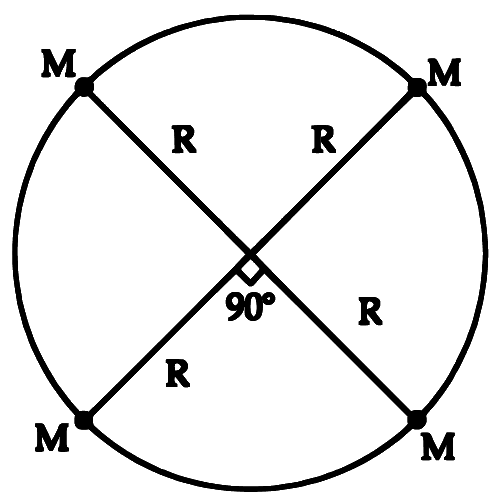
Show answer and solution

Answer: (b)

  1. A: speed changes along the ellipse: wrong.
  2. B: speed is least when farthest (aphelion), not nearest: wrong.
  3. C, D: areal velocity =L/2m= L/2m is constant, not proportional to speed: wrong.
  4. E: areal velocity is constant (Kepler's second law): correct.
  5. So the answer is (b) E only.
Report a mistake
Q313MHT CET 2021 · 24 SEP · SHIFT 1Easy

Kepler's Laws & Planetary Motion · Law of periods

The period of revolution of planet A\text{A} around the sun is 8 times that of planet B\text{B}. How many times the distance of A from the sun is greater than that of B from the sun?

Show answer and solution

Answer: (c)

  1. Kepler's third law: r∝T2/3r \propto T^{2/3}.
  2. rArB=82/3=4\dfrac{r_A}{r_B} = 8^{2/3} = 4, so rA=4rBr_A = 4r_B.
  3. rAr_A exceeds rBr_B by 4rB−rB=3rB4r_B - r_B = 3r_B.
  4. So the answer is (c) 3 times.
Report a mistake
Q314JEE Main 2021 · 16 MAR · SHIFT 1Easy

Kepler's Laws & Planetary Motion · Perigee & apogee: speeds & energies

The maximum and minimum distances of a comet from the Sun are 1.6 ×\times 1012 m and 8.0 ×\times 1010 m respectively. If the speed of the comet at the nearest point is 6 ×\times 104 ms−1{}^{-1}, the speed at the farthest point is:

Show answer and solution

Answer: (a)

  1. Conservation of angular momentum: vmin⁡rmax⁡=vmax⁡rmin⁡v_{\min} r_{\max} = v_{\max} r_{\min}.
  2. vmin⁡=6×104×8.0×10101.6×1012=6×10420v_{\min} = \dfrac{6\times10^{4} \times 8.0\times10^{10}}{1.6\times10^{12}} = \dfrac{6\times10^{4}}{20}
  3. vmin⁡=3.0×10³ m/sv_{\min} = 3.0\times10^{3}\text{ m/s}, so the answer is (a).
Report a mistake
Q315JEE Main 2021 · 25 JUL · SHIFT 1Medium

Kepler's Laws & Planetary Motion · Perigee & apogee: speeds & energies

The minimum and maximum distances of a planet revolving around the sun are x1 and x2. If the minimum speed of the planet on its trajectory is v0 then its maximum speed will be:

Show answer and solution

Answer: (d)

  1. Angular momentum is conserved: vmax xmin=vmin xmaxv_{max}\,x_{min} = v_{min}\,x_{max}.
  2. Maximum speed is at minimum distance x1x_1; minimum speed v0v_0 is at x2x_2.
  3. vmax x1=v0 x2⇒vmax=v0x2x1v_{max}\,x_1 = v_0\,x_2 \Rightarrow v_{max} = \frac{v_0 x_2}{x_1}
  4. So the answer is (d) v0x2x1\frac{v_0x_2}{x_1}.
Report a mistake
Q316JEE Main 2020 · 6 SEP · SHIFT 1Medium

Kepler's Laws & Planetary Motion · Perigee & apogee: speeds & energies

A satellite is in an elliptical orbit around a planet P. It is observed that the velocity of the satellite when it is farthest from the planet is 6 times less than that when it is closest to the planet. The ratio of distances between the satellite and the planet at closest and farthest points is:

Show answer and solution

Answer: (c)

  1. Angular momentum is conserved: vcrc=vfrfv_c r_c = v_f r_f.
  2. rcrf=vfvc=16\frac{r_c}{r_f} = \frac{v_f}{v_c} = \frac{1}{6}
  3. So the answer is (c) 1:61:6.
Report a mistake
Q317MHT CET 2019 · 2 MAY · SHIFT 1Easy

Kepler's Laws & Planetary Motion · Solar-system estimates

The radius of the earth and the radius of orbit around the sun are 6371 km and 149×106 km149 \times 10^{6}\text{ km} respectively. The order of magnitude of the diameter of the orbit is greater than that of earth by

Show answer and solution

Answer: (c)

  1. Ratio of diameters = ratio of radii: 149×1066371≈2.3×10⁴\dfrac{149\times10^{6}}{6371} \approx 2.3\times10^{4}.
  2. 2.3<3.162.3 < 3.16, so the order of magnitude is 10410^{4}.
  3. So the answer is (c) 10410^{4}.
Report a mistake
Q318NEET 2018Medium

Kepler's Laws & Planetary Motion · Perigee & apogee: speeds & energies

The kinetic energies of a planet in an elliptical orbit about the Sun, at positions A, B and C are KA, KB and KC, respectively. AC is the major axis and SB is perpendicular to AC at the position of the Sun S as shown in the figure. Then

Figure

Show answer and solution

Answer: (b)

  1. Angular momentum is conserved: mvr=mvr = constant, so speed (and KE) is larger when the planet is nearer the Sun.
  2. From the figure, the Sun S is near A: SA<SB<SCSA < SB < SC.
  3. So vA>vB>vCv_A > v_B > v_C, giving KA>KB>KCK_A > K_B > K_C.
  4. So the answer is (b) KA>KB>KCK_A > K_B > K_C.
Report a mistake
Q319JEE Main 2016 · 9 APR · SHIFT 1Medium

Kepler's Laws & Planetary Motion · Law of orbits & law of areas

Figure shows elliptical path abcd of a planet around the sun S such that the area of triangle csa is 14\frac{1}{4} the area of the ellipse. (See figure) With db as the semimajor axis, and ca as the semiminor axis. If t1 is the time taken for planet to go over path abc and t2 for path taken over cda then:

Figure

Show answer and solution

Answer: (c)

Scabdabc: 3/4cda: 1/4
  1. Kepler's second law: time ∝\propto area swept by the line from S.
  2. Path abc: half-ellipse on the b side of caca plus triangle csacsa: 12A+14A=34A\tfrac12 A + \tfrac14 A = \tfrac34 A.
  3. Path cda: other half-ellipse minus triangle csacsa: 12A−14A=14A\tfrac12 A - \tfrac14 A = \tfrac14 A.
  4. t1t2=3/41/4=3\dfrac{t_1}{t_2} = \dfrac{3/4}{1/4} = 3, so the answer is (c) t1=3t2t_1 = 3t_2.
Report a mistake
Q320NEET 2015 · AIPMT · CANCELLED PAPERMedium

Kepler's Laws & Planetary Motion · Law of periods

Kepler's third law states that square of period of revoluation (T) of a planet around the sun, is proportional to third power of average distance r between sun and planet i.e. T2 = Kr3 here K is constant. If the masses of sun and planet are M and m respectively then as per Newton's law of gravitation force of attraction between them is F = GMmr2\frac{GMm}{r^2}, here G is gravitational constant. The relation between G and K is described as

Show answer and solution

Answer: (d)

  1. Gravity provides centripetal force: GMmr2=m4π2T2r\dfrac{GMm}{r^2} = m\dfrac{4\pi^2}{T^2}r.
  2. T2=4π2GMr3⇒K=4π2GMT^2 = \dfrac{4\pi^2}{GM}r^3 \Rightarrow K = \dfrac{4\pi^2}{GM}
  3. So GMK=4π2GMK = 4\pi^2, the answer is (d).
Report a mistake
Q321NEET 2015 · AIPMTMedium

Kepler's Laws & Planetary Motion · Perigee & apogee: speeds & energies

A satellite S is moving in an elliptical orbit around the earth. The mass of the satellite is very small compared to the mass of the earth. Then,

Show answer and solution

Answer: (b)

  1. Gravity on S always points to the Earth's centre (central force), so the acceleration is always towards the centre.
  2. (a) Wrong: speed changes along an ellipse, so momentum magnitude changes.
  3. (c) Wrong: central force gives zero torque, so angular momentum is constant in both magnitude and direction.
  4. (d) Wrong: only gravity acts, so total mechanical energy is constant.
  5. So the answer is (b).
Report a mistake
Q322JEE Main 2014 · 9 APR · SHIFT 1Difficult

Kepler's Laws & Planetary Motion · Law of periods

India's Mangalyan was sent to the Mars by launching it into a transfer orbit EOM around the sun. It leaves the earth at E and meets Mars at M. If the semi-major axis of earth's orbit is ae = 1.5 ×\times 1011 m, that of Mars' orbit am = 2.28 ×\times 1011 m, then Kepler's laws give the estimate of time for Mangalyan to reach Mars from Earth to be close to:

Figure

Show answer and solution

Answer: (c)

  1. The transfer orbit EOM is half an ellipse with semi-major axis a=ae+am2=1.5+2.282×1011=1.89×10¹¹a = \frac{a_e + a_m}{2} = \frac{1.5 + 2.28}{2} \times 10^{11} = 1.89 \times 10^{11} m.
  2. Kepler's third law: T=Te(aae)3/2=365×(1.26)3/2T = T_e\left(\frac{a}{a_e}\right)^{3/2} = 365 \times (1.26)^{3/2} days.
  3. (1.26)3/2≈1.414(1.26)^{3/2} \approx 1.414, so T≈516T \approx 516 days.
  4. Earth to Mars is half the orbit: t=T2≈258t = \frac{T}{2} \approx 258 days.
  5. So the answer is (c) 260 days.
Report a mistake
Q323NEET 2011 · AIPMT · PRELIMSEasy

Kepler's Laws & Planetary Motion · Perigee & apogee: speeds & energies

A planet moving along an elliptical orbit is closest to the sun at a distance r1 and farthest away at a distance of r2. If vv1 and vv2 are the linear velocities at these points respectively, then the ratio v1v2\frac{v_1}{v_2} is

Show answer and solution

Answer: (b)

  1. At the nearest and farthest points velocity is perpendicular to the radius, so angular momentum gives mv1r1=mv2r2mv_1r_1 = mv_2r_2.
  2. v1v2=r2r1\dfrac{v_1}{v_2} = \dfrac{r_2}{r_1}
  3. So the answer is (b) r2/r1r_2/r_1.
Report a mistake
Q324NEET 2009 · AIPMTEasy

Kepler's Laws & Planetary Motion · Law of orbits & law of areas

The figure shows elliptical orbit of a planet m about the sun S. The shaded area SCD is twice the shaded area SAB. If t1 is the time for the planet to move from C to D and t2 is the time to move from A to B then

Figure

Show answer and solution

Answer: (b)

  1. Kepler's second law: areal velocity is constant, so time ∝\propto area swept.
  2. Area SCD =2×= 2\times area SAB ⇒t1=2t2\Rightarrow t_1 = 2t_2.
  3. So the answer is (b) t1=2t2t_1 = 2t_2.
Report a mistake
Q325NEET 1997 · AIPMTEasy

Kepler's Laws & Planetary Motion · Law of periods

The period of revolution of planet AA around the sun is 8 times that of BB. The distance of AA from the sun is how many times greater than that of BB from the sun?

Show answer and solution

Answer: (a)

  1. Kepler's third law: r∝T2/3r \propto T^{2/3}.
  2. rArB=82/3=4\dfrac{r_A}{r_B} = 8^{2/3} = 4
  3. So the answer is (a) 4.
Report a mistake
Q326NEET 1995 · AIPMTEasy

Kepler's Laws & Planetary Motion · Law of orbits & law of areas

The earth (mass =6×1024 kg= 6 \times 10^{24}\text{ kg}) revolves around the sun with an angular velocity of 2×10⁻⁷ rad/s2 \times 10^{-7}\text{ rad/s} in a circular orbit of radius 1.5×10⁸ km1.5 \times 10^{8}\text{ km}. The force exerted by the sun on the earth, in newton, is

Show answer and solution

Answer: (a)

  1. Sun's pull supplies the centripetal force: F=mω2rF = m\omega^2 r.
  2. F=6×1024×(2×10−7)2×1.5×1011F = 6\times10^{24} \times (2\times10^{-7})^2 \times 1.5\times10^{11}
  3. F=6×4×1.5×1024−14+11=36×1021 NF = 6 \times 4 \times 1.5 \times 10^{24-14+11} = 36 \times 10^{21}\text{ N}
  4. So the answer is (a) 36×102136\times10^{21}.
Report a mistake
Q327NEET 1994 · AIPMTEasy

Kepler's Laws & Planetary Motion · Law of periods

The distance of two planets from the sun are 1013 m10^{13}\text{ m} and 1012 m10^{12}\text{ m} respectively. The ratio of time periods of the planets is

Show answer and solution

Answer: (b)

  1. Kepler's third law: T∝r3/2T \propto r^{3/2}.
  2. T1T2=(10131012)3/2=103/2=1010\dfrac{T_1}{T_2} = \left(\dfrac{10^{13}}{10^{12}}\right)^{3/2} = 10^{3/2} = 10\sqrt{10}
  3. So the answer is (b) 101010\sqrt{10}.
Report a mistake
Q328NEET 1990 · AIPMTMedium

Kepler's Laws & Planetary Motion · Perigee & apogee: speeds & energies

A planet is moving in an elliptical orbit around the sun. If TT, VV, EE and LL stand respectively for its kinetic energy, gravitational potential energy, total energy and magnitude of angular momentum about the centre of force, which of the following is correct?

Show answer and solution

Answer: (c)

  1. (a) Speed changes along the ellipse, so TT is not conserved.
  2. (b) V=−GMmrV = -\frac{GMm}{r} is always negative.
  3. (c) A bound orbit has total energy E<0E < 0 always.
  4. (d) Central force gives zero torque, so both magnitude and direction of L⃗\vec{L} are constant.
  5. So the answer is (c) EE is always negative.
Report a mistake
Q329NEET 1988 · AIPMTEasy

Kepler's Laws & Planetary Motion · Law of periods

The distance of two planets from the sun are 1013 m10^{13}\text{ m} and 1012 m10^{12}\text{ m} respectively. The ratio of time periods of the planets is

Show answer and solution

Answer: (b)

  1. Kepler's third law: T∝r3/2T \propto r^{3/2}.
  2. T1T2=(10131012)3/2=103/2=1010\dfrac{T_1}{T_2} = \left(\dfrac{10^{13}}{10^{12}}\right)^{3/2} = 10^{3/2} = 10\sqrt{10}
  3. So the answer is (b) 101010\sqrt{10}.
Report a mistake
Q330NEET 1988 · AIPMTMedium

Kepler's Laws & Planetary Motion · Perigee & apogee: speeds & energies

The largest and the shortest distance of the earth from the sun are r1r_1 and r2r_2. Its distance from the sun when it is at perpendicular to the major-axis of the orbit drawn from the sun is

Show answer and solution

Answer: (c)

  1. The required distance is the semi-latus rectum ll of the ellipse.
  2. r1=a(1+e)r_1 = a(1+e), r2=a(1−e)r_2 = a(1-e) and l=a(1−e2)l = a(1-e^2).
  3. l=a(1+e) a(1−e)a=r1r2(r1+r2)/2l = \frac{a(1+e)\,a(1-e)}{a} = \frac{r_1 r_2}{(r_1+r_2)/2}
  4. So the answer is (c) 2r1r2r1+r2\frac{2r_1r_2}{r_1+r_2}.
Report a mistake
Q331MHT CET 2026 · 17 APR · SHIFT 2Easy

Satellites - Orbital Velocity & Period · Orbital velocity

Two planets A and B are orbiting around the sun. The distances of the two planets A and B from the sun are rAr_A and rBr_B respectively. Also rB=225 rAr_B = 225\,r_A. If the orbital speed of the planet A is 'V' then the orbital speed of planet B will be

Show answer and solution

Answer: (c)

  1. Orbital speed v=GMrv = \sqrt{\frac{GM}{r}}, so v∝1rv \propto \frac{1}{\sqrt{r}}.
  2. vBvA=rArB=1225=115\frac{v_B}{v_A} = \sqrt{\frac{r_A}{r_B}} = \sqrt{\frac{1}{225}} = \frac{1}{15}
  3. So the answer is (c) V15\frac{V}{15}.
Report a mistake
Q332MHT CET 2026 · 15 APR · SHIFT 2Easy

Satellites - Orbital Velocity & Period · Orbital velocity

The distance of the two planets A and B from the sun are 'rAr_A' and 'rBr_B' respectively such that rB=100 rAr_B = 100\,r_A. The ratio of the speed of planet A to that of planet B is (both the planets are revolving around the sun)

Show answer and solution

Answer: (c)

  1. Orbital speed v∝1rv \propto \frac{1}{\sqrt{r}}.
  2. vAvB=rBrA=100=10\frac{v_A}{v_B} = \sqrt{\frac{r_B}{r_A}} = \sqrt{100} = 10
  3. So the answer is (c) 1010.
Report a mistake
Q333MHT CET 2026 · 19 APR · SHIFT 2Easy

Satellites - Orbital Velocity & Period · Time period of a satellite

A satellite is revolving around a planet in a circular orbit close to its surface. Let ρ\rho be mean density and RR be the radius of the planet; then the period of the satellite is

(GG = Universal constant of gravitation).

Show answer and solution

Answer: (d)

  1. Close to the surface: T=2πR3GMT = 2\pi\sqrt{\frac{R^3}{GM}}.
  2. Mass M=43πR3ρM = \frac{4}{3}\pi R^3 \rho, so GM=43πGρR3GM = \frac{4}{3}\pi G\rho R^3.
  3. T=2π34πGρ=3πρGT = 2\pi\sqrt{\frac{3}{4\pi G\rho}} = \sqrt{\frac{3\pi}{\rho G}}
  4. So the answer is (d) 3πρG\sqrt{\frac{3\pi}{\rho G}}.
Report a mistake
Q334JEE Main 2026 · 22 JAN · SHIFT 2Easy

Satellites - Orbital Velocity & Period · Time period of a satellite

Given below are two statements:

Statement I: A satellite is moving around earth in the orbit very close to the earth surface. The time period of revolution of satellite depends upon the density of earth.

Statement II: The time period of revolution of the satellite is TT == 2πReg2\pi\sqrt{\frac{R_e}{g}} (for satellite very close to the earth surface), where ReR_e radius of earth and gg acceleration due to gravity. In the light of the above statements, choose the correct answer from the options given below:
Show answer and solution

Answer: (c)

  1. Near the surface, gravity gives the centripetal force: mg=mω2Re⇒T=2πRegmg = m\omega^2 R_e \Rightarrow T = 2\pi\sqrt{\frac{R_e}{g}}. Statement II is true.
  2. With g=43πGρReg = \frac{4}{3}\pi G\rho R_e: T=3πGρT = \sqrt{\frac{3\pi}{G\rho}}, which depends only on the density. Statement I is true.
  3. So the answer is (c) both statements are true.
Report a mistake
Q335MHT CET 2026 · 20 MAY · SHIFT 1Easy

Satellites - Orbital Velocity & Period · Height of a satellite & geostationary orbit

The geostationary satellite is revolving round the earth of mean radius RR. If gg is the acceleration due to gravity at earth's surface, ω\omega is the angular speed of rotation of earth about its own axis and rr is the radius of orbit of a satellite, then the correct relation between rr, ω\omega, gg and RR is

Show answer and solution

Answer: (b)

  1. For the orbit: GMmr2=mω2r⇒GM=ω2r3\frac{GMm}{r^2} = m\omega^2 r \Rightarrow GM = \omega^2 r^3.
  2. At Earth's surface GM=gR2GM = gR^2.
  3. gR2=ω2r3⇒R2=r3ω2ggR^2 = \omega^2 r^3 \Rightarrow R^2 = \frac{r^3\omega^2}{g}
  4. So the answer is (b) R2=r3ω2gR^2 = \frac{r^3\omega^2}{g}.
Report a mistake
Q336MHT CET 2026 · 13 MAY · SHIFT 1Easy

Satellites - Orbital Velocity & Period · Height of a satellite & geostationary orbit

If mean radius of earth is 'R', its angular velocity is 'ω\omega' and acceleration due to gravity at the surface of the earth is 'g' then the cube of the radius of the orbit of geostationary satellite will be

Show answer and solution

Answer: (d)

  1. For a geostationary satellite, gravity gives the centripetal force: GMmr2=mω2r\frac{GMm}{r^2} = m\omega^2 r, where ω\omega is the earth's angular velocity.
  2. So r3=GMω2r^3 = \frac{GM}{\omega^2}, and GM=gR2GM = gR^2.
  3. r3=R2gω2r^3 = \frac{R^2 g}{\omega^2}
  4. So the answer is (d) R2gω2\frac{R^2g}{\omega^2}.
Report a mistake
Q337MHT CET 2026 · 19 APR · SHIFT 1Medium

Satellites - Orbital Velocity & Period · Height of a satellite & geostationary orbit

A geostationary satellite is orbiting the earth at a height of 4R4R above the surface of the earth, where RR is the radius of the earth. Another satellite is orbiting the earth at a height 1.5R1.5R from the surface of the earth with periodic time 'T' in hour. The value of 'T' in hour is

Show answer and solution

Answer: (b)

  1. Orbit radii from the centre: geostationary r1=5Rr_1 = 5R (T1=24T_1 = 24 h), other r2=2.5Rr_2 = 2.5R.
  2. T∝r3/2T \propto r^{3/2}: T2=24(2.5R5R)3/2=24×122T_2 = 24\left(\frac{2.5R}{5R}\right)^{3/2} = 24\times\frac{1}{2\sqrt{2}}
  3. T2=122=62T_2 = \frac{12}{\sqrt{2}} = 6\sqrt{2} h
  4. So the answer is (b).
Report a mistake
Q338MHT CET 2026 · 12 MAY · SHIFT 1Difficult

Satellites - Orbital Velocity & Period · Orbits under mutual gravity

Four particles, each of mass M and equidistant from each other, move along a circle of radius R under the action of their gravitational attraction, the speed of each particle is

{sin⁡(45)∘=cos⁡(45)∘\{\sin(45)^\circ = \cos(45)^\circ =1/(2)0.5}= 1/(2)^{0.5}\}

Show answer and solution

Answer: (d)

  1. Adjacent masses are 2R\sqrt{2}R apart, the opposite one is 2R2R away.
  2. Net force towards centre: F=2⋅GM22R2cos⁡45∘+GM24R2=GM24R2(22+1)F = 2\cdot\frac{GM^2}{2R^2}\cos 45^\circ + \frac{GM^2}{4R^2} = \frac{GM^2}{4R^2}(2\sqrt{2}+1).
  3. Mv2R=GM24R2(1+22)⇒v2=GM4R(1+22)\frac{Mv^2}{R} = \frac{GM^2}{4R^2}(1+2\sqrt{2}) \Rightarrow v^2 = \frac{GM}{4R}(1+2\sqrt{2}).
  4. So the answer is (d) v=12GMR(1+22)v = \frac{1}{2}\sqrt{\frac{GM}{R}(1+2\sqrt{2})}.
Report a mistake
Q339MHT CET 2025 · 22 APR · SHIFT 1Easy

Satellites - Orbital Velocity & Period · Orbital velocity

Two satellites P and Q go round a planet in circular orbits having radii ' 3R3R ' and ' RR ' respectively. If the speed of satellite PP is ' 2V2V ', the speed of the satellite QQ will be

Show answer and solution

Answer: (a)

  1. Orbital speed v∝1rv \propto \frac{1}{\sqrt{r}}.
  2. vQvP=3RR=3\frac{v_Q}{v_P} = \sqrt{\frac{3R}{R}} = \sqrt{3}
  3. vQ=2V3v_Q = 2V\sqrt{3}
  4. So the answer is (a) 23 V2\sqrt{3}\,V.
Report a mistake
Q340MHT CET 2025 · 21 APR · SHIFT 2Easy

Satellites - Orbital Velocity & Period · Orbital velocity

The radii of circular orbits of two satellites AA and BB of the earth are ' 4R4R ' and ' RR ' respectively, where RR is the radius of earth. If the speed of satellite BB is 6 V, then the speed of satellite AA will be

Show answer and solution

Answer: (a)

  1. Orbital speed v∝1rv \propto \frac{1}{\sqrt{r}}.
  2. vAvB=R4R=12\frac{v_A}{v_B} = \sqrt{\frac{R}{4R}} = \frac{1}{2}
  3. vA=6V2=3Vv_A = \frac{6V}{2} = 3V
  4. So the answer is (a) 3 V.
Report a mistake
Q341MHT CET 2025 · 20 APR · SHIFT 2Easy

Satellites - Orbital Velocity & Period · Time period of a satellite

The time period of a satellite of earth is 24 hours. If the separation between the earth and the satellite is decreased to one fourth of the previous value then its new time period will become

Show answer and solution

Answer: (a)

  1. Kepler's third law: T∝r3/2T \propto r^{3/2}.
  2. T′=24×(14)3/2=248=3T' = 24 \times \left(\frac{1}{4}\right)^{3/2} = \frac{24}{8} = 3 hours
  3. So the answer is (a) 3 hours.
Report a mistake
Q342JEE Main 2025 · 23 JAN · SHIFT 2Easy

Satellites - Orbital Velocity & Period · Time period of a satellite

If a satellite orbiting the Earth is 9 times closer to the Earth than the Moon, what is the time period of rotation of the satellite? Given rotational time period of Moon =27= 27 days and gravitational attraction between the satellite and the moon is neglected.

Show answer and solution

Answer: (d)

  1. Kepler's third law: T∝r3/2T \propto r^{3/2}.
  2. rs=rm9r_s = \frac{r_m}{9}, so Ts=27×(19)3/2=2727=1T_s = 27 \times \left(\frac{1}{9}\right)^{3/2} = \frac{27}{27} = 1 day
  3. So the answer is (d) 1 day.
Report a mistake
Q343JEE Main 2025 · 24 JAN · SHIFT 1Medium

Satellites - Orbital Velocity & Period · Time period of a satellite

A satellite is launched into a circular orbit of radius ' R ' around the earth. A second satellite is launched into an orbit of radius 1.03 R. The time period of revolution of the second satellite is larger than the first one approximately by

Show answer and solution

Answer: (c)

  1. T∝r3/2T \propto r^{3/2}, so T2T1=(1.03)3/2\frac{T_2}{T_1} = (1.03)^{3/2}.
  2. (1.03)3/2≈1+32(0.03)=1.045(1.03)^{3/2} \approx 1 + \frac{3}{2}(0.03) = 1.045
  3. So T2T_2 is larger by about 4.5%4.5\%, answer (c).
Report a mistake
Q344MHT CET 2025 · 19 APR · SHIFT 1Medium

Satellites - Orbital Velocity & Period · Orbits under mutual gravity

Two particles of equal mass ' mm ' move in a circle of radius ' rr ' under the action of their mutual gravitational attraction. The speed of each particle will be ( G=G = Universal gravitational constant)

Show answer and solution

Answer: (a)

mmFd = 2r
  1. The two particles are at opposite ends of a diameter, so their separation is 2r2r.
  2. Mutual attraction gives the centripetal force: Gm2(2r)2=mv2r\frac{Gm^2}{(2r)^2} = \frac{mv^2}{r}
  3. v2=Gm4rv^2 = \frac{Gm}{4r}
  4. So the answer is (a) Gm4r\sqrt{\frac{Gm}{4r}}.
Report a mistake
Q345JEE Main 2025 · 29 JAN · SHIFT 2Medium

Satellites - Orbital Velocity & Period · Angular momentum of a satellite

Two planets, AA and BB are orbiting a common star in circular orbits of radii RAR_A and RBR_B, respectively, with RB=R_B = 2RA2R_A. The planet BB is 424\sqrt{2} times more massive than planet AA. The ratio (LBLA)\left(\frac{L_B}{L_A}\right) of angular momentum (LB)(L_B) of planet BB to that of planet A (LA)A\,(L_A) is closest to integer ________.

Numerical answer type. Work it out, then open the answer.

Show answer and solution

Answer: 8

  1. L=mGMRL = m\sqrt{GMR}, so L∝mRL \propto m\sqrt{R}.
  2. LBLA=mBmARBRA=42×2\frac{L_B}{L_A} = \frac{m_B}{m_A}\sqrt{\frac{R_B}{R_A}} = 4\sqrt{2}\times\sqrt{2}
  3. LBLA=8\frac{L_B}{L_A} = 8
  4. Answer: 8
Report a mistake
Q346JEE Main 2025 · 23 JAN · SHIFT 2Medium

Satellites - Orbital Velocity & Period · Angular momentum of a satellite

A satellite of mass M2\frac{M}{2} is revolving around earth in a circular orbit at a height of R3\frac{R}{3} from earth surface. The angular momentum of the satellite is MGMRxM\sqrt{\frac{GMR}{x}}. The value of xx is _________, where M and R are the mass and radius of earth, respectively. ( G is the gravitational constant)

Numerical answer type. Work it out, then open the answer.

Show answer and solution

Answer: 3

  1. Orbit radius r=R+R3=4R3r = R + \frac{R}{3} = \frac{4R}{3}, satellite mass M2\frac{M}{2}.
  2. L=mGMr=M2GM⋅4R3L = m\sqrt{GMr} = \frac{M}{2}\sqrt{GM\cdot\frac{4R}{3}}
  3. L=M14⋅4GMR3=MGMR3L = M\sqrt{\frac{1}{4}\cdot\frac{4GMR}{3}} = M\sqrt{\frac{GMR}{3}}
  4. So x=3x = 3.
Report a mistake
Q347MHT CET 2024 · 3 MAY · SHIFT 1Easy

Satellites - Orbital Velocity & Period · Orbital velocity

The distance of the two planets A and B from the sun are rAr_A and rBr_B respectively. Also rBr_B is equal to 100rA100r_A. If the orbital speed of the planet AA is ' vv ' then the orbital speed of the planet B is

Show answer and solution

Answer: (a)

  1. Orbital speed v∝1rv \propto \frac{1}{\sqrt{r}}.
  2. vBvA=rA100 rA=110\frac{v_B}{v_A} = \sqrt{\frac{r_A}{100\,r_A}} = \frac{1}{10}
  3. So the answer is (a) v10\frac{v}{10}.
Report a mistake
Q348JEE Main 2024 · 8 APR · SHIFT 2Easy

Satellites - Orbital Velocity & Period · Orbital velocity

Two satellite A and B go round a planet in circular orbits having radii 4R and R respectively. If the speed of AA is 3v3v, the speed of BB will be:

Show answer and solution

Answer: (a)

  1. Orbital speed v∝1rv \propto \frac{1}{\sqrt{r}}.
  2. vBvA=4RR=2\frac{v_B}{v_A} = \sqrt{\frac{4R}{R}} = 2
  3. vB=2×3v=6vv_B = 2 \times 3v = 6v
  4. So the answer is (a) 6v6v.
Report a mistake
Q349MHT CET 2024 · 16 MAY · SHIFT 1Easy

Satellites - Orbital Velocity & Period · Time period of a satellite

A satellite is orbiting just above the surface of the planet of density ' ρ\rho ' with periodic time ' TT '. The quantity T2ρT^2\rho is equal to ( G=G = universal gravitational constant)

Show answer and solution

Answer: (c)

  1. Just above the surface: T2=4π2R3GMT^2 = \frac{4\pi^2 R^3}{GM} with M=43πR3ρM = \frac{4}{3}\pi R^3\rho.
  2. T2=4π2R3G⋅43πR3ρ=3πGρT^2 = \frac{4\pi^2 R^3}{G \cdot \frac{4}{3}\pi R^3 \rho} = \frac{3\pi}{G\rho}
  3. T2ρ=3πGT^2\rho = \frac{3\pi}{G}
  4. So the answer is (c) 3πG\frac{3\pi}{G}.
Report a mistake
Q350MHT CET 2024 · 9 MAY · SHIFT 2Easy

Satellites - Orbital Velocity & Period · Time period of a satellite

A satellite is revolving around a planet in a circular orbit close to its surface. Let ' ρ\rho ' be the mean density and ' RR ' be the radius of the planet. Then the period of the satellite is ( G=G = universal constant of gravitation)

Show answer and solution

Answer: (c)

  1. Close to the surface: T=2πR3GMT = 2\pi\sqrt{\frac{R^3}{GM}} with M=43πR3ρM = \frac{4}{3}\pi R^3\rho.
  2. T2=4π2R3⋅34πGR3ρ=3πρGT^2 = \frac{4\pi^2 R^3 \cdot 3}{4\pi G R^3 \rho} = \frac{3\pi}{\rho G}
  3. So the answer is (c) 3πρG\sqrt{\frac{3\pi}{\rho G}}.
Report a mistake
Q351JEE Main 2024 · 4 APR · SHIFT 2Easy

Satellites - Orbital Velocity & Period · Height of a satellite & geostationary orbit

Correct formula for height of a satellite from earth's surface is:

Show answer and solution

Answer: (a)

  1. Kepler's law: T2=4π2r3GMT^2 = \frac{4\pi^2 r^3}{GM} with r=R+hr = R + h.
  2. Use GM=gR2GM = gR^2: r3=T2gR24π2r^3 = \frac{T^2 g R^2}{4\pi^2}.
  3. h=r−R=(T2R2g4π2)1/3−Rh = r - R = \left(\frac{T^2R^2g}{4\pi^2}\right)^{1/3} - R
  4. So the answer is (a).
Report a mistake
Q352MHT CET 2024 · 10 MAY · SHIFT 1Medium

Satellites - Orbital Velocity & Period · Other force laws

A small planet is revolving around a very massive star in a circular orbit of radius ' RR ' with a period of revolution ' TT '. If the gravitational force between the planet and the star were proportional to 'R−5/2R^{-5/2}', then 'TT' would be proportional to

Show answer and solution

Answer: (d)

  1. Force gives the centripetal force: mω2R∝R−5/2m\omega^2 R \propto R^{-5/2}.
  2. ω2∝R−7/2\omega^2 \propto R^{-7/2}, and T∝1ωT \propto \frac{1}{\omega}, so T2∝R7/2T^2 \propto R^{7/2}.
  3. T∝R7/4T \propto R^{7/4}
  4. So the answer is (d).
Report a mistake
Q353JEE Main 2024 · 1 FEB · SHIFT 2Medium

Satellites - Orbital Velocity & Period · Other force laws

A light planet is revolving around a massive star in a circular orbit of radius RR with a period of revolution T. If the force of attraction between planet and star is proportional to R−3/2R^{-3/2} then choose the correct option:

Show answer and solution

Answer: (c)

  1. mω2R∝R−3/2⇒ω2∝R−5/2m\omega^2 R \propto R^{-3/2} \Rightarrow \omega^2 \propto R^{-5/2}
  2. T2∝1ω2∝R5/2T^2 \propto \frac{1}{\omega^2} \propto R^{5/2}
  3. So the answer is (c).
Report a mistake
Q354JEE Main 2024 · 5 APR · SHIFT 2Medium

Satellites - Orbital Velocity & Period · Height of a satellite & geostationary orbit

A satellite revolving around a planet in stationary orbit has time period 6 hours. The mass of planet is one-fourth the mass of earth. The radius of orbit of the satellite is:

(Given == Radius of geo-stationary orbit for earth is 4.2×10⁴ km4.2 \times 10^{4}\text{ km})

Show answer and solution

Answer: (d)

  1. T2=4π2r3GM⇒r3∝MT2T^2 = \frac{4\pi^2 r^3}{GM} \Rightarrow r^3 \propto MT^2
  2. r3re3=MpMe(TpTe)2=14×(624)2=164\frac{r^3}{r_e^3} = \frac{M_p}{M_e}\left(\frac{T_p}{T_e}\right)^2 = \frac{1}{4}\times\left(\frac{6}{24}\right)^2 = \frac{1}{64}
  3. r=re4=4.2×1044=1.05×10⁴r = \frac{r_e}{4} = \frac{4.2\times10^4}{4} = 1.05\times10^4 km
  4. So the answer is (d).
Report a mistake
Q355MHT CET 2024 · 15 MAY · SHIFT 1Medium

Satellites - Orbital Velocity & Period · Angular momentum of a satellite

A satellite of mass ' mm ' is revolving around the earth of mass ' MM ' in an orbit of radius ' rr ' with constant angular velocity ' ω\omega '. The angular momentum of satellite is ( G=G = Universal constant of gravitation)

Show answer and solution

Answer: (c)

  1. L=mvrL = mvr with orbital speed v=GMrv = \sqrt{\frac{GM}{r}}.
  2. L=mrGMr=mGMrL = mr\sqrt{\frac{GM}{r}} = m\sqrt{GMr}
  3. So the answer is (c) m(GMr)1/2m(GMr)^{1/2}.
Report a mistake
Q356MHT CET 2024 · 11 MAY · SHIFT 1Medium

Satellites - Orbital Velocity & Period · Angular momentum of a satellite

Assuming that the earth is revolving around the sun in circular orbit of radius R, the angular momentum is directly proportional to RnR^{n}. The value of ' nn ' is

Show answer and solution

Answer: (d)

  1. L=mvR=mGMR R=mGMRL = mvR = m\sqrt{\frac{GM}{R}}\,R = m\sqrt{GMR}
  2. So L∝R1/2L \propto R^{1/2}, giving n=0.5n = 0.5.
  3. So the answer is (d) 0.5.
Report a mistake
Q357JEE Main 2024 · 8 APR · SHIFT 1Medium

Satellites - Orbital Velocity & Period · Angular momentum of a satellite

Two planets AA and BB having masses m1m_1 and m2m_2 move around the sun in circular orbits of r1r_1 and r2r_2 radii respectively. If angular momentum of AA is LL and that of BB is 33 LL, the ratio of time period (TATB)\left(\frac{T_A}{T_B}\right) is:

Show answer and solution

Answer: (d)

  1. L=mGMrL = m\sqrt{GMr}, so LBLA=m2m1r2r1=3\frac{L_B}{L_A} = \frac{m_2}{m_1}\sqrt{\frac{r_2}{r_1}} = 3.
  2. r1r2=m23m1\sqrt{\frac{r_1}{r_2}} = \frac{m_2}{3m_1}
  3. TATB=(r1r2)3/2=(m23m1)3=127(m2m1)3\frac{T_A}{T_B} = \left(\frac{r_1}{r_2}\right)^{3/2} = \left(\frac{m_2}{3m_1}\right)^3 = \frac{1}{27}\left(\frac{m_2}{m_1}\right)^3
  4. So the answer is (d).
Report a mistake
Q358MHT CET 2023 · 10 MAY · SHIFT 1Easy

Satellites - Orbital Velocity & Period · Orbital velocity

A satellite moves in a stable circular orbit round the earth if (where VH,VcV_H, V_c and VeV_e are the horizontal velocity, critical velocity and escape velocity respectively)

Show answer and solution

Answer: (c)

  1. A stable circular orbit needs gravity to supply exactly the centripetal force: mVH2r=GMmr2\frac{mV_H^2}{r} = \frac{GMm}{r^2}.
  2. This gives VH=GMr=VcV_H = \sqrt{\frac{GM}{r}} = V_c, the critical velocity.
  3. If VH<VcV_H < V_c it falls back; if Vc<VH<VeV_c < V_H < V_e the orbit is elliptical; if VH≥VeV_H \ge V_e it escapes.
  4. So the answer is (c) VH=VcV_H = V_c.
Report a mistake
Q359JEE Main 2023 · 12 APR · SHIFT 1Easy

Satellites - Orbital Velocity & Period · Orbital velocity

Two satellites AA and BB move round the earth in the same orbit. The mass of AA is twice the mass of BB. The quantity which is same for the two satellites will be

Show answer and solution

Answer: (d)

  1. Orbital speed v=GMrv = \sqrt{\frac{GM}{r}} is independent of the satellite's mass, so it is the same for both.
  2. PE =−GMmr= -\frac{GMm}{r}, KE =GMm2r= \frac{GMm}{2r} and TE =−GMm2r= -\frac{GMm}{2r} all depend on mm, so they differ.
  3. So the answer is (d) Speed.
Report a mistake
Q360JEE Main 2023 · 10 APR · SHIFT 1Easy

Satellites - Orbital Velocity & Period · Orbital velocity

Two satellites of masses m and 3m revolve around the earth in circular orbits of radii r & 3r respectively. The ratio of orbital speeds of the satellites respectively is

Show answer and solution

Answer: (b)

  1. Orbital speed v=GMrv = \sqrt{\frac{GM}{r}}, independent of satellite mass.
  2. v1v2=3rr=3\frac{v_1}{v_2} = \sqrt{\frac{3r}{r}} = \sqrt{3}
  3. So the answer is (b) 3:1\sqrt{3}:1.
Report a mistake
Q361NEET 2023Easy

Satellites - Orbital Velocity & Period · Time period of a satellite

A satellite is orbiting just above the surface of the earth with period TT. If dd is the density of the earth and GG is the universal constant of gravitation, the quantity 3πGd\frac{3\pi}{Gd} represents:

Show answer and solution

Answer: (a)

  1. Just above the surface: T2=4π2R3GMT^2 = \frac{4\pi^2 R^3}{GM} with M=43πR3dM = \frac{4}{3}\pi R^3 d.
  2. T2=3πGdT^2 = \frac{3\pi}{Gd}
  3. So the answer is (a) T2T^2.
Report a mistake
Q362JEE Main 2023 · 29 JAN · SHIFT 2Easy

Satellites - Orbital Velocity & Period · Time period of a satellite

The time period of a satellite of earth is 24 hours. If the separation between the earth and the satellite is decreased to one fourth of the previous value, then its new time period will become.

Show answer and solution

Answer: (b)

  1. Kepler's third law: T∝r3/2T \propto r^{3/2}.
  2. T′=24×(14)3/2=248=3T' = 24 \times \left(\frac{1}{4}\right)^{3/2} = \frac{24}{8} = 3 hours
  3. So the answer is (b) 3 hours.
Report a mistake
Q363MHT CET 2023 · 11 MAY · SHIFT 2Easy

Satellites - Orbital Velocity & Period · Height of a satellite & geostationary orbit

The radius of the orbit of a geostationary satellite is (mean radius of earth is 'RR', angular velocity about own axis is 'ω\omega' and acceleration due to gravity on earth's surface is 'gg')

Show answer and solution

Answer: (a)

  1. Geostationary orbit: GMr2=ω2r⇒r3=GMω2\frac{GM}{r^2} = \omega^2 r \Rightarrow r^3 = \frac{GM}{\omega^2}.
  2. Use GM=gR2GM = gR^2: r3=gR2ω2r^3 = \frac{gR^2}{\omega^2}.
  3. r=(gR2ω2)1/3r = \left(\frac{gR^2}{\omega^2}\right)^{1/3}
  4. So the answer is (a).
Report a mistake
Q364MHT CET 2023 · 9 MAY · SHIFT 2Medium

Satellites - Orbital Velocity & Period · Time period of a satellite

Periodic time of a satellite revolving above the earth's surface at a height equal to radius of the earth 'RR' is [ g=g = acceleration due to gravity]

Show answer and solution

Answer: (b)

  1. T=2πr3GM=2πr3gR2T = 2\pi\sqrt{\frac{r^3}{GM}} = 2\pi\sqrt{\frac{r^3}{gR^2}}
  2. At height RR: r=2Rr = 2R, so r3=8R3r^3 = 8R^3.
  3. T=2π8Rg=4π2RgT = 2\pi\sqrt{\frac{8R}{g}} = 4\pi\sqrt{\frac{2R}{g}}
  4. So the answer is (b).
Report a mistake
Q365JEE Main 2023 · 10 APR · SHIFT 2Medium

Satellites - Orbital Velocity & Period · Time period of a satellite

The time period of a satellite, revolving above earth's surface at a height equal to RR will be (Given g=π2 m/s2, R=g = \pi^2\text{ m/s}^2,\ R = radius of earth)

Show answer and solution

Answer: (a)

  1. At height RR, r=2Rr = 2R: T=2π(2R)3gR2=2π8RgT = 2\pi\sqrt{\frac{(2R)^3}{gR^2}} = 2\pi\sqrt{\frac{8R}{g}}
  2. With g=π2g = \pi^2: T=2π8Rπ2=28RT = 2\pi\sqrt{\frac{8R}{\pi^2}} = 2\sqrt{8R}
  3. T=32RT = \sqrt{32R}
  4. So the answer is (a).
Report a mistake
Q366MHT CET 2023 · 12 MAY · SHIFT 1Medium

Satellites - Orbital Velocity & Period · Other force laws

Consider a light planet revolving around a massive star in a circular orbit of radius 'rr' with time period 'TT'. If the gravitational force of attraction between the planet and the star is proportional to r−72r^{-\frac{7}{2}}, then T2T^2 is proportional to

Show answer and solution

Answer: (a)

  1. mω2r∝r−7/2⇒ω2∝r−9/2m\omega^2 r \propto r^{-7/2} \Rightarrow \omega^2 \propto r^{-9/2}
  2. T2∝1ω2∝r9/2T^2 \propto \frac{1}{\omega^2} \propto r^{9/2}
  3. So the answer is (a) r9/2r^{9/2}.
Report a mistake
Q367JEE Main 2023 · 15 APR · SHIFT 1Medium

Satellites - Orbital Velocity & Period · Orbits under mutual gravity

Two identical particles each of mass ' mm ' go round a circle of radius aa under the action of their mutual gravitational attraction. The angular speed of each particle will be:

Show answer and solution

Answer: (d)

  1. Separation is 2a2a: Gm2(2a)2=mω2a\frac{Gm^2}{(2a)^2} = m\omega^2 a
  2. ω2=Gm4a3\omega^2 = \frac{Gm}{4a^3}
  3. So the answer is (d) Gm4a3\sqrt{\frac{Gm}{4a^3}}.
Report a mistake
Q368JEE Main 2023 · 29 JAN · SHIFT 1Medium

Satellites - Orbital Velocity & Period · Orbits under mutual gravity

Two particles of equal mass 'mm' move in a circle of radius 'rr' under the action of their mutual gravitational attraction. The speed of each particle will be:

Show answer and solution

Answer: (a)

  1. Separation is the diameter 2r2r: Gm2(2r)2=mv2r\frac{Gm^2}{(2r)^2} = \frac{mv^2}{r}
  2. v2=Gm4rv^2 = \frac{Gm}{4r}
  3. So the answer is (a) Gm4r\sqrt{\frac{Gm}{4r}}.
Report a mistake
Q369JEE Main 2023 · 8 APR · SHIFT 2Medium

Satellites - Orbital Velocity & Period · Angular momentum of a satellite

The orbital angular momentum of a satellite is L, when it is revolving in a circular orbit at height h from earth surface. If the distance of satellite from the earth centre is increased by eight times to its initial value, then the new angular momentum will be -

Show answer and solution

Answer: (d)

  1. L=mGMrL = m\sqrt{GMr}, so L∝rL \propto \sqrt{r}.
  2. Increasing the distance by eight times its value gives r′=r+8r=9rr' = r + 8r = 9r.
  3. L′=L9=3LL' = L\sqrt{9} = 3L
  4. So the answer is (d) 3L.
Report a mistake
Q370JEE Main 2022 · 25 JUN · SHIFT 2Easy

Satellites - Orbital Velocity & Period · Orbital velocity

Two satellites S1 and S2 are revolving in circular orbits around a planet with radius R1 = 3200 km and R2 = 800 km respectively. The ratio of speed of satellite S1 to be speed of satellite S2 in their respective orbits would be 1x\frac{1}{x} where x = ___________.

Numerical answer type. Work it out, then open the answer.

Show answer and solution

Answer: 2

  1. Orbital speed v∝1Rv \propto \frac{1}{\sqrt{R}}.
  2. v1v2=R2R1=8003200=12\frac{v_1}{v_2} = \sqrt{\frac{R_2}{R_1}} = \sqrt{\frac{800}{3200}} = \frac{1}{2}
  3. So x=2x = 2.
Report a mistake
Q371JEE Main 2022 · 29 JUN · SHIFT 2Easy

Satellites - Orbital Velocity & Period · Time period of a satellite

The time period of a satellite revolving around earth in a given orbit is 7 hours. If the radius of orbit is increased to three times its previous value, then approximate new time period of the satellite will be

Show answer and solution

Answer: (b)

  1. Kepler's third law: T∝r3/2T \propto r^{3/2}.
  2. T′=7×33/2=7×5.196≈36.4T' = 7 \times 3^{3/2} = 7 \times 5.196 \approx 36.4 hours
  3. So the answer is (b) 36 hours.
Report a mistake
Q372MHT CET 2021 · 23 SEP · SHIFT 2Easy

Satellites - Orbital Velocity & Period · Time period of a satellite

The time period of a satellite of earth is 5 hours. If the separation between the earth and the satellite is increased to four times the previous value, the new time period of the satellite will be

Show answer and solution

Answer: (b)

  1. Kepler's third law: T∝r3/2T \propto r^{3/2}.
  2. T′=5×43/2=5×8=40T' = 5 \times 4^{3/2} = 5 \times 8 = 40 hours
  3. So the answer is (b) 40 hours.
Report a mistake
Q373JEE Main 2021 · 18 MAR · SHIFT 1Easy

Satellites - Orbital Velocity & Period · Time period of a satellite

The time period of a satellite in a circular orbit of radius R is T. The period of another satellite in a circular orbit of radius 9R is:

Show answer and solution

Answer: (b)

  1. Kepler's third law: T∝r3/2T \propto r^{3/2}.
  2. T′=T×93/2=27TT' = T \times 9^{3/2} = 27T
  3. So the answer is (b) 27T27T.
Report a mistake
Q374JEE Main 2021 · 24 FEB · SHIFT 1Easy

Satellites - Orbital Velocity & Period · Time period of a satellite

Consider two satellites S1 and S2 with periods of revolution 1 hr. and 8 hr. respectively revolving around a planet in circular orbits. The ratio of angular velocity of satellite S1 to the angular velocity of satellite S2 is:

Show answer and solution

Answer: (b)

  1. Angular velocity ω=2πT\omega = \frac{2\pi}{T}, so ω∝1T\omega \propto \frac{1}{T}.
  2. ω1ω2=T2T1=81\frac{\omega_1}{\omega_2} = \frac{T_2}{T_1} = \frac{8}{1}
  3. So the answer is (b) 8:18:1.
Report a mistake
Q375MHT CET 2021 · 24 SEP · SHIFT 1Medium

Satellites - Orbital Velocity & Period · Orbital velocity

If the horizontal velocity given to a satellite is greater than critical velocity but less than the escape velocity at the height, then the satellite will

Show answer and solution

Answer: (d)

  1. At exactly the critical (orbital) speed the orbit is a circle.
  2. At the escape speed or more the path is open (parabola or hyperbola) and the satellite leaves.
  3. Between the two, the total energy is still negative, so the orbit is a closed ellipse.
  4. So the answer is (d) revolve in elliptical orbit.
Report a mistake
Q376MHT CET 2021 · 20 SEP · SHIFT 1Medium

Satellites - Orbital Velocity & Period · Orbital velocity

The orbital velocity of an artificial satellite in a circular orbit just above the earth's surface is 'V'. For the satellite orbiting at an altitude of half the earth's radius, the orbital velocity is

Show answer and solution

Answer: (c)

  1. Orbital velocity v=GMrv = \sqrt{\frac{GM}{r}}, so v∝1rv \propto \frac{1}{\sqrt{r}}.
  2. Near the surface r=Rr = R; at altitude R/2R/2, r=3R2r = \frac{3R}{2}.
  3. v′V=R3R/2=23\frac{v'}{V} = \sqrt{\frac{R}{3R/2}} = \sqrt{\frac{2}{3}}
  4. So the answer is (c) 23 V\sqrt{\frac{2}{3}}\,V.
Report a mistake
Q377JEE Main 2021 · 27 JUL · SHIFT 2Medium

Satellites - Orbital Velocity & Period · Time period of a satellite

The planet Mars has two moons, if one of them has a period 7 hours, 30 minutes and an orbital radius of 9.0 ×\times 103 km. Find the mass of Mars.

{Given 4π2G=6×10¹¹ N−1m−2kg2}\left\{\text{Given } \frac{4\pi^2}{G} = 6 \times 10^{11}\text{ N}^{-1}\text{m}^{-2}\text{kg}^{2}\right\}

Show answer and solution

Answer: (d)

  1. T2=4π2r3GM⇒M=4π2G⋅r3T2T^2 = \frac{4\pi^2 r^3}{GM} \Rightarrow M = \frac{4\pi^2}{G}\cdot\frac{r^3}{T^2}
  2. r=9.0×10⁶r = 9.0\times10^6 m, T=7.5T = 7.5 h =27000= 27000 s =2.7×104= 2.7\times10^4 s
  3. M=6×1011×7.29×10207.29×108=6.00×10²³M = 6\times10^{11}\times\frac{7.29\times10^{20}}{7.29\times10^{8}} = 6.00\times10^{23} kg
  4. So the answer is (d).
Report a mistake
Q378JEE Main 2021 · 20 JUL · SHIFT 2Medium

Satellites - Orbital Velocity & Period · Time period of a satellite

A satellite is launched into a circular orbit of radius R around earth, while a second satellite is launched into a circular orbit of radius 1.02 R. The percentage difference in the time periods of the two satellites is:

Show answer and solution

Answer: (d)

  1. T∝r3/2T \propto r^{3/2}, so T2T1=(1.02)3/2\frac{T_2}{T_1} = (1.02)^{3/2}.
  2. (1.02)3/2≈1+32(0.02)=1.03(1.02)^{3/2} \approx 1 + \frac{3}{2}(0.02) = 1.03
  3. Percentage difference ≈3%\approx 3\%, answer (d) 3.0.
Report a mistake
Q379JEE Main 2021 · 27 JUL · SHIFT 2Medium

Satellites - Orbital Velocity & Period · Orbits under mutual gravity

Two identical particles of mass 1 kg each go round a circle of radius R, under the action of their mutual gravitational attraction. The angular speed of each particle is:

Show answer and solution

Answer: (b)

  1. With m=1m = 1 kg and separation 2R2R: G(1)(1)(2R)2=(1)ω2R\frac{G(1)(1)}{(2R)^2} = (1)\omega^2 R
  2. ω2=G4R3\omega^2 = \frac{G}{4R^3}
  3. ω=12GR3\omega = \frac{1}{2}\sqrt{\frac{G}{R^3}}
  4. So the answer is (b).
Report a mistake
Q380JEE Main 2021 · 20 JUL · SHIFT 2Medium

Satellites - Orbital Velocity & Period · Orbits under mutual gravity

Consider a binary star system of star A and star B with masses mA and mB revolving in a circular orbit of radii rA an rB, respectively. If TA and TB are the time period of star A and star B, respectively, Then:

Show answer and solution

Answer: (b)

  1. In a binary system both stars revolve about their common centre of mass.
  2. The line joining them always passes through the centre of mass, so they keep diametrically opposite positions.
  3. Hence both have the same angular speed, whatever their masses or radii.
  4. So TA=TBT_A = T_B, answer (b).
Report a mistake
Q381JEE Main 2021 · 17 MAR · SHIFT 2Medium

Satellites - Orbital Velocity & Period · Height of a satellite & geostationary orbit

A geostationary satellite is orbiting around an arbitrary planet 'P' at a height of 11R above the surface of 'P', R being the radius of 'P'. The time period of another satellite in hours at a height of 2R from the surface of 'P' is _________. 'P' has the time period of 24 hours.

Show answer and solution

Answer: (a)

  1. Orbit radii: r1=12Rr_1 = 12R (T1=24T_1 = 24 h), r2=3Rr_2 = 3R.
  2. T2=24(3R12R)3/2=24×18T_2 = 24\left(\frac{3R}{12R}\right)^{3/2} = 24\times\frac{1}{8}
  3. T2=3T_2 = 3 h
  4. So the answer is (a).
Report a mistake
Q382JEE Main 2021 · 25 FEB · SHIFT 1Difficult

Satellites - Orbital Velocity & Period · Time period of a satellite

Two satellites A and B of masses 200 kg and 400 kg are revolving round the earth at height of 600 km and 1600 km respectively.

If TA and TB are the time periods of A and B respectively then the value of TB −- TA:

Figure

[Given: radius of earth = 6400 km, mass of earth = 6 ×\times 1024 kg]

Show answer and solution

Answer: (a)

  1. Orbit radii: rA=6400+600=7000r_A = 6400 + 600 = 7000 km, rB=6400+1600=8000r_B = 6400 + 1600 = 8000 km. T=2πr3GMT = 2\pi\sqrt{\frac{r^3}{GM}} (mass of satellite does not matter).
  2. GM=6.67×10−11×6×1024=4.0×10¹⁴GM = 6.67\times10^{-11}\times6\times10^{24} = 4.0\times10^{14} SI
  3. TA=2π3.43×10204.0×1014≈5.82×10³T_A = 2\pi\sqrt{\frac{3.43\times10^{20}}{4.0\times10^{14}}} \approx 5.82\times10^3 s, TB=2π5.12×10204.0×1014≈7.11×10³T_B = 2\pi\sqrt{\frac{5.12\times10^{20}}{4.0\times10^{14}}} \approx 7.11\times10^3 s
  4. TB−TA≈1.3×10³T_B - T_A \approx 1.3\times10^3 s
  5. So the answer is (a) 1.33×1031.33\times10^3 s.
Report a mistake
Q383JEE Main 2021 · 1 SEP · SHIFT 2Difficult

Satellites - Orbital Velocity & Period · Time period of a satellite

Two satellites revolve around a planet in coplanar circular orbits in anticlockwise direction. Their period of revolutions are 1 hour and 8 hours respectively. The radius of the orbit of nearer satellite is 2 ×\times 103 km. The angular speed of the farther satellite as observed from the nearer satellite at the instant when both the satellites are closest is πx rad h−1\frac{\pi}{x}\text{ rad h}^{-1} where x is ____________.

Numerical answer type. Work it out, then open the answer.

Show answer and solution

Answer: 3

  1. T∝r3/2T \propto r^{3/2}: r2r1=(81)2/3=4\frac{r_2}{r_1} = \left(\frac{8}{1}\right)^{2/3} = 4, so r2=8×10³r_2 = 8\times10^3 km.
  2. Speeds: v1=2π(2×10³)1=4π×103v_1 = \frac{2\pi(2\times10^3)}{1} = 4\pi\times10^3 km/h, v2=2π(8×10³)8=2π×103v_2 = \frac{2\pi(8\times10^3)}{8} = 2\pi\times10^3 km/h, both in the same direction.
  3. When closest, the relative velocity is perpendicular to the line joining them: ωrel=v1−v2r2−r1=2π×1036×103=π3\omega_{rel} = \frac{v_1 - v_2}{r_2 - r_1} = \frac{2\pi\times10^3}{6\times10^3} = \frac{\pi}{3} rad/h
  4. So x=3x = 3.
Report a mistake
Q384MHT CET 2021 · 24 SEP · SHIFT 2Difficult

Satellites - Orbital Velocity & Period · Orbits under mutual gravity

Three point masses, each of mass 'm' are kept at the corners of an equilateral triangle of side 'L'. The system rotates about the centre of the triangle without any change in the separation of masses during rotation. The period of rotation is directly proportional to (cos⁡30∘\left(\cos 30^\circ\right. =32)\left.= \frac{\sqrt{3}}{2}\right)

Show answer and solution

Answer: (c)

  1. Net force on each mass towards centre: F=2Gm2L2cos⁡30∘=3Gm2L2F = 2\frac{Gm^2}{L^2}\cos 30^\circ = \frac{\sqrt{3}Gm^2}{L^2}.
  2. Radius of rotation r=L3r = \frac{L}{\sqrt{3}}.
  3. mω2L3=3Gm2L2⇒ω2=3GmL3m\omega^2 \frac{L}{\sqrt{3}} = \frac{\sqrt{3}Gm^2}{L^2} \Rightarrow \omega^2 = \frac{3Gm}{L^3}.
  4. T=2πω∝L3/2T = \frac{2\pi}{\omega} \propto L^{3/2}.
  5. So the answer is (c) L3/2L^{3/2}.
Report a mistake
Q385JEE Main 2021 · 1 SEP · SHIFT 2Difficult

Satellites - Orbital Velocity & Period · Orbits under mutual gravity

Four particles each of mass M, move along a circle of radius R under the action of their mutual gravitational attraction as shown in figure. The speed of each particle is:

Figure

Show answer and solution

Answer: (b)

F1F1F2Mcentre
  1. Adjacent masses: distance 2R\sqrt{2}R; opposite mass: distance 2R2R.
  2. Two adjacent pulls F1=GM22R2F_1 = \frac{GM^2}{2R^2} at 45∘45^\circ to the radius, plus F2=GM24R2F_2 = \frac{GM^2}{4R^2} along it.
  3. Net: F=2F1cos⁡45∘+F2=GM24R2(22+1)F = 2F_1\cos 45^\circ + F_2 = \frac{GM^2}{4R^2}(2\sqrt{2}+1).
  4. Mv2R=F⇒v=12GMR(22+1)\frac{Mv^2}{R} = F \Rightarrow v = \frac{1}{2}\sqrt{\frac{GM}{R}(2\sqrt{2}+1)}.
  5. So the answer is (b).
Report a mistake
Q386JEE Main 2021 · 24 FEB · SHIFT 1Difficult

Satellites - Orbital Velocity & Period · Orbits under mutual gravity

Four identical particles of equal masses 1 kg made to move along the circumference of a circle of radius 1 m under the action of their own mutual gravitational attraction. The speed of each particle will be:

Show answer and solution

Answer: (d)

  1. For four equal masses on a circle: v=12GMR(1+22)v = \frac{1}{2}\sqrt{\frac{GM}{R}(1+2\sqrt{2})} (net pull GM24R2(1+22)\frac{GM^2}{4R^2}(1+2\sqrt{2})).
  2. Put M=1M = 1 kg, R=1R = 1 m.
  3. So the answer is (d) 12G(1+22)\frac{1}{2}\sqrt{G(1+2\sqrt{2})}.
Report a mistake
Q387JEE Main 2021 · 24 FEB · SHIFT 1Difficult

Satellites - Orbital Velocity & Period · Orbits under mutual gravity

Two stars of masses m and 2m at a distance d rotate about their common centre of mass in free space. The period of revolution is:

Show answer and solution

Answer: (d)

  1. For a binary system, ω2=G(m1+m2)d3\omega^2 = \frac{G(m_1+m_2)}{d^3}.
  2. ω2=G(3m)d3\omega^2 = \frac{G(3m)}{d^3}.
  3. T=2πω=2πd33GmT = \frac{2\pi}{\omega} = 2\pi\sqrt{\frac{d^3}{3Gm}}.
  4. So the answer is (d).
Report a mistake
Q388JEE Main 2020 · 2 SEP · SHIFT 1Difficult

Satellites - Orbital Velocity & Period · Other force laws

The mass density of a spherical galaxy varies as Kr\frac{K}{r} over a large distance ‘r’ from its centre. In that region, a small star is in a circular orbit of radius R. Then the period of revolution, T depends on R as:

Show answer and solution

Answer: (a)

  1. Mass inside radius rr: M(r)=∫0rKr4πr2dr=2πKr2M(r) = \int_0^r \frac{K}{r} 4\pi r^2 dr = 2\pi K r^2.
  2. Field at RR: g=GM(R)R2=2πGKg = \frac{GM(R)}{R^2} = 2\pi G K, a constant.
  3. v2R=2πGK⇒v∝R\frac{v^2}{R} = 2\pi G K \Rightarrow v \propto \sqrt{R}.
  4. T=2πRv∝R⇒T2∝RT = \frac{2\pi R}{v} \propto \sqrt{R} \Rightarrow T^2 \propto R.
  5. So the answer is (a) T2∝RT^2 \propto R.
Report a mistake
Q389JEE Main 2019 · 10 APR · SHIFT 2Medium

Satellites - Orbital Velocity & Period · Time period of a satellite

A spaceship orbits around a planet at a height of 20 km from its surface. Assuming that only gravitational field of the planet acts on the spaceship, what will be the number of complete revolutions made by the spaceship in 24 hours around the planet?

[Given; Mass of planet = 8 × 10²² kg, Radius of planet = 2 × 10⁶ m, Gravitational constant G = 6.67 × 10⁻¹¹ Nm2 /kg2]

Show answer and solution

Answer: (d)

  1. r=R+h=2×10⁶+2×104=2.02×10⁶r = R + h = 2\times10^6 + 2\times10^4 = 2.02\times10^6 m
  2. T=2πr3GM=2π8.24×10186.67×10−11×8×1022=2π1.545×10⁶≈7.81×10³T = 2\pi\sqrt{\frac{r^3}{GM}} = 2\pi\sqrt{\frac{8.24\times10^{18}}{6.67\times10^{-11}\times8\times10^{22}}} = 2\pi\sqrt{1.545\times10^6} \approx 7.81\times10^3 s
  3. Revolutions in 24 h =864007810≈11.06= \frac{86400}{7810} \approx 11.06
  4. Complete revolutions = 11, answer (d).
Report a mistake
Q390NEET 2019Medium

Satellites - Orbital Velocity & Period · Height of a satellite & geostationary orbit

The time period of a geostationary satellite is 24 h, at a height 6RE6R_E (RER_E is radius of earth) from surface of earth. The time period of another satellite whose height is 2.5 RE2.5\,R_E from surface will be,

Show answer and solution

Answer: (b)

  1. Orbit radii: r1=7REr_1 = 7R_E (T1=24T_1 = 24 h), r2=3.5REr_2 = 3.5R_E.
  2. T2=24(3.57)3/2=2422T_2 = 24\left(\frac{3.5}{7}\right)^{3/2} = \frac{24}{2\sqrt{2}}
  3. T2=62T_2 = 6\sqrt{2} h
  4. So the answer is (b).
Report a mistake
Q391JEE Main 2019 · 9 APR · SHIFT 2Difficult

Satellites - Orbital Velocity & Period · Other force laws

A test particle is moving in a circular orbit in the gravitational field produced by a mass density ρ(r)=Kr2\rho(r) = \frac{K}{r^{2}}. Identify the correct relation between the radius R of the particle's orbit and its period T

Show answer and solution

Answer: (d)

  1. Mass inside rr: M(r)=∫0rKr24πr2dr=4πKrM(r) = \int_0^r \frac{K}{r^2} 4\pi r^2 dr = 4\pi K r.
  2. v2R=G(4πKR)R2⇒v2=4πGK\frac{v^2}{R} = \frac{G(4\pi K R)}{R^2} \Rightarrow v^2 = 4\pi G K, so vv is constant.
  3. T=2πRv∝RT = \frac{2\pi R}{v} \propto R.
  4. So the answer is (d) T/RT/R is a constant.
Report a mistake
Q392JEE Main 2019 · 8 APR · SHIFT 1Difficult

Satellites - Orbital Velocity & Period · Orbits under mutual gravity

Four identical particles of mass M are located at the corners of a square of side 'a'. What should be their speed if each of them revolves under the influence of other's gravitational field in a circular orbit circumscribing the square?

Figure

Show answer and solution

Answer: (b)

  1. Circle radius R=a2R = \frac{a}{\sqrt{2}}.
  2. For four masses: v2=GM4R(1+22)v^2 = \frac{GM}{4R}(1+2\sqrt{2}).
  3. v2=2GM4a(3.828)=1.353GMav^2 = \frac{\sqrt{2}GM}{4a}(3.828) = 1.353\frac{GM}{a}.
  4. v=1.16GMav = 1.16\sqrt{\frac{GM}{a}}.
  5. So the answer is (b).
Report a mistake
Q393JEE Main 2018Medium

Satellites - Orbital Velocity & Period · Other force laws

A particle is moving with a uniform speed in a circular orbit of radius R in a central force inversely proportional to the nth power of R. If the period of rotation of the particle is T, then:

Show answer and solution

Answer: (d)

  1. mω2R=kRn⇒ω2∝R−(n+1)m\omega^2 R = \frac{k}{R^n} \Rightarrow \omega^2 \propto R^{-(n+1)}
  2. T=2πω∝R(n+1)/2T = \frac{2\pi}{\omega} \propto R^{(n+1)/2}
  3. So the answer is (d).
Report a mistake
Q394NEET 2015 · AIPMTMedium

Satellites - Orbital Velocity & Period · Orbital velocity

A remote-sensing satellite of earth revolves in a circular orbit at a height of 0.25 ×\times 106 m above the surface of earth. If earth's radius is 6.38 ×\times 106 m and g = 9.8 ms−2{}^{-2}, then the orbital speed of the satellite is

Show answer and solution

Answer: (c)

  1. v=GMr=RgR+hv = \sqrt{\frac{GM}{r}} = R\sqrt{\frac{g}{R+h}}
  2. R+h=6.38×10⁶+0.25×106=6.63×10⁶R + h = 6.38\times10^6 + 0.25\times10^6 = 6.63\times10^6 m
  3. v=6.38×1069.86.63×106=6.38×106×1.216×10−3≈7.76×10³v = 6.38\times10^6\sqrt{\frac{9.8}{6.63\times10^6}} = 6.38\times10^6 \times 1.216\times10^{-3} \approx 7.76\times10^3 m/s
  4. So the answer is (c) 7.76 km s−1^{-1}.
Report a mistake
Q395JEE Main 2015 · 10 APR · SHIFT 1Difficult

Satellites - Orbital Velocity & Period · Other force laws

A very long (length L) cylindrical galaxy is made of uniformly distributed mass and has radius R ( R < < L). A star outside the galaxy is orbiting the galaxy in a plane perpendicular to the galaxy and passing through its centre. If the time period of star is T and its distance from the galaxy's axis is r, then:

Show answer and solution

Answer: (c)

  1. Field of a long cylinder (mass per length λ\lambda) outside it: g=2Gλrg = \frac{2G\lambda}{r}.
  2. v2r=2Gλr⇒v=2Gλ\frac{v^2}{r} = \frac{2G\lambda}{r} \Rightarrow v = \sqrt{2G\lambda}, independent of rr.
  3. T=2πrv∝rT = \frac{2\pi r}{v} \propto r.
  4. So the answer is (c) T∝rT \propto r.
Report a mistake
Q396JEE Main 2014Difficult

Satellites - Orbital Velocity & Period · Orbits under mutual gravity

Four particles, each of mass MM and equidistant from each other, move along a circle of radius RR under the action of their mutual gravitational attraction. The speed of each particle is:

Show answer and solution

Answer: (d)

  1. Adjacent masses 2R\sqrt{2}R apart, opposite one 2R2R away.
  2. Net pull: GM22R2⋅2cos⁡45∘+GM24R2=GM24R2(1+22)\frac{GM^2}{2R^2}\cdot 2\cos 45^\circ + \frac{GM^2}{4R^2} = \frac{GM^2}{4R^2}(1+2\sqrt{2}).
  3. Mv2R=GM24R2(1+22)⇒v=12GMR(1+22)\frac{Mv^2}{R} = \frac{GM^2}{4R^2}(1+2\sqrt{2}) \Rightarrow v = \frac{1}{2}\sqrt{\frac{GM}{R}(1+2\sqrt{2})}.
  4. So the answer is (d).
Report a mistake
Q397NEET 2012 · AIPMT · PRELIMSMedium

Satellites - Orbital Velocity & Period · Height of a satellite & geostationary orbit

A geostationary satellite is orbiting the earth at a height of 5R above the surface of the earth, R being the radius of the earth. The time period of another satellite in hours at a height of 2R from the surface of the earth is

Show answer and solution

Answer: (c)

  1. Orbit radii: r1=6Rr_1 = 6R (T1=24T_1 = 24 h), r2=3Rr_2 = 3R.
  2. T2=24(3R6R)3/2=2422T_2 = 24\left(\frac{3R}{6R}\right)^{3/2} = \frac{24}{2\sqrt{2}}
  3. T2=62T_2 = 6\sqrt{2} h
  4. So the answer is (c).
Report a mistake
Q398NEET 2010 · AIPMT · PRELIMSEasy

Satellites - Orbital Velocity & Period · Orbital velocity

The radii of circular orbits of two satellites A and B of the earth, are 4R and R, respectively. If the speed of satellite A is 3V, then the speed of satellite B will be

Show answer and solution

Answer: (b)

  1. Orbital speed v∝1rv \propto \frac{1}{\sqrt{r}}.
  2. vBvA=4RR=2\frac{v_B}{v_A} = \sqrt{\frac{4R}{R}} = 2
  3. vB=2×3V=6Vv_B = 2 \times 3V = 6V
  4. So the answer is (b) 6V6V.
Report a mistake
Q399NEET 2007 · AIPMTEasy

Satellites - Orbital Velocity & Period · Orbital velocity

Two satellites of earth, S1 and S2 are moving in the same orbit. The mass of S1 is four times the mass of S2. Which one of the following statements is true?

Show answer and solution

Answer: (b)

  1. Orbital speed v=GMrv = \sqrt{\frac{GM}{r}} does not depend on the satellite's mass.
  2. Same orbit, so same speed and same period T=2πrvT = \frac{2\pi r}{v}.
  3. PE =−GMmr= -\frac{GMm}{r} and KE =GMm2r= \frac{GMm}{2r} depend on mm, so they differ (S1 has 4 times S2's).
  4. So the answer is (b) S1 and S2 move with the same speed.
Report a mistake
Q400JEE Main 2004 · AIEEEEasy

Satellites - Orbital Velocity & Period · Orbital velocity

A satellite of mass mm revolves around the earth of radius RR at a height xx from its surface. If gg is the acceleration due to gravity on the surface of the earth, the orbital speed of the satellite is

Show answer and solution

Answer: (d)

  1. Orbital speed v=GMrv = \sqrt{\frac{GM}{r}} with r=R+xr = R + x.
  2. Using GM=gR2GM = gR^2: v=gR2R+xv = \sqrt{\frac{gR^2}{R+x}}
  3. So the answer is (d) (gR2R+x)1/2\left(\frac{gR^2}{R+x}\right)^{1/2}.
Report a mistake
Q401JEE Main 2004 · AIEEEEasy

Satellites - Orbital Velocity & Period · Time period of a satellite

The time period of an earth satellite in circular orbit is independent of

Show answer and solution

Answer: (c)

  1. T=2πr3GMT = 2\pi\sqrt{\frac{r^3}{GM}} depends on orbit radius rr and Earth's mass MM.
  2. The satellite's mass does not appear.
  3. So the answer is (c) the mass of the satellite.
Report a mistake
Q402JEE Main 2004 · AIEEEMedium

Satellites - Orbital Velocity & Period · Other force laws

Suppose the gravitational force varies inversely as the nth power of distance. Then the time period of a planet in circular orbit of radius RR around the sun will be proportional to

Show answer and solution

Answer: (c)

  1. mω2R=kRn⇒ω2∝R−(n+1)m\omega^2 R = \frac{k}{R^n} \Rightarrow \omega^2 \propto R^{-(n+1)}
  2. T∝1ω∝R(n+1)/2T \propto \frac{1}{\omega} \propto R^{(n+1)/2}
  3. So the answer is (c).
Report a mistake
Q403JEE Main 2003 · AIEEEEasy

Satellites - Orbital Velocity & Period · Time period of a satellite

The time period of satellite of earth is 55 hours. If the separation between the earth and the satellite is increased to 44 times the previous value, the new time period will become

Show answer and solution

Answer: (c)

  1. Kepler's third law: T∝r3/2T \propto r^{3/2}.
  2. T′=5×43/2=5×8=40T' = 5 \times 4^{3/2} = 5 \times 8 = 40 hours
  3. So the answer is (c) 4040 hours.
Report a mistake
Q404JEE Main 2002 · AIEEEEasy

Satellites - Orbital Velocity & Period · Orbital velocity

If suddenly the gravitational force of attraction between Earth and a satellite revolving around it becomes zero, then the satellite will

Show answer and solution

Answer: (b)

  1. Gravity provides the centripetal force that keeps bending the path into a circle.
  2. If it becomes zero, no force acts, so by Newton's first law the satellite moves in a straight line along its velocity at that instant.
  3. That velocity is tangent to the orbit, with the same magnitude.
  4. So the answer is (b) it moves tangentially with the same velocity.
Report a mistake
Q405NEET 1996 · AIPMTEasy

Satellites - Orbital Velocity & Period · Orbital velocity

A ball is dropped from a spacecraft revolving around the earth at a height of 120 km. What will happen to the ball?

Show answer and solution

Answer: (c)

  1. When released, the ball already has the spacecraft's orbital velocity at that height.
  2. Orbital speed v=GMrv = \sqrt{\frac{GM}{r}} does not depend on mass, so gravity keeps the ball in the same orbit.
  3. So the answer is (c) it continues along the original orbit with the same speed.
Report a mistake
Q406NEET 1995 · AIPMTMedium

Satellites - Orbital Velocity & Period · Orbits under mutual gravity

Two particles of equal mass go around a circle of radius RR under the action of their mutual gravitational attraction. The speed vv of each particle is

Show answer and solution

Answer: (a)

  1. Separation is the diameter 2R2R: Gm2(2R)2=mv2R\frac{Gm^2}{(2R)^2} = \frac{mv^2}{R}
  2. v2=Gm4Rv^2 = \frac{Gm}{4R}
  3. v=12GmRv = \frac{1}{2}\sqrt{\frac{Gm}{R}}
  4. So the answer is (a).
Report a mistake
Q407NEET 1994 · AIPMTMedium

Satellites - Orbital Velocity & Period · Other force laws

If the gravitational force between two objects were proportional to 1/R1/R (and not as 1/R21/R^2), where RR is the distance between them, then a particle in a circular path (under such a force) would have its orbital speed vv, proportional to

Show answer and solution

Answer: (b)

  1. Centripetal force from the given law: mv2R=kR\frac{mv^2}{R} = \frac{k}{R}.
  2. mv2=kmv^2 = k, so vv does not depend on RR.
  3. So the answer is (b) R0R^0.
Report a mistake
Q408NEET 1993 · AIPMTMedium

Satellites - Orbital Velocity & Period · Time period of a satellite

A satellite AA of mass mm is at a distance of rr from the surface of the earth. Another satellite BB of mass 2m2m is at a distance of 2r2r from the earth's centre. Their time periods are in the ratio of

Show answer and solution

Answer: (d)

  1. Kepler's third law: T∝r3/2T \propto r^{3/2}, independent of the satellite's mass.
  2. Taking orbit radii rr and 2r2r (from the earth's centre): TATB=(r2r)3/2=122\frac{T_A}{T_B} = \left(\frac{r}{2r}\right)^{3/2} = \frac{1}{2\sqrt{2}}
  3. So the answer is (d) 1:221:2\sqrt{2}.
Report a mistake
Q409NEET 1992 · AIPMTEasy

Satellites - Orbital Velocity & Period · Height of a satellite & geostationary orbit

The mean radius of earth is RR, its angular speed on its own axis is ω\omega and the acceleration due to gravity at earth's surface is gg. What will be the radius of the orbit of a geostationary satellite?

Show answer and solution

Answer: (a)

  1. Geostationary satellite has angular speed ω\omega: GMr2=ω2r\frac{GM}{r^2} = \omega^2 r.
  2. r3=GMω2=gR2ω2r^3 = \frac{GM}{\omega^2} = \frac{gR^2}{\omega^2} (using GM=gR2GM = gR^2).
  3. So the answer is (a) (R2g/ω2)1/3(R^2g/\omega^2)^{1/3}.
Report a mistake
Q410NEET 1989 · AIPMTMedium

Satellites - Orbital Velocity & Period · Other force laws

If the gravitational force between two objects were proportional to 1/R1/R (and not as 1/R21/R^2), where RR is the distance between them, then a particle in a circular path (under such a force) would have its orbital speed vv, proportional to

Show answer and solution

Answer: (b)

  1. Centripetal force from the given law: mv2R=kR\frac{mv^2}{R} = \frac{k}{R}.
  2. mv2=kmv^2 = k, so vv does not depend on RR.
  3. So the answer is (b) R0R^0.
Report a mistake
Q411MHT CET 2026 · 15 MAY · SHIFT 1Medium

Satellite Energy & Weightlessness · KE, PE & total energy of a satellite

The kinetic energy of a revolving satellite (mass mm) at a height equal to thrice the radius of the earth (RR) is (gg = acceleration due to gravity)

Show answer and solution

Answer: (a)

  1. Orbit radius r=R+3R=4Rr = R + 3R = 4R.
  2. K=GMm2r=gR2m8RK = \frac{GMm}{2r} = \frac{gR^2 m}{8R} using GM=gR2GM = gR^2.
  3. K=mgR8K = \frac{mgR}{8}.
  4. So the answer is (a).
Report a mistake
Q412MHT CET 2026 · 19 MAY · SHIFT 2Medium

Satellite Energy & Weightlessness · Launch energy & change of orbit

The minimum energy required to launch a satellite of mass mm from the surface of a planet of mass MM and radius RR in a circular orbit at an altitude of 3R3R is {G\{G == gravitational constant}\}

Show answer and solution

Answer: (d)

  1. Orbit radius r=R+3R=4Rr = R + 3R = 4R; energy in orbit Ef=−GMm8RE_f = -\frac{GMm}{8R}.
  2. Energy at rest on surface Ei=−GMmRE_i = -\frac{GMm}{R}.
  3. Ef−Ei=GMmR(1−18)=7GMm8RE_f - E_i = \frac{GMm}{R}\left(1 - \frac{1}{8}\right) = \frac{7GMm}{8R}.
  4. So the answer is (d).
Report a mistake
Q413JEE Main 2026 · 21 JAN · SHIFT 1Medium

Satellite Energy & Weightlessness · Launch energy & change of orbit

Initially a satellite of 100 kg is in a circular orbit of radius 1.5RE1.5R_E. This satellite can be moved to a circular orbit of radius 3RE3R_E by supplying α×106 J\alpha \times 10^{6}\text{ J} of energy. The value of α\alpha is ______. (Take Radius of Earth RE=6×10⁶ mR_E = 6 \times 10^{6}\text{ m} and g=10 m/s2g = 10\text{ m/s}^{2})

Show answer and solution

Answer: (b)

  1. ΔE=GMm2(11.5RE−13RE)=GMm6RE=mgRE6\Delta E = \frac{GMm}{2}\left(\frac{1}{1.5R_E} - \frac{1}{3R_E}\right) = \frac{GMm}{6R_E} = \frac{mgR_E}{6} (using GM=gRE2GM = gR_E^2).
  2. ΔE=100×10×6×1066=109\Delta E = \frac{100\times10\times6\times10^6}{6} = 10^9 J =1000×106= 1000\times10^6 J.
  3. So α=1000\alpha = 1000, option (b).
Report a mistake
Q414MHT CET 2025 · 21 APR · SHIFT 1Easy

Satellite Energy & Weightlessness · KE, PE & total energy of a satellite

The total energy of a circularly orbiting satellite is

Show answer and solution

Answer: (b)

  1. U=−GMmrU = -\frac{GMm}{r}, K=GMm2rK = \frac{GMm}{2r}, E=−GMm2rE = -\frac{GMm}{2r}.
  2. So E=U2E = \frac{U}{2} (and E=−KE = -K).
  3. So the answer is (b) half the potential energy.
Report a mistake
Q415JEE Main 2025 · 2 APR · SHIFT 2Medium

Satellite Energy & Weightlessness · KE, PE & total energy of a satellite

A satellite of mass 1000 kg is launched to revolve around the earth in an orbit at a height of 270 km from the earth's surface. Kinetic energy of the satellite in this orbit is____________ ×1010 J\times 10^{10}\text{ J}. (Mass of earth =6×1024 kg= 6 \times 10^{24}\text{ kg}, Radius of earth =6.4×10⁶ m= 6.4 \times 10^{6}\text{ m}, Gravitational constant =6.67×10⁻¹¹ N m2 kg−2= 6.67 \times 10^{-11}\text{ N m}^{2}\text{ kg}^{-2})

Numerical answer type. Work it out, then open the answer.

Show answer and solution

Answer: 3

  1. r=R+h=6.4×10⁶+0.27×106=6.67×10⁶r = R + h = 6.4\times10^6 + 0.27\times10^6 = 6.67\times10^6 m.
  2. K=GMm2r=6.67×10−11×6×1024×10002×6.67×106K = \frac{GMm}{2r} = \frac{6.67\times10^{-11}\times 6\times10^{24}\times 1000}{2\times 6.67\times10^6}.
  3. K=3×10¹⁰K = 3\times10^{10} J.
  4. So the answer is 3.
Report a mistake
Q416MHT CET 2024 · 11 MAY · SHIFT 2Easy

Satellite Energy & Weightlessness · KE, PE & total energy of a satellite

For a satellite moving in an orbit around the earth at height ' hh ' the ratio of kinetic energy to potential energy is

Show answer and solution

Answer: (b)

  1. K=GMm2rK = \frac{GMm}{2r}, U=−GMmrU = -\frac{GMm}{r}.
  2. K:∣U∣=1:2K : |U| = 1 : 2.
  3. So the answer is (b) 1:21 : 2.
Report a mistake
Q417MHT CET 2024 · 9 MAY · SHIFT 1Medium

Satellite Energy & Weightlessness · KE, PE & total energy of a satellite

Two satellites A and B having ratio of masses 3:13 : 1 are revolving in circular orbits of radii ' rr ' and ' 4 r '. The ratio of total energy of satellites A to that of B is

Show answer and solution

Answer: (d)

  1. E=−GMm2rE = -\frac{GMm}{2r}, so E∝mrE \propto \frac{m}{r}.
  2. EAEB=31⋅4rr=12\frac{E_A}{E_B} = \frac{3}{1}\cdot\frac{4r}{r} = 12.
  3. So the answer is (d) 12:112 : 1.
Report a mistake
Q418JEE Main 2024 · 5 APR · SHIFT 1Medium

Satellite Energy & Weightlessness · KE, PE & total energy of a satellite

Match List I with List II:

(Where a=a = radius of planet orbit, r=r = radius of planet, M=M = mass of Sun, m=m = mass of planet)

Choose the correct answer from the options given below:

LIST ILIST II
A.Kinetic energy of planetI.−- GMm/aGMm/a
B.Gravitation Potential energy of sun-planet systemII.GMm/2aGMm/2a
C.Total mechanical energy of planetIII.Gmr\frac{Gm}{r}  \,
D.Escape energy at the surface of planet for unit mass objectIV.−- GMm/2aGMm/2a
Show answer and solution

Answer: (a)

  1. A: kinetic energy =GMm2a= \frac{GMm}{2a} (II).
  2. B: potential energy =−GMma= -\frac{GMm}{a} (I).
  3. C: total energy =−GMm2a= -\frac{GMm}{2a} (IV).
  4. D: escape energy per unit mass at the planet's surface =Gmr= \frac{Gm}{r} (III).
  5. So the answer is (a) A-II, B-I, C-IV, D-III.
Report a mistake
Q419MHT CET 2024 · 15 MAY · SHIFT 2Medium

Satellite Energy & Weightlessness · Launch energy & change of orbit

The minimum energy required to launch a satellite of mass mm from the surface of a planet of mass MM and radius RR in a circular orbit at an altitude of 2R2R is

Show answer and solution

Answer: (a)

  1. Orbit radius r=3Rr = 3R; Ef=−GMm6RE_f = -\frac{GMm}{6R}.
  2. At the surface Ei=−GMmRE_i = -\frac{GMm}{R}.
  3. Ef−Ei=GMmR(1−16)=5GMm6RE_f - E_i = \frac{GMm}{R}\left(1 - \frac{1}{6}\right) = \frac{5GMm}{6R}.
  4. So the answer is (a).
Report a mistake
Q420MHT CET 2024 · 2 MAY · SHIFT 2Medium

Satellite Energy & Weightlessness · Launch energy & change of orbit

The gravitational potential energy required to raise a satellite of mass ' mm ' to height ' hh ' above the earth's surface is ' E1E_1 '. Let the energy required to put this satellite into the orbit at the same height be ' E2E_2 '. If MM and RR are the mass and radius of the earth respectively then E1:E2E_1 : E_2 is

Show answer and solution

Answer: (d)

  1. E1=ΔU=GMm(1R−1R+h)=GMmhR(R+h)E_1 = \Delta U = GMm\left(\frac{1}{R} - \frac{1}{R+h}\right) = \frac{GMmh}{R(R+h)}.
  2. E2E_2 = orbital kinetic energy given at that height =GMm2(R+h)= \frac{GMm}{2(R+h)}.
  3. E1E2=2hR\frac{E_1}{E_2} = \frac{2h}{R}.
  4. So the answer is (d) 2h:R2h : R.
Report a mistake
Q421NEET 2024Medium

Satellite Energy & Weightlessness · Launch energy & change of orbit

The minimum energy required to launch a satellite of mass mm from the surface of earth of mass MM and radius RR in a circular orbit at an altitude of 2R2R from the surface of the earth is:

Show answer and solution

Answer: (a)

  1. Orbit radius r=3Rr = 3R; Ef=−GMm6RE_f = -\frac{GMm}{6R}.
  2. At the surface Ei=−GMmRE_i = -\frac{GMm}{R}.
  3. Ef−Ei=5GmM6RE_f - E_i = \frac{5GmM}{6R}.
  4. So the answer is (a).
Report a mistake
Q422JEE Main 2024 · 9 APR · SHIFT 2Medium

Satellite Energy & Weightlessness · Launch energy & change of orbit

A satellite of 103 kg10^{3}\text{ kg} mass is revolving in circular orbit of radius 2R2R. If 104R6 J\frac{10^{4}R}{6}\text{ J} energy is supplied to the satellite, it would revolve in a new circular orbit of radius

(use g=10 m/s2,R=g = 10\text{ m/s}^{2}, R = radius of earth)

Show answer and solution

Answer: (b)

  1. With GM=gR2GM = gR^2: E=−GMm2r=−mgR22rE = -\frac{GMm}{2r} = -\frac{mgR^2}{2r}.
  2. Initial (r=2Rr = 2R): Ei=−mgR4E_i = -\frac{mgR}{4}. Energy given 104R6=mgR6\frac{10^4R}{6} = \frac{mgR}{6} (since mg=104mg = 10^4 N).
  3. Ef=−mgR4+mgR6=−mgR12E_f = -\frac{mgR}{4} + \frac{mgR}{6} = -\frac{mgR}{12}.
  4. −mgR22r=−mgR12⇒r=6R-\frac{mgR^2}{2r} = -\frac{mgR}{12} \Rightarrow r = 6R.
  5. So the answer is (b) 6R6R.
Report a mistake
Q423JEE Main 2024 · 9 APR · SHIFT 1Medium

Satellite Energy & Weightlessness · Launch energy & change of orbit

An astronaut takes a ball of mass mm from earth to space. He throws the ball into a circular orbit about earth at an altitude of 318.5 km318.5\text{ km}. From earth's surface to the orbit, the change in total mechanical energy of the ball is xGMem21Rex\frac{GM_e m}{21R_e}. The value of xx is (take Re=6370 km)R_e = 6370\text{ km}):

Show answer and solution

Answer: (b)

  1. h=318.5h = 318.5 km =Re20= \frac{R_e}{20}, so r=21Re20r = \frac{21R_e}{20}.
  2. In orbit: Ef=−GMem2r=−10GMem21ReE_f = -\frac{GM_em}{2r} = -\frac{10GM_em}{21R_e}.
  3. On the surface (at rest): Ei=−GMemRe=−21GMem21ReE_i = -\frac{GM_em}{R_e} = -\frac{21GM_em}{21R_e}.
  4. ΔE=11GMem21Re\Delta E = \frac{11GM_em}{21R_e}, so x=11x = 11, option (b).
Report a mistake
Q424MHT CET 2023 · 10 MAY · SHIFT 1Easy

Satellite Energy & Weightlessness · KE, PE & total energy of a satellite

For a satellite orbiting around the earth in a circular orbit, the ratio of potential energy to kinetic energy at same height is

Show answer and solution

Answer: (d)

  1. U=−GMmrU = -\frac{GMm}{r}, K=GMm2rK = \frac{GMm}{2r}.
  2. ∣U∣K=2\frac{|U|}{K} = 2.
  3. So the answer is (d) 2.
Report a mistake
Q425JEE Main 2023 · 8 APR · SHIFT 1Easy

Satellite Energy & Weightlessness · KE, PE & total energy of a satellite

Given below are two statements:

Statement I: If EE be the total energy of a satellite moving around the earth, then its potential energy will be E2\frac{E}{2}.

Statement II: The kinetic energy of a satellite revolving in an orbit is equal to the half the magnitude of total energy EE.

In the light of the above statements, choose the most appropriate answer from the options given below

Show answer and solution

Answer: (a)

  1. E=−GMm2rE = -\frac{GMm}{2r}, U=−GMmr=2EU = -\frac{GMm}{r} = 2E, so Statement I (U=E/2U = E/2) is wrong.
  2. K=GMm2r=∣E∣K = \frac{GMm}{2r} = |E|, not ∣E∣/2|E|/2, so Statement II is wrong.
  3. So the answer is (a) both statements are incorrect.
Report a mistake
Q426MHT CET 2023 · 9 MAY · SHIFT 1Easy

Satellite Energy & Weightlessness · Weightlessness

A seconds pendulum is placed in a space laboratory orbiting round the earth at a height '3R3R' from the earth's surface. The time period of the pendulum will be ( R=R = radius of earth)

Show answer and solution

Answer: (d)

  1. Inside an orbiting satellite everything is in free fall, so effective geff=0g_{\text{eff}} = 0.
  2. T=2πlgeff→∞T = 2\pi\sqrt{\frac{l}{g_{\text{eff}}}} \to \infty; the pendulum does not oscillate.
  3. So the answer is (d) infinite.
Report a mistake
Q427MHT CET 2023 · 11 MAY · SHIFT 2Medium

Satellite Energy & Weightlessness · Launch energy & change of orbit

The ratio of energy required to raise a satellite to a height 'hh' above the earth's surface to that required to put it into the orbit at the same height is (R=R = radius of earth)

Show answer and solution

Answer: (a)

  1. Energy to raise: GMmhR(R+h)\frac{GMmh}{R(R+h)}.
  2. Energy to put into orbit (orbital KE): GMm2(R+h)\frac{GMm}{2(R+h)}.
  3. Ratio =2hR= \frac{2h}{R}.
  4. So the answer is (a) 2hR\frac{2h}{R}.
Report a mistake
Q428JEE Main 2022 · 27 JUL · SHIFT 1Medium

Satellite Energy & Weightlessness · KE, PE & total energy of a satellite

Two satellites AA and BB, having masses in the ratio 4:34 : 3, are revolving in circular orbits of radii 3r3r and 4r4r respectively around the earth. The ratio of total mechanical energy of AA to BB is:

Show answer and solution

Answer: (b)

  1. E=−GMm2r∝mrE = -\frac{GMm}{2r} \propto \frac{m}{r}.
  2. EAEB=43⋅4r3r=169\frac{E_A}{E_B} = \frac{4}{3}\cdot\frac{4r}{3r} = \frac{16}{9}.
  3. So the answer is (b) 16:916 : 9.
Report a mistake
Q429MHT CET 2021 · 22 SEP · SHIFT 2Medium

Satellite Energy & Weightlessness · KE, PE & total energy of a satellite

Two satellites of same mass are launched in circular orbits at heights 'RR' and '2R2R' above the surface of the earth. The ratio of their kinetic energies is (R=R = radius of the earth)

Show answer and solution

Answer: (b)

  1. Orbit radii: R+R=2RR + R = 2R and R+2R=3RR + 2R = 3R.
  2. K=GMm2r∝1rK = \frac{GMm}{2r} \propto \frac{1}{r}.
  3. K1K2=3R2R=32\frac{K_1}{K_2} = \frac{3R}{2R} = \frac{3}{2}.
  4. So the answer is (b) 3:23 : 2.
Report a mistake
Q430MHT CET 2021 · 21 SEP · SHIFT 2Medium

Satellite Energy & Weightlessness · Launch energy & change of orbit

The ratio of energy required to raise a satellite of mass 'mm' to height 'hh' above the earth's surface to that required to put it into the orbit at same height is [ R=R = radius of earth]

Show answer and solution

Answer: (d)

  1. Energy to raise: GMmhR(R+h)\frac{GMmh}{R(R+h)}.
  2. Energy to put into orbit (orbital KE): GMm2(R+h)\frac{GMm}{2(R+h)}.
  3. Ratio =2hR= \frac{2h}{R}.
  4. So the answer is (d) 2hR\frac{2h}{R}.
Report a mistake
Q431MHT CET 2020 · 16 OCT · SHIFT 2Medium

Satellite Energy & Weightlessness · Launch energy & change of orbit

The ratio of energy required to raise a satellite of mass mm to a height hh above the earth's surface of that required to put it into the orbit at same height is [R=R = radius of the earth]

Show answer and solution

Answer: (d)

  1. Energy to raise: GMmhR(R+h)\frac{GMmh}{R(R+h)}.
  2. Energy to put into orbit (orbital KE): GMm2(R+h)\frac{GMm}{2(R+h)}.
  3. Ratio =2hR= \frac{2h}{R}.
  4. So the answer is (d) 2hR\frac{2h}{R}.
Report a mistake
Q432JEE Main 2020 · 3 SEP · SHIFT 1Difficult

Satellite Energy & Weightlessness · Launch energy & change of orbit

A satellite is moving in a low nearly circular orbit around the earth. Its radius is roughly equal to that of the earth’s radius Re. By firing rockets attached to it, its speed is instantaneously increased in the direction of its motion so that it become 32\sqrt{\frac{3}{2}} times larger. Due to this the farthest distance from the centre of the earth that the satellite reaches is R. Value of R is:

Show answer and solution

Answer: (b)

  1. Initial orbital speed v0=GMRev_0 = \sqrt{\frac{GM}{R_e}}; new speed v=32 v0v = \sqrt{\frac{3}{2}}\,v_0 at ReR_e (perigee).
  2. Angular momentum: vRe=v′R⇒v′=vReRv R_e = v' R \Rightarrow v' = \frac{v R_e}{R}. Let x=RRex = \frac{R}{R_e}.
  3. Energy: 12v2−GMRe=12v′2−GMR⇒34−1=34x2−1x\frac{1}{2}v^2 - \frac{GM}{R_e} = \frac{1}{2}v'^2 - \frac{GM}{R} \Rightarrow \frac{3}{4} - 1 = \frac{3}{4x^2} - \frac{1}{x}.
  4. x2−4x+3=0⇒x=3x^2 - 4x + 3 = 0 \Rightarrow x = 3 (the root x=1x = 1 is the perigee).
  5. So the answer is (b) R=3ReR = 3R_e.
Report a mistake
Q433JEE Main 2020 · 9 JAN · SHIFT 1Difficult

Satellite Energy & Weightlessness · Launch energy & change of orbit

A body A of mass m is moving in a circular orbit of radius R about a planet. Another body B of mass m2\frac{m}{2} collides with A with a velocity which is half (v⃗2)\left(\frac{\vec{v}}{2}\right) the instantaneous velocityv⃗\vec{v}of A. The collision is completely inelastic. Then, the combined body:

Show answer and solution

Answer: (a)

  1. Momentum conservation (B moves along v⃗\vec{v}): mv+m2⋅v2=3m2v′m v + \frac{m}{2}\cdot\frac{v}{2} = \frac{3m}{2}v'.
  2. v′=5mv/43m/2=56vv' = \frac{5mv/4}{3m/2} = \frac{5}{6}v.
  3. Orbital speed at radius RR is vv (independent of mass), and v′<v<2 vv' < v < \sqrt{2}\,v (escape speed).
  4. Speed differs from circular speed but is below escape speed, so the orbit becomes elliptical.
  5. So the answer is (a) starts moving in an elliptical orbit.
Report a mistake
Q434JEE Main 2020 · 7 JAN · SHIFT 1Difficult

Satellite Energy & Weightlessness · Launch energy & change of orbit

A satellite of mass m is launched vertically upwards with an initial speed u from the surface of the earth. After it reaches height R (R = radius of the earth), it ejects a rocket of mass m10\frac{m}{10} so that subsequently the satellite moves in a circular orbit. The kinetic energy of the rocket is (G is the gravitational constant; M is the mass of the earth):

Show answer and solution

Answer: (c)

  1. Energy from surface to r=2Rr = 2R: 12u2−GMR=12v2−GM2R⇒v2=u2−GMR\frac{1}{2}u^2 - \frac{GM}{R} = \frac{1}{2}v^2 - \frac{GM}{2R} \Rightarrow v^2 = u^2 - \frac{GM}{R} (radial).
  2. After ejection the satellite (9m10\frac{9m}{10}) has only tangential speed v0=GM2Rv_0 = \sqrt{\frac{GM}{2R}} and no radial speed.
  3. Radial momentum: mv=m10vr⇒vr=10vm v = \frac{m}{10}v_r \Rightarrow v_r = 10v. Tangential: 0=9m10v0+m10vt⇒vt=−9v00 = \frac{9m}{10}v_0 + \frac{m}{10}v_t \Rightarrow v_t = -9v_0.
  4. K=12⋅m10(100v2+81v02)=m20(100u2−100GMR+812GMR)K = \frac{1}{2}\cdot\frac{m}{10}\left(100v^2 + 81v_0^2\right) = \frac{m}{20}\left(100u^2 - 100\frac{GM}{R} + \frac{81}{2}\frac{GM}{R}\right).
  5. K=5m(u2−119200GMR)K = 5m\left(u^2 - \frac{119}{200}\frac{GM}{R}\right).
  6. So the answer is (c).
Report a mistake
Q435MHT CET 2019 · 2 MAY · SHIFT 1Easy

Satellite Energy & Weightlessness · KE, PE & total energy of a satellite

The kinetic energy of a revolving satellite (mass mm) at a height equal to thrice the radius of the earth (R)(R) is

Show answer and solution

Answer: (a)

  1. Orbit radius r=R+3R=4Rr = R + 3R = 4R.
  2. K=GMm2r=gR2m2(4R)K = \frac{GMm}{2r} = \frac{gR^2 m}{2(4R)} using GM=gR2GM = gR^2.
  3. K=mgR8K = \frac{mgR}{8}.
  4. So the answer is (a).
Report a mistake
Q436JEE Main 2019 · 12 JAN · SHIFT 2Medium

Satellite Energy & Weightlessness · KE, PE & total energy of a satellite

Two satellites, A and B, have masses m and 2m respectively. A is in a circular orbit of radius R, and B is in a circular orbit of radius 2R around the earth. The ratio of their kinetic energies, TA/TB, is;

Show answer and solution

Answer: (d)

  1. K=GMm2r∝mrK = \frac{GMm}{2r} \propto \frac{m}{r}.
  2. TATB=mR⋅2R2m=1\frac{T_A}{T_B} = \frac{m}{R}\cdot\frac{2R}{2m} = 1.
  3. So the answer is (d) 1.
Report a mistake
Q437MHT CET 2019 · 2 MAY · SHIFT 2Medium

Satellite Energy & Weightlessness · Launch energy & change of orbit

What is the minimum energy required to launch a satellite of mass ' mm ' from the surface of the earth of mass ' MM ' and radius ' RR ' at an altitude 2R2R?

Show answer and solution

Answer: (b)

  1. Energy just to raise it to altitude 2R2R (r=3Rr = 3R): ΔU=GMm(1R−13R)=2GMm3R\Delta U = GMm\left(\frac{1}{R} - \frac{1}{3R}\right) = \frac{2GMm}{3R}.
  2. If it must also orbit there, add K=GMm6RK = \frac{GMm}{6R}, giving 5GMm6R\frac{5GMm}{6R}.
  3. Taking 'launch to an altitude 2R2R' as only raising it, the answer is (b) 2GMm3R\frac{2GMm}{3R}.
Report a mistake
Q438JEE Main 2019 · 9 JAN · SHIFT 2Medium

Satellite Energy & Weightlessness · Launch energy & change of orbit

The energy required to take a satellite to a height 'h' above Earth surface (radius of Earth = 6.4 ×\times 103 km) is E1 and kinetic energy required for the satellite to be in a circular orbit at this height is E2. The value of h for which E1 and E2 are equal, is

Show answer and solution

Answer: (b)

  1. E1=GMmhR(R+h)E_1 = \frac{GMmh}{R(R+h)} and E2=GMm2(R+h)E_2 = \frac{GMm}{2(R+h)}.
  2. E1=E2⇒hR=12⇒h=R2E_1 = E_2 \Rightarrow \frac{h}{R} = \frac{1}{2} \Rightarrow h = \frac{R}{2}.
  3. h=3.2×10³h = 3.2\times10^3 km.
  4. So the answer is (b).
Report a mistake
Q439JEE Main 2019 · 12 JAN · SHIFT 1Difficult

Satellite Energy & Weightlessness · Launch energy & change of orbit

A satellite of mass M is in a circular orbit of radius R about the centre of the earth. A meteorite of the same mass, falling towards the earth, collides with the satellite completely inelastically. The speeds of the satellite and the meteorite are the same, just before the collision. The subsequent motion of the combined body will be:

Show answer and solution

Answer: (d)

  1. Satellite moves tangentially with speed vv; the falling meteorite moves radially with the same speed vv.
  2. Momentum: 2MV⃗=Mv t^+Mv r^⇒V=v22M\vec{V} = M v\,\hat{t} + M v\,\hat{r} \Rightarrow V = \frac{v}{\sqrt{2}} at 45∘45^\circ to the tangent.
  3. The velocity has a radial component and VV is less than both the circular speed vv and escape speed 2 v\sqrt{2}\,v.
  4. So the combined body moves in a bound non-circular path: (d) an elliptical orbit.
Report a mistake
Q440JEE Main 2018 · 15 APR · SHIFT 1Difficult

Satellite Energy & Weightlessness · Launch energy & change of orbit

A body of mass m is moving in a circular orbit of radius R about a planet of mass M. At some instant, it splits into two equal masses. The first mass moves in a circular orbit of radius R2,\frac{R}{2}, and the other mass, in a circular orbit of radius 3R2\frac{3R}{2}. The difference between the final and initial total energies is:

Show answer and solution

Answer: (d)

  1. Orbital energy: E=−GMm2rE = -\frac{GMm}{2r}. Initial: Ei=−GMm2RE_i = -\frac{GMm}{2R}.
  2. Mass m2\frac{m}{2} at R2\frac{R}{2}: −GM(m/2)2(R/2)=−GMm2R-\frac{GM(m/2)}{2(R/2)} = -\frac{GMm}{2R}.
  3. Mass m2\frac{m}{2} at 3R2\frac{3R}{2}: −GM(m/2)2(3R/2)=−GMm6R-\frac{GM(m/2)}{2(3R/2)} = -\frac{GMm}{6R}.
  4. Ef−Ei=−GMm2R−GMm6R+GMm2R=−GMm6RE_f - E_i = -\frac{GMm}{2R} - \frac{GMm}{6R} + \frac{GMm}{2R} = -\frac{GMm}{6R}.
  5. So the answer is (d) −GMm6R-\frac{GMm}{6R}.
Report a mistake
Q441NEET 2016 · PHASE 2Medium

Satellite Energy & Weightlessness · KE, PE & total energy of a satellite

A satellite of mass m is orbiting the earth (of radius R) at a height h from its surface. The total energy of the satellite in terms of g0, the value of acceleration due to gravity at the earth's surface, is

Show answer and solution

Answer: (b)

  1. E=−GMm2(R+h)E = -\frac{GMm}{2(R+h)}.
  2. Use GM=g0R2GM = g_0R^2: E=−mg0R22(R+h)E = -\frac{mg_0R^2}{2(R+h)}.
  3. So the answer is (b).
Report a mistake
Q442JEE Main 2016 · 10 APR · SHIFT 1 (One or more correct)Medium

Satellite Energy & Weightlessness · Weightlessness

An astronaut of mass m is working on a satellite orbiting the earth at a distance h from the earth’s surface. The radius of the earth is R, while its mass is M. The gravitational pull FG on the astronaut is:

Show answer and solution

Answer: (b)

  1. Weightlessness means no normal reaction, not zero gravity; gravity still supplies the centripetal force.
  2. At distance R+hR + h from the centre: FG=GMm(R+h)2F_G = \frac{GMm}{(R+h)^2}.
  3. Since R+h>RR + h > R, this value is less than GMmR2\frac{GMm}{R^2} but greater than zero, so 0<FG<GMmR20 < F_G < \frac{GMm}{R^2}.
  4. So the answer is (b) 0<FG<GMmR20 < F_G < \frac{GMm}{R^2}.
Report a mistake
Q443JEE Main 2013Medium

Satellite Energy & Weightlessness · Launch energy & change of orbit

What is the minimum energy required to launch a satellite of mass mm from the surface of a planet of mass MM and radius RR in a circular orbit at an altitude of 2R2R?

Show answer and solution

Answer: (a)

  1. Energy on surface: E1=−GMmRE_1 = -\frac{GMm}{R} (at rest).
  2. In orbit of radius r=R+2R=3Rr = R + 2R = 3R: E2=−GMm2r=−GMm6RE_2 = -\frac{GMm}{2r} = -\frac{GMm}{6R}.
  3. Minimum energy =E2−E1=GMmR−GMm6R=5GMm6R= E_2 - E_1 = \frac{GMm}{R} - \frac{GMm}{6R} = \frac{5GMm}{6R}.
  4. So the answer is (a) 5GmM6R\frac{5GmM}{6R}.
Report a mistake
Q444NEET 2010 · AIPMT · MAINSMedium

Satellite Energy & Weightlessness · Launch energy & change of orbit

The additional kinetic energy to be provided to a satellite of mass m revolving around a planet of mass M, to transfer it from a circular orbit of radius R1 to another of radius R2(R2 > R1) is

Show answer and solution

Answer: (d)

  1. Energy in an orbit of radius rr: E=−GMm2rE = -\frac{GMm}{2r}.
  2. Energy to be supplied =E2−E1=GMm2(1R1−1R2)= E_2 - E_1 = \frac{GMm}{2}\left(\frac{1}{R_1} - \frac{1}{R_2}\right).
  3. So the answer is (d).
Report a mistake
Q445NEET 2005 · AIPMTEasy

Satellite Energy & Weightlessness · KE, PE & total energy of a satellite

For a satellite moving in an orbit around the earth, the ratio of kinetic energy to potential energy is

Show answer and solution

Answer: (a)

  1. K=GMm2rK = \frac{GMm}{2r}, U=−GMmrU = -\frac{GMm}{r}.
  2. K∣U∣=12\frac{K}{|U|} = \frac{1}{2}.
  3. So the answer is (a) 1/2.
Report a mistake
Q446JEE Main 2002 · AIEEEMedium

Satellite Energy & Weightlessness · Launch energy & change of orbit

Energy required to move a body of mass mm from an orbit of radius 2R2R to 3R3R is

Show answer and solution

Answer: (d)

  1. Total energy in a circular orbit: E=−GMm2rE = -\frac{GMm}{2r}.
  2. E2R=−GMm4RE_{2R} = -\frac{GMm}{4R}, E3R=−GMm6RE_{3R} = -\frac{GMm}{6R}.
  3. Energy required =E3R−E2R=GMm4R−GMm6R=GMm12R= E_{3R} - E_{2R} = \frac{GMm}{4R} - \frac{GMm}{6R} = \frac{GMm}{12R}.
  4. So the answer is GMm12R\frac{GMm}{12R}, which is option (a) with the misprinted R2R^2 read as RR.
Report a mistake
Q447NEET 2000 · AIPMTEasy

Satellite Energy & Weightlessness · Weightlessness

Gravitational force is required for

Show answer and solution

Answer: (b)

  1. Convection needs buoyancy: hot, less dense fluid rises and cold, denser fluid sinks under gravity.
  2. Conduction and radiation work without gravity; stirring is done mechanically.
  3. So the answer is (b) convection.
Report a mistake
Q448NEET 1991 · AIPMTEasy

Satellite Energy & Weightlessness · KE, PE & total energy of a satellite

The satellite of mass mm is orbiting around the earth in a circular orbit with a velocity vv. What will be its total energy?

Show answer and solution

Answer: (d)

  1. In orbit GMmr=mv2\frac{GMm}{r} = mv^2, so U=−mv2U = -mv^2 and K=12mv2K = \frac{1}{2}mv^2.
  2. E=K+U=−12mv2E = K + U = -\frac{1}{2}mv^2.
  3. So the answer is (d).
Report a mistake