Heat Conduction · Composite rods, slabs & junction temperature
Two rods A and B are of equal lengths. Their ends are kept between the same temperatures and their area cross-sections are A1 and A2, thermal conductivities are K1 and K2. The rate of heat transmission in the two rods will be equal if
Heat Conduction · Composite rods, slabs & junction temperature
The ratio of thermal conductivity of two rods of different materials is 4:3. The two rods have same area of cross-section and same thermal resistance. The lengths of rods are in the ratio
Show answer and solution
Answer: (b)
Thermal resistance R=KAL; same R and A gives L∝K.
Heat Conduction · Composite rods, slabs & junction temperature
The ratio of the thermal conductivity of two rods of different materials is 6:5. The two rods of same area of cross section and same thermal resistance will have the length in the ratio
Show answer and solution
Answer: (b)
Thermal resistance R=KAL; same R and A gives L∝K.
Heat Conduction · Thermal conductivity & rate of heat flow
Rate of flow of heat through a cylindrical rod is 'H1 '. The temperature at the ends of the rod are T1 and T2. If all the dimensions of the rod become double and the temperature difference remains the same and if the rate of flow of heat becomes 'H2 ' then H2=
Heat Conduction · Composite rods, slabs & junction temperature
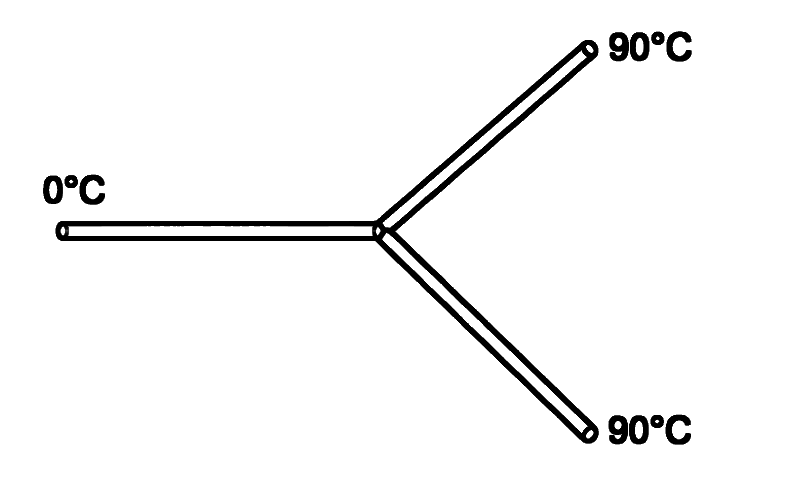
Three rods made of the same material and the same cross-sectional areas have been joined as shown in the figure. Each rod is of the same length. The temperature of the junction is
Show answer and solution
Answer: (a)
All rods are identical, so each has the same resistance. Heat in from the two hot rods equals heat out through the cold rod.
Heat Conduction · Composite rods, slabs & junction temperature
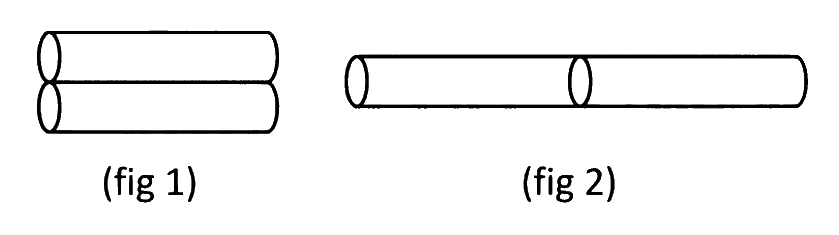
Two rods of same length, radius and material transfer a given amount of heat in 't' second when they are joined as shown in fig (1). But when they are joined as shown in fig (2) then they will transfer same heat in same condition in time
Show answer and solution
Answer: (c)
Let each rod have resistance R. Fig (1) is parallel: R1=2R. Fig (2) is series: R2=2R.
For the same heat and ΔT, time t∝ thermal resistance.
Heat Conduction · Composite rods, slabs & junction temperature
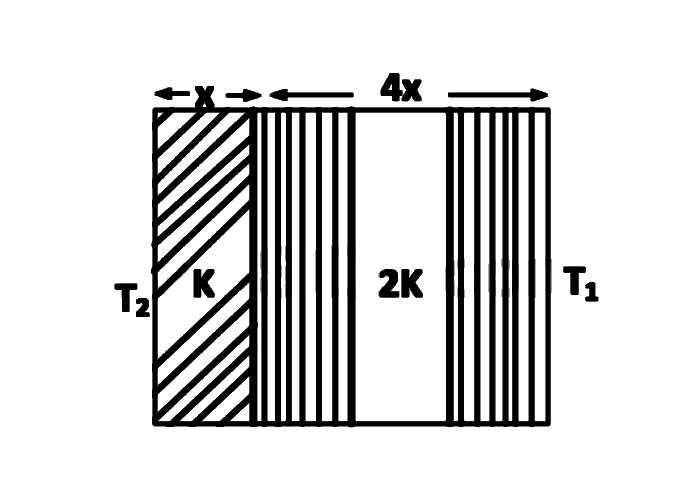
In a composite slab there are two materials having coefficients of thermal conductivity K and 2K, thickness x and 4x repectively. The temperature of the two outer surfaces of a composite slab are T2 and T1(T2>T1).T2 is on side K and T1 is on side 2K. The rate of heat transfer through the slab in a steady state is [xA(T2−T1)K]⋅f, where f is equal to
Heat Conduction · Composite rods, slabs & junction temperature
Consider two rods 1 and 2 of same length. They have different specific heats (C1,C2), thermal conductivities (K1,K2) and area of cross-section (A1,A2) respectively. Both the rods have temperatures (T1,T2) at their ends. If their rate of loss of heat due to conduction is equal, then
Show answer and solution
Answer: (b)
Conduction rate H=LKAΔT does not involve specific heat.
Heat Conduction · Composite rods, slabs & junction temperature
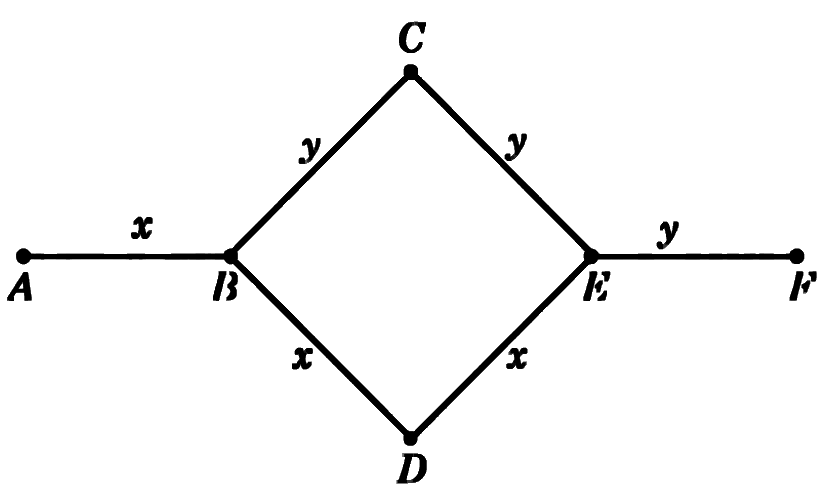
Rods x and y of equal dimensions but of different materials are joined as shown in figure. Temperatures of end points A and F are maintained at 100∘C and 40∘C respectively. Given the thermal conductivity of rod x is three times of that of rod y, the temperature at junction points B and E are (close to):
Show answer and solution
Answer: (c)
Kx=3Ky, so take resistance of an x rod =r and a y rod =3r.
B to E: path BCE =6r in parallel with path BDE =2r, giving 86×2r=1.5r.
Heat Conduction · Composite rods, slabs & junction temperature
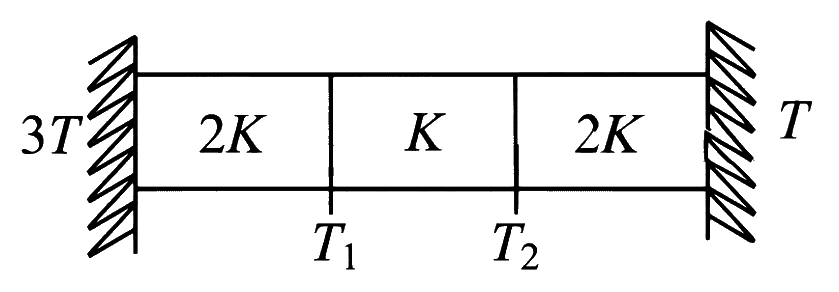
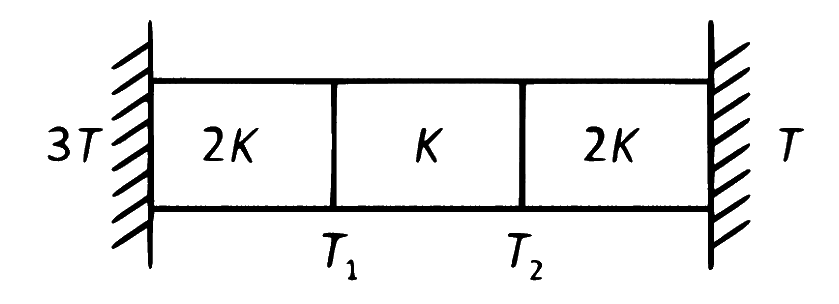
Three identical heat conducting rods are connected in series as shown in the figure. The rods on the side have thermal conductivity 2K while that in the middle has thermal conductivity K. The left end of the combination is maintained at temperature 3T and the right end at T. The rods are thermally insulated from outside. In steady state, temperature at the left junction is T1 and that at the right junctions is T2. The ratio T1/T2 is
Show answer and solution
Answer: (c)
Resistance of a 2K rod =R, of the K rod =2R; total =4R for a drop of 3T−T=2T.
Heat Conduction · Thermal conductivity & rate of heat flow
The two ends of a rod of length ' x ' and uniform cross-sectional area ' A ' are kept at temperatures ' T1 ' and ' T2 ' respectively ( T1>T2 ). If the rate of heat transfer is ' Q/t ', through the rod in steady state, then the coefficient of thermal conductivity ' K ' is
Heat Conduction · Composite rods, slabs & junction temperature
A composite slab consists of two materials having coefficients of thermal conductivity K and 2K, thickness x and 4x respectively. The temperatures of two outer surfaces of a composite slab are T2 and T1 respectively (T2>T1). The rate of heat transfer through the slab in a steady state is [xA(T2−T1)K]f, where f is equal to
Heat Conduction · Composite rods, slabs & junction temperature
Three identical heat conducting rods are connected in series as shown in the figure. The rods on the sides have thermal conductivity 2K while that in the middle has thermal conductivity K. The left end of the combination is maintained at temperature 3T and the right end at T. The rods are thermally insulated from outside. In steady state, temperature at the left junction is T1 and that at the right junction is T2. The ratio T1/T2 is
Show answer and solution
Answer: (a)
R=KAL: the 2K rods have resistance r, the middle K rod has 2r; total 4r.
Heat Conduction · Composite rods, slabs & junction temperature
Two cylindrical rods A and B made of different materials, are joined in a straight line. The ratios of lengths, radii and thermal conductivities of these rods are: LBLA=21,rBrA=2 and KBKA=21. The free ends of rods A and B are maintained at 400 K, 200 K, respectively. The temperature of rods interface is ______________ K, when equilibrium is established.
Numerical answer type. Work it out, then open the answer.
Show answer and solution
Answer: 360
Thermal resistance R=Kπr2L, so RBRA=LBLA⋅KAKB⋅rA2rB2=21⋅2⋅41=41
In series the temperature drop divides in ratio of resistances: drop across A =200×51=40 K
Heat Conduction · Thermal conductivity & rate of heat flow
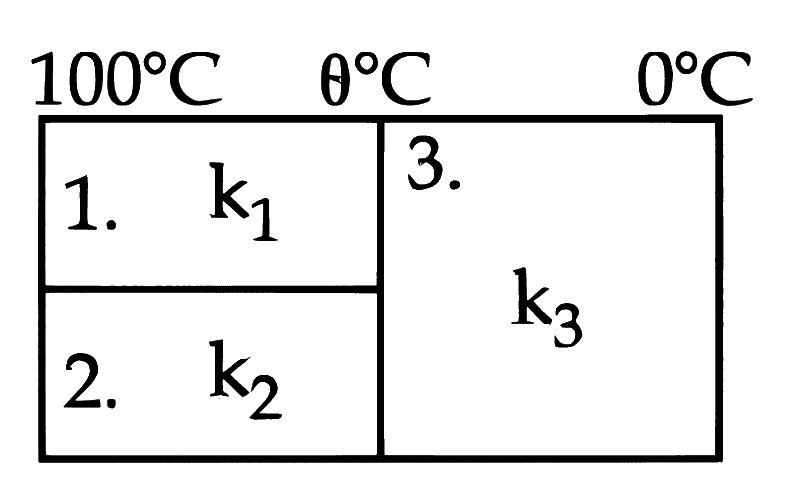
Three conductors of same length having thermal conductivity k1,k2 and k3 are connected as shown in figure.
Area of cross sections of 1st and 2nd conductor are same and for 3rd conductor it is double of the 1st conductor. The temperatures are given in the figure. In steady state condition, the value of θ is _________ ∘C. (Given: k1=60 J s−1 m−1 K−1,k2=120 J s−1 m−1 K−1,k3=135 J s−1 m−1 K−1)
Numerical answer type. Work it out, then open the answer.
Show answer and solution
Answer: 40
Rods 1 and 2 are in parallel between 100∘C and θ; rod 3 (area 2A) carries the same total heat from θ to 0∘C.
Heat Conduction · Thermal conductivity & rate of heat flow
Given below are two statements: One is labelled as Assertion A and the other is labelled as Reason R.
Assertion A: Houses made of concrete roofs overlaid with foam keep the room hotter during summer.
Reason R: The layer of foam insulation prohibits heat transfer, as it contains air pockets. In the light of the above statements, choose the correct answer from the options given below.
Show answer and solution
Answer: (b)
Foam with trapped air is a poor conductor, so it blocks heat flow: R is true.
Blocking heat entering from the hot roof keeps the room cooler in summer, not hotter: A is false.
Heat Conduction · Thermal conductivity & rate of heat flow
A cylindrical rod is having temperatures θ1 and θ2 at its ends. The rate of heat flow is Q J/s. All the linear dimensions of the rod are doubled by keeping the temperature constant. The new rate of flow of heat is
Heat Conduction · Thermal conductivity & rate of heat flow
Rate of flow of heat through a cylindrical rod is ' H1 '. The temperature at the ends of the rod are ' T1 ' and ' T2 '. If all the dimensions of the rod become double and the temperature difference remains the same, the rate of flow of heat becomes ' H2 '. Then
Heat Conduction · Composite rods, slabs & junction temperature
Two rods of same length \& material transfer a given amount of heat in 12 s when they are joined end to end. But when they are joined length wise parallel to each other they will transfer same amount of heat in same condition in time
Show answer and solution
Answer: (b)
Each rod has resistance R. End to end (series): 2R. Side by side (parallel): 2R.
Time ∝ resistance, so the time drops by a factor of 4.
Heat Conduction · Thermal conductivity & rate of heat flow
The temperature gradient in a rod of length 75 cm is 40∘C/m. If the temperature of cooler end of the rod is 10∘C, then the temperature of hotter end is
Show answer and solution
Answer: (b)
Temperature difference =gradient×length=40×0.75=30∘C
Heat Conduction · Composite rods, slabs & junction temperature
A composite slab consists of two materials having coefficient of thermal conductivity K and 2K, thickness x and 4x respectively. The temperature of the two outer surfaces of a composite slab are T2 and T1(T2>T1). The rate of heat transfer through the slab in a steady state is [xA(T2−T1)K]⋅f where 'f' is equal to
Heat Conduction · Composite rods, slabs & junction temperature
Two plates A and B have thermal conductivities 84 W m−1 K−1 and 126 W m−1 K−1 respectively. They have same surface area and same thickness. They are placed in contact along their surfaces. If the temperatures of the outer surfaces of A and B are kept at 100∘C and 0∘C respectively, then the temperature of the surface of contact in steady state is _____________ ∘C.
Numerical answer type. Work it out, then open the answer.
Show answer and solution
Answer: 40
Same area and thickness: R∝K1, so RBRA=84126=23
Heat Conduction · Thermal conductivity & rate of heat flow
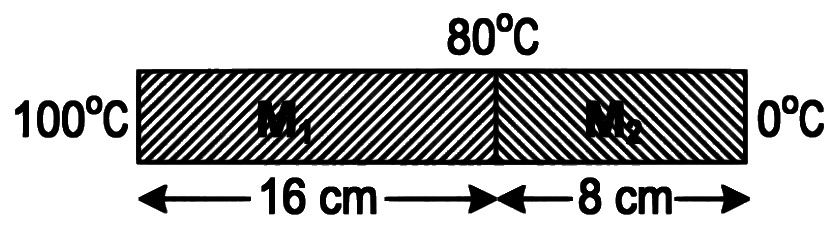
Two metallic blocks M1 and M2 of same area of cross-section are connected to each other (as shown in figure). If the thermal conductivity of M2 is K then the thermal conductivity of M1 will be: [Assume steady state heat conduction]
Show answer and solution
Answer: (b)
Same heat current through both blocks: 16K1A(100−80)=8KA(80−0)
Heat Conduction · Composite rods, slabs & junction temperature
Two rods one made of copper and other made of steel of same length and same cross sectional area are joined together. The thermal conductivity of copper and steel are 385 J s−1 K−1 m−1 and 50 J s−1 K−1 m−1 respectively. The free ends of copper and steel are held at 100∘C and 0∘ C respectively. The temperature at the junction is, nearly:
Show answer and solution
Answer: (a)
Same heat current in both rods (same L, A): 385(100−θ)=50(θ−0)
Heat Conduction · Composite rods, slabs & junction temperature
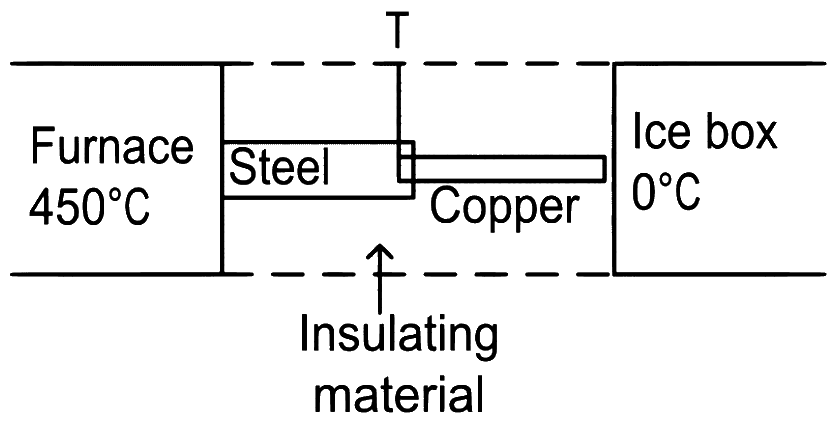
If K1 and K2 are the thermal conductivities, L1 and L2 are the lengths and A1 and A2 are the cross sectional areas of steel and copper rods respectively such that K1K2=9,A2A1=2,L2L1=2. Then, for the arrangement as shown in the figure, the value of temperature T of the steel - copper junction in the steady state will be:
Heat Conduction · Composite rods, slabs & junction temperature
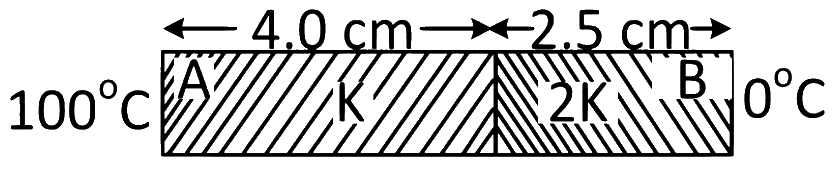
As per the given figure, two plates A and B of thermal conductivity K and 2 K are joined together to form a compound plate. The thickness of plates are 4.0 cm and 2.5 cm respectively and the area of cross-section is 120 cm2 for each plate. The equivalent thermal conductivity of the compound plate is (1+α5) K, then the value of α will be ______________.
Numerical answer type. Work it out, then open the answer.
Heat Conduction · Thermal conductivity & rate of heat flow
An ice cube of dimensions 60 cm×50 cm×20 cm is placed in an insulation box of wall thickness 1 cm. The box keeping the ice cube at 0∘C of temperature is brought to a room of temperature 40∘C. The rate of melting of ice is approximately:
(Latent heat of fusion of ice is 3.4×10⁵ J kg−1 and thermal conducting of insulation wall is 0.05 W m−1∘C−1)
Heat Conduction · Thermal conductivity & rate of heat flow
The temperature difference between two sides of an iron plate, 1.8 cm thick is 9∘C. Heat is transmitted through the plate 10 kcal/s m2 at steady state. The thermal conductivity of iron is
Heat Conduction · Thermal conductivity & rate of heat flow
A cylindrical rod has temperatures 'T1 ' and 'T2' at its ends. The rate of flow of heat is 'Q1 ' cal s−1. If length and radius of the rod are doubled keeping temperature constant, then the rate of flow of heat 'Q2' will be
Heat Conduction · Thermal conductivity & rate of heat flow
A cylindrical rod is having temperatures θ1 and θ2 at its ends. The rate of heat flow is 'Q' J s−1. All the linear dimensions of the rod are doubled by keeping the temperatures constant. What is the new rate of flow of heat?
Heat Conduction · Thermal conductivity & rate of heat flow
The temperature difference bewtween two sides of metal plate, 3 cm thick is 15∘C. Heat is transmitted through plate at the rate of 900 kcal per minute per m2 at steady state. The thermal conductivity of metal is
Heat Conduction · Composite rods, slabs & junction temperature
Two rods of same length and material are joined end to end. They transfer heat in 8 second. When they are joined in parallel they transfer same amount of heat in same conditions in time
Show answer and solution
Answer: (b)
Each rod has resistance R. Series: 2R; parallel: 2R.
Time ∝ resistance, so the time drops by a factor of 4.
Heat Conduction · Composite rods, slabs & junction temperature
Two identical metal wires of thermal conductivities K1 and K2 respectively are connected in series. The effective thermal conductivity of the combination is:
Show answer and solution
Answer: (a)
Identical wires: same L and A. In series, resistances add: KeqA2L=K1AL+K2AL
Heat Conduction · Composite rods, slabs & junction temperature
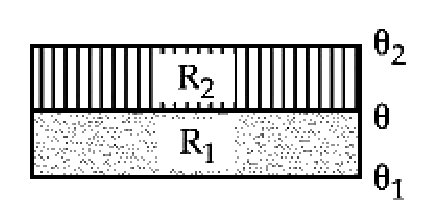
The temperature θ at the junction of two insulating sheets, having thermal resistances R1 and R2 as well as top and bottom temperatures θ1 and θ2 (as shown in figure) is given by:
Show answer and solution
Answer: (a)
Same heat current through both sheets: R2θ2−θ=R1θ−θ1
Heat Conduction · Composite rods, slabs & junction temperature
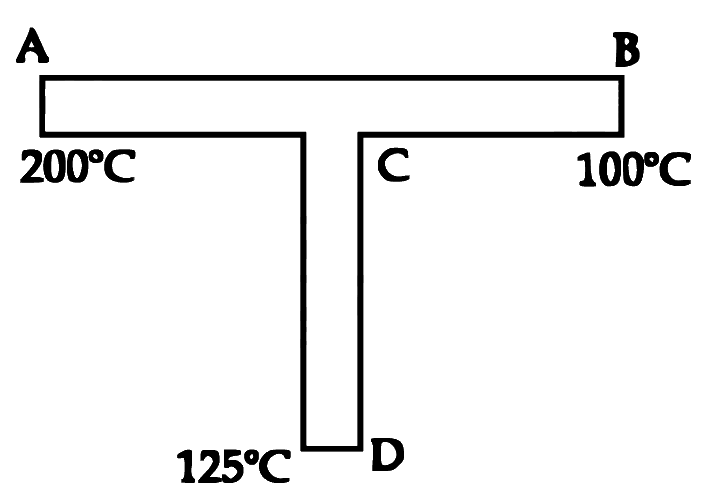
A rod CD of thermal resistance 10.0 KW−1 is joined at the middle of an identical rod AB as shown in figure. The end A, B and D are maintained at 200∘C, 100∘C and 125∘C respectively. The heat current in CD is P watt. The value of P is ..................
Numerical answer type. Work it out, then open the answer.
Show answer and solution
Answer: 2
C is the middle of AB, so RAC=RCB=5 K/W and RCD=10 K/W.
Heat Conduction · Thermal conductivity & rate of heat flow
A conducting rod of length 1 m has area of cross-section 10−3 m2. One end is immersed in boiling water (100∘C) and the other end in Ice (0∘C). If coefficient of thermal conductivity of rod is 96 cal/s m∘C and latent heat for ice is 8×10⁴ cal/kg then the amount of ice which will melt in one minute is
Show answer and solution
Answer: (b)
Rate of heat flow H=LKAΔT=196×10−3×100=9.6 cal/s
Heat Conduction · Composite rods, slabs & junction temperature
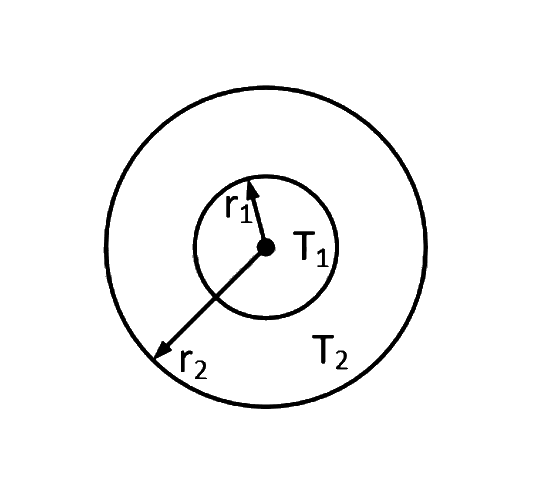
Two thin metallic spherical shells of radii r1 and r2 (r1 < r2) are placed with their centres coinciding. A material of thermal conductivity K is filled in the space between the shells. The inner shell is maintained at temperature θ1 and the outer shell at temperature θ2(θ1 < θ2). The rate at which heat flows radially through the material is :-
Show answer and solution
Answer: (a)
Thin spherical shell: H=K(4πr2)drdθ, constant through all shells.
Integrate from r1 to r2: H(r11−r21)=4πK(θ2−θ1)
Heat Conduction · Composite rods, slabs & junction temperature
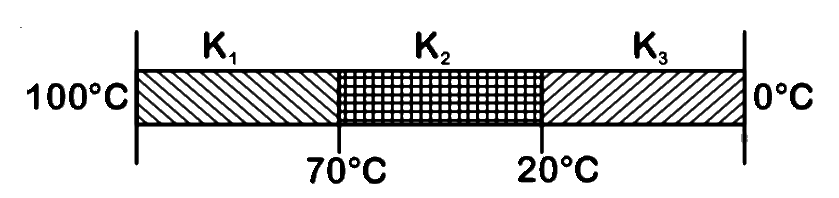
Three rods of identical cross-section and lengths are made of three different materials of thermal conductivity K1, K2 and K3, respectively. They are joined together at their ends to make a long rod (see figure). One end of the long rod is maintained at 100oC and the other at 0oC (see figure). If the joints of the rod are at 70oC and 20oC in steady state and there is no loss of energy from the surface of the rod, the correct relationship between K1, K2 and K3 is:
Show answer and solution
Answer: (a)
Same L, A and heat current: K1(100−70)=K2(70−20)=K3(20−0)
30K1=50K2=20K3
K3K1=3020=32, so the answer is (a) K1:K3=2:3.
Heat Conduction · Composite rods, slabs & junction temperature
A heat source at T = 103 K is connected to another heat reservoir at T = 102 K by a copper slab which is 1 m thick. Given that the thermal conductivity of copper is 0.1 WK–1m–1, the energy flux through it in the steady state is -
Heat Conduction · Composite rods, slabs & junction temperature
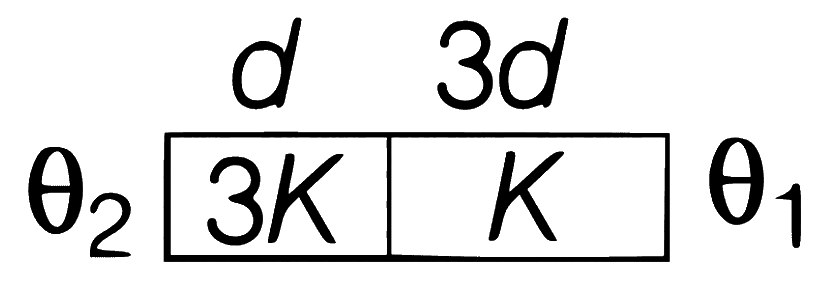
Two materials having coefficients of thermal conductivity '3K' and 'K' and thickness 'd' and '3d', respectively, are joined to form a slab as shown in the figure. The temperatures of the outer surfaces are 'θ2' and 'θ1' respectively, (θ2 > θ1). The temperature at the interface is :-
Heat Conduction · Thermal conductivity & rate of heat flow
A deep rectangular pond of surface area A, containing water (density = ρ), specific heat capacity = s), is located in a region where the outside air temperature is at a steady value of −26∘C. The thickness of the frozen ice layer in this pond, at a certain instant is x.
Taking the thermal conductivity of ice as K, and its specific latent heat of fusion as L, the rate of increase of the thickness of ice layer, at this instant, would be given by
Show answer and solution
Answer: (d)
Water below the ice is at 0∘C, top of ice at −26∘C; heat conducted through the ice layer: xKA(26)
This heat comes from freezing a layer dx: ρAdxL=x26KAdt
Heat Conduction · Thermal conductivity & rate of heat flow
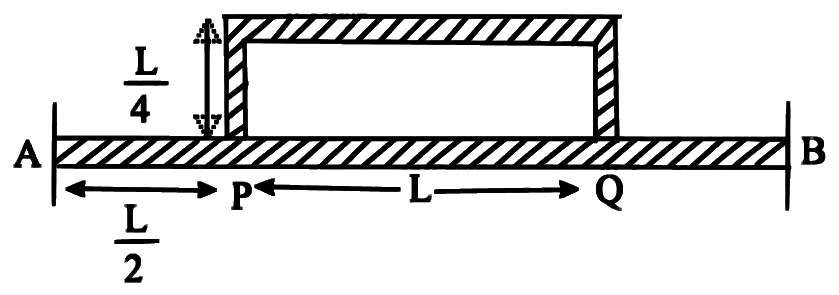
Temperature difference of 120oC is maintained between ends of a uniform rod AB of length 2L. Another bent rod PQ, of same cross-section as AB and length 23L, is connected across AB (see figure). In steady state, temperature difference between P and Q will be close to:
Show answer and solution
Answer: (a)
Same material and area, so resistance ∝ length. AP =QB=L/2; between P and Q: straight part L in parallel with bent rod 3L/2.
Heat Conduction · Composite rods, slabs & junction temperature
A cylinder of radius R is surrounded by a cylindrical shell of inner radius R and outer radius 2R. The thermal conductivity of the material of the inner cylinder is K1 and the of the outer cylinder is K2. Assuming no loss of heat, the effective thermal conductivity of the system for heat flowing along the length of the cylinder is:
Show answer and solution
Answer: (b)
Heat flows along the length: the two parts are in parallel, KeqAtotal=K1A1+K2A2
Heat Conduction · Composite rods, slabs & junction temperature
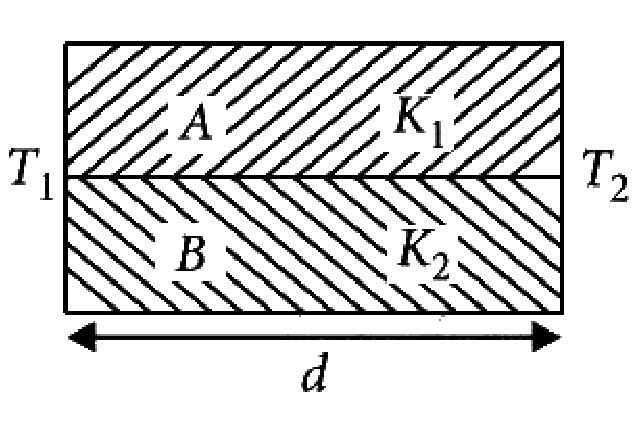
Two rods A and B of different materials are welded together as shown in figure. Their thermal conductivities are K1 and K2. The thermal conductivity of the composite will be
Show answer and solution
Answer: (d)
The rods are side by side between T1 and T2, so they are in parallel; each has area A, total 2A.
Heat Conduction · Composite rods, slabs & junction temperature
Three rods of Copper, Brass and Steel are welded together to form a Y shaped structure. Area of cross - section of each rod =4 cm2. End of copper rod is maintained at 100∘C where as ends of brass and steel are kept at 0∘C. Lengths of the copper, brass and steel rods are 46,13 and 12 cms respectively. The rods are thermally insulated from surroundings excepts at ends. Thermal conductivities of copper, brass and steel are 0.92,0.26 and 0.12 CGS units respectively. Rate of heat flow through copper rod is:
Show answer and solution
Answer: (c)
Let junction temperature be T. Heat in through copper = heat out through brass + steel (same area).
Heat Conduction · Thermal conductivity & rate of heat flow
A long metallic bar is carrying heat from one of its ends to the other end under steady-state. The variation of temperature θ along the length x of the bar from its hot end is best described by which of the following figures?
Show answer and solution
Answer: (a)
In steady state with no side loss, H=−KAdxdθ is the same at every section.
So dxdθ is constant: θ falls linearly with x.
So the answer is (a), a straight line sloping down.
Heat Conduction · Composite rods, slabs & junction temperature
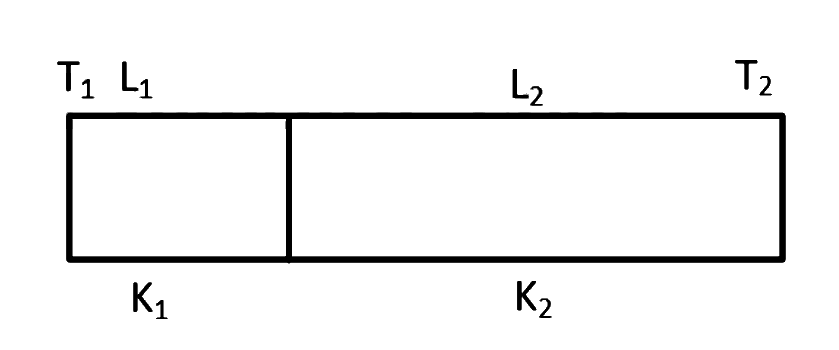
One end of a thermally insulated rod is kept at a temperature T1 and the other at T2. The rod is composed of two sections of length L1 and L2 and thermal conductivities K1 and K2 respectively. The temperature at the interface of the two section is
Show answer and solution
Answer: (d)
Same heat current: L1K1A(T1−T)=L2K2A(T−T2)
K1L2(T1−T)=K2L1(T−T2)
T=K1L2+K2L1K1L2T1+K2L1T2, so the answer is (d).
Heat Conduction · Composite rods, slabs & junction temperature
The figure shows a system of two concentric spheres of radii r1 and r2 are kept at temperatures T1 and T2, respectively. The radial rate of flow of heat in a substance between the two concentric spheres is proportional to
Show answer and solution
Answer: (d)
A thin shell of radius r and thickness dr: H=−K(4πr2)drdT, same H through every shell.
Heat Conduction · Composite rods, slabs & junction temperature
The temperature of the two outer surfaces of a composite slab, consisting of two materials having coefficients of thermal conductivity K and 2K and thickness x and 4x, respectively, are T2 and T1(T2>T1). The rate of heat transfer through the slab, in a steady state is (xA(T2−T1)K)f, with f equal to
Show answer and solution
Answer: (d)
Slabs in series: thermal resistances add, R=KAx+2KA4x=KA3x
Heat Conduction · Thermal conductivity & rate of heat flow
Heat is flowing through two cylindrical rods of the same material. The diameters of the rods are in the ratio 1:2 and the lengths in the ratio 2:1. If the temperature difference between the ends is same, then ratio of the rate of flow of heat through them will be
Thermal Radiation: Black Body, Stefan & Wien · Absorptivity, reflectivity & emissivity
Heat energy is incident on the surface at the rate of 1000 J/min. If coefficient of absorption is 0.8 and coefficient of reflection is 0.1 then heat energy transmitted by the surface in 5 minute is
Thermal Radiation: Black Body, Stefan & Wien · Absorptivity, reflectivity & emissivity
When 170 J of energy is incident on a surface of a body, 17 J of energy is reflected by it. If the coefficient of absorption is 0.7, then the amount of energy transmitted will be
Thermal Radiation: Black Body, Stefan & Wien · Absorptivity, reflectivity & emissivity
'x' joule of heat is incident on a body. Out of it, the total heat reflected and transmitted by it is 'y' joule. The absorption coefficient of the body is
Show answer and solution
Answer: (b)
Heat absorbed =x−y (rest is reflected or transmitted).
Thermal Radiation: Black Body, Stefan & Wien · Wien's displacement law
Temperature of two stars are in the ratio 3:2. If wavelength of maximum intensity of first star is 4200 Å, the corresponding wavelength for second star is
Thermal Radiation: Black Body, Stefan & Wien · Wien's displacement law
Two stars A and B radiate maximum energy at wavelength 3.9×10⁻⁷ m and 5.2×10⁻⁷ m respectively. The ratio of the temperature of star A to that of star B will be
Thermal Radiation: Black Body, Stefan & Wien · Absorptivity, reflectivity & emissivity
Two bodies 'X' and 'Y' at temperatures T1 K and T2 K respectively have the same dimensions. Their emissivities e1 and e2 are in the ratio of 1:6. If their emissive powers are same, the relation between their temperatures is
Show answer and solution
Answer: (c)
Emissive power E=eσT4; equal E gives e1T14=e2T24.
Thermal Radiation: Black Body, Stefan & Wien · Absorptivity, reflectivity & emissivity
Rate of radiation by a black body is 'R' at temperature 'T'. Another body has same area but emissivity is 0.2 and temperature 3T. Its rate of radiation is
Show answer and solution
Answer: (c)
Rate of radiation P=eσAT4; for the black body R=σAT4.
Thermal Radiation: Black Body, Stefan & Wien · Absorptivity, reflectivity & emissivity
A wire of length L and diameter d is used in a bulb. The temperature of wire is T and power radiated by the wire is P. Its emissivity is (σ = Stefan's constant) (Assume that emissivity of wire material is same at all wavelength)
Show answer and solution
Answer: (a)
Radiating area of the wire (curved surface) A=πdL.
Thermal Radiation: Black Body, Stefan & Wien · Stefan-Boltzmann law & radiated power
The radiation emitted by a star A is 10000 times that of the sun. If surface temperature of sun and star A are 6000 K and 2000 K respectively, the ratio of radii of star A and sun is
Thermal Radiation: Black Body, Stefan & Wien · Stefan-Boltzmann law & radiated power
The total radiant energy per unit area normal to the direction of incidence, received at a distance R from the centre of a star of radius r, whose outer surface radiates as a black body at a temperature 'T' K is (σ = Stefan's constant)
Show answer and solution
Answer: (a)
Total power of the star P=4πr2σT4.
At distance R this spreads over a sphere of area 4πR2.
Energy per unit area per unit time =4πR24πr2σT4=R2σr2T4
Thermal Radiation: Black Body, Stefan & Wien · Stefan-Boltzmann law & radiated power
A sphere having temperature 600 K is losing heat due to radiation. At this temperature its rate of cooling is R. The rate of cooling of this sphere at 400 K is 243x. The value of x is (Temperature of surrounding is 300 K)
Thermal Radiation: Black Body, Stefan & Wien · Stefan-Boltzmann law & radiated power
A sphere is at temperature 600 K. In an external environment of 200 K, its cooling rate is R. When the temperature of the sphere falls to 400 K then cooling rate R' will become
Thermal Radiation: Black Body, Stefan & Wien · Stefan-Boltzmann law & radiated power
Two spherical black bodies of radii R1 and R2 having surface temperature T1 and T2 respectively, radiate the same power. The ratio of R1 to R2 will be
Show answer and solution
Answer: (c)
Power P=4πR2σT4; equal power gives R12T14=R22T24.
Thermal Radiation: Black Body, Stefan & Wien · Stefan-Boltzmann law & radiated power
In an external environment of temperature (T) kelvin, a sphere at temperature (3T) kelvin has cooling rate R1. When the temperature of that sphere falls to (2T) kelvin, the cooling rate R2 of the sphere will become
Thermal Radiation: Black Body, Stefan & Wien · Wien's displacement law
The wavelength of maximum intensity of radiation emitted by a star is 289.8 nm. The radiation intensity of the star is (Stefan's constant = 5.67×10⁻⁸ SI unit, Wein's constant 2898μmk)
Thermal Radiation: Black Body, Stefan & Wien · Wien's displacement law
A rectangular black body of temperature 27∘C has surface area 6 cm ×3 cm and rate of radiation E. If its temperature is increased by 300∘C and its linear dimensions are reduced to (31)rd of their initial value then the rate of radiation is
Show answer and solution
Answer: (b)
P=σAT4, so P∝AT4.
T1=300 K, T2=600 K: factor 24=16.
Linear dimensions become 31, so area becomes 91.
Thermal Radiation: Black Body, Stefan & Wien · Wien's displacement law
A black body is at temperature of 5780 K. The energy of radiation emitted by the body at wavelength 300 nm is U1, at wavelength 500 nm is U2 and that at 900 nm is U3 respectively. Wien's constant b=2.89×10⁶ nmK. This shows that
Show answer and solution
Answer: (c)
Wien's law: λm=Tb=57802.89×106=500 nm.
Energy is maximum at 500 nm and falls on either side.
Thermal Radiation: Black Body, Stefan & Wien · Wien's displacement law
A black rectangular surface of area 'A' emits energy 'E' per second at 27∘ C. If length and breadth is reduced to half of its initial value and temperature is raised to 327∘C then energy emitted per second becomes
Thermal Radiation: Black Body, Stefan & Wien · Wien's displacement law
A black rectangular surface of area A emits energy E per second at 127∘ C. If length and breadth is reduced to half of initial value and temperature is raised to 527∘ C then energy emitted becomes
Thermal Radiation: Black Body, Stefan & Wien · Wien's displacement law
A black rectangular surface of area A emits energy E per unit time at 27∘ C. If length and breadth is reduced to (41)th of initial value and temperature is raised to 327∘ C, then energy emitted per unit time becomes
Thermal Radiation: Black Body, Stefan & Wien · Stefan + Wien combined
The power radiated by a black body is P and it radiates maximum energy at wavelength λ0. If the temperature of the black body is now changed so that it radiates maximum energy at wavelength 0.75λ0, the power radiated by it becomes nP. The value n is
Thermal Radiation: Black Body, Stefan & Wien · Stefan + Wien combined
The power radiated by a black body is P and it radiates maximum energy at wavelength λ0. If the temperature of the black body is now changed so that it radiates maximum energy at wavelength 43λ0, the power radiated by it becomes nP. The value of n is
Thermal Radiation: Black Body, Stefan & Wien · Stefan + Wien combined
A black body radiates maximum energy at wavelength 'λ' at temperature T1 and its emissive power is E. When the temperature of the body is changed to T2, it radiates maximum energy at wavelength 32λ, then the emissive power will become
Thermal Radiation: Black Body, Stefan & Wien · Stefan + Wien combined
The energy spectrum of a black body exhibits a maximum around a wavelength 'λ'. The temperature of the black body is now changed such that the energy is maximum around a wavelength 2λ/3. The power radiated by the black body will now increase by a factor
Thermal Radiation: Black Body, Stefan & Wien · Stefan + Wien combined
The energy spectrum of a black body exhibits a maximum around a wavelength λ. The temperature of a black body is now changed such that the energy is maximum at wavelength 2λ/3. The power radiated by the black body will now increase by a factor of
Thermal Radiation: Black Body, Stefan & Wien · Stefan + Wien combined
A black disc has a radius 'R' and wavelength corresponding to the maximum intensity is 'λ'. The emissive power (E) for the different radii and maximum wavelengths is directly proportional to
Thermal Radiation: Black Body, Stefan & Wien · Stefan + Wien combined
The energy spectrum of a black body exhibits a maximum of wavelength λ0. The temperature of the black body is now changed such that the energy is maximum at wavelength 23λ0. The ratio of power radiated by the black body will be
Thermal Radiation: Black Body, Stefan & Wien · Stefan + Wien combined
Three spheres, P, Q and R, having radii 4 m, 5 m and 6 m respectively, are coated with lamp black on their outer surfaces. The wavelengths corresponding to maximum intensity (radiated) are 400 nm, 500 nm and 600 nm respectively. If the powers radiated by them are PP,PQ and PR respectively, then PP:PQ:PR is
Thermal Radiation: Black Body, Stefan & Wien · Absorptivity, reflectivity & emissivity
If 120 J of thermal energy is incident on area 3 m2, the amount of heat transmitted is 12 J, coefficient of absorption is 0.6, then the amount of heat reflected is
Thermal Radiation: Black Body, Stefan & Wien · Absorptivity, reflectivity & emissivity
The co-efficient of absorption and the coefficient of reflection of a thin uniform plate are 0.77 and 0.17 respectively. If 250 kcal of heat is incident on the surface of the plate, the quantity of heat transmitted is
Thermal Radiation: Black Body, Stefan & Wien · Stefan-Boltzmann law & radiated power
Black sphere of radius R radiates power P at certain temperature T. If the temperature is doubled, the radius gets doubled. Now the power radiated would be
Thermal Radiation: Black Body, Stefan & Wien · Absorptivity, reflectivity & emissivity
Two bodies A and B at temperatures ' T1 ' K and ' T2 ' K respectively have the same dimensions. Their emissivities are in the ratio 16:1. At T1=xT2, they radiate the same amount of heat per unit area per unit time. The value of x is
Show answer and solution
Answer: (d)
Same heat per unit area per unit time: e1T14=e2T24.
Thermal Radiation: Black Body, Stefan & Wien · Absorptivity, reflectivity & emissivity
A wire of length 10 cm and diameter 0.5 mm is used in a bulb. The temperature of the wire is 1727∘C and power radiated by the wire is 94.2 W. Its emissivity is 8x where x= _________. (Given σ=6.0×10⁻⁸ W m−2 K−4,π=3.14 and assume that the emissivity of wire material is same at all wavelength.)
Numerical answer type. Work it out, then open the answer.
Thermal Radiation: Black Body, Stefan & Wien · Stefan-Boltzmann law & radiated power
The outer surface of star in the form of a sphere radiates heat as a black body at temperature ' T '. The total radiant energy per unit area, normal to the direction of incidence, received at a distance ' R ' from the centre of a star of radius ' r ' is (R>r)(σ= Stefan's constant )
Show answer and solution
Answer: (a)
Total power of the star P=4πr2σT4.
At distance R it spreads over area 4πR2.
Energy per unit area per unit time =4πR24πr2σT4=R2σr2T4
Thermal Radiation: Black Body, Stefan & Wien · Stefan-Boltzmann law & radiated power
Two spherical black bodies have radii ' R1 ' and ' R2 '. Their surface temperatures are ' T1 ' and ' T2 '. If they radiate same power, then R1R2 is
Show answer and solution
Answer: (d)
Power P=4πR2σT4; equal power gives R12T14=R22T24.
Thermal Radiation: Black Body, Stefan & Wien · Stefan-Boltzmann law & radiated power
Two spherical black bodies have radii ' R1 ' and ' R2 '. Their surface temperatures are T1K and T2K respectively. If they radiate the same power, the ratio R2R1 is
Show answer and solution
Answer: (d)
Power P=4πR2σT4; equal power gives R12T14=R22T24.
Thermal Radiation: Black Body, Stefan & Wien · Stefan-Boltzmann law & radiated power
If a black body at 400 K surrounded by atmosphere at 300 K has rate of cooling ' R0 ', the same body at 900 K, surrounded by same atmosphere, will have rate of cooling nearly
Thermal Radiation: Black Body, Stefan & Wien · Stefan-Boltzmann law & radiated power
Two spherical bodies of same materials having radii 0.2 m and 0.8 m are placed in same atmosphere. The temperature of the smaller body is 800 K and temperature of the bigger body is 400 K. If the energy radiated from the smaller body is E, the energy radiated from the bigger body is (assume, effect of the surrounding temperature to be negligible),
Thermal Radiation: Black Body, Stefan & Wien · Wien's displacement law
A rectangular black body of temperature 127∘C has surface area 4 cm×2 cm and rate of radiation is E. If its temperature is increased by 400∘C and surface area is reduced to half of the initial value then the rate of radiation is
Thermal Radiation: Black Body, Stefan & Wien · Wien's displacement law
Black bodies A and B radiate maximum energy with wavelength difference 4μm. The absolute temperature of body A is 3 times that of B. The wavelength at which body B radiates maximum energy is
Thermal Radiation: Black Body, Stefan & Wien · Wien's displacement law
A rectangular block of surface area A emits energy E per second at 27∘C. If length and breadth is reduced to half of initial value and temperature is raised to 327∘C then energy emitted per second becomes
Thermal Radiation: Black Body, Stefan & Wien · Stefan + Wien combined
Two black spheres P&Q have radii in the ratio 4:3. The wavelength of maximum intensity of radiation are in the ratio 4:5 respectively. The ratio of radiated power by P to Q is
Thermal Radiation: Black Body, Stefan & Wien · Absorptivity, reflectivity & emissivity
Three identical metal spheres (of same surface area) have red, black and white colors and they are heated up to same temperature. They are allowed to cool. Arrange them from maximum rate of cooling to minimum rate of cooling
Show answer and solution
Answer: (a)
Good absorbers are good emitters: emissivity order black > red > white.
Thermal Radiation: Black Body, Stefan & Wien · Absorptivity, reflectivity & emissivity
Given that ' x ' joule of heat is incident on a body. Out of that, total heat reflected and transmitted is ' y ' joule. The absorption coefficient of body is
Thermal Radiation: Black Body, Stefan & Wien · Absorptivity, reflectivity & emissivity
Two spheres S1 and S2 have same radii but temperatures T1 and T2 respectively. Their emissive power is same and emissivity in the ratio 1:4. Then the ratio T1:T2 is
Thermal Radiation: Black Body, Stefan & Wien · Absorptivity, reflectivity & emissivity
Rate of radiation by a black body is ' R ' at temperature 'T'. Another body has same area but emissivity is 0.2 and temperature 3T. Its rate of radiation is
Show answer and solution
Answer: (c)
Rate of radiation P=eσAT4; for the black body R=σAT4.
Thermal Radiation: Black Body, Stefan & Wien · Stefan-Boltzmann law & radiated power
Two bodies ' X ' and ' Y ' at temperatures ' T1 ' K and ' T2 ' K respectively have the same dimensions. If their emissive powers are same, the relation between their temperatures is
Show answer and solution
Answer: (a)
Emissive power E=eσT4; equal E gives e1T14=e2T24.
The emissivity ratio is missing in the question; in the original version e1:e2=1:3.
Thermal Radiation: Black Body, Stefan & Wien · Stefan-Boltzmann law & radiated power
A sphere is at temperature 600 K. In an external environment of 200 K, its cooling rate is ' R ' When the temperature of the sphere falls to 400 K, then cooling rate ' R′ ' will become
Thermal Radiation: Black Body, Stefan & Wien · Stefan-Boltzmann law & radiated power
Two spherical black bodies of radii ' R1 ' and ' R2 ' and with surface temperature ' T1 ' and ' T2 ' respectively radiate the same power. The ratio of ' R1 ' to ' R2 ' will be
Show answer and solution
Answer: (b)
Power P=4πR2σT4; equal power gives R12T14=R22T24.
Thermal Radiation: Black Body, Stefan & Wien · Wien's displacement law
Ordinary bodies P and Q radiate maximum energy with wavelength difference 3μm. The absolute temperature of body P is four times that of Q. The wavelength at which body Q radiates maximum energy is
Thermal Radiation: Black Body, Stefan & Wien · Wien's displacement law
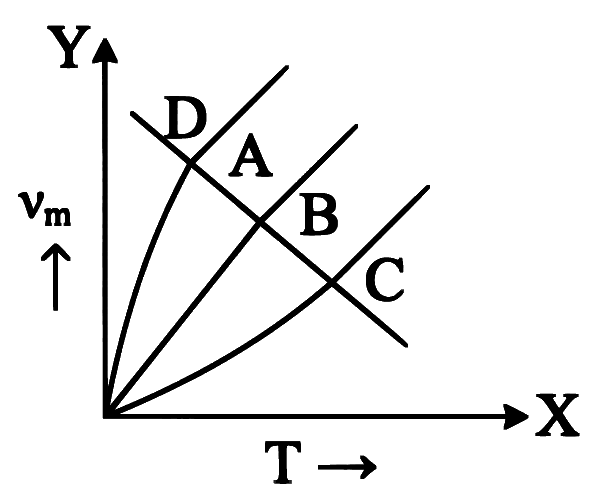
The frequency ' νm ' corresponding to which the energy emitted by a black body is maximum may vary with the temperature ' T ' of the body as shown by the curves ' A ', ' B ', ' C ' and ' D ' in the figure. Which one of these represents the correct variation?
Show answer and solution
Answer: (c)
Wien's law: λmT=b and νm=λmc.
νm=bcT⇒νm∝T
The graph of νm against T is a straight line through the origin.
Thermal Radiation: Black Body, Stefan & Wien · Stefan + Wien combined
The power radiated by a black body is P and it radiates maximum energy around the wavelength λ0. Now the temperature of the black body is changed so that it radiates maximum energy around wavelength (2λ0). The power radiated by it will now increase by a factor of
Thermal Radiation: Black Body, Stefan & Wien · Stefan + Wien combined
The black discs x,y and z have radii 1 m,2 m and 3 m respectively. The wavelengths corresponding to maximum intensity are 200 nm,300 nm and 400 nm respectively. The relation between emissive power Ex,Ey and Ez is
Show answer and solution
Answer: (a)
Power E∝R2T4∝λm4R2.
Taking λ in units of 100 nm: Ex∝241=0.0625, Ey∝344=0.049, Ez∝449=0.035.
Thermal Radiation: Black Body, Stefan & Wien · Stefan + Wien combined
A black body radiates power ' P ' and maximum energy is radiated by it at a wavelength λ0. The temperature of the black body is now so changed that it radiates maximum energy at the wavelength 4λ0. The power radiated by it at new temperature is
Thermal Radiation: Black Body, Stefan & Wien · Absorptivity, reflectivity & emissivity
Heat energy is incident on the surface at the rate of X J/min. If 'a' and 'r' represent coefficient of absorption and reflection respectively then the heat energy transmitted by the surface in 't' minutes is
Show answer and solution
Answer: (a)
a+r+t=1⇒t=1−(a+r)
Energy incident in t minutes =Xt
Transmitted =[1−(a+r)]Xt
None of the options matches exactly; (a) (a+r)Xt is the energy absorbed plus reflected, not transmitted.
Thermal Radiation: Black Body, Stefan & Wien · Absorptivity, reflectivity & emissivity
Two bodies A and B at temperatures 'T1' K and 'T2' K respectively have the same dimensions. Their emissivities are in the ratio 1:3. If they radiate the same amount of heat per unit area per unit time, then the ratio of their temperatures (T1:T2) is
Show answer and solution
Answer: (b)
Same heat per unit area per unit time: e1T14=e2T24.
Thermal Radiation: Black Body, Stefan & Wien · Stefan-Boltzmann law & radiated power
A sphere and a cube, both of copper have equal volumes and are black. They are allowed to cool at same temperature and in same atmosphere. The ratio of their rate of loss of heat will be
Show answer and solution
Answer: (c)
Same material, same temperature and surroundings, so rate of heat loss ∝ surface area A.
Thermal Radiation: Black Body, Stefan & Wien · Stefan-Boltzmann law & radiated power
A sphere, a cube and a thin circular plate all made of same material and having the same mass are heated to same temperature of 200∘C. When these are left in a room.
Show answer and solution
Answer: (c)
Same mass and material, so same heat capacity mc; rate of cooling dtdT∝mcA.
For a given volume, the sphere has the least surface area and a thin plate has the largest.
Largest area means fastest heat loss, so the plate cools fastest.
So the answer is (c) the circular plate reaches room temperature fast.
Thermal Radiation: Black Body, Stefan & Wien · Stefan-Boltzmann law & radiated power
Compare the rate of loss of heat from a metal sphere at 627∘C with the rate of loss of heat from the same sphere at 327∘C, if the temperature of the surrounding is 27∘C. (nearly)
Thermal Radiation: Black Body, Stefan & Wien · Stefan-Boltzmann law & radiated power
A black sphere has radius 'R' whose rate of radiation is 'E' at temperature 'T'. If radius is made R/3 and temperature '3T', the rate of radiation will be
Thermal Radiation: Black Body, Stefan & Wien · Stefan + Wien combined
A black body radiates maximum energy at wavelength 'λ' and its emissive power is 'E'. Now due to a change in temperature of that body, it radiates maximum energy at wavelength 3λ. At that temperature emissive power is
Thermal Radiation: Black Body, Stefan & Wien · Stefan + Wien combined
A black body radiates maximum energy at wavelength 'λ' and its emissive power is 'E' Now due to change in temperature of that body, it radiates maximum energy at wavelength 32λ. At that temperature emissive power is
Thermal Radiation: Black Body, Stefan & Wien · Stefan + Wien combined
A black body radiates maximum energy at wavelength 'λ' and its emissive power is E. Now due to change in temperature of that body, it radiates maximum energy at wavelength 32λ. At that temperature emissive power is
Thermal Radiation: Black Body, Stefan & Wien · Stefan + Wien combined
Three discs x,y and z having radii 2 m,3 m and 6 m respectively are coated on outer surfaces. The wavelength corresponding to maximum intensity are 300 nm,400 nm and 500 nm respectively. If Px,Py and Pz are power radiated by them respectively then
Thermal Radiation: Black Body, Stefan & Wien · Wien's displacement law
Assume that for solar radiation, surface temperature of the sun is 6000 K. If Wien's constant 'b' is 2.897×10⁻³ mK, the value of maximum wavelength will be
Thermal Radiation: Black Body, Stefan & Wien · Wien's displacement law
A black reactangular surface of area 'a' emits energy 'E' per second at 27∘C. If length and breadth is reduced to (31)rd of initial value and temperature is raised to 327∘C then energy emitted per second becomes
Thermal Radiation: Black Body, Stefan & Wien · Wien's displacement law
A black rectangular surface of area 'A' emits energy 'E' per second at 27∘C. If length and breadth is reduced to (1/3)rd of its initial value and temperature is raised to 327∘C then energy emitted per second becomes
Thermal Radiation: Black Body, Stefan & Wien · Wien's displacement law
The maximum wavelength of radiation emitted by a star is 289.8 nm. Then intensity of radiation for the star is (Given: Stefan's constant =5.67×10⁻⁸ W m−2 K−4, Wien's constant, b=2898μm K)
Thermal Radiation: Black Body, Stefan & Wien · Stefan + Wien combined
The power radiated by a black body is P and it radiates maximum energy at wavelength, λ0. If the temperature of the black body is now changed so that it radiates maximum energy at wavelength 43λ0, the power radiated by it becomes nP. The value of n is
Thermal Radiation: Black Body, Stefan & Wien · Stefan-Boltzmann law & radiated power
A black coloured solid sphere of radius R and mass M is inside a cavity with vacuum inside. The walls of the cavity are maintained at a temperature T0. The initial temperature of the sphere is 3T0. If the specific heat of the material of the sphere varies as αT3 per unit mass with the temperature T of the sphere, where α is a constant, then the time taken for the sphere to cool down to temperature 2T0 will be (σ is Stefan Boltzmann constant)
Show answer and solution
Answer: (c)
Net loss by radiation: −McdtdT=σ(4πR2)(T4−T04) with c=αT3.
4πR2σMα∫3T02T0T4−T04−T3dT=∫0tdt
∫T4−T04T3dT=41ln(T4−T04), so t=16πR2σMαln16T04−T0481T04−T04
Thermal Radiation: Black Body, Stefan & Wien · Stefan-Boltzmann law & radiated power
Assuming the Sun to be a spherical body of radius R at a temperature of TK, evaluate the total radiant power incident on Earth at a distance r from the Sun
Where r0 is the radius of the Earth and σ is Stefan's constant.
Show answer and solution
Answer: (b)
Power of the sun: P=4πR2σT4.
Intensity at distance r: I=4πr2P=r2R2σT4.
Earth intercepts this over its cross-section πr02.
Thermal Radiation: Black Body, Stefan & Wien · Stefan-Boltzmann law & radiated power
If the temperature of the sun were to increase from T to 2T and its radius from R to 2R, then the ratio of the radiant energy received on earth to what it was previously will be
Show answer and solution
Answer: (d)
Energy received on earth ∝ power of the sun ∝R2T4.
Thermal Radiation: Black Body, Stefan & Wien · Stefan-Boltzmann law & radiated power
Two spheres of the same material have radii 1 m and 4 m and temperatures 4000 K and 2000 K respectively. The ratio of the energy radiated per second by the first sphere to that by the second is
Thermal Radiation: Black Body, Stefan & Wien · Stefan-Boltzmann law & radiated power
The radiant energy from the sun, incident normally at the surface of earth is 20 kcal/m2 min. What would have been the radiant energy, incident normally on the earth, if the sun had a temperature, twice of the present one?
Two hot bodies B1 and B2 have temperature 100∘C and 80∘C respectively at t=0. The temperature of the surroundings is 40∘C. The ratio of the respective rates of cooling R1 and R2 of these two bodies at t=0 will be
A body cools from a temperature 3θ to 2θ in 10 minute. The room temperature is θ. The temperature of the body at the end of the next 10 minute is 'x'. Assuming that Newton's law of cooling is applicable, the value of 'x' will be
A bowl filled with very hot water cools from 98∘C to 86∘C in 2 minutes when the room temperature is 22∘C. How long it will take to cool from 75∘C to 69∘C?
An ordinary body cools from 4θ to 3θ in 't' minutes. The temperature of the body after next 't' minutes is (Assume Newton's law of cooling and room temperature as θ)
A body cools in 7 minutes from 60∘ C to 40∘ C. What time (in minutes) does it take to cool from 40∘C to 28∘ C, if its surrounding temperature is 10∘C? (Newton's law of cooling holds good)
A body cools from 80∘C to 50∘C in 5 min. In the next time of ' t ' in, the body continues to cool from 50∘C to 30∘C. The total time taken by the body to cool from 80∘C to 30∘C is [The temperature of the surroundings is 20∘C.]
A metal sphere cools at a rate of 1.5∘C/min when its temperature is 80∘C. When the temperature of the sphere is 40∘C, its rate of cooling is 0.3∘C/min. The temperature of the surrounding (θ0) is
A cup of coffee cools from 90°C to 80°C in t minutes when the room temperature is 20°C. The time taken by the similar cup of coffee to cool from 80°C to 60°C at the same room temperature is:
The temperature of a body in air falls from 40∘C to 24∘C in 4 minutes. The temperature of the air is 16∘C. The temperature of the body in the next 4 minutes will be:
A calorimeter contains 10 g of water at 20∘C. The temperature fall to 15∘C in 10 min. When calorimeter contains 20 g of water at 20∘C, it takes 15 min. for the temperature to become 15∘C. The water equivalent at the calorimeter is
Show answer and solution
Answer: (c)
Same calorimeter and same temperature range, so the rate of heat loss is the same in both cases.
A bucket full of hot water is kept in a room. If it cools from 75∘C to 70∘C in t1 minutes, from 70∘C to 65∘C in t2 minutes and 65∘C to 60∘C in t3 minutes, then
Show answer and solution
Answer: (a)
Newton's law: rate of cooling ∝ (body temperature − room temperature).
Each step is the same 5∘C drop, but the average excess temperature gets smaller each time.
An ordinary body cools from ' 4θ′ ' to ' 3θ′ ' in ' t ' minutes. The temperature of that body after next 't' minutes is (Assume Newton's law of cooling and room temperature is θ)
The temperature of a liquid falls from 365 K to 359 K in 3 minutes. The time during which temperature of this liquid falls from 342 K to 338 K is [Let the room temperature be 296 K ]
A metal rod cools at the rate of 4∘C/min when its temperature is 90∘C and the rate of 1∘C/min when its temperature is 30∘C. The temperature of the surrounding is
A. When small temperature difference between a liquid and its surrounding is doubled, the rate of loss of heat of the liquid becomes twice.
B. Two bodies P and Q having equal surface areas are maintained at temperature 10∘C and 20∘C. The thermal radiation emitted in a given time by P and Q are in the ratio 1:1.15. C. A Carnot Engine working between 100 K and 400 K has an efficiency of 75%.
D. When small temperature difference between a liquid and its surrounding is quadrupled, the rate of loss of heat of the liquid becomes twice.
Choose the correct answer from the options given below:
Show answer and solution
Answer: (a)
A: Newton's law, rate ∝ΔT, so doubling ΔT doubles the rate. True.
B: EQEP=(293283)4≈1.151. True.
C: η=1−400100=0.75=75%. True.
D: quadrupling ΔT makes the rate four times, not twice. False.
A metal sphere cools at the rate of 1.5∘C/min when its temperature is 80∘C. At what rate will it cool when its temperature falls to 50∘C. [Temperature of surrounding is 30∘C]
A cup of coffee cools from 90∘ C to 80∘C in t minutes, when the room temperature is 20∘ C. The time taken by a similar cup of coffee to cool from 80∘C to 60∘C at a room temperature same at 20∘C is:
Two identical beakers A and B contain equal volumes of two different liquids at 60°C each and left to cool down. Liquid in A has density of 8 × 10² kg/m3 and specific heat of 2000 J kg–1 K–1 while liquid in B has density of 103 kg m–3 and specific heat of 4000 J kg–1 K–1. Which of the following best describes their temperature versus time graph schematically? (assume the emissivity of both the beakers to be the same)
Show answer and solution
Answer: (b)
Same volume V, same area and emissivity, so the heat loss rate is the same for both at the same temperature.
Rate of fall dtdT=ρVcheat loss rate∝ρc1
A: ρc=800×2000=1.6×10⁶; B: ρc=1000×4000=4×10⁶
A has smaller ρc, so A cools faster and its curve lies below B's at all times.