Physics Circle home Home Practice Hub Register / Login

Home›Practice Hub›Chapters›Laws of Motion

Physics PYQs · MHT CET · JEE Main · NEET

Laws of Motion

Questions
270
MHT CET
33
JEE Main
160
NEET
77
Years
1988–2026
0 of 270 attemptedPick an answer to see the solution

Q1NEET 2026Easy

Inertia, First & Second Laws · Second law: F = ma

The magnitude and direction of the acceleration produced in a body of mass 5 kg when two mutually perpendicular forces 8 N and 6 N act on it, are respectively:

Show answer and solution

Answer: (d)

  1. Resultant R=82+62=10 NR = \sqrt{8^2 + 6^2} = 10\text{ N}, so a=105=2 m s−2a = \frac{10}{5} = 2\text{ m s}^{-2}.
  2. Angle with the 8 N force: tan⁡θ=68=34\tan\theta = \frac{6}{8} = \frac{3}{4}.
  3. So the answer is (d) 2 m s−2; tan⁡−1(3/4)2\text{ m s}^{-2};\ \tan^{-1}(3/4) with 8 N force.
Report a mistake
Q2JEE Main 2026 · 4 APR · SHIFT 2Medium

Inertia, First & Second Laws · Force as a vector: x, y, z motion

At t=0t = 0, a body of mass 100 g starts moving under the influence of a force (5i^+10j^) N(5\hat{i} + 10\hat{j})\text{ N} After 2 s its position is (2xi^+5yj^) m(2x\hat{i} + 5y\hat{j})\text{ m}. The ratio x:yx : y is ______.

Show answer and solution

Answer: (d)

  1. a⃗=5i^+10j^0.1=50i^+100j^ m/s2\vec{a} = \frac{5\hat{i} + 10\hat{j}}{0.1} = 50\hat{i} + 100\hat{j}\text{ m/s}^2
  2. From rest: r⃗=12a⃗t2=2(50i^+100j^)=100i^+200j^\vec{r} = \frac{1}{2}\vec{a}t^2 = 2(50\hat{i} + 100\hat{j}) = 100\hat{i} + 200\hat{j}
  3. 2x=100⇒x=502x = 100 \Rightarrow x = 50; 5y=200⇒y=405y = 200 \Rightarrow y = 40
  4. x:y=50:40=5:4x : y = 50 : 40 = 5 : 4. So the answer is (d).
Report a mistake
Q3JEE Main 2026 · 21 JAN · SHIFT 1Medium

Inertia, First & Second Laws · Force as a vector: x, y, z motion

A 4 kg mass moves under the influence of a force F⃗=(4t3i^−3tj^) N\vec{F} = \left(4t^3\hat{i} - 3t\hat{j}\right)\text{ N} where tt is the time in second. If mass starts from origin at t=0t = 0, the velocity and position after t=2 st = 2\text{ s} will be:

Show answer and solution

Answer: (c)

  1. a⃗=F⃗4=t3i^−34tj^\vec{a} = \frac{\vec{F}}{4} = t^3\hat{i} - \frac{3}{4}t\hat{j}
  2. v⃗=t44i^−3t28j^\vec{v} = \frac{t^4}{4}\hat{i} - \frac{3t^2}{8}\hat{j}; at t=2t = 2: v⃗=4i^−32j^\vec{v} = 4\hat{i} - \frac{3}{2}\hat{j}
  3. r⃗=t520i^−t38j^\vec{r} = \frac{t^5}{20}\hat{i} - \frac{t^3}{8}\hat{j}; at t=2t = 2: r⃗=85i^−j^\vec{r} = \frac{8}{5}\hat{i} - \hat{j}
  4. So the answer is (c).
Report a mistake
Q4JEE Main 2026 · 28 JAN · SHIFT 1Difficult

Inertia, First & Second Laws · Variable & resistive forces

A particle of mass mm falls from rest through a resistive medium having resistive force, F=−kvF = -kv, where vv is the velocity of the particle and kk is a constant. Which of the following graphs represents velocity (v)(v) versus time (t)(t)?

Show answer and solution

Answer: (d)

  1. mdvdt=mg−kvm\frac{dv}{dt} = mg - kv, with v=0v = 0 at t=0t = 0.
  2. Solving: v=mgk(1−e−kt/m)v = \frac{mg}{k}\left(1 - e^{-kt/m}\right)
  3. vv rises from 0 with decreasing slope and levels off at terminal speed mgk\frac{mg}{k}.
  4. So the answer is (d).
Report a mistake
Q5MHT CET 2025 · 22 APR · SHIFT 2Easy

Inertia, First & Second Laws · Second law: F = ma

A constant force acts on two different masses independently and produces accelerations A1A_1 and A2A_2. When the same force acts on their combined mass, the acceleration produced is

Show answer and solution

Answer: (c)

  1. F=m1A1=m2A2⇒m1=FA1, m2=FA2F = m_1A_1 = m_2A_2 \Rightarrow m_1 = \frac{F}{A_1},\ m_2 = \frac{F}{A_2}
  2. a=Fm1+m2=FF/A1+F/A2=A1A2A1+A2a = \frac{F}{m_1 + m_2} = \frac{F}{F/A_1 + F/A_2} = \frac{A_1A_2}{A_1 + A_2}
  3. So the answer is (c) A1A2A1+A2\frac{A_1A_2}{A_1 + A_2}.
Report a mistake
Q6JEE Main 2025 · 23 JAN · SHIFT 2Easy

Inertia, First & Second Laws · Spring force

A massless spring gets elongated by amount x1x_1 under a tension of 5 N. Its elongation is x2x_2 under the tension of 7 N. For the elongation of (5x1−2x2)(5x_1 - 2x_2), the tension in the spring will be,

Show answer and solution

Answer: (c)

  1. Hooke's law T=kxT = kx: x1=5k, x2=7kx_1 = \frac{5}{k},\ x_2 = \frac{7}{k}
  2. 5x1−2x2=25−14k=11k5x_1 - 2x_2 = \frac{25 - 14}{k} = \frac{11}{k}
  3. T=k×11k=11 NT = k \times \frac{11}{k} = 11\text{ N}. So the answer is (c) 11 N.
Report a mistake
Q7JEE Main 2025 · 7 APR · SHIFT 2Medium

Inertia, First & Second Laws · Momentum & F = dp/dt

An object with mass 500 g moves along x-axis with speed v=4xv = 4\sqrt{x} m/s. The force acting on the object is:

Show answer and solution

Answer: (b)

  1. a=vdvdx=4x×2x=8 m/s2a = v\frac{dv}{dx} = 4\sqrt{x} \times \frac{2}{\sqrt{x}} = 8\text{ m/s}^2
  2. F=ma=0.5×8=4 NF = ma = 0.5 \times 8 = 4\text{ N}
  3. So the answer is (b) 4 N.
Report a mistake
Q8JEE Main 2025 · 8 APR · SHIFT 2Medium

Inertia, First & Second Laws · Force as a vector: x, y, z motion

A body of mass 2 kg moving with velocity of v⃗in=3i^+4j^\vec{v}_{in} = 3\hat{i} + 4\hat{j} ms−1^{-1} enters into a constant force field of 6N directed along positive z-axis. If the body remains in the field for a period of 53\frac{5}{3} seconds, then velocity of the body when it emerges from force field is.

Show answer and solution

Answer: (d)

  1. a⃗=6k^2=3k^ m/s2\vec{a} = \frac{6\hat{k}}{2} = 3\hat{k}\text{ m/s}^2; it changes only the zz-component.
  2. Δv⃗=a⃗t=3×53k^=5k^\Delta\vec{v} = \vec{a}t = 3 \times \frac{5}{3}\hat{k} = 5\hat{k}
  3. v⃗=3i^+4j^+5k^\vec{v} = 3\hat{i} + 4\hat{j} + 5\hat{k}. So the answer is (d).
Report a mistake
Q9JEE Main 2025 · 3 APR · SHIFT 2Medium

Inertia, First & Second Laws · Variable & resistive forces

A block of mass 1 kg, moving along xx with speed vi=10 m/sv_i = 10\text{ m/s} enters a rough region ranging from x=0.1 mx = 0.1\text{ m} to x=1.9 mx = 1.9\text{ m}. The retarding force acting on the block in this range is Fr=−kx NF_r = -kx\text{ N}, with k =10 N/m= 10\text{ N/m}. Then the final speed of the block as it crosses rough region is.

Show answer and solution

Answer: (c)

  1. Work by retarding force: W=−∫0.11.910x dx=−5(1.92−0.12)=−5(3.6)=−18 JW = -\int_{0.1}^{1.9} 10x\,dx = -5(1.9^2 - 0.1^2) = -5(3.6) = -18\text{ J}
  2. Initial KE =12(1)(10)2=50 J= \frac{1}{2}(1)(10)^2 = 50\text{ J}, so final KE =50−18=32 J= 50 - 18 = 32\text{ J}
  3. 12v2=32⇒v=8 m/s\frac{1}{2}v^2 = 32 \Rightarrow v = 8\text{ m/s}. So the answer is (c) 8 m/s8\text{ m/s}.
Report a mistake
Q10MHT CET 2024 · 10 MAY · SHIFT 2Easy

Inertia, First & Second Laws · Types of force & contact forces

Which one of the following is 'NOT' a contact force?

Show answer and solution

Answer: (c)

  1. Friction, normal reaction and viscous force need physical contact between surfaces or with the fluid.
  2. Gravitational force acts at a distance through space, without contact.
  3. So the answer is (c) gravitational force.
Report a mistake
Q11JEE Main 2024 · 1 FEB · SHIFT 2Easy

Inertia, First & Second Laws · Second law: F = ma

A body of mass 4 kg4\text{ kg} experiences two forces F⃗1=5i^+8j^+7k^\vec{F}_1 = 5\hat{i} + 8\hat{j} + 7\hat{k} and F⃗2=3i^−4j^−3k^\vec{F}_2 = 3\hat{i} - 4\hat{j} - 3\hat{k}. The acceleration acting on the body is:

Show answer and solution

Answer: (a)

  1. Net force F⃗=F⃗1+F⃗2=8i^+4j^+4k^ N\vec{F} = \vec{F}_1 + \vec{F}_2 = 8\hat{i} + 4\hat{j} + 4\hat{k}\text{ N}
  2. a⃗=F⃗m=8i^+4j^+4k^4=2i^+j^+k^\vec{a} = \frac{\vec{F}}{m} = \frac{8\hat{i} + 4\hat{j} + 4\hat{k}}{4} = 2\hat{i} + \hat{j} + \hat{k}
  3. So the answer is (a) 2i^+j^+k^2\hat{i} + \hat{j} + \hat{k}.
Report a mistake
Q12JEE Main 2024 · 5 APR · SHIFT 2Medium

Inertia, First & Second Laws · Momentum & F = dp/dt

A particle moves in x-yx\text{-}y plane under the influence of a force F⃗\vec{F} such that its linear momentum is p⃗(t)=i^cos⁡(kt)−j^sin⁡(kt)\vec{p}(t) = \hat{i}\cos(kt) - \hat{j}\sin(kt). If kk is constant, the angle between F⃗\vec{F} andp⃗\vec{p} will be:

Show answer and solution

Answer: (a)

  1. F⃗=dp⃗dt=−ksin⁡(kt)i^−kcos⁡(kt)j^\vec{F} = \frac{d\vec{p}}{dt} = -k\sin(kt)\hat{i} - k\cos(kt)\hat{j}
  2. F⃗⋅p⃗=−ksin⁡ktcos⁡kt+ksin⁡ktcos⁡kt=0\vec{F} \cdot \vec{p} = -k\sin kt\cos kt + k\sin kt\cos kt = 0
  3. So F⃗⊥p⃗\vec{F} \perp \vec{p}. The answer is (a) π2\frac{\pi}{2}.
Report a mistake
Q13JEE Main 2023 · 15 APR · SHIFT 1Easy

Inertia, First & Second Laws · Force as a vector: x, y, z motion

The position vector of a particle related to time tt is given by

r⃗=(10ti^+15t2j^+7k^) m\vec{r} = \left(10t\hat{i} + 15t^2\hat{j} + 7\hat{k}\right)\text{ m}

The direction of net force experienced by the particle is:

Show answer and solution

Answer: (b)

  1. v⃗=dr⃗dt=10i^+30tj^\vec{v} = \frac{d\vec{r}}{dt} = 10\hat{i} + 30t\hat{j}
  2. a⃗=dv⃗dt=30j^\vec{a} = \frac{d\vec{v}}{dt} = 30\hat{j}, so F⃗=ma⃗\vec{F} = m\vec{a} is along +j^+\hat{j}.
  3. So the answer is (b) positive yy-axis.
Report a mistake
Q14NEET 2023Medium

Inertia, First & Second Laws · Second law: F = ma

A bullet from a gun is fired on a rectangular wooden block with velocity uu. When bullet travels 24 cm24\text{ cm} through the block along its length horizontally, velocity of bullet becomes u3\frac{u}{3}. Then it further penetrates into the block in the same direction before coming to rest exactly at the other end of the block. The total length of the block is:

Show answer and solution

Answer: (d)

  1. First 24 cm: u2−u29=2a(24)⇒8u29=48au^2 - \frac{u^2}{9} = 2a(24) \Rightarrow \frac{8u^2}{9} = 48a
  2. Remaining part: (u3)2=2as⇒u29=2as\left(\frac{u}{3}\right)^2 = 2as \Rightarrow \frac{u^2}{9} = 2as
  3. Divide: 81=24s⇒s=3 cm\frac{8}{1} = \frac{24}{s} \Rightarrow s = 3\text{ cm}
  4. Total length =24+3=27 cm= 24 + 3 = 27\text{ cm}. So the answer is (d) 27 cm27\text{ cm}.
Report a mistake
Q15JEE Main 2023 · 29 JAN · SHIFT 2Medium

Inertia, First & Second Laws · Second law: F = ma

A force acts for 20 s on a body of mass 20 kg, starting from rest, after which the force ceases and then body describes 50 m in the next 10 s. The value of force will be:

Show answer and solution

Answer: (c)

  1. After the force stops, speed is constant: v=5010=5 m/sv = \frac{50}{10} = 5\text{ m/s}.
  2. This speed was gained in 20 s from rest: a=520=0.25 m/s2a = \frac{5}{20} = 0.25\text{ m/s}^2
  3. F=ma=20×0.25=5 NF = ma = 20 \times 0.25 = 5\text{ N}. So the answer is (c) 5 N.
Report a mistake
Q16JEE Main 2023 · 11 APR · SHIFT 2Medium

Inertia, First & Second Laws · Momentum & F = dp/dt

A body of mass 500 g500\text{ g} moves along xx-axis such that its velocity varies with displacement xx according to the relation v=10x m/sv = 10\sqrt{x}\text{ m/s} the force acting on the body is:-

Show answer and solution

Answer: (c)

  1. a=vdvdx=10x×5x=50 m/s2a = v\frac{dv}{dx} = 10\sqrt{x} \times \frac{5}{\sqrt{x}} = 50\text{ m/s}^2
  2. F=ma=0.5×50=25 NF = ma = 0.5 \times 50 = 25\text{ N}
  3. So the answer is (c) 25 N.
Report a mistake
Q17JEE Main 2023 · 8 APR · SHIFT 1Medium

Inertia, First & Second Laws · Momentum & F = dp/dt

At any instant the velocity of a particle of mass 500 g500\text{ g} is (2ti^+3t2j^) m s−1\left(2t\hat{i} + 3t^2\hat{j}\right)\text{ m s}^{-1}. If the force acting on the particle at t=1 st = 1\text{ s} is (i^+xj^) N(\hat{i} + x\hat{j})\text{ N}. Then the value of xx will be:

Show answer and solution

Answer: (d)

  1. a⃗=dv⃗dt=2i^+6tj^\vec{a} = \frac{d\vec{v}}{dt} = 2\hat{i} + 6t\hat{j}; at t=1t = 1 s, a⃗=2i^+6j^\vec{a} = 2\hat{i} + 6\hat{j}
  2. F⃗=ma⃗=0.5(2i^+6j^)=i^+3j^ N\vec{F} = m\vec{a} = 0.5(2\hat{i} + 6\hat{j}) = \hat{i} + 3\hat{j}\text{ N}
  3. So x=3x = 3. The answer is (d) 3.
Report a mistake
Q18JEE Main 2022 · 25 JUN · SHIFT 1Medium

Inertia, First & Second Laws · Force as a vector: x, y, z motion

A force on an object of mass 100 g is (10i^+5j^)\left(10\hat{i} + 5\hat{j}\right) N. The position of that object at t = 2 s is (ai^+bj^)\left(a\hat{i} + b\hat{j}\right) m after starting from rest. The value of ab\frac{a}{b} will be ___________.

Numerical answer type. Work it out, then open the answer.

Show answer and solution

Answer: 2

  1. From rest, r⃗=12F⃗mt2\vec{r} = \frac{1}{2}\frac{\vec{F}}{m}t^2, so each coordinate is proportional to the force component.
  2. ab=FxFy=105=2\frac{a}{b} = \frac{F_x}{F_y} = \frac{10}{5} = 2
  3. So ab=2\frac{a}{b} = 2.
Report a mistake
Q19JEE Main 2022 · 24 JUN · SHIFT 2Difficult

Inertia, First & Second Laws · Variable & resistive forces

An object of mass 5 kg is thrown vertically upwards from the ground. The air resistance produces a constant retarding force of 10 N throughout the motion. The ratio of time of ascent to the time of descent will be equal to: [Use g = 10 ms−2{}^{-2}].

Show answer and solution

Answer: (b)

  1. Up: a1=g+fm=10+2=12 m/s2a_1 = g + \frac{f}{m} = 10 + 2 = 12\text{ m/s}^2; down: a2=g−fm=8 m/s2a_2 = g - \frac{f}{m} = 8\text{ m/s}^2
  2. Same height h=12at2h = \frac{1}{2}a t^2 both ways, so t∝1at \propto \frac{1}{\sqrt{a}}.
  3. tatd=a2a1=812=23\frac{t_a}{t_d} = \sqrt{\frac{a_2}{a_1}} = \sqrt{\frac{8}{12}} = \frac{\sqrt{2}}{\sqrt{3}}
  4. So the answer is (b) 2:3\sqrt{2} : \sqrt{3}.
Report a mistake
Q20JEE Main 2021 · 18 MAR · SHIFT 1Easy

Inertia, First & Second Laws · Second law: F = ma

A bullet of mass 0.1 kg is fired on a wooden block to pierce through it, but it stops after moving a distance of 50 cm into it. If the velocity of bullet before hitting the wood is 10 m/s and it slows down with uniform deceleration, then the magnitude of effective retarding force on the bullet is 'x' N. The value of 'x' to the nearest integer is __________.

Numerical answer type. Work it out, then open the answer.

Show answer and solution

Answer: 10

  1. v2=u2−2as⇒0=102−2a(0.5)⇒a=100 m/s2v^2 = u^2 - 2as \Rightarrow 0 = 10^2 - 2a(0.5) \Rightarrow a = 100\text{ m/s}^2
  2. F=ma=0.1×100=10 NF = ma = 0.1 \times 100 = 10\text{ N}
  3. So x=10x = 10 N.
Report a mistake
Q21JEE Main 2021 · 1 SEP · SHIFT 2Medium

Inertia, First & Second Laws · Momentum & F = dp/dt

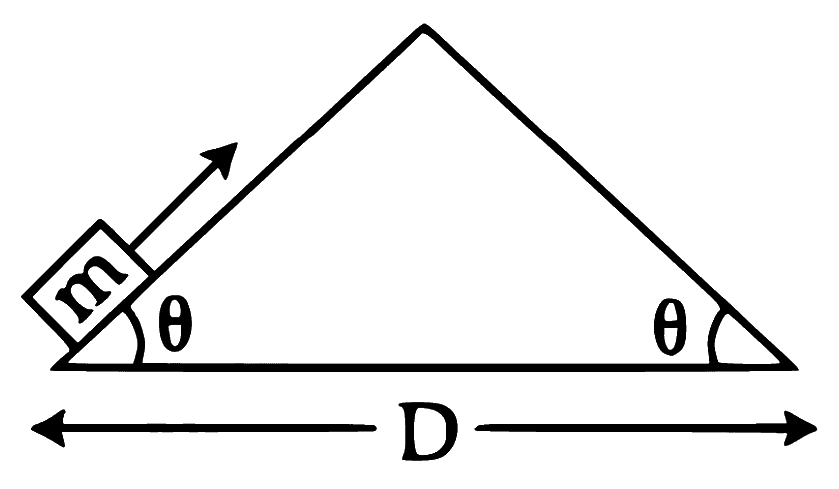
An object of mass 'm' is being moved with a constant velocity under the action of an applied force of 2N along a frictionless surface with following surface profile.

Figure

The correct applied force vs distance graph will be:

Show answer and solution

Answer: (c)

Fmg sinθFvup: F along v (+2 N)down: F against v (−2 N)
  1. Constant velocity on a frictionless incline: applied force balances mgsin⁡θmg\sin\theta, so it always points up the slope with magnitude 2 N.
  2. Going up the left face (first D/2D/2), the force is along the motion: F=+2 NF = +2\text{ N}.
  3. Going down the right face (next D/2D/2), the force still points up the slope, i.e. against the motion: F=−2 NF = -2\text{ N}.
  4. So the graph is a +2 N step then a −2 N step. The answer is (c).
Report a mistake
Q22JEE Main 2021 · 25 JUL · SHIFT 2Medium

Inertia, First & Second Laws · Force as a vector: x, y, z motion

A force F⃗=(40i^+10j^) N\vec{F} = (40\hat{i} + 10\hat{j})\text{ N} acts on a body of mass 5 kg. If the body starts from rest, its position vectorr⃗\vec{r}at time t = 10 s, will be:

Show answer and solution

Answer: (c)

  1. a⃗=40i^+10j^5=8i^+2j^ m/s2\vec{a} = \frac{40\hat{i} + 10\hat{j}}{5} = 8\hat{i} + 2\hat{j}\text{ m/s}^2
  2. r⃗=12a⃗t2=50(8i^+2j^)=400i^+100j^ m\vec{r} = \frac{1}{2}\vec{a}t^2 = 50(8\hat{i} + 2\hat{j}) = 400\hat{i} + 100\hat{j}\text{ m}
  3. So the answer is (c).
Report a mistake
Q23JEE Main 2021 · 16 MAR · SHIFT 2Medium

Inertia, First & Second Laws · Force as a vector: x, y, z motion

A body of mass 2 kg moves under a force of (2i^+3j^+5k^)\left(2\hat{i} + 3\hat{j} + 5\hat{k}\right) N. It starts from rest and was at the origin initially. After 4s, its new coordinates are (8, b, 20). The value of b is _____________. (Round off to the Nearest Integer)

Numerical answer type. Work it out, then open the answer.

Show answer and solution

Answer: 12

  1. ay=32=1.5 m/s2a_y = \frac{3}{2} = 1.5\text{ m/s}^2 (check: ax=1a_x = 1, x=12(1)(16)=8x = \frac{1}{2}(1)(16) = 8)
  2. y=12ayt2=12(1.5)(16)=12 my = \frac{1}{2}a_yt^2 = \frac{1}{2}(1.5)(16) = 12\text{ m}
  3. So b=12b = 12.
Report a mistake
Q24JEE Main 2021 · 26 FEB · SHIFT 1Medium

Inertia, First & Second Laws · Force as a vector: x, y, z motion

A boy pushes a box of mass 2 kg with a force F⃗=(20i^+10j^) N\vec{F} = \left(20\hat{i} + 10\hat{j}\right)\text{ N} on a frictionless surface. If the box was initially at rest, then ___________ m is displacement along the x-axis after 10s.

Numerical answer type. Work it out, then open the answer.

Show answer and solution

Answer: 500

  1. ax=Fxm=202=10 m/s2a_x = \frac{F_x}{m} = \frac{20}{2} = 10\text{ m/s}^2
  2. x=12axt2=12(10)(10)2=500 mx = \frac{1}{2}a_xt^2 = \frac{1}{2}(10)(10)^2 = 500\text{ m}
  3. So the displacement along xx is 500500 m.
Report a mistake
Q25JEE Main 2021 · 24 FEB · SHIFT 2Difficult

Inertia, First & Second Laws · Variable & resistive forces

A particle is projected with velocity v0 along x-axis. A damping force is acting on the particle which is proportional to the square of the distance from the origin i.e. ma = −α-\alphax2. The distance at which the particle stops:

Show answer and solution

Answer: (a)

  1. mvdvdx=−αx2⇒m∫v00v dv=−α∫0xx2dxmv\frac{dv}{dx} = -\alpha x^2 \Rightarrow m\int_{v_0}^{0} v\,dv = -\alpha\int_0^{x} x^2dx
  2. mv022=αx33\frac{mv_0^2}{2} = \frac{\alpha x^3}{3}
  3. x=[3mv022α]1/3x = \left[\frac{3mv_0^2}{2\alpha}\right]^{1/3}. So the answer is (a).
Report a mistake
Q26MHT CET 2020 · 16 OCT · SHIFT 1Easy

Inertia, First & Second Laws · Second law: F = ma

A body of mass 2 kg2\text{ kg} is acted upon by two forces each of magnitude 1 N1\text{ N} and inclined at 60∘60^\circ with each other. The acceleration of the body in m/s\text{m/s} is [cos⁡60∘=0.5\cos 60^\circ = 0.5]

Show answer and solution

Answer: (a)

  1. Resultant R=F2+F2+2F2cos⁡60∘=1+1+1=3 NR = \sqrt{F^2 + F^2 + 2F^2\cos 60^\circ} = \sqrt{1 + 1 + 1} = \sqrt{3}\text{ N}
  2. a=Rm=32=34=0.75 m/s2a = \frac{R}{m} = \frac{\sqrt{3}}{2} = \sqrt{\frac{3}{4}} = \sqrt{0.75}\text{ m/s}^2
  3. So the answer is (a) 0.75\sqrt{0.75}.
Report a mistake
Q27JEE Main 2020 · 6 SEP · SHIFT 2Difficult

Inertia, First & Second Laws · Variable & resistive forces

A particle moving in the xy plane experiences a velocity dependent force

F⃗=k(vyi^+vxj^)\vec{F} = k\left(v_y\hat{i} + v_x\hat{j}\right), where vx and vy are the

x and y components of its velocityv⃗\vec{v}. Ifa⃗\vec{a}is the

acceleration of the particle, then

which of the following statements is true for the particle?

Show answer and solution

Answer: (b)

  1. a⃗=km(vyi^+vxj^)\vec{a} = \frac{k}{m}(v_y\hat{i} + v_x\hat{j})
  2. (v⃗×a⃗)z=vxay−vyax=km(vx2−vy2)(\vec{v} \times \vec{a})_z = v_xa_y - v_ya_x = \frac{k}{m}(v_x^2 - v_y^2)
  3. ddt(vx2−vy2)=2vxax−2vyay=2km(vxvy−vyvx)=0\frac{d}{dt}(v_x^2 - v_y^2) = 2v_xa_x - 2v_ya_y = \frac{2k}{m}(v_xv_y - v_yv_x) = 0, so v⃗×a⃗\vec{v} \times \vec{a} is constant.
  4. (a), (c) fail: v⃗⋅a⃗=2kmvxvy≠0\vec{v} \cdot \vec{a} = \frac{2k}{m}v_xv_y \neq 0 and changes; (d) fails: a magnetic force is always ⊥v⃗\perp \vec{v}.
  5. So the answer is (b).
Report a mistake
Q28JEE Main 2020 · 4 SEP · SHIFT 2Difficult

Inertia, First & Second Laws · Variable & resistive forces

A small ball of mass m is thrown upward with velocity u from the ground. The ball experiences a resistive force mkv2 where v is its speed. The maximum height attained by the ball is:

Show answer and solution

Answer: (c)

  1. Going up, gravity and drag both act downward: vdvdy=−(g+kv2)v\frac{dv}{dy} = -(g + kv^2).
  2. H=∫0uv dvg+kv2=12kln⁡(g+kv2)∣0uH = \int_0^{u} \frac{v\,dv}{g + kv^2} = \frac{1}{2k}\ln(g + kv^2)\Big|_0^{u}
  3. H=12kln⁡(1+ku2g)H = \frac{1}{2k}\ln\left(1 + \frac{ku^2}{g}\right)
  4. So the answer is (c).
Report a mistake
Q29MHT CET 2019 · 2 MAY · SHIFT 2Easy

Inertia, First & Second Laws · Inertia & Newton's first law

An aircraft is moving with uniform velocity 150 m/s150\text{ m/s} in the space. If all the forces acting on it are balanced, then it will

Show answer and solution

Answer: (a)

  1. Balanced forces mean F⃗net=0\vec{F}_{net} = 0, so a⃗=0\vec{a} = 0 (Newton's first law).
  2. With zero acceleration the velocity stays constant at 150 m/s150\text{ m/s}.
  3. So the answer is (a) keep moving with same velocity.
Report a mistake
Q30JEE Main 2019 · 10 APR · SHIFT 2Medium

Inertia, First & Second Laws · Second law: F = ma

A bullet of mass 20 g has an initial speed of 1 ms–1, just before it starts penetrating a mud wall of thickness 20 cm. If the wall offers a mean resistance of 2.5 × 10⁻² N, the speed of the bullet after emerging from the other side of the wall is close to:

Show answer and solution

Answer: (c)

  1. Retardation a=Fm=2.5×10−20.02=1.25 m/s2a = \frac{F}{m} = \frac{2.5 \times 10^{-2}}{0.02} = 1.25\text{ m/s}^2
  2. v2=u2−2as=1−2(1.25)(0.2)=0.5v^2 = u^2 - 2as = 1 - 2(1.25)(0.2) = 0.5
  3. v=0.5≈0.7 m/sv = \sqrt{0.5} \approx 0.7\text{ m/s}. So the answer is (c) 0.7 ms−1^{-1}.
Report a mistake
Q31JEE Main 2019 · 12 APR · SHIFT 2Medium

Inertia, First & Second Laws · Spring force

A spring whose unstretched length is l has a force constant k. The spring is cut into two pieces of unstretched lengths l1 and l2 where, l1 = nl2 and n is an integer. The ratio k1/k2 of the corresponding force constant, k1 and k2 will be:

Show answer and solution

Answer: (b)

  1. For pieces of the same spring, kl=constantkl = \text{constant}, so k∝1lk \propto \frac{1}{l}.
  2. k1k2=l2l1=l2nl2=1n\frac{k_1}{k_2} = \frac{l_2}{l_1} = \frac{l_2}{nl_2} = \frac{1}{n}
  3. So the answer is (b) 1n\frac{1}{n}.
Report a mistake
Q32JEE Main 2019 · 10 APR · SHIFT 1Difficult

Inertia, First & Second Laws · Variable & resistive forces

A ball is thrown upward with an initial velocity V0 from the surface of the earth. The motion of the ball is affected by a drag force equal to mγ\gammau2 (where m is mass of the ball, u is its instantaneous velocity and γ\gamma is a constant). Time taken by the ball to rise to its zenith is:

Show answer and solution

Answer: (a)

  1. While rising: dudt=−(g+γu2)\frac{du}{dt} = -(g + \gamma u^2).
  2. t=∫0V0dug+γu2=1γgtan⁡−1(γg u)∣0V0t = \int_0^{V_0} \frac{du}{g + \gamma u^2} = \frac{1}{\sqrt{\gamma g}}\tan^{-1}\left(\sqrt{\frac{\gamma}{g}}\,u\right)\Big|_0^{V_0}
  3. t=1γgtan⁡−1(γgV0)t = \frac{1}{\sqrt{\gamma g}}\tan^{-1}\left(\sqrt{\frac{\gamma}{g}}V_0\right)
  4. So the answer is (a).
Report a mistake
Q33JEE Main 2017Difficult

Inertia, First & Second Laws · Variable & resistive forces

A body of mass m = 10–2 kg is moving in a medium and experiences a frictional force F = –kv2. Its initial speed is v0 = 10 ms–1. If, after 10 s, its energy is 18mv02\frac{1}{8}mv_0^2, the value of k will be:

Show answer and solution

Answer: (d)

  1. KE =12mv2=18mv02⇒v=v02=5 m/s= \frac{1}{2}mv^2 = \frac{1}{8}mv_0^2 \Rightarrow v = \frac{v_0}{2} = 5\text{ m/s}.
  2. mdvdt=−kv2⇒1v−1v0=ktmm\frac{dv}{dt} = -kv^2 \Rightarrow \frac{1}{v} - \frac{1}{v_0} = \frac{kt}{m}
  3. 15−110=k×1010−2⇒0.1=1000k\frac{1}{5} - \frac{1}{10} = \frac{k \times 10}{10^{-2}} \Rightarrow 0.1 = 1000k
  4. k=10−4k = 10^{-4}; units of F/v2F/v^2 are kg m−1\text{kg m}^{-1}.
  5. So the answer is (d) 10−4 kg m−110^{-4}\text{ kg m}^{-1}.
Report a mistake
Q34JEE Main 2016 · 10 APR · SHIFT 1Difficult

Inertia, First & Second Laws · Variable & resistive forces

A particle of mass m is acted upon by a force F given by the empirical law F = Rt2v(t)\frac{R}{t^2}v(t) If this law is to be tested experimentally by observing the motion starting from rest, the best way is to plot:

Show answer and solution

Answer: (d)

  1. mdvdt=Rt2v⇒dvv=Rmdtt2m\frac{dv}{dt} = \frac{R}{t^2}v \Rightarrow \frac{dv}{v} = \frac{R}{m}\frac{dt}{t^2}
  2. Integrating: ln⁡v=−Rm⋅1t+C\ln v = -\frac{R}{m}\cdot\frac{1}{t} + C
  3. So log⁡v\log v is linear in 1t\frac{1}{t}; a straight line confirms the law.
  4. So the answer is (d) log⁡v(t)\log v(t) against 1t\frac{1}{t}.
Report a mistake
Q35JEE Main 2014 · 11 APR · SHIFT 1Easy

Inertia, First & Second Laws · Force as a vector: x, y, z motion

A Body of mass 5 kg under the action of constant force F⃗\vec{F}= Fx i^\hat{i} + Fy j^\hat{j} has velocity at t = 0 s as v⃗\vec{v}= (6i^−\hat{i} - 2j^\hat{j}) m/s and at t = 10 s as v⃗\vec{v}= + 6j^\hat{j} m/s. The force F⃗\vec{F}is:

Show answer and solution

Answer: (a)

  1. a⃗=Δv⃗Δt=6j^−(6i^−2j^)10=−6i^+8j^10 m/s2\vec{a} = \frac{\Delta\vec{v}}{\Delta t} = \frac{6\hat{j} - (6\hat{i} - 2\hat{j})}{10} = \frac{-6\hat{i} + 8\hat{j}}{10}\text{ m/s}^2
  2. F⃗=ma⃗=5×(−0.6i^+0.8j^)=−3i^+4j^ N\vec{F} = m\vec{a} = 5 \times (-0.6\hat{i} + 0.8\hat{j}) = -3\hat{i} + 4\hat{j}\text{ N}
  3. So the answer is (a) (−3i^+4j^)(-3\hat{i} + 4\hat{j}) N.
Report a mistake
Q36NEET 2012 · AIPMT · MAINSEasy

Inertia, First & Second Laws · Momentum & F = dp/dt

A stone is dropped from a height h. It hits the ground with a certain momentum P. If the same stone is dropped from a height 100% more than the previous height, the momentum when it hits the ground will change by

Show answer and solution

Answer: (b)

  1. v=2ghv = \sqrt{2gh}, so P=m2gh∝hP = m\sqrt{2gh} \propto \sqrt{h}.
  2. Height 100% more means h′=2h⇒P′=2P≈1.41Ph' = 2h \Rightarrow P' = \sqrt{2}P \approx 1.41P.
  3. Change =41%= 41\%. So the answer is (b) 41%.
Report a mistake
Q37JEE Main 2012 · AIEEEMedium

Inertia, First & Second Laws · Variable & resistive forces

A particle of mass mm is at rest at the origin at time t=0t = 0 It is subjected to a force F(t)=F0e−btF(t) = F_0e^{-bt} in the xx direction. Its speed v(t)v(t) is depicted by which of the following curves?

Show answer and solution

Answer: (b)

  1. mdvdt=F0e−bt⇒v=∫0tF0me−btdt=F0mb(1−e−bt)m\frac{dv}{dt} = F_0e^{-bt} \Rightarrow v = \int_0^t \frac{F_0}{m}e^{-bt}dt = \frac{F_0}{mb}\left(1 - e^{-bt}\right)
  2. vv starts at 0, always increases (force stays positive) and approaches F0mb\frac{F_0}{mb} as t→∞t \to \infty.
  3. So the answer is (b).
Report a mistake
Q38NEET 2009 · AIPMTEasy

Inertia, First & Second Laws · Second law: F = ma

A body, under the action of a force F⃗=6i^−8j^+10k^,\vec{F} = 6\hat{i} - 8\hat{j} + 10\hat{k}, acquires an accelerations of 1 m/s2. The mass of this body must be

Show answer and solution

Answer: (c)

  1. ∣F⃗∣=62+82+102=200=102 N|\vec{F}| = \sqrt{6^2 + 8^2 + 10^2} = \sqrt{200} = 10\sqrt{2}\text{ N}
  2. m=Fa=1021=102 kgm = \frac{F}{a} = \frac{10\sqrt{2}}{1} = 10\sqrt{2}\text{ kg}
  3. So the answer is (c) 10210\sqrt{2} kg.
Report a mistake
Q39JEE Main 2005 · AIEEEEasy

Inertia, First & Second Laws · Spring force

A particle of mass 0.3 kg subjected to a force F=−kxF = -kx with k=15 N/mk = 15\text{ N/m}. What will be its initial acceleration if it is released from a point 20 cm away from the origin?

Show answer and solution

Answer: (c)

  1. At release ∣F∣=kx=15×0.2=3 N|F| = kx = 15 \times 0.2 = 3\text{ N}
  2. a=Fm=30.3=10 m/s2a = \frac{F}{m} = \frac{3}{0.3} = 10\text{ m/s}^2
  3. So the answer is (c) 10 m/s210\text{ m/s}^2.
Report a mistake
Q40NEET 2002 · AIPMTMedium

Inertia, First & Second Laws · Force as a vector: x, y, z motion

An object of mass 3 kg is at rest. Now a force of F⃗\vec{F}= 6t2 i^\hat{i} + 4t j^\hat{j} is applied on the object then velocity of object at t = 3 sec. is

Show answer and solution

Answer: (b)

  1. a⃗=F⃗m=2t2i^+43tj^\vec{a} = \frac{\vec{F}}{m} = 2t^2\hat{i} + \frac{4}{3}t\hat{j}
  2. v⃗=∫0ta⃗ dt=23t3i^+23t2j^\vec{v} = \int_0^t \vec{a}\,dt = \frac{2}{3}t^3\hat{i} + \frac{2}{3}t^2\hat{j}
  3. At t=3t = 3 s: v⃗=18i^+6j^\vec{v} = 18\hat{i} + 6\hat{j}. So the answer is (b).
Report a mistake
Q41NEET 1997 · AIPMTEasy

Inertia, First & Second Laws · Second law: F = ma

A force of 6 N6\text{ N} acts on a body at rest and of mass 1 kg1\text{ kg}. During this time, the body attains a velocity of 30 m/s30\text{ m/s}. The time for which the force acts on the body is

Show answer and solution

Answer: (b)

  1. a=Fm=61=6 m/s2a = \frac{F}{m} = \frac{6}{1} = 6\text{ m/s}^2
  2. v=u+at⇒30=0+6t⇒t=5 sv = u + at \Rightarrow 30 = 0 + 6t \Rightarrow t = 5\text{ s}
  3. So the answer is (b) 5 seconds.
Report a mistake
Q42NEET 1996 · AIPMTEasy

Inertia, First & Second Laws · Second law: F = ma

A 10 N10\text{ N} force is applied on a body produce in it an acceleration of 1 m/s21\text{ m/s}^2. The mass of the body is

Show answer and solution

Answer: (c)

  1. m=Fa=101=10 kgm = \frac{F}{a} = \frac{10}{1} = 10\text{ kg}
  2. So the answer is (c) 10 kg10\text{ kg}.
Report a mistake
Q43NEET 1996 · AIPMTEasy

Inertia, First & Second Laws · Second law: F = ma

A force vector applied on a mass is represented as F⃗=6i^−8j^+10k^\vec{F} = 6\hat{i} - 8\hat{j} + 10\hat{k} and accelerates with 1 m/s21\text{ m/s}^2. What will be the mass of the body?

Show answer and solution

Answer: (c)

  1. ∣F⃗∣=62+(−8)2+102=200=102 N|\vec{F}| = \sqrt{6^2 + (-8)^2 + 10^2} = \sqrt{200} = 10\sqrt{2}\text{ N}
  2. m=Fa=1021=102 kgm = \frac{F}{a} = \frac{10\sqrt{2}}{1} = 10\sqrt{2}\text{ kg}
  3. So the answer is (c) 102 kg10\sqrt{2}\text{ kg}.
Report a mistake
Q44NEET 1991 · AIPMTEasy

Inertia, First & Second Laws · Inertia & Newton's first law

Physical independence of force is a consequence of

Show answer and solution

Answer: (c)

  1. The first law says a body changes its state of rest or uniform motion only when an external force acts.
  2. So force is defined independently as the cause of change in motion; each force acts on its own.
  3. So the answer is (c) first law of motion.
Report a mistake
Q45MHT CET 2026 · 19 APR · SHIFT 1Easy

Equilibrium, Third Law & Frames · Frames of reference & pseudo force

Which of the following person is in an inertial frame of reference?

Show answer and solution

Answer: (b)

  1. An inertial frame is one that is not accelerating.
  2. Take-off, circular motion and slowing down all involve acceleration.
  3. A bus moving with constant velocity has zero acceleration.
  4. So the answer is (b).
Report a mistake
Q46JEE Main 2026 · 24 JAN · SHIFT 2Medium

Equilibrium, Third Law & Frames · Strings & ropes in equilibrium

A flexible chain of mass mm hangs between two fixed points at the same level. The inclination of the chain with the horizontal at the two points of support is 30∘30^\circ. Considering the equilibrium of each half of the chain, the tension of the chain at the lowest point is ______.

Show answer and solution

Answer: (b)

  1. Take one half of the chain (weight mg2\frac{mg}{2}). It is pulled by TT at the support (30∘30^\circ to the horizontal) and by T0T_0 (horizontal) at the lowest point.
  2. Vertical: Tsin⁡30∘=mg2⇒T=mgT\sin 30^\circ = \frac{mg}{2} \Rightarrow T = mg
  3. Horizontal: T0=Tcos⁡30∘=32mgT_0 = T\cos 30^\circ = \frac{\sqrt{3}}{2}mg
  4. So the answer is (b) 32mg\frac{\sqrt{3}}{2}mg.
Report a mistake
Q47JEE Main 2025 · 2 APR · SHIFT 2Easy

Equilibrium, Third Law & Frames · Strings & ropes in equilibrium

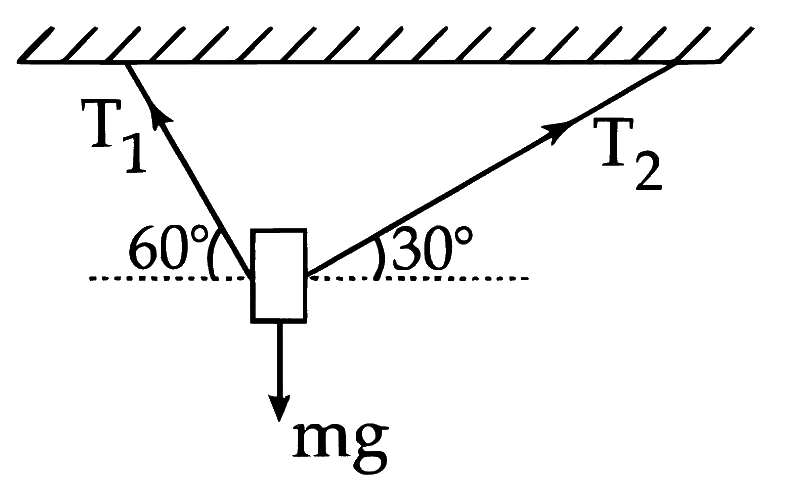
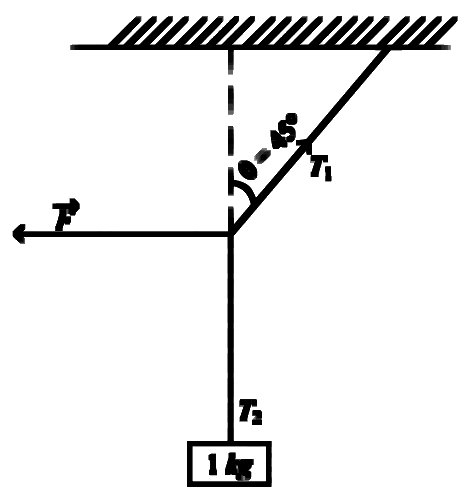
Figure

A body of mass 1 kg is suspended with the help of two strings making angles as shown in figure. Magnitudes of tensions T1T_1 and T2T_2, respectively, are (in N):

(Take acceleration due to gravity 10 m/s210\text{ m/s}^2)

Show answer and solution

Answer: (a)

  1. Horizontal: T1cos⁡60∘=T2cos⁡30∘⇒T1=3T2T_1\cos 60^\circ = T_2\cos 30^\circ \Rightarrow T_1 = \sqrt{3}T_2.
  2. Vertical: T1sin⁡60∘+T2sin⁡30∘=mg=10T_1\sin 60^\circ + T_2\sin 30^\circ = mg = 10
  3. 3T2⋅32+T22=2T2=10⇒T2=5 N\sqrt{3}T_2\cdot\frac{\sqrt{3}}{2} + \frac{T_2}{2} = 2T_2 = 10 \Rightarrow T_2 = 5\text{ N}
  4. T1=53 NT_1 = 5\sqrt{3}\text{ N}
  5. So the answer is (a) 53,55\sqrt{3}, 5.
Report a mistake
Q48MHT CET 2025 · 20 APR · SHIFT 1Easy

Equilibrium, Third Law & Frames · Frames of reference & pseudo force

Which one of the following person is in an inertial frame of reference?

Show answer and solution

Answer: (c)

  1. An inertial frame is one that is not accelerating.
  2. A slowing train, a merry-go-round and a plane taking off are all accelerating.
  3. A bus moving with constant velocity has zero acceleration.
  4. So the answer is (c).
Report a mistake
Q49MHT CET 2025 · 26 APR · SHIFT 2Medium

Equilibrium, Third Law & Frames · Strings & ropes in equilibrium

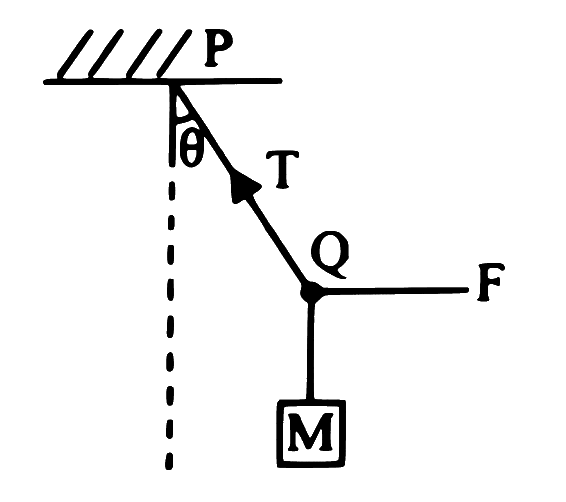
A mass ' M ' is suspended by a rope from a rigid support at point ' P ' as shown in figure. Another rope is tied at end ' Q ' and pulled horizontally with a force ' FF '. If the rope makes an angle ' θ\theta ' with vertical then the tension in the string ' PQ ' is

Figure

Show answer and solution

Answer: (b)

  1. At Q the rope PQ pulls along QP, at θ\theta to the vertical.
  2. Horizontal balance: Tsin⁡θ=FT\sin\theta = F (and vertically Tcos⁡θ=MgT\cos\theta = Mg).
  3. T=Fsin⁡θT = \frac{F}{\sin\theta}
  4. So the answer is (b) Fsin⁡θ\frac{F}{\sin\theta}.
Report a mistake
Q50JEE Main 2025 · 4 APR · SHIFT 1Medium

Equilibrium, Third Law & Frames · Strings & ropes in equilibrium

A body of mass mm is suspended by two strings making angles θ1\theta_1 and θ2\theta_2 with the horizontal ceiling with tensions T1T_1 and T2T_2 simultaneously. T1T_1 and T2T_2 are related by T1=3T2T_1 = \sqrt{3}T_2, the angles θ1\theta_1 and θ2\theta_2 are

Show answer and solution

Answer: (d)

  1. Horizontal: T1cos⁡θ1=T2cos⁡θ2⇒3cos⁡θ1=cos⁡θ2T_1\cos\theta_1 = T_2\cos\theta_2 \Rightarrow \sqrt{3}\cos\theta_1 = \cos\theta_2; this holds for θ1=60∘,θ2=30∘\theta_1 = 60^\circ, \theta_2 = 30^\circ.
  2. Vertical: T1sin⁡60∘+T2sin⁡30∘=mgT_1\sin 60^\circ + T_2\sin 30^\circ = mg
  3. 3T2⋅32+T22=2T2=mg⇒T2=mg2\sqrt{3}T_2\cdot\frac{\sqrt{3}}{2} + \frac{T_2}{2} = 2T_2 = mg \Rightarrow T_2 = \frac{mg}{2}
  4. So the answer is (d).
Report a mistake
Q51JEE Main 2024 · 6 APR · SHIFT 2Easy

Equilibrium, Third Law & Frames · Strings & ropes in equilibrium

A body of weight 200 N200\text{ N} is suspended from a tree branch through a chain of mass 10 kg10\text{ kg}. The branch pulls the chain by a force equal to (if g=10 m/s2g = 10\text{ m/s}^2):

Show answer and solution

Answer: (a)

  1. The branch supports the chain and the body hanging from it.
  2. F=200+10×10=300 NF = 200 + 10 \times 10 = 300\text{ N}
  3. So the answer is (a) 300 N.
Report a mistake
Q52MHT CET 2024 · 15 MAY · SHIFT 1Medium

Equilibrium, Third Law & Frames · Strings & ropes in equilibrium

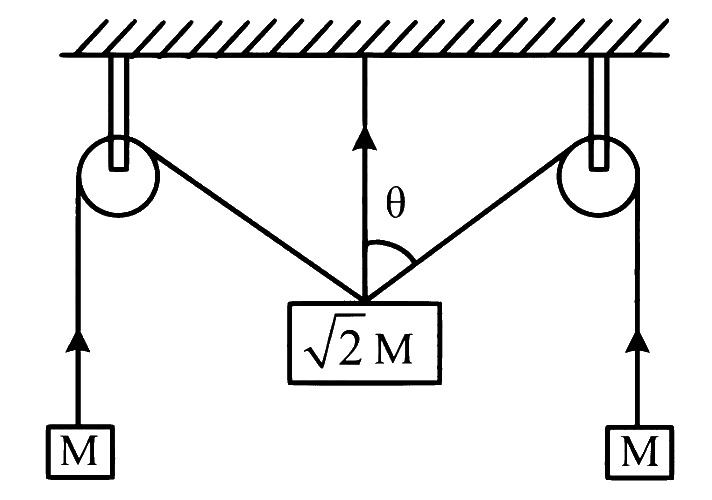
The pulleys and strings shown in figure are smooth and of negligible mass. For the system to remain in equilibrium, angle θ\theta should be

Figure

Show answer and solution

Answer: (d)

  1. Each string over a smooth pulley has tension T=MgT = Mg.
  2. Both strings make angle θ\theta with the vertical at the middle block, so vertically 2Mgcos⁡θ=2Mg2Mg\cos\theta = \sqrt{2}Mg.
  3. cos⁡θ=12\cos\theta = \frac{1}{\sqrt{2}}
  4. So the answer is (d) cos⁡−1(12)\cos^{-1}\left(\frac{1}{\sqrt{2}}\right).
Report a mistake
Q53JEE Main 2024 · 9 APR · SHIFT 2Medium

Equilibrium, Third Law & Frames · Strings & ropes in equilibrium

A 1 kg1\text{ kg} mass is suspended from the ceiling by a rope of length 4 m4\text{ m}. A horizontal force 'FF' is applied at the mid point of the rope so that the rope makes an angle of 45∘45^\circ with respect to the vertical axis as shown in figure. The magnitude of FF is:

(Assume that the system is in equilibrium and g=10 m/s2g = 10\text{ m/s}^2)

Figure

Show answer and solution

Answer: (b)

  1. At the midpoint: T1cos⁡45∘=mgT_1\cos 45^\circ = mg and T1sin⁡45∘=FT_1\sin 45^\circ = F.
  2. F=mgtan⁡45∘=1×10×1F = mg\tan 45^\circ = 1 \times 10 \times 1
  3. F=10 NF = 10\text{ N}
  4. So the answer is (b) 10 N.
Report a mistake
Q54JEE Main 2023 · 12 APR · SHIFT 1Easy

Equilibrium, Third Law & Frames · Force triangle, Lami & resultant

Three forces F1=10 N, F2=8 N, F3=6 NF_1 = 10\text{ N},\ F_2 = 8\text{ N},\ F_3 = 6\text{ N} are acting on a particle of mass 5 kg5\text{ kg}. The forces F2F_2 and F3F_3 are applied perpendicularly so that particle remains at rest. If the force F1F_1 is removed, then the acceleration of the particle is:

Show answer and solution

Answer: (c)

  1. At rest, F1F_1 balances the resultant of F2F_2 and F3F_3: 82+62=10 N=F1\sqrt{8^2 + 6^2} = 10\text{ N} = F_1.
  2. Removing F1F_1 leaves a net force of 10 N10\text{ N}.
  3. a=105=2 m s−2a = \frac{10}{5} = 2\text{ m s}^{-2}
  4. So the answer is (c) 2 m s−22\text{ m s}^{-2}.
Report a mistake
Q55JEE Main 2023 · 30 JAN · SHIFT 2Easy

Equilibrium, Third Law & Frames · Strings & ropes in equilibrium

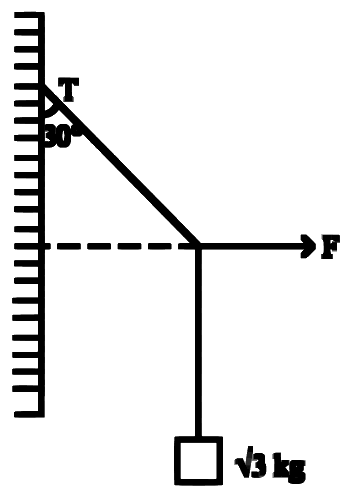
A block of 3 kg\sqrt{3}\text{ kg} is attached to a string whose other end is attached to the wall. An unknown force FF is applied so that the string makes an angle of 30∘30^\circ with the wall. The tension TT is: (Given g=10 m s−2g = 10\text{ m s}^{-2})

Figure

Show answer and solution

Answer: (d)

  1. At the junction, the vertical component of TT balances the weight (the string is at 30∘30^\circ to the vertical wall).
  2. Tcos⁡30∘=mg=3×10T\cos 30^\circ = mg = \sqrt{3} \times 10
  3. T⋅32=103⇒T=20 NT \cdot \frac{\sqrt{3}}{2} = 10\sqrt{3} \Rightarrow T = 20\text{ N}
  4. So the answer is (d) 20 N.
Report a mistake
Q56MHT CET 2022 · 11 AUG · SHIFT 2Easy

Equilibrium, Third Law & Frames · Force triangle, Lami & resultant

A door 1.2 m1.2\text{ m} wide requires a force of 1 N1\text{ N} to be applied perpendicular at the free end to open or close it. The perpendicular force required at a point 0.2 m0.2\text{ m} distant from the hinges for opening or closing the door is

Show answer and solution

Answer: (d)

  1. The torque about the hinge must be the same: F1r1=F2r2F_1 r_1 = F_2 r_2.
  2. 1×1.2=F×0.21 \times 1.2 = F \times 0.2
  3. F=6 NF = 6\text{ N}
  4. So the answer is (d) 6.0 N.
Report a mistake
Q57JEE Main 2022 · 25 JUL · SHIFT 2Medium

Equilibrium, Third Law & Frames · Force triangle, Lami & resultant

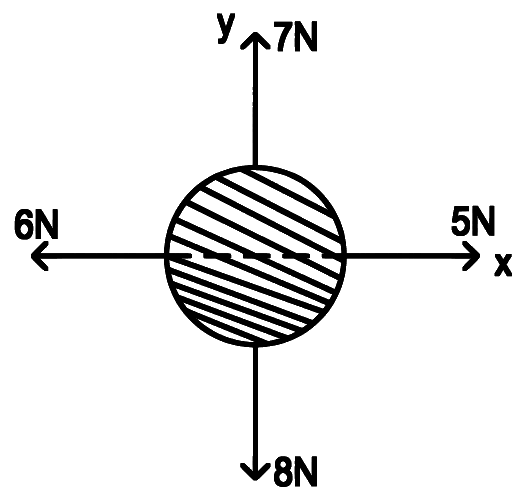
For a free body diagram shown in the figure, the four forces are applied in the 'x' and 'y' directions. What additional force must be applied and at what angle with positive x-axis so that the net acceleration of body is zero?

Figure

Show answer and solution

Answer: (a)

  1. ΣFx=5−6=−1 N\Sigma F_x = 5 - 6 = -1\text{ N}, ΣFy=7−8=−1 N\Sigma F_y = 7 - 8 = -1\text{ N}
  2. Resultant =2 N= \sqrt{2}\text{ N}, pointing at 225∘225^\circ (third quadrant).
  3. The balancing force is equal and opposite: 2 N\sqrt{2}\text{ N} at 45∘45^\circ to +x+x.
  4. So the answer is (a) 2 N,45∘\sqrt{2}\text{ N}, 45^\circ.
Report a mistake
Q58JEE Main 2022 · 25 JUL · SHIFT 1Medium

Equilibrium, Third Law & Frames · Force triangle, Lami & resultant

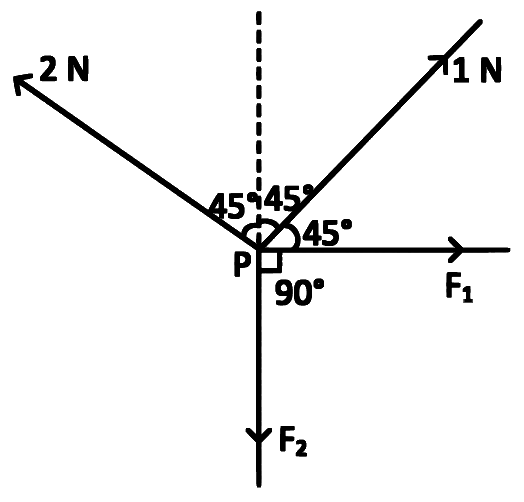
Four forces are acting at a point PP in equilibrium as shown in figure. The ratio of force F1F_1 to F2F_2 is 1:x1 : x where x=x = _____________.

Figure

Numerical answer type. Work it out, then open the answer.

Show answer and solution

Answer: 3

  1. 2 N2\text{ N} is at 45∘45^\circ left of vertical, 1 N1\text{ N} is at 45∘45^\circ above +x+x, F1F_1 is along +x+x and F2F_2 is along −y-y.
  2. xx: F1+1cos⁡45∘−2cos⁡45∘=0⇒F1=12F_1 + 1\cos 45^\circ - 2\cos 45^\circ = 0 \Rightarrow F_1 = \frac{1}{\sqrt{2}}
  3. yy: 2sin⁡45∘+1sin⁡45∘−F2=0⇒F2=322\sin 45^\circ + 1\sin 45^\circ - F_2 = 0 \Rightarrow F_2 = \frac{3}{\sqrt{2}}
  4. F1:F2=1:3F_1 : F_2 = 1 : 3, so x=3x = 3.
Report a mistake
Q59JEE Main 2022 · 27 JUN · SHIFT 2Medium

Equilibrium, Third Law & Frames · Strings & ropes in equilibrium

A mass of 10 kg is suspended vertically by a rope of length 5 m from the roof. A force of 30 N is applied at the middle point of rope in horizontal direction. The angle made by upper half of the rope with vertical is θ\theta = tan−1{}^{-1} (x ×\times 10−-1). The value of x is ____________.

(Given, g = 10 m/s2)

Numerical answer type. Work it out, then open the answer.

Show answer and solution

Answer: 3

  1. At the midpoint: Tsin⁡θ=F=30 NT\sin\theta = F = 30\text{ N} and Tcos⁡θ=mg=100 NT\cos\theta = mg = 100\text{ N}.
  2. tan⁡θ=30100=0.3=3×10⁻¹\tan\theta = \frac{30}{100} = 0.3 = 3 \times 10^{-1}
  3. So x=3x = 3.
Report a mistake
Q60JEE Main 2021 · 31 AUG · SHIFT 2Easy

Equilibrium, Third Law & Frames · Force triangle, Lami & resultant

Statement: 1

If three forces F⃗1,F⃗2\vec{F}_1, \vec{F}_2 and F⃗3\vec{F}_3 are represented by three sides of a triangle and F⃗1+F⃗2=−F⃗3\vec{F}_1 + \vec{F}_2 = -\vec{F}_3, then these three forces are concurrent forces and satisfy the condition for equilibrium. Statement: 2

A triangle made up of three forces F⃗1,F⃗2\vec{F}_1, \vec{F}_2 and F⃗3\vec{F}_3 as its sides taken in the same order, satisfy the condition for translatory equilibrium.

In the light of the above statements, choose the most appropriate answer from the options given below:

Show answer and solution

Answer: (d)

  1. Statement I: F⃗1+F⃗2+F⃗3=0\vec{F}_1 + \vec{F}_2 + \vec{F}_3 = 0, and the forces act at one point, so they are concurrent and in equilibrium. True.
  2. Statement II: sides of a closed triangle taken in order add to zero, so the net force is zero (translatory equilibrium). True.
  3. So the answer is (d) both statements are true.
Report a mistake
Q61JEE Main 2021 · 31 AUG · SHIFT 1Difficult

Equilibrium, Third Law & Frames · Frames of reference & pseudo force

A car is moving on a plane inclined at 30∘^\circ to the horizontal with an acceleration of 10 ms−2{}^{-2} parallel to the plane upward. A bob is suspended by a string from the roof of the car. The angle in degrees which the string makes with the vertical is ______________. (Take g = 10 ms−2{}^{-2})

Numerical answer type. Work it out, then open the answer.

Show answer and solution

Answer: 30

  1. In the car frame, effective gravity g⃗eff=g⃗−a⃗\vec{g}_{eff} = \vec{g} - \vec{a}; the string lies along g⃗eff\vec{g}_{eff}.
  2. a⃗\vec{a}: horizontal 10cos⁡30∘=5310\cos 30^\circ = 5\sqrt{3}, vertical 10sin⁡30∘=510\sin 30^\circ = 5 (upward).
  3. geffg_{eff}: horizontal 535\sqrt{3}, vertical 10+5=1510 + 5 = 15
  4. tan⁡ϕ=5315=13⇒ϕ=30∘\tan\phi = \frac{5\sqrt{3}}{15} = \frac{1}{\sqrt{3}} \Rightarrow \phi = 30^\circ
  5. So the angle with the vertical is 30∘30^\circ.
Report a mistake
Q62JEE Main 2020 · 7 JAN · SHIFT 2Medium

Equilibrium, Third Law & Frames · Strings & ropes in equilibrium

A mass of 10 kg is suspended by a rope of length 4 m, from the ceiling. A force F is applied horizontally at the mid point of the rope such that the top half of the rope makes an angle of 45° with the vertical. Then F equal: (Take g = 10 ms–2 and the rope to be massless)

Show answer and solution

Answer: (a)

  1. At the midpoint: Tcos⁡45∘=mgT\cos 45^\circ = mg and Tsin⁡45∘=FT\sin 45^\circ = F.
  2. F=mgtan⁡45∘=10×10×1F = mg\tan 45^\circ = 10 \times 10 \times 1
  3. So the answer is (a) 100 N.
Report a mistake
Q63JEE Main 2019 · 9 JAN · SHIFT 2Medium

Equilibrium, Third Law & Frames · Strings & ropes in equilibrium

A mass of 10 kg is suspended vertically by a rope from the roof. When a horizontal force is applied on the rope at some point, the rope deviates at an angle of 45° at the roof point. If the suspended mass is at equilibrium, the magnitude of the force applied is (g = 10 ms−2{}^{-2})

Show answer and solution

Answer: (d)

  1. Where the force is applied: Tcos⁡45∘=mgT\cos 45^\circ = mg and Tsin⁡45∘=FT\sin 45^\circ = F.
  2. F=mgtan⁡45∘=100 NF = mg\tan 45^\circ = 100\text{ N}
  3. So the answer is (d) 100 N.
Report a mistake
Q64NEET 2019Medium

Equilibrium, Third Law & Frames · Frames of reference & pseudo force

A truck is stationary and has a bob suspended by a light string, in a frame attached to the truck. The truck suddenly moves to the right with an acceleration of aa. The pendulum will tilt

Show answer and solution

Answer: (c)

  1. In the truck's frame, a pseudo force mama acts on the bob towards the left (opposite to aa).
  2. In equilibrium: Tsin⁡θ=maT\sin\theta = ma, Tcos⁡θ=mgT\cos\theta = mg
  3. tan⁡θ=ag\tan\theta = \frac{a}{g}, and the bob tilts to the left.
  4. So the answer is (c).
Report a mistake
Q65JEE Main 2013 · 9 APR · SHIFT 1Medium

Equilibrium, Third Law & Frames · Strings & ropes in equilibrium

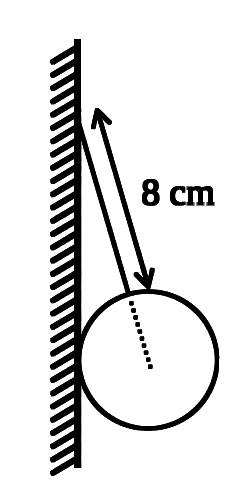
A uniform sphere of weight W and radius 5 cm is being held by a string as shown in the figure. The tension in the string will be:

Figure

Show answer and solution

Answer: (d)

5 cm13 cm12 cmθA
  1. The string's line passes through the centre: distance from the support to the centre =8+5=13 cm= 8 + 5 = 13\text{ cm}.
  2. The centre is 5 cm5\text{ cm} (one radius) from the wall, so sin⁡θ=513\sin\theta = \frac{5}{13} and cos⁡θ=1213\cos\theta = \frac{12}{13} (θ\theta = angle with the wall).
  3. The wall's normal force is horizontal, so vertically: Tcos⁡θ=WT\cos\theta = W
  4. T=13W12T = \frac{13W}{12}
  5. So the answer is (d) 13W1213\frac{W}{12}.
Report a mistake
Q66NEET 2008 · AIPMTMedium

Equilibrium, Third Law & Frames · Force triangle, Lami & resultant

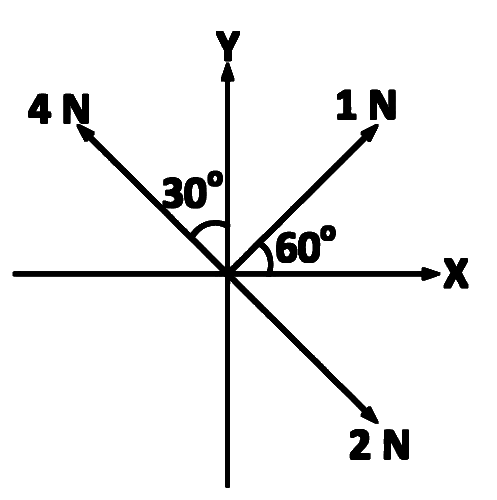
Figure

Three forces acting on a body are shown in the figure. To have the resultant force only along the y- direction, the magnitude of the minimum additional force needed is

Show answer and solution

Answer: (c)

  1. From the figure: 1 N1\text{ N} at 60∘60^\circ above +x+x; 4 N4\text{ N} at 30∘30^\circ from +y+y towards −x-x; 2 N2\text{ N} along the same line as the 4 N4\text{ N}, i.e. 60∘60^\circ below +x+x.
  2. ΣFx=1cos⁡60∘−4sin⁡30∘+2cos⁡60∘=0.5−2+1=−0.5 N\Sigma F_x = 1\cos 60^\circ - 4\sin 30^\circ + 2\cos 60^\circ = 0.5 - 2 + 1 = -0.5\text{ N}
  3. To leave only a yy-component, cancel FxF_x with a force along +x+x; this is the minimum force.
  4. So the answer is (c) 0.5 N.
Report a mistake
Q67JEE Main 2003 · AIEEEEasy

Equilibrium, Third Law & Frames · Force triangle, Lami & resultant

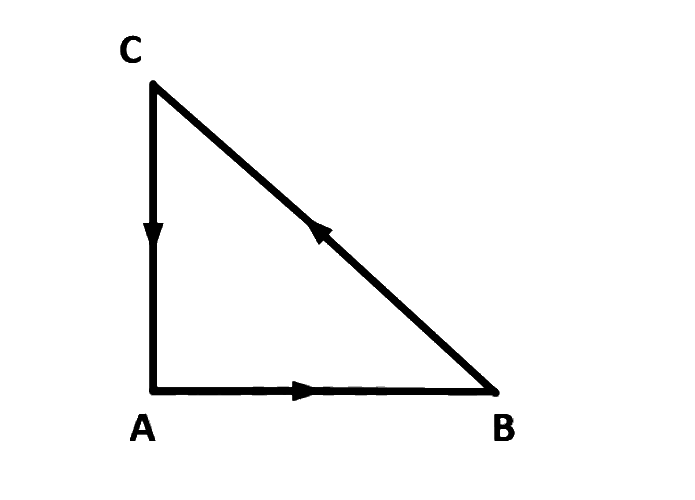
Three forces start acting simultaneously on a particle moving with velocity,v⃗\vec{v} These forces are represented in magnitude and direction by the three sides of a triangle ABCABC. The particle will now move with velocity

Figure

Show answer and solution

Answer: (d)

  1. The forces are AB⃗,BC⃗,CA⃗\vec{AB}, \vec{BC}, \vec{CA}, taken in order around the triangle.
  2. AB⃗+BC⃗+CA⃗=0\vec{AB} + \vec{BC} + \vec{CA} = 0, so the net force is zero.
  3. Zero net force means zero acceleration, so the velocity does not change.
  4. So the answer is (d) v⃗\vec{v} remaining unchanged.
Report a mistake
Q68JEE Main 2002 · AIEEEEasy

Equilibrium, Third Law & Frames · Force triangle, Lami & resultant

When forces F1, F2, F3F_1,\ F_2,\ F_3 are acting on a particle of mass mm such that F2F_2 and F3F_3 are mutually perpendicular, then the particle remains stationary. If the force F1F_1 is now removed then the acceleration of the particle is

Show answer and solution

Answer: (a)

  1. In equilibrium, F⃗2+F⃗3=−F⃗1\vec{F}_2 + \vec{F}_3 = -\vec{F}_1.
  2. After removing F1F_1, the net force is ∣F⃗2+F⃗3∣=F1|\vec{F}_2 + \vec{F}_3| = F_1.
  3. a=F1ma = \frac{F_1}{m}
  4. So the answer is (a) F1/mF_1/m.
Report a mistake
Q69JEE Main 2002 · AIEEEMedium

Equilibrium, Third Law & Frames · Force triangle, Lami & resultant

Two forces are such that the sum of their magnitudes is 18 N18\text{ N} and their resultant is 12 N12\text{ N} which is perpendicular to the smaller force. Then the magnitudes of the forces are

Show answer and solution

Answer: (b)

  1. Let the forces be P>QP > Q with P+Q=18P + Q = 18. The resultant is perpendicular to QQ, so P2=Q2+R2P^2 = Q^2 + R^2.
  2. P2−Q2=144⇒(P−Q)(18)=144⇒P−Q=8P^2 - Q^2 = 144 \Rightarrow (P - Q)(18) = 144 \Rightarrow P - Q = 8
  3. P=13 NP = 13\text{ N}, Q=5 NQ = 5\text{ N}
  4. So the answer is (b) 13 N, 5 N.
Report a mistake
Q70MHT CET 2026 · 19 MAY · SHIFT 1Easy

Impulse & Momentum Conservation · Impulse-momentum theorem

A cricket ball of mass 120120 g is moving with a velocity of 88 m/s and is hit by a bat so that the ball gets turned back with a velocity of 1212 m/s. If the duration of contact between the ball and bat is 0.020.02 s, the impulse (in Ns) given to the ball by the bat is

Show answer and solution

Answer: (c)

  1. Impulse =Δp=m(vf−vi)= \Delta p = m(v_f - v_i); the velocity reverses direction.
  2. J=0.12×(12−(−8))=0.12×20J = 0.12 \times (12 - (-8)) = 0.12 \times 20
  3. J=2.4 N sJ = 2.4\text{ N s}
  4. So the answer is (c) 2.4.
Report a mistake
Q71MHT CET 2026 · 13 APR · SHIFT 2Easy

Impulse & Momentum Conservation · Impulse-momentum theorem

100100 balls each of mass mm moving with speed vv simultaneously strike a wall normally and reflected back with same speed, in time tt s. The total magnitude of force exerted by the balls on the wall is

Show answer and solution

Answer: (b)

  1. Momentum change per ball =mv−(−mv)=2mv= mv - (-mv) = 2mv.
  2. Total change for 100 balls =200mv= 200mv in time tt.
  3. F=Δpt=200mvtF = \frac{\Delta p}{t} = \frac{200mv}{t}
  4. So the answer is (b) 200mv/t200mv/t.
Report a mistake
Q72MHT CET 2026 · 17 APR · SHIFT 2Easy

Impulse & Momentum Conservation · Machine gun, conveyor & jets

A machine gun fires a bullet of mass 40g with a speed of 600600 ms−1^{-1}. The person holding the gun can bare maximum force of 168N on it. The number of bullets that can be fired from the gun per second is

Show answer and solution

Answer: (b)

  1. Force on the gun =n×mv= n \times mv (nn = bullets per second).
  2. mv=0.04×600=24 N smv = 0.04 \times 600 = 24\text{ N s}
  3. n=16824=7n = \frac{168}{24} = 7
  4. So the answer is (b) 7.
Report a mistake
Q73MHT CET 2026 · 14 MAY · SHIFT 1Medium

Impulse & Momentum Conservation · Impulse-momentum theorem

A bullet is fired from a gun. The force on the bullet is F=(600−2×10⁵t)F = (600 - 2 \times 10^{5} t) N where tt is in second. The force on the bullet becomes zero as soon as it leaves the barrel. The average impulse imparted to the bullet is

Show answer and solution

Answer: (c)

  1. Force becomes zero when 600−2×10⁵t=0⇒t=3×10−3600 - 2 \times 10^{5} t = 0 \Rightarrow t = 3 \times 10^{-3} s.
  2. Impulse J=∫0tF dt=600t−105t2J = \int_0^{t} F\,dt = 600t - 10^{5}t^{2}
  3. J=600(3×10⁻³)−105(9×10⁻⁶)=1.8−0.9=0.9J = 600(3 \times 10^{-3}) - 10^{5}(9 \times 10^{-6}) = 1.8 - 0.9 = 0.9 N s
  4. So the answer is (c) 0.90.9 N-s.
Report a mistake
Q74MHT CET 2025 · 25 APR · SHIFT 1Easy

Impulse & Momentum Conservation · Machine gun, conveyor & jets

A machine gun fires a bullet of mass 35 gram with a speed of 600 m/s600\text{ m/s}. The person holding the gun can extract a maximum force of 147 N on it. The number of bullets that can be fired from the gun per second is

Show answer and solution

Answer: (c)

  1. Force on the gun =n×mv= n \times mv (nn = bullets per second).
  2. mv=0.035×600=21 N smv = 0.035 \times 600 = 21\text{ N s}
  3. n=14721=7n = \frac{147}{21} = 7
  4. So the answer is (c) 7.
Report a mistake
Q75MHT CET 2025 · 21 APR · SHIFT 2Easy

Impulse & Momentum Conservation · Machine gun, conveyor & jets

A conveyor belt is moving with constant velocity (V). Sand is being dropped on the belt at the rate of M kg/sM\text{ kg/s}. The force necessary to keep the belt moving with a constant velocity V m/sV\text{ m/s} will be

Show answer and solution

Answer: (d)

  1. Sand falling on the belt must be given horizontal speed VV, so momentum is added at rate dpdt=Vdmdt\frac{dp}{dt} = V\frac{dm}{dt}.
  2. F=V⋅M=MVF = V \cdot M = MV
  3. So the answer is (d) MVMV N.
Report a mistake
Q76MHT CET 2025 · 5 MAY · SHIFT 2Medium

Impulse & Momentum Conservation · Impulse-momentum theorem

A ball is dropped on the floor from a height of 20 m. It rebounds to a height of 5 m. Ball remains in contact with floor for 1 s. The average acceleration during contact is (acceleration due to gravity =10 m/s2= 10\text{ m/s}^{2})

Show answer and solution

Answer: (a)

  1. Speed on hitting: v1=2gh1=2×10×20=20v_1 = \sqrt{2gh_1} = \sqrt{2 \times 10 \times 20} = 20 m/s (down).
  2. Speed on rebound: v2=2×10×5=10v_2 = \sqrt{2 \times 10 \times 5} = 10 m/s (up).
  3. Change in velocity =10−(−20)=30= 10 - (-20) = 30 m/s, so a=301=30 m/s2a = \frac{30}{1} = 30\text{ m/s}^2 (upward).
  4. So the answer is (a) 30 m/s230\text{ m/s}^2.
Report a mistake
Q77MHT CET 2025 · 19 APR · SHIFT 2Medium

Impulse & Momentum Conservation · Force-time graph

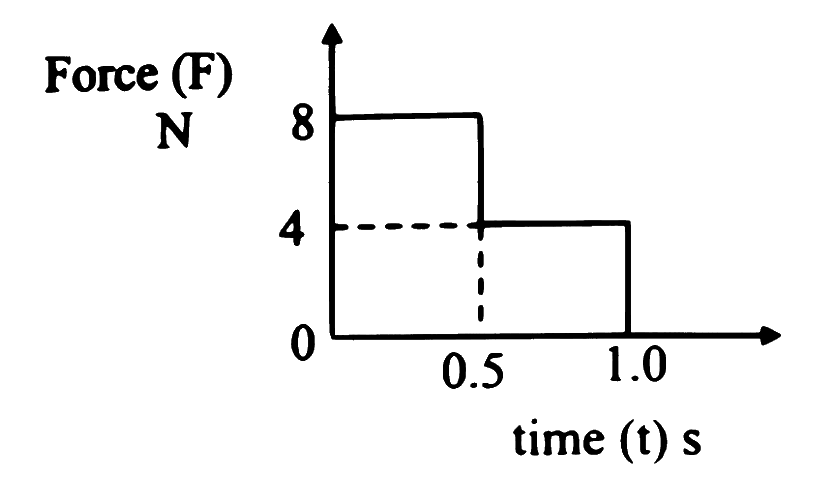
Force is applied to a body of mass 3 kg at rest on a frictionless horizontal surface as shown in the force against time (F-t) graph. The speed of the body after 1 s is

Figure

Show answer and solution

Answer: (d)

  1. Impulse = area under the FF–tt graph =Δp= \Delta p.
  2. Area =8×0.5+4×0.5=4+2=6= 8 \times 0.5 + 4 \times 0.5 = 4 + 2 = 6 N s
  3. v=63=2v = \frac{6}{3} = 2 m/s
  4. So the answer is (d) 22 m/s.
Report a mistake
Q78JEE Main 2024 · 8 APR · SHIFT 1Easy

Impulse & Momentum Conservation · Impulse-momentum theorem

A player caught a cricket ball of mass 150 g150\text{ g} moving at a speed of 20 m/s20\text{ m/s}. If the catching process is completed in 0.1 s0.1\text{ s}, the magnitude of force exerted by the ball on the hand of the player is:

Show answer and solution

Answer: (c)

  1. F=ΔpΔt=mvtF = \frac{\Delta p}{\Delta t} = \frac{mv}{t} (the ball comes to rest).
  2. F=0.15×200.1=30 NF = \frac{0.15 \times 20}{0.1} = 30\text{ N}
  3. So the answer is (c) 30 N.
Report a mistake
Q79JEE Main 2024 · 1 FEB · SHIFT 2Easy

Impulse & Momentum Conservation · Impulse-momentum theorem

A cricket player catches a ball of mass 120 g120\text{ g} moving with 25 m/s25\text{ m/s} speed. If the catching process is completed in 0.1 s0.1\text{ s} then the magnitude of force exerted by the ball on the hand of player will be (in SI unit):

Show answer and solution

Answer: (a)

  1. F=ΔpΔt=mvtF = \frac{\Delta p}{\Delta t} = \frac{mv}{t} (the ball comes to rest).
  2. F=0.12×250.1=30 NF = \frac{0.12 \times 25}{0.1} = 30\text{ N}
  3. So the answer is (a) 30.
Report a mistake
Q80JEE Main 2023 · 1 FEB · SHIFT 2Easy

Impulse & Momentum Conservation · Force-time graph

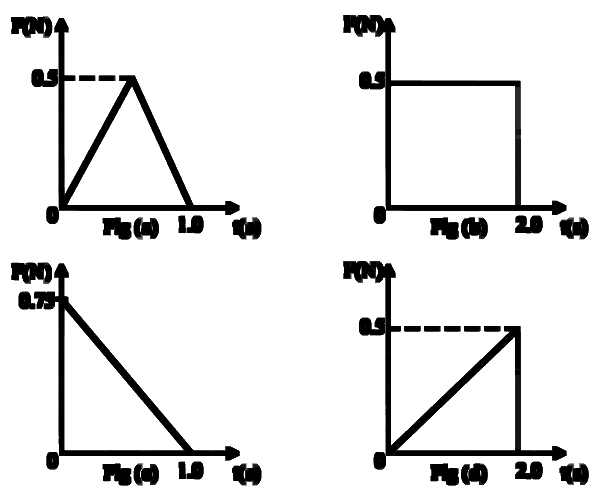
Figures (a), (b), (c) and (d) show variation of force with time.

Figure

The impulse is highest in figure.

Show answer and solution

Answer: (d)

  1. Impulse = area under the FF-tt graph.
  2. Fig (a): 12(1)(0.5)=0.25\frac{1}{2}(1)(0.5) = 0.25; Fig (b): 0.5×2=1.00.5 \times 2 = 1.0
  3. Fig (c): 12(1)(0.75)=0.375\frac{1}{2}(1)(0.75) = 0.375; Fig (d): 12(2)(0.5)=0.5\frac{1}{2}(2)(0.5) = 0.5 (all in N s)
  4. Fig (b) has the largest area, so the answer is (d) Fig (b).
Report a mistake
Q81MHT CET 2023 · 14 MAY · SHIFT 2Easy

Impulse & Momentum Conservation · Machine gun, conveyor & jets

A machine gun fires bullets of mass 30 g30\text{ g} with velocity of 1000 m/s1000\text{ m/s}. The man holding the gun can exert a maximum force of 300 N300\text{ N} on it. How many bullets can he fire per second at most?

Show answer and solution

Answer: (c)

  1. Force on gun F=n mvF = n\,m v, where nn = bullets per second.
  2. n=Fmv=3000.03×1000=30030n = \frac{F}{mv} = \frac{300}{0.03 \times 1000} = \frac{300}{30}
  3. n=10n = 10 bullets per second.
  4. So the answer is (c) 10.
Report a mistake
Q82NEET 2023Medium

Impulse & Momentum Conservation · Impulse-momentum theorem

A football player is moving southward and suddenly turns eastward with the same speed to avoid an opponent. The force that acts on the player while turning is:

Show answer and solution

Answer: (b)

p (east)-p (north)Δp (NE)
  1. Force is along the change in momentum Δp⃗=p⃗f−p⃗i\Delta\vec{p} = \vec{p}_f - \vec{p}_i.
  2. p⃗f\vec{p}_f is east; −p⃗i-\vec{p}_i is north (since p⃗i\vec{p}_i is south).
  3. Equal east and north parts, so Δp⃗\Delta\vec{p} points north-east.
  4. So the answer is (b) along north-east.
Report a mistake
Q83JEE Main 2022 · 30 JUL · SHIFT 2Easy

Impulse & Momentum Conservation · Recoil & explosion

A bullet of mass 1010 gram is fired with velocity of 100 m/s100\text{ m/s} from the gun of mass 1 kg1\text{ kg}. Recoil speed of the gun is:

Show answer and solution

Answer: (a)

  1. Momentum is conserved: mbvb=MgVgm_b v_b = M_g V_g.
  2. 0.01×100=1×Vg0.01 \times 100 = 1 \times V_g
  3. Vg=1 m/sV_g = 1\text{ m/s}
  4. So the answer is (a) 1 m/s.
Report a mistake
Q84JEE Main 2021 · 27 JUL · SHIFT 2Medium

Impulse & Momentum Conservation · Impulse-momentum theorem

A particle of mass M originally at rest is subjected to a force whose direction is constant but magnitude varies with time according to the relation

F=F0[1−(t−TT)2]F = F_0\left[1 - \left(\frac{t-T}{T}\right)^{2}\right]

Where F0 and T are constants. The force acts only for the time interval 2T. The velocity v of the particle after time 2T is:

Show answer and solution

Answer: (c)

  1. Impulse =∫02TF dt=Mv= \int_0^{2T} F\,dt = Mv.
  2. ∫02TF0[1−(t−T)2T2]dt=F0[2T−1T2⋅2T33]\int_0^{2T} F_0\left[1 - \frac{(t-T)^2}{T^2}\right]dt = F_0\left[2T - \frac{1}{T^2}\cdot\frac{2T^3}{3}\right]
  3. =F0(2T−2T3)=4F0T3= F_0\left(2T - \frac{2T}{3}\right) = \frac{4F_0T}{3}
  4. v=4F0T3Mv = \frac{4F_0T}{3M}, so the answer is (c).
Report a mistake
Q85JEE Main 2014 · 9 APR · SHIFT 1Medium

Impulse & Momentum Conservation · Machine gun, conveyor & jets

Water is flowing at a speed of 1.5 ms−1{}^{-1} through a horizontal tube of cross-sectional area 10−-2 m2 and you are trying to stop the flow by your palm. Assuming that the water stops immediately after hitting the palm, the minimum force that you must exert should be (density of water = 103 kgm−3{}^{-3}).

Show answer and solution

Answer: (b)

  1. Mass hitting palm per second =ρAv= \rho A v; all its momentum is destroyed.
  2. F=ρAv2=103×10−2×(1.5)2F = \rho A v^2 = 10^{3} \times 10^{-2} \times (1.5)^2
  3. F=10×2.25=22.5F = 10 \times 2.25 = 22.5 N
  4. So the answer is (b) 22.5 N.
Report a mistake
Q86NEET 2011 · AIPMT · PRELIMSEasy

Impulse & Momentum Conservation · Impulse-momentum theorem

A body of mass M hits normally a rigid wall with velocity V and bounces back with the same velocity. The impulse experienced by the body is

Show answer and solution

Answer: (c)

  1. Impulse =Δp=MV−(−MV)= \Delta p = MV - (-MV) (the velocity reverses).
  2. J=2MVJ = 2MV
  3. So the answer is (c) 2MV.
Report a mistake
Q87NEET 2008 · AIPMTEasy

Impulse & Momentum Conservation · Machine gun, conveyor & jets

Sand is being dropped on a conveyer belt at the rate of M kg/s. The force necessary to keep the belt moving with a constant velocity of vv m/s will be:

Show answer and solution

Answer: (c)

  1. Sand must be given speed vv, so F=vdmdtF = v\frac{dm}{dt}.
  2. F=v×M=MvF = v \times M = Mv
  3. So the answer is (c) MvMv newton.
Report a mistake
Q88JEE Main 2003 · AIEEEEasy

Impulse & Momentum Conservation · Rocket propulsion

A rocket with a lift-off mass 3.5×10⁴ kg3.5 \times 10^{4}\text{ kg} is blasted upwards with an initial acceleration of 10 m/s210\text{ m/s}^{2} Then the initial thrust of the blast is

Show answer and solution

Answer: (b)

  1. At lift-off: F−mg=ma⇒F=m(g+a)F - mg = ma \Rightarrow F = m(g + a).
  2. F=3.5×104×(10+10)=7.0×10⁵ NF = 3.5 \times 10^{4} \times (10 + 10) = 7.0 \times 10^{5}\text{ N} (taking g=10 m/s2g = 10\text{ m/s}^2)
  3. So the answer is (b) 7.0×1057.0 \times 10^{5} N.
Report a mistake
Q89NEET 2001 · AIPMTEasy

Impulse & Momentum Conservation · Impulse-momentum theorem

A cricketer catches a ball of mass 150 gm in 0.1 sec moving with speed 20 m/s, then he experiences force of

Show answer and solution

Answer: (b)

  1. F=ΔpΔt=mvtF = \frac{\Delta p}{\Delta t} = \frac{mv}{t} (the ball comes to rest).
  2. F=0.15×200.1=30 NF = \frac{0.15 \times 20}{0.1} = 30\text{ N}
  3. So the answer is (b) 30 N.
Report a mistake
Q90NEET 2001 · AIPMTMedium

Impulse & Momentum Conservation · Recoil & explosion

A 1 kg stationary bomb is exploded in three parts having mass 1: 1: 3 respectively. Parts having same mass move in perpendicular direction with velocity 30 m/s, then the velocity of bigger part will be

Show answer and solution

Answer: (a)

  1. Masses: 0.20.2 kg, 0.20.2 kg, 0.60.6 kg. Initial momentum is zero.
  2. Each small part: p=0.2×30=6p = 0.2 \times 30 = 6 kg m/s; at right angles, resultant =62= 6\sqrt{2} kg m/s.
  3. Big part has equal and opposite momentum: 0.6 v=620.6\,v = 6\sqrt{2}
  4. v=102v = 10\sqrt{2} m/s, so the answer is (a).
Report a mistake
Q91NEET 2000 · AIPMTMedium

Impulse & Momentum Conservation · Impulse-momentum theorem

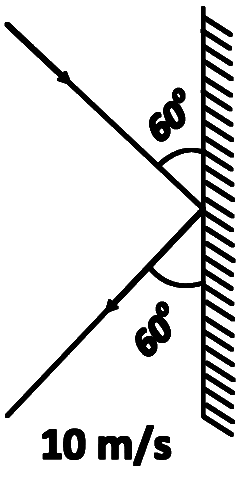
A body of mass 3 kg hits a wall at an angle of 60° and returns at the same angle. The impact time was 0.2 sec. The force exerted on the wall

Figure

Show answer and solution

Answer: (a)

  1. The path makes 60∘60^\circ with the wall, so the velocity component normal to the wall is vsin⁡60∘=10×32=53v\sin 60^\circ = 10 \times \frac{\sqrt{3}}{2} = 5\sqrt{3} m/s.
  2. The component along the wall is unchanged; the normal component reverses.
  3. Δp=2mvsin⁡60∘=2×3×53=303\Delta p = 2m v\sin 60^\circ = 2 \times 3 \times 5\sqrt{3} = 30\sqrt{3} kg m/s
  4. F=ΔpΔt=3030.2=1503F = \frac{\Delta p}{\Delta t} = \frac{30\sqrt{3}}{0.2} = 150\sqrt{3} N
  5. So the answer is (a) 1503150\sqrt{3} N.
Report a mistake
Q92NEET 1999 · AIPMTMedium

Impulse & Momentum Conservation · Rocket propulsion

The force on a rocket moving with a velocity 300 m/s300\text{ m/s} is 210 N210\text{ N}. The rate of consumption of fuel of rocket is

Show answer and solution

Answer: (a)

  1. Thrust F=udmdtF = u\frac{dm}{dt}.
  2. dmdt=210300=0.7\frac{dm}{dt} = \frac{210}{300} = 0.7 kg/s
  3. So the answer is (a) 0.70.7 kg/s.
Report a mistake
Q93NEET 1998 · AIPMTMedium

Impulse & Momentum Conservation · Rocket propulsion

A 5000 kg5000\text{ kg} rocket is set for vertical firing. The exhaust speed is 800 m s−1800\text{ m s}^{-1}. To give an initial upward acceleration of 20 m/s220\text{ m/s}^{2}, the amount of gas ejected per second to supply the needed thrust will be (g=10 m s−2g = 10\text{ m s}^{-2})

Show answer and solution

Answer: (b)

  1. Needed thrust: F=m(g+a)=5000×(10+20)=1.5×10⁵F = m(g + a) = 5000 \times (10 + 20) = 1.5 \times 10^{5} N.
  2. F=udmdt⇒dmdt=1.5×105800F = u\frac{dm}{dt} \Rightarrow \frac{dm}{dt} = \frac{1.5 \times 10^{5}}{800}
  3. dmdt=187.5 kg s−1\frac{dm}{dt} = 187.5\text{ kg s}^{-1}
  4. So the answer is (b).
Report a mistake
Q94NEET 1996 · AIPMTEasy

Impulse & Momentum Conservation · Recoil & explosion

A man fires a bullet of mass 200 gm200\text{ gm} at a speed of 5 m/s5\text{ m/s}. The gun is of one kg mass. By what velocity the gun rebounds backward?

Show answer and solution

Answer: (a)

  1. Momentum is conserved: mbvb=MgVgm_b v_b = M_g V_g.
  2. 0.2×5=1×Vg0.2 \times 5 = 1 \times V_g
  3. Vg=1 m/sV_g = 1\text{ m/s}
  4. So the answer is (a) 1 m/s.
Report a mistake
Q95NEET 1994 · AIPMTEasy

Impulse & Momentum Conservation · Rocket propulsion

In a rocket, fuel burns at the rate of 1 kg/s1\text{ kg/s}. This fuel is ejected from the rocket with a velocity of 60 km/s60\text{ km/s}. This exerts a force on the rocket equal to

Show answer and solution

Answer: (b)

  1. Thrust F=udmdtF = u\frac{dm}{dt}.
  2. F=(60×103)×1=60000 NF = (60 \times 10^{3}) \times 1 = 60000\text{ N}
  3. So the answer is (b) 6000060000 N.
Report a mistake
Q96NEET 1994 · AIPMTDifficult

Impulse & Momentum Conservation · Rocket propulsion

A satellite in force free space sweeps stationary interplanetary dust at a rate of dM/dt=αvdM/dt = \alpha v, where MM is mass and vv is the speed of satellite and α\alpha is a constant. The acceleration of satellite is

Show answer and solution

Answer: (d)

  1. No external force, so momentum MvMv is constant: Mdvdt+vdMdt=0M\frac{dv}{dt} + v\frac{dM}{dt} = 0.
  2. Ma=−v(αv)=−αv2M a = -v(\alpha v) = -\alpha v^2
  3. a=−αv2Ma = -\frac{\alpha v^2}{M}, so the answer is (d).
Report a mistake
Q97NEET 1990 · AIPMTMedium

Impulse & Momentum Conservation · Rocket propulsion

A 600 kg600\text{ kg} rocket is set for a vertical fring. If the exhaust speed is 1000 m s−11000\text{ m s}^{-1}, the mass of the gas ejected per second to supply the thrust needed to overcome the weight of rocket is

Show answer and solution

Answer: (c)

  1. To just balance weight: udmdt=mgu\frac{dm}{dt} = mg.
  2. dmdt=600×9.81000=5.88≈6 kg s−1\frac{dm}{dt} = \frac{600 \times 9.8}{1000} = 5.88 \approx 6\text{ kg s}^{-1}
  3. So the answer is (c) 6 kg s−16\text{ kg s}^{-1}.
Report a mistake
Q98NEET 1989 · AIPMTMedium

Impulse & Momentum Conservation · Recoil & explosion

A body of mass 5 kg5\text{ kg} explodes at rest into three fragments with masses in the ratio 1:1:31:1:3. The fragments with equal masses fly in mutually perpendicular directions with speeds of 21 m/s21\text{ m/s}. The velocity of heaviest fragment in m/s will be

Show answer and solution

Answer: (a)

  1. Masses: 11 kg, 11 kg, 33 kg. Total momentum stays zero.
  2. Light fragments: p=1×21=21p = 1 \times 21 = 21 each, perpendicular, resultant =212= 21\sqrt{2}.
  3. 3v=212⇒v=723v = 21\sqrt{2} \Rightarrow v = 7\sqrt{2} m/s
  4. So the answer is (a) 727\sqrt{2}.
Report a mistake
Q99MHT CET 2026 · 20 APR · SHIFT 1Easy

Apparent Weight & Lift · Apparent weight in a lift

The weight of man in lift moving in upward direction with an acceleration 'a' is 660660 N. When the lift moves in the downward direction with the same acceleration, his weight is found to be 380380 N. The real weight of the man when the lift is at rest is

Show answer and solution

Answer: (c)

  1. Up: m(g+a)=660m(g + a) = 660; down: m(g−a)=380m(g - a) = 380.
  2. Add: 2mg=1040⇒mg=5202mg = 1040 \Rightarrow mg = 520 N
  3. So the answer is (c) 520520 N.
Report a mistake
Q100MHT CET 2025 · 23 APR · SHIFT 1Easy

Apparent Weight & Lift · Apparent weight in a lift

The weight of man in a stationary lift is w1w_1 and when it is moving downwards with uniform acceleration ' a ' is w2w_2. If the ratio w1:w2=4:3w_1 : w_2 = 4 : 3, then the value of ' a ' is ( g=g = acceleration due to gravity)

Show answer and solution

Answer: (b)

  1. w1=mgw_1 = mg, w2=m(g−a)w_2 = m(g - a).
  2. w1w2=gg−a=43⇒3g=4g−4a\frac{w_1}{w_2} = \frac{g}{g - a} = \frac{4}{3} \Rightarrow 3g = 4g - 4a
  3. a=g4a = \frac{g}{4}, so the answer is (b).
Report a mistake
Q101MHT CET 2025 · 21 APR · SHIFT 1Medium

Apparent Weight & Lift · Apparent weight in a lift

A child stands on a weighing machine inside a lift. When the lift is going down with acceleration g/3g/3, the machine shows a reading 20 N. When the lift goes upwards with acceleration g/3g/3, the reading would be ( g=g = gravitational acceleration)

Show answer and solution

Answer: (a)

  1. Going down with g3\frac{g}{3}: m(g−g3)=2mg3=20⇒mg=30m\left(g - \frac{g}{3}\right) = \frac{2mg}{3} = 20 \Rightarrow mg = 30 N.
  2. Going up with g3\frac{g}{3}: m(g+g3)=4mg3=40m\left(g + \frac{g}{3}\right) = \frac{4mg}{3} = 40 N
  3. So the answer is (a) 40 N.
Report a mistake
Q102JEE Main 2025 · 28 JAN · SHIFT 2Medium

Apparent Weight & Lift · Balloon: dropping mass

A balloon and its content having mass M is moving up with an acceleration ‘a’. The mass that must be released from the content so that the balloon starts moving up with an acceleration ‘3a’ will be (Take ‘g’ as acceleration due to gravity)

Show answer and solution

Answer: (b)

  1. Rising with aa: U−Mg=Ma⇒U=M(g+a)U - Mg = Ma \Rightarrow U = M(g + a).
  2. After releasing Δm\Delta m, rising with 3a3a: U=(M−Δm)(g+3a)U = (M - \Delta m)(g + 3a).
  3. M−Δm=M(g+a)g+3a⇒Δm=2Ma3a+gM - \Delta m = \dfrac{M(g + a)}{g + 3a} \Rightarrow \Delta m = \dfrac{2Ma}{3a + g}
  4. So the answer is (b) 2Ma3a+g\dfrac{2Ma}{3a+g}.
Report a mistake
Q103MHT CET 2024 · 2 MAY · SHIFT 2Easy

Apparent Weight & Lift · Cable tension & floor reaction

The mass of the lift is 200 kg, when it ascends with an acceleration of 4 m/s24\text{ m/s}^{2} then the tension in the cable supporting the lift will be [Given: Acceleration due to gravity g=10 m/s2g = 10\text{ m/s}^{2} ]

Show answer and solution

Answer: (b)

  1. Going up with aa: T−mg=ma⇒T=m(g+a)T - mg = ma \Rightarrow T = m(g + a).
  2. T=200×(10+4)=2800T = 200 \times (10 + 4) = 2800 N
  3. So the answer is (b) 2800 N.
Report a mistake
Q104JEE Main 2024 · 5 APR · SHIFT 1Easy

Apparent Weight & Lift · Cable tension & floor reaction

A wooden block of mass 5 kg5\text{ kg} rests on a soft horizontal floor. When an iron cylinder of mass 25 kg25\text{ kg} is placed on the top of the block, the floor yields and the block and the cylinder together go down with an acceleration of 0.1 ms−20.1\text{ ms}^{-2}. The action force of the system on the floor is equal to:

Show answer and solution

Answer: (b)

  1. System mass =5+25=30= 5 + 25 = 30 kg, accelerating down with a=0.1 m s−2a = 0.1\text{ m s}^{-2}.
  2. N=m(g−a)=30×(9.8−0.1)=30×9.7N = m(g - a) = 30 \times (9.8 - 0.1) = 30 \times 9.7
  3. N=291N = 291 N; by Newton's third law the force on the floor is 291 N.
  4. So the answer is (b) 291 N.
Report a mistake
Q105MHT CET 2023 · 13 MAY · SHIFT 2Easy

Apparent Weight & Lift · Apparent weight in a lift

A spring balance is attached to the ceiling of a lift. A man hangs his bag on the spring and the spring balance reads 49 N49\text{ N}, when the lift is stationary. If the lift moves downward with an acceleration of 5 m/s25\text{ m/s}^{2}, the reading of the spring balance will be (g=9.8 m/s2)\left(g = 9.8\text{ m/s}^{2}\right)

Show answer and solution

Answer: (b)

  1. m=499.8=5m = \frac{49}{9.8} = 5 kg.
  2. Lift going down with aa: reading =m(g−a)=5(9.8−5)= m(g - a) = 5(9.8 - 5)
  3. Reading =5×4.8=24= 5 \times 4.8 = 24 N
  4. So the answer is (b) 24 N.
Report a mistake
Q106JEE Main 2023 · 24 JAN · SHIFT 1Easy

Apparent Weight & Lift · Apparent weight in a lift

Given below are two statements:

Statement I: An elevator can go up or down with uniform speed when its weight is balanced with the tension of its cable.

Statement II: Force exerted by the floor of an elevator on the foot of a person standing on it is more than his/her weight when the elevator goes down with increasing speed.

In the light of the above statements, choose the correct answer from the options given below:

Show answer and solution

Answer: (d)

  1. Statement I: uniform speed means a=0a = 0, so T=WT = W. True.
  2. Statement II: going down with increasing speed means aa is downward, so N=m(g−a)<mgN = m(g - a) < mg. False.
  3. So the answer is (d) Statement I is true but Statement II is false.
Report a mistake
Q107JEE Main 2022 · 29 JUN · SHIFT 2Easy

Apparent Weight & Lift · Apparent weight in a lift

A block of mass M placed inside a box descends vertically with acceleration 'a'. The block exerts a force equal to one-fourth of its weight on the floor of the box. The value of 'a' will be

Show answer and solution

Answer: (c)

  1. Box descends with aa: N=M(g−a)N = M(g - a).
  2. M(g−a)=Mg4⇒a=3g4M(g - a) = \frac{Mg}{4} \Rightarrow a = \frac{3g}{4}
  3. So the answer is (c) 3g4\frac{3g}{4}.
Report a mistake
Q108JEE Main 2022 · 26 JUN · SHIFT 1Easy

Apparent Weight & Lift · Apparent weight in a lift

A person is standing in an elevator. In which situation, he experiences weight loss?

Show answer and solution

Answer: (b)

  1. Apparent weight N=m(g−a)N = m(g - a) when acceleration aa is downward, so N<mgN < mg.
  2. Upward acceleration gives N>mgN > mg; uniform velocity gives N=mgN = mg.
  3. So the answer is (b) when the elevator moves downward with constant acceleration.
Report a mistake
Q109JEE Main 2022 · 26 JUL · SHIFT 1Medium

Apparent Weight & Lift · Climbing a rope

A monkey of mass 50 kg50\text{ kg} climbs on a rope which can withstand the tension (T) of 350 N350\text{ N}. If monkey initially climbs down with an acceleration of 4 m/s24\text{ m/s}^{2} and then climbs up with an acceleration of 5 m/s25\text{ m/s}^{2}. Choose the correct option (g=10 m/s2)\left(g = 10\text{ m/s}^{2}\right).

Show answer and solution

Answer: (c)

  1. Climbing down with acceleration aa: mg−T=ma⇒T=m(g−a)=50(10−4)=300 N<350 Nmg - T = ma \Rightarrow T = m(g - a) = 50(10 - 4) = 300\text{ N} < 350\text{ N}, so the rope holds.
  2. Climbing up with acceleration aa: T−mg=ma⇒T=m(g+a)=50(10+5)=750 NT - mg = ma \Rightarrow T = m(g + a) = 50(10 + 5) = 750\text{ N}.
  3. 750 N>350 N750\text{ N} > 350\text{ N}, so the rope breaks while climbing up.
  4. So the answer is (c).
Report a mistake
Q110MHT CET 2021 · 24 SEP · SHIFT 1Easy

Apparent Weight & Lift · Apparent weight in a lift

A spring balance is attached to the ceiling of a lift. A man hangs his bag on the spring and the spring balance reads 49 N49\text{ N}, when the lift is stationary. If the lift moves downward with an acceleration of 5 m/s25\text{ m/s}^{2}, the reading of the spring balance will be (g=9.8 m/s2)(g = 9.8\text{ m/s}^{2})

Show answer and solution

Answer: (c)

  1. m=499.8=5m = \frac{49}{9.8} = 5 kg.
  2. Reading =m(g−a)=5(9.8−5)=24= m(g - a) = 5(9.8 - 5) = 24 N
  3. So the answer is (c) 24 N.
Report a mistake
Q111MHT CET 2021 · 20 SEP · SHIFT 1Easy

Apparent Weight & Lift · Apparent weight in a lift

The weight of a man in a lift moving upwards with an acceleration 'a' is 620 N. When the lift moves downwards with the same acceleration, his weight is found to be 340 N. The real weight of the man is

Show answer and solution

Answer: (d)

  1. Up: m(g+a)=620m(g + a) = 620; down: m(g−a)=340m(g - a) = 340.
  2. Add: 2mg=960⇒mg=4802mg = 960 \Rightarrow mg = 480 N
  3. So the answer is (d) 480 N.
Report a mistake
Q112JEE Main 2021 · 26 FEB · SHIFT 1Easy

Apparent Weight & Lift · Apparent weight in a lift

A person standing on a spring balance inside a stationary lift measures 60 kg. The weight of that person if the lift descends with uniform downward acceleration of 1.8 m/s2 will be ______________ N. [g = 10 m/s2]

Numerical answer type. Work it out, then open the answer.

Show answer and solution

Answer: 492

  1. Mass m=60m = 60 kg. Lift descending with aa: N=m(g−a)N = m(g - a).
  2. N=60×(10−1.8)=60×8.2N = 60 \times (10 - 1.8) = 60 \times 8.2
  3. N=492N = 492 N
Report a mistake
Q113JEE Main 2021 · 20 JUL · SHIFT 1Medium

Apparent Weight & Lift · Cable tension & floor reaction

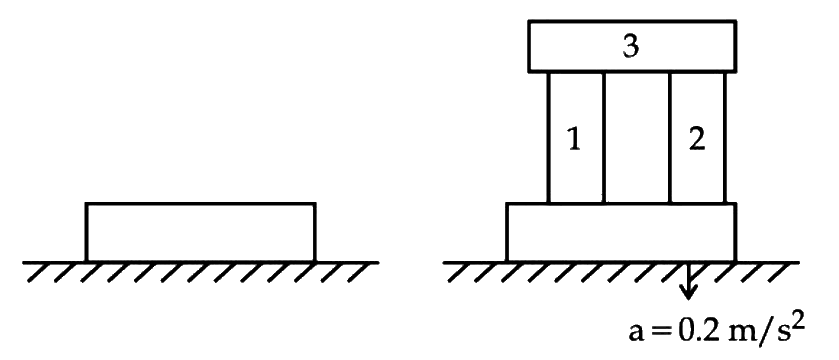
A steel block of 10 kg rests on a horizontal floor as shown. When three iron cylinders are placed on it as shown, the block and cylinders go down with an acceleration 0.2 m/s2. The normal reaction R' by the floor if mass of the iron cylinders are equal and of 20 kg each, is ____________ N. [Take g = 10 m/s2 and μ\mus = 0.2]

Figure

Show answer and solution

Answer: (a)

  1. Total mass =10+3×20=70= 10 + 3 \times 20 = 70 kg, accelerating down with a=0.2 m/s2a = 0.2\text{ m/s}^2.
  2. R′=m(g−a)=70×(10−0.2)=70×9.8R' = m(g - a) = 70 \times (10 - 0.2) = 70 \times 9.8
  3. R′=686R' = 686 N (μs\mu_s is not needed).
  4. So the answer is (a) 686.
Report a mistake
Q114NEET 2014 · AIPMTMedium

Apparent Weight & Lift · Balloon: dropping mass

A balloon with mass m is descending down with an acceleration a (where a < g). How much mass should be removed from it so that it starts moving up with an acceleration a?

Show answer and solution

Answer: (a)

  1. Descending with aa: mg−U=ma⇒U=m(g−a)mg - U = ma \Rightarrow U = m(g - a), where UU is the upthrust (unchanged).
  2. After removing Δm\Delta m, rising with aa: U−(m−Δm)g=(m−Δm)a⇒m−Δm=m(g−a)g+aU - (m - \Delta m)g = (m - \Delta m)a \Rightarrow m - \Delta m = \dfrac{m(g - a)}{g + a}.
  3. Δm=m−m(g−a)g+a=2mag+a\Delta m = m - \dfrac{m(g-a)}{g+a} = \dfrac{2ma}{g + a}
  4. So the answer is (a) 2mag+a\dfrac{2ma}{g+a}.
Report a mistake
Q115NEET 2011 · AIPMT · PRELIMSEasy

Apparent Weight & Lift · Cable tension & floor reaction

A person of mass 60 kg is inside a lift of mass 940 kg and presses the button on control panel. The lift starts moving upwards with an acceleration 1.0 m/s2. If g = 10 ms−2{}^{-2}, the tension in the supporting cable is

Show answer and solution

Answer: (c)

  1. Total mass =60+940=1000= 60 + 940 = 1000 kg.
  2. T=m(g+a)=1000×(10+1)=11000T = m(g + a) = 1000 \times (10 + 1) = 11000 N
  3. So the answer is (c) 11000 N.
Report a mistake
Q116NEET 2009 · AIPMTEasy

Apparent Weight & Lift · Cable tension & floor reaction

The mass of a lift is 2000 kg. When the tension in the supporting cable is 28000 N, then its acceleration is:

Show answer and solution

Answer: (a)

  1. T−mg=maT - mg = ma with g=10 m s−2g = 10\text{ m s}^{-2}.
  2. a=28000−200002000=4 m s−2a = \frac{28000 - 20000}{2000} = 4\text{ m s}^{-2}; positive, so upward.
  3. So the answer is (a) 4 m s−2^{-2} upwards.
Report a mistake
Q117NEET 2003 · AIPMTEasy

Apparent Weight & Lift · Apparent weight in a lift

A man weight 80 kg. He stands on a weighting scale in a lift which is moving upwards with a uniform acceleration of 5 m/s2. What would be the reading on the scale? (g = 10 m/s2)

Show answer and solution

Answer: (d)

  1. Lift accelerating up: N=m(g+a)N = m(g + a).
  2. N=80×(10+5)=1200N = 80 \times (10 + 5) = 1200 N
  3. So the answer is (d) 1200 N.
Report a mistake
Q118JEE Main 2003 · AIEEEEasy

Apparent Weight & Lift · Apparent weight in a lift

A spring balance is attached to the ceiling of a lift. A man hangs his bag on the spring and the spring reads 49 N,49\text{ N}, when the lift is stationary. If the lift moves downward with an acceleration of 5 m/s25\text{ m/s}^{2}, the reading of the spring balance will be

Show answer and solution

Answer: (a)

  1. m=499.8=5m = \frac{49}{9.8} = 5 kg.
  2. Reading =m(g−a)=5(9.8−5)=24= m(g - a) = 5(9.8 - 5) = 24 N
  3. So the answer is (a) 24 N.
Report a mistake
Q119NEET 2003 · AIPMTMedium

Apparent Weight & Lift · Climbing a rope

A monkey of mass 20 kg is holding a vertical rope. The rope will not break when a mass of 25 kg is suspended from it but will break if the mass exceeds 25 kg. What is the maximum acceleration with which the monkey can climb up along the rope? (g = 10 m/s2)

Show answer and solution

Answer: (d)

  1. Maximum tension T=25×10=250T = 25 \times 10 = 250 N.
  2. Climbing up: T−mg=ma⇒250−200=20aT - mg = ma \Rightarrow 250 - 200 = 20a
  3. a=2.5 m/s2a = 2.5\text{ m/s}^2
  4. So the answer is (d) 2.5 m/s2^2.
Report a mistake
Q120JEE Main 2002 · AIEEEEasy

Apparent Weight & Lift · Apparent weight in a lift

A lift is moving down with acceleration a.a. A man in the lift drops a ball inside the lift. The acceleration of the ball as observed by the man in the lift and a man standing stationary on the ground are respectively

Show answer and solution

Answer: (c)

  1. Ground observer: once released, only gravity acts, so ball's acceleration is gg.
  2. Lift observer: relative acceleration =g−a= g - a (both accelerate downward).
  3. So the answer is (c) g−ag - a, gg.
Report a mistake
Q121NEET 2002 · AIPMTEasy

Apparent Weight & Lift · Cable tension & floor reaction

A lift of mass 1000 kg which is moving with acceleration of 1 m/s2 in upward direction, then the tension developed in string which is connected to lift is

Show answer and solution

Answer: (b)

  1. T=m(g+a)T = m(g + a) for upward acceleration.
  2. T=1000×(9.8+1)=10800T = 1000 \times (9.8 + 1) = 10800 N
  3. So the answer is (b) 10,800 N.
Report a mistake
Q122JEE Main 2002 · AIEEEEasy

Apparent Weight & Lift · Climbing a rope

One end of a mass-less rope, which passes over a mass-less and friction-less pulley PP is tied to a hook CC while the other end is free. Maximum tension that the rope can bear is 360 N.360\text{ N}. With what value of maximum safe acceleration (in ms−2\text{ms}^{-2}) can a man of 60 kg60\text{ kg} climb on the rope?

Figure

Show answer and solution

Answer: (c)

  1. Tension cannot exceed 360 N, which is less than the man's weight mg=600mg = 600 N.
  2. So the man can hold on only while accelerating downward: mg−T=mamg - T = ma.
  3. a=600−36060=4 m s−2a = \frac{600 - 360}{60} = 4\text{ m s}^{-2} (downward)
  4. So the answer is (c) 44.
Report a mistake
Q123NEET 1993 · AIPMTMedium

Apparent Weight & Lift · Climbing a rope

A monkey is decending from the branch of a tree with constant acceleration. If the breaking strength is 75% of the weight of the monkey, the minimum acceleration with which monkey can slide down without branch is

Show answer and solution

Answer: (c)

  1. Sliding down: mg−T=ma⇒T=m(g−a)mg - T = ma \Rightarrow T = m(g - a).
  2. Safe if T≤0.75 mgT \le 0.75\,mg: m(g−a)≤3mg4⇒a≥g4m(g - a) \le \frac{3mg}{4} \Rightarrow a \ge \frac{g}{4}
  3. So the answer is (c) g4\frac{g}{4}.
Report a mistake
Q124MHT CET 2026 · 20 APR · SHIFT 2Easy

Connected Bodies & Pulleys · Blocks joined by strings

Three blocks of different masses connected with inextensible string are pulled by a force FF on a frictionless surface as shown in the figure. The ratio of tensions T1T_1 to T2T_2 is

Figure

Show answer and solution

Answer: (b)

  1. All blocks share acceleration aa.
  2. T1T_1 pulls the 8 kg and 2 kg blocks: T1=(8+2)a=10aT_1 = (8 + 2)a = 10a.
  3. T2T_2 pulls only the 2 kg block: T2=2aT_2 = 2a.
  4. T1:T2=10:2=5:1T_1 : T_2 = 10 : 2 = 5 : 1, so the answer is (b).
Report a mistake
Q125MHT CET 2026 · 18 APR · SHIFT 2Easy

Connected Bodies & Pulleys · Single pulley (Atwood)

An inextensible string passing over a smooth pulley connects two blocks of masses m1m_1 and m2m_2 (m2>m1m_2 > m_1) vertically. If the acceleration of the system is (gn)\left(\frac{g}{n}\right), then the ratio of masses (m2m1)\left(\frac{m_2}{m_1}\right) is

Show answer and solution

Answer: (c)

  1. Atwood machine: a=(m2−m1)gm2+m1=gna = \dfrac{(m_2 - m_1)g}{m_2 + m_1} = \dfrac{g}{n}.
  2. Put r=m2m1r = \dfrac{m_2}{m_1}: r−1r+1=1n⇒nr−n=r+1\dfrac{r - 1}{r + 1} = \dfrac{1}{n} \Rightarrow nr - n = r + 1.
  3. r=n+1n−1r = \dfrac{n + 1}{n - 1}, so the answer is (c).
Report a mistake
Q126MHT CET 2026 · 18 APR · SHIFT 1Medium

Connected Bodies & Pulleys · Massive rope & chain

A block of mass M is lying on a horizontal frictionless surface. One end of the uniform rope of half the mass of the block is fixed to the block which is pulled in the horizontal direction by applying a force F at the other end. The tension in the middle of the rope will be

Show answer and solution

Answer: (d)

  1. Rope mass =M2= \frac{M}{2}, total mass =3M2= \frac{3M}{2}, so a=2F3Ma = \dfrac{2F}{3M}.
  2. Behind the middle of the rope: block ++ half the rope =M+M4=5M4= M + \frac{M}{4} = \frac{5M}{4}.
  3. T=5M4×2F3M=5F6T = \frac{5M}{4} \times \dfrac{2F}{3M} = \dfrac{5F}{6}
  4. So the answer is (d).
Report a mistake
Q127JEE Main 2026 · 5 APR · SHIFT 1Medium

Connected Bodies & Pulleys · Single pulley (Atwood)

Three masses m1=4 kg,m2=4 kgm_1 = 4\text{ kg}, m_2 = 4\text{ kg} and m3=6 kgm_3 = 6\text{ kg} are suspended from a fixed smooth frictionless pulley as shown in the figure below. The value of T1/T2T_1/T_2 is

______

(take g=10 m/s2g = 10\text{ m/s}^{2})

Figure

Show answer and solution

Answer: (a)

  1. Left side: m1=4m_1 = 4 kg; right side: m2+m3=10m_2 + m_3 = 10 kg, so the right side goes down.
  2. a=(10−4)g14=307 m/s2a = \dfrac{(10-4)g}{14} = \dfrac{30}{7}\text{ m/s}^2
  3. T1=m1(g+a)=4(10+307)=4007T_1 = m_1(g+a) = 4\left(10 + \dfrac{30}{7}\right) = \dfrac{400}{7} N
  4. T2=m3(g−a)=6(10−307)=2407T_2 = m_3(g-a) = 6\left(10 - \dfrac{30}{7}\right) = \dfrac{240}{7} N
  5. T1T2=400240=53\dfrac{T_1}{T_2} = \dfrac{400}{240} = \dfrac{5}{3}, so the answer is (a) 5/3.
Report a mistake
Q128JEE Main 2026 · 5 APR · SHIFT 1Difficult

Connected Bodies & Pulleys · Accelerating wedge

A wedge YY with mass of 10 kg and all frictionless surfaces and the inclined surface making 37∘37^\circ with horizontal. A block XX with mass 2 kg is placed at the highest point of the wedge as shown in figure is at rest. At t=0t = 0 wedge ( YY) is pulled toward right with constant force (f)(f) of 24 N. Taking the block XX at rest at t=0t = 0, the time taken by it to slide down 8.8 m on the slope, while YY is on the move, is ______ s.

(( take tan⁡(37∘)=3/4\tan(37^\circ) = 3/4 and g=10 m/s2)g = 10\text{ m/s}^{2})

Figure

Show answer and solution

Answer: (a)

  1. In the wedge frame (acceleration AA to the right), the block feels a pseudo force mAmA to the left; along the slope it gets arel=gsin⁡37∘−Acos⁡37∘=6−0.8Aa_{rel} = g\sin 37^\circ - A\cos 37^\circ = 6 - 0.8A.
  2. Normal force: N=m(gcos⁡37∘+Asin⁡37∘)=16+1.2AN = m(g\cos 37^\circ + A\sin 37^\circ) = 16 + 1.2A; wedge: 24−Nsin⁡37∘=10A⇒A≈1.34 m/s224 - N\sin 37^\circ = 10A \Rightarrow A \approx 1.34\text{ m/s}^2
  3. arel≈6−1.07=4.93 m/s2a_{rel} \approx 6 - 1.07 = 4.93\text{ m/s}^2; t=2(8.8)4.93≈1.9t = \sqrt{\dfrac{2(8.8)}{4.93}} \approx 1.9 s
  4. Taking A=fM+m=2412=2 m/s2A = \dfrac{f}{M+m} = \dfrac{24}{12} = 2\text{ m/s}^2 (the intended approach) gives arel=4.4 m/s2a_{rel} = 4.4\text{ m/s}^2 and t=17.64.4=2t = \sqrt{\dfrac{17.6}{4.4}} = 2 s.
  5. So the answer is (a) 2 s.
Report a mistake
Q129JEE Main 2026 · 28 JAN · SHIFT 2Difficult

Connected Bodies & Pulleys · Accelerating wedge

A small block of mass m slides down from the top of a frictionless inclined surface, while the inclined plane is moving towards left with constant acceleration a0a_0. The angle between the inclined plane and ground is θ\theta and its base length is LL. Assuming that initially the small block is at the top of the inclined plane, the time it takes to reach the lowest point of the inclined plane is ________.

Figure

Show answer and solution

Answer: (b)

  1. In the incline frame the block feels a pseudo force ma0ma_0 to the right, which has a component ma0cos⁡θma_0\cos\theta up the slope.
  2. arel=gsin⁡θ−a0cos⁡θa_{rel} = g\sin\theta - a_0\cos\theta; slope length =Lcos⁡θ= \dfrac{L}{\cos\theta}
  3. t=2Lcos⁡θ(gsin⁡θ−a0cos⁡θ)=2Lgsin⁡θcos⁡θ−a0cos⁡2θt = \sqrt{\dfrac{2L}{\cos\theta(g\sin\theta - a_0\cos\theta)}} = \sqrt{\dfrac{2L}{g\sin\theta\cos\theta - a_0\cos^2\theta}}
  4. Using sin⁡θcos⁡θ=12sin⁡2θ\sin\theta\cos\theta = \tfrac{1}{2}\sin 2\theta, cos⁡2θ=12(1+cos⁡2θ)\cos^2\theta = \tfrac{1}{2}(1+\cos 2\theta): t=4Lgsin⁡2θ−a0(1+cos⁡2θ)t = \sqrt{\dfrac{4L}{g\sin 2\theta - a_0(1+\cos 2\theta)}}
  5. So the answer is (b).
Report a mistake
Q130NEET 2024Easy

Connected Bodies & Pulleys · Block on a smooth surface or incline

A box of mass 5 kg5\text{ kg} is pulled by a cord, up along a frictionless plane inclined at 30∘30^\circ with the horizontal. The tension in the cord is 30 N30\text{ N}. The acceleration of the box is (Take g=10 m s−2g = 10\text{ m s}^{-2})

Show answer and solution

Answer: (d)

  1. Along the incline: T−mgsin⁡30∘=maT - mg\sin 30^\circ = ma.
  2. 30−5×10×12=5a⇒5=5a30 - 5 \times 10 \times \frac{1}{2} = 5a \Rightarrow 5 = 5a
  3. a=1 m s−2a = 1\text{ m s}^{-2}, so the answer is (d).
Report a mistake
Q131MHT CET 2024 · 3 MAY · SHIFT 1Easy

Connected Bodies & Pulleys · Blocks in contact

Two blocks of masses 6 kg and 4 kg are placed in contact with each other on a smooth surface as shown. If a force of 5 N is applied on a heavier block, the force on the lighter block is

Figure

Show answer and solution

Answer: (c)

  1. Common acceleration: a=Fm1+m2=56+4=0.5 m/s2a = \dfrac{F}{m_1 + m_2} = \dfrac{5}{6 + 4} = 0.5\text{ m/s}^2.
  2. The 4 kg block is pushed only by the contact force: N=4×0.5=2 NN = 4 \times 0.5 = 2\text{ N}.
  3. So the answer is (c) 2 N.
Report a mistake
Q132NEET 2024Easy

Connected Bodies & Pulleys · Blocks in contact

A horizontal force 10 N10\text{ N} is applied to a block AA as shown in figure. The mass of blocks AA and BB are 2 kg2\text{ kg} and 3 kg\text{kg} respectively. The blocks slide over a frictionless surface. The force exerted by block AA on block BB is:

Figure

Show answer and solution

Answer: (c)

  1. a=FmA+mB=102+3=2 m/s2a = \dfrac{F}{m_A + m_B} = \dfrac{10}{2 + 3} = 2\text{ m/s}^2
  2. Force of A on B gives B its acceleration: N=mBa=3×2=6 NN = m_B a = 3 \times 2 = 6\text{ N}.
  3. So the answer is (c) 6 N.
Report a mistake
Q133JEE Main 2024 · 30 JAN · SHIFT 2Easy

Connected Bodies & Pulleys · Blocks joined by strings

Three blocks A,BA, B and CC are pulled on a horizontal smooth surface by a force of 80 N80\text{ N} as shown in figure

Figure

The tensions T11 and T22 in the string are respectively:

Show answer and solution

Answer: (a)

  1. a=805+3+2=8 m/s2a = \dfrac{80}{5 + 3 + 2} = 8\text{ m/s}^2
  2. T1T_1 pulls A only: T1=5×8=40 NT_1 = 5 \times 8 = 40\text{ N}.
  3. T2T_2 pulls A and B: T2=(5+3)×8=64 NT_2 = (5 + 3) \times 8 = 64\text{ N}.
  4. So the answer is (a) 40 N, 64 N.
Report a mistake
Q134JEE Main 2024 · 5 APR · SHIFT 1Easy

Connected Bodies & Pulleys · Blocks joined by strings

Three blocks M1,M2,M3M_1, M_2, M_3 having masses 4 kg,6 kg4\text{ kg}, 6\text{ kg} and 10 kg10\text{ kg} respectively are hanging from a smooth pulley using rope 1, 2 and 3 as shown in figure. The tension in the rope 1,T11, T_1 when they are moving upward with acceleration of 2 ms−22\text{ ms}^{-2} is __________ N\text{N} (if g=10 m/s2g = 10\text{ m/s}^{2}).

Figure

Numerical answer type. Work it out, then open the answer.

Show answer and solution

Answer: 240

  1. Rope 1 holds all three blocks: total mass 4+6+10=20 kg4 + 6 + 10 = 20\text{ kg}.
  2. T1−Mg=Ma⇒T1=M(g+a)=20(10+2)T_1 - Mg = Ma \Rightarrow T_1 = M(g + a) = 20(10 + 2)
  3. T1=240 NT_1 = 240\text{ N}
Report a mistake
Q135MHT CET 2024 · 2 MAY · SHIFT 1Easy

Connected Bodies & Pulleys · Single pulley (Atwood)

Two identical blocks each of mass ' M ' attached to the ends of a massless inextensible string which passes over a pulley with a fixed axis as shown below. A small mass ' mm ' is now placed on the block B. The acceleration with which the two blocks move together is [g = gravitational acceleration]

Figure

Show answer and solution

Answer: (a)

  1. Unbalanced weight =(M+m)g−Mg=mg= (M + m)g - Mg = mg; total moving mass =2M+m= 2M + m.
  2. a=mg2M+ma = \dfrac{mg}{2M + m}
  3. So the answer is (a).
Report a mistake
Q136JEE Main 2024 · 9 APR · SHIFT 1Easy

Connected Bodies & Pulleys · Single pulley (Atwood)

A light unstretchable string passing over a smooth light pulley connects two blocks of masses m1m_1 and m2m_2. If the acceleration of the system is g8\frac{g}{8}, then the ratio of the masses m2m1\frac{m_2}{m_1} is:

Show answer and solution

Answer: (c)

  1. m2−m1m2+m1=18\dfrac{m_2 - m_1}{m_2 + m_1} = \dfrac{1}{8}
  2. 8m2−8m1=m2+m1⇒7m2=9m18m_2 - 8m_1 = m_2 + m_1 \Rightarrow 7m_2 = 9m_1
  3. m2m1=97\dfrac{m_2}{m_1} = \dfrac{9}{7}, so the answer is (c) 9:79 : 7.
Report a mistake
Q137JEE Main 2024 · 6 APR · SHIFT 1Easy

Connected Bodies & Pulleys · Single pulley (Atwood)

A light string passing over a smooth light pulley connects two blocks of masses m1m_1 and m2m_2 (where m2>m1m_2 > m_1 ). If the acceleration of the system is g2\frac{g}{\sqrt{2}}, then the ratio of the masses m1m2\frac{m_1}{m_2} is:

Show answer and solution

Answer: (c)

  1. m2−m1m2+m1=12\dfrac{m_2 - m_1}{m_2 + m_1} = \dfrac{1}{\sqrt{2}}
  2. Divide by m2m_2 with r=m1m2r = \dfrac{m_1}{m_2}: 1−r1+r=12⇒2−2r=1+r\dfrac{1 - r}{1 + r} = \dfrac{1}{\sqrt{2}} \Rightarrow \sqrt{2} - \sqrt{2}r = 1 + r.
  3. r=2−12+1r = \dfrac{\sqrt{2} - 1}{\sqrt{2} + 1}, so the answer is (c).
Report a mistake
Q138JEE Main 2024 · 31 JAN · SHIFT 2Easy

Connected Bodies & Pulleys · Single pulley (Atwood)

A light string passing over a smooth light fixed pulley connects two blocks of masses m1m_1 and m2m_2. If the acceleration of the system is g/8g/8, then the ratio of masses is:

Figure

Show answer and solution

Answer: (b)

  1. m2−m1m2+m1=18⇒8m2−8m1=m2+m1\dfrac{m_2 - m_1}{m_2 + m_1} = \dfrac{1}{8} \Rightarrow 8m_2 - 8m_1 = m_2 + m_1
  2. 7m2=9m1⇒m2m1=977m_2 = 9m_1 \Rightarrow \dfrac{m_2}{m_1} = \dfrac{9}{7}
  3. So the answer is (b) 97\dfrac{9}{7}.
Report a mistake
Q139JEE Main 2024 · 30 JAN · SHIFT 1Medium

Connected Bodies & Pulleys · Pulley with table, incline & constraints

All surfaces shown in figure are assumed to be frictionless and the pulleys and the string are light. The acceleration of the block of mass 2 kg2\text{ kg} is:

Figure

Show answer and solution

Answer: (d)

  1. The 4 kg block hangs from a movable pulley (two segments), so if the 2 kg block moves up the incline with 2a2a, the 4 kg block moves down with aa.
  2. 4 kg: 4g−2T=4a4g - 2T = 4a
  3. 2 kg: T−2gsin⁡30∘=2(2a)⇒T=g+4aT - 2g\sin 30^\circ = 2(2a) \Rightarrow T = g + 4a
  4. 4g−2g−8a=4a⇒a=g64g - 2g - 8a = 4a \Rightarrow a = \dfrac{g}{6}
  5. Acceleration of 2 kg block =2a=g3= 2a = \dfrac{g}{3}, so the answer is (d).
Report a mistake
Q140JEE Main 2023 · 31 JAN · SHIFT 1Easy

Connected Bodies & Pulleys · Block on a smooth surface or incline

As shown in figure, a 70 kg70\text{ kg} garden roller is pushed with a force of F⃗=200 N\vec{F} = 200\text{ N} at an angle of 30∘30^\circ with horizontal. The normal reaction on the roller is

(Given g=10 m s−2g = 10\text{ m s}^{-2})

Figure

Show answer and solution

Answer: (a)

  1. The push is directed downward at 30∘30^\circ below the horizontal, so its vertical component presses the roller into the ground.
  2. Vertical component: Fsin⁡30∘=200×12=100 NF\sin 30^\circ = 200 \times \frac{1}{2} = 100\text{ N} (downward).
  3. N=mg+Fsin⁡30∘=700+100=800 NN = mg + F\sin 30^\circ = 700 + 100 = 800\text{ N}
  4. So the answer is (a) 800 N.
Report a mistake
Q141JEE Main 2023 · 24 JAN · SHIFT 1Medium

Connected Bodies & Pulleys · Pulley with table, incline & constraints

As per given figure, a weightless pulley P is attached on a double inclined frictionless surfaces. The tension in the string (massless) will be (if g = 10 m/s22)

Figure

Show answer and solution

Answer: (d)

  1. Driving force: 4gsin⁡60∘−1⋅gsin⁡30∘=203−54g\sin 60^\circ - 1\cdot g\sin 30^\circ = 20\sqrt{3} - 5 N (4 kg goes down).
  2. a=203−55=(43−1) m/s2a = \dfrac{20\sqrt{3} - 5}{5} = (4\sqrt{3} - 1)\text{ m/s}^2
  3. For the 1 kg block: T−gsin⁡30∘=1⋅aT - g\sin 30^\circ = 1\cdot a
  4. T=5+43−1=4(3+1)T = 5 + 4\sqrt{3} - 1 = 4(\sqrt{3} + 1) N, so the answer is (d).
Report a mistake
Q142JEE Main 2022 · 29 JUL · SHIFT 2Easy

Connected Bodies & Pulleys · Block on a smooth surface or incline

Two bodies of masses m1=5 kgm_1 = 5\text{ kg} and m2=3 kgm_2 = 3\text{ kg} are connected by a light string going over a smooth light pulley on a smooth inclined plane as shown in the figure. The system is at rest. The force exerted by the inclined plane on the body of mass m1m_1 will be: [Take g=10 ms−2]g = 10\text{ ms}^{-2}]

Figure

Show answer and solution

Answer: (b)

  1. At rest: tension T=m2g=3×10=30 NT = m_2 g = 3 \times 10 = 30\text{ N}.
  2. For m1m_1 along the smooth incline: T=m1gsin⁡θ⇒30=50sin⁡θ⇒sin⁡θ=35T = m_1 g\sin\theta \Rightarrow 30 = 50\sin\theta \Rightarrow \sin\theta = \frac{3}{5}, cos⁡θ=45\cos\theta = \frac{4}{5}.
  3. The incline (smooth) exerts only the normal force: N=m1gcos⁡θ=50×45=40 NN = m_1 g\cos\theta = 50 \times \frac{4}{5} = 40\text{ N}.
  4. So the answer is (b) 40 N.
Report a mistake
Q143JEE Main 2022 · 25 JUN · SHIFT 2Easy

Connected Bodies & Pulleys · Block on a smooth surface or incline

A block of mass 200 g is kept stationary on a smooth inclined plane by applying a minimum horizontal force F = x\sqrt{x}N as shown in figure.

Figure

The value of x = _____________.

Numerical answer type. Work it out, then open the answer.

Show answer and solution

Answer: 12

  1. Smooth incline at 60∘60^\circ, horizontal force FF: balance along the incline gives Fcos⁡60∘=mgsin⁡60∘F\cos 60^\circ = mg\sin 60^\circ.
  2. F=mgtan⁡60∘=0.2×10×3=23 N=12 NF = mg\tan 60^\circ = 0.2 \times 10 \times \sqrt{3} = 2\sqrt{3}\text{ N} = \sqrt{12}\text{ N}
  3. So x=12x = 12.
Report a mistake
Q144NEET 2022 · PHASE 2Easy

Connected Bodies & Pulleys · Blocks in contact

In the diagram shown, the normal reaction force between 2 kg and 1 kg is (Consider the surface, to be smooth):

(Given g = 10 ms−2{}^{-2})

Figure

Show answer and solution

Answer: (b)

  1. Whole system (6 kg) along the incline: 60−18−6gsin⁡30∘=6a⇒60−18−30=6a60 - 18 - 6g\sin 30^\circ = 6a \Rightarrow 60 - 18 - 30 = 6a.
  2. a=2 m/s2a = 2\text{ m/s}^2 up the incline.
  3. For the 1 kg block: N−18−1×10×12=1×2⇒N=25 NN - 18 - 1 \times 10 \times \frac{1}{2} = 1 \times 2 \Rightarrow N = 25\text{ N}.
  4. So the answer is (b) 25 N.
Report a mistake
Q145JEE Main 2022 · 27 JUL · SHIFT 2Medium

Connected Bodies & Pulleys · Block on a smooth surface or incline

A block 'A' takes 2 s to slide down a frictionless incline of 30∘^\circ and length 'l', kept inside a lift going up with uniform velocity 'v'. If the incline is changed to 45∘^\circ, the time taken by the block, to slide down the incline, will be approximately:

Show answer and solution

Answer: (c)

  1. A lift moving with uniform velocity is an inertial frame, so effective gg is unchanged.
  2. On a frictionless incline: l=12gsin⁡θ t2⇒t∝1sin⁡θl = \frac{1}{2}g\sin\theta\, t^2 \Rightarrow t \propto \dfrac{1}{\sqrt{\sin\theta}}.
  3. t′=2sin⁡30∘sin⁡45∘=20.707=2×0.84t' = 2\sqrt{\dfrac{\sin 30^\circ}{\sin 45^\circ}} = 2\sqrt{0.707} = 2 \times 0.84
  4. t′≈1.68 st' \approx 1.68\text{ s}, so the answer is (c).
Report a mistake
Q146JEE Main 2022 · 28 JUL · SHIFT 2Medium

Connected Bodies & Pulleys · Massive rope & chain

A uniform metal chain of mass m and length 'L' passes over a massless and frictionless pulley. It is released from rest with a part of its length 'l' hanging on one side and rest of its length 'L−lL - l' is hanging on the other side of the pulley. At a certain point of time, when l=Lxl = \frac{L}{x}, the acceleration of the chain is g2\frac{g}{2}. The value of x is __________.

Figure

Show answer and solution

Answer: (d)

  1. Mass per length λ=mL\lambda = \frac{m}{L}. Net driving force =λg[(L−l)−l]= \lambda g[(L - l) - l], moving mass =m= m.
  2. a=g(L−2l)L=g2⇒L−2l=L2a = \dfrac{g(L - 2l)}{L} = \dfrac{g}{2} \Rightarrow L - 2l = \dfrac{L}{2}
  3. l=L4⇒x=4l = \dfrac{L}{4} \Rightarrow x = 4, so the answer is (d).
Report a mistake
Q147JEE Main 2022 · 26 JUN · SHIFT 2Medium

Connected Bodies & Pulleys · Massive rope & chain

A system of 10 balls each of mass 2 kg are connected via massless and unstretchable string. The system is allowed to slip over the edge of a smooth table as shown in figure. Tension on the string between the 7th and 8th ball is __________ N when 6th ball just leaves the table.

Figure

Numerical answer type. Work it out, then open the answer.

Show answer and solution

Answer: 36

  1. When the 6th ball just leaves the table, balls 1 to 6 hang and balls 7 to 10 are on the table.
  2. a=6mg10m=0.6g=6 m/s2a = \dfrac{6mg}{10m} = 0.6g = 6\text{ m/s}^2
  3. The string between the 7th and 8th balls pulls balls 8, 9, 10: T=3×2×6T = 3 \times 2 \times 6.
  4. T=36 NT = 36\text{ N}
Report a mistake
Q148JEE Main 2022 · 26 JUL · SHIFT 2Medium

Connected Bodies & Pulleys · Single pulley (Atwood)

Two masses M1M_1 and M2M_2 are tied together at the two ends of a light inextensible string that passes over a frictionless pulley. When the mass M2M_2 is twice that of M1M_1, the acceleration of the system is a1a_1. When the mass M2M_2 is thrice that of M1M_1, the acceleration of the system is a2a_2. The ratio a1a2\frac{a_1}{a_2} will be:

Figure

Show answer and solution

Answer: (b)

  1. Atwood machine: a=(M2−M1)gM1+M2a = \dfrac{(M_2 - M_1)g}{M_1 + M_2}.
  2. M2=2M1M_2 = 2M_1: a1=M1g3M1=g3a_1 = \dfrac{M_1 g}{3M_1} = \dfrac{g}{3}
  3. M2=3M1M_2 = 3M_1: a2=2M1g4M1=g2a_2 = \dfrac{2M_1 g}{4M_1} = \dfrac{g}{2}
  4. a1a2=23\dfrac{a_1}{a_2} = \dfrac{2}{3}, so the answer is (b).
Report a mistake
Q149JEE Main 2022 · 26 JUL · SHIFT 1Medium

Connected Bodies & Pulleys · Pulley with table, incline & constraints

Three masses M=100 kg, m1=10 kgM = 100\text{ kg},\ m_1 = 10\text{ kg} and m2=20 kgm_2 = 20\text{ kg} are arranged in a system as shown in figure. All the surfaces are frictionless and strings are inextensible and weightless. The pulleys are also weightless and frictionless. A force FF is applied on the system so that the mass m2m_2 moves upward with an acceleration of 2 ms−22\text{ ms}^{-2}. The value of FF is:

( Take g=10 ms−2g = 10\text{ ms}^{-2})

Figure

Show answer and solution

Answer: (a)

  1. Let MM accelerate right with AA. m2m_2 moves with MM horizontally and goes up at 2 m/s22\text{ m/s}^2: T−m2g=m2(2)⇒T=20(12)=240T - m_2 g = m_2(2) \Rightarrow T = 20(12) = 240 N.
  2. As m2m_2 rises, m1m_1 slides left relative to MM at 2 m/s22\text{ m/s}^2, so its ground acceleration is A−2A - 2 (rightward), caused only by TT.
  3. T=m1(A−2)⇒240=10(A−2)⇒A=26 m/s2T = m_1(A - 2) \Rightarrow 240 = 10(A - 2) \Rightarrow A = 26\text{ m/s}^2
  4. Whole system: F=MA+m1(A−2)+m2A=100(26)+10(24)+20(26)F = MA + m_1(A-2) + m_2 A = 100(26) + 10(24) + 20(26)
  5. F=2600+240+520=3360F = 2600 + 240 + 520 = 3360 N, so the answer is (a).
Report a mistake
Q150JEE Main 2022 · 28 JUN · SHIFT 1Medium

Connected Bodies & Pulleys · Pulley with table, incline & constraints

A hanging mass M is connected to a four times bigger mass by using a string-pulley arrangement, as shown in the figure. The bigger mass is placed on a horizontal ice-slab and being pulled by 2 Mg force. In this situation, tension in the string is x5\frac{x}{5} Mg for x = ______________. Neglect mass of the string and friction of the block (bigger mass) with ice slab.

(Given g = acceleration due to gravity)

Figure

Numerical answer type. Work it out, then open the answer.

Show answer and solution

Answer: 6

  1. Net force on the system: 2Mg2Mg (left, on 4M4M) minus MgMg (weight of hanging MM) =Mg= Mg.
  2. a=Mg4M+M=g5a = \dfrac{Mg}{4M + M} = \dfrac{g}{5}; the hanging mass moves up.
  3. Hanging mass: T−Mg=Mg5⇒T=65MgT - Mg = M\dfrac{g}{5} \Rightarrow T = \dfrac{6}{5}Mg
  4. So x=6x = 6.
Report a mistake
Q151JEE Main 2022 · 26 JUN · SHIFT 2Difficult

Connected Bodies & Pulleys · Pulley with table, incline & constraints

In the arrangement shown in figure a1, a2, a3 and a4 are the accelerations of masses m1, m2, m3 and m4 respectively. Which of the following relation is true for this arrangement?

Figure

Show answer and solution

Answer: (a)

  1. Measure positions downward from the fixed pulley; let P2P_2, P3P_3 be the two movable pulleys.
  2. String over fixed pulley: a1+aP2=0⇒aP2=−a1a_1 + a_{P2} = 0 \Rightarrow a_{P2} = -a_1
  3. String over P2P_2: a2+aP3=2aP2⇒aP3=−2a1−a2a_2 + a_{P3} = 2a_{P2} \Rightarrow a_{P3} = -2a_1 - a_2
  4. String over P3P_3: a3+a4=2aP3=−4a1−2a2a_3 + a_4 = 2a_{P3} = -4a_1 - 2a_2
  5. 4a1+2a2+a3+a4=04a_1 + 2a_2 + a_3 + a_4 = 0, so the answer is (a).
Report a mistake
Q152JEE Main 2021 · 26 FEB · SHIFT 2Medium

Connected Bodies & Pulleys · Spring balance & spring systems

Two masses A and B, each of mass M are fixed together by a massless spring. A force acts on the mass B as shown in the figure. If the mass A starts moving away from mass B with acceleration 'a', then the acceleration of mass B will be:

Figure

Show answer and solution

Answer: (d)

  1. Only the spring acts on A: spring force =Ma= Ma.
  2. On B: FF outward and the spring force MaMa opposite, so F−Ma=MaBF - Ma = Ma_B.
  3. aB=F−MaMa_B = \dfrac{F - Ma}{M}, so the answer is (d).
Report a mistake
Q153JEE Main 2021 · 27 AUG · SHIFT 2Medium

Connected Bodies & Pulleys · Single pulley (Atwood)

The boxes of masses 2 kg and 8 kg are connected by a massless string passing over smooth pulleys. Calculate the time taken by box of mass 8 kg to strike the ground starting from rest. (use g = 10 m/s2)

Figure

Show answer and solution

Answer: (d)

  1. The 8 kg box hangs from a movable pulley held by two string segments, so if it goes down with aa, the 2 kg box goes up with 2a2a.
  2. 8 kg: 8g−2T=8a8g - 2T = 8a; 2 kg: T−2g=2(2a)⇒T=20+4aT - 2g = 2(2a) \Rightarrow T = 20 + 4a
  3. 80−40−8a=8a⇒a=2.5 m/s280 - 40 - 8a = 8a \Rightarrow a = 2.5\text{ m/s}^2
  4. s=12at2s = \tfrac{1}{2}at^2: 0.2=12(2.5)t2⇒t2=0.160.2 = \tfrac{1}{2}(2.5)t^2 \Rightarrow t^2 = 0.16
  5. t=0.4t = 0.4 s, so the answer is (d).
Report a mistake
Q154JEE Main 2021 · 1 SEP · SHIFT 2Difficult

Connected Bodies & Pulleys · Accelerating wedge

A block of mass m slides on the wooden wedge, which in turn slides backward on the horizontal surface. The acceleration of the block with respect to the wedge is: Given m = 8 kg, M = 16 kg. Assume all the surfaces shown in the figure to be frictionless.

Figure

Show answer and solution

Answer: (d)

  1. Block on a free smooth wedge: arel=(M+m)gsin⁡θM+msin⁡2θa_{rel} = \dfrac{(M+m)g\sin\theta}{M + m\sin^2\theta}.
  2. arel=(16+8)g(0.5)16+8(0.25)=12g18a_{rel} = \dfrac{(16+8)g(0.5)}{16 + 8(0.25)} = \dfrac{12g}{18}
  3. arel=23ga_{rel} = \dfrac{2}{3}g, so the answer is (d).
Report a mistake
Q155NEET 2020 · PHASE 1Easy

Connected Bodies & Pulleys · Single pulley (Atwood)

Two bodies of mass 4 kg and 6 kg are tied to the ends of a massless string. The string passes over a pulley which is frictionless (see figure). The acceleration of the system in terms of acceleration due to gravity (g) is:

Figure

Show answer and solution

Answer: (b)

  1. a=(m2−m1)gm1+m2=(6−4)g10a = \dfrac{(m_2 - m_1)g}{m_1 + m_2} = \dfrac{(6 - 4)g}{10}
  2. a=g5a = \dfrac{g}{5}, so the answer is (b).
Report a mistake
Q156MHT CET 2019 · 3 MAY · SHIFT 1Easy

Connected Bodies & Pulleys · Massive rope & chain

A block of mass MM is pulled along a smooth horizontal surface with a rope of mass mm by force FF. The acceleration of the block will be

Show answer and solution

Answer: (b)

  1. Block and rope move together, so the force FF accelerates mass M+mM + m.
  2. a=FM+ma = \dfrac{F}{M + m}
  3. So the answer is (b).
Report a mistake
Q157NEET 2018Easy

Connected Bodies & Pulleys · Accelerating wedge

A block of mass m is placed on a smooth inclined wedge ABC of inclination θ\theta as shown in the figure. The wedge is given an acceleration ‘a’ towards the right. The relation between a and θ\theta for the block to remain stationary on the wedge is

Figure

Show answer and solution

Answer: (d)

Nmgθaθ
  1. On a smooth wedge only mgmg and the normal force NN act on the block; the block must move with the wedge at acceleration aa to the right.
  2. Horizontal: Nsin⁡θ=maN\sin\theta = ma. Vertical: Ncos⁡θ=mgN\cos\theta = mg.
  3. Divide: tan⁡θ=ag⇒a=gtan⁡θ\tan\theta = \dfrac{a}{g} \Rightarrow a = g\tan\theta.
  4. So the answer is (d).
Report a mistake
Q158NEET 2017Medium

Connected Bodies & Pulleys · Spring balance & spring systems

Two blocks A and B of masses 3m and m respectively are connected by a massless and inextensible string. The whole system is suspended by a massless spring as shown in figure. The magnitudes of acceleration of A and B immediately after the string is cut, are respectively

Figure

Show answer and solution

Answer: (a)

  1. Before cutting, spring force =(3m+m)g=4mg= (3m + m)g = 4mg.
  2. Just after cutting, the spring force is still 4mg4mg: for A, aA=4mg−3mg3m=g3a_A = \dfrac{4mg - 3mg}{3m} = \dfrac{g}{3}.
  3. B is free, so aB=ga_B = g.
  4. So the answer is (a) g3,g\frac{g}{3}, g.
Report a mistake
Q159NEET 2015 · AIPMT · CANCELLED PAPEREasy

Connected Bodies & Pulleys · Blocks in contact

Three blocks A, B and C, of masses 4 kg, 2 kg and 1 kg respectively, are in contact on a frictionless surface, as shown. If a force of 14 N is applied on the 4 kg block, then the contact force between A and B is

Figure

Show answer and solution

Answer: (d)

  1. a=FmA+mB+mC=147=2 m/s2a = \dfrac{F}{m_A + m_B + m_C} = \dfrac{14}{7} = 2\text{ m/s}^2
  2. Contact force between A and B pushes B and C together: N=(2+1)×2=6 NN = (2 + 1) \times 2 = 6\text{ N}.
  3. So the answer is (d) 6 N.
Report a mistake
Q160NEET 2013Easy

Connected Bodies & Pulleys · Blocks joined by strings

Three blocks with masses m, 2m and 3m are connected by strings, as shown in the figure. After an upward force F is applied on block m, the masses move upwards at constant speed v. What is the net force on the block of mass 2m? (g is the acceleration due to gravity)

Figure

Show answer and solution

Answer: (c)

  1. The blocks move at constant speed, so acceleration is zero.
  2. Net force =ma=0= ma = 0 for every block, including the 2m2m block.
  3. So the answer is (c) zero.
Report a mistake
Q161JEE Main 2013 · 22 APR · SHIFT 1Medium

Connected Bodies & Pulleys · Blocks joined by strings

Two blocks of mass M1=20M_1 = 20 kg and M2=12M_2 = 12 kg are connected by a metal rod of mass 8 kg. The system is pulled vertically up by applying a force of 480 N as shown. The tension at the mid-point of the rod is:

Figure

Show answer and solution

Answer: (d)

  1. Total mass =20+8+12=40 kg= 20 + 8 + 12 = 40\text{ kg}: a=480−40040=2 m/s2a = \dfrac{480 - 400}{40} = 2\text{ m/s}^2 upward.
  2. Below the mid-point hang M2M_2 and half the rod: 12+4=16 kg12 + 4 = 16\text{ kg}.
  3. T=16(g+a)=16×12=192 NT = 16(g + a) = 16 \times 12 = 192\text{ N}
  4. So the answer is (d) 192 N.
Report a mistake
Q162JEE Main 2013 · 25 APR · SHIFT 1Medium

Connected Bodies & Pulleys · Single pulley (Atwood)

Two blocks of masses m and M are connected by means of a metal wire of cross-sectional area A passing over a frictionless fixed pulley as shown in the figure. The system is then released. If M = 2m, then the stress produced in the wire is:

Figure

Show answer and solution

Answer: (b)

  1. Tension in an Atwood machine: T=2mMgm+MT = \dfrac{2mMg}{m+M}.
  2. With M=2mM = 2m: T=2m(2m)g3m=4mg3T = \dfrac{2m(2m)g}{3m} = \dfrac{4mg}{3}
  3. Stress =TA=4mg3A= \dfrac{T}{A} = \dfrac{4mg}{3A}, so the answer is (b).
Report a mistake
Q163JEE Main 2010 · AIEEEMedium

Connected Bodies & Pulleys · Block on a smooth surface or incline

Two fixed frictionless inclined planes making an angle 30∘30^\circ and 60∘60^\circ with the vertical are shown in the figure. Two blocks AA and BB are placed on the two planes. What is the relative vertical acceleration of AA with respect to BB?

Figure

Show answer and solution

Answer: (d)

  1. On a smooth incline at angle θ\theta (from horizontal), acceleration gsin⁡θg\sin\theta along it; vertical component =gsin⁡2θ= g\sin^2\theta.
  2. A (60∘60^\circ): aA=gsin⁡260∘=3g4a_A = g\sin^2 60^\circ = \frac{3g}{4}. B (30∘30^\circ): aB=gsin⁡230∘=g4a_B = g\sin^2 30^\circ = \frac{g}{4}.
  3. Relative vertical acceleration =3g4−g4=g2=4.9 m s−2= \frac{3g}{4} - \frac{g}{4} = \frac{g}{2} = 4.9\text{ m s}^{-2}.
  4. So the answer is (d) 4.9 m s−24.9\text{ m s}^{-2} in vertical direction.
Report a mistake
Q164JEE Main 2007 · AIEEEMedium

Connected Bodies & Pulleys · Spring balance & spring systems

A block of mass mm is connected to another block of mass MM by a spring (massless) of spring constant k.k. The blocks are kept on a smooth horizontal plane. Initially the blocks are at rest and the spring is unstretched. Then a constant force FF starts acting on the block of mass MM to pull it. Find the force on the block of mass m.m.

Show answer and solution

Answer: (d)

  1. Treat both blocks as moving with a common acceleration a=Fm+Ma = \dfrac{F}{m+M}.
  2. The only horizontal force on mm is the spring force, so Fm=maF_m = ma.
  3. Fm=mFm+MF_m = \dfrac{mF}{m+M}
  4. So the answer is (d) mF(m+M)\dfrac{mF}{(m+M)}.
Report a mistake
Q165JEE Main 2005 · AIEEEEasy

Connected Bodies & Pulleys · Accelerating wedge

A block is kept on a frictionless inclined surface with angle of inclination ’α’.\text{'}\alpha\text{'}. The incline is given an acceleration aa to keep the block stationary. Then aa is equal to

Figure

Show answer and solution

Answer: (c)

  1. Only mgmg and normal force NN act; block must accelerate with the incline at aa.
  2. Horizontal: Nsin⁡α=maN\sin\alpha = ma. Vertical: Ncos⁡α=mgN\cos\alpha = mg.
  3. a=gtan⁡αa = g\tan\alpha, so the answer is (c).
Report a mistake
Q166JEE Main 2004 · AIEEEEasy

Connected Bodies & Pulleys · Single pulley (Atwood)

Two masses m1=5 kgm_1 = 5\text{ kg} and m2=4.8 kgm_2 = 4.8\text{ kg} tied to a string are hanging over a light frictionless pulley. What is the acceleration of the masses when left free to move? (g=9.8 m/s2)\left(g = 9.8\text{ m/s}^{2}\right)

Figure

Show answer and solution

Answer: (c)

  1. a=(m1−m2)gm1+m2=(5−4.8)×9.89.8a = \dfrac{(m_1 - m_2)g}{m_1 + m_2} = \dfrac{(5 - 4.8) \times 9.8}{9.8}
  2. a=0.2 m/s2a = 0.2\text{ m/s}^2, so the answer is (c).
Report a mistake
Q167NEET 2004 · AIPMTMedium

Connected Bodies & Pulleys · Accelerating wedge

A block of mass m is placed on a smooth wedge of inclination θ\theta. The whole system is accelerated horizontally so that the block does not slip on the wedge. The force exerted by the wedge on the block will be (g is acceleration due to gravity)

Show answer and solution

Answer: (d)

Nmgθaθ
  1. The block has only horizontal acceleration, so the vertical forces balance.
  2. Forces on block: weight mgmg and normal force NN at angle θ\theta from vertical.
  3. Ncos⁡θ=mg⇒N=mgcos⁡θN\cos\theta = mg \Rightarrow N = \dfrac{mg}{\cos\theta}
  4. So the answer is (d) mg/cos⁡θmg/\cos\theta.
Report a mistake
Q168JEE Main 2003 · AIEEEEasy

Connected Bodies & Pulleys · Massive rope & chain

A block of mass MM is pulled along a horizontal frictionless surface by a rope of mass m.m. If a force PP is applied at the free end of the rope, the force exerted by the rope on the block is

Show answer and solution

Answer: (d)

  1. System acceleration: a=PM+ma = \dfrac{P}{M + m}.
  2. The rope's force on the block alone gives it this acceleration: T=Ma=PMM+mT = Ma = \dfrac{PM}{M + m}.
  3. So the answer is (d).
Report a mistake
Q169JEE Main 2003 · AIEEEEasy

Connected Bodies & Pulleys · Spring balance & spring systems

A light spring balance hangs from the hook of the other light spring balance and a block of mass M kgM\text{ kg} hangs from the former one. Then the true statement about the scale reading is

Show answer and solution

Answer: (a)

  1. Each balance is light, so the tension is the same throughout.
  2. Lower balance holds the block: reads MM kg. Upper balance holds the lower balance (massless) plus the block: also reads MM kg.
  3. So the answer is (a).
Report a mistake
Q170JEE Main 2002 · AIEEEEasy

Connected Bodies & Pulleys · Blocks joined by strings

Three identical blocks of masses m=2 kgm = 2\text{ kg} are drawn by a force F=10.2 NF = 10.2\text{ N} with an acceleration of 0.6 ms−20.6\text{ ms}^{-2} on a frictionless surface, then what is the tension (in N\text{N}) in the string between the blocks BB and CC?

Figure

Show answer and solution

Answer: (d)

  1. Force F acts on A; the string between B and C is behind A and B.
  2. For A and B together: F−TBC=(mA+mB)aF - T_{BC} = (m_A + m_B)a.
  3. TBC=10.2−4×0.6=7.8 NT_{BC} = 10.2 - 4 \times 0.6 = 7.8\text{ N}
  4. So the answer is (d) 7.8.
Report a mistake
Q171JEE Main 2002 · AIEEEEasy

Connected Bodies & Pulleys · Single pulley (Atwood)

A light string passing over a smooth light pulley connects two blocks of masses m1m_1 and m2m_2 (vertically). If the acceleration of the system is g/8g/8, then the ratio of the masses is

Show answer and solution

Answer: (b)

  1. m1−m2m1+m2=18\dfrac{m_1 - m_2}{m_1 + m_2} = \dfrac{1}{8} (taking m1m_1 as the heavier mass)
  2. 8m1−8m2=m1+m2⇒7m1=9m28m_1 - 8m_2 = m_1 + m_2 \Rightarrow 7m_1 = 9m_2
  3. Ratio of masses =9:7= 9 : 7, so the answer is (b).
Report a mistake
Q172NEET 2001 · AIPMTEasy

Connected Bodies & Pulleys · Pulley with table, incline & constraints

250 N force is required to raise 75 kg mass from a pulley. If rope is pulled 12 m then the load is lifted to 3 m. the efficiency of pulley system will be

Show answer and solution

Answer: (c)

  1. Useful work (taking g=10 m/s2g = 10\text{ m/s}^2): Wout=mgh=75×10×3=2250 JW_{out} = mgh = 75 \times 10 \times 3 = 2250\text{ J}.
  2. Input work: Win=250×12=3000 JW_{in} = 250 \times 12 = 3000\text{ J}.
  3. η=22503000×100=75%\eta = \dfrac{2250}{3000} \times 100 = 75\%
  4. So the answer is (c) 75%.
Report a mistake
Q173NEET 2000 · AIPMTEasy

Connected Bodies & Pulleys · Single pulley (Atwood)

Two masses as shown in the figure are suspended from a massless pulley. The acceleration of the system when masses are left free is

Figure

Show answer and solution

Answer: (b)

  1. a=(m2−m1)gm1+m2=(10−5)g15a = \dfrac{(m_2 - m_1)g}{m_1 + m_2} = \dfrac{(10 - 5)g}{15}
  2. a=g3a = \dfrac{g}{3}, so the answer is (b).
Report a mistake
Q174NEET 1998 · AIPMTEasy

Connected Bodies & Pulleys · Single pulley (Atwood)

A mass of 1 kg1\text{ kg} is suspended by a thread. It is

(i) lifted up with an acceleration 4.9 m/s24.9\text{ m/s}^{2},

(ii) lowered with an acceleration 4.9 m/s24.9\text{ m/s}^{2}.

The ratio of the tensions is

Show answer and solution

Answer: (a)

  1. Lifted up: T1=m(g+a)=1(9.8+4.9)=14.7 NT_1 = m(g + a) = 1(9.8 + 4.9) = 14.7\text{ N}.
  2. Lowered: T2=m(g−a)=1(9.8−4.9)=4.9 NT_2 = m(g - a) = 1(9.8 - 4.9) = 4.9\text{ N}.
  3. T1:T2=3:1T_1 : T_2 = 3 : 1, so the answer is (a).
Report a mistake
Q175NEET 2026Easy

Friction Basics · Friction in an accelerating vehicle

A box of mass 15 kg is kept on the floor of a stationary trolley. The coefficient of static friction between the box and the trolley is 0.12. Keeping the box in stationary state over the trolley, the maximum acceleration with which the trolley can be moved horizontally in ms−2\text{ms}^{-2} is: (g=10 m/s2)(g = 10\text{ m/s}^{2})

Show answer and solution

Answer: (d)

  1. Static friction is the only horizontal force on the box: ma≤μsmgma \le \mu_s mg.
  2. amax=μsg=0.12×10a_{max} = \mu_s g = 0.12 \times 10
  3. amax=1.2 m s−2a_{max} = 1.2\text{ m s}^{-2}, so the answer is (d).
Report a mistake
Q176MHT CET 2026 · 12 MAY · SHIFT 2Easy

Friction Basics · Stopping by friction

A block of mass 11 kg is kept on ice surface. When velocity of 44 m/s is given to it, it stops by friction in 55 second. The coefficient of friction is (acceleration due to gravity, g=10g = 10 m/s2{}^{2})

Show answer and solution

Answer: (c)

  1. Retardation a=vt=45=0.8 m/s2a = \dfrac{v}{t} = \dfrac{4}{5} = 0.8\text{ m/s}^2
  2. Friction gives a=μg⇒μ=0.810a = \mu g \Rightarrow \mu = \dfrac{0.8}{10}
  3. μ=0.08\mu = 0.08, so the answer is (c).
Report a mistake
Q177JEE Main 2024 · 5 APR · SHIFT 2Easy

Friction Basics · Static, limiting & kinetic friction

A heavy box of mass 50 kg50\text{ kg} is moving on a horizontal surface. If co-efficient of kinetic friction between the box and horizontal surface is 0.3 then force of kinetic friction is:

Show answer and solution

Answer: (b)

  1. fk=μkN=μkmgf_k = \mu_k N = \mu_k mg
  2. fk=0.3×50×9.8=147f_k = 0.3 \times 50 \times 9.8 = 147 N
  3. So the answer is (b) 147 N.
Report a mistake
Q178JEE Main 2024 · 27 JAN · SHIFT 2Easy

Friction Basics · Static, limiting & kinetic friction

Given below are two statements:

Statement (I): The limiting force of static friction depends on the area of contact and independent of materials.

Statement (II): The limiting force of kinetic friction is independent of the area of contact and depends on materials.

In the light of the above statements, choose the most appropriate answer from the options given below:

Show answer and solution

Answer: (a)

  1. Statement I: limiting static friction does not depend on area of contact and does depend on the materials (through μs\mu_s), so it is incorrect.
  2. Statement II: kinetic friction μkN\mu_k N is independent of area and depends on the materials, so it is correct.
  3. So the answer is (a).
Report a mistake
Q179JEE Main 2024 · 4 APR · SHIFT 1Medium

Friction Basics · Static, limiting & kinetic friction

A wooden block, initially at rest on the ground, is pushed by a force which increases linearly with time tt. Which of the following curve best describes acceleration of the block with time:

Show answer and solution

Answer: (d)

  1. Force F=ktF = kt; if friction is neglected, a=Fm=kmta = \dfrac{F}{m} = \dfrac{k}{m}t.
  2. So a∝ta \propto t: a straight line through the origin.
  3. So the answer is (d).
Report a mistake
Q180JEE Main 2024 · 1 FEB · SHIFT 1Medium

Friction Basics · Hanging mass on a rough table

Consider a block and trolley system as shown in figure. If the coefficient of kinetic friction between the trolley and the surface is 0.04, the acceleration of the system in ms−2\text{ms}^{-2} is:

(Consider that the string is massless and unstretchable and the pulley is also massless and frictionless):

Figure

Show answer and solution

Answer: (d)

  1. Driving force: weight of 6 kg6\text{ kg} block =60 N= 60\text{ N}.
  2. Friction on trolley fk=0.04×20×10=8 Nf_k = 0.04 \times 20 \times 10 = 8\text{ N}.
  3. a=60−820+6=5226a = \dfrac{60 - 8}{20 + 6} = \dfrac{52}{26}
  4. So the answer is (d) 2 m/s22\text{ m/s}^2.
Report a mistake
Q181NEET 2023Easy

Friction Basics · Friction in an accelerating vehicle

Calculate the maximum acceleration of a moving car so that a body lying on the floor of the car remains stationary. The coefficient of static friction between the body and the floor is 0.15 (g=10 m s−2)\left(g = 10\text{ m s}^{-2}\right).

Show answer and solution

Answer: (b)

  1. Friction alone accelerates the body: ma≤μsmgma \le \mu_s mg.
  2. amax=μsg=0.15×10a_{max} = \mu_s g = 0.15 \times 10
  3. amax=1.5 m s−2a_{max} = 1.5\text{ m s}^{-2}, so the answer is (b).
Report a mistake
Q182JEE Main 2023 · 31 JAN · SHIFT 2Easy

Friction Basics · Stopping by friction

A body of mass 10 kg10\text{ kg} is moving with an initial speed of 20 m/s20\text{ m/s}. The body stops after 5 s5\text{ s} due to friction between body and the floor. The value of the coefficient of friction is:

(Take acceleration due to gravity g=10 ms−2g = 10\text{ ms}^{-2})

Show answer and solution

Answer: (d)

  1. Retardation a=205=4 m/s2a = \dfrac{20}{5} = 4\text{ m/s}^2
  2. a=μg⇒μ=410a = \mu g \Rightarrow \mu = \dfrac{4}{10}
  3. μ=0.4\mu = 0.4, so the answer is (d).
Report a mistake
Q183JEE Main 2023 · 1 FEB · SHIFT 2Medium

Friction Basics · Pull or push at an angle

As shown in the figure a block of mass 10 kg lying on a horizontal surface is pulled by a force F acting at an angle 30∘30^\circ, with horizontal. For μs=0.25\mu_s = 0.25, the block will just start to move for the value of F: [Given g=10 ms−2g = 10\text{ ms}^{-2} ]

Figure

Show answer and solution

Answer: (a)

F30°NmgμN
  1. Normal force: N=mg−Fsin⁡30∘=100−0.5FN = mg - F\sin 30^\circ = 100 - 0.5F
  2. Just to start motion: Fcos⁡30∘=μsN=0.25(100−0.5F)F\cos 30^\circ = \mu_s N = 0.25(100 - 0.5F)
  3. F(0.866+0.125)=25⇒F=250.991F(0.866 + 0.125) = 25 \Rightarrow F = \dfrac{25}{0.991}
  4. F≈25.2F \approx 25.2 N, so the answer is (a).
Report a mistake
Q184JEE Main 2023 · 1 FEB · SHIFT 1Medium

Friction Basics · Acceleration on a rough surface

A block of mass 5 kg5\text{ kg} is placed at rest on a table of rough surface. Now, if a force of 30 N30\text{ N} is applied in the direction parallel to surface of the table, the block slides through a distance of 50 m50\text{ m} in an interval of time 10 s10\text{ s}. Coefficient of kinetic friction is (given, g=10 ms−2g = 10\text{ ms}^{-2}):

Show answer and solution

Answer: (d)

  1. Starting from rest: s=12at2⇒50=12a(10)2⇒a=1 m/s2s = \tfrac{1}{2}at^2 \Rightarrow 50 = \tfrac{1}{2}a(10)^2 \Rightarrow a = 1\text{ m/s}^2
  2. F−μmg=ma⇒30−μ(50)=5(1)F - \mu mg = ma \Rightarrow 30 - \mu(50) = 5(1)
  3. μ=2550=0.5\mu = \dfrac{25}{50} = 0.5
  4. So the answer is (d) 0.50.
Report a mistake
Q185JEE Main 2022 · 24 JUN · SHIFT 1Easy

Friction Basics · Stopping by friction

A block of mass 10 kg starts sliding on a surface with an initial velocity of 9.8 ms−{}^{-}1. The coefficient of friction between the surface and block is 0.5. The distance covered by the block before coming to rest is:

[use g = 9.8 ms−{}^{-}2]

Show answer and solution

Answer: (b)

  1. Retardation a=μg=0.5×9.8=4.9 m/s2a = \mu g = 0.5 \times 9.8 = 4.9\text{ m/s}^2
  2. s=v22a=(9.8)22×4.9s = \dfrac{v^2}{2a} = \dfrac{(9.8)^2}{2 \times 4.9}
  3. s=9.8s = 9.8 m, so the answer is (b).
Report a mistake
Q186JEE Main 2022 · 29 JUN · SHIFT 2Easy

Friction Basics · Hanging mass on a rough table

A block of mass 40 kg slides over a surface, when a mass of 4 kg is suspended through an inextensible massless string passing over frictionless pulley as shown below.

The coefficient of kinetic friction between the surface and block is 0.02. The acceleration of block is. (Given g = 10 ms−{}^{-}2.)

Figure

Show answer and solution

Answer: (d)

  1. Driving force: weight of 4 kg =40= 40 N; friction on 40 kg block =0.02×40×10=8= 0.02 \times 40 \times 10 = 8 N.
  2. a=40−840+4=3244a = \dfrac{40 - 8}{40 + 4} = \dfrac{32}{44}
  3. a=811 m s−2a = \dfrac{8}{11}\text{ m s}^{-2}, so the answer is (d).
Report a mistake
Q187JEE Main 2022 · 30 JUN · SHIFT 1Medium

Friction Basics · Block held against a wall

A 2 kg block is pushed against a vertical wall by applying a horizontal force of 50 N. The coefficient of static friction between the block and the wall is 0.5. A force F is also applied on the block vertically upward (as shown in figure). The maximum value of F applied, so that the block does not move upward, will be:

(Given: g = 10 ms−{}^{-}2)

Figure

Show answer and solution

Answer: (d)

  1. Normal force N=50N = 50 N, so limiting friction =0.5×50=25= 0.5 \times 50 = 25 N.
  2. When the block is about to move up, friction acts downward along with the weight.
  3. Fmax=mg+μN=20+25F_{max} = mg + \mu N = 20 + 25
  4. Fmax=45F_{max} = 45 N, so the answer is (d).
Report a mistake
Q188JEE Main 2022 · 27 JUL · SHIFT 1Medium

Friction Basics · Stopping by friction

A bag is gently dropped on a conveyor belt moving at a speed of 2 m/s2\text{ m/s}. The coefficient of friction between the conveyor belt and bag is 0.40.4. Initially, the bag slips on the belt before it stops due to friction. The distance travelled by the bag on the belt during slipping motion, is: [Take g=10 m/s2g = 10\text{ m/s}^{2} ]

Show answer and solution

Answer: (b)

  1. Friction accelerates the bag: a=μg=0.4×10=4 m/s2a = \mu g = 0.4 \times 10 = 4\text{ m/s}^2.
  2. Bag slips until it reaches the belt speed 2 m/s2\text{ m/s}: v2=2asv^2 = 2as
  3. s=222×4=0.5 ms = \dfrac{2^2}{2 \times 4} = 0.5\text{ m}
  4. So the answer is (b) 0.5 m.
Report a mistake
Q189JEE Main 2021 · 24 FEB · SHIFT 1Easy

Friction Basics · Block held against a wall

The coefficient of static friction between a wooden block of mass 0.5 kg and a vertical rough wall is 0.2. The magnitude of horizontal force that should be applied on the block to keep it adhere to the wall will be _________ N. [g = 10 ms−{}^{-}2]

Numerical answer type. Work it out, then open the answer.

Show answer and solution

Answer: 25

  1. Normal force N=FN = F (horizontal push); friction must hold the weight: μF≥mg\mu F \ge mg.
  2. F=mgμ=0.5×100.2F = \dfrac{mg}{\mu} = \dfrac{0.5 \times 10}{0.2}
  3. F=25F = 25 N
Report a mistake
Q190JEE Main 2021 · 16 MAR · SHIFT 1Medium

Friction Basics · Pull or push at an angle

A block of mass m slides along a floor while a force of magnitude F is applied to it at an angle θ\theta as shown in figure. The coefficient of kinetic friction is μ\muk. Then, the block's acceleration 'a' is given by: (g is acceleration due to gravity)

Figure

Show answer and solution

Answer: (b)

  1. Normal force: N=mg−Fsin⁡θN = mg - F\sin\theta (the force pulls upward at angle θ\theta).
  2. Kinetic friction: f=μk(mg−Fsin⁡θ)f = \mu_k(mg - F\sin\theta)
  3. ma=Fcos⁡θ−μk(mg−Fsin⁡θ)ma = F\cos\theta - \mu_k(mg - F\sin\theta)
  4. a=Fmcos⁡θ−μk(g−Fmsin⁡θ)a = \dfrac{F}{m}\cos\theta - \mu_k\left(g - \dfrac{F}{m}\sin\theta\right), so the answer is (b).
Report a mistake
Q191JEE Main 2021 · 17 MAR · SHIFT 2Medium

Friction Basics · Pull or push at an angle

A body of mass 1 kg rests on a horizontal floor with which it has a coefficient of static friction 13\frac{1}{\sqrt{3}}. It is desired to make the body move by applying the minimum possible force F N. The value of F will be ____________. (Round off to the Nearest Integer) [Take g = 10 ms−{}^{-}2 ]

Numerical answer type. Work it out, then open the answer.

Show answer and solution

Answer: 5

  1. Pull at angle θ\theta above horizontal: Fcos⁡θ=μ(mg−Fsin⁡θ)⇒F=μmgcos⁡θ+μsin⁡θF\cos\theta = \mu(mg - F\sin\theta) \Rightarrow F = \dfrac{\mu mg}{\cos\theta + \mu\sin\theta}.
  2. Minimum when tan⁡θ=μ\tan\theta = \mu: Fmin=μmg1+μ2F_{min} = \dfrac{\mu mg}{\sqrt{1+\mu^2}}.
  3. Fmin=(1/3)(10)4/3=103⋅32F_{min} = \dfrac{(1/\sqrt{3})(10)}{\sqrt{4/3}} = \dfrac{10}{\sqrt{3}}\cdot\dfrac{\sqrt{3}}{2}
  4. So F=5 NF = 5\text{ N}.
Report a mistake
Q192JEE Main 2021 · 26 FEB · SHIFT 1Medium

Friction Basics · Pull or push at an angle

As shown in the figure, a block of mass 3\sqrt{3} kg is kept on a horizontal rough surface of coefficient of friction 133\frac{1}{3\sqrt{3}}. The critical force to be applied on the vertical surface as shown at an angle 60∘{}^\circ with horizontal such that it does not move, will be 3x. The value of x will be _________. [g = 10 m/s2; sin60∘=32{}^\circ = \frac{\sqrt{3}}{2}; cos60∘=12{}^\circ = \frac{1}{2} ]

Figure

Numerical answer type. Work it out, then open the answer.

Show answer and solution

Answer: 3.33

F60°Nmgf
  1. The push acts downward at 60∘60^\circ: horizontal part Fcos⁡60∘=F2F\cos 60^\circ = \dfrac{F}{2}, vertical (downward) part Fsin⁡60∘=3F2F\sin 60^\circ = \dfrac{\sqrt{3}F}{2}.
  2. Normal force N=mg+3F2=103+3F2N = mg + \dfrac{\sqrt{3}F}{2} = 10\sqrt{3} + \dfrac{\sqrt{3}F}{2}.
  3. No motion: F2≤μN=133(103+3F2)=103+F6\dfrac{F}{2} \le \mu N = \dfrac{1}{3\sqrt{3}}\left(10\sqrt{3} + \dfrac{\sqrt{3}F}{2}\right) = \dfrac{10}{3} + \dfrac{F}{6}
  4. F3≤103⇒Fcritical=10 N\dfrac{F}{3} \le \dfrac{10}{3} \Rightarrow F_{critical} = 10\text{ N}
  5. 3x=10⇒x=3.333x = 10 \Rightarrow x = 3.33
Report a mistake
Q193JEE Main 2021 · 17 MAR · SHIFT 2Difficult

Friction Basics · Hanging mass on a rough table

A boy of mass 4 kg is standing on a piece of wood having mass 5 kg. If the coefficient of friction between the wood and the floor is 0.5, the maximum force that the boy can exert on the rope so that the piece of wood does not move from its place is __________ N. (Round off to the Nearest Integer) [Take g = 10 ms-2 ]

Figure

Numerical answer type. Work it out, then open the answer.

Show answer and solution

Answer: 30

  1. The boy pulls the rope with force TT; the rope pulls the boy up by TT and pulls the wood horizontally by TT.
  2. Normal force from floor on (boy + wood): R=(4+5)g−T=90−TR = (4+5)g - T = 90 - T.
  3. No sliding: T≤μR=0.5(90−T)T \le \mu R = 0.5(90 - T)
  4. 1.5T≤45⇒Tmax=30 N1.5T \le 45 \Rightarrow T_{max} = 30\text{ N}
Report a mistake
Q194MHT CET 2020 · 16 OCT · SHIFT 2Easy

Friction Basics · Stopping by friction

A block of mass mm is moving on rough horizontal surface with momentum pp. The coefficient of friction between the block and surface is μ\mu. The distance covered by block before it stops is [g=g = acceleration due to gravity]

Show answer and solution

Answer: (d)

  1. Retardation a=μga = \mu g; initial speed v=pmv = \dfrac{p}{m}.
  2. v2=2as⇒s=v22μg=p22μm2gv^2 = 2as \Rightarrow s = \dfrac{v^2}{2\mu g} = \dfrac{p^2}{2\mu m^2 g}
  3. With M=mM = m in the options, the answer is (d) p22μM2g\dfrac{p^2}{2\mu M^2 g}.
Report a mistake
Q195NEET 2020 · PHASE 2Medium

Friction Basics · Hanging mass on a rough table

Calculate the acceleration of the block and trolly system shown in the figure. The coefficient of kinetic friction between the trolly and the surface is 0.05. (g=10 m/s2g = 10\text{ m/s}^{2}, mass of the string is negligible and no other friction exists).

Figure

Show answer and solution

Answer: (b)

  1. Driving force: weight of block =2×10=20 N= 2 \times 10 = 20\text{ N}.
  2. Friction on trolley =μmg=0.05×10×10=5 N= \mu m g = 0.05 \times 10 \times 10 = 5\text{ N}.
  3. a=20−510+2=1512a = \dfrac{20 - 5}{10 + 2} = \dfrac{15}{12}
  4. So the answer is (b) 1.25 m/s21.25\text{ m/s}^2.
Report a mistake
Q196NEET 2019Medium

Friction Basics · Static, limiting & kinetic friction

A body of mass mm is kept on a rough horizontal surface (coefficient of friction = μ\mu). A horizontal force is applied on the body, but it does not move. The resultant of normal reaction and the frictional force acting on the object is given by FF, where FF is,

Show answer and solution

Answer: (d)

  1. Normal reaction N=mgN = mg; static friction f≤μmgf \le \mu mg.
  2. They are perpendicular, so ∣F⃗∣=N2+f2|\vec{F}| = \sqrt{N^2 + f^2}.
  3. ∣F⃗∣≤(mg)2+(μmg)2=mg1+μ2|\vec{F}| \le \sqrt{(mg)^2 + (\mu mg)^2} = mg\sqrt{1+\mu^2}
  4. So the answer is (d).
Report a mistake
Q197JEE Main 2019 · 12 APR · SHIFT 2Medium

Friction Basics · Pull or push at an angle

A block of mass 5 kg is (i) pushed in case (A) and (ii) pulled in case (B), by a force F = 20 N, making an angle of 30° with the horizontal, as shown in the figures. The coefficient of friction between the block and floor is μ\mu = 0.2. The difference between the accelerations of the blocks, in case (B) and case (A) will be: (g = 10 ms–2)

Figure

Show answer and solution

Answer: (b)

  1. Horizontal component in both cases: Fcos⁡30∘=103≈17.32F\cos 30^\circ = 10\sqrt{3} \approx 17.32 N; vertical component Fsin⁡30∘=10F\sin 30^\circ = 10 N.
  2. Push (A): N=50+10=60N = 50 + 10 = 60 N, f=12f = 12 N, aA=17.32−125=1.064 m/s2a_A = \dfrac{17.32 - 12}{5} = 1.064\text{ m/s}^2
  3. Pull (B): N=50−10=40N = 50 - 10 = 40 N, f=8f = 8 N, aB=17.32−85=1.864 m/s2a_B = \dfrac{17.32 - 8}{5} = 1.864\text{ m/s}^2
  4. aB−aA=12−85=0.8 m s−2a_B - a_A = \dfrac{12 - 8}{5} = 0.8\text{ m s}^{-2}, so the answer is (b).
Report a mistake
Q198NEET 2018Easy

Friction Basics · Static, limiting & kinetic friction

Which one of the following statements is incorrect?

Show answer and solution

Answer: (d)

  1. (a) Rolling friction is much smaller than sliding friction: correct.
  2. (b) fs,max=μsNf_{s,max} = \mu_s N, so it is proportional to NN: correct.
  3. (c) Friction opposes relative motion: correct.
  4. (d) μ=f/N\mu = f/N is a ratio of two forces, so it is dimensionless: incorrect.
  5. So the answer is (d).
Report a mistake
Q199JEE Main 2018Medium

Friction Basics · Hanging mass on a rough table

Two masses m1 = 5 kg and m2 = 10 kg, connected by an inextensible string over a frictionless pulley, are moving as shown in the figure. The coefficient of friction of horizontal surface is 0.15. The minimum weight m that should be put on top of m2 to stop the motion is:

Figure

Show answer and solution

Answer: (c)

  1. To stop the motion, tension must equal the hanging weight: T=m1g=50 NT = m_1 g = 50\text{ N}.
  2. Static friction on (m2+m)(m_2 + m) must hold this: μ(m2+m)g≥50\mu(m_2 + m)g \ge 50.
  3. 0.15(10+m)(10)≥50⇒10+m≥33.3⇒m≥23.3 kg0.15(10 + m)(10) \ge 50 \Rightarrow 10 + m \ge 33.3 \Rightarrow m \ge 23.3\text{ kg}
  4. The calculation gives 23.3 kg23.3\text{ kg}; the official key is (c) 27.3 kg27.3\text{ kg}.
Report a mistake
Q200NEET 2015 · AIPMT · CANCELLED PAPERMedium

Friction Basics · Hanging mass on a rough table

A block A of mass m1 rests on a horizontal table. A light string connected to it passes over a frictionless pully at the edge of table and from its other end another block B of mass m2 is suspended. The coefficient of kinetic friction between the block and the table is μ\muk. When the block A is sliding on the table, the tension in the string is

Show answer and solution

Answer: (a)

  1. Block B: m2g−T=m2am_2 g - T = m_2 a; block A: T−μkm1g=m1aT - \mu_k m_1 g = m_1 a.
  2. Adding: a=(m2−μkm1)gm1+m2a = \dfrac{(m_2 - \mu_k m_1)g}{m_1 + m_2}
  3. T=m2(g−a)=m2g m1+μkm1m1+m2T = m_2(g - a) = m_2 g\,\dfrac{m_1 + \mu_k m_1}{m_1 + m_2}
  4. So the answer is (a) T=m1m2(1+μk)gm1+m2T = \dfrac{m_1 m_2(1+\mu_k)g}{m_1+m_2}.
Report a mistake
Q201NEET 2014 · AIPMTMedium

Friction Basics · Hanging mass on a rough table

A system consists of three masses m1, m2 and m3 connected by a string passing over a pulley P. The mass m1 hangs freely and m2 and m3 are on a rough horizontal table (the coefficient of friction = μ\mu). The pulley is frictionless and of negligible mass. The downward acceleration of mass m1 is (Assume m1 = m2 = m3 = m)

Figure

Show answer and solution

Answer: (c)

  1. Driving force =m1g=mg= m_1 g = mg; friction on m2m_2 and m3m_3 =μ(2m)g= \mu(2m)g.
  2. Total moving mass =3m= 3m.
  3. a=mg−2μmg3ma = \dfrac{mg - 2\mu mg}{3m}
  4. So the answer is (c) g(1−2μ)3\dfrac{g(1-2\mu)}{3}.
Report a mistake
Q202JEE Main 2014 · 19 APR · SHIFT 1Difficult

Friction Basics · Pull or push at an angle

A heavy box is to be dragged along a rough horizontal floor. To do so, person A pushes it at an angle 30° from the horizontal and requires a minimum force FA, while person B pulls the box at an angle 60° from the horizontal and needs minimum force FB. If the coefficient of friction between the box and the floor is 35\frac{\sqrt{3}}{5}, the ratio FAFB\frac{F_A}{F_B} is:

Show answer and solution

Answer: (d)

  1. Push at 30∘30^\circ below horizontal: FAcos⁡30∘=μ(mg+FAsin⁡30∘)⇒FA=μmgcos⁡30∘−μsin⁡30∘F_A\cos 30^\circ = \mu(mg + F_A\sin 30^\circ) \Rightarrow F_A = \dfrac{\mu mg}{\cos 30^\circ - \mu\sin 30^\circ}
  2. Pull at 60∘60^\circ above horizontal: FB=μmgcos⁡60∘+μsin⁡60∘F_B = \dfrac{\mu mg}{\cos 60^\circ + \mu\sin 60^\circ}
  3. With μ=35\mu = \dfrac{\sqrt{3}}{5}: cos⁡30∘−μsin⁡30∘=32−310=235\cos 30^\circ - \mu\sin 30^\circ = \dfrac{\sqrt{3}}{2} - \dfrac{\sqrt{3}}{10} = \dfrac{2\sqrt{3}}{5}; cos⁡60∘+μsin⁡60∘=12+310=45\cos 60^\circ + \mu\sin 60^\circ = \dfrac{1}{2} + \dfrac{3}{10} = \dfrac{4}{5}
  4. FAFB=4/523/5=23\dfrac{F_A}{F_B} = \dfrac{4/5}{2\sqrt{3}/5} = \dfrac{2}{\sqrt{3}}
  5. So the answer is (d) 23\dfrac{2}{\sqrt{3}}.
Report a mistake
Q203JEE Main 2013 · 25 APR · SHIFT 1Medium

Friction Basics · Static, limiting & kinetic friction

A block is placed on a rough horizontal plane. A time dependent horizontal force F=ktF = kt acts on the block, where k is a positive constant. The acceleration - time graph of the block is:

Show answer and solution

Answer: (b)

  1. While kt≤μsmgkt \le \mu_s mg, static friction balances FF and a=0a = 0.
  2. Once the block starts, friction drops to μkmg<μsmg\mu_k mg < \mu_s mg, so aa jumps from zero to (μs−μk)g(\mu_s - \mu_k)g.
  3. After that a=ktm−μkga = \dfrac{kt}{m} - \mu_k g, a straight line with slope km\dfrac{k}{m}.
  4. Graph: zero, then a sudden jump, then a rising line, so the answer is (b).
Report a mistake
Q204NEET 2011 · AIPMT · MAINSEasy

Friction Basics · Stopping by friction

A conveyor belt is moving at a constant speed of 2 ms−{}^{-} 1. A box is gently dropped on it. The coefficient of friction between them is μ\mu = 0.5. The distance that the box will move relativce to belt before coming to rest on it, taking g = 10 m s−{}^{-}2,, is

Show answer and solution

Answer: (a)

  1. Friction accelerates the box: a=μg=5 m/s2a = \mu g = 5\text{ m/s}^2.
  2. Relative to the belt, the box starts at 2 m/s2\text{ m/s} backwards and decelerates at 5 m/s25\text{ m/s}^2.
  3. srel=v22a=410s_{rel} = \dfrac{v^2}{2a} = \dfrac{4}{10}
  4. srel=0.4s_{rel} = 0.4 m, so the answer is (a).
Report a mistake
Q205NEET 2007 · AIPMTEasy

Friction Basics · Stopping by friction

A block B is pushed momentarily along a horizontaly surface with an initial velocity V. If μ\mu is the coefficient of sliding friction between B and the surface, block B will come to rest after a time

Figure

Show answer and solution

Answer: (d)

  1. Retardation due to friction: a=μga = \mu g.
  2. 0=V−μgt0 = V - \mu g t
  3. t=Vμgt = \dfrac{V}{\mu g}, so the answer is (d).
Report a mistake
Q206JEE Main 2005 · AIEEEEasy

Friction Basics · Stopping by friction

Consider a car moving on a straight road with a speed of 100 m/s100\text{ m/s}. The distance at which car can be stopped is [μk=0.5][\mu_k = 0.5]

Show answer and solution

Answer: (a)

  1. Retardation a=μkg=0.5×10=5 m/s2a = \mu_k g = 0.5 \times 10 = 5\text{ m/s}^2 (taking g=10 m/s2g = 10\text{ m/s}^2).
  2. s=v22a=(100)210s = \dfrac{v^2}{2a} = \dfrac{(100)^2}{10}
  3. s=1000s = 1000 m, so the answer is (a).
Report a mistake
Q207NEET 2004 · AIPMTEasy

Friction Basics · Hanging mass on a rough table

The coefficient of static friction, μ\mus, between block A of mass 2 kg and the table as shown in the figure is 0.2. What would be the maximum mass value of block B so that the two blocks do not move? The string and the pulley are assumed to be smooth and massless. (g = 10 m/s2)

Figure

Show answer and solution

Answer: (d)

  1. For no motion, the weight of B must not exceed the limiting friction on A: mBg≤μsmAgm_B g \le \mu_s m_A g.
  2. mB=μsmA=0.2×2m_B = \mu_s m_A = 0.2 \times 2
  3. mB=0.4m_B = 0.4 kg, so the answer is (d).
Report a mistake
Q208JEE Main 2003 · AIEEEEasy

Friction Basics · Block held against a wall

A horizontal force of 10 N10\text{ N} is necessary to just hold a block stationary against a wall. The coefficient of friction between the block and the wall is 0.20.2. The weight of the block is

Figure

Show answer and solution

Answer: (d)

  1. The wall's normal force equals the applied force: N=10N = 10 N.
  2. To just hold the block, friction balances the weight: W=μNW = \mu N
  3. W=0.2×10=2W = 0.2 \times 10 = 2 N, so the answer is (d).
Report a mistake
Q209JEE Main 2003 · AIEEEEasy

Friction Basics · Stopping by friction

A marble block of mass 2 kg2\text{ kg} lying on ice when given a velocity of 6 m/s6\text{ m/s} is stopped by friction in 10 s.10\text{ s.} Then the coefficient of friction is

Show answer and solution

Answer: (d)

  1. Retardation a=610=0.6 m/s2a = \dfrac{6}{10} = 0.6\text{ m/s}^2
  2. a=μg⇒μ=0.610a = \mu g \Rightarrow \mu = \dfrac{0.6}{10}
  3. μ=0.06\mu = 0.06, so the answer is (d).
Report a mistake
Q210NEET 2002 · AIPMTEasy

Friction Basics · Acceleration on a rough surface

A block of mass 10 kg placed on rough horizontal surface having coefficient of friction μ\mu = 0.5, if a horizontal force of 100 N acting on it then acceleration of the block will be

Show answer and solution

Answer: (b)

  1. Friction f=μmg=0.5×10×10=50f = \mu mg = 0.5 \times 10 \times 10 = 50 N (taking g=10 m/s2g = 10\text{ m/s}^2).
  2. a=F−fm=100−5010a = \dfrac{F - f}{m} = \dfrac{100 - 50}{10}
  3. a=5 m/s2a = 5\text{ m/s}^2, so the answer is (b).
Report a mistake
Q211NEET 2001 · AIPMTMedium

Friction Basics · Friction in an accelerating vehicle

On the horizontal surface of a truck a block of mass 1 kg is placed (μ\mu = 0.6) and truck is moving with acceleration 5 m/sec2 then the frictional force on the block will be

Show answer and solution

Answer: (a)

  1. To move with the truck the block needs f=ma=1×5=5 Nf = ma = 1 \times 5 = 5\text{ N}.
  2. Maximum static friction μmg=0.6×1×9.8=5.88 N>5 N\mu mg = 0.6 \times 1 \times 9.8 = 5.88\text{ N} > 5\text{ N}, so the block does not slip.
  3. Static friction only supplies what is needed: f=5 Nf = 5\text{ N}.
  4. So the answer is (a) 5 N.
Report a mistake
Q212NEET 1992 · AIPMTEasy

Friction Basics · Stopping by friction

Consider a car moving along a straight horizontal road with a speed of 72 km/h72\text{ km/h}. If the coefficient of static friction between the tyres and the road is 0.5, the shortest distance in which the car can be stopped is (taking g=10 m/s2g = 10\text{ m/s}^{2})

Show answer and solution

Answer: (b)

  1. v=72 km/h=20 m/sv = 72\text{ km/h} = 20\text{ m/s}; maximum retardation a=μg=5 m/s2a = \mu g = 5\text{ m/s}^2.
  2. s=v22a=40010s = \dfrac{v^2}{2a} = \dfrac{400}{10}
  3. s=40s = 40 m, so the answer is (b).
Report a mistake
Q213JEE Main 2026 · 23 JAN · SHIFT 2Medium

Friction on an Incline · Sliding down & up a rough incline

A block is sliding down on an inclined plane of slope θ\theta and at an instant t=0t = 0 this block is given an upward momentum so that it starts moving up on the inclined surface with velocity uu. The distance (S)(S) travelled by the block before its velocity become zero, is ______.

(g = gravitational acceleration)

Show answer and solution

Answer: (c)

  1. No friction coefficient is given, so the incline is taken as smooth.
  2. Moving up, deceleration =gsin⁡θ= g\sin\theta.
  3. 0=u2−2(gsin⁡θ)S⇒S=u22gsin⁡θ0 = u^2 - 2(g\sin\theta)S \Rightarrow S = \dfrac{u^2}{2g\sin\theta}
  4. So the answer is (c) u22gsin⁡θ\dfrac{u^2}{2g\sin\theta}.
Report a mistake
Q214JEE Main 2026 · 28 JAN · SHIFT 1Medium

Friction on an Incline · Force needed on a rough incline

A block of mass 5 kg is moving on an inclined plane which makes an angle of 30∘30^\circ with the horizontal. Friction coefficient between the block and inclined plane surface is 32\frac{\sqrt{3}}{2}. The force to be applied on the block so that the block will move down without acceleration is ______ N. (g=10 m/s2).(g = 10\text{ m/s}^{2}).

Show answer and solution

Answer: (b)

  1. Weight component down the slope: mgsin⁡30∘=50×0.5=25 Nmg\sin 30^\circ = 50 \times 0.5 = 25\text{ N}.
  2. Kinetic friction (up the slope while moving down): μmgcos⁡30∘=32×50×32=37.5 N\mu mg\cos 30^\circ = \dfrac{\sqrt{3}}{2} \times 50 \times \dfrac{\sqrt{3}}{2} = 37.5\text{ N}.
  3. Zero acceleration: F+25=37.5⇒F=12.5 NF + 25 = 37.5 \Rightarrow F = 12.5\text{ N} (down the incline).
  4. So the answer is (b) 12.5 N.
Report a mistake
Q215JEE Main 2026 · 4 APR · SHIFT 1Medium

Friction on an Incline · Rough vs smooth: time of descent

The time taken by a block of mass mm to slide down from the highest point to the lowest point on a rough inclined plane is 50%50\% more compared to the time taken by the same block on identical inclined smooth plane. Both inclined planes are at 45∘45^\circ with the horizontal. The coefficient of kinetic friction between the rough inclined surface and block is ______

Show answer and solution

Answer: (c)

  1. At 45∘45^\circ: trts=a0a=11−μ\dfrac{t_r}{t_s} = \sqrt{\dfrac{a_0}{a}} = \dfrac{1}{\sqrt{1-\mu}}.
  2. 50% more time: trts=1.5⇒1−μ=12.25=49\dfrac{t_r}{t_s} = 1.5 \Rightarrow 1 - \mu = \dfrac{1}{2.25} = \dfrac{4}{9}
  3. So the answer is (c) μ=59\mu = \dfrac{5}{9}.
Report a mistake
Q216JEE Main 2026 · 6 APR · SHIFT 2Medium

Friction on an Incline · Rough vs smooth: time of descent

A block takes tt time to slide down a plane inclined at 45∘45^\circ to the horizontal. If the surface is made smooth (frictionless), the block takes time t2\frac{t}{2} to slide down the plane. The coefficient of friction between the block and the inclined plane is (α100)\left(\frac{\alpha}{100}\right). The value of α\alpha is ______.

Numerical answer type. Work it out, then open the answer.

Show answer and solution

Answer: 75

  1. At 45∘45^\circ, same distance: trts=11−μ\dfrac{t_r}{t_s} = \dfrac{1}{\sqrt{1-\mu}}.
  2. tt/2=2⇒1−μ=14⇒μ=0.75=75100\dfrac{t}{t/2} = 2 \Rightarrow 1 - \mu = \dfrac{1}{4} \Rightarrow \mu = 0.75 = \dfrac{75}{100}
  3. α=75\alpha = 75
Report a mistake
Q217JEE Main 2025 · 7 APR · SHIFT 1Easy

Friction on an Incline · Sliding down & up a rough incline

A cubic block of mass mm is sliding down on an inclined plane at 60∘60^\circ with an acceleration of g2\frac{g}{2}, the value of coefficient of kinetic friction is

Show answer and solution

Answer: (d)

  1. Sliding down a rough incline: a=g(sin⁡θ−μcos⁡θ)a = g(\sin\theta - \mu\cos\theta).
  2. g2=g(32−μ2)\dfrac{g}{2} = g\left(\dfrac{\sqrt{3}}{2} - \dfrac{\mu}{2}\right)
  3. μ=3−1\mu = \sqrt{3} - 1
  4. So the answer is (d) 3−1\sqrt{3} - 1.
Report a mistake
Q218NEET 2025Medium

Friction on an Incline · Rough vs smooth: time of descent

There are two inclined surfaces of equal length (L)(L) and same angle of inclination 45∘45^\circ with the horizontal. One of them is rough and the other is perfectly smooth. A given body takes 2 times as much time to slide down on rough surface than on the smooth surface. The coefficient of kinetic friction (μk)(\mu_k) between the object and the rough surface is close to

Show answer and solution

Answer: (b)

  1. Same length from rest: L=12at2⇒t∝1aL = \tfrac{1}{2}at^2 \Rightarrow t \propto \dfrac{1}{\sqrt{a}}.
  2. Smooth: a0=gsin⁡45∘a_0 = g\sin 45^\circ; rough: a=gsin⁡45∘(1−μ)a = g\sin 45^\circ(1 - \mu).
  3. trts=2⇒a0a=4⇒1−μ=14\dfrac{t_r}{t_s} = 2 \Rightarrow \dfrac{a_0}{a} = 4 \Rightarrow 1 - \mu = \dfrac{1}{4}
  4. So the answer is (b) μk=0.75\mu_k = 0.75.
Report a mistake
Q219JEE Main 2024 · 4 APR · SHIFT 2Easy

Friction on an Incline · Angle of repose & block at rest

A 2 kg2\text{ kg} brick begins to slide over a surface which is inclined at an angle of 45∘45^\circ with respect to horizontal axis. The co-efficient of static friction between their surfaces is:

Show answer and solution

Answer: (a)

  1. The brick just begins to slide at the angle of repose: μs=tan⁡θ\mu_s = \tan\theta.
  2. μs=tan⁡45∘=1\mu_s = \tan 45^\circ = 1
  3. So the answer is (a) 1.
Report a mistake
Q220JEE Main 2024 · 30 JAN · SHIFT 2Medium

Friction on an Incline · Angle of repose & block at rest

A block of mass mm is placed on a surface having vertical cross-section given by y=x2/4y = x^2/4. If coefficient of friction is 0.5, the maximum height above the ground at which block can be placed without slipping is:

Show answer and solution

Answer: (d)

  1. Slope of the surface tan⁡θ=dydx=x2\tan\theta = \dfrac{dy}{dx} = \dfrac{x}{2}.
  2. Limit of no slipping: tan⁡θ=μ⇒x2=0.5⇒x=1 m\tan\theta = \mu \Rightarrow \dfrac{x}{2} = 0.5 \Rightarrow x = 1\text{ m}.
  3. y=124=14 my = \dfrac{1^2}{4} = \dfrac{1}{4}\text{ m}
  4. So the answer is (d) 1/4 m.
Report a mistake
Q221JEE Main 2024 · 31 JAN · SHIFT 2Medium

Friction on an Incline · Force needed on a rough incline

Figure

A block of mass 5 kg5\text{ kg} is placed on a rough inclined surface as shown in the figure. If F1⃗\vec{F_1} is the force required to just move the block up the inclined plane and F2⃗\vec{F_2} is the force required to just prevent the block from sliding down, then the value of Figure is: [Use g=10 m/s2]g = 10\text{ m/s}^{2}]

Show answer and solution

Answer: (a)

  1. Just moving up: F1=mgsin⁡θ+μmgcos⁡θF_1 = mg\sin\theta + \mu mg\cos\theta.
  2. Just preventing sliding down: F2=mgsin⁡θ−μmgcos⁡θF_2 = mg\sin\theta - \mu mg\cos\theta.
  3. ∣F1∣−∣F2∣=2μmgcos⁡θ=2(0.1)(50)(32)|F_1| - |F_2| = 2\mu mg\cos\theta = 2(0.1)(50)\left(\dfrac{\sqrt{3}}{2}\right)
  4. So the answer is (a) 53 N5\sqrt{3}\text{ N}.
Report a mistake
Q222JEE Main 2024 · 8 APR · SHIFT 2Medium

Friction on an Incline · Rough vs smooth: time of descent

A given object takes nn times the time to slide down 45∘45^\circ rough inclined plane as it takes the time to slide down an identical perfectly smooth 45∘45^\circ inclined plane. The coefficient of kinetic friction between the object and the surface of inclined plane is:

Show answer and solution

Answer: (a)

  1. At 45∘45^\circ: smooth a0=g2a_0 = \dfrac{g}{\sqrt{2}}, rough a=g2(1−μ)a = \dfrac{g}{\sqrt{2}}(1-\mu).
  2. Same length: trts=a0a=n⇒11−μ=n2\dfrac{t_r}{t_s} = \sqrt{\dfrac{a_0}{a}} = n \Rightarrow \dfrac{1}{1-\mu} = n^2
  3. So the answer is (a) μ=1−1n2\mu = 1 - \dfrac{1}{n^2}.
Report a mistake
Q223JEE Main 2024 · 31 JAN · SHIFT 1Difficult

Friction on an Incline · Force needed on a rough incline

In the given arrangement of a doubly inclined plane two blocks of masses MM and mm are placed. The blocks are connected by a light string passing over an ideal pulley as shown. The coefficient of friction between the surface of the plane and the blocks is 0.25. The value of mm, for which M=10 kgM = 10\text{ kg} will move down with an acceleration of 2 m/s22\text{ m/s}^{2}, is: (take g=10 m/s2g = 10\text{ m/s}^{2} and tan⁡37∘=3/4)\tan 37^\circ = 3/4)

Figure

Show answer and solution

Answer: (a)

  1. M on the 53∘53^\circ side moving down: Mgsin⁡53∘−T−μMgcos⁡53∘=MaMg\sin 53^\circ - T - \mu Mg\cos 53^\circ = Ma
  2. 80−T−0.25(60)=10(2)⇒T=4580 - T - 0.25(60) = 10(2) \Rightarrow T = 45 N
  3. m on the 37∘37^\circ side moving up: T−mgsin⁡37∘−μmgcos⁡37∘=maT - mg\sin 37^\circ - \mu mg\cos 37^\circ = ma
  4. 45−6m−0.25(8m)=2m⇒45=10m⇒m=4.545 - 6m - 0.25(8m) = 2m \Rightarrow 45 = 10m \Rightarrow m = 4.5 kg
  5. So the answer is (a) 4.5 kg.
Report a mistake
Q224NEET 2023Easy

Friction on an Incline · Angle of repose & block at rest

A block of mass 2 kg is placed on inclined rough surface AC (as shown in figure) of coefficient of friction μ\mu. If g = 10 m s−2{}^{-2}, the net force (in N) on the block will be:

Figure

Show answer and solution

Answer: (b)

  1. Angle of repose: tan⁡θr=μ=13⇒θr=30∘\tan\theta_r = \mu = \dfrac{1}{\sqrt{3}} \Rightarrow \theta_r = 30^\circ.
  2. The incline is at 30∘30^\circ, so mgsin⁡30∘=10 Nmg\sin 30^\circ = 10\text{ N} equals μmgcos⁡30∘=10 N\mu mg\cos 30^\circ = 10\text{ N}.
  3. Friction balances the pull down the slope; the block stays at rest.
  4. So the answer is (b) zero.
Report a mistake
Q225JEE Main 2023 · 29 JAN · SHIFT 1Easy

Friction on an Incline · Sliding down & up a rough incline

A block of mass mm slides down the plane inclined at angle 30∘30^\circ with an acceleration g4\frac{g}{4}. The value of coefficient of kinetic friction will be:

Show answer and solution

Answer: (c)

  1. a=g(sin⁡θ−μcos⁡θ)a = g(\sin\theta - \mu\cos\theta)
  2. g4=g(12−μ32)⇒μ32=14\dfrac{g}{4} = g\left(\dfrac{1}{2} - \mu\dfrac{\sqrt{3}}{2}\right) \Rightarrow \mu\dfrac{\sqrt{3}}{2} = \dfrac{1}{4}
  3. So the answer is (c) μ=123\mu = \dfrac{1}{2\sqrt{3}}.
Report a mistake
Q226JEE Main 2023 · 25 JAN · SHIFT 2Medium

Friction on an Incline · Force needed on a rough incline

Consider a block kept on an inclined plane (incline at 45∘{}^\circ) as shown in the figure. If the force required to just push it up the incline is 2 times the force required to just prevent it from sliding down, the coefficient of friction between the block and inclined plane(μ\mu) is equal to:

Figure

Show answer and solution

Answer: (b)

  1. Push up: Fup=mg(sin⁡45∘+μcos⁡45∘)F_{up} = mg(\sin 45^\circ + \mu\cos 45^\circ); prevent sliding: Fdown=mg(sin⁡45∘−μcos⁡45∘)F_{down} = mg(\sin 45^\circ - \mu\cos 45^\circ).
  2. Fup=2Fdown⇒1+μ=2(1−μ)F_{up} = 2F_{down} \Rightarrow 1 + \mu = 2(1 - \mu)
  3. μ=13≈0.33\mu = \dfrac{1}{3} \approx 0.33
  4. So the answer is (b) 0.33.
Report a mistake
Q227JEE Main 2023 · 29 JAN · SHIFT 2Medium

Friction on an Incline · Rough vs smooth: time of descent

The time taken by an object to slide down 45∘{}^\circ rough inclined plane is n times as it takes to slide down a perfectly smooth 45∘{}^\circ incline plane. The coefficient of kinetic friction between the object and the incline plane is:

Show answer and solution

Answer: (a)

  1. At 45∘45^\circ: asmooth=g2a_{smooth} = \dfrac{g}{\sqrt{2}}, arough=g2(1−μ)a_{rough} = \dfrac{g}{\sqrt{2}}(1-\mu).
  2. t∝1a⇒n2=11−μt \propto \dfrac{1}{\sqrt{a}} \Rightarrow n^2 = \dfrac{1}{1-\mu}
  3. So the answer is (a) μ=1−1n2\mu = 1 - \dfrac{1}{n^2}.
Report a mistake
Q228JEE Main 2022 · 27 JUL · SHIFT 2Easy

Friction on an Incline · Angle of repose & block at rest

A block of mass M slides down on a rough inclined plane with constant velocity. The angle made by the incline plane with horizontal is θ\theta. The magnitude of the contact force will be:

Show answer and solution

Answer: (a)

  1. Constant velocity means net force on the block is zero.
  2. The contact force (normal + friction together) must cancel the weight.
  3. So its magnitude is MgMg: answer (a).
Report a mistake
Q229JEE Main 2022 · 27 JUL · SHIFT 2Difficult

Friction on an Incline · Sliding down & up a rough incline

Two inclined planes are placed as shown in figure. A block is projected from the Point A of inclined plane AB along its surface with a velocity just sufficient to carry it to the top Point B at a height 10 m. After reaching the Point B the block slides down on inclined plane BC. Time it takes to reach to the point C from point A is t(2+1)t(\sqrt{2}+1) s. The value of t is ___________.

(use g=10 m/s2g = 10\text{ m/s}^{2})

Figure

Numerical answer type. Work it out, then open the answer.

Show answer and solution

Answer: 2

  1. AB (smooth, 45∘45^\circ): length =102= 10\sqrt{2} m, retardation gsin⁡45∘=52g\sin 45^\circ = 5\sqrt{2} m/s2^2, and the block just stops at B.
  2. Reverse motion: t1=2La=2×10252=2t_1 = \sqrt{\frac{2L}{a}} = \sqrt{\frac{2 \times 10\sqrt{2}}{5\sqrt{2}}} = 2 s
  3. BC (30∘30^\circ): length =10sin⁡30∘=20= \frac{10}{\sin 30^\circ} = 20 m, a=gsin⁡30∘=5a = g\sin 30^\circ = 5 m/s2^2, starts from rest.
  4. t2=2×205=22t_2 = \sqrt{\frac{2 \times 20}{5}} = 2\sqrt{2} s
  5. t1+t2=2+22=2(2+1)t_1 + t_2 = 2 + 2\sqrt{2} = 2(\sqrt{2}+1) s, so t=2t = 2.
Report a mistake
Q230JEE Main 2021 · 24 FEB · SHIFT 1Medium

Friction on an Incline · Angle of repose & block at rest

An inclined plane is bent in such a way that the vertical cross-section is given by y=x24y = \frac{x^2}{4} where y is in vertical and x in horizontal direction. If the upper surface of this curved plane is rough with coefficient of friction μ\mu = 0.5, the maximum height in cm at which a stationary block will not slip downward is _________ cm.

Numerical answer type. Work it out, then open the answer.

Show answer and solution

Answer: 25

  1. Slope tan⁡θ=dydx=x2\tan\theta = \dfrac{dy}{dx} = \dfrac{x}{2}; limit of no slipping tan⁡θ=μ=0.5\tan\theta = \mu = 0.5.
  2. x=1 m⇒y=14 mx = 1\text{ m} \Rightarrow y = \dfrac{1}{4}\text{ m}
  3. Maximum height =0.25 m=25 cm= 0.25\text{ m} = 25\text{ cm}.
Report a mistake
Q231JEE Main 2021 · 1 SEP · SHIFT 2Medium

Friction on an Incline · Rough vs smooth: time of descent

When a body slides down from rest along a smooth inclined plane making an angle of 30∘{}^\circ with the horizontal, it takes time T. When the same body slides down from the rest along a rough inclined plane making the same angle and through the same distance, it takes time α\alphaT, where α\alpha is a constant greater than 1. The co-efficient of friction between the body and the rough plane is 1x(α2−1α2)\frac{1}{\sqrt{x}}\left(\frac{\alpha^2-1}{\alpha^2}\right) where x = __________.

Numerical answer type. Work it out, then open the answer.

Show answer and solution

Answer: 3

  1. From rest over the same distance s=12at2s = \frac{1}{2}at^2, so t∝1at \propto \frac{1}{\sqrt{a}}.
  2. Smooth: a1=gsin⁡θa_1 = g\sin\theta. Rough: a2=g(sin⁡θ−μcos⁡θ)a_2 = g(\sin\theta - \mu\cos\theta).
  3. t2=αt1⇒a1=α2a2⇒sin⁡θ−μcos⁡θ=sin⁡θα2t_2 = \alpha t_1 \Rightarrow a_1 = \alpha^2 a_2 \Rightarrow \sin\theta - \mu\cos\theta = \frac{\sin\theta}{\alpha^2}
  4. μ=tan⁡θ(1−1α2)=13(α2−1α2)\mu = \tan\theta\left(1 - \frac{1}{\alpha^2}\right) = \frac{1}{\sqrt{3}}\left(\frac{\alpha^2-1}{\alpha^2}\right) for θ=30∘\theta = 30^\circ
  5. So x=3x = 3.
Report a mistake
Q232JEE Main 2021 · 20 JUL · SHIFT 2Difficult

Friction on an Incline · Sliding down & up a rough incline

A body of mass 'm' is launched up on a rough inclined plane making an angle of 30∘{}^\circ with the horizontal. The coefficient of friction between the body and plane is x5\frac{\sqrt{x}}{5} if the time of ascent is half of the time of descent. The value of x is __________.

Numerical answer type. Work it out, then open the answer.

Show answer and solution

Answer: 3

  1. Up: au=g(sin⁡θ+μcos⁡θ)a_u = g(\sin\theta + \mu\cos\theta). Down: ad=g(sin⁡θ−μcos⁡θ)a_d = g(\sin\theta - \mu\cos\theta). Same distance, so t∝1at \propto \frac{1}{\sqrt{a}}.
  2. tu=td2⇒au=4adt_u = \frac{t_d}{2} \Rightarrow a_u = 4a_d
  3. sin⁡θ+μcos⁡θ=4sin⁡θ−4μcos⁡θ⇒μ=35tan⁡θ\sin\theta + \mu\cos\theta = 4\sin\theta - 4\mu\cos\theta \Rightarrow \mu = \frac{3}{5}\tan\theta
  4. μ=35⋅13=35\mu = \frac{3}{5} \cdot \frac{1}{\sqrt{3}} = \frac{\sqrt{3}}{5}
  5. So x=3x = 3.
Report a mistake
Q233JEE Main 2019 · 12 JAN · SHIFT 2Medium

Friction on an Incline · Force needed on a rough incline

A block kept on a rough inclined plane, as shown in the figure, remains at rest upto a maximum force 2 N down the inclined plane. The maximum external force up the inclined plane that does not move the block is 10 N. The coefficient of static friction between the block and the plane is: [Take g = 10 m/s2]

Figure

Show answer and solution

Answer: (c)

  1. Max force down (friction up): 2+mgsin⁡30∘=μmgcos⁡30∘2 + mg\sin 30^\circ = \mu mg\cos 30^\circ.
  2. Max force up (friction down): 10=mgsin⁡30∘+μmgcos⁡30∘10 = mg\sin 30^\circ + \mu mg\cos 30^\circ.
  3. Subtracting: 8=2mgsin⁡30∘⇒mg=8 N8 = 2mg\sin 30^\circ \Rightarrow mg = 8\text{ N}; then μmgcos⁡30∘=6\mu mg\cos 30^\circ = 6.
  4. μ=68×3/2=32\mu = \dfrac{6}{8 \times \sqrt{3}/2} = \dfrac{\sqrt{3}}{2}
  5. So the answer is (c) 32\dfrac{\sqrt{3}}{2}.
Report a mistake
Q234JEE Main 2019 · 9 JAN · SHIFT 1Medium

Friction on an Incline · Force needed on a rough incline

A block of mass 10 kg is kept on a rough inclined plane as shown in the figure. A force of 3 N is applied on the block. The coefficient of static friction between the plane and the block is 0.6. What should be the minimum value of force P, such that the block does not move downward? (take g = 10 ms−{}^{-}2)

Figure

Show answer and solution

Answer: (a)

  1. Forces down the incline: 3+mgsin⁡45∘=3+1002=73.7 N3 + mg\sin 45^\circ = 3 + \dfrac{100}{\sqrt{2}} = 73.7\text{ N}.
  2. Maximum friction (up the incline): μmgcos⁡45∘=0.6×70.7=42.4 N\mu mg\cos 45^\circ = 0.6 \times 70.7 = 42.4\text{ N}.
  3. Minimum PP: P+42.4=73.7⇒P≈31.3 NP + 42.4 = 73.7 \Rightarrow P \approx 31.3\text{ N}.
  4. So the answer is (a) 32 N (nearest option).
Report a mistake
Q235JEE Main 2018 · 15 APR · SHIFT 2Medium

Friction on an Incline · Sliding down & up a rough incline

A body of mass 2 kg slides down with an acceleration of 3 m/s2 on a rough inclined plane having a slope of 30∘30^\circ. The external force required to take the same body up the plane with the same acceleration will be: (g = 10 m/s2)

Show answer and solution

Answer: (b)

  1. Sliding down: mgsin⁡30∘−f=ma⇒10−f=2×3⇒f=4 Nmg\sin 30^\circ - f = ma \Rightarrow 10 - f = 2 \times 3 \Rightarrow f = 4\text{ N}.
  2. Going up, friction acts down the slope: F−mgsin⁡30∘−f=maF - mg\sin 30^\circ - f = ma.
  3. F=10+4+6=20 NF = 10 + 4 + 6 = 20\text{ N}
  4. So the answer is (b) 20 N.
Report a mistake
Q236JEE Main 2018 · 15 APR · SHIFT 1Medium

Friction on an Incline · Rough vs smooth: time of descent

A given object takes n times more time to slide down a 45∘45^\circ rough inclined plane as it takes to slide down a perfectly smooth 45∘45^\circ incline. The coefficient of kinetic friction between the object and the incline is:

Show answer and solution

Answer: (b)

  1. Reading "n times more time" as tr=n tst_r = n\,t_s.
  2. At 45∘45^\circ: trts=a0a=11−μ=n\dfrac{t_r}{t_s} = \sqrt{\dfrac{a_0}{a}} = \dfrac{1}{\sqrt{1-\mu}} = n
  3. So the answer is (b) μ=1−1n2\mu = 1 - \dfrac{1}{n^2}.
Report a mistake
Q237JEE Main 2016 · 9 APR · SHIFT 1Medium

Friction on an Incline · Angle of repose & block at rest

A rocket is fired vertically from the earth with an acceleration of 2g, where g is the gravitational acceleration. On an inclined plane inside the rocket, making an angle θ\theta with the horizontal, a point object of mass m is kept. The minimum coefficient of friction μ\mumin between the mass and the inclined surface such that the mass does not move is:

Show answer and solution

Answer: (a)

  1. In the rocket frame, effective gravity geff=g+2g=3gg_{eff} = g + 2g = 3g (pseudo force acts downward).
  2. No slipping: mgeffsin⁡θ≤μmgeffcos⁡θm g_{eff}\sin\theta \le \mu m g_{eff}\cos\theta; geffg_{eff} cancels.
  3. So the answer is (a) μmin=tan⁡θ\mu_{min} = \tan\theta.
Report a mistake
Q238NEET 2015 · AIPMTMedium

Friction on an Incline · Angle of repose & block at rest

A plank with a box on it at one end is gradually raised about the other end. As the angle of inclination with the horizontal reaches 30°, the box starts to slip and slides 4.0 m down the plank in 4.0 s.

Figure

The coefficients of static and kinetic friction between the box and the plank will be, respectively

Show answer and solution

Answer: (d)

  1. Slipping starts at 30∘30^\circ: μs=tan⁡30∘=0.577≈0.6\mu_s = \tan 30^\circ = 0.577 \approx 0.6.
  2. From rest: 4=12a(4)2⇒a=0.5 m/s24 = \tfrac{1}{2}a(4)^2 \Rightarrow a = 0.5\text{ m/s}^2.
  3. a=g(sin⁡30∘−μkcos⁡30∘)⇒0.5=10(0.5−0.866μk)a = g(\sin 30^\circ - \mu_k\cos 30^\circ) \Rightarrow 0.5 = 10(0.5 - 0.866\mu_k)
  4. μk=0.450.866≈0.5\mu_k = \dfrac{0.45}{0.866} \approx 0.5
  5. So the answer is (d) 0.6 and 0.5.
Report a mistake
Q239JEE Main 2014Medium

Friction on an Incline · Angle of repose & block at rest

A block of mass mm is placed on a surface with a vertical cross section given by y=x36.y = \frac{x^3}{6}. If the coefficient of friction is 0.5,0.5, the maximum height above the ground at which the block can be placed without slipping is:

Show answer and solution

Answer: (a)

  1. Slope tan⁡θ=dydx=x22\tan\theta = \dfrac{dy}{dx} = \dfrac{x^2}{2}.
  2. No slipping limit: x22=0.5⇒x=1 m\dfrac{x^2}{2} = 0.5 \Rightarrow x = 1\text{ m}.
  3. y=136=16 my = \dfrac{1^3}{6} = \dfrac{1}{6}\text{ m}
  4. So the answer is (a) 16\dfrac{1}{6} m.
Report a mistake
Q240NEET 2013Medium

Friction on an Incline · Sliding down & up a rough incline

The upper half of an inclined plane of inclination θ\theta is perfectly smooth while lower half is rough. A block starting from rest at the top of the plane will again come to rest at the bottom, if the coefficient of friction between the block and lower half of the plane is given by

Show answer and solution

Answer: (a)

  1. Let length be LL. Work-energy from rest to rest: work by gravity = work against friction.
  2. Gravity over full length: mgsin⁡θ⋅Lmg\sin\theta \cdot L; friction only on lower half: μmgcos⁡θ⋅L2\mu mg\cos\theta \cdot \dfrac{L}{2}.
  3. mgLsin⁡θ=μmgcos⁡θ L2⇒μ=2tan⁡θmgL\sin\theta = \mu mg\cos\theta\,\dfrac{L}{2} \Rightarrow \mu = 2\tan\theta
  4. So the answer is (a) μ=2tan⁡θ\mu = 2\tan\theta.
Report a mistake
Q241JEE Main 2013 · 22 APR · SHIFT 1Difficult

Friction on an Incline · Sliding down & up a rough incline

A body starts from rest on a long inclined plane of slope 45°. The coefficient of friction between the body and the plane varies as μ=0.3x\mu = 0.3x, where x is distance travelled down the plane. The body will have maximum speed (for g=10g = 10 m/s2{}^{2}) when xx =

Show answer and solution

Answer: (d)

  1. Speed is maximum when acceleration becomes zero: gsin⁡θ=μgcos⁡θg\sin\theta = \mu g\cos\theta.
  2. μ=tan⁡45∘=1\mu = \tan 45^\circ = 1
  3. 0.3x=1⇒x=103≈3.330.3x = 1 \Rightarrow x = \frac{10}{3} \approx 3.33 m
  4. So the answer is (d) 3.33 m.
Report a mistake
Q242JEE Main 2005 · AIEEEMedium

Friction on an Incline · Rough vs smooth: time of descent

A smooth block is released at rest on a 45∘45^\circ incline and then slides a distance ′d′'d'. The time taken to slide is ′n′'n' times as much to slide on rough incline than on a smooth incline. The coefficient of friction is

Show answer and solution

Answer: (b)

  1. The block is sliding, so the friction is kinetic.
  2. At 45∘45^\circ: trts=11−μk=n⇒μk=1−1n2\dfrac{t_r}{t_s} = \dfrac{1}{\sqrt{1-\mu_k}} = n \Rightarrow \mu_k = 1 - \dfrac{1}{n^2}
  3. So the answer is (b) μk=1−1n2\mu_k = 1 - \dfrac{1}{n^2}.
Report a mistake
Q243JEE Main 2004 · AIEEEEasy

Friction on an Incline · Angle of repose & block at rest

A block rests on a rough inclined plane making an angle of 30∘30^\circ with the horizontal. The coefficient of static friction between the block and the plane is 0.8.0.8. If the frictional force on the block is 10 N,10\text{ N}, the mass of the block (in kg\text{kg}) is (take g=10 m/s2)(\text{take } g = 10\text{ m/s}^{2})

Show answer and solution

Answer: (c)

  1. Block at rest: static friction equals the component of weight along the incline.
  2. f=mgsin⁡30∘⇒10=m(10)(0.5)f = mg\sin 30^\circ \Rightarrow 10 = m(10)(0.5)
  3. m=2 kgm = 2\text{ kg} (check: μscos⁡30∘=0.69>sin⁡30∘\mu_s\cos 30^\circ = 0.69 > \sin 30^\circ, so it can stay at rest).
  4. So the answer is (c) 2.0.
Report a mistake
Q244NEET 1993 · AIPMTEasy

Friction on an Incline · Angle of repose & block at rest

A block has been placed on a inclined plane with the slope angle θ\theta, block slides down the plane at constant speed. The coefficient of kinetic friction is equal to

Show answer and solution

Answer: (d)

  1. Constant speed means net force is zero along the incline.
  2. mgsin⁡θ=μkmgcos⁡θmg\sin\theta = \mu_k mg\cos\theta
  3. So the answer is (d) μk=tan⁡θ\mu_k = \tan\theta.
Report a mistake
Q245NEET 1988 · AIPMTMedium

Friction on an Incline · Rough vs smooth: time of descent

Starting from rest, a body slides down a 45∘45^\circ inclined plane in twice the time it takes to slide down the same distance in the absence of friction. The coefficient of friction between the body and the inclined plane is

Show answer and solution

Answer: (b)

  1. At 45∘45^\circ: smooth a0=g2a_0 = \dfrac{g}{\sqrt{2}}, rough a=g2(1−μ)a = \dfrac{g}{\sqrt{2}}(1-\mu).
  2. Same distance: t∝1at \propto \dfrac{1}{\sqrt{a}}, so tr=2ts⇒1−μ=14t_r = 2t_s \Rightarrow 1 - \mu = \dfrac{1}{4}.
  3. So the answer is (b) μ=0.75\mu = 0.75.
Report a mistake
Q246JEE Main 2026 · 24 JAN · SHIFT 1Medium

Two-Body Friction · Block on block

In the given figure the blocks A,BA, B and CC weigh 4 kg,6 kg4\text{ kg}, 6\text{ kg} and 8 kg respectively. The co-efficient of sliding friction between any two surfaces is 0.5. The force F⃗\vec{F} required to slide the block CC with constant speed is ______ N. (Use g=10 m/s2g = 10\text{ m/s}^{2})

Figure

Numerical answer type. Work it out, then open the answer.

Show answer and solution

Answer: 210

  1. C moves left at constant speed, so B (tied over the fixed pulley) moves right at the same speed; A rests on B and moves with it, so A–B friction is zero.
  2. Friction between B and C: μ(mA+mB)g=0.5×100=50\mu(m_A+m_B)g = 0.5 \times 100 = 50 N. B at constant speed: T=50T = 50 N.
  3. Ground friction on C: μ(mA+mB+mC)g=0.5×180=90\mu(m_A+m_B+m_C)g = 0.5 \times 180 = 90 N
  4. On C, the string, the B–C friction and the ground friction all act to the right: F=T+50+90F = T + 50 + 90
  5. F=50+50+90=190F = 50 + 50 + 90 = 190 N
Report a mistake
Q247JEE Main 2026 · 6 APR · SHIFT 1Difficult

Two-Body Friction · Block on a cart or pressed to a wall

Two blocks ( PP and QQ) with respectively masses 2 kg and 1.5 kg are joined by a massless thread. These blocks are mounted on a frictionless pully which is fixed on the edge of a cube (S)(S), as shown in the figure below. Block PP is positioned on the top surface which has no friction and block QQ is in contact with side-surface, having coefficient friction μ\mu. The cube ( SS) moves towards the right with acceleration of g2\frac{g}{2}, where gg is gravitational acceleration. During this movement the block PP and QQ remain stationary. The value of μ\mu is ______ (take g=10 m/s2g = 10\text{ m/s}^{2})

Figure

Show answer and solution

Answer: (b)

cube faceQT = 10 Nfmg = 15 NNm g/2
  1. In the cube's frame, a pseudo force mg2m\frac{g}{2} acts to the left on each block.
  2. P (smooth top): T=2×5=10T = 2 \times 5 = 10 N
  3. Q: pseudo force presses it on the side face, N=1.5×5=7.5N = 1.5 \times 5 = 7.5 N.
  4. Vertical on Q: T+f=mg⇒f=15−10=5T + f = mg \Rightarrow f = 15 - 10 = 5 N (upward)
  5. μ≥fN=57.5=0.67\mu \ge \frac{f}{N} = \frac{5}{7.5} = 0.67, so the answer is (b).
Report a mistake
Q248JEE Main 2022 · 27 JUN · SHIFT 1Easy

Two-Body Friction · Block on block

A system of two blocks of masses m = 2 kg and M = 8 kg is placed on a smooth table as shown in figure. The coefficient of static friction between two blocks is 0.5. The maximum horizontal force F that can be applied to the block of mass M so that the blocks move together will be:

Figure

Show answer and solution

Answer: (c)

  1. Only friction accelerates m, so its maximum acceleration is a=μsg=0.5×9.8=4.9a = \mu_s g = 0.5 \times 9.8 = 4.9 m/s2^2.
  2. Both move together with this aa: F=(M+m)a=10×4.9F = (M+m)a = 10 \times 4.9
  3. F=49F = 49 N, so the answer is (c).
Report a mistake
Q249JEE Main 2022 · 25 JUN · SHIFT 1Easy

Two-Body Friction · Hanging chain

A uniform chain of 6 m length is placed on a table such that a part of its length is hanging over the edge of the table. The system is at rest. The co-efficient of static friction between the chain and the surface of the table is 0.5, the maximum length of the chain hanging from the table is ___________ m.

Numerical answer type. Work it out, then open the answer.

Show answer and solution

Answer: 2

  1. Maximum hanging length: l=μ1+μLl = \frac{\mu}{1+\mu}L
  2. l=0.51.5×6l = \frac{0.5}{1.5} \times 6
  3. l=2l = 2 m
Report a mistake
Q250JEE Main 2021 · 26 AUG · SHIFT 2Medium

Two-Body Friction · Block on block

The coefficient of static friction between two blocks is 0.5 and the table is smooth. The maximum horizontal force that can be applied to move the blocks together is .................. N. (take g = 10 ms-2)

Figure

Numerical answer type. Work it out, then open the answer.

Show answer and solution

Answer: 15

  1. F acts on the 2 kg block; the 1 kg block moves only through friction: amax=μg=0.5×10=5a_{max} = \mu g = 0.5 \times 10 = 5 m/s2^2.
  2. Fmax=(1+2)×5F_{max} = (1 + 2) \times 5
  3. Fmax=15F_{max} = 15 N
Report a mistake
Q251JEE Main 2021 · 17 MAR · SHIFT 1Medium

Two-Body Friction · Block on block

Two blocks (m = 0.5 kg and M = 4.5 kg) are arranged on a horizontal frictionless table as shown in figure. The coefficient of static friction between the two blocks is 37\frac{3}{7}. Then the maximum horizontal force that can be applied on the larger block so that the blocks move together is ___________ N. (Round off to the Nearest Integer) [Take g as 9.8 ms−{}^{-}2]

Figure

Numerical answer type. Work it out, then open the answer.

Show answer and solution

Answer: 21

  1. m moves only through friction: amax=μg=37×9.8=4.2a_{max} = \mu g = \frac{3}{7} \times 9.8 = 4.2 m/s2^2.
  2. Fmax=(M+m)amax=5×4.2F_{max} = (M + m)a_{max} = 5 \times 4.2
  3. Fmax=21F_{max} = 21 N
Report a mistake
Q252JEE Main 2020 · 6 SEP · SHIFT 1Medium

Two-Body Friction · Insect in a bowl

An insect is at the bottom of a hemispherical ditch of radius 1 m. It crawls up the ditch but starts slipping after it is at height h from the bottom. If the coefficient of friction between the ground and the insect is 0.75, then h is:

(g = 10 ms–2)

Show answer and solution

Answer: (c)

  1. At position angle θ\theta from the vertical, the insect slips when tan⁡θ=μ=0.75\tan\theta = \mu = 0.75.
  2. So cos⁡θ=0.8\cos\theta = 0.8.
  3. h=R(1−cos⁡θ)=1×(1−0.8)h = R(1 - \cos\theta) = 1 \times (1 - 0.8)
  4. h=0.2h = 0.2 m, so the answer is (c).
Report a mistake
Q253JEE Main 2019 · 10 APR · SHIFT 2Medium

Two-Body Friction · Block on block

Two blocks A and B of masses mA = 1 kg and mB = 3 kg are kept on the table as shown in figure. The coefficient of friction between A and B is 0.2 and between B and the surface of the table is also 0.2. The maximum force F that can be applied on B horizontally, so that the block A does not slide over the block B is:

[Take g = 10 m/s2]

Figure

Show answer and solution

Answer: (b)

  1. A moves with B only through friction: amax=μ1g=0.2×10=2a_{max} = \mu_1 g = 0.2 \times 10 = 2 m/s2^2.
  2. Table friction on B: μ2(mA+mB)g=0.2×4×10=8\mu_2(m_A + m_B)g = 0.2 \times 4 \times 10 = 8 N
  3. Whole system: F−8=(mA+mB)a=4×2F - 8 = (m_A + m_B)a = 4 \times 2
  4. F=16F = 16 N, so the answer is (b).
Report a mistake
Q254NEET 2019Medium

Two-Body Friction · Rotor

A block of mass 10 kg is in contact against the inner wall of a hollow cylindrical drum of radius 1 m. The coefficient of friction between the block and the inner wall of the cylinder is 0.1. The minimum angular velocity needed for the cylinder to keep the block stationary when the cylinder is vertical and rotating about its axis, will be: (g = 10 m/s2)

Show answer and solution

Answer: (b)

  1. Wall provides normal force N=mω2RN = m\omega^2 R; friction must hold the weight: μmω2R≥mg\mu m\omega^2 R \ge mg.
  2. ωmin=gμR=100.1×1\omega_{min} = \sqrt{\frac{g}{\mu R}} = \sqrt{\frac{10}{0.1 \times 1}}
  3. ωmin=10\omega_{min} = 10 rad/s, so the answer is (b).
Report a mistake
Q255JEE Main 2015Medium

Two-Body Friction · Block on a cart or pressed to a wall

Figure

Given in the figure are two blocks AA and BB of weight 20 N and 100 N, respectively. These are being pressed against a wall by a force FF as shown. If the coefficient of friction between the blocks is 0.1 and between block BB and the wall is 0.15, the frictional force applied by the wall on block BB is:

Show answer and solution

Answer: (a)

  1. The system A + B is at rest, so vertically the only upward force on it is the wall's friction on B.
  2. Wall friction == total weight =20+100= 20 + 100
  3. =120= 120 N, so the answer is (a).
Report a mistake
Q256JEE Main 2014 · 9 APR · SHIFT 1Medium

Two-Body Friction · Block on block

A block A of mass 4 kg is placed on another block B of mass 5 kg, and the block B rests on a smooth horizontal table. If the minimum force that can be applied on A so that both the blocks move together is 12 N, the maximum force that can be applied on B for the blocks to move together will be:

Show answer and solution

Answer: (c)

  1. Standard method: the force on A that just makes it slip equals limiting friction, μmAg=12\mu m_A g = 12 N, so μg=3\mu g = 3 m/s2^2.
  2. When force is on B, A moves only through friction: amax=μg=3a_{max} = \mu g = 3 m/s2^2.
  3. F=(mA+mB)amax=9×3F = (m_A + m_B)a_{max} = 9 \times 3
  4. F=27F = 27 N, so the answer is (c).
Report a mistake
Q257NEET 2010 · AIPMT · PRELIMSEasy

Two-Body Friction · Block on a cart or pressed to a wall

A block of mass m is in contact with the cart C as shown in the figure.

The coefficient of static friction between the block and the cart is μ\mu. The acceleration α\alpha of the cart that will prevent the block from falling satisfies

Figure

Show answer and solution

Answer: (c)

  1. The cart pushes the block forward: normal force N=mαN = m\alpha.
  2. Friction (upward) must balance weight: μN≥mg\mu N \ge mg
  3. μmα≥mg⇒α≥gμ\mu m\alpha \ge mg \Rightarrow \alpha \ge \frac{g}{\mu}
  4. So the answer is (c).
Report a mistake
Q258NEET 1991 · AIPMTEasy

Two-Body Friction · Hanging chain

A heavy uniform chain lies on horizontal table top. If the coefficient of friction between the chain and the table surface is 0.25, then the maximum fraction of the length of the chain that can hang over one edge of the table is

Show answer and solution

Answer: (a)

  1. Let a fraction ff hang. Weight of hanging part =f Mg= f\,Mg; maximum friction on the table part =μ(1−f)Mg= \mu(1-f)Mg.
  2. Limiting case: f=μ(1−f)⇒f=μ1+μf = \mu(1-f) \Rightarrow f = \frac{\mu}{1+\mu}
  3. f=0.251.25=0.2f = \frac{0.25}{1.25} = 0.2
  4. So the answer is (a) 20%.
Report a mistake
Q259NEET 2026 · RE-NEETEasy

Circular Motion (Related PYQs)

A car travels on a circular racetrack of radius 50 m, which is banked at an angle θ\theta. If the car travels at a speed 10 ms−110\text{ ms}^{-1}, then the wear and tear on its tyres is minimum. Taking the acceleration due to gravity to be 10 ms−210\text{ ms}^{-2}, the value of θ\theta is:

Show answer and solution

Answer: (b)

  1. Tyre wear is minimum when no friction is needed: tan⁡θ=v2rg\tan\theta = \frac{v^2}{rg}.
  2. tan⁡θ=10250×10=15\tan\theta = \frac{10^2}{50 \times 10} = \frac{1}{5}
  3. So the answer is (b) θ=tan⁡−1(15)\theta = \tan^{-1}\left(\frac{1}{5}\right).
Report a mistake
Q260NEET 2024Easy

Circular Motion (Related PYQs)

A particle moving with uniform speed in a circular path maintains:

Show answer and solution

Answer: (d)

  1. Speed is constant but the direction of velocity changes continuously, so velocity varies.
  2. Acceleration has constant magnitude v2r\frac{v^2}{r} but always points to the centre, so its direction changes too.
  3. So the answer is (d) varying velocity and varying acceleration.
Report a mistake
Q261NEET 2020 · PHASE 2Medium

Circular Motion (Related PYQs)

A point mass 'mm' is moved in a vertical circle of radius 'rr' with the help of a string. The velocity of the mass is 7gr\sqrt{7gr} at the lowest point. The tension in the string at the lowest point is

Show answer and solution

Answer: (d)

  1. At the lowest point: T−mg=mv2rT - mg = \frac{mv^2}{r}
  2. T=mg+m(7gr)r=mg+7mgT = mg + \frac{m(7gr)}{r} = mg + 7mg
  3. T=8mgT = 8mg, so the answer is (d).
Report a mistake
Q262NEET 2019Easy

Circular Motion (Related PYQs)

A mass m is attached to a thin wire and whirled in a vertical circle. The wire is most likely to break when:

Show answer and solution

Answer: (c)

  1. Tension at angle θ\theta from the lowest point: T=mv2r+mgcos⁡θT = \frac{mv^2}{r} + mg\cos\theta.
  2. At the lowest point both vv and cos⁡θ\cos\theta are maximum, so Tmax=mg+mv2rT_{max} = mg + \frac{mv^2}{r}.
  3. So the answer is (c) the mass is at the lowest point.
Report a mistake
Q263NEET 2017Easy

Circular Motion (Related PYQs)

One end of string of length ll is connected to a particle of mass 'm' and the other end is connected to a small peg on a smooth horizontal table. If the particle moves in circle with speed 'vv', the net force on the particle (directed towards centre) will be (T represents the tension in the string)

Show answer and solution

Answer: (d)

  1. On a smooth horizontal table, weight and normal reaction cancel.
  2. The only horizontal force is the tension, directed towards the peg (centre).
  3. Net centripetal force =T= T (=mv2l)\left(= \frac{mv^2}{l}\right), so the answer is (d).
Report a mistake
Q264NEET 2016 · PHASE 1Medium

Circular Motion (Related PYQs)

A car is negotiating a curved road of radius R. The road is banked at an angle θ\theta. The coefficient of friction between the tyres of the car and the road is μ\mus. The maximum safe velocity on this road is

Show answer and solution

Answer: (d)

  1. At maximum speed, friction acts down the slope. Vertical: Ncos⁡θ=mg+μsNsin⁡θN\cos\theta = mg + \mu_s N\sin\theta
  2. Horizontal: Nsin⁡θ+μsNcos⁡θ=mv2RN\sin\theta + \mu_s N\cos\theta = \frac{mv^2}{R}
  3. Dividing: v2Rg=sin⁡θ+μscos⁡θcos⁡θ−μssin⁡θ=μs+tan⁡θ1−μstan⁡θ\frac{v^2}{Rg} = \frac{\sin\theta + \mu_s\cos\theta}{\cos\theta - \mu_s\sin\theta} = \frac{\mu_s + \tan\theta}{1 - \mu_s\tan\theta}
  4. vmax=gR μs+tan⁡θ1−μstan⁡θv_{max} = \sqrt{gR\,\frac{\mu_s + \tan\theta}{1 - \mu_s\tan\theta}}, so the answer is (d).
Report a mistake
Q265NEET 2015 · AIPMTEasy

Circular Motion (Related PYQs)

Two stones of masses m and 2m are whirled in horizontal circles, the heavier one in a radius r2\frac{r}{2} and the lighter one in radius r. The tangential speed of lighter stone is n times that of the value of heavier stone when they exprience same centripetal forces. The value of n is

Show answer and solution

Answer: (c)

  1. Equal centripetal forces: mv12r=2m v22r/2\frac{m v_1^2}{r} = \frac{2m\,v_2^2}{r/2}
  2. v12=4v22⇒v1=2v2v_1^2 = 4v_2^2 \Rightarrow v_1 = 2v_2
  3. So n=2n = 2, the answer is (c).
Report a mistake
Q266NEET 2013Medium

Circular Motion (Related PYQs)

A car is moving in a circular horizontal track of radius 10 m with a constant speed of 10 m/s. A bob is suspended from the roof of the car by a light wire of length 1.0 m. The angle made by the wire with the vertical is

Show answer and solution

Answer: (c)

  1. For the bob: Tcos⁡θ=mgT\cos\theta = mg and Tsin⁡θ=mv2rT\sin\theta = \frac{mv^2}{r}, so tan⁡θ=v2rg\tan\theta = \frac{v^2}{rg}.
  2. tan⁡θ=10210×10=1\tan\theta = \frac{10^2}{10 \times 10} = 1
  3. θ=π4\theta = \frac{\pi}{4}, so the answer is (c).
Report a mistake
Q267NEET 2008 · AIPMTMedium

Circular Motion (Related PYQs)

A roller coaster is designed such that riders experience ''weightlessness'' as they go round the top of a hill whose radius of curvature is 20 m. The speed of the car at the top of the hill is between

Show answer and solution

Answer: (c)

  1. Weightlessness at the top: normal force is zero, so mg=mv2Rmg = \frac{mv^2}{R}.
  2. v=gR=9.8×20=14v = \sqrt{gR} = \sqrt{9.8 \times 20} = 14 m/s (with g=10g = 10: 200≈14.1\sqrt{200} \approx 14.1 m/s)
  3. So the speed lies between 14 m/s and 15 m/s, answer (c).
Report a mistake
Q268NEET 1999 · AIPMTEasy

Circular Motion (Related PYQs)

A 500 kg500\text{ kg} car takes a round turn of radius 50 m50\text{ m} with a velocity of 36 km/h36\text{ km/h}. The centripetal force is

Show answer and solution

Answer: (c)

  1. v=36v = 36 km/h =10= 10 m/s
  2. F=mv2r=500×10250F = \frac{mv^2}{r} = \frac{500 \times 10^2}{50}
  3. F=1000F = 1000 N, so the answer is (c).
Report a mistake
Q269NEET 1998 · AIPMTEasy

Circular Motion (Related PYQs)

A ball of mass 0.25 kg0.25\text{ kg} attached to the end of a string of length 1.96 m1.96\text{ m} is moving in a horizontal circle. The string will break if the tension is more than 25 N25\text{ N}. What is the maximum speed with which the ball can be moved?

Show answer and solution

Answer: (a)

  1. Tension provides the centripetal force: T=mv2lT = \frac{mv^2}{l}.
  2. 25=0.25 v21.96⇒v2=19625 = \frac{0.25\,v^2}{1.96} \Rightarrow v^2 = 196
  3. vmax=14v_{max} = 14 m/s, so the answer is (a).
Report a mistake
Q270NEET 1991 · AIPMTEasy

Circular Motion (Related PYQs)

When milk is churned, cream gets separated due to

Show answer and solution

Answer: (b)

  1. In the rotating frame of the churner, every particle feels an outward centrifugal force mω2rm\omega^2 r.
  2. Heavier milk particles are pushed outward more; the lighter cream collects near the axis.
  3. So the answer is (b) centrifugal force.
Report a mistake