Bar Magnet & Magnetic Moment · Magnetic moment of a magnet & a current loop
The magnetic moments associated with two closely wound circular coils A and B of radius rA=10 cm and rB=20 cm respectively are equal if (NA,IA and NB,IB are number of turns and current of A and B respectively)
Bar Magnet & Magnetic Moment · Cutting & bending a magnet
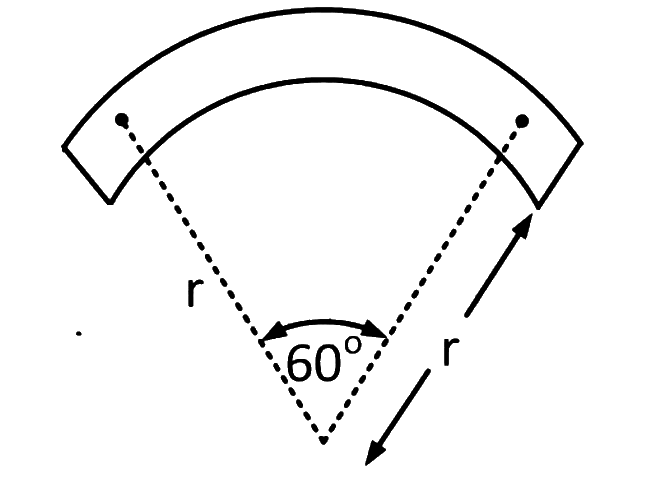
The magnetic moment of an iron bar is M. It is now bent in such a way that it forms an arc section of a circle subtending an angle of 60∘ at the centre. The magnetic moment of this arc section is
Show answer and solution
Answer: (a)
Pole strength m=M/L is unchanged; M′=m× chord.
Arc L subtends 60∘=π/3: r=π3L.
With 60∘ at the centre the triangle is equilateral, so chord =r=π3L.
Bar Magnet & Magnetic Moment · Cutting & bending a magnet
An iron bar of length L has magnetic moment M. It is bent at the middle of its length such that the two arms make an angle 60∘ with each other. The magnetic moment of this new magnet is:
Show answer and solution
Answer: (b)
Pole strength m=M/L is unchanged.
Each arm is L/2 with 60∘ between them, so the triangle formed is equilateral: end-to-end distance =L/2.
Bar Magnet & Magnetic Moment · Poles, monopoles & field lines
Which of the following statements are correct?
(A) Electric monopoles do not exist whereas magnetic monopoles exist.
(B) Magnetic field lines due to a solenoid at its ends and outside cannot be completely straight and confined.
(C) Magnetic field lines are completely confined within a toroid.
(D) Magnetic field lines inside a bar magnet are not parallel.
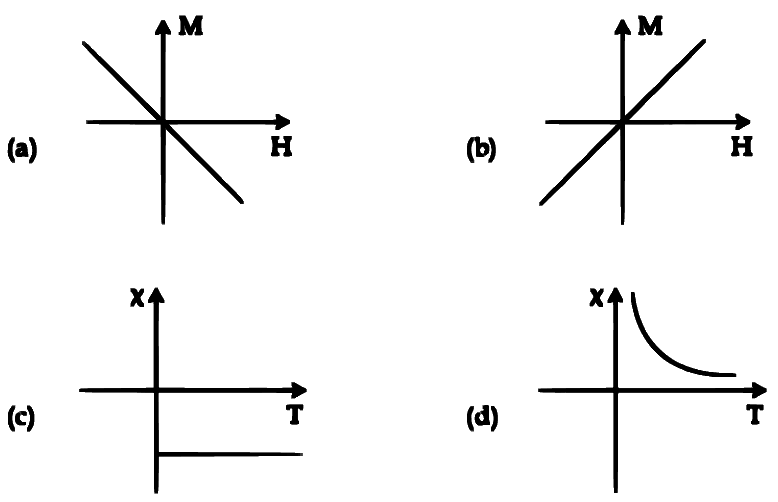
(E) χ=−1 is the condition for a perfect diamagnetic material, where χ is its magnetic susceptibility. Choose the correct answer from the options given below:
Show answer and solution
Answer: (c)
(A) Wrong: electric monopoles (single charges) exist; magnetic monopoles do not.
(B) Field lines spread out at the ends of a finite solenoid, so they are not straight and confined there.
(C) Correct: in an ideal toroid all field lines stay inside the core.
(D) Wrong: inside a bar magnet the lines are nearly parallel (S to N).
(E) Correct: perfect diamagnet (superconductor) has χ=−1, so μr=0 and B=0 inside.
Bar Magnet & Magnetic Moment · Magnetic moment of a magnet & a current loop
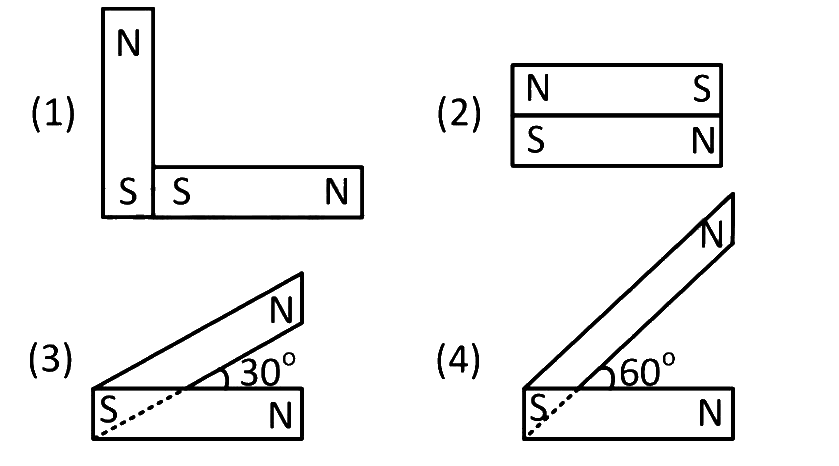
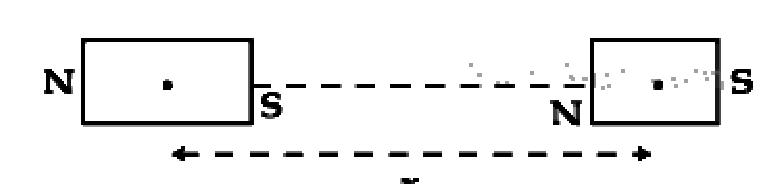
Following figures show the arrangement of bar magnets in different configurations. Each magnet has magnetic dipole moment m. Which configuration has highest net magnetic dipole moment?
Show answer and solution
Answer: (c)
Each moment points from S to N; add them as vectors: Mnet=2mcos(θ/2) for angle θ between them.
Magnetisation: B, H, M, χ & μ · Permeability: B = μH
A magnetising field of 5000 A/m produces a magnetic flux of 4×10⁻⁵ Wb in an iron rod of cross- sectional area 0.4 cm2. The permeability of the rod (in Wb/Am) is
Magnetisation: B, H, M, χ & μ · Permeability: B = μH
An iron rod is placed parallel to magnetic field of intensity H. The magnetic flux through the rod is Φ and its cross-sectional area is A. The magnetic permeability (μ) of the rod is
Magnetisation: B, H, M, χ & μ · Permeability: B = μH
An iron rod is placed parallel to magnetic field intensity 1000 A/m. The magnetic flux through the rod is 3×10⁻⁴ Wb and its cross-sectional area is 1.5 cm2. The magnetic permeability of rod in Wb/A-m is
Magnetisation: B, H, M, χ & μ · Permeability: B = μH
An iron rod is placed parallel to magnetic field intensity 2000 A/m. The magnetic flux through rod is 6×10⁻⁴ wb and its cross sectional area is 3 cm2. The magnetic permeability of the rod in wb/A-m is
Magnetisation: B, H, M, χ & μ · Relations: B = μ0(H + M), μr = 1 + χ
The relationship between the magnetic susceptibility (χ) and magnetic permeability (μ) of a material is (μ0 and μr is the permeability of free space and relative permeability respectively)
Magnetisation: B, H, M, χ & μ · Solenoid & toroid with a core
A solenoid has a core made of material with relative permeability 400. The magnetic field produced in the interior of solenoid is 1.0 T. The magnetic intensity in SI units is α×105. The value of α is ______.
Magnetisation: B, H, M, χ & μ · Intensity of magnetisation: M = m/V
A paramagnetic substance in the form of a cube with sides 1 cm has a magnetic dipole moment 20×10−6 J/T when a magnetic intensity 60×103 A/m is applied. Its magnetic susceptibility is
Magnetisation: B, H, M, χ & μ · Intensity of magnetisation: M = m/V
A domain in a ferromagnetic substance is in the form of a cube of side 'L'. If it contains 'N' atoms and each atomic dipole moment M then the magnetisation of the domain is
Show answer and solution
Answer: (b)
Total dipole moment of the domain =NM; volume =L3.
Magnetisation: B, H, M, χ & μ · Solenoid & toroid with a core
The region inside a current carrying toroid is filled with a material (Niobium) having susceptibility χ=2.6×10⁻⁵. The percentage increase in the magnetic field in the presence of Niobium over that without it, is
Show answer and solution
Answer: (c)
With the material B′=(1+χ)B, so percentage increase =χ×100.
Magnetisation: B, H, M, χ & μ · Solenoid & toroid with a core
A rod with a circular cross-section area 2 cm2 and length 40 cm is wound uniformly with 400 turns of an insulated wire. If a current 0.4 A flows in the wire winding, the total magnetic flux produced inside the winding is 4π×10−6 Wb. The relative permeability of the rod is
(Given permeability of vacuum μ0=4π×10−7 N m A−2)
Show answer and solution
Answer: (c)
B=AΦ=2×10−44π×10−6=2π×10−2T
n=0.4400=1000m−1, so μ0nI=4π×10−7×1000×0.4=1.6π×10−4T
Magnetisation: B, H, M, χ & μ · Relations: B = μ0(H + M), μr = 1 + χ
If M is the magnetisation induced in the material, H is the magnetic field intensity, B is the net magnetic field inside the material then the correct relation between them is ( μ0= permeability of free space)
Show answer and solution
Answer: (d)
Inside a material the field has two parts: the applied μ0H and the extra μ0M from magnetisation.
Magnetisation: B, H, M, χ & μ · Solenoid & toroid with a core
The magnetic field (B) inside a long solenoid having ' n ' turns per unit length and carrying current ' i ' when iron core is kept in it, is ( μ0= permeability of vacuum, χ= magnetic susceptibility)
Show answer and solution
Answer: (a)
Without core B0=μ0ni; the core multiplies it by μr.
Magnetisation: B, H, M, χ & μ · Solenoid & toroid with a core
The percentage increase in magnetic field (B) when space within a current carrying solenoid is filled with magnesium (magnetic susceptibility χMg=1.2×10⁻⁵) is:
Magnetisation: B, H, M, χ & μ · Intensity of magnetisation: M = m/V
A bar of iron having magnetic moment 2.4 Am2 weighs 66 g. If the density of the material of the bar is 7700 kg/m3, the intensity of magnetisation in Am−1 is
Show answer and solution
Answer: (b)
Volume V=77000.066=8.57×10⁻⁶m3
Intensity of magnetisation =Vm=8.57×10−62.4=2.8×10⁵A m−1
Magnetisation: B, H, M, χ & μ · Solenoid & toroid with a core
The space within the current carrying toroid is filled with aluminium of susceptibility ' χ '. The percentage increase in the magnetic field ' B ' will be
Magnetisation: B, H, M, χ & μ · Permeability: B = μH
A magnetic intensity of 500 A/m, produces a magnetic flux of 2.4×10⁻⁵ Wb in an iron bar of cross- sectional area 0.4 cm2. The magnetic permeability of the iron bar is
Show answer and solution
Answer: (b)
B=AΦ=0.4×10−42.4×10−5=0.6 T
μ=HB=5000.6=1.2×10⁻³ (SI unit T m/A, i.e. N/A2; the 'N/m2' in the options is a misprint).
Magnetisation: B, H, M, χ & μ · Solenoid & toroid with a core
A solenoid having 400 turns per metre has a core of a material with relative permeability 400. When a current of 0.5 A is passed through it, the magnetization of the core material in Am−1 is nearly
Magnetisation: B, H, M, χ & μ · Solenoid & toroid with a core
The free space inside a current carrying toroid is filled with a material of susceptibility 2×10⁻². The percentage increase in the value of magnetic field inside the toroid will be
Magnetisation: B, H, M, χ & μ · Solenoid & toroid with a core
A solenoid of 1200 turns is wound uniformly in a single layer on a glass tube 2 m long and 0.2 m in diameter. The magnetic intensity at the center of the solenoid when a current of 2 A flows through it is:
Show answer and solution
Answer: (c)
Magnetic intensity inside a long solenoid: H=nI (independent of the core and the diameter).
Magnetisation: B, H, M, χ & μ · Solenoid & toroid with a core
The magnetic intensity at the center of a long current carrying solenoid is found to be 1.6×10³ Am−1. If the number of turns is 8 per cm, then the current flowing through the solenoid is __________ A.
Numerical answer type. Work it out, then open the answer.
Magnetisation: B, H, M, χ & μ · Solenoid & toroid with a core
A solenoid of 500 turns/m is carrying a current of 3 A. Its core is made of iron which has relative permeability 5001. The magnitude of magnetization is
Magnetisation: B, H, M, χ & μ · Solenoid & toroid with a core
The space inside a straight current carrying solenoid is filled with a magnetic material having magnetic susceptibility equal to 1.2 × 10⁻⁵. What is fractional increase in the magnetic field inside solenoid with respect to air as medium inside the solenoid?
Magnetisation: B, H, M, χ & μ · Relations: B = μ0(H + M), μr = 1 + χ
The magnetic susceptibility of the material of a rod is 349 and permeability of vacuum μ0 is 4π×10−7 SI units. Absolute permeability of the material of the rod in SI units is
Magnetisation: B, H, M, χ & μ · Relations: B = μ0(H + M), μr = 1 + χ
The magnetic susceptibility of a material of a rod is 499. Permeability in vacuum is 4π× 10−7 H/m. Absolute permeability of the material of the rod is:
Magnetisation: B, H, M, χ & μ · Solenoid & toroid with a core
The value of aluminium susceptibility is 2.2 × 10⁻⁵. The percentage increase in the magnetic field if space within a current carrying toroid is filled with aluminium is 104x. Then the value of x is _________________.
Numerical answer type. Work it out, then open the answer.
Show answer and solution
Answer: 22
Filling the toroid raises B by the factor (1+χ), so percentage increase =χ×100.
Magnetisation: B, H, M, χ & μ · Permeability: B = μH
An iron rod is placed parallel to magnetic field of intensity 2000 A/m. The magnetic flux through the rod is 6×10⁻⁴ Wb and its cross-sectional area is 3 cm2. The magnetic permeability of the rod in A-mWb is
Magnetisation: B, H, M, χ & μ · Intensity of magnetisation: M = m/V
A domain in a ferromagnetic substance is in the form of a cube of side 1μm. If it contains 8×10¹⁰ atoms and each atomic dipole has a dipole moment of 9×10⁻²⁴ Am2, then the magnetisation of the domain is
Magnetisation: B, H, M, χ & μ · Permeability: B = μH
A magnetizing field of 5000 A/m produces a magnetic flux of 4×10⁻⁵ Wb in an iron rod of cross- sectional area 0.4 cm2. The permeabilit of the rod in Wb/A-m, is
Magnetisation: B, H, M, χ & μ · Intensity of magnetisation: M = m/V
A paramagnetic substance in the form of a cube with sides 1 cm has a magnetic dipole moment of 20 × 10−6 J/ T when a magnetic intensity of 60 × 103 A/m is applied. Its magnetic susceptibility is
Field of a Magnet & Magnet in a Uniform Field · Field of a bar magnet
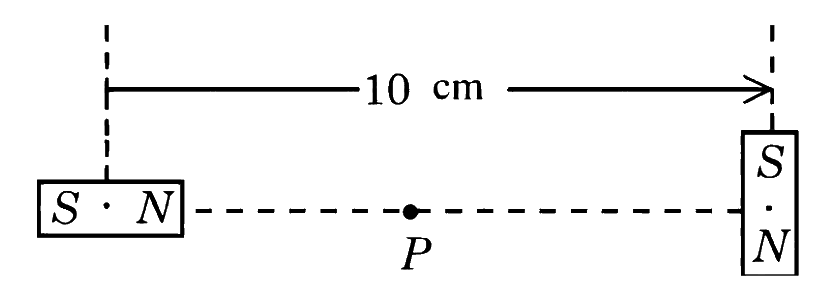
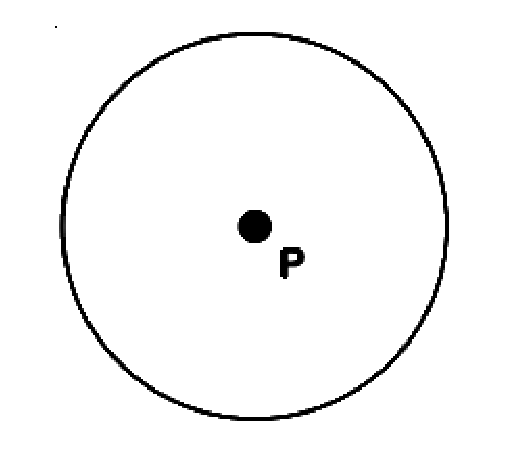
Two identical small bar magnets each of dipole moment 35 J/T are placed at a center to center separation of 10 cm, with their axes perpendicular to each other as shown in figure. The value of magnetic field at the point P midway between the magnets is α×10−3 T. The value of α is (μ0=4π×10−7 Tm/A)
Numerical answer type. Work it out, then open the answer.
Show answer and solution
Answer: 12
P is 5 cm from each centre: on the axis of the left magnet and on the equatorial line of the right magnet.
B1=4πμ0r32M (horizontal), B2=4πμ0r3M (vertical); they are perpendicular.
Field of a Magnet & Magnet in a Uniform Field · Work & potential energy
A magnetic dipole lying parallel to a magnetic field requires 'W' units of work to turn it through 30∘. The torque required to keep this needle in this position is
Field of a Magnet & Magnet in a Uniform Field · Work & potential energy
A short bar magnet placed with its axis at 30∘ with an external field of 800 Gauss, experiences a torque of 0.016 N.m. The work done in moving it from most stable to most unstable position is α×10−3 J. The value of α is ______.
Numerical answer type. Work it out, then open the answer.
Show answer and solution
Answer: 64
B=800G=0.08T; τ=MBsin30∘⇒MB=0.50.016=0.032J
Most stable to most unstable: W=2MB=0.064J=64×10−3J
Field of a Magnet & Magnet in a Uniform Field · Work & potential energy
The work done in turning a magnet of magnetic moment ' M ' by an angle of 90∘ from the meridian is ' n ' times the corresponding Work done to turn it through an angle of 60∘ where the value of ' n ' is (cos90∘=0,cos60∘=0.5)
Field of a Magnet & Magnet in a Uniform Field · Work & potential energy
A magnetic dipole experiences a torque of 803 N m when placed in uniform magnetic field in such a way that dipole moment makes angle of 60∘ with magnetic field. The potential energy of the dipole is:
Q66JEE Main 2025 · 28 JAN · SHIFT 2 (One or more correct)Difficult
Field of a Magnet & Magnet in a Uniform Field · Field of a bar magnet
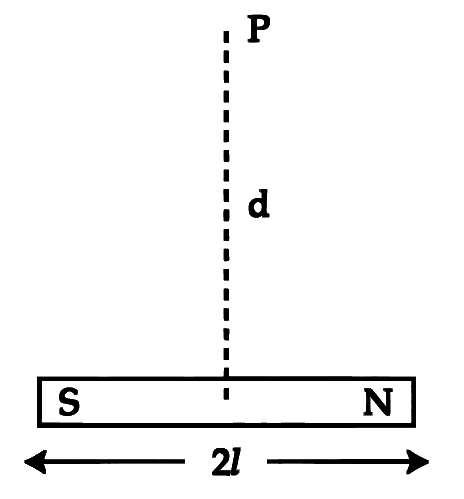
A bar magnet has total length 2l=20 units and the field point P is at a distance d=10 units from the centre of the magnet. If the relative uncertainty of length measurement is 1%, then uncertainty of the magnetic field at point P is:
Show answer and solution
Answer: (c)
P is on the equatorial line: B=4πμ0(d2+l2)3/2M (treat M as given).
BΔB=23⋅d2+l22dΔd+2lΔl
d=l=10, Δd=Δl=1% of 10 =0.1: BΔB=23⋅2002+2=0.03
Field of a Magnet & Magnet in a Uniform Field · Work & potential energy
The magnetic moment of a bar magnet is 0.5 Am2. It is suspended in a uniform magnetic field of 8×10⁻² T. The work done in rotating it from its most stable to most unstable position is:
Show answer and solution
Answer: (c)
Most stable θ=0∘, most unstable θ=180∘: W=MB(1−cos180∘)=2MB.
Field of a Magnet & Magnet in a Uniform Field · Field of a bar magnet
The magnetic potential due to a magnetic dipole at a point on its axis situated at a distance of 20 cm from its center is 1.5×10⁻⁵ T m. The magnetic moment of the dipole is _________ A m2. (Given: 4πμ0=10−7 TmA−1)
Numerical answer type. Work it out, then open the answer.
Field of a Magnet & Magnet in a Uniform Field · Work & potential energy
A bar magnet with a magnetic moment 5.0 Am2 is placed in parallel position relative to a magnetic field of 0.4 T. The amount of required work done in turning the magnet from parallel to antiparallel position relative to the field direction is _____________.
Show answer and solution
Answer: (d)
Parallel to antiparallel: W=MB(cos0∘−cos180∘)=2MB.
Field of a Magnet & Magnet in a Uniform Field · Work & potential energy
A bar magnet having a magnetic moment of 2.0 × 10⁵ JT−1, is placed along the direction of uniform magnetic field of magnitude B = 14 × 10−5 T. The work done in rotating the magnet slowly through 60∘ from the direction of field is:
Field of a Magnet & Magnet in a Uniform Field · Work & potential energy
A magnetic dipole of magnetic moment M, is freely suspended in a magnetic field of induction B. The minimum and maximum values of potential energy of the dipole, respectively are
Field of a Magnet & Magnet in a Uniform Field · Field of a bar magnet
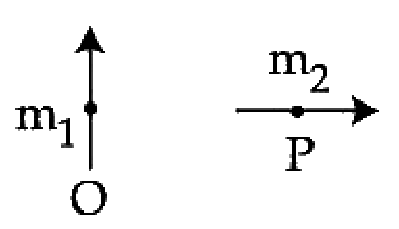
Two short magnetic dipoles m1 and m2 each having magnetic moment of 1 Am2 are placed at point O and P respectively. The distance between OP is 1 meter. The torque experienced by the magnetic dipole m2 due to the presence of m1 is ........... × 10−7 Nm.
Numerical answer type. Work it out, then open the answer.
Show answer and solution
Answer: 1
P is on the equatorial line of m1 (which points up), so B1=4πμ0r3m1, pointing down.
B1=10−7×131=10−7T
m2 points right, perpendicular to B1: τ=m2B1sin90∘=1×10⁻⁷N m
Field of a Magnet & Magnet in a Uniform Field · Field of a bar magnet
Two identical bar magnets each of magnetic moment M, separated by some distance are kept perpendicular to each other. The magnetic induction at a point at the same distance d from the centre of magnets, is (μ0= permeability of free space)
Show answer and solution
Answer: (c)
The point lies on the axis of one magnet and on the equatorial line of the other, at distance d from both.
Baxial=4πμ0d32M, Beq=4πμ0d3M, and the two fields are perpendicular.
Field of a Magnet & Magnet in a Uniform Field · Field of a bar magnet
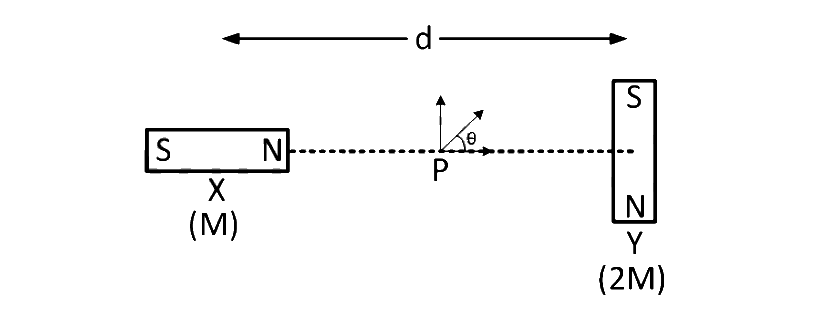
Two magnetic dipoles X and Y are placed at a separation d, with their axes perpendicular to each other. The dipole moment of Y is twice that of X. A particle of charge q is passing, through their midpoint P, at angle θ = 45° with the horizontal line, as shown in figure. What would be the magnitude of force on the particle at that instant?
(d is much larger than the dimensions of the dipole)
Show answer and solution
Answer: (d)
P lies on the axis of X: BX=4πμ0(d/2)32M, along X's moment (S to N), i.e. to the right.
P lies on the equatorial line of Y: BY=4πμ0(d/2)32M, opposite to Y's moment (Y points down), i.e. upward.
BX=BY, so the resultant B points at 45∘ to the horizontal.
The velocity is also at 45∘, so v∥B and F=qvBsin0∘=0.
Field of a Magnet & Magnet in a Uniform Field · Work & potential energy
A magnet of total magnetic moment 10−2 i^ A-m2 is placed in a time varying magnetic field, Bi^ (cos ωt) where B = 1 Tesla and ω = 0.125 rad/s. The work done for reversing the direction of the magnetic moment at t = 1 second, is -
Show answer and solution
Answer: (a)
Work to reverse a dipole in field B′: W=MB′(cos0∘−cos180∘)=2MB′.
At t=1 s: B′=Bcos(ωt)=cos(0.125rad)≈0.992T
W=2×10−2×0.992≈0.0198J
The keyed value 0.014J=2MBcos45∘ corresponds to ωt=π/4. Key: (a) 0.014 J.
Field of a Magnet & Magnet in a Uniform Field · Work & potential energy
A 250-turn rectangular coil of length 2.1 cm and width 1.25 cm carries a current of 85 μA and subjected to a magnetic field of strength 0.85 T. Work done for rotating the coil by 180° against the torque is
Show answer and solution
Answer: (d)
Rotating through 180∘ from stable position: W=2NIAB.
A=2.1×10−2×1.25×10−2=2.625×10⁻⁴m2
W=2×250×85×10−6×2.625×10−4×0.85≈9.5×10⁻⁶J
The nearest option is 9.1 μJ, so the answer is (d).
Field of a Magnet & Magnet in a Uniform Field · Work & potential energy
A bar magnet is hung by a thin cotton thread in a uniform horizontal magnetic field and is in equilibrium state. The energy required to rotate it by 60° is W. Now the torque required to keep the magnet in this new position is
Show answer and solution
Answer: (b)
Work to rotate from equilibrium: W=MB(1−cos60∘)=2MB, so MB=2W.
Field of a Magnet & Magnet in a Uniform Field · Torque on a magnet or current loop
A rectangular coil of length 0.12 m and width 0.1 m having 50 turns of wire is suspended vertically in a uniform magnetic field of strength 0.2 weber/m2. The coil carries a current of 2 A. If the plane of the coil is inclined at an angle of 30° with the direction of the field, the torque required to keep the coil in stable equilibrium will be
Show answer and solution
Answer: (d)
NIAB=50×2×(0.12×0.1)×0.2=0.24N m
The plane makes 30∘ with B, so the normal (moment) makes 60∘: τ=NIABsin60∘=NIABcos30∘.
Field of a Magnet & Magnet in a Uniform Field · Field of a bar magnet
The mid points of two small magnetic dipoles of length d in end-on positions, are separated by a distance x, (x > > d). The force between them is proportional to x−n where n is:
Show answer and solution
Answer: (d)
Field of the first dipole on its axis: B=4πμ0x32m1.
Force on the second dipole along the axis: F=m2dxdB=4πμ0x46m1m2
Field of a Magnet & Magnet in a Uniform Field · Torque on a magnet or current loop
A bar magnet of magnetic moment M is placed at right angles to a magnetic induction B. If a force F is experienced by each pole of the magnet, the length of the magnet will be
Show answer and solution
Answer: (a)
Perpendicular to B, the two pole forces form a couple: τ=F×l.
Field of a Magnet & Magnet in a Uniform Field · Field of a bar magnet
Two short bar magnets of length 1 cm each have magnetic moments 1.20 Am2 and 1.00 Am2 respectively. They are placed on a horizontal table parallel to each other with their N poles pointing towards the South. They have a common magnetic equator and are separated by a distance of 20.0 cm. The value of the resultant horizontal magnetic induction at the mid-point O of the line joining their centres is close to ( Horizontal component of earth's magnetic induction is 3.6×10⁻⁵ Wb/m2)
Show answer and solution
Answer: (b)
O lies on the common equatorial line of both magnets. Their moments point south, so each equatorial field at O points north (opposite to M), same as BH.
Field of a Magnet & Magnet in a Uniform Field · Work & potential energy
A magnetic needle suspended parallel to a magnetic field requires 3J of work to turn it through 60°. The torque needed to maintain the needle in this position will be
Field of a Magnet & Magnet in a Uniform Field · Work & potential energy
A short bar magnet of magnetic moment 0.4 J T−1 is placed in a uniform magnetic field of 0.16 T. The magnet is in stable equilibrium when the potential energy is
Field of a Magnet & Magnet in a Uniform Field · Field of a bar magnet
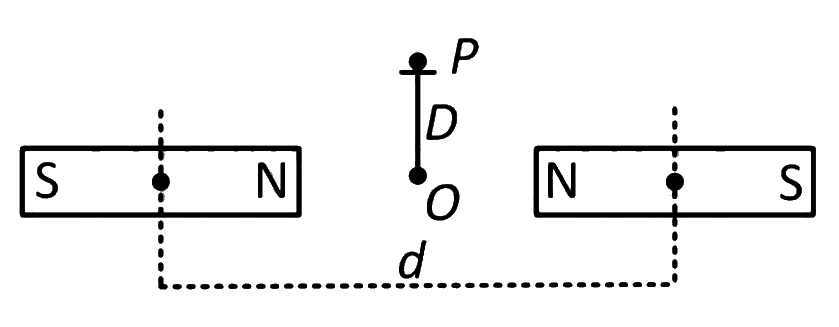
Two identical bar magnets are fixed with their centers at a distance d apart. A stationary charge Q is placed at P in between the gap of the two magnets at a distance D from the centre O as shown in the figure
The force on the charge Q is
Show answer and solution
Answer: (a)
Magnetic force on a charge: F=Qv×B.
The charge is stationary, v=0, so F=0 whatever the field at P.
Field of a Magnet & Magnet in a Uniform Field · Work & potential energy
A bar magnet having a magnetic moment of 2 × 10⁴ J T−1 is free to rotate in a horizontal plane. A horizontal magnetic field B = 6 × 10⁻⁴ T exists in the space. The work done in taking the magnet slowly from a direction parallel to the field to a direction 60° from the field is
Field of a Magnet & Magnet in a Uniform Field · Torque on a magnet or current loop
A coil in the shape of an equilateral triangle of side l is suspended between the pole pieces of a permanent magnet such that Bis in plane of the coil. If due to a current i in the triangle a torque τ acts on it, the side l of the triangle is
Field of a Magnet & Magnet in a Uniform Field · Work & potential energy
A magnetic needle lying parallel to a magnetic field requires W units of work to turn it through 60∘. The torque needed to maintain the needle in this position will be:
Field of a Magnet & Magnet in a Uniform Field · Work & potential energy
The work done in turning a magnet of magnetic moment M by an angle of 90∘ from the meridian, is n times the corresponding work done to turn it through an angle of 60∘. The value of n is given by
Q94JEE Main 2022 · 29 JUL · SHIFT 2EasyOld syllabus
Earth's Magnetism · Dip, BH, BV & Earth as a dipole
The vertical component of the earth's magnetic field is 6×10⁻⁵ T at any place where the angle of dip is 37∘. The earth's resultant magnetic field at that place will be (Given tan37∘=43)
Q95JEE Main 2022 · 29 JUN · SHIFT 1EasyOld syllabus
Earth's Magnetism · Dip, BH, BV & Earth as a dipole
At a certain place the angle of dip is 30∘ and the horizontal component of earth's magnetic field is 0.5 G. The earth's total magnetic field (in G), at that certain place, is:
Q99JEE Main 2021 · 16 MAR · SHIFT 1MediumOld syllabus
Earth's Magnetism · Neutral points
A bar magnet of length 14 cm is placed in the magnetic meridian with its north pole pointing towards the geographic north pole. A neutral point is obtained at a distance of 18 cm from the center of the magnet. If BH = 0.4 G, the magnetic moment of the magnet is: (1G = 10−4 T)
Show answer and solution
Answer: (b)
N pole towards north: neutral point on the equatorial line, 4πμ0(r2+l2)3/2M=BH.
l=7 cm, r=18 cm: r2+l2=373cm2, (373)3/2≈7203cm3=7.2×10−3m3
Earth's Magnetism · Dip, BH, BV & Earth as a dipole
If the angle of dip at places A and B are 30∘ and 45∘ respectively, then the ratio of horizontal component of earth's magnetic field at A to that at B will be
[sin45∘=cos45∘=21,sin6π=21,cos6π=23]
Show answer and solution
Answer: (c)
H=BEcosδ; taking the same total field BE at both places,
Earth's Magnetism · Dip, BH, BV & Earth as a dipole
The relations amongst the three elements of earth's magnetic field, namely horizontal component H, vertical component V and dip δ are, (BE = total magnetic field)
Earth's Magnetism · Dip, BH, BV & Earth as a dipole
At a point A on the earth’s surface the angle of dip, δ = + 25°. At a point B on the earth's surface the angle of dip, δ = – 25°. We can interpret that:
Show answer and solution
Answer: (b)
Positive dip: the north end of the needle dips below horizontal, which happens in the northern hemisphere.
Negative dip: the north end points upward (south end dips), which happens in the southern hemisphere.
So the answer is (b) A is in the northern and B in the southern hemisphere.
Q103JEE Main 2019 · 10 JAN · SHIFT 2DifficultOld syllabus
Earth's Magnetism · Dip, BH, BV & Earth as a dipole
At some location on earth, the horizontal component of earth’s magnetic field is 18 × 10−6 T. At this location, magnetic needle of length 0.12 m and pole strength 1.8 Am is suspended from its mid- point using a thread, it makes 45° angle with horizontal in equilibrium. To keep this needle horizontal, the vertical force that should be applied at one of its ends is -
Show answer and solution
Answer: (d)
Needle rests at 45∘ (the dip), so BV=BHtan45∘=18×10−6T.
When horizontal, BV gives a couple τ=mBVL about the midpoint.
A short bar magnet is placed in the magnetic meridian of the earth with north pole pointing north. Neutral points are found at a distance of 30 cm from the magnet on the east - West line, drawn through the middle point of the magnet. The magnetic moment of the magnet in Am2 is close to: (Given 4πμ0 = 10−7 in SI units and BH = Horizontal component of earth's magnetic field = 3.6 × 10 −5 Tesla.)
Show answer and solution
Answer: (a)
N pole pointing north: neutral points lie on the equatorial (east-west) line, where the magnet's field points south and cancels BH.
Q106JEE Main 2014 · 9 APR · SHIFT 1MediumOld syllabus
Earth's Magnetism · Dip, BH, BV & Earth as a dipole
The magnetic field of earth at the equator is approximately 4 × 10⁻⁵ T. The radius of earth is 6.4 × 10⁶ m. Then the dipole moment of the earth will be nearly of the order of:
Q107JEE Main 2013 · 25 APR · SHIFT 1MediumOld syllabus
Earth's Magnetism · Dip, BH, BV & Earth as a dipole
The earth's magnetic field lines resemble that of a dipole at the centre of the earth. If the magnetic moment of this dipole is close to 8×10²² Am2, the value of earth's magnetic field near the equator is close to (radius of the earth = 6.4×10⁶ m)
Vibration Magnetometer · Time period: T = 2π√(I/MB)
The periodic time of a magnet in vibration magnetometer is T0. If a magnet is replaced by another magnet whose moment of inertia is three times and magnetic moment is one-third of the original magnet, then time period of new magnet will be
Vibration Magnetometer · Comparing fields at two places
The frequency of oscillation of a small magnet in a magnetic field of induction 'B' is 'n'. If the frequency of oscillations of the same magnet in a field of induction 'X' falls to (3n), the value of 'X' is
Vibration Magnetometer · Sum & difference positions
Two bar magnets A and B are geometrically similar but the magnetic moment of A is twice that of B.T1 is the time period of oscillation when their like poles are kept together. When unlike poles are kept together, the time period of oscillation is T2. The ratio T1:T2 will be
Show answer and solution
Answer: (c)
Both arrangements have the same moment of inertia 2I, so T∝Mnet1.
Let MB=M, MA=2M. Like poles together (sum position): Mnet=2M+M=3M.
Unlike poles together (difference position): Mnet=2M−M=M.
Vibration Magnetometer · Time period: T = 2π√(I/MB)
A magnetic needle of magnetic moment 6×10⁻² Am2 and moment of inertia 9.6×10⁻⁵ kg m2 performs simple harmonic motion in a magnetic field of 0.01 T. Time taken to complete 10 oscillations is [Take π=3.14]
Vibration Magnetometer · Time period: T = 2π√(I/MB)
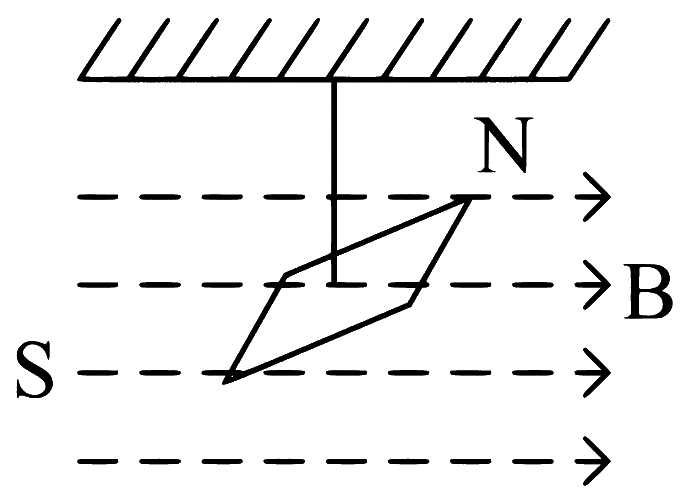
The magnetic moment and moment of inertia of a magnetic needle as shown are, respectively, 1.0×10⁻² A m2 and π210−6 kg m2. If it completes 10 oscillations in 10 s, the magnitude of the magnetic field is
Vibration Magnetometer · Time period: T = 2π√(I/MB)
In a uniform magnetic field of 0.049 T, a magnetic needle performs 20 complete oscillations in 5 seconds as shown. The moment of inertia of the needle is 9.8×10⁻⁶ kg m2. If the magnitude of magnetic moment of the needle is x×10−5 Am2, then the value of 'x' is:
Vibration Magnetometer · Comparing fields at two places
At certain place a magnet makes 30 oscillations per minute. At another place if the magnetic induction is increased by two times the magnetic induction at first place, then the time period of same magnet will be
Show answer and solution
Answer: (a)
30 oscillations per minute: T1=3060=2 s.
Field increased by two times the original: B2=B+2B=3B.
Q117JEE Main 2023 · 12 APR · SHIFT 1DifficultOld syllabus
Vibration Magnetometer · Comparing fields at two places
A compass needle oscillates 20 times per minute at a place where the dip is 30∘ and 30 times per minute where the dip is 60∘. The ratio of total magnetic field due to the earth at two places respectively is x4. The value of x is
Numerical answer type. Work it out, then open the answer.
Q118JEE Main 2022 · 27 JUL · SHIFT 1MediumOld syllabus
Vibration Magnetometer · Time period: T = 2π√(I/MB)
Two bar magnets oscillate in a horizontal plane in earth's magnetic field with time periods of 3 s and 4 s respectively. If their moments of inertia are in the ratio of 3:2, then the ratio of their magnetic moments will be:
Q119JEE Main 2022 · 27 JUL · SHIFT 2DifficultOld syllabus
Vibration Magnetometer · Comparing fields at two places
A compass needle of oscillation magnetometer oscillates 20 times per minute at a place P of dip 30∘. The number of oscillations per minute become 10 at another place Q of 60∘ dip. The ratio of the total magnetic field at the two places (BQ:BP) is:
Vibration Magnetometer · Time period: T = 2π√(I/MB)
Two bar magnets 'P' and 'Q' are kept in uniform magnetic field 'B' with magnetic moments 'MP' and 'MQ' respectively. Magnet 'P' is oscillating with frequency twice that of magnet 'Q'. If the moment of inertia of the magnet 'P' is twice that of magnet 'Q' then
Vibration Magnetometer · Time period: T = 2π√(I/MB)
In a uniform magnetic field, the magnetic needle has a magnetic moment 9.85 × 10⁻² A m2 and moment of inertia 5 × 10⁻⁶ kg m2. If it performs 10 complete oscillations in 5 seconds then the magnitude of the magnetic field is _______________ mT. [Take π2 as 9.85]
Numerical answer type. Work it out, then open the answer.
Q122JEE Main 2019 · 12 APR · SHIFT 1DifficultOld syllabus
Vibration Magnetometer · Comparing fields at two places
A magnetic compass needle oscillates 30 times per minute at a place where the dip is 45°, and 40 times per minute where the dip is 30°. If B1 and B2 are respectively the total magnetic field due to the earth at the two places, then the ratio B2B1 is best given by:
Vibration Magnetometer · Time period: T = 2π√(I/MB)
A magnetic needle of magnetic moment 6.7 × 10⁻² A m2 and moment of inertia 7.5 × 10⁻⁶ kg m2 is performing simple harmonic oscillations in a magnetic field of 0.01 T. Time taken for 10 complete oscillations is:
Vibration Magnetometer · Comparing fields at two places
A vibration magnetometer placed in magnetic meridian has a small bar magnet. The magnet executes oscillations with a time period of 2 sec in earth's horizontal magnetic field of 24 microtesla. When a horizontal field of 18 microtesla is produced opposite to the earth's field by placing a current carrying wire, the new time period of magnet will be
Show answer and solution
Answer: (d)
For a vibration magnetometer T=2πMBHI, so T∝BH1.
Net horizontal field =24−18=6μT (wire's field is opposite to earth's field).
Vibration Magnetometer · Cut, stacked or heavier magnets
The length of a magnet is large compared to its width and breadth. The time period of its oscillation in a vibration magnetometer is 2 s. The magnet is cut along its length into three equal parts and these parts are then placed on each other with their like poles together. The time period of this combination will be
Show answer and solution
Answer: (b)
Taking the three pieces as each of length 3l: mass 3m, moment 3M, and I1=12(m/3)(l/3)2=27I.
Stacked with like poles together: I′=3⋅27I=9I, M′=3⋅3M=M.
Vibration Magnetometer · Cut, stacked or heavier magnets
A thin rectangular magnet suspended freely has a period of oscillation equal to T. Now it is broken into two equal halves (each having half of the original length) and one piece is made to oscillate freely in the same field. If its period of oscillation is T′, the ratio TT′ is
Show answer and solution
Answer: (b)
T=2πMBHI with I=12ml2 for a thin magnet.
Each half: mass 2m, length 2l, so I′=12(m/2)(l/2)2=8I and M′=2M.
Vibration Magnetometer · Sum & difference positions
Two bar magnets having same geometry with magnetic moments M and 2M, are firstly placed in such a way that their similar poles are same side then its time period of oscillation is T1. Now the polarity of one of the magnet is reversed then time period of oscillation is T2, then
Show answer and solution
Answer: (a)
Like poles together (sum position): moment 3M, inertia 2I: T1=2π3MB2I
One reversed (difference position): moment M: T2=2πMB2I
Magnetic Materials & Curie Law · Dia, para & ferromagnetic properties
A diamagnetic liquid is filled in a U-tube. One arm of a U-tube is placed in an external magnetic field with the meniscus in line with the field. The level of the liquid in that arm will
Show answer and solution
Answer: (b)
A diamagnetic liquid is pushed from the stronger field region towards the weaker field region.
So the liquid in the arm inside the field is pushed out and its level goes down.
Given below are two statements: one is labelled as Assertion (A) and the other is labelled as Reason (R).
Consider a ferromagnetic material:
Assertion (A): The individual atoms in a ferromagnetic material possess a magnetic dipole moment and interact with one another in such a way that they spontaneously align themselves forming domains.
Reason (R): At high enough temperature, the domain structure of ferromagnetic material disintegrates. Thus, magnetization will disappear at high enough temperature known as Curie temperature.
In the light of the above statements, choose the correct answer from the options given below:
Show answer and solution
Answer: (d)
(A) is true. Neighbouring atomic dipoles in a ferromagnet interact (exchange interaction) and align spontaneously, forming domains.
(R) is true. Above the Curie temperature, thermal agitation breaks up the domain structure and the magnetisation disappears.
(R) explains how domains are destroyed at high temperature. It does not explain why they form, which is what (A) states.
So the answer is (d): both are true, but (R) is not the correct explanation of (A).
Magnetic Materials & Curie Law · Dia, para & ferromagnetic properties
Given below are two statements:
Statement I: For diamagnetic substance, −1≤χ<0, where χ is the magnetic susceptibility. Statement II: Diamagnetic substances when placed in an external magnetic field, tend to move from stronger to weaker part of the field.
In the light of the above statements, choose the correct answer from the options given below
Show answer and solution
Answer: (a)
Statement I: diamagnetic χ is negative, with χ=−1 for a perfect diamagnet, so −1≤χ<0 is true.
Statement II: diamagnetic substances move from stronger to weaker field, true.
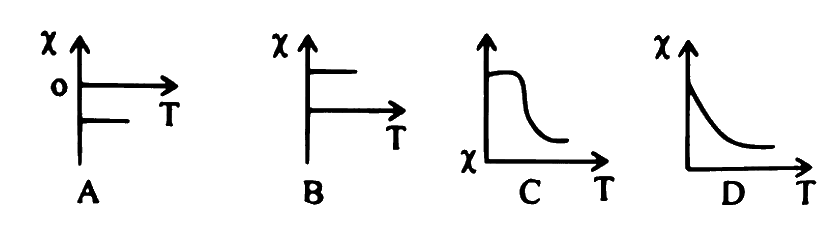
Magnetic Materials & Curie Law · Curie law, χ–T graphs & Curie temperature
According to Curie's law in magnetism, the correct relation is ( M= magnetization in paramagnetic sample, B= applied magnetic field, T= absolute temperature of the material, C= curie's constant)
Magnetic Materials & Curie Law · Curie law, χ–T graphs & Curie temperature
Given below are two statements:
Statement I: Susceptibilities of paramagnetic and ferromagnetic substances increase with decrease in temperature.
Statement II: Diamagnetism is a result of orbital motions of electrons developing magnetic moments opposite to the applied magnetic field.
Choose the correct answer from the options given below:
Show answer and solution
Answer: (a)
Statement I is true. For a paramagnet χ=C/T, and for a ferromagnet above TC, χ=C/(T−TC). Both increase as T decreases.
Statement II is true. An applied field changes the orbital motion of electrons and induces magnetic moments opposite to the field (Lenz's law). This is diamagnetism.
Magnetic Materials & Curie Law · Curie law, χ–T graphs & Curie temperature
Statement I: The ferromagnetic property depends on temperature. At high temperature, ferromagnet becomes paramagnet.
Statement II: At high temperature, the domain wall area of a ferromagnetic substance increases. In the light of the above statements, choose the most appropriate answer from the options given below:
Show answer and solution
Answer: (b)
Statement I is true. A ferromagnet becomes paramagnetic above its Curie temperature.
Statement II is false. At high temperature the domain structure is destroyed by thermal agitation. The domain wall area does not increase.
So the answer is (b): Statement I is true but Statement II is false.
Magnetic Materials & Curie Law · Dia, para & ferromagnetic properties
A perfectly diamagnetic sphere has a small spherical cavity at its centre, which is filled with a paramagnetic substance. The whole system is placed in a uniform magnetic field B. Then the field inside the paramagnetic substance is:
Show answer and solution
Answer: (b)
A perfect diamagnet has χ=−1, so μr=0 and B=μ0μrH=0 inside it. It expels the field completely, as a superconductor does.
No field lines enter the diamagnetic shell, so none reach the cavity at its centre.
With no field applied to it, the paramagnetic substance has no magnetisation, so the field there is zero.
Magnetic Materials & Curie Law · Curie law, χ–T graphs & Curie temperature
A paramagnetic sample shows a net magnetisation of 6 A/m when it is placed in an external magnetic field of 0.4 T at a temperature of 4 K. When the sample is placed in an external magnetic field of 0.3 T at a temperature of 24 K, then the magnetisation will be:
Magnetic Materials & Curie Law · Dia, para & ferromagnetic properties
A thin diamagnetic rod is placed vertically between the poles of an electromagnet. When the current in the electromagnet is switched on, then the diamagnetic rod is pushed up, out of the horizontal magnetic field. Hence the rod gains gravitational potential energy. The work required to do this comes from
Show answer and solution
Answer: (a)
A diamagnetic rod is pushed from a strong field region to a weaker one, so it gains potential energy.
When the current is switched on, the changing flux induces an emf in the electromagnet coil. The source does extra work against this emf.
That extra energy from the current source becomes the rod's gain in potential energy.
Magnetic Materials & Curie Law · Dia, para & ferromagnetic properties
An example of a perfect diamagnet is a superconductor. This implies that when a superconductor is put in a magnetic field of intensity B, the magnetic field Bs inside the superconductor will be such that:
Show answer and solution
Answer: (b)
Perfect diamagnet: χ=−1, so μr=1+χ=0.
Bs=μ0μrH=0: the field is completely expelled (Meissner effect).
Magnetic Materials & Curie Law · Dia, para & ferromagnetic properties
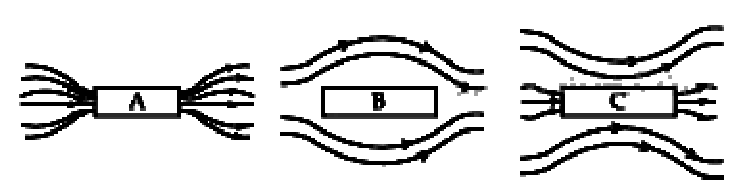
Three identical bars A, B and C are made of different magnetic materials. When kept in a uniform magnetic field, the field lines around them look as follows:
Make the correspondence of these bars with their material being diamagnetic (D), ferromagnetic (F) and paramagnetic (P):
Show answer and solution
Answer: (b)
A: field lines crowd strongly into the bar, so it is ferromagnetic (F).
B: field lines bend away and avoid the bar, so it is diamagnetic (D).
C: lines are drawn in only slightly, so it is paramagnetic (P).
Magnetic Materials & Curie Law · Dia, para & ferromagnetic properties
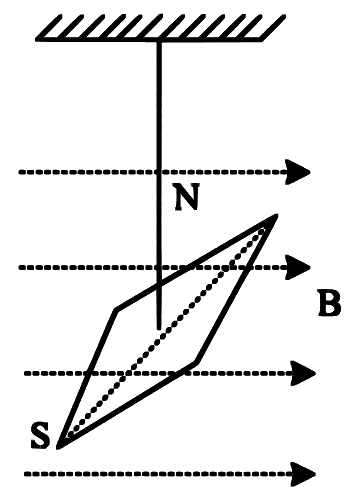
There are four light-weight-rod samples A, B, C, D separately suspended by threads. A bar magnet is slowly brought near each sample and the following observations are noted
Magnetic Materials & Curie Law · Dia, para & ferromagnetic properties
Relative permittivity and permeability of a material εr and μr, respectively. Which of the following values of these quantities are allowed for a diamagnetic material?
Magnetic Materials & Curie Law · Dia, para & ferromagnetic properties
If the magnetic dipole moment of an atom of diamagnetic material, paramagnetic material and ferromagnetic material are denoted by μd, μp and μf respectively, then
Show answer and solution
Answer: (a)
Diamagnetic atom: all electrons paired, net moment μd=0.
Paramagnetic and ferromagnetic atoms have unpaired electrons, so μp=0 and μf=0.
Hysteresis, Soft Iron vs Steel & Shielding · Demagnetising current
The coercivity of a magnet is 5×10³ A/m. The amount of current required to be passed in a solenoid of length 30 cm and the number of turns 150, so that the magnet gets demagnetised when inside the solenoid is ________ A.
Numerical answer type. Work it out, then open the answer.
Show answer and solution
Answer: 10
The solenoid's H=nI must equal the coercivity: I=nH.
Hysteresis, Soft Iron vs Steel & Shielding · Hysteresis curve: retentivity & coercivity
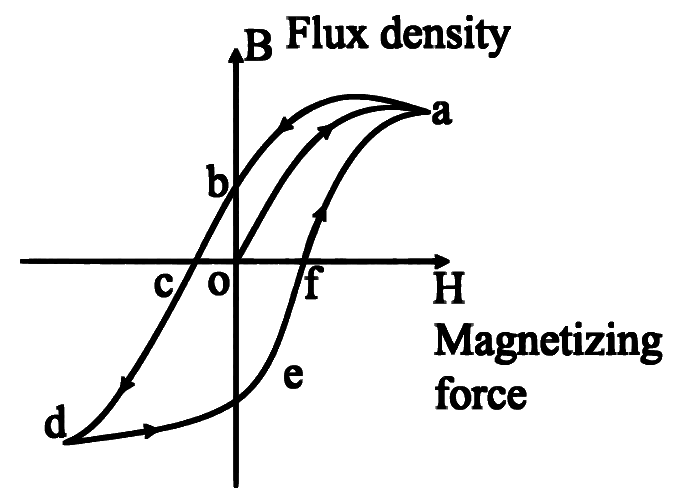
In the hysteresis curve the value of magnetization (B) which will be present in a substance when value of magnetizing force (H) is made zero (H=0) is called as
Show answer and solution
Answer: (b)
When H is reduced to zero, some magnetisation B remains in the material.
This remaining value is the retentivity, also called remanence.
Hysteresis, Soft Iron vs Steel & Shielding · Demagnetising current
The current required to be passed through a solenoid of 15 cm length and 60 turns in order of demagnetise a bar magnet of magnetic intensity 2.4×10³ Am−1 is ___________ A.
Numerical answer type. Work it out, then open the answer.
Show answer and solution
Answer: 6
The solenoid's H=nI must equal the given magnetic intensity (the coercivity): I=nH.
Hysteresis, Soft Iron vs Steel & Shielding · Soft iron vs steel: choice of material
Given below are two statements: one is labelled as Assertion A and the other is labelled as Reason R
Assertion A: Electromagnets are made of soft iron.
Reason R: Soft iron has high permeability and low retentivity.
In the light of above, statements, choose the most appropriate answer from the options given below.
Show answer and solution
Answer: (a)
A is true. Electromagnet cores are made of soft iron.
R is true. High permeability gives a strong field for a small current, and low retentivity means the core loses its magnetism when the current is switched off.
These are the reasons soft iron is used, so R explains A.
Q187JEE Main 2020 · 7 JAN · SHIFT 2EasyOld syllabus
Hysteresis, Soft Iron vs Steel & Shielding · Hysteresis curve: retentivity & coercivity
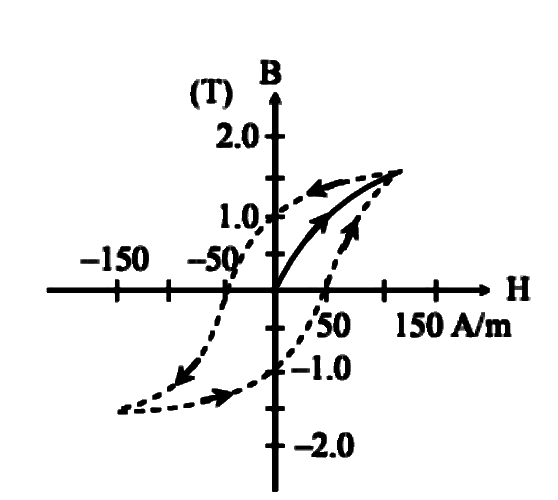
The figure gives experimentally measured B vs H variation in a ferromagnetic material. The retentivity, coercivity and saturation, respectively, of the material are:
Show answer and solution
Answer: (a)
Retentivity is B at H=0, where the loop cuts the B-axis: 1.0 T.
Coercivity is the ∣H∣ at which B=0, where the loop cuts the H-axis: 50 A/m.
Saturation is the maximum B, at the tip of the loop: 1.5 T.
Q188JEE Main 2020 · 2 SEP · SHIFT 1EasyOld syllabus
Hysteresis, Soft Iron vs Steel & Shielding · Soft iron vs steel: choice of material
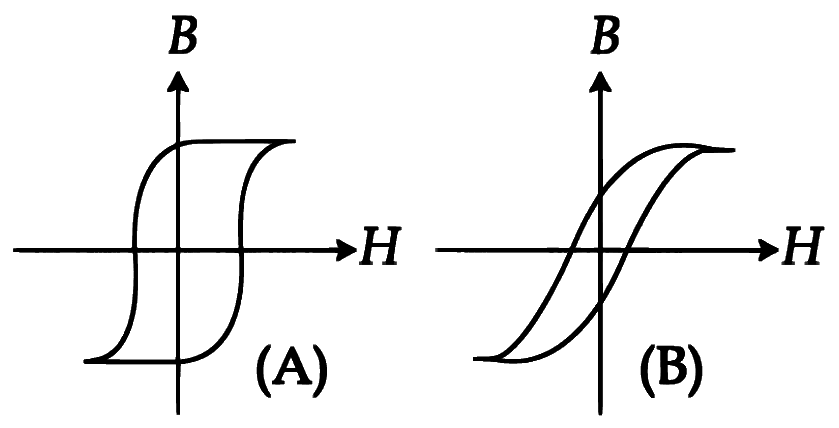
Magnetic materials used for making permanent magnets (P) and magnets in a transformer (T) have different properties of the following, which property best matches for the type of magnet required?
Show answer and solution
Answer: (b)
A permanent magnet must keep its magnetism (large retentivity) and resist demagnetisation (large coercivity).
A transformer core needs small coercivity and a narrow loop for low hysteresis loss. That rules out options (a) and (d).
So the answer is (b) P: large retentivity, large coercivity.
Hysteresis, Soft Iron vs Steel & Shielding · Demagnetising current
A bar magnet is demagnetized by inserting it inside a solenoid of length 0.2 m, 100 turns, and carrying a current of 5.2 A. The coercivity of the bar magnet is:
Show answer and solution
Answer: (b)
To demagnetise the magnet, the solenoid field must equal the coercivity: H=nI=LNI.
Hysteresis, Soft Iron vs Steel & Shielding · Demagnetising current
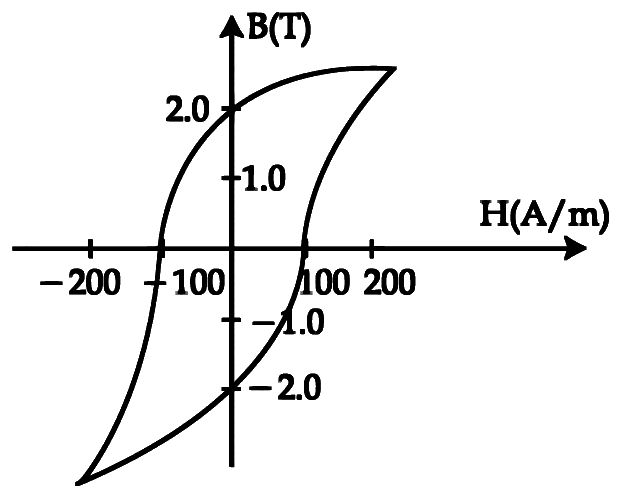
The B-H curve for a ferromagnet is shown in the figure. The ferromagnet is placed inside a long solenoid with 1000 turns/cm. The current that should be passed in the solenoid to demagnetise the ferromagnet completely is:
Show answer and solution
Answer: (a)
From the graph, the loop cuts the H-axis at H=100 A/m. This is the coercivity, the field needed to demagnetise the ferromagnet.
Hysteresis, Soft Iron vs Steel & Shielding · Demagnetising current
The coercivity of a small magnet where the ferromagnet gets demagnetized is 3×10³ Am−1. The current required to be passed in a solenoid of length 10 cm and number of turns 100, so that the magnet gets demagnetized when inside the solenoid, is:
Show answer and solution
Answer: (c)
The solenoid's H=nI must equal the coercivity: I=nH.