Physics Circle home Home Practice Hub Register / Login

Home›Practice Hub›Chapters›Mechanical Properties of Solids

Physics PYQs · MHT CET · JEE Main · NEET

Mechanical Properties of Solids

Questions
150
MHT CET
13
JEE Main
121
NEET
16
Years
2003–2026
0 of 150 attemptedPick an answer to see the solution

Q1JEE Main 2026 · 23 JAN · SHIFT 1Easy

Elastic Behaviour, Stress & Strain · Stress-strain curve & materials

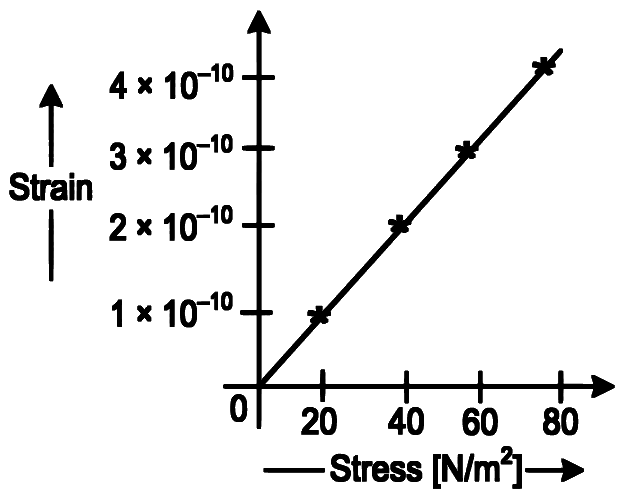
The strain-stress plot for materials A,B,CA, B, C and DD is shown in the figure. Which material has the largest Young's modulus?

Figure

Show answer and solution

Answer: (d)

  1. Y=stressstrainY = \frac{\text{stress}}{\text{strain}}
  2. The graph has strain on the y-axis and stress on the x-axis, so slope =strainstress=1Y= \frac{\text{strain}}{\text{stress}} = \frac{1}{Y}.
  3. Largest YY means the smallest slope, which is line CC.
  4. So the answer is (d) CC.
Report a mistake
Q2JEE Main 2026 · 2 APR · SHIFT 1Medium

Elastic Behaviour, Stress & Strain · Stress

A uniform wire of length ll of weight ww is suspended from the roof with a weight of WW at the other end. The stress in the wire at l3\frac{l}{3} distance from the top is (WA+2γwA)\left(\frac{W}{A} + \frac{2}{\gamma}\frac{w}{A}\right), where AA is the cross sectional area of the wire. The value of γ\gamma is ________.

Numerical answer type. Work it out, then open the answer.

Show answer and solution

Answer: 3

  1. Tension at a point = load WW + weight of the wire below that point.
  2. At l3\frac{l}{3} from the top, the wire below is 2l3\frac{2l}{3} long, weighing 23w\frac{2}{3}w.
  3. Stress =WA+23wA= \frac{W}{A} + \frac{2}{3}\frac{w}{A}, compare with WA+2γwA\frac{W}{A} + \frac{2}{\gamma}\frac{w}{A}.
  4. γ=3\gamma = 3
Report a mistake
Q3JEE Main 2024 · 1 FEB · SHIFT 1Easy

Elastic Behaviour, Stress & Strain · Elasticity, plasticity & elastic limit

With rise in temperature, the Young's modulus of elasticity:

Show answer and solution

Answer: (c)

  1. Heating increases the mean separation of atoms and weakens interatomic forces.
  2. Weaker restoring forces mean a smaller stress for the same strain, so YY falls.
  3. So the answer is (c) decreases.
Report a mistake
Q4JEE Main 2024 · 27 JAN · SHIFT 2Easy

Elastic Behaviour, Stress & Strain · Elasticity, plasticity & elastic limit

Given below are two statements: one is labelled as Assertion (A) and the other is labelled as Reason (R).

Assertion (A): The property of body, by virtue of which it tends to regain its original shape when the external force is removed, is Elasticity.

Reason (R): The restoring force depends upon the bonded inter atomic and inter molecular force of solid.

In the light of the above statements, choose the correct answer from the options given below:

Show answer and solution

Answer: (c)

  1. (A) is the definition of elasticity: a body tends to regain its shape when the deforming force is removed. True.
  2. (R) The restoring force comes from interatomic and intermolecular bonds in the solid. True.
  3. These bond forces are exactly what make the body regain its shape, so (R) explains (A).
  4. So the answer is (c).
Report a mistake
Q5JEE Main 2024 · 5 APR · SHIFT 2Medium

Elastic Behaviour, Stress & Strain · Elasticity, plasticity & elastic limit

Match List I with List II:

Choose the correct answer from the options given below:

LIST ILIST II
A.A force that restores an elastic body of unit area to its original stateI.Bulk modulus
B.Two equal and opposite forces parallel to opposite facesII.Young's modulus
C.Forces perpendicular everywhere to the surface per unit area same everywhereIII.Stress
D.Two equal and opposite forces perpendicular to opposite facesIV.Shear modulus
Show answer and solution

Answer: (b)

  1. A: restoring force per unit area is stress (III).
  2. B: equal and opposite forces parallel to opposite faces cause shear, so shear modulus (IV).
  3. C: equal normal force per unit area all over the surface is a volume change, so bulk modulus (I).
  4. D: equal and opposite forces perpendicular to opposite faces change the length, so Young's modulus (II).
  5. So the answer is (b) A-III, B-IV, C-I, D-II.
Report a mistake
Q6JEE Main 2024 · 1 FEB · SHIFT 2Medium

Elastic Behaviour, Stress & Strain · Strain

One end of a metal wire is fixed to a ceiling and a load of 2 kg2\text{ kg} hangs from the other end. A similar wire is attached to the bottom of the load and another load of 1 kg1\text{ kg} hangs from this lower wire. Then the ratio of longitudinal strain of upper wire to that of the lower wire will be ________. [Area of cross section of wire =0.005 cm2,Y=2×10¹¹ N m−2= 0.005\text{ cm}^2, Y = 2 \times 10^{11}\text{ N m}^{-2} and g=10 m s−2g = 10\text{ m s}^{-2} ]

Numerical answer type. Work it out, then open the answer.

Show answer and solution

Answer: 3

  1. Upper wire holds both loads: T1=(2+1)×10=30 NT_1 = (2 + 1) \times 10 = 30\ \text{N}.
  2. Lower wire holds only the 1 kg load: T2=1×10=10 NT_2 = 1 \times 10 = 10\ \text{N}.
  3. Same AA and YY, so strain ∝T\propto T: ε1ε2=3010\frac{\varepsilon_1}{\varepsilon_2} = \frac{30}{10}
  4. Ratio =3= 3
Report a mistake
Q7JEE Main 2024 · 31 JAN · SHIFT 2Medium

Elastic Behaviour, Stress & Strain · Strain

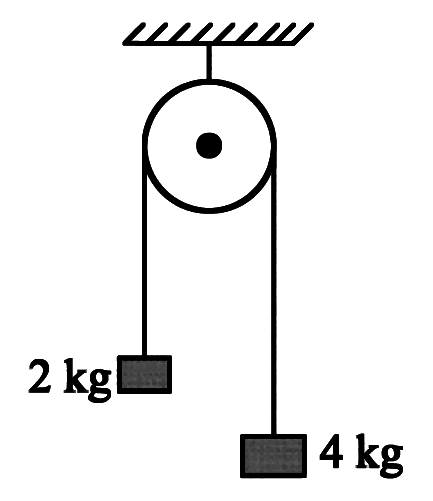
Two blocks of mass 2 kg2\text{ kg} and 4 kg4\text{ kg} are connected by a metal wire going over a smooth pulley as shown in figure. The radius of wire is 4.0×10⁻⁵ m4.0 \times 10^{-5}\text{ m} and Young's modulus of the metal is 2.0×10¹¹ N/m22.0 \times 10^{11}\text{ N/m}^2. The longitudinal strain developed in the wire is 1απ\frac{1}{\alpha\pi}. The value of α\alpha is _________. [Use g=10 m/s2g = 10\text{ m/s}^2]

Figure

Numerical answer type. Work it out, then open the answer.

Show answer and solution

Answer: 12

  1. Atwood machine tension: T=2m1m2gm1+m2=2×2×4×106=803 NT = \frac{2m_1 m_2 g}{m_1 + m_2} = \frac{2 \times 2 \times 4 \times 10}{6} = \frac{80}{3}\ \text{N}
  2. A=πr2=π(4×10⁻⁵)2=16π×10−10 m2A = \pi r^2 = \pi (4 \times 10^{-5})^2 = 16\pi \times 10^{-10}\ \text{m}^2
  3. Strain =TAY=80/316π×10−10×2×1011=80/3320π=112π= \frac{T}{AY} = \frac{80/3}{16\pi \times 10^{-10} \times 2 \times 10^{11}} = \frac{80/3}{320\pi} = \frac{1}{12\pi}
  4. α=12\alpha = 12
Report a mistake
Q8JEE Main 2024 · 30 JAN · SHIFT 1Medium

Elastic Behaviour, Stress & Strain · Strain

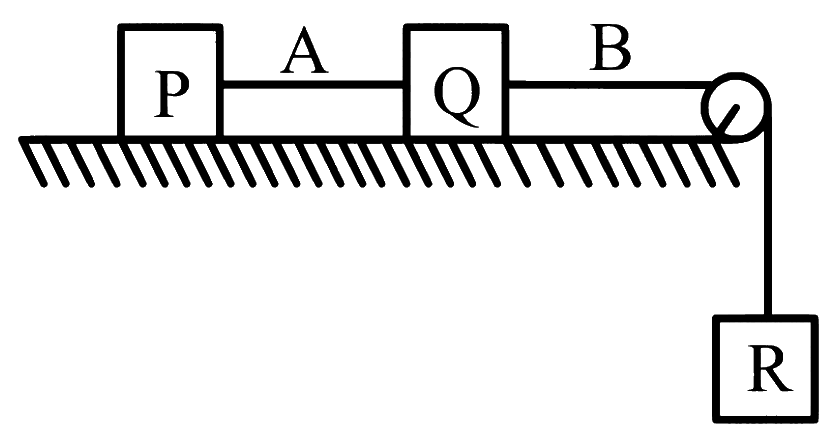
Each of three blocks P,QP, Q andRR shown in figure has a mass of 3 kg3\text{ kg}. Each of the wires AA and BB has cross-sectional area 0.005 cm20.005\text{ cm}^2 and Young's modulus 2×10¹¹ N m−22 \times 10^{11}\text{ N m}^{-2}. Neglecting friction, the longitudinal strain on wire BB is ________ ×10−4\times 10^{-4}. (Take g=10 m/s2g = 10\text{ m/s}^2)

Figure

Numerical answer type. Work it out, then open the answer.

Show answer and solution

Answer: 2

PQT_BP + Q (6 kg)T_B = (6 kg) a = 6 x 10/3 = 20 Na = 30 N / 9 kg = 10/3 m/s²
  1. Whole system: a=mRgmP+mQ+mR=309=103 m/s2a = \frac{m_R g}{m_P + m_Q + m_R} = \frac{30}{9} = \frac{10}{3}\ \text{m/s}^2
  2. Wire BB pulls both PP and QQ: TB=(mP+mQ)a=6×103=20 NT_B = (m_P + m_Q)a = 6 \times \frac{10}{3} = 20\ \text{N}
  3. A=0.005 cm2=5×10⁻⁷ m2A = 0.005\ \text{cm}^2 = 5 \times 10^{-7}\ \text{m}^2
  4. Strain =TBAY=205×10−7×2×1011=2×10−4= \frac{T_B}{AY} = \frac{20}{5 \times 10^{-7} \times 2 \times 10^{11}} = 2 \times 10^{-4}
  5. Answer: 22
Report a mistake
Q9JEE Main 2023 · 24 JAN · SHIFT 2Easy

Elastic Behaviour, Stress & Strain · Elasticity, plasticity & elastic limit

Given below are two statements: one is labelled as Assertion A and the other is labelled as Reason R

Assertion A: Steel is used in the construction of buildings and bridges.

Reason R: Steel is more elastic and its elastic limit is high.

In the light of above statements, choose the most appropriate answer from the options given below

Show answer and solution

Answer: (a)

  1. Steel has a high Young's modulus (more elastic) and a high elastic limit.
  2. So it deforms little and returns to shape under heavy loads, which is why it is used in buildings and bridges.
  3. Both are true and (R) explains (A).
  4. So the answer is (a).
Report a mistake
Q10NEET 2023Easy

Elastic Behaviour, Stress & Strain · Stress

Let a wire be suspended from the ceiling (rigid support) and stretched by a weight WW attached at its free end. The longitudinal stress at any point of cross-sectional area AA of the wire is:

Show answer and solution

Answer: (a)

  1. Wire mass is neglected, so the tension is WW at every point of the wire.
  2. Longitudinal stress =tensionarea=WA= \frac{\text{tension}}{\text{area}} = \frac{W}{A}
  3. So the answer is (a) W/AW/A.
Report a mistake
Q11JEE Main 2023 · 6 APR · SHIFT 2Easy

Elastic Behaviour, Stress & Strain · Stress

A metal block of mass mm is suspended from a rigid support through a metal wire of diameter 14 mm14\text{ mm}. The tensile stress developed in the wire under equilibrium state is 7×10⁵ N m−27 \times 10^{5}\text{ N m}^{-2}. The value of mass mm is _________ kg\text{kg}. (Take, g=9.8 m s−2g = 9.8\text{ m s}^{-2} and π=227\pi = \frac{22}{7})

Numerical answer type. Work it out, then open the answer.

Show answer and solution

Answer: 11

  1. Stress σ=mgA\sigma = \frac{mg}{A}, so m=σAgm = \frac{\sigma A}{g}.
  2. r=7 mmr = 7\text{ mm}: A=227×(7×10−3)2=1.54×10⁻⁴ m2A = \frac{22}{7} \times (7 \times 10^{-3})^2 = 1.54 \times 10^{-4}\ \text{m}^2
  3. m=7×105×1.54×10−49.8=107.89.8m = \frac{7 \times 10^{5} \times 1.54 \times 10^{-4}}{9.8} = \frac{107.8}{9.8}
  4. m=11 kgm = 11\ \text{kg}
Report a mistake
Q12JEE Main 2023 · 6 APR · SHIFT 1Easy

Elastic Behaviour, Stress & Strain · Strain

A steel rod has a radius of 20 mm20\text{ mm} and a length of 2.0 m2.0\text{ m}. A force of 62.8 kN62.8\text{ kN} stretches it along its length. Young's modulus of steel is 2.0×10¹¹ N/m22.0 \times 10^{11}\text{ N/m}^2. The longitudinal strain produced in the wire is _____________ ×10−5\times 10^{-5}

Numerical answer type. Work it out, then open the answer.

Show answer and solution

Answer: 25

  1. Strain =stressY=Fπr2Y= \frac{\text{stress}}{Y} = \frac{F}{\pi r^2 Y}
  2. Stress =62.8×1033.14×(0.02)2=62.8×1031.256×10−3=5×10⁷ N/m2= \frac{62.8 \times 10^{3}}{3.14 \times (0.02)^2} = \frac{62.8 \times 10^3}{1.256 \times 10^{-3}} = 5 \times 10^{7}\ \text{N/m}^2
  3. Strain =5×1072×1011=2.5×10−4=25×10−5= \frac{5 \times 10^{7}}{2 \times 10^{11}} = 2.5 \times 10^{-4} = 25 \times 10^{-5}
  4. Answer: 2525
Report a mistake
Q13NEET 2022 · PHASE 1Medium

Elastic Behaviour, Stress & Strain · Elasticity, plasticity & elastic limit

Given below are two statements: One is labelled as Assertion (A) and the other is labelled as Reason (R).

Assertion (A): The stretching of a spring is determined by the shear modulus of the material of the spring.

Reason (R): A coil spring of copper has more tensile strength than a steel spring of same dimensions.

In the light of the above statements, choose the most appropriate answer from the options given below:

Show answer and solution

Answer: (c)

  1. (A) When a coil spring is stretched, the wire of the coil gets twisted, so its stretching depends on the shear modulus. True.
  2. (R) Steel has a much higher tensile strength than copper, so a copper spring is not stronger. False.
  3. So the answer is (c) (A) is true but (R) is false.
Report a mistake
Q14JEE Main 2022 · 30 JUL · SHIFT 2Medium

Elastic Behaviour, Stress & Strain · Strain

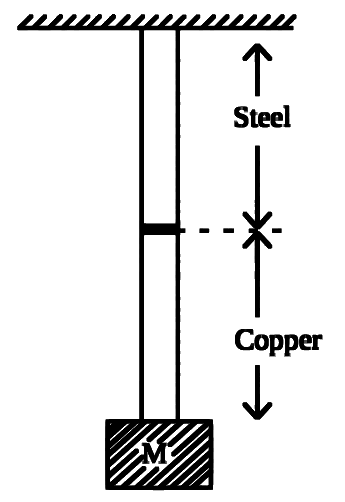
A block of mass M is attached to a wire. The upper part of wire is made of steel and lower part of wire of copper ( as shown in figure ). Both parts have the same area of cross section. Neglecting the mass of wires, the ratio of longitudinal strain developed in steel and copper wires is: ( Given, Young's modulus of steel =2×10¹¹ N/m2= 2 \times 10^{11}\text{ N/m}^2 and Young's modulus of copper =1.5×10¹¹ N/m2= 1.5 \times 10^{11}\text{ N/m}^2)

Figure

Show answer and solution

Answer: (d)

  1. Massless wire: both parts carry the same tension MgMg and have the same area, so the same stress.
  2. Strain =stressY∝1Y= \frac{\text{stress}}{Y} \propto \frac{1}{Y}
  3. εsεc=YcYs=1.5×10112×1011=34\frac{\varepsilon_s}{\varepsilon_c} = \frac{Y_c}{Y_s} = \frac{1.5 \times 10^{11}}{2 \times 10^{11}} = \frac{3}{4}
  4. So the answer is (d) 34\frac{3}{4}.
Report a mistake
Q15JEE Main 2022 · 28 JUL · SHIFT 2Medium

Elastic Behaviour, Stress & Strain · Strain

A string of area of cross-section 4 mm24\text{ mm}^2 and length 0.5 m0.5\text{ m} is connected with a rigid body of mass 2 kg2\text{ kg}. The body is rotated in a vertical circular path of radius 0.5 m0.5\text{ m}. The body acquires a speed of 5 m/s5\text{ m/s} at the bottom of the circular path. Strain produced in the string when the body is at the bottom of the circle is _________ ×10−5\times 10^{-5}.

(use Young's modulus 1011 N/m210^{11}\text{ N/m}^2 and g=10 m/s2g = 10\text{ m/s}^2)

Numerical answer type. Work it out, then open the answer.

Show answer and solution

Answer: 30

  1. At the bottom: T−mg=mv2rT - mg = \frac{mv^2}{r}
  2. T=2×10+2×520.5=20+100=120 NT = 2 \times 10 + \frac{2 \times 5^2}{0.5} = 20 + 100 = 120\ \text{N}
  3. Strain =TAY=1204×10−6×1011=3×10−4=30×10−5= \frac{T}{AY} = \frac{120}{4 \times 10^{-6} \times 10^{11}} = 3 \times 10^{-4} = 30 \times 10^{-5}
  4. Answer: 3030
Report a mistake
Q16JEE Main 2021 · 31 AUG · SHIFT 2Medium

Elastic Behaviour, Stress & Strain · Strain

Four identical hollow cylindrical columns of mild steel support a big structure of mass 50 ×\times 103 kg. The inner and outer radii of each column are 50 cm and 100 cm respectively. Assuming uniform local distribution, calculate the compression strain of each column. [Use Y = 2.0 ×\times 1011 Pa, g = 9.8 m/s2]

Show answer and solution

Answer: (b)

  1. Load per column F=50×103×9.84=1.225×10⁵ NF = \frac{50 \times 10^3 \times 9.8}{4} = 1.225 \times 10^{5}\ \text{N}
  2. Area A=π(R2−r2)=π(12−0.52)=0.75π=2.356 m2A = \pi(R^2 - r^2) = \pi(1^2 - 0.5^2) = 0.75\pi = 2.356\ \text{m}^2
  3. Strain =FAY=1.225×1052.356×2×1011≈2.6×10−7= \frac{F}{AY} = \frac{1.225 \times 10^5}{2.356 \times 2 \times 10^{11}} \approx 2.6 \times 10^{-7}
  4. So the answer is (b) 2.60×10−72.60 \times 10^{-7}.
Report a mistake
Q17MHT CET 2020 · 16 OCT · SHIFT 2Easy

Elastic Behaviour, Stress & Strain · Stress

Two wires AA and BB are stretched by the same load. The radius of wire AA is double the radius of wire BB. The stress on the wire BB as compared to the stress on the wire AA is

Show answer and solution

Answer: (d)

  1. Stress =Fπr2= \frac{F}{\pi r^2}, so for the same load stress ∝1r2\propto \frac{1}{r^2}.
  2. σBσA=(rArB)2=22=4\frac{\sigma_B}{\sigma_A} = \left(\frac{r_A}{r_B}\right)^2 = 2^2 = 4
  3. So the answer is (d) four times.
Report a mistake
Q18MHT CET 2020 · 16 OCT · SHIFT 2Medium

Elastic Behaviour, Stress & Strain · Stress

Two wires of different materials have same length LL and same diameter dd. The second wire is connected at the end of the first wire and forms one single wire of double the length. This wire is subjected to stretching force FF to produce the elongation I. The two wires have

Show answer and solution

Answer: (c)

  1. In series the same force FF acts through both wires, and both have the same area πd24\frac{\pi d^2}{4}.
  2. Stress =FA= \frac{F}{A} is therefore the same in both.
  3. Strain =stressY= \frac{\text{stress}}{Y} differs because the materials have different YY.
  4. So the answer is (c) same stress but different strain.
Report a mistake
Q19MHT CET 2019 · 2 MAY · SHIFT 1Easy

Elastic Behaviour, Stress & Strain · Elasticity, plasticity & elastic limit

Two identical wires of substances ' PP ' and ' QQ ' are subjected to equal stretching force along the length. If the elongation of ' QQ ' is more than that of ' PP ', then

Show answer and solution

Answer: (b)

  1. Same force on identical wires: ΔL=FLAY∝1Y\Delta L = \frac{FL}{AY} \propto \frac{1}{Y}.
  2. ΔLQ>ΔLP⇒YP>YQ\Delta L_Q > \Delta L_P \Rightarrow Y_P > Y_Q.
  3. A larger Young's modulus means the material resists deformation more, i.e. it is more elastic.
  4. So the answer is (b) PP is more elastic than QQ.
Report a mistake
Q20JEE Main 2019 · 8 APR · SHIFT 1Easy

Elastic Behaviour, Stress & Strain · Stress

A steel wire having a radius of 2.0 mm, carrying a load of 4 kg, is hanging from a ceiling. Given that g = 3.1π\pi ms–2, what will be the tensile stress that would be developed in the wire?

Show answer and solution

Answer: (a)

  1. Stress =mgπr2= \frac{mg}{\pi r^2}
  2. =4×3.1ππ(2×10⁻³)2=12.44×10−6= \frac{4 \times 3.1\pi}{\pi (2 \times 10^{-3})^2} = \frac{12.4}{4 \times 10^{-6}}
  3. =3.1×10⁶ N m−2= 3.1 \times 10^{6}\ \text{N m}^{-2}
  4. So the answer is (a).
Report a mistake
Q21NEET 2019Easy

Elastic Behaviour, Stress & Strain · Stress-strain curve & materials

The stress-strain curves are drawn for two different materials X and Y. It is observed that the ultimate strength point and the fracture point are close to each other for material X but are far apart for material Y.

We can say that materials X and Y are likely to be (respectively),

Show answer and solution

Answer: (c)

  1. Brittle material: fracture occurs soon after the ultimate strength point, so the two points are close (X).
  2. Ductile material: large plastic deformation between ultimate strength and fracture, so the points are far apart (Y).
  3. So the answer is (c) brittle and ductile.
Report a mistake
Q22JEE Main 2017Medium

Elastic Behaviour, Stress & Strain · Stress

A man grows into a giant such that his linear dimensions increase by a factor of 9. Assuming that his density remains same, the stress in the leg will change by a factor of:

Show answer and solution

Answer: (b)

  1. Weight ∝\propto volume ∝L3\propto L^3; leg cross-section area ∝L2\propto L^2.
  2. Stress =weightarea∝L3L2=L= \frac{\text{weight}}{\text{area}} \propto \frac{L^3}{L^2} = L
  3. LL increases 9 times, so stress increases 9 times.
  4. So the answer is (b) 9.
Report a mistake
Q23JEE Main 2026 · 5 APR · SHIFT 1Easy

Young's Modulus & Elongation · Young's modulus & its nature

The Young's modulus of steel wire of radius rr and length LL is YY.

If the radius rr and length LL of the wire are doubled then the value of YY

Show answer and solution

Answer: (c)

  1. Young's modulus is a property of the material only, not of the wire's dimensions.
  2. Changing rr and LL changes the elongation for a given load, but not YY.
  3. So the answer is (c) remains unchanged.
Report a mistake
Q24JEE Main 2026 · 6 APR · SHIFT 1Medium

Young's Modulus & Elongation · Comparing different materials

The two wires AA and BB of equal cross-section but of different materials are joined together. The ratio of Young's modulus of wire AA and wire BB is 20/11. When the joined wire is kept under certain tension the elongations in the wires AA and BB are equal. If the length of wire AA is 2.2 m, then the length of wire BB is

______ m.

Show answer and solution

Answer: (c)

  1. Series wires carry the same tension TT and have equal area: Δl=TLAY\Delta l = \frac{TL}{AY}
  2. Equal elongations give LAYA=LBYB\frac{L_A}{Y_A} = \frac{L_B}{Y_B}, so LB=LAYBYAL_B = L_A \frac{Y_B}{Y_A}
  3. LB=2.2×1120=1.21 mL_B = 2.2 \times \frac{11}{20} = 1.21\text{ m}
  4. So the answer is (c) 1.21.
Report a mistake
Q25JEE Main 2026 · 28 JAN · SHIFT 1Medium

Young's Modulus & Elongation · Comparing different materials

Two wires AA and BB made of different materials of lengths 6.0 cm and 5.4 cm, respectively and area of cross sections 3.0×10⁻⁵ m23.0 \times 10^{-5}\text{ m}^2 and 4.5×10⁻⁵ m24.5 \times 10^{-5}\text{ m}^2, respectively are stretched by the same magnitude under a given load. The ratio of the Young's modulus of AA to that of BB is x:3x : 3. The value of xx is ______

Show answer and solution

Answer: (d)

  1. Same load and same extension: Y=FLAΔl∝LAY = \frac{FL}{A\Delta l} \propto \frac{L}{A}
  2. YAYB=6.0/3.05.4/4.5=21.2=53\frac{Y_A}{Y_B} = \frac{6.0/3.0}{5.4/4.5} = \frac{2}{1.2} = \frac{5}{3}
  3. So x=5x = 5: answer (d).
Report a mistake
Q26JEE Main 2025 · 8 APR · SHIFT 2Easy

Young's Modulus & Elongation · Young's modulus & its nature

A 3 m long wire of radius 3 mm shows an extension of 0.1 mm when loaded vertically by a mass of 50 kg in an experiment to determine Young's modulus. The value of Young's modulus of the wire as per this experiment is P×1011P \times 10^{11} Nm−2{}^{-2}, where the value of PP is: (Take g=3πg = 3\pi m/s2{}^{2})

Show answer and solution

Answer: (d)

  1. Y=MgLπr2 ΔLY = \frac{MgL}{\pi r^2\, \Delta L}
  2. =50×3π×3π×(3×10−3)2×10−4=4509×10−10= \frac{50 \times 3\pi \times 3}{\pi \times (3 \times 10^{-3})^2 \times 10^{-4}} = \frac{450}{9 \times 10^{-10}}
  3. =5×10¹¹ N m−2= 5 \times 10^{11}\ \text{N m}^{-2}
  4. So P=5P = 5, answer (d).
Report a mistake
Q27JEE Main 2025 · 7 APR · SHIFT 1Easy

Young's Modulus & Elongation · Elongation: wires of the same material

Two wires A and B are made of same material having ratio of lengths LALB=13\frac{L_A}{L_B} = \frac{1}{3} and their diameters ratio dAdB=2\frac{d_A}{d_B} = 2. If both the wires are stretched using same force, what would be the ratio of their respective elongations?

Show answer and solution

Answer: (b)

  1. Same material and force: ΔL∝Ld2\Delta L \propto \frac{L}{d^2}
  2. ΔLAΔLB=LALB×(dBdA)2=13×14=112\frac{\Delta L_A}{\Delta L_B} = \frac{L_A}{L_B} \times \left(\frac{d_B}{d_A}\right)^2 = \frac{1}{3} \times \frac{1}{4} = \frac{1}{12}
  3. So the answer is (b) 1:121 : 12.
Report a mistake
Q28JEE Main 2024 · 30 JAN · SHIFT 1Easy

Young's Modulus & Elongation · Young's modulus & its nature

Young's modulus of material of a wire of length 'LL' and cross-sectional area AA is YY. If the length of the wire is doubled and cross-sectional area is halved then Young's modulus will be:

Show answer and solution

Answer: (d)

  1. Young's modulus depends only on the material, not on length or area.
  2. So the answer is (d) YY.
Report a mistake
Q29JEE Main 2024 · 29 JAN · SHIFT 2Easy

Young's Modulus & Elongation · Elongation: wires of the same material

A wire of length LL and radius rr is clamped at one end. If its other end is pulled by a force FF, its length increases by ll. If the radius of the wire and the applied force both are reduced to half of their original values keeping original length constant, the increase in length will become:

Show answer and solution

Answer: (a)

  1. ΔL∝Fr2\Delta L \propto \frac{F}{r^2} for the same LL and material.
  2. ΔL′l=F/2(r/2)2⋅r2F=1/21/4=2\frac{\Delta L'}{l} = \frac{F/2}{(r/2)^2} \cdot \frac{r^2}{F} = \frac{1/2}{1/4} = 2
  3. So the answer is (a) 2 times.
Report a mistake
Q30NEET 2024Medium

Young's Modulus & Elongation · Young's modulus & its nature

The maximum elongation of a steel wire of 1 m1\text{ m} length if the elastic limit of steel and its Young's modulus, respectively, are 8×10⁸ N m−28 \times 10^{8}\text{ N m}^{-2} and 2×10¹¹ N m−22 \times 10^{11}\text{ N m}^{-2}, is:

Show answer and solution

Answer: (a)

  1. Maximum stress is the elastic limit, so maximum strain =8×1082×1011=4×10−3= \frac{8 \times 10^{8}}{2 \times 10^{11}} = 4 \times 10^{-3}
  2. Δlmax=strain×L=4×10−3×1=4×10⁻³ m\Delta l_{max} = \text{strain} \times L = 4 \times 10^{-3} \times 1 = 4 \times 10^{-3}\text{ m}
  3. So the answer is (a) 4 mm.
Report a mistake
Q31JEE Main 2024 · 29 JAN · SHIFT 2Medium

Young's Modulus & Elongation · Elongation: wires of the same material

Two metallic wires PP and QQ have same volume and are made up of same material. If their area of cross sections are in the ratio 4:14 : 1 and force F1F_1 is applied to PP, an extension of Δl\Delta l is produced. The force which is required to produce same extension in QQ is F2F_2.

The value of F1F2\frac{F_1}{F_2} is _________.

Numerical answer type. Work it out, then open the answer.

Show answer and solution

Answer: 16

  1. Same volume and material: F=YA2ΔlV∝A2F = \frac{YA^2\Delta l}{V} \propto A^2 for the same Δl\Delta l.
  2. F1F2=(APAQ)2=(41)2\frac{F_1}{F_2} = \left(\frac{A_P}{A_Q}\right)^2 = \left(\frac{4}{1}\right)^2
  3. F1F2=16\frac{F_1}{F_2} = 16
Report a mistake
Q32JEE Main 2023 · 31 JAN · SHIFT 2Easy

Young's Modulus & Elongation · Young's modulus & its nature

For a solid rod, the Young's modulus of elasticity is 3.2×10¹¹ N m−23.2 \times 10^{11}\text{ N m}^{-2} and density is 8×10³ kg m−38 \times 10^{3}\text{ kg m}^{-3}. The velocity of longitudinal wave in the rod will be.

Show answer and solution

Answer: (b)

  1. Speed of longitudinal wave in a rod: v=Yρv = \sqrt{\frac{Y}{\rho}}
  2. v=3.2×10118×103=4×107=6.32×10³ m s−1v = \sqrt{\frac{3.2 \times 10^{11}}{8 \times 10^{3}}} = \sqrt{4 \times 10^{7}} = 6.32 \times 10^{3}\ \text{m s}^{-1}
  3. So the answer is (b).
Report a mistake
Q33JEE Main 2023 · 24 JAN · SHIFT 1Easy

Young's Modulus & Elongation · Young's modulus & its nature

A 100 m long wire having cross-sectional area 6.25×10⁻⁴ m26.25 \times 10^{-4}\text{ m}^2 and Young's modulus is 1010 N m−210^{10}\text{ N m}^{-2} is subjected to a load of 250 N, then the elongation in the wire will be:

Show answer and solution

Answer: (b)

  1. ΔL=FLAY\Delta L = \frac{FL}{AY}
  2. =250×1006.25×10−4×1010=2.5×1046.25×106= \frac{250 \times 100}{6.25 \times 10^{-4} \times 10^{10}} = \frac{2.5 \times 10^{4}}{6.25 \times 10^{6}}
  3. =4×10⁻³ m= 4 \times 10^{-3}\ \text{m}
  4. So the answer is (b).
Report a mistake
Q34JEE Main 2023 · 15 APR · SHIFT 1Easy

Young's Modulus & Elongation · Elongation: wires of the same material

A wire of length ' LL ' and radius ' rr ' is clamped rigidly at one end. When the other end of the wire is pulled by a force ff, its length increases by ' ll '. Another wire of same material of length ' 2L2L ' and radius ' 2r2r ' is pulled by a force ' 2f2f '. Then the increase in its length will be:

Show answer and solution

Answer: (c)

  1. Same material: ΔL∝fLr2\Delta L \propto \frac{fL}{r^2}
  2. ΔL′l=2f×2L(2r)2⋅r2fL=1\frac{\Delta L'}{l} = \frac{2f \times 2L}{(2r)^2} \cdot \frac{r^2}{fL} = 1
  3. So the answer is (c) ll.
Report a mistake
Q35JEE Main 2023 · 30 JAN · SHIFT 2Easy

Young's Modulus & Elongation · Elongation: wires of the same material

A force is applied to a steel wire 'A', rigidly clamped at one end. As a result elongation in the wire is 0.2 mm0.2\text{ mm}. If same force is applied to another steel wire ' BB ' of double the length and a diameter 2.42.4 times that of the wire ' AA ', the elongation in the wire ' BB ' will be (wires having uniform circular cross sections)

Show answer and solution

Answer: (a)

  1. Same material and force: ΔL∝Ld2\Delta L \propto \frac{L}{d^2}
  2. ΔLB=0.2×2(2.4)2=0.45.76 mm\Delta L_B = 0.2 \times \frac{2}{(2.4)^2} = \frac{0.4}{5.76}\ \text{mm}
  3. ΔLB≈0.069 mm=6.9×10⁻² mm\Delta L_B \approx 0.069\ \text{mm} = 6.9 \times 10^{-2}\ \text{mm}
  4. So the answer is (a).
Report a mistake
Q36JEE Main 2023 · 10 APR · SHIFT 2Easy

Young's Modulus & Elongation · Comparing different materials

Young's moduli of the material of wires A and B are in the ratio of 1:41 : 4, while its area of cross sections are in the ratio of 1:31 : 3. If the same amount of load is applied to both the wires, the amount of elongation produced in the wires AA and BB will be in the ratio of

[Assume length of wires A and B are same]

Show answer and solution

Answer: (c)

  1. Same load and length: ΔL=FLAY∝1AY\Delta L = \frac{FL}{AY} \propto \frac{1}{AY}
  2. ΔLAΔLB=ABYBAAYA=3×41×1=12\frac{\Delta L_A}{\Delta L_B} = \frac{A_B Y_B}{A_A Y_A} = \frac{3 \times 4}{1 \times 1} = 12
  3. So the answer is (c) 12:112 : 1.
Report a mistake
Q37JEE Main 2023 · 1 FEB · SHIFT 2Easy

Young's Modulus & Elongation · Comparing different materials

The Young's modulus of a steel wire of length 6 m6\text{ m} and cross-sectional area 3 mm23\text{ mm}^2, is 2×10¹¹ N/m22 \times 10^{11}\text{ N/m}^2. The wire is suspended from its support on a given planet. A block of mass 4 kg4\text{ kg} is attached to the free end of the wire. The acceleration due to gravity on the planet is 14\frac{1}{4} of its value on the earth. The elongation of wire is (Take gg on the earth =10 m/s2= 10\text{ m/s}^2):

Show answer and solution

Answer: (c)

  1. Load on the planet: F=mg4=4×2.5=10 NF = m\frac{g}{4} = 4 \times 2.5 = 10\text{ N}
  2. Elongation Δl=FLAY=10×63×10−6×2×1011\Delta l = \frac{FL}{AY} = \frac{10 \times 6}{3 \times 10^{-6} \times 2 \times 10^{11}}
  3. Δl=606×105=10−4 m=0.1 mm\Delta l = \frac{60}{6 \times 10^{5}} = 10^{-4}\text{ m} = 0.1\text{ mm}
  4. So the answer is (c) 0.1 mm.
Report a mistake
Q38JEE Main 2023 · 31 JAN · SHIFT 2Easy

Young's Modulus & Elongation · Comparing different materials

Under the same load, wire A having length 5.0 m5.0\text{ m} and cross section 2.5×10⁻⁵ m22.5 \times 10^{-5}\text{ m}^2 stretches uniformly by the same amount as another wire B of length 6.0 m6.0\text{ m} and a cross section of 3.0×10⁻⁵ m23.0 \times 10^{-5}\text{ m}^2 stretches. The ratio of the Young's modulus of wire A to that of wire BB will be:

Show answer and solution

Answer: (c)

  1. Y=FLAΔlY = \frac{FL}{A\Delta l}; same FF and same Δl\Delta l, so Y∝LAY \propto \frac{L}{A}.
  2. YAYB=5.0/2.5×10−56.0/3.0×10−5=2×1052×105=1\frac{Y_A}{Y_B} = \frac{5.0/2.5 \times 10^{-5}}{6.0/3.0 \times 10^{-5}} = \frac{2 \times 10^{5}}{2 \times 10^{5}} = 1
  3. So the answer is (c) 1:11 : 1.
Report a mistake
Q39JEE Main 2022 · 29 JUL · SHIFT 1Easy

Young's Modulus & Elongation · Young's modulus & its nature

If the length of a wire is made double and radius is halved of its respective values. Then, the Young's modulus of the material of the wire will:

Show answer and solution

Answer: (a)

  1. Young's modulus is a property of the material; changing length or radius does not change it.
  2. So the answer is (a) remain same.
Report a mistake
Q40JEE Main 2022 · 28 JUL · SHIFT 1Easy

Young's Modulus & Elongation · Young's modulus & its nature

The force required to stretch a wire of cross-section 1 cm21\text{ cm}^2 to double its length will be: (Given Young's modulus of the wire =2×10¹¹ N/m2= 2 \times 10^{11}\text{ N/m}^2)

Show answer and solution

Answer: (c)

  1. Doubling the length means ΔL=L\Delta L = L, so strain =1= 1.
  2. F=Y×A×strain=2×1011×10−4×1F = Y \times A \times \text{strain} = 2 \times 10^{11} \times 10^{-4} \times 1
  3. F=2×10⁷ NF = 2 \times 10^{7}\ \text{N}
  4. So the answer is (c).
Report a mistake
Q41JEE Main 2022 · 25 JUL · SHIFT 1Easy

Young's Modulus & Elongation · Elongation: wires of the same material

A wire of length LL and radius rr is clamped rigidly at one end. When the other end of the wire is pulled by a force FF, its length increases by 5 cm5\text{ cm}. Another wire of the same material of length 4L4L and radius 4r4r is pulled by a force 4F4F under same conditions. The increase in length of this wire is __________________ cm\text{cm}.

Numerical answer type. Work it out, then open the answer.

Show answer and solution

Answer: 5

  1. Same material: ΔL∝FLr2\Delta L \propto \frac{FL}{r^2}
  2. ΔL′5=4F×4L(4r)2⋅r2FL=1616=1\frac{\Delta L'}{5} = \frac{4F \times 4L}{(4r)^2} \cdot \frac{r^2}{FL} = \frac{16}{16} = 1
  3. ΔL′=5 cm\Delta L' = 5\ \text{cm}
Report a mistake
Q42JEE Main 2022 · 26 JUN · SHIFT 1Easy

Young's Modulus & Elongation · Comparing different materials

The elongation of a wire on the surface of the earth is 10−4 m. The same wire of same dimensions is elongated by 6 ×\times 10−5 m on another planet. The acceleration due to gravity on the planet will be ____________ ms−2. (Take acceleration due to gravity on the surface of earth = 10 ms−2)

Numerical answer type. Work it out, then open the answer.

Show answer and solution

Answer: 6

  1. Same wire and same mass: Δl=mgLAY∝g\Delta l = \frac{mgL}{AY} \propto g.
  2. g′=g×Δl′Δl=10×6×10−510−4g' = g \times \frac{\Delta l'}{\Delta l} = 10 \times \frac{6 \times 10^{-5}}{10^{-4}}
  3. g′=6 m s−2g' = 6\text{ m s}^{-2}
Report a mistake
Q43JEE Main 2021 · 24 FEB · SHIFT 2Easy

Young's Modulus & Elongation · Elongation: wires of the same material

A uniform metallic wire is elongated by 0.04 m when subjected to a linear force F. The elongation, if its length and diameter is doubled and subjected to the same force will be ________ cm.

Numerical answer type. Work it out, then open the answer.

Show answer and solution

Answer: 2

  1. Same force and material: ΔL∝Ld2\Delta L \propto \frac{L}{d^2}
  2. Doubling LL and dd: factor =222=12= \frac{2}{2^2} = \frac{1}{2}
  3. ΔL′=0.042=0.02 m=2 cm\Delta L' = \frac{0.04}{2} = 0.02\ \text{m} = 2\ \text{cm}
Report a mistake
Q44JEE Main 2021 · 18 MAR · SHIFT 1Medium

Young's Modulus & Elongation · Elongation: wires of the same material

Two separate wires A and B are stretched by 2 mm and 4 mm respectively, when they are subjected to a force of 2 N. Assume that both the wires are made up of same material and the radius of wire B is 4 times that of the radius of wire A. The length of the wires A and B are in the ratio of a: b. Then a/b can be expressed as 1/x where x is _________.

Numerical answer type. Work it out, then open the answer.

Show answer and solution

Answer: 32

  1. Δl=FLπr2Y\Delta l = \frac{FL}{\pi r^2 Y}, so with same FF and YY: L∝Δl r2L \propto \Delta l \, r^2
  2. LALB=24×(rA4rA)2=12×116=132\frac{L_A}{L_B} = \frac{2}{4} \times \left(\frac{r_A}{4r_A}\right)^2 = \frac{1}{2} \times \frac{1}{16} = \frac{1}{32}
  3. So x=32x = 32.
Report a mistake
Q45NEET 2020 · PHASE 1Easy

Young's Modulus & Elongation · Young's modulus & its nature

A wire of length L, area of cross section A is hanging from a fixed support. The length of the wire changed to L1 when mass M is suspended from its free end. The expression for Young's modulus is:

Show answer and solution

Answer: (c)

  1. Stress =MgA= \frac{Mg}{A}, strain =L1−LL= \frac{L_1 - L}{L}
  2. Y=stressstrain=MgLA(L1−L)Y = \frac{\text{stress}}{\text{strain}} = \frac{MgL}{A(L_1 - L)}
  3. So the answer is (c).
Report a mistake
Q46MHT CET 2020 · 16 OCT · SHIFT 1Medium

Young's Modulus & Elongation · Elongation: wires of the same material

Two rods of same material and volume having circular cross-section are subjected to tension TT. Within the elastic limit, same force is applied to both the rods. Diameter of the first rod is half of the second rod, then the extensions of first rod to second rod will be in the ratio

Show answer and solution

Answer: (c)

  1. Same volume: L=VAL = \frac{V}{A}, so Δl=FLAY=FVA2Y∝1A2∝1d4\Delta l = \frac{FL}{AY} = \frac{FV}{A^2 Y} \propto \frac{1}{A^2} \propto \frac{1}{d^4}
  2. Δl1Δl2=(d2d1)4=24=16\frac{\Delta l_1}{\Delta l_2} = \left(\frac{d_2}{d_1}\right)^4 = 2^4 = 16
  3. So the answer is (c) 16:116 : 1.
Report a mistake
Q47MHT CET 2019 · 3 MAY · SHIFT 1Easy

Young's Modulus & Elongation · Elongation: wires of the same material

A wire of length LL and radius rr is rigidly fixed at one end. On stretching the other end of the wire with a force FF, the increase in length is ll. If another wire of the same material but double the length and radius is stretched with a force 2F2F, then increase in length is

Show answer and solution

Answer: (d)

  1. Same material: ΔL=FLπr2Y∝FLr2\Delta L = \frac{FL}{\pi r^2 Y} \propto \frac{FL}{r^2}
  2. ΔL′l=2F×2L(2r)2⋅r2FL=44=1\frac{\Delta L'}{l} = \frac{2F \times 2L}{(2r)^2} \cdot \frac{r^2}{FL} = \frac{4}{4} = 1
  3. So the answer is (d) ll.
Report a mistake
Q48JEE Main 2019 · 8 APR · SHIFT 2Medium

Young's Modulus & Elongation · Comparing different materials

Young's moduli of two wires A and B are in the ratio 7: 4. Wire A is 2 m long and has radius R. Wire B is 1.5 m long and has radius 2 mm. If the two wires stretch by the same length for a given load, then the value of R is close to :-

Show answer and solution

Answer: (a)

  1. Same load and extension: Y=FLπr2Δl∝Lr2Y = \frac{FL}{\pi r^2 \Delta l} \propto \frac{L}{r^2}
  2. 74=2/R21.5/(2 mm)2=81.5R2\frac{7}{4} = \frac{2/R^2}{1.5/(2\text{ mm})^2} = \frac{8}{1.5R^2}
  3. R2=3210.5≈3.05 mm2⇒R≈1.75 mmR^2 = \frac{32}{10.5} \approx 3.05\text{ mm}^2 \Rightarrow R \approx 1.75\text{ mm}
  4. So the answer is (a) 1.7 mm.
Report a mistake
Q49NEET 2018Medium

Young's Modulus & Elongation · Elongation: wires of the same material

Two wires are made of the same material and have the same volume. The first wire has cross- sectional area A and the second wire has cross-sectional area 3A. If the length of the first wire is increased by Δ\Deltal on applying a force F, how much force is needed to stretch the second wire by the same amount?

Show answer and solution

Answer: (c)

  1. Same volume: L=VAL = \frac{V}{A}, so F=YAΔlL=YA2ΔlV∝A2F = \frac{YA\Delta l}{L} = \frac{YA^2 \Delta l}{V} \propto A^2 for the same Δl\Delta l.
  2. F2F1=(3AA)2=9\frac{F_2}{F_1} = \left(\frac{3A}{A}\right)^2 = 9
  3. So the answer is (c) 9F9F.
Report a mistake
Q50NEET 2015 · AIPMTEasy

Young's Modulus & Elongation · Comparing different materials

The Young's modulus of steel is twice that of brass. Two wires of same length and of same area of cross section, one of steel and another of brass are suspended from the same roof. If we want the lower ends of the wires to be at the same level, then the weights added to the steel and brass wires must be in the ratio of

Show answer and solution

Answer: (d)

  1. Lower ends at the same level means equal extensions: WsLAYs=WbLAYb\frac{W_s L}{AY_s} = \frac{W_b L}{AY_b}.
  2. Same LL and AA, so W∝YW \propto Y.
  3. WsWb=YsYb=2\frac{W_s}{W_b} = \frac{Y_s}{Y_b} = 2
  4. So the answer is (d) 2:12 : 1.
Report a mistake
Q51NEET 2014 · AIPMTMedium

Young's Modulus & Elongation · Elongation: wires of the same material

Copper of fixed volume V is drawn into wire of length ll. When this wire is subjected to a constant force F, the extension produced in the wire is Δl\Delta l. Which of the following graphs is a straight line?

Show answer and solution

Answer: (b)

  1. Fixed volume: A=VlA = \frac{V}{l}
  2. Δl=FlAY=Fl2VY\Delta l = \frac{Fl}{AY} = \frac{F l^2}{VY}, so Δl∝l2\Delta l \propto l^2
  3. So the graph of Δl\Delta l versus l2l^2 is a straight line: answer (b).
Report a mistake
Q52NEET 2013Easy

Young's Modulus & Elongation · Elongation: wires of the same material

The following four wires are made of the same material. Which of these will have the largest extension when the same tension is applied?

Show answer and solution

Answer: (c)

  1. Same material and tension: ΔL∝Ld2\Delta L \propto \frac{L}{d^2}
  2. (a) 2004=50\frac{200}{4} = 50, (b) 3009≈33\frac{300}{9} \approx 33, (c) 500.25=200\frac{50}{0.25} = 200, (d) 1001=100\frac{100}{1} = 100
  3. Largest for (c).
  4. So the answer is (c).
Report a mistake
Q53JEE Main 2009 · AIEEEMedium

Young's Modulus & Elongation · Elongation: wires of the same material

Two wires are made of the same material and have the same volume. However wire 11 has cross- sectional area AA and wire 22 has cross-sectional area 3A.3A. If the length of wire 11 increases by Δx\Delta x on applying force F,F, how much force is needed to stretch wire 22 by the same amount?

Show answer and solution

Answer: (c)

  1. Same volume: L=VAL = \frac{V}{A}, so F=YAΔxL=YA2ΔxV∝A2F = \frac{YA\Delta x}{L} = \frac{YA^2\Delta x}{V} \propto A^2 for the same Δx\Delta x.
  2. F2F=(3AA)2=9\frac{F_2}{F} = \left(\frac{3A}{A}\right)^2 = 9
  3. So the answer is (c) 9F9F.
Report a mistake
Q54JEE Main 2026 · 4 APR · SHIFT 2Medium

Wire Combinations & Special Cases · Wires joined end to end & loaded

A metal string AA is suspended from a rigid support and its free end is attached to a block of mass MM. Second block having mass 2 M is suspended at the bottom of the first block using a string BB. The area of cross sections of strings AA and BB are same. The ratio of lengths of strings of AA to B is 2 and the ratio of their Young's moduli (YA/YB)(Y_A/Y_B) is 0.5. The ratio of elongations in AA to BB is ______.

Show answer and solution

Answer: (d)

  1. Tension in A (holds both blocks) =3Mg= 3Mg; tension in B =2Mg= 2Mg.
  2. Same area: ΔlAΔlB=TATB⋅LALB⋅YBYA\frac{\Delta l_A}{\Delta l_B} = \frac{T_A}{T_B} \cdot \frac{L_A}{L_B} \cdot \frac{Y_B}{Y_A}
  3. =32×2×10.5=6= \frac{3}{2} \times 2 \times \frac{1}{0.5} = 6
  4. So the answer is (d) 6.
Report a mistake
Q55JEE Main 2026 · 4 APR · SHIFT 1Medium

Wire Combinations & Special Cases · Wires joined end to end & loaded

A string AA of length 0.314 m and Young's modulus 2×10¹⁰ N/m22 \times 10^{10}\text{ N/m}^2 is connected to another string BB of length and Young's modulus both twice of those of AA. This series combination of strings is then suspended from a rigid support and its free end is fixed to a load of mass 0.8 kg. The net change in length of the combination is ______ mm.

(radius of both the strings is 0.2 mm and acceleration due to gravity =10 m/s2= 10\text{ m/s}^2) (Mass of both strings is to be neglected as compared to the mass of load)

Show answer and solution

Answer: (b)

  1. Both strings carry F=0.8×10=8 NF = 0.8 \times 10 = 8\text{ N}; A=π(0.2×10⁻³)2=1.256×10⁻⁷ m2A = \pi (0.2 \times 10^{-3})^2 = 1.256 \times 10^{-7}\text{ m}^2
  2. ΔlA=FLAY=8×0.3141.256×10−7×2×1010=10−3 m=1 mm\Delta l_A = \frac{FL}{AY} = \frac{8 \times 0.314}{1.256 \times 10^{-7} \times 2 \times 10^{10}} = 10^{-3}\text{ m} = 1\text{ mm}
  3. For B, LL and YY are both doubled, so LY\frac{L}{Y} is unchanged and ΔlB=1 mm\Delta l_B = 1\text{ mm}.
  4. Total =2 mm= 2\text{ mm}, so the answer is (b).
Report a mistake
Q56JEE Main 2026 · 6 APR · SHIFT 2Medium

Wire Combinations & Special Cases · Searle's experiment & errors

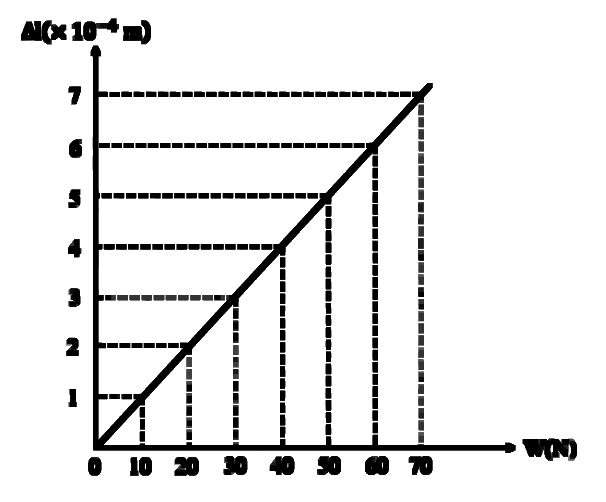
Figure represents the extension (Δl)(\Delta l) of a wire of length 1 meter, suspended from the ceiling of the room at one end with a load WW connected to the other end. If the cross-sectional area of the wire is 10−5 m210^{-5}\text{ m}^2 then the Young's modulus of the wire is ‾ N/m2\underline{\qquad}\ \text{N/m}^2.

Figure

Show answer and solution

Answer: (c)

  1. From the graph, Δl=1×10⁻⁴ m\Delta l = 1 \times 10^{-4}\text{ m} for W=10 NW = 10\text{ N}.
  2. Y=WLAΔl=10×110−5×10⁻⁴Y = \frac{WL}{A\Delta l} = \frac{10 \times 1}{10^{-5} \times 10^{-4}}
  3. Y=1.0×10¹⁰ N/m2Y = 1.0 \times 10^{10}\text{ N/m}^2, so the answer is (c).
Report a mistake
Q57JEE Main 2025 · 2 APR · SHIFT 2Medium

Wire Combinations & Special Cases · Natural length from two tensions

The length of a light string is 1.4 m when the tension on it is 5 N. If the tension increases to 7 N, the length of the string is 1.56 m. The original length of the string is__________m.

Numerical answer type. Work it out, then open the answer.

Show answer and solution

Answer: 1

  1. L=l1T2−l2T1T2−T1L = \frac{l_1T_2 - l_2T_1}{T_2 - T_1}
  2. L=1.4×7−1.56×57−5=9.8−7.82L = \frac{1.4 \times 7 - 1.56 \times 5}{7 - 5} = \frac{9.8 - 7.8}{2}
  3. L=1 mL = 1\text{ m}
Report a mistake
Q58JEE Main 2024 · 9 APR · SHIFT 1Easy

Wire Combinations & Special Cases · Own weight, pulleys & sag

Two persons pull a wire towards themselves. Each person exerts a force of 200 N200\text{ N} on the wire. Young's modulus of the material of wire is 1×10¹¹ N m−21 \times 10^{11}\text{ N m}^{-2}. Original length of the wire is 2 m2\text{ m} and the area of cross section is 2 cm22\text{ cm}^2. The wire will extend in length by _________ μm\mu\text{m}.

Numerical answer type. Work it out, then open the answer.

Show answer and solution

Answer: 20

  1. Both ends pulled with 200 N, so the tension in the wire is T=200 NT = 200\text{ N} (not 400 N).
  2. Δl=TLAY=200×22×10−4×1011=4002×107\Delta l = \frac{TL}{AY} = \frac{200 \times 2}{2 \times 10^{-4} \times 10^{11}} = \frac{400}{2 \times 10^{7}}
  3. Δl=2×10⁻⁵ m=20 μm\Delta l = 2 \times 10^{-5}\text{ m} = 20\ \mu\text{m}
Report a mistake
Q59JEE Main 2024 · 4 APR · SHIFT 1Medium

Wire Combinations & Special Cases · Natural length from two tensions

An elastic spring under tension of 3 N3\text{ N} has a length aa. Its length is bb under tension 2 N2\text{ N}. For its length (3a−2b)(3a - 2b), the value of tension will be _______ N.

Numerical answer type. Work it out, then open the answer.

Show answer and solution

Answer: 5

  1. a=L+3ca = L + 3c and b=L+2cb = L + 2c, so c=a−bc = a - b and L=3b−2aL = 3b - 2a
  2. For length 3a−2b3a - 2b: Tc=(3a−2b)−L=(3a−2b)−(3b−2a)=5(a−b)Tc = (3a - 2b) - L = (3a - 2b) - (3b - 2a) = 5(a - b)
  3. T=5(a−b)a−b=5 NT = \frac{5(a - b)}{a - b} = 5\text{ N}
Report a mistake
Q60MHT CET 2024 · 15 MAY · SHIFT 2Medium

Wire Combinations & Special Cases · Force constant of a wire

A spring has length L and force constant K. It is cut into two springs of length L1L_1 and L2L_2 such that L1=NL2L_1 = NL_2 ( N is an integer). The force constant of spring of length L1L_1 is

Show answer and solution

Answer: (b)

  1. Force constant ∝1length\propto \frac{1}{\text{length}}: kL=kL = constant.
  2. L1+L2=LL_1 + L_2 = L with L1=NL2⇒L1=NN+1LL_1 = NL_2 \Rightarrow L_1 = \frac{N}{N+1}L
  3. k1=KLL1=KN(1+N)k_1 = K\frac{L}{L_1} = \frac{K}{N}(1 + N), so the answer is (b).
Report a mistake
Q61JEE Main 2024 · 6 APR · SHIFT 2Difficult

Wire Combinations & Special Cases · Own weight, pulleys & sag

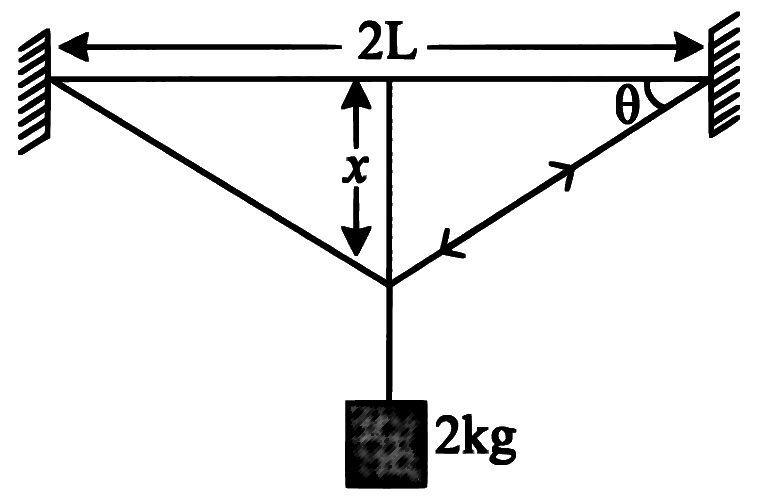
A wire of cross sectional area A, modulus of elasticity 2×10¹¹ Nm−22 \times 10^{11}\text{ Nm}^{-2} and length 2 m2\text{ m} is stretched between two vertical rigid supports. When a mass of 2 kg2\text{ kg} is suspended at the middle it sags lower from its original position making angle θ=1100\theta = \frac{1}{100} radian on the points of support. The value of A is ________ ×10−4 m2\times 10^{-4}\text{ m}^2 (consider x<<Lx << \text{L} ).

(given: g=10 m/s2\text{g} = 10\text{ m/s}^2)

Figure

Numerical answer type. Work it out, then open the answer.

Show answer and solution

Answer: 1

mgTTθθLL2T sinθ = mg
  1. At the middle point, the vertical parts of the two tensions hold the weight: 2Tsin⁡θ=mg2T\sin\theta = mg.
  2. T=mg2θ=202×0.01=1000 NT = \dfrac{mg}{2\theta} = \dfrac{20}{2 \times 0.01} = 1000\text{ N}
  3. Each half of length LL becomes Lsec⁡θL\sec\theta, so strain =sec⁡θ−1≈θ22=5×10−5= \sec\theta - 1 \approx \dfrac{\theta^2}{2} = 5 \times 10^{-5}.
  4. A=TY×strain=10002×1011×5×10−5=1×10⁻⁴ m2A = \dfrac{T}{Y \times \text{strain}} = \dfrac{1000}{2 \times 10^{11} \times 5 \times 10^{-5}} = 1 \times 10^{-4}\text{ m}^2
  5. So the answer is 1.
Report a mistake
Q62JEE Main 2024 · 8 APR · SHIFT 1Difficult

Wire Combinations & Special Cases · Searle's experiment & errors

Young's modulus is determined by the equation given by Y=49000ml dynecm2\text{Y} = 49000\frac{\text{m}}{\text{l}}\,\frac{\text{dyne}}{\text{cm}^2} where MM is the mass and ll is the extension of wire used in the experiment. Now error in Young modules (Y)(Y) is estimated by taking data from M−lM - l plot in graph paper. The smallest scale divisions are 5 g5\text{ g} and 0.02 cm0.02\text{ cm} along load axis and extension axis respectively. If the value of MM and ll are 500 g500\text{ g} and 2 cm2\text{ cm} respectively then percentage error of YY is:

Show answer and solution

Answer: (a)

  1. Y∝MlY \propto \dfrac{M}{l}, so ΔYY=ΔMM+Δll\dfrac{\Delta Y}{Y} = \dfrac{\Delta M}{M} + \dfrac{\Delta l}{l}.
  2. ΔMM=5500=1%\dfrac{\Delta M}{M} = \dfrac{5}{500} = 1\%, Δll=0.022=1%\dfrac{\Delta l}{l} = \dfrac{0.02}{2} = 1\%
  3. So the answer is (a) 2%.
Report a mistake
Q63JEE Main 2023 · 10 APR · SHIFT 1Medium

Wire Combinations & Special Cases · Wires joined end to end & loaded

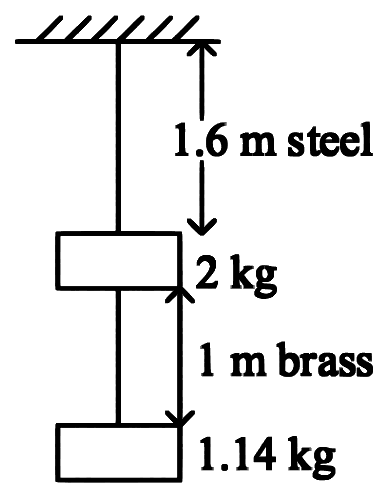
Two wires each of radius 0.2 cm and negligible mass, one made of steel and the other made of brass are loaded as shown in the figure. The elongation of the steel wire is __________ ×\times 10 −6{}^{-6} m. [Young's modulus for steel = 2 ×\times 1011{}^{11} Nm−2{}^{-2} and g = 10 ms−2{}^{-2} ]

Figure

Numerical answer type. Work it out, then open the answer.

Show answer and solution

Answer: 20

  1. Steel wire holds both blocks: T=(2+1.14)×10=31.4 NT = (2 + 1.14) \times 10 = 31.4\text{ N}
  2. A=π(0.2×10⁻²)2=1.256×10⁻⁵ m2A = \pi (0.2 \times 10^{-2})^2 = 1.256 \times 10^{-5}\text{ m}^2
  3. Δl=TLAY=31.4×1.61.256×10−5×2×1011=2×10⁻⁵ m\Delta l = \frac{TL}{AY} = \frac{31.4 \times 1.6}{1.256 \times 10^{-5} \times 2 \times 10^{11}} = 2 \times 10^{-5}\text{ m}
  4. Elongation =20×10−6 m= 20 \times 10^{-6}\text{ m}
Report a mistake
Q64JEE Main 2023 · 11 APR · SHIFT 1Medium

Wire Combinations & Special Cases · Natural length from two tensions

The length of a wire becomes l1l_1 and l2l_2 when 100 N100\text{ N} and 120 N120\text{ N} tensions are applied respectively. If 10 l2=11 l110\,l_2 = 11\,l_1, the natural length of wire will be 1x l1\frac{1}{x}\,l_1. Here the value of xx is _____________.

Numerical answer type. Work it out, then open the answer.

Show answer and solution

Answer: 2

  1. L=l1T2−l2T1T2−T1=120 l1−100 l220=6l1−5l2L = \frac{l_1T_2 - l_2T_1}{T_2 - T_1} = \frac{120\,l_1 - 100\,l_2}{20} = 6l_1 - 5l_2
  2. With l2=1.1 l1l_2 = 1.1\,l_1: L=6l1−5.5l1=12l1L = 6l_1 - 5.5l_1 = \frac{1}{2}l_1
  3. So x=2x = 2.
Report a mistake
Q65JEE Main 2023 · 25 JAN · SHIFT 1Medium

Wire Combinations & Special Cases · Searle's experiment & errors

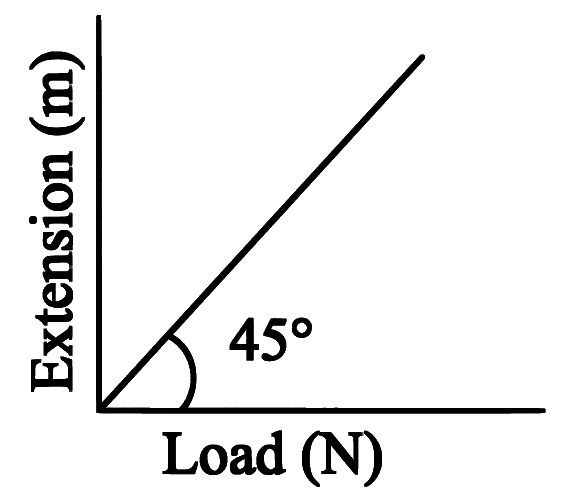
As shown in the figure, in an experiment to determine Young's modulus of a wire, the extension-load curve is plotted. The curve is a straight line passing through the origin and makes an angle of 45 ∘^\circ with the load axis. The length of wire is 62.8 cm and its diameter is 4 mm. The Young's modulus is found to be x×104x \times 10^{4} Nm−2^{-2}. The value of xx is ___________.

Figure

Numerical answer type. Work it out, then open the answer.

Show answer and solution

Answer: 5

  1. Slope extensionload=tan⁡45∘=1 m/N\frac{\text{extension}}{\text{load}} = \tan 45^\circ = 1\text{ m/N}
  2. Y=FLAΔl=LA×1slope=0.628π(2×10⁻³)2Y = \frac{FL}{A\Delta l} = \frac{L}{A} \times \frac{1}{\text{slope}} = \frac{0.628}{\pi (2 \times 10^{-3})^2}
  3. Y=0.6281.256×10−5=5×10⁴ N m−2Y = \frac{0.628}{1.256 \times 10^{-5}} = 5 \times 10^{4}\text{ N m}^{-2}, so x=5x = 5.
Report a mistake
Q66JEE Main 2022 · 27 JUL · SHIFT 2Medium

Wire Combinations & Special Cases · Wires joined end to end & loaded

A steel wire of length 3.2 m(Ys=2.0×10¹¹ N m−2)3.2\text{ m} \left(Y_s = 2.0 \times 10^{11}\text{ N m}^{-2}\right) and a copper wire of length 4.4 m(Yc=1.1×10¹¹ N m−2)4.4\text{ m} \left(Y_c = 1.1 \times 10^{11}\text{ N m}^{-2}\right), both of radius 1.4 mm1.4\text{ mm} are connected end to end. When stretched by a load, the net elongation is found to be 1.4 mm1.4\text{ mm}. The load applied, in Newton, will be: (( Given π=227\pi = \frac{22}{7})

Show answer and solution

Answer: (d)

  1. Same load FF and area A=227×(1.4×10−3)2=6.16×10⁻⁶ m2A = \frac{22}{7} \times (1.4 \times 10^{-3})^2 = 6.16 \times 10^{-6}\text{ m}^2
  2. Δl=FA(LsYs+LcYc)=FA(1.6+4.0)×10−11=FA×5.6×10⁻¹¹\Delta l = \frac{F}{A}\left(\frac{L_s}{Y_s} + \frac{L_c}{Y_c}\right) = \frac{F}{A}(1.6 + 4.0) \times 10^{-11} = \frac{F}{A} \times 5.6 \times 10^{-11}
  3. F=1.4×10−3×6.16×10−65.6×10−11=154 NF = \frac{1.4 \times 10^{-3} \times 6.16 \times 10^{-6}}{5.6 \times 10^{-11}} = 154\text{ N}
  4. So the answer is (d) 154.
Report a mistake
Q67JEE Main 2022 · 26 JUL · SHIFT 2Medium

Wire Combinations & Special Cases · Own weight, pulleys & sag

A uniform heavy rod of mass 20 kg20\text{ kg}, cross sectional area 0.4 m20.4\text{ m}^2 and length 20 m20\text{ m} is hanging from a fixed support. Neglecting the lateral contraction, the elongation in the rod due to its own weight is x×10−9 mx \times 10^{-9}\text{ m}. The value of xx is _______________.

(Given, young modulus Y = 2 ×\times 1011 Nm−2 and g = 10 ms−2)

Numerical answer type. Work it out, then open the answer.

Show answer and solution

Answer: 25

  1. Own-weight elongation: Δl=WL2AY\Delta l = \frac{WL}{2AY} with W=20×10=200 NW = 20 \times 10 = 200\text{ N}
  2. Δl=200×202×0.4×2×1011=40001.6×1011=2.5×10⁻⁸ m\Delta l = \frac{200 \times 20}{2 \times 0.4 \times 2 \times 10^{11}} = \frac{4000}{1.6 \times 10^{11}} = 2.5 \times 10^{-8}\text{ m}
  3. Δl=25×10−9 m\Delta l = 25 \times 10^{-9}\text{ m}, so x=25x = 25.
Report a mistake
Q68JEE Main 2022 · 29 JUN · SHIFT 1Medium

Wire Combinations & Special Cases · Natural length from two tensions

A wire of length L is hanging from a fixed support. The length changes to L1 and L2 when masses 1 kg and 2 kg are suspended respectively from its free end. Then the value of L is equal to:

Show answer and solution

Answer: (c)

  1. Extension ∝\propto load: L1−L=k(1)L_1 - L = k(1) and L2−L=k(2)L_2 - L = k(2)
  2. So L2−L=2(L1−L)L_2 - L = 2(L_1 - L)
  3. L=2L1−L2L = 2L_1 - L_2, so the answer is (c).
Report a mistake
Q69JEE Main 2022 · 27 JUL · SHIFT 2Medium

Wire Combinations & Special Cases · Searle's experiment & errors

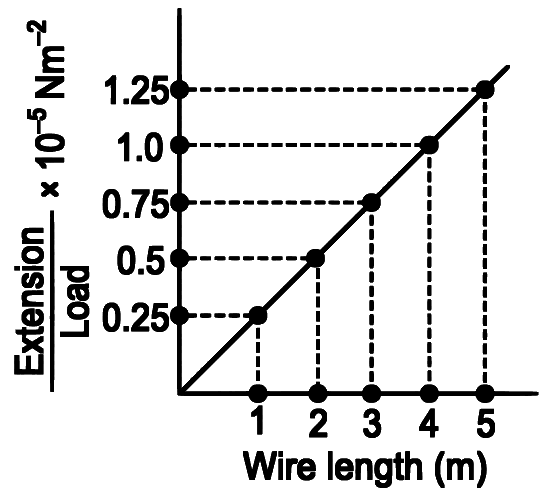
In an experiment to determine the Young's modulus, steel wires of five different lengths (1,2,3,4(1, 2, 3, 4, and 5 m)5\text{ m}) but of same cross section (2 mm2)\left(2\text{ mm}^2\right) were taken and curves between extension and load were obtained. The slope (extension/load) of the curves were plotted with the wire length and the following graph is obtained. If the Young's modulus of given steel wires is x×1011 Nm−2x \times 10^{11}\text{ Nm}^{-2}, then the value of xx is __________.

Figure

Numerical answer type. Work it out, then open the answer.

Show answer and solution

Answer: 2

  1. ΔlF=LAY\frac{\Delta l}{F} = \frac{L}{AY}, so the graph slope is 1AY\frac{1}{AY}.
  2. From the graph, slope =0.25×10−51=2.5×10−6= \frac{0.25 \times 10^{-5}}{1} = 2.5 \times 10^{-6} per m
  3. Y=1A×2.5×10−6=12×10−6×2.5×10−6=2×10¹¹ N m−2Y = \frac{1}{A \times 2.5 \times 10^{-6}} = \frac{1}{2 \times 10^{-6} \times 2.5 \times 10^{-6}} = 2 \times 10^{11}\text{ N m}^{-2}
  4. So x=2x = 2.
Report a mistake
Q70JEE Main 2022 · 26 JUL · SHIFT 1Difficult

Wire Combinations & Special Cases · Searle's experiment & errors

In an experiment to determine the Young's modulus of wire of a length exactly 1 m1\text{ m}, the extension in the length of the wire is measured as 0.4 mm0.4\text{ mm} with an uncertainty of ±0.02 mm\pm 0.02\text{ mm} when a load of 1 kg1\text{ kg} is applied. The diameter of the wire is measured as 0.4 mm0.4\text{ mm} with an uncertainty of ±0.01 mm\pm 0.01\text{ mm}. The error in the measurement of Young's modulus (ΔY)(\Delta \text{Y}) is found to be x×1010 Nm−2x \times 10^{10}\text{ Nm}^{-2}. The value of xx is _________________. ((take g=10 ms−2\text{g} = 10\text{ ms}^{-2})

Numerical answer type. Work it out, then open the answer.

Show answer and solution

Answer: 2

  1. Y=4MgLπd2l=4×10×1π(0.4×10⁻³)2(0.4×10⁻³)≈2×10¹¹ N m−2Y = \dfrac{4MgL}{\pi d^2 l} = \dfrac{4 \times 10 \times 1}{\pi (0.4 \times 10^{-3})^2 (0.4 \times 10^{-3})} \approx 2 \times 10^{11}\text{ N m}^{-2}
  2. ΔYY=2Δdd+Δll=2×0.010.4+0.020.4=0.1\dfrac{\Delta Y}{Y} = 2\dfrac{\Delta d}{d} + \dfrac{\Delta l}{l} = 2 \times \dfrac{0.01}{0.4} + \dfrac{0.02}{0.4} = 0.1
  3. ΔY=0.1×2×1011=2×10¹⁰ N m−2\Delta Y = 0.1 \times 2 \times 10^{11} = 2 \times 10^{10}\text{ N m}^{-2}
  4. So x=2x = 2.
Report a mistake
Q71JEE Main 2021 · 25 JUL · SHIFT 1Medium

Wire Combinations & Special Cases · Wires joined end to end & loaded

Two wires of same length and radius are joined end to end and loaded. The Young's moduli of the materials of the two wires are Y1 and Y2. The combination behaves as a single wire then its Young's modulus is:

Show answer and solution

Answer: (b)

  1. Same load FF, area AA, each of length LL: Δl=FLAY1+FLAY2\Delta l = \frac{FL}{AY_1} + \frac{FL}{AY_2}
  2. As a single wire of length 2L2L: Δl=F(2L)AY\Delta l = \frac{F(2L)}{AY}
  3. 2Y=1Y1+1Y2⇒Y=2Y1Y2Y1+Y2\frac{2}{Y} = \frac{1}{Y_1} + \frac{1}{Y_2} \Rightarrow Y = \frac{2Y_1Y_2}{Y_1 + Y_2}
  4. So the answer is (b).
Report a mistake
Q72JEE Main 2021 · 31 AUG · SHIFT 1Medium

Wire Combinations & Special Cases · Own weight, pulleys & sag

A uniform heavy rod of weight 10 kg ms−2, cross-sectional area 100 cm2 and length 20 cm is hanging from a fixed support. Young modulus of the material of the rod is 2 ×\times 1011 Nm−2. Neglecting the lateral contraction, find the elongation of rod due to its own weight.

Show answer and solution

Answer: (d)

  1. A rod hanging under its own weight stretches by Δl=WL2AY\Delta l = \frac{WL}{2AY} (average tension is W/2W/2).
  2. Δl=10×0.202×100×10−4×2×1011=24×109\Delta l = \frac{10 \times 0.20}{2 \times 100 \times 10^{-4} \times 2 \times 10^{11}} = \frac{2}{4 \times 10^{9}}
  3. Δl=5×10⁻¹⁰ m\Delta l = 5 \times 10^{-10}\text{ m}, so the answer is (d).
Report a mistake
Q73JEE Main 2021 · 20 JUL · SHIFT 2Medium

Wire Combinations & Special Cases · Natural length from two tensions

The length of a metal wire is l1, when the tension in it is T1 and is l2 when the tension is T2. The natural length of the wire is:

Show answer and solution

Answer: (b)

  1. Extension ∝\propto tension: l1=L+cT1l_1 = L + cT_1, l2=L+cT2l_2 = L + cT_2
  2. Eliminate cc: l1T2−l2T1=L(T2−T1)l_1T_2 - l_2T_1 = L(T_2 - T_1)
  3. L=l1T2−l2T1T2−T1L = \frac{l_1T_2 - l_2T_1}{T_2 - T_1}, so the answer is (b).
Report a mistake
Q74JEE Main 2021 · 20 JUL · SHIFT 1Medium

Wire Combinations & Special Cases · Natural length from two tensions

The value of tension in a long thin metal wire has been changed from T1 to T2. The lengths of the metal wire at two different values of tension T1 and T2 are l1 and l2 respectively. The actual length of the metal wire is:

Show answer and solution

Answer: (c)

  1. Extension ∝\propto tension: l1=L+cT1l_1 = L + cT_1, l2=L+cT2l_2 = L + cT_2
  2. Eliminate cc: T1l2−T2l1=L(T1−T2)T_1l_2 - T_2l_1 = L(T_1 - T_2)
  3. L=T1l2−T2l1T1−T2L = \frac{T_1l_2 - T_2l_1}{T_1 - T_2}, so the answer is (c).
Report a mistake
Q75JEE Main 2021 · 26 FEB · SHIFT 2Medium

Wire Combinations & Special Cases · Natural length from two tensions

The length of metallic wire is l1 when tension in it is T1. It is l2 when the tension is T2. The original length of the wire will be:

Show answer and solution

Answer: (d)

  1. Extension ∝\propto tension: l1=L+cT1l_1 = L + cT_1, l2=L+cT2l_2 = L + cT_2
  2. Eliminate cc: T2l1−T1l2=L(T2−T1)T_2l_1 - T_1l_2 = L(T_2 - T_1)
  3. L=T2l1−T1l2T2−T1L = \frac{T_2l_1 - T_1l_2}{T_2 - T_1}, so the answer is (d).
Report a mistake
Q76JEE Main 2020 · 6 SEP · SHIFT 1Medium

Wire Combinations & Special Cases · Force constant of a wire

An object of mass m is suspended at the end of a massless wire of length L and area of crosssection A. Young modulus of the material of the wire is Y. If the mass is pulled down slightly its frequency of oscillation along the vertical direction is:

Show answer and solution

Answer: (a)

  1. The wire acts as a spring: F=YALΔlF = \frac{YA}{L}\Delta l, so k=YALk = \frac{YA}{L}
  2. f=12πkm=12πYAmLf = \frac{1}{2\pi}\sqrt{\frac{k}{m}} = \frac{1}{2\pi}\sqrt{\frac{YA}{mL}}
  3. So the answer is (a).
Report a mistake
Q77JEE Main 2019 · 10 APR · SHIFT 2Medium

Wire Combinations & Special Cases · Wires joined end to end & loaded

In an experiment, brass and steel wires of length 1 m each with areas of cross section 1mm2 are used. The wires are connected in series and one end of the combined wire is connected to a rigid support and other end is subjected to elongation. The stress required to produce a net elongation of 0.2 mm is, [Given, the Young's Modulus for steel and brass are, respectively, 120 × 109 N/m2 and 60 × 109 N/m2]

Show answer and solution

Answer: (a)

  1. Series wires with equal area have the same stress σ\sigma; Δl=σ(LsYs+LbYb)\Delta l = \sigma\left(\frac{L_s}{Y_s} + \frac{L_b}{Y_b}\right)
  2. 0.2×10−3=σ(1120×109+160×109)=σ40×1090.2 \times 10^{-3} = \sigma\left(\frac{1}{120 \times 10^{9}} + \frac{1}{60 \times 10^{9}}\right) = \frac{\sigma}{40 \times 10^{9}}
  3. σ=8×10⁶ N/m2\sigma = 8 \times 10^{6}\text{ N/m}^2, so the answer is (a).
Report a mistake
Q78JEE Main 2019 · 12 JAN · SHIFT 2Medium

Wire Combinations & Special Cases · Searle's experiment & errors

A load of mass M kg is suspended from a steel wire of length 2m and radius 1.0 mm in Searle's apparatus experiment. The increase in length produced in the wire is 4.0 mm. Now the load is fully immersed in a liquid of relative density 2. The relative density of the material of load is 8. The new value of increase in length of the steel wire is:

Show answer and solution

Answer: (c)

  1. In liquid the tension becomes Mg−Mg - buoyancy =Mg(1−ρlρ)=Mg(1−28)=34Mg= Mg\left(1 - \frac{\rho_l}{\rho}\right) = Mg\left(1 - \frac{2}{8}\right) = \frac{3}{4}Mg
  2. Extension ∝\propto tension: Δl′=34×4.0=3.0 mm\Delta l' = \frac{3}{4} \times 4.0 = 3.0\text{ mm}
  3. So the answer is (c) 3.0 mm.
Report a mistake
Q79JEE Main 2016 · 9 APR · SHIFT 1Difficult

Wire Combinations & Special Cases · Own weight, pulleys & sag

A uniformly tapering conical wire is made from a material of Young’s modulus Y and has a normal, unextended length L. The radii, at the upper and lower ends of this conical wire, have values R and 3 R, respectively. The upper end of the wire is fixed to a rigid support and a mass M is suspended from its lower end. The equilibrium extended length, of this wire, would equal:

Show answer and solution

Answer: (b)

  1. Radius at distance xx from the top: r=R(1+2xL)r = R\left(1 + \frac{2x}{L}\right); tension is MgMg throughout.
  2. ΔL=∫0LMg dxπr2Y=MgπYR2∫0Ldx(1+2x/L)2\Delta L = \int_0^L \frac{Mg\,dx}{\pi r^2 Y} = \frac{Mg}{\pi Y R^2}\int_0^L \frac{dx}{(1 + 2x/L)^2}
  3. ∫0Ldx(1+2x/L)2=L2(1−13)=L3\int_0^L \frac{dx}{(1 + 2x/L)^2} = \frac{L}{2}\left(1 - \frac{1}{3}\right) = \frac{L}{3} (same as ΔL=MgLπYR1R2\Delta L = \frac{MgL}{\pi Y R_1R_2} with R1R2=3R2R_1R_2 = 3R^2)
  4. Extended length =L(1+13MgπYR2)= L\left(1 + \frac{1}{3}\frac{Mg}{\pi Y R^2}\right), so the answer is (b).
Report a mistake
Q80JEE Main 2016 · 10 APR · SHIFT 1Difficult

Wire Combinations & Special Cases · Searle's experiment & errors

A thin 1 m long rod has a radius of 5 mm. A force of 50 π\pikN is applied at one end to determine its Young’s modulus. Assume that the force is exactly known. If the least count in the measurement of all lengths is 0.01 mm, which of the following statements is false?

Show answer and solution

Answer: (c)

  1. Stress =Fπr2=50π×103π(5×10⁻³)2=2×10⁹ N/m2= \dfrac{F}{\pi r^2} = \dfrac{50\pi \times 10^3}{\pi (5 \times 10^{-3})^2} = 2 \times 10^9\text{ N/m}^2.
  2. Smallest measurable extension is the least count 0.01 mm=10−5 m0.01\text{ mm} = 10^{-5}\text{ m}, so minimum strain =10−5/1=10−5= 10^{-5}/1 = 10^{-5}.
  3. Maximum Y=2×10910−5=2×10¹⁴ N/m2Y = \dfrac{2 \times 10^9}{10^{-5}} = 2 \times 10^{14}\text{ N/m}^2, not 101410^{14}, so (c) is false.
  4. Fractional errors: length 10−510^{-5} (smallest, so largest figure of merit), radius 2×0.015=4×10⁻³² \times \dfrac{0.01}{5} = 4 \times 10^{-3}, extension largest. So (a), (b), (d) are true.
  5. So the answer is (c).
Report a mistake
Q81NEET 2013Medium

Wire Combinations & Special Cases · Wires joined end to end & loaded

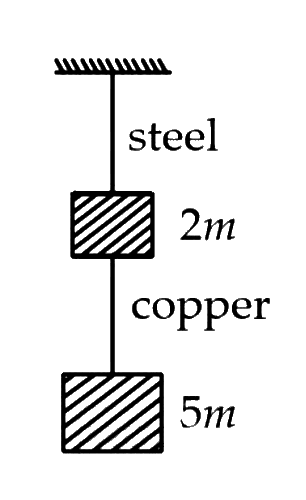
If the ratio of diameters, lengths and Young's modulus of steel and copper wires shown in the figure are p, q and s respectively, then the corresponding ratio of increase in their lengths would be

Figure

Show answer and solution

Answer: (b)

  1. Tension in steel (holds both blocks) =7mg= 7mg; tension in copper =5mg= 5mg.
  2. Δl=TL(πd2/4)Y\Delta l = \frac{TL}{(\pi d^2/4)Y}, so ΔlsΔlc=TsTc⋅LsLc⋅dc2ds2⋅YcYs\frac{\Delta l_s}{\Delta l_c} = \frac{T_s}{T_c} \cdot \frac{L_s}{L_c} \cdot \frac{d_c^2}{d_s^2} \cdot \frac{Y_c}{Y_s}
  3. =75⋅q⋅1p2⋅1s=7q5sp2= \frac{7}{5} \cdot q \cdot \frac{1}{p^2} \cdot \frac{1}{s} = \frac{7q}{5sp^2}
  4. So the answer is (b).
Report a mistake
Q82JEE Main 2013 · 23 APR · SHIFT 1Medium

Wire Combinations & Special Cases · Wires joined end to end & loaded

A copper wire of length 1.0 m and a steel wire of length 0.5 m having equal cross-sectional areas are joined end to end. The composite wire is stretched by a certain load which stretches the copper wire by 1 mm. If the Young's moduli of copper and steel are respectively 1.0×10111.0 \times 10^{11} Nm −2{}^{-2} and 2.0×10112.0 \times 10^{11} Nm−2{}^{-2}, the total extension of the composite wire is:

Show answer and solution

Answer: (d)

  1. Same force and area: Δl∝LY\Delta l \propto \frac{L}{Y}
  2. ΔlsΔlc=0.51.0×1.0×10112.0×1011=14⇒Δls=0.25 mm\frac{\Delta l_s}{\Delta l_c} = \frac{0.5}{1.0} \times \frac{1.0 \times 10^{11}}{2.0 \times 10^{11}} = \frac{1}{4} \Rightarrow \Delta l_s = 0.25\text{ mm}
  3. Total =1+0.25=1.25 mm= 1 + 0.25 = 1.25\text{ mm}, so the answer is (d).
Report a mistake
Q83JEE Main 2013 · 9 APR · SHIFT 1Medium

Wire Combinations & Special Cases · Wires joined end to end & loaded

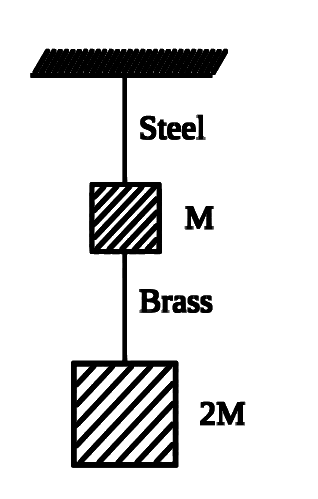
If the ratio of lengths, radii and Young's moduli of steel and brass wires in the figure are a, b and c respectively, then the corresponding ratio of increase in their lengths is:

Figure

Show answer and solution

Answer: (c)

  1. Tension in steel (holds both masses) =3Mg= 3Mg; tension in brass =2Mg= 2Mg.
  2. Δl=TLπr2Y\Delta l = \frac{TL}{\pi r^2 Y}, so ΔlsΔlb=32⋅a⋅1b2⋅1c\frac{\Delta l_s}{\Delta l_b} = \frac{3}{2} \cdot a \cdot \frac{1}{b^2} \cdot \frac{1}{c}
  3. =3a2b2c= \frac{3a}{2b^2c}, so the answer is (c).
Report a mistake
Q84JEE Main 2006 · AIEEEMedium

Wire Combinations & Special Cases · Own weight, pulleys & sag

A wire elongates by l mml\text{ mm} when a LOAD WW is hanged from it. If the wire goes over a pulley and two weights WW each are hung at the two ends, the elongation of the wire will be (in mm\text{mm})

Show answer and solution

Answer: (a)

  1. With WW hanging from a fixed support, the tension in the wire is WW.
  2. Over a pulley with WW at each end, each side balances the other, so the tension is still WW.
  3. Same tension gives the same elongation: answer (a) ll.
Report a mistake
Q85JEE Main 2026 · 6 APR · SHIFT 1Medium

Thermal Stress & Breaking Stress · Breaking stress & maximum load

A lift of mass 1600 kg is supported by thick iron wire. If the maximum stress which the wire can withstand is 4×10⁸ N/m24 \times 10^{8}\text{ N/m}^2 and its radius is 4 mm, then maximum acceleration the lift can take is ‾ m/s2\underline{\qquad}\ \text{m/s}^2.

(take g=10 m/s2\text{g} = 10\text{ m/s}^2 and π=3.14\pi = 3.14)

Show answer and solution

Answer: (a)

  1. Maximum tension T=Sπr2=4×108×3.14×(4×10−3)2=20096 NT = S \pi r^2 = 4 \times 10^8 \times 3.14 \times (4 \times 10^{-3})^2 = 20096\text{ N}.
  2. For upward acceleration: T−mg=ma⇒a=Tm−gT - mg = ma \Rightarrow a = \dfrac{T}{m} - g
  3. a=200961600−10=12.56−10=2.56 m/s2a = \dfrac{20096}{1600} - 10 = 12.56 - 10 = 2.56\text{ m/s}^2
  4. So the answer is (a) 2.56.
Report a mistake
Q86JEE Main 2026 · 5 APR · SHIFT 1Medium

Thermal Stress & Breaking Stress · Breaking stress & maximum load

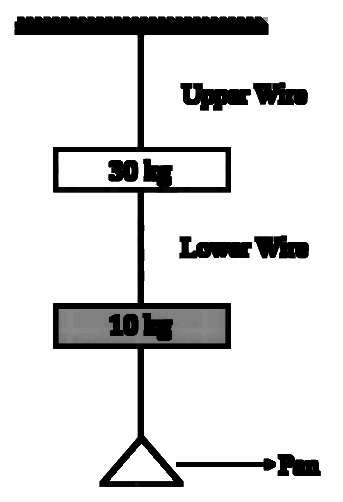
Two wires as shown in the figure below, made of steel and have breaking stress of 12×108 N/m212 \times 10^{8}\text{ N/m}^2. Area of cross-section of upper wire is 0.008 cm20.008\text{ cm}^2 and of lower wire is 0.004 cm20.004\text{ cm}^2. The maximum mass that can be added to pan without breaking any wire is ______ kg.

Figure

Show answer and solution

Answer: (b)

  1. Upper wire holds (30+10+m)g(30 + 10 + m)g: (40+m)×10≤12×108×8×10−7=960 N⇒m≤56 kg(40 + m) \times 10 \le 12 \times 10^8 \times 8 \times 10^{-7} = 960\text{ N} \Rightarrow m \le 56\text{ kg}.
  2. Lower wire holds (10+m)g(10 + m)g: (10+m)×10≤12×108×4×10−7=480 N⇒m≤38 kg(10 + m) \times 10 \le 12 \times 10^8 \times 4 \times 10^{-7} = 480\text{ N} \Rightarrow m \le 38\text{ kg}.
  3. Both wires must survive, so take the smaller value.
  4. So the answer is (b) 38 kg.
Report a mistake
Q87JEE Main 2026 · 24 JAN · SHIFT 1Difficult

Thermal Stress & Breaking Stress · Thermal stress

A brass wire of length 2 m and radius 1 mm at 27∘C27^\circ\text{C} is held taut between two rigid supports. Initially it was cooled to a temperature of −43∘C-43^\circ\text{C} creating a tension TT in the wire. The temperature to which the wire has to be cooled in order to increase the tension in it to 1.4T1.4T, is ‾ ∘C\underline{\qquad}\ {}^\circ\text{C}.

Show answer and solution

Answer: (a)

  1. Tension in a wire held between rigid supports: T=YAαΔθT = YA\alpha\Delta\theta, so T∝ΔθT \propto \Delta\theta.
  2. First cooling: Δθ=27−(−43)=70∘C\Delta\theta = 27 - (-43) = 70^\circ\text{C} gives TT.
  3. For 1.4T1.4T: Δθ=1.4×70=98∘C\Delta\theta = 1.4 \times 70 = 98^\circ\text{C}, so final temperature =27−98=−71∘C= 27 - 98 = -71^\circ\text{C}.
  4. So the answer is (a) −71∘C-71^\circ\text{C}.
Report a mistake
Q88NEET 2024Easy

Thermal Stress & Breaking Stress · Thermal stress

A metallic bar of Young's modulus, 0.5×10¹¹ N m−20.5 \times 10^{11}\text{ N m}^{-2} and coefficient of linear thermal expansion 10−5 ∘C−110^{-5}\,{}^\circ\text{C}^{-1}, length 1 m1\text{ m} and area of cross-section 10−3 m210^{-3}\text{ m}^2 is heated from 0∘C0^\circ\text{C} to 100∘C100^\circ\text{C} without expansion or bending. The compressive force developed in it is:

Show answer and solution

Answer: (b)

  1. Thermal force when expansion is prevented: F=YAαΔTF = YA\alpha\Delta T.
  2. F=0.5×1011×10−3×10−5×100=5×10⁴ NF = 0.5 \times 10^{11} \times 10^{-3} \times 10^{-5} \times 100 = 5 \times 10^4\text{ N}
  3. So the answer is (b) 50×103 N50 \times 10^3\text{ N}.
Report a mistake
Q89JEE Main 2024 · 5 APR · SHIFT 1Medium

Thermal Stress & Breaking Stress · Breaking stress & maximum load

The density and breaking stress of a wire are 6×10⁴ kg/m36 \times 10^{4}\text{ kg/m}^3 and 1.2×10⁸ N/m21.2 \times 10^{8}\text{ N/m}^2 respectively. The wire is suspended from a rigid support on a planet where acceleration due to gravity is 13\frac{1}{3}rd of the value on the surface of earth. The maximum length of the wire without breaking is _______ m\text{m} (take, g=10 m/s2\text{g} = 10\text{ m/s}^2 ).

Numerical answer type. Work it out, then open the answer.

Show answer and solution

Answer: 600

  1. Wire breaks at the top under its own weight: ρLg′=S⇒L=Sρg′\rho L g' = S \Rightarrow L = \dfrac{S}{\rho g'}.
  2. g′=103 m/s2g' = \dfrac{10}{3}\text{ m/s}^2
  3. L=1.2×1086×104×10/3=1.2×1082×105=600 mL = \dfrac{1.2 \times 10^8}{6 \times 10^4 \times 10/3} = \dfrac{1.2 \times 10^8}{2 \times 10^5} = 600\text{ m}
  4. So the answer is 600 m.
Report a mistake
Q90JEE Main 2023 · 31 JAN · SHIFT 1Difficult

Thermal Stress & Breaking Stress · Thermal stress

A thin rod having a length of 1 m1\text{ m} and area of cross-section 3×10⁻⁶ m23 \times 10^{-6}\text{ m}^2 is suspended vertically from one end. The rod is cooled from 210∘C210^\circ\text{C} to 160∘C160^\circ\text{C}. After cooling, a mass M\text{M} is attached at the lower end of the rod such that the length of rod again becomes 1 m1\text{ m}. Young's modulus and coefficient of linear expansion of the rod are 2×10¹¹ N m−22 \times 10^{11}\text{ N m}^{-2} and 2×10⁻⁵ K−12 \times 10^{-5}\text{ K}^{-1}, respectively. The value of M\text{M} is __________ kg\text{kg}.

(Take g=10 m s−2\text{g} = 10\text{ m s}^{-2})

Numerical answer type. Work it out, then open the answer.

Show answer and solution

Answer: 60

  1. Contraction on cooling: ΔL=LαΔT=1×2×10−5×50=10−3 m\Delta L = L\alpha\Delta T = 1 \times 2 \times 10^{-5} \times 50 = 10^{-3}\text{ m}.
  2. The load must stretch it back by the same amount: Mg=YAΔLLMg = \dfrac{YA\Delta L}{L}
  3. Mg=2×1011×3×10−6×10−3=600 N⇒M=60 kgMg = 2 \times 10^{11} \times 3 \times 10^{-6} \times 10^{-3} = 600\text{ N} \Rightarrow M = 60\text{ kg}
  4. So the answer is 60 kg.
Report a mistake
Q91JEE Main 2022 · 26 JUL · SHIFT 2Easy

Thermal Stress & Breaking Stress · Breaking stress & maximum load

The area of cross section of the rope used to lift a load by a crane is 2.5×10⁻⁴ m22.5 \times 10^{-4}\text{ m}^2. The maximum lifting capacity of the crane is 10 metric tons. To increase the lifting capacity of the crane to 25 metric tons, the required area of cross section of the rope should be:

(take g=10 ms−2g = 10\text{ ms}^{-2})

Show answer and solution

Answer: (a)

  1. Breaking stress is fixed, so the required area is proportional to the load: A∝WA \propto W.
  2. A2=2.5×10−4×2510=6.25×10⁻⁴ m2A_2 = 2.5 \times 10^{-4} \times \dfrac{25}{10} = 6.25 \times 10^{-4}\text{ m}^2
  3. So the answer is (a) 6.25×10⁻⁴ m26.25 \times 10^{-4}\text{ m}^2.
Report a mistake
Q92JEE Main 2022 · 29 JUL · SHIFT 2Medium

Thermal Stress & Breaking Stress · Breaking stress & maximum load

A metal wire of length 0.5 m0.5\text{ m} and cross-sectional area 10−4 m210^{-4}\text{ m}^2 has breaking stress 5×10⁸ Nm−25 \times 10^{8}\text{ Nm}^{-2}. A block of 10 kg10\text{ kg} is attached at one end of the string and is rotating in a horizontal circle. The maximum linear velocity of block will be _________ ms−1\text{ms}^{-1}.

Numerical answer type. Work it out, then open the answer.

Show answer and solution

Answer: 50

  1. Maximum tension T=SA=5×108×10−4=5×10⁴ NT = S A = 5 \times 10^8 \times 10^{-4} = 5 \times 10^4\text{ N}.
  2. Tension gives the centripetal force: mv2r=T⇒v2=Trm=5×104×0.510=2500\dfrac{mv^2}{r} = T \Rightarrow v^2 = \dfrac{Tr}{m} = \dfrac{5 \times 10^4 \times 0.5}{10} = 2500
  3. v=50 m s−1v = 50\text{ m s}^{-1}
  4. So the answer is 50 m/s.
Report a mistake
Q93JEE Main 2021 · 1 SEP · SHIFT 2Easy

Thermal Stress & Breaking Stress · Thermal stress

A steel rod with y = 2.0 ×\times 1011 Nm−2 and α\alpha = 10−5 ∘C−{}^\circ\text{C}^{-}1 of length 4 m and area of cross-section 10 cm2 is heated from 0∘^\circ C to 400∘^\circC without being allowed to extend. The tension produced in the rod is x ×\times 105 N where the value of x is ____________.

Numerical answer type. Work it out, then open the answer.

Show answer and solution

Answer: 8

  1. F=YAαΔTF = YA\alpha\Delta T, with A=10 cm2=10−3 m2A = 10\text{ cm}^2 = 10^{-3}\text{ m}^2.
  2. F=2×1011×10−3×10−5×400=8×10⁵ NF = 2 \times 10^{11} \times 10^{-3} \times 10^{-5} \times 400 = 8 \times 10^5\text{ N}
  3. So x=8x = 8.
Report a mistake
Q94JEE Main 2021 · 26 AUG · SHIFT 2Medium

Thermal Stress & Breaking Stress · Breaking stress & maximum load

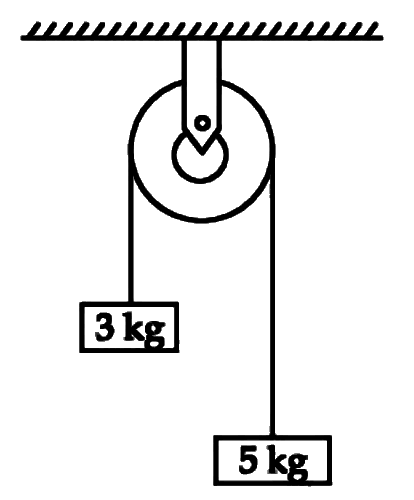
Two blocks of masses 3 kg and 5 kg are connected by a metal wire going over a smooth pulley. The breaking stress of the metal is 24π×102\frac{24}{\pi} \times 10^{2} Nm-2. What is the minimum radius of the wire? (Take g = 10 ms-2)

Figure

Show answer and solution

Answer: (c)

  1. Tension in an Atwood machine: T=2m1m2gm1+m2=2×3×5×108=37.5 NT = \dfrac{2m_1 m_2 g}{m_1 + m_2} = \dfrac{2 \times 3 \times 5 \times 10}{8} = 37.5\text{ N}.
  2. Minimum area: πr2=TS=37.5(24/π)×102\pi r^2 = \dfrac{T}{S} = \dfrac{37.5}{(24/\pi) \times 10^2}
  3. r2=37.52400=0.015625⇒r=0.125 mr^2 = \dfrac{37.5}{2400} = 0.015625 \Rightarrow r = 0.125\text{ m}
  4. So the answer is (c) 12.5 cm.
Report a mistake
Q95JEE Main 2021 · 27 AUG · SHIFT 2Medium

Thermal Stress & Breaking Stress · Breaking stress & maximum load

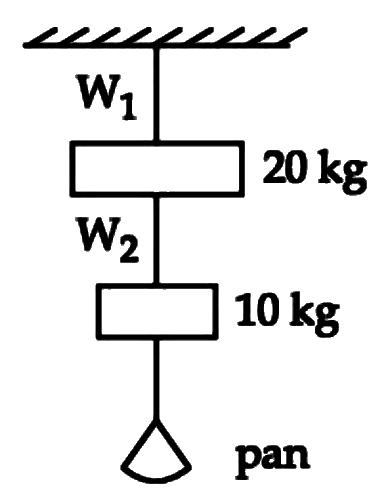
Wires W1 and W2 are made of same material having the breaking stress of 1.25 ×\times 109 N/m2. W1 and W2 have cross-sectional area of 8 ×\times 10−7 m2 and 4 ×\times 10−7 m2, respectively. Masses of 20 kg and 10 kg hang from them as shown in the figure. The maximum mass that can be placed in the pan without breaking the wires is ____________ kg. (Use g = 10 m/s2)

Figure

Numerical answer type. Work it out, then open the answer.

Show answer and solution

Answer: 40

  1. W1 holds (20+10+m)g(20 + 10 + m)g: (30+m)×10≤1.25×109×8×10−7=1000 N⇒m≤70 kg(30 + m) \times 10 \le 1.25 \times 10^9 \times 8 \times 10^{-7} = 1000\text{ N} \Rightarrow m \le 70\text{ kg}.
  2. W2 holds (10+m)g(10 + m)g: (10+m)×10≤1.25×109×4×10−7=500 N⇒m≤40 kg(10 + m) \times 10 \le 1.25 \times 10^9 \times 4 \times 10^{-7} = 500\text{ N} \Rightarrow m \le 40\text{ kg}.
  3. Both wires must survive, so take the smaller value.
  4. So the answer is 40 kg.
Report a mistake
Q96JEE Main 2020 · 9 JAN · SHIFT 1Medium

Thermal Stress & Breaking Stress · Breaking stress & maximum load

A body of mass m = 10 kg is attached to one end of a wire of length 0.3 m. The maximum angular speed (in rad s–1) with which it can be rotated about its other end in space station is: (Breaking stress of wire = 4.8 × 10⁷ Nm–2 and

area of cross-section of the wire = 10–2 cm2) is:

Numerical answer type. Work it out, then open the answer.

Show answer and solution

Answer: 4

  1. In a space station there is no weight; tension only provides the centripetal force: T=mω2LT = m\omega^2 L.
  2. Maximum tension T=4.8×107×10−6=48 NT = 4.8 \times 10^7 \times 10^{-6} = 48\text{ N} (as 10−2 cm2=10−6 m210^{-2}\text{ cm}^2 = 10^{-6}\text{ m}^2).
  3. ω2=4810×0.3=16⇒ω=4 rad s−1\omega^2 = \dfrac{48}{10 \times 0.3} = 16 \Rightarrow \omega = 4\text{ rad s}^{-1}
  4. So the answer is 4 rad/s.
Report a mistake
Q97JEE Main 2019 · 10 APR · SHIFT 2Easy

Thermal Stress & Breaking Stress · Breaking stress & maximum load

The elastic limit of brass is 379 MPa. What should be the minimum diameter of a brass rod if it is to support a 400 N load without exceeding its elastic limit?

Show answer and solution

Answer: (a)

  1. A=Fσ=400379×106=1.055×10⁻⁶ m2A = \dfrac{F}{\sigma} = \dfrac{400}{379 \times 10^6} = 1.055 \times 10^{-6}\text{ m}^2
  2. d=4Aπ=1.344×10⁻⁶≈1.16×10⁻³ md = \sqrt{\dfrac{4A}{\pi}} = \sqrt{1.344 \times 10^{-6}} \approx 1.16 \times 10^{-3}\text{ m}
  3. So the answer is (a) 1.16 mm.
Report a mistake
Q98JEE Main 2019 · 12 APR · SHIFT 2Medium

Thermal Stress & Breaking Stress · Thermal stress

A uniform cylindrical rod of length L and radius r, is made from a material whose Young’s modulus of Elasticity equals Y. When this rod is heated by temperature T and simultaneously subjected to a net longitudinal compressional force F, its length remains unchanged. The coefficient of volume expansion, of the material of the rod, is (nearly) equal to:

Show answer and solution

Answer: (a)

  1. Length unchanged, so the compressive stress equals the thermal stress: Fπr2=YαT\dfrac{F}{\pi r^2} = Y\alpha T.
  2. α=Fπr2YT\alpha = \dfrac{F}{\pi r^2 YT}
  3. Coefficient of volume expansion γ=3α=3Fπr2YT\gamma = 3\alpha = \dfrac{3F}{\pi r^2 YT}
  4. So the answer is (a).
Report a mistake
Q99MHT CET 2019 · 2 MAY · SHIFT 2Medium

Thermal Stress & Breaking Stress · Breaking stress & maximum load

A lift is tied with thick iron ropes having mass ' MM '. The maximum acceleration of the lift is ' aa ' m/s2\text{m/s}^2 and maximum safe stress is ' S ' N/m2\text{N/m}^2. The minimum diameter of the rope is

Show answer and solution

Answer: (b)

  1. Maximum tension in the rope (lift accelerating up): T=M(g+a)T = M(g + a).
  2. Safe stress: S=Tπd2/4S = \dfrac{T}{\pi d^2/4}
  3. d=[4M(g+a)πS]1/2d = \left[\dfrac{4M(g+a)}{\pi S}\right]^{1/2}
  4. So the answer is (b).
Report a mistake
Q100JEE Main 2014Easy

Thermal Stress & Breaking Stress · Thermal stress

The pressure that has to be applied to the ends of a steel wire of length 10 cm10\text{ cm} to keep its length constant when its temperature is raised by 100∘C100^\circ\text{C} is: (For steel Young's modulus is 2×10¹¹ Nm−22 \times 10^{11}\text{ Nm}^{-2} and coefficient of thermal expansion is 1.1×10⁻⁵ K−11.1 \times 10^{-5}\text{ K}^{-1})

Show answer and solution

Answer: (a)

  1. Thermal stress =YαΔT= Y\alpha\Delta T (independent of length).
  2. =2×1011×1.1×10−5×100=2.2×10⁸ Pa= 2 \times 10^{11} \times 1.1 \times 10^{-5} \times 100 = 2.2 \times 10^8\text{ Pa}
  3. So the answer is (a) 2.2×10⁸ Pa2.2 \times 10^8\text{ Pa}.
Report a mistake
Q101JEE Main 2026 · 5 APR · SHIFT 2Medium

Elastic Potential Energy · Work done & energy stored

A copper wire of length 3 m is stretched by 3 mm by applying an external force. The volume of the wire is 600×10−6 m3600 \times 10^{-6}\text{ m}^3. The elastic potential energy stored in the wire in stretched condition would be ______ J.

(Given Young modulus of copper =1.1×10¹¹ N/m2= 1.1 \times 10^{11}\text{ N/m}^2)

Numerical answer type. Work it out, then open the answer.

Show answer and solution

Answer: 33

  1. U=12Yε2×VU = \dfrac{1}{2}Y\varepsilon^2 \times V, with ε=3 mm3 m=10−3\varepsilon = \dfrac{3\text{ mm}}{3\text{ m}} = 10^{-3}.
  2. U=12×1.1×1011×10−6×600×10−6U = \dfrac{1}{2} \times 1.1 \times 10^{11} \times 10^{-6} \times 600 \times 10^{-6}
  3. U=33 JU = 33\text{ J}
  4. So the answer is 33 J.
Report a mistake
Q102JEE Main 2025 · 2 APR · SHIFT 1Medium

Elastic Potential Energy · Energy density

A steel wire of length 2 m and Young's modulus 2.0×10¹¹ N m−22.0 \times 10^{11}\text{ N m}^{-2} is stretched by a force. If Poisson ratio and transverse strain for the wire are 0.2 and 10−310^{-3} respectively, then the elastic potential energy density of the wire is __________ ×105\times 10^{5} (in SI units).

Numerical answer type. Work it out, then open the answer.

Show answer and solution

Answer: 25

  1. Longitudinal strain =transverse strainσ=10−30.2=5×10−3= \dfrac{\text{transverse strain}}{\sigma} = \dfrac{10^{-3}}{0.2} = 5 \times 10^{-3}.
  2. u=12Yε2=12×2×1011×25×10−6u = \dfrac{1}{2}Y\varepsilon^2 = \dfrac{1}{2} \times 2 \times 10^{11} \times 25 \times 10^{-6}
  3. u=25×105 J/m3u = 25 \times 10^5\text{ J/m}^3
  4. So the answer is 25.
Report a mistake
Q103NEET 2023Easy

Elastic Potential Energy · Energy density

The amount of elastic potential energy per unit volume (in SI unit) of a steel wire of length 100 cm100\text{ cm} to stretch it by 1 mm1\text{ mm} is (if Young's modulus of the wire =2.0×10¹¹ Nm−2= 2.0 \times 10^{11}\text{ Nm}^{-2}):

Show answer and solution

Answer: (d)

  1. Energy per unit volume u=12Y(strain)2u = \dfrac{1}{2}Y(\text{strain})^2.
  2. Strain =1 mm100 cm=10−3= \dfrac{1\text{ mm}}{100\text{ cm}} = 10^{-3}
  3. u=12×2×1011×10−6=105 J/m3u = \dfrac{1}{2} \times 2 \times 10^{11} \times 10^{-6} = 10^5\text{ J/m}^3
  4. So the answer is (d) 10510^5.
Report a mistake
Q104JEE Main 2023 · 8 APR · SHIFT 1Easy

Elastic Potential Energy · Energy density

An aluminium rod with Young's modulus Y=7.0×10¹⁰ N/m2Y = 7.0 \times 10^{10}\text{ N/m}^2 undergoes elastic strain of 0.04%0.04\%. The energy per unit volume stored in the rod in SI unit is:

Show answer and solution

Answer: (a)

  1. u=12Yε2u = \dfrac{1}{2}Y\varepsilon^2 with ε=0.04%=4×10⁻⁴\varepsilon = 0.04\% = 4 \times 10^{-4}.
  2. u=12×7×1010×16×10−8=5600 J/m3u = \dfrac{1}{2} \times 7 \times 10^{10} \times 16 \times 10^{-8} = 5600\text{ J/m}^3
  3. So the answer is (a) 5600.
Report a mistake
Q105JEE Main 2023 · 13 APR · SHIFT 1Medium

Elastic Potential Energy · Work done & energy stored

The elastic potential energy stored in a steel wire of length 20 m20\text{ m} stretched through 2 cm2\text{ cm} is 80 J80\text{ J}. The cross sectional area of the wire is __________ mm2\text{mm}^2.

(( Given, Y=2.0×10¹¹ Nm−2)Y = 2.0 \times 10^{11}\text{ Nm}^{-2})

Numerical answer type. Work it out, then open the answer.

Show answer and solution

Answer: 40

  1. U=YAx22L⇒A=2ULYx2U = \dfrac{YAx^2}{2L} \Rightarrow A = \dfrac{2UL}{Yx^2}
  2. A=2×80×202×1011×(0.02)2=32008×107=4×10⁻⁵ m2A = \dfrac{2 \times 80 \times 20}{2 \times 10^{11} \times (0.02)^2} = \dfrac{3200}{8 \times 10^7} = 4 \times 10^{-5}\text{ m}^2
  3. 4×10⁻⁵ m2=40 mm24 \times 10^{-5}\text{ m}^2 = 40\text{ mm}^2
  4. So the answer is 40 mm².
Report a mistake
Q106JEE Main 2022 · 26 JUN · SHIFT 1Medium

Elastic Potential Energy · Energy density

The elastic behaviour of material for linear stress and linear strain, is shown in the figure. The energy density for a linear strain of 5 ×\times 10−4 is __________ kJ/m3. Assume that material is elastic upto the linear strain of 5 ×\times 10−4.

Figure

Numerical answer type. Work it out, then open the answer.

Show answer and solution

Answer: 25

  1. From the graph, strain 10−1010^{-10} at stress 20 N/m220\text{ N/m}^2, so Y=2010−10=2×10¹¹ N/m2Y = \dfrac{20}{10^{-10}} = 2 \times 10^{11}\text{ N/m}^2.
  2. u=12Yε2=12×2×1011×(5×10−4)2u = \dfrac{1}{2}Y\varepsilon^2 = \dfrac{1}{2} \times 2 \times 10^{11} \times (5 \times 10^{-4})^2
  3. u=2.5×10⁴ J/m3=25 kJ/m3u = 2.5 \times 10^4\text{ J/m}^3 = 25\text{ kJ/m}^3
  4. So the answer is 25.
Report a mistake
Q107JEE Main 2021 · 27 JUL · SHIFT 1Medium

Elastic Potential Energy · Catapult: energy to speed

A stone of mass 20 g is projected from a rubber catapult of length 0.1 m and area of cross section 10−6 m2 stretched by an amount 0.04 m. The velocity of the projected stone is ______________ m/s. (Young's modulus of rubber = 0.5 ×\times 109 N/m2)

Numerical answer type. Work it out, then open the answer.

Show answer and solution

Answer: 20

  1. Elastic energy becomes kinetic energy: YAx22L=12mv2\dfrac{YAx^2}{2L} = \dfrac{1}{2}mv^2.
  2. v2=YAx2mL=0.5×109×10−6×(0.04)20.02×0.1=0.80.002=400v^2 = \dfrac{YAx^2}{mL} = \dfrac{0.5 \times 10^9 \times 10^{-6} \times (0.04)^2}{0.02 \times 0.1} = \dfrac{0.8}{0.002} = 400
  3. v=20 m/sv = 20\text{ m/s}
  4. So the answer is 20 m/s.
Report a mistake
Q108MHT CET 2020 · 19 OCT · SHIFT 2Easy

Elastic Potential Energy · Work done & energy stored

A metal rod has length, cross-sectional area and Young's modulus as L,AL, A and YY, respectively. If the elongation in the rod produced is ℓ\ell, then work done is proportional to

Show answer and solution

Answer: (d)

  1. Work done W=12FℓW = \dfrac{1}{2}F\ell with F=YAℓLF = \dfrac{YA\ell}{L}.
  2. W=YAℓ22L∝ℓ2W = \dfrac{YA\ell^2}{2L} \propto \ell^2
  3. So the answer is (d) ℓ2\ell^2.
Report a mistake
Q109JEE Main 2020 · 9 JAN · SHIFT 2Medium

Elastic Potential Energy · Energy density

Two steel wires having same length are suspended from a ceiling under the same load. If the ratio of their energy stored per unit volume is 1: 4, the ratio of their diameters is:

Show answer and solution

Answer: (d)

  1. u=S22Yu = \dfrac{S^2}{2Y} with S=Fπd2/4S = \dfrac{F}{\pi d^2/4}, so for the same load and material u∝1d4u \propto \dfrac{1}{d^4}.
  2. u1u2=(d2d1)4=14\dfrac{u_1}{u_2} = \left(\dfrac{d_2}{d_1}\right)^4 = \dfrac{1}{4}
  3. d1d2=41/4=2\dfrac{d_1}{d_2} = 4^{1/4} = \sqrt{2}
  4. So the answer is (d) 2:1\sqrt{2} : 1.
Report a mistake
Q110MHT CET 2019 · 2 MAY · SHIFT 2Easy

Elastic Potential Energy · Work done & energy stored

A wire of length ' LL ' and area of cross section ' AA ' is made of material of Young's modulus ' YY. It is stretched by an amount ' xx '. The work done in stretching the wire is

Show answer and solution

Answer: (a)

  1. Stretching force F=YAxLF = \dfrac{YAx}{L}, and W=12FxW = \dfrac{1}{2}Fx.
  2. W=YAx22LW = \dfrac{YAx^2}{2L}
  3. So the answer is (a).
Report a mistake
Q111NEET 2019Easy

Elastic Potential Energy · Work done & energy stored

When a block of mass M is suspended by a long wire of length L, the length of the wire becomes (L + ll). The elastic potential energy stored in the extended wire is:

Show answer and solution

Answer: (c)

  1. Elastic energy stored U=12×load×extensionU = \dfrac{1}{2} \times \text{load} \times \text{extension}.
  2. Load =Mg= Mg, extension =l= l, so U=12MglU = \dfrac{1}{2}Mgl.
  3. So the answer is (c).
Report a mistake
Q112MHT CET 2019 · 2 MAY · SHIFT 1Medium

Elastic Potential Energy · Work done & energy stored

Work done in stretching a wire through 1 mm is 2 J. What amount of work will be done for elongating another wire of same material, with half the length and double the radius of cross section, by 1 mm?

Show answer and solution

Answer: (d)

  1. W=YAx22L=Yπr2x22LW = \dfrac{YAx^2}{2L} = \dfrac{Y\pi r^2 x^2}{2L}, so for the same xx, W∝r2LW \propto \dfrac{r^2}{L}.
  2. W2W1=(2)21/2=8\dfrac{W_2}{W_1} = \dfrac{(2)^2}{1/2} = 8
  3. W2=8×2=16 JW_2 = 8 \times 2 = 16\text{ J}
  4. So the answer is (d) 16 J.
Report a mistake
Q113JEE Main 2019 · 8 APR · SHIFT 1Medium

Elastic Potential Energy · Catapult: energy to speed

A boy's catapult is made of rubber cord which is 42 cm long, with 6 mm diameter of cross-section and of negligible mass. The boy keeps a stone weighing 0.02kg on it and stretches the cord by 20 cm by applying a constant force. When released, the stone flies off with a velocity of 20 ms–1. Neglect the change in the area of cross-section of the cord while stretched. The Young's modulus of rubber is closest to:

Show answer and solution

Answer: (b)

  1. Energy stored in the cord becomes kinetic energy: 12mv2=12×0.02×400=4 J\dfrac{1}{2}mv^2 = \dfrac{1}{2} \times 0.02 \times 400 = 4\text{ J}.
  2. Stored energy =YAx22L= \dfrac{YAx^2}{2L}, with A=π(3×10⁻³)2=2.83×10⁻⁵ m2A = \pi (3 \times 10^{-3})^2 = 2.83 \times 10^{-5}\text{ m}^2.
  3. Y=2×4×0.422.83×10−5×(0.2)2≈3×10⁶ N m−2Y = \dfrac{2 \times 4 \times 0.42}{2.83 \times 10^{-5} \times (0.2)^2} \approx 3 \times 10^6\text{ N m}^{-2}
  4. This is of order 10610^6. So the answer is (b) 106 N m−210^6\text{ N m}^{-2}.
Report a mistake
Q114JEE Main 2005 · AIEEEEasy

Elastic Potential Energy · Energy density

If SS is stress and YY is young's modulus of material of a wire, the energy stored in the wire per unit volume is

Show answer and solution

Answer: (a)

  1. u=12×stress×strainu = \dfrac{1}{2} \times \text{stress} \times \text{strain}, with strain =S/Y= S/Y.
  2. u=S22Yu = \dfrac{S^2}{2Y}
  3. So the answer is (a).
Report a mistake
Q115JEE Main 2004 · AIEEEEasy

Elastic Potential Energy · Work done & energy stored

A wire fixed at the upper end stretches by length ll by applying a force F.F. The work done in stretching is

Show answer and solution

Answer: (d)

  1. Force grows linearly from 0 to FF during stretching, so average force is F/2F/2.
  2. W=12FlW = \dfrac{1}{2}Fl
  3. So the answer is (d) Fl2\dfrac{Fl}{2}.
Report a mistake
Q116JEE Main 2003 · AIEEEEasy

Elastic Potential Energy · Work done & energy stored

A wire suspended vertically from one of its ends is stretched by attaching a weight of 200 N200\text{ N} to the lower end. The weight stretches the wire by 1 mm.1\text{ mm.} Then the elastic energy stored in the wire is

Show answer and solution

Answer: (d)

  1. U=12Fl=12×200×10−3U = \dfrac{1}{2}Fl = \dfrac{1}{2} \times 200 \times 10^{-3}
  2. U=0.1 JU = 0.1\text{ J}
  3. So the answer is (d) 0.1 J.
Report a mistake
Q117JEE Main 2026 · 4 APR · SHIFT 1Easy

Bulk Modulus & Compressibility · Bulk modulus & compressibility

The increase in the pressure required to decrease the volume ( ΔV\Delta V) of water is 6.3×10⁷ N/m26.3 \times 10^{7}\text{ N/m}^2. The percentage decrease in the volume is ______.

(Bulk modulus of water =2.1×10⁹ N/m2= 2.1 \times 10^{9}\text{ N/m}^2.)

Show answer and solution

Answer: (b)

  1. ΔVV=ΔPB\dfrac{\Delta V}{V} = \dfrac{\Delta P}{B}
  2. ΔVV=6.3×1072.1×109=0.03=3%\dfrac{\Delta V}{V} = \dfrac{6.3 \times 10^7}{2.1 \times 10^9} = 0.03 = 3\%
  3. So the answer is (b) 3%.
Report a mistake
Q118JEE Main 2026 · 6 APR · SHIFT 1Medium

Bulk Modulus & Compressibility · Bulk modulus & compressibility

A certain gas is isothermally compressed to (13)rd\left(\frac{1}{3}\right)^{\text{rd}} of its initial volume (Vo=3(V_{\text{o}} = 3 litre) by applying required pressure. If the bulk modulus of the gas is 3×10⁵ N/m23 \times 10^{5}\text{ N/m}^2, the magnitude of work done on the gas is ______ J.

Numerical answer type. Work it out, then open the answer.

Show answer and solution

Answer: 989

  1. For an isothermal process the bulk modulus equals the pressure: B=PB = P, so initial P0=3×10⁵ PaP_0 = 3\times10^{5}\ \text{Pa}.
  2. Isothermal work: W=P0V0ln⁡V0Vf=P0V0ln⁡3W = P_0V_0\ln\frac{V_0}{V_f} = P_0V_0\ln 3
  3. W=3×105×3×10−3×1.0986=900×1.0986W = 3\times10^{5}\times3\times10^{-3}\times1.0986 = 900\times1.0986
  4. W≈989 JW \approx 989\ \text{J}
Report a mistake
Q119JEE Main 2025 · 28 JAN · SHIFT 2Easy

Bulk Modulus & Compressibility · Bulk modulus & compressibility

The volume contraction of a solid copper cube of edge length 10 cm, when subjected to a hydraulic pressure of 7×10⁶ Pa7 \times 10^{6}\text{ Pa}, would be __________ mm3\text{mm}^3.

(Given bulk modulus of copper =1.4×10¹¹ N m−2= 1.4 \times 10^{11}\text{ N m}^{-2})

Numerical answer type. Work it out, then open the answer.

Show answer and solution

Answer: 50

  1. ΔV=PVB\Delta V = \frac{PV}{B}, with V=(0.1)3=10−3 m3V = (0.1)^3 = 10^{-3}\ \text{m}^3.
  2. ΔV=7×106×10−31.4×1011=5×10⁻⁸ m3\Delta V = \frac{7\times10^{6}\times10^{-3}}{1.4\times10^{11}} = 5\times10^{-8}\ \text{m}^3
  3. 1 m3=109 mm3⇒ΔV=50 mm31\ \text{m}^3 = 10^{9}\ \text{mm}^3 \Rightarrow \Delta V = 50\ \text{mm}^3
  4. So the answer is 50 mm350\ \text{mm}^3.
Report a mistake
Q120JEE Main 2025 · 24 JAN · SHIFT 2Easy

Bulk Modulus & Compressibility · Bulk modulus & compressibility

The increase in pressure required to decrease the volume of a water sample by 0.2%0.2\% is P×105 Nm−2\text{P} \times 10^{5}\text{ Nm}^{-2}. Bulk modulus of water is 2.15×10⁹ Nm−22.15 \times 10^{9}\text{ Nm}^{-2}. The value of P is _________.

Numerical answer type. Work it out, then open the answer.

Show answer and solution

Answer: 43

  1. ΔP=B ΔVV\Delta P = B\,\frac{\Delta V}{V}
  2. ΔP=2.15×109×0.002=4.3×10⁶ N m−2\Delta P = 2.15\times10^{9}\times0.002 = 4.3\times10^{6}\ \text{N m}^{-2}
  3. =43×105 N m−2= 43\times10^{5}\ \text{N m}^{-2}, so P=43P = 43.
Report a mistake
Q121JEE Main 2025 · 8 APR · SHIFT 2Medium

Bulk Modulus & Compressibility · Bulk modulus & compressibility

A sample of a liquid is kept at 1 atm. It is compressed to 5 atm which leads to a change of volume of 0.8 cm3. If the bulk modulus of the liquid is 2 GPa, the initial volume of the liquid was _______ litre. (Take 1 atm = 105 Pa)

Numerical answer type. Work it out, then open the answer.

Show answer and solution

Answer: 4

  1. B=ΔPΔV/V⇒V=B ΔVΔPB = \frac{\Delta P}{\Delta V/V} \Rightarrow V = \frac{B\,\Delta V}{\Delta P}
  2. ΔP=5−1=4 atm=4×10⁵ Pa\Delta P = 5 - 1 = 4\ \text{atm} = 4\times10^{5}\ \text{Pa}, ΔV=0.8×10⁻⁶ m3\Delta V = 0.8\times10^{-6}\ \text{m}^3
  3. V=2×109×0.8×10−64×105=4×10⁻³ m3V = \frac{2\times10^{9}\times0.8\times10^{-6}}{4\times10^{5}} = 4\times10^{-3}\ \text{m}^3
  4. So V=4V = 4 litre.
Report a mistake
Q122JEE Main 2025 · 29 JAN · SHIFT 1Medium

Bulk Modulus & Compressibility · Fractional compression at depth

The fractional compression (ΔVV)\left(\frac{\Delta V}{V}\right) of water at the depth of 2.5 km below the sea level is __________ %. Given, the Bulk modulus of water = 2×1092 \times 10^{9} N m−2^{-2}, density of water = 10310^{3} kg m−3^{-3}, acceleration due to gravity g=10g = 10 m s−2^{-2}.

Show answer and solution

Answer: (b)

  1. ΔVV=ρghB\frac{\Delta V}{V} = \frac{\rho g h}{B}
  2. ρgh=103×10×2500=2.5×10⁷ Pa\rho g h = 10^{3}\times10\times2500 = 2.5\times10^{7}\ \text{Pa}
  3. ΔVV=2.5×1072×109=1.25×10−2=1.25%\frac{\Delta V}{V} = \frac{2.5\times10^{7}}{2\times10^{9}} = 1.25\times10^{-2} = 1.25\%
  4. So the answer is (b).
Report a mistake
Q123JEE Main 2024 · 31 JAN · SHIFT 1Medium

Bulk Modulus & Compressibility · Fractional compression at depth

The depth below the surface of sea to which a rubber ball be taken so as to decrease its volume by 0.02%0.02\% is _______ mm.

(Take density of sea water =103 kgm−3= 10^{3}\text{ kgm}^{-3}, Bulk modulus of rubber =9×10⁸ Nm−2= 9 \times 10^{8}\text{ Nm}^{-2}, and g=10 ms−2g = 10\text{ ms}^{-2})

Numerical answer type. Work it out, then open the answer.

Show answer and solution

Answer: 18

  1. ρgh=B ΔVV\rho g h = B\,\frac{\Delta V}{V}
  2. B ΔVV=9×108×2×10−4=1.8×10⁵ PaB\,\frac{\Delta V}{V} = 9\times10^{8}\times2\times10^{-4} = 1.8\times10^{5}\ \text{Pa}
  3. h=1.8×105103×10=18 mh = \frac{1.8\times10^{5}}{10^{3}\times10} = 18\ \text{m}
Report a mistake
Q124JEE Main 2024 · 27 JAN · SHIFT 1Medium

Bulk Modulus & Compressibility · Fractional compression at depth

If average depth of an ocean is 4000 m4000\text{ m} and the bulk modulus of water is 2×10⁹ Nm−22 \times 10^{9}\text{ Nm}^{-2}, then fractional compression ΔVV\frac{\Delta V}{V} of water at the bottom of ocean is α×10−2\alpha \times 10^{-2}. The value of α\alpha is _______ (Given, g=10 ms−2, ρ=1000 kg m−3\text{g} = 10\text{ ms}^{-2},\ \rho = 1000\text{ kg m}^{-3})

Numerical answer type. Work it out, then open the answer.

Show answer and solution

Answer: 2

  1. ΔVV=ρghB\frac{\Delta V}{V} = \frac{\rho g h}{B}
  2. ρgh=1000×10×4000=4×10⁷ Pa\rho g h = 1000\times10\times4000 = 4\times10^{7}\ \text{Pa}
  3. ΔVV=4×1072×109=2×10⁻²\frac{\Delta V}{V} = \frac{4\times10^{7}}{2\times10^{9}} = 2\times10^{-2}, so α=2\alpha = 2.
Report a mistake
Q125JEE Main 2023 · 13 APR · SHIFT 1Easy

Bulk Modulus & Compressibility · Bulk modulus & compressibility

Under isothermal condition, the pressure of a gas is given by P=a V−3\text{P} = a\,\text{V}^{-3}, where aa is a constant and V\text{V} is the volume of the gas. The bulk modulus at constant temperature is equal to

Show answer and solution

Answer: (c)

  1. B=−VdPdVB = -V\dfrac{dP}{dV}
  2. dPdV=−3aV−4⇒B=3aV−3=3P\dfrac{dP}{dV} = -3aV^{-4} \Rightarrow B = 3aV^{-3} = 3P
  3. So the answer is (c) 3P.
Report a mistake
Q126JEE Main 2023 · 1 FEB · SHIFT 1Medium

Bulk Modulus & Compressibility · Bulk modulus & compressibility

A certain pressure 'P\text{P}' is applied to 1 litre of water and 2 litre of a liquid separately. Water gets compressed to 0.01%0.01\% whereas the liquid gets compressed to 0.03%0.03\%. The ratio of Bulk modulus of water to that of the liquid is 3x\frac{3}{x}. The value of xx is ____________.

Numerical answer type. Work it out, then open the answer.

Show answer and solution

Answer: 1

  1. B=PΔV/VB = \frac{P}{\Delta V/V}; same PP, so B∝1ΔV/VB \propto \frac{1}{\Delta V/V} (the volumes themselves do not matter).
  2. BwBl=0.03%0.01%=3=3x\frac{B_w}{B_l} = \frac{0.03\%}{0.01\%} = 3 = \frac{3}{x}
  3. So x=1x = 1.
Report a mistake
Q127JEE Main 2022 · 24 JUN · SHIFT 1Easy

Bulk Modulus & Compressibility · Bulk modulus & compressibility

The bulk modulus of a liquid is 3 ×\times 1010 Nm−2. The pressure required to reduce the volume of liquid by 2% is:

Show answer and solution

Answer: (c)

  1. ΔP=BΔVV\Delta P = B\dfrac{\Delta V}{V}
  2. ΔP=3×1010×0.02=6×10⁸ N m−2\Delta P = 3 \times 10^{10} \times 0.02 = 6 \times 10^8\text{ N m}^{-2}
  3. So the answer is (c) 6×10⁸ N m−26 \times 10^8\text{ N m}^{-2}.
Report a mistake
Q128JEE Main 2021 · 17 MAR · SHIFT 2Medium

Bulk Modulus & Compressibility · Bulk modulus & compressibility

An object is located at 2 km beneath the surface of the water. If the fractional compression ΔVV\frac{\Delta V}{V} is 1.36%, the ratio of hydraulic stress to the corresponding hydraulic strain will be ____________. [Given: density of water is 1000 kgm−3 and g = 9.8 ms−2]

Show answer and solution

Answer: (b)

  1. Hydraulic stress at depth: P=ρgh=1000×9.8×2000=1.96×10⁷ PaP = \rho g h = 1000\times9.8\times2000 = 1.96\times10^{7}\ \text{Pa}.
  2. Stress/strain =B=PΔV/V=1.96×1070.0136= B = \frac{P}{\Delta V/V} = \frac{1.96\times10^{7}}{0.0136}
  3. B≈1.44×10⁹ N m−2B \approx 1.44\times10^{9}\ \text{N m}^{-2}
  4. So the answer is (b).
Report a mistake
Q129JEE Main 2021 · 31 AUG · SHIFT 1Medium

Bulk Modulus & Compressibility · Fractional compression at depth

When a rubber ball is taken to a depth of __________m in deep sea, its volume decreases by 0.5%. (The bulk modulus of rubber = 9.8 ×\times 108 Nm−2, Density of sea water = 103 kgm−3, g = 9.8 m/s2)

Numerical answer type. Work it out, then open the answer.

Show answer and solution

Answer: 500

  1. ρgh=B ΔVV\rho g h = B\,\frac{\Delta V}{V}
  2. B ΔVV=9.8×108×0.005=4.9×10⁶ PaB\,\frac{\Delta V}{V} = 9.8\times10^{8}\times0.005 = 4.9\times10^{6}\ \text{Pa}
  3. h=4.9×106103×9.8=500 mh = \frac{4.9\times10^{6}}{10^{3}\times9.8} = 500\ \text{m}
Report a mistake
Q130JEE Main 2021 · 26 FEB · SHIFT 1Medium

Bulk Modulus & Compressibility · Density of compressed matter

The normal density of a material is ρ\rho and its bulk modulus of elasticity is K. The magnitude of increase in density of material, when a pressure P is applied uniformly on all sides, will be:

Show answer and solution

Answer: (c)

  1. ρV\rho V = constant, so Δρρ=ΔVV\frac{\Delta\rho}{\rho} = \frac{\Delta V}{V} (in magnitude).
  2. ΔVV=PK\frac{\Delta V}{V} = \frac{P}{K}
  3. Δρ=ρPK\Delta\rho = \frac{\rho P}{K}
  4. So the answer is (c).
Report a mistake
Q131MHT CET 2020 · 19 OCT · SHIFT 2Easy

Bulk Modulus & Compressibility · Bulk modulus & compressibility

The compressibility of water is 5×10⁻¹⁰ m2/N5 \times 10^{-10}\text{ m}^2\text{/N}. Pressure of 15×106 Pa15 \times 10^{6}\text{ Pa} is applied on 100 mL volume of water. The change in the volume of water is

Show answer and solution

Answer: (b)

  1. ΔV=kPV\Delta V = kPV, where kk is compressibility; pressure reduces the volume.
  2. ΔV=5×10−10×15×106×100 mL=0.75 mL\Delta V = 5 \times 10^{-10} \times 15 \times 10^6 \times 100\text{ mL} = 0.75\text{ mL}
  3. So the answer is (b) 0.75 mL decrease.
Report a mistake
Q132MHT CET 2020 · 16 OCT · SHIFT 1Medium

Bulk Modulus & Compressibility · Density of compressed matter

The density of a metal at normal pressure pp is ρ\rho. When it is subjected to an excess pressure, the density becomes ρ′\rho'. If KK is the bulk modulus of the metal, then the ratio ρ′ρ\frac{\rho'}{\rho} is

Show answer and solution

Answer: (c)

  1. Mass is constant, so ρ′ρ=VV′=VV−ΔV\frac{\rho'}{\rho} = \frac{V}{V'} = \frac{V}{V - \Delta V}.
  2. ΔVV=pK\frac{\Delta V}{V} = \frac{p}{K} (with pp the excess pressure).
  3. ρ′ρ=11−pK\frac{\rho'}{\rho} = \frac{1}{1 - \frac{p}{K}}
  4. So the answer is (c).
Report a mistake
Q133JEE Main 2020 · 4 SEP · SHIFT 2Medium

Bulk Modulus & Compressibility · Sphere, cube & cork under pressure

A cube of metal is subjected to a hydrostatic pressure of 4 GPa. The percentage change in the length of the side of the cube is close to:

(Given bulk modulus of metal, B = 8 ×\times 1010 Pa)

Show answer and solution

Answer: (c)

  1. ΔVV=PB=4×1098×1010=0.05=5%\frac{\Delta V}{V} = \frac{P}{B} = \frac{4\times10^{9}}{8\times10^{10}} = 0.05 = 5\%
  2. For a cube V=L3⇒ΔLL=13ΔVVV = L^3 \Rightarrow \frac{\Delta L}{L} = \frac{1}{3}\frac{\Delta V}{V}
  3. ΔLL=53%≈1.67%\frac{\Delta L}{L} = \frac{5}{3}\% \approx 1.67\%
  4. So the answer is (c).
Report a mistake
Q134JEE Main 2018Difficult

Bulk Modulus & Compressibility · Sphere, cube & cork under pressure

A solid sphere of radius r made of a soft material of bulk modulus K is surrounded by a liquid in a cylindrical container. A massless piston of area a floats on the surface of the liquid, covering entire cross section of cylindrical container. When a mass m is placed on the surface of the piston to compress the liquid, the fractional decrement in the radius of the sphere, (drr)\left(\frac{dr}{r}\right) is:

Show answer and solution

Answer: (d)

  1. Extra pressure in the liquid (Pascal's law): P=mgaP = \frac{mg}{a}, acting on the sphere from all sides.
  2. ΔVV=PK=mgKa\frac{\Delta V}{V} = \frac{P}{K} = \frac{mg}{Ka}
  3. ΔVV=3drr⇒drr=mg3Ka\frac{\Delta V}{V} = 3\frac{dr}{r} \Rightarrow \frac{dr}{r} = \frac{mg}{3Ka}
  4. So the answer is (d).
Report a mistake
Q135NEET 2017Medium

Bulk Modulus & Compressibility · Sphere, cube & cork under pressure

The bulk modulus of a spherical object is 'B'. If it is subjected to uniform pressure 'P', the fractional decrease in radius is

Show answer and solution

Answer: (c)

  1. V=43πr3⇒ΔVV=3ΔrrV = \frac{4}{3}\pi r^3 \Rightarrow \frac{\Delta V}{V} = 3\frac{\Delta r}{r}
  2. ΔVV=pB\frac{\Delta V}{V} = \frac{p}{B}
  3. Δrr=p3B\frac{\Delta r}{r} = \frac{p}{3B}
  4. So the answer is (c).
Report a mistake
Q136JEE Main 2016 · 10 APR · SHIFT 1Difficult

Bulk Modulus & Compressibility · Sphere, cube & cork under pressure

A bottle has an opening of radius a and length b. A cork of length b and radius (a + Δ\Deltaa) where (Δ\Deltaa < < a) is compressed to fit into the opening completely (See figure). If the bulk modulus of cork is B and frictional coefficient between the bottle and cork is μ\mu then the force needed to push the cork into the bottle is:

Figure

Show answer and solution

Answer: (d)

  1. Only the radius changes (length bb fixed): V=πr2b⇒ΔVV=2ΔaaV = \pi r^2 b \Rightarrow \frac{\Delta V}{V} = \frac{2\Delta a}{a}.
  2. Pressure on the cork: P=B ΔVV=2BΔaaP = B\,\frac{\Delta V}{V} = \frac{2B\Delta a}{a}
  3. Normal force on the curved surface: N=P×2πab=4πBb ΔaN = P\times2\pi a b = 4\pi B b\,\Delta a
  4. Force needed = friction =μN=(4πμBb) Δa= \mu N = (4\pi\mu B b)\,\Delta a
  5. So the answer is (d).
Report a mistake
Q137NEET 2015 · AIPMT · CANCELLED PAPERMedium

Bulk Modulus & Compressibility · Fractional compression at depth

The approximate depth of an ocean is 2700 m. The compressiblity of water is 45.4 ×\times 10−11 Pa−1 and density of water is 103 kg/m3. What fractional compression of water will be obtained at the bottom of the ocean?

Show answer and solution

Answer: (a)

  1. ΔVV=compressibility×P\frac{\Delta V}{V} = \text{compressibility}\times P, with P=ρghP = \rho g h.
  2. P=103×9.8×2700=2.646×10⁷ PaP = 10^{3}\times9.8\times2700 = 2.646\times10^{7}\ \text{Pa}
  3. ΔVV=45.4×10−11×2.646×107≈1.2×10⁻²\frac{\Delta V}{V} = 45.4\times10^{-11}\times2.646\times10^{7} \approx 1.2\times10^{-2}
  4. So the answer is (a).
Report a mistake
Q138JEE Main 2014 · 11 APR · SHIFT 1Easy

Bulk Modulus & Compressibility · Bulk modulus & compressibility

The Bulk moduli of Ethanol, Mercury and water are given as 0.9, 25 and 2.2 respectively in units of 109 Nm−2. For a given value of pressure, the fractional compression in volume is ΔVV\frac{\Delta V}{V}. Which of the following statements about ΔVV\frac{\Delta V}{V} for these three liquids is correct?

Show answer and solution

Answer: (a)

  1. Fractional compression ΔVV=PB\frac{\Delta V}{V} = \frac{P}{B}, so for the same PP, ΔVV∝1B\frac{\Delta V}{V} \propto \frac{1}{B}.
  2. BB: ethanol 0.90.9 < water 2.22.2 < mercury 2525 (in 109 N m−210^9\ \text{N m}^{-2}).
  3. Smallest BB compresses most: ethanol > water > mercury.
  4. So the answer is (a).
Report a mistake
Q139JEE Main 2026 · 5 APR · SHIFT 1Easy

Shear Modulus & Poisson's Ratio · Shear modulus

A cube has side length 5 cm and modulus of rigidity 105 N/m210^{5}\text{ N/m}^2. The displacement produced by a force of 10 N in the upper face of cube is ______ mm.

Numerical answer type. Work it out, then open the answer.

Show answer and solution

Answer: 2

  1. η=F/AΔx/L⇒Δx=FLηA\eta = \frac{F/A}{\Delta x/L} \Rightarrow \Delta x = \frac{FL}{\eta A}
  2. A=(0.05)2=2.5×10⁻³ m2A = (0.05)^2 = 2.5\times10^{-3}\ \text{m}^2, L=0.05 mL = 0.05\ \text{m}
  3. Δx=10×0.05105×2.5×10−3=2×10⁻³ m\Delta x = \frac{10\times0.05}{10^{5}\times2.5\times10^{-3}} = 2\times10^{-3}\ \text{m}
  4. Δx=2 mm\Delta x = 2\ \text{mm}
Report a mistake
Q140NEET 2026Easy

Shear Modulus & Poisson's Ratio · Poisson's ratio

Match List I with List II:

Figure

Choose the correct answer from the options given below:

Show answer and solution

Answer: (d)

  1. Young's modulus Y=FLA ΔLY = \frac{FL}{A\,\Delta L}: A-II.
  2. Compressibility =1B=−1ΔP(ΔVV)= \frac{1}{B} = -\frac{1}{\Delta P}\left(\frac{\Delta V}{V}\right): B-III.
  3. Bulk modulus B=−P(VΔV)B = -P\left(\frac{V}{\Delta V}\right): C-IV.
  4. Poisson's ratio =Δd/dΔL/L=ΔdΔL(Ld)= \frac{\Delta d/d}{\Delta L/L} = \frac{\Delta d}{\Delta L}\left(\frac{L}{d}\right): D-I.
  5. So the answer is (d).
Report a mistake
Q141JEE Main 2025 · 4 APR · SHIFT 2Medium

Shear Modulus & Poisson's Ratio · Shear modulus

A cylindrical rod of length 1 m and radius 4 cm is mounted vertically. It is subjected to a shear force of 105 N10^{5}\text{ N} at the top. Considering infinitesimally small displacement in the upper edge, the angular displacement θ\theta of the rod axis from its original position would be: (shear moduli, G=1010 N/m2G = 10^{10}\text{ N/m}^2)

Show answer and solution

Answer: (a)

  1. G=F/Aθ⇒θ=FGAG = \frac{F/A}{\theta} \Rightarrow \theta = \frac{F}{GA}, with A=πr2A = \pi r^2 (top face).
  2. A=π(0.04)2=16π×10−4 m2A = \pi(0.04)^2 = 16\pi\times10^{-4}\ \text{m}^2
  3. θ=1051010×16π×10−4=1160π\theta = \frac{10^{5}}{10^{10}\times16\pi\times10^{-4}} = \frac{1}{160\pi}
  4. So the answer is (a).
Report a mistake
Q142JEE Main 2025 · 4 APR · SHIFT 1Medium

Shear Modulus & Poisson's Ratio · Shear modulus

Two slabs with square cross section of different materials (1,2)(1, 2) with equal sides (l)(l) and thickness d1d_1 and d2d_2 such that d2=2d1d_2 = 2d_1 and l>d2l > d_2. Considering lower edges of these slabs are fixed to the floor, we apply equal shearing force on the narrow faces. The angle of deformation is θ2=2θ1\theta_2 = 2\theta_1. If the shear moduli of material 1 is 4×10⁹ N/m24 \times 10^{9}\text{ N/m}^2, then shear moduli of material 2 is x×109 N/m2x \times 10^{9}\text{ N/m}^2, where value of xx is ________.

Numerical answer type. Work it out, then open the answer.

Show answer and solution

Answer: 1

  1. Force on the narrow face of area A=ldA = l d: θ=FG l d\theta = \frac{F}{G\,l\,d}.
  2. θ2θ1=G1d1G2d2⇒2=G12G2\frac{\theta_2}{\theta_1} = \frac{G_1 d_1}{G_2 d_2} \Rightarrow 2 = \frac{G_1}{2G_2}
  3. G2=G14=4×1094=1×10⁹ N/m2G_2 = \frac{G_1}{4} = \frac{4\times10^{9}}{4} = 1\times10^{9}\ \text{N/m}^2
  4. So x=1x = 1.
Report a mistake
Q143JEE Main 2023 · 30 JAN · SHIFT 1Easy

Shear Modulus & Poisson's Ratio · Relations between elastic constants

Choose the correct relationship between Poisson ratio (σ)(\sigma), bulk modulus (K) and modulus of rigidity (η)(\eta) of a given solid object:

Show answer and solution

Answer: (b)

  1. Y=3K(1−2σ)Y = 3K(1-2\sigma) and Y=2η(1+σ)Y = 2\eta(1+\sigma)
  2. Equate: 3K−6Kσ=2η+2ησ3K - 6K\sigma = 2\eta + 2\eta\sigma
  3. σ(6K+2η)=3K−2η⇒σ=3K−2η6K+2η\sigma(6K + 2\eta) = 3K - 2\eta \Rightarrow \sigma = \frac{3K-2\eta}{6K+2\eta}
  4. So the answer is (b).
Report a mistake
Q144JEE Main 2022 · 27 JUL · SHIFT 1Easy

Shear Modulus & Poisson's Ratio · Shear modulus

A square aluminum (shear modulus is 25×109 Nm−225 \times 10^{9}\text{ Nm}^{-2}) slab of side 60 cm60\text{ cm} and thickness 15 cm15\text{ cm} is subjected to a shearing force (on its narrow face) of 18.0×10⁴ N18.0 \times 10^{4}\text{ N}. The lower edge is riveted to the floor. The displacement of the upper edge is ____________ μ\mum.

Numerical answer type. Work it out, then open the answer.

Show answer and solution

Answer: 48

FL = 60 cm15 cm thickA = 60 cm x 15 cm
  1. Force acts on the narrow face: A=0.60×0.15=0.09 m2A = 0.60\times0.15 = 0.09\ \text{m}^2.
  2. Shear stress =18×1040.09=2×10⁶ N m−2= \frac{18\times10^{4}}{0.09} = 2\times10^{6}\ \text{N m}^{-2}
  3. Shear strain =2×10625×109=8×10−5= \frac{2\times10^{6}}{25\times10^{9}} = 8\times10^{-5}
  4. Δx=strain×L=8×10−5×0.60=4.8×10⁻⁵ m\Delta x = \text{strain}\times L = 8\times10^{-5}\times0.60 = 4.8\times10^{-5}\ \text{m}
  5. Δx=48 μm\Delta x = 48\ \mu\text{m}
Report a mistake
Q145JEE Main 2021 · 24 FEB · SHIFT 1Easy

Shear Modulus & Poisson's Ratio · Relations between elastic constants

If Y, K and η\eta are the values of Young's modulus, bulk modulus and modulus of rigidity of any material respectively. Choose the correct relation for these parameters.

Show answer and solution

Answer: (d)

  1. Standard relation: 9Y=1K+3η\frac{9}{Y} = \frac{1}{K} + \frac{3}{\eta} (equivalently Y=9Kη3K+ηY = \frac{9K\eta}{3K+\eta}).
  2. 1K=9Y−3η=9η−3YYη\frac{1}{K} = \frac{9}{Y} - \frac{3}{\eta} = \frac{9\eta - 3Y}{Y\eta}
  3. K=Yη9η−3YK = \frac{Y\eta}{9\eta - 3Y}
  4. So the answer is (d).
Report a mistake
Q146MHT CET 2019 · 3 MAY · SHIFT 1Easy

Shear Modulus & Poisson's Ratio · Poisson's ratio

For homogeneous isotropic material, which one of the following cannot be the value of Poisson's ratio?

Show answer and solution

Answer: (d)

  1. Theoretical range for an isotropic material: −1<σ<0.5-1 < \sigma < 0.5 (from K>0K > 0 and η>0\eta > 0).
  2. 0.10.1 lies inside; −1-1 and 0.50.5 are the limiting values.
  3. 0.80.8 is outside the range, so it cannot be Poisson's ratio.
  4. So the answer is (d).
Report a mistake
Q147JEE Main 2018 · 15 APR · SHIFT 2Medium

Shear Modulus & Poisson's Ratio · Shear modulus

As shown in the figure, forces of 105 N each are applied in opposite directions, on the upper and lower faces of a cube of side 10 cm, shifting the upper face parallel to itself by 0.5 cm. If the side of another cube of the same material is 20 cm, then under similar conditions as above, the displacement will be:

Figure

Show answer and solution

Answer: (a)

  1. η=F/L2Δx/L⇒Δx=FηL\eta = \frac{F/L^2}{\Delta x/L} \Rightarrow \Delta x = \frac{F}{\eta L}
  2. Same FF and η\eta: Δx∝1L\Delta x \propto \frac{1}{L}
  3. LL doubles ⇒Δx′=0.52=0.25 cm\Rightarrow \Delta x' = \frac{0.5}{2} = 0.25\ \text{cm}
  4. So the answer is (a).
Report a mistake
Q148JEE Main 2014 · 9 APR · SHIFT 1Easy

Shear Modulus & Poisson's Ratio · Relations between elastic constants

In materials like aluminium and copper, the correct order of magnitude of various elastic moduli is:

Show answer and solution

Answer: (c)

  1. Typical values (in 109 N m−210^{9}\ \text{N m}^{-2}): Al: η≈25\eta \approx 25, Y≈70Y \approx 70, B≈72B \approx 72; Cu: η≈42\eta \approx 42, Y≈120Y \approx 120, B≈140B \approx 140.
  2. Also from Y=2η(1+σ)Y = 2\eta(1+\sigma) with σ≈0.33\sigma \approx 0.33: η<Y\eta < Y, and Y=3B(1−2σ)Y = 3B(1-2\sigma) gives Y≈BY \approx B, slightly less.
  3. Order: shear < Young's < bulk.
  4. So the answer is (c).
Report a mistake
Q149JEE Main 2014 · 12 APR · SHIFT 1Medium

Shear Modulus & Poisson's Ratio · Shear modulus

Steel ruptures when a shear of 3.5 ×\times 108 N m−2 is applied. The force needed to punch a 1 cm diameter hole in a steel sheet 0.3 cm thick is nearly:

Show answer and solution

Answer: (c)

  1. Sheared area is the curved surface of the punched disc: A=πdtA = \pi d t.
  2. A=π×0.01×0.003=9.42×10⁻⁵ m2A = \pi\times0.01\times0.003 = 9.42\times10^{-5}\ \text{m}^2
  3. F=3.5×108×9.42×10−5≈3.3×10⁴ NF = 3.5\times10^{8}\times9.42\times10^{-5} \approx 3.3\times10^{4}\ \text{N}
  4. So the answer is (c).
Report a mistake
Q150JEE Main 2013 · 22 APR · SHIFT 1Difficult

Shear Modulus & Poisson's Ratio · Poisson's ratio

A uniform wire (Young's modulus 2×10112 \times 10^{11} Nm −2^{-2}) is subjected to longitudinal tensile stress of 5×1075 \times 10^{7} Nm−2^{-2}. If the overall volume change in the wire is 0.02%, the fractional decrease in the radius of the wire is close to:

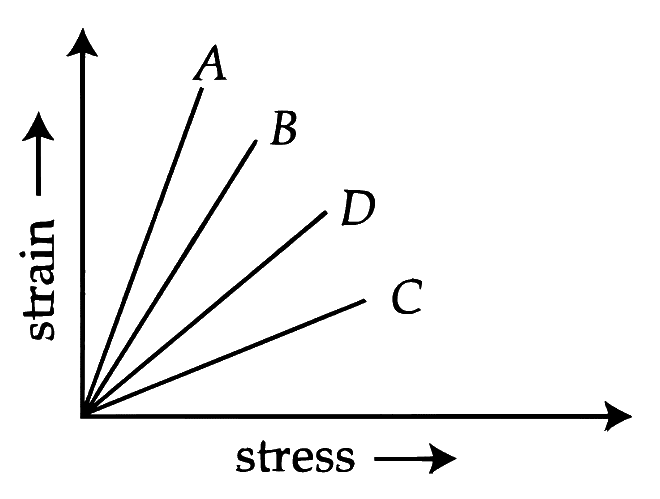
Show answer and solution

Answer: (c)

  1. Longitudinal strain ΔLL=5×1072×1011=2.5×10⁻⁴\frac{\Delta L}{L} = \frac{5\times10^{7}}{2\times10^{11}} = 2.5\times10^{-4}
  2. V=πr2L⇒ΔVV=ΔLL−2ΔrrV = \pi r^2 L \Rightarrow \frac{\Delta V}{V} = \frac{\Delta L}{L} - 2\frac{\Delta r}{r} (radius decreases)
  3. 2×10−4=2.5×10⁻⁴−2Δrr2\times10^{-4} = 2.5\times10^{-4} - 2\frac{\Delta r}{r}
  4. Δrr=0.25×10⁻⁴\frac{\Delta r}{r} = 0.25\times10^{-4}
  5. So the answer is (c).
Report a mistake