Physics Circle home Home Practice Hub Register / Login

Home›Practice Hub›Chapters›Motion in One Dimension

Physics PYQs · MHT CET · JEE Main · NEET

Motion in One Dimension

Questions
231
MHT CET
41
JEE Main
126
NEET
64
Years
1988–2026
0 of 231 attemptedPick an answer to see the solution

Q1MHT CET 2026 · 15 MAY · SHIFT 2Easy

Distance, Displacement & Average Speed · Frame of reference, distance & displacement

A student runs along a circular track of diameter 8080m. The distance travelled and the magnitude of displacement of the student when he covers (34)th\left(\frac{3}{4}\right)^{\text{th}} of the circle is (in m)

Show answer and solution

Answer: (a)

startendRRR√2path: 3/4 of circle
  1. Radius R=80/2=40R = 80/2 = 40 m.
  2. Distance =34(2πR)=34(80π)=60π= \frac{3}{4}(2\pi R) = \frac{3}{4}(80\pi) = 60\pi m.
  3. After 34\frac{3}{4} turn the angle swept is 270∘270^\circ, so start and end radii are perpendicular: displacement =R2+R2=R2=402= \sqrt{R^2 + R^2} = R\sqrt{2} = 40\sqrt{2} m.
  4. So the answer is (a) 60π,40260\pi, 40\sqrt{2}.
Report a mistake
Q2MHT CET 2026 · 15 MAY · SHIFT 2Medium

Distance, Displacement & Average Speed · Average speed: equal distances

A person travelling in a straight line moves with uniform velocity V1V_1 for a distance xx and with a uniform velocity V2V_2 for the next 3x2\frac{3x}{2} distance. The average velocity in this motion is 507\frac{50}{7} m/s. If V1V_1 is 55 m/s then V2V_2 (in m/s) is

Show answer and solution

Answer: (c)

  1. Total distance =x+3x2=5x2= x + \frac{3x}{2} = \frac{5x}{2}; total time =x5+3x2V2= \frac{x}{5} + \frac{3x}{2V_2}.
  2. 5x/2x/5+3x/(2V2)=507⇒15+32V2=0.35\frac{5x/2}{x/5 + 3x/(2V_2)} = \frac{50}{7} \Rightarrow \frac{1}{5} + \frac{3}{2V_2} = 0.35
  3. 32V2=0.15⇒V2=10\frac{3}{2V_2} = 0.15 \Rightarrow V_2 = 10 m/s
  4. So the answer is (c) 1010.
Report a mistake
Q3MHT CET 2026 · 19 MAY · SHIFT 2Medium

Distance, Displacement & Average Speed · Average velocity vs average speed

The minute hand of a wall-clock is 1010 cm long. The average velocity of the tip of the minute hand between 6.006.00 am to 7.307.30 am is

Show answer and solution

Answer: (b)

  1. From 6:00 to 7:30 the minute hand makes 1121\frac{1}{2} turns: tip moves from the 12 mark to the 6 mark.
  2. Displacement =2r=20= 2r = 20 cm; time =1.5×3600=5400= 1.5 \times 3600 = 5400 s.
  3. Average velocity =205400=1270= \frac{20}{5400} = \frac{1}{270} cm/s
  4. So the answer is (b) 1270\frac{1}{270} cm/s.
Report a mistake
Q4NEET 2026 · RE-NEETMedium

Distance, Displacement & Average Speed · Average velocity vs average speed

Consider a particle moving along a straight line, whose position as a function of time is given by s(t)=αt2−βt+γs(t) = \alpha t^2 - \beta t + \gamma, where α=1 ms−2,β=6 ms−1\alpha = 1\text{ ms}^{-2}, \beta = 6\text{ ms}^{-1} and γ=5 m\gamma = 5\text{ m}. The average speed of the particle, in ms−1\text{ms}^{-1} from t=0t = 0 to t=6 st = 6\text{ s} is:

Show answer and solution

Answer: (d)

  1. s=t2−6t+5s = t^2 - 6t + 5, v=2t−6=0v = 2t - 6 = 0 at t=3t = 3 s, so the particle turns back.
  2. s(0)=5s(0) = 5, s(3)=−4s(3) = -4, s(6)=5s(6) = 5 m.
  3. Distance =∣−4−5∣+∣5−(−4)∣=9+9=18= |{-4} - 5| + |5 - (-4)| = 9 + 9 = 18 m
  4. Average speed =186=3= \frac{18}{6} = 3 m/s, so the answer is (d) 3.
Report a mistake
Q5JEE Main 2025 · 2 APR · SHIFT 1Easy

Distance, Displacement & Average Speed · Average speed: equal distances

A person travelling on a straight line moves with a uniform velocity v1v_1 for a distance xx and with a uniform velocity v2v_2 for the next 32x\frac{3}{2}x distance. The average velocity in this motion is 507 m/s\frac{50}{7}\text{ m/s}. If v1v_1 is 5 m/s5\text{ m/s} then v2=v_2 = __________ m/s\text{m/s}.

Numerical answer type. Work it out, then open the answer.

Show answer and solution

Answer: 10

  1. Total distance =x+32x=5x2= x + \frac{3}{2}x = \frac{5x}{2}; total time =x5+3x2v2= \frac{x}{5} + \frac{3x}{2v_2}.
  2. 5x/2x/5+3x/(2v2)=507⇒15+32v2=52×750=0.35\frac{5x/2}{x/5 + 3x/(2v_2)} = \frac{50}{7} \Rightarrow \frac{1}{5} + \frac{3}{2v_2} = \frac{5}{2} \times \frac{7}{50} = 0.35
  3. 32v2=0.15⇒v2=10\frac{3}{2v_2} = 0.15 \Rightarrow v_2 = 10
  4. So v2=10v_2 = 10 m/s.
Report a mistake
Q6MHT CET 2024 · 10 MAY · SHIFT 2Easy

Distance, Displacement & Average Speed · Average speed: equal distances

A vehicle runs on a straight road of length 'L'. It travels half the distance with speed V and the remaining distance with speed V3\frac{V}{3}. Its average speed is

Show answer and solution

Answer: (c)

  1. For equal distances, vavg=2v1v2v1+v2v_{avg} = \frac{2v_1 v_2}{v_1 + v_2}.
  2. vavg=2V(V/3)V+V/3=2V2/34V/3v_{avg} = \frac{2V(V/3)}{V + V/3} = \frac{2V^2/3}{4V/3}
  3. So the answer is (c) V2\frac{V}{2}.
Report a mistake
Q7JEE Main 2024 · 9 APR · SHIFT 1Medium

Distance, Displacement & Average Speed · Average speed: mixed distance & time stages

A particle moving in a straight line covers half the distance with speed 6 m/s6\text{ m/s}. The other half is covered in two equal time intervals with speeds 9 m/s9\text{ m/s} and 15 m/s15\text{ m/s} respectively. The average speed of the particle during the motion is:

Show answer and solution

Answer: (d)

  1. Let each half be dd. First half time =d6= \frac{d}{6}.
  2. Second half: equal times tt at 9 and 15 m/s, so 9t+15t=d⇒t=d249t + 15t = d \Rightarrow t = \frac{d}{24}, time =2t=d12= 2t = \frac{d}{12}.
  3. vavg=2dd/6+d/12=2dd/4=8v_{avg} = \frac{2d}{d/6 + d/12} = \frac{2d}{d/4} = 8 m/s
  4. So the answer is (d) 8 m/s.
Report a mistake
Q8JEE Main 2024 · 6 APR · SHIFT 1Medium

Distance, Displacement & Average Speed · Average speed: mixed distance & time stages

A train starting from rest first accelerates uniformly up to a speed of 80 km/h80\text{ km/h} for time tt, then it moves with a constant speed for time 3t3t. The average speed of the train for this duration of journey will be (in km/h\text{km/h}):

Show answer and solution

Answer: (a)

  1. Accelerating from rest to 80 km/h in time tt: distance =0+802t=40t= \frac{0 + 80}{2}t = 40t.
  2. Constant speed for 3t3t: distance =80×3t=240t= 80 \times 3t = 240t.
  3. vavg=40t+240t4t=70v_{avg} = \frac{40t + 240t}{4t} = 70 km/h
  4. So the answer is (a) 70.
Report a mistake
Q9NEET 2023Easy

Distance, Displacement & Average Speed · Average speed: equal distances

A vehicle travels half the distance with speed vv and the remaining distance with speed 2v2v. Its average speed is:

Show answer and solution

Answer: (b)

  1. For equal distances, vavg=2v1v2v1+v2v_{avg} = \frac{2v_1 v_2}{v_1 + v_2}.
  2. vavg=2(v)(2v)v+2v=4v23vv_{avg} = \frac{2(v)(2v)}{v + 2v} = \frac{4v^2}{3v}
  3. So the answer is (b) 4v3\frac{4v}{3}.
Report a mistake
Q10JEE Main 2023 · 10 APR · SHIFT 2Easy

Distance, Displacement & Average Speed · Average speed: equal distances

A person travels xx distance with velocity v1v_1 and then xx distance with velocity v2v_2 in the same direction. The average velocity of the person is vv, then the relation between v,v1v, v_1 and v2v_2 will be.

Show answer and solution

Answer: (d)

  1. Same direction, so displacement =2x= 2x and time =xv1+xv2= \frac{x}{v_1} + \frac{x}{v_2}.
  2. v=2xx/v1+x/v2⇒2v=1v1+1v2v = \frac{2x}{x/v_1 + x/v_2} \Rightarrow \frac{2}{v} = \frac{1}{v_1} + \frac{1}{v_2}
  3. So the answer is (d).
Report a mistake
Q11JEE Main 2023 · 30 JAN · SHIFT 2Easy

Distance, Displacement & Average Speed · Average speed: equal distances

A vehicle travels 4 km4\text{ km} with speed of 3 km/h3\text{ km/h} and another 4 km4\text{ km} with speed of 5 km/h5\text{ km/h}, then its average speed is

Show answer and solution

Answer: (a)

  1. Equal distances: vavg=2v1v2v1+v2v_{avg} = \frac{2v_1 v_2}{v_1 + v_2}.
  2. vavg=2(3)(5)3+5=308=3.75v_{avg} = \frac{2(3)(5)}{3 + 5} = \frac{30}{8} = 3.75 km/h
  3. So the answer is (a) 3.75 km/h.
Report a mistake
Q12JEE Main 2023 · 25 JAN · SHIFT 1Easy

Distance, Displacement & Average Speed · Average speed: equal distances

A car travels a distance of 'xx' with speed v1v_1 and then same distance 'xx' with speed v2v_2 in the same direction. The average speed of the car is:

Show answer and solution

Answer: (b)

  1. Total distance 2x2x, total time xv1+xv2=x(v1+v2)v1v2\frac{x}{v_1} + \frac{x}{v_2} = \frac{x(v_1 + v_2)}{v_1 v_2}.
  2. vavg=2xt=2v1v2v1+v2v_{avg} = \frac{2x}{t} = \frac{2v_1 v_2}{v_1 + v_2}
  3. So the answer is (b).
Report a mistake
Q13JEE Main 2023 · 1 FEB · SHIFT 1Medium

Distance, Displacement & Average Speed · Average speed: equal distances

An object moves with speed v1,v2v_1, v_2 and v3v_3 along a line segment AB, BC and CD respectively as shown in figure. Where AB = BC and AD = 3AB, then average speed of the object will be:

Figure

Show answer and solution

Answer: (d)

  1. AB=BCAB = BC and AD=3ABAD = 3AB, so AB=BC=CD=dAB = BC = CD = d.
  2. Total time =dv1+dv2+dv3=d(v2v3+v3v1+v1v2)v1v2v3= \frac{d}{v_1} + \frac{d}{v_2} + \frac{d}{v_3} = \frac{d(v_2 v_3 + v_3 v_1 + v_1 v_2)}{v_1 v_2 v_3}
  3. vavg=3dt=3v1v2v3v1v2+v2v3+v3v1v_{avg} = \frac{3d}{t} = \frac{3v_1 v_2 v_3}{v_1 v_2 + v_2 v_3 + v_3 v_1}
  4. So the answer is (d).
Report a mistake
Q14JEE Main 2023 · 30 JAN · SHIFT 1Medium

Distance, Displacement & Average Speed · Average speed: mixed distance & time stages

A horse rider covers half the distance with 5 m/s5\text{ m/s} speed. The remaining part of the distance was travelled with speed 10 m/s10\text{ m/s} for half the time and with speed 15 m/s15\text{ m/s} for other half of the time. The mean speed of the rider averaged over the whole time of motion is x7 m/s\frac{x}{7}\text{ m/s}. The value of xx is ___________.

Numerical answer type. Work it out, then open the answer.

Show answer and solution

Answer: 50

  1. Second half in equal times at 10 and 15 m/s: its average speed =10+152=12.5= \frac{10 + 15}{2} = 12.5 m/s.
  2. Now two equal distances at 5 and 12.5 m/s: vavg=2(5)(12.5)5+12.5=12517.5=507v_{avg} = \frac{2(5)(12.5)}{5 + 12.5} = \frac{125}{17.5} = \frac{50}{7} m/s
  3. So x=50x = 50.
Report a mistake
Q15JEE Main 2022 · 28 JUN · SHIFT 2Easy

Distance, Displacement & Average Speed · Average speed: equal distances

A car covers AB distance with first one-third at velocity v1 ms−1{}^{-1}, second one-third at v2 ms−1{}^{-1} and last one-third at v3 ms−1{}^{-1}. If v3 = 3v1, v2 = 2v1 and v1 = 11 ms−1{}^{-1} then the average velocity of the car is _____________ ms______1.

Figure

Numerical answer type. Work it out, then open the answer.

Show answer and solution

Answer: 18

  1. Three equal parts dd: vavg=3dd/v1+d/v2+d/v3v_{avg} = \frac{3d}{d/v_1 + d/v_2 + d/v_3}.
  2. v1=11, v2=22, v3=33v_1 = 11,\ v_2 = 22,\ v_3 = 33 m/s
  3. 111+122+133=6+3+266=16\frac{1}{11} + \frac{1}{22} + \frac{1}{33} = \frac{6 + 3 + 2}{66} = \frac{1}{6}
  4. vavg=3×6=18v_{avg} = 3 \times 6 = 18 m/s
Report a mistake
Q16NEET 2019Easy

Distance, Displacement & Average Speed · Average speed: equal distances

A person travelling in a straight line moves with a constant velocity v1v_1 for certain distance 'xx' and with a constant velocity v2v_2 for next equal distance. The average velocity vv is given by the relation

Show answer and solution

Answer: (c)

  1. Total displacement =2x= 2x, total time =xv1+xv2= \frac{x}{v_1} + \frac{x}{v_2}.
  2. v=2xx/v1+x/v2⇒2v=1v1+1v2v = \frac{2x}{x/v_1 + x/v_2} \Rightarrow \frac{2}{v} = \frac{1}{v_1} + \frac{1}{v_2}
  3. So the answer is (c).
Report a mistake
Q17NEET 2018Medium

Distance, Displacement & Average Speed · Average velocity vs average speed

A toy car with charge q moves on a frictionless horizontal plane surface under the influence of a uniform electric field E⃗\vec{E}. Due to the force qE⃗\vec{E}, its velocity increases from 0 to 6 m s–1 in one second duration. At that instant the direction of the field is reversed. The car continues to move for two more seconds under the influence of this field. The average velocity and the average speed of the toy car between 0 to 3 seconds are respectively

Show answer and solution

Answer: (b)

  1. a=61=6a = \frac{6}{1} = 6 m/s2^2. For 0–1 s: distance =12(6)(1)2=3= \frac{1}{2}(6)(1)^2 = 3 m forward.
  2. Field reversed, a=−6a = -6: 1–2 s velocity 6→06 \to 0, 3 m forward; 2–3 s velocity 0→−60 \to -6, 3 m backward.
  3. Displacement =3+3−3=3= 3 + 3 - 3 = 3 m, distance =9= 9 m.
  4. Average velocity =33=1= \frac{3}{3} = 1 m/s, average speed =93=3= \frac{9}{3} = 3 m/s
  5. So the answer is (b).
Report a mistake
Q18NEET 2011 · AIPMT · MAINSEasy

Distance, Displacement & Average Speed · Average speed: equal distances

A particle covers half of its total distance with speed v1 and the rest half distance with speed v2. Its average speed during the complete journey is

Show answer and solution

Answer: (c)

  1. Let each half be dd. Total time t=dv1+dv2=d(v1+v2)v1v2t = \frac{d}{v_1} + \frac{d}{v_2} = \frac{d(v_1 + v_2)}{v_1 v_2}.
  2. vavg=2dt=2v1v2v1+v2v_{avg} = \frac{2d}{t} = \frac{2v_1 v_2}{v_1 + v_2}
  3. So the answer is (c).
Report a mistake
Q19NEET 2007 · AIPMTEasy

Distance, Displacement & Average Speed · Average speed: equal distances

A car moves from X to Y with a uniform speed vu and returns to X with a uniform speed vd. The average speed for this round trip is

Show answer and solution

Answer: (d)

  1. XY and YX are equal distances dd, so total distance =2d= 2d.
  2. Total time =dvu+dvd= \frac{d}{v_u} + \frac{d}{v_d}
  3. vavg=2dd/vu+d/vd=2vuvdvu+vdv_{avg} = \frac{2d}{d/v_u + d/v_d} = \frac{2v_u v_d}{v_u + v_d}
  4. So the answer is (d).
Report a mistake
Q20NEET 2006 · AIPMTEasy

Distance, Displacement & Average Speed · Average velocity vs average speed

A car runs at a constant speed on a circular track of radius 100 m, taking 62.8 seconds for every circular lap. The average velocity and average speed for each circular lap respectively is

Show answer and solution

Answer: (c)

  1. After one full lap the car returns to the start: displacement =0= 0, so average velocity =0= 0.
  2. Average speed =2πRT=2×3.14×10062.8=10= \frac{2\pi R}{T} = \frac{2 \times 3.14 \times 100}{62.8} = 10 m/s
  3. So the answer is (c) 0, 10 m/s.
Report a mistake
Q21NEET 1991 · AIPMTEasy

Distance, Displacement & Average Speed · Average speed: equal distances

A car moves a distance of 200 m. It covers the first half of the distance at speed 40 km/h and the second half of distance at speed vv. The average speed is 48 km/h. The value of vv is

Show answer and solution

Answer: (b)

  1. Equal distances: vavg=2v1vv1+vv_{avg} = \frac{2v_1 v}{v_1 + v}.
  2. 48=2(40)v40+v⇒1920+48v=80v48 = \frac{2(40)v}{40 + v} \Rightarrow 1920 + 48v = 80v
  3. 32v=1920⇒v=6032v = 1920 \Rightarrow v = 60 km/h
  4. So the answer is (b) 60 km/h.
Report a mistake
Q22NEET 1991 · AIPMTEasy

Distance, Displacement & Average Speed · Average speed: equal distances

A bus travelling the first one-third distance at a speed of 10 km/h, the next one-third at 20 km/h and at last one-third at 60 km/h. The average speed of the bus is

Show answer and solution

Answer: (c)

  1. Three equal distances dd: vavg=3dd/v1+d/v2+d/v3v_{avg} = \frac{3d}{d/v_1 + d/v_2 + d/v_3}.
  2. 110+120+160=6+3+160=16\frac{1}{10} + \frac{1}{20} + \frac{1}{60} = \frac{6 + 3 + 1}{60} = \frac{1}{6}
  3. vavg=3×6=18v_{avg} = 3 \times 6 = 18 km/h
  4. So the answer is (c) 18 km/h.
Report a mistake
Q23NEET 1990 · AIPMTEasy

Distance, Displacement & Average Speed · Average speed: equal distances

A car covers the first half of the distance between two places at 40 km/h and another half at 60 km/h. The average speed of the car is

Show answer and solution

Answer: (b)

  1. Equal distances: vavg=2v1v2v1+v2v_{avg} = \frac{2v_1 v_2}{v_1 + v_2}.
  2. vavg=2(40)(60)100=48v_{avg} = \frac{2(40)(60)}{100} = 48 km/h
  3. So the answer is (b) 48 km/h.
Report a mistake
Q24JEE Main 2026 · 28 JAN · SHIFT 2Medium

Velocity, Acceleration & Variable Motion · x(t) given: find v and a

A particle starts moving from time t=0t = 0 and its coordinate is given as x(t)=4t3−3tx(t) = 4t^3 - 3t A. The particle returns to its original position (origin) 0.866 units later

B. The particle is 1 unit away from origin at its turning point

C. Acceleration of the particle is non-negative

D. The particle is 0.5 units away from origin at its turning point

E. Particle never turns back as acceleration is non-negative

Choose the correct answer from the options given below:

Show answer and solution

Answer: (b)

  1. A: x=0⇒4t2=3⇒t=32=0.866x = 0 \Rightarrow 4t^2 = 3 \Rightarrow t = \dfrac{\sqrt{3}}{2} = 0.866, true.
  2. Turning point: v=12t2−3=0⇒t=0.5v = 12t^2 - 3 = 0 \Rightarrow t = 0.5; x=0.5−1.5=−1x = 0.5 - 1.5 = -1, so B true, D false.
  3. C: a=24t≥0a = 24t \ge 0 for t≥0t \ge 0, true.
  4. E: the particle does turn back at t=0.5t = 0.5 s, false.
  5. So the answer is (b) A, B, C only.
Report a mistake
Q25MHT CET 2025 · 22 APR · SHIFT 2Medium

Velocity, Acceleration & Variable Motion · x(t) given: find v and a

At any time ' tt ', the co-ordinates of moving particle are x=at2x = at^2 and y=bt2y = bt^2. The speed of the particle is

Show answer and solution

Answer: (a)

  1. vx=dxdt=2atv_x = \dfrac{dx}{dt} = 2at, vy=dydt=2btv_y = \dfrac{dy}{dt} = 2bt
  2. Speed =(2at)2+(2bt)2=2ta2+b2= \sqrt{(2at)^2 + (2bt)^2} = 2t\sqrt{a^2 + b^2}
  3. So the answer is (a).
Report a mistake
Q26JEE Main 2025 · 3 APR · SHIFT 2Medium

Velocity, Acceleration & Variable Motion · x(t) given: find v and a

A particle moves along the xx-axis and has its displacement xx varying with time t according to the equation:

x=c0(t2−2)+c(t−2)2x = c_0\left(t^2 - 2\right) + c(t - 2)^2

where c0c_0 and c are constants of appropriate dimensions.

Then, which of the following statements is correct?

Show answer and solution

Answer: (a)

  1. v=dxdt=2c0t+2c(t−2)v = \dfrac{dx}{dt} = 2c_0 t + 2c(t - 2)
  2. a=dvdt=2c0+2c=2(c+c0)a = \dfrac{dv}{dt} = 2c_0 + 2c = 2(c + c_0)
  3. Initial velocity v(0)=−4cv(0) = -4c, so (d) is wrong.
  4. So the answer is (a) 2(c+c0)2(c + c_0).
Report a mistake
Q27NEET 2025Medium

Velocity, Acceleration & Variable Motion · t(x) or v(x) given: a = v dv/dx

In some appropriate units, time (t)(t) and position (x)(x) relation of a moving particle is given by t=x2+xt = x^2 + x. The acceleration of the particle is

Show answer and solution

Answer: (d)

  1. dtdx=2x+1⇒v=12x+1\dfrac{dt}{dx} = 2x + 1 \Rightarrow v = \dfrac{1}{2x + 1}
  2. dvdx=−2(2x+1)2\dfrac{dv}{dx} = -\dfrac{2}{(2x + 1)^2}
  3. a=vdvdx=−2(2x+1)3a = v\dfrac{dv}{dx} = -\dfrac{2}{(2x + 1)^3}
  4. So the answer is (d).
Report a mistake
Q28JEE Main 2025 · 29 JAN · SHIFT 2Difficult

Velocity, Acceleration & Variable Motion · Variable acceleration: integration

Two cars P and Q are moving on a road in the same direction. Acceleration of car P increases linearly with time whereas car Q moves with a constant acceleration. Both cars cross each other at time t = 0, for the first time. The maximum possible number of crossing(s) (including the crossing at t = 0) is ________.

Numerical answer type. Work it out, then open the answer.

Show answer and solution

Answer: 3

  1. Relative acceleration of P w.r.t. Q is linear in tt: arel=kt+ca_{rel} = k t + c
  2. Relative displacement from the crossing at t=0t = 0: srel=ut+ct22+kt36s_{rel} = ut + \dfrac{ct^2}{2} + \dfrac{kt^3}{6}, a cubic in tt
  3. A cubic has at most 3 roots, one of which is t=0t = 0
  4. So the maximum number of crossings is 3.
Report a mistake
Q29MHT CET 2024 · 11 MAY · SHIFT 2Easy

Velocity, Acceleration & Variable Motion · x(t) given: find v and a

Two cars start from a point at the same time in a straight line and their positions are represented by x1(t)=at+bt2x_1(t) = at + bt^2 and x2(t)=Ft−t2x_2(t) = Ft - t^2. At what time do the cars have the same velocity?

Show answer and solution

Answer: (d)

  1. v1=dx1dt=a+2btv_1 = \frac{dx_1}{dt} = a + 2bt, v2=dx2dt=F−2tv_2 = \frac{dx_2}{dt} = F - 2t.
  2. a+2bt=F−2t⇒2t(1+b)=F−aa + 2bt = F - 2t \Rightarrow 2t(1 + b) = F - a
  3. So the answer is (d) t=F−a2(1+b)t = \frac{F - a}{2(1 + b)}.
Report a mistake
Q30NEET 2024Easy

Velocity, Acceleration & Variable Motion · x(t) given: find v and a

A particle is moving along xx-axis with its position (x) varying with time (t)(t) as x=αt4+βt2+γt+δx = \alpha t^4 + \beta t^2 + \gamma t + \delta. The ratio of its initial velocity to its initial acceleration, respectively, is:

Show answer and solution

Answer: (d)

  1. v=4αt3+2βt+γv = 4\alpha t^3 + 2\beta t + \gamma, so at t=0t = 0: v0=γv_0 = \gamma.
  2. a=12αt2+2βa = 12\alpha t^2 + 2\beta, so at t=0t = 0: a0=2βa_0 = 2\beta.
  3. So the answer is (d) γ:2β\gamma : 2\beta.
Report a mistake
Q31JEE Main 2024 · 29 JAN · SHIFT 2Easy

Velocity, Acceleration & Variable Motion · x(t) given: find v and a

A particle is moving in a straight line. The variation of position 'xx' as a function of time 'tt' is given as x=(t3−6t2+20t+15) mx = \left(t^3 - 6t^2 + 20t + 15\right)\text{ m}. The velocity of the body when its acceleration becomes zero is:

Show answer and solution

Answer: (c)

  1. v=3t2−12t+20v = 3t^2 - 12t + 20, a=6t−12a = 6t - 12.
  2. a=0⇒t=2a = 0 \Rightarrow t = 2 s.
  3. v=12−24+20=8v = 12 - 24 + 20 = 8 m/s
  4. So the answer is (c) 8 m/s.
Report a mistake
Q32JEE Main 2024 · 1 FEB · SHIFT 1Easy

Velocity, Acceleration & Variable Motion · x(t) given: find v and a

A particle is moving in one dimension (along xx axis) under the action of a variable force. Its initial position was 16 m16\text{ m} right of origin. The variation of its position (x)(x) with time (t)(t) is given as x=−3t3+18t2+16tx = -3t^3 + 18t^2 + 16t, where xx is in m\text{m} and tt is in s\text{s}.

The velocity of the particle when its acceleration becomes zero is _________ m/s\text{m/s}.

Numerical answer type. Work it out, then open the answer.

Show answer and solution

Answer: 52

  1. v=dxdt=−9t2+36t+16v = \dfrac{dx}{dt} = -9t^2 + 36t + 16
  2. a=dvdt=−18t+36=0⇒t=2 sa = \dfrac{dv}{dt} = -18t + 36 = 0 \Rightarrow t = 2\text{ s}
  3. v(2)=−36+72+16=52v(2) = -36 + 72 + 16 = 52
  4. So the velocity is 52 m/s52\text{ m/s}.
Report a mistake
Q33MHT CET 2024 · 16 MAY · SHIFT 1Medium

Velocity, Acceleration & Variable Motion · x(t) given: find v and a

The co-ordinates of a moving particle at any time ' tt ' are given by x=αt3x = \alpha t^3 and y=βt3y = \beta t^3 where α\alpha and β\beta are constants. The speed of the particle at time ' tt ' is given by

Show answer and solution

Answer: (d)

  1. vx=3αt2v_x = 3\alpha t^2, vy=3βt2v_y = 3\beta t^2
  2. Speed =vx2+vy2=3t2α2+β2= \sqrt{v_x^2 + v_y^2} = 3t^2\sqrt{\alpha^2 + \beta^2}
  3. So the answer is (d).
Report a mistake
Q34JEE Main 2024 · 31 JAN · SHIFT 1Medium

Velocity, Acceleration & Variable Motion · t(x) or v(x) given: a = v dv/dx

The relation between time 'tt' and distance 'xx' is t=αx2+βxt = \alpha x^2 + \beta x, where α\alpha and β\beta are constants. The relation between acceleration (a)(a) and velocity (v)(v) is:

Show answer and solution

Answer: (c)

  1. dtdx=2αx+β=1v\dfrac{dt}{dx} = 2\alpha x + \beta = \dfrac{1}{v}
  2. Differentiate w.r.t. tt: 2αv=−1v2dvdt2\alpha v = -\dfrac{1}{v^2}\dfrac{dv}{dt}
  3. a=dvdt=−2αv3a = \dfrac{dv}{dt} = -2\alpha v^3
  4. So the answer is (c).
Report a mistake
Q35JEE Main 2024 · 6 APR · SHIFT 2Medium

Velocity, Acceleration & Variable Motion · t(x) or v(x) given: a = v dv/dx

A particle moves in a straight line so that its displacement xx at any time tt is given by x2=1+t2x^2 = 1 + t^2. Its acceleration at any time tt is x−nx^{-n} where n=n = _________.

Numerical answer type. Work it out, then open the answer.

Show answer and solution

Answer: 3

  1. Differentiate x2=1+t2x^2 = 1 + t^2: xv=t⇒v=txxv = t \Rightarrow v = \dfrac{t}{x}
  2. Differentiate again: v2+xa=1⇒a=1−v2x=x2−t2x3v^2 + xa = 1 \Rightarrow a = \dfrac{1 - v^2}{x} = \dfrac{x^2 - t^2}{x^3}
  3. x2−t2=1x^2 - t^2 = 1, so a=x−3a = x^{-3}
  4. So n=3n = 3.
Report a mistake
Q36JEE Main 2024 · 1 FEB · SHIFT 2Medium

Velocity, Acceleration & Variable Motion · t(x) or v(x) given: a = v dv/dx

A particle initially at rest starts moving from reference point x=0x = 0 along xx-axis, with velocity vv that varies as v=4x m/sv = 4\sqrt{x}\text{ m/s}. The acceleration of the particle is __________ ms−2\text{ms}^{-2}.

Numerical answer type. Work it out, then open the answer.

Show answer and solution

Answer: 8

  1. v2=16xv^2 = 16x
  2. a=vdvdx=12d(v2)dx=162a = v\dfrac{dv}{dx} = \dfrac{1}{2}\dfrac{d(v^2)}{dx} = \dfrac{16}{2}
  3. So a=8 m/s2a = 8\text{ m/s}^2.
Report a mistake
Q37MHT CET 2023 · 13 MAY · SHIFT 1Easy

Velocity, Acceleration & Variable Motion · Speed, velocity & acceleration: concepts

Which one of the following statements is Wrong?

Show answer and solution

Answer: (b)

  1. (a) True: at the top of a vertical throw v=0v = 0 but a=ga = g.
  2. (b) Wrong: constant velocity means constant magnitude and direction, so speed cannot change.
  3. (c) True: uniform circular motion has constant speed but changing velocity.
  4. (d) True: in projectile motion a=ga = g is constant but the velocity direction changes.
  5. So the answer is (b).
Report a mistake
Q38MHT CET 2023 · 14 MAY · SHIFT 2Easy

Velocity, Acceleration & Variable Motion · x(t) given: find v and a

The position 'xx' of a particle varies with a time as x=at2−bt3x = at^2 - bt^3 where 'aa' and 'bb' are constants. The acceleration of the particle will be zero at

Show answer and solution

Answer: (c)

  1. v=dxdt=2at−3bt2v = \frac{dx}{dt} = 2at - 3bt^2, ap=dvdt=2a−6bta_{p} = \frac{dv}{dt} = 2a - 6bt.
  2. 2a−6bt=0⇒t=a3b2a - 6bt = 0 \Rightarrow t = \frac{a}{3b}
  3. So the answer is (c) a3b\frac{a}{3b}.
Report a mistake
Q39MHT CET 2023 · 11 MAY · SHIFT 2Easy

Velocity, Acceleration & Variable Motion · x(t) given: find v and a

Two cars A and B start from a point at the same time in a straight line and their positions are represented by RA(t)=R_A(t) = at +bt2+bt^2 and RB(t)=xt−t2R_B(t) = xt - t^2. At what time do the cars have same velocity?

Show answer and solution

Answer: (a)

  1. vA=a+2btv_A = a + 2bt, vB=x−2tv_B = x - 2t.
  2. a+2bt=x−2t⇒2t(b+1)=x−aa + 2bt = x - 2t \Rightarrow 2t(b + 1) = x - a
  3. So the answer is (a) t=x−a2(b+1)t = \frac{x - a}{2(b + 1)}.
Report a mistake
Q40NEET 2023Easy

Velocity, Acceleration & Variable Motion · x(t) given: find v and a

The position of a particle is given by

r⃗(t)=4ti^+2t2j^+5k^\vec{r}(t) = 4t\hat{i} + 2t^2\hat{j} + 5\hat{k}

where tt is in seconds and rr in metre. Find the magnitude and direction of velocity v(t)v(t), at t=1 st = 1\text{ s}, with respect to xx-axis

Show answer and solution

Answer: (a)

  1. v⃗=dr⃗dt=4i^+4tj^\vec{v} = \frac{d\vec{r}}{dt} = 4\hat{i} + 4t\hat{j}; at t=1t = 1 s, v⃗=4i^+4j^\vec{v} = 4\hat{i} + 4\hat{j}.
  2. ∣v⃗∣=16+16=42|\vec{v}| = \sqrt{16 + 16} = 4\sqrt{2} m/s
  3. tan⁡θ=44=1⇒θ=45∘\tan\theta = \frac{4}{4} = 1 \Rightarrow \theta = 45^\circ with the xx-axis
  4. So the answer is (a).
Report a mistake
Q41JEE Main 2023 · 15 APR · SHIFT 1Easy

Velocity, Acceleration & Variable Motion · x(t) given: find v and a

The position of a particle related to time is given by x=(5t2−4t+5) mx = \left(5t^2 - 4t + 5\right)\text{ m}. The magnitude of velocity of the particle at t=2 st = 2\text{ s} will be:

Show answer and solution

Answer: (b)

  1. v=dxdt=10t−4v = \frac{dx}{dt} = 10t - 4
  2. At t=2t = 2 s: v=20−4=16v = 20 - 4 = 16 m/s
  3. So the answer is (b) 16 ms−116\text{ ms}^{-1}.
Report a mistake
Q42JEE Main 2023 · 13 APR · SHIFT 2Easy

Velocity, Acceleration & Variable Motion · x(t) given: find v and a

The distance travelled by an object in time tt is given by s=(2.5)t2s = (2.5)t^2. The instantaneous speed of the object at t=5 st = 5\text{ s} will be:

Show answer and solution

Answer: (d)

  1. v=dsdt=2×2.5 t=5tv = \frac{ds}{dt} = 2 \times 2.5\, t = 5t
  2. At t=5t = 5 s: v=25v = 25 m/s
  3. So the answer is (d) 25 ms−125\text{ ms}^{-1}.
Report a mistake
Q43JEE Main 2023 · 25 JAN · SHIFT 2Easy

Velocity, Acceleration & Variable Motion · x(t) given: find v and a

The distance travelled by a particle is related to time t as x=4t2x = 4t^2. The velocity of the particle at t=5s is :-

Show answer and solution

Answer: (d)

  1. v=dxdt=8tv = \frac{dx}{dt} = 8t
  2. At t=5t = 5 s: v=40v = 40 m/s
  3. So the answer is (d) 40 ms−140\text{ ms}^{-1}.
Report a mistake
Q44JEE Main 2022 · 25 JUN · SHIFT 2Easy

Velocity, Acceleration & Variable Motion · x(t) given: find v and a

Two buses P and Q start from a point at the same time and move in a straight line and their positions are represented by XP(t)=αt+βt2X_P(t) = \alpha t + \beta t^2 and XQ(t)=ft−t2X_Q(t) = ft - t^2. At what time, both the buses have same velocity?

Show answer and solution

Answer: (d)

  1. vP=α+2βtv_P = \alpha + 2\beta t, vQ=f−2tv_Q = f - 2t.
  2. α+2βt=f−2t⇒2t(1+β)=f−α\alpha + 2\beta t = f - 2t \Rightarrow 2t(1 + \beta) = f - \alpha
  3. So the answer is (d) t=f−α2(1+β)t = \frac{f - \alpha}{2(1 + \beta)}.
Report a mistake
Q45JEE Main 2022 · 25 JUL · SHIFT 2Easy

Velocity, Acceleration & Variable Motion · t(x) or v(x) given: a = v dv/dx

A particle is moving in a straight line such that its velocity is increasing at 5 ms−1{}^{-1} per meter. The acceleration of the particle is _____________ ms−2{}^{-2} at a point where its velocity is 20 ms−1{}^{-1}.

Numerical answer type. Work it out, then open the answer.

Show answer and solution

Answer: 100

  1. Velocity increases at 55 m/s per metre, so dvdx=5 s−1\dfrac{dv}{dx} = 5\text{ s}^{-1}
  2. a=vdvdx=20×5a = v\dfrac{dv}{dx} = 20 \times 5
  3. So a=100 m/s2a = 100\text{ m/s}^2.
Report a mistake
Q46JEE Main 2022 · 29 JUL · SHIFT 1Medium

Velocity, Acceleration & Variable Motion · t(x) or v(x) given: a = v dv/dx

If t=x+4t = \sqrt{x} + 4, then (dxdt)t=4\left(\frac{dx}{dt}\right)_{t=4} is:

Show answer and solution

Answer: (b)

  1. x=t−4⇒x=(t−4)2\sqrt{x} = t - 4 \Rightarrow x = (t - 4)^2
  2. dxdt=2(t−4)\dfrac{dx}{dt} = 2(t - 4)
  3. At t=4t = 4: dxdt=0\dfrac{dx}{dt} = 0
  4. So the answer is (b) zero.
Report a mistake
Q47JEE Main 2021 · 25 JUL · SHIFT 2Easy

Velocity, Acceleration & Variable Motion · Variable acceleration: integration

The instantaneous velocity of a particle moving in a straight line is given as V=αt+βt2V = \alpha t + \beta t^2, where α\alpha and β\beta are constants. The distance travelled by the particle between 1s and 2s is:

Show answer and solution

Answer: (b)

  1. Distance =∫12(αt+βt2) dt= \int_1^2 (\alpha t + \beta t^2)\,dt
  2. =α2(22−12)+β3(23−13)= \dfrac{\alpha}{2}(2^2 - 1^2) + \dfrac{\beta}{3}(2^3 - 1^3)
  3. =32α+73β= \dfrac{3}{2}\alpha + \dfrac{7}{3}\beta
  4. So the answer is (b).
Report a mistake
Q48JEE Main 2021 · 17 MAR · SHIFT 2Easy

Velocity, Acceleration & Variable Motion · Variable acceleration: integration

The velocity of a particle is v = v0 + gt + Ft2. Its position is x = 0 at t = 0; then its displacement after time (t = 1) is:

Show answer and solution

Answer: (b)

  1. x=∫01(v0+gt+Ft2) dtx = \int_0^1 (v_0 + gt + Ft^2)\,dt with x(0)=0x(0) = 0
  2. x=[v0t+gt22+Ft33]01x = \left[v_0 t + \dfrac{g t^2}{2} + \dfrac{F t^3}{3}\right]_0^1
  3. x=v0+g2+F3x = v_0 + \dfrac{g}{2} + \dfrac{F}{3}
  4. So the answer is (b).
Report a mistake
Q49JEE Main 2021 · 25 JUL · SHIFT 2Medium

Velocity, Acceleration & Variable Motion · t(x) or v(x) given: a = v dv/dx

The relation between time t and distance x for a moving body is given as t = mx2 + nx, where m and n are constants. The retardation of the motion is: (When v stands for velocity)

Show answer and solution

Answer: (a)

  1. dtdx=2mx+n=1v\dfrac{dt}{dx} = 2mx + n = \dfrac{1}{v}
  2. Differentiate w.r.t. tt: 2mv=−1v2dvdt⇒a=−2mv32mv = -\dfrac{1}{v^2}\dfrac{dv}{dt} \Rightarrow a = -2mv^3
  3. Retardation =2mv3= 2mv^3
  4. So the answer is (a).
Report a mistake
Q50JEE Main 2021 · 27 AUG · SHIFT 1Medium

Velocity, Acceleration & Variable Motion · t(x) or v(x) given: a = v dv/dx

If the velocity of a body related to displacement x is given by v=5000+24xv = \sqrt{5000 + 24x} m/s, then the acceleration of the body is .................... m/s2.

Numerical answer type. Work it out, then open the answer.

Show answer and solution

Answer: 12

  1. v2=5000+24xv^2 = 5000 + 24x
  2. a=12d(v2)dx=242a = \dfrac{1}{2}\dfrac{d(v^2)}{dx} = \dfrac{24}{2}
  3. So a=12 m/s2a = 12\text{ m/s}^2.
Report a mistake
Q51JEE Main 2020 · 9 JAN · SHIFT 1Difficult

Velocity, Acceleration & Variable Motion · t(x) or v(x) given: a = v dv/dx

The distance x covered by a particle in one dimensional motion varies with time t as x2 = at2 + 2bt + c. If the acceleration of the particle depends on x as x–n, where n is an integer, the value of n is __________

Numerical answer type. Work it out, then open the answer.

Show answer and solution

Answer: 3

  1. Differentiate: 2xv=2at+2b⇒xv=at+b2xv = 2at + 2b \Rightarrow xv = at + b
  2. Differentiate again: v2+xac=a⇒ac=a−v2xv^2 + xa_c = a \Rightarrow a_c = \dfrac{a - v^2}{x}
  3. ac=ax2−(at+b)2x3=ac−b2x3a_c = \dfrac{a x^2 - (at + b)^2}{x^3} = \dfrac{ac - b^2}{x^3}
  4. So ac∝x−3a_c \propto x^{-3} and n=3n = 3.
Report a mistake
Q52JEE Main 2019 · 9 APR · SHIFT 2Easy

Velocity, Acceleration & Variable Motion · x(t) given: find v and a

The position of a particle as a function of time t, is given by

x(t) = at + bt2 – ct3

where a, b and c are constants. When the particle attains zero acceleration, then its velocity will be:

Show answer and solution

Answer: (c)

  1. v=a+2bt−3ct2v = a + 2bt - 3ct^2, acceleration =2b−6ct= 2b - 6ct.
  2. Zero acceleration at t=b3ct = \frac{b}{3c}.
  3. v=a+2bb3c−3cb29c2=a+2b23c−b23cv = a + 2b\frac{b}{3c} - 3c\frac{b^2}{9c^2} = a + \frac{2b^2}{3c} - \frac{b^2}{3c}
  4. So the answer is (c) a+b23ca + \frac{b^2}{3c}.
Report a mistake
Q53JEE Main 2019 · 9 APR · SHIFT 2Easy

Velocity, Acceleration & Variable Motion · x(t) given: find v and a

The position vector of a particle changes with time according to the relation

r⃗(t)=15t2i^+(4−20t2)j^\vec{r}(t) = 15t^2\hat{i} + (4 - 20t^2)\hat{j}

What is the magnitude of the acceleration at t = 1?

Show answer and solution

Answer: (a)

  1. v⃗=dr⃗dt=30t i^−40t j^\vec{v} = \dfrac{d\vec{r}}{dt} = 30t\,\hat{i} - 40t\,\hat{j}
  2. a⃗=dv⃗dt=30i^−40j^\vec{a} = \dfrac{d\vec{v}}{dt} = 30\hat{i} - 40\hat{j} (constant)
  3. ∣a⃗∣=302+402=50|\vec{a}| = \sqrt{30^2 + 40^2} = 50
  4. So the answer is (a) 50.
Report a mistake
Q54JEE Main 2019 · 12 APR · SHIFT 2Medium

Velocity, Acceleration & Variable Motion · Variable acceleration: integration

A particle is moving with speed v = bx\sqrt{x} along positive x-axis. Calculate the speed of the particle at time t = τ\tau(assume that the particle is at origin t = 0)

Show answer and solution

Answer: (c)

  1. dxx=b dt⇒2x=bt\dfrac{dx}{\sqrt{x}} = b\,dt \Rightarrow 2\sqrt{x} = bt (since x=0x = 0 at t=0t = 0)
  2. x=b2t24x = \dfrac{b^2 t^2}{4}
  3. v=dxdt=b2t2v = \dfrac{dx}{dt} = \dfrac{b^2 t}{2}; at t=τt = \tau, v=b2τ2v = \dfrac{b^2\tau}{2}
  4. So the answer is (c).
Report a mistake
Q55NEET 2016 · PHASE 2Easy

Velocity, Acceleration & Variable Motion · x(t) given: find v and a

Two cars P and Q start from a point at the same time in a straight line and their positions are represented by

xP(t) = (at + bt2) and xQ(t) = (ft −- t2).

At what time do the cars have the same velocity?

Show answer and solution

Answer: (d)

  1. vP=a+2btv_P = a + 2bt, vQ=f−2tv_Q = f - 2t.
  2. a+2bt=f−2t⇒2t(1+b)=f−aa + 2bt = f - 2t \Rightarrow 2t(1 + b) = f - a
  3. So the answer is (d) t=f−a2(1+b)t = \frac{f - a}{2(1 + b)}.
Report a mistake
Q56NEET 2016 · PHASE 1Easy

Velocity, Acceleration & Variable Motion · Variable acceleration: integration

If the velocity of a particle is v = At + Bt2, where A and B are constants, then the distance travelled by it between 1 s and 2 s is

Show answer and solution

Answer: (a)

  1. v>0v > 0 for tt between 1 s and 2 s (A, B positive), so distance =∫12v dt= \int_1^2 v\,dt
  2. ∫12(At+Bt2) dt=A2(4−1)+B3(8−1)\int_1^2 (At + Bt^2)\,dt = \dfrac{A}{2}(4 - 1) + \dfrac{B}{3}(8 - 1)
  3. =32A+73B= \dfrac{3}{2}A + \dfrac{7}{3}B
  4. So the answer is (a).
Report a mistake
Q57NEET 2015 · AIPMT · CANCELLED PAPERMedium

Velocity, Acceleration & Variable Motion · t(x) or v(x) given: a = v dv/dx

A particle of unit mass undergoes one-dimensional motion such that its velocity varies according to v(x)=βx−2nv(x) = \beta x^{-2n}, where β\beta and n are constants and x is the position of the particle. The acceleration of the particle as a function of x, is given by

Show answer and solution

Answer: (d)

  1. a=vdvdxa = v\dfrac{dv}{dx}
  2. dvdx=−2nβx−2n−1\dfrac{dv}{dx} = -2n\beta x^{-2n-1}
  3. a=βx−2n⋅(−2nβx−2n−1)=−2nβ2x−4n−1a = \beta x^{-2n} \cdot (-2n\beta x^{-2n-1}) = -2n\beta^2 x^{-4n-1}
  4. So the answer is (d).
Report a mistake
Q58NEET 2013Medium

Velocity, Acceleration & Variable Motion · t(x) or v(x) given: a = v dv/dx

The displacement 'x' (in meter) of a particle of mass 'm' (in kg) moving in one dimension under the action of a force, is related to time 't' (in sec) by t = x+3\sqrt{x} + 3. The displacement of the particle when its velocity is zero, will be

Show answer and solution

Answer: (b)

  1. x=t−3⇒x=(t−3)2\sqrt{x} = t - 3 \Rightarrow x = (t - 3)^2
  2. v=dxdt=2(t−3)=0⇒t=3 sv = \dfrac{dx}{dt} = 2(t - 3) = 0 \Rightarrow t = 3\text{ s}
  3. x(3)=0x(3) = 0
  4. So the answer is (b) 0 m.
Report a mistake
Q59NEET 2012 · AIPMT · PRELIMSEasy

Velocity, Acceleration & Variable Motion · x(t) given: find v and a

The motion of a particle along a straight line is described by equation x = 8 + 12t −- t3 where x is in metre and t in second. The retardation of the particle when its velocity becomes zero is

Show answer and solution

Answer: (d)

  1. v=dxdt=12−3t2=0⇒t=2v = \frac{dx}{dt} = 12 - 3t^2 = 0 \Rightarrow t = 2 s.
  2. a=dvdt=−6t=−12a = \frac{dv}{dt} = -6t = -12 m/s2^2 at t=2t = 2 s.
  3. So the retardation is (d) 12 m s−2^{-2}.
Report a mistake
Q60JEE Main 2011 · AIEEEMedium

Velocity, Acceleration & Variable Motion · Variable acceleration: integration

An object, moving with a speed of 6.25 m/s, is decelerated at a rate given by:

dvdt=−2.5v\frac{dv}{dt} = -2.5\sqrt{v} where v is the instantaneous speed. The time taken by the object, to come to rest, would be:

Show answer and solution

Answer: (a)

  1. dvv=−2.5 dt\dfrac{dv}{\sqrt{v}} = -2.5\,dt
  2. ∫6.250v−1/2dv=−2.5 t⇒−26.25=−2.5 t\int_{6.25}^{0} v^{-1/2}dv = -2.5\,t \Rightarrow -2\sqrt{6.25} = -2.5\,t
  3. t=2×2.52.5=2 st = \dfrac{2 \times 2.5}{2.5} = 2\text{ s}
  4. So the answer is (a) 2 s.
Report a mistake
Q61NEET 2010 · AIPMT · PRELIMSMedium

Velocity, Acceleration & Variable Motion · t(x) or v(x) given: a = v dv/dx

A particle moves a distance x in time t according to equation x = (t + 5)−1{}^{-1}. The acceleration of particle is proportional to

Show answer and solution

Answer: (a)

  1. x=(t+5)−1x = (t + 5)^{-1}, v=−(t+5)−2v = -(t + 5)^{-2}, a=2(t+5)−3a = 2(t + 5)^{-3}
  2. ∣v∣3/2=(t+5)−3|v|^{3/2} = (t + 5)^{-3}
  3. So a∝v3/2a \propto v^{3/2}; the answer is (a).
Report a mistake
Q62JEE Main 2007 · AIEEEEasy

Velocity, Acceleration & Variable Motion · Variable acceleration: integration

The velocity of a particle is v = v0 + gt + ft2. If its position is x = 0 at t = 0, then its displacement after unit time (t = 1) is

Show answer and solution

Answer: (c)

  1. x=∫01(v0+gt+ft2) dtx = \int_0^1 (v_0 + gt + ft^2)\,dt with x(0)=0x(0) = 0
  2. x=v0t+gt22+ft33x = v_0 t + \dfrac{g t^2}{2} + \dfrac{f t^3}{3} at t=1t = 1
  3. x=v0+g2+f3x = v_0 + \dfrac{g}{2} + \dfrac{f}{3}
  4. So the answer is (c).
Report a mistake
Q63NEET 2007 · AIPMTMedium

Velocity, Acceleration & Variable Motion · x(t) given: find v and a

The position x of a particle with respect to time t along x-axis is given by x = 9t2 −- t3 where x is in metres and t in seconds. What will be the position of this particle when it achieves maximum speed along the + x direction?

Show answer and solution

Answer: (a)

  1. v=dxdt=18t−3t2v = \dfrac{dx}{dt} = 18t - 3t^2
  2. Speed is maximum when a=dvdt=18−6t=0⇒t=3 sa = \dfrac{dv}{dt} = 18 - 6t = 0 \Rightarrow t = 3\text{ s}
  3. x(3)=9(9)−27=54 mx(3) = 9(9) - 27 = 54\text{ m}
  4. So the answer is (a) 54 m.
Report a mistake
Q64NEET 2007 · AIPMTMedium

Velocity, Acceleration & Variable Motion · Variable acceleration: integration

A particle moving along x-axis has acceleration f, at time t, given by f = f0 (1−tT),\left(1 - \frac{t}{T}\right), where f0 and T are constants. The particle at t = 0 has zero velocity. In the time interval between t = 0 and the instant when f = 0, the particle's velocity (vx) is

Show answer and solution

Answer: (c)

  1. f=0f = 0 when t=Tt = T
  2. v=∫0Tf0(1−tT)dt=f0[t−t22T]0Tv = \int_0^T f_0\left(1 - \dfrac{t}{T}\right)dt = f_0\left[t - \dfrac{t^2}{2T}\right]_0^T
  3. v=f0T−f0T2=12f0Tv = f_0 T - \dfrac{f_0 T}{2} = \dfrac{1}{2}f_0 T
  4. So the answer is (c) 12f0T\dfrac{1}{2}f_0 T (positive).
Report a mistake
Q65NEET 2006 · AIPMTMedium

Velocity, Acceleration & Variable Motion · x(t) given: find v and a

A particle moves along a straight line OX. At a time t (in seconds) the distance x (in metres) of the particle from O is given by x = 40 + 12t −- t3. How long would the particle travel before coming to rest?

Show answer and solution

Answer: (a)

  1. v=dxdt=12−3t2=0⇒t=2 sv = \dfrac{dx}{dt} = 12 - 3t^2 = 0 \Rightarrow t = 2\text{ s}
  2. x(0)=40 mx(0) = 40\text{ m}, x(2)=40+24−8=56 mx(2) = 40 + 24 - 8 = 56\text{ m}
  3. v>0v > 0 throughout, so distance =56−40=16 m= 56 - 40 = 16\text{ m}
  4. So the answer is (a) 16 m.
Report a mistake
Q66JEE Main 2006 · AIEEEMedium

Velocity, Acceleration & Variable Motion · Variable acceleration: integration

A particle located at x = 0 at time t = 0, starts moving along the positive x-direction with a velocity 'v' that varies as v=αxv = \alpha\sqrt{x}. The displacement of the particle varies with time as

Show answer and solution

Answer: (a)

  1. dxx=α dt⇒2x=αt\dfrac{dx}{\sqrt{x}} = \alpha\,dt \Rightarrow 2\sqrt{x} = \alpha t
  2. x=α2t24x = \dfrac{\alpha^2 t^2}{4}
  3. So x∝t2x \propto t^2; the answer is (a).
Report a mistake
Q67NEET 2005 · AIPMTMedium

Velocity, Acceleration & Variable Motion · x(t) given: find v and a

The displacement x of a particle varies with time t as x = ae−α-\alphat + beβ\betat, where a, b, α\alpha and β\beta are positive constants. The velocity of the particle will

Show answer and solution

Answer: (d)

  1. v=−aαe−αt+bβeβtv = -a\alpha e^{-\alpha t} + b\beta e^{\beta t}
  2. dvdt=aα2e−αt+bβ2eβt>0\dfrac{dv}{dt} = a\alpha^2 e^{-\alpha t} + b\beta^2 e^{\beta t} > 0 for all tt
  3. Acceleration is always positive, so vv keeps increasing.
  4. So the answer is (d).
Report a mistake
Q68JEE Main 2005 · AIEEEMedium

Velocity, Acceleration & Variable Motion · t(x) or v(x) given: a = v dv/dx

The relation between time t and distance x is t = ax2 + bx where a and b are constants. The acceleration is

Show answer and solution

Answer: (d)

  1. dtdx=2ax+b=1v\dfrac{dt}{dx} = 2ax + b = \dfrac{1}{v}
  2. Differentiate w.r.t. tt: 2av=−1v2dvdt2av = -\dfrac{1}{v^2}\dfrac{dv}{dt}
  3. acc=dvdt=−2av3a_{cc} = \dfrac{dv}{dt} = -2av^3
  4. So the answer is (d).
Report a mistake
Q69JEE Main 2003 · AIEEEEasy

Velocity, Acceleration & Variable Motion · x(t) given: find v and a

The co-ordinates of a moving particle at any time 't' are given by x = α\alphat3 and y = βt3. The speed of the particle at time 't' is given by

Show answer and solution

Answer: (b)

  1. vx=dxdt=3αt2v_x = \dfrac{dx}{dt} = 3\alpha t^2, vy=dydt=3βt2v_y = \dfrac{dy}{dt} = 3\beta t^2
  2. Speed =vx2+vy2=3t2α2+β2= \sqrt{v_x^2 + v_y^2} = 3t^2\sqrt{\alpha^2 + \beta^2}
  3. So the answer is (b) 3t2α2+β23t^2\sqrt{\alpha^2 + \beta^2}.
Report a mistake
Q70NEET 2000 · AIPMTEasy

Velocity, Acceleration & Variable Motion · x(t) given: find v and a

Motion of a particle is given by equation s = (3t3 + 7t2 + 14t + 8) m. The value of acceleration of the particle at t = 1 sec is

Show answer and solution

Answer: (b)

  1. v=dsdt=9t2+14t+14v = \frac{ds}{dt} = 9t^2 + 14t + 14
  2. a=dvdt=18t+14a = \frac{dv}{dt} = 18t + 14
  3. At t=1t = 1 s: a=18+14=32a = 18 + 14 = 32 m/s2^2, so the answer is (b).
Report a mistake
Q71NEET 1997 · AIPMTEasy

Velocity, Acceleration & Variable Motion · x(t) given: find v and a

The position xx of a particle varies with time (tt) as x=at2−bt3x = at^2 - bt^3. The acceleration will be zero at time tt is equal to

Show answer and solution

Answer: (a)

  1. v=2at−3bt2v = 2at - 3bt^2, acceleration =2a−6bt= 2a - 6bt.
  2. 2a−6bt=0⇒t=a3b2a - 6bt = 0 \Rightarrow t = \frac{a}{3b}
  3. So the answer is (a) a3b\frac{a}{3b}.
Report a mistake
Q72NEET 1995 · AIPMTMedium

Velocity, Acceleration & Variable Motion · Variable acceleration: integration

The acceleration of a particle is increasing linearly with time tt as btbt. The particle starts from origin with an initial velocity v0v_0. The distance travelled by the particle in time tt will be

Show answer and solution

Answer: (c)

  1. a=bt⇒v=v0+bt22a = bt \Rightarrow v = v_0 + \dfrac{bt^2}{2}
  2. x=∫0tv dt=v0t+bt36x = \int_0^t v\,dt = v_0 t + \dfrac{bt^3}{6}
  3. So the answer is (c) v0t+16bt3v_0 t + \dfrac{1}{6}bt^3.
Report a mistake
Q73NEET 1994 · AIPMTEasy

Velocity, Acceleration & Variable Motion · x(t) given: find v and a

A particle moves along a straight line such that its displacement at any time tt is given by s=(t3−6t2+3t+4)s = (t^3 - 6t^2 + 3t + 4) metres. The velocity when the acceleration is zero is

Show answer and solution

Answer: (c)

  1. v=3t2−12t+3v = 3t^2 - 12t + 3, a=6t−12a = 6t - 12.
  2. a=0⇒t=2a = 0 \Rightarrow t = 2 s.
  3. v=3(4)−24+3=−9v = 3(4) - 24 + 3 = -9 m/s
  4. So the answer is (c) −9-9 m/s.
Report a mistake
Q74MHT CET 2026 · 13 APR · SHIFT 2Easy

Graphs of Motion · Velocity-time graphs: distance & displacement

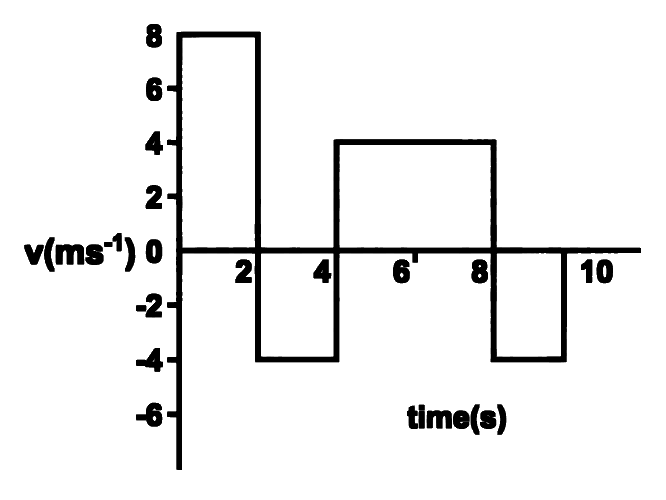
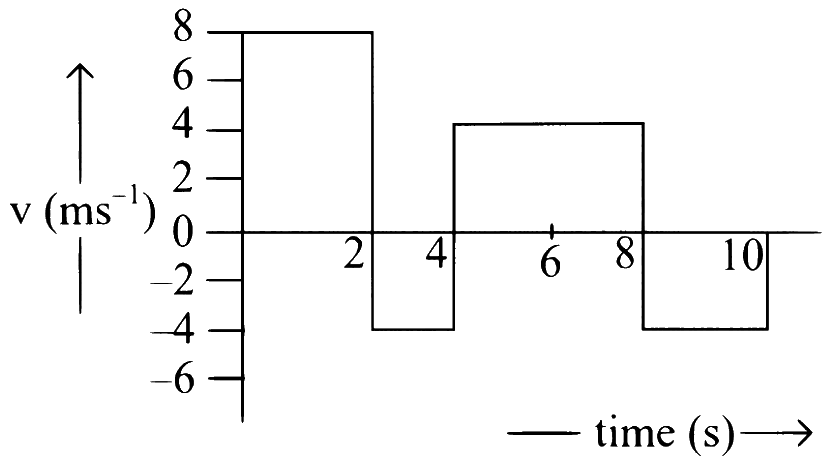
The velocity time graph of a body moving in a straight line is shown in a figure. The ratio of displacement to distance travelled by the body in time 00 to 1010 s is

Figure

Show answer and solution

Answer: (d)

  1. Areas: 00-22 s: 8×2=168 \times 2 = 16; 22-44 s: −4×2=−8-4 \times 2 = -8; 44-88 s: 4×4=164 \times 4 = 16; 88-1010 s: −4×2=−8-4 \times 2 = -8 (m)
  2. Displacement =16−8+16−8=16 m= 16 - 8 + 16 - 8 = 16\text{ m}
  3. Distance =16+8+16+8=48 m= 16 + 8 + 16 + 8 = 48\text{ m}
  4. Ratio =16:48=1:3= 16 : 48 = 1 : 3, so the answer is (d).
Report a mistake
Q75JEE Main 2026 · 5 APR · SHIFT 2Easy

Graphs of Motion · Velocity-time graphs: distance & displacement

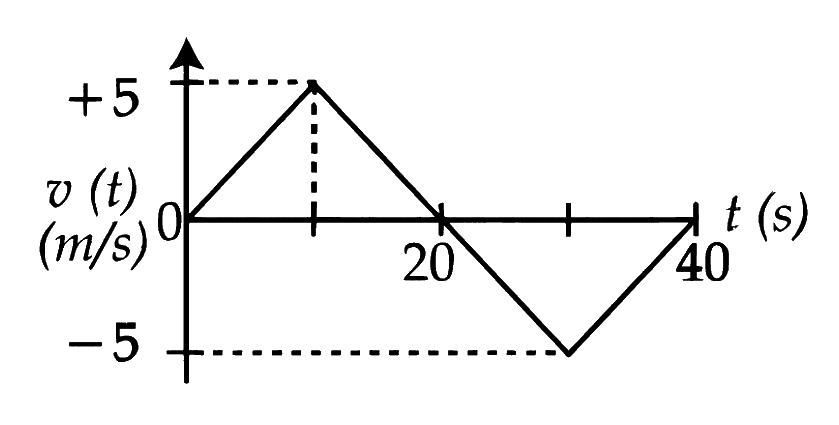
The velocity (v)(v) versus time (t)(t) plot of a particle is shown in the figure, for a time interval of 40 s. The total distance travelled by the particle and the average velocity during this period are, respectively

______.

Figure

Show answer and solution

Answer: (c)

  1. The graph has four triangles, each of base 10 s10\text{ s} and height 5 m/s5\text{ m/s}: area =12×10×5=25 m= \frac{1}{2}\times 10\times 5 = 25\text{ m} each.
  2. Distance = sum of magnitudes =4×25=100 m= 4\times 25 = 100\text{ m}
  3. Displacement = 25+25−25−25=025 + 25 - 25 - 25 = 0, so average velocity =0= 0
  4. So the answer is (c) 100 m and zero.
Report a mistake
Q76JEE Main 2026 · 24 JAN · SHIFT 2Medium

Graphs of Motion · Velocity-displacement graphs

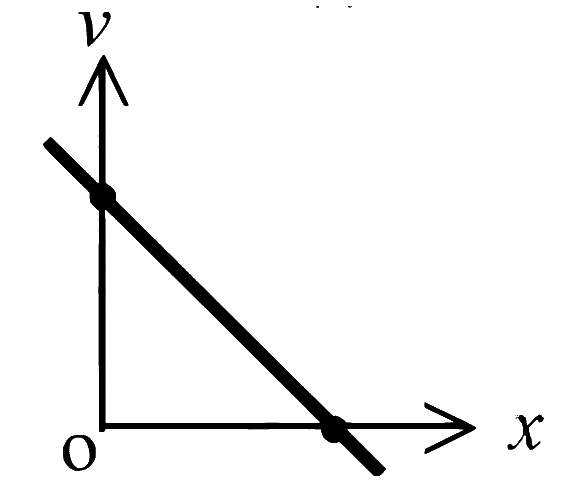
The velocity (v)(v) - Distance (x)(x) graph is shown in figure. Which graph represents acceleration(a) versus distance ( xx) variation of this system?

Figure

Show answer and solution

Answer: (d)

  1. From the graph v=v0−kxv = v_0 - kx (straight line, slope −k-k).
  2. a=vdvdx=(v0−kx)(−k)=−kv0+k2xa = v\frac{dv}{dx} = (v_0 - kx)(-k) = -kv_0 + k^2x
  3. So aa-xx is a straight line with negative intercept −kv0-kv_0 and positive slope k2k^2, crossing zero where v=0v = 0.
  4. So the answer is (d).
Report a mistake
Q77MHT CET 2025 · 21 APR · SHIFT 1Easy

Graphs of Motion · Velocity-time graphs: distance & displacement

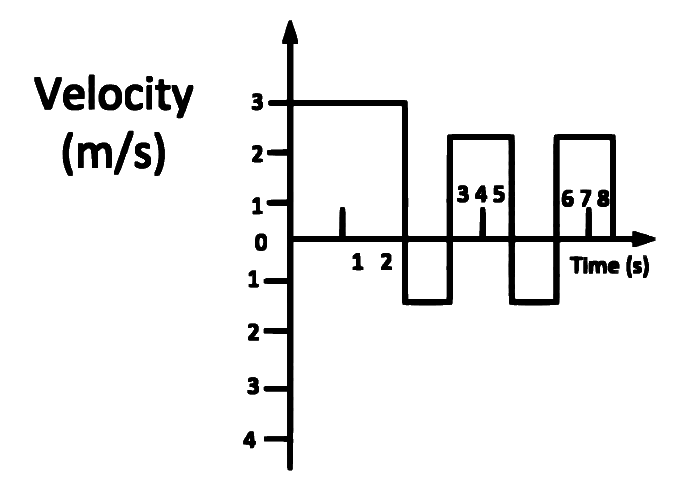
The velocity time graph of a body moving in a straight line is shown in figure. The ratio of displacement to distance travelled by the body in time 0 to 8 s is

Figure

Show answer and solution

Answer: (c)

  1. Read the graph (not to scale) as: +3+3 m/s for 00-22 s, −2-2 m/s for 22-33 s, +2+2 m/s for 33-55 s, −2-2 m/s for 55-66 s, +2+2 m/s for 66-88 s.
  2. Positive area =6+4+4=14 m= 6 + 4 + 4 = 14\text{ m}; negative area =2+2=4 m= 2 + 2 = 4\text{ m}
  3. Displacement =14−4=10 m= 14 - 4 = 10\text{ m}; distance =14+4=18 m= 14 + 4 = 18\text{ m}
  4. Ratio =10:18=5:9= 10 : 18 = 5 : 9, so the answer is (c).
Report a mistake
Q78JEE Main 2025 · 28 JAN · SHIFT 2Easy

Graphs of Motion · Velocity-time graphs: distance & displacement

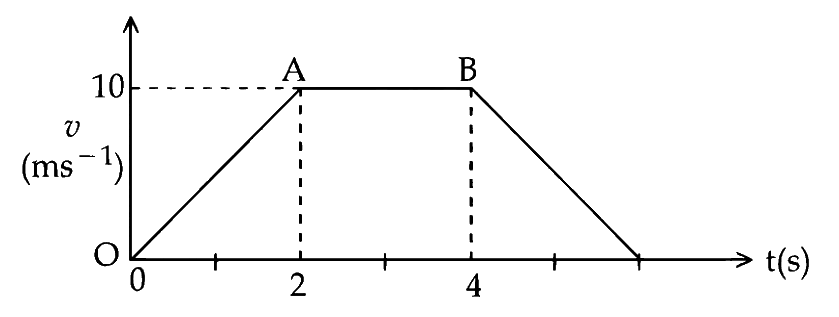
The velocity-time graph of an object moving along a straight line is shown in the figure. What is the distance covered by the object between t=0t = 0 to t=4 st = 4\text{ s}?

Figure

Show answer and solution

Answer: (b)

  1. Distance = area under the vv-tt graph from 0 to 4 s.
  2. 0 to 2 s (triangle): 12×2×10=10 m\frac{1}{2}\times 2\times 10 = 10\text{ m}
  3. 2 to 4 s (rectangle): 2×10=20 m2\times 10 = 20\text{ m}
  4. Total =30 m= 30\text{ m}. So the answer is (b).
Report a mistake
Q79JEE Main 2025 · 23 JAN · SHIFT 1Easy

Graphs of Motion · Velocity-time graphs: distance & displacement

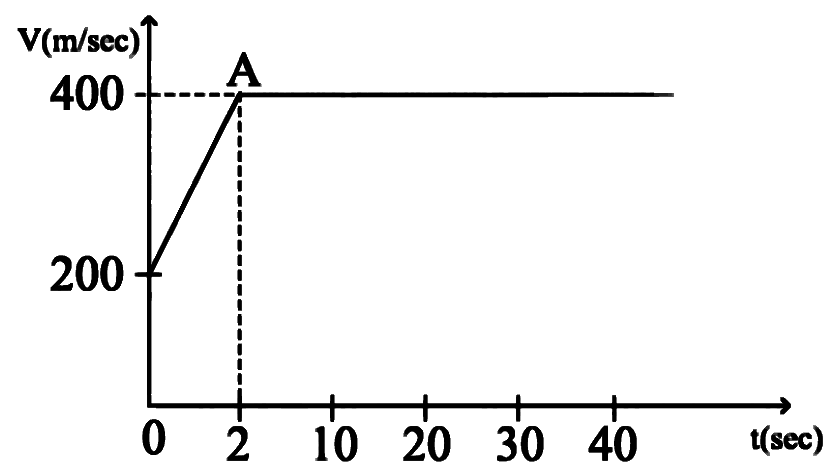
The motion of an airplane is represented by velocity-time graph as shown below. The distance covered by airplane in the first 30.5 second is ̱_______ km.

Figure

Show answer and solution

Answer: (a)

  1. Distance = area under the vv-tt graph.
  2. 0 to 2 s (trapezium): 12(200+400)×2=600 m\frac{1}{2}(200 + 400)\times 2 = 600\text{ m}
  3. 2 s to 30.5 s (rectangle): 400×28.5=11400 m400\times 28.5 = 11400\text{ m}
  4. Total =12000 m=12 km= 12000\text{ m} = 12\text{ km}. So the answer is (a).
Report a mistake
Q80JEE Main 2025 · 3 APR · SHIFT 1Easy

Graphs of Motion · Identifying and matching graphs

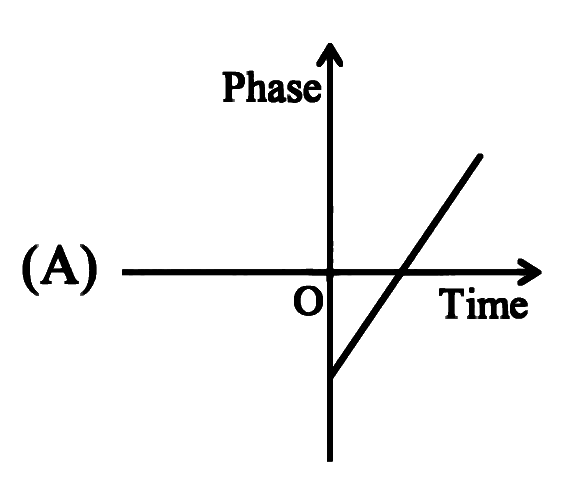
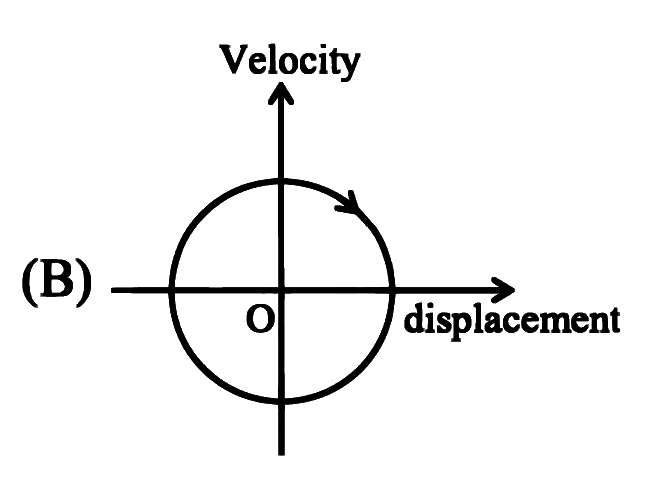
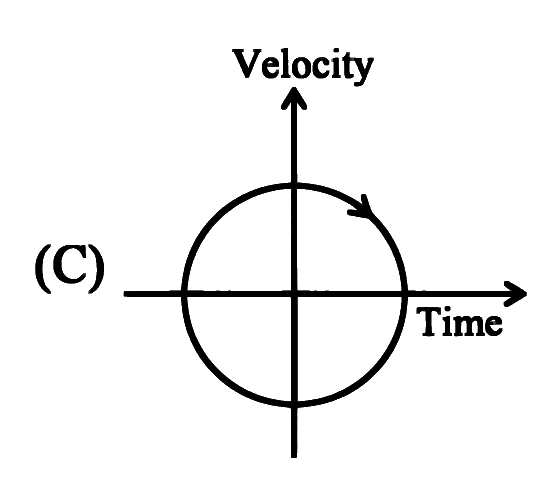
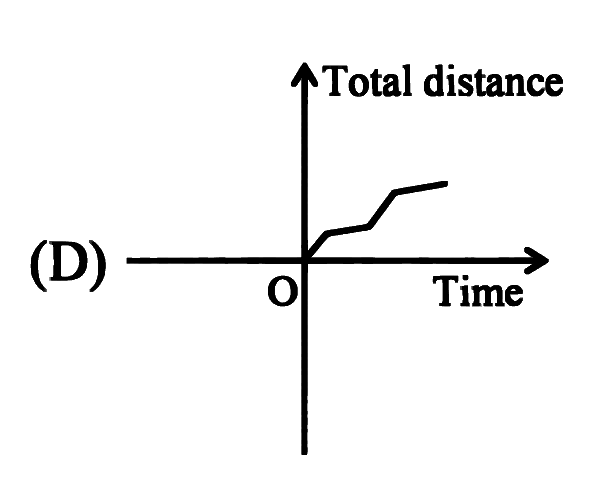
Which of the following curves possibly represent one-dimensional motion of a particle?

Choose the correct answer from the options given below:

FigureFigure
FigureFigure
Show answer and solution

Answer: (c)

  1. (A) Phase increasing linearly with time (ϕ=ωt+ϕ0\phi = \omega t + \phi_0) is possible, e.g. SHM.
  2. (B) A closed vv-xx loop (ellipse/circle) is SHM along a line; clockwise sense is correct (v>0v > 0 while xx increases). Possible.
  3. (C) A vv-tt circle gives two velocities at one instant and needs time to go backward. Not possible.
  4. (D) Total distance never decreasing with time is possible.
  5. So A, B and D only. So the answer is (c).
Report a mistake
Q81JEE Main 2025 · 4 APR · SHIFT 2Medium

Graphs of Motion · Position-time graphs

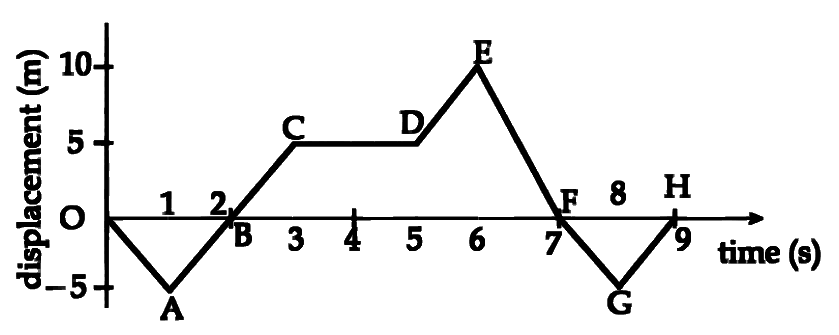
The displacement x versus time graph is shown below.

Figure

(A) The average velocity during 0 to 3 s is 10 m/s10\text{ m/s}

(B) The average velocity during 3 to 5 s is 0 m/s0\text{ m/s}

(C) The instantaneous velocity at t=2 st = 2\text{ s} is 5 m/s5\text{ m/s}

(D) The average velocity during 5 to 7 s and instantaneous velocity at t=6.5 st = 6.5\text{ s} are equal (E) The average velocity from t=0t = 0 to t=9 st = 9\text{ s} is zero

Choose the correct answer from the options given below:

Show answer and solution

Answer: (d)

  1. (A) vˉ0→3=5−03=53 m/s\bar v_{0\to 3} = \frac{5 - 0}{3} = \frac{5}{3}\text{ m/s}, not 10. False.
  2. (B) x(3)=x(5)=5 mx(3) = x(5) = 5\text{ m}, so vˉ=0\bar v = 0. True.
  3. (C) At 2 s the body is on line AC: slope =5−(−5)3−1=5 m/s= \frac{5 - (-5)}{3 - 1} = 5\text{ m/s}. True.
  4. (D) vˉ5→7=0−52=−2.5 m/s\bar v_{5\to 7} = \frac{0 - 5}{2} = -2.5\text{ m/s}; at 6.5 s slope of EF =0−101=−10 m/s= \frac{0 - 10}{1} = -10\text{ m/s}. Not equal. False.
  5. (E) x(9)=x(0)=0x(9) = x(0) = 0, so vˉ=0\bar v = 0. True.
  6. Correct: (B), (C), (E). So the answer is (d).
Report a mistake
Q82MHT CET 2025 · 23 APR · SHIFT 1Medium

Graphs of Motion · Velocity-time graphs: slope, a-t graphs

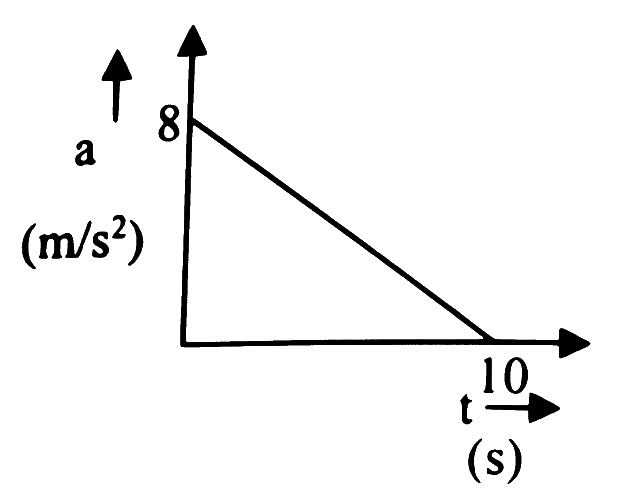
The acceleration (a) - time (T) graph for the body starting from rest is given below. The maximum speed of the body is

Figure

Show answer and solution

Answer: (a)

  1. Area under aa-tt graph = change in velocity.
  2. a>0a > 0 up to 10 s, so speed is maximum at t=10 st = 10\text{ s}.
  3. vmax=0+12×10×8=40 m/sv_{max} = 0 + \frac{1}{2}\times 10\times 8 = 40\text{ m/s}. So the answer is (a).
Report a mistake
Q83MHT CET 2024 · 9 MAY · SHIFT 2Easy

Graphs of Motion · Position-time graphs

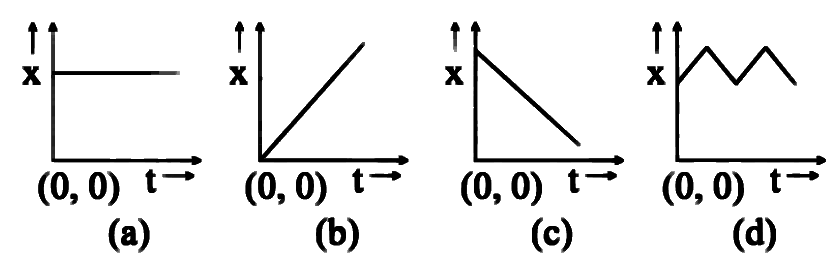
The following figures show the variation of displacement with time of a particular object.

Figure

Show answer and solution

Answer: (a)

  1. Figure (a): xx constant, slope zero, so the object is at rest.
  2. Figure (b): straight line with positive constant slope, so uniform velocity in +x+x direction.
  3. Figure (c): constant negative slope (uniform velocity in −x-x), not rest; (d) changes direction.
  4. So the answer is (a).
Report a mistake
Q84MHT CET 2024 · 11 MAY · SHIFT 1Easy

Graphs of Motion · Velocity-time graphs: distance & displacement

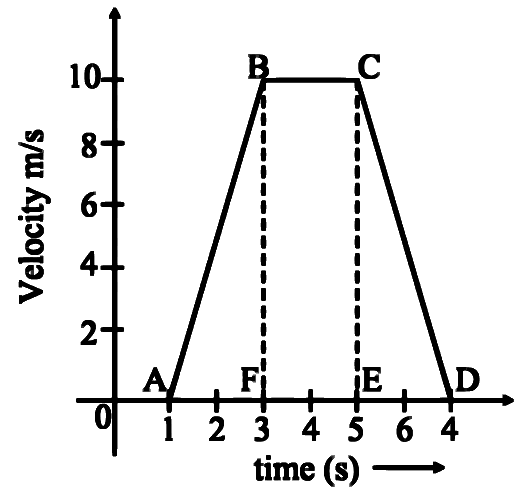
For the velocity-time graph shown in the figure below, the distance covered by the body in last two second of its motion is ' S1S_1 '. What is the ratio of ' S1S_1 ' to the total distance covered by it

Figure

Show answer and solution

Answer: (b)

  1. Distance = area under the vv-tt graph. Read the time axis as A at 1 s1\text{ s}, B at 3 s3\text{ s}, C at 5 s5\text{ s}, D at 7 s7\text{ s} (the last label '4' is a misprint for 7).
  2. Total distance = trapezium area =12(2+6)×10=40 m= \frac{1}{2}(2 + 6)\times 10 = 40\text{ m}
  3. Last two seconds (5 s to 7 s): S1=12×2×10=10 mS_1 = \frac{1}{2}\times 2\times 10 = 10\text{ m}
  4. S1S=1040=14\frac{S_1}{S} = \frac{10}{40} = \frac{1}{4}. So the answer is (b).
Report a mistake
Q85MHT CET 2024 · 9 MAY · SHIFT 1Easy

Graphs of Motion · Velocity-time graphs: distance & displacement

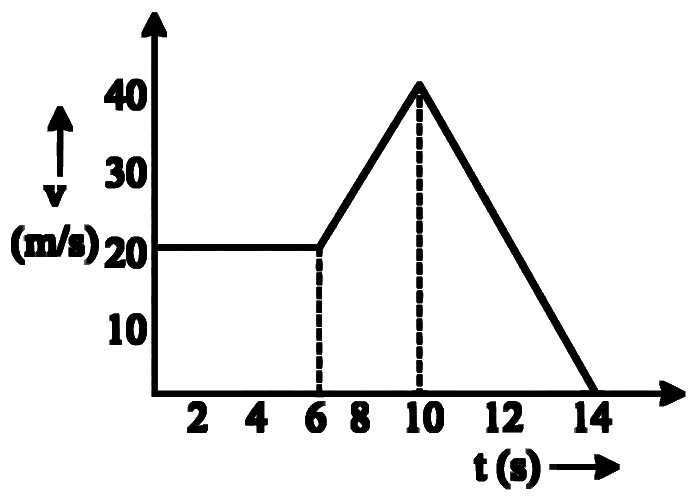
A velocity - time graph of a body is shown below. The distance covered by the body from 6 second to 9 second is

Figure

Show answer and solution

Answer: (c)

  1. Distance = area under the vv-tt graph from 6 s to 9 s.
  2. Slope from 6 s to 10 s: a=40−204=5 m/s2a = \frac{40 - 20}{4} = 5\text{ m/s}^2, so v(9)=20+5×3=35 m/sv(9) = 20 + 5\times 3 = 35\text{ m/s}
  3. Area = trapezium =12(20+35)×3=82.5 m= \frac{1}{2}(20 + 35)\times 3 = 82.5\text{ m}
  4. So the answer is (c) 82.5 m.
Report a mistake
Q86MHT CET 2024 · 2 MAY · SHIFT 1Easy

Graphs of Motion · Velocity-time graphs: slope, a-t graphs

The acceleration of a moving body can be found from

Show answer and solution

Answer: (c)

  1. a=dvdta = \frac{dv}{dt}, which is the slope of the velocity-time graph.
  2. Area under vv-tt gives displacement; slope of xx-tt gives velocity.
  3. So the answer is (c).
Report a mistake
Q87NEET 2024Easy

Graphs of Motion · Velocity-time graphs: slope, a-t graphs

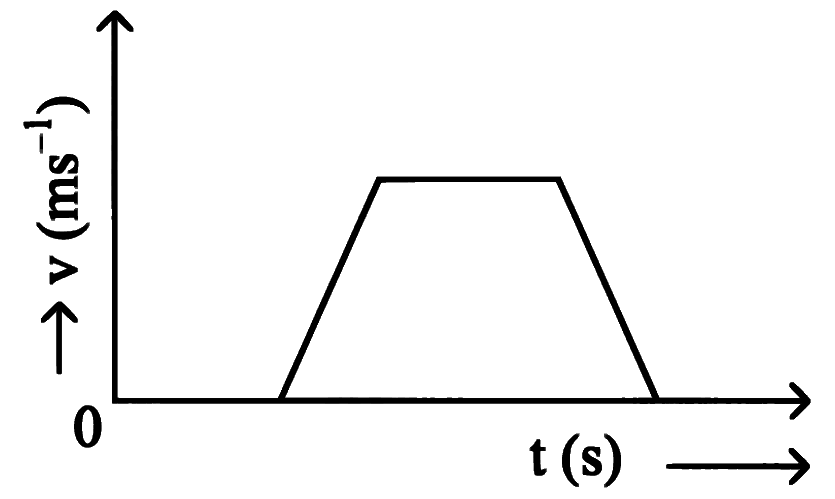
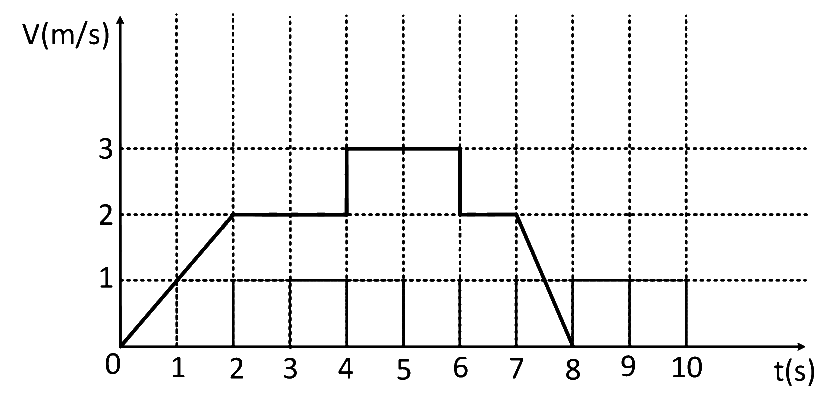
The velocity (v)−(v)- time (t)(t) plot of the motion of a body is shown below:

Figure

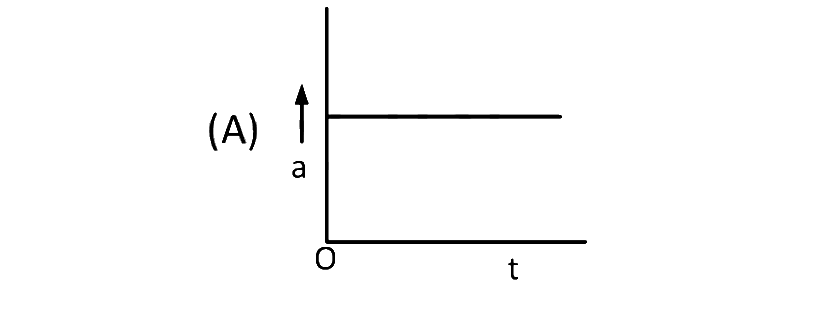
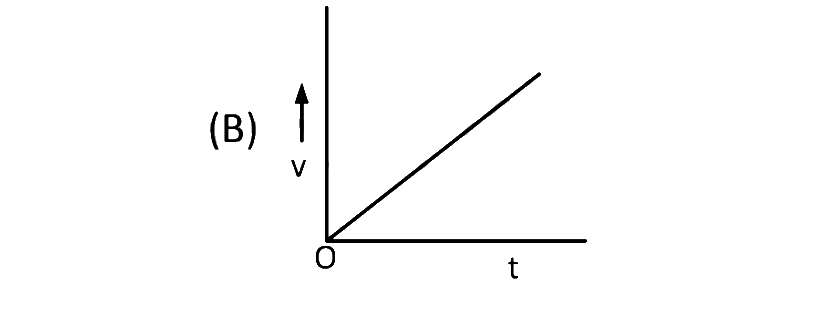
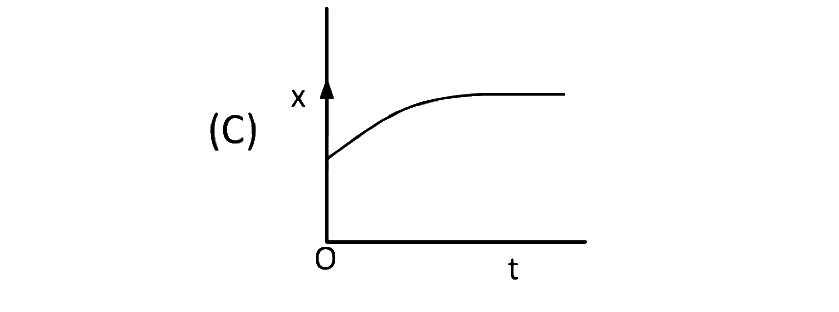
The acceleration (a)−(a)- time (t)(t) graph that best suits this motion is:

Show answer and solution

Answer: (c)

  1. aa = slope of the vv-tt graph.
  2. At rest at first: a=0a = 0. Rising straight line: constant positive aa. Flat part: a=0a = 0.
  3. Falling straight line: constant negative aa. Then v=0v = 0: a=0a = 0.
  4. So aa-tt is zero, a positive block, zero, a negative block. So the answer is (c).
Report a mistake
Q88JEE Main 2023 · 10 APR · SHIFT 1Easy

Graphs of Motion · Position-time graphs

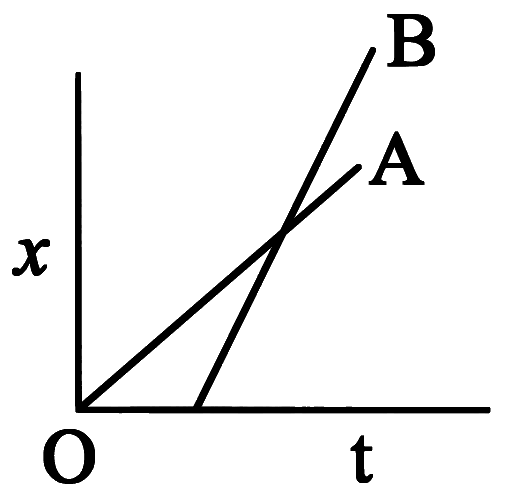
The position-time graphs for two students A and B returning from the school to their homes are shown in figure.

Figure

(A) A lives closer to the school

(B) B lives closer to the school

(C) A takes lesser time to reach home

(D) A travels faster than B

(E) B travels faster than A

Choose the correct answer from the options given below:

Show answer and solution

Answer: (b)

  1. Final (home) position of A is lower on the xx axis than that of B, so A lives closer: (A) true, (B) false.
  2. A starts at t=0t = 0 while B starts later and moves faster, so A takes more time: (C) false.
  3. B's line is steeper, so B has the larger velocity: (E) true, (D) false.
  4. So the answer is (b) (A) and (E) only.
Report a mistake
Q89JEE Main 2023 · 11 APR · SHIFT 1Easy

Graphs of Motion · Velocity-time graphs: distance & displacement

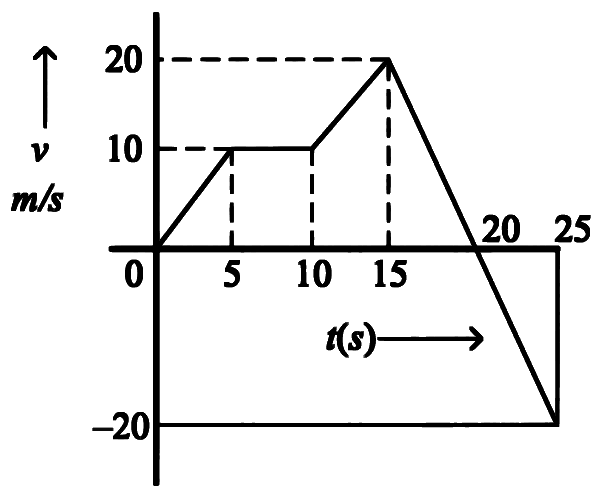
From the v−tv - t graph shown, the ratio of distance to displacement in 25 s25\text{ s} of motion is:

Figure

Show answer and solution

Answer: (d)

  1. Areas: 0-5 s: 2525; 5-10 s: 5050; 10-15 s: 12(10+20)×5=75\frac{1}{2}(10+20)\times 5 = 75; 15-20 s: 12×5×20=50\frac{1}{2}\times 5\times 20 = 50 (all positive).
  2. 20-25 s: 12×5×20=50\frac{1}{2}\times 5\times 20 = 50 below the axis (negative).
  3. Distance =25+50+75+50+50=250 m= 25 + 50 + 75 + 50 + 50 = 250\text{ m}; displacement =200−50=150 m= 200 - 50 = 150\text{ m}
  4. Ratio =250150=53= \frac{250}{150} = \frac{5}{3}. So the answer is (d).
Report a mistake
Q90JEE Main 2023 · 24 JAN · SHIFT 2Easy

Graphs of Motion · Velocity-time graphs: distance & displacement

The velocity time graph of a body moving in a straight line is shown in the figure.

Figure

The ratio of displacement to distance travelled by the body in time 0 to 10s is:

Show answer and solution

Answer: (b)

  1. Areas: 0-2 s: 8×2=+168\times 2 = +16; 2-4 s: −4×2=−8-4\times 2 = -8; 4-8 s: 4×4=+164\times 4 = +16; 8-10 s: −4×2=−8-4\times 2 = -8 (in m).
  2. Displacement =16−8+16−8=16 m= 16 - 8 + 16 - 8 = 16\text{ m}
  3. Distance =16+8+16+8=48 m= 16 + 8 + 16 + 8 = 48\text{ m}
  4. Ratio =16:48=1:3= 16 : 48 = 1 : 3. So the answer is (b).
Report a mistake
Q91JEE Main 2023 · 8 APR · SHIFT 2Easy

Graphs of Motion · Velocity-time graphs: slope, a-t graphs

Given below are two statements

Statement I: Area under velocity- time graph gives the distance travelled by the body in a given time. Statement II: Area under acceleration- time graph is equal to the change in velocity in the given time.

In the light of given statements, choose the correct answer from the options given below.

Show answer and solution

Answer: (c)

  1. Statement I: area under vv-tt gives displacement, not distance (negative areas cancel). False.
  2. Statement II: ∫a dt=Δv\int a\,dt = \Delta v, so area under aa-tt is the change in velocity. True.
  3. So the answer is (c).
Report a mistake
Q92JEE Main 2023 · 30 JAN · SHIFT 1Medium

Graphs of Motion · Identifying and matching graphs

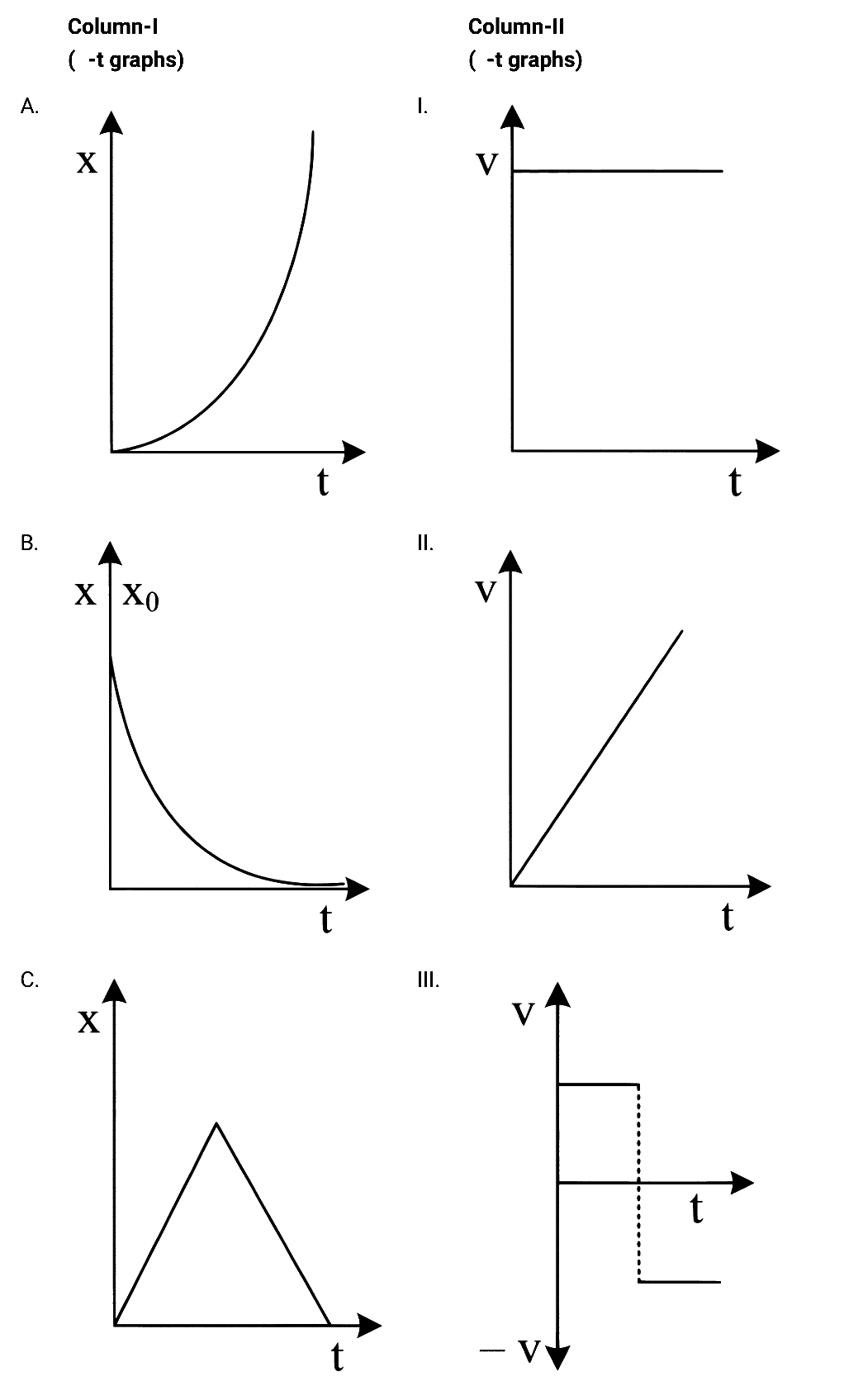
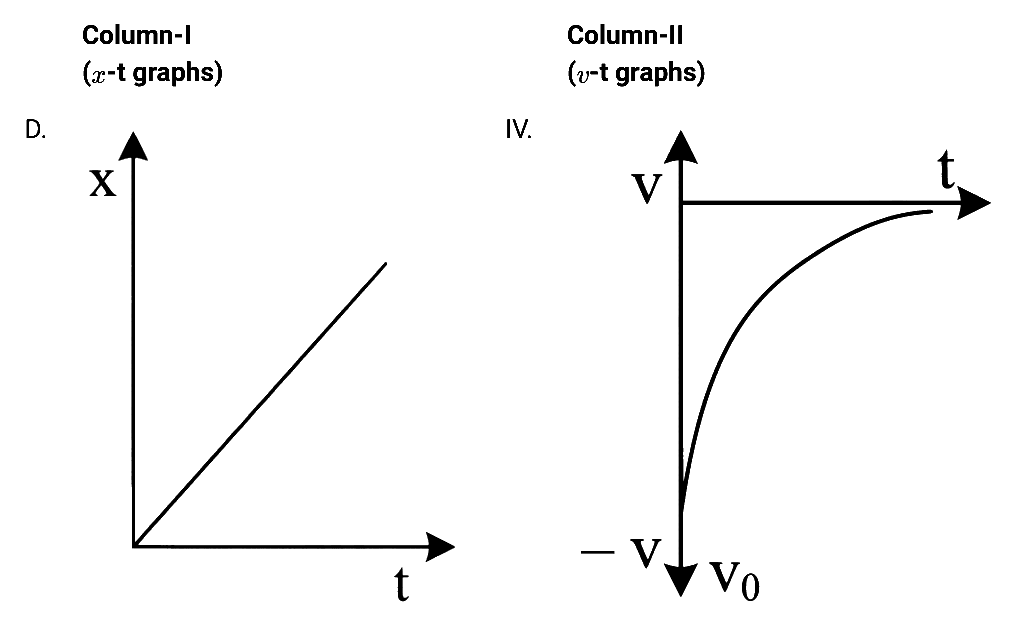
Match Column-I with Column-II:

Figure

Figure

Choose the correct answer from the options given below:

Show answer and solution

Answer: (b)

  1. vv = slope of the xx-tt graph.
  2. A: parabola from origin, slope grows linearly from zero, so v∝tv \propto t: II.
  3. B: falls from x0x_0 with slope negative and shrinking to zero: IV.
  4. C: triangle, constant +v+v then constant −v-v: III. D: straight line, constant vv: I.
  5. A-II, B-IV, C-III, D-I. So the answer is (b).
Report a mistake
Q93NEET 2022 · PHASE 2Easy

Graphs of Motion · Position-time graphs

The position-time (x - t) graph for positive acceleration is

Show answer and solution

Answer: (b)

  1. Slope of xx-tt graph is velocity; positive acceleration means slope increases with time.
  2. So the graph must be concave upward.
  3. Graph (b) curves upward with increasing slope.
  4. So the answer is (b).
Report a mistake
Q94NEET 2022 · PHASE 1Easy

Graphs of Motion · Position-time graphs

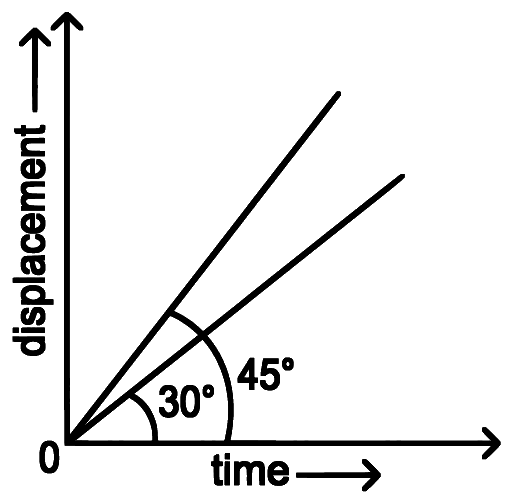
The displacement-time graphs of two moving particles make angles of 30∘^\circ and 45∘^\circ with the x-axis as shown in the figure. The ratio of their respective velocity is

Figure

Show answer and solution

Answer: (d)

  1. Velocity = slope of displacement-time graph =tan⁡θ= \tan\theta
  2. v1v2=tan⁡30∘tan⁡45∘=1/31\dfrac{v_1}{v_2} = \dfrac{\tan 30^\circ}{\tan 45^\circ} = \dfrac{1/\sqrt{3}}{1}
  3. So the ratio is (d) 1:31 : \sqrt{3}.
Report a mistake
Q95JEE Main 2021 · 24 FEB · SHIFT 1Easy

Graphs of Motion · Velocity-time graphs: slope, a-t graphs

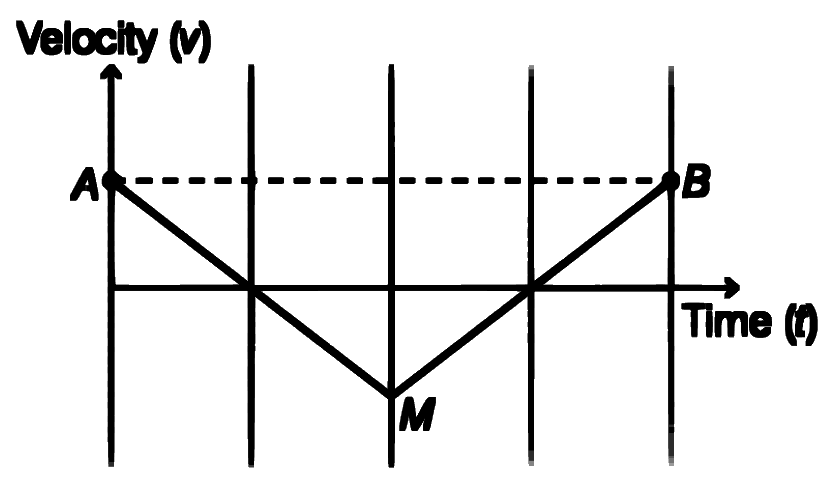
If the velocity-time graph has the shape AMB, what would be the shape of the corresponding acceleration-time graph?

Figure

Show answer and solution

Answer: (c)

  1. aa = slope of the vv-tt graph.
  2. A to M: straight line with negative slope, so aa is a negative constant.
  3. M to B: straight line with positive slope, so aa is a positive constant.
  4. So aa-tt is a negative step that jumps to a positive step at M. So the answer is (c).
Report a mistake
Q96JEE Main 2021 · 18 MAR · SHIFT 1Easy

Graphs of Motion · Identifying and matching graphs

The position, velocity and acceleration of a particle moving with a constant acceleration can be represented by:

Show answer and solution

Answer: (b)

  1. Constant aa: aa-tt is a horizontal line.
  2. v=u+atv = u + at: vv-tt is a straight line with slope aa.
  3. x=x0+ut+12at2x = x_0 + ut + \frac{1}{2}at^2: xx-tt is a parabola curving upward.
  4. Only option (b) has all three. So the answer is (b).
Report a mistake
Q97JEE Main 2021 · 31 AUG · SHIFT 2Easy

Graphs of Motion · Velocity-displacement graphs

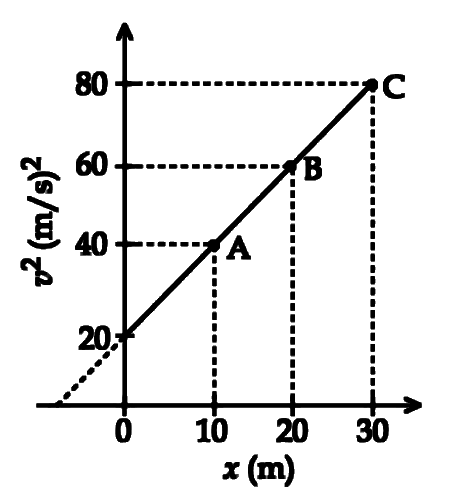
A particle is moving with constant acceleration 'a'. Following graph shows v2 versus x(displacement) plot. The acceleration of the particle is ___________ m/s2.

Figure

Numerical answer type. Work it out, then open the answer.

Show answer and solution

Answer: 1

  1. v2=u2+2axv^2 = u^2 + 2ax, so slope of the v2v^2-xx graph =2a= 2a.
  2. Slope =80−2030−0=2= \frac{80 - 20}{30 - 0} = 2
  3. 2a=2⇒a=12a = 2 \Rightarrow a = 1
  4. a=1 m/s2a = 1\text{ m/s}^2
Report a mistake
Q98JEE Main 2021 · 18 MAR · SHIFT 2Medium

Graphs of Motion · Velocity-displacement graphs

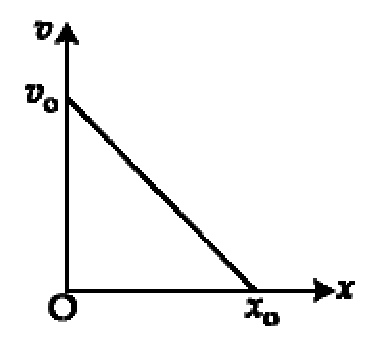
The velocity −- displacement graph of a particle is shown in the figure.

Figure

The acceleration −- displacement graph of the same particle is represented by:

Show answer and solution

Answer: (a)

  1. From the graph v=v0(1−xx0)v = v_0\left(1 - \frac{x}{x_0}\right), so dvdx=−v0x0\frac{dv}{dx} = -\frac{v_0}{x_0}.
  2. a=vdvdx=−v02x0(1−xx0)a = v\frac{dv}{dx} = -\frac{v_0^2}{x_0}\left(1 - \frac{x}{x_0}\right)
  3. At x=0x = 0: a=−v02x0a = -\frac{v_0^2}{x_0}; at x=x0x = x_0: a=0a = 0; linear in between.
  4. Straight line from a negative value up to zero at x0x_0. So the answer is (a).
Report a mistake
Q99JEE Main 2021 · 16 MAR · SHIFT 1Medium

Graphs of Motion · Velocity-displacement graphs

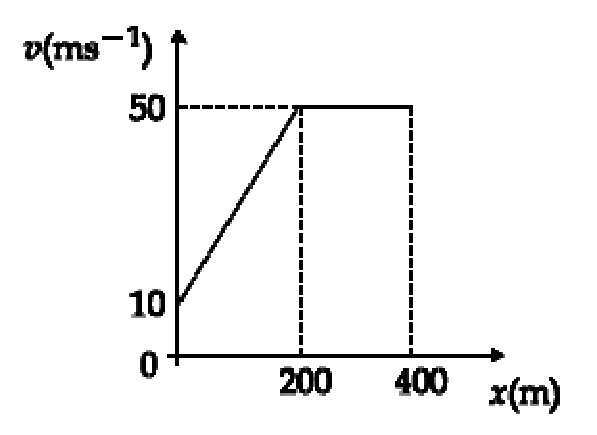
The velocity-displacement graph describing the motion of bicycle is shown in the figure.

Figure

The acceleration-displacement graph of the bicycle's motion is best described by:

Show answer and solution

Answer: (a)

  1. For 0≤x≤200 m0 \le x \le 200\text{ m}: v=10+x5v = 10 + \frac{x}{5}, so dvdx=0.2 s−1\frac{dv}{dx} = 0.2\text{ s}^{-1}.
  2. a=vdvdx=0.2(10+x5)=2+x25a = v\frac{dv}{dx} = 0.2\left(10 + \frac{x}{5}\right) = 2 + \frac{x}{25}: linear, starting at 2 m/s22\text{ m/s}^2.
  3. For 200<x≤400 m200 < x \le 400\text{ m}: vv = constant, so a=0a = 0.
  4. Linear rise then zero matches graph (a). So the answer is (a).
Report a mistake
Q100JEE Main 2020 · 4 SEP · SHIFT 2Easy

Graphs of Motion · Velocity-time graphs: distance & displacement

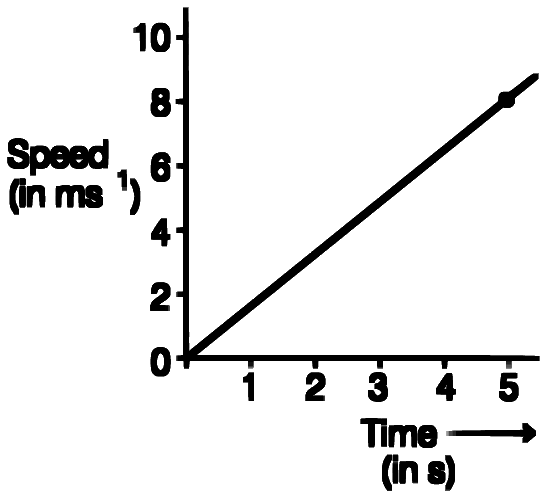
The speed versus time graph for a particle is shown in the figure. The distance travelled (in m) by the particle during the time interval t = 0 to t = 5 s will be________.

Figure

Numerical answer type. Work it out, then open the answer.

Show answer and solution

Answer: 20

  1. Distance = area under the speed-time graph.
  2. The line passes through the origin and reaches 8 m/s8\text{ m/s} at t=5 st = 5\text{ s}.
  3. Area =12×5×8=20= \frac{1}{2}\times 5\times 8 = 20
  4. Distance =20 m= 20\text{ m}
Report a mistake
Q101JEE Main 2020 · 5 SEP · SHIFT 2Medium

Graphs of Motion · Velocity-time graphs: distance & displacement

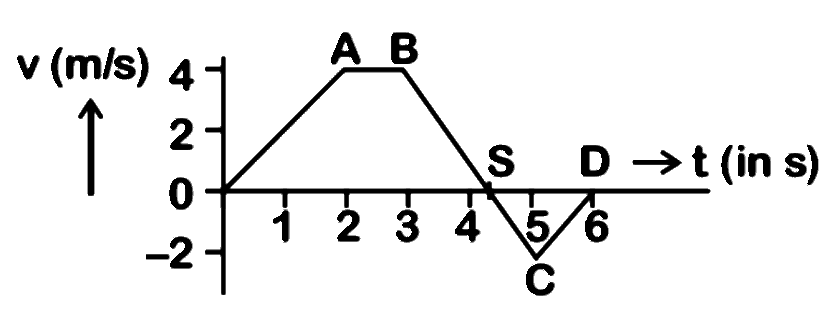
The velocity (v) and time (t) graph of a body in a straight line motion is shown in the figure. The point S is at 4.333 seconds. The total distance covered by the body in 6 s is:

Figure

Show answer and solution

Answer: (d)

  1. Distance = sum of magnitudes of areas under the vv-tt graph.
  2. 0-2 s: 12×2×4=4\frac{1}{2}\times 2\times 4 = 4; 2-3 s: 1×4=41\times 4 = 4; 3 s to 133\frac{13}{3} s: 12×43×4=83\frac{1}{2}\times\frac{4}{3}\times 4 = \frac{8}{3}
  3. 133\frac{13}{3} s to 6 s (below axis): 12×53×2=53\frac{1}{2}\times\frac{5}{3}\times 2 = \frac{5}{3}
  4. Total =8+83+53=373 m= 8 + \frac{8}{3} + \frac{5}{3} = \frac{37}{3}\text{ m}. So the answer is (d).
Report a mistake
Q102JEE Main 2019 · 10 JAN · SHIFT 2Medium

Graphs of Motion · Velocity-time graphs: distance & displacement

A particle starts from the origin at time t = 0 and moves along the positive x-axis. The graph of velocity with respect to time is shown in figure. What is the position of the particle at time t = 5s?

Figure

Show answer and solution

Answer: (b)

  1. Starting at the origin, position = area under the vv-tt graph.
  2. 0-2 s: 12×2×2=2\frac{1}{2}\times 2\times 2 = 2; 2-4 s: 2×2=42\times 2 = 4; 4-5 s: 3×1=33\times 1 = 3
  3. x(5)=2+4+3=9 mx(5) = 2 + 4 + 3 = 9\text{ m}. So the answer is (b).
Report a mistake
Q103JEE Main 2019 · 8 APR · SHIFT 2Medium

Graphs of Motion · Identifying and matching graphs

A particle starts from origin O from rest and moves with a uniform acceleration along the positive x- axis. Identify all figures that correctly represent the motion qualitatively. (a = acceleration, v = velocity, x = displacement, t = time)

Figure
Figure
Figure
Figure
Show answer and solution

Answer: (d)

  1. Uniform acceleration from rest at origin: aa = constant, v=atv = at, x=12at2x = \frac{1}{2}at^2.
  2. (A) constant aa: correct. (B) vv-tt straight line through origin: correct.
  3. (C) xx starts above zero and flattens out: wrong. (D) parabola from origin curving upward: correct.
  4. So (A), (B), (D). So the answer is (d).
Report a mistake
Q104JEE Main 2018 · 15 APR · SHIFT 1Medium

Graphs of Motion · Velocity-time graphs: distance & displacement

The velocity-time graphs of a car and a scooter are shown in the figure. (i) The difference between the distance travelled by the car and the scooter in 15 s15\text{ s} and (ii) the time at which the car will catch up with the scooter are, respectively.

Figure

Show answer and solution

Answer: (a)

  1. In 15 s: car =12×15×45=337.5 m= \frac{1}{2}\times 15\times 45 = 337.5\text{ m}, scooter =30×15=450 m= 30\times 15 = 450\text{ m}
  2. Difference =450−337.5=112.5 m= 450 - 337.5 = 112.5\text{ m}
  3. After 15 s the car (45 m/s) gains 15 m/s15\text{ m/s} on the scooter: extra time =112.515=7.5 s= \frac{112.5}{15} = 7.5\text{ s}
  4. Catch-up at t=15+7.5=22.5 st = 15 + 7.5 = 22.5\text{ s}. So the answer is (a).
Report a mistake
Q105JEE Main 2018Medium

Graphs of Motion · Identifying and matching graphs

All the graphs below are intended to represent the same motion. One of them does it incorrectly. Pick it up.

Show answer and solution

Answer: (c)

  1. The graphs describe a body thrown up with constant downward acceleration: vv falls linearly through zero, vv-xx is a parabola, xx-tt is an inverted parabola.
  2. Distance never decreases and the speed is greatest at the start, so the distance-time graph must start with a steep slope.
  3. Graph (c) starts with zero slope (speed zero at start), which is inconsistent.
  4. So the answer is (c).
Report a mistake
Q106JEE Main 2017 · 8 APR · SHIFT 1Easy

Graphs of Motion · Velocity-time graphs: slope, a-t graphs

Which graph corresponds to an object moving with a constant negative acceleration and a positive velocity?

Show answer and solution

Answer: (c)

  1. With constant retardation aa: v2=u2−2axv^2 = u^2 - 2ax, so v=u2−2axv = \sqrt{u^2 - 2ax}.
  2. vv stays positive and falls slowly at first, then steeply, reaching zero at x=u22ax = \frac{u^2}{2a} with a vertical tangent.
  3. This matches the velocity-distance curve that bends down to the xx-axis. So the answer is (c).
Report a mistake
Q107JEE Main 2008 · AIEEEMedium

Graphs of Motion · Identifying and matching graphs

A body is at rest at x=0.x = 0. At t=0,t = 0, it starts moving in the positive xx-direction with a constant acceleration. At the same instant another body passes through x=0x = 0 moving in the positive xx direction with a constant speed. The position of the first body is given by x1(t)x_1(t) after time ’t’;\text{'}t\text{'}; and that of the second body by x2(t)x_2(t) after the same time interval. Which of the following graphs correctly describes (x1−x2)(x_1 - x_2) as a function of time ’t’\text{'}t\text{'}?

Show answer and solution

Answer: (b)

x1 - x2tO2u/a
  1. x1=12at2x_1 = \frac{1}{2}at^2, x2=utx_2 = ut, so x1−x2=12at2−utx_1 - x_2 = \frac{1}{2}at^2 - ut.
  2. This is an upward parabola through the origin: negative for 0<t<2ua0 < t < \frac{2u}{a}, zero at t=2uat = \frac{2u}{a}, then positive and rising.
  3. So the answer is (b).
Report a mistake
Q108NEET 1994 · AIPMTEasy

Graphs of Motion · Position-time graphs

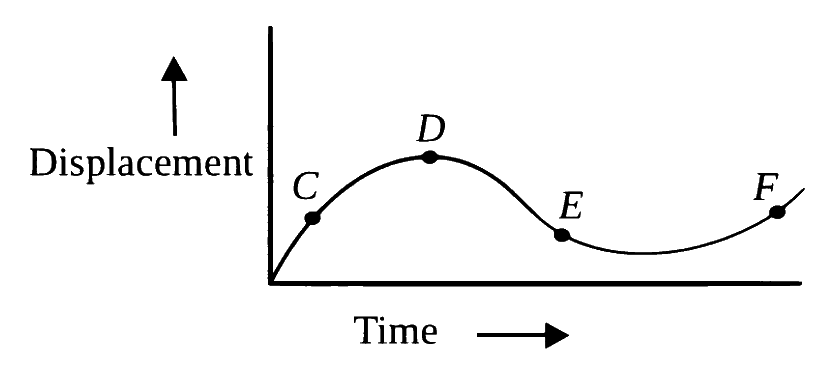
The displacement-time graph of a moving particle is shown below. The instantaneous velocity of the particle is negative at the point

Figure

Show answer and solution

Answer: (a)

  1. Instantaneous velocity = slope of the tangent to the xx-tt graph.
  2. At C and F the curve is rising (positive slope); at D the slope is zero (maximum).
  3. At E the curve is falling, so the slope is negative.
  4. So the answer is (a) E.
Report a mistake
Q109NEET 1992 · AIPMTEasy

Graphs of Motion · Identifying and matching graphs

Which of the following curve does not represent motion in one dimension?

Show answer and solution

Answer: (b)

  1. In real motion a body has only one velocity at any instant.
  2. The circle gives two values of vv at the same tt, and also needs time to run backward.
  3. So it cannot represent motion. So the answer is (b).
Report a mistake
Q110MHT CET 2026 · 11 APR · SHIFT 1Medium

Equations of Kinematics · Stage motion & midpoint velocity

A car passes three points A, B and C at 33 m/s, 66 m/s and 99 m/s respectively in a straight line with uniform acceleration. If distance AB=60AB = 60 m then find the distance BC.

Show answer and solution

Answer: (a)

  1. Use v2−u2=2asv^2 - u^2 = 2as on each part (same aa).
  2. AB: 62−32=27=2a(60)6^2 - 3^2 = 27 = 2a(60)
  3. BC: 92−62=45=2a(BC)9^2 - 6^2 = 45 = 2a(BC)
  4. Dividing: BC60=4527⇒BC=100 m\frac{BC}{60} = \frac{45}{27} \Rightarrow BC = 100\text{ m}
  5. So the answer is (a) 100100 m.
Report a mistake
Q111MHT CET 2026 · 20 MAY · SHIFT 1Medium

Equations of Kinematics · Distance in the nth second

A body moving with uniform acceleration travel 1616 m in the third second of its motion and 2424 m in the fifth second of its motion. The velocity of the body in 1010 second is

Show answer and solution

Answer: (b)

  1. Sn=u+a2(2n−1)S_n = u + \frac{a}{2}(2n - 1), so S5−S3=2a=24−16=8⇒a=4 m/s2S_5 - S_3 = 2a = 24 - 16 = 8 \Rightarrow a = 4\text{ m/s}^2.
  2. S3=u+42(5)=u+10=16⇒u=6 m/sS_3 = u + \frac{4}{2}(5) = u + 10 = 16 \Rightarrow u = 6\text{ m/s}
  3. v=u+at=6+4(10)=46 m/sv = u + at = 6 + 4(10) = 46\text{ m/s}
  4. So the answer is (b) 4646 m/s.
Report a mistake
Q112MHT CET 2025 · 20 APR · SHIFT 2Medium

Equations of Kinematics · Two bodies: meeting & chasing

Two bodies A and B move in same straight line starting from same position. Body A moves with constant velocity ' u ' and body B moves with constant acceleration ' aa '. When their velocities become equal, the distance between them is

Show answer and solution

Answer: (d)

  1. Velocities are equal when at=u⇒t=uaat = u \Rightarrow t = \frac{u}{a}.
  2. sA=ut=u2as_A = ut = \frac{u^2}{a}, sB=12at2=u22as_B = \frac{1}{2}at^2 = \frac{u^2}{2a}
  3. Gap =u2a−u22a=u22a= \frac{u^2}{a} - \frac{u^2}{2a} = \frac{u^2}{2a}
  4. So the answer is (d) u22a\frac{u^2}{2a}.
Report a mistake
Q113MHT CET 2025 · 26 APR · SHIFT 2Medium

Equations of Kinematics · Stopping distance & penetration

A car moving at a speed ' v ' is stopped in a certain distance when the brakes produce a deceleration ' aa '. If the speed of the car is ' nvnv ', what must be the deceleration of the car to stop it in the same distance and in the same time?

Show answer and solution

Answer: (c)

  1. Stopping distance s=v22as = \frac{v^2}{2a}.
  2. Same distance with speed nvnv: (nv)22a′=v22a⇒a′=n2a\frac{(nv)^2}{2a'} = \frac{v^2}{2a} \Rightarrow a' = n^2a.
  3. So the answer is (c) n2⋅an^2 \cdot a.
Report a mistake
Q114MHT CET 2025 · 21 APR · SHIFT 2Medium

Equations of Kinematics · Distance in the nth second

A body starts from rest and moves with a uniform acceleration. The ratio of the distance covered by the body in the nnth second of its motion to the total distance travelled in n second is

Show answer and solution

Answer: (b)

  1. From rest: Sn=a2(2n−1)S_n = \frac{a}{2}(2n - 1) and S=12an2S = \frac{1}{2}an^2.
  2. SnS=2n−1n2=2n−1n2\frac{S_n}{S} = \frac{2n - 1}{n^2} = \frac{2}{n} - \frac{1}{n^2}
  3. So the answer is (b) 2n−1n2\frac{2}{n} - \frac{1}{n^2}.
Report a mistake
Q115MHT CET 2024 · 16 MAY · SHIFT 2Easy

Equations of Kinematics · Stage motion & midpoint velocity

A body travelling with uniform acceleration crosses two points A and B with velocities 20 m/s20\text{ m/s} and 30 m/s30\text{ m/s} respectively. The speed of the body at mid point of A and B is (nearly)

Show answer and solution

Answer: (b)

  1. For uniform acceleration, speed at the midpoint: vm=vA2+vB22v_m = \sqrt{\frac{v_A^2 + v_B^2}{2}} (from v2=u2+2asv^2 = u^2 + 2as over each half).
  2. vm=400+9002=650v_m = \sqrt{\frac{400 + 900}{2}} = \sqrt{650}
  3. vm≈25.5 m/sv_m \approx 25.5\text{ m/s}. So the answer is (b).
Report a mistake
Q116JEE Main 2024 · 9 APR · SHIFT 2Easy

Equations of Kinematics · Two bodies: meeting & chasing

Two cars are travelling towards each other at speed of 20 m s−120\text{ m s}^{-1} each. When the cars are 300 m300\text{ m} apart, both the drivers apply brakes and the cars retard at the rate of 2 m s−22\text{ m s}^{-2}. The distance between them when they come to rest is:

Show answer and solution

Answer: (b)

  1. Stopping distance of each car: s=u22a=2022×2=100 ms = \frac{u^2}{2a} = \frac{20^2}{2 \times 2} = 100\text{ m}.
  2. Both cars together cover 2×100=200 m2 \times 100 = 200\text{ m}.
  3. Gap left =300−200=100 m= 300 - 200 = 100\text{ m}.
  4. So the answer is (b) 100 m.
Report a mistake
Q117JEE Main 2024 · 4 APR · SHIFT 2Easy

Equations of Kinematics · Stopping distance & penetration

A bus moving along a straight highway with speed of 72 km/h72\text{ km/h} is brought to a halt within 4 s4\text{ s} after applying the brakes. The distance travelled by the bus during this time (Assume the retardation is uniform) is ________ m\text{m}.

Numerical answer type. Work it out, then open the answer.

Show answer and solution

Answer: 40

  1. u=72 km/h=20 m/su = 72\text{ km/h} = 20\text{ m/s}, v=0v = 0, t=4 st = 4\text{ s}.
  2. For uniform retardation, s=u+v2t=20+02×4s = \frac{u + v}{2}t = \frac{20 + 0}{2} \times 4
  3. s=40 ms = 40\text{ m}
Report a mistake
Q118JEE Main 2024 · 4 APR · SHIFT 1Easy

Equations of Kinematics · Distance in the nth second

A body travels 102.5 m102.5\text{ m} in nnth second and 115.0 m115.0\text{ m} in (n+2)(n+2)th second. The acceleration is:

Show answer and solution

Answer: (a)

  1. Sn=u+a2(2n−1)S_n = u + \frac{a}{2}(2n - 1), so Sn+2−Sn=a2(4)=2aS_{n+2} - S_n = \frac{a}{2}(4) = 2a.
  2. 2a=115.0−102.5=12.52a = 115.0 - 102.5 = 12.5
  3. a=6.25 m/s2a = 6.25\text{ m/s}^2
  4. So the answer is (a) 6.25 m/s26.25\text{ m/s}^2.
Report a mistake
Q119JEE Main 2024 · 29 JAN · SHIFT 1Medium

Equations of Kinematics · Equations of motion: direct use

A body starts moving from rest with constant acceleration covers displacement S1S_1 in first (p−1)(p-1) seconds and S2S_2 in first pp seconds. The displacement S1+S2S_1 + S_2 will be made in time:

Show answer and solution

Answer: (d)

  1. From rest, S=12at2S = \frac{1}{2}at^2: S1=12a(p−1)2S_1 = \frac{1}{2}a(p - 1)^2, S2=12ap2S_2 = \frac{1}{2}ap^2.
  2. S1+S2=12a[(p−1)2+p2]=12a(2p2−2p+1)S_1 + S_2 = \frac{1}{2}a\left[(p - 1)^2 + p^2\right] = \frac{1}{2}a(2p^2 - 2p + 1)
  3. Set equal to 12aT2\frac{1}{2}aT^2: T=2p2−2p+1 sT = \sqrt{2p^2 - 2p + 1}\text{ s}
  4. So the answer is (d) 2p2−2p+1\sqrt{2p^2 - 2p + 1} s.
Report a mistake
Q120JEE Main 2024 · 30 JAN · SHIFT 1Medium

Equations of Kinematics · Stage motion & midpoint velocity

The displacement and the increase in the velocity of a moving particle in the time interval of tt to (t+1) s(t+1)\text{ s} are 125 m125\text{ m} and 50 m/s50\text{ m/s}, respectively. The distance travelled by the particle in (t+2)th s(t+2)^{\text{th}}\text{ s} is _________ m.

Numerical answer type. Work it out, then open the answer.

Show answer and solution

Answer: 175

  1. Increase in velocity in 1 s is 50 m/s, so a=50 m/s2a = 50\text{ m/s}^2.
  2. Displacement in tt to t+1t+1: 125=vt(1)+12(50)(1)2⇒vt=100 m/s125 = v_t(1) + \frac{1}{2}(50)(1)^2 \Rightarrow v_t = 100\text{ m/s}.
  3. The (t+2)(t+2)th second is from t+1t+1 to t+2t+2, starting at vt+1=150 m/sv_{t+1} = 150\text{ m/s}.
  4. s=150(1)+12(50)(1)2=175 ms = 150(1) + \frac{1}{2}(50)(1)^2 = 175\text{ m}
Report a mistake
Q121MHT CET 2024 · 11 MAY · SHIFT 1Medium

Equations of Kinematics · Stopping distance & penetration

A bullet is fired on a target with velocity V. Its velocity decreases from V to V/2V/2. When it penetrates 30 cm in a target. Through what thickness it will penetrate further in the target before coming to rest?

Show answer and solution

Answer: (c)

  1. Constant retardation: v2=u2−2asv^2 = u^2 - 2as, so the drop in v2v^2 is proportional to distance.
  2. First 30 cm: V2−V24=3V24=2a(30)V^2 - \frac{V^2}{4} = \frac{3V^2}{4} = 2a(30)
  3. Rest of the way: V24=2a(x)\frac{V^2}{4} = 2a(x)
  4. Dividing: x30=13⇒x=10 cm\frac{x}{30} = \frac{1}{3} \Rightarrow x = 10\text{ cm}
  5. So the answer is (c) 10 cm.
Report a mistake
Q122MHT CET 2024 · 2 MAY · SHIFT 2Medium

Equations of Kinematics · Stopping distance & penetration

A driver applies the brakes on seeing the red traffic signal 400 m ahead. At the time of applying brakes, the vehicle was moving with 15 m/s15\text{ m/s} and retarding at 0.3 m/s20.3\text{ m/s}^2. The distance of the vehicle from the traffic light one minute after application of brakes is

Show answer and solution

Answer: (d)

  1. Time to stop =150.3=50 s= \frac{15}{0.3} = 50\text{ s}, less than 60 s, so the vehicle is at rest after 1 minute.
  2. Stopping distance =u22a=1522×0.3=375 m= \frac{u^2}{2a} = \frac{15^2}{2 \times 0.3} = 375\text{ m}
  3. Distance from the light =400−375=25 m= 400 - 375 = 25\text{ m}
  4. So the answer is (d) 25 m.
Report a mistake
Q123JEE Main 2024 · 5 APR · SHIFT 1Medium

Equations of Kinematics · Distance in the nth second

A body moves on a frictionless plane starting from rest. If SnS_n is distance moved between t=n−1t = n - 1 and t=nt = n and Sn−1S_{n-1} is distance moved between t=n−2t = n - 2 and t=n−1t = n - 1, then the ratio Sn−1Sn\frac{S_{n-1}}{S_n} is (1−2x)\left(1 - \frac{2}{x}\right) for n=10n = 10. The value of xx is __________.

Numerical answer type. Work it out, then open the answer.

Show answer and solution

Answer: 19

  1. From rest, Sn=a2(2n−1)S_n = \frac{a}{2}(2n - 1) and Sn−1=a2(2n−3)S_{n-1} = \frac{a}{2}(2n - 3).
  2. Sn−1Sn=2n−32n−1=1−22n−1\frac{S_{n-1}}{S_n} = \frac{2n - 3}{2n - 1} = 1 - \frac{2}{2n - 1}
  3. For n=10n = 10: x=2n−1=19x = 2n - 1 = 19
Report a mistake
Q124JEE Main 2023 · 6 APR · SHIFT 2Easy

Equations of Kinematics · Equations of motion: direct use

A particle starts with an initial velocity of 10.0 ms−110.0\text{ ms}^{-1} along xx-direction and accelerates uniformly at the rate of 2.0 ms−22.0\text{ ms}^{-2}. The time taken by the particle to reach the velocity of 60.0 ms−160.0\text{ ms}^{-1} is __________.

Show answer and solution

Answer: (d)

  1. v=u+atv = u + at
  2. 60=10+2t60 = 10 + 2t
  3. t=25 st = 25\text{ s}. So the answer is (d).
Report a mistake
Q125MHT CET 2023 · 13 MAY · SHIFT 2Easy

Equations of Kinematics · Two bodies: meeting & chasing

Two bodies AA and BB start from the same point at the same instant and move along a straight line. Body AA moves with uniform acceleration aa and body BB moves with uniform velocity vv. They meet after time tt. The value of tt is

Show answer and solution

Answer: (a)

  1. They meet when both displacements are equal: sA=12at2s_A = \frac{1}{2}at^2, sB=vts_B = vt.
  2. 12at2=vt⇒t=2va\frac{1}{2}at^2 = vt \Rightarrow t = \frac{2v}{a}
  3. So the answer is (a) 2va\frac{2v}{a}.
Report a mistake
Q126MHT CET 2023 · 11 MAY · SHIFT 1Medium

Equations of Kinematics · Stopping distance & penetration

A bullet is fired on a target with velocity 'VV'. Its velocity decreases from 'VV' to 'V/2V/2' when it penetrates 30 cm30\text{ cm} in a target. Through what thickness it will penetrate further in the target before coming to rest?

Show answer and solution

Answer: (c)

  1. Constant retardation: drop in v2v^2 is proportional to distance.
  2. First 30 cm: V2−V24=3V24=2a(30)V^2 - \frac{V^2}{4} = \frac{3V^2}{4} = 2a(30)
  3. Rest of the way: V24=2a(x)\frac{V^2}{4} = 2a(x)
  4. x30=13⇒x=10 cm\frac{x}{30} = \frac{1}{3} \Rightarrow x = 10\text{ cm}
  5. So the answer is (c) 10 cm.
Report a mistake
Q127JEE Main 2023 · 1 FEB · SHIFT 2Medium

Equations of Kinematics · Stopping distance & penetration

For a train engine moving with speed of 20 ms−120\text{ ms}^{-1}, the driver must apply brakes at a distance of 500 m\text{m} before the station for the train to come to rest at the station. If the brakes were applied at half of this distance, the train engine would cross the station with speed x ms−1\sqrt{x}\text{ ms}^{-1}. The value of xx is ____________.

(Assuming same retardation is produced by brakes)

Numerical answer type. Work it out, then open the answer.

Show answer and solution

Answer: 200

  1. Retardation: 0=202−2a(500)⇒a=0.4 m/s20 = 20^2 - 2a(500) \Rightarrow a = 0.4\text{ m/s}^2.
  2. Braking over 250 m: v2=202−2(0.4)(250)=400−200=200v^2 = 20^2 - 2(0.4)(250) = 400 - 200 = 200
  3. v=200 m/sv = \sqrt{200}\text{ m/s}, so x=200x = 200
Report a mistake
Q128JEE Main 2022 · 29 JUN · SHIFT 2Easy

Equations of Kinematics · Equations of motion: direct use

A small toy starts moving from the position of rest under a constant acceleration. If it travels a distance of 10m in t s, the distance travelled by the toy in the next t s will be:

Show answer and solution

Answer: (c)

  1. From rest s=12at2s = \frac{1}{2}at^2, so s∝t2s \propto t^2.
  2. In 2t2t: s=4×10=40 ms = 4\times 10 = 40\text{ m}
  3. Distance in the next tt s =40−10=30 m= 40 - 10 = 30\text{ m}. So the answer is (c).
Report a mistake
Q129JEE Main 2022 · 30 JUL · SHIFT 2Easy

Equations of Kinematics · Two bodies: meeting & chasing

Two trucks A and B are approaching each other on a straight path with the velocities of 16 m/s16\text{ m/s} and 20 m/s20\text{ m/s} respectively. When they are 200 m200\text{ m} apart their drivers see each other and applies the breaks simultaneously. If the truck A decelerates with 2 m/s22\text{ m/s}^2 and truck B decelerates with 4 m/s24\text{ m/s}^2, what is the distance between them when they finally stop?

Show answer and solution

Answer: (c)

  1. Stopping distance s=u22as = \frac{u^2}{2a} for each truck.
  2. Truck A: sA=1622×2=64 ms_A = \frac{16^2}{2 \times 2} = 64\text{ m}; truck B: sB=2022×4=50 ms_B = \frac{20^2}{2 \times 4} = 50\text{ m}.
  3. Gap left =200−(64+50)=86 m= 200 - (64 + 50) = 86\text{ m}.
  4. So the answer is (c) 86 m86\text{ m}.
Report a mistake
Q130JEE Main 2022 · 25 JUL · SHIFT 1Easy

Equations of Kinematics · Stopping distance & penetration

A car is moving with speed of 150 km/h150\text{ km/h} and after applying the brake it will move 27 m27\text{ m} before it stops. If the same car is moving with a speed of one third the reported speed then it will stop after travelling ___________ m distance.

Numerical answer type. Work it out, then open the answer.

Show answer and solution

Answer: 3

  1. For the same retardation, s∝u2s \propto u^2.
  2. Speed becomes 13\frac{1}{3}, so distance becomes 19\frac{1}{9}.
  3. s′=279=3 ms' = \frac{27}{9} = 3\text{ m}
Report a mistake
Q131JEE Main 2022 · 27 JUL · SHIFT 2Medium

Equations of Kinematics · Stopping distance & penetration

The velocity of the bullet becomes one third after it penetrates 4 cm in a wooden block. Assuming that bullet is facing a constant resistance during its motion in the block. The bullet stops completely after travelling at (4 + x) cm inside the block. The value of x is:

Show answer and solution

Answer: (c)

  1. Constant resistance means constant retardation, so the drop in v2v^2 is proportional to distance.
  2. First 4 cm: u2−u29=8u29=2a(4)u^2 - \frac{u^2}{9} = \frac{8u^2}{9} = 2a(4)
  3. Further xx: u29=2a(x)\frac{u^2}{9} = 2a(x)
  4. x4=18⇒x=0.5 cm\frac{x}{4} = \frac{1}{8} \Rightarrow x = 0.5\text{ cm}
  5. So the answer is (c) 0.5.
Report a mistake
Q132JEE Main 2021 · 26 FEB · SHIFT 2Easy

Equations of Kinematics · Stage motion & midpoint velocity

A scooter accelerates from rest for time t1 at constant rate a1 and then retards at constant rate a2 for time t2 and comes to rest. The correct value of t1t2\frac{t_1}{t_2} will be:

Show answer and solution

Answer: (c)

  1. Peak speed reached after accelerating: v=a1t1v = a_1t_1
  2. Retarding to rest: 0=v−a2t2⇒v=a2t20 = v - a_2t_2 \Rightarrow v = a_2t_2
  3. a1t1=a2t2⇒t1t2=a2a1a_1t_1 = a_2t_2 \Rightarrow \frac{t_1}{t_2} = \frac{a_2}{a_1}. So the answer is (c).
Report a mistake
Q133JEE Main 2021 · 25 FEB · SHIFT 1Easy

Equations of Kinematics · Stage motion & midpoint velocity

An engine of a train, moving with uniform acceleration, passes the signal-post with velocity u and the last compartment with velocity v. The velocity with which middle point of the train passes the signal post is:

Show answer and solution

Answer: (d)

  1. Let train length be LL: v2=u2+2aLv^2 = u^2 + 2aL.
  2. Middle point passes after the train moves L2\frac{L}{2}: vm2=u2+2aL2=u2+v2−u22v_m^2 = u^2 + 2a\frac{L}{2} = u^2 + \frac{v^2 - u^2}{2}
  3. vm=u2+v22v_m = \sqrt{\frac{u^2 + v^2}{2}}. So the answer is (d).
Report a mistake
Q134MHT CET 2021 · 20 SEP · SHIFT 1Easy

Equations of Kinematics · Two bodies: meeting & chasing

Two bodies 'AA' and 'BB' start from the same point at the same instant and move along a straight line. 'A' moves with uniform acceleration (a) and 'B' moves with uniform velocity (V). They meet after time 't'. The value of 't' is

Show answer and solution

Answer: (a)

  1. They meet when both displacements are equal: sA=12at2s_A = \frac{1}{2}at^2, sB=Vts_B = Vt.
  2. 12at2=Vt⇒t=2Va\frac{1}{2}at^2 = Vt \Rightarrow t = \frac{2V}{a}
  3. So the answer is (a) 2Va\frac{2V}{a}.
Report a mistake
Q135JEE Main 2021 · 17 MAR · SHIFT 1Medium

Equations of Kinematics · Stage motion & midpoint velocity

A car accelerates from rest at a constant rate α\alpha for some time after which it decelerates at a constant rate β\beta to come to rest. If the total time elapsed is t seconds, the total distance travelled is:

Show answer and solution

Answer: (c)

αβvtv
  1. Maximum speed: vα+vβ=t⇒v=αβtα+β\frac{v}{\alpha} + \frac{v}{\beta} = t \Rightarrow v = \frac{\alpha\beta t}{\alpha + \beta}.
  2. Distance = area of the triangular vv-tt graph =12vt= \frac{1}{2}vt.
  3. s=12⋅αβtα+β⋅t=αβ2(α+β)t2s = \frac{1}{2} \cdot \frac{\alpha\beta t}{\alpha + \beta} \cdot t = \frac{\alpha\beta}{2(\alpha + \beta)}t^2
  4. So the answer is (c) αβ2(α+β)t2\frac{\alpha\beta}{2(\alpha+\beta)}t^2.
Report a mistake
Q136MHT CET 2021 · 22 SEP · SHIFT 2Medium

Equations of Kinematics · Stopping distance & penetration

A driver applies the brakes on seeing the red traffic signal 400 m400\text{ m} ahead. At the time of applying the brakes, the vehicle was moving with 15 m/s15\text{ m/s} and retarding at 0.3 m/s20.3\text{ m/s}^2. The distance covered by the vehicle from the traffic light 1 minute after the application of brakes is

Show answer and solution

Answer: (a)

  1. Time to stop =150.3=50 s<60 s= \frac{15}{0.3} = 50\text{ s} < 60\text{ s}, so the vehicle has stopped.
  2. Stopping distance =1522×0.3=375 m= \frac{15^2}{2 \times 0.3} = 375\text{ m}
  3. Distance from the light =400−375=25 m= 400 - 375 = 25\text{ m}
  4. So the answer is (a) 25 m.
Report a mistake
Q137NEET 2021Medium

Equations of Kinematics · Distance in the nth second

A small block slides down on a smooth inclined plane, starting from rest at time t = 0. Let Sn be the distance travelled by the block in the interval t = n −- 1 to t = n. Then the ratio SnSn+1\frac{S_n}{S_{n+1}} is:

Show answer and solution

Answer: (c)

  1. Smooth incline: constant acceleration from rest, so Sn=a2(2n−1)S_n = \frac{a}{2}(2n - 1).
  2. Sn+1=a2(2n+1)S_{n+1} = \frac{a}{2}(2n + 1)
  3. SnSn+1=2n−12n+1\frac{S_n}{S_{n+1}} = \frac{2n - 1}{2n + 1}
  4. So the answer is (c) 2n−12n+1\frac{2n-1}{2n+1}.
Report a mistake
Q138MHT CET 2020 · 16 OCT · SHIFT 1Easy

Equations of Kinematics · Equations of motion: direct use

A moving body is covering distances which are proportional to square of the time. Then, the acceleration of the body is

Show answer and solution

Answer: (c)

  1. s∝t2s \propto t^2 means s=kt2s = kt^2.
  2. v=dsdt=2ktv = \frac{ds}{dt} = 2kt, a=dvdt=2ka = \frac{dv}{dt} = 2k
  3. So acceleration is constant and non-zero. So the answer is (c).
Report a mistake
Q139JEE Main 2019 · 11 JAN · SHIFT 2Medium

Equations of Kinematics · Equations of motion: direct use

A particle moves from the point (2.0i^+4.0j^)\left(2.0\hat{i} + 4.0\hat{j}\right) m, at t = 0, with an initial velocity (5.0i^+4.0j^)\left(5.0\hat{i} + 4.0\hat{j}\right) ms−1{}^{-1}. It is acted upon by a constant force which produces a constant acceleration (4.0i^+4.0j^)\left(4.0\hat{i} + 4.0\hat{j}\right) ms−2{}^{-2}. What is the distance of the particle from the origin at time 2 s?

Show answer and solution

Answer: (b)

  1. r⃗=r⃗0+u⃗t+12a⃗t2\vec{r} = \vec{r}_0 + \vec{u}t + \frac{1}{2}\vec{a}t^2 with t=2 st = 2\text{ s}.
  2. x: 2+5(2)+12(4)(4)=20 m2 + 5(2) + \frac{1}{2}(4)(4) = 20\text{ m}; y: 4+4(2)+12(4)(4)=20 m4 + 4(2) + \frac{1}{2}(4)(4) = 20\text{ m}
  3. Distance from origin =202+202=202 m= \sqrt{20^2 + 20^2} = 20\sqrt{2}\text{ m}
  4. So the answer is (b) 20220\sqrt{2} m.
Report a mistake
Q140JEE Main 2019 · 9 JAN · SHIFT 2Difficult

Equations of Kinematics · Stage motion & midpoint velocity

In a car race on straight road, car A takes a time t less than car B at the finish and passes finishing point with a speed 'vv' more than that of car B. Both the cars start from rest and travel with constant acceleration a1 and a2 respectively. Then 'vv' is equal to:

Show answer and solution

Answer: (c)

  1. Same track length dd, from rest: ti=2dait_i = \sqrt{\frac{2d}{a_i}}, vi=2daiv_i = \sqrt{2da_i}.
  2. v=v1−v2=2d(a1−a2)v = v_1 - v_2 = \sqrt{2d}(\sqrt{a_1} - \sqrt{a_2})
  3. t=t2−t1=2d a1−a2a1a2t = t_2 - t_1 = \sqrt{2d}\,\frac{\sqrt{a_1} - \sqrt{a_2}}{\sqrt{a_1a_2}}
  4. vt=a1a2⇒v=a1a2 t\frac{v}{t} = \sqrt{a_1a_2} \Rightarrow v = \sqrt{a_1a_2}\,t
  5. So the answer is (c) a1a2 t\sqrt{a_1a_2}\,t.
Report a mistake
Q141JEE Main 2018 · 15 APR · SHIFT 1Easy

Equations of Kinematics · Stopping distance & penetration

An automobile, travelling at 4040 km/h, can be stopped at a distance of 4040 m by applying brakes. If the same automobile is travelling at 8080 km/h, the minimum stopping distance, in metres, is (assume no skidding):

Show answer and solution

Answer: (d)

  1. For the same retardation, s=u22a⇒s∝u2s = \frac{u^2}{2a} \Rightarrow s \propto u^2.
  2. Speed doubles, so s′=4×40=160 ms' = 4 \times 40 = 160\text{ m}.
  3. So the answer is (d) 160160 m.
Report a mistake
Q142JEE Main 2017 · 9 APR · SHIFT 1Easy

Equations of Kinematics · Two bodies: meeting & chasing

A car is standing 200 m behind a bus, which is also at rest. The two start moving at the same instant but with different forward accelerations. The bus has acceleration 2 m/s2 and the car has acceleration 4 m/s2. The car will catch up with the bus after a time of:

Show answer and solution

Answer: (c)

  1. Relative to the bus, the car starts from rest with arel=4−2=2 m/s2a_{rel} = 4 - 2 = 2\text{ m/s}^2 and must cover 200 m.
  2. 200=12(2)t2⇒t2=200200 = \frac{1}{2}(2)t^2 \Rightarrow t^2 = 200
  3. t=102 st = 10\sqrt{2}\text{ s}
  4. So the answer is (c) 102 s10\sqrt{2}\text{ s}.
Report a mistake
Q143NEET 2009 · AIPMTEasy

Equations of Kinematics · Equations of motion: direct use

A particle starts its motion from rest under the action of a constant force. If the distance covered in first 10 seconds is S1 and that covered in the first 20 seconds is S2, then

Show answer and solution

Answer: (b)

  1. Constant force means constant aa; from rest S=12at2S = \frac{1}{2}at^2, so S∝t2S \propto t^2.
  2. S2S1=(2010)2=4\frac{S_2}{S_1} = \left(\frac{20}{10}\right)^2 = 4
  3. So the answer is (b) S2=4S1S_2 = 4S_1.
Report a mistake
Q144NEET 2008 · AIPMTEasy

Equations of Kinematics · Equations of motion: direct use

A particle moves in a straight line with a constant acceleration. It changes its velocity from 10 ms−1{}^{-1} to 20 ms−1{}^{-1} while passing through a distance 135 m in t second. The value of t is

Show answer and solution

Answer: (b)

  1. For uniform acceleration s=u+v2 ts = \frac{u + v}{2}\,t.
  2. 135=10+202 t=15t135 = \frac{10 + 20}{2}\,t = 15t
  3. t=9 st = 9\text{ s}. So the answer is (b).
Report a mistake
Q145NEET 2008 · AIPMTEasy

Equations of Kinematics · Distance in the nth second

The distance travelled by a particle starting from rest and moving with an acceleration 43\frac{4}{3} m s−2{}^{-2}, in the third second is

Show answer and solution

Answer: (a)

  1. Distance in the nnth second: Sn=u+a2(2n−1)S_n = u + \frac{a}{2}(2n - 1), with u=0u = 0.
  2. S3=12×43×(2×3−1)=23×5S_3 = \frac{1}{2} \times \frac{4}{3} \times (2 \times 3 - 1) = \frac{2}{3} \times 5
  3. S3=103 mS_3 = \frac{10}{3}\text{ m}
  4. So the answer is (a) 103\frac{10}{3} m.
Report a mistake
Q146JEE Main 2005 · AIEEEDifficult

Equations of Kinematics · Stage motion & midpoint velocity

A car starting from rest accelerates at the rate f through a distance S, then continues at constant speed for time t and then decelerates at the rate f2\frac{f}{2} to come to rest. If the total distance traversed is 15 S, then

Show answer and solution

Answer: (d)

  1. After distance SS: v2=2fSv^2 = 2fS.
  2. Deceleration at f2\frac{f}{2}: distance =v22(f/2)=2fSf=2S= \frac{v^2}{2(f/2)} = \frac{2fS}{f} = 2S.
  3. Constant-speed part: vt=15S−S−2S=12S⇒v=12Stvt = 15S - S - 2S = 12S \Rightarrow v = \frac{12S}{t}
  4. 144S2t2=2fS⇒S=172ft2\frac{144S^2}{t^2} = 2fS \Rightarrow S = \frac{1}{72}ft^2
  5. So the answer is (d) S=172ft2S = \frac{1}{72}ft^2.
Report a mistake
Q147JEE Main 2004 · AIEEEEasy

Equations of Kinematics · Stopping distance & penetration

An automobile travelling with speed of 60 km/h, can brake to stop within a distance of 20 m. If the car is going twice as fast, i.e 120 km/h, the stopping distance will be

Show answer and solution

Answer: (d)

  1. For the same retardation, s∝u2s \propto u^2.
  2. Speed doubles, so s′=4×20=80 ms' = 4 \times 20 = 80\text{ m}.
  3. So the answer is (d) 80 m.
Report a mistake
Q148JEE Main 2003 · AIEEEEasy

Equations of Kinematics · Stopping distance & penetration

A car, moving with a speed of 50 km/hr, can be stopped by brakes after at least 6 m. If the same car is moving at a speed of 100 km/hr, the minimum stopping distance is

Show answer and solution

Answer: (c)

  1. For the same retardation, s∝u2s \propto u^2.
  2. Speed doubles (50 to 100 km/h), so s′=4×6=24 ms' = 4 \times 6 = 24\text{ m}.
  3. So the answer is (c) 24 m.
Report a mistake
Q149JEE Main 2002 · AIEEEEasy

Equations of Kinematics · Stopping distance & penetration

Speeds of two identical cars are uu and 4u4u at the specific instant. The ratio of the respective distances in which the two cars are stopped from that instant is:

Show answer and solution

Answer: (d)

  1. Identical cars have the same braking retardation, so s=u22a⇒s∝u2s = \frac{u^2}{2a} \Rightarrow s \propto u^2.
  2. s1s2=u2(4u)2=116\frac{s_1}{s_2} = \frac{u^2}{(4u)^2} = \frac{1}{16}
  3. So the answer is (d) 1:161 : 16.
Report a mistake
Q150NEET 1998 · AIPMTEasy

Equations of Kinematics · Stopping distance & penetration

A car moving with a speed of 40 km/h40\text{ km/h} can be stopped by applying brakes after atleast 2 m2\text{ m}. If the same car is moving with a speed of 80 km/h80\text{ km/h}, what is the minimum stopping distance?

Show answer and solution

Answer: (a)

  1. For the same retardation, s=u22a⇒s∝u2s = \frac{u^2}{2a} \Rightarrow s \propto u^2.
  2. Speed doubles (40 to 80 km/h), so distance becomes 22=42^2 = 4 times.
  3. s′=4×2=8 ms' = 4 \times 2 = 8\text{ m}
  4. So the answer is (a) 8 m8\text{ m}.
Report a mistake
Q151NEET 1997 · AIPMTEasy

Equations of Kinematics · Equations of motion: direct use

If a car at rest accelerates uniformly to a speed of 144 km/h in 20 sec, it covers a distance of

Show answer and solution

Answer: (d)

  1. v=144 km/h=144×518=40 m/sv = 144\text{ km/h} = 144\times\frac{5}{18} = 40\text{ m/s}
  2. s=u+v2 t=0+402×20s = \frac{u + v}{2}\,t = \frac{0 + 40}{2}\times 20
  3. s=400 ms = 400\text{ m}. So the answer is (d).
Report a mistake
Q152NEET 1994 · AIPMTEasy

Equations of Kinematics · Equations of motion: direct use

The velocity of train increases uniformly from 20 km/h to 60 km/h in 4 hours. The distance travelled by the train during this period is

Show answer and solution

Answer: (a)

  1. For uniform acceleration, average velocity =u+v2=20+602=40 km/h= \frac{u + v}{2} = \frac{20 + 60}{2} = 40\text{ km/h}
  2. s=40×4=160 kms = 40\times 4 = 160\text{ km}
  3. So the answer is (a).
Report a mistake
Q153NEET 1994 · AIPMTMedium

Equations of Kinematics · Stage motion & midpoint velocity

A car accelerates from rest at a constant rate α\alpha for some time after which it decelerates at a constant rate β\beta and comes to rest. If total time elapsed is tt, then maximum velocity acquired by car will be

Show answer and solution

Answer: (d)

  1. Let the maximum speed be vv. Time to speed up t1=vαt_1 = \frac{v}{\alpha}, time to stop t2=vβt_2 = \frac{v}{\beta}.
  2. t=vα+vβ=vα+βαβt = \frac{v}{\alpha} + \frac{v}{\beta} = v\frac{\alpha + \beta}{\alpha\beta}
  3. v=αβtα+βv = \frac{\alpha\beta t}{\alpha + \beta}
  4. So the answer is (d) αβtα+β\frac{\alpha\beta t}{\alpha + \beta}.
Report a mistake
Q154NEET 1993 · AIPMTEasy

Equations of Kinematics · Distance in the nth second

A body starts from rest, what is the ratio of the distance travelled by the body during the 4th and 3rd second?

Show answer and solution

Answer: (a)

  1. From rest, Sn=a2(2n−1)S_n = \frac{a}{2}(2n - 1).
  2. S4S3=2(4)−12(3)−1=75\frac{S_4}{S_3} = \frac{2(4) - 1}{2(3) - 1} = \frac{7}{5}
  3. So the answer is (a) 75\frac{7}{5}.
Report a mistake
Q155NEET 1988 · AIPMTEasy

Equations of Kinematics · Stage motion & midpoint velocity

A car is moving along a straight road with a uniform acceleration. It passes through two points PP and QQ separated by a distance with velocity 30 km/h and 40 km/h respectively. The velocity of the car midway between PP and QQ is

Show answer and solution

Answer: (c)

  1. Midpoint velocity: vm=vP2+vQ22v_m = \sqrt{\frac{v_P^2 + v_Q^2}{2}}
  2. vm=302+4022=1250v_m = \sqrt{\frac{30^2 + 40^2}{2}} = \sqrt{1250}
  3. vm=252 km/hv_m = 25\sqrt{2}\text{ km/h}. So the answer is (c).
Report a mistake
Q156NEET 2026Easy

Motion Under Gravity · Free fall: h, t and v

When a ruler falls vertically, 5 different persons catch it with different reaction times. ( g=9.8 m s−2g = 9.8\text{ m s}^{-2})

A. Person A has reaction time of 0.20 s.

B. Person BB has reaction time of 0.22 s.

C. Person C has reaction time of 0.18 s.

D. Person D has reaction time of 0.19 s.

E. Person E has reaction time of 0.21 s.

What is the correct order of the distance travelled by the ruler for each person?

Show answer and solution

Answer: (c)

  1. The ruler falls freely during the reaction time: d=12gt2d = \frac{1}{2}gt^2, so d∝t2d \propto t^2.
  2. Longer reaction time means longer fall: tB(0.22)>tE(0.21)>tA(0.20)>tD(0.19)>tC(0.18)t_B (0.22) > t_E (0.21) > t_A (0.20) > t_D (0.19) > t_C (0.18).
  3. Order: B > E > A > D > C
  4. So the answer is (c).
Report a mistake
Q157JEE Main 2026 · 5 APR · SHIFT 1Easy

Motion Under Gravity · Free fall: h, t and v

From 18 m height above the ground a ball is dropped from rest. The height above the ground at which the magnitude of velocity equal to the magnitude of acceleration (in the same set of units) due to gravity is ______ m.

(Take g=10 m/s2g = 10\text{ m/s}^2 and neglect the air resistance)

Numerical answer type. Work it out, then open the answer.

Show answer and solution

Answer: 13

  1. Need v=g=10v = g = 10 m/s (numerically).
  2. Distance fallen: s=v22g=10020=5s = \frac{v^2}{2g} = \frac{100}{20} = 5 m
  3. Height above ground =18−5=13= 18 - 5 = 13 m
  4. So the answer is 13 m.
Report a mistake
Q158MHT CET 2026 · 15 APR · SHIFT 1Easy

Motion Under Gravity · Two bodies under gravity

A stone falls from the top of a tower of height 100100 m and at the same time another stone is projected vertically upwards from the ground with a velocity 2525 m/s. The two stones meet after

Show answer and solution

Answer: (c)

  1. Both stones have the same acceleration gg, so relative acceleration is zero.
  2. Relative speed =25= 25 m/s, relative distance =100= 100 m
  3. t=10025=4t = \frac{100}{25} = 4 s
  4. So the answer is (c) 4 s.
Report a mistake
Q159NEET 2026Easy

Motion Under Gravity · Bounce & graphs under gravity

The following plots show variation of velocity (v)(v) with time (t)(t) of a ball thrown vertically upward, and falling back. Which of the following plots is/are correct?

Figure

Show answer and solution

Answer: (a)

vtutop: v = 0slope = -g
  1. Taking upward as positive, v=u−gtv = u - gt: a straight line with constant negative slope −g-g.
  2. vv starts positive, becomes zero at the top, then becomes negative while falling, so the line crosses the tt-axis and continues below it: graph C.
  3. A and E show speed (never negative), B rises then falls, D starts negative with positive slope, so none of these is correct.
  4. So the answer is (a) C only.
Report a mistake
Q160JEE Main 2026 · 23 JAN · SHIFT 2Medium

Motion Under Gravity · Free fall: h, t and v

A paratrooper jumps from an aeroplane and opens a parachute after 2 s of free fall and starts decelerating with 3 m/s23\text{ m/s}^2. At 10 m height from ground, while descending with the help of parachute, the speed of paratrooper is 5 m/s5\text{ m/s}. The initial height of the airplane is ______ m.

(g=10 m/s2)(g = 10\text{ m/s}^2)

Show answer and solution

Answer: (a)

  1. Free fall for 2 s: v=20v = 20 m/s, h1=12×10×22=20h_1 = \frac{1}{2} \times 10 \times 2^2 = 20 m
  2. Decelerating at 3 m/s2^2 from 20 m/s to 5 m/s: h2=202−522×3=3756=62.5h_2 = \frac{20^2 - 5^2}{2 \times 3} = \frac{375}{6} = 62.5 m
  3. Initial height =20+62.5+10=92.5= 20 + 62.5 + 10 = 92.5 m
  4. So the answer is (a) 92.5 m.
Report a mistake
Q161MHT CET 2026 · 19 MAY · SHIFT 1Medium

Motion Under Gravity · Drops & balls at regular intervals

A juggler throws balls into air. He throws one ball whenever the previous one is at its highest point. If he throws 4 balls in one second, the height from which each ball returns is nearly [acceleration due to gravity is 9.89.8 m/s2{}^{2}]

Show answer and solution

Answer: (a)

  1. 4 balls per second: interval =0.25= 0.25 s, which equals the time to reach the top.
  2. H=12gt2=12×9.8×0.252≈0.306H = \frac{1}{2}gt^2 = \frac{1}{2} \times 9.8 \times 0.25^2 \approx 0.306 m
  3. H≈30H \approx 30 cm. So the answer is (a) 30 cm.
Report a mistake
Q162JEE Main 2026 · 28 JAN · SHIFT 1Medium

Motion Under Gravity · Drops & balls at regular intervals

Water drops fall from a tap on the floor, 5 m below, at regular intervals of time, the first drop strikes the floor when the sixth drop begins to fall. The height at which the fourth drop will be from ground, at the instant when the first drop strikes the ground is ______ m.

(g=10 m/s2)(g = 10\text{ m/s}^2)

Show answer and solution

Answer: (c)

  1. Time to fall 5 m: T=2×5/10=1T = \sqrt{2 \times 5/10} = 1 s
  2. Drop 1 lands as drop 6 starts: 5 intervals in 1 s, so interval =0.2= 0.2 s.
  3. Drop 4 has fallen for 2×0.2=0.42 \times 0.2 = 0.4 s: s=12×10×0.42=0.8s = \frac{1}{2} \times 10 \times 0.4^2 = 0.8 m
  4. Height above ground =5−0.8=4.2= 5 - 0.8 = 4.2 m. So the answer is (c) 4.2 m.
Report a mistake
Q163JEE Main 2026 · 8 APR · SHIFT 2Medium

Motion Under Gravity · Balloon & helicopter

A gas balloon is going up with a constant velocity of 10 m/s10\text{ m/s}. When this balloon reached a height of 75 m, a stone is dropped from it and balloon keeps moving up with the same velocity. The height of the balloon when the stone hits the ground is ______ m. (Take g=10 m/s2g = 10\text{ m/s}^2)

Show answer and solution

Answer: (d)

  1. Stone leaves with the balloon's velocity, 10 m/s10\text{ m/s} upward, at height 75 m.
  2. −75=10t−5t2⇒t2−2t−15=0⇒t=5 s-75 = 10t - 5t^2 \Rightarrow t^2 - 2t - 15 = 0 \Rightarrow t = 5\text{ s}
  3. Balloon height =75+10×5=125 m= 75 + 10 \times 5 = 125\text{ m}
  4. So the answer is (d) 125.
Report a mistake
Q164MHT CET 2026 · 16 APR · SHIFT 1Medium

Motion Under Gravity · Bounce & graphs under gravity

A ball is released from height 'h' which makes perfectly elastic collision with ground. The frequency of periodic vibratory motion is (g=acceleration due to gravity)

Show answer and solution

Answer: (a)

  1. Time to fall height hh: t=2hgt = \sqrt{\frac{2h}{g}}
  2. Elastic bounce: it rises back to hh in the same time, so period T=22hgT = 2\sqrt{\frac{2h}{g}}
  3. f=1T=12g2hf = \frac{1}{T} = \frac{1}{2}\sqrt{\frac{g}{2h}}
  4. So the answer is (a) 12g2h\frac{1}{2}\sqrt{\frac{g}{2h}}.
Report a mistake
Q165MHT CET 2025 · 26 APR · SHIFT 1Easy

Motion Under Gravity · Thrown vertically: up, down, tower

A boy throws a ball vertically upwards from a bridge with velocity 5 m/s5\text{ m/s}. It strikes water surface after 2 s. The height of the bridge is (Take g=10 m/s2g = 10\text{ m/s}^2)

Show answer and solution

Answer: (d)

  1. Take upward as positive: s=ut−12gt2s = ut - \frac{1}{2}gt^2
  2. s=5×2−12×10×22=10−20=−10s = 5 \times 2 - \frac{1}{2} \times 10 \times 2^2 = 10 - 20 = -10 m
  3. The water is 10 m below the bridge. So the answer is (d) 10 m.
Report a mistake
Q166MHT CET 2024 · 15 MAY · SHIFT 2Easy

Motion Under Gravity · Free fall: h, t and v

A ball is released from the top of a tower of height Hm. It takes T second to reach the ground. The height of the ball from the ground after T4\frac{T}{4} second is

Show answer and solution

Answer: (b)

  1. Free fall from rest: h=12gt2⇒h∝t2h = \frac{1}{2}gt^2 \Rightarrow h \propto t^2, with H=12gT2H = \frac{1}{2}gT^2.
  2. Fallen in T4\frac{T}{4}: H16\frac{H}{16}
  3. Height above ground =H−H16=15H16= H - \frac{H}{16} = \frac{15H}{16}
  4. So the answer is (b) 15H16\frac{15H}{16}.
Report a mistake
Q167JEE Main 2024 · 27 JAN · SHIFT 2Medium

Motion Under Gravity · Free fall: h, t and v

A body falling under gravity covers two points AA and BB separated by 80 m80\text{ m} in 2 s2\text{ s}. The distance of upper point A from the starting point is _________ m\text{m} (use g=10 ms−2g = 10\text{ ms}^{-2} ).

Numerical answer type. Work it out, then open the answer.

Show answer and solution

Answer: 45

  1. From A to B: 80=vA(2)+12(10)(2)2=2vA+20⇒vA=3080 = v_A(2) + \frac{1}{2}(10)(2)^2 = 2v_A + 20 \Rightarrow v_A = 30 m/s
  2. Distance of A from start: s=vA22g=90020=45s = \frac{v_A^2}{2g} = \frac{900}{20} = 45 m
  3. So the answer is 45 m.
Report a mistake
Q168JEE Main 2024 · 6 APR · SHIFT 2Medium

Motion Under Gravity · Thrown vertically: up, down, tower

A body projected vertically upwards with a certain speed from the top of a tower reaches the ground in t1t_1. If it is projected vertically downwards from the same point with the same speed, it reaches the ground in t2t_2. Time required to reach the ground, if it is dropped from the top of the tower, is:

Show answer and solution

Answer: (b)

  1. Up throw: −h=ut1−12gt12-h = ut_1 - \frac{1}{2}gt_1^2; down throw: h=ut2+12gt22h = ut_2 + \frac{1}{2}gt_2^2
  2. Eliminate uu (multiply first by t2t_2, second by t1t_1, subtract): h(t1+t2)=12gt1t2(t1+t2)⇒h=12gt1t2h(t_1 + t_2) = \frac{1}{2}g t_1 t_2 (t_1 + t_2) \Rightarrow h = \frac{1}{2}gt_1t_2
  3. Dropped: h=12gt2⇒t=t1t2h = \frac{1}{2}gt^2 \Rightarrow t = \sqrt{t_1t_2}
  4. So the answer is (b) t1t2\sqrt{t_1t_2}.
Report a mistake
Q169MHT CET 2023 · 10 MAY · SHIFT 1Easy

Motion Under Gravity · Free fall: h, t and v

A body is released from the top of a tower 'HH' metre high. It takes tt second to reach the ground. The height of the body t2\frac{t}{2} second after release is

Show answer and solution

Answer: (c)

  1. Free fall from rest: h∝t2h \propto t^2.
  2. Fallen in t2\frac{t}{2}: H4\frac{H}{4}
  3. Height above ground =H−H4=3H4= H - \frac{H}{4} = \frac{3H}{4}
  4. So the answer is (c) 3H4\frac{3H}{4} metre from ground.
Report a mistake
Q170JEE Main 2023 · 12 APR · SHIFT 1Easy

Motion Under Gravity · Thrown vertically: up, down, tower

A ball is thrown vertically upward with an initial velocity of 150 m/s150\text{ m/s}. The ratio of velocity after 3 s3\text{ s} and 5 s5\text{ s} is x+1x\frac{x+1}{x}. The value of xx is ___________.

{\{ take, g=10 m/s2}g = 10\text{ m/s}^2\}

Show answer and solution

Answer: (c)

  1. v=u−gtv = u - gt: v3=150−30=120v_3 = 150 - 30 = 120 m/s, v5=150−50=100v_5 = 150 - 50 = 100 m/s
  2. v3v5=120100=65=x+1x\frac{v_3}{v_5} = \frac{120}{100} = \frac{6}{5} = \frac{x+1}{x}
  3. ⇒x=5\Rightarrow x = 5. So the answer is (c) 5.
Report a mistake
Q171MHT CET 2023 · 13 MAY · SHIFT 2Medium

Motion Under Gravity · Free fall: h, t and v

A small steel ball is dropped from a height of 1.5 m1.5\text{ m} into a glycerine jar. The ball reaches the bottom of the jar 1.5 s1.5\text{ s} after it was dropped. If the retardation is 2.66 m/s22.66\text{ m/s}^2, the height of the glycerine in the jar is about (acceleration due to gravity g=9.8 m/s2g = 9.8\text{ m/s}^2)

Show answer and solution

Answer: (c)

  1. Speed on reaching glycerine: v=2gh=2×9.8×1.5≈5.42v = \sqrt{2gh} = \sqrt{2 \times 9.8 \times 1.5} \approx 5.42 m/s, in time t1=v/g≈0.55t_1 = v/g \approx 0.55 s
  2. Read literally, time in glycerine =1.5−0.55=0.95= 1.5 - 0.55 = 0.95 s: s=5.42×0.95−12×2.66×0.952≈3.9s = 5.42 \times 0.95 - \frac{1}{2} \times 2.66 \times 0.95^2 \approx 3.9 m
  3. The intended reading takes 1.5 s as the time inside the glycerine: s=5.42×1.5−12×2.66×1.52≈8.13−2.99≈5.1s = 5.42 \times 1.5 - \frac{1}{2} \times 2.66 \times 1.5^2 \approx 8.13 - 2.99 \approx 5.1 m
  4. This is nearest to 5.5 m. So the answer is (c) 5.5 m.
Report a mistake
Q172MHT CET 2023 · 12 MAY · SHIFT 2Medium

Motion Under Gravity · Thrown vertically: up, down, tower

A ball is projected vertically upwards from ground. It reaches a height 'hh' in time t1t_1, continues its motion and then takes a time t2t_2 to reach ground. The height hh in terms of g,t1g, t_1 and t2t_2 is (g=(g = acceleration due to gravity)

Show answer and solution

Answer: (b)

  1. h=ut−12gt2h = ut - \frac{1}{2}gt^2 has two roots: going up at t1t_1, coming down at t1′t_1'.
  2. Total flight time is t1+t2t_1 + t_2; by symmetry the ball is at hh again at t1′=(t1+t2)−t1=t2t_1' = (t_1 + t_2) - t_1 = t_2.
  3. Product of roots of 12gt2−ut+h=0\frac{1}{2}gt^2 - ut + h = 0: t1t2=2hgt_1 t_2 = \frac{2h}{g}
  4. h=12gt1t2h = \frac{1}{2}gt_1t_2. So the answer is (b).
Report a mistake
Q173JEE Main 2023 · 29 JAN · SHIFT 1Medium

Motion Under Gravity · Bounce & graphs under gravity

A tennis ball is dropped on to the floor from a height of 9.8 m. It rebounds to a height 5.0 m. Ball comes in contact with the floor for 0.2s. The average acceleration during contact is ___________ ms −2-2.

(Given g = 10 ms −2-2)

Numerical answer type. Work it out, then open the answer.

Show answer and solution

Answer: 120

  1. Speed on hitting: v1=2gh1=2(10)(9.8)=14 m/sv_1 = \sqrt{2gh_1} = \sqrt{2(10)(9.8)} = 14\text{ m/s} (down)
  2. Speed on rebound: v2=2(10)(5)=10 m/sv_2 = \sqrt{2(10)(5)} = 10\text{ m/s} (up)
  3. a=ΔvΔt=10−(−14)0.2=240.2a = \frac{\Delta v}{\Delta t} = \frac{10 - (-14)}{0.2} = \frac{24}{0.2}
  4. a=120 m s−2a = 120\text{ m s}^{-2}
Report a mistake
Q174NEET 2022 · PHASE 1Easy

Motion Under Gravity · Free fall: h, t and v

The ratio of the distances travelled by a freely falling body in the 1st, 2nd, 3rd and 4th second

Show answer and solution

Answer: (c)

  1. From rest, Sn=g2(2n−1)S_n = \frac{g}{2}(2n - 1).
  2. n=1,2,3,4n = 1, 2, 3, 4 gives 1:3:5:71 : 3 : 5 : 7 (Galileo's law of odd numbers).
  3. So the answer is (c) 1: 3: 5: 7.
Report a mistake
Q175JEE Main 2022 · 28 JUL · SHIFT 1Easy

Motion Under Gravity · Free fall: h, t and v

An NCC parade is going at a uniform speed of 9 km/h9\text{ km/h} under a mango tree on which a monkey is sitting at a height of 19.6 m19.6\text{ m}. At any particular instant, the monkey drops a mango. A cadet will receive the mango whose distance from the tree at time of drop is: (Given g=9.8 m/s2g = 9.8\text{ m/s}^2)

Show answer and solution

Answer: (a)

  1. Time of fall: t=2h/g=2×19.6/9.8=2t = \sqrt{2h/g} = \sqrt{2 \times 19.6/9.8} = 2 s
  2. Parade speed: 99 km/h =9×518=2.5= 9 \times \frac{5}{18} = 2.5 m/s
  3. The cadet must be d=2.5×2=5d = 2.5 \times 2 = 5 m from the tree at the instant of drop.
  4. So the answer is (a) 5 m.
Report a mistake
Q176JEE Main 2022 · 26 JUN · SHIFT 1Easy

Motion Under Gravity · Free fall: h, t and v

A ball of mass 0.5 kg is dropped from the height of 10 m. The height, at which the magnitude of velocity becomes equal to the magnitude of acceleration due to gravity, is ________ m. [Use g = 10 m/s2]

Numerical answer type. Work it out, then open the answer.

Show answer and solution

Answer: 5

  1. Need v=g=10v = g = 10 m/s (numerically); mass does not matter.
  2. Distance fallen: s=v22g=10020=5s = \frac{v^2}{2g} = \frac{100}{20} = 5 m
  3. Height above ground =10−5=5= 10 - 5 = 5 m
  4. So the answer is 5 m.
Report a mistake
Q177JEE Main 2022 · 24 JUN · SHIFT 1Easy

Motion Under Gravity · Thrown vertically: up, down, tower

From the top of a tower, a ball is thrown vertically upward which reaches the ground in 6 s. A second ball thrown vertically downward from the same position with the same speed reaches the ground in 1.5 s. A third ball released, from the rest from the same location, will reach the ground in ____________ s.

Numerical answer type. Work it out, then open the answer.

Show answer and solution

Answer: 3

  1. For a tower, time to fall from rest t=t1t2t = \sqrt{t_1 t_2}, where t1,t2t_1, t_2 are the up-throw and down-throw times with the same speed.
  2. t=6×1.5=9=3t = \sqrt{6 \times 1.5} = \sqrt{9} = 3 s
  3. So the answer is 3 s.
Report a mistake
Q178JEE Main 2022 · 29 JUL · SHIFT 2Medium

Motion Under Gravity · Free fall: h, t and v

A ball is released from a height h. If t1t_1 and t2t_2 be the time required to complete first half and second half of the distance respectively. Then, choose the correct relation between t1t_1 and t2t_2.

Show answer and solution

Answer: (d)

  1. First half: h2=12gt12⇒t1=h/g\frac{h}{2} = \frac{1}{2}gt_1^2 \Rightarrow t_1 = \sqrt{h/g}
  2. Whole height: T=2h/g=2 t1T = \sqrt{2h/g} = \sqrt{2}\,t_1
  3. t2=T−t1=(2−1)t1t_2 = T - t_1 = (\sqrt{2} - 1)t_1
  4. So the answer is (d) t2=(2−1)t1t_2 = (\sqrt{2} - 1)t_1.
Report a mistake
Q179JEE Main 2022 · 29 JUL · SHIFT 2Medium

Motion Under Gravity · Drops & balls at regular intervals

A juggler throws balls vertically upwards with same initial velocity in air. When the first ball reaches its highest position, he throws the next ball. Assuming the juggler throws n balls per second, the maximum height the balls can reach is

Show answer and solution

Answer: (d)

  1. nn balls per second: interval =1n= \frac{1}{n} s, which equals the time to reach the top.
  2. H=12gt2=12g(1n)2H = \frac{1}{2}gt^2 = \frac{1}{2}g\left(\frac{1}{n}\right)^2
  3. So the answer is (d) g2n2\frac{g}{2n^2}.
Report a mistake
Q180JEE Main 2022 · 29 JUL · SHIFT 1Medium

Motion Under Gravity · Thrown vertically: up, down, tower

A ball is thrown up vertically with a certain velocity so that, it reaches a maximum height h. Find the ratio of the times in which it is at height h3\frac{h}{3} while going up and coming down respectively.

Show answer and solution

Answer: (b)

  1. Maximum height hh gives u2=2ghu^2 = 2gh.
  2. At height h3\frac{h}{3}: h3=ut−12gt2⇒t=u±u2−2gh3g\frac{h}{3} = ut - \frac{1}{2}gt^2 \Rightarrow t = \frac{u \pm \sqrt{u^2 - \frac{2gh}{3}}}{g}
  3. u=2ghu = \sqrt{2gh} and u2−2gh3=4gh3\sqrt{u^2 - \frac{2gh}{3}} = \sqrt{\frac{4gh}{3}}
  4. t1t2=2−4/32+4/3=6−26+2=3−23+2\frac{t_1}{t_2} = \frac{\sqrt{2} - \sqrt{4/3}}{\sqrt{2} + \sqrt{4/3}} = \frac{\sqrt{6} - 2}{\sqrt{6} + 2} = \frac{\sqrt{3} - \sqrt{2}}{\sqrt{3} + \sqrt{2}}
  5. So the answer is (b) 3−23+2\frac{\sqrt{3}-\sqrt{2}}{\sqrt{3}+\sqrt{2}}.
Report a mistake
Q181JEE Main 2022 · 28 JUL · SHIFT 2Medium

Motion Under Gravity · Thrown vertically: up, down, tower

A ball is thrown vertically upwards with a velocity of 19.6 ms−119.6\text{ ms}^{-1} from the top of a tower. The ball strikes the ground after 6 s6\text{ s}. The height from the ground up to which the ball can rise will be (k5) m\left(\frac{k}{5}\right)\text{ m}. The value of kk is __________. (use g=9.8 m/s2g = 9.8\text{ m/s}^2)

Numerical answer type. Work it out, then open the answer.

Show answer and solution

Answer: 392

  1. Upward positive, origin at top of tower: −H=ut−12gt2=19.6(6)−4.9(36)-H = ut - \frac{1}{2}gt^2 = 19.6(6) - 4.9(36)
  2. −H=117.6−176.4=−58.8⇒H=58.8 m-H = 117.6 - 176.4 = -58.8 \Rightarrow H = 58.8\text{ m}
  3. Rise above the tower: u22g=19.6219.6=19.6 m\frac{u^2}{2g} = \frac{19.6^2}{19.6} = 19.6\text{ m}
  4. Maximum height above ground =58.8+19.6=78.4 m=k5= 58.8 + 19.6 = 78.4\text{ m} = \frac{k}{5}
  5. k=392k = 392
Report a mistake
Q182JEE Main 2022 · 29 JUN · SHIFT 1Medium

Motion Under Gravity · Two bodies under gravity

Two balls A and B are placed at the top of 180 m tall tower. Ball A is released from the top at t = 0 s. Ball B is thrown vertically down with an initial velocity 'u' at t = 2 s. After a certain time, both balls meet 100 m above the ground. Find the value of 'u' in ms−1{}^{-1}. [use g = 10 ms−2{}^{-2}]:

Show answer and solution

Answer: (d)

  1. Meeting point is 180−100=80 m180 - 100 = 80\text{ m} below the top.
  2. Ball A: 80=12(10)t2⇒t=4 s80 = \frac{1}{2}(10)t^2 \Rightarrow t = 4\text{ s}
  3. Ball B moves for 4−2=2 s4 - 2 = 2\text{ s}: 80=2u+12(10)(2)2=2u+2080 = 2u + \frac{1}{2}(10)(2)^2 = 2u + 20
  4. u=30 m/su = 30\text{ m/s}, so the answer is (d) 30.
Report a mistake
Q183JEE Main 2022 · 26 JUN · SHIFT 2Medium

Motion Under Gravity · Two bodies under gravity

A ball is projected vertically upward with an initial velocity of 50 ms−1{}^{-1} at t = 0s. At t = 2s, another ball is projected vertically upward with same velocity. At t = __________ s, second ball will meet the first ball (g = 10 ms−2{}^{-2}).

Numerical answer type. Work it out, then open the answer.

Show answer and solution

Answer: 6

  1. y1=50t−5t2y_1 = 50t - 5t^2, y2=50(t−2)−5(t−2)2y_2 = 50(t-2) - 5(t-2)^2
  2. Meet when y1=y2y_1 = y_2: 0=−100+20t−200 = -100 + 20t - 20
  3. t=6 st = 6\text{ s}
Report a mistake
Q184JEE Main 2022 · 27 JUL · SHIFT 1Medium

Motion Under Gravity · Bounce & graphs under gravity

A bullet is shot vertically downwards with an initial velocity of 100 m/s100\text{ m/s} from a certain height. Within 10 s, the bullet reaches the ground and instantaneously comes to rest due to the perfectly inelastic collision. The velocity-time curve for total time t=20 st = 20\text{ s} will be:

(Take g = 10 m/s2).

Show answer and solution

Answer: (a)

  1. Take upward as positive: v=−100−10tv = -100 - 10t
  2. At t=10 st = 10\text{ s}: v=−200 m/sv = -200\text{ m/s}, a straight line from −100-100 to −200-200.
  3. Perfectly inelastic hit: velocity drops to zero at once and stays zero up to 20 s.
  4. So the answer is (a).
Report a mistake
Q185MHT CET 2021 · 21 SEP · SHIFT 2Easy

Motion Under Gravity · Free fall: h, t and v

A body at rest falls through a height 'h' with velocity 'V'. If it has to fall down further for its velocity to become three times, the distance travelled in that interval is

Show answer and solution

Answer: (a)

  1. From rest, v2=2gh⇒h∝v2v^2 = 2gh \Rightarrow h \propto v^2.
  2. Speed 3V3V needs total fall 9h9h.
  3. Further distance =9h−h=8h= 9h - h = 8h
  4. So the answer is (a) 8 h.
Report a mistake
Q186MHT CET 2021 · 23 SEP · SHIFT 1Easy

Motion Under Gravity · Drops & balls at regular intervals

A student is throwing balls vertically upwards such that he throws the 22nd ball when the 11st ball reaches maximum height. If he throws balls at an interval of 3 second, the maximum height of the balls is (g=10 ms2)\left(g = 10\,\frac{\text{m}}{\text{s}^2}\right)

Show answer and solution

Answer: (a)

  1. The next ball is thrown when the previous one is at the top, so time to reach the top =3= 3 s.
  2. u=gt=10×3=30u = gt = 10 \times 3 = 30 m/s
  3. H=u22g=90020=45H = \frac{u^2}{2g} = \frac{900}{20} = 45 m
  4. So the answer is (a) 45 m.
Report a mistake
Q187JEE Main 2021 · 27 AUG · SHIFT 2Easy

Motion Under Gravity · Drops & balls at regular intervals

Water drops are falling from a nozzle of a shower onto the floor, from a height of 9.8 m. The drops fall at a regular interval of time. When the first drop strikes the floor, at that instant, the third drop begins to fall. Locate the position of second drop from the floor when the first drop strikes the floor.

Show answer and solution

Answer: (d)

  1. Time to fall 9.8 m: T=2×9.8/9.8=2T = \sqrt{2 \times 9.8/9.8} = \sqrt{2} s
  2. Two intervals in TT, so drop 2 has fallen for t=22t = \frac{\sqrt{2}}{2} s, i.e. t2=0.5t^2 = 0.5 s2^2.
  3. Distance fallen =12×9.8×0.5=2.45= \frac{1}{2} \times 9.8 \times 0.5 = 2.45 m
  4. Height above floor =9.8−2.45=7.35= 9.8 - 2.45 = 7.35 m. So the answer is (d) 7.35 m.
Report a mistake
Q188JEE Main 2021 · 25 FEB · SHIFT 2Medium

Motion Under Gravity · Free fall: h, t and v

A stone is dropped from the top of a building. When it crosses a point 5 m below the top, another stone starts to fall from a point 25 m below the top. Both stones reach the bottom of building simultaneously. The height of the building is:

Show answer and solution

Answer: (c)

  1. Stone 1 after falling 5 m: v=2×10×5=10v = \sqrt{2 \times 10 \times 5} = 10 m/s (take g=10g = 10 m/s2^2).
  2. For the remaining time tt: stone 1 covers H−5=10t+5t2H - 5 = 10t + 5t^2; stone 2 covers H−25=5t2H - 25 = 5t^2
  3. Subtract: 20=10t⇒t=220 = 10t \Rightarrow t = 2 s
  4. H=25+5(2)2=45H = 25 + 5(2)^2 = 45 m. So the answer is (c) 45 m.
Report a mistake
Q189JEE Main 2021 · 25 JUL · SHIFT 1Medium

Motion Under Gravity · Drops & balls at regular intervals

Water droplets are coming from an open tap at a particular rate. The spacing between a droplet observed at 4th second after its fall to the next droplet is 34.3 m. At what rate the droplets are coming from the tap? (Take g = 9.8 m/s2)

Show answer and solution

Answer: (c)

  1. Droplet at 4 s has fallen 12×9.8×42=78.4\frac{1}{2} \times 9.8 \times 4^2 = 78.4 m.
  2. Next droplet (released TT s later) has fallen 78.4−34.3=44.178.4 - 34.3 = 44.1 m: 44.1=4.9(4−T)244.1 = 4.9(4 - T)^2
  3. (4−T)2=9⇒4−T=3⇒T=1(4 - T)^2 = 9 \Rightarrow 4 - T = 3 \Rightarrow T = 1 s
  4. So the answer is (c) 1 drop / second.
Report a mistake
Q190JEE Main 2021 · 27 JUL · SHIFT 1Medium

Motion Under Gravity · Thrown vertically: up, down, tower

A ball is thrown up with a certain velocity so that it reaches a height 'h'. Find the ratio of the two different times of the ball reaching h3\frac{h}{3} in both the directions.

Show answer and solution

Answer: (c)

  1. u2=2ghu^2 = 2gh. At height h3\frac{h}{3}: h3=ut−12gt2\frac{h}{3} = ut - \frac{1}{2}gt^2
  2. Roots: t=2gh±4gh/3gt = \frac{\sqrt{2gh} \pm \sqrt{4gh/3}}{g}
  3. t1t2=2−4/32+4/3\frac{t_1}{t_2} = \frac{\sqrt{2} - \sqrt{4/3}}{\sqrt{2} + \sqrt{4/3}}; multiply top and bottom by 3/2\sqrt{3/2}: 3−23+2\frac{\sqrt{3} - \sqrt{2}}{\sqrt{3} + \sqrt{2}}
  4. So the answer is (c) 3−23+2\frac{\sqrt{3}-\sqrt{2}}{\sqrt{3}+\sqrt{2}}.
Report a mistake
Q191JEE Main 2021 · 26 AUG · SHIFT 1Medium

Motion Under Gravity · Two bodies under gravity

Two spherical balls having equal masses with radius of 5 cm each are thrown upwards along the same vertical direction at an interval of 3s with the same initial velocity of 35 m/s, then these balls collide at a height of ............... m. (Take g = 10 m/s2)

Numerical answer type. Work it out, then open the answer.

Show answer and solution

Answer: 50

  1. y1=35t−5t2y_1 = 35t - 5t^2, y2=35(t−3)−5(t−3)2y_2 = 35(t-3) - 5(t-3)^2
  2. Equal heights: 0=−105+30t−45⇒t=5 s0 = -105 + 30t - 45 \Rightarrow t = 5\text{ s}
  3. Height =35(5)−5(5)2=175−125=50 m= 35(5) - 5(5)^2 = 175 - 125 = 50\text{ m} (the 5 cm radius is negligible).
  4. Collision height =50 m= 50\text{ m}
Report a mistake
Q192JEE Main 2021 · 25 JUL · SHIFT 2Medium

Motion Under Gravity · Balloon & helicopter

A balloon was moving upwards with a uniform velocity of 10 m/s. An object of finite mass is dropped from the balloon when it was at a height of 75 m from the ground level. The height of the balloon from the ground when object strikes the ground was around:

(take the value of g as 10 m/s2)

Show answer and solution

Answer: (c)

  1. Object starts with 10 m/s10\text{ m/s} upward from 75 m.
  2. −75=10t−5t2⇒t=5 s-75 = 10t - 5t^2 \Rightarrow t = 5\text{ s}
  3. Balloon height =75+10(5)=125 m= 75 + 10(5) = 125\text{ m}
  4. So the answer is (c) 125 m.
Report a mistake
Q193JEE Main 2021 · 17 MAR · SHIFT 2Difficult

Motion Under Gravity · Bounce & graphs under gravity

A rubber ball is released from a height of 5 m above the floor. It bounces back repeatedly, always rising to 81100\frac{81}{100} of the height through which it falls. Find the average speed of the ball. (Take g = 10 ms−2{}^{-2})

Show answer and solution

Answer: (a)

  1. Height ratio e2=0.81⇒e^2 = 0.81 \Rightarrow speed ratio e=0.9e = 0.9 per bounce.
  2. Total distance =h1+e21−e2=5×1.810.19≈47.6 m= h\frac{1 + e^2}{1 - e^2} = 5 \times \frac{1.81}{0.19} \approx 47.6\text{ m}
  3. First fall time t0=2hg=1 st_0 = \sqrt{\frac{2h}{g}} = 1\text{ s}; total time =t01+e1−e=1.90.1=19 s= t_0\frac{1 + e}{1 - e} = \frac{1.9}{0.1} = 19\text{ s}
  4. Average speed =47.619≈2.5 m/s= \frac{47.6}{19} \approx 2.5\text{ m/s}
  5. So the answer is (a) 2.50 m/s.
Report a mistake
Q194NEET 2020 · PHASE 1Easy

Motion Under Gravity · Thrown vertically: up, down, tower

A ball is thrown vertically downward with a velocity of 20 m/s from the top of a tower. It hits the ground after some time with a velocity of 80 m/s. The height of the tower is: (g = 10 m/s2)

Show answer and solution

Answer: (c)

  1. v2=u2+2ghv^2 = u^2 + 2gh
  2. h=802−2022×10=6400−40020=300h = \frac{80^2 - 20^2}{2 \times 10} = \frac{6400 - 400}{20} = 300 m
  3. So the answer is (c) 300 m.
Report a mistake
Q195NEET 2020 · PHASE 2Medium

Motion Under Gravity · Free fall: h, t and v

A person sitting in the ground floor of a building notices through the window, of height 1.5 m, a ball dropped from the roof of the building crosses the window in 0.1 s. What is the velocity of the ball when it is at the topmost point of the window? (g=10 m/s2g = 10\text{ m/s}^2)

Show answer and solution

Answer: (c)

  1. Let vv be the speed at the top of the window: s=vt+12gt2s = vt + \frac{1}{2}gt^2
  2. 1.5=v(0.1)+12(10)(0.1)2=0.1v+0.051.5 = v(0.1) + \frac{1}{2}(10)(0.1)^2 = 0.1v + 0.05
  3. v=1.450.1=14.5v = \frac{1.45}{0.1} = 14.5 m/s
  4. So the answer is (c) 14.5 m/s.
Report a mistake
Q196JEE Main 2020 · 8 JAN · SHIFT 2Medium

Motion Under Gravity · Free fall: h, t and v

A ball is dropped from the top of a 100 m high tower on a planet. In the last 12 s\frac{1}{2}\text{ s} before hitting the ground, it covers a distance of 19 m. Acceleration due to gravity (in ms–2) near the surface on that planet is _____.

Numerical answer type. Work it out, then open the answer.

Show answer and solution

Answer: 8

  1. Total time TT: 100=12gT2100 = \frac{1}{2}gT^2; before the last 0.5 s it fell 100−19=81100 - 19 = 81 m: 81=12g(T−0.5)281 = \frac{1}{2}g(T - 0.5)^2
  2. Divide: TT−0.5=10081=109⇒T=5\frac{T}{T - 0.5} = \sqrt{\frac{100}{81}} = \frac{10}{9} \Rightarrow T = 5 s
  3. g=2×10052=8g = \frac{2 \times 100}{5^2} = 8 m/s2^2
  4. So the answer is 8 m/s2^2.
Report a mistake
Q197JEE Main 2020 · 5 SEP · SHIFT 1Medium

Motion Under Gravity · Balloon & helicopter

A helicopter rises from rest on the ground vertically upwards with a constant acceleration g. A food packet is dropped from the helicopter when it is at a height h. The time taken by the packet to reach the ground is close to:

[g is the acceleration due to gravity]

______

Show answer and solution

Answer: (a)

  1. At height hh the helicopter's speed: v2=2gh⇒v=2ghv^2 = 2gh \Rightarrow v = \sqrt{2gh} upward; the packet starts with this velocity.
  2. −h=2gh t−12gt2-h = \sqrt{2gh}\,t - \frac{1}{2}gt^2. Put t=xh/gt = x\sqrt{h/g}: x2−22x−2=0x^2 - 2\sqrt{2}x - 2 = 0
  3. x=2+2≈3.41x = \sqrt{2} + 2 \approx 3.41
  4. So t≈3.4hgt \approx 3.4\sqrt{\frac{h}{g}}, option (a).
Report a mistake
Q198JEE Main 2020 · 4 SEP · SHIFT 1Medium

Motion Under Gravity · Bounce & graphs under gravity

A Tennis ball is released from a height h and after freely falling on a wooden floor it rebounds and reaches height h2\frac{h}{2}. The velocity versus height of the ball during its motion may be represented graphically by:

(graph are drawn schematically and on not to scale)

Show answer and solution

Answer: (c)

  1. Falling from hh (downward, v<0v < 0): v2=2g(h−y)v^2 = 2g(h - y), so ∣v∣|v| grows from 0 at y=hy = h to 2gh\sqrt{2gh} at y=0y = 0 along a curve.
  2. At the floor the velocity reverses: it jumps to a positive value gh\sqrt{gh} at y=0y = 0.
  3. Rising: v2=2g(h2−y)v^2 = 2g(\frac{h}{2} - y), so vv falls to 0 at y=h2y = \frac{h}{2}.
  4. Curve from hh to the negative vv-axis, then from the positive vv-axis to h2\frac{h}{2}: answer (c).
Report a mistake
Q199NEET 2019Easy

Motion Under Gravity · Free fall: h, t and v

A person standing on the floor of an elevator drops a coin. The coin reaches the floor in time t1t_1 if the elevator is at rest and in time t2t_2 if the elevator is moving uniformly. Then

Show answer and solution

Answer: (a)

  1. In a lift moving with uniform velocity, the frame is inertial, so the coin's acceleration relative to the floor is still gg.
  2. The coin starts at rest relative to the floor and falls the same height hh, so t=2h/gt = \sqrt{2h/g} in both cases.
  3. So the answer is (a) t1=t2t_1 = t_2.
Report a mistake
Q200JEE Main 2017Easy

Motion Under Gravity · Bounce & graphs under gravity

A body is thrown vertically upwards. Which one of the following graphs correctly represent the velocity vs time?

Show answer and solution

Answer: (d)

  1. Upward positive: v=u−gtv = u - gt, a straight line of constant slope −g-g.
  2. It starts at +u+u, passes through v=0v = 0 at the highest point and continues to negative values on the way down, without any change of slope.
  3. Graphs (a), (b) and (c) change slope or direction, which would need a change in acceleration.
  4. So the answer is (d).
Report a mistake
Q201JEE Main 2015Difficult

Motion Under Gravity · Bounce & graphs under gravity

Two stones are thrown up simultaneously from the edge of a cliff 240 m240\text{ m} high with initial speed of 10 m/s10\text{ m/s} and 40 m/s40\text{ m/s} respectively. Which of the following graph best represents the time variation of relative position of the second stone with respect to the first?

(Assume stones do not rebound after hitting the ground and neglect air resistance, take g=10 m/s2g = 10\text{ m/s}^2)

(The figures are schematic and not drawn to scale)

Show answer and solution

Answer: (a)

240812t (s)y2 - y1 (m)30t
  1. Both have the same acceleration, so y2−y1=(40−10)t=30ty_2 - y_1 = (40 - 10)t = 30t (straight line) while both are in flight.
  2. Stone 1 lands: −240=10t−5t2⇒t=8 s-240 = 10t - 5t^2 \Rightarrow t = 8\text{ s}; then y2−y1=240 my_2 - y_1 = 240\text{ m}.
  3. After that y1=−240y_1 = -240 is fixed: y2−y1=40t−5t2+240y_2 - y_1 = 40t - 5t^2 + 240, a downward-curving parabola.
  4. Stone 2 lands when t2−8t−48=0⇒t=12 st^2 - 8t - 48 = 0 \Rightarrow t = 12\text{ s}, where y2−y1=0y_2 - y_1 = 0.
  5. So the answer is (a).
Report a mistake
Q202JEE Main 2014Medium

Motion Under Gravity · Thrown vertically: up, down, tower

From a tower of height H, a particle is thrown vertically upwards with a speed u. The time taken by the particle, to hit the ground, is n times that taken by it to reach the highest point of its path. The relation between H, u and n is:

Show answer and solution

Answer: (c)

  1. Time to reach the highest point: t0=ugt_0 = \frac{u}{g}, so time to hit the ground t=nugt = \frac{nu}{g}.
  2. Upward positive, origin at top of tower: −H=ut−12gt2-H = ut - \frac{1}{2}gt^2
  3. −H=nu2g−n2u22g⇒2gH=n2u2−2nu2-H = \frac{nu^2}{g} - \frac{n^2u^2}{2g} \Rightarrow 2gH = n^2u^2 - 2nu^2
  4. So the answer is (c) 2gH=nu2(n−2)2gH = nu^2(n-2).
Report a mistake
Q203NEET 2013Easy

Motion Under Gravity · Free fall: h, t and v

A stone falls freely under gravity. It covers distances h1, h2 and h3 in the first 5 seconds, the next 5 seconds and the next 5 seconds respectively. The relation between h1, h2 and h3 is

Show answer and solution

Answer: (d)

  1. From rest, distances in equal successive time intervals are in the ratio 1:3:51:3:5 (Galileo's law of odd numbers).
  2. h1=12g(5)2=12.5gh_1 = \frac{1}{2}g(5)^2 = 12.5g, h2=12g(102−52)=37.5gh_2 = \frac{1}{2}g(10^2-5^2) = 37.5g, h3=12g(152−102)=62.5gh_3 = \frac{1}{2}g(15^2-10^2) = 62.5g
  3. So h2=3h1h_2 = 3h_1, h3=5h1h_3 = 5h_1, i.e. h1=h23=h35h_1 = \frac{h_2}{3} = \frac{h_3}{5}.
  4. So the answer is (d).
Report a mistake
Q204NEET 2011 · AIPMT · PRELIMSEasy

Motion Under Gravity · Free fall: h, t and v

A boy standing at the top of a tower of 20 m height drops a stone. Assuming g = 10 m s−2{}^{-2}, the velocity with which it hits the ground is

Show answer and solution

Answer: (b)

  1. Dropped from rest: v=2ghv = \sqrt{2gh}
  2. v=2×10×20=400=20v = \sqrt{2 \times 10 \times 20} = \sqrt{400} = 20 m/s
  3. So the answer is (b) 20.0 m/s.
Report a mistake
Q205NEET 2010 · AIPMT · PRELIMSMedium

Motion Under Gravity · Two bodies under gravity

A ball is dropped from a high rise platform at t = 0 starting from rest. After 6 seconds another ball is thrown downwards from the same platform with a speed v. The two balls meet at t = 18 s. What is the value of v?

(Take g = 10 m/s2)

Show answer and solution

Answer: (a)

  1. First ball at t=18 st = 18\text{ s} has fallen 12(10)(18)2=1620 m\frac{1}{2}(10)(18)^2 = 1620\text{ m}.
  2. Second ball moves for 18−6=12 s18 - 6 = 12\text{ s}: 12v+12(10)(12)2=12v+72012v + \frac{1}{2}(10)(12)^2 = 12v + 720
  3. They meet: 12v+720=1620⇒v=75 m/s12v + 720 = 1620 \Rightarrow v = 75\text{ m/s}
  4. So the answer is (a) 75 m/s.
Report a mistake
Q206JEE Main 2009 · AIEEEMedium

Motion Under Gravity · Bounce & graphs under gravity

Consider a rubber ball freely falling from a height h=4.9 mh = 4.9\text{ m} onto a horizontal elastic plate. Assume that the duration of collision is negligible and the collision with the plate is totally elastic. Then the velocity as a function of time and the height as a function of time will be:

Show answer and solution

Answer: (b)

  1. Upward positive: falling, vv goes linearly from 0 to −v1-v_1 in time t1t_1.
  2. Elastic bounce: vv jumps from −v1-v_1 to +v1+v_1 at once.
  3. Then vv falls linearly (slope −g-g) from +v1+v_1 through 0 at 2t12t_1 to −v1-v_1 at 3t13t_1, and repeats.
  4. Height: parabolic arcs, each returning to the same height hh.
  5. So the answer is (b).
Report a mistake
Q207NEET 2006 · AIPMTEasy

Motion Under Gravity · Free fall: h, t and v

Two bodies A (of mass 1 kg) and B (of mass 3 kg) are dropped from heights of 16 m and 25 m, respectively. The ratio of the time taken by them to reach the ground is

Show answer and solution

Answer: (a)

  1. Time of fall t=2h/gt = \sqrt{2h/g} does not depend on mass, so t∝ht \propto \sqrt{h}.
  2. tAtB=1625=45\frac{t_A}{t_B} = \sqrt{\frac{16}{25}} = \frac{4}{5}
  3. So the answer is (a) 4/5.
Report a mistake
Q208NEET 2005 · AIPMTEasy

Motion Under Gravity · Thrown vertically: up, down, tower

A ball is thrown vertically upward. It has a speed of 10 m/sec when it has reached one half of its maximum height. How high does the ball rise?

(Take g = 10 m/s2.)

Show answer and solution

Answer: (a)

  1. Maximum height: u2=2gHu^2 = 2gH
  2. At H/2H/2: v2=u2−2gH2=2gH−gH=gHv^2 = u^2 - 2g\frac{H}{2} = 2gH - gH = gH
  3. 102=10×H⇒H=1010^2 = 10 \times H \Rightarrow H = 10 m
  4. So the answer is (a) 10 m.
Report a mistake
Q209JEE Main 2005 · AIEEEMedium

Motion Under Gravity · Free fall: h, t and v

A parachutist after bailing out falls 50 m50\text{ m} without friction. When parachute opens, it decelerates at 2 m/s2.2\text{ m/s}^2. He reaches the ground with a speed of 3 m/s3\text{ m/s}. At what height, did he bail out?

Show answer and solution

Answer: (d)

  1. Speed after 50 m free fall: v2=2gh=2×9.8×50=980v^2 = 2gh = 2 \times 9.8 \times 50 = 980
  2. With deceleration 2 m/s2^2 down to 3 m/s: s=980−92×2≈243s = \frac{980 - 9}{2 \times 2} \approx 243 m
  3. Total height =50+243=293= 50 + 243 = 293 m
  4. So the answer is (d) 293 m.
Report a mistake
Q210JEE Main 2004 · AIEEEEasy

Motion Under Gravity · Free fall: h, t and v

A ball is released from the top of a tower of height h meters. It takes T seconds to reach the ground. What is the position of the ball in T3\frac{T}{3} seconds?

Show answer and solution

Answer: (a)

  1. h=12gT2h = \frac{1}{2}gT^2; distance fallen in T/3T/3: s=12g(T3)2=h9s = \frac{1}{2}g\left(\frac{T}{3}\right)^2 = \frac{h}{9}
  2. Height above ground =h−h9=8h9= h - \frac{h}{9} = \frac{8h}{9}
  3. So the answer is (a) 8h9\frac{8h}{9} m from the ground.
Report a mistake
Q211NEET 2003 · AIPMTMedium

Motion Under Gravity · Drops & balls at regular intervals

A man throws balls with the same speed vertically upwards one after the other at an interval of 2 seconds. What should be the speed of the throw so that more than two balls are in the sky at any time? (Given g = 9.8 m/s2)

Show answer and solution

Answer: (a)

  1. For more than two balls in the air, each ball must stay up longer than two intervals: T>2×2=4T > 2 \times 2 = 4 s
  2. Time of flight T=2ug>4⇒u>2g=19.6T = \frac{2u}{g} > 4 \Rightarrow u > 2g = 19.6 m/s
  3. So the answer is (a) more than 19.6 m/s.
Report a mistake
Q212NEET 2003 · AIPMTMedium

Motion Under Gravity · Thrown vertically: up, down, tower

If a ball is thrown vertically upwards with speed u, the distance covered during the last t seconds of its ascent is

Show answer and solution

Answer: (b)

  1. By symmetry, the last tt seconds of ascent mirror the first tt seconds of a fall from rest at the top.
  2. Distance =12gt2= \frac{1}{2}gt^2, independent of uu.
  3. So the answer is (b) 12gt2\frac{1}{2}gt^2.
Report a mistake
Q213JEE Main 2002 · AIEEEEasy

Motion Under Gravity · Thrown vertically: up, down, tower

From a building two balls A and B are thrown such that A is thrown upwards and B downwards ( both vertically with the same speed ). If vA and vB are their respective velocities on reaching the ground, then

Show answer and solution

Answer: (b)

  1. Ball A comes back to the throwing point with the same speed uu, now moving down, just like B.
  2. Both then fall the same height hh: v2=u2+2ghv^2 = u^2 + 2gh for each.
  3. So the answer is (b) vA=vBv_A = v_B.
Report a mistake
Q214NEET 2001 · AIPMTEasy

Motion Under Gravity · Thrown vertically: up, down, tower

A particle is thrown vertically upward. Its velocity at half of the height is 10 m/s, then the maximum height attained by it (g = 10 m/s2)

Show answer and solution

Answer: (c)

  1. Maximum height: u2=2gHu^2 = 2gH; at H/2H/2: v2=u2−gH=gHv^2 = u^2 - gH = gH
  2. 102=10×H⇒H=1010^2 = 10 \times H \Rightarrow H = 10 m
  3. So the answer is (c) 10 m.
Report a mistake
Q215NEET 1996 · AIPMTEasy

Motion Under Gravity · Free fall: h, t and v

A body dropped from a height hh with initial velocity zero, strikes the ground with a velocity 3 m/s. Another body of same mass dropped from the same height hh with an initial velocity of 4 m/s. The final velocity of second mass, with which it strikes the ground is

Show answer and solution

Answer: (a)

  1. First body: 32=0+2gh⇒2gh=93^2 = 0 + 2gh \Rightarrow 2gh = 9
  2. Second body: v2=u2+2gh=42+9=25v^2 = u^2 + 2gh = 4^2 + 9 = 25
  3. v=5v = 5 m/s. So the answer is (a) 5 m/s.
Report a mistake
Q216NEET 1995 · AIPMTEasy

Motion Under Gravity · Drops & balls at regular intervals

The water drop falls at regular intervals from a tap 5 m above the ground. The third drop is leaving the tap at instant the first drop touches the ground. How far above the ground is the second drop at that instant?

Show answer and solution

Answer: (a)

  1. Time for a drop to fall 5 m: T=2×5/10=1T = \sqrt{2 \times 5/10} = 1 s
  2. When drop 1 lands, drop 3 is just leaving, so two intervals fit in 1 s: interval =0.5= 0.5 s.
  3. Drop 2 has fallen for 0.50.5 s: s=12×10×0.52=1.25s = \frac{1}{2} \times 10 \times 0.5^2 = 1.25 m
  4. Height above ground =5−1.25=3.75= 5 - 1.25 = 3.75 m. So the answer is (a) 3.75 m.
Report a mistake
Q217NEET 1992 · AIPMTMedium

Motion Under Gravity · Free fall: h, t and v

A body dropped from top of a tower fall through 40 m during the last two seconds of its fall. The height of tower is (g=10 m/s2g = 10\text{ m/s}^2)

Show answer and solution

Answer: (b)

  1. Total time TT: 12gT2−12g(T−2)2=40\frac{1}{2}gT^2 - \frac{1}{2}g(T-2)^2 = 40
  2. 5[T2−(T−2)2]=5(4T−4)=40⇒T=35[T^2 - (T-2)^2] = 5(4T - 4) = 40 \Rightarrow T = 3 s
  3. H=12×10×32=45H = \frac{1}{2} \times 10 \times 3^2 = 45 m
  4. So the answer is (b) 45 m.
Report a mistake
Q218NEET 1989 · AIPMTEasy

Motion Under Gravity · Free fall: h, t and v

What will be the ratio of the distance moved by a freely falling body from rest in 4th and 5th seconds of journey?

Show answer and solution

Answer: (b)

  1. Distance in the nnth second from rest: sn=g2(2n−1)s_n = \frac{g}{2}(2n-1)
  2. s4:s5=(2⋅4−1):(2⋅5−1)=7:9s_4 : s_5 = (2\cdot4-1) : (2\cdot5-1) = 7 : 9
  3. So the answer is (b) 7 : 9.
Report a mistake
Q219JEE Main 2026 · 4 APR · SHIFT 2Difficult

Relative Velocity · Relative velocity along a line

Two cars AA and BB are moving in the same direction along a straight line with speeds 100 km/h100\text{ km/h} and 80 km/h80\text{ km/h}, respectively such that car AA is moving ahead of car BB. A person in car BB throws a stone with a speed vv so that it hits the car AA with a speed of 5 m/s5\text{ m/s}. The value of vv is ‾ km/h\underline{\qquad}\text{ km/h}.

Show answer and solution

Answer: (c)

  1. Stone must hit A with 5 m/s=18 km/h5\text{ m/s} = 18\text{ km/h} relative to A, so stone's ground speed =100+18=118 km/h= 100 + 18 = 118\text{ km/h}.
  2. Speed relative to B (thrower): v=118−80=38 km/hv = 118 - 80 = 38\text{ km/h}
  3. So the answer is (c) 38.
Report a mistake
Q220NEET 2025Difficult

Relative Velocity · Relative velocity along a line

Two cities XX and YY are connected by a regular bus service with a bus leaving in either direction every TT min. A girl is driving scooty with a speed of 60 km/h60\text{ km/h} in the direction XX to YY notices that a bus goes past her every 30 minutes in the direction of her motion, and every 10 minutes in the opposite direction. Choose the correct option for the period TT of the bus service and the speed (assumed constant) of the buses.

Show answer and solution

Answer: (b)

  1. Bus speed vv; buses in each direction are spaced vTvT apart.
  2. Same direction: vTv−60=30 min\frac{vT}{v - 60} = 30\text{ min}; opposite: vTv+60=10 min\frac{vT}{v + 60} = 10\text{ min}
  3. Divide: v+60v−60=3⇒v=120 km/h\frac{v + 60}{v - 60} = 3 \Rightarrow v = 120\text{ km/h}
  4. 120T60=30⇒T=15 min\frac{120T}{60} = 30 \Rightarrow T = 15\text{ min}
  5. So the answer is (b) 15 min, 120 km/h.
Report a mistake
Q221JEE Main 2024 · 1 FEB · SHIFT 2Easy

Relative Velocity · Relative velocity along a line

Train A is moving along two parallel rail tracks towards north with speed 72 km/h72\text{ km/h} and train B is moving towards south with speed 108 km/h108\text{ km/h}. Velocity of train B with respect to A and velocity of ground with respect to B are (in ms−1\text{ms}^{-1}):

Show answer and solution

Answer: (b)

  1. North positive: vA=72×518=20 m/sv_A = 72 \times \frac{5}{18} = 20\text{ m/s}, vB=−108×518=−30 m/sv_B = -108 \times \frac{5}{18} = -30\text{ m/s}
  2. vBA=vB−vA=−30−20=−50 m/sv_{BA} = v_B - v_A = -30 - 20 = -50\text{ m/s}
  3. vGB=0−vB=+30 m/sv_{GB} = 0 - v_B = +30\text{ m/s}
  4. So the answer is (b) −50-50 and 3030.
Report a mistake
Q222MHT CET 2023 · 10 MAY · SHIFT 2Easy

Relative Velocity · Relative velocity along a line

Two trains, each 30 m30\text{ m} long are travelling in opposite directions with velocities 5 m/s5\text{ m/s} and 10 m/s10\text{ m/s}. They will cross after

Show answer and solution

Answer: (a)

  1. Opposite directions: relative speed =5+10=15 m/s= 5 + 10 = 15\text{ m/s}
  2. Distance to cross =30+30=60 m= 30 + 30 = 60\text{ m}
  3. t=6015=4 st = \frac{60}{15} = 4\text{ s}, so the answer is (a) 4 s.
Report a mistake
Q223JEE Main 2023 · 13 APR · SHIFT 2Easy

Relative Velocity · Relative velocity along a line

A passenger sitting in a train A moving at 90 km/h90\text{ km/h} observes another train BB moving in the opposite direction for 8 s8\text{ s}. If the velocity of the train B is 54 km/h54\text{ km/h}, then length of train B is:

Show answer and solution

Answer: (d)

  1. vA=90 km/h=25 m/sv_A = 90\text{ km/h} = 25\text{ m/s}, vB=54 km/h=15 m/sv_B = 54\text{ km/h} = 15\text{ m/s}
  2. Opposite directions: relative speed =40 m/s= 40\text{ m/s}
  3. Length of B =40×8=320 m= 40 \times 8 = 320\text{ m}, so the answer is (d).
Report a mistake
Q224JEE Main 2023 · 13 APR · SHIFT 1Medium

Relative Velocity · Relative velocity along a line

Two trains 'A' and 'B' of length 'll' and '4l4l' are travelling into a tunnel of length 'LL' in parallel tracks from opposite directions with velocities 108 km/h108\text{ km/h} and 72 km/h72\text{ km/h}, respectively. If train 'A' takes 35 s35\text{ s} less time than train 'B' to cross the tunnel, then length 'LL' of tunnel is:

(Given L=60lL = 60l)

Show answer and solution

Answer: (c)

  1. vA=108 km/h=30 m/sv_A = 108\text{ km/h} = 30\text{ m/s}, vB=72 km/h=20 m/sv_B = 72\text{ km/h} = 20\text{ m/s}
  2. Time to cross tunnel: tA=L+l30t_A = \frac{L + l}{30}, tB=L+4l20t_B = \frac{L + 4l}{20}
  3. With L=60lL = 60l: 64l20−61l30=35⇒7l6=35⇒l=30 m\frac{64l}{20} - \frac{61l}{30} = 35 \Rightarrow \frac{7l}{6} = 35 \Rightarrow l = 30\text{ m}
  4. L=60×30=1800 mL = 60 \times 30 = 1800\text{ m}, so the answer is (c).
Report a mistake
Q225JEE Main 2021 · 20 JUL · SHIFT 2Medium

Relative Velocity · Escalator problems

A boy reaches the airport and finds that the escalator is not working. He walks up the stationary escalator in time t1. If he remains stationary on a moving escalator then the escalator takes him up in time t2. The time taken by him to walk up on the moving escalator will be:

Show answer and solution

Answer: (c)

  1. Boy's speed Lt1\frac{L}{t_1}, escalator speed Lt2\frac{L}{t_2}; speeds add.
  2. t=LL/t1+L/t2=t1t2t1+t2t = \frac{L}{L/t_1 + L/t_2} = \frac{t_1t_2}{t_1 + t_2}
  3. So the answer is (c).
Report a mistake
Q226JEE Main 2020 · 2 SEP · SHIFT 1Easy

Relative Velocity · Relative velocity along a line

Train A and train B are running on parallel tracks in the opposite directions with speeds of 36 km/hour and 72 km/hour, respectively. A person is walking in train A in the direction opposite to its motion with a speed of 1.8 km/ hour. Speed (in ms–1) of this person as observed from train B will be close to:

(take the distance between the tracks as negligible)

Show answer and solution

Answer: (b)

  1. vA=36 km/h=10 m/sv_A = 36\text{ km/h} = 10\text{ m/s}, person relative to A =−1.8 km/h=−0.5 m/s= -1.8\text{ km/h} = -0.5\text{ m/s}, vB=−72 km/h=−20 m/sv_B = -72\text{ km/h} = -20\text{ m/s}
  2. Person w.r.t. ground: 10−0.5=9.5 m/s10 - 0.5 = 9.5\text{ m/s}
  3. Person w.r.t. B: 9.5−(−20)=29.5 m/s9.5 - (-20) = 29.5\text{ m/s}
  4. So the answer is (b) 29.5 m/s.
Report a mistake
Q227JEE Main 2019 · 12 JAN · SHIFT 1Medium

Relative Velocity · Relative velocity along a line

A passenger train of length 60 m travels at a speed of 80 km/hr. Another freight train of length 120 m travels at a speed of 30 km/hr. The ratio of times taken by the passenger train to completely cross the freight train when: (i) they are moving in the same direction, and (ii) in the opposite direction is:

Show answer and solution

Answer: (c)

  1. Distance to cross completely =60+120=180 m= 60 + 120 = 180\text{ m} in both cases.
  2. Same direction: vrel=80−30=50 km/hv_{rel} = 80 - 30 = 50\text{ km/h}; opposite: vrel=80+30=110 km/hv_{rel} = 80 + 30 = 110\text{ km/h}
  3. t1t2=11050=115\frac{t_1}{t_2} = \frac{110}{50} = \frac{11}{5}
  4. So the answer is (c) 115\frac{11}{5}.
Report a mistake
Q228NEET 2017Medium

Relative Velocity · Escalator problems

Preeti reached the metro station and found that the escalator was not working. She walked up the stationary escalator in time t1. On another day, if she remains stationary on the moving escalator, then the escalator takes her up in time t2. The time taken by her to walk up on the moving escalator will be

Show answer and solution

Answer: (b)

  1. Length LL: her speed Lt1\frac{L}{t_1}, escalator speed Lt2\frac{L}{t_2}
  2. Walking on moving escalator: t=LL/t1+L/t2t = \frac{L}{L/t_1 + L/t_2}
  3. t=t1t2t1+t2t = \frac{t_1t_2}{t_1 + t_2}, so the answer is (b).
Report a mistake
Q229JEE Main 2014 · 12 APR · SHIFT 1Medium

Relative Velocity · Escalator problems

A Person climbs up a stalled escalator in 60 s. If standing on the same but escalator running with constant velocity he takes 40 s. How much time is taken by the person to walk up the moving escalator?

Show answer and solution

Answer: (c)

  1. Speeds add: t=t1t2t1+t2t = \frac{t_1t_2}{t_1 + t_2}
  2. t=60×4060+40=24 st = \frac{60 \times 40}{60 + 40} = 24\text{ s}
  3. So the answer is (c) 24 s.
Report a mistake
Q230NEET 2009 · AIPMTEasy

Relative Velocity · Relative velocity along a line

A bus is moving with a speed of 10 ms−1{}^{-1} on a straight road. A scooterist wishes to overtake the bus in 100 s. If the bus is at a distance of 1 km from the scooterist, with what speed should the scooterist chase the bus?

Show answer and solution

Answer: (d)

  1. Relative speed needed =1000100=10 m/s= \frac{1000}{100} = 10\text{ m/s}
  2. v−10=10⇒v=20 m/sv - 10 = 10 \Rightarrow v = 20\text{ m/s}
  3. So the answer is (d) 20 m/s.
Report a mistake
Q231NEET 1988 · AIPMTEasy

Relative Velocity · Relative velocity along a line

A train of 150 metre length is going towards north direction at a speed of 10 m/s. A parrot flies at the speed of 5 m/s towards south direction parallel to the railways track. The time taken by the parrot to cross the train is


Show answer and solution

Answer: (d)

  1. Opposite directions: relative speed =10+5=15 m/s= 10 + 5 = 15\text{ m/s}
  2. t=15015=10 st = \frac{150}{15} = 10\text{ s}
  3. So the answer is (d) 10 sec.
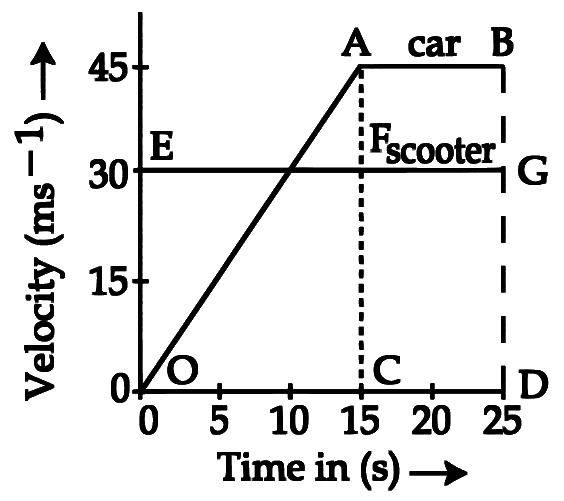
Report a mistake