0 of 589 attemptedPick an answer to see the solution
Q1MHT CET 2026 · 20 MAY · SHIFT 1Easy
Biot-Savart Law & Circular Coils · Field on the axis of a coil & Helmholtz coils
A circular coil having n turns, each of radius 'r' carries a current I. The magnetic field at a distance x=8r from its centre along the axis of the coil is (μ0 = permeability of free space)
Biot-Savart Law & Circular Coils · Field on the axis of a coil & Helmholtz coils
The magnitude of magnetic induction at a point on the axis at a large distance r from a centre of a circular coil of n turns and area A carrying current i is (μ0 = permeability of free space)
Show answer and solution
Answer: (b)
Axial field: B=2(R2+r2)3/2μ0niR2; for r≫R, B≈2r3μ0niR2.
Biot-Savart Law & Circular Coils · Field on the axis of a coil & Helmholtz coils
A circular loop of radius R is carrying current I. The ratio of magnetic field at the center of circular loop and at a distance R from the center of the loop on its axis is
Show answer and solution
Answer: (c)
Bc=2Rμ0I, Bx=2(R2+x2)3/2μ0IR2
BxBc=R3(R2+x2)3/2; with x=R: R3(2R2)3/2=22=8
Biot-Savart Law & Circular Coils · Field on the axis of a coil & Helmholtz coils
The magnetic field at the centre of a current carrying circular loop of radius R is 16μT. The magnetic field at a distance x=3R on its axis from the centre is
Biot-Savart Law & Circular Coils · Arcs, semicircles & division of current
An arc of a circle of radius R subtends an angle π/2 at the centre. It carries a current I. The magnetic field at the centre will be (μ0 = permeability of free space)
Biot-Savart Law & Circular Coils · Arcs, semicircles & division of current
A circular arc of wire of radius of curvature r subtends an angle of 5π radian at its centre. If current i is flowing in it then the magnetic induction at its centre is (μ0 = permeability of free space)
Biot-Savart Law & Circular Coils · Field at the centre of a coil & rewinding
Two circular coils A and B are made from same wire but the radius of coil A is twice that of coil B. If the magnetic field at their centres is same then the ratio potential difference applied across them is
Show answer and solution
Answer: (b)
Single-turn coils: B=2rμ0I; equal B needs I∝r.
Same wire (same area, same material): Rwire∝length=2πr, so Rwire∝r.
Biot-Savart Law & Circular Coils · Field at the centre of a coil & rewinding
Two circular coils A and B are made from the same wire but the radius of coil A is twice that of coil B. What is the ratio of potential difference applied across them, so that the magnetic field at their centres is the same?
Biot-Savart Law & Circular Coils · Field at the centre of a coil & rewinding
The magnetic field at the center of circular coil carrying current 'I' for a single turn of a given length of wire is 'B'. The same wire is bent in a circular coil having two turns. When the same current passes through it, the value of magnetic field becomes
Show answer and solution
Answer: (a)
Fixed wire length L: n turns gives r=2πnL, so B=2rμ0nI∝n2.
Biot-Savart Law & Circular Coils · Field at the centre of a coil & rewinding
A long wire is bent into a circular coil of one turn and then into a circular coil of smaller radius having n turns. If the same current is passed in both the cases, the ratio of magnetic field produced at the centre for one turn to that of n turns is
Biot-Savart Law & Circular Coils · Field at the centre of a coil & rewinding
A small cube of side 1 mm is placed at the centre of a circular loop of radius 10 cm carrying a current of 2 A. The magnetic energy stored inside the cube is α×10−14 J. The value of α is .(μ0=4π×10−7 Tm/A,π=3.14)
Show answer and solution
Answer: (a)
Field at the centre: B=2Rμ0I=0.24π×10−7×2=4π×10−6 T.
Energy density: u=2μ0B2=8π×10−716π2×10−12=2π×10−5 J/m3.
Cube volume =(10−3)3=10−9 m3, so U=2π×10−14=6.28×10⁻¹⁴ J.
Biot-Savart Law & Circular Coils · Rotating charge & orbiting electron
A particle carrying a charge equal to 100 times the charge of an electron is rotating one rotation per second in a circular path of radius 0.8 m. The value of magnetic field produced at the centre will be (μ0 = permeability of free space)
Show answer and solution
Answer: (b)
Equivalent current I=qf=100×1.6×10−19×1=1.6×10⁻¹⁷ A.
Biot-Savart Law & Circular Coils · Rotating charge & orbiting electron
A thin ring of radius 'R' metre has charge 'q' coulomb uniformly spread on it. The ring rotates about its axis with a constant frequency of 'f' revolution/s. The value of magnetic induction at the centre of the ring in Wb/m2 is
Biot-Savart Law & Circular Coils · Field on the axis of a coil & Helmholtz coils
Consider a circular loop (radius R) carrying current I, the magnetic field produced by it at a point on the axis at a distance z from the centre of the loop is (z2+R2)3/2xR2. The value of x is
Show answer and solution
Answer: (c)
Field on the axis of a loop: B=2(z2+R2)3/2μ0IR2.
Biot-Savart Law & Circular Coils · Field on the axis of a coil & Helmholtz coils
A current carrying circular coil of radius 'R' produces magnetic field B1 at an axial point P at a distance 'x' from its centre and B2 at point Q placed at its centre respectively. If B2=8B1, the value of x is
Show answer and solution
Answer: (b)
On the axis B=2(R2+x2)3/2μ0IR2 and at the centre Bc=2Rμ0I, so B1B2=R3(R2+x2)3/2.
Biot-Savart Law & Circular Coils · Field on the axis of a coil & Helmholtz coils
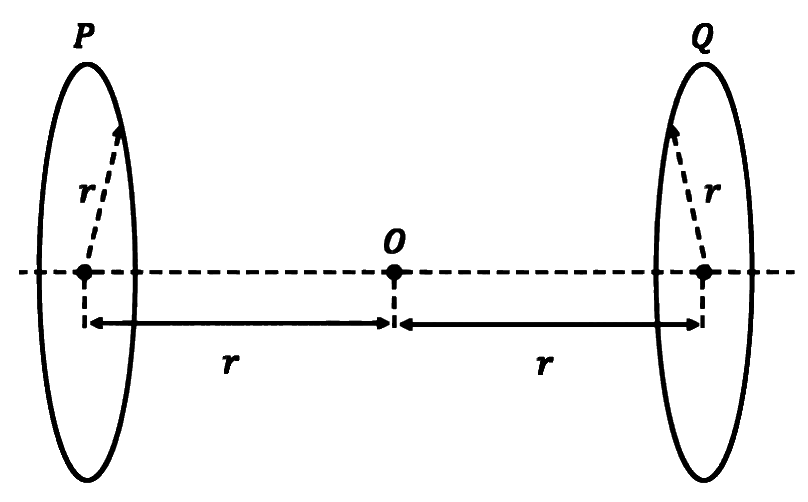
Two identical circular loops P and Q each of radius r are lying in parallel planes such that they have common axis. The current through P and Q are I and 4I respectively in clockwise direction as seen from O. The net magnetic field at O is:
Show answer and solution
Answer: (b)
Each loop is at axial distance x=r from O: B=2(2r2)3/2μ0Ir2=42rμ0I for current I.
BP=42rμ0I, BQ=42r4μ0I
Clockwise as seen from O means each field at O points away from O: BP towards P, BQ towards Q (opposite).
Biot-Savart Law & Circular Coils · Arcs, semicircles & division of current
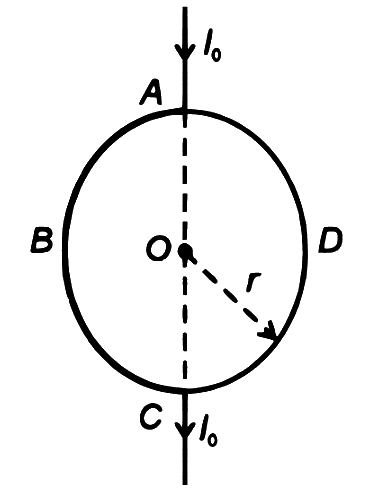
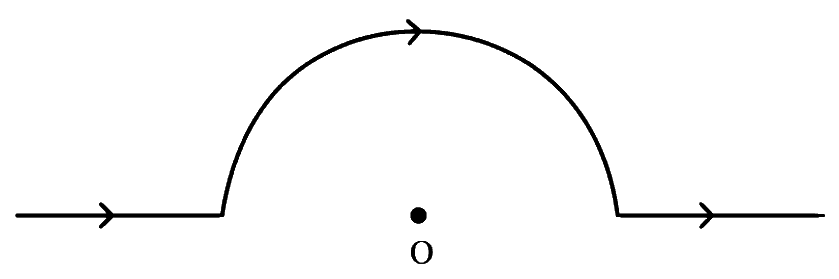
A current I0 flows through a metallic circular loop of radius r as shown in the figure. Resistance of the segment ABC is half that of ADC. Magnitude of magnetic field at the centre O of the loop is:
Show answer and solution
Answer: (b)
The two halves are in parallel; RABC=21RADC, so IABC=32I0, IADC=3I0.
Both currents go from A to C, so at O their fields are opposite. The straight leads pass through O and give zero.
Biot-Savart Law & Circular Coils · Field on the axis of a coil & Helmholtz coils
Two circular coils X (smaller) and Y (bigger), each having a single turn, carry equal currents in the same direction and subtend the same angle at point 'O' along the axis of the coil. The distances of the centers of coil to point 'O' are d and (2d) for coil Y and X respectively. The radii of coils Y and X are (2r) and (r) respectively. The magnetic induction due to the bigger coil at point 'O' is By and that due to smaller coil X at point 'O' is Bx. (d≫r) The relation between Bx and By is
Show answer and solution
Answer: (c)
On the axis B=2(r2+x2)3/2μ0Ir2≈2x3μ0Ir2 for x≫r.
Biot-Savart Law & Circular Coils · Field at the centre of a coil & rewinding
A circular coil of wire consisting of ' n ' tums each of radius 8 cm carries a current of 0.4 A. The magnitude of the magnetic field at the centre of coil is 3.14×10⁻⁴ T. The value of ' n ' is [Take μ0=12.56×10⁻⁷ SI unit]
Biot-Savart Law & Circular Coils · Field on the axis of a coil & Helmholtz coils
A circular coil carrying current ' I ' has a radius ' r ' and ' n ' turns. The magnetic field along the axis of a coil at a distance ' 22r ', from its centre is ( μ0= permeability of free space, n is very small)
Biot-Savart Law & Circular Coils · Biot-Savart law, units & direction rules
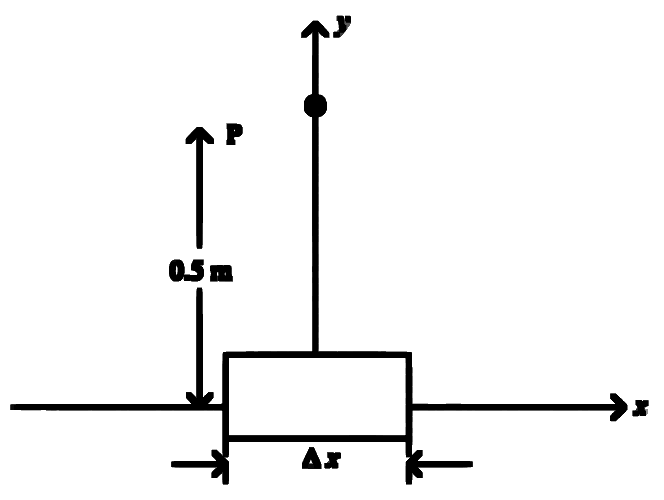
An element Δl=Δxi^ is placed at the origin and carries a current of 10 A. The magnitude of magnetic field on the Y axis at a distance of 0.5 m if Δx=1 cm is (4πμ0=10−7 SI unit )(sin90∘=1)
Show answer and solution
Answer: (c)
Biot-Savart law: dB=4πμ0r2IΔxsinθ, with θ=90∘ for a point on the y-axis.
Biot-Savart Law & Circular Coils · Field at the centre of a coil & rewinding
A coil having 9 turns carrying current produces magnetic field B1 at the centre. Now that coil is rewounded into 3 turns carrying same current. Then magnetic field at the centre B2 is
Show answer and solution
Answer: (a)
For a fixed length of wire, B=2rμ0nI with r∝n1, so B∝n2.
Biot-Savart Law & Circular Coils · Field at the centre of a coil & rewinding
A long wire carrying a steady current is bent into a circle of single turn. The magnetic field at the centre of the coil is ' B '. If it is bent into a circular loop of radius ' r1 ' having ' n ' turns, the magnetic field at the centre of the coil for same current is
Biot-Savart Law & Circular Coils · Rotating charge & orbiting electron
A particle carrying a charge equal to 1000 times the charge on an electron, is rotating one rotation per second in a circular path of radius ' r ' m. If the magnetic field produced at the centre of the path is x times the permeability of vacuum, the radius ' r ' in m is [e=1.6×10⁻¹⁹ C][x=2×10⁻¹⁶]
Biot-Savart Law & Circular Coils · Field on the axis of a coil & Helmholtz coils
A circular coil carrying current has radius ' R '. The distance from the centre of the coil on the axis where the magnetic induction will be 271 th of its value at the centre of the coil is
Biot-Savart Law & Circular Coils · Field on the axis of a coil & Helmholtz coils
Let B1 be the magnitude of magnetic field at center of a circular coil of radius R carrying current I. Let B2 be the magnitude of magnetic field at an axial distance ' x ' from the center. For x:R=3:4,B1B2 is:
Biot-Savart Law & Circular Coils · Arcs, semicircles & division of current
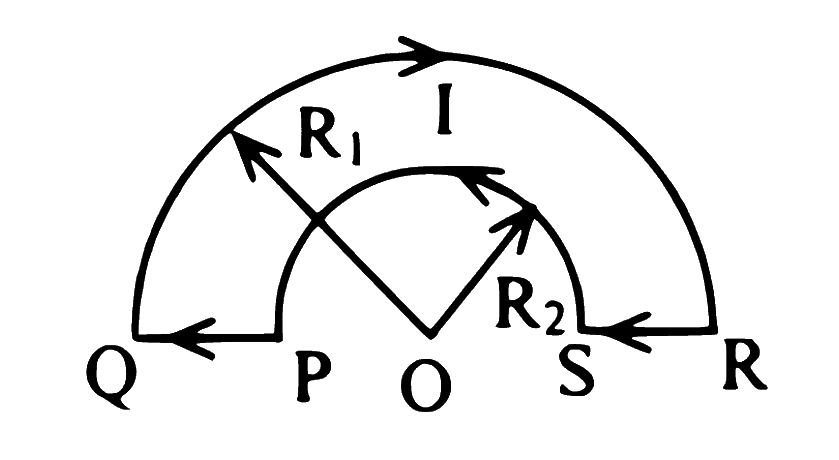
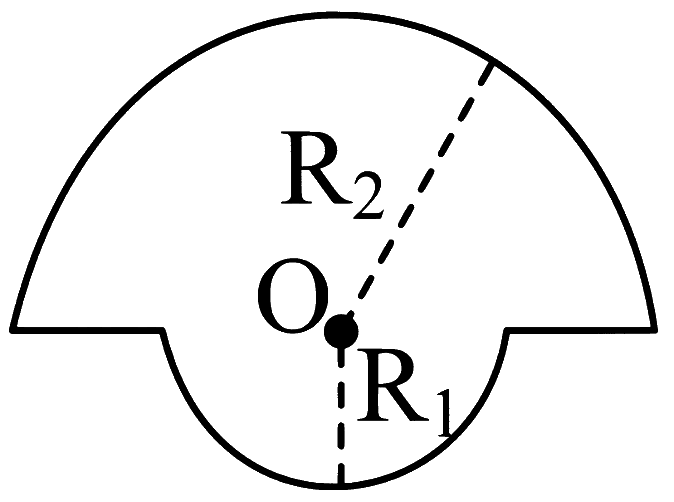
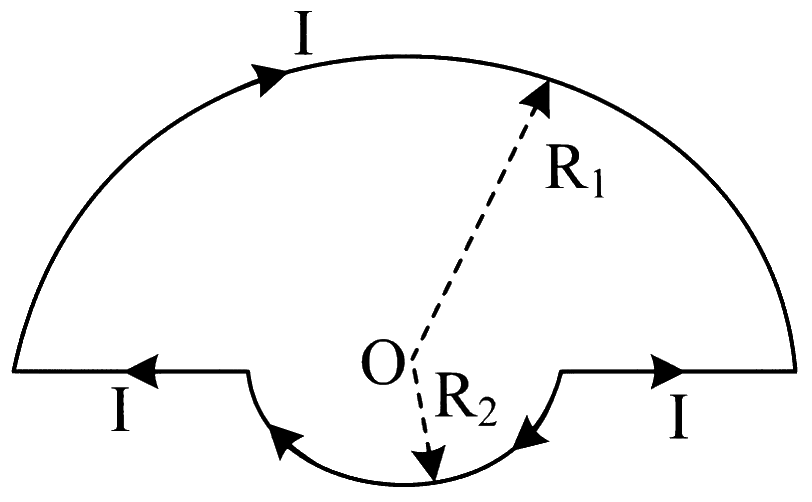
The wire loop PQRSP formed by joining two semicircular wire of radii R1 and R2 carries a current I as shown. The magnitude of the magnetic field at the centre ' O ' is
Show answer and solution
Answer: (b)
Straight parts PQ and RS point towards O, so they give no field at O.
Outer semicircle (R1, clockwise): 4R1μ0I into the page.
Inner semicircle (R2, anticlockwise): 4R2μ0I out of the page.
Biot-Savart Law & Circular Coils · Arcs, semicircles & division of current
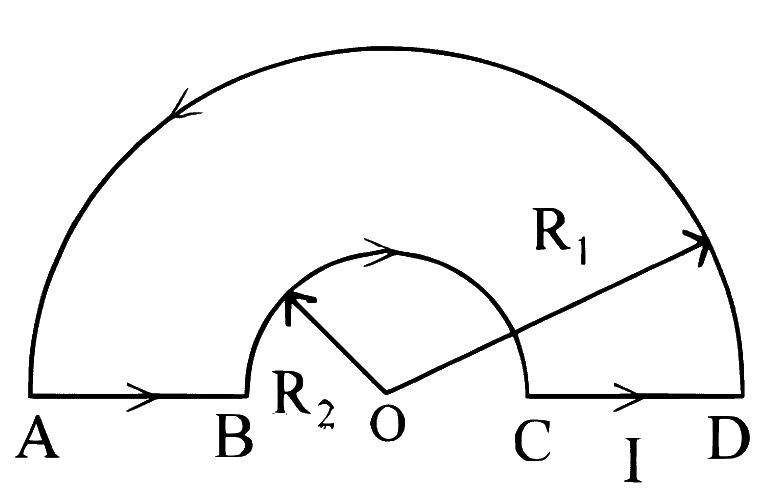
A loop ABCDA, carrying current I=12 A, is placed in a plane, consists of two semi-circular segments of radius R1=6π m and R2=4π m. The magnitude of the resultant magnetic field at center O is k×10−7 T. The value of k is_________.
( Given μ0=4π×10−7 T m A−1)
Numerical answer type. Work it out, then open the answer.
Show answer and solution
Answer: 1
Straight parts AB and CD lie along a line through O: no field.
Inner arc (R2) is clockwise, outer arc (R1) is anticlockwise, so the fields are opposite.
Biot-Savart Law & Circular Coils · Concentric & perpendicular coils
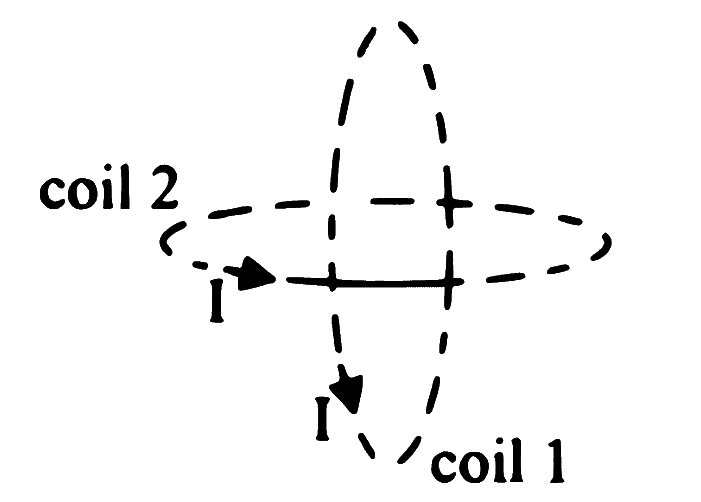
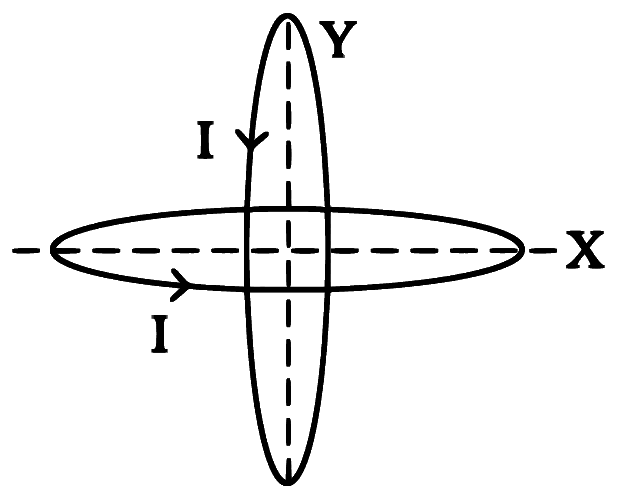
Two current carrying identical coils are kept as shown in figure. The magnetic field at centre ' O ' is ( N and R represent the number of turns and radius of each coil respectively, μ0= permeability of free space)
Show answer and solution
Answer: (b)
Each coil gives B=2Rμ0NI at O.
The coils are perpendicular, so the two fields are perpendicular.
Biot-Savart Law & Circular Coils · Biot-Savart law, units & direction rules
Given below are two statements:
Statement (I): When currents vary with time, Newton's third law is valid only if momentum carried by the electromagnetic field is taken into account
Statement (II): Ampere's circuital law does not depend on Biot-Savart's law.
In the light of the above statements, choose the correct answer from the options given below:
Show answer and solution
Answer: (d)
Statement I: with time-varying currents, the magnetic forces between elements need not be equal and opposite; momentum balance holds only when the field's momentum is included. True.
Statement II: Ampere's circuital law is derived from (and equivalent to) the Biot-Savart law for steady currents, so it does depend on it. False.
So the answer is (d) Statement I is true but Statement II is false.
Biot-Savart Law & Circular Coils · Field at the centre of a coil & rewinding
A tightly wound 100 turns coil of radius 10 cm carries a current of 7 A. The magnitude of the magnetic field at the centre of the coil is (Take permeability of free space as 4π×10−7 SI units):
Biot-Savart Law & Circular Coils · Rotating charge & orbiting electron
A particle carrying a charge equal to 100 times the charge on an electron is rotating one rotation per second in a circular path of radius 0.8 m. The value of magnetic field produced at the centre will be ( μ0= permeability of vacuum)
Show answer and solution
Answer: (b)
Equivalent current I=qf=100×1.6×10−19×1=1.6×10⁻¹⁷ A.
Biot-Savart Law & Circular Coils · Arcs, semicircles & division of current
An arc of a circle of radius ' R ' subtends an angle 2π at the centre. It carries a current I. The magnetic field at the centre will be ( μ0= permeability of free space)
Biot-Savart Law & Circular Coils · Arcs, semicircles & division of current
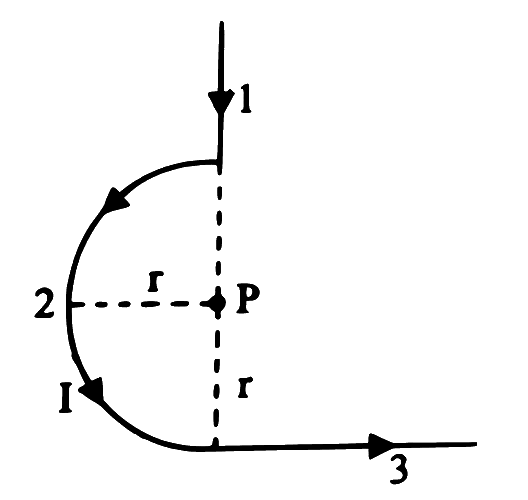
A current 'I' flows in anticlockwise direction in a circular arc of a wire having (43)th of circumference of a circle of radius R. The magnetic field ' B ' at the centre of circle is ( μ0= permeability of free space)
Show answer and solution
Answer: (d)
Arc field = (fraction of circle) ×2Rμ0I.
B=43⋅2Rμ0I=8R3μ0I
Anticlockwise current (seen from above): by the right-hand rule the field at the centre points towards the viewer, i.e. upward.
Biot-Savart Law & Circular Coils · Arcs, semicircles & division of current
A circular arc of radius r carrying current ' I ' subtends an angle 8π at its centre. The radius of a metal wire is uniform. The magnetic induction at the centre of circular arc is ( μ0= permeability of free space)
Biot-Savart Law & Circular Coils · Concentric & perpendicular coils
Two coils P and Q each of radius R carry currents I and 8I respectively in same direction. Those coils are lying in perpendicular planes such that they have a common centre. The magnitude of the magnetic field at the common centre of the two coils is ( μ0= permeability of free space)
Show answer and solution
Answer: (b)
BP=2Rμ0I, BQ=2R8μ0I; the coils are in perpendicular planes, so the fields are perpendicular.
Biot-Savart Law & Circular Coils · Concentric & perpendicular coils
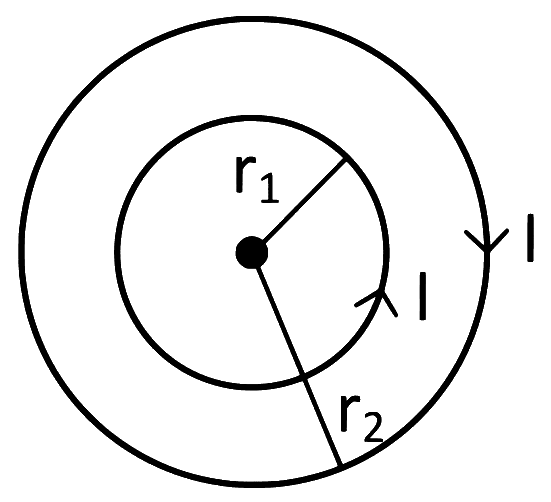
Two concentric circular coils A and B having radii 20 cm and 10 cm respectively lie in the same plane. The current in coil A is 0.5 A in anticlockwise direction. The current in coil B, so that net magnetic field at the common centre is zero, is
Show answer and solution
Answer: (c)
For zero net field: 2rAμ0IA=2rBμ0IB, with fields opposite.
IB=IArArB=0.5×2010=0.25 A
Opposite field needs opposite current, i.e. clockwise.
Biot-Savart Law & Circular Coils · Concentric & perpendicular coils
Two identical current carrying coils with same centre are placed with their planes perpendicular to each other. If current I=2 A and radius of the coil is R=1 m, then magnetic field at centre is equal to ( μ0= permeability of free space)
Show answer and solution
Answer: (a)
Each coil: B1=2Rμ0I=2μ02.
Perpendicular planes, so perpendicular fields: B=2B1=2⋅22μ0=μ0
Biot-Savart Law & Circular Coils · Biot-Savart law, units & direction rules
An element Δl=Δxi^ is placed at the origin and carries a large current I=10 A. The magnetic field on the y-axis at a distance of 0.5 m from the elements Δx of 1 cm length is:
Biot-Savart Law & Circular Coils · Rotating charge & orbiting electron
A thin ring of radius ' R ' carries a uniformly distributed charge. The ring rotates at constant speed ' N ' r.p.s. about its axis perpendicular to the plane. If ' B ' is the magnetic field at the centre, the charge on the ring is ( μ0= permeability of free space)
Biot-Savart Law & Circular Coils · Rotating charge & orbiting electron
A particle having a charge 50 e is revolving in a circular path of radius 0.4 m with 1 r.p.s. The magnetic field produced at the centre of the circle is (μ0=4π×10−7 SI units and e=1.6×10⁻¹⁹ C)
Biot-Savart Law & Circular Coils · Arcs, semicircles & division of current
The magnetic field at the centre of a wire loop formed by two semicircular wires of radii R1=2π m and R2=4π m, carrying current I=4 A as per figure given below is α×10−7 T. The value of α is ________. (Centre O is common for all segments)
Numerical answer type. Work it out, then open the answer.
Show answer and solution
Answer: 3
Straight parts lie along a line through O: no field.
In this single loop the two semicircles lie on opposite sides of O and are traversed in the same rotational sense, so their fields add.
Biot-Savart Law & Circular Coils · Concentric & perpendicular coils
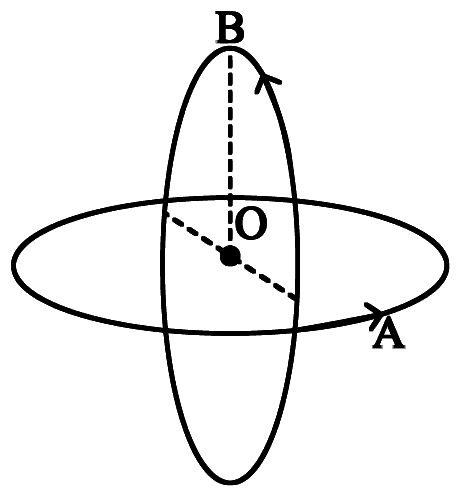
Two insulated circular loops A and B of radius 'a' carrying a current of 'I' in the anti clockwise direction as shown in the figure. The magnitude of the magnetic induction at the centre will be:
Show answer and solution
Answer: (b)
Each loop gives 2aμ0I at the common centre.
The loops are in perpendicular planes, so the fields are perpendicular.
Biot-Savart Law & Circular Coils · Concentric & perpendicular coils
Two circular coils P and Q of 100 turns each have same radius of π cm. The currents in P and Q are 1 A and 2 A respectively. P and Q are placed with their planes mutually perpendicular with their centers coincide. The resultant magnetic field induction at the center of the coils is x mT, where x= __________.
[Use μ0=4π×10−7 T m A−1 ]
Numerical answer type. Work it out, then open the answer.
Show answer and solution
Answer: 20
BP=2Rμ0NI=2×π×10−24π×10−7×100×1=2×10⁻³ T =2 mT
Biot-Savart Law & Circular Coils · Field at the centre of a coil & rewinding
The magnetic field at the centre of a circular coil of radius 'R', carrying current 2A is 'B1 '. The magnetic field at the centre of another coil of radius '3R' carrying current 4A is 'B2'. The ratio B1:B2 is
Biot-Savart Law & Circular Coils · Field on the axis of a coil & Helmholtz coils
A circular loop of radius r is carrying current I A. The ratio of magnetic field at the center of circular loop and at a distance r from the center of the loop on its axis is:
Biot-Savart Law & Circular Coils · Arcs, semicircles & division of current
A circular arc of radius 'r' carrying current 'I' subtends an angle 16π at its centre. The radius of a metal wire is uniform. The magnetic induction at the centre of circular arc is [μ0= permeability of free space]
Biot-Savart Law & Circular Coils · Arcs, semicircles & division of current
A straight wire carrying a current of 14 A is bent into a semi-circular arc of radius 2.2 cm as shown in the figure. The magnetic field produced by the current at the centre (O) of the arc. is ____________ ×10−4 T
Numerical answer type. Work it out, then open the answer.
Show answer and solution
Answer: 2
The straight parts point along lines through O, so dl×r=0: they give no field at O.
Biot-Savart Law & Circular Coils · Concentric & perpendicular coils
Two concentric circular coils A and B have radii 20 cm and 10 cm respectively lie in the same plane. The current in coil A is 0.5 A in anticlockwise direction. The current in coil B so that net field at the common centre is zero, is
Show answer and solution
Answer: (c)
For zero net field: rAIA=rBIB with opposite directions.
IB=0.5×2010=0.25 A, flowing opposite to A, i.e. clockwise.
Biot-Savart Law & Circular Coils · Concentric & perpendicular coils
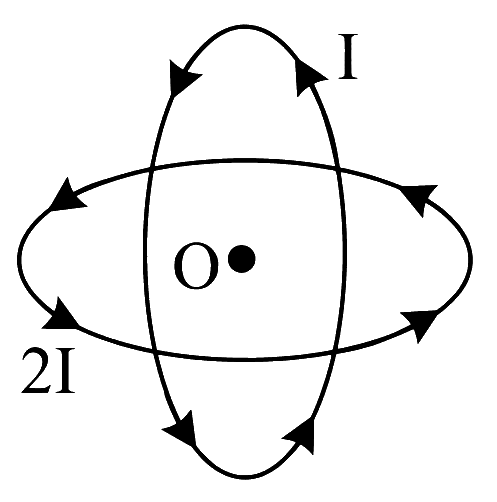
Two similar coils each of radius R are lying concentrically with their planes at right angles to each other. The current flowing in them are I and 2I. The resultant magnetic field of induction at the centre will be (μ0= Permeability of vacuum)
Show answer and solution
Answer: (d)
Field at the centre of a coil: B=2Rμ0I, along the coil's axis.
B1=2Rμ0I and B2=2Rμ0(2I)=2B1.
The planes are perpendicular, so the two fields are perpendicular: B=B12+B22=5B1.
Biot-Savart Law & Circular Coils · Concentric & perpendicular coils
Two identical circular wires of radius 20 cm and carrying current 2 A are placed in perpendicular planes as shown in figure. The net magnetic field at the centre of the circular wires is __________ ×10−8 T.
(Take π=3.14)
Numerical answer type. Work it out, then open the answer.
Show answer and solution
Answer: 628
Each loop: B0=2Rμ0I; the loops are in perpendicular planes, so B=2B0=2R2μ0I.
Biot-Savart Law & Circular Coils · Field at the centre of a coil & rewinding
A long wire is bent into a circular coil of one turn and then into a circular coil of smaller radius having n turns. If the same current passes in both the cases, the ratio of magnetic fields produced at the centre for one turn to that of n turns is
Biot-Savart Law & Circular Coils · Field at the centre of a coil & rewinding
Two circular coils made from same wire but radius of 1st coil is twice that of 2nd coil. If magnetic field at their centres is same then ratio of potential difference applied across them is (1st to 2nd coil)
Biot-Savart Law & Circular Coils · Field at the centre of a coil & rewinding
A long conducting wire having a current I flowing through it, is bent into a circular coil of N turns. Then it is bent into a circular coil of n turns. The magnetic field is calculated at the centre of coils in both the cases. The ratio of the magnetic field in first case to that of second case is:
Biot-Savart Law & Circular Coils · Field at the centre of a coil & rewinding
The electric current in a circular coil of four turns produces a magnetic induction 32 T at its centre. The coil is unwound and is rewound into a circular coil of single turn, the magnetic induction at the centre of the coil by the same current will be:
Biot-Savart Law & Circular Coils · Rotating charge & orbiting electron
An electron in a hydrogen atom revolves around its nucleus with a speed of 6.76×10⁶ m s−1 in an orbit of radius 0.52A˚. The magnetic field produced at the nucleus of the hydrogen atom is _________ T.
Numerical answer type. Work it out, then open the answer.
Biot-Savart Law & Circular Coils · Field on the axis of a coil & Helmholtz coils
A circular current carrying coil has radius R. The magnetic induction at the centre of the coil is BC. The magnetic induction of the coil at a distance 3R from the centre along the axis is BA. The ratio BA:BC is
Biot-Savart Law & Circular Coils · Field on the axis of a coil & Helmholtz coils
A circular coil of radius 'r' and number of turns ' n ' carries a current 'I'. The magnetic fields at a small distance 'h' along the axis of the coil (Ba) and at the centre of the coil (Bc) are measured. The relation between Bc and Ba is
Biot-Savart Law & Circular Coils · Field on the axis of a coil & Helmholtz coils
The ratio of magnetic field at the centre of a current carrying coil of radius r to the magnetic field at distance r from the centre of coil on its axis is x:1. The value of x is __________
Numerical answer type. Work it out, then open the answer.
Biot-Savart Law & Circular Coils · Concentric & perpendicular coils
Two concentric circular coils of 10 turns each are situated in the same plane. Their radii are 20 cm and 40 cm and they carry respectively 0.2 A and 0.3 A current in opposite direction. The magnetic field at the centre is (μ0=4π×10−7 SI units)
Biot-Savart Law & Circular Coils · Field on the axis of a coil & Helmholtz coils
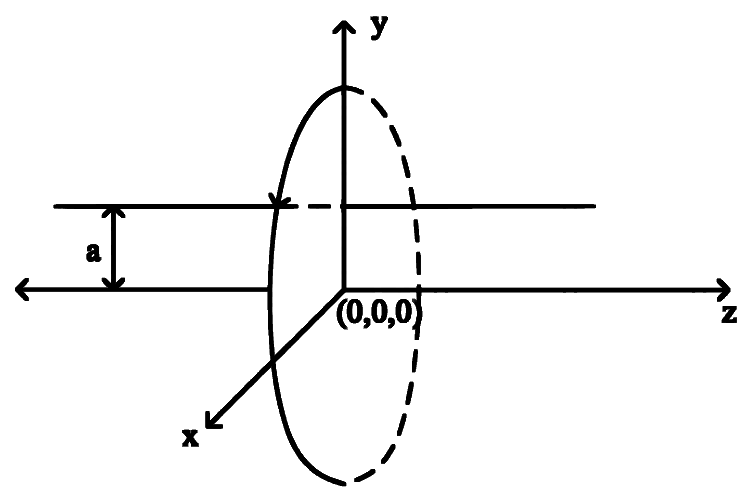
A single current carrying loop of wire carrying current I flowing in anticlockwise direction seen from +ve z direction and lying in xy plane is shown in figure. The plot of j^ component of magnetic field (By) at a distance 'a' (less than radius of the coil) and on yz plane vs z coordinate looks like
Show answer and solution
Answer: (d)
On the line x=0, y=a, By is the radial (sideways) component of the loop's field.
At z=0 (plane of the loop) the field inside the loop is purely along z, so By=0.
The field is along +z; field lines spread outwards above the loop (By>0 for z>0) and converge below it (By<0 for z<0), and By→0 far away.
So By is an odd function of z with a positive peak for z>0: answer (d).
Biot-Savart Law & Circular Coils · Biot-Savart law, units & direction rules
Given below are two statements:
Statement I: Biot-Savart's law gives us the expression for the magnetic field strength of an infinitesimal current element (Idl) of a current carrying conductor only.
Statement II: Biot-Savart's law is analogous to Coulomb's inverse square law of charge q, with the former being related to the field produced by a scalar source, Idl while the latter being produced by a vector source, q.
In light of above statements choose the most appropriate answer from the options given below.
Show answer and solution
Answer: (c)
Statement I: Biot-Savart law gives dB due to a current element Idl, so it is correct.
Statement II: Idl is a vector source while charge q is a scalar source; the statement swaps them, so it is incorrect.
So the answer is (c) Statement I is correct and Statement II is incorrect.
Biot-Savart Law & Circular Coils · Field at the centre of a coil & rewinding
A closely packed coil having 1000 turns has an average radius of 62.8 cm. If current carried by the wire of the coil is 1 A, the value of magnetic field produced at the centre of the coil will be (permeability of free space =4π×10−7 H/m) nearly
Biot-Savart Law & Circular Coils · Field at the centre of a coil & rewinding
BX and BY are the magnetic fields at the centre of two coils X and Y respectively each carrying equal current. If coil X has 200 turns and 20 cm radius and coil Y has 400 turns and 20 cm radius, the ratio of BX and BY is:
Biot-Savart Law & Circular Coils · Field at the centre of a coil & rewinding
The electric current in a circular coil of 2 turns produces a magnetic induction B1 at its centre. The coil is unwound and is rewound into a circular coil of 5 turns and the same current produces a magnetic induction B2 at its centre. The ratio of B1B2 is
Biot-Savart Law & Circular Coils · Field on the axis of a coil & Helmholtz coils
The magnetic field at the center of current carrying circular loop is B1. The magnetic field at a distance of 3 times radius of the given circular loop from the center on its axis is B2. The value of B1/B2 will be
Biot-Savart Law & Circular Coils · Field on the axis of a coil & Helmholtz coils
The magnetic field at the centre of a circular coil of radius r, due to current I flowing through it, is B. The magnetic field at a point along the axis at a distance 2r from the centre is:
Biot-Savart Law & Circular Coils · Field at the centre of a coil & rewinding
A coil of n number of turns wound tightly in the form of a spiral with inner and outer radii r1 and r2 respectively. When a current of strength I is passed through the coil, the magnetic field at its centre will be:
Show answer and solution
Answer: (d)
Turns per unit radial width: r2−r1n; a ring of radius r, width dr gives dB=2rμ0I⋅r2−r1ndr.
Biot-Savart Law & Circular Coils · Rotating charge & orbiting electron
An electron (e) moves in circular orbit of radius 'r' with uniform speed 'V'. It produces magnetic field 'B' at the centre of circle. The magnetic field B is (μ0= permeability of free space)
Biot-Savart Law & Circular Coils · Arcs, semicircles & division of current
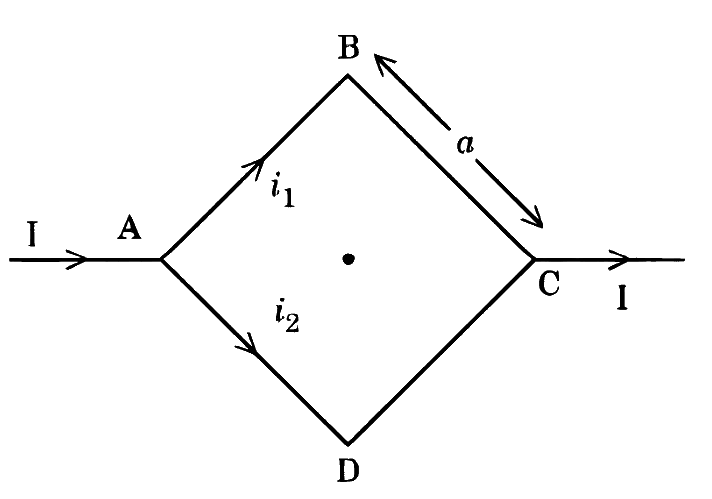
When a battery is connected to the two ends of a diagonal of a square conductor frame of side 'a', the magnitude of magnetic field at the centre will be ( μ0= permeability of free space)
Show answer and solution
Answer: (d)
The two paths from one corner to the opposite corner (two sides each) have equal resistance, so the current splits equally, I/2 each.
The two paths are mirror images about the diagonal and carry current in opposite senses round the centre, so their fields at the centre are equal and opposite.
Biot-Savart Law & Circular Coils · Rotating charge & orbiting electron
A thin ring of radius 'R' meter has charge 'q' coulomb uniformly spread on it. The ring rotates about its axis with a constant frequency of f revolution/s. The value of magnetic induction in Wb m−2 at the center of the ring is (μ0= Permeability of free space)
Biot-Savart Law & Circular Coils · Rotating charge & orbiting electron
A particle having a charge 100e is revolving in a circular path of radius 0.8 m with 1. r.p.s The magnetic field produced at the centre of the circle in SI unit is (μ0= permeability of vacuum, e=1.6×10⁻¹⁹ C)
Biot-Savart Law & Circular Coils · Concentric & perpendicular coils
Two concentric coplanar circular loops of radii 'r1' and 'r2 ' respectively carry currents 'i1 ' and 'i2' in opposite directions (one clockwise and other anticlockwise). The magnetic induction at the centre of the loops is half that due to 'i1' alone at the centre. If r2=2r1, the value of i1i2
Biot-Savart Law & Circular Coils · Field at the centre of a coil & rewinding
A coil having N turns is wound tightly in the form of a spiral with inner and outer radii 'a' and 'b' respectively. Find the magnetic field at centre, when a current I passes through coil:
Show answer and solution
Answer: (a)
Turns per unit radial width: b−aN; dB=2rμ0I⋅b−aNdr.
Biot-Savart Law & Circular Coils · Rotating charge & orbiting electron
Assuming the atom is in the ground state, the expression for the magnetic field at a point nucleus in hydrogen atom due to circular motion of electron is [μ0= permeability of free space, m= mass of electron, ϵ0= permittivity of free space, h= Planck's constant ]
Biot-Savart Law & Circular Coils · Field on the axis of a coil & Helmholtz coils
The fractional change in the magnetic field intensity at a distance 'r' from centre on the axis of current carrying coil of radius 'a' to the magnetic field intensity at the centre of the same coil is: (Take r < a)
Biot-Savart Law & Circular Coils · Field on the axis of a coil & Helmholtz coils
Magnetic fields at two points on the axis of a circular coil at a distance of 0.05 m and 0.2 m from the centre are in the ratio 8: 1. The radius of coil is ________.
Biot-Savart Law & Circular Coils · Rotating charge & orbiting electron
An electron moves in a circular orbit with uniform speed v. It produces a magnetic field B at the centre of the circle. The radius of the circle is [ μ0= permeability of free space, e= electronic charge]
Biot-Savart Law & Circular Coils · Arcs, semicircles & division of current
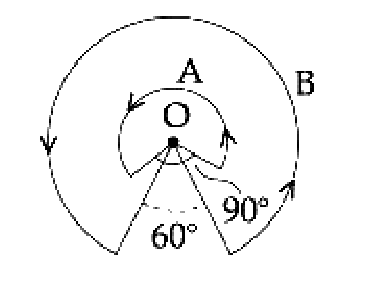
A wire A, bent in the shape of an arc of a circle, carrying a current of 2 A and having radius 2 cm and another wire B, also bent in the shape of arc of a circle, carrying a current of 3 A and having radius of 4 cm, are placed as shown in the figure. The ratio of the magnetic fields due to the wires A and B at the common centre O is:
Show answer and solution
Answer: (d)
Field of an arc: B=4πrμ0Iθ, so B∝rIθ.
Arc A: gap 90∘, so θA=270∘; arc B: gap 60∘, so θB=300∘.
Biot-Savart Law & Circular Coils · Field at the centre of a coil & rewinding
A circular coil of wire consisting of 100 turns each of radius 9 cm carries a current of 0.4 A. The magnitude of the magnetic field at the centre of coil is [μ0=12.56×10⁻⁷ SI Unit]
Biot-Savart Law & Circular Coils · Field on the axis of a coil & Helmholtz coils
The magnitude of the magnetic induction at a point on the axis at a large distance ( r) from the centre of a circular coil of ' n ' turns and area ' A ' carrying current ( I) is given by
Show answer and solution
Answer: (b)
For r≫R: B=2r3μ0nIR2.
With A=πR2: B=4πμ0⋅r32nIA (field of a magnetic dipole m=nIA on its axis).
Biot-Savart Law & Circular Coils · Field at the centre of a coil & rewinding
One of the two identical conducting wires of length L is bent in the form of a circular loop and the other one into a circular coil of N identical turns. If the same current is passed in both, the ratio of the magnetic field at the centre of the loop (BL) to that at the center of the coil (BC), i.e. BCBL will be:
Biot-Savart Law & Circular Coils · Rotating charge & orbiting electron
A thin ring of 10 cm radius carries a uniformly distributed charge. The ring rotates at a constant angular speed of 40 π rad s–1 about its axis, perpendicular to its plane. If the magnetic field at its centre is 3.8 × 10⁻⁹ T, then the charge carried by the ring is close to (μ0 = 4π × 10–7 N/A2 ).
Biot-Savart Law & Circular Coils · Arcs, semicircles & division of current
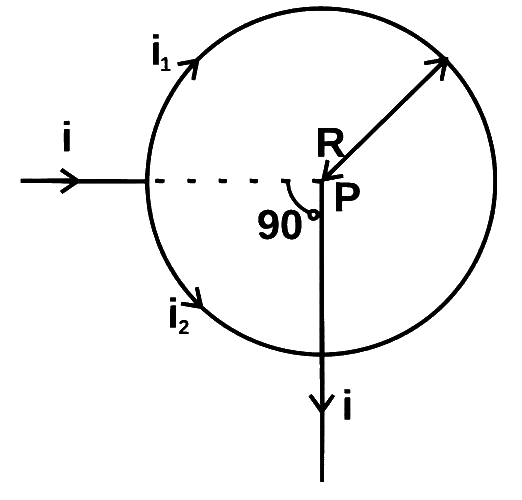
A straight conductor carrying current i splits into two parts as shown in the figure. The radius of the circular loop is R. The total magnetic field at the centre P of the loop is,
Show answer and solution
Answer: (b)
The current splits into a 43 arc and a 41 arc; currents are inversely proportional to length: i1=4i, i2=43i.
Field of an arc ∝Iθ: 4i⋅23π=43i⋅2π, and the two arcs give opposite directions at P, so they cancel.
Both straight wires point along lines through P, so they give zero field at P.
Biot-Savart Law & Circular Coils · Arcs, semicircles & division of current
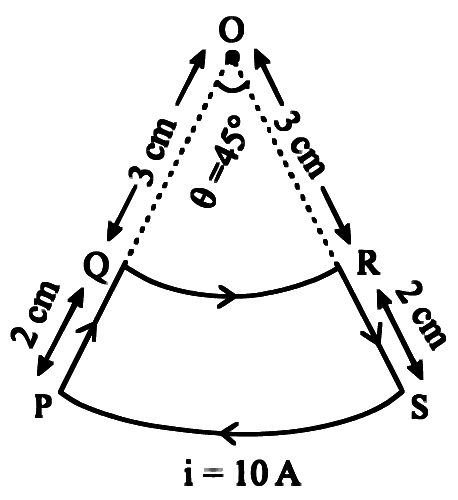
A current loop, having two circular arcs joined by two radial lines is shown in the figure. It carries a current of 10 A. The magnetic field at point O will be close to:
Show answer and solution
Answer: (d)
Radial parts PQ and RS give no field at O. Arcs: r1=3 cm, r2=5 cm, θ=4π, currents in opposite senses.
Biot-Savart Law & Circular Coils · Field on the axis of a coil & Helmholtz coils
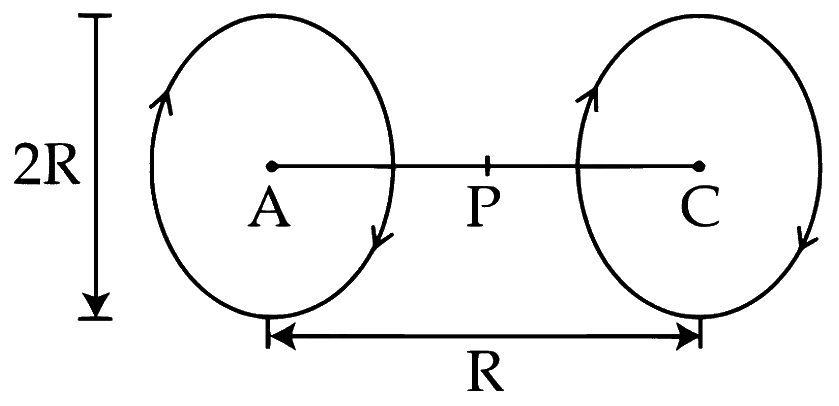
A Helmholtz coil has a pair of loops, each with N turns and radius R. They are placed coaxially at distance R and the same current I flows through the loops in the same direction. The magnitude of the magnetic field at P, midway between the centers A and C, is given by [Refer to figure given below]:
Show answer and solution
Answer: (b)
P is at x=2R from each coil: B1=2(R2+4R2)3/2μ0NIR2=2Rμ0NI⋅53/28=53/2R4μ0NI
Same current direction, so the two fields add: B=2B1.
Biot-Savart Law & Circular Coils · Field at the centre of a coil & rewinding
A long wire carrying a steady current is bent into a circular loop of one turn. The magnetic field at the centre of the loop is B. It is then bent into a circular coil of n turns. The magnetic field at the centre of this coil of n turns will be
Biot-Savart Law & Circular Coils · Field at the centre of a coil & rewinding
Consider two thin identical conducting wires covered with very thin insulating material. One of the wires is bent into a loop and produces magnetic field B1, at its center when a current I passes through it. The second wire is bent into a coil with three identical loops adjacent to each other and produces magnetic field B2 at the centre of the loops when current I/3 passes through it. The ratio B1: B2 is:
Show answer and solution
Answer: (b)
Loop: B1=2Rμ0I.
Coil of 3 turns from the same length: radius R/3, current I/3: B2=2(R/3)μ0⋅3⋅(I/3)=2R3μ0I.
Biot-Savart Law & Circular Coils · Biot-Savart law, units & direction rules
Choose the correct sketch of the magnetic field lines of a circular current loop shown by the dot and the cross ⊗.
Show answer and solution
Answer: (a)
The loop cuts the page at two points: current out of the page (⊙) on the left, into the page (⊗) on the right.
Out-of-page current: field lines anticlockwise, so just to its right the field points up. Into-page current: clockwise, so just to its left the field also points up.
Between the two points the fields add (pointing up), the central line is straight along the axis and lines curve around each wire.
Biot-Savart Law & Circular Coils · Field on the axis of a coil & Helmholtz coils
An electric current is flowing through a circular coil of radius R. The ratio of the magnetic field at the centre of the coil and that at a distance 22R from the centre of the coil and on its axis is:
Biot-Savart Law & Circular Coils · Concentric & perpendicular coils
Two similar coils of radius R are lying concentrically with their planes at right angles to each other. The currents flowing in them are I and 2I, respectively. The resultant magnetic field induction at the centre will be
Show answer and solution
Answer: (a)
Each coil gives B=2Rμ0I at the centre, along its own axis.
B1=2Rμ0I, B2=2Rμ0(2I); the two fields are perpendicular.
Biot-Savart Law & Circular Coils · Rotating charge & orbiting electron
A charge Q is uniformly distributed over the surface of non-conducting disc of radius R. The disc rotates about an axis perpendicular to its plane and passing through its center with an angular velocity ω. As a result of this rotation a magnetic field of induction B is obtained at the center of the disc. If we keep both the amount of charge placed on the disc and its angular velocity to be constant and vary the radius of the disc then the variation of the magnetic induction at the center of the disc will be represented by the figure:
Show answer and solution
Answer: (a)
A ring of radius x, width dx carries dI=2πσ2πxdxω=σωxdx and gives dB=2xμ0dI=2μ0σωdx.
B=2μ0σωR with σ=πR2Q, so B=2πRμ0Qω.
With Q and ω fixed, B∝R1: a rectangular hyperbola.
Biot-Savart Law & Circular Coils · Rotating charge & orbiting electron
Charge q is uniformly spread on a thin ring of radius R. The ring rotates about its axis with a uniform frequency f Hz. The magnitude of magnetic induction at the center of the ring is
Biot-Savart Law & Circular Coils · Rotating charge & orbiting electron
Charge q is uniformly spread on a thin ring of radius R. The ring rotates about its axis with a uniform frequency f Hz. The magnitude of magnetic induction at the center of the ring is
Show answer and solution
Answer: (b)
Charge q passes any point f times per second, so I=qf.
Biot-Savart Law & Circular Coils · Concentric & perpendicular coils
A current loop consists of two identical semicircular parts each of radius R, one lying in the x-y plane and the other in x-z plane. If the current in the loop is i. The resultant magnetic field due to the two semicircular parts at their common centre is
Show answer and solution
Answer: (a)
Each semicircle gives 4Rμ0i at the centre.
One lies in the x-y plane (field along z), the other in x-z plane (field along y): the fields are perpendicular.
Biot-Savart Law & Circular Coils · Arcs, semicircles & division of current
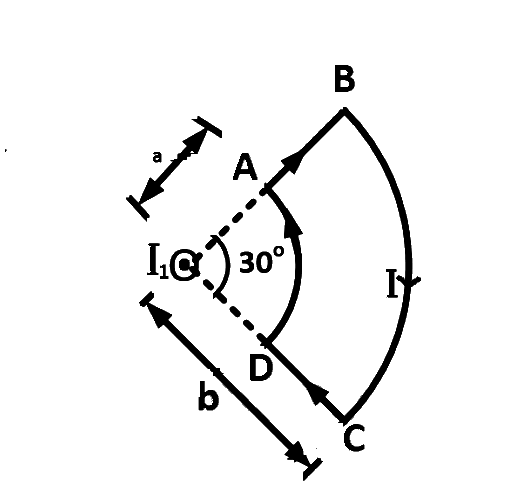
A current loop ABCD is held fixed on the plane of the paper as shown in the figure. The arcs BC (radius =b) and DA (radius =a) of the loop are joined by two straight wires AB and CD. A steady current I is flowing in the loop. Angle made by AB and CD at the origin O is 30∘. Another straight thin wire steady current I1 flowing out of the plane of the paper is kept at the origin.
The magnitude of the magnetic field (B) due to the loop ABCD at the origin (O) is:
Show answer and solution
Answer: (a)
AB and CD are radial, so they give no field at O.
Arcs DA (radius a) and BC (radius b) carry current in opposite senses, θ=6π.
Biot-Savart Law & Circular Coils · Field at the centre of a coil & rewinding
Two circular coils 1 and 2 are made from the same wire but the radius of the 1st coil is twice that of the 2nd coil. What ratio of potential difference in volts should be applied across them so that the magnetic field at their centres is the same?
Biot-Savart Law & Circular Coils · Concentric & perpendicular coils
Two concentric coils each of radius equal to 2π cm are placed at right angles to each other. 3 ampere and 4 ampere are the currents flowing in each coil respectively. The magnetic induction in Weber / m2 at the center of the coils will be
(μ0=4π×10−7 Wb/A m)
Show answer and solution
Answer: (d)
B=2Rμ0I with R=2π cm=0.02π m.
B1=2×0.02π4π×10−7×3=3×10⁻⁵ T, B2=0.04π4π×10−7×4=4×10⁻⁵ T.
Biot-Savart Law & Circular Coils · Rotating charge & orbiting electron
An electron moves in a circular orbit with a uniform speed v. It produces a magnetic field B at the centre of the circle. The radius of the circle is proportional to
Biot-Savart Law & Circular Coils · Field at the centre of a coil & rewinding
A long wire carries a steady current. It is bent into a circle of one turn and the magnetic field at the centre of the coil is B. It is then bent into a circular loop of n turns. The magnetic field at the center of the coil will be
Biot-Savart Law & Circular Coils · Field on the axis of a coil & Helmholtz coils
The magnetic field due to a current carrying circular loop of radius 3 cm at a point on the axis at a distance of 4 cm from the centre is 54μT. What will be its value at the center of loop?
Biot-Savart Law & Circular Coils · Field at the centre of a coil & rewinding
If in a circular coil A of radius R, current I is flowing and in another coil B of radius 2R a current 2I is flowing, then the ratio of the magnetic fields BA and BB, produced by them will be
Biot-Savart Law & Circular Coils · Field at the centre of a coil & rewinding
A coil of one turn is made of a wire of certain length and then from the same length a coil of two turns is made. If the same current is passed in both the cases, then the ratio of the magnetic induction at their centres will be
Magnetic Field of Straight Wires · Long straight wire
A straight long wire is carrying current I. The ratio of magnetic field due to this wire at perpendicular distance 2 cm and 5 cm respectively from the wire is
Magnetic Field of Straight Wires · Long straight wire
The magnetic field at perpendicular distance 'r' from a long wire carrying current 'I' is 'B'. The magnetic field at perpendicular distance '2r' from the same wire is
Magnetic Field of Straight Wires · Two wires: resultant field
Two parallel wires of equal lengths are separated by a distance of 3 m from each other. The currents flowing through first and second wire is 3A and 4.5A respectively in opposite directions. The resultant magnetic field at mid point of both the wires is (μ0 = permeability of free space)
Show answer and solution
Answer: (a)
For opposite currents, the fields at the midpoint are in the same direction and add.
Magnetic Field of Straight Wires · Two wires: resultant field
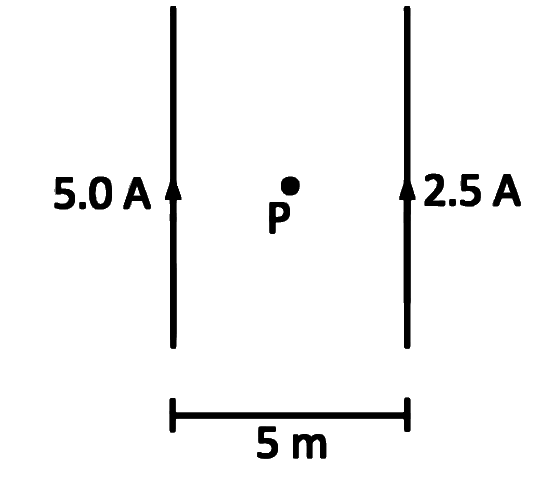
Two long straight parallel wires are separated by a distance of 20 cm. Each wire carries current 5 mA in the same direction. The magnetic field at a point P midway between them is {μ0= permeability of free space}
Show answer and solution
Answer: (d)
For currents in the same direction, the two fields at the midpoint are opposite.
Equal currents at equal distances give equal magnitudes, so they cancel.
Magnetic Field of Straight Wires · Two wires: resultant field
Two parallel wires of equal lengths are separated by a distance of 3 m from each other. The currents flowing through first and second wire is 3 A and 4.5 A respectively in opposite directions. The resultant magnetic field at mid point of both the wires is (μ0=permeability of free space)
Magnetic Field of Straight Wires · Two wires: resultant field
A current of 30 A each flows in opposite directions in two conducting wires, placed parallel to each other at a distance of 8 cm. The magnetic field at the mid point between the two wires is μT⋅(4πμ0=10−7 N/A2)
Show answer and solution
Answer: (b)
Opposite currents: fields at the midpoint add; r=4 cm=0.04 m.
Magnetic Field of Straight Wires · Two wires: resultant field
Two parallel long wires carry currents i1 and i2 with i1>i2. When the currents are in the same direction, the magnetic field at a point midway between the wires is 10μT. If the direction of i2 is reversed then the field becomes 30μT. The ratio i2i1
Show answer and solution
Answer: (c)
Same direction: k(i1−i2)=10; reversed: k(i1+i2)=30.
Magnetic Field of Straight Wires · Two wires: resultant field
Two long parallel wires carrying currents 8A and 15A in opposite directions are placed at a distance of 7 cm from each other. A point P is at equidistant from both the wires such that the lines joining the point P to the wires are perpendicular to each other. The magnetic field at P is ___ ×10−6 T. (Given: 2=1.4,μ0=4π×10−7 SI unit)
Show answer and solution
Answer: (c)
P is equidistant with ∠APB=90∘, so r=27=5 cm (using 2=1.4).
B1=0.052×10−7×8=32μT, B2=0.052×10−7×15=60μT
Each field is perpendicular to its own line to P, so B1⊥B2: B=322+602=68μT
Magnetic Field of Straight Wires · Bent wires & wire with a loop
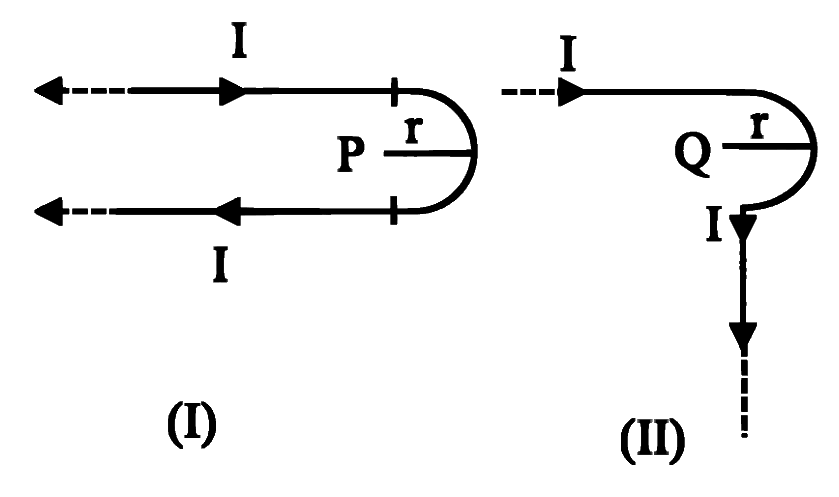
Two identical long current carrying wires are bent into the shapes shown in the following figures. If the magnitude of magnetic fields at the centres P and Q of a semicircular arc are B1 and B2 respectively, then the ratio B2B1 is ______.
Show answer and solution
Answer: (a)
(I) Two semi-infinite wires, each 4πrμ0I, plus semicircle 4rμ0I, all into the page: B1=4πrμ0I(π+2).
(II) The vertical wire's line passes through Q, so it gives zero. Top wire 4πrμ0I plus semicircle 4rμ0I: B2=4πrμ0I(π+1).
Magnetic Field of Straight Wires · Bent wires & wire with a loop
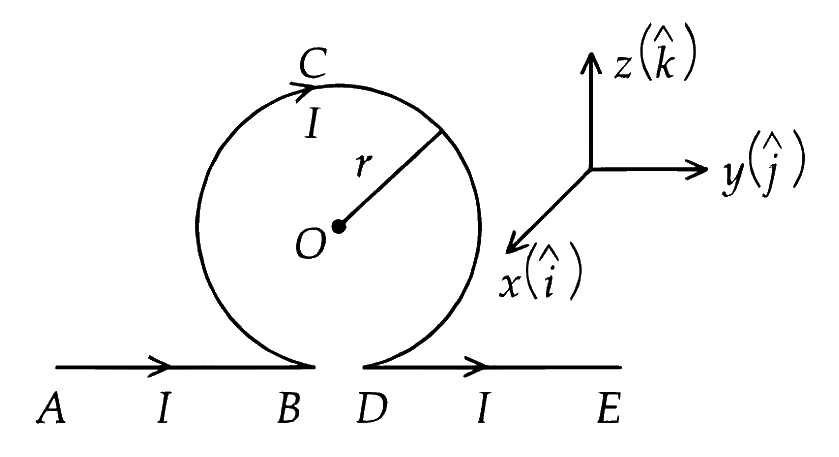
An infinitely long straight wire carrying current I is bent in a planar shape as shown in the diagram. The radius of the circular part is r. The magnetic field at the centre O of the circular loop is:
Show answer and solution
Answer: (b)
Circular loop (current clockwise as seen from +x): 2rμ0I along −i^.
Infinite straight wire ABDE at distance r below O, current along +j^: 2πrμ0I along +i^.
Magnetic Field of Straight Wires · Finite wire & polygon loops
The current passing through a conducting loop in the form of equilateral triangle of side 43 cm is 2 A. The magnetic field at its centroid is α×10−5 T. The value of α is ______.
(Given: μ0=4π×10−7 SI units)
Show answer and solution
Answer: (a)
Distance of centroid from each side: d=23a=2343=2 cm.
Magnetic Field of Straight Wires · Two wires: resultant field
Two long parallel wires carry currents I1 and I2(I1>I2). When currents are flowing in the same direction, the magnetic field at a point midway between the wires is 6×10⁻⁶ T. If the direction of I2 is reversed the field at midpoint becomes 3×10⁻⁵ T. The ratio I1:I2 is
Show answer and solution
Answer: (a)
Same direction: k(I1−I2)=6×10⁻⁶; reversed: k(I1+I2)=3×10⁻⁵.
Magnetic Field of Straight Wires · Two wires: resultant field
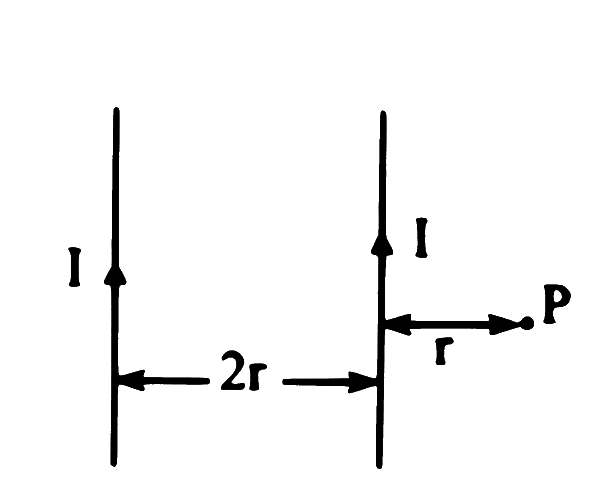
Two very long straight conductors (wires) are set parallel to each other. Each carries a current ' I ' in the same direction and the separation between them is ' 2 r '. The intensity of the magnetic field at point ' P ' (as shown in the figure) ( μ0= permeability of free space) is
Show answer and solution
Answer: (a)
P is outside both wires: r from the near wire and 3r from the far wire. Same-direction currents give fields in the same direction at an outside point.
Magnetic Field of Straight Wires · Two wires: resultant field
Two identical long parallel wires carry currents ' I1 ' and ' I2 ' such that I1>I2. When the currents are in the same direction, the magnetic field at a point midway between the wires is 8×10⁻⁶ T. If the direction of I2 is reversed, the field becomes 3.2×10⁻⁵ T. The ratio of I2 to I1 is
Show answer and solution
Answer: (c)
Same direction: k(I1−I2)=8×10⁻⁶; reversed: k(I1+I2)=3.2×10⁻⁵.
Magnetic Field of Straight Wires · Two wires: resultant field
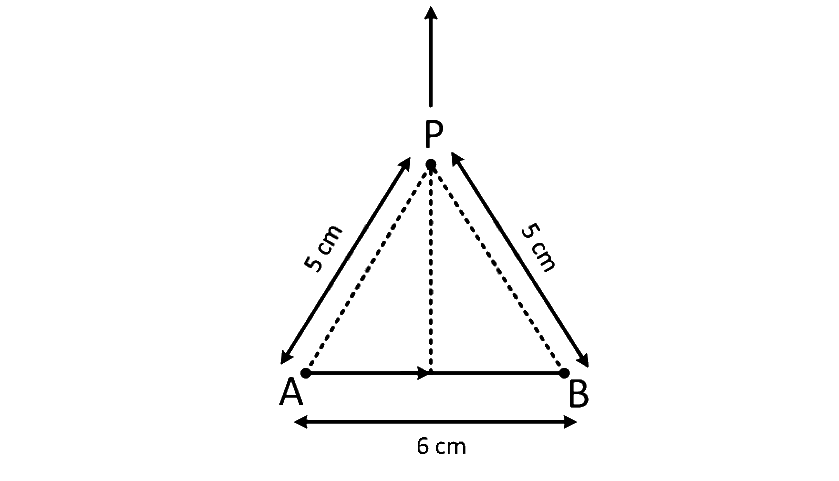
Two long parallel wires carrying currents 4 A and 3 A in opposite directions are placed at a distance of 5 cm from each other. A point P is at equidistance from both the wires such that the line joining the point P to the wires are perpendicular to each other. The magnitude of magnetic field at point P is ( μ0= permeability of free space =4π×10−7 SI unit)
Show answer and solution
Answer: (d)
Equidistant with a right angle at P: r=25 cm=20.05 m.
B1=0.052×10−7×42=1.62×10⁻⁵ T, B2=1.22×10⁻⁵ T
The two fields are perpendicular: B=2×10−51.62+1.22=22×10−5 T
Magnetic Field of Straight Wires · Two wires: resultant field
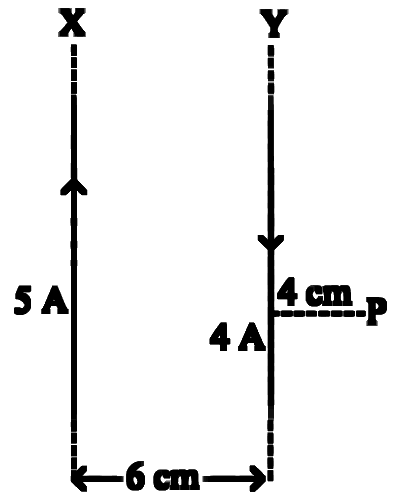
Two long parallel wires X and Y, separated by a distance of 6 cm, carry currents of 5 A and 4A, respectively, in opposite directions as shown in the figure. Magnitude of the resultant magnetic field at point P at a distance of 4 cm from wire Y is x×10−5 T. The value of x is _________. Take permeability of free space as μ0=4π×10−7 SI units.
Numerical answer type. Work it out, then open the answer.
Show answer and solution
Answer: 1
P is outside both wires: 10 cm from X and 4 cm from Y. For opposite currents the fields at an outside point are opposite.
BX=0.102×10−7×5=1×10⁻⁵ T, BY=0.042×10−7×4=2×10⁻⁵ T
Magnetic Field of Straight Wires · Bent wires & wire with a loop
An infinitely long straight conductor carrying current ' I ' is bent into a shape as shown in figure. The radius of the circular loop is ' r '. The magnetic induction at the centre of the loop at point ' O ' is ( μ0= permeability of free space)
Show answer and solution
Answer: (d)
Infinite straight wire at distance r: 2πrμ0I, out of the page (current right, O above).
Circular loop (clockwise): 2rμ0I, into the page.
Magnetic Field of Straight Wires · Bent wires & wire with a loop
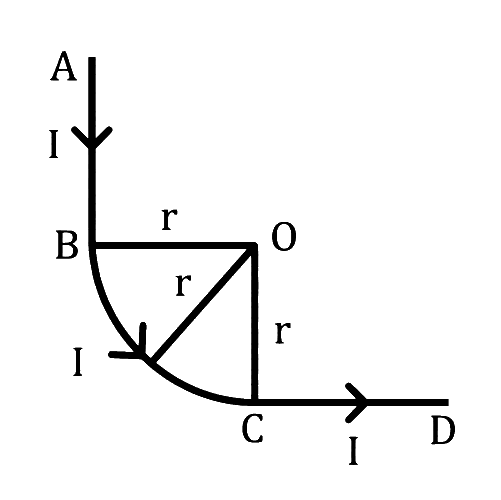
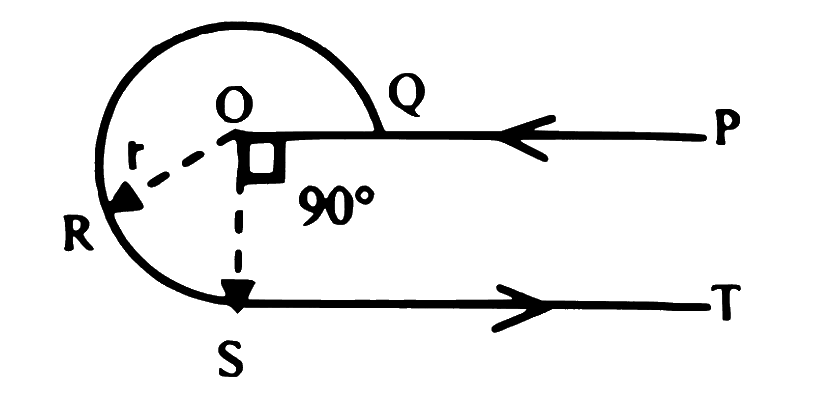
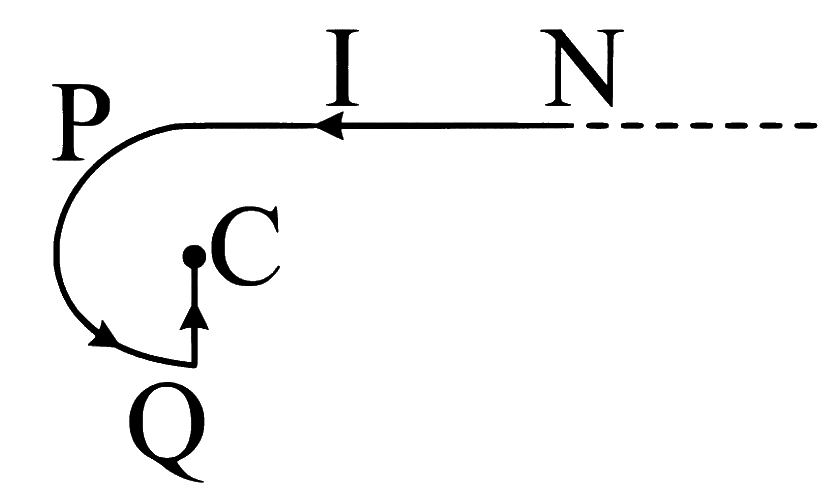
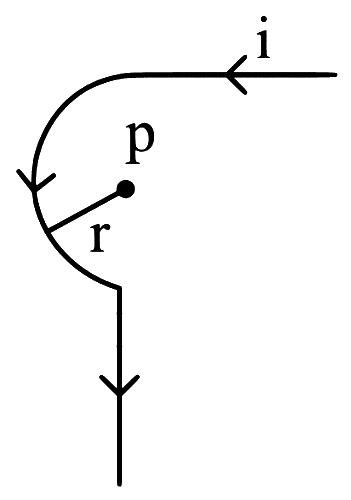
A current ' I ' is flowing in a conductor PQRST as shown in figure. The radius of curved path QRS is ' R ' and length of straight portion PQ and ST is very large. The magnetic field at the centre [O] of the curved part is ( μ0= permeability of free space)
Show answer and solution
Answer: (b)
PQ lies on a line through O: zero field.
Arc QRS is 43 of a circle: 43⋅2rμ0i=4πrμ0i⋅23π, anticlockwise, so along +k^.
ST is semi-infinite starting directly below O: 4πrμ0i, also along +k^.
Magnetic Field of Straight Wires · Bent wires & wire with a loop
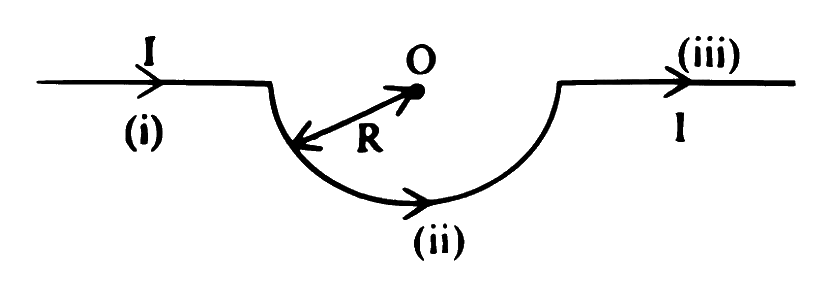
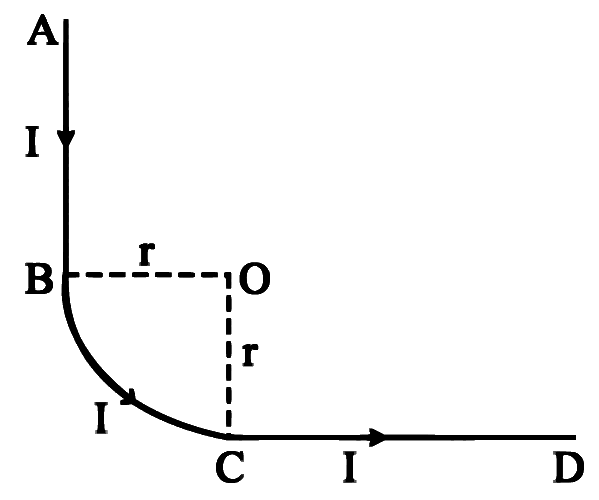
A wire has three different sections as shown in figure. The magnitude of the magnetic field produced at the centre ' O ' of the semicircle by three sections together is ( μ0= permeability of free space)
Show answer and solution
Answer: (a)
Straight sections (i) and (iii) lie on the diameter line through O, so they give zero.
Magnetic Field of Straight Wires · Bent wires & wire with a loop
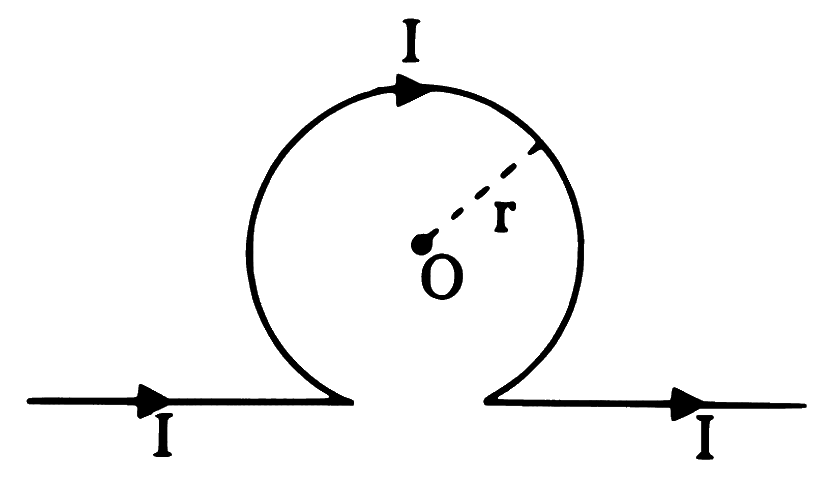
An infinite wire has a circular bend of radius a, and carrying a current I as shown in the figure. The magnitude of magnetic field at the origin O of the arc is given by:
Show answer and solution
Answer: (b)
The right wire lies on a line through O, so it gives zero field.
Lower semi-infinite wire, ending at the foot of the perpendicular from O: 4πaμ0I, into the page.
Three-quarter arc (clockwise): 43⋅2aμ0I=4πaμ0I⋅23π, into the page.
Magnetic Field of Straight Wires · Finite wire & polygon loops
Figure shows a current carrying square loop ABCD of edge length ‘a’ lying in a plane. If the resistance of the ABC part is r and that of ADC part is 2r, then the magnitude of the resultant magnetic field at centre of the square loop is
Show answer and solution
Answer: (b)
Current divides inversely as resistance: i1=32I in ABC, i2=3I in ADC.
One side at distance 2a: Bs=4π(a/2)μ0i(2sin45∘)=2πa2μ0i.
ABC (clockwise) and ADC (anticlockwise) give opposite fields; the outer straight wires pass through the centre line and give zero.
Magnetic Field of Straight Wires · Finite wire & polygon loops
A current of 5 A exists in a square loop of side 21 m. Then the magnitude of the magnetic field B at the centre of the square loop will be p×10−6 T. where, value of p is ________ [ Take μ0=4π×10−7 T mA−1 ].
Numerical answer type. Work it out, then open the answer.
Magnetic Field of Straight Wires · Long straight wire
The strength of magnetic field at a perpendicular distance ' x ' near a long straight conductor carrying current ' I ' is ' B '. The magnetic field at a distance 3x from straight conductor will be
Magnetic Field of Straight Wires · Two wires: resultant field
Two long straight parallel wires are separated by a distance '2d'. Each wire carries a current 'I' in the same direction. The magnetic field at a point 'P' midway between them is
Show answer and solution
Answer: (b)
Same-direction currents produce opposite fields at the midpoint.
Equal currents at equal distance d give equal magnitudes 2πdμ0I, which cancel.
Magnetic Field of Straight Wires · Two wires: resultant field
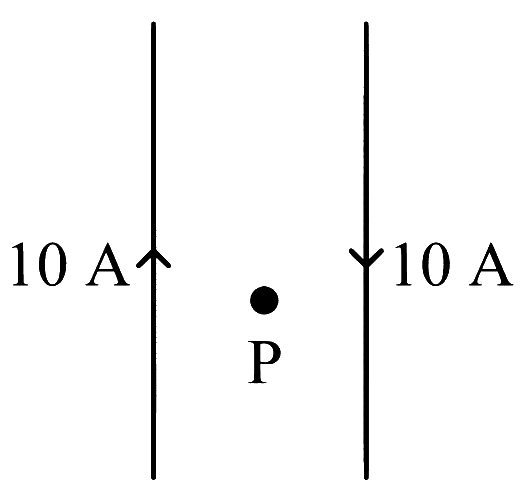
Two long, straight wires carry equal currents in opposite directions as shown in figure. The separation between the wires is 5.0 cm. The magnitude of the magnetic field at a point P midway between the wires is _______ μT
(Given: μ0=4π×10−7 TmA−1)
Numerical answer type. Work it out, then open the answer.
Show answer and solution
Answer: 160
Opposite currents: fields at the midpoint add; r=2.5 cm=0.025 m.
Magnetic Field of Straight Wires · Two wires: resultant field
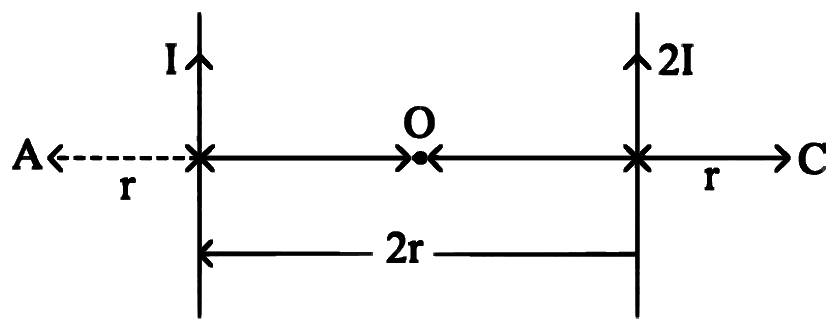
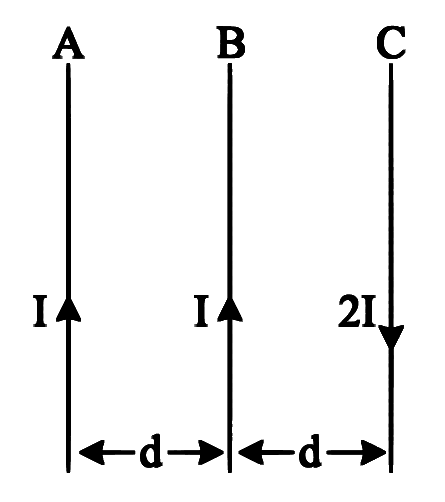
Two parallel long current carrying wires separated by a distance 2r are shown in the figure. The ratio of magnetic field at A to the magnetic field produced at C is 7x. The value of x is __________.
Numerical answer type. Work it out, then open the answer.
Show answer and solution
Answer: 5
Same-direction currents: at points outside both wires the fields add. Let k=2πμ0.
At A (r from I, 3r from 2I): BA=k(rI+3r2I)=3r5kI
At C (r from 2I, 3r from I): BC=k(r2I+3rI)=3r7kI
Magnetic Field of Straight Wires · Bent wires & wire with a loop
An infinitely long straight conductor carrying current 'I' is bent in a shape as shown in figure. The radius of the circular part of loop is 'r'. The magnetic induction at the centre 'C' is (μ= permeability of free space)
Show answer and solution
Answer: (c)
NP is semi-infinite ending directly above C at distance r: 4πμ0rI, out of the page.
Semicircular arc PQ (anticlockwise): 4rμ0I=4πμ0rIπ, out of the page. The radial part to C gives zero.
Magnetic Field of Straight Wires · Bent wires & wire with a loop
A current carrying circular loop of radius ' R ' and current carrying long straight wire are placed in the same plane. The current through circular loop and long straight wire are ' Ic ' and ' Iw ' respectively. The perpendicular distance between centre of the circular loop and wire is ' d '. The magnetic field at the centre of the loop will be zero when separation ' d ' is equal to
Show answer and solution
Answer: (a)
Loop centre: Bc=2Rμ0Ic; wire: Bw=2πdμ0Iw. Net zero when they are equal and opposite.
Magnetic Field of Straight Wires · Bent wires & wire with a loop
A current carrying circular loop of radius ' R ' and current carrying long straight wire are placed in the same plane. Ic and Iw are the currents through circular loop and long straight wire respectively. The perpendicular distance between centre of the circular loop and wire is ' d '. The magnetic field at the centre of the loop will be zero when separation ' d ' is equal to
Show answer and solution
Answer: (a)
Field of loop at centre =2Rμ0Ic; field of long wire at distance d=2πdμ0Iw.
For zero net field the two must be equal and opposite: 2Rμ0Ic=2πdμ0Iw
Magnetic Field of Straight Wires · Finite wire & polygon loops
A current of 5 A flows in a square loop of side 1 m placed in air. The magnetic field at the centre of the loop is X2×10−7 T. The value of X is _________.
Numerical answer type. Work it out, then open the answer.
Magnetic Field of Straight Wires · Long straight wire
The magnetic field at a point P situated at perpendicular distance 'R' from a long straight wire carrying a current of 12 A is 3×10⁻⁵ Wb/m2. The value of 'R' in mm is [μ0=4π×10−7 Wb/Am]
Magnetic Field of Straight Wires · Two wires: resultant field
Two parallel wires of equal lengths are separated by a distance of 3 m from each other. The currents flowing through 1st and 2nd wire is 3 A and 4.5 A respectively in opposite directions. The resultant magnetic field at mid point between the wires (μ0= permeability of free space)
Magnetic Field of Straight Wires · Two wires: resultant field
Two long parallel wires carrying currents 8 A and 15 A in opposite directions are placed at a distance of 7 cm from each other. A point 'P' is at equidistant from both the wires such that the lines joining the point to the wires are perpendicular to each other. The magnitude of magnetic field at point 'P' is (2=1.4)(μ0=4π×10−7 SI units)
Magnetic Field of Straight Wires · Two wires: resultant field
Two long parallel wires carrying currents 8A and 15A in opposite directions are placed at a distance of 7 cm from each other. A point P is equidistant from both the wires such that the lines joining the point P to the wires are perpendicular to each other. The magnitude of magnetic field at P is _____________ ×10−6 T.
(Given: 2=1.4)
Numerical answer type. Work it out, then open the answer.
Show answer and solution
Answer: 68
r=27=5 cm (with 2=1.4).
B1=0.052×10−7×8=32μT, B2=0.052×10−7×15=60μT
The fields are perpendicular: B=322+602=68×10−6 T
Magnetic Field of Straight Wires · Bent wires & wire with a loop
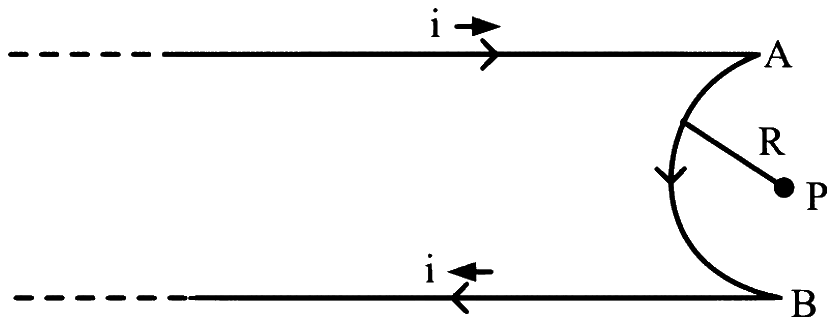
A very long conducting wire is bent in a semi-circular shape from A to B as shown in figure. The magnetic field at point P for steady current configuration is given by:
Show answer and solution
Answer: (b)
Each semi-infinite straight wire ends at the foot of the perpendicular from P: B=4πRμ0i, and both point into the page.
Semicircle A to B (anticlockwise about P): B=4Rμ0i out of the page.
Net: 4Rμ0i−4πR2μ0i=4Rμ0i[1−π2], out of the page.
Magnetic Field of Straight Wires · Bent wires & wire with a loop
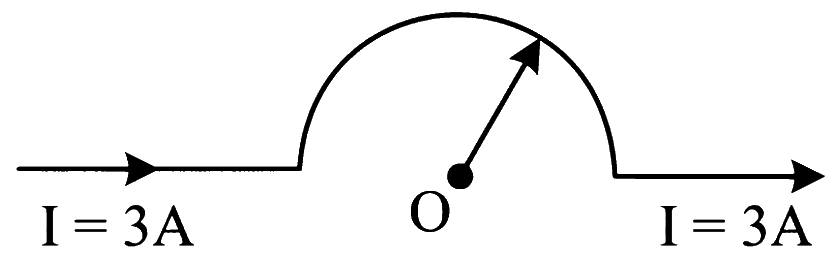
As shown in the figure, a long straight conductor with semicircular arc of radius 10π m is carrying current I=3 A. The magnitude of the magnetic field, at the center O of the arc is: (The permeability of the vacuum =4π×10−7 NA−2)
Show answer and solution
Answer: (b)
Both straight parts lie on a line through O, so they give zero field.
Magnetic Field of Straight Wires · Bent wires & wire with a loop
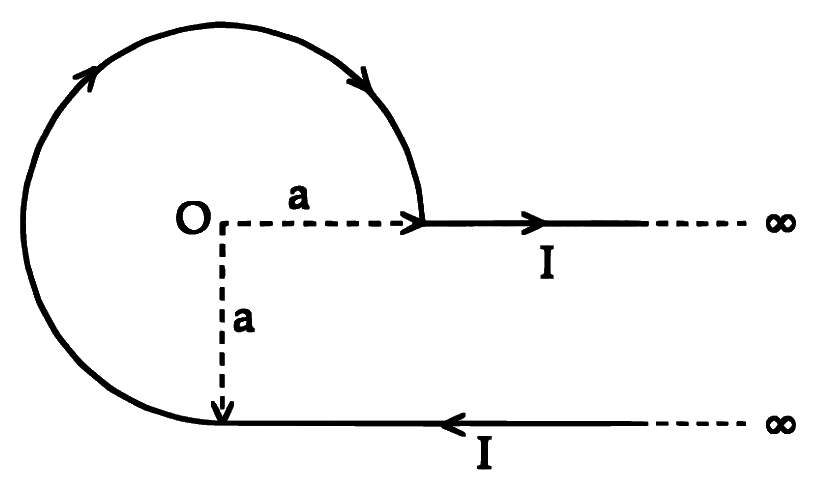
Match List I with List II
Choose the correct answer from the options given below:
List I (Current configuration)
List II (Magnitude of Magnetic Field at point O)
A.
I.
B0=4πrμ0I[π+2]
B.
II.
B0=4μ0rI
C.
III.
B0=2πrμ0I[π−1]
D.
IV.
B0=4πrμ0I[π+1]
Show answer and solution
Answer: (c)
Use: semi-infinite wire ending at the foot gives 4πrμ0I, an infinite wire gives 2πrμ0I, a semicircle gives 4rμ0I, a full loop gives 2rμ0I; a wire whose line passes through O gives zero.
Full loop with infinite wire opposing: 2rμ0I−2πrμ0I=2πrμ0I[π−1] (III).
Semicircle with two semi-infinite wires adding (hairpin): 4πrμ0I[π+2] (I).
Semicircle with one semi-infinite wire adding: 4πrμ0I[π+1] (IV); semicircle with both wires through O: 4rμ0I (II).
Magnetic Field of Straight Wires · Two wires: resultant field
Two parallel conducting wires of equal length are placed distance 'd' apart, carry currents 'I1 ' and 'I2' respectively in opposite directions. The resultant magnetic field at the midpoint of the distance between both the wires is
Show answer and solution
Answer: (d)
Opposite currents: fields at the midpoint (distance 2d from each wire) add.
Magnetic Field of Straight Wires · Two wires: resultant field
Two long current carrying conductors are placed parallel to each other at a distance of 8 cm between them. The magnitude of magnetic field produced at mid-point between the two conductors due to current flowing in them is 300 μT. The equal current flowing in the two conductors is:
Show answer and solution
Answer: (b)
A nonzero midpoint field with equal currents needs opposite directions (same direction gives zero).
300×10−6=2×0.042×10−7I=10−5I
I=30 A
So the answer is (b) 30 A in the opposite direction.
Magnetic Field of Straight Wires · Long straight wire
A straight wire of diameter 0.4 mm carrying a current of 2 A is replaced by another wire of 0.8 mm diameter carrying the same current. The magnetic field at distance (R) from both the wires is 'B1' and 'B2' respectively. The relation between B1 and B2 is
Show answer and solution
Answer: (b)
Outside a long straight wire B=2πRμ0I, which depends only on I and R, not on the wire's diameter.
Magnetic Field of Straight Wires · Bent wires & wire with a loop
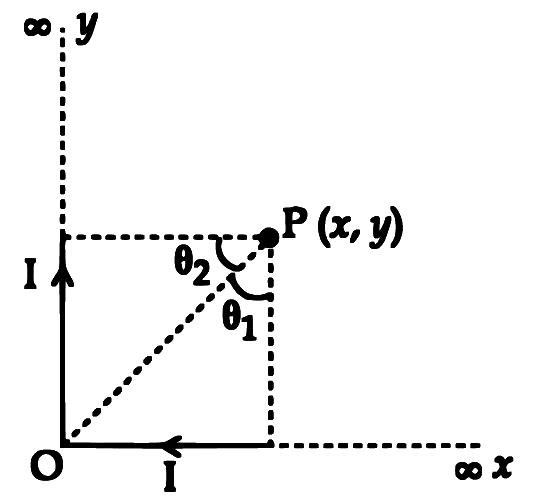
There are two infinitely long straight current carrying conductors and they are held at right angles to each other so that their common ends meet at the origin as shown in the figure given below. The ratio of current in both conductor is 1: 1. The magnetic field at point P is ____________.
Show answer and solution
Answer: (a)
Finite-wire formula: B=4πdμ0I(sinα1+sinα2).
Wire on x-axis (d=y): B1=4πyμ0I(1+x2+y2x); wire on y-axis (d=x): B2=4πxμ0I(1+x2+y2y).
Both point into the page, so they add: B=4πxyμ0I[x+y+x2+y2x2+y2]
Magnetic Field of Straight Wires · Bent wires & wire with a loop
A hairpin like shape as shown in figure is made by bending a long current carrying wire. What is the magnitude of a magnetic field at point P which lies on the centre of the semicircle?
Show answer and solution
Answer: (c)
Each semi-infinite straight wire ends at the foot of the perpendicular from P: 4πrμ0I each, both into the page.
Semicircle (clockwise): 4rμ0I=4πrμ0Iπ, also into the page.
Magnetic Field of Straight Wires · Bent wires & wire with a loop
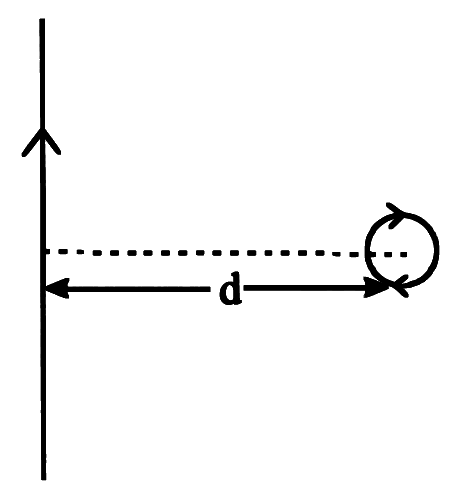
A circular coil of radius R is carrying a current I1 in anti-clockwise sense. A long straight wire is carrying current I2 in the negative direction of X-axis. Both are placed in the same plane and the distance between centre of coil and straight wire is d. The magnetic field at the centre of coil will be zero for the value of d equal to
Show answer and solution
Answer: (a)
Coil at centre: B1=2Rμ0I1; wire at distance d: B2=2πdμ0I2.
The directions are opposite, so B=0 when 2Rμ0I1=2πdμ0I2.
Magnetic Field of Straight Wires · Bent wires & wire with a loop
A very long wire ABDMNDC is shown in figure carrying current I. AB and BC parts are straight, long and at right angle. At D wire forms a circular turn DMND of radius R. AB, BC parts are tangential to circular turn at N and D. Magnetic field at the centre of circle is:
Show answer and solution
Answer: (d)
AB (from −∞ to B, foot N is R beyond B): 4πRμ0I(1−21), into the page.
BC (from B to ∞, foot D is R beyond B): 4πRμ0I(1+21), out of the page.
Wires net: 4πRμ0I2=2πRμ0I⋅21, out of the page.
Circular turn (anticlockwise): 2Rμ0I=2πRμ0Iπ, out of the page.
Magnetic Field of Straight Wires · Finite wire & polygon loops
Magnitude of magnetic field (in SI units) at the centre of a hexagonal shape coil of side 10 cm, 50 turns and carrying current I (Ampere) in units of πμ0I is:
Show answer and solution
Answer: (c)
Hexagon side a: distance of centre from a side d=23a, each side subtends ±30∘.
Magnetic Field of Straight Wires · Bent wires & wire with a loop
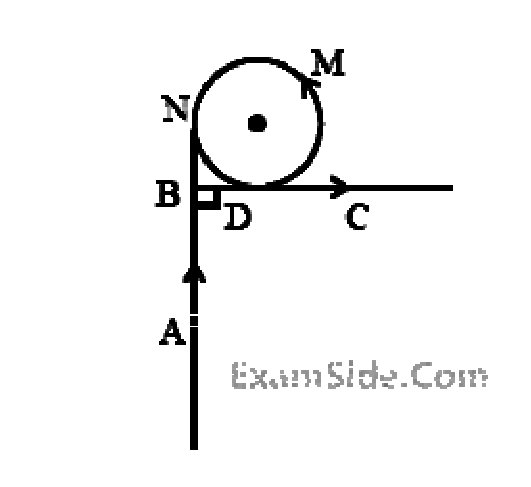
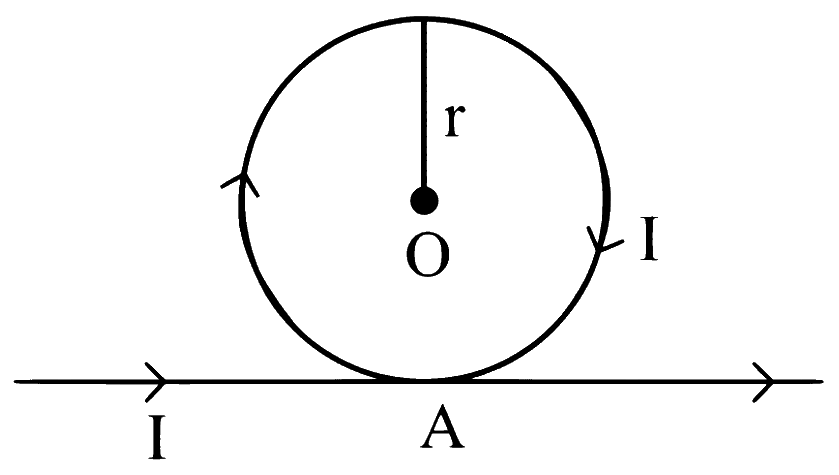
Figure show the circular coil carrying current I kept very close but not touching at a point A on a straight conductor carrying the same current I. The magnitude of magnetic induction at the centre of the circular coil will be
Show answer and solution
Answer: (a)
Coil at its centre: B1=2rμ0I.
Long wire at distance r from O: B2=2πrμ0I.
Taking both fields in the same direction: B=2rμ0I+2πrμ0I=2rμ0I(1+π1)
Magnetic Field of Straight Wires · Bent wires & wire with a loop
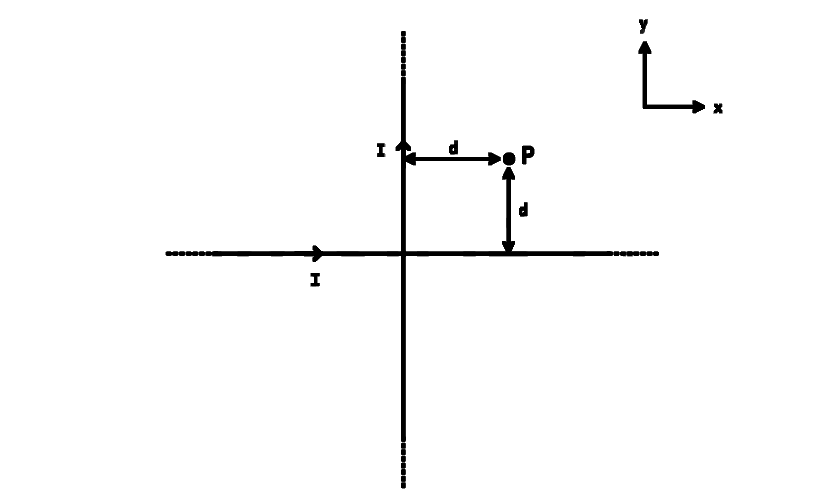
Two very long, straight, and insulated wires are kept at 90° angle from each other in xy-plane as shown in the figure. These wires carry currents of equal magnitude I, whose directions are shown in the figure. The net magnetic field at point P will be:
Show answer and solution
Answer: (c)
Wire along x (current +x), P at distance d above it: 2πdμ0I along +z^.
Wire along y (current +y), P at distance d to its right: 2πdμ0I along −z^.
Magnetic Field of Straight Wires · Bent wires & wire with a loop
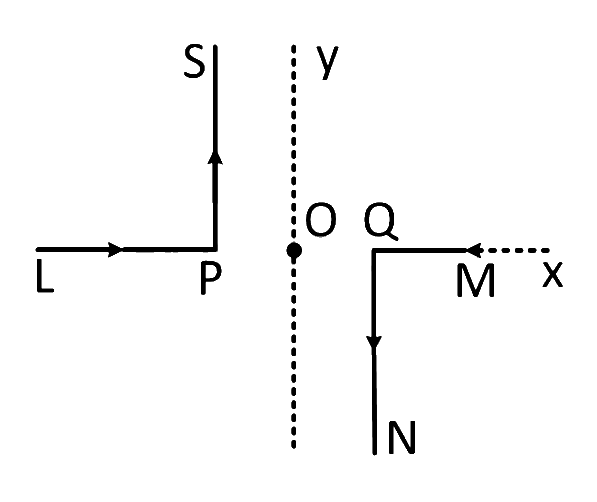
As shown in the figure, two infinitely long, identical wires are bent by 90° and placed in such a way that the segments LP and QM are along the x-axis, while segments PS and QN are parallel to the y- axis. If OP = OQ = 4cm, and the magnitude of the magnetic field at O is 10–4 T, and the two wires carry equal currents (see figure), the magnitude of the current in each wire and the direction of the magnetic field at O will be (μ0 = 4π× 10–7 NA–2):
Show answer and solution
Answer: (c)
LP and QM lie on the x-axis through O, so they give zero field.
PS and QN are semi-infinite, each starting at the foot of the perpendicular from O at d=4 cm: 4πdμ0I each, both into the page.
Magnetic Field of Straight Wires · Finite wire & polygon loops
Two identical wires A and B, each of length ’l’, carry the same current I. Wire A is bent into a circle of radius R and wire B is bent to form a square of side ’a’. If BA and BB are the values of magnetic fields at the centres of the circle and square respectively, then the ratio BBBA is:
Magnetic Field of Straight Wires · Bent wires & wire with a loop
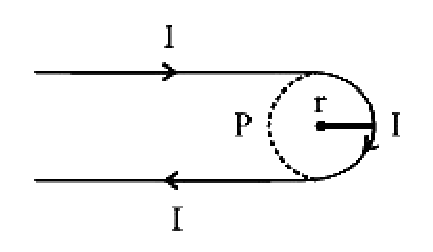
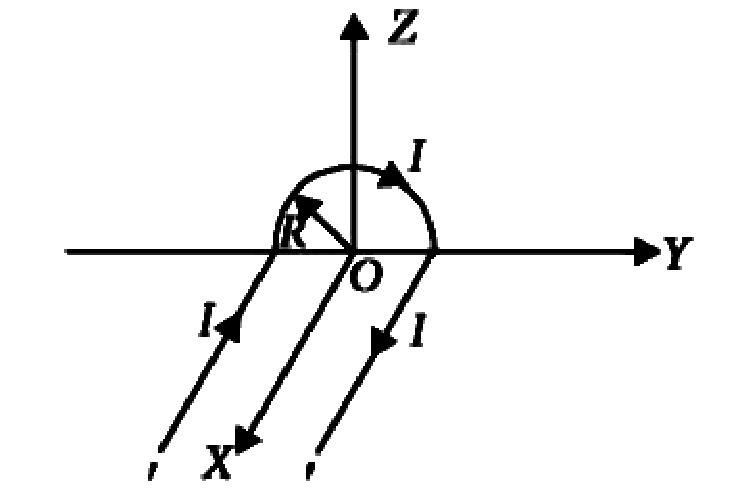
A wire carrying current I has the shape shown in adjoining figure.
Linear parts of the wire are very long and parallel to X-axis while semicircular protion of radius R is lying in Y-Z plane. Magtnetic field at pont O is
Show answer and solution
Answer: (a)
Each semi-infinite wire along X at distance R from O: 4πRμ0I; by Idl×r^ both point along −k^.
Wires together: −4πRμ0I(2k^).
Semicircle in Y-Z plane: 4Rμ0I=4πRμ0Iπ, directed along −i^ for the current shown.
Magnetic Field of Straight Wires · Two wires: resultant field
Two identical long conducting wires AOB and COD are placed at right angle to each other, with one above other such that O is their common point for the two. The wires carry I1 and I2 currents, respectively. Point P is lying at distance f from O along a direction perpendicular to the plane containing the wires. The magnetic field at the point P will be
Show answer and solution
Answer: (d)
P is at perpendicular distance d from both long wires (P lies above their crossing point O).
B1=2πdμ0I1, B2=2πdμ0I2; since the wires are perpendicular, B1⊥B2.
Magnetic Field of Straight Wires · Two wires: resultant field
Two long parallel wires are at a distance 2d apart. They carry steady equal currents flowing out of the plane of the paper as shown. The variation of the magnetic field B along the line XX′ is given by
Show answer and solution
Answer: (a)
For a current out of the page, the field on XX′ points up to the right of the wire and down to its left, with B∝r1.
Left of both wires: both fields down, B<0. Right of both: both up, B>0.
Between: large positive near the left wire, zero at the midpoint, large negative near the right wire.
Magnetic Field of Straight Wires · Long straight wire
A horizontal overhead powerline is at height of 4 m from the ground and carries a current of 100 A from east to west. The magnetic field directly below it on the ground is
(μ0=4π×10−7 T m A−1)
Show answer and solution
Answer: (c)
B=2πrμ0I=42×10−7×100=5×10⁻⁶ T
Right-hand rule: thumb westward, the field below the wire points south.
Magnetic Field of Straight Wires · Two wires: resultant field
Two identical conducting wires AOB and COD are placed at right angles to each other. The wire AOB carries an electric current I1 and COD carries a current I2. The magnetic field on a point lying at a distance d from O, in a direction perpendicular to the plane of the wires AOB and COD, will be given by
Show answer and solution
Answer: (c)
The point is at distance d from each long wire, above O.
B1=2πdμ0I1 and B2=2πdμ0I2 are perpendicular, since the wires are perpendicular.
Magnetic Field of Straight Wires · Long straight wire
A straight wire of diameter 0.5 mm carrying a current of 1 A is replaced by another wire of diameter 1 mm carrying the same current. The strength of magnetic field far away is
Show answer and solution
Answer: (d)
Far from the wire B=2πrμ0I, independent of the wire's thickness.
Magnetic Field of Straight Wires · Long straight wire
A straight wire of diameter 0.5 mm carrying a current of 1 A is replaced by the another wire of 1 mm diameter carrying the same current. The strength of the magnetic field far away is
Show answer and solution
Answer: (d)
Outside the wire B=2πrμ0I; the diameter does not enter.
Magnetic Field of Straight Wires · Two wires: resultant field
Two equal electric currents are flowing perpendicular to each other as shown in the figure. AB and CD are perpendicular to each other and symmetrically placed with respect to the currents. Where do we expect the resultant magnetic field to be zero?
Show answer and solution
Answer: (b)
Take one current along +y and the other along +x. At a point (x,y) in the plane, the first gives B∝x1 into the page, the second gives B∝y1 out of the page.
They cancel when x=y (both positive or both negative), i.e. on the line y=x.
That line is AB (first and third quadrants); on CD the two fields add.
Magnetic Field of Straight Wires · Long straight wire
The magnetic induction at a point P which is at the distance of 4 cm from a long current carrying wire is 10−3 T. The field of induction at a distance 12 cm from the current will be
Ampere's Law, Cylinders, Solenoid & Toroid · Ampere's circuital law
Six very long insulated copper wires are bound together to form a cable. The currents carried by the wires are i1=10A, i2=−13A, i3=10A, i4=7A, i5=−12A and i6=18 A. The magnetic induction at a perpendicular distance of 10 cm from the cable is (μ0=4π×10−7 SI units)
Show answer and solution
Answer: (a)
Outside the cable it acts like one wire carrying the net current (Ampere's law).
Ampere's Law, Cylinders, Solenoid & Toroid · Ampere's circuital law
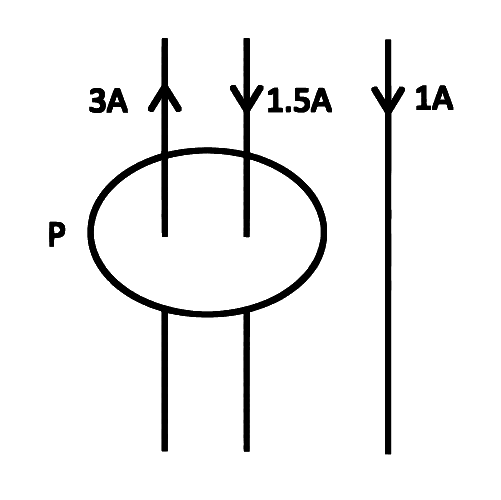
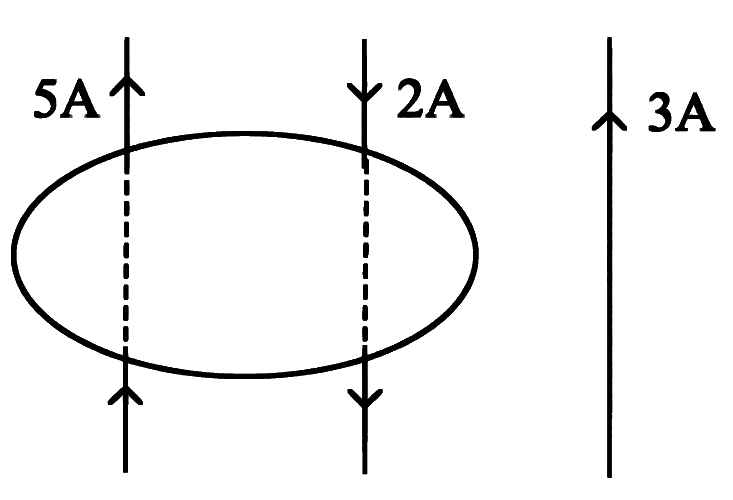
Two wires with current 3A and 1.5A are enclosed in a circular loop P. Third parallel wire with current 1A is situated outside the loop as shown. All the wires are perpendicular to the plane of the circular loop. The value of ∮B⋅dl around the loop is (μ0= permeability of free space)
Show answer and solution
Answer: (c)
Ampere's law: ∮B⋅dl=μ0Ienc; the outside wire does not count.
The 3 A and 1.5 A currents are opposite: Ienc=3−1.5=1.5 A.
Ampere's Law, Cylinders, Solenoid & Toroid · Field of solid & hollow cylinders
The figure given below shows a long straight solid wire of circular cross-section of radius ' a ' carrying steady current I. The current I is uniformly distributed across its cross-section. The plot which correctly represents the variation of magnetic field (B) with distance (r) from the axis of the conductor in the region is:
Show answer and solution
Answer: (a)
Inside (r<a): Ienc=Ia2r2, so B=2πa2μ0Ir∝r (straight line from origin).
Outside (r>a): B=2πrμ0I∝r1, maximum at r=a.
So the answer is (a): linear rise to r=a, then 1/r fall.
Ampere's Law, Cylinders, Solenoid & Toroid · Field of solid & hollow cylinders
A long cylindrical conductor with large cross section carries an electric current distributed uniformly over its cross-section. Magnetic field due to this current is:
A. maximum at either ends of the conductor and minimum at the midpoint
B. maximum at the axis of the conductor
C. minimum at the surface of the conductor
D. minimum at the axis of the conductor
E. same at all points in the cross-section of the conductor
Choose the correct answer from the options given below:
Show answer and solution
Answer: (d)
Ampere's law inside a uniformly carrying cylinder: B=2πR2μ0Ir for r≤R.
At the axis r=0, so B=0 (minimum). D is true; B is false.
B grows with r and is maximum at the surface r=R, so C and E are false.
For a long conductor the field does not depend on position along the length, so A is false.
Choose the WRONG Statement from the following statements.
(A) A toroid is a solenoid bent in the form of a closed ring.
(B) The magnetic field lines of solenoid are straight lines parallel to the axis inside the solenoid. (C) The magnetic field lines of toroid are circular having common centre.
(D) Inside a solenoid, magnetic field may be made strong by passing small current and using laminated coil of soft iron.
Show answer and solution
Answer: (a)
(A) True: a toroid is a solenoid bent into a closed ring.
(B) True: inside a long solenoid the field lines are straight and parallel to the axis.
(C) True: field lines in a toroid are concentric circles.
(D) Wrong: a strong field needs a large current (and a soft iron core), not a small current.
A solenoid of 1000 turns is wound uniformly on a glass tube 4 m long and 0.3 m in diameter. The magnetic intensity at the centre of the solenoid when a current of 4 A flows through it is
Show answer and solution
Answer: (d)
Magnetic intensity H=nI, with n=LN=41000=250 turns/m.
A long solenoid carrying a current produces a magnetic field 'B' along its axis. If the current is tripled and the number of turns per cm is halved then new value of magnetic field will be
The magnetic field intensity (H) at the centre of a long solenoid having 'n' turns per unit length and carrying a current I, when no material is kept in it is (μ0 = permeability of free space)
Ampere's Law, Cylinders, Solenoid & Toroid · Field of solid & hollow cylinders
A long straight wire of a circular cross-section with radius ' a ' carries a steady current I. The current I is uniformly distributed across this cross-section. The plot of magnitude of magnetic field B with distance r from the centre of the wire is given by
Show answer and solution
Answer: (b)
Inside (r<a): enclosed current Ir2/a2, so B=2πa2μ0Ir∝r (straight line from origin).
Outside (r>a): B=2πrμ0I∝r1 (falling curve).
Both give B=2πaμ0I at r=a, the peak.
So the answer is (b): linear rise to r=a, then 1/r fall.
The magnetic field intensity H at the centre of a long solenoid having n turns per unit length and carrying a current I, when no material is kept in it is ( μ0= permeability of free space)
The magnetic field inside a 200 turns solenoid of radius 10 cm is 2.9×10⁻⁴ Tesla. If the solenoid carries a current of 0.29 A, then the length of the solenoid is _______ πcm.
Numerical answer type. Work it out, then open the answer.
Ampere's Law, Cylinders, Solenoid & Toroid · Ampere's circuital law
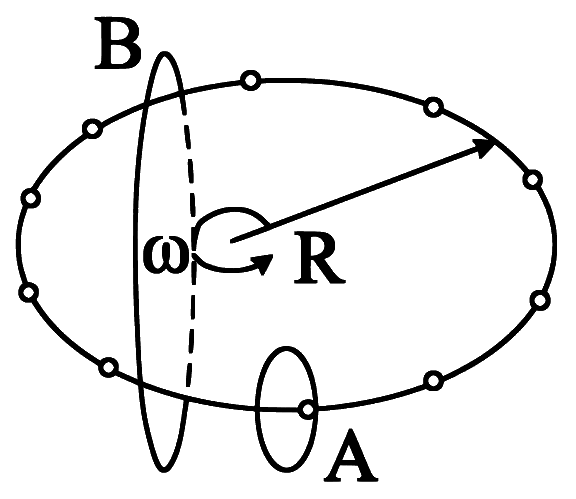
N equally spaced charges each of value q, are placed on a circle of radius R. The circle rotates about its axis with an angular velocity ω as shown in the figure. A bigger Amperian loop B encloses the whole circle where as a smaller Amperian loop A encloses a small segment. The difference between enclosed currents, IA−IB, for the given Amperian loops is
Show answer and solution
Answer: (b)
Total current of the rotating ring: I=TNq=2πNqω.
Loop A is threaded once by the ring, so IA=2πNqω.
Loop B is crossed by the ring twice, once in each direction, so the currents cancel: IB=0.
Ampere's Law, Cylinders, Solenoid & Toroid · Field of solid & hollow cylinders
A long straight wire of radius ' r ' carries a steady current ' I '. The current is uniformly distributed over its cross-section. The ratio (B1B) of the magnetic field ' B ' and ' B1 ' at radial distances ' 2r ' and ' 3r ' respectively, from the axis of the wire is
Ampere's Law, Cylinders, Solenoid & Toroid · Field of solid & hollow cylinders
Consider a long straight wire of a circular cross-section (radius a) carrying a steady current I. The current is uniformly distributed across this cross-section. The distances from the centre of the wire’s cross-section at which the magnetic field [inside the wire, outside the wire] is half of the maximum possible magnetic field, any where due to the wire, will be:
A tightly wound long solenoid carries a current of 1.5 A. An electron is executing uniform circular motion inside the solenoid with a time period of 75 ns. The number of turns per metre in the solenoid is _________.
[Take mass of electronme=9×10⁻³¹ kgA2N,1 ns=10−9 s], charge of electron ∣qe∣=1.6×10⁻¹⁹ C,μ0=4π×10−7
Numerical answer type. Work it out, then open the answer.
Ampere's Law, Cylinders, Solenoid & Toroid · Field of solid & hollow cylinders
A long straight wire of radius a carries a steady current I. The current is uniformly distributed across its cross section. The ratio of the magnetic field at 2a and 2a from axis of the wire is:
A long solenoid carrying a current produces magnetic field B along its axis. If the number of turns per cm are tripled and the current is made (41)th then the new value of magnetic field will be
The magnetic field intensity inside current carrying solenoid is H=2.4×10³ A/m. If length and number of turns of a solenoid is 15 cm and 60 turns respectively. The current flowing in the solenoid is
A solenoid of length 0.5 m has a radius of 1 cm and is made up of 'm' number of turns. It carries a current of 5 A. If the magnitude of the magnetic field inside the solenoid is 6.28×10⁻³ T then the value of m is __________.
Numerical answer type. Work it out, then open the answer.
A current of 5 A flows through a toroid having a core of mean radius 20 cm. If 4000 turns of the conducting wire are wound on the core, then the magnetic field inside the core of the toroid is [permeability of free space =4π×10−7 SI units]
Ampere's Law, Cylinders, Solenoid & Toroid · Field of solid & hollow cylinders
A long straight wire of circular cross-section (radius a) is carrying steady current I. The current I is uniformly distributed across this cross-section. The magnetic field is
A long solenoid is formed by winding 70 turns cm−1. If 2.0 A current flows, then the magnetic field produced inside the solenoid is ____________ (μ0=4π×10−7 TmA −1)
A rod with circular cross-section area 2 cm2 and length 40 cm is wound uniformly with 400 turns of an insulated wire. If a current of 0.4 A flows in the wire windings, the total magnetic flux produced inside windings is 4π×10−6 Wb. The relative permeability of the rod is
(Given: Permeability of vacuum μ0=4π×10−7 NA−2)
Show answer and solution
Answer: (a)
n=0.4400=1000 turns/m, so μ0nI=4π×10−7×1000×0.4=1.6π×10−4 T.
Total flux through all windings: Φ=NBA⇒B=400×2×10−44π×10−6=5π×10−5 T.
Ampere's Law, Cylinders, Solenoid & Toroid · Field of solid & hollow cylinders
From Ampere's circuital law for a long straight wire of circular cross-section carrying a steady current, the variation of magnetic field in the inside and outside region of the wire is
Ampere's Law, Cylinders, Solenoid & Toroid · Field of solid & hollow cylinders
A long straight wire with a circular cross-section having radius R, is carrying a steady current I. The current I is uniformly distributed across this cross-section. Then the variation of magnetic field due to current I with distance r (r < R) from its centre will be:
A long solenoid of radius 1 mm has 100 turns per mm. If 1 A current flows in the solenoid, the magnetic field strength at the centre of the solenoid is
Show answer and solution
Answer: (b)
n=100 turns/mm =105 turns/m; B=μ0nI (radius not needed).
A long solenoid carrying a current produces a magnetic field B along its axis. If the current is doubled and the number of turns per cm is halved, the new value of magnetic field will be equal to
Ampere's Law, Cylinders, Solenoid & Toroid · Ampere's circuital law
Two wires carrying currents 5 A and 2 A are enclosed in a circular loop as shown in the figure. Another wire carrying a current of 3 A is situated outside the loop. The value of ∮Bdl around the loop is ( μ0= permeability of free space, dl is the length of the element on the Amperion loop)
Show answer and solution
Answer: (c)
Ampere's law: ∮B⋅dl=μ0Ienc; the 3 A wire outside does not count.
The 5 A and 2 A currents are opposite: Ienc=5−2=3 A.
Ampere's Law, Cylinders, Solenoid & Toroid · Field of solid & hollow cylinders
A thick current carrying cable of radius 'R' carries current 'I' uniformly distributed across its cross section. The variation of magnetic field B(r) due to the cable with the distance 'r' from the axis of the cable is represented by:
Show answer and solution
Answer: (d)
Inside (r<R): B=2πR2μ0Ir∝r.
Outside (r>R): B=2πrμ0I∝r1.
Graph rises linearly to a peak at r=R and then falls off.
A long solenoid carrying current I1 produces magnetic field B1 along its axis. If the current is reduced to 20% and number of turns per cm are increased five times then new magnetic field B2 is equal to
A long solenoid carrying a current produces a magnetic field B along its axis. If the number of turns per cm is doubled and the current is made (31)rd then the new value of the magnetic field will be
The magnetic field intensity 'H' at the centre of a long solenoid having 'n' turns per unit length and carrying a current 'I', when no material is kept in it, is
A solenoid of 1000 turns per metre has a core with relative permeability 500. Insulated windings of the solenoid carry an electric current of 5A. The magnetic flux density produced by the solenoid is: (permeability of free space = 4π× 10−7 H/m)
Ampere's Law, Cylinders, Solenoid & Toroid · Field of solid & hollow cylinders
Figures A and B show two long straight wires of circular cross-section (a and b with a < b), carrying current I which is uniformly distributed across the cross-section. The magnitude of magnetic field B varies with radius r and can be represented as:
Show answer and solution
Answer: (c)
Inside a wire of radius R (uniform current): B=2πR2μ0Ir, a straight line through O with slope ∝R21.
Outside: B=2πrμ0I, the same curve for both wires since I is the same.
Peak value 2πRμ0I occurs at r=R, so wire a (a<b) has a steeper line and a higher peak at a smaller r.
Wire b peaks lower and later at r=b, then merges with the same 1/r fall.
A solenoid 2 m long and 4 cm in diameter has 4 layers of windings of 1000 turns each and carries a current of 5 A. What is the magnetic field at its centre along the axis? [μ0=4π×10−7 Wb/Am]
Show answer and solution
Answer: (c)
Total turns N=4×1000=4000 on L=2 m, so n=2000 turns/m.
A long solenoid with 1000 turns/m has a core material with relative permeability 500 and volume 103 cm3. If the core material is replaced by another material having relative permeability of 750 with same volume maintaining same current of 0.75 A in the solenoid, the fractional change in the magnetic moment of the core would be approximately (499x). Find the value of x.
Numerical answer type. Work it out, then open the answer.
Show answer and solution
Answer: 250
Moment of core m=MV=(μr−1)nIV, so m∝(μr−1) for the same n, I, V.
The magnetic field inside a current carrying toroidal solenoid is 0.2 mT. What is the magnetic field inside the toroid if the current through it is tripled and radius is made 31rd?
Show answer and solution
Answer: (b)
Inside a toroid B=μ0nI, where n is the number of turns per unit length.
With the same winding density n, B does not depend on the radius, so B∝I.
Ampere's Law, Cylinders, Solenoid & Toroid · Field of solid & hollow cylinders
A coaxial cable consists of an inner wire of radius 'a' surrounded by an outer shell of inner and outer radii 'b' and 'c' respectively. The inner wire carries an electric current i0, which is distributed uniformly across cross-sectional area. The outer shell carries an equal current in opposite direction and distributed uniformly. What will be the ratio of the magnetic field at a distance x from the axis when (i) x < a and (ii) a < x < b?
Show answer and solution
Answer: (a)
Ampere's law, x<a: enclosed current i0a2x2, so B1=2πa2μ0i0x.
Four identical long solenoids A, B, C and D are connected to each other as shown in the figure. If the magnetic field at the center of A is 3T, the field at the center of C would be: (Assume that the magnetic field is confined with in the volume of respective solenoid).
Show answer and solution
Answer: (d)
Identical solenoids: B=μ0nI∝I.
A carries the full current i; B, C, D are identical and in parallel, so each carries 3i.
Ampere's Law, Cylinders, Solenoid & Toroid · Field of solid & hollow cylinders
A long, straight wire of radius a carries a current distributed uniformly over its cross-section. The ratio of the magnetic fields due to the wire at distance 3a and 2a, respectively from the axis of the wire is:
An iron rod of volume 10–3 m3 and relative permeability 1000 is placed as core in a solenoid with 10 turns/cm. If a current of 0.5 A is passed through the solenoid, then the magnetic moment of the rod will be:
Ampere's Law, Cylinders, Solenoid & Toroid · Ampere's circuital law
Six very long insulated copper wires are bound together to form a cable. The currents carried by the wires are I1=+10 A,I2=−13 A,I3=+10 A,I4=+7 A,I5=−12 A and I6=+18 A. The magnetic induction at a perpendicular distance of 10 cm from the cable is
(μ0=4π×10−7 Wb/A-m)
Show answer and solution
Answer: (a)
Outside the cable, only the net current matters (Ampere's law).
Ampere's Law, Cylinders, Solenoid & Toroid · Field of solid & hollow cylinders
A cylindrical conductor of radius R is carrying a constant current. The plot of the magnitude of the magnetic field B with the distance d from the centre of the conductor, is correctly represented by the figure:
Show answer and solution
Answer: (c)
Uniform current: inside B=2πR2μ0Id∝d.
Outside: B=2πdμ0I∝d1.
So the graph is a straight line up to d=R, then a 1/d fall: answer (c).
Two toroids 1 and 2 have total no. of turns 200 and 100 respectively with average radii 40 cm and 20 cm respectively. If they carry same current i, the ratio of the magnetic fields along the two loops is,
Ampere's Law, Cylinders, Solenoid & Toroid · Field of solid & hollow cylinders
A long straight wire of radius a carries a steady current I. The current is uniformly distributed over its cross-section. The ratio of the magnetic fields B and B', at radial distance 2a and 2a respectively, from the axis of the wire is
A 25 cm long solenoid has radius 2 cm and 500 total number of turns. It carries a current of 15 A. If it is equivalent to a magnet of the same size and magnetization M (magnetic moment/volume), then ∣M∣ is:
Show answer and solution
Answer: (b)
Magnetic moment m=NIA and volume V=AL, so M=Vm=LNI.
Ampere's Law, Cylinders, Solenoid & Toroid · Field of solid & hollow cylinders
A current I flows in an infinitely long wire with cross section in the form of a semi-circular ring of radius R. The magnitude of the magnetic induction along its axis is:
Show answer and solution
Answer: (d)
Split the half ring into thin strips of angle dθ, each a long wire with current dI=πIdθ at distance R.
dB=2πRμ0dI; the components along the symmetry line cancel, the perpendicular ones add: B=∫0π2π2Rμ0Isinθdθ.
Ampere's Law, Cylinders, Solenoid & Toroid · Field of solid & hollow cylinders
A long straight wire of radius a carries a steady current i. The current is uniformly distributed across its cross section. The ratio of the magnetic field at a/2 and 2a is
A long solenoid has 200 turns per cm and carries a current i. The magnetic field at its center is 6.28×10⁻²Weber/m2. Another long solenoid has 100 turns per cm and it carries a current 3i. The value of the magnetic field at its center is
A long solenoid carrying a current produces a magnetic field B along its axis. If the current is doubled and the number of turns per cm is halved, the new value of the magnetic field is
Moving Charge in a Magnetic Field · Magnetic force on a moving charge
Lorentz magnetic force is acting on a particle of charge q moving with velocity V in magnetic field B. The work done by this force on the charged particle is
Moving Charge in a Magnetic Field · Magnetic force on a moving charge
A current carrying solenoid is placed vertically and a particle of mass m with charge Q is released from rest. The particle moves along the axis of solenoid. If g is acceleration due to gravity then the acceleration (a) of the charged particle will satisfy:
Show answer and solution
Answer: (d)
Inside the vertical solenoid B is along the axis (vertical).
The particle moves along the axis, so v∥B and magnetic force is zero.
Moving Charge in a Magnetic Field · Circular path: radius & time period
A charged particle of mass m and charge q travels on a circular path, (of radius 5 unit) is perpendicular to a magnetic field B. The time taken by a particle to complete 10 revolutions is
Moving Charge in a Magnetic Field · Magnetic force on a moving charge
1 μC charge moving with velocity v=(i^−2j^+3k^) m/s in the region of magnetic field B=(2i^+3j^−5k^) T. The magnitude of force acting on it is α×10−6 N. The value of α is _______.
Numerical answer type. Work it out, then open the answer.
Moving Charge in a Magnetic Field · Circular path: radius & time period
Two particles X and Y of masses 'm1' and 'm2' respectively, having equal charges after being accelerated through the same potential difference enter a region of uniform magnetic field and describe circular paths of radii 'r1 ' and 'r2' respectively. The ratio of 'r1' and 'r2' is
Moving Charge in a Magnetic Field · Circular path: radius & time period
A charged particle is moving in a uniform magnetic field in a circular path of radius 'R'. When the energy of the particle becomes 3 times the original, the new radius will be
Show answer and solution
Answer: (c)
Radius r=qBmv=qB2mK, so r∝K for the same particle and field.
Moving Charge in a Magnetic Field · Circular path: radius & time period
A charged particle q is accelerated by a potential difference of V enters a region of uniform magnetic field of induction B at right angles to the direction of the field. The charged particle completes semi circle of the radius r inside the magnetic field. The mass of the charged particle is (all quantities are in SI units)
Moving Charge in a Magnetic Field · Helical path & pitch
A 5 mg particle carrying a charge of 5π×10−6 C is moving with velocity of (3i^+2k^)×10−2 m/s in a region having magnetic field B=0.1k^ Wb/m2. It moves a distance of α meter along k^ when it completes 5 revolutions. The value of α is ______。
Numerical answer type. Work it out, then open the answer.
Show answer and solution
Answer: 2
Only vz=2×10⁻² m/s is along B; vx makes the circular motion.
T=qB2πm=5π×10−6×0.12π×5×10−6=20 s
5 revolutions take 100 s, so α=vzt=2×10−2×100=2 m
Moving Charge in a Magnetic Field · Lorentz force & velocity selector
A particle having charge 10−9 C moving in x-y plane in fields of 0.4j^ N/C and 4×10⁻³k^ T experiences a force of (4i^+2j^)×10−10 N. The velocity of the particle at that instant is _________ m/s.
Show answer and solution
Answer: (a)
F=q(E+v×B); electric part qE=10−9×0.4j^=4×10⁻¹⁰j^ N.
Magnetic part =(4i^+2j^−4j^)×10−10=(4i^−2j^)×10−10 N.
With v=vxi^+vyj^: qv×Bk^=qB(vyi^−vxj^), qB=4×10⁻¹².
Moving Charge in a Magnetic Field · Lorentz force & velocity selector
A particle of charge q and mass m is projected from origin with an initial velocity v=(2v0x^+2v0y^). There exists a uniform magnetic field B=B0z^ and a space varying electric field E=E0e−λxx^ within the region 0⩽x⩽L. After travelling a distance such that x-coordinate has changed from x=0 to x=L, the change in the kinetic energy is ______.
Show answer and solution
Answer: (a)
The magnetic force does no work, so only E changes the kinetic energy.
Moving Charge in a Magnetic Field · Magnetic force on a moving charge
Lorentz magnetic force is acting on a particle of charge q moving with velocity V in a magnetic field B. The work done by this force on the charged particle is
Show answer and solution
Answer: (a)
F=q(V×B) is always perpendicular to the displacement.
Moving Charge in a Magnetic Field · Magnetic force on a moving charge
Given below are two statements. One is labelled as Assertion (A) and the other is labelled as Reason (R).
Assertion (A): An electron in a certain region of uniform magnetic field is moving with constant velocity in a straight line path.
Reason (R): The magnetic field in that region is along the direction of velocity of the electron. In the light of the above statements, choose the correct answer from the options given below:
Show answer and solution
Answer: (b)
If B∥v, then F=evBsin0∘=0.
No force means constant velocity in a straight line, so (A) is true and (R) explains it.
Moving Charge in a Magnetic Field · Circular path: radius & time period
A particle of charge 1.6μC and mass 16μg is present in a strong magnetic field of 6.28 T. The particle is then fired perpendicular to magnetic field. The time required for the particle to return to original location for the first time is _________ s. (π=3.14)
Numerical answer type. Work it out, then open the answer.
Show answer and solution
Answer: 0
The particle returns to its starting point after one full revolution: T=qB2πm
m=16μg=16×10−9 kg, q=1.6×10⁻⁶ C
T=1.6×10−6×6.282×3.14×16×10−9=10−2 s
So T=0.01 s, which rounds to 0 as an integer answer.
Moving Charge in a Magnetic Field · Magnetic force on a moving charge
A particle of charge q moves with a velocity V=ai^ in a magnetic field B=bj^+ck^, where ' a ', ' b ' and ' c ' are constants. The magnitude of force experienced by particle is
Moving Charge in a Magnetic Field · Circular path: radius & time period
A particle of charge q, mass m and kinetic energy E enters in magnetic field perpendicular to its velocity and undergoes a circular arc of radius (r). Which of the following curves represents the variation of r with E?
Show answer and solution
Answer: (a)
r=qBmv=qB2mE⇒r∝E
The graph of r against E starts at the origin and rises with decreasing slope (a sideways parabola r2∝E).
Moving Charge in a Magnetic Field · Circular path: radius & time period
Given below are two statements: one is labelled as Assertion A and the other is labelled as Reason R
Assertion A: If Oxygen ion (O−2) and Hydrogen ion (H+)enter normal to the magnetic field with equal momentum, then the path of O−2 ion has a smaller curvature than that of H+. Reason R: A proton with same linear momentum as an electron will form a path of smaller radius of curvature on entering a uniform magnetic field perpendicularly.
In the light of the above statements, choose the correct answer from the options given below
Show answer and solution
Answer: (c)
r=qBp, so for equal momentum r∝q1.
A: ∣qO∣=2e, qH=e⇒rO=2rH. The O2− path has the smaller radius of curvature (so actually the larger curvature 1/r).
R: proton and electron have the same ∣q∣=e, so with equal momentum their radii are equal. R is false.
Taking A to mean the O ion has the smaller radius of curvature, A is true and R is false.
Moving Charge in a Magnetic Field · Lorentz force & velocity selector
An electron (mass 9×10⁻³¹ kg and charge 1.6×10⁻¹⁹ C) moving with speed c/100(c= speed of light) is injected into a magnetic field B of magnitude 9×10⁻⁴ T perpendicular to its direction of motion. We wish to apply a uniform electric field E together with the magnetic field so that the electron does not deflect from its path. Then (speed of light c=3×10⁸ ms−1)
Show answer and solution
Answer: (d)
No deflection: electric and magnetic forces cancel, eE=evB⇒E=vB, with E⊥B and ⊥v.
Moving Charge in a Magnetic Field · Lorentz force & velocity selector
A proton is moving undeflected in a region of crossed electric and magnetic fields at a constant speed of 2×10⁵ ms−1. When the electric field is switched off, the proton moves along a circular path of radius 2 cm. The magnitude of electric field is x×104 N/C. The value of x is _________. Take the mass of the proton =1.6×10⁻²⁷ kg.
Numerical answer type. Work it out, then open the answer.
Moving Charge in a Magnetic Field · Magnetic force on a moving charge
Consider a long thin conducting wire carrying a uniform current I. A particle having mass " m " and charge " q " is released at a distance " a " from the wire with a speed v0 along the direction of current in the wire. The particle gets attracted to the wire due to magnetic force. The particle turns round when it is at distance x from the wire. The value of x is [ μ0 is vacuum permeability]
Show answer and solution
Answer: (b)
Take the wire along x (current +x), particle at distance y: B=2πyμ0I, and the force component along the wire is mdtdvx=qvyB.
With vy=dtdy: mdvx=2πqμ0Iydy, so mΔvx=2πqμ0Ilnay.
Speed stays v0 (magnetic force does no work). It turns round when vy=0 with vx=−v0, so Δvx=−2v0.
Moving Charge in a Magnetic Field · Circular path: radius & time period
Bohr model is applied to a particle of mass m and charge q is moving in a plane under the influence of a transverse magnetic field (B). The energy of the charged particle in the second level will be ( h= Planck's constant)
Moving Charge in a Magnetic Field · Circular path: radius & time period
Uniform magnetic fields of different strengths (B1 and B2), both normal to the plane of the paper exist as shown in the figure. A charged particle of mass m and charge q, at the interface at an instant, moves into the region 2 with velocity v and returns to the interface. It continues to move into region 1 and finally reaches the interface. What is the displacement of the particle during this movement along the interface?
(Consider the velocity of the particle to be normal to the magnetic field and B2>B1)
Show answer and solution
Answer: (a)
Radii: r1=qB1mv, r2=qB2mv, with r2<r1 since B2>B1.
In region 2 the particle makes a semicircle and returns to the interface shifted by 2r2 in one direction.
Both fields point the same way, so the sense of rotation is the same; in region 1 it makes a semicircle that shifts it by 2r1 in the opposite direction.
Moving Charge in a Magnetic Field · Circular path: radius & time period
An electron projected perpendicular to a uniform magnetic field B moves in a circle. If Bohr's quantization is applicable, then the radius of the electronic orbit in the first excited state is:
Moving Charge in a Magnetic Field · Magnetic force on a moving charge
A charge of 4.0μC is moving with a velocity of 4.0×10⁶ ms−1 along the positive y axis under a magnetic field B of strength (2k^) T. The force acting on the charge is xi^N. The value of x is __________.
Numerical answer type. Work it out, then open the answer.
Moving Charge in a Magnetic Field · Magnetic force on a moving charge
An electron moves through a uniform magnetic field B=B0i^+2B0j^ T. At a particular instant of time, the velocity of electron is u=3i^+5j^ m/s. If the magnetic force acting on electron is F=5ek^ N, where e is the charge of electron, then the value of B0 is _________ T.
Numerical answer type. Work it out, then open the answer.
Moving Charge in a Magnetic Field · Circular path: radius & time period
A charged particle is moving in a uniform magnetic field in a circular path of radius ' R '. When the kinetic energy of the particle is increased to three times, then the new radius will be
Moving Charge in a Magnetic Field · Circular path: radius & time period
Electron of mass ' m ' and charge ' q ' is travelling with speed ' v ' along a circular path of radius ' R ' at right angles to a uniform magnetic field of intensity ' B '. If the speed of the electron is halved and the magnetic field is doubled, the resulting path would have radius
Moving Charge in a Magnetic Field · Circular path: radius & time period
A charged particle of charge ' q ' is accelerated by a potential difference ' V ' enters a region of uniform magnetic field ' B ' at right angles to the direction of field. The charged particle completes semicircle of radius ' r ' inside magnetic field. The mass of the charged particle is
Moving Charge in a Magnetic Field · Circular path: radius & time period
A charged particle is moving in a uniform magnetic field in a circular path with radius ' R '. When the energy of the particle is doubled, then the new radius will be
Moving Charge in a Magnetic Field · Circular path: radius & time period
A proton and a deuteron (q=+e,m=2.0u) having same kinetic energies enter a region of uniform magnetic field B, moving perpendicular to B. The ratio of the radius rd of deuteron path to the radius rp of the proton path is:
Moving Charge in a Magnetic Field · Circular path: radius & time period
Two particles X and Y having equal charges are being accelerated through the same potential difference. Thereafter they enter normally in a region of uniform magnetic field and describe circular paths of radii R1 and R2 respectively. The mass ratio of X and Y is:
Moving Charge in a Magnetic Field · Lorentz force & velocity selector
A proton moving with a constant velocity passes through a region of space without any change in its velocity. If E and B represent the electric and magnetic fields respectively, then the region of space may have:
(A) E=0,B=0
(B) E=0,B=0
(C) E=0,B=0
(D) E=0,B=0
Choose the most appropriate answer from the options given below:
Show answer and solution
Answer: (c)
(A) E=0,B=0: no force, velocity unchanged. Possible.
(B) E=0,B=0: possible if v∥B, since then qv×B=0.
(C) E=0,B=0: force qE always changes the velocity. Not possible.
(D) E=0,B=0: possible with crossed fields where qE=−qv×B.
Moving Charge in a Magnetic Field · Lorentz force & velocity selector
An electron with kinetic energy 5 eV enters a region of uniform magnetic field of 3 μT perpendicular to its direction. An electric field E is applied perpendicular to the direction of velocity and magnetic field. The value of E, so that electron moves along the same path, is __________ NC−1. (Given, mass of electron =9×10⁻³¹ kg, electric charge =1.6×10⁻¹⁹ C)
Numerical answer type. Work it out, then open the answer.
Show answer and solution
Answer: 4
Electron moves on the same straight path when eE=evB, so E=vB.
Moving Charge in a Magnetic Field · Helical path & pitch
A charge particle moving in magnetic field B, has the components of velocity along B as well as perpendicular to B. The path of the charge particle will be
Show answer and solution
Answer: (a)
v⊥ gives circular motion in the plane perpendicular to B.
v∥ is unaffected (F=0 along B), so the particle drifts steadily along B.
Circle + uniform drift = helix with its axis along B.
Moving Charge in a Magnetic Field · Lorentz force & velocity selector
A uniform electric field and a uniform magnetic field are acting along the same direction in a certain region. If an electron is projected in the region such that its velocity is pointed along the direction of fields, then the electron:
Show answer and solution
Answer: (c)
v∥B⇒ magnetic force −e(v×B)=0, so no turning.
Electric force on electron =−eE, opposite to E, i.e. opposite to v.
The electron is decelerated along its line of motion.
Moving Charge in a Magnetic Field · Circular path: radius & time period
Electron of mass 'm' and charge 'q' is travelling with speed 'v' along a circular path of radius 'R', at right angles to a uniform magnetic field of intensity 'B'. If the speed of the electron is halved and the magnetic field is doubled, the resulting path would have radius
Moving Charge in a Magnetic Field · Circular path: radius & time period
A charge particle of 2μC accelerated by a potential difference of 100 V enters a region of uniform magnetic field of magnitude 4 mT at right angle to the direction of field. The charge particle completes semicircle of radius 3 cm inside magnetic field. The mass of the charge particle is __________ ×10−18 kg
Numerical answer type. Work it out, then open the answer.
Moving Charge in a Magnetic Field · Helical path & pitch
A proton with a kinetic energy of 2.0 eV moves into a region of uniform magnetic field of magnitude 2π×10−3 T. The angle between the direction of magnetic field and velocity of proton is 60∘. The pitch of the helical path taken by the proton is __________ cm. (Take, mass of proton =1.6×10⁻²⁷ kg and Charge on proton =1.6×10⁻¹⁹ C ).
Numerical answer type. Work it out, then open the answer.
Show answer and solution
Answer: 40
v=m2K=1.6×10−272×2×1.6×10−19=2×10⁴ m/s, so vcos60∘=104 m/s.
Moving Charge in a Magnetic Field · Magnetic force on a moving charge
Given below are two statements:
Statement I: The electric force changes the speed of the charged particle and hence changes its kinetic energy; whereas the magnetic force does not change the kinetic energy of the charged particle.
Statement II: The electric force accelerates the positively charged particle perpendicular to the direction of electric field. The magnetic force accelerates the moving charged particle along the direction of magnetic field.
In the light of the above statements, choose the most appropriate answer from the options given below:
Show answer and solution
Answer: (c)
Statement I: electric force can do work and change speed and KE; magnetic force ⊥v does no work. Correct.
Statement II: electric force on a positive charge is along E, not perpendicular; magnetic force is perpendicular to B, not along it. Incorrect.
Moving Charge in a Magnetic Field · Circular path: radius & time period
A charge particle moves along circular path in a uniform magnetic field in a cyclotron. The kinetic energy of the charge particle increases to 4 times its initial value. What will be the ratio of new radius to the original radius of circular path of the charge particle:
Moving Charge in a Magnetic Field · Circular path: radius & time period
A proton and an alpha particle of the same velocity enter in a uniform magnetic field which is acting perpendicular to their direction of motion. The ratio of the radii of the circular paths described by the alpha particle and proton is:
Moving Charge in a Magnetic Field · Circular path: radius & time period
A deuteron and a proton moving with equal kinetic energy enter into a uniform magnetic field at right angle to the field. If rd and rp are the radii of their circular paths respectively, then the ratio rprd will be x: 1 where x is __________.
Numerical answer type. Work it out, then open the answer.
Moving Charge in a Magnetic Field · Circular path: radius & time period
Two charged particles, having same kinetic energy, are allowed to pass through a uniform magnetic field perpendicular to the direction of motion. If the ratio of radii of their circular paths is 6:5 and their respective masses ratio is 9:4. Then, the ratio of their charges will be:
Moving Charge in a Magnetic Field · Circular path: radius & time period
A proton, a deuteron and an α-particle with same kinetic energy enter into a uniform magnetic field at right angle to magnetic field. The ratio of the radii of their respective circular paths is:
Moving Charge in a Magnetic Field · Circular path: radius & time period
A singly ionized magnesium atom (A = 24) ion is accelerated to kinetic energy 5 keV, and is projected perpendicularly into a magnetic field B of the magnitude 0.5 T. The radius of path formed will be _____________ cm.
Numerical answer type. Work it out, then open the answer.
Show answer and solution
Answer: 10
r=qB2mK with m=24×1.67×10−27≈4×10⁻²⁶ kg, K=5×103×1.6×10−19=8×10⁻¹⁶ J.
Moving Charge in a Magnetic Field · Lorentz force & velocity selector
A velocity selector consists of electric field E=Ek^ and magnetic field B=Bj^ with B=12 mT. The value of E required for an electron of energy 728 eV moving along the positive x-axis to pass undeflected is:
(Given, mass of electron =9.1×10⁻³¹ kg)
Show answer and solution
Answer: (a)
Undeflected in a velocity selector when qE=qvB, so E=vB.
v=m2K=9.1×10−312×728×1.6×10−19=2.56×1013=1.6×10⁷ m/s
A cyclotron is used to accelerate protons. If the operating magnetic field is 1.0 T and the radius of the cyclotron 'dees' is 60 cm, the kinetic energy of the accelerated protons in MeV will be: [use mp=1.6×10⁻²⁷ kg,e=1.6×10⁻¹⁹ C ]
Show answer and solution
Answer: (b)
Maximum kinetic energy in a cyclotron: K=2mq2B2R2.
Moving Charge in a Magnetic Field · Magnetic force on a moving charge
Two long parallel conductors S1 and S2 are separated by a distance 10 cm and carrying currents of 4A and 2A respectively. The conductors are placed along x-axis in X-Y plane. There is a point P located between the conductors (as shown in figure).
A charged particle of 3π coulomb is passing through the point P with velocityv=(2i^+3j^) m/s; where i^ and j^ represents unit vector along x & y axis respectively.
The force acting on the charged particle is 4π×10−5(−xi^+2j^) N. The value of x is:
Show answer and solution
Answer: (c)
P is 4 cm below S1 and 6 cm above S2; both currents are along +x.
From S1: B1=2π(0.04)μ0(4)=2×10⁻⁵ T along −k^. From S2: B2=2π(0.06)μ0(2)=32×10−5 T along +k^.
Net B=−34×10−5k^ T.
F=qv×B=3π(2i^+3j^)×(−34×10−5k^)=4π×10−5(−3i^+2j^) N
Moving Charge in a Magnetic Field · Circular path: radius & time period
Two ions having same mass have charges in the ratio 1: 2. They are projected normally in a uniform magnetic field with their speeds in the ratio 2: 3. The ratio of the radii of their circular trajectories is:
Moving Charge in a Magnetic Field · Magnetic force on a moving charge
An infinitely long straight conductor carries a current of 5A as shown. An electron is moving with a speed of 105 m/s parallel to the conductor. The perpendicular distance between the electron and the conductor is 20cm at an instant. Calculate the magnitude of the force experienced by the electron at that instant.
Show answer and solution
Answer: (a)
Field of the wire: B=2πrμ0I=0.22×10−7×5=5×10⁻⁶ T
Moving Charge in a Magnetic Field · Circular path: radius & time period
Two ions of masses 4 amu and 16 amu have charges +2e and +3e respectively. These ions pass through the region of constant perpendicular magnetic field. The kinetic energy of both ions is same. Then:
Show answer and solution
Answer: (b)
Equal K: r∝qm.
Lighter ion: 24=1; heavier ion: 316=34.
The lighter ion has the smaller radius, so its path bends more.
So the answer is (b) lighter ion will be deflected more than heavier ion.
Moving Charge in a Magnetic Field · Circular path: radius & time period
A deuteron and an alpha particle having equal kinetic energy enter perpendicularly into a magnetic field. Let rd and rα be their respective radii of circular path. The value of rαrd is equal to:
Moving Charge in a Magnetic Field · Circular path: radius & time period
A proton, a deuteron and an α particle are moving with same momentum in a uniform magnetic field. The ratio of magnetic forces acting on them is _________ and their speed is _______, in the ratio.
If the maximum value of accelerating potential provided by a radio frequency oscillator is 12 kV. The number of revolutions made by a proton in a cyclotron to achieve one sixth of the speed of light is ...............
[mp = 1.67 × 10⁻²⁷ kg, e = 1.6 × 10⁻¹⁹ C, Speed of light = 3 × 10⁸ m/s]
Numerical answer type. Work it out, then open the answer.
Show answer and solution
Answer: 543
Final KE: v=6c=5×10⁷ m/s, K=21(1.67×10⁻²⁷)(5×10⁷)2≈2.09×10⁻¹² J.
Energy gained per revolution (two gap crossings): 2eV=2×1.6×10−19×12×103=3.84×10⁻¹⁵ J.
Moving Charge in a Magnetic Field · Magnetic force on a moving charge
A charged particle carrying charge 1 μC is moving
with velocity (2i^+3j^+4k^) ms–1. If an external
magnetic field of (5i^+3j^−6k^) × 10–3 T exists in the region where the particle is moving then the force on the particle is F× 10–9 N. The vector Fis:
Moving Charge in a Magnetic Field · Magnetic force on a moving charge
Proton with kinetic energy of 1MeV moves from south to north. It gets an acceleration of 1012 m/s2 by an applied magnetic field (west to east). The value of magnetic field: (Rest mass of proton is 1.6 × 10⁻²⁷ kg):
Show answer and solution
Answer: (a)
K=1 MeV=1.6×10⁻¹³ J, v=m2K=1.6×10−273.2×10−13=1.41×10⁷ m/s
Moving Charge in a Magnetic Field · Circular path: radius & time period
An α-particle of energy 10 eV is moving in a circular path in uniform magnetic field. The energy of proton moving in the same path and same magnetic field will be [mass of α-particle =4 times mass of proton]
Show answer and solution
Answer: (d)
Same path and field means same r and B: K=2mq2B2r2⇒K∝mq2.
Alpha: 4mp(2e)2=mpe2; proton: mpe2. The ratio is 1.
Moving Charge in a Magnetic Field · Circular path: radius & time period
A charged particle is moving in a uniform magnetic field in a circular path of radius R. When the energy of the particle becomes three times the original, the new radius will be
Moving Charge in a Magnetic Field · Helical path & pitch
The figure shows a region of length ‘l’ with a uniform magnetic field of 0.3 T in it and a proton entering the region with velocity 4 × 10⁵ ms–1 making an angle 60° with the field. If the proton completes 10 revolution by the time it cross the region shown, ‘l’ is close to
(mass of proton = 1.67 × 10⁻²⁷ kg, charge of the proton = 1.6 × 10⁻¹⁹ C)
Show answer and solution
Answer: (d)
Pitch p=vcosθ⋅T=vcosθ⋅qB2πm.
p=4×105×0.5×1.6×10−19×0.32π×1.67×10−27=2×105×2.19×10−7≈0.0437 m
Moving Charge in a Magnetic Field · Helical path & pitch
A beam of protons with speed 4 × 10⁵ ms–1 enters a uniform magnetic field of 0.3 T at an angle of 60° to the magnetic field. The pitch of the resulting helical path of protons is close to: (Mass of the proton = 1.67 × 10⁻²⁷ kg, charge
of the proton = 1.69 × 10⁻¹⁹ C)
Show answer and solution
Answer: (d)
Pitch p=vcos60∘⋅qB2πm.
p=2×105×1.69×10−19×0.32π×1.67×10−27=2×105×2.07×10−7≈0.041 m
Moving Charge in a Magnetic Field · Lorentz force & velocity selector
An electron is moving along +x direction with a velocity of 6 × 10⁶ ms–1. It enters a region of uniform electric field of 300 V/cm pointing along +y direction. The magnitude and direction of the magnetic field set up in this region such that the electron keeps moving along the x direction will be:
Show answer and solution
Answer: (c)
For no deflection the magnetic force must cancel the electric force: B=vE.
E=300 V/cm=3×104 V/m, so B=6×1063×104=5×10⁻³ T.
Electric force on the electron: −eE is along −j^, so the magnetic force must be along +j^.
With B=Bk^: −e(vi^×Bk^)=−evB(−j^)=+evBj^. So B is along +z.
Moving Charge in a Magnetic Field · Circular path: radius & time period
A particle of charge q and mass m is moving with a velocity −vi^ (v = 0) towards a large screen placed in the Y - Z plane at a distance d. If there is a magnetic field B=B0k^, the maximum value of v for which the particle will not hit the screen is:
Show answer and solution
Answer: (d)
v⊥B, so the particle moves in a circle of radius r=qB0mv.
Starting perpendicular to the screen, it gets closest to the screen after a quarter turn, a distance r further on.
It does not hit the screen if r≤d: qB0mv≤d⇒v≤mqdB0.
Moving Charge in a Magnetic Field · Circular path: radius & time period
An electron gun is placed inside a long solenoid of radius R on its axis. The solenoid has n turns/length and carries a current I. The electron gun shoots an electron along the radius of the solenoid with speed v. If the electron does not hit the surface of the solenoid, maximum possible value of v is (all symbols have their standard meaning):
Show answer and solution
Answer: (c)
Inside the solenoid B=μ0nI along the axis; the electron, shot radially, moves in a circle of radius r=eBmv that passes through the axis.
Its farthest distance from the axis is the diameter 2r. To avoid the wall: 2r≤R.
Moving Charge in a Magnetic Field · Lorentz force & velocity selector
A charged particle of mass 'm' and charge 'q' moving under the influence of uniform electric field Ei^ and a uniform magnetic field Bk^follows a trajectory from point P to Q as shown in figure. The velocities at P and Q are respectively, vi^and −2vj^. Then which of the following statements (A, B, C, D) are correct?
(Trajectory shown is schematic and not to scale):
(A) E = 43(qamv2)
(B) Rate of work done by the electric field at P is 43(amv3)
(C) Rate of work done by both the fields at Q is zero
(D) The difference between the magnitude of angular momentum of the particle at P and Q is 2mav.
Show answer and solution
Answer: (b)
(A) Only E does work, over Δx=2a: qE(2a)=21m(4v2−v2)⇒E=43qamv2. Correct.
(B) Power at P: qEv=43amv3. Correct.
(C) At Q, v=−2vj^⊥E, and the magnetic force never does work, so total power is zero. Correct.
(D) About O: LP=mva, LQ=m(2v)(2a)=4mva; difference =3mva, not 2mva. Wrong.
Moving Charge in a Magnetic Field · Lorentz force & velocity selector
A particle of mass m and charge q has an initial velocityv=v0j^. If an electric field E=E0i^ and magnetic field B=B0i^ act on the particle, its speed will double after a time:
Show answer and solution
Answer: (c)
B is along x and v0⊥B, so the yz motion is circular with constant speed v0.
Moving Charge in a Magnetic Field · Circular path: radius & time period
Ionized hydrogen atoms and α-particles with same momenta enters perpendicular to a constant magnetic field, B. The ratio of their radii of their paths rH: rα will be:
Moving Charge in a Magnetic Field · Circular path: radius & time period
A proton, an electron, and a Helium nucleus, have the same energy. They are in circular orbits in a plane due to magnetic field perpendicualr to the plane. Let rp, re and rHe be their respective radii, then
Show answer and solution
Answer: (b)
Equal energy: r=qB2mK⇒r∝qm.
Electron: eme (smallest, since me≪mp); proton: emp; He: 2e4mp=emp.
Moving Charge in a Magnetic Field · Circular path: radius & time period
A proton and an α-particle (with their masses in the ratio of 1: 4 and charges in the ratio of 1: 2) are accelerated from rest through a potential difference V. If a uniform magnetic field (B) is set up perpendicular to their velocities, the ratio of the radii rp: rα of the circular paths described by them will be;
Show answer and solution
Answer: (c)
After acceleration K=qV: r=qB2mqV=B1q2mV⇒r∝qm
Moving Charge in a Magnetic Field · Circular path: radius & time period
In an experiment, electrons are accelerated, from rest, by applying a voltage of 500 V. Calculate the radius of the path if a magnetic field 100 mT is then applied. [Charge of the electron = 1.6 × 10⁻¹⁹ C Mass of the electron = 9.1 × 10⁻³¹ kg]
Moving Charge in a Magnetic Field · Lorentz force & velocity selector
A particle having the same charge as of electron moves in a circular path of radius 0.5 cm under the influence of a magnetic field of 0.5 T. If an electric field of 100 V/m makes it to move in a straight path, then the mass of the particle is (Given charge of electron = 1.6 × 10⁻¹⁹ C)
Moving Charge in a Magnetic Field · Circular path: radius & time period
An electron, moving along the x-axis with an initial energy of 100 eV, enters a region of magnetic field B=(1.5×10⁻³ T)k^ at S (See figure). The field extends between x = 0 and x = 2 cm. The electron is detected at the point Q on a screen placed 8 cm away from the point S. The distance d between P and Q (on the screen) is: (electron’s charge = 1.6 × 10⁻¹⁹ C, mass of electron = 9.1 × 10⁻³¹ kg)
Show answer and solution
Answer: (b)
v=m2K=9.1×10−312×100×1.6×10−19≈5.93×10⁶ m/s
r=eBmv=1.6×10−19×1.5×10−39.1×10−31×5.93×106≈2.25 cm
Exit angle: sinθ=2.252=0.889, cosθ≈0.457, tanθ≈1.95. Shift inside field =r(1−cosθ)≈1.22 cm.
Straight line for the remaining 6 cm: rise =6tanθ≈11.65 cm.
Moving Charge in a Magnetic Field · Circular path: radius & time period
The region between y = 0 and y = d contains a magnetic field B=Bz^. A particle of mass m and charge q enters the region with a velocityv=vi^. If d =2qBmv, the acceleration of the charged particle at the point of its emergence at the other side is:
Show answer and solution
Answer: (a)
Radius of path: r=qBmv=2d.
After turning through angle θ, the sideways shift is r(1−cosθ)=d⇒cosθ=21, θ=60∘.
With F=qvi^×Bk^=−qvBj^ at entry, the velocity at emergence is v(cos60∘i^−sin60∘j^) and the acceleration points to the centre, perpendicular to it.
Moving Charge in a Magnetic Field · Circular path: radius & time period
An electron, a proton and an alpha particle having the same kinetic energy are moving in circular orbits of radii re, rp, rα respectively in a uniform magnetic field B. The relation between re, rp, rα is:
Moving Charge in a Magnetic Field · Magnetic force on a moving charge
A negative test charge is moving near a long straight wire carrying a current. The force acting on the test charge is parallel to the direction of the current. The motion of the charge is:
Show answer and solution
Answer: (b)
Take the current along +z^ and the charge at +x^ from the wire; there B is along +y^.
F=q(v×B) with q<0; for F along +z^ we need v×y^ along −z^.
(−x^)×y^=−z^, so v is along −x^, i.e. towards the wire.
Moving Charge in a Magnetic Field · Lorentz force & velocity selector
In a certain region static electric and magnetic fields exist. The magnetic field is given by B=B0(i^+2j^−4k^). If a test charge moving with a velocity v=v0(3i^−j^+2k^) experiences no force in that region, then the electric field in the region, in SI units, is:
Moving Charge in a Magnetic Field · Circular path: radius & time period
An electron is moving in a circular path under the influence of a transverse magnetic field of 3.57 × 10⁻² T. If the value of e/m is 1.76 × 10¹¹ C kg−1, the frequency of revolution of the electron is
Moving Charge in a Magnetic Field · Circular path: radius & time period
A proton and an alpha particle both enter a region of uniform magnetic field B, moving at right angles to the field B. If the radius of circular orbits for both the particles is equal and the kinetic energy acquired by proton is 1 MeV, the energy acquired by the alpha particle will be
Moving Charge in a Magnetic Field · Circular path: radius & time period
A proton (mass m) accelerated by a potential difference V flies through a uniform transverse magnetic field B. The field occupies a region of space by width 'd'. If 'α' be the angle of deviation of proton from initial direction of motion (see figure), the value of sin α will be:
Moving Charge in a Magnetic Field · Circular path: radius & time period
A positive charge 'q' of mass 'm' is moving along the + x axis. We wish to apply a uniform magnetic field B for time Δt so that the charge reverses its direction crossing the y axis at a distance d. Then:
Show answer and solution
Answer: (c)
To reverse direction, the charge makes a semicircle whose diameter is d, so r=2d.
Moving Charge in a Magnetic Field · Lorentz force & velocity selector
A particle of charge 16×10−16 C moving with velocity 10 ms−1 along x-axis enters a region where magnetic field of induction B is along the y-axis and an electric field of magnitude 104 Vm−1 is along the negative z-axis. If the charged particle continues moving along x-axis, the magnitude of B is:
Moving Charge in a Magnetic Field · Magnetic force on a moving charge
A long straight wire carries a certain current and produces a magnetic field 2 × 10⁻⁴ Wb m−2 at a perpendicular distance of 5 cm from the wire. An electron situated at 5 cm from the wire moves with a velocity 107 m/s towards the wire along perpendicular to it. The force experienced by the electron will be (charge on electron 1.6 × 10⁻¹⁹ C)
Show answer and solution
Answer: (b)
B of a wire is circular (tangential); velocity towards the wire is radial, so v⊥B.
Moving Charge in a Magnetic Field · Lorentz force & velocity selector
When a proton is released from rest in a room, it starts with an initial acceleration a0 towards west. When it is projected towards north with a speed v0 it moves with an initial acceleration 3a0 towards west. The electric and magnetic fields in the room are
Show answer and solution
Answer: (d)
At rest only the electric force acts: eE=ma0 towards west, so E=ema0 west.
Moving north, the total is 3ma0 west, so the magnetic force is 2ma0 west: ev0B=2ma0⇒B=ev02ma0.
With east =i^, north =j^, up =k^: j^×(−k^)=−i^ (west), so B points down.
So the answer is (d) ema0 west, ev02ma0 down.
Moving Charge in a Magnetic Field · Circular path: radius & time period
A proton carrying 1 MeV kinetic energy is moving in a circular path of radius R in uniform magnetic field. What should be the energy of an α-particle to describe a circle of same radius in the same field?
Moving Charge in a Magnetic Field · Circular path: radius & time period
Proton, deuteron and alpha particle of same kinetic energy are moving in circular trajectories in a constant magnetic field. The radii of proton, deuteron and alpha particle are respectively rp,rd and rα. Which one of the following relations is correct?
An alternating electric field, of frequency v, is applied across the dees (radius = R) of a cyclotron that is being used to accelerate protons (mass = m). The operating magnetic field (B) used in the cyclotron and the kinetic energy (K) of the proton beam, produced by it, are given by
Moving Charge in a Magnetic Field · Lorentz force & velocity selector
A uniform electric field and a uniform magnetic field are acting along the same direction in a certain region. If an electron is projected in the region such that its velocity is pointed along the direction of fields, then the electron
Show answer and solution
Answer: (b)
v∥B⇒ magnetic force −e(v×B)=0, so no turning.
Electric force on electron =−eE, opposite to E, i.e. opposite to v.
The electron is decelerated along its line of motion.
Moving Charge in a Magnetic Field · Lorentz force & velocity selector
A particle having a mass of 10−2 kg carries a charge of 5 × 10⁻⁸ C. The particle is given an initial horizontal velocity of 105 m s−1 in the presence of electric field E and magnetic field B. To keep the particle moving in a horizontal direction, it is necessary that
(1) Bshould be perpendicular to the direction of velocity and Eshould be along the direction of velocity
(2) Both B and E should be along the direction of velocity
(3) Both B and E are mutually perpendicular and perpendicular to the direction of velocity. (4) Bshould be along the direction of velocity and E should be perpendicular to the direction of velocity
Which one of the following pairs of statements is possible?
Show answer and solution
Answer: (c)
(1) B⊥v gives a sideways force that E along v cannot cancel: not possible.
(2) B∥v gives no magnetic force; E∥v only changes speed, so the motion stays horizontal: possible.
(3) Crossed E and B, both ⊥v, can cancel (qE=qvB, velocity selector): possible.
(4) B∥v gives no magnetic force, so E⊥v deflects the particle: not possible.
Moving Charge in a Magnetic Field · Magnetic force on a moving charge
The magnetic force acting on a charged particle of charge − 2 μC in a magnetic field of 2 T acting in y direction, when the particle velocity is (2i^+3j^)×106ms−1, is
Moving Charge in a Magnetic Field · Circular path: radius & time period
Under the influence of a uniform magnetic field, a charged particle moves with constant speed v in a circle of radius R. The time period of rotation of the particle
Show answer and solution
Answer: (b)
r=qBmv, so T=v2πr=qB2πm
T contains neither v nor R (a faster particle moves on a proportionally larger circle).
Moving Charge in a Magnetic Field · Magnetic force on a moving charge
A particle of mass m, charge Q and kinetic energy T enters a transverse uniform magnetic field of induction B. After 3 seconds the kinetic energy of the particle will be
Show answer and solution
Answer: (a)
Magnetic force is perpendicular to velocity, so it does no work.
Speed and kinetic energy stay constant at all times.
Moving Charge in a Magnetic Field · Circular path: radius & time period
Under the influence of a uniform magnetic field, a charged particle moves with constant speed v in a circle of radius R. The time period of rotation of the particle
Show answer and solution
Answer: (b)
r=qBmv, so T=v2πr=qB2πm
T contains neither v nor R (a faster particle moves on a proportionally larger circle).
Moving Charge in a Magnetic Field · Lorentz force & velocity selector
A charged particle with charge q enters a region of constant, uniform and mutually orthogonal fields E and B with a velocityvperpendicular to both Eand B, and comes out without any change in magnitude or direction ofv. Then
Show answer and solution
Answer: (b)
No deflection: E+v×B=0⇒E=B×v
Cross with B: E×B=(B×v)×B=B2v−(v⋅B)B=B2v (since v⊥B)
Moving Charge in a Magnetic Field · Lorentz force & velocity selector
In a region, steady and uniform electric and magnetic fields are present. These two fields are parallel to each other. A charged particle is released from rest in this region. The path of the particle will be a
Show answer and solution
Answer: (b)
Released from rest, the particle is accelerated by qE along E.
Its velocity is then along E∥B, so q(v×B)=0 always.
Only a force along the line of motion acts, so the path is straight.
Moving Charge in a Magnetic Field · Circular path: radius & time period
A charged particle of mass m and charge q travels on a circular path of radius r that is perpendicular to a magnetic field B. The time taken by the particle to complete one revolution is
Moving Charge in a Magnetic Field · Lorentz force & velocity selector
A uniform electric field and a uniform magnetic field are acting along the same direction in a certain region. If an electron is projected along the direction of the fields with a certain velocity then
Show answer and solution
Answer: (b)
v∥B⇒ magnetic force is zero, so no turning.
Electric force on electron =−eE, opposite to v, so it decelerates.
Moving Charge in a Magnetic Field · Magnetic force on a moving charge
A particle of mass M and charge Q moving with velocityvdescribes a circular path of radius R when subjected to a uniform transverse magnetic field of induction B. The net work done by the field when the particle completes one full circle is
Show answer and solution
Answer: (b)
Magnetic force QvB always points to the centre, perpendicular to the displacement.
Moving Charge in a Magnetic Field · Lorentz force & velocity selector
A particle of charge −16×10−18 coulomb moving with velocity 10ms−1 along the x-axis enters a region where a magnetic field of induction B is along the y-axis, and an electric field of magnitude 104V/m is along the negative z-axis. If the charged particle continues moving along the x-axis, the magnitude of B is
Show answer and solution
Answer: (a)
Moving undeflected along x ⇒∣q∣E=∣q∣vB (the sign of q cancels)
Moving Charge in a Magnetic Field · Helical path & pitch
An electron moves with a velocity 1×10³ m/s in a magnetic field of induction 0.3 T at an angle 30∘. If me of electron is 1.76×10¹¹ C/kg, the radius of the path is nearly
Show answer and solution
Answer: (a)
Only the perpendicular component makes the circle: r=eBmvsinθ=(e/m)Bvsinθ.
Moving Charge in a Magnetic Field · Circular path: radius & time period
A 10 eV electron is circulating in a plane at right angles to a uniform field at magnetic induction 10−4 Wb/m2 (= 1.0 gauss), the orbital radius of electron is
Moving Charge in a Magnetic Field · Lorentz force & velocity selector
A beam of electrons is moving with constant velocity in a region having electric and magnetic fields of strength 20 V m−1 and 0.5 T at right angles to the direction of motion of the electrons. What is the velocity of the electrons?
Show answer and solution
Answer: (d)
Constant velocity ⇒ electric and magnetic forces cancel: eE=evB
Moving Charge in a Magnetic Field · Circular path: radius & time period
A uniform magnetic field acts right angles to the direction of motion of electrons. As a result, the electron moves in a circular path of radius 2 cm. If the speed of electrons is doubled, then the radius of the circular path will be
Moving Charge in a Magnetic Field · Circular path: radius & time period
A deuteron of kinetic energy 50 keV is describing a circular orbit of radius 0.5 metre in a plane perpendicular to magnetic field B. The kinetic energy of the proton that describes a circular orbit of radius 0.5 metre in the same plane with the same B is
Force on Current-Carrying Conductors · Force on a straight conductor
A wire carrying current 'I' along x axis has length 'L' and it is kept in a magnetic field B(i^+2j^−2k^) T. The magnitude of magnetic force acting on the wire is
Force on Current-Carrying Conductors · Force between parallel wires
The currents through two thin long parallel wires, A and B carrying I and 3I respectively, in the same direction. The distance between two wires is 'd'. The magnitude of force per unit length exerted by wire A on wire B is
Show answer and solution
Answer: (a)
Force per unit length between parallel wires: LF=2πdμ0I1I2.
Force on Current-Carrying Conductors · Force between parallel wires
Two thin long parallel wires, W1 and W2 separated by distance 'a', carry currents i and 3i respectively in the same direction. The magnitude of the force per unit length exerted by wire W1 on wire W2 is
Force on Current-Carrying Conductors · Force between parallel wires
Two long straight wires are arranged parallel to each other and are kept 20 cm apart in vacuum. They carry currents of 2 A and 4 A respectively in the same direction. What will be the magnetic force on a length of 10 cm of either wire?
Force on Current-Carrying Conductors · Force between parallel wires
Three long straight parallel wires carrying currents are arranged as shown. The wire C carries a current 50 A is so placed that it experiences no force. The distance of wire C from wire A in cm is
Show answer and solution
Answer: (a)
All currents are in the same direction, so C is attracted towards both A and B.
No net force: 2πxμ0IAIC=2π(15−x)μ0IBIC⇒x15=15−x10
Force on Current-Carrying Conductors · Force between parallel wires
A wire AB is carrying steady current I1 and is kept on the table. Another wire CD carrying current I2 is held directly above as shown in figure. When the wire CD is left free and it remains suspended at its position, its mass per unit length is (g=acceleration due to gravity, μ0 = permeability of free space)
Show answer and solution
Answer: (a)
Currents in AB and CD are opposite, so CD is repelled upward.
Force on Current-Carrying Conductors · Force between parallel wires
Two infinitely long parallel conducting wires A and B carry currents I and 2I, respectively, in the same direction. The wire A has uniform mass per unit length λ and lies on an insulated floor. The wire B is kept fixed at a height h above the floor. The minimum magnitude of h so that the wire A does not rise from the floor is: [ g is the acceleration due to gravity and μ0 is the permeability of free space.]
Show answer and solution
Answer: (c)
Same direction currents attract, so B (above) pulls A upward.
Upward force per unit length on A: 2πhμ0I(2I)=πhμ0I2
Force on Current-Carrying Conductors · Force between parallel wires
Three long straight wires carrying current are arranged mutually parallel as shown in the figure. The force experienced by 15 cm length of wire Q is ______.
(μ0=4π×10−7 T m/A)
Show answer and solution
Answer: (b)
lF=2πrμ0I1I2; like currents attract, opposite currents repel.
P (3 A up) and Q (1 A down) are opposite: repulsion, Q pushed towards R. lF=0.032×10−7×3×1=2×10⁻⁵ N/m
R (2 A down) and Q are in the same direction: attraction, Q pulled towards R. lF=0.022×10−7×2×1=2×10⁻⁵ N/m
Force on Current-Carrying Conductors · Loop near a long wire
A square loop ABCD of side L carrying a current I1 is placed at a distance (L/3) from a conductor coplaner with a straight conductor XY carrying current I2 as shown in figure. The net force on the loop will be (μ0 = magnetic permeability)
Show answer and solution
Answer: (c)
Forces on BC and DA cancel. AB (current parallel to I2) is attracted; CD (opposite current) is repelled.
FAB=2π(L/3)μ0I1I2L=2π3μ0I1I2
FCD=2π(4L/3)μ0I1I2L=8π3μ0I1I2
Fnet=2π3μ0I1I2−8π3μ0I1I2=8π9μ0I1I2 (towards the wire)
Force on Current-Carrying Conductors · Force on a straight conductor
A wire of length L carries current I along x - axis. A magnetic field B=B0(i^−j^−k^) T acts on the wire. The magnitude of magnetic force acting on the wire is
Force on Current-Carrying Conductors · Force on a straight conductor
A 4.0 cm long straight wire carrying a current of 8 A is placed perpendicular to a uniform magnetic field of strength 0.15 T. The magnetic force on the wire is ________mN.
Numerical answer type. Work it out, then open the answer.
Force on Current-Carrying Conductors · Force between parallel wires
Two long straight wires A and B carrying equal current 'I' were kept parallel to each other at distance ' d ' apart. Magnitude of magnetic force experienced by length L of wire A is ' F '. If the distance between the wires is made half and currents are doubled, force F2 on length L of wire A will be
Force on Current-Carrying Conductors · Force between parallel wires
Two long conductors separated by a distance ' d ' carry currents ' I1 ' and ' I2 ' in the same directions. They exert a force ' F ' on each other. The distance between them is increased to ' 3 d '. If new repulsive force of magnitude ' 32F ' is found between these conductors, the required change in the magnitude and direction of one of the currents in the conductor is respectively [length of the conductors is constant]
Show answer and solution
Answer: (b)
F∝dI1I2. Let I2→kI2 and d→3d: F′=3kF
∣F′∣=32F⇒k=2
Force is now repulsive, so the current direction must be reversed.
Force on Current-Carrying Conductors · Loop near a long wire
A square coil ABCD of side ' L ' is carrying a current in clockwise direction. A straight conductor carrying current I2 (upward direction) is kept parallel to side AB at a distance 3L in the plane of ABCD. The net force on the coil ABCD is ( μ0= magnetic permeability)
Show answer and solution
Answer: (d)
Forces on the two sides perpendicular to the wire cancel. Near side AB is at L/3, far side CD at 4L/3, with opposite currents.
FAB=2π(L/3)μ0I1I2L=2π3μ0I1I2, FCD=2π(4L/3)μ0I1I2L=8π3μ0I1I2, in opposite directions.
Force on Current-Carrying Conductors · Force on a straight conductor
The horizontal component of earth's magnetic field at a place is 3.5×10⁻⁵ T. A very long straight conductor carrying current of 2 A in the direction from South east to North West is placed. The force per unit length experienced by the conductor is __________ ×10−6 N/m.
Numerical answer type. Work it out, then open the answer.
Show answer and solution
Answer: 35
BH points towards geographic north; the wire points from south-east to north-west.
Force on Current-Carrying Conductors · Closed loops & bent wires in a uniform field
A rigid wire consists of a semicircular portion of radius R and two straight sections. The wire is partially immersed in a perpendicular magnetic field B=B0k^ as shown in figure. The magnetic force on the wire if it has a current i is:
Show answer and solution
Answer: (b)
In a uniform field, force on a bent wire = force on the straight line joining its ends inside the field.
Inside the field the wire goes up the left straight part, round the semicircle, down the right part; forces on the two straight parts cancel.
Effective length is 2R along +i^: F=i(2Ri^)×B0k^=2iRB0(i^×k^)
Force on Current-Carrying Conductors · Closed loops & bent wires in a uniform field
A square loop of edge length 2 m carrying current of 2 A is placed with its edges parallel to the x-y axis. A magnetic field is passing through the x-y plane and expressed as B=B0(1+4x)k^, where B0=5 T. The net magnetic force experienced by the loop is _________ N.
Numerical answer type. Work it out, then open the answer.
Show answer and solution
Answer: 160
B varies only with x, so forces on the two sides parallel to x cancel.
Sides parallel to y (length a) at x1 and x1+a get opposite forces: Fnet=Ia[B(x1+a)−B(x1)]
Force on Current-Carrying Conductors · Closed loops & bent wires in a uniform field
The magnetic field existing in a region is given by B=0.2(1+2x)k^. A square loop of edge 50 cm carrying 0.5 A current is placed in x-y plane with its edges parallel to the x-y axes, as shown in figure. The magnitude of the net magnetic force experienced by the loop is _________ mN.
Numerical answer type. Work it out, then open the answer.
Show answer and solution
Answer: 50
Forces on the sides parallel to x cancel (same B variation along each).
Force on Current-Carrying Conductors · Balancing a conductor: hanging wire & incline
A massless square loop of wire of resistance ' R ' supporting a mass ' M ' hangs vertically with one of its sides in a uniform magnetic field ' B ' directed outwards in the shaded region. A d.c. voltage ' V ' is applied to the loop. For what value of ' V ' the magnetic force will exactly balance the weight of the supporting mass ' M '? (side of loop = L, g= acceleration due to gravity)
Show answer and solution
Answer: (c)
Only the top side (length L) is in the field; forces on the vertical sides cancel.
Force on Current-Carrying Conductors · Balancing a conductor: hanging wire & incline
A 2A current carrying straight metal wire of resistance 1Ω, resistivity 2×10⁻⁶Ω m, area of cross- section 10 mm2 and mass 500 g is suspended horizontally in mid air by applying a uniform magnetic field B. The magnitude of B is ________ ×10−1 T (given, g=10 m/s2).
Numerical answer type. Work it out, then open the answer.
Show answer and solution
Answer: 5
Length of the wire: R=AρL⇒L=ρRA=2×10−61×10×10−6=5 m
Force on Current-Carrying Conductors · Force between parallel wires
Three long, straight parallel wires carrying currents are arranged as shown. The wire C which carries a current of 5.0 A is so placed that it experiences no force. The distance of wire C from wire D is
Show answer and solution
Answer: (a)
C (5 A down) is antiparallel to D (15 A up) and B (10 A up), so both repel C in opposite directions.
Force on Current-Carrying Conductors · Force on a straight conductor
A wire carrying a current I along the positive x-axis has length L. It is kept in a magnetic field B=(2i^+3j^−4k^) T. The magnitude of the magnetic force acting on the wire is:
Show answer and solution
Answer: (b)
F=IL×B with L=Li^; the i^ part of B gives no force.
Force on Current-Carrying Conductors · Balancing a conductor: hanging wire & incline
A long straight wire of length 2 m and mass 250 g is suspended horizontally in a uniform horizontal magnetic field of 0.7 T. The amount of current flowing through the wire will be (g=9.8 m s−2):
Force on Current-Carrying Conductors · Balancing a conductor: hanging wire & incline
A straight wire AB of mass 40 g and length 50 cm is suspended by a pair of flexible leads in uniform magnetic field of magnitude 0.40 T as shown in the figure. The magnitude of the current required in the wire to remove the tension in the supporting leads is ___________ A.
( Take g=10 m s−2 ).
Numerical answer type. Work it out, then open the answer.
Show answer and solution
Answer: 2
Tension becomes zero when the upward magnetic force equals the weight: BIL=mg.
Force on Current-Carrying Conductors · Force between parallel wires
10 A current is flowing in two straight parallel wires in the same direction. Force of attraction between them is 1×10⁻³ N. If the current is doubled in both the wires the force will be
Force on Current-Carrying Conductors · Force between parallel wires
Two long straight wires P and Q carrying equal current 10A each were kept parallel to each other at 5 cm distance. Magnitude of magnetic force experienced by 10 cm length of wire P is F1. If distance between wires is halved and currents on them are doubled, force F2 on 10 cm length of wire P will be:
Force on Current-Carrying Conductors · Closed loops & bent wires in a uniform field
A single turn current loop in the shape of a right angle triangle with side 5 cm,12 cm,13 cm is carrying a current of 2 A. The loop is in a uniform magnetic field of magnitude 0.75 T whose direction is parallel to the current in the 13 cm side of the loop. The magnitude of the magnetic force on the 5 cm side will be 130x N. The value of 'x' is
Show answer and solution
Answer: (b)
B is along the 13 cm side; angle θ between the 5 cm side and the hypotenuse has sinθ=1312.
Force on Current-Carrying Conductors · Closed loops & bent wires in a uniform field
A single turn current loop in the shape of a right angle triangle with sides 5 cm, 12 cm, 13 cm is carrying a current of 2 A. The loop is in a uniform magnetic field of magnitude 0.75 T whose direction is parallel to the current in the 13 cm side of the loop. The magnitude of the magnetic force on the 5 cm side will be 130x N. The value of x is ____________.
Numerical answer type. Work it out, then open the answer.
Show answer and solution
Answer: 9
B is along the 13 cm side; angle θ between the 5 cm side and the hypotenuse has sinθ=1312.
Force on Current-Carrying Conductors · Balancing a conductor: hanging wire & incline
A massless square loop, of wire of resistance 10Ω, supporting a mass of 1 g, hangs vertically with one of its sides in a uniform magnetic field of 103 G, directed outwards in the shaded region. A dc voltage V is applied to the loop. For what value of V, the magnetic force will exactly balance the weight of the supporting mass of 1 g?
(If sides of the loop =10 cm,g=10 m s−2)
Show answer and solution
Answer: (c)
Top side (length L=0.1 m) is in the field B=103 G=0.1 T.
Force on Current-Carrying Conductors · Force between parallel wires
A,B and C are three parallel conductors of equal lengths and carry currents I, I and 2I respectively as shown in figure. Distance AB and BC is same as 'd'. If 'F1' is the force exerted by B on A and F2 is the force exerted by C on A, then
Show answer and solution
Answer: (b)
F1 (B on A): same direction currents, attraction towards B; magnitude 2πdμ0I⋅I per unit length.
F2 (C on A): opposite currents, repulsion away from C; magnitude 2π(2d)μ0I⋅2I=2πdμ0I2.
Force on Current-Carrying Conductors · Force between parallel wires
Two long conductors separated by a distance 'd' carry currents I1 and I2 in the same direction. They exert a force 'F' on each other. Now the current in one of them is increased to two times and its direction is reversed. The distance between them is also increased to 3d. The new value of force between them is
Force on Current-Carrying Conductors · Force between parallel wires
A long straight wire carrying a current of 25 A rests on the table. Another wire PQ of length 1 m and mass 2.5 g carries the same current but in the opposite direction. The wire PQ is free to slide up and down. To what height will wire PQ rise? (μ0=4π×10−7 SI unit)
Show answer and solution
Answer: (c)
Opposite currents repel, so PQ rises until the repulsion equals its weight.
Force on Current-Carrying Conductors · Force between parallel wires
A current carrying rectangular loop PQRS is made of uniform wire. The length PR=QS=5 cm and PQ=RS=100 cm. If ammeter current reading changes from I to 2I, the ratio of magnetic forces per unit length on the wire PQ due to wire RS in the two cases respectively (fPQI:fPQ2I) is:
Show answer and solution
Answer: (a)
PQ and RS are identical branches in parallel, so each carries half the total current.
Force on Current-Carrying Conductors · Force between parallel wires
Two very long, straight, parallel conductors A and B carry current of 5 A and 10 A respectively and are at a distance of 10 cm from each other. The direction of current in two conductors is same. The force acting per unit length between two conductors is: (μ0 = 4π× 10−7 SI unit)
Show answer and solution
Answer: (d)
lF=2πdμ0I1I2=0.12×10−7×5×10
lF=1×10⁻⁴ N m−1
Currents in the same direction, so the force is attractive.
Force on Current-Carrying Conductors · Force between parallel wires
Two parallel, long wires are kept 0.20 m apart in vacuum, each carrying current of x A in the same direction. If the force of attraction per meter of each wire is 2 × 10⁻⁶ N, then the value of x is approximately:
Force on Current-Carrying Conductors · Force between parallel wires
Two 10 cm long, straight wires, each carrying a current of 5A are kept parallel to each other. If each wire experienced a force of 10−5 N, then separation between the wires is ____________ cm.
Numerical answer type. Work it out, then open the answer.
Force on Current-Carrying Conductors · Balancing a conductor: hanging wire & incline
As shown in the figure, a metallic rod of linear density 0.45 kg m−1 is lying horizontally on a smooth inclined plane which makes an angle of 45∘ with the horizontal. The minimum current flowing in the rod required to keep it stationary, when 0.15 T magnetic field is acting on it in the vertical upward direction, will be:
{Use g=10 m/s2}
Show answer and solution
Answer: (a)
Vertical B gives a horizontal force F=IlB on the rod.
Along the smooth incline: IlBcosθ=mgsinθ⇒I=B(m/l)gtanθ
Force on Current-Carrying Conductors · Force between parallel wires
A wire X of length 50 cm carrying a current of 2 A is placed parallel to a long wire Y of length 5 m. The wire Y carries a current of 3 A. The distance between two wires is 5 cm and currents flow in the same direction. The force acting on the wire Y is
Show answer and solution
Answer: (a)
By Newton's third law the force on Y equals the force on X. X (50 cm) lies in the field of the long wire Y.
F=2πdμ0IXIYlX=0.052×10−7×2×3×0.5
F=1.2×10⁻⁵ N; currents are in the same direction, so the force is attractive.
Force on Current-Carrying Conductors · Force between parallel wires
Two long conductors, separated by a distance 'd' carry currents 'I1' and 'I2 ' in the same directions. They exert a force 'F' on each other. Now the current in one of them is increased to two times and its direction is reversed. The distance is also increased to '3d'. The new value of the force between them is
Force on Current-Carrying Conductors · Force between parallel wires
A, B and C are three parallel conductors of equal lengths carrying currents I,I and 2I respectively. Distance between A and B is 'x' and that between B and C is also 'x'. F1 is the force exerted by conductor B on A.F2 is the force exerted by conductor C on A. Current I in A and I in B are in same direction and current 2I in C is in opposite direction. Then
Show answer and solution
Answer: (d)
F1 (B on A): same direction currents, attraction towards B; magnitude 2πxμ0I2 per unit length.
F2 (C on A): opposite currents, repulsion away from C; magnitude 2π(2x)μ0I⋅2I=2πxμ0I2.
Force on Current-Carrying Conductors · Force between parallel wires
Two wires A & B are carrying currents I1 & I2 as shown in the figure. The separation between them is d. A third wire C carrying a current I is to be kept parallel to them at a distance x from A such that the net force acting on it is zero. The possible values of x are:
Show answer and solution
Answer: (d)
A and B carry opposite currents. Between them the forces on C from A and B point the same way, so F = 0 is possible only outside the pair.
Zero force needs 2π∣x∣μ0I1I=2π∣x−d∣μ0I2I, i.e. I1∣x−d∣=I2∣x∣ with C outside.
If I1>I2, C lies beyond B: I1(x−d)=I2x⇒x=I1−I2I1d. If I1<I2, C lies on the other side of A, at distance I2−I1I1d.
Force on Current-Carrying Conductors · Loop near a long wire
A rigid square loop of side 'a' and carrying current I2 is lying on a horizontal surface near a long current I1 carrying wire in the same plane as shown in figure. The net force on the loop due to wire will be:
Show answer and solution
Answer: (a)
Forces on the top and bottom sides cancel.
Near side (distance a) carries current opposite to I1: repulsion 2πaμ0I1I2a=2πμ0I1I2.
Far side (distance 2a) carries current along I1: attraction 2π(2a)μ0I1I2a=4πμ0I1I2.
Net =2πμ0I1I2−4πμ0I1I2=4πμ0I1I2, repulsive.
Force on Current-Carrying Conductors · Loop near a long wire
An infinitely long current carrying wire and a small current carrying loop are in the plane of the paper as shown. The radius of the loop is a and distance of its centre from the wire is d (d > > a). If the loop applies a force F on the wire then:
Show answer and solution
Answer: (d)
The small loop is a magnetic dipole m=I′πa2, and its moment is parallel to the wire's field (both perpendicular to the paper).
Force on a dipole in a non-uniform field: F=mdxdB, with B=2πxμ0I, so dxdB=−2πx2μ0I.
F=2πd2μ0II′πa2∝d2a2. By Newton's third law the force on the wire is equal.
Force on Current-Carrying Conductors · Balancing a conductor: hanging wire & incline
A metallic rod of mass per unit length 0.5 kg m–1 is lying horizontally on a smooth inclined plane which makes an angle of 30° with the horizontal. The rod is not allowed to slide down by flowing a current through it when a magnetic field of induction 0.25 T is acting on it in the vertical direction. The current flowing in the rod to keep it stationary is
Show answer and solution
Answer: (d)
Vertical B and horizontal rod give a horizontal force F=IlB.
Along the smooth incline: Fcosθ=mgsinθ⇒I=B(m/l)gtanθ
Force on Current-Carrying Conductors · Force between parallel wires
An arrangement of three parallel straight wires placed perpendicular to plane of paper carrying same current ’I’ along the same direction as shown in figure. Magnitude of force per unit length on the middle wire ’B’ is given by
Show answer and solution
Answer: (c)
Parallel currents in the same direction attract. Force per unit length between two wires: f=2πdμ0I2.
On B: fA points from B towards A and fC points from B towards C, each 2πdμ0I2, at 90∘ to each other.
Force on Current-Carrying Conductors · Loop near a long wire
A square loop ABCD carrying a current i, is placed near and coplanar with a long straight conductor XY carrying a current I, the net force on the loop will be
Show answer and solution
Answer: (c)
Forces on BC and DA cancel. AB is at L/2 and CD at 3L/2, carrying opposite currents, so their forces are opposite.
Force on Current-Carrying Conductors · Force between parallel wires
Two long straight parallel wires, carrying (adjustable) currents I1 and I2, are kept at a distance d apart. If the force 'F' between the two wires is taken as 'positive' when the wires repel each other and 'negative' when the wires attract each other, the graph showing the dependence of 'F', on the product I1I2, would be:
Show answer and solution
Answer: (d)
Magnitude ∣F∣=2πdμ0I1I2l, proportional to the product I1I2.
I1I2>0 (same direction): wires attract, so F is negative.
I1I2<0 (opposite directions): wires repel, so F is positive.
So F=−kI1I2: a straight line through the origin with negative slope. The answer is (d).
Force on Current-Carrying Conductors · Closed loops & bent wires in a uniform field
A wire carrying current I is tied between points P and Q and is in the shape of a circular arch of radius R due to a uniform magnetic field B (perpendicular to the plane of the paper, shown by xxx) in the vicinity of the wire. If the wire subtends an angle 2θ0 at the center of the circle (of which it forms an arch) then the tension in the wire is:
Show answer and solution
Answer: (a)
Take a small element dl=Rdϕ. Magnetic force on it is radial: dF=IBRdϕ.
Tension at its two ends gives a net radial pull 2Tsin2dϕ=Tdϕ.
Force on Current-Carrying Conductors · Force between parallel wires
Two long current carrying thin wires, both with current I, are held by insulating threads of length L and are in equilibrium as shown in the figure, with threads making an angle ’θ’ with the vertical. If wires have mass λ per unit-length then the value of I is:
(g= gravitational acceleration)
Show answer and solution
Answer: (d)
Opposite currents repel. Separation r=2Lsinθ; repulsion per unit length f=2π(2Lsinθ)μ0I2.
Per unit length equilibrium: tanθ=λgf=4πLsinθλgμ0I2
Force on Current-Carrying Conductors · Force on a straight conductor
A conductor lies along the z-axis at −1.5≤z<1.5 m and carries a fixed current of 10.0 A in −a^z direction (see figure). For a field B=3.0×10⁻⁴e−0.2xa^y T, find the power required to move the conductor at constant speed to x=2.0 m,y=0 m in 5×10⁻³ s. Assume parallel motion along the x-axis.
Show answer and solution
Answer: (b)
Force on the conductor: F=IlB=10×3×3×10−4e−0.2x=9×10⁻³e−0.2x N, along x.
Work against it: W=∫029×10−3e−0.2xdx=9×10−3×0.21−e−0.4
Force on Current-Carrying Conductors · Closed loops & bent wires in a uniform field
A circular coil ABCD carrying a current 'i' is placed in a uniform magnetic field. If the magnetic force on the segment AB is F, the force on the remaining segment BCDA is
Show answer and solution
Answer: (a)
The net magnetic force on any closed current loop in a uniform field is zero.
Force on Current-Carrying Conductors · Balancing a conductor: hanging wire & incline
A rectangular loop of wire, supporting a mass m, hangs with one end in a uniform magnetic field B pointing into the plane of the paper. A clockwise current is set up such that i>mg/Ba, where a is the width of the loop. Then:
Show answer and solution
Answer: (a)
Clockwise current: in the top side PQ the current flows along +x; B is into the page (−k^).
F=iai^×(−Bk^)=iaBj^: upward. Forces on the vertical sides cancel.
iaB>mg, so the weight rises.
The magnetic force itself does no work; the energy comes from the source driving the current, i.e. work is done on the system.
Force on Current-Carrying Conductors · Force between parallel wires
One of the two small circular coils, (none of them having any self-inductance) is suspended with a V-shaped copper wire, with plane horizontal. The other coil is placed just below the first one with plane horizontal. Both the coils are connected in series with a dc supply. The coils are found to attract each other with a force. Which one of the following statements is incorrect?
Show answer and solution
Answer: (d)
Coils in series attract, so their currents are in the same direction: (a) correct.
With ac both currents reverse together, so they stay parallel and still attract: (b) correct.
The coils are very close (d≪ radius), so they behave like two parallel wires: F∝d1, (c) correct and (d) incorrect.
Force on Current-Carrying Conductors · Loop near a long wire
A square loop, carrying a steady current I, is placed in a horizontal plane near a long straight conductor carrying a steady current I1 at a distance d from the conductor as shown in figure. The loop will experience
Show answer and solution
Answer: (a)
Near side of the loop carries I in the same direction as I1: attraction towards the wire.
Far side carries I opposite to I1: repulsion, but it is farther away, so this force is smaller (F∝1/r).
Forces on the two perpendicular sides are equal and opposite and cancel; all forces lie in the plane, so there is no torque.
So the answer is (a) a net attractive force towards the conductor.
Force on Current-Carrying Conductors · Closed loops & bent wires in a uniform field
A current carrying closed loop in the form of a right angle isosceles triangle ABC is placed in uniform magnetic field acting along AB. If the magnetic force on the arm BC is F, the force on the arm AC is
Show answer and solution
Answer: (b)
Net magnetic force on a closed current loop in a uniform field is zero.
Arm AB is parallel to B, so the force on AB is zero.
Force on Current-Carrying Conductors · Closed loops & bent wires in a uniform field
A square current carrying loop is suspended in a uniform magnetic field acting in the plane of the loop. If the force on one arm of the loop is F, the net force on the remaining three arms of the loop is
Show answer and solution
Answer: (b)
The net magnetic force on a closed current loop in a uniform field is zero.
Force on Current-Carrying Conductors · Loop near a long wire
A current loop ABCD is held fixed on the plane of the paper as shown in the figure. The arcs BC (radius =b) and DA (radius =a) of the loop are joined by two straight wires AB and CD. A steady current I is flowing in the loop. Angle made by AB and CD at the origin O is 30∘. Another straight thin wire steady current I1 flowing out of the plane of the paper is kept at the origin.
Due to the presence of the current I1 at the origin:
Show answer and solution
Answer: (a)
Field of I1 forms circles centred at O, so it is tangent to arcs AD and BC.
Along the arcs dl∥B, so dl×B=0: forces on AD and BC are zero.
AB and CD are radial, so dl⊥B; each gets a force 2πμ0II1lnab perpendicular to the paper, in opposite directions (net force zero, but a torque).
Force on Current-Carrying Conductors · Closed loops & bent wires in a uniform field
A closed loop PQRS carrying a current is placed in a uniform magnetic field. If the magnetic forces on segments PS, SR and RQ are F1, F2 and F3 respectively and are in the plane of the paper and along the directions shown, the force on the segment QP is
Show answer and solution
Answer: (d)
Net force on a closed loop in a uniform field is zero.
Sum of the three given forces: (F3−F1) horizontally and F2 downward.
Force on Current-Carrying Conductors · Force between parallel wires
Two long conductors, separated by a distance d carry current I1 and I2 in the same direction. They exert a force F on each other. Now the current in one of them is increased to two times and its direction is reversed. The distance is also increased to 3d. The new value of the force between them is
Force on Current-Carrying Conductors · Force between parallel wires
Wires 1 and 2 carrying currents i1 and i2 respectively are inclined at an angle θ to each other. What is the force on a small element dl of wire 2 at a distance of r from wire 1 (as shown in figure) due to the magnetic field of wire 1?
Show answer and solution
Answer: (c)
Field of wire 1 at the element: B=2πrμ0i1, perpendicular to the plane containing both wires.
dF=i2dl×B. Since B⊥dl, dF=2πrμ0i1i2dl.
The component of this force along the perpendicular from wire 1 (the attracting part) is 2πrμ0i1i2dlcosθ, which is the form given in the key.
Force on Current-Carrying Conductors · Force between parallel wires
Two long parallel wires are at a distance of 1 m. Both of them carry one ampere of current. The force of attraction per unit length between the two wires is
Show answer and solution
Answer: (a)
lF=2πdμ0I1I2=12×10−7×1×1
lF=2×10⁻⁷ N/m (this is the definition of the ampere).
Force on Current-Carrying Conductors · Force between parallel wires
Two parallel wires in free space are 10 cm apart and each carries a current of 10 A in the same direction. The force exerted by one wire on the other, per metre length is
Force on Current-Carrying Conductors · Force on a straight conductor
A straight wire of length 0.5 metre and carrying a current of 1.2 ampere is placed in uniform magnetic field of induction 2 tesla. The magnetic field is perpendicular to the length of the wire. The force on the wire is
Current Loop as a Magnetic Dipole · Magnetic moment of a current loop
The magnetic moments associated with two closely wound circular coils a and b of radius r and 2r respectively are equal if (where Na,Ia and Nb,Ib are number of turns and current in A and B respectively)
Current Loop as a Magnetic Dipole · Orbiting electron: moment & gyromagnetic ratio
A particle of charge 'q' and mass 'm' moves in a circular orbit of radius 'r' with angular speed 'ω'. The ratio of the magnitude of its magnetic moment to that of its angular momentum depends upon
Show answer and solution
Answer: (a)
I=2πqω, μ=Iπr2=2qωr2
L=mωr2
Lμ=2mq: depends on q and m only, so the answer is (a).
Current Loop as a Magnetic Dipole · Torque on a coil
A rectangular coil of n turns has area A and it is placed in uniform magnetic field B. If the current passing through the coil is 'I' then the torque acting on the coil is
Current Loop as a Magnetic Dipole · Magnetic moment of a current loop
A uniform conducting wire of length ’12a’ and resistance R is wound up as a current carrying coil in the shape of an equilateral triangle of side ’a’ and then a square of side ’a’. The ratio of magnetic dipole moments of triangular to square coil is
Show answer and solution
Answer: (a)
Same wire, same resistance, so the same current I flows in both coils. M=NIA.
Triangle: perimeter 3a, so N=3a12a=4; Mt=4I⋅43a2=3Ia2.
Current Loop as a Magnetic Dipole · Magnetic moment of a current loop
A thin circular wire carrying current I has magnetic moment M. The shape of the wire is changed to a square and it carries the same current. It will have magnetic moment M1. The ratio M to M1 is
Current Loop as a Magnetic Dipole · Magnetic moment of a current loop
The ratio of magnetic field at the centre of the current carrying circular loop and its magnetic moment is 'x'. When both the current and radius are tripled, then the ratio will be
Current Loop as a Magnetic Dipole · Magnetic moment of a current loop
Two wires of same length are bent to form the circular loop with two turns and a square loop of one turn. Both of them carry same current. The ratio of magnetic moment of circular loop of two turns to that of square loop is
Current Loop as a Magnetic Dipole · Magnetic moment of a current loop
A circular coil of 'N' turns and diameter 'd' carries current 'I'. It is unwound and rewound to make another coil of diameter '2d', current 'I' remaining the Same. The ratio of magnetic moments of the new coil to the original coil is
Current Loop as a Magnetic Dipole · Magnetic moment of a current loop
The magnetic flux near the axis and inside the air core solenoid of length 60 cm carrying current I is 2π×10−6 Wb. Its magnetic moment will be (cross-sectional area is very small as compared to length of solenoid, μ0 = Permeability of free space = 4π×10−7 SI unit)
Show answer and solution
Answer: (a)
Inside a long solenoid B=lμ0NI, so the flux through its cross-section is Φ=lμ0NIA.
Current Loop as a Magnetic Dipole · Magnetic moment of a current loop
A circular coil of N turns and diameter D carries current I. It is unwound and rewound to make another coil of diameter 2D, current I remaining the same. The ratio of magnetic moments of the original coil to the new coil is
Current Loop as a Magnetic Dipole · Magnetic moment of a current loop
A 100-turn closely wound circular coil of radius 5 cm has a magnetic field of 3.14×10⁻³ T at its centre. The current flowing through the coil, and the magnitude of the magnetic moment of this coil are, respectively:
Current Loop as a Magnetic Dipole · Orbiting electron: moment & gyromagnetic ratio
The relation between magnetic moment (M) of revolving electron of charge (e) and mass (m) having principle quantum number (n) is (h = Planck's constant)
Current Loop as a Magnetic Dipole · Torque on a coil
A wire of length L is bent in the form of a circular coil and current 'i' is passed through it. This coil is kept in magnetic field. The torque acting on the coil will be maximum, when the number of turns is ___
Current Loop as a Magnetic Dipole · Torque on a coil
A current carrying circular loop of radius 2 cm with unit normal n^=2k^+i^ is placed in a magnetic field, B=Bo(3i^+2k^). If Bo=4×10⁻³ T and current I=1002 A, the torque experienced by the loop is ______ Wb.A. ( π=3.14)
Current Loop as a Magnetic Dipole · Torque on a coil
A circular coil of radius 2 cm and 125 turns carries a current of 1 A. The coil is placed in a uniform magnetic field of magnitude 0.4 T. The axis of the coil makes an angle of 30∘ with the direction of the magnetic field. The torque acting on the coil is α×10−4 N.m. The value of α is .(π=3.14)
Numerical answer type. Work it out, then open the answer.
Current Loop as a Magnetic Dipole · Magnetic moment of a current loop
An insulated wire is wound so that it forms a flat coil with N=200 turns. The radius of the innermost turn is r1=3 cm, and of the outermost turn r2=6 cm. If 20 mA current flows in it then the magnetic moment will be α×10−2 A.m2. The value of α is ______.
Show answer and solution
Answer: (b)
Turns per unit radius =r2−r1N; a ring of width dr has dm=Iπr2r2−r1Ndr.
Current Loop as a Magnetic Dipole · Magnetic moment of a current loop
A 2 amp current is flowing through two different small circular copper coils having radii ratio 1:2. The ratio of their respective magnetic moments will be
Current Loop as a Magnetic Dipole · Orbiting electron: moment & gyromagnetic ratio
Let the current ' I ' be associated with an electron of charge ' e ' moving in a circular orbit of radius ' r ' with speed ' v ' around the positively charged nucleus. The ratio vr is
Current Loop as a Magnetic Dipole · Magnetic moment of a current loop
The magnetic field at the centre of a current carrying circular coil of area ' A ' is ' B '. The magnetic moment ( M) of the coil is ( μ0= permeability of free space)
Current Loop as a Magnetic Dipole · Torque on a coil
A wire of length ' L ' carries a current ' I '. If the wire is turned into a square coil of single turn, the maximum magnitude of the torque in a given magnetic field (B) is
Current Loop as a Magnetic Dipole · Torque on a coil
Two wires of equal lengths are bent in the form of a square and a circular loop. They are suspended in a uniform magnetic field and same current is passed through them. Torque experienced by
Show answer and solution
Answer: (d)
τ=IABsinθ; for the same I, B and orientation, τ∝A.
For the same perimeter L: circle A=4πL2≈0.080L2, square A=16L2≈0.063L2.
The circle has the larger area, so it has the larger torque.
Current Loop as a Magnetic Dipole · Torque on a coil
Two similar wires of equal lengths are bent in the form of a square and a circular loop. They are suspended in a uniform magnetic field and same current is passed through them. Torque experienced by
Show answer and solution
Answer: (a)
τ∝A for the same I, B and orientation.
Same length L: circle A=4πL2 is greater than square A=16L2 (since 4π<16).
Current Loop as a Magnetic Dipole · Orbiting electron: moment & gyromagnetic ratio
A model for quantized motion of an electron in a uniform magnetic field B states that the flux passing through the orbit of the electron is n(h/e) where n is an integer, h is Planck's constant and e is the magnitude of electron's charge. According to the model, the magnetic moment of an electron in its lowest energy state will be ( m is the mass of the electron)
Current Loop as a Magnetic Dipole · Magnetic moment of a current loop
Magnetic induction produced at the centre of a circular loop of radius ' R ' carrying a current is ' B '. The magnetic moment of the loop is ( μ0= permeability of free space)
Current Loop as a Magnetic Dipole · Magnetic moment of a current loop
The magnetic flux near the axis and inside the air core solenoid of length 80 cm carrying current ' I ' is 1.57×10⁻⁶ Wb. Its magnetic moment will be [cross-sectional area of a solenoid is very small as compared to its length, μ0=4π×10−7 SI unit ](π=3.14)
Current Loop as a Magnetic Dipole · Magnetic moment of a current loop
A coil of ' n ' turns and radius ' R ' carries a current 'I'. It is unwound and rewound to make a new coil of radius 3R and the same current is passed through it. The ratio of the magnetic moment of the new coil to that of the original coil is
Current Loop as a Magnetic Dipole · Magnetic moment of a current loop
The magnetic field at the centre of a current carrying circular coil of area ' A ' is ' B '. The magnetic moment of the coil is ( μ0= permeability of free space)
Current Loop as a Magnetic Dipole · Orbiting electron: moment & gyromagnetic ratio
An electron is revolving in a circular orbit of radius r in a hydrogen atom. The angular momentum of the electron is L. The relation between dipole moment (m) associated with it, gyromagnetic ratio ( R) and L is
Show answer and solution
Answer: (b)
For an orbiting electron m=−2meeL; the minus sign is because the electron's charge is negative.
Current Loop as a Magnetic Dipole · Torque on a coil
A uniform magnetic field of 2×10⁻³ T acts along positive Y-direction. A rectangular loop of sides 20 cm and 10 cm with current of 5 A is in Y−Z plane. The current is in anticlockwise sense with reference to negative X axis. Magnitude and direction of the torque is:
Show answer and solution
Answer: (a)
Anticlockwise as seen from the −X side means m points along −i^.
Current Loop as a Magnetic Dipole · Potential energy, work & equilibrium
A coil having 100 turns, area of 5×10⁻³ m2, carrying current of 1 mA is placed in uniform magnetic field of 0.20 T such a way that plane of coil is perpendicular to the magnetic field. The work done in turning the coil through 90∘ is _________ μJ.
Numerical answer type. Work it out, then open the answer.
Current Loop as a Magnetic Dipole · Potential energy, work & equilibrium
A circular coil having 200 turns, 2.5×10⁻⁴ m2 area and carrying 100μA current is placed in a uniform magnetic field of 1 T. Initially the magnetic dipole moment (M) was directed along B. Amount of work, required to rotate the coil through 90∘ from its initial orientation such that M becomes perpendicular to B, is ________ μJ.
Numerical answer type. Work it out, then open the answer.
Current Loop as a Magnetic Dipole · Magnetic moment of a current loop
The magnetic moments associated with two closely wound circular coils A and B of radius rA=10 cm and rB=20 cm respectively are equal if: (Where NA,IA and NB,IB are number of turns and current of A and B respectively)
Current Loop as a Magnetic Dipole · Magnetic moment of a current loop
A straight wire carrying a current (I) is turned into a circular loop. If the magnitude of the magnetic moment associated with it is 'M', then the length of the wire will be
Current Loop as a Magnetic Dipole · Magnetic moment of a current loop
The ratio of magnetic field at the centre of the current carrying circular loop and magnetic moment is X. When both the current and radius are doubled, then the ratio will be
Current Loop as a Magnetic Dipole · Magnetic moment of a current loop
A coil of 'n' turns and radius 'R' carries a current 'I'. It is unwound and rewound again to make another coil of radius (3R), current remaining the same. The ratio of magnetic moment of the new coil to that of original coil is
Current Loop as a Magnetic Dipole · Torque on a coil
A solenoid of length 0.4 m and having 500 turns of wire carries a current 3 A. A thin coil having 10 turns of wire and radius 0.1 m carries current 0.4 A. the torque required to hold the coil in the middle of the solenoid with its axis perpendicular to the axis of the solenoid is (μ0=4π×10−7 SI units, π2=10)(sin90∘=1)
Show answer and solution
Answer: (c)
Field inside the solenoid: B=μ0LNI=4π×10−7×0.4500×3=1.5π×10−3 T.
Current Loop as a Magnetic Dipole · Magnetic moment of a current loop
A wire of length 8 m is bent to form a circular loop in y-z plane. A current of 0.5 A is flowing in anticlockwise direction in it, the magnetic dipole moment of the loop is:
Show answer and solution
Answer: (b)
2πr=8⇒r=π4 m, so A=πr2=π16 m2.
∣M∣=IA=0.5×π16=π8 A m2.
Loop in the y-z plane with anticlockwise current (seen from +x): by the right-hand rule M is along +i^.
Current Loop as a Magnetic Dipole · Magnetic moment of a current loop
Two concentric circular loops of radii r1=30 cm and r2=50 cm are placed in X−Y plane as shown in the figure. A current I=7 A is flowing through them in the direction as shown in figure. The net magnetic moment of this system of two circular loops is approximately:
Show answer and solution
Answer: (b)
From the figure, the inner loop current is anticlockwise (M1 along +k^) and the outer loop current is clockwise (M2 along −k^).
Current Loop as a Magnetic Dipole · Orbiting electron: moment & gyromagnetic ratio
A particle of charge 'q' and mass 'm' moves in a circular orbit of radius 'r' with angular speed 'ω'. The ratio of the magnitude of its magnetic moment to that of its angular momentum depends on
Show answer and solution
Answer: (c)
μ=2qωr2 and L=mωr2.
Lμ=2mq: depends only on q and m, so the answer is (c).
Current Loop as a Magnetic Dipole · Orbiting electron: moment & gyromagnetic ratio
An electron in a circular orbit of radius 0.05 nm performs 1016 revolutions/second. What is the magnetic moment due to the rotation of electron? (e=1.6×10⁻¹⁹ C)
Current Loop as a Magnetic Dipole · Magnetic moment of a current loop
The magnetic flux near the axis and inside the air core solenoid of length 60 cm carrying current 'I' is 1.57×10⁻⁶ Wb. Its magnetic moment will be [μ0=4π×10−7, SI unit and cross-sectional area is very small as compared to length of solenoid.]
Current Loop as a Magnetic Dipole · Magnetic moment of a current loop
The magnetic field at the centre of a current carrying circular coil of area 'A' is 'B'. The magnetic moment of the coil is ( μ0= permeability of free space)
Current Loop as a Magnetic Dipole · Magnetic moment of a current loop
A uniform conducting wire of length 24a and resistance R is wound up as a current carrying coil in the shape of an equilateral triangle of side 'a' and then in the form of a square of side 'a'. The coil is connected to a voltage source V0. The ratio of magnetic moment of the coils in case of equilateral triangle to that for square is 1: y where y is ..................
Numerical answer type. Work it out, then open the answer.
Show answer and solution
Answer: 3
Same wire and same V0, so the same current I in both cases. M=NIA.
Current Loop as a Magnetic Dipole · Torque on a coil
A coil in the shape of an equilateral triangle of side 10 cm lies in a vertical plane between the pole pieces of permanent magnet producing a horizontal magnetic field 20 mT. The torque acting on the coil when a current of 0.2 A is passed through it and its plane becomes parallel to the magnetic field will be x× 10−5 Nm. The value of x is .................
Numerical answer type. Work it out, then open the answer.
Current Loop as a Magnetic Dipole · Torque on a coil
A galvanometer coil has 500 turns and each turn has an average area of 3 × 10⁻⁴ m2. If a torque of 1.5 Nm is required to keep this coil parallel to a magnetic field when a current of 0.5 A is flowing through it, the strength of the field (in T) is ______.
Numerical answer type. Work it out, then open the answer.
Show answer and solution
Answer: 20
Torque on a coil: τ=NIABsinθ, where θ is the angle between the coil's normal and B.
Coil plane parallel to B means the normal is perpendicular to it, so θ=90∘ and τ=NIAB.
Current Loop as a Magnetic Dipole · Orbiting electron: moment & gyromagnetic ratio
An electron (e) is revolving in a circular orbit of radius r in hydrogen atom. The angular momentum of the electron is (M= magnetic dipole moment associated with it and m= mass of electron)
Current Loop as a Magnetic Dipole · Orbiting electron: moment & gyromagnetic ratio
A charged particle going around in a circle can be considered to be a current loop. A particle of mass m carrying charge q is moving in a plane with speed v under the influence of magnetic field B. The magnetic moment of this moving particle:
Show answer and solution
Answer: (b)
Radius r=qBmv; equivalent current I=2πrqv.
M=Iπr2=2qvr=2qv⋅qBmv=2Bmv2
The induced moment always opposes B (for either sign of q), so M=−2Bmv2B^=−2B2mv2B.
Current Loop as a Magnetic Dipole · Magnetic moment of a current loop
A wire carrying current I is bent in the shape ABCDEFA as shown, where rectangle ABCDA and ADEFA are perpendicular to each other. If the sides of the rectangles are of lengths a and b, then the magnitude and direction of magnetic moment of the loop ABCDEFA is
Show answer and solution
Answer: (c)
Split the wire into two loops ABCDA and ADEFA; the common side AD carries opposite currents and cancels.
ABCDA lies in the horizontal (XY) plane, area ab: m1=abIk^.
ADEFA lies in the vertical (XZ) plane, area ab: m2=abIj^.
m=abI(j^+k^), magnitude 2abI along 2j^+2k^.
Current Loop as a Magnetic Dipole · Torque on a coil
A square loop of side 2a and carrying current I is kept in xz plane with its centre at origin. A long wire carrying the same current I is placed parallel to z-axis and passing through point (0, b, 0), (b >> a). The magnitude of torque on the loop about z-axis will be:
Show answer and solution
Answer: (a)
Since b≫a, the wire's field at the loop is nearly uniform: B=2πbμ0I, along the x-axis.
Loop in the xz plane: m=I(2a)2=4a2I along the y-axis, so m⊥B.
Current Loop as a Magnetic Dipole · Torque on a coil
A square loop of side 2a, and carrying current I, is kept in XZ plane with its centre at origin. A long wire carrying the same current I is placed parallel to the z-axis and passing through the point (0, b, 0), (b >> a). The magnitude of the torque on the loop about z-axis is given by:
Show answer and solution
Answer: (a)
Since b≫a, the wire's field at the loop is nearly uniform: B=2πbμ0I, along the x-axis.
Loop in the XZ plane: m=I(2a)2=4a2I along the y-axis, so m⊥B.
Current Loop as a Magnetic Dipole · Torque on a coil
A small circular loop of conducting wire has radius a and carries current I. It is placed in a uniform magnetic field B perpendicular to its plane such that when rotated slightly about its diameter and released, it starts performing simple harmonic motion of time period T. If the mass of the loop is m then:
Show answer and solution
Answer: (d)
Restoring torque for small θ: τ=−mBθ with m=Iπa2.
Moment of inertia about a diameter: Id=2ma2 (m = mass).
Current Loop as a Magnetic Dipole · Potential energy, work & equilibrium
A circular coil has moment of inertia 0.8 kg m2 around any diameter and is carrying current to produce a magnetic moment of 20 Am2. The coil is kept initially in a vertical position and it can rotate freely around a horizontal diameter. When a uniform magnetic field of 4 T is applied along the vertical,it starts rotating around its horizontal diameter. The angular speed the coil acquires after rotating by 60° will be:
Show answer and solution
Answer: (c)
Coil plane vertical means m is horizontal, so initially θ=90∘ with the vertical B; after turning 60∘, θ=30∘.
Current Loop as a Magnetic Dipole · Torque on a coil
Torque acting on a rectangular coil carrying current ' i ' situated parallel to magnetic field of induction ' B ', having number of turns ' n ' and area ' A ' is
Show answer and solution
Answer: (c)
τ=m×B with m=niA.
τ=ni(A×B); with the coil plane parallel to B this is the maximum niAB.
Current Loop as a Magnetic Dipole · Magnetic moment of a current loop
A circular coil and a square coil is prepared from two identical metal wires and a current is passed through it. Ratio of magnetic dipole moment associated with circular coil to that of square coil is
Show answer and solution
Answer: (d)
Identical wires of length L, same current, so M∝ area.
Current Loop as a Magnetic Dipole · Magnetic moment of a current loop
A square loop is carrying a steady current I and the magnitude of its magnetic dipole moment is m. if this square loop is changed to a circular loop and it carries the same current, the magnitude of the magnetic dipole moment of circular loop will be:
Current Loop as a Magnetic Dipole · Torque on a coil
A rectangular coil (Dimension 5 cm × 2.5 cm) with 100 turns, carrying a current of 3 A in the clock- wise direction is kept centered at the origin and in the X-Z plane. A magnetic field of 1 T is applied along X-axis. If the coil is tilted through 45° about Z-axis, then the torque on the coil is:
Show answer and solution
Answer: (d)
m=NIA=100×3×(0.05×0.025)=0.375 A m2
Coil in the X-Z plane has m along Y, i.e. 90∘ to B; after tilting 45∘ about Z the angle is 45∘.
Current Loop as a Magnetic Dipole · Torque on a coil
A circular coil having N turns and radius r carries a current I. It is held in the XZ plane in a magnetic field Bi^. The torque on the coil due to the magnetic field is:
Current Loop as a Magnetic Dipole · Magnetic moment of a current loop
An insulating thin rod of length l has a linear charge density ρ(x)=ρ0lx on it. The rod is rotated about an axis passing through the origin (x = 0) and perpendicular to the rod. If the rod makes n rotations per second, then the time averaged magnetic moment of the rod is -
Show answer and solution
Answer: (b)
Element dx carries dq=ρ0lxdx; rotating at n rev/s it is a current dI=ndq.
Current Loop as a Magnetic Dipole · Torque on a coil
A hoop and a solid cylinder of same mass and radius are made of a permanent magnetic material with their magnetic moment parallel to their respective axes. But the magnetic moment of hoop is twice of solid cylinder. They are placed in a uniform magnetic field in such a manner that their magnetic moments make a small angle with the field. If the oscillation periods of hoop and cylinder are Th and Tc respectively, then -
Show answer and solution
Answer: (b)
For small oscillations of a dipole: T=2πμBI.
Hoop: Ih=MR2, μh=2μ, so μhIh=2μMR2.
Cylinder: Ic=2MR2, μc=μ, so μcIc=2μMR2.
The ratios are equal, so Th=Tc. The answer is (b).
Current Loop as a Magnetic Dipole · Magnetic moment of a current loop
A charge q is spread uniformly over an insulated loop of radius r. If it is rotated with an angular velocity ω with resect to normal axis then the magnetic moment of the loop is:
Show answer and solution
Answer: (d)
Equivalent current: charge q passes a point once per period, I=Tq=2πqω.
Current Loop as a Magnetic Dipole · Magnetic moment of a current loop
The dipole moment of a circular loop carrying a current I, is m and the magnetic field at the centre of the loop is B1. When the dipole moment is doubled by keeping the current constant, the magnetic field at the centre of the loop is B2. The ratio B2B1 is:
Current Loop as a Magnetic Dipole · Potential energy, work & equilibrium
A uniform magnetic field B of 0.3 T is along the positive Z-direction. A rectangular loop (abcd) of sides 10 cm × 5 cm carries a current I of 12 A. Out of the following different orientations which one corresponds to stable equilibrium?
Show answer and solution
Answer: (c)
Stable equilibrium: m parallel to B (U=−mB is minimum).
B is along +Z, so the loop must lie in the XY plane with current anticlockwise seen from +Z.
In (c) the current goes a→b→c→d, i.e. from +X towards +Y: anticlockwise from above, so m is along +Z.
In (a), (b) m⊥B and in (d) m is along −Z (unstable).
Current Loop as a Magnetic Dipole · Torque on a coil
A magnetic dipole is acted upon by two magnetic fields which are inclined to each other at an angle of 75°. One of the fields has a magnitude of 15 mT. The dipole attains stable equilibrium at an angle of 30° with this field. The magnitude of the other field (in mT) is close to
Show answer and solution
Answer: (a)
In equilibrium the torques of the two fields cancel: mB1sinθ1=mB2sinθ2.
Angle with B1 is 30∘, so the angle with B2 is 75∘−30∘=45∘.
Current Loop as a Magnetic Dipole · Potential energy, work & equilibrium
A rectangular loop of sides 10 cm and 5 cm carrying a current I of 12 A is placed in different orientations as shown in the figures below:
If there is a uniform magnetic field of 0.3 T in the positive z direction, in which orientations the loop would be in (i) stable equilibrium and (ii) unstable equilibrium?
Show answer and solution
Answer: (a)
Stable equilibrium: m parallel to B (θ=0, U=−mB minimum).
Unstable equilibrium: m antiparallel to B (θ=180∘, U=+mB maximum).
In (A) and (C) the loop is in a vertical plane, so m⊥B and there is a torque.
In (B) the current gives m along +z and in (D) along −z.
Current Loop as a Magnetic Dipole · Torque on a coil
A closely wound solenoid of 2000 turns and area of cross-section 1.5 × 10⁻⁴ m2 carries a current of 2.0 A. It is suspended through its centre and perpendicular to its length, allowing it to turn in a horizontal plane in a uniform magnetic field 5 × 10 −2 tesla making an angle of 30° with the axis of the solenoid. The torque on the solenoid will be
Show answer and solution
Answer: (c)
Torque on a coil: τ=NIABsinθ, with θ the angle between the axis and B.
Current Loop as a Magnetic Dipole · Torque on a coil
A circular loop of area 0.01 m2 carrying a current of 10 A, is held perpendicular to a magnetic field of intensity 0.1 T. The torque acting on the loop is
Show answer and solution
Answer: (c)
τ=nIABsinθ, where θ is the angle between the area vector and B.
The current passing through the galvanometer is 4 % of the total current in the curcuit. If the resistance of the galvanometer is 'G', the shunt resistance 'S' connected across the galvanometer is
A rectangular coil of effective area 0.04 m2 is suspended freely in a radial magnetic field of 0.02 Wb/m2. The torsional constant of the suspension fibre is 5×10⁻⁹ Nm/degree. If a current of 250μA is passed through it, then the angle through which it rotates is
Show answer and solution
Answer: (b)
In a radial field: kθ=NBAI, so θ=kBAI (effective area includes N).
When current I is passed through galvanometer coil, it is deflected through 16∘. But when it is shunted by a resistance of 8Ω, the same current produces a deflection of 4∘. The resistance of the galvanometer is
Show answer and solution
Answer: (c)
Deflection ∝ galvanometer current, so with the shunt Ig=164I=4I.
When a galvanometer is shunted by a resistance 'S', its current capacity increases 'n' times. If the same galvanometer is shunted by another resistance 'S′', its current capacity will increase to 'n′ '. The value of n in terms of n′, S and S′ is
A galvanometer has a current range of 10 mA and a voltage range of 0.75 V. To convert this galvanometer into an ammeter of range 10 A, what is the shunt resistance?
A moving coil of galvanometer when shunted with 2Ω resistance gives a full scale deflection for a current of 500 mA. When a resistance of 470Ω is connected in series it gives a full scale deflection for 10 V potential applied on it. The value of resistance of galvanometer coil is Ω.
Numerical answer type. Work it out, then open the answer.
Moving Coil Galvanometer, Ammeter & Voltmeter · Voltmeter: series resistance
A voltmeter with series resistance R has a range (0−V1) volt. With a series resistance of 4R, its range becomes (0−V2) volt. The relation between V1 and V2 is
Moving Coil Galvanometer, Ammeter & Voltmeter · Voltmeter: series resistance
A galvanometer of resistance 50Ω is connected to a battery of 3V along with a resistance of 2950Ω in series. A full scale deflection of 30 divisions is obtained in the galvanometer. To reduce this deflection to 20 divisions, the resistance in series should be
Show answer and solution
Answer: (d)
Full scale (30 div): I=50+29503=1 mA.
For 20 divisions: I′=3020×1=32 mA.
Total resistance =(2/3)×10−33=4500Ω, so series R=4500−50=4450Ω.
Moving Coil Galvanometer, Ammeter & Voltmeter · Voltmeter: series resistance
When a resistance of 100Ω is connected in series with galvanometer of resistance R, its range is V. To double its range, another additional resistance of 1000Ω is connected in series. Find the value of R.
Moving Coil Galvanometer, Ammeter & Voltmeter · Voltmeter: series resistance
When a resistance of 200Ω is connected in series with a galvanometer of resistance G, its range is V. To triple its range, a resistance of 2000Ω is connected in series. The value of G is
Show answer and solution
Answer: (c)
Range V=Ig(G+Rseries). Take the 2000Ω as the new series resistance in place of 200Ω.
A moving coil galvanometer has 100 turns and each turn has an area of 2.0 cm2. The magnetic field produced by the magnet is 0.01 T and the deflection in the coil is 0.05 radian when a current of 10 mA is passed through it. The torsional constant of the suspension wire is x×10−5 N-m/rad. The value of x is _______.
Numerical answer type. Work it out, then open the answer.
For a moving coil galvanometer, the deflection in the coil is 0.05 rad when a current of 10 mA is passes through it. If the torsional constant of suspension wire is 4.0×10⁻⁵ N m rad−1, the magnetic field is 0.01T and the number of turns in the coil is 200, the area of each turn (in cm2) is:
A moving coil galvanometer has a coil with 175 turns and area 1 cm2. It uses a torsion band of torsion constant 10–6 N-m/rad. The coil is placed in a maganetic field B parallel to its plane. The coil deflects by 1° for a current of 1 mA. The value of B (in Tesla) is approximately :-
Show answer and solution
Answer: (d)
In equilibrium the magnetic torque balances the restoring torque: NIAB=kθ.
θ=1∘=180π≈1.745×10⁻² rad, A=1 cm2=10−4 m2.
B=NIAkθ=175×10−3×10−410−6×1.745×10−2=1.75×10−51.745×10−8≈10−3 T
Current sensitivity of a moving coil galvanometer is 5 div/mA and its voltage sensitivity (angular deflection per unit voltage applied) is 20 div/V. The resistance of the galvanometer is
To know the resistance G of a galvanometer by half deflection method, a battery of emf VE and resistance R is used to deflect the galvanometer by angle θ. If a shunt of resistance S is needed to get half deflection then G, R and S are related by the equation:
Show answer and solution
Answer: (b)
Without shunt: Ig=R+GE.
With shunt: total current R+G+SGSE, galvanometer share Ig′=R(G+S)+GSES.
A galvanometer of resistance, G, is shunted by a resistance S ohm. To keep the main current in the circuit unchanged, the resistance to be put in series with the galvanometer is
Show answer and solution
Answer: (d)
With the shunt the resistance becomes G+SGS; to keep the main current unchanged the total must stay G.
Moving Coil Galvanometer, Ammeter & Voltmeter · Voltmeter: series resistance
A galvanometer has a coil of resistance 100 ohm and gives a full scale deflection for 30 mA current. If it is to work as a voltmeter of 30 volt range, the resistance required to be added will be
A galvanometer havings a coil resistance of 60 Ω shows full scale deflection when a current of 1.0 amp passes through it. It can be converted into an ammeter to read currents upto 5.0 amp by
Show answer and solution
Answer: (c)
An ammeter needs a shunt in parallel: S=I−IgIgG.
S=5−11×60=15Ω
So the answer is (c) a 15 Ω resistance in parallel.
Moving Coil Galvanometer, Ammeter & Voltmeter · Voltmeter: series resistance
A galvanometer of resistance 50 Ω is connected to a battery of 3 V along with a resistance of 2950 Ω in series. A full scale deflection of 30 divisions is obtained in the galvanometer. In order to reduce this deflection to 20 divisions, the resistance in series should be
Show answer and solution
Answer: (b)
Full scale (30 div): I=50+29503=1 mA.
For 20 divisions: I′=32 mA.
Total resistance =(2/3)×10−33=4500Ω, so series R=4500−50=4450Ω.
The resistance of an ammeter is 13 Ω and its scale is graduated for a current upto 100 amps. After an additional shunt has been connected to this ammeter it becomes possible to measure currents upto 750 amperes by this meter. The value of shunt-resistance is
Show answer and solution
Answer: (a)
At full scale the meter still carries 100 A; the shunt carries 750−100=650 A.
Moving Coil Galvanometer, Ammeter & Voltmeter · Voltmeter: series resistance
A galvanometer of 50 ohm resistance has 25 divisions. A current of 4 × 10⁻⁴ ampere gives a deflection of one division. To convert this galvanometer into a voltmeter having a range of 25 volts, it should be connected with a resistance of
Show answer and solution
Answer: (d)
Full-scale current Ig=25×4×10−4=10−2 A.
Voltmeter needs a series resistance R=IgV−G=10−225−50
Other: Induction & Displacement Current · Electromagnetic induction
A square of side ' L ' metre lies in x−y plane in a region where the magnetic field isBand B=B0(2i^+3j^+4k^), where B0 is constant. The magnitude of flux passing through the square (in weber) is
Other: Induction & Displacement Current · Displacement current & magnetic materials
A parallel plate capacitor made of circular plates is being charged such that the surface charge density on its plates is increasing at a constant rate with time. The magnetic field arising due to displacement current is:
Show answer and solution
Answer: (a)
Constant dσ/dt gives a constant displacement current Id=ε0dtdΦE.
Inside the plates (r<R): B=2πR2μ0Idr, rising with r.
Outside (r>R): B=2πrμ0Id, falling with r.
So B is non-zero (except on the axis) and largest at r=R, the cylinder joining the plate edges: answer (a).
Other: Induction & Displacement Current · Electromagnetic induction
A boat is moving due east in a region where the earth's magnetic field is 3.6×10⁻⁵ N/Am due north and horizontal. The boat carries a vertical conducting rod 2 m long. If the speed of the boat is 2.00 m/s, the magnitude of the induced e.m.f. in the rod is
Show answer and solution
Answer: (d)
Rod (vertical), velocity (east) and B (north) are mutually perpendicular: e=Bvl.
Other: Induction & Displacement Current · Displacement current & magnetic materials
A parallel plate capacitor is charged by connecting it to a battery through a resistor. If I is the current in the circuit, then in the gap between the plates:
Show answer and solution
Answer: (b)
Between the plates the conduction current is zero, but E grows as charge builds up.
Displacement current Id=ε0dtdΦE=dtdq=I, and it points along the growing E, i.e. in the direction of I.
Other: Induction & Displacement Current · Electromagnetic induction
A square loop PQRS having 10 turns, area 3.6×10⁻³ m2 and resistance 100Ω is slowly and uniformly being pulled out of a uniform magnetic field of magnitude B=0.5 T as shown. Work done in pulling the loop out of the field in 1.0 s is _________ ×10−6 J.
Numerical answer type. Work it out, then open the answer.
Show answer and solution
Answer: 3
Side L=3.6×10−3=0.06 m; pulled out in 1 s, so v=0.06 m/s.
emf e=NBLv=10×0.5×0.06×0.06=0.018 V
Work = heat produced =Re2t=100(0.018)2×1=3.24×10⁻⁶ J
Other: Induction & Displacement Current · Electromagnetic induction
A horizontal wire of mass 'm', length 'l' and resistance 'R' is sliding on the vertical rails on which uniform magnetic field 'B' is directed perpendicular. The terminal speed of the wire as it falls under the force of gravity is ( g= acceleration due to gravity)
Show answer and solution
Answer: (d)
Falling wire: emf =Blv, current I=RBlv, upward magnetic force F=BIl=RB2l2v.
At terminal speed the force balances weight: RB2l2vt=mg
Other: Induction & Displacement Current · Electromagnetic induction
A metal conductor of length 1 m rotates vertically about one of its ends at an angular velocity of 5 rad/s. If horizontal component of earth's magnetic field is 0.2×10⁻⁴ T, then the e.m.f. developed between the two ends of the conductor is
Show answer and solution
Answer: (d)
Rod rotating about one end in a perpendicular field: e=21Bωl2 (vertical plane of rotation cuts the horizontal component).
Other: Induction & Displacement Current · Displacement current & magnetic materials
The magnetic dipole moment of a short magnetic dipole at a distant point along the equator of magnet has a magnitude of ' X ' in SI units. If the distance between the point and the magnet is halved then the magnitude of dipole moment will be
Show answer and solution
Answer: (c)
The dipole moment is a property of the magnet itself (m=qm×2l); it does not depend on where the field is measured.
Halving the distance changes the field (B∝1/r3), not the moment.
Other: Induction & Displacement Current · Electromagnetic induction
A thin strip 10 cm long is on a U shaped wire of negligible resistance and it is connected to a spring of spring constant 0.5 Nm–1 (see figure). The assembly is kept in a uniform magnetic field of 0.1 T. If the strip is pulled from its equilibrium position and released, the number of oscillations it performs before its amplitude decreases by a factor of e is N. If the mass of the strip is 50 grams, its resistance 10 Ω and air drag negligible, N will be close to:
Show answer and solution
Answer: (c)
Induced current gives a damping force F=RB2l2v=bv, with b=10(0.1)2(0.1)2=10−5 kg/s.
Amplitude A=A0e−bt/2m falls by e when t=b2m=10−52×0.05=104 s.
Other: Induction & Displacement Current · Electromagnetic induction
A conducting square frame of side 'a' and a long straight wire carrying current I are located in the same plane as shown in the figure. The frame moves to the right with a constant velocity 'V'. The emf induced in the frame will be proportional to
Show answer and solution
Answer: (b)
Field of the wire B=2πrμ0I. The left side is at x−2a, the right side at x+2a.
Only the vertical sides give motional emf, and they oppose: e=(B1−B2)aV.