Q1 JEE Main 2026 · 23 JAN · SHIFT 2 Easy ☆
Nucleus: Composition, Size & Nuclear Force · Isotopes, isobars & isotones
Which of the following pair of nuclei are isobars of the element?
(a) 1 3 H {}_{1}^{3}\text{H} 1 3 H 2 3 He {}_{2}^{3}\text{He} 2 3 He (b) 80 198 Hg {}_{80}^{198}\text{Hg} 80 198 Hg 79 197 Au {}_{79}^{197}\text{Au} 79 197 Au (c) 1 2 H {}_{1}^{2}\text{H} 1 2 H 1 3 H {}_{1}^{3}\text{H} 1 3 H (d) 92 236 U {}_{92}^{236}\text{U} 92 236 U 92 238 U {}_{92}^{238}\text{U} 92 238 U Show answer and solution
Answer: (a)
Isobars have the same mass number A A A Z Z Z 1 3 H {}_{1}^{3}\text{H} 1 3 H 2 3 He {}_{2}^{3}\text{He} 2 3 He A = 3 A = 3 A = 3 Z = 1 Z = 1 Z = 1 2 2 2 (c) and (d) are isotopes; (b) has different A A A So the answer is (a). Report a mistake Q2 NEET 2026 Easy ☆
Nucleus: Composition, Size & Nuclear Force · Nuclear size: R = R0 A^(1/3)
Four statements are given ( A A A
A. The volume of a nucleus is proportional to A 1 / 3 A^{1/3} A 1/3
B. The volume of a nucleus is proportional to A A A
C. The difference in mass of an atom and its nucleus is called the mass defect. D. The difference in mass of a nucleus and its constituents is called the mass defect. Choose the correct answer from the options given below:
(a) A and C are true, but B and D are false (b) B and C are true, but A and D are false (c) A and D are true, but B and C are false (d) B and D are true, but A and C are false Show answer and solution
Answer: (d)
R = R 0 A 1 / 3 ⇒ V = 4 3 π R 3 ∝ A R = R_0 A^{1/3} \Rightarrow V = \frac{4}{3}\pi R^3 \propto A R = R 0 A 1/3 ⇒ V = 3 4 π R 3 ∝ A Mass defect = = = − - − Atom minus nucleus is just the electrons' mass, not the mass defect: C false. So the answer is (d) B and D are true. Report a mistake Q3 JEE Main 2026 · 28 JAN · SHIFT 2 Easy ☆
Nucleus: Composition, Size & Nuclear Force · Nuclear size: R = R0 A^(1/3)
A nucleus has mass number α \alpha α R α R_{\alpha} R α β \beta β R β R_{\beta} R β β = 8 α \beta = 8\alpha β = 8 α R α / R β R_{\alpha}/R_{\beta} R α / R β
Show answer and solution
Answer: (d)
R ∝ A 1 / 3 R \propto A^{1/3} R ∝ A 1/3 R α R β = ( α β ) 1 / 3 \frac{R_\alpha}{R_\beta} = \left(\frac{\alpha}{\beta}\right)^{1/3} R β R α = ( β α ) 1/3 = ( 1 8 ) 1 / 3 = 1 2 = 0.5 = \left(\frac{1}{8}\right)^{1/3} = \frac{1}{2} = 0.5 = ( 8 1 ) 1/3 = 2 1 = 0.5 So the answer is (d) 0.5. Report a mistake Q4 MHT CET 2026 · 16 APR · SHIFT 2 Easy ☆
Nucleus: Composition, Size & Nuclear Force · Nuclear density
The ratio of the density of oxygen nucleus ( 8 16 O ) \left({}_{8}^{16}\text{O}\right) ( 8 16 O ) ( 2 4 He ) \left({}_{2}^{4}\text{He}\right) ( 2 4 He )
(a) 1 : 1 1 : 1 1 : 1 (b) 2 : 1 2 : 1 2 : 1 (c) 4 : 1 4 : 1 4 : 1 (d) 8 : 1 8 : 1 8 : 1 Show answer and solution
Answer: (a)
ρ = A m 4 3 π R 0 3 A = 3 m 4 π R 0 3 \rho = \frac{Am}{\frac{4}{3}\pi R_0^3 A} = \frac{3m}{4\pi R_0^3} ρ = 3 4 π R 0 3 A A m = 4 π R 0 3 3 m A A A So all nuclei have the same density. So the answer is (a) 1 : 1 1 : 1 1 : 1 Report a mistake Q5 JEE Main 2026 · 28 JAN · SHIFT 1 Medium ☆
Nucleus: Composition, Size & Nuclear Force · Nuclear size: R = R0 A^(1/3)
An atom 3 8 X {}_{3}^{8}X 3 8 X
(a) 150 % 150\% 150% (b) 900 % 900\% 900% (c) 125 % 125\% 125% (d) 225 % 225\% 225% Show answer and solution
Answer: (c)
Electrons do not enter the nucleus; nucleons added = 10 + 9 = 19 = 10 + 9 = 19 = 10 + 9 = 19 New A = 8 + 19 = 27 A = 8 + 19 = 27 A = 8 + 19 = 27 Surface area ∝ R 2 ∝ A 2 / 3 \propto R^2 \propto A^{2/3} ∝ R 2 ∝ A 2/3 S 2 S 1 = ( 27 8 ) 2 / 3 = 9 4 \frac{S_2}{S_1} = \left(\frac{27}{8}\right)^{2/3} = \frac{9}{4} S 1 S 2 = ( 8 27 ) 2/3 = 4 9 Growth = 9 − 4 4 × 100 % = 125 % = \frac{9 - 4}{4} \times 100\% = 125\% = 4 9 − 4 × 100% = 125% So the answer is (c) 125 % 125\% 125% Report a mistake Q6 NEET 2026 Medium ☆
Nucleus: Composition, Size & Nuclear Force · Nuclear density
An unknown nucleus has a nuclear density of 2.29 × 1 0 17 kg/m 3 2.29 \times 10^{17}\text{ kg/m}^{3} 2.29 × 1 0 17 kg/m 3 19.926 × 1 0 − 27 kg 19.926 \times 10^{-27}\text{ kg} 19.926 × 1 0 − 27 kg A A A
(Take R 0 = 1.2 × 1 0 − 15 m , 4 π = 12.56 R_0 = 1.2 \times 10^{-15}\text{ m}, 4\pi = 12.56 R 0 = 1.2 × 1 0 − 15 m , 4 π = 12.56
Show answer and solution
Answer: (a)
Volume of nucleus V = M ρ = 19.926 × 1 0 − 27 2.29 × 1 0 17 = 8.70 × 1 0 − 44 m 3 V = \dfrac{M}{\rho} = \dfrac{19.926 \times 10^{-27}}{2.29 \times 10^{17}} = 8.70 \times 10^{-44}\ \text{m}^3 V = ρ M = 2.29 × 1 0 17 19.926 × 1 0 − 27 = 8.70 × 1 0 − 44 m 3 Also V = 4 3 π R 0 3 A = 12.56 3 ( 1.2 × 1 0 − 15 ) 3 A = 7.23 × 1 0 − 45 A V = \dfrac{4}{3}\pi R_0^3 A = \dfrac{12.56}{3}(1.2\times10^{-15})^3 A = 7.23 \times 10^{-45}A V = 3 4 π R 0 3 A = 3 12.56 ( 1.2 × 1 0 − 15 ) 3 A = 7.23 × 1 0 − 45 A A = 8.70 × 1 0 − 44 7.23 × 1 0 − 45 ≈ 12 A = \dfrac{8.70 \times 10^{-44}}{7.23 \times 10^{-45}} \approx 12 A = 7.23 × 1 0 − 45 8.70 × 1 0 − 44 ≈ 12 So the answer is (a) 12. Report a mistake Q7 JEE Main 2025 · 8 APR · SHIFT 2 Easy ☆
Nucleus: Composition, Size & Nuclear Force · Nuclear density
For a nucleus of mass number A and radius R, the mass density of nucleus can be represented as
(a) A 2 3 A^{\frac{2}{3}} A 3 2 (b) Independent of A (c) A 3 A^{3} A 3 (d) A 1 3 A^{\frac{1}{3}} A 3 1 Show answer and solution
Answer: (b)
Mass ∝ A \propto A ∝ A 4 3 π R 0 3 A ∝ A \frac{4}{3}\pi R_0^3 A \propto A 3 4 π R 0 3 A ∝ A Density = mass volume = \frac{\text{mass}}{\text{volume}} = volume mass A A A So the answer is (b) independent of A. Report a mistake Q8 JEE Main 2025 · 7 APR · SHIFT 2 Easy ☆
Nucleus: Composition, Size & Nuclear Force · Nuclear density
Given below are two statements: one is labelled as Assertion (A) and the other is labelled as Reason (R).
Assertion (A): The density of the copper ( 29 64 Cu ) \left({}_{29}^{64}\text{Cu}\right) ( 29 64 Cu ) ( 6 12 C ) \left({}_{6}^{12}\text{C}\right) ( 6 12 C )
Reason (R): The nucleus of mass number A has a radius proportional to A 1 / 3 A^{1/3} A 1/3
In the light of the above statements, choose the most appropriate answer from the options given below:
(a) (A) is correct but (R) is not correct (b) Both (A) and (R) are correct but (R) is not the correct explanation of (A) (c) (A) is not correct but (R) is correct (d) Both (A) and (R) are correct and (R) is the correct explanation of (A) Show answer and solution
Answer: (c)
R = R 0 A 1 / 3 R = R_0 A^{1/3} R = R 0 A 1/3 It gives V ∝ A V \propto A V ∝ A ∝ A \propto A ∝ A So A is false. So the answer is (c) (A) is not correct but (R) is correct. Report a mistake Q9 JEE Main 2024 · 31 JAN · SHIFT 2 Easy ☆
Nucleus: Composition, Size & Nuclear Force · Nuclear size: R = R0 A^(1/3)
The mass number of nucleus having radius equal to half of the radius of nucleus with mass number 192 is:
Show answer and solution
Answer: (b)
A ∝ R 3 A \propto R^3 A ∝ R 3 R R R A A A 2 3 = 8 2^3 = 8 2 3 = 8 A = 192 8 = 24 A = \frac{192}{8} = 24 A = 8 192 = 24 So the answer is (b) 24. Report a mistake Q10 JEE Main 2024 · 1 FEB · SHIFT 1 Easy ☆
Nucleus: Composition, Size & Nuclear Force · Nuclear size: R = R0 A^(1/3)
The radius of a nucleus of mass number 64 is 4.8 fermi. Then the mass number of another nucleus having radius of 4 fermi is 1000 x \frac{1000}{x} x 1000 x x x
Numerical answer type. Work it out, then open the answer.
Show answer and solution
Answer: 27
A ∝ R 3 A \propto R^3 A ∝ R 3 A 64 = ( 4 4.8 ) 3 = ( 5 6 ) 3 = 125 216 \frac{A}{64} = \left(\frac{4}{4.8}\right)^3 = \left(\frac{5}{6}\right)^3 = \frac{125}{216} 64 A = ( 4.8 4 ) 3 = ( 6 5 ) 3 = 216 125 A = 125 × 64 216 = 8000 216 = 1000 27 A = \frac{125 \times 64}{216} = \frac{8000}{216} = \frac{1000}{27} A = 216 125 × 64 = 216 8000 = 27 1000 So x = 27 x = 27 x = 27 Report a mistake Q11 JEE Main 2024 · 31 JAN · SHIFT 2 Easy ☆
Nucleus: Composition, Size & Nuclear Force · Nuclear size: R = R0 A^(1/3)
A nucleus has mass number A 1 A_1 A 1 V 1 V_1 V 1 A 2 A_2 A 2 V 2 V_2 V 2 A 2 = 4 A 1 A_2 = 4A_1 A 2 = 4 A 1 V 2 V 1 = \frac{V_2}{V_1} = V 1 V 2 =
Numerical answer type. Work it out, then open the answer.
Show answer and solution
Answer: 4
V = 4 3 π R 0 3 A V = \frac{4}{3}\pi R_0^3 A V = 3 4 π R 0 3 A V ∝ A V \propto A V ∝ A V 2 V 1 = A 2 A 1 = 4 \frac{V_2}{V_1} = \frac{A_2}{A_1} = 4 V 1 V 2 = A 1 A 2 = 4 So the answer is 4. Report a mistake Q12 JEE Main 2024 · 1 FEB · SHIFT 2 Easy ☆
Nucleus: Composition, Size & Nuclear Force · Nuclear force
From the statements given below:
(A) The angular momentum of an electron in n n n ℏ \hbar ℏ
(C) Nuclear forces are spin dependent.
(D) Nuclear forces are central and charge independent.
(E) Stability of nucleus is inversely proportional to the value of packing fraction. Choose the correct answer from the options given below:
(a) (B), (C), (D), (E) only (b) (A), (C), (D), (E) only (c) (A), (B), (C), (E) only (d) (A), (B), (C), (D) only Show answer and solution
Answer: (c)
(A) true: Bohr's quantisation L = n ℏ L = n\hbar L = n ℏ (B) true: nuclear force is short range, not inverse square. (C) true: nuclear force depends on spin. (D) false: nuclear forces are charge independent but non-central. (E) true: smaller packing fraction means a more stable nucleus. So the answer is (c) (A), (B), (C), (E) only. Report a mistake Q13 JEE Main 2023 · 25 JAN · SHIFT 1 Easy ☆
Nucleus: Composition, Size & Nuclear Force · Nuclear density
The ratio of the density of oxygen nucleus (8 16 O {}_{8}^{16}O 8 16 O 2 4 He {}_{2}^{4}\text{He} 2 4 He
(a) 4: 1 (b) 1: 1 (c) 2: 1 (d) 8: 1 Show answer and solution
Answer: (b)
Nuclear density ρ = 3 m 4 π R 0 3 \rho = \frac{3m}{4\pi R_0^3} ρ = 4 π R 0 3 3 m A A A So ρ O : ρ H e = 1 : 1 \rho_O : \rho_{He} = 1 : 1 ρ O : ρ He = 1 : 1 So the answer is (b) 1: 1. Report a mistake Q14 JEE Main 2023 · 30 JAN · SHIFT 2 Easy Old syllabus ☆
Nucleus: Composition, Size & Nuclear Force · Nuclear density
Given below are two statements: one is labelled as Assertion A \mathbf{A} A R \mathbf{R} R
Assertion A: The nuclear density of nuclides 5 10 B , 3 6 Li , 26 56 Fe , 10 20 Ne {}_{5}^{10}\text{B}, {}_{3}^{6}\text{Li}, {}_{26}^{56}\text{Fe}, {}_{10}^{20}\text{Ne} 5 10 B , 3 6 Li , 26 56 Fe , 10 20 Ne 83 209 Bi {}_{83}^{209}\text{Bi} 83 209 Bi ρ Bi N > ρ Fe N > ρ Ne N > ρ B N > ρ Li N \rho_{\text{Bi}}^{\text{N}} > \rho_{\text{Fe}}^{\text{N}} > \rho_{\text{Ne}}^{\text{N}} > \rho_{\text{B}}^{\text{N}} > \rho_{\text{Li}}^{\text{N}} ρ Bi N > ρ Fe N > ρ Ne N > ρ B N > ρ Li N
Reason R: The radius R R R A A A R = R 0 A 1 / 3 R = R_0 A^{1/3} R = R 0 A 1/3 R 0 R_0 R 0
In the light of the above statements, choose the correct answer from the options given below
(a) Both A \mathbf{A} A R \mathbf{R} R R \mathbf{R} R A \mathbf{A} A (b) Both A \mathbf{A} A R \mathbf{R} R R \mathbf{R} R A \mathbf{A} A (c) A \mathbf{A} A R \mathbf{R} R (d) A \mathbf{A} A R \mathbf{R} R Show answer and solution
Answer: (c)
R is true: R = R 0 A 1 / 3 R = R_0 A^{1/3} R = R 0 A 1/3 From R, ρ = 3 m 4 π R 0 3 \rho = \frac{3m}{4\pi R_0^3} ρ = 4 π R 0 3 3 m So the ordering in A is wrong: A is false. So the answer is (c) A is false but R is true. Report a mistake Q15 JEE Main 2023 · 25 JAN · SHIFT 2 Medium Old syllabus ☆
Nucleus: Composition, Size & Nuclear Force · Nuclear size: R = R0 A^(1/3)
A nucleus disintegrates into two smaller parts, which have their velocities in the ratio 3: 2. The ratio of their nuclear sizes will be ( x 3 ) 1 3 \left(\frac{x}{3}\right)^{\frac{1}{3}} ( 3 x ) 3 1 x x x
Numerical answer type. Work it out, then open the answer.
Show answer and solution
Answer: 2
Momentum conservation: A 1 A 2 = v 2 v 1 = 2 3 \dfrac{A_1}{A_2} = \dfrac{v_2}{v_1} = \dfrac{2}{3} A 2 A 1 = v 1 v 2 = 3 2 R 1 R 2 = ( A 1 A 2 ) 1 / 3 = ( 2 3 ) 1 / 3 \dfrac{R_1}{R_2} = \left(\dfrac{A_1}{A_2}\right)^{1/3} = \left(\dfrac{2}{3}\right)^{1/3} R 2 R 1 = ( A 2 A 1 ) 1/3 = ( 3 2 ) 1/3 Comparing with ( x 3 ) 1 / 3 \left(\dfrac{x}{3}\right)^{1/3} ( 3 x ) 1/3 x = 2 x = 2 x = 2 Report a mistake Q16 JEE Main 2023 · 11 APR · SHIFT 2 Medium ☆
Nucleus: Composition, Size & Nuclear Force · Nuclear size: R = R0 A^(1/3)
A nucleus disintegrates into two nuclear parts, in such a way that ratio of their nuclear sizes is 1 : 2 1 / 3 1 : 2^{1/3} 1 : 2 1/3 n : 1 n : 1 n : 1 n n n
Numerical answer type. Work it out, then open the answer.
Show answer and solution
Answer: 2
R ∝ A 1 / 3 R \propto A^{1/3} R ∝ A 1/3 R 1 R 2 = 1 2 1 / 3 ⇒ A 1 A 2 = 1 2 \dfrac{R_1}{R_2} = \dfrac{1}{2^{1/3}} \Rightarrow \dfrac{A_1}{A_2} = \dfrac{1}{2} R 2 R 1 = 2 1/3 1 ⇒ A 2 A 1 = 2 1 Momentum conservation: v 1 v 2 = A 2 A 1 = 2 1 \dfrac{v_1}{v_2} = \dfrac{A_2}{A_1} = \dfrac{2}{1} v 2 v 1 = A 1 A 2 = 1 2 So n = 2 n = 2 n = 2 Report a mistake Q17 JEE Main 2023 · 24 JAN · SHIFT 1 Medium Old syllabus ☆
Nucleus: Composition, Size & Nuclear Force · Nuclear density
Assume that protons and neutrons have equal masses. Mass of a nucleon is 1.6 × 1 0 − 27 1.6 \times 10^{-27} 1.6 × 1 0 − 27 1.5 × 1 0 − 15 A 1 / 3 1.5 \times 10^{-15}\,\text{A}^{1/3} 1.5 × 1 0 − 15 A 1/3 n × 1 0 13 n \times 10^{13} n × 1 0 13 n n n
Numerical answer type. Work it out, then open the answer.
Show answer and solution
Answer: 11
ρ N = m 4 3 π R 0 3 = 1.6 × 1 0 − 27 4 3 π ( 1.5 × 1 0 − 15 ) 3 \rho_N = \dfrac{m}{\frac{4}{3}\pi R_0^3} = \dfrac{1.6 \times 10^{-27}}{\frac{4}{3}\pi (1.5 \times 10^{-15})^3} ρ N = 3 4 π R 0 3 m = 3 4 π ( 1.5 × 1 0 − 15 ) 3 1.6 × 1 0 − 27 ρ N = 1.6 × 1 0 − 27 1.414 × 1 0 − 44 = 1.13 × 1 0 17 kg/m 3 \rho_N = \dfrac{1.6 \times 10^{-27}}{1.414 \times 10^{-44}} = 1.13 \times 10^{17}\ \text{kg/m}^3 ρ N = 1.414 × 1 0 − 44 1.6 × 1 0 − 27 = 1.13 × 1 0 17 kg/m 3 ρ N ρ w = 1.13 × 1 0 17 1 0 3 = 11.3 × 1 0 13 \dfrac{\rho_N}{\rho_w} = \dfrac{1.13 \times 10^{17}}{10^3} = 11.3 \times 10^{13} ρ w ρ N = 1 0 3 1.13 × 1 0 17 = 11.3 × 1 0 13 So n ≈ 11 n \approx 11 n ≈ 11 Report a mistake Q18 NEET 2022 · PHASE 1 Easy ☆
Nucleus: Composition, Size & Nuclear Force · Nuclear size: R = R0 A^(1/3)
A nucleus of mass number 189 splits into two nuclei having mass number 125 and 64. The ratio of radius of two daughter nuclei respectively is
(a) 1: 1 (b) 4: 5 (c) 5: 4 (d) 25: 16 Show answer and solution
Answer: (c)
R ∝ A 1 / 3 R \propto A^{1/3} R ∝ A 1/3 R 1 R 2 = ( 125 64 ) 1 / 3 \frac{R_1}{R_2} = \left(\frac{125}{64}\right)^{1/3} R 2 R 1 = ( 64 125 ) 1/3 = 5 4 = \frac{5}{4} = 4 5 So the answer is (c) 5 : 4 5 : 4 5 : 4 Report a mistake Q19 JEE Main 2022 · 25 JUN · SHIFT 2 Easy Old syllabus ☆
Nucleus: Composition, Size & Nuclear Force · Nuclear size: R = R0 A^(1/3)
Which of the following figure represents the variation of ln ( R R 0 ) \ln\left(\frac{R}{R_0}\right) ln ( R 0 R ) ln A \ln A ln A
Show answer and solution
Answer: (b)
O ln A ln(R/R0) slope = 1/3 R = R 0 A 1 / 3 ⇒ R R 0 = A 1 / 3 R = R_0 A^{1/3} \Rightarrow \frac{R}{R_0} = A^{1/3} R = R 0 A 1/3 ⇒ R 0 R = A 1/3 Taking log: ln ( R R 0 ) = 1 3 ln A \ln\left(\frac{R}{R_0}\right) = \frac{1}{3}\ln A ln ( R 0 R ) = 3 1 ln A This is y = m x y = mx y = m x 1 3 \frac{1}{3} 3 1 So the answer is (b), the straight line through O. Report a mistake Q20 JEE Main 2022 · 29 JUL · SHIFT 2 Easy Old syllabus ☆
Nucleus: Composition, Size & Nuclear Force · Nuclear density
Read the following statements:
(A) Volume of the nucleus is directly proportional to the mass number.
(B) Volume of the nucleus is independent of mass number.
(C) Density of the nucleus is directly proportional to the mass number.
(D) Density of the nucleus is directly proportional to the cube root of the mass number. (E) Density of the nucleus is independent of the mass number.
Choose the correct option from the following options.
(a) (A) and (D) only. (b) (A) and (E) only. (c) (B) and (E) only. (d) (A) and (C) only. Show answer and solution
Answer: (b)
V ∝ R 3 ∝ A V \propto R^3 \propto A V ∝ R 3 ∝ A Mass ∝ A \propto A ∝ A V ∝ A V \propto A V ∝ A A A A So the answer is (b) (A) and (E) only. Report a mistake Q21 JEE Main 2022 · 26 JUL · SHIFT 2 Easy Old syllabus ☆
Nucleus: Composition, Size & Nuclear Force · Nuclear density
Mass numbers of two nuclei are in the ratio of 4 : 3 4 : 3 4 : 3
(a) 4: 3 (b) ( 3 4 ) 1 3 \left(\frac{3}{4}\right)^{\frac{1}{3}} ( 4 3 ) 3 1 (c) 1: 1 (d) ( 4 3 ) 1 3 \left(\frac{4}{3}\right)^{\frac{1}{3}} ( 3 4 ) 3 1 Show answer and solution
Answer: (c)
Nuclear density does not depend on mass number. So the ratio is 1 : 1 1 : 1 1 : 1 A A A So the answer is (c) 1: 1. Report a mistake Q22 JEE Main 2021 · 27 JUL · SHIFT 2 Easy Old syllabus ☆
Nucleus: Composition, Size & Nuclear Force · Nuclear density
Consider the following statements:
A. Atoms of each element emit characteristics spectrum.
B. According to Bohr's Postulate, an electron in a hydrogen atom, revolves in a certain stationary orbit.
C. The density of nuclear matter depends on the size of the nucleus.
D. A free neutron is stable but a free proton decay is possible.
E. Radioactivity is an indication of the instability of nuclei.
Choose the correct answer from the options given below:
(a) A, B, C, D and E (b) A, B and E only (c) B and D only (d) A, C and E only Show answer and solution
Answer: (b)
A true: each element has its own characteristic spectrum. B true: Bohr's electron moves in stationary orbits. C false: nuclear density is independent of nuclear size. D false: a free neutron is unstable (half-life about 10 min); a free proton is stable. E true: radioactivity shows nuclear instability. So the answer is (b) A, B and E only. Report a mistake Q23 MHT CET 2021 · 22 SEP · SHIFT 1 Medium ☆
Nucleus: Composition, Size & Nuclear Force · Nuclear size: R = R0 A^(1/3)
A nucleus breaks into two nuclear parts, which have their velocity ratio 2 : 1 2 : 1 2 : 1
(a) 2 \sqrt{2} 2 (b) 1 2 \frac{1}{2} 2 1 (c) 1 2 1 / 3 \frac{1}{2^{1/3}} 2 1/3 1 (d) 1 2 \frac{1}{\sqrt{2}} 2 1 Show answer and solution
Answer: (c)
Momentum is conserved from rest: m 1 v 1 = m 2 v 2 m_1 v_1 = m_2 v_2 m 1 v 1 = m 2 v 2 m 1 m 2 = v 2 v 1 = 1 2 \frac{m_1}{m_2} = \frac{v_2}{v_1} = \frac{1}{2} m 2 m 1 = v 1 v 2 = 2 1 A ∝ m A \propto m A ∝ m R ∝ A 1 / 3 ⇒ R 1 R 2 = ( 1 2 ) 1 / 3 R \propto A^{1/3} \Rightarrow \frac{R_1}{R_2} = \left(\frac{1}{2}\right)^{1/3} R ∝ A 1/3 ⇒ R 2 R 1 = ( 2 1 ) 1/3 So the answer is (c) 1 2 1 / 3 \frac{1}{2^{1/3}} 2 1/3 1 Report a mistake Q24 JEE Main 2020 · 3 SEP · SHIFT 2 Medium ☆
Nucleus: Composition, Size & Nuclear Force · Nuclear density
The radius R of a nucleus of mass number A can be estimated by the formula
R = (1.3 × \times ×
It follows that the mass density of a nucleus is of the order of:
(Mprot. ≅ \cong ≅ ≃ \simeq ≃ × \times ×
(a) 1024 kg m–3 (b) 1010 kg m–3 (c) 1017 kg m–3 (d) 103 kg m–3 Show answer and solution
Answer: (c)
ρ = A m p 4 3 π R 0 3 A = m p 4 3 π R 0 3 \rho = \dfrac{A m_p}{\frac{4}{3}\pi R_0^3 A} = \dfrac{m_p}{\frac{4}{3}\pi R_0^3} ρ = 3 4 π R 0 3 A A m p = 3 4 π R 0 3 m p A A A ρ = 1.67 × 1 0 − 27 4 3 π ( 1.3 × 1 0 − 15 ) 3 = 1.67 × 1 0 − 27 9.2 × 1 0 − 45 ≈ 1.8 × 1 0 17 kg/m 3 \rho = \dfrac{1.67 \times 10^{-27}}{\frac{4}{3}\pi (1.3 \times 10^{-15})^3} = \dfrac{1.67 \times 10^{-27}}{9.2 \times 10^{-45}} \approx 1.8 \times 10^{17}\ \text{kg/m}^3 ρ = 3 4 π ( 1.3 × 1 0 − 15 ) 3 1.67 × 1 0 − 27 = 9.2 × 1 0 − 45 1.67 × 1 0 − 27 ≈ 1.8 × 1 0 17 kg/m 3 So the answer is (c) 1 0 17 kg m − 3 10^{17}\ \text{kg m}^{-3} 1 0 17 kg m − 3 Report a mistake Q25 JEE Main 2019 · 8 APR · SHIFT 2 Easy ☆
Nucleus: Composition, Size & Nuclear Force · Nuclear density
The ratio of mass densities of nuclei of 40Ca and 16O is close to :-
Show answer and solution
Answer: (a)
Mass ∝ A \propto A ∝ A ∝ A \propto A ∝ A ρ C a ρ O ≈ 1 \frac{\rho_{Ca}}{\rho_O} \approx 1 ρ O ρ C a ≈ 1 So the answer is (a) 1. Report a mistake Q26 JEE Main 2018 · 15 APR · SHIFT 2 Medium ☆
Nucleus: Composition, Size & Nuclear Force · Nuclear size: R = R0 A^(1/3)
An unstable heavy nucleus at rest breaks into two nuclei which move away with velocities in the ratio of 8: 27. The ratio of the radii of the nuclei (assumed to be spherical) is:
(a) 8: 27 (b) 4: 9 (c) 3: 2 (d) 2: 3 Show answer and solution
Answer: (c)
Parent at rest, so momentum is conserved: m 1 v 1 = m 2 v 2 ⇒ A 1 A 2 = v 2 v 1 = 27 8 m_1v_1 = m_2v_2 \Rightarrow \dfrac{A_1}{A_2} = \dfrac{v_2}{v_1} = \dfrac{27}{8} m 1 v 1 = m 2 v 2 ⇒ A 2 A 1 = v 1 v 2 = 8 27 R ∝ A 1 / 3 ⇒ R 1 R 2 = ( 27 8 ) 1 / 3 = 3 2 R \propto A^{1/3} \Rightarrow \dfrac{R_1}{R_2} = \left(\dfrac{27}{8}\right)^{1/3} = \dfrac{3}{2} R ∝ A 1/3 ⇒ R 2 R 1 = ( 8 27 ) 1/3 = 2 3 So the answer is (c) 3 : 2 3:2 3 : 2 Report a mistake Q27 NEET 2015 · AIPMT · CANCELLED PAPER Easy Old syllabus ☆
Nucleus: Composition, Size & Nuclear Force · Nuclear size: R = R0 A^(1/3)
If radius of the 13 27 {}_{13}^{27} 13 27
the radius of 52 125 {}_{52}^{125} 52 125
(a) 3 5 R A l \frac{3}{5} R_{Al} 5 3 R A l (b) ( 13 53 ) 1 / 3 R A l \left(\frac{13}{53}\right)^{1/3} R_{Al} ( 53 13 ) 1/3 R A l (c) ( 53 13 ) 1 / 3 R A l \left(\frac{53}{13}\right)^{1/3} R_{Al} ( 13 53 ) 1/3 R A l (d) 5 3 R A l \frac{5}{3} R_{Al} 3 5 R A l Show answer and solution
Answer: (d)
R ∝ A 1 / 3 R \propto A^{1/3} R ∝ A 1/3 R T e R A l = ( 125 27 ) 1 / 3 \frac{R_{Te}}{R_{Al}} = \left(\frac{125}{27}\right)^{1/3} R A l R T e = ( 27 125 ) 1/3 = 5 3 = \frac{5}{3} = 3 5 So the answer is (d) 5 3 R A l \frac{5}{3} R_{Al} 3 5 R A l Report a mistake Q28 NEET 2012 · AIPMT · PRELIMS Easy Old syllabus ☆
Nucleus: Composition, Size & Nuclear Force · Nuclear size: R = R0 A^(1/3)
If the nuclear radius of 27Al is 3.6 fermi, the approximate nuclear radius of 64Cu in fermi is
Show answer and solution
Answer: (c)
R ∝ A 1 / 3 R \propto A^{1/3} R ∝ A 1/3 R C u = R A l ( 64 27 ) 1 / 3 R_{Cu} = R_{Al}\left(\frac{64}{27}\right)^{1/3} R C u = R A l ( 27 64 ) 1/3 = 3.6 × 4 3 = 4.8 = 3.6 \times \frac{4}{3} = 4.8 = 3.6 × 3 4 = 4.8 So the answer is (c) 4.8. Report a mistake Q29 NEET 2008 · AIPMT Easy Old syllabus ☆
Nucleus: Composition, Size & Nuclear Force · Nuclear density
Two nuclei have their mass numbers in the ratio of 1: 3. The ratio of their nuclear densities would be
(a) ( 3 ) 1 / 3 : 1 (3)^{1/3} : 1 ( 3 ) 1/3 : 1 (b) 1: 1 (c) 1: 3 (d) 3: 1 Show answer and solution
Answer: (b)
Nuclear density ρ = 3 m 4 π R 0 3 \rho = \frac{3m}{4\pi R_0^3} ρ = 4 π R 0 3 3 m A A A So the ratio is 1 : 1 1 : 1 1 : 1 So the answer is (b) 1: 1. Report a mistake Q30 NEET 2007 · AIPMT Easy Old syllabus ☆
Nucleus: Composition, Size & Nuclear Force · Nuclear size: R = R0 A^(1/3)
If the nucleus 13 27 A l {}_{13}^{27}Al 13 27 A l 52 125 T e {}_{52}^{125}Te 52 125 T e
(a) 9.6 fm (b) 12.0 fm (c) 4.8 fm (d) 6.0 fm Show answer and solution
Answer: (d)
R ∝ A 1 / 3 R \propto A^{1/3} R ∝ A 1/3 R T e = 3.6 × ( 125 27 ) 1 / 3 R_{Te} = 3.6 \times \left(\frac{125}{27}\right)^{1/3} R T e = 3.6 × ( 27 125 ) 1/3 = 3.6 × 5 3 = 6.0 = 3.6 \times \frac{5}{3} = 6.0 = 3.6 × 3 5 = 6.0 So the answer is (d) 6.0 fm. Report a mistake Q31 NEET 2006 · AIPMT Easy Old syllabus ☆
Nucleus: Composition, Size & Nuclear Force · Nuclear size: R = R0 A^(1/3)
The radius of germanium (Ge) nuclide is measured to be twice the radius of 4 9 {}_{4}^{9} 4 9
Show answer and solution
Answer: (a)
R ∝ A 1 / 3 ⇒ A ∝ R 3 R \propto A^{1/3} \Rightarrow A \propto R^3 R ∝ A 1/3 ⇒ A ∝ R 3 A G e 9 = 2 3 = 8 \frac{A_{Ge}}{9} = 2^3 = 8 9 A G e = 2 3 = 8 A G e = 72 A_{Ge} = 72 A G e = 72 So the answer is (a) 72. Report a mistake Q32 NEET 2005 · AIPMT Easy Old syllabus ☆
Nucleus: Composition, Size & Nuclear Force · Isotopes, isobars & isotones
Which one of the following pairs of nuclei are isotones?
(a) 34Se74, 31Ga71 (b) 38Sr84, 38Sr86 (c) 42Mo92, 40Zr92 (d) 20Ca40, 16S32 Show answer and solution
Answer: (a)
Isotones have the same neutron number N = A − Z N = A - Z N = A − Z Se: 74 − 34 = 40 74 - 34 = 40 74 − 34 = 40 71 − 31 = 40 71 - 31 = 40 71 − 31 = 40 (b) are isotopes, (c) are isobars, (d) have N = 20 N = 20 N = 20 16 16 16 So the answer is (a). Report a mistake Q33 JEE Main 2005 · AIEEE Easy Old syllabus ☆
Nucleus: Composition, Size & Nuclear Force · Nuclear size: R = R0 A^(1/3)
If radius of the 13 27 A l {}_{13}^{27}Al 13 27 A l 3.6 3.6 3.6 52 125 T e {}_{52}^{125}Te 52 125 T e
(a) 8 8 8 (b) 6 6 6 (c) 5 5 5 (d) 4 4 4 Show answer and solution
Answer: (b)
R ∝ A 1 / 3 R \propto A^{1/3} R ∝ A 1/3 R T e = 3.6 × ( 125 27 ) 1 / 3 R_{Te} = 3.6 \times \left(\frac{125}{27}\right)^{1/3} R T e = 3.6 × ( 27 125 ) 1/3 = 3.6 × 5 3 = 6 = 3.6 \times \frac{5}{3} = 6 = 3.6 × 3 5 = 6 So the answer is (b) 6 fermi. Report a mistake Q34 NEET 2004 · AIPMT Easy Old syllabus ☆
Nucleus: Composition, Size & Nuclear Force · Composition of the nucleus
A nucleus represented by the symbol Z A X {}_{Z}^{A}X Z A X
(a) Z neutrons and A − - − (b) Z protons and A − - − (c) Z protons and A neutrons (d) A protons and Z − - − Show answer and solution
Answer: (b)
In Z A X {}_{Z}^{A}X Z A X Z Z Z A A A Neutrons = A − Z = A - Z = A − Z So the answer is (b) Z protons and A − - − Report a mistake Q35 JEE Main 2004 · AIEEE Medium Old syllabus ☆
Nucleus: Composition, Size & Nuclear Force · Nuclear size: R = R0 A^(1/3)
A nucleus disintegrated into two nuclear parts which have their velocities in the ratio of 2 : 1 2 : 1 2 : 1
(a) 3 1 / 2 : 1 3^{1/2} : 1 3 1/2 : 1 (b) 1 : 2 1 / 3 1 : 2^{1/3} 1 : 2 1/3 (c) 2 1 / 3 : 1 2^{1/3} : 1 2 1/3 : 1 (d) 1 : 3 1 / 2 1 : 3^{1/2} 1 : 3 1/2 Show answer and solution
Answer: (b)
Momentum conservation: m 1 v 1 = m 2 v 2 ⇒ A 1 A 2 = v 2 v 1 = 1 2 m_1v_1 = m_2v_2 \Rightarrow \dfrac{A_1}{A_2} = \dfrac{v_2}{v_1} = \dfrac{1}{2} m 1 v 1 = m 2 v 2 ⇒ A 2 A 1 = v 1 v 2 = 2 1 R ∝ A 1 / 3 ⇒ R 1 R 2 = ( 1 2 ) 1 / 3 R \propto A^{1/3} \Rightarrow \dfrac{R_1}{R_2} = \left(\dfrac{1}{2}\right)^{1/3} R ∝ A 1/3 ⇒ R 2 R 1 = ( 2 1 ) 1/3 So the answer is (b) 1 : 2 1 / 3 1 : 2^{1/3} 1 : 2 1/3 Report a mistake Q36 NEET 2003 · AIPMT Easy Old syllabus ☆
Nucleus: Composition, Size & Nuclear Force · Composition of the nucleus
The mass number of a nucleus is
(a) always less than its atomic number (b) always more than its atomic number (c) sometimes equal to its atomic number (d) sometimes less than and sometimes more than its atomic number Show answer and solution
Answer: (c)
A = Z + N A = Z + N A = Z + N N ≥ 0 N \ge 0 N ≥ 0 A ≥ Z A \ge Z A ≥ Z A A A Z Z Z For ordinary hydrogen 1 1 H {}_{1}^{1}\text{H} 1 1 H N = 0 N = 0 N = 0 A = Z = 1 A = Z = 1 A = Z = 1 So A A A Z Z Z Report a mistake Q37 NEET 2003 · AIPMT Easy ☆
Nucleus: Composition, Size & Nuclear Force · Nuclear size: R = R0 A^(1/3)
The volume occupied by an atom is greater than the volume of the nucleus by a factor of about
(a) 101 (b) 105 (c) 1010 (d) 1015 Show answer and solution
Answer: (d)
Atomic radius ∼ 1 0 − 10 \sim 10^{-10} ∼ 1 0 − 10 ∼ 1 0 − 15 \sim 10^{-15} ∼ 1 0 − 15 Radius ratio ∼ 1 0 5 \sim 10^{5} ∼ 1 0 5 V ∝ r 3 V \propto r^3 V ∝ r 3 Volume ratio ∼ ( 1 0 5 ) 3 = 1 0 15 \sim (10^{5})^3 = 10^{15} ∼ ( 1 0 5 ) 3 = 1 0 15 So the answer is (d) 1 0 15 10^{15} 1 0 15 Report a mistake Q38 NEET 1998 · AIPMT Medium ☆
Nucleus: Composition, Size & Nuclear Force · Isotopes, isobars & isotones
Atomic weight of boron is 10.81 10.81 10.81 5 10 B {}_{5}^{10}\text{B} 5 10 B 5 11 B {}_{5}^{11}\text{B} 5 11 B 5 10 B {}_{5}^{10}\text{B} 5 10 B 5 11 B {}_{5}^{11}\text{B} 5 11 B
(a) 19 : 81 19 : 81 19 : 81 (b) 10 : 11 10 : 11 10 : 11 (c) 15 : 16 15 : 16 15 : 16 (d) 81 : 19 81 : 19 81 : 19 Show answer and solution
Answer: (a)
Let fraction of 10 B {}^{10}\text{B} 10 B x x x 10 x + 11 ( 1 − x ) = 10.81 10x + 11(1 - x) = 10.81 10 x + 11 ( 1 − x ) = 10.81 11 − x = 10.81 ⇒ x = 0.19 11 - x = 10.81 \Rightarrow x = 0.19 11 − x = 10.81 ⇒ x = 0.19 Ratio = 0.19 : 0.81 = 19 : 81 = 0.19 : 0.81 = 19 : 81 = 0.19 : 0.81 = 19 : 81 So the answer is (a) 19 : 81 19 : 81 19 : 81 Report a mistake Q39 NEET 1996 · AIPMT Medium ☆
Nucleus: Composition, Size & Nuclear Force · Nuclear size: R = R0 A^(1/3)
A nucleus ruptures into two nuclear parts, which have their velocity ratio equal to 2 : 1 2 : 1 2 : 1
(a) 3 1 / 2 : 1 3^{1/2} : 1 3 1/2 : 1 (b) 1 : 3 1 / 2 1 : 3^{1/2} 1 : 3 1/2 (c) 2 1 / 3 : 1 2^{1/3} : 1 2 1/3 : 1 (d) 1 : 2 1 / 3 1 : 2^{1/3} 1 : 2 1/3 Show answer and solution
Answer: (d)
Momentum is conserved from rest: m 1 v 1 = m 2 v 2 m_1 v_1 = m_2 v_2 m 1 v 1 = m 2 v 2 m 1 m 2 = v 2 v 1 = 1 2 \frac{m_1}{m_2} = \frac{v_2}{v_1} = \frac{1}{2} m 2 m 1 = v 1 v 2 = 2 1 A ∝ m A \propto m A ∝ m R ∝ A 1 / 3 ⇒ R 1 R 2 = 1 2 1 / 3 R \propto A^{1/3} \Rightarrow \frac{R_1}{R_2} = \frac{1}{2^{1/3}} R ∝ A 1/3 ⇒ R 2 R 1 = 2 1/3 1 So the answer is (d) 1 : 2 1 / 3 1 : 2^{1/3} 1 : 2 1/3 Report a mistake Q40 NEET 1995 · AIPMT Easy ☆
Nucleus: Composition, Size & Nuclear Force · Nuclear size: R = R0 A^(1/3)
The mass number of He is 4 and that of sulphur is 32. The radius of sulphur nucleus is larger than that of helium by the factor of
(a) 4 (b) 2 (c) 8 (d) 8 \sqrt{8} 8 Show answer and solution
Answer: (b)
R ∝ A 1 / 3 R \propto A^{1/3} R ∝ A 1/3 R S R H e = ( 32 4 ) 1 / 3 \frac{R_S}{R_{He}} = \left(\frac{32}{4}\right)^{1/3} R He R S = ( 4 32 ) 1/3 = 8 1 / 3 = 2 = 8^{1/3} = 2 = 8 1/3 = 2 So the answer is (b) 2. Report a mistake Q41 NEET 1992 · AIPMT Easy ☆
Nucleus: Composition, Size & Nuclear Force · Nuclear density
The mass density of a nucleus varies with mass number A A A
(a) A 2 A^{2} A 2 (b) A A A (c) constant (d) 1 / A 1/A 1/ A Show answer and solution
Answer: (c)
Mass ∝ A \propto A ∝ A ∝ R 3 ∝ A \propto R^3 \propto A ∝ R 3 ∝ A ρ = mass volume \rho = \frac{\text{mass}}{\text{volume}} ρ = volume mass A A A So the answer is (c) constant. Report a mistake Q42 NEET 1991 · AIPMT Easy ☆
Nucleus: Composition, Size & Nuclear Force · Composition of the nucleus
The constituents of atomic nuclei are believed to be
(a) neutrons and protons (b) protons only (c) electron and protons (d) electrons, protons and neutrons Show answer and solution
Answer: (a)
A nucleus is made of nucleons only: protons and neutrons. Electrons lie outside the nucleus. So the answer is (a) neutrons and protons. Report a mistake Q43 NEET 1991 · AIPMT Easy ☆
Nucleus: Composition, Size & Nuclear Force · Composition of the nucleus
In the nucleus of 11 Na 23 {}_{11}\text{Na}^{23} 11 Na 23
(a) 11, 12, 0 (b) 23, 12, 11 (c) 12, 11, 0 (d) 23, 11, 12 Show answer and solution
Answer: (a)
For 11 Na 23 {}_{11}\text{Na}^{23} 11 Na 23 Z = 11 Z = 11 Z = 11 A = 23 A = 23 A = 23 Protons = Z = 11 = Z = 11 = Z = 11 = A − Z = 12 = A - Z = 12 = A − Z = 12 Electrons are not in the nucleus, so 0 0 0 So the answer is (a) 11, 12, 0. Report a mistake Q44 NEET 1991 · AIPMT Easy ☆
Nucleus: Composition, Size & Nuclear Force · Nuclear force
If the nuclear force between two protons, two neutrons and between proton and neutron is denoted by F p p , F n n F_{pp}, F_{nn} F pp , F nn F p n F_{pn} F p n
(a) F p p ≈ F n n ≈ F p n F_{pp} \approx F_{nn} \approx F_{pn} F pp ≈ F nn ≈ F p n (b) F p p ≠ F n n F_{pp} \neq F_{nn} F pp = F nn F p p = F n n F_{pp} = F_{nn} F pp = F nn (c) F p p = F n n = F p n F_{pp} = F_{nn} = F_{pn} F pp = F nn = F p n (d) F p p ≠ F n n ≠ F p n F_{pp} \neq F_{nn} \neq F_{pn} F pp = F nn = F p n Show answer and solution
Answer: (c)
The nuclear force is charge independent. So the nuclear force is the same for p-p, n-n and p-n pairs at the same separation. So the answer is (c) F p p = F n n = F p n F_{pp} = F_{nn} = F_{pn} F pp = F nn = F p n Report a mistake Q45 NEET 1990 · AIPMT Easy ☆
Nucleus: Composition, Size & Nuclear Force · Isotopes, isobars & isotones
The nuclei 6 C 13 {}_{6}\text{C}^{13} 6 C 13 7 N 14 {}_{7}\text{N}^{14} 7 N 14
(a) isotones (b) isobars (c) isotopes of carbon (d) isotopes of nitrogen Show answer and solution
Answer: (a)
Neutrons in 6 C 13 {}_{6}\text{C}^{13} 6 C 13 13 − 6 = 7 13 - 6 = 7 13 − 6 = 7 Neutrons in 7 N 14 {}_{7}\text{N}^{14} 7 N 14 14 − 7 = 7 14 - 7 = 7 14 − 7 = 7 Same N N N Z Z Z A A A So the answer is (a) isotones. Report a mistake Q46 NEET 1990 · AIPMT Easy ☆
Nucleus: Composition, Size & Nuclear Force · Nuclear size: R = R0 A^(1/3)
The ratio of the radii of the nuclei 13 Al 27 {}_{13}\text{Al}^{27} 13 Al 27 52 Te 125 {}_{52}\text{Te}^{125} 52 Te 125
(a) 6 : 10 6 : 10 6 : 10 (b) 13 : 52 13 : 52 13 : 52 (c) 40 : 177 40 : 177 40 : 177 (d) 14 : 73 14 : 73 14 : 73 Show answer and solution
Answer: (a)
R ∝ A 1 / 3 R \propto A^{1/3} R ∝ A 1/3 R A l R T e = ( 27 125 ) 1 / 3 \frac{R_{Al}}{R_{Te}} = \left(\frac{27}{125}\right)^{1/3} R T e R A l = ( 125 27 ) 1/3 = 3 5 = 6 10 = \frac{3}{5} = \frac{6}{10} = 5 3 = 10 6 So the answer is (a) 6 : 10 6 : 10 6 : 10 Report a mistake Q47 NEET 1990 · AIPMT Easy ☆
Nucleus: Composition, Size & Nuclear Force · Nuclear force
Which of the following statements is true for nuclear forces?
(a) They obey the inverse square law of distance. (b) They obey the inverse third power law of distance. (c) They are short range forces. (d) They are equal in strength to electromagnetic forces. Show answer and solution
Answer: (c)
Nuclear forces act only over about 1 to 3 fm and fall to zero beyond that. They follow no simple power law, and they are much stronger than electromagnetic forces. So the answer is (c) they are short range forces. Report a mistake Q48 JEE Main 2026 · 2 APR · SHIFT 2 Easy ☆
Mass Defect & Binding Energy · Binding energy from masses
The binding energy per nucleon of 83 209 B i {}_{83}^{209}Bi 83 209 B i
[Take m ( 83 209 B i ) = 208.980388 m({}_{83}^{209}Bi) = 208.980388 m ( 83 209 B i ) = 208.980388 m p = 1.007825 m_p = 1.007825 m p = 1.007825 m n = 1.008665 m_n = 1.008665 m n = 1.008665 1 1 1 = 931 = 931 = 931 / c 2 /c^{2} / c 2
(a) 7.48 (b) 7.84 (c) 8.79 (d) 6.94 Show answer and solution
Answer: (b)
Z = 83 Z = 83 Z = 83 N = 209 − 83 = 126 N = 209 - 83 = 126 N = 209 − 83 = 126 83 × 1.007825 + 126 × 1.008665 = 83.649475 + 127.091790 = 210.741265 83 \times 1.007825 + 126 \times 1.008665 = 83.649475 + 127.091790 = 210.741265 83 × 1.007825 + 126 × 1.008665 = 83.649475 + 127.091790 = 210.741265 Δ m = 210.741265 − 208.980388 = 1.760877 \Delta m = 210.741265 - 208.980388 = 1.760877 Δ m = 210.741265 − 208.980388 = 1.760877 B E = 1.760877 × 931 = 1639.4 BE = 1.760877 \times 931 = 1639.4 BE = 1.760877 × 931 = 1639.4 B E A = 1639.4 209 = 7.84 \dfrac{BE}{A} = \dfrac{1639.4}{209} = 7.84 A BE = 209 1639.4 = 7.84 Report a mistake Q49 JEE Main 2026 · 24 JAN · SHIFT 1 Easy ☆
Mass Defect & Binding Energy · Binding energy curve & stability
Given below are two statements:
Statement I: For all elements, greater the mass of the nucleus, greater is the binding energy per nucleon.
Statement II: For all elements, nuclei with less binding energy per nucleon transforms to nuclei with greater binding energy per nucleon.
In the light of the above statements, choose the correct answer from the options given below
(a) Statement I is false but Statement II is true (b) Both Statement I and Statement II are true (c) Both Statement I and Statement II are false (d) Statement I is true but Statement II is false Show answer and solution
Answer: (a)
Statement I: false. B E / A BE/A BE / A A ≈ 56 A \approx 56 A ≈ 56 Statement II: true. Nuclei move towards greater B E / A BE/A BE / A So the answer is (a). Report a mistake Q50 JEE Main 2026 · 5 APR · SHIFT 2 Medium ☆
Mass Defect & Binding Energy · Mass defect
Assuming the experimental mass of 6 12 C {}_{6}^{12}C 6 12 C 12 u 12u 12 u 6 12 C {}_{6}^{12}C 6 12 C _ _ _ _ _ MeV/c 2 \_\_\_\_\_\ \text{MeV/c}^{2} _____ MeV/c 2 = 1.00727 u = 1.00727\text{u} = 1.00727 u = 1.00866 u , 1 u = 931.5 MeV/c 2 = 1.00866\text{u}, 1\text{u} = 931.5\text{MeV/c}^{2} = 1.00866 u , 1 u = 931.5 MeV/c 2
(a) 127.5 (b) 89.03 (c) 272.0 (d) 92.0 Show answer and solution
Answer: (b)
6 12 C {}_{6}^{12}C 6 12 C 6 ( 1.00727 ) + 6 ( 1.00866 ) = 6.04362 + 6.05196 = 12.09558 6(1.00727) + 6(1.00866) = 6.04362 + 6.05196 = 12.09558 6 ( 1.00727 ) + 6 ( 1.00866 ) = 6.04362 + 6.05196 = 12.09558 Δ m = 12.09558 − 12 = 0.09558 \Delta m = 12.09558 - 12 = 0.09558 Δ m = 12.09558 − 12 = 0.09558 = 0.09558 × 931.5 = 89.03 = 0.09558 \times 931.5 = 89.03 = 0.09558 × 931.5 = 89.03 c 2 c^2 c 2 So the answer is (b) 89.03. Report a mistake Q51 JEE Main 2026 · 24 JAN · SHIFT 2 Medium ☆
Mass Defect & Binding Energy · Binding energy curve & stability
The binding energy for the following nuclear reactions are expressed in MeV.
2 He 3 + 0 n 1 → 2 He 4 + 20 MeV {}_{2}\text{He}^{3} + {}_{0}\text{n}^{1} \rightarrow {}_{2}\text{He}^{4} + 20\text{MeV} 2 He 3 + 0 n 1 → 2 He 4 + 20 MeV
2 He 4 + 0 n 1 → 2 He 5 − 0.9 MeV {}_{2}\text{He}^{4} + {}_{0}\text{n}^{1} \rightarrow {}_{2}\text{He}^{5} - 0.9\text{MeV} 2 He 4 + 0 n 1 → 2 He 5 − 0.9 MeV
If X 3 , X 4 , X 5 \mathrm{X_3, X_4, X_5} X 3 , X 4 , X 5 2 He 3 , 2 He 4 {}_{2}\text{He}^{3}, {}_{2}\text{He}^{4} 2 He 3 , 2 He 4 2 He 5 {}_{2}\text{He}^{5} 2 He 5
(a) X 4 > X 5 > X 3 X_4 > X_5 > X_3 X 4 > X 5 > X 3 (b) X 4 < X 5 < X 3 X_4 < X_5 < X_3 X 4 < X 5 < X 3 (c) X 4 > X 5 < X 3 X_4 > X_5 < X_3 X 4 > X 5 < X 3 (d) X 4 = X 5 = X 3 X_4 = X_5 = X_3 X 4 = X 5 = X 3 Show answer and solution
Answer: (a)
Stability is judged by binding energy per nucleon. From the reactions: B 4 = B 3 + 20 B_4 = B_3 + 20 B 4 = B 3 + 20 B 5 = B 4 − 0.9 = B 3 + 19.1 B_5 = B_4 - 0.9 = B_3 + 19.1 B 5 = B 4 − 0.9 = B 3 + 19.1 With B 3 ≈ 7.7 B_3 \approx 7.7 B 3 ≈ 7.7 B 3 3 ≈ 2.6 \dfrac{B_3}{3} \approx 2.6 3 B 3 ≈ 2.6 B 4 4 ≈ 6.9 \dfrac{B_4}{4} \approx 6.9 4 B 4 ≈ 6.9 B 5 5 ≈ 5.4 \dfrac{B_5}{5} \approx 5.4 5 B 5 ≈ 5.4 So X 4 > X 5 > X 3 X_4 > X_5 > X_3 X 4 > X 5 > X 3 Report a mistake Q52 JEE Main 2025 · 23 JAN · SHIFT 2 Easy ☆
Mass Defect & Binding Energy · Binding energy curve & stability
Given below are two statements. One is labelled as Assertion (A) and the other is labelled as Reason (R).
Assertion (A): The binding energy per nucleon is found to be practically independent of the atomic number A, for nuclei with mass numbers between 30 and 170.
Reason (R): Nuclear force is long range. In the light of the above statements, choose the correct answer from the options given below:
(a) (A) is true but (R) is false (b) Both (A) and (R) are true and (R) is the correct explanation of (A) (c) (A) is false but (R) is true (d) Both (A) and (R) are true but (R) is NOT the correct explanation of (A) Show answer and solution
Answer: (a)
Assertion: true. For 30 < A < 170 30 < A < 170 30 < A < 170 B E / A BE/A BE / A Reason: false. Nuclear force is short range (about 2–3 fm); this short range causes saturation and the constant B E / A BE/A BE / A So the answer is (a). Report a mistake Q53 JEE Main 2024 · 9 APR · SHIFT 1 Easy ☆
Mass Defect & Binding Energy · Mass-energy equivalence & atomic mass unit
The energy equivalent of 1 g 1\text{ g} 1 g
(a) 5.6 × 1 0 26 MeV 5.6 \times 10^{26}\text{ MeV} 5.6 × 1 0 26 MeV (b) 5.6 × 1 0 12 MeV 5.6 \times 10^{12}\text{ MeV} 5.6 × 1 0 12 MeV (c) 5.6 eV 5.6\text{ eV} 5.6 eV (d) 11.2 × 1 0 24 MeV 11.2 \times 10^{24}\text{ MeV} 11.2 × 1 0 24 MeV Show answer and solution
Answer: (a)
E = m c 2 = 1 0 − 3 × 9 × 1 0 16 = 9 × 1 0 13 E = mc^2 = 10^{-3} \times 9 \times 10^{16} = 9 \times 10^{13} E = m c 2 = 1 0 − 3 × 9 × 1 0 16 = 9 × 1 0 13 1 MeV = 1.6 × 1 0 − 13 1\ \text{MeV} = 1.6 \times 10^{-13} 1 MeV = 1.6 × 1 0 − 13 E = 9 × 1 0 13 1.6 × 1 0 − 13 = 5.6 × 1 0 26 E = \dfrac{9 \times 10^{13}}{1.6 \times 10^{-13}} = 5.6 \times 10^{26} E = 1.6 × 1 0 − 13 9 × 1 0 13 = 5.6 × 1 0 26 So the answer is (a) 5.6 × 1 0 26 5.6 \times 10^{26} 5.6 × 1 0 26 Report a mistake Q54 JEE Main 2024 · 8 APR · SHIFT 1 Easy ☆
Mass Defect & Binding Energy · Mass-energy equivalence & atomic mass unit
Binding energy of a certain nucleus is 18 × 1 0 8 J 18 \times 10^{8}\text{ J} 18 × 1 0 8 J
(a) 20 μ \mu μ (b) 2 μ \mu μ (c) 10 μ \mu μ (d) 0.2 μ \mu μ Show answer and solution
Answer: (a)
Mass defect Δ m = B E c 2 = 18 × 1 0 8 9 × 1 0 16 = 2 × 1 0 − 8 \Delta m = \dfrac{BE}{c^2} = \dfrac{18 \times 10^8}{9 \times 10^{16}} = 2 \times 10^{-8} Δ m = c 2 BE = 9 × 1 0 16 18 × 1 0 8 = 2 × 1 0 − 8 1 μ g = 1 0 − 9 1\ \mu\text{g} = 10^{-9} 1 μ g = 1 0 − 9 Δ m = 20 μ \Delta m = 20\ \mu Δ m = 20 μ So the answer is (a) 20 μ \mu μ Report a mistake Q55 JEE Main 2024 · 31 JAN · SHIFT 1 Easy ☆
Mass Defect & Binding Energy · Mass-energy equivalence & atomic mass unit
The mass defect in a particular reaction is 0.4 g 0.4\text{ g} 0.4 g n × 1 0 7 kWh n \times 10^{7}\text{ kWh} n × 1 0 7 kWh n = n = n = = 3 × 1 0 8 m/s ) = 3 \times 10^{8}\text{ m/s}) = 3 × 1 0 8 m/s )
Numerical answer type. Work it out, then open the answer.
Show answer and solution
Answer: 1
E = Δ m c 2 = 0.4 × 1 0 − 3 × 9 × 1 0 16 = 3.6 × 1 0 13 E = \Delta m\, c^2 = 0.4 \times 10^{-3} \times 9 \times 10^{16} = 3.6 \times 10^{13} E = Δ m c 2 = 0.4 × 1 0 − 3 × 9 × 1 0 16 = 3.6 × 1 0 13 1 kWh = 3.6 × 1 0 6 1\ \text{kWh} = 3.6 \times 10^6 1 kWh = 3.6 × 1 0 6 E = 3.6 × 1 0 13 3.6 × 1 0 6 = 1 × 1 0 7 E = \dfrac{3.6 \times 10^{13}}{3.6 \times 10^6} = 1 \times 10^7 E = 3.6 × 1 0 6 3.6 × 1 0 13 = 1 × 1 0 7 So n = 1 n = 1 n = 1 Report a mistake Q56 MHT CET 2024 · 16 MAY · SHIFT 1 Easy ☆
Mass Defect & Binding Energy · Binding energy from masses
If M O \mathrm{M_O} M O 8 O 17 {}_{8}\text{O}^{17} 8 O 17 M p \mathrm{M_p} M p M N \mathrm{M_N} M N
(a) M o C 2 \mathrm{M_o C^2} M o C 2 (b) ( M o − 8 M P ) C 2 (\mathrm{M_o} - 8\mathrm{M_P})\mathrm{C}^2 ( M o − 8 M P ) C 2 (c) ( M o − 17 M N ) C 2 (\mathrm{M_o} - 17\mathrm{M_N})\mathrm{C}^2 ( M o − 17 M N ) C 2 (d) ( M o − 8 M P − 9 M N ) C 2 (\mathrm{M_o} - 8\mathrm{M_P} - 9\mathrm{M_N})\mathrm{C}^2 ( M o − 8 M P − 9 M N ) C 2 Show answer and solution
Answer: (d)
8 O 17 {}_{8}\text{O}^{17} 8 O 17 Z = 8 Z = 8 Z = 8 N = 17 − 8 = 9 N = 17 - 8 = 9 N = 17 − 8 = 9 Mass defect Δ m = 8 M P + 9 M N − M O \Delta m = 8M_P + 9M_N - M_O Δ m = 8 M P + 9 M N − M O = Δ m c 2 = \Delta m\, c^2 = Δ m c 2 Option (d) is ( M O − 8 M P − 9 M N ) c 2 (M_O - 8M_P - 9M_N)c^2 ( M O − 8 M P − 9 M N ) c 2 So the answer is (d). Report a mistake Q57 JEE Main 2024 · 8 APR · SHIFT 2 Easy ☆
Mass Defect & Binding Energy · Binding energy from masses
If M 0 M_0 M 0 5 12 B , M p {}_{5}^{12}B, M_p 5 12 B , M p M n M_n M n
(a) ( 5 M p + 7 M n − M 0 ) C 2 (5M_p + 7M_n - M_0)C^{2} ( 5 M p + 7 M n − M 0 ) C 2 (b) ( M 0 − 5 M p − 7 M n ) C 2 (M_0 - 5M_p - 7M_n)C^{2} ( M 0 − 5 M p − 7 M n ) C 2 (c) ( M 0 − 5 M p ) C 2 (M_0 - 5M_p)C^{2} ( M 0 − 5 M p ) C 2 (d) ( M 0 − 12 M n ) C 2 (M_0 - 12M_n)C^{2} ( M 0 − 12 M n ) C 2 Show answer and solution
Answer: (a)
5 12 B {}_{5}^{12}B 5 12 B 12 − 5 = 7 12 - 5 = 7 12 − 5 = 7 Mass defect Δ m = 5 M p + 7 M n − M 0 \Delta m = 5M_p + 7M_n - M_0 Δ m = 5 M p + 7 M n − M 0 B E = Δ m c 2 BE = \Delta m\, c^2 BE = Δ m c 2 So the answer is (a) ( 5 M p + 7 M n − M 0 ) c 2 (5M_p + 7M_n - M_0)c^2 ( 5 M p + 7 M n − M 0 ) c 2 Report a mistake Q58 JEE Main 2024 · 27 JAN · SHIFT 2 Medium ☆
Mass Defect & Binding Energy · Binding energy from masses
The atomic mass of 6 C 12 {}_{6}\text{C}^{12} 6 C 12 12.000000 u 12.000000\text{ u} 12.000000 u 6 C 13 {}_{6}\text{C}^{13} 6 C 13 13.003354 u 13.003354\text{ u} 13.003354 u 6 C 13 {}_{6}\text{C}^{13} 6 C 13 1.008665 u 1.008665\text{ u} 1.008665 u
(a) 62.5 MeV (b) 6.25 MeV (c) 4.95 MeV (d) 49.5 MeV Show answer and solution
Answer: (c)
Removing a neutron: 13 C → 12 C + n {}^{13}\text{C} \rightarrow {}^{12}\text{C} + n 13 C → 12 C + n Δ m = m ( 12 C ) + m n − m ( 13 C ) = 12.000000 + 1.008665 − 13.003354 = 0.005311 \Delta m = m({}^{12}\text{C}) + m_n - m({}^{13}\text{C}) = 12.000000 + 1.008665 - 13.003354 = 0.005311 Δ m = m ( 12 C ) + m n − m ( 13 C ) = 12.000000 + 1.008665 − 13.003354 = 0.005311 E = 0.005311 × 931.5 ≈ 4.95 E = 0.005311 \times 931.5 \approx 4.95 E = 0.005311 × 931.5 ≈ 4.95 So the answer is (c) 4.95 MeV. Report a mistake Q59 JEE Main 2023 · 1 FEB · SHIFT 1 Easy ☆
Mass Defect & Binding Energy · Binding energy from masses
The mass of proton, neutron and helium nucleus are respectively 1.0073 u , 1.0087 u 1.0073\,u, 1.0087\,u 1.0073 u , 1.0087 u 4.0015 u 4.0015\,u 4.0015 u
(a) 28.4 MeV 28.4\text{ MeV} 28.4 MeV (b) 56.8 MeV 56.8\text{ MeV} 56.8 MeV (c) 7.1 MeV 7.1\text{ MeV} 7.1 MeV (d) 14.2 MeV 14.2\text{ MeV} 14.2 MeV Show answer and solution
Answer: (a)
Δ m = 2 ( 1.0073 ) + 2 ( 1.0087 ) − 4.0015 = 4.0320 − 4.0015 = 0.0305 \Delta m = 2(1.0073) + 2(1.0087) - 4.0015 = 4.0320 - 4.0015 = 0.0305 Δ m = 2 ( 1.0073 ) + 2 ( 1.0087 ) − 4.0015 = 4.0320 − 4.0015 = 0.0305 B E = 0.0305 × 931 ≈ 28.4 BE = 0.0305 \times 931 \approx 28.4 BE = 0.0305 × 931 ≈ 28.4 So the answer is (a) 28.4 MeV. Report a mistake Q60 JEE Main 2023 · 13 APR · SHIFT 2 Easy Old syllabus ☆
Mass Defect & Binding Energy · Binding energy curve & stability
Given below are two statements: one is labelled as Assertion A \mathbf{A} A R \mathbf{R} R
Assertion A: The binding energy per nucleon is practically independent of the atomic number for nuclei of mass number in the range 30 to 170.
Reason R: Nuclear force is short ranged.
In the light of the above statements, choose the correct answer from the options given below
(a) A \mathrm{A} A R \mathbf{R} R (b) A \mathrm{A} A R \mathbf{R} R (c) Both A \mathbf{A} A R \mathbf{R} R R \mathbf{R} R A \mathbf{A} A (d) Both A \mathbf{A} A R \mathbf{R} R R \mathbf{R} R A \mathbf{A} A Show answer and solution
Answer: (c)
Assertion: true. B E / A BE/A BE / A 30 < A < 170 30 < A < 170 30 < A < 170 Reason: true. Nuclear force is short ranged, so a nucleon interacts only with its nearest neighbours. This saturation makes B E / A BE/A BE / A A A A So the answer is (c). Report a mistake Q61 JEE Main 2023 · 1 FEB · SHIFT 2 Medium ☆
Mass Defect & Binding Energy · Binding energy from masses
Nucleus A having Z = 17 Z = 17 Z = 17 1.2 MeV 1.2\text{ MeV} 1.2 MeV
Another nucleus B \text{B} B Z = 12 Z = 12 Z = 12 1.8 MeV 1.8\text{ MeV} 1.8 MeV B \text{B} B A \text{A} A MeV \text{MeV} MeV
Numerical answer type. Work it out, then open the answer.
Show answer and solution
Answer: 6
Nucleus A: Z = N = 17 Z = N = 17 Z = N = 17 A = 34 A = 34 A = 34 B E A = 34 × 1.2 = 40.8 BE_A = 34 \times 1.2 = 40.8 B E A = 34 × 1.2 = 40.8 Nucleus B: A = 26 A = 26 A = 26 B E B = 26 × 1.8 = 46.8 BE_B = 26 \times 1.8 = 46.8 B E B = 26 × 1.8 = 46.8 B E B − B E A = 46.8 − 40.8 = 6 BE_B - BE_A = 46.8 - 40.8 = 6 B E B − B E A = 46.8 − 40.8 = 6 Report a mistake Q62 JEE Main 2023 · 8 APR · SHIFT 1 Difficult ☆
Mass Defect & Binding Energy · Binding energy curve & stability
For a nucleus Z A X {}_{\text{Z}}^{\text{A}}\text{X} Z A X A \text{A} A Z \text{Z} Z
A. The surface energy per nucleon ( b s ) = − a 1 A 2 / 3 (b_{\text{s}}) = -a_1 A^{2/3} ( b s ) = − a 1 A 2/3
B. The Coulomb contribution to the binding energy b c = − a 2 Z ( Z − 1 ) A 4 / 3 \text{b}_{\text{c}} = -a_2 \frac{Z(Z-1)}{A^{4/3}} b c = − a 2 A 4/3 Z ( Z − 1 )
C. The volume energy b v = a 3 A \text{b}_{\text{v}} = a_3 A b v = a 3 A
D. Decrease in the binding energy is proportional to surface area.
E. While estimating the surface energy, it is assumed that each nucleon interacts with 12 nucleons. ( a 1 , a 2 a_1, a_2 a 1 , a 2 a 3 a_3 a 3
Choose the most appropriate answer from the options given below:
(a) C, D only (b) B, C, E only (c) B, C only (d) A, B, C, D only Show answer and solution
Answer: (a)
A: false. Total surface term is − a 1 A 2 / 3 -a_1A^{2/3} − a 1 A 2/3 − a 1 A − 1 / 3 -a_1A^{-1/3} − a 1 A − 1/3 B: false. Coulomb term in the binding energy is − a 2 Z ( Z − 1 ) A 1 / 3 -a_2\dfrac{Z(Z-1)}{A^{1/3}} − a 2 A 1/3 Z ( Z − 1 ) A 4 / 3 A^{4/3} A 4/3 C: true. Volume energy b v = a 3 A b_v = a_3A b v = a 3 A D: true. Surface nucleons have fewer neighbours, so the loss of binding energy is proportional to surface area ∝ A 2 / 3 \propto A^{2/3} ∝ A 2/3 E: false. No fixed number of 12 neighbours is assumed for the surface term. So the answer is (a) C, D only. Report a mistake Q63 JEE Main 2021 · 25 JUL · SHIFT 2 Medium ☆
Mass Defect & Binding Energy · Binding energy from masses
From the given data, the amount of energy required to break the nucleus of aluminium 13 27 {}_{13}^{27} 13 27 × \times × − - −
Mass of neutron = 1.00866 u
Mass of proton = 1.00726 u
Mass of Aluminium nucleus = 27.18846 u
(Assume 1 u corresponds to x J of energy)
(Round off to the nearest integer)
Numerical answer type. Work it out, then open the answer.
Show answer and solution
Answer: 27
13 27 {}_{13}^{27} 13 27 13 ( 1.00726 ) + 14 ( 1.00866 ) = 13.09438 + 14.12124 = 27.21562 13(1.00726) + 14(1.00866) = 13.09438 + 14.12124 = 27.21562 13 ( 1.00726 ) + 14 ( 1.00866 ) = 13.09438 + 14.12124 = 27.21562 Δ m = 27.21562 − 27.18846 = 0.02716 \Delta m = 27.21562 - 27.18846 = 0.02716 Δ m = 27.21562 − 27.18846 = 0.02716 Energy = 0.02716 x = 0.02716\,x = 0.02716 x = 27.16 × 1 0 − 3 x = 27.16 \times 10^{-3}\,x = 27.16 × 1 0 − 3 x Report a mistake Q64 NEET 2020 · PHASE 1 Easy ☆
Mass Defect & Binding Energy · Mass-energy equivalence & atomic mass unit
The energy equivalent of 0.5 g of a substance is:
(a) 4.5 × 1 0 13 J 4.5 \times 10^{13}\text{ J} 4.5 × 1 0 13 J (b) 1.5 × 1 0 13 J 1.5 \times 10^{13}\text{ J} 1.5 × 1 0 13 J (c) 0.5 × 1 0 13 J 0.5 \times 10^{13}\text{ J} 0.5 × 1 0 13 J (d) 4.5 × 1 0 16 J 4.5 \times 10^{16}\text{ J} 4.5 × 1 0 16 J Show answer and solution
Answer: (a)
E = m c 2 = ( 0.5 × 1 0 − 3 ) ( 3 × 1 0 8 ) 2 E = mc^2 = (0.5 \times 10^{-3})(3 \times 10^8)^2 E = m c 2 = ( 0.5 × 1 0 − 3 ) ( 3 × 1 0 8 ) 2 E = 0.5 × 1 0 − 3 × 9 × 1 0 16 = 4.5 × 1 0 13 J E = 0.5 \times 10^{-3} \times 9 \times 10^{16} = 4.5 \times 10^{13}\ \text{J} E = 0.5 × 1 0 − 3 × 9 × 1 0 16 = 4.5 × 1 0 13 J So the answer is (a) 4.5 × 1 0 13 4.5 \times 10^{13} 4.5 × 1 0 13 Report a mistake Q65 JEE Main 2020 · 4 SEP · SHIFT 2 Easy ☆
Mass Defect & Binding Energy · Binding energy from masses
Find the Binding energy per nucleon for 50 120 S n {}_{50}^{120}Sn 50 120 S n
(a) 9.0 MeV (b) 8.5 MeV (c) 8.0 MeV (d) 7.5 MeV Show answer and solution
Answer: (b)
Z = 50 Z = 50 Z = 50 N = 120 − 50 = 70 N = 120 - 50 = 70 N = 120 − 50 = 70 50 ( 1.00783 ) + 70 ( 1.00867 ) = 50.3915 + 70.6069 = 120.9984 50(1.00783) + 70(1.00867) = 50.3915 + 70.6069 = 120.9984 50 ( 1.00783 ) + 70 ( 1.00867 ) = 50.3915 + 70.6069 = 120.9984 Δ m = 120.9984 − 119.902199 = 1.0962 \Delta m = 120.9984 - 119.902199 = 1.0962 Δ m = 120.9984 − 119.902199 = 1.0962 B E = 1.0962 × 931 = 1020.6 BE = 1.0962 \times 931 = 1020.6 BE = 1.0962 × 931 = 1020.6 B E A = 1020.6 120 ≈ 8.5 \dfrac{BE}{A} = \dfrac{1020.6}{120} \approx 8.5 A BE = 120 1020.6 ≈ 8.5 Report a mistake Q66 JEE Main 2017 · 9 APR · SHIFT 1 Easy ☆
Mass Defect & Binding Energy · Mass-energy equivalence & atomic mass unit
Imagine that a reactor converts all given mass into energy and that it operates at a power level of 109 watt. The mass of the fuel consumed per hour in the reactor will be: (velocity of light, c is 3×10⁸ m/s)
(a) 0.96 gm (b) 0.8 gm (c) 4 × \times × − - − (d) 6.6 × \times × − - − Show answer and solution
Answer: (c)
Energy in one hour: E = P t = 1 0 9 × 3600 = 3.6 × 1 0 12 E = Pt = 10^9 \times 3600 = 3.6 \times 10^{12} E = Pt = 1 0 9 × 3600 = 3.6 × 1 0 12 m = E c 2 = 3.6 × 1 0 12 9 × 1 0 16 = 4 × 1 0 − 5 m = \dfrac{E}{c^2} = \dfrac{3.6 \times 10^{12}}{9 \times 10^{16}} = 4 \times 10^{-5} m = c 2 E = 9 × 1 0 16 3.6 × 1 0 12 = 4 × 1 0 − 5 m = 4 × 1 0 − 2 m = 4 \times 10^{-2} m = 4 × 1 0 − 2 Report a mistake Q67 NEET 2013 Easy ☆
Mass Defect & Binding Energy · Binding energy curve & stability
How does the Binding Energy per nucleon vary with the increase in the number of nucleons?
(a) Decrease continuously with mass number. (b) First decreases and then increases with increase in mass number. (c) First increases and then decreases with increase in mass number. (d) increases continuously with mass number. Show answer and solution
Answer: (c)
A≈56 peak ≈ 8.8 MeV (Fe) A BE/A B E / A BE/A BE / A 8.8 8.8 8.8 A ≈ 56 A \approx 56 A ≈ 56 Beyond that it falls slowly to about 7.6 7.6 7.6 A ≈ 238 A \approx 238 A ≈ 238 So the answer is (c) first increases and then decreases. Report a mistake Q68 NEET 2010 · AIPMT · PRELIMS Easy ☆
Mass Defect & Binding Energy · Binding energy from masses
The mass of a 3 7 L i {}_{3}^{7}Li 3 7 L i 3 7 L i {}_{3}^{7}Li 3 7 L i
(a) 46 MeV (b) 5.6 MeV (c) 3.9 MeV (d) 23 MeV Show answer and solution
Answer: (b)
B E = Δ m × 931 = 0.042 × 931 = 39.1 BE = \Delta m \times 931 = 0.042 \times 931 = 39.1 BE = Δ m × 931 = 0.042 × 931 = 39.1 B E A = 39.1 7 ≈ 5.6 \dfrac{BE}{A} = \dfrac{39.1}{7} \approx 5.6 A BE = 7 39.1 ≈ 5.6 So the answer is (b) 5.6 MeV. Report a mistake Q69 JEE Main 2009 · AIEEE Difficult ☆
Mass Defect & Binding Energy · Binding energy curve & stability
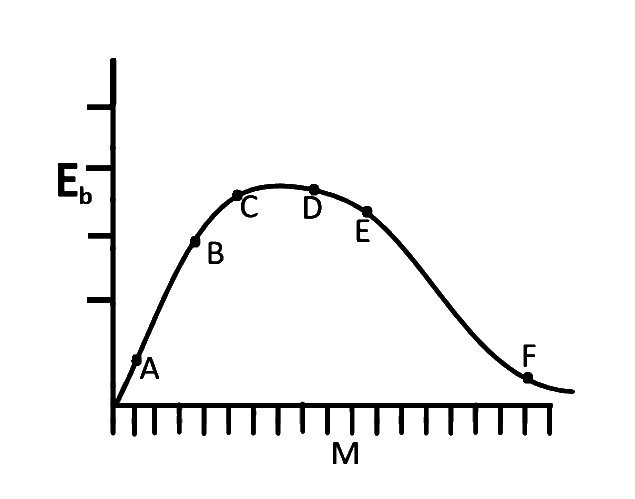
The above is a plot of binding energy per nucleon E b , E_b, E b , M ; A , B , C , D , E , F M; A, B, C, D, E, F M ; A , B , C , D , E , F
( i ) A + B → C + ε ( i i ) C → A + B + ε (i)\ \ A + B \rightarrow C + \varepsilon \quad (ii)\ \ C \rightarrow A + B + \varepsilon ( i ) A + B → C + ε ( ii ) C → A + B + ε
( i i i ) D + E → F + ε ( i v ) F → D + E + ε , (iii)\ \ D + E \rightarrow F + \varepsilon \quad (iv)\ \ F \rightarrow D + E + \varepsilon, ( iii ) D + E → F + ε ( i v ) F → D + E + ε ,
where ε \varepsilon ε ε \varepsilon ε
(a) ( i ) (i) ( i ) ( i i i ) (iii) ( iii ) (b) ( i i ) (ii) ( ii ) ( i v ) (iv) ( i v ) (c) ( i i ) (ii) ( ii ) ( i i i ) (iii) ( iii ) (d) ( i ) (i) ( i ) ( i v ) (iv) ( i v ) Show answer and solution
Answer: (d)
Energy is released (ε > 0 \varepsilon > 0 ε > 0 (i) Light nuclei A + B → C A + B \to C A + B → C E b ( C ) > E b ( A ) , E b ( B ) E_b(C) > E_b(A), E_b(B) E b ( C ) > E b ( A ) , E b ( B ) (ii) is the reverse of (i), so it needs energy. (iv) Heavy F → D + E F \to D + E F → D + E E b ( D ) , E b ( E ) > E b ( F ) E_b(D), E_b(E) > E_b(F) E b ( D ) , E b ( E ) > E b ( F ) So the answer is (d) (i) and (iv). Report a mistake Q70 NEET 2008 · AIPMT Easy ☆
Mass Defect & Binding Energy · Binding energy from masses
If M(A; Z), Mp and Mn denote the masses of the nucleus Z A X , {}_{Z}^{A}X, Z A X ,
(a) M(A, Z) = ZMp + (A − - − − - − (b) M(A, Z) = ZMp + (A − - − (c) M(A, Z) = ZMp + (A − - − − - − (d) M(A, Z) = ZMp + (A − - − Show answer and solution
Answer: (c)
Mass defect: Δ m = Z M p + ( A − Z ) M n − M ( A , Z ) = B E c 2 \Delta m = ZM_p + (A - Z)M_n - M(A, Z) = \dfrac{BE}{c^2} Δ m = Z M p + ( A − Z ) M n − M ( A , Z ) = c 2 BE Rearranging: M ( A , Z ) = Z M p + ( A − Z ) M n − B E c 2 M(A, Z) = ZM_p + (A - Z)M_n - \dfrac{BE}{c^2} M ( A , Z ) = Z M p + ( A − Z ) M n − c 2 BE So the answer is (c). Report a mistake Q71 JEE Main 2008 · AIEEE Easy ☆
Mass Defect & Binding Energy · Binding energy curve & stability
This question contains Statement- 1 and Statement- 2. Of the four choices given after the statements, choose the one that best describes the two statements:
Statement- 1:
Energy is released when heavy nuclei undergo fission or light nuclei undergo fusion. Statement- 2:
For heavy nuclei, binding energy per nucleon increases with increasing Z Z Z Z . Z. Z .
(a) Statement - 1 1 1 2 2 2 (b) Statement - 1 1 1 2 2 2 2 2 2 1 1 1 (c) Statement - 1 1 1 2 2 2 2 2 2 1 1 1 (d) Statement - 1 1 1 2 2 2 Show answer and solution
Answer: (d)
Statement 1: true. Fission of heavy nuclei and fusion of light nuclei both increase B E / A BE/A BE / A Statement 2: false. For heavy nuclei B E / A BE/A BE / A Z Z Z So the answer is (d). Report a mistake Q72 NEET 2007 · AIPMT Easy ☆
Mass Defect & Binding Energy · Binding energy from masses
A nucleus Z A X {}_{Z}^{A}X Z A X
(a) B.E. = [ZMp + (A − - − − - − (b) B.E. = [ZMp + AMp − - − (c) B.E. = M(A, Z) − - − − - − − - − (d) B.E. = [M(A, Z) − - − − - − − - − Show answer and solution
Answer: (a)
Mass defect Δ m = Z M p + ( A − Z ) M n − M ( A , Z ) \Delta m = ZM_p + (A - Z)M_n - M(A, Z) Δ m = Z M p + ( A − Z ) M n − M ( A , Z ) B . E . = Δ m c 2 = [ Z M p + ( A − Z ) M n − M ( A , Z ) ] c 2 B.E. = \Delta m\, c^2 = [ZM_p + (A - Z)M_n - M(A, Z)]c^2 B . E . = Δ m c 2 = [ Z M p + ( A − Z ) M n − M ( A , Z )] c 2 So the answer is (a). Report a mistake Q73 JEE Main 2007 · AIEEE Easy ☆
Mass Defect & Binding Energy · Binding energy from masses
If M O M_O M O 8 O 17 , M p {}_{8}O^{17}, M_p 8 O 17 , M p M N M_N M N
(a) ( M O − 17 M N ) C 2 (M_O - 17M_N)C^{2} ( M O − 17 M N ) C 2 (b) ( M O − 8 M P ) C 2 (M_O - 8M_P)C^{2} ( M O − 8 M P ) C 2 (c) ( M O − 8 M P − 9 M N ) C 2 (M_O - 8M_P - 9M_N)C^{2} ( M O − 8 M P − 9 M N ) C 2 (d) M O c 2 M_O c^{2} M O c 2 Show answer and solution
Answer: (c)
8 O 17 {}_{8}O^{17} 8 O 17 17 − 8 = 9 17 - 8 = 9 17 − 8 = 9 Mass defect Δ m = 8 M P + 9 M N − M O \Delta m = 8M_P + 9M_N - M_O Δ m = 8 M P + 9 M N − M O = Δ m c 2 = \Delta m\, c^2 = Δ m c 2 Option (c) ( M O − 8 M P − 9 M N ) c 2 (M_O - 8M_P - 9M_N)c^2 ( M O − 8 M P − 9 M N ) c 2 So the answer is (c). Report a mistake Q74 NEET 2004 · AIPMT Easy ☆
Mass Defect & Binding Energy · Binding energy from masses
If M(A; Z), Mp and Mn denote the masses of the nucleus Z A X , {}_{Z}^{A}X, Z A X ,
(a) M(A, Z) = ZMp + (A − - − − - − (b) M(A, Z) = ZMp + (A − - − (c) M(A, Z) = ZMp + (A − - − − - − (d) M(A, Z) = ZMp + (A − - − Show answer and solution
Answer: (c)
Mass defect: Δ m = Z M p + ( A − Z ) M n − M ( A , Z ) = B E c 2 \Delta m = ZM_p + (A - Z)M_n - M(A, Z) = \dfrac{BE}{c^2} Δ m = Z M p + ( A − Z ) M n − M ( A , Z ) = c 2 BE Rearranging: M ( A , Z ) = Z M p + ( A − Z ) M n − B E c 2 M(A, Z) = ZM_p + (A - Z)M_n - \dfrac{BE}{c^2} M ( A , Z ) = Z M p + ( A − Z ) M n − c 2 BE So the answer is (c). Report a mistake Q75 NEET 2003 · AIPMT Medium ☆
Mass Defect & Binding Energy · Binding energy from masses
The mass of proton is 1.0073 u and that of neutron is 1.0087 u (u = atomic mass unit). The binding energy of 2 4 {}_{2}^{4} 2 4
(Given helium nucleus mass ≈ \approx ≈
(a) 0.0305 J (b) 0.0305 erg (c) 28.4 MeV (d) 0.061 u Show answer and solution
Answer: (c)
Δ m = 2 ( 1.0073 ) + 2 ( 1.0087 ) − 4.0015 = 0.0305 \Delta m = 2(1.0073) + 2(1.0087) - 4.0015 = 0.0305 Δ m = 2 ( 1.0073 ) + 2 ( 1.0087 ) − 4.0015 = 0.0305 B E = 0.0305 × 931 ≈ 28.4 BE = 0.0305 \times 931 \approx 28.4 BE = 0.0305 × 931 ≈ 28.4 So the answer is (c) 28.4 MeV. Report a mistake Q76 JEE Main 2002 · AIEEE Easy ☆
Mass Defect & Binding Energy · Mass-energy equivalence & atomic mass unit
If mass-energy equivalence is taken into account, when water is cooled to form ice, the mass of water should
(a) increase (b) remain unchanged (c) decrease (d) first increase then decrease Show answer and solution
Answer: (c)
Water gives out latent heat when it freezes, so ice has less energy than the water. Δ m = Δ E c 2 \Delta m = \dfrac{\Delta E}{c^2} Δ m = c 2 Δ E So the answer is (c) decrease. Report a mistake Q77 NEET 2001 · AIPMT Easy ☆
Mass Defect & Binding Energy · Mass defect
Mn and Mp represent the mass of neutron and proton respectively. An element having mass M has N neutrons and Z protons, then the correct relation will be
(a) M < {N ⋅ \cdot ⋅ ⋅ \cdot ⋅ (b) M > {N ⋅ \cdot ⋅ ⋅ \cdot ⋅ (c) M = {N ⋅ \cdot ⋅ ⋅ \cdot ⋅ (d) M = N {Mn + Mp} Show answer and solution
Answer: (a)
When nucleons bind, energy is released, so the nucleus is lighter than its separate nucleons (mass defect). Δ m = ( N M n + Z M p ) − M > 0 \Delta m = (N M_n + Z M_p) - M > 0 Δ m = ( N M n + Z M p ) − M > 0 So the answer is (a) M < N M n + Z M p M < N M_n + Z M_p M < N M n + Z M p Report a mistake Q78 NEET 1993 · AIPMT Easy ☆
Mass Defect & Binding Energy · Binding energy curve & stability
The binding energy per nucleon is maximum in case of
(a) 2 4 He {}_{2}^{4}\text{He} 2 4 He (b) 26 56 Fe {}_{26}^{56}\text{Fe} 26 56 Fe (c) 56 141 Ba {}_{56}^{141}\text{Ba} 56 141 Ba (d) 92 235 U {}_{92}^{235}\text{U} 92 235 U Show answer and solution
Answer: (b)
On the binding energy curve B E / A BE/A BE / A 8.8 8.8 8.8 A = 56 A = 56 A = 56 He-4 (≈ 7.1 \approx 7.1 ≈ 7.1 ≈ 7.6 \approx 7.6 ≈ 7.6 So the answer is (b) 26 56 Fe {}_{26}^{56}\text{Fe} 26 56 Fe Report a mistake Q79 NEET 1992 · AIPMT Easy ☆
Mass Defect & Binding Energy · Mass-energy equivalence & atomic mass unit
The energy equivalent of one atomic mass unit is
(a) 1.6 × 1 0 − 19 J 1.6 \times 10^{-19}\text{ J} 1.6 × 1 0 − 19 J (b) 6.02 × 1 0 23 J 6.02 \times 10^{23}\text{ J} 6.02 × 1 0 23 J (c) 931 MeV (d) 9.31 MeV Show answer and solution
Answer: (c)
1 u = 1.66 × 1 0 − 27 1\ \text{u} = 1.66 \times 10^{-27} 1 u = 1.66 × 1 0 − 27 E = m c 2 = 1.66 × 1 0 − 27 × 9 × 1 0 16 = 1.49 × 1 0 − 10 E = mc^2 = 1.66 \times 10^{-27} \times 9 \times 10^{16} = 1.49 \times 10^{-10} E = m c 2 = 1.66 × 1 0 − 27 × 9 × 1 0 16 = 1.49 × 1 0 − 10 E = 1.49 × 1 0 − 10 1.6 × 1 0 − 13 MeV ≈ 931 E = \dfrac{1.49 \times 10^{-10}}{1.6 \times 10^{-13}}\ \text{MeV} \approx 931 E = 1.6 × 1 0 − 13 1.49 × 1 0 − 10 MeV ≈ 931 So the answer is (c) 931 MeV. Report a mistake Q80 NEET 1992 · AIPMT Easy ☆
Mass Defect & Binding Energy · Mass defect
The mass of α \alpha α
(a) less than the sum of masses of two protons and two neutrons (b) equal to mass of four protons (c) equal to mass of four neutrons (d) equal to sum of masses of two protons and two neutrons Show answer and solution
Answer: (a)
An α \alpha α Binding energy 28.3 28.3 28.3 m α < 2 m p + 2 m n m_\alpha < 2m_p + 2m_n m α < 2 m p + 2 m n So the answer is (a). Report a mistake Q81 NEET 1989 · AIPMT Easy ☆
Mass Defect & Binding Energy · Binding energy curve & stability
The average binding energy of a nucleon inside an atomic nucleus is about
(a) 8 MeV (b) 8 eV (c) 8 J (d) 8 erg Show answer and solution
Answer: (a)
For most nuclei B E / A BE/A BE / A So the average is about 8 MeV, answer (a). Report a mistake Q82 MHT CET 2026 · 20 MAY · SHIFT 1 Easy ☆
Nuclear Reactions & Q-value · Balancing nuclear reactions
Which one of the following is possible nuclear reaction?
(a) 5 B 10 + 2 He 4 → 7 N 13 + 1 H 1 {}_{5}\text{B}^{10} + {}_{2}\text{He}^{4} \rightarrow {}_{7}\text{N}^{13} + {}_{1}\text{H}^{1} 5 B 10 + 2 He 4 → 7 N 13 + 1 H 1 (b) 11 Na 23 + 1 H 1 → 10 Ne 20 + 2 He 4 {}_{11}\text{Na}^{23} + {}_{1}\text{H}^{1} \rightarrow {}_{10}\text{Ne}^{20} + {}_{2}\text{He}^{4} 11 Na 23 + 1 H 1 → 10 Ne 20 + 2 He 4 (c) 93 Np 239 → 94 Pu 239 + − 1 e 0 {}_{93}\text{Np}^{239} \rightarrow {}_{94}\text{Pu}^{239} + {}_{-1}\text{e}^{0} 93 Np 239 → 94 Pu 239 + − 1 e 0 (d) 7 N 11 + 1 H 1 → 6 C 12 + − 1 e 0 {}_{7}\text{N}^{11} + {}_{1}\text{H}^{1} \rightarrow {}_{6}\text{C}^{12} + {}_{-1}\text{e}^{0} 7 N 11 + 1 H 1 → 6 C 12 + − 1 e 0 Show answer and solution
Answer: (c)
A nuclear reaction must conserve mass number A A A Z Z Z (a) A : 14 → 14 A: 14 \to 14 A : 14 → 14 Z : 7 → 8 Z: 7 \to 8 Z : 7 → 8 Z : 8 → 5 Z: 8 \to 5 Z : 8 → 5 (b) A : 24 → 24 A: 24 \to 24 A : 24 → 24 Z : 12 → 12 Z: 12 \to 12 Z : 12 → 12 (c) A : 239 → 239 A: 239 \to 239 A : 239 → 239 Z : 93 → 94 − 1 = 93 Z: 93 \to 94 - 1 = 93 Z : 93 → 94 − 1 = 93 β − \beta^- β − So the answer is (c), the β − \beta^- β − 93 Np 239 → 94 Pu 239 + e − {}_{93}\text{Np}^{239} \to {}_{94}\text{Pu}^{239} + e^- 93 Np 239 → 94 Pu 239 + e − Report a mistake Q83 NEET 2026 · RE-NEET Medium ☆
Nuclear Reactions & Q-value · Q-value from masses
Consider the following nuclear reaction
238 U ⟶ 234 Th + 4 He {}^{238}\text{U} \longrightarrow {}^{234}\text{Th} + {}^{4}\text{He} 238 U ⟶ 234 Th + 4 He
Take masses of 238 U , 234 Th {}^{238}\text{U}, {}^{234}\text{Th} 238 U , 234 Th 4 He {}^{4}\text{He} 4 He 238.050 u , 234.043 u 238.050\text{u}, 234.043\text{u} 238.050 u , 234.043 u Q Q Q
[Given: 1 u = 931.5 MeV c − 2 1\text{u} = 931.5\text{ MeV c}^{-2} 1 u = 931.5 MeV c − 2
(a) 3740 (b) 3726 (c) 3730 (d) 3736 Show answer and solution
Answer: (b)
Δ m = 238.050 − ( 234.043 + 4.003 ) = 0.004 u \Delta m = 238.050 - (234.043 + 4.003) = 0.004\ \text{u} Δ m = 238.050 − ( 234.043 + 4.003 ) = 0.004 u Q = 0.004 × 931.5 = 3.726 MeV Q = 0.004 \times 931.5 = 3.726\ \text{MeV} Q = 0.004 × 931.5 = 3.726 MeV So the answer is (b) 3726 keV 3726\ \text{keV} 3726 keV Report a mistake Q84 JEE Main 2026 · 22 JAN · SHIFT 1 Medium ☆
Nuclear Reactions & Q-value · Q-value from masses
The minimum frequency of photon required to break a particle of mass 15.348 amu into 4 α 4\alpha 4 α ______ kHz.
[mass of He nucleus = 4.002 amu , 1 amu = 1.66 × 1 0 − 27 kg , h = 6.6 × 1 0 − 34 J.s 4.002\text{ amu}, 1\text{ amu} = 1.66 \times 10^{-27}\text{ kg}, \text{h} = 6.6 \times 10^{-34}\text{ J.s} 4.002 amu , 1 amu = 1.66 × 1 0 − 27 kg , h = 6.6 × 1 0 − 34 J.s c = 3 × 1 0 8 m/s \text{c} = 3 \times 10^{8}\text{ m/s} c = 3 × 1 0 8 m/s
(a) 14.94 × 1 0 20 14.94 \times 10^{20} 14.94 × 1 0 20 (b) 9 × 1 0 19 9 \times 10^{19} 9 × 1 0 19 (c) 9 × 1 0 20 9 \times 10^{20} 9 × 1 0 20 (d) 14.94 × 1 0 19 14.94 \times 10^{19} 14.94 × 1 0 19 Show answer and solution
Answer: (d)
Mass defect to supply: Δ m = 4 ( 4.002 ) − 15.348 = 0.660 amu \Delta m = 4(4.002) - 15.348 = 0.660\ \text{amu} Δ m = 4 ( 4.002 ) − 15.348 = 0.660 amu E = Δ m c 2 = 0.660 × 1.66 × 1 0 − 27 × 9 × 1 0 16 = 9.86 × 1 0 − 11 J E = \Delta m\,c^2 = 0.660 \times 1.66 \times 10^{-27} \times 9 \times 10^{16} = 9.86 \times 10^{-11}\ \text{J} E = Δ m c 2 = 0.660 × 1.66 × 1 0 − 27 × 9 × 1 0 16 = 9.86 × 1 0 − 11 J ν = E h = 9.86 × 1 0 − 11 6.6 × 1 0 − 34 = 1.494 × 1 0 23 Hz \nu = \dfrac{E}{h} = \dfrac{9.86 \times 10^{-11}}{6.6 \times 10^{-34}} = 1.494 \times 10^{23}\ \text{Hz} ν = h E = 6.6 × 1 0 − 34 9.86 × 1 0 − 11 = 1.494 × 1 0 23 Hz = 1.494 × 1 0 20 kHz = 14.94 × 1 0 19 kHz = 1.494 \times 10^{20}\ \text{kHz} = 14.94 \times 10^{19}\ \text{kHz} = 1.494 × 1 0 20 kHz = 14.94 × 1 0 19 kHz So the answer is (d). Report a mistake Q85 JEE Main 2026 · 8 APR · SHIFT 2 Medium ☆
Nuclear Reactions & Q-value · Recoil & sharing of energy
Two radioactive substances A and B of mass numbers 200 and 212 respectively, shows spontaneous α \alpha α Q Q Q α \alpha α ______ .
(a) 2548 2650 \frac{2548}{2650} 2650 2548 (b) 2706 2646 \frac{2706}{2646} 2646 2706 (c) 2597 2600 \frac{2597}{2600} 2600 2597 (d) 2862 2499 \frac{2862}{2499} 2499 2862 Show answer and solution
Answer: (c)
In α \alpha α K α = Q A − 4 A K_\alpha = Q\,\dfrac{A - 4}{A} K α = Q A A − 4 K A = 1 × 196 200 K_A = 1 \times \dfrac{196}{200} K A = 1 × 200 196 K B = 1 × 208 212 K_B = 1 \times \dfrac{208}{212} K B = 1 × 212 208 K A K B = 196 × 212 200 × 208 = 41552 41600 = 2597 2600 \dfrac{K_A}{K_B} = \dfrac{196 \times 212}{200 \times 208} = \dfrac{41552}{41600} = \dfrac{2597}{2600} K B K A = 200 × 208 196 × 212 = 41600 41552 = 2600 2597 So the answer is (c) 2597 2600 \dfrac{2597}{2600} 2600 2597 Report a mistake Q86 JEE Main 2026 · 6 APR · SHIFT 1 Difficult ☆
Nuclear Reactions & Q-value · Q-value from masses
The energy released when 7 17.13 kg \frac{7}{17.13}\text{ kg} 17.13 7 kg 3 7 Li {}^{7}_{3}\text{Li} 3 7 Li 2 4 He {}^{4}_{2}\text{He} 2 4 He α × 1 0 32 eV \alpha \times 10^{32}\text{ eV} α × 1 0 32 eV α \alpha α ______ . (Nearest integer) (Mass of 3 7 Li = 7.0183 u {}^{7}_{3}\text{Li} = 7.0183\text{u} 3 7 Li = 7.0183 u 2 4 He = 4.004 u {}^{4}_{2}\text{He} = 4.004\text{u} 2 4 He = 4.004 u = 1.008 u = 1.008\text{u} = 1.008 u 1 u = 931 MeV/c 2 1\text{u} = 931\text{ MeV/c}^{2} 1 u = 931 MeV/c 2 = 6.0 × 1 0 23 = 6.0 \times 10^{23} = 6.0 × 1 0 23
Numerical answer type. Work it out, then open the answer.
Show answer and solution
Answer: 6
Δ m = 7.0183 + 1.008 − 2 ( 4.004 ) = 0.0183 u \Delta m = 7.0183 + 1.008 - 2(4.004) = 0.0183\ \text{u} Δ m = 7.0183 + 1.008 − 2 ( 4.004 ) = 0.0183 u Q = 0.0183 × 931 = 17.04 MeV Q = 0.0183 \times 931 = 17.04\ \text{MeV} Q = 0.0183 × 931 = 17.04 MeV Moles of Li = 7000 / 17.13 g 7 g/mol = 58.38 = \dfrac{7000/17.13\ \text{g}}{7\ \text{g/mol}} = 58.38 = 7 g/mol 7000/17.13 g = 58.38 = 58.38 × 6.0 × 1 0 23 = 3.50 × 1 0 25 = 58.38 \times 6.0 \times 10^{23} = 3.50 \times 10^{25} = 58.38 × 6.0 × 1 0 23 = 3.50 × 1 0 25 E = 3.50 × 1 0 25 × 17.04 × 1 0 6 eV = 5.97 × 1 0 32 eV E = 3.50 \times 10^{25} \times 17.04 \times 10^{6}\ \text{eV} = 5.97 \times 10^{32}\ \text{eV} E = 3.50 × 1 0 25 × 17.04 × 1 0 6 eV = 5.97 × 1 0 32 eV So α ≈ 6 \alpha \approx 6 α ≈ 6 Report a mistake Q87 MHT CET 2025 · 20 APR · SHIFT 1 Easy ☆
Nuclear Reactions & Q-value · Balancing nuclear reactions
For the following reaction, the particle ' X ' is
6 C 11 ⟶ 5 B 11 + β + X {}_{6}\text{C}^{11} \longrightarrow {}_{5}\text{B}^{11} + \beta + \text{X} 6 C 11 ⟶ 5 B 11 + β + X
(a) proton (b) neutrino (c) anti neutrino (d) neutron Show answer and solution
Answer: (b)
Z Z Z A A A β + \beta^+ β + p → n + e + + ν p \to n + e^+ + \nu p → n + e + + ν So the answer is (b) neutrino. Report a mistake Q88 JEE Main 2024 · 9 APR · SHIFT 2 Easy ☆
Nuclear Reactions & Q-value · Recoil & sharing of energy
A nucleus at rest disintegrates into two smaller nuclei with their masses in the ratio of 2 : 1 2 : 1 2 : 1
(a) in opposite directions with speed in the ratio of 1 : 2 1 : 2 1 : 2 (b) in the same direction with same speed. (c) in opposite directions with speed in the ratio of 2 : 1 2 : 1 2 : 1 (d) in opposite directions with the same speed. Show answer and solution
Answer: (a)
Initial momentum is zero, so m 1 v 1 = m 2 v 2 m_1 v_1 = m_2 v_2 m 1 v 1 = m 2 v 2 v 1 v 2 = m 2 m 1 = 1 2 \dfrac{v_1}{v_2} = \dfrac{m_2}{m_1} = \dfrac{1}{2} v 2 v 1 = m 1 m 2 = 2 1 So the answer is (a) opposite directions with speeds in the ratio 1 : 2 1 : 2 1 : 2 Report a mistake Q89 JEE Main 2023 · 13 APR · SHIFT 1 Medium ☆
Nuclear Reactions & Q-value · Q-value from masses
92 238 A → 90 234 B + 2 4 D + Q {}^{238}_{92}A \rightarrow {}^{234}_{90}B + {}^{4}_{2}D + Q 92 238 A → 90 234 B + 2 4 D + Q
In the given nuclear reaction, the approximate amount of energy released will be: [Given, mass of 92 238 A = 238.05079 × 931.5 MeV/c 2 , {}^{238}_{92}\text{A} = 238.05079 \times 931.5\text{ MeV/c}^{2}, 92 238 A = 238.05079 × 931.5 MeV/c 2 ,
mass of 90 234 B = 234.04363 × 931.5 MeV/c 2 , {}^{234}_{90}B = 234.04363 \times 931.5\text{ MeV/c}^{2}, 90 234 B = 234.04363 × 931.5 MeV/c 2 ,
mass of 2 4 D = 4.00260 × 931.5 MeV/c 2 ] {}^{4}_{2}D = 4.00260 \times 931.5\text{ MeV/c}^{2}] 2 4 D = 4.00260 × 931.5 MeV/c 2 ]
(a) 2.12 MeV (b) 4.25 MeV (c) 3.82 MeV (d) 5.9 MeV Show answer and solution
Answer: (b)
Δ m = 238.05079 − ( 234.04363 + 4.00260 ) = 0.00456 u \Delta m = 238.05079 - (234.04363 + 4.00260) = 0.00456\ \text{u} Δ m = 238.05079 − ( 234.04363 + 4.00260 ) = 0.00456 u Q = 0.00456 × 931.5 ≈ 4.25 MeV Q = 0.00456 \times 931.5 \approx 4.25\ \text{MeV} Q = 0.00456 × 931.5 ≈ 4.25 MeV So the answer is (b) 4.25 MeV 4.25\ \text{MeV} 4.25 MeV Report a mistake Q90 JEE Main 2023 · 12 APR · SHIFT 1 Medium ☆
Nuclear Reactions & Q-value · Q-value from masses
A common example of alpha decay is 92 238 U ⟶ 90 234 Th + 2 He 4 + Q {}^{238}_{92}\text{U} \longrightarrow {}^{234}_{90}\text{Th} + {}_{2}\text{He}^{4} + \text{Q} 92 238 U ⟶ 90 234 Th + 2 He 4 + Q
Given:
92 238 U = 238.05060 u {}^{238}_{92}\text{U} = 238.05060\text{ u} 92 238 U = 238.05060 u
90 234 Th = 234.04360 u {}^{234}_{90}\text{Th} = 234.04360\text{ u} 90 234 Th = 234.04360 u
2 4 He = 4.00260 u {}^{4}_{2}\text{He} = 4.00260\text{ u} 2 4 He = 4.00260 u
1 u = 931.5 MeV c 2 1\text{u} = 931.5\frac{\text{MeV}}{c^{2}} 1 u = 931.5 c 2 MeV
The energy released ( Q ) (Q) ( Q ) 92 238 U {}^{238}_{92}\text{U} 92 238 U
Numerical answer type. Work it out, then open the answer.
Show answer and solution
Answer: 4
Δ m = 238.05060 − ( 234.04360 + 4.00260 ) = 0.00440 u \Delta m = 238.05060 - (234.04360 + 4.00260) = 0.00440\ \text{u} Δ m = 238.05060 − ( 234.04360 + 4.00260 ) = 0.00440 u Q = 0.00440 × 931.5 = 4.10 MeV Q = 0.00440 \times 931.5 = 4.10\ \text{MeV} Q = 0.00440 × 931.5 = 4.10 MeV So Q ≈ 4 MeV Q \approx 4\ \text{MeV} Q ≈ 4 MeV Report a mistake Q91 NEET 2022 · PHASE 1 Easy Old syllabus ☆
Nuclear Reactions & Q-value · Balancing nuclear reactions
In the given nuclear reaction, the element X is
11 22 N a → X + e + + ν {}_{11}^{22}Na \rightarrow X + e^{+} + \nu 11 22 N a → X + e + + ν
(a) 11 23 N a {}_{11}^{23}Na 11 23 N a (b) 10 23 N e {}_{10}^{23}Ne 10 23 N e (c) 10 22 N e {}_{10}^{22}Ne 10 22 N e (d) 12 22 M g {}_{12}^{22}Mg 12 22 M g Show answer and solution
Answer: (c)
β + \beta^+ β + A A A Z Z Z e + e^+ e + ν \nu ν A = 22 A = 22 A = 22 Z = 11 − 1 = 10 Z = 11 - 1 = 10 Z = 11 − 1 = 10 So the answer is (c) 10 22 Ne {}_{10}^{22}\text{Ne} 10 22 Ne Report a mistake Q92 JEE Main 2022 · 26 JUL · SHIFT 2 Easy ☆
Nuclear Reactions & Q-value · Recoil & sharing of energy
A nucleus of mass M M M M ′ 3 \frac{M'}{3} 3 M ′ 2 M ′ 3 ( M ′ < M ) \frac{2M'}{3}\,(M' < M) 3 2 M ′ ( M ′ < M )
(a) 1: 2 (b) 2: 1 (c) 1: 1 (d) 2: 3 Show answer and solution
Answer: (c)
Momentum conservation from rest: p 1 = p 2 p_1 = p_2 p 1 = p 2 λ = h p \lambda = \dfrac{h}{p} λ = p h So the answer is (c) 1 : 1 1 : 1 1 : 1 Report a mistake Q93 JEE Main 2022 · 28 JUN · SHIFT 1 Medium ☆
Nuclear Reactions & Q-value · Q-value from masses
The Q-value of a nuclear reaction and kinetic energy of the projectile particle, Kp are related as:
(a) Q = Kp (b) (Kp + Q) < 0 (c) Q < Kp (d) (Kp + Q) > 0 Show answer and solution
Answer: (d)
Total kinetic energy of the products = K p + Q = K_p + Q = K p + Q Product kinetic energy cannot be negative (it must be positive for products to move apart), so the reaction can occur only if K p + Q > 0 K_p + Q > 0 K p + Q > 0 So the answer is (d) ( K p + Q ) > 0 (K_p + Q) > 0 ( K p + Q ) > 0 Report a mistake Q94 JEE Main 2021 · 22 JUL · SHIFT 2 Medium ☆
Nuclear Reactions & Q-value · Recoil & sharing of energy
A nucleus with mass number 184 initially at rest emits an α \alpha α α \alpha α
(a) 5.5 MeV (b) 5.0 MeV (c) 5.38 MeV (d) 0.12 MeV Show answer and solution
Answer: (c)
K α = Q A − 4 A K_\alpha = Q\,\dfrac{A - 4}{A} K α = Q A A − 4 K α = 5.5 × 180 184 = 5.38 MeV K_\alpha = 5.5 \times \dfrac{180}{184} = 5.38\ \text{MeV} K α = 5.5 × 184 180 = 5.38 MeV So the answer is (c) 5.38 MeV 5.38\ \text{MeV} 5.38 MeV Report a mistake Q95 JEE Main 2021 · 20 JUL · SHIFT 1 Medium ☆
Nuclear Reactions & Q-value · Recoil & sharing of energy
A nucleus of mass M emits γ \gamma γ
[Take 'c' as the speed of electromagnetic wave]
(a) hv (b) h v [ 1 + h v 2 M c 2 ] hv\left[1 + \frac{hv}{2Mc^{2}}\right] h v [ 1 + 2 M c 2 h v ] (c) h v [ 1 − h v 2 M c 2 ] hv\left[1 - \frac{hv}{2Mc^{2}}\right] h v [ 1 − 2 M c 2 h v ] (d) 0 Show answer and solution
Answer: (b)
Internal energy lost = = = + + + Recoil: p = h ν c p = \dfrac{h\nu}{c} p = c h ν K = p 2 2 M = h 2 ν 2 2 M c 2 K = \dfrac{p^2}{2M} = \dfrac{h^2\nu^2}{2Mc^2} K = 2 M p 2 = 2 M c 2 h 2 ν 2 Loss = h ν + h 2 ν 2 2 M c 2 = h ν [ 1 + h ν 2 M c 2 ] = h\nu + \dfrac{h^2\nu^2}{2Mc^2} = h\nu\left[1 + \dfrac{h\nu}{2Mc^2}\right] = h ν + 2 M c 2 h 2 ν 2 = h ν [ 1 + 2 M c 2 h ν ] So the answer is (b). Report a mistake Q96 JEE Main 2020 · 6 SEP · SHIFT 1 Difficult ☆
Nuclear Reactions & Q-value · Q-value from masses
You are given that Mass of 3 7 L i {}^{7}_{3}Li 3 7 L i
Mass of 2 4 H e {}^{4}_{2}He 2 4 He
and Mass of 1 1 H {}^{1}_{1}H 1 1 H
When 20 g of 3 7 L i {}^{7}_{3}Li 3 7 L i 2 4 H e {}^{4}_{2}He 2 4 He
(a) 6.82 × \times × (b) 4.5 × \times × (c) 8 × \times × (d) 1.33 × \times × Show answer and solution
Answer: (d)
3 7 L i + 1 1 H → 2 2 4 H e {}^{7}_{3}Li + {}^{1}_{1}H \to 2\,{}^{4}_{2}He 3 7 L i + 1 1 H → 2 2 4 He Δ m = 7.0160 + 1.0079 − 2 ( 4.0026 ) = 0.0187 u \Delta m = 7.0160 + 1.0079 - 2(4.0026) = 0.0187\ \text{u} Δ m = 7.0160 + 1.0079 − 2 ( 4.0026 ) = 0.0187 u Energy per reaction = 0.0187 × 931.5 ≈ 17.4 MeV = 0.0187 \times 931.5 \approx 17.4\ \text{MeV} = 0.0187 × 931.5 ≈ 17.4 MeV Number of Li nuclei in 20 g = 20 7 × 6.02 × 1 0 23 = 1.72 × 1 0 24 = \dfrac{20}{7} \times 6.02 \times 10^{23} = 1.72 \times 10^{24} = 7 20 × 6.02 × 1 0 23 = 1.72 × 1 0 24 E = 1.72 × 1 0 24 × 17.4 × 1.6 × 1 0 − 13 J ≈ 4.8 × 1 0 12 J E = 1.72 \times 10^{24} \times 17.4 \times 1.6 \times 10^{-13}\ \text{J} \approx 4.8 \times 10^{12}\ \text{J} E = 1.72 × 1 0 24 × 17.4 × 1.6 × 1 0 − 13 J ≈ 4.8 × 1 0 12 J In kWh: 4.8 × 1 0 12 3.6 × 1 0 6 ≈ 1.33 × 1 0 6 kWh \dfrac{4.8 \times 10^{12}}{3.6 \times 10^{6}} \approx 1.33 \times 10^{6}\ \text{kWh} 3.6 × 1 0 6 4.8 × 1 0 12 ≈ 1.33 × 1 0 6 kWh So the answer is (d) 1.33 × 1 0 6 kWh 1.33 \times 10^{6}\ \text{kWh} 1.33 × 1 0 6 kWh Report a mistake Q97 NEET 2015 · AIPMT Medium ☆
Nuclear Reactions & Q-value · Recoil & sharing of energy
A nucleus of uranium decays at rest into nuclei of thorium and helium. Then
(a) The helium nucleus has more momentum than the thorium nucleus. (b) The helium nucleus has less kinetic energy than the thorium nucleus. (c) The helium nucleus has more kinetic energy than the thorium nucleus. (d) The helium nucleus has less momentum than the thorium nucleus. Show answer and solution
Answer: (c)
From rest, momentum conservation gives p H e = p T h p_{He} = p_{Th} p He = p T h K = p 2 2 m K = \dfrac{p^2}{2m} K = 2 m p 2 So the answer is (c). Report a mistake Q98 NEET 2014 · AIPMT Medium ☆
Nuclear Reactions & Q-value · Q-value from binding energies
The binding energy per nucleon of 3 7 L i {}^{7}_{3}Li 3 7 L i 2 4 H e {}^{4}_{2}He 2 4 He
3 7 L i + 1 1 H → 2 4 H e + 2 4 H e + Q {}^{7}_{3}Li + {}^{1}_{1}H \rightarrow {}^{4}_{2}He + {}^{4}_{2}He + Q 3 7 L i + 1 1 H → 2 4 He + 2 4 He + Q
the value of energy Q released is
(a) 19.6 MeV (b) − - − (c) 8.4 MeV (d) 17.3 MeV Show answer and solution
Answer: (d)
Q Q Q − - − BE of 2 4 He = 8 × 7.06 = 56.48 MeV 2\,{}^{4}\text{He} = 8 \times 7.06 = 56.48\ \text{MeV} 2 4 He = 8 × 7.06 = 56.48 MeV 7 Li = 7 × 5.60 = 39.20 MeV {}^{7}\text{Li} = 7 \times 5.60 = 39.20\ \text{MeV} 7 Li = 7 × 5.60 = 39.20 MeV Q = 56.48 − 39.20 = 17.28 MeV Q = 56.48 - 39.20 = 17.28\ \text{MeV} Q = 56.48 − 39.20 = 17.28 MeV So the answer is (d) 17.3 MeV 17.3\ \text{MeV} 17.3 MeV Report a mistake Q99 NEET 2011 · AIPMT · PRELIMS Medium Old syllabus ☆
Nuclear Reactions & Q-value · Recoil & sharing of energy
A radioactive nucleus of mass M emits a photon of frequency v v v
(a) Mc2 − - − v v v (b) h2v v v (c) zero (d) hv v v Show answer and solution
Answer: (b)
Photon momentum p = h ν c p = \dfrac{h\nu}{c} p = c h ν K = p 2 2 M = h 2 ν 2 2 M c 2 K = \dfrac{p^2}{2M} = \dfrac{h^2\nu^2}{2Mc^2} K = 2 M p 2 = 2 M c 2 h 2 ν 2 So the answer is (b) h 2 ν 2 2 M c 2 \dfrac{h^2\nu^2}{2Mc^2} 2 M c 2 h 2 ν 2 Report a mistake Q100 JEE Main 2010 · AIEEE Difficult ☆
Nuclear Reactions & Q-value · Recoil & sharing of energy
A nucleus of mass M + Δ m M + \Delta m M + Δ m M 2 \frac{M}{2} 2 M c . c. c .
The binding energy per nucleon for the parent nucleus is E 1 E_{1} E 1 E 2 . E_{2}. E 2 .
(a) E 2 = 2 E 1 E_{2} = 2E_{1} E 2 = 2 E 1 (b) E 1 > E 2 E_{1} > E_{2} E 1 > E 2 (c) E 2 > E 1 E_{2} > E_{1} E 2 > E 1 (d) E 1 = 2 E 2 E_{1} = 2E_{2} E 1 = 2 E 2 Show answer and solution
Answer: (c)
Mass decreases (Δ m \Delta m Δ m Energy is released only if the products are more tightly bound per nucleon. So the answer is (c) E 2 > E 1 E_2 > E_1 E 2 > E 1 Report a mistake Q101 JEE Main 2010 · AIEEE Difficult ☆
Nuclear Reactions & Q-value · Recoil & sharing of energy
A nucleus of mass M + Δ m M + \Delta m M + Δ m M 2 \frac{M}{2} 2 M c . c. c .
The speed of daughter nuclei is
(a) c Δ m M + Δ m c\frac{\Delta m}{M + \Delta m} c M + Δ m Δ m (b) c 2 Δ m M c\sqrt{\frac{2\Delta m}{M}} c M 2Δ m (c) c Δ m M c\sqrt{\frac{\Delta m}{M}} c M Δ m (d) c Δ m M + Δ m c\sqrt{\frac{\Delta m}{M + \Delta m}} c M + Δ m Δ m Show answer and solution
Answer: (b)
Energy released Δ m c 2 \Delta m\,c^2 Δ m c 2 Δ m c 2 = 2 × 1 2 M 2 v 2 = M v 2 2 \Delta m\,c^2 = 2 \times \dfrac{1}{2}\dfrac{M}{2}v^2 = \dfrac{M v^2}{2} Δ m c 2 = 2 × 2 1 2 M v 2 = 2 M v 2 v = c 2 Δ m M v = c\sqrt{\dfrac{2\Delta m}{M}} v = c M 2Δ m So the answer is (b). Report a mistake Q102 JEE Main 2006 · AIEEE Easy ☆
Nuclear Reactions & Q-value · Balancing nuclear reactions
When 3 L i 7 {}_{3}Li^{7} 3 L i 7 4 B e 8 {}_{4}Be^{8} 4 B e 8
(a) alpha particles (b) beta particles (c) gamma photons (d) neutrons Show answer and solution
Answer: (c)
3 L i 7 + 1 H 1 → 4 B e 8 + X {}_{3}Li^{7} + {}_{1}H^{1} \to {}_{4}Be^{8} + X 3 L i 7 + 1 H 1 → 4 B e 8 + X A A A 8 = 8 + A X ⇒ A X = 0 8 = 8 + A_X \Rightarrow A_X = 0 8 = 8 + A X ⇒ A X = 0 Z Z Z 4 = 4 + Z X ⇒ Z X = 0 4 = 4 + Z_X \Rightarrow Z_X = 0 4 = 4 + Z X ⇒ Z X = 0 A particle with A = 0 A = 0 A = 0 Z = 0 Z = 0 Z = 0 So the answer is (c) gamma photons. Report a mistake Q103 JEE Main 2006 · AIEEE Medium ☆
Nuclear Reactions & Q-value · Q-value from binding energies
If the binding energy per nucleon in 3 7 L i {}^{7}_{3}Li 3 7 L i 2 4 H e {}^{4}_{2}He 2 4 He 5.60 MeV 5.60\text{ MeV} 5.60 MeV 7.06 MeV 7.06\text{ MeV} 7.06 MeV
p + 3 7 L i → 2 2 4 H e p + {}^{7}_{3}Li \rightarrow 2\,{}^{4}_{2}He p + 3 7 L i → 2 2 4 He
energy of proton must be
(a) 28.24 MeV 28.24\text{ MeV} 28.24 MeV (b) 17.28 MeV 17.28\text{ MeV} 17.28 MeV (c) 1.46 MeV 1.46\text{ MeV} 1.46 MeV (d) 39.2 MeV 39.2\text{ MeV} 39.2 MeV Show answer and solution
Answer: (b)
Energy released = 8 ( 7.06 ) − 7 ( 5.60 ) = 56.48 − 39.20 = 17.28 MeV = 8(7.06) - 7(5.60) = 56.48 - 39.20 = 17.28\ \text{MeV} = 8 ( 7.06 ) − 7 ( 5.60 ) = 56.48 − 39.20 = 17.28 MeV The intended answer is this Q Q Q So the answer is (b) 17.28 MeV 17.28\ \text{MeV} 17.28 MeV Report a mistake Q104 JEE Main 2005 · AIEEE Easy ☆
Nuclear Reactions & Q-value · Balancing nuclear reactions
A nuclear transformation is denoted by X ( n , α ) 3 7 L i . X\,(n, \alpha)\,{}_{3}^{7}Li. X ( n , α ) 3 7 L i . X X X
(a) 5 10 B {}_{5}^{10}B 5 10 B (b) 12 C 6 {}^{12}C_{6} 12 C 6 (c) 4 11 B e {}_{4}^{11}Be 4 11 B e (d) 5 9 B {}_{5}^{9}B 5 9 B Show answer and solution
Answer: (a)
X + 0 1 n → 3 7 L i + 2 4 H e X + {}_{0}^{1}n \to {}_{3}^{7}Li + {}_{2}^{4}He X + 0 1 n → 3 7 L i + 2 4 He A = 7 + 4 − 1 = 10 A = 7 + 4 - 1 = 10 A = 7 + 4 − 1 = 10 Z = 3 + 2 = 5 Z = 3 + 2 = 5 Z = 3 + 2 = 5 So the answer is (a) 5 10 B {}_{5}^{10}B 5 10 B Report a mistake Q105 NEET 2005 · AIPMT Easy ☆
Nuclear Reactions & Q-value · Q-value from binding energies
In the reaction 1 2 {}_{1}^{2} 1 2 1 3 {}_{1}^{3} 1 3 → 2 4 \rightarrow {}_{2}^{4} → 2 4 0 1 {}_{0}^{1} 0 1
energies of 1 2 {}_{1}^{2} 1 2 1 3 {}_{1}^{3} 1 3 2 4 {}_{2}^{4} 2 4
then the energy (in MeV) released in this reaction is
(a) a + b + c (b) a + b − - − (c) c − - − − - − (d) c + a − - − Show answer and solution
Answer: (c)
Energy released = = = − - − The neutron has zero binding energy, so Q = c − ( a + b ) Q = c - (a + b) Q = c − ( a + b ) So the answer is (c) c − a − b c - a - b c − a − b Report a mistake Q106 JEE Main 2003 · AIEEE Easy Old syllabus ☆
Nuclear Reactions & Q-value · Recoil & sharing of energy
When a U 238 U^{238} U 238 ′ u ′ , {}^{\prime}u^{\prime}, ′ u ′ ,
(a) 4 u 238 \frac{4u}{238} 238 4 u (b) − 4 u 234 -\frac{4u}{234} − 234 4 u (c) 4 u 234 \frac{4u}{234} 234 4 u (d) − 4 μ 238 -\frac{4\mu}{238} − 238 4 μ Show answer and solution
Answer: (c)
U 238 → T h 234 + α U^{238} \to Th^{234} + \alpha U 238 → T h 234 + α 4 u = 234 v 4u = 234\,v 4 u = 234 v v = 4 u 234 v = \dfrac{4u}{234} v = 234 4 u So the answer is (c) 4 u 234 \dfrac{4u}{234} 234 4 u Report a mistake Q107 NEET 2002 · AIPMT Easy ☆
Nuclear Reactions & Q-value · Balancing nuclear reactions
A deuteron is bombarded on 8O16 nucleus then α \alpha α
(a) 7N13 (b) 5B10 (c) 4Be9 (d) 7N14 Show answer and solution
Answer: (d)
8 O 16 + 1 H 2 → Z X A + 2 He 4 {}_{8}\text{O}^{16} + {}_{1}\text{H}^{2} \to {}_{Z}\text{X}^{A} + {}_{2}\text{He}^{4} 8 O 16 + 1 H 2 → Z X A + 2 He 4 A = 16 + 2 − 4 = 14 A = 16 + 2 - 4 = 14 A = 16 + 2 − 4 = 14 Z = 8 + 1 − 2 = 7 Z = 8 + 1 - 2 = 7 Z = 8 + 1 − 2 = 7 So the answer is (d) 7 N 14 {}_{7}\text{N}^{14} 7 N 14 Report a mistake Q108 NEET 2001 · AIPMT Easy ☆
Nuclear Reactions & Q-value · Balancing nuclear reactions
X(n, α \alpha α 3 7 {}_{3}^{7} 3 7
(a) 5 10 {}_{5}^{10} 5 10 (b) 5 9 {}_{5}^{9} 5 9 (c) 5 11 {}_{5}^{11} 5 11 (d) 2 4 {}_{2}^{4} 2 4 Show answer and solution
Answer: (a)
X ( n , α ) 3 7 Li X(n,\alpha){}_{3}^{7}\text{Li} X ( n , α ) 3 7 Li X + 0 1 n → 3 7 Li + 2 4 He X + {}_{0}^{1}n \to {}_{3}^{7}\text{Li} + {}_{2}^{4}\text{He} X + 0 1 n → 3 7 Li + 2 4 He A = 7 + 4 − 1 = 10 A = 7 + 4 - 1 = 10 A = 7 + 4 − 1 = 10 Z = 3 + 2 − 0 = 5 Z = 3 + 2 - 0 = 5 Z = 3 + 2 − 0 = 5 So the answer is (a) 5 10 B {}_{5}^{10}\text{B} 5 10 B Report a mistake Q109 NEET 2000 · AIPMT Easy Old syllabus ☆
Nuclear Reactions & Q-value · Balancing nuclear reactions
For the given reaction, the particle X is
6 C 11 → 5 B 11 + β + + X {}_{6}C^{11} \rightarrow {}_{5}B^{11} + \beta^{+} + X 6 C 11 → 5 B 11 + β + + X
(a) neutron (b) anti neutrino (c) neutrino (d) proton Show answer and solution
Answer: (c)
6 C 11 → 5 B 11 + β + {}_{6}C^{11} \to {}_{5}B^{11} + \beta^+ 6 C 11 → 5 B 11 + β + p → n + e + + ν p \to n + e^+ + \nu p → n + e + + ν A A A Z Z Z X X X So the answer is (c) neutrino. Report a mistake Q110 JEE Main 2026 · 6 APR · SHIFT 2 Easy ☆
Nuclear Fission & Fusion · Nuclear fusion & energy of stars
The energy released if hydrogen atoms are combined to form 2 4 He {}^{4}_{2}\text{He} 2 4 He ______ MeV. (Take binding energies per nucleon of 1 2 H {}^{2}_{1}\text{H} 1 2 H 2 4 He {}^{4}_{2}\text{He} 2 4 He
Show answer and solution
Answer: (b)
The reaction is 2 1 2 H → 2 4 He 2\,{}^2_1\text{H} \to {}^4_2\text{He} 2 1 2 H → 2 4 He Q = BE(product) − BE(reactants) Q = \text{BE(product)} - \text{BE(reactants)} Q = BE(product) − BE(reactants) BE of 4 He = 4 × 7.2 = 28.8 MeV {}^4\text{He} = 4\times7.2 = 28.8\text{ MeV} 4 He = 4 × 7.2 = 28.8 MeV 2 H = 2 × 2 × 1.1 = 4.4 MeV {}^2\text{H} = 2\times2\times1.1 = 4.4\text{ MeV} 2 H = 2 × 2 × 1.1 = 4.4 MeV Q = 28.8 − 4.4 = 24.4 MeV Q = 28.8 - 4.4 = 24.4\text{ MeV} Q = 28.8 − 4.4 = 24.4 MeV So the answer is (b) 24.4 24.4 24.4 Report a mistake Q111 JEE Main 2026 · 23 JAN · SHIFT 2 Medium ☆
Nuclear Fission & Fusion · Fission: reaction & energy released
The average energy released per fission for the nucleus of 92 235 U {}^{235}_{92}\text{U} 92 235 U 92 235 U {}^{235}_{92}\text{U} 92 235 U α × 1 0 23 MeV \alpha \times 10^{23}\text{ MeV} α × 1 0 23 MeV α \alpha α ______ . (Avogadro Number = 6 × 1 0 23 = 6 \times 10^{23} = 6 × 1 0 23
Numerical answer type. Work it out, then open the answer.
Show answer and solution
Answer: 228
Moles = 47 235 = 0.2 = \dfrac{47}{235} = 0.2 = 235 47 = 0.2 N = 0.2 × 6 × 1 0 23 = 1.2 × 1 0 23 N = 0.2\times6\times10^{23} = 1.2\times10^{23} N = 0.2 × 6 × 1 0 23 = 1.2 × 1 0 23 E = 1.2 × 1 0 23 × 190 = 228 × 1 0 23 MeV E = 1.2\times10^{23}\times190 = 228\times10^{23}\text{ MeV} E = 1.2 × 1 0 23 × 190 = 228 × 1 0 23 MeV So α = 228 \alpha = 228 α = 228 Report a mistake Q112 JEE Main 2026 · 4 APR · SHIFT 1 Medium ☆
Nuclear Fission & Fusion · Nuclear fusion & energy of stars
Two nuclei of mass number 3 combine with another nucleus of mass number 4 to yield a nucleus of mass number 10. If the binding energy per nucleon for the mass numbers 3,4 and 10 are 5.6 MeV , 7.4 MeV 5.6\text{ MeV}, 7.4\text{ MeV} 5.6 MeV , 7.4 MeV Δ Mc 2 = ‾ \Delta \text{Mc}^{2} = \underline{\qquad} Δ Mc 2 =
Show answer and solution
Answer: (c)
BE of reactants = 2 × 3 × 5.6 + 4 × 7.4 = 33.6 + 29.6 = 63.2 MeV = 2\times3\times5.6 + 4\times7.4 = 33.6 + 29.6 = 63.2\text{ MeV} = 2 × 3 × 5.6 + 4 × 7.4 = 33.6 + 29.6 = 63.2 MeV BE of product = 10 × 6.1 = 61.0 MeV = 10\times6.1 = 61.0\text{ MeV} = 10 × 6.1 = 61.0 MeV Δ M c 2 = ∣ 61.0 − 63.2 ∣ = 2.2 MeV \Delta Mc^2 = |61.0 - 63.2| = 2.2\text{ MeV} Δ M c 2 = ∣61.0 − 63.2∣ = 2.2 MeV So the answer is (c) 2.2 2.2 2.2 Report a mistake Q113 JEE Main 2025 · 2 APR · SHIFT 2 Easy ☆
Nuclear Fission & Fusion · Nuclear fusion & energy of stars
Energy released when two deuterons ( 1 H 2 ) \left({}_{1}\text{H}^{2}\right) ( 1 H 2 ) ( 2 He 4 ) \left({}_{2}\text{He}^{4}\right) ( 2 He 4 ) 1 H 2 = 1.1 MeV {}_{1}\text{H}^{2} = 1.1\text{ MeV} 1 H 2 = 1.1 MeV 2 He 4 = 7.0 MeV {}_{2}\text{He}^{4} = 7.0\text{ MeV} 2 He 4 = 7.0 MeV
(a) 26.8 MeV (b) 8.1 MeV (c) 23.6 MeV (d) 5.9 MeV Show answer and solution
Answer: (c)
Q = 4 × 7.0 − 2 × ( 2 × 1.1 ) Q = 4\times7.0 - 2\times(2\times1.1) Q = 4 × 7.0 − 2 × ( 2 × 1.1 ) Q = 28.0 − 4.4 = 23.6 MeV Q = 28.0 - 4.4 = 23.6\text{ MeV} Q = 28.0 − 4.4 = 23.6 MeV So the answer is (c) 23.6 MeV 23.6\text{ MeV} 23.6 MeV Report a mistake Q114 JEE Main 2025 · 3 APR · SHIFT 1 Medium ☆
Nuclear Fission & Fusion · Fission: reaction & energy released
Match the LIST-I with LIST-II
Choose the correct answer from the options given below:
List - I List - II A. 0 1 n + 92 235 U → 54 140 Xe + 38 94 Sr + 2 0 1 n {}^{1}_{0}\text{n} + {}^{235}_{92}\text{U} \rightarrow {}^{140}_{54}\text{Xe} + {}^{94}_{38}\text{Sr} + 2\,{}^{1}_{0}\text{n} 0 1 n + 92 235 U → 54 140 Xe + 38 94 Sr + 2 0 1 n I. Chemical reaction B. 2 H 2 + O 2 → 2 H 2 O 2\text{H}_{2} + \text{O}_{2} \rightarrow 2\text{H}_{2}\text{O} 2 H 2 + O 2 → 2 H 2 O II. Fusion with +ve Q value C. 1 2 H + 1 2 H → 2 3 He + 0 1 n {}^{2}_{1}\text{H} + {}^{2}_{1}\text{H} \rightarrow {}^{3}_{2}\text{He} + {}^{1}_{0}\text{n} 1 2 H + 1 2 H → 2 3 He + 0 1 n III. Fission D. 1 1 H + 1 3 H → 1 2 H + 1 2 H {}^{1}_{1}\text{H} + {}^{3}_{1}\text{H} \rightarrow {}^{2}_{1}\text{H} + {}^{2}_{1}\text{H} 1 1 H + 1 3 H → 1 2 H + 1 2 H IV. Fusion with -ve Q value
(a) A-II, B-I, C-III, D-IV (b) A-III, B-I, C-II, D-IV (c) A-III, B-I, C-IV, D-II (d) A-II, B-I, C-IV, D-III Show answer and solution
Answer: (b)
A: a neutron splits 235 U {}^{235}\text{U} 235 U B: hydrogen and oxygen form water, a chemical reaction (I). C: D + D → 3 He + n \text{D}+\text{D} \to {}^3\text{He} + n D + D → 3 He + n 3.3 MeV 3.3\text{ MeV} 3.3 MeV D: 1 H + 3 H → 2 2 H {}^1\text{H} + {}^3\text{H} \to 2\,{}^2\text{H} 1 H + 3 H → 2 2 H So the answer is (b) A-III, B-I, C-II, D-IV. Report a mistake Q115 JEE Main 2024 · 8 APR · SHIFT 2 Easy ☆
Nuclear Fission & Fusion · Fission: reaction & energy released
In a hypothetical fission reaction
92 X 236 → 56 Y 141 + 36 Z 92 + 3 R {}_{92}X^{236} \rightarrow {}_{56}\text{Y}^{141} + {}_{36}Z^{92} + 3R 92 X 236 → 56 Y 141 + 36 Z 92 + 3 R
The identity of emitted particles (R) is:
(a) Proton (b) Neutron (c) Electron (d) γ \gamma γ Show answer and solution
Answer: (b)
A A A 236 = 141 + 92 + 3 A R ⇒ A R = 1 236 = 141 + 92 + 3A_R \Rightarrow A_R = 1 236 = 141 + 92 + 3 A R ⇒ A R = 1 Z Z Z 92 = 56 + 36 + 3 Z R ⇒ Z R = 0 92 = 56 + 36 + 3Z_R \Rightarrow Z_R = 0 92 = 56 + 36 + 3 Z R ⇒ Z R = 0 A particle with A = 1 A = 1 A = 1 Z = 0 Z = 0 Z = 0 So the answer is (b) Neutron. Report a mistake Q116 JEE Main 2024 · 4 APR · SHIFT 1 Easy ☆
Nuclear Fission & Fusion · Fission: reaction & energy released
Which of the following nuclear fragments corresponding to nuclear fission between neutron ( 0 1 n ) \left({}^{1}_{0}\text{n}\right) ( 0 1 n ) ( 92 235 U ) \left({}^{235}_{92}\text{U}\right) ( 92 235 U )
(a) 56 140 Xe + 38 94 Sr + 3 0 1 n {}^{140}_{56}\text{Xe} + {}^{94}_{38}\text{Sr} + 3\,{}^{1}_{0}\text{n} 56 140 Xe + 38 94 Sr + 3 0 1 n (b) 51 153 Sb + 41 99 Nb + 3 0 1 n {}^{153}_{51}\text{Sb} + {}^{99}_{41}\text{Nb} + 3\,{}^{1}_{0}\text{n} 51 153 Sb + 41 99 Nb + 3 0 1 n (c) 56 144 Ba + 36 89 Kr + 4 0 1 n {}^{144}_{56}\text{Ba} + {}^{89}_{36}\text{Kr} + 4\,{}^{1}_{0}\text{n} 56 144 Ba + 36 89 Kr + 4 0 1 n (d) 56 144 Ba + 36 89 Kr + 3 0 1 n {}^{144}_{56}\text{Ba} + {}^{89}_{36}\text{Kr} + 3\,{}^{1}_{0}\text{n} 56 144 Ba + 36 89 Kr + 3 0 1 n Show answer and solution
Answer: (d)
Reactants: A = 235 + 1 = 236 A = 235 + 1 = 236 A = 235 + 1 = 236 Z = 92 Z = 92 Z = 92 (a) A = 237 A = 237 A = 237 A = 237 A = 237 A = 237 Z = 92 Z = 92 Z = 92 A = 255 A = 255 A = 255 (d) A = 144 + 89 + 3 = 236 A = 144 + 89 + 3 = 236 A = 144 + 89 + 3 = 236 Z = 56 + 36 = 92 Z = 56 + 36 = 92 Z = 56 + 36 = 92 So the answer is (d). Report a mistake Q117 NEET 2024 Easy ☆
Nuclear Fission & Fusion · Nuclear reactor & power output
Water is used as a coolant in a nuclear reactor because of its
(a) high thermal expansion coefficient (b) high specific heat capacity (c) low density (d) low boiling point Show answer and solution
Answer: (b)
A coolant must carry away a large amount of heat for a small rise in its own temperature. Water has a very high specific heat capacity, so it absorbs much heat per kg per degree. So the answer is (b) high specific heat capacity. Report a mistake Q118 JEE Main 2024 · 4 APR · SHIFT 2 Medium ☆
Nuclear Fission & Fusion · Fission: reaction & energy released
The disintegration energy Q Q Q 235 U → 140 Ce + 94 Zr + n {}^{235}\text{U} \rightarrow {}^{140}\text{Ce} + {}^{94}\text{Zr} + n 235 U → 140 Ce + 94 Zr + n MeV \text{MeV} MeV 235 U : 235.0439 u ; 140 Ce : 139.9054 u , 94 Zr : 93.9063 u ; n : 1.0086 u {}^{235}\text{U} : 235.0439u;\ {}^{140}\text{Ce} : 139.9054u,\ {}^{94}\text{Zr} : 93.9063u;\ n : 1.0086u 235 U : 235.0439 u ; 140 Ce : 139.9054 u , 94 Zr : 93.9063 u ; n : 1.0086 u c 2 = 931 MeV/u c^{2} = 931\text{ MeV/u} c 2 = 931 MeV/u
Numerical answer type. Work it out, then open the answer.
Show answer and solution
Answer: 208
Q = [ m U − ( m C e + m Z r + m n ) ] c 2 Q = [m_U - (m_{Ce} + m_{Zr} + m_n)]\,c^2 Q = [ m U − ( m C e + m Z r + m n )] c 2 Products: 139.9054 + 93.9063 + 1.0086 = 234.8203 u 139.9054 + 93.9063 + 1.0086 = 234.8203\text{ u} 139.9054 + 93.9063 + 1.0086 = 234.8203 u Δ m = 235.0439 − 234.8203 = 0.2236 u \Delta m = 235.0439 - 234.8203 = 0.2236\text{ u} Δ m = 235.0439 − 234.8203 = 0.2236 u Q = 0.2236 × 931 ≈ 208 MeV Q = 0.2236\times931 \approx 208\text{ MeV} Q = 0.2236 × 931 ≈ 208 MeV Report a mistake Q119 JEE Main 2024 · 27 JAN · SHIFT 1 Medium ☆
Nuclear Fission & Fusion · Fission: reaction & energy released
In a nuclear fission process, a high mass nuclide ( A ≈ 236 ) (A \approx 236) ( A ≈ 236 ) 7.6 MeV/ 7.6\text{ MeV/} 7.6 MeV/ ( A ≈ 118 ) (\text{A} \approx 118) ( A ≈ 118 ) 8.6 MeV/Nucleon 8.6\text{ MeV/Nucleon} 8.6 MeV/Nucleon MeV \text{MeV} MeV
Numerical answer type. Work it out, then open the answer.
Show answer and solution
Answer: 236
Q = BE(products) − BE(parent) Q = \text{BE(products)} - \text{BE(parent)} Q = BE(products) − BE(parent) BE of products = 2 × 118 × 8.6 = 236 × 8.6 = 2\times118\times8.6 = 236\times8.6 = 2 × 118 × 8.6 = 236 × 8.6 = 236 × 7.6 = 236\times7.6 = 236 × 7.6 Q = 236 × ( 8.6 − 7.6 ) = 236 MeV Q = 236\times(8.6 - 7.6) = 236\text{ MeV} Q = 236 × ( 8.6 − 7.6 ) = 236 MeV Report a mistake Q120 JEE Main 2024 · 29 JAN · SHIFT 1 Medium ☆
Nuclear Fission & Fusion · Nuclear fusion & energy of stars
The explosive in a Hydrogen bomb is a mixture of 1 H 2 , 1 H 3 {}_{1}\text{H}^{2}, {}_{1}\text{H}^{3} 1 H 2 , 1 H 3 3 Li 6 {}_{3}\text{Li}^{6} 3 Li 6
3 Li 6 + 0 n 1 → 2 He 4 + 1 H 3 {}_{3}\text{Li}^{6} + {}_{0}\text{n}^{1} \rightarrow {}_{2}\text{He}^{4} + {}_{1}\text{H}^{3} 3 Li 6 + 0 n 1 → 2 He 4 + 1 H 3
1 H 2 + 1 H 3 → 2 He 4 + 0 n 1 {}_{1}\text{H}^{2} + {}_{1}\text{H}^{3} \rightarrow {}_{2}\text{He}^{4} + {}_{0}\text{n}^{1} 1 H 2 + 1 H 3 → 2 He 4 + 0 n 1
During the explosion the energy released is approximately
[Given; M(Li) = 6.01690 amu , M ( 1 H 2 ) = 2.01471 amu , M ( 2 He 4 ) = 4.00388 amu \text{M(Li)} = 6.01690\text{ amu}, \text{M}\left({}_{1}\text{H}^{2}\right) = 2.01471\text{ amu}, \text{M}\left({}_{2}\text{He}^{4}\right) = 4.00388\text{ amu} M(Li) = 6.01690 amu , M ( 1 H 2 ) = 2.01471 amu , M ( 2 He 4 ) = 4.00388 amu 1 amu = 931.5 MeV ] 1\text{ amu} = 931.5\text{ MeV}] 1 amu = 931.5 MeV ]
(a) 22.22 MeV (b) 28.12 MeV (c) 16.48 MeV (d) 12.64 MeV Show answer and solution
Answer: (a)
Adding the two reactions, n n n 3 H {}^3\text{H} 3 H 6 Li + 2 H → 2 4 He {}^6\text{Li} + {}^2\text{H} \to 2\,{}^4\text{He} 6 Li + 2 H → 2 4 He Δ m = 6.01690 + 2.01471 − 2 × 4.00388 = 8.03161 − 8.00776 = 0.02385 amu \Delta m = 6.01690 + 2.01471 - 2\times4.00388 = 8.03161 - 8.00776 = 0.02385\text{ amu} Δ m = 6.01690 + 2.01471 − 2 × 4.00388 = 8.03161 − 8.00776 = 0.02385 amu E = 0.02385 × 931.5 ≈ 22.22 MeV E = 0.02385\times931.5 \approx 22.22\text{ MeV} E = 0.02385 × 931.5 ≈ 22.22 MeV So the answer is (a) 22.22 MeV 22.22\text{ MeV} 22.22 MeV Report a mistake Q121 JEE Main 2024 · 5 APR · SHIFT 1 Medium ☆
Nuclear Fission & Fusion · Nuclear fusion & energy of stars
If three helium nuclei combine to form a carbon nucleus then the energy released in this reaction is ________ × 1 0 − 2 MeV \times 10^{-2}\text{ MeV} × 1 0 − 2 MeV 1 u = 931 MeV/c 2 1\text{u} = 931\text{ MeV/c}^{2} 1 u = 931 MeV/c 2 = 4.002603 u = 4.002603\text{u} = 4.002603 u
Numerical answer type. Work it out, then open the answer.
Show answer and solution
Answer: 727
3 4 He → 12 C 3\,{}^4\text{He} \to {}^{12}\text{C} 3 4 He → 12 C 12 C = 12 u {}^{12}\text{C} = 12\text{ u} 12 C = 12 u Δ m = 3 × 4.002603 − 12 = 0.007809 u \Delta m = 3\times4.002603 - 12 = 0.007809\text{ u} Δ m = 3 × 4.002603 − 12 = 0.007809 u E = 0.007809 × 931 ≈ 7.27 MeV = 727 × 1 0 − 2 MeV E = 0.007809\times931 \approx 7.27\text{ MeV} = 727\times10^{-2}\text{ MeV} E = 0.007809 × 931 ≈ 7.27 MeV = 727 × 1 0 − 2 MeV Report a mistake Q122 JEE Main 2024 · 30 JAN · SHIFT 2 Difficult ☆
Nuclear Fission & Fusion · Fission: reaction & energy released
In a nuclear fission reaction of an isotope of mass M M M Δ M \Delta M Δ M
(a) c 3 Δ M M c\sqrt{\frac{3\Delta M}{M}} c M 3Δ M (b) Δ M c 2 3 \frac{\Delta Mc^{2}}{3} 3 Δ M c 2 (c) c 2 Δ M M c\sqrt{\frac{2\Delta M}{M}} c M 2Δ M (d) 2 c Δ M M \sqrt{\frac{2c\Delta M}{M}} M 2 c Δ M Show answer and solution
Answer: (c)
Each daughter has mass M 3 \tfrac{M}{3} 3 M v v v Total kinetic energy = Δ M c 2 = \Delta M c^2 = Δ M c 2 3 × 1 2 ⋅ M 3 v 2 = 1 2 M v 2 = Δ M c 2 3\times\tfrac{1}{2}\cdot\tfrac{M}{3}v^2 = \tfrac{1}{2}Mv^2 = \Delta M c^2 3 × 2 1 ⋅ 3 M v 2 = 2 1 M v 2 = Δ M c 2 v = c 2 Δ M M v = c\sqrt{\dfrac{2\Delta M}{M}} v = c M 2Δ M So the answer is (c). Report a mistake Q123 JEE Main 2024 · 9 APR · SHIFT 2 Difficult ☆
Nuclear Fission & Fusion · Nuclear fusion & energy of stars
The energy released in the fusion of 2 kg 2\text{ kg} 2 kg E H E_{H} E H 2 kg 2\text{ kg} 2 kg 235 U {}^{235}\text{U} 235 U E U E_{U} E U E H E U \frac{E_{H}}{E_{U}} E U E H 4 1 1 H + 2 e − → 2 4 He + 2 v + 6 γ + 26.7 MeV 4\,{}^{1}_{1}H + 2\text{e}^{-} \rightarrow {}^{4}_{2}\text{He} + 2v + 6\gamma + 26.7\text{ MeV} 4 1 1 H + 2 e − → 2 4 He + 2 v + 6 γ + 26.7 MeV 235 U {}^{235}\text{U} 235 U 200 MeV 200\text{ MeV} 200 MeV N A = 6.023 × 1 0 23 ) \text{N}_{\text{A}} = 6.023 \times 10^{23}) N A = 6.023 × 1 0 23 )
(a) 7.62 (b) 25.6 (c) 9.13 (d) 15.04 Show answer and solution
Answer: (a)
Fusion: 26.7 MeV 26.7\text{ MeV} 26.7 MeV = 26.7 4 N A = 6.675 N A MeV = \dfrac{26.7}{4}N_A = 6.675\,N_A\text{ MeV} = 4 26.7 N A = 6.675 N A MeV Fission: 200 MeV 200\text{ MeV} 200 MeV = 200 235 N A = 0.851 N A MeV = \dfrac{200}{235}N_A = 0.851\,N_A\text{ MeV} = 235 200 N A = 0.851 N A MeV E H E U = 6.675 0.851 ≈ 7.8 \dfrac{E_H}{E_U} = \dfrac{6.675}{0.851} \approx 7.8 E U E H = 0.851 6.675 ≈ 7.8 7.62 7.62 7.62 So the answer is (a) 7.62 7.62 7.62 Report a mistake Q124 JEE Main 2024 · 9 APR · SHIFT 1 Difficult ☆
Nuclear Fission & Fusion · Nuclear fusion & energy of stars
A star has 100 % 100\% 100% 4 He {}^{4}\text{He} 4 He 12 C {}^{12}\text{C} 12 C 4 He + 4 He + 4 He → 12 C + Q {}^{4}\text{He} + {}^{4}\text{He} + {}^{4}\text{He} \rightarrow {}^{12}\text{C} + \text{Q} 4 He + 4 He + 4 He → 12 C + Q 2.0 × 1 0 32 kg 2.0 \times 10^{32}\text{ kg} 2.0 × 1 0 32 kg 5.808 × 1 0 30 W 5.808 \times 10^{30}\text{ W} 5.808 × 1 0 30 W 4 He {}^{4}\text{He} 4 He 12 C {}^{12}\text{C} 12 C n × 1 0 42 s − 1 \text{n} \times 10^{42}\text{ s}^{-1} n × 1 0 42 s − 1 n \text{n} n 4 He = 4.0026 u {}^{4}\text{He} = 4.0026\text{u} 4 He = 4.0026 u 12 C = 12 u {}^{12}\text{C} = 12\text{u} 12 C = 12 u
Numerical answer type. Work it out, then open the answer.
Show answer and solution
Answer: 5
Δ m = 3 × 4.0026 − 12 = 0.0078 u \Delta m = 3\times4.0026 - 12 = 0.0078\text{ u} Δ m = 3 × 4.0026 − 12 = 0.0078 u Q = 0.0078 × 931.5 ≈ 7.27 MeV ≈ 1.16 × 1 0 − 12 J Q = 0.0078\times931.5 \approx 7.27\text{ MeV} \approx 1.16\times10^{-12}\text{ J} Q = 0.0078 × 931.5 ≈ 7.27 MeV ≈ 1.16 × 1 0 − 12 J Reactions per second = P Q = 5.808 × 1 0 30 1.16 × 1 0 − 12 ≈ 5 × 1 0 42 s − 1 = \dfrac{P}{Q} = \dfrac{5.808\times10^{30}}{1.16\times10^{-12}} \approx 5\times10^{42}\text{ s}^{-1} = Q P = 1.16 × 1 0 − 12 5.808 × 1 0 30 ≈ 5 × 1 0 42 s − 1 So n = 5 n = 5 n = 5 Report a mistake Q125 JEE Main 2023 · 8 APR · SHIFT 1 Easy ☆
Nuclear Fission & Fusion · Fission: reaction & energy released
A nucleus with mass number 242 and binding energy per nucleon as 7.6 MeV 7.6\text{ MeV} 7.6 MeV 8.1 MeV 8.1\text{ MeV} 8.1 MeV MeV \text{MeV} MeV
Numerical answer type. Work it out, then open the answer.
Show answer and solution
Answer: 121
Gain in BE = 242 × ( 8.1 − 7.6 ) = 242 \times (8.1 - 7.6) = 242 × ( 8.1 − 7.6 ) = 242 × 0.5 = 121 MeV = 242 \times 0.5 = 121\ \text{MeV} = 242 × 0.5 = 121 MeV Report a mistake Q126 JEE Main 2023 · 24 JAN · SHIFT 2 Easy ☆
Nuclear Fission & Fusion · Fission: reaction & energy released
The energy released per fission of nucleus of 240 {}^{240} 240 240 {}^{240} 240 × \times × 25 {}^{25} 25
(Given N A = 6 × 1 0 23 \text{N}_{\text{A}} = 6 \times 10^{23} N A = 6 × 1 0 23
Numerical answer type. Work it out, then open the answer.
Show answer and solution
Answer: 6
Number of moles = 120 240 = 0.5 = \dfrac{120}{240} = 0.5 = 240 120 = 0.5 N = 0.5 × 6 × 1 0 23 = 3 × 1 0 23 N = 0.5 \times 6\times10^{23} = 3\times10^{23} N = 0.5 × 6 × 1 0 23 = 3 × 1 0 23 Total energy E = N × 200 MeV = 3 × 1 0 23 × 200 = 6 × 1 0 25 MeV E = N \times 200\text{ MeV} = 3\times10^{23}\times 200 = 6\times10^{25}\text{ MeV} E = N × 200 MeV = 3 × 1 0 23 × 200 = 6 × 1 0 25 MeV So the answer is 6 6 6 Report a mistake Q127 JEE Main 2022 · 24 JUN · SHIFT 1 Easy ☆
Nuclear Fission & Fusion · Fission: reaction & energy released
Nucleus A is having mass number 220 and its binding energy per nucleon is 5.6 MeV. It splits into two fragments 'B' and 'C' of mass numbers 105 and 115. The binding energy of nucleons in 'B' and 'C' is 6.4 MeV per nucleon. The energy Q released per fission will be:
(a) 0.8 MeV (b) 275 MeV (c) 220 MeV (d) 176 MeV Show answer and solution
Answer: (d)
Q = Q = Q = − - − = 220 × 6.4 − 220 × 5.6 = 220 \times 6.4 - 220 \times 5.6 = 220 × 6.4 − 220 × 5.6 105 + 115 = 220 105 + 115 = 220 105 + 115 = 220 Q = 220 × 0.8 = 176 MeV Q = 220 \times 0.8 = 176\ \text{MeV} Q = 220 × 0.8 = 176 MeV So the answer is (d) 176 MeV 176\ \text{MeV} 176 MeV Report a mistake Q128 JEE Main 2022 · 26 JUL · SHIFT 2 Easy ☆
Nuclear Fission & Fusion · Nuclear fusion & energy of stars
Two lighter nuclei combine to form a comparatively heavier nucleus by the relation given below: 1 2 X + 1 2 X = 2 4 Y {}^{2}_{1}X + {}^{2}_{1}X = {}^{4}_{2}Y 1 2 X + 1 2 X = 2 4 Y
The binding energies per nucleon for 1 2 X {}^{2}_{1}X 1 2 X 2 4 Y {}^{4}_{2}Y 2 4 Y 1.1 MeV 1.1\text{ MeV} 1.1 MeV 7.6 MeV 7.6\text{ MeV} 7.6 MeV MeV \text{MeV} MeV
Numerical answer type. Work it out, then open the answer.
Show answer and solution
Answer: 26
Q = BE ( Y ) − 2 BE ( X ) Q = \text{BE}(Y) - 2\,\text{BE}(X) Q = BE ( Y ) − 2 BE ( X ) BE of Y = 4 × 7.6 = 30.4 MeV Y = 4\times7.6 = 30.4\text{ MeV} Y = 4 × 7.6 = 30.4 MeV X = 2 × 2 × 1.1 = 4.4 MeV X = 2\times2\times1.1 = 4.4\text{ MeV} X = 2 × 2 × 1.1 = 4.4 MeV Q = 30.4 − 4.4 = 26 MeV Q = 30.4 - 4.4 = 26\text{ MeV} Q = 30.4 − 4.4 = 26 MeV Report a mistake Q129 NEET 2021 Easy ☆
Nuclear Fission & Fusion · Fission: reaction & energy released
A nucleus with mass number 240 breaks into two fragments each of mass number 120, the binding per nucleon of unfragmented nuclei is 7.6MeV while that of fragments is 8.5MeV. The total gain in the Binding Energy in the process is:
(a) 216MeV (b) 0.9MeV (c) 9.4MeV (d) 804MeV Show answer and solution
Answer: (a)
Gain in BE = 240 × ( 8.5 − 7.6 ) = 240 \times (8.5 - 7.6) = 240 × ( 8.5 − 7.6 ) = 240 × 0.9 = 216 MeV = 240 \times 0.9 = 216\ \text{MeV} = 240 × 0.9 = 216 MeV So the answer is (a) 216 MeV 216\ \text{MeV} 216 MeV Report a mistake Q130 NEET 2020 · PHASE 1 Easy Old syllabus ☆
Nuclear Fission & Fusion · Fission: reaction & energy released
When a uranium isotope 92 235 U {}^{235}_{92}U 92 235 U 36 89 K r {}^{89}_{36}Kr 36 89 Kr
(a) 40 91 Z r {}^{91}_{40}Zr 40 91 Z r (b) 36 101 K r {}^{101}_{36}Kr 36 101 Kr (c) 36 103 K r {}^{103}_{36}Kr 36 103 Kr (d) 56 144 B a {}^{144}_{56}Ba 56 144 B a Show answer and solution
Answer: (d)
92 235 U + 0 1 n → 36 89 K r + 3 0 1 n + X {}^{235}_{92}U + {}^{1}_{0}n \to {}^{89}_{36}Kr + 3\,{}^{1}_{0}n + X 92 235 U + 0 1 n → 36 89 Kr + 3 0 1 n + X A = 236 − 89 − 3 = 144 A = 236 - 89 - 3 = 144 A = 236 − 89 − 3 = 144 Z = 92 − 36 = 56 Z = 92 - 36 = 56 Z = 92 − 36 = 56 So the answer is (d) 56 144 B a {}^{144}_{56}Ba 56 144 B a Report a mistake Q131 JEE Main 2020 · 2 SEP · SHIFT 1 Medium ☆
Nuclear Fission & Fusion · Nuclear reactor & power output
In a reactor, 2 kg of 92U235 fuel is fully used up in 30 days. The energy released per fission is 200 MeV. Given that the Avogadro number, N = 6.023 × \times ×
(a) 125 MW (b) 60 MW (c) 54 MW (d) 35 MW Show answer and solution
Answer: (b)
Nuclei in 2 kg: N = 2 235 × 6.023 × 1 0 26 ≈ 5.13 × 1 0 24 N = \dfrac{2}{235}\times6.023\times10^{26} \approx 5.13\times10^{24} N = 235 2 × 6.023 × 1 0 26 ≈ 5.13 × 1 0 24 Energy E = N × 200 × 1.6 × 1 0 − 13 J ≈ 1.64 × 1 0 14 J E = N\times200\times1.6\times10^{-13}\text{ J} \approx 1.64\times10^{14}\text{ J} E = N × 200 × 1.6 × 1 0 − 13 J ≈ 1.64 × 1 0 14 J Time t = 30 × 86400 = 2.59 × 1 0 6 s t = 30\times86400 = 2.59\times10^{6}\text{ s} t = 30 × 86400 = 2.59 × 1 0 6 s P = E t ≈ 6.3 × 1 0 7 W ≈ 60 MW P = \dfrac{E}{t} \approx 6.3\times10^{7}\text{ W} \approx 60\text{ MW} P = t E ≈ 6.3 × 1 0 7 W ≈ 60 MW So the answer is (b) 60 MW 60\text{ MW} 60 MW Report a mistake Q132 JEE Main 2019 · 10 JAN · SHIFT 2 Medium ☆
Nuclear Fission & Fusion · Fission: reaction & energy released
Consider the nuclear fission
Ne20 → \rightarrow →
Given that the binding energy/ nucleon of Ne20, He4 and C12 are, respectively, 8.03 MeV, 7.07 MeV and 7.86 MeV, identify the correct statement -
(a) 8.3 MeV energy will be released (b) energy of 11.9 MeV has to be supplied (c) energy of 12.4 MeV will be supplied (d) energy of 3.6 MeV will be released Show answer and solution
Answer: (b)
BE of 20 Ne = 20 × 8.03 = 160.60 MeV {}^{20}\text{Ne} = 20\times8.03 = 160.60\text{ MeV} 20 Ne = 20 × 8.03 = 160.60 MeV BE of products = 2 × 4 × 7.07 + 12 × 7.86 = 56.56 + 94.32 = 150.88 MeV = 2\times4\times7.07 + 12\times7.86 = 56.56 + 94.32 = 150.88\text{ MeV} = 2 × 4 × 7.07 + 12 × 7.86 = 56.56 + 94.32 = 150.88 MeV Q = 150.88 − 160.60 = − 9.72 MeV Q = 150.88 - 160.60 = -9.72\text{ MeV} Q = 150.88 − 160.60 = − 9.72 MeV The nearest 'supplied' option is (b) 11.9 MeV 11.9\text{ MeV} 11.9 MeV Report a mistake Q133 JEE Main 2017 · 8 APR · SHIFT 1 Easy ☆
Nuclear Fission & Fusion · Nuclear fusion & energy of stars
Two deuterons undergo nuclear fusion to form a Helium nucleus. Energy released in this process is: (given binding energy per nucleon for deuteron = 1.1 MeV and for helium = 7.0 MeV)
(a) 30.2 MeV (b) 32.4 MeV (c) 23.6 MeV (d) 25.8 MeV Show answer and solution
Answer: (c)
Q = BE ( 4 He ) − 2 BE ( 2 H ) = 4 × 7.0 − 2 × 2 × 1.1 Q = \text{BE}({}^4\text{He}) - 2\,\text{BE}({}^2\text{H}) = 4\times7.0 - 2\times2\times1.1 Q = BE ( 4 He ) − 2 BE ( 2 H ) = 4 × 7.0 − 2 × 2 × 1.1 Q = 28.0 − 4.4 = 23.6 MeV Q = 28.0 - 4.4 = 23.6\text{ MeV} Q = 28.0 − 4.4 = 23.6 MeV So the answer is (c) 23.6 MeV 23.6\text{ MeV} 23.6 MeV Report a mistake Q134 JEE Main 2013 · 9 APR · SHIFT 1 Easy ☆
Nuclear Fission & Fusion · Fission: reaction & energy released
When Uranium is bombarded with neutrons, it undergoes fission. The fission reaction can be written as:
92 U 235 + 0 n 1 → 56 B a 141 + 36 K r 92 + 3 x + Q {}_{92}U^{235} + {}_{0}n^{1} \rightarrow {}_{56}Ba^{141} + {}_{36}Kr^{92} + 3x + Q 92 U 235 + 0 n 1 → 56 B a 141 + 36 K r 92 + 3 x + Q
(a) electron (b) α \alpha α (c) neutron (d) neutrino Show answer and solution
Answer: (c)
A A A 236 = 141 + 92 + 3 A x ⇒ A x = 1 236 = 141 + 92 + 3A_x \Rightarrow A_x = 1 236 = 141 + 92 + 3 A x ⇒ A x = 1 Z Z Z 92 = 56 + 36 + 3 Z x ⇒ Z x = 0 92 = 56 + 36 + 3Z_x \Rightarrow Z_x = 0 92 = 56 + 36 + 3 Z x ⇒ Z x = 0 So the answer is (c) neutron. Report a mistake Q135 NEET 2013 Easy ☆
Nuclear Fission & Fusion · Nuclear fusion & energy of stars
A certain mass of Hydrogen is changed to Helium by the process of fusion. The mass defect in fusion reaction is 0.02866 u. The energy liberated per u is (given 1 u = 931 MeV)
(a) 6.675 MeV (b) 13.35 MeV (c) 2.67 MeV (d) 26.7 MeV Show answer and solution
Answer: (a)
Energy released = Δ m × 931 = 0.02866 × 931 ≈ 26.7 MeV = \Delta m \times 931 = 0.02866 \times 931 \approx 26.7\text{ MeV} = Δ m × 931 = 0.02866 × 931 ≈ 26.7 MeV 4 1 H → 4 He 4\,{}^1\text{H} \to {}^4\text{He} 4 1 H → 4 He The reacting mass is about 4 u 4\text{ u} 4 u = 26.7 4 ≈ 6.675 MeV = \dfrac{26.7}{4} \approx 6.675\text{ MeV} = 4 26.7 ≈ 6.675 MeV So the answer is (a) 6.675 MeV 6.675\text{ MeV} 6.675 MeV Report a mistake Q136 NEET 2011 · AIPMT · PRELIMS Easy ☆
Nuclear Fission & Fusion · Nuclear fusion & energy of stars
Fusion reaction takes place at high temperature because
(a) nuclei break up at high temperature (b) atoms get ionised at high temperature (c) kinetic energy is high enough to overcome the coulomb repulsion between nuclei (d) molecules break up at high temperature Show answer and solution
Answer: (c)
Nuclei are positively charged and repel each other by the Coulomb force. Only at very high temperature is their kinetic energy large enough to overcome this barrier and come within range of the nuclear force. So the answer is (c). Report a mistake Q137 NEET 2011 · AIPMT · PRELIMS Medium ☆
Nuclear Fission & Fusion · Nuclear reactor & power output
The power obtained in a reactor using U235 disintegration is 1000 kW. The mass decay of U235 per hour is
(a) 10 microgram (b) 20 microgram (c) 40 microgram (d) 1 microgram Show answer and solution
Answer: (c)
Energy in one hour E = P t = 1 0 6 × 3600 = 3.6 × 1 0 9 J E = Pt = 10^6\times3600 = 3.6\times10^9\text{ J} E = Pt = 1 0 6 × 3600 = 3.6 × 1 0 9 J Mass converted m = E c 2 = 3.6 × 1 0 9 9 × 1 0 16 = 4 × 1 0 − 8 kg m = \dfrac{E}{c^2} = \dfrac{3.6\times10^9}{9\times10^{16}} = 4\times10^{-8}\text{ kg} m = c 2 E = 9 × 1 0 16 3.6 × 1 0 9 = 4 × 1 0 − 8 kg 4 × 1 0 − 8 kg = 40 microgram 4\times10^{-8}\text{ kg} = 40\text{ microgram} 4 × 1 0 − 8 kg = 40 microgram So the answer is (c) 40 40 40 Report a mistake Q138 NEET 2010 · AIPMT · MAINS Easy ☆
Nuclear Fission & Fusion · Nuclear fusion & energy of stars
The binding energy per nucleon in deuterium and helium nuclei are 1.1 MeV and 7.0 MeV, respectively. When two deuterium nuclei fuse to form a helium nucleus the energy released in the fusion is
(a) 23.6 MeV (b) 2.2 MeV (c) 28.0 MeV (d) 30.2 MeV Show answer and solution
Answer: (a)
Q = BE(products) − BE(reactants) Q = \text{BE(products)} - \text{BE(reactants)} Q = BE(products) − BE(reactants) BE of 4 He = 4 × 7.0 = 28.0 MeV {}^4\text{He} = 4\times7.0 = 28.0\text{ MeV} 4 He = 4 × 7.0 = 28.0 MeV = 2 × ( 2 × 1.1 ) = 4.4 MeV = 2\times(2\times1.1) = 4.4\text{ MeV} = 2 × ( 2 × 1.1 ) = 4.4 MeV Q = 28.0 − 4.4 = 23.6 MeV Q = 28.0 - 4.4 = 23.6\text{ MeV} Q = 28.0 − 4.4 = 23.6 MeV So the answer is (a) 23.6 MeV 23.6\text{ MeV} 23.6 MeV Report a mistake Q139 NEET 2006 · AIPMT Easy ☆
Nuclear Fission & Fusion · Nuclear fusion & energy of stars
The binding energy of deuteron is 2.2 MeV and that of 2 4 {}^{4}_{2} 2 4 2 4 {}^{4}_{2} 2 4
(a) 30.2 MeV (b) 25.8 MeV (c) 23.6 MeV (d) 19.2 MeV Show answer and solution
Answer: (c)
Q = BE ( 4 He ) − 2 BE ( 2 H ) Q = \text{BE}({}^4\text{He}) - 2\,\text{BE}({}^2\text{H}) Q = BE ( 4 He ) − 2 BE ( 2 H ) Q = 28 − 2 × 2.2 = 23.6 MeV Q = 28 - 2\times2.2 = 23.6\text{ MeV} Q = 28 − 2 × 2.2 = 23.6 MeV So the answer is (c) 23.6 MeV 23.6\text{ MeV} 23.6 MeV Report a mistake Q140 NEET 2005 · AIPMT Easy ☆
Nuclear Fission & Fusion · Fission: reaction & energy released
In any fission process the ratio
mass of fission products
is
mass of parent nucleus
(a) equal to 1 (b) greater than 1 (c) less than 1 (d) depends on the mass of the parent nucleus. Show answer and solution
Answer: (c)
Fission releases energy, which comes from a loss of rest mass (E = Δ m c 2 E = \Delta m\,c^2 E = Δ m c 2 So the mass of the products is less than the mass of the parent nucleus. So the answer is (c) less than 1. Report a mistake Q141 NEET 2005 · AIPMT Medium ☆
Nuclear Fission & Fusion · Fission: reaction & energy released
Fission of nuclei is possible because the binding energy per nucleon in them
(a) increases with mass number at low mass numbers (b) decreases with mass number at low mass numbers (c) increases with mass number at high mass numbers (d) decreases with mass number at high mass numbers. Show answer and solution
Answer: (d)
For heavy nuclei, BE per nucleon decreases as mass number increases. So splitting a heavy nucleus into two middle-mass nuclei raises BE per nucleon and releases energy. So the answer is (d). Report a mistake Q142 NEET 2004 · AIPMT Easy ☆
Nuclear Fission & Fusion · Nuclear fusion & energy of stars
If in a nuclear fusion process the masses of the fusing nuclei be m1 and m2 and the mass of the resultant nucleus be m3, then
(a) m3 = m1 + m2 (b) m3 = ∣ m 1 − m 2 ∣ |m_{1} - m_{2}| ∣ m 1 − m 2 ∣ (c) m3 < (m1 + m2) (d) m3 > (m1 + m2) Show answer and solution
Answer: (c)
In fusion energy is released, and this energy comes from a loss of mass (E = Δ m c 2 E = \Delta m\,c^2 E = Δ m c 2 So the product is lighter than the reactants: m 3 < m 1 + m 2 m_3 < m_1 + m_2 m 3 < m 1 + m 2 So the answer is (c). Report a mistake Q143 JEE Main 2004 · AIEEE Easy ☆
Nuclear Fission & Fusion · Nuclear fusion & energy of stars
The binding energy per nucleon of deuteron ( 1 2 H ) \left({}^{2}_{1}H\right) ( 1 2 H ) ( 2 4 H e ) \left({}^{4}_{2}He\right) ( 2 4 He ) 1.1 MeV 1.1\text{ MeV} 1.1 MeV 7 MeV 7\text{ MeV} 7 MeV
(a) 23.6 MeV 23.6\text{ MeV} 23.6 MeV (b) 26.9 MeV 26.9\text{ MeV} 26.9 MeV (c) 13.9 MeV 13.9\text{ MeV} 13.9 MeV (d) 19.2 MeV 19.2\text{ MeV} 19.2 MeV Show answer and solution
Answer: (a)
Q = 4 × 7 − 2 × ( 2 × 1.1 ) Q = 4\times7 - 2\times(2\times1.1) Q = 4 × 7 − 2 × ( 2 × 1.1 ) Q = 28 − 4.4 = 23.6 MeV Q = 28 - 4.4 = 23.6\text{ MeV} Q = 28 − 4.4 = 23.6 MeV So the answer is (a) 23.6 MeV 23.6\text{ MeV} 23.6 MeV Report a mistake Q144 NEET 2003 · AIPMT Easy ☆
Nuclear Fission & Fusion · Nuclear fusion & energy of stars
Solar energy is mainly caused due to
(a) burning of hydrogen in the oxygen (b) fission of uranium present in the Sun (c) fusion of protons during synthesis of heavier elements (d) gravitational contraction Show answer and solution
Answer: (c)
In the Sun's core, hydrogen nuclei (protons) fuse to form helium, releasing energy from the mass defect. It is not chemical burning, not fission, and gravitational contraction is not the main source now. So the answer is (c). Report a mistake Q145 JEE Main 2003 · AIEEE Medium ☆
Nuclear Fission & Fusion · Nuclear fusion & energy of stars
In the nuclear fusion reaction 1 2 H + 1 3 H → 2 4 H e + n {}^{2}_{1}H + {}^{3}_{1}H \rightarrow {}^{4}_{2}He + n 1 2 H + 1 3 H → 2 4 He + n
given that the repulsive potential energy between the two nuclei is ∼ 7.7 × 1 0 − 14 J \sim 7.7 \times 10^{-14}\ J ∼ 7.7 × 1 0 − 14 J
[ Boltzmann's Constant k = 1.38 × 1 0 − 23 J / K k = 1.38 \times 10^{-23}\ J/K k = 1.38 × 1 0 − 23 J / K
(a) 1 0 7 K 10^{7}\ K 1 0 7 K (b) 1 0 5 K 10^{5}\ K 1 0 5 K (c) 1 0 3 K 10^{3}\ K 1 0 3 K (d) 1 0 9 K 10^{9}\ K 1 0 9 K Show answer and solution
Answer: (d)
Average kinetic energy 3 2 k T \tfrac{3}{2}kT 2 3 k T U = 7.7 × 1 0 − 14 J U = 7.7\times10^{-14}\text{ J} U = 7.7 × 1 0 − 14 J T = 2 U 3 k = 2 × 7.7 × 1 0 − 14 3 × 1.38 × 1 0 − 23 ≈ 3.7 × 1 0 9 K T = \dfrac{2U}{3k} = \dfrac{2\times7.7\times10^{-14}}{3\times1.38\times10^{-23}} \approx 3.7\times10^{9}\text{ K} T = 3 k 2 U = 3 × 1.38 × 1 0 − 23 2 × 7.7 × 1 0 − 14 ≈ 3.7 × 1 0 9 K So the answer is (d) 1 0 9 K 10^{9}\text{ K} 1 0 9 K Report a mistake Q146 NEET 2002 · AIPMT Easy ☆
Nuclear Fission & Fusion · Nuclear fusion & energy of stars
Which of the following are suitable for the fusion process?
(a) light nuclei (b) heavy nuclei (c) element lying in the middle of the periodic table (d) middle elements, which are lying on binding energy curve. Show answer and solution
Answer: (a)
On the binding-energy curve, BE per nucleon rises steeply for light nuclei. Joining light nuclei increases BE per nucleon, so energy is released: fusion suits light nuclei. So the answer is (a) light nuclei. Report a mistake Q147 NEET 2001 · AIPMT Easy ☆
Nuclear Fission & Fusion · Fission: reaction & energy released
Energy released in nuclear fission is due to
(a) some mass is converted into energy (b) total binding energy of fragments is more than the binding energy of parental element (c) total binding energy of fragments is less than the binding energy of parental element (d) total binding energy of fragments is equal to the binding energy of parental element. Show answer and solution
Answer: (a)
In fission the total rest mass of the products is less than that of the reactants. This missing mass appears as energy, E = Δ m c 2 E = \Delta m\,c^2 E = Δ m c 2 So the answer is (a) some mass is converted into energy. Report a mistake Q148 NEET 2000 · AIPMT Easy ☆
Nuclear Fission & Fusion · Fission: reaction & energy released
Nuclear fission is best explained by
(a) liquid droplet theory (b) Yukawa π \pi π (c) independent particle model of the nucleus (d) proton-proton cycle. Show answer and solution
Answer: (a)
Bohr and Wheeler explained fission by treating the nucleus as a charged liquid drop that deforms and splits. So the answer is (a) liquid droplet theory. Report a mistake Q149 NEET 1998 · AIPMT Easy ☆
Nuclear Fission & Fusion · Fission: reaction & energy released
Complete the equation for the following fission process:
92 U 235 + 0 n 1 ⟶ 38 Sr 90 + … … {}_{92}\text{U}^{235} + {}_{0}n^{1} \longrightarrow {}_{38}\text{Sr}^{90} + \ldots\ldots 92 U 235 + 0 n 1 ⟶ 38 Sr 90 + ……
(a) 54 Xe 143 + 3 0 n 1 {}_{54}\text{Xe}^{143} + 3\,{}_{0}n^{1} 54 Xe 143 + 3 0 n 1 (b) 54 Xe 145 {}_{54}\text{Xe}^{145} 54 Xe 145 (c) 57 Xe 142 {}_{57}\text{Xe}^{142} 57 Xe 142 (d) 54 Xe 142 + 0 n 1 {}_{54}\text{Xe}^{142} + {}_{0}n^{1} 54 Xe 142 + 0 n 1 Show answer and solution
Answer: (a)
Left side: A = 235 + 1 = 236 A = 235 + 1 = 236 A = 235 + 1 = 236 Z = 92 Z = 92 Z = 92 After Sr: A = 236 − 90 = 146 A = 236 - 90 = 146 A = 236 − 90 = 146 Z = 92 − 38 = 54 Z = 92 - 38 = 54 Z = 92 − 38 = 54 (a) 54 Xe 143 + 3 n {}_{54}\text{Xe}^{143} + 3\,n 54 Xe 143 + 3 n A = 146 A = 146 A = 146 Z = 54 Z = 54 Z = 54 So the answer is (a). Report a mistake Q150 NEET 1997 · AIPMT Easy ☆
Nuclear Fission & Fusion · Nuclear reactor & power output
Which of the following is used as a moderator in nuclear reaction?
(a) cadmium (b) plutonium (c) uranium (d) heavy water. Show answer and solution
Answer: (d)
A moderator slows fast neutrons by elastic collisions without absorbing them. Heavy water (D 2 O \text{D}_2\text{O} D 2 O So the answer is (d) heavy water. Report a mistake Q151 NEET 1995 · AIPMT Easy ☆
Nuclear Fission & Fusion · Nuclear fusion & energy of stars
The binding energies per nucleon for a deuteron and an α \alpha α x 1 x_{1} x 1 x 2 x_{2} x 2 Q Q Q
2 H 1 + 2 H 1 → 4 He 2 + Q , {}^{2}\text{H}_{1} + {}^{2}\text{H}_{1} \rightarrow {}^{4}\text{He}_{2} + Q, 2 H 1 + 2 H 1 → 4 He 2 + Q ,
is
(a) 4 ( x 1 + x 2 ) 4(x_{1} + x_{2}) 4 ( x 1 + x 2 ) (b) 4 ( x 2 − x 1 ) 4(x_{2} - x_{1}) 4 ( x 2 − x 1 ) (c) 2 ( x 2 − x 1 ) 2(x_{2} - x_{1}) 2 ( x 2 − x 1 ) (d) 2 ( x 1 + x 2 ) 2(x_{1} + x_{2}) 2 ( x 1 + x 2 ) Show answer and solution
Answer: (b)
Total BE of each deuteron = 2 x 1 = 2x_1 = 2 x 1 4 x 1 4x_1 4 x 1 4 He = 4 x 2 {}^4\text{He} = 4x_2 4 He = 4 x 2 Q = 4 x 2 − 4 x 1 = 4 ( x 2 − x 1 ) Q = 4x_2 - 4x_1 = 4(x_2 - x_1) Q = 4 x 2 − 4 x 1 = 4 ( x 2 − x 1 ) So the answer is (b) 4 ( x 2 − x 1 ) 4(x_2 - x_1) 4 ( x 2 − x 1 ) Report a mistake Q152 NEET 1993 · AIPMT Medium ☆
Nuclear Fission & Fusion · Nuclear reactor & power output
Energy released in the fission of a single 92 235 U {}^{235}_{92}\text{U} 92 235 U 92 235 U {}^{235}_{92}\text{U} 92 235 U
(a) 1.56 × 1 0 − 10 s − 1 1.56 \times 10^{-10}\text{ s}^{-1} 1.56 × 1 0 − 10 s − 1 (b) 1.56 × 1 0 11 s − 1 1.56 \times 10^{11}\text{ s}^{-1} 1.56 × 1 0 11 s − 1 (c) 1.56 × 1 0 − 16 s − 1 1.56 \times 10^{-16}\text{ s}^{-1} 1.56 × 1 0 − 16 s − 1 (d) 1.56 × 1 0 − 17 s − 1 1.56 \times 10^{-17}\text{ s}^{-1} 1.56 × 1 0 − 17 s − 1 Show answer and solution
Answer: (b)
Energy per fission = 200 × 1.6 × 1 0 − 13 = 3.2 × 1 0 − 11 J = 200\times1.6\times10^{-13} = 3.2\times10^{-11}\text{ J} = 200 × 1.6 × 1 0 − 13 = 3.2 × 1 0 − 11 J Fission rate = P E = 5 3.2 × 1 0 − 11 = 1.56 × 1 0 11 s − 1 = \dfrac{P}{E} = \dfrac{5}{3.2\times10^{-11}} = 1.56\times10^{11}\text{ s}^{-1} = E P = 3.2 × 1 0 − 11 5 = 1.56 × 1 0 11 s − 1 So the answer is (b). Report a mistake Q153 NEET 1992 · AIPMT Easy ☆
Nuclear Fission & Fusion · Nuclear fusion & energy of stars
(a) fusion reaction (b) fission reaction (c) combustion reaction (d) chemical reaction Show answer and solution
Answer: (a)
The Sun gets its energy from fusion of hydrogen into helium in its core. So the answer is (a) fusion reaction. Report a mistake Q154 MHT CET 2026 · 15 MAY · SHIFT 2 Medium ☆
Radioactive Decays: Alpha, Beta, Gamma · Displacement laws: change in A and Z
A radioactive nucleus Z A X {}^{A}_{Z}X Z A X
Z A X → Z − 1 □ B → Z − 3 □ C → Z − 2 □ D {}^{A}_{Z}X \rightarrow {}^{\square}_{Z-1}B \rightarrow {}^{\square}_{Z-3}C \rightarrow {}^{\square}_{Z-2}D Z A X → Z − 1 □ B → Z − 3 □ C → Z − 2 □ D Z Z Z
(a) α , β + , β \alpha, \beta^{+}, \beta α , β + , β (b) β + , α , β \beta^{+}, \alpha, \beta β + , α , β (c) β , α , β + \beta, \alpha, \beta^{+} β , α , β + (d) α , β , β + \alpha, \beta, \beta^{+} α , β , β + Show answer and solution
Answer: (b)
Z → Z − 1 Z \to Z-1 Z → Z − 1 β + \beta^+ β + Z − 1 → Z − 3 Z-1 \to Z-3 Z − 1 → Z − 3 Z Z Z α \alpha α Z − 3 → Z − 2 Z-3 \to Z-2 Z − 3 → Z − 2 Z Z Z β − \beta^- β − So the answer is (b) β + , α , β \beta^{+}, \alpha, \beta β + , α , β Report a mistake Q155 MHT CET 2026 · 12 MAY · SHIFT 1 Difficult ☆
Radioactive Decays: Alpha, Beta, Gamma · Displacement laws: change in A and Z
In transition 'a', three α \alpha α β \beta β 86 X 226 {}_{86}X^{226} 86 X 226 β \beta β α \alpha α 96 Y 236 {}_{96}Y^{236} 96 Y 236
(a) a) for first transition:- atomic number = 83 = 83 = 83 = 216 = 216 = 216 = 82 = 82 = 82 = 214 = 214 = 214 (b) a) for first transition:- atomic number = 80 = 80 = 80 = 225 = 225 = 225 = 90 = 90 = 90 = 220 = 220 = 220 (c) a) for first transition:- atomic number = 82 = 82 = 82 = 214 = 214 = 214 = 93 = 93 = 93 = 228 = 228 = 228 (d) a) for first transition:- atomic number = 80 = 80 = 80 = 214 = 214 = 214 = 90 = 90 = 90 = 226 = 226 = 226 Show answer and solution
Answer: (c)
Each α \alpha α Z → Z − 2 Z \to Z-2 Z → Z − 2 A → A − 4 A \to A-4 A → A − 4 β − \beta^- β − Z → Z + 1 Z \to Z+1 Z → Z + 1 A A A γ \gamma γ Transition a: 3 α 3\alpha 3 α 86 X 226 {}_{86}X^{226} 86 X 226 Z = 86 − 6 = 80 Z = 86-6 = 80 Z = 86 − 6 = 80 A = 226 − 12 = 214 A = 226-12 = 214 A = 226 − 12 = 214 2 β 2\beta 2 β Z = 82 Z = 82 Z = 82 A = 214 A = 214 A = 214 Transition b: 2 α 2\alpha 2 α 96 Y 236 {}_{96}Y^{236} 96 Y 236 Z = 92 Z = 92 Z = 92 A = 228 A = 228 A = 228 1 β 1\beta 1 β Z = 93 Z = 93 Z = 93 So the answer is (c): (82, 214) and (93, 228). Report a mistake Q156 MHT CET 2025 · 23 APR · SHIFT 2 Easy ☆
Radioactive Decays: Alpha, Beta, Gamma · Displacement laws: change in A and Z
A radioactive element 92 242 X {}^{242}_{92}\text{X} 92 242 X α \alpha α P 234 Y {}^{234}_{P}\text{Y} P 234 Y P P P
Show answer and solution
Answer: (a)
Each α \alpha α A → A − 4 A \to A-4 A → A − 4 Z → Z − 2 Z \to Z-2 Z → Z − 2 β − \beta^- β − Z → Z + 1 Z \to Z+1 Z → Z + 1 β + \beta^+ β + Z → Z − 1 Z \to Z-1 Z → Z − 1 Mass number: 242 − 2 ( 4 ) = 234 242 - 2(4) = 234 242 − 2 ( 4 ) = 234 Atomic number: P = 92 − 2 ( 2 ) + 1 − 2 = 87 P = 92 - 2(2) + 1 - 2 = 87 P = 92 − 2 ( 2 ) + 1 − 2 = 87 So the answer is (a) 87. Report a mistake Q157 MHT CET 2025 · 22 APR · SHIFT 2 Easy ☆
Radioactive Decays: Alpha, Beta, Gamma · Displacement laws: change in A and Z
A radioactive element A decays into radioactive element C by the following processes in succession.
A → B + 2 He 4 ; B → C + 2 e − \text{A} \rightarrow \text{B} + {}_{2}\text{He}^{4};\ \text{B} \rightarrow \text{C} + 2\text{e}^{-} A → B + 2 He 4 ; B → C + 2 e −
(a) A and B are isobars. (b) A and C are isobars. (c) A and C are isotopes. (d) A and B are isotopes. Show answer and solution
Answer: (c)
α \alpha α A → A − 4 A \to A-4 A → A − 4 Z → Z − 2 Z \to Z-2 Z → Z − 2 ( A − 4 , Z − 2 ) (A-4,\ Z-2) ( A − 4 , Z − 2 ) Two β − \beta^- β − Z Z Z A A A ( A − 4 , Z ) (A-4,\ Z) ( A − 4 , Z ) A and C have the same Z Z Z A A A So the answer is (c) A and C are isotopes. Report a mistake Q158 MHT CET 2025 · 22 APR · SHIFT 1 Easy ☆
Radioactive Decays: Alpha, Beta, Gamma · Counting alpha and beta particles
88 Ra 226 {}_{88}\text{Ra}^{226} 88 Ra 226 82 Pb 206 {}_{82}\text{Pb}^{206} 82 Pb 206 α \alpha α β \beta β
(a) 5, 4 (b) 4, 5 (c) 6, 4 (d) 4, 6 Show answer and solution
Answer: (a)
Only α \alpha α A A A n α = 226 − 206 4 = 5 n_\alpha = \dfrac{226 - 206}{4} = 5 n α = 4 226 − 206 = 5 After 5 α 5\alpha 5 α Z = 88 − 10 = 78 Z = 88 - 10 = 78 Z = 88 − 10 = 78 Each β − \beta^- β − Z Z Z n β = 82 − 78 = 4 n_\beta = 82 - 78 = 4 n β = 82 − 78 = 4 So the answer is (a) 5, 4. Report a mistake Q159 JEE Main 2025 · 28 JAN · SHIFT 1 Medium ☆
Radioactive Decays: Alpha, Beta, Gamma · Beta decay, neutrino & gamma energy
Choose the correct nuclear process from the below options [ p: proton, n: neutron, e − \text{e}^{-} e − e + \text{e}^{+} e + v : v : v : v ˉ : \bar{v} : v ˉ :
(a) n → p + e + + v n \rightarrow p + e^{+} + v n → p + e + + v (b) n → p + e − + v ˉ \text{n} \rightarrow \text{p} + \text{e}^{-} + \bar{v} n → p + e − + v ˉ (c) n → p + e + + v ˉ \text{n} \rightarrow \text{p} + \text{e}^{+} + \bar{v} n → p + e + + v ˉ (d) n → p + e − + v \text{n} \rightarrow \text{p} + \text{e}^{-} + v n → p + e − + v Show answer and solution
Answer: (b)
Charge conservation: 0 = ( + 1 ) + ( − 1 ) 0 = (+1) + (-1) 0 = ( + 1 ) + ( − 1 ) Lepton number conservation: the electron (L = + 1 L = +1 L = + 1 L = − 1 L = -1 L = − 1 n → p + e − + ν ˉ n \to p + e^- + \bar{\nu} n → p + e − + ν ˉ So the answer is (b). Report a mistake Q160 NEET 2024 Easy ☆
Radioactive Decays: Alpha, Beta, Gamma · Properties of alpha, beta & gamma
Select the correct statements among the following:
A. Slow neutrons can cause fission in 92 235 U {}^{235}_{92}\text{U} 92 235 U
B. α \alpha α
C. β \beta β
D. γ \gamma γ X \text{X} X
Choose the most appropriate answer from the options given below:
(a) A, B and C only (b) A, B and D only (c) A and B only (d) C and D only Show answer and solution
Answer: (a)
A: true, slow (thermal) neutrons cause fission of 235 U {}^{235}\text{U} 235 U B: true, α \alpha α C: true, β \beta β β − \beta^- β − β + \beta^+ β + D: false, γ \gamma γ So the answer is (a) A, B and C only. Report a mistake Q161 NEET 2024 Easy ☆
Radioactive Decays: Alpha, Beta, Gamma · Displacement laws: change in A and Z
82 290 X → α Y → e + Z → β − P → e − Q {}^{290}_{82}X \xrightarrow{\alpha} Y \xrightarrow{e^{+}} Z \xrightarrow{\beta^{-}} P \xrightarrow{e^{-}} Q 82 290 X α Y e + Z β − P e − Q
In the nuclear emission stated above, the mass number and atomic number of the product Q Q Q
(a) 280, 81 (b) 286, 80 (c) 288, 82 (d) 286, 81 Show answer and solution
Answer: (d)
α \alpha α ( 290 , 82 ) → ( 286 , 80 ) (290, 82) \to (286, 80) ( 290 , 82 ) → ( 286 , 80 ) e + e^+ e + Z Z Z ( 286 , 79 ) (286, 79) ( 286 , 79 ) β − \beta^- β − Z Z Z ( 286 , 80 ) (286, 80) ( 286 , 80 ) e − e^- e − ( 286 , 81 ) (286, 81) ( 286 , 81 ) So the answer is (d) 286, 81. Report a mistake Q162 MHT CET 2024 · 3 MAY · SHIFT 1 Easy ☆
Radioactive Decays: Alpha, Beta, Gamma · Counting alpha and beta particles
In the uranium radioactive series, the initial nucleus is 92 238 U {}^{238}_{92}\text{U} 92 238 U 82 206 Pb {}^{206}_{82}\text{Pb} 82 206 Pb α \alpha α β \beta β
(a) 4 α , 5 β 4\alpha, 5\beta 4 α , 5 β (b) 5 α , 3 β 5\alpha, 3\beta 5 α , 3 β (c) 6 α , 7 β 6\alpha, 7\beta 6 α , 7 β (d) 8 α , 6 β 8\alpha, 6\beta 8 α , 6 β Show answer and solution
Answer: (d)
n α = 238 − 206 4 = 8 n_\alpha = \dfrac{238 - 206}{4} = 8 n α = 4 238 − 206 = 8 After 8 α 8\alpha 8 α Z = 92 − 16 = 76 Z = 92 - 16 = 76 Z = 92 − 16 = 76 n β = 82 − 76 = 6 n_\beta = 82 - 76 = 6 n β = 82 − 76 = 6 So the answer is (d) 8 α , 6 β 8\alpha, 6\beta 8 α , 6 β Report a mistake Q163 MHT CET 2024 · 15 MAY · SHIFT 2 Medium ☆
Radioactive Decays: Alpha, Beta, Gamma · Displacement laws: change in A and Z
In the given reaction
z X A → z + 1 Y A → z − 1 K A − 4 → z − 1 K A − 4 {}_{z}\text{X}^{A} \rightarrow {}_{z+1}\text{Y}^{A} \rightarrow {}_{z-1}\text{K}^{A-4} \rightarrow {}_{z-1}\text{K}^{A-4} z X A → z + 1 Y A → z − 1 K A − 4 → z − 1 K A − 4
radioactive radiations are emitted in the sequence
(a) α , β , γ \alpha, \beta, \gamma α , β , γ (b) β , α , γ \beta, \alpha, \gamma β , α , γ (c) γ , α , β \gamma, \alpha, \beta γ , α , β (d) β , γ , α \beta, \gamma, \alpha β , γ , α Show answer and solution
Answer: (b)
X → Y X \to Y X → Y Z Z Z A A A β − \beta^- β − Y → K Y \to K Y → K A A A Z Z Z α \alpha α K → K K \to K K → K A A A Z Z Z γ \gamma γ So the answer is (b) β , α , γ \beta, \alpha, \gamma β , α , γ Report a mistake Q164 JEE Main 2023 · 24 JAN · SHIFT 1 Easy Old syllabus ☆
Radioactive Decays: Alpha, Beta, Gamma · Displacement laws: change in A and Z
Consider the following radioactive decay process
84 218 A → α A 1 → β − A 2 → γ A 3 → α A 4 → β + A 5 → γ A 6 {}^{218}_{84}A \xrightarrow{\alpha} A_{1} \xrightarrow{\beta^{-}} A_{2} \xrightarrow{\gamma} A_{3} \xrightarrow{\alpha} A_{4} \xrightarrow{\beta^{+}} A_{5} \xrightarrow{\gamma} A_{6} 84 218 A α A 1 β − A 2 γ A 3 α A 4 β + A 5 γ A 6
The mass number and the atomic number of A6 {}_{6} 6
(a) 210 and 84 (b) 210 and 80 (c) 211 and 80 (d) 210 and 82 Show answer and solution
Answer: (b)
α \alpha α ( 218 , 84 ) → ( 214 , 82 ) (218, 84) \to (214, 82) ( 218 , 84 ) → ( 214 , 82 ) β − \beta^- β − ( 214 , 83 ) (214, 83) ( 214 , 83 ) γ \gamma γ α \alpha α ( 210 , 81 ) (210, 81) ( 210 , 81 ) β + \beta^+ β + ( 210 , 80 ) (210, 80) ( 210 , 80 ) γ \gamma γ So A 6 A_6 A 6 A = 210 A = 210 A = 210 Z = 80 Z = 80 Z = 80 So the answer is (b) 210 and 80. Report a mistake Q165 JEE Main 2023 · 29 JAN · SHIFT 1 Easy Old syllabus ☆
Radioactive Decays: Alpha, Beta, Gamma · Displacement laws: change in A and Z
A radioactive element 92 242 {}^{242}_{92} 92 242 α \alpha α P 234 {}^{234}_{\text{P}} P 234
Numerical answer type. Work it out, then open the answer.
Show answer and solution
Answer: 87
Two α \alpha α A = 242 − 8 = 234 A = 242 - 8 = 234 A = 242 − 8 = 234 Δ Z = − 4 \Delta Z = -4 Δ Z = − 4 One electron (β − \beta^- β − Δ Z = + 1 \Delta Z = +1 Δ Z = + 1 β + \beta^+ β + Δ Z = − 2 \Delta Z = -2 Δ Z = − 2 P = 92 − 4 + 1 − 2 = 87 P = 92 - 4 + 1 - 2 = 87 P = 92 − 4 + 1 − 2 = 87 So P = 87 P = 87 P = 87 Report a mistake Q166 JEE Main 2023 · 31 JAN · SHIFT 1 Easy Old syllabus ☆
Radioactive Decays: Alpha, Beta, Gamma · Beta decay, neutrino & gamma energy
A free neutron decays into a proton but a free proton does not decay into neutron. This is because
(a) neutron is an uncharged particle (b) neutron has larger rest mass than proton (c) neutron is a composite particle made of a proton and an electron (d) proton is a charged particle Show answer and solution
Answer: (b)
A free particle can decay only if the products have less total rest mass (energy must be released). m n > m p + m e m_n > m_p + m_e m n > m p + m e n → p + e − + ν ˉ n \to p + e^- + \bar{\nu} n → p + e − + ν ˉ m p < m n m_p < m_n m p < m n So the answer is (b) neutron has larger rest mass than proton. Report a mistake Q167 MHT CET 2023 · 13 MAY · SHIFT 1 Medium ☆
Radioactive Decays: Alpha, Beta, Gamma · Displacement laws: change in A and Z
An isotope of the original nucleus can be formed in a radioactive decay, with the emission of following particles.
(a) one α \alpha α β \beta β (b) one α \alpha α β \beta β (c) one α \alpha α β \beta β (d) four α \alpha α β \beta β Show answer and solution
Answer: (b)
An isotope needs the same Z Z Z One α \alpha α Z Z Z β − \beta^- β − Z Z Z Net Δ Z = − 2 + 2 = 0 \Delta Z = -2 + 2 = 0 Δ Z = − 2 + 2 = 0 β \beta β α \alpha α So the answer is (b) one α \alpha α β \beta β Report a mistake Q168 JEE Main 2022 · 29 JUN · SHIFT 2 Easy Old syllabus ☆
Radioactive Decays: Alpha, Beta, Gamma · Displacement laws: change in A and Z
In the following nuclear reaction,
D → α D 1 → β − D 2 → α D 3 → γ D 4 D \xrightarrow{\alpha} D_{1} \xrightarrow{\beta^{-}} D_{2} \xrightarrow{\alpha} D_{3} \xrightarrow{\gamma} D_{4} D α D 1 β − D 2 α D 3 γ D 4
Mass number of D is 182 and atomic number is 74. Mass number and atomic number of D4 respectively will be _________.
(a) 174 and 71 (b) 174 and 69 (c) 172 and 69 (d) 172 and 71 Show answer and solution
Answer: (a)
α \alpha α ( 182 , 74 ) → ( 178 , 72 ) (182, 74) \to (178, 72) ( 182 , 74 ) → ( 178 , 72 ) β − \beta^- β − ( 178 , 73 ) (178, 73) ( 178 , 73 ) α \alpha α ( 174 , 71 ) (174, 71) ( 174 , 71 ) γ \gamma γ D 4 D_4 D 4 ( 174 , 71 ) (174, 71) ( 174 , 71 ) So the answer is (a) 174 and 71. Report a mistake Q169 JEE Main 2022 · 26 JUN · SHIFT 1 Easy Old syllabus ☆
Radioactive Decays: Alpha, Beta, Gamma · Counting alpha and beta particles
How many alpha and beta particles are emitted when Uranium 92U238 decays to lead 82Pb206?
(a) 3 alpha particles and 5 beta particles (b) 6 alpha particles and 4 beta particles (c) 4 alpha particles and 5 beta particles (d) 8 alpha particles and 6 beta particles Show answer and solution
Answer: (d)
n α = 238 − 206 4 = 8 n_\alpha = \dfrac{238 - 206}{4} = 8 n α = 4 238 − 206 = 8 After 8 α 8\alpha 8 α Z = 92 − 16 = 76 Z = 92 - 16 = 76 Z = 92 − 16 = 76 n β = 82 − 76 = 6 n_\beta = 82 - 76 = 6 n β = 82 − 76 = 6 So the answer is (d) 8 alpha particles and 6 beta particles. Report a mistake Q170 JEE Main 2021 · 18 MAR · SHIFT 2 Easy Old syllabus ☆
Radioactive Decays: Alpha, Beta, Gamma · Beta decay, neutrino & gamma energy
The decay of a proton to neutron is:
(a) always possible as it is associated only with β \beta β (b) possible only inside the nucleus (c) not possible as proton mass is less than the neutron mass (d) not possible but neutron to proton conversation is possible Show answer and solution
Answer: (b)
p → n + e + + ν p \to n + e^+ + \nu p → n + e + + ν m p < m n m_p < m_n m p < m n Inside a nucleus the extra energy comes from the nuclear binding energy, which is why β + \beta^+ β + A free proton cannot do this. So the answer is (b) possible only inside the nucleus. Report a mistake Q171 NEET 2021 Medium Old syllabus ☆
Radioactive Decays: Alpha, Beta, Gamma · Displacement laws: change in A and Z
A radioactive nucleus
Z A X → Z − 1 B → Z − 3 C → Z − 2 D {}_{Z}^{A}X \rightarrow {}_{Z-1}B \rightarrow {}_{Z-3}C \rightarrow {}_{Z-2}D Z A X → Z − 1 B → Z − 3 C → Z − 2 D
where Z is the atomic number of element X. The possible decay particles in the sequence are:
(a) β − , α , β \beta^{-},\ \alpha,\ \beta β − , α , β (b) α , β − , β \alpha,\ \beta^{-},\ \beta α , β − , β (c) α , β + , β − \alpha,\ \beta^{+},\ \beta^{-} α , β + , β − (d) β + , α , β − \beta^{+},\ \alpha,\ \beta^{-} β + , α , β − Show answer and solution
Answer: (d)
Z → Z − 1 Z \to Z-1 Z → Z − 1 β + \beta^+ β + Z − 1 → Z − 3 Z-1 \to Z-3 Z − 1 → Z − 3 α \alpha α Z − 3 → Z − 2 Z-3 \to Z-2 Z − 3 → Z − 2 β − \beta^- β − So the answer is (d) β + , α , β − \beta^{+},\ \alpha,\ \beta^{-} β + , α , β − Report a mistake Q172 NEET 2020 · PHASE 2 Easy ☆
Radioactive Decays: Alpha, Beta, Gamma · Displacement laws: change in A and Z
What happens to the mass number and atomic number of an element when it emits γ \gamma γ
(a) Mass number increases by four and atomic number increases by two. (b) Mass number decreases by four and atomic number decreases by two. (c) Mass number and atomic number remain unchanged. (d) Mass number remains unchanged while atomic number decreases by one. Show answer and solution
Answer: (c)
A γ \gamma γ It carries no charge and no mass number, so A A A Z Z Z So the answer is (c) Mass number and atomic number remain unchanged. Report a mistake Q173 MHT CET 2020 · 16 OCT · SHIFT 2 Medium ☆
Radioactive Decays: Alpha, Beta, Gamma · Displacement laws: change in A and Z
A radioactive nucleus emits 4 α 4\alpha 4 α 7 β 7\beta 7 β A = A = A = Z = Z = Z =
(a) A − Z − 13 Z − 2 \frac{A-Z-13}{Z-2} Z − 2 A − Z − 13 (b) A − Z − 15 Z − 1 \frac{A-Z-15}{Z-1} Z − 1 A − Z − 15 (c) A − Z − 13 Z − 1 \frac{A-Z-13}{Z-1} Z − 1 A − Z − 13 (d) A − Z − 11 Z − 2 \frac{A-Z-11}{Z-2} Z − 2 A − Z − 11 Show answer and solution
Answer: (b)
4 α 4\alpha 4 α A ′ = A − 16 A' = A - 16 A ′ = A − 16 Δ Z = − 8 \Delta Z = -8 Δ Z = − 8 7 β − 7\beta^- 7 β − Δ Z = + 7 \Delta Z = +7 Δ Z = + 7 Protons: Z ′ = Z − 8 + 7 = Z − 1 Z' = Z - 8 + 7 = Z - 1 Z ′ = Z − 8 + 7 = Z − 1 Neutrons: A ′ − Z ′ = A − 16 − ( Z − 1 ) = A − Z − 15 A' - Z' = A - 16 - (Z - 1) = A - Z - 15 A ′ − Z ′ = A − 16 − ( Z − 1 ) = A − Z − 15 Ratio = A − Z − 15 Z − 1 = \dfrac{A-Z-15}{Z-1} = Z − 1 A − Z − 15 Report a mistake Q174 JEE Main 2020 · 6 SEP · SHIFT 2 Difficult ☆
Radioactive Decays: Alpha, Beta, Gamma · Beta decay, neutrino & gamma energy
Given the masses of various atomic particles
mp = 1.0072 u, mn = 1.0087 u, me = 0.000548 u,
m v ˉ m_{\bar{v}} m v ˉ ≡ \equiv ≡ ≡ \equiv ≡
e ≡ \equiv ≡ v ˉ ≡ \bar{v} \equiv v ˉ ≡ ≡ \equiv ≡
(a) n + n → \rightarrow → (b) n + p → \rightarrow → γ \gamma γ (c) p → \rightarrow → v ˉ \bar{v} v ˉ (d) e+ + e- → γ \rightarrow \gamma → γ Show answer and solution
Answer: (b)
A process is allowed only if the final rest mass is not more than the initial mass and momentum can also be conserved. (b) m n + m p = 2.0159 u > m d = 2.0141 u m_n + m_p = 2.0159\ \text{u} > m_d = 2.0141\ \text{u} m n + m p = 2.0159 u > m d = 2.0141 u γ \gamma γ (a) Two particles fusing into one body: in the CM frame the single product must be at rest, so the released energy has nowhere to go. Not allowed. (c) m n + m e > m p m_n + m_e > m_p m n + m e > m p e + e − → γ e^+ e^- \to \gamma e + e − → γ So the answer is (b) n + p → d + γ n + p \rightarrow d + \gamma n + p → d + γ Report a mistake Q175 NEET 2019 Easy ☆
Radioactive Decays: Alpha, Beta, Gamma · Properties of alpha, beta & gamma
α \alpha α
(a) 2 electrons, 2 protons and 2 neutrons (b) 2 electrons and 4 protons only (c) 2 protons only (d) 2 protons and 2 neutrons only Show answer and solution
Answer: (d)
An α \alpha α 2 4 He {}^4_2\text{He} 2 4 He So the answer is (d). Report a mistake Q176 JEE Main 2019 · 12 JAN · SHIFT 2 Easy Old syllabus ☆
Radioactive Decays: Alpha, Beta, Gamma · Counting alpha and beta particles
In a radioactive decay chain, the initial nucleus is 90 232 {}^{232}_{90} 90 232 α \alpha α β \beta β Z A {}^{A}_{Z} Z A
(a) A = 208; Z = 80 (b) A = 208; Z = 82 (c) A = 200; Z = 81 (d) A = 202; Z = 80 Show answer and solution
Answer: (b)
6 α \alpha α A = 232 − 24 = 208 A = 232 - 24 = 208 A = 232 − 24 = 208 Z = 90 − 12 = 78 Z = 90 - 12 = 78 Z = 90 − 12 = 78 4 β − \beta^- β − Z = 78 + 4 = 82 Z = 78 + 4 = 82 Z = 78 + 4 = 82 A A A So the answer is (b) A = 208; Z = 82. Report a mistake Q177 JEE Main 2018 · 16 APR · SHIFT 1 Medium ☆
Radioactive Decays: Alpha, Beta, Gamma · Beta decay, neutrino & gamma energy
Both the nucleus and the atom of some element are in their respective first excited states. They get de-excited by emitting photons of wavelengths λ N , λ A \lambda_N,\ \lambda_A λ N , λ A λ N λ A \frac{\lambda_N}{\lambda_A} λ A λ N
(a) 10− - − (b) 10 (c) 10− - − (d) 10− - − Show answer and solution
Answer: (a)
Nuclear excitation energies are of order MeV (∼ 1 0 6 \sim 10^6 ∼ 1 0 6 λ = h c E \lambda = \dfrac{hc}{E} λ = E h c λ N λ A = E A E N ≈ 1 eV 1 MeV = 1 0 − 6 \dfrac{\lambda_N}{\lambda_A} = \dfrac{E_A}{E_N} \approx \dfrac{1\text{ eV}}{1\text{ MeV}} = 10^{-6} λ A λ N = E N E A ≈ 1 MeV 1 eV = 1 0 − 6 So the answer is (a) 1 0 − 6 10^{-6} 1 0 − 6 Report a mistake Q178 NEET 2013 Easy Old syllabus ☆
Radioactive Decays: Alpha, Beta, Gamma · Properties of alpha, beta & gamma
α \alpha α β \beta β γ \gamma γ
(a) γ , α , β \gamma, \alpha, \beta γ , α , β (b) α , β , γ \alpha, \beta, \gamma α , β , γ (c) β , α , γ \beta, \alpha, \gamma β , α , γ (d) β , γ , α \beta, \gamma, \alpha β , γ , α Show answer and solution
Answer: (b)
Penetration is lower for heavier, more strongly charged particles that ionise more. α \alpha α + 2 e +2e + 2 e < < < β \beta β e e e < < < γ \gamma γ So the answer is (b) α , β , γ \alpha, \beta, \gamma α , β , γ Report a mistake Q179 JEE Main 2012 · AIEEE Medium ☆
Radioactive Decays: Alpha, Beta, Gamma · Beta decay, neutrino & gamma energy
Assume that a neutron breaks into a proton and an electron. The energy released during this process is: (mass of neutron = 1.6725 × 1 0 − 27 kg , = 1.6725 \times 10^{-27}\text{ kg}, = 1.6725 × 1 0 − 27 kg , = 1.6725 × 1 0 − 27 kg , = 1.6725 \times 10^{-27}\text{ kg}, = 1.6725 × 1 0 − 27 kg , = 9 × 1 0 − 31 kg = 9 \times 10^{-31}\text{ kg} = 9 × 1 0 − 31 kg
(a) 0.51 MeV 0.51\text{ MeV} 0.51 MeV (b) 7.10 MeV 7.10\text{ MeV} 7.10 MeV (c) 6.30 MeV 6.30\text{ MeV} 6.30 MeV (d) 5.4 MeV 5.4\text{ MeV} 5.4 MeV Show answer and solution
Answer: (a)
Energy released = Δ m c 2 = \Delta m\, c^2 = Δ m c 2 Δ m = m n − ( m p + m e ) \Delta m = m_n - (m_p + m_e) Δ m = m n − ( m p + m e ) The given m n m_n m n m p m_p m p E = m e c 2 E = m_e c^2 E = m e c 2 E = 9 × 1 0 − 31 × ( 3 × 1 0 8 ) 2 = 8.1 × 1 0 − 14 J E = 9 \times 10^{-31} \times (3 \times 10^8)^2 = 8.1 \times 10^{-14}\text{ J} E = 9 × 1 0 − 31 × ( 3 × 1 0 8 ) 2 = 8.1 × 1 0 − 14 J E = 8.1 × 1 0 − 14 1.6 × 1 0 − 13 MeV ≈ 0.51 MeV E = \dfrac{8.1 \times 10^{-14}}{1.6 \times 10^{-13}}\text{ MeV} \approx 0.51\text{ MeV} E = 1.6 × 1 0 − 13 8.1 × 1 0 − 14 MeV ≈ 0.51 MeV So the answer is (a) 0.51 MeV 0.51\text{ MeV} 0.51 MeV Report a mistake Q180 NEET 2011 · AIPMT · PRELIMS Easy Old syllabus ☆
Radioactive Decays: Alpha, Beta, Gamma · Displacement laws: change in A and Z
A nucleus n m X {}^{m}_{n}X n m X α \alpha α β \beta β
(a) n − 4 m − 6 Z {}^{m-6}_{n-4}Z n − 4 m − 6 Z (b) n m − 6 Z {}^{m-6}_{n}Z n m − 6 Z (c) n m − 4 X {}^{m-4}_{n}X n m − 4 X (d) n − 2 m − 4 Y {}^{m-4}_{n-2}Y n − 2 m − 4 Y Show answer and solution
Answer: (c)
One α \alpha α m → m − 4 m \to m-4 m → m − 4 n → n − 2 n \to n-2 n → n − 2 Two β − \beta^- β − n − 2 → n n-2 \to n n − 2 → n Atomic number n n n X X X m − 4 m-4 m − 4 So the answer is (c) n m − 4 X {}^{m-4}_{n}X n m − 4 X Report a mistake Q181 JEE Main 2010 · AIEEE Medium Old syllabus ☆
Radioactive Decays: Alpha, Beta, Gamma · Displacement laws: change in A and Z
A radioactive nucleus (initial mass number A A A Z Z Z 3 α 3\alpha 3 α 2 2 2
(a) A − Z − 8 Z − 4 \frac{A-Z-8}{Z-4} Z − 4 A − Z − 8 (b) A − Z − 4 Z − 8 \frac{A-Z-4}{Z-8} Z − 8 A − Z − 4 (c) A − Z − 12 Z − 4 \frac{A-Z-12}{Z-4} Z − 4 A − Z − 12 (d) A − Z − 4 Z − 2 \frac{A-Z-4}{Z-2} Z − 2 A − Z − 4 Show answer and solution
Answer: (b)
3 α 3\alpha 3 α A ′ = A − 12 A' = A - 12 A ′ = A − 12 Δ Z = − 6 \Delta Z = -6 Δ Z = − 6 2 β + 2\beta^+ 2 β + Δ Z = − 2 \Delta Z = -2 Δ Z = − 2 Protons: Z ′ = Z − 8 Z' = Z - 8 Z ′ = Z − 8 Neutrons: A ′ − Z ′ = A − 12 − ( Z − 8 ) = A − Z − 4 A' - Z' = A - 12 - (Z - 8) = A - Z - 4 A ′ − Z ′ = A − 12 − ( Z − 8 ) = A − Z − 4 Ratio = A − Z − 4 Z − 8 = \dfrac{A-Z-4}{Z-8} = Z − 8 A − Z − 4 Report a mistake Q182 NEET 2009 · AIPMT Easy Old syllabus ☆
Radioactive Decays: Alpha, Beta, Gamma · Displacement laws: change in A and Z
In the nuclear decay given below
Z A X → Z + 1 A Y → Z − 1 A − 4 B ∗ → Z − 1 A − 4 B , {}^{A}_{Z}X \rightarrow {}^{A}_{Z+1}Y \rightarrow {}^{A-4}_{Z-1}B^{*} \rightarrow {}^{A-4}_{Z-1}B, Z A X → Z + 1 A Y → Z − 1 A − 4 B ∗ → Z − 1 A − 4 B ,
the particles emitted in the sequence are
(a) γ , β , α \gamma, \beta, \alpha γ , β , α (b) β , γ , α \beta, \gamma, \alpha β , γ , α (c) α , β , γ \alpha, \beta, \gamma α , β , γ (d) β , α , γ \beta, \alpha, \gamma β , α , γ Show answer and solution
Answer: (d)
X → Y X \to Y X → Y Z Z Z A A A β − \beta^- β − Y → B ∗ Y \to B^* Y → B ∗ A A A Z Z Z α \alpha α B ∗ → B B^* \to B B ∗ → B γ \gamma γ So the answer is (d) β , α , γ \beta, \alpha, \gamma β , α , γ Report a mistake Q183 NEET 2009 · AIPMT Medium Old syllabus ☆
Radioactive Decays: Alpha, Beta, Gamma · Displacement laws: change in A and Z
The number of beta particles emitted by a radioactive substance is twice the number of alpha particles emitted by it. The resulting daughter is an
(a) isomer of parent (b) isotone of parent (c) isotope of parent (d) isobar of parent Show answer and solution
Answer: (c)
Let n n n α \alpha α 2 n 2n 2 n β − \beta^- β − Δ Z = − 2 n + 2 n = 0 \Delta Z = -2n + 2n = 0 Δ Z = − 2 n + 2 n = 0 Δ A = − 4 n ≠ 0 \Delta A = -4n \ne 0 Δ A = − 4 n = 0 Same atomic number, different mass number: the daughter is an isotope. So the answer is (c) isotope of parent. Report a mistake Q184 JEE Main 2007 · AIEEE Easy Old syllabus ☆
Radioactive Decays: Alpha, Beta, Gamma · Properties of alpha, beta & gamma
In gamma ray emission from a nucleus
(a) only the proton number changes (b) both the neutron number and the proton number change (c) there is no change in the proton number and the neutron number (d) only the neutron number changes Show answer and solution
Answer: (c)
A γ \gamma γ It carries no charge and no mass number, so Z Z Z N N N So the answer is (c). Report a mistake Q185 NEET 2007 · AIPMT Easy Old syllabus ☆
Radioactive Decays: Alpha, Beta, Gamma · Beta decay, neutrino & gamma energy
In a radioactive decay process, the negatively charged emitted β \beta β
(a) the electrons produced as a result of the decay of neutrons inside the nucleus (b) the electrons produced as a result of collisions between atoms (c) the electrons orbitting around the nucleus (d) the electrons present inside the nucleus Show answer and solution
Answer: (a)
There are no free electrons inside the nucleus. In β − \beta^- β − n → p + e − + ν ˉ n \to p + e^- + \bar{\nu} n → p + e − + ν ˉ So the answer is (a) the electrons produced as a result of the decay of neutrons inside the nucleus. Report a mistake Q186 JEE Main 2006 · AIEEE Easy Old syllabus ☆
Radioactive Decays: Alpha, Beta, Gamma · Beta decay, neutrino & gamma energy
The energy spectrum of β \beta β N ( E ) N(E) N ( E ) β \beta β E E E
Show answer and solution
Answer: (c)
E0 E N(E) continuous, 0 to E0 In β \beta β E 0 E_0 E 0 So β \beta β 0 0 0 E 0 E_0 E 0 N ( E ) N(E) N ( E ) E 0 E_0 E 0 So the answer is (c). Report a mistake Q187 JEE Main 2005 · AIEEE Medium Old syllabus ☆
Radioactive Decays: Alpha, Beta, Gamma · Properties of alpha, beta & gamma
The intensity of gamma radiation from a given source is I \text{I} I 36 mm 36\text{ mm} 36 mm I 8 . \frac{\text{I}}{8}. 8 I . I 2 \frac{\text{I}}{2} 2 I
(a) 9 mm 9\text{ mm} 9 mm (b) 6 mm 6\text{ mm} 6 mm (c) 12 mm 12\text{ mm} 12 mm (d) 18 mm 18\text{ mm} 18 mm Show answer and solution
Answer: (c)
Intensity halves for every half-value thickness x 1 / 2 x_{1/2} x 1/2 I 8 = I 2 3 \dfrac{I}{8} = \dfrac{I}{2^3} 8 I = 2 3 I 36 mm = 3 x 1 / 2 36\text{ mm} = 3x_{1/2} 36 mm = 3 x 1/2 x 1 / 2 = 12 mm x_{1/2} = 12\text{ mm} x 1/2 = 12 mm So the answer is (c) 12 mm 12\text{ mm} 12 mm Report a mistake Q188 JEE Main 2003 · AIEEE Easy Old syllabus ☆
Radioactive Decays: Alpha, Beta, Gamma · Properties of alpha, beta & gamma
Which of the following radiations has the least wavelength?
(a) γ \gamma γ (b) β \beta β (c) α , β , γ \alpha, \beta, \gamma α , β , γ (d) X X X Show answer and solution
Answer: (a)
α \alpha α β \beta β γ \gamma γ γ \gamma γ Since λ = h c E \lambda = \dfrac{hc}{E} λ = E h c So the answer is (a) γ \gamma γ Report a mistake Q189 JEE Main 2003 · AIEEE Easy Old syllabus ☆
Radioactive Decays: Alpha, Beta, Gamma · Properties of alpha, beta & gamma
Which of the following cannot be emitted by radioactive substances during their decay?
(a) Protons (b) Neutrinoes (c) Helium nuclei (d) Electrons Show answer and solution
Answer: (a)
Natural radioactive decay emits α \alpha α β \beta β γ \gamma γ Protons are not emitted in ordinary radioactive decay. So the answer is (a) Protons. Report a mistake Q190 NEET 2003 · AIPMT Easy Old syllabus ☆
Radioactive Decays: Alpha, Beta, Gamma · Displacement laws: change in A and Z
A nuclear reaction given by
ZXA → \rightarrow → − - − v ˉ \bar{v} v ˉ
(a) β \beta β (b) γ \gamma γ (c) fusion (d) fission Show answer and solution
Answer: (a)
The reaction is Z X A → Z + 1 Y A + − 1 e 0 + ν ˉ {}_{Z}X^{A} \to {}_{Z+1}Y^{A} + {}_{-1}e^{0} + \bar{\nu} Z X A → Z + 1 Y A + − 1 e 0 + ν ˉ A neutron changes into a proton, emitting an electron and an antineutrino; A A A Z Z Z This is β − \beta^- β − So the answer is (a) β \beta β Report a mistake Q191 JEE Main 2003 · AIEEE Easy Old syllabus ☆
Radioactive Decays: Alpha, Beta, Gamma · Displacement laws: change in A and Z
A nucleus with Z = 92 Z = 92 Z = 92
α , β − , β − , α , α , α , α , α , β − , β − , α , β + , β + , α \alpha, \beta^{-}, \beta^{-}, \alpha, \alpha, \alpha, \alpha, \alpha, \beta^{-}, \beta^{-}, \alpha, \beta^{+}, \beta^{+}, \alpha α , β − , β − , α , α , α , α , α , β − , β − , α , β + , β + , α
Then Z Z Z
(a) 76 76 76 (b) 78 78 78 (c) 82 82 82 (d) 74 74 74 Show answer and solution
Answer: (b)
Count the emissions: 8 α 8\ \alpha 8 α 4 β − 4\ \beta^- 4 β − 2 β + 2\ \beta^+ 2 β + Each α \alpha α Δ Z = − 2 \Delta Z = -2 Δ Z = − 2 β − \beta^- β − + 1 +1 + 1 β + \beta^+ β + − 1 -1 − 1 Z = 92 − 8 ( 2 ) + 4 ( 1 ) − 2 ( 1 ) = 78 Z = 92 - 8(2) + 4(1) - 2(1) = 78 Z = 92 − 8 ( 2 ) + 4 ( 1 ) − 2 ( 1 ) = 78 So the answer is (b) 78 78 78 Report a mistake Q192 JEE Main 2002 · AIEEE Medium Old syllabus ☆
Radioactive Decays: Alpha, Beta, Gamma · Properties of alpha, beta & gamma
At a specific instant emission of radioactive compound is deflected in a magnetic field. The compound can emit
( i ) electrons ( i i ) protons (i)\ \textit{electrons}\quad (ii)\ \textit{protons} ( i ) electrons ( ii ) protons
( i i i ) H e 2 + ( i v ) neutrons (iii)\ He^{2+}\quad (iv)\ \textit{neutrons} ( iii ) H e 2 + ( i v ) neutrons
The emission at instant can be
(a) i , i i , i i i i, ii, iii i , ii , iii (b) i , i i , i i i , i v i, ii, iii, iv i , ii , iii , i v (c) i v iv i v (d) i i , i i i ii, iii ii , iii Show answer and solution
Answer: (a)
A magnetic field deflects only charged particles. Electrons, protons and H e 2 + He^{2+} H e 2 + So the deflected emission can be (i), (ii), (iii). So the answer is (a) i , i i , i i i i, ii, iii i , ii , iii Report a mistake Q193 NEET 2001 · AIPMT Easy Old syllabus ☆
Radioactive Decays: Alpha, Beta, Gamma · Properties of alpha, beta & gamma
Which rays contain (positive) charged particles?
(a) α \alpha α (b) β \beta β (c) γ \gamma γ (d) X-rays Show answer and solution
Answer: (a)
α \alpha α He 2 + \text{He}^{2+} He 2 + β − \beta^- β − γ \gamma γ So the answer is (a) α \alpha α Report a mistake Q194 NEET 1999 · AIPMT Easy ☆
Radioactive Decays: Alpha, Beta, Gamma · Properties of alpha, beta & gamma
(a) 2 free protons (b) helium atoms (c) singly ionised helium atoms (d) doubly ionised helium atoms Show answer and solution
Answer: (d)
An α \alpha α He 2 + \text{He}^{2+} He 2 + So the answer is (d) doubly ionised helium atoms. Report a mistake Q195 NEET 1999 · AIPMT Easy ☆
Radioactive Decays: Alpha, Beta, Gamma · Displacement laws: change in A and Z
In one α \alpha α 2 β 2\beta 2 β
(a) mass number reduces by 2 (b) mass number reduces by 6 (c) atomic number reduces by 2 (d) atomic number remains unchanged Show answer and solution
Answer: (d)
One α \alpha α Δ A = − 4 \Delta A = -4 Δ A = − 4 Δ Z = − 2 \Delta Z = -2 Δ Z = − 2 Two β − \beta^- β − Δ A = 0 \Delta A = 0 Δ A = 0 Δ Z = + 2 \Delta Z = +2 Δ Z = + 2 Net: Δ A = − 4 \Delta A = -4 Δ A = − 4 Δ Z = 0 \Delta Z = 0 Δ Z = 0 So the answer is (d) atomic number remains unchanged. Report a mistake Q196 NEET 1998 · AIPMT Easy ☆
Radioactive Decays: Alpha, Beta, Gamma · Displacement laws: change in A and Z
A nucleus n X m {}_{n}X^{m} n X m α \alpha α β \beta β
(a) n X m − 4 {}_{n}X^{m-4} n X m − 4 (b) n − 2 Y m − 4 {}_{n-2}Y^{m-4} n − 2 Y m − 4 (c) n − 4 Z m − 4 {}_{n-4}Z^{m-4} n − 4 Z m − 4 (d) none of these Show answer and solution
Answer: (a)
One α \alpha α m → m − 4 m \to m-4 m → m − 4 n → n − 2 n \to n-2 n → n − 2 Two β − \beta^- β − n − 2 → n n-2 \to n n − 2 → n Same atomic number n n n n X m − 4 {}_{n}X^{m-4} n X m − 4 So the answer is (a) n X m − 4 {}_{n}X^{m-4} n X m − 4 Report a mistake Q197 NEET 1997 · AIPMT Easy ☆
Radioactive Decays: Alpha, Beta, Gamma · Properties of alpha, beta & gamma
The most penetrating radiation out of the following are
(a) β \beta β (b) γ \gamma γ (c) X-rays (d) α \alpha α Show answer and solution
Answer: (b)
Penetrating power increases with lower charge and higher photon energy: α < β < γ \alpha < \beta < \gamma α < β < γ γ \gamma γ So the answer is (b) γ \gamma γ Report a mistake Q198 NEET 1995 · AIPMT Easy ☆
Radioactive Decays: Alpha, Beta, Gamma · Counting alpha and beta particles
What is the respective number of α \alpha α β \beta β 200 X 90 → 168 Y 80 {}^{200}X_{90} \rightarrow {}^{168}Y_{80} 200 X 90 → 168 Y 80
(a) 8 and 8 (b) 8 and 6 (c) 6 and 8 (d) 6 and 6 Show answer and solution
Answer: (b)
Here the mass number is 200 and atomic number 90, changing to 168 and 80. n α = 200 − 168 4 = 8 n_\alpha = \dfrac{200 - 168}{4} = 8 n α = 4 200 − 168 = 8 8 α 8\alpha 8 α Z = 90 − 16 = 74 Z = 90 - 16 = 74 Z = 90 − 16 = 74 n β = 80 − 74 = 6 n_\beta = 80 - 74 = 6 n β = 80 − 74 = 6 So the answer is (b) 8 and 6. Report a mistake Q199 NEET 1993 · AIPMT Easy ☆
Radioactive Decays: Alpha, Beta, Gamma · Displacement laws: change in A and Z
In the nuclear decay given below
Z A X → Z + 1 A Y → Z − 1 A − 4 B ∗ → Z − 1 A − 4 B , {}^{A}_{Z}X \rightarrow {}^{A}_{Z+1}Y \rightarrow {}^{A-4}_{Z-1}B^{*} \rightarrow {}^{A-4}_{Z-1}B, Z A X → Z + 1 A Y → Z − 1 A − 4 B ∗ → Z − 1 A − 4 B ,
the particles emitted in the sequence are
(a) γ , β , α \gamma, \beta, \alpha γ , β , α (b) β , γ , α \beta, \gamma, \alpha β , γ , α (c) α , β , γ \alpha, \beta, \gamma α , β , γ (d) β , α , γ \beta, \alpha, \gamma β , α , γ Show answer and solution
Answer: (d)
X → Y X \to Y X → Y A A A Z Z Z β − \beta^- β − Y → B ∗ Y \to B^* Y → B ∗ A A A Z Z Z α \alpha α B ∗ → B B^* \to B B ∗ → B A A A Z Z Z γ \gamma γ So the answer is (d) β , α , γ \beta, \alpha, \gamma β , α , γ Report a mistake Q200 NEET 1990 · AIPMT Easy ☆
Radioactive Decays: Alpha, Beta, Gamma · Displacement laws: change in A and Z
The nucleus 6 C 12 {}_{6}\text{C}^{12} 6 C 12 β \beta β
(a) 7 N 14 {}_{7}\text{N}^{14} 7 N 14 (b) 7 N 13 {}_{7}\text{N}^{13} 7 N 13 (c) 5 B 13 {}_{5}\text{B}^{13} 5 B 13 (d) 6 C 13 {}_{6}\text{C}^{13} 6 C 13 Show answer and solution
Answer: (b)
Neutron absorption: 6 C 12 + 0 n 1 → 6 C 13 {}_{6}\text{C}^{12} + {}_{0}n^{1} \to {}_{6}\text{C}^{13} 6 C 12 + 0 n 1 → 6 C 13 β − \beta^- β − A A A Z Z Z 6 C 13 → 7 N 13 + e − {}_{6}\text{C}^{13} \to {}_{7}\text{N}^{13} + e^- 6 C 13 → 7 N 13 + e − So the answer is (b) 7 N 13 {}_{7}\text{N}^{13} 7 N 13 Report a mistake Q201 NEET 1989 · AIPMT Easy ☆
Radioactive Decays: Alpha, Beta, Gamma · Displacement laws: change in A and Z
An element A A A C C C
A → B + 2 He 4 ; B → C + 2 e − A \rightarrow B + {}_{2}\text{He}^{4};\ B \rightarrow C + 2e^{-} A → B + 2 He 4 ; B → C + 2 e −
Then
(a) A A A C C C (b) A A A C C C (c) A A A B B B (d) A A A B B B Show answer and solution
Answer: (a)
α \alpha α ( A − 4 , Z − 2 ) (A-4,\ Z-2) ( A − 4 , Z − 2 ) Two β − \beta^- β − ( A − 4 , Z ) (A-4,\ Z) ( A − 4 , Z ) A and C have the same atomic number, different mass number, so they are isotopes. So the answer is (a) A A A C C C Report a mistake Q202 NEET 1988 · AIPMT Easy ☆
Radioactive Decays: Alpha, Beta, Gamma · Displacement laws: change in A and Z
The nucleus 48 115 Cd {}^{115}_{48}\text{Cd} 48 115 Cd β \beta β
(a) 46 115 Pa {}^{115}_{46}\text{Pa} 46 115 Pa (b) 49 114 In {}^{114}_{49}\text{In} 49 114 In (c) 50 113 Sn {}^{113}_{50}\text{Sn} 50 113 Sn (d) 50 115 Sn {}^{115}_{50}\text{Sn} 50 115 Sn Show answer and solution
Answer: (d)
Each β − \beta^- β − A A A Z Z Z After two decays: A = 115 A = 115 A = 115 Z = 48 + 2 = 50 Z = 48 + 2 = 50 Z = 48 + 2 = 50 Z = 50 Z = 50 Z = 50 50 115 Sn {}^{115}_{50}\text{Sn} 50 115 Sn So the answer is (d) 50 115 Sn {}^{115}_{50}\text{Sn} 50 115 Sn Report a mistake Q203 MHT CET 2026 · 19 APR · SHIFT 1 Easy ☆
Law of Radioactive Decay · Decay law & half-life
A radioactive sample has half-life of 5 5 5 10 10 10
(a) 25 % 25\% 25% (b) 50 % 50\% 50% (c) 75 % 75\% 75% (d) 90 % 90\% 90% Show answer and solution
Answer: (c)
Number of half-lives n = 10 5 = 2 n = \frac{10}{5} = 2 n = 5 10 = 2 Remaining fraction = ( 1 2 ) 2 = 1 4 = 25 % = \left(\frac{1}{2}\right)^2 = \frac{1}{4} = 25\% = ( 2 1 ) 2 = 4 1 = 25% Decayed = 100 % − 25 % = 75 % = 100\% - 25\% = 75\% = 100% − 25% = 75% So the answer is (c) 75 % 75\% 75% Report a mistake Q204 MHT CET 2026 · 14 MAY · SHIFT 1 Easy ☆
Law of Radioactive Decay · Activity & rate of disintegration
Activity of a radioactive sample decreases to ( 1 3 ) r d \left(\frac{1}{3}\right)^{rd} ( 3 1 ) r d 3 3 3 9 9 9
(a) ( 1 27 ) \left(\frac{1}{27}\right) ( 27 1 ) (b) ( 1 9 ) \left(\frac{1}{9}\right) ( 9 1 ) (c) ( 1 18 ) \left(\frac{1}{18}\right) ( 18 1 ) (d) ( 1 3 ) \left(\frac{1}{3}\right) ( 3 1 ) Show answer and solution
Answer: (a)
Activity falls by the same factor in equal time intervals: factor 1 3 \frac{1}{3} 3 1 9 days = 3 such intervals: A A 0 = ( 1 3 ) 3 = 1 27 \frac{A}{A_0} = \left(\frac{1}{3}\right)^3 = \frac{1}{27} A 0 A = ( 3 1 ) 3 = 27 1 So the answer is (a) 1 27 \frac{1}{27} 27 1 Report a mistake Q205 MHT CET 2026 · 20 APR · SHIFT 2 Easy ☆
Law of Radioactive Decay · Activity & rate of disintegration
Activity of a radioactive sample decreases to ( 1 4 ) t h \left(\frac{1}{4}\right)^{th} ( 4 1 ) t h x x x x x x
(a) 1 16 \frac{1}{16} 16 1 (b) 1 32 \frac{1}{32} 32 1 (c) 1 256 \frac{1}{256} 256 1 (d) 1 128 \frac{1}{128} 128 1 Show answer and solution
Answer: (c)
Activity falls by factor 1 4 \frac{1}{4} 4 1 16 days = 4 intervals: x = ( 1 4 ) 4 = 1 256 x = \left(\frac{1}{4}\right)^4 = \frac{1}{256} x = ( 4 1 ) 4 = 256 1 So the answer is (c) 1 256 \frac{1}{256} 256 1 Report a mistake Q206 MHT CET 2026 · 19 APR · SHIFT 2 Easy ☆
Law of Radioactive Decay · Activity & rate of disintegration
A radioactive element has rate of disintegration 16 , 000 16{,}000 16 , 000 2000 2000 2000
(a) 0.25 log e 2 0.25 \log_e 2 0.25 log e 2 (b) 0.50 log e 3 0.50 \log_e 3 0.50 log e 3 (c) 0.75 log e 2 0.75 \log_e 2 0.75 log e 2 (d) 0.8 log e 3 0.8 \log_e 3 0.8 log e 3 Show answer and solution
Answer: (c)
R R 0 = 2000 16000 = 1 8 = ( 1 2 ) 3 \frac{R}{R_0} = \frac{2000}{16000} = \frac{1}{8} = \left(\frac{1}{2}\right)^3 R 0 R = 16000 2000 = 8 1 = ( 2 1 ) 3 T 1 / 2 = 4 3 min T_{1/2} = \frac{4}{3}\text{ min} T 1/2 = 3 4 min λ = ln 2 T 1 / 2 = 3 4 ln 2 = 0.75 log e 2 min − 1 \lambda = \frac{\ln 2}{T_{1/2}} = \frac{3}{4}\ln 2 = 0.75 \log_e 2\ \text{min}^{-1} λ = T 1/2 l n 2 = 4 3 ln 2 = 0.75 log e 2 min − 1 So the answer is (c) 0.75 log e 2 0.75 \log_e 2 0.75 log e 2 Report a mistake Q207 MHT CET 2026 · 15 APR · SHIFT 1 Easy ☆
Law of Radioactive Decay · Comparing two radioactive samples
Two different radioactive elements with half lives T 1 T_1 T 1 T 2 T_2 T 2 N 1 N_1 N 1 N 2 N_2 N 2
(a) N 1 T 1 N 2 T 2 \frac{N_1T_1}{N_2T_2} N 2 T 2 N 1 T 1 (b) N 1 T 2 N 2 T 1 \frac{N_1T_2}{N_2T_1} N 2 T 1 N 1 T 2 (c) N 1 T 2 T 1 T 2 \frac{N_1T_2}{T_1T_2} T 1 T 2 N 1 T 2 (d) T 1 T 2 N 1 N 2 \frac{T_1T_2}{N_1N_2} N 1 N 2 T 1 T 2 Show answer and solution
Answer: (b)
Activity A = λ N = 0.693 T N A = \lambda N = \frac{0.693}{T}N A = λ N = T 0.693 N A 1 A 2 = N 1 / T 1 N 2 / T 2 = N 1 T 2 N 2 T 1 \frac{A_1}{A_2} = \frac{N_1/T_1}{N_2/T_2} = \frac{N_1T_2}{N_2T_1} A 2 A 1 = N 2 / T 2 N 1 / T 1 = N 2 T 1 N 1 T 2 So the answer is (b) N 1 T 2 N 2 T 1 \frac{N_1T_2}{N_2T_1} N 2 T 1 N 1 T 2 Report a mistake Q208 MHT CET 2026 · 19 MAY · SHIFT 1 Medium ☆
Law of Radioactive Decay · Decay law & half-life
Initially 8 × 1 0 10 8 \times 10^{10} 8 × 1 0 10 t = 2 t = 2 t = 2 t = 5 t = 5 t = 5
(a) 0.25 × 1 0 10 0.25 \times 10^{10} 0.25 × 1 0 10 (b) 1.5 × 1 0 10 1.5 \times 10^{10} 1.5 × 1 0 10 (c) 1.75 × 1 0 10 1.75 \times 10^{10} 1.75 × 1 0 10 (d) 2 × 1 0 10 2 \times 10^{10} 2 × 1 0 10 Show answer and solution
Answer: (c)
N = N 0 / 2 t / T N = N_0/2^{t/T} N = N 0 / 2 t / T T = 1 T = 1 T = 1 At t = 2 t = 2 t = 2 N = 8 × 1 0 10 4 = 2 × 1 0 10 N = \frac{8\times10^{10}}{4} = 2\times10^{10} N = 4 8 × 1 0 10 = 2 × 1 0 10 At t = 5 t = 5 t = 5 N = 8 × 1 0 10 32 = 0.25 × 1 0 10 N = \frac{8\times10^{10}}{32} = 0.25\times10^{10} N = 32 8 × 1 0 10 = 0.25 × 1 0 10 Decayed = 2 − 0.25 = 1.75 × 1 0 10 = 2 - 0.25 = 1.75\times10^{10} = 2 − 0.25 = 1.75 × 1 0 10 Report a mistake Q209 MHT CET 2026 · 17 APR · SHIFT 1 Medium ☆
Law of Radioactive Decay · Decay law & half-life
th The half-life of the isotope 11 Na 24 {}_{11}\text{Na}^{24} 11 Na 24 ( 7 8 ) \left(\frac{7}{8}\right) ( 8 7 )
(a) 45 45 45 (b) 60 60 60 (c) 75 75 75 (d) 90 90 90 Show answer and solution
Answer: (a)
If 7 8 \frac{7}{8} 8 7 1 8 = ( 1 2 ) 3 \frac{1}{8} = \left(\frac{1}{2}\right)^3 8 1 = ( 2 1 ) 3 t = 3 × 15 = 45 t = 3\times15 = 45 t = 3 × 15 = 45 So the answer is (a) 45 hour. Report a mistake Q210 MHT CET 2026 · 17 APR · SHIFT 2 Medium ☆
Law of Radioactive Decay · Activity & rate of disintegration
The activity of a radioactive sample is measured as N 0 N_0 N 0 t = 0 t = 0 t = 0 N 0 e \frac{N_0}{e} e N 0 t = 3 t = 3 t = 3
(a) 1 3 log e 2 \frac{1}{3}\log_e 2 3 1 log e 2 (b) 3 log e 2 3\log_e 2 3 log e 2 (c) 3 log 10 2 3\log_{10} 2 3 log 10 2 (d) 3 log e 2 \frac{3}{\log_e 2} l o g e 2 3 Show answer and solution
Answer: (b)
N 0 e = N 0 e − 3 λ ⇒ 3 λ = 1 \frac{N_0}{e} = N_0e^{-3\lambda} \Rightarrow 3\lambda = 1 e N 0 = N 0 e − 3 λ ⇒ 3 λ = 1 λ = 1 3 min − 1 \lambda = \frac{1}{3}\text{ min}^{-1} λ = 3 1 min − 1 T = log e 2 λ = 3 log e 2 T = \frac{\log_e2}{\lambda} = 3\log_e2 T = λ l o g e 2 = 3 log e 2 So the answer is (b) 3 log e 2 3\log_e2 3 log e 2 Report a mistake Q211 MHT CET 2026 · 15 MAY · SHIFT 1 Medium ☆
Law of Radioactive Decay · Comparing two radioactive samples
A radioactive sample S 1 S_1 S 1 A 1 A_1 A 1 S 2 S_2 S 2 A 2 A_2 A 2 A 2 = 2 A 1 A_2 = 2A_1 A 2 = 2 A 1 S 1 S_1 S 1 S 2 S_2 S 2
(a) 4 4 4 (b) 2 2 2 (c) 0.25 0.25 0.25 (d) 0.75 0.75 0.75 Show answer and solution
Answer: (a)
Activity A = λ N A = \lambda N A = λ N S 1 S_1 S 1 A 1 = λ 1 ( 2 N ) A_1 = \lambda_1 (2N) A 1 = λ 1 ( 2 N ) S 2 S_2 S 2 A 2 = λ 2 N A_2 = \lambda_2 N A 2 = λ 2 N A 2 = 2 A 1 ⇒ λ 2 N = 4 λ 1 N ⇒ λ 2 = 4 λ 1 A_2 = 2A_1 \Rightarrow \lambda_2 N = 4\lambda_1 N \Rightarrow \lambda_2 = 4\lambda_1 A 2 = 2 A 1 ⇒ λ 2 N = 4 λ 1 N ⇒ λ 2 = 4 λ 1 T ∝ 1 / λ T \propto 1/\lambda T ∝ 1/ λ T 1 / T 2 = λ 2 / λ 1 = 4 T_1/T_2 = \lambda_2/\lambda_1 = 4 T 1 / T 2 = λ 2 / λ 1 = 4 So the answer is (a) 4 4 4 Report a mistake Q212 MHT CET 2026 · 13 MAY · SHIFT 2 Medium ☆
Law of Radioactive Decay · Comparing two radioactive samples
Two radioactive substances A A A B B B 5 λ 5\lambda 5 λ λ \lambda λ t = 0 t = 0 t = 0 A A A B B B ( 1 e ) 2 \left(\frac{1}{e}\right)^2 ( e 1 ) 2
(a) 1 4 λ \frac{1}{4\lambda} 4 λ 1 (b) 4 λ 4\lambda 4 λ (c) 2 λ 2\lambda 2 λ (d) 1 2 λ \frac{1}{2\lambda} 2 λ 1 Show answer and solution
Answer: (d)
N A N B = N 0 e − 5 λ t N 0 e − λ t = e − 4 λ t \frac{N_A}{N_B} = \frac{N_0 e^{-5\lambda t}}{N_0 e^{-\lambda t}} = e^{-4\lambda t} N B N A = N 0 e − λ t N 0 e − 5 λ t = e − 4 λ t e − 4 λ t = e − 2 ⇒ 4 λ t = 2 ⇒ t = 1 2 λ e^{-4\lambda t} = e^{-2} \Rightarrow 4\lambda t = 2 \Rightarrow t = \frac{1}{2\lambda} e − 4 λ t = e − 2 ⇒ 4 λ t = 2 ⇒ t = 2 λ 1 So the answer is (d) 1 2 λ \frac{1}{2\lambda} 2 λ 1 Report a mistake Q213 MHT CET 2026 · 18 APR · SHIFT 2 Medium ☆
Law of Radioactive Decay · Comparing two radioactive samples
Two samples A and B contain equal amount of radioactive substances. If ( 1 8 ) t h \left(\frac{1}{8}\right)^{th} ( 8 1 ) t h ( 1 128 ) t h \left(\frac{1}{128}\right)^{th} ( 128 1 ) t h
(a) 9 : 7 9 : 7 9 : 7 (b) 7 : 3 7 : 3 7 : 3 (c) 3 : 7 3 : 7 3 : 7 (d) 3 : 1 3 : 1 3 : 1 Show answer and solution
Answer: (c)
A: 1 / 8 = ( 1 / 2 ) 3 1/8 = (1/2)^3 1/8 = ( 1/2 ) 3 T A = 3 T_A = 3 T A = 3 B: 1 / 128 = ( 1 / 2 ) 7 1/128 = (1/2)^7 1/128 = ( 1/2 ) 7 T B = 9 / 7 T_B = 9/7 T B = 9/7 T B : T A = 9 7 : 3 = 3 : 7 T_B : T_A = \frac{9}{7} : 3 = 3 : 7 T B : T A = 7 9 : 3 = 3 : 7 So the answer is (c) 3 : 7 3 : 7 3 : 7 Report a mistake Q214 MHT CET 2026 · 19 MAY · SHIFT 2 Medium ☆
Law of Radioactive Decay · Parallel & successive decay
In an alpha decay, the daughter nucleus produced is itself unstable and undergoes further decay. If the number of parent and daughter nuclei at time t t t N p N_p N p N d N_d N d λ p \lambda_p λ p λ d \lambda_d λ d N d N_d N d
(a) N p N d = λ d λ p N_p N_d = \lambda_d \lambda_p N p N d = λ d λ p (b) ( N p ) / ( N d ) = ( λ p ) / ( λ d ) (N_p)/(N_d) = (\lambda_p)/(\lambda_d) ( N p ) / ( N d ) = ( λ p ) / ( λ d ) (c) 2 N p λ d = 3 N d λ p 2N_p\lambda_d = 3N_d\lambda_p 2 N p λ d = 3 N d λ p (d) N p λ p = N d λ d N_p\lambda_p = N_d\lambda_d N p λ p = N d λ d Show answer and solution
Answer: (d)
Daughter is formed at rate λ p N p \lambda_p N_p λ p N p λ d N d \lambda_d N_d λ d N d d N d d t = λ p N p − λ d N d = 0 \frac{dN_d}{dt} = \lambda_p N_p - \lambda_d N_d = 0 d t d N d = λ p N p − λ d N d = 0 N d N_d N d N p λ p = N d λ d N_p\lambda_p = N_d\lambda_d N p λ p = N d λ d Report a mistake Q215 MHT CET 2026 · 19 MAY · SHIFT 2 Medium ☆
Law of Radioactive Decay · Parallel & successive decay
A radioactive nucleus X with a half-life T T T t = 0 t = 0 t = 0 t t t 0.4 0.4 0.4 t t t
(a) T log ( 1.4 ) T\log(1.4) T log ( 1.4 ) (b) T log ( 1.4 ) log ( 2 ) \frac{T\log(1.4)}{\log(2)} l o g ( 2 ) T l o g ( 1.4 ) (c) T log ( 2 ) 2 log ( 1.4 ) \frac{T\log(2)}{2\log(1.4)} 2 l o g ( 1.4 ) T l o g ( 2 ) (d) T log ( 2 ) \frac{T}{\log(2)} l o g ( 2 ) T Show answer and solution
Answer: (b)
N X = N 0 e − λ t N_X = N_0 e^{-\lambda t} N X = N 0 e − λ t N Y = N 0 ( 1 − e − λ t ) N_Y = N_0(1 - e^{-\lambda t}) N Y = N 0 ( 1 − e − λ t ) N Y N X = e λ t − 1 = 0.4 ⇒ e λ t = 1.4 \frac{N_Y}{N_X} = e^{\lambda t} - 1 = 0.4 \Rightarrow e^{\lambda t} = 1.4 N X N Y = e λ t − 1 = 0.4 ⇒ e λ t = 1.4 t = ln 1.4 λ = T ln 1.4 ln 2 = T log ( 1.4 ) log ( 2 ) t = \frac{\ln 1.4}{\lambda} = \frac{T \ln 1.4}{\ln 2} = \frac{T\log(1.4)}{\log(2)} t = λ l n 1.4 = l n 2 T l n 1.4 = l o g ( 2 ) T l o g ( 1.4 ) So the answer is (b). Report a mistake Q216 MHT CET 2025 · 5 MAY · SHIFT 2 Easy ☆
Law of Radioactive Decay · Decay law & half-life
A radioactive element having half-life 30 min. is undergoing beta decay. The fraction of radioactive element remains undecayed after 90 min. will be
(a) 1 2 \frac{1}{2} 2 1 (b) 1 4 \frac{1}{4} 4 1 (c) 1 8 \frac{1}{8} 8 1 (d) 1 16 \frac{1}{16} 16 1 Show answer and solution
Answer: (c)
Number of half-lives n = 90 30 = 3 n = \frac{90}{30} = 3 n = 30 90 = 3 Undecayed fraction = ( 1 2 ) 3 = 1 8 = \left(\frac{1}{2}\right)^3 = \frac{1}{8} = ( 2 1 ) 3 = 8 1 So the answer is (c) 1 8 \frac{1}{8} 8 1 Report a mistake Q217 MHT CET 2025 · 26 APR · SHIFT 2 Easy ☆
Law of Radioactive Decay · Activity & rate of disintegration
A radio active element has rate of disintegration 8000 disintegrations per minute at a particular instant. After four minutes it becomes 2000 disintegrations per minute. The decay constant per minute is
(a) 0.8 log e 2 0.8 \log_e 2 0.8 log e 2 (b) 0.6 log e 2 0.6 \log_e 2 0.6 log e 2 (c) 0.5 log e 2 0.5 \log_e 2 0.5 log e 2 (d) 0.2 log e 2 0.2 \log_e 2 0.2 log e 2 Show answer and solution
Answer: (c)
R R 0 = 2000 8000 = 1 4 \frac{R}{R_0} = \frac{2000}{8000} = \frac{1}{4} R 0 R = 8000 2000 = 4 1 T 1 / 2 = 2 min T_{1/2} = 2\text{ min} T 1/2 = 2 min λ = ln 2 2 = 0.5 log e 2 min − 1 \lambda = \frac{\ln 2}{2} = 0.5 \log_e 2\ \text{min}^{-1} λ = 2 l n 2 = 0.5 log e 2 min − 1 So the answer is (c) 0.5 log e 2 0.5 \log_e 2 0.5 log e 2 Report a mistake Q218 MHT CET 2025 · 25 APR · SHIFT 1 Medium ☆
Law of Radioactive Decay · Activity & rate of disintegration
A radioactive element has rate of disintegration 9000 disintegration per minute at a particular instant. After two minutes it becomes 3000 disintegration per minute. The decay constant per minute is
(a) 0.5 log e 3 0.5\log_e 3 0.5 log e 3 (b) 0.2 log e 3 0.2\log_e 3 0.2 log e 3 (c) 0.5 log e 2 0.5\log_e 2 0.5 log e 2 (d) 0.2 log e 2 0.2\log_e 2 0.2 log e 2 Show answer and solution
Answer: (a)
R = R 0 e − λ t R = R_0e^{-\lambda t} R = R 0 e − λ t 3000 = 9000 e − 2 λ 3000 = 9000\,e^{-2\lambda} 3000 = 9000 e − 2 λ e 2 λ = 3 ⇒ λ = 1 2 log e 3 = 0.5 log e 3 min − 1 e^{2\lambda} = 3 \Rightarrow \lambda = \frac{1}{2}\log_e3 = 0.5\log_e3\text{ min}^{-1} e 2 λ = 3 ⇒ λ = 2 1 log e 3 = 0.5 log e 3 min − 1 So the answer is (a) 0.5 log e 3 0.5\log_e3 0.5 log e 3 Report a mistake Q219 MHT CET 2025 · 23 APR · SHIFT 1 Medium ☆
Law of Radioactive Decay · Activity & rate of disintegration
The activity of radioactive sample is measured as N 0 \text{N}_0 N 0 t = 0 \text{t} = 0 t = 0 N 0 e \frac{\text{N}_0}{\text{e}} e N 0 t = 3 \text{t} = 3 t = 3
(a) 1 3 log e 2 \frac{1}{3}\log_e 2 3 1 log e 2 (b) 3 log e 2 3\log_e 2 3 log e 2 (c) 3 log 10 2 3\log_{10} 2 3 log 10 2 (d) 3 log 10 2 \frac{3}{\log_{10} 2} l o g 10 2 3 Show answer and solution
Answer: (b)
N 0 e = N 0 e − 3 λ ⇒ λ = 1 3 min − 1 \frac{N_0}{e} = N_0e^{-3\lambda} \Rightarrow \lambda = \frac{1}{3}\text{ min}^{-1} e N 0 = N 0 e − 3 λ ⇒ λ = 3 1 min − 1 T = log e 2 λ = 3 log e 2 T = \frac{\log_e2}{\lambda} = 3\log_e2 T = λ l o g e 2 = 3 log e 2 So the answer is (b) 3 log e 2 3\log_e2 3 log e 2 Report a mistake Q220 MHT CET 2025 · 21 APR · SHIFT 1 Medium ☆
Law of Radioactive Decay · Comparing two radioactive samples
Two radioactive materials A A A B B B 7 λ 7\lambda 7 λ λ \lambda λ
(a) 1 λ \frac{1}{\lambda} λ 1 (b) 1 6 λ \frac{1}{6\lambda} 6 λ 1 (c) 1 7 λ \frac{1}{7\lambda} 7 λ 1 (d) 1 8 λ \frac{1}{8\lambda} 8 λ 1 Show answer and solution
Answer: (b)
N B N A = e − λ t e − 7 λ t = e 6 λ t \frac{N_B}{N_A} = \frac{e^{-\lambda t}}{e^{-7\lambda t}} = e^{6\lambda t} N A N B = e − 7 λ t e − λ t = e 6 λ t e 6 λ t = e ⇒ t = 1 6 λ e^{6\lambda t} = e \Rightarrow t = \frac{1}{6\lambda} e 6 λ t = e ⇒ t = 6 λ 1 So the answer is (b) 1 6 λ \frac{1}{6\lambda} 6 λ 1 Report a mistake Q221 JEE Main 2025 · 23 JAN · SHIFT 1 Medium ☆
Law of Radioactive Decay · Comparing two radioactive samples
A radioactive nucleus n 2 n_2 n 2 n 1 n_1 n 1 n 2 n_2 n 2 n 1 n_1 n 1 n 1 n_1 n 1
Show answer and solution
Answer: (a)
λ 2 = 3 λ 1 \lambda_2 = 3\lambda_1 λ 2 = 3 λ 1 T 2 = T 1 / 3 T_2 = T_1/3 T 2 = T 1 /3 In time T 1 T_1 T 1 n 1 n_1 n 1 n 2 n_2 n 2 N 2 N 1 = N 0 / 8 N 0 / 2 = 1 4 \frac{N_2}{N_1} = \frac{N_0/8}{N_0/2} = \frac{1}{4} N 1 N 2 = N 0 /2 N 0 /8 = 4 1 So the answer is (a) 1/4. Report a mistake Q222 JEE Main 2025 · 4 APR · SHIFT 2 Medium ☆
Law of Radioactive Decay · Parallel & successive decay
A radioactive material P P P Q Q Q Q Q Q R R R P , Q P, Q P , Q R R R
Show answer and solution
Answer: (b)
P only decays, so its mass falls exponentially from the start. Q starts at zero, rises while P feeds it, then falls as it decays to R: it has a maximum. R is stable, so it rises from zero and levels off when P and Q are used up. Only graph (b) shows this, so the answer is (b). Report a mistake Q223 MHT CET 2024 · 15 MAY · SHIFT 1 Easy ☆
Law of Radioactive Decay · Decay law & half-life
A radioactive substance has half-life of 60 minutes. During 3 hours, the amount of substance decayed would be
(a) 8.5 % 8.5\% 8.5% (b) 25 % 25\% 25% (c) 12.5 % 12.5\% 12.5% (d) 87.5 % 87.5\% 87.5% Show answer and solution
Answer: (d)
3 h = 180 min 3\text{ h} = 180\text{ min} 3 h = 180 min n = 180 60 = 3 n = \frac{180}{60} = 3 n = 60 180 = 3 Remaining = ( 1 2 ) 3 = 1 8 = 12.5 % = \left(\frac{1}{2}\right)^3 = \frac{1}{8} = 12.5\% = ( 2 1 ) 3 = 8 1 = 12.5% Decayed = 100 % − 12.5 % = 87.5 % = 100\% - 12.5\% = 87.5\% = 100% − 12.5% = 87.5% So the answer is (d) 87.5 % 87.5\% 87.5% Report a mistake Q224 MHT CET 2024 · 16 MAY · SHIFT 2 Medium ☆
Law of Radioactive Decay · Comparing two radioactive samples
Two radioactive substances A and B have decay constants ' 5 λ 5\lambda 5 λ λ \lambda λ t = 0 t = 0 t = 0 A A A B B B ( 1 e ) 2 \left(\frac{1}{e}\right)^2 ( e 1 ) 2
(a) 1 4 λ \frac{1}{4\lambda} 4 λ 1 (b) 4 λ 4\lambda 4 λ (c) 2 λ 2\lambda 2 λ (d) 1 2 λ \frac{1}{2\lambda} 2 λ 1 Show answer and solution
Answer: (d)
N A N B = e − 5 λ t e − λ t = e − 4 λ t \frac{N_A}{N_B} = \frac{e^{-5\lambda t}}{e^{-\lambda t}} = e^{-4\lambda t} N B N A = e − λ t e − 5 λ t = e − 4 λ t e − 4 λ t = e − 2 ⇒ t = 1 2 λ e^{-4\lambda t} = e^{-2} \Rightarrow t = \frac{1}{2\lambda} e − 4 λ t = e − 2 ⇒ t = 2 λ 1 So the answer is (d) 1 2 λ \frac{1}{2\lambda} 2 λ 1 Report a mistake Q225 MHT CET 2024 · 4 MAY · SHIFT 2 Medium ☆
Law of Radioactive Decay · Comparing two radioactive samples
Half-lives of two radioactive elements A and B are 30 minute and 60 minute respectively. Initially the samples have equal number of nuclei. After 120 minute the ratio of decayed numbers of nuclei of B B B A A A
(a) 1 : 15 1 : 15 1 : 15 (b) 1 : 4 1 : 4 1 : 4 (c) 4 : 5 4 : 5 4 : 5 (d) 5 : 4 5 : 4 5 : 4 Show answer and solution
Answer: (c)
In 120 min: A completes 4 half-lives, B completes 2 half-lives. Decayed A = N 0 ( 1 − 1 16 ) = 15 16 N 0 = N_0(1 - \frac{1}{16}) = \frac{15}{16}N_0 = N 0 ( 1 − 16 1 ) = 16 15 N 0 = N 0 ( 1 − 1 4 ) = 12 16 N 0 = N_0(1 - \frac{1}{4}) = \frac{12}{16}N_0 = N 0 ( 1 − 4 1 ) = 16 12 N 0 B : A = 12 : 15 = 4 : 5 = 12 : 15 = 4 : 5 = 12 : 15 = 4 : 5 So the answer is (c) 4 : 5 4 : 5 4 : 5 Report a mistake Q226 MHT CET 2024 · 11 MAY · SHIFT 1 Difficult ☆
Law of Radioactive Decay · Activity & rate of disintegration
If 'T' is the half life of a radioactive substance then its instantaneous rate of change of activity is proportional to
(a) T (b) T − 2 {}^{-2} − 2 (c) T+ 2 {}^{+2} + 2 (d) T − 1 {}^{-1} − 1 Show answer and solution
Answer: (b)
A = λ N A = \lambda N A = λ N d A d t = λ d N d t = − λ 2 N \dfrac{dA}{dt} = \lambda \dfrac{dN}{dt} = -\lambda^2 N d t d A = λ d t d N = − λ 2 N λ = ln 2 T ⇒ ∣ d A d t ∣ ∝ λ 2 ∝ T − 2 \lambda = \dfrac{\ln 2}{T} \Rightarrow \left|\dfrac{dA}{dt}\right| \propto \lambda^2 \propto T^{-2} λ = T ln 2 ⇒ d t d A ∝ λ 2 ∝ T − 2 So the answer is (b) T − 2 T^{-2} T − 2 Report a mistake Q227 MHT CET 2023 · 14 MAY · SHIFT 2 Easy ☆
Law of Radioactive Decay · Decay law & half-life
Half life of radio-active element is 1600 years. The fraction of sample remains undecayed after 6400 years will be
(a) 1 16 \frac{1}{16} 16 1 (b) 1 4 \frac{1}{4} 4 1 (c) 1 8 \frac{1}{8} 8 1 (d) 1 24 \frac{1}{24} 24 1 Show answer and solution
Answer: (a)
n = 6400 1600 = 4 n = \frac{6400}{1600} = 4 n = 1600 6400 = 4 Undecayed fraction = ( 1 2 ) 4 = 1 16 = \left(\frac{1}{2}\right)^4 = \frac{1}{16} = ( 2 1 ) 4 = 16 1 So the answer is (a) 1 16 \frac{1}{16} 16 1 Report a mistake Q228 MHT CET 2023 · 13 MAY · SHIFT 1 Easy ☆
Law of Radioactive Decay · Decay law & half-life
A radioactive sample has half-life of 5 years. The percentage of fraction decayed in 10 years will be
(a) 25% (b) 50% (c) 75% (d) 100% Show answer and solution
Answer: (c)
n = 10 5 = 2 n = \frac{10}{5} = 2 n = 5 10 = 2 Remaining = 1 4 = 25 % = \frac{1}{4} = 25\% = 4 1 = 25% = 75 % = 75\% = 75% So the answer is (c) 75%. Report a mistake Q229 NEET 2023 Easy Old syllabus ☆
Law of Radioactive Decay · Decay law & half-life
The half life of a radioactive substance is 20 minutes. In how much time, the activity of substance drops to ( 1 16 ) \left(\frac{1}{16}\right) ( 16 1 )
(a) 40 minutes (b) 60 minutes (c) 80 minutes (d) 20 minutes Show answer and solution
Answer: (c)
A A 0 = 1 16 = ( 1 2 ) 4 \frac{A}{A_0} = \frac{1}{16} = \left(\frac{1}{2}\right)^4 A 0 A = 16 1 = ( 2 1 ) 4 t = 4 × 20 = 80 min t = 4 \times 20 = 80\text{ min} t = 4 × 20 = 80 min So the answer is (c) 80 minutes. Report a mistake Q230 JEE Main 2023 · 15 APR · SHIFT 1 Easy Old syllabus ☆
Law of Radioactive Decay · Decay law & half-life
The half-life of a radioactive nucleus is 5 years. The fraction of the original sample that would decay in 15 years is:
(a) 1 8 \frac{1}{8} 8 1 (b) 3 4 \frac{3}{4} 4 3 (c) 7 8 \frac{7}{8} 8 7 (d) 1 4 \frac{1}{4} 4 1 Show answer and solution
Answer: (c)
n = 15 5 = 3 n = \frac{15}{5} = 3 n = 5 15 = 3 Remaining = 1 8 = \frac{1}{8} = 8 1 = 1 − 1 8 = 7 8 = 1 - \frac{1}{8} = \frac{7}{8} = 1 − 8 1 = 8 7 So the answer is (c) 7 8 \frac{7}{8} 8 7 Report a mistake Q231 JEE Main 2023 · 10 APR · SHIFT 2 Easy Old syllabus ☆
Law of Radioactive Decay · Decay law & half-life
The half life of a radioactive substance is T. The time taken, for disintegrating 7 8 \frac{7}{8} 8 7
Show answer and solution
Answer: (b)
If 7 8 \frac{7}{8} 8 7 1 8 = ( 1 2 ) 3 \frac{1}{8} = \left(\frac{1}{2}\right)^3 8 1 = ( 2 1 ) 3 So 3 half-lives: t = 3 T t = 3T t = 3 T So the answer is (b) 3T. Report a mistake Q232 JEE Main 2023 · 8 APR · SHIFT 2 Easy Old syllabus ☆
Law of Radioactive Decay · Decay law & half-life
A radio active material is reduced to 1 / 8 1/8 1/8 8 × 1 0 − 3 kg 8 \times 10^{-3}\text{ kg} 8 × 1 0 − 3 kg
(a) 64 g (b) 256 g (c) 32 g (d) 40 g Show answer and solution
Answer: (b)
1 8 = ( 1 2 ) 3 \frac{1}{8} = \left(\frac{1}{2}\right)^3 8 1 = ( 2 1 ) 3 T 1 / 2 = 1 T_{1/2} = 1 T 1/2 = 1 In 5 days: N = N 0 2 5 = N 0 32 N = \frac{N_0}{2^5} = \frac{N_0}{32} N = 2 5 N 0 = 32 N 0 N = 8 × 1 0 − 3 kg = 8 g ⇒ N 0 = 32 × 8 = 256 g N = 8 \times 10^{-3}\text{ kg} = 8\text{ g} \Rightarrow N_0 = 32 \times 8 = 256\text{ g} N = 8 × 1 0 − 3 kg = 8 g ⇒ N 0 = 32 × 8 = 256 g So the answer is (b) 256 g. Report a mistake Q233 JEE Main 2023 · 29 JAN · SHIFT 1 Easy Old syllabus ☆
Law of Radioactive Decay · Decay law & half-life
If a radioactive element having half-life of 30 min 30\text{ min} 30 min 90 min 90\text{ min} 90 min
(a) 1 16 \frac{1}{16} 16 1 (b) 1 4 \frac{1}{4} 4 1 (c) 1 8 \frac{1}{8} 8 1 (d) 1 2 \frac{1}{2} 2 1 Show answer and solution
Answer: (c)
n = 90 30 = 3 n = \frac{90}{30} = 3 n = 30 90 = 3 Undecayed fraction = ( 1 2 ) 3 = 1 8 = \left(\frac{1}{2}\right)^3 = \frac{1}{8} = ( 2 1 ) 3 = 8 1 So the answer is (c) 1 8 \frac{1}{8} 8 1 Report a mistake Q234 MHT CET 2023 · 11 MAY · SHIFT 1 Easy ☆
Law of Radioactive Decay · Mean life
In a radioactive disintegration, the ratio of initial number of atoms to the number of atoms present at time t = 1 2 λ t = \frac{1}{2\lambda} t = 2 λ 1 λ = \lambda = λ =
(a) 1 e \frac{1}{\text{e}} e 1 (b) e \sqrt{\text{e}} e (c) e (d) 2e Show answer and solution
Answer: (b)
N = N 0 e − λ t ⇒ N 0 N = e λ t N = N_0 e^{-\lambda t} \Rightarrow \frac{N_0}{N} = e^{\lambda t} N = N 0 e − λ t ⇒ N N 0 = e λ t At t = 1 2 λ t = \frac{1}{2\lambda} t = 2 λ 1 N 0 N = e 1 / 2 = e \frac{N_0}{N} = e^{1/2} = \sqrt{e} N N 0 = e 1/2 = e So the answer is (b) e \sqrt{\text{e}} e Report a mistake Q235 MHT CET 2023 · 12 MAY · SHIFT 2 Easy ☆
Law of Radioactive Decay · Comparing two radioactive samples
Two different radioactive elements with half lives 'T 1 \text{T}_1 T 1 T 2 \text{T}_2 T 2 N 1 \text{N}_1 N 1 N 2 \text{N}_2 N 2
(a) N 1 T 1 N 2 T 2 \frac{\text{N}_1\,\text{T}_1}{\text{N}_2\,\text{T}_2} N 2 T 2 N 1 T 1 (b) N 2 T 2 N 1 T 1 \frac{\text{N}_2\,\text{T}_2}{\text{N}_1\,\text{T}_1} N 1 T 1 N 2 T 2 (c) N 1 T 2 N 2 T 1 \frac{\text{N}_1\,\text{T}_2}{\text{N}_2\,\text{T}_1} N 2 T 1 N 1 T 2 (d) N 1 N 2 T 1 T 2 \frac{\text{N}_1\,\text{N}_2}{\text{T}_1\,\text{T}_2} T 1 T 2 N 1 N 2 Show answer and solution
Answer: (c)
Activity A = λ N = 0.693 T N A = \lambda N = \frac{0.693}{T}N A = λ N = T 0.693 N A 1 A 2 = N 1 / T 1 N 2 / T 2 = N 1 T 2 N 2 T 1 \frac{A_1}{A_2} = \frac{N_1/T_1}{N_2/T_2} = \frac{N_1T_2}{N_2T_1} A 2 A 1 = N 2 / T 2 N 1 / T 1 = N 2 T 1 N 1 T 2 So the answer is (c) N 1 T 2 N 2 T 1 \frac{N_1T_2}{N_2T_1} N 2 T 1 N 1 T 2 Report a mistake Q236 JEE Main 2023 · 10 APR · SHIFT 1 Medium Old syllabus ☆
Law of Radioactive Decay · Activity & rate of disintegration
The decay constant for a radioactive nuclide is 1.5 × \times × − 5 -5 − 5 − 1 -1 − 1 − 1 -1 − 1 N A = 6 × 1 0 23 N_A = 6 \times 10^{23} N A = 6 × 1 0 23 μ \mu μ × \times × 10 10 10
Numerical answer type. Work it out, then open the answer.
Show answer and solution
Answer: 15
Number of nuclei N = 1 0 − 6 60 × 6 × 1 0 23 = 1 0 16 N = \frac{10^{-6}}{60} \times 6 \times 10^{23} = 10^{16} N = 60 1 0 − 6 × 6 × 1 0 23 = 1 0 16 Activity A = λ N = 1.5 × 1 0 − 5 × 1 0 16 = 1.5 × 1 0 11 A = \lambda N = 1.5 \times 10^{-5} \times 10^{16} = 1.5 \times 10^{11} A = λ N = 1.5 × 1 0 − 5 × 1 0 16 = 1.5 × 1 0 11 A = 15 × 1 0 10 A = 15 \times 10^{10} A = 15 × 1 0 10 Report a mistake Q237 JEE Main 2023 · 11 APR · SHIFT 1 Medium Old syllabus ☆
Law of Radioactive Decay · Comparing two radioactive samples
Two radioactive elements A and B initially have same number of atoms. The half life of A is same as the average life of B. If λ A \lambda_A λ A λ B \lambda_B λ B
(a) λ A = λ B ln 2 \lambda_A = \lambda_B \ln 2 λ A = λ B ln 2 (b) λ A ln 2 = λ B \lambda_A \ln 2 = \lambda_B λ A ln 2 = λ B (c) λ A = 2 λ B \lambda_A = 2\lambda_B λ A = 2 λ B (d) λ A = λ B \lambda_A = \lambda_B λ A = λ B Show answer and solution
Answer: (a)
Half-life of A: T A = ln 2 λ A T_A = \frac{\ln 2}{\lambda_A} T A = λ A l n 2 τ B = 1 λ B \tau_B = \frac{1}{\lambda_B} τ B = λ B 1 ln 2 λ A = 1 λ B ⇒ λ A = λ B ln 2 \frac{\ln 2}{\lambda_A} = \frac{1}{\lambda_B} \Rightarrow \lambda_A = \lambda_B \ln 2 λ A l n 2 = λ B 1 ⇒ λ A = λ B ln 2 So the answer is (a). Report a mistake Q238 JEE Main 2023 · 30 JAN · SHIFT 2 Medium Old syllabus ☆
Law of Radioactive Decay · Parallel & successive decay
A radioactive nucleus decays by two different processes. The half life of the first process is 5 minutes and that of the second process is 30 s 30\text{ s} 30 s α 11 s \frac{\alpha}{11}\text{ s} 11 α s α \alpha α
Numerical answer type. Work it out, then open the answer.
Show answer and solution
Answer: 300
For two parallel decays λ = λ 1 + λ 2 \lambda = \lambda_1 + \lambda_2 λ = λ 1 + λ 2 1 T = 1 T 1 + 1 T 2 \frac{1}{T} = \frac{1}{T_1} + \frac{1}{T_2} T 1 = T 1 1 + T 2 1 1 T = 1 300 + 1 30 = 11 300 \frac{1}{T} = \frac{1}{300} + \frac{1}{30} = \frac{11}{300} T 1 = 300 1 + 30 1 = 300 11 T = 300 11 T = \frac{300}{11} T = 11 300 α = 300 \alpha = 300 α = 300 Report a mistake Q239 JEE Main 2023 · 29 JAN · SHIFT 2 Difficult Old syllabus ☆
Law of Radioactive Decay · Comparing two radioactive samples
Substance A has atomic mass number 16 and half life of 1 day. Another substance B has atomic mass number 32 and half life of 1 2 \frac{1}{2} 2 1
(a) 1.69 × 1 0 24 1.69 \times 10^{24} 1.69 × 1 0 24 (b) 3.38 × 1 0 24 3.38 \times 10^{24} 3.38 × 1 0 24 (c) 6.76 × 1 0 23 6.76 \times 10^{23} 6.76 × 1 0 23 (d) 6.76 × 1 0 24 6.76 \times 10^{24} 6.76 × 1 0 24 Show answer and solution
Answer: (b)
Moles at start: A: 320 16 = 20 \dfrac{320}{16} = 20 16 320 = 20 320 32 = 10 \dfrac{320}{32} = 10 32 320 = 10 In 2 days A goes through 2 half lives: 20 × 1 4 = 5 20 \times \dfrac{1}{4} = 5 20 × 4 1 = 5 B goes through 4 half lives: 10 × 1 16 = 0.625 10 \times \dfrac{1}{16} = 0.625 10 × 16 1 = 0.625 Total atoms = 5.625 × 6.02 × 1 0 23 ≈ 3.38 × 1 0 24 = 5.625 \times 6.02 \times 10^{23} \approx 3.38 \times 10^{24} = 5.625 × 6.02 × 1 0 23 ≈ 3.38 × 1 0 24 So the answer is (b) 3.38 × 1 0 24 3.38 \times 10^{24} 3.38 × 1 0 24 Report a mistake Q240 NEET 2022 · PHASE 2 Easy Old syllabus ☆
Law of Radioactive Decay · Decay law & half-life
Given below are two statements
Statement I: The law of radioactive decay states that the number of nuclei undergoing the decay per unit time is inversely proportional to the total number of nuclei in the sample. Statement II: The half-life of a radionuclide is the sum of the life time of all nuclei, divided by the initial concentration of the nuclei at time t = 0.
In the light of the above statements, choose the most appropriate answer from the options given below:
(a) Statement I is incorrect but statement II is correct (b) Both statement I and statement II are correct (c) Both statement I and statement II are incorrect (d) Statement I is correct but statement II is incorrect Show answer and solution
Answer: (c)
Statement I: decay law is d N d t = − λ N \frac{dN}{dt} = -\lambda N d t d N = − λ N N N N Statement II: sum of lifetimes of all nuclei divided by N 0 N_0 N 0 τ \tau τ T 1 / 2 = 0.693 τ T_{1/2} = 0.693\,\tau T 1/2 = 0.693 τ So the answer is (c) both statements are incorrect. Report a mistake Q241 JEE Main 2022 · 28 JUL · SHIFT 2 Easy Old syllabus ☆
Law of Radioactive Decay · Decay law & half-life
A radioactive sample decays 7 8 \frac{7}{8} 8 7
(a) 5 min (b) 7.5 min (c) 15 min (d) 30 min Show answer and solution
Answer: (a)
If 7 8 \frac{7}{8} 8 7 1 8 \frac{1}{8} 8 1 3 T 1 / 2 = 15 min ⇒ T 1 / 2 = 5 min 3T_{1/2} = 15\text{ min} \Rightarrow T_{1/2} = 5\text{ min} 3 T 1/2 = 15 min ⇒ T 1/2 = 5 min So the answer is (a) 5 min. Report a mistake Q242 JEE Main 2022 · 28 JUL · SHIFT 1 Easy Old syllabus ☆
Law of Radioactive Decay · Decay law & half-life
The half life period of a radioactive substance is 60 days. The time taken for 7 8 \frac{7}{8} 8 7
(a) 120 days (b) 130 days (c) 180 days (d) 20 days Show answer and solution
Answer: (c)
7 8 \frac{7}{8} 8 7 1 8 \frac{1}{8} 8 1 t = 3 × 60 = 180 t = 3 \times 60 = 180 t = 3 × 60 = 180 So the answer is (c) 180 days. Report a mistake Q243 JEE Main 2022 · 28 JUN · SHIFT 2 Easy Old syllabus ☆
Law of Radioactive Decay · Decay law & half-life
Following statements related to radioactivity are given below:
(A) Radioactivity is a random and spontaneous process and is dependent on physical and chemical conditions.
(B) The number of un-decayed nuclei in the radioactive sample decays exponentially with time. (C) Slope of the graph of loge (no. of undecayed nuclei) Vs. time represents the reciprocal of mean life time (τ \tau τ
(D) Product of decay constant (λ \lambda λ
Choose the most appropriate answer from the options given below:
(a) (A) and (B) only (b) (B) and (D) only (c) (B) and (C) only (d) (C) and (D) only Show answer and solution
Answer: (c)
(A) False: radioactivity is random and spontaneous but independent of physical and chemical conditions. (B) True: N = N 0 e − λ t N = N_0 e^{-\lambda t} N = N 0 e − λ t (C) True: ln N = ln N 0 − λ t \ln N = \ln N_0 - \lambda t ln N = ln N 0 − λ t λ = 1 τ \lambda = \frac{1}{\tau} λ = τ 1 (D) False: λ T 1 / 2 = ln 2 \lambda T_{1/2} = \ln 2 λ T 1/2 = ln 2 So the answer is (c) (B) and (C) only. Report a mistake Q244 JEE Main 2022 · 29 JUN · SHIFT 2 Easy Old syllabus ☆
Law of Radioactive Decay · Decay law & half-life
The half life of a radioactive substance is 5 years. After x years a given sample of the radioactive substance gets reduced to 6.25% of its initial value. The value of x is ____________.
Numerical answer type. Work it out, then open the answer.
Show answer and solution
Answer: 20
6.25 % = 1 16 = ( 1 2 ) 4 6.25\% = \frac{1}{16} = \left(\frac{1}{2}\right)^4 6.25% = 16 1 = ( 2 1 ) 4 x = 4 × 5 = 20 x = 4 \times 5 = 20 x = 4 × 5 = 20 So x = 20 x = 20 x = 20 Report a mistake Q245 JEE Main 2022 · 27 JUL · SHIFT 2 Easy Old syllabus ☆
Law of Radioactive Decay · Activity & rate of disintegration
The activity of a radioactive material is 6.4 × 1 0 − 4 6.4 \times 10^{-4} 6.4 × 1 0 − 4 5 × 1 0 − 6 5 \times 10^{-6} 5 × 1 0 − 6
(a) 7 days (b) 15 days (c) 25 days (d) 35 days Show answer and solution
Answer: (d)
A 0 A = 6.4 × 1 0 − 4 5 × 1 0 − 6 = 128 = 2 7 \frac{A_0}{A} = \frac{6.4 \times 10^{-4}}{5 \times 10^{-6}} = 128 = 2^7 A A 0 = 5 × 1 0 − 6 6.4 × 1 0 − 4 = 128 = 2 7 t = 7 × 5 = 35 t = 7 \times 5 = 35 t = 7 × 5 = 35 So the answer is (d) 35 days. Report a mistake Q246 JEE Main 2022 · 27 JUL · SHIFT 1 Easy Old syllabus ☆
Law of Radioactive Decay · Activity & rate of disintegration
What is the half-life period of a radioactive material if its activity drops to 1 / 16 1/16 1/16
(a) 9.5 years (b) 8.5 years (c) 7.5 years (d) 10.5 years Show answer and solution
Answer: (c)
1 16 = ( 1 2 ) 4 \frac{1}{16} = \left(\frac{1}{2}\right)^4 16 1 = ( 2 1 ) 4 T 1 / 2 = 30 4 = 7.5 T_{1/2} = \frac{30}{4} = 7.5 T 1/2 = 4 30 = 7.5 So the answer is (c) 7.5 years. Report a mistake Q247 JEE Main 2022 · 29 JUN · SHIFT 1 Easy Old syllabus ☆
Law of Radioactive Decay · Activity & rate of disintegration
The activity of a radioactive material is 2.56 × \times × − - − × \times × − - −
(a) 30 days (b) 35 days (c) 40 days (d) 25 days Show answer and solution
Answer: (b)
Activity halves every half-life: A = A 0 / 2 n A = A_0/2^n A = A 0 / 2 n A 0 A = 2.56 × 1 0 − 3 2 × 1 0 − 5 = 128 = 2 7 \frac{A_0}{A} = \frac{2.56\times10^{-3}}{2\times10^{-5}} = 128 = 2^7 A A 0 = 2 × 1 0 − 5 2.56 × 1 0 − 3 = 128 = 2 7 n = 7 n = 7 n = 7 t = n T = 7 × 5 = 35 t = nT = 7\times5 = 35 t = n T = 7 × 5 = 35 So the answer is (b) 35 days. Report a mistake Q248 JEE Main 2022 · 26 JUN · SHIFT 2 Easy Old syllabus ☆
Law of Radioactive Decay · Parallel & successive decay
A radioactive nucleus can decay by two different processes. Half-life for the first process is 3.0 hours while it is 4.5 hours for the second process. The effective half-life of the nucleus will be:
(a) 3.75 hours (b) 0.56 hours (c) 0.26 hours (d) 1.80 hours Show answer and solution
Answer: (d)
For two parallel decays the decay constants add: λ = λ 1 + λ 2 \lambda = \lambda_1 + \lambda_2 λ = λ 1 + λ 2 1 T = 1 T 1 + 1 T 2 \frac{1}{T} = \frac{1}{T_1} + \frac{1}{T_2} T 1 = T 1 1 + T 2 1 T = T 1 T 2 T 1 + T 2 = 3.0 × 4.5 7.5 = 1.8 T = \frac{T_1T_2}{T_1+T_2} = \frac{3.0\times4.5}{7.5} = 1.8 T = T 1 + T 2 T 1 T 2 = 7.5 3.0 × 4.5 = 1.8 So the answer is (d) 1.80 hours. Report a mistake Q249 JEE Main 2022 · 28 JUL · SHIFT 1 Medium Old syllabus ☆
Law of Radioactive Decay · Decay law & half-life
A freshly prepared radioactive source of half life 2 hours 30 minutes emits radiation which is 64 times the permissible safe level. The minimum time, after which it would be possible to work safely with source, will be _________ hours.
Numerical answer type. Work it out, then open the answer.
Show answer and solution
Answer: 15
Activity must fall by a factor 64 = 2 6 64 = 2^6 64 = 2 6 t = 6 × 2.5 h = 15 t = 6\times2.5\text{ h} = 15 t = 6 × 2.5 h = 15 Minimum time = 15 hours. Report a mistake Q250 JEE Main 2022 · 26 JUL · SHIFT 1 Medium Old syllabus ☆
Law of Radioactive Decay · Activity & rate of disintegration
The disintegration rate of a certain radioactive sample at any instant is 4250 disintegrations per minute. 10 minutes later, the rate becomes 2250 disintegrations per minute. The approximate decay constant is:
( ( ( log 10 1.88 = 0.274 ) \log_{10} 1.88 = 0.274) log 10 1.88 = 0.274 )
(a) 0.02 min − 1 0.02\text{ min}^{-1} 0.02 min − 1 (b) 2.7 min − 1 2.7\text{ min}^{-1} 2.7 min − 1 (c) 0.063 min − 1 0.063\text{ min}^{-1} 0.063 min − 1 (d) 6.3 min − 1 6.3\text{ min}^{-1} 6.3 min − 1 Show answer and solution
Answer: (c)
λ = 2.303 t log 10 R 0 R \lambda = \frac{2.303}{t}\log_{10}\frac{R_0}{R} λ = t 2.303 log 10 R R 0 R 0 R = 4250 2250 ≈ 1.88 \frac{R_0}{R} = \frac{4250}{2250} \approx 1.88 R R 0 = 2250 4250 ≈ 1.88 λ = 2.303 10 × 0.274 \lambda = \frac{2.303}{10}\times0.274 λ = 10 2.303 × 0.274 λ ≈ 0.063 min − 1 \lambda \approx 0.063\text{ min}^{-1} λ ≈ 0.063 min − 1 Report a mistake Q251 NEET 2022 · PHASE 2 Medium Old syllabus ☆
Law of Radioactive Decay · Comparing two radioactive samples
At any instant, two elements X1 and X2 have same number of radioactive atoms. If the decay constant of X1 and X2 are 10 λ \lambda λ λ \lambda λ 1 e \frac{1}{e} e 1
(a) 1 5 λ \frac{1}{5\lambda} 5 λ 1 (b) 1 11 λ \frac{1}{11\lambda} 11 λ 1 (c) 1 9 λ \frac{1}{9\lambda} 9 λ 1 (d) 1 6 λ \frac{1}{6\lambda} 6 λ 1 Show answer and solution
Answer: (c)
N 1 N 2 = e − 10 λ t e − λ t = e − 9 λ t \frac{N_1}{N_2} = \frac{e^{-10\lambda t}}{e^{-\lambda t}} = e^{-9\lambda t} N 2 N 1 = e − λ t e − 10 λ t = e − 9 λ t e − 9 λ t = e − 1 ⇒ t = 1 9 λ e^{-9\lambda t} = e^{-1} \Rightarrow t = \frac{1}{9\lambda} e − 9 λ t = e − 1 ⇒ t = 9 λ 1 So the answer is (c) 1 9 λ \frac{1}{9\lambda} 9 λ 1 Report a mistake Q252 JEE Main 2022 · 29 JUL · SHIFT 2 Medium Old syllabus ☆
Law of Radioactive Decay · Comparing two radioactive samples
Two radioactive materials A and B have decay constants 25 λ 25\lambda 25 λ 16 λ 16\lambda 16 λ 1 a λ \frac{1}{a\lambda} aλ 1
Numerical answer type. Work it out, then open the answer.
Show answer and solution
Answer: 9
N B N A = e − 16 λ t e − 25 λ t = e 9 λ t \frac{N_B}{N_A} = \frac{e^{-16\lambda t}}{e^{-25\lambda t}} = e^{9\lambda t} N A N B = e − 25 λ t e − 16 λ t = e 9 λ t e 9 λ t = e ⇒ t = 1 9 λ e^{9\lambda t} = e \Rightarrow t = \frac{1}{9\lambda} e 9 λ t = e ⇒ t = 9 λ 1 So a = 9 a = 9 a = 9 Report a mistake Q253 JEE Main 2022 · 24 JUN · SHIFT 2 Medium Old syllabus ☆
Law of Radioactive Decay · Comparing two radioactive samples
A sample contains 10− - − x 100 \frac{x}{100} 100 x
Numerical answer type. Work it out, then open the answer.
Show answer and solution
Answer: 25
In 16 s: A goes through 16 / 4 = 4 16/4 = 4 16/4 = 4 16 / 8 = 2 16/8 = 2 16/8 = 2 Mass of A left = 1 0 − 2 / 16 = 10^{-2}/16 = 1 0 − 2 /16 = 1 0 − 2 / 4 = 10^{-2}/4 = 1 0 − 2 /4 Ratio of amounts (mass) = 1 / 16 1 / 4 = 1 4 = 25 100 = \frac{1/16}{1/4} = \frac{1}{4} = \frac{25}{100} = 1/4 1/16 = 4 1 = 100 25 So x = 25 x = 25 x = 25 Report a mistake Q254 MHT CET 2021 · 20 SEP · SHIFT 2 Easy ☆
Law of Radioactive Decay · Decay law & half-life
A sample of radioactive element contains 8 × 1 0 16 8 \times 10^{16} 8 × 1 0 16
(a) 7.5 × 1 0 16 7.5 \times 10^{16} 7.5 × 1 0 16 (b) 2.0 × 1 0 16 2.0 \times 10^{16} 2.0 × 1 0 16 (c) 0.5 × 1 0 16 0.5 \times 10^{16} 0.5 × 1 0 16 (d) 4.0 × 1 0 16 4.0 \times 10^{16} 4.0 × 1 0 16 Show answer and solution
Answer: (a)
n = 60 15 = 4 n = \frac{60}{15} = 4 n = 15 60 = 4 Remaining N = 8 × 1 0 16 2 4 = 0.5 × 1 0 16 N = \frac{8 \times 10^{16}}{2^4} = 0.5 \times 10^{16} N = 2 4 8 × 1 0 16 = 0.5 × 1 0 16 Decayed = 8 × 1 0 16 − 0.5 × 1 0 16 = 7.5 × 1 0 16 = 8 \times 10^{16} - 0.5 \times 10^{16} = 7.5 \times 10^{16} = 8 × 1 0 16 − 0.5 × 1 0 16 = 7.5 × 1 0 16 So the answer is (a) 7.5 × 1 0 16 7.5 \times 10^{16} 7.5 × 1 0 16 Report a mistake Q255 JEE Main 2021 · 25 JUL · SHIFT 2 Easy Old syllabus ☆
Law of Radioactive Decay · Activity & rate of disintegration
The nuclear activity of a radioactive element becomes ( 1 8 ) t h \left(\frac{1}{8}\right)^{th} ( 8 1 ) t h
Numerical answer type. Work it out, then open the answer.
Show answer and solution
Answer: 10
A A 0 = ( 1 2 ) n = 1 8 ⇒ n = 3 \frac{A}{A_0} = \left(\frac{1}{2}\right)^n = \frac{1}{8} \Rightarrow n = 3 A 0 A = ( 2 1 ) n = 8 1 ⇒ n = 3 3 T = 30 3T = 30 3 T = 30 ⇒ T = 10 \Rightarrow T = 10 ⇒ T = 10 Half-life = 10 years. Report a mistake Q256 JEE Main 2021 · 20 JUL · SHIFT 2 Easy Old syllabus ☆
Law of Radioactive Decay · Activity & rate of disintegration
A radioactive substance decays to ( 1 16 ) t h \left(\frac{1}{16}\right)^{th} ( 16 1 ) t h
Numerical answer type. Work it out, then open the answer.
Show answer and solution
Answer: 20
( 1 2 ) n = 1 16 ⇒ n = 4 \left(\frac{1}{2}\right)^n = \frac{1}{16} \Rightarrow n = 4 ( 2 1 ) n = 16 1 ⇒ n = 4 4 T = 80 4T = 80 4 T = 80 ⇒ T = 20 \Rightarrow T = 20 ⇒ T = 20 Half-life = 20 days. Report a mistake Q257 JEE Main 2021 · 18 MAR · SHIFT 1 Easy Old syllabus ☆
Law of Radioactive Decay · Parallel & successive decay
A radioactive sample disintegrates via two independent decay processes having half lives T 1 / 2 ( 1 ) T_{1/2}^{(1)} T 1/2 ( 1 ) T 1 / 2 ( 2 ) T_{1/2}^{(2)} T 1/2 ( 2 )
(a) None of the above (b) T 1 / 2 = T 1 / 2 ( 1 ) + T 1 / 2 ( 2 ) T_{1/2} = T_{1/2}^{(1)} + T_{1/2}^{(2)} T 1/2 = T 1/2 ( 1 ) + T 1/2 ( 2 ) (c) T 1 / 2 = T 1 / 2 ( 1 ) T 1 / 2 ( 2 ) T 1 / 2 ( 1 ) + T 1 / 2 ( 2 ) T_{1/2} = \frac{T_{1/2}^{(1)}T_{1/2}^{(2)}}{T_{1/2}^{(1)}+T_{1/2}^{(2)}} T 1/2 = T 1/2 ( 1 ) + T 1/2 ( 2 ) T 1/2 ( 1 ) T 1/2 ( 2 ) (d) T 1 / 2 = T 1 / 2 ( 1 ) + T 1 / 2 ( 2 ) T 1 / 2 ( 1 ) − T 1 / 2 ( 2 ) T_{1/2} = \frac{T_{1/2}^{(1)}+T_{1/2}^{(2)}}{T_{1/2}^{(1)}-T_{1/2}^{(2)}} T 1/2 = T 1/2 ( 1 ) − T 1/2 ( 2 ) T 1/2 ( 1 ) + T 1/2 ( 2 ) Show answer and solution
Answer: (c)
Both processes act together, so λ = λ 1 + λ 2 \lambda = \lambda_1 + \lambda_2 λ = λ 1 + λ 2 With λ = ln 2 T \lambda = \frac{\ln2}{T} λ = T l n 2 1 T 1 / 2 = 1 T 1 / 2 ( 1 ) + 1 T 1 / 2 ( 2 ) \frac{1}{T_{1/2}} = \frac{1}{T_{1/2}^{(1)}} + \frac{1}{T_{1/2}^{(2)}} T 1/2 1 = T 1/2 ( 1 ) 1 + T 1/2 ( 2 ) 1 T 1 / 2 = T 1 / 2 ( 1 ) T 1 / 2 ( 2 ) T 1 / 2 ( 1 ) + T 1 / 2 ( 2 ) T_{1/2} = \frac{T_{1/2}^{(1)}T_{1/2}^{(2)}}{T_{1/2}^{(1)}+T_{1/2}^{(2)}} T 1/2 = T 1/2 ( 1 ) + T 1/2 ( 2 ) T 1/2 ( 1 ) T 1/2 ( 2 ) Report a mistake Q258 MHT CET 2021 · 24 SEP · SHIFT 2 Medium ☆
Law of Radioactive Decay · Decay law & half-life
The half life of a radioactive substance is 30 minute. The time taken between 40% decay and 85% decay of the same radioactive substance is
(a) 15 minute (b) 90 minute (c) 60 minute (d) 30 minute Show answer and solution
Answer: (c)
40% decay leaves 60%; 85% decay leaves 15%. 60 15 = 4 = 2 2 \frac{60}{15} = 4 = 2^2 15 60 = 4 = 2 2 Δ t = 2 × 30 = 60 \Delta t = 2\times30 = 60 Δ t = 2 × 30 = 60 Report a mistake Q259 NEET 2021 Medium Old syllabus ☆
Law of Radioactive Decay · Decay law & half-life
The half life of a radioactive nuclide is 100 hours. The fraction of original activity that will remain after 150 hours would be:
(a) 2 3 2 \frac{2}{3\sqrt{2}} 3 2 2 (b) 1 2 \frac{1}{2} 2 1 (c) 1 2 2 \frac{1}{2\sqrt{2}} 2 2 1 (d) 2 3 \frac{2}{3} 3 2 Show answer and solution
Answer: (c)
A A 0 = ( 1 2 ) t / T = ( 1 2 ) 150 / 100 = ( 1 2 ) 3 / 2 \frac{A}{A_0} = \left(\frac{1}{2}\right)^{t/T} = \left(\frac{1}{2}\right)^{150/100} = \left(\frac{1}{2}\right)^{3/2} A 0 A = ( 2 1 ) t / T = ( 2 1 ) 150/100 = ( 2 1 ) 3/2 ( 1 2 ) 3 / 2 = 1 2 2 \left(\frac{1}{2}\right)^{3/2} = \frac{1}{2\sqrt2} ( 2 1 ) 3/2 = 2 2 1 So the answer is (c) 1 2 2 \frac{1}{2\sqrt2} 2 2 1 Report a mistake Q260 JEE Main 2021 · 27 AUG · SHIFT 1 Medium Old syllabus ☆
Law of Radioactive Decay · Decay law & half-life
There are 1010 radioactive nuclei in a given radioactive element, its half-life time is 1 minute. How many nuclei will remain after 30 seconds? ( 2 = 1.414 ) \left(\sqrt{2} = 1.414\right) ( 2 = 1.414 )
(a) 2 × \times × (b) 7 × \times × (c) 105 (d) 4 × \times × Show answer and solution
Answer: (b)
The question means 1 0 10 10^{10} 1 0 10 N = N 0 ( 1 2 ) t / T N = N_0\left(\frac{1}{2}\right)^{t/T} N = N 0 ( 2 1 ) t / T t / T = 30 60 = 1 2 t/T = \frac{30}{60} = \frac{1}{2} t / T = 60 30 = 2 1 N = 1 0 10 2 = 1 0 10 1.414 ≈ 7.07 × 1 0 9 N = \frac{10^{10}}{\sqrt2} = \frac{10^{10}}{1.414} \approx 7.07\times10^9 N = 2 1 0 10 = 1.414 1 0 10 ≈ 7.07 × 1 0 9 So the answer is (b) 7 × 1 0 9 7\times10^9 7 × 1 0 9 Report a mistake Q261 JEE Main 2021 · 27 JUL · SHIFT 1 Medium Old syllabus ☆
Law of Radioactive Decay · Decay law & half-life
If 'f' denotes the ratio of the number of nuclei decayed (Nd) to the number of nuclei at t = 0 (N0) then for a collection of radioactive nuclei, the rate of change of 'f' with respect to time is given as: [λ \lambda λ
(a) − λ -\lambda − λ − - − − λ -\lambda − λ (b) λ \lambda λ − - − − λ -\lambda − λ (c) λ e − λ \lambda \text{e}^{-\lambda} λ e − λ (d) − λ e − λ -\lambda \text{e}^{-\lambda} − λ e − λ Show answer and solution
Answer: (c)
Decayed nuclei N d = N 0 ( 1 − e − λ t ) N_d = N_0(1 - e^{-\lambda t}) N d = N 0 ( 1 − e − λ t ) f = N d N 0 = 1 − e − λ t f = \frac{N_d}{N_0} = 1 - e^{-\lambda t} f = N 0 N d = 1 − e − λ t d f d t = λ e − λ t \frac{df}{dt} = \lambda e^{-\lambda t} d t df = λ e − λ t So the answer is (c) λ e − λ t \lambda e^{-\lambda t} λ e − λ t Report a mistake Q262 JEE Main 2021 · 25 JUL · SHIFT 1 Medium Old syllabus ☆
Law of Radioactive Decay · Decay law & half-life
Some nuclei of a radioactive material are undergoing radioactive decay. The time gap between the instances when a quarter of the nuclei have decayed and when half of the nuclei have decayed is given as:
(where λ \lambda λ
(a) 1 2 ln 2 λ \frac{1}{2}\,\frac{\ln 2}{\lambda} 2 1 λ l n 2 (b) ln 2 λ \frac{\ln 2}{\lambda} λ l n 2 (c) 2 ln 2 λ \frac{2\ln 2}{\lambda} λ 2 l n 2 (d) ln 3 2 λ \frac{\ln \frac{3}{2}}{\lambda} λ l n 2 3 Show answer and solution
Answer: (d)
Quarter decayed: N = 3 4 N 0 = N 0 e − λ t 1 N = \frac{3}{4}N_0 = N_0e^{-\lambda t_1} N = 4 3 N 0 = N 0 e − λ t 1 t 1 = 1 λ ln 4 3 t_1 = \frac{1}{\lambda}\ln\frac{4}{3} t 1 = λ 1 ln 3 4 Half decayed: t 2 = 1 λ ln 2 t_2 = \frac{1}{\lambda}\ln2 t 2 = λ 1 ln 2 t 2 − t 1 = 1 λ ln ( 2 × 3 4 ) = ln 3 2 λ t_2 - t_1 = \frac{1}{\lambda}\ln\left(2\times\frac{3}{4}\right) = \frac{\ln\frac{3}{2}}{\lambda} t 2 − t 1 = λ 1 ln ( 2 × 4 3 ) = λ l n 2 3 So the answer is (d). Report a mistake Q263 JEE Main 2021 · 16 MAR · SHIFT 2 Medium Old syllabus ☆
Law of Radioactive Decay · Decay law & half-life
Calculate the time interval between 33% decay and 67% decay if half-life of a substance is 20 minutes.
(a) 40 minutes (b) 60 minutes (c) 13 minutes (d) 20 minutes Show answer and solution
Answer: (d)
33% decay leaves 67%; 67% decay leaves 33%. 67 33 ≈ 2 \frac{67}{33} \approx 2 33 67 ≈ 2 Δ t ≈ 20 \Delta t \approx 20 Δ t ≈ 20 Report a mistake Q264 JEE Main 2021 · 1 SEP · SHIFT 2 Medium Old syllabus ☆
Law of Radioactive Decay · Mean life
The half life period of radioactive element x is same as the mean life time of another radioactive element y. Initially they have the same number of atoms. Then:
(a) x-will decay faster than y. (b) y-will decay faster than x. (c) x and y have same decay rate initially and later on different decay rate. (d) x and y decay at the same rate always. Show answer and solution
Answer: (b)
T x = 0.693 λ x T_x = \frac{0.693}{\lambda_x} T x = λ x 0.693 τ y = 1 λ y \tau_y = \frac{1}{\lambda_y} τ y = λ y 1 T x = τ y ⇒ λ x = 0.693 λ y T_x = \tau_y \Rightarrow \lambda_x = 0.693\,\lambda_y T x = τ y ⇒ λ x = 0.693 λ y λ y > λ x \lambda_y > \lambda_x λ y > λ x With equal N 0 N_0 N 0 λ \lambda λ Report a mistake Q265 JEE Main 2021 · 26 FEB · SHIFT 2 Medium Old syllabus ☆
Law of Radioactive Decay · Mean life
A radioactive sample is undergoing α \alpha α A 5 \frac{A}{5} 5 A
(a) ln 5 t 2 − t 1 \frac{\ln 5}{t_2-t_1} t 2 − t 1 l n 5 (b) ln ( t 2 + t 1 ) 2 \frac{\ln(t_2+t_1)}{2} 2 l n ( t 2 + t 1 ) (c) t 1 − t 2 ln 5 \frac{t_1-t_2}{\ln 5} l n 5 t 1 − t 2 (d) t 2 − t 1 ln 5 \frac{t_2-t_1}{\ln 5} l n 5 t 2 − t 1 Show answer and solution
Answer: (d)
A = A 0 e − λ t A = A_0e^{-\lambda t} A = A 0 e − λ t A / 5 A = e − λ ( t 2 − t 1 ) \frac{A/5}{A} = e^{-\lambda(t_2-t_1)} A A /5 = e − λ ( t 2 − t 1 ) λ ( t 2 − t 1 ) = ln 5 ⇒ λ = ln 5 t 2 − t 1 \lambda(t_2 - t_1) = \ln5 \Rightarrow \lambda = \frac{\ln5}{t_2-t_1} λ ( t 2 − t 1 ) = ln 5 ⇒ λ = t 2 − t 1 l n 5 Average life τ = 1 λ = t 2 − t 1 ln 5 \tau = \frac{1}{\lambda} = \frac{t_2-t_1}{\ln5} τ = λ 1 = l n 5 t 2 − t 1 Report a mistake Q266 JEE Main 2021 · 25 JUL · SHIFT 1 Medium Old syllabus ☆
Law of Radioactive Decay · Activity & rate of disintegration
The half-life of 198 A u {}^{198}Au 198 A u 198 A u {}^{198}Au 198 A u 198 A u {}^{198}Au 198 A u
(a) 2.67 × \times × (b) 6.06 × \times × (c) 32.36 × \times × (d) 16.18 × \times × Show answer and solution
Answer: (d)
N = 2 × 1 0 − 3 198 × 6.02 × 1 0 23 ≈ 6.08 × 1 0 18 N = \frac{2\times10^{-3}}{198}\times6.02\times10^{23} \approx 6.08\times10^{18} N = 198 2 × 1 0 − 3 × 6.02 × 1 0 23 ≈ 6.08 × 1 0 18 λ = 0.693 3 × 86400 s ≈ 2.67 × 1 0 − 6 s − 1 \lambda = \frac{0.693}{3\times86400\text{ s}} \approx 2.67\times10^{-6}\text{ s}^{-1} λ = 3 × 86400 s 0.693 ≈ 2.67 × 1 0 − 6 s − 1 A = λ N ≈ 1.62 × 1 0 13 = 16.2 × 1 0 12 A = \lambda N \approx 1.62\times10^{13} = 16.2\times10^{12} A = λ N ≈ 1.62 × 1 0 13 = 16.2 × 1 0 12 So the answer is (d) 16.18 × 1 0 12 16.18\times10^{12} 16.18 × 1 0 12 Report a mistake Q267 JEE Main 2021 · 20 JUL · SHIFT 2 Medium Old syllabus ☆
Law of Radioactive Decay · Activity & rate of disintegration
For a certain radioactive process the graph between In R and t(sec) is obtained as shown in the figure. Then the value of half life for the unknown radioactive material is approximately:
(a) 9.15 sec (b) 6.93 sec (c) 2.62 sec (d) 4.62 sec Show answer and solution
Answer: (d)
ln R = ln R 0 − λ t \ln R = \ln R_0 - \lambda t ln R = ln R 0 − λ t − λ -\lambda − λ From the graph, ln R \ln R ln R λ = 6 40 = 0.15 s − 1 \lambda = \frac{6}{40} = 0.15\text{ s}^{-1} λ = 40 6 = 0.15 s − 1 T = 0.693 0.15 ≈ 4.62 T = \frac{0.693}{0.15} \approx 4.62 T = 0.15 0.693 ≈ 4.62 So the answer is (d) 4.62 sec. Report a mistake Q268 JEE Main 2021 · 16 MAR · SHIFT 2 Medium Old syllabus ☆
Law of Radioactive Decay · Activity & rate of disintegration
The half-life of Au198 is 2.7 days. The activity of 1.50 mg of Au198 if its atomic weight is 198 g mol− 1 {}^{-1} − 1 × \times ×
(a) 240 Ci (b) 357 Ci (c) 252 Ci (d) 535 Ci Show answer and solution
Answer: (b)
N = 1.5 × 1 0 − 3 198 × 6 × 1 0 23 ≈ 4.55 × 1 0 18 N = \frac{1.5\times10^{-3}}{198}\times6\times10^{23} \approx 4.55\times10^{18} N = 198 1.5 × 1 0 − 3 × 6 × 1 0 23 ≈ 4.55 × 1 0 18 λ = 0.693 2.7 × 86400 s ≈ 2.97 × 1 0 − 6 s − 1 \lambda = \frac{0.693}{2.7\times86400\text{ s}} \approx 2.97\times10^{-6}\text{ s}^{-1} λ = 2.7 × 86400 s 0.693 ≈ 2.97 × 1 0 − 6 s − 1 A = λ N ≈ 1.35 × 1 0 13 A = \lambda N \approx 1.35\times10^{13} A = λ N ≈ 1.35 × 1 0 13 = 1.35 × 1 0 13 3.7 × 1 0 10 ≈ 365 = \frac{1.35\times10^{13}}{3.7\times10^{10}} \approx 365 = 3.7 × 1 0 10 1.35 × 1 0 13 ≈ 365 The nearest option is (b) 357 Ci. Report a mistake Q269 MHT CET 2021 · 22 SEP · SHIFT 2 Medium ☆
Law of Radioactive Decay · Comparing two radioactive samples
Two radioactive materials X 1 X_1 X 1 X 2 X_2 X 2 5 λ 5\lambda 5 λ λ \lambda λ t t t X 1 X_1 X 1 X 2 X_2 X 2 1 e \frac{1}{e} e 1 t t t
(a) λ 2 \frac{\lambda}{2} 2 λ (b) e λ \frac{e}{\lambda} λ e (c) λ \lambda λ (d) 1 4 λ \frac{1}{4\lambda} 4 λ 1 Show answer and solution
Answer: (d)
N 1 N 2 = e − 5 λ t e − λ t = e − 4 λ t \frac{N_1}{N_2} = \frac{e^{-5\lambda t}}{e^{-\lambda t}} = e^{-4\lambda t} N 2 N 1 = e − λ t e − 5 λ t = e − 4 λ t e − 4 λ t = e − 1 ⇒ t = 1 4 λ e^{-4\lambda t} = e^{-1} \Rightarrow t = \frac{1}{4\lambda} e − 4 λ t = e − 1 ⇒ t = 4 λ 1 So the answer is (d) 1 4 λ \frac{1}{4\lambda} 4 λ 1 Report a mistake Q270 JEE Main 2021 · 25 FEB · SHIFT 1 Medium Old syllabus ☆
Law of Radioactive Decay · Comparing two radioactive samples
Two radioactive substances X and Y originally have N1 and N2 nuclei respectively. Half life of X is half of the half life of Y. After three half lives of Y, number of nuclei of both are equal. The ratio N 1 N 2 \frac{N_1}{N_2} N 2 N 1
(a) 1 8 \frac{1}{8} 8 1 (b) 3 1 \frac{3}{1} 1 3 (c) 1 3 \frac{1}{3} 3 1 (d) 8 1 \frac{8}{1} 1 8 Show answer and solution
Answer: (d)
T X = T Y / 2 T_X = T_Y/2 T X = T Y /2 3 T Y 3T_Y 3 T Y N 1 2 6 = N 2 2 3 ⇒ N 1 N 2 = 64 8 = 8 \frac{N_1}{2^6} = \frac{N_2}{2^3} \Rightarrow \frac{N_1}{N_2} = \frac{64}{8} = 8 2 6 N 1 = 2 3 N 2 ⇒ N 2 N 1 = 8 64 = 8 So the answer is (d) 8 1 \frac{8}{1} 1 8 Report a mistake Q271 JEE Main 2021 · 31 AUG · SHIFT 1 Medium Old syllabus ☆
Law of Radioactive Decay · Parallel & successive decay
A sample of a radioactive nucleus A disintegrates to another radioactive nucleus B, which in turn disintegrates to some other stable nucleus C. Plot of a graph showing the variation of number of atoms of nucleus B versus time is:
(Assume that at t = 0, there are no B atoms in the sample)
Show answer and solution
Answer: (d)
d N B d t = λ A N A − λ B N B \frac{dN_B}{dt} = \lambda_A N_A - \lambda_B N_B d t d N B = λ A N A − λ B N B N B = 0 N_B = 0 N B = 0 t = 0 t = 0 t = 0 At first B grows smoothly as A decays; later A is nearly used up and B decays away. So N B N_B N B So the answer is (d). Report a mistake Q272 JEE Main 2021 · 27 JUL · SHIFT 1 Difficult Old syllabus ☆
Law of Radioactive Decay · Mean life
A radioactive sample has an average life of 30 ms and is decaying. A capacitor of capacitance 200 μ \mu μ Ω \Omega Ω
Numerical answer type. Work it out, then open the answer.
Show answer and solution
Answer: 150
Discharging capacitor: q = q 0 e − t / R C q = q_0 e^{-t/RC} q = q 0 e − t / RC A = A 0 e − t / τ A = A_0 e^{-t/\tau} A = A 0 e − t / τ τ \tau τ q A = q 0 A 0 e − t ( 1 R C − 1 τ ) \dfrac{q}{A} = \dfrac{q_0}{A_0} e^{-t\left(\frac{1}{RC} - \frac{1}{\tau}\right)} A q = A 0 q 0 e − t ( RC 1 − τ 1 ) R C = τ RC = \tau RC = τ R = τ C = 30 × 1 0 − 3 200 × 1 0 − 6 = 150 Ω R = \dfrac{\tau}{C} = \dfrac{30 \times 10^{-3}}{200 \times 10^{-6}} = 150\ \Omega R = C τ = 200 × 1 0 − 6 30 × 1 0 − 3 = 150 Ω So R = 150 Ω R = 150\ \Omega R = 150 Ω Report a mistake Q273 JEE Main 2021 · 26 AUG · SHIFT 2 Difficult Old syllabus ☆
Law of Radioactive Decay · Parallel & successive decay
At time t = 0, a material is composed of two radioactive atoms A and B, where NA(0) = 2NB(0). The decay constant of both kind of radioactive atoms is λ \lambda λ
[NA (0) = No. of A atoms at t = 0
NB (0) = No. of B atoms at t = 0]
Show answer and solution
Answer: (c)
N A = 2 N 0 e − λ t N_A = 2N_0 e^{-\lambda t} N A = 2 N 0 e − λ t d N B d t = λ N A − λ N B \dfrac{dN_B}{dt} = \lambda N_A - \lambda N_B d t d N B = λ N A − λ N B N B ( 0 ) = N 0 N_B(0) = N_0 N B ( 0 ) = N 0 Solution: N B = N 0 ( 1 + 2 λ t ) e − λ t N_B = N_0(1 + 2\lambda t)e^{-\lambda t} N B = N 0 ( 1 + 2 λ t ) e − λ t N B N B ( 0 ) = ( 1 + 2 λ t ) e − λ t \dfrac{N_B}{N_B(0)} = (1 + 2\lambda t)e^{-\lambda t} N B ( 0 ) N B = ( 1 + 2 λ t ) e − λ t Maximum: d d t [ ( 1 + 2 λ t ) e − λ t ] = λ e − λ t ( 1 − 2 λ t ) = 0 ⇒ t = 1 2 λ \dfrac{d}{dt}\left[(1+2\lambda t)e^{-\lambda t}\right] = \lambda e^{-\lambda t}(1 - 2\lambda t) = 0 \Rightarrow t = \dfrac{1}{2\lambda} d t d [ ( 1 + 2 λ t ) e − λ t ] = λ e − λ t ( 1 − 2 λ t ) = 0 ⇒ t = 2 λ 1 After that it falls towards zero. So the answer is (c): starts at 1, peaks at t = 1 2 λ t = \dfrac{1}{2\lambda} t = 2 λ 1 Report a mistake Q274 JEE Main 2021 · 20 JUL · SHIFT 1 Difficult Old syllabus ☆
Law of Radioactive Decay · Parallel & successive decay
A radioactive material decays by simultaneous emissions of two particles with half lives of 1400 years and 700 years respectively. What will be the time after which one third of the material remains? (Take ln 3 = 1.1)
(a) 740 years (b) 1110 years (c) 700 years (d) 340 years Show answer and solution
Answer: (a)
For two simultaneous decay modes: λ = λ 1 + λ 2 = ln 2 1400 + ln 2 700 = 3 ln 2 1400 \lambda = \lambda_1 + \lambda_2 = \dfrac{\ln 2}{1400} + \dfrac{\ln 2}{700} = \dfrac{3\ln 2}{1400} λ = λ 1 + λ 2 = 1400 ln 2 + 700 ln 2 = 1400 3 ln 2 N = N 0 3 ⇒ t = ln 3 λ = 1.1 × 1400 3 × 0.693 N = \dfrac{N_0}{3} \Rightarrow t = \dfrac{\ln 3}{\lambda} = \dfrac{1.1 \times 1400}{3 \times 0.693} N = 3 N 0 ⇒ t = λ ln 3 = 3 × 0.693 1.1 × 1400 t ≈ 740 t \approx 740 t ≈ 740 So the answer is (a) 740 years. Report a mistake Q275 JEE Main 2020 · 5 SEP · SHIFT 2 Easy Old syllabus ☆
Law of Radioactive Decay · Parallel & successive decay
A radioactive nucleus decays by two different processes. The half life for the first process is 10 s and that for the second is 100 s. The effective half life of the nucleus is close to:
(a) 12 sec (b) 9 sec (c) 55 sec (d) 6 sec Show answer and solution
Answer: (b)
Parallel decay: 1 T = 1 T 1 + 1 T 2 \frac{1}{T} = \frac{1}{T_1} + \frac{1}{T_2} T 1 = T 1 1 + T 2 1 T = 10 × 100 10 + 100 = 1000 110 ≈ 9.1 T = \frac{10\times100}{10+100} = \frac{1000}{110} \approx 9.1 T = 10 + 100 10 × 100 = 110 1000 ≈ 9.1 So the answer is (b) 9 sec. Report a mistake Q276 JEE Main 2020 · 3 SEP · SHIFT 1 Medium Old syllabus ☆
Law of Radioactive Decay · Decay law & half-life
In a radioactive material, fraction of active material remaining after time t is 9/16. The fraction that was remaining after t/2 is
(a) 3 4 \frac{3}{4} 4 3 (b) 4 5 \frac{4}{5} 5 4 (c) 3 5 \frac{3}{5} 5 3 (d) 7 8 \frac{7}{8} 8 7 Show answer and solution
Answer: (a)
N N 0 = e − λ t = 9 16 \frac{N}{N_0} = e^{-\lambda t} = \frac{9}{16} N 0 N = e − λ t = 16 9 After t / 2 t/2 t /2 e − λ t / 2 = 9 16 = 3 4 e^{-\lambda t/2} = \sqrt{\frac{9}{16}} = \frac{3}{4} e − λ t /2 = 16 9 = 4 3 So the answer is (a) 3 4 \frac{3}{4} 4 3 Report a mistake Q277 NEET 2020 · PHASE 2 Medium ☆
Law of Radioactive Decay · Activity & rate of disintegration
The half life of a radioactive sample undergoing α \alpha α 1.4 × 1 0 17 s 1.4 \times 10^{17}\text{ s} 1.4 × 1 0 17 s 2.0 × 1 0 21 2.0 \times 10^{21} 2.0 × 1 0 21
(a) 1 0 3 Bq 10^{3}\text{ Bq} 1 0 3 Bq (b) 1 0 4 Bq 10^{4}\text{ Bq} 1 0 4 Bq (c) 1 0 5 Bq 10^{5}\text{ Bq} 1 0 5 Bq (d) 1 0 6 Bq 10^{6}\text{ Bq} 1 0 6 Bq Show answer and solution
Answer: (b)
A = λ N = 0.693 T N A = \lambda N = \frac{0.693}{T}N A = λ N = T 0.693 N A = 0.693 × 2.0 × 1 0 21 1.4 × 1 0 17 ≈ 0.99 × 1 0 4 A = \frac{0.693\times2.0\times10^{21}}{1.4\times10^{17}} \approx 0.99\times10^4 A = 1.4 × 1 0 17 0.693 × 2.0 × 1 0 21 ≈ 0.99 × 1 0 4 So the answer is (b) 1 0 4 10^4 1 0 4 Report a mistake Q278 JEE Main 2020 · 7 JAN · SHIFT 2 Medium Old syllabus ☆
Law of Radioactive Decay · Activity & rate of disintegration
The activity of a radioactive sample falls from 700 s–1 to 500 s–1 in 30 minutes. Its half life is close to:
(a) 62 min (b) 66 min (c) 72 min (d) 52 min Show answer and solution
Answer: (a)
λ = 1 t ln A 0 A = 1 30 ln 700 500 = 0.336 30 ≈ 0.0112 min − 1 \lambda = \frac{1}{t}\ln\frac{A_0}{A} = \frac{1}{30}\ln\frac{700}{500} = \frac{0.336}{30} \approx 0.0112\text{ min}^{-1} λ = t 1 ln A A 0 = 30 1 ln 500 700 = 30 0.336 ≈ 0.0112 min − 1 T = 0.693 0.0112 ≈ 62 T = \frac{0.693}{0.0112} \approx 62 T = 0.0112 0.693 ≈ 62 So the answer is (a) 62 min. Report a mistake Q279 JEE Main 2020 · 5 SEP · SHIFT 1 Medium Old syllabus ☆
Law of Radioactive Decay · Comparing two radioactive samples
Activities of three radioactive substances A, B and C are represented by the curves A, B and C, in the figure. Then their half-lives
T 1 2 ( A ) T_{\frac{1}{2}}(A) T 2 1 ( A ) T 1 2 ( B ) T_{\frac{1}{2}}(B) T 2 1 ( B ) T 1 2 ( C ) T_{\frac{1}{2}}(C) T 2 1 ( C )
(a) 3: 2: 1 (b) 2: 1: 1 (c) 4: 3: 1 (d) 2: 1: 3 Show answer and solution
Answer: (d)
R = R 0 e − λ t ⇒ ln R = ln R 0 − λ t R = R_0 e^{-\lambda t} \Rightarrow \ln R = \ln R_0 - \lambda t R = R 0 e − λ t ⇒ ln R = ln R 0 − λ t λ \lambda λ λ A = 6 / 10 = 0.6 \lambda_A = 6/10 = 0.6 λ A = 6/10 = 0.6 λ B = 6 / 5 = 1.2 \lambda_B = 6/5 = 1.2 λ B = 6/5 = 1.2 λ C = 2 / 5 = 0.4 \lambda_C = 2/5 = 0.4 λ C = 2/5 = 0.4 T 1 / 2 ∝ 1 λ T_{1/2} \propto \frac{1}{\lambda} T 1/2 ∝ λ 1 1 0.6 : 1 1.2 : 1 0.4 = 2 : 1 : 3 \frac{1}{0.6} : \frac{1}{1.2} : \frac{1}{0.4} = 2 : 1 : 3 0.6 1 : 1.2 1 : 0.4 1 = 2 : 1 : 3 So the answer is (d) 2 : 1 : 3. Report a mistake Q280 NEET 2019 Medium ☆
Law of Radioactive Decay · Activity & rate of disintegration
The rate of radioactive disintegration at an instant for a radioactive sample of half life 2.2 × 1 0 9 s 2.2 \times 10^{9}\text{ s} 2.2 × 1 0 9 s 1 0 10 s − 1 10^{10}\text{ s}^{-1} 1 0 10 s − 1
(a) 3.17 × 1 0 19 3.17 \times 10^{19} 3.17 × 1 0 19 (b) 3.17 × 1 0 20 3.17 \times 10^{20} 3.17 × 1 0 20 (c) 3.17 × 1 0 17 3.17 \times 10^{17} 3.17 × 1 0 17 (d) 3.17 × 1 0 18 3.17 \times 10^{18} 3.17 × 1 0 18 Show answer and solution
Answer: (a)
R = λ N ⇒ N = R T 0.693 R = \lambda N \Rightarrow N = \frac{R\,T}{0.693} R = λ N ⇒ N = 0.693 R T N = 1 0 10 × 2.2 × 1 0 9 0.693 ≈ 3.17 × 1 0 19 N = \frac{10^{10}\times2.2\times10^9}{0.693} \approx 3.17\times10^{19} N = 0.693 1 0 10 × 2.2 × 1 0 9 ≈ 3.17 × 1 0 19 So the answer is (a) 3.17 × 1 0 19 3.17\times10^{19} 3.17 × 1 0 19 Report a mistake Q281 JEE Main 2019 · 10 JAN · SHIFT 1 Medium Old syllabus ☆
Law of Radioactive Decay · Activity & rate of disintegration
Using a nuclear counter the count rate of emitted particles from a radioactive source is measured. At t = 0 it was 1600 counts per second and t = 8 seconds it was 100 counts per second. The count rate observed, as counts per second, at t = 6 seconds is close to -
Show answer and solution
Answer: (a)
Count rate falls as R = R 0 ( 1 / 2 ) t / T R = R_0 (1/2)^{t/T} R = R 0 ( 1/2 ) t / T 1600 / 100 = 16 = 2 4 1600/100 = 16 = 2^4 1600/100 = 16 = 2 4 T = 2 T = 2 T = 2 At t = 6 t = 6 t = 6 R = 1600 / 2 3 = 200 R = 1600/2^3 = 200 R = 1600/ 2 3 = 200 So the answer is (a) 200. Report a mistake Q282 JEE Main 2019 · 12 APR · SHIFT 2 Medium Old syllabus ☆
Law of Radioactive Decay · Comparing two radioactive samples
Half lives of two radioactive nuclei A and B are 10 minutes and 20 minutes, respectively, If initially a sample has equal number of nuclei, then after 60 minutes, the ratio of decayed numbers of nuclei A and B will be:
(a) 9: 8 (b) 1: 8 (c) 8: 1 (d) 3: 8 Show answer and solution
Answer: (a)
In 60 min: A goes through 6 half-lives, B through 3. Decayed A = N 0 ( 1 − 1 64 ) = 63 64 N 0 = N_0(1 - \frac{1}{64}) = \frac{63}{64}N_0 = N 0 ( 1 − 64 1 ) = 64 63 N 0 = N 0 ( 1 − 1 8 ) = 56 64 N 0 = N_0(1 - \frac{1}{8}) = \frac{56}{64}N_0 = N 0 ( 1 − 8 1 ) = 64 56 N 0 Ratio = 63 : 56 = 9 : 8 = 63 : 56 = 9 : 8 = 63 : 56 = 9 : 8 So the answer is (a) 9 : 8. Report a mistake Q283 JEE Main 2019 · 10 APR · SHIFT 2 Medium Old syllabus ☆
Law of Radioactive Decay · Comparing two radioactive samples
Two radioactive substances A and B have decay constants 5λ \lambda λ λ \lambda λ ( 1 e ) 2 \left(\frac{1}{e}\right)^2 ( e 1 ) 2
(a) 2 λ \frac{2}{\lambda} λ 2 (b) 1 4 λ \frac{1}{4\lambda} 4 λ 1 (c) 1 2 λ \frac{1}{2\lambda} 2 λ 1 (d) 1 λ \frac{1}{\lambda} λ 1 Show answer and solution
Answer: (c)
N A N B = e − 5 λ t e − λ t = e − 4 λ t \frac{N_A}{N_B} = \frac{e^{-5\lambda t}}{e^{-\lambda t}} = e^{-4\lambda t} N B N A = e − λ t e − 5 λ t = e − 4 λ t e − 4 λ t = e − 2 ⇒ t = 1 2 λ e^{-4\lambda t} = e^{-2} \Rightarrow t = \frac{1}{2\lambda} e − 4 λ t = e − 2 ⇒ t = 2 λ 1 So the answer is (c) 1 2 λ \frac{1}{2\lambda} 2 λ 1 Report a mistake Q284 JEE Main 2019 · 10 APR · SHIFT 1 Medium Old syllabus ☆
Law of Radioactive Decay · Comparing two radioactive samples
Two radioactive materials A and B have decay constants 10λ \lambda λ λ \lambda λ
(a) 1/9λ \lambda λ (b) 11/10λ \lambda λ (c) 1/10λ \lambda λ (d) 1/11λ \lambda λ Show answer and solution
Answer: (a)
N A N B = e − 10 λ t e − λ t = e − 9 λ t \frac{N_A}{N_B} = \frac{e^{-10\lambda t}}{e^{-\lambda t}} = e^{-9\lambda t} N B N A = e − λ t e − 10 λ t = e − 9 λ t e − 9 λ t = e − 1 ⇒ t = 1 9 λ e^{-9\lambda t} = e^{-1} \Rightarrow t = \frac{1}{9\lambda} e − 9 λ t = e − 1 ⇒ t = 9 λ 1 So the answer is (a) 1 / 9 λ 1/9\lambda 1/9 λ Report a mistake Q285 JEE Main 2019 · 9 JAN · SHIFT 1 Medium Old syllabus ☆
Law of Radioactive Decay · Comparing two radioactive samples
A sample of radioactive material A, that has an activity of 10 mCi(1 Ci = 3.7 × \times ×
(a) 5 days and 10 days (b) 10 days and 40 days (c) 20 days and 5 days (d) 20 days and 10 days Show answer and solution
Answer: (c)
A = λ N A = \lambda N A = λ N 10 = λ A ( 2 N ) 10 = \lambda_A (2N) 10 = λ A ( 2 N ) 20 = λ B N 20 = \lambda_B N 20 = λ B N Dividing: λ B 2 λ A = 2 ⇒ λ B = 4 λ A \frac{\lambda_B}{2\lambda_A} = 2 \Rightarrow \lambda_B = 4\lambda_A 2 λ A λ B = 2 ⇒ λ B = 4 λ A T ∝ 1 / λ T \propto 1/\lambda T ∝ 1/ λ T A = 4 T B T_A = 4T_B T A = 4 T B So the answer is (c). Report a mistake Q286 JEE Main 2019 · 9 JAN · SHIFT 2 Difficult Old syllabus ☆
Law of Radioactive Decay · Comparing two radioactive samples
At a given instant, say t = 0, two radioactive substance A and B have equal activities. the ratio R B R A \frac{R_B}{R_A} R A R B − 3 {}^{-3} − 3
(a) 4ln2 (b) ln 2 2 \frac{\ln 2}{2} 2 l n 2 (c) ln 2 4 \frac{\ln 2}{4} 4 l n 2 (d) 2ln2 Show answer and solution
Answer: (c)
R A = R 0 e − λ A t R_A = R_0 e^{-\lambda_A t} R A = R 0 e − λ A t R B = R 0 e − λ B t R_B = R_0 e^{-\lambda_B t} R B = R 0 e − λ B t R B R A = e − ( λ B − λ A ) t = e − 3 t \dfrac{R_B}{R_A} = e^{-(\lambda_B - \lambda_A)t} = e^{-3t} R A R B = e − ( λ B − λ A ) t = e − 3 t λ B − λ A = 3 \lambda_B - \lambda_A = 3 λ B − λ A = 3 λ A = ln 2 ln 2 = 1 \lambda_A = \dfrac{\ln 2}{\ln 2} = 1 λ A = ln 2 ln 2 = 1 λ B = 4 \lambda_B = 4 λ B = 4 T B = ln 2 λ B = ln 2 4 T_B = \dfrac{\ln 2}{\lambda_B} = \dfrac{\ln 2}{4} T B = λ B ln 2 = 4 ln 2 So the answer is (c) ln 2 4 \dfrac{\ln 2}{4} 4 ln 2 Report a mistake Q287 NEET 2018 Easy Old syllabus ☆
Law of Radioactive Decay · Decay law & half-life
For a radioactive material, half-life is 10 minutes. If initially there are 600 number of nuclei, the time taken (in minutes) for the disintegration of 450 nuclei is
Show answer and solution
Answer: (a)
After 450 of 600 nuclei decay, N = 150 = 600 4 N = 150 = \frac{600}{4} N = 150 = 4 600 1 4 = ( 1 2 ) 2 \frac{1}{4} = \left(\frac{1}{2}\right)^2 4 1 = ( 2 1 ) 2 t = 2 × 10 = 20 min t = 2 \times 10 = 20\text{ min} t = 2 × 10 = 20 min So the answer is (a) 20. Report a mistake Q288 JEE Main 2018 · 16 APR · SHIFT 1 Medium Old syllabus ☆
Law of Radioactive Decay · Comparing two radioactive samples
At some instant, a radioactive sample S1 having an activity 5 μ \mu μ μ \mu μ
(a) 20 years and 5 years, respectively (b) 20 years and 10years, respectively (c) 5 years and 20 years, respectively (d) 10 years and 20 years, respectively Show answer and solution
Answer: (a)
A = λ N A = \lambda N A = λ N 5 = λ 1 ( 2 N ) 5 = \lambda_1 (2N) 5 = λ 1 ( 2 N ) 10 = λ 2 N 10 = \lambda_2 N 10 = λ 2 N μ \mu μ λ 2 = 4 λ 1 \lambda_2 = 4\lambda_1 λ 2 = 4 λ 1 T 1 = 4 T 2 T_1 = 4T_2 T 1 = 4 T 2 Only 20 years and 5 years fits. So the answer is (a). Report a mistake Q289 JEE Main 2018 · 15 APR · SHIFT 1 Difficult Old syllabus ☆
Law of Radioactive Decay · Radioactive dating & tracers
A containing active cobalt 27 60 Co {}^{60}_{27}\text{Co} 27 60 Co 0.8 μ Ci 0.8\ \mu\text{Ci} 0.8 μ Ci λ \lambda λ 1 cm 3 1\text{ cm}^3 1 cm 3 10 10 10 300 300 300 ( Ci = 3.7 × 1 0 10 (\text{Ci} = 3.7 \times 10^{10} ( Ci = 3.7 × 1 0 10 t = 10 t = 10 t = 10 e − λ t = 0.84 ) e^{-\lambda t} = 0.84) e − λ t = 0.84 )
(a) 6 6 6 (b) 7 7 7 (c) 4 4 4 (d) 5 5 5 Show answer and solution
Answer: (d)
Initial activity: 0.8 × 1 0 − 6 × 3.7 × 1 0 10 = 2.96 × 1 0 4 0.8 \times 10^{-6} \times 3.7 \times 10^{10} = 2.96 \times 10^{4} 0.8 × 1 0 − 6 × 3.7 × 1 0 10 = 2.96 × 1 0 4 After 10 h: 2.96 × 1 0 4 × 0.84 ≈ 2.49 × 1 0 4 2.96 \times 10^{4} \times 0.84 \approx 2.49 \times 10^{4} 2.96 × 1 0 4 × 0.84 ≈ 2.49 × 1 0 4 Activity of 1 cm 3 1\text{ cm}^3 1 cm 3 300 60 = 5 \dfrac{300}{60} = 5 60 300 = 5 V = 2.49 × 1 0 4 5 ≈ 4973 cm 3 ≈ 5 V = \dfrac{2.49 \times 10^{4}}{5} \approx 4973\text{ cm}^3 \approx 5 V = 5 2.49 × 1 0 4 ≈ 4973 cm 3 ≈ 5 So the answer is (d) 5 liters. Report a mistake Q290 NEET 2017 Medium Old syllabus ☆
Law of Radioactive Decay · Comparing two radioactive samples
Radioactive material 'A' has decay constant '8 λ \lambda λ λ \lambda λ
(a) 1 7 λ \frac{1}{7\lambda} 7 λ 1 (b) 1 8 λ \frac{1}{8\lambda} 8 λ 1 (c) 1 9 λ \frac{1}{9\lambda} 9 λ 1 (d) 1 λ \frac{1}{\lambda} λ 1 Show answer and solution
Answer: (a)
N B N A = e − λ t e − 8 λ t = e 7 λ t \frac{N_B}{N_A} = \frac{e^{-\lambda t}}{e^{-8\lambda t}} = e^{7\lambda t} N A N B = e − 8 λ t e − λ t = e 7 λ t e 7 λ t = e ⇒ t = 1 7 λ e^{7\lambda t} = e \Rightarrow t = \frac{1}{7\lambda} e 7 λ t = e ⇒ t = 7 λ 1 So the answer is (a) 1 7 λ \frac{1}{7\lambda} 7 λ 1 Report a mistake Q291 JEE Main 2017 Medium Old syllabus ☆
Law of Radioactive Decay · Parallel & successive decay
A radioactive nucleus A with a half life T, decays into a nucleus B. At t = 0, there is no nucleus B. At sometime t, the ratio of the number of B to that of A is 0.3. Then, t is given by:
(a) t = T log ( 1.3 ) t = \frac{T}{\log(1.3)} t = l o g ( 1.3 ) T (b) t = T log ( 1.3 ) t = T\log(1.3) t = T log ( 1.3 ) (c) t = T 2 log 2 log 1.3 t = \frac{T}{2}\frac{\log 2}{\log 1.3} t = 2 T l o g 1.3 l o g 2 (d) t = T log 1.3 log 2 t = T\frac{\log 1.3}{\log 2} t = T l o g 2 l o g 1.3 Show answer and solution
Answer: (d)
N A = N 0 e − λ t N_A = N_0 e^{-\lambda t} N A = N 0 e − λ t N B = N 0 ( 1 − e − λ t ) N_B = N_0(1 - e^{-\lambda t}) N B = N 0 ( 1 − e − λ t ) N B N A = e λ t − 1 = 0.3 ⇒ e λ t = 1.3 \frac{N_B}{N_A} = e^{\lambda t} - 1 = 0.3 \Rightarrow e^{\lambda t} = 1.3 N A N B = e λ t − 1 = 0.3 ⇒ e λ t = 1.3 t = ln 1.3 λ = T log 1.3 log 2 t = \frac{\ln 1.3}{\lambda} = T\frac{\log 1.3}{\log 2} t = λ l n 1.3 = T l o g 2 l o g 1.3 So the answer is (d). Report a mistake Q292 NEET 2016 · PHASE 2 Medium Old syllabus ☆
Law of Radioactive Decay · Decay law & half-life
The half-life of a radioactive substance is 30 minutes. The time (in minutes) taken between 40% decay and 85% decay of the same radioactive substance is
Show answer and solution
Answer: (d)
40% decay leaves 60%; 85% decay leaves 15%. 60 15 = 4 = 2 2 \frac{60}{15} = 4 = 2^2 15 60 = 4 = 2 2 Δ t = 2 × 30 = 60 \Delta t = 2\times30 = 60 Δ t = 2 × 30 = 60 Report a mistake Q293 JEE Main 2016 Medium Old syllabus ☆
Law of Radioactive Decay · Comparing two radioactive samples
Half-lives of two radioactive elements A A A B B B 20 20 20 40 40 40 80 80 80 A A A B B B
(a) 1 : 4 1 : 4 1 : 4 (b) 5 : 4 5 : 4 5 : 4 (c) 1 : 16 1 : 16 1 : 16 (d) 4 : 1 4 : 1 4 : 1 Show answer and solution
Answer: (b)
In 80 min: A goes through 4 half-lives, B through 2. Decayed A = 15 16 N 0 = \frac{15}{16}N_0 = 16 15 N 0 = 3 4 N 0 = 12 16 N 0 = \frac{3}{4}N_0 = \frac{12}{16}N_0 = 4 3 N 0 = 16 12 N 0 Ratio = 15 : 12 = 5 : 4 = 15 : 12 = 5 : 4 = 15 : 12 = 5 : 4 So the answer is (b) 5 : 4 5 : 4 5 : 4 Report a mistake Q294 JEE Main 2015 · 11 APR · SHIFT 1 Medium Old syllabus ☆
Law of Radioactive Decay · Activity & rate of disintegration
Let Nβ \beta β β \beta β β \beta β × \times ×
(a) 6.2 × \times × (b) 7.5 × \times × (c) 1.25 × \times × (d) 1.75 × \times × Show answer and solution
Answer: (b)
Initial nuclei N 0 = 1 24 × 6.023 × 1 0 23 = 2.51 × 1 0 22 N_0 = \frac{1}{24} \times 6.023 \times 10^{23} = 2.51 \times 10^{22} N 0 = 24 1 × 6.023 × 1 0 23 = 2.51 × 1 0 22 7.5 7.5 7.5 = 2 − 1 / 2 = 0.707 = 2^{-1/2} = 0.707 = 2 − 1/2 = 0.707 Each decay gives one β \beta β N β = N 0 ( 1 − 0.707 ) = 0.293 × 2.51 × 1 0 22 ≈ 7.4 × 1 0 21 N_\beta = N_0(1 - 0.707) = 0.293 \times 2.51 \times 10^{22} \approx 7.4 \times 10^{21} N β = N 0 ( 1 − 0.707 ) = 0.293 × 2.51 × 1 0 22 ≈ 7.4 × 1 0 21 So the answer is (b) 7.5 × 1 0 21 7.5 \times 10^{21} 7.5 × 1 0 21 Report a mistake Q295 NEET 2014 · AIPMT Easy Old syllabus ☆
Law of Radioactive Decay · Radioactive dating & tracers
A radioactive X with a half life 1.4 × \times ×
(a) 1.96 × \times × (b) 3.92 × \times × (c) 4.20 × \times × (d) 8.40 × \times × Show answer and solution
Answer: (c)
Every decayed X atom becomes Y, so N 0 = N X + N Y N_0 = N_X + N_Y N 0 = N X + N Y X : Y = 1 : 7 ⇒ N X N 0 = 1 8 = ( 1 2 ) 3 X:Y = 1:7 \Rightarrow \frac{N_X}{N_0} = \frac{1}{8} = \left(\frac{1}{2}\right)^3 X : Y = 1 : 7 ⇒ N 0 N X = 8 1 = ( 2 1 ) 3 Age = 3 × 1.4 × 1 0 9 = 4.2 × 1 0 9 = 3\times1.4\times10^9 = 4.2\times10^9 = 3 × 1.4 × 1 0 9 = 4.2 × 1 0 9 So the answer is (c) 4.20 × 1 0 9 4.20\times10^9 4.20 × 1 0 9 Report a mistake Q296 JEE Main 2014 · 19 APR · SHIFT 1 Medium Old syllabus ☆
Law of Radioactive Decay · Radioactive dating & tracers
A piece of wood from a recently cut tree shows 20 decays per minute. A wooden piece of same size placed in a museum (obtained from a tree cut many years back) shows 2 decays per minute. If half life of C14 is 5730 years, then age of the wooden piece placed in the museum is approximately:
(a) 10439 years (b) 13094 years (c) 19039 years (d) 39049 years Show answer and solution
Answer: (c)
A A 0 = 2 − t / T ⇒ t = T log ( A 0 / A ) log 2 \frac{A}{A_0} = 2^{-t/T} \Rightarrow t = T \frac{\log(A_0/A)}{\log 2} A 0 A = 2 − t / T ⇒ t = T l o g 2 l o g ( A 0 / A ) A 0 A = 20 2 = 10 \frac{A_0}{A} = \frac{20}{2} = 10 A A 0 = 2 20 = 10 t = 5730 × 1 0.301 = 5730 × 3.32 t = 5730 \times \frac{1}{0.301} = 5730 \times 3.32 t = 5730 × 0.301 1 = 5730 × 3.32 t ≈ 19040 t \approx 19040 t ≈ 19040 Report a mistake Q297 JEE Main 2014 · 12 APR · SHIFT 1 Medium Old syllabus ☆
Law of Radioactive Decay · Radioactive dating & tracers
A piece of bone of an animal from a ruin is found to have 14C activity of 12 disintegrations per minute per gm of its carbon content. The 14C activity of a living animal is 16 disintegrations per minute per gm. How long ago nearly did the animal die? (Given half life of 14C is t1/2 = 5760 years)
(a) 1672 years (b) 2391 years (c) 3291 years (d) 4453 years Show answer and solution
Answer: (b)
t = T log ( A 0 / A ) log 2 t = T \frac{\log(A_0/A)}{\log 2} t = T l o g 2 l o g ( A 0 / A ) A 0 A = 16 12 = 4 3 \frac{A_0}{A} = \frac{16}{12} = \frac{4}{3} A A 0 = 12 16 = 3 4 log ( 4 / 3 ) = 0.125 \log(4/3) = 0.125 log ( 4/3 ) = 0.125 t = 5760 × 0.125 0.301 = 5760 × 0.415 t = 5760 \times \frac{0.125}{0.301} = 5760 \times 0.415 t = 5760 × 0.301 0.125 = 5760 × 0.415 t ≈ 2391 t \approx 2391 t ≈ 2391 Report a mistake Q298 JEE Main 2014 · 11 APR · SHIFT 1 Difficult Old syllabus ☆
Law of Radioactive Decay · Parallel & successive decay
A radioactive nuclei with decay constant 0.5/s is being produced at a constant rate of 100 nuclei/s. If at t = 0 there were no nuclei, the time when there are 50 nuclei is:
(a) 1 s (b) 2 ln ( 4 3 ) \ln\left(\frac{4}{3}\right) ln ( 3 4 ) (c) ln \ln ln (d) ln ( 4 3 ) \ln\left(\frac{4}{3}\right) ln ( 3 4 ) Show answer and solution
Answer: (b)
d N d t = R − λ N ⇒ N = R λ ( 1 − e − λ t ) \dfrac{dN}{dt} = R - \lambda N \Rightarrow N = \dfrac{R}{\lambda}(1 - e^{-\lambda t}) d t d N = R − λ N ⇒ N = λ R ( 1 − e − λ t ) R λ = 100 0.5 = 200 \dfrac{R}{\lambda} = \dfrac{100}{0.5} = 200 λ R = 0.5 100 = 200 50 = 200 ( 1 − e − 0.5 t ) ⇒ e − 0.5 t = 3 4 50 = 200(1 - e^{-0.5t}) \Rightarrow e^{-0.5t} = \dfrac{3}{4} 50 = 200 ( 1 − e − 0.5 t ) ⇒ e − 0.5 t = 4 3 t = 2 ln ( 4 3 ) t = 2\ln\left(\dfrac{4}{3}\right) t = 2 ln ( 3 4 ) So the answer is (b) 2 ln ( 4 3 ) 2\ln\left(\dfrac{4}{3}\right) 2 ln ( 3 4 ) Report a mistake Q299 NEET 2013 Easy Old syllabus ☆
Law of Radioactive Decay · Radioactive dating & tracers
The half life of a radioactive isotope 'X' is 20 years. It decays to another element 'Y' which is stable. The two elements 'X' and 'Y' were found to be in the ratio 1: 7 in a sample of a given rock. The age of the rock is estimated to be
(a) 80 years (b) 100 years (c) 40 years (d) 60 years Show answer and solution
Answer: (d)
N 0 = N X + N Y N_0 = N_X + N_Y N 0 = N X + N Y N X N 0 = 1 1 + 7 = 1 8 = ( 1 2 ) 3 \frac{N_X}{N_0} = \frac{1}{1+7} = \frac{1}{8} = \left(\frac{1}{2}\right)^3 N 0 N X = 1 + 7 1 = 8 1 = ( 2 1 ) 3 Age = 3 × 20 = 60 = 3\times20 = 60 = 3 × 20 = 60 So the answer is (d) 60 years. Report a mistake Q300 JEE Main 2013 · 22 APR · SHIFT 1 Medium Old syllabus ☆
Law of Radioactive Decay · Comparing two radioactive samples
The half-life of a radioactive element A is the same as the mean-life of another radioactive element B. Initially both substances have the same number of atoms, then:
(a) A and B decay at the same rate always. (b) A and B decay at the same rate initially. (c) A will decay at a faster rate than B. (d) B will decay at a faster rate than A. Show answer and solution
Answer: (d)
T A = τ B ⇒ 0.693 λ A = 1 λ B ⇒ λ A = 0.693 λ B T_A = \tau_B \Rightarrow \frac{0.693}{\lambda_A} = \frac{1}{\lambda_B} \Rightarrow \lambda_A = 0.693\lambda_B T A = τ B ⇒ λ A 0.693 = λ B 1 ⇒ λ A = 0.693 λ B λ B > λ A \lambda_B > \lambda_A λ B > λ A N N N λ N \lambda N λ N So the answer is (d) B will decay at a faster rate than A. Report a mistake Q301 NEET 2012 · AIPMT · MAINS Medium Old syllabus ☆
Law of Radioactive Decay · Decay law & half-life
The half life of a radioactive nucleus is 50 days. The time invertal (t2 − - − 2 3 \frac{2}{3} 3 2 1 3 \frac{1}{3} 3 1
(a) 30 days (b) 50 days (c) 60 days (d) 15 days Show answer and solution
Answer: (b)
When 1 3 \frac{1}{3} 3 1 2 3 \frac{2}{3} 3 2 2 3 \frac{2}{3} 3 2 1 3 \frac{1}{3} 3 1 The remaining amount halves between t 1 t_1 t 1 t 2 t_2 t 2 t 2 − t 1 = T t_2 - t_1 = T t 2 − t 1 = T t 2 − t 1 = 50 t_2 - t_1 = 50 t 2 − t 1 = 50 Report a mistake Q302 NEET 2012 · AIPMT · PRELIMS Medium Old syllabus ☆
Law of Radioactive Decay · Comparing two radioactive samples
A mixture consists of two radioactive materials A1 and A2 with half lives of 20 s and 10 s respectively. Initially the mixture has 40 g of A1 and 160 g of A2. The amount of the two in the mixture will become equal after
(a) 60 s (b) 80 s (c) 20 s (d) 40 s Show answer and solution
Answer: (d)
Mass left m = m 0 ( 1 / 2 ) t / T m = m_0 (1/2)^{t/T} m = m 0 ( 1/2 ) t / T 40 ⋅ 2 − t / 20 = 160 ⋅ 2 − t / 10 ⇒ 2 t / 10 − t / 20 = 4 = 2 2 40 \cdot 2^{-t/20} = 160 \cdot 2^{-t/10} \Rightarrow 2^{t/10 - t/20} = 4 = 2^2 40 ⋅ 2 − t /20 = 160 ⋅ 2 − t /10 ⇒ 2 t /10 − t /20 = 4 = 2 2 t 20 = 2 ⇒ t = 40 \frac{t}{20} = 2 \Rightarrow t = 40 20 t = 2 ⇒ t = 40 So the answer is (d) 40 s. Report a mistake Q303 NEET 2011 · AIPMT · PRELIMS Easy Old syllabus ☆
Law of Radioactive Decay · Radioactive dating & tracers
The half life of a radioactive isotope X is 50 years. It decays to another element Y which is stable. The two elements X and Y were found to be in the ratio of 1: 15 in a sample of a given rock. The age of the rock was estimated to be
(a) 150 years (b) 200 years (c) 250 years (d) 100 years Show answer and solution
Answer: (b)
N 0 = N X + N Y N_0 = N_X + N_Y N 0 = N X + N Y N X N 0 = 1 1 + 15 = 1 16 = ( 1 2 ) 4 \frac{N_X}{N_0} = \frac{1}{1+15} = \frac{1}{16} = \left(\frac{1}{2}\right)^4 N 0 N X = 1 + 15 1 = 16 1 = ( 2 1 ) 4 Age = 4 × 50 = 200 = 4\times50 = 200 = 4 × 50 = 200 So the answer is (b) 200 years. Report a mistake Q304 JEE Main 2011 · AIEEE Medium Old syllabus ☆
Law of Radioactive Decay · Decay law & half-life
The half life of a radioactive substance is 20 20 20 ( t 2 − t 1 ) (t_2 - t_1) ( t 2 − t 1 ) t 2 t_2 t 2 2 3 \frac{2}{3} 3 2 t 1 t_1 t 1 1 3 \frac{1}{3} 3 1
(a) 14 14 14 (b) 20 20 20 (c) 28 28 28 (d) 7 7 7 Show answer and solution
Answer: (b)
At t 1 t_1 t 1 2 3 \frac{2}{3} 3 2 t 2 t_2 t 2 1 3 \frac{1}{3} 3 1 The remaining amount halves, so t 2 − t 1 = T = 20 t_2 - t_1 = T = 20 t 2 − t 1 = T = 20 So the answer is (b) 20 min. Report a mistake Q305 NEET 2011 · AIPMT · MAINS Medium Old syllabus ☆
Law of Radioactive Decay · Comparing two radioactive samples
Two radioactive nuclei P and Q, in a given sample decay into a stable nucleus R. At time t = 0. number of P species are 4 N0 and that of Q are N0. Half -life of P (for conversion to R) is 1 minute where as that of Q is 2 minutes. Initially there are no nuclei of R present in the sample. When number of nuclei of P and Q are equal, the number of nuclei of R present in the sample would be
(a) 2 N0 (b) 3 N0 (c) 9 N 0 2 \frac{9N_0}{2} 2 9 N 0 (d) 5 N 0 2 \frac{5N_0}{2} 2 5 N 0 Show answer and solution
Answer: (c)
N P = 4 N 0 2 − t / 1 N_P = 4N_0 \, 2^{-t/1} N P = 4 N 0 2 − t /1 N Q = N 0 2 − t / 2 N_Q = N_0 \, 2^{-t/2} N Q = N 0 2 − t /2 t t t Equal when 4 ⋅ 2 − t = 2 − t / 2 ⇒ 2 t / 2 = 4 ⇒ t = 4 4 \cdot 2^{-t} = 2^{-t/2} \Rightarrow 2^{t/2} = 4 \Rightarrow t = 4 4 ⋅ 2 − t = 2 − t /2 ⇒ 2 t /2 = 4 ⇒ t = 4 Then N P = 4 N 0 / 16 = N 0 / 4 N_P = 4N_0/16 = N_0/4 N P = 4 N 0 /16 = N 0 /4 N Q = N 0 / 4 N_Q = N_0/4 N Q = N 0 /4 N R = 5 N 0 − N 0 2 = 9 N 0 2 N_R = 5N_0 - \frac{N_0}{2} = \frac{9N_0}{2} N R = 5 N 0 − 2 N 0 = 2 9 N 0 Report a mistake Q306 NEET 2010 · AIPMT · MAINS Medium Old syllabus ☆
Law of Radioactive Decay · Activity & rate of disintegration
The decay constant of a radio isotope is λ \lambda λ − - −
(a) A1t1 − - − (b) A1 − - − (c) (A1 − - − λ \lambda λ (d) λ ( A 1 − A 2 ) \lambda(A_1 - A_2) λ ( A 1 − A 2 ) Show answer and solution
Answer: (c)
A = λ N A = \lambda N A = λ N N 1 = A 1 λ N_1 = \frac{A_1}{\lambda} N 1 = λ A 1 N 2 = A 2 λ N_2 = \frac{A_2}{\lambda} N 2 = λ A 2 Nuclei decayed = N 1 − N 2 = A 1 − A 2 λ = N_1 - N_2 = \frac{A_1 - A_2}{\lambda} = N 1 − N 2 = λ A 1 − A 2 So the answer is (c) ( A 1 − A 2 ) / λ (A_1 - A_2)/\lambda ( A 1 − A 2 ) / λ Report a mistake Q307 NEET 2010 · AIPMT · PRELIMS Medium Old syllabus ☆
Law of Radioactive Decay · Activity & rate of disintegration
The activity of a radioactive sample is measured as N0 counts per minute at t = 0 and N0/e counts per minute at t = 5 minutes. The time (in minutes) at which the activity reduces to half its value is
(a) log e 2 5 \log_e \frac{2}{5} log e 5 2 (b) 5 log e 2 \frac{5}{\log_e 2} l o g e 2 5 (c) 5log102 (d) 5loge 2 Show answer and solution
Answer: (d)
N 0 e = N 0 e − 5 λ ⇒ λ = 1 5 min − 1 \frac{N_0}{e} = N_0e^{-5\lambda} \Rightarrow \lambda = \frac{1}{5}\text{ min}^{-1} e N 0 = N 0 e − 5 λ ⇒ λ = 5 1 min − 1 T = log e 2 λ = 5 log e 2 T = \frac{\log_e2}{\lambda} = 5\log_e2 T = λ l o g e 2 = 5 log e 2 So the answer is (d) 5 log e 2 5\log_e2 5 log e 2 Report a mistake Q308 NEET 2008 · AIPMT Medium Old syllabus ☆
Law of Radioactive Decay · Comparing two radioactive samples
Two radioactive materials X1 and X2 have decay constants 5 λ 5\lambda 5 λ λ \lambda λ
(a) 1/4λ \lambda λ (b) e/λ \lambda λ (c) λ \lambda λ (d) 1 2 λ \frac{1}{2}\lambda 2 1 λ Show answer and solution
Answer: (a)
N 1 N 2 = e − 5 λ t e − λ t = e − 4 λ t \frac{N_1}{N_2} = \frac{e^{-5\lambda t}}{e^{-\lambda t}} = e^{-4\lambda t} N 2 N 1 = e − λ t e − 5 λ t = e − 4 λ t e − 4 λ t = e − 1 ⇒ t = 1 4 λ e^{-4\lambda t} = e^{-1} \Rightarrow t = \frac{1}{4\lambda} e − 4 λ t = e − 1 ⇒ t = 4 λ 1 So the answer is (a) 1 / 4 λ 1/4\lambda 1/4 λ Report a mistake Q309 NEET 2007 · AIPMT Medium Old syllabus ☆
Law of Radioactive Decay · Comparing two radioactive samples
Two radioactive substances A and B have decay constants 5λ \lambda λ λ \lambda λ
(a) 4 λ 4\lambda 4 λ (b) 2 λ 2\lambda 2 λ (c) 1/2 λ 2\lambda 2 λ (d) 1/4 λ 4\lambda 4 λ Show answer and solution
Answer: (c)
N A N B = e − 5 λ t e − λ t = e − 4 λ t \frac{N_A}{N_B} = \frac{e^{-5\lambda t}}{e^{-\lambda t}} = e^{-4\lambda t} N B N A = e − λ t e − 5 λ t = e − 4 λ t e − 4 λ t = e − 2 ⇒ t = 1 2 λ e^{-4\lambda t} = e^{-2} \Rightarrow t = \frac{1}{2\lambda} e − 4 λ t = e − 2 ⇒ t = 2 λ 1 So the answer is (c) 1 / 2 λ 1/2\lambda 1/2 λ Report a mistake Q310 JEE Main 2007 · AIEEE Medium Old syllabus ☆
Law of Radioactive Decay · Comparing two radioactive samples
The half-life period of a radioactive element X X X Y . Y. Y .
(a) X X X Y Y Y (b) X X X Y Y Y (c) Y Y Y X X X (d) X X X Y Y Y Show answer and solution
Answer: (c)
T X = τ Y ⇒ 0.693 λ X = 1 λ Y ⇒ λ X = 0.693 λ Y T_X = \tau_Y \Rightarrow \frac{0.693}{\lambda_X} = \frac{1}{\lambda_Y} \Rightarrow \lambda_X = 0.693\lambda_Y T X = τ Y ⇒ λ X 0.693 = λ Y 1 ⇒ λ X = 0.693 λ Y λ Y > λ X \lambda_Y > \lambda_X λ Y > λ X So the answer is (c) Y will decay faster than X. Report a mistake Q311 NEET 2006 · AIPMT Easy Old syllabus ☆
Law of Radioactive Decay · Activity & rate of disintegration
In a radioactive material the activity at time t1 is R1 and at a later time t2, it is R2. If the decay constant of the material is λ \lambda λ
(a) R1 = R2 (b) R1 = R2e− λ -\lambda − λ − - − (c) R1 = R2eλ \lambda λ − - − (d) R1 = R2(t2/t1). Show answer and solution
Answer: (b)
R 1 = R 0 e − λ t 1 R_1 = R_0 e^{-\lambda t_1} R 1 = R 0 e − λ t 1 R 2 = R 0 e − λ t 2 R_2 = R_0 e^{-\lambda t_2} R 2 = R 0 e − λ t 2 Dividing: R 1 R 2 = e − λ ( t 1 − t 2 ) \frac{R_1}{R_2} = e^{-\lambda(t_1 - t_2)} R 2 R 1 = e − λ ( t 1 − t 2 ) So the answer is (b) R 1 = R 2 e − λ ( t 1 − t 2 ) R_1 = R_2 e^{-\lambda(t_1 - t_2)} R 1 = R 2 e − λ ( t 1 − t 2 ) Report a mistake Q312 JEE Main 2006 · AIEEE Easy Old syllabus ☆
Law of Radioactive Decay · Activity & rate of disintegration
The ’ r a d ’ \text{'}rad\text{'} ’ r a d ’
(a) the ability of a beam of gamma ray photons to produce ions in a target (b) the energy delivered by radiation to a target (c) the biological effect of radiation (d) the rate of decay of radioactive source Show answer and solution
Answer: (c)
The rad is a unit of absorbed dose: 1 rad = 0.01 J/kg 1\text{ rad} = 0.01\text{ J/kg} 1 rad = 0.01 J/kg Ionisation produced by gamma rays is measured in roentgen, biological effect in rem, and decay rate in curie or becquerel. So the rad measures the energy delivered by radiation to a target, option (b). Report a mistake Q313 JEE Main 2005 · AIEEE Easy Old syllabus ☆
Law of Radioactive Decay · Decay law & half-life
Starting with a sample of pure 66 C u , 7 8 {}^{66}Cu,\ \frac{7}{8} 66 C u , 8 7 Z n Zn Z n 15 15 15
(a) 15 15 15 (b) 10 10 10 (c) 7 1 2 7\frac{1}{2} 7 2 1 (d) 5 5 5 Show answer and solution
Answer: (d)
7 8 \frac{7}{8} 8 7 1 8 \frac{1}{8} 8 1 3 T 1 / 2 = 15 min ⇒ T 1 / 2 = 5 min 3T_{1/2} = 15\text{ min} \Rightarrow T_{1/2} = 5\text{ min} 3 T 1/2 = 15 min ⇒ T 1/2 = 5 min So the answer is (d) 5 5 5 Report a mistake Q314 NEET 2004 · AIPMT Easy Old syllabus ☆
Law of Radioactive Decay · Decay law & half-life
The half life of radian is about 1600 years. Of 100 g of radium existing now, 25 g will remain unchanged after
(a) 4800 years (b) 6400 years (c) 2400 years (d) 3200 years Show answer and solution
Answer: (d)
25 100 = 1 4 = ( 1 2 ) 2 \frac{25}{100} = \frac{1}{4} = \left(\frac{1}{2}\right)^2 100 25 = 4 1 = ( 2 1 ) 2 t = 2 × 1600 = 3200 t = 2 \times 1600 = 3200 t = 2 × 1600 = 3200 So the answer is (d) 3200 years. Report a mistake Q315 NEET 2003 · AIPMT Medium Old syllabus ☆
Law of Radioactive Decay · Mean life
A sample of radioactive element has a mass of 10 g at an instant t = 0. The approximate mass of this element in the sample after two mean lives is
(a) 1.35 g (b) 2.50 g (c) 3.70 g (d) 6.30 g Show answer and solution
Answer: (a)
Mean life τ = 1 λ \tau = \frac{1}{\lambda} τ = λ 1 t = 2 τ t = 2\tau t = 2 τ m = m 0 e − 2 m = m_0e^{-2} m = m 0 e − 2 m = 10 × 0.135 = 1.35 m = 10\times0.135 = 1.35 m = 10 × 0.135 = 1.35 So the answer is (a) 1.35 g. Report a mistake Q316 JEE Main 2003 · AIEEE Medium Old syllabus ☆
Law of Radioactive Decay · Activity & rate of disintegration
A radioactive sample at any instant has its disintegration rate 5000 5000 5000 5 5 5 1250 1250 1250
(a) 0.4 ln 2 0.4\ln 2 0.4 ln 2 (b) 0.2 ln 2 0.2\ln 2 0.2 ln 2 (c) 0.1 ln 2 0.1\ln 2 0.1 ln 2 (d) 0.8 ln 2 0.8\ln 2 0.8 ln 2 Show answer and solution
Answer: (a)
5000 → 1250 5000 \to 1250 5000 → 1250 1 / 4 1/4 1/4 T = 2.5 T = 2.5 T = 2.5 λ = ln 2 T = ln 2 2.5 = 0.4 ln 2 \lambda = \frac{\ln 2}{T} = \frac{\ln 2}{2.5} = 0.4\ln 2 λ = T l n 2 = 2.5 l n 2 = 0.4 ln 2 So the answer is (a) 0.4 ln 2 0.4\ln 2 0.4 ln 2 Report a mistake Q317 NEET 2002 · AIPMT Easy Old syllabus ☆
Law of Radioactive Decay · Decay law & half-life
A sample of radioactive element containing 4 × \times ×
(a) 0.5 × \times × (b) 2 × \times × (c) 3.5 × \times × (d) 1 × \times × Show answer and solution
Answer: (c)
n = 30 10 = 3 n = \frac{30}{10} = 3 n = 10 30 = 3 1 0 16 10^{16} 1 0 16 Remaining = 4 × 1 0 16 2 3 = 0.5 × 1 0 16 = \frac{4 \times 10^{16}}{2^3} = 0.5 \times 10^{16} = 2 3 4 × 1 0 16 = 0.5 × 1 0 16 Decayed = 4 × 1 0 16 − 0.5 × 1 0 16 = 3.5 × 1 0 16 = 4 \times 10^{16} - 0.5 \times 10^{16} = 3.5 \times 10^{16} = 4 × 1 0 16 − 0.5 × 1 0 16 = 3.5 × 1 0 16 So the answer is (c) 3.5 × 1 0 16 3.5 \times 10^{16} 3.5 × 1 0 16 Report a mistake Q318 JEE Main 2002 · AIEEE Easy Old syllabus ☆
Law of Radioactive Decay · Decay law & half-life
If N 0 N_0 N 0 t 1 / 2 = 5 t_{1/2} = 5 t 1/2 = 5 15 15 15
(a) N 0 / 8 N_0/8 N 0 /8 (b) N 0 / 16 N_0/16 N 0 /16 (c) N 0 / 2 N_0/2 N 0 /2 (d) N 0 / 4 N_0/4 N 0 /4 Show answer and solution
Answer: (a)
n = 15 5 = 3 n = \frac{15}{5} = 3 n = 5 15 = 3 Amount left = N 0 2 3 = N 0 8 = \frac{N_0}{2^3} = \frac{N_0}{8} = 2 3 N 0 = 8 N 0 So the answer is (a) N 0 / 8 N_0/8 N 0 /8 Report a mistake Q319 NEET 2001 · AIPMT Easy Old syllabus ☆
Law of Radioactive Decay · Decay law & half-life
Half life of a radioactive element is 12.5 hour and its quantity is 256 g. After how much time its quantity will remain 1 g?
(a) 50 hrs (b) 100 hrs (c) 150 hrs (d) 200 hrs Show answer and solution
Answer: (b)
1 256 = ( 1 2 ) 8 \frac{1}{256} = \left(\frac{1}{2}\right)^8 256 1 = ( 2 1 ) 8 t = 8 × 12.5 = 100 h t = 8 \times 12.5 = 100\text{ h} t = 8 × 12.5 = 100 h So the answer is (b) 100 hrs. Report a mistake Q320 NEET 2001 · AIPMT Easy ☆
Law of Radioactive Decay · Activity & rate of disintegration
Half-life period of a radioactive substance is 6 h 6\text{ h} 6 h 24 h 24\text{ h} 24 h 0.01 μ C 0.01\ \mu\text{C} 0.01 μ C
(a) 0.04 μ C 0.04\ \mu\text{C} 0.04 μ C (b) 0.08 μ C 0.08\ \mu\text{C} 0.08 μ C (c) 0.24 μ C 0.24\ \mu\text{C} 0.24 μ C (d) 0.16 μ C 0.16\ \mu\text{C} 0.16 μ C Show answer and solution
Answer: (d)
n = 24 6 = 4 n = \frac{24}{6} = 4 n = 6 24 = 4 A 0 = A × 2 4 = 0.01 × 16 = 0.16 μ C A_0 = A \times 2^4 = 0.01 \times 16 = 0.16\ \mu\text{C} A 0 = A × 2 4 = 0.01 × 16 = 0.16 μ C So the answer is (d) 0.16 μ C 0.16\ \mu\text{C} 0.16 μ C Report a mistake Q321 NEET 2000 · AIPMT Easy ☆
Law of Radioactive Decay · Decay law & half-life
The half-life of a radioactive material is 3 h 3\text{ h} 3 h 300 g 300\text{ g} 300 g 18 h 18\text{ h} 18 h
(a) 4.68 g 4.68\text{ g} 4.68 g (b) 46.8 g 46.8\text{ g} 46.8 g (c) 9.375 g 9.375\text{ g} 9.375 g (d) 93.75 g 93.75\text{ g} 93.75 g Show answer and solution
Answer: (a)
n = 18 3 = 6 n = \frac{18}{3} = 6 n = 3 18 = 6 Remaining = 300 2 6 = 300 64 = 4.6875 g = \frac{300}{2^6} = \frac{300}{64} = 4.6875\text{ g} = 2 6 300 = 64 300 = 4.6875 g So the answer is (a) 4.68 g 4.68\text{ g} 4.68 g Report a mistake Q322 NEET 2000 · AIPMT Easy Old syllabus ☆
Law of Radioactive Decay · Decay law & half-life
The relation between λ \lambda λ → \rightarrow →
(a) T1/2 = ln 2 λ \frac{\ln 2}{\lambda} λ l n 2 (b) T1/2 ln2 = λ \lambda λ (c) T1/2 = 1 λ \frac{1}{\lambda} λ 1 (d) (λ \lambda λ Show answer and solution
Answer: (a)
N = N 0 e − λ t N = N_0 e^{-\lambda t} N = N 0 e − λ t t = T 1 / 2 t = T_{1/2} t = T 1/2 N = N 0 2 N = \frac{N_0}{2} N = 2 N 0 e − λ T 1 / 2 = 1 2 ⇒ λ T 1 / 2 = ln 2 e^{-\lambda T_{1/2}} = \frac{1}{2} \Rightarrow \lambda T_{1/2} = \ln 2 e − λ T 1/2 = 2 1 ⇒ λ T 1/2 = ln 2 So the answer is (a) T 1 / 2 = ln 2 λ T_{1/2} = \frac{\ln 2}{\lambda} T 1/2 = λ l n 2 Report a mistake Q323 NEET 1998 · AIPMT Medium ☆
Law of Radioactive Decay · Comparing two radioactive samples
Half-lives of two radioactive substances A A A B B B 20 min 20\text{ min} 20 min 40 min 40\text{ min} 40 min A A A B B B 80 min 80\text{ min} 80 min A A A B B B
(a) 1 : 16 1 : 16 1 : 16 (b) 4 : 1 4 : 1 4 : 1 (c) 1 : 4 1 : 4 1 : 4 (d) 1 : 1 1 : 1 1 : 1 Show answer and solution
Answer: (c)
In 80 min: A completes 80 / 20 = 4 80/20 = 4 80/20 = 4 80 / 40 = 2 80/40 = 2 80/40 = 2 N A = N 0 / 16 N_A = N_0/16 N A = N 0 /16 N B = N 0 / 4 N_B = N_0/4 N B = N 0 /4 N A : N B = 1 : 4 N_A : N_B = 1 : 4 N A : N B = 1 : 4 Report a mistake Q324 NEET 1995 · AIPMT Easy ☆
Law of Radioactive Decay · Decay law & half-life
The count rate of a Geiger Muller counter for the radiation of a radioactive material of half-life of 30 minutes decreases to 5 second − 1 \text{second}^{-1} second − 1
(a) 80 second − 1 \text{second}^{-1} second − 1 (b) 625 second − 1 \text{second}^{-1} second − 1 (c) 20 second − 1 \text{second}^{-1} second − 1 (d) 25 second − 1 \text{second}^{-1} second − 1 Show answer and solution
Answer: (a)
Count rate ∝ \propto ∝ 2 h = 120 min 2\text{ h} = 120\text{ min} 2 h = 120 min n = 120 30 = 4 n = \frac{120}{30} = 4 n = 30 120 = 4 Initial rate = 5 × 2 4 = 80 s − 1 = 5 \times 2^4 = 80\ \text{s}^{-1} = 5 × 2 4 = 80 s − 1 So the answer is (a) 80 second − 1 \text{second}^{-1} second − 1 Report a mistake Q325 NEET 1991 · AIPMT Easy ☆
Law of Radioactive Decay · Decay law & half-life
The half life of radium is 1600 years. The fraction of a sample of radium that would remain after 6400 years
(a) 1 / 4 1/4 1/4 (b) 1 / 2 1/2 1/2 (c) 1 / 8 1/8 1/8 (d) 1 / 16 1/16 1/16 Show answer and solution
Answer: (d)
n = 6400 1600 = 4 n = \frac{6400}{1600} = 4 n = 1600 6400 = 4 Fraction left = ( 1 2 ) 4 = 1 16 = \left(\frac{1}{2}\right)^4 = \frac{1}{16} = ( 2 1 ) 4 = 16 1 So the answer is (d) 1 / 16 1/16 1/16 Report a mistake Q326 NEET 1989 · AIPMT Easy ☆
Law of Radioactive Decay · Decay law & half-life
A radioactive element has half life period 800 years. After 6400 years what amount will remain?
(a) 1 / 2 1/2 1/2 (b) 1 / 16 1/16 1/16 (c) 1 / 8 1/8 1/8 (d) 1 / 256 1/256 1/256 Show answer and solution
Answer: (d)
n = 6400 800 = 8 n = \frac{6400}{800} = 8 n = 800 6400 = 8 Fraction left = ( 1 2 ) 8 = 1 256 = \left(\frac{1}{2}\right)^8 = \frac{1}{256} = ( 2 1 ) 8 = 256 1 So the answer is (d) 1 / 256 1/256 1/256 Report a mistake Q327 NEET 1989 · AIPMT Easy ☆
Law of Radioactive Decay · Activity & rate of disintegration
(a) energy of gamma rays (b) half-life (c) radioactivity (d) intensity of gamma rays Show answer and solution
Answer: (c)
Curie is a unit of activity: 1 Ci = 3.7 × 1 0 10 1\text{ Ci} = 3.7 \times 10^{10} 1 Ci = 3.7 × 1 0 10 So the answer is (c) radioactivity. Report a mistake Q328 NEET 1988 · AIPMT Easy ☆
Law of Radioactive Decay · Activity & rate of disintegration
A radioactive sample with a half life of 1 month has the label: 'Activity = 2 micro curies on 1 - 8 - 1991'. What would be its activity two months earlier?
(a) 1.0 micro curie (b) 0.5 micro curie (c) 4 micro curie (d) 8 micro curie Show answer and solution
Answer: (d)
Two months earlier is 2 half-lives before the label date. Activity then = 2 × 2 2 = 8 = 2 \times 2^2 = 8 = 2 × 2 2 = 8 So the answer is (d) 8 micro curie. Report a mistake
No questions match these filters.