Physics Circle home Home Practice Hub Register / Login

Home›Practice Hub›Chapters›Oscillations

Physics PYQs · MHT CET · JEE Main · NEET

Oscillations

Questions
500
MHT CET
220
JEE Main
197
NEET
83
Years
1988–2026
0 of 500 attemptedPick an answer to see the solution

Q1MHT CET 2026 · 19 MAY · SHIFT 1Easy

Periodic Motion & SHM Basics · Restoring force and differential equation

The differential equation of a particle performing S.H.M. is d2xdt2+64x=0\frac{d^2x}{dt^2} + 64x = 0, where xx is in meter. The period of oscillation of the particle is (in second)

Show answer and solution

Answer: (b)

  1. Compare with d2xdt2+ω2x=0\frac{d^2x}{dt^2} + \omega^2 x = 0: ω2=64\omega^2 = 64, ω=8 rad/s\omega = 8\ \text{rad/s}.
  2. T=2πω=2π8=π4 sT = \frac{2\pi}{\omega} = \frac{2\pi}{8} = \frac{\pi}{4}\ \text{s}.
  3. So the answer is (b) π4\frac{\pi}{4}.
Report a mistake
Q2MHT CET 2026 · 15 MAY · SHIFT 1Easy

Periodic Motion & SHM Basics · Phase and phase difference

The period of S.H.M. of a particle is 1212s. The phase difference between the positions at t=3t = 3s and t=4t = 4s will be

Show answer and solution

Answer: (c)

  1. Phase difference Δϕ=2πTΔt\Delta\phi = \frac{2\pi}{T}\Delta t.
  2. Δϕ=2π12×(4−3)=π6\Delta\phi = \frac{2\pi}{12}\times(4 - 3) = \frac{\pi}{6}.
  3. So the answer is (c) π6\frac{\pi}{6}.
Report a mistake
Q3MHT CET 2026 · 15 APR · SHIFT 2Easy

Periodic Motion & SHM Basics · Phase and phase difference

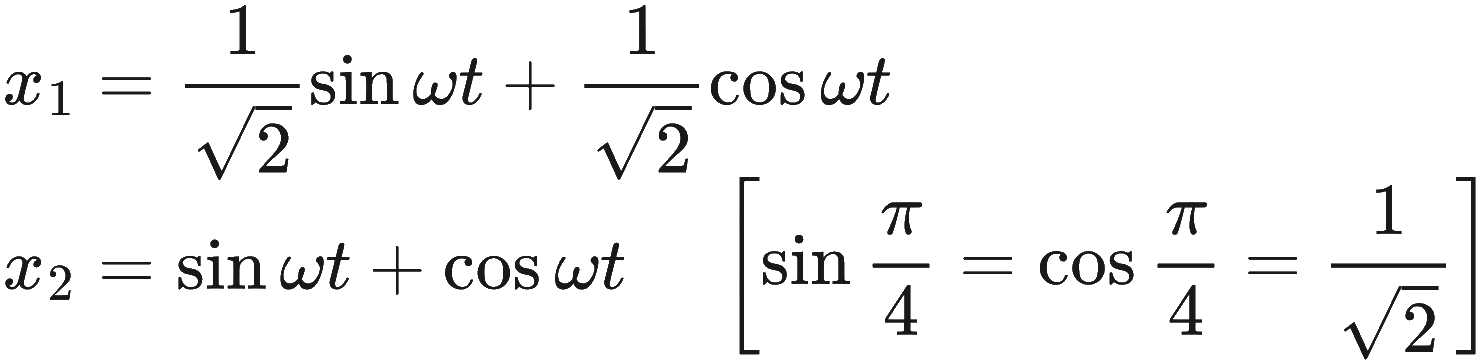
The minimum phase difference between two simple harmonic motions is

Figure

Show answer and solution

Answer: (a)

  1. x1=12sin⁡ωt+12cos⁡ωt=sin⁡(ωt+π4)x_1 = \frac{1}{\sqrt{2}}\sin\omega t + \frac{1}{\sqrt{2}}\cos\omega t = \sin\left(\omega t + \frac{\pi}{4}\right).
  2. x2=sin⁡ωt+cos⁡ωt=2sin⁡(ωt+π4)x_2 = \sin\omega t + \cos\omega t = \sqrt{2}\sin\left(\omega t + \frac{\pi}{4}\right).
  3. Both have the same phase ωt+π4\omega t + \frac{\pi}{4}; only the amplitudes differ.
  4. So the answer is (a) zero.
Report a mistake
Q4MHT CET 2026 · 11 APR · SHIFT 2Easy

Periodic Motion & SHM Basics · Time and distance in SHM

A mass attached to a spring performs S.H.M. whose displacement is x=3×10⁻³cos⁡2πtx = 3 \times 10^{-3}\cos 2\pi t m. The time taken to obtain maximum speed for the first time is (in s)

Show answer and solution

Answer: (c)

  1. ω=2π\omega = 2\pi, so T=1 sT = 1\ \text{s}.
  2. x=Acos⁡2πtx = A\cos 2\pi t starts at the extreme position (x=Ax = A) at t=0t = 0.
  3. Speed is maximum at the mean position, reached after T4=14 s\frac{T}{4} = \frac{1}{4}\ \text{s}.
  4. So the answer is (c) 14\frac{1}{4}.
Report a mistake
Q5MHT CET 2026 · 12 MAY · SHIFT 2Medium

Periodic Motion & SHM Basics · Periodic and oscillatory motion

A ball released from height (h)(h) which makes perfectly elastic collision with ground. The frequency of periodic vibratory motion is (gg = acceleration due to gravity)

Show answer and solution

Answer: (b)

  1. Time to fall height hh: h=12gt2⇒t=2hgh = \frac{1}{2}gt^2 \Rightarrow t = \sqrt{\frac{2h}{g}}.
  2. Elastic bounce: it rises back to hh in the same time, so T=22hgT = 2\sqrt{\frac{2h}{g}}.
  3. f=1T=12g2hf = \frac{1}{T} = \frac{1}{2}\sqrt{\frac{g}{2h}}.
  4. So the answer is (b).
Report a mistake
Q6JEE Main 2026 · 5 APR · SHIFT 2Medium

Periodic Motion & SHM Basics · Periodic and oscillatory motion

Match List - I with List - II.

Choose the correct answer from the options given below:

List - IList - II
A. sin⁡2ωt\sin^2 \omega tI. Periodic with time period T=πωT = \frac{\pi}{\omega} but not simple harmonic motion (SHM)
B. sin⁡3(2ωt)\sin^3(2\omega t)II. Periodic with time period T=2πωT = \frac{2\pi}{\omega} but Not SHM
C. sin⁡(ωt)+cos⁡(πωt)\sin(\omega t) + \cos(\pi\omega t)III. Periodic with time period T=πωT = \frac{\pi}{\omega} and SHM
D. cos⁡ωt+cos⁡2ωt\cos \omega t + \cos 2\omega tIV. Non-periodic
Show answer and solution

Answer: (a)

  1. A: sin⁡2ωt=1−cos⁡2ωt2\sin^2\omega t = \frac{1 - \cos 2\omega t}{2}, SHM about 12\frac{1}{2} with T=πωT = \frac{\pi}{\omega} →\to III.
  2. B: sin⁡3(2ωt)\sin^3(2\omega t) repeats with the period of sin⁡2ωt\sin 2\omega t, T=πωT = \frac{\pi}{\omega}, but contains sin⁡6ωt\sin 6\omega t too, so not SHM →\to I.
  3. C: sin⁡ωt+cos⁡(πωt)\sin\omega t + \cos(\pi\omega t): frequency ratio 1:π1 : \pi is irrational, so no common period →\to IV.
  4. D: cos⁡ωt+cos⁡2ωt\cos\omega t + \cos 2\omega t: common period 2πω\frac{2\pi}{\omega}, two frequencies so not SHM →\to II.
  5. So the answer is (a) A-III, B-I, C-IV, D-II.
Report a mistake
Q7MHT CET 2026 · 19 MAY · SHIFT 1Medium

Periodic Motion & SHM Basics · Displacement equation and circle of reference

Two simple harmonic motions are represented as y1=10sin⁡ωty_1 = 10\sin \omega t and y2=5sin⁡ωt+5cos⁡ωty_2 = 5\sin \omega t + 5\cos \omega t, both in cm. The ratio of the amplitudes of y2y_2 (A2A_2) to that of y1y_1 (A1A_1 ), is

Show answer and solution

Answer: (d)

  1. A1=10 cmA_1 = 10\text{ cm}
  2. y2=5sin⁡ωt+5cos⁡ωty_2 = 5\sin\omega t + 5\cos\omega t has A2=52+52=52 cmA_2 = \sqrt{5^2 + 5^2} = 5\sqrt{2}\text{ cm}
  3. A2A1=5210=12\frac{A_2}{A_1} = \frac{5\sqrt{2}}{10} = \frac{1}{\sqrt{2}}
  4. So the answer is (d) 1:21 : \sqrt{2}.
Report a mistake
Q8MHT CET 2026 · 20 APR · SHIFT 2Medium

Periodic Motion & SHM Basics · Displacement equation and circle of reference

The displacement of a particle varies with time according to the relation

x=asin⁡ωt+bcos⁡ωtx = a\sin \omega t + b\cos \omega t

Show answer and solution

Answer: (b)

  1. Write a=Rcos⁡δa = R\cos\delta, b=Rsin⁡δb = R\sin\delta: x=Rsin⁡(ωt+δ)x = R\sin(\omega t + \delta).
  2. This is SHM with R=a2+b2R = \sqrt{a^2 + b^2}.
  3. So the answer is (b).
Report a mistake
Q9MHT CET 2026 · 17 APR · SHIFT 2Medium

Periodic Motion & SHM Basics · Displacement equation and circle of reference

The displacement of a particle performing linear S.H.M. is given by y=Acos⁡[π(t+ϕ)]y = A\cos[\pi(t + \phi)]. If at t=0t = 0, the displacement is y=2y = 2 cm and velocity is 2π2\pi cm/s, the value of amplitude A in cm is

Show answer and solution

Answer: (d)

  1. Let θ=πϕ\theta = \pi\phi. At t=0t = 0: Acos⁡θ=2A\cos\theta = 2.
  2. v=−πAsin⁡θ=2π⇒Asin⁡θ=−2v = -\pi A\sin\theta = 2\pi \Rightarrow A\sin\theta = -2
  3. A=22+22=22 cmA = \sqrt{2^2 + 2^2} = 2\sqrt{2}\text{ cm}
  4. So the answer is (d) 222\sqrt{2}.
Report a mistake
Q10MHT CET 2026 · 13 MAY · SHIFT 1Medium

Periodic Motion & SHM Basics · Time and distance in SHM

A particle oscillates simple harmonically along a straight line with period 88 s and amplitude 828\sqrt{2} m. It starts from mean position then the ratio of the distances travelled by it in the 2nd2^{nd} second and the first second of its motion is (sin⁡45∘=12) (sin⁡90∘=1)\left(\sin 45^\circ = \frac{1}{\sqrt{2}}\right)\ (\sin 90^\circ = 1)

Show answer and solution

Answer: (c)

  1. ω=2π8=π4\omega = \frac{2\pi}{8} = \frac{\pi}{4}, x=Asin⁡πt4x = A\sin\frac{\pi t}{4} (starts at mean).
  2. x(1)=A2x(1) = \frac{A}{\sqrt{2}}, x(2)=Ax(2) = A; motion is one way in both seconds.
  3. 1st second: A2\frac{A}{\sqrt{2}}; 2nd second: A−A2A - \frac{A}{\sqrt{2}}
  4. Ratio =A(1−1/2)A/2=2−1= \frac{A(1 - 1/\sqrt{2})}{A/\sqrt{2}} = \sqrt{2} - 1
  5. So the answer is (c) 2−1\sqrt{2} - 1.
Report a mistake
Q11MHT CET 2026 · 12 MAY · SHIFT 1Medium

Periodic Motion & SHM Basics · Time and distance in SHM

A particle performing S.H.M., has a period of 1212 s. The particle starts from a mean position. The ratio of distances travelled by the particle in the first and second second is {cos⁡(π/6)=32}\left\{\cos(\pi/6) = \frac{\sqrt{3}}{2}\right\}

Show answer and solution

Answer: (d)

  1. ω=2π12=π6\omega = \frac{2\pi}{12} = \frac{\pi}{6}, x=Asin⁡πt6x = A\sin\frac{\pi t}{6}
  2. x(1)=A2x(1) = \frac{A}{2}, x(2)=3A2x(2) = \frac{\sqrt{3}A}{2}
  3. 1st second: A2\frac{A}{2}; 2nd second: (3−1)A2\frac{(\sqrt{3} - 1)A}{2}
  4. Ratio =13−1= \frac{1}{\sqrt{3} - 1}
  5. So the answer is (d).
Report a mistake
Q12MHT CET 2026 · 19 APR · SHIFT 1Medium

Periodic Motion & SHM Basics · Time and distance in SHM

A particle executes a simple harmonic motion with a periodic time 88 second. At time t=0t = 0, it is at a mean position. The ratio of the distance traveled by a particle in the 2nd and that in the 1st second of its motion is

(sin⁡45∘=cos⁡45∘=12, sin⁡90∘=cos⁡0∘=1\sin 45^\circ = \cos 45^\circ = \frac{1}{\sqrt{2}},\ \sin 90^\circ = \cos 0^\circ = 1)

Show answer and solution

Answer: (c)

  1. ω=2π8=π4\omega = \frac{2\pi}{8} = \frac{\pi}{4}, x=Asin⁡πt4x = A\sin\frac{\pi t}{4}
  2. x(1)=A2x(1) = \frac{A}{\sqrt{2}}, x(2)=Ax(2) = A
  3. 1st second: A2\frac{A}{\sqrt{2}}; 2nd second: A(1−12)A\left(1 - \frac{1}{\sqrt{2}}\right)
  4. Ratio (2nd : 1st) =2−1= \sqrt{2} - 1
  5. So the answer is (c) 2−1\sqrt{2} - 1.
Report a mistake
Q13MHT CET 2026 · 11 APR · SHIFT 1Medium

Periodic Motion & SHM Basics · Time and distance in SHM

A particle executes simple harmonic motion between x=−Ax = -A and x=+Ax = +A. If time taken by particle to go from x=0x = 0 to A2\frac{A}{2} is 22s, then time taken by particle in going from x=A2x = \frac{A}{2} to A is

Show answer and solution

Answer: (d)

  1. From x=0x = 0 to A2\frac{A}{2}: phase π6\frac{\pi}{6}, time T12=2 s⇒T=24 s\frac{T}{12} = 2\text{ s} \Rightarrow T = 24\text{ s}
  2. From A2\frac{A}{2} to AA: phase π2−π6=π3\frac{\pi}{2} - \frac{\pi}{6} = \frac{\pi}{3}, time T6=4 s\frac{T}{6} = 4\text{ s}
  3. So the answer is (d) 4 s.
Report a mistake
Q14JEE Main 2026 · 6 APR · SHIFT 1Medium

Periodic Motion & SHM Basics · Time and distance in SHM

A particle is executing simple harmonic motion. Its amplitude is AA and time period is 5 sec. The time required by it to move from x=Ax = A to x=A2x = \frac{A}{\sqrt{2}} is ______ sec.

Show answer and solution

Answer: (c)

  1. From the extreme: x=Acos⁡ωt=A2⇒ωt=π4x = A\cos\omega t = \frac{A}{\sqrt{2}} \Rightarrow \omega t = \frac{\pi}{4}
  2. t=T8=58 st = \frac{T}{8} = \frac{5}{8}\text{ s}
  3. So the answer is (c) 58\frac{5}{8} s.
Report a mistake
Q15JEE Main 2026 · 2 APR · SHIFT 2Medium

Periodic Motion & SHM Basics · Time and distance in SHM

The equation of motion of a particle is given by x=asin⁡(50t+π/3)x = a\sin(50t + \pi/3) cm. The particle will come to rest at time t1t_1 and it will have zero acceleration at time t2t_2. The t1t_1 and t2t_2 respectively are ________.

Show answer and solution

Answer: (a)

  1. Rest at the extreme: 50t1+π3=π2⇒t1=π/650=π300 s50t_1 + \frac{\pi}{3} = \frac{\pi}{2} \Rightarrow t_1 = \frac{\pi/6}{50} = \frac{\pi}{300}\text{ s}
  2. Zero acceleration at x=0x = 0: 50t2+π3=π⇒t2=2π/350=π75 s50t_2 + \frac{\pi}{3} = \pi \Rightarrow t_2 = \frac{2\pi/3}{50} = \frac{\pi}{75}\text{ s}
  3. So the answer is (a).
Report a mistake
Q16JEE Main 2025 · 28 JAN · SHIFT 2Easy

Periodic Motion & SHM Basics · Periodic and oscillatory motion

Given below are two statements. One is labelled as Assertion (A) and the other is labelled as Reason (R).

Assertion (A): Knowing initial position x0x_0 and initial momentum p0p_0 is enough to determine the position and momentum at any time tt for a simple harmonic motion with a given angular frequency ω\omega.

Reason (R): The amplitude and phase can be expressed in terms of x0x_0 and p0p_0.

In the light of the above statements, choose the correct answer from the options given below:

Show answer and solution

Answer: (d)

  1. SHM: x=Asin⁡(ωt+ϕ)x = A\sin(\omega t + \phi), p=mωAcos⁡(ωt+ϕ)p = m\omega A\cos(\omega t + \phi).
  2. At t=0t = 0: x0=Asin⁡ϕx_0 = A\sin\phi, p0=mωAcos⁡ϕp_0 = m\omega A\cos\phi, so A=x02+p02m2ω2A = \sqrt{x_0^2 + \frac{p_0^2}{m^2\omega^2}} and tan⁡ϕ=mωx0p0\tan\phi = \frac{m\omega x_0}{p_0}.
  3. Once AA and ϕ\phi are known, xx and pp are known at every tt. So R is true and explains A.
  4. So the answer is (d).
Report a mistake
Q17MHT CET 2025 · 20 APR · SHIFT 1Easy

Periodic Motion & SHM Basics · Phase and phase difference

The period of S. H.M. of a particle is 16 second. The phase difference between the positions at t=2 st = 2\text{ s} and t=4 st = 4\text{ s} will be

Show answer and solution

Answer: (c)

  1. Phase difference Δϕ=2πTΔt\Delta\phi = \frac{2\pi}{T}\Delta t.
  2. Δϕ=2π16×(4−2)=π4\Delta\phi = \frac{2\pi}{16}\times(4 - 2) = \frac{\pi}{4}.
  3. So the answer is (c) π4\frac{\pi}{4}.
Report a mistake
Q18MHT CET 2025 · 25 APR · SHIFT 1Easy

Periodic Motion & SHM Basics · Time and distance in SHM

The displacement of particle in S.H.M. is x=Acos⁡(ωt+π/6)x = A\cos(\omega t + \pi/6). Its speed will be maximum at time (sin⁡90∘=1)(\sin 90^\circ = 1)

Show answer and solution

Answer: (a)

  1. v=−Aωsin⁡(ωt+π/6)v = -A\omega\sin(\omega t + \pi/6); speed is maximum when sin⁡(ωt+π/6)=1\sin(\omega t + \pi/6) = 1.
  2. ωt+π6=π2⇒ωt=π3\omega t + \frac{\pi}{6} = \frac{\pi}{2} \Rightarrow \omega t = \frac{\pi}{3}.
  3. t=π3ω st = \frac{\pi}{3\omega}\ \text{s}.
  4. So the answer is (a).
Report a mistake
Q19MHT CET 2025 · 20 APR · SHIFT 2Easy

Periodic Motion & SHM Basics · Time and distance in SHM

A mass attached to a spring performs S.H.M. whose displacement is x=3×10⁻³cos⁡2πtx = 3 \times 10^{-3}\cos 2\pi t metre. The time taken to obtain maximum speed for the first time is

Show answer and solution

Answer: (c)

  1. ω=2π\omega = 2\pi, so T=1 sT = 1\ \text{s}.
  2. The particle starts at the extreme position (x=Ax = A) at t=0t = 0.
  3. Maximum speed is at the mean position, after T4=14 s\frac{T}{4} = \frac{1}{4}\ \text{s}.
  4. So the answer is (c) 14\frac{1}{4} s.
Report a mistake
Q20MHT CET 2025 · 23 APR · SHIFT 2Medium

Periodic Motion & SHM Basics · Periodic and oscillatory motion

The motion of the particle is given by the equation x=Asin⁡ωt+Bcos⁡ωtx = A\sin\omega t + B\cos\omega t.

The motion of the particle is

Show answer and solution

Answer: (c)

  1. Write A=Rcos⁡ϕA = R\cos\phi, B=Rsin⁡ϕB = R\sin\phi: x=Rsin⁡(ωt+ϕ)x = R\sin(\omega t + \phi).
  2. This is a single sine term, so the motion is SHM.
  3. R=A2+B2=(A2+B2)1/2R = \sqrt{A^2 + B^2} = (A^2 + B^2)^{1/2}.
  4. So the answer is (c).
Report a mistake
Q21MHT CET 2025 · 25 APR · SHIFT 1Medium

Periodic Motion & SHM Basics · Phase and phase difference

Two particles ' AA ' and ' BB ' execute SHMs of periods ' TT ' and 3T2\frac{3T}{2}. If they start from the mean position then the phase difference between them, when the particle ' AA ' completes two oscillations will be

Show answer and solution

Answer: (c)

  1. Phase gained =2πtT= \frac{2\pi t}{T}. A completes 2 oscillations, so t=2Tt = 2T.
  2. ϕA=2π(2)=4π\phi_A = 2\pi(2) = 4\pi, ϕB=2π(2T)3T/2=8π3\phi_B = \frac{2\pi(2T)}{3T/2} = \frac{8\pi}{3}
  3. Δϕ=4π−8π3=4π3\Delta\phi = 4\pi - \frac{8\pi}{3} = \frac{4\pi}{3}
  4. So the answer is (c) 4π3\frac{4\pi}{3}.
Report a mistake
Q22MHT CET 2025 · 22 APR · SHIFT 2Medium

Periodic Motion & SHM Basics · Time and distance in SHM

A particle performing linear S.H.M. has period 8 seconds. At time t=0t = 0, it is in the mean position. The ratio of the distances travelled by the particle in the 11st and 22nd second is (cos⁡45∘=1/2)\left(\cos 45^\circ = 1/\sqrt{2}\right)

Show answer and solution

Answer: (a)

  1. ω=π4\omega = \frac{\pi}{4}, x=Asin⁡πt4x = A\sin\frac{\pi t}{4}
  2. 1st second: A2\frac{A}{\sqrt{2}}; 2nd second: A−A2=A(2−1)2A - \frac{A}{\sqrt{2}} = \frac{A(\sqrt{2} - 1)}{\sqrt{2}}
  3. Ratio =1:(2−1)= 1 : (\sqrt{2} - 1)
  4. So the answer is (a).
Report a mistake
Q23MHT CET 2025 · 20 APR · SHIFT 1Medium

Periodic Motion & SHM Basics · Time and distance in SHM

A particle oscillates in straight line simple harmonically with period 8 second and amplitude 42 m4\sqrt{2}\text{ m}. Particle starts from mean position. The ratio of the distance travelled by it in 11st second of its motion to that in 22nd second is (sin⁡45∘=1/2,sin⁡π2=1)\left(\sin 45^\circ = 1/\sqrt{2}, \sin\frac{\pi}{2} = 1\right)

Show answer and solution

Answer: (d)

  1. ω=π4\omega = \frac{\pi}{4}, x=42sin⁡πt4x = 4\sqrt{2}\sin\frac{\pi t}{4}
  2. x(1)=4 mx(1) = 4\text{ m}, x(2)=42 mx(2) = 4\sqrt{2}\text{ m}
  3. 1st second: 44; 2nd second: 42−4=4(2−1)4\sqrt{2} - 4 = 4(\sqrt{2} - 1)
  4. So the answer is (d) 1:(2−1)1 : (\sqrt{2} - 1).
Report a mistake
Q24JEE Main 2025 · 24 JAN · SHIFT 1Medium

Periodic Motion & SHM Basics · Time and distance in SHM

A particle is executing simple harmonic motion with time period 2 s and amplitude 1 cm. If D and d are the total distance and displacement covered by the particle in 12.5 s, then Dd\frac{D}{d} is

Show answer and solution

Answer: (c)

  1. 12.5 s=6T+T412.5\text{ s} = 6T + \frac{T}{4} (taking start at the mean position).
  2. Distance: 6×4A+A=25A=25 cm6\times 4A + A = 25A = 25\text{ cm}
  3. In 6T6T the particle returns; in the extra T4\frac{T}{4} it goes mean to extreme, so d=A=1 cmd = A = 1\text{ cm}.
  4. Dd=25\frac{D}{d} = 25
  5. So the answer is (c) 25.
Report a mistake
Q25MHT CET 2024 · 15 MAY · SHIFT 2Easy

Periodic Motion & SHM Basics · Restoring force and differential equation

The motion of a particle is described by the equation a=−bxa = -bx where ' aa ' is the acceleration, x is the displacement from the equilibrium position and b is a constant. The periodic time will be

Show answer and solution

Answer: (b)

  1. Compare a=−bxa = -bx with a=−ω2xa = -\omega^2 x: ω=b\omega = \sqrt{b}.
  2. T=2πω=2πbT = \frac{2\pi}{\omega} = \frac{2\pi}{\sqrt{b}}.
  3. So the answer is (b) 2πb\frac{2\pi}{\sqrt{b}}.
Report a mistake
Q26MHT CET 2024 · 3 MAY · SHIFT 2Easy

Periodic Motion & SHM Basics · Phase and phase difference

When a particle in linear S.H.M. completes two oscillations, its phase increases by

Show answer and solution

Answer: (d)

  1. Phase increases by 2π2\pi rad in one oscillation.
  2. For two oscillations: 2×2π=4π2 \times 2\pi = 4\pi rad.
  3. So the answer is (d) 4π4\pi rad.
Report a mistake
Q27NEET 2024Easy

Periodic Motion & SHM Basics · Displacement equation and circle of reference

If x=5sin⁡(πt+π3)mx = 5\sin\left(\pi t + \frac{\pi}{3}\right)\text{m} represents the motion of a particle executing simple harmonic motion, the amplitude and time period of motion, respectively, are

Show answer and solution

Answer: (b)

  1. Compare with x=Asin⁡(ωt+ϕ)x = A\sin(\omega t + \phi): A=5 mA = 5\ \text{m}, ω=π rad/s\omega = \pi\ \text{rad/s}.
  2. T=2πω=2ππ=2 sT = \frac{2\pi}{\omega} = \frac{2\pi}{\pi} = 2\ \text{s}.
  3. So the answer is (b) 5 m, 2 s.
Report a mistake
Q28JEE Main 2024 · 9 APR · SHIFT 2Medium

Periodic Motion & SHM Basics · Restoring force and differential equation

A particle of mass 0.50 kg0.50\text{ kg} executes simple harmonic motion under force F=−50(N m−1)xF = -50(\text{N m}^{-1})x. The time period of oscillation is x35 s\frac{x}{35}\text{ s}. The value of xx is _________.

(Given π=227\pi = \frac{22}{7})

Numerical answer type. Work it out, then open the answer.

Show answer and solution

Answer: 22

  1. F=−kxF = -kx with k=50 N/mk = 50\text{ N/m}.
  2. T=2πmk=2π0.550=2π10=π5T = 2\pi\sqrt{\frac{m}{k}} = 2\pi\sqrt{\frac{0.5}{50}} = \frac{2\pi}{10} = \frac{\pi}{5}
  3. T=227×5=2235 sT = \frac{22}{7\times 5} = \frac{22}{35}\text{ s}
  4. So x=22x = 22.
Report a mistake
Q29MHT CET 2024 · 2 MAY · SHIFT 2Medium

Periodic Motion & SHM Basics · Displacement equation and circle of reference

The displacement of a particle performing S.H.M. is given by Y=Acos⁡[π(t+ϕ)]Y = A\cos[\pi(t + \phi)]. If at t=0t = 0, the displacement is y=2 cmy = 2\text{ cm} and velocity is 2π cm/s2\pi\text{ cm/s}, the value of amplitude AA in cm is

Show answer and solution

Answer: (c)

  1. Let θ=πϕ\theta = \pi\phi. At t=0t = 0: Acos⁡θ=2A\cos\theta = 2.
  2. v=−πAsin⁡θ=2π⇒Asin⁡θ=−2v = -\pi A\sin\theta = 2\pi \Rightarrow A\sin\theta = -2
  3. A=22+22=22 cmA = \sqrt{2^2 + 2^2} = 2\sqrt{2}\text{ cm}
  4. So the answer is (c) 222\sqrt{2}.
Report a mistake
Q30JEE Main 2024 · 29 JAN · SHIFT 2Medium

Periodic Motion & SHM Basics · Time and distance in SHM

A simple harmonic oscillator has an amplitude AA and time period 6π6\pi second. Assuming the oscillation starts from its mean position, the time required by it to travel from x=x = A to x=32x = \frac{\sqrt{3}}{2} A will be πx s\frac{\pi}{x}\text{ s}, where x=x = _________.

Numerical answer type. Work it out, then open the answer.

Show answer and solution

Answer: 2

  1. From the extreme: Acos⁡ωt=32A⇒ωt=π6⇒t=T12A\cos\omega t = \frac{\sqrt{3}}{2}A \Rightarrow \omega t = \frac{\pi}{6} \Rightarrow t = \frac{T}{12}
  2. t=6π12=π2 st = \frac{6\pi}{12} = \frac{\pi}{2}\text{ s}
  3. So x=2x = 2.
Report a mistake
Q31JEE Main 2023 · 15 APR · SHIFT 1Easy

Periodic Motion & SHM Basics · Restoring force and differential equation

In a linear Simple Harmonic Motion (SHM)

(A) Restoring force is directly proportional to the displacement.

(B) The acceleration and displacement are opposite in direction.

(C) The velocity is maximum at mean position.

(D) The acceleration is minimum at extreme points.

Choose the correct answer from the options given below:

Show answer and solution

Answer: (c)

  1. (A) True: F=−kxF = -kx, so ∣F∣∝x|F| \propto x.
  2. (B) True: a=−ω2xa = -\omega^2 x, opposite to displacement.
  3. (C) True: v=ωA2−x2v = \omega\sqrt{A^2 - x^2} is maximum at x=0x = 0.
  4. (D) False: ∣a∣=ω2∣x∣|a| = \omega^2 |x| is maximum at the extreme points.
  5. So the answer is (c) (A), (B) and (C) only.
Report a mistake
Q32JEE Main 2023 · 8 APR · SHIFT 2Easy

Periodic Motion & SHM Basics · Displacement equation and circle of reference

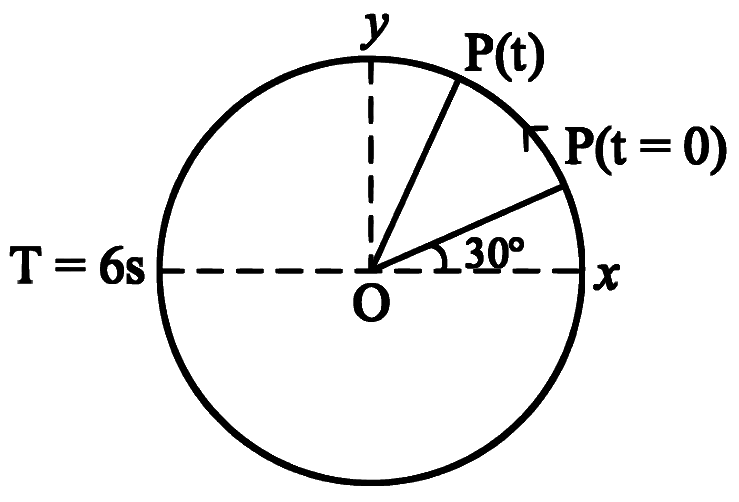
For particle P revolving round the centre O with radius of circular path rr and angular velocity ω\omega, as shown in below figure, the projection of OP on the xx-axis at time tt is

Figure

Show answer and solution

Answer: (c)

  1. At t=0t = 0, OP makes 30∘=π630^\circ = \frac{\pi}{6} with the xx-axis.
  2. P moves anticlockwise, so at time tt the angle is ωt+π6\omega t + \frac{\pi}{6}.
  3. Projection on xx-axis: x(t)=rcos⁡(ωt+π6)x(t) = r\cos\left(\omega t + \frac{\pi}{6}\right).
  4. So the answer is (c).
Report a mistake
Q33JEE Main 2023 · 10 APR · SHIFT 2Medium

Periodic Motion & SHM Basics · Periodic and oscillatory motion

For a periodic motion represented by the equation

y=sin⁡ωt+cos⁡ωty = \sin \omega t + \cos \omega t

the amplitude of the motion is

Show answer and solution

Answer: (b)

  1. For asin⁡ωt+bcos⁡ωta\sin\omega t + b\cos\omega t, amplitude =a2+b2= \sqrt{a^2 + b^2}.
  2. 12+12=2\sqrt{1^2 + 1^2} = \sqrt{2}, i.e. y=2sin⁡(ωt+π/4)y = \sqrt{2}\sin(\omega t + \pi/4).
  3. So the answer is (b) 2\sqrt{2}.
Report a mistake
Q34MHT CET 2023 · 13 MAY · SHIFT 1Medium

Periodic Motion & SHM Basics · Restoring force and differential equation

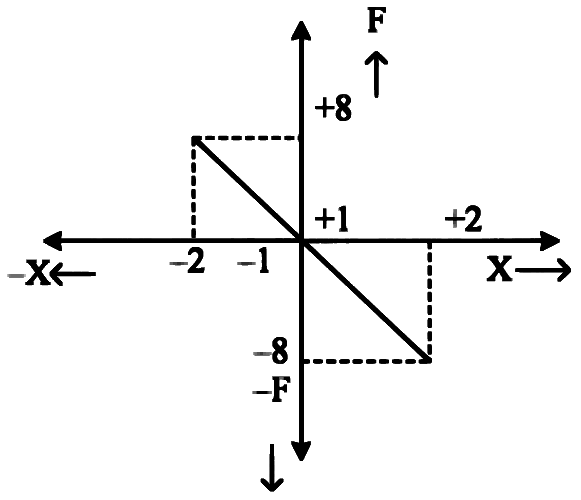
A body of mass 0.04 kg0.04\text{ kg} executes simple harmonic motion (SHM) about x=0x = 0 under the influence of force FF as shown in graph. The period of oscillation is

Figure

Show answer and solution

Answer: (b)

  1. From the graph, F=−kxF = -kx with k=82=4 N/mk = \frac{8}{2} = 4\text{ N/m}.
  2. T=2πmk=2π0.044=2π(0.1)T = 2\pi\sqrt{\frac{m}{k}} = 2\pi\sqrt{\frac{0.04}{4}} = 2\pi(0.1)
  3. So the answer is (b) 0.2π s0.2\pi\text{ s}.
Report a mistake
Q35MHT CET 2023 · 9 MAY · SHIFT 2Medium

Periodic Motion & SHM Basics · Phase and phase difference

Two S.H.Ms. are represented by equations y1=0.1sin⁡(100πt+π3)y_1 = 0.1\sin\left(100\pi t + \frac{\pi}{3}\right) and y2=0.1cos⁡(100πt)y_2 = 0.1\cos(100\pi t) The phase difference between the speeds of the two particles is

Show answer and solution

Answer: (b)

  1. v1=dy1dt∝cos⁡(100πt+π3)v_1 = \frac{dy_1}{dt} \propto \cos\left(100\pi t + \frac{\pi}{3}\right)
  2. v2∝−sin⁡(100πt)=cos⁡(100πt+π2)v_2 \propto -\sin(100\pi t) = \cos\left(100\pi t + \frac{\pi}{2}\right)
  3. Δϕ=π3−π2=−π6\Delta\phi = \frac{\pi}{3} - \frac{\pi}{2} = -\frac{\pi}{6}
  4. So the answer is (b) −π6-\frac{\pi}{6}.
Report a mistake
Q36JEE Main 2023 · 10 APR · SHIFT 1Medium

Periodic Motion & SHM Basics · Displacement equation and circle of reference

A particle executes S.H.M. of amplitude A along x-axis. At t = 0, the position of the particle is x=A2x = \frac{A}{2} and it moves along positive x-axis. The displacement of particle in time t is x=Asin⁡(ωt+δ)x = A\sin(\omega t + \delta), then the value of δ\delta will be

Show answer and solution

Answer: (d)

  1. At t=0t = 0: A2=Asin⁡δ⇒sin⁡δ=12\frac{A}{2} = A\sin\delta \Rightarrow \sin\delta = \frac{1}{2}
  2. Moving along +x+x means v=Aωcos⁡δ>0v = A\omega\cos\delta > 0, so δ=π6\delta = \frac{\pi}{6} (not 5π6\frac{5\pi}{6}).
  3. So the answer is (d) π6\frac{\pi}{6}.
Report a mistake
Q37JEE Main 2023 · 25 JAN · SHIFT 2Medium

Periodic Motion & SHM Basics · Time and distance in SHM

A particle executes simple harmonic motion between x=−Ax = -A and x=+Ax = +A. If time taken by particle to go from x=0x = 0 to A2\frac{A}{2} is 2 s; then time taken by particle in going from x=A2x = \frac{A}{2} to A is

Show answer and solution

Answer: (a)

  1. 0→A20 \to \frac{A}{2} takes T12=2 s⇒T=24 s\frac{T}{12} = 2\text{ s} \Rightarrow T = 24\text{ s}
  2. A2→A\frac{A}{2} \to A takes T4−T12=T6=4 s\frac{T}{4} - \frac{T}{12} = \frac{T}{6} = 4\text{ s}
  3. So the answer is (a) 4 s.
Report a mistake
Q38MHT CET 2023 · 10 MAY · SHIFT 2Medium

Periodic Motion & SHM Basics · Phase in waves (mixed)

A simple harmonic progressive wave is represented by y=Asin⁡(100πt+3x)y = A\sin(100\pi t + 3x). The distance between two points on the wave at a phase difference of π3\frac{\pi}{3} radian is

Show answer and solution

Answer: (b)

  1. Compare with y=Asin⁡(ωt+kx)y = A\sin(\omega t + kx): k=3 m−1k = 3\text{ m}^{-1}.
  2. Δx=Δϕk=π/33=π9 m\Delta x = \frac{\Delta\phi}{k} = \frac{\pi/3}{3} = \frac{\pi}{9}\text{ m}
  3. So the answer is (b) π9 m\frac{\pi}{9}\text{ m}.
Report a mistake
Q39NEET 2022 · PHASE 2Easy

Periodic Motion & SHM Basics · Periodic and oscillatory motion

Identify the function which represents a non-periodic motion.

Show answer and solution

Answer: (b)

  1. A periodic function repeats itself after a fixed time TT.
  2. sin⁡(ωt+π/4)\sin(\omega t + \pi/4), sin⁡ωt\sin\omega t and sin⁡ωt+cos⁡ωt\sin\omega t + \cos\omega t all repeat after T=2π/ωT = 2\pi/\omega.
  3. e−ωte^{-\omega t} keeps decreasing and never repeats.
  4. So the answer is (b) e−ωte^{-\omega t}.
Report a mistake
Q40JEE Main 2022 · 27 JUN · SHIFT 1Easy

Periodic Motion & SHM Basics · Time and distance in SHM

The displacement of simple harmonic oscillator after 3 seconds starting from its mean position is equal to half of its amplitude. The time period of harmonic motion is:

Show answer and solution

Answer: (d)

  1. From the mean position: x=Asin⁡2πtTx = A\sin\frac{2\pi t}{T}.
  2. A2=Asin⁡2π(3)T⇒6πT=π6\frac{A}{2} = A\sin\frac{2\pi (3)}{T} \Rightarrow \frac{6\pi}{T} = \frac{\pi}{6}.
  3. T=36 sT = 36\ \text{s}.
  4. So the answer is (d) 36 s.
Report a mistake
Q41JEE Main 2022 · 28 JUL · SHIFT 2Medium

Periodic Motion & SHM Basics · Restoring force and differential equation

The potential energy of a particle of mass 4 kg4\text{ kg} in motion along the x-axis is given by U=4(1−cos⁡4x)U = 4(1 - \cos 4x) J. The time period of the particle for small oscillation (sin⁡θ≃θ)(\sin\theta \simeq \theta) is (πK) s\left(\frac{\pi}{K}\right)\text{ s}. The value of KK is _________.

Numerical answer type. Work it out, then open the answer.

Show answer and solution

Answer: 2

  1. For small xx: 1−cos⁡4x≈(4x)22=8x21 - \cos 4x \approx \frac{(4x)^2}{2} = 8x^2, so U≈32x2U \approx 32x^2.
  2. Compare with U=12kx2U = \frac{1}{2}kx^2: k=64 N/mk = 64\text{ N/m}.
  3. ω=km=644=4 rad/s\omega = \sqrt{\frac{k}{m}} = \sqrt{\frac{64}{4}} = 4\text{ rad/s}, T=2π4=π2 sT = \frac{2\pi}{4} = \frac{\pi}{2}\text{ s}
  4. So K=2K = 2.
Report a mistake
Q42MHT CET 2022 · 11 AUG · SHIFT 2Medium

Periodic Motion & SHM Basics · Time and distance in SHM

The time taken by a particle executing simple harmonic motion of period 'TT', to move from the mean position to half the maximum displacement is

Show answer and solution

Answer: (a)

  1. x=Asin⁡ωt=A2⇒ωt=π6x = A\sin\omega t = \frac{A}{2} \Rightarrow \omega t = \frac{\pi}{6}
  2. t=π/62π/T=T12t = \frac{\pi/6}{2\pi/T} = \frac{T}{12}
  3. So the answer is (a) T12\frac{T}{12}.
Report a mistake
Q43JEE Main 2022 · 27 JUN · SHIFT 2Medium

Periodic Motion & SHM Basics · Time and distance in SHM

A particle executes simple harmonic motion. Its amplitude is 8 cm and time period is 6 s. The time it will take to travel from its position of maximum displacement to the point corresponding to half of its amplitude, is ___________ s.

Numerical answer type. Work it out, then open the answer.

Show answer and solution

Answer: 1

  1. From the extreme: Acos⁡ωt=A2⇒ωt=π3⇒t=T6A\cos\omega t = \frac{A}{2} \Rightarrow \omega t = \frac{\pi}{3} \Rightarrow t = \frac{T}{6}
  2. t=66=1 st = \frac{6}{6} = 1\text{ s}
  3. So the answer is 1 s.
Report a mistake
Q44MHT CET 2022 · 11 AUG · SHIFT 2Medium

Periodic Motion & SHM Basics · Phase in waves (mixed)

In a medium, the phase difference between two particles separated by a distance 'xx' is (π5)\left(\frac{\pi}{5}\right)c. If the frequency of the oscillation of particles is 25 Hz25\text{ Hz} and the velocity of propagation of the waves is 75 m/s75\text{ m/s}, then the value of xx is

Show answer and solution

Answer: (d)

  1. λ=vf=7525=3 m\lambda = \frac{v}{f} = \frac{75}{25} = 3\text{ m}
  2. x=λ2πΔϕ=32π⋅π5=0.3 mx = \frac{\lambda}{2\pi}\Delta\phi = \frac{3}{2\pi}\cdot\frac{\pi}{5} = 0.3\text{ m}
  3. So the answer is (d) 0.3 m.
Report a mistake
Q45JEE Main 2021 · 18 MAR · SHIFT 2Easy

Periodic Motion & SHM Basics · Periodic and oscillatory motion

The function of time representing a simple harmonic motion with a period of πω\frac{\pi}{\omega} is:

Show answer and solution

Answer: (d)

  1. SHM needs a single sine/cosine term; period T=2πω′T = \frac{2\pi}{\omega'}.
  2. (a) has three frequencies and (c) has period 2π/ω2\pi/\omega.
  3. (d) 3cos⁡(π4−2ωt)3\cos\left(\frac{\pi}{4} - 2\omega t\right) has ω′=2ω\omega' = 2\omega, so T=2π2ω=πωT = \frac{2\pi}{2\omega} = \frac{\pi}{\omega}.
  4. So the answer is (d).
Report a mistake
Q46JEE Main 2021 · 25 FEB · SHIFT 2Easy

Periodic Motion & SHM Basics · Displacement equation and circle of reference

Y = A sin(ω\omegat + ϕ\phi0) is the time-displacement equation of a SHM. At t = 0 the displacement of the particle is Y=A2Y = \frac{A}{2} and it is moving along negative x-direction. Then the initial phase angle ϕ\phi0 will be:

Show answer and solution

Answer: (a)

  1. At t=0t = 0: A2=Asin⁡ϕ0⇒sin⁡ϕ0=12\frac{A}{2} = A\sin\phi_0 \Rightarrow \sin\phi_0 = \frac{1}{2}, so ϕ0=π6\phi_0 = \frac{\pi}{6} or 5π6\frac{5\pi}{6}.
  2. Velocity v=Aωcos⁡ϕ0v = A\omega\cos\phi_0 must be negative, so cos⁡ϕ0<0\cos\phi_0 < 0.
  3. cos⁡5π6<0\cos\frac{5\pi}{6} < 0, so ϕ0=5π6\phi_0 = \frac{5\pi}{6}.
  4. So the answer is (a) 5π6\frac{5\pi}{6}.
Report a mistake
Q47JEE Main 2021 · 18 MAR · SHIFT 1Easy

Periodic Motion & SHM Basics · Time and distance in SHM

A particle performs simple harmonic motion with a period of 2 second. The time taken by the particle to cover a displacement equal to half of its amplitude from the mean position is 1a\frac{1}{a}s. The value of 'a' to the nearest integer is _________.

Numerical answer type. Work it out, then open the answer.

Show answer and solution

Answer: 6

  1. From the mean position: x=Asin⁡2πtTx = A\sin\frac{2\pi t}{T} with T=2 sT = 2\ \text{s}.
  2. A2=Asin⁡(πt)⇒πt=π6\frac{A}{2} = A\sin(\pi t) \Rightarrow \pi t = \frac{\pi}{6}.
  3. t=16 s=1a st = \frac{1}{6}\ \text{s} = \frac{1}{a}\ \text{s}.
  4. So a=6a = 6.
Report a mistake
Q48MHT CET 2021 · 20 SEP · SHIFT 1Medium

Periodic Motion & SHM Basics · Phase and phase difference

Two particles PP and QQ performs S.H.M. of same amplitude and frequency along the same straight line. At a particular instant, maximum distance between two particles is 2\sqrt{2} a. The initial phase difference between them is

[sin⁡−1(12)=cos⁡−1(12)=π4]\left[\sin^{-1}\left(\frac{1}{\sqrt{2}}\right) = \cos^{-1}\left(\frac{1}{\sqrt{2}}\right) = \frac{\pi}{4}\right]

Show answer and solution

Answer: (b)

  1. x1−x2=asin⁡ωt−asin⁡(ωt+ϕ)=2asin⁡ϕ2cos⁡(… )x_1 - x_2 = a\sin\omega t - a\sin(\omega t + \phi) = 2a\sin\frac{\phi}{2}\cos(\dots)
  2. Maximum separation =2asin⁡ϕ2=2a= 2a\sin\frac{\phi}{2} = \sqrt{2}a
  3. sin⁡ϕ2=12⇒ϕ2=π4\sin\frac{\phi}{2} = \frac{1}{\sqrt{2}} \Rightarrow \frac{\phi}{2} = \frac{\pi}{4}
  4. So the answer is (b) π2\frac{\pi}{2}.
Report a mistake
Q49JEE Main 2021 · 25 FEB · SHIFT 2Medium

Periodic Motion & SHM Basics · Displacement equation and circle of reference

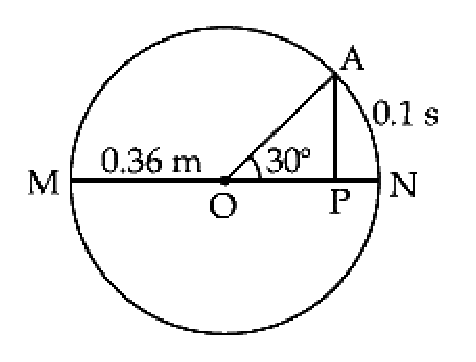
The point A moves with a uniform speed along the circumference of a circle of radius 0.36 m and covers 30∘^\circ in 0.1 s. The perpendicular projection 'P' from 'A' on the diameter MN represents the simple harmonic motion of 'P'. The restoration force per unit mass when P touches M will be:

Figure

Show answer and solution

Answer: (a)

  1. ω=π/60.1=5π3 rad/s\omega = \frac{\pi/6}{0.1} = \frac{5\pi}{3}\text{ rad/s}
  2. At M, PP is at the extreme, ∣x∣=R=0.36 m|x| = R = 0.36\text{ m}.
  3. Force per unit mass =ω2R=25π29×0.36=π2≈9.87= \omega^2 R = \frac{25\pi^2}{9}\times 0.36 = \pi^2 \approx 9.87
  4. So the answer is (a) 9.87 (unit is really N/kg).
Report a mistake
Q50JEE Main 2021 · 27 AUG · SHIFT 2Medium

Periodic Motion & SHM Basics · Displacement equation and circle of reference

Two simple harmonic motion, are represented by the equations y1=10sin⁡(3πt+π3)y2=5(sin⁡3πt+3cos⁡3πt)y_1 = 10\sin\left(3\pi t + \frac{\pi}{3}\right) \quad y_2 = 5(\sin 3\pi t + \sqrt{3}\cos 3\pi t) Ratio of amplitude of y1 to y2 = x: 1. The value of x is ______________.

Numerical answer type. Work it out, then open the answer.

Show answer and solution

Answer: 1

  1. A1=10A_1 = 10
  2. y2=5(sin⁡3πt+3cos⁡3πt)=10sin⁡(3πt+π3)y_2 = 5(\sin 3\pi t + \sqrt{3}\cos 3\pi t) = 10\sin\left(3\pi t + \frac{\pi}{3}\right), so A2=51+3=10A_2 = 5\sqrt{1 + 3} = 10
  3. A1A2=1\frac{A_1}{A_2} = 1
  4. So x=1x = 1.
Report a mistake
Q51JEE Main 2021 · 26 AUG · SHIFT 2Medium

Periodic Motion & SHM Basics · Displacement equation and circle of reference

Two simple harmonic motions are represented by the equations

x1=5sin⁡(2πt+π4)x_1 = 5\sin\left(2\pi t + \frac{\pi}{4}\right) and x2=52(sin⁡2πt+cos⁡2πt)x_2 = 5\sqrt{2}(\sin 2\pi t + \cos 2\pi t). The amplitude of second motion is ................ times the amplitude in first motion.

Numerical answer type. Work it out, then open the answer.

Show answer and solution

Answer: 2

  1. A1=5A_1 = 5
  2. x2=52(sin⁡2πt+cos⁡2πt)=52⋅2sin⁡(2πt+π4)x_2 = 5\sqrt{2}(\sin 2\pi t + \cos 2\pi t) = 5\sqrt{2}\cdot\sqrt{2}\sin\left(2\pi t + \frac{\pi}{4}\right), so A2=10A_2 = 10
  3. A2A1=2\frac{A_2}{A_1} = 2
  4. So the answer is 2.
Report a mistake
Q52JEE Main 2021 · 27 JUL · SHIFT 2Medium

Periodic Motion & SHM Basics · Displacement equation and circle of reference

A particle executes simple harmonic motion represented by displacement function as x(t) = A sin(ω\omegat + ϕ\phi)

If the position and velocity of the particle at t = 0 s are 2 cm and 2ω\omega cm s−1{}^{-1} respectively, then its amplitude is x2x\sqrt{2} cm where the value of x is _________________.

Numerical answer type. Work it out, then open the answer.

Show answer and solution

Answer: 2

  1. At t=0t = 0: Asin⁡ϕ=2A\sin\phi = 2
  2. v=Aωcos⁡ϕ=2ω⇒Acos⁡ϕ=2v = A\omega\cos\phi = 2\omega \Rightarrow A\cos\phi = 2
  3. A=22+22=22 cmA = \sqrt{2^2 + 2^2} = 2\sqrt{2}\text{ cm}
  4. So x=2x = 2.
Report a mistake
Q53JEE Main 2021 · 26 FEB · SHIFT 2Medium

Periodic Motion & SHM Basics · Time and distance in SHM

Time period of a simple pendulum is T. The time taken to complete 58\frac{5}{8} oscillations starting from mean position is αβT\frac{\alpha}{\beta}T. The value of α\alpha is _________.

Numerical answer type. Work it out, then open the answer.

Show answer and solution

Answer: 7

  1. One oscillation covers 4A4A, so 58\frac{5}{8} oscillation means a path of 58(4A)=5A2\frac{5}{8}(4A) = \frac{5A}{2}.
  2. From the mean: 0→A→00 \to A \to 0 covers 2A2A in T2\frac{T}{2}.
  3. Remaining A2\frac{A}{2} from the mean takes T12\frac{T}{12}.
  4. Total t=T2+T12=712Tt = \frac{T}{2} + \frac{T}{12} = \frac{7}{12}T
  5. So α=7\alpha = 7.
Report a mistake
Q54MHT CET 2021 · 22 SEP · SHIFT 2Medium

Periodic Motion & SHM Basics · Phase in waves (mixed)

'nn' waves are produced on a string in 1 second. When the radius of the string is doubled, keeping tension same, the number of waves produced in 1 second for the same harmonic will be

Show answer and solution

Answer: (b)

  1. f=p2LTμf = \frac{p}{2L}\sqrt{\frac{T}{\mu}} and μ=πr2ρ\mu = \pi r^2\rho, so f∝1rf \propto \frac{1}{r}.
  2. Radius doubled: f′=f2f' = \frac{f}{2}
  3. So the answer is (b) n2\frac{n}{2}.
Report a mistake
Q55NEET 2020 · PHASE 2Easy

Periodic Motion & SHM Basics · Periodic and oscillatory motion

Identify the function which represents a periodic motion.

Show answer and solution

Answer: (d)

  1. e−ωte^{-\omega t}, eωte^{\omega t} and log⁡e(ωt)\log_e(\omega t) change steadily with time and never repeat.
  2. sin⁡ωt+cos⁡ωt=2sin⁡(ωt+π/4)\sin\omega t + \cos\omega t = \sqrt{2}\sin(\omega t + \pi/4) repeats after T=2π/ωT = 2\pi/\omega.
  3. So the answer is (d) sin⁡ωt+cos⁡ωt\sin\omega t + \cos\omega t.
Report a mistake
Q56MHT CET 2020 · 16 OCT · SHIFT 2Medium

Periodic Motion & SHM Basics · Time and distance in SHM

A particle performs simple harmonic motion with period of 3 s. The time taken by it to cover a distance equal to half the amplitude from mean position is [sin⁡30∘=0.5\sin 30^\circ = 0.5]

Show answer and solution

Answer: (a)

  1. sin⁡ωt=12⇒ωt=π6⇒t=T12\sin\omega t = \frac{1}{2} \Rightarrow \omega t = \frac{\pi}{6} \Rightarrow t = \frac{T}{12}
  2. t=312=14 st = \frac{3}{12} = \frac{1}{4}\text{ s}
  3. So the answer is (a) 14 s\frac{1}{4}\text{ s}.
Report a mistake
Q57NEET 2019Easy

Periodic Motion & SHM Basics · Displacement equation and circle of reference

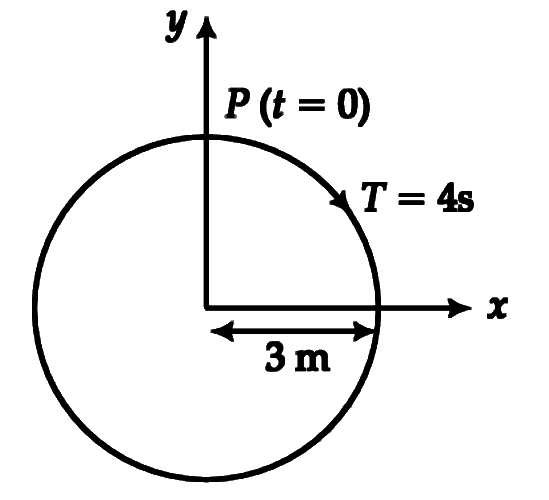
The radius of circle, the period of revolution, initial position and sense of revolution are indicated is the figure.

Figure

y- projection of the radius vector of rotating particle P is:

Show answer and solution

Answer: (c)

  1. r=3 mr = 3\ \text{m}, T=4 sT = 4\ \text{s}, so ω=2π4=π2 rad/s\omega = \frac{2\pi}{4} = \frac{\pi}{2}\ \text{rad/s}.
  2. At t=0t = 0, P is on the +y+y axis, so y(0)=+3 my(0) = +3\ \text{m} (maximum); it moves clockwise, so yy decreases.
  3. Hence y(t)=3cos⁡(πt2)y(t) = 3\cos\left(\frac{\pi t}{2}\right) m.
  4. So the answer is (c).
Report a mistake
Q58JEE Main 2019 · 12 JAN · SHIFT 2Easy

Periodic Motion & SHM Basics · Displacement equation and circle of reference

A simple harmonic motion is represented by:

y = 5 (sin 3 π\pi t + 3\sqrt{3} cos 3 π\pit) cm

The amplitude and time period of the motion are:

Show answer and solution

Answer: (d)

  1. For asin⁡θ+bcos⁡θa\sin\theta + b\cos\theta, amplitude =a2+b2= \sqrt{a^2 + b^2}.
  2. Amplitude =512+(3)2=5×2=10 cm= 5\sqrt{1^2 + (\sqrt{3})^2} = 5 \times 2 = 10\ \text{cm}.
  3. ω=3π\omega = 3\pi, so T=2π3π=23 sT = \frac{2\pi}{3\pi} = \frac{2}{3}\ \text{s}.
  4. So the answer is (d) 10 cm, 23\frac{2}{3} s.
Report a mistake
Q59MHT CET 2019 · 2 MAY · SHIFT 1Easy

Periodic Motion & SHM Basics · Time and distance in SHM

A particle executes the simple harmonic motion with an amplitude ' AA '. The distance travelled by it in one periodic time is

Show answer and solution

Answer: (d)

  1. In one period the particle goes mean →\to +A+A →\to mean →\to −A-A →\to mean.
  2. Distance =A+A+A+A=4A= A + A + A + A = 4A.
  3. So the answer is (d) 4A4A.
Report a mistake
Q60NEET 2019Easy

Periodic Motion & SHM Basics · Time and distance in SHM

The distance covered by a particle undergoing SHM in one time period is (amplitude = AA),

Show answer and solution

Answer: (a)

  1. In one period the particle goes mean →\to +A+A →\to mean →\to −A-A →\to mean.
  2. Distance =A+A+A+A=4A= A + A + A + A = 4A.
  3. So the answer is (a) 4A4A.
Report a mistake
Q61NEET 2019Easy

Periodic Motion & SHM Basics · Time and distance in SHM

Average velocity of a particle executing SHM in one complete vibration is:

Show answer and solution

Answer: (d)

  1. Average velocity =displacementtime= \frac{\text{displacement}}{\text{time}}.
  2. After one complete vibration the particle is back at its starting point, so displacement =0= 0.
  3. So the answer is (d) zero.
Report a mistake
Q62NEET 2019Medium

Periodic Motion & SHM Basics · Displacement equation and circle of reference

The displacement of a particle executing simple harmonic motion is given by

y = A0 + A sinω\omegat + B cosω\omegat.

Then the amplitude of its oscillation is given by:

Show answer and solution

Answer: (a)

  1. A0A_0 only shifts the mean position; it does not change the amplitude.
  2. Asin⁡ωt+Bcos⁡ωt=A2+B2 sin⁡(ωt+δ)A\sin\omega t + B\cos\omega t = \sqrt{A^2 + B^2}\,\sin(\omega t + \delta)
  3. So the answer is (a) A2+B2\sqrt{A^2 + B^2}.
Report a mistake
Q63JEE Main 2018 · 16 APR · SHIFT 1Difficult

Periodic Motion & SHM Basics · Time and distance in SHM

A particle executes simple harmonic motion and is located at x = a, b and c at times t0, 2t0 and 3t0 respectively. The frequency of the oscillation is:

Show answer and solution

Answer: (a)

  1. Let x=Asin⁡(ωt+δ)x = A\sin(\omega t + \delta), so a=Asin⁡(ωt0+δ)a = A\sin(\omega t_0 + \delta), b=Asin⁡(2ωt0+δ)b = A\sin(2\omega t_0 + \delta), c=Asin⁡(3ωt0+δ)c = A\sin(3\omega t_0 + \delta).
  2. a+c=2Asin⁡(2ωt0+δ)cos⁡(ωt0)=2bcos⁡ωt0a + c = 2A\sin(2\omega t_0 + \delta)\cos(\omega t_0) = 2b\cos\omega t_0
  3. cos⁡ωt0=a+c2b⇒ω=1t0cos⁡−1(a+c2b)\cos\omega t_0 = \frac{a+c}{2b} \Rightarrow \omega = \frac{1}{t_0}\cos^{-1}\left(\frac{a+c}{2b}\right)
  4. f=ω2π=12πt0cos⁡−1(a+c2b)f = \frac{\omega}{2\pi} = \frac{1}{2\pi t_0}\cos^{-1}\left(\frac{a+c}{2b}\right)
  5. So the answer is (a).
Report a mistake
Q64JEE Main 2016 · 9 APR · SHIFT 1Medium

Periodic Motion & SHM Basics · Phase and phase difference

Two particles are performing simple harmonic motion in a straight line about the same equilibrium point. The amplitude and time period for both particles are same and equal to A and T, respectively. At time t = 0 one particle has displacement A while the other one has displacement −A2\frac{-A}{2} and they are moving towards each other. If they cross each other at time t, then t is:

Show answer and solution

Answer: (a)

  1. Take x=Asin⁡(ωt+ϕ)x = A\sin(\omega t + \phi). Particle 1 at x=Ax = A: ϕ1=π2\phi_1 = \frac{\pi}{2}.
  2. Particle 2 at −A2-\frac{A}{2} moving towards +x+x: ϕ2=−π6\phi_2 = -\frac{\pi}{6}.
  3. They cross when sin⁡(ωt+π2)=sin⁡(ωt−π6)\sin(\omega t + \frac{\pi}{2}) = \sin(\omega t - \frac{\pi}{6}), i.e. ωt+π2=π−ωt+π6\omega t + \frac{\pi}{2} = \pi - \omega t + \frac{\pi}{6}.
  4. 2ωt=2π3⇒ωt=π3⇒t=T62\omega t = \frac{2\pi}{3} \Rightarrow \omega t = \frac{\pi}{3} \Rightarrow t = \frac{T}{6}
  5. So the answer is (a) T6\frac{T}{6}.
Report a mistake
Q65JEE Main 2014 · 12 APR · SHIFT 1Easy

Periodic Motion & SHM Basics · Restoring force and differential equation

Which of the following expressions corresponds to simple harmonic motion along a straight line, where x is the displacement and a, b, c are positive constants?

Show answer and solution

Answer: (d)

  1. For SHM the force (or acceleration) must be F=−kxF = -kx only.
  2. Options (a), (b), (c) have constant or x2x^2 terms.
  3. −bx-bx is the only linear restoring expression.
  4. So the answer is (d) −bx-bx.
Report a mistake
Q66JEE Main 2014 · 19 APR · SHIFT 1Medium

Periodic Motion & SHM Basics · Time and distance in SHM

A body is in simple harmonic motion with time period half second (T = 0.5 s) and amplitude one cm (A = 1 cm). Find the average velocity in the interval in which it moves from equilibrium position to half of its amplitude.

Show answer and solution

Answer: (c)

  1. Mean to A2\frac{A}{2} takes t=T12=0.512=124 st = \frac{T}{12} = \frac{0.5}{12} = \frac{1}{24}\text{ s}
  2. Displacement =A2=0.5 cm= \frac{A}{2} = 0.5\text{ cm}
  3. vavg=0.51/24=12 cm/sv_{avg} = \frac{0.5}{1/24} = 12\text{ cm/s}
  4. So the answer is (c) 12 cm/s.
Report a mistake
Q67JEE Main 2014Difficult

Periodic Motion & SHM Basics · Time and distance in SHM

A particle moves with simple harmonic motion in a straight line. In first τs,\tau s, after starting from rest it travels a distance a,a, and in next τs\tau s it travels 2a,2a, in same direction, then:

Show answer and solution

Answer: (d)

  1. Starting from rest means starting at an extreme: distance covered in time tt is A(1−cos⁡ωt)A(1 - \cos\omega t).
  2. After τ\tau: A(1−cos⁡ωτ)=aA(1 - \cos\omega\tau) = a; after 2τ2\tau: A(1−cos⁡2ωτ)=3aA(1 - \cos 2\omega\tau) = 3a
  3. With c=cos⁡ωτc = \cos\omega\tau: 1−cos⁡2ωτ1−c=2(1−c)(1+c)1−c=2(1+c)=3⇒c=12\frac{1 - \cos2\omega\tau}{1 - c} = \frac{2(1-c)(1+c)}{1-c} = 2(1+c) = 3 \Rightarrow c = \frac{1}{2}
  4. ωτ=π3⇒T=2πω=6τ\omega\tau = \frac{\pi}{3} \Rightarrow T = \frac{2\pi}{\omega} = 6\tau (and A=2aA = 2a)
  5. So the answer is (d) T=6τT = 6\tau.
Report a mistake
Q68NEET 2011 · AIPMT · PRELIMSEasy

Periodic Motion & SHM Basics · Periodic and oscillatory motion

Out of the following functions representing motion of a particle which represents SHM (1) y = sinω\omegat −- cosω\omegat

(2) y = sin3ω\omegat

(3) y = 5cos (3π4−3ωt)\left(\frac{3\pi}{4} - 3\omega t\right)

(4) y = 1 + ω\omegat + ω\omega2t2

Show answer and solution

Answer: (c)

  1. (1) sin⁡ωt−cos⁡ωt=2sin⁡(ωt−π/4)\sin\omega t - \cos\omega t = \sqrt{2}\sin(\omega t - \pi/4): a single sine term, so SHM.
  2. (2) sin⁡3ωt=3sin⁡ωt−sin⁡3ωt4\sin^3\omega t = \frac{3\sin\omega t - \sin 3\omega t}{4}: two different frequencies, periodic but not SHM.
  3. (3) 5cos⁡(3π4−3ωt)5\cos\left(\frac{3\pi}{4} - 3\omega t\right): a single cosine term, so SHM.
  4. (4) 1+ωt+ω2t21 + \omega t + \omega^2 t^2 grows without limit, not even periodic.
  5. So the answer is (c) only (1) and (3).
Report a mistake
Q69NEET 2011 · AIPMT · MAINSMedium

Periodic Motion & SHM Basics · Phase and phase difference

Two particles are oscillating along two close parallel straight lines side by side, with the same frequency and amplitudes. They pass each other, moving in opposite directions when their displacement is half of the amplitude. The mean positions of the two particles lie on a straight line perpendicular to the paths of the two particles. The phase difference is

Show answer and solution

Answer: (c)

2π/3π/6P₁P₂level x = A/2 (dashed)x = 0
  1. At x=A2x = \frac{A}{2}: sin⁡ϕ=12\sin\phi = \frac{1}{2}, so ϕ=π6\phi = \frac{\pi}{6} or 5π6\frac{5\pi}{6}.
  2. Moving in opposite directions means one has cos⁡ϕ>0\cos\phi > 0 (π6\frac{\pi}{6}) and the other cos⁡ϕ<0\cos\phi < 0 (5π6\frac{5\pi}{6}).
  3. Δϕ=5π6−π6=2π3\Delta\phi = \frac{5\pi}{6} - \frac{\pi}{6} = \frac{2\pi}{3}
  4. So the answer is (c) 2π3\frac{2\pi}{3}.
Report a mistake
Q70JEE Main 2011 · AIEEEDifficult

Periodic Motion & SHM Basics · Phase and phase difference

Two particles are executing simple harmonic motion of the same amplitude AA and frequency ω\omega along the xx-axis. Their mean position is separated by distance X0 (X0>A)X_0\ (X_0 > A). If the maximum separation between them is (X0+A),(X_0 + A), the phase difference between their motion is:

Show answer and solution

Answer: (a)

  1. Take x1=Asin⁡ωtx_1 = A\sin\omega t and x2=X0+Asin⁡(ωt+ϕ)x_2 = X_0 + A\sin(\omega t + \phi).
  2. Separation =X0+A[sin⁡(ωt+ϕ)−sin⁡ωt]=X0+2Asin⁡ϕ2cos⁡(ωt+ϕ2)= X_0 + A[\sin(\omega t+\phi) - \sin\omega t] = X_0 + 2A\sin\frac{\phi}{2}\cos\left(\omega t + \frac{\phi}{2}\right)
  3. Maximum separation =X0+2Asin⁡ϕ2=X0+A⇒sin⁡ϕ2=12= X_0 + 2A\sin\frac{\phi}{2} = X_0 + A \Rightarrow \sin\frac{\phi}{2} = \frac{1}{2}
  4. ϕ2=π6⇒ϕ=π3\frac{\phi}{2} = \frac{\pi}{6} \Rightarrow \phi = \frac{\pi}{3}
  5. So the answer is (a) π3\frac{\pi}{3}.
Report a mistake
Q71NEET 2010 · AIPMT · PRELIMSEasy

Periodic Motion & SHM Basics · Periodic and oscillatory motion

The displacement of a particle along the x-axis is given by x = asin2ω\omegat. The motion of the particle corresponds to

Show answer and solution

Answer: (c)

  1. x=asin⁡2ωt=a2−a2cos⁡2ωtx = a\sin^2\omega t = \frac{a}{2} - \frac{a}{2}\cos 2\omega t.
  2. This is SHM of amplitude a/2a/2 about the shifted mean position x=a/2x = a/2, with angular frequency 2ω2\omega.
  3. Frequency f=2ω2π=ωπf = \frac{2\omega}{2\pi} = \frac{\omega}{\pi}.
  4. So the working gives (a) SHM of frequency ω/π\omega/\pi; the key's (c) treats the shifted-mean motion as non-SHM.
Report a mistake
Q72NEET 2009 · AIPMTEasy

Periodic Motion & SHM Basics · Restoring force and differential equation

Which one of the following equations of motion represents simple harmonic motion? where k, k0, k1 and a are all positive.

Show answer and solution

Answer: (c)

  1. SHM condition: acceleration =−ω2x= -\omega^2 x (proportional to displacement and opposite to it).
  2. (b) has the wrong sign and (d) has an x2x^2 term.
  3. (a) is SHM only about a shifted mean x=−ax=-a; (c) is the standard form.
  4. (c) acceleration =−ω2x= -\omega^2 x matches the definition exactly.
  5. So the answer is (c).
Report a mistake
Q73JEE Main 2007 · AIEEEEasy

Periodic Motion & SHM Basics · Restoring force and differential equation

A point mass oscillates along the xx-axis according to the law x=x0cos⁡(ωt−π/4).x = x_0 \cos(\omega t - \pi/4). If the acceleration of the particle is written as a=Acos⁡(ωt+δ),a = A\cos(\omega t + \delta), then

Show answer and solution

Answer: (a)

  1. a=d2xdt2=−ω2x0cos⁡(ωt−π/4)a = \frac{d^2x}{dt^2} = -\omega^2 x_0\cos(\omega t - \pi/4).
  2. Use −cos⁡θ=cos⁡(θ+π)-\cos\theta = \cos(\theta + \pi): a=x0ω2cos⁡(ωt−π/4+π)=x0ω2cos⁡(ωt+3π/4)a = x_0\omega^2\cos(\omega t - \pi/4 + \pi) = x_0\omega^2\cos(\omega t + 3\pi/4).
  3. So A=x0ω2A = x_0\omega^2, δ=3π/4\delta = 3\pi/4.
  4. So the answer is (a).
Report a mistake
Q74NEET 2007 · AIPMTEasy

Periodic Motion & SHM Basics · Time and distance in SHM

A particle executes simple harmonic oscillation with an amplitude aa. The period of oscillation is T. The minimum time taken by the particle to travel half of the amplitude from the equilibrium position is

Show answer and solution

Answer: (b)

  1. From the mean position: x=asin⁡2πtTx = a\sin\frac{2\pi t}{T}.
  2. a2=asin⁡2πtT⇒2πtT=π6\frac{a}{2} = a\sin\frac{2\pi t}{T} \Rightarrow \frac{2\pi t}{T} = \frac{\pi}{6}.
  3. t=T12t = \frac{T}{12}.
  4. So the answer is (b) T/12T/12.
Report a mistake
Q75JEE Main 2007 · AIEEEEasy

Periodic Motion & SHM Basics · Time and distance in SHM

The displacement of an object attached to a spring and executing simple harmonic motion is given by x=2×10⁻²cos⁡πtx = 2 \times 10^{-2}\cos \pi t metre. The time at which the maximum speed first occurs is

Show answer and solution

Answer: (b)

  1. ω=π\omega = \pi, so T=2ππ=2 sT = \frac{2\pi}{\pi} = 2\ \text{s}.
  2. x=Acos⁡πtx = A\cos\pi t starts at the extreme position; maximum speed is at the mean position.
  3. First reached after T4=0.5 s\frac{T}{4} = 0.5\ \text{s}.
  4. So the answer is (b) 0.5 s.
Report a mistake
Q76NEET 2005 · AIPMTEasy

Periodic Motion & SHM Basics · Periodic and oscillatory motion

The circular motion of a particle with constant speed is

Show answer and solution

Answer: (a)

  1. Uniform circular motion repeats after every revolution, so it is periodic.
  2. It is a 2-D motion, not a to-and-fro motion along a line with F∝−xF \propto -x; only its projection on a diameter is SHM.
  3. So the answer is (a) periodic but not simple harmonic.
Report a mistake
Q77JEE Main 2005 · AIEEEEasy

Periodic Motion & SHM Basics · Displacement equation and circle of reference

If a simple harmonic motion is represented by d2xdt2+αx=0.\frac{d^2x}{dt^2} + \alpha x = 0. its time period is

Show answer and solution

Answer: (a)

  1. Compare with d2xdt2+ω2x=0\frac{d^2x}{dt^2} + \omega^2 x = 0: ω=α\omega = \sqrt{\alpha}.
  2. T=2πω=2παT = \frac{2\pi}{\omega} = \frac{2\pi}{\sqrt{\alpha}}.
  3. So the answer is (a).
Report a mistake
Q78JEE Main 2005 · AIEEEMedium

Periodic Motion & SHM Basics · Periodic and oscillatory motion

The function sin⁡2(ωt)\sin^2(\omega t) represents

Show answer and solution

Answer: (a)

  1. sin⁡2ωt=12−12cos⁡2ωt\sin^2\omega t = \frac{1}{2} - \frac{1}{2}\cos 2\omega t
  2. It repeats when 2ωt2\omega t changes by 2π2\pi, so period T=πωT = \frac{\pi}{\omega}.
  3. Displacement from the origin does not satisfy d2ydt2=−ω′2y\frac{d^2y}{dt^2} = -\omega'^2 y (it has a constant term), so it is periodic but not SHM.
  4. So the answer is (a).
Report a mistake
Q79JEE Main 2005 · AIEEEMedium

Periodic Motion & SHM Basics · Phase and phase difference

Two simple harmonic motions are represented by the equations y1=0.1sin⁡(100πt+π3)y_1 = 0.1\sin\left(100\pi t + \frac{\pi}{3}\right) and y2=0.1cos⁡πt.y_2 = 0.1\cos \pi t. The phase difference of the velocity of particle 11 with respect to the velocity of particle 22 is

Show answer and solution

Answer: (b)

  1. Take y2=0.1cos⁡100πty_2 = 0.1\cos 100\pi t (same ω\omega as y1y_1).
  2. v1∝cos⁡(100πt+π3)v_1 \propto \cos\left(100\pi t + \frac{\pi}{3}\right), v2∝−sin⁡100πt=cos⁡(100πt+π2)v_2 \propto -\sin 100\pi t = \cos\left(100\pi t + \frac{\pi}{2}\right)
  3. Δϕ=π3−π2=−π6\Delta\phi = \frac{\pi}{3} - \frac{\pi}{2} = -\frac{\pi}{6}
  4. So the answer is (b) −π6-\frac{\pi}{6}.
Report a mistake
Q80JEE Main 2003 · AIEEEMedium

Periodic Motion & SHM Basics · Displacement equation and circle of reference

The displacement of particle varies according to the relation

x=4(cos⁡πt+sin⁡πt).x = 4(\cos \pi t + \sin \pi t). The amplitude of the particle is

Show answer and solution

Answer: (c)

  1. x=4cos⁡πt+4sin⁡πtx = 4\cos\pi t + 4\sin\pi t
  2. Amplitude =42+42=42= \sqrt{4^2 + 4^2} = 4\sqrt{2}
  3. So the answer is (c) 424\sqrt{2}.
Report a mistake
Q81NEET 1994 · AIPMTEasy

Periodic Motion & SHM Basics · Restoring force and differential equation

A particle executes S.H.M. along xx-axis. The force acting on it is given by

Show answer and solution

Answer: (d)

  1. In SHM the restoring force is F=−kxF = -kx: proportional to xx and directed towards the mean position.
  2. Only −Akx-Akx has this form.
  3. So the answer is (d) −Akx-Akx.
Report a mistake
Q82NEET 1992 · AIPMTEasy

Periodic Motion & SHM Basics · Time and distance in SHM

A simple harmonic oscillator has an amplitude AA and time period TT. The time required by it to travel from x=Ax = A to x=A/2x = A/2 is

Show answer and solution

Answer: (a)

  1. From the extreme position: x=Acos⁡2πtTx = A\cos\frac{2\pi t}{T}.
  2. A2=Acos⁡2πtT⇒2πtT=π3\frac{A}{2} = A\cos\frac{2\pi t}{T} \Rightarrow \frac{2\pi t}{T} = \frac{\pi}{3}.
  3. t=T6t = \frac{T}{6}.
  4. So the answer is (a) T/6T/6.
Report a mistake
Q83NEET 1988 · AIPMTEasy

Periodic Motion & SHM Basics · Restoring force and differential equation

A particle executes S.H.M. along xx-axis. The force acting on it is given by

Show answer and solution

Answer: (d)

  1. In SHM the restoring force is F=−kxF = -kx: proportional to xx and directed towards the mean position.
  2. Only −Akx-Akx has this form.
  3. So the answer is (d) −Akx-Akx.
Report a mistake
Q84MHT CET 2026 · 20 MAY · SHIFT 1Easy

Velocity & Acceleration in SHM · Velocity at a displacement

A simple pendulum performs simple harmonic motion about x=0x = 0 with an amplitude 'A' and angular frequency ω\omega. The speed of pendulum at x=A8x = \frac{A}{8} will be.

Show answer and solution

Answer: (c)

  1. v=ωA2−x2v = \omega\sqrt{A^2 - x^2}
  2. v=ωA2−A264=ωA6364v = \omega\sqrt{A^2 - \frac{A^2}{64}} = \omega A\sqrt{\frac{63}{64}}
  3. So the answer is (c) 63Aω8\frac{\sqrt{63}A\omega}{8}.
Report a mistake
Q85MHT CET 2026 · 20 APR · SHIFT 2Easy

Velocity & Acceleration in SHM · Velocity at a displacement

A particle is performing S.H.M. about x=0x = 0, with an amplitude aa and time period TT. The speed of the particle at x=a3x = \frac{a}{3} will be

Show answer and solution

Answer: (d)

  1. v=ωa2−x2v = \omega\sqrt{a^2 - x^2} with ω=2πT\omega = \frac{2\pi}{T}
  2. a2−a29=22a3\sqrt{a^2 - \frac{a^2}{9}} = \frac{2\sqrt{2}a}{3}
  3. v=2πT⋅22a3=42πa3Tv = \frac{2\pi}{T}\cdot\frac{2\sqrt{2}a}{3} = \frac{4\sqrt{2}\pi a}{3T}
  4. So the answer is (d) 42πa3T\frac{4\sqrt{2}\pi a}{3T}.
Report a mistake
Q86MHT CET 2026 · 18 APR · SHIFT 1Easy

Velocity & Acceleration in SHM · Velocity at a displacement

A particle is performing simple harmonic motion about x=0x = 0 with an amplitude 'aa' and periodic time T. The speed of the particle at x=a3x = \frac{a}{3} will be

Show answer and solution

Answer: (c)

  1. v=ωa2−x2v = \omega\sqrt{a^2 - x^2} with ω=2πT\omega = \frac{2\pi}{T}
  2. a2−a29=22a3\sqrt{a^2 - \frac{a^2}{9}} = \frac{2\sqrt{2}a}{3}
  3. v=2πT⋅22a3=42πa3Tv = \frac{2\pi}{T}\cdot\frac{2\sqrt{2}a}{3} = \frac{4\sqrt{2}\pi a}{3T}
  4. So the answer is (c) 42πa3T\frac{4\sqrt{2}\pi a}{3T}.
Report a mistake
Q87MHT CET 2026 · 17 APR · SHIFT 1Easy

Velocity & Acceleration in SHM · Velocity at a displacement

A particle executing simple harmonic motion starts from mean position with amplitude 'AA' and periodic time 'TT'. At what displacement is its speed one-fourth of the maximum speed?

Show answer and solution

Answer: (d)

  1. v=ωA2−x2v = \omega\sqrt{A^2 - x^2}, vmax=ωAv_{max} = \omega A
  2. ωA2−x2=ωA4⇒A2−x2=A216\omega\sqrt{A^2 - x^2} = \frac{\omega A}{4} \Rightarrow A^2 - x^2 = \frac{A^2}{16}
  3. x2=15A216⇒x=15A4x^2 = \frac{15A^2}{16} \Rightarrow x = \frac{\sqrt{15}A}{4}
  4. So the answer is (d) A154\frac{A\sqrt{15}}{4}.
Report a mistake
Q88JEE Main 2026 · 4 APR · SHIFT 1Easy

Velocity & Acceleration in SHM · Velocity at a displacement

The velocity of a particle executing simple harmonic motion along xx-axis is described as v2=50−x2v^2 = 50 - x^2, where xx represents displacement. If the time period of motion is x7 s\frac{x}{7}\text{ s}, the value of xx is ______.

Numerical answer type. Work it out, then open the answer.

Show answer and solution

Answer: 44

  1. For SHM v2=ω2(A2−x2)=ω2A2−ω2x2v^2 = \omega^2(A^2 - x^2) = \omega^2A^2 - \omega^2x^2
  2. Compare with v2=50−x2v^2 = 50 - x^2: ω2=1⇒ω=1\omega^2 = 1 \Rightarrow \omega = 1 rad/s
  3. T=2πω=2π=2×227=447T = \frac{2\pi}{\omega} = 2\pi = 2\times\frac{22}{7} = \frac{44}{7} s
  4. x7=447⇒x=44\frac{x}{7} = \frac{44}{7} \Rightarrow x = 44
Report a mistake
Q89MHT CET 2026 · 14 MAY · SHIFT 2Easy

Velocity & Acceleration in SHM · Maximum velocity and acceleration

The maximum velocity and maximum acceleration of a particle performing a linear S.H.M. are α\alpha and β\beta respectively. Then, path length of the particle is

Show answer and solution

Answer: (c)

  1. vmax=Aω=αv_{max} = A\omega = \alpha, amax=Aω2=βa_{max} = A\omega^2 = \beta
  2. α2β=A2ω2Aω2=A\frac{\alpha^2}{\beta} = \frac{A^2\omega^2}{A\omega^2} = A
  3. Path length =2A=2α2β= 2A = \frac{2\alpha^2}{\beta}
  4. So the answer is (c) 2α2β\frac{2\alpha^2}{\beta}.
Report a mistake
Q90MHT CET 2026 · 12 MAY · SHIFT 1Easy

Velocity & Acceleration in SHM · Maximum velocity and acceleration

Two particles performing simple harmonic motions of maximum accelerations, 11 m/s22 and 100100 m/s22, have the same amplitudes. The ratio of their angular frequencies is

Show answer and solution

Answer: (b)

  1. amax=Aω2a_{max} = A\omega^2; same AA, so ω∝amax\omega \propto \sqrt{a_{max}}
  2. ω1ω2=1100=110\frac{\omega_1}{\omega_2} = \sqrt{\frac{1}{100}} = \frac{1}{10}
  3. So the answer is (b) 1:101 : 10.
Report a mistake
Q91MHT CET 2026 · 15 APR · SHIFT 2Easy

Velocity & Acceleration in SHM · Maximum velocity and acceleration

A body of mass 0.40.4 kg performs simple harmonic motion. It experiences a restoring force of 0.40.4 N when its displacement from the mean position is 4 cm. The force constant and magnitude of acceleration respectively are

Show answer and solution

Answer: (b)

  1. k=Fx=0.40.04=10k = \frac{F}{x} = \frac{0.4}{0.04} = 10 N/m
  2. a=Fm=0.40.4=1 m/s2a = \frac{F}{m} = \frac{0.4}{0.4} = 1\ \text{m/s}^2
  3. So the answer is (b) 1010 N/m, 1 m/s21\ \text{m/s}^2.
Report a mistake
Q92MHT CET 2026 · 14 MAY · SHIFT 2Medium

Velocity & Acceleration in SHM · Velocity at a displacement

A particle executes S.H.M. with time period 1616 s. At time t=2t = 2 s, the particle crosses the mean position while at t=4t = 4 s, velocity is 44 m/s. The amplitude of motion (in m) is (sin⁡45∘=12)\left(\sin 45^\circ = \frac{1}{\sqrt{2}}\right)

Show answer and solution

Answer: (d)

  1. ω=2πT=2π16=π8\omega = \frac{2\pi}{T} = \frac{2\pi}{16} = \frac{\pi}{8} rad/s.
  2. Particle is at the mean position at t=2t = 2 s, so x=Asin⁡ω(t−2)x = A\sin\omega(t - 2) and v=Aωcos⁡ω(t−2)v = A\omega\cos\omega(t-2).
  3. At t=4t = 4 s: ω(t−2)=π4\omega(t-2) = \frac{\pi}{4}, so 4=A⋅π8⋅124 = A\cdot\frac{\pi}{8}\cdot\frac{1}{\sqrt{2}}.
  4. A=322πA = \frac{32\sqrt{2}}{\pi} m.
  5. So the answer is (d) 322π\frac{32\sqrt{2}}{\pi}.
Report a mistake
Q93MHT CET 2026 · 15 APR · SHIFT 1Medium

Velocity & Acceleration in SHM · Velocity at a displacement

A particle executes linear S.H.M. with amplitude 44 cm. The magnitude of velocity and acceleration is equal when it is at 33 cm from mean position. Time period is

Show answer and solution

Answer: (b)

  1. ∣v∣=ωA2−x2|v| = \omega\sqrt{A^2 - x^2}, ∣a∣=ω2x|a| = \omega^2 x.
  2. ω16−9=ω2(3)⇒ω=73\omega\sqrt{16 - 9} = \omega^2(3) \Rightarrow \omega = \frac{\sqrt{7}}{3} rad/s.
  3. T=2πω=6π7T = \frac{2\pi}{\omega} = \frac{6\pi}{\sqrt{7}} s.
  4. So the answer is (b) 6π7\frac{6\pi}{\sqrt{7}} s.
Report a mistake
Q94MHT CET 2026 · 13 APR · SHIFT 2Medium

Velocity & Acceleration in SHM · Velocity at a displacement

The velocity of a particle executing SHM varies with displacement (xx) as 4v2=50−x24v^2 = 50 - x^2. The time period of oscillations is x/7x/7 s.

The value of xx is (Take π=22/7\pi = 22/7)

Show answer and solution

Answer: (c)

  1. Compare v2=14(50−x2)v^2 = \frac{1}{4}(50 - x^2) with v2=ω2(A2−x2)v^2 = \omega^2(A^2 - x^2): ω2=14\omega^2 = \frac{1}{4}, ω=12\omega = \frac{1}{2} rad/s.
  2. T=2πω=4π=4×227=887T = \frac{2\pi}{\omega} = 4\pi = 4\times\frac{22}{7} = \frac{88}{7} s.
  3. x7=887⇒x=88\frac{x}{7} = \frac{88}{7} \Rightarrow x = 88.
  4. So the answer is (c) 88.
Report a mistake
Q95MHT CET 2026 · 19 APR · SHIFT 2Medium

Velocity & Acceleration in SHM · Velocities at two positions

A particle executing linear S.H.M. has velocities V1V_1 and V2V_2 at distance x1x_1 and x2x_2 respectively, from the mean position, its angular velocity is

Show answer and solution

Answer: (a)

  1. V12=ω2(A2−x12)V_1^2 = \omega^2(A^2 - x_1^2) and V22=ω2(A2−x22)V_2^2 = \omega^2(A^2 - x_2^2).
  2. Subtract: V22−V12=ω2(x12−x22)V_2^2 - V_1^2 = \omega^2(x_1^2 - x_2^2).
  3. ω=V22−V12x12−x22\omega = \sqrt{\frac{V_2^2 - V_1^2}{x_1^2 - x_2^2}}.
  4. So the answer is (a).
Report a mistake
Q96NEET 2026 · RE-NEETMedium

Velocity & Acceleration in SHM · Graphs and phase relations

Consider a spring-mass simple harmonic oscillator in one dimension. The mass of the particle is m kgm\text{ kg} and the spring constant is k N m−1k\text{ N m}^{-1}. At a given instant, the extension of the spring is xx-meter and the speed of the particle is v m s−1v\text{ m s}^{-1}. On the x−vx - v plane, if the graph of vv as a function of xx is a circle, then the correct option is:

Show answer and solution

Answer: (c)

  1. v2=km(A2−x2)⇒v2+kmx2=kmA2v^2 = \frac{k}{m}(A^2 - x^2) \Rightarrow v^2 + \frac{k}{m}x^2 = \frac{k}{m}A^2.
  2. This is a circle only if the coefficients of x2x^2 and v2v^2 are equal: km=1\frac{k}{m} = 1.
  3. So the answer is (c) k=mk = m.
Report a mistake
Q97MHT CET 2025 · 5 MAY · SHIFT 2Easy

Velocity & Acceleration in SHM · Velocity at a displacement

A simple pendulum starts oscillating simple harmonically from its mean position ( x=0x = 0) with amplitude ' aa ' and periodic time ' TT '. The magnitude of velocity of pendulum at x=a2x = \frac{a}{2} is

Show answer and solution

Answer: (d)

  1. v=ωa2−x2v = \omega\sqrt{a^2 - x^2} with ω=2πT\omega = \frac{2\pi}{T}
  2. a2−a24=3a2\sqrt{a^2 - \frac{a^2}{4}} = \frac{\sqrt{3}a}{2}
  3. v=2πT⋅3a2=3πaTv = \frac{2\pi}{T}\cdot\frac{\sqrt{3}a}{2} = \frac{\sqrt{3}\pi a}{T}
  4. So the answer is (d) 3πaT\frac{\sqrt{3}\pi a}{T}.
Report a mistake
Q98MHT CET 2025 · 22 APR · SHIFT 2Easy

Velocity & Acceleration in SHM · Velocity at a displacement

A particle executes S.H.M. starting from the mean position. Its amplitude is ' a ' and its periodic time is ' TT '. At a certain instant, its speed ' uu ' is half that of maximum speed VVmax. The displacement of the particle at that instant is

Show answer and solution

Answer: (d)

  1. v=ωa2−x2v = \omega\sqrt{a^2 - x^2}, Vmax=ωaV_{max} = \omega a
  2. ωa2−x2=ωa2⇒a2−x2=a24\omega\sqrt{a^2 - x^2} = \frac{\omega a}{2} \Rightarrow a^2 - x^2 = \frac{a^2}{4}
  3. x=3a2x = \frac{\sqrt{3}a}{2}
  4. So the answer is (d) 3a2\frac{\sqrt{3}a}{2}.
Report a mistake
Q99MHT CET 2025 · 21 APR · SHIFT 1Easy

Velocity & Acceleration in SHM · Maximum velocity and acceleration

Two simple harmonic motions of angular frequency 300 rad/s300\text{ rad/s} and 3000 rad/s3000\text{ rad/s} have same amplitude. The ratio of their maximum accelerations is

Show answer and solution

Answer: (b)

  1. amax=Aω2a_{max} = A\omega^2; same AA, so amax∝ω2a_{max} \propto \omega^2
  2. a1a2=(3003000)2=1100\frac{a_1}{a_2} = \left(\frac{300}{3000}\right)^2 = \frac{1}{100}
  3. So the answer is (b) 1:1021 : 10^2.
Report a mistake
Q100MHT CET 2025 · 26 APR · SHIFT 2Easy

Velocity & Acceleration in SHM · Graphs and phase relations

A particle is performing S.H.M. starting from extreme position. Graphical representation shows that between displacement and acceleration, there is a phase difference of

Show answer and solution

Answer: (a)

  1. In SHM a=−ω2xa = -\omega^2 x: acceleration is always opposite to displacement.
  2. −cos⁡θ=cos⁡(θ+π)-\cos\theta = \cos(\theta + \pi), so the acceleration graph is the displacement graph shifted by π\pi.
  3. So the answer is (a) π\pi rad.
Report a mistake
Q101MHT CET 2025 · 19 APR · SHIFT 2Easy

Velocity & Acceleration in SHM · Graphs and phase relations

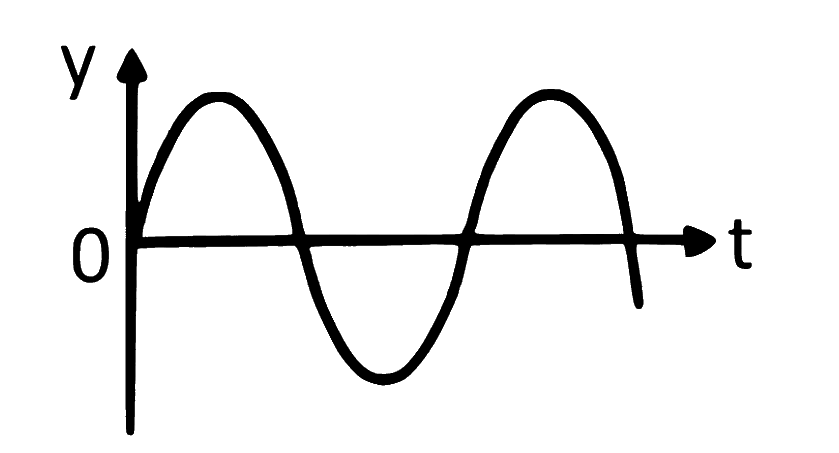
For a particle performing S.H.M. the displacement - time graph is shown.

Figure

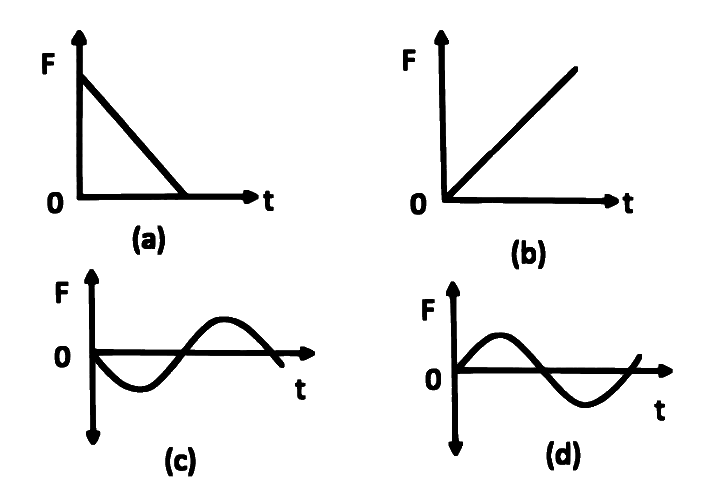
For that particle the force - time graph is correctly shown in graph

Figure

Show answer and solution

Answer: (c)

  1. The graph starts at y=0y = 0 and rises, so y=Asin⁡ωty = A\sin\omega t.
  2. Restoring force F=−ky=−kAsin⁡ωtF = -ky = -kA\sin\omega t.
  3. So FF starts at zero and first goes negative, then positive: an inverted sine curve.
  4. So the answer is (c).
Report a mistake
Q102MHT CET 2025 · 20 APR · SHIFT 2Difficult

Velocity & Acceleration in SHM · Velocities at two positions

A particle executes a linear S.H.M. In two of its positions the velocities are V1,V2V_1, V_2 and accelerations are a1a_1 and a2a_2 respectively (0<a1<a2)(0 < a_1 < a_2). The distance between the positions is

Show answer and solution

Answer: (c)

  1. V2=ω2(A2−x2)V^2 = \omega^2(A^2 - x^2) and a=ω2xa = \omega^2 x (magnitudes).
  2. V12−V22=ω2(x22−x12)=ω2(x2−x1)(x2+x1)V_1^2 - V_2^2 = \omega^2(x_2^2 - x_1^2) = \omega^2(x_2 - x_1)(x_2 + x_1)
  3. a1+a2=ω2(x1+x2)a_1 + a_2 = \omega^2(x_1 + x_2)
  4. Dividing: x2−x1=V12−V22a1+a2x_2 - x_1 = \dfrac{V_1^2 - V_2^2}{a_1 + a_2}
  5. So the answer is (c).
Report a mistake
Q103MHT CET 2024 · 15 MAY · SHIFT 2Easy

Velocity & Acceleration in SHM · Velocity at a displacement

For a particle executing S.H.M. having amplitude A, the speed of the particle is (13)\left(\frac{1}{3}\right)rd of its maximum speed when the displacement from the mean position is

Show answer and solution

Answer: (c)

  1. v=ωA2−x2v = \omega\sqrt{A^2 - x^2}, vmax=ωAv_{max} = \omega A
  2. A2−x2=A3⇒x2=A2−A29=8A29\sqrt{A^2 - x^2} = \frac{A}{3} \Rightarrow x^2 = A^2 - \frac{A^2}{9} = \frac{8A^2}{9}
  3. x=223Ax = \frac{2\sqrt{2}}{3}A
  4. So the answer is (c) 223A\frac{2\sqrt{2}}{3}A.
Report a mistake
Q104MHT CET 2024 · 11 MAY · SHIFT 2Easy

Velocity & Acceleration in SHM · Velocity at a displacement

A particle is performing S.H.M. about its mean position with an amplitude ' aa ' and periodic time ' TT '. The speed of the particle when its displacement from mean position is a3\frac{a}{3} will be

Show answer and solution

Answer: (b)

  1. v=ωa2−x2v = \omega\sqrt{a^2 - x^2} with ω=2πT\omega = \frac{2\pi}{T}
  2. a2−a29=22a3\sqrt{a^2 - \frac{a^2}{9}} = \frac{2\sqrt{2}a}{3}
  3. v=2πT⋅22a3=42πa3Tv = \frac{2\pi}{T}\cdot\frac{2\sqrt{2}a}{3} = \frac{4\sqrt{2}\pi a}{3T}
  4. So the answer is (b) 42πa3T\frac{4\sqrt{2}\pi a}{3T}.
Report a mistake
Q105MHT CET 2024 · 9 MAY · SHIFT 1Easy

Velocity & Acceleration in SHM · Velocity at a displacement

A particle is performing S.H.M. with an amplitude 4 cm. At the mean position the velocity of the particle is 12 cm/s12\text{ cm/s}. When the speed of the particle becomes 6 cm/s6\text{ cm/s}, the distance of the particle from mean position is

Show answer and solution

Answer: (c)

  1. vmax=Aω⇒ω=124=3 rad/sv_{max} = A\omega \Rightarrow \omega = \frac{12}{4} = 3\ \text{rad/s}
  2. v=ωA2−x2v = \omega\sqrt{A^2 - x^2}: 6=316−x2⇒16−x2=46 = 3\sqrt{16 - x^2} \Rightarrow 16 - x^2 = 4
  3. x=12=23 cmx = \sqrt{12} = 2\sqrt{3}\ \text{cm}
  4. So the answer is (c) 232\sqrt{3} cm.
Report a mistake
Q106MHT CET 2024 · 15 MAY · SHIFT 1Easy

Velocity & Acceleration in SHM · Maximum velocity and acceleration

The maximum velocity of a particle, executing S.H.M. with an amplitude 7 mm is 4.4 m s−14.4\text{ m s}^{-1} The period of oscillation is [π=227]\left[\pi = \frac{22}{7}\right]

Show answer and solution

Answer: (d)

  1. vmax=Aω=2πAT⇒T=2πAvmaxv_{max} = A\omega = \frac{2\pi A}{T} \Rightarrow T = \frac{2\pi A}{v_{max}}
  2. T=2×227×7×10−34.4=0.0444.4T = \frac{2\times\frac{22}{7}\times 7\times10^{-3}}{4.4} = \frac{0.044}{4.4}
  3. T=0.01T = 0.01 s
  4. So the answer is (d) 0.01 s.
Report a mistake
Q107MHT CET 2024 · 10 MAY · SHIFT 1Easy

Velocity & Acceleration in SHM · Maximum velocity and acceleration

A particle performing S.H.M. with maximum velocity ' VV '. If the amplitude double and periodic time is made, (13)\left(\frac{1}{3}\right)rd then the maximum velocity is

Show answer and solution

Answer: (a)

  1. vmax=Aω=2πATv_{max} = A\omega = \frac{2\pi A}{T}, so vmax∝ATv_{max} \propto \frac{A}{T}
  2. A′=2AA' = 2A, T′=T3T' = \frac{T}{3}: v′=21/3V=6Vv' = \frac{2}{1/3}V = 6V
  3. So the answer is (a) 6V6V.
Report a mistake
Q108MHT CET 2024 · 4 MAY · SHIFT 2Easy

Velocity & Acceleration in SHM · Maximum velocity and acceleration

The maximum velocity and maximum acceleration of a particle performing a linear S.H.M. is ' α\alpha ' and ' β\beta ' respectively. Then the path length of the particle is

Show answer and solution

Answer: (c)

  1. vmax=Aω=αv_{max} = A\omega = \alpha, amax=Aω2=βa_{max} = A\omega^2 = \beta
  2. α2β=A2ω2Aω2=A\frac{\alpha^2}{\beta} = \frac{A^2\omega^2}{A\omega^2} = A
  3. Path length =2A=2α2β= 2A = \frac{2\alpha^2}{\beta}
  4. So the answer is (c) 2α2β\frac{2\alpha^2}{\beta}.
Report a mistake
Q109JEE Main 2024 · 6 APR · SHIFT 1Easy

Velocity & Acceleration in SHM · Maximum velocity and acceleration

A particle is doing simple harmonic motion of amplitude 0.06 m0.06\text{ m} and time period 3.14 s3.14\text{ s}. The maximum velocity of the particle is _________ cm/s\text{cm/s}.

Numerical answer type. Work it out, then open the answer.

Show answer and solution

Answer: 12

  1. ω=2πT=2×3.143.14=2\omega = \frac{2\pi}{T} = \frac{2\times 3.14}{3.14} = 2 rad/s
  2. vmax=Aω=0.06×2=0.12v_{max} = A\omega = 0.06\times 2 = 0.12 m/s
  3. vmax=12v_{max} = 12 cm/s
Report a mistake
Q110MHT CET 2024 · 11 MAY · SHIFT 1Medium

Velocity & Acceleration in SHM · Velocity at a displacement

A particle performing S.H.M. starts from equilibrium position and its time period is 12 second. After 2 seconds its velocity is π m/s\pi\text{ m/s}. Amplitude of the oscillation is

[sin⁡30∘=cos⁡60∘=0.5, sin⁡60∘=cos⁡30∘=3/2]\left[\sin 30^\circ = \cos 60^\circ = 0.5,\ \sin 60^\circ = \cos 30^\circ = \sqrt{3}/2\right]

Show answer and solution

Answer: (b)

  1. ω=2π12=π6\omega = \frac{2\pi}{12} = \frac{\pi}{6} rad/s; starting from the mean position, v=Aωcos⁡ωtv = A\omega\cos\omega t.
  2. At t=2t = 2 s: ωt=π3\omega t = \frac{\pi}{3}, so π=A⋅π6⋅cos⁡60∘=Aπ12\pi = A\cdot\frac{\pi}{6}\cdot\cos 60^\circ = \frac{A\pi}{12}.
  3. A=12A = 12 m.
  4. So the answer is (b) 12 m.
Report a mistake
Q111MHT CET 2024 · 4 MAY · SHIFT 1Medium

Velocity & Acceleration in SHM · Velocity at a displacement

The velocity of particle executing S.H.M. varies with displacement (x)(x) as 4V2=50−x24V^2 = 50 - x^2. The time period of oscillation is x7\frac{x}{7} second. The value of ' xx ' is (Take π=227\pi = \frac{22}{7})

Show answer and solution

Answer: (d)

  1. v2=14(50−x2)v^2 = \frac{1}{4}(50 - x^2) compared with v2=ω2(A2−x2)v^2 = \omega^2(A^2 - x^2) gives ω=12\omega = \frac{1}{2} rad/s.
  2. T=2πω=4π=887T = \frac{2\pi}{\omega} = 4\pi = \frac{88}{7} s.
  3. x7=887⇒x=88\frac{x}{7} = \frac{88}{7} \Rightarrow x = 88.
  4. So the answer is (d) 88.
Report a mistake
Q112JEE Main 2024 · 4 APR · SHIFT 2Medium

Velocity & Acceleration in SHM · Velocity at a displacement

The displacement of a particle executing SHM is given by x=10sin⁡(ωt+π3) mx = 10\sin\left(\omega t + \frac{\pi}{3}\right)\text{ m}. The time period of motion is 3.14 s3.14\text{ s}. The velocity of the particle at t=0t = 0 is _______ m/s\text{m/s}.

Numerical answer type. Work it out, then open the answer.

Show answer and solution

Answer: 10

  1. ω=2πT=2×3.143.14=2\omega = \frac{2\pi}{T} = \frac{2\times 3.14}{3.14} = 2 rad/s.
  2. v=dxdt=10ωcos⁡(ωt+π3)v = \frac{dx}{dt} = 10\omega\cos(\omega t + \frac{\pi}{3}).
  3. At t=0t = 0: v=10×2×cos⁡60∘=10v = 10\times 2\times\cos 60^\circ = 10 m/s.
  4. Answer: 10 m/s.
Report a mistake
Q113JEE Main 2024 · 31 JAN · SHIFT 1Medium

Velocity & Acceleration in SHM · Velocity at a displacement

A particle performs simple harmonic motion with amplitude AA. Its speed is increased to three times at an instant when its displacement is 2A3\frac{2A}{3}. The new amplitude of motion is nA3\frac{nA}{3}. The value of nn is ___________.

Numerical answer type. Work it out, then open the answer.

Show answer and solution

Answer: 7

  1. At x=2A3x = \frac{2A}{3}: v=ωA2−4A29=53ωAv = \omega\sqrt{A^2 - \frac{4A^2}{9}} = \frac{\sqrt{5}}{3}\omega A.
  2. New speed v′=3v=5 ωAv' = 3v = \sqrt{5}\,\omega A with the same ω\omega.
  3. A′2=4A29+5A2=49A29⇒A′=7A3A'^2 = \frac{4A^2}{9} + 5A^2 = \frac{49A^2}{9} \Rightarrow A' = \frac{7A}{3}.
  4. So n=7n = 7.
Report a mistake
Q114JEE Main 2024 · 27 JAN · SHIFT 1Medium

Velocity & Acceleration in SHM · Velocity at a displacement

A particle executes simple harmonic motion with an amplitude of 4 cm4\text{ cm}. At the mean position, velocity of the particle is 10 cm/s10\text{ cm/s}. The distance of the particle from the mean position when its speed becomes 5 cm/s5\text{ cm/s} is α cm\sqrt{\alpha}\text{ cm}, where α=\alpha = ________.

Numerical answer type. Work it out, then open the answer.

Show answer and solution

Answer: 12

  1. vmax=Aω⇒10=4ω⇒ω=2.5v_{max} = A\omega \Rightarrow 10 = 4\omega \Rightarrow \omega = 2.5 rad/s.
  2. v=ωA2−x2⇒5=2.516−x2v = \omega\sqrt{A^2 - x^2} \Rightarrow 5 = 2.5\sqrt{16 - x^2}.
  3. 16−x2=4⇒x2=1216 - x^2 = 4 \Rightarrow x^2 = 12, so x=12x = \sqrt{12} cm.
  4. So α=12\alpha = 12.
Report a mistake
Q115MHT CET 2024 · 16 MAY · SHIFT 1Medium

Velocity & Acceleration in SHM · Velocities at two positions

A particle executing S.H.M. has velocities ' V1V_1 ' and ' V2V_2 ' at distances ' x1x_1 ' and ' x2x_2 ' respectively, from the mean position. Its frequency is

Show answer and solution

Answer: (c)

  1. V12=ω2(A2−x12)V_1^2 = \omega^2(A^2 - x_1^2), V22=ω2(A2−x22)V_2^2 = \omega^2(A^2 - x_2^2).
  2. Subtract: ω=V22−V12x12−x22\omega = \sqrt{\frac{V_2^2 - V_1^2}{x_1^2 - x_2^2}}.
  3. f=ω2π=12πV22−V12x12−x22f = \frac{\omega}{2\pi} = \frac{1}{2\pi}\sqrt{\frac{V_2^2 - V_1^2}{x_1^2 - x_2^2}}.
  4. So the answer is (c).
Report a mistake
Q116MHT CET 2024 · 10 MAY · SHIFT 2Medium

Velocity & Acceleration in SHM · Velocities at two positions

A particle performs linear S.H.M. When the displacement of the particle from mean position is 3 cm and 4 cm, corresponding velocities are 8 cm/s8\text{ cm/s} and 6 cm/s6\text{ cm/s} respectively. Its periodic time is

Show answer and solution

Answer: (b)

  1. 64=ω2(A2−9)64 = \omega^2(A^2 - 9) and 36=ω2(A2−16)36 = \omega^2(A^2 - 16).
  2. Subtract: 28=7ω2⇒ω=228 = 7\omega^2 \Rightarrow \omega = 2 rad/s.
  3. T=2πω=πT = \frac{2\pi}{\omega} = \pi s.
  4. So the answer is (b) π\pi s.
Report a mistake
Q117MHT CET 2024 · 9 MAY · SHIFT 2Medium

Velocity & Acceleration in SHM · Velocities at two positions

A particle is executing a linear simple harmonic motion. Let ' V1V_1 ' and ' V2V_2 ' are its speed at distance ' x1x_1 ' and ' x2x_2 ' from the equilibrium position. The amplitude of oscillation is

Show answer and solution

Answer: (c)

  1. V12ω2=A2−x12\frac{V_1^2}{\omega^2} = A^2 - x_1^2 and V22ω2=A2−x22\frac{V_2^2}{\omega^2} = A^2 - x_2^2.
  2. Divide: V12(A2−x22)=V22(A2−x12)V_1^2(A^2 - x_2^2) = V_2^2(A^2 - x_1^2).
  3. A2(V12−V22)=V12x22−V22x12A^2(V_1^2 - V_2^2) = V_1^2x_2^2 - V_2^2x_1^2.
  4. A=V12x22−V22x12V12−V22A = \sqrt{\frac{V_1^2x_2^2 - V_2^2x_1^2}{V_1^2 - V_2^2}}, so the answer is (c).
Report a mistake
Q118JEE Main 2024 · 9 APR · SHIFT 1Medium

Velocity & Acceleration in SHM · Velocities at two positions

The position, velocity and acceleration of a particle executing simple harmonic motion are found to have magnitudes of 4 m,2 m s−14\text{ m}, 2\text{ m s}^{-1} and 16 m s−216\text{ m s}^{-2} at a certain instant. The amplitude of the motion is x m\sqrt{x}\text{ m} where xx is _________.

Numerical answer type. Work it out, then open the answer.

Show answer and solution

Answer: 17

  1. ∣a∣=ω2x⇒16=4ω2⇒ω=2|a| = \omega^2 x \Rightarrow 16 = 4\omega^2 \Rightarrow \omega = 2 rad/s.
  2. A2=x2+v2ω2=16+44=17A^2 = x^2 + \frac{v^2}{\omega^2} = 16 + \frac{4}{4} = 17.
  3. A=17A = \sqrt{17} m, so x=17x = 17.
Report a mistake
Q119MHT CET 2024 · 15 MAY · SHIFT 1Medium

Velocity & Acceleration in SHM · Vertical SHM and loss of contact

A horizontal platform with a small object placed on it executes a linear S.H.M. in the vertical direction. The amplitude of oscillation is 40 cm. What should be the least period of these oscillations, so that the object is not detached from the platform? [Take g=10 m/s2g = 10\text{ m/s}^2]

Show answer and solution

Answer: (c)

  1. The object stays on the platform if the largest downward acceleration ω2A≤g\omega^2 A \le g.
  2. Limit: ω2=gA=100.4=25⇒ω=5 rad/s\omega^2 = \dfrac{g}{A} = \dfrac{10}{0.4} = 25 \Rightarrow \omega = 5\text{ rad/s}
  3. Tmin=2πω=2π5=0.4π sT_{min} = \dfrac{2\pi}{\omega} = \dfrac{2\pi}{5} = 0.4\pi\text{ s}
  4. So the answer is (c) 0.4π s0.4\pi\text{ s}.
Report a mistake
Q120MHT CET 2024 · 16 MAY · SHIFT 2Difficult

Velocity & Acceleration in SHM · Velocities at two positions

A particle performs linear S.H.M. At a particular instant, velocity of the particle is ' uu ' and acceleration is ' α\alpha ' while at another instant, velocity is ' vv ' and acceleration is ' β\beta ' (0<α<β)(0 < \alpha < \beta). The distance between the two positions is

Show answer and solution

Answer: (a)

  1. u2=ω2(A2−x12)u^2 = \omega^2(A^2 - x_1^2), v2=ω2(A2−x22)v^2 = \omega^2(A^2 - x_2^2), α=ω2x1\alpha = \omega^2 x_1, β=ω2x2\beta = \omega^2 x_2.
  2. u2−v2=ω2(x2−x1)(x2+x1)u^2 - v^2 = \omega^2(x_2 - x_1)(x_2 + x_1) and α+β=ω2(x1+x2)\alpha + \beta = \omega^2(x_1 + x_2)
  3. x2−x1=u2−v2α+βx_2 - x_1 = \dfrac{u^2 - v^2}{\alpha + \beta}
  4. So the answer is (a).
Report a mistake
Q121MHT CET 2024 · 11 MAY · SHIFT 1Difficult

Velocity & Acceleration in SHM · Velocities at two positions

A particle performs linear S.H.M. At a particular instant, velocity of the particle is ' uu ' and acceleration is ' a1a_1 ' while at another instant velocity is ' vv ' and acceleration is ' a2a_2 ' (0<a1<a2)(0 < a_1 < a_2). The distance between the two positions is

Show answer and solution

Answer: (d)

  1. u2=ω2(A2−x12)u^2 = \omega^2(A^2 - x_1^2), v2=ω2(A2−x22)v^2 = \omega^2(A^2 - x_2^2), a1=ω2x1a_1 = \omega^2 x_1, a2=ω2x2a_2 = \omega^2 x_2.
  2. u2−v2=ω2(x2−x1)(x2+x1)u^2 - v^2 = \omega^2(x_2 - x_1)(x_2 + x_1) and a1+a2=ω2(x1+x2)a_1 + a_2 = \omega^2(x_1 + x_2)
  3. x2−x1=u2−v2a1+a2x_2 - x_1 = \dfrac{u^2 - v^2}{a_1 + a_2}
  4. So the answer is (d).
Report a mistake
Q122MHT CET 2023 · 14 MAY · SHIFT 1Easy

Velocity & Acceleration in SHM · Velocity at a displacement

The displacement of a particle executing S.H.M. is x=asin⁡(ωt−ϕ)x = a\sin(\omega t - \phi). Velocity of the particle at time t=ϕωt = \frac{\phi}{\omega} is (cos⁡0∘=1)(\cos 0^\circ = 1)

Show answer and solution

Answer: (b)

  1. v=dxdt=aωcos⁡(ωt−ϕ)v = \frac{dx}{dt} = a\omega\cos(\omega t - \phi)
  2. At t=ϕωt = \frac{\phi}{\omega}: ωt−ϕ=0\omega t - \phi = 0, so v=aωcos⁡0∘=aωv = a\omega\cos 0^\circ = a\omega
  3. So the answer is (b) aωa\omega.
Report a mistake
Q123MHT CET 2023 · 12 MAY · SHIFT 1Easy

Velocity & Acceleration in SHM · Velocity at a displacement

A simple pendulum performs simple harmonic motion about x=0x = 0 with an amplitude 'aa' and time period 'TT'. The speed of the pendulum at x=a2x = \frac{a}{2} is

Show answer and solution

Answer: (c)

  1. v=ωa2−x2v = \omega\sqrt{a^2 - x^2} with ω=2πT\omega = \frac{2\pi}{T}
  2. a2−a24=3a2\sqrt{a^2 - \frac{a^2}{4}} = \frac{\sqrt{3}a}{2}
  3. v=2πT⋅3a2=πa3Tv = \frac{2\pi}{T}\cdot\frac{\sqrt{3}a}{2} = \frac{\pi a\sqrt{3}}{T}
  4. So the answer is (c) πa3T\frac{\pi a\sqrt{3}}{T}.
Report a mistake
Q124MHT CET 2023 · 9 MAY · SHIFT 1Easy

Velocity & Acceleration in SHM · Maximum velocity and acceleration

The maximum velocity of a particle performing S.H.M. is 'VV'. If the periodic time is made (13)\left(\frac{1}{3}\right)rd and the amplitude is doubled, then the new maximum velocity of the particle will be

Show answer and solution

Answer: (d)

  1. vmax=2πATv_{max} = \frac{2\pi A}{T}, so vmax∝ATv_{max} \propto \frac{A}{T}
  2. A′=2AA' = 2A, T′=T3T' = \frac{T}{3}: v′=2×3 V=6Vv' = 2\times 3\,V = 6V
  3. So the answer is (d) 6V6V.
Report a mistake
Q125JEE Main 2023 · 30 JAN · SHIFT 2Medium

Velocity & Acceleration in SHM · Velocity at a displacement

The velocity of a particle executing SHM varies with displacement (x)(x) as 4v2=50−x24v^2 = 50 - x^2. The time period of oscillations is x7 s\frac{x}{7}\text{ s}. The value of xx is ___________. (( Take π=227)\pi = \frac{22}{7})

Numerical answer type. Work it out, then open the answer.

Show answer and solution

Answer: 88

  1. v2=14(50−x2)v^2 = \frac{1}{4}(50 - x^2) compared with v2=ω2(A2−x2)v^2 = \omega^2(A^2 - x^2) gives ω=12\omega = \frac{1}{2} rad/s.
  2. T=2πω=4π=887T = \frac{2\pi}{\omega} = 4\pi = \frac{88}{7} s.
  3. x7=887⇒x=88\frac{x}{7} = \frac{88}{7} \Rightarrow x = 88.
  4. Answer: 88.
Report a mistake
Q126JEE Main 2023 · 10 APR · SHIFT 2Medium

Velocity & Acceleration in SHM · Maximum velocity and acceleration

A rectangular block of mass 5 kg5\text{ kg} attached to a horizontal spiral spring executes simple harmonic motion of amplitude 1 m1\text{ m} and time period 3.14 s3.14\text{ s}. The maximum force exerted by spring on block is _________ N

Numerical answer type. Work it out, then open the answer.

Show answer and solution

Answer: 20

  1. ω=2πT=2×3.143.14=2\omega = \frac{2\pi}{T} = \frac{2\times 3.14}{3.14} = 2 rad/s.
  2. Maximum force at the extreme: Fmax=mω2AF_{max} = m\omega^2 A.
  3. Fmax=5×4×1=20F_{max} = 5\times 4\times 1 = 20 N.
  4. Answer: 20 N.
Report a mistake
Q127JEE Main 2023 · 29 JAN · SHIFT 2Medium

Velocity & Acceleration in SHM · Maximum velocity and acceleration

A particle of mass 250 g executes a simple harmonic motion under a periodic force F=(−25x) NF = (-25x)\text{ N}. The particle attains a maximum speed of 4 m/s during its oscillation. The amplitude of the motion is ___________ cm.

Numerical answer type. Work it out, then open the answer.

Show answer and solution

Answer: 40

  1. F=−25x⇒k=25F = -25x \Rightarrow k = 25 N/m; m=0.25m = 0.25 kg.
  2. ω=km=100=10\omega = \sqrt{\frac{k}{m}} = \sqrt{100} = 10 rad/s.
  3. A=vmaxω=410=0.4A = \frac{v_{max}}{\omega} = \frac{4}{10} = 0.4 m.
  4. Answer: 40 cm.
Report a mistake
Q128NEET 2023Medium

Velocity & Acceleration in SHM · Graphs and phase relations

The x-tx\text{-}t graph of a particle performing simple harmonic motion is shown in the figure. The acceleration of the particle at t=2 st = 2\text{ s} is:

Figure

Show answer and solution

Answer: (c)

  1. From the graph: A=1A = 1 m, T=8T = 8 s, so ω=2π8=π4\omega = \frac{2\pi}{8} = \frac{\pi}{4} rad/s.
  2. At t=2t = 2 s the particle is at the extreme, x=+1x = +1 m.
  3. a=−ω2x=−π216×1a = -\omega^2 x = -\frac{\pi^2}{16}\times 1.
  4. So the answer is (c) −π216-\frac{\pi^2}{16} m s−2^{-2}.
Report a mistake
Q129MHT CET 2023 · 14 MAY · SHIFT 2Medium

Velocity & Acceleration in SHM · Vertical SHM and loss of contact

A block of mass 'MM' rests on a piston executing S.H.M. of period one second. The amplitude of oscillations, so that the mass is separated from the piston, is (acceleration due to gravity, g=10 m s−2, π2=10g = 10\text{ m s}^{-2},\ \pi^2 = 10)

Show answer and solution

Answer: (a)

  1. The block separates at the top when ω2A=g\omega^2 A = g.
  2. ω=2πT=2π rad/s⇒ω2=4π2=40\omega = \dfrac{2\pi}{T} = 2\pi\text{ rad/s} \Rightarrow \omega^2 = 4\pi^2 = 40
  3. A=gω2=1040=0.25 mA = \dfrac{g}{\omega^2} = \dfrac{10}{40} = 0.25\text{ m}
  4. So the answer is (a) 0.25 m.
Report a mistake
Q130JEE Main 2022 · 27 JUN · SHIFT 2Easy

Velocity & Acceleration in SHM · Velocity at a displacement

The equation of a particle executing simple harmonic motion is given by x=sin⁡π(t+13) mx = \sin\pi\left(t + \frac{1}{3}\right)\text{ m}. At t = 1s, the speed of particle will be

(Given: π\pi = 3.14)

Show answer and solution

Answer: (b)

  1. v=dxdt=πcos⁡π(t+13)v = \frac{dx}{dt} = \pi\cos\pi\left(t + \frac{1}{3}\right) m/s
  2. At t=1t = 1 s: cos⁡4π3=−12\cos\frac{4\pi}{3} = -\frac{1}{2}, so ∣v∣=π2=1.57|v| = \frac{\pi}{2} = 1.57 m/s
  3. So the answer is (b) 157 cm s−1157\ \text{cm s}^{-1}.
Report a mistake
Q131JEE Main 2022 · 30 JUL · SHIFT 2Easy

Velocity & Acceleration in SHM · Maximum velocity and acceleration

A particle executing SHM has its velocity 20 cm s−120\text{ cm s}^{-1} at mean position and acceleration of 25 cm s−225\text{ cm s}^{-2} at one of its extreme position. The amplitude of the particle will be ____ cm.

Numerical answer type. Work it out, then open the answer.

Show answer and solution

Answer: 16

  1. vmax=Aω=20v_{max} = A\omega = 20 cm/s and amax=Aω2=25 cm/s2a_{max} = A\omega^2 = 25\ \text{cm/s}^2
  2. ω=2520=1.25\omega = \frac{25}{20} = 1.25 rad/s
  3. A=201.25=16A = \frac{20}{1.25} = 16 cm
Report a mistake
Q132JEE Main 2022 · 26 JUL · SHIFT 1Easy

Velocity & Acceleration in SHM · Graphs and phase relations

When a particle executes Simple Harmonic Motion, the nature of graph of velocity as a function of displacement will be:

Show answer and solution

Answer: (b)

  1. v=ωA2−x2⇒v2=ω2(A2−x2)v = \omega\sqrt{A^2 - x^2} \Rightarrow v^2 = \omega^2(A^2 - x^2).
  2. x2A2+v2ω2A2=1\frac{x^2}{A^2} + \frac{v^2}{\omega^2A^2} = 1, an ellipse with semi-axes AA and ωA\omega A.
  3. So the answer is (b) Elliptical.
Report a mistake
Q133JEE Main 2022 · 29 JUN · SHIFT 1Medium

Velocity & Acceleration in SHM · Velocity at a displacement

A body is performing simple harmonic with an amplitude of 10 cm. The velocity of the body was tripled by air jet when it is at 5 cm from its mean position. The new amplitude of vibration is x\sqrt{x} cm. The value of x is _____________.

Numerical answer type. Work it out, then open the answer.

Show answer and solution

Answer: 700

  1. At x=5x = 5 cm: v=ω102−52=ω75v = \omega\sqrt{10^2 - 5^2} = \omega\sqrt{75}.
  2. Tripled speed v′=3ω75v' = 3\omega\sqrt{75}, same ω\omega.
  3. A′2=x2+v′2ω2=25+9×75=700A'^2 = x^2 + \frac{v'^2}{\omega^2} = 25 + 9\times 75 = 700.
  4. A′=700A' = \sqrt{700} cm, so x=700x = 700.
Report a mistake
Q134MHT CET 2021 · 23 SEP · SHIFT 1Easy

Velocity & Acceleration in SHM · Velocity at a displacement

A particle executing S.H.M starts from the mean position. Its amplitude is 'A' and time period 'TT'. At what displacement its speed is one-fourth of the maximum speed?

Show answer and solution

Answer: (d)

  1. v=ωA2−x2v = \omega\sqrt{A^2 - x^2}, vmax=ωAv_{max} = \omega A
  2. A2−x2=A4⇒x2=15A216\sqrt{A^2 - x^2} = \frac{A}{4} \Rightarrow x^2 = \frac{15A^2}{16}
  3. x=A154x = \frac{A\sqrt{15}}{4}
  4. So the answer is (d) A154\frac{A\sqrt{15}}{4}.
Report a mistake
Q135JEE Main 2021 · 26 FEB · SHIFT 2Easy

Velocity & Acceleration in SHM · Velocity at a displacement

A particle executes S.H.M. with amplitude 'a', and time period 'T'. The displacement of the particle when its speed is half of maximum speed is xa2\frac{\sqrt{x}a}{2}. The value of x is __________.

Numerical answer type. Work it out, then open the answer.

Show answer and solution

Answer: 3

  1. v=ωa2−y2v = \omega\sqrt{a^2 - y^2}, vmax=ωav_{max} = \omega a
  2. a2−y2=a2⇒y=3a2\sqrt{a^2 - y^2} = \frac{a}{2} \Rightarrow y = \frac{\sqrt{3}a}{2}
  3. Comparing with xa2\frac{\sqrt{x}a}{2}: x=3x = 3
Report a mistake
Q136MHT CET 2021 · 24 SEP · SHIFT 2Easy

Velocity & Acceleration in SHM · Maximum velocity and acceleration

The displacement of a particle performing S.H.M. is given by x=5sin⁡(3t+3)x = 5\sin(3t + 3), where xx is in cm\text{cm} and tt is in second. The maximum acceleration of the particle will be

Show answer and solution

Answer: (c)

  1. From x=5sin⁡(3t+3)x = 5\sin(3t + 3): A=5A = 5 cm, ω=3\omega = 3 rad/s
  2. amax=Aω2=5×9=45 cm s−2a_{max} = A\omega^2 = 5\times 9 = 45\ \text{cm s}^{-2}
  3. So the answer is (c) 45 cm s−245\ \text{cm s}^{-2}.
Report a mistake
Q137MHT CET 2021 · 21 SEP · SHIFT 2Easy

Velocity & Acceleration in SHM · Maximum velocity and acceleration

A particle is performing S.H.M. with maximum velocity 'vv'. If the amplitude is tripled and periodic time is doubled then maximum velocity will be

Show answer and solution

Answer: (a)

  1. vmax=2πATv_{max} = \frac{2\pi A}{T}, so vmax∝ATv_{max} \propto \frac{A}{T}
  2. A′=3AA' = 3A, T′=2TT' = 2T: v′=32v=1.5vv' = \frac{3}{2}v = 1.5v
  3. So the answer is (a) 1.5v1.5v.
Report a mistake
Q138MHT CET 2021 · 20 SEP · SHIFT 1Easy

Velocity & Acceleration in SHM · Maximum velocity and acceleration

A particle of mass 5 g is executing S.H.M. with an amplitude 0.3 m and time period π5\frac{\pi}{5} s. The maximum value of the force acting on the particle is

Show answer and solution

Answer: (a)

  1. ω=2πT=2ππ/5=10\omega = \frac{2\pi}{T} = \frac{2\pi}{\pi/5} = 10 rad/s
  2. Fmax=mAω2=0.005×0.3×100F_{max} = mA\omega^2 = 0.005\times 0.3\times 100
  3. Fmax=0.15F_{max} = 0.15 N
  4. So the answer is (a) 0.15 N.
Report a mistake
Q139JEE Main 2021 · 26 FEB · SHIFT 2Easy

Velocity & Acceleration in SHM · Graphs and phase relations

A particle executes S.H.M., the graph of velocity as a function of displacement is:

Show answer and solution

Answer: (c)

  1. v2=ω2(A2−x2)⇒x2A2+v2ω2A2=1v^2 = \omega^2(A^2 - x^2) \Rightarrow \frac{x^2}{A^2} + \frac{v^2}{\omega^2A^2} = 1.
  2. This is the equation of an ellipse (a circle only in the special case ω=1\omega = 1).
  3. So the answer is (c) an ellipse.
Report a mistake
Q140JEE Main 2021 · 24 FEB · SHIFT 2Easy

Velocity & Acceleration in SHM · Graphs and phase relations

When a particle executes SHM, the nature of graphical representation of velocity as a function of displacement is:

Show answer and solution

Answer: (d)

  1. v2=ω2(A2−x2)⇒x2A2+v2ω2A2=1v^2 = \omega^2(A^2 - x^2) \Rightarrow \frac{x^2}{A^2} + \frac{v^2}{\omega^2A^2} = 1.
  2. This is the equation of an ellipse.
  3. So the answer is (d) elliptical.
Report a mistake
Q141MHT CET 2021 · 20 SEP · SHIFT 2Medium

Velocity & Acceleration in SHM · Velocity at a displacement

A particle executes S.H.M. of period 2π3\frac{2\pi}{\sqrt{3}} second along a straight line 4 cm4\text{ cm} long. The displacement of the particle at which the velocity is numerically equal to the acceleration is

Show answer and solution

Answer: (b)

  1. Path length 4 cm, so A=2A = 2 cm; ω=2πT=3\omega = \frac{2\pi}{T} = \sqrt{3} rad/s.
  2. ωA2−x2=ω2x⇒4−x2=3 x\omega\sqrt{A^2 - x^2} = \omega^2 x \Rightarrow \sqrt{4 - x^2} = \sqrt{3}\,x.
  3. 4−x2=3x2⇒x=14 - x^2 = 3x^2 \Rightarrow x = 1 cm.
  4. So the answer is (b) 1 cm.
Report a mistake
Q142MHT CET 2021 · 24 SEP · SHIFT 1Medium

Velocity & Acceleration in SHM · Maximum velocity and acceleration

A particle performing linear S.H.M. of amplitude 0.1 m0.1\text{ m} has displacement 0.02 m0.02\text{ m} and acceleration 0.5 m/s20.5\text{ m/s}^2. The maximum velocity of the particle in m/s\text{m/s} is

Show answer and solution

Answer: (b)

  1. a=ω2x⇒ω2=0.50.02=25a = \omega^2 x \Rightarrow \omega^2 = \frac{0.5}{0.02} = 25, ω=5\omega = 5 rad/s.
  2. vmax=Aω=0.1×5=0.5v_{max} = A\omega = 0.1\times 5 = 0.5 m/s.
  3. So the answer is (b) 0.50.
Report a mistake
Q143JEE Main 2021 · 20 JUL · SHIFT 2Medium

Velocity & Acceleration in SHM · Velocities at two positions

A particle is making simple harmonic motion along the X-axis. If at a distances x1 and x2 from the mean position the velocities of the particle are v1 and v2 respectively. The time period of its oscillation is given as:

Show answer and solution

Answer: (d)

  1. v12=ω2(A2−x12)v_1^2 = \omega^2(A^2 - x_1^2), v22=ω2(A2−x22)v_2^2 = \omega^2(A^2 - x_2^2).
  2. Subtract: v12−v22=ω2(x22−x12)v_1^2 - v_2^2 = \omega^2(x_2^2 - x_1^2).
  3. T=2πω=2πx22−x12v12−v22T = \frac{2\pi}{\omega} = 2\pi\sqrt{\frac{x_2^2 - x_1^2}{v_1^2 - v_2^2}}.
  4. So the answer is (d).
Report a mistake
Q144NEET 2020 · PHASE 1Easy

Velocity & Acceleration in SHM · Graphs and phase relations

The phase difference between displacement and acceleration of a particle in a simple harmonic motion is:

Show answer and solution

Answer: (d)

  1. In SHM a=−ω2xa = -\omega^2 x.
  2. The minus sign means aa is always opposite to xx, i.e. phase difference π\pi.
  3. So the answer is (d) π\pi rad.
Report a mistake
Q145JEE Main 2020 · 2 SEP · SHIFT 2Medium

Velocity & Acceleration in SHM · Graphs and phase relations

The displacement time graph of a particle executing S.H.M is given in figure:

(sketch is schematic and not to scale)

Figure

Which of the following statements is/are true for this motion?

(A) The force is zero at t = 3T4\frac{3T}{4}

(B) The acceleration is maximum at t = T

(C) The speed is maximum at t = T4\frac{T}{4}

(D) The P.E. is equal to K.E. of the oscillation at t = T2\frac{T}{2}

Show answer and solution

Answer: (b)

  1. Graph starts at the positive extreme: x=Acos⁡ωtx = A\cos\omega t.
  2. (A) t=3T4t = \frac{3T}{4}: x=0x = 0, so force =−kx=0= -kx = 0. True.
  3. (B) t=Tt = T: x=Ax = A (extreme), so acceleration is maximum. True.
  4. (C) t=T4t = \frac{T}{4}: x=0x = 0 (mean position), so speed is maximum. True.
  5. (D) t=T2t = \frac{T}{2}: x=−Ax = -A, K.E. =0= 0 and P.E. is maximum, not equal. False.
  6. So the answer is (b) (A), (B) and (C).
Report a mistake
Q146MHT CET 2019 · 2 MAY · SHIFT 2Medium

Velocity & Acceleration in SHM · Velocity at a displacement

A particle is performing a linear simple harmonic motion of amplitude ' AA '. When it is midway between its mean and extreme position, the magnitudes of its velocity and acceleration are equal. What is the periodic time of the motion?

Show answer and solution

Answer: (a)

  1. At x=A2x = \frac{A}{2}: v=ωA2−A24=32ωAv = \omega\sqrt{A^2 - \frac{A^2}{4}} = \frac{\sqrt{3}}{2}\omega A and a=ω2A2a = \omega^2\frac{A}{2}.
  2. 32ωA=ω2A2⇒ω=3\frac{\sqrt{3}}{2}\omega A = \frac{\omega^2 A}{2} \Rightarrow \omega = \sqrt{3} rad/s.
  3. T=2π3T = \frac{2\pi}{\sqrt{3}} s.
  4. So the answer is (a) 2π3\frac{2\pi}{\sqrt{3}} s.
Report a mistake
Q147JEE Main 2019 · 10 JAN · SHIFT 2Medium

Velocity & Acceleration in SHM · Velocity at a displacement

A particle executes simple harmonic motion with an amplitude of 5 cm. When the particle is at 4 cm from the mean position, the magnitude of its velocity in SI units is equal to that of its acceleration. Then, its periodic time in seconds is -

Show answer and solution

Answer: (d)

  1. ωA2−x2=ω2x\omega\sqrt{A^2 - x^2} = \omega^2 x with A=5A = 5, x=4x = 4 (same units cancel).
  2. 25−16=4ω⇒ω=34\sqrt{25 - 16} = 4\omega \Rightarrow \omega = \frac{3}{4} rad/s.
  3. T=2πω=8π3T = \frac{2\pi}{\omega} = \frac{8\pi}{3} s.
  4. So the answer is (d) 8π3\frac{8\pi}{3}.
Report a mistake
Q148MHT CET 2019 · 2 MAY · SHIFT 2Medium

Velocity & Acceleration in SHM · Graphs and phase relations

If ' xx ', vv ' and ' aa ' denote the displacement, velocity and acceleration of a particle respectively executing SHM of periodic time TT then which one of the following does not change with time?

Show answer and solution

Answer: (a)

  1. In SHM a=−ω2x=−4π2T2xa = -\omega^2 x = -\frac{4\pi^2}{T^2}x.
  2. aTx=−4π2T\frac{aT}{x} = -\frac{4\pi^2}{T}, a constant.
  3. The other expressions contain aa, vv or tt in combinations that vary with time.
  4. So the answer is (a) aTx\frac{aT}{x}.
Report a mistake
Q149NEET 2018Easy

Velocity & Acceleration in SHM · Maximum velocity and acceleration

A pendulum is hung from the roof of a sufficiently high building and is moving freely to and fro like a simple harmonic oscillator. The acceleration of the bob of the pendulum is 20 m s–2 at a distance of 5 m from the mean position. The time period of oscillation is

Show answer and solution

Answer: (b)

  1. ∣a∣=ω2x⇒ω2=205=4|a| = \omega^2 x \Rightarrow \omega^2 = \frac{20}{5} = 4, ω=2\omega = 2 rad/s
  2. T=2πω=2π2=πT = \frac{2\pi}{\omega} = \frac{2\pi}{2} = \pi s
  3. So the answer is (b) π\pi s.
Report a mistake
Q150NEET 2017Medium

Velocity & Acceleration in SHM · Velocity at a displacement

A particle executes linear simple harmonic motion with an amplitude of 3 cm. When the particle is at 2 cm from the mean position, the magnitude of its velocity is equal to that of its acceleration. Then its time period in second is

Show answer and solution

Answer: (b)

  1. ωA2−x2=ω2x\omega\sqrt{A^2 - x^2} = \omega^2 x with A=3A = 3, x=2x = 2.
  2. 9−4=2ω⇒ω=52\sqrt{9 - 4} = 2\omega \Rightarrow \omega = \frac{\sqrt{5}}{2} rad/s.
  3. T=2πω=4π5T = \frac{2\pi}{\omega} = \frac{4\pi}{\sqrt{5}} s.
  4. So the answer is (b) 4π5\frac{4\pi}{\sqrt{5}}.
Report a mistake
Q151JEE Main 2017 · 8 APR · SHIFT 1Medium

Velocity & Acceleration in SHM · Maximum velocity and acceleration

The ratio of maximum acceleration to maximum velocity in a simple harmonic motion is 10 s−1. At, t = 0 the displacement is 5 m. What is the maximum acceleration? The initial phase is π4\frac{\pi}{4}.

Show answer and solution

Answer: (b)

  1. amaxvmax=ω2AωA=ω=10\frac{a_{max}}{v_{max}} = \frac{\omega^2 A}{\omega A} = \omega = 10 rad/s.
  2. x=Asin⁡(ωt+π4)x = A\sin(\omega t + \frac{\pi}{4}); at t=0t = 0: 5=A2⇒A=525 = \frac{A}{\sqrt{2}} \Rightarrow A = 5\sqrt{2} m.
  3. amax=ω2A=100×52=5002a_{max} = \omega^2 A = 100\times 5\sqrt{2} = 500\sqrt{2} m/s2^2.
  4. So the answer is (b) 5002500\sqrt{2} m/s2^2.
Report a mistake
Q152JEE Main 2016Medium

Velocity & Acceleration in SHM · Velocity at a displacement

A particle performs simple harmonic motion with amplitude A.A. Its speed is trebled at the instant that it is at a distance 2A3\frac{2A}{3} from equilibrium position. The new amplitude of the motion is:

Show answer and solution

Answer: (b)

  1. At x=2A3x = \frac{2A}{3}: v=ωA2−4A29=53ωAv = \omega\sqrt{A^2 - \frac{4A^2}{9}} = \frac{\sqrt{5}}{3}\omega A.
  2. New speed v′=3v=5 ωAv' = 3v = \sqrt{5}\,\omega A; ω\omega is unchanged (same mass and spring).
  3. A′2=x2+v′2ω2=4A29+5A2=49A29A'^2 = x^2 + \frac{v'^2}{\omega^2} = \frac{4A^2}{9} + 5A^2 = \frac{49A^2}{9}.
  4. A′=7A3A' = \frac{7A}{3}, so the answer is (b).
Report a mistake
Q153JEE Main 2016 · 10 APR · SHIFT 1Medium

Velocity & Acceleration in SHM · Vertical SHM and loss of contact

In an engine the piston undergoes vertical simple harmonic motion with amplitude 7 cm. A washer rests on top of the piston and moves with it. The motor speed is slowly increased. The frequency of the piston at which the washer no longer stays in contact with the piston, is close to:

Show answer and solution

Answer: (d)

  1. The washer loses contact when ω2A=g\omega^2 A = g.
  2. ω=gA=100.07≈11.95 rad/s\omega = \sqrt{\dfrac{g}{A}} = \sqrt{\dfrac{10}{0.07}} \approx 11.95\text{ rad/s}
  3. f=ω2π=11.956.28≈1.9 Hzf = \dfrac{\omega}{2\pi} = \dfrac{11.95}{6.28} \approx 1.9\text{ Hz}
  4. So the answer is (d) 1.9 Hz.
Report a mistake
Q154NEET 2015 · AIPMTEasy

Velocity & Acceleration in SHM · Maximum velocity and acceleration

A particle is executing a simple harmonic motion. Its maximum acceleration is α\alpha and maximum velocity is β\beta. Then, its time period of vibration will be

Show answer and solution

Answer: (b)

  1. α=Aω2\alpha = A\omega^2, β=Aω\beta = A\omega
  2. ω=αβ\omega = \frac{\alpha}{\beta}
  3. T=2πω=2πβαT = \frac{2\pi}{\omega} = \frac{2\pi\beta}{\alpha}
  4. So the answer is (b) 2πβα\frac{2\pi\beta}{\alpha}.
Report a mistake
Q155NEET 2015 · AIPMT · CANCELLED PAPERMedium

Velocity & Acceleration in SHM · Velocities at two positions

A particle is executing SHM along a straight line. Its velocities at distances x1 and x2 from the mean position are V1 and V2 respectively. Its time period is

Show answer and solution

Answer: (d)

  1. V12=ω2(A2−x12)V_1^2 = \omega^2(A^2 - x_1^2), V22=ω2(A2−x22)V_2^2 = \omega^2(A^2 - x_2^2).
  2. Subtract: V12−V22=ω2(x22−x12)V_1^2 - V_2^2 = \omega^2(x_2^2 - x_1^2).
  3. T=2πω=2πx22−x12V12−V22T = \frac{2\pi}{\omega} = 2\pi\sqrt{\frac{x_2^2 - x_1^2}{V_1^2 - V_2^2}}.
  4. So the answer is (d).
Report a mistake
Q156NEET 2014 · AIPMTEasy

Velocity & Acceleration in SHM · Graphs and phase relations

The oscillation of a body on a smooth horizontal surface is represented by the equation, X = A cos(ωt)(\omega t)

where X = displacement at time t

ω\omega = frequency of oscillation

Which one of the following graphs shows correctly the variation of a with t?

Here a = acceleration at time t

T = time period

Show answer and solution

Answer: (c)

  1. X=Acos⁡ωt⇒a=d2Xdt2=−ω2Acos⁡ωtX = A\cos\omega t \Rightarrow a = \frac{d^2X}{dt^2} = -\omega^2 A\cos\omega t.
  2. At t=0t = 0: a=−ω2Aa = -\omega^2 A (negative maximum); at t=T/2t = T/2: a=+ω2Aa = +\omega^2 A; at t=Tt = T: a=−ω2Aa = -\omega^2 A again.
  3. This is an inverted cosine curve starting from the negative maximum.
  4. So the answer is (c).
Report a mistake
Q157NEET 2013Easy

Velocity & Acceleration in SHM · Graphs and phase relations

A particle of mass m oscillates along x-axis according to equation x = asinω\omegat. The nature of the graph between momentum and displacement of the particle is

Show answer and solution

Answer: (c)

  1. x=asin⁡ωtx = a\sin\omega t, p=mv=maωcos⁡ωtp = mv = ma\omega\cos\omega t.
  2. x2a2+p2m2a2ω2=sin⁡2ωt+cos⁡2ωt=1\frac{x^2}{a^2} + \frac{p^2}{m^2a^2\omega^2} = \sin^2\omega t + \cos^2\omega t = 1.
  3. This is the equation of an ellipse.
  4. So the answer is (c) Ellipse.
Report a mistake
Q158JEE Main 2013 · 22 APR · SHIFT 1Medium

Velocity & Acceleration in SHM · Vertical SHM and loss of contact

A mass m=1.0m = 1.0 kg is put on a flat pan attached to a vertical spring fixed on the ground. The mass of the spring and the pan is negligible. When pressed slightly and released, the mass executes simple harmonic motion. The spring constant is 500 N/m. What is the amplitude A of the motion, so that the mass m tends to get detached from the pan? (Take g=10g = 10 m/s22 ). The spring is stiff enough so that it does not get distorted during the motion.

Figure

Show answer and solution

Answer: (a)

  1. The mass tends to leave the pan when the downward acceleration at the top reaches gg: ω2A≥g\omega^2 A \ge g.
  2. ω2=km=5001=500 s−2\omega^2 = \dfrac{k}{m} = \dfrac{500}{1} = 500\text{ s}^{-2}
  3. A≥gω2=10500=0.02 m=2 cmA \ge \dfrac{g}{\omega^2} = \dfrac{10}{500} = 0.02\text{ m} = 2\text{ cm}
  4. So the answer is (a) A≥2.0A \ge 2.0 cm.
Report a mistake
Q159NEET 2009 · AIPMTEasy

Velocity & Acceleration in SHM · Velocity at a displacement

A simple pendulum performs simple harmonic motion about x = 0 with an amplitude a and time period T. The speed of the pendulum at x = a/2 will be

Show answer and solution

Answer: (c)

  1. v=ωa2−x2v = \omega\sqrt{a^2 - x^2} with ω=2πT\omega = \frac{2\pi}{T}
  2. a2−a24=3a2\sqrt{a^2 - \frac{a^2}{4}} = \frac{\sqrt{3}a}{2}
  3. v=2πT⋅3a2=πa3Tv = \frac{2\pi}{T}\cdot\frac{\sqrt{3}a}{2} = \frac{\pi a\sqrt{3}}{T}
  4. So the answer is (c) πa3T\frac{\pi a\sqrt{3}}{T}.
Report a mistake
Q160JEE Main 2009 · AIEEEMedium

Velocity & Acceleration in SHM · Graphs and phase relations

If x,vx, v and aa denote the displacement, the velocity and the acceleration of a particle executing simple harmonic motion of time period T,T, then, which of the following does not change with time?

Show answer and solution

Answer: (a)

  1. In SHM a=−ω2xa = -\omega^2 x with ω=2πT\omega = \dfrac{2\pi}{T}.
  2. aTx=−ω2T=−4π2T\dfrac{aT}{x} = -\omega^2 T = -\dfrac{4\pi^2}{T}, a constant.
  3. aT+2πvaT + 2\pi v and aT/vaT/v change with time because aa and vv change differently.
  4. So the answer is (a) aT/xaT/x.
Report a mistake
Q161NEET 2008 · AIPMTEasy

Velocity & Acceleration in SHM · Maximum velocity and acceleration

−-1

Two simple harmonic motions of angular frequency 100 and 1000 rad s have the same displacement amplitude. The ratio of their maximum acceleration is

Show answer and solution

Answer: (d)

  1. amax=Aω2a_{max} = A\omega^2; same AA, so amax∝ω2a_{max} \propto \omega^2
  2. a1a2=(1001000)2=1100\frac{a_1}{a_2} = \left(\frac{100}{1000}\right)^2 = \frac{1}{100}
  3. So the answer is (d) 1:1021 : 10^2.
Report a mistake
Q162NEET 2007 · AIPMTEasy

Velocity & Acceleration in SHM · Graphs and phase relations

The phase difference between the instantaneous velocity and acceleration of a particle executing simple harmonic motion is

Show answer and solution

Answer: (d)

  1. x=Asin⁡ωtx = A\sin\omega t, v=Aωcos⁡ωt=Aωsin⁡(ωt+π2)v = A\omega\cos\omega t = A\omega\sin(\omega t + \frac{\pi}{2}).
  2. a=−Aω2sin⁡ωt=Aω2sin⁡(ωt+π)a = -A\omega^2\sin\omega t = A\omega^2\sin(\omega t + \pi).
  3. Phase difference between vv and aa =π−π2=π2=0.5π= \pi - \frac{\pi}{2} = \frac{\pi}{2} = 0.5\pi.
  4. So the answer is (d) 0.5π0.5\pi.
Report a mistake
Q163NEET 2007 · AIPMTMedium

Velocity & Acceleration in SHM · Vertical SHM and loss of contact

A mass of 2.0 kg is put on a flat pan attached to a vertical spring fixed on the ground as shown in the figure. The mass of the spring and the pan is negligible.

When pressed slightly and released the mass executes a simple harmonic motion. The spring constant is 200 N/m. What should be the minimum amplitude of the motion so that the mass gets detached from the pan (take g = 10 m/s2).

Figure

Show answer and solution

Answer: (a)

  1. The mass leaves the pan at the top when ω2A=g\omega^2 A = g.
  2. ω2=km=2002=100 s−2\omega^2 = \dfrac{k}{m} = \dfrac{200}{2} = 100\text{ s}^{-2}
  3. A=gω2=10100=0.1 m=10 cmA = \dfrac{g}{\omega^2} = \dfrac{10}{100} = 0.1\text{ m} = 10\text{ cm}
  4. So the answer is (a) 10.0 cm.
Report a mistake
Q164JEE Main 2006 · AIEEEEasy

Velocity & Acceleration in SHM · Maximum velocity and acceleration

The maximum velocity of a particle, executing simple harmonic motion with an amplitude 7 mm,7\text{ mm}, is 4.4 m/s.4.4\text{ m/s}. The period of oscillation is

Show answer and solution

Answer: (a)

  1. vmax=2πAT⇒T=2πAvmaxv_{max} = \frac{2\pi A}{T} \Rightarrow T = \frac{2\pi A}{v_{max}}
  2. T=2×3.14×7×10−34.4≈0.0444.4T = \frac{2\times 3.14\times 7\times10^{-3}}{4.4} \approx \frac{0.044}{4.4}
  3. T=0.01T = 0.01 s
  4. So the answer is (a) 0.01 s.
Report a mistake
Q165JEE Main 2006 · AIEEEMedium

Velocity & Acceleration in SHM · Vertical SHM and loss of contact

A coin is placed on a horizontal platform which undergoes vertical simple harmonic motion of angular frequency ω.\omega. The amplitude of oscillation is gradually increased. The coin will leave contact with the platform for the first time

Show answer and solution

Answer: (b)

  1. At the highest point the platform's acceleration is ω2A\omega^2 A downward.
  2. The normal force N=m(g−ω2A)N = m(g - \omega^2 A) becomes zero first when ω2A=g\omega^2 A = g.
  3. So contact is first lost for amplitude A=gω2A = \dfrac{g}{\omega^2}.
  4. So the answer is (b) gω2\dfrac{g}{\omega^2}.
Report a mistake
Q166NEET 2005 · AIPMTEasy

Velocity & Acceleration in SHM · Maximum velocity and acceleration

A particle executing simple harmonic motion of amplitude 5 cm5\text{ cm} has maximum speed of 31.4 cm/s31.4\text{ cm/s}. The frequency of its oscillation is

Show answer and solution

Answer: (d)

  1. vmax=Aω⇒ω=31.45=6.28v_{max} = A\omega \Rightarrow \omega = \frac{31.4}{5} = 6.28 rad/s
  2. f=ω2π=6.286.28=1f = \frac{\omega}{2\pi} = \frac{6.28}{6.28} = 1 Hz
  3. So the answer is (d) 1 Hz.
Report a mistake
Q167NEET 2004 · AIPMTEasy

Velocity & Acceleration in SHM · Graphs and phase relations

Which one of the following statements is true for the speed v and the acceleration a of a particle executing simple harmonic motion?

Show answer and solution

Answer: (d)

  1. v=ωA2−x2v = \omega\sqrt{A^2 - x^2} and a=−ω2xa = -\omega^2 x.
  2. At the mean position x=0x = 0: vv is maximum and a=0a = 0.
  3. At the extreme x=±Ax = \pm A: v=0v = 0 and ∣a∣|a| is maximum.
  4. So the answer is (d): when vv is maximum, aa is zero.
Report a mistake
Q168NEET 1996 · AIPMTEasy

Velocity & Acceleration in SHM · Velocity at a displacement

A particle starts with S.H.M. from the mean position as shown in the figure. Its amplitude is AA and its time period is TT. At one time, its speed is half that of the maximum speed. What is this displacement?

Figure

Show answer and solution

Answer: (d)

  1. v=ωA2−x2v = \omega\sqrt{A^2 - x^2}, vmax=ωAv_{max} = \omega A
  2. ωA2−x2=ωA2⇒A2−x2=A24\omega\sqrt{A^2 - x^2} = \frac{\omega A}{2} \Rightarrow A^2 - x^2 = \frac{A^2}{4}
  3. x=3A2x = \frac{\sqrt{3}A}{2}
  4. So the answer is (d) 3A2\frac{\sqrt{3}A}{2}.
Report a mistake
Q169NEET 1992 · AIPMTEasy

Velocity & Acceleration in SHM · Maximum velocity and acceleration

If a simple harmonic oscillator has got a displacement of 0.02 m0.02\text{ m} and acceleration equal to 2.0 m/s22.0\text{ m/s}^2 at any time, the angular frequency of the oscillator is equal to

Show answer and solution

Answer: (a)

  1. ∣a∣=ω2x|a| = \omega^2 x
  2. ω2=2.00.02=100⇒ω=10\omega^2 = \frac{2.0}{0.02} = 100 \Rightarrow \omega = 10 rad/s
  3. So the answer is (a) 10 rad/s.
Report a mistake
Q170NEET 1991 · AIPMTMedium

Velocity & Acceleration in SHM · Velocities at two positions

A body is executing simple harmonic motion. When the displacements from the mean position is 4 cm4\text{ cm} and 5 cm5\text{ cm}, the corresponding velocities of the body is 10 cm/sec10\text{ cm/sec} and 8 cm/sec8\text{ cm/sec}. Then the time period of the body is

Show answer and solution

Answer: (c)

  1. 100=ω2(A2−16)100 = \omega^2(A^2 - 16) and 64=ω2(A2−25)64 = \omega^2(A^2 - 25).
  2. Subtract: 36=9ω2⇒ω=236 = 9\omega^2 \Rightarrow \omega = 2 rad/s.
  3. T=2π2=πT = \frac{2\pi}{2} = \pi s.
  4. So the answer is (c) π\pi sec.
Report a mistake
Q171MHT CET 2026 · 19 MAY · SHIFT 2Easy

Energy in SHM · Total energy

The total energy of a particle executing SHM is EE. If the amplitude is doubled and the frequency is halved, the new total energy will be

Show answer and solution

Answer: (b)

  1. E=12mω2A2∝f2A2E = \dfrac{1}{2}m\omega^2A^2 \propto f^2A^2
  2. E′∝(f2)2(2A)2=f2A2E' \propto \left(\dfrac{f}{2}\right)^2(2A)^2 = f^2A^2
  3. So E′=EE' = E; the answer is (b) EE.
Report a mistake
Q172MHT CET 2026 · 11 APR · SHIFT 1Easy

Energy in SHM · Total energy

There is a body having mass mm and performing SHM with amplitude 'aa'. There is a restoring force F=−KxF = -Kx, where xx is the displacement. The total energy of the body depends upon which of the following?

Show answer and solution

Answer: (d)

  1. Total energy E=12Ka2E = \dfrac{1}{2}Ka^2.
  2. It depends only on the force constant KK and amplitude aa, not on xx or vv.
  3. So the answer is (d) K,aK, a.
Report a mistake
Q173MHT CET 2026 · 20 APR · SHIFT 2Easy

Energy in SHM · KE and PE at a displacement

For a particle executing S.H.M., the potential energy is nn times the kinetic energy when its displacement from mean position is (223)A\left(\frac{2\sqrt{2}}{3}\right)A, where AA is the amplitude of S.H.M. The value of nn is

Show answer and solution

Answer: (d)

  1. PEKE=x2A2−x2\dfrac{PE}{KE} = \dfrac{x^2}{A^2 - x^2}
  2. x2=89A2⇒A2−x2=19A2x^2 = \dfrac{8}{9}A^2 \Rightarrow A^2 - x^2 = \dfrac{1}{9}A^2
  3. n=8/91/9=8n = \dfrac{8/9}{1/9} = 8
  4. So the answer is (d) 8.
Report a mistake
Q174MHT CET 2026 · 17 APR · SHIFT 2Easy

Energy in SHM · KE and PE at a displacement

For a particle performing linear S.H.M. of amplitude 'r', the potential energy is 'λ\lambda' times its total energy. The displacement of particle is

Show answer and solution

Answer: (c)

  1. PEE=12kx212kr2=x2r2=λ\dfrac{PE}{E} = \dfrac{\frac{1}{2}kx^2}{\frac{1}{2}kr^2} = \dfrac{x^2}{r^2} = \lambda
  2. x=rλx = r\sqrt{\lambda}
  3. So the answer is (c).
Report a mistake
Q175MHT CET 2026 · 17 APR · SHIFT 1Easy

Energy in SHM · KE and PE at a displacement

For a particle executing S.H.M., its potential energy is 8 times its kinetic energy at a certain displacement 'xx' from the mean position. If 'AA' is the amplitude of S.H.M., the value of 'xx' is

Show answer and solution

Answer: (c)

  1. PE=8 KE⇒x2=8(A2−x2)PE = 8\,KE \Rightarrow x^2 = 8(A^2 - x^2)
  2. 9x2=8A2⇒x=223A9x^2 = 8A^2 \Rightarrow x = \dfrac{2\sqrt{2}}{3}A
  3. So the answer is (c).
Report a mistake
Q176MHT CET 2026 · 16 APR · SHIFT 2Easy

Energy in SHM · KE and PE at a displacement

The maximum potential energy of a block executing S.H.M. is E and amplitude of oscillation is 'A'. The kinetic energy of the block at amplitude A/2 is

Show answer and solution

Answer: (a)

  1. Maximum PE = total energy E=12kA2E = \dfrac{1}{2}kA^2.
  2. At x=A/2x = A/2: PE=12kA24=E4PE = \dfrac{1}{2}k\dfrac{A^2}{4} = \dfrac{E}{4}
  3. KE=E−E4=3E4KE = E - \dfrac{E}{4} = \dfrac{3E}{4}
  4. So the answer is (a) 3E4\dfrac{3E}{4}.
Report a mistake
Q177MHT CET 2026 · 16 APR · SHIFT 1Easy

Energy in SHM · KE and PE at a displacement

For a particle P performing S.H.M., when displacement is 'x', potential energy and restoring force acting on it is denoted by 'E' and 'F' respectively. The relation between x, E and F is

Show answer and solution

Answer: (b)

  1. E=12kx2E = \dfrac{1}{2}kx^2 and F=−kxF = -kx.
  2. 2EF=kx2−kx=−x\dfrac{2E}{F} = \dfrac{kx^2}{-kx} = -x
  3. 2EF+x=0\dfrac{2E}{F} + x = 0
  4. So the answer is (b).
Report a mistake
Q178MHT CET 2026 · 13 APR · SHIFT 2Easy

Energy in SHM · KE and PE at a displacement

The amplitude of a particle executing SHM is 33 cm. The displacement at which its kinetic energy will be 25%25\% more than the potential energy is (in cm)

Show answer and solution

Answer: (b)

  1. KE=1.25 PE⇒A2−x2=1.25x2KE = 1.25\,PE \Rightarrow A^2 - x^2 = 1.25x^2
  2. 2.25x2=A2=9⇒x2=42.25x^2 = A^2 = 9 \Rightarrow x^2 = 4
  3. x=2 cmx = 2\text{ cm}
  4. So the answer is (b) 2.
Report a mistake
Q179NEET 2026Easy

Energy in SHM · Energy graphs and energy frequency

For a simple pendulum, having time period TT, the variation of kinetic energy (K.E.) with time (t)(t) is represented by:

Show answer and solution

Answer: (c)

  1. Pendulum released from extreme: θ=θ0cos⁡ωt\theta = \theta_0\cos\omega t, so KE=Esin⁡2ωt=E2(1−cos⁡2ωt)KE = E\sin^2\omega t = \frac{E}{2}(1 - \cos 2\omega t).
  2. KE is never negative, starts at zero and is zero again at t=T/2,Tt = T/2, T (the extremes).
  3. KE repeats every T/2T/2, with maxima at T/4T/4 and 3T/43T/4.
  4. So the answer is (c).
Report a mistake
Q180MHT CET 2026 · 19 MAY · SHIFT 2Medium

Energy in SHM · Total energy

A linear harmonic oscillator of force constant 2×1062 \times 10^{6} N/m has amplitude 0.010.01 m. Its

Show answer and solution

Answer: (a)

  1. Maximum PE =12kA2= \frac{1}{2}kA^2 (at the extreme).
  2. =12(2×10⁶)(0.01)2=100= \frac{1}{2}(2 \times 10^6)(0.01)^2 = 100 J
  3. Maximum KE is also 100 J (at the mean position).
  4. So the answer is (a) maximum potential energy is 100 J.
Report a mistake
Q181MHT CET 2026 · 11 APR · SHIFT 2Medium

Energy in SHM · Total energy

A mass 0.40.4 kg performs S.H.M. with a frequency 16π\frac{16}{\pi} Hz. At a certain displacement it has kinetic energy 22 J and potential energy 1.21.2 J. The amplitude of oscillation is

Show answer and solution

Answer: (a)

  1. ω=2πf=2π×16π=32\omega = 2\pi f = 2\pi \times \frac{16}{\pi} = 32 rad/s
  2. E=KE+PE=2+1.2=3.2E = KE + PE = 2 + 1.2 = 3.2 J
  3. E=12mω2A2⇒3.2=12(0.4)(1024)A2=204.8A2E = \frac{1}{2}m\omega^2A^2 \Rightarrow 3.2 = \frac{1}{2}(0.4)(1024)A^2 = 204.8A^2
  4. A2=0.015625⇒A=0.125A^2 = 0.015625 \Rightarrow A = 0.125 m
  5. So the answer is (a) 0.125 m.
Report a mistake
Q182MHT CET 2026 · 14 MAY · SHIFT 1Medium

Energy in SHM · KE and PE at a displacement

Maximum kinetic energy of a particle of mass 11 kg in S.H.M. is 88 J and the time period is 44 s. Maximum potential energy during the motion is 1010 J. Then

Show answer and solution

Answer: (c)

  1. ω=2πT=π2\omega = \frac{2\pi}{T} = \frac{\pi}{2} rad/s; PE has a constant offset: PEmin=10−8=2PE_{min} = 10 - 8 = 2 J, so (b) is false.
  2. Minimum KE is 0 at the extremes, so (d) is false.
  3. 12mω2A2=8⇒A2=16π2/4=64π2\frac{1}{2}m\omega^2A^2 = 8 \Rightarrow A^2 = \frac{16}{\pi^2/4} = \frac{64}{\pi^2}, A=8π≈2.55A = \frac{8}{\pi} \approx 2.55 m, so (a) is false.
  4. amax=ω2A=π24×8π=2πa_{max} = \omega^2A = \frac{\pi^2}{4} \times \frac{8}{\pi} = 2\pi m/s2^2
  5. So the answer is (c).
Report a mistake
Q183MHT CET 2026 · 18 APR · SHIFT 2Medium

Energy in SHM · KE and PE at a displacement

A particle of mass 'mm' is executing S.H.M. about the origin on x-axis with frequency Kaπm\sqrt{\frac{Ka}{\pi m}}, where K is a constant and a is the amplitude of S.H.M. If 'xx' is the displacement of a particle at time 'tt', the potential energy of a particle will be

Show answer and solution

Answer: (c)

  1. ω=2πf⇒ω2=4π2⋅Kaπm=4πKam\omega = 2\pi f \Rightarrow \omega^2 = 4\pi^2 \cdot \frac{Ka}{\pi m} = \frac{4\pi Ka}{m}
  2. U=12mω2x2=12m⋅4πKamx2U = \frac{1}{2}m\omega^2x^2 = \frac{1}{2}m \cdot \frac{4\pi Ka}{m}x^2
  3. U=2πKax2U = 2\pi Kax^2
  4. So the answer is (c) 2πKax22\pi Kax^2.
Report a mistake
Q184MHT CET 2026 · 13 APR · SHIFT 2Medium

Energy in SHM · KE and PE at a displacement

A block is fastened to a horizontal spring. The block is pulled to a distance x=10x = 10 cm from its equilibrium position (at x=0x = 0) on a frictionless surface from rest. The kinetic energy of the block at x=5x = 5 cm is 0.250.25 J. The spring constant of the spring is nearly (in Nm−1-1)

Show answer and solution

Answer: (c)

  1. Released from rest at 10 cm, so A=0.1A = 0.1 m.
  2. KE=12k(A2−x2)=12k(0.01−0.0025)=0.00375kKE = \frac{1}{2}k(A^2 - x^2) = \frac{1}{2}k(0.01 - 0.0025) = 0.00375k
  3. 0.00375k=0.25⇒k=66.7≈670.00375k = 0.25 \Rightarrow k = 66.7 \approx 67 N/m
  4. So the answer is (c) 67.
Report a mistake
Q185MHT CET 2026 · 14 MAY · SHIFT 2Medium

Energy in SHM · KE and PE at a given time

A particle starts oscillating simple harmonically from its equilibrium position with time period T. The ratio of kinetic energy to potential energy of the particle at time t=T/12t = T/12 is

Show answer and solution

Answer: (c)

  1. Starting from equilibrium: x=Asin⁡ωtx = A\sin\omega t.
  2. At t=T/12t = T/12: ωt=2πT⋅T12=π6\omega t = \frac{2\pi}{T}\cdot\frac{T}{12} = \frac{\pi}{6}, so x=A2x = \frac{A}{2}.
  3. KEPE=A2−x2x2=3A2/4A2/4=3\frac{KE}{PE} = \frac{A^2 - x^2}{x^2} = \frac{3A^2/4}{A^2/4} = 3
  4. So the answer is (c) 3 : 1.
Report a mistake
Q186MHT CET 2026 · 15 APR · SHIFT 1Medium

Energy in SHM · KE and PE at a given time

A particle starts from mean position and performs S.H.M. with period 66 second. At what time its kinetic energy is 50%50\% of total energy? (cos⁡45∘=1/2\cos 45^\circ = 1/\sqrt{2})

Show answer and solution

Answer: (a)

  1. K=12mω2(A2−x2)K = \frac{1}{2}m\omega^2(A^2 - x^2), so K=50%K = 50\% of EE when x2=A22x^2 = \frac{A^2}{2}, i.e. x=A2x = \frac{A}{\sqrt{2}}.
  2. From mean position x=Asin⁡ωt⇒sin⁡ωt=12⇒ωt=π4x = A\sin\omega t \Rightarrow \sin\omega t = \frac{1}{\sqrt{2}} \Rightarrow \omega t = \frac{\pi}{4}.
  3. t=T8=68=0.75t = \frac{T}{8} = \frac{6}{8} = 0.75 s
  4. So the answer is (a) 0.750.75 s.
Report a mistake
Q187JEE Main 2026 · 28 JAN · SHIFT 1Medium

Energy in SHM · KE and PE at a given time

The displacement of a particle, executing simple harmonic motion with time period TT, is expressed as x(t)=Asin⁡ωtx(t) = A\sin\omega t, where AA is the amplitude. The maximum value of potential energy of this oscillator is found at t=T/2βt = T/2\beta. The value of β\beta is ______.

Numerical answer type. Work it out, then open the answer.

Show answer and solution

Answer: 2

  1. U=12kA2sin⁡2ωtU = \frac{1}{2}kA^2\sin^2\omega t is maximum when sin⁡ωt=1\sin\omega t = 1, i.e. ωt=π2\omega t = \frac{\pi}{2}.
  2. First time: t=π/22π/T=T4t = \frac{\pi/2}{2\pi/T} = \frac{T}{4}
  3. T2β=T4⇒β=2\frac{T}{2\beta} = \frac{T}{4} \Rightarrow \beta = 2
  4. So β=2\beta = 2.
Report a mistake
Q188JEE Main 2026 · 21 JAN · SHIFT 2Medium

Energy in SHM · Energy graphs and energy frequency

The kinetic energy of a simple harmonic oscillator is oscillating with angular frequency of 176 rad/s. The frequency of this simple harmonic oscillator is ______ Hz. [ take π=227\pi = \frac{22}{7} ]

Show answer and solution

Answer: (b)

  1. K=12mω2A2cos⁡2ωt=14mω2A2(1+cos⁡2ωt)K = \frac{1}{2}m\omega^2A^2\cos^2\omega t = \frac{1}{4}m\omega^2A^2(1 + \cos 2\omega t), so KE oscillates at 2ω2\omega.
  2. 2ω=176⇒ω=882\omega = 176 \Rightarrow \omega = 88 rad/s
  3. f=ω2π=88×72×22=14f = \frac{\omega}{2\pi} = \frac{88 \times 7}{2 \times 22} = 14 Hz
  4. So the answer is (b) 14 Hz.
Report a mistake
Q189MHT CET 2025 · 23 APR · SHIFT 2Easy

Energy in SHM · KE and PE at a displacement

A particle is executing S.H.M. of amplitude ' AA '. When the potential energy of the particle is half of its maximum value during the oscillation, its displacement from the equilibrium position is

Show answer and solution

Answer: (d)

  1. 12kx2=12⋅12kA2\dfrac{1}{2}kx^2 = \dfrac{1}{2}\cdot\dfrac{1}{2}kA^2
  2. x2=A22⇒x=±A2x^2 = \dfrac{A^2}{2} \Rightarrow x = \pm\dfrac{A}{\sqrt{2}}
  3. So the answer is (d).
Report a mistake
Q190MHT CET 2025 · 23 APR · SHIFT 1Easy

Energy in SHM · KE and PE at a displacement

A particle is executing linear S.H.M. starting from mean position. The ratio of the kinetic energy to the potential energy of the particle at a point of half the amplitude is

Show answer and solution

Answer: (b)

  1. KEPE=A2−x2x2\dfrac{KE}{PE} = \dfrac{A^2 - x^2}{x^2}
  2. At x=A/2x = A/2: A2−A2/4A2/4=3/41/4=3\dfrac{A^2 - A^2/4}{A^2/4} = \dfrac{3/4}{1/4} = 3
  3. So the answer is (b) 3:13 : 1.
Report a mistake
Q191MHT CET 2025 · 5 MAY · SHIFT 2Medium

Energy in SHM · Total energy

A point particle of mass 200 gram is executing S.H.M. of amplitude 0.2 m. When the particle passes through the mean position, its kinetic energy is 16×10−3 J16 \times 10^{-3}\text{ J}. The equation of motion of this particle is (Initial phase of oscillation =0∘= 0^\circ)

Show answer and solution

Answer: (d)

  1. KE at mean position = total energy: 12mω2A2=16×10−3\frac{1}{2}m\omega^2A^2 = 16 \times 10^{-3} J.
  2. 12(0.2)ω2(0.2)2=0.004 ω2=0.016⇒ω=2\frac{1}{2}(0.2)\omega^2(0.2)^2 = 0.004\,\omega^2 = 0.016 \Rightarrow \omega = 2 rad/s
  3. Y=Asin⁡(ωt)=0.2sin⁡(2t)Y = A\sin(\omega t) = 0.2\sin(2t)
  4. So the answer is (d) Y=0.2sin⁡(2t)Y = 0.2\sin(2t).
Report a mistake
Q192MHT CET 2025 · 23 APR · SHIFT 2Medium

Energy in SHM · Total energy

An object of mass 0.2 kg executes simple harmonic oscillations along the x -axis with frequency of (25π)Hz\left(\frac{25}{\pi}\right)\text{Hz}. At the position x=0.04 mx = 0.04\text{ m}, the object has kinetic energy 1 J and potential energy 0.6 J. The amplitude of oscillation is

Show answer and solution

Answer: (c)

  1. ω=2π×25π=50\omega = 2\pi \times \frac{25}{\pi} = 50 rad/s
  2. E=1+0.6=1.6E = 1 + 0.6 = 1.6 J
  3. E=12mω2A2=12(0.2)(2500)A2=250A2E = \frac{1}{2}m\omega^2A^2 = \frac{1}{2}(0.2)(2500)A^2 = 250A^2
  4. A2=1.6250=0.0064⇒A=0.08A^2 = \frac{1.6}{250} = 0.0064 \Rightarrow A = 0.08 m
  5. So the answer is (c) 0.08 m.
Report a mistake
Q193MHT CET 2025 · 22 APR · SHIFT 1Medium

Energy in SHM · KE and PE at a displacement

For a particle performing S.H.M.; the total energy is ' nn ' times the kinetic energy, when the displacement of a particle from mean position is 32A\frac{\sqrt{3}}{2}A, where A is the amplitude of S.H.M. The value of ' nn ' is

Show answer and solution

Answer: (c)

  1. KEE=A2−x2A2\frac{KE}{E} = \frac{A^2 - x^2}{A^2}
  2. At x=32Ax = \frac{\sqrt{3}}{2}A: KEE=1−34=14\frac{KE}{E} = 1 - \frac{3}{4} = \frac{1}{4}
  3. E=4 KE⇒n=4E = 4\,KE \Rightarrow n = 4
  4. So the answer is (c) 4.
Report a mistake
Q194MHT CET 2025 · 25 APR · SHIFT 2Medium

Energy in SHM · KE and PE at a given time

A particle starts oscillating simple harmonically from its mean position with time period ' TT '. At time t=T6t = \frac{T}{6}, the ratio of the potential energy to kinetic energy of the particle is

[sin⁡30∘=cos⁡60∘=0.5,cos⁡30∘=sin⁡60∘=3/2]\left[\sin 30^\circ = \cos 60^\circ = 0.5, \cos 30^\circ = \sin 60^\circ = \sqrt{3}/2\right]

Show answer and solution

Answer: (d)

  1. x=Asin⁡ωtx = A\sin\omega t; at t=T6t = \frac{T}{6}, ωt=2πT⋅T6=π3=60∘\omega t = \frac{2\pi}{T}\cdot\frac{T}{6} = \frac{\pi}{3} = 60^\circ.
  2. U∝sin⁡2ωtU \propto \sin^2\omega t and K∝cos⁡2ωtK \propto \cos^2\omega t, so UK=tan⁡260∘=3\frac{U}{K} = \tan^2 60^\circ = 3.
  3. So the answer is (d) 3:13 : 1.
Report a mistake
Q195JEE Main 2025 · 24 JAN · SHIFT 2Medium

Energy in SHM · Energy graphs and energy frequency

A particle oscillates along the xx-axis according to the law, x(t)=x0sin⁡2(t2)x(t) = x_0\sin^2\left(\frac{t}{2}\right) where x0=1 mx_0 = 1\text{ m}. The kinetic energy (K)(K) of the particle as a function of xx is correctly represented by the graph

Show answer and solution

Answer: (d)

Kx01/21K max (mean)
  1. x=x0sin⁡2t2=12−12cos⁡tx = x_0\sin^2\frac{t}{2} = \frac{1}{2} - \frac{1}{2}\cos t (with x0=1x_0 = 1 m): SHM about x=12x = \frac{1}{2} with amplitude 12\frac{1}{2} and ω=1\omega = 1.
  2. K=12mω2[A2−(x−12)2]K = \frac{1}{2}m\omega^2\left[A^2 - \left(x - \frac{1}{2}\right)^2\right], an inverted parabola in xx.
  3. K=0K = 0 at the extremes x=0x = 0 and x=1x = 1; KK is maximum at the mean position x=12x = \frac{1}{2}.
  4. So the answer is (d).
Report a mistake
Q196JEE Main 2024 · 4 APR · SHIFT 2Easy

Energy in SHM · Total energy

In simple harmonic motion, the total mechanical energy of given system is EE. If mass of oscillating particle PP is doubled then the new energy of the system for same amplitude is:

Figure

Show answer and solution

Answer: (d)

  1. E=12kA2E = \dfrac{1}{2}kA^2 for the spring-mass system.
  2. Doubling mm changes ω\omega but not kk or AA.
  3. So the energy stays EE; the answer is (d).
Report a mistake
Q197NEET 2024Easy

Energy in SHM · KE and PE at a displacement

A particle executing simple harmonic motion with amplitude A has the same potential and kinetic energies at the displacement

Show answer and solution

Answer: (c)

  1. KE=PE⇒12k(A2−x2)=12kx2KE = PE \Rightarrow \dfrac{1}{2}k(A^2 - x^2) = \dfrac{1}{2}kx^2
  2. x2=A22⇒x=A2x^2 = \dfrac{A^2}{2} \Rightarrow x = \dfrac{A}{\sqrt{2}}
  3. So the answer is (c).
Report a mistake
Q198JEE Main 2024 · 29 JAN · SHIFT 1Easy

Energy in SHM · KE and PE at a displacement

When the displacement of a simple harmonic oscillator is one third of its amplitude, the ratio of total energy to the kinetic energy is x8\frac{x}{8}, where x=x = _________.

Numerical answer type. Work it out, then open the answer.

Show answer and solution

Answer: 9

  1. EKE=A2A2−x2\frac{E}{KE} = \frac{A^2}{A^2 - x^2}
  2. At x=A/3x = A/3: EKE=A2A2−A2/9=98\frac{E}{KE} = \frac{A^2}{A^2 - A^2/9} = \frac{9}{8}
  3. x8=98⇒x=9\frac{x}{8} = \frac{9}{8} \Rightarrow x = 9
  4. So the answer is 9.
Report a mistake
Q199MHT CET 2024 · 16 MAY · SHIFT 2Medium

Energy in SHM · Total energy

The kinetic energy of a particle, executing simple harmonic motion is 16 J when it is in mean position. If amplitude of motion is 25 cm and the mass of the particle is 5.12 kg, the period of oscillation is

Show answer and solution

Answer: (a)

  1. KE at mean position = total energy: 12mω2A2=16\frac{1}{2}m\omega^2A^2 = 16 J.
  2. 12(5.12)ω2(0.25)2=0.16 ω2=16⇒ω=10\frac{1}{2}(5.12)\omega^2(0.25)^2 = 0.16\,\omega^2 = 16 \Rightarrow \omega = 10 rad/s
  3. T=2πω=2π10=π5T = \frac{2\pi}{\omega} = \frac{2\pi}{10} = \frac{\pi}{5} s
  4. So the answer is (a) π5\frac{\pi}{5} s.
Report a mistake
Q200JEE Main 2024 · 8 APR · SHIFT 2Medium

Energy in SHM · Total energy

An object of mass 0.2 kg0.2\text{ kg} executes simple harmonic motion along xx axis with frequency of (25π)Hz\left(\frac{25}{\pi}\right)\text{Hz}. At the position x=0.04 mx = 0.04\text{ m} the object has kinetic energy 0.5 J0.5\text{ J} and potential energy 0.4 J0.4\text{ J}. The amplitude of oscillation is ________ cm\text{cm}.

Numerical answer type. Work it out, then open the answer.

Show answer and solution

Answer: 6

  1. ω=2π×25π=50\omega = 2\pi \times \frac{25}{\pi} = 50 rad/s
  2. E=0.5+0.4=0.9E = 0.5 + 0.4 = 0.9 J
  3. 0.9=12(0.2)(2500)A2=250A2⇒A2=0.00360.9 = \frac{1}{2}(0.2)(2500)A^2 = 250A^2 \Rightarrow A^2 = 0.0036
  4. A=0.06A = 0.06 m =6= 6 cm
  5. So the answer is 6 cm.
Report a mistake
Q201MHT CET 2024 · 9 MAY · SHIFT 1Medium

Energy in SHM · KE and PE at a displacement

In S.H.M. the displacement of a particle at an instant is Y=Acos⁡30∘Y = A\cos 30^\circ, where A=40 cmA = 40\text{ cm} and kinetic energy is 200 J. If force constant is 1×10x N/m1 \times 10^{x}\text{ N/m}, then x will be (cos⁡30∘=3/2)\left(\cos 30^\circ = \sqrt{3}/2\right)

Show answer and solution

Answer: (a)

  1. KE=12k(A2−Y2)KE = \frac{1}{2}k(A^2 - Y^2) with Y2=34A2Y^2 = \frac{3}{4}A^2, so KE=kA28KE = \frac{kA^2}{8}.
  2. 200=k(0.4)28=0.02k⇒k=104200 = \frac{k(0.4)^2}{8} = 0.02k \Rightarrow k = 10^4 N/m
  3. So x=4x = 4; the answer is (a) 4.
Report a mistake
Q202MHT CET 2024 · 2 MAY · SHIFT 2Medium

Energy in SHM · KE and PE at a displacement

For a body performing simple harmonic motion, its potential energy is ExE_x at displacement x and EyE_y at displacement y from mean position. The potential energy E0E_0 at displacement (x+y)(x+y) is

Show answer and solution

Answer: (d)

  1. E=12kx2⇒E = \frac{1}{2}kx^2 \Rightarrow displacement ∝E\propto \sqrt{E}.
  2. E0=Ex+Ey\sqrt{E_0} = \sqrt{E_x} + \sqrt{E_y}
  3. E0=Ex+Ey+2ExEyE_0 = E_x + E_y + 2\sqrt{E_xE_y}
  4. So the answer is (d).
Report a mistake
Q203MHT CET 2024 · 15 MAY · SHIFT 1Medium

Energy in SHM · KE and PE at a given time

Starting from mean position, a body oscillates simple harmonically with a period ' TT '. After what time will its kinetic energy be 75%75\% of the total energy? (sin⁡30∘=0.5)(\sin 30^\circ = 0.5)

Show answer and solution

Answer: (b)

  1. K=75%K = 75\% of EE means U=25%U = 25\% of EE: x2A2=14⇒x=A2\frac{x^2}{A^2} = \frac{1}{4} \Rightarrow x = \frac{A}{2}.
  2. x=Asin⁡ωt⇒sin⁡ωt=12⇒ωt=π6x = A\sin\omega t \Rightarrow \sin\omega t = \frac{1}{2} \Rightarrow \omega t = \frac{\pi}{6}.
  3. t=π/62π/T=T12t = \frac{\pi/6}{2\pi/T} = \frac{T}{12}
  4. So the answer is (b) T12\frac{T}{12}.
Report a mistake
Q204MHT CET 2024 · 10 MAY · SHIFT 2Medium

Energy in SHM · KE and PE at a given time

A particle starts oscillating simple harmonically from its equilibrium position with time period ' T '. What is the ratio of potential energy to kinetic energy of the particle at time t=T12t = \frac{T}{12}? (sin⁡(π6)=12)\left(\sin\left(\frac{\pi}{6}\right) = \frac{1}{2}\right)

Show answer and solution

Answer: (c)

  1. At t=T12t = \frac{T}{12}, ωt=2πT⋅T12=π6\omega t = \frac{2\pi}{T}\cdot\frac{T}{12} = \frac{\pi}{6}.
  2. UK=sin⁡2ωtcos⁡2ωt=tan⁡230∘=13\frac{U}{K} = \frac{\sin^2\omega t}{\cos^2\omega t} = \tan^2 30^\circ = \frac{1}{3}
  3. So the answer is (c) 1:31 : 3.
Report a mistake
Q205MHT CET 2023 · 11 MAY · SHIFT 1Easy

Energy in SHM · KE and PE at a displacement

For a particle executing S.H.M., its potential energy is 8 times its kinetic energy at certain displacement 'xx' from the mean position. If 'AA' is the amplitude of S.H.M the value of 'xx' is

Show answer and solution

Answer: (c)

  1. PE=8 KE⇒x2=8(A2−x2)PE = 8\,KE \Rightarrow x^2 = 8(A^2 - x^2)
  2. 9x2=8A2⇒x=22A39x^2 = 8A^2 \Rightarrow x = \dfrac{2\sqrt{2}A}{3}
  3. So the answer is (c).
Report a mistake
Q206MHT CET 2023 · 10 MAY · SHIFT 1Easy

Energy in SHM · KE and PE at a displacement

The amplitude of a particle executing S.H.M. is 3 cm3\text{ cm}. The displacement at which its kinetic energy will be 25%25\% more than the potential energy is

Show answer and solution

Answer: (b)

  1. KE=1.25 PE⇒A2−x2=1.25x2KE = 1.25\,PE \Rightarrow A^2 - x^2 = 1.25x^2
  2. 2.25x2=9⇒x=2 cm2.25x^2 = 9 \Rightarrow x = 2\text{ cm}
  3. So the answer is (b) 2 cm.
Report a mistake
Q207MHT CET 2023 · 9 MAY · SHIFT 2Easy

Energy in SHM · KE and PE at a displacement

A particle is vibrating in S.H.M. with an amplitude of 4 cm4\text{ cm}. At what displacement from the equilibrium position is its energy half potential and half kinetic?

Show answer and solution

Answer: (d)

  1. KE=PE⇒A2−x2=x2KE = PE \Rightarrow A^2 - x^2 = x^2
  2. x=A2=42=22 cmx = \dfrac{A}{\sqrt{2}} = \dfrac{4}{\sqrt{2}} = 2\sqrt{2}\text{ cm}
  3. So the answer is (d) 222\sqrt{2} cm.
Report a mistake
Q208JEE Main 2023 · 13 APR · SHIFT 2Easy

Energy in SHM · KE and PE at a displacement

A particle executes SHM of amplitude A. The distance from the mean position when its kinetic energy becomes equal to its potential energy is:

Show answer and solution

Answer: (a)

  1. KE=PE⇒PE=E2KE = PE \Rightarrow PE = \frac{E}{2}.
  2. 12kx2=12⋅12kA2⇒x2=A22\frac{1}{2}kx^2 = \frac{1}{2}\cdot\frac{1}{2}kA^2 \Rightarrow x^2 = \frac{A^2}{2}
  3. x=A2x = \frac{A}{\sqrt{2}}
  4. So the answer is (a) 12A\frac{1}{\sqrt{2}}A.
Report a mistake
Q209JEE Main 2023 · 12 APR · SHIFT 1Easy

Energy in SHM · KE and PE at a displacement

A particle is executing simple harmonic motion (SHM). The ratio of potential energy and kinetic energy of the particle when its displacement is half of its amplitude will be

Show answer and solution

Answer: (d)

  1. PE=12kx2PE = \frac{1}{2}kx^2, KE=12k(A2−x2)KE = \frac{1}{2}k(A^2 - x^2), so PEKE=x2A2−x2\frac{PE}{KE} = \frac{x^2}{A^2 - x^2}.
  2. At x=A/2x = A/2: PEKE=A2/43A2/4=13\frac{PE}{KE} = \frac{A^2/4}{3A^2/4} = \frac{1}{3}
  3. So the answer is (d) 1 : 3.
Report a mistake
Q210JEE Main 2023 · 31 JAN · SHIFT 1Easy

Energy in SHM · KE and PE at a displacement

The maximum potential energy of a block executing simple harmonic motion is 25 J25\text{ J}. A is amplitude of oscillation. At A/2A/2, the kinetic energy of the block is

Show answer and solution

Answer: (c)

  1. Maximum PE = total energy E=25E = 25 J.
  2. At x=A/2x = A/2: PE=E4=6.25PE = \frac{E}{4} = 6.25 J.
  3. KE=25−6.25=18.75KE = 25 - 6.25 = 18.75 J
  4. So the answer is (c) 18.75 J.
Report a mistake
Q211JEE Main 2023 · 1 FEB · SHIFT 1Easy

Energy in SHM · KE and PE at a displacement

The amplitude of a particle executing SHM is 3 cm3\text{ cm}. The displacement at which its kinetic energy will be 25%25\% more than the potential energy is: __________ cm\text{cm}

Numerical answer type. Work it out, then open the answer.

Show answer and solution

Answer: 2

  1. KE=1.25 PEKE = 1.25\,PE and KE+PE=E⇒2.25 PE=EKE + PE = E \Rightarrow 2.25\,PE = E.
  2. x2A2=PEE=12.25⇒xA=23\frac{x^2}{A^2} = \frac{PE}{E} = \frac{1}{2.25} \Rightarrow \frac{x}{A} = \frac{2}{3}
  3. x=23×3=2x = \frac{2}{3} \times 3 = 2 cm
  4. So the answer is 2 cm.
Report a mistake
Q212JEE Main 2023 · 13 APR · SHIFT 1Easy

Energy in SHM · Energy graphs and energy frequency

Which graph represents the difference between total energy and potential energy of a particle executing SHM vs its distance from mean position?

Show answer and solution

Answer: (a)

  1. E−PE=KE=12k(A2−x2)E - PE = KE = \frac{1}{2}k(A^2 - x^2)
  2. This is a downward parabola: maximum at x=0x = 0, zero at x=±Ax = \pm A, rounded (not pointed) at the top.
  3. So the answer is (a).
Report a mistake
Q213JEE Main 2023 · 11 APR · SHIFT 1Easy

Energy in SHM · Energy graphs and energy frequency

The variation of kinetic energy (KE) of a particle executing simple harmonic motion with the displacement (x)(x) starting from mean position to extreme position (A) is given by

Show answer and solution

Answer: (c)

  1. KE=12k(A2−x2)KE = \frac{1}{2}k(A^2 - x^2)
  2. From x=0x = 0 to x=Ax = A it falls from its maximum to zero along a downward parabola (flat at x=0x = 0, steep near AA).
  3. So the answer is (c).
Report a mistake
Q214MHT CET 2023 · 10 MAY · SHIFT 2Medium

Energy in SHM · KE and PE at a displacement

A body is executing a linear S.H.M. Its potential energies at the displacement 'xx' and 'yy' are 'E1E_1' and 'E2E_2' respectively. Its potential energy at displacement (x+y)(x+y) will be

Show answer and solution

Answer: (b)

  1. x=2E1kx = \sqrt{\frac{2E_1}{k}}, y=2E2ky = \sqrt{\frac{2E_2}{k}}
  2. E=12k(x+y)2=(E1+E2)2E = \frac{1}{2}k(x + y)^2 = \left(\sqrt{E_1} + \sqrt{E_2}\right)^2
  3. So the answer is (b).
Report a mistake
Q215JEE Main 2023 · 13 APR · SHIFT 1Medium

Energy in SHM · KE and PE at a displacement

At a given point of time the value of displacement of a simple harmonic oscillator is given as y=Acos⁡(30∘)y = A\cos(30^\circ). If amplitude is 40 cm40\text{ cm} and kinetic energy at that time is 200 J200\text{ J}, the value of force constant is 1.0×10x N m−11.0 \times 10^{x}\text{ N m}^{-1}. The value of xx is ____________.

Numerical answer type. Work it out, then open the answer.

Show answer and solution

Answer: 4

  1. y2=A2cos⁡230∘=34A2y^2 = A^2\cos^2 30^\circ = \frac{3}{4}A^2
  2. KE=12k(A2−y2)=kA28KE = \frac{1}{2}k(A^2 - y^2) = \frac{kA^2}{8}
  3. 200=k(0.4)28=0.02k⇒k=1.0×104200 = \frac{k(0.4)^2}{8} = 0.02k \Rightarrow k = 1.0 \times 10^4 N m−1^{-1}
  4. So x=4x = 4.
Report a mistake
Q216MHT CET 2023 · 12 MAY · SHIFT 2Medium

Energy in SHM · KE and PE at a given time

A particle starts from mean position and performs S.H.M. with period 4 second. At what time its kinetic energy is 50%50\% of total energy?

(cos⁡45∘=12)\left(\cos 45^\circ = \frac{1}{\sqrt{2}}\right)

Show answer and solution

Answer: (d)

  1. K=50%K = 50\% of EE at x=A2x = \frac{A}{\sqrt{2}}, so sin⁡ωt=12⇒ωt=π4\sin\omega t = \frac{1}{\sqrt{2}} \Rightarrow \omega t = \frac{\pi}{4}.
  2. t=T8=48=0.5t = \frac{T}{8} = \frac{4}{8} = 0.5 s
  3. So the answer is (d) 0.50.5 s.
Report a mistake
Q217JEE Main 2023 · 30 JAN · SHIFT 1Difficult

Energy in SHM · KE and PE at a given time

The general displacement of a simple harmonic oscillator is x=Asin⁡ωtx = A\sin\omega t. Let T be its time period. The slope of its potential energy (U) - time (t) curve will be maximum when t=Tβt = \frac{T}{\beta}. The value of β\beta is ______________.

Numerical answer type. Work it out, then open the answer.

Show answer and solution

Answer: 8

  1. U=12kA2sin⁡2ωtU = \frac{1}{2}kA^2\sin^2\omega t, so dUdt=12kA2ωsin⁡2ωt\frac{dU}{dt} = \frac{1}{2}kA^2\omega\sin 2\omega t.
  2. The slope is maximum when sin⁡2ωt=1\sin 2\omega t = 1: 2ωt=π2⇒t=π4ω=T82\omega t = \frac{\pi}{2} \Rightarrow t = \frac{\pi}{4\omega} = \frac{T}{8}.
  3. So β=8\beta = 8.
Report a mistake
Q218MHT CET 2022 · 11 AUG · SHIFT 2Medium

Energy in SHM · KE and PE at a given time

A particle starts oscillating simple harmonically from its mean position with time period 'TT'. At time t=T12t = \frac{T}{12}, the ratio of the potential energy to kinetic energy of the particle is

(sin⁡30∘=cos⁡60∘=0.5,cos⁡30∘=sin⁡60∘=3/2)\left(\sin 30^\circ = \cos 60^\circ = 0.5, \cos 30^\circ = \sin 60^\circ = \sqrt{3}/2\right)

Show answer and solution

Answer: (d)

  1. At t=T12t = \frac{T}{12}, ωt=π6=30∘\omega t = \frac{\pi}{6} = 30^\circ.
  2. UK=tan⁡230∘=(0.5)2(3/2)2=13\frac{U}{K} = \tan^2 30^\circ = \frac{(0.5)^2}{(\sqrt{3}/2)^2} = \frac{1}{3}
  3. So the answer is (d) 1:31 : 3.
Report a mistake
Q219NEET 2022 · PHASE 2Medium

Energy in SHM · Energy graphs and energy frequency

Match List-I with List-II

Figure

Figure

Choose the correct answer from the options given below

Show answer and solution

Answer: (c)

  1. (a) Amplitude decreasing with time: damped oscillation, pendulum with air friction →\to (iv).
  2. (b) Straight line through origin with negative slope: F=−kxF = -kx, restoring force of a spring →\to (iii).
  3. (c) Constant amplitude: undamped, pendulum with negligible air friction →\to (ii).
  4. (d) KE and PE curves whose sum stays constant (dotted line): total mechanical energy conserved →\to (i).
  5. So the answer is (c) (a)-(iv), (b)-(iii), (c)-(ii), (d)-(i).
Report a mistake
Q220MHT CET 2021 · 22 SEP · SHIFT 2Easy

Energy in SHM · Total energy

A body of mass 'mm' performs linear S.H.M. given by equation x=Psin⁡ωt+Qsin⁡(ωt+π2)x = P\sin\omega t + Q\sin\left(\omega t + \frac{\pi}{2}\right). The total energy of the particle at any instant is

Show answer and solution

Answer: (c)

  1. x=Psin⁡ωt+Qcos⁡ωtx = P\sin\omega t + Q\cos\omega t: two perpendicular-phase SHMs of the same ω\omega.
  2. Resultant amplitude A=P2+Q2A = \sqrt{P^2 + Q^2}
  3. E=12mω2A2=12mω2(P2+Q2)E = \dfrac{1}{2}m\omega^2A^2 = \dfrac{1}{2}m\omega^2(P^2 + Q^2)
  4. So the answer is (c).
Report a mistake
Q221MHT CET 2021 · 22 SEP · SHIFT 1Easy

Energy in SHM · Total energy

If the amplitude of linear S.H.M. is decreased then

Show answer and solution

Answer: (d)

  1. Period T=2πm/kT = 2\pi\sqrt{m/k} does not depend on amplitude.
  2. E=12kA2E = \dfrac{1}{2}kA^2, so a smaller AA gives smaller energy.
  3. So the answer is (d): period unchanged, total energy decreases.
Report a mistake
Q222JEE Main 2021 · 31 AUG · SHIFT 2Easy

Energy in SHM · Total energy

For a body executing S.H.M.:

(1) Potential energy is always equal to its K.E.

(2) Average potential and kinetic energy over any given time interval are always equal. (3) Sum of the kinetic and potential energy at any point of time is constant.

(4) Average K.E. in one time period is equal to average potential energy in one time period. Choose the most appropriate option from the options given below:

Show answer and solution

Answer: (a)

  1. (1) False: PE = KE only at x=A/2x = A/\sqrt{2}.
  2. (2) False: over an arbitrary interval the averages differ.
  3. (3) True: KE + PE =12kA2= \dfrac{1}{2}kA^2 is constant.
  4. (4) True: over one period, average KE = average PE =14kA2= \dfrac{1}{4}kA^2.
  5. So the answer is (a) (3) and (4).
Report a mistake
Q223MHT CET 2021 · 23 SEP · SHIFT 1Easy

Energy in SHM · KE and PE at a displacement

A particle performing S.H.M. when displacement is 'xx', the potential energy and restoring force acting on it are denoted by 'EE' and 'FF' respectively. The relation between x,Ex, E and FF is

Show answer and solution

Answer: (c)

  1. E=12kx2E = \dfrac{1}{2}kx^2 and F=−kxF = -kx.
  2. 2EF=kx2−kx=−x\dfrac{2E}{F} = \dfrac{kx^2}{-kx} = -x
  3. 2EF+x=0\dfrac{2E}{F} + x = 0
  4. So the answer is (c).
Report a mistake
Q224MHT CET 2021 · 23 SEP · SHIFT 1Easy

Energy in SHM · KE and PE at a displacement

A body is performing S.H.M. of amplitude 'A'. The displacement of the body from a point where kinetic energy is maximum to a point where potential energy is maximum, is

Show answer and solution

Answer: (b)

  1. KE is maximum at the mean position x=0x = 0.
  2. PE is maximum at the extreme positions x=±Ax = \pm A.
  3. Displacement between them =±A= \pm A.
  4. So the answer is (b) ±A\pm A.
Report a mistake
Q225JEE Main 2021 · 27 JUL · SHIFT 1Easy

Energy in SHM · KE and PE at a displacement

A particle starts executing simple harmonic motion (SHM) of amplitude 'a' and total energy E. At any instant, its kinetic energy is 3E4\frac{3E}{4} then its displacement 'y' is given by:

Show answer and solution

Answer: (d)

  1. KE=3E4⇒PE=E4KE = \frac{3E}{4} \Rightarrow PE = \frac{E}{4}.
  2. y2a2=14⇒y=a2\frac{y^2}{a^2} = \frac{1}{4} \Rightarrow y = \frac{a}{2}
  3. So the answer is (d) y=a2y = \frac{a}{2}.
Report a mistake
Q226JEE Main 2021 · 25 JUL · SHIFT 2Easy

Energy in SHM · KE and PE at a displacement

In a simple harmonic oscillation, what fraction of total mechanical energy is in the form of kinetic energy, when the particle is midway between mean and extreme position.

Show answer and solution

Answer: (b)

  1. Midway means x=A/2x = A/2, so PEE=x2A2=14\frac{PE}{E} = \frac{x^2}{A^2} = \frac{1}{4}.
  2. KEE=1−14=34\frac{KE}{E} = 1 - \frac{1}{4} = \frac{3}{4}
  3. So the answer is (b) 34\frac{3}{4}.
Report a mistake
Q227JEE Main 2021 · 17 MAR · SHIFT 1Easy

Energy in SHM · KE and PE at a displacement

For what value of displacement the kinetic energy and potential energy of a simple harmonic oscillation become equal?

Show answer and solution

Answer: (c)

  1. KE=PE⇒12k(A2−x2)=12kx2KE = PE \Rightarrow \frac{1}{2}k(A^2 - x^2) = \frac{1}{2}kx^2
  2. 2x2=A2⇒x=±A22x^2 = A^2 \Rightarrow x = \pm\frac{A}{\sqrt{2}}
  3. So the answer is (c) x=±A2x = \pm\frac{A}{\sqrt{2}}.
Report a mistake
Q228NEET 2021Easy

Energy in SHM · Energy graphs and energy frequency

A body is executing simple harmonic motion with frequency 'n', the frequency of its potential energy is:

Show answer and solution

Answer: (c)

  1. PE=12kA2sin⁡2ωt=14kA2(1−cos⁡2ωt)PE = \frac{1}{2}kA^2\sin^2\omega t = \frac{1}{4}kA^2(1 - \cos 2\omega t)
  2. PE varies with angular frequency 2ω2\omega, so frequency 2n2n.
  3. So the answer is (c) 2n2n.
Report a mistake
Q229JEE Main 2021 · 27 AUG · SHIFT 1Easy

Energy in SHM · Energy graphs and energy frequency

The variation of displacement with time of a particle executing free simple harmonic motion is shown in the figure.

Figure

The potential energy U(x) versus time (t) plot of the particle is correctly shown in figure:

Show answer and solution

Answer: (d)

  1. From the graph x=Asin⁡ωtx = A\sin\omega t, zero at O, A, B, C.
  2. U=12kx2=12kA2sin⁡2ωtU = \frac{1}{2}kx^2 = \frac{1}{2}kA^2\sin^2\omega t, never negative.
  3. U is zero at O, A, B, C and maximum midway between them (humps of period T/2T/2).
  4. So the answer is (d).
Report a mistake
Q230MHT CET 2021 · 22 SEP · SHIFT 1Medium

Energy in SHM · Total energy

A mass 0.4 kg0.4\text{ kg} performs S.H.M. with a frequency 16π Hz\frac{16}{\pi}\text{ Hz}. At a certain displacement it has kinetic energy 2 J2\text{ J} and potential energy 1.2 J1.2\text{ J}. The amplitude of oscillation is

Show answer and solution

Answer: (b)

  1. ω=2π×16π=32\omega = 2\pi \times \frac{16}{\pi} = 32 rad/s
  2. E=2+1.2=3.2E = 2 + 1.2 = 3.2 J
  3. 3.2=12(0.4)(32)2A2=204.8A2⇒A2=0.0156253.2 = \frac{1}{2}(0.4)(32)^2A^2 = 204.8A^2 \Rightarrow A^2 = 0.015625
  4. A=0.125A = 0.125 m
  5. So the answer is (b) 0.125 m.
Report a mistake
Q231MHT CET 2021 · 24 SEP · SHIFT 1Medium

Energy in SHM · KE and PE at a displacement

A body is executing S.H.M. under the action of force having maximum magntude 50 N50\text{ N}. When its energy is half kinetic and half potential; the magnitude of the force acting on the particle is

Show answer and solution

Answer: (d)

  1. KE=PE⇒x=A2KE = PE \Rightarrow x = \frac{A}{\sqrt{2}}.
  2. F=kxF = kx, and Fmax=kA=50F_{max} = kA = 50 N.
  3. F=502=252F = \frac{50}{\sqrt{2}} = 25\sqrt{2} N
  4. So the answer is (d) 25225\sqrt{2} N.
Report a mistake
Q232MHT CET 2021 · 23 SEP · SHIFT 2Medium

Energy in SHM · KE and PE at a displacement

An object executes SHM along xx-axis with amplitude 0.06 m0.06\text{ m}. At certain distance 'xx' metre from mean position, it has kinetic energy 10 J10\text{ J} and potential energy 8 J8\text{ J}. the distance 'xx' will be

Show answer and solution

Answer: (c)

  1. E=10+8=18E = 10 + 8 = 18 J
  2. x2A2=PEE=818=49⇒x=23A\frac{x^2}{A^2} = \frac{PE}{E} = \frac{8}{18} = \frac{4}{9} \Rightarrow x = \frac{2}{3}A
  3. x=23×0.06=0.04x = \frac{2}{3} \times 0.06 = 0.04 m
  4. So the answer is (c) 0.04 m.
Report a mistake
Q233JEE Main 2021 · 27 JUL · SHIFT 2Medium

Energy in SHM · KE and PE at a given time

An object of mass 0.5 kg is executing simple harmonic motion. It amplitude is 5 cm and time period (T) is 0.2 s. What will be the potential energy of the object at an instant t=T4 st = \frac{T}{4}\text{ s} starting from mean position. Assume that the initial phase of the oscillation is zero.

Show answer and solution

Answer: (a)

  1. At t=T4t = \frac{T}{4} from the mean position the particle is at the extreme, x=Ax = A, so all energy is potential.
  2. ω=2πT=2π0.2=10π\omega = \frac{2\pi}{T} = \frac{2\pi}{0.2} = 10\pi rad/s
  3. U=12mω2A2=12(0.5)(10π)2(0.05)2≈0.62U = \frac{1}{2}m\omega^2A^2 = \frac{1}{2}(0.5)(10\pi)^2(0.05)^2 \approx 0.62 J
  4. So the answer is (a) 0.620.62 J.
Report a mistake
Q234JEE Main 2021 · 31 AUG · SHIFT 1Medium

Energy in SHM · KE and PE at a given time

A particle of mass 1 kg is hanging from a spring of force constant 100 Nm−1{}^{-1}. The mass is pulled slightly downward and released so that it executes free simple harmonic motion with time period T. The time when the kinetic energy and potential energy of the system will become equal, is Tx\frac{T}{x}. The value of x is _____________.

Numerical answer type. Work it out, then open the answer.

Show answer and solution

Answer: 8

  1. Pulled down and released, so motion starts at the extreme: x=Acos⁡ωtx = A\cos\omega t.
  2. K=UK = U when x=A2⇒cos⁡ωt=12⇒ωt=π4x = \frac{A}{\sqrt{2}} \Rightarrow \cos\omega t = \frac{1}{\sqrt{2}} \Rightarrow \omega t = \frac{\pi}{4}.
  3. t=π/42π/T=T8t = \frac{\pi/4}{2\pi/T} = \frac{T}{8}
  4. So x=8x = 8.
Report a mistake
Q235MHT CET 2020 · 16 OCT · SHIFT 1Easy

Energy in SHM · KE and PE at a displacement

For a particle performing SHM when displacement is xx, the potential energy and restoring force acting on it is denoted by EE and FF, respectively. The relation between x,Ex, E and FF is

Show answer and solution

Answer: (b)

  1. E=12kx2E = \dfrac{1}{2}kx^2 and restoring force F=−kxF = -kx.
  2. 2EF=kx2−kx=−x⇒2EF+x=0\dfrac{2E}{F} = \dfrac{kx^2}{-kx} = -x \Rightarrow \dfrac{2E}{F} + x = 0 (option c).
  3. If only the magnitude F=kxF = kx is used, 2EF−x=0\dfrac{2E}{F} - x = 0 (option b).
  4. The key takes magnitudes: (b).
Report a mistake
Q236MHT CET 2019 · 3 MAY · SHIFT 1Easy

Energy in SHM · Total energy

The total energy of a simple harmonic oscillaior is proportional to

Show answer and solution

Answer: (a)

  1. E=12mω2A2E = \dfrac{1}{2}m\omega^2A^2
  2. For a given oscillator, E∝A2E \propto A^2.
  3. So the answer is (a) square of the amplitude.
Report a mistake
Q237MHT CET 2019 · 2 MAY · SHIFT 1Easy

Energy in SHM · Total energy

The quantity which does not vary periodically for a particle performing SHM is

Show answer and solution

Answer: (b)

  1. Displacement, velocity and acceleration all vary sinusoidally with time.
  2. Total energy KE+PE=12kA2KE + PE = \dfrac{1}{2}kA^2 stays constant.
  3. So the answer is (b) total energy.
Report a mistake
Q238JEE Main 2019 · 9 JAN · SHIFT 2Easy

Energy in SHM · KE and PE at a displacement

A particle is executing simple harmonic motion (SHM) of amplitude A, along the x-axis, about x = 0. When its potential Energy (PE) equals kinetic energy (KE), the position of the particle will be:

Show answer and solution

Answer: (c)

  1. PE=KE⇒kx2=12kA2PE = KE \Rightarrow kx^2 = \frac{1}{2}kA^2
  2. x=A2x = \frac{A}{\sqrt{2}} (on either side of x=0x = 0)
  3. So the answer is (c) A2\frac{A}{\sqrt{2}}.
Report a mistake
Q239JEE Main 2019 · 11 JAN · SHIFT 1Medium

Energy in SHM · KE and PE at a given time

A particle undergoing simple harmonic motion has time dependent displacement given by x(t) = Asin πt90\frac{\pi t}{90}. The ratio of kinetic to potential energy of this particle at t = 210 s will be:

Show answer and solution

Answer: (b)

  1. Phase at t=210t = 210 s: π×21090=7π3\frac{\pi \times 210}{90} = \frac{7\pi}{3}, which is equivalent to π3\frac{\pi}{3}.
  2. KU=cos⁡2θsin⁡2θ=cot⁡260∘=13\frac{K}{U} = \frac{\cos^2\theta}{\sin^2\theta} = \cot^2 60^\circ = \frac{1}{3}
  3. So K:U=1:3K : U = 1 : 3, which matches option (b) read as 13\frac{1}{3}.
Report a mistake
Q240JEE Main 2017Easy

Energy in SHM · Energy graphs and energy frequency

A particle is executing simple harmonic motion with a time period T. At time t = 0, it is at its position of equilibrium. The kinetic energy – time graph of the particle will look like:

Show answer and solution

Answer: (a)

  1. At t=0t = 0 the particle is at equilibrium: x=Asin⁡ωtx = A\sin\omega t, KE=Ecos⁡2ωtKE = E\cos^2\omega t.
  2. KE is maximum at t=0t = 0, zero at t=T/4t = T/4, maximum again at T/2T/2.
  3. KE repeats every T/2T/2 and is never negative.
  4. So the answer is (a).
Report a mistake
Q241JEE Main 2015Easy

Energy in SHM · Energy graphs and energy frequency

For a simple pendulum, a graph is plotted between its kinetic energy (KE)(KE) and potential energy (PE)(PE) against its displacement d.d. Which one of the following represents these correctly? (graphs are schematic and not drawn to scale)\left(\textit{graphs are schematic and not drawn to scale}\right)

Show answer and solution

Answer: (d)

Ed-A+AKEPE
  1. PE=12kd2PE = \frac{1}{2}kd^2: upward parabola, zero at d=0d = 0.
  2. KE=12k(A2−d2)KE = \frac{1}{2}k(A^2 - d^2): downward parabola, maximum at d=0d = 0, zero at d=±Ad = \pm A.
  3. Both are non-negative and cross where KE=PEKE = PE.
  4. So the answer is (d).
Report a mistake
Q242NEET 2007 · AIPMTEasy

Energy in SHM · Total energy

The particle executing simple harmonic motion has a kinetic energy K0cos2ω\omegat. The maximum values of the potential energy and the total energy are respectively

Show answer and solution

Answer: (c)

  1. Maximum KE =K0= K_0 (when cos⁡2ωt=1\cos^2\omega t = 1), and there PE =0= 0, so total energy =K0= K_0.
  2. Maximum PE occurs when KE =0= 0: PEmax=K0PE_{max} = K_0.
  3. So the answer is (c) K0K_0 and K0K_0.
Report a mistake
Q243JEE Main 2007 · AIEEEMedium

Energy in SHM · Total energy

A particle of mass mm executes simple harmonic motion with amplitude a and frequency v.v. The average kinetic energy during its motion from the position of equilibrium to the end is

Show answer and solution

Answer: (b)

  1. KE=Ecos⁡2ωtKE = E\cos^2\omega t; its time average over a quarter period is E2\frac{E}{2}.
  2. E=12mω2a2=12m(2πv)2a2=2π2ma2v2E = \frac{1}{2}m\omega^2a^2 = \frac{1}{2}m(2\pi v)^2a^2 = 2\pi^2ma^2v^2
  3. Average KE =E2=π2ma2v2= \frac{E}{2} = \pi^2ma^2v^2
  4. So the answer is (b) π2ma2v2\pi^2ma^2v^2.
Report a mistake
Q244JEE Main 2006 · AIEEEMedium

Energy in SHM · KE and PE at a given time

Starting from the origin a body oscillates simple harmonically with a period of 2 s2\text{ s} After what time will its kinetic energy be 75%75\% of the total energy?

Show answer and solution

Answer: (a)

  1. K=75%K = 75\% of EE at x=A2x = \frac{A}{2}, so sin⁡ωt=12⇒ωt=π6\sin\omega t = \frac{1}{2} \Rightarrow \omega t = \frac{\pi}{6}.
  2. t=T12=212=16t = \frac{T}{12} = \frac{2}{12} = \frac{1}{6} s
  3. So the answer is (a) 16\frac{1}{6} s.
Report a mistake
Q245JEE Main 2004 · AIEEEEasy

Energy in SHM · Total energy

The total energy of particle, executing simple harmonic motion is

Show answer and solution

Answer: (a)

  1. E=KE+PE=12k(A2−x2)+12kx2=12kA2E = KE + PE = \dfrac{1}{2}k(A^2 - x^2) + \dfrac{1}{2}kx^2 = \dfrac{1}{2}kA^2
  2. No xx remains in the result.
  3. So the answer is (a) independent of xx.
Report a mistake
Q246NEET 2003 · AIPMTEasy

Energy in SHM · KE and PE at a displacement

The potential energy of a simple harmonic oscillator when the particle is half way to its end point is

Show answer and solution

Answer: (c)

  1. Halfway to the end point: x=A/2x = A/2.
  2. PE=12kA24=14⋅12kA2=E4PE = \dfrac{1}{2}k\dfrac{A^2}{4} = \dfrac{1}{4}\cdot\dfrac{1}{2}kA^2 = \dfrac{E}{4}
  3. So the answer is (c) 14E\dfrac{1}{4}E.
Report a mistake
Q247JEE Main 2003 · AIEEEEasy

Energy in SHM · KE and PE at a displacement

A body executes simple harmonic motion. The potential energy (P.E),(P.E), the kinetic energy (K.E)(K.E) and total energy (T.E)(T.E) are measured as a function of displacement x.x. Which of the following statements is true?

Show answer and solution

Answer: (a)

  1. KE=12k(A2−x2)KE = \frac{1}{2}k(A^2 - x^2) is maximum at x=0x = 0: (a) true, (c) false.
  2. PE=12kx2PE = \frac{1}{2}kx^2 is zero (minimum) at x=0x = 0: (d) false.
  3. Total energy 12kA2\frac{1}{2}kA^2 is constant, never zero: (b) false.
  4. So the answer is (a).
Report a mistake
Q248NEET 2003 · AIPMTEasy

Energy in SHM · Energy graphs and energy frequency

A particle of mass m oscillates with simple harmonic motion between points x1 and x2, the equilibrium position being O. Its potential energy is plotted. It will be as given below in the graph

Show answer and solution

Answer: (a)

  1. U=12kx2U = \frac{1}{2}kx^2 with xx measured from O.
  2. This is an upward parabola, zero at O and maximum at the ends x1x_1 and x2x_2.
  3. So the answer is (a).
Report a mistake
Q249JEE Main 2002 · AIEEEEasy

Energy in SHM · Total energy

In a simple harmonic oscillator, at the mean position

Show answer and solution

Answer: (c)

  1. At the mean position x=0x = 0: speed is maximum, so KE is maximum.
  2. PE=12kx2=0PE = \dfrac{1}{2}kx^2 = 0, its minimum.
  3. So the answer is (c).
Report a mistake
Q250NEET 2002 · AIPMTEasy

Energy in SHM · KE and PE at a displacement

Displacement between maximum potential energy position and maximum kinetic energy position for a particle executing simple harmonic motion is

Show answer and solution

Answer: (c)

  1. Maximum KE at the mean position x=0x = 0.
  2. Maximum PE at the extremes x=±ax = \pm a.
  3. Displacement between them =±a= \pm a.
  4. So the answer is (c) ±a\pm a.
Report a mistake
Q251NEET 2001 · AIPMTEasy

Energy in SHM · Total energy

The total energy of particle performing SHM depend on

Show answer and solution

Answer: (b)

  1. E=12ka2E = \dfrac{1}{2}ka^2
  2. It depends only on kk and aa (not on mm or xx separately).
  3. So the answer is (b) k,ak, a.
Report a mistake
Q252NEET 1996 · AIPMTEasy

Energy in SHM · Total energy

A linear harmonic oscillator of force constant 2×10⁶ N/m2 \times 10^{6}\text{ N/m} and amplitude 0.01 m0.01\text{ m} has a total mechanical energy of 160 J160\text{ J}. Its

Show answer and solution

Answer: (c)

  1. Energy of oscillation 12kA2=12(2×10⁶)(0.01)2=100 J\dfrac{1}{2}kA^2 = \dfrac{1}{2}(2\times10^6)(0.01)^2 = 100\text{ J}
  2. Total energy is 160 J, so PE at the mean position is 160−100=60 J160 - 100 = 60\text{ J}.
  3. So maximum KE =100 J= 100\text{ J} and PE varies from 60 J to 160 J.
  4. The key takes the 100 J value: (c).
Report a mistake
Q253NEET 1995 · AIPMTEasy

Energy in SHM · KE and PE at a displacement

In a simple harmonic motion, when the displacement is one-half the amplitude, what fraction of the total energy is kinetic?

Show answer and solution

Answer: (b)

  1. PE=12kx2PE = \frac{1}{2}kx^2, so PEE=x2A2\frac{PE}{E} = \frac{x^2}{A^2}.
  2. At x=A/2x = A/2: PE=E4PE = \frac{E}{4}.
  3. KE=E−E4=34EKE = E - \frac{E}{4} = \frac{3}{4}E
  4. So the answer is (b) 3/43/4.
Report a mistake
Q254NEET 1994 · AIPMTEasy

Energy in SHM · Energy graphs and energy frequency

A loaded vertical spring executes S.H.M. with a time period of 4 sec4\text{ sec}. The difference between the kinetic energy and potential energy of this system varies with a period of

Show answer and solution

Answer: (a)

  1. KE=Ecos⁡2ωtKE = E\cos^2\omega t, PE=Esin⁡2ωtPE = E\sin^2\omega t
  2. KE−PE=Ecos⁡2ωtKE - PE = E\cos 2\omega t, which has period T2\frac{T}{2}.
  3. T2=42=2\frac{T}{2} = \frac{4}{2} = 2 s
  4. So the answer is (a) 2 sec.
Report a mistake
Q255NEET 1993 · AIPMTEasy

Energy in SHM · KE and PE at a displacement

A body executes simple harmonic motion with an amplitude AA. At what displacement from the mean position is the potential energy of the body is one fourth of its total energy?

Show answer and solution

Answer: (b)

  1. PEE=x2A2\frac{PE}{E} = \frac{x^2}{A^2}
  2. x2A2=14⇒x=A2\frac{x^2}{A^2} = \frac{1}{4} \Rightarrow x = \frac{A}{2}
  3. So the answer is (b) A/2A/2.
Report a mistake
Q256MHT CET 2026 · 20 MAY · SHIFT 1Easy

Simple Pendulum · Time period, length and mass

The bob of a simple pendulum is a hollow sphere with a small hole in the bottom. It is filled with sand and set into oscillation. Its periodic time (T) is measured at regular intervals. As the sand starts coming out we find that.

Show answer and solution

Answer: (d)

  1. T=2πlgT = 2\pi\sqrt{\frac{l}{g}}, where ll is measured to the centre of mass of the bob.
  2. As sand flows out from the bottom, the centre of mass first moves down, so ll and TT increase.
  3. When the sphere is nearly empty the centre of mass rises back to the centre, so TT decreases to its original value.
  4. So the answer is (d) T first increases and then decreases.
Report a mistake
Q257MHT CET 2026 · 19 MAY · SHIFT 2Easy

Simple Pendulum · Time period, length and mass

A simple pendulum consists of a hollow sphere filled with mercury. As the mercury begins to leak out slowly through a small hole at the bottom, the time period of the pendulum will

Show answer and solution

Answer: (b)

  1. Effective length ll is up to the centre of mass of the bob, and T∝lT \propto \sqrt{l}.
  2. As mercury leaks, the centre of mass drops first (TT increases), then rises back to the sphere's centre when empty (TT returns to original).
  3. So the answer is (b) first increase and then decrease to the original value.
Report a mistake
Q258MHT CET 2026 · 15 APR · SHIFT 2Easy

Simple Pendulum · Time period, length and mass

A pendulum clock is running slow, In order to correct it, we should

Show answer and solution

Answer: (c)

  1. A slow clock means its period is too large.
  2. T=2πlgT = 2\pi\sqrt{\frac{l}{g}}, so to decrease TT the length must be reduced (mass and small amplitude do not affect TT).
  3. So the answer is (c) reduce the length of pendulum.
Report a mistake
Q259JEE Main 2026 · 23 JAN · SHIFT 1Easy

Simple Pendulum · Time period, length and mass

A simple pendulum of string length 30 cm performs 20 oscillations in 10 s. The length of the string required for the pendulum to perform 40 oscillations in the same time duration is ______ cm. [Assume that the mass of the pendulum remains same.]

Show answer and solution

Answer: (b)

  1. T1=1020=0.5T_1 = \frac{10}{20} = 0.5 s and T2=1040=0.25T_2 = \frac{10}{40} = 0.25 s.
  2. l∝T2⇒l2=l1(T2T1)2=30×14l \propto T^2 \Rightarrow l_2 = l_1\left(\frac{T_2}{T_1}\right)^2 = 30 \times \frac{1}{4}
  3. l2=7.5l_2 = 7.5 cm
  4. So the answer is (b) 7.5 cm.
Report a mistake
Q260NEET 2026Easy

Simple Pendulum · Energy, speed and tension of a pendulum

The sum of kinetic energy and potential energy of a simple pendulum bob is 0.02 joule. The speed of the simple pendulum bob at equilibrium position is approximately:

(Consider mass of the bob =20 g= 20\text{ g})

Show answer and solution

Answer: (b)

  1. At the equilibrium position the whole energy is kinetic: 12mv2=E\frac{1}{2}mv^2 = E.
  2. 12(0.02)v2=0.02⇒v2=2\frac{1}{2}(0.02)v^2 = 0.02 \Rightarrow v^2 = 2
  3. v=2≈1.41 m/sv = \sqrt{2} \approx 1.41\text{ m/s}
  4. So the answer is (b) 1.41 m/s1.41\text{ m/s}.
Report a mistake
Q261JEE Main 2026 · 22 JAN · SHIFT 2Easy

Simple Pendulum · Effect of g and seconds pendulum

Using a simple pendulum experiment gg is determind by measuring its time period TT. Which of the following plots represent the correct relation between the pendulum length LL and time period TT?

Show answer and solution

Answer: (a)

  1. T=2πLg⇒1T2=g4π2⋅1LT = 2\pi\sqrt{\frac{L}{g}} \Rightarrow \frac{1}{T^2} = \frac{g}{4\pi^2}\cdot\frac{1}{L}
  2. So 1T2∝1L\frac{1}{T^2} \propto \frac{1}{L}: a rectangular hyperbola, falling steeply and flattening out as LL grows.
  3. So the answer is (a).
Report a mistake
Q262MHT CET 2026 · 13 MAY · SHIFT 2Easy

Simple Pendulum · Pendulum in a lift or vehicle

The time period of a simple pendulum inside a stationary lift is 5\sqrt{5} s. The time period when the lift moves upwards with an acceleration g4\frac{g}{4} is (gg = acceleration due to gravity)

Show answer and solution

Answer: (d)

  1. Lift accelerating up: geff=g+g4=5g4g_{eff} = g + \frac{g}{4} = \frac{5g}{4}.
  2. T′=Tggeff=5⋅25T' = T\sqrt{\frac{g}{g_{eff}}} = \sqrt{5}\cdot\frac{2}{\sqrt{5}}
  3. T′=2 sT' = 2\text{ s}
  4. So the answer is (d) 22 s.
Report a mistake
Q263MHT CET 2026 · 15 MAY · SHIFT 2Medium

Simple Pendulum · Time period, length and mass

Two simple pendulums having lengths ℓ1\ell_1 and ℓ2\ell_2 with negligible string mass undergo angular displacement θ1\theta_1 and θ2\theta_2 from their mean positions respectively. If the angular acceleration of both pendulums are same, then which equation is correct?

Show answer and solution

Answer: (d)

  1. For a simple pendulum, angular acceleration α=−gℓθ\alpha = -\frac{g}{\ell}\theta.
  2. Equal α\alpha: θ1ℓ1=θ2ℓ2\frac{\theta_1}{\ell_1} = \frac{\theta_2}{\ell_2}
  3. θ1ℓ2=θ2ℓ1\theta_1\ell_2 = \theta_2\ell_1
  4. So the answer is (d).
Report a mistake
Q264MHT CET 2026 · 20 APR · SHIFT 1Medium

Simple Pendulum · Time period, length and mass

A simple pendulum of length l1l_1 has periodic time 2.42.4 s. Another simple pendulum of length l2<l1l_2 < l_1, has periodic time 1.81.8 s. The periodic time of simple pendulum of length (l1−l2)(l_1 - l_2) is nearly

Show answer and solution

Answer: (c)

  1. T2∝lT^2 \propto l, so for length (l1−l2)(l_1 - l_2): T2=T12−T22T^2 = T_1^2 - T_2^2.
  2. T2=2.42−1.82=5.76−3.24=2.52T^2 = 2.4^2 - 1.8^2 = 5.76 - 3.24 = 2.52
  3. T=2.52≈1.59≈1.6 sT = \sqrt{2.52} \approx 1.59 \approx 1.6\text{ s}
  4. So the answer is (c) 1.61.6 s.
Report a mistake
Q265MHT CET 2026 · 17 APR · SHIFT 1Medium

Simple Pendulum · Time period, length and mass

Two simple pendulums of lengths L1L_1 and L2L_2 have periodic time T1T_1 and T2T_2 respectively (T1>T2)(T_1 > T_2). The time period of the pendulum of length (L1−L2)(L_1 - L_2) is

[(L1−L2)>60[(L_1 - L_2) > 60 cm]]

Show answer and solution

Answer: (b)

  1. T2=4π2gLT^2 = \frac{4\pi^2}{g}L, so T2∝LT^2 \propto L.
  2. For length (L1−L2)(L_1 - L_2): T2=T12−T22T^2 = T_1^2 - T_2^2
  3. So the answer is (b) T12−T22\sqrt{T_1^2 - T_2^2}.
Report a mistake
Q266MHT CET 2026 · 20 APR · SHIFT 1Medium

Simple Pendulum · Two pendulums in phase

Two oscillating simple pendulums with time periods TT and 4T3\frac{4T}{3} are in phase at a given time. They will be again in phase after an elapse of time

Show answer and solution

Answer: (b)

  1. They are in phase again when the faster one has made exactly one more oscillation: (n+1)T=n⋅4T3(n+1)T = n\cdot\frac{4T}{3}.
  2. n3=1⇒n=3\frac{n}{3} = 1 \Rightarrow n = 3
  3. Time =3×4T3=4T= 3 \times \frac{4T}{3} = 4T
  4. So the answer is (b) 4T4T.
Report a mistake
Q267MHT CET 2026 · 15 MAY · SHIFT 1Medium

Simple Pendulum · Energy, speed and tension of a pendulum

Two simple pendulums, A of mass M1M_1 and length L1L_1, and B of mass M2M_2 and length L2. M1=M2L_2.\ M_1 = M_2 and L1=2L2L_1 = 2L_2. If vibrational energies of both are same then which one of the following is correct?

Show answer and solution

Answer: (b)

  1. Energy of a pendulum: E=12mω2A2=mgA22LE = \frac{1}{2}m\omega^2A^2 = \frac{mgA^2}{2L}.
  2. Same EE and mm: A2∝LA^2 \propto L.
  3. L1=2L2⇒AA=2ABL_1 = 2L_2 \Rightarrow A_A = \sqrt{2}A_B, so B has the smaller amplitude.
  4. So the answer is (b).
Report a mistake
Q268MHT CET 2026 · 14 MAY · SHIFT 1Medium

Simple Pendulum · Energy, speed and tension of a pendulum

The path length of oscillation of simple pendulum of 11 m is 88 cm. Its maximum velocity is (Take g=π2g = \pi^2 m/s2^{2})

Show answer and solution

Answer: (b)

  1. Path length =2A=8 cm⇒A=4 cm= 2A = 8\text{ cm} \Rightarrow A = 4\text{ cm}.
  2. ω=gL=π21=π rad/s\omega = \sqrt{\frac{g}{L}} = \sqrt{\frac{\pi^2}{1}} = \pi\text{ rad/s}
  3. vmax=Aω=4π cm/sv_{max} = A\omega = 4\pi\text{ cm/s}
  4. So the answer is (b) 4π4\pi cm/s.
Report a mistake
Q269MHT CET 2026 · 12 MAY · SHIFT 2Medium

Simple Pendulum · Energy, speed and tension of a pendulum

If length of oscillating simple pendulum is made (13)\left(\frac{1}{3}\right) times at a place keeping amplitude same then its total energy will be

Show answer and solution

Answer: (b)

  1. E=12mω2A2=mgA22LE = \frac{1}{2}m\omega^2A^2 = \frac{mgA^2}{2L}, so E∝1LE \propto \frac{1}{L} for the same AA.
  2. L→L3⇒E→3EL \to \frac{L}{3} \Rightarrow E \to 3E
  3. So the answer is (b) 3 times.
Report a mistake
Q270MHT CET 2026 · 12 MAY · SHIFT 2Medium

Simple Pendulum · Energy, speed and tension of a pendulum

A simple pendulum of length LL and mass of the bob mm is oscillating with amplitude AA. The maximum tension in the string is (gg = acceleration due to gravity)

Show answer and solution

Answer: (c)

  1. Tension is maximum at the mean position: Tmax=mg+mvmax2LT_{max} = mg + \frac{mv_{max}^2}{L}.
  2. vmax=Aω=AgL⇒vmax2=gA2Lv_{max} = A\omega = A\sqrt{\frac{g}{L}} \Rightarrow v_{max}^2 = \frac{gA^2}{L}
  3. Tmax=mg+mgA2L2=mg[1+(AL)2]T_{max} = mg + \frac{mgA^2}{L^2} = mg\left[1 + \left(\frac{A}{L}\right)^2\right]
  4. So the answer is (c).
Report a mistake
Q271NEET 2026Medium

Simple Pendulum · Effect of g and seconds pendulum

Savitha, a XI standard student, while conducting an experiment to determine the effective length of a simple pendulum LL, notes down the data of time taken to complete 30 oscillations as 60 s and hence calculates the length of the simple pendulum as: (Take π2=9.8\pi^{2} = 9.8, and g=9.8 m/s2g = 9.8\text{ m/s}^{2})

Show answer and solution

Answer: (d)

  1. Period T=6030=2 sT = \frac{60}{30} = 2\text{ s}.
  2. T=2πL/g⇒L=gT24π2=9.8×44×9.8T = 2\pi\sqrt{L/g} \Rightarrow L = \frac{gT^2}{4\pi^2} = \frac{9.8 \times 4}{4 \times 9.8}.
  3. So the answer is (d) 1 m1\text{ m}.
Report a mistake
Q272MHT CET 2026 · 11 APR · SHIFT 2Medium

Simple Pendulum · Pendulum in a lift or vehicle

An oscillating pendulum suspended from the roof of a lift which is at rest has time period T1T_1. When lift moves up with acceleration 'a' its time period is T2T_2. When lift moves down with acceleration 'a' its time period is T3T_3. The relation between T1, T2T_1,\ T_2 and T3T_3 is

Show answer and solution

Answer: (b)

  1. T∝1geff⇒1T2∝geffT \propto \frac{1}{\sqrt{g_{eff}}} \Rightarrow \frac{1}{T^2} \propto g_{eff}.
  2. Lift up: g+ag+a; lift down: g−ag-a. Adding: 1T22+1T32=2T12\frac{1}{T_2^2} + \frac{1}{T_3^2} = \frac{2}{T_1^2}.
  3. T12=2T22T32T22+T32T_1^2 = \frac{2T_2^2T_3^2}{T_2^2+T_3^2}.
  4. So the answer is (b) T1=2 T2T3T22+T32T_1 = \frac{\sqrt{2}\,T_2T_3}{\sqrt{T_2^2+T_3^2}}.
Report a mistake
Q273MHT CET 2025 · 26 APR · SHIFT 1Easy

Simple Pendulum · Time period, length and mass

The ratio of the frequencies of two simple pendulums is 4:34 : 3 at the same place. The ratio of their respective lengths is

Show answer and solution

Answer: (c)

  1. f=12πgl⇒l∝1f2f = \frac{1}{2\pi}\sqrt{\frac{g}{l}} \Rightarrow l \propto \frac{1}{f^2}
  2. l1l2=(f2f1)2=(34)2=916\frac{l_1}{l_2} = \left(\frac{f_2}{f_1}\right)^2 = \left(\frac{3}{4}\right)^2 = \frac{9}{16}
  3. So the answer is (c) 9:169 : 16.
Report a mistake
Q274MHT CET 2025 · 21 APR · SHIFT 2Easy

Simple Pendulum · Time period, length and mass

The length of the simple pendulum is made 3 times the original length. If ' T ' is its original time period, then the new time period will be

Show answer and solution

Answer: (b)

  1. T∝lT \propto \sqrt{l}
  2. l′=3l⇒T′=3 Tl' = 3l \Rightarrow T' = \sqrt{3}\,T
  3. So the answer is (b) 3 T\sqrt{3}\,T.
Report a mistake
Q275MHT CET 2025 · 26 APR · SHIFT 1Easy

Simple Pendulum · Energy, speed and tension of a pendulum

At a place, the length of the oscillating simple pendulum is made 14\frac{1}{4} times keeping amplitude same then the total energy will be

Show answer and solution

Answer: (b)

  1. E=12mω2A2E = \frac{1}{2}m\omega^2A^2 with ω2=gL\omega^2 = \frac{g}{L}, so E=mgA22LE = \frac{mgA^2}{2L}.
  2. For the same amplitude AA, E∝1LE \propto \frac{1}{L}.
  3. L′=L4⇒E′=4EL' = \frac{L}{4} \Rightarrow E' = 4E
  4. So the answer is (b) 4 times.
Report a mistake
Q276MHT CET 2025 · 19 APR · SHIFT 2Easy

Simple Pendulum · Energy, speed and tension of a pendulum

If the length of the oscillating simple pendulum is made 13\frac{1}{3} times the original keeping amplitude same then increase in its total energy at a place will be

Show answer and solution

Answer: (b)

  1. E=mgA22LE = \frac{mgA^2}{2L}, so for the same amplitude E∝1LE \propto \frac{1}{L}.
  2. L′=L3⇒E′=3EL' = \frac{L}{3} \Rightarrow E' = 3E
  3. Increase =E′−E=2E= E' - E = 2E, i.e. 2 times the original energy.
  4. So the answer is (b) 2 times.
Report a mistake
Q277JEE Main 2025 · 29 JAN · SHIFT 1Easy

Simple Pendulum · Effect of g and seconds pendulum

Given below are two statements: one is labelled as Assertion (A) and the other is labelled as Reason (R).

Assertion (A): Time period of a simple pendulum is longer at the top of a mountain than that at the base of the mountain.

Reason (R): Time period of a simple pendulum decreases with increasing value of acceleration due to gravity and vice-versa.

In the light of the above statements, choose the most appropriate answer from the options given below:

Show answer and solution

Answer: (c)

  1. gg is smaller at the top of a mountain, and T=2πlgT = 2\pi\sqrt{\frac{l}{g}}, so TT is longer there: (A) true.
  2. T∝1gT \propto \frac{1}{\sqrt{g}}, so TT decreases when gg increases: (R) true.
  3. (R) is exactly why (A) happens.
  4. So the answer is (c).
Report a mistake
Q278JEE Main 2025 · 22 JAN · SHIFT 2Easy

Simple Pendulum · Effect of g and seconds pendulum

Given below are two statements. One is labelled as Assertion (A) and the other is labelled as Reason (R).

Assertion (A): A simple pendulum is taken to a planet of mass and radius, 4 times and 2 times, respectively, that of the Earth. The time period of the pendulum remains same on earth and the planet.

Reason (R): The mass of the pendulum remains unchanged at Earth and the other planet. In the light of the above statements, choose the correct answer from the options given below:

Show answer and solution

Answer: (d)

  1. g=GMR2g = \frac{GM}{R^2}; on the planet g′=G(4M)(2R)2=gg' = \frac{G(4M)}{(2R)^2} = g.
  2. Same gg gives the same TT: (A) true.
  3. Mass of the bob does not change: (R) true, but TT does not depend on mass, so (R) does not explain (A).
  4. So the answer is (d).
Report a mistake
Q279MHT CET 2025 · 19 APR · SHIFT 1Easy

Simple Pendulum · Pendulum in a lift or vehicle

The time period of a simple pendulum inside a stationary lift is 3\sqrt{3} second. When the lift moves upwards with an acceleration g/3g/3, the time period will be ( g=g = acceleration due to gravity)

Show answer and solution

Answer: (a)

  1. Lift accelerating up: geff=g+g3=4g3g_{eff} = g + \frac{g}{3} = \frac{4g}{3}.
  2. T′=3⋅34=32 sT' = \sqrt{3}\cdot\sqrt{\frac{3}{4}} = \frac{3}{2}\text{ s}
  3. So the answer is (a) 1.5 s.
Report a mistake
Q280MHT CET 2025 · 19 APR · SHIFT 1Medium

Simple Pendulum · Time period, length and mass

' PP ' and ' QQ ' are fixed points in same plane and mass ' mm ' is tied by string as shown in figure. If the mass is displaced slightly out of this plane and released, it will oscillate with time period (PQ=2d,PR=QR=L)(g=(PQ = 2d, PR = QR = L)(g = gravitational acceleration)

Figure

Show answer and solution

Answer: (c)

PQddLL√(L²−d²)R
  1. Displaced out of the plane, the mass swings about the line PQPQ.
  2. Effective length = distance of RR from PQPQ: leff=L2−d2l_{eff} = \sqrt{L^2 - d^2}.
  3. T=2πleffg=2π(L2−d2)1/2gT = 2\pi\sqrt{\frac{l_{eff}}{g}} = 2\pi\sqrt{\frac{(L^2 - d^2)^{1/2}}{g}}
  4. So the answer is (c).
Report a mistake
Q281JEE Main 2025 · 4 APR · SHIFT 1Medium

Simple Pendulum · Time period, length and mass

Two simple pendulums having lengths l1l_1 and l2l_2 with negligible string mass undergo angular displacements θ1\theta_1 and θ2\theta_2, from their mean positions, respectively. If the angular accelerations of both pendulums are same, then which expression is correct?

Show answer and solution

Answer: (a)

  1. For a simple pendulum, angular acceleration α=−glθ\alpha = -\frac{g}{l}\theta.
  2. Equal α\alpha: θ1l1=θ2l2\frac{\theta_1}{l_1} = \frac{\theta_2}{l_2}
  3. θ1l2=θ2l1\theta_1 l_2 = \theta_2 l_1
  4. So the answer is (a).
Report a mistake
Q282MHT CET 2025 · 25 APR · SHIFT 2Medium

Simple Pendulum · Energy, speed and tension of a pendulum

Two simple pendulums have first (A) bob of mass ' M1M_1 ' and length ' L1L_1 ', second (B) of mass ' M2M_2 ' and length ' L2L_2 '. M1=M2M_1 = M_2 and L1=2L2L_1 = 2L_2. If their total energies are same then the correct statement is

Show answer and solution

Answer: (b)

  1. Energy of a pendulum with linear amplitude AA: E=12mω2A2=12mgLA2E = \frac{1}{2}m\omega^2A^2 = \frac{1}{2}m\frac{g}{L}A^2.
  2. Same EE and same m⇒A2∝Lm \Rightarrow A^2 \propto L.
  3. L1=2L2⇒AA2=2AB2L_1 = 2L_2 \Rightarrow A_A^2 = 2A_B^2, so AB=AA/2A_B = A_A/\sqrt{2}.
  4. So the answer is (b) amplitude of B is smaller than amplitude of A.
Report a mistake
Q283MHT CET 2025 · 26 APR · SHIFT 2Medium

Simple Pendulum · Pendulum in a lift or vehicle

A simple pendulum is suspended from ceiling of a lift when lift is at rest its period is ' T '. With what acceleration ' aa ' should lift be accelerated upward in order to reduce the period to ' T/2T/2 '? (take ' g ' as acceleration due to gravity)

Show answer and solution

Answer: (b)

  1. Lift accelerating up: T′=2πlg+aT' = 2\pi\sqrt{\frac{l}{g+a}}.
  2. T′T=gg+a=12⇒g+a=4g\frac{T'}{T} = \sqrt{\frac{g}{g+a}} = \frac{1}{2} \Rightarrow g + a = 4g.
  3. So the answer is (b) a=3ga = 3g.
Report a mistake
Q284MHT CET 2025 · 21 APR · SHIFT 1Medium

Simple Pendulum · Pendulum in a lift or vehicle

A simple pendulum has time period ' T1T_1 '. The point of suspension is now moved upward according to equation y=kt2y = kt^{2} where k=1 m/s2k = 1\text{ m/s}^{2}. If new time period is ' T2T_2 ' then T12/T22T_1^{2}/T_2^{2} will be ( g=10 m/s2g = 10\text{ m/s}^{2})

Show answer and solution

Answer: (c)

  1. y=kt2⇒a=d2ydt2=2k=2 m/s2y = kt^2 \Rightarrow a = \frac{d^2y}{dt^2} = 2k = 2\text{ m/s}^2 upward.
  2. geff=g+a=12 m/s2g_{eff} = g + a = 12\text{ m/s}^2.
  3. T12T22=geffg=1210\frac{T_1^2}{T_2^2} = \frac{g_{eff}}{g} = \frac{12}{10}.
  4. So the answer is (c) 6/56/5.
Report a mistake
Q285MHT CET 2024 · 10 MAY · SHIFT 2Easy

Simple Pendulum · Time period, length and mass

A simple pendulum of length ' ll ' has a brass bob attached at its lower end. It's period is ' T '. A steel bob of the same size, having density ' xx ' times that of brass, replaces the brass bob. Its length is then so changed that the period becomes ' 2 T '. What is the new length?

Show answer and solution

Answer: (c)

  1. T=2πlgT = 2\pi\sqrt{\frac{l}{g}} does not depend on the mass or density of the bob.
  2. T′=2T⇒l′=22l=4lT' = 2T \Rightarrow l' = 2^2 l = 4l
  3. So the answer is (c) 4l4l.
Report a mistake
Q286MHT CET 2024 · 3 MAY · SHIFT 2Easy

Simple Pendulum · Time period, length and mass

The period of a simple pendulum gets doubled when

Show answer and solution

Answer: (b)

  1. T∝lT \propto \sqrt{l} and is independent of mass.
  2. T′=2T⇒l′=4lT' = 2T \Rightarrow l' = 4l
  3. So the answer is (b) its length is made four times.
Report a mistake
Q287NEET 2024Easy

Simple Pendulum · Time period, length and mass

If the mass of the bob in a simple pendulum is increased to thrice its original mass and its length is made half its original length, then the new time period of oscillation is x2\frac{x}{2} times its original time period. Then the value of xx is:

Show answer and solution

Answer: (b)

  1. T=2πlgT = 2\pi\sqrt{\frac{l}{g}} is independent of mass.
  2. l′=l2⇒T′=T2=22Tl' = \frac{l}{2} \Rightarrow T' = \frac{T}{\sqrt{2}} = \frac{\sqrt{2}}{2}T
  3. Comparing with x2T\frac{x}{2}T: x=2x = \sqrt{2}.
  4. So the answer is (b) 2\sqrt{2}.
Report a mistake
Q288MHT CET 2024 · 11 MAY · SHIFT 1Easy

Simple Pendulum · Energy, speed and tension of a pendulum

A simple pendulum of length ' LL ' has mass ' MM ' and it oscillates freely with amplitude ' AA '. At extreme position, its potential energy is

Show answer and solution

Answer: (d)

  1. At the extreme position all energy is potential: U=E=12Mω2A2U = E = \frac{1}{2}M\omega^2A^2.
  2. For a simple pendulum ω2=gL\omega^2 = \frac{g}{L}.
  3. U=12MgLA2=MgA22LU = \frac{1}{2}M\frac{g}{L}A^2 = \frac{MgA^2}{2L}
  4. So the answer is (d) MgA22L\frac{MgA^2}{2L}.
Report a mistake
Q289MHT CET 2024 · 2 MAY · SHIFT 1Easy

Simple Pendulum · Pendulum in a lift or vehicle

Choose the correct answer. When a point of suspension of pendulum is moved vertically upward with acceleration ' aa ', its period of oscillation

Show answer and solution

Answer: (a)

  1. Suspension accelerating upward: geff=g+a>gg_{eff} = g + a > g.
  2. T=2πlg+aT = 2\pi\sqrt{\frac{l}{g + a}} is smaller than 2πlg2\pi\sqrt{\frac{l}{g}}.
  3. So the answer is (a) decreases.
Report a mistake
Q290MHT CET 2024 · 10 MAY · SHIFT 1Medium

Simple Pendulum · Time period, length and mass

Let ' l1l_1 ' be the length of simple pendulum. Its length changes to ' l2l_2 ' to increase the periodic time by 20%20\%. The ratio l2l1=\frac{l_2}{l_1} =

Show answer and solution

Answer: (c)

  1. T∝l⇒l2l1=(T2T1)2T \propto \sqrt{l} \Rightarrow \frac{l_2}{l_1} = \left(\frac{T_2}{T_1}\right)^2
  2. A 20% increase means T2T1=1.2\frac{T_2}{T_1} = 1.2.
  3. l2l1=1.22=1.44\frac{l_2}{l_1} = 1.2^2 = 1.44
  4. So the answer is (c) 1.44.
Report a mistake
Q291MHT CET 2024 · 4 MAY · SHIFT 1Medium

Simple Pendulum · Time period, length and mass

A simple pendulum of length l1l_1 has time period T1T_1. Another simple pendulum of length l2 (l1>l2)l_2\ (l_1 > l_2) has time period T2T_2. Then the time period of the pendulum of length (l1−l2)(l_1 - l_2) will be

Show answer and solution

Answer: (c)

  1. T2∝lT^2 \propto l: T12=kl1T_1^2 = kl_1, T22=kl2T_2^2 = kl_2.
  2. For length (l1−l2)(l_1 - l_2): T2=k(l1−l2)=T12−T22T^2 = k(l_1 - l_2) = T_1^2 - T_2^2
  3. So the answer is (c) T12−T22\sqrt{T_1^2 - T_2^2}.
Report a mistake
Q292MHT CET 2024 · 16 MAY · SHIFT 2Medium

Simple Pendulum · Energy, speed and tension of a pendulum

The bob of a pendulum of length ' ll ' is pulled aside from its equilibrium position through an angle ' θ\theta ' and then released. The bob will then pass through its equilibrium position with speed ' vv ', where ' vv ' equal to ( g=g = acceleration due to gravity)

Show answer and solution

Answer: (a)

  1. Height fallen from the extreme to the mean position: h=l−lcos⁡θ=l(1−cos⁡θ)h = l - l\cos\theta = l(1-\cos\theta).
  2. Energy conservation: 12mv2=mgl(1−cos⁡θ)\frac{1}{2}mv^2 = mgl(1-\cos\theta).
  3. So the answer is (a) v=2gl(1−cos⁡θ)v = \sqrt{2gl(1-\cos\theta)}.
Report a mistake
Q293JEE Main 2024 · 1 FEB · SHIFT 1Medium

Simple Pendulum · Energy, speed and tension of a pendulum

A simple pendulum of length 1 m1\text{ m} has a wooden bob of mass 1 kg1\text{ kg}. It is struck by a bullet of mass 10−2 kg10^{-2}\text{ kg} moving with a speed of 2×10² m s−12 \times 10^{2}\text{ m s}^{-1}. The bullet gets embedded into the bob. The height to which the bob rises before swinging back is. (use g=10 m/s2g = 10\text{ m/s}^{2})

Show answer and solution

Answer: (a)

  1. Momentum conservation: v=mum+M=10−2×2001.01≈1.98 m/sv = \frac{mu}{m+M} = \frac{10^{-2} \times 200}{1.01} \approx 1.98\text{ m/s}.
  2. Energy conservation after collision: h=v22g=(1.98)220h = \frac{v^2}{2g} = \frac{(1.98)^2}{20}.
  3. h≈0.196 m≈0.20 mh \approx 0.196\text{ m} \approx 0.20\text{ m}.
  4. So the answer is (a) 0.20 m0.20\text{ m}.
Report a mistake
Q294JEE Main 2024 · 29 JAN · SHIFT 2Medium

Simple Pendulum · Energy, speed and tension of a pendulum

The bob of a pendulum was released from a horizontal position. The length of the pendulum is 10 m10\text{ m}. If it dissipates 10%10\% of its initial energy against air resistance, the speed with which the bob arrives at the lowest point is:

[Use, g:10 m s−2g : 10\text{ m s}^{-2}]

Show answer and solution

Answer: (d)

  1. Released from horizontal, so the drop to the lowest point is L=10 mL = 10\text{ m}.
  2. Only 90%90\% of mgLmgL becomes KE: 12mv2=0.9 mgL\frac{1}{2}mv^2 = 0.9\,mgL.
  3. v2=2×0.9×10×10=180⇒v=180v^2 = 2 \times 0.9 \times 10 \times 10 = 180 \Rightarrow v = \sqrt{180}.
  4. So the answer is (d) 65 m s−16\sqrt{5}\text{ m s}^{-1}.
Report a mistake
Q295JEE Main 2024 · 5 APR · SHIFT 1Medium

Simple Pendulum · Effect of g and seconds pendulum

A simple pendulum doing small oscillations at a place RR height above earth surface has time period of T1=4 s, T2T_1 = 4\text{ s},\ T_2 would be its time period if it is brought to a point which is at a height 2R2R from earth surface. Choose the correct relation [R=R = radius of earth]:

Show answer and solution

Answer: (a)

  1. g∝1r2g \propto \frac{1}{r^2} and T∝1g⇒T∝rT \propto \frac{1}{\sqrt{g}} \Rightarrow T \propto r (distance from earth's centre).
  2. At height RR: r1=2Rr_1 = 2R; at height 2R2R: r2=3Rr_2 = 3R.
  3. T2T1=32⇒2T2=3T1\frac{T_2}{T_1} = \frac{3}{2} \Rightarrow 2T_2 = 3T_1.
  4. So the answer is (a) 3T1=2T23T_1 = 2T_2.
Report a mistake
Q296MHT CET 2023 · 9 MAY · SHIFT 1Easy

Simple Pendulum · Time period, length and mass

A rubber ball filled with water, having a small hole is used as the bob of a simple pendulum. The time period of such a pendulum

Show answer and solution

Answer: (d)

  1. Effective length is up to the centre of mass of the bob; T∝lT \propto \sqrt{l}.
  2. As water drains, the centre of mass first goes down (TT increases), then returns to the centre when empty (TT decreases back).
  3. So the answer is (d) first increases and then decreases, finally having same value as at the beginning.
Report a mistake
Q297JEE Main 2023 · 1 FEB · SHIFT 2Easy

Simple Pendulum · Time period, length and mass

Choose the correct length (L) versus square of the time period (T2T^2) graph for a simple pendulum executing simple harmonic motion.

Show answer and solution

Answer: (d)

  1. T=2πLg⇒T2=4π2gLT = 2\pi\sqrt{\frac{L}{g}} \Rightarrow T^2 = \frac{4\pi^2}{g}L
  2. T2∝LT^2 \propto L: a straight line through the origin with positive slope 4π2g\frac{4\pi^2}{g}.
  3. So the answer is (d).
Report a mistake
Q298JEE Main 2023 · 25 JAN · SHIFT 1Easy

Simple Pendulum · Effect of g and seconds pendulum

T is the time period of simple pendulum on the earth's surface. Its time period becomes xx T when taken to a height R (equal to earth's radius) above the earth's surface. Then, the value of xx will be:

Show answer and solution

Answer: (c)

  1. At height h=Rh = R: g′=g(1+h/R)2=g4g' = \frac{g}{(1 + h/R)^2} = \frac{g}{4}.
  2. T∝1g⇒T′=T4=2TT \propto \frac{1}{\sqrt{g}} \Rightarrow T' = T\sqrt{4} = 2T
  3. So the answer is (c) x=2x = 2.
Report a mistake
Q299MHT CET 2023 · 12 MAY · SHIFT 2Easy

Simple Pendulum · Pendulum in a lift or vehicle

In a stationary lift, time period of a simple pendulum is 'TT'. The lift starts accelerating downwards with acceleration (g4)\left(\frac{g}{4}\right), then the time period of the pendulum will be

Show answer and solution

Answer: (b)

  1. Lift accelerating down: geff=g−g4=3g4g_{eff} = g - \frac{g}{4} = \frac{3g}{4}.
  2. T′=Tggeff=T43T' = T\sqrt{\frac{g}{g_{eff}}} = T\sqrt{\frac{4}{3}}
  3. So the answer is (b) 23T\frac{2}{\sqrt{3}}T.
Report a mistake
Q300MHT CET 2023 · 11 MAY · SHIFT 1Easy

Simple Pendulum · Pendulum in a lift or vehicle

The time period of a simple pendulum inside a stationary lift is 'TT'. When the lift starts accelerating upwards with an acceleration (g3)\left(\frac{g}{3}\right), the time period of the pendulum will be

Show answer and solution

Answer: (b)

  1. Lift accelerating up: geff=g+g3=4g3g_{eff} = g + \frac{g}{3} = \frac{4g}{3}.
  2. T′=T34=32TT' = T\sqrt{\frac{3}{4}} = \frac{\sqrt{3}}{2}T
  3. So the answer is (b).
Report a mistake
Q301MHT CET 2023 · 13 MAY · SHIFT 1Easy

Simple Pendulum · Bob in a liquid

A simple pendulum has a time period 'TT' in air. Its time period when it is completely immersed in a liquid of density one eighth the density of the material of bob is

Show answer and solution

Answer: (d)

  1. Buoyancy reduces the effective weight: geff=g(1−σρ)g_{eff} = g\left(1 - \frac{\sigma}{\rho}\right).
  2. σρ=18⇒geff=7g8\frac{\sigma}{\rho} = \frac{1}{8} \Rightarrow g_{eff} = \frac{7g}{8}
  3. T′=Tggeff=87 TT' = T\sqrt{\frac{g}{g_{eff}}} = \sqrt{\frac{8}{7}}\,T
  4. So the answer is (d).
Report a mistake
Q302NEET 2023Easy

Simple Pendulum · Bob in a liquid

A simple pendulum oscillating in air has a period of 3 s\sqrt{3}\text{ s}. If it is completely immersed in non- viscous liquid, having density (14)\left(\frac{1}{4}\right)th of the material of the bob, the new period will be :-

Show answer and solution

Answer: (c)

  1. In a liquid: geff=g(1−σρ)=g(1−14)=3g4g_{eff} = g\left(1 - \frac{\sigma}{\rho}\right) = g\left(1 - \frac{1}{4}\right) = \frac{3g}{4}.
  2. T′=3⋅43=2 sT' = \sqrt{3}\cdot\sqrt{\frac{4}{3}} = 2\text{ s}
  3. So the answer is (c) 2 s2\text{ s}.
Report a mistake
Q303MHT CET 2023 · 14 MAY · SHIFT 1Medium

Simple Pendulum · Time period, length and mass

The bob of simple pendulum of length 'LL' is released from a position of small angular displacement θ\theta. Its linear displacement at time 'tt' is ( g=g = acceleration due to gravity)

Show answer and solution

Answer: (a)

  1. Released from rest at the extreme, so the motion starts at maximum displacement: x=Acos⁡ωtx = A\cos\omega t.
  2. Amplitude (arc) A=LθA = L\theta and ω=gL\omega = \sqrt{\frac{g}{L}}.
  3. x=Lθcos⁡[gL t]x = L\theta\cos\left[\sqrt{\frac{g}{L}}\,t\right]
  4. So the answer is (a).
Report a mistake
Q304MHT CET 2023 · 14 MAY · SHIFT 1Medium

Simple Pendulum · Energy, speed and tension of a pendulum

A simple pendulum of length 'll' and a bob of mass 'm\text{m}' is executing S.H.M. of small amplitude 'AA'. The maximum tension in the string will be (g=g = acceleration due to gravity)

Show answer and solution

Answer: (b)

  1. Tension is maximum at the mean position: Tmax=mg+mvmax2lT_{max} = mg + \frac{mv_{max}^2}{l}.
  2. vmax=Aω=Ag/l⇒vmax2=gA2lv_{max} = A\omega = A\sqrt{g/l} \Rightarrow v_{max}^2 = \frac{gA^2}{l}.
  3. Tmax=mg+mgA2l2=mg[1+(Al)2]T_{max} = mg + \frac{mgA^2}{l^2} = mg\left[1 + \left(\frac{A}{l}\right)^2\right].
  4. So the answer is (b).
Report a mistake
Q305JEE Main 2023 · 6 APR · SHIFT 2Medium

Simple Pendulum · Energy, speed and tension of a pendulum

A simple pendulum with length 100 cm100\text{ cm} and bob of mass 250 g250\text{ g} is executing S.H.M. of amplitude 10 cm10\text{ cm}. The maximum tension in the string is found to be x40 N\frac{x}{40}\text{ N}. The value of xx is ___________.

Numerical answer type. Work it out, then open the answer.

Show answer and solution

Answer: 101

  1. Tmax=mg[1+(Al)2]T_{max} = mg\left[1 + \left(\frac{A}{l}\right)^2\right] (tension at mean position).
  2. m=0.25 kg, A/l=10/100=0.1m = 0.25\text{ kg},\ A/l = 10/100 = 0.1, take g=10 m/s2g = 10\text{ m/s}^2.
  3. Tmax=0.25×10×1.01=2.525 N=10140 NT_{max} = 0.25 \times 10 \times 1.01 = 2.525\text{ N} = \frac{101}{40}\text{ N}.
  4. So x=101x = 101.
Report a mistake
Q306JEE Main 2022 · 29 JUN · SHIFT 2Easy

Simple Pendulum · Time period, length and mass

The motion of a simple pendulum executing S.H.M. is represented by the following equation. y=Asin⁡(πt+ϕ)y = A\sin(\pi t + \phi), where time is measured in second. The length of pendulum is

Show answer and solution

Answer: (c)

  1. Comparing with y=Asin⁡(ωt+ϕ)y = A\sin(\omega t + \phi): ω=π\omega = \pi rad/s, so T=2T = 2 s.
  2. ω2=gl⇒l=gω2=9.8π2\omega^2 = \frac{g}{l} \Rightarrow l = \frac{g}{\omega^2} = \frac{9.8}{\pi^2}
  3. l≈0.994l \approx 0.994 m =99.4= 99.4 cm
  4. So the answer is (c) 99.4 cm.
Report a mistake
Q307JEE Main 2022 · 28 JUN · SHIFT 1Easy

Simple Pendulum · Energy, speed and tension of a pendulum

A pendulum is suspended by a string of length 250 cm. The mass of the bob of the pendulum is 200 g. The bob is pulled aside until the string is at 60∘^\circ with vertical as shown in the figure. After releasing the bob, the maximum velocity attained by the bob will be ____________ ms−1{}^{-1}. (if g = 10 m/s2)

Figure

Numerical answer type. Work it out, then open the answer.

Show answer and solution

Answer: 5

  1. Maximum speed is at the lowest point: v=2gl(1−cos⁡θ)v = \sqrt{2gl(1 - \cos\theta)}.
  2. l=2.5 ml = 2.5\text{ m}, θ=60∘\theta = 60^\circ, 1−cos⁡60∘=121 - \cos 60^\circ = \frac{1}{2}
  3. v=2×10×2.5×0.5=25v = \sqrt{2 \times 10 \times 2.5 \times 0.5} = \sqrt{25}
  4. v=5 m/sv = 5\text{ m/s}
Report a mistake
Q308JEE Main 2022 · 30 JUL · SHIFT 2Easy

Simple Pendulum · Pendulum in a lift or vehicle

An oscillating simple pendulum of time period T0T_0 is placed in a lift which is accelerating upwards with 2.5 m/s22.5\text{ m/s}^2. The time period of pendulum in the lift will be (if g=10 m/s2g = 10\text{ m/s}^2)

Show answer and solution

Answer: (b)

  1. Lift accelerating up: geff=10+2.5=12.5 m/s2g_{eff} = 10 + 2.5 = 12.5\text{ m/s}^2.
  2. T=T01012.5=T045T = T_0\sqrt{\frac{10}{12.5}} = T_0\sqrt{\frac{4}{5}}
  3. So the answer is (b) 25T0\frac{2}{\sqrt{5}}T_0.
Report a mistake
Q309JEE Main 2022 · 26 JUN · SHIFT 1Easy

Simple Pendulum · Pendulum in a lift or vehicle

Time period of a simple pendulum in a stationary lift is 'T'. If the lift accelerates with g6\frac{g}{6} vertically upwards then the time period will be:

(Where g = acceleration due to gravity)

Show answer and solution

Answer: (c)

  1. Lift accelerating up: geff=g+g6=7g6g_{eff} = g + \frac{g}{6} = \frac{7g}{6}.
  2. T′=Tggeff=67TT' = T\sqrt{\frac{g}{g_{eff}}} = \sqrt{\frac{6}{7}}T
  3. So the answer is (c).
Report a mistake
Q310NEET 2022 · PHASE 1Medium

Simple Pendulum · Two pendulums in phase

Two pendulums of length 121 cm and 100 cm start vibrating in phase. At some instant, the two are at their mean position in the same phase. The minimum number of vibrations of the shorter pendulum after which the two are again in phase at the mean position is:

Show answer and solution

Answer: (a)

  1. T∝lT \propto \sqrt{l}: TlongTshort=121100=1110\frac{T_{long}}{T_{short}} = \sqrt{\frac{121}{100}} = \frac{11}{10}.
  2. They are in phase again when the shorter one makes one more vibration: n⋅10=(n−1)⋅11n\cdot 10 = (n-1)\cdot 11.
  3. n=11n = 11 vibrations of the shorter pendulum (10 of the longer).
  4. So the answer is (a) 11.
Report a mistake
Q311JEE Main 2022 · 28 JUL · SHIFT 2Medium

Simple Pendulum · Effect of g and seconds pendulum

Assume there are two identical simple pendulum clocks. Clock - 1 is placed on the earth and Clock - 2 is placed on a space station located at a height h above the earth surface. Clock - 1 and Clock - 2 operate at time periods 4 s and 6 s respectively. Then the value of h is -

(consider radius of earth RE=6400 kmR_E = 6400\text{ km} and gg on earth 10 m/s210\text{ m/s}^{2})

Show answer and solution

Answer: (c)

  1. T∝1gT \propto \frac{1}{\sqrt{g}} and g∝1(R+h)2g \propto \frac{1}{(R+h)^2}, so T∝(R+h)T \propto (R+h).
  2. T2T1=64=R+hR⇒h=0.5R\frac{T_2}{T_1} = \frac{6}{4} = \frac{R+h}{R} \Rightarrow h = 0.5R.
  3. h=0.5×6400=3200 kmh = 0.5 \times 6400 = 3200\text{ km}.
  4. So the answer is (c) 3200 km.
Report a mistake
Q312JEE Main 2022 · 29 JUL · SHIFT 1Medium

Simple Pendulum · Pendulum in a lift or vehicle

The time period of oscillation of a simple pendulum of length L suspended from the roof of a vehicle, which moves without friction down an inclined plane of inclination α\alpha, is given by:

Show answer and solution

Answer: (a)

  1. The vehicle slides freely with acceleration gsin⁡αg\sin\alpha down the incline.
  2. In its frame the pseudo force cancels the along-incline part of gravity, leaving geff=gcos⁡αg_{eff} = g\cos\alpha (perpendicular to the incline).
  3. So the answer is (a) 2πL/(gcos⁡α)2\pi\sqrt{L/(g\cos\alpha)}.
Report a mistake
Q313JEE Main 2022 · 29 JUL · SHIFT 2Medium

Simple Pendulum · Bob in a liquid

The metallic bob of simple pendulum has the relative density 5. The time period of this pendulum is 10 s10\text{ s}. If the metallic bob is immersed in water, then the new time period becomes 5x5\sqrt{x} s. The value of xx will be ________.

Numerical answer type. Work it out, then open the answer.

Show answer and solution

Answer: 5

  1. Relative density 5: geff=g(1−15)=4g5g_{eff} = g\left(1 - \frac{1}{5}\right) = \frac{4g}{5}.
  2. T′=Tggeff=1054=55 sT' = T\sqrt{\frac{g}{g_{eff}}} = 10\sqrt{\frac{5}{4}} = 5\sqrt{5}\text{ s}.
  3. So x=5x = 5.
Report a mistake
Q314MHT CET 2021 · 21 SEP · SHIFT 2Easy

Simple Pendulum · Time period, length and mass

A pendulum clock is running fast. To correct its time, we should

Show answer and solution

Answer: (c)

  1. A fast clock means its period is too small.
  2. T=2πlgT = 2\pi\sqrt{\frac{l}{g}}, so increasing ll increases TT.
  3. So the answer is (c) increase the length of the pendulum.
Report a mistake
Q315JEE Main 2021 · 22 JUL · SHIFT 2Easy

Simple Pendulum · Time period, length and mass

T0 is the time period of a simple pendulum at a place. if the length of the pendulum is reduced to 116\frac{1}{16} times of its initial value, the modified time period is:

Show answer and solution

Answer: (b)

  1. T∝lT \propto \sqrt{l}
  2. l′=l16⇒T′=T04l' = \frac{l}{16} \Rightarrow T' = \frac{T_0}{4}
  3. So the answer is (b) 14T0\frac{1}{4}T_0.
Report a mistake
Q316MHT CET 2021 · 23 SEP · SHIFT 2Easy

Simple Pendulum · Energy, speed and tension of a pendulum

A bob of simple pendulum of mass 'm' perform SHM\text{SHM} with amplitude 'AA' and period 'T'. Kinetic energy of pendulum of displacement x=A2x = \frac{A}{2} will be

Show answer and solution

Answer: (d)

  1. In SHM, KE=12mω2(A2−x2)KE = \frac{1}{2}m\omega^2(A^2 - x^2) with ω=2πT\omega = \frac{2\pi}{T}.
  2. At x=A2x = \frac{A}{2}: A2−x2=3A24A^2 - x^2 = \frac{3A^2}{4}.
  3. KE=12m⋅4π2T2⋅3A24=3mπ2A22T2KE = \frac{1}{2}m\cdot\frac{4\pi^2}{T^2}\cdot\frac{3A^2}{4} = \frac{3m\pi^2A^2}{2T^2}
  4. So the answer is (d) 3mπ2A22T2\frac{3m\pi^2A^2}{2T^2}.
Report a mistake
Q317JEE Main 2021 · 26 FEB · SHIFT 2Easy

Simple Pendulum · Effect of g and seconds pendulum

Given below are two statements:

Statement I: A second's pendulum has a time period of 1 second.

Statement II: It takes precisely one second to move between the two extreme positions. In the light of the above statements, choose the correct answer from the options given below:

Show answer and solution

Answer: (b)

  1. A seconds pendulum has period 2 s2\text{ s}, not 1 s1\text{ s}: Statement I false.
  2. Going from one extreme to the other takes T2=1 s\frac{T}{2} = 1\text{ s}: Statement II true.
  3. So the answer is (b).
Report a mistake
Q318JEE Main 2021 · 25 FEB · SHIFT 1Easy

Simple Pendulum · Effect of g and seconds pendulum

If the time period of a two meter long simple pendulum is 2s, the acceleration due to gravity at the place where pendulum is executing S.H.M. is:

Show answer and solution

Answer: (b)

  1. T=2πLg⇒g=4π2LT2T = 2\pi\sqrt{\frac{L}{g}} \Rightarrow g = \frac{4\pi^2L}{T^2}
  2. g=4π2×222=2π2 m/s2g = \frac{4\pi^2 \times 2}{2^2} = 2\pi^2\text{ m/s}^2
  3. So the answer is (b) 2π2 m s−22\pi^2\text{ m s}^{-2}.
Report a mistake
Q319JEE Main 2021 · 16 MAR · SHIFT 1Easy

Simple Pendulum · Pendulum in a lift or vehicle

Time period of a simple pendulum is T inside a lift when the lift is stationary. If the lift moves upwards with an acceleration g/2, the time period of pendulum will be:

Show answer and solution

Answer: (b)

  1. Lift accelerating up: geff=g+g2=3g2g_{eff} = g + \frac{g}{2} = \frac{3g}{2}.
  2. T′=Tggeff=23TT' = T\sqrt{\frac{g}{g_{eff}}} = \sqrt{\frac{2}{3}}T
  3. So the answer is (b).
Report a mistake
Q320MHT CET 2021 · 21 SEP · SHIFT 2Medium

Simple Pendulum · Energy, speed and tension of a pendulum

A child is sitting on a swing which performs S.H.M. It has minimum and maximum heights from ground 0.75 m0.75\text{ m} and 2 m2\text{ m} respectively. Its maximum speed will be [g=10 ms2]\left[g = 10\,\frac{\text{m}}{\text{s}^{2}}\right]

Show answer and solution

Answer: (c)

  1. Height difference between extreme and lowest position: h=2−0.75=1.25 mh = 2 - 0.75 = 1.25\text{ m}.
  2. vmax=2gh=2×10×1.25=25v_{max} = \sqrt{2gh} = \sqrt{2 \times 10 \times 1.25} = \sqrt{25}.
  3. So the answer is (c) 5 m/s5\text{ m/s}.
Report a mistake
Q321JEE Main 2021 · 31 AUG · SHIFT 2Medium

Simple Pendulum · Bob in a liquid

A bob of mass 'm' suspended by a thread of length l undergoes simple harmonic oscillations with time period T. If the bob is immersed in a liquid that has density 14\frac{1}{4} times that of the bob and the length of the thread is increased by 1/3rd of the original length, then the time period of the simple harmonic oscillations will be :-

Show answer and solution

Answer: (d)

  1. In a liquid, buoyancy reduces the effective gravity: geff=g(1−σρ)=g(1−14)=3g4g_{eff} = g\left(1 - \frac{\sigma}{\rho}\right) = g\left(1-\frac{1}{4}\right) = \frac{3g}{4}.
  2. New length l′=l+l3=4l3l' = l + \frac{l}{3} = \frac{4l}{3}.
  3. T′T=l′/lgeff/g=4/33/4=43\frac{T'}{T} = \sqrt{\frac{l'/l}{g_{eff}/g}} = \sqrt{\frac{4/3}{3/4}} = \frac{4}{3}.
  4. So the answer is (d) 43T\frac{4}{3}T.
Report a mistake
Q322MHT CET 2020 · 16 OCT · SHIFT 1Easy

Simple Pendulum · Energy, speed and tension of a pendulum

A simple pendulum of length LL has mass mm and it oscillates freely with amplitude AA. At extreme position, its potential energy is (g=g = acceleration due to gravity)

Show answer and solution

Answer: (d)

  1. For a simple pendulum ω2=gL\omega^2 = \frac{g}{L}.
  2. At the extreme position all energy is potential: PE=12mω2A2PE = \frac{1}{2}m\omega^2A^2.
  3. PE=12m⋅gL⋅A2=mgA22LPE = \frac{1}{2}m\cdot\frac{g}{L}\cdot A^2 = \frac{mgA^2}{2L}
  4. So the answer is (d) mgA22L\frac{mgA^2}{2L}.
Report a mistake
Q323MHT CET 2020 · 19 OCT · SHIFT 2Medium

Simple Pendulum · Energy, speed and tension of a pendulum

A bob of a simple pendulum has mass mm and is oscillating with an amplitude aa. If the length of the pendulum is LL, then the maximum tension in the string is [cos⁡0∘=1, g=[\cos 0^\circ = 1,\ g = acceleration due to gravity]

Show answer and solution

Answer: (a)

  1. At the mean position Tmax=mg+mvmax2LT_{max} = mg + \frac{mv_{max}^2}{L}.
  2. vmax=aω=ag/L⇒mvmax2L=mga2L2v_{max} = a\omega = a\sqrt{g/L} \Rightarrow \frac{mv_{max}^2}{L} = mg\frac{a^2}{L^2}.
  3. So the answer is (a) mg[1+(aL)2]mg\left[1+\left(\frac{a}{L}\right)^2\right].
Report a mistake
Q324MHT CET 2020 · 16 OCT · SHIFT 2Medium

Simple Pendulum · Energy, speed and tension of a pendulum

A simple pendulum of length ll has a bob of mass mm. It executes SHM of small amplitude A. The maximum tension in the string is (g=g = acceleration due to gravity)

Show answer and solution

Answer: (b)

  1. At the mean position Tmax=mg+mvmax2lT_{max} = mg + \frac{mv_{max}^2}{l}, with vmax=Ag/lv_{max} = A\sqrt{g/l}.
  2. Tmax=mg+mgA2l2T_{max} = mg + mg\frac{A^2}{l^2}.
  3. So the answer is (b) mg(A2l2+1)mg\left(\frac{A^2}{l^2}+1\right).
Report a mistake
Q325JEE Main 2020 · 8 JAN · SHIFT 2Medium

Simple Pendulum · Effect of g and seconds pendulum

A simple pendulum is being used to determine the value of gravitational acceleration g at a certain place. The length of the pendulum is 25.0 cm and a stop watch with 1s resolution measures the time taken for 40 oscillations to be 50 s. The accuracy in g is:

Show answer and solution

Answer: (a)

  1. g=4π2LT2⇒Δgg=ΔLL+2Δttg = \frac{4\pi^2 L}{T^2} \Rightarrow \frac{\Delta g}{g} = \frac{\Delta L}{L} + 2\frac{\Delta t}{t}.
  2. ΔLL=0.125.0=0.4%\frac{\Delta L}{L} = \frac{0.1}{25.0} = 0.4\% (least count 1 mm).
  3. 2Δtt=2×150=4%2\frac{\Delta t}{t} = 2 \times \frac{1}{50} = 4\%.
  4. So the answer is (a) 4.40%4.40\%.
Report a mistake
Q326JEE Main 2019 · 11 JAN · SHIFT 2Easy

Simple Pendulum · Effect of g and seconds pendulum

The mass and the diameter of a planet are three times the respective values for the Earth. The period of oscillation of simple pendulum on the Earth is 2 s. The period of oscillation of the same pendulum on the planet would be:

Show answer and solution

Answer: (d)

  1. Diameter 3×3\times means radius 3×3\times: g′=G(3M)(3R)2=g3g' = \frac{G(3M)}{(3R)^2} = \frac{g}{3}.
  2. T∝1g⇒T′=23 sT \propto \frac{1}{\sqrt{g}} \Rightarrow T' = 2\sqrt{3}\text{ s}
  3. So the answer is (d) 232\sqrt{3} s.
Report a mistake
Q327MHT CET 2019 · 3 MAY · SHIFT 1Easy

Simple Pendulum · Pendulum in a lift or vehicle

A person measures a time period of a simple pendulum inside a stationary lift and finds it to be TT. If the lift starts accelerating upwards with an acceleration (g3)\left(\frac{g}{3}\right), the time period of the pendulum will be

Show answer and solution

Answer: (b)

  1. Lift accelerating up: geff=g+g3=4g3g_{eff} = g + \frac{g}{3} = \frac{4g}{3}.
  2. T′=T34=3 T2T' = T\sqrt{\frac{3}{4}} = \sqrt{3}\,\frac{T}{2}
  3. So the answer is (b).
Report a mistake
Q328MHT CET 2019 · 2 MAY · SHIFT 2Medium

Simple Pendulum · Time period, length and mass

Two pendulums begin to swing simultaneously. The first pendulum makes nine full oscillations when the other makes seven. The ratio of the lengths of the two pendulums is

Show answer and solution

Answer: (a)

  1. Same time: 9T1=7T2⇒T1T2=799T_1 = 7T_2 \Rightarrow \frac{T_1}{T_2} = \frac{7}{9}.
  2. l∝T2⇒l1l2=4981l \propto T^2 \Rightarrow \frac{l_1}{l_2} = \frac{49}{81}
  3. So the answer is (a) 4981\frac{49}{81}.
Report a mistake
Q329JEE Main 2019 · 11 JAN · SHIFT 2Medium

Simple Pendulum · Energy, speed and tension of a pendulum

A pendulum is executing simple harmonic motion and its maximum kinetic energy is K1. If the length of the pendulum is doubled and it performs simple harmonic motion with the same amplitude as in the first case, its maximum kinetic energy is K2. Then:

Show answer and solution

Answer: (b)

  1. Take amplitude as the angular amplitude θ0\theta_0 (same in both cases).
  2. Max KE = loss of PE from extreme to mean: K=mgL(1−cos⁡θ0)∝LK = mgL(1-\cos\theta_0) \propto L.
  3. Length doubled ⇒K2=2K1\Rightarrow K_2 = 2K_1.
  4. So the answer is (b) K2=2K1K_2 = 2K_1.
Report a mistake
Q330JEE Main 2019 · 9 APR · SHIFT 1Medium

Simple Pendulum · Bob in a liquid

A simple pendulum oscillating in air has period T. The bob of the pendulum is completely immersed in a non-viscous liquid. The density of the liquid is 1/16 th of the material of the bob. If the bob is inside liquid all the time, its period of oscillation in this liquid is:

Show answer and solution

Answer: (c)

  1. geff=g(1−σρ)=g(1−116)=15g16g_{eff} = g\left(1 - \frac{\sigma}{\rho}\right) = g\left(1 - \frac{1}{16}\right) = \frac{15g}{16}.
  2. T′=Tggeff=T1615T' = T\sqrt{\frac{g}{g_{eff}}} = T\sqrt{\frac{16}{15}}.
  3. So the answer is (c) 4T1154T\sqrt{\frac{1}{15}}.
Report a mistake
Q331JEE Main 2019 · 11 JAN · SHIFT 2DifficultOld syllabus

Simple Pendulum · Pendulum in a lift or vehicle

A simple pendulum of length 1 m is oscillating with an angular frequency 10 rad/s. The support of the pendulum starts oscillating up and down with a small angular frequency of 1 rad/s and an amplitude of 10–2 m. The relative change in the angular frequency of the pendulum is best given by:

Show answer and solution

Answer: (b)

  1. Support moves as y=Asin⁡Ωty = A\sin\Omega t, so its maximum acceleration is Ω2A=12×10−2=10−2 m/s2\Omega^2A = 1^2 \times 10^{-2} = 10^{-2}\text{ m/s}^2.
  2. geff=g±Ω2Ag_{eff} = g \pm \Omega^2A and ω∝geff⇒Δωω=12Δgg\omega \propto \sqrt{g_{eff}} \Rightarrow \frac{\Delta\omega}{\omega} = \frac{1}{2}\frac{\Delta g}{g}.
  3. Δω=12×10−210×10=5×10⁻³ rad/s\Delta\omega = \frac{1}{2} \times \frac{10^{-2}}{10} \times 10 = 5\times10^{-3}\text{ rad/s}, of order 10−310^{-3} rad/s.
  4. So the answer is (b) 10−310^{-3} rad/s.
Report a mistake
Q332JEE Main 2015Medium

Simple Pendulum · Effect of g and seconds pendulum

The period of oscillation of a simple pendulum is T=2πLgT = 2\pi\sqrt{\frac{L}{g}}. Measured value of L is 20.0 cm known to 1 mm accuracy and time for 100 oscillations of the pendulum is found to be 90 s using wrist watch of 1 s resolution. The accuracy in the determination of g is:

Show answer and solution

Answer: (d)

  1. Δgg=ΔLL+2Δtt\frac{\Delta g}{g} = \frac{\Delta L}{L} + 2\frac{\Delta t}{t}.
  2. ΔLL=0.120.0=0.5%\frac{\Delta L}{L} = \frac{0.1}{20.0} = 0.5\%; 2Δtt=2×190≈2.2%2\frac{\Delta t}{t} = 2 \times \frac{1}{90} \approx 2.2\%.
  3. Total ≈2.7%≈3%\approx 2.7\% \approx 3\%.
  4. So the answer is (d) 3%3\%.
Report a mistake
Q333JEE Main 2014 · 19 APR · SHIFT 1Medium

Simple Pendulum · Effect of g and seconds pendulum

Figure

In an experiment for determining the gravitational acceleration g of a place with the help of a simple pendulum, the measured time period square is plotted against the string length of the pendulum in the figure.

what is the value of g at the place?

Show answer and solution

Answer: (b)

  1. T2=4π2gLT^2 = \frac{4\pi^2}{g}L, so slope of the T2T^2 vs LL graph =4π2g= \frac{4\pi^2}{g}.
  2. From the graph: slope =8.0−4.02.0−1.0=4 s2/m= \frac{8.0 - 4.0}{2.0 - 1.0} = 4\text{ s}^2/\text{m}.
  3. g=4π24=π2≈9.87 m/s2g = \frac{4\pi^2}{4} = \pi^2 \approx 9.87\text{ m/s}^2.
  4. So the answer is (b) 9.87 m/s29.87\text{ m/s}^2.
Report a mistake
Q334JEE Main 2013 · 9 APR · SHIFT 1Easy

Simple Pendulum · Two pendulums in phase

Two simple pendulums of length 1 m and 4 m respectively are both given small displacement in the same direction at the same instant. They will be again in phase after the shorter pendulum has completed number of oscillations equal to:

Show answer and solution

Answer: (a)

  1. TlongTshort=41=2\frac{T_{long}}{T_{short}} = \sqrt{\frac{4}{1}} = 2
  2. In the time the longer pendulum makes 1 oscillation, the shorter makes 2, and they are in phase again.
  3. So the answer is (a) 2.
Report a mistake
Q335JEE Main 2005 · AIEEEEasy

Simple Pendulum · Time period, length and mass

The bob of a simple pendulum is a spherical hollow ball filled with water. A plugged hole near the bottom of the oscillating bob gets suddenly unplugged. During observation, till water is coming out, the time period of oscillation would

Show answer and solution

Answer: (b)

  1. T∝lT \propto \sqrt{l}, with ll measured to the centre of mass of the bob.
  2. As water flows out, the centre of mass first moves down, so TT increases.
  3. When the ball is nearly empty, the centre of mass returns to the ball's centre, so TT returns to its original value.
  4. So the answer is (b) first increase and then decrease to the original value.
Report a mistake
Q336JEE Main 2004 · AIEEEMedium

Simple Pendulum · Bob in a liquid

The bob of a simple pendulum executes simple harmonic motion in water with a period t,t, while the period of oscillation of the bob is t0t_0 in air. Neglecting frictional force of water and given that the density of the bob is (4/3)×1000 kg/m3.(4/3) \times 1000\text{ kg/m}^{3}. What relationship between tt and t0t_0 is true

Show answer and solution

Answer: (a)

  1. geff=g(1−ρwρb)=g(1−10004000/3)=g(1−34)=g4g_{eff} = g\left(1 - \frac{\rho_w}{\rho_b}\right) = g\left(1 - \frac{1000}{4000/3}\right) = g\left(1-\frac{3}{4}\right) = \frac{g}{4}.
  2. t=t0ggeff=t04t = t_0\sqrt{\frac{g}{g_{eff}}} = t_0\sqrt{4}.
  3. So the answer is (a) t=2t0t = 2t_0.
Report a mistake
Q337JEE Main 2003 · AIEEEEasy

Simple Pendulum · Time period, length and mass

The length of a simple pendulum executing simple harmonic motion is increased by 21%21\%. The percentage increase in the time period of the pendulum of increased length is

Show answer and solution

Answer: (d)

  1. T∝lT \propto \sqrt{l}; l′=1.21 ll' = 1.21\,l
  2. T′=1.21 T=1.1 TT' = \sqrt{1.21}\,T = 1.1\,T
  3. Increase =10%= 10\% (exact, since the change is not small, the 12×21%\frac{1}{2}\times 21\% approximation is not used).
  4. So the answer is (d) 10%10\%.
Report a mistake
Q338JEE Main 2002 · AIEEEEasy

Simple Pendulum · Time period, length and mass

A child swinging on a swing in sitting position, stands up, then the time period of the swing will

Show answer and solution

Answer: (b)

  1. The swing acts like a pendulum whose length is up to the centre of mass of the child.
  2. On standing up, the centre of mass rises, so the effective length decreases.
  3. T∝lT \propto \sqrt{l}, so TT decreases.
  4. So the answer is (b) decrease.
Report a mistake
Q339NEET 2000 · AIPMTEasy

Simple Pendulum · Time period, length and mass

Two masses MMA and MMB are hung from two strings of length llA and llB respectively. They are executing SHM with frequency relation ffA = 2ffB, then relation

Show answer and solution

Answer: (a)

  1. f=12πglf = \frac{1}{2\pi}\sqrt{\frac{g}{l}}, independent of mass, so l∝1f2l \propto \frac{1}{f^2}.
  2. fA=2fB⇒lAlB=14f_A = 2f_B \Rightarrow \frac{l_A}{l_B} = \frac{1}{4}
  3. So the answer is (a) lA=lB4l_A = \frac{l_B}{4}, does not depend on mass.
Report a mistake
Q340NEET 2000 · AIPMTEasy

Simple Pendulum · Energy, speed and tension of a pendulum

The bob of simple pendulum having length ll, is displaced from mean position to an angular position q with respect to vertical. If it is released, then velocity of bob at equilibrium position

Show answer and solution

Answer: (a)

  1. The bob falls through height h=l−lcos⁡θ=l(1−cos⁡θ)h = l - l\cos\theta = l(1 - \cos\theta) (q in the question means θ\theta).
  2. Energy conservation: 12mv2=mgh\frac{1}{2}mv^2 = mgh.
  3. v=2gl(1−cos⁡θ)v = \sqrt{2gl(1 - \cos\theta)}
  4. So the answer is (a).
Report a mistake
Q341NEET 1999 · AIPMTEasy

Simple Pendulum · Time period, length and mass

The time period of a simple pendulum is 2 s2\text{ s}. If its length is increased by 4 times, then its period becomes

Show answer and solution

Answer: (d)

  1. T∝lT \propto \sqrt{l}
  2. l′=4l⇒T′=2T=2×2=4l' = 4l \Rightarrow T' = 2T = 2 \times 2 = 4 s
  3. So the answer is (d) 44 s.
Report a mistake
Q342NEET 1998 · AIPMTEasy

Simple Pendulum · Two pendulums in phase

Two simple pendulums of length 0.5 m0.5\text{ m} and 2.0 m2.0\text{ m} respectively are given small linear displacement in one direction at the same time. They will again be in the same phase when the pendulum of shorter length has completed oscillations

Show answer and solution

Answer: (c)

  1. T∝lT \propto \sqrt{l}: TlongTshort=2.00.5=2\frac{T_{long}}{T_{short}} = \sqrt{\frac{2.0}{0.5}} = 2
  2. They are in phase again when n Tshort=m Tlongn\,T_{short} = m\,T_{long} for the smallest integers: n=2n = 2, m=1m = 1.
  3. So the answer is (c) 2.
Report a mistake
Q343NEET 1997 · AIPMTEasy

Simple Pendulum · Time period, length and mass

If the length of a simple pendulum is increased by 2%2\%, then the time period

Show answer and solution

Answer: (a)

  1. T∝l1/2⇒ΔTT=12ΔllT \propto l^{1/2} \Rightarrow \frac{\Delta T}{T} = \frac{1}{2}\frac{\Delta l}{l}
  2. ΔTT=12×2%=1%\frac{\Delta T}{T} = \frac{1}{2} \times 2\% = 1\%
  3. So the answer is (a) increases by 1%1\%.
Report a mistake
Q344NEET 1995 · AIPMTMedium

Simple Pendulum · Energy, speed and tension of a pendulum

A simple pendulum with a bob of mass mm oscillates from AA to CC and back to AA such that PBPB is HH. If the acceleration due to gravity is gg, then the velocity of the bob as it passes through BB is

Figure

Show answer and solution

Answer: (b)

  1. At A the bob is momentarily at rest; B is lower than A by HH.
  2. Energy conservation: mgH=12mvB2mgH = \frac{1}{2}mv_B^2.
  3. So the answer is (b) vB=2gHv_B = \sqrt{2gH}.
Report a mistake
Q345NEET 1994 · AIPMTEasy

Simple Pendulum · Pendulum in a lift or vehicle

A seconds pendulum is mounted in a rocket. Its period of oscillation will decrease when rocket is

Show answer and solution

Answer: (d)

  1. T=2πlgeffT = 2\pi\sqrt{\frac{l}{g_{eff}}}, so TT decreases only if geff>gg_{eff} > g.
  2. Down with acceleration: geff=g−ag_{eff} = g - a (increases TT). Orbit: geff=0g_{eff} = 0 (no oscillation). Uniform velocity: geff=gg_{eff} = g (no change).
  3. Up with acceleration: geff=g+a>gg_{eff} = g + a > g, so TT decreases.
  4. So the answer is (d).
Report a mistake
Q346NEET 1991 · AIPMTEasy

Simple Pendulum · Energy, speed and tension of a pendulum

The angular velocity and the amplitude of a simple pendulum is ω\omega and aa respectively. At a displacement xx from the mean position if its kinetic energy is TT and potential energy is VV, then the ratio of TT to VV is

Show answer and solution

Answer: (c)

  1. T=12mω2(a2−x2)T = \frac{1}{2}m\omega^2(a^2 - x^2) and V=12mω2x2V = \frac{1}{2}m\omega^2x^2.
  2. TV=a2−x2x2\frac{T}{V} = \frac{a^2 - x^2}{x^2}
  3. So the answer is (c).
Report a mistake
Q347NEET 1991 · AIPMTMedium

Simple Pendulum · Pendulum in a lift or vehicle

A simple pendulum is suspended from the roof of a trolley which moves in a horizontal direction with an acceleration aa, then the time period is given by T=2π(l/g)T = 2\pi\sqrt{(l/g)}, where gg is equal to

Show answer and solution

Answer: (d)

ga (pseudo)g_eff
  1. In the trolley frame the bob feels gravity gg down and pseudo acceleration aa horizontally.
  2. These are perpendicular, so geff=g2+a2g_{eff} = \sqrt{g^2 + a^2}.
  3. So the answer is (d) g2+a2\sqrt{g^2+a^2}.
Report a mistake
Q348JEE Main 2026 · 8 APR · SHIFT 2Easy

Spring Systems · Spring constant and cut springs

The frequency of oscillation of a mass mm suspended by a spring is v1v_1. If the length of the spring is cut to half, the same mass oscillates with frequency v2v_2. The value of v2/v1v_2/v_1 is ______.

Show answer and solution

Answer: (c)

  1. Half-length spring: k2=2k1k_2 = 2k_1.
  2. ν∝k⇒ν2ν1=2\nu \propto \sqrt{k} \Rightarrow \frac{\nu_2}{\nu_1} = \sqrt{2}.
  3. So the answer is (c) 2\sqrt{2}.
Report a mistake
Q349JEE Main 2026 · 24 JAN · SHIFT 1Easy

Spring Systems · Spring constant and cut springs

A spring of force constant 15 N/m15\text{ N/m} is cut into two pieces. If the ratio of their length is 1:31:3, then the force constant of smaller piece is  N/m\rule{3em}{0.4pt}\text{ N/m}.

Show answer and solution

Answer: (c)

  1. kL=constantkL = \text{constant}. Smaller piece has length L4\frac{L}{4}.
  2. ksmall=4×15=60 N/mk_{small} = 4 \times 15 = 60\text{ N/m}.
  3. So the answer is (c) 60 N/m.
Report a mistake
Q350MHT CET 2026 · 20 MAY · SHIFT 1Easy

Spring Systems · Time period of a spring-mass system

A spring of force constant 180180 N/m is loaded with a mass 0.200.20 kg. The amplitude of oscillations is 44 cm. When mass comes to equillibrium position, its velocity in m/s is

Show answer and solution

Answer: (b)

  1. ω=k/m=180/0.20=30 rad/s\omega = \sqrt{k/m} = \sqrt{180/0.20} = 30\text{ rad/s}.
  2. At equilibrium vmax=Aω=0.04×30=1.2 m/sv_{max} = A\omega = 0.04 \times 30 = 1.2\text{ m/s}.
  3. So the answer is (b) 1.21.2.
Report a mistake
Q351MHT CET 2026 · 15 MAY · SHIFT 1Easy

Spring Systems · Time period of a spring-mass system

A body of mass 6464 g is made to oscillate turn by turn on two different springs A and B. Spring A and B has force constant 44 N/m and 1616 N/m respectively. If T1T_1 and T2T_2 are the period of oscillations of springs A and B respectively, then (T1+T2)/(T1−T2)(T_1+T_2)/(T_1-T_2) will be

Show answer and solution

Answer: (c)

  1. T∝1k⇒T1T2=164=2T \propto \frac{1}{\sqrt{k}} \Rightarrow \frac{T_1}{T_2} = \sqrt{\frac{16}{4}} = 2, so T1=2T2T_1 = 2T_2.
  2. T1+T2T1−T2=3T2T2=3\frac{T_1+T_2}{T_1-T_2} = \frac{3T_2}{T_2} = 3.
  3. So the answer is (c) 3:13:1.
Report a mistake
Q352MHT CET 2026 · 19 APR · SHIFT 2Easy

Spring Systems · Time period of a spring-mass system

A spring force constant 180180 N/m is loaded with a mass 0.20.2 kg. The amplitude of oscillations is 44 cm. When mass comes to equilibrium position, its velocity is

Show answer and solution

Answer: (c)

  1. ω=k/m=180/0.2=30 rad/s\omega = \sqrt{k/m} = \sqrt{180/0.2} = 30\text{ rad/s}.
  2. vmax=Aω=0.04×30=1.2 m/sv_{max} = A\omega = 0.04 \times 30 = 1.2\text{ m/s}.
  3. So the answer is (c) 1.21.2 m/s.
Report a mistake
Q353MHT CET 2026 · 18 APR · SHIFT 2Easy

Spring Systems · Equal masses on different springs

Two particles A and B of equal masses are suspended from two massless springs of spring constants KAK_A and KBK_B respectively. The maximum velocities of the particles during oscillations are equal. The ratio of the amplitude of 'B' to that of 'A' is

Show answer and solution

Answer: (b)

  1. vmax=Aω=AKmv_{max} = A\omega = A\sqrt{\frac{K}{m}}.
  2. Equal vmaxv_{max} and equal mm: AKA\sqrt{K} is the same, so A∝1KA \propto \frac{1}{\sqrt{K}}.
  3. ABAA=KAKB\frac{A_B}{A_A} = \sqrt{\frac{K_A}{K_B}}
  4. So the answer is (b) KA:KB\sqrt{K_A} : \sqrt{K_B}.
Report a mistake
Q354MHT CET 2026 · 20 APR · SHIFT 1Easy

Spring Systems · Series and parallel springs

Two springs of force constants '2k2k' and 'kk' are connected to a mass 'mm' as shown. Mass is displaced slightly to one side and released. The frequency of oscillation of the two springs-mass system is

Figure

Show answer and solution

Answer: (d)

  1. When mm moves by xx, one spring stretches and the other compresses by xx; both forces act the same way, so the springs are in parallel.
  2. keff=2k+k=3kk_{eff} = 2k + k = 3k
  3. f=12π3kmf = \frac{1}{2\pi}\sqrt{\frac{3k}{m}}
  4. So the answer is (d).
Report a mistake
Q355MHT CET 2026 · 13 MAY · SHIFT 2Medium

Spring Systems · Spring constant and cut springs

A spring has length ll and force constant kk. It is cut into 2 springs of length l1l_1 and l2l_2 such that l1=nl2l_1 = nl_2 (nn=an integer). The force constant of the spring of length l2l_2 is (k∝1l)\left(k \propto \frac{1}{l}\right)

Show answer and solution

Answer: (a)

  1. k∝1lk \propto \frac{1}{l}, so klk l is constant: k2l2=klk_2 l_2 = k l.
  2. l=l1+l2=nl2+l2=(n+1)l2l = l_1 + l_2 = n l_2 + l_2 = (n+1)l_2
  3. k2=kll2=(n+1)kk_2 = \frac{k l}{l_2} = (n+1)k
  4. So the answer is (a) k(n+1)k(n+1).
Report a mistake
Q356MHT CET 2026 · 18 APR · SHIFT 2Medium

Spring Systems · Time period of a spring-mass system

Three masses 100g, 300g and 500g are suspended at the end of a spring as shown in figure and are in equilibrium. When the 500 g mass is removed, the system oscillates with a period of 3 second. When the 300 g mass is also removed, it will oscillate with a period of

Figure

Show answer and solution

Answer: (b)

  1. T∝mT \propto \sqrt{m} for the same spring.
  2. After removing 500 g: m=100+300=400 gm = 100 + 300 = 400\text{ g}, T=3 sT = 3\text{ s}. After also removing 300 g: m=100 gm = 100\text{ g}.
  3. T′=3100400=3×12=1.5 sT' = 3\sqrt{\frac{100}{400}} = 3 \times \frac{1}{2} = 1.5\text{ s}
  4. So the answer is (b) 1.51.5 s.
Report a mistake
Q357MHT CET 2026 · 17 APR · SHIFT 2Medium

Spring Systems · Time period of a spring-mass system

A light spring is suspended with mass 'm1m_1' at its lower end and its upper end is fixed to a rigid support. The mass is pulled down a short distance and then released. The period of oscillation is T second. When a mass ' ' is added to 'm1m_1' and the system is made to oscillate the period is found to be 32\frac{3}{2} T. The ratio m2 (m1m2)m_2\ \left(\frac{m_1}{m_2}\right) is

Show answer and solution

Answer: (c)

  1. T∝mT \propto \sqrt{m}: (32)2=m1+m2m1\left(\frac{3}{2}\right)^2 = \frac{m_1+m_2}{m_1}.
  2. 94=1+m2m1⇒m2m1=54\frac{9}{4} = 1 + \frac{m_2}{m_1} \Rightarrow \frac{m_2}{m_1} = \frac{5}{4}
  3. m1:m2=4:5m_1 : m_2 = 4 : 5, so the answer is (c).
Report a mistake
Q358MHT CET 2026 · 13 APR · SHIFT 1Medium

Spring Systems · Time period of a spring-mass system

A spring executes S.H.M. with mass 10 kg attached to it. The force constant of spring is 10 N/m. If at any instant its velocity is 40 cm/s, the displacement at that instant is

(Amplitude of S.H.M. is 0.5 m)

Show answer and solution

Answer: (b)

  1. ω=km=1010=1 rad/s\omega = \sqrt{\frac{k}{m}} = \sqrt{\frac{10}{10}} = 1\text{ rad/s}
  2. v=ωA2−x2v = \omega\sqrt{A^2 - x^2}: 0.4=1×0.25−x20.4 = 1 \times \sqrt{0.25 - x^2}
  3. x2=0.25−0.16=0.09⇒x=0.3 mx^2 = 0.25 - 0.16 = 0.09 \Rightarrow x = 0.3\text{ m}
  4. So the answer is (b) 0.30.3 m.
Report a mistake
Q359MHT CET 2026 · 14 MAY · SHIFT 1Medium

Spring Systems · Vertical spring and static extension

A mass is suspended from a vertical spring which is executing S.H.M. of frequency 1010 Hz. The spring is unstretched at the highest point of oscillation. Maximum speed of the mass is (g=10g = 10 m/s2^{2})

Show answer and solution

Answer: (c)

  1. Spring unstretched at the top, so amplitude = static extension: A=mgk=gω2A = \frac{mg}{k} = \frac{g}{\omega^2}.
  2. vmax=Aω=gωv_{max} = A\omega = \frac{g}{\omega}, with ω=2πf=20π\omega = 2\pi f = 20\pi rad/s.
  3. vmax=1020π=12πv_{max} = \frac{10}{20\pi} = \frac{1}{2\pi} m/s
  4. So the answer is (c) 12π\frac{1}{2\pi} m/s.
Report a mistake
Q360MHT CET 2026 · 12 MAY · SHIFT 2Medium

Spring Systems · Vertical spring and static extension

A spring produces extension ′x′'x' by applying a force ′F′'F' N. A body of mass ′m′'m' suspended from spring oscillates vertically with period ′T′'T'. The mass of the suspended body is (Neglect mass of spring)

Show answer and solution

Answer: (a)

  1. Spring constant k=F/xk = F/x.
  2. T=2πmk=2πmxFT = 2\pi\sqrt{\frac{m}{k}} = 2\pi\sqrt{\frac{mx}{F}}
  3. m=T2F4π2xm = \frac{T^2F}{4\pi^2x}
  4. So the answer is (a).
Report a mistake
Q361JEE Main 2026 · 6 APR · SHIFT 2Medium

Spring Systems · Vertical spring and static extension

A spring stretches by 2 mm when it is loaded with a mass of 200 g. From equilibrium position the mass is further pulled down by 2 mm and released. The frequency associated with the system and maximum energy in the spring are ______ Hz and ______ J, respectively.

(Take g=10 m/s2g = 10\text{ m/s}^2)

Show answer and solution

Answer: (a)

  1. k=mgx=0.2×102×10−3=1000k = \frac{mg}{x} = \frac{0.2\times10}{2\times10^{-3}} = 1000 N/m
  2. f=12πkm=50002π=550πf = \frac{1}{2\pi}\sqrt{\frac{k}{m}} = \frac{\sqrt{5000}}{2\pi} = \frac{5\sqrt{50}}{\pi} Hz
  3. Lowest point: total extension =2+2=4= 2 + 2 = 4 mm.
  4. Umax=12(1000)(4×10⁻³)2=8×10⁻³U_{max} = \frac{1}{2}(1000)(4\times10^{-3})^2 = 8\times10^{-3} J
  5. So the answer is (a).
Report a mistake
Q362MHT CET 2026 · 13 MAY · SHIFT 1Medium

Spring Systems · Series and parallel springs

S1S_1 and S2S_2 are two identical springs. The frequency of oscillation of mass m is F. If one spring is removed, the frequency will become

Figure

Show answer and solution

Answer: (d)

  1. On displacement xx, one spring stretches and the other compresses; both push back, so keff=2kk_{eff} = 2k.
  2. F=12π2kmF = \frac{1}{2\pi}\sqrt{\frac{2k}{m}}; with one spring F′=12πkmF' = \frac{1}{2\pi}\sqrt{\frac{k}{m}}.
  3. F′=F/2F' = F/\sqrt{2}, so the answer is (d).
Report a mistake
Q363MHT CET 2026 · 13 MAY · SHIFT 1Medium

Spring Systems · Series and parallel springs

A body has time period T1T_1 under the action of one force and T2T_2 under the action of another force. The square of the time period when both the forces are acting in the same direction is

Show answer and solution

Answer: (d)

  1. Restoring forces F1=−k1xF_1 = -k_1x, F2=−k2xF_2 = -k_2x add: k=k1+k2k = k_1 + k_2.
  2. T2∝1kT^2 \propto \frac{1}{k}, so 1T2=1T12+1T22\frac{1}{T^2} = \frac{1}{T_1^2} + \frac{1}{T_2^2}.
  3. T2=T12T22T12+T22T^2 = \frac{T_1^2T_2^2}{T_1^2+T_2^2}, so the answer is (d).
Report a mistake
Q364MHT CET 2026 · 12 MAY · SHIFT 1Medium

Spring Systems · Series and parallel springs

A simple harmonic oscillator having four identical springs (as shown in figure) has a time period T1T_1. Another similar simple harmonic oscillator of the same mass mm but the four identical springs with spring constants 2k2k has a time period T2T_2, then T1T2\frac{T_1}{T_2} is

Figure

Show answer and solution

Answer: (c)

  1. The arrangement is the same in both cases, so keff∝kk_{eff} \propto k of each spring.
  2. T∝1kT \propto \frac{1}{\sqrt{k}}: T1T2=2kk=2\frac{T_1}{T_2} = \sqrt{\frac{2k}{k}} = \sqrt{2}
  3. So the answer is (c) 2:1\sqrt{2} : 1.
Report a mistake
Q365MHT CET 2026 · 18 APR · SHIFT 1Medium

Spring Systems · Series and parallel springs

Figure

All the springs in fig (a), (b) and (c) are identical, each one having force constant K. Mass m is attached to each system. If Ta,TbT_a, T_b and TcT_c are the periodic time of oscillations of the three systems in fig (a), (b) and (c) respectively, then

Show answer and solution

Answer: (d)

  1. (a) single spring: Ta=2πm/KT_a = 2\pi\sqrt{m/K}.
  2. (b) series, K/2K/2: Tb=2 TaT_b = \sqrt{2}\,T_a. (c) parallel, 2K2K: Tc=Ta/2T_c = T_a/\sqrt{2}.
  3. TbTc=21/2=2\frac{T_b}{T_c} = \frac{\sqrt{2}}{1/\sqrt{2}} = 2, so Tb=2TcT_b = 2T_c.
  4. So the answer is (d).
Report a mistake
Q366MHT CET 2026 · 11 APR · SHIFT 1Medium

Spring Systems · Series and parallel springs

Two massless springs of spring constants K1K_1 and K2K_2 are connected one after the other forming a single chain, suspended vertically and a certain mass is attached to the free end. If x1x_1 and x2x_2 are their respective extensions and 'F' is their stretching force, the total extension produced is

Show answer and solution

Answer: (d)

  1. In series each spring carries the same force FF: x1=F/K1x_1 = F/K_1, x2=F/K2x_2 = F/K_2.
  2. x=x1+x2=F(1K1+1K2)x = x_1 + x_2 = F\left(\frac{1}{K_1} + \frac{1}{K_2}\right)
  3. So the answer is (d).
Report a mistake
Q367MHT CET 2026 · 15 MAY · SHIFT 2Medium

Spring Systems · Added mass and two-body systems

A horizontal spring executes S.H.M. with amplitude A1A_1 when mass mm is attached to it. When it passes through mean position another mass mm is placed on it. Both masses move together with amplitude A2A_2. The ratio A1A2\frac{A_1}{A_2} is

Show answer and solution

Answer: (b)

  1. At the mean position momentum is conserved: mv=2mv′⇒v′=v/2mv = 2mv' \Rightarrow v' = v/2.
  2. ω′=k2m=ω2\omega' = \sqrt{\frac{k}{2m}} = \frac{\omega}{\sqrt{2}}
  3. A2=v′ω′=v/2ω/2=A12A_2 = \frac{v'}{\omega'} = \frac{v/2}{\omega/\sqrt{2}} = \frac{A_1}{\sqrt{2}}
  4. A1A2=2\frac{A_1}{A_2} = \sqrt{2}, so the answer is (b).
Report a mistake
Q368MHT CET 2026 · 16 APR · SHIFT 2Medium

Spring Systems · Added mass and two-body systems

A mass m1m_1 performs S.H.M. with amplitude A which is connected to horizontal spring. While mass m1m_1 passing through mean position, another mass m2m_2 (m2<m1m_2 < m_1) is placed on it so that both masses move together with amplitude A1A_1. The ratio of A/A1A/A_1 is

Show answer and solution

Answer: (a)

  1. Momentum conserved: m1v=(m1+m2)v′m_1v = (m_1+m_2)v'.
  2. A=vωA = \frac{v}{\omega} with ω=k/m\omega = \sqrt{k/m}, so A∝vk/m=mvkm=pkmA \propto \frac{v}{\sqrt{k/m}} = \frac{mv}{\sqrt{km}} = \frac{p}{\sqrt{km}}.
  3. Same pp: AA1=m1+m2m1\frac{A}{A_1} = \sqrt{\frac{m_1+m_2}{m_1}}
  4. So the answer is (a).
Report a mistake
Q369JEE Main 2026 · 28 JAN · SHIFT 2Difficult

Spring Systems · Added mass and two-body systems

As shown in the figure, a spring is kept in a stretched position with some extension by holding the masses 11 kg and 0.20.2 kg with a separation more than spring natural length and are released. Assuming the horizontal surface to be frictionless, the angular frequency (in SI unit) of the system is:

Figure

Show answer and solution

Answer: (c)

  1. Two free masses joined by a spring oscillate with ω=kμ\omega = \sqrt{\frac{k}{\mu}}, μ=m1m2m1+m2\mu = \frac{m_1 m_2}{m_1+m_2}.
  2. μ=1×0.21.2=16 kg\mu = \frac{1 \times 0.2}{1.2} = \frac{1}{6}\text{ kg}, k=150 N/mk = 150\text{ N/m} (from figure).
  3. ω=150×6=900=30 rad/s\omega = \sqrt{150 \times 6} = \sqrt{900} = 30\text{ rad/s}
  4. So the answer is (c) 30.
Report a mistake
Q370MHT CET 2025 · 20 APR · SHIFT 1Easy

Spring Systems · Time period of a spring-mass system

If the period of a oscillation of mass ' m ' suspended from a spring is 2 s, then the period of suspended mass ' 4 m ' with the same spring will be

Show answer and solution

Answer: (d)

  1. T=2πm/k⇒T∝mT = 2\pi\sqrt{m/k} \Rightarrow T \propto \sqrt{m}.
  2. T′=24=4 sT' = 2\sqrt{4} = 4\text{ s}.
  3. So the answer is (d) 4 s.
Report a mistake
Q371NEET 2025Easy

Spring Systems · Equal masses on different springs

Two identical point masses PP and QQ, suspended from two separate massless springs of spring constants k1k_1 and k2k_2, respectively, oscillate vertically. If their maximum speeds are the same, the ratio ( AQ/APA_Q/A_P) of the amplitude AQA_Q of mass QQ to the amplitude APA_P of mass PP is

Show answer and solution

Answer: (b)

  1. vmax=Akmv_{max} = A\sqrt{\frac{k}{m}}; equal vmaxv_{max} and mm give A∝1kA \propto \frac{1}{\sqrt{k}}.
  2. AQAP=k1k2\frac{A_Q}{A_P} = \sqrt{\frac{k_1}{k_2}} (P has k1k_1, Q has k2k_2).
  3. So the answer is (b) k1k2\sqrt{\frac{k_1}{k_2}}.
Report a mistake
Q372JEE Main 2025 · 29 JAN · SHIFT 2Easy

Spring Systems · Equal masses on different springs

Two bodies A and B of equal mass are suspended from two massless springs of spring constant k1 and k2, respectively. If the bodies oscillate vertically such that their amplitudes are equal, the ratio of the maximum velocity of A to the maximum velocity of B is

Show answer and solution

Answer: (b)

  1. vmax=Akmv_{max} = A\sqrt{\frac{k}{m}}; with equal AA and mm, vmax∝kv_{max} \propto \sqrt{k}.
  2. vAvB=k1k2\frac{v_A}{v_B} = \sqrt{\frac{k_1}{k_2}}
  3. So the answer is (b) k1k2\sqrt{\frac{k_1}{k_2}}.
Report a mistake
Q373MHT CET 2025 · 26 APR · SHIFT 1Medium

Spring Systems · Time period of a spring-mass system

A spring executes S.H.M. with mass 1 kg attached to it. The force constant of the spring is 4 N/m4\text{ N/m}. If at any instant its velocity is 20 cm/s20\text{ cm/s}, the displacement at that instant is (Amplitude of S.H.M. is 0.4 m)

Show answer and solution

Answer: (b)

  1. ω=km=41=2 rad/s\omega = \sqrt{\frac{k}{m}} = \sqrt{\frac{4}{1}} = 2\text{ rad/s}
  2. v=ωA2−x2v = \omega\sqrt{A^2 - x^2}: 0.2=20.16−x20.2 = 2\sqrt{0.16 - x^2}
  3. 0.01=0.16−x2⇒x2=0.150.01 = 0.16 - x^2 \Rightarrow x^2 = 0.15, x=0.15 mx = \sqrt{0.15}\text{ m}
  4. So the answer is (b) 0.15\sqrt{0.15} m.
Report a mistake
Q374MHT CET 2025 · 21 APR · SHIFT 1Medium

Spring Systems · Time period of a spring-mass system

A mass mm is suspended from a spring of negligible mass. The spring is pulled a little and then released, so that mass executes S.H.M. of time period TT. If the mass is increased by m0m_0, the periodic time becomes 5T4\frac{5T}{4}. The ratio m0M\frac{m_0}{M}

Show answer and solution

Answer: (c)

  1. T∝mT \propto \sqrt{m}: (54)2=m+m0m\left(\frac{5}{4}\right)^2 = \frac{m + m_0}{m}.
  2. 2516=1+m0m⇒m0m=916\frac{25}{16} = 1 + \frac{m_0}{m} \Rightarrow \frac{m_0}{m} = \frac{9}{16}
  3. (MM in the question is the original mass mm.) So the answer is (c) 916\frac{9}{16}.
Report a mistake
Q375MHT CET 2025 · 20 APR · SHIFT 2Medium

Spring Systems · Time period of a spring-mass system

A mass xx gram is suspended from a light spring. It is pulled in downward direction and released so that mass performs S.H.M. of period T. If mass is increased by Y gram, the period becomes 4T3\frac{4T}{3}. The ratio of Y/xY/x is

Show answer and solution

Answer: (a)

  1. T∝mT \propto \sqrt{m}: (43)2=x+Yx\left(\frac{4}{3}\right)^2 = \frac{x + Y}{x}.
  2. 169=1+Yx⇒Yx=79\frac{16}{9} = 1 + \frac{Y}{x} \Rightarrow \frac{Y}{x} = \frac{7}{9}
  3. So the answer is (a) 7:97 : 9.
Report a mistake
Q376NEET 2025Medium

Spring Systems · Time period of a spring-mass system

In an oscillating spring mass system, a spring is connected to a box filled with sand. As the box oscillates, sand leaks slowly out of the box vertically so that the average frequency ω(t)\omega(t) and average amplitude A(t)A(t) of the system change with time tt. Which one of the following options schematically depicts these changes correctly?

Show answer and solution

Answer: (d)

  1. Sand leaks out, so the mass mm decreases and ω=km\omega = \sqrt{\frac{k}{m}} increases with time.
  2. Sand leaving vertically takes its own share of energy; for the box, x¨+ω2(t) x=0\ddot{x} + \omega^2(t)\,x = 0 with slowly changing ω\omega.
  3. For such slow change ωA2\omega A^2 stays constant (adiabatic invariant), so A∝1ωA \propto \frac{1}{\sqrt{\omega}} decreases.
  4. Graph with ω\omega rising and AA falling: the answer is (d).
Report a mistake
Q377JEE Main 2025 · 8 APR · SHIFT 2Medium

Spring Systems · Time period of a spring-mass system

A block of mass 2 kg is attached to one end of a massless spring whose other end is fixed at a wall. The spring-mass system moves on a frictionless horizontal table. The spring's natural length is 2 m and spring constant is 200 N/m. The block is pushed such that the length of the spring becomes 1 m and then released. At distance x m (x < 2) from the wall, the speed of the block will be

Show answer and solution

Answer: (a)

  1. Equilibrium is at the natural length, x=2x = 2 m from the wall; compressed to 1 m, so amplitude A=1A = 1 m.
  2. ω=km=2002=10 rad/s\omega = \sqrt{\frac{k}{m}} = \sqrt{\frac{200}{2}} = 10\text{ rad/s}
  3. Displacement from equilibrium is (2−x)(2 - x), so v=ωA2−(2−x)2=10[1−(2−x)2]1/2v = \omega\sqrt{A^2 - (2-x)^2} = 10\left[1 - (2-x)^2\right]^{1/2} m/s.
  4. So the answer is (a).
Report a mistake
Q378MHT CET 2025 · 19 APR · SHIFT 2Medium

Spring Systems · Vertical spring and static extension

A vertical spring oscillates with period 6 second with mass mm is suspended from it. When the mass is at rest, the spring is stretched through a distance of (Take, acceleration due to gravity, g=π2=10 m/s2g = \pi^2 = 10\text{ m/s}^2)

Show answer and solution

Answer: (d)

  1. At rest kx=mgkx = mg, so mk=xg\frac{m}{k} = \frac{x}{g} and T=2πxgT = 2\pi\sqrt{\frac{x}{g}}.
  2. x=gT24π2=10×364×10=9x = \frac{gT^2}{4\pi^2} = \frac{10\times36}{4\times10} = 9 m
  3. So the answer is (d) 9 m.
Report a mistake
Q379MHT CET 2025 · 19 APR · SHIFT 1Medium

Spring Systems · Vertical spring and static extension

A mass suspended from a vertical spring performs S.H.M. of period 0.1 second. The spring is unstretched at the highest point of suspension. Maximum speed of the mass is (Gravitational acceleration g=10 m/s2g = 10\text{ m/s}^2)

Show answer and solution

Answer: (a)

  1. Spring unstretched at the top, so A=gω2A = \frac{g}{\omega^2} and vmax=Aω=gωv_{max} = A\omega = \frac{g}{\omega}.
  2. ω=2πT=2π0.1=20π\omega = \frac{2\pi}{T} = \frac{2\pi}{0.1} = 20\pi rad/s
  3. vmax=1020π=12πv_{max} = \frac{10}{20\pi} = \frac{1}{2\pi} m/s
  4. So the answer is (a).
Report a mistake
Q380MHT CET 2025 · 5 MAY · SHIFT 2Medium

Spring Systems · Series and parallel springs

All the springs in fig. (a), (b) and (c) are identical, each having force constant K each. Mass m is attached to each system. If Ta,TbT_a, T_b and TcT_c are the time periods of oscillations of the three systems in fig. (a), (b) and (c) respectively, then

Figure

Show answer and solution

Answer: (d)

  1. (a) single spring: Ta=2πm/KT_a = 2\pi\sqrt{m/K}.
  2. (b) series, K/2K/2: Tb=2 TaT_b = \sqrt{2}\,T_a. (c) parallel, 2K2K: Tc=Ta/2T_c = T_a/\sqrt{2}.
  3. Tb/Tc=2T_b/T_c = 2, so Tb=2TcT_b = 2T_c.
  4. So the answer is (d).
Report a mistake
Q381MHT CET 2025 · 25 APR · SHIFT 2Medium

Spring Systems · Series and parallel springs

As shown in the figure, S1S_1 and S2S_2 are identical springs with spring constant K each. The oscillation frequency of the mass ' mm ' is ' ff '. If the spring S2S_2 is removed, the oscillation frequency will become

Figure

Show answer and solution

Answer: (c)

  1. Both springs act on mm (one stretched, one compressed), so keff=2Kk_{eff} = 2K and f=12π2Kmf = \frac{1}{2\pi}\sqrt{\frac{2K}{m}}.
  2. With S2S_2 removed, f′=12πKm=f2f' = \frac{1}{2\pi}\sqrt{\frac{K}{m}} = \frac{f}{\sqrt{2}}
  3. So the answer is (c).
Report a mistake
Q382MHT CET 2025 · 26 APR · SHIFT 2Medium

Spring Systems · Added mass and two-body systems

A mass ' MM ' attached to a horizontal spring executes S.H.M. of amplitude A1A_1. When the mass M passes through its mean position, then a smaller mass ' mm ' is placed over it and both of them move together with amplitude A2A_2. The ratio (A1A2)\left(\frac{A_1}{A_2}\right) is

Show answer and solution

Answer: (c)

  1. Momentum conserved at the mean position: Mv=(M+m)v′Mv = (M+m)v'.
  2. A=vω=pk (mass)A = \frac{v}{\omega} = \frac{p}{\sqrt{k\,(\text{mass})}}, and pp is unchanged.
  3. A1A2=M+mM\frac{A_1}{A_2} = \sqrt{\frac{M+m}{M}}, so the answer is (c).
Report a mistake
Q383JEE Main 2025 · 3 APR · SHIFT 1Medium

Spring Systems · Added mass and two-body systems

Figure

Two blocks of masses mm and M,(M>m)M, (M > m), are placed on a frictionless table as shown in figure. A massless spring with spring constant k is attached with the lower block. If the system is slightly displaced and released, then ( μ=\mu = coefficient of friction between the two blocks) A. The time period of small oscillation of the two blocks is T=2π(m+M)kT = 2\pi\sqrt{\frac{(m+M)}{k}}

B. The acceleration of the blocks is a=−kxM+ma = -\frac{kx}{M+m} ( x=x = displacement of the blocks from the mean position)

C. The magnitude of the frictional force on the upper block is mμ∣x∣M+m\frac{m\mu|x|}{M+m}

D. The maximum amplitude of the upper block, if it does not slip, is μ(M+m)gk\frac{\mu(M+m)g}{k}

E. Maximum frictional force can be μ(M+m)g\mu(M+m)g.

Choose the correct answer from the options given below:

Show answer and solution

Answer: (c)

  1. A: both blocks move together with mass M+mM+m: T=2πM+mkT = 2\pi\sqrt{\frac{M+m}{k}}. True.
  2. B: a=−kxM+ma = -\frac{kx}{M+m}. True.
  3. C: friction on mm is m∣a∣=mk∣x∣M+mm|a| = \frac{mk|x|}{M+m}, not mμ∣x∣M+m\frac{m\mu|x|}{M+m}. False.
  4. D: no slip needs mkAM+m≤μmg⇒Amax=μ(M+m)gk\frac{mkA}{M+m} \le \mu mg \Rightarrow A_{max} = \frac{\mu(M+m)g}{k}. True.
  5. E: maximum static friction on mm is μmg\mu mg, not μ(M+m)g\mu(M+m)g. False.
  6. So the answer is (c) A, B, D only.
Report a mistake
Q384MHT CET 2024 · 2 MAY · SHIFT 2Easy

Spring Systems · Spring constant and cut springs

A spring has a certain mass suspended from it and its period of vertical oscillations is T1T_1. The spring is now cut into two equal halves and the same mass is suspended from one of the halves. The period of vertical oscillations is now T2T_2. The ratio of T2/T1T_2/T_1 is

Show answer and solution

Answer: (b)

  1. k∝1lengthk \propto \frac{1}{\text{length}}, so each half has k′=2kk' = 2k.
  2. T=2πm/k⇒T2T1=k2k=12T = 2\pi\sqrt{m/k} \Rightarrow \frac{T_2}{T_1} = \sqrt{\frac{k}{2k}} = \frac{1}{\sqrt{2}}.
  3. So the answer is (b) 1:21:\sqrt{2}.
Report a mistake
Q385JEE Main 2024 · 1 FEB · SHIFT 2Easy

Spring Systems · Time period of a spring-mass system

A mass mm is suspended from a spring of negligible mass and the system oscillates with a frequency f1f_1. The frequency of oscillations if a mass 9m9m is suspended from the same spring is f2f_2. The value of f1f2\frac{f_1}{f_2} is ________.

Numerical answer type. Work it out, then open the answer.

Show answer and solution

Answer: 3

  1. f=12πkmf = \frac{1}{2\pi}\sqrt{\frac{k}{m}}, so f∝1mf \propto \frac{1}{\sqrt{m}}.
  2. f1f2=9mm=3\frac{f_1}{f_2} = \sqrt{\frac{9m}{m}} = 3
  3. So f1f2=3\frac{f_1}{f_2} = 3.
Report a mistake
Q386MHT CET 2024 · 4 MAY · SHIFT 1Easy

Spring Systems · Equal masses on different springs

Two bodies A and B of equal mass are suspended from two separate massless springs of spring constants K1K_1 and K2K_2 respectively. The two bodies oscillate vertically such that their maximum velocities are equal. The ratio of the amplitude of BB to that of AA is

Show answer and solution

Answer: (c)

  1. vmax=AKmv_{max} = A\sqrt{\frac{K}{m}}; equal vmaxv_{max} and mm give A∝1KA \propto \frac{1}{\sqrt{K}}.
  2. ABAA=K1K2\frac{A_B}{A_A} = \sqrt{\frac{K_1}{K_2}} (A has K1K_1, B has K2K_2).
  3. So the answer is (c) K1K2\sqrt{\frac{K_1}{K_2}}.
Report a mistake
Q387MHT CET 2024 · 4 MAY · SHIFT 2Medium

Spring Systems · Time period of a spring-mass system

A mass ' mm ' attached to a spring oscillates with a period of 3 second. If the mass is increased by 0.6 kg, the period increases by 3 second. The initial mass ' mm ' is equal to

Show answer and solution

Answer: (b)

  1. Period goes from 3 s to 6 s. T∝mT \propto \sqrt{m}: (63)2=m+0.6m\left(\frac{6}{3}\right)^2 = \frac{m + 0.6}{m}.
  2. 4m=m+0.6⇒m=0.2 kg4m = m + 0.6 \Rightarrow m = 0.2\text{ kg}
  3. So the answer is (b) 0.2 kg.
Report a mistake
Q388MHT CET 2024 · 2 MAY · SHIFT 1Medium

Spring Systems · Time period of a spring-mass system

Three masses 500 g,300 g500\text{ g}, 300\text{ g} and 100 g are suspended at the end of spring as shown in figure and are in equilibrium. When the 500 g mass is removed, the system oscillates with a period of 3 second. When the 300 g mass is also removed it will oscillate with a period of

Figure

Show answer and solution

Answer: (b)

  1. T∝mT \propto \sqrt{m} for the same spring.
  2. After removing 500 g: m=400 gm = 400\text{ g}, T=3 sT = 3\text{ s}. After also removing 300 g: m=100 gm = 100\text{ g}.
  3. T′=3100400=1.5 sT' = 3\sqrt{\frac{100}{400}} = 1.5\text{ s}
  4. So the answer is (b) 1.5 s.
Report a mistake
Q389MHT CET 2024 · 3 MAY · SHIFT 2Medium

Spring Systems · Vertical spring and static extension

Frequency of a particle performing S.H.M. is 10 Hz. The particle is suspended from a vertical spring. At the highest point of its oscillation the spring is unstretched. Maximum speed of the particle is (g=10 m/s2)(g = 10\text{ m/s}^2)

Show answer and solution

Answer: (b)

  1. Spring unstretched at the top, so A=gω2A = \frac{g}{\omega^2} and vmax=gωv_{max} = \frac{g}{\omega}.
  2. ω=2πf=20π\omega = 2\pi f = 20\pi rad/s
  3. vmax=1020π=12πv_{max} = \frac{10}{20\pi} = \frac{1}{2\pi} m/s
  4. So the answer is (b).
Report a mistake
Q390MHT CET 2024 · 11 MAY · SHIFT 2Medium

Spring Systems · Series and parallel springs

All the springs in fig. (a), (b) and (c) are identical, each having force constant K. Mass attached to each system is ' mm '. If Ta,TbT_a, T_b and TcT_c are the time periods of oscillations of the three systems respectively, then

Figure

Show answer and solution

Answer: (d)

  1. (a) single spring: Ta=2πm/KT_a = 2\pi\sqrt{m/K}.
  2. (b) series, K/2K/2: Tb=2 TaT_b = \sqrt{2}\,T_a. (c) parallel, 2K2K: Tc=Ta/2T_c = T_a/\sqrt{2}.
  3. Tb/Tc=2T_b/T_c = 2, so Tb=2TcT_b = 2T_c.
  4. So the answer is (d).
Report a mistake
Q391JEE Main 2024 · 31 JAN · SHIFT 2Medium

Spring Systems · Series and parallel springs

The time period of simple harmonic motion of mass MM in the given figure is παM5k\pi\sqrt{\frac{\alpha M}{5k}}, where the value of α\alpha is _________.

Figure

Numerical answer type. Work it out, then open the answer.

Show answer and solution

Answer: 12

  1. Right branch: two kk in parallel give 2k2k, in series with kk: 2k⋅k3k=2k3\frac{2k\cdot k}{3k} = \frac{2k}{3}.
  2. This branch is in parallel with the left spring kk: keff=k+2k3=5k3k_{eff} = k + \frac{2k}{3} = \frac{5k}{3}.
  3. T=2π3M5k=π12M5kT = 2\pi\sqrt{\frac{3M}{5k}} = \pi\sqrt{\frac{12M}{5k}}
  4. α=12\alpha = 12
Report a mistake
Q392MHT CET 2023 · 9 MAY · SHIFT 2Easy

Spring Systems · Spring constant and cut springs

A spring has a certain mass suspended from it and its period for vertical oscillations is 'T1T_1'. The spring is now cut in to two equal halves and the same mass is suspended from one of the halves. The period of vertical oscillations is now 'T2T_2 '. The ratio T1/T2T_1/T_2 is

Show answer and solution

Answer: (b)

  1. Half spring: k′=2kk' = 2k.
  2. T1T2=k′k=2\frac{T_1}{T_2} = \sqrt{\frac{k'}{k}} = \sqrt{2}.
  3. So the answer is (b) 2\sqrt{2}.
Report a mistake
Q393JEE Main 2023 · 30 JAN · SHIFT 2Easy

Spring Systems · Time period of a spring-mass system

For a simple harmonic motion in a mass spring system shown, the surface is frictionless. When the mass of the block is 1 kg1\text{ kg}, the angular frequency is ω1\omega_1. When the mass block is 2 kg2\text{ kg} the angular frequency is ω2\omega_2. The ratio ω2/ω1\omega_2/\omega_1 is

Figure

Show answer and solution

Answer: (a)

  1. Same spring, frictionless surface: ω=km\omega = \sqrt{\frac{k}{m}}, so ω∝1m\omega \propto \frac{1}{\sqrt{m}}.
  2. ω2ω1=m1m2=12\frac{\omega_2}{\omega_1} = \sqrt{\frac{m_1}{m_2}} = \sqrt{\frac{1}{2}}
  3. So the answer is (a) 1/21/\sqrt{2}.
Report a mistake
Q394MHT CET 2023 · 12 MAY · SHIFT 1Easy

Spring Systems · Series and parallel springs

Four massless springs whose force constants are 2K, 2K, K2K,\ 2K,\ K and 2K2K respectively are attached to a mass MM kept on a frictionless plane as shown in figure. If mass MM is displaced in horizontal direction then frequency of oscillating system is

Figure

Show answer and solution

Answer: (b)

M2K + 2K series = KK2Kparallel = 3Ktotal 4K
  1. Left side: 2K2K and 2K2K in series, kL=2K⋅2K4K=Kk_L = \frac{2K \cdot 2K}{4K} = K.
  2. Right side: KK and 2K2K side by side (parallel), kR=3Kk_R = 3K.
  3. Both sides act on MM together: keff=K+3K=4Kk_{eff} = K + 3K = 4K.
  4. f=12π4KMf = \frac{1}{2\pi}\sqrt{\frac{4K}{M}}, so the answer is (b).
Report a mistake
Q395JEE Main 2023 · 6 APR · SHIFT 1Easy

Spring Systems · Series and parallel springs

A mass mm is attached to two springs as shown in figure. The spring constants of two springs are K1K_1 and K2K_2. For the frictionless surface, the time period of oscillation of mass mm is:

Figure

Show answer and solution

Answer: (a)

  1. Displacing mm stretches one spring and compresses the other; both restoring forces act together, so they are in parallel.
  2. keff=K1+K2k_{eff} = K_1 + K_2
  3. T=2πmK1+K2T = 2\pi\sqrt{\frac{m}{K_1+K_2}}, so the answer is (a).
Report a mistake
Q396JEE Main 2023 · 24 JAN · SHIFT 1Easy

Spring Systems · Series and parallel springs

Figure

A block of mass 2 kg is attached with two identical springs of spring constant 20 N/m each. The block is placed on a frictionless surface and the ends of the springs are attached to rigid supports (see figure). When the mass is displaced from its equilibrium position, it executes a simple harmonic motion. The time period of oscillation is πx\frac{\pi}{\sqrt{x}} in SI unit. The value of xx is ____________.

Numerical answer type. Work it out, then open the answer.

Show answer and solution

Answer: 5

  1. Springs on both sides act in parallel: keff=20+20=40 N/mk_{eff} = 20 + 20 = 40\text{ N/m}.
  2. T=2π240=2π20=2π25=π5T = 2\pi\sqrt{\frac{2}{40}} = \frac{2\pi}{\sqrt{20}} = \frac{2\pi}{2\sqrt{5}} = \frac{\pi}{\sqrt{5}}
  3. Comparing with πx\frac{\pi}{\sqrt{x}}: x=5x = 5.
Report a mistake
Q397MHT CET 2023 · 14 MAY · SHIFT 2Medium

Spring Systems · Time period of a spring-mass system

A light spring is suspended with mass m1m_1 at its lower end and its upper end fixed to a rigid support. The mass is pulled down a short distance and then released. The period of oscillation is TT second. When a mass m2m_2 is added to m1m_1 and the system is made to oscillate, the period is found to be 32T\frac{3}{2}T. The ratio m1:m2m_1 : m_2 is

Show answer and solution

Answer: (c)

  1. T∝mT \propto \sqrt{m}: (32)2=m1+m2m1\left(\frac{3}{2}\right)^2 = \frac{m_1+m_2}{m_1}.
  2. 94=1+m2m1⇒m2m1=54\frac{9}{4} = 1 + \frac{m_2}{m_1} \Rightarrow \frac{m_2}{m_1} = \frac{5}{4}
  3. So m1:m2=4:5m_1 : m_2 = 4 : 5, answer (c).
Report a mistake
Q398MHT CET 2023 · 11 MAY · SHIFT 2Medium

Spring Systems · Time period of a spring-mass system

The upper end of the spring is fixed and a mass 'mm' is attached to its lower end. When mass is slightly pulled down and released, it oscillates with time period 3 second. If mass 'mm' is increased by 1 kg1\text{ kg}, the time period becomes 5 second. The value of 'mm' is (mass of spring is negligible)

Show answer and solution

Answer: (d)

  1. T∝mT \propto \sqrt{m}: (53)2=m+1m\left(\frac{5}{3}\right)^2 = \frac{m+1}{m}.
  2. 25m=9m+9⇒m=916 kg25m = 9m + 9 \Rightarrow m = \frac{9}{16}\text{ kg}
  3. So the answer is (d) 916\frac{9}{16} kg.
Report a mistake
Q399JEE Main 2023 · 24 JAN · SHIFT 2Medium

Spring Systems · Time period of a spring-mass system

A mass m attached to free end of a spring executes SHM with a period of 1s. If the mass is increased by 3 kg the period of the oscillation increases by one second, the value of mass m is ___________ kg.

Numerical answer type. Work it out, then open the answer.

Show answer and solution

Answer: 1

  1. T=2πm/kT = 2\pi\sqrt{m/k}, so T∝mT \propto \sqrt{m}.
  2. T2T1=21=m+3m⇒m+3=4m\frac{T_2}{T_1} = \frac{2}{1} = \sqrt{\frac{m+3}{m}} \Rightarrow m + 3 = 4m
  3. m=1m = 1 kg
Report a mistake
Q400MHT CET 2023 · 13 MAY · SHIFT 2Medium

Spring Systems · Vertical spring and static extension

A mass MM is suspended from a light spring. An additional mass M1M_1 added extends the spring further by a distance xx. Now, the combined mass will oscillate on the spring with period T=T =

Show answer and solution

Answer: (b)

  1. Extra mass M1M_1 gives extra extension xx: k=M1gxk = \frac{M_1 g}{x}.
  2. Total mass M+M1M + M_1: T=2πM+M1k=2π(M+M1)xM1gT = 2\pi\sqrt{\frac{M+M_1}{k}} = 2\pi\sqrt{\frac{(M+M_1)x}{M_1 g}}
  3. So the answer is (b).
Report a mistake
Q401MHT CET 2023 · 14 MAY · SHIFT 2Medium

Spring Systems · Series and parallel springs

A uniform circular disc of mass 12 kg12\text{ kg} is held by two identical springs. When the disc is slightly pressed down and released, it executes S.H.M. of period 2 second. The force constant of each spring is (nearly) (Take π2=10\pi^2 = 10)

Figure

Show answer and solution

Answer: (c)

  1. The two springs support the disc in parallel: keff=2kk_{eff} = 2k.
  2. T=2πm2k⇒k=2π2mT2T = 2\pi\sqrt{\frac{m}{2k}} \Rightarrow k = \frac{2\pi^2 m}{T^2}
  3. k=2×10×124=60k = \frac{2\times10\times12}{4} = 60 N/m
  4. So the answer is (c).
Report a mistake
Q402MHT CET 2023 · 13 MAY · SHIFT 2Medium

Spring Systems · Series and parallel springs

Under the influence of force F1F_1 the body oscillates with a period T1T_1 and due to another force F2F_2 body oscillates with period T2T_2. If both forces acts simultaneously, then the resultant period is (consider displacement is same in all three cases)

Show answer and solution

Answer: (b)

  1. Same displacement, so restoring forces add: k=k1+k2k = k_1 + k_2, and k∝1T2k \propto \frac{1}{T^2}.
  2. 1T2=1T12+1T22\frac{1}{T^2} = \frac{1}{T_1^2} + \frac{1}{T_2^2}
  3. T=T12T22T12+T22T = \sqrt{\frac{T_1^2T_2^2}{T_1^2+T_2^2}}, so the answer is (b).
Report a mistake
Q403JEE Main 2023 · 31 JAN · SHIFT 1Medium

Spring Systems · Series and parallel springs

In the figure given below, a block of mass M=490 gM = 490\text{ g} placed on a frictionless table is connected with two springs having same spring constant (K=2 N m−1)\left(K = 2\text{ N m}^{-1}\right). If the block is horizontally displaced through 'XX' m\text{m} then the number of complete oscillations it will make in 14π14\pi seconds will be _____________.

Figure

Numerical answer type. Work it out, then open the answer.

Show answer and solution

Answer: 20

  1. Both springs push back on the block: keff=2K=4k_{eff} = 2K = 4 N/m.
  2. T=2π0.494=2π(0.35)=0.7πT = 2\pi\sqrt{\frac{0.49}{4}} = 2\pi(0.35) = 0.7\pi s
  3. Number of oscillations =14π0.7π=20= \frac{14\pi}{0.7\pi} = 20
Report a mistake
Q404JEE Main 2022 · 24 JUN · SHIFT 2Medium

Spring Systems · Equal masses on different springs

Two massless springs with spring constants 2 k and 9 k, carry 50 g and 100 g masses at their free ends. These two masses oscillate vertically such that their maximum velocities are equal. Then, the ratio of their respective amplitudes will be:

Show answer and solution

Answer: (b)

  1. vmax=Aωv_{max} = A\omega, so equal vmaxv_{max} gives A1A2=ω2ω1\frac{A_1}{A_2} = \frac{\omega_2}{\omega_1}.
  2. ω12=2k0.05=40k\omega_1^2 = \frac{2k}{0.05} = 40k, ω22=9k0.1=90k\omega_2^2 = \frac{9k}{0.1} = 90k
  3. A1A2=9040=32\frac{A_1}{A_2} = \sqrt{\frac{90}{40}} = \frac{3}{2}
  4. So the answer is (b) 3 : 2.
Report a mistake
Q405JEE Main 2022 · 26 JUL · SHIFT 2Medium

Spring Systems · Series and parallel springs

As per given figures, two springs of spring constants kk and 2k2k are connected to mass mm. If the period of oscillation in figure (a) is 3 s3\text{ s}, then the period of oscillation in figure (b) will be x s\sqrt{x}\text{ s}. The value of xx is ___________.

Figure

Numerical answer type. Work it out, then open the answer.

Show answer and solution

Answer: 2

  1. (a) series: ka=k⋅2k3k=2k3k_a = \frac{k\cdot2k}{3k} = \frac{2k}{3}. (b) parallel: kb=3kk_b = 3k.
  2. TbTa=kakb=29=23\frac{T_b}{T_a} = \sqrt{\frac{k_a}{k_b}} = \sqrt{\frac{2}{9}} = \frac{\sqrt{2}}{3}
  3. Tb=3×23=2T_b = 3\times\frac{\sqrt{2}}{3} = \sqrt{2} s, so x=2x = 2
Report a mistake
Q406JEE Main 2022 · 25 JUL · SHIFT 1Medium

Spring Systems · Added mass and two-body systems

Figure

In figure (A)(A), mass '2m2m' is fixed on mass 'mm ' which is attached to two springs of spring constant kk. In figure (B), mass 'mm' is attached to two springs of spring constant 'kk' and '2k2k. If mass 'mm' in (A) and in (B) are displaced by distance 'xx horizontally and then released, then time period T1T_1 and T2T_2 corresponding to (A)(A) and (B) respectively follow the relation.

Show answer and solution

Answer: (a)

  1. (A) mass 3m3m, both springs act: k=2kk = 2k, so T1=2π3m2kT_1 = 2\pi\sqrt{\frac{3m}{2k}}.
  2. (B) mass mm, keff=k+2k=3kk_{eff} = k + 2k = 3k, so T2=2πm3kT_2 = 2\pi\sqrt{\frac{m}{3k}}.
  3. T1T2=3m2k⋅3km=92=32\frac{T_1}{T_2} = \sqrt{\frac{3m}{2k}\cdot\frac{3k}{m}} = \sqrt{\frac{9}{2}} = \frac{3}{\sqrt{2}}
  4. So the answer is (a).
Report a mistake
Q407JEE Main 2022 · 27 JUL · SHIFT 1Medium

Spring Systems · Added mass and two-body systems

A mass 0.9 kg0.9\text{ kg}, attached to a horizontal spring, executes SHM with an amplitude A1A_1. When this mass passes through its mean position, then a smaller mass of 124 g124\text{ g} is placed over it and both masses move together with amplitude A2A_2. If the ratio A1A2\frac{A_1}{A_2} is αα−1\frac{\alpha}{\alpha-1}, then the value of α\alpha will be ___________.

Numerical answer type. Work it out, then open the answer.

Show answer and solution

Answer: 16

  1. At the mean position momentum is conserved: Mv1=(M+m)v2⇒v1v2=M+mMMv_1 = (M+m)v_2 \Rightarrow \frac{v_1}{v_2} = \frac{M+m}{M}.
  2. Amplitude A=vmaxωA = \frac{v_{max}}{\omega} with ω=k/mass\omega = \sqrt{k/\text{mass}}, so ω2ω1=MM+m\frac{\omega_2}{\omega_1} = \sqrt{\frac{M}{M+m}}.
  3. A1A2=v1v2⋅ω2ω1=M+mM=1.0240.9=1615\frac{A_1}{A_2} = \frac{v_1}{v_2}\cdot\frac{\omega_2}{\omega_1} = \sqrt{\frac{M+m}{M}} = \sqrt{\frac{1.024}{0.9}} = \frac{16}{15}
  4. αα−1=1615⇒α=16\frac{\alpha}{\alpha-1} = \frac{16}{15} \Rightarrow \alpha = 16
Report a mistake
Q408NEET 2021Easy

Spring Systems · Time period of a spring-mass system

A spring is stretched by 5 cm by a force 10 N. The time period of the oscillations when a mass of 2 kg is suspended by it is -

Show answer and solution

Answer: (a)

  1. k=Fx=100.05=200 N/mk = \frac{F}{x} = \frac{10}{0.05} = 200\text{ N/m}.
  2. T=2π2200=2π×0.1=0.628 sT = 2\pi\sqrt{\frac{2}{200}} = 2\pi \times 0.1 = 0.628\text{ s}.
  3. So the answer is (a) 0.628 s.
Report a mistake
Q409JEE Main 2021 · 17 MAR · SHIFT 2Easy

Spring Systems · Equal masses on different springs

Two particles A and B of equal masses are suspended from two massless springs of spring constants K1 and K2 respectively. If the maximum velocities during oscillations are equal, the ratio of the amplitude of A and B is

Show answer and solution

Answer: (d)

  1. vmax=AKmv_{max} = A\sqrt{\frac{K}{m}}; equal vmaxv_{max} and mm give A∝1KA \propto \frac{1}{\sqrt{K}}.
  2. AAAB=K2K1\frac{A_A}{A_B} = \sqrt{\frac{K_2}{K_1}}
  3. So the answer is (d) K2K1\sqrt{\frac{K_2}{K_1}}.
Report a mistake
Q410MHT CET 2021 · 24 SEP · SHIFT 1Easy

Spring Systems · Series and parallel springs

Two identical springs of constant 'KK' are connected in series and parallel in shown in figure. A mass 'MM' is suspended from them. The ratio of their frequencies is series to parallel combination will be

Figure

Show answer and solution

Answer: (a)

  1. Series: ks=K⋅K2K=K2k_s = \frac{K \cdot K}{2K} = \frac{K}{2}. Parallel: kp=2Kk_p = 2K.
  2. f∝kf \propto \sqrt{k}, so fsfp=K/22K=14=12\frac{f_s}{f_p} = \sqrt{\frac{K/2}{2K}} = \sqrt{\frac{1}{4}} = \frac{1}{2}
  3. So the answer is (a) 1:21:2.
Report a mistake
Q411JEE Main 2021 · 26 FEB · SHIFT 1Easy

Spring Systems · Series and parallel springs

If two similar springs each of spring constant K1 are joined in series, the new spring constant and time period would be changed by a factor:

Show answer and solution

Answer: (c)

  1. Two equal springs in series: k′=K1⋅K12K1=K12k' = \frac{K_1 \cdot K_1}{2K_1} = \frac{K_1}{2}, factor 12\frac{1}{2}.
  2. T∝1kT \propto \frac{1}{\sqrt{k}}, so T′T=2\frac{T'}{T} = \sqrt{2}.
  3. So the answer is (c) 12, 2\frac{1}{2},\ \sqrt{2}.
Report a mistake
Q412JEE Main 2021 · 25 FEB · SHIFT 2Easy

Spring Systems · Series and parallel springs

Two identical springs of spring constant '2k' are attached to a block of mass m and to fixed support (see figure). When the mass is displaced from equilibrium position on either side, it executes simple harmonic motion. The time period of oscillations of this system is:

Figure

Show answer and solution

Answer: (b)

  1. Springs on both sides of the block act in parallel: keff=2k+2k=4kk_{eff} = 2k + 2k = 4k.
  2. T=2πm4k=πmkT = 2\pi\sqrt{\frac{m}{4k}} = \pi\sqrt{\frac{m}{k}}
  3. So the answer is (b) πmk\pi\sqrt{\frac{m}{k}}.
Report a mistake
Q413JEE Main 2021 · 17 MAR · SHIFT 1Easy

Spring Systems · Series and parallel springs

Consider two identical springs each of spring constant k and negligible mass compared to the mass M as shown. Fig. 1 shows one of them and Fig. 2 shows their series combination. The ratios of time period of oscillation of the two SHM is Tb/Ta = x\sqrt{x}, where value of x is ___________. (Round off to the Nearest Integer)

Figure

Numerical answer type. Work it out, then open the answer.

Show answer and solution

Answer: 2

  1. Fig. 1: Ta=2πMkT_a = 2\pi\sqrt{\frac{M}{k}}.
  2. Fig. 2 (series): keff=k2k_{eff} = \frac{k}{2}, Tb=2π2MkT_b = 2\pi\sqrt{\frac{2M}{k}}.
  3. TbTa=2\frac{T_b}{T_a} = \sqrt{2}, so x=2x = 2.
Report a mistake
Q414MHT CET 2021 · 20 SEP · SHIFT 1Medium

Spring Systems · Time period of a spring-mass system

A mass 'm1m_1 ' is suspended from a spring of negligible mass. A spring is pulled slightly in downward direction and released, mass performs S.H.M. of period 'T1T_1 '. If the mass is increased by 'm2m_2', the time period becomes 'T2T_2'. The ratio m2m1\frac{m_2}{m_1} is

Show answer and solution

Answer: (c)

  1. T∝mT \propto \sqrt{m}: T22T12=m1+m2m1=1+m2m1\frac{T_2^2}{T_1^2} = \frac{m_1 + m_2}{m_1} = 1 + \frac{m_2}{m_1}.
  2. m2m1=T22T12−1=T22−T12T12\frac{m_2}{m_1} = \frac{T_2^2}{T_1^2} - 1 = \frac{T_2^2 - T_1^2}{T_1^2}
  3. So the answer is (c).
Report a mistake
Q415JEE Main 2021 · 1 SEP · SHIFT 2Medium

Spring Systems · Time period of a spring-mass system

A mass of 5 kg is connected to a spring. The potential energy curve of the simple harmonic motion executed by the system is shown in the figure. A simple pendulum of length 4 m has the same period of oscillation as the spring system. What is the value of acceleration due to gravity on the planet where these experiments are performed?

Figure

Show answer and solution

Answer: (c)

  1. From the graph, equilibrium at x=2x = 2 m and U=10U = 10 J at the turning points, so A=2A = 2 m.
  2. 12kA2=10⇒12k(2)2=10⇒k=5 N/m\frac{1}{2}kA^2 = 10 \Rightarrow \frac{1}{2}k(2)^2 = 10 \Rightarrow k = 5\text{ N/m}
  3. T=2πmk=2π55=2π sT = 2\pi\sqrt{\frac{m}{k}} = 2\pi\sqrt{\frac{5}{5}} = 2\pi\text{ s}
  4. Pendulum: 2π4g=2π⇒g=4 m/s22\pi\sqrt{\frac{4}{g}} = 2\pi \Rightarrow g = 4\text{ m/s}^2
  5. So the answer is (c) 4 m/s2^2.
Report a mistake
Q416JEE Main 2021 · 22 JUL · SHIFT 2Medium

Spring Systems · Time period of a spring-mass system

The motion of a mass on a spring, with spring constant K is as shown in figure.

Figure

The equation of motion is given by

x(t) = A sinω\omegat + B cosω\omegat with ω=Km\omega = \sqrt{\frac{K}{m}}

Suppose that at time t = 0, the position of mass is x(0) and velocity v(0), then its displacement can also be represented as x(t) = C cos(ω\omegat −ϕ-\phi), where C and ϕ\phi are:

Show answer and solution

Answer: (c)

  1. x(t)=Ccos⁡(ωt−ϕ)x(t) = C\cos(\omega t - \phi), so v(t)=−Cωsin⁡(ωt−ϕ)v(t) = -C\omega\sin(\omega t - \phi).
  2. At t=0t = 0: x(0)=Ccos⁡ϕx(0) = C\cos\phi and v(0)=Cωsin⁡ϕv(0) = C\omega\sin\phi.
  3. Square and add: C=x(0)2+v(0)2ω2C = \sqrt{x(0)^2 + \frac{v(0)^2}{\omega^2}}. Divide: tan⁡ϕ=v(0)x(0)ω\tan\phi = \frac{v(0)}{x(0)\omega}.
  4. So the answer is (c).
Report a mistake
Q417MHT CET 2021 · 20 SEP · SHIFT 2Medium

Spring Systems · Vertical spring and static extension

A particle is suspended from a vertical spring which is executing S.H.M. of frequency 5 Hz5\text{ Hz}. The spring is unstretched at the highest point of oscillation. Maximum speed of the particle is (g=10 m/s2)(g = 10\text{ m/s}^2)

Show answer and solution

Answer: (a)

  1. Spring unstretched at the top, so A=gω2A = \frac{g}{\omega^2} and vmax=gωv_{max} = \frac{g}{\omega}.
  2. ω=2πf=10π\omega = 2\pi f = 10\pi rad/s
  3. vmax=1010π=1πv_{max} = \frac{10}{10\pi} = \frac{1}{\pi} m/s
  4. So the answer is (a).
Report a mistake
Q418MHT CET 2021 · 23 SEP · SHIFT 2Medium

Spring Systems · Series and parallel springs

A body executes SHM under the action of force 'F1F_1' with time period 'T1T_1 '. If the force is changed to 'F2F_2', it executes SHM with period 'T2T_2'. If both the forces 'F1F_1 ' and 'F2F_2' act simultaneously in the same direction on the body, its time period is

Show answer and solution

Answer: (d)

  1. Forces add: k=k1+k2k = k_1 + k_2, and k∝1T2k \propto \frac{1}{T^2}.
  2. 1T2=1T12+1T22\frac{1}{T^2} = \frac{1}{T_1^2} + \frac{1}{T_2^2}
  3. T=T1T2T12+T22T = \frac{T_1T_2}{\sqrt{T_1^2+T_2^2}}, so the answer is (d).
Report a mistake
Q419MHT CET 2021 · 22 SEP · SHIFT 2Medium

Spring Systems · Series and parallel springs

A particle connected to the end of a spring executes S.H.M. with period 'T1T_1'. While the corresponding period for another spring is 'T2T_2'. If the period of oscillation with two springs in series is 'T', then

Show answer and solution

Answer: (a)

  1. Series: 1k=1k1+1k2\frac{1}{k} = \frac{1}{k_1} + \frac{1}{k_2}.
  2. T2=4π2mk∝1kT^2 = \frac{4\pi^2 m}{k} \propto \frac{1}{k}, so T2=T12+T22T^2 = T_1^2 + T_2^2.
  3. So the answer is (a) T=T12+T22T = \sqrt{T_1^2+T_2^2}.
Report a mistake
Q420MHT CET 2021 · 20 SEP · SHIFT 2Medium

Spring Systems · Series and parallel springs

A body performs S.H.M. under the action of force 'F1F_1 ' with period 'T1T_1' second. If the force is changed to 'F2F_2' it performs S.H.M. with period 'T2T_2 ' second. If both forces 'F1F_1' and 'F2F_2' act simultaneously in the same direction on the body, the period in second will be

Show answer and solution

Answer: (c)

  1. Forces add: k=k1+k2k = k_1 + k_2, and k∝1T2k \propto \frac{1}{T^2}.
  2. 1T2=1T12+1T22\frac{1}{T^2} = \frac{1}{T_1^2} + \frac{1}{T_2^2}
  3. T=T1T2T12+T22T = \frac{T_1T_2}{\sqrt{T_1^2+T_2^2}}, so the answer is (c).
Report a mistake
Q421JEE Main 2021 · 24 FEB · SHIFT 2Medium

Spring Systems · Series and parallel springs

In the given figure, a body of mass M is held between two massless springs, on a smooth inclined plane. The free ends of the springs are attached to firm supports. If each spring has spring constant k, the frequency of oscillation of given body is:

Figure

Show answer and solution

Answer: (c)

  1. Gravity (Mgsin⁡αMg\sin\alpha) only shifts the equilibrium; it does not change kk.
  2. For displacement xx along the incline, one spring stretches and the other compresses: restoring force 2kx2kx.
  3. f=12π2kMf = \frac{1}{2\pi}\sqrt{\frac{2k}{M}}, so the answer is (c).
Report a mistake
Q422JEE Main 2021 · 24 FEB · SHIFT 1Medium

Spring Systems · Added mass and two-body systems

In the given figure, a mass M is attached to a horizontal spring which is fixed on one side to a rigid support. The spring constant of the spring is k. The mass oscillates on a frictionless surface with time period T and amplitude A. When the mass is in equilibrium position, as shown in the figure, another mass m is gently fixed upon it. The new amplitude of oscillations will be:

Figure

Show answer and solution

Answer: (d)

  1. Momentum conserved at equilibrium: Mv=(M+m)v′Mv = (M+m)v'.
  2. A=vω=pk (mass)A = \frac{v}{\omega} = \frac{p}{\sqrt{k\,(\text{mass})}} with pp unchanged.
  3. A′=AMM+mA' = A\sqrt{\frac{M}{M+m}}, so the answer is (d).
Report a mistake
Q423JEE Main 2021 · 25 JUL · SHIFT 1Difficult

Spring Systems · Added mass and two-body systems

In the reported figure, two bodies A and B of masses 200 g and 800 g are attached with the system of springs. Springs are kept in a stretched position with some extension when the system is released. The horizontal surface is assumed to be frictionless. The angular frequency will be ____________ rad/s when k = 20 N/m.

Figure

Numerical answer type. Work it out, then open the answer.

Show answer and solution

Answer: 10

  1. Springs kk and 4k4k in series: keq=k⋅4k5k=4k5=16 N/mk_{eq} = \frac{k \cdot 4k}{5k} = \frac{4k}{5} = 16\text{ N/m}.
  2. Reduced mass μ=0.2×0.81.0=0.16 kg\mu = \frac{0.2 \times 0.8}{1.0} = 0.16\text{ kg}.
  3. ω=keqμ=160.16=10 rad/s\omega = \sqrt{\frac{k_{eq}}{\mu}} = \sqrt{\frac{16}{0.16}} = 10\text{ rad/s}
Report a mistake
Q424MHT CET 2020 · 19 OCT · SHIFT 2Easy

Spring Systems · Time period of a spring-mass system

A body of mass 64 g is made to oscillate turn by turn on two different springs AA and BB. Spring AA and BB has force constant 4 Nm4\,\frac{\text{N}}{\text{m}} and 16 Nm16\,\frac{\text{N}}{\text{m}} respectively. If T1T_1 and T2T_2 are period of oscillations of springs AA and BB respectively, then T1+T2T1−T2\frac{T_1+T_2}{T_1-T_2} will be

Show answer and solution

Answer: (c)

  1. T∝1k⇒T1T2=164=2T \propto \frac{1}{\sqrt{k}} \Rightarrow \frac{T_1}{T_2} = \sqrt{\frac{16}{4}} = 2.
  2. T1+T2T1−T2=2+12−1=3\frac{T_1+T_2}{T_1-T_2} = \frac{2+1}{2-1} = 3.
  3. So the answer is (c) 3:13:1.
Report a mistake
Q425MHT CET 2020 · 16 OCT · SHIFT 2Easy

Spring Systems · Vertical spring and static extension

A block of mass mm attached to one end of the vertical spring produces extension xx. If the block is pulled and released, the periodic time of oscillation is

Show answer and solution

Answer: (d)

  1. At equilibrium kx=mgkx = mg, so mk=xg\frac{m}{k} = \frac{x}{g}.
  2. T=2πmk=2πxgT = 2\pi\sqrt{\frac{m}{k}} = 2\pi\sqrt{\frac{x}{g}}
  3. So the answer is (d) 2πxg2\pi\sqrt{\frac{x}{g}}.
Report a mistake
Q426MHT CET 2020 · 19 OCT · SHIFT 2Easy

Spring Systems · Equal masses on different springs

Two bodies AA and BB of equal mass are suspended from two separate massles springs of force constant k1k_1 and k2k_2, respectively. The bodies oscillate vertically such that their maximum velocities are equal. The ratio of the amplitudes of body AA to that of body BB is

Show answer and solution

Answer: (a)

  1. vmax=Akmv_{max} = A\sqrt{\frac{k}{m}}; equal vmaxv_{max} and mm give A∝1kA \propto \frac{1}{\sqrt{k}}.
  2. AAAB=k2k1\frac{A_A}{A_B} = \sqrt{\frac{k_2}{k_1}}
  3. So the answer is (a) k2k1\sqrt{\frac{k_2}{k_1}}.
Report a mistake
Q427JEE Main 2020 · 3 SEP · SHIFT 2Medium

Spring Systems · Added mass and two-body systems

A block of mass m attached to a massless spring is performing oscillatory motion of amplitude ‘A’ on a frictionless horizontal plane. If half of the mass of the block breaks off when it is passing through its equilibrium point, the amplitude of oscillation for the remaining system become fA. The value of f is:

Show answer and solution

Answer: (d)

  1. When half the mass breaks off, the remaining part keeps the same speed vv at equilibrium.
  2. ω′=km/2=2 ω\omega' = \sqrt{\frac{k}{m/2}} = \sqrt{2}\,\omega
  3. A′=vω′=A2A' = \frac{v}{\omega'} = \frac{A}{\sqrt{2}}, so f=12f = \frac{1}{\sqrt{2}}.
  4. So the answer is (d).
Report a mistake
Q428JEE Main 2020 · 6 SEP · SHIFT 2Difficult

Spring Systems · Vertical spring and static extension

When a particle of mass m is attached to a vertical spring of spring constant k and released, its motion is described by

y(t) = y0 sin2 ω\omegat, where 'y' is measured from the lower end of unstretched spring. Then ω\omega is:

Show answer and solution

Answer: (d)

  1. y=y0sin⁡2ωt=y02(1−cos⁡2ωt)y = y_0\sin^2\omega t = \frac{y_0}{2}(1-\cos 2\omega t): SHM about y=y02y = \frac{y_0}{2} with angular frequency 2ω2\omega.
  2. Mean position is the equilibrium point: ky02=mg⇒km=2gy0k\frac{y_0}{2} = mg \Rightarrow \frac{k}{m} = \frac{2g}{y_0}.
  3. 2ω=km=2gy0⇒ω=g2y02\omega = \sqrt{\frac{k}{m}} = \sqrt{\frac{2g}{y_0}} \Rightarrow \omega = \sqrt{\frac{g}{2y_0}}
  4. So the answer is (d).
Report a mistake
Q429JEE Main 2020 · 9 JAN · SHIFT 2Difficult

Spring Systems · Added mass and two-body systems

A spring mass system (mass m, spring constant k and natural length ll) rests in equilibrium on a horizontal disc. The free end of the spring is fixed at the centre of the disc. If the disc together with spring mass system, rotates about its axis with an angular velocity ω\omega, (k ≫mω2\gg m\omega^2) the relative change in the length of the spring is best given by the option:

Show answer and solution

Answer: (b)

  1. Spring force provides the centripetal force: kx=mω2(l+x)kx = m\omega^2(l + x).
  2. x=mω2lk−mω2≈mω2lkx = \frac{m\omega^2 l}{k - m\omega^2} \approx \frac{m\omega^2 l}{k} since k≫mω2k \gg m\omega^2.
  3. Relative change xl=mω2k\frac{x}{l} = \frac{m\omega^2}{k}, answer (b).
Report a mistake
Q430JEE Main 2018Medium

Spring Systems · Time period of a spring-mass system

A silver atom in a solid oscillates in simple harmonic motion in some direction with a frequency of 1012/sec. What is the force constant of the bonds connecting one atom with the other? (Mole wt. of silver = 108 and Avogadro number = 6.02 × 10²³ gm mole–1)

Show answer and solution

Answer: (c)

  1. For SHM k=mω2=4π2f2mk = m\omega^2 = 4\pi^2 f^2 m, with mm the mass of one atom.
  2. m=108×10−36.02×1023=1.79×10⁻²⁵m = \frac{108\times10^{-3}}{6.02\times10^{23}} = 1.79\times10^{-25} kg
  3. k=4π2(1012)2(1.79×10⁻²⁵)≈39.5×0.179≈7.1k = 4\pi^2(10^{12})^2(1.79\times10^{-25}) \approx 39.5\times0.179 \approx 7.1 N/m
  4. So the answer is (c) 7.17.1 N/m.
Report a mistake
Q431JEE Main 2018 · 16 APR · SHIFT 1Difficult

Spring Systems · Added mass and two-body systems

An oscillator of mass M is at rest in its equilibrium position in a potential

V = 12\frac{1}{2} k(x −- X)2. A particle of mass m comes from right with speed u and collides completely inelastically with M and sticks to it. This process repeats every time the oscillator crosses its equilibrium position. The amplitude of oscillations after 13 collisions is: (M = 10, m = 5, u = 1, k = 1)

Show answer and solution

Answer: (a)

  1. Each collision happens at the equilibrium position, so momentum is conserved and the speed there gives A=vωA = \frac{v}{\omega}.
  2. 1st collision: momentum mumu (leftward). The oscillator returns moving right with momentum mumu; the 2nd particle brings −mu-mu, total 00. So after every even collision it stops, after every odd one momentum is mumu.
  3. After 13 collisions: mass =M+13m=75= M + 13m = 75, v=mu75=575=115v = \frac{mu}{75} = \frac{5}{75} = \frac{1}{15}.
  4. ω=k75=175\omega = \sqrt{\frac{k}{75}} = \frac{1}{\sqrt{75}}, A=vω=7515=13A = \frac{v}{\omega} = \frac{\sqrt{75}}{15} = \frac{1}{\sqrt{3}}
  5. So the answer is (a).
Report a mistake
Q432JEE Main 2017 · 8 APR · SHIFT 1Medium

Spring Systems · Series and parallel springs

A 1 kg block attached to a spring vibrates with a frequency of 1 Hz on a frictionless horizontal table. Two springs identical to the original spring are attached in parallel to an 8 kg block placed on the same table. So, the frequency of vibration of the 8 kg block is:

Show answer and solution

Answer: (c)

  1. f=12πkmf = \frac{1}{2\pi}\sqrt{\frac{k}{m}}: 1=12πk11 = \frac{1}{2\pi}\sqrt{\frac{k}{1}}.
  2. New system: k′=2kk' = 2k, m′=8m' = 8 kg, so f′=12π2k8=12⋅12πkf' = \frac{1}{2\pi}\sqrt{\frac{2k}{8}} = \frac{1}{2}\cdot\frac{1}{2\pi}\sqrt{k}.
  3. f′=12f' = \frac{1}{2} Hz, so the answer is (c).
Report a mistake
Q433NEET 2017Difficult

Spring Systems · Series and parallel springs

A spring of force constant k is cut into lengths of ratio 1: 2: 3. They are connected in series and the new force constant is K'. Then they are connected in parallel and force constant is k''. Then k': k'' is

Show answer and solution

Answer: (b)

  1. k∝1lk \propto \frac{1}{l}, so pieces of lengths l6,2l6,3l6\frac{l}{6}, \frac{2l}{6}, \frac{3l}{6} have constants 6k,3k,2k6k, 3k, 2k.
  2. In series they rebuild the original spring: k′=kk' = k.
  3. In parallel: k′′=6k+3k+2k=11kk'' = 6k + 3k + 2k = 11k.
  4. So k′:k′′=1:11k' : k'' = 1 : 11, answer (b).
Report a mistake
Q434NEET 2016 · PHASE 2Medium

Spring Systems · Time period of a spring-mass system

A body of mass m is attached to the lower end of a spring whose upper end is fixed. The spring has negligible mass. When the mass m is slightly pulled down and released, it oscillates with a time period of 3s. When the mass m is increased by 1 kg, the time period of oscillations becomes 5 s. The value of m in kg is

Show answer and solution

Answer: (d)

  1. T∝mT \propto \sqrt{m}: (53)2=m+1m\left(\frac{5}{3}\right)^2 = \frac{m+1}{m}.
  2. 25m=9m+9⇒m=916 kg25m = 9m + 9 \Rightarrow m = \frac{9}{16}\text{ kg}
  3. So the answer is (d) 916\frac{9}{16}.
Report a mistake
Q435JEE Main 2014 · 9 APR · SHIFT 1Difficult

Spring Systems · Added mass and two-body systems

Two bodies of masses 1 kg and 4 kg are connected to a vertical spring, as shown in the figure. The smaller mass executes simple harmonic motion of angular frequency 25 rad /s, and amplitude 1.6 cm while the bigger mass remains stationary on the ground. The maximum force exerted by the system on the floor is (take g = 10 ms ______2).

Figure

Show answer and solution

Answer: (c)

  1. Maximum spring compression is at the lowest point of the 1 kg mass: spring force =mg+mω2A= mg + m\omega^2 A.
  2. mg+mω2A=1×10+1×252×0.016=10+10=20 Nmg + m\omega^2 A = 1 \times 10 + 1 \times 25^2 \times 0.016 = 10 + 10 = 20\text{ N}
  3. Force on floor =Mg+20=40+20=60 N= Mg + 20 = 40 + 20 = 60\text{ N}
  4. So the answer is (c) 60 N.
Report a mistake
Q436JEE Main 2011 · AIEEEMedium

Spring Systems · Added mass and two-body systems

A mass M,M, attached to a horizontal spring, executes S.H.M.\text{S.H.M.} with amplitude A1.A_1. When the mass MM passes through its mean position then a smaller mass mm is placed over it and both of them move together with amplitude A2.A_2. The ratio of (A1A2)\left(\frac{A_1}{A_2}\right) is:

Show answer and solution

Answer: (c)

  1. Momentum conserved at the mean position: Mv=(M+m)v′Mv = (M+m)v'.
  2. A=vω=pk (mass)A = \frac{v}{\omega} = \frac{p}{\sqrt{k\,(\text{mass})}} with pp unchanged.
  3. A1A2=(M+mM)1/2\frac{A_1}{A_2} = \left(\frac{M+m}{M}\right)^{1/2}, so the answer is (c).
Report a mistake
Q437NEET 2010 · AIPMT · PRELIMSEasy

Spring Systems · Time period of a spring-mass system

The period of oscillation of a mass M suspended from a spring of negligible mass is T. If along with it another mass M is also suspended, the period of oscillation will now be

Show answer and solution

Answer: (d)

  1. T∝mT \propto \sqrt{m}; mass becomes 2M2M.
  2. T′=T2T' = T\sqrt{2}.
  3. So the answer is (d) 2 T\sqrt{2}\,T.
Report a mistake
Q438JEE Main 2007 · AIEEEEasy

Spring Systems · Series and parallel springs

Two springs, of force constant k1k_1 and k2k_2 are connected to a mass mm as shown. The frequency of oscillation of the mass is f.f. If both k1k_1 and k2k_2 are made four times their original values, the frequency of oscillation becomes

Figure

Show answer and solution

Answer: (a)

  1. Springs on both sides act in parallel: f=12πk1+k2mf = \frac{1}{2\pi}\sqrt{\frac{k_1+k_2}{m}}.
  2. Both constants ×4\times 4: keffk_{eff} becomes 4(k1+k2)4(k_1+k_2), so f′=4 ff' = \sqrt{4}\,f.
  3. So the answer is (a) 2f2f.
Report a mistake
Q439NEET 2004 · AIPMTEasy

Spring Systems · Series and parallel springs

Two springs of spring constants k1 and k2 are joined in series. The effective spring constant of the combination is given by

Show answer and solution

Answer: (d)

  1. In series the same force FF acts on both springs and the extensions add: Fk=Fk1+Fk2\frac{F}{k} = \frac{F}{k_1} + \frac{F}{k_2}.
  2. 1k=1k1+1k2⇒k=k1k2k1+k2\frac{1}{k} = \frac{1}{k_1} + \frac{1}{k_2} \Rightarrow k = \frac{k_1k_2}{k_1+k_2}
  3. So the answer is (d).
Report a mistake
Q440JEE Main 2004 · AIEEEMedium

Spring Systems · Series and parallel springs

A particle at the end of a spring executes S.H.M.\text{S.H.M.} with a period t1t_1. While the corresponding period for another spring is t2t_2. If the period of oscillation with the two springs in series is TT then

Show answer and solution

Answer: (b)

  1. Series: 1k=1k1+1k2\frac{1}{k} = \frac{1}{k_1} + \frac{1}{k_2}.
  2. T2∝1kT^2 \propto \frac{1}{k}, so T2=t12+t22T^2 = t_1^2 + t_2^2.
  3. So the answer is (b).
Report a mistake
Q441NEET 2003 · AIPMTEasy

Spring Systems · Spring constant and cut springs

The time period of mass suspended from a spring is T. If the spring is cut into four equal parts and the same mass is suspended from one of the parts, then the new time period will be

Show answer and solution

Answer: (c)

  1. Quarter of the spring: k′=4kk' = 4k.
  2. T′=2πm4k=T2T' = 2\pi\sqrt{\frac{m}{4k}} = \frac{T}{2}.
  3. So the answer is (c) T/2T/2.
Report a mistake
Q442JEE Main 2003 · AIEEEEasy

Spring Systems · Time period of a spring-mass system

A mass MM is suspended from a spring of negligible mass. The spring is pulled a little and then released so that the mass executes SHMSHM of time period T.T. If the mass is increased by m.m. the time period becomes 5T3\frac{5T}{3}. Then the ratio of mM\frac{m}{M} is

Show answer and solution

Answer: (c)

  1. T=2πMkT = 2\pi\sqrt{\frac{M}{k}}, so (T′T)2=M+mM\left(\frac{T'}{T}\right)^2 = \frac{M+m}{M}.
  2. (53)2=259=1+mM\left(\frac{5}{3}\right)^2 = \frac{25}{9} = 1 + \frac{m}{M}
  3. mM=259−1=169\frac{m}{M} = \frac{25}{9} - 1 = \frac{16}{9}
  4. So the answer is (c) 169\frac{16}{9}.
Report a mistake
Q443JEE Main 2003 · AIEEEEasy

Spring Systems · Equal masses on different springs

Two particles AA and BB of equal masses are suspended from two massless springs of spring constant k1k_1 and k2k_2, respectively. If the maximum velocities, during oscillation, are equal, the ratio of amplitude of AA and BB is

Show answer and solution

Answer: (c)

  1. vmax=Akmv_{max} = A\sqrt{\frac{k}{m}}; equal vmaxv_{max} and mm give A∝1kA \propto \frac{1}{\sqrt{k}}.
  2. AAAB=k2k1\frac{A_A}{A_B} = \sqrt{\frac{k_2}{k_1}}
  3. So the answer is (c) k2k1\sqrt{\frac{k_2}{k_1}}.
Report a mistake
Q444JEE Main 2002 · AIEEEEasy

Spring Systems · Spring constant and cut springs

If a spring has time period T,T, and is cut into nn equal parts, then the time period of each part will be

Show answer and solution

Answer: (b)

  1. Each of nn equal parts has k′=nkk' = nk.
  2. T′=2πmnk=TnT' = 2\pi\sqrt{\frac{m}{nk}} = \frac{T}{\sqrt{n}}.
  3. So the answer is (b) T/nT/\sqrt{n}.
Report a mistake
Q445NEET 2002 · AIPMTMedium

Spring Systems · Series and parallel springs

A mass is suspended separately by two different springs in (successive order then time periods is t1 and t2 respectively, If it is connected by both spring as shown in figure then time period is t0, the correct relation is

Figure

Show answer and solution

Answer: (b)

  1. The figure shows the springs in parallel: k0=k1+k2k_0 = k_1 + k_2.
  2. k∝t−2k \propto t^{-2}, so t0−2=t1−2+t2−2t_0^{-2} = t_1^{-2} + t_2^{-2}.
  3. So the answer is (b).
Report a mistake
Q446NEET 1998 · AIPMTEasy

Spring Systems · Time period of a spring-mass system

A mass mm is vertically suspended from a spring of negligible mass; the system oscillates with a frequency nn. What will be the frequency of the system, if a mass 4m4m is suspended from the same spring?

Show answer and solution

Answer: (c)

  1. Spring-mass frequency n=12πkmn = \frac{1}{2\pi}\sqrt{\frac{k}{m}}, so n∝1mn \propto \frac{1}{\sqrt{m}}.
  2. n′n=m4m=12\frac{n'}{n} = \sqrt{\frac{m}{4m}} = \frac{1}{2}
  3. So the answer is (c) n2\frac{n}{2}.
Report a mistake
Q447NEET 1994 · AIPMTMedium

Spring Systems · Vertical spring and static extension

A body of mass 5 kg5\text{ kg} hangs from a spring and oscillates with a time period of 2π2\pi seconds. If the ball is removed, the length of the spring will decrease by

Show answer and solution

Answer: (d)

  1. T=2πm/k=2π⇒mk=1T = 2\pi\sqrt{m/k} = 2\pi \Rightarrow \frac{m}{k} = 1 s2^2.
  2. Static extension x=mgk=g×1=gx = \frac{mg}{k} = g\times1 = g m
  3. Removing the body removes this extension, so the answer is (d) gg metres.
Report a mistake
Q448NEET 1990 · AIPMTEasy

Spring Systems · Series and parallel springs

A mass mm is suspended from the two coupled springs connected in series. The force constant for springs are k1k_1 and k2k_2. The time period of the suspended mass will be

Show answer and solution

Answer: (d)

  1. Series combination: keff=k1k2k1+k2k_{eff} = \frac{k_1k_2}{k_1+k_2}.
  2. T=2πmkeff=2πm(k1+k2)k1k2T = 2\pi\sqrt{\frac{m}{k_{eff}}} = 2\pi\sqrt{\frac{m(k_1+k_2)}{k_1k_2}}
  3. So the answer is (d).
Report a mistake
Q449JEE Main 2026 · 24 JAN · SHIFT 1Easy

Other SHM Systems · Floating bodies and liquid columns

A cylindrical block of mass MM and area of cross section AA is floating in a liquid of density ρ\rho and with its axis vertical. When depressed a little and released the block starts oscillating. The period of oscillation is ______

Show answer and solution

Answer: (c)

  1. Pushing down by xx adds buoyancy ρAgx\rho A g x, so keff=ρAgk_{eff} = \rho A g.
  2. T=2πMρAgT = 2\pi\sqrt{\frac{M}{\rho A g}}, answer (c).
Report a mistake
Q450MHT CET 2026 · 15 APR · SHIFT 1Easy

Other SHM Systems · Bowl, piston, tunnel and wire

A small sphere oscillates simple harmonically in a watch glass whose radius of curvature is 1.61.6 m. The period of Oscillation of the sphere is (Acceleration due to gravity g=10g = 10 m/s2^{2})

Show answer and solution

Answer: (c)

  1. A small sphere in a bowl moves like a pendulum of length RR: T=2πRgT = 2\pi\sqrt{\frac{R}{g}}.
  2. T=2π1.610=2π×0.4=0.8π sT = 2\pi\sqrt{\frac{1.6}{10}} = 2\pi \times 0.4 = 0.8\pi\text{ s}
  3. So the answer is (c).
Report a mistake
Q451JEE Main 2026 · 4 APR · SHIFT 2Medium

Other SHM Systems · Physical and torsional pendulum

A uniform disc of radius RR and mass MM is free to oscillate about the axis AA as shown in the figure. For small oscillations the time period is ______.

(g is acceleration due to gravity)

Figure

Show answer and solution

Answer: (a)

  1. Axis A is a tangent in the plane of the disc. About a diameter I=MR24I = \frac{MR^2}{4}; parallel axes: IA=MR24+MR2=5MR24I_A = \frac{MR^2}{4} + MR^2 = \frac{5MR^2}{4}.
  2. Physical pendulum: T=2πIAMgdT = 2\pi\sqrt{\frac{I_A}{Mgd}} with d=Rd = R.
  3. T=2π5MR2/4MgR=2π5R4gT = 2\pi\sqrt{\frac{5MR^2/4}{MgR}} = 2\pi\sqrt{\frac{5R}{4g}}, answer (a).
Report a mistake
Q452MHT CET 2026 · 13 MAY · SHIFT 2Medium

Other SHM Systems · Floating bodies and liquid columns

A wooden cube (density dd) of side LL floats on a liquid of density ρ\rho with its upper and lower surfaces horizontal. If the cube is pushed slightly down and released, it performs S.H.M. of period TT. The value of TT is (gg = acceleration due to gravity)

Show answer and solution

Answer: (b)

  1. T=2πmρAgT = 2\pi\sqrt{\frac{m}{\rho A g}} with m=dL3m = dL^3, A=L2A = L^2.
  2. T=2πdL3ρL2g=2πLdρgT = 2\pi\sqrt{\frac{dL^3}{\rho L^2 g}} = 2\pi\sqrt{\frac{Ld}{\rho g}}, answer (b).
Report a mistake
Q453MHT CET 2026 · 16 APR · SHIFT 1Medium

Other SHM Systems · Floating bodies and liquid columns

A rectangular block of mass 'm' and cross-sectional area 'A' floats on a liquid of density 'ϱ\varrho'. It is given a small vertical displacement from equilibrium, it starts oscillating with frequency (g=acceleration due to gravity)

Show answer and solution

Answer: (c)

  1. Restoring force AϱgxA\varrho g x, so ω=Aϱgm\omega = \sqrt{\frac{A\varrho g}{m}}.
  2. f=ω2π=12πAϱgmf = \frac{\omega}{2\pi} = \frac{1}{2\pi}\sqrt{\frac{A\varrho g}{m}}, answer (c).
Report a mistake
Q454NEET 2026 · RE-NEETMedium

Other SHM Systems · Floating bodies and liquid columns

A cylindrical cork of uniform density floats in a liquid of density ρ1\rho_1. If the cork is depressed slightly and released, it oscillates harmonically with time period TT. If the same cork floats in another liquid of density ρ2\rho_2, then the similar oscillation has time period 2T2T. The value of ρ2/ρ1\rho_2/\rho_1 is:

Show answer and solution

Answer: (a)

  1. T=2πmAρg⇒T∝1ρT = 2\pi\sqrt{\frac{m}{A\rho g}} \Rightarrow T \propto \frac{1}{\sqrt{\rho}}
  2. T2T1=2=ρ1ρ2⇒ρ2ρ1=14\frac{T_2}{T_1} = 2 = \sqrt{\frac{\rho_1}{\rho_2}} \Rightarrow \frac{\rho_2}{\rho_1} = \frac{1}{4}, answer (a).
Report a mistake
Q455MHT CET 2025 · 25 APR · SHIFT 1Easy

Other SHM Systems · Bowl, piston, tunnel and wire

A small sphere oscillates simple harmonically in a watch glass whose radius of curvature is 1.6 m. The period of oscillation of the sphere is (acceleration due to gravity g=10 m/s2g = 10\text{ m/s}^2)

Show answer and solution

Answer: (d)

  1. A small sphere in a bowl moves like a pendulum of length RR: T=2πRgT = 2\pi\sqrt{\frac{R}{g}}.
  2. T=2π1.610=2π×0.4=0.8π sT = 2\pi\sqrt{\frac{1.6}{10}} = 2\pi \times 0.4 = 0.8\pi\text{ s}
  3. So the answer is (d).
Report a mistake
Q456JEE Main 2025 · 23 JAN · SHIFT 1Medium

Other SHM Systems · Floating bodies and liquid columns

A light hollow cube of side length 10 cm and mass 10 g, is floating in water. It is pushed down and released to execute simple harmonic oscillations. The time period of oscillations is yπ×10−2 sy\pi \times 10^{-2}\text{ s}, where the value of yy is (Acceleration due to gravity, g=10 m/s2g = 10\text{ m/s}^2, density of water =103 kg/m3= 10^{3}\text{ kg/m}^3)

Show answer and solution

Answer: (a)

  1. T=2πmρAgT = 2\pi\sqrt{\frac{m}{\rho A g}} with m=0.01 kgm = 0.01\text{ kg}, A=0.01 m2A = 0.01\text{ m}^2.
  2. T=2π0.01103×0.01×10=2π×10−2 sT = 2\pi\sqrt{\frac{0.01}{10^3 \times 0.01 \times 10}} = 2\pi \times 10^{-2}\text{ s}
  3. So y=2y = 2, answer (a).
Report a mistake
Q457MHT CET 2025 · 22 APR · SHIFT 2Medium

Other SHM Systems · Bowl, piston, tunnel and wire

A small spherical ball of radius ' rr ' is rolling on a curved surface which is frictionless and has a radius of curvature ' R '. Its motion is simple harmonic. Then its time period of oscillation is proportional to ( g=g = acceleration due to gravity)

Figure

Show answer and solution

Answer: (c)

  1. The centre of the ball moves on a circle of radius R−rR - r, so it acts like a pendulum of length R−rR - r.
  2. T=2πR−rg⇒T∝R−rgT = 2\pi\sqrt{\frac{R-r}{g}} \Rightarrow T \propto \sqrt{\frac{R-r}{g}}, answer (c).
Report a mistake
Q458MHT CET 2024 · 3 MAY · SHIFT 1Easy

Other SHM Systems · Bowl, piston, tunnel and wire

A small sphere oscillates simple harmonically in a watch glass whose radius of curvature is 1.6 m. The period of oscillation of the sphere in second is (acceleration due to gravity, g=10 m/s2g = 10\text{ m/s}^2)

Show answer and solution

Answer: (a)

  1. A small sphere in a bowl moves like a pendulum of length RR: T=2πRgT = 2\pi\sqrt{\frac{R}{g}}.
  2. T=2π1.610=2π×0.4=0.8π sT = 2\pi\sqrt{\frac{1.6}{10}} = 2\pi \times 0.4 = 0.8\pi\text{ s}
  3. So the answer is (a).
Report a mistake
Q459MHT CET 2024 · 11 MAY · SHIFT 2Medium

Other SHM Systems · Floating bodies and liquid columns

A piece of wood has length, breadth and height, ' aa ', ' bb ' and ' cc ' respectively. Its relative density, is ' dd '. It is floating in water such that the side ' aa ' is vertical. It is pushed down a little and released. The time period of S.H.M. executed by it is (g=g = acceleration due to gravity)

Show answer and solution

Answer: (d)

  1. Horizontal face area bcbc, mass m=dρwabcm = d\rho_w abc; restoring constant =ρw(bc)g= \rho_w (bc) g.
  2. T=2πdρwabcρwbc g=2πadgT = 2\pi\sqrt{\frac{d\rho_w abc}{\rho_w bc\, g}} = 2\pi\sqrt{\frac{ad}{g}}, answer (d).
Report a mistake
Q460MHT CET 2024 · 3 MAY · SHIFT 1Medium

Other SHM Systems · Floating bodies and liquid columns

A tube of uniform bore of cross-sectional area ' AA ' has been set up vertically with open end facing up. Now ' MM ' gram of a liquid of density ' dd ' is poured into it. The column of liquid in this tube will oscillate with a period ' T ', which is equal to [ g=g = acceleration due to gravity]

Show answer and solution

Answer: (b)

  1. Treat it as a U-tube: displacing the liquid by xx makes a level difference 2x2x, restoring force 2Adgx2Adgx.
  2. T=2πM2AdgT = 2\pi\sqrt{\frac{M}{2Adg}} (equivalently 2πL2g2\pi\sqrt{\frac{L}{2g}} with column length L=MAdL = \frac{M}{Ad}).
  3. So the answer is (b).
Report a mistake
Q461JEE Main 2021 · 26 FEB · SHIFT 1Medium

Other SHM Systems · Bowl, piston, tunnel and wire

Assume that a tunnel is dug along a chord of the earth, at a perpendicular distance (R/2) from the earth's centre, where 'R' is the radius of the Earth. The wall of the tunnel is frictionless. If a particle is released in this tunnel, it will execute a simple harmonic motion with a time period:

Show answer and solution

Answer: (a)

  1. Inside the earth g′=grRg' = g\frac{r}{R}; its component along the chord is gRx\frac{g}{R}x, where xx is distance from the chord's midpoint.
  2. a=−gRx⇒T=2πRga = -\frac{g}{R}x \Rightarrow T = 2\pi\sqrt{\frac{R}{g}}, independent of the chord.
  3. So the answer is (a).
Report a mistake
Q462JEE Main 2019 · 10 JAN · SHIFT 2Medium

Other SHM Systems · Floating bodies and liquid columns

A cylindrical plastic bottle of negligible mass is filled with 310 ml of water and left floating in a pond with still water. If pressed downward slightly and released, it starts performing simple harmonic motion at angular frequency ω\omega. If the radius of the bottle is 2.5 cm then ω\omega is close to – (density of water = 103 kg/m3).

Show answer and solution

Answer: (d)

  1. ω=ρAgm\omega = \sqrt{\frac{\rho A g}{m}} with m=0.31 kgm = 0.31\text{ kg}, A=π(0.025)2=1.96×10⁻³ m2A = \pi(0.025)^2 = 1.96 \times 10^{-3}\text{ m}^2.
  2. ω=103×1.96×10−3×9.80.31=62≈7.9 rad/s\omega = \sqrt{\frac{10^3 \times 1.96 \times 10^{-3} \times 9.8}{0.31}} = \sqrt{62} \approx 7.9\text{ rad/s}
  3. So the answer is (d).
Report a mistake
Q463JEE Main 2019 · 12 JAN · SHIFT 1Difficult

Other SHM Systems · Physical and torsional pendulum

Two light identical springs of spring constant k are attached horizontally at the two ends of a uniform horizontal rod AB of length ℓ\ell and mass m. The rod is pivoted at its centre 'O' and can rotate freely in horizontal plane. The other ends of the two springs are fixed to rigid supports as shown in figure. The rod is gently pushed through a small angle and released. The frequency of resulting oscillation is:

Figure

Show answer and solution

Answer: (b)

  1. Turn the rod by a small θ\theta: each end moves ℓ2θ\frac{\ell}{2}\theta, each spring gives force kℓ2θk\frac{\ell}{2}\theta at arm ℓ2\frac{\ell}{2}.
  2. Restoring torque τ=2k(ℓ2)2θ=kℓ22θ\tau = 2k\left(\frac{\ell}{2}\right)^2\theta = \frac{k\ell^2}{2}\theta; I=mℓ212I = \frac{m\ell^2}{12}.
  3. ω2=kℓ2/2mℓ2/12=6km\omega^2 = \frac{k\ell^2/2}{m\ell^2/12} = \frac{6k}{m}
  4. f=12π6kmf = \frac{1}{2\pi}\sqrt{\frac{6k}{m}}, answer (b).
Report a mistake
Q464JEE Main 2019 · 9 JAN · SHIFT 2Difficult

Other SHM Systems · Physical and torsional pendulum

A rod of mass 'M' and length '2L' is suspended at its middle by a wire. It exhibits torsional oscillations; If two masses each of 'm' are attached at distance 'L/2' from its centre on both sides, it reduces the oscillation frequency by 20%. The value of ratio m/M is close to:

Show answer and solution

Answer: (c)

  1. Torsional pendulum: f∝1If \propto \frac{1}{\sqrt{I}}. I0=M(2L)212=ML23I_0 = \frac{M(2L)^2}{12} = \frac{ML^2}{3}.
  2. With the masses: I1=ML23+2m(L2)2=ML23+mL22I_1 = \frac{ML^2}{3} + 2m\left(\frac{L}{2}\right)^2 = \frac{ML^2}{3} + \frac{mL^2}{2}.
  3. f1=0.8f0⇒I1I0=10.64=1.5625f_1 = 0.8f_0 \Rightarrow \frac{I_1}{I_0} = \frac{1}{0.64} = 1.5625
  4. 3m2M=0.5625⇒mM=0.375≈0.37\frac{3m}{2M} = 0.5625 \Rightarrow \frac{m}{M} = 0.375 \approx 0.37, answer (c).
Report a mistake
Q465JEE Main 2015 · 11 APR · SHIFT 1Medium

Other SHM Systems · Floating bodies and liquid columns

A cylindrical block of wood (density = 650 kg m−3{}^{-3}), of base area 30 cm2 and height 54 cm, floats in a liquid of density 900 kg m−3{}^{-3}. The block is depressed slightly and then released. The time period of the resulting oscillations of the block would be equal to that of a simple pendulum of length (nearly):

Show answer and solution

Answer: (c)

  1. T=2πmρlAgT = 2\pi\sqrt{\frac{m}{\rho_l A g}} with m=ρwAhm = \rho_w A h, so T=2πρwhρlgT = 2\pi\sqrt{\frac{\rho_w h}{\rho_l g}}.
  2. Equivalent pendulum length L=ρwhρl=650×54900=39 cmL = \frac{\rho_w h}{\rho_l} = \frac{650 \times 54}{900} = 39\text{ cm}
  3. So the answer is (c).
Report a mistake
Q466JEE Main 2015Difficult

Other SHM Systems · Bowl, piston, tunnel and wire

A pendulum made of a uniform wire of cross sectional area AA has time period T.T. When an additional mass MM is added to its bob, the time period changes to TM.T_M. If the Young's modulus of the material of the wire is YY then 1Y\frac{1}{Y} is equal to:

(g=g = gravitational acceleration)

Show answer and solution

Answer: (c)

  1. Added mass stretches the wire: ΔL=MgLAY\Delta L = \frac{MgL}{AY}, and T∝LT \propto \sqrt{L}.
  2. (TMT)2=L+ΔLL=1+MgAY\left(\frac{T_M}{T}\right)^2 = \frac{L + \Delta L}{L} = 1 + \frac{Mg}{AY}
  3. 1Y=[(TMT)2−1]AMg\frac{1}{Y} = \left[\left(\frac{T_M}{T}\right)^2 - 1\right]\frac{A}{Mg}, answer (c).
Report a mistake
Q467JEE Main 2013 · 25 APR · SHIFT 1Difficult

Other SHM Systems · Floating bodies and liquid columns

A uniform cylinder of length L and mass M having cross-sectional area A is suspended, with its length vertical, from a fixed point by a massless spring, such that it is half submerged in a liquid of density σ\sigma at equilibrium position. When the cylinder is given a downward push and released, it starts oscillating vertically with a small amplitude. The time period T of the oscillations of the cylinder will be:

Show answer and solution

Answer: (d)

  1. Extra downward displacement xx adds spring force kxkx and extra buoyancy AσgxA\sigma g x, both upward.
  2. Net restoring constant k+Aσgk + A\sigma g, so T=2πMk+AσgT = 2\pi\sqrt{\frac{M}{k + A\sigma g}}, answer (d).
Report a mistake
Q468JEE Main 2013Difficult

Other SHM Systems · Bowl, piston, tunnel and wire

An ideal gas enclosed in a vertical cylindrical container supports a freely moving piston of mass M.M. The piston and the cylinder have equal cross sectional area AA. When the piston is in equilibrium, the volume of the gas is V0V_0 and its pressure is P0.P_0. The piston is slightly displaced from the equilibrium position and released. Assuming that the system is completely isolated from its surrounding, the piston executes a simple harmonic motion with frequency

Show answer and solution

Answer: (c)

  1. Isolated system: adiabatic, PVγPV^\gamma = const, so ΔP=−γP0V0ΔV=−γP0AxV0\Delta P = -\frac{\gamma P_0}{V_0}\Delta V = -\frac{\gamma P_0 A x}{V_0}.
  2. Restoring force F=AΔP=−γP0A2V0xF = A\Delta P = -\frac{\gamma P_0 A^2}{V_0}x.
  3. f=12πγP0A2MV0f = \frac{1}{2\pi}\sqrt{\frac{\gamma P_0 A^2}{M V_0}}, answer (c).
Report a mistake
Q469NEET 2006 · AIPMTEasy

Other SHM Systems · Floating bodies and liquid columns

A rectangular block of mass m and area of cross-section A floats in a liquid of density ρ\rho. If it is given a small vertical displacement from equilibrium it undergoes with a time period T, then

Show answer and solution

Answer: (c)

  1. Extra depth xx gives restoring force AρgxA\rho g x, so keff=Aρgk_{eff} = A\rho g.
  2. T=2πmAρgT = 2\pi\sqrt{\frac{m}{A\rho g}}: T∝mT \propto \sqrt{m}, T∝1ρT \propto \frac{1}{\sqrt{\rho}}, T∝1AT \propto \frac{1}{\sqrt{A}}.
  3. So the answer is (c).
Report a mistake
Q470MHT CET 2025 · 23 APR · SHIFT 1Medium

Damped, Forced Oscillations & Superposition · Damped oscillations

The amplitude of a damped oscillator becomes (13)rd\left(\frac{1}{3}\right)^{\text{rd}} of original amplitude in 2 seconds. If its amplitude after 6 second become (1n)\left(\frac{1}{n}\right) times the original amplitude, the value of nn is ( nn is non zero integer)

Show answer and solution

Answer: (d)

  1. Damped amplitude A=A0e−γtA = A_0 e^{-\gamma t}, so in equal time intervals it falls by the same factor.
  2. In 2 s: A/A0=13A/A_0 = \frac{1}{3}.
  3. 6 s = three 2 s intervals: A/A0=(13)3=127A/A_0 = \left(\frac{1}{3}\right)^3 = \frac{1}{27}.
  4. So the answer is (d) n=27n = 27.
Report a mistake
Q471JEE Main 2025 · 2 APR · SHIFT 1Medium

Damped, Forced Oscillations & Superposition · Superposition along one line

A particle is subjected to two simple harmonic motions as: x1=7sin⁡5t cmx_1 = \sqrt{7}\sin 5t\text{ cm} and x2=27sin⁡(5t+π3) cmx_2 = 2\sqrt{7}\sin\left(5t+\frac{\pi}{3}\right)\text{ cm} where xx is displacement and tt is time in seconds. The maximum acceleration of the particle is x×10−2 m s−2x \times 10^{-2}\text{ m s}^{-2}. The value of xx is:

Show answer and solution

Answer: (d)

  1. Resultant amplitude: A2=A12+A22+2A1A2cos⁡π3A^2 = A_1^2 + A_2^2 + 2A_1A_2\cos\frac{\pi}{3}.
  2. A2=7+28+2(7)(27)(12)=49⇒A=7 cmA^2 = 7 + 28 + 2(\sqrt{7})(2\sqrt{7})\left(\frac{1}{2}\right) = 49 \Rightarrow A = 7\ \text{cm}.
  3. amax=ω2A=25×7=175 cm s−2=175×10−2 m s−2a_{max} = \omega^2 A = 25 \times 7 = 175\ \text{cm s}^{-2} = 175 \times 10^{-2}\ \text{m s}^{-2}.
  4. So the answer is (d) 175.
Report a mistake
Q472MHT CET 2024 · 2 MAY · SHIFT 1Easy

Damped, Forced Oscillations & Superposition · Damped oscillations

A particle is performing simple harmonic motion and if the oscillations are damped oscillations then the angular frequency is given by

Show answer and solution

Answer: (c)

  1. Damped motion x=Ae−bt/2mcos⁡(ω′t+ϕ)x = Ae^{-bt/2m}\cos(\omega' t + \phi) with ω′2=ω02−(b2m)2\omega'^2 = \omega_0^2 - \left(\frac{b}{2m}\right)^2.
  2. ω′=km−(b2m)2\omega' = \sqrt{\frac{k}{m} - \left(\frac{b}{2m}\right)^2}, answer (c).
Report a mistake
Q473NEET 2024Medium

Damped, Forced Oscillations & Superposition · Perpendicular SHMs and Lissajous figures

The two-dimensional motion of a particle, described by r⃗=(i^+2j^)Acos⁡ωt\vec{r} = (\hat{i}+2\hat{j})A\cos\omega t is a/an: A. parabolic path

B. elliptical path

C. periodic motion

D. simple harmonic motion

Choose the correct answer from the options given below:

Show answer and solution

Answer: (d)

  1. x=Acos⁡ωtx = A\cos\omega t, y=2Acos⁡ωt⇒y=2xy = 2A\cos\omega t \Rightarrow y = 2x: a straight line, not a parabola or ellipse.
  2. Position repeats every 2π/ω2\pi/\omega, so the motion is periodic.
  3. r⃗∝cos⁡ωt\vec{r} \propto \cos\omega t along a fixed line, so a⃗=−ω2r⃗\vec{a} = -\omega^2\vec{r}: SHM.
  4. So the answer is (d) C and D only.
Report a mistake
Q474JEE Main 2022 · 28 JUN · SHIFT 1Easy

Damped, Forced Oscillations & Superposition · Perpendicular SHMs and Lissajous figures

Motion of a particle in x-y plane is described by a set of following equations x=4sin⁡(π2−ωt) mx = 4\sin\left(\frac{\pi}{2}-\omega t\right)\text{ m} and y=4sin⁡(ωt) my = 4\sin(\omega t)\text{ m}. The path of the particle will be:

Show answer and solution

Answer: (a)

  1. x=4sin⁡(π2−ωt)=4cos⁡ωtx = 4\sin\left(\frac{\pi}{2} - \omega t\right) = 4\cos\omega t, y=4sin⁡ωty = 4\sin\omega t.
  2. x2+y2=16x^2 + y^2 = 16: a circle of radius 4 m, answer (a).
Report a mistake
Q475JEE Main 2021 · 17 MAR · SHIFT 2MediumOld syllabus

Damped, Forced Oscillations & Superposition · Damped oscillations

A block of mass 1 kg attached to a spring is made to oscillate with an initial amplitude of 12 cm. After 2 minutes the amplitude decreases to 6 cm. Determine the value of the damping constant for this motion. (take ln 2 = 0.693)

Show answer and solution

Answer: (c)

  1. A=A0e−bt/2mA = A_0 e^{-bt/2m}.
  2. 612=e−b(120)/(2×1)⇒60b=ln⁡2=0.693\frac{6}{12} = e^{-b(120)/(2 \times 1)} \Rightarrow 60b = \ln 2 = 0.693.
  3. b=0.69360=1.16×10⁻² kg s−1b = \frac{0.693}{60} = 1.16 \times 10^{-2}\ \text{kg s}^{-1}.
  4. So the answer is (c).
Report a mistake
Q476JEE Main 2021 · 16 MAR · SHIFT 2MediumOld syllabus

Damped, Forced Oscillations & Superposition · Damped oscillations

Amplitude of a mass-spring system, which is executing simple harmonic motion decreases with time. If mass = 500g, Decay constant = 20 g/s then how much time is required for the amplitude of the system to drop to half of its initial value? (ln 2 = 0.693)

Show answer and solution

Answer: (b)

  1. A=A0e−bt/2mA = A_0 e^{-bt/2m}; for A=A0/2A = A_0/2: t=2mln⁡2bt = \frac{2m \ln 2}{b}.
  2. t=2×500×0.69320t = \frac{2 \times 500 \times 0.693}{20} (both in grams, units cancel).
  3. t=34.65 st = 34.65\ \text{s}.
  4. So the answer is (b) 34.65 s.
Report a mistake
Q477MHT CET 2020 · 16 OCT · SHIFT 2Easy

Damped, Forced Oscillations & Superposition · Damped oscillations

The damping force of an oscillator is directly proportional to the velocity. The unit of constant of proportionality is

Show answer and solution

Answer: (b)

  1. F=bv⇒b=FvF = bv \Rightarrow b = \frac{F}{v}
  2. Unit: kg m s−2m s−1=kg s−1\frac{\text{kg m s}^{-2}}{\text{m s}^{-1}} = \text{kg s}^{-1}, answer (b).
Report a mistake
Q478MHT CET 2019 · 3 MAY · SHIFT 1Easy

Damped, Forced Oscillations & Superposition · Damped oscillations

In damped SHM, the SI unit of damping constant is

Show answer and solution

Answer: (b)

  1. b=Fvb = \frac{F}{v}, unit Nm/s=kg m s−2m s−1=kgs\frac{\text{N}}{\text{m/s}} = \frac{\text{kg m s}^{-2}}{\text{m s}^{-1}} = \frac{\text{kg}}{\text{s}}
  2. So the answer is (b).
Report a mistake
Q479JEE Main 2019 · 10 APR · SHIFT 1MediumOld syllabus

Damped, Forced Oscillations & Superposition · Damped oscillations

The displacement of a damped harmonic oscillator is given by

x(t) = e–0.1t cos (10π\pit + f).

Here t is in seconds. The time taken for its amplitude of vibration to drop to half of its initial value is close to:

Show answer and solution

Answer: (c)

  1. Amplitude =e−0.1t= e^{-0.1t} (initial value 1).
  2. e−0.1t=12⇒0.1t=ln⁡2=0.693e^{-0.1t} = \frac{1}{2} \Rightarrow 0.1t = \ln 2 = 0.693.
  3. t=6.93 s≈7 st = 6.93\ \text{s} \approx 7\ \text{s}.
  4. So the answer is (c) 7 s.
Report a mistake
Q480JEE Main 2019 · 8 APR · SHIFT 2MediumOld syllabus

Damped, Forced Oscillations & Superposition · Damped oscillations

A damped harmonic oscillator has a frequency of 5 oscillations per second. The amplitude drops to half its value for every 10 oscillations. The time it will take to drop to 1/1000 of the original amplitude is close to :-

Show answer and solution

Answer: (c)

  1. Period =15 s= \frac{1}{5}\ \text{s}, so 10 oscillations take 2 s: amplitude halves every 2 s.
  2. 11000≈11024=(12)10\frac{1}{1000} \approx \frac{1}{1024} = \left(\frac{1}{2}\right)^{10}, so 10 halvings are needed.
  3. t=10×2=20 st = 10 \times 2 = 20\ \text{s}.
  4. So the answer is (c) 20 s.
Report a mistake
Q481JEE Main 2018 · 15 APR · SHIFT 2Medium

Damped, Forced Oscillations & Superposition · Perpendicular SHMs and Lissajous figures

Two simple harmonic motions, as shown below, are at right angles. They are combined to form Lissajous figures.

x(t) = A sin (at + δ\delta)

y(t) = B sin (bt)

Identify the correct match below.

Show answer and solution

Answer: (c)

  1. (a) a=ba = b, δ=0\delta = 0: y/x=B/Ay/x = B/A, a straight line, not a parabola.
  2. (b) A=BA = B, a=ba = b, δ=π2\delta = \frac{\pi}{2}: x=Acos⁡btx = A\cos bt, y=Asin⁡bty = A\sin bt, a circle, not a line.
  3. (c) A≠BA \neq B, a=ba = b, δ=π2\delta = \frac{\pi}{2}: x2A2+y2B2=1\frac{x^2}{A^2} + \frac{y^2}{B^2} = 1, an ellipse. Correct.
  4. (d) a=2ba = 2b: x=Acos⁡2bt=A(1−2y2/B2)x = A\cos 2bt = A(1 - 2y^2/B^2), a parabola, not a circle.
  5. So the answer is (c).
Report a mistake
Q482JEE Main 2017 · 9 APR · SHIFT 1MediumOld syllabus

Damped, Forced Oscillations & Superposition · Damped oscillations

A block of mass 0.1 kg is connected to an elastic spring of spring constant 640 Nm−1 and oscillates in a damping medium of damping constant 10−2 kg s−1. The system dissipates its energy gradually. The time taken for its mechanical energy of vibration to drop to half of its initial value, is closest to:

Show answer and solution

Answer: (d)

  1. A=A0e−bt/2mA = A_0 e^{-bt/2m}, so energy E∝A2E \propto A^2 gives E=E0e−bt/mE = E_0 e^{-bt/m}.
  2. E=E0/2⇒t=mln⁡2bE = E_0/2 \Rightarrow t = \frac{m \ln 2}{b}.
  3. t=0.1×0.69310−2=6.93 s≈7 st = \frac{0.1 \times 0.693}{10^{-2}} = 6.93\ \text{s} \approx 7\ \text{s}.
  4. So the answer is (d) 7 s.
Report a mistake
Q483NEET 2015 · AIPMT · CANCELLED PAPEREasy

Damped, Forced Oscillations & Superposition · Superposition along one line

When two displacements represented by y1 = a sin(ωt)(\omega t) and y2 = b cos(ωt)(\omega t) aresuperimposed the motion is

Show answer and solution

Answer: (a)

  1. y=asin⁡ωt+bcos⁡ωt=a2+b2 sin⁡(ωt+ϕ)y = a\sin\omega t + b\cos\omega t = \sqrt{a^2+b^2}\,\sin(\omega t + \phi) with tan⁡ϕ=ba\tan\phi = \frac{b}{a}.
  2. Same ω\omega, so the result is SHM with amplitude a2+b2\sqrt{a^2+b^2}, answer (a).
Report a mistake
Q484JEE Main 2015 · 10 APR · SHIFT 1MediumOld syllabus

Damped, Forced Oscillations & Superposition · Forced oscillations and resonance

A simple harmonic oscillator of angular frequency 2 rad s−1{}^{-1} is acted upon by an external force F = sint N. If the oscillator is at rest in its equilibrium position at t = 0, its position at later times is proportional to:

Show answer and solution

Answer: (d)

  1. Equation: x¨+4x=1msin⁡t\ddot{x} + 4x = \frac{1}{m}\sin t (natural ω=2\omega = 2).
  2. Particular solution: xp=sin⁡tm(4−1)=sin⁡t3mx_p = \frac{\sin t}{m(4-1)} = \frac{\sin t}{3m}.
  3. Add free part Csin⁡2t+Dcos⁡2tC\sin 2t + D\cos 2t; x(0)=0⇒D=0x(0) = 0 \Rightarrow D = 0.
  4. x˙(0)=0⇒13m+2C=0⇒C=−16m\dot{x}(0) = 0 \Rightarrow \frac{1}{3m} + 2C = 0 \Rightarrow C = -\frac{1}{6m}.
  5. x=13m(sin⁡t−12sin⁡2t)x = \frac{1}{3m}\left(\sin t - \frac{1}{2}\sin 2t\right).
  6. So the answer is (d) sin⁡t−12sin⁡2t\sin t - \frac{1}{2}\sin 2t.
Report a mistake
Q485JEE Main 2015 · 10 APR · SHIFT 1Medium

Damped, Forced Oscillations & Superposition · Perpendicular SHMs and Lissajous figures

x and y displacements of a particle are given as

x(t) = a sinω\omegat and y(t) = a sin2ω\omegat.

Its trajectory will look like:

Show answer and solution

Answer: (c)

  1. y=asin⁡2ωt=2asin⁡ωtcos⁡ωt=2x1−x2/a2y = a\sin 2\omega t = 2a\sin\omega t\cos\omega t = 2x\sqrt{1 - x^2/a^2}.
  2. y=0y = 0 at x=0x = 0 and x=±ax = \pm a; ∣y∣|y| is maximum (=a= a) at x=±a/2x = \pm a/\sqrt{2}.
  3. So the path is a figure of eight with one loop on each side of the y-axis, crossing at the origin.
  4. So the answer is (c).
Report a mistake
Q486JEE Main 2015 · 11 APR · SHIFT 1DifficultOld syllabus

Damped, Forced Oscillations & Superposition · Damped oscillations

A pendulum with time period of 1s is losing energy due to damping. At certain time its energy is 45 J. If after completing 15 oscillations, its energy has become 15 J, its damping constant (in s−1{}^{-1}) is:

Show answer and solution

Answer: (a)

  1. A=A0e−btA = A_0 e^{-bt}, so E∝A2=E0e−2btE \propto A^2 = E_0 e^{-2bt}.
  2. 15 oscillations of 1 s: t=15 st = 15\ \text{s}; 1545=e−2b(15)\frac{15}{45} = e^{-2b(15)}.
  3. 30b=ln⁡3⇒b=130ln⁡3 s−130b = \ln 3 \Rightarrow b = \frac{1}{30}\ln 3\ \text{s}^{-1}.
  4. So the answer is (a) 130ln⁡3\frac{1}{30}\ln 3.
Report a mistake
Q487JEE Main 2014 · 9 APR · SHIFT 1Medium

Damped, Forced Oscillations & Superposition · Perpendicular SHMs and Lissajous figures

A particle which is simultaneously subjected to two perpendicular simple harmonic motions represented by; x = a1 cos ω\omegat and y = a2 cos 2ω\omegat traces a curve given by:

Show answer and solution

Answer: (a)

  1. y=a2cos⁡2ωt=a2(2cos⁡2ωt−1)y = a_2\cos 2\omega t = a_2(2\cos^2\omega t - 1) and cos⁡ωt=x/a1\cos\omega t = x/a_1.
  2. y=a2(2x2a12−1)y = a_2\left(\frac{2x^2}{a_1^2} - 1\right): a parabola opening upward.
  3. Vertex at (0,−a2)(0, -a_2); at x=±a1x = \pm a_1, y=+a2y = +a_2.
  4. So the answer is (a).
Report a mistake
Q488JEE Main 2014 · 11 APR · SHIFT 1DifficultOld syllabus

Damped, Forced Oscillations & Superposition · Damped oscillations

The angular frequency of the damped oscillator is given by,

ω=(km−r24m2)\omega = \sqrt{\left(\frac{k}{m}-\frac{r^2}{4m^2}\right)} where k is the spring constant, m is the mass of the oscillator and r is the damping constant. If the ratio r2mk\frac{r^2}{mk} is 8%, the change in time period compared to the undamped oscillator is approximately as follows:

Show answer and solution

Answer: (a)

  1. ω=km1−r24mk=ω01−0.084=ω01−0.02\omega = \sqrt{\frac{k}{m}}\sqrt{1 - \frac{r^2}{4mk}} = \omega_0\sqrt{1 - \frac{0.08}{4}} = \omega_0\sqrt{1 - 0.02}.
  2. ω≈ω0(1−0.01)\omega \approx \omega_0(1 - 0.01), so ω\omega decreases by 1%.
  3. T∝1/ωT \propto 1/\omega, so TT increases by about 1%.
  4. So the answer is (a) increases by 1%.
Report a mistake
Q489JEE Main 2014 · 9 APR · SHIFT 1DifficultOld syllabus

Damped, Forced Oscillations & Superposition · Damped oscillations

The amplitude of a simple pendulum, oscillating in air with a small spherical bob, decreases from 10 cm to 8 cm in 40 seconds. Assuming that Stokes law is valid, and ratio of the coefficient of viscosity of air to that of carbon dioxide is 1.3, the time in which amplitude of this pendulum will reduce from 10 cm to 5 cm in carbon dioxide will be close to (ln 5 = 1.609, ln 2 = 0.693).

Show answer and solution

Answer: (c)

  1. A=A0e−bt/2mA = A_0 e^{-bt/2m} with b∝ηb \propto \eta (Stokes law).
  2. Air: ln⁡108=ln⁡5−2ln⁡2=0.223=bair2m(40)⇒bair2m=5.575×10⁻³ s−1\ln\frac{10}{8} = \ln 5 - 2\ln 2 = 0.223 = \frac{b_{air}}{2m}(40) \Rightarrow \frac{b_{air}}{2m} = 5.575 \times 10^{-3}\ \text{s}^{-1}.
  3. CO2_2: bCO22m=5.575×10−31.3=4.29×10⁻³ s−1\frac{b_{CO_2}}{2m} = \frac{5.575 \times 10^{-3}}{1.3} = 4.29 \times 10^{-3}\ \text{s}^{-1}.
  4. 10 cm to 5 cm: t=ln⁡24.29×10⁻³≈161 st = \frac{\ln 2}{4.29 \times 10^{-3}} \approx 161\ \text{s}.
  5. So the answer is (c) 161 s.
Report a mistake
Q490JEE Main 2013 · 23 APR · SHIFT 1Medium

Damped, Forced Oscillations & Superposition · Damped oscillations

Bob of a simple pendulum of length ll is made of iron. The pendulum is oscillating over a horizontal coil carrying direct current. If the time period of the pendulum is T then:

Show answer and solution

Answer: (d)

  1. The DC coil acts as a magnet and pulls the iron bob down, so the effective gg increases.
  2. T=2πl/geffT = 2\pi\sqrt{l/g_{\text{eff}}} with geff>g⇒T<2πl/gg_{\text{eff}} > g \Rightarrow T < 2\pi\sqrt{l/g}.
  3. The moving iron bob in the coil's non-uniform field has eddy currents, which oppose motion, so damping is larger than in air alone.
  4. So the answer is (d).
Report a mistake
Q491JEE Main 2013MediumOld syllabus

Damped, Forced Oscillations & Superposition · Damped oscillations

The amplitude of a damped oscillator decreases to 0.90.9 times its original magnitude in 5 s5\text{ s}. In another 10 s10\text{ s} it will decrease to α\alpha times its original magnitude, where α\alpha equals

Show answer and solution

Answer: (c)

  1. A=A0e−γtA = A_0 e^{-\gamma t}: amplitude falls by factor 0.9 in every 5 s.
  2. Total time 5+10=15 s5 + 10 = 15\ \text{s} = three 5 s intervals.
  3. α=(0.9)3=0.729\alpha = (0.9)^3 = 0.729.
  4. So the answer is (c) 0.729.
Report a mistake
Q492JEE Main 2012 · AIEEEDifficultOld syllabus

Damped, Forced Oscillations & Superposition · Damped oscillations

If a simple pendulum has significant amplitude (up to a factor of 1/e1/e of original) only in the period between t=0 s to t=τ s,t = 0\text{ s to } t = \tau\text{ s}, then τ\tau may be called the average life of the pendulum When the spherical bob of the pendulum suffers a retardation (due to viscous drag) proportional to its velocity with bb as the constant of proportionality, the average life time of the pendulum is (assuming damping is small) in seconds:

Show answer and solution

Answer: (d)

  1. Retardation =bv= bv, so drag force =mbv= mbv and mx¨+mbx˙+kx=0m\ddot{x} + mb\dot{x} + kx = 0.
  2. Amplitude A=A0e−bt/2A = A_0 e^{-bt/2}.
  3. A=A0/eA = A_0/e when bτ2=1⇒τ=2b\frac{b\tau}{2} = 1 \Rightarrow \tau = \frac{2}{b}.
  4. So the answer is (d) 2b\frac{2}{b}.
Report a mistake
Q493JEE Main 2004 · AIEEEEasyOld syllabus

Damped, Forced Oscillations & Superposition · Forced oscillations and resonance

In forced oscillation of a particle the amplitude is maximum for a frequency ω1\omega_1 of the force while the energy is maximum for a frequency ω2\omega_2 of the force; then

Show answer and solution

Answer: (c)

  1. Amplitude resonance: ω1=ω02−b22m2\omega_1 = \sqrt{\omega_0^2 - \frac{b^2}{2m^2}}; energy (velocity) resonance: ω2=ω0\omega_2 = \omega_0.
  2. For small (negligible) damping ω1≈ω0=ω2\omega_1 \approx \omega_0 = \omega_2.
  3. So ω1=ω2\omega_1 = \omega_2, answer (c) as per key.
Report a mistake
Q494JEE Main 2004 · AIEEEMedium

Damped, Forced Oscillations & Superposition · Forced oscillations and resonance

A particle of mass mm is attached to a spring (of spring constant kk) and has a natural angular frequency ω0.\omega_0. An external force F(t)F(t) proportional to cos⁡ωt (ω≠ω0)\cos\omega t\ (\omega \neq \omega_0) is applied to the oscillator. The time displacement of the oscillator will be proportional to

Show answer and solution

Answer: (b)

  1. Steady state: mx¨+mω02x=F0cos⁡ωtm\ddot{x} + m\omega_0^2 x = F_0\cos\omega t, try x=Acos⁡ωtx = A\cos\omega t.
  2. −mω2A+mω02A=F0⇒A=F0m(ω02−ω2)-m\omega^2 A + m\omega_0^2 A = F_0 \Rightarrow A = \frac{F_0}{m(\omega_0^2 - \omega^2)}.
  3. So the answer is (b) 1m(ω02−ω2)\frac{1}{m(\omega_0^2 - \omega^2)}.
Report a mistake
Q495NEET 2003 · AIPMTEasy

Damped, Forced Oscillations & Superposition · Forced oscillations and resonance

In case of a forced vibration, the resonance peak becomes very sharp when the

Show answer and solution

Answer: (a)

  1. Sharpness of resonance is measured by the quality factor Q=mω0bQ = \frac{m\omega_0}{b}.
  2. Small damping gives large QQ and a sharp, tall peak, answer (a).
Report a mistake
Q496NEET 2002 · AIPMTMedium

Damped, Forced Oscillations & Superposition · Damped oscillations

When an oscillator completes 100 oscillations its amplitude is reduced to 13\frac{1}{3} of initial value. What will be its amplitude, when it completes 200 oscillations?

Show answer and solution

Answer: (d)

  1. Amplitude falls by the same factor in every equal number of oscillations: A=A0e−γtA = A_0 e^{-\gamma t}.
  2. After 100 oscillations: A0/3A_0/3.
  3. After 200 oscillations: A0×13×13=A09A_0 \times \frac{1}{3} \times \frac{1}{3} = \frac{A_0}{9}.
  4. So the answer is (d) 19\frac{1}{9} of the initial value.
Report a mistake
Q497NEET 1998 · AIPMTEasy

Damped, Forced Oscillations & Superposition · Forced oscillations and resonance

A particle, with restoring force proportional to displacement and resisting force proportional to velocity is subjected to a force Fsin⁡ωtF\sin\omega t. If the amplitude of the particle is maximum for ω=ω1\omega = \omega_1 and the energy of the particle is maximum for ω=ω2\omega = \omega_2, then

(where ω0→\omega_0 \rightarrow natural angular frequency of oscillations of particle)

Show answer and solution

Answer: (c)

  1. Amplitude resonance occurs at ω1=ω02−b22m2\omega_1 = \sqrt{\omega_0^2 - \frac{b^2}{2m^2}}, slightly below ω0\omega_0, so ω1≠ω0\omega_1 \neq \omega_0.
  2. Velocity amplitude, and hence kinetic energy, is maximum exactly at ω2=ω0\omega_2 = \omega_0.
  3. So the answer is (c).
Report a mistake
Q498NEET 1997 · AIPMTEasy

Damped, Forced Oscillations & Superposition · Perpendicular SHMs and Lissajous figures

Two SHM’s with same amplitude and time period, when acting together in perpendicular directions with a phase difference of π/2\pi/2, give rise to

Show answer and solution

Answer: (c)

  1. x=asin⁡ωtx = a\sin\omega t, y=asin⁡(ωt+π2)=acos⁡ωty = a\sin(\omega t + \frac{\pi}{2}) = a\cos\omega t.
  2. x2+y2=a2x^2 + y^2 = a^2: a circle, answer (c).
Report a mistake
Q499NEET 1990 · AIPMTEasy

Damped, Forced Oscillations & Superposition · Perpendicular SHMs and Lissajous figures

The composition of two simple harmonic motions of equal periods at right angle to each other and with a phase difference of π\pi results in the displacement of the particle along

Show answer and solution

Answer: (c)

  1. x=asin⁡ωtx = a\sin\omega t, y=bsin⁡(ωt+π)=−bsin⁡ωty = b\sin(\omega t + \pi) = -b\sin\omega t.
  2. y=−baxy = -\frac{b}{a}x: a straight line, answer (c).
Report a mistake
Q500NEET 1989 · AIPMTEasy

Damped, Forced Oscillations & Superposition · Forced oscillations and resonance

A particle, with restoring force proportional to displacement and resisting force proportional to velocity is subjected to a force Fsin⁡ωtF\sin\omega t. If the amplitude of the particle is maximum for ω=ω1\omega = \omega_1 and the energy of the particle is maximum for ω=ω2\omega = \omega_2, then

Show answer and solution

Answer: (b)

  1. Amplitude resonance occurs at ω1=ω02−b22m2\omega_1 = \sqrt{\omega_0^2 - \frac{b^2}{2m^2}}, slightly below ω0\omega_0.
  2. Velocity amplitude (energy) is maximum exactly at ω2=ω0\omega_2 = \omega_0.
  3. For negligible damping ω1→ω0\omega_1 \to \omega_0, so both are taken equal to ω0\omega_0: answer (b) as per key.
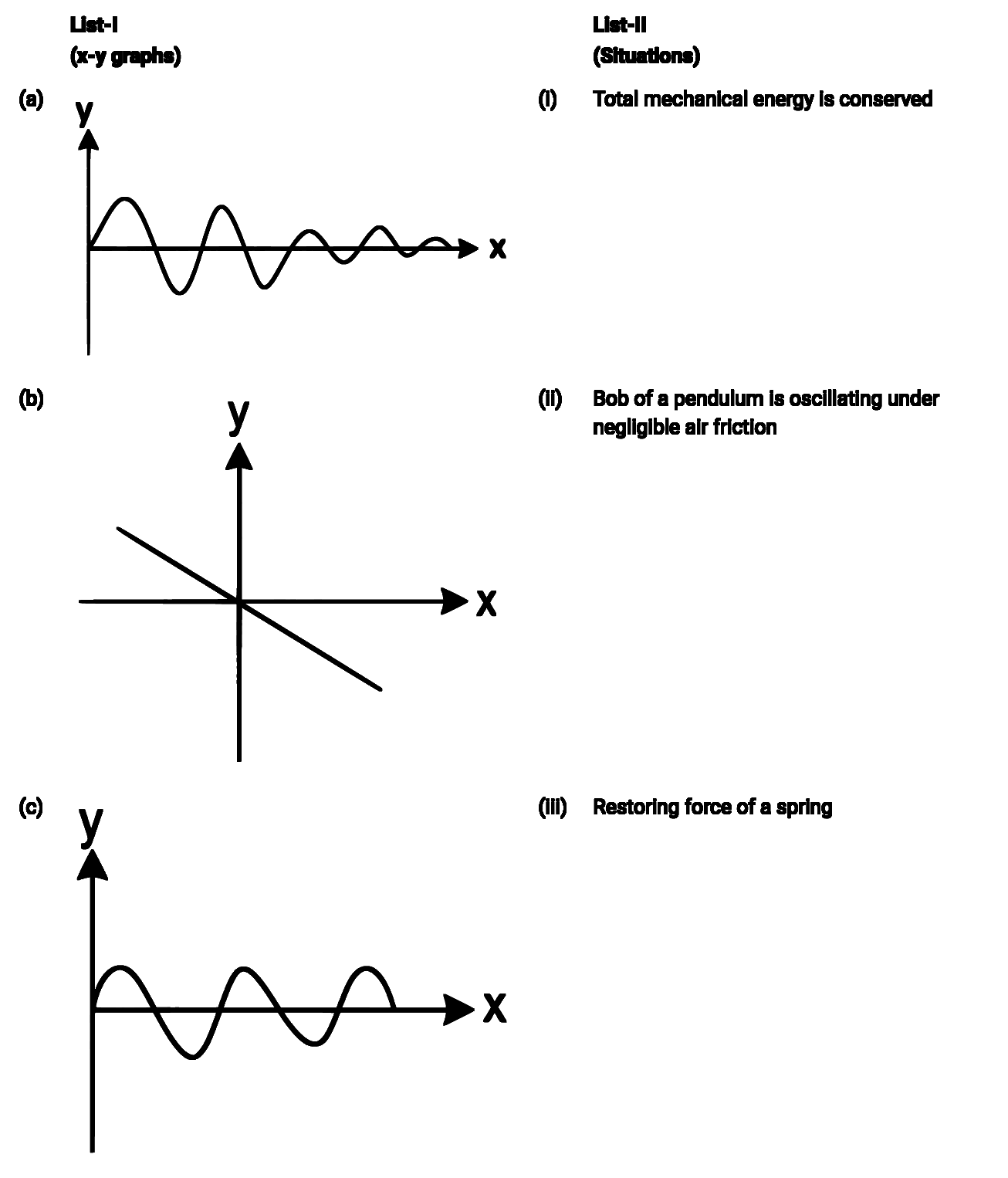
Report a mistake