0 of 500 attemptedPick an answer to see the solution
Q1MHT CET 2026 · 19 MAY · SHIFT 1Easy
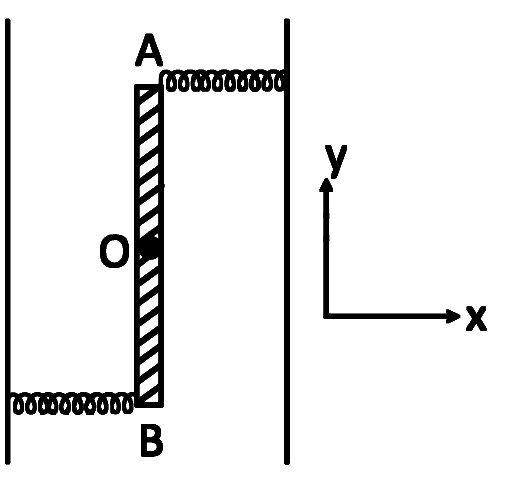
Periodic Motion & SHM Basics · Restoring force and differential equation
The differential equation of a particle performing S.H.M. is dt2d2x+64x=0, where x is in meter. The period of oscillation of the particle is (in second)
Periodic Motion & SHM Basics · Time and distance in SHM
A mass attached to a spring performs S.H.M. whose displacement is x=3×10⁻³cos2πt m. The time taken to obtain maximum speed for the first time is (in s)
Show answer and solution
Answer: (c)
ω=2π, so T=1s.
x=Acos2πt starts at the extreme position (x=A) at t=0.
Speed is maximum at the mean position, reached after 4T=41s.
Periodic Motion & SHM Basics · Periodic and oscillatory motion
A ball released from height (h) which makes perfectly elastic collision with ground. The frequency of periodic vibratory motion is (g = acceleration due to gravity)
Show answer and solution
Answer: (b)
Time to fall height h: h=21gt2⇒t=g2h.
Elastic bounce: it rises back to h in the same time, so T=2g2h.
Periodic Motion & SHM Basics · Displacement equation and circle of reference
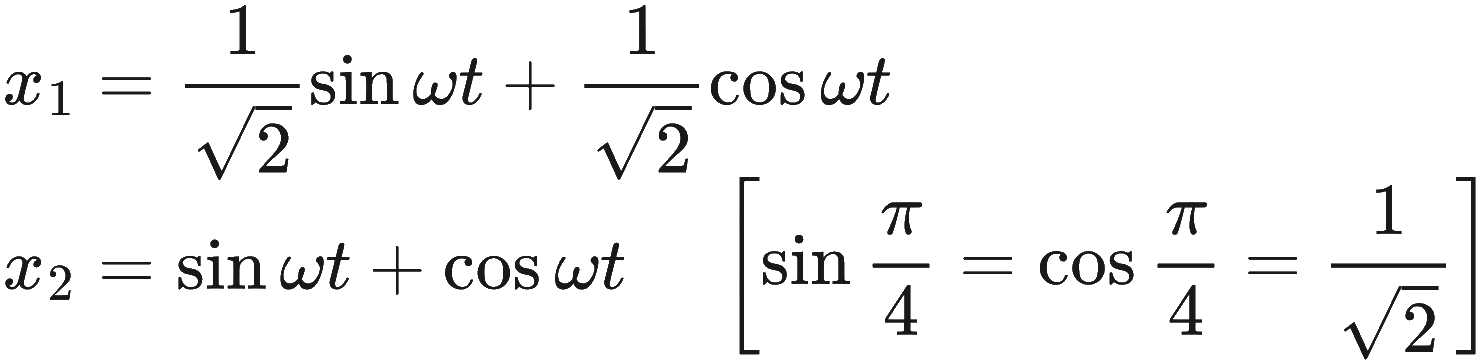
Two simple harmonic motions are represented as y1=10sinωt and y2=5sinωt+5cosωt, both in cm. The ratio of the amplitudes of y2 (A2) to that of y1 (A1 ), is
Periodic Motion & SHM Basics · Displacement equation and circle of reference
The displacement of a particle performing linear S.H.M. is given by y=Acos[π(t+ϕ)]. If at t=0, the displacement is y=2 cm and velocity is 2π cm/s, the value of amplitude A in cm is
Periodic Motion & SHM Basics · Time and distance in SHM
A particle oscillates simple harmonically along a straight line with period 8 s and amplitude 82 m. It starts from mean position then the ratio of the distances travelled by it in the 2nd second and the first second of its motion is (sin45∘=21)(sin90∘=1)
Show answer and solution
Answer: (c)
ω=82π=4π, x=Asin4πt (starts at mean).
x(1)=2A, x(2)=A; motion is one way in both seconds.
Periodic Motion & SHM Basics · Time and distance in SHM
A particle performing S.H.M., has a period of 12 s. The particle starts from a mean position. The ratio of distances travelled by the particle in the first and second second is {cos(π/6)=23}
Periodic Motion & SHM Basics · Time and distance in SHM
A particle executes a simple harmonic motion with a periodic time 8 second. At time t=0, it is at a mean position. The ratio of the distance traveled by a particle in the 2nd and that in the 1st second of its motion is
Periodic Motion & SHM Basics · Time and distance in SHM
A particle executes simple harmonic motion between x=−A and x=+A. If time taken by particle to go from x=0 to 2A is 2s, then time taken by particle in going from x=2A to A is
Periodic Motion & SHM Basics · Time and distance in SHM
A particle is executing simple harmonic motion. Its amplitude is A and time period is 5 sec. The time required by it to move from x=A to x=2A is ______ sec.
Periodic Motion & SHM Basics · Time and distance in SHM
The equation of motion of a particle is given by x=asin(50t+π/3) cm. The particle will come to rest at time t1 and it will have zero acceleration at time t2. The t1 and t2 respectively are ________.
Show answer and solution
Answer: (a)
Rest at the extreme: 50t1+3π=2π⇒t1=50π/6=300π s
Zero acceleration at x=0: 50t2+3π=π⇒t2=502π/3=75π s
Periodic Motion & SHM Basics · Periodic and oscillatory motion
Given below are two statements. One is labelled as Assertion (A) and the other is labelled as Reason (R).
Assertion (A): Knowing initial position x0 and initial momentum p0 is enough to determine the position and momentum at any time t for a simple harmonic motion with a given angular frequency ω.
Reason (R): The amplitude and phase can be expressed in terms of x0 and p0.
In the light of the above statements, choose the correct answer from the options given below:
Show answer and solution
Answer: (d)
SHM: x=Asin(ωt+ϕ), p=mωAcos(ωt+ϕ).
At t=0: x0=Asinϕ, p0=mωAcosϕ, so A=x02+m2ω2p02 and tanϕ=p0mωx0.
Once A and ϕ are known, x and p are known at every t. So R is true and explains A.
Periodic Motion & SHM Basics · Phase and phase difference
Two particles ' A ' and ' B ' execute SHMs of periods ' T ' and 23T. If they start from the mean position then the phase difference between them, when the particle ' A ' completes two oscillations will be
Show answer and solution
Answer: (c)
Phase gained =T2πt. A completes 2 oscillations, so t=2T.
Periodic Motion & SHM Basics · Time and distance in SHM
A particle performing linear S.H.M. has period 8 seconds. At time t=0, it is in the mean position. The ratio of the distances travelled by the particle in the 1st and 2nd second is (cos45∘=1/2)
Periodic Motion & SHM Basics · Time and distance in SHM
A particle oscillates in straight line simple harmonically with period 8 second and amplitude 42 m. Particle starts from mean position. The ratio of the distance travelled by it in 1st second of its motion to that in 2nd second is (sin45∘=1/2,sin2π=1)
Periodic Motion & SHM Basics · Time and distance in SHM
A particle is executing simple harmonic motion with time period 2 s and amplitude 1 cm. If D and d are the total distance and displacement covered by the particle in 12.5 s, then dD is
Show answer and solution
Answer: (c)
12.5 s=6T+4T (taking start at the mean position).
Distance: 6×4A+A=25A=25 cm
In 6T the particle returns; in the extra 4T it goes mean to extreme, so d=A=1 cm.
Periodic Motion & SHM Basics · Restoring force and differential equation
The motion of a particle is described by the equation a=−bx where ' a ' is the acceleration, x is the displacement from the equilibrium position and b is a constant. The periodic time will be
Periodic Motion & SHM Basics · Restoring force and differential equation
A particle of mass 0.50 kg executes simple harmonic motion under force F=−50(N m−1)x. The time period of oscillation is 35x s. The value of x is _________.
(Given π=722)
Numerical answer type. Work it out, then open the answer.
Periodic Motion & SHM Basics · Displacement equation and circle of reference
The displacement of a particle performing S.H.M. is given by Y=Acos[π(t+ϕ)]. If at t=0, the displacement is y=2 cm and velocity is 2π cm/s, the value of amplitude A in cm is
Periodic Motion & SHM Basics · Time and distance in SHM
A simple harmonic oscillator has an amplitude A and time period 6π second. Assuming the oscillation starts from its mean position, the time required by it to travel from x= A to x=23 A will be xπ s, where x= _________.
Numerical answer type. Work it out, then open the answer.
Periodic Motion & SHM Basics · Displacement equation and circle of reference
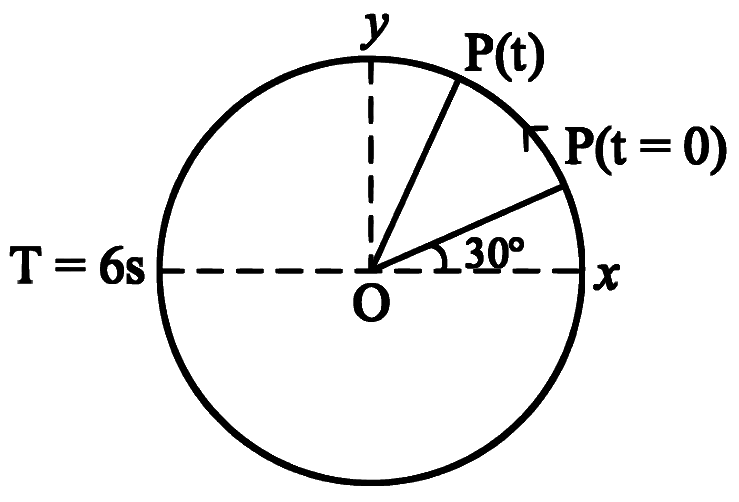
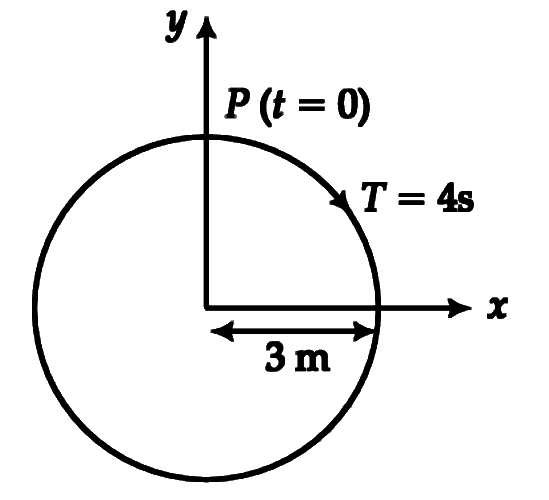
For particle P revolving round the centre O with radius of circular path r and angular velocity ω, as shown in below figure, the projection of OP on the x-axis at time t is
Show answer and solution
Answer: (c)
At t=0, OP makes 30∘=6π with the x-axis.
P moves anticlockwise, so at time t the angle is ωt+6π.
Periodic Motion & SHM Basics · Displacement equation and circle of reference
A particle executes S.H.M. of amplitude A along x-axis. At t = 0, the position of the particle is x=2A and it moves along positive x-axis. The displacement of particle in time t is x=Asin(ωt+δ), then the value of δ will be
Show answer and solution
Answer: (d)
At t=0: 2A=Asinδ⇒sinδ=21
Moving along +x means v=Aωcosδ>0, so δ=6π (not 65π).
Periodic Motion & SHM Basics · Time and distance in SHM
A particle executes simple harmonic motion between x=−A and x=+A. If time taken by particle to go from x=0 to 2A is 2 s; then time taken by particle in going from x=2A to A is
Periodic Motion & SHM Basics · Phase in waves (mixed)
A simple harmonic progressive wave is represented by y=Asin(100πt+3x). The distance between two points on the wave at a phase difference of 3π radian is
Periodic Motion & SHM Basics · Time and distance in SHM
The displacement of simple harmonic oscillator after 3 seconds starting from its mean position is equal to half of its amplitude. The time period of harmonic motion is:
Periodic Motion & SHM Basics · Restoring force and differential equation
The potential energy of a particle of mass 4 kg in motion along the x-axis is given by U=4(1−cos4x) J. The time period of the particle for small oscillation (sinθ≃θ) is (Kπ) s. The value of K is _________.
Numerical answer type. Work it out, then open the answer.
Periodic Motion & SHM Basics · Time and distance in SHM
A particle executes simple harmonic motion. Its amplitude is 8 cm and time period is 6 s. The time it will take to travel from its position of maximum displacement to the point corresponding to half of its amplitude, is ___________ s.
Numerical answer type. Work it out, then open the answer.
Periodic Motion & SHM Basics · Phase in waves (mixed)
In a medium, the phase difference between two particles separated by a distance 'x' is (5π)c. If the frequency of the oscillation of particles is 25 Hz and the velocity of propagation of the waves is 75 m/s, then the value of x is
Periodic Motion & SHM Basics · Displacement equation and circle of reference
Y = A sin(ωt + ϕ0) is the time-displacement equation of a SHM. At t = 0 the displacement of the particle is Y=2A and it is moving along negative x-direction. Then the initial phase angle ϕ0 will be:
Show answer and solution
Answer: (a)
At t=0: 2A=Asinϕ0⇒sinϕ0=21, so ϕ0=6π or 65π.
Velocity v=Aωcosϕ0 must be negative, so cosϕ0<0.
Periodic Motion & SHM Basics · Time and distance in SHM
A particle performs simple harmonic motion with a period of 2 second. The time taken by the particle to cover a displacement equal to half of its amplitude from the mean position is a1s. The value of 'a' to the nearest integer is _________.
Numerical answer type. Work it out, then open the answer.
Periodic Motion & SHM Basics · Phase and phase difference
Two particles P and Q performs S.H.M. of same amplitude and frequency along the same straight line. At a particular instant, maximum distance between two particles is 2 a. The initial phase difference between them is
Periodic Motion & SHM Basics · Displacement equation and circle of reference
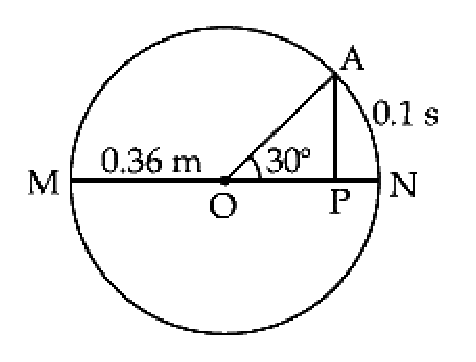
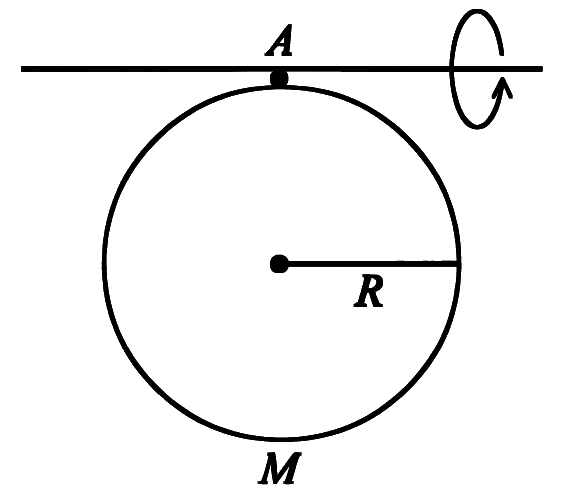
The point A moves with a uniform speed along the circumference of a circle of radius 0.36 m and covers 30∘ in 0.1 s. The perpendicular projection 'P' from 'A' on the diameter MN represents the simple harmonic motion of 'P'. The restoration force per unit mass when P touches M will be:
Periodic Motion & SHM Basics · Displacement equation and circle of reference
Two simple harmonic motion, are represented by the equations y1=10sin(3πt+3π)y2=5(sin3πt+3cos3πt) Ratio of amplitude of y1 to y2 = x: 1. The value of x is ______________.
Numerical answer type. Work it out, then open the answer.
Show answer and solution
Answer: 1
A1=10
y2=5(sin3πt+3cos3πt)=10sin(3πt+3π), so A2=51+3=10
Periodic Motion & SHM Basics · Displacement equation and circle of reference
A particle executes simple harmonic motion represented by displacement function as x(t) = A sin(ωt + ϕ)
If the position and velocity of the particle at t = 0 s are 2 cm and 2ω cm s−1 respectively, then its amplitude is x2 cm where the value of x is _________________.
Numerical answer type. Work it out, then open the answer.
Periodic Motion & SHM Basics · Phase in waves (mixed)
'n' waves are produced on a string in 1 second. When the radius of the string is doubled, keeping tension same, the number of waves produced in 1 second for the same harmonic will be
Periodic Motion & SHM Basics · Time and distance in SHM
A particle performs simple harmonic motion with period of 3 s. The time taken by it to cover a distance equal to half the amplitude from mean position is [sin30∘=0.5]
Periodic Motion & SHM Basics · Time and distance in SHM
A particle executes simple harmonic motion and is located at x = a, b and c at times t0, 2t0 and 3t0 respectively. The frequency of the oscillation is:
Show answer and solution
Answer: (a)
Let x=Asin(ωt+δ), so a=Asin(ωt0+δ), b=Asin(2ωt0+δ), c=Asin(3ωt0+δ).
Periodic Motion & SHM Basics · Phase and phase difference
Two particles are performing simple harmonic motion in a straight line about the same equilibrium point. The amplitude and time period for both particles are same and equal to A and T, respectively. At time t = 0 one particle has displacement A while the other one has displacement 2−A and they are moving towards each other. If they cross each other at time t, then t is:
Show answer and solution
Answer: (a)
Take x=Asin(ωt+ϕ). Particle 1 at x=A: ϕ1=2π.
Particle 2 at −2A moving towards +x: ϕ2=−6π.
They cross when sin(ωt+2π)=sin(ωt−6π), i.e. ωt+2π=π−ωt+6π.
Periodic Motion & SHM Basics · Restoring force and differential equation
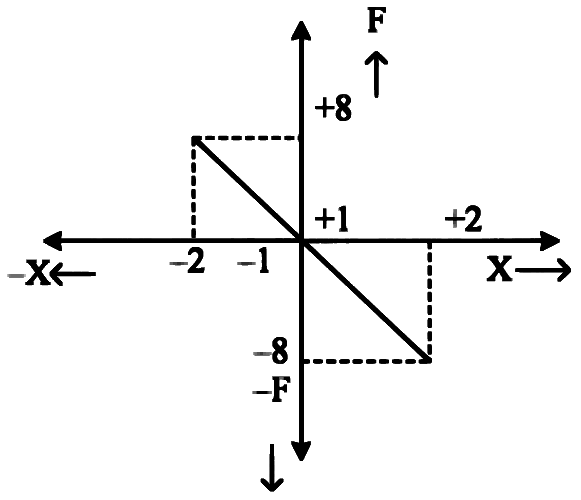
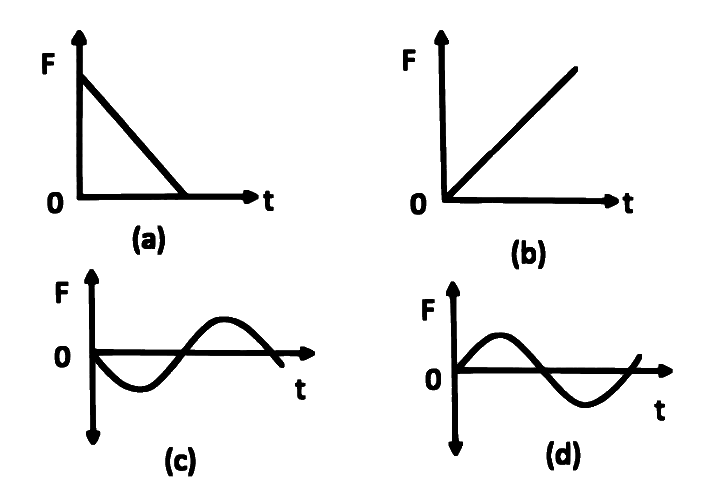
Which of the following expressions corresponds to simple harmonic motion along a straight line, where x is the displacement and a, b, c are positive constants?
Show answer and solution
Answer: (d)
For SHM the force (or acceleration) must be F=−kx only.
Periodic Motion & SHM Basics · Time and distance in SHM
A body is in simple harmonic motion with time period half second (T = 0.5 s) and amplitude one cm (A = 1 cm). Find the average velocity in the interval in which it moves from equilibrium position to half of its amplitude.
Periodic Motion & SHM Basics · Time and distance in SHM
A particle moves with simple harmonic motion in a straight line. In first τs, after starting from rest it travels a distance a, and in next τs it travels 2a, in same direction, then:
Show answer and solution
Answer: (d)
Starting from rest means starting at an extreme: distance covered in time t is A(1−cosωt).
After τ: A(1−cosωτ)=a; after 2τ: A(1−cos2ωτ)=3a
With c=cosωτ: 1−c1−cos2ωτ=1−c2(1−c)(1+c)=2(1+c)=3⇒c=21
Periodic Motion & SHM Basics · Phase and phase difference
Two particles are oscillating along two close parallel straight lines side by side, with the same frequency and amplitudes. They pass each other, moving in opposite directions when their displacement is half of the amplitude. The mean positions of the two particles lie on a straight line perpendicular to the paths of the two particles. The phase difference is
Show answer and solution
Answer: (c)
At x=2A: sinϕ=21, so ϕ=6π or 65π.
Moving in opposite directions means one has cosϕ>0 (6π) and the other cosϕ<0 (65π).
Periodic Motion & SHM Basics · Phase and phase difference
Two particles are executing simple harmonic motion of the same amplitude A and frequency ω along the x-axis. Their mean position is separated by distance X0(X0>A). If the maximum separation between them is (X0+A), the phase difference between their motion is:
Periodic Motion & SHM Basics · Time and distance in SHM
A particle executes simple harmonic oscillation with an amplitude a. The period of oscillation is T. The minimum time taken by the particle to travel half of the amplitude from the equilibrium position is
Periodic Motion & SHM Basics · Time and distance in SHM
The displacement of an object attached to a spring and executing simple harmonic motion is given by x=2×10⁻²cosπt metre. The time at which the maximum speed first occurs is
Show answer and solution
Answer: (b)
ω=π, so T=π2π=2s.
x=Acosπt starts at the extreme position; maximum speed is at the mean position.
Periodic Motion & SHM Basics · Phase and phase difference
Two simple harmonic motions are represented by the equations y1=0.1sin(100πt+3π) and y2=0.1cosπt. The phase difference of the velocity of particle 1 with respect to the velocity of particle 2 is
Velocity & Acceleration in SHM · Velocity at a displacement
A particle executing simple harmonic motion starts from mean position with amplitude 'A' and periodic time 'T'. At what displacement is its speed one-fourth of the maximum speed?
Velocity & Acceleration in SHM · Velocity at a displacement
The velocity of a particle executing simple harmonic motion along x-axis is described as v2=50−x2, where x represents displacement. If the time period of motion is 7x s, the value of x is ______.
Numerical answer type. Work it out, then open the answer.
Velocity & Acceleration in SHM · Maximum velocity and acceleration
Two particles performing simple harmonic motions of maximum accelerations, 1 m/s2 and 100 m/s2, have the same amplitudes. The ratio of their angular frequencies is
Velocity & Acceleration in SHM · Maximum velocity and acceleration
A body of mass 0.4 kg performs simple harmonic motion. It experiences a restoring force of 0.4 N when its displacement from the mean position is 4 cm. The force constant and magnitude of acceleration respectively are
Velocity & Acceleration in SHM · Velocity at a displacement
A particle executes S.H.M. with time period 16 s. At time t=2 s, the particle crosses the mean position while at t=4 s, velocity is 4 m/s. The amplitude of motion (in m) is (sin45∘=21)
Show answer and solution
Answer: (d)
ω=T2π=162π=8π rad/s.
Particle is at the mean position at t=2 s, so x=Asinω(t−2) and v=Aωcosω(t−2).
Velocity & Acceleration in SHM · Velocity at a displacement
A particle executes linear S.H.M. with amplitude 4 cm. The magnitude of velocity and acceleration is equal when it is at 3 cm from mean position. Time period is
Velocity & Acceleration in SHM · Graphs and phase relations
Consider a spring-mass simple harmonic oscillator in one dimension. The mass of the particle is m kg and the spring constant is k N m−1. At a given instant, the extension of the spring is x-meter and the speed of the particle is v m s−1. On the x−v plane, if the graph of v as a function of x is a circle, then the correct option is:
Show answer and solution
Answer: (c)
v2=mk(A2−x2)⇒v2+mkx2=mkA2.
This is a circle only if the coefficients of x2 and v2 are equal: mk=1.
Velocity & Acceleration in SHM · Velocity at a displacement
A simple pendulum starts oscillating simple harmonically from its mean position ( x=0) with amplitude ' a ' and periodic time ' T '. The magnitude of velocity of pendulum at x=2a is
Velocity & Acceleration in SHM · Velocity at a displacement
A particle executes S.H.M. starting from the mean position. Its amplitude is ' a ' and its periodic time is ' T '. At a certain instant, its speed ' u ' is half that of maximum speed Vmax. The displacement of the particle at that instant is
Velocity & Acceleration in SHM · Graphs and phase relations
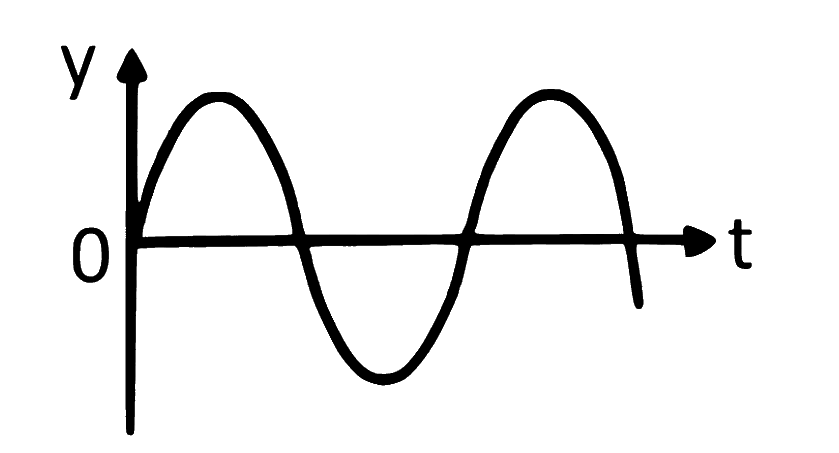
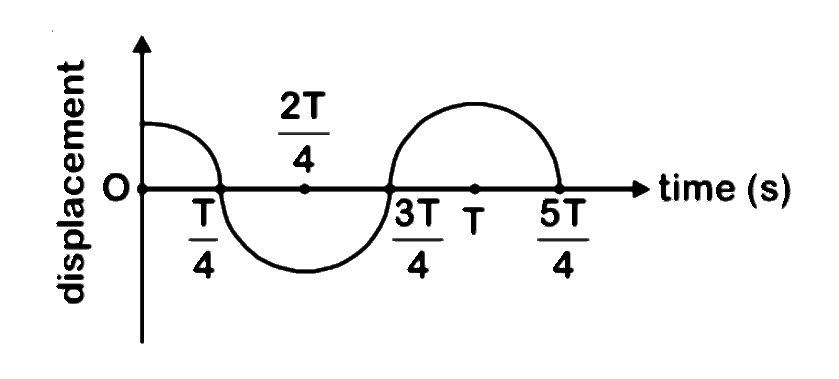
A particle is performing S.H.M. starting from extreme position. Graphical representation shows that between displacement and acceleration, there is a phase difference of
Show answer and solution
Answer: (a)
In SHM a=−ω2x: acceleration is always opposite to displacement.
−cosθ=cos(θ+π), so the acceleration graph is the displacement graph shifted by π.
Velocity & Acceleration in SHM · Velocities at two positions
A particle executes a linear S.H.M. In two of its positions the velocities are V1,V2 and accelerations are a1 and a2 respectively (0<a1<a2). The distance between the positions is
Velocity & Acceleration in SHM · Velocity at a displacement
For a particle executing S.H.M. having amplitude A, the speed of the particle is (31)rd of its maximum speed when the displacement from the mean position is
Velocity & Acceleration in SHM · Velocity at a displacement
A particle is performing S.H.M. about its mean position with an amplitude ' a ' and periodic time ' T '. The speed of the particle when its displacement from mean position is 3a will be
Velocity & Acceleration in SHM · Velocity at a displacement
A particle is performing S.H.M. with an amplitude 4 cm. At the mean position the velocity of the particle is 12 cm/s. When the speed of the particle becomes 6 cm/s, the distance of the particle from mean position is
Velocity & Acceleration in SHM · Maximum velocity and acceleration
The maximum velocity and maximum acceleration of a particle performing a linear S.H.M. is ' α ' and ' β ' respectively. Then the path length of the particle is
Velocity & Acceleration in SHM · Velocity at a displacement
A particle performing S.H.M. starts from equilibrium position and its time period is 12 second. After 2 seconds its velocity is π m/s. Amplitude of the oscillation is
[sin30∘=cos60∘=0.5,sin60∘=cos30∘=3/2]
Show answer and solution
Answer: (b)
ω=122π=6π rad/s; starting from the mean position, v=Aωcosωt.
Velocity & Acceleration in SHM · Velocity at a displacement
The velocity of particle executing S.H.M. varies with displacement (x) as 4V2=50−x2. The time period of oscillation is 7x second. The value of ' x ' is (Take π=722)
Show answer and solution
Answer: (d)
v2=41(50−x2) compared with v2=ω2(A2−x2) gives ω=21 rad/s.
Velocity & Acceleration in SHM · Velocity at a displacement
The displacement of a particle executing SHM is given by x=10sin(ωt+3π) m. The time period of motion is 3.14 s. The velocity of the particle at t=0 is _______ m/s.
Numerical answer type. Work it out, then open the answer.
Velocity & Acceleration in SHM · Velocity at a displacement
A particle performs simple harmonic motion with amplitude A. Its speed is increased to three times at an instant when its displacement is 32A. The new amplitude of motion is 3nA. The value of n is ___________.
Numerical answer type. Work it out, then open the answer.
Velocity & Acceleration in SHM · Velocity at a displacement
A particle executes simple harmonic motion with an amplitude of 4 cm. At the mean position, velocity of the particle is 10 cm/s. The distance of the particle from the mean position when its speed becomes 5 cm/s is α cm, where α= ________.
Numerical answer type. Work it out, then open the answer.
Velocity & Acceleration in SHM · Velocities at two positions
A particle performs linear S.H.M. When the displacement of the particle from mean position is 3 cm and 4 cm, corresponding velocities are 8 cm/s and 6 cm/s respectively. Its periodic time is
Velocity & Acceleration in SHM · Velocities at two positions
A particle is executing a linear simple harmonic motion. Let ' V1 ' and ' V2 ' are its speed at distance ' x1 ' and ' x2 ' from the equilibrium position. The amplitude of oscillation is
Show answer and solution
Answer: (c)
ω2V12=A2−x12 and ω2V22=A2−x22.
Divide: V12(A2−x22)=V22(A2−x12).
A2(V12−V22)=V12x22−V22x12.
A=V12−V22V12x22−V22x12, so the answer is (c).
Velocity & Acceleration in SHM · Velocities at two positions
The position, velocity and acceleration of a particle executing simple harmonic motion are found to have magnitudes of 4 m,2 m s−1 and 16 m s−2 at a certain instant. The amplitude of the motion is x m where x is _________.
Numerical answer type. Work it out, then open the answer.
Velocity & Acceleration in SHM · Vertical SHM and loss of contact
A horizontal platform with a small object placed on it executes a linear S.H.M. in the vertical direction. The amplitude of oscillation is 40 cm. What should be the least period of these oscillations, so that the object is not detached from the platform? [Take g=10 m/s2]
Show answer and solution
Answer: (c)
The object stays on the platform if the largest downward acceleration ω2A≤g.
Velocity & Acceleration in SHM · Velocities at two positions
A particle performs linear S.H.M. At a particular instant, velocity of the particle is ' u ' and acceleration is ' α ' while at another instant, velocity is ' v ' and acceleration is ' β ' (0<α<β). The distance between the two positions is
Velocity & Acceleration in SHM · Velocities at two positions
A particle performs linear S.H.M. At a particular instant, velocity of the particle is ' u ' and acceleration is ' a1 ' while at another instant velocity is ' v ' and acceleration is ' a2 ' (0<a1<a2). The distance between the two positions is
Velocity & Acceleration in SHM · Maximum velocity and acceleration
The maximum velocity of a particle performing S.H.M. is 'V'. If the periodic time is made (31)rd and the amplitude is doubled, then the new maximum velocity of the particle will be
Velocity & Acceleration in SHM · Velocity at a displacement
The velocity of a particle executing SHM varies with displacement (x) as 4v2=50−x2. The time period of oscillations is 7x s. The value of x is ___________. ( Take π=722)
Numerical answer type. Work it out, then open the answer.
Show answer and solution
Answer: 88
v2=41(50−x2) compared with v2=ω2(A2−x2) gives ω=21 rad/s.
Velocity & Acceleration in SHM · Maximum velocity and acceleration
A rectangular block of mass 5 kg attached to a horizontal spiral spring executes simple harmonic motion of amplitude 1 m and time period 3.14 s. The maximum force exerted by spring on block is _________ N
Numerical answer type. Work it out, then open the answer.
Velocity & Acceleration in SHM · Maximum velocity and acceleration
A particle of mass 250 g executes a simple harmonic motion under a periodic force F=(−25x) N. The particle attains a maximum speed of 4 m/s during its oscillation. The amplitude of the motion is ___________ cm.
Numerical answer type. Work it out, then open the answer.
Velocity & Acceleration in SHM · Vertical SHM and loss of contact
A block of mass 'M' rests on a piston executing S.H.M. of period one second. The amplitude of oscillations, so that the mass is separated from the piston, is (acceleration due to gravity, g=10 m s−2,π2=10)
Velocity & Acceleration in SHM · Maximum velocity and acceleration
A particle executing SHM has its velocity 20 cm s−1 at mean position and acceleration of 25 cm s−2 at one of its extreme position. The amplitude of the particle will be ____ cm.
Numerical answer type. Work it out, then open the answer.
Velocity & Acceleration in SHM · Velocity at a displacement
A body is performing simple harmonic with an amplitude of 10 cm. The velocity of the body was tripled by air jet when it is at 5 cm from its mean position. The new amplitude of vibration is x cm. The value of x is _____________.
Numerical answer type. Work it out, then open the answer.
Velocity & Acceleration in SHM · Velocity at a displacement
A particle executing S.H.M starts from the mean position. Its amplitude is 'A' and time period 'T'. At what displacement its speed is one-fourth of the maximum speed?
Velocity & Acceleration in SHM · Velocity at a displacement
A particle executes S.H.M. with amplitude 'a', and time period 'T'. The displacement of the particle when its speed is half of maximum speed is 2xa. The value of x is __________.
Numerical answer type. Work it out, then open the answer.
Velocity & Acceleration in SHM · Maximum velocity and acceleration
The displacement of a particle performing S.H.M. is given by x=5sin(3t+3), where x is in cm and t is in second. The maximum acceleration of the particle will be
Velocity & Acceleration in SHM · Velocity at a displacement
A particle executes S.H.M. of period 32π second along a straight line 4 cm long. The displacement of the particle at which the velocity is numerically equal to the acceleration is
Velocity & Acceleration in SHM · Maximum velocity and acceleration
A particle performing linear S.H.M. of amplitude 0.1 m has displacement 0.02 m and acceleration 0.5 m/s2. The maximum velocity of the particle in m/s is
Velocity & Acceleration in SHM · Velocities at two positions
A particle is making simple harmonic motion along the X-axis. If at a distances x1 and x2 from the mean position the velocities of the particle are v1 and v2 respectively. The time period of its oscillation is given as:
Velocity & Acceleration in SHM · Velocity at a displacement
A particle is performing a linear simple harmonic motion of amplitude ' A '. When it is midway between its mean and extreme position, the magnitudes of its velocity and acceleration are equal. What is the periodic time of the motion?
Velocity & Acceleration in SHM · Velocity at a displacement
A particle executes simple harmonic motion with an amplitude of 5 cm. When the particle is at 4 cm from the mean position, the magnitude of its velocity in SI units is equal to that of its acceleration. Then, its periodic time in seconds is -
Velocity & Acceleration in SHM · Graphs and phase relations
If ' x ', v ' and ' a ' denote the displacement, velocity and acceleration of a particle respectively executing SHM of periodic time T then which one of the following does not change with time?
Show answer and solution
Answer: (a)
In SHM a=−ω2x=−T24π2x.
xaT=−T4π2, a constant.
The other expressions contain a, v or t in combinations that vary with time.
Velocity & Acceleration in SHM · Maximum velocity and acceleration
A pendulum is hung from the roof of a sufficiently high building and is moving freely to and fro like a simple harmonic oscillator. The acceleration of the bob of the pendulum is 20 m s–2 at a distance of 5 m from the mean position. The time period of oscillation is
Velocity & Acceleration in SHM · Velocity at a displacement
A particle executes linear simple harmonic motion with an amplitude of 3 cm. When the particle is at 2 cm from the mean position, the magnitude of its velocity is equal to that of its acceleration. Then its time period in second is
Velocity & Acceleration in SHM · Maximum velocity and acceleration
The ratio of maximum acceleration to maximum velocity in a simple harmonic motion is 10 s−1. At, t = 0 the displacement is 5 m. What is the maximum acceleration? The initial phase is 4π.
Velocity & Acceleration in SHM · Velocity at a displacement
A particle performs simple harmonic motion with amplitude A. Its speed is trebled at the instant that it is at a distance 32A from equilibrium position. The new amplitude of the motion is:
Show answer and solution
Answer: (b)
At x=32A: v=ωA2−94A2=35ωA.
New speed v′=3v=5ωA; ω is unchanged (same mass and spring).
Velocity & Acceleration in SHM · Vertical SHM and loss of contact
In an engine the piston undergoes vertical simple harmonic motion with amplitude 7 cm. A washer rests on top of the piston and moves with it. The motor speed is slowly increased. The frequency of the piston at which the washer no longer stays in contact with the piston, is close to:
Velocity & Acceleration in SHM · Velocities at two positions
A particle is executing SHM along a straight line. Its velocities at distances x1 and x2 from the mean position are V1 and V2 respectively. Its time period is
Velocity & Acceleration in SHM · Graphs and phase relations
A particle of mass m oscillates along x-axis according to equation x = asinωt. The nature of the graph between momentum and displacement of the particle is
Velocity & Acceleration in SHM · Vertical SHM and loss of contact
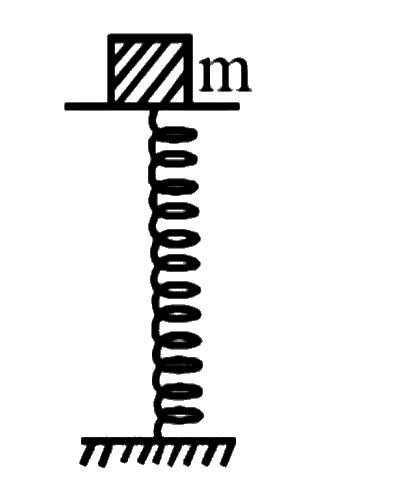
A mass m=1.0 kg is put on a flat pan attached to a vertical spring fixed on the ground. The mass of the spring and the pan is negligible. When pressed slightly and released, the mass executes simple harmonic motion. The spring constant is 500 N/m. What is the amplitude A of the motion, so that the mass m tends to get detached from the pan? (Take g=10 m/s2 ). The spring is stiff enough so that it does not get distorted during the motion.
Show answer and solution
Answer: (a)
The mass tends to leave the pan when the downward acceleration at the top reaches g: ω2A≥g.
Velocity & Acceleration in SHM · Graphs and phase relations
If x,v and a denote the displacement, the velocity and the acceleration of a particle executing simple harmonic motion of time period T, then, which of the following does not change with time?
Show answer and solution
Answer: (a)
In SHM a=−ω2x with ω=T2π.
xaT=−ω2T=−T4π2, a constant.
aT+2πv and aT/v change with time because a and v change differently.
Velocity & Acceleration in SHM · Vertical SHM and loss of contact
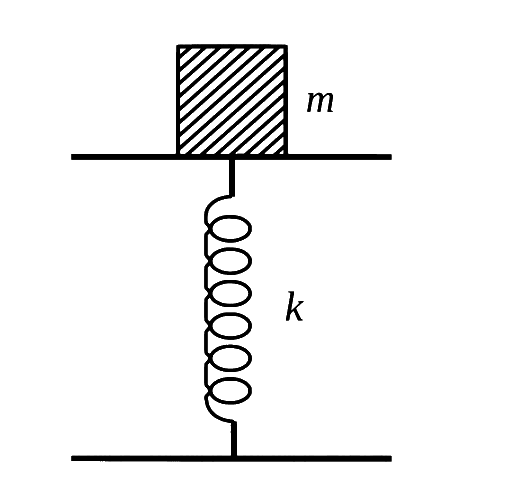
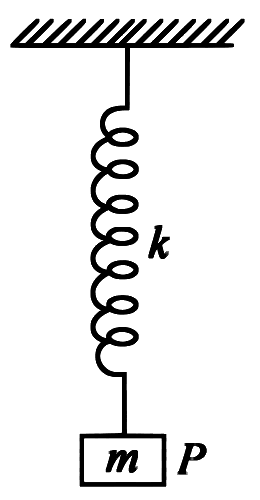
A mass of 2.0 kg is put on a flat pan attached to a vertical spring fixed on the ground as shown in the figure. The mass of the spring and the pan is negligible.
When pressed slightly and released the mass executes a simple harmonic motion. The spring constant is 200 N/m. What should be the minimum amplitude of the motion so that the mass gets detached from the pan (take g = 10 m/s2).
Velocity & Acceleration in SHM · Vertical SHM and loss of contact
A coin is placed on a horizontal platform which undergoes vertical simple harmonic motion of angular frequency ω. The amplitude of oscillation is gradually increased. The coin will leave contact with the platform for the first time
Show answer and solution
Answer: (b)
At the highest point the platform's acceleration is ω2A downward.
The normal force N=m(g−ω2A) becomes zero first when ω2A=g.
Velocity & Acceleration in SHM · Velocity at a displacement
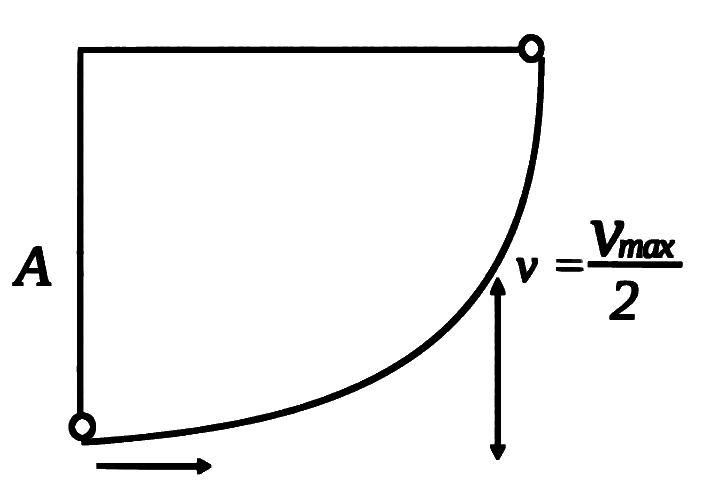
A particle starts with S.H.M. from the mean position as shown in the figure. Its amplitude is A and its time period is T. At one time, its speed is half that of the maximum speed. What is this displacement?
Velocity & Acceleration in SHM · Maximum velocity and acceleration
If a simple harmonic oscillator has got a displacement of 0.02 m and acceleration equal to 2.0 m/s2 at any time, the angular frequency of the oscillator is equal to
Velocity & Acceleration in SHM · Velocities at two positions
A body is executing simple harmonic motion. When the displacements from the mean position is 4 cm and 5 cm, the corresponding velocities of the body is 10 cm/sec and 8 cm/sec. Then the time period of the body is
There is a body having mass m and performing SHM with amplitude 'a'. There is a restoring force F=−Kx, where x is the displacement. The total energy of the body depends upon which of the following?
Show answer and solution
Answer: (d)
Total energy E=21Ka2.
It depends only on the force constant K and amplitude a, not on x or v.
For a particle executing S.H.M., the potential energy is n times the kinetic energy when its displacement from mean position is (322)A, where A is the amplitude of S.H.M. The value of n is
For a particle executing S.H.M., its potential energy is 8 times its kinetic energy at a certain displacement 'x' from the mean position. If 'A' is the amplitude of S.H.M., the value of 'x' is
For a particle P performing S.H.M., when displacement is 'x', potential energy and restoring force acting on it is denoted by 'E' and 'F' respectively. The relation between x, E and F is
A mass 0.4 kg performs S.H.M. with a frequency π16 Hz. At a certain displacement it has kinetic energy 2 J and potential energy 1.2 J. The amplitude of oscillation is
Maximum kinetic energy of a particle of mass 1 kg in S.H.M. is 8 J and the time period is 4 s. Maximum potential energy during the motion is 10 J. Then
Show answer and solution
Answer: (c)
ω=T2π=2π rad/s; PE has a constant offset: PEmin=10−8=2 J, so (b) is false.
Minimum KE is 0 at the extremes, so (d) is false.
21mω2A2=8⇒A2=π2/416=π264, A=π8≈2.55 m, so (a) is false.
A particle of mass 'm' is executing S.H.M. about the origin on x-axis with frequency πmKa, where K is a constant and a is the amplitude of S.H.M. If 'x' is the displacement of a particle at time 't', the potential energy of a particle will be
A block is fastened to a horizontal spring. The block is pulled to a distance x=10 cm from its equilibrium position (at x=0) on a frictionless surface from rest. The kinetic energy of the block at x=5 cm is 0.25 J. The spring constant of the spring is nearly (in Nm−1)
A particle starts oscillating simple harmonically from its equilibrium position with time period T. The ratio of kinetic energy to potential energy of the particle at time t=T/12 is
The displacement of a particle, executing simple harmonic motion with time period T, is expressed as x(t)=Asinωt, where A is the amplitude. The maximum value of potential energy of this oscillator is found at t=T/2β. The value of β is ______.
Numerical answer type. Work it out, then open the answer.
Show answer and solution
Answer: 2
U=21kA2sin2ωt is maximum when sinωt=1, i.e. ωt=2π.
Energy in SHM · Energy graphs and energy frequency
The kinetic energy of a simple harmonic oscillator is oscillating with angular frequency of 176 rad/s. The frequency of this simple harmonic oscillator is ______ Hz. [ take π=722 ]
Show answer and solution
Answer: (b)
K=21mω2A2cos2ωt=41mω2A2(1+cos2ωt), so KE oscillates at 2ω.
A particle is executing S.H.M. of amplitude ' A '. When the potential energy of the particle is half of its maximum value during the oscillation, its displacement from the equilibrium position is
A particle is executing linear S.H.M. starting from mean position. The ratio of the kinetic energy to the potential energy of the particle at a point of half the amplitude is
A point particle of mass 200 gram is executing S.H.M. of amplitude 0.2 m. When the particle passes through the mean position, its kinetic energy is 16×10−3 J. The equation of motion of this particle is (Initial phase of oscillation =0∘)
Show answer and solution
Answer: (d)
KE at mean position = total energy: 21mω2A2=16×10−3 J.
An object of mass 0.2 kg executes simple harmonic oscillations along the x -axis with frequency of (π25)Hz. At the position x=0.04 m, the object has kinetic energy 1 J and potential energy 0.6 J. The amplitude of oscillation is
For a particle performing S.H.M.; the total energy is ' n ' times the kinetic energy, when the displacement of a particle from mean position is 23A, where A is the amplitude of S.H.M. The value of ' n ' is
A particle starts oscillating simple harmonically from its mean position with time period ' T '. At time t=6T, the ratio of the potential energy to kinetic energy of the particle is
Energy in SHM · Energy graphs and energy frequency
A particle oscillates along the x-axis according to the law, x(t)=x0sin2(2t) where x0=1 m. The kinetic energy (K) of the particle as a function of x is correctly represented by the graph
Show answer and solution
Answer: (d)
x=x0sin22t=21−21cost (with x0=1 m): SHM about x=21 with amplitude 21 and ω=1.
K=21mω2[A2−(x−21)2], an inverted parabola in x.
K=0 at the extremes x=0 and x=1; K is maximum at the mean position x=21.
In simple harmonic motion, the total mechanical energy of given system is E. If mass of oscillating particle P is doubled then the new energy of the system for same amplitude is:
When the displacement of a simple harmonic oscillator is one third of its amplitude, the ratio of total energy to the kinetic energy is 8x, where x= _________.
Numerical answer type. Work it out, then open the answer.
The kinetic energy of a particle, executing simple harmonic motion is 16 J when it is in mean position. If amplitude of motion is 25 cm and the mass of the particle is 5.12 kg, the period of oscillation is
Show answer and solution
Answer: (a)
KE at mean position = total energy: 21mω2A2=16 J.
An object of mass 0.2 kg executes simple harmonic motion along x axis with frequency of (π25)Hz. At the position x=0.04 m the object has kinetic energy 0.5 J and potential energy 0.4 J. The amplitude of oscillation is ________ cm.
Numerical answer type. Work it out, then open the answer.
In S.H.M. the displacement of a particle at an instant is Y=Acos30∘, where A=40 cm and kinetic energy is 200 J. If force constant is 1×10x N/m, then x will be (cos30∘=3/2)
For a body performing simple harmonic motion, its potential energy is Ex at displacement x and Ey at displacement y from mean position. The potential energy E0 at displacement (x+y) is
Starting from mean position, a body oscillates simple harmonically with a period ' T '. After what time will its kinetic energy be 75% of the total energy? (sin30∘=0.5)
A particle starts oscillating simple harmonically from its equilibrium position with time period ' T '. What is the ratio of potential energy to kinetic energy of the particle at time t=12T? (sin(6π)=21)
For a particle executing S.H.M., its potential energy is 8 times its kinetic energy at certain displacement 'x' from the mean position. If 'A' is the amplitude of S.H.M the value of 'x' is
A particle is vibrating in S.H.M. with an amplitude of 4 cm. At what displacement from the equilibrium position is its energy half potential and half kinetic?
A particle is executing simple harmonic motion (SHM). The ratio of potential energy and kinetic energy of the particle when its displacement is half of its amplitude will be
The maximum potential energy of a block executing simple harmonic motion is 25 J. A is amplitude of oscillation. At A/2, the kinetic energy of the block is
The amplitude of a particle executing SHM is 3 cm. The displacement at which its kinetic energy will be 25% more than the potential energy is: __________ cm
Numerical answer type. Work it out, then open the answer.
Energy in SHM · Energy graphs and energy frequency
The variation of kinetic energy (KE) of a particle executing simple harmonic motion with the displacement (x) starting from mean position to extreme position (A) is given by
Show answer and solution
Answer: (c)
KE=21k(A2−x2)
From x=0 to x=A it falls from its maximum to zero along a downward parabola (flat at x=0, steep near A).
A body is executing a linear S.H.M. Its potential energies at the displacement 'x' and 'y' are 'E1' and 'E2' respectively. Its potential energy at displacement (x+y) will be
At a given point of time the value of displacement of a simple harmonic oscillator is given as y=Acos(30∘). If amplitude is 40 cm and kinetic energy at that time is 200 J, the value of force constant is 1.0×10x N m−1. The value of x is ____________.
Numerical answer type. Work it out, then open the answer.
The general displacement of a simple harmonic oscillator is x=Asinωt. Let T be its time period. The slope of its potential energy (U) - time (t) curve will be maximum when t=βT. The value of β is ______________.
Numerical answer type. Work it out, then open the answer.
Show answer and solution
Answer: 8
U=21kA2sin2ωt, so dtdU=21kA2ωsin2ωt.
The slope is maximum when sin2ωt=1: 2ωt=2π⇒t=4ωπ=8T.
A particle starts oscillating simple harmonically from its mean position with time period 'T'. At time t=12T, the ratio of the potential energy to kinetic energy of the particle is
(2) Average potential and kinetic energy over any given time interval are always equal. (3) Sum of the kinetic and potential energy at any point of time is constant.
(4) Average K.E. in one time period is equal to average potential energy in one time period. Choose the most appropriate option from the options given below:
Show answer and solution
Answer: (a)
(1) False: PE = KE only at x=A/2.
(2) False: over an arbitrary interval the averages differ.
(3) True: KE + PE =21kA2 is constant.
(4) True: over one period, average KE = average PE =41kA2.
A particle performing S.H.M. when displacement is 'x', the potential energy and restoring force acting on it are denoted by 'E' and 'F' respectively. The relation between x,E and F is
A body is performing S.H.M. of amplitude 'A'. The displacement of the body from a point where kinetic energy is maximum to a point where potential energy is maximum, is
A particle starts executing simple harmonic motion (SHM) of amplitude 'a' and total energy E. At any instant, its kinetic energy is 43E then its displacement 'y' is given by:
In a simple harmonic oscillation, what fraction of total mechanical energy is in the form of kinetic energy, when the particle is midway between mean and extreme position.
A mass 0.4 kg performs S.H.M. with a frequency π16 Hz. At a certain displacement it has kinetic energy 2 J and potential energy 1.2 J. The amplitude of oscillation is
A body is executing S.H.M. under the action of force having maximum magntude 50 N. When its energy is half kinetic and half potential; the magnitude of the force acting on the particle is
An object executes SHM along x-axis with amplitude 0.06 m. At certain distance 'x' metre from mean position, it has kinetic energy 10 J and potential energy 8 J. the distance 'x' will be
An object of mass 0.5 kg is executing simple harmonic motion. It amplitude is 5 cm and time period (T) is 0.2 s. What will be the potential energy of the object at an instant t=4T s starting from mean position. Assume that the initial phase of the oscillation is zero.
Show answer and solution
Answer: (a)
At t=4T from the mean position the particle is at the extreme, x=A, so all energy is potential.
A particle of mass 1 kg is hanging from a spring of force constant 100 Nm−1. The mass is pulled slightly downward and released so that it executes free simple harmonic motion with time period T. The time when the kinetic energy and potential energy of the system will become equal, is xT. The value of x is _____________.
Numerical answer type. Work it out, then open the answer.
Show answer and solution
Answer: 8
Pulled down and released, so motion starts at the extreme: x=Acosωt.
For a particle performing SHM when displacement is x, the potential energy and restoring force acting on it is denoted by E and F, respectively. The relation between x,E and F is
Show answer and solution
Answer: (b)
E=21kx2 and restoring force F=−kx.
F2E=−kxkx2=−x⇒F2E+x=0 (option c).
If only the magnitude F=kx is used, F2E−x=0 (option b).
A particle is executing simple harmonic motion (SHM) of amplitude A, along the x-axis, about x = 0. When its potential Energy (PE) equals kinetic energy (KE), the position of the particle will be:
A particle undergoing simple harmonic motion has time dependent displacement given by x(t) = Asin 90πt. The ratio of kinetic to potential energy of this particle at t = 210 s will be:
Show answer and solution
Answer: (b)
Phase at t=210 s: 90π×210=37π, which is equivalent to 3π.
Energy in SHM · Energy graphs and energy frequency
A particle is executing simple harmonic motion with a time period T. At time t = 0, it is at its position of equilibrium. The kinetic energy – time graph of the particle will look like:
Show answer and solution
Answer: (a)
At t=0 the particle is at equilibrium: x=Asinωt, KE=Ecos2ωt.
KE is maximum at t=0, zero at t=T/4, maximum again at T/2.
Energy in SHM · Energy graphs and energy frequency
For a simple pendulum, a graph is plotted between its kinetic energy (KE) and potential energy (PE) against its displacement d. Which one of the following represents these correctly? (graphs are schematic and not drawn to scale)
Show answer and solution
Answer: (d)
PE=21kd2: upward parabola, zero at d=0.
KE=21k(A2−d2): downward parabola, maximum at d=0, zero at d=±A.
The particle executing simple harmonic motion has a kinetic energy K0cos2ωt. The maximum values of the potential energy and the total energy are respectively
Show answer and solution
Answer: (c)
Maximum KE =K0 (when cos2ωt=1), and there PE =0, so total energy =K0.
A particle of mass m executes simple harmonic motion with amplitude a and frequency v. The average kinetic energy during its motion from the position of equilibrium to the end is
Show answer and solution
Answer: (b)
KE=Ecos2ωt; its time average over a quarter period is 2E.
Starting from the origin a body oscillates simple harmonically with a period of 2 s After what time will its kinetic energy be 75% of the total energy?
A body executes simple harmonic motion. The potential energy (P.E), the kinetic energy (K.E) and total energy (T.E) are measured as a function of displacement x. Which of the following statements is true?
Show answer and solution
Answer: (a)
KE=21k(A2−x2) is maximum at x=0: (a) true, (c) false.
PE=21kx2 is zero (minimum) at x=0: (d) false.
Total energy 21kA2 is constant, never zero: (b) false.
Energy in SHM · Energy graphs and energy frequency
A particle of mass m oscillates with simple harmonic motion between points x1 and x2, the equilibrium position being O. Its potential energy is plotted. It will be as given below in the graph
Show answer and solution
Answer: (a)
U=21kx2 with x measured from O.
This is an upward parabola, zero at O and maximum at the ends x1 and x2.
Energy in SHM · Energy graphs and energy frequency
A loaded vertical spring executes S.H.M. with a time period of 4 sec. The difference between the kinetic energy and potential energy of this system varies with a period of
A body executes simple harmonic motion with an amplitude A. At what displacement from the mean position is the potential energy of the body is one fourth of its total energy?
The bob of a simple pendulum is a hollow sphere with a small hole in the bottom. It is filled with sand and set into oscillation. Its periodic time (T) is measured at regular intervals. As the sand starts coming out we find that.
Show answer and solution
Answer: (d)
T=2πgl, where l is measured to the centre of mass of the bob.
As sand flows out from the bottom, the centre of mass first moves down, so l and T increase.
When the sphere is nearly empty the centre of mass rises back to the centre, so T decreases to its original value.
So the answer is (d) T first increases and then decreases.
A simple pendulum consists of a hollow sphere filled with mercury. As the mercury begins to leak out slowly through a small hole at the bottom, the time period of the pendulum will
Show answer and solution
Answer: (b)
Effective length l is up to the centre of mass of the bob, and T∝l.
As mercury leaks, the centre of mass drops first (T increases), then rises back to the sphere's centre when empty (T returns to original).
So the answer is (b) first increase and then decrease to the original value.
A simple pendulum of string length 30 cm performs 20 oscillations in 10 s. The length of the string required for the pendulum to perform 40 oscillations in the same time duration is ______ cm. [Assume that the mass of the pendulum remains same.]
Simple Pendulum · Energy, speed and tension of a pendulum
The sum of kinetic energy and potential energy of a simple pendulum bob is 0.02 joule. The speed of the simple pendulum bob at equilibrium position is approximately:
(Consider mass of the bob =20 g)
Show answer and solution
Answer: (b)
At the equilibrium position the whole energy is kinetic: 21mv2=E.
Simple Pendulum · Effect of g and seconds pendulum
Using a simple pendulum experiment g is determind by measuring its time period T. Which of the following plots represent the correct relation between the pendulum length L and time period T?
Show answer and solution
Answer: (a)
T=2πgL⇒T21=4π2g⋅L1
So T21∝L1: a rectangular hyperbola, falling steeply and flattening out as L grows.
The time period of a simple pendulum inside a stationary lift is 5 s. The time period when the lift moves upwards with an acceleration 4g is (g = acceleration due to gravity)
Two simple pendulums having lengths ℓ1 and ℓ2 with negligible string mass undergo angular displacement θ1 and θ2 from their mean positions respectively. If the angular acceleration of both pendulums are same, then which equation is correct?
Show answer and solution
Answer: (d)
For a simple pendulum, angular acceleration α=−ℓgθ.
A simple pendulum of length l1 has periodic time 2.4 s. Another simple pendulum of length l2<l1, has periodic time 1.8 s. The periodic time of simple pendulum of length (l1−l2) is nearly
Two simple pendulums of lengths L1 and L2 have periodic time T1 and T2 respectively (T1>T2). The time period of the pendulum of length (L1−L2) is
Simple Pendulum · Energy, speed and tension of a pendulum
Two simple pendulums, A of mass M1 and length L1, and B of mass M2 and length L2.M1=M2 and L1=2L2. If vibrational energies of both are same then which one of the following is correct?
Show answer and solution
Answer: (b)
Energy of a pendulum: E=21mω2A2=2LmgA2.
Same E and m: A2∝L.
L1=2L2⇒AA=2AB, so B has the smaller amplitude.
Simple Pendulum · Energy, speed and tension of a pendulum
A simple pendulum of length L and mass of the bob m is oscillating with amplitude A. The maximum tension in the string is (g = acceleration due to gravity)
Show answer and solution
Answer: (c)
Tension is maximum at the mean position: Tmax=mg+Lmvmax2.
Simple Pendulum · Effect of g and seconds pendulum
Savitha, a XI standard student, while conducting an experiment to determine the effective length of a simple pendulum L, notes down the data of time taken to complete 30 oscillations as 60 s and hence calculates the length of the simple pendulum as: (Take π2=9.8, and g=9.8 m/s2)
An oscillating pendulum suspended from the roof of a lift which is at rest has time period T1. When lift moves up with acceleration 'a' its time period is T2. When lift moves down with acceleration 'a' its time period is T3. The relation between T1,T2 and T3 is
Simple Pendulum · Energy, speed and tension of a pendulum
If the length of the oscillating simple pendulum is made 31 times the original keeping amplitude same then increase in its total energy at a place will be
Show answer and solution
Answer: (b)
E=2LmgA2, so for the same amplitude E∝L1.
L′=3L⇒E′=3E
Increase =E′−E=2E, i.e. 2 times the original energy.
Simple Pendulum · Effect of g and seconds pendulum
Given below are two statements. One is labelled as Assertion (A) and the other is labelled as Reason (R).
Assertion (A): A simple pendulum is taken to a planet of mass and radius, 4 times and 2 times, respectively, that of the Earth. The time period of the pendulum remains same on earth and the planet.
Reason (R): The mass of the pendulum remains unchanged at Earth and the other planet. In the light of the above statements, choose the correct answer from the options given below:
Show answer and solution
Answer: (d)
g=R2GM; on the planet g′=(2R)2G(4M)=g.
Same g gives the same T: (A) true.
Mass of the bob does not change: (R) true, but T does not depend on mass, so (R) does not explain (A).
The time period of a simple pendulum inside a stationary lift is 3 second. When the lift moves upwards with an acceleration g/3, the time period will be ( g= acceleration due to gravity)
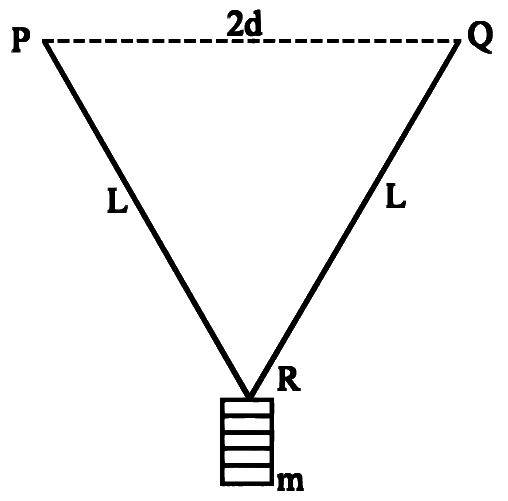
' P ' and ' Q ' are fixed points in same plane and mass ' m ' is tied by string as shown in figure. If the mass is displaced slightly out of this plane and released, it will oscillate with time period (PQ=2d,PR=QR=L)(g= gravitational acceleration)
Show answer and solution
Answer: (c)
Displaced out of the plane, the mass swings about the line PQ.
Effective length = distance of R from PQ: leff=L2−d2.
Two simple pendulums having lengths l1 and l2 with negligible string mass undergo angular displacements θ1 and θ2, from their mean positions, respectively. If the angular accelerations of both pendulums are same, then which expression is correct?
Show answer and solution
Answer: (a)
For a simple pendulum, angular acceleration α=−lgθ.
Simple Pendulum · Energy, speed and tension of a pendulum
Two simple pendulums have first (A) bob of mass ' M1 ' and length ' L1 ', second (B) of mass ' M2 ' and length ' L2 '. M1=M2 and L1=2L2. If their total energies are same then the correct statement is
Show answer and solution
Answer: (b)
Energy of a pendulum with linear amplitude A: E=21mω2A2=21mLgA2.
Same E and same m⇒A2∝L.
L1=2L2⇒AA2=2AB2, so AB=AA/2.
So the answer is (b) amplitude of B is smaller than amplitude of A.
A simple pendulum is suspended from ceiling of a lift when lift is at rest its period is ' T '. With what acceleration ' a ' should lift be accelerated upward in order to reduce the period to ' T/2 '? (take ' g ' as acceleration due to gravity)
A simple pendulum has time period ' T1 '. The point of suspension is now moved upward according to equation y=kt2 where k=1 m/s2. If new time period is ' T2 ' then T12/T22 will be ( g=10 m/s2)
A simple pendulum of length ' l ' has a brass bob attached at its lower end. It's period is ' T '. A steel bob of the same size, having density ' x ' times that of brass, replaces the brass bob. Its length is then so changed that the period becomes ' 2 T '. What is the new length?
Show answer and solution
Answer: (c)
T=2πgl does not depend on the mass or density of the bob.
If the mass of the bob in a simple pendulum is increased to thrice its original mass and its length is made half its original length, then the new time period of oscillation is 2x times its original time period. Then the value of x is:
A simple pendulum of length l1 has time period T1. Another simple pendulum of length l2(l1>l2) has time period T2. Then the time period of the pendulum of length (l1−l2) will be
Simple Pendulum · Energy, speed and tension of a pendulum
The bob of a pendulum of length ' l ' is pulled aside from its equilibrium position through an angle ' θ ' and then released. The bob will then pass through its equilibrium position with speed ' v ', where ' v ' equal to ( g= acceleration due to gravity)
Show answer and solution
Answer: (a)
Height fallen from the extreme to the mean position: h=l−lcosθ=l(1−cosθ).
Simple Pendulum · Energy, speed and tension of a pendulum
A simple pendulum of length 1 m has a wooden bob of mass 1 kg. It is struck by a bullet of mass 10−2 kg moving with a speed of 2×10² m s−1. The bullet gets embedded into the bob. The height to which the bob rises before swinging back is. (use g=10 m/s2)
Simple Pendulum · Energy, speed and tension of a pendulum
The bob of a pendulum was released from a horizontal position. The length of the pendulum is 10 m. If it dissipates 10% of its initial energy against air resistance, the speed with which the bob arrives at the lowest point is:
[Use, g:10 m s−2]
Show answer and solution
Answer: (d)
Released from horizontal, so the drop to the lowest point is L=10 m.
Simple Pendulum · Effect of g and seconds pendulum
A simple pendulum doing small oscillations at a place R height above earth surface has time period of T1=4 s,T2 would be its time period if it is brought to a point which is at a height 2R from earth surface. Choose the correct relation [R= radius of earth]:
Show answer and solution
Answer: (a)
g∝r21 and T∝g1⇒T∝r (distance from earth's centre).
Simple Pendulum · Effect of g and seconds pendulum
T is the time period of simple pendulum on the earth's surface. Its time period becomes x T when taken to a height R (equal to earth's radius) above the earth's surface. Then, the value of x will be:
In a stationary lift, time period of a simple pendulum is 'T'. The lift starts accelerating downwards with acceleration (4g), then the time period of the pendulum will be
The time period of a simple pendulum inside a stationary lift is 'T'. When the lift starts accelerating upwards with an acceleration (3g), the time period of the pendulum will be
A simple pendulum has a time period 'T' in air. Its time period when it is completely immersed in a liquid of density one eighth the density of the material of bob is
Show answer and solution
Answer: (d)
Buoyancy reduces the effective weight: geff=g(1−ρσ).
A simple pendulum oscillating in air has a period of 3 s. If it is completely immersed in non- viscous liquid, having density (41)th of the material of the bob, the new period will be :-
The bob of simple pendulum of length 'L' is released from a position of small angular displacement θ. Its linear displacement at time 't' is ( g= acceleration due to gravity)
Show answer and solution
Answer: (a)
Released from rest at the extreme, so the motion starts at maximum displacement: x=Acosωt.
Simple Pendulum · Energy, speed and tension of a pendulum
A simple pendulum of length 'l' and a bob of mass 'm' is executing S.H.M. of small amplitude 'A'. The maximum tension in the string will be (g= acceleration due to gravity)
Show answer and solution
Answer: (b)
Tension is maximum at the mean position: Tmax=mg+lmvmax2.
Simple Pendulum · Energy, speed and tension of a pendulum
A simple pendulum with length 100 cm and bob of mass 250 g is executing S.H.M. of amplitude 10 cm. The maximum tension in the string is found to be 40x N. The value of x is ___________.
Numerical answer type. Work it out, then open the answer.
The motion of a simple pendulum executing S.H.M. is represented by the following equation. y=Asin(πt+ϕ), where time is measured in second. The length of pendulum is
Simple Pendulum · Energy, speed and tension of a pendulum
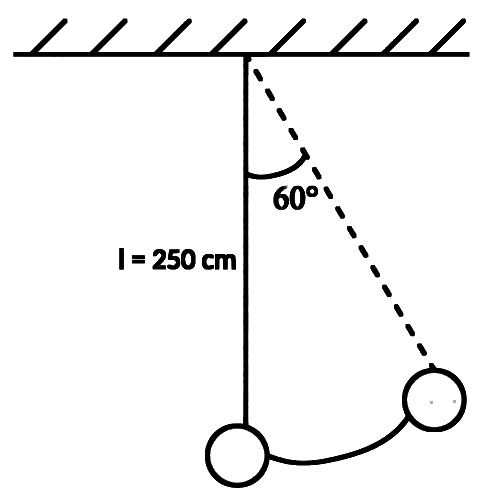
A pendulum is suspended by a string of length 250 cm. The mass of the bob of the pendulum is 200 g. The bob is pulled aside until the string is at 60∘ with vertical as shown in the figure. After releasing the bob, the maximum velocity attained by the bob will be ____________ ms−1. (if g = 10 m/s2)
Numerical answer type. Work it out, then open the answer.
Show answer and solution
Answer: 5
Maximum speed is at the lowest point: v=2gl(1−cosθ).
An oscillating simple pendulum of time period T0 is placed in a lift which is accelerating upwards with 2.5 m/s2. The time period of pendulum in the lift will be (if g=10 m/s2)
Two pendulums of length 121 cm and 100 cm start vibrating in phase. At some instant, the two are at their mean position in the same phase. The minimum number of vibrations of the shorter pendulum after which the two are again in phase at the mean position is:
Show answer and solution
Answer: (a)
T∝l: TshortTlong=100121=1011.
They are in phase again when the shorter one makes one more vibration: n⋅10=(n−1)⋅11.
n=11 vibrations of the shorter pendulum (10 of the longer).
Simple Pendulum · Effect of g and seconds pendulum
Assume there are two identical simple pendulum clocks. Clock - 1 is placed on the earth and Clock - 2 is placed on a space station located at a height h above the earth surface. Clock - 1 and Clock - 2 operate at time periods 4 s and 6 s respectively. Then the value of h is -
(consider radius of earth RE=6400 km and g on earth 10 m/s2)
The time period of oscillation of a simple pendulum of length L suspended from the roof of a vehicle, which moves without friction down an inclined plane of inclination α, is given by:
Show answer and solution
Answer: (a)
The vehicle slides freely with acceleration gsinα down the incline.
In its frame the pseudo force cancels the along-incline part of gravity, leaving geff=gcosα (perpendicular to the incline).
The metallic bob of simple pendulum has the relative density 5. The time period of this pendulum is 10 s. If the metallic bob is immersed in water, then the new time period becomes 5x s. The value of x will be ________.
Numerical answer type. Work it out, then open the answer.
T0 is the time period of a simple pendulum at a place. if the length of the pendulum is reduced to 161 times of its initial value, the modified time period is:
Simple Pendulum · Effect of g and seconds pendulum
Given below are two statements:
Statement I: A second's pendulum has a time period of 1 second.
Statement II: It takes precisely one second to move between the two extreme positions. In the light of the above statements, choose the correct answer from the options given below:
Show answer and solution
Answer: (b)
A seconds pendulum has period 2 s, not 1 s: Statement I false.
Going from one extreme to the other takes 2T=1 s: Statement II true.
Time period of a simple pendulum is T inside a lift when the lift is stationary. If the lift moves upwards with an acceleration g/2, the time period of pendulum will be:
Simple Pendulum · Energy, speed and tension of a pendulum
A child is sitting on a swing which performs S.H.M. It has minimum and maximum heights from ground 0.75 m and 2 m respectively. Its maximum speed will be [g=10s2m]
Show answer and solution
Answer: (c)
Height difference between extreme and lowest position: h=2−0.75=1.25 m.
A bob of mass 'm' suspended by a thread of length l undergoes simple harmonic oscillations with time period T. If the bob is immersed in a liquid that has density 41 times that of the bob and the length of the thread is increased by 1/3rd of the original length, then the time period of the simple harmonic oscillations will be :-
Show answer and solution
Answer: (d)
In a liquid, buoyancy reduces the effective gravity: geff=g(1−ρσ)=g(1−41)=43g.
Simple Pendulum · Energy, speed and tension of a pendulum
A simple pendulum of length L has mass m and it oscillates freely with amplitude A. At extreme position, its potential energy is (g= acceleration due to gravity)
Show answer and solution
Answer: (d)
For a simple pendulum ω2=Lg.
At the extreme position all energy is potential: PE=21mω2A2.
Simple Pendulum · Energy, speed and tension of a pendulum
A bob of a simple pendulum has mass m and is oscillating with an amplitude a. If the length of the pendulum is L, then the maximum tension in the string is [cos0∘=1,g= acceleration due to gravity]
Simple Pendulum · Energy, speed and tension of a pendulum
A simple pendulum of length l has a bob of mass m. It executes SHM of small amplitude A. The maximum tension in the string is (g= acceleration due to gravity)
Show answer and solution
Answer: (b)
At the mean position Tmax=mg+lmvmax2, with vmax=Ag/l.
Simple Pendulum · Effect of g and seconds pendulum
A simple pendulum is being used to determine the value of gravitational acceleration g at a certain place. The length of the pendulum is 25.0 cm and a stop watch with 1s resolution measures the time taken for 40 oscillations to be 50 s. The accuracy in g is:
Simple Pendulum · Effect of g and seconds pendulum
The mass and the diameter of a planet are three times the respective values for the Earth. The period of oscillation of simple pendulum on the Earth is 2 s. The period of oscillation of the same pendulum on the planet would be:
A person measures a time period of a simple pendulum inside a stationary lift and finds it to be T. If the lift starts accelerating upwards with an acceleration (3g), the time period of the pendulum will be
Two pendulums begin to swing simultaneously. The first pendulum makes nine full oscillations when the other makes seven. The ratio of the lengths of the two pendulums is
Simple Pendulum · Energy, speed and tension of a pendulum
A pendulum is executing simple harmonic motion and its maximum kinetic energy is K1. If the length of the pendulum is doubled and it performs simple harmonic motion with the same amplitude as in the first case, its maximum kinetic energy is K2. Then:
Show answer and solution
Answer: (b)
Take amplitude as the angular amplitude θ0 (same in both cases).
Max KE = loss of PE from extreme to mean: K=mgL(1−cosθ0)∝L.
A simple pendulum oscillating in air has period T. The bob of the pendulum is completely immersed in a non-viscous liquid. The density of the liquid is 1/16 th of the material of the bob. If the bob is inside liquid all the time, its period of oscillation in this liquid is:
Q331JEE Main 2019 · 11 JAN · SHIFT 2DifficultOld syllabus
Simple Pendulum · Pendulum in a lift or vehicle
A simple pendulum of length 1 m is oscillating with an angular frequency 10 rad/s. The support of the pendulum starts oscillating up and down with a small angular frequency of 1 rad/s and an amplitude of 10–2 m. The relative change in the angular frequency of the pendulum is best given by:
Show answer and solution
Answer: (b)
Support moves as y=AsinΩt, so its maximum acceleration is Ω2A=12×10−2=10−2 m/s2.
geff=g±Ω2A and ω∝geff⇒ωΔω=21gΔg.
Δω=21×1010−2×10=5×10⁻³ rad/s, of order 10−3 rad/s.
Simple Pendulum · Effect of g and seconds pendulum
The period of oscillation of a simple pendulum is T=2πgL. Measured value of L is 20.0 cm known to 1 mm accuracy and time for 100 oscillations of the pendulum is found to be 90 s using wrist watch of 1 s resolution. The accuracy in the determination of g is:
Simple Pendulum · Effect of g and seconds pendulum
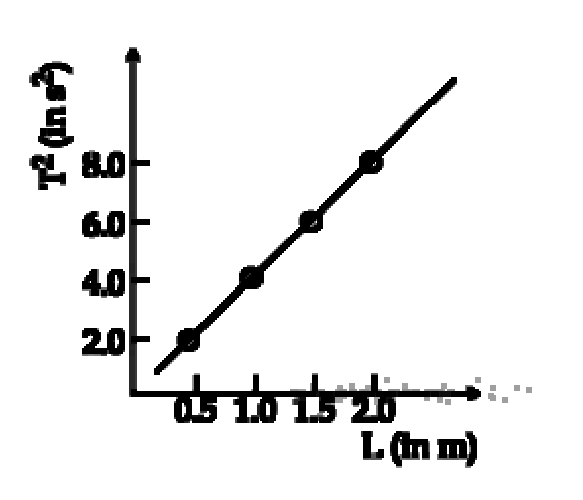
In an experiment for determining the gravitational acceleration g of a place with the help of a simple pendulum, the measured time period square is plotted against the string length of the pendulum in the figure.
Two simple pendulums of length 1 m and 4 m respectively are both given small displacement in the same direction at the same instant. They will be again in phase after the shorter pendulum has completed number of oscillations equal to:
Show answer and solution
Answer: (a)
TshortTlong=14=2
In the time the longer pendulum makes 1 oscillation, the shorter makes 2, and they are in phase again.
The bob of a simple pendulum is a spherical hollow ball filled with water. A plugged hole near the bottom of the oscillating bob gets suddenly unplugged. During observation, till water is coming out, the time period of oscillation would
Show answer and solution
Answer: (b)
T∝l, with l measured to the centre of mass of the bob.
As water flows out, the centre of mass first moves down, so T increases.
When the ball is nearly empty, the centre of mass returns to the ball's centre, so T returns to its original value.
So the answer is (b) first increase and then decrease to the original value.
The bob of a simple pendulum executes simple harmonic motion in water with a period t, while the period of oscillation of the bob is t0 in air. Neglecting frictional force of water and given that the density of the bob is (4/3)×1000 kg/m3. What relationship between t and t0 is true
The length of a simple pendulum executing simple harmonic motion is increased by 21%. The percentage increase in the time period of the pendulum of increased length is
Show answer and solution
Answer: (d)
T∝l; l′=1.21l
T′=1.21T=1.1T
Increase =10% (exact, since the change is not small, the 21×21% approximation is not used).
Two masses MA and MB are hung from two strings of length lA and lB respectively. They are executing SHM with frequency relation fA = 2fB, then relation
Show answer and solution
Answer: (a)
f=2π1lg, independent of mass, so l∝f21.
fA=2fB⇒lBlA=41
So the answer is (a) lA=4lB, does not depend on mass.
Simple Pendulum · Energy, speed and tension of a pendulum
The bob of simple pendulum having length l, is displaced from mean position to an angular position q with respect to vertical. If it is released, then velocity of bob at equilibrium position
Show answer and solution
Answer: (a)
The bob falls through height h=l−lcosθ=l(1−cosθ) (q in the question means θ).
Two simple pendulums of length 0.5 m and 2.0 m respectively are given small linear displacement in one direction at the same time. They will again be in the same phase when the pendulum of shorter length has completed oscillations
Show answer and solution
Answer: (c)
T∝l: TshortTlong=0.52.0=2
They are in phase again when nTshort=mTlong for the smallest integers: n=2, m=1.
Simple Pendulum · Energy, speed and tension of a pendulum
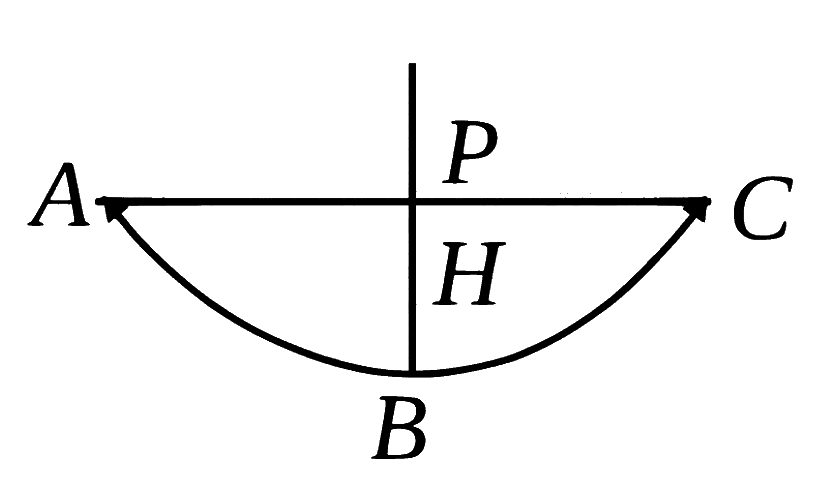
A simple pendulum with a bob of mass m oscillates from A to C and back to A such that PB is H. If the acceleration due to gravity is g, then the velocity of the bob as it passes through B is
Show answer and solution
Answer: (b)
At A the bob is momentarily at rest; B is lower than A by H.
Simple Pendulum · Energy, speed and tension of a pendulum
The angular velocity and the amplitude of a simple pendulum is ω and a respectively. At a displacement x from the mean position if its kinetic energy is T and potential energy is V, then the ratio of T to V is
A simple pendulum is suspended from the roof of a trolley which moves in a horizontal direction with an acceleration a, then the time period is given by T=2π(l/g), where g is equal to
Show answer and solution
Answer: (d)
In the trolley frame the bob feels gravity g down and pseudo acceleration a horizontally.
The frequency of oscillation of a mass m suspended by a spring is v1. If the length of the spring is cut to half, the same mass oscillates with frequency v2. The value of v2/v1 is ______.
Spring Systems · Time period of a spring-mass system
A spring of force constant 180 N/m is loaded with a mass 0.20 kg. The amplitude of oscillations is 4 cm. When mass comes to equillibrium position, its velocity in m/s is
Spring Systems · Time period of a spring-mass system
A body of mass 64 g is made to oscillate turn by turn on two different springs A and B. Spring A and B has force constant 4 N/m and 16 N/m respectively. If T1 and T2 are the period of oscillations of springs A and B respectively, then (T1+T2)/(T1−T2) will be
Spring Systems · Time period of a spring-mass system
A spring force constant 180 N/m is loaded with a mass 0.2 kg. The amplitude of oscillations is 4 cm. When mass comes to equilibrium position, its velocity is
Spring Systems · Equal masses on different springs
Two particles A and B of equal masses are suspended from two massless springs of spring constants KA and KB respectively. The maximum velocities of the particles during oscillations are equal. The ratio of the amplitude of 'B' to that of 'A' is
Show answer and solution
Answer: (b)
vmax=Aω=AmK.
Equal vmax and equal m: AK is the same, so A∝K1.
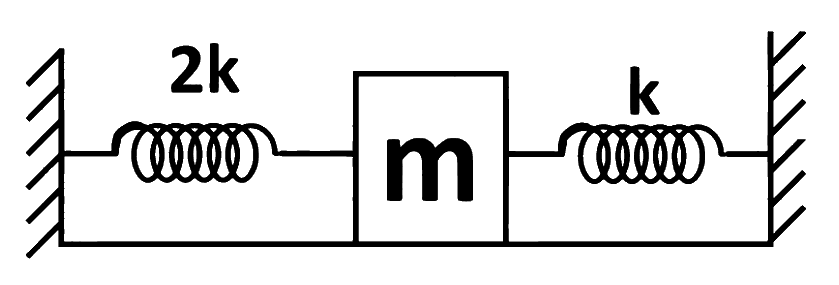
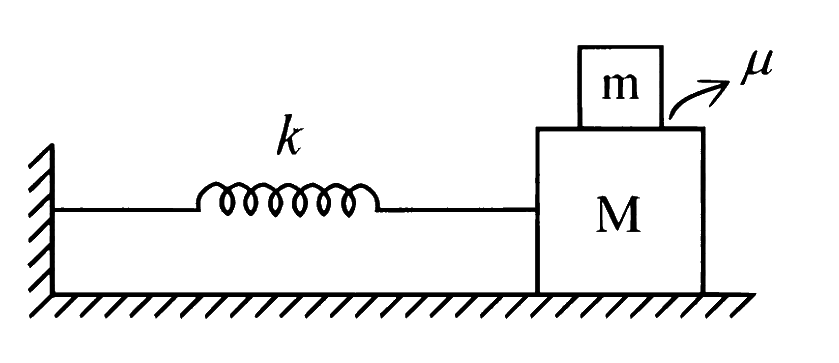
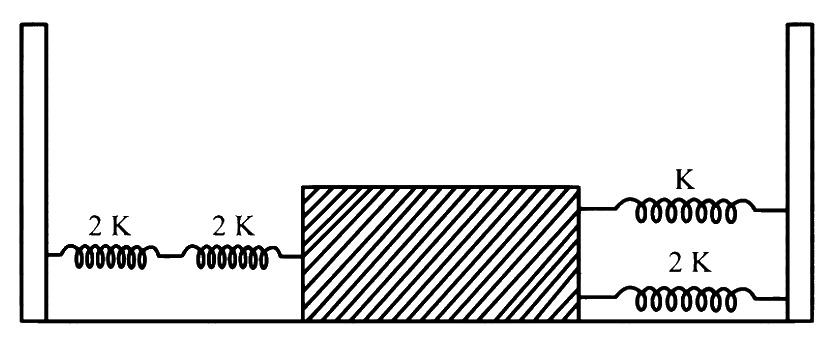
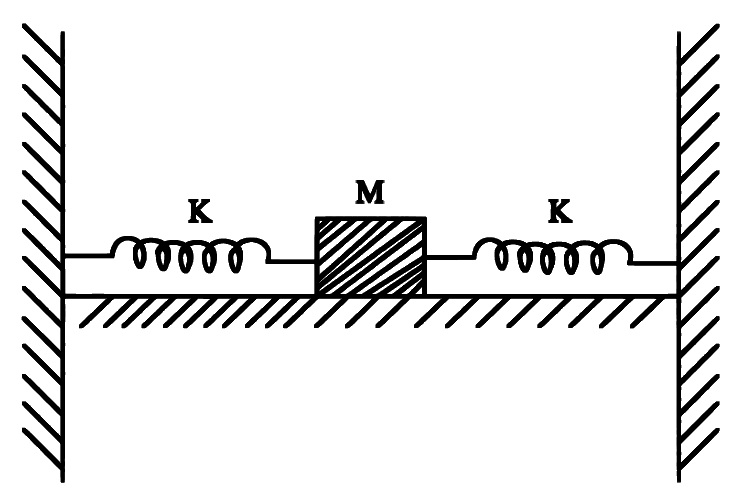
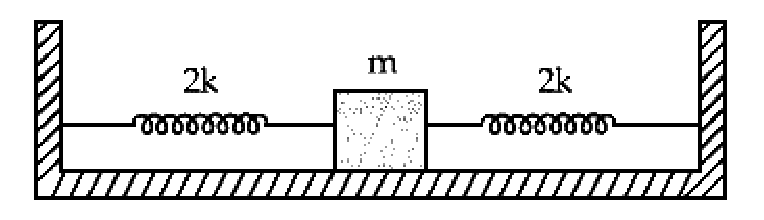
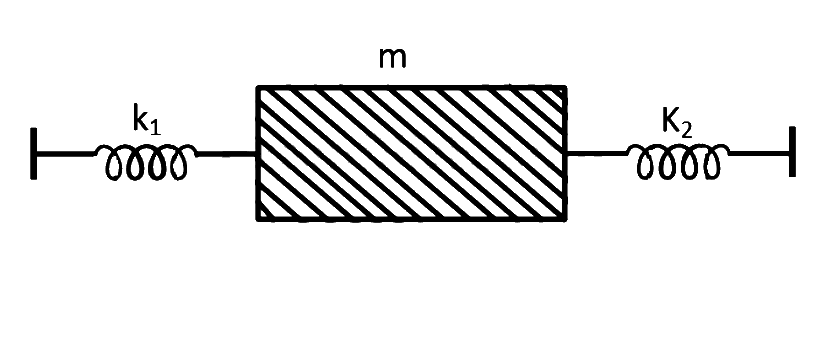
Two springs of force constants '2k' and 'k' are connected to a mass 'm' as shown. Mass is displaced slightly to one side and released. The frequency of oscillation of the two springs-mass system is
Show answer and solution
Answer: (d)
When m moves by x, one spring stretches and the other compresses by x; both forces act the same way, so the springs are in parallel.
A spring has length l and force constant k. It is cut into 2 springs of length l1 and l2 such that l1=nl2 (n=an integer). The force constant of the spring of length l2 is (k∝l1)
Spring Systems · Time period of a spring-mass system
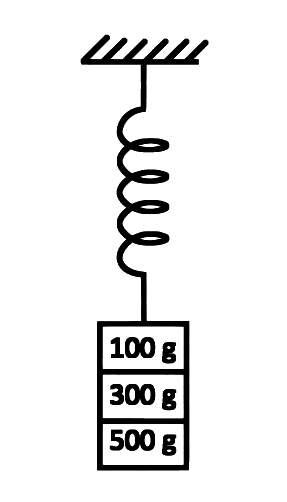
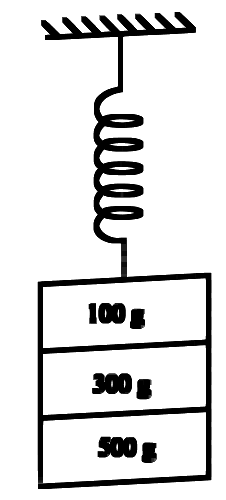
Three masses 100g, 300g and 500g are suspended at the end of a spring as shown in figure and are in equilibrium. When the 500 g mass is removed, the system oscillates with a period of 3 second. When the 300 g mass is also removed, it will oscillate with a period of
Show answer and solution
Answer: (b)
T∝m for the same spring.
After removing 500 g: m=100+300=400 g, T=3 s. After also removing 300 g: m=100 g.
Spring Systems · Time period of a spring-mass system
A light spring is suspended with mass 'm1' at its lower end and its upper end is fixed to a rigid support. The mass is pulled down a short distance and then released. The period of oscillation is T second. When a mass ' ' is added to 'm1' and the system is made to oscillate the period is found to be 23 T. The ratio m2(m2m1) is
Spring Systems · Time period of a spring-mass system
A spring executes S.H.M. with mass 10 kg attached to it. The force constant of spring is 10 N/m. If at any instant its velocity is 40 cm/s, the displacement at that instant is
Spring Systems · Vertical spring and static extension
A mass is suspended from a vertical spring which is executing S.H.M. of frequency 10 Hz. The spring is unstretched at the highest point of oscillation. Maximum speed of the mass is (g=10 m/s2)
Show answer and solution
Answer: (c)
Spring unstretched at the top, so amplitude = static extension: A=kmg=ω2g.
Spring Systems · Vertical spring and static extension
A spring produces extension ′x′ by applying a force ′F′ N. A body of mass ′m′ suspended from spring oscillates vertically with period ′T′. The mass of the suspended body is (Neglect mass of spring)
Spring Systems · Vertical spring and static extension
A spring stretches by 2 mm when it is loaded with a mass of 200 g. From equilibrium position the mass is further pulled down by 2 mm and released. The frequency associated with the system and maximum energy in the spring are ______ Hz and ______ J, respectively.
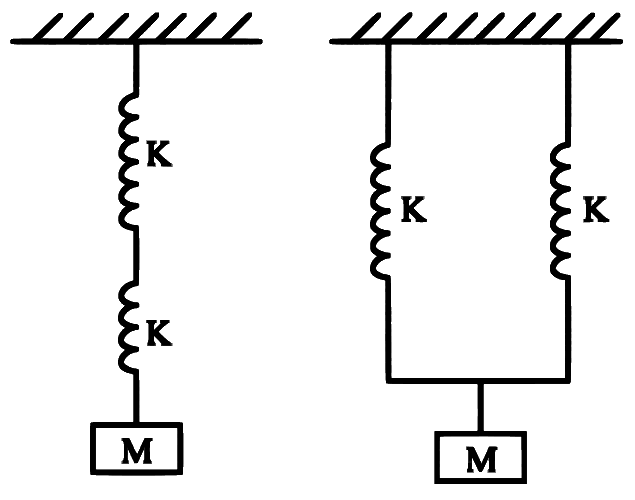
A body has time period T1 under the action of one force and T2 under the action of another force. The square of the time period when both the forces are acting in the same direction is
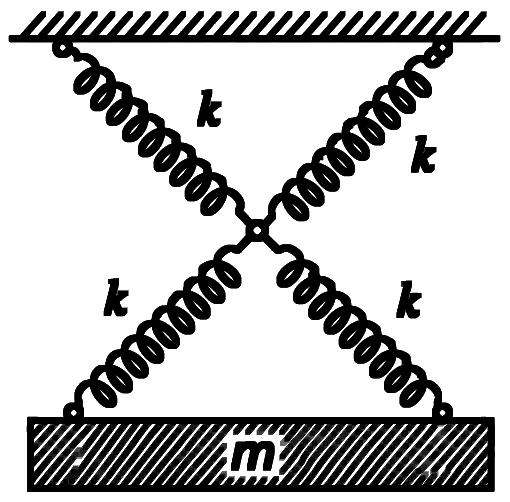
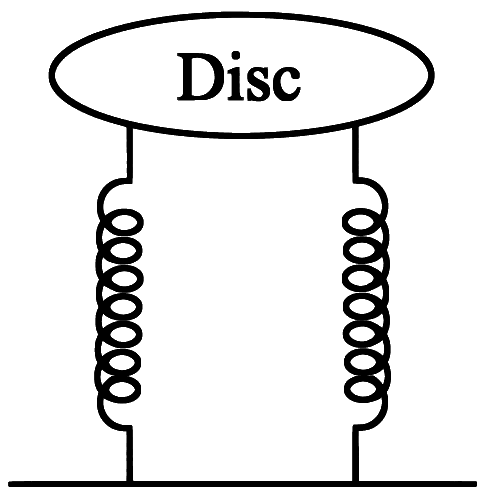
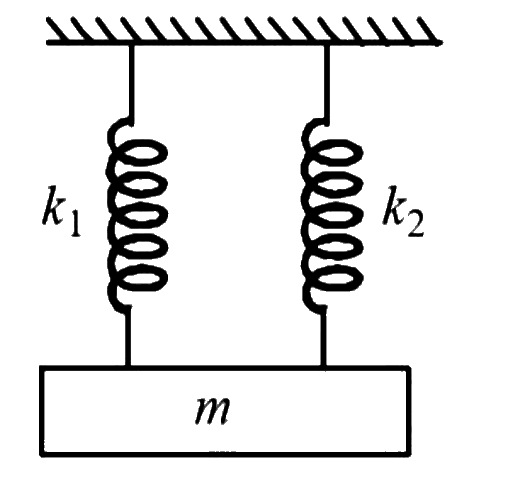
A simple harmonic oscillator having four identical springs (as shown in figure) has a time period T1. Another similar simple harmonic oscillator of the same mass m but the four identical springs with spring constants 2k has a time period T2, then T2T1 is
Show answer and solution
Answer: (c)
The arrangement is the same in both cases, so keff∝k of each spring.
All the springs in fig (a), (b) and (c) are identical, each one having force constant K. Mass m is attached to each system. If Ta,Tb and Tc are the periodic time of oscillations of the three systems in fig (a), (b) and (c) respectively, then
Two massless springs of spring constants K1 and K2 are connected one after the other forming a single chain, suspended vertically and a certain mass is attached to the free end. If x1 and x2 are their respective extensions and 'F' is their stretching force, the total extension produced is
Show answer and solution
Answer: (d)
In series each spring carries the same force F: x1=F/K1, x2=F/K2.
A horizontal spring executes S.H.M. with amplitude A1 when mass m is attached to it. When it passes through mean position another mass m is placed on it. Both masses move together with amplitude A2. The ratio A2A1 is
Show answer and solution
Answer: (b)
At the mean position momentum is conserved: mv=2mv′⇒v′=v/2.
A mass m1 performs S.H.M. with amplitude A which is connected to horizontal spring. While mass m1 passing through mean position, another mass m2 (m2<m1) is placed on it so that both masses move together with amplitude A1. The ratio of A/A1 is
As shown in the figure, a spring is kept in a stretched position with some extension by holding the masses 1 kg and 0.2 kg with a separation more than spring natural length and are released. Assuming the horizontal surface to be frictionless, the angular frequency (in SI unit) of the system is:
Show answer and solution
Answer: (c)
Two free masses joined by a spring oscillate with ω=μk, μ=m1+m2m1m2.
Spring Systems · Equal masses on different springs
Two identical point masses P and Q, suspended from two separate massless springs of spring constants k1 and k2, respectively, oscillate vertically. If their maximum speeds are the same, the ratio ( AQ/AP) of the amplitude AQ of mass Q to the amplitude AP of mass P is
Spring Systems · Equal masses on different springs
Two bodies A and B of equal mass are suspended from two massless springs of spring constant k1 and k2, respectively. If the bodies oscillate vertically such that their amplitudes are equal, the ratio of the maximum velocity of A to the maximum velocity of B is
Spring Systems · Time period of a spring-mass system
A spring executes S.H.M. with mass 1 kg attached to it. The force constant of the spring is 4 N/m. If at any instant its velocity is 20 cm/s, the displacement at that instant is (Amplitude of S.H.M. is 0.4 m)
Spring Systems · Time period of a spring-mass system
A mass m is suspended from a spring of negligible mass. The spring is pulled a little and then released, so that mass executes S.H.M. of time period T. If the mass is increased by m0, the periodic time becomes 45T. The ratio Mm0
Show answer and solution
Answer: (c)
T∝m: (45)2=mm+m0.
1625=1+mm0⇒mm0=169
(M in the question is the original mass m.) So the answer is (c) 169.
Spring Systems · Time period of a spring-mass system
A mass x gram is suspended from a light spring. It is pulled in downward direction and released so that mass performs S.H.M. of period T. If mass is increased by Y gram, the period becomes 34T. The ratio of Y/x is
Spring Systems · Time period of a spring-mass system
In an oscillating spring mass system, a spring is connected to a box filled with sand. As the box oscillates, sand leaks slowly out of the box vertically so that the average frequency ω(t) and average amplitude A(t) of the system change with time t. Which one of the following options schematically depicts these changes correctly?
Show answer and solution
Answer: (d)
Sand leaks out, so the mass m decreases and ω=mk increases with time.
Sand leaving vertically takes its own share of energy; for the box, x¨+ω2(t)x=0 with slowly changing ω.
For such slow change ωA2 stays constant (adiabatic invariant), so A∝ω1 decreases.
Graph with ω rising and A falling: the answer is (d).
Spring Systems · Time period of a spring-mass system
A block of mass 2 kg is attached to one end of a massless spring whose other end is fixed at a wall. The spring-mass system moves on a frictionless horizontal table. The spring's natural length is 2 m and spring constant is 200 N/m. The block is pushed such that the length of the spring becomes 1 m and then released. At distance x m (x < 2) from the wall, the speed of the block will be
Show answer and solution
Answer: (a)
Equilibrium is at the natural length, x=2 m from the wall; compressed to 1 m, so amplitude A=1 m.
ω=mk=2200=10 rad/s
Displacement from equilibrium is (2−x), so v=ωA2−(2−x)2=10[1−(2−x)2]1/2 m/s.
Spring Systems · Vertical spring and static extension
A vertical spring oscillates with period 6 second with mass m is suspended from it. When the mass is at rest, the spring is stretched through a distance of (Take, acceleration due to gravity, g=π2=10 m/s2)
Spring Systems · Vertical spring and static extension
A mass suspended from a vertical spring performs S.H.M. of period 0.1 second. The spring is unstretched at the highest point of suspension. Maximum speed of the mass is (Gravitational acceleration g=10 m/s2)
Show answer and solution
Answer: (a)
Spring unstretched at the top, so A=ω2g and vmax=Aω=ωg.
All the springs in fig. (a), (b) and (c) are identical, each having force constant K each. Mass m is attached to each system. If Ta,Tb and Tc are the time periods of oscillations of the three systems in fig. (a), (b) and (c) respectively, then
As shown in the figure, S1 and S2 are identical springs with spring constant K each. The oscillation frequency of the mass ' m ' is ' f '. If the spring S2 is removed, the oscillation frequency will become
Show answer and solution
Answer: (c)
Both springs act on m (one stretched, one compressed), so keff=2K and f=2π1m2K.
A mass ' M ' attached to a horizontal spring executes S.H.M. of amplitude A1. When the mass M passes through its mean position, then a smaller mass ' m ' is placed over it and both of them move together with amplitude A2. The ratio (A2A1) is
Show answer and solution
Answer: (c)
Momentum conserved at the mean position: Mv=(M+m)v′.
Two blocks of masses m and M,(M>m), are placed on a frictionless table as shown in figure. A massless spring with spring constant k is attached with the lower block. If the system is slightly displaced and released, then ( μ= coefficient of friction between the two blocks) A. The time period of small oscillation of the two blocks is T=2πk(m+M)
B. The acceleration of the blocks is a=−M+mkx ( x= displacement of the blocks from the mean position)
C. The magnitude of the frictional force on the upper block is M+mmμ∣x∣
D. The maximum amplitude of the upper block, if it does not slip, is kμ(M+m)g
E. Maximum frictional force can be μ(M+m)g.
Choose the correct answer from the options given below:
Show answer and solution
Answer: (c)
A: both blocks move together with mass M+m: T=2πkM+m. True.
B: a=−M+mkx. True.
C: friction on m is m∣a∣=M+mmk∣x∣, not M+mmμ∣x∣. False.
D: no slip needs M+mmkA≤μmg⇒Amax=kμ(M+m)g. True.
E: maximum static friction on m is μmg, not μ(M+m)g. False.
A spring has a certain mass suspended from it and its period of vertical oscillations is T1. The spring is now cut into two equal halves and the same mass is suspended from one of the halves. The period of vertical oscillations is now T2. The ratio of T2/T1 is
Spring Systems · Time period of a spring-mass system
A mass m is suspended from a spring of negligible mass and the system oscillates with a frequency f1. The frequency of oscillations if a mass 9m is suspended from the same spring is f2. The value of f2f1 is ________.
Numerical answer type. Work it out, then open the answer.
Spring Systems · Equal masses on different springs
Two bodies A and B of equal mass are suspended from two separate massless springs of spring constants K1 and K2 respectively. The two bodies oscillate vertically such that their maximum velocities are equal. The ratio of the amplitude of B to that of A is
Spring Systems · Time period of a spring-mass system
A mass ' m ' attached to a spring oscillates with a period of 3 second. If the mass is increased by 0.6 kg, the period increases by 3 second. The initial mass ' m ' is equal to
Show answer and solution
Answer: (b)
Period goes from 3 s to 6 s. T∝m: (36)2=mm+0.6.
Spring Systems · Time period of a spring-mass system
Three masses 500 g,300 g and 100 g are suspended at the end of spring as shown in figure and are in equilibrium. When the 500 g mass is removed, the system oscillates with a period of 3 second. When the 300 g mass is also removed it will oscillate with a period of
Show answer and solution
Answer: (b)
T∝m for the same spring.
After removing 500 g: m=400 g, T=3 s. After also removing 300 g: m=100 g.
Spring Systems · Vertical spring and static extension
Frequency of a particle performing S.H.M. is 10 Hz. The particle is suspended from a vertical spring. At the highest point of its oscillation the spring is unstretched. Maximum speed of the particle is (g=10 m/s2)
Show answer and solution
Answer: (b)
Spring unstretched at the top, so A=ω2g and vmax=ωg.
All the springs in fig. (a), (b) and (c) are identical, each having force constant K. Mass attached to each system is ' m '. If Ta,Tb and Tc are the time periods of oscillations of the three systems respectively, then
A spring has a certain mass suspended from it and its period for vertical oscillations is 'T1'. The spring is now cut in to two equal halves and the same mass is suspended from one of the halves. The period of vertical oscillations is now 'T2 '. The ratio T1/T2 is
Spring Systems · Time period of a spring-mass system
For a simple harmonic motion in a mass spring system shown, the surface is frictionless. When the mass of the block is 1 kg, the angular frequency is ω1. When the mass block is 2 kg the angular frequency is ω2. The ratio ω2/ω1 is
Show answer and solution
Answer: (a)
Same spring, frictionless surface: ω=mk, so ω∝m1.
Four massless springs whose force constants are 2K,2K,K and 2K respectively are attached to a mass M kept on a frictionless plane as shown in figure. If mass M is displaced in horizontal direction then frequency of oscillating system is
Show answer and solution
Answer: (b)
Left side: 2K and 2K in series, kL=4K2K⋅2K=K.
Right side: K and 2K side by side (parallel), kR=3K.
A mass m is attached to two springs as shown in figure. The spring constants of two springs are K1 and K2. For the frictionless surface, the time period of oscillation of mass m is:
Show answer and solution
Answer: (a)
Displacing m stretches one spring and compresses the other; both restoring forces act together, so they are in parallel.
A block of mass 2 kg is attached with two identical springs of spring constant 20 N/m each. The block is placed on a frictionless surface and the ends of the springs are attached to rigid supports (see figure). When the mass is displaced from its equilibrium position, it executes a simple harmonic motion. The time period of oscillation is xπ in SI unit. The value of x is ____________.
Numerical answer type. Work it out, then open the answer.
Show answer and solution
Answer: 5
Springs on both sides act in parallel: keff=20+20=40 N/m.
Spring Systems · Time period of a spring-mass system
A light spring is suspended with mass m1 at its lower end and its upper end fixed to a rigid support. The mass is pulled down a short distance and then released. The period of oscillation is T second. When a mass m2 is added to m1 and the system is made to oscillate, the period is found to be 23T. The ratio m1:m2 is
Spring Systems · Time period of a spring-mass system
The upper end of the spring is fixed and a mass 'm' is attached to its lower end. When mass is slightly pulled down and released, it oscillates with time period 3 second. If mass 'm' is increased by 1 kg, the time period becomes 5 second. The value of 'm' is (mass of spring is negligible)
Spring Systems · Time period of a spring-mass system
A mass m attached to free end of a spring executes SHM with a period of 1s. If the mass is increased by 3 kg the period of the oscillation increases by one second, the value of mass m is ___________ kg.
Numerical answer type. Work it out, then open the answer.
Spring Systems · Vertical spring and static extension
A mass M is suspended from a light spring. An additional mass M1 added extends the spring further by a distance x. Now, the combined mass will oscillate on the spring with period T=
A uniform circular disc of mass 12 kg is held by two identical springs. When the disc is slightly pressed down and released, it executes S.H.M. of period 2 second. The force constant of each spring is (nearly) (Take π2=10)
Show answer and solution
Answer: (c)
The two springs support the disc in parallel: keff=2k.
Under the influence of force F1 the body oscillates with a period T1 and due to another force F2 body oscillates with period T2. If both forces acts simultaneously, then the resultant period is (consider displacement is same in all three cases)
Show answer and solution
Answer: (b)
Same displacement, so restoring forces add: k=k1+k2, and k∝T21.
In the figure given below, a block of mass M=490 g placed on a frictionless table is connected with two springs having same spring constant (K=2 N m−1). If the block is horizontally displaced through 'X' m then the number of complete oscillations it will make in 14π seconds will be _____________.
Numerical answer type. Work it out, then open the answer.
Show answer and solution
Answer: 20
Both springs push back on the block: keff=2K=4 N/m.
Spring Systems · Equal masses on different springs
Two massless springs with spring constants 2 k and 9 k, carry 50 g and 100 g masses at their free ends. These two masses oscillate vertically such that their maximum velocities are equal. Then, the ratio of their respective amplitudes will be:
As per given figures, two springs of spring constants k and 2k are connected to mass m. If the period of oscillation in figure (a) is 3 s, then the period of oscillation in figure (b) will be x s. The value of x is ___________.
Numerical answer type. Work it out, then open the answer.
In figure (A), mass '2m' is fixed on mass 'm ' which is attached to two springs of spring constant k. In figure (B), mass 'm' is attached to two springs of spring constant 'k' and '2k. If mass 'm' in (A) and in (B) are displaced by distance 'x horizontally and then released, then time period T1 and T2 corresponding to (A) and (B) respectively follow the relation.
Show answer and solution
Answer: (a)
(A) mass 3m, both springs act: k=2k, so T1=2π2k3m.
A mass 0.9 kg, attached to a horizontal spring, executes SHM with an amplitude A1. When this mass passes through its mean position, then a smaller mass of 124 g is placed over it and both masses move together with amplitude A2. If the ratio A2A1 is α−1α, then the value of α will be ___________.
Numerical answer type. Work it out, then open the answer.
Show answer and solution
Answer: 16
At the mean position momentum is conserved: Mv1=(M+m)v2⇒v2v1=MM+m.
Amplitude A=ωvmax with ω=k/mass, so ω1ω2=M+mM.
Spring Systems · Equal masses on different springs
Two particles A and B of equal masses are suspended from two massless springs of spring constants K1 and K2 respectively. If the maximum velocities during oscillations are equal, the ratio of the amplitude of A and B is
Two identical springs of constant 'K' are connected in series and parallel in shown in figure. A mass 'M' is suspended from them. The ratio of their frequencies is series to parallel combination will be
Two identical springs of spring constant '2k' are attached to a block of mass m and to fixed support (see figure). When the mass is displaced from equilibrium position on either side, it executes simple harmonic motion. The time period of oscillations of this system is:
Show answer and solution
Answer: (b)
Springs on both sides of the block act in parallel: keff=2k+2k=4k.
Consider two identical springs each of spring constant k and negligible mass compared to the mass M as shown. Fig. 1 shows one of them and Fig. 2 shows their series combination. The ratios of time period of oscillation of the two SHM is Tb/Ta = x, where value of x is ___________. (Round off to the Nearest Integer)
Numerical answer type. Work it out, then open the answer.
Spring Systems · Time period of a spring-mass system
A mass 'm1 ' is suspended from a spring of negligible mass. A spring is pulled slightly in downward direction and released, mass performs S.H.M. of period 'T1 '. If the mass is increased by 'm2', the time period becomes 'T2'. The ratio m1m2 is
Spring Systems · Time period of a spring-mass system
A mass of 5 kg is connected to a spring. The potential energy curve of the simple harmonic motion executed by the system is shown in the figure. A simple pendulum of length 4 m has the same period of oscillation as the spring system. What is the value of acceleration due to gravity on the planet where these experiments are performed?
Show answer and solution
Answer: (c)
From the graph, equilibrium at x=2 m and U=10 J at the turning points, so A=2 m.
Spring Systems · Time period of a spring-mass system
The motion of a mass on a spring, with spring constant K is as shown in figure.
The equation of motion is given by
x(t) = A sinωt + B cosωt with ω=mK
Suppose that at time t = 0, the position of mass is x(0) and velocity v(0), then its displacement can also be represented as x(t) = C cos(ωt −ϕ), where C and ϕ are:
Show answer and solution
Answer: (c)
x(t)=Ccos(ωt−ϕ), so v(t)=−Cωsin(ωt−ϕ).
At t=0: x(0)=Ccosϕ and v(0)=Cωsinϕ.
Square and add: C=x(0)2+ω2v(0)2. Divide: tanϕ=x(0)ωv(0).
Spring Systems · Vertical spring and static extension
A particle is suspended from a vertical spring which is executing S.H.M. of frequency 5 Hz. The spring is unstretched at the highest point of oscillation. Maximum speed of the particle is (g=10 m/s2)
Show answer and solution
Answer: (a)
Spring unstretched at the top, so A=ω2g and vmax=ωg.
A body executes SHM under the action of force 'F1' with time period 'T1 '. If the force is changed to 'F2', it executes SHM with period 'T2'. If both the forces 'F1 ' and 'F2' act simultaneously in the same direction on the body, its time period is
A particle connected to the end of a spring executes S.H.M. with period 'T1'. While the corresponding period for another spring is 'T2'. If the period of oscillation with two springs in series is 'T', then
A body performs S.H.M. under the action of force 'F1 ' with period 'T1' second. If the force is changed to 'F2' it performs S.H.M. with period 'T2 ' second. If both forces 'F1' and 'F2' act simultaneously in the same direction on the body, the period in second will be
In the given figure, a body of mass M is held between two massless springs, on a smooth inclined plane. The free ends of the springs are attached to firm supports. If each spring has spring constant k, the frequency of oscillation of given body is:
Show answer and solution
Answer: (c)
Gravity (Mgsinα) only shifts the equilibrium; it does not change k.
For displacement x along the incline, one spring stretches and the other compresses: restoring force 2kx.
In the given figure, a mass M is attached to a horizontal spring which is fixed on one side to a rigid support. The spring constant of the spring is k. The mass oscillates on a frictionless surface with time period T and amplitude A. When the mass is in equilibrium position, as shown in the figure, another mass m is gently fixed upon it. The new amplitude of oscillations will be:
In the reported figure, two bodies A and B of masses 200 g and 800 g are attached with the system of springs. Springs are kept in a stretched position with some extension when the system is released. The horizontal surface is assumed to be frictionless. The angular frequency will be ____________ rad/s when k = 20 N/m.
Numerical answer type. Work it out, then open the answer.
Show answer and solution
Answer: 10
Springs k and 4k in series: keq=5kk⋅4k=54k=16 N/m.
Spring Systems · Time period of a spring-mass system
A body of mass 64 g is made to oscillate turn by turn on two different springs A and B. Spring A and B has force constant 4mN and 16mN respectively. If T1 and T2 are period of oscillations of springs A and B respectively, then T1−T2T1+T2 will be
Spring Systems · Vertical spring and static extension
A block of mass m attached to one end of the vertical spring produces extension x. If the block is pulled and released, the periodic time of oscillation is
Spring Systems · Equal masses on different springs
Two bodies A and B of equal mass are suspended from two separate massles springs of force constant k1 and k2, respectively. The bodies oscillate vertically such that their maximum velocities are equal. The ratio of the amplitudes of body A to that of body B is
A block of mass m attached to a massless spring is performing oscillatory motion of amplitude ‘A’ on a frictionless horizontal plane. If half of the mass of the block breaks off when it is passing through its equilibrium point, the amplitude of oscillation for the remaining system become fA. The value of f is:
Show answer and solution
Answer: (d)
When half the mass breaks off, the remaining part keeps the same speed v at equilibrium.
A spring mass system (mass m, spring constant k and natural length l) rests in equilibrium on a horizontal disc. The free end of the spring is fixed at the centre of the disc. If the disc together with spring mass system, rotates about its axis with an angular velocity ω, (k ≫mω2) the relative change in the length of the spring is best given by the option:
Show answer and solution
Answer: (b)
Spring force provides the centripetal force: kx=mω2(l+x).
Spring Systems · Time period of a spring-mass system
A silver atom in a solid oscillates in simple harmonic motion in some direction with a frequency of 1012/sec. What is the force constant of the bonds connecting one atom with the other? (Mole wt. of silver = 108 and Avogadro number = 6.02 × 10²³ gm mole–1)
Show answer and solution
Answer: (c)
For SHM k=mω2=4π2f2m, with m the mass of one atom.
An oscillator of mass M is at rest in its equilibrium position in a potential
V = 21 k(x − X)2. A particle of mass m comes from right with speed u and collides completely inelastically with M and sticks to it. This process repeats every time the oscillator crosses its equilibrium position. The amplitude of oscillations after 13 collisions is: (M = 10, m = 5, u = 1, k = 1)
Show answer and solution
Answer: (a)
Each collision happens at the equilibrium position, so momentum is conserved and the speed there gives A=ωv.
1st collision: momentum mu (leftward). The oscillator returns moving right with momentum mu; the 2nd particle brings −mu, total 0. So after every even collision it stops, after every odd one momentum is mu.
After 13 collisions: mass =M+13m=75, v=75mu=755=151.
A 1 kg block attached to a spring vibrates with a frequency of 1 Hz on a frictionless horizontal table. Two springs identical to the original spring are attached in parallel to an 8 kg block placed on the same table. So, the frequency of vibration of the 8 kg block is:
Show answer and solution
Answer: (c)
f=2π1mk: 1=2π11k.
New system: k′=2k, m′=8 kg, so f′=2π182k=21⋅2π1k.
A spring of force constant k is cut into lengths of ratio 1: 2: 3. They are connected in series and the new force constant is K'. Then they are connected in parallel and force constant is k''. Then k': k'' is
Show answer and solution
Answer: (b)
k∝l1, so pieces of lengths 6l,62l,63l have constants 6k,3k,2k.
Spring Systems · Time period of a spring-mass system
A body of mass m is attached to the lower end of a spring whose upper end is fixed. The spring has negligible mass. When the mass m is slightly pulled down and released, it oscillates with a time period of 3s. When the mass m is increased by 1 kg, the time period of oscillations becomes 5 s. The value of m in kg is
Two bodies of masses 1 kg and 4 kg are connected to a vertical spring, as shown in the figure. The smaller mass executes simple harmonic motion of angular frequency 25 rad /s, and amplitude 1.6 cm while the bigger mass remains stationary on the ground. The maximum force exerted by the system on the floor is (take g = 10 ms ______2).
Show answer and solution
Answer: (c)
Maximum spring compression is at the lowest point of the 1 kg mass: spring force =mg+mω2A.
A mass M, attached to a horizontal spring, executes S.H.M. with amplitude A1. When the mass M passes through its mean position then a smaller mass m is placed over it and both of them move together with amplitude A2. The ratio of (A2A1) is:
Show answer and solution
Answer: (c)
Momentum conserved at the mean position: Mv=(M+m)v′.
Spring Systems · Time period of a spring-mass system
The period of oscillation of a mass M suspended from a spring of negligible mass is T. If along with it another mass M is also suspended, the period of oscillation will now be
Two springs, of force constant k1 and k2 are connected to a mass m as shown. The frequency of oscillation of the mass is f. If both k1 and k2 are made four times their original values, the frequency of oscillation becomes
Show answer and solution
Answer: (a)
Springs on both sides act in parallel: f=2π1mk1+k2.
Both constants ×4: keff becomes 4(k1+k2), so f′=4f.
A particle at the end of a spring executes S.H.M. with a period t1. While the corresponding period for another spring is t2. If the period of oscillation with the two springs in series is T then
The time period of mass suspended from a spring is T. If the spring is cut into four equal parts and the same mass is suspended from one of the parts, then the new time period will be
Spring Systems · Time period of a spring-mass system
A mass M is suspended from a spring of negligible mass. The spring is pulled a little and then released so that the mass executes SHM of time period T. If the mass is increased by m. the time period becomes 35T. Then the ratio of Mm is
Spring Systems · Equal masses on different springs
Two particles A and B of equal masses are suspended from two massless springs of spring constant k1 and k2, respectively. If the maximum velocities, during oscillation, are equal, the ratio of amplitude of A and B is
A mass is suspended separately by two different springs in (successive order then time periods is t1 and t2 respectively, If it is connected by both spring as shown in figure then time period is t0, the correct relation is
Show answer and solution
Answer: (b)
The figure shows the springs in parallel: k0=k1+k2.
Spring Systems · Time period of a spring-mass system
A mass m is vertically suspended from a spring of negligible mass; the system oscillates with a frequency n. What will be the frequency of the system, if a mass 4m is suspended from the same spring?
Spring Systems · Vertical spring and static extension
A body of mass 5 kg hangs from a spring and oscillates with a time period of 2π seconds. If the ball is removed, the length of the spring will decrease by
Show answer and solution
Answer: (d)
T=2πm/k=2π⇒km=1 s2.
Static extension x=kmg=g×1=g m
Removing the body removes this extension, so the answer is (d) g metres.
A mass m is suspended from the two coupled springs connected in series. The force constant for springs are k1 and k2. The time period of the suspended mass will be
Other SHM Systems · Floating bodies and liquid columns
A cylindrical block of mass M and area of cross section A is floating in a liquid of density ρ and with its axis vertical. When depressed a little and released the block starts oscillating. The period of oscillation is ______
Show answer and solution
Answer: (c)
Pushing down by x adds buoyancy ρAgx, so keff=ρAg.
A small sphere oscillates simple harmonically in a watch glass whose radius of curvature is 1.6 m. The period of Oscillation of the sphere is (Acceleration due to gravity g=10 m/s2)
Show answer and solution
Answer: (c)
A small sphere in a bowl moves like a pendulum of length R: T=2πgR.
Other SHM Systems · Floating bodies and liquid columns
A wooden cube (density d) of side L floats on a liquid of density ρ with its upper and lower surfaces horizontal. If the cube is pushed slightly down and released, it performs S.H.M. of period T. The value of T is (g = acceleration due to gravity)
Other SHM Systems · Floating bodies and liquid columns
A rectangular block of mass 'm' and cross-sectional area 'A' floats on a liquid of density 'ϱ'. It is given a small vertical displacement from equilibrium, it starts oscillating with frequency (g=acceleration due to gravity)
Other SHM Systems · Floating bodies and liquid columns
A cylindrical cork of uniform density floats in a liquid of density ρ1. If the cork is depressed slightly and released, it oscillates harmonically with time period T. If the same cork floats in another liquid of density ρ2, then the similar oscillation has time period 2T. The value of ρ2/ρ1 is:
A small sphere oscillates simple harmonically in a watch glass whose radius of curvature is 1.6 m. The period of oscillation of the sphere is (acceleration due to gravity g=10 m/s2)
Show answer and solution
Answer: (d)
A small sphere in a bowl moves like a pendulum of length R: T=2πgR.
Other SHM Systems · Floating bodies and liquid columns
A light hollow cube of side length 10 cm and mass 10 g, is floating in water. It is pushed down and released to execute simple harmonic oscillations. The time period of oscillations is yπ×10−2 s, where the value of y is (Acceleration due to gravity, g=10 m/s2, density of water =103 kg/m3)
A small spherical ball of radius ' r ' is rolling on a curved surface which is frictionless and has a radius of curvature ' R '. Its motion is simple harmonic. Then its time period of oscillation is proportional to ( g= acceleration due to gravity)
Show answer and solution
Answer: (c)
The centre of the ball moves on a circle of radius R−r, so it acts like a pendulum of length R−r.
A small sphere oscillates simple harmonically in a watch glass whose radius of curvature is 1.6 m. The period of oscillation of the sphere in second is (acceleration due to gravity, g=10 m/s2)
Show answer and solution
Answer: (a)
A small sphere in a bowl moves like a pendulum of length R: T=2πgR.
Other SHM Systems · Floating bodies and liquid columns
A piece of wood has length, breadth and height, ' a ', ' b ' and ' c ' respectively. Its relative density, is ' d '. It is floating in water such that the side ' a ' is vertical. It is pushed down a little and released. The time period of S.H.M. executed by it is (g= acceleration due to gravity)
Show answer and solution
Answer: (d)
Horizontal face area bc, mass m=dρwabc; restoring constant =ρw(bc)g.
Other SHM Systems · Floating bodies and liquid columns
A tube of uniform bore of cross-sectional area ' A ' has been set up vertically with open end facing up. Now ' M ' gram of a liquid of density ' d ' is poured into it. The column of liquid in this tube will oscillate with a period ' T ', which is equal to [ g= acceleration due to gravity]
Show answer and solution
Answer: (b)
Treat it as a U-tube: displacing the liquid by x makes a level difference 2x, restoring force 2Adgx.
T=2π2AdgM (equivalently 2π2gL with column length L=AdM).
Assume that a tunnel is dug along a chord of the earth, at a perpendicular distance (R/2) from the earth's centre, where 'R' is the radius of the Earth. The wall of the tunnel is frictionless. If a particle is released in this tunnel, it will execute a simple harmonic motion with a time period:
Show answer and solution
Answer: (a)
Inside the earth g′=gRr; its component along the chord is Rgx, where x is distance from the chord's midpoint.
Other SHM Systems · Floating bodies and liquid columns
A cylindrical plastic bottle of negligible mass is filled with 310 ml of water and left floating in a pond with still water. If pressed downward slightly and released, it starts performing simple harmonic motion at angular frequency ω. If the radius of the bottle is 2.5 cm then ω is close to – (density of water = 103 kg/m3).
Show answer and solution
Answer: (d)
ω=mρAg with m=0.31 kg, A=π(0.025)2=1.96×10⁻³ m2.
Other SHM Systems · Physical and torsional pendulum
Two light identical springs of spring constant k are attached horizontally at the two ends of a uniform horizontal rod AB of length ℓ and mass m. The rod is pivoted at its centre 'O' and can rotate freely in horizontal plane. The other ends of the two springs are fixed to rigid supports as shown in figure. The rod is gently pushed through a small angle and released. The frequency of resulting oscillation is:
Show answer and solution
Answer: (b)
Turn the rod by a small θ: each end moves 2ℓθ, each spring gives force k2ℓθ at arm 2ℓ.
Other SHM Systems · Physical and torsional pendulum
A rod of mass 'M' and length '2L' is suspended at its middle by a wire. It exhibits torsional oscillations; If two masses each of 'm' are attached at distance 'L/2' from its centre on both sides, it reduces the oscillation frequency by 20%. The value of ratio m/M is close to:
Other SHM Systems · Floating bodies and liquid columns
A cylindrical block of wood (density = 650 kg m−3), of base area 30 cm2 and height 54 cm, floats in a liquid of density 900 kg m−3. The block is depressed slightly and then released. The time period of the resulting oscillations of the block would be equal to that of a simple pendulum of length (nearly):
Show answer and solution
Answer: (c)
T=2πρlAgm with m=ρwAh, so T=2πρlgρwh.
Equivalent pendulum length L=ρlρwh=900650×54=39 cm
A pendulum made of a uniform wire of cross sectional area A has time period T. When an additional mass M is added to its bob, the time period changes to TM. If the Young's modulus of the material of the wire is Y then Y1 is equal to:
(g= gravitational acceleration)
Show answer and solution
Answer: (c)
Added mass stretches the wire: ΔL=AYMgL, and T∝L.
Other SHM Systems · Floating bodies and liquid columns
A uniform cylinder of length L and mass M having cross-sectional area A is suspended, with its length vertical, from a fixed point by a massless spring, such that it is half submerged in a liquid of density σ at equilibrium position. When the cylinder is given a downward push and released, it starts oscillating vertically with a small amplitude. The time period T of the oscillations of the cylinder will be:
Show answer and solution
Answer: (d)
Extra downward displacement x adds spring force kx and extra buoyancy Aσgx, both upward.
Net restoring constant k+Aσg, so T=2πk+AσgM, answer (d).
An ideal gas enclosed in a vertical cylindrical container supports a freely moving piston of mass M. The piston and the cylinder have equal cross sectional area A. When the piston is in equilibrium, the volume of the gas is V0 and its pressure is P0. The piston is slightly displaced from the equilibrium position and released. Assuming that the system is completely isolated from its surrounding, the piston executes a simple harmonic motion with frequency
Show answer and solution
Answer: (c)
Isolated system: adiabatic, PVγ = const, so ΔP=−V0γP0ΔV=−V0γP0Ax.
Other SHM Systems · Floating bodies and liquid columns
A rectangular block of mass m and area of cross-section A floats in a liquid of density ρ. If it is given a small vertical displacement from equilibrium it undergoes with a time period T, then
Show answer and solution
Answer: (c)
Extra depth x gives restoring force Aρgx, so keff=Aρg.
The amplitude of a damped oscillator becomes (31)rd of original amplitude in 2 seconds. If its amplitude after 6 second become (n1) times the original amplitude, the value of n is ( n is non zero integer)
Show answer and solution
Answer: (d)
Damped amplitude A=A0e−γt, so in equal time intervals it falls by the same factor.
Damped, Forced Oscillations & Superposition · Superposition along one line
A particle is subjected to two simple harmonic motions as: x1=7sin5t cm and x2=27sin(5t+3π) cm where x is displacement and t is time in seconds. The maximum acceleration of the particle is x×10−2 m s−2. The value of x is:
A block of mass 1 kg attached to a spring is made to oscillate with an initial amplitude of 12 cm. After 2 minutes the amplitude decreases to 6 cm. Determine the value of the damping constant for this motion. (take ln 2 = 0.693)
Amplitude of a mass-spring system, which is executing simple harmonic motion decreases with time. If mass = 500g, Decay constant = 20 g/s then how much time is required for the amplitude of the system to drop to half of its initial value? (ln 2 = 0.693)
A damped harmonic oscillator has a frequency of 5 oscillations per second. The amplitude drops to half its value for every 10 oscillations. The time it will take to drop to 1/1000 of the original amplitude is close to :-
Show answer and solution
Answer: (c)
Period =51s, so 10 oscillations take 2 s: amplitude halves every 2 s.
A block of mass 0.1 kg is connected to an elastic spring of spring constant 640 Nm−1 and oscillates in a damping medium of damping constant 10−2 kg s−1. The system dissipates its energy gradually. The time taken for its mechanical energy of vibration to drop to half of its initial value, is closest to:
Q484JEE Main 2015 · 10 APR · SHIFT 1MediumOld syllabus
Damped, Forced Oscillations & Superposition · Forced oscillations and resonance
A simple harmonic oscillator of angular frequency 2 rad s−1 is acted upon by an external force F = sint N. If the oscillator is at rest in its equilibrium position at t = 0, its position at later times is proportional to:
A pendulum with time period of 1s is losing energy due to damping. At certain time its energy is 45 J. If after completing 15 oscillations, its energy has become 15 J, its damping constant (in s−1) is:
A particle which is simultaneously subjected to two perpendicular simple harmonic motions represented by; x = a1 cos ωt and y = a2 cos 2ωt traces a curve given by:
The angular frequency of the damped oscillator is given by,
ω=(mk−4m2r2) where k is the spring constant, m is the mass of the oscillator and r is the damping constant. If the ratio mkr2 is 8%, the change in time period compared to the undamped oscillator is approximately as follows:
The amplitude of a simple pendulum, oscillating in air with a small spherical bob, decreases from 10 cm to 8 cm in 40 seconds. Assuming that Stokes law is valid, and ratio of the coefficient of viscosity of air to that of carbon dioxide is 1.3, the time in which amplitude of this pendulum will reduce from 10 cm to 5 cm in carbon dioxide will be close to (ln 5 = 1.609, ln 2 = 0.693).
Bob of a simple pendulum of length l is made of iron. The pendulum is oscillating over a horizontal coil carrying direct current. If the time period of the pendulum is T then:
Show answer and solution
Answer: (d)
The DC coil acts as a magnet and pulls the iron bob down, so the effective g increases.
T=2πl/geff with geff>g⇒T<2πl/g.
The moving iron bob in the coil's non-uniform field has eddy currents, which oppose motion, so damping is larger than in air alone.
The amplitude of a damped oscillator decreases to 0.9 times its original magnitude in 5 s. In another 10 s it will decrease to α times its original magnitude, where α equals
Show answer and solution
Answer: (c)
A=A0e−γt: amplitude falls by factor 0.9 in every 5 s.
If a simple pendulum has significant amplitude (up to a factor of 1/e of original) only in the period between t=0 s to t=τ s, then τ may be called the average life of the pendulum When the spherical bob of the pendulum suffers a retardation (due to viscous drag) proportional to its velocity with b as the constant of proportionality, the average life time of the pendulum is (assuming damping is small) in seconds:
Show answer and solution
Answer: (d)
Retardation =bv, so drag force =mbv and mx¨+mbx˙+kx=0.
Damped, Forced Oscillations & Superposition · Forced oscillations and resonance
In forced oscillation of a particle the amplitude is maximum for a frequency ω1 of the force while the energy is maximum for a frequency ω2 of the force; then
Show answer and solution
Answer: (c)
Amplitude resonance: ω1=ω02−2m2b2; energy (velocity) resonance: ω2=ω0.
Damped, Forced Oscillations & Superposition · Forced oscillations and resonance
A particle of mass m is attached to a spring (of spring constant k) and has a natural angular frequency ω0. An external force F(t) proportional to cosωt(ω=ω0) is applied to the oscillator. The time displacement of the oscillator will be proportional to
When an oscillator completes 100 oscillations its amplitude is reduced to 31 of initial value. What will be its amplitude, when it completes 200 oscillations?
Show answer and solution
Answer: (d)
Amplitude falls by the same factor in every equal number of oscillations: A=A0e−γt.
Damped, Forced Oscillations & Superposition · Forced oscillations and resonance
A particle, with restoring force proportional to displacement and resisting force proportional to velocity is subjected to a force Fsinωt. If the amplitude of the particle is maximum for ω=ω1 and the energy of the particle is maximum for ω=ω2, then
(where ω0→ natural angular frequency of oscillations of particle)
Show answer and solution
Answer: (c)
Amplitude resonance occurs at ω1=ω02−2m2b2, slightly below ω0, so ω1=ω0.
Velocity amplitude, and hence kinetic energy, is maximum exactly at ω2=ω0.
The composition of two simple harmonic motions of equal periods at right angle to each other and with a phase difference of π results in the displacement of the particle along
Damped, Forced Oscillations & Superposition · Forced oscillations and resonance
A particle, with restoring force proportional to displacement and resisting force proportional to velocity is subjected to a force Fsinωt. If the amplitude of the particle is maximum for ω=ω1 and the energy of the particle is maximum for ω=ω2, then
Show answer and solution
Answer: (b)
Amplitude resonance occurs at ω1=ω02−2m2b2, slightly below ω0.
Velocity amplitude (energy) is maximum exactly at ω2=ω0.
For negligible damping ω1→ω0, so both are taken equal to ω0: answer (b) as per key.