Motion in a Plane (2-D Kinematics) · Position, velocity & acceleration vectors
Position of an ant (S in metres) moving in Y-Z plane is given by S=2t2j^+5k^ (where t is in second). The magnitude and direction of velocity of the ant at t=1 s will be:
Motion in a Plane (2-D Kinematics) · Constant acceleration in a plane
A particle starts from origin at t=0 with a velocity 5i^ m/s and moves in x−y plane under action of a force which produces a constant acceleration of (3i^+2j^) m/s2. If the x-coordinate of the particle at that instant is 84 m, then the speed of the particle at this time is α m/s. The value of α is _________.
Numerical answer type. Work it out, then open the answer.
Motion in a Plane (2-D Kinematics) · Constant acceleration in a plane
At time t=0 a particle starts travelling from a height 7z^ cm in a plane keeping z coordinate constant. At any instant of time its position along the x^ and y^ directions are defined as 3t and 5t3 respectively. At t = 1s acceleration of the particle will be
Motion in a Plane (2-D Kinematics) · Position, velocity & acceleration vectors
A particle moves such that its position vectorr(t)=cosωti^+sinωtj^ where ω is a constant and t is time. Then which of the following statements is true for the velocityv(t) and accelerationa(t) of the particle:
Motion in a Plane (2-D Kinematics) · Position, velocity & acceleration vectors
A particle is moving along the x-axis with its coordinate with the time 't' given be x(t) = 10 + 8t – 3t2. Another particle is moving the y-axis with its coordinate as a function of time given by y(t) = 5 – 8t3.
At t = 1s, the speed of the second particle as measured in the frame of the first particle is given as v. Then v (in m/s) is ______.
Numerical answer type. Work it out, then open the answer.
Show answer and solution
Answer: 580
First particle: v1=dtdx=8−6t=2 m/s along x at t=1 s
Second particle: v2=dtdy=−24t2=−24 m/s along y at t=1 s
v21=v2−v1=−2i^−24j^
∣v21∣2=4+576=580, so v=580 m/s (in the sense v m/s).
Motion in a Plane (2-D Kinematics) · Path from x(t) and y(t)
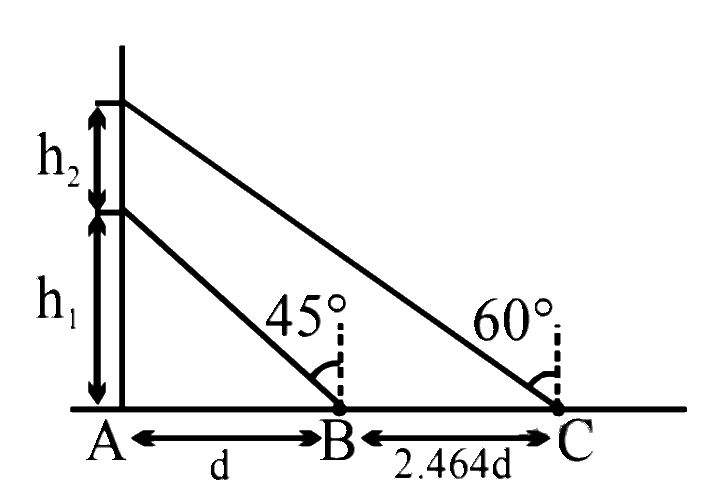
A balloon is moving up in air vertically above a point A on the ground. When it is at a height h1, a girl standing at a distance d (point B) from A (see figure) sees it at an angle 45o with respect to the vertical. When the balloon climbs up a further height h2, it is seen at an angle 60o with respect to the vertical if the girl moves further by a distance 2.464 d (point C). Then the height h2 is (given tan 30o = 0.5774)
Show answer and solution
Answer: (b)
At B (45∘ with vertical): tan45∘=h1d⇒h1=d
At C (60∘ with vertical): tan60∘=h1+h2d+2.464d=h1+h23.464d
Motion in a Plane (2-D Kinematics) · Constant acceleration in a plane
Starting from the origin at time t = 0, with initial velocity 5j^ ms-1, a particle moves in the x-y plane with a constant acceleration of (10i^+4j^) ms-2. At time t, its coordinates are (20 m, y0 m). The values of t and y0 are, respectively:
Motion in a Plane (2-D Kinematics) · Constant acceleration in a plane
A particle starts from the origin at t = 0 with an
initial velocity of 3.0 i^ m/s and moves in the
x-y plane with a constant acceleration (6i^+4j^) m/s2. The x-coordinate of the particle at the instant when its y-coordinate is 32 m is D meters. The value of D is :-
Motion in a Plane (2-D Kinematics) · Constant acceleration in a plane
The x and y coordinates of the particle at any time are x = 5t − 2t2 and y = 10t respectively, where x and y are in metres and t in seconds. The acceleration of the particle at t = 2 s is
Show answer and solution
Answer: (b)
ax=dt2d2x=−4 m/s2, ay=dt2d2y=0
Acceleration is constant, so at t=2 s it is −4 m/s2.
Motion in a Plane (2-D Kinematics) · Position, velocity & acceleration vectors
The position vector of a particle Ras a function of time is given by R = 4sin(2πt)i^ + 4cos(2πt)j^. Where R is in meters, t is in seconds and i^ and j^ denote unit vectors along x-and y-directions, respectively. Which one of the following statements is wrong for the motion of particle?
Show answer and solution
Answer: (a)
∣R∣=4 m always, so the path is a circle of radius 4 m: (b) true.
v=8πcos(2πt)i^−8πsin(2πt)j^, so ∣v∣=8π m/s, not 8 m/s: (a) wrong.
a=−4π2R, along −R with magnitude Rv2: (c), (d) true.
Motion in a Plane (2-D Kinematics) · Average velocity & acceleration
A particle is moving such that its position coordinates (x, y) are (2 m, 3 m) at time t = 0, (6 m, 7 m) at time t = 2 s and (13 m, 14 m) at time t = 5 s.
Average velocity vector (vav) from t = 0 to t = 5 s is
Motion in a Plane (2-D Kinematics) · Average velocity & acceleration
A body is moving with velocity 30 m/s towards east. After 10 seconds its velocity becomes 40 m/s towards north. The average acceleration of the body is
Motion in a Plane (2-D Kinematics) · Path from x(t) and y(t)
A particle starting from the origin (0, 0) moves in a straight line in the (x, y) plane. Its coordinates at a later time are (3,3). The path of the particle makes with the x-axis an angle of
Motion in a Plane (2-D Kinematics) · Average velocity & acceleration
A particle is moving eastwards with a velocity of 5 m/s. In 10 seconds the velocity changes to 5 m/s northwards. The average acceleration in this time is
Show answer and solution
Answer: (c)
Δv=v2−v1=5N^−5E^=5N^+5W^
∣Δv∣=52 m/s, directed north-west
aav=1052=21 m s−2
So the answer is (c) 21 m s−2 towards north-west.
Motion in a Plane (2-D Kinematics) · Path from x(t) and y(t)
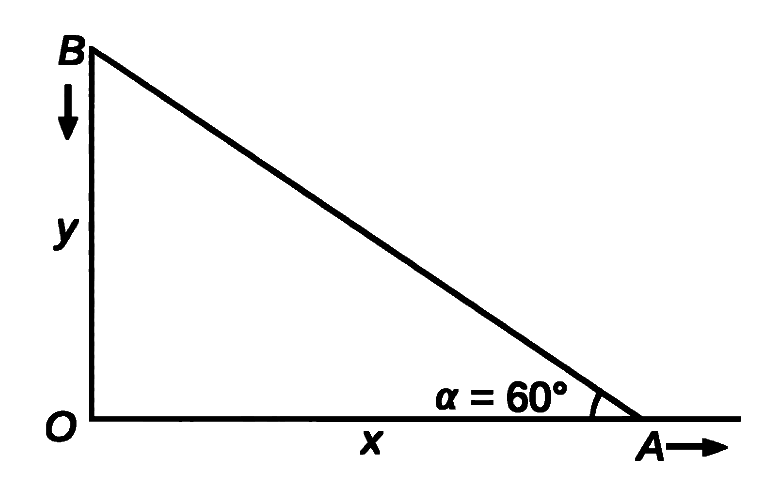
Two particles A and B are connected by a rigid rod AB. The rod slides along perpendicular rails as shown here. The velocity of A to the right is 10 m/s. What is the velocity of B when angle α=60∘?
Motion in a Plane (2-D Kinematics) · Average velocity & acceleration
A bus is moving on a straight road towards north with a uniform speed of 50 km/hour then it turns left through 90∘. If the speed remains unchanged after turning, the increase in the velocity of bus in the turning process is
Projectile Basics & Trajectory · Equation of trajectory
The trajectory of projectile, projected from the ground is given by y=x−20x2. Where x and y are measured in meter. The maximum height attained by the projectile will be.
Show answer and solution
Answer: (b)
y=0 at x=0 and x=20, so range R=20 m; maximum at x=10 m
Projectile Basics & Trajectory · Equation of trajectory
If the initial velocity in horizontal direction of a projectile is unit vector i^ and the equation of trajectoryy=5x(1−x). The y component vector of the initial velocity is ______________ j^. (Take g=10 m/s2)
Numerical answer type. Work it out, then open the answer.
Projectile Basics & Trajectory · Equation of trajectory
The trajectory of a projectile in a vertical plane is y = αx −βx2, where α and β are constants and x & y are respectively the horizontal and vertical distances of the projectile from the point of projection. The angle of projection θ and the maximum height attained H are respectively given by:
Show answer and solution
Answer: (a)
Compare with y=xtanθ−2u2cos2θgx2: tanθ=α⇒θ=tan−1α
Projectile Basics & Trajectory · Equation of trajectory
The trajectory of a projectile near the surface of the earth is given as y = 2x – 9x2. If it were launched at an angle θ0 with speed v0 then (g = 10 ms–2):
Projectile Basics & Trajectory · Position at any time
The position of a projectile launched from the origin at t = 0 is given byr= (40 i^ + 50 j^) m at t = 2s. If the projectile was launched at an angle θ from the horizontal, then θ is (take g = 10 ms−2).
Projectile Basics & Trajectory · Equation of trajectory
A projectile is given an initial velocity of (i^+2j^) m/s, where i^ is along the ground and j^ is along the vertical. If g = 10 m/s2, the equation of its trajectory is:
Projectile Basics & Trajectory · Equation of trajectory
A ball projected from ground at an angle of 45° just clears a wall in front. If point of projection is 4 m from the foot of wall and ball strikes the ground at a distance of 6 m on the other side of the wall, the height of the wall is:
Projectile Basics & Trajectory · Elevation of the highest point
A projectile is fired at an angle of 45o with the horizontal. Elevation angle of the projectile at its highest point as seen from the point of projection, is
Projectile Basics & Trajectory · Position at any time
A boy playing on the roof of a 10 m high building throws a ball with a speed of 10 m/s at an angle of 30∘ with the horizontal. How far from the throwing point will the ball be at the height of 10 m from the ground? [g=10 m/s2,sin30∘=21,cos30∘=23]
Show answer and solution
Answer: (d)
Height 10 m from ground is the level of the throwing point, so we need the horizontal range on that level.
Velocity, Momentum & Energy in Flight · Velocity at any instant
A batsman hits a ball with a velocity 'v', making an angle of 60∘ with the vertical. After some time direction of velocity is making an angle of 60∘ with the horizontal. The speed of the ball at this instant is
[cos(60∘)=21,cos(30∘)=23]
Show answer and solution
Answer: (b)
60∘ with the vertical means 30∘ with the horizontal, so vx=vcos30∘=23v.
The horizontal component stays constant throughout the flight.
When the velocity makes 60∘ with the horizontal: v′cos60∘=23v
Velocity, Momentum & Energy in Flight · Velocity at any instant
If x and y coordinates of a projectile as a function of time (t) are given as 24t and 43.6t−4.9t2, respectively, then the angle (in degrees) made by the projectile with horizontal when t=2 s is ______.
Velocity, Momentum & Energy in Flight · Velocity at any instant
A projectile is thrown upward at an angle 60∘ with the horizontal. The speed of the projectile is 20 m/s when its direction of motion is 45∘ with the horizontal. The initial speed of the projectile is m/s.
Velocity, Momentum & Energy in Flight · Velocity at the highest point
A particle is projected from ground with speed u and at an angle θ with horizontal. If at maximum height from ground, the speed of a particle is half times its initial velocity of projection then its maximum height attained is (cos60∘=0.5,sin60∘=3/2) (g = acceleration due to gravity)
Velocity, Momentum & Energy in Flight · Energy in flight
A ball P is projected at an angle of 60∘ with the vertical with certain initial speed. Another ball Q of the same mass as that of ball P is projected vertically upwards with the same initial speed as that of P. At the highest point, the ratio of potential energy of ball P to that of ball Q is
(sin30∘=0.5)
Show answer and solution
Answer: (a)
P makes 30∘ with the horizontal: HP=2gu2sin230∘=8gu2
Velocity, Momentum & Energy in Flight · Energy in flight
A ball of mass 100 g is projected with velocity 20 m/s at 60∘ with horizontal. The decrease in kinetic energy of the ball during the motion from point of projection to highest point is
Show answer and solution
Answer: (c)
Loss of KE up to the top equals the KE of the vertical component: ΔK=21m(usinθ)2.
Velocity, Momentum & Energy in Flight · Angular momentum
An object of mass ' m ' is projected from origin in a vertical xy plane at an angle 45∘ with the x- axis with an initial velocity v0. The magnitude and direction of the angular momentum of the object with respect to origin, when it reaches at the maximum height, will be [ g is acceleration due to gravity]
Show answer and solution
Answer: (d)
At the top, r=xi^+Hj^ and p=mv0cos45∘i^, so ∣L∣=m(v0cos45∘)H.
Velocity, Momentum & Energy in Flight · Velocity at the highest point
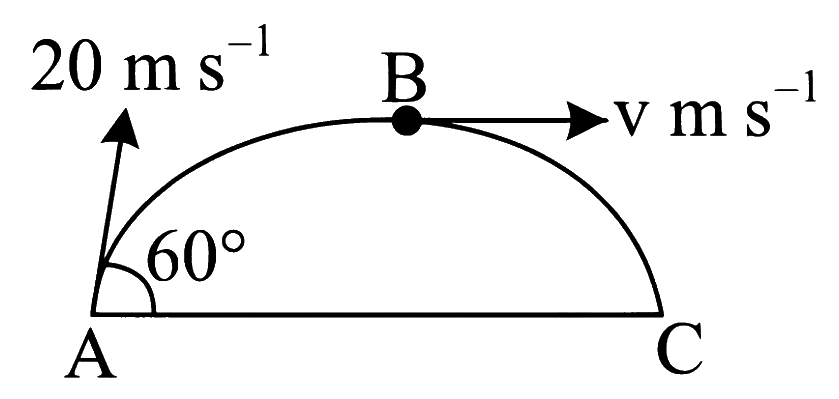
A ball is projected from point A with velocity 20 m s−1 at an angle 60∘ to the horizontal direction. At the highest point B of the path (as shown in figure), the velocity v ms−1 of the ball will be:
Show answer and solution
Answer: (d)
At the highest point the vertical velocity is zero; only the horizontal component ucosθ remains.
Velocity, Momentum & Energy in Flight · Velocity at any instant
A projectile is projected at 30∘ from horizontal with initial velocity 40 ms−1. The velocity of the projectile at t=2 s from the start will be: (Given g=10 m/s2)
Show answer and solution
Answer: (a)
vx=40cos30∘=203 m/s (constant)
vy=40sin30∘−gt=20−10×2=0
So v=203 m/s (the projectile is at the top), answer (a).
Velocity, Momentum & Energy in Flight · Velocity at any instant
A projectile is launched at an angle 'α' with the horizontal with a velocity 20 ms−1. After 10 s, its inclination with horizontal is 'β'. The value of tanβ will be: (g = 10 ms−2).
Velocity, Momentum & Energy in Flight · Velocity at the highest point
A body is projected from the ground at an angle of 45 ∘ with the horizontal. Its velocity after 2s is 20 ms−1. The maximum height reached by the body during its motion is __________ m. (use g = 10 ms−2)
Numerical answer type. Work it out, then open the answer.
Velocity, Momentum & Energy in Flight · Change in velocity & momentum
A body of mass 10 kg is projected at an angle of 45∘ with the horizontal. The trajectory of the body is observed to pass through a point (20,10). If T is the time of flight, then its momentum vector, at time t=2T, is _____________.
[Take g=10 m/s2 ]
Show answer and solution
Answer: (d)
Trajectory at 45∘: y=x−u2gx2. Through (20,10): 10=20−u210×400⇒u=20 m/s
Time of Flight, Maximum Height & Range · Area covered by bullets
A gun mounted on the ground fires bullets in all directions with same speed. The farthest distance the bullets could reach is 6.4 m. The speed of the bullets from the gun is m/s. (take g=10 m/s2)
Numerical answer type. Work it out, then open the answer.
Show answer and solution
Answer: 8
Farthest reach on level ground is the maximum range: Rmax=gu2
Time of Flight, Maximum Height & Range · Time of flight
A stone is thrown at an angle θ with the horizontal reaches a maximum height H, then the time of flight of stone will be (g = acceleration due to gravity)
Time of Flight, Maximum Height & Range · Maximum height
A boy throws a ball into air at 45∘ from the horizontal to land it on a roof of a building of height H. If the ball attains maximum height in 2 s and lands on the building in 3 s after launch, then value of H is ______ m.
(g=10 m/s2)
Show answer and solution
Answer: (d)
Time to reach maximum height t=gusinθ=2 s, so usin45∘=20 m/s.
Time of Flight, Maximum Height & Range · Time of flight
A body when projected at an angle ' θ ' with the horizontal reaches a maximum height ' H '. The time of flight of the body will be ( g= acceleration due to gravity)
Time of Flight, Maximum Height & Range · Maximum height
The angle of projection of a particle is measured from the vertical axis as ϕ and the maximum height reached by the particle is hm. Here hm as function of ϕ can be presented as
Show answer and solution
Answer: (d)
Angle from the vertical is ϕ, so the vertical component of velocity is ucosϕ.
hm=2gu2cos2ϕ
At ϕ=0 (straight up) hm is maximum, 2gu2, and it falls smoothly to zero at ϕ=90∘.
The curve starts at its peak with zero slope and drops to zero at 90∘: graph (d).
Time of Flight, Maximum Height & Range · Relation between R and H
A particle is projected with velocity u so that its horizontal range is three times the maximum height attained by it. The horizontal range of the projectile is given as 25gnu2, where value of n is: (Given, ' g ' is the acceleration due to gravity.)
Time of Flight, Maximum Height & Range · Maximum height
A particle is projected at an angle of 30∘ from horizontal at a speed of 60 m/s. The height traversed by the particle in the first second is h0 and height traversed in the last second, before it reaches the maximum height, is h1. The ratio h0:h1 is __________.
[Take, g=10 m/s2 ]
Numerical answer type. Work it out, then open the answer.
Show answer and solution
Answer: 5
Vertical component uy=60sin30∘=30 m/s; time to top =1030=3 s.
First second: h0=30(1)−21(10)(1)2=25 m
Last second before the top (reverse motion from rest): h1=21(10)(1)2=5 m
Time of Flight, Maximum Height & Range · Time of flight
The initial speed of a projectile fired from ground is u. At the highest point during its motion, the speed of projectile is 23u. The time of flight of the projectile is:
Time of Flight, Maximum Height & Range · Same height at two instants
A projectile fired at 30∘ to the ground is observed to be at same height at time 3 s and 5 s after projection, during its flight. The speed of projection of the projectile is ___________ m s−1. (Given g=10 m s−2)
Numerical answer type. Work it out, then open the answer.
Show answer and solution
Answer: 80
Same height at t1 and t2 means time of flight T=t1+t2=3+5=8 s.
Time of Flight, Maximum Height & Range · Maximum height
A cricket ball is thrown by a player at a speed of 20 m/s in a direction 30∘ above the horizontal. The maximum height attained by the ball during its motion is
Time of Flight, Maximum Height & Range · Time of flight
A projectile is projected with velocity of 25 m/s at an angle θ with the horizontal. After t seconds its inclination with horizontal becomes zero. If R represents horizontal range of the projectile, the value of θ will be:
[use g = 10 m/s2]
Show answer and solution
Answer: (d)
Inclination zero means the top: t=gusinθ⇒usinθ=10t
Time of Flight, Maximum Height & Range · Time of flight
A player kicks a football with an initial speed of 25 ms−1 at an angle of 45∘ from the ground. What are the maximum height and the time taken by the football to reach at the highest point during motion? (Take g = 10 ms−2)
Show answer and solution
Answer: (c)
H=2gu2sin2θ=20625×21=15.625 m
Time to reach the top: t=gusinθ=1025×0.707≈1.77 s
Time of Flight, Maximum Height & Range · Maximum height
A particle moving in a circle of radius R with a uniform speed takes a time T to complete one revolution.
If this particle were projected with the same speed at an angle 'θ' to the horizontal, the maximum height attained by it equals 4R. The angle of projection, θ, is then given by:
Time of Flight, Maximum Height & Range · Area covered by bullets
Two guns A and B can fire bullets at speeds 1 km/s and 2 km/s respectively. From a point on a horizontal ground, they are fired in all possible directions. The ratio of maximum areas covered by the bullets fired by the two guns, on the ground is -
Time of Flight, Maximum Height & Range · Time of flight
The initial speed of a bullet fired from a rifle is 630 m/s. The rifle is fired at the center of a target 700 m away at the same level as the target. How far above the center of the target the rifle must be aimed in order to hit the target?
Show answer and solution
Answer: (c)
Time to cover 700 m horizontally: t=630700=910 s (angle is tiny, so ux≈u)
Vertical drop in this time: h=21gt2=4.9×81100≈6.05 m
Aim this much above the centre: about 6.1 m, answer (c).
Time of Flight, Maximum Height & Range · Maximum height
A projectile is fired from the surface of the earth with a velocity of 5 m s−1 and angle θ with the horizontal. Another projectile fired from another planet with a velocity of 3 m s−1 at the same angle follows a trajectory which is identical with the trajectory of the projectile fired from the earth. The value of the acceleration due to gravity on the planet is (in m s−2) is
(Given g = 9.8 m s−2)
Show answer and solution
Answer: (a)
Identical trajectory at the same angle needs the same gu2 (range and height both ∝gu2).
Time of Flight, Maximum Height & Range · Area covered by bullets
A water fountain on the ground sprinkles water all around it. If the speed of water coming out of the fountain is v, the total area around the fountain that gets wet is:
Show answer and solution
Answer: (a)
Water travels farthest at 45∘: Rmax=gv2.
Wet region is a circle of radius Rmax: A=π(gv2)2
Two objects are projected with same velocity 'u' at different angles α and β with the horizontal. If α+β=90∘, the ratio of horizontal range of the first object to the second object will be [sin(π−θ)=sinθ]
Show answer and solution
Answer: (c)
R=gu2sin2θ; with β=90∘−α, sin2β=sin(180∘−2α)=sin2α.
The two projectiles are projected with the same initial velocities at the 15∘ and 30∘ with respect to the horizontal. The ratio of their ranges is 1:x. The value of x is
Two identical bodies, projected with the same speed at two different angles cover the same horizontal range R. If the time of flight of these bodies are 5 s and 10 s, respectively, then the value of R is
Comparing Two Projectiles · Same height or same time
If two spheres are projected at angles 45∘ and 60∘ with horizontal and the maximum heights reached are same. The ratio of their initial velocities is (sin45∘=21,sin60∘=23)
Comparing Two Projectiles · Same height or same time
Two spheres are projected at angles 30∘ and 45∘ with the horizontal. The maximum height reached by both is same. The ratio of their initial velocities is, (sin45∘=21,sin30∘=0.5)
Comparing Two Projectiles · Same height or same time
Two balls A and B are projected at an angle of 45∘ and 60∘ respectively, so that the maximum heights reached are same for both. The ratio of initial velocity of projection of ball A to that for ball B is
Comparing Two Projectiles · Same height or same time
Two projectiles are fired with same initial speed from same point on ground at angles of (45∘−α) and (45∘+α), respectively, with the horizontal direction. The ratio of their maximum heights attained is:
Two projectiles are fired from ground with same initial speeds from same point at angles (45∘+α) and (45∘−α) with horizontal direction. The ratio of their times of flights is
Two balls with same mass and initial velocity, are projected at different angles in such a way that maximum height reached by first ball is 8 times higher than that of the second ball. T1 and T2 are the total flying times of first and second ball, respectively, then the ratio of T1 and T2 is
Projectiles A and B are thrown at angles of 45∘ and 60∘ with vertical respectively from top of a 400 m high tower. If their ranges and times of flight are same, the ratio of their speeds of projection vA:vB is:
[Take g=10 m s−2]
Show answer and solution
Answer: (b)
From the same height, equal times of flight need equal vertical components: vAcos45∘=vBcos60∘ (angles from vertical).
vBvA=cos45∘cos60∘=1/21/2=21
Equal ranges with equal times would also need vAsin45∘=vBsin60∘, i.e. 3:2, so both conditions cannot hold together.
Using the time-of-flight condition, vA:vB=1:2, option (c).
Two bodies are projected from ground with same speeds 40 m s−1 at two different angles with respect to horizontal. The bodies were found to have same range. If one of the body was projected at an angle of 60∘, with horizontal then sum of the maximum heights, attained by the two projectiles, is ________ m. (Given g=10 m s−2)
Numerical answer type. Work it out, then open the answer.
Show answer and solution
Answer: 80
Same range at the same speed means complementary angles: 60∘ and 30∘.
Comparing Two Projectiles · Same height or same time
Two projectiles are projected at 30∘ and 60∘ with the horizontal with the same speed. The ratio of the maximum height attained by the two projectiles respectively is:
The range of the projectile projected at an angle of 15∘ with horizontal is 50 m. If the projectile is projected with same velocity at an angle of 45∘ with horizontal, then its range will be
Two objects are projected with same velocity 'u' however at different angles α and β with the horizontal. If α+β=90∘, the ratio of horizontal range of the first object to the 2nd object will be:
Two projectiles A and B are thrown with initial velocities of 40 m/s and 60 m/s at angles 30∘ and 60∘ with the horizontal respectively. The ratio of their ranges respectively is (g=10 m/s2)
Two projectiles are thrown with same initial velocity making an angle of 45∘ and 30∘ with the horizontal respectively. The ratio of their respective ranges will be:
Given below are two statements. One is labelled as Assertion A and the other is labelled as Reason R.
Assertion A: Two identical balls A and B thrown with same velocity 'u' at two different angles with horizontal attained the same range R. If A and B reached the maximum height h1 and h2 respectively, then R=4h1h2
Reason R: Product of said heights.
h1h2=(2gu2sin2θ)⋅(2gu2cos2θ)
Choose the correct answer:
Show answer and solution
Answer: (a)
Same range means angles θ and 90∘−θ, so h1=2gu2sin2θ, h2=2gu2cos2θ: R is true.
h1h2=4g2u4sin2θcos2θ and R2=g24u4sin2θcos2θ=16h1h2
So R=4h1h2: A is true and follows directly from R.
Comparing Two Projectiles · Same height or same time
Two projectiles thrown at 30∘ and 45∘ with the horizontal respectively, reach the maximum height in same time. The ratio of their initial velocities is:
Show answer and solution
Answer: (c)
Time to maximum height t=gusinθ; equal times give u1sin30∘=u2sin45∘.
Comparing Two Projectiles · Same height or same time
Two projectiles P1 and P2 thrown with speed in the ratio 3: 2, attain the same height during their motion. If P2 is thrown at an angle of 60∘ with the horizontal, the angle of projection of P1 with horizontal will be:
Show answer and solution
Answer: (c)
Same maximum height means equal vertical components: u1sinθ1=u2sin60∘.
Comparing Two Projectiles · Same height or same time
A ball of mass m is thrown vertically upward. Another ball of mass 2m is thrown at an angle θ with the vertical. Both the balls stay in air for the same period of time. The ratio of the heights attained by the two balls respectively is x1. The value of x is _____________.
Numerical answer type. Work it out, then open the answer.
Show answer and solution
Answer: 1
Time of flight T=g2uy depends only on the vertical component uy (not on mass).
Two projectiles are thrown towards each other at 15∘ and 45∘ angles respectively with the horizontal at the same speed. The difference between the horizontal distances traveled by the two projectiles is 80 m. The initial speed of the projectiles is ______ m s−1
[Given g=10 m s−2 ]
Numerical answer type. Work it out, then open the answer.
An object is projected in the air with initial velocity u at an angle θ. The projectile motion is such that the horizontal range R, is maximum. Another object is projected in the air with a horizontal range half of the range of first object. The initial velocity remains same in both the cases. The value of the angle of projection, at which the second object is projected, will be _________ degree.
Numerical answer type. Work it out, then open the answer.
The ranges and heights for two projectiles projected with the same initial velocity at angles 42∘ and 48∘ with the horizontal are R1, R2 and H1, H2 respectively. Choose the correct option:
Show answer and solution
Answer: (b)
42∘ and 48∘ are complementary, so sin84∘=sin96∘ gives R1=R2.
Two particles are projected from the same point with the same speed u such that they have the same range R, but different maximum heights, h1 and h2. Which of the following is correct?
Show answer and solution
Answer: (b)
Same range: angles θ and 90∘−θ, so h1=2gu2sin2θ, h2=2gu2cos2θ
h1h2=4g2u4sin2θcos2θ, while R2=g24u4sin2θcos2θ
A shell is fired from a fixed artillery gun with an initial speed u such that it hits the target on the ground at a distance R from it. If t1 and t2 are the values of the time taken by it to hit the target in two possible ways, the product t1t2 is -
Show answer and solution
Answer: (a)
The two ways are angles θ and 90∘−θ: t1=g2usinθ, t2=g2ucosθ
A projectile can have the same range R for two angles of projection. If t1 and t2 be the times of flights in the two cases, then the product of the two time of flights is proportional to
A projectile can have the same range 'R' for two angles of projection. If T1 and T2 be the time of flights in the two cases, then the product of the two time of flights is directly proportional to
If a body A of mass M is thrown with velocity v at an angle of 30∘ to the horizontal and another body B of the same mass is thrown with the same speed at an angle of 60∘ to the horizontal, the ratio of horizontal range of A to B will be
If a body A of mass M is thrown with velocity v at an angle of 30∘ to the horizontal and another body B of the same mass is thrown with the same speed at an angle of 60∘ to the horizontal, the ratio of horizontal range of A to B will be
Horizontal Projectile & Inclined Plane · Bomb from an aeroplane
A helicopter flying horizontally with a speed of 360 km/h at an altitude of 2 km, drops an object at an instant. The object hits the ground at a point O, 20 s after it is dropped. Displacement of 'O' from the position of helicopter where the object was released is:
(use acceleration due to gravity g = 10 m/s2 and neglect air resistance)
Show answer and solution
Answer: (c)
v=360 km/h=100 m/s; check t=102(2000)=20 s.
Horizontal distance x=100×20=2000 m=2 km; vertical drop =2 km.
Horizontal Projectile & Inclined Plane · Body thrown from a tower
A body of mass M thrown horizontally with velocity v from the top of the tower of height H touches the ground at a distance of 100 m from the foot of the tower. A body of mass 2M thrown at a velocity 2v from the top of the tower of height 4H will touch the ground at a distance of _______ m.
Numerical answer type. Work it out, then open the answer.
Show answer and solution
Answer: 100
Horizontal range from a tower: R=vg2H (independent of mass).
Horizontal Projectile & Inclined Plane · Body thrown from a tower
A ball rolls off the top of a stairway with horizontal velocity u. The steps are 0.1 m high and 0.1 m wide. The minimum velocity u with which that ball just hits the step 5 of the stairway will be x m s−1 where x= __________ [use g=10 m/s2 ].
Numerical answer type. Work it out, then open the answer.
Show answer and solution
Answer: 2
To land on step 5 the ball must just clear the edge of step 4: fall y=4(0.1)=0.4 m with x=0.4 m.
Horizontal Projectile & Inclined Plane · Body thrown from a tower
A child stands on the edge of the cliff 10 m above the ground and throws a stone horizontally with an initial speed of 5 m s−1. Neglecting the air resistance, the speed with which the stone hits the ground will be ________ m s−1 (given, g=10 m s−2 ).
Horizontal Projectile & Inclined Plane · Release from a moving vehicle
At t = 0, truck, starting from rest, moves in the positive x-direction at uniform acceleration of 5 ms−2. At t = 20 s, a ball is released from the top of the truck. The ball strikes the ground in 1 s after the release. The velocity of the ball, when it strikes the ground, will be:
(Given g = 10 ms−2)
Show answer and solution
Answer: (a)
At t=20 s: truck speed =5×20=100 m/s, ball keeps vx=100.
After release only gravity acts: in 1 s, vy=−10×1=−10 m/s.
Horizontal Projectile & Inclined Plane · Bomb from an aeroplane
A bomb is dropped by an aeroplane flying horizontally with a velocity 200 km/hr and at a height of 980 m. At the time of dropping a bomb, the distance of the aeroplane from the target on the ground to hit directly is (g=9.8 m/s2)
Show answer and solution
Answer: (c)
v=200 km/h=200×185=9500 m/s
Fall time t=g2h=9.82×980=200=102 s
Horizontal distance x=vt=9500×102=950002=92104 m
Horizontal Projectile & Inclined Plane · Bomb from an aeroplane
A helicopter is flying horizontally with a speed 'v' at an altitude 'h' has to drop a food packet for a man on the ground. What is the distance of helicopter from the man when the food packet is dropped?
Show answer and solution
Answer: (c)
Time of fall t=g2h; in this time the packet moves x=vt=vg2h horizontally.
The man is at horizontal distance x and vertical distance h from the helicopter.
Horizontal Projectile & Inclined Plane · Release from a moving vehicle
A car starts from rest and accelerates at 5m/s2. At t = 4 s, a ball is dropped out of a window by a person sitting in the car. What is the velocity and acceleration of the ball at t = 6 s? (Take g = 10 m/s2)
Show answer and solution
Answer: (a)
At t=4 s: car speed =5×4=20 m/s, which the ball keeps horizontally.
After release only gravity acts: in 2 s, vy=10×2=20 m/s.
Horizontal Projectile & Inclined Plane · Body thrown from a tower
Two bullets are fired horizontally and simultaneously towards each other from roof tops of two buildings 100 m apart and of same height of 200 m, with the same velocity of 25 m/s. When and where will the two bullets collide? (g=10 m/s2)
Show answer and solution
Answer: (b)
Relative horizontal speed =25+25=50 m/s, so they meet at t=50100=2 s.
Both fall the same distance 21gt2=21(10)(2)2=20 m, so they do collide.
Horizontal Projectile & Inclined Plane · Projectile on an inclined plane
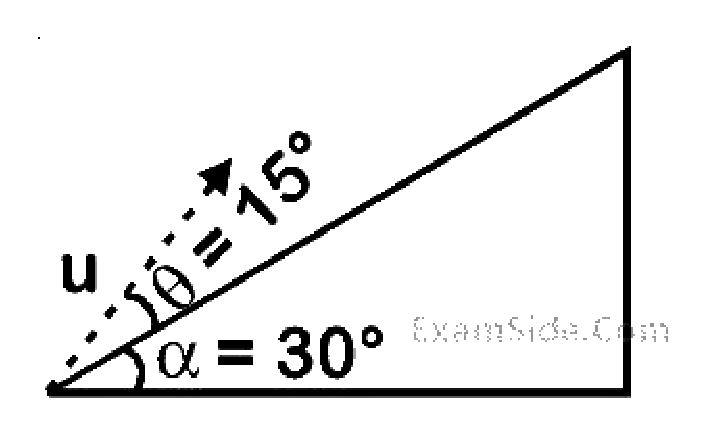
A plane is inclined at an angle α = 30° with respect to the horizontal. A particle is projected with a speed u = 2 ms–1, from the base of the plane, making an angle θ = 15° with respect to the plane as shown in the figure. The distance from the base, at which the particle hits the plane is close to: (Take g = 10 ms–2)
Horizontal Projectile & Inclined Plane · Body thrown from a tower
A particle A is dropped from a height and another particle B is projected in horizontal direction with speed of 5 m/sec from the same height then correct statement is
Show answer and solution
Answer: (c)
Both start with zero vertical velocity from the same height.
Vertical motion is independent of horizontal velocity, so t=g2h for both.
B lands with greater speed since it also has a horizontal 5 m/s.
Relative Velocity in Two Dimensions · River & boat
A boat crosses a river from one bank A to another bank B which is opposite. The distance between them is D. The speed of water is VW and that of boat relative to water is VB. If VB=2VW, the time taken by the boat to cross the river directly along AB is (sin30∘=21)⋅(cos30∘=23)
Show answer and solution
Answer: (c)
To go straight along AB, head upstream at ϕ from AB: sinϕ=VBVW=21⇒ϕ=30∘
Relative Velocity in Two Dimensions · River & boat
A river of width 200 m is flowing from west to east with a speed of 18 km/h. A boat, moving with speed of 36 km/h in still water, is made to travel one-round trip (bank to bank of the river). Minimum time taken by the boat for this journey and also the displacement along the river bank are ______ and ______ respectively.
Show answer and solution
Answer: (c)
Minimum time: head perpendicular to flow. vb=36 km/h=10 m/s, vr=18 km/h=5 m/s.
One crossing: t=10200=20 s; round trip =40 s.
Drift each way =5×20=100 m downstream; both crossings drift east, total 200 m.
Relative Velocity in Two Dimensions · Chasing & minimum distance
Two boys are standing at points A and B on ground where distance AB = a. The boy at point B starts running perpendicular to line AB with velocity 'V1 '. The boy at point A starts running simultaneously with velocity 'V' and catches the other boy in time 't'. The value of 't' is
Show answer and solution
Answer: (a)
They meet at a point C with BC=V1t, AC=Vt and AB⊥BC.
Relative Velocity in Two Dimensions · Seen from a moving frame
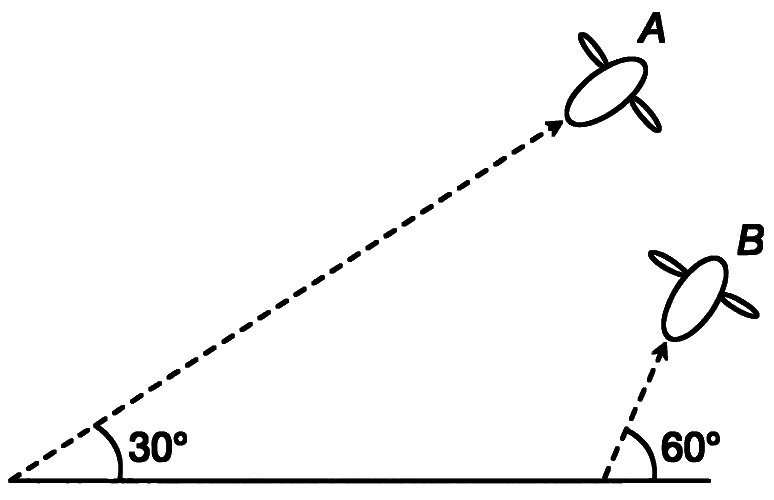
Airplanes A and B are flying with constant velocity in the same vertical plane at angles 30∘ and 60∘ with respect to the horizontal as shown in the figure. The speed of A is 1003 m/s. At time t=0 s, an observer in A finds B at a distance of 500 m. This observer sees B moving with a constant velocity perpendicular to the line of motion of A. If at t=t0, A just escapes being hit by B, t0 in second is
{sin(30∘)=0.5,cos(30∘)=30.5/2}
Show answer and solution
Answer: (d)
B is seen moving perpendicular to A's path, so the component of vB along A's direction equals vA.
Angle between the two paths is 60∘−30∘=30∘: vBcos30∘=1003⇒vB=200 m/s.
Relative speed (perpendicular to A's path) =vBsin30∘=200×0.5=100 m/s.
Relative Velocity in Two Dimensions · River & boat
A river is flowing from west to east direction with speed of 9 km h−1. If a boat capable of moving at a maximum speed of 27 km h−1 in still water, crosses the river in half a minute, while moving with maximum speed at an angle of 150∘ to direction of river flow, then the width of the river is:
Show answer and solution
Answer: (a)
Component of boat velocity across the river: 27sin150∘=13.5 km/h=3.75 m/s
Relative Velocity in Two Dimensions · River & boat
The maximum speed of a boat in still water is 27 km/h. Now this boat is moving downstream in a river flowing at 9 km/h. A man in the boat throws a ball vertically upwards with speed of 10 m/s. Range of the ball as observed by an observer at rest on the bank is __________ cm. (Take g=10 m/s2)
Numerical answer type. Work it out, then open the answer.
Show answer and solution
Answer: 2000
Boat speed relative to bank (downstream) =27+9=36 km/h=10 m/s; ball shares it.
Relative Velocity in Two Dimensions · Chasing & minimum distance
Two girls are standing at the ends ' A ' and ' B ' of a ground where AB=b. The girl at ' B ' starts running in a direction perpendicular to ' AB ' with velocity ' V1 '. The girl at ' A ' starts running simultaneously with velocity ' V2 ' and in shortest distance meets the other girl in time ' t '. The value of ' t ' is
Show answer and solution
Answer: (d)
Meeting point C: BC=V1t, AC=V2t, right angle at B.
Relative Velocity in Two Dimensions · Chasing & minimum distance
Two boys are standing at points A and B on ground, where distance AB=x. The boy at B stars running perpendicular to AB with velocity v1. The boy at A starts running simultaneously with velocity v and meets the other boy in time t. The value of t is
Show answer and solution
Answer: (c)
Meeting point C: BC=v1t, AC=vt, right angle at B.
Relative Velocity in Two Dimensions · River & boat
The speed of a swimmer is 4 km h−1 in still water. If the swimmer makes his strokes normal to the flow of river of width 1 km, he reaches a point 750 m down the stream on the opposite bank. The speed of the river water is ___________ km h−1
Numerical answer type. Work it out, then open the answer.
Relative Velocity in Two Dimensions · Rain & umbrella
A girl standing on road holds her umbrella at 45∘ with the vertical to keep the rain away. If she starts running without umbrella with a speed of 152 kmh−1, the rain drops hit her head vertically. The speed of rain drops with respect to the moving girl is:
Show answer and solution
Answer: (c)
Umbrella at 45∘: rain's horizontal and vertical components are equal, vx=vy.
Running at 152 makes rain vertical, so vx=152⇒vy=152 km/h.
Relative to the girl only vy remains: 152=230 km h−1
Relative Velocity in Two Dimensions · Seen from a moving frame
A fighter jet is flying horizontally at a certain altitude with a speed of 200 ms−1. When it passes directly overhead an anti-aircraft gun, a bullet is fired from the gun, at an angle θ with the horizontal, to hit the jet. If the bullet speed is 400 m/s, the value of θ will be ___________∘.
Numerical answer type. Work it out, then open the answer.
Show answer and solution
Answer: 60
To hit the jet, the bullet's horizontal velocity must equal the jet's.
Relative Velocity in Two Dimensions · River & boat
A swimmer can swim with velocity of 12 km/h in still water. Water flowing in a river has velocity 6 km/h. The direction with respect to the direction of flow of river water he should swim in order to reach the point on the other bank just opposite to his starting point is ____________∘. (Round off to the Nearest Integer) (Find the angle in degrees)
Numerical answer type. Work it out, then open the answer.
Show answer and solution
Answer: 120
To reach the opposite point, the component along the flow must cancel: 12cosθ+6=0
Relative Velocity in Two Dimensions · River & boat
A person is swimming with a speed of 10 m/s at an angle of 120∘ with the flow and reaches to a point directly opposite on the other side of the river. The speed of the flow is 'x' m/s. The value of 'x' to the nearest integer is __________.
Numerical answer type. Work it out, then open the answer.
Show answer and solution
Answer: 5
To reach directly opposite, the component along the flow must cancel: x=10∣cos120∘∣
Relative Velocity in Two Dimensions · Seen from a moving frame
A butterfly is flying with a velocity 42 m/s in North-East direction. Wind is slowly blowing at 1 m/s from North to South. The resultant displacement of the butterfly in 3 seconds is:
Show answer and solution
Answer: (d)
Butterfly: 42 at NE =4i^+4j^ (east, north). Wind: −1j^.
Relative Velocity in Two Dimensions · River & boat
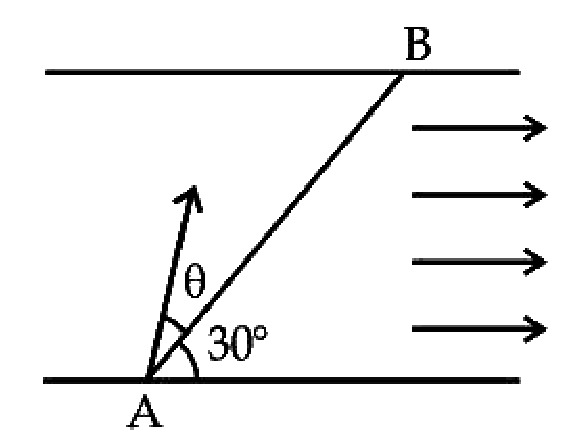
A swimmer wants to cross a river from point A to point B. Line AB makes an angle of 30∘ with the flow of river. Magnitude of velocity of the swimmer is same as that of the river. The angle θ with the line AB should be _________∘, so that the swimmer reaches point B.
Numerical answer type. Work it out, then open the answer.
Show answer and solution
Answer: 30
Swimmer velocity makes angle 30∘+θ with the flow; river velocity is along the flow, both of equal magnitude.
The sum of two equal vectors bisects the angle between them, so the resultant is at 230∘+θ from the flow.
Relative Velocity in Two Dimensions · Rain & umbrella
When a car is at rest, its driver sees rain drops falling on it vertically. When driving the car with speed v, he sees that rain drops are coming at an angle 60° from the horizontal. On further increasing the speed of the car to (1 + β)v, this angle changes to 45o. The value of β is close to:
Show answer and solution
Answer: (b)
Rain falls vertically with speed u; relative to the car it has horizontal component equal to car speed.
Relative Velocity in Two Dimensions · River & boat
The speed of a swimmer in still water is 20 m/s. The speed of river water is 10 m/s and is flowing due east. If he is standing on the south bank and wishes to cross the river along the shortest path, the angle at which he should make his strokes w.r.t. north is given by:
Show answer and solution
Answer: (d)
For the shortest path the resultant must point due north, so he heads upstream (west of north).
Relative Velocity in Two Dimensions · River & boat
The stream of a river is flowing with a speed of 2km/h. A swimmer can swim at a speed of 4km/h. What should be the direction of the swimmer with respect to the flow of the river to cross the river straight?
Show answer and solution
Answer: (b)
To cross straight, the upstream component must cancel the flow: vscosθ=−vr, with θ measured from the flow.
Relative Velocity in Two Dimensions · Seen from a moving frame
A person standing on an open ground hears the sound of a jet aeroplane, coming from north at an angle 60o with ground level. But he finds the aeroplane right vertically above his position. If v is the speed of sound, speed of the plane is:
Show answer and solution
Answer: (d)
Sound travels from the old position along a line at 60∘ to the ground, distance vt.
In the same time the plane moves horizontally to directly overhead: vpt=vtcos60∘
Relative Velocity in Two Dimensions · Chasing & minimum distance
Ship A is sailing towards north-east with velocityv=30i^+50j^ km/hr where i^ points east and j^, north. Ship B is at a distance of 80 km east and 150 km north of Ship A and is sailing towards west at 10 km/hr. A will be at minimum distance from B in:
Show answer and solution
Answer: (c)
Position of B relative to A: r=80i^+150j^; vBA=−10i^−(30i^+50j^)=−40i^−50j^
Minimum distance at t=−∣vBA∣2r⋅vBA=1600+25003200+7500
Relative Velocity in Two Dimensions · Chasing & minimum distance
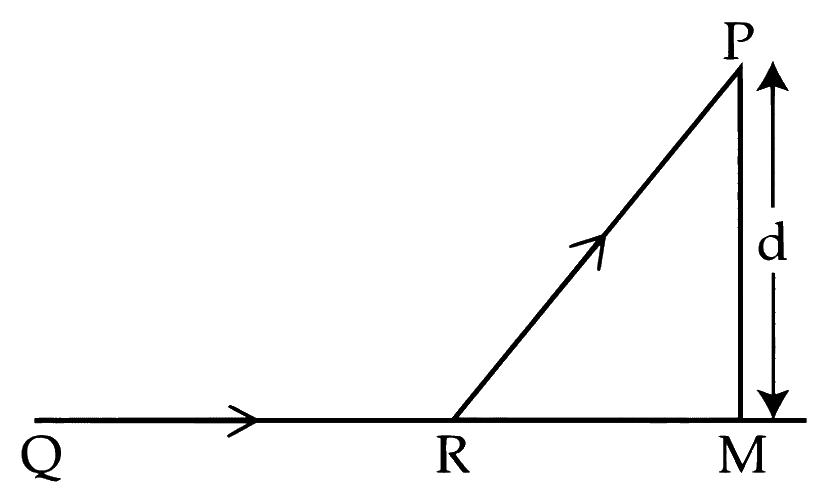
A man in a car at location Q on a straight highway is moving with speed v. He decides to reach a point P in a field at a distance d from the highway (point M) as shown in the figure. Speed of the car in the field is half to that on the highway. What should be the distance RM, so that the time taken to reach P is minimum?
Relative Velocity in Two Dimensions · Chasing & minimum distance
A ship A is moving Westwards with a speed of 10 km h−1 and a ship B 100 km South of A, is moving Northwards with a speed of 10 km h−1. The time after which the distance between them becomes shortest, is
Show answer and solution
Answer: (d)
Take A at origin. Relative to A, B starts at (0,−100) with velocity vB−vA=(10,10) km/h.
Closest approach when r⋅vrel=0: 10(10t)+10(−100+10t)=0
Relative Velocity in Two Dimensions · Seen from a moving frame
The maximum range of a bullet fired from a toy pistol mounted on a car at rest is R0=40 m. What will be the acute angle of inclination of the pistol for maximum range when the car is moving in the direction of firing with uniform velocity v=20 m/s on a horizontal surface? (g=10 m/s2)
Show answer and solution
Answer: (b)
At rest: R0=gu2=40⇒u=20 m/s.
Car moving: horizontal speed ucosθ+v, flight time g2usinθ, so R=g2usinθ(ucosθ+v).
Relative Velocity in Two Dimensions · Chasing & minimum distance
Two boys are standing at the ends A and B of a ground where AB = a. The boy at B starts running in a direction perpendicular to AB with velocity v1. The boy at A starts running simultaneously with velocity v and catches the other in a time t, where t is
Show answer and solution
Answer: (d)
Meeting point C: BC=v1t, AC=vt, right angle at B.
Relative Velocity in Two Dimensions · Chasing & minimum distance
A ball is thrown from a point with a speed ν0 at an angle of projection θ. From the same point and at the same instant person starts running with a constant speed 2v0 to catch the ball. Will the person be able to catch the ball? If yes, what should be the angle of projection θ?
Show answer and solution
Answer: (c)
The person catches the ball if he always stays under it: horizontal speeds must match.
Relative Velocity in Two Dimensions · River & boat
The width of river is 1 km. The velocity of boat is 5 km/hr. The boat covered the width of river along the shortest path in 15 min. Then the velocity of river stream is
Show answer and solution
Answer: (a)
Shortest path: resultant velocity is straight across, vres=0.25 h1 km=4 km/h.
Relative Velocity in Two Dimensions · River & boat
A person swims in a river aiming to reach exactly opposite point on the bank of a river. His speed of swimming is 0.5 m/s at an angle 120∘ with the direction of flow of water. The speed of water in stream is
Show answer and solution
Answer: (c)
To reach the opposite point, the swimmer's component along the flow cancels the stream.
Relative Velocity in Two Dimensions · River & boat
The speed of a boat is 5 km/h in still water. It crosses a river of width 1.0 km along the shortest possible path in 15 min. The velocity of the river water is (in km/h)
Show answer and solution
Answer: (c)
Shortest path: resultant velocity is straight across, vres=0.251=4 km/h.