Physics Circle home Home Practice Hub Register / Login

Home›Practice Hub›Chapters›Ray Optics

Physics PYQs · MHT CET · JEE Main · NEET

Ray Optics

Questions
550
MHT CET
155
JEE Main
282
NEET
113
Years
1988–2026
0 of 550 attemptedPick an answer to see the solution

Q1MHT CET 2026 · 13 APR · SHIFT 1Easy

Reflection & Mirrors · Laws of reflection & deviation

If a parallel beam of light is incident on spherical mirrors then after reflection they pass through focal point. If F is the focal length and R is the radius of curvature of mirror then

Show answer and solution

Answer: (b)

  1. A parallel beam meets at the principal focus, which lies midway between the pole and the centre of curvature.
  2. F=R2⇒R=2FF = \frac{R}{2} \Rightarrow R = 2F
  3. So the answer is (b) R=2FR = 2F.
Report a mistake
Q2JEE Main 2026 · 22 JAN · SHIFT 2Easy

Reflection & Mirrors · Laws of reflection & deviation

In parallax method for the determination of focal length of a concave mirror, the object should always be placed:

Show answer and solution

Answer: (c)

  1. The parallax method locates a real, inverted image with a pin, so the image must be real.
  2. A concave mirror forms a real image for every object position beyond the focus FF.
  3. So the answer is (c) at any point beyond FF.
Report a mistake
Q3JEE Main 2026 · 6 APR · SHIFT 2Medium

Reflection & Mirrors · Laws of reflection & deviation

A concave mirror of focal length 10 cm forms an image which is double the size of object when the object is placed at two different positions. The distance between the two positions of the object is ______ cm.

Numerical answer type. Work it out, then open the answer.

Show answer and solution

Answer: 10

  1. m=ff−um = \frac{f}{f - u} with f=−10 cmf = -10\text{ cm}.
  2. Real image, m=−2m = -2: f−u=−f2⇒u=3f2=−15 cmf - u = -\frac{f}{2} \Rightarrow u = \frac{3f}{2} = -15\text{ cm}
  3. Virtual image, m=+2m = +2: f−u=f2⇒u=f2=−5 cmf - u = \frac{f}{2} \Rightarrow u = \frac{f}{2} = -5\text{ cm}
  4. Distance between the two positions =15−5=10 cm= 15 - 5 = 10\text{ cm}
Report a mistake
Q4JEE Main 2026 · 24 JAN · SHIFT 2Medium

Reflection & Mirrors · Moving mirror & mirror size

Distance between an object and three times magnified real image is 40 cm. The focal length of the mirror used is ______ cm.

Show answer and solution

Answer: (d)

  1. Real image three times magnified: m=−3⇒v=3um = -3 \Rightarrow v = 3u (both in front of the mirror).
  2. Object-image distance =∣v−u∣=2∣u∣=40⇒u=−20 cm= |v - u| = 2|u| = 40 \Rightarrow u = -20\text{ cm}, v=−60 cmv = -60\text{ cm}
  3. 1f=1v+1u=−160−120=−115\frac{1}{f} = \frac{1}{v} + \frac{1}{u} = -\frac{1}{60} - \frac{1}{20} = -\frac{1}{15}
  4. f=−15 cmf = -15\text{ cm}, so the answer is (d).
Report a mistake
Q5JEE Main 2026 · 4 APR · SHIFT 1Difficult

Reflection & Mirrors · Laws of reflection & deviation

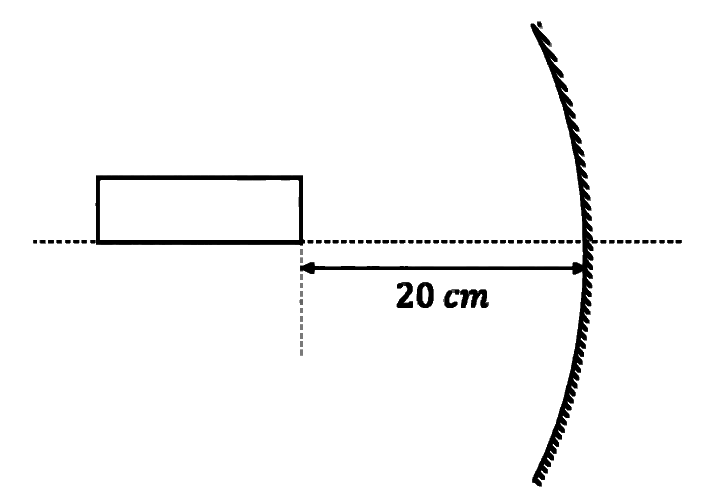
A rod of length 10 cm lies along the principle axis of a concave mirror of focal length 10 cm as shown in figure. The length of the image is ______ cm.

Figure

Show answer and solution

Answer: (b)

  1. f=−10 cmf = -10\text{ cm}, so CC is at 20 cm. The near end at u=−20u = -20 cm images at v=−20v = -20 cm.
  2. Far end at u=−30u = -30 cm: 1v=1f−1u=−110+130=−115⇒v=−15 cm\frac{1}{v} = \frac{1}{f} - \frac{1}{u} = -\frac{1}{10} + \frac{1}{30} = -\frac{1}{15} \Rightarrow v = -15\text{ cm}
  3. Image length =20−15=5 cm= 20 - 15 = 5\text{ cm}
  4. So the answer is (b) 5.
Report a mistake
Q6JEE Main 2025 · 23 JAN · SHIFT 2Easy

Reflection & Mirrors · Laws of reflection & deviation

A concave mirror of focal length ff in air is dipped in a liquid of refractive index μ\mu. Its focal length in the liquid will be:

Show answer and solution

Answer: (b)

  1. For a mirror f=R2f = \frac{R}{2}, which depends only on the geometry of the surface.
  2. Reflection does not depend on the refractive index of the surrounding medium, so ff is unchanged.
  3. So the answer is (b) ff.
Report a mistake
Q7JEE Main 2025 · 2 APR · SHIFT 2Medium

Reflection & Mirrors · Inclined mirrors & number of images

Two identical objects are placed in front of convex mirror and concave mirror having same radii of curvature of 12 cm, at same distance of 18 cm from the respective mirrors. The ratio of sizes of the images formed by convex mirror and by concave mirror is:

Show answer and solution

Answer: (b)

  1. ∣f∣=6 cm|f| = 6\text{ cm}, u=−18 cmu = -18\text{ cm}, m=ff−um = \frac{f}{f - u}
  2. Convex (f=+6f = +6): m=66+18=14m = \frac{6}{6 + 18} = \frac{1}{4}
  3. Concave (f=−6f = -6): m=−6−6+18=−12m = \frac{-6}{-6 + 18} = -\frac{1}{2}
  4. Ratio of sizes =1/41/2=12= \frac{1/4}{1/2} = \frac{1}{2}, so the answer is (b).
Report a mistake
Q8JEE Main 2025 · 4 APR · SHIFT 1Medium

Reflection & Mirrors · Moving mirror & mirror size

Distance between object and its image (magnified by −13-\frac{1}{3}) is 30 cm. The focal length of the mirror used is (x4)cm\left(\frac{x}{4}\right)\text{cm}, where magnitude of value of xx is _________.

Numerical answer type. Work it out, then open the answer.

Show answer and solution

Answer: 45

  1. m=−vu=−13⇒v=u3m = -\frac{v}{u} = -\frac{1}{3} \Rightarrow v = \frac{u}{3} (real image, concave mirror).
  2. Object-image distance =∣u∣−∣u∣3=2∣u∣3=30⇒u=−45 cm= |u| - \frac{|u|}{3} = \frac{2|u|}{3} = 30 \Rightarrow u = -45\text{ cm}, v=−15 cmv = -15\text{ cm}
  3. 1f=−115−145=−445⇒f=−454 cm\frac{1}{f} = -\frac{1}{15} - \frac{1}{45} = -\frac{4}{45} \Rightarrow f = -\frac{45}{4}\text{ cm}
  4. ∣x∣=45|x| = 45
Report a mistake
Q9JEE Main 2025 · 22 JAN · SHIFT 1Medium

Reflection & Mirrors · Moving mirror & mirror size

The driver sitting inside a parked car is watching vehicles approaching from behind with the help of his side view mirror, which is a convex mirror with radius of curvature R=2 m\text{R} = 2\text{ m}. Another car approaches him from behind with a uniform speed of 90 km/hr90\text{ km/hr}. When the car is at a distance of 24 m from him, the magnitude of the acceleration of the image of the car in the side view mirror is ' aa '. The value of 100a100a is __________ m/s2\text{m/s}^2.

Numerical answer type. Work it out, then open the answer.

Show answer and solution

Answer: 8

  1. Convex mirror: f=+1 mf = +1\text{ m}; u=−24 mu = -24\text{ m}; dudt=+25 m/s\frac{du}{dt} = +25\text{ m/s} (90 km/h), constant.
  2. v=fuu−f⇒dvdt=−f2(u−f)2dudtv = \frac{fu}{u - f} \Rightarrow \frac{dv}{dt} = -\frac{f^2}{(u - f)^2}\frac{du}{dt}
  3. a=d2vdt2=2f2(u−f)3(dudt)2=2(1)(625)(−25)3a = \frac{d^2v}{dt^2} = \frac{2f^2}{(u - f)^3}\left(\frac{du}{dt}\right)^2 = \frac{2(1)(625)}{(-25)^3}
  4. ∣a∣=125015625=0.08 m/s2⇒100a=8 m/s2|a| = \frac{1250}{15625} = 0.08\text{ m/s}^2 \Rightarrow 100a = 8\text{ m/s}^2
Report a mistake
Q10JEE Main 2025 · 7 APR · SHIFT 2Medium

Reflection & Mirrors · Magnification & nature of image

A mirror is used to produce an image with magnification of 14\frac{1}{4}. If the distance between object and its image is 40 cm, then the focal length of the mirror is ________.

Show answer and solution

Answer: (c)

  1. Erect diminished image (m=14m = \frac{1}{4}) means a convex mirror: u=−xu = -x, v=+x4v = +\frac{x}{4}.
  2. Object-image distance: x+x4=40⇒x=32 cmx + \frac{x}{4} = 40 \Rightarrow x = 32\text{ cm}, v=8 cmv = 8\text{ cm}
  3. 1f=1v+1u=18−132=332⇒f=10.67 cm\frac{1}{f} = \frac{1}{v} + \frac{1}{u} = \frac{1}{8} - \frac{1}{32} = \frac{3}{32} \Rightarrow f = 10.67\text{ cm}
  4. (Taking m=−14m = -\frac{1}{4} with a concave mirror also gives ∣f∣=10.7|f| = 10.7 cm.) So the answer is (c) 10.7 cm.
Report a mistake
Q11JEE Main 2025 · 4 APR · SHIFT 1Medium

Reflection & Mirrors · Magnification & nature of image

When an object is placed 40 cm away from a spherical mirror an image of magnification 12\frac{1}{2} is produced. To obtain an image with magnification of 13\frac{1}{3}, the object is to be moved:

Show answer and solution

Answer: (d)

  1. Erect diminished image, so convex mirror. Use m=ff−um = \frac{f}{f-u}.
  2. u=−40u = -40: ff+40=12⇒f=40 cm\frac{f}{f+40} = \frac{1}{2} \Rightarrow f = 40\text{ cm}
  3. For m=13m = \frac{1}{3}: 4040+x=13⇒x=80 cm\frac{40}{40 + x} = \frac{1}{3} \Rightarrow x = 80\text{ cm}
  4. Object moves from 40 cm to 80 cm. So the answer is (d) 40 cm away from the mirror.
Report a mistake
Q12JEE Main 2025 · 28 JAN · SHIFT 2Medium

Reflection & Mirrors · Magnification & nature of image

A concave mirror produces an image of an object such that the distance between the object and image is 20 cm. If the magnification of the image is –3, then the magnitude of the radius of curvature of the mirror is:

Show answer and solution

Answer: (b)

  1. m=−3⇒∣v∣=3∣u∣m = -3 \Rightarrow |v| = 3|u|, both real (in front).
  2. ∣v∣−∣u∣=2∣u∣=20⇒∣u∣=10 cm|v| - |u| = 2|u| = 20 \Rightarrow |u| = 10\text{ cm}, ∣v∣=30 cm|v| = 30\text{ cm}
  3. 1f=110+130=430⇒f=7.5 cm\frac{1}{f} = \frac{1}{10} + \frac{1}{30} = \frac{4}{30} \Rightarrow f = 7.5\text{ cm}
  4. R=2f=15 cmR = 2f = 15\text{ cm}. So the answer is (b) 15 cm.
Report a mistake
Q13MHT CET 2025 · 25 APR · SHIFT 1Difficult

Reflection & Mirrors · Moving mirror & mirror size

The image of an object approaching a convex mirror of radius of curvature 20 m along its optical axis is observed to move from 253 m\frac{25}{3}\text{ m} to 507 m\frac{50}{7}\text{ m} in 30 second. The speed of the object in km/hr\text{km/hr} is

Show answer and solution

Answer: (d)

  1. Convex mirror: f=+10 mf = +10\text{ m}. Use 1u=1f−1v\frac{1}{u} = \frac{1}{f} - \frac{1}{v}.
  2. v=253v = \frac{25}{3}: 1u=110−325=−150⇒u=−50 m\frac{1}{u} = \frac{1}{10} - \frac{3}{25} = -\frac{1}{50} \Rightarrow u = -50\text{ m}
  3. v=507v = \frac{50}{7}: 1u=110−750=−125⇒u=−25 m\frac{1}{u} = \frac{1}{10} - \frac{7}{50} = -\frac{1}{25} \Rightarrow u = -25\text{ m}
  4. Speed =2530=56 m/s=56×185=3 km/hr= \frac{25}{30} = \frac{5}{6}\text{ m/s} = \frac{5}{6} \times \frac{18}{5} = 3\text{ km/hr}
  5. So the answer is (d) 3.
Report a mistake
Q14JEE Main 2025 · 4 APR · SHIFT 2Difficult

Reflection & Mirrors · Mirror formula & sign convention

A finite size object is placed normal to the principal axis at a distance of 30 cm from a convex mirror of focal length 30 cm. A plane mirror is now placed in such a way that the image produced by both the mirrors coincide with each other. The distance between the two mirrors is:

Show answer and solution

Answer: (d)

  1. Convex mirror, f=+30f = +30, u=−30u = -30: 1v=130+130⇒v=+15 cm\frac{1}{v} = \frac{1}{30} + \frac{1}{30} \Rightarrow v = +15\text{ cm} (behind the mirror).
  2. Object to this image: 30+15=45 cm30 + 15 = 45\text{ cm}.
  3. A plane mirror forms its image as far behind as the object is in front, so it must sit midway: 22.522.5 cm from the object.
  4. Distance between mirrors =30−22.5=7.5 cm= 30 - 22.5 = 7.5\text{ cm}. So the answer is (d) 7.5 cm.
Report a mistake
Q15MHT CET 2024 · 2 MAY · SHIFT 1Easy

Reflection & Mirrors · Laws of reflection & deviation

A plane mirror produces a magnification of

Show answer and solution

Answer: (c)

  1. A plane mirror forms an erect image of the same size as the object.
  2. m=hiho=+1m = \frac{h_i}{h_o} = +1
  3. So the answer is (c) +1+1.
Report a mistake
Q16NEET 2024Easy

Reflection & Mirrors · Laws of reflection & deviation

Given below are two statements:

Statement I: Image formation needs regular reflection and/or refraction.

Statement II: The variety in colour of objects we see around us is due to the constituent colours of the light incident on them.

In the light of the above statements, choose the most appropriate answer from the options given below:

Show answer and solution

Answer: (c)

  1. Statement I: an image forms only when rays are reflected or refracted in a regular way so they meet (or appear to meet) at a point. Correct.
  2. Statement II: an object looks coloured because it reflects some of the colours present in the incident light. Correct.
  3. So the answer is (c) both statements are correct.
Report a mistake
Q17JEE Main 2024 · 29 JAN · SHIFT 1Easy

Reflection & Mirrors · Laws of reflection & deviation

A convex mirror of radius of curvature 30 cm30\text{ cm} forms an image that is half the size of the object. The object distance is:

Show answer and solution

Answer: (b)

  1. Convex mirror: f=+R2=+15 cmf = +\frac{R}{2} = +15\text{ cm}; image is virtual and erect, m=+12m = +\frac{1}{2}.
  2. m=−vu=12⇒v=−u2m = -\frac{v}{u} = \frac{1}{2} \Rightarrow v = -\frac{u}{2}
  3. 1v+1u=1f: −2u+1u=−1u=115\frac{1}{v} + \frac{1}{u} = \frac{1}{f}: \ -\frac{2}{u} + \frac{1}{u} = -\frac{1}{u} = \frac{1}{15}
  4. u=−15 cmu = -15\text{ cm}, so the answer is (b) −15-15 cm.
Report a mistake
Q18MHT CET 2024 · 2 MAY · SHIFT 2Medium

Reflection & Mirrors · Magnification & nature of image

A concave mirror of focal length ' ff ' produces an image ' nn ' time the size of the object. If the image is real, then the distance of the object from the mirror is

Show answer and solution

Answer: (c)

  1. Real image: m=−n=−vu⇒v=num = -n = -\frac{v}{u} \Rightarrow v = nu (both negative).
  2. Put u=−xu = -x, v=−nxv = -nx, f→−ff \to -f in 1v+1u=1f\frac{1}{v} + \frac{1}{u} = \frac{1}{f}: 1nx+1x=1f\frac{1}{nx} + \frac{1}{x} = \frac{1}{f}
  3. n+1nx=1f⇒x=(n+1n)f\frac{n+1}{nx} = \frac{1}{f} \Rightarrow x = \left(\frac{n+1}{n}\right)f
  4. So the answer is (c) (n+1n)f\left(\frac{n+1}{n}\right)f.
Report a mistake
Q19JEE Main 2024 · 29 JAN · SHIFT 2Medium

Reflection & Mirrors · Magnification & nature of image

If the distance between object and its two times magnified virtual image produced by a curved mirror is 15 cm15\text{ cm}, the focal length of the mirror must be:

Show answer and solution

Answer: (a)

  1. Magnified virtual image: concave mirror, u=−xu = -x, v=+2xv = +2x.
  2. Object-image distance x+2x=15⇒x=5 cmx + 2x = 15 \Rightarrow x = 5\text{ cm}, v=+10 cmv = +10\text{ cm}
  3. 1f=110−15=−110⇒f=−10 cm\frac{1}{f} = \frac{1}{10} - \frac{1}{5} = -\frac{1}{10} \Rightarrow f = -10\text{ cm}
  4. So the answer is (a) −10-10 cm.
Report a mistake
Q20JEE Main 2023 · 11 APR · SHIFT 2Easy

Reflection & Mirrors · Laws of reflection & deviation

When one light ray is reflected from a plane mirror with 30∘30^\circ angle of reflection, the angle of deviation of the ray after reflection is:

Show answer and solution

Answer: (c)

  1. Angle of incidence = angle of reflection =30∘= 30^\circ.
  2. Deviation δ=180∘−2i=180∘−60∘=120∘\delta = 180^\circ - 2i = 180^\circ - 60^\circ = 120^\circ
  3. So the answer is (c) 120∘120^\circ.
Report a mistake
Q21JEE Main 2023 · 25 JAN · SHIFT 2Easy

Reflection & Mirrors · Laws of reflection & deviation

The light rays from an object have been reflected towards an observer from a standard flat mirror, the image observed by the observer is :-

A. Real

B. Erect

C. Smaller in size than object

D. Laterally inverted

Choose the most appropriate answer from the options given below:

Show answer and solution

Answer: (a)

  1. A plane mirror image is virtual (A false), erect (B true), the same size (C false) and laterally inverted (D true).
  2. So the answer is (a) B and D only.
Report a mistake
Q22MHT CET 2023 · 10 MAY · SHIFT 2Easy

Reflection & Mirrors · Inclined mirrors & number of images

To get three images of a single object, the angle between the two plane mirrors should be

Show answer and solution

Answer: (d)

  1. Number of images n=360∘θ−1n = \frac{360^\circ}{\theta} - 1 (when 360∘θ\frac{360^\circ}{\theta} is even).
  2. 3=360∘θ−1⇒θ=90∘3 = \frac{360^\circ}{\theta} - 1 \Rightarrow \theta = 90^\circ
  3. So the answer is (d) 90∘90^\circ.
Report a mistake
Q23JEE Main 2023 · 10 APR · SHIFT 1Easy

Reflection & Mirrors · Moving mirror & mirror size

An object is placed at a distance of 12 cm in front of a plane mirror. The virtual and erect image is formed by the mirror. Now the mirror is moved by 4 cm towards the stationary object. The distance by which the position of image would be shifted, will be

Show answer and solution

Answer: (d)

  1. Before: object 12 cm from the mirror, image 12 cm behind it, i.e. 24 cm from the object.
  2. After moving the mirror 4 cm closer: object distance 8 cm, image 8 cm behind it, i.e. 16 cm from the object.
  3. The image moves 24−16=8 cm24 - 16 = 8\text{ cm} (twice the mirror's shift), in the same direction as the mirror.
  4. So the answer is (d) 8 cm towards the mirror.
Report a mistake
Q24JEE Main 2023 · 1 FEB · SHIFT 2Medium

Reflection & Mirrors · Inclined mirrors & number of images

Two objects A and B are placed at 15 cm and 25 cm from the pole in front of a concave mirror having radius of curvature 40 cm. The distance between images formed by the mirror is _______________.

Show answer and solution

Answer: (c)

  1. f=−20 cmf = -20\text{ cm}.
  2. A (u=−15u = -15, inside F): 1v=−120+115=160⇒v=+60 cm\frac{1}{v} = -\frac{1}{20} + \frac{1}{15} = \frac{1}{60} \Rightarrow v = +60\text{ cm} (behind the mirror)
  3. B (u=−25u = -25): 1v=−120+125=−1100⇒v=−100 cm\frac{1}{v} = -\frac{1}{20} + \frac{1}{25} = -\frac{1}{100} \Rightarrow v = -100\text{ cm} (in front)
  4. Distance between images =60+100=160 cm= 60 + 100 = 160\text{ cm}, so the answer is (c).
Report a mistake
Q25JEE Main 2023 · 8 APR · SHIFT 1Medium

Reflection & Mirrors · Inclined mirrors & number of images

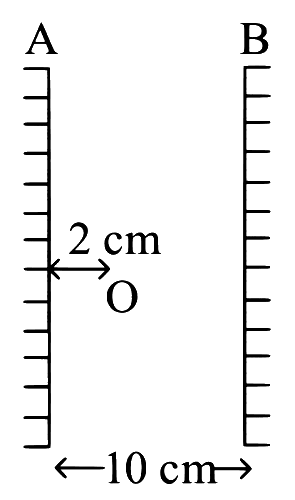
Two vertical parallel mirrors A and B are separated by 10 cm10\text{ cm}. A point object O\text{O} is placed at a distance of 2 cm2\text{ cm} from mirror A\text{A}. The distance of the second nearest image behind mirror A from the mirror A\text{A} is _________ cm\text{cm}.

Figure

Numerical answer type. Work it out, then open the answer.

Show answer and solution

Answer: 18

  1. Place A at x=0x = 0, B at x=10x = 10, O at x=2x = 2.
  2. Nearest image behind A: image of O in A at x=−2x = -2.
  3. Image of O in B is at x=18x = 18; its image in A is at x=−18x = -18.
  4. Second nearest image behind A is 18 cm18\text{ cm} from A.
Report a mistake
Q26JEE Main 2023 · 1 FEB · SHIFT 1Medium

Reflection & Mirrors · Moving mirror & mirror size

A thin cylindrical rod of length 10 cm10\text{ cm} is placed horizontally on the principal axis of a concave mirror of focal length 20 cm20\text{ cm}. The rod is placed in such a way that mid point of the rod is at 40 cm40\text{ cm} from the pole of mirror. The length of the image formed by the mirror will be x3 cm\frac{x}{3}\text{ cm}. The value of xx is _____________.

Numerical answer type. Work it out, then open the answer.

Show answer and solution

Answer: 32

  1. f=−20 cmf = -20\text{ cm}; the rod ends are at u=−35 cmu = -35\text{ cm} and u=−45 cmu = -45\text{ cm}.
  2. u=−35u = -35: 1v=−120+135=−3140⇒v=−1403 cm\frac{1}{v} = -\frac{1}{20} + \frac{1}{35} = -\frac{3}{140} \Rightarrow v = -\frac{140}{3}\text{ cm}
  3. u=−45u = -45: 1v=−120+145=−136⇒v=−36 cm\frac{1}{v} = -\frac{1}{20} + \frac{1}{45} = -\frac{1}{36} \Rightarrow v = -36\text{ cm}
  4. Image length =1403−36=323 cm⇒x=32= \frac{140}{3} - 36 = \frac{32}{3}\text{ cm} \Rightarrow x = 32
Report a mistake
Q27JEE Main 2023 · 30 JAN · SHIFT 1Medium

Reflection & Mirrors · Moving mirror & mirror size

In an experiment for estimating the value of focal length of converging mirror, image of an object placed at 40 cm40\text{ cm} from the pole of the mirror is formed at distance 120 cm120\text{ cm} from the pole of the mirror. These distances are measured with a modified scale in which there are 20 small divisions in 1 cm1\text{ cm}. The value of error in measurement of focal length of the mirror is 1K cm\frac{1}{\text{K}}\text{ cm}. The value of K\text{K} is __________.

Numerical answer type. Work it out, then open the answer.

Show answer and solution

Answer: 32

  1. Mirror formula (magnitudes, real image): 1f=1u+1v=140+1120=4120⇒f=30 cm\frac{1}{f} = \frac{1}{u} + \frac{1}{v} = \frac{1}{40} + \frac{1}{120} = \frac{4}{120} \Rightarrow f = 30\text{ cm}
  2. Least count of the scale: Δu=Δv=120=0.05 cm\Delta u = \Delta v = \frac{1}{20} = 0.05\text{ cm}
  3. Differentiating: Δff2=Δuu2+Δvv2\frac{\Delta f}{f^2} = \frac{\Delta u}{u^2} + \frac{\Delta v}{v^2}
  4. Δf=900(0.051600+0.0514400)=900×0.514400=132 cm\Delta f = 900\left(\frac{0.05}{1600} + \frac{0.05}{14400}\right) = 900 \times \frac{0.5}{14400} = \frac{1}{32}\text{ cm}
  5. So K=32K = 32.
Report a mistake
Q28JEE Main 2022 · 26 JUN · SHIFT 1Medium

Reflection & Mirrors · Inclined mirrors & number of images

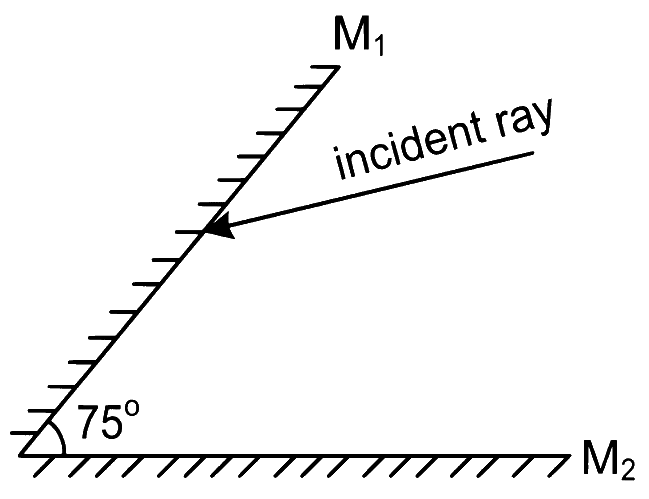
A light ray is incident, at an incident angle θ\theta1, on the system of two plane mirrors M1 and M2 having an inclination angle 75∘^\circ between them (as shown in figure). After reflecting from mirror M1 it gets reflected back by the mirror M2 with an angle of reflection 30∘^\circ. The total deviation of the ray will be _____________ degree.

Figure

Numerical answer type. Work it out, then open the answer.

Show answer and solution

Answer: 210

M1M275°45°60°60°incident
  1. At M2 the angle of reflection is 30∘30^\circ, so the ray meets M2 at 60∘60^\circ to the surface; deviation at M2 =180∘−2(30∘)=120∘= 180^\circ - 2(30^\circ) = 120^\circ.
  2. Triangle of the mirrors and the ray: angle with M1 =180∘−75∘−60∘=45∘= 180^\circ - 75^\circ - 60^\circ = 45^\circ, so θ1=45∘\theta_1 = 45^\circ.
  3. Deviation at M1 =180∘−2(45∘)=90∘= 180^\circ - 2(45^\circ) = 90^\circ
  4. Total deviation =90∘+120∘=210∘= 90^\circ + 120^\circ = 210^\circ
Report a mistake
Q29JEE Main 2022 · 28 JUL · SHIFT 2Difficult

Reflection & Mirrors · Moving mirror & mirror size

An object 'O' is placed at a distance of 100 cm100\text{ cm} in front of a concave mirror of radius of curvature 200 cm200\text{ cm} as shown in the figure. The object starts moving towards the mirror at a speed 2 cm/s2\text{ cm/s}. The position of the image from the mirror after 10 s10\text{ s} will be at _________ cm\text{cm}.

Figure

Numerical answer type. Work it out, then open the answer.

Show answer and solution

Answer: 400

  1. R=200 cm⇒f=−100 cmR = 200\text{ cm} \Rightarrow f = -100\text{ cm}. After 10 s the object has moved 20 cm: u=−80 cmu = -80\text{ cm}.
  2. 1v=1f−1u=−1100+180=1400\frac{1}{v} = \frac{1}{f} - \frac{1}{u} = -\frac{1}{100} + \frac{1}{80} = \frac{1}{400}
  3. v=+400 cmv = +400\text{ cm} (virtual image behind the mirror)
  4. So the image is at 400 cm from the mirror.
Report a mistake
Q30JEE Main 2021 · 24 FEB · SHIFT 1Easy

Reflection & Mirrors · Laws of reflection & deviation

The focal length f is related to the radius of curvature r of the spherical convex mirror by:

Show answer and solution

Answer: (c)

  1. For any spherical mirror the focus is midway between the pole and the centre of curvature.
  2. For a convex mirror both ff and rr are positive (behind the mirror), so f=+12rf = +\frac{1}{2}r.
  3. So the answer is (c).
Report a mistake
Q31JEE Main 2021 · 27 AUG · SHIFT 1Medium

Reflection & Mirrors · Laws of reflection & deviation

An object is placed beyond the centre of curvature C of the given concave mirror. If the distance of the object is d1 from C and the distance of the image formed is d2 from C, the radius of curvature of this mirror is:

Show answer and solution

Answer: (a)

  1. Object beyond C: ∣u∣=R+d1|u| = R + d_1; image is between F and C: ∣v∣=R−d2|v| = R - d_2.
  2. 1R+d1+1R−d2=2R\frac{1}{R + d_1} + \frac{1}{R - d_2} = \frac{2}{R}
  3. R(2R+d1−d2)=2(R+d1)(R−d2)⇒R(d1−d2)=2d1d2R(2R + d_1 - d_2) = 2(R + d_1)(R - d_2) \Rightarrow R(d_1 - d_2) = 2d_1d_2
  4. R=2d1d2d1−d2R = \frac{2d_1d_2}{d_1 - d_2}, so the answer is (a).
Report a mistake
Q32JEE Main 2021 · 26 FEB · SHIFT 2Medium

Reflection & Mirrors · Laws of reflection & deviation

The incident ray, reflected ray and the outward drawn normal are denoted by the unit vectorsa⃗, b⃗\vec{a},\ \vec{b}, and c⃗\vec{c}respectively. Then choose the correct relation for these vectors.

Show answer and solution

Answer: (b)

  1. On reflection, the component of a⃗\vec a along the normal c⃗\vec c reverses; the component along the mirror is unchanged.
  2. Normal component =(a⃗⋅c⃗)c⃗= (\vec a \cdot \vec c)\vec c, so b⃗=a⃗−2(a⃗⋅c⃗)c⃗\vec b = \vec a - 2(\vec a \cdot \vec c)\vec c
  3. So the answer is (b).
Report a mistake
Q33JEE Main 2021 · 31 AUG · SHIFT 1Medium

Reflection & Mirrors · Inclined mirrors & number of images

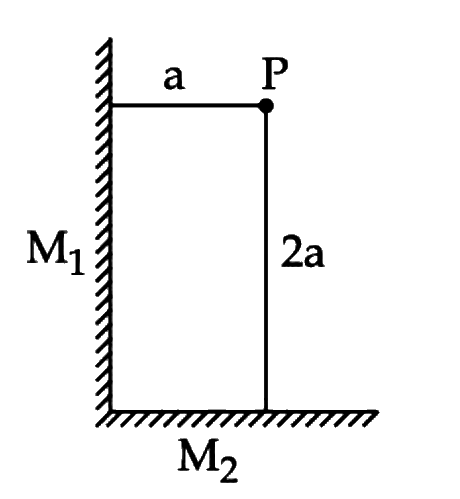
Two plane mirrors M1 and M2 are at right angle to each other shown. A point source 'P' is placed at 'a' and '2a' meter away from M1 and M2 respectively. The shortest distance between the images thus formed is: (Take 5\sqrt{5} = 2.3)

Figure

Show answer and solution

Answer: (b)

M1M2P (a, 2a)I1 (-a, 2a)I2 (a, -2a)I3 (-a, -2a)2√5 a
  1. Take the corner as origin, M1 along the y-axis, M2 along the x-axis, so P=(a,2a)P = (a, 2a).
  2. Image in M1: I1=(−a,2a)I_1 = (-a, 2a); image in M2: I2=(a,−2a)I_2 = (a, -2a); third image I3=(−a,−2a)I_3 = (-a, -2a).
  3. I1I2=(2a)2+(4a)2=25 a=4.6aI_1I_2 = \sqrt{(2a)^2 + (4a)^2} = 2\sqrt{5}\,a = 4.6a
  4. So the answer is (b) 4.6a4.6a.
Report a mistake
Q34JEE Main 2021 · 26 AUG · SHIFT 1Medium

Reflection & Mirrors · Moving mirror & mirror size

Car B overtakes another car A at a relative speed of 40 ms−1{}^{-1}. How fast will the image of car B appear to move in the mirror of focal length 10 cm fitted in car A, when the car B is 1.9 m away from the car A?

Show answer and solution

Answer: (d)

  1. The rear-view mirror is convex: f=+0.1 mf = +0.1\text{ m}, u=−1.9 mu = -1.9\text{ m}.
  2. m=ff−u=0.10.1+1.9=120m = \frac{f}{f - u} = \frac{0.1}{0.1 + 1.9} = \frac{1}{20}
  3. Image speed vI=m2vO=1400×40=0.1 m/sv_I = m^2 v_O = \frac{1}{400} \times 40 = 0.1\text{ m/s}
  4. So the answer is (d) 0.1 m s−1^{-1}.
Report a mistake
Q35JEE Main 2021 · 26 FEB · SHIFT 1Medium

Reflection & Mirrors · Moving mirror & mirror size

A short straight object of height 100 cm lies before the central axis of a spherical mirror whose focal length has absolute value | f | = 40 cm. The image of object produced by the mirror is of height 25 cm and has the same orientation of the object. One may conclude from the information:

Show answer and solution

Answer: (b)

  1. Image is erect (same orientation) and diminished: m=+25100=+14m = +\frac{25}{100} = +\frac{1}{4}.
  2. An erect, diminished image is formed only by a convex mirror, and an erect image from a single mirror is always virtual.
  3. A virtual image of a mirror lies behind it, i.e. on the opposite side to the object.
  4. So the answer is (b).
Report a mistake
Q36JEE Main 2021 · 26 FEB · SHIFT 2Difficult

Reflection & Mirrors · Moving mirror & mirror size

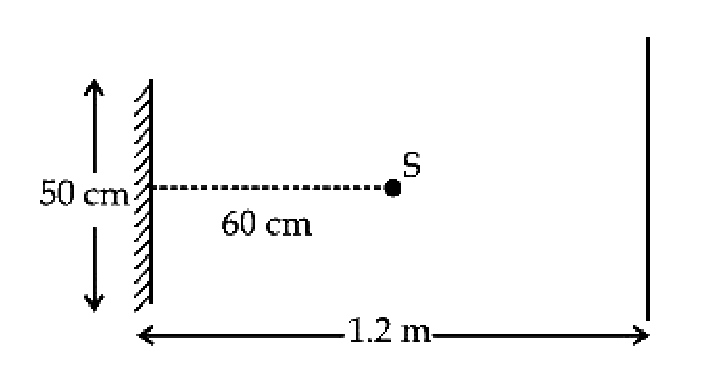
A point source of light S, placed at a distance 60cm in front of the centre of a plane mirror of width 50 cm, hangs vertically on a wall. A man walks in front of the mirror along a line parallel to the mirror at a distance 1.2 m from it (see in the figure). The distance between the extreme points where he can see the image of the light source in the mirror is __________ cm.

Figure

Numerical answer type. Work it out, then open the answer.

Show answer and solution

Answer: 150

  1. Image S′S' is 60 cm behind the mirror; rays from S′S' through the mirror edges reach the man's line.
  2. Distance of the man's line from S′S': 60+120=180 cm60 + 120 = 180\text{ cm} = 3 times the mirror's distance from S′S'.
  3. Visible stretch =50×18060=150 cm= 50 \times \frac{180}{60} = 150\text{ cm}
  4. So the answer is 150 cm.
Report a mistake
Q37NEET 2020 · PHASE 2Easy

Reflection & Mirrors · Laws of reflection & deviation

An object is placed on the principal axis of a concave mirror at a distance of 1.5f1.5f (ff is the focal length). The image will be at,

Show answer and solution

Answer: (b)

  1. Concave mirror: f→−ff \to -f, u=−1.5fu = -1.5f.
  2. 1v=1f−1u=−1f+11.5f=−13f\frac{1}{v} = \frac{1}{f} - \frac{1}{u} = -\frac{1}{f} + \frac{1}{1.5f} = -\frac{1}{3f}
  3. v=−3fv = -3f (real image in front of the mirror).
  4. So the answer is (b) −3f-3f.
Report a mistake
Q38JEE Main 2020 · 2 SEP · SHIFT 1Medium

Reflection & Mirrors · Laws of reflection & deviation

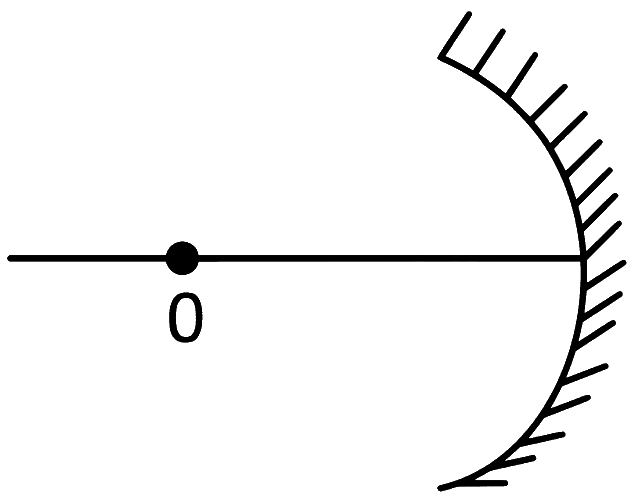
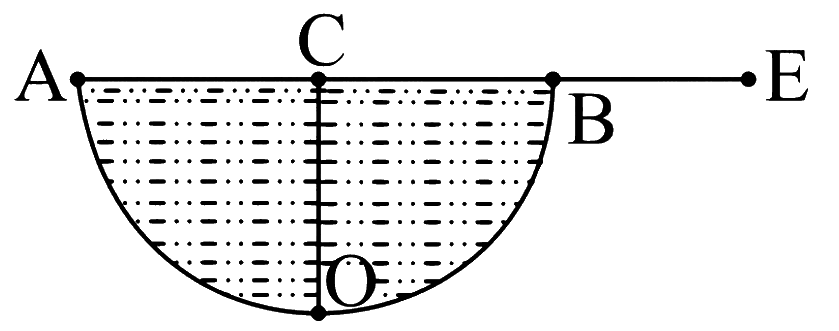
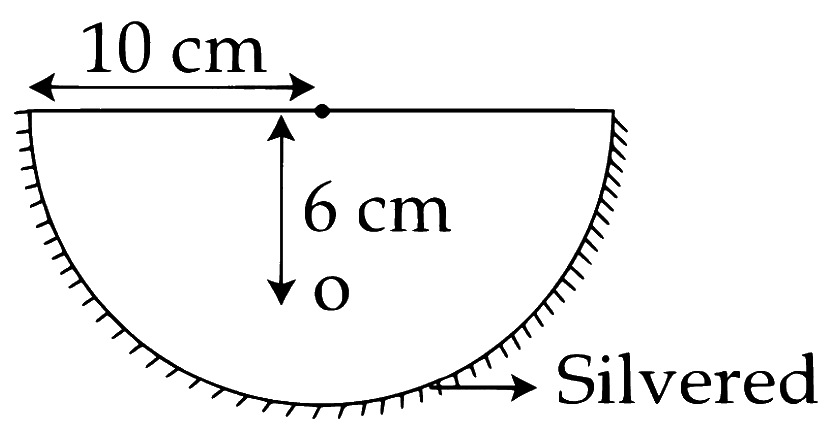
Figure

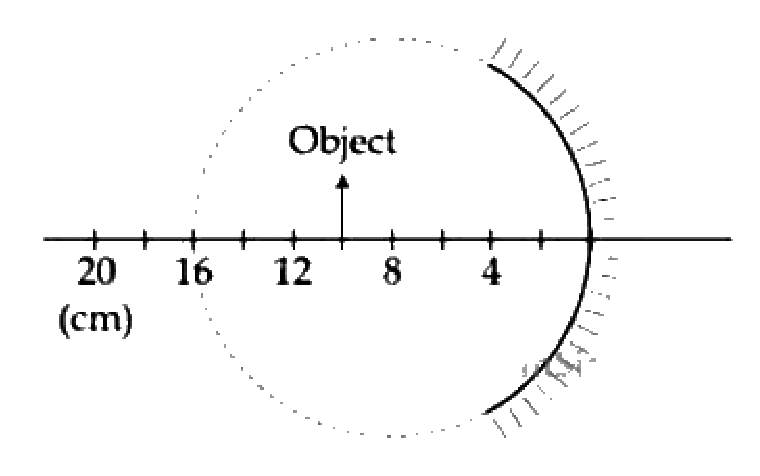
A spherical mirror is obtained as shown in the figure from a hollow glass sphere. If an object is positioned in front of the mirror, what will be the nature and magnification of the image of the object?

(Figure drawn as schematic and not to scale)

Show answer and solution

Answer: (a)

  1. The hatching is on the outside, so the inner surface reflects: a concave mirror whose radius is the sphere's radius.
  2. From the figure R=10 cmR = 10\text{ cm}, and the object is 10 cm from the pole, i.e. at the centre of curvature C.
  3. An object at C gives an image at C: v=uv = u, m=−1m = -1.
  4. So the answer is (a) inverted, real and unmagnified.
Report a mistake
Q39JEE Main 2020 · 8 JAN · SHIFT 2Medium

Reflection & Mirrors · Laws of reflection & deviation

An object is gradually moving away from the focal point of a concave mirror along the axis of the mirror. The graphical representation of the magnitude of linear magnification (m) versus distance of the object from the mirror (x) is correctly given by:

(Graphs are drawn schematically and are not to scale)

Show answer and solution

Answer: (c)

  1. Concave mirror, object at distance x>fx > f: ∣m∣=fx−f|m| = \frac{f}{x - f}
  2. Just beyond F, ∣m∣→∞|m| \to \infty; at x=2fx = 2f, ∣m∣=1|m| = 1; as x→∞x \to \infty, ∣m∣→0|m| \to 0.
  3. The graph starts very high just after ff, passes through m=1m = 1 at 2f2f and keeps falling.
  4. So the answer is (c).
Report a mistake
Q40JEE Main 2020 · 3 SEP · SHIFT 2Medium

Reflection & Mirrors · Moving mirror & mirror size

When an object is kept at a distance of 30 cm from a concave mirror, the image is formed at a distance of 10 cm from the mirror. If the object is moved with a speed of 9 cms–1, the speed (in cms–1) with which image moves at that instant is ____.

Numerical answer type. Work it out, then open the answer.

Show answer and solution

Answer: 1

  1. For a mirror, image speed along the axis: vI=v2u2 vOv_I = \frac{v^2}{u^2}\, v_O (in magnitude).
  2. vI=(1030)2×9=19×9v_I = \left(\frac{10}{30}\right)^2 \times 9 = \frac{1}{9} \times 9
  3. So the image moves at 1 cm s−11\text{ cm s}^{-1}.
Report a mistake
Q41JEE Main 2019 · 9 APR · SHIFT 1Medium

Reflection & Mirrors · Laws of reflection & deviation

A concave mirror for face viewing has focal length of 0.4 m. The distance at which you hold the mirror from your face in order to see your image upright with a magnification of 5 is:

Show answer and solution

Answer: (b)

  1. Concave mirror: f=−0.4 mf = -0.4\text{ m}; upright image, m=+5m = +5.
  2. m=ff−u⇒5=−0.4−0.4−um = \frac{f}{f - u} \Rightarrow 5 = \frac{-0.4}{-0.4 - u}
  3. −2−5u=−0.4⇒u=−0.32 m-2 - 5u = -0.4 \Rightarrow u = -0.32\text{ m}
  4. So the answer is (b) 0.32 m.
Report a mistake
Q42JEE Main 2019 · 9 JAN · SHIFT 2Medium

Reflection & Mirrors · Inclined mirrors & number of images

Two plane mirrors are inclined to each other such that a ray of light incident on the first mirror (M1) and parallel to the second mirror (M2) is finally reflected from the second mirror (M2) parallel to the first mirror (M1). The angle between the two mirrors will be:

Show answer and solution

Answer: (b)

  1. Let the angle between the mirrors be θ\theta. The incoming ray is parallel to M2, so it makes θ\theta with M1 and leaves M1 also at θ\theta.
  2. In the triangle formed by the mirrors and the ray, the ray meets M2 at 180∘−2θ180^\circ - 2\theta and leaves at the same angle.
  3. Parallel to M1 means this angle equals θ\theta: 180∘−2θ=θ180^\circ - 2\theta = \theta
  4. θ=60∘\theta = 60^\circ, so the answer is (b).
Report a mistake
Q43JEE Main 2019 · 12 JAN · SHIFT 1Difficult

Reflection & Mirrors · Moving mirror & mirror size

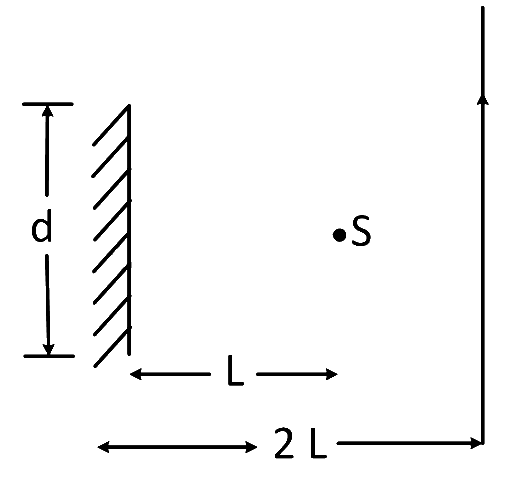
A point source of light, S is placed at distance L in front of the centre of plane mirror of width d which is hanging vertically on a wall. A man walks in front of the mirror along a line parallel to the mirror, at a distance 2L as shown below. The distance over which the man can see the image of the light source in the mirror is

Figure

Show answer and solution

Answer: (c)

S'Sd3dLLL
  1. The image S′S' is a distance LL behind the mirror. Reflected rays seem to come from S′S' and pass through the mirror's edges.
  2. The man's line is L+2L=3LL + 2L = 3L from S′S', while the mirror is LL from S′S'.
  3. By similar triangles the visible stretch =d×3LL=3d= d \times \frac{3L}{L} = 3d
  4. So the answer is (c) 3d3d.
Report a mistake
Q44NEET 2018Medium

Reflection & Mirrors · Laws of reflection & deviation

An object is placed at a distance of 40 cm from a concave mirror of focal length 15 cm. If the object is displaced through a distance of 20 cm towards the mirror, the displacement of the image will be

Show answer and solution

Answer: (b)

  1. f=−15 cmf = -15\text{ cm}. For u=−40u = -40: 1v=−115+140=−124⇒v=−24 cm\frac{1}{v} = -\frac{1}{15} + \frac{1}{40} = -\frac{1}{24} \Rightarrow v = -24\text{ cm}
  2. For u=−20u = -20: 1v=−115+120=−160⇒v=−60 cm\frac{1}{v} = -\frac{1}{15} + \frac{1}{20} = -\frac{1}{60} \Rightarrow v = -60\text{ cm}
  3. The image shifts from 24 cm to 60 cm: 60−24=36 cm60 - 24 = 36\text{ cm} away from the mirror.
  4. So the answer is (b).
Report a mistake
Q45JEE Main 2018 · 15 APR · SHIFT 1Difficult

Reflection & Mirrors · Laws of reflection & deviation

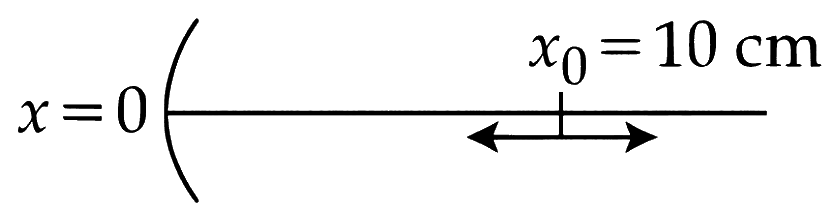
A particle is oscillating on the XX-axis with an amplitude 2 cm2\text{ cm} about the point x0=10 cm,x_0 = 10\text{ cm}, with a frequency ω\omega. A concave mirror of focal length 5 cm5\text{ cm} is placed at the origin (see figure).

Figure

Identify the correct statements.

(A) The image executes periodic motion.

(B) The image executes non-periodic motion.

(C) The turning points of the image are asymmetric w.r.t. the image of the point at x=10 cmx = 10\text{ cm}. (D) The distance between the turning points of the oscillation of the image is 10021 cm.\frac{100}{21}\text{ cm.}

Show answer and solution

Answer: (b)

  1. f=−5 cmf = -5\text{ cm}; object moves between u=−8u = -8 and u=−12u = -12 cm periodically, so the image is also periodic: (A) true, (B) false.
  2. v=ufu−fv = \frac{uf}{u - f}: u=−8⇒v=−403=−13.33u = -8 \Rightarrow v = -\frac{40}{3} = -13.33; u=−10⇒v=−10u = -10 \Rightarrow v = -10; u=−12⇒v=−607=−8.57u = -12 \Rightarrow v = -\frac{60}{7} = -8.57 cm
  3. Turning points are 3.33 cm and 1.43 cm from the image of x=10x = 10 cm, so they are asymmetric: (C) true.
  4. Distance =403−607=10021 cm= \frac{40}{3} - \frac{60}{7} = \frac{100}{21}\text{ cm}: (D) true.
  5. So the answer is (b) (A), (C), (D).
Report a mistake
Q46NEET 2017Medium

Reflection & Mirrors · Laws of reflection & deviation

A beam of light from a source L is incident normally on a plane mirror fixed at a certain distance x from the source. The beam is reflected back as a spot on a scale placed just above the source L. When the mirror is rotated through a small angle θ\theta, the spot of the light is found to move through a distance y on the scale. The angle θ\theta is given by

Show answer and solution

Answer: (d)

  1. When a mirror rotates by θ\theta, the reflected ray rotates by 2θ2\theta.
  2. For a small angle, spot shift y=x⋅2θy = x \cdot 2\theta
  3. θ=y2x\theta = \frac{y}{2x}, so the answer is (d).
Report a mistake
Q47NEET 2016 · PHASE 1Easy

Reflection & Mirrors · Magnification & nature of image

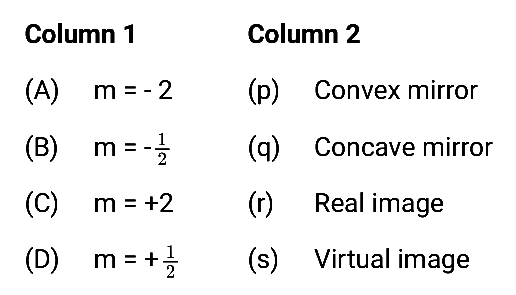
Match the corresponding entries of column 1 with column 2. [Where m is the magnification

produced by the mirror]

Figure

Show answer and solution

Answer: (c)

  1. Negative mm: inverted, real image, formed only by a concave mirror. So A (−2-2) and B (−12-\frac{1}{2}) →\to q, r.
  2. m=+2m = +2: erect and magnified, only a concave mirror (object inside FF), virtual. C →\to q, s.
  3. m=+12m = +\frac{1}{2}: erect and diminished, convex mirror, virtual. D →\to p, s.
  4. So the answer is (c).
Report a mistake
Q48JEE Main 2015 · 10 APR · SHIFT 1Medium

Reflection & Mirrors · Laws of reflection & deviation

You are asked to design a shaving mirror assuming that a person keeps it 10 cm from his face and views the magnified image of the face at the closest comfortable distance of 25 cm. The radius of curvature of the mirror would then be:

Show answer and solution

Answer: (c)

  1. u=−10 cmu = -10\text{ cm}. The virtual image is behind the mirror and 25 cm from the face, so v=+15 cmv = +15\text{ cm}.
  2. 1f=1v+1u=115−110=−130⇒f=−30 cm\frac{1}{f} = \frac{1}{v} + \frac{1}{u} = \frac{1}{15} - \frac{1}{10} = -\frac{1}{30} \Rightarrow f = -30\text{ cm}
  3. ∣R∣=2∣f∣=60 cm|R| = 2|f| = 60\text{ cm} (concave mirror).
  4. So the answer is (c) 60 cm.
Report a mistake
Q49NEET 2013Medium

Reflection & Mirrors · Inclined mirrors & number of images

Two plane mirrors are inclined at 70°. A ray incident on one mirror at angle, θ\theta after reflection falls on second mirror and is reflected from there parallel to first mirror. The value of θ\theta is

Show answer and solution

Answer: (d)

  1. Incidence θ\theta at the first mirror, so the reflected ray makes 90∘−θ90^\circ - \theta with that mirror.
  2. In the triangle formed by the two mirrors and the ray, the ray makes 180∘−70∘−(90∘−θ)=20∘+θ180^\circ - 70^\circ - (90^\circ - \theta) = 20^\circ + \theta with the second mirror.
  3. It leaves the second mirror at the same angle. To be parallel to the first mirror this angle must equal 70∘70^\circ.
  4. 20∘+θ=70∘⇒θ=50∘20^\circ + \theta = 70^\circ \Rightarrow \theta = 50^\circ, so the answer is (d).
Report a mistake
Q50NEET 2012 · AIPMT · MAINSMedium

Reflection & Mirrors · Laws of reflection & deviation

A rod of length 10 cm lies along the principal axis of a concave mirror of focal length 10 cm in such a way that its end closer to the pole is 20 cm away from the mirror. The length of the image is

Show answer and solution

Answer: (d)

  1. f=−10 cmf = -10\text{ cm}. Near end at u=−20=2fu = -20 = 2f, i.e. at C, so its image is also at 20 cm.
  2. Far end at u=−30u = -30: 1v=−110+130=−115⇒v=−15 cm\frac{1}{v} = -\frac{1}{10} + \frac{1}{30} = -\frac{1}{15} \Rightarrow v = -15\text{ cm}
  3. Image length =20−15=5 cm= 20 - 15 = 5\text{ cm}
  4. So the answer is (d) 5 cm.
Report a mistake
Q51JEE Main 2011 · AIEEEMedium

Reflection & Mirrors · Moving mirror & mirror size

A car is fitted with a convex side-view mirror of focal length 20 cm20\text{ cm}. A second car 2.8 m2.8\text{ m} behind the first car is overtaking the first car at a relative speed of 15 m/s15\text{ m/s}. The speed of the image of the second car as seen in the mirror of the first one is:

Show answer and solution

Answer: (a)

  1. Convex mirror: f=+0.2 mf = +0.2\text{ m}, u=−2.8 mu = -2.8\text{ m}.
  2. m=ff−u=0.20.2+2.8=115m = \frac{f}{f - u} = \frac{0.2}{0.2 + 2.8} = \frac{1}{15}
  3. vI=m2vO=1225×15=115 m/sv_I = m^2 v_O = \frac{1}{225} \times 15 = \frac{1}{15}\text{ m/s}
  4. So the answer is (a).
Report a mistake
Q52JEE Main 2003 · AIEEEEasy

Reflection & Mirrors · Inclined mirrors & number of images

To get three images of a single object, one should have two plane mirrors at an angle of

Show answer and solution

Answer: (b)

  1. n=360∘θ−1n = \frac{360^\circ}{\theta} - 1
  2. 3=360∘θ−1⇒360∘θ=4⇒θ=90∘3 = \frac{360^\circ}{\theta} - 1 \Rightarrow \frac{360^\circ}{\theta} = 4 \Rightarrow \theta = 90^\circ
  3. So the answer is (b) 90∘90^\circ.
Report a mistake
Q53JEE Main 2002 · AIEEEEasy

Reflection & Mirrors · Inclined mirrors & number of images

If two mirrors are kept at 60∘60^\circ to each other, then the number of images formed by them is

Show answer and solution

Answer: (a)

  1. 360∘60∘=6\frac{360^\circ}{60^\circ} = 6 (even), so n=6−1n = 6 - 1.
  2. n=5n = 5
  3. So the answer is (a) 5.
Report a mistake
Q54NEET 2000 · AIPMTEasy

Reflection & Mirrors · Moving mirror & mirror size

A tall man of height 6 feet, want to see his full image. Then required minimum length of the mirror will be

Show answer and solution

Answer: (b)

  1. To see the full image, a plane mirror needs only half the height of the person.
  2. Lmin=H2=62=3 ftL_{min} = \frac{H}{2} = \frac{6}{2} = 3\text{ ft}
  3. So the answer is (b) 3 feet.
Report a mistake
Q55MHT CET 2026 · 15 APR · SHIFT 1Easy

Refraction, Glass Slab & Apparent Depth · Snell's law & refractive index

A ray of light travels from air to water to glass and again from glass to air. Refractive index of water with respect to air is 'x', glass with respect to water is 'y' and air with respect to glass is 'z'. Which one of the following is correct?

Show answer and solution

Answer: (b)

  1. x=nwnax = \frac{n_w}{n_a}, y=ngnwy = \frac{n_g}{n_w}, z=nangz = \frac{n_a}{n_g}
  2. xyz=nwna⋅ngnw⋅nang=1xyz = \frac{n_w}{n_a} \cdot \frac{n_g}{n_w} \cdot \frac{n_a}{n_g} = 1
  3. So the answer is (b) xyz=1xyz = 1.
Report a mistake
Q56MHT CET 2026 · 15 MAY · SHIFT 2Easy

Refraction, Glass Slab & Apparent Depth · Speed, wavelength & optical path

For the same angle of incidence, the angles of refraction in media A, B, C and D are 50∘, 40∘, 30∘50^\circ,\ 40^\circ,\ 30^\circ and 20∘20^\circ respectively. The speed of light is minimum in medium

Show answer and solution

Answer: (d)

  1. Snell's law: n=sin⁡isin⁡rn = \frac{\sin i}{\sin r}; for the same ii, smallest rr gives largest nn.
  2. Speed v=cnv = \frac{c}{n} is minimum where nn is maximum, i.e. r=20∘r = 20^\circ.
  3. So the answer is (d) D.
Report a mistake
Q57MHT CET 2026 · 13 MAY · SHIFT 2Easy

Refraction, Glass Slab & Apparent Depth · Apparent depth & real depth

How much water should be filled in a container of height 2121 cm, so that it appears half filled to the observer when viewed from the top of the container? (μ=4/3\mu = 4/3)

Show answer and solution

Answer: (c)

  1. Let water height be hh; it appears hμ=3h4\frac{h}{\mu} = \frac{3h}{4} deep, and the air column is 21−h21 - h.
  2. Appears half filled: apparent water depth = air column, 3h4=21−h\frac{3h}{4} = 21 - h
  3. 7h4=21⇒h=12 cm\frac{7h}{4} = 21 \Rightarrow h = 12\text{ cm}
  4. So the answer is (c) 12 cm.
Report a mistake
Q58MHT CET 2026 · 19 APR · SHIFT 1Easy

Refraction, Glass Slab & Apparent Depth · Apparent depth & real depth

A glass slab of thickness 6.06.0 cm is placed on the piece of paper on which an inkdot is marked. By how much distance would an inkdot appear to be raised? The velocity of light in glass is 2×1082 \times 10^{8} ms−1-1 and that in air is 3×1083 \times 10^{8} ms−1-1.

Show answer and solution

Answer: (a)

  1. μ=cv=3×1082×108=1.5\mu = \frac{c}{v} = \frac{3 \times 10^8}{2 \times 10^8} = 1.5
  2. Normal shift =t(1−1μ)=6(1−23)= t\left(1 - \frac{1}{\mu}\right) = 6\left(1 - \frac{2}{3}\right)
  3. =2.0 cm= 2.0\text{ cm}. So the answer is (a).
Report a mistake
Q59MHT CET 2026 · 16 APR · SHIFT 2Medium

Refraction, Glass Slab & Apparent Depth · Snell's law & refractive index

A ray of light passes from the vacuum into a medium of refractive index 'n'. If the angle of incidence is twice the angle of refraction, then the angle of incidence in terms of refractive index is

Show answer and solution

Answer: (b)

  1. Snell's law with i=2ri = 2r: n=sin⁡2rsin⁡r=2sin⁡rcos⁡rsin⁡r=2cos⁡rn = \dfrac{\sin 2r}{\sin r} = \dfrac{2\sin r\cos r}{\sin r} = 2\cos r.
  2. cos⁡r=n2⇒r=cos⁡−1(n2)\cos r = \dfrac{n}{2} \Rightarrow r = \cos^{-1}\left(\dfrac{n}{2}\right).
  3. i=2r=2cos⁡−1(n2)i = 2r = 2\cos^{-1}\left(\dfrac{n}{2}\right).
  4. So the answer is (b).
Report a mistake
Q60JEE Main 2026 · 8 APR · SHIFT 2Medium

Refraction, Glass Slab & Apparent Depth · Glass slab: lateral & normal shift

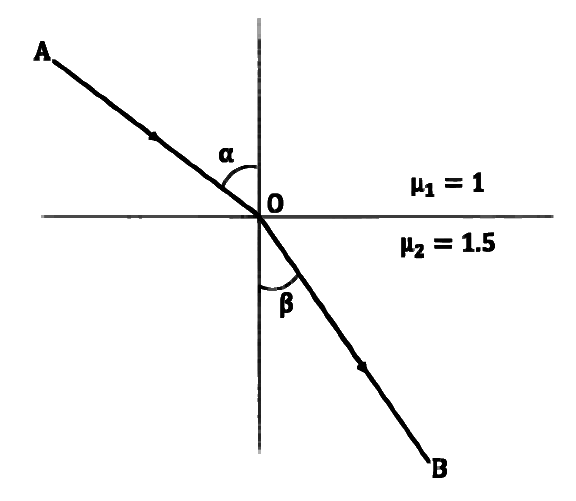
Light ray incident along a vector AO→(AO→=2i^−3j^)\overrightarrow{AO}\left(\overrightarrow{AO} = 2\hat{i} - 3\hat{j}\right) emerges out along vector OB→(OB→=Ci^−4j^)\overrightarrow{OB}\left(\overrightarrow{OB} = C\hat{i} - 4\hat{j}\right) as shown in the figure below. The value of CC is ______.

Figure

Show answer and solution

Answer: (a)

  1. From the figure the interface is along xx and the normal along yy, so sin⁡α=213\sin\alpha = \dfrac{2}{\sqrt{13}} and sin⁡β=CC2+16\sin\beta = \dfrac{C}{\sqrt{C^2 + 16}}.
  2. Snell's law: 1×213=1.5×CC2+161 \times \dfrac{2}{\sqrt{13}} = 1.5 \times \dfrac{C}{\sqrt{C^2 + 16}}.
  3. Square: 4(C2+16)=29.25 C2⇒25.25 C2=644(C^2 + 16) = 29.25\,C^2 \Rightarrow 25.25\,C^2 = 64.
  4. C2≈2.53⇒C≈1.6C^2 \approx 2.53 \Rightarrow C \approx 1.6, so the answer is (a).
Report a mistake
Q61MHT CET 2026 · 13 MAY · SHIFT 1Medium

Refraction, Glass Slab & Apparent Depth · Apparent depth & real depth

Three immiscible transparent liquids with refractive indices 32, 43\frac{3}{2},\ \frac{4}{3} and 65\frac{6}{5} are arranged one above the other. The depths of the liquids are 3 cm, 4 cm and 6 cm respectively. The apparent depth of the vessel is

Show answer and solution

Answer: (a)

  1. Apparent depth of layered liquids: D=∑tkμkD = \sum \dfrac{t_k}{\mu_k}.
  2. D=33/2+44/3+66/5=2+3+5D = \dfrac{3}{3/2} + \dfrac{4}{4/3} + \dfrac{6}{6/5} = 2 + 3 + 5.
  3. D=10D = 10 cm, so the answer is (a).
Report a mistake
Q62NEET 2026 · RE-NEETMedium

Refraction, Glass Slab & Apparent Depth · Apparent depth & real depth

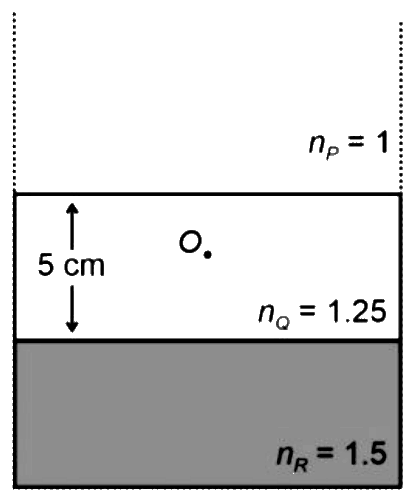
Consider three media P,QP, Q and RR with refractive indices 1,1.251, 1.25, and 1.5 respectively. The medium QQ having a thickness of 5 cm is placed between extended media PP and RR as shown in the figure. An object OO is placed at the centre of medium QQ. If viewed from medium PP near the normal direction, the apparent depth of OO is h1h_1. For similar observation from medium RR, the apparent depth is h2h_2. The value of ∣h1−h2∣|h_1 - h_2|, in cm, is:

Figure

Show answer and solution

Answer: (c)

  1. OO is at the centre, 2.52.5 cm from each face of QQ.
  2. Seen from PP: h1=2.5×nPnQ=2.5×11.25=2h_1 = 2.5 \times \dfrac{n_P}{n_Q} = 2.5 \times \dfrac{1}{1.25} = 2 cm.
  3. Seen from RR: h2=2.5×nRnQ=2.5×1.51.25=3h_2 = 2.5 \times \dfrac{n_R}{n_Q} = 2.5 \times \dfrac{1.5}{1.25} = 3 cm.
  4. ∣h1−h2∣=1|h_1 - h_2| = 1 cm, so the answer is (c).
Report a mistake
Q63JEE Main 2026 · 24 JAN · SHIFT 1Medium

Refraction, Glass Slab & Apparent Depth · Brewster's angle & polarisation

An unpolarised light is incident at an interface of two dielectric media having refractive indices of 2 (incident medium) and 232\sqrt{3} (medium) respectively. To satisfy the condition that reflected and refracted rays are perpendicular to each other, the angle of incidence is ______

Show answer and solution

Answer: (b)

  1. Reflected and refracted rays perpendicular means incidence at Brewster's angle: tan⁡i=n2n1\tan i = \frac{n_2}{n_1}.
  2. tan⁡i=232=3\tan i = \frac{2\sqrt{3}}{2} = \sqrt{3}
  3. So the answer is (b) 60∘60^\circ.
Report a mistake
Q64JEE Main 2025 · 23 JAN · SHIFT 1Easy

Refraction, Glass Slab & Apparent Depth · Glass slab: lateral & normal shift

What is the lateral shift of a ray refracted through a parallel-sided glass slab of thickness ' hh ' in terms of the angle of incidence ' ii ' and angle of refraction ' rr ', if the glass slab is placed in air medium?

Show answer and solution

Answer: (d)

  1. Path inside the slab: OB=hcos⁡rOB = \frac{h}{\cos r}.
  2. Lateral shift = perpendicular distance between incident and emergent rays =OBsin⁡(i−r)= OB \sin(i - r)
  3. d=hsin⁡(i−r)cos⁡rd = \frac{h \sin(i-r)}{\cos r}. So the answer is (d).
Report a mistake
Q65MHT CET 2025 · 23 APR · SHIFT 1Easy

Refraction, Glass Slab & Apparent Depth · Brewster's angle & polarisation

Let the speed of light and the polarising angle for a given medium be ' VV ' and ' ipi_p ' respectively. The relation between them is: ( C=C = speed of light in vacuum)

Show answer and solution

Answer: (d)

  1. Brewster's law: tan⁡ip=μ\tan i_p = \mu.
  2. Also μ=CV\mu = \dfrac{C}{V}, so sin⁡ipcos⁡ip=CV\dfrac{\sin i_p}{\cos i_p} = \dfrac{C}{V}.
  3. Cross-multiply: Vsin⁡ip=Ccos⁡ipV\sin i_p = C\cos i_p.
  4. So the answer is (d).
Report a mistake
Q66MHT CET 2025 · 21 APR · SHIFT 2Medium

Refraction, Glass Slab & Apparent Depth · Glass slab: lateral & normal shift

A ray of light travelling through rarer medium is incident at a very small angle ' ii ' on a glass slab and after refraction its velocity is reduced by 20%20\%. The angle of deviation is

Show answer and solution

Answer: (a)

  1. Speed drops by 20%20\%: v=0.8c⇒μ=cv=1.25v = 0.8c \Rightarrow \mu = \dfrac{c}{v} = 1.25.
  2. For small angles i=μr⇒r=i1.25=0.8ii = \mu r \Rightarrow r = \dfrac{i}{1.25} = 0.8i.
  3. Deviation δ=i−r=0.2i=i5\delta = i - r = 0.2i = \dfrac{i}{5}.
  4. So the answer is (a).
Report a mistake
Q67MHT CET 2025 · 5 MAY · SHIFT 2Medium

Refraction, Glass Slab & Apparent Depth · Apparent depth & real depth

Three immiscible transparent liquids with refractive indices 3/2,4/33/2, 4/3 and 6/56/5 are arranged one above the other in a container. The depths of the liquids are 3 cm,4 cm3\text{ cm}, 4\text{ cm} and 6 cm respectively. The apparent depth of the vessel is

Show answer and solution

Answer: (d)

  1. Apparent depth D=∑tkμkD = \sum \dfrac{t_k}{\mu_k}.
  2. D=33/2+44/3+66/5=2+3+5D = \dfrac{3}{3/2} + \dfrac{4}{4/3} + \dfrac{6}{6/5} = 2 + 3 + 5.
  3. D=10D = 10 cm, so the answer is (d).
Report a mistake
Q68MHT CET 2025 · 25 APR · SHIFT 2Medium

Refraction, Glass Slab & Apparent Depth · Apparent depth & real depth

A glass cube of length 21 cm has a small air bubble trapped inside. When viewed normally from the opposite face, its apparent distance is 6 cm. The refractive index of glass and the actual distance of the air bubble from the first surface respectively are

Show answer and solution

Answer: (a)

  1. If the bubble is xx from the first surface, its real distance from the opposite face is 21−x21 - x, and apparent distance =21−xμ=6= \dfrac{21 - x}{\mu} = 6.
  2. With one data point, test the options: (a) 21−121.5=6\dfrac{21 - 12}{1.5} = 6 cm ✓.
  3. Others fail: (b) 7/1.55≈4.57/1.55 \approx 4.5, (c) 10/1.6=6.2510/1.6 = 6.25, (d) 12/1.5=812/1.5 = 8.
  4. So the answer is (a) 1.51.5, 1212 cm.
Report a mistake
Q69JEE Main 2025 · 7 APR · SHIFT 1Medium

Refraction, Glass Slab & Apparent Depth · Apparent depth & real depth

A container contains a liquid with refractive index of 1.2 up to a height of 60 cm and another liquid having refractive index 1.6 is added to height H above first liquid. If viewed from above, the apparent shift in the position of bottom of container is 40 cm. The value of H is ________ cm. (Consider liquids are immisible)

Numerical answer type. Work it out, then open the answer.

Show answer and solution

Answer: 80

  1. Shift of bottom =∑ti(1−1μi)= \sum t_i\left(1 - \frac{1}{\mu_i}\right).
  2. Lower liquid: 60(1−11.2)=60×16=10 cm60\left(1 - \frac{1}{1.2}\right) = 60 \times \frac{1}{6} = 10\text{ cm}
  3. Upper liquid: H(1−11.6)=3H8H\left(1 - \frac{1}{1.6}\right) = \frac{3H}{8}
  4. 10+3H8=40⇒H=8010 + \frac{3H}{8} = 40 \Rightarrow H = 80
  5. So H=80 cmH = 80\text{ cm}.
Report a mistake
Q70MHT CET 2025 · 23 APR · SHIFT 2Medium

Refraction, Glass Slab & Apparent Depth · Brewster's angle & polarisation

Select the correct statement.

Show answer and solution

Answer: (a)

  1. Brewster's law: tan⁡θB=μ2μ1\tan\theta_B = \frac{\mu_2}{\mu_1}.
  2. Air to glass: tan⁡θ=μ\tan\theta = \mu. Glass to air: tan⁡θ′=1μ=cot⁡θ\tan\theta' = \frac{1}{\mu} = \cot\theta.
  3. So θ′=π2−θ\theta' = \frac{\pi}{2} - \theta; (b) and (d) are wrong because glass to air gives tan⁡−1(1/μ)\tan^{-1}(1/\mu), and (c) is impossible.
  4. So the answer is (a).
Report a mistake
Q71JEE Main 2025 · 29 JAN · SHIFT 1Difficult

Refraction, Glass Slab & Apparent Depth · Glass slab: lateral & normal shift

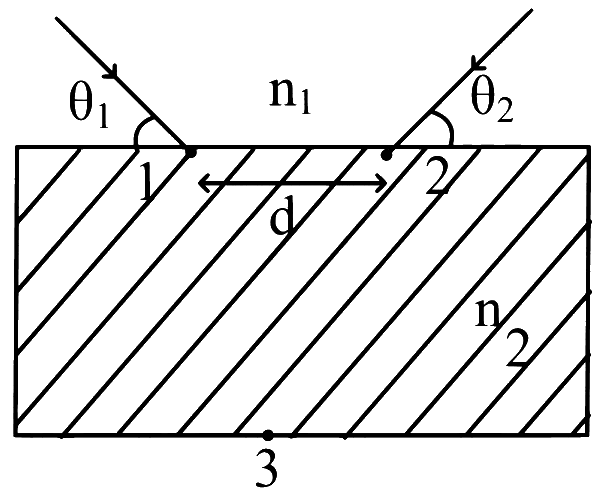
Two light beams fall on a transparent material block at point 1 and 2 with angle θ1\theta_1 and θ2\theta_2, respectively, as shown in figure. After refraction, the beams intersect at point 3 which is exactly on the interface at other end of the block. Given: the distance between 1 and 2, d=43 cmd = 4\sqrt{3}\text{ cm} and θ1=θ2=cos⁡−1(n22n1)\theta_1 = \theta_2 = \cos^{-1}\left(\frac{n_2}{2n_1}\right). where refractive index of the block n2>n_2 > refractive index of the outside medium n1n_1, then the thickness of the block is ______ cm.

Figure

Numerical answer type. Work it out, then open the answer.

Show answer and solution

Answer: 6

r123d/2tn2n1
  1. Angle with surface is θ\theta, so angle of incidence i=90∘−θi = 90^\circ - \theta and sin⁡i=cos⁡θ=n22n1\sin i = \cos\theta = \frac{n_2}{2n_1}.
  2. Snell: n1sin⁡i=n2sin⁡r⇒n1⋅n22n1=n2sin⁡r⇒sin⁡r=12, r=30∘n_1\sin i = n_2\sin r \Rightarrow n_1 \cdot \frac{n_2}{2n_1} = n_2\sin r \Rightarrow \sin r = \frac{1}{2},\ r = 30^\circ.
  3. By symmetry point 3 lies below the midpoint of 1 and 2: tan⁡r=d/2t\tan r = \frac{d/2}{t}.
  4. t=23tan⁡30∘=23×3=6t = \frac{2\sqrt{3}}{\tan 30^\circ} = 2\sqrt{3} \times \sqrt{3} = 6
  5. So the thickness is 6 cm6\text{ cm}.
Report a mistake
Q72MHT CET 2024 · 16 MAY · SHIFT 1Easy

Refraction, Glass Slab & Apparent Depth · Speed, wavelength & optical path

Optical path of a particular ray of light has travelled a distance of 3 cm in flint glass is same as that on travelling a distance ' xx ' cm through another medium. The value of ' xx ' is [refractive index of flint glass =1.6= 1.6, refractive index of another medium =1.25]= 1.25]

Show answer and solution

Answer: (a)

  1. Optical path =μ×= \mu \times geometric path; equate them.
  2. 1.6×3=1.25×x1.6 \times 3 = 1.25 \times x
  3. x=4.81.25=3.84 cmx = \frac{4.8}{1.25} = 3.84\text{ cm}. So the answer is (a).
Report a mistake
Q73MHT CET 2024 · 16 MAY · SHIFT 1Easy

Refraction, Glass Slab & Apparent Depth · Apparent depth & real depth

A glass slab of thickness 4.8 cm is placed on the piece of paper on which an ink dot is marked. By how much distance would an ink dot appear to be raised? (The refractive index of glass =1.5= 1.5)

Show answer and solution

Answer: (a)

  1. Normal shift =t(1−1μ)= t\left(1 - \frac{1}{\mu}\right)
  2. =4.8(1−11.5)=4.8×13=1.6 cm= 4.8\left(1 - \frac{1}{1.5}\right) = 4.8 \times \frac{1}{3} = 1.6\text{ cm}
  3. So the answer is (a) 1.6 cm.
Report a mistake
Q74MHT CET 2024 · 4 MAY · SHIFT 2Easy

Refraction, Glass Slab & Apparent Depth · Apparent depth & real depth

Some water is filled in a container of height 30 cm. If it is to appear half filled to the observer when viewed from the top of the container, the height up to which water should be filled in it, is [Refractive index of water =43= \frac{4}{3} ]

Show answer and solution

Answer: (c)

  1. Water of height hh appears hμ=3h4\frac{h}{\mu} = \frac{3h}{4} deep.
  2. Key's condition: apparent depth = half the container height, 3h4=15\frac{3h}{4} = 15
  3. h=20 cmh = 20\text{ cm}
  4. So the answer is (c) 20 cm.
Report a mistake
Q75MHT CET 2024 · 16 MAY · SHIFT 1Medium

Refraction, Glass Slab & Apparent Depth · Snell's law & refractive index

The angle of incidence is found to be twice the angle of refraction when ray of light passes from vacuum into a medium of refractive index ' μ\mu '. The angle of incidence will be

Show answer and solution

Answer: (b)

  1. Snell's law with i=2ri = 2r: μ=sin⁡2rsin⁡r=2cos⁡r\mu = \dfrac{\sin 2r}{\sin r} = 2\cos r.
  2. r=cos⁡−1(μ2)r = \cos^{-1}\left(\dfrac{\mu}{2}\right).
  3. i=2r=2cos⁡−1(μ2)i = 2r = 2\cos^{-1}\left(\dfrac{\mu}{2}\right).
  4. So the answer is (b).
Report a mistake
Q76MHT CET 2024 · 10 MAY · SHIFT 1Medium

Refraction, Glass Slab & Apparent Depth · Snell's law & refractive index

A ray of light is incident on a medium of refractive index ' μ\mu ' at an angle of incidence ' ii '. On refraction in the medium ' δ\delta ' is the angle of deviation. Then

Show answer and solution

Answer: (a)

  1. Deviation on refraction: δ=i−r⇒r=i−δ\delta = i - r \Rightarrow r = i - \delta.
  2. 1μ=sin⁡rsin⁡i=sin⁡(i−δ)sin⁡i=sin⁡icos⁡δ−cos⁡isin⁡δsin⁡i\dfrac{1}{\mu} = \dfrac{\sin r}{\sin i} = \dfrac{\sin(i-\delta)}{\sin i} = \dfrac{\sin i\cos\delta - \cos i\sin\delta}{\sin i}.
  3. 1μ=cos⁡δ−sin⁡δtan⁡i\dfrac{1}{\mu} = \cos\delta - \dfrac{\sin\delta}{\tan i}.
  4. So the answer is (a).
Report a mistake
Q77MHT CET 2024 · 11 MAY · SHIFT 1Medium

Refraction, Glass Slab & Apparent Depth · Speed, wavelength & optical path

When the same monochromatic ray of light travels through glass slab and through water, the number of waves in glass slab of thickness 5 cm is same as in water column of height 6 cm. If refractive index of glass is 1.56, then refractive index of water is

Show answer and solution

Answer: (c)

  1. Number of waves in thickness tt: N=tλ0/μ=μtλ0N = \dfrac{t}{\lambda_0/\mu} = \dfrac{\mu t}{\lambda_0}.
  2. Equal NN: μgtg=μwtw⇒1.56×5=μw×6\mu_g t_g = \mu_w t_w \Rightarrow 1.56 \times 5 = \mu_w \times 6.
  3. μw=7.86=1.30\mu_w = \dfrac{7.8}{6} = 1.30.
  4. So the answer is (c) 1.30.
Report a mistake
Q78MHT CET 2024 · 16 MAY · SHIFT 2Medium

Refraction, Glass Slab & Apparent Depth · Glass slab: lateral & normal shift

A ray of light travelling through a rarer medium is incident at very small angle ' ii ' on a glass slab and after refraction its velocity is reduced by 25%25\%. The angle of deviation is

Show answer and solution

Answer: (b)

  1. Speed drops by 25%25\%: v=0.75c⇒μ=43v = 0.75c \Rightarrow \mu = \dfrac{4}{3}.
  2. For small angles r=iμ=3i4r = \dfrac{i}{\mu} = \dfrac{3i}{4}.
  3. Deviation δ=i−r=i4\delta = i - r = \dfrac{i}{4}.
  4. So the answer is (b).
Report a mistake
Q79MHT CET 2024 · 4 MAY · SHIFT 1Medium

Refraction, Glass Slab & Apparent Depth · Glass slab: lateral & normal shift

A ray of light is incident normally on a glass slab to thickness 5 cm and refractive index 1.6. The time taken to travel by a ray from source of light to surface of slab is same as to travel through glass slab. The distance of source from the surface is

Show answer and solution

Answer: (b)

  1. Time in glass: tv=μtc=1.6×5c=8 cmc\dfrac{t}{v} = \dfrac{\mu t}{c} = \dfrac{1.6 \times 5}{c} = \dfrac{8\text{ cm}}{c}.
  2. Time in air from source: xc\dfrac{x}{c}.
  3. Equal times: x=μt=8x = \mu t = 8 cm.
  4. So the answer is (b) 8 cm.
Report a mistake
Q80MHT CET 2024 · 11 MAY · SHIFT 2Medium

Refraction, Glass Slab & Apparent Depth · Apparent depth & real depth

A vessel is filled with two different liquids which do not mix. One is 40 cm deep and has refractive index 1.6 and other is 30 cm deep and has refractive index 1.51.5. The apparent depth of vessel when viewed normally is

Show answer and solution

Answer: (c)

  1. Apparent depth D=t1μ1+t2μ2D = \dfrac{t_1}{\mu_1} + \dfrac{t_2}{\mu_2}.
  2. D=401.6+301.5=25+20D = \dfrac{40}{1.6} + \dfrac{30}{1.5} = 25 + 20.
  3. D=45D = 45 cm, so the answer is (c).
Report a mistake
Q81MHT CET 2024 · 11 MAY · SHIFT 1Medium

Refraction, Glass Slab & Apparent Depth · Apparent depth & real depth

An ink mark is made on a piece of paper. A glass slab of thickness ' tt ' is placed on it. The ink mark appears to be raised up through a distance ' xx ' when viewed at nearly normal incidence. If the refractive index of material of glass slab is ' μ\mu ' then thickness of glass slab ' tt ' is given by

Show answer and solution

Answer: (b)

  1. Normal shift: x=t−tμ=t(1−1μ)=t μ−1μx = t - \dfrac{t}{\mu} = t\left(1 - \dfrac{1}{\mu}\right) = t\,\dfrac{\mu - 1}{\mu}.
  2. t=μxμ−1t = \dfrac{\mu x}{\mu - 1}.
  3. So the answer is (b).
Report a mistake
Q82MHT CET 2024 · 9 MAY · SHIFT 1Medium

Refraction, Glass Slab & Apparent Depth · Apparent depth & real depth

Three immiscible transparent liquids with uniform refractive indices 32,43\frac{3}{2}, \frac{4}{3} and 65\frac{6}{5} are arranged one on top of another. The depths of the liquids are 3 cm 4 cm and 6 cm respectively. The apparent depth of the vessel is

Show answer and solution

Answer: (a)

  1. Apparent depth D=∑tkμkD = \sum \dfrac{t_k}{\mu_k}.
  2. D=33/2+44/3+66/5=2+3+5D = \dfrac{3}{3/2} + \dfrac{4}{4/3} + \dfrac{6}{6/5} = 2 + 3 + 5.
  3. D=10D = 10 cm, so the answer is (a).
Report a mistake
Q83JEE Main 2024 · 27 JAN · SHIFT 1Medium

Refraction, Glass Slab & Apparent Depth · Apparent depth & real depth

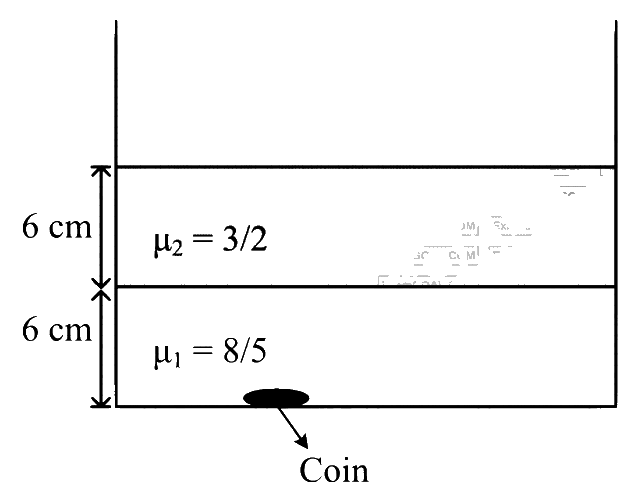
Two immiscible liquids of refractive indices 85\frac{8}{5} and 32\frac{3}{2} respectively are put in a beaker as shown in the figure. The height of each column is 6 cm6\text{ cm}. A coin is placed at the bottom of the beaker. For near normal vision, the apparent depth of the coin is α4 cm\frac{\alpha}{4}\text{ cm}. The value of α\alpha is _________.

Figure

Numerical answer type. Work it out, then open the answer.

Show answer and solution

Answer: 31

  1. Apparent depth =t1μ1+t2μ2= \frac{t_1}{\mu_1} + \frac{t_2}{\mu_2}.
  2. d=68/5+63/2=3.75+4=7.75 cmd = \frac{6}{8/5} + \frac{6}{3/2} = 3.75 + 4 = 7.75\text{ cm}
  3. 7.75=314⇒α=317.75 = \frac{31}{4} \Rightarrow \alpha = 31
  4. So α=31\alpha = 31.
Report a mistake
Q84MHT CET 2024 · 16 MAY · SHIFT 2Difficult

Refraction, Glass Slab & Apparent Depth · Apparent depth & real depth

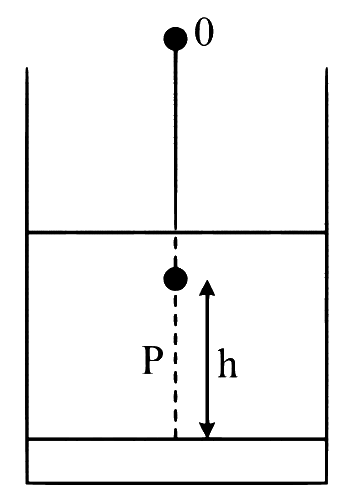
A plane mirror is placed at the bottom of a tank containing a liquid of refractive index ' μ\mu ', ' pp ' is a small object at a height ' hh ' above the mirror. An observer ' OO ' vertically above ' pp ' outside the liquid sees ' pp ' and the image in a mirror. The apparent distance between these two will be

Figure

Show answer and solution

Answer: (b)

  1. Let the liquid surface be at depth dd above pp. The mirror image of pp is hh below the mirror, i.e. at depth d+2hd + 2h.
  2. Apparent depths: pp at dμ\frac{d}{\mu}, image at d+2hμ\frac{d + 2h}{\mu}.
  3. Apparent separation =d+2hμ−dμ=2hμ= \frac{d + 2h}{\mu} - \frac{d}{\mu} = \frac{2h}{\mu}
  4. So the answer is (b) 2hμ\frac{2h}{\mu}.
Report a mistake
Q85NEET 2023Easy

Refraction, Glass Slab & Apparent Depth · Speed, wavelength & optical path

ϵ0\epsilon_0 and μ0\mu_0 are the electric permittivity and magnetic permeability of free space respectively. If the corresponding quantities of a medium are 2ϵ02\epsilon_0 and 1.5μ01.5\mu_0 respectively, the refractive index of the medium will nearly be:

Show answer and solution

Answer: (b)

  1. n=cv=μϵμ0ϵ0n = \frac{c}{v} = \sqrt{\frac{\mu \epsilon}{\mu_0 \epsilon_0}}
  2. n=1.5×2=3n = \sqrt{1.5 \times 2} = \sqrt{3}
  3. So the answer is (b) 3\sqrt{3}.
Report a mistake
Q86JEE Main 2023 · 29 JAN · SHIFT 2Easy

Refraction, Glass Slab & Apparent Depth · Apparent depth & real depth

In an experiment of measuring the refractive index of a glass slab using travelling microscope in physics lab, a student measures real thickness of the glass slab as 5.25 mm and apparent thickness of the glass slab as 5.00 mm. Travelling microscope has 20 divisions in one cm on main scale and 50 divisions on vernier scale is equal to 49 divisions on main scale. The estimated uncertainty in the measurement of refractive index of the slab is x10×10−3\frac{x}{10} \times 10^{-3}, where xx is ___________

Numerical answer type. Work it out, then open the answer.

Show answer and solution

Answer: 41

  1. 1 MSD =120 cm=0.5 mm= \frac{1}{20}\text{ cm} = 0.5\text{ mm}; LC =1 MSD−1 VSD=0.5(1−4950)=0.01 mm= 1\text{ MSD} - 1\text{ VSD} = 0.5\left(1 - \frac{49}{50}\right) = 0.01\text{ mm}
  2. μ=5.255.00=1.05\mu = \frac{5.25}{5.00} = 1.05
  3. Δμμ=0.015.25+0.015.00=0.001905+0.002=0.003905\frac{\Delta \mu}{\mu} = \frac{0.01}{5.25} + \frac{0.01}{5.00} = 0.001905 + 0.002 = 0.003905
  4. Δμ=1.05×0.003905≈4.1×10−3=4110×10−3\Delta \mu = 1.05 \times 0.003905 \approx 4.1 \times 10^{-3} = \frac{41}{10} \times 10^{-3}
  5. So x=41x = 41.
Report a mistake
Q87JEE Main 2023 · 6 APR · SHIFT 2Medium

Refraction, Glass Slab & Apparent Depth · Speed, wavelength & optical path

Given below are two statements: one is labelled as Assertion A and the other is labelled as Reason R

Assertion A: The phase difference of two light waves changes if they travel through different media having same thickness, but different indices of refraction.

Reason R: The wavelengths of waves are different in different media.

In the light of the above statements, choose the most appropriate answer from the options given below

Show answer and solution

Answer: (d)

  1. In a medium λ=λ0/μ\lambda = \lambda_0/\mu, so different media give different wavelengths: R is true.
  2. Phase change over thickness tt is 2πtλ=2πμtλ0\dfrac{2\pi t}{\lambda} = \dfrac{2\pi \mu t}{\lambda_0}; different μ\mu give different phase changes, so the phase difference changes: A is true.
  3. This happens precisely because the wavelengths differ, so R explains A.
  4. So the answer is (d).
Report a mistake
Q88JEE Main 2023 · 6 APR · SHIFT 1Medium

Refraction, Glass Slab & Apparent Depth · Speed, wavelength & optical path

A monochromatic light wave with wavelength λ1\lambda_1 and frequency ν1\nu_1 in air enters another medium. If the angle of incidence and angle of refraction at the interface are 45∘45^\circ and 30∘30^\circ respectively, then the wavelength λ2\lambda_2 and frequency ν2\nu_2 of the refracted wave are:

Show answer and solution

Answer: (d)

  1. μ=sin⁡45∘sin⁡30∘=2\mu = \dfrac{\sin 45^\circ}{\sin 30^\circ} = \sqrt{2}.
  2. Frequency does not change on refraction: ν2=ν1\nu_2 = \nu_1.
  3. λ2=λ1μ=λ12\lambda_2 = \dfrac{\lambda_1}{\mu} = \dfrac{\lambda_1}{\sqrt{2}}.
  4. So the answer is (d).
Report a mistake
Q89MHT CET 2023 · 12 MAY · SHIFT 2Medium

Refraction, Glass Slab & Apparent Depth · Apparent depth & real depth

An ink mark is made on a piece of paper on which a glass slab of thickness 'tt' is placed. The ink mark appears to be raised up through a distance 'xx' when viewed at nearly normal incidence. If the refractive index of the material of glass slab is 'μ\mu' then the thickness of glass slab is given by

Show answer and solution

Answer: (a)

  1. Normal shift: x=t(1−1μ)=t μ−1μx = t\left(1 - \dfrac{1}{\mu}\right) = t\,\dfrac{\mu - 1}{\mu}.
  2. t=μxμ−1t = \dfrac{\mu x}{\mu - 1}.
  3. So the answer is (a).
Report a mistake
Q90MHT CET 2023 · 9 MAY · SHIFT 2Medium

Refraction, Glass Slab & Apparent Depth · Apparent depth & real depth

A transparent glass cube of length 24 cm24\text{ cm} has a small air bubble trapped inside. When seen normally through one surface from air outside, its apparent distance is 10 cm10\text{ cm} from the surface. When seen normally from opposite surface, its apparent distance is 6 cm6\text{ cm}. The distance of the air bubble from first surface is

Show answer and solution

Answer: (a)

  1. Let the bubble be xx from the first surface: xμ=10\dfrac{x}{\mu} = 10 and 24−xμ=6\dfrac{24 - x}{\mu} = 6.
  2. Add: 24μ=16⇒μ=1.5\dfrac{24}{\mu} = 16 \Rightarrow \mu = 1.5.
  3. x=10μ=15x = 10\mu = 15 cm.
  4. So the answer is (a) 15 cm.
Report a mistake
Q91JEE Main 2023 · 13 APR · SHIFT 1Medium

Refraction, Glass Slab & Apparent Depth · Apparent depth & real depth

A vessel of depth 'dd' is half filled with oil of refractive index n1n_1 and the other half is filled with water of refractive index n2n_2. The apparent depth of this vessel when viewed from above will be-

Show answer and solution

Answer: (b)

  1. Each layer has thickness d2\dfrac{d}{2}; apparent depth D=d/2n1+d/2n2D = \dfrac{d/2}{n_1} + \dfrac{d/2}{n_2}.
  2. D=d2⋅n1+n2n1n2=d(n1+n2)2n1n2D = \dfrac{d}{2}\cdot\dfrac{n_1 + n_2}{n_1 n_2} = \dfrac{d(n_1 + n_2)}{2n_1 n_2}.
  3. So the answer is (b).
Report a mistake
Q92JEE Main 2023 · 12 APR · SHIFT 1Medium

Refraction, Glass Slab & Apparent Depth · Apparent depth & real depth

An ice cube has a bubble inside. When viewed from one side the apparent distance of the bubble is 12 cm12\text{ cm}. When viewed from the opposite side, the apparent distance of the bubble is observed as 4 cm4\text{ cm}. If the side of the ice cube is 24 cm24\text{ cm}, the refractive index of the ice cube is

Show answer and solution

Answer: (a)

  1. Real distances from the two faces add up to the side: μ(12+4)=24\mu(12 + 4) = 24.
  2. μ=2416=32\mu = \dfrac{24}{16} = \dfrac{3}{2}.
  3. So the answer is (a).
Report a mistake
Q93JEE Main 2023 · 31 JAN · SHIFT 2Medium

Refraction, Glass Slab & Apparent Depth · Apparent depth & real depth

A microscope is focused on an object at the bottom of a bucket. If liquid with refractive index 53\frac{5}{3} is poured inside the bucket, then the microscope has to be raised by 30 cm30\text{ cm} to focus the object again. The height of the liquid in the bucket is:

Show answer and solution

Answer: (c)

  1. The image rises by the normal shift h(1−1μ)h\left(1 - \dfrac{1}{\mu}\right), so the microscope is raised by this amount.
  2. h(1−35)=30⇒0.4h=30h\left(1 - \dfrac{3}{5}\right) = 30 \Rightarrow 0.4h = 30.
  3. h=75h = 75 cm, so the answer is (c).
Report a mistake
Q94JEE Main 2023 · 13 APR · SHIFT 1Medium

Refraction, Glass Slab & Apparent Depth · Apparent depth & real depth

A fish rising vertically upward with a uniform velocity of 8 ms−18\text{ ms}^{-1}, observes that a bird is diving vertically downward towards the fish with the velocity of 12 ms−112\text{ ms}^{-1}. If the refractive index of water is 43\frac{4}{3}, then the actual velocity of the diving bird to pick the fish, will be __________ ms−1\text{ms}^{-1}.

Numerical answer type. Work it out, then open the answer.

Show answer and solution

Answer: 3

  1. Fish in water at depth xx, bird at height yy in air. Fish sees the bird at apparent height μy\mu y above the surface.
  2. Apparent separation seen by fish: D=x+μyD = x + \mu y, so ∣dDdt∣=vf+μvb\left|\frac{dD}{dt}\right| = v_f + \mu v_b.
  3. 12=8+43vb12 = 8 + \frac{4}{3}v_b
  4. vb=4×34=3v_b = 4 \times \frac{3}{4} = 3
  5. So the actual speed of the bird is 3 ms−13\text{ ms}^{-1}.
Report a mistake
Q95JEE Main 2023 · 6 APR · SHIFT 1Medium

Refraction, Glass Slab & Apparent Depth · Apparent depth & real depth

A pole is vertically submerged in swimming pool, such that it gives a length of shadow 2.15 m2.15\text{ m} within water when sunlight is incident at angle of 30∘30^\circ with the surface of water. If swimming pool is filled to a height of 1.5 m1.5\text{ m}, then the height of the pole above the water surface in centimeters is (nw=4/3)(n_w = 4/3) ____________.

Numerical answer type. Work it out, then open the answer.

Show answer and solution

Answer: 50

  1. Sunlight at 30∘30^\circ with the surface means angle of incidence i=60∘i = 60^\circ.
  2. sin⁡r=sin⁡60∘4/3=338=0.650\sin r = \frac{\sin 60^\circ}{4/3} = \frac{3\sqrt{3}}{8} = 0.650, so tan⁡r=0.6500.760=0.854\tan r = \frac{0.650}{0.760} = 0.854.
  3. Shadow at bottom =htan⁡60∘+1.5tan⁡r= h\tan 60^\circ + 1.5\tan r, where hh = height of pole above water.
  4. 2.15=1.732h+1.5(0.854)=1.732h+1.281⇒h=0.8691.732≈0.50 m2.15 = 1.732h + 1.5(0.854) = 1.732h + 1.281 \Rightarrow h = \frac{0.869}{1.732} \approx 0.50\text{ m}
  5. So the height above water is 50 cm50\text{ cm}.
Report a mistake
Q96MHT CET 2023 · 9 MAY · SHIFT 2Medium

Refraction, Glass Slab & Apparent Depth · Brewster's angle & polarisation

If a ray of light in denser medium strikes a rarer medium at angle of incidence ii, the angles of reflection and refraction are rr and r′r' respectively. If the reflected and refracted rays are at right angles to each other, the critical angle for the given pair of media is

Show answer and solution

Answer: (b)

  1. Reflected and refracted rays perpendicular: r+r′=90∘r + r' = 90^\circ, and r=ir = i.
  2. Snell (denser to rarer): μsin⁡i=sin⁡r′=cos⁡i⇒tan⁡i=1μ\mu\sin i = \sin r' = \cos i \Rightarrow \tan i = \frac{1}{\mu}.
  3. sin⁡C=1μ=tan⁡i=tan⁡r\sin C = \frac{1}{\mu} = \tan i = \tan r
  4. So the answer is (b) sin⁡−1(tan⁡r)\sin^{-1}(\tan r).
Report a mistake
Q97JEE Main 2023 · 11 APR · SHIFT 2Difficult

Refraction, Glass Slab & Apparent Depth · Apparent depth & real depth

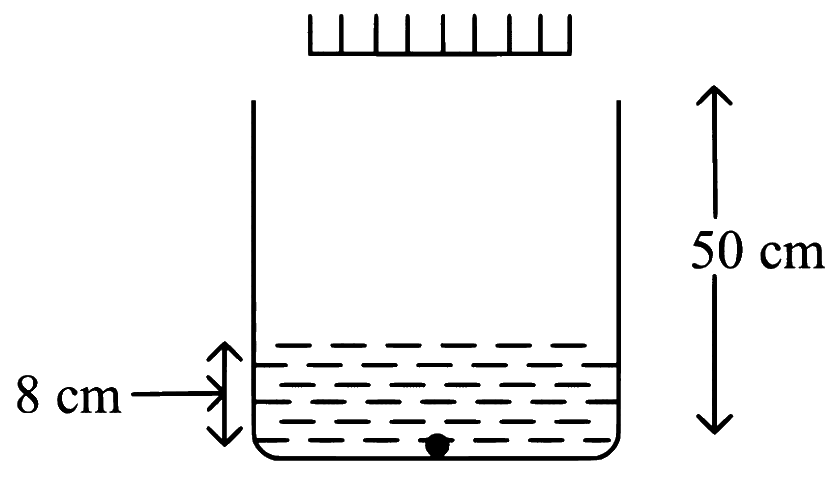
As shown in the figure, a plane mirror is fixed at a height of 50 cm50\text{ cm} from the bottom of tank containing water (μ=43)\left(\mu = \frac{4}{3}\right). The height of water in the tank is 8 cm8\text{ cm}. A small bulb is placed at the bottom of the water tank. The distance of image of the bulb formed by mirror from the bottom of the tank is ___________ cm\text{cm}.

Figure

Numerical answer type. Work it out, then open the answer.

Show answer and solution

Answer: 98

  1. The bulb seen from above appears at depth 84/3=6 cm\frac{8}{4/3} = 6\text{ cm} below the water surface, i.e. 2 cm2\text{ cm} above the bottom.
  2. This apparent bulb is the object for the mirror: distance from mirror =50−2=48 cm= 50 - 2 = 48\text{ cm}.
  3. Plane mirror image is 48 cm48\text{ cm} behind (above) the mirror: 50+48=98 cm50 + 48 = 98\text{ cm} from the bottom.
  4. So the image is 98 cm98\text{ cm} from the bottom.
Report a mistake
Q98JEE Main 2022 · 29 JUL · SHIFT 2Medium

Refraction, Glass Slab & Apparent Depth · Snell's law & refractive index

Light enters from air into a given medium at an angle of 45∘45^\circ with interface of the air-medium surface. After refraction, the light ray is deviated through an angle of 15∘15^\circ from its original direction. The refractive index of the medium is:

Show answer and solution

Answer: (c)

  1. Ray makes 45∘45^\circ with the surface, so with the normal i=90∘−45∘=45∘i = 90^\circ - 45^\circ = 45^\circ.
  2. Deviation δ=i−r=15∘⇒r=30∘\delta = i - r = 15^\circ \Rightarrow r = 30^\circ.
  3. μ=sin⁡45∘sin⁡30∘=1/21/2=2=1.414\mu = \dfrac{\sin 45^\circ}{\sin 30^\circ} = \dfrac{1/\sqrt{2}}{1/2} = \sqrt{2} = 1.414.
  4. So the answer is (c) 1.414.
Report a mistake
Q99JEE Main 2022 · 27 JUN · SHIFT 1Medium

Refraction, Glass Slab & Apparent Depth · Snell's law & refractive index

Consider a light ray travelling in air is incident into a medium of refractive index 2n\sqrt{2n}. The incident angle is twice that of refracting angle. Then, the angle of incidence will be:

Show answer and solution

Answer: (d)

  1. Snell's law with i=2ri = 2r: 2n=sin⁡2rsin⁡r=2cos⁡r\sqrt{2n} = \dfrac{\sin 2r}{\sin r} = 2\cos r.
  2. cos⁡r=2n2=n2\cos r = \dfrac{\sqrt{2n}}{2} = \sqrt{\dfrac{n}{2}}.
  3. i=2r=2cos⁡−1(n2)i = 2r = 2\cos^{-1}\left(\sqrt{\dfrac{n}{2}}\right).
  4. So the answer is (d).
Report a mistake
Q100JEE Main 2022 · 29 JUL · SHIFT 1Medium

Refraction, Glass Slab & Apparent Depth · Snell's law & refractive index

The X-Y plane be taken as the boundary between two transparent media M1M_1 and M2. M1M_2.\ M_1 in Z⩾0Z \geqslant 0 has a refractive index of 2\sqrt{2} and M2M_2 with Z<0Z < 0 has a refractive index of 3\sqrt{3}. A ray of light travelling in M1M_1 along the direction given by the vector P⃗=43i^−33j^−5k^\vec{P} = 4\sqrt{3}\hat{i} - 3\sqrt{3}\hat{j} - 5\hat{k}, is incident on the plane of separation. The value of difference between the angle of incidence in M1M_1 and the angle of refraction in M2M_2 will be __________ degree.

Numerical answer type. Work it out, then open the answer.

Show answer and solution

Answer: 15

  1. Normal is along k^\hat{k}: ∣P⃗∣=48+27+25=10|\vec{P}| = \sqrt{48 + 27 + 25} = 10, so cos⁡i=510⇒i=60∘\cos i = \dfrac{5}{10} \Rightarrow i = 60^\circ.
  2. 2sin⁡60∘=3sin⁡r⇒sin⁡r=12⇒r=45∘\sqrt{2}\sin 60^\circ = \sqrt{3}\sin r \Rightarrow \sin r = \dfrac{1}{\sqrt{2}} \Rightarrow r = 45^\circ.
  3. i−r=60∘−45∘=15∘i - r = 60^\circ - 45^\circ = 15^\circ.
  4. Answer: 15 degree.
Report a mistake
Q101JEE Main 2022 · 28 JUL · SHIFT 1Medium

Refraction, Glass Slab & Apparent Depth · Speed, wavelength & optical path

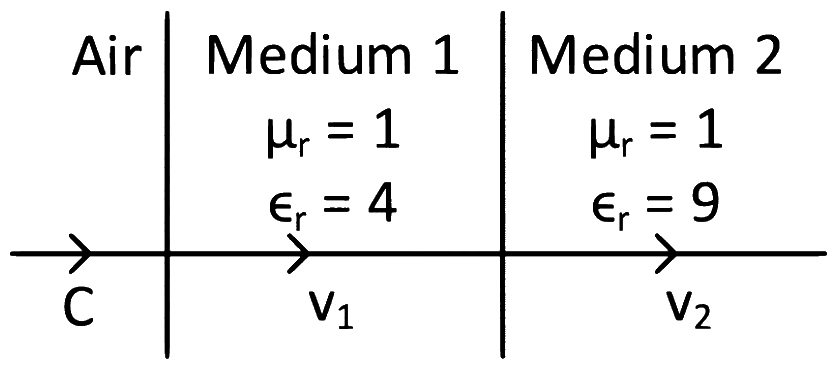
As shown in the figure, after passing through the medium 1. The speed of light v2v_2 in medium 2 will be:

(( Given c=3×10⁸ ms−1c = 3 \times 10^{8}\text{ ms}^{-1})

Figure

Show answer and solution

Answer: (a)

  1. Refractive index n=μrϵrn = \sqrt{\mu_r \epsilon_r}.
  2. Medium 2: n2=1×9=3n_2 = \sqrt{1 \times 9} = 3 (medium 1 does not affect v2v_2).
  3. v2=cn2=3×1083=1.0×10⁸ m s−1v_2 = \dfrac{c}{n_2} = \dfrac{3 \times 10^8}{3} = 1.0 \times 10^8\text{ m s}^{-1}.
  4. So the answer is (a).
Report a mistake
Q102JEE Main 2022 · 25 JUL · SHIFT 1Medium

Refraction, Glass Slab & Apparent Depth · Speed, wavelength & optical path

Time taken by light to travel in two different materials AA and BB of refractive indices μA\mu_A and μB\mu_B of same thickness is t1t_1 and t2t_2 respectively. If t2−t1=5×10⁻¹⁰t_2 - t_1 = 5 \times 10^{-10} s and the ratio of μA\mu_A to μB\mu_B is 1:21:2. Then, the thickness of material, in meter is: (Given vAv_\text{A} and vBv_\text{B} are velocities of light in AA and BB materials respectively.)

Show answer and solution

Answer: (a)

  1. Time in thickness dd: t=dvt = \dfrac{d}{v}, and v∝1μv \propto \dfrac{1}{\mu}.
  2. μA:μB=1:2⇒vA=2vB\mu_A : \mu_B = 1:2 \Rightarrow v_A = 2v_B, so 1vB=2vA\dfrac{1}{v_B} = \dfrac{2}{v_A}.
  3. t2−t1=d(2vA−1vA)=dvA=5×10⁻¹⁰t_2 - t_1 = d\left(\dfrac{2}{v_A} - \dfrac{1}{v_A}\right) = \dfrac{d}{v_A} = 5 \times 10^{-10}.
  4. d=5×10⁻¹⁰ vAd = 5 \times 10^{-10}\,v_A m, so the answer is (a).
Report a mistake
Q103JEE Main 2022 · 25 JUN · SHIFT 1Medium

Refraction, Glass Slab & Apparent Depth · Speed, wavelength & optical path

The difference of speed of light in the two media A and B (vA −- vB) is 2.6 ×\times 107 m/s. If the refractive index of medium B is 1.47, then the ratio of refractive index of medium B to medium A is: (Given: speed of light in vacuum c = 3 ×\times 108 ms−1{}^{-1})

Show answer and solution

Answer: (c)

  1. vB=cμB=3×1081.47=2.041×10⁸v_B = \dfrac{c}{\mu_B} = \dfrac{3 \times 10^8}{1.47} = 2.041 \times 10^8 m/s.
  2. vA=vB+0.26×108=2.301×10⁸v_A = v_B + 0.26 \times 10^8 = 2.301 \times 10^8 m/s.
  3. μBμA=vAvB=2.3012.041≈1.13\dfrac{\mu_B}{\mu_A} = \dfrac{v_A}{v_B} = \dfrac{2.301}{2.041} \approx 1.13.
  4. So the answer is (c) 1.13.
Report a mistake
Q104JEE Main 2022 · 24 JUN · SHIFT 2Medium

Refraction, Glass Slab & Apparent Depth · Glass slab: lateral & normal shift

A ray of light is incident at an angle of incidence 60∘^\circ on the glass slab of refractive index 3\sqrt{3}. After refraction, the light ray emerges out from other parallel faces and lateral shift between incident ray and emergent ray is 43\sqrt{3} cm. The thickness of the glass slab is __________ cm.

Numerical answer type. Work it out, then open the answer.

Show answer and solution

Answer: 12

60°30°dtμ = √3
  1. Snell's law: sin⁡r=sin⁡60∘3=12⇒r=30∘\sin r = \dfrac{\sin 60^\circ}{\sqrt{3}} = \dfrac{1}{2} \Rightarrow r = 30^\circ.
  2. Lateral shift d=tsin⁡(i−r)cos⁡r=tsin⁡30∘cos⁡30∘=t3d = \dfrac{t\sin(i - r)}{\cos r} = \dfrac{t\sin 30^\circ}{\cos 30^\circ} = \dfrac{t}{\sqrt{3}}.
  3. 43=t3⇒t=124\sqrt{3} = \dfrac{t}{\sqrt{3}} \Rightarrow t = 12.
  4. Answer: 12 cm.
Report a mistake
Q105JEE Main 2022 · 30 JUL · SHIFT 2Medium

Refraction, Glass Slab & Apparent Depth · Apparent depth & real depth

A ring is placed at the bottom of a trough containing four immiscible liquids of refractive indices 1.0,2.0,3.01.0, 2.0, 3.0 and 4.04.0 poured one above the other of heights 10 cm,20 cm,30 cm10\text{ cm}, 20\text{ cm}, 30\text{ cm}, and 40 cm40\text{ cm} respectively. The apparent depth at which the ring appears, when seen from outside is __________ cm.

Numerical answer type. Work it out, then open the answer.

Show answer and solution

Answer: 40

  1. Apparent depth =∑tiμi= \sum \frac{t_i}{\mu_i}.
  2. d=101+202+303+404=10+10+10+10d = \frac{10}{1} + \frac{20}{2} + \frac{30}{3} + \frac{40}{4} = 10 + 10 + 10 + 10
  3. So the ring appears at a depth of 40 cm40\text{ cm}.
Report a mistake
Q106NEET 2022 · PHASE 1Medium

Refraction, Glass Slab & Apparent Depth · Brewster's angle & polarisation

A light ray falls on a glass surface of refractive index 3\sqrt{3}, at an angle 60∘{}^\circ. The angle between the refracted and reflected rays would be

Show answer and solution

Answer: (c)

  1. Brewster angle: tan⁡θB=μ=3⇒θB=60∘\tan\theta_B = \mu = \sqrt{3} \Rightarrow \theta_B = 60^\circ.
  2. The given angle of incidence 60∘60^\circ equals θB\theta_B.
  3. At Brewster's angle the reflected and refracted rays are perpendicular.
  4. So the answer is (c) 90∘90^\circ.
Report a mistake
Q107JEE Main 2022 · 25 JUL · SHIFT 2Difficult

Refraction, Glass Slab & Apparent Depth · Glass slab: lateral & normal shift

For an object placed at a distance 2.4 m from a lens, a sharp focused image is observed on a screen placed at a distance 12 cm from the lens. A glass plate of refractive index 1.5 and thickness 1 cm is introduced between lens and screen such that the glass plate plane faces parallel to the screen. By what distance should the object be shifted so that a sharp focused image is observed again on the screen?

Show answer and solution

Answer: (b)

  1. Lens: 1f=1v−1u=112+1240=21240⇒f=24021 cm\frac{1}{f} = \frac{1}{v} - \frac{1}{u} = \frac{1}{12} + \frac{1}{240} = \frac{21}{240} \Rightarrow f = \frac{240}{21}\text{ cm}.
  2. The plate shifts the image away by t(1−1μ)=1(1−11.5)=13 cmt\left(1 - \frac{1}{\mu}\right) = 1\left(1 - \frac{1}{1.5}\right) = \frac{1}{3}\text{ cm}.
  3. For a sharp image on the screen, the lens must form its image at v′=12−13=353 cmv' = 12 - \frac{1}{3} = \frac{35}{3}\text{ cm}.
  4. 1u′=335−21240=−1560⇒u′=−560 cm=−5.6 m\frac{1}{u'} = \frac{3}{35} - \frac{21}{240} = -\frac{1}{560} \Rightarrow u' = -560\text{ cm} = -5.6\text{ m}
  5. Shift =5.6−2.4=3.2 m= 5.6 - 2.4 = 3.2\text{ m} (away from the lens).
  6. So the answer is (b) 3.2 m3.2\text{ m}.
Report a mistake
Q108MHT CET 2021 · 23 SEP · SHIFT 1Easy

Refraction, Glass Slab & Apparent Depth · Snell's law & refractive index

A ray of light travels from air to water to glass and again from glass to air. Refractive index of water w.r.t. air is 'X', glass w.r.t. water is 'Y' and air w.r.t. glass is 'Z'. Which one of the following is correct?

Show answer and solution

Answer: (b)

  1. X=nwnaX = \frac{n_w}{n_a}, Y=ngnwY = \frac{n_g}{n_w}, Z=nangZ = \frac{n_a}{n_g}
  2. XYZ=nwna⋅ngnw⋅nang=1XYZ = \frac{n_w}{n_a} \cdot \frac{n_g}{n_w} \cdot \frac{n_a}{n_g} = 1
  3. So the answer is (b) XYZ = 1.
Report a mistake
Q109MHT CET 2021 · 24 SEP · SHIFT 2Easy

Refraction, Glass Slab & Apparent Depth · Speed, wavelength & optical path

White light consists of wavelengths from 480 nm480\text{ nm} to 672 nm672\text{ nm}. What will be the wavelength range when white light is passed through glass of refractive index 1.6?

Show answer and solution

Answer: (c)

  1. In a medium λ′=λμ\lambda' = \frac{\lambda}{\mu}.
  2. 4801.6=300 nm\frac{480}{1.6} = 300\text{ nm}, 6721.6=420 nm\frac{672}{1.6} = 420\text{ nm}
  3. So the answer is (c) 300 nm - 420 nm.
Report a mistake
Q110JEE Main 2021 · 16 MAR · SHIFT 2Easy

Refraction, Glass Slab & Apparent Depth · Speed, wavelength & optical path

Red light differs from blue light as they have:

Show answer and solution

Answer: (b)

  1. Colour is set by frequency, so red and blue have different frequencies.
  2. In the same medium λ=vf\lambda = \frac{v}{f}, so their wavelengths also differ.
  3. So the answer is (b).
Report a mistake
Q111MHT CET 2021 · 24 SEP · SHIFT 2Medium

Refraction, Glass Slab & Apparent Depth · Speed, wavelength & optical path

A monochromatic ray of light travels through glass slab and water column. The number of waves in glass slab of thickness 4 cm4\text{ cm} is the same as in water column of height 5 cm5\text{ cm}. If refractive index of glass is 53\frac{5}{3} then refractive index of water is

Show answer and solution

Answer: (a)

  1. Number of waves N=μtλ0N = \dfrac{\mu t}{\lambda_0}, so equal NN means μgtg=μwtw\mu_g t_g = \mu_w t_w.
  2. 53×4=μw×5\dfrac{5}{3} \times 4 = \mu_w \times 5.
  3. μw=43=1.33\mu_w = \dfrac{4}{3} = 1.33.
  4. So the answer is (a) 1.33.
Report a mistake
Q112MHT CET 2021 · 21 SEP · SHIFT 1Medium

Refraction, Glass Slab & Apparent Depth · Apparent depth & real depth

A glass cube of length 24 cm24\text{ cm} has a small air bubble trapped inside. When viewed normally from one face it is 10 cm10\text{ cm} below the surface. When viewed normally from the opposite face, its apparent distance is 6 cm6\text{ cm}. The refractive index of glass is

Show answer and solution

Answer: (a)

  1. Real depths from the two faces add to the cube length: μ(10+6)=24\mu(10 + 6) = 24.
  2. μ=2416=1.50\mu = \dfrac{24}{16} = 1.50.
  3. So the answer is (a) 1.50.
Report a mistake
Q113JEE Main 2021 · 1 SEP · SHIFT 2Medium

Refraction, Glass Slab & Apparent Depth · Apparent depth & real depth

A glass tumbler having inner depth of 17.5 cm is kept on a table. A student starts pouring water (μ\mu = 4/3) into it while looking at the surface of water from the above. When he feels that the tumbler is half filled, he stops pouring water. Up to what height, the tumbler is actually filled?

Show answer and solution

Answer: (b)

  1. Let the actual water height be hh. Water looks hμ\dfrac{h}{\mu} deep, while the empty part above is seen as its real length 17.5−h17.5 - h.
  2. He feels it half filled when these look equal: 3h4=17.5−h\dfrac{3h}{4} = 17.5 - h.
  3. 7h4=17.5⇒h=10\dfrac{7h}{4} = 17.5 \Rightarrow h = 10 cm.
  4. So the answer is (b) 10 cm.
Report a mistake
Q114MHT CET 2021 · 20 SEP · SHIFT 1Medium

Refraction, Glass Slab & Apparent Depth · Brewster's angle & polarisation

A ray of light travels from a denser medium to a rarer medium. The reflected and the refracted rays are perpendicular to each other. If 'rr' and 'r1r_1 ' are the angle of reflection and refraction respectively and 'CC' is the critical angle, then the angle of incidence is

Show answer and solution

Answer: (c)

  1. Perpendicular reflected and refracted rays: r+r1=90∘r + r_1 = 90^\circ (Brewster condition).
  2. Denser to rarer: μsin⁡i=sin⁡r1=cos⁡i⇒tan⁡i=1μ\mu\sin i = \sin r_1 = \cos i \Rightarrow \tan i = \frac{1}{\mu}.
  3. 1μ=sin⁡C⇒tan⁡i=sin⁡C\frac{1}{\mu} = \sin C \Rightarrow \tan i = \sin C
  4. So the answer is (c) tan⁡−1(sin⁡C)\tan^{-1}(\sin C).
Report a mistake
Q115JEE Main 2021 · 22 JUL · SHIFT 2Medium

Refraction, Glass Slab & Apparent Depth · Brewster's angle & polarisation

A ray of light passes from a denser medium to a rarer medium at an angle of incidence i. The reflected and refracted rays make an angle of 90∘{}^\circ with each other. The angle of reflection and refraction are respectively r and r'. The critical angle is given by

Figure

Show answer and solution

Answer: (a)

  1. Perpendicular rays: r+r′=90∘r + r' = 90^\circ, with i=ri = r.
  2. Snell (denser to rarer): μsin⁡r=sin⁡r′=cos⁡r⇒tan⁡r=1μ\mu\sin r = \sin r' = \cos r \Rightarrow \tan r = \frac{1}{\mu}.
  3. sin⁡C=1μ=tan⁡r\sin C = \frac{1}{\mu} = \tan r
  4. So the answer is (a) sin⁡−1(tan⁡r)\sin^{-1}(\tan r).
Report a mistake
Q116MHT CET 2020 · 16 OCT · SHIFT 2Easy

Refraction, Glass Slab & Apparent Depth · Speed, wavelength & optical path

Refractive index of the medium is μ\mu and wavelength is λ\lambda, then which of the following proportionality relation is correct?

Show answer and solution

Answer: (b)

  1. Frequency stays the same, so μ=cv=λ0λ\mu = \frac{c}{v} = \frac{\lambda_0}{\lambda}.
  2. For a given light, μ∝1λ\mu \propto \frac{1}{\lambda} (wavelength in the medium).
  3. So the answer is (b).
Report a mistake
Q117NEET 2020 · PHASE 1Easy

Refraction, Glass Slab & Apparent Depth · Brewster's angle & polarisation

The Brewster's angle ib for an interface should be:

Show answer and solution

Answer: (b)

  1. Brewster's law: tan⁡ib=n2n1\tan i_b = \dfrac{n_2}{n_1}.
  2. For light going from rarer to denser medium (the usual case, e.g. air to glass), n2>n1n_2 > n_1, so tan⁡ib>1\tan i_b > 1.
  3. tan⁡ib>1⇒45∘<ib<90∘\tan i_b > 1 \Rightarrow 45^\circ < i_b < 90^\circ (ib=90∘i_b = 90^\circ would need n2→∞n_2 \to \infty).
  4. So the answer is (b).
Report a mistake
Q118JEE Main 2020 · 9 JAN · SHIFT 1Medium

Refraction, Glass Slab & Apparent Depth · Apparent depth & real depth

A vessel of depth 2h is half filled with a liquid of refractive index 222\sqrt{2} and the upper half with another liquid of refractive index 2\sqrt{2}. The liquids are immiscible. The apparent depth of the inner surface of the bottom of vessel will be:

Show answer and solution

Answer: (c)

  1. For layered liquids, apparent depth =∑tiμi= \sum \frac{t_i}{\mu_i}.
  2. dapp=h22+h2=h+2h22=3h22d_{app} = \frac{h}{2\sqrt{2}} + \frac{h}{\sqrt{2}} = \frac{h + 2h}{2\sqrt{2}} = \frac{3h}{2\sqrt{2}}
  3. 3h22=324h\frac{3h}{2\sqrt{2}} = \frac{3\sqrt{2}}{4}h
  4. So the answer is (c) 34h2\frac{3}{4}h\sqrt{2}.
Report a mistake
Q119JEE Main 2020 · 3 SEP · SHIFT 1Difficult

Refraction, Glass Slab & Apparent Depth · Apparent depth & real depth

An observer can see through a small hole on the side of a jar (radius 15 cm) at a point at height of 15 cm from the bottom (see figure). The hole is at a height of 45 cm. When the jar is filled with a liquid up to a height of 30 cm the same observer can see the edge at the bottom of the jar. If the refractive index of the liquid is N/100, where N is an integer, the value of N is _____.

Figure

Numerical answer type. Work it out, then open the answer.

Show answer and solution

Answer: 158

45°r30 cm level15 cmhole, 45 cm30 cm
  1. Jar diameter =30 cm= 30\text{ cm}. Empty jar: line of sight drops 45−15=30 cm45 - 15 = 30\text{ cm} over 30 cm30\text{ cm}, so it makes 45∘45^\circ with the vertical.
  2. With liquid up to 30 cm30\text{ cm}, the ray in air drops 15 cm15\text{ cm} and meets the surface 15 cm15\text{ cm} from the wall (the centre), with i=45∘i = 45^\circ.
  3. In the liquid it must reach the bottom edge: horizontal 15 cm15\text{ cm}, vertical 30 cm30\text{ cm}, so sin⁡r=15152+302=15\sin r = \frac{15}{\sqrt{15^2 + 30^2}} = \frac{1}{\sqrt{5}}.
  4. μ=sin⁡45∘sin⁡r=52=2.5=1.58\mu = \frac{\sin 45^\circ}{\sin r} = \frac{\sqrt{5}}{\sqrt{2}} = \sqrt{2.5} = 1.58
  5. So N=158N = 158.
Report a mistake
Q120MHT CET 2019 · 3 MAY · SHIFT 1Easy

Refraction, Glass Slab & Apparent Depth · Speed, wavelength & optical path

The refractive index of the material of crystal is 1.68 and that of castor oil is 1.2. When a ray of light passes from oil to glass, its velocity will change by a factor

Show answer and solution

Answer: (d)

  1. v=cμ⇒vglassvoil=μoilμglassv = \frac{c}{\mu} \Rightarrow \frac{v_{glass}}{v_{oil}} = \frac{\mu_{oil}}{\mu_{glass}}
  2. =1.21.68=57= \frac{1.2}{1.68} = \frac{5}{7}
  3. So the answer is (d) 57\frac{5}{7}.
Report a mistake
Q121MHT CET 2019 · 2 MAY · SHIFT 2Easy

Refraction, Glass Slab & Apparent Depth · Speed, wavelength & optical path

When light enters glass from vacuum, then the wavelength of light

Show answer and solution

Answer: (a)

  1. Frequency is unchanged; speed drops to cμ\frac{c}{\mu}.
  2. λ=vf\lambda = \frac{v}{f}, so λ′=λμ<λ\lambda' = \frac{\lambda}{\mu} < \lambda.
  3. So the answer is (a) decreases.
Report a mistake
Q122JEE Main 2019 · 10 APR · SHIFT 1Easy

Refraction, Glass Slab & Apparent Depth · Glass slab: lateral & normal shift

A ray of light AO in vacuum is incident on a glass slab at angle 60° and refracted at angle 30° along OB as shown in the figure. The optical path length of light ray from A to B is:

Figure

Show answer and solution

Answer: (c)

  1. μ=sin⁡60∘sin⁡30∘=3\mu = \frac{\sin 60^\circ}{\sin 30^\circ} = \sqrt{3}
  2. AO=acos⁡60∘=2aAO = \frac{a}{\cos 60^\circ} = 2a, OB=bcos⁡30∘=2b3OB = \frac{b}{\cos 30^\circ} = \frac{2b}{\sqrt{3}}
  3. Optical path =1×2a+3×2b3=2a+2b= 1 \times 2a + \sqrt{3} \times \frac{2b}{\sqrt{3}} = 2a + 2b
  4. So the answer is (c) 2a+2b2a + 2b.
Report a mistake
Q123JEE Main 2019 · 9 JAN · SHIFT 1Medium

Refraction, Glass Slab & Apparent Depth · Glass slab: lateral & normal shift

A convex lens is put 10 cm from a light source and it makes a sharp image on a screen, kept 10 cm from the lens. Now a glass block (refractive index 1.5) of 1.5 cm thickness is placed in contact with the light source. To get the sharp image again, the screen is shifted by a distance d. Then d is:

Show answer and solution

Answer: (d)

  1. Lens: 1f=110+110⇒f=5\dfrac{1}{f} = \dfrac{1}{10} + \dfrac{1}{10} \Rightarrow f = 5 cm.
  2. Slab shifts the object towards the lens by t(1−1μ)=1.5(1−11.5)=0.5t\left(1 - \dfrac{1}{\mu}\right) = 1.5\left(1 - \dfrac{1}{1.5}\right) = 0.5 cm, so u=9.5u = 9.5 cm.
  3. 1v=15−19.5=4.547.5⇒v=10.55\dfrac{1}{v} = \dfrac{1}{5} - \dfrac{1}{9.5} = \dfrac{4.5}{47.5} \Rightarrow v = 10.55 cm.
  4. Screen moves 0.550.55 cm away from the lens, so the answer is (d).
Report a mistake
Q124JEE Main 2016 · 10 APR · SHIFT 1Easy

Refraction, Glass Slab & Apparent Depth · Apparent depth & real depth

To determine refractive index of glass slab using a travelling microscope, minimum number of readings required are:

Show answer and solution

Answer: (b)

  1. Reading 1: mark without slab; reading 2: mark seen through slab; reading 3: top surface of slab.
  2. Real thickness = R3−R1R_3 - R_1, apparent thickness = R3−R2R_3 - R_2, μ=R3−R1R3−R2\mu = \frac{R_3 - R_1}{R_3 - R_2}.
  3. So the answer is (b) Three.
Report a mistake
Q125NEET 2016 · PHASE 2Medium

Refraction, Glass Slab & Apparent Depth · Apparent depth & real depth

An air bubble in a glass slab with refractive index 1.5 (near normal incidence) is 5 cm deep when viewed from one surface and 3 cm deep when viewed from the opposite face. The thickness (in cm) of the slab is

Show answer and solution

Answer: (c)

  1. Real depth = μ×\mu \times apparent depth, from each face.
  2. Thickness =μ(5+3)=1.5×8= \mu(5 + 3) = 1.5 \times 8.
  3. Thickness =12= 12 cm, so the answer is (c).
Report a mistake
Q126JEE Main 2013 · 25 APR · SHIFT 1Medium

Refraction, Glass Slab & Apparent Depth · Apparent depth & real depth

A printed page is pressed by a glass of water. The refractive index of the glass and water is 1.5 and 1.33, respectively. If the thickness of the bottom of glass is 1 cm and depth of water is 5 cm, how much the page will appear to be shifted if viewed from the top?

Show answer and solution

Answer:

  1. Normal shift by a layer: s=t(1−1μ)s = t\left(1 - \frac{1}{\mu}\right); shifts of layers add.
  2. Glass: s1=1(1−11.5)=0.333 cms_1 = 1\left(1 - \frac{1}{1.5}\right) = 0.333\text{ cm}
  3. Water: s2=5(1−11.33)=5×0.248=1.241 cms_2 = 5\left(1 - \frac{1}{1.33}\right) = 5 \times 0.248 = 1.241\text{ cm}
  4. Total shift =0.333+1.241≈1.57 cm= 0.333 + 1.241 \approx 1.57\text{ cm}.
  5. This value is not among the options; the answer usually quoted for this question is (c) 1.3533 cm1.3533\text{ cm}.
Report a mistake
Q127JEE Main 2012 · AIEEEMedium

Refraction, Glass Slab & Apparent Depth · Glass slab: lateral & normal shift

An object 2.4 m2.4\text{ m} in front of a lens forms a sharp image on a film 12 cm12\text{ cm} behind the lens. A glass plate 1 cm1\text{ cm} thick, of refractive index 1.501.50 is interposed between lens and film with its plane faces parallel to film. At what distance (from lens) should object shifted to be in sharp focus of film?

Show answer and solution

Answer: (d)

  1. Lens: 1f=112+1240=21240\dfrac{1}{f} = \dfrac{1}{12} + \dfrac{1}{240} = \dfrac{21}{240} (cm).
  2. Plate shifts the image away by 1(1−11.5)=131\left(1 - \dfrac{1}{1.5}\right) = \dfrac{1}{3} cm, so the lens alone must image at v=12−13=353v = 12 - \dfrac{1}{3} = \dfrac{35}{3} cm.
  3. 1u=21240−335=735−7208400=1560\dfrac{1}{u} = \dfrac{21}{240} - \dfrac{3}{35} = \dfrac{735 - 720}{8400} = \dfrac{1}{560}.
  4. u=560u = 560 cm =5.6= 5.6 m, so the answer is (d).
Report a mistake
Q128JEE Main 2011 · AIEEEMedium

Refraction, Glass Slab & Apparent Depth · Snell's law & refractive index

Let x-yx\text{-}y plane be the boundary between two transparent media. Medium 11 in z≥0z \ge 0 has a refractive index of 2\sqrt{2} and medium 22 with z<0z < 0 has a refractive index of 3.\sqrt{3}. A ray of light in medium 11 given by the vector A⃗=63i^+83j^−10k^\vec{A} = 6\sqrt{3}\hat{i} + 8\sqrt{3}\hat{j} - 10\hat{k} is incident on the plane of separation. The angle of refraction in medium 22 is:

Show answer and solution

Answer: (a)

  1. The normal to the xx-yy plane is along k^\hat{k}, so cos⁡i=∣Az∣∣A⃗∣\cos i = \dfrac{|A_z|}{|\vec{A}|}.
  2. ∣A⃗∣=108+192+100=20|\vec{A}| = \sqrt{108 + 192 + 100} = 20, so cos⁡i=1020=12⇒i=60∘\cos i = \dfrac{10}{20} = \dfrac{1}{2} \Rightarrow i = 60^\circ.
  3. 2sin⁡60∘=3sin⁡r⇒sin⁡r=2⋅3/23=12\sqrt{2}\sin 60^\circ = \sqrt{3}\sin r \Rightarrow \sin r = \dfrac{\sqrt{2}\cdot\sqrt{3}/2}{\sqrt{3}} = \dfrac{1}{\sqrt{2}}.
  4. So the answer is (a) 45∘45^\circ.
Report a mistake
Q129JEE Main 2010 · AIEEEDifficult

Refraction, Glass Slab & Apparent Depth · Snell's law & refractive index

An initially parallel cylindrical beam travels in a medium of refractive index μ(I)=μ0+μ2I,\mu(I) = \mu_0 + \mu_2 I, where μ0\mu_0 and μ2\mu_2 are positive constants and II is the intensity of the light beam. The intensity of the beam is decreasing with increasing radius.

As the beam enters the medium, it will

Show answer and solution

Answer: (b)

  1. Intensity is maximum on the axis, so μ=μ0+μ2I\mu = \mu_0 + \mu_2 I is maximum on the axis and decreases outward.
  2. Light is slower near the axis, so the wavefront lags at the centre and becomes concave in the direction of travel.
  3. Rays bend towards the region of higher μ\mu, i.e. towards the axis (like a graded-index lens).
  4. So the answer is (b) converge.
Report a mistake
Q130JEE Main 2010 · AIEEEDifficult

Refraction, Glass Slab & Apparent Depth · Speed, wavelength & optical path

An initially parallel cylindrical beam travels in a medium of refractive index μ(I)=μ0+μ2I,\mu(I) = \mu_0 + \mu_2 I, where μ0\mu_0 and μ2\mu_2 are positive constants and II is the intensity of the light beam. The intensity of the beam is decreasing with increasing radius.

The speed of light in the medium is

Show answer and solution

Answer: (a)

  1. Speed v=cμv = \frac{c}{\mu} and μ=μ0+μ2I\mu = \mu_0 + \mu_2 I.
  2. II is maximum on the axis, so μ\mu is maximum there.
  3. Hence vv is minimum on the axis.
  4. So the answer is (a).
Report a mistake
Q131NEET 2006 · AIPMTEasy

Refraction, Glass Slab & Apparent Depth · Apparent depth & real depth

A microscope is focussed on a mark on a piece of paper and then a slab of glass of thickness 3 cm and refractive index 1.5 is placed over the mark. How should the microscope be moved to get the mark in focus again?

Show answer and solution

Answer: (b)

  1. The slab raises the mark by t(1−1μ)t\left(1 - \frac{1}{\mu}\right).
  2. =3(1−11.5)=1 cm= 3\left(1 - \frac{1}{1.5}\right) = 1\text{ cm}
  3. The image rises, so the microscope must move up. So the answer is (b) 1 cm upward.
Report a mistake
Q132NEET 2004 · AIPMTMedium

Refraction, Glass Slab & Apparent Depth · Glass slab: lateral & normal shift

A beam of light composed of red and green ray is incident obliquely at a point on the face of rectangular glass slab. When coming out on the opposite parallel face, the red green ray emerge from

Show answer and solution

Answer: (b)

  1. Glass has different μ\mu for red and green, so they refract at different angles inside and reach the far face at two different points.
  2. At a parallel face each ray emerges parallel to the incident direction.
  3. So both emerge parallel to each other but from two points: the answer is (b).
Report a mistake
Q133NEET 2000 · AIPMTMedium

Refraction, Glass Slab & Apparent Depth · Apparent depth & real depth

A bubble in glass slab (μ\mu = 1.5) when viewed from one side appears at 5 cm and 2 cm from other side, then thickness of slab is

Show answer and solution

Answer: (c)

  1. Real depth = μ×\mu \times apparent depth, from each side.
  2. Thickness =1.5(5+2)=1.5×7= 1.5(5 + 2) = 1.5 \times 7.
  3. Thickness =10.5= 10.5 cm, so the answer is (c).
Report a mistake
Q134NEET 1997 · AIPMTEasy

Refraction, Glass Slab & Apparent Depth · Speed, wavelength & optical path

An electromagnetic radiation of frequency nn, wavelength λ\lambda, travelling with velocity vv in air, enters a glass slab of refractive index μ\mu. The frequency, wavelength and velocity of light in the glass slab will be respectively

Show answer and solution

Answer: (d)

  1. Frequency depends only on the source: stays nn.
  2. Speed becomes vμ\frac{v}{\mu} and wavelength λμ\frac{\lambda}{\mu}.
  3. So the answer is (d) n, λμ, vμn,\ \frac{\lambda}{\mu},\ \frac{v}{\mu}.
Report a mistake
Q135NEET 1996 · AIPMTEasy

Refraction, Glass Slab & Apparent Depth · Speed, wavelength & optical path

The refractive index of water is 1.33. What will be the speed of light in water?

Show answer and solution

Answer: (d)

  1. v=cμ=3×1081.33v = \frac{c}{\mu} = \frac{3 \times 10^8}{1.33}
  2. v≈2.25×10⁸ m/sv \approx 2.25 \times 10^8\text{ m/s}
  3. So the answer is (d).
Report a mistake
Q136NEET 1996 · AIPMTEasy

Refraction, Glass Slab & Apparent Depth · Speed, wavelength & optical path

Light travels through a glass plate of thickness tt and having a refractive index μ\mu. If cc is the velocity of light in vacuum, the time taken by light to travel this thickness of glass is

Show answer and solution

Answer: (b)

  1. Speed in glass v=cμv = \frac{c}{\mu}.
  2. Time =tv=μtc= \frac{t}{v} = \frac{\mu t}{c}
  3. So the answer is (b) μtc\frac{\mu t}{c}.
Report a mistake
Q137NEET 1996 · AIPMTMedium

Refraction, Glass Slab & Apparent Depth · Brewster's angle & polarisation

A ray of light from a denser medium strikes a rare medium as shown in figure. The reflected and refracted rays make an angle of 90∘90^\circ with each other. The angles of reflection and refraction are rr and r′r'. The critical angle would be

Figure

Show answer and solution

Answer: (a)

  1. From the figure, r+r′=90∘r + r' = 90^\circ and i=ri = r.
  2. Snell: μsin⁡r=sin⁡r′=cos⁡r⇒1μ=tan⁡r\mu\sin r = \sin r' = \cos r \Rightarrow \frac{1}{\mu} = \tan r.
  3. sin⁡C=1μ=tan⁡r\sin C = \frac{1}{\mu} = \tan r
  4. So the answer is (a) sin⁡−1(tan⁡r)\sin^{-1}(\tan r).
Report a mistake
Q138NEET 1993 · AIPMTEasy

Refraction, Glass Slab & Apparent Depth · Speed, wavelength & optical path

Time taken by sunlight to pass through a window of thickness 4 mm whose refractive index is 32\frac{3}{2} is

Show answer and solution

Answer: (c)

  1. Time =μtc= \frac{\mu t}{c}
  2. =1.5×4×10−33×108=2×10⁻¹¹ s= \frac{1.5 \times 4 \times 10^{-3}}{3 \times 10^8} = 2 \times 10^{-11}\text{ s}
  3. So the answer is (c).
Report a mistake
Q139NEET 1992 · AIPMTEasy

Refraction, Glass Slab & Apparent Depth · Speed, wavelength & optical path

A beam of monochromatic light is refracted from vacuum into a medium of refractive index 1.5. The wavelength of refracted light will be

Show answer and solution

Answer: (c)

  1. Frequency is unchanged, so λ′=λμ=λ1.5\lambda' = \frac{\lambda}{\mu} = \frac{\lambda}{1.5}.
  2. The wavelength becomes smaller.
  3. So the answer is (c) smaller.
Report a mistake
Q140NEET 1991 · AIPMTEasy

Refraction, Glass Slab & Apparent Depth · Speed, wavelength & optical path

A beam of monochromatic light is refracted from vacuum into a medium of refractive index 1.5. The wavelength of refracted light will be

Show answer and solution

Answer: (c)

  1. Frequency is unchanged, so λ′=λμ=λ1.5\lambda' = \frac{\lambda}{\mu} = \frac{\lambda}{1.5}.
  2. The wavelength becomes smaller.
  3. So the answer is (c) smaller.
Report a mistake
Q141NEET 1991 · AIPMTEasy

Refraction, Glass Slab & Apparent Depth · Speed, wavelength & optical path

Green light wavelength 5460 Å is incident on an air-glass interface. If the refractive index of glass is 1.5, the wavelength of light in glass would be (c=3×10⁸ m s−1c = 3 \times 10^{8}\text{ m s}^{-1})

Show answer and solution

Answer: (a)

  1. λg=λairμ\lambda_g = \frac{\lambda_{air}}{\mu}
  2. =54601.5=3640 A˚= \frac{5460}{1.5} = 3640\text{ Å}
  3. So the answer is (a) 3640 Å.
Report a mistake
Q142MHT CET 2026 · 19 APR · SHIFT 2Easy

Total Internal Reflection · Critical angle & condition for TIR

Light travels a distance 'x' in time 't0t_0' in air and '4x4x' in time 't1t_1' in another denser medium. The critical angle for this medium is

Show answer and solution

Answer: (b)

  1. Speed in air c=xt0c = \frac{x}{t_0}; speed in medium v=4xt1v = \frac{4x}{t_1}.
  2. sin⁡C=1μ=vc=4x/t1x/t0=4t0t1\sin C = \frac{1}{\mu} = \frac{v}{c} = \frac{4x/t_1}{x/t_0} = \frac{4t_0}{t_1}
  3. So the answer is (b) sin⁡−1(4t0t1)\sin^{-1}\left(\frac{4t_0}{t_1}\right).
Report a mistake
Q143JEE Main 2026 · 23 JAN · SHIFT 1Easy

Total Internal Reflection · Critical angle & condition for TIR

Consider light travelling from a medium AA to medium BB separated by a plane interface. If the light undergoes total internal reflection during its travel from medium AA to BB and the speed of light in media AA and BB are 2.4×10⁸ m/s2.4 \times 10^{8}\text{ m/s} and 2.7×10⁸ m/s2.7 \times 10^{8}\text{ m/s}, respectively, then the value of critical angle is:

Show answer and solution

Answer: (d)

  1. sin⁡C=μBμA=vAvB=2.42.7=89\sin C = \frac{\mu_B}{\mu_A} = \frac{v_A}{v_B} = \frac{2.4}{2.7} = \frac{8}{9}.
  2. cos⁡C=1−6481=179\cos C = \sqrt{1 - \frac{64}{81}} = \frac{\sqrt{17}}{9}
  3. tan⁡C=8/917/9=817\tan C = \frac{8/9}{\sqrt{17}/9} = \frac{8}{\sqrt{17}}
  4. So the answer is (d) tan⁡−1(817)\tan^{-1}\left(\frac{8}{\sqrt{17}}\right).
Report a mistake
Q144MHT CET 2026 · 19 MAY · SHIFT 2Medium

Total Internal Reflection · Critical angle & condition for TIR

A ray of light is incident at a glass-water interface at an angle (i1)(i_1), it emerges finally parallel to the surface of water, then the value of the refractive index of glass (μg)(\mu_g) is

{μw=\{\mu_w = refractive index of water =4/3,sin⁡(90)∘=1,cos⁡(90)∘=0}= 4/3, \sin(90)^\circ = 1, \cos(90)^\circ = 0\}

Figure

Show answer and solution

Answer: (c)

  1. Snell's law gives μsin⁡θ=\mu \sin\theta = constant along the whole path.
  2. Glass to water to air: μgsin⁡i1=μwsin⁡r=μasin⁡90∘\mu_g \sin i_1 = \mu_w \sin r = \mu_a \sin 90^\circ.
  3. The ray finally grazes the water surface, so μgsin⁡i1=1×1=1\mu_g \sin i_1 = 1 \times 1 = 1. The value of μw\mu_w cancels out.
  4. μg=1sin⁡i\mu_g = \frac{1}{\sin i}. So the answer is (c).
Report a mistake
Q145MHT CET 2026 · 19 MAY · SHIFT 1Medium

Total Internal Reflection · Critical angle & condition for TIR

A ray of light takes time 'tt' to travel a distance 'dd' in air and it travels a distance '4d4d', in time 'TT' in a certain medium. If T=8tT = 8t, the critical angle for the pair of media is

[sin⁡(π6)=0.5,sin⁡(π4)=12,sin⁡(π3)=32,sin⁡(π2)=1]\left[\sin\left(\frac{\pi}{6}\right) = 0.5, \sin\left(\frac{\pi}{4}\right) = \frac{1}{\sqrt{2}}, \sin\left(\frac{\pi}{3}\right) = \frac{\sqrt{3}}{2}, \sin\left(\frac{\pi}{2}\right) = 1\right]

Show answer and solution

Answer: (d)

  1. Speed in air c=dtc = \frac{d}{t}; speed in medium v=4dT=4d8t=d2tv = \frac{4d}{T} = \frac{4d}{8t} = \frac{d}{2t}.
  2. n=cv=2n = \frac{c}{v} = 2.
  3. sin⁡C=1n=12⇒C=π6\sin C = \frac{1}{n} = \frac{1}{2} \Rightarrow C = \frac{\pi}{6}.
  4. So the answer is (d) πc6\frac{\pi^c}{6}.
Report a mistake
Q146MHT CET 2026 · 20 MAY · SHIFT 1Medium

Total Internal Reflection · TIR in prisms, blocks & rods

A beam of light is travelling from region I to region IV. The refractive indices in regions I, II, III and IV are n, n2, n3n,\ \frac{n}{2},\ \frac{n}{3} and n4\frac{n}{4} respectively. The angle of incidence for which the beam just misses entering region IV is [sin⁡90∘=1\sin 90^\circ = 1]

Figure

Show answer and solution

Answer: (d)

  1. For parallel layers, nsin⁡θn\sin\theta stays the same in every region.
  2. Just missing region IV means the ray grazes the III-IV boundary: nsin⁡θ=n4sin⁡90∘n\sin\theta = \frac{n}{4}\sin90^\circ.
  3. sin⁡θ=14\sin\theta = \frac{1}{4}. Regions II and III do not change the result.
  4. So the answer is (d) sin⁡−1(14)\sin^{-1}\left(\frac{1}{4}\right).
Report a mistake
Q147MHT CET 2026 · 19 MAY · SHIFT 2Medium

Total Internal Reflection · TIR in prisms, blocks & rods

The minimum refractive index of the material of a right-angled isosceles prism as shown in the following figure is

Figure

Show answer and solution

Answer: (b)

  1. The ray enters face PQ normally and meets face PR at O with angle of incidence 45∘45^\circ.
  2. For TIR at O: 45∘≥C45^\circ \ge C, so sin⁡45∘≥1μ\sin45^\circ \ge \frac{1}{\mu}.
  3. μ≥2\mu \ge \sqrt{2}.
  4. So the answer is (b) 2\sqrt{2}.
Report a mistake
Q148JEE Main 2026 · 2 APR · SHIFT 2Medium

Total Internal Reflection · TIR in prisms, blocks & rods

One side of an equilateral prism is painted by a transparent material of refractive index n2n_2. The refractive index of prism is 1.61.6. The minimum value of n2n_2 required for total internal reflection from painted face is ________.

Figure

Show answer and solution

Answer: (d)

  1. The ray enters the left face normally, so it goes straight. That face makes 60∘60^\circ with the base, so the ray meets the base at 60∘60^\circ to its normal.
  2. TIR at the painted base needs sin⁡60∘≥n21.6\sin60^\circ \ge \frac{n_2}{1.6}.
  3. n2≤1.6×32=0.83=435n_2 \le 1.6\times\frac{\sqrt{3}}{2} = 0.8\sqrt{3} = \frac{4\sqrt{3}}{5}.
  4. The limiting value of n2n_2 is 435\frac{4\sqrt{3}}{5} (TIR needs n2n_2 below this, so it is really a maximum). So the answer is (d).
Report a mistake
Q149JEE Main 2026 · 23 JAN · SHIFT 2 (One or more correct)Medium

Total Internal Reflection · TIR in prisms, blocks & rods

A prism of angle 75∘75^\circ and refractive index 3\sqrt{3} is coated with thin film of refractive index 1.5 only at the back exit surface. To have total internal reflection at the back exit surface the incident angle must be ______

(sin⁡15∘=0.25(\sin 15^\circ = 0.25 and sin⁡25∘=0.43)\sin 25^\circ = 0.43)

Show answer and solution

Answer: (a)

  1. Critical angle at the coated back face: sin⁡C=1.53=32⇒C=60∘\sin C = \frac{1.5}{\sqrt{3}} = \frac{\sqrt{3}}{2} \Rightarrow C = 60^\circ.
  2. TIR needs r2≥60∘r_2 \ge 60^\circ; with r1+r2=A=75∘r_1 + r_2 = A = 75^\circ, r1≤15∘r_1 \le 15^\circ.
  3. First face: sin⁡i=3sin⁡r1≤3×0.25=0.43⇒i≤25∘\sin i = \sqrt{3}\sin r_1 \le \sqrt{3}\times0.25 = 0.43 \Rightarrow i \le 25^\circ.
  4. So TIR happens for ii below about 25∘25^\circ; option (a) 15∘15^\circ to 20∘20^\circ lies in this range. So the answer is (a).
Report a mistake
Q150MHT CET 2025 · 21 APR · SHIFT 1Easy

Total Internal Reflection · Optical fibre & TIR applications

The phenomenon, which is not due to total internal reflection is

Show answer and solution

Answer: (c)

  1. Mirage, brilliance of diamond and optical fibres all work by total internal reflection.
  2. A pond looks shallower because light bends (refracts) when it goes from water into air; no TIR is involved.
  3. So the answer is (c) difference between apparent and real depth of a pond.
Report a mistake
Q151JEE Main 2025 · 29 JAN · SHIFT 1Medium

Total Internal Reflection · Critical angle & condition for TIR

At the interface between two materials having refractive indices n1n_1 and n2n_2, the critical angle for reflection of an em wave is θ1C\theta_{1C}. The n2n_2 material is replaced by another material having refractive index n3n_3 such that the critical angle at the interface between n1n_1 and n3n_3 materials is θ2C\theta_{2C}. If n3>n2>n1;n2n3=25n_3 > n_2 > n_1; \frac{n_2}{n_3} = \frac{2}{5} and sin⁡θ2C−sin⁡θ1C=12\sin\theta_{2C} - \sin\theta_{1C} = \frac{1}{2}, then θ1C\theta_{1C} is:

Show answer and solution

Answer:

  1. Light goes from the denser medium (n2n_2 or n3n_3) into n1n_1: sin⁡θ1C=n1n2\sin\theta_{1C} = \frac{n_1}{n_2}, sin⁡θ2C=n1n3\sin\theta_{2C} = \frac{n_1}{n_3}.
  2. sin⁡θ2C=n1n2⋅n2n3=25sin⁡θ1C\sin\theta_{2C} = \frac{n_1}{n_2}\cdot\frac{n_2}{n_3} = \frac{2}{5}\sin\theta_{1C}.
  3. The two values differ by 12\frac{1}{2}: sin⁡θ1C−25sin⁡θ1C=35sin⁡θ1C=12\sin\theta_{1C} - \frac{2}{5}\sin\theta_{1C} = \frac{3}{5}\sin\theta_{1C} = \frac{1}{2}.
  4. sin⁡θ1C=56\sin\theta_{1C} = \frac{5}{6}, which matches option (c) sin⁡−1(56n1)\sin^{-1}\left(\frac{5}{6n_1}\right) when n1=1n_1 = 1.
  5. So the answer is (c).
Report a mistake
Q152JEE Main 2025 · 7 APR · SHIFT 2Medium

Total Internal Reflection · TIR in prisms, blocks & rods

A transparent block A having refractive index μ=1.25\mu = 1.25 is surrounded by another medium of refractive index μ=1.0\mu = 1.0 as shown in the figure. A light ray is incident on the flat face of the block with incident angle θ\theta as shown in the figure. What is the maximum value of θ\theta for which light suffers total internal reflection at the top surface of the block?

Figure

Show answer and solution

Answer: (b)

  1. At the vertical face: sin⁡θ=1.25sin⁡r\sin\theta = 1.25\sin r. The top face is perpendicular, so the angle of incidence there is 90∘−r90^\circ - r.
  2. Critical angle: sin⁡θC=11.25=45\sin\theta_C = \frac{1}{1.25} = \frac{4}{5}, cos⁡θC=35\cos\theta_C = \frac{3}{5}.
  3. TIR needs 90∘−r≥θC⇒sin⁡r≤cos⁡θC=3590^\circ - r \ge \theta_C \Rightarrow \sin r \le \cos\theta_C = \frac{3}{5}.
  4. sin⁡θ≤1.25×35=34\sin\theta \le 1.25\times\frac{3}{5} = \frac{3}{4}.
  5. So the answer is (b) θmax=sin⁡−1(3/4)\theta_{max} = \sin^{-1}(3/4).
Report a mistake
Q153MHT CET 2024 · 15 MAY · SHIFT 1Easy

Total Internal Reflection · Critical angle & condition for TIR

For a ray of light, the critical angle is minimum, when it travels from

Show answer and solution

Answer: (a)

  1. TIR needs light going from denser to rarer, so (b) and (d) are ruled out.
  2. sin⁡C=μrarerμdenser\sin C = \frac{\mu_{rarer}}{\mu_{denser}}; CC is smallest when this ratio is smallest.
  3. Glass to air: 11.5=0.67\frac{1}{1.5} = 0.67; glass to water: 1.331.5=0.89\frac{1.33}{1.5} = 0.89.
  4. So the answer is (a) glass to air.
Report a mistake
Q154MHT CET 2024 · 11 MAY · SHIFT 2Easy

Total Internal Reflection · Critical angle & condition for TIR

Critical angle of light passing from glass to air is minimum for wavelength of

Show answer and solution

Answer: (d)

  1. sin⁡C=1μ\sin C = \frac{1}{\mu}, so CC is smallest when μ\mu is largest.
  2. By dispersion, μ\mu is largest for the shortest wavelength (blue among the options).
  3. So the answer is (d) blue colour.
Report a mistake
Q155MHT CET 2024 · 11 MAY · SHIFT 1Easy

Total Internal Reflection · Critical angle & condition for TIR

For a light ray to undergo total internal reflection ( i=i = angle of incidence, ic=i_c = critical angle)

Show answer and solution

Answer: (c)

  1. TIR conditions: light must go from denser to rarer medium.
  2. The angle of incidence must exceed the critical angle, i>ici > i_c.
  3. So the answer is (c).
Report a mistake
Q156JEE Main 2024 · 8 APR · SHIFT 1Easy

Total Internal Reflection · Critical angle & condition for TIR

Critical angle of incidence for a pair of optical media is 45∘45^\circ. The refractive indices of first and second media are in the ratio:

Show answer and solution

Answer: (d)

  1. sin⁡C=μ2μ1\sin C = \frac{\mu_2}{\mu_1} (first medium is denser).
  2. μ2μ1=sin⁡45∘=12⇒μ1:μ2=2:1\frac{\mu_2}{\mu_1} = \sin 45^\circ = \frac{1}{\sqrt{2}} \Rightarrow \mu_1 : \mu_2 = \sqrt{2} : 1
  3. So the answer is (d) 2:1\sqrt{2} : 1.
Report a mistake
Q157MHT CET 2024 · 9 MAY · SHIFT 1Medium

Total Internal Reflection · Critical angle & condition for TIR

Velocity of light in diamond is (512)\left(\frac{5}{12}\right)th times that in air. Velocity of light in water is (34)\left(\frac{3}{4}\right)th times that in air. The angle of incidence of ray of light travelling from water to diamond is (angle of refraction (r)=30∘)[(r) = 30^\circ) [ Given →sin⁡30∘=12]\rightarrow \sin 30^\circ = \frac{1}{2}]

Show answer and solution

Answer: (a)

  1. n=cvn = \frac{c}{v}: nd=125n_d = \frac{12}{5}, nw=43n_w = \frac{4}{3}.
  2. Water to diamond: nwsin⁡i=ndsin⁡rn_w \sin i = n_d \sin r.
  3. 43sin⁡i=125×12=65⇒sin⁡i=65×34=910\frac{4}{3}\sin i = \frac{12}{5}\times\frac{1}{2} = \frac{6}{5} \Rightarrow \sin i = \frac{6}{5}\times\frac{3}{4} = \frac{9}{10}.
  4. So the answer is (a) sin⁡−1(9/10)\sin^{-1}(9/10).
Report a mistake
Q158MHT CET 2024 · 3 MAY · SHIFT 2Medium

Total Internal Reflection · Critical angle & condition for TIR

White light is incident on the interface of glass and air as shown in figure. If green light is just totally internally reflected, then reflected rays inside the glass contain

Figure

Show answer and solution

Answer: (b)

  1. sin⁡C=1μ\sin C = \frac{1}{\mu}, and μ\mu increases from red to violet, so CC decreases from red to violet.
  2. The angle of incidence equals CC for green (green just grazes).
  3. Violet, indigo and blue have CC smaller than this angle, so they are totally reflected back into the glass.
  4. Yellow, orange and red have larger CC, so they come out into the air.
  5. So the answer is (b) violet, indigo, blue.
Report a mistake
Q159JEE Main 2024 · 4 APR · SHIFT 2Medium

Total Internal Reflection · TIR in prisms, blocks & rods

A light ray is incident on a glass slab of thickness 43 cm4\sqrt{3}\text{ cm} and refractive index 2\sqrt{2} The angle of incidence is equal to the critical angle for the glass slab with air. The lateral displacement of ray after passing through glass slab is ______ cm\text{cm}.

(Given sin⁡15∘=0.25\sin 15^\circ = 0.25)

Numerical answer type. Work it out, then open the answer.

Show answer and solution

Answer: 2

  1. i=Ci = C: sin⁡C=12⇒i=45∘\sin C = \frac{1}{\sqrt{2}} \Rightarrow i = 45^\circ.
  2. sin⁡r=sin⁡45∘2=12⇒r=30∘\sin r = \frac{\sin45^\circ}{\sqrt{2}} = \frac{1}{2} \Rightarrow r = 30^\circ.
  3. d=tsin⁡(i−r)cos⁡r=43×0.253/2=2d = \frac{t\sin(i-r)}{\cos r} = \frac{4\sqrt{3}\times0.25}{\sqrt{3}/2} = 2 cm.
  4. So the lateral displacement is 2 cm.
Report a mistake
Q160MHT CET 2023 · 12 MAY · SHIFT 1Easy

Total Internal Reflection · Critical angle & condition for TIR

One of the necessary condition for total internal reflection to take place is

( i=i = angle of incidence, ic=i_c = critical angle)

Show answer and solution

Answer: (d)

  1. For TIR the angle of incidence in the denser medium must be greater than the critical angle.
  2. At i=ici = i_c the refracted ray just grazes the surface; for i<ici < i_c refraction occurs.
  3. So the answer is (d) i>ici > i_c.
Report a mistake
Q161NEET 2023Easy

Total Internal Reflection · Critical angle & condition for TIR

Light travels a distance xx in time t1t_1 in air and 10x10x in time t2t_2 in another denser medium. What is the critical angle for this medium?

Show answer and solution

Answer: (c)

  1. Speed in air c=xt1c = \frac{x}{t_1}; speed in medium v=10xt2v = \frac{10x}{t_2}.
  2. sin⁡C=vc=10x/t2x/t1=10t1t2\sin C = \frac{v}{c} = \frac{10x/t_2}{x/t_1} = \frac{10t_1}{t_2}
  3. So the answer is (c) sin⁡−1(10t1t2)\sin^{-1}\left(\frac{10t_1}{t_2}\right).
Report a mistake
Q162JEE Main 2023 · 11 APR · SHIFT 1Easy

Total Internal Reflection · Critical angle & condition for TIR

The critical angle for a denser-rarer interface is 45∘45^\circ. The speed of light in rarer medium is 3×10⁸ m/s3 \times 10^{8}\text{ m/s}. The speed of light in the denser medium is:

Show answer and solution

Answer: (a)

  1. sin⁡C=μrμd=vdvr\sin C = \frac{\mu_r}{\mu_d} = \frac{v_d}{v_r}.
  2. vd=vrsin⁡45∘=3×1082=2.12×10⁸ m/sv_d = v_r\sin 45^\circ = \frac{3 \times 10^8}{\sqrt{2}} = 2.12 \times 10^8\text{ m/s}
  3. So the answer is (a) 2.12×10⁸ m/s2.12 \times 10^8\text{ m/s}.
Report a mistake
Q163JEE Main 2023 · 25 JAN · SHIFT 1Medium

Total Internal Reflection · Critical angle & condition for TIR

A ray of light is incident from air on a glass plate having thickness 3\sqrt{3} cm and refractive index 2\sqrt{2}. The angle of incidence of a ray is equal to the critical angle for glass-air interface. The lateral displacement of the ray when it passes through the plate is ____________ ×\times 10 −2-2 cm. (given sin⁡15∘=0.26\sin 15^\circ = 0.26)

Numerical answer type. Work it out, then open the answer.

Show answer and solution

Answer: 52

  1. Critical angle for glass-air: sin⁡C=12⇒i=C=45∘\sin C = \frac{1}{\sqrt{2}} \Rightarrow i = C = 45^\circ.
  2. Air to glass: sin⁡r=sin⁡45∘2=12⇒r=30∘\sin r = \frac{\sin 45^\circ}{\sqrt{2}} = \frac{1}{2} \Rightarrow r = 30^\circ.
  3. Lateral shift d=tsin⁡(i−r)cos⁡r=3×sin⁡15∘3/2=2×0.26=0.52d = \frac{t\sin(i-r)}{\cos r} = \frac{\sqrt{3}\times\sin15^\circ}{\sqrt{3}/2} = 2\times0.26 = 0.52 cm.
  4. So the answer is 52×10−252\times10^{-2} cm, i.e. 52.
Report a mistake
Q164MHT CET 2022 · 11 AUG · SHIFT 2Easy

Total Internal Reflection · Critical angle & condition for TIR

The speed of light in two media M1M_1 and M2M_2 are 1.5×10⁸ m/s1.5 \times 10^{8}\text{ m/s} and 2×10⁸ m/s2 \times 10^{8}\text{ m/s} respectively. If the light undergoes total internal reflection, the critical angle between the two media is

Show answer and solution

Answer: (d)

  1. TIR occurs from the slower (denser) medium M1M_1 to the faster medium M2M_2.
  2. sin⁡C=μ2μ1=v1v2=1.5×1082×108=34\sin C = \frac{\mu_2}{\mu_1} = \frac{v_1}{v_2} = \frac{1.5 \times 10^8}{2 \times 10^8} = \frac{3}{4}
  3. So the answer is (d) sin⁡−1(34)\sin^{-1}\left(\frac{3}{4}\right).
Report a mistake
Q165NEET 2022 · PHASE 1Easy

Total Internal Reflection · Critical angle & condition for TIR

Two transparent media A and B are separated by a plane boundary. The speed of light in those media are 1.5 ×\times 108 m/s and 2.0 ×\times 108 m/s, respectively. The critical angle for a ray of light for these two media is

Show answer and solution

Answer: (b)

  1. sin⁡C=μBμA=vAvB\sin C = \frac{\mu_B}{\mu_A} = \frac{v_A}{v_B} (from slower A to faster B).
  2. sin⁡C=1.5×1082.0×108=0.750\sin C = \frac{1.5 \times 10^8}{2.0 \times 10^8} = 0.750
  3. So the answer is (b) sin⁡−1(0.750)\sin^{-1}(0.750).
Report a mistake
Q166JEE Main 2022 · 26 JUL · SHIFT 2Easy

Total Internal Reflection · Critical angle & condition for TIR

Light travels in two media M1M_1 and M2M_2 with speeds 1.5×10⁸ ms−11.5 \times 10^{8}\text{ ms}^{-1} and 2.0×10⁸ ms−12.0 \times 10^{8}\text{ ms}^{-1} respectively. The critical angle between them is:

Show answer and solution

Answer: (a)

  1. n=cvn = \frac{c}{v}, so n1=3×1081.5×108=2n_1 = \frac{3\times10^8}{1.5\times10^8} = 2 and n2=3×1082×108=1.5n_2 = \frac{3\times10^8}{2\times10^8} = 1.5.
  2. Critical angle (from M1M_1 to M2M_2): sin⁡C=n2n1=v1v2=34\sin C = \frac{n_2}{n_1} = \frac{v_1}{v_2} = \frac{3}{4}.
  3. cos⁡C=1−916=74\cos C = \sqrt{1-\frac{9}{16}} = \frac{\sqrt{7}}{4}, so tan⁡C=37\tan C = \frac{3}{\sqrt{7}}.
  4. So the answer is (a) tan⁡−1(37)\tan^{-1}\left(\frac{3}{\sqrt{7}}\right).
Report a mistake
Q167JEE Main 2022 · 29 JUN · SHIFT 2Medium

Total Internal Reflection · Critical angle & condition for TIR

The speed of light in media 'A' and 'B' are 2.0×10102.0 \times 10^{10} cm/s and 1.5×10101.5 \times 10^{10} cm/s respectively. A ray of light enters from the medium B to A at an incident angle 'θ\theta'. If the ray suffers total internal reflection, then

Show answer and solution

Answer: (d)

  1. n=cvn = \frac{c}{v}: nA=3×10102×1010=1.5n_A = \frac{3\times10^{10}}{2\times10^{10}} = 1.5, nB=3×10101.5×1010=2n_B = \frac{3\times10^{10}}{1.5\times10^{10}} = 2.
  2. B is denser. Going from B to A: sin⁡C=nAnB=34\sin C = \frac{n_A}{n_B} = \frac{3}{4}.
  3. TIR needs θ>C\theta > C, i.e. θ>sin⁡−1(34)\theta > \sin^{-1}\left(\frac{3}{4}\right).
  4. So the answer is (d).
Report a mistake
Q168JEE Main 2022 · 25 JUN · SHIFT 1Medium

Total Internal Reflection · Critical angle & condition for TIR

A light wave travelling linearly in a medium of dielectric constant 4, is incident on the horizontal interface separating medium with air. The angle of incidence for which the total intensity of incident wave will be reflected back into the same medium will be:

(Given: relative permeability of medium μ\mur = 1)

Show answer and solution

Answer: (d)

  1. n=εrμr=4×1=2n = \sqrt{\varepsilon_r \mu_r} = \sqrt{4\times1} = 2.
  2. sin⁡C=1n=12⇒C=30∘\sin C = \frac{1}{n} = \frac{1}{2} \Rightarrow C = 30^\circ.
  3. All the light is reflected only when i>30∘i > 30^\circ; of the options only 60∘60^\circ qualifies.
  4. So the answer is (d) 60∘60^\circ.
Report a mistake
Q169JEE Main 2022 · 26 JUN · SHIFT 2Medium

Total Internal Reflection · Circle of light from a submerged source

A small bulb is placed at the bottom of a tank containing water to a depth of 7\sqrt{7} m. The refractive index of water is 43\frac{4}{3}. The area of the surface of water through which light from the bulb can emerge out is xπ\pi m2. The value of x is __________.

Numerical answer type. Work it out, then open the answer.

Show answer and solution

Answer: 9

  1. Light escapes only through a circle of radius r=htan⁡C=hμ2−1r = h\tan C = \frac{h}{\sqrt{\mu^2 - 1}}, with sin⁡C=1μ\sin C = \frac{1}{\mu}.
  2. μ2−1=169−1=79\mu^2 - 1 = \frac{16}{9} - 1 = \frac{7}{9}, so r=77/3=3 mr = \frac{\sqrt{7}}{\sqrt{7}/3} = 3\text{ m}
  3. Area =πr2=9π m2= \pi r^2 = 9\pi\text{ m}^2
  4. So x=9x = 9.
Report a mistake
Q170MHT CET 2021 · 22 SEP · SHIFT 2Easy

Total Internal Reflection · Critical angle & condition for TIR

The critical angle for light going from medium 'xx' to medium 'YY' is θ\theta. The speed of light in medium 'xx' is 'VxV_x'. The speed of light in medium 'YY' is

Show answer and solution

Answer: (d)

  1. sin⁡θ=μYμx=VxVY\sin\theta = \frac{\mu_Y}{\mu_x} = \frac{V_x}{V_Y} (since μ∝1V\mu \propto \frac{1}{V}).
  2. VY=Vxsin⁡θV_Y = \frac{V_x}{\sin\theta}
  3. So the answer is (d).
Report a mistake
Q171MHT CET 2021 · 22 SEP · SHIFT 1Easy

Total Internal Reflection · Critical angle & condition for TIR

The critical angle for light going from medium A into medium B is θ\theta. The speed of light in the medium A is VAV_A. What is the speed of light in the medium BB?

Show answer and solution

Answer: (d)

  1. sin⁡θ=μBμA=VAVB\sin\theta = \frac{\mu_B}{\mu_A} = \frac{V_A}{V_B}.
  2. VB=VAsin⁡θV_B = \frac{V_A}{\sin\theta}
  3. So the answer is (d) VAsin⁡θ\frac{V_A}{\sin\theta}.
Report a mistake
Q172MHT CET 2021 · 21 SEP · SHIFT 2Easy

Total Internal Reflection · Critical angle & condition for TIR

The refractive index of glass is 1.5 and that of water is 1.33. The critical angle for a ray of light going from glass to water is

Show answer and solution

Answer: (c)

  1. Glass to water: sin⁡C=μwμg\sin C = \frac{\mu_w}{\mu_g}.
  2. sin⁡C=4/33/2=89\sin C = \frac{4/3}{3/2} = \frac{8}{9} (using 1.33≈431.33 \approx \frac{4}{3})
  3. So the answer is (c) sin⁡−1(89)\sin^{-1}\left(\frac{8}{9}\right).
Report a mistake
Q173JEE Main 2021 · 25 JUL · SHIFT 2Medium

Total Internal Reflection · Critical angle & condition for TIR

A ray of light entering from air into a denser medium of refractive index 43\frac{4}{3}, as shown in figure. The light ray suffers total internal reflection at the adjacent surface as shown. The maximum value of angle θ\theta should be equal to:

Figure

Show answer and solution

Answer: (a)

  1. At the top face: sin⁡θ=43sin⁡θ′\sin\theta = \frac{4}{3}\sin\theta'.
  2. The side face is perpendicular to the top face, so the angle of incidence there is θ′′=90∘−θ′\theta'' = 90^\circ - \theta'.
  3. TIR needs sin⁡θ′′≥34\sin\theta'' \ge \frac{3}{4}, i.e. cos⁡θ′≥34⇒sin⁡θ′≤74\cos\theta' \ge \frac{3}{4} \Rightarrow \sin\theta' \le \frac{\sqrt{7}}{4}.
  4. sin⁡θ≤43⋅74=73\sin\theta \le \frac{4}{3}\cdot\frac{\sqrt{7}}{4} = \frac{\sqrt{7}}{3}.
  5. So the answer is (a) θmax=sin⁡−173\theta_{max} = \sin^{-1}\frac{\sqrt{7}}{3}.
Report a mistake
Q174JEE Main 2021 · 25 JUL · SHIFT 1Medium

Total Internal Reflection · Critical angle & condition for TIR

A ray of laser of a wavelength 630 nm is incident at an angle of 30∘{}^\circ at the diamond-air interface. It is going from diamond to air. The refractive index of diamond is 2.42 and that of air is 1. Choose the correct option.

Show answer and solution

Answer: (c)

  1. Critical angle for diamond-air: sin⁡C=12.42≈0.413⇒C≈24.4∘\sin C = \frac{1}{2.42} \approx 0.413 \Rightarrow C \approx 24.4^\circ.
  2. The angle of incidence 30∘>C30^\circ > C, so the light is totally internally reflected.
  3. (Snell's law would need sin⁡r=2.42×0.5=1.21>1\sin r = 2.42\times0.5 = 1.21 > 1, which is impossible.)
  4. So the answer is (c) refraction is not possible.
Report a mistake
Q175MHT CET 2021 · 24 SEP · SHIFT 1Medium

Total Internal Reflection · TIR in prisms, blocks & rods

A glass slab has refractive index 'μ\mu' with respect to air and the critical angle for a ray of light in going from glass to glass to air is 'θ\theta' If a ray of light is incident from air on the glass with angle of incidence 'θ\theta', then the corresponding angle of refraction is

Show answer and solution

Answer: (c)

  1. Critical angle glass to air: sin⁡θ=1μ\sin\theta = \frac{1}{\mu}.
  2. Air to glass at incidence θ\theta: sin⁡θ=μsin⁡r\sin\theta = \mu\sin r.
  3. sin⁡r=1μ⋅1μ=1μ2\sin r = \frac{1}{\mu}\cdot\frac{1}{\mu} = \frac{1}{\mu^2}.
  4. So the answer is (c) sin⁡−1(1μ2)\sin^{-1}\left(\frac{1}{\mu^2}\right).
Report a mistake
Q176JEE Main 2021 · 18 MAR · SHIFT 2Medium

Total Internal Reflection · TIR in prisms, blocks & rods

Three rays of light, namely red (R), green (G) and blue (B) are incident on the face PQ of a right angled prism PQR as shown in the figure.

Figure

The refractive indices of the material of the prism for red, green and blue wavelength are 1.27, 1.42 and 1.49 respectively. The colour of the ray(s) emerging out of the face PR is:

Show answer and solution

Answer: (d)

  1. The rays enter PQ normally and meet PR at an angle of incidence 45∘45^\circ (isosceles right prism).
  2. A ray comes out of PR only if μ<1sin⁡45∘=2≈1.414\mu < \frac{1}{\sin45^\circ} = \sqrt{2} \approx 1.414.
  3. Red 1.27<1.4141.27 < 1.414 comes out; green 1.421.42 and blue 1.491.49 are totally reflected.
  4. So the answer is (d) red.
Report a mistake
Q177NEET 2020 · PHASE 2Easy

Total Internal Reflection · Critical angle & condition for TIR

If the critical angle for total internal reflection from a medium to vacuum is 45∘45^\circ, then velocity of light in the medium is,

Show answer and solution

Answer: (c)

  1. μ=1sin⁡C=1sin⁡45∘=2\mu = \frac{1}{\sin C} = \frac{1}{\sin 45^\circ} = \sqrt{2}.
  2. v=cμ=3×1082 m/sv = \frac{c}{\mu} = \frac{3 \times 10^8}{\sqrt{2}}\text{ m/s}
  3. So the answer is (c) 32×108 m/s\frac{3}{\sqrt{2}} \times 10^8\text{ m/s}.
Report a mistake
Q178MHT CET 2020 · 16 OCT · SHIFT 2Medium

Total Internal Reflection · Critical angle & condition for TIR

A ray of light travelling through glass of refractive index 2\sqrt{2} is incident on glass-air boundary at an angle of incidence 45∘45^\circ. If refractive index of air is 1, then the angle of refraction will be [sin⁡45∘=12,sin⁡90∘=1]\left[\sin 45^\circ = \frac{1}{\sqrt{2}}, \sin 90^\circ = 1\right]

Show answer and solution

Answer: (d)

  1. Critical angle for glass-air: sin⁡C=12⇒C=45∘\sin C = \frac{1}{\sqrt{2}} \Rightarrow C = 45^\circ.
  2. The angle of incidence equals the critical angle, so the refracted ray grazes the surface.
  3. Check: 2sin⁡45∘=1=sin⁡r⇒r=90∘\sqrt{2}\sin 45^\circ = 1 = \sin r \Rightarrow r = 90^\circ.
  4. So the answer is (d) 90∘90^\circ.
Report a mistake
Q179JEE Main 2020 · 8 JAN · SHIFT 1Medium

Total Internal Reflection · Critical angle & condition for TIR

The critical angle of a medium for a specific wavelength, if the medium has relative permittivity 3 and relative permeability 43\frac{4}{3} for this wavelength, will be:

Show answer and solution

Answer: (c)

  1. n=εrμr=3×43=2n = \sqrt{\varepsilon_r \mu_r} = \sqrt{3\times\frac{4}{3}} = 2.
  2. sin⁡C=1n=12⇒C=30∘\sin C = \frac{1}{n} = \frac{1}{2} \Rightarrow C = 30^\circ.
  3. So the answer is (c) 30∘30^\circ.
Report a mistake
Q180JEE Main 2020 · 9 JAN · SHIFT 2Medium

Total Internal Reflection · Circle of light from a submerged source

There is a small source of light at some depth below the surface of water (refractive index = 43\frac{4}{3}) in a tank of large cross sectional surface area. Neglecting any reflection from the bottom and absorption by water, percentage of light that emerges out of surface is (nearly): [Use the fact that surface area of a spherical cap of height h and radius of curvature r is 2π\pirh]:

Show answer and solution

Answer: (a)

  1. Only light inside the cone of half-angle CC escapes: sin⁡C=34\sin C = \frac{3}{4}, cos⁡C=74≈0.661\cos C = \frac{\sqrt{7}}{4} \approx 0.661.
  2. On a sphere of radius rr about the source, this cone cuts a cap of height h=r(1−cos⁡C)h = r(1-\cos C).
  3. Fraction =2πrh4πr2=1−cos⁡C2=1−0.6612≈0.17= \frac{2\pi r h}{4\pi r^2} = \frac{1-\cos C}{2} = \frac{1-0.661}{2} \approx 0.17.
  4. So the answer is (a) 17%.
Report a mistake
Q181JEE Main 2020 · 2 SEP · SHIFT 2Difficult

Total Internal Reflection · TIR in prisms, blocks & rods

A light ray enters a solid glass sphere of refractive index μ=3\mu = \sqrt{3} at an angle of incidence 60°. The ray is both reflected and refracted at the farther surface of the sphere. The angle (in degrees) between the reflected and refracted rays at this surface is ________.

Numerical answer type. Work it out, then open the answer.

Show answer and solution

Answer: 90

  1. At entry: sin⁡r=sin⁡60∘3=12⇒r=30∘\sin r = \frac{\sin 60^\circ}{\sqrt{3}} = \frac{1}{2} \Rightarrow r = 30^\circ.
  2. Inside a sphere the chord makes equal angles with both radii, so incidence at the far surface is 30∘30^\circ.
  3. Reflected ray makes 30∘30^\circ with the normal; refracted ray emerges at 60∘60^\circ with the normal on the other side.
  4. Angle between them =180∘−30∘−60∘=90∘= 180^\circ - 30^\circ - 60^\circ = 90^\circ
Report a mistake
Q182MHT CET 2019 · 2 MAY · SHIFT 2Easy

Total Internal Reflection · Critical angle & condition for TIR

The critical angle for light going from medium ' x′x' to medium ' yy ' is ' θ\theta '. The speed of light in medium ' xx ' is ' vxv_x '. The speed of light in medium ' yy ' is

Show answer and solution

Answer: (d)

  1. sin⁡θ=μyμx=vxvy\sin\theta = \frac{\mu_y}{\mu_x} = \frac{v_x}{v_y}.
  2. vy=vxsin⁡θv_y = \frac{v_x}{\sin\theta}
  3. So the answer is (d).
Report a mistake
Q183NEET 2019Easy

Total Internal Reflection · Critical angle & condition for TIR

In total internal reflection when the angle of incidence is equal to the critical angle for the pair of media in contact, what will be angle of refraction?

Show answer and solution

Answer: (b)

  1. Critical angle is defined as the angle of incidence for which the angle of refraction is 90∘90^\circ.
  2. The refracted ray grazes along the boundary.
  3. So the answer is (b) 90∘90^\circ.
Report a mistake
Q184MHT CET 2019 · 3 MAY · SHIFT 1Medium

Total Internal Reflection · Critical angle & condition for TIR

Glass has refractive index μ\mu with respect to air and the critical angle for a ray of light going from glass to air is θ\theta. If a ray of light is incident from air on the glass with angle of incidence θ\theta, corresponding angle of refraction is

Show answer and solution

Answer: (b)

  1. Critical angle from glass to air: sin⁡θ=1μ\sin\theta = \frac{1}{\mu}.
  2. Air to glass at incidence θ\theta: 1⋅sin⁡θ=μsin⁡r1\cdot\sin\theta = \mu \sin r.
  3. sin⁡r=sin⁡θμ=1μ2\sin r = \frac{\sin\theta}{\mu} = \frac{1}{\mu^2}.
  4. So the answer is (b) sin⁡−1(1μ2)\sin^{-1}\left(\frac{1}{\mu^2}\right).
Report a mistake
Q185JEE Main 2019 · 12 APR · SHIFT 2Difficult

Total Internal Reflection · TIR in prisms, blocks & rods

A transparent cube of side, made of a material of refractive index μ\mu2, is immersed in a liquid of refractive index μ1(μ\mu_1 (\mu1 < μ\mu2). A ray is incident on the face AB at an angle θ\theta(shown in the figure). Total internal reflection takes place at point E on the face BC.

Figure

Then θ\theta must satisfy:

Show answer and solution

Answer: (b)

BCADθr90°−rEμ₂μ₁
  1. Refraction at AB: μ1sin⁡θ=μ2sin⁡r\mu_1\sin\theta = \mu_2\sin r.
  2. The normals at AB and BC are perpendicular, so the angle of incidence at E is 90∘−r90^\circ - r.
  3. TIR at E needs sin⁡(90∘−r)>μ1μ2\sin(90^\circ - r) > \frac{\mu_1}{\mu_2}, i.e. cos⁡r>μ1μ2\cos r > \frac{\mu_1}{\mu_2}.
  4. 1−μ12sin⁡2θμ22>μ1μ2⇒sin⁡2θ<μ22−μ12μ12=μ22μ12−1\sqrt{1 - \frac{\mu_1^2\sin^2\theta}{\mu_2^2}} > \frac{\mu_1}{\mu_2} \Rightarrow \sin^2\theta < \frac{\mu_2^2 - \mu_1^2}{\mu_1^2} = \frac{\mu_2^2}{\mu_1^2} - 1
  5. So the answer is (b) θ<sin⁡−1μ22μ12−1\theta < \sin^{-1}\sqrt{\frac{\mu_2^2}{\mu_1^2} - 1}.
Report a mistake
Q186JEE Main 2019 · 8 APR · SHIFT 1Difficult

Total Internal Reflection · Optical fibre & TIR applications

In figure, the optical fiber is ll = 2m long and has a diameter of d = 20 μm. If a ray of light is incident on one end of the fiber at angle θ1\theta_1 = 40°, the number of reflection it makes before emerging from the other end is close to: (refractive index of fibre is 1.31 and sin 40° = 0.64)

Figure

Show answer and solution

Answer: (a)

rdd / tan r
  1. Refraction at entry: sin⁡r=sin⁡40∘1.31=0.641.31≈0.49\sin r = \frac{\sin 40^\circ}{1.31} = \frac{0.64}{1.31} \approx 0.49, so r≈30∘r \approx 30^\circ (angle of the ray with the fibre axis).
  2. Between two reflections the ray moves dtan⁡r\frac{d}{\tan r} along the axis.
  3. N=ltan⁡rd=2×tan⁡30∘20×10−6=2×0.5772×10−5≈5.7×10⁴N = \frac{l\tan r}{d} = \frac{2 \times \tan 30^\circ}{20 \times 10^{-6}} = \frac{2 \times 0.577}{2 \times 10^{-5}} \approx 5.7 \times 10^4
  4. So the answer is (a) 57000.
Report a mistake
Q187JEE Main 2017 · 8 APR · SHIFT 1Medium

Total Internal Reflection · Critical angle & condition for TIR

Let the refractive index of a denser medium with respect to a rarer medium be n12 and its critical angle be θC. At an angle of incidence A when light is travelling from denser medium to rarer medium, a part of the light is reflected and the rest is refracted and the angle between reflected and refracted rays is 90°. Angle A is given by:

Show answer and solution

Answer: (d)

  1. Snell's law (denser to rarer): n12sin⁡A=sin⁡rn_{12}\sin A = \sin r.
  2. Reflected and refracted rays are perpendicular, so A+r=90∘A + r = 90^\circ and sin⁡r=cos⁡A\sin r = \cos A.
  3. n12sin⁡A=cos⁡A⇒tan⁡A=1n12=sin⁡θCn_{12}\sin A = \cos A \Rightarrow \tan A = \frac{1}{n_{12}} = \sin\theta_C.
  4. So the answer is (d) A=tan⁡−1(sin⁡θC)A = \tan^{-1}(\sin\theta_C).
Report a mistake
Q188NEET 2015 · AIPMTMedium

Total Internal Reflection · TIR in prisms, blocks & rods

A beam of light consisting of red, green and blue colours is incident on a right angled prism. The refractive index of the material of the prism for the above red, green and blue wavelengths are 1.39, 1.44 and 1.47 respectively.

Figure

The prism will

Show answer and solution

Answer: (b)

  1. Rays enter face AB normally and strike face AC at an angle of incidence 45∘45^\circ.
  2. TIR at AC needs sin⁡45∘≥1μ\sin45^\circ \ge \frac{1}{\mu}, i.e. μ≥2≈1.414\mu \ge \sqrt{2} \approx 1.414.
  3. Red (1.39<1.4141.39 < 1.414) comes out of AC; green (1.441.44) and blue (1.471.47) are totally reflected.
  4. So the answer is (b) the red part is separated from green and blue.
Report a mistake
Q189JEE Main 2014Medium

Total Internal Reflection · Critical angle & condition for TIR

A green light is incident from the water to the air - water interface at the critical angle (θ)(\theta). Select the correct statement.

Show answer and solution

Answer: (b)

  1. Light of lower frequency (towards red) has a smaller refractive index in water, so its critical angle is larger.
  2. Incident at green's critical angle θ\theta, these colours have θ\theta less than their critical angle, so they refract out into the air.
  3. Higher frequency colours have critical angle less than θ\theta, so they are totally reflected.
  4. So the answer is (b).
Report a mistake
Q190JEE Main 2014 · 9 APR · SHIFT 1Medium

Total Internal Reflection · Circle of light from a submerged source

A diver looking up through the water sees the outside world contained in a circular horizon. The refractive index of water is 43\frac{4}{3} and the diver's eyes are 15 cm below the surface of water. Then the radius of the circle is:

Show answer and solution

Answer: (d)

  1. The diver sees the outside world through a circle whose edge corresponds to the critical angle: R=htan⁡C=hn2−1R = h\tan C = \frac{h}{\sqrt{n^2-1}}.
  2. 169−1=73\sqrt{\frac{16}{9}-1} = \frac{\sqrt{7}}{3}.
  3. R=15×37R = \frac{15\times3}{\sqrt{7}} cm.
  4. So the answer is (d).
Report a mistake
Q191JEE Main 2013 · 9 APR · SHIFT 1Medium

Total Internal Reflection · Critical angle & condition for TIR

Light is incident from a medium into air at two possible angles of incidence (A) 20° and (B) 40°. In the medium light travels 3.0 cm in 0.2 ns. The ray will:

Show answer and solution

Answer: (b)

  1. Speed in the medium: v=3×10−20.2×10−9=1.5×10⁸v = \frac{3\times10^{-2}}{0.2\times10^{-9}} = 1.5\times10^8 m/s.
  2. n=cv=2⇒sin⁡C=12, C=30∘n = \frac{c}{v} = 2 \Rightarrow \sin C = \frac{1}{2},\ C = 30^\circ.
  3. Case A: 20∘<30∘20^\circ < 30^\circ, partly reflected and partly transmitted. Case B: 40∘>30∘40^\circ > 30^\circ, TIR.
  4. So the answer is (b) TIR in case (B) only.
Report a mistake
Q192JEE Main 2013 · 23 APR · SHIFT 1Medium

Total Internal Reflection · TIR in prisms, blocks & rods

A light ray falls on a square glass slab as shown in the diagram. The index of refraction of the glass, if total internal reflection is to occur at the vertical face, is equal to:

Figure

Show answer and solution

Answer: (d)

  1. Top face: sin⁡45∘=μsin⁡r⇒sin⁡r=12μ\sin45^\circ = \mu\sin r \Rightarrow \sin r = \frac{1}{\sqrt{2}\mu}.
  2. Angle of incidence at the vertical face is 90∘−r90^\circ - r; TIR needs cos⁡r≥1μ\cos r \ge \frac{1}{\mu}.
  3. 1−12μ2≥1μ2⇒μ≥321 - \frac{1}{2\mu^2} \ge \frac{1}{\mu^2} \Rightarrow \mu \ge \sqrt{\frac{3}{2}}.
  4. So the answer is (d) 32\sqrt{\frac{3}{2}}.
Report a mistake
Q193NEET 2011 · AIPMT · PRELIMSEasy

Total Internal Reflection · Optical fibre & TIR applications

Which of the following is not due to total internal reflection?

Show answer and solution

Answer: (b)

  1. Optical fibre, mirage and sparkle of diamond are due to total internal reflection.
  2. Apparent depth of a pond is due to simple refraction at the water-air surface.
  3. So the answer is (b) difference between apparent and real depth of a pond.
Report a mistake
Q194NEET 2010 · AIPMT · MAINSEasy

Total Internal Reflection · Critical angle & condition for TIR

The speed of light in media M1 and M2 are 1.5 ×\times 108 m/s and 2.0 ×\times 108 m/s respectively. A ray of light enters from medium M1 to M2 at an incidence angle i. If the ray suffers total internal reflection, the value of i is

Show answer and solution

Answer: (c)

  1. sin⁡C=v1v2=1.52.0=34\sin C = \frac{v_1}{v_2} = \frac{1.5}{2.0} = \frac{3}{4}, so C=sin⁡−1(34)C = \sin^{-1}\left(\frac{3}{4}\right).
  2. TIR (total reflection) needs i≥Ci \geq C (at i=Ci = C the ray just grazes).
  3. So the answer is (c) i≥sin⁡−1(34)i \geq \sin^{-1}\left(\frac{3}{4}\right).
Report a mistake
Q195NEET 2010 · AIPMT · PRELIMSEasy

Total Internal Reflection · Critical angle & condition for TIR

A ray of light travelling in a transparent medium of refractive index μ\mu, falls on a surface separating the medium from air at an angle of incidence of 45°. For which of the following value of μ\mu the ray can undergo total internal reflection?

Show answer and solution

Answer: (c)

  1. TIR at i=45∘i = 45^\circ requires 45∘>C45^\circ > C, i.e. sin⁡C=1μ<sin⁡45∘=12\sin C = \frac{1}{\mu} < \sin 45^\circ = \frac{1}{\sqrt{2}}.
  2. μ>2=1.414\mu > \sqrt{2} = 1.414
  3. Only 1.501.50 satisfies this.
  4. So the answer is (c) μ=1.50\mu = 1.50.
Report a mistake
Q196JEE Main 2009 · AIEEEMedium

Total Internal Reflection · TIR in prisms, blocks & rods

A transparent solid cylindrical rod has a refractive index of 23.\frac{2}{\sqrt{3}}. It is surrounded by air. A light ray is incident at the mid-point of one end of the rod as shown in the figure.

Figure

The incident angle θ\theta for which the light ray grazes along the wall of the rod is:

Show answer and solution

Answer: (c)

  1. Grazing along the wall means the ray meets the wall at the critical angle: sin⁡C=32⇒C=60∘\sin C = \frac{\sqrt{3}}{2} \Rightarrow C = 60^\circ.
  2. The wall is perpendicular to the end face, so the refraction angle at the end is r=90∘−60∘=30∘r = 90^\circ - 60^\circ = 30^\circ.
  3. sin⁡θ=23sin⁡30∘=13\sin\theta = \frac{2}{\sqrt{3}}\sin30^\circ = \frac{1}{\sqrt{3}}.
  4. So the answer is (c) sin⁡−1(13)\sin^{-1}\left(\frac{1}{\sqrt{3}}\right).
Report a mistake
Q197NEET 2007 · AIPMTMedium

Total Internal Reflection · Critical angle & condition for TIR

A small coin is resting on the bottom of a beaker filled with liquid. A ray of light from the coin travels upto the surface of the liquid and moves along its surface. How fast is the light travelling in the liquid?

Figure

Show answer and solution

Answer: (d)

  1. The ray grazes the surface, so it meets the surface at the critical angle CC.
  2. From the figure, horizontal 3 cm and vertical 4 cm, so the path length is 5 cm and sin⁡C=35\sin C = \frac{3}{5}.
  3. n=1sin⁡C=53n = \frac{1}{\sin C} = \frac{5}{3}.
  4. v=cn=3×108×35=1.8×10⁸v = \frac{c}{n} = 3\times10^8 \times \frac{3}{5} = 1.8\times10^8 m/s.
  5. So the answer is (d) 1.8×1081.8\times10^8 m/s.
Report a mistake
Q198JEE Main 2005 · AIEEEMedium

Total Internal Reflection · Circle of light from a submerged source

A fish looking up through the water sees the outside world contained in a circular horizon. If the refractive index of water is 43\frac{4}{3} and the fish is 12 cm12\text{ cm} below the surface, the radius of this circle in cm\text{cm} is

Show answer and solution

Answer: (a)

surfacefishh = 12 cmrC
  1. Light from outside reaches the fish only inside a cone of half-angle CC, the critical angle: sin⁡C=1μ=34\sin C = \frac{1}{\mu} = \frac{3}{4}.
  2. Radius of the circle: r=htan⁡C=hμ2−1r = h\tan C = \frac{h}{\sqrt{\mu^2 - 1}}
  3. r=12169−1=127/3=367 cmr = \frac{12}{\sqrt{\frac{16}{9} - 1}} = \frac{12}{\sqrt{7}/3} = \frac{36}{\sqrt{7}}\text{ cm}
  4. So the answer is (a) 367\frac{36}{\sqrt{7}}.
Report a mistake
Q199JEE Main 2004 · AIEEEMedium

Total Internal Reflection · TIR in prisms, blocks & rods

A light ray is incident perpendicularly to one face of a 90∘90^\circ prism and is totally internally reflected at the glass-air interface. If the angle of reflection is 45∘45^\circ, we conclude that the refractive index nn

Figure

Show answer and solution

Answer: (b)

  1. The ray enters normally and meets the hypotenuse at 45∘45^\circ.
  2. TIR needs 45∘>C45^\circ > C: sin⁡45∘>1n\sin45^\circ > \frac{1}{n}.
  3. n>2n > \sqrt{2}. So the answer is (b).
Report a mistake
Q200JEE Main 2002 · AIEEEEasy

Total Internal Reflection · Optical fibre & TIR applications

Which of the following is used in optical fibres?

Show answer and solution

Answer: (a)

  1. Light is guided inside an optical fibre by repeated total internal reflection at the core-cladding boundary.
  2. So the answer is (a) total internal reflection.
Report a mistake
Q201NEET 2002 · AIPMTMedium

Total Internal Reflection · TIR in prisms, blocks & rods

For the given incident ray as shown in figure, the condition of total internal reflection of this ray the required refractive index of prism will be

Figure

Show answer and solution

Answer: (c)

  1. Top face: sin⁡45∘=μsin⁡r⇒sin⁡r=12μ\sin45^\circ = \mu\sin r \Rightarrow \sin r = \frac{1}{\sqrt{2}\mu}.
  2. The ray hits the vertical face at angle 90∘−r90^\circ - r. TIR needs cos⁡r≥1μ\cos r \ge \frac{1}{\mu}.
  3. 1−12μ2≥1μ2⇒μ2≥321 - \frac{1}{2\mu^2} \ge \frac{1}{\mu^2} \Rightarrow \mu^2 \ge \frac{3}{2}.
  4. So the answer is (c) μ=32\mu = \sqrt{\frac{3}{2}} (minimum).
Report a mistake
Q202NEET 2001 · AIPMTEasy

Total Internal Reflection · Optical fibre & TIR applications

Optical fibre are based on

Show answer and solution

Answer: (a)

  1. Light entering the core strikes the core-cladding boundary at more than the critical angle.
  2. It is totally reflected again and again and travels along the fibre with very little loss.
  3. So the answer is (a) total internal reflection.
Report a mistake
Q203NEET 2001 · AIPMTMedium

Total Internal Reflection · Circle of light from a submerged source

A disc is placed on a surface of pond which has refractive index 5/3. A source of light is placed 4 m below the surface of liquid. The minimum radius of disc needed so that light is not coming out is,

Show answer and solution

Answer: (b)

discsourcehRCairwater
  1. Light escapes only inside a circle where it meets the surface at less than CC: R=htan⁡C=hn2−1R = h\tan C = \frac{h}{\sqrt{n^2-1}}.
  2. n2−1=259−1=43\sqrt{n^2-1} = \sqrt{\frac{25}{9}-1} = \frac{4}{3}.
  3. R=44/3=3R = \frac{4}{4/3} = 3 m.
  4. So the answer is (b) 3 m.
Report a mistake
Q204NEET 1998 · AIPMTMedium

Total Internal Reflection · TIR in prisms, blocks & rods

Light enters at an angle of incidence in a transparent rod of refractive index nn. For what value of the refractive index of the material of the rod the light once entered into it will not leave it through its lateral face whatsoever be the value of angle of incidence?

Show answer and solution

Answer: (a)

  1. At the end face: sin⁡i=nsin⁡r\sin i = n\sin r. At the lateral face the angle of incidence is 90∘−r90^\circ - r.
  2. TIR at the lateral face needs cos⁡r≥1n\cos r \ge \frac{1}{n} for every ii.
  3. Worst case i=90∘i = 90^\circ: sin⁡r=1n\sin r = \frac{1}{n}, so 1−1n2≥1n2⇒n2≥21 - \frac{1}{n^2} \ge \frac{1}{n^2} \Rightarrow n^2 \ge 2.
  4. So the answer is (a) n>2n > \sqrt{2}.
Report a mistake
Q205NEET 1994 · AIPMTMedium

Total Internal Reflection · Circle of light from a submerged source

A small source of light is 4 m below the surface of water of refractive index 5/3. In order to cut off all the light, coming out of water surface, minimum diameter of the disc placed on the surface of water is

Show answer and solution

Answer: (a)

  1. Radius of the circle of light: R=hn2−1R = \frac{h}{\sqrt{n^2-1}}.
  2. 259−1=43\sqrt{\frac{25}{9}-1} = \frac{4}{3}, so R=44/3=3R = \frac{4}{4/3} = 3 m.
  3. Minimum diameter =2R=6= 2R = 6 m.
  4. So the answer is (a) 6 m.
Report a mistake
Q206JEE Main 2026 · 4 APR · SHIFT 2Easy

Spherical Surfaces & Thin Lenses · Lens maker's formula

A convex lens is made from glass material having refractive index of 1.4 with same radius of curvature on both sides. The ratio of its focal length and radius of curvature is ______.

Show answer and solution

Answer: (d)

  1. Equiconvex lens: 1f=(μ−1)2R\frac{1}{f} = (\mu - 1)\frac{2}{R}
  2. 1f=0.4×2R=0.8R\frac{1}{f} = 0.4 \times \frac{2}{R} = \frac{0.8}{R}
  3. fR=10.8=1.25\frac{f}{R} = \frac{1}{0.8} = 1.25
  4. So the answer is (d) 1.25.
Report a mistake
Q207MHT CET 2026 · 12 MAY · SHIFT 2Easy

Spherical Surfaces & Thin Lenses · Lens formula & magnification

A convex lens of focal length FF produces a real image ′n′'n' times the size of the object. The image distance is

Show answer and solution

Answer: (d)

  1. Real image: m=vu=−nm = \frac{v}{u} = -n, so u=−vnu = -\frac{v}{n}.
  2. Lens formula: 1v−1u=1F⇒1v+nv=1F\frac{1}{v} - \frac{1}{u} = \frac{1}{F} \Rightarrow \frac{1}{v} + \frac{n}{v} = \frac{1}{F}
  3. v=F(n+1)v = F(n + 1)
  4. So the answer is (d) F(n+1)F(n+1).
Report a mistake
Q208NEET 2026Easy

Spherical Surfaces & Thin Lenses · Lens formula & magnification

In a concave lens, a ray of light emanating from the object parallel to the principal axis of the lens after refraction:

Show answer and solution

Answer: (b)

  1. A concave lens diverges light; a ray parallel to the axis bends away from the axis.
  2. Extended backwards, the refracted ray passes through the principal focus on the object side (called F1F_1 in NCERT).
  3. So the answer is (b) appears to diverge from the first principal focus.
Report a mistake
Q209NEET 2026 · RE-NEETEasy

Spherical Surfaces & Thin Lenses · Displacement method & lens experiments

Which of the following measurements require 'index correction'?

Show answer and solution

Answer: (d)

  1. On an optical bench, the scale readings of the uprights need not equal the actual distance between the lens and the needle tips.
  2. This difference is the index error, so an index correction is applied to object and image distances.
  3. So the answer is (d) measurement of focal length of lenses using optical bench.
Report a mistake
Q210JEE Main 2026 · 6 APR · SHIFT 1Medium

Spherical Surfaces & Thin Lenses · Refraction at a spherical surface

A spherical interface lens of radius RR separates two media of refractive indices 1 and 1.4 respectively as shown in the figure below. A point source is placed at a distance of 4R4R in front of spherical interface. The magnitude of the magnification of point source image is ______.

Figure

Show answer and solution

Answer: (a)

  1. μ2v−μ1u=μ2−μ1R\frac{\mu_2}{v} - \frac{\mu_1}{u} = \frac{\mu_2 - \mu_1}{R} with u=−4Ru = -4R, centre in the denser side so R>0R > 0.
  2. 1.4v+14R=0.4R⇒1.4v=0.15R⇒v=28R3\frac{1.4}{v} + \frac{1}{4R} = \frac{0.4}{R} \Rightarrow \frac{1.4}{v} = \frac{0.15}{R} \Rightarrow v = \frac{28R}{3}
  3. m=μ1vμ2u=28R/31.4×(−4R)=−53m = \frac{\mu_1 v}{\mu_2 u} = \frac{28R/3}{1.4 \times (-4R)} = -\frac{5}{3}
  4. So the answer is (a) 1.66.
Report a mistake
Q211JEE Main 2026 · 22 JAN · SHIFT 1Medium

Spherical Surfaces & Thin Lenses · Refraction at a spherical surface

A parallel beam of light travelling in air (refractive index 1.0) is incident on a convex spherical glass surface of radius of curvature 50 cm. Refractive index of glass is 1.5. The rays converge to a point at a distance x cmx\text{ cm} from the centre of the curvature of the spherical surface. The value of xx is ______ cm.

Numerical answer type. Work it out, then open the answer.

Show answer and solution

Answer: 100

  1. Parallel beam, u=∞u = \infty: μ2v=μ2−μ1R\frac{\mu_2}{v} = \frac{\mu_2 - \mu_1}{R}.
  2. v=1.5×500.5=150v = \frac{1.5 \times 50}{0.5} = 150 cm from the pole.
  3. Centre of curvature is 50 cm from the pole, so x=150−50=100x = 150 - 50 = 100.
  4. So x=100x = 100 cm.
Report a mistake
Q212MHT CET 2026 · 19 MAY · SHIFT 1Medium

Spherical Surfaces & Thin Lenses · Lens maker's formula

The radii of curvature of both the surfaces of a convex lens are equal. One of the surfaces is made plane by grinding. The new focal length and power of the lens, respectively, are

Show answer and solution

Answer: (c)

  1. Equiconvex: 1f=(μ−1)2R\frac{1}{f} = (\mu - 1)\frac{2}{R}.
  2. One face plane: 1f′=(μ−1)1R=12f\frac{1}{f'} = (\mu - 1)\frac{1}{R} = \frac{1}{2f}.
  3. f′=2ff' = 2f, P′=P2P' = \frac{P}{2}.
  4. So the answer is (c) 2f2f and P2\frac{P}{2}.
Report a mistake
Q213MHT CET 2026 · 15 MAY · SHIFT 2Medium

Spherical Surfaces & Thin Lenses · Lens maker's formula

A biconvex lens has radius of curvature of both the surfaces same as 16\frac{1}{6} cm. If this lens is replaced by another convex lens having different radii of curvature on both sides without change in lens power then possible combination of R1R_1 and R2R_2 is (R1≠R2R_1 \neq R_2)

Show answer and solution

Answer: (b)

  1. Power ∝1R1+1R2\propto \frac{1}{R_1} + \frac{1}{R_2} for a biconvex lens of the same material.
  2. Original: 6+6=12 cm−16 + 6 = 12\ \text{cm}^{-1}.
  3. Check options: (a) 3+5=83 + 5 = 8, (b) 5+7=125 + 7 = 12, (c) 3+7=103 + 7 = 10, (d) 6+9=156 + 9 = 15.
  4. So the answer is (b) 15\frac{1}{5} cm and 17\frac{1}{7} cm.
Report a mistake
Q214JEE Main 2026 · 28 JAN · SHIFT 1Medium

Spherical Surfaces & Thin Lenses · Lens maker's formula

The magnitudes of power of a biconvex lens (refractive index 1.5) and that of a plano-concave lens (refractive index =1.7= 1.7) are same. If the curvature of planoconcave lens exactly matches with the curvature of back surface of the biconvex lens, then ratio of radius of curvature of front and back surface of the biconvex lens is ______

Show answer and solution

Answer: (b)

  1. Biconvex (front R1R_1, back R2R_2): P1=0.5(1R1+1R2)P_1 = 0.5\left(\frac{1}{R_1} + \frac{1}{R_2}\right).
  2. Plano-concave with radius R2R_2: ∣P2∣=0.7R2|P_2| = \frac{0.7}{R_2}.
  3. 0.5R1+0.5R2=0.7R2⇒0.5R1=0.2R2\frac{0.5}{R_1} + \frac{0.5}{R_2} = \frac{0.7}{R_2} \Rightarrow \frac{0.5}{R_1} = \frac{0.2}{R_2}
  4. R1R2=0.50.2=52\frac{R_1}{R_2} = \frac{0.5}{0.2} = \frac{5}{2}
  5. So the answer is (b) 5:25 : 2.
Report a mistake
Q215JEE Main 2026 · 2 APR · SHIFT 2Medium

Spherical Surfaces & Thin Lenses · Lens maker's formula

If sunlight is focused on a paper using convex lens, it starts burning the paper in shortest time when the lens is kept at 30 cm above the paper. If the radius of curvature of the lens is 60 cm then the refractive index of the lens material is α10\frac{\alpha}{10}. The value of α\alpha is ________.

Numerical answer type. Work it out, then open the answer.

Show answer and solution

Answer: 20

  1. Paper burns fastest when it is at the focus: f=30f = 30 cm.
  2. Equiconvex lens, R=60R = 60 cm: 130=(μ−1)260\frac{1}{30} = (\mu - 1)\frac{2}{60}
  3. μ−1=1⇒μ=2.0=2010\mu - 1 = 1 \Rightarrow \mu = 2.0 = \frac{20}{10}
  4. So α=20\alpha = 20.
Report a mistake
Q216MHT CET 2026 · 20 MAY · SHIFT 1Medium

Spherical Surfaces & Thin Lenses · Lens in a liquid

The focal length of a glass convex lens in air is faf_a and that in water is fwf_w. The refractive index from air to glass is 32\frac{3}{2} and that from air to water is 43\frac{4}{3}. The ratio fa:fwf_a : f_w is

Show answer and solution

Answer: (c)

  1. fwfa=μg−1μgμw−1\frac{f_w}{f_a} = \frac{\mu_g - 1}{\frac{\mu_g}{\mu_w} - 1}
  2. μgμw=3/24/3=98\frac{\mu_g}{\mu_w} = \frac{3/2}{4/3} = \frac{9}{8}, so fwfa=1/21/8=4\frac{f_w}{f_a} = \frac{1/2}{1/8} = 4
  3. So the answer is (c) fa:fw=1:4f_a : f_w = 1 : 4.
Report a mistake
Q217MHT CET 2026 · 18 APR · SHIFT 2Medium

Spherical Surfaces & Thin Lenses · Lens in a liquid

Refractive index of a glass convex lens is 1.51.5. The radius of curvature of each of the two surfaces of the lens is 40 cm. The ratio of the power of the lens when immersed in a liquid of refractive index 1.251.25 to that when placed in air is

Show answer and solution

Answer: (b)

  1. PlPa=μμl−1μ−1\frac{P_l}{P_a} = \frac{\frac{\mu}{\mu_l} - 1}{\mu - 1} (the radii cancel).
  2. 1.51.25−1=0.2\frac{1.5}{1.25} - 1 = 0.2, so PlPa=0.20.5=25\frac{P_l}{P_a} = \frac{0.2}{0.5} = \frac{2}{5}
  3. So the answer is (b) 2:52 : 5.
Report a mistake
Q218MHT CET 2026 · 17 APR · SHIFT 1Medium

Spherical Surfaces & Thin Lenses · Lens in a liquid

A lens of refractive index 'μ\mu' has focal length 'ff'. When the lens is immersed in a liquid of refractive index 'μ0\mu_0', its focal length becomes 'f0f_0'. Then 'f0f_0' is given by

Show answer and solution

Answer: (d)

  1. In air: 1f=(μ−1)K\frac{1}{f} = (\mu - 1)K, where K=1R1−1R2K = \frac{1}{R_1} - \frac{1}{R_2}.
  2. In liquid: 1f0=(μμ0−1)K=μ−μ0μ0K\frac{1}{f_0} = \left(\frac{\mu}{\mu_0} - 1\right)K = \frac{\mu - \mu_0}{\mu_0}K
  3. Divide: f0=μ0(μ−1)fμ−μ0f_0 = \frac{\mu_0(\mu - 1)f}{\mu - \mu_0}
  4. So the answer is (d).
Report a mistake
Q219MHT CET 2026 · 16 APR · SHIFT 2Medium

Spherical Surfaces & Thin Lenses · Lens in a liquid

A convex lens having refractive index 1.6 has focal length 12 cm, when it is in air. The focal length of that lens when placed in water is (refractive index of water = 1.28)

Show answer and solution

Answer: (b)

  1. fw=faμ−1μμw−1f_w = f_a \frac{\mu - 1}{\frac{\mu}{\mu_w} - 1}
  2. 1.61.28=1.25\frac{1.6}{1.28} = 1.25, so fw=12×0.60.25=28.8f_w = 12 \times \frac{0.6}{0.25} = 28.8 cm
  3. So the answer is (b) 288 mm.
Report a mistake
Q220JEE Main 2026 · 28 JAN · SHIFT 1Medium

Spherical Surfaces & Thin Lenses · Lens in a liquid

A convex lens of refractive index 1.5 and focal length f=18 cmf = 18\text{ cm} is immersed in water. The difference in focal lengths of the given lens when it is in water and in air is α×f\alpha \times f. The value of α\alpha is ______.

(refractive index of water =4/3= 4/3)

Numerical answer type. Work it out, then open the answer.

Show answer and solution

Answer: 3

  1. fwf=μ−1μμw−1=0.598−1=4\frac{f_w}{f} = \frac{\mu - 1}{\frac{\mu}{\mu_w} - 1} = \frac{0.5}{\frac{9}{8} - 1} = 4
  2. fw−f=4f−f=3ff_w - f = 4f - f = 3f
  3. So α=3\alpha = 3.
Report a mistake
Q221JEE Main 2026 · 2 APR · SHIFT 1Medium

Spherical Surfaces & Thin Lenses · Lens formula & magnification

Refer the figure given below. μ1\mu_1 and μ2\mu_2 are refractive indices of air and lens material. The height of image will be _______ cm.

Figure

Show answer and solution

Answer: (a)

  1. Refraction at a spherical surface: μ2v−μ1u=μ2−μ1R\frac{\mu_2}{v} - \frac{\mu_1}{u} = \frac{\mu_2 - \mu_1}{R}, with u=−40u = -40 cm, R=−20R = -20 cm (C on the object side).
  2. 1.54v+140=0.54−20⇒1.54v=−0.052⇒v≈−29.6\frac{1.54}{v} + \frac{1}{40} = \frac{0.54}{-20} \Rightarrow \frac{1.54}{v} = -0.052 \Rightarrow v \approx -29.6 cm
  3. m=μ1vμ2u=−29.61.54×(−40)≈0.48m = \frac{\mu_1 v}{\mu_2 u} = \frac{-29.6}{1.54 \times (-40)} \approx 0.48
  4. Image height =0.48×2≈0.96≈1= 0.48 \times 2 \approx 0.96 \approx 1 cm. So the answer is (a) 1.
Report a mistake
Q222JEE Main 2026 · 24 JAN · SHIFT 2Medium

Spherical Surfaces & Thin Lenses · Displacement method & lens experiments

Five persons P1,P2,P3,P4P_1, P_2, P_3, P_4 and P5P_5 recorded object distance (u)(u) and image distance (v) using same convex lens having power +5 D as (25,96),(30,62),(35,37),(45,35)(25, 96), (30, 62), (35, 37), (45, 35) and (50,32)(50, 32) respectively. Identify correct statement

Show answer and solution

Answer: (c)

  1. P=+5P = +5 D ⇒f=20\Rightarrow f = 20 cm, and v=ufu−fv = \frac{uf}{u - f} (magnitudes).
  2. u=25→v=100u = 25 \to v = 100; u=30→v=60u = 30 \to v = 60; u=45→v=36u = 45 \to v = 36; u=50→v=33.3u = 50 \to v = 33.3: all close to the readings.
  3. u=35→v=35×2015≈46.7u = 35 \to v = \frac{35 \times 20}{15} \approx 46.7 cm, but P3P_3 recorded 37 cm.
  4. So the answer is (c) only P3P_3 is incorrect.
Report a mistake
Q223JEE Main 2026 · 23 JAN · SHIFT 2Medium

Spherical Surfaces & Thin Lenses · Displacement method & lens experiments

The size of the images of an object, formed by a thin lens are equal when the object is placed at two different positions 8 cm and 24 cm from the lens. The focal length of the lens is ______ cm.

Numerical answer type. Work it out, then open the answer.

Show answer and solution

Answer: 16

  1. Equal size: one image real, one virtual, so m1=−m2m_1 = -m_2 with m=ff+um = \frac{f}{f + u}.
  2. ff−8=−ff−24\frac{f}{f - 8} = -\frac{f}{f - 24}
  3. f−8=24−f⇒2f=32f - 8 = 24 - f \Rightarrow 2f = 32
  4. f=16f = 16 cm
Report a mistake
Q224JEE Main 2025 · 3 APR · SHIFT 1Easy

Spherical Surfaces & Thin Lenses · Lens maker's formula

The radii of curvature for a thin convex lens are 10 cm and 15 cm respectively. The focal length of the lens is 12 cm. The refractive index of the lens material is

Show answer and solution

Answer: (c)

  1. 1f=(μ−1)(1R1−1R2)\frac{1}{f} = (\mu - 1)\left(\frac{1}{R_1} - \frac{1}{R_2}\right) with R1=10R_1 = 10, R2=−15R_2 = -15 cm.
  2. 112=(μ−1)(110+115)=μ−16\frac{1}{12} = (\mu - 1)\left(\frac{1}{10} + \frac{1}{15}\right) = \frac{\mu - 1}{6}
  3. μ−1=0.5⇒μ=1.5\mu - 1 = 0.5 \Rightarrow \mu = 1.5
  4. So the answer is (c) 1.5.
Report a mistake
Q225JEE Main 2025 · 7 APR · SHIFT 1Easy

Spherical Surfaces & Thin Lenses · Lens in a liquid

A lens having refractive index 1.6 has focal length of 12 cm, when it is in air. Find the focal length of the lens when it is placed in water. (Take refractive index of water as 1.28)

Show answer and solution

Answer: (c)

  1. fwfa=μ−1μμw−1\frac{f_w}{f_a} = \frac{\mu - 1}{\frac{\mu}{\mu_w} - 1}
  2. μμw=1.61.28=1.25\frac{\mu}{\mu_w} = \frac{1.6}{1.28} = 1.25, so fw12=0.60.25=2.4\frac{f_w}{12} = \frac{0.6}{0.25} = 2.4
  3. fw=28.8 cm=288 mmf_w = 28.8\text{ cm} = 288\text{ mm}
  4. So the answer is (c) 288 mm.
Report a mistake
Q226JEE Main 2025 · 29 JAN · SHIFT 2Easy

Spherical Surfaces & Thin Lenses · Lens in a liquid

A convex lens made of glass (refractive index = 1.5) has focal length 24 cm in air. When it is totally immersed in water (refractive index = 1.33), its focal length changes to

Show answer and solution

Answer: (a)

  1. fwfa=μ−1μμw−1\frac{f_w}{f_a} = \frac{\mu - 1}{\frac{\mu}{\mu_w} - 1}, taking μw=1.33≈43\mu_w = 1.33 \approx \frac{4}{3}
  2. μμw=1.54/3=98\frac{\mu}{\mu_w} = \frac{1.5}{4/3} = \frac{9}{8}, so fw24=0.50.125=4\frac{f_w}{24} = \frac{0.5}{0.125} = 4
  3. fw=96 cmf_w = 96\text{ cm}
  4. So the answer is (a) 96 cm.
Report a mistake
Q227MHT CET 2025 · 19 APR · SHIFT 2Easy

Spherical Surfaces & Thin Lenses · Lens formula & magnification

A convex lens of focal length 13 m\frac{1}{3}\text{ m} forms a real, inverted image twice the size of the object. The distance of the object from the lens is

Show answer and solution

Answer: (a)

  1. Real image twice the size: v=f(1+m)=13(1+2)=1 mv = f(1 + m) = \frac{1}{3}(1 + 2) = 1\text{ m}
  2. Object distance ∣u∣=vm=12=0.5 m|u| = \frac{v}{m} = \frac{1}{2} = 0.5\text{ m}
  3. So the answer is (a) 0.5 m.
Report a mistake
Q228JEE Main 2025 · 24 JAN · SHIFT 1Easy

Spherical Surfaces & Thin Lenses · Power of a lens

What is the relative decrease in focal length of a lens for an increase in optical power by 0.1 D from 2.5D? ['D' stands for dioptre]

Show answer and solution

Answer: (a)

  1. f=1P⇒Δff=−ΔPPf = \frac{1}{P} \Rightarrow \frac{\Delta f}{f} = -\frac{\Delta P}{P}
  2. Relative decrease =0.12.5=0.04= \frac{0.1}{2.5} = 0.04
  3. So the answer is (a) 0.04.
Report a mistake
Q229JEE Main 2025 · 2 APR · SHIFT 1Medium

Spherical Surfaces & Thin Lenses · Refraction at a spherical surface

Figure

A spherical surface separates two media of refractive indices 1 and 1.5 as shown in figure. Distance of the image of an object ' O ', is:

( C is the center of curvature of the spherical surface and R is the radius of curvature)

Show answer and solution

Answer: (c)

  1. μ2v−μ1u=μ2−μ1R\frac{\mu_2}{v} - \frac{\mu_1}{u} = \frac{\mu_2 - \mu_1}{R} with u=−0.2u = -0.2 m, R=+0.4R = +0.4 m.
  2. 1.5v+10.2=0.50.4⇒1.5v=1.25−5=−3.75\frac{1.5}{v} + \frac{1}{0.2} = \frac{0.5}{0.4} \Rightarrow \frac{1.5}{v} = 1.25 - 5 = -3.75
  3. v=−0.4 mv = -0.4\text{ m}: a virtual image on the object side.
  4. So the answer is (c) 0.4 m left to the spherical surface.
Report a mistake
Q230JEE Main 2025 · 28 JAN · SHIFT 2Medium

Spherical Surfaces & Thin Lenses · Refraction at a spherical surface

In a long glass tube, mixture of two liquids A and B with refractive indices 1.3 and 1.4 respectively, forms a convex refractive meniscus towards A. If an object placed at 13 cm from the vertex of the meniscus in A forms an image with a magnification of −2-2, then the radius of curvature of meniscus is:

Show answer and solution

Answer: (a)

  1. Refraction at a spherical surface: μ2v−μ1u=μ2−μ1R\frac{\mu_2}{v} - \frac{\mu_1}{u} = \frac{\mu_2 - \mu_1}{R}, with μ1=1.3\mu_1 = 1.3 (A, object side), μ2=1.4\mu_2 = 1.4 (B), u=−13u = -13 cm.
  2. Magnification m=μ1vμ2u=−2⇒v=−2×1.4×(−13)1.3=28m = \frac{\mu_1 v}{\mu_2 u} = -2 \Rightarrow v = \frac{-2 \times 1.4 \times (-13)}{1.3} = 28 cm.
  3. 1.428+1.313=0.1R⇒0.05+0.1=0.1R\frac{1.4}{28} + \frac{1.3}{13} = \frac{0.1}{R} \Rightarrow 0.05 + 0.1 = \frac{0.1}{R}
  4. ∣R∣=0.10.15=23|R| = \frac{0.1}{0.15} = \frac{2}{3} cm.
  5. So the answer is (a) −23-\frac{2}{3} cm (magnitude 23\frac{2}{3} cm).
Report a mistake
Q231JEE Main 2025 · 23 JAN · SHIFT 1Medium

Spherical Surfaces & Thin Lenses · Refraction at a spherical surface

A spherical surface of radius of curvature RR, separates air from glass (refractive index =1.5= 1.5 ). The centre of curvature is in the glass medium. A point object ' OO ' placed in air on the optic axis of the surface, so that its real image is formed at 'I' inside glass. The line OI intersects the spherical surface at PP and PO=PIPO = PI. The distance POPO equals to

Show answer and solution

Answer: (a)

  1. μ2v−μ1u=μ2−μ1R\frac{\mu_2}{v} - \frac{\mu_1}{u} = \frac{\mu_2 - \mu_1}{R} with μ1=1\mu_1 = 1, μ2=1.5\mu_2 = 1.5, R=+RR = +R (centre in glass).
  2. Let PO=PI=xPO = PI = x: u=−xu = -x, v=+xv = +x.
  3. 1.5x+1x=0.5R⇒2.5x=0.5R\frac{1.5}{x} + \frac{1}{x} = \frac{0.5}{R} \Rightarrow \frac{2.5}{x} = \frac{0.5}{R}
  4. So the answer is (a) x=5Rx = 5R.
Report a mistake
Q232JEE Main 2025 · 3 APR · SHIFT 2Medium

Spherical Surfaces & Thin Lenses · Refraction at a spherical surface

Light from a point source in air falls on a spherical glass surface (refractive index, μ=1.5\mu = 1.5 and radius of curvature =50 cm= 50\text{ cm} ). The image is formed at a distance of 200 cm from the glass surface inside the glass. The magnitude of distance of the light source from the glass surface is ___________m.

Numerical answer type. Work it out, then open the answer.

Show answer and solution

Answer: 4

  1. μ2v−μ1u=μ2−μ1R\frac{\mu_2}{v} - \frac{\mu_1}{u} = \frac{\mu_2 - \mu_1}{R} with v=+200v = +200 cm, R=+50R = +50 cm.
  2. 1.5200−1u=0.550=0.01\frac{1.5}{200} - \frac{1}{u} = \frac{0.5}{50} = 0.01
  3. 1u=0.0075−0.01=−0.0025⇒u=−400\frac{1}{u} = 0.0075 - 0.01 = -0.0025 \Rightarrow u = -400 cm
  4. So the source is at 4 m.
Report a mistake
Q233JEE Main 2025 · 2 APR · SHIFT 2Medium

Spherical Surfaces & Thin Lenses · Lens maker's formula

A bi-convex lens has radius of curvature of both the surfaces same as 1/6 cm1/6\text{ cm}. If this lens is required to be replaced by another convex lens having different radii of curvatures on both sides (R1≠R2)(R_1 \neq R_2), without any change in lens power then possible combination of R1R_1 and R2R_2 is:

Show answer and solution

Answer: (b)

  1. Same material, so power ∝1R1+1R2\propto \frac{1}{R_1} + \frac{1}{R_2}.
  2. Original: 6+6=12 cm−16 + 6 = 12\ \text{cm}^{-1}.
  3. (a) 3+7=103 + 7 = 10, (b) 5+7=125 + 7 = 12, (c) R1=R2R_1 = R_2 not allowed, (d) 6+9=156 + 9 = 15.
  4. So the answer is (b) 15\frac{1}{5} cm and 17\frac{1}{7} cm.
Report a mistake
Q234MHT CET 2025 · 26 APR · SHIFT 2Medium

Spherical Surfaces & Thin Lenses · Lens in a liquid

Refractive index of a glass convex lens is 1.5. The radius of curvature of each of the two surfaces of the lens is 40 cm. The ratio of the power of the lens when immersed in a liquid of refractive index 1.25 to that when placed in air is

Show answer and solution

Answer: (c)

  1. PlPa=μμl−1μ−1\frac{P_l}{P_a} = \frac{\frac{\mu}{\mu_l} - 1}{\mu - 1}
  2. 1.51.25−1=0.2\frac{1.5}{1.25} - 1 = 0.2, so PlPa=0.20.5=25\frac{P_l}{P_a} = \frac{0.2}{0.5} = \frac{2}{5}
  3. So the answer is (c) 2:52 : 5.
Report a mistake
Q235MHT CET 2025 · 23 APR · SHIFT 2Medium

Spherical Surfaces & Thin Lenses · Lens in a liquid

A convex lens of refractive index 1.5 has power 3D. It is placed in a liquid of refractive index 2. The new power of the lens is

Show answer and solution

Answer: (c)

  1. PlPa=μμl−1μ−1=0.75−10.5=−12\frac{P_l}{P_a} = \frac{\frac{\mu}{\mu_l} - 1}{\mu - 1} = \frac{0.75 - 1}{0.5} = -\frac{1}{2}
  2. Pl=−12×3=−1.5P_l = -\frac{1}{2} \times 3 = -1.5 D (the lens becomes diverging).
  3. Magnitude 1.5 D, so the answer is (c) 1.5 D.
Report a mistake
Q236MHT CET 2025 · 22 APR · SHIFT 2Medium

Spherical Surfaces & Thin Lenses · Lens in a liquid

A concave lens (refractive index =1.5= 1.5) has both surfaces of same radius of curvature R. If it is immersed in a liquid of refractive index 1.75 it will act as a

Show answer and solution

Answer: (c)

  1. In air: 1f=(1.5−1)(−2R)=−1R\frac{1}{f} = (1.5 - 1)\left(-\frac{2}{R}\right) = -\frac{1}{R} (diverging).
  2. In liquid: 1fl=(1.51.75−1)(−2R)=(−17)(−2R)=27R\frac{1}{f_l} = \left(\frac{1.5}{1.75} - 1\right)\left(-\frac{2}{R}\right) = \left(-\frac{1}{7}\right)\left(-\frac{2}{R}\right) = \frac{2}{7R}
  3. fl=+3.5Rf_l = +3.5R, positive, so it acts as a convex (converging) lens.
  4. So the answer is (c) convex lens of focal length 3.5R3.5R.
Report a mistake
Q237JEE Main 2025 · 24 JAN · SHIFT 1Medium

Spherical Surfaces & Thin Lenses · Lens in a liquid

A plano-convex lens having radius of curvature of first surface 2 cm exhibits focal length of f1f_1 in air. Another plano-convex lens with first surface radius of curvature 3 cm has focal length of f2f_2 when it is immersed in a liquid of refractive index 1.2. If both the lenses are made of same glass of refractive index 1.5, the ratio of f1f_1 and f2f_2 will be

Show answer and solution

Answer: (b)

  1. Plano-convex in air: 1f1=0.52⇒f1=4\frac{1}{f_1} = \frac{0.5}{2} \Rightarrow f_1 = 4 cm.
  2. Second lens in liquid: 1f2=(1.51.2−1)13=0.253⇒f2=12\frac{1}{f_2} = \left(\frac{1.5}{1.2} - 1\right)\frac{1}{3} = \frac{0.25}{3} \Rightarrow f_2 = 12 cm.
  3. f1:f2=4:12f_1 : f_2 = 4 : 12
  4. So the answer is (b) 1:31 : 3.
Report a mistake
Q238JEE Main 2025 · 24 JAN · SHIFT 2Medium

Spherical Surfaces & Thin Lenses · Lens formula & magnification

A photograph of a landscape is captured by a drone camera at a height of 18 km. The size of the camera film is 2 cm×2 cm2\text{ cm} \times 2\text{ cm} and the area of the landscape photographed is 400 km2400\text{ km}^{2}. The focal length of the lens in the drone camera is:

Show answer and solution

Answer: (d)

  1. Landscape side =400=20= \sqrt{400} = 20 km is imaged on the 2 cm film side.
  2. m=2 cm20 km=10−6m = \frac{2\text{ cm}}{20\text{ km}} = 10^{-6}
  3. For a far object the image is near the focus: f≈mu=10−6×18 km=1.8f \approx m u = 10^{-6} \times 18 \text{ km} = 1.8 cm
  4. So the answer is (d) 1.8 cm.
Report a mistake
Q239JEE Main 2025 · 29 JAN · SHIFT 1Medium

Spherical Surfaces & Thin Lenses · Displacement method & lens experiments

Let u and v be the distances of the object and the image from a lens of focal length f. The correct graphical representation of u and v for a convex lens when |u| > f, is

Show answer and solution

Answer: (d)

  1. For a convex lens with ∣u∣>f|u| > f: v=∣u∣f∣u∣−fv = \frac{|u| f}{|u| - f} (real image).
  2. As ∣u∣→f|u| \to f, v→∞v \to \infty (curve rises along the dashed line ∣u∣=f|u| = f).
  3. As ∣u∣→∞|u| \to \infty, v→fv \to f (curve flattens out).
  4. So the answer is (d).
Report a mistake
Q240JEE Main 2025 · 29 JAN · SHIFT 2Difficult

Spherical Surfaces & Thin Lenses · Refraction at a spherical surface

Figure

Two concave refracting surfaces of equal radii of curvature and refractive index 1.5 face each other in air as shown in figure. A point object O is placed midway, between P and B. The separation between the images of O, formed by each refracting surface is:

Show answer and solution

Answer: (b)

  1. Use μ2v−μ1u=μ2−μ1R\frac{\mu_2}{v} - \frac{\mu_1}{u} = \frac{\mu_2 - \mu_1}{R}. Both centres of curvature lie in the air, i.e. on the incident side, so R=−RR = -R for each surface. OB=R2OB = \frac{R}{2}, OA=3R2OA = \frac{3R}{2}.
  2. Surface B: 1.5v+2R=−0.5R⇒v=−0.6R\frac{1.5}{v} + \frac{2}{R} = -\frac{0.5}{R} \Rightarrow v = -0.6R (image 0.6R0.6R from B, on the air side).
  3. Surface A: 1.5v+23R=−0.5R⇒v=−9R7≈−1.286R\frac{1.5}{v} + \frac{2}{3R} = -\frac{0.5}{R} \Rightarrow v = -\frac{9R}{7} \approx -1.286R (image 1.286R1.286R from A).
  4. Taking P as origin: images at R−0.6R=0.4RR - 0.6R = 0.4R and −R+1.286R=0.286R-R + 1.286R = 0.286R.
  5. Separation =0.4R−0.286R≈0.114R= 0.4R - 0.286R \approx 0.114R. So the answer is (b).
Report a mistake
Q241JEE Main 2025 · 28 JAN · SHIFT 1Difficult

Spherical Surfaces & Thin Lenses · Refraction at a spherical surface

A hemispherical vessel is completely filled with a liquid of refractive index μ\mu. A small coin is kept at the lowest point (O)(\text{O}) of the vessel as shown in figure. The minimum value of the refractive index of the liquid so that a person can see the coin from point E (at the level of the vessel) is _________.

Figure

Show answer and solution

Answer: (d)

45°OCBEAnormalμ
  1. The last ray from O that can reach E leaves the liquid at the rim B and must just graze along the surface towards E.
  2. Ray OB from the bottom to the rim makes 45∘45^\circ with the vertical normal at B (since OC=CB=ROC = CB = R).
  3. Grazing emergence means 45∘45^\circ is the critical angle: sin⁡45∘=1μ\sin 45^\circ = \frac{1}{\mu}.
  4. μmin=2\mu_{min} = \sqrt{2}. So the answer is (d).
Report a mistake
Q242JEE Main 2025 · 2 APR · SHIFT 1Difficult

Spherical Surfaces & Thin Lenses · Lens formula & magnification

A slanted object ABAB is placed on one side of convex lens as shown in the diagram. The image is formed on the opposite side. Angle made by the image with principal axis is:

Figure

Show answer and solution

Answer: (c)

  1. Point A: u=−30u = -30, f=20⇒v=60f = 20 \Rightarrow v = 60 cm, on the axis.
  2. Point B: u=−29u = -29 cm, height 2 cm: 1v=120−129⇒v≈64.4\frac{1}{v} = \frac{1}{20} - \frac{1}{29} \Rightarrow v \approx 64.4 cm, m=−64.429≈−2.22m = -\frac{64.4}{29} \approx -2.22, height ≈−4.4\approx -4.4 cm.
  3. Image A'B': Δx≈4.4\Delta x \approx 4.4 cm, Δy≈−4.4\Delta y \approx -4.4 cm (roughly: Δx=m2×1=4\Delta x = m^2 \times 1 = 4, Δy=−2×2=−4\Delta y = -2 \times 2 = -4).
  4. tan⁡θ=−1⇒θ=−45∘\tan\theta = -1 \Rightarrow \theta = -45^\circ. So the answer is (c).
Report a mistake
Q243JEE Main 2024 · 6 APR · SHIFT 2Easy

Spherical Surfaces & Thin Lenses · Lens maker's formula

For the thin convex lens, the radii of curvature are at 15 cm15\text{ cm} and 30 cm30\text{ cm} respectively. The focal length of the lens is 20 cm20\text{ cm}. The refractive index of the material is:

Show answer and solution

Answer: (b)

  1. 1f=(μ−1)(115+130)=μ−110\frac{1}{f} = (\mu - 1)\left(\frac{1}{15} + \frac{1}{30}\right) = \frac{\mu - 1}{10}
  2. 120=μ−110⇒μ−1=0.5\frac{1}{20} = \frac{\mu - 1}{10} \Rightarrow \mu - 1 = 0.5
  3. So the answer is (b) 1.5.
Report a mistake
Q244JEE Main 2024 · 29 JAN · SHIFT 1Easy

Spherical Surfaces & Thin Lenses · Lens in a liquid

A biconvex lens of refractive index 1.5 has a focal length of 20 cm20\text{ cm} in air. Its focal length when immersed in a liquid of refractive index 1.6 will be:

Show answer and solution

Answer: (d)

  1. flfa=μ−1μμl−1\frac{f_l}{f_a} = \frac{\mu - 1}{\frac{\mu}{\mu_l} - 1}
  2. μμl=1.51.6=0.9375\frac{\mu}{\mu_l} = \frac{1.5}{1.6} = 0.9375, so fl20=0.5−0.0625=−8\frac{f_l}{20} = \frac{0.5}{-0.0625} = -8
  3. fl=−160 cmf_l = -160\text{ cm} (the lens becomes diverging)
  4. So the answer is (d) −160-160 cm.
Report a mistake
Q245MHT CET 2024 · 3 MAY · SHIFT 1Easy

Spherical Surfaces & Thin Lenses · Lens formula & magnification

A convex lens of focal length ' ff ' mm forms a real, inverted image twice in size of the object. The object distance from the lens in metre is

Show answer and solution

Answer: (d)

  1. Real image with ∣m∣=2|m| = 2: u=−v2u = -\frac{v}{2}.
  2. 1v+2v=1f⇒v=3f\frac{1}{v} + \frac{2}{v} = \frac{1}{f} \Rightarrow v = 3f
  3. ∣u∣=3f2=1.5f|u| = \frac{3f}{2} = 1.5f
  4. So the answer is (d) 1.5 f.
Report a mistake
Q246JEE Main 2024 · 9 APR · SHIFT 1Easy

Spherical Surfaces & Thin Lenses · Lens formula & magnification

Given below are two statements:

Statement (I): When an object is placed at the centre of curvature of a concave lens, image is formed at the centre of curvature of the lens on the other side.

Statement (II): Concave lens always forms a virtual and erect image.

In the light of the above statements, choose the correct answer from the options given below:

Show answer and solution

Answer: (a)

  1. Statement I: for a concave lens (f=−Ff = -F) with the object at 2F2F: 1v=−1F−12F⇒v=−2F3\frac{1}{v} = -\frac{1}{F} - \frac{1}{2F} \Rightarrow v = -\frac{2F}{3}, a virtual image on the same side. So I is false.
  2. Statement II: for a real object a concave lens always gives a virtual, erect, diminished image. So II is true.
  3. So the answer is (a) Statement I is false but Statement II is true.
Report a mistake
Q247JEE Main 2024 · 30 JAN · SHIFT 1Easy

Spherical Surfaces & Thin Lenses · Lens formula & magnification

The distance between object and its two times magnified real image as produced by a convex lens is 45 cm45\text{ cm}. The focal length of the lens used is _______ cm.

Numerical answer type. Work it out, then open the answer.

Show answer and solution

Answer: 10

  1. Real image, ∣m∣=2|m| = 2: v=2∣u∣v = 2|u| and ∣u∣+v=45|u| + v = 45 cm.
  2. 3∣u∣=45⇒∣u∣=15 cm3|u| = 45 \Rightarrow |u| = 15\text{ cm}, v=30 cmv = 30\text{ cm}
  3. 1f=130+115=330⇒f=10 cm\frac{1}{f} = \frac{1}{30} + \frac{1}{15} = \frac{3}{30} \Rightarrow f = 10\text{ cm}
Report a mistake
Q248JEE Main 2024 · 31 JAN · SHIFT 2Medium

Spherical Surfaces & Thin Lenses · Refraction at a spherical surface

Light from a point source in air falls on a convex curved surface of radius 20 cm20\text{ cm} and refractive index 1.5. If the source is located at 100 cm100\text{ cm} from the convex surface, the image will be formed at ________ cm\text{cm} from the object.

Numerical answer type. Work it out, then open the answer.

Show answer and solution

Answer: 200

  1. 1.5v−1−100=0.520=0.025\frac{1.5}{v} - \frac{1}{-100} = \frac{0.5}{20} = 0.025
  2. 1.5v=0.015⇒v=100\frac{1.5}{v} = 0.015 \Rightarrow v = 100 cm (inside glass).
  3. Distance from object =100+100=200= 100 + 100 = 200 cm.
  4. So the answer is 200 cm.
Report a mistake
Q249MHT CET 2024 · 4 MAY · SHIFT 2Medium

Spherical Surfaces & Thin Lenses · Lens in a liquid

A convex lens of refractive index 32\frac{3}{2} has a power 2.5. If it is placed in a liquid of refractive index 2, the new power of the lens is

Show answer and solution

Answer: (d)

  1. PlPa=μμl−1μ−1=0.75−10.5=−12\frac{P_l}{P_a} = \frac{\frac{\mu}{\mu_l} - 1}{\mu - 1} = \frac{0.75 - 1}{0.5} = -\frac{1}{2}
  2. Pl=−12×2.5=−1.25P_l = -\frac{1}{2} \times 2.5 = -1.25 D
  3. So the answer is (d) −1.25-1.25 D.
Report a mistake
Q250MHT CET 2024 · 3 MAY · SHIFT 2Medium

Spherical Surfaces & Thin Lenses · Lens formula & magnification

A convex lens of focal length ' ff ' produces a real image whose size is ' nn ' times the size of an object. The distance of the object from the lens is

Show answer and solution

Answer: (d)

  1. Real image: m=−nm = -n, so with u=−xu = -x, v=nxv = nx.
  2. Lens formula: 1v−1u=1nx+1x=1f\frac{1}{v} - \frac{1}{u} = \frac{1}{nx} + \frac{1}{x} = \frac{1}{f}
  3. n+1nx=1f⇒x=fn+1n\frac{n+1}{nx} = \frac{1}{f} \Rightarrow x = f\frac{n+1}{n}
  4. So the answer is (d) f(1+1n)f\left(1 + \frac{1}{n}\right).
Report a mistake
Q251JEE Main 2024 · 1 FEB · SHIFT 1Medium

Spherical Surfaces & Thin Lenses · Lens formula & magnification

The distance between object and its 3 times magnified virtual image as produced by a convex lens is 20 cm20\text{ cm}. The focal length of the lens used is __________ cm\text{cm}.

Numerical answer type. Work it out, then open the answer.

Show answer and solution

Answer: 15

  1. Virtual image on the same side: v=3uv = 3u and ∣v∣−∣u∣=20|v| - |u| = 20 cm.
  2. 2∣u∣=20⇒u=−102|u| = 20 \Rightarrow u = -10 cm, v=−30v = -30 cm
  3. 1f=1v−1u=−130+110=230\frac{1}{f} = \frac{1}{v} - \frac{1}{u} = -\frac{1}{30} + \frac{1}{10} = \frac{2}{30}
  4. f=15f = 15 cm
Report a mistake
Q252JEE Main 2024 · 30 JAN · SHIFT 2Medium

Spherical Surfaces & Thin Lenses · Displacement method & lens experiments

In an experiment to measure the focal length (f)(f) of a convex lens, the magnitude of object distance (x)(x) and the image distance (y)(y) are measured with reference to the focal point of the lens. The y-xy\text{-}x plot is shown in figure.

The focal length of the lens is ________ cm\text{cm}.

Figure

Numerical answer type. Work it out, then open the answer.

Show answer and solution

Answer: 20

  1. Distances measured from the foci obey Newton's formula xy=f2xy = f^2.
  2. The curve meets the line x=yx = y (tangent point C) at x=y=20x = y = 20 cm.
  3. f2=20×20⇒f=20f^2 = 20 \times 20 \Rightarrow f = 20 cm
Report a mistake
Q253MHT CET 2024 · 9 MAY · SHIFT 1Difficult

Spherical Surfaces & Thin Lenses · Refraction at a spherical surface

A point object kept at P in front of a glass sphere of radius ' RR ' has its image formed at QQ such that PO=QO\text{PO} = \text{QO}. The refractive index of material of glass sphere is 1.4. The distance PO is equal to

Figure

Show answer and solution

Answer: (d)

  1. Refraction at the first surface: μv−1u=μ−1R\frac{\mu}{v} - \frac{1}{u} = \frac{\mu - 1}{R} with u=−xu = -x, v=+xv = +x (Q inside the sphere).
  2. 1.4x+1x=0.4R\frac{1.4}{x} + \frac{1}{x} = \frac{0.4}{R}
  3. 2.4x=0.4R⇒x=6R\frac{2.4}{x} = \frac{0.4}{R} \Rightarrow x = 6R
  4. So the answer is (d) 6R6R.
Report a mistake
Q254JEE Main 2024 · 27 JAN · SHIFT 1Difficult

Spherical Surfaces & Thin Lenses · Lens formula & magnification

A convex lens of focal length 40 cm40\text{ cm} forms an image of an extended source of light on a photoelectric cell. A current I is produced. The lens is replaced by another convex lens having the same diameter but focal length 20 cm20\text{ cm}. The photoelectric current now is:

Show answer and solution

Answer: (d)

  1. Photocurrent depends on total light power reaching the cell.
  2. Light collected depends on the lens aperture area, which is the same for both lenses.
  3. A shorter ff makes a smaller, brighter image, but the total power on the cell is unchanged.
  4. So the current stays II, answer (d).
Report a mistake
Q255MHT CET 2023 · 10 MAY · SHIFT 1Easy

Spherical Surfaces & Thin Lenses · Lens in a liquid

A double convex air bubble in water behaves as

Show answer and solution

Answer: (b)

  1. Lens maker's formula in a medium: 1f=(μlensμmedium−1)(1R1−1R2)\frac{1}{f} = \left(\frac{\mu_{lens}}{\mu_{medium}} - 1\right)\left(\frac{1}{R_1} - \frac{1}{R_2}\right)
  2. For an air bubble in water μlensμmedium=11.33<1\frac{\mu_{lens}}{\mu_{medium}} = \frac{1}{1.33} < 1, so ff is negative for a convex shape.
  3. So the answer is (b) divergent lens.
Report a mistake
Q256JEE Main 2023 · 24 JAN · SHIFT 2Easy

Spherical Surfaces & Thin Lenses · Lens in a liquid

A convex lens of refractive index 1.5 and focal length 18cm in air is immersed in water. The change in focal length of the lens will be ___________ cm.

(Given refractive index of water =43= \frac{4}{3})

Numerical answer type. Work it out, then open the answer.

Show answer and solution

Answer: 54

  1. fwfa=μ−1μμw−1=0.51.54/3−1=0.50.125=4\frac{f_w}{f_a} = \frac{\mu - 1}{\frac{\mu}{\mu_w} - 1} = \frac{0.5}{\frac{1.5}{4/3} - 1} = \frac{0.5}{0.125} = 4
  2. fw=4×18=72 cmf_w = 4 \times 18 = 72\text{ cm}
  3. Change =72−18=54 cm= 72 - 18 = 54\text{ cm}
Report a mistake
Q257MHT CET 2023 · 11 MAY · SHIFT 1Easy

Spherical Surfaces & Thin Lenses · Lens formula & magnification

The size of the real image produced by a convex lens of focal length FF is 'mm' times the size of the object. The image distance from the lens is

Show answer and solution

Answer: (c)

  1. Real image: u=−vmu = -\frac{v}{m}.
  2. 1v−1u=1F⇒1+mv=1F\frac{1}{v} - \frac{1}{u} = \frac{1}{F} \Rightarrow \frac{1 + m}{v} = \frac{1}{F}
  3. v=F(m+1)v = F(m + 1)
  4. So the answer is (c) F(m+1)F(m+1).
Report a mistake
Q258MHT CET 2023 · 12 MAY · SHIFT 1Easy

Spherical Surfaces & Thin Lenses · Power of a lens

Converging or diverging ability of a lens or mirror is called

Show answer and solution

Answer: (a)

  1. The power P=1fP = \frac{1}{f} measures how strongly a lens or mirror converges or diverges light.
  2. So the answer is (a) focal power.
Report a mistake
Q259MHT CET 2023 · 13 MAY · SHIFT 1Medium

Spherical Surfaces & Thin Lenses · Refraction at a spherical surface

A spherical surface of radius of curvature 'RR' separates air from glass of refractive index 1.5. The centre of curvature is in the glass. A point object PP placed in air forms a real image QQ in the glass. The line PQPQ cuts the surface at point 'OO' and PO=OQ=xPO = OQ = x. Hence the distance 'xx' is equal to

Show answer and solution

Answer: (d)

  1. Refraction at a spherical surface: μ2v−μ1u=μ2−μ1R\frac{\mu_2}{v} - \frac{\mu_1}{u} = \frac{\mu_2 - \mu_1}{R}
  2. u=−xu = -x, v=+xv = +x, R=+RR = +R: 1.5x+1x=0.5R\frac{1.5}{x} + \frac{1}{x} = \frac{0.5}{R}
  3. 2.5x=0.5R⇒x=5R\frac{2.5}{x} = \frac{0.5}{R} \Rightarrow x = 5R
  4. So the answer is (d) 5 R5\,R.
Report a mistake
Q260JEE Main 2023 · 8 APR · SHIFT 2Medium

Spherical Surfaces & Thin Lenses · Refraction at a spherical surface

Two transparent media having refractive indices 1.0 and 1.5 are separated by a spherical refracting surface of radius of curvature 30 cm30\text{ cm}. The centre of curvature of surface is towards denser medium and a point object is placed on the principal axis in rarer medium at a distance of 15 cm15\text{ cm} from the pole of the surface. The distance of image from the pole of the surface is ____________ cm\text{cm}.

Numerical answer type. Work it out, then open the answer.

Show answer and solution

Answer: 30

  1. u=−15u = -15 cm, R=+30R = +30 cm (centre in denser medium), μ1=1\mu_1 = 1, μ2=1.5\mu_2 = 1.5.
  2. 1.5v+115=0.530=160\frac{1.5}{v} + \frac{1}{15} = \frac{0.5}{30} = \frac{1}{60}
  3. 1.5v=160−460=−120⇒v=−30\frac{1.5}{v} = \frac{1}{60} - \frac{4}{60} = -\frac{1}{20} \Rightarrow v = -30 cm (virtual, in rarer medium).
  4. So the image distance is 30 cm.
Report a mistake
Q261MHT CET 2023 · 13 MAY · SHIFT 2Medium

Spherical Surfaces & Thin Lenses · Lens maker's formula

The radii of curvature of both the surfaces of a convex lens of focal length ff and power PP are equal. One of the surfaces is made by plane grinding. The new focal length and focal power of the lens is

Show answer and solution

Answer: (d)

  1. Equiconvex: 1f=(μ−1)2R\frac{1}{f} = (\mu - 1)\frac{2}{R}.
  2. After grinding one face plane: 1f′=(μ−1)1R=12f\frac{1}{f'} = (\mu - 1)\frac{1}{R} = \frac{1}{2f}.
  3. So the answer is (d) 2f, P22f,\ \frac{P}{2}.
Report a mistake
Q262MHT CET 2023 · 14 MAY · SHIFT 2Medium

Spherical Surfaces & Thin Lenses · Lens in a liquid

Refractive index of a glass convex lens is 1.5. The radius of curvature of each of the two surfaces of the lens is 20 cm20\text{ cm}. The ratio of the power of the lens when immersed in a liquid of refractive index 1.25 to that when placed in air is

Show answer and solution

Answer: (b)

  1. PlPa=μμl−1μ−1\frac{P_l}{P_a} = \frac{\frac{\mu}{\mu_l} - 1}{\mu - 1} (radius does not matter).
  2. 1.51.25−1=0.2\frac{1.5}{1.25} - 1 = 0.2, so PlPa=0.20.5=25\frac{P_l}{P_a} = \frac{0.2}{0.5} = \frac{2}{5}
  3. So the answer is (b) 2:52 : 5.
Report a mistake
Q263JEE Main 2023 · 11 APR · SHIFT 1Medium

Spherical Surfaces & Thin Lenses · Lens in a liquid

The radius of curvature of each surface of a convex lens having refractive index 1.8 is 20 cm20\text{ cm}. The lens is now immersed in a liquid of refractive index 1.5. The ratio of power of lens in air to its power in the liquid will be x:1x : 1. The value of xx is _________.

Numerical answer type. Work it out, then open the answer.

Show answer and solution

Answer: 4

  1. Lens maker: P∝(μLμm−1)P \propto \left(\frac{\mu_L}{\mu_m} - 1\right) for the same radii.
  2. In air: 1.81−1=0.8\frac{1.8}{1} - 1 = 0.8
  3. In liquid: 1.81.5−1=0.2\frac{1.8}{1.5} - 1 = 0.2
  4. PairPliq=0.80.2=4\frac{P_{air}}{P_{liq}} = \frac{0.8}{0.2} = 4, so x=4x = 4.
Report a mistake
Q264NEET 2023Medium

Spherical Surfaces & Thin Lenses · Lens formula & magnification

A lens is made up of 3 different transparent media as shown in figure. A point object O is placed on its axis beyond 2f2f. How many real images will be obtained on the other side?

Figure

Show answer and solution

Answer: (d)

  1. The lens has three parts made of different media, so each part has its own refractive index.
  2. By lens maker's formula each part has a different focal length.
  3. Each part forms its own real image of O at a different point.
  4. So the answer is (d) 3 images.
Report a mistake
Q265NEET 2023Medium

Spherical Surfaces & Thin Lenses · Displacement method & lens experiments

An object is mounted on a wall. Its image of equal size is to be obtained on a parallel wall with the help of a convex lens placed between these walls. The lens is kept at distance x in front of the second wall. The required focal length of the lens will be:

Show answer and solution

Answer: (c)

  1. Equal size real image means ∣u∣=v=2f|u| = v = 2f.
  2. Lens to second wall is the image distance: x=2fx = 2f.
  3. f=x2f = \frac{x}{2}
  4. So the answer is (c) x2\frac{x}{2}.
Report a mistake
Q266JEE Main 2023 · 6 APR · SHIFT 2Medium

Spherical Surfaces & Thin Lenses · Displacement method & lens experiments

A 2 meter long scale with least count of 0.2 cm0.2\text{ cm} is used to measure the locations of objects on an optical bench. While measuring the focal length of a convex lens, the object pin and the convex lens are placed at 80 cm80\text{ cm} mark and 1 m1\text{ m} mark, respectively. The image of the object pin on the other side of lens coincides with image pin that is kept at 180 cm180\text{ cm} mark. The %\% error in the estimation of focal length is:

Show answer and solution

Answer: (a)

  1. u=100−80=20u = 100 - 80 = 20 cm, v=180−100=80v = 180 - 100 = 80 cm, f=uvu+v=16f = \frac{uv}{u+v} = 16 cm.
  2. Each distance is a difference of two readings: Δu=Δv=0.2+0.2=0.4\Delta u = \Delta v = 0.2 + 0.2 = 0.4 cm.
  3. From 1f=1u+1v\frac{1}{f} = \frac{1}{u} + \frac{1}{v}: Δff=f(Δuu2+Δvv2)=16(0.4400+0.46400)\frac{\Delta f}{f} = f\left(\frac{\Delta u}{u^2} + \frac{\Delta v}{v^2}\right) = 16\left(\frac{0.4}{400} + \frac{0.4}{6400}\right)
  4. Δff=0.0170⇒1.70%\frac{\Delta f}{f} = 0.0170 \Rightarrow 1.70\%. So the answer is (a).
Report a mistake
Q267NEET 2022 · PHASE 1Easy

Spherical Surfaces & Thin Lenses · Lens maker's formula

A biconvex lens has radii of curvature, 20 cm each. If the refractive index of the material of the lens is 1.5, the power of the lens is

Show answer and solution

Answer: (c)

  1. Lens maker's formula: P=1f=(μ−1)(1R1−1R2)P = \frac{1}{f} = (\mu - 1)\left(\frac{1}{R_1} - \frac{1}{R_2}\right)
  2. P=(1.5−1)(10.2+10.2)=0.5×10=5 DP = (1.5 - 1)\left(\frac{1}{0.2} + \frac{1}{0.2}\right) = 0.5 \times 10 = 5\text{ D}
  3. So the answer is (c) +5 D.
Report a mistake
Q268JEE Main 2022 · 29 JUN · SHIFT 1Medium

Spherical Surfaces & Thin Lenses · Refraction at a spherical surface

A parallel beam of light is allowed to fall on a transparent spherical globe of diameter 30 cm and refractive index 1.5. The distance from the centre of the globe at which the beam of light can converge is _____________ mm.

Numerical answer type. Work it out, then open the answer.

Show answer and solution

Answer: 225

CFparallel beam22.5 cmR = 15 cm
  1. Sphere radius R=15R = 15 cm, μ=1.5\mu = 1.5. First surface (u=∞u = \infty): 1.5v1=0.515⇒v1=45\frac{1.5}{v_1} = \frac{0.5}{15} \Rightarrow v_1 = 45 cm.
  2. This is 45−30=1545 - 30 = 15 cm beyond the second surface, so for it u2=+15u_2 = +15 cm, R2=−15R_2 = -15 cm.
  3. 1v2−1.515=1−1.5−15⇒1v2=130+110⇒v2=7.5\frac{1}{v_2} - \frac{1.5}{15} = \frac{1 - 1.5}{-15} \Rightarrow \frac{1}{v_2} = \frac{1}{30} + \frac{1}{10} \Rightarrow v_2 = 7.5 cm
  4. Distance from centre =15+7.5=22.5= 15 + 7.5 = 22.5 cm (same as μR2(μ−1)\frac{\mu R}{2(\mu - 1)}).
  5. So the answer is 225 mm.
Report a mistake
Q269JEE Main 2022 · 28 JUL · SHIFT 2Medium

Spherical Surfaces & Thin Lenses · Lens in a liquid

The power of a lens (biconvex) is 1.25 m−11.25\text{ m}^{-1} in particular medium. Refractive index of the lens is 1.5 and radii of curvature are 20 cm20\text{ cm} and 40 cm40\text{ cm} respectively. The refractive index of surrounding medium:

Show answer and solution

Answer: (b)

  1. P=(μμm−1)(1R1+1R2)P = \left(\frac{\mu}{\mu_m} - 1\right)\left(\frac{1}{R_1} + \frac{1}{R_2}\right), radii in m: 10.2+10.4=7.5 m−1\frac{1}{0.2} + \frac{1}{0.4} = 7.5\ \text{m}^{-1}.
  2. 1.25=(1.5μm−1)×7.5⇒1.5μm=761.25 = \left(\frac{1.5}{\mu_m} - 1\right) \times 7.5 \Rightarrow \frac{1.5}{\mu_m} = \frac{7}{6}
  3. μm=1.5×67=97\mu_m = \frac{1.5 \times 6}{7} = \frac{9}{7}
  4. So the answer is (b) 97\frac{9}{7}.
Report a mistake
Q270MHT CET 2022 · 11 AUG · SHIFT 2Medium

Spherical Surfaces & Thin Lenses · Lens formula & magnification

The minimum distance between an object and its real image formed by a convex lens of focal length 'f' is

Show answer and solution

Answer: (b)

  1. Object–image distance D=∣u∣+vD = |u| + v for a real image.
  2. With 1v+1∣u∣=1f\frac{1}{v} + \frac{1}{|u|} = \frac{1}{f}, DD is minimum when ∣u∣=v=2f|u| = v = 2f.
  3. Dmin=2f+2f=4fD_{min} = 2f + 2f = 4f
  4. So the answer is (b) 4f4f.
Report a mistake
Q271JEE Main 2022 · 28 JUL · SHIFT 2Medium

Spherical Surfaces & Thin Lenses · Displacement method & lens experiments

In an experiment with a convex lens, The plot of the image distance (v′)(v') against the object distance (u′)u') measured from the focus gives a curve v′u′=225v'u' = 225. If all the distances are measured in cm\text{cm}. The magnitude of the focal length of the lens is ___________ cm.

Numerical answer type. Work it out, then open the answer.

Show answer and solution

Answer: 15

  1. Newton's formula: u′v′=f2u'v' = f^2 when distances are measured from the foci.
  2. f2=225f^2 = 225
  3. f=15f = 15 cm
Report a mistake
Q272JEE Main 2022 · 26 JUL · SHIFT 1Medium

Spherical Surfaces & Thin Lenses · Displacement method & lens experiments

The graph between 1u\frac{1}{u} and 1v\frac{1}{v} for a thin convex lens in order to determine its focal length is plotted as shown in the figure. The refractive index of lens is 1.51.5 and its both the surfaces have same radius of curvature RR. The value of RR will be ____________ cm.\text{cm.} (where u=u = object distance, v=v = image distance)

Figure

Numerical answer type. Work it out, then open the answer.

Show answer and solution

Answer: 10

  1. 1v−1u=1f\frac{1}{v} - \frac{1}{u} = \frac{1}{f}: at 1u=0\frac{1}{u} = 0, 1v=1f=0.10 cm−1\frac{1}{v} = \frac{1}{f} = 0.10\text{ cm}^{-1}, so f=10f = 10 cm.
  2. Equiconvex lens: 1f=(μ−1)2R=0.5×2R=1R\frac{1}{f} = (\mu - 1)\frac{2}{R} = 0.5 \times \frac{2}{R} = \frac{1}{R}
  3. R=f=10R = f = 10 cm
Report a mistake
Q273MHT CET 2021 · 21 SEP · SHIFT 2Easy

Spherical Surfaces & Thin Lenses · Lens in a liquid

A convex lens is dipped in a liquid whose refractive index is equal to refractive index of lens material. Then its focal length will

Show answer and solution

Answer: (c)

  1. 1f=(μlμm−1)(1R1−1R2)\frac{1}{f} = \left(\frac{\mu_l}{\mu_m} - 1\right)\left(\frac{1}{R_1} - \frac{1}{R_2}\right)
  2. If μm=μl\mu_m = \mu_l, the bracket is zero, so 1f=0\frac{1}{f} = 0 and f=∞f = \infty (no refraction at the surfaces).
  3. So the answer is (c) become infinite.
Report a mistake
Q274JEE Main 2021 · 16 MAR · SHIFT 2Easy

Spherical Surfaces & Thin Lenses · Lens in a liquid

The refractive index of a converging lens is 1.4. What will be the focal length of this lens if it is placed in a medium of same refractive index? Assume the radii of curvature of the faces of lens are R1 and R2 respectively.

Show answer and solution

Answer: (b)

  1. 1f=(μlμm−1)(1R1−1R2)\frac{1}{f} = \left(\frac{\mu_l}{\mu_m} - 1\right)\left(\frac{1}{R_1} - \frac{1}{R_2}\right)
  2. μm=μl=1.4⇒1f=0\mu_m = \mu_l = 1.4 \Rightarrow \frac{1}{f} = 0, so f=∞f = \infty.
  3. So the answer is (b) Infinite.
Report a mistake
Q275MHT CET 2021 · 20 SEP · SHIFT 2Easy

Spherical Surfaces & Thin Lenses · Lens formula & magnification

A convex lens of focal length ff is used to form an image whose size is one fourth that of size of the object. Then the object distance is

Show answer and solution

Answer: (b)

  1. A diminished image by a convex lens is real: u=−v1/4=−4vu = -\frac{v}{1/4} = -4v.
  2. 1v+14v=1f⇒v=5f4\frac{1}{v} + \frac{1}{4v} = \frac{1}{f} \Rightarrow v = \frac{5f}{4}
  3. ∣u∣=4v=5f|u| = 4v = 5f
  4. So the answer is (b) 5f.
Report a mistake
Q276MHT CET 2021 · 20 SEP · SHIFT 1Easy

Spherical Surfaces & Thin Lenses · Lens formula & magnification

A convex lens of focal length 'F' produces a real image 'n' times the size of the object. The image distance is

Show answer and solution

Answer: (a)

  1. Real image: m=−nm = -n, so u=−vnu = -\frac{v}{n}.
  2. 1v+nv=1F⇒v=F(n+1)\frac{1}{v} + \frac{n}{v} = \frac{1}{F} \Rightarrow v = F(n + 1)
  3. So the answer is (a) F(n + 1).
Report a mistake
Q277JEE Main 2021 · 31 AUG · SHIFT 1Easy

Spherical Surfaces & Thin Lenses · Lens formula & magnification

An object is placed at the focus of concave lens having focal length f. What is the magnification and distance of the image from the optical centre of the lens?

Show answer and solution

Answer: (c)

  1. Concave lens: focal length −f-f, object at u=−fu = -f.
  2. 1v=1−f+1−f=−2f⇒v=−f2\frac{1}{v} = \frac{1}{-f} + \frac{1}{-f} = -\frac{2}{f} \Rightarrow v = -\frac{f}{2}
  3. m=vu=−f/2−f=12m = \frac{v}{u} = \frac{-f/2}{-f} = \frac{1}{2}
  4. So the answer is (c) 12, f2\frac{1}{2},\ \frac{f}{2}.
Report a mistake
Q278JEE Main 2021 · 25 FEB · SHIFT 1Easy

Spherical Surfaces & Thin Lenses · Lens formula & magnification

The same size images are formed by a convex lens when the object is placed at 20 cm or at 10 cm from the lens. The focal length of convex lens is __________ cm.

Numerical answer type. Work it out, then open the answer.

Show answer and solution

Answer: 15

  1. For a lens m=ff+um = \frac{f}{f + u}. Same size means one image is real and the other virtual: m1=−m2m_1 = -m_2.
  2. ff−20=−ff−10\frac{f}{f - 20} = -\frac{f}{f - 10}
  3. f−10=20−f⇒2f=30f - 10 = 20 - f \Rightarrow 2f = 30
  4. f=15 cmf = 15\text{ cm}
Report a mistake
Q279JEE Main 2021 · 20 JUL · SHIFT 1Medium

Spherical Surfaces & Thin Lenses · Refraction at a spherical surface

Region I and II are separated by a spherical surface of radius 25 cm. An object is kept in region I at a distance of 40 cm from the surface. The distance of the image from the surface is:

Figure

Show answer and solution

Answer: (d)

  1. Light goes from region I (μ1=1.25\mu_1 = 1.25) to II (μ2=1.4\mu_2 = 1.4). Centre C is on the object side, so R=−25R = -25 cm; u=−40u = -40 cm.
  2. 1.4v−1.25−40=1.4−1.25−25\frac{1.4}{v} - \frac{1.25}{-40} = \frac{1.4 - 1.25}{-25}
  3. 1.4v=−0.006−0.03125=−0.03725\frac{1.4}{v} = -0.006 - 0.03125 = -0.03725
  4. v=−37.58v = -37.58 cm (virtual image in region I).
  5. So the answer is (d) 37.58 cm.
Report a mistake
Q280JEE Main 2021 · 17 MAR · SHIFT 2Medium

Spherical Surfaces & Thin Lenses · Refraction at a spherical surface

The image of an object placed in air formed by a convex refracting surface is at a distance of 10 m behind the surface. The image is real and is at 23\frac{2}{3}rd of the distance of the object from the surface. The wavelength of light inside the surface is 23\frac{2}{3} times the wavelength in air. The radius of the curved surface is x13\frac{x}{13} m. The value of 'x' is ___________.

Numerical answer type. Work it out, then open the answer.

Show answer and solution

Answer: 30

  1. μ=λairλglass=32\mu = \frac{\lambda_{air}}{\lambda_{glass}} = \frac{3}{2}. Image v=+10v = +10 m, object at 32×10=15\frac{3}{2} \times 10 = 15 m, so u=−15u = -15 m.
  2. 1.510+115=0.5R\frac{1.5}{10} + \frac{1}{15} = \frac{0.5}{R}
  3. 9+460=1360=0.5R⇒R=3013\frac{9 + 4}{60} = \frac{13}{60} = \frac{0.5}{R} \Rightarrow R = \frac{30}{13} m
  4. So x=30x = 30.
Report a mistake
Q281MHT CET 2021 · 24 SEP · SHIFT 1Medium

Spherical Surfaces & Thin Lenses · Lens maker's formula

The radii of curvature of both the surfaces of a convex lens of focal length 'ff' and focal power 'PP' are equal. One of the surfaces is made plane by grinding. The new focal length and focal power of the lens is respectively

Show answer and solution

Answer: (b)

  1. Equiconvex: 1f=(μ−1)2R\frac{1}{f} = (\mu - 1)\frac{2}{R}.
  2. One face plane: 1f′=(μ−1)1R=12f\frac{1}{f'} = (\mu - 1)\frac{1}{R} = \frac{1}{2f}, so power halves.
  3. So the answer is (b) 2f, P22f,\ \frac{P}{2}.
Report a mistake
Q282MHT CET 2021 · 22 SEP · SHIFT 1Medium

Spherical Surfaces & Thin Lenses · Lens maker's formula

A biconvex lens (R1=R2=30 cm)(R_1 = R_2 = 30\text{ cm}) has focal length equal to the focal length of concave mirror. The radius of curvature of concave mirror is [Refractive index of material of lens =1.6= 1.6 ]

Show answer and solution

Answer: (c)

  1. 1f=(1.6−1)(130+130)=0.6×230=125\frac{1}{f} = (1.6 - 1)\left(\frac{1}{30} + \frac{1}{30}\right) = \frac{0.6 \times 2}{30} = \frac{1}{25}
  2. f=25f = 25 cm = focal length of the mirror.
  3. Mirror: R=2f=50R = 2f = 50 cm.
  4. So the answer is (c) 50 cm.
Report a mistake
Q283JEE Main 2021 · 17 MAR · SHIFT 1Medium

Spherical Surfaces & Thin Lenses · Lens maker's formula

The thickness at the centre of a plano-convex lens is 3 mm and the diameter is 6 cm. If the speed of light in the material of the lens is 2 ×\times 108 ms−1{}^{-1}, the focal length of the lens is ____________.

Show answer and solution

Answer: (b)

  1. μ=cv=3×1082×108=1.5\mu = \frac{c}{v} = \frac{3 \times 10^8}{2 \times 10^8} = 1.5
  2. Sag relation with r=3r = 3 cm, t=0.3t = 0.3 cm: R≈r22t=90.6=15R \approx \frac{r^2}{2t} = \frac{9}{0.6} = 15 cm.
  3. Plano-convex: f=Rμ−1=150.5=30f = \frac{R}{\mu - 1} = \frac{15}{0.5} = 30 cm
  4. So the answer is (b) 30 cm.
Report a mistake
Q284MHT CET 2021 · 20 SEP · SHIFT 2Medium

Spherical Surfaces & Thin Lenses · Lens in a liquid

Inside a vessel filled with liquid a converging lens is placed as shown in figure. The lens has focal length 15 cm15\text{ cm} when in air and has refractive index 32\frac{3}{2}. If the liquid has refractive index 95\frac{9}{5}, the focal length of lens in liquid is

Figure

Show answer and solution

Answer: (d)

  1. fl=faμ−1μμl−1f_l = f_a \frac{\mu - 1}{\frac{\mu}{\mu_l} - 1}
  2. μμl=3/29/5=56\frac{\mu}{\mu_l} = \frac{3/2}{9/5} = \frac{5}{6}, so fl=15×0.5−1/6=−45f_l = 15 \times \frac{0.5}{-1/6} = -45 cm
  3. The lens becomes diverging in the denser liquid.
  4. So the answer is (d) −45-45 cm.
Report a mistake
Q285MHT CET 2021 · 22 SEP · SHIFT 2Medium

Spherical Surfaces & Thin Lenses · Displacement method & lens experiments

An object is located on a wall, its image of equal size is to be obtained on a parallel wall with the help of a convex lens. The lens is placed at a distance 'dd' in front of the second wall. The required focal length of the lens is

Show answer and solution

Answer: (d)

  1. Equal size real image means ∣u∣=v=2f|u| = v = 2f.
  2. Image distance is the lens-to-second-wall distance: v=d=2fv = d = 2f.
  3. f=d2f = \frac{d}{2}
  4. So the answer is (d) only d2\frac{d}{2}.
Report a mistake
Q286MHT CET 2021 · 21 SEP · SHIFT 1Difficult

Spherical Surfaces & Thin Lenses · Lens formula & magnification

A particle executes linear S.H.M. The mean position of oscillation is at the principal axis of a convex lens of focal length 8 cm8\text{ cm}. the mean position of oscillation is at 14 cm from the lens with amplitude 1 cm. The amplitude of oscillating image of the particle is nearly

Show answer and solution

Answer: (c)

  1. u=−14u = -14 cm: 1v=18−114=6112⇒v≈18.67\frac{1}{v} = \frac{1}{8} - \frac{1}{14} = \frac{6}{112} \Rightarrow v \approx 18.67 cm
  2. For small motion along the axis, longitudinal magnification =(vu)2=(18.6714)2≈1.78= \left(\frac{v}{u}\right)^2 = \left(\frac{18.67}{14}\right)^2 \approx 1.78
  3. Image amplitude ≈1.78×1≈2\approx 1.78 \times 1 \approx 2 cm
  4. So the answer is (c) 2 cm.
Report a mistake
Q287NEET 2020 · PHASE 2Easy

Spherical Surfaces & Thin Lenses · Lens maker's formula

The power of a biconvex lens is 10 dioptre and the radius of curvature of each surface is 10 cm. Then the refractive index of the material of the lens is,

Show answer and solution

Answer: (a)

  1. P=(μ−1)(1R1−1R2)P = (\mu - 1)\left(\frac{1}{R_1} - \frac{1}{R_2}\right) with R=0.1R = 0.1 m on both sides.
  2. 10=(μ−1)(20.1)=20(μ−1)10 = (\mu - 1)\left(\frac{2}{0.1}\right) = 20(\mu - 1)
  3. μ−1=0.5⇒μ=1.5\mu - 1 = 0.5 \Rightarrow \mu = 1.5
  4. So the answer is (a) 32\frac{3}{2}.
Report a mistake
Q288NEET 2020 · PHASE 2Easy

Spherical Surfaces & Thin Lenses · Displacement method & lens experiments

A plano-convex lens of unknown material and unknown focal length is given. With the help of a spherometer we can measure the,

Show answer and solution

Answer: (c)

  1. A spherometer measures the sagitta hh of a curved surface; with leg distance ll, R=l26h+h2R = \frac{l^2}{6h} + \frac{h}{2}.
  2. It gives only the radius of curvature, not μ\mu or ff (those need more data).
  3. So the answer is (c) radius of curvature of the curved surface.
Report a mistake
Q289JEE Main 2020 · 8 JAN · SHIFT 1Medium

Spherical Surfaces & Thin Lenses · Refraction at a spherical surface

A point object in air is in front of the curved surface of a plano-convex lens. The radius of curvature of the curved surface is 30 cm and the refractive index of the lens material is 1.5, then the focal length of the lens (in cm) is ______.

Numerical answer type. Work it out, then open the answer.

Show answer and solution

Answer: 60

  1. Lens maker's formula: 1f=(μ−1)(1R1−1R2)\frac{1}{f} = (\mu - 1)\left(\frac{1}{R_1} - \frac{1}{R_2}\right), plane side R=∞R = \infty.
  2. 1f=0.5×130\frac{1}{f} = 0.5 \times \frac{1}{30}
  3. So f=60f = 60 cm.
Report a mistake
Q290JEE Main 2020 · 6 SEP · SHIFT 2Medium

Spherical Surfaces & Thin Lenses · Lens maker's formula

A double convex lens has power P and same radii of curvature R of both the surfaces. The radius of curvature of a surface of a plano-convex lens made of the same material with power 1.5 P is:

Show answer and solution

Answer: (a)

  1. Double convex: P=(μ−1)2RP = (\mu - 1)\frac{2}{R}.
  2. Plano-convex: 1.5P=(μ−1)1R′⇒(μ−1)1R′=(μ−1)3R1.5P = (\mu - 1)\frac{1}{R'} \Rightarrow (\mu - 1)\frac{1}{R'} = (\mu - 1)\frac{3}{R}
  3. So the answer is (a) R′=R3R' = \frac{R}{3}.
Report a mistake
Q291JEE Main 2020 · 7 JAN · SHIFT 2Medium

Spherical Surfaces & Thin Lenses · Lens in a liquid

A thin lens made of glass (refractive index = 1.5) of focal length f = 16 cm is immersed in a liquid of refractive index 1.42. If its focal length in liquid is f1, then the ratio f1f\frac{f_1}{f} is closest to the integer:

Show answer and solution

Answer: (c)

  1. f1f=μ−1μμl−1=0.51.51.42−1\frac{f_1}{f} = \frac{\mu - 1}{\frac{\mu}{\mu_l} - 1} = \frac{0.5}{\frac{1.5}{1.42} - 1}
  2. 1.51.42−1=0.081.42\frac{1.5}{1.42} - 1 = \frac{0.08}{1.42}, so f1f=0.5×1.420.08=8.875\frac{f_1}{f} = \frac{0.5 \times 1.42}{0.08} = 8.875
  3. So the answer is (c) 9.
Report a mistake
Q292JEE Main 2020 · 5 SEP · SHIFT 1Medium

Spherical Surfaces & Thin Lenses · Lens formula & magnification

For a concave lens of focal length f, the relation between object and image distances u and v, respectively, from its pole can best be represented by (u = v is the reference line):

Show answer and solution

Answer: (d)

  1. Concave lens: ∣v∣=∣u∣f∣u∣+f|v| = \frac{|u| f}{|u| + f}, always less than ∣u∣|u| and less than ff.
  2. For small ∣u∣|u|, ∣v∣≈∣u∣|v| \approx |u|, so the curve starts along the line u=vu = v.
  3. As ∣u∣→∞|u| \to \infty, ∣v∣→f|v| \to f, approaching the dotted line from below without crossing u=vu = v.
  4. So the answer is (d).
Report a mistake
Q293JEE Main 2020 · 4 SEP · SHIFT 2Medium

Spherical Surfaces & Thin Lenses · Displacement method & lens experiments

The distance between an object and a screen is 100 cm. A lens can produce real image of the object on the screen for two different positions between the screen and the object. The distance between these two positions is 40 cm. If the power of the lens is close to (N100)D\left( \frac{N}{100} \right) D where N is an integer, the value of N is _________.

Numerical answer type. Work it out, then open the answer.

Show answer and solution

Answer: 476

  1. Displacement method: f=D2−x24Df = \frac{D^2 - x^2}{4D} with D=100D = 100 cm, x=40x = 40 cm.
  2. f=10000−1600400=21f = \frac{10000 - 1600}{400} = 21 cm
  3. P=10021≈4.76P = \frac{100}{21} \approx 4.76 D =476100= \frac{476}{100} D
  4. N=476N = 476
Report a mistake
Q294JEE Main 2019 · 10 JAN · SHIFT 2Medium

Spherical Surfaces & Thin Lenses · Refraction at a spherical surface

The eye can be regarded as a single refracting surface. The radius of curvature of this surface is equal to that of cornea (7.8 mm). This surface separateds two media of refractive indices 1 and 1.34. Calculate the distance from the refracting surface at which a parallel beam of light will come to focus -

Show answer and solution

Answer: (b)

  1. For a parallel beam (u=∞u = \infty): μ2f=μ2−μ1R\frac{\mu_2}{f} = \frac{\mu_2 - \mu_1}{R}.
  2. f=μ2Rμ2−1=1.34×7.80.34f = \frac{\mu_2 R}{\mu_2 - 1} = \frac{1.34 \times 7.8}{0.34} mm
  3. f≈30.7f \approx 30.7 mm ≈3.1\approx 3.1 cm
  4. So the answer is (b) 3.1 cm.
Report a mistake
Q295NEET 2019Medium

Spherical Surfaces & Thin Lenses · Lens maker's formula

A double convex lens has focal length 25 cm. The radius of curvature of one of the surfaces is double of the other. Find the radii if the refractive index of the material of the lens is 1.5.

Show answer and solution

Answer: (d)

  1. Radii RR and 2R2R: 125=0.5(1R+12R)=0.75R\frac{1}{25} = 0.5\left(\frac{1}{R} + \frac{1}{2R}\right) = \frac{0.75}{R}
  2. R=0.75×25=18.75R = 0.75 \times 25 = 18.75 cm, 2R=37.52R = 37.5 cm.
  3. So the answer is (d) 18.75 cm, 37.5 cm.
Report a mistake
Q296JEE Main 2019 · 12 JAN · SHIFT 2Medium

Spherical Surfaces & Thin Lenses · Lens in a liquid

Formation of real image using a biconvex lens is shown below:

Figure

If the whole set up is immersed in water without disturbing the object and the screen positions, what will one observe on the screen?

Show answer and solution

Answer: (a)

  1. In water: fwfa=0.51.51.33−1≈4\frac{f_w}{f_a} = \frac{0.5}{\frac{1.5}{1.33} - 1} \approx 4, so the focal length becomes about 4f4f.
  2. The object (between ff and 2f2f) is now inside the new focal length, so no real image is formed at the screen.
  3. So the answer is (a) image disappears.
Report a mistake
Q297JEE Main 2019 · 9 APR · SHIFT 2Medium

Spherical Surfaces & Thin Lenses · Lens formula & magnification

A convex lens of focal length 20 cm produces images of the same magnification 2 when an object is kept at two distances x1 and x2 (x1 > x2) from the lens. The ratio of x1 and x2 is :-

Show answer and solution

Answer: (a)

  1. m=ff+um = \frac{f}{f + u} with f=20f = 20 cm.
  2. Real image, m=−2m = -2: 20+u=−10⇒u=−3020 + u = -10 \Rightarrow u = -30 cm, so x1=30x_1 = 30 cm.
  3. Virtual image, m=+2m = +2: 20+u=10⇒u=−1020 + u = 10 \Rightarrow u = -10 cm, so x2=10x_2 = 10 cm.
  4. x1:x2=3:1x_1 : x_2 = 3 : 1. So the answer is (a).
Report a mistake
Q298JEE Main 2019 · 11 JAN · SHIFT 1Medium

Spherical Surfaces & Thin Lenses · Lens formula & magnification

An object is at a distance of 20 m from a convex lens of focal length 0.3 m. The lens forms an image of the object. If the object moves away from the lens at a speed of 5 m/s, the speed and direction of the image will be:

Show answer and solution

Answer: (a)

  1. 1v=10.3−120=3.283⇒v≈0.3046\frac{1}{v} = \frac{1}{0.3} - \frac{1}{20} = 3.283 \Rightarrow v \approx 0.3046 m
  2. Image speed: ∣vi∣=v2u2∣vo∣=(0.304620)2×5|v_i| = \frac{v^2}{u^2}|v_o| = \left(\frac{0.3046}{20}\right)^2 \times 5
  3. ∣vi∣≈1.16×10⁻³|v_i| \approx 1.16 \times 10^{-3} m/s
  4. As the object moves away the image moves towards the focus, i.e. towards the lens. So the answer is (a).
Report a mistake
Q299JEE Main 2019 · 10 APR · SHIFT 2Medium

Spherical Surfaces & Thin Lenses · Displacement method & lens experiments

The graph shows how the magnification m produced by a thin lens varies with image distance v. What is the focal length of the lens used?

Figure

Show answer and solution

Answer: (d)

  1. For a lens m=f−vfm = \frac{f - v}{f}, so ∣m∣|m| varies linearly with vv with slope 1f\frac{1}{f}.
  2. From the graph, slope =cb= \frac{c}{b}.
  3. 1f=cb⇒f=bc\frac{1}{f} = \frac{c}{b} \Rightarrow f = \frac{b}{c}
  4. So the answer is (d) bc\frac{b}{c}.
Report a mistake
Q300JEE Main 2014 · 12 APR · SHIFT 1Medium

Spherical Surfaces & Thin Lenses · Lens in a liquid

The refractive index of the material of a concave lens is μ\mu. It is immersed in a medium of refractive index μ\mu1. A parallel beam of light is incident on the lens. The path of the emergent rays when μ\mu1 > μ\mu is:

Show answer and solution

Answer: (a)

  1. Lens maker's in a medium: 1f=(μμ1−1)(1R1−1R2)\frac{1}{f} = \left(\frac{\mu}{\mu_1} - 1\right)\left(\frac{1}{R_1} - \frac{1}{R_2}\right).
  2. For a concave lens the curvature term is negative; with μ1>μ\mu_1 > \mu the first factor is also negative, so f>0f > 0.
  3. The concave lens acts as a converging lens: parallel rays meet at a point on the axis.
  4. So the answer is (a).
Report a mistake
Q301JEE Main 2014Medium

Spherical Surfaces & Thin Lenses · Lens in a liquid

A thin convex lens made from crown glass (μ=32)\left(\mu = \frac{3}{2}\right) has focal length ff. When it is measured in two different liquids having refractive indices 43\frac{4}{3} and 53,\frac{5}{3}, it has the focal lengths f1f_1 and f2f_2 respectively. The correct relation between the focal lengths is:

Show answer and solution

Answer: (b)

  1. flf=μ−1μμl−1\frac{f_l}{f} = \frac{\mu - 1}{\frac{\mu}{\mu_l} - 1} with μ=1.5\mu = 1.5.
  2. μl=43\mu_l = \frac{4}{3}: μμl=98\frac{\mu}{\mu_l} = \frac{9}{8}, f1f=0.50.125=4⇒f1=4f>f\frac{f_1}{f} = \frac{0.5}{0.125} = 4 \Rightarrow f_1 = 4f > f
  3. μl=53\mu_l = \frac{5}{3}: μμl=910\frac{\mu}{\mu_l} = \frac{9}{10}, f2f=0.5−0.1=−5⇒f2=−5f\frac{f_2}{f} = \frac{0.5}{-0.1} = -5 \Rightarrow f_2 = -5f (negative)
  4. So the answer is (b).
Report a mistake
Q302JEE Main 2014 · 11 APR · SHIFT 1Medium

Spherical Surfaces & Thin Lenses · Displacement method & lens experiments

An object is located in a fixed position in front of a screen, Sharp image is obtained on the screen for two positions of a thin lens separated by 10 cm. The size of the images in two situations are in the ratio 3: 2. What is the distance between the screen and the object?

Show answer and solution

Answer: (d)

  1. Two lens positions swap uu and vv, so I1I2=(vu)2=32\frac{I_1}{I_2} = \left(\frac{v}{u}\right)^2 = \frac{3}{2}.
  2. vu=1.5≈1.225\frac{v}{u} = \sqrt{1.5} \approx 1.225 and v−u=10v - u = 10 cm.
  3. u=100.225≈44.5u = \frac{10}{0.225} \approx 44.5 cm, v≈54.5v \approx 54.5 cm
  4. D=u+v≈99.0D = u + v \approx 99.0 cm. So the answer is (d).
Report a mistake
Q303JEE Main 2013Medium

Spherical Surfaces & Thin Lenses · Lens maker's formula

Diameter of a plano-convex lens is 6 cm6\text{ cm} and thickness at the center is 3 mm3\text{ mm}. If speed of light in material of lens is 2×10⁸ m/s,2 \times 10^{8}\text{ m/s}, the focal length of the lens is

Show answer and solution

Answer: (c)

  1. μ=cv=3×1082×108=1.5\mu = \frac{c}{v} = \frac{3 \times 10^8}{2 \times 10^8} = 1.5
  2. Sag: R≈r22t=322×0.3=15R \approx \frac{r^2}{2t} = \frac{3^2}{2 \times 0.3} = 15 cm.
  3. f=Rμ−1=150.5=30f = \frac{R}{\mu - 1} = \frac{15}{0.5} = 30 cm
  4. So the answer is (c) 30 cm.
Report a mistake
Q304JEE Main 2013 · 22 APR · SHIFT 1Medium

Spherical Surfaces & Thin Lenses · Displacement method & lens experiments

The image of an illuminated square is obtained on a screen with the help of a converging lens. The distance of the square from the lens is 40 cm. The area of the image is 9 times that of the square. The focal length of the lens is:

Show answer and solution

Answer: (d)

  1. Area ratio 9 means linear magnification ∣m∣=3|m| = 3; real image, so v=3×40=120v = 3 \times 40 = 120 cm.
  2. 1f=1120+140=4120\frac{1}{f} = \frac{1}{120} + \frac{1}{40} = \frac{4}{120}
  3. f=30f = 30 cm
  4. So the answer is (d) 30 cm.
Report a mistake
Q305NEET 2012 · AIPMT · PRELIMSEasy

Spherical Surfaces & Thin Lenses · Lens in a liquid

When a biconvex lens of glass having refractive index 1.47 is dipped in a liquid, it acts as a plane sheet of glass. This implies that the liquid must have refractive index

Show answer and solution

Answer: (a)

  1. A lens acts as a plane sheet when f=∞f = \infty, i.e. 1f=(μgμl−1)(1R1−1R2)=0\frac{1}{f} = \left(\frac{\mu_g}{\mu_l} - 1\right)\left(\frac{1}{R_1} - \frac{1}{R_2}\right) = 0.
  2. This needs μl=μg=1.47\mu_l = \mu_g = 1.47.
  3. So the answer is (a) equal to that of glass.
Report a mistake
Q306NEET 2011 · AIPMT · MAINSMedium

Spherical Surfaces & Thin Lenses · Lens formula & magnification

A converging beam of rays is incident on a diverging lens. Having passed through the lens the rays intersect at a point 15 cm from the lens on the opposite side. If the lens is removed the point where the rays meet will move 5 cm closer to the lens. The focal length of the lens is

Show answer and solution

Answer: (d)

  1. Without the lens the rays meet 15−5=1015 - 5 = 10 cm from the lens: this is a virtual object, u=+10u = +10 cm.
  2. With the lens the image is at v=+15v = +15 cm.
  3. 1f=1v−1u=115−110=−130\frac{1}{f} = \frac{1}{v} - \frac{1}{u} = \frac{1}{15} - \frac{1}{10} = -\frac{1}{30}
  4. So the answer is (d) f=−30f = -30 cm.
Report a mistake
Q307NEET 2011 · AIPMT · PRELIMSMedium

Spherical Surfaces & Thin Lenses · Lens formula & magnification

A biconvex lens has a radius of curvature of magnitude 20 cm. Which one of the following options best describes the image formed of an object of height 2 cm placed 30 cm from the lens?

Show answer and solution

Answer: (c)

  1. Taking μ=1.5\mu = 1.5: 1f=0.5(220)⇒f=20\frac{1}{f} = 0.5\left(\frac{2}{20}\right) \Rightarrow f = 20 cm.
  2. u=−30u = -30 cm: 1v=120−130=160⇒v=60\frac{1}{v} = \frac{1}{20} - \frac{1}{30} = \frac{1}{60} \Rightarrow v = 60 cm
  3. m=vu=−2m = \frac{v}{u} = -2, so image height =2×2=4= 2 \times 2 = 4 cm, real and inverted.
  4. So the answer is (c).
Report a mistake
Q308NEET 2010 · AIPMT · PRELIMSMedium

Spherical Surfaces & Thin Lenses · Lens formula & magnification

A lens having focal length f and aperture of diameter d forms an image of intensity I. Aperture of diameter d2\frac{d}{2} in central region of lens is covered by a black paper. Focal length of lens and intensity of image now will be respectively

Show answer and solution

Answer: (c)

  1. Covering part of a lens does not change its curvature, so focal length stays ff.
  2. Light through the lens ∝\propto open area. Covered area =π(d/4)2=14π(d/2)2= \pi(d/4)^2 = \frac{1}{4}\pi(d/2)^2, i.e. 14\frac{1}{4} of the total.
  3. Open area is 34\frac{3}{4} of the original, so intensity becomes 3I4\frac{3I}{4}.
  4. So the answer is (c) ff and 3I4\frac{3I}{4}.
Report a mistake
Q309JEE Main 2009 · AIEEEMedium

Spherical Surfaces & Thin Lenses · Displacement method & lens experiments

In an optics experiment, with the position of the object fixed, a student varies the position of a convex lens and for each position, the screen is adjusted to get a clear image of the object. A graph between the object distance uu and the image distance v,v, from the lens, is plotted using the same scale for the two axes. A straight line passing through the origin and making an angle of 45∘45^\circ with the xx-axis meets the experimental curve at P.P. The coordinates of PP will be:

Show answer and solution

Answer: (d)

  1. The 45∘45^\circ line through the origin is ∣u∣=v|u| = v.
  2. For a convex lens ∣u∣=v|u| = v only when the object is at 2f2f.
  3. So P=(2f,2f)P = (2f, 2f), answer (d).
Report a mistake
Q310NEET 2008 · AIPMTMedium

Spherical Surfaces & Thin Lenses · Lens formula & magnification

A boy is trying to start a fire by focusing sunlight on a piece of paper using an equiconvex lens of focal length 10 cm. The diameter of the sun is 1.39 ×\times 109 m and its mean distance from the earth is 1.5 ×\times 1011 m. What is the diameter of the sun's image on the paper?

Show answer and solution

Answer: (c)

  1. Sun is at infinity, so the image forms at the focus; the sun's angular size θ=DL\theta = \frac{D}{L}.
  2. Image diameter d=fθ=0.1×1.39×1091.5×1011d = f\theta = 0.1 \times \frac{1.39 \times 10^{9}}{1.5 \times 10^{11}}
  3. d≈9.27×10⁻⁴d \approx 9.27 \times 10^{-4} m
  4. So the answer is (c) 9.2×10−49.2 \times 10^{-4} m.
Report a mistake
Q311JEE Main 2008 · AIEEEMedium

Spherical Surfaces & Thin Lenses · Displacement method & lens experiments

A student measures the focal length of a convex lens by putting an object pin at a distance ′u′'u' from the lens and measuring the distance ′v′'v' of the image pin. The graph between ′u′'u' and ′v′'v' plotted by the student should look like

Show answer and solution

Answer: (c)

  1. Real-is-positive convention: uu is negative and vv positive, so the graph lies in the second quadrant.
  2. 1v−1u=1f\frac{1}{v} - \frac{1}{u} = \frac{1}{f}: as ∣u∣→f|u| \to f, v→∞v \to \infty; as ∣u∣→∞|u| \to \infty, v→fv \to f.
  3. This is a rectangular-hyperbola-like curve in the second quadrant.
  4. So the answer is (c).
Report a mistake
Q312JEE Main 2005 · AIEEEEasy

Spherical Surfaces & Thin Lenses · Lens in a liquid

A thin glass (refractive index 1.51.5) lens has optical power of −5 D-5\ D in air. Its optical power in a liquid medium with refractive index 1.61.6 will be

Show answer and solution

Answer: (b)

  1. Power in a medium of index nn: P=nfP = \frac{n}{f}, with 1f=(μn−1)(1R1−1R2)\frac{1}{f} = \left(\frac{\mu}{n} - 1\right)\left(\frac{1}{R_1} - \frac{1}{R_2}\right).
  2. In air: −5=(1.5−1)K⇒K=(1R1−1R2)=−10 m−1-5 = (1.5 - 1)K \Rightarrow K = \left(\frac{1}{R_1} - \frac{1}{R_2}\right) = -10\text{ m}^{-1}
  3. In liquid: 1f=(1.51.6−1)(−10)=0.625 m−1\frac{1}{f} = \left(\frac{1.5}{1.6} - 1\right)(-10) = 0.625\text{ m}^{-1}
  4. P=1.6×0.625=+1 DP = 1.6 \times 0.625 = +1\text{ D}
  5. So the answer is (b) 1 D1\ D.
Report a mistake
Q313NEET 2003 · AIPMTEasy

Spherical Surfaces & Thin Lenses · Lens in a liquid

A convex lens is dipped in a liquid whose refractive index is equal to the refractive index of the lens. Then its focal length will

Show answer and solution

Answer: (b)

  1. 1f=(μlμm−1)(1R1−1R2)\frac{1}{f} = \left(\frac{\mu_l}{\mu_m} - 1\right)\left(\frac{1}{R_1} - \frac{1}{R_2}\right)
  2. With μm=μl\mu_m = \mu_l the bracket is zero, so f=∞f = \infty.
  3. So the answer is (b) become infinite.
Report a mistake
Q314NEET 2002 · AIPMTMedium

Spherical Surfaces & Thin Lenses · Displacement method & lens experiments

A bulb is located on a wall. Its image is to be obtained on a parallel wall with the help of convex lens. The lens is placed at a distance d ahead of second wall, then required focal length will be

Show answer and solution

Answer: (b)

  1. The intended case is an image of equal size, so ∣u∣=v=2f|u| = v = 2f.
  2. Lens to second wall is the image distance: d=2fd = 2f.
  3. f=d2f = \frac{d}{2}
  4. So the answer is (b) only d2\frac{d}{2}.
Report a mistake
Q315NEET 1999 · AIPMTEasy

Spherical Surfaces & Thin Lenses · Lens maker's formula

A plano-convex lens is made of material of refractive index 1.6. The radius of curvature of the curved surface is 60 cm60\text{ cm}. The focal length of the lens is

Show answer and solution

Answer: (b)

  1. For a plano-convex lens R2=∞R_2 = \infty: 1f=μ−1R\frac{1}{f} = \frac{\mu - 1}{R}
  2. f=601.6−1=600.6=100 cmf = \frac{60}{1.6 - 1} = \frac{60}{0.6} = 100\text{ cm}
  3. So the answer is (b) 100 cm.
Report a mistake
Q316NEET 1995 · AIPMTMedium

Spherical Surfaces & Thin Lenses · Displacement method & lens experiments

A lens is placed between a source of light and a wall. It forms images of area A1A_1 and A2A_2 on the wall, for its two different positions. The area of the source of light is

Show answer and solution

Answer: (c)

  1. In the displacement method the two magnifications are reciprocal: m1m2=1m_1 m_2 = 1.
  2. Linear size: O=I1I2O = \sqrt{I_1 I_2}
  3. Areas scale as size squared: A0=A1A2A_0 = \sqrt{A_1 A_2}
  4. So the answer is (c) A1A2\sqrt{A_1 A_2}.
Report a mistake
Q317NEET 1988 · AIPMTEasy

Spherical Surfaces & Thin Lenses · Lens in a liquid

Focal length of a convex lens of refractive index 1.5 is 2 cm. Focal length of lens when immersed in a liquid of refractive index of 1.25 will be

Show answer and solution

Answer: (c)

  1. Ratio from lens maker's formula: fliqfair=μ−1μμl−1\frac{f_{liq}}{f_{air}} = \frac{\mu - 1}{\frac{\mu}{\mu_l} - 1}
  2. fliq2=0.51.51.25−1=0.50.2=2.5\frac{f_{liq}}{2} = \frac{0.5}{\frac{1.5}{1.25} - 1} = \frac{0.5}{0.2} = 2.5
  3. fliq=5 cmf_{liq} = 5\text{ cm}
  4. So the answer is (c) 5 cm.
Report a mistake
Q318JEE Main 2026 · 5 APR · SHIFT 2Easy

Combination of Lenses · Lenses in contact

A thin convex lens and a thin concave lens are kept in contact and are co-axial. Which of the following statements is correct for this combination of two lenses?

Show answer and solution

Answer: (a)

  1. 1F=1∣fconvex∣−1∣fconcave∣\frac{1}{F} = \frac{1}{|f_{\text{convex}}|} - \frac{1}{|f_{\text{concave}}|}
  2. If ∣fconvex∣>∣fconcave∣|f_{\text{convex}}| > |f_{\text{concave}}|, the second term is larger, so 1F<0\frac{1}{F} < 0: the system is diverging (concave).
  3. Interchanging thin lenses in contact does not change 1F\frac{1}{F}, so (d) is wrong.
  4. So the answer is (a).
Report a mistake
Q319MHT CET 2026 · 15 APR · SHIFT 1Easy

Combination of Lenses · Cutting & joining lenses

An equiconvex lens of focal length F is cut in to two equal parts along the vertical axis. The focal length of each part will be

Show answer and solution

Answer: (c)

  1. Cutting perpendicular to the principal axis gives two plano-convex halves (one curved face each).
  2. Equiconvex: 1F=(μ−1)2R\frac{1}{F} = (\mu-1)\frac{2}{R}; each half: 1F′=(μ−1)1R=12F\frac{1}{F'} = (\mu-1)\frac{1}{R} = \frac{1}{2F}.
  3. F′=2FF' = 2F
  4. So the answer is (c) 2F2F.
Report a mistake
Q320MHT CET 2026 · 14 MAY · SHIFT 1Medium

Combination of Lenses · Lenses in contact

The combined focal length is FF when a convex lens of focal length F1F_1 and concave lens of focal length F2F_2 is combined. The combination of these lenses will behave like a concave lens, if

Show answer and solution

Answer: (a)

  1. 1F=1F1−1F2\frac{1}{F} = \frac{1}{F_1} - \frac{1}{F_2} (F1F_1, F2F_2 magnitudes).
  2. Concave behaviour needs 1F<0\frac{1}{F} < 0, i.e. 1F1<1F2\frac{1}{F_1} < \frac{1}{F_2}, so F1>F2F_1 > F_2.
  3. So the answer is (a) F1>F2F_1 > F_2.
Report a mistake
Q321JEE Main 2026 · 22 JAN · SHIFT 1Medium

Combination of Lenses · Lenses in contact

A thin convex lens of focal length 5 cm and a thin concave lens of focal length 4 cm are combined together (without any gap) and this combination has magnification m1m_1 when an object is placed 10 cm before the convex lens. Keeping the positions of convex lens and object undisturbed a gap of 1 cm is introduced between the lenses by moving the concave lens away, which lead to a change in magnification of total lens system to m2m_2. The value of ∣m1m2∣\left| \frac{m_1}{m_2} \right| is ______.

Show answer and solution

Answer: (b)

  1. In contact: 1F=15−14=−120\frac{1}{F} = \frac{1}{5} - \frac{1}{4} = -\frac{1}{20}; u=−10u = -10: 1v=−120−110⇒v=−203\frac{1}{v} = -\frac{1}{20} - \frac{1}{10} \Rightarrow v = -\frac{20}{3}, m1=vu=23m_1 = \frac{v}{u} = \frac{2}{3}.
  2. With gap, convex lens: u=−10u = -10, f=5⇒v=10 cmf = 5 \Rightarrow v = 10\text{ cm}, m=−1m = -1.
  3. Concave lens is 11 cm away, so u=−1 cmu = -1\text{ cm}: 1v=−14−1⇒v=−0.8 cm\frac{1}{v} = -\frac{1}{4} - 1 \Rightarrow v = -0.8\text{ cm}, m=0.8m = 0.8.
  4. m2=−1×0.8=−0.8m_2 = -1 \times 0.8 = -0.8, so ∣m1m2∣=2/30.8=56\left|\frac{m_1}{m_2}\right| = \frac{2/3}{0.8} = \frac{5}{6}
  5. So the answer is (b) 56\frac{5}{6}.
Report a mistake
Q322NEET 2026 · RE-NEETMedium

Combination of Lenses · Separated lenses & systems

The lens combination as shown in the figure, consists of two lenses, L1L_1 and L2L_2, of the focal lengths +10 cm and -10 cm, respectively. The position of the image formed is:

Figure

Show answer and solution

Answer: (c)

  1. L1L_1: u=−30u = -30, f=+10f = +10: 1v=110−130⇒v=15 cm\frac{1}{v} = \frac{1}{10} - \frac{1}{30} \Rightarrow v = 15\text{ cm}.
  2. This image is 15−3=12 cm15 - 3 = 12\text{ cm} right of L2L_2: virtual object, u=+12u = +12.
  3. L2L_2: 1v=−110+112=−160⇒v=−60 cm\frac{1}{v} = -\frac{1}{10} + \frac{1}{12} = -\frac{1}{60} \Rightarrow v = -60\text{ cm}
  4. So the answer is (c) 60 cm to the left of the concave lens.
Report a mistake
Q323JEE Main 2026 · 5 APR · SHIFT 2Medium

Combination of Lenses · Separated lenses & systems

An object ABAB is placed 15 cm on the left of a convex lens PP of focal length 10 cm. Another convex lens QQ is now placed 15 cm right of lens PP. If the focal length of lens QQ is 15 cm, the final image is ______.

Show answer and solution

Answer: (b)

  1. Lens P: u=−15u = -15, f=10f = 10: v=30 cmv = 30\text{ cm}, m1=30−15=−2m_1 = \frac{30}{-15} = -2.
  2. This image is 15 cm beyond Q: virtual object, u=+15u = +15, f=15f = 15: 1v=115+115⇒v=7.5 cm\frac{1}{v} = \frac{1}{15} + \frac{1}{15} \Rightarrow v = 7.5\text{ cm}.
  3. m2=7.515=0.5m_2 = \frac{7.5}{15} = 0.5; total m=−2×0.5=−1m = -2 \times 0.5 = -1.
  4. So the answer is (b) real, 7.5 cm right of Q, same size.
Report a mistake
Q324JEE Main 2026 · 21 JAN · SHIFT 1Medium

Combination of Lenses · Separated lenses & systems

A collimated beam of light of diameter 2 mm is propagating along xx-axis. The beam is required to be expanded in a collimated beam of diameter 14 mm using a system of two convex lenses. If first lens has focal length 40 mm, then the focal length of second lens is ______ mm.

Numerical answer type. Work it out, then open the answer.

Show answer and solution

Answer: 280

  1. Beam expander: lenses separated by f1+f2f_1 + f_2 (common focus).
  2. Beam width ratio =f2f1=142=7= \frac{f_2}{f_1} = \frac{14}{2} = 7
  3. f2=7×40=280 mmf_2 = 7 \times 40 = 280\text{ mm}
Report a mistake
Q325JEE Main 2026 · 8 APR · SHIFT 2Medium

Combination of Lenses · Silvered lenses & lens–mirror systems

A thin biconvex lens is prepared from the glass (μ=1.5)(\mu = 1.5) both curved surfaces of which have equal radii of 20 cm each. Left side surface of the lens is silvered from outside to make it reflecting. To have the position of image and object at the same place, the object should be placed, from the lens at a distance of ______ cm.

Show answer and solution

Answer: (a)

  1. Lens: 1fL=(1.5−1)(120+120)=120\frac{1}{f_L} = (1.5-1)\left(\frac{1}{20}+\frac{1}{20}\right) = \frac{1}{20}; silvered surface acts as a concave mirror with fm=R2=10 cmf_m = \frac{R}{2} = 10\text{ cm}.
  2. Light passes the lens twice and reflects once: P=2fL+1fm=220+110=15P = \frac{2}{f_L} + \frac{1}{f_m} = \frac{2}{20} + \frac{1}{10} = \frac{1}{5}, so F=5 cmF = 5\text{ cm} (concave mirror).
  3. Image coincides with the object when the object is at the centre of curvature: u=2F=10 cmu = 2F = 10\text{ cm}.
  4. So the answer is (a) 10 cm.
Report a mistake
Q326MHT CET 2026 · 12 MAY · SHIFT 1Medium

Combination of Lenses · Cutting & joining lenses

A bi-convex lens is formed with two thin plano-convex lenses as shown in the figure. Refractive index of the first lens is 1.51.5 and that of second is 1.21.2. Both the curved surfaces are of the same radius of curvature R=14R = 14 cm. For an object distance of 4040 cm, the image distance will be

Figure

Show answer and solution

Answer: (d)

  1. Two plano-convex lenses in contact: P=n1−1R+n2−1R=0.5+0.214=120P = \frac{n_1-1}{R} + \frac{n_2-1}{R} = \frac{0.5 + 0.2}{14} = \frac{1}{20}
  2. So f=20 cmf = 20\text{ cm}; the object at 40 cm=2f40\text{ cm} = 2f.
  3. Image at 2f2f: v=40 cmv = 40\text{ cm}.
  4. So the answer is (d) 40.0 cm.
Report a mistake
Q327JEE Main 2026 · 28 JAN · SHIFT 2Medium

Combination of Lenses · Cutting & joining lenses

A biconvex lens is formed by using two thin planoconvex lenses, as shown in the figure. The refractive index and radius of curved surfaces are also mentioned in figure. When an object is placed on the left side of lens at a distance of 30 cm from the biconvex lens, the magnification of the image will be:

Figure

Show answer and solution

Answer: (a)

  1. P=1.5−115+1.2−112=130+160=120⇒f=20 cmP = \frac{1.5-1}{15} + \frac{1.2-1}{12} = \frac{1}{30} + \frac{1}{60} = \frac{1}{20} \Rightarrow f = 20\text{ cm}
  2. u=−30u = -30: 1v=120−130=160⇒v=60 cm\frac{1}{v} = \frac{1}{20} - \frac{1}{30} = \frac{1}{60} \Rightarrow v = 60\text{ cm}
  3. m=vu=60−30=−2m = \frac{v}{u} = \frac{60}{-30} = -2
  4. So the answer is (a) −2-2.
Report a mistake
Q328NEET 2025Easy

Combination of Lenses · Lenses in contact

In a certain camera, a combination of four similar thin convex lenses are arranged axially in contact. Then the power of the combination and the total magnification in comparison to the power ( pp) and magnification ( mm) for each lens will be, respectively

Show answer and solution

Answer: (a)

  1. Powers of lenses in contact add: P=p+p+p+p=4pP = p + p + p + p = 4p.
  2. Treating the image of each lens as the object for the next, the total magnification is the product of the individual ones: m×m×m×m=m4m \times m \times m \times m = m^4.
  3. So the answer is (a) 4p4p and m4m^4.
Report a mistake
Q329JEE Main 2025 · 7 APR · SHIFT 1Easy

Combination of Lenses · Separated lenses & systems

Two thin convex lenses of focal lengths 30 cm and 10 cm are placed coaxially, 10 cm apart. The power of this combination is:

Show answer and solution

Answer: (d)

  1. For separated lenses P=P1+P2−dP1P2P = P_1 + P_2 - dP_1P_2 (SI units).
  2. P1=10.3=103 DP_1 = \frac{1}{0.3} = \frac{10}{3}\text{ D}, P2=10.1=10 DP_2 = \frac{1}{0.1} = 10\text{ D}, d=0.1 md = 0.1\text{ m}
  3. P=103+10−0.1×103×10=10 DP = \frac{10}{3} + 10 - 0.1 \times \frac{10}{3} \times 10 = 10\text{ D}
  4. So the answer is (d) 10 D.
Report a mistake
Q330MHT CET 2025 · 22 APR · SHIFT 1Medium

Combination of Lenses · Lenses in contact

Two thin lenses having R1,R2R_1, R_2 as the radii of curved surfaces are kept coaxially together. Their power is proportional to

Show answer and solution

Answer: (d)

  1. Lens maker formula: P∝1R1+1R2P \propto \frac{1}{R_1} + \frac{1}{R_2} (magnitudes, for a converging combination).
  2. 1R1+1R2=R1+R2R1R2\frac{1}{R_1} + \frac{1}{R_2} = \frac{R_1 + R_2}{R_1 R_2}
  3. So the answer is (d) R1+R2R1R2\frac{R_1 + R_2}{R_1 R_2}.
Report a mistake
Q331JEE Main 2025 · 8 APR · SHIFT 2Medium

Combination of Lenses · Lenses in contact

A convex lens of focal length 30 cm is placed in contact with a concave lens of focal length 20 cm. An object is placed at 20 cm to the left of this lens system. The distance of the image from the lens in cm is ________.

Show answer and solution

Answer: (b)

  1. 1F=130−120=−160\frac{1}{F} = \frac{1}{30} - \frac{1}{20} = -\frac{1}{60}
  2. u=−20u = -20: 1v=1F+1u=−160−120=−460\frac{1}{v} = \frac{1}{F} + \frac{1}{u} = -\frac{1}{60} - \frac{1}{20} = -\frac{4}{60}
  3. v=−15 cmv = -15\text{ cm} (virtual, on the object side).
  4. So the answer is (b) 15.
Report a mistake
Q332JEE Main 2025 · 24 JAN · SHIFT 1Medium

Combination of Lenses · Silvered lenses & lens–mirror systems

A thin plano convex lens made of glass of refractive index 1.5 is immersed in a liquid of refractive index 1.2. When the plane side of the lens is silver coated for complete reflection, the lens immersed in the liquid behaves like a concave mirror of focal length 0.2 m. The radius of curvature of the curved surface of the lens is

Show answer and solution

Answer: (b)

  1. Lens in liquid: 1fL=(1.51.2−1)1R=0.25R⇒fL=4R\frac{1}{f_L} = \left(\frac{1.5}{1.2}-1\right)\frac{1}{R} = \frac{0.25}{R} \Rightarrow f_L = 4R
  2. Plane side silvered (plane mirror, no power): 1F=2fL⇒F=fL2=2R\frac{1}{F} = \frac{2}{f_L} \Rightarrow F = \frac{f_L}{2} = 2R
  3. 2R=0.2 m⇒R=0.1 m2R = 0.2\text{ m} \Rightarrow R = 0.1\text{ m}
  4. So the answer is (b) 0.10 m.
Report a mistake
Q333JEE Main 2025 · 22 JAN · SHIFT 1Medium

Combination of Lenses · Silvered lenses & lens–mirror systems

Given is a thin convex lens of glass (refractive index μ\mu) and each side having radius of curvature RR. One side is polished for complete reflection. At what distance from the lens, an object be placed on the optic axis so that the image gets formed on the object itself?

Show answer and solution

Answer: (b)

  1. Lens: 1fL=2(μ−1)R\frac{1}{f_L} = \frac{2(\mu-1)}{R}; silvered surface: concave mirror, 1fm=2R\frac{1}{f_m} = \frac{2}{R}.
  2. 1F=2fL+1fm=4(μ−1)+2R=2(2μ−1)R\frac{1}{F} = \frac{2}{f_L} + \frac{1}{f_m} = \frac{4(\mu-1)+2}{R} = \frac{2(2\mu-1)}{R}
  3. Image on the object itself when the object is at 2F=R2μ−12F = \frac{R}{2\mu-1}.
  4. So the answer is (b) R2μ−1\frac{R}{2\mu-1}.
Report a mistake
Q334MHT CET 2025 · 21 APR · SHIFT 2Medium

Combination of Lenses · Cutting & joining lenses

A plano convex lens fits exactly in to a plano concave lens. Their plane surfaces are parallel to each other. Lenses are made up of different materials of refractive indices ' n1n_1 ' ' n2n_2 ' and ' R ' is the radius of curvature of the curved surface of lenses. Focal length of the combination is

Show answer and solution

Answer: (d)

  1. Plano-convex: P1=n1−1RP_1 = \frac{n_1-1}{R}; plano-concave of same RR: P2=−n2−1RP_2 = -\frac{n_2-1}{R}.
  2. P=P1+P2=n1−n2RP = P_1 + P_2 = \frac{n_1 - n_2}{R}
  3. So the answer is (d) Rn1−n2\frac{R}{n_1 - n_2}.
Report a mistake
Q335JEE Main 2025 · 29 JAN · SHIFT 2Medium

Combination of Lenses · Cutting & joining lenses

Two identical symmetric double convex lenses of focal length f are cut into two equal parts L1, L2 by AB plane and L3, L4 by XY plane as shown in figure respectively. The ratio of focal lengths of lenses L1 and L3 is

Figure

Show answer and solution

Answer: (a)

  1. Cut by AB (along the axis): L1 keeps both curved surfaces, so f1=ff_1 = f.
  2. Cut by XY (plane of the lens): L3 is plano-convex, so f3=2ff_3 = 2f.
  3. So the answer is (a) f1:f3=1:2f_1 : f_3 = 1 : 2.
Report a mistake
Q336JEE Main 2025 · 22 JAN · SHIFT 2Medium

Combination of Lenses · Cutting & joining lenses

A symmetric thin biconvex lens is cut into four equal parts by two planes ABAB and CDCD as shown in figure. If the power of original lens is 4D then the power of a part of the divided lens is

Figure

Show answer and solution

Answer: (a)

  1. Cut along AB (axis) does not change power; cut along CD (plane of the lens) leaves one curved surface, halving the power.
  2. Each piece is plano-convex: P=42=2 DP = \frac{4}{2} = 2\text{ D}.
  3. So the answer is (a) 2D.
Report a mistake
Q337JEE Main 2025 · 22 JAN · SHIFT 1Medium

Combination of Lenses · Cutting & joining lenses

In the diagram given below, there are three lenses formed. Considering negligible thickness of each of them as compared to ∣R1∣|R_1| and ∣R2∣|R_2|, i.e., the radii of curvature for upper and lower surfaces of the glass lens, the power of the combination is

Figure

Show answer and solution

Answer: (a)

  1. Take light going down; both surfaces have centre of curvature above, so R1=−∣R1∣R_1 = -|R_1|, R2=−∣R2∣R_2 = -|R_2|.
  2. Glass: Pg=12(−1∣R1∣+1∣R2∣)P_g = \frac{1}{2}\left(-\frac{1}{|R_1|} + \frac{1}{|R_2|}\right)
  3. Top water (plano-convex): 13∣R1∣\frac{1}{3|R_1|}; bottom water (plano-concave): −13∣R2∣-\frac{1}{3|R_2|}.
  4. P=(13−12)1∣R1∣+(12−13)1∣R2∣=−16(1∣R1∣−1∣R2∣)P = \left(\frac{1}{3} - \frac{1}{2}\right)\frac{1}{|R_1|} + \left(\frac{1}{2} - \frac{1}{3}\right)\frac{1}{|R_2|} = -\frac{1}{6}\left(\frac{1}{|R_1|} - \frac{1}{|R_2|}\right)
  5. So the answer is (a).
Report a mistake
Q338JEE Main 2025 · 8 APR · SHIFT 2Difficult

Combination of Lenses · Lenses in contact

A concave-convex lens of refractive index 1.5 and the radii of curvature of its surfaces are 30 cm and 20 cm, respectively. The concave surface is upwards and is filled with a liquid of refractive index 1.3. The focal length of the liquid-glass combination will be

Show answer and solution

Answer: (b)

  1. Converging meniscus: convex surface R=20 cmR = 20\text{ cm}, concave surface R=30 cmR = 30\text{ cm}.
  2. Glass: Pg=0.5(120−130)=1120P_g = 0.5\left(\frac{1}{20} - \frac{1}{30}\right) = \frac{1}{120}
  3. Liquid in the concave side is plano-convex: Pl=0.330=1100P_l = \frac{0.3}{30} = \frac{1}{100}
  4. P=1120+1100=11600⇒f=60011 cmP = \frac{1}{120} + \frac{1}{100} = \frac{11}{600} \Rightarrow f = \frac{600}{11}\text{ cm}
  5. So the answer is (b) 60011\frac{600}{11} cm.
Report a mistake
Q339JEE Main 2025 · 23 JAN · SHIFT 1Difficult

Combination of Lenses · Silvered lenses & lens–mirror systems

Given a thin convex lens (refractive index μ2\mu_2 ), kept in a liquid (refractive index μ1,μ1<μ2\mu_1, \mu_1 < \mu_2) having radii of curvatures ∣R1∣|R_1| and ∣R2∣|R_2|. Its second surface is silver polished. Where should an object be placed on the optic axis so that a real and inverted image is formed at the same place?

Show answer and solution

Answer: (d)

  1. Image falls on the object when rays refracted at surface 1 hit the silvered surface normally, i.e. head for its centre C2C_2, at ∣R2∣|R_2| on the object side.
  2. Refraction at surface 1: μ2v−μ1u=μ2−μ1R\frac{\mu_2}{v} - \frac{\mu_1}{u} = \frac{\mu_2-\mu_1}{R} with u=−xu = -x, v=−∣R2∣v = -|R_2|, R=+∣R1∣R = +|R_1|.
  3. μ1x=μ2−μ1∣R1∣+μ2∣R2∣=μ2(∣R1∣+∣R2∣)−μ1∣R2∣∣R1∣∣R2∣\frac{\mu_1}{x} = \frac{\mu_2-\mu_1}{|R_1|} + \frac{\mu_2}{|R_2|} = \frac{\mu_2(|R_1|+|R_2|) - \mu_1|R_2|}{|R_1||R_2|}
  4. x=μ1∣R1∣∣R2∣μ2(∣R1∣+∣R2∣)−μ1∣R2∣x = \frac{\mu_1|R_1||R_2|}{\mu_2(|R_1|+|R_2|) - \mu_1|R_2|}
  5. So the answer is (d).
Report a mistake
Q340MHT CET 2024 · 16 MAY · SHIFT 2Easy

Combination of Lenses · Lenses in contact

An optician makes spectacles having a combination of a convex lens of focal length 40 cm in contact with a concave lens of focal length 25 cm. The power of this combination of lenses in dioptre is

Show answer and solution

Answer: (b)

  1. P=P1+P2=10040+100−25P = P_1 + P_2 = \frac{100}{40} + \frac{100}{-25}
  2. P=2.5−4=−1.5P = 2.5 - 4 = -1.5 D
  3. So the answer is (b) −1.5-1.5.
Report a mistake
Q341MHT CET 2024 · 10 MAY · SHIFT 2Easy

Combination of Lenses · Lenses in contact

A convex lens of focal length 40 cm is in contact with a concave lens of focal length 25 cm. The power of combination is

Show answer and solution

Answer: (a)

  1. P=10040−10025P = \frac{100}{40} - \frac{100}{25} (in D, with ff in cm)
  2. P=2.5−4=−1.5P = 2.5 - 4 = -1.5 D
  3. So the answer is (a) −1.5-1.5 D.
Report a mistake
Q342MHT CET 2024 · 2 MAY · SHIFT 2Easy

Combination of Lenses · Lenses in contact

The focal length of combination of lenses formed with lenses having power of +2.50 D and −3.75-3.75 D will be

Show answer and solution

Answer: (d)

  1. P=+2.50−3.75=−1.25P = +2.50 - 3.75 = -1.25 D
  2. f=1P=−0.8f = \frac{1}{P} = -0.8 m
  3. So the answer is (d) −80-80 cm.
Report a mistake
Q343JEE Main 2024 · 4 APR · SHIFT 1Easy

Combination of Lenses · Lenses in contact

An effective power of a combination of 5 identical convex lenses which are kept in contact along the principal axis is 25 D25\text{ D}. Focal length of each of the convex lens is:

Show answer and solution

Answer: (b)

  1. Identical lenses in contact: P=5pP = 5p.
  2. 5p=25 D⇒p=5 D5p = 25\text{ D} \Rightarrow p = 5\text{ D}
  3. f=15 m=20 cmf = \frac{1}{5}\text{ m} = 20\text{ cm}
  4. So the answer is (b) 20 cm.
Report a mistake
Q344MHT CET 2024 · 9 MAY · SHIFT 2Medium

Combination of Lenses · Lenses in contact

Concave and convex lenses are placed touching each other. The ratio of magnitudes of their power is 2:32 : 3. The focal length of the system is 30 cm. The focal lengths of individual lens are

Show answer and solution

Answer: (b)

  1. System focal length is +30 cm+30\text{ cm}, so the convex lens is stronger: Pconvex=3kP_{\text{convex}} = 3k, Pconcave=−2kP_{\text{concave}} = -2k.
  2. P=3k−2k=k=10.3 DP = 3k - 2k = k = \frac{1}{0.3}\text{ D}
  3. fconvex=13k=0.33=10 cmf_{\text{convex}} = \frac{1}{3k} = \frac{0.3}{3} = 10\text{ cm}, fconcave=−0.32=−15 cmf_{\text{concave}} = -\frac{0.3}{2} = -15\text{ cm}
  4. So the answer is (b) 10 cm,−15 cm10\text{ cm}, -15\text{ cm}.
Report a mistake
Q345MHT CET 2024 · 2 MAY · SHIFT 1Medium

Combination of Lenses · Separated lenses & systems

Two thin lenses have a combined power of +9D. When they are separated by a distance of 20 cm, their equivalent power becomes +275 D+\frac{27}{5}\text{ D}. The power of both the lenses in dioptre are respectively

Show answer and solution

Answer: (b)

  1. In contact: P1+P2=9P_1 + P_2 = 9. Separated: P=P1+P2−dP1P2P = P_1 + P_2 - dP_1P_2.
  2. 275=9−0.2 P1P2⇒P1P2=18\frac{27}{5} = 9 - 0.2\,P_1P_2 \Rightarrow P_1P_2 = 18
  3. Numbers with sum 9 and product 18: 33 and 66.
  4. So the answer is (b) 3,63, 6.
Report a mistake
Q346JEE Main 2024 · 9 APR · SHIFT 2Medium

Combination of Lenses · Separated lenses & systems

The following figure represents two biconvex lenses L1L_1 and L2L_2 having focal length 10 cm10\text{ cm} and 15 cm15\text{ cm} respectively. The distance between L1L_1 & L2L_2 is:

Figure

Show answer and solution

Answer: (a)

  1. A ray parallel to the axis enters and leaves parallel, so the focus of L1L_1 coincides with the focus of L2L_2 (the ray crosses the axis there).
  2. d=f1+f2=10+15=25 cmd = f_1 + f_2 = 10 + 15 = 25\text{ cm}
  3. So the answer is (a) 25 cm.
Report a mistake
Q347JEE Main 2024 · 8 APR · SHIFT 2Difficult

Combination of Lenses · Separated lenses & systems

The position of the image formed by the combination of lenses is:

Figure

Show answer and solution

Answer: (b)

  1. Lens 1: 1v1=110−130⇒v1=15 cm\frac{1}{v_1} = \frac{1}{10} - \frac{1}{30} \Rightarrow v_1 = 15\text{ cm}, i.e. 10 cm beyond lens 2.
  2. Lens 2 (virtual object u=+10u = +10): 1v2=−110+110=0⇒\frac{1}{v_2} = -\frac{1}{10} + \frac{1}{10} = 0 \Rightarrow parallel beam.
  3. Lens 3 focuses the parallel beam at its focus: 30 cm to its right.
  4. So the answer is (b) 30 cm right of third lens.
Report a mistake
Q348MHT CET 2023 · 10 MAY · SHIFT 2Easy

Combination of Lenses · Lenses in contact

Two lenses of power −15 D-15\text{ D} and +5 D+5\text{ D} are in contact with each other. The focal length of the combination is

Show answer and solution

Answer: (b)

  1. For lenses in contact powers add: P=P1+P2P = P_1 + P_2.
  2. P=−15+5=−10 DP = -15 + 5 = -10\text{ D}
  3. f=1P=−110 m=−10 cmf = \frac{1}{P} = -\frac{1}{10}\text{ m} = -10\text{ cm}
  4. So the answer is (b) −10 cm-10\text{ cm}.
Report a mistake
Q349NEET 2023Easy

Combination of Lenses · Lenses in contact

Two thin lenses are of same focal lengths (f)(f), but one is convex and the other one is concave. When they are placed in contact with each other, the equivalent focal length of the combination will be:

Show answer and solution

Answer: (c)

  1. 1F=1f1+1f2\frac{1}{F} = \frac{1}{f_1} + \frac{1}{f_2} with f1=+ff_1 = +f, f2=−ff_2 = -f.
  2. 1F=1f−1f=0⇒F=∞\frac{1}{F} = \frac{1}{f} - \frac{1}{f} = 0 \Rightarrow F = \infty
  3. So the answer is (c) Infinite.
Report a mistake
Q350MHT CET 2023 · 11 MAY · SHIFT 2Easy

Combination of Lenses · Cutting & joining lenses

A double convex lens of focal length 'FF' is cut into two equal parts along the vertical axis. The focal length of each part will be

Show answer and solution

Answer: (a)

  1. The cut (perpendicular to the axis) leaves each part plano-convex.
  2. 1F=(μ−1)2R\frac{1}{F} = (\mu-1)\frac{2}{R}, half: 1F′=(μ−1)1R=12F\frac{1}{F'} = (\mu-1)\frac{1}{R} = \frac{1}{2F}
  3. So the answer is (a) 2F2F.
Report a mistake
Q351JEE Main 2023 · 13 APR · SHIFT 2Easy

Combination of Lenses · Cutting & joining lenses

A bi convex lens of focal length 10 cm10\text{ cm} is cut in two identical parts along a plane perpendicular to the principal axis. The power of each lens after cut is ____________ D.

Numerical answer type. Work it out, then open the answer.

Show answer and solution

Answer: 5

  1. Cut perpendicular to the axis: each part is plano-convex with focal length 2f=20 cm2f = 20\text{ cm}.
  2. P=10020=5 DP = \frac{100}{20} = 5\text{ D}
  3. Power of each part =5 D= 5\text{ D}.
Report a mistake
Q352MHT CET 2023 · 14 MAY · SHIFT 1Medium

Combination of Lenses · Separated lenses & systems

A combination of two thin lenses in contact have power +10 D+10\text{ D}. The power reduces to +6 D+6\text{ D} when the lenses are 0.25 m0.25\text{ m} apart. The power of individual lens is

Show answer and solution

Answer: (d)

  1. P1+P2=10P_1 + P_2 = 10 and 6=10−0.25 P1P26 = 10 - 0.25\,P_1P_2.
  2. P1P2=16P_1P_2 = 16; sum 10, product 16 gives 88 and 22.
  3. So the answer is (d) 8 D,2 D8\text{ D}, 2\text{ D}.
Report a mistake
Q353JEE Main 2023 · 12 APR · SHIFT 1Medium

Combination of Lenses · Separated lenses & systems

Two convex lenses of focal length 20 cm20\text{ cm} each are placed coaxially with a separation of 60 cm60\text{ cm} between them. The image of the distant object formed by the combination is at _____________ cm\text{cm} from the first lens.

Numerical answer type. Work it out, then open the answer.

Show answer and solution

Answer: 100

  1. First lens images the distant object at its focus, 20 cm behind it.
  2. Second lens: object 60−20=40 cm60 - 20 = 40\text{ cm} away, u=−40u = -40, f=20f = 20: 1v=120−140⇒v=40 cm\frac{1}{v} = \frac{1}{20} - \frac{1}{40} \Rightarrow v = 40\text{ cm}.
  3. Distance from first lens =60+40=100 cm= 60 + 40 = 100\text{ cm}
Report a mistake
Q354JEE Main 2023 · 10 APR · SHIFT 2Medium

Combination of Lenses · Separated lenses & systems

A point object, 'O' is placed in front of two thin symmetrical coaxial convex lenses L1L_1 and L2L_2 with focal length 24 cm24\text{ cm} and 9 cm9\text{ cm} respectively. The distance between two lenses is 10 cm10\text{ cm} and the object is placed 6 cm6\text{ cm} away from lens L1L_1 as shown in the figure. The distance between the object and the image formed by the system of two lenses is __________ cm\text{cm}.

Figure

Numerical answer type. Work it out, then open the answer.

Show answer and solution

Answer: 34

  1. L1L_1: u=−6u = -6, f=24f = 24: 1v=124−16=−18⇒v=−8 cm\frac{1}{v} = \frac{1}{24} - \frac{1}{6} = -\frac{1}{8} \Rightarrow v = -8\text{ cm} (virtual, 8 cm left of L1L_1).
  2. For L2L_2: u=−(8+10)=−18u = -(8 + 10) = -18, f=9f = 9: 1v=19−118⇒v=18 cm\frac{1}{v} = \frac{1}{9} - \frac{1}{18} \Rightarrow v = 18\text{ cm}.
  3. Object to image =6+10+18=34 cm= 6 + 10 + 18 = 34\text{ cm}
Report a mistake
Q355JEE Main 2023 · 24 JAN · SHIFT 1Medium

Combination of Lenses · Separated lenses & systems

As shown in the figure, a combination of a thin plano concave lens and a thin plano convex lens is used to image an object placed at infinity. The radius of curvature of both the lenses is 30 cm and refraction index of the material for both the lenses is 1.75. Both the lenses are placed at distance of 40 cm from each other. Due to the combination, the image of the object is formed at distance x=x = _________ cm, from concave lens.

Figure

Numerical answer type. Work it out, then open the answer.

Show answer and solution

Answer: 120

  1. Plano lens: ∣f∣=Rμ−1=300.75=40 cm|f| = \frac{R}{\mu - 1} = \frac{30}{0.75} = 40\text{ cm}; concave f=−40f = -40, convex f=+40f = +40.
  2. Concave lens forms a virtual image of the distant object 40 cm before it.
  3. Convex lens: u=−(40+40)=−80u = -(40 + 40) = -80: 1v=140−180⇒v=80 cm\frac{1}{v} = \frac{1}{40} - \frac{1}{80} \Rightarrow v = 80\text{ cm}.
  4. x=40+80=120 cmx = 40 + 80 = 120\text{ cm}
Report a mistake
Q356JEE Main 2023 · 25 JAN · SHIFT 2Medium

Combination of Lenses · Silvered lenses & lens–mirror systems

An object is placed on the principal axis of convex lens of focal length 10cm as shown. A plane mirror is placed on the other side of lens at a distance of 20 cm. The image produced by the plane mirror is 5cm inside the mirror. The distance of the object from the lens is ___________ cm.

Figure

Numerical answer type. Work it out, then open the answer.

Show answer and solution

Answer: 30

  1. Plane mirror image is 5 cm behind it, so the lens image (mirror's object) is 5 cm in front of the mirror: v=20−5=15 cmv = 20 - 5 = 15\text{ cm} from the lens.
  2. Lens formula: 1u=1v−1f=115−110=−130\frac{1}{u} = \frac{1}{v} - \frac{1}{f} = \frac{1}{15} - \frac{1}{10} = -\frac{1}{30}
  3. So the object is 30 cm from the lens.
Report a mistake
Q357NEET 2023Medium

Combination of Lenses · Cutting & joining lenses

In the figure shown here, what is the equivalent focal length of the combination of lenses (Assume that all layers are thin)?

Figure

Show answer and solution

Answer: (b)

  1. Three thin lenses in contact: biconvex glass (n1=1.5n_1 = 1.5) and two plano-concave liquid lenses (n2=1.6n_2 = 1.6), all with R=20 cmR = 20\text{ cm}.
  2. Glass: Pg=0.5×220=120P_g = 0.5 \times \frac{2}{20} = \frac{1}{20}; liquid: Pl=−0.6×120P_l = -0.6 \times \frac{1}{20} each.
  3. P=120−1.220=−0.220=−1100 cm−1P = \frac{1}{20} - \frac{1.2}{20} = -\frac{0.2}{20} = -\frac{1}{100}\text{ cm}^{-1}
  4. So the answer is (b) −100 cm-100\text{ cm}.
Report a mistake
Q358JEE Main 2022 · 25 JUL · SHIFT 2Medium

Combination of Lenses · Silvered lenses & lens–mirror systems

A convex lens of focal length 20 cm is placed in front of a convex mirror with principal axis coinciding each other. The distance between the lens and mirror is 10 cm. A point object is placed on principal axis at a distance of 60 cm from the convex lens. The image formed by combination coincides the object itself. The focal length of the convex mirror is ____________ cm.

Numerical answer type. Work it out, then open the answer.

Show answer and solution

Answer: 10

  1. Lens: 1v=120−160=130⇒v=30 cm\frac{1}{v} = \frac{1}{20} - \frac{1}{60} = \frac{1}{30} \Rightarrow v = 30\text{ cm}
  2. Image coincides with the object, so rays hit the convex mirror normally: the lens image is at the mirror's centre of curvature.
  3. R=30−10=20 cm⇒f=R2=10 cmR = 30 - 10 = 20\text{ cm} \Rightarrow f = \frac{R}{2} = 10\text{ cm}
  4. Focal length of the convex mirror = 10 cm.
Report a mistake
Q359JEE Main 2022 · 27 JUN · SHIFT 2Medium

Combination of Lenses · Cutting & joining lenses

A convex lens has power P. It is cut into two halves along its principal axis. Further one piece (out of the two halves) is cut into two halves perpendicular to the principal axis (as shown in figures). Choose the incorrect option for the reported pieces.

Figure

Show answer and solution

Answer: (a)

  1. Cutting along the principal axis keeps both curved surfaces: L1 has power PP.
  2. Cutting that half perpendicular to the axis gives plano-convex pieces: L2 and L3 each have power P2\frac{P}{2}.
  3. Statements 'L2 = P/2', 'L3 = P/2' and 'L1 = P' are correct; the incorrect one is 'L1 = P/2'.
  4. So the answer is (a).
Report a mistake
Q360JEE Main 2022 · 24 JUN · SHIFT 1Medium

Combination of Lenses · Cutting & joining lenses

Two identical thin biconvex lens of focal length 15 cm and refractive index 1.5 are in contact with each other. The space between the lenses is filled with a liquid of refractive index 1.25. The focal length of the combination is __________ cm.

Numerical answer type. Work it out, then open the answer.

Show answer and solution

Answer: 10

  1. Each glass lens: 115=0.5⋅2R⇒R=15 cm\frac{1}{15} = 0.5 \cdot \frac{2}{R} \Rightarrow R = 15\text{ cm}
  2. Liquid forms a biconcave lens: 1fl=−0.25⋅215=−130\frac{1}{f_l} = -0.25 \cdot \frac{2}{15} = -\frac{1}{30}
  3. 1F=215−130=330=110\frac{1}{F} = \frac{2}{15} - \frac{1}{30} = \frac{3}{30} = \frac{1}{10}
  4. Focal length of the combination = 10 cm.
Report a mistake
Q361NEET 2021Medium

Combination of Lenses · Separated lenses & systems

A convex lens 'A' of focal length 20 cm and a concave lens 'B' of focal length 5 cm are kept along the same axis with a distance 'd' between them. If a parallel beam of light falling on 'A' leaves 'B' as a parallel beam, then the distance 'd' in cm will be:

Show answer and solution

Answer: (c)

  1. Lens A focuses the parallel beam 20 cm behind it.
  2. For B to give a parallel beam, this point must be at B's focus (5 cm behind B, virtual object).
  3. d=20−5=15 cmd = 20 - 5 = 15\text{ cm}
  4. So the answer is (c) 15.
Report a mistake
Q362NEET 2021Medium

Combination of Lenses · Silvered lenses & lens–mirror systems

A point object is placed at a distance of 60 cm from a convex lens of focal length 30 cm. If a plane mirror were put perpendicular to the principal axis of the lens and at a distance of 40 cm from it, the final image would be formed at a distance of -

Figure

Show answer and solution

Answer: (a)

  1. Lens: u=−60u = -60, f=30f = 30: v=60 cmv = 60\text{ cm}, i.e. 20 cm behind the mirror (virtual object for the mirror).
  2. Plane mirror forms its image 20 cm in front of the mirror, i.e. 20 cm right of the lens.
  3. Light returning through the lens: object 20 cm away, f=30f = 30: 1v=130−120⇒v=−60 cm\frac{1}{v} = \frac{1}{30} - \frac{1}{20} \Rightarrow v = -60\text{ cm}, i.e. on the mirror side, virtual.
  4. This is 60−40=20 cm60 - 40 = 20\text{ cm} behind the plane mirror.
  5. So the answer is (a) 20 cm from the plane mirror, virtual.
Report a mistake
Q363MHT CET 2021 · 23 SEP · SHIFT 2Medium

Combination of Lenses · Cutting & joining lenses

A plano-convex lens of refractive index (μ1\mu_1 fits exactly into a plano-concave lens of refractive index μ2\mu_2. Their plane surface are parallel to each other. 'R' is the radius of curvature of the curved surface of the lenses. The focal length of the combination is

Show answer and solution

Answer: (a)

  1. Plano-convex: P1=μ1−1RP_1 = \frac{\mu_1-1}{R}; plano-concave of same RR: P2=−μ2−1RP_2 = -\frac{\mu_2-1}{R}.
  2. P=P1+P2=μ1−μ2RP = P_1 + P_2 = \frac{\mu_1 - \mu_2}{R}
  3. So the answer is (a) Rμ1−μ2\frac{R}{\mu_1 - \mu_2}.
Report a mistake
Q364JEE Main 2021 · 27 AUG · SHIFT 2Medium

Combination of Lenses · Cutting & joining lenses

Curved surfaces of a plano-convex lens of refractive index μ\mu1 and a plano-concave lens of refractive index μ\mu2 have equal radius of curvature as shown in figure. Find the ratio of radius of curvature to the focal length of the combined lenses.

Figure

Show answer and solution

Answer: (b)

  1. Plano-convex (μ1\mu_1) and plano-concave (μ2\mu_2) of the same RR in contact:
  2. 1f=μ1−1R−μ2−1R=μ1−μ2R\frac{1}{f} = \frac{\mu_1-1}{R} - \frac{\mu_2-1}{R} = \frac{\mu_1-\mu_2}{R}
  3. Rf=μ1−μ2\frac{R}{f} = \mu_1 - \mu_2
  4. So the answer is (b) μ1−μ2\mu_1 - \mu_2.
Report a mistake
Q365JEE Main 2021 · 27 AUG · SHIFT 1Difficult

Combination of Lenses · Separated lenses & systems

Find the distance of the image from object O, formed by the combination of lenses in the figure:

Figure

Show answer and solution

Answer: (a)

  1. Lens 1: 1v1=110−130⇒v1=15 cm\frac{1}{v_1} = \frac{1}{10} - \frac{1}{30} \Rightarrow v_1 = 15\text{ cm}, i.e. 10 cm beyond lens 2.
  2. Lens 2 (virtual object u=+10u = +10, f=−10f = -10): 1v2=0\frac{1}{v_2} = 0, so the beam becomes parallel.
  3. Lens 3 (f=30f = 30) forms the image 30 cm to its right.
  4. Distance from O: 30+5+10+30=75 cm30 + 5 + 10 + 30 = 75\text{ cm}.
  5. So the answer is (a) 75 cm.
Report a mistake
Q366JEE Main 2021 · 26 AUG · SHIFT 2Difficult

Combination of Lenses · Silvered lenses & lens–mirror systems

An object is placed at a distance of 12 cm from a convex lens. A convex mirror of focal length 15 cm is placed on other side of lens at 8 cm as shown in the figure. Image of object coincides with the object.

Figure

When the convex mirror is removed, a real and inverted image is formed at a position. The distance of the image from the object will be .............. (cm)

Numerical answer type. Work it out, then open the answer.

Show answer and solution

Answer: 50

  1. Image coincides with the object, so rays from the lens hit the convex mirror normally: the lens image is at the mirror's centre of curvature.
  2. R=2f=30 cmR = 2f = 30\text{ cm}, so the lens image is 8+30=38 cm8 + 30 = 38\text{ cm} from the lens.
  3. Without the mirror the real inverted image is at this same point.
  4. Distance from the object: 12+38=50 cm12 + 38 = 50\text{ cm}.
Report a mistake
Q367JEE Main 2020 · 6 SEP · SHIFT 1Difficult

Combination of Lenses · Silvered lenses & lens–mirror systems

A point like object is placed at a distance of 1 m in front of a convex lens of focal length 0.5 m. A plane mirror is placed at a distance of 2 m behind the lens. The position and nature of the final image formed by the system is:

Show answer and solution

Answer: (a)

  1. Lens: 1v=10.5−11⇒v=1 m\frac{1}{v} = \frac{1}{0.5} - \frac{1}{1} \Rightarrow v = 1\text{ m}, i.e. 1 m in front of the mirror.
  2. Plane mirror image: 1 m behind the mirror, 3 m from the lens; it is a real object for the lens on the return path.
  3. 1v′=10.5−13=53⇒v′=0.6 m\frac{1}{v'} = \frac{1}{0.5} - \frac{1}{3} = \frac{5}{3} \Rightarrow v' = 0.6\text{ m} on the object side, real.
  4. Distance from mirror =2+0.6=2.6 m= 2 + 0.6 = 2.6\text{ m}.
  5. So the answer is (a) 2.6 m from the mirror, real.
Report a mistake
Q368MHT CET 2019 · 2 MAY · SHIFT 2Easy

Combination of Lenses · Lenses in contact

A convex lens of focal length ' ff ' is placed in contact with a concave lens of the same focal length. The equivalent focal length of the combination is

Show answer and solution

Answer: (b)

  1. For lenses in contact 1F=1f1+1f2\frac{1}{F} = \frac{1}{f_1} + \frac{1}{f_2}.
  2. Convex: f1=+ff_1 = +f, concave: f2=−ff_2 = -f, so 1F=1f−1f=0\frac{1}{F} = \frac{1}{f} - \frac{1}{f} = 0.
  3. F=∞F = \infty (the pair acts like a plane glass plate).
  4. So the answer is (b) infinity.
Report a mistake
Q369MHT CET 2019 · 2 MAY · SHIFT 1Easy

Combination of Lenses · Cutting & joining lenses

The equi-convex lens has a focal length ' ff '. If the lens is cut along the line perpendicular to the principal axis and passing through the pole, what will be the focal length of any half part?

Show answer and solution

Answer: (b)

  1. A cut through the pole perpendicular to the axis gives two plano-convex lenses.
  2. Each has only one curved surface, so its power is half: 1f′=12f\frac{1}{f'} = \frac{1}{2f}.
  3. So the answer is (b) 2f2f.
Report a mistake
Q370NEET 2019Easy

Combination of Lenses · Cutting & joining lenses

An equiconvex lens has power PP. It is cut into two symmetrical halves by a plane containing the principal axis. The power of one part will be,

Show answer and solution

Answer: (a)

  1. A cut by a plane containing the principal axis keeps both curved surfaces and RR unchanged for each half.
  2. P=(μ−1)(1R1−1R2)P = (\mu-1)\left(\frac{1}{R_1} - \frac{1}{R_2}\right) is unchanged; only the aperture (brightness) halves.
  3. So the answer is (a) PP.
Report a mistake
Q371JEE Main 2019 · 10 JAN · SHIFT 1Medium

Combination of Lenses · Lenses in contact

A plano convex lens of refractive index μ\mu1 and focal length ƒ1 is kept in contact with another plano concave lens of refractive index μ\mu2 and focal length ƒ2. If the radius of curvature of their spherical faces is R each and ƒ1 = 2ƒ2, then μ\mu1 and μ\mu2 are related as -

Show answer and solution

Answer: (c)

  1. Plano lenses: 1f1=μ1−1R\frac{1}{f_1} = \frac{\mu_1 - 1}{R}, 1f2=μ2−1R\frac{1}{f_2} = \frac{\mu_2 - 1}{R} (magnitudes).
  2. f1=2f2⇒Rμ1−1=2Rμ2−1f_1 = 2f_2 \Rightarrow \frac{R}{\mu_1 - 1} = \frac{2R}{\mu_2 - 1}
  3. μ2−1=2μ1−2⇒2μ1−μ2=1\mu_2 - 1 = 2\mu_1 - 2 \Rightarrow 2\mu_1 - \mu_2 = 1
  4. So the answer is (c).
Report a mistake
Q372JEE Main 2019 · 12 JAN · SHIFT 1Medium

Combination of Lenses · Separated lenses & systems

What is the position and nature of image formed by lens combination shown in figure? (f1, f2 are focal lengths)

Figure

Show answer and solution

Answer: (b)

  1. Lens A: u=−20u = -20, f=+5f = +5: 1v=15−120=320⇒v=203 cm\frac{1}{v} = \frac{1}{5} - \frac{1}{20} = \frac{3}{20} \Rightarrow v = \frac{20}{3}\text{ cm}.
  2. This is 203−2=143 cm\frac{20}{3} - 2 = \frac{14}{3}\text{ cm} right of B: virtual object, u=+143u = +\frac{14}{3}.
  3. Lens B: 1v=−15+314=170⇒v=+70 cm\frac{1}{v} = -\frac{1}{5} + \frac{3}{14} = \frac{1}{70} \Rightarrow v = +70\text{ cm}
  4. So the answer is (b) 70 cm right of B, real.
Report a mistake
Q373JEE Main 2019 · 9 APR · SHIFT 2Medium

Combination of Lenses · Silvered lenses & lens–mirror systems

A thin convex lens L (refractive index = 1.5) is placed on a plane mirror M. When a pin is placed at A, such that OA = 18 cm, its real inverted image is formed at A itself, as shown in figure. When a liquid of refractive index μ1 is put between the lens and the mirror, The pin has to be moved to A', such that OA' = 27 cm, to get its inverted real image at A' itself. The value of μ1 will be :-

Figure

Show answer and solution

Answer: (d)

  1. Image at the object itself means rays leave the lens parallel and hit the plane mirror normally, so the object is at the focus: f=18 cmf = 18\text{ cm}.
  2. Equiconvex lens: 118=0.5⋅2R⇒R=18 cm\frac{1}{18} = 0.5\cdot\frac{2}{R} \Rightarrow R = 18\text{ cm}
  3. Liquid forms a plano-concave lens: 1fliq=−μ1−118\frac{1}{f_{liq}} = -\frac{\mu_1-1}{18}; new combination focal length is 27 cm.
  4. 127=118−μ1−118⇒μ1−1=13\frac{1}{27} = \frac{1}{18} - \frac{\mu_1-1}{18} \Rightarrow \mu_1 - 1 = \frac{1}{3}
  5. So the answer is (d) μ1=43\mu_1 = \frac{4}{3}.
Report a mistake
Q374NEET 2019Medium

Combination of Lenses · Cutting & joining lenses

Two similar thin equi-convex lenses, of focal length f each, are kept coaxially in contact with each other such that the focal length of the combination is F1. When the space between the two lenses is filled with glycerin (which has the same refractive index (μ\mu = 1.5) as that of glass) then the equivalent focal length is F2. The ratio F1: F2 will be:

Show answer and solution

Answer: (a)

  1. Equiconvex, μ=1.5\mu = 1.5: 1f=0.5⋅2R⇒f=R\frac{1}{f} = 0.5 \cdot \frac{2}{R} \Rightarrow f = R. In contact: F1=f2F_1 = \frac{f}{2}.
  2. Glycerin forms a biconcave lens of same μ\mu and RR: focal length −f-f.
  3. 1F2=2f−1f=1f⇒F2=f\frac{1}{F_2} = \frac{2}{f} - \frac{1}{f} = \frac{1}{f} \Rightarrow F_2 = f
  4. So the answer is (a) F1:F2=1:2F_1 : F_2 = 1 : 2.
Report a mistake
Q375JEE Main 2019 · 10 APR · SHIFT 1Medium

Combination of Lenses · Cutting & joining lenses

One plano-convex and one plano-concave lens of same radius of curvature 'R' but of different materials are joined side by side as shown in the figure. If the refractive index of the material of 1 is μ\mu1 and that of 2 is μ\mu2, then the focal length of the combination is:

Figure

Show answer and solution

Answer: (c)

  1. Lens 1 plano-convex: μ1−1R\frac{\mu_1-1}{R}; lens 2 plano-concave: −μ2−1R-\frac{\mu_2-1}{R}.
  2. 1f=μ1−μ2R\frac{1}{f} = \frac{\mu_1-\mu_2}{R}
  3. So the answer is (c) Rμ1−μ2\frac{R}{\mu_1-\mu_2}.
Report a mistake
Q376JEE Main 2019 · 12 JAN · SHIFT 2Medium

Combination of Lenses · Cutting & joining lenses

A plano-convex lens (focal length f2, refractive index μ\mu2, radius of curvature R) fits exactly into a plano-concave lens (focal length f1, refractive index μ\mu1, radius of curvature R). Their plane surfaces are parallel to each other. Then, the focal length of the combination will be:

Show answer and solution

Answer: (c)

  1. Plano-convex (μ2\mu_2): 1f2=μ2−1R\frac{1}{f_2} = \frac{\mu_2-1}{R}; plano-concave (μ1\mu_1): 1f1=−μ1−1R\frac{1}{f_1} = -\frac{\mu_1-1}{R}.
  2. 1F=1f1+1f2=μ2−μ1R\frac{1}{F} = \frac{1}{f_1} + \frac{1}{f_2} = \frac{\mu_2-\mu_1}{R}
  3. So the answer is (c) Rμ2−μ1\frac{R}{\mu_2-\mu_1}.
Report a mistake
Q377JEE Main 2019 · 12 APR · SHIFT 1Difficult

Combination of Lenses · Silvered lenses & lens–mirror systems

A concave mirror has radius of curvature of 40 cm. It is at the bottom of a glass that has water filled up to 5 cm (see figure). If a small particle is floating on the surface of water, its image as seen, from directly above the glass, is at a distance d from the surface of water. The value of d is close to: (Refractive index of water = 1.33)

Figure

Show answer and solution

Answer: (d)

  1. Mirror: f=20 cmf = 20\text{ cm}, object (particle) 5 cm from it (mirror formula does not depend on the medium).
  2. 1v=−120+15=320⇒v=+6.67 cm\frac{1}{v} = -\frac{1}{20} + \frac{1}{5} = \frac{3}{20} \Rightarrow v = +6.67\text{ cm} (virtual, behind the mirror).
  3. Image depth below the water surface: 5+6.67=11.67 cm5 + 6.67 = 11.67\text{ cm}.
  4. Seen from above: d=11.671.33≈8.8 cmd = \frac{11.67}{1.33} \approx 8.8\text{ cm}
  5. So the answer is (d) 8.8 cm.
Report a mistake
Q378JEE Main 2019 · 8 APR · SHIFT 2Difficult

Combination of Lenses · Silvered lenses & lens–mirror systems

A convex lens (of focal length 20 cm) and a concave mirror, having their principal axes along the same lines, are kept 80 cm apart from each other. The concave mirror is to the right of the convex lens. When an object is kept at a distance of 30 cm to the left of the convex lens, its image remains at the same position even if the concave mirror is removed. The maximum distance of the object for which this concave mirror, by itself would produce a virtual image would be :-

Show answer and solution

Answer: (b)

  1. Lens: 1v=120−130⇒v=60 cm\frac{1}{v} = \frac{1}{20} - \frac{1}{30} \Rightarrow v = 60\text{ cm}, i.e. 20 cm in front of the mirror.
  2. Image unchanged by the mirror means the mirror images this point onto itself: it is at the centre of curvature, R=20 cmR = 20\text{ cm}, f=10 cmf = 10\text{ cm}.
  3. A concave mirror forms a virtual image only when the object is within ff.
  4. So the answer is (b) 10 cm.
Report a mistake
Q379JEE Main 2019 · 8 APR · SHIFT 1Difficult

Combination of Lenses · Silvered lenses & lens–mirror systems

An upright object is placed at a distance of 40 cm in front of a convergent lens of focal length 20 cm. A convergent mirror of focal length 10 cm is placed at a distance of 60 cm on the other side of the lens. The position and size of the final image will be:

Show answer and solution

Answer: (c)

  1. Lens: u=2f=40⇒v=40 cmu = 2f = 40 \Rightarrow v = 40\text{ cm}, inverted, same size; it is 20 cm in front of the mirror.
  2. Mirror: object at 2f=20 cm2f = 20\text{ cm}, image at 20 cm, same size, i.e. 40 cm from the lens.
  3. Back through the lens: object at 2f2f, image 40 cm from the lens on the object side, same size.
  4. So the answer is (c) 40 cm from the convergent lens, same size as the object.
Report a mistake
Q380JEE Main 2018 · 15 APR · SHIFT 2Medium

Combination of Lenses · Separated lenses & systems

A convergent doublet of separated lenses, corrected for spherical aberration, has resultant focal length of 10 cm. The separation between the two lenses is 22 cm. The focal lengths of the component lenses are:

Show answer and solution

Answer: (d)

  1. Condition for minimum spherical aberration: d=f1−f2d = f_1 - f_2, so the focal lengths differ by 2 cm.
  2. 1F=1f1+1f2−df1f2=f1+f2−df1f2\frac{1}{F} = \frac{1}{f_1} + \frac{1}{f_2} - \frac{d}{f_1 f_2} = \frac{f_1 + f_2 - d}{f_1 f_2}
  3. Try 18, 20: 18+20−2360=36360=110\frac{18 + 20 - 2}{360} = \frac{36}{360} = \frac{1}{10}, so F=10 cmF = 10\text{ cm}.
  4. So the answer is (d) 18 cm, 20 cm.
Report a mistake
Q381JEE Main 2018 · 15 APR · SHIFT 1Medium

Combination of Lenses · Silvered lenses & lens–mirror systems

A planoconvex lens becomes an optical system of 28 cm28\text{ cm} focal length when its plane surface is silvered and illuminated from left to right as shown in Fig-A.

If the same lens is instead silvered on the curved surface and illuminated from other side as in Fig- B, it acts like an optical system of focal length 10 cm.10\text{ cm.} The refractive index of the material of lens is:

Figure

Show answer and solution

Answer: (b)

  1. Fig A (plane face silvered): FA=fL2=28⇒fL=56 cmF_A = \frac{f_L}{2} = 28 \Rightarrow f_L = 56\text{ cm}, and fL=Rμ−1f_L = \frac{R}{\mu-1}.
  2. Fig B (curved face silvered, light enters plane face): plane face has no power, so the system is a concave mirror inside glass, FB=R2μ=10⇒R=20μF_B = \frac{R}{2\mu} = 10 \Rightarrow R = 20\mu.
  3. 20μμ−1=56⇒36μ=56⇒μ=1.555\frac{20\mu}{\mu-1} = 56 \Rightarrow 36\mu = 56 \Rightarrow \mu = 1.555
  4. So the answer is (b) 1.55.
Report a mistake
Q382JEE Main 2017Medium

Combination of Lenses · Separated lenses & systems

A diverging lens with magnitude of focal length 25 cm is placed at a distance of 15cm from a converging lens of magnitude of focal length 20cm. A beam of parallel light falls on the diverging lens. The final image formed is:

Show answer and solution

Answer: (b)

  1. Diverging lens (f=−25f = -25) makes the parallel beam appear to come from 25 cm before it.
  2. For the converging lens this object is 25+15=40 cm25 + 15 = 40\text{ cm} away: u=−40u = -40, f=20f = 20.
  3. 1v=120−140=140⇒v=+40 cm\frac{1}{v} = \frac{1}{20} - \frac{1}{40} = \frac{1}{40} \Rightarrow v = +40\text{ cm} (real)
  4. So the answer is (b) real, 40 cm from the convergent lens.
Report a mistake
Q383JEE Main 2017 · 9 APR · SHIFT 1Medium

Combination of Lenses · Silvered lenses & lens–mirror systems

In an experiment a convex lens of focal length 15 cm is placed coaxially on an optical bench in front of a convex mirror at a distance of 5 cm from it. It is found that an object and its image coincide, if the object is placed at a distance of 20 cm from the lens. The focal length of the convex mirror is:

Show answer and solution

Answer: (a)

OLMI = C2060 from L
  1. Lens: 1v=115−120=160⇒v=60 cm\frac{1}{v} = \frac{1}{15} - \frac{1}{20} = \frac{1}{60} \Rightarrow v = 60\text{ cm} behind the lens.
  2. For the light to retrace its path, rays must hit the convex mirror normally, i.e. head towards its centre of curvature.
  3. So R=60−5=55 cmR = 60 - 5 = 55\text{ cm} and f=R2=27.5 cmf = \frac{R}{2} = 27.5\text{ cm}.
  4. So the answer is (a) 27.5 cm.
Report a mistake
Q384JEE Main 2016 · 9 APR · SHIFT 1Medium

Combination of Lenses · Silvered lenses & lens–mirror systems

To find the focal length of a convex mirror, a student records the following data:

Figure

The focal length of the convex lens is f1 and that of mirror is f2. Then taking index correction to be negligibly small, f1 and f2 are close to:

Show answer and solution

Answer: (b)

  1. Lens alone: u=32.2−22.2=10 cmu = 32.2 - 22.2 = 10\text{ cm}, v=71.2−32.2=39 cmv = 71.2 - 32.2 = 39\text{ cm}.
  2. 1f1=139+110=49390⇒f1≈8 cm\frac{1}{f_1} = \frac{1}{39} + \frac{1}{10} = \frac{49}{390} \Rightarrow f_1 \approx 8\text{ cm} (closest option 7.8 cm).
  3. With the convex mirror placed so the image falls back on the object pin, the lens image (at 71.2 cm) is the mirror's centre of curvature: R=71.2−45.8=25.4 cmR = 71.2 - 45.8 = 25.4\text{ cm}.
  4. f2=R2=12.7 cmf_2 = \frac{R}{2} = 12.7\text{ cm}
  5. So the answer is (b) f1=7.8 cmf_1 = 7.8\text{ cm}, f2=12.7 cmf_2 = 12.7\text{ cm}.
Report a mistake
Q385NEET 2016 · PHASE 2Medium

Combination of Lenses · Cutting & joining lenses

Two identical glass (μ\mug = 3/2) equiconvex lenses of focal length ff each are kept in contact. The space between the two lenses is filled with water (μw=4/3)(\mu_w = 4/3). The focal length of the combination is

Show answer and solution

Answer: (d)

  1. Glass lens: 1f=12⋅2R⇒R=f\frac{1}{f} = \frac{1}{2} \cdot \frac{2}{R} \Rightarrow R = f
  2. Water forms a biconcave lens: 1fw=−13⋅2R=−23f\frac{1}{f_w} = -\frac{1}{3} \cdot \frac{2}{R} = -\frac{2}{3f}
  3. 1F=2f−23f=43f\frac{1}{F} = \frac{2}{f} - \frac{2}{3f} = \frac{4}{3f}
  4. So the answer is (d) 3f4\frac{3f}{4}.
Report a mistake
Q386JEE Main 2016 · 10 APR · SHIFT 1Difficult

Combination of Lenses · Silvered lenses & lens–mirror systems

A hemispherical glass body of radius 10 cm and refractive index 1.5 is silvered on its curved surface. A small air bubble is 6 cm below the flat surface inside it along the axis. The position of the image of the air bubble made by the mirror is seen:

Figure

Show answer and solution

Answer: (c)

  1. Curved surface is a concave mirror: R=10R = 10, f=5 cmf = 5\text{ cm}; bubble is 10−6=4 cm10 - 6 = 4\text{ cm} from the pole.
  2. 1v=−15+14=120⇒v=20 cm\frac{1}{v} = -\frac{1}{5} + \frac{1}{4} = \frac{1}{20} \Rightarrow v = 20\text{ cm} behind the pole, i.e. 30 cm30\text{ cm} below the flat surface.
  3. Seen through the flat surface: apparent depth =301.5=20 cm= \frac{30}{1.5} = 20\text{ cm}
  4. So the answer is (c) 20 cm below flat surface.
Report a mistake
Q387JEE Main 2016 · 9 APR · SHIFT 1Difficult

Combination of Lenses · Silvered lenses & lens–mirror systems

A convex lens, of focal length 30 cm, a concave lens of focal length 120 cm, and aplane mirror are arranged as shown. For an object kept at a distance of 60 cm from the convex lens, the final image, formed by the combination, is a real image, at a distance of:

Figure

Show answer and solution

Answer: (a)

  1. Convex lens: u=2f=60⇒v=60 cmu = 2f = 60 \Rightarrow v = 60\text{ cm}, i.e. 40 cm beyond the concave lens.
  2. Concave lens (virtual object u=+40u = +40): 1v=−1120+140=160⇒v=60 cm\frac{1}{v} = -\frac{1}{120} + \frac{1}{40} = \frac{1}{60} \Rightarrow v = 60\text{ cm}, i.e. 80 cm from the convex lens, 10 cm behind the mirror.
  3. Plane mirror: rays now converge to a point 10 cm in front of it, a real image at 70−10=60 cm70 - 10 = 60\text{ cm} from the convex lens.
  4. So the answer is (a) 60 cm from the convex lens.
Report a mistake
Q388NEET 2015 · AIPMT · CANCELLED PAPERMedium

Combination of Lenses · Lenses in contact

Two identical thin plano-convex glass lenses (refractive index 1.5) each having radius of curvature of 20 cm are placed with their convex surfaces in contact at the centre. The intervening space is filled with oil of refractive index 1.7. The focal length of the combination is

Show answer and solution

Answer: (a)

  1. Each plano-convex glass lens: 1fg=(1.5−1)120=140\frac{1}{f_g} = (1.5-1)\frac{1}{20} = \frac{1}{40}.
  2. The oil between the convex faces forms a biconcave lens: 1fo=(1.7−1)(−120−120)=−7100\frac{1}{f_o} = (1.7-1)\left(-\frac{1}{20} - \frac{1}{20}\right) = -\frac{7}{100}.
  3. 1F=240−7100=−2100\frac{1}{F} = \frac{2}{40} - \frac{7}{100} = -\frac{2}{100}
  4. So the answer is (a) −50 cm-50\text{ cm}.
Report a mistake
Q389JEE Main 2015 · 11 APR · SHIFT 1Medium

Combination of Lenses · Silvered lenses & lens–mirror systems

A thin convex lens of focal length 'f' is put on a plane mirror as shown in the figure. When an object is kept at a distance 'a' from the lens −- mirror combination, its image is formed at a distance a3\frac{a}{3} in front of the combination. The value of 'a' is:

Figure

Show answer and solution

Answer: (b)

  1. Lens on a plane mirror acts as a concave mirror of focal length F=f2F = \frac{f}{2}.
  2. Real image in front: 1v+1u=1F\frac{1}{v} + \frac{1}{u} = \frac{1}{F} with u=−au = -a, v=−a3v = -\frac{a}{3}, F=−f2F = -\frac{f}{2}.
  3. 3a+1a=2f⇒a=2f\frac{3}{a} + \frac{1}{a} = \frac{2}{f} \Rightarrow a = 2f
  4. So the answer is (b) 2f2f.
Report a mistake
Q390NEET 2013Medium

Combination of Lenses · Cutting & joining lenses

A plano convex lens fits exactly into a plano concave lens. Their plane surfaces are parallel to each other. If lenses are made of different materials of refractive indices μ\mu1 and μ\mu2 and R is the radius of curvature of the curved surface of the lenses, then the focal length of the combination is

Show answer and solution

Answer: (a)

  1. Plano-convex: P1=μ1−1RP_1 = \frac{\mu_1-1}{R}; plano-concave of same RR: P2=−μ2−1RP_2 = -\frac{\mu_2-1}{R}.
  2. P=P1+P2=μ1−μ2RP = P_1 + P_2 = \frac{\mu_1 - \mu_2}{R}
  3. So the answer is (a) Rμ1−μ2\frac{R}{\mu_1 - \mu_2}.
Report a mistake
Q391NEET 2012 · AIPMT · PRELIMSMedium

Combination of Lenses · Silvered lenses & lens–mirror systems

A concave mirror of focal length ff1 is placed at a distance of d from a convex lens of focal length ff 2. A beam of light coming from infinity and falling on this convex lens −- concave mirror combination returns to infinity. The distance d must equal

Show answer and solution

Answer: (c)

  1. The lens focuses the parallel beam at f2f_2 behind it.
  2. To return to infinity the rays must retrace their path, i.e. hit the mirror normally: the focus must be at the mirror's centre of curvature, 2f12f_1 from the mirror.
  3. d=f2+2f1d = f_2 + 2f_1
  4. So the answer is (c) 2f1+f22f_1 + f_2.
Report a mistake
Q392NEET 2008 · AIPMTEasy

Combination of Lenses · Lenses in contact

Two thin lenses of focal lengths f1 and f2 are in contact and coaxial. The power of the combination is

Show answer and solution

Answer: (b)

  1. For lenses in contact P=1f1+1f2P = \frac{1}{f_1} + \frac{1}{f_2}.
  2. P=f1+f2f1f2P = \frac{f_1 + f_2}{f_1 f_2}
  3. So the answer is (b) f1+f2f1f2\frac{f_1 + f_2}{f_1 f_2}.
Report a mistake
Q393JEE Main 2007 · AIEEEEasy

Combination of Lenses · Lenses in contact

Two lenses of power −15 D-15\text{ D} and +5 D+5\text{ D} are in contact with each other. The focal length of the combination is

Show answer and solution

Answer: (c)

  1. P=P1+P2=−15+5=−10 DP = P_1 + P_2 = -15 + 5 = -10\text{ D}
  2. f=1P=−0.1 m=−10 cmf = \frac{1}{P} = -0.1\text{ m} = -10\text{ cm}
  3. So the answer is (c) −10 cm-10\text{ cm}.
Report a mistake
Q394NEET 2006 · AIPMTEasy

Combination of Lenses · Lenses in contact

A convex lens and a concave lens, each having same focal length of 25 cm, are put in contact to form a combination of lenses. The power in diopters of the combination is

Show answer and solution

Answer: (a)

  1. P=1f1+1f2P = \frac{1}{f_1} + \frac{1}{f_2} with f1=+0.25 mf_1 = +0.25\text{ m}, f2=−0.25 mf_2 = -0.25\text{ m}.
  2. P=4−4=0P = 4 - 4 = 0
  3. So the answer is (a) zero.
Report a mistake
Q395JEE Main 2004 · AIEEEMedium

Combination of Lenses · Silvered lenses & lens–mirror systems

A plano convex lens of refractive index 1.51.5 and radius of curvature 30 cm30\text{ cm} is silvered at the curved surface. Now this lens has been used to form the image of an object. At what distance from this lens an object be placed in order to have a real image of size of the object

Show answer and solution

Answer: (c)

  1. Lens: fL=Rμ−1=300.5=60 cmf_L = \frac{R}{\mu-1} = \frac{30}{0.5} = 60\text{ cm}; silvered curved surface: concave mirror fm=15 cmf_m = 15\text{ cm}.
  2. 1F=2fL+1fm=260+115=110⇒F=10 cm\frac{1}{F} = \frac{2}{f_L} + \frac{1}{f_m} = \frac{2}{60} + \frac{1}{15} = \frac{1}{10} \Rightarrow F = 10\text{ cm}
  3. Real image of the same size forms when the object is at 2F=20 cm2F = 20\text{ cm}.
  4. So the answer is (c) 20 cm.
Report a mistake
Q396NEET 2003 · AIPMTMedium

Combination of Lenses · Cutting & joining lenses

An equiconvex lens is cut into two halves along (i) XOX' and (ii) YOY' as shown in the figure. Let f,f′,f′′f, f', f'' be the focal lengths of the complete lens, of each half in case (i), and of each half in case (ii), respectively.

Choose the correct statement from the following

Figure

Show answer and solution

Answer: (a)

  1. Cut along XOX' (the principal axis): each half keeps both curved surfaces, so f′=ff' = f.
  2. Cut along YOY' (the plane of the lens): each half is plano-convex, 1f′′=μ−1R=12f\frac{1}{f''} = \frac{\mu-1}{R} = \frac{1}{2f}, so f′′=2ff'' = 2f.
  3. So the answer is (a) f′=ff' = f, f′′=2ff'' = 2f.
Report a mistake
Q397NEET 2000 · AIPMTMedium

Combination of Lenses · Silvered lenses & lens–mirror systems

For a plano convex lens (μ\mu = 1.5) has radius of curvature 10 cm. It is silvered on its plane surface. Find focal length after silvering

Show answer and solution

Answer: (a)

  1. Lens: fl=Rμ−1=100.5=20 cmf_l = \frac{R}{\mu - 1} = \frac{10}{0.5} = 20\text{ cm}; plane mirror has Pm=0P_m = 0.
  2. Silvered lens: P=2Pl+Pm=220P = 2P_l + P_m = \frac{2}{20}
  3. F=10 cmF = 10\text{ cm}
  4. So the answer is (a) 10 cm.
Report a mistake
Q398NEET 1998 · AIPMTMedium

Combination of Lenses · Silvered lenses & lens–mirror systems

A luminous object is placed at a distance of 30 cm30\text{ cm} from the convex lens of focal length 20 cm20\text{ cm}. On the other side of the lens, at what distance from the lens, a convex mirror of radius of curvature 10 cm10\text{ cm}, be placed in order to have an upright image of the object coincident with it?

Show answer and solution

Answer: (c)

OlensmirrorC30 cmlens image at 60 cm = C
  1. Lens: u=−30u = -30, f=20f = 20: 1v=120−130⇒v=60 cm\frac{1}{v} = \frac{1}{20} - \frac{1}{30} \Rightarrow v = 60\text{ cm}.
  2. For the image to coincide with the object, rays must hit the convex mirror normally, i.e. head toward its centre of curvature.
  3. So the centre of curvature is at the 60 cm point: mirror distance =60−R=60−10=50 cm= 60 - R = 60 - 10 = 50\text{ cm}.
  4. So the answer is (c) 50 cm50\text{ cm}.
Report a mistake
Q399NEET 1996 · AIPMTEasy

Combination of Lenses · Lenses in contact

If a convex lens of focal length 80 cm and a concave lens of focal length 50 cm are combined together, what will be their resulting power?

Show answer and solution

Answer: (b)

  1. P=1f1+1f2P = \frac{1}{f_1} + \frac{1}{f_2} (in metres), f1=+0.8 mf_1 = +0.8\text{ m}, f2=−0.5 mf_2 = -0.5\text{ m}.
  2. P=1.25−2=−0.75 DP = 1.25 - 2 = -0.75\text{ D}
  3. So the answer is (b) −0.75 D-0.75\text{ D}.
Report a mistake
Q400NEET 2026Easy

Prism, Dispersion & Scattering · Prism formula & minimum deviation

A ray of monochromatic light is passing through an equilateral prism (ABC)(ABC) as shown in the figure. The refracted ray (QR)(QR) is parallel to its base (BC)(BC) and the angle of incidence (i)(i) is 50∘50^\circ. Then the angle of deviation (δ)(\delta) is:

Figure

Show answer and solution

Answer: (c)

  1. Ray parallel to base in an equilateral prism means minimum deviation, so i=ei = e.
  2. δ=i+e−A=2i−A\delta = i + e - A = 2i - A
  3. δ=2(50∘)−60∘=40∘\delta = 2(50^\circ) - 60^\circ = 40^\circ
  4. So the answer is (c) 40∘40^\circ.
Report a mistake
Q401JEE Main 2026 · 6 APR · SHIFT 2Easy

Prism, Dispersion & Scattering · Prism formula & minimum deviation

Angle of minimum deviation is equal to the half of the angle of prism in an equilateral prism. The refractive index of the prism is ______

Show answer and solution

Answer: (c)

  1. A=60∘A = 60^\circ, so δm=A/2=30∘\delta_m = A/2 = 30^\circ.
  2. μ=sin⁡A+δm2sin⁡A2=sin⁡45∘sin⁡30∘\mu = \dfrac{\sin\frac{A+\delta_m}{2}}{\sin\frac{A}{2}} = \dfrac{\sin 45^\circ}{\sin 30^\circ}
  3. μ=1/21/2=2\mu = \dfrac{1/\sqrt{2}}{1/2} = \sqrt{2}
  4. So the answer is (c) 2\sqrt{2}.
Report a mistake
Q402MHT CET 2026 · 20 APR · SHIFT 2Easy

Prism, Dispersion & Scattering · Thin prism & normal emergence

A thin glass prism has refractive index 1.51.5. The correct relation between the angle of minimum deviation (δm)(\delta_m) and angle of refraction (r)(r) is

Show answer and solution

Answer: (c)

  1. Thin prism: δm=(μ−1)A=(1.5−1)A=A2\delta_m = (\mu - 1)A = (1.5 - 1)A = \frac{A}{2}.
  2. At minimum deviation r=A2r = \frac{A}{2}.
  3. So δm=r\delta_m = r, the answer is (c).
Report a mistake
Q403MHT CET 2026 · 15 APR · SHIFT 2Easy

Prism, Dispersion & Scattering · Dispersion & dispersive power

In the phenomenon of refraction of light for the same angle of incidence

Show answer and solution

Answer: (b)

  1. Refractive index depends on wavelength: μviolet>μred\mu_{violet} > \mu_{red}.
  2. By Snell's law sin⁡r=sin⁡iμ\sin r = \frac{\sin i}{\mu}, so for the same ii each colour has a different rr (dispersion).
  3. So the answer is (b).
Report a mistake
Q404MHT CET 2026 · 13 APR · SHIFT 2Easy

Prism, Dispersion & Scattering · Aberrations of lenses

When a beam of white light is allowed to pass through convex lens parallel to principle axis, the different colors of light converge at different point on the principle axis after refraction. This is called

Show answer and solution

Answer: (b)

  1. Focal length depends on μ\mu, and μ\mu depends on colour: fv<frf_v < f_r.
  2. So different colours focus at different points on the axis: chromatic aberration.
  3. So the answer is (b).
Report a mistake
Q405MHT CET 2026 · 14 MAY · SHIFT 2Medium

Prism, Dispersion & Scattering · Prism formula & minimum deviation

An equilateral prism deviates a ray through 45∘45^\circ for the two angles of incidence differing by 20∘20^\circ. One of the angle of incidence is

Show answer and solution

Answer: (a)

  1. δ=i+e−A⇒i+e=45∘+60∘=105∘\delta = i + e - A \Rightarrow i + e = 45^\circ + 60^\circ = 105^\circ.
  2. By reversibility, the two angles of incidence giving the same δ\delta are ii and ee: i1+i2=105∘i_1 + i_2 = 105^\circ.
  3. i1−i2=20∘⇒i1=62.5∘, i2=42.5∘i_1 - i_2 = 20^\circ \Rightarrow i_1 = 62.5^\circ,\ i_2 = 42.5^\circ
  4. So the answer is (a) 62.5∘62.5^\circ.
Report a mistake
Q406JEE Main 2026 · 5 APR · SHIFT 1Medium

Prism, Dispersion & Scattering · Prism formula & minimum deviation

A ray of light passing through an equilateral prism is having velocity 2.12×10⁸ m/s2.12 \times 10^{8}\text{ m/s} in the prism material, then the minimum angle of deviation is

______ degrees.

Show answer and solution

Answer: (b)

  1. μ=cv=3×1082.12×108≈1.414=2\mu = \dfrac{c}{v} = \dfrac{3\times10^8}{2.12\times10^8} \approx 1.414 = \sqrt{2}
  2. μ=sin⁡A+δm2sin⁡A2\mu = \dfrac{\sin\frac{A+\delta_m}{2}}{\sin\frac{A}{2}} with A=60∘A = 60^\circ: sin⁡60∘+δm2=2×12=12\sin\frac{60^\circ+\delta_m}{2} = \sqrt{2}\times\frac{1}{2} = \frac{1}{\sqrt{2}}
  3. 60∘+δm2=45∘⇒δm=30∘\frac{60^\circ+\delta_m}{2} = 45^\circ \Rightarrow \delta_m = 30^\circ
  4. So the answer is (b) 30∘30^\circ.
Report a mistake
Q407JEE Main 2026 · 28 JAN · SHIFT 2Medium

Prism, Dispersion & Scattering · Prism formula & minimum deviation

For a transparent prism, if the angle of minimum deviation is equal to its refracting angle, the refractive index nn of the prism satisfies.

Show answer and solution

Answer: (b)

  1. With δm=A\delta_m = A: n=sin⁡Asin⁡A2=2cos⁡A2n = \dfrac{\sin A}{\sin\frac{A}{2}} = 2\cos\frac{A}{2}.
  2. Angle of incidence i=A+δm2=Ai = \frac{A+\delta_m}{2} = A must be at most 90∘90^\circ, so 0<A≤90∘0 < A \le 90^\circ.
  3. Then cos⁡A2\cos\frac{A}{2} lies between 12\frac{1}{\sqrt{2}} and 1, so 2≤n<2\sqrt{2} \le n < 2.
  4. So the answer is (b) 2<n<2\sqrt{2} < n < 2.
Report a mistake
Q408MHT CET 2026 · 15 APR · SHIFT 2Medium

Prism, Dispersion & Scattering · Thin prism & normal emergence

The angle of minimum deviation produced by a thin prism in air is δ1\delta_1. What will be the minimum deviation (δ2\delta_2) if the prism is immersed in liquid?

[ang=32, anℓ=13]\left[{}^a n_g = \frac{3}{2},\ {}^a n_\ell = \frac{1}{3}\right]

Show answer and solution

Answer: (c)

  1. Thin prism: δ=(ngnmedium−1)A\delta = \left(\frac{n_g}{n_{\text{medium}}} - 1\right)A
  2. In air: δ1=(32−1)A=A2\delta_1 = \left(\frac{3}{2} - 1\right)A = \frac{A}{2}
  3. In liquid: δ2=(3/21/3−1)A=(92−1)A=7A2\delta_2 = \left(\frac{3/2}{1/3} - 1\right)A = \left(\frac{9}{2} - 1\right)A = \frac{7A}{2}
  4. So the answer is (c) δ2=7δ1\delta_2 = 7\delta_1.
Report a mistake
Q409MHT CET 2026 · 11 APR · SHIFT 2Medium

Prism, Dispersion & Scattering · Thin prism & normal emergence

A thin prism in air produces the angle of minimum deviation δ\delta. If the prism is immersed in water, the angle of minimum deviation for the same ray is (refractive index of water is 4/34/3 and that of glass prism is 3/23/2)

Show answer and solution

Answer: (c)

  1. Thin prism: δ=(nrel−1)A\delta = (n_{\text{rel}} - 1)A
  2. In air: δ=(32−1)A=A2\delta = \left(\frac{3}{2} - 1\right)A = \frac{A}{2}
  3. In water: nrel=3/24/3=98n_{\text{rel}} = \frac{3/2}{4/3} = \frac{9}{8}, so δ′=A8\delta' = \frac{A}{8}
  4. δ′δ=14\frac{\delta'}{\delta} = \frac{1}{4}, so the answer is (c) δ4\frac{\delta}{4}.
Report a mistake
Q410JEE Main 2026 · 2 APR · SHIFT 1Medium

Prism, Dispersion & Scattering · Thin prism & normal emergence

For a thin symmetric prism made of glass (refractive index 1.5), the ratio of incident angle and minimum deviation will be _______.

Show answer and solution

Answer: (b)

  1. At minimum deviation r=A2r = \frac{A}{2}; small angles give i=μr=μA2=0.75Ai = \mu r = \frac{\mu A}{2} = 0.75A.
  2. Thin prism: δm=(μ−1)A=0.5A\delta_m = (\mu - 1)A = 0.5A
  3. i:δm=0.75:0.5=3:2i : \delta_m = 0.75 : 0.5 = 3 : 2, so the answer is (b).
Report a mistake
Q411MHT CET 2026 · 17 APR · SHIFT 2Medium

Prism, Dispersion & Scattering · Grazing emergence & no emergence

A ray of light incident on one face of an equilateral glass prism having refractive index 2\sqrt{2}, produces the emergent ray which just grazes along the adjacent face. The value of angle of incidence is (sin⁡90∘=1) (sin⁡30∘=12) (sin⁡45∘=12)(\sin 90^\circ = 1)\ \left(\sin 30^\circ = \frac{1}{2}\right)\ \left(\sin 45^\circ = \frac{1}{\sqrt{2}}\right)

Show answer and solution

Answer: (a)

  1. Grazing emergence: e=90∘e = 90^\circ, so r2=Cr_2 = C with sin⁡C=12⇒r2=45∘\sin C = \frac{1}{\sqrt{2}} \Rightarrow r_2 = 45^\circ.
  2. r1=A−r2=60∘−45∘=15∘r_1 = A - r_2 = 60^\circ - 45^\circ = 15^\circ
  3. sin⁡i=2sin⁡15∘⇒i=sin⁡−1(2sin⁡15∘)\sin i = \sqrt{2}\sin 15^\circ \Rightarrow i = \sin^{-1}(\sqrt{2}\sin 15^\circ)
  4. So the answer is (a).
Report a mistake
Q412JEE Main 2026 · 22 JAN · SHIFT 1Medium

Prism, Dispersion & Scattering · Grazing emergence & no emergence

Consider an equilateral prism (refractive index 2\sqrt{2} ). A ray of light is incident on its one surface at a certain angle ii. If the emergent ray is found to graze along the other surface then the angle of refraction at the incident surface is close to ______

Show answer and solution

Answer: (d)

  1. Grazing emergence means r2r_2 equals the critical angle: sin⁡r2=12⇒r2=45∘\sin r_2 = \frac{1}{\sqrt{2}} \Rightarrow r_2 = 45^\circ.
  2. r1+r2=A=60∘⇒r1=15∘r_1 + r_2 = A = 60^\circ \Rightarrow r_1 = 15^\circ
  3. So the answer is (d) 15∘15^\circ.
Report a mistake
Q413JEE Main 2026 · 21 JAN · SHIFT 2Medium

Prism, Dispersion & Scattering · Grazing emergence & no emergence

As shown in the diagram, when the incident ray is parallel to base of the prism, the emergent ray grazes along the second surface.

Figure

If refractive index of the material of prism is 2\sqrt{2}, the angle θ\theta of prism is.

Show answer and solution

Answer: (c)

45°θ=60°A=75°i=45°r₁=30°r₂=45°Base
  1. The first face makes 45∘45^\circ with the base, so the horizontal ray meets it at i=45∘i = 45^\circ.
  2. sin⁡r1=sin⁡45∘2=12⇒r1=30∘\sin r_1 = \frac{\sin 45^\circ}{\sqrt{2}} = \frac{1}{2} \Rightarrow r_1 = 30^\circ
  3. Grazing emergence: r2=C=45∘r_2 = C = 45^\circ (since sin⁡C=12\sin C = \frac{1}{\sqrt{2}}). Prism angle A=r1+r2=75∘A = r_1 + r_2 = 75^\circ.
  4. Angles of the triangle: θ=180∘−45∘−75∘=60∘\theta = 180^\circ - 45^\circ - 75^\circ = 60^\circ
  5. So the answer is (c) 60∘60^\circ.
Report a mistake
Q414MHT CET 2026 · 20 APR · SHIFT 1Medium

Prism, Dispersion & Scattering · Silvered prism & retracing

The prism has refracting angle A. The second refracting surface of the prism is silvered. Light ray falling on first refracting surface with angle of incidence 2A2A, reaches the second surface and returns back through same path due to reflection at the silvered surface. The refractive index of the material of prism is

Show answer and solution

Answer: (b)

  1. To retrace its path, the ray must hit the silvered face normally: r2=0r_2 = 0, so r1=Ar_1 = A.
  2. Snell's law at the first face: sin⁡2A=μsin⁡A\sin 2A = \mu\sin A
  3. μ=2sin⁡Acos⁡Asin⁡A=2cos⁡A\mu = \dfrac{2\sin A\cos A}{\sin A} = 2\cos A
  4. So the answer is (b) 2cos⁡A2\cos A.
Report a mistake
Q415MHT CET 2026 · 15 MAY · SHIFT 1Medium

Prism, Dispersion & Scattering · Achromatic & no-deviation combinations

An achromatic convergent doublet of two lenses in contact has a power of +2D+2D. The convex lens has power +5D+5D. What is the ratio of the dispersive powers of the convergent and divergent lenses?

Show answer and solution

Answer: (b)

  1. Lenses in contact: P=P1+P2⇒2=5+P2⇒P2=−3 DP = P_1 + P_2 \Rightarrow 2 = 5 + P_2 \Rightarrow P_2 = -3\,D.
  2. Achromatism: ω1P1+ω2P2=0⇒ω1ω2=−P2P1\omega_1 P_1 + \omega_2 P_2 = 0 \Rightarrow \dfrac{\omega_1}{\omega_2} = -\dfrac{P_2}{P_1}.
  3. ω1ω2=35\dfrac{\omega_1}{\omega_2} = \dfrac{3}{5}
  4. So the answer is (b) 3:53 : 5.
Report a mistake
Q416JEE Main 2026 · 23 JAN · SHIFT 1Medium

Prism, Dispersion & Scattering · Achromatic & no-deviation combinations

A thin prism with angle 5∘5^\circ of refractive index 1.72 is combined with another prism of refractive index 1.9 to produce dispersion without deviation. The angle of second prism is ______.

Show answer and solution

Answer: (b)

  1. No deviation: (μ1−1)A1=(μ2−1)A2(\mu_1 - 1)A_1 = (\mu_2 - 1)A_2.
  2. 0.72×5∘=0.9×A20.72 \times 5^\circ = 0.9 \times A_2
  3. A2=4∘A_2 = 4^\circ
  4. So the answer is (b) 4∘4^\circ.
Report a mistake
Q417JEE Main 2026 · 24 JAN · SHIFT 1Difficult

Prism, Dispersion & Scattering · Prism formula & minimum deviation

The exit surface of a prism with refractive index nn is coated with a material having refractive index n2\frac{n}{2}. When this prism is set for minimum angle of deviation, it exactly meets the condition of critical angle. The prism angle is ______.

Show answer and solution

Answer: (a)

  1. At minimum deviation r1=r2=A2r_1 = r_2 = \dfrac{A}{2}.
  2. Critical condition at exit face: nsin⁡A2=n2sin⁡90∘⇒sin⁡A2=12n \sin\dfrac{A}{2} = \dfrac{n}{2}\sin 90^\circ \Rightarrow \sin\dfrac{A}{2} = \dfrac{1}{2}.
  3. A2=30∘⇒A=60∘\dfrac{A}{2} = 30^\circ \Rightarrow A = 60^\circ
  4. So the answer is (a) 60∘60^\circ.
Report a mistake
Q418JEE Main 2025 · 3 APR · SHIFT 1Easy

Prism, Dispersion & Scattering · Prism formula & minimum deviation

Consider following statements for refraction of light through prism, when angle of deviation is minimum.

A. The refracted ray inside prism becomes parallel to the base.

B. Larger angle prisms provide smaller angle of minimum deviation.

C. Angle of incidence and angle of emergence becomes equal.

D. There are always two sets of angle of incidence for which deviation will be same except at minimum deviation setting.

E. Angle of refraction becomes double of prism angle.

Choose the correct answer from the options given below:

Show answer and solution

Answer: (d)

  1. A: true, at minimum deviation r1=r2r_1 = r_2, so the ray inside is parallel to the base (isosceles prism).
  2. B: false, δm\delta_m increases with prism angle AA.
  3. C: true, i=ei = e at minimum deviation.
  4. D: true, by reversibility ii and ee can be swapped to give the same δ\delta; only at δm\delta_m do they coincide.
  5. E: false, r=A/2r = A/2, not 2A2A.
  6. So the answer is (d) A, C and D only.
Report a mistake
Q419JEE Main 2025 · 7 APR · SHIFT 2Easy

Prism, Dispersion & Scattering · Dispersion & dispersive power

Given below are two statements: one is labelled as Assertion (A) and the other is labelled as Reason (R).

Assertion (A): Refractive index of glass is higher than that of air.

Reason (R): Optical density of a medium is directly proportionate to its mass density which results in a proportionate refractive index.

In the light of the above statements, choose the most appropriate answer from the options given below:

Show answer and solution

Answer: (b)

  1. (A) is correct: glass (μ≈1.5\mu \approx 1.5) is optically denser than air (μ≈1\mu \approx 1).
  2. (R) is wrong: optical density is not proportional to mass density (e.g. turpentine has higher μ\mu but lower density than water).
  3. So the answer is (b).
Report a mistake
Q420JEE Main 2025 · 23 JAN · SHIFT 2Medium

Prism, Dispersion & Scattering · Prism formula & minimum deviation

The refractive index of the material of a glass prism is 3\sqrt{3}. The angle of minimum deviation is equal to the angle of the prism. What is the angle of the prism?

Show answer and solution

Answer: (a)

  1. With δm=A\delta_m = A: μ=sin⁡Asin⁡A2=2cos⁡A2\mu = \dfrac{\sin A}{\sin\frac{A}{2}} = 2\cos\frac{A}{2}
  2. 3=2cos⁡A2⇒cos⁡A2=32⇒A2=30∘\sqrt{3} = 2\cos\frac{A}{2} \Rightarrow \cos\frac{A}{2} = \frac{\sqrt{3}}{2} \Rightarrow \frac{A}{2} = 30^\circ
  3. So the answer is (a) 60∘60^\circ.
Report a mistake
Q421JEE Main 2025 · 2 APR · SHIFT 2Medium

Prism, Dispersion & Scattering · Prism formula & minimum deviation

A ray of light suffers minimum deviation when incident on a prism having angle of the prism equal to 60∘60^\circ. The refractive index of the prism material is 2\sqrt{2}. The angle of incidence (in degrees) is__________

Numerical answer type. Work it out, then open the answer.

Show answer and solution

Answer: 45

  1. At minimum deviation r=A2=30∘r = \frac{A}{2} = 30^\circ.
  2. sin⁡i=μsin⁡r=2×12=12\sin i = \mu \sin r = \sqrt{2}\times\frac{1}{2} = \frac{1}{\sqrt{2}}
  3. i=45∘i = 45^\circ, so the answer is 45.
Report a mistake
Q422MHT CET 2025 · 26 APR · SHIFT 1Medium

Prism, Dispersion & Scattering · Thin prism & normal emergence

A monochromatic ray of light is incident normally on a thin prism of refracting angle A. The ray is deviated through an angle (1.15)∘(1.15)^\circ in passing through the prism. The ray reflected internally from the second face emerges from the first face making an angle of (6.3)∘(6.3)^\circ with the incident ray. The refractive index of the prism is

Show answer and solution

Answer: (b)

  1. Normal incidence: r1=0r_1 = 0, so r2=Ar_2 = A and (small angles) e=μAe = \mu A. Deviation δ=e−A=(μ−1)A=1.15∘\delta = e - A = (\mu - 1)A = 1.15^\circ.
  2. Reflected ray at the second face meets the first face at angle 2A2A inside, so it emerges at 2μA2\mu A to the normal, which is the incident ray direction: 2μA=6.3∘⇒μA=3.15∘2\mu A = 6.3^\circ \Rightarrow \mu A = 3.15^\circ.
  3. A=μA−(μ−1)A=3.15∘−1.15∘=2∘A = \mu A - (\mu - 1)A = 3.15^\circ - 1.15^\circ = 2^\circ
  4. μ=3.152=1.575\mu = \frac{3.15}{2} = 1.575, so the answer is (b).
Report a mistake
Q423MHT CET 2025 · 19 APR · SHIFT 1Medium

Prism, Dispersion & Scattering · Thin prism & normal emergence

For a thin prism, δ1\delta_1 is the angle of deviation produced, when prism is placed in air. When the prism is immersed in water, the angle of deviation produced is δ2\delta_2. Given aμg=32{}_a\mu_g = \frac{3}{2} and aμw=43{}_a\mu_w = \frac{4}{3}. The ratio δ2:δ1\delta_2 : \delta_1 is

Show answer and solution

Answer: (b)

  1. Thin prism: δ=(nrel−1)A\delta = (n_{\text{rel}} - 1)A
  2. δ1=(32−1)A=A2\delta_1 = \left(\frac{3}{2} - 1\right)A = \frac{A}{2}; δ2=(3/24/3−1)A=A8\delta_2 = \left(\frac{3/2}{4/3} - 1\right)A = \frac{A}{8}
  3. δ2:δ1=18:12=1:4\delta_2 : \delta_1 = \frac{1}{8} : \frac{1}{2} = 1 : 4, so the answer is (b).
Report a mistake
Q424MHT CET 2025 · 23 APR · SHIFT 1Medium

Prism, Dispersion & Scattering · Grazing emergence & no emergence

A ray of light is incident on first face of an equilateral glass prism at an angle of incidence ' II '. The emergent ray just grazes along the adjacent face. The refractive index of the the prism is 2\sqrt{2}. The value of angle of incidence at first face is (sin⁡45∘=12,sin⁡90∘=1)\left(\sin 45^\circ = \frac{1}{\sqrt{2}}, \sin 90^\circ = 1\right)

Show answer and solution

Answer: (a)

  1. Grazing emergence: r2=Cr_2 = C, sin⁡C=12⇒r2=45∘\sin C = \frac{1}{\sqrt{2}} \Rightarrow r_2 = 45^\circ.
  2. r1=60∘−45∘=15∘r_1 = 60^\circ - 45^\circ = 15^\circ
  3. sin⁡I=2sin⁡15∘⇒I=sin⁡−1(2sin⁡15∘)\sin I = \sqrt{2}\sin 15^\circ \Rightarrow I = \sin^{-1}(\sqrt{2}\sin 15^\circ)
  4. So the answer is (a).
Report a mistake
Q425MHT CET 2025 · 20 APR · SHIFT 2Medium

Prism, Dispersion & Scattering · Achromatic & no-deviation combinations

An achromatic convergent doublet of two lenses in contact has a power +2 D. The convex lens has power +5 D. The ratio of the dispersive powers of the convergent and divergent lenses is (in magnitude)

Show answer and solution

Answer: (a)

  1. P=P1+P2⇒2=5+P2⇒P2=−3 DP = P_1 + P_2 \Rightarrow 2 = 5 + P_2 \Rightarrow P_2 = -3\,D.
  2. Achromatism: ω1P1+ω2P2=0⇒∣ω1ω2∣=∣P2P1∣=35\omega_1 P_1 + \omega_2 P_2 = 0 \Rightarrow \left|\dfrac{\omega_1}{\omega_2}\right| = \left|\dfrac{P_2}{P_1}\right| = \dfrac{3}{5}.
  3. So the answer is (a) 3:53 : 5.
Report a mistake
Q426JEE Main 2025 · 28 JAN · SHIFT 1Medium

Prism, Dispersion & Scattering · Achromatic & no-deviation combinations

A thin prism P1P_1 with angle 4∘4^\circ made of glass having refractive index 1.54, is combined with another thin prism P2P_2 made of glass having refractive index 1.72 to get dispersion without deviation. The angle of the prism P2P_2 in degrees is

Show answer and solution

Answer: (c)

  1. No deviation: (μ1−1)A1=(μ2−1)A2(\mu_1 - 1)A_1 = (\mu_2 - 1)A_2.
  2. 0.54×4∘=0.72×A20.54 \times 4^\circ = 0.72 \times A_2
  3. A2=3∘A_2 = 3^\circ
  4. So the answer is (c) 3.
Report a mistake
Q427MHT CET 2024 · 15 MAY · SHIFT 1Easy

Prism, Dispersion & Scattering · Prism formula & minimum deviation

For a symmetric (equilateral) prism, the prism formula can be written as

Show answer and solution

Answer: (a)

  1. Prism formula: μ=sin⁡(A+δm2)sin⁡A2\mu = \frac{\sin\left(\frac{A+\delta_m}{2}\right)}{\sin\frac{A}{2}}
  2. Equilateral prism: A=60∘A = 60^\circ, sin⁡30∘=12\sin 30^\circ = \frac{1}{2}
  3. μ=2sin⁡(30∘+δm2)\mu = 2\sin\left(30^\circ + \frac{\delta_m}{2}\right)
  4. So the answer is (a).
Report a mistake
Q428MHT CET 2024 · 4 MAY · SHIFT 1Easy

Prism, Dispersion & Scattering · Prism formula & minimum deviation

In an equilateral prism the ray undergoes minimum deviation when it is incident at an angle of 50∘50^\circ. The angle of minimum deviation is

Show answer and solution

Answer: (b)

  1. At minimum deviation i=ei = e, so δm=2i−A\delta_m = 2i - A.
  2. Equilateral prism: A=60∘A = 60^\circ.
  3. δm=2(50∘)−60∘=40∘\delta_m = 2(50^\circ) - 60^\circ = 40^\circ
  4. So the answer is (b) 40∘40^\circ.
Report a mistake
Q429JEE Main 2024 · 31 JAN · SHIFT 1Easy

Prism, Dispersion & Scattering · Prism formula & minimum deviation

The refractive index of a prism with apex angle AA is cot⁡A/2\cot A/2. The angle of minimum deviation is:

Show answer and solution

Answer: (c)

  1. μ=sin⁡A+δm2sin⁡A2=cot⁡A2=cos⁡A2sin⁡A2\mu = \dfrac{\sin\frac{A+\delta_m}{2}}{\sin\frac{A}{2}} = \cot\frac{A}{2} = \dfrac{\cos\frac{A}{2}}{\sin\frac{A}{2}}
  2. sin⁡A+δm2=cos⁡A2=sin⁡(90∘−A2)\sin\frac{A+\delta_m}{2} = \cos\frac{A}{2} = \sin\left(90^\circ - \frac{A}{2}\right)
  3. A+δm2=90∘−A2⇒δm=180∘−2A\frac{A+\delta_m}{2} = 90^\circ - \frac{A}{2} \Rightarrow \delta_m = 180^\circ - 2A
  4. So the answer is (c).
Report a mistake
Q430MHT CET 2024 · 15 MAY · SHIFT 2Easy

Prism, Dispersion & Scattering · Thin prism & normal emergence

The angle of minimum deviation produced by a thin prism in air is δ1\delta_1. If it is immersed in water the angle of minimum deviation is

[ag=32,aw=43]\left[a_g = \frac{3}{2}, a_w = \frac{4}{3}\right]

Show answer and solution

Answer: (d)

  1. Thin prism: δ=(μrel−1)A\delta = (\mu_{rel} - 1)A.
  2. In air: δ1=(32−1)A=A2\delta_1 = \left(\frac{3}{2} - 1\right)A = \frac{A}{2}
  3. In water: μrel=3/24/3=98\mu_{rel} = \frac{3/2}{4/3} = \frac{9}{8}, so δ2=A8\delta_2 = \frac{A}{8}
  4. δ2δ1=14⇒δ2=δ14\frac{\delta_2}{\delta_1} = \frac{1}{4} \Rightarrow \delta_2 = \frac{\delta_1}{4}
  5. So the answer is (d).
Report a mistake
Q431JEE Main 2024 · 5 APR · SHIFT 2Easy

Prism, Dispersion & Scattering · Dispersion & dispersive power

Given below are two statements:

Statement I: When the white light passed through a prism, the red light bends lesser than yellow and violet.

Statement II: The refractive indices are different for different wavelengths in dispersive medium. In the light of the above statements, choose the correct answer from the options given below:

Show answer and solution

Answer: (a)

  1. Statement II: in a dispersive medium μ\mu depends on wavelength, μ∝1λ2\mu \propto \frac{1}{\lambda^2} roughly: true.
  2. Statement I: red has the longest λ\lambda, smallest μ\mu, so it bends least: true.
  3. So the answer is (a) both are true.
Report a mistake
Q432MHT CET 2024 · 3 MAY · SHIFT 1Medium

Prism, Dispersion & Scattering · Prism formula & minimum deviation

A ray of light is incident at 60∘60^\circ on one face of a prism of angle 30∘30^\circ and the emergent ray makes 30∘30^\circ with the incident ray. The refractive index of the prism is (sin⁡30∘=0.5,sin⁡60∘=3/2)\left(\sin 30^\circ = 0.5, \sin 60^\circ = \sqrt{3}/2\right)

Show answer and solution

Answer: (a)

  1. δ=i+e−A⇒30∘=60∘+e−30∘⇒e=0\delta = i + e - A \Rightarrow 30^\circ = 60^\circ + e - 30^\circ \Rightarrow e = 0.
  2. So the ray leaves the second face normally: r2=0r_2 = 0, r1=A=30∘r_1 = A = 30^\circ.
  3. μ=sin⁡60∘sin⁡30∘=3/21/2=3=1.732\mu = \frac{\sin 60^\circ}{\sin 30^\circ} = \frac{\sqrt{3}/2}{1/2} = \sqrt{3} = 1.732
  4. So the answer is (a) 1.732.
Report a mistake
Q433NEET 2024Medium

Prism, Dispersion & Scattering · Prism formula & minimum deviation

A light ray enters through a right angled prism at point PP with the angle of incidence 30∘30^\circ as shown in figure. It travels through the prism parallel to its base BCBC and emerges along the face ACAC. The refractive index of the prism is:

Figure

Show answer and solution

Answer: (b)

ABCPQparallel to BCr₂ = critical anglegrazing
  1. Ray inside is parallel to BCBC, so r1=90∘−B=Cr_1 = 90^\circ - B = C at face ABAB and the angle of incidence on ACAC is r2=90∘−C=Br_2 = 90^\circ - C = B.
  2. It emerges along ACAC (grazing), so r2r_2 is the critical angle: μsin⁡B=1\mu \sin B = 1.
  3. At PP: sin⁡30∘=μsin⁡C=μcos⁡B⇒μcos⁡B=12\sin 30^\circ = \mu \sin C = \mu \cos B \Rightarrow \mu \cos B = \frac{1}{2}.
  4. Square and add: μ2=1+14=54\mu^2 = 1 + \frac{1}{4} = \frac{5}{4}
  5. So the answer is (b) μ=52\mu = \frac{\sqrt{5}}{2}.
Report a mistake
Q434JEE Main 2024 · 27 JAN · SHIFT 1Medium

Prism, Dispersion & Scattering · Prism formula & minimum deviation

If the refractive index of the material of a prism is cot⁡(A2)\cot\left(\frac{A}{2}\right), where AA is the angle of prism then the angle of minimum deviation will be

Show answer and solution

Answer: (a)

  1. μ=sin⁡A+δm2sin⁡A2=cot⁡A2=cos⁡A2sin⁡A2\mu = \dfrac{\sin\frac{A+\delta_m}{2}}{\sin\frac{A}{2}} = \cot\frac{A}{2} = \dfrac{\cos\frac{A}{2}}{\sin\frac{A}{2}}
  2. So sin⁡A+δm2=cos⁡A2=sin⁡(π2−A2)\sin\frac{A+\delta_m}{2} = \cos\frac{A}{2} = \sin\left(\frac{\pi}{2} - \frac{A}{2}\right)
  3. A+δm2=π2−A2⇒δm=π−2A\frac{A+\delta_m}{2} = \frac{\pi}{2} - \frac{A}{2} \Rightarrow \delta_m = \pi - 2A
  4. So the answer is (a) π−2A\pi - 2A.
Report a mistake
Q435JEE Main 2024 · 6 APR · SHIFT 1Medium

Prism, Dispersion & Scattering · Prism formula & minimum deviation

The refractive index of prism is μ=3\mu = \sqrt{3} and the ratio of the angle of minimum deviation to the angle of prism is one. The value of angle of prism is _________∘{}^\circ.

Numerical answer type. Work it out, then open the answer.

Show answer and solution

Answer: 60

  1. With δm=A\delta_m = A: μ=sin⁡Asin⁡A2=2cos⁡A2\mu = \dfrac{\sin A}{\sin\frac{A}{2}} = 2\cos\frac{A}{2}
  2. 3=2cos⁡A2⇒A2=30∘\sqrt{3} = 2\cos\frac{A}{2} \Rightarrow \frac{A}{2} = 30^\circ
  3. A=60∘A = 60^\circ, so the answer is 60.
Report a mistake
Q436MHT CET 2024 · 15 MAY · SHIFT 2Medium

Prism, Dispersion & Scattering · Dispersion & dispersive power

A glass prism ' A ' deviates the red and blue rays through 10∘10^\circ and 12∘12^\circ respectively. A second prism ' B ' deviates them through 8∘8^\circ and 10∘10^\circ respectively. The ratio of their dispersive powers is (A to B)

Show answer and solution

Answer: (c)

  1. Dispersive power ω=δb−δrδmean\omega = \dfrac{\delta_b - \delta_r}{\delta_{\text{mean}}}, with δmean=δb+δr2\delta_{\text{mean}} = \frac{\delta_b + \delta_r}{2}
  2. Prism A: ωA=12−1011=211\omega_A = \frac{12 - 10}{11} = \frac{2}{11}; prism B: ωB=10−89=29\omega_B = \frac{10 - 8}{9} = \frac{2}{9}
  3. ωA:ωB=211:29=9:11\omega_A : \omega_B = \frac{2}{11} : \frac{2}{9} = 9 : 11, so the answer is (c).
Report a mistake
Q437MHT CET 2023 · 14 MAY · SHIFT 2Easy

Prism, Dispersion & Scattering · Prism formula & minimum deviation

When a monochromatic ray of light is passed through an equilateral glass prism, it is found that the refracted ray in glass is parallel to the base of the prism. If 'ii' and 'ee' denote the angles of incidence and emergence respectively, then

Show answer and solution

Answer: (c)

  1. Refracted ray parallel to the base of an equilateral prism means r1=r2=30∘r_1 = r_2 = 30^\circ: this is the minimum deviation position.
  2. By symmetry (and Snell's law at both faces) sin⁡i=μsin⁡r1=μsin⁡r2=sin⁡e\sin i = \mu \sin r_1 = \mu \sin r_2 = \sin e.
  3. So the answer is (c) i=ei = e.
Report a mistake
Q438NEET 2023Easy

Prism, Dispersion & Scattering · Thin prism & normal emergence

A horizontal ray of light is incident on the right angled prism with prism angle 6∘6^\circ. If the refractive index of the material of the prism is 1.5, then the angle of emergence will be:

Figure

Show answer and solution

Answer: (a)

  1. The horizontal ray hits the vertical face normally, so it goes straight in: r1=0r_1 = 0.
  2. r1+r2=A⇒r2=6∘r_1 + r_2 = A \Rightarrow r_2 = 6^\circ at the slanted face.
  3. sin⁡e=μsin⁡r2≈1.5×6∘\sin e = \mu \sin r_2 \approx 1.5 \times 6^\circ (small angles)
  4. e≈9∘e \approx 9^\circ
  5. So the answer is (a) 9∘9^\circ.
Report a mistake
Q439JEE Main 2023 · 24 JAN · SHIFT 2Easy

Prism, Dispersion & Scattering · Aberrations of lenses

When a beam of white light is allowed to pass through convex lens parallel to principal axis, the different colours of light converge at different points on the principal axis after refraction. This is called:

Show answer and solution

Answer: (d)

  1. μ\mu depends on wavelength, so ff differs for each colour (fv<frf_v < f_r).
  2. Different colours meet the axis at different points: chromatic aberration.
  3. So the answer is (d).
Report a mistake
Q440MHT CET 2023 · 10 MAY · SHIFT 1Easy

Prism, Dispersion & Scattering · Rainbow, scattering & colours

Which of the following is NOT involved in the formation of secondary rainbow?

Show answer and solution

Answer: (c)

  1. A rainbow forms by refraction at entry and exit, dispersion of colours, and internal reflection (two in the secondary bow) inside drops.
  2. Interference is not involved.
  3. So the answer is (c) interference.
Report a mistake
Q441MHT CET 2023 · 13 MAY · SHIFT 2Medium

Prism, Dispersion & Scattering · Prism formula & minimum deviation

A ray of light passes through an equilateral prism such that the angle of incidence (i)(i) is equal to angle of emergence (e)(e). The angle of emergence is equal to (34)\left(\frac{3}{4}\right) th the angle of prism. The angle of deviation is

Show answer and solution

Answer: (b)

  1. A=60∘A = 60^\circ, i=e=34×60∘=45∘i = e = \frac{3}{4} \times 60^\circ = 45^\circ.
  2. δ=i+e−A=45∘+45∘−60∘\delta = i + e - A = 45^\circ + 45^\circ - 60^\circ
  3. δ=30∘\delta = 30^\circ
  4. So the answer is (b) 30∘30^\circ.
Report a mistake
Q442MHT CET 2023 · 14 MAY · SHIFT 1Medium

Prism, Dispersion & Scattering · Thin prism & normal emergence

The angle of deviation produced by a thin prism when placed in air is 'δ1\delta_1' and that when immersed in water is 'δ2\delta_2 '. The refractive index of glass and water are 32\frac{3}{2} and 43\frac{4}{3} respectively. The ratio δ1:δ2\delta_1 : \delta_2 is

Show answer and solution

Answer: (d)

  1. Thin prism: δ=(nrel−1)A\delta = (n_{\text{rel}} - 1)A
  2. δ1=(32−1)A=A2\delta_1 = \left(\frac{3}{2} - 1\right)A = \frac{A}{2}; δ2=(98−1)A=A8\delta_2 = \left(\frac{9}{8} - 1\right)A = \frac{A}{8}
  3. δ1:δ2=4:1\delta_1 : \delta_2 = 4 : 1, so the answer is (d).
Report a mistake
Q443MHT CET 2023 · 13 MAY · SHIFT 1Medium

Prism, Dispersion & Scattering · Thin prism & normal emergence

A ray of light is incident at an angle of incidence 'ii' on one surface of a prism of small angle AA and emerges normally from the other surface. If the refractive index of the material of the prism is 'μ\mu', then the angle of incidence is equal to

Show answer and solution

Answer: (c)

  1. Normal emergence: r2=0r_2 = 0, so r1=A−r2=Ar_1 = A - r_2 = A.
  2. Snell's law at the first face: sin⁡i=μsin⁡A\sin i = \mu \sin A; for small angles i=μAi = \mu A.
  3. So the answer is (c) AμA\mu.
Report a mistake
Q444JEE Main 2023 · 15 APR · SHIFT 1Medium

Prism, Dispersion & Scattering · Thin prism & normal emergence

The refractive index of a transparent liquid filled in an equilateral hollow prism is 2\sqrt{2}. The angle of minimum deviation for the liquid will be ___________ ∘{}^\circ.

Numerical answer type. Work it out, then open the answer.

Show answer and solution

Answer: 30

  1. μ=sin⁡A+δm2sin⁡A2\mu = \dfrac{\sin\frac{A+\delta_m}{2}}{\sin\frac{A}{2}} with A=60∘A = 60^\circ (the thin glass walls do not matter).
  2. sin⁡60∘+δm2=2×12=12⇒60∘+δm2=45∘\sin\frac{60^\circ+\delta_m}{2} = \sqrt{2}\times\frac{1}{2} = \frac{1}{\sqrt{2}} \Rightarrow \frac{60^\circ+\delta_m}{2} = 45^\circ
  3. δm=30∘\delta_m = 30^\circ, so the answer is 30.
Report a mistake
Q445MHT CET 2023 · 11 MAY · SHIFT 1Medium

Prism, Dispersion & Scattering · Silvered prism & retracing

The prism has refracting angle 'AA'. The second refracting surface of the prism is silvered. Light ray falling on first refracting surface with angle of incidence '2A2A', reaches the second surface and returns back through the same path due to reflection at the silvered surface. The refractive index of the material of the prism is

Show answer and solution

Answer: (d)

  1. Retracing needs normal incidence on the silvered face: r2=0⇒r1=Ar_2 = 0 \Rightarrow r_1 = A.
  2. sin⁡2A=μsin⁡A⇒μ=2cos⁡A\sin 2A = \mu\sin A \Rightarrow \mu = 2\cos A
  3. So the answer is (d) 2cos⁡A2\cos A.
Report a mistake
Q446MHT CET 2023 · 9 MAY · SHIFT 1Medium

Prism, Dispersion & Scattering · Silvered prism & retracing

The angle of prism is AA and one of its refracting surface is silvered. Light rays falling at an angle of incidence '2A2A' on the first surface return back through the same path after suffering reflection at the silvered surface. The refractive index of the material of the prism is

Show answer and solution

Answer: (c)

  1. Retracing needs normal incidence on the silvered face: r2=0⇒r1=Ar_2 = 0 \Rightarrow r_1 = A.
  2. sin⁡2A=μsin⁡A⇒μ=2cos⁡A\sin 2A = \mu\sin A \Rightarrow \mu = 2\cos A
  3. So the answer is (c) 2cos⁡A2\cos A.
Report a mistake
Q447MHT CET 2023 · 12 MAY · SHIFT 2Medium

Prism, Dispersion & Scattering · Dispersion & dispersive power

A glass prism deviates the red and violet rays through 9∘9^\circ and 11∘11^\circ respectively. A second prism of equal angle deviates them through 11∘11^\circ and 13∘13^\circ respectively. The ratio of dispersive power of second prism to first prism is

Show answer and solution

Answer: (a)

  1. ω=δv−δrδmean\omega = \dfrac{\delta_v - \delta_r}{\delta_{\text{mean}}}
  2. First prism: ω1=11−910=210\omega_1 = \frac{11 - 9}{10} = \frac{2}{10}; second prism: ω2=13−1112=212\omega_2 = \frac{13 - 11}{12} = \frac{2}{12}
  3. ω2:ω1=112:110=10:12=5:6\omega_2 : \omega_1 = \frac{1}{12} : \frac{1}{10} = 10 : 12 = 5 : 6, so the answer is (a).
Report a mistake
Q448JEE Main 2023 · 30 JAN · SHIFT 2Medium

Prism, Dispersion & Scattering · Achromatic & no-deviation combinations

A thin prism P1P_1 with an angle 6∘6^\circ and made of glass of refractive index 1.541.54 is combined with another prism P2P_2 made from glass of refractive index 1.721.72 to produce dispersion without average deviation. The angle of prism P2P_2 is

Show answer and solution

Answer: (a)

  1. No average deviation: (μ1−1)A1=(μ2−1)A2(\mu_1 - 1)A_1 = (\mu_2 - 1)A_2.
  2. 0.54×6∘=0.72×A20.54 \times 6^\circ = 0.72 \times A_2
  3. A2=4.5∘A_2 = 4.5^\circ
  4. So the answer is (a) 4.5∘4.5^\circ.
Report a mistake
Q449JEE Main 2022 · 30 JUN · SHIFT 1Easy

Prism, Dispersion & Scattering · Prism formula & minimum deviation

The refractive index of an equilateral prism is 2\sqrt{2}. The angle of emergence under minimum deviation position of prism, in degree, is ___________.

Numerical answer type. Work it out, then open the answer.

Show answer and solution

Answer: 45

  1. At minimum deviation r1=r2=A/2=30∘r_1 = r_2 = A/2 = 30^\circ.
  2. sin⁡e=μsin⁡r2=2×12=12\sin e = \mu \sin r_2 = \sqrt{2} \times \frac{1}{2} = \frac{1}{\sqrt{2}}
  3. e=45∘e = 45^\circ
  4. So the angle of emergence is 45∘45^\circ.
Report a mistake
Q450NEET 2022 · PHASE 2Easy

Prism, Dispersion & Scattering · Rainbow, scattering & colours

During a cloudy day, a primary and a secondary rainbow may be created, then the:

Show answer and solution

Answer: (d)

  1. Primary rainbow: one internal reflection, seen at about 42∘42^\circ.
  2. Secondary rainbow: two internal reflections, seen at about 51∘51^\circ, i.e. above the primary, fainter, with colours reversed.
  3. So the answer is (d).
Report a mistake
Q451JEE Main 2022 · 25 JUL · SHIFT 1Easy

Prism, Dispersion & Scattering · Rainbow, scattering & colours

Which of the following statement is correct?

Show answer and solution

Answer: (a)

  1. Primary rainbow: one internal reflection, red at the top (about 42∘42^\circ), violet at the bottom (about 40∘40^\circ).
  2. (c) is wrong (that is the secondary bow) and (d) is wrong (secondary is fainter).
  3. So the answer is (a).
Report a mistake
Q452JEE Main 2022 · 28 JUN · SHIFT 1Medium

Prism, Dispersion & Scattering · Prism formula & minimum deviation

The refracting angle of a prism is A and refractive index of the material of the prism is cot (A/2). Then the angle of minimum deviation will be -

Show answer and solution

Answer: (a)

  1. sin⁡A+δm2sin⁡A2=cot⁡A2⇒sin⁡A+δm2=cos⁡A2=sin⁡(90∘−A2)\dfrac{\sin\frac{A+\delta_m}{2}}{\sin\frac{A}{2}} = \cot\frac{A}{2} \Rightarrow \sin\frac{A+\delta_m}{2} = \cos\frac{A}{2} = \sin\left(90^\circ - \frac{A}{2}\right)
  2. A+δm2=90∘−A2⇒δm=180∘−2A\frac{A+\delta_m}{2} = 90^\circ - \frac{A}{2} \Rightarrow \delta_m = 180^\circ - 2A
  3. So the answer is (a) 180∘−2A180^\circ - 2A.
Report a mistake
Q453JEE Main 2022 · 27 JUL · SHIFT 2Medium

Prism, Dispersion & Scattering · Achromatic & no-deviation combinations

A thin prism of angle 6∘6^\circ and refractive index for yellow light (nY) 1.5(n_Y)\,1.5 is combined with another prism of angle 5∘5^\circ and nY=1.55n_Y = 1.55. The combination produces no dispersion. The net average deviation (δ)(\delta) produced by the combination is (1x)∘\left(\frac{1}{x}\right)^\circ. The value of xx is ____________.

Figure

Numerical answer type. Work it out, then open the answer.

Show answer and solution

Answer: 4

  1. The prisms are inverted relative to each other, so their deviations subtract.
  2. δ=(n1−1)A1−(n2−1)A2\delta = (n_1 - 1)A_1 - (n_2 - 1)A_2
  3. δ=0.5×6∘−0.55×5∘=3∘−2.75∘=0.25∘\delta = 0.5 \times 6^\circ - 0.55 \times 5^\circ = 3^\circ - 2.75^\circ = 0.25^\circ
  4. δ=(14)∘⇒x=4\delta = \left(\tfrac{1}{4}\right)^\circ \Rightarrow x = 4
Report a mistake
Q454JEE Main 2022 · 26 JUL · SHIFT 2Difficult

Prism, Dispersion & Scattering · Grazing emergence & no emergence

In the given figure, the face ACAC of the equilateral prism is immersed in a liquid of refractive index 'nn'. For incident angle 60∘60^\circ at the side ACAC, the refracted light beam just grazes along face ACAC. The refractive index of the liquid n=x4n = \frac{\sqrt{x}}{4}. The value of xx is ____________.

(Given refractive index of glass =1.5= 1.5)

Figure

Numerical answer type. Work it out, then open the answer.

Show answer and solution

Answer: 27

  1. Grazing emergence at ACAC means the angle of incidence 60∘60^\circ is the critical angle for glass to liquid.
  2. μsin⁡60∘=nsin⁡90∘\mu \sin 60^\circ = n \sin 90^\circ
  3. n=1.5×32=334=274n = 1.5 \times \dfrac{\sqrt{3}}{2} = \dfrac{3\sqrt{3}}{4} = \dfrac{\sqrt{27}}{4}
  4. x=27x = 27
Report a mistake
Q455JEE Main 2021 · 16 MAR · SHIFT 1Easy

Prism, Dispersion & Scattering · Prism formula & minimum deviation

The angle of deviation through a prism is minimum when

Figure

(A) Incident ray and emergent ray are symmetric to the prism.

(B) The refracted ray inside the prism becomes parallel to its base

(C) Angle of incidence is equal to that of the angle of emergence

(D) When angle of emergence is double the angle of incidence

Choose the correct answer from the options given below:

Show answer and solution

Answer: (c)

  1. At minimum deviation r1=r2r_1 = r_2, so the ray inside is parallel to the base: (B) true.
  2. Then i=ei = e: (C) true, and the incident and emergent rays are symmetric about the prism: (A) true.
  3. (D) is false, e=ie = i, not 2i2i.
  4. So the answer is (c) A, B and C are true.
Report a mistake
Q456JEE Main 2021 · 27 JUL · SHIFT 2Easy

Prism, Dispersion & Scattering · Deviation graph (δ–i)

The expected graphical representation of the variation of angle of deviation 'δ\delta' with angle of incidence 'i' in a prism is:

Show answer and solution

Answer: (b)

  1. As ii increases, δ\delta first decreases, reaches the minimum δm\delta_m (at i=ei = e), then increases.
  2. The curve is smooth and not symmetric, with a single minimum (U-shaped).
  3. So the answer is (b).
Report a mistake
Q457MHT CET 2021 · 23 SEP · SHIFT 2Easy

Prism, Dispersion & Scattering · Aberrations of lenses

'Circle of least confusion' refers to which one of the following defects occurring in images formed by mirrors or lenses?

Show answer and solution

Answer: (d)

  1. In spherical aberration, marginal and paraxial rays focus at different points.
  2. The smallest blurred patch between these foci is the circle of least confusion.
  3. So the answer is (d) spherical aberration.
Report a mistake
Q458NEET 2021Medium

Prism, Dispersion & Scattering · Prism formula & minimum deviation

Find the value of the angle of emergence from the prism. Refractive index of the glass is 3\sqrt{3}

Figure

Show answer and solution

Answer: (b)

  1. The ray falls normally on the hypotenuse, so it enters undeviated: r1=0r_1 = 0.
  2. Prism angle between the hypotenuse and the vertical face is 90∘−60∘=30∘90^\circ - 60^\circ = 30^\circ, so r2=A−r1=30∘r_2 = A - r_1 = 30^\circ at the vertical face.
  3. Critical angle sin⁡C=13⇒C≈35∘>30∘\sin C = \frac{1}{\sqrt{3}} \Rightarrow C \approx 35^\circ > 30^\circ, so the ray emerges.
  4. sin⁡e=3sin⁡30∘=32⇒e=60∘\sin e = \sqrt{3} \sin 30^\circ = \frac{\sqrt{3}}{2} \Rightarrow e = 60^\circ
  5. So the answer is (b) 60∘60^\circ.
Report a mistake
Q459JEE Main 2021 · 25 JUL · SHIFT 2Medium

Prism, Dispersion & Scattering · Prism formula & minimum deviation

A prism of refractive index μ\mu and angle of prism A is placed in the position of minimum angle of deviation. If minimum angle of deviation is also A, then the value of A in terms of refractive index is

Show answer and solution

Answer: (a)

  1. With δm=A\delta_m = A: μ=sin⁡Asin⁡A2=2sin⁡A2cos⁡A2sin⁡A2=2cos⁡A2\mu = \dfrac{\sin A}{\sin\frac{A}{2}} = \dfrac{2\sin\frac{A}{2}\cos\frac{A}{2}}{\sin\frac{A}{2}} = 2\cos\frac{A}{2}
  2. cos⁡A2=μ2⇒A=2cos⁡−1(μ2)\cos\frac{A}{2} = \frac{\mu}{2} \Rightarrow A = 2\cos^{-1}\left(\frac{\mu}{2}\right)
  3. So the answer is (a).
Report a mistake
Q460JEE Main 2021 · 31 AUG · SHIFT 2Medium

Prism, Dispersion & Scattering · Prism formula & minimum deviation

Cross-section view of a prism is the equilateral triangle ABC in the figure. The minimum deviation is observed using this prism when the angle of incidence is equal to the prism angle. The time taken by light to travel from P (midpoint of BC) to A is ______________ ×\times 10−-10 s. (Given, speed of light in vacuum = 3 ×\times 108 m/s and cos30∘=32{}^\circ = \frac{\sqrt{3}}{2})

Figure

Numerical answer type. Work it out, then open the answer.

Show answer and solution

Answer: 5

  1. Minimum deviation with i=A=60∘i = A = 60^\circ and r=A2=30∘r = \frac{A}{2} = 30^\circ: μ=sin⁡60∘sin⁡30∘=3\mu = \dfrac{\sin 60^\circ}{\sin 30^\circ} = \sqrt{3}.
  2. At minimum deviation the ray inside is parallel to the base BC; distance PA=10cos⁡30∘=53 cmPA = 10\cos 30^\circ = 5\sqrt{3}\text{ cm} (altitude of the triangle).
  3. Speed in prism v=cμ=3×1083 m/sv = \frac{c}{\mu} = \frac{3\times10^8}{\sqrt{3}}\text{ m/s}
  4. t=PAv=53×10−2×33×108=5×10⁻¹⁰ st = \dfrac{PA}{v} = \dfrac{5\sqrt{3}\times10^{-2}\times\sqrt{3}}{3\times10^8} = 5\times10^{-10}\text{ s}
  5. So the answer is 5.
Report a mistake
Q461MHT CET 2021 · 21 SEP · SHIFT 1Medium

Prism, Dispersion & Scattering · Thin prism & normal emergence

A ray of light is incident at an angle 'I' on one face of thin prism. The ray emerges normally from the other face. Refractive index of the glass prism is 'nn' and angle of prism is 'AA'. The value of 'II' is

Show answer and solution

Answer: (a)

  1. Normal emergence: r2=0r_2 = 0, so r1=Ar_1 = A.
  2. sin⁡I=nsin⁡A\sin I = n\sin A; small angles give I=nAI = nA.
  3. So the answer is (a) AnAn.
Report a mistake
Q462JEE Main 2021 · 22 JUL · SHIFT 2Medium

Prism, Dispersion & Scattering · Thin prism & normal emergence

A ray of light passing through a prism (μ=3\mu = \sqrt{3}) suffers minimum deviation. It is found that the angle of incidence is double the angle of refraction within the prism. Then, the angle of prism is _____________ (in degrees).

Numerical answer type. Work it out, then open the answer.

Show answer and solution

Answer: 60

  1. At minimum deviation r=A2r = \frac{A}{2}, and here i=2ri = 2r.
  2. sin⁡2r=3sin⁡r⇒2sin⁡rcos⁡r=3sin⁡r⇒cos⁡r=32\sin 2r = \sqrt{3}\sin r \Rightarrow 2\sin r\cos r = \sqrt{3}\sin r \Rightarrow \cos r = \frac{\sqrt{3}}{2}
  3. r=30∘⇒A=2r=60∘r = 30^\circ \Rightarrow A = 2r = 60^\circ, so the answer is 60.
Report a mistake
Q463MHT CET 2021 · 24 SEP · SHIFT 2Medium

Prism, Dispersion & Scattering · Grazing emergence & no emergence

A ray of light is incident on one face of an equilateral glass prism having refractive index 2\sqrt{2}. It produces the emergent ray which just. grazes along the adjacent face. The value of angle of incidence is (sin⁡45∘=cos⁡45∘=12)\left(\sin 45^\circ = \cos 45^\circ = \frac{1}{\sqrt{2}}\right)

Show answer and solution

Answer: (d)

  1. Grazing emergence: r2=Cr_2 = C, sin⁡C=12⇒r2=45∘\sin C = \frac{1}{\sqrt{2}} \Rightarrow r_2 = 45^\circ.
  2. r1=60∘−45∘=15∘r_1 = 60^\circ - 45^\circ = 15^\circ
  3. sin⁡i=2sin⁡15∘⇒i=sin⁡−1(2sin⁡15∘)\sin i = \sqrt{2}\sin 15^\circ \Rightarrow i = \sin^{-1}(\sqrt{2}\sin 15^\circ)
  4. So the answer is (d).
Report a mistake
Q464JEE Main 2021 · 16 MAR · SHIFT 2Medium

Prism, Dispersion & Scattering · Achromatic & no-deviation combinations

A deviation of 2∘{}^\circ is produced in the yellow ray when prism of crown and flint glass are achromatically combined. Taking dispersive powers of crown and flint glass as 0.02 and 0.03 respectively and refractive index for yellow light for these glasses are 1.5 and 1.6 respectively. The refracting angles for crown glass prism will be ____________∘{}^\circ (in degree). (Round off to the Nearest Integer)

Numerical answer type. Work it out, then open the answer.

Show answer and solution

Answer: 12

  1. Achromatic: ω1(μ1−1)A1=ω2(μ2−1)A2⇒0.02(0.5)A1=0.03(0.6)A2\omega_1(\mu_1 - 1)A_1 = \omega_2(\mu_2 - 1)A_2 \Rightarrow 0.02(0.5)A_1 = 0.03(0.6)A_2, so A2=A11.8A_2 = \dfrac{A_1}{1.8}.
  2. Net deviation: (μ1−1)A1−(μ2−1)A2=2∘(\mu_1 - 1)A_1 - (\mu_2 - 1)A_2 = 2^\circ.
  3. 0.5A1−0.6A11.8=A16=2∘0.5A_1 - 0.6\dfrac{A_1}{1.8} = \dfrac{A_1}{6} = 2^\circ
  4. A1=12∘A_1 = 12^\circ
Report a mistake
Q465JEE Main 2021 · 27 JUL · SHIFT 1Difficult

Prism, Dispersion & Scattering · Achromatic & no-deviation combinations

A prism of refractive index n1 and another prism of refractive index n2 are stuck together (as shown in the figure). n1 and n2 depend on λ\lambda, the wavelength of light, according to the relation n1=1.2+10.8×10⁻¹⁴λ2n_1 = 1.2 + \frac{10.8 \times 10^{-14}}{\lambda^2} and n2=1.45+1.8×10⁻¹⁴λ2n_2 = 1.45 + \frac{1.8 \times 10^{-14}}{\lambda^2}

The wavelength for which rays incident at any angle on the interface BC pass through without bending at that interface will be _____________ nm.

Figure

Numerical answer type. Work it out, then open the answer.

Show answer and solution

Answer: 600

  1. No bending at BCBC for any angle of incidence requires n1=n2n_1 = n_2.
  2. 1.2+10.8×10⁻¹⁴λ2=1.45+1.8×10⁻¹⁴λ21.2 + \dfrac{10.8 \times 10^{-14}}{\lambda^2} = 1.45 + \dfrac{1.8 \times 10^{-14}}{\lambda^2}
  3. 9×10⁻¹⁴λ2=0.25⇒λ2=36×10−14 m2\dfrac{9 \times 10^{-14}}{\lambda^2} = 0.25 \Rightarrow \lambda^2 = 36 \times 10^{-14}\,\text{m}^2
  4. λ=6×10⁻⁷ m=600 nm\lambda = 6 \times 10^{-7}\,\text{m} = 600\,\text{nm}
Report a mistake
Q466NEET 2020 · PHASE 1Easy

Prism, Dispersion & Scattering · Thin prism & normal emergence

A ray is incident at an angle of incidence i on one surface of a small angle prism (with angle of prism A) and emerges normally from the opposite surface. If the refractive index of the material of the prism is μ\mu, then the angle of incidence is nearly equal to:

Show answer and solution

Answer: (b)

  1. Emerges normally, so r2=0r_2 = 0 and r1=A−r2=Ar_1 = A - r_2 = A.
  2. Snell's law at the first face, small angles: i≈μr1i \approx \mu r_1.
  3. i≈μAi \approx \mu A
  4. So the answer is (b) μA\mu A.
Report a mistake
Q467JEE Main 2020 · 5 SEP · SHIFT 2Easy

Prism, Dispersion & Scattering · Thin prism & normal emergence

A prism of angle A = 1° has a refractive index μ\mu = 1.5. A good estimate for the minimum angle of deviation (in degrees) is close to N10\frac{N}{10}.

Value of N is ____.

Numerical answer type. Work it out, then open the answer.

Show answer and solution

Answer: 5

  1. Thin prism: δm=(μ−1)A\delta_m = (\mu - 1)A.
  2. δm=(1.5−1)×1∘=0.5∘=510\delta_m = (1.5 - 1) \times 1^\circ = 0.5^\circ = \frac{5}{10}
  3. So N=5N = 5.
Report a mistake
Q468MHT CET 2020 · 19 OCT · SHIFT 2Medium

Prism, Dispersion & Scattering · Thin prism & normal emergence

A ray of light is incident at an angle ii on one face of a thin angled prism. The ray emerges normally from the other face. Refractive index of the glass prism is nn and angle of prism is AA. The value of ii is

Show answer and solution

Answer: (a)

  1. Normal emergence: r2=0r_2 = 0, so r1=Ar_1 = A.
  2. sin⁡i=nsin⁡A\sin i = n\sin A; small angles give i=nAi = nA.
  3. So the answer is (a) AnAn.
Report a mistake
Q469MHT CET 2020 · 16 OCT · SHIFT 1Medium

Prism, Dispersion & Scattering · Thin prism & normal emergence

A ray of light is incident at an angle ii on one face of prism of small angle AA and emerges normally from the other surface. μ\mu is the refractive index of the material of the prism. The angle of incidence is

Show answer and solution

Answer: (b)

  1. Normal emergence: r2=0r_2 = 0, so r1=Ar_1 = A.
  2. sin⁡i=μsin⁡A\sin i = \mu\sin A; small angles give i=μAi = \mu A.
  3. So the answer is (b) AμA\mu.
Report a mistake
Q470MHT CET 2019 · 2 MAY · SHIFT 1Easy

Prism, Dispersion & Scattering · Thin prism & normal emergence

A thin hollow prism of refracting angle 3∘3^\circ, filled with water gives a deviation of 1∘1^\circ. The refractive index of water is

Show answer and solution

Answer: (b)

  1. Thin prism (hollow walls add no deviation): δ=(μ−1)A\delta = (\mu - 1)A.
  2. 1∘=(μ−1)×3∘1^\circ = (\mu - 1) \times 3^\circ
  3. μ=1+13=1.33\mu = 1 + \frac{1}{3} = 1.33
  4. So the answer is (b) 1.33.
Report a mistake
Q471NEET 2019Easy

Prism, Dispersion & Scattering · Rainbow, scattering & colours

Pick the wrong answer in the context with rainbow.

Show answer and solution

Answer: (a)

  1. A rainbow is seen with the sun behind the observer, facing the rain drops, so (a) is wrong.
  2. (b), (c), (d) are correct facts about rainbows.
  3. So the answer is (a).
Report a mistake
Q472JEE Main 2019 · 11 JAN · SHIFT 2Medium

Prism, Dispersion & Scattering · Prism formula & minimum deviation

A monochromatic light is incident at a certain angle on an equilateral triangular prism and suffers minimum deviation. If the refractive index of the material of the prism is 3\sqrt{3}, then the angle of incidence is:

Show answer and solution

Answer: (a)

  1. At minimum deviation r1=r2=A2=30∘r_1 = r_2 = \frac{A}{2} = 30^\circ for an equilateral prism.
  2. Snell's law: sin⁡i=μsin⁡r=3×12=32\sin i = \mu \sin r = \sqrt{3}\times\frac{1}{2} = \frac{\sqrt{3}}{2}
  3. So the answer is (a) i=60∘i = 60^\circ.
Report a mistake
Q473JEE Main 2019 · 11 JAN · SHIFT 1Medium

Prism, Dispersion & Scattering · Dispersion & dispersive power

The variation of refractive index of a crown glass thin prism with wavelength of the incident light is shown. Which of the following graphs is the correct one, if Dm is the angle of minimum deviation?

Figure

(A)

Figure

(B)

Figure

(C)

Figure

Numerical answer type. Work it out, then open the answer.

Show answer and solution

Answer: a

  1. For a thin prism Dm=(n−1)AD_m = (n - 1)A, so DmD_m changes with λ\lambda exactly as nn does.
  2. The given graph shows nn falling as λ\lambda increases (normal dispersion: violet bends more than red).
  3. So DmD_m must also decrease steadily from 400 nm to 700 nm, the falling curve.
  4. So the answer is (a).
Report a mistake
Q474JEE Main 2018 · 16 APR · SHIFT 1Medium

Prism, Dispersion & Scattering · Prism formula & minimum deviation

A ray of light is incident at an angle of 60° on one face of a prism of angle 30°. The emergent ray of light makes an angle of 30° with incident ray. The angle made by the emergent ray with second face of prism will be:

Show answer and solution

Answer: (b)

  1. Deviation δ=i+e−A\delta = i + e - A
  2. 30∘=60∘+e−30∘⇒e=0∘30^\circ = 60^\circ + e - 30^\circ \Rightarrow e = 0^\circ
  3. The emergent ray leaves along the normal to the second face, so it makes 90∘90^\circ with that face.
  4. So the answer is (b) 90∘90^\circ.
Report a mistake
Q475NEET 2018Medium

Prism, Dispersion & Scattering · Silvered prism & retracing

The refractive index of the material of a prism is 2\sqrt{2} and the angle of the prism is 30°. One of the two refracting surfaces of the prism is made a mirror inwards, by silver coating. A beam of monochromatic light entering the prism from the other face will retrace its path (after reflection from the silvered surface) if its angle of incidence on the prism is

Show answer and solution

Answer: (b)

  1. Retracing needs normal incidence on the silvered face, so the refraction angle at the first face is r=A=30∘r = A = 30^\circ.
  2. sin⁡i=μsin⁡r=2×12=12\sin i = \mu\sin r = \sqrt{2}\times\frac{1}{2} = \frac{1}{\sqrt{2}}
  3. So the answer is (b) 45∘45^\circ (printed as 450).
Report a mistake
Q476NEET 2017Medium

Prism, Dispersion & Scattering · Achromatic & no-deviation combinations

A thin prism having refracting angle 10° is made of glass of refractive infex 1.42. This prism is combined with another thin prism of glass of refractive index 1.7. This combination producess dispersion without deviation. The refracting angle of second prism should be

Show answer and solution

Answer: (a)

  1. No deviation: (μ1−1)A1=(μ2−1)A2(\mu_1 - 1)A_1 = (\mu_2 - 1)A_2.
  2. 0.42×10∘=0.7×A20.42 \times 10^\circ = 0.7 \times A_2
  3. A2=6∘A_2 = 6^\circ
  4. So the answer is (a) 6∘6^\circ.
Report a mistake
Q477NEET 2016 · PHASE 1Easy

Prism, Dispersion & Scattering · Prism formula & minimum deviation

The angle of incidence for a ray of light at a refracting surface of a prism is 45°. The angle of prism is 60°. If the ray suffers minimum deviation through the prism, the angle of minimum deviation and refractive index of the material of the prism respectively, are

Show answer and solution

Answer: (d)

  1. At minimum deviation δm=2i−A=2(45∘)−60∘=30∘\delta_m = 2i - A = 2(45^\circ) - 60^\circ = 30^\circ.
  2. Also r=A/2=30∘r = A/2 = 30^\circ.
  3. μ=sin⁡45∘sin⁡30∘=1/21/2=2\mu = \dfrac{\sin 45^\circ}{\sin 30^\circ} = \dfrac{1/\sqrt{2}}{1/2} = \sqrt{2}
  4. So the answer is (d) 30∘; 230^\circ;\ \sqrt{2}.
Report a mistake
Q478JEE Main 2016Medium

Prism, Dispersion & Scattering · Deviation graph (δ–i)

In an experiment for determination of refractive index of glass of a prism by i−δi - \delta plot, it was found that a ray incident at angle 35∘35^\circ, suffers a deviation of 40∘40^\circ and that it emerges at angle 79∘79^\circ In that case which of the following is closest to the maximum possible value of the refractive index?

Show answer and solution

Answer: (c)

  1. δ=i+e−A⇒A=35∘+79∘−40∘=74∘\delta = i + e - A \Rightarrow A = 35^\circ + 79^\circ - 40^\circ = 74^\circ
  2. Minimum deviation cannot exceed any measured deviation, so δm≤40∘\delta_m \le 40^\circ.
  3. μmax⁡=sin⁡74∘+40∘2sin⁡37∘=sin⁡57∘sin⁡37∘=0.8390.602≈1.39\mu_{\max} = \dfrac{\sin\frac{74^\circ+40^\circ}{2}}{\sin 37^\circ} = \dfrac{\sin 57^\circ}{\sin 37^\circ} = \dfrac{0.839}{0.602} \approx 1.39
  4. The closest option is (c) 1.51.5.
Report a mistake
Q479NEET 2015 · AIPMT · CANCELLED PAPERMedium

Prism, Dispersion & Scattering · Prism formula & minimum deviation

The refracting angle of a prism is A, and refractive index of the material of the prism is cot (A/2). The angle of minimum deviation is

Show answer and solution

Answer: (d)

  1. μ=sin⁡A+δm2sin⁡A2=cot⁡A2⇒sin⁡A+δm2=cos⁡A2\mu = \dfrac{\sin\frac{A+\delta_m}{2}}{\sin\frac{A}{2}} = \cot\frac{A}{2} \Rightarrow \sin\frac{A+\delta_m}{2} = \cos\frac{A}{2}
  2. A+δm2=90∘−A2\frac{A+\delta_m}{2} = 90^\circ - \frac{A}{2}
  3. δm=180∘−2A\delta_m = 180^\circ - 2A
  4. So the answer is (d).
Report a mistake
Q480JEE Main 2015Difficult

Prism, Dispersion & Scattering · Prism formula & minimum deviation

Monochromatic light is incident on a glass prism of angle AA. If the refractive index of the material of the prism is μ\mu, a ray, incident at an angle θ\theta. on the face ABAB would get transmitted through the face ACAC of the prism provided:

Figure

Show answer and solution

Answer: (c)

  1. For emergence at ACAC: r2<Cr_2 < C, where sin⁡C=1μ\sin C = \dfrac{1}{\mu}.
  2. Since r1+r2=Ar_1 + r_2 = A: r1>A−sin⁡−1(1μ)r_1 > A - \sin^{-1}\left(\dfrac{1}{\mu}\right).
  3. At ABAB: sin⁡θ=μsin⁡r1>μsin⁡(A−sin⁡−11μ)\sin\theta = \mu \sin r_1 > \mu \sin\left(A - \sin^{-1}\dfrac{1}{\mu}\right).
  4. So the answer is (c) θ>sin⁡−1[μsin⁡(A−sin⁡−11μ)]\theta > \sin^{-1}\left[\mu\sin\left(A-\sin^{-1}\frac{1}{\mu}\right)\right].
Report a mistake
Q481NEET 2014 · AIPMTMedium

Prism, Dispersion & Scattering · Silvered prism & retracing

The angle of a prism is A. One of its refracting surfaces is silvered. Light rays falling at an angle of incidence 2 A on the first surface returns back through the same path after suffering reflection at the silvered surface.

The refractive index μ\mu, of the prism is

Show answer and solution

Answer: (b)

  1. Retracing needs normal incidence on the silvered face: r2=0⇒r1=Ar_2 = 0 \Rightarrow r_1 = A.
  2. sin⁡2A=μsin⁡A⇒μ=2cos⁡A\sin 2A = \mu\sin A \Rightarrow \mu = 2\cos A
  3. So the answer is (b) 2cos⁡A2\cos A.
Report a mistake
Q482JEE Main 2013Easy

Prism, Dispersion & Scattering · Deviation graph (δ–i)

The graph between angle of deviation (δ)(\delta) and angle of incidence (i)(i) for a triangular prism is represented by

Show answer and solution

Answer: (c)

  1. δ\delta first decreases with ii, becomes minimum at i=ei = e, then increases again.
  2. The graph is a smooth U-shaped curve with one minimum, not a straight line or a sharp V.
  3. So the answer is (c).
Report a mistake
Q483NEET 2012 · AIPMT · PRELIMSEasy

Prism, Dispersion & Scattering · Thin prism & normal emergence

A ray of light is incident at an angle of incidence i, on one face of a prism of angle A (assumed to be small) and emerges normally from the opposite face. If the refractive index of the prism is μ\mu. the angle of incidence i, is nearly equal to

Show answer and solution

Answer: (a)

  1. Emerges normally, so r2=0r_2 = 0 and r1=Ar_1 = A.
  2. Small angles: sin⁡i=μsin⁡r1⇒i≈μA\sin i = \mu \sin r_1 \Rightarrow i \approx \mu A
  3. So the answer is (a) μA\mu A.
Report a mistake
Q484NEET 2012 · AIPMT · MAINSMedium

Prism, Dispersion & Scattering · Prism formula & minimum deviation

For the angle of minimum deviation of a prism to be equal to its refracting angle, the prism must be made of a material whose refractive index.

Show answer and solution

Answer: (b)

  1. At minimum deviation μ=sin⁡A+δm2sin⁡A2\mu = \dfrac{\sin\frac{A+\delta_m}{2}}{\sin\frac{A}{2}}. With δm=A\delta_m = A: μ=sin⁡Asin⁡A2=2cos⁡A2\mu = \dfrac{\sin A}{\sin\frac{A}{2}} = 2\cos\frac{A}{2}.
  2. Here i=A+δm2=Ai = \frac{A+\delta_m}{2} = A, and i≤90∘i \le 90^\circ, so 0<A≤90∘0 < A \le 90^\circ.
  3. A→0A \to 0 gives μ→2\mu \to 2; A=90∘A = 90^\circ gives μ=2cos⁡45∘=2\mu = 2\cos 45^\circ = \sqrt{2}.
  4. So the answer is (b): μ\mu lies between 2\sqrt{2} and 2.
Report a mistake
Q485NEET 2011 · AIPMT · MAINSMedium

Prism, Dispersion & Scattering · Achromatic & no-deviation combinations

A thin prism of angle 15° made of glass of refractive index μ\mu1 = 1.5 is combined with another prism of glass of refractive index μ\mu2 = 1.75. The combination of the prisms produces dispersion without deviation. The angle of the second prism should be

Show answer and solution

Answer: (c)

  1. No deviation: (μ1−1)A1=(μ2−1)A2(\mu_1 - 1)A_1 = (\mu_2 - 1)A_2.
  2. 0.5×15∘=0.75×A20.5 \times 15^\circ = 0.75 \times A_2
  3. A2=10∘A_2 = 10^\circ
  4. So the answer is (c) 10∘10^\circ.
Report a mistake
Q486NEET 2010 · AIPMT · MAINSEasy

Prism, Dispersion & Scattering · Prism formula & minimum deviation

A ray of light is incident on a 60° prism at the minimum deviation position. The angle of refraction at the first face (i.e., incident face) of the prism is

Show answer and solution

Answer: (b)

  1. At minimum deviation r1=r2r_1 = r_2 and r1+r2=Ar_1 + r_2 = A.
  2. r1=A/2=60∘/2=30∘r_1 = A/2 = 60^\circ/2 = 30^\circ
  3. So the answer is (b) 30∘30^\circ.
Report a mistake
Q487JEE Main 2006 · AIEEEMedium

Prism, Dispersion & Scattering · Dispersion & dispersive power

The refractive index of a glass is 1.5201.520 for red light and 1.5251.525 for blue light. Let D1D_1 and D2D_2 be angles of minimum deviation for red and blue light respectively in a prism of this glass. Then,

Show answer and solution

Answer: (a)

  1. For a prism, minimum deviation increases with refractive index: μ=sin⁡A+D2sin⁡A2\mu = \dfrac{\sin\frac{A+D}{2}}{\sin\frac{A}{2}}.
  2. μblue=1.525>μred=1.520⇒D2>D1\mu_{blue} = 1.525 > \mu_{red} = 1.520 \Rightarrow D_2 > D_1 for any prism angle.
  3. So the answer is (a) D1<D2D_1 < D_2.
Report a mistake
Q488NEET 2004 · AIPMTMedium

Prism, Dispersion & Scattering · Silvered prism & retracing

The refractive index of the material of a prism is 2\sqrt{2} and its refracting angle is 30°. One of the refracting surfaces of the prism is made a mirror inwards. A beam of monochromatic light entering the prism from the other face with retrace its path after reflection from the mirrored surface if its angle of incidence on the prism is

Show answer and solution

Answer: (a)

  1. Retracing needs normal incidence on the mirrored face, so r=A=30∘r = A = 30^\circ.
  2. sin⁡i=2sin⁡30∘=12\sin i = \sqrt{2}\sin 30^\circ = \frac{1}{\sqrt{2}}
  3. So the answer is (a) 45∘45^\circ.
Report a mistake
Q489NEET 2000 · AIPMTEasy

Prism, Dispersion & Scattering · Rainbow, scattering & colours

Rainbow is formed due to

Show answer and solution

Answer: (b)

  1. Sunlight is refracted and dispersed on entering a drop, internally reflected, and refracted out.
  2. The key processes are internal reflection and dispersion.
  3. So the answer is (b).
Report a mistake
Q490NEET 1999 · AIPMTEasy

Prism, Dispersion & Scattering · Prism formula & minimum deviation

The refractive index of the material of the prism is 3\sqrt{3}, then the angle of minimum deviation of the prism is

Show answer and solution

Answer: (c)

  1. Take the prism as equilateral, A=60∘A = 60^\circ.
  2. μ=sin⁡A+δm2sin⁡A2⇒sin⁡60∘+δm2=3×12=32\mu = \dfrac{\sin\frac{A+\delta_m}{2}}{\sin\frac{A}{2}} \Rightarrow \sin\frac{60^\circ+\delta_m}{2} = \sqrt{3} \times \frac{1}{2} = \frac{\sqrt{3}}{2}
  3. 60∘+δm2=60∘⇒δm=60∘\frac{60^\circ+\delta_m}{2} = 60^\circ \Rightarrow \delta_m = 60^\circ
  4. So the answer is (c) 60∘60^\circ.
Report a mistake
Q491NEET 1997 · AIPMTEasy

Prism, Dispersion & Scattering · Aberrations of lenses

The focal length of converging lens is measured for violet, green and red colours. It is respectively fv,fg,frf_v, f_g, f_r. We will get

Show answer and solution

Answer: (a)

  1. Lens maker's formula: 1f=(μ−1)(1R1−1R2)\frac{1}{f} = (\mu - 1)\left(\frac{1}{R_1} - \frac{1}{R_2}\right), so larger μ\mu gives smaller ff.
  2. μv>μg>μr⇒fv<fg<fr\mu_v > \mu_g > \mu_r \Rightarrow f_v < f_g < f_r
  3. So the answer is (a) fv<frf_v < f_r.
Report a mistake
Q492NEET 1996 · AIPMTMedium

Prism, Dispersion & Scattering · Aberrations of lenses

If fVf_V and fRf_R are the focal lengths of a convex lens for violet and red light respectively and FVF_V and FRF_R are the focal lengths of a concave lens for violet and red light respectively, then we must have

Show answer and solution

Answer: (b)

  1. 1f=(μ−1)(1R1−1R2)\dfrac{1}{f} = (\mu - 1)\left(\dfrac{1}{R_1} - \dfrac{1}{R_2}\right) and μV>μR\mu_V > \mu_R, so ∣fV∣<∣fR∣|f_V| < |f_R| for any lens.
  2. Convex lens (positive ff): fV<fRf_V < f_R.
  3. Concave lens (negative FF): ∣FV∣<∣FR∣|F_V| < |F_R|, so FVF_V is less negative, i.e. FV>FRF_V > F_R.
  4. So the answer is (b) fV<fRf_V < f_R and FV>FRF_V > F_R.
Report a mistake
Q493NEET 1994 · AIPMTEasy

Prism, Dispersion & Scattering · Rainbow, scattering & colours

The blue colour of the sky is due to the phenomenon of

Show answer and solution

Answer: (a)

  1. Rayleigh scattering intensity ∝1λ4\propto \frac{1}{\lambda^4}, so blue light is scattered much more than red.
  2. The scattered blue light reaches us from all directions of the sky.
  3. So the answer is (a) scattering.
Report a mistake
Q494NEET 1992 · AIPMTMedium

Prism, Dispersion & Scattering · Silvered prism & retracing

There is a prism with refractive index equal to 2\sqrt{2} and the refractive angle equal to 30∘30^\circ. One of the refractive surface of the prism is polished. A beam of monochromatic light will retrace its path if its angle of incidence over the refracting surface of the prism is

Show answer and solution

Answer: (c)

  1. Retracing needs normal incidence on the polished face, so r=A=30∘r = A = 30^\circ.
  2. sin⁡i=2sin⁡30∘=12\sin i = \sqrt{2}\sin 30^\circ = \frac{1}{\sqrt{2}}
  3. So the answer is (c) 45∘45^\circ.
Report a mistake
Q495NEET 1989 · AIPMTEasy

Prism, Dispersion & Scattering · Thin prism & normal emergence

A ray of light is incident at an angle of incidence ii, on one face of a prism of angle AA (assumed to be small) and emerges normally from the opposite face. If the refractive index of the prism is μ\mu, the angle of incidence ii, is nearly equal to

Show answer and solution

Answer: (a)

  1. Emerges normally, so r2=0r_2 = 0 and r1=Ar_1 = A.
  2. Small angles: sin⁡i=μsin⁡r1⇒i≈μA\sin i = \mu \sin r_1 \Rightarrow i \approx \mu A
  3. So the answer is (a) μA\mu A.
Report a mistake
Q496MHT CET 2026 · 16 APR · SHIFT 1Easy

Optical Instruments & the Eye · Simple microscope

A simple microscope is used to see the object first in blue light and then in red light. Due to the change from blue to red light, what is the effect on its magnifying power?

Show answer and solution

Answer: (a)

  1. Magnifying power of a simple microscope: M=1+DfM = 1 + \dfrac{D}{f}.
  2. μred<μblue⇒fred>fblue\mu_{red} < \mu_{blue} \Rightarrow f_{red} > f_{blue}, so MM becomes smaller.
  3. So the answer is (a) decreases.
Report a mistake
Q497MHT CET 2026 · 19 MAY · SHIFT 2Easy

Optical Instruments & the Eye · Telescopes

An observer looks at a distant tree of height 1010 m with a telescope of magnifying power of 2020. To the observer, the tree appears

Show answer and solution

Answer: (c)

  1. A telescope increases the angle subtended by the object at the eye: β=Mα=20α\beta = M\alpha = 20\alpha.
  2. The same angle would be produced if the tree were at 120\dfrac{1}{20} of its distance; its size is unchanged.
  3. So the answer is (c) 20 times nearer.
Report a mistake
Q498MHT CET 2026 · 11 APR · SHIFT 1Easy

Optical Instruments & the Eye · Telescopes

For large magnifying power of a telescope

Show answer and solution

Answer: (b)

  1. Magnifying power of a telescope: M=fofeM = \dfrac{f_o}{f_e}.
  2. Large MM needs a large fof_o (and small fef_e).
  3. So the answer is (b) focal length of objective is large.
Report a mistake
Q499MHT CET 2026 · 18 APR · SHIFT 1Medium

Optical Instruments & the Eye · Simple microscope

A simple microscope is a combination of two lenses in contact. Their powers are +20+20D and −4-4D. The distance of distinct vision is 2525 cm. When seen through the microscope, the size of the image of an object 33 mm high is

Show answer and solution

Answer: (b)

  1. Lenses in contact: P=20−4=16P = 20 - 4 = 16 D, so f=10016=6.25f = \dfrac{100}{16} = 6.25 cm.
  2. Image at near point: M=1+Df=1+256.25=5M = 1 + \dfrac{D}{f} = 1 + \dfrac{25}{6.25} = 5.
  3. Image size =5×3= 5 \times 3 mm =15= 15 mm.
  4. So the answer is (b) 1.5 cm.
Report a mistake
Q500JEE Main 2026 · 24 JAN · SHIFT 1Medium

Optical Instruments & the Eye · Compound microscope

In a microscope of tube length 10 cm two convex lenses are arranged with focal length of 2 cm and 5 cm. Total magnification obtained with this system for normal adjustment is (5)k(5)^{k}. The value of kk is ______.

Show answer and solution

Answer: (c)

  1. Normal adjustment: M=Lfo⋅DfeM = \dfrac{L}{f_o} \cdot \dfrac{D}{f_e} with fo=2f_o = 2 cm, fe=5f_e = 5 cm.
  2. M=102×255=5×5=25=52M = \dfrac{10}{2} \times \dfrac{25}{5} = 5 \times 5 = 25 = 5^2.
  3. So k=2k = 2, answer (c).
Report a mistake
Q501JEE Main 2026 · 21 JAN · SHIFT 1Medium

Optical Instruments & the Eye · Compound microscope

In a microscope the objective is having focal length fo=2 cmf_o = 2\text{ cm} and eye-piece is having focal length fe=4 cmf_e = 4\text{ cm}. The tube length is 32 cm. The magnification produced by this microscope for normal adjustment is ______.

Numerical answer type. Work it out, then open the answer.

Show answer and solution

Answer: 100

  1. Normal adjustment: M=Lfo⋅DfeM = \dfrac{L}{f_o} \cdot \dfrac{D}{f_e}.
  2. M=322×254=16×6.25M = \dfrac{32}{2} \times \dfrac{25}{4} = 16 \times 6.25.
  3. Magnification =100= 100.
Report a mistake
Q502JEE Main 2026 · 5 APR · SHIFT 1Difficult

Optical Instruments & the Eye · Compound microscope

A compound microscope is designed with two symmetric biconvex lenses. The objective lens is cut vertically, creating two identical plano-convex lenses. One of them is used in place of original objective lens. To retain same magnification keeping the object distance unchanged, the tube length has to be

Show answer and solution

Answer: (a)

  1. Lens maker: biconvex 1f=(μ−1)2R\dfrac{1}{f} = (\mu - 1)\dfrac{2}{R}; plano-convex 1f′=(μ−1)1R\dfrac{1}{f'} = (\mu - 1)\dfrac{1}{R}, so f′=2fof' = 2f_o.
  2. Normal adjustment: M=Lfo⋅DfeM = \dfrac{L}{f_o} \cdot \dfrac{D}{f_e}.
  3. For the same MM with fo→2fof_o \to 2f_o, LL must become 2L2L.
  4. So the answer is (a) increased two times.
Report a mistake
Q503MHT CET 2025 · 20 APR · SHIFT 1Medium

Optical Instruments & the Eye · Compound microscope

The length of the compound microscope is 15 cm. The magnifying power for relaxed eye is 25. If the focal length of eye lens is 6 cm then the object distance for objective lens will be

Show answer and solution

Answer: (b)

  1. Relaxed eye: eyepiece object at fef_e, so objective image distance vo=L−fe=15−6=9v_o = L - f_e = 15 - 6 = 9 cm.
  2. M=vouo⋅Dfe=9uo⋅256M = \dfrac{v_o}{u_o} \cdot \dfrac{D}{f_e} = \dfrac{9}{u_o} \cdot \dfrac{25}{6}.
  3. 25=9uo⋅256⇒uo=1.525 = \dfrac{9}{u_o} \cdot \dfrac{25}{6} \Rightarrow u_o = 1.5 cm.
  4. So the answer is (b) 1.5 cm.
Report a mistake
Q504NEET 2025Medium

Optical Instruments & the Eye · Compound microscope

A microscope has an objective of focal length 2 cm, eyepiece of focal length 4 cm and the tube length of 40 cm. If the distance of distinct vision of eye is 25 cm, the magnification in the microscope is

Show answer and solution

Answer: (d)

  1. Normal adjustment: M=Lfo⋅DfeM = \dfrac{L}{f_o} \cdot \dfrac{D}{f_e}.
  2. M=402×254=20×6.25=125M = \dfrac{40}{2} \times \dfrac{25}{4} = 20 \times 6.25 = 125.
  3. So the answer is (d) 125.
Report a mistake
Q505MHT CET 2024 · 10 MAY · SHIFT 1Easy

Optical Instruments & the Eye · Simple microscope

Simple microscope is used to see the object first in blue light and then a red light. Due to the change from blue to red light, its magnifying power

Show answer and solution

Answer: (a)

  1. Magnifying power of a simple microscope: M=1+DfM = 1 + \dfrac{D}{f}.
  2. μred<μblue⇒fred>fblue\mu_{red} < \mu_{blue} \Rightarrow f_{red} > f_{blue}, so MM becomes smaller.
  3. So the answer is (a) decreases.
Report a mistake
Q506MHT CET 2024 · 10 MAY · SHIFT 2Easy

Optical Instruments & the Eye · Compound microscope

In compound microscope, the focal length and the aperture of the objective used is respectively

Show answer and solution

Answer: (c)

  1. M≈Lfo⋅DfeM \approx \dfrac{L}{f_o}\cdot\dfrac{D}{f_e}, so the objective must have a small focal length.
  2. The objective works close to the object; standard textbooks give it a small aperture as well (it is a short-focus, small lens).
  3. Key (c) treats the aperture as large, which is the high numerical aperture argument for better resolving power.
  4. So the answer as keyed is (c) small and large.
Report a mistake
Q507MHT CET 2024 · 4 MAY · SHIFT 1Easy

Optical Instruments & the Eye · Telescopes

Focal length of objective of an astronomical telescope is 1.5 m. Under normal adjustment, length of telescope is 1.56 m. Focal length of the eyepiece is

Show answer and solution

Answer: (a)

  1. Normal adjustment: L=fo+feL = f_o + f_e.
  2. fe=1.56−1.5=0.06 mf_e = 1.56 - 1.5 = 0.06\,\text{m}
  3. So the answer is (a) 0.06 m.
Report a mistake
Q508NEET 2024Easy

Optical Instruments & the Eye · Telescopes

A small telescope has an objective of focal length 140 cm140\text{ cm} and an eye piece of focal length 5.0 cm5.0\text{ cm}. The magnifying power of telescope for viewing a distant object is:

Show answer and solution

Answer: (b)

  1. Distant object (normal adjustment): M=fofeM = \dfrac{f_o}{f_e}.
  2. M=1405=28M = \dfrac{140}{5} = 28
  3. So the answer is (b) 28.
Report a mistake
Q509MHT CET 2024 · 9 MAY · SHIFT 2Easy

Optical Instruments & the Eye · Resolving power & reflecting telescopes

An astronomical telescope has a large aperture to

Show answer and solution

Answer: (a)

  1. Resolving power of a telescope: RP=D1.22λRP = \dfrac{D}{1.22\lambda}.
  2. Large aperture DD gives high resolution (and more light-gathering).
  3. So the answer is (a) have high resolution.
Report a mistake
Q510MHT CET 2024 · 4 MAY · SHIFT 1Easy

Optical Instruments & the Eye · Resolving power & reflecting telescopes

A person is observing a bacteria through a compound microscope. For better analysis and to improve the resolving power he should

Show answer and solution

Answer: (b)

  1. Resolving power of a microscope: RP=2nsin⁡θ1.22λRP = \dfrac{2n\sin\theta}{1.22\lambda}.
  2. Increasing nn (oil immersion) increases RPRP; increasing λ\lambda or decreasing aperture lowers it, and fef_e does not affect it.
  3. So the answer is (b).
Report a mistake
Q511MHT CET 2024 · 2 MAY · SHIFT 1Easy

Optical Instruments & the Eye · Resolving power & reflecting telescopes

The telescopes, for a given wavelength, the objectives with large aperture are used for

Show answer and solution

Answer: (b)

  1. Resolving power RP=D1.22λRP = \dfrac{D}{1.22\lambda} increases with aperture DD.
  2. So the answer is (b) greater resolution.
Report a mistake
Q512JEE Main 2023 · 8 APR · SHIFT 1Easy

Optical Instruments & the Eye · Resolving power & reflecting telescopes

In a reflecting telescope, a secondary mirror is used to:

Show answer and solution

Answer: (d)

  1. In a Cassegrain reflector, the concave primary mirror would form the image inside the tube, in the path of incoming light.
  2. The small convex secondary mirror reflects the converging beam back through a hole in the primary mirror.
  3. This brings the image, and so the eyepiece, outside the tube.
  4. So the answer is (d) move the eyepiece outside the telescopic tube.
Report a mistake
Q513JEE Main 2023 · 30 JAN · SHIFT 1Medium

Optical Instruments & the Eye · Human eye & defects

A person has been using spectacles of power −1.0-1.0 dioptre for distant vision and a separate reading glass of power 2.02.0 dioptres. What is the least distance of distinct vision for this person:

Show answer and solution

Answer: (a)

  1. Reading glass: P=+2P = +2 D, so f=+50f = +50 cm.
  2. It forms the image of a book at u=−25u = -25 cm at the person's near point.
  3. 1v=1f+1u=150−125=−150⇒v=−50\dfrac{1}{v} = \dfrac{1}{f} + \dfrac{1}{u} = \dfrac{1}{50} - \dfrac{1}{25} = -\dfrac{1}{50} \Rightarrow v = -50 cm.
  4. So the answer is (a) 50 cm.
Report a mistake
Q514NEET 2022 · PHASE 2Easy

Optical Instruments & the Eye · Telescopes

An astronomical refracting telescope is being used by an observer to observe planets in normal adjustment. The focal lengths of the objective and eye piece used in the construction of the telescope are 20 m and 2 cm respectively. Consider the following statements about the telescope: (a) The distance between the objective and eye piece is 20.02 m

(a) The magnification of the telescope is (−-) 1000

(b) The image of the planet is erect and diminished

(c) The aperture of eye piece is smaller than that of objective The correct statements are:

Show answer and solution

Answer: (a)

  1. (a) L=fo+fe=20+0.02=20.02 mL = f_o + f_e = 20 + 0.02 = 20.02\,\text{m}: true.
  2. (b) m=−fofe=−200.02=−1000m = -\dfrac{f_o}{f_e} = -\dfrac{20}{0.02} = -1000: true.
  3. (c) Final image of an astronomical telescope is inverted: false.
  4. (d) Objective has the larger aperture to collect light, eyepiece smaller: true.
  5. So the answer is (a) (a), (b) and (d).
Report a mistake
Q515JEE Main 2022 · 28 JUL · SHIFT 1Easy

Optical Instruments & the Eye · Telescopes

In normal adjustment, for a refracting telescope, the distance between objective and eye piece is 30 cm30\text{ cm}. The focal length of the objective, when the angular magnification of the telescope is 2, will be:

Show answer and solution

Answer: (a)

  1. fo+fe=30 cmf_o + f_e = 30\,\text{cm} and fofe=2\dfrac{f_o}{f_e} = 2.
  2. 3fe=30⇒fe=10 cm, fo=20 cm3f_e = 30 \Rightarrow f_e = 10\,\text{cm},\ f_o = 20\,\text{cm}
  3. So the answer is (a) 20 cm.
Report a mistake
Q516JEE Main 2022 · 27 JUL · SHIFT 1Medium

Optical Instruments & the Eye · Resolving power & reflecting telescopes

A microscope was initially placed in air (refractive index 1). It is then immersed in oil (refractive index 2). For a light whose wavelength in air is λ\lambda, calculate the change of microscope's resolving power due to oil and choose the correct option.

Show answer and solution

Answer: (b)

  1. Resolving power of a microscope: RP=2nsin⁡θλRP = \dfrac{2n\sin\theta}{\lambda}.
  2. Changing nn from 1 to 2 doubles RPRP.
  3. So the answer is (b) twice in oil.
Report a mistake
Q517JEE Main 2021 · 18 MAR · SHIFT 1Easy

Optical Instruments & the Eye · Human eye & defects

Your friend is having eye sight problem. She is not able to see clearly a distant uniform window mesh and it appears to her as non-uniform and distorted. The doctor diagnosed the problem as:

Show answer and solution

Answer: (b)

  1. Unable to see distant objects clearly means myopia.
  2. Uniform mesh looking non-uniform and distorted (lines in different directions not equally sharp) means astigmatism.
  3. So the answer is (b) Myopia with Astigmatism.
Report a mistake
Q518MHT CET 2021 · 23 SEP · SHIFT 1Easy

Optical Instruments & the Eye · Telescopes

The magnifying power of a refracting type of astronomical telescope is 'mm'. If focal length of eyepiece is doubled then the magnifying power will become

Show answer and solution

Answer: (c)

  1. m=fofem = \dfrac{f_o}{f_e}
  2. fe→2fe⇒m′=fo2fe=m2f_e \to 2f_e \Rightarrow m' = \dfrac{f_o}{2f_e} = \dfrac{m}{2}
  3. So the answer is (c) m2\dfrac{m}{2}.
Report a mistake
Q519NEET 2021Easy

Optical Instruments & the Eye · Resolving power & reflecting telescopes

A lens of large focal length and large aperture is best suited as an objective of an astronomical telescope since:

Show answer and solution

Answer: (d)

  1. Large aperture collects more light, so images are brighter and more visible.
  2. Light gathering power ∝D2\propto D^2 (area of objective).
  3. RP=D/1.22λRP = D/1.22\lambda, so a large aperture gives better resolution.
  4. Large fof_o gives large magnification m=fo/fem = f_o/f_e.
  5. So the answer is (d) All the above.
Report a mistake
Q520JEE Main 2021 · 26 FEB · SHIFT 2Medium

Optical Instruments & the Eye · Simple microscope

Given below are two statements: one is labeled as Assertion A and the other is labeled as Reason R.

Assertion A: For a simple microscope, the angular size of the object equals the angular size of the image.

Reason R: Magnification is achieved as the small object can be kept much closer to the eye than 25 cm and hence it subtends a large angle.

In the light of the above statements, choose the most appropriate answer from the options given below:

Show answer and solution

Answer: (c)

  1. For a simple microscope, the virtual image subtends at the eye the same angle as the object itself (both lie on the same rays through the lens centre), so A is true.
  2. The lens lets the object be kept much closer than 25 cm while still seen clearly, so it subtends a larger angle than it would at 25 cm; R is true.
  3. This closeness is exactly why magnification is achieved, so R explains A.
  4. So the answer is (c).
Report a mistake
Q521JEE Main 2021 · 20 JUL · SHIFT 1Difficult

Optical Instruments & the Eye · Resolving power & reflecting telescopes

An object viewed from a near point distance of 25 cm, using a microscopic lens with magnification '6', gives an unresolved image. A resolved image is observed at infinite distance with a total magnification double the earlier using an eyepiece along with the given lens and a tube of length 0.6 m, if the focal length of the eyepiece is equal to __________ cm.

Numerical answer type. Work it out, then open the answer.

Show answer and solution

Answer: 25

  1. Simple microscope, image at near point: 6=1+25f⇒f=56 = 1 + \dfrac{25}{f} \Rightarrow f = 5 cm (this lens becomes the objective).
  2. Compound microscope, image at infinity: M=Lfo⋅Dfe=12M = \dfrac{L}{f_o} \cdot \dfrac{D}{f_e} = 12.
  3. 12=605×25fe⇒fe=2512 = \dfrac{60}{5} \times \dfrac{25}{f_e} \Rightarrow f_e = 25 cm.
Report a mistake
Q522MHT CET 2020 · 19 OCT · SHIFT 2Easy

Optical Instruments & the Eye · Telescopes

An object is clearly seen through an astronomical telescope of length 50 cm. The focal lengths of its objective and eye-piece respectively, can be

Show answer and solution

Answer: (d)

  1. An astronomical telescope uses two convex lenses with fo>fef_o > f_e and L=fo+feL = f_o + f_e.
  2. 45+5=50 cm45 + 5 = 50\,\text{cm} with both positive and fof_o larger.
  3. So the answer is (d) 45 cm and 5 cm.
Report a mistake
Q523MHT CET 2020 · 16 OCT · SHIFT 1Easy

Optical Instruments & the Eye · Telescopes

The magnifying power of a telescope is high, if its objective and eyepiece have respectively

Show answer and solution

Answer: (d)

  1. M=fofeM = \dfrac{f_o}{f_e} is large when fof_o is large and fef_e is small.
  2. So the answer is (d) large and small focal length.
Report a mistake
Q524JEE Main 2020 · 8 JAN · SHIFT 1Easy

Optical Instruments & the Eye · Telescopes

The magnifying power of a telescope with tube 60 cm is 5. What is the focal length of its eye piece?

Show answer and solution

Answer: (b)

  1. fo+fe=60 cmf_o + f_e = 60\,\text{cm} and fo=5fef_o = 5f_e.
  2. 6fe=60⇒fe=10 cm6f_e = 60 \Rightarrow f_e = 10\,\text{cm}
  3. So the answer is (b) 10 cm.
Report a mistake
Q525MHT CET 2020 · 19 OCT · SHIFT 2Easy

Optical Instruments & the Eye · Resolving power & reflecting telescopes

By increasing the aperture of the objective lens, wavelength of light, focal length of the objective lens and the resolving power of an astronomical telescope respectively

Show answer and solution

Answer: (a)

  1. Resolving power of a telescope: RP=D1.22λRP = \dfrac{D}{1.22\lambda}.
  2. Increasing aperture DD: RPRP increases.
  3. Increasing wavelength λ\lambda: RPRP decreases.
  4. Focal length does not appear in the formula: RPRP is not affected.
  5. So the resolving power changes as: increases, decreases, is not affected, which is option (c).
Report a mistake
Q526JEE Main 2020 · 7 JAN · SHIFT 1Medium

Optical Instruments & the Eye · Compound microscope

If we need a magnification of 375 from a compound microscope of tube length 150 mm and an objective of focal length 5 mm, the focal length of the eye-piece, should be close to:

Show answer and solution

Answer: (a)

  1. Final image at near point: M=Lfo(1+Dfe)M = \dfrac{L}{f_o}\left(1 + \dfrac{D}{f_e}\right), D=250D = 250 mm.
  2. 375=1505(1+250fe)⇒1+250fe=12.5375 = \dfrac{150}{5}\left(1 + \dfrac{250}{f_e}\right) \Rightarrow 1 + \dfrac{250}{f_e} = 12.5.
  3. fe=25011.5≈21.7f_e = \dfrac{250}{11.5} \approx 21.7 mm.
  4. So the answer is (a) 22 mm.
Report a mistake
Q527JEE Main 2020 · 5 SEP · SHIFT 1Medium

Optical Instruments & the Eye · Compound microscope

A compound microscope consists of an objective lens of focal length 1 cm and an eyepiece of focal length 5 cm with a separation of 10 cm.

The distance between an object and the objective lens, at which the strain on the eye is minimum is n40\frac{n}{40} cm. The value of n is _____.

Numerical answer type. Work it out, then open the answer.

Show answer and solution

Answer: 50

  1. Minimum strain: final image at infinity, so the objective's image is at fe=5f_e = 5 cm from the eyepiece.
  2. Objective image distance v=10−5=5v = 10 - 5 = 5 cm.
  3. 1u=1v−1f=15−1=−45⇒∣u∣=54\dfrac{1}{u} = \dfrac{1}{v} - \dfrac{1}{f} = \dfrac{1}{5} - 1 = -\dfrac{4}{5} \Rightarrow |u| = \dfrac{5}{4} cm =5040= \dfrac{50}{40} cm.
  4. So n=50n = 50.
Report a mistake
Q528JEE Main 2020 · 4 SEP · SHIFT 1Medium

Optical Instruments & the Eye · Compound microscope

In a compound microscope, the magnified virtual image is formed at a distance of 25 cm from the eye-piece. The focal length of its objective lens is 1 cm. If the magnification is 100 and the tube length of the microscope is 20 cm, then the focal length of the eye-piece lens (in cm) is __________.

Numerical answer type. Work it out, then open the answer.

Show answer and solution

Answer: 6.25

  1. Image at 25 cm: M=Lfo(1+Dfe)M = \dfrac{L}{f_o}\left(1 + \dfrac{D}{f_e}\right).
  2. 100=201(1+25fe)⇒1+25fe=5100 = \dfrac{20}{1}\left(1 + \dfrac{25}{f_e}\right) \Rightarrow 1 + \dfrac{25}{f_e} = 5.
  3. fe=254=6.25f_e = \dfrac{25}{4} = 6.25 cm.
Report a mistake
Q529MHT CET 2020 · 16 OCT · SHIFT 2Medium

Optical Instruments & the Eye · Telescopes

There are four convex lenses L1,L2,L3L_1, L_2, L_3 and L4L_4 of focal length 2,4,62, 4, 6 and 8 cm, respectively. Two of these lenses from a telescope of length 10 cm and magnifying power 4. The objective and eye lenses are respectively

Show answer and solution

Answer: (d)

  1. Normal adjustment: fo+fe=10f_o + f_e = 10 cm and fofe=4\dfrac{f_o}{f_e} = 4.
  2. 5fe=10⇒fe=25f_e = 10 \Rightarrow f_e = 2 cm, fo=8f_o = 8 cm.
  3. Objective is L4L_4 (8 cm), eyepiece is L1L_1 (2 cm).
  4. So the answer is (d) L4,L1L_4, L_1.
Report a mistake
Q530MHT CET 2019 · 3 MAY · SHIFT 1Easy

Optical Instruments & the Eye · Telescopes

The magnifying power of a telescope is nine. When it is adjusted for parallel rays, the distance between the objective and eyepiece is 20 cm. The focal length of objective and eyepiece are respectively

Show answer and solution

Answer: (b)

  1. fofe=9\dfrac{f_o}{f_e} = 9 and fo+fe=20 cmf_o + f_e = 20\,\text{cm}.
  2. 10fe=20⇒fe=2 cm, fo=18 cm10f_e = 20 \Rightarrow f_e = 2\,\text{cm},\ f_o = 18\,\text{cm}
  3. So the answer is (b) 18 cm, 2 cm.
Report a mistake
Q531MHT CET 2019 · 2 MAY · SHIFT 1Easy

Optical Instruments & the Eye · Resolving power & reflecting telescopes

A telescope has large diameter of the objective. Then its resolving power is

Show answer and solution

Answer: (d)

  1. RP=D1.22λRP = \dfrac{D}{1.22\lambda}, so RP∝DRP \propto D.
  2. Large diameter of objective gives large resolving power.
  3. So the answer is (d) high.
Report a mistake
Q532NEET 2018Easy

Optical Instruments & the Eye · Resolving power & reflecting telescopes

An astronomical refracting telescope will have large angular magnification and high angular resolution, when it has an objective lens of

Show answer and solution

Answer: (c)

  1. Angular magnification m=fofem = \dfrac{f_o}{f_e}: needs large fof_o.
  2. Angular resolution RP=D1.22λRP = \dfrac{D}{1.22\lambda}: needs large DD.
  3. So the answer is (c) large focal length and large diameter.
Report a mistake
Q533JEE Main 2016Easy

Optical Instruments & the Eye · Telescopes

An observer looks at a distant tree of height 10 m10\text{ m} with a telescope of magnifying power of 2020 To the observer the tree appears:

Show answer and solution

Answer: (b)

  1. A telescope makes the visual angle MM times larger: β=20α\beta = 20\alpha.
  2. The same angle would be seen if the tree were 2020 times closer; its height does not change.
  3. So the answer is (b) 20 times nearer.
Report a mistake
Q534NEET 2016 · PHASE 2Medium

Optical Instruments & the Eye · Human eye & defects

A person can see clearly objects only when they lie between 50 cm and 400 cm from his eyes. In order to increase the maximum distance of distinct vision to infinity, the type and power of the correcting lens, the person has to use, will be

Show answer and solution

Answer: (b)

  1. Far point is 400 cm, so the person is myopic: use a concave lens.
  2. Lens must form an image of an object at infinity at the far point: f=−400f = -400 cm =−4= -4 m.
  3. P=1f=−14=−0.25P = \dfrac{1}{f} = -\dfrac{1}{4} = -0.25 D.
  4. So the answer is (b) concave, −0.25-0.25 D.
Report a mistake
Q535NEET 2016 · PHASE 1Medium

Optical Instruments & the Eye · Telescopes

A astronomical telescope has objective and eyepiece of focal lengths 40 cm and 4 cm respectively. To view an object 200 cm away from the objective, the lenses must be separated by a distance

Show answer and solution

Answer: (b)

  1. Objective: 1v=140−1200=4200⇒v=50\dfrac{1}{v} = \dfrac{1}{40} - \dfrac{1}{200} = \dfrac{4}{200} \Rightarrow v = 50 cm.
  2. Normal adjustment: this image lies at the eyepiece focus, fe=4f_e = 4 cm.
  3. Separation =50+4=54= 50 + 4 = 54 cm.
  4. So the answer is (b) 54.0 cm.
Report a mistake
Q536JEE Main 2015 · 10 APR · SHIFT 1Medium

Optical Instruments & the Eye · Telescopes

A telescope has an objective lens of focal length 150 cm and an eyepiece of focal length 5 cm. If a 50 m tall tower at a distance of 1 km is observed through this telescope in normal setting, the angle formed by the image of the tower is θ\theta, then θ\theta is close to:

Show answer and solution

Answer: (d)

  1. Angle subtended by tower: α=501000=0.05\alpha = \dfrac{50}{1000} = 0.05 rad.
  2. M=fofe=1505=30M = \dfrac{f_o}{f_e} = \dfrac{150}{5} = 30.
  3. θ=Mα=30×0.05=1.5\theta = M\alpha = 30 \times 0.05 = 1.5 rad ≈86∘\approx 86^\circ.
  4. The closest option is (d) 60∘60^\circ.
Report a mistake
Q537NEET 2015 · AIPMTDifficult

Optical Instruments & the Eye · Telescopes

In an astronomical telescope in normal adjustment a straight black line of length L is drawn on inside part of objective lens. The eye-piece forms a real image of this line. The length of this image is II. The magnification of the telescope is

Show answer and solution

Answer: (b)

  1. The eyepiece images the objective (the line), which is at u=fo+feu = f_o + f_e from it.
  2. 1v=1fe−1fo+fe⇒v=fe(fo+fe)fo\dfrac{1}{v} = \dfrac{1}{f_e} - \dfrac{1}{f_o + f_e} \Rightarrow v = \dfrac{f_e(f_o + f_e)}{f_o}.
  3. Linear magnification IL=vu=fefo\dfrac{I}{L} = \dfrac{v}{u} = \dfrac{f_e}{f_o}.
  4. Telescope magnification M=fofe=LIM = \dfrac{f_o}{f_e} = \dfrac{L}{I}.
  5. So the answer is (b) LI\dfrac{L}{I}.
Report a mistake
Q538NEET 2014 · AIPMTEasy

Optical Instruments & the Eye · Telescopes

If the focal length of objective lens is increased then magnifying power of

Show answer and solution

Answer: (d)

  1. Microscope: M∝1foM \propto \dfrac{1}{f_o}, so it decreases when fof_o increases.
  2. Telescope: M=fofeM = \dfrac{f_o}{f_e}, so it increases.
  3. So the answer is (d).
Report a mistake
Q539JEE Main 2014 · 11 APR · SHIFT 1Medium

Optical Instruments & the Eye · Compound microscope

In a compound microscope the focal length of objective lens is 1.2 cm and focal length of eye piece is 3.0 cm. When object is kept at 1.25 cm in front of objective, final image is formed at infinity. Magnifying power of the compound microscope should be:

Show answer and solution

Answer: (a)

  1. Objective: 1vo=11.2−11.25=0.051.5=130⇒vo=30\dfrac{1}{v_o} = \dfrac{1}{1.2} - \dfrac{1}{1.25} = \dfrac{0.05}{1.5} = \dfrac{1}{30} \Rightarrow v_o = 30 cm.
  2. mo=vouo=301.25=24m_o = \dfrac{v_o}{u_o} = \dfrac{30}{1.25} = 24.
  3. Image at infinity: me=Dfe=253m_e = \dfrac{D}{f_e} = \dfrac{25}{3}.
  4. M=24×253=200M = 24 \times \dfrac{25}{3} = 200.
  5. So the answer is (a) 200.
Report a mistake
Q540JEE Main 2014 · 9 APR · SHIFT 1Medium

Optical Instruments & the Eye · Telescopes

The focal lengths of objective lens and eye lens of a Galilean Telescope are respectively 30 cm and 3.0 cm. Telescope produces virtual, erect image of an object situated far away from it at least distance of distinct vision from the eye lens. In this condition, the Magnifying Power of the Galilean Telescope should be:

Show answer and solution

Answer: (d)

  1. Galilean eyepiece is concave: fe=−3f_e = -3 cm; final image at v=−25v = -25 cm.
  2. 1ue=1v−1fe=−125+13=2275⇒ue=7522\dfrac{1}{u_e} = \dfrac{1}{v} - \dfrac{1}{f_e} = -\dfrac{1}{25} + \dfrac{1}{3} = \dfrac{22}{75} \Rightarrow u_e = \dfrac{75}{22} cm (virtual object).
  3. M=foue=30×2275=8.8M = \dfrac{f_o}{u_e} = \dfrac{30 \times 22}{75} = 8.8, positive because the image is erect.
  4. So the answer is (d) +8.8+8.8.
Report a mistake
Q541JEE Main 2013 · 23 APR · SHIFT 1Easy

Optical Instruments & the Eye · Resolving power & reflecting telescopes

This question has Statement-1 and Statement-2. Of the four choices given after the Statements, choose the one that best describes the two Statements.

Statement 1: Very large size telescopes are reflecting telescopes instead of refracting telescopes. Statement 2: It is easier to provide mechanical support to large size mirrors than large size lenses.

Show answer and solution

Answer: (c)

  1. Statement 1 is true: the largest telescopes are reflectors.
  2. Statement 2 is true: a mirror can be supported over its whole back surface, while a large lens can only be held at its rim and sags under its own weight.
  3. This support problem is the reason very large telescopes use mirrors.
  4. So the answer is (c).
Report a mistake
Q542NEET 2013Medium

Optical Instruments & the Eye · Human eye & defects

For a normal eye, the cornea of eye provides a converging power of 40 D and the least converging power of the eye lens behind the cornea is 20 D. Using this information, the distance between the retina and the cornea-eye lens can be estimated to be

Show answer and solution

Answer: (a)

  1. Powers in contact add: P=40+20=60P = 40 + 20 = 60 D.
  2. For a relaxed eye, parallel rays focus on the retina, so retina distance =f= f.
  3. f=160f = \dfrac{1}{60} m =10060= \dfrac{100}{60} cm ≈1.67\approx 1.67 cm.
  4. So the answer is (a) 1.67 cm.
Report a mistake
Q543JEE Main 2013 · 22 APR · SHIFT 1Difficult

Optical Instruments & the Eye · Telescopes

The focal length of the objective and the eyepiece of a telescope are 50 cm and 5 cm respectively. If the telescope is focussed for distinct vision on a scale distant 2 m from its objective, then its magnifying power will be:

Show answer and solution

Answer: (d)

  1. Objective: 1vo=150−1200=3200⇒vo=2003\dfrac{1}{v_o} = \dfrac{1}{50} - \dfrac{1}{200} = \dfrac{3}{200} \Rightarrow v_o = \dfrac{200}{3} cm, mo=−vouo=−13m_o = -\dfrac{v_o}{u_o} = -\dfrac{1}{3}.
  2. Eyepiece with image at D=25D = 25 cm: me=1+Dfe=1+255=6m_e = 1 + \dfrac{D}{f_e} = 1 + \dfrac{25}{5} = 6.
  3. M=mome=−13×6=−2M = m_o m_e = -\dfrac{1}{3} \times 6 = -2.
  4. So the answer is (d) −2-2.
Report a mistake
Q544NEET 2012 · AIPMT · PRELIMSEasy

Optical Instruments & the Eye · Telescopes

The magnifying power of a telescope is 9. When it is adjusted for parallel rays the distance between the objective and eyepiece is 20 cm. The focal length of lenses are

Show answer and solution

Answer: (c)

  1. fofe=9\dfrac{f_o}{f_e} = 9 and fo+fe=20 cmf_o + f_e = 20\,\text{cm}.
  2. 10fe=20⇒fe=2 cm, fo=18 cm10f_e = 20 \Rightarrow f_e = 2\,\text{cm},\ f_o = 18\,\text{cm}
  3. So the answer is (c) 18 cm, 2 cm.
Report a mistake
Q545JEE Main 2003 · AIEEEEasy

Optical Instruments & the Eye · Compound microscope

The image formed by an objective of a compound microscope is

Show answer and solution

Answer: (c)

  1. The object is placed just beyond fof_o of the objective (fo<u<2fof_o < u < 2f_o).
  2. A convex lens then forms a real, inverted and enlarged image beyond 2fo2f_o.
  3. So the answer is (c) real and enlarged.
Report a mistake
Q546JEE Main 2002 · AIEEEEasy

Optical Instruments & the Eye · Resolving power & reflecting telescopes

An astronomical telescope has a large aperture to

Show answer and solution

Answer: (b)

  1. RP=D1.22λRP = \dfrac{D}{1.22\lambda}, so a larger aperture DD gives higher resolving power (and more light).
  2. A larger aperture does not reduce spherical aberration or dispersion.
  3. So the answer is (b) have high resolution.
Report a mistake
Q547NEET 2002 · AIPMTMedium

Optical Instruments & the Eye · Resolving power & reflecting telescopes

Diameter of human eye lens is 2 mm. What will be the minimum distance between two points to resolve them, which are situated at a distance of 50 meter from eye. The wavelength of light is 5000 A˚\mathring{A}

Show answer and solution

Answer: (c)

  1. Limit of resolution of the eye: θ≈λd=5×10−72×10−3=2.5×10⁻⁴\theta \approx \dfrac{\lambda}{d} = \dfrac{5 \times 10^{-7}}{2 \times 10^{-3}} = 2.5 \times 10^{-4} rad.
  2. Minimum separation x=θ×50=1.25×10⁻²x = \theta \times 50 = 1.25 \times 10^{-2} m.
  3. So the answer is (c) 1.25 cm.
Report a mistake
Q548NEET 1997 · AIPMTEasy

Optical Instruments & the Eye · Telescopes

An astronomical telescope of tenfold angular magnification has a length of 44 cm. The focal length of the objective is

Show answer and solution

Answer: (d)

  1. fofe=10\dfrac{f_o}{f_e} = 10 and fo+fe=44 cmf_o + f_e = 44\,\text{cm}.
  2. 11fe=44⇒fe=4 cm, fo=40 cm11f_e = 44 \Rightarrow f_e = 4\,\text{cm},\ f_o = 40\,\text{cm}
  3. So the answer is (d) 40 cm.
Report a mistake
Q549NEET 1995 · AIPMTEasyOld syllabus

Optical Instruments & the Eye · Human eye & defects

Exposure time of camera lens at f/2.8f/2.8 setting is 1200\frac{1}{200} second. The correct time of exposure at f/5.6f/5.6 is

Show answer and solution

Answer: (c)

  1. Light reaching film ∝\propto aperture area ∝1(f-number)2\propto \dfrac{1}{(f\text{-number})^2}, so exposure time t∝(f-number)2t \propto (f\text{-number})^2.
  2. t2t1=(5.62.8)2=4\dfrac{t_2}{t_1} = \left(\dfrac{5.6}{2.8}\right)^2 = 4
  3. t2=4×1200=0.02 st_2 = 4 \times \dfrac{1}{200} = 0.02\,\text{s}
  4. So the answer is (c) 0.02 second.
Report a mistake
Q550NEET 1994 · AIPMTEasy

Optical Instruments & the Eye · Telescopes

Four lenses of focal length ±15 cm\pm 15\text{ cm} and ±150 cm\pm 150\text{ cm} are available for making a telescope. To produce the largest magnification, the focal length of the eyepiece should be

Show answer and solution

Answer: (a)

  1. M=fofeM = \dfrac{f_o}{f_e}: use the longest focal length for the objective and shortest for the eyepiece, both convex.

  2. fo=+150 cm, fe=+15 cm⇒M=10f_o = +150\,\text{cm},\ f_e = +15\,\text{cm} \Rightarrow M = 10
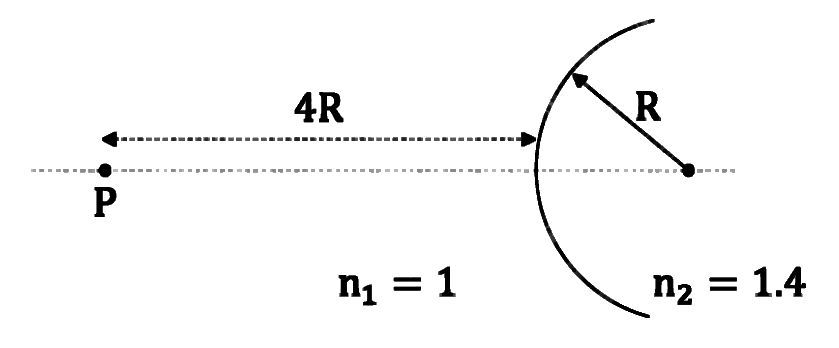
  3. So the answer is (a) +15+15 cm.
Report a mistake