Physics Circle home Home Practice Hub Register / Login

Home›Practice Hub›Chapters›Rotational Motion

Physics PYQs · MHT CET · JEE Main · NEET

Rotational Motion

Questions
588
MHT CET
197
JEE Main
280
NEET
111
Years
1988–2026
0 of 588 attemptedPick an answer to see the solution

Q1MHT CET 2026 · 20 MAY · SHIFT 1Easy

Moment of Inertia & Radius of Gyration · Point masses & rigid systems

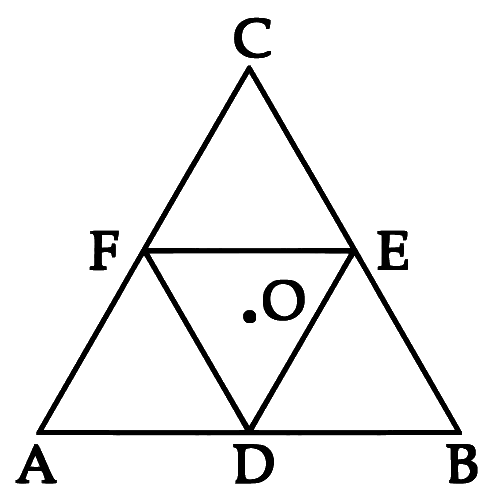
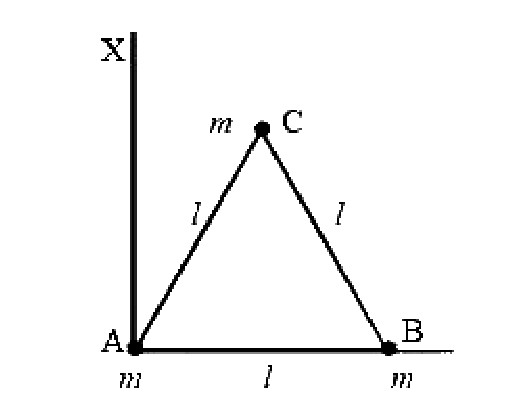
At the corners of an equilateral triangle of side L, point masses, each of mass 22 kg are placed. The moment of inertia of the system about an axis along any one side is (in kg-m2\text{-m}^{2})

Show answer and solution

Answer: (c)

  1. Two masses lie on the axis (the chosen side), so they contribute nothing.
  2. The third mass is at the triangle's height h=32Lh = \frac{\sqrt{3}}{2}L from that side.
  3. I=2×(3L2)2=2×3L24=3L22I = 2 \times \left(\frac{\sqrt{3}L}{2}\right)^2 = 2 \times \frac{3L^2}{4} = \frac{3L^2}{2}
  4. So the answer is (c) 3L22\frac{3L^2}{2}.
Report a mistake
Q2MHT CET 2026 · 13 MAY · SHIFT 1Easy

Moment of Inertia & Radius of Gyration · Point masses & rigid systems

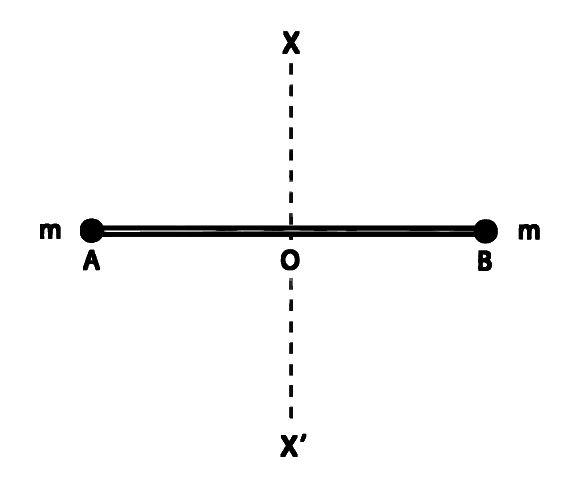
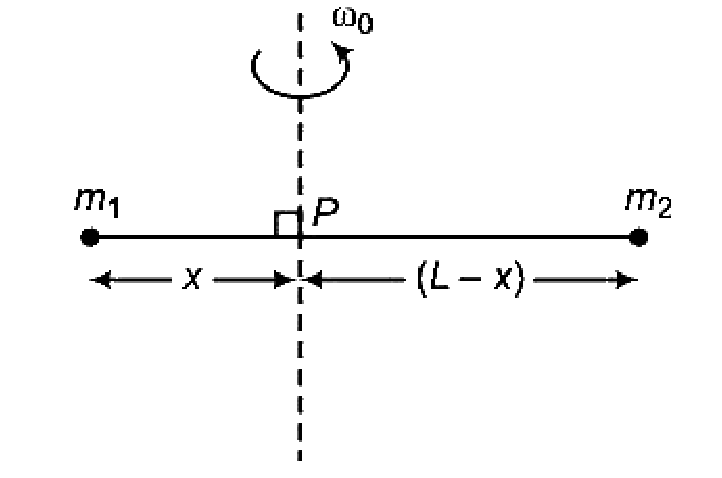
The moment of inertia of two equal masses each of mass m at separation L connected by a rod of mass M about an axis passing through centre and perpendicular to the length of rod is

Figure

Show answer and solution

Answer: (b)

  1. Rod about its centre: Irod=ML212I_{rod} = \frac{ML^2}{12}.
  2. Each mass is at L2\frac{L}{2} from the axis: Imasses=2m(L2)2=mL22=6mL212I_{masses} = 2m\left(\frac{L}{2}\right)^2 = \frac{mL^2}{2} = \frac{6mL^2}{12}
  3. I=ML212+6mL212=(M+6m)L212I = \frac{ML^2}{12} + \frac{6mL^2}{12} = \frac{(M+6m)L^2}{12}
  4. So the answer is (b) (M+6m)L212\frac{(M+6m)L^2}{12}.
Report a mistake
Q3MHT CET 2026 · 11 APR · SHIFT 2Easy

Moment of Inertia & Radius of Gyration · Standard bodies & radius of gyration

Let M and L be the mass and length of thin uniform rod respectively. In first case, axis of rotation is passing through centre and perpendicular to length of rod. In second case axis of rotation is passing through one end and perpendicular to length of rod. The ratio of radius of gyration in first case to second case is

Show answer and solution

Answer: (b)

  1. About the centre: I1=ML212⇒K1=L12I_1 = \frac{ML^2}{12} \Rightarrow K_1 = \frac{L}{\sqrt{12}}.
  2. About one end: I2=ML23⇒K2=L3I_2 = \frac{ML^2}{3} \Rightarrow K_2 = \frac{L}{\sqrt{3}}.
  3. K1K2=312=12\frac{K_1}{K_2} = \sqrt{\frac{3}{12}} = \frac{1}{2}
  4. So the answer is (b) 12\frac{1}{2}.
Report a mistake
Q4MHT CET 2026 · 15 MAY · SHIFT 2Easy

Moment of Inertia & Radius of Gyration · Parallel & perpendicular axis theorems

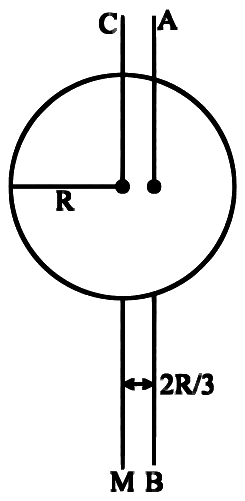
Moment of inertia of a disc of mass mm and radius RR about the centre of mass and perpendicular to plane is I1I_1 and moment of inertia of disc at a distance 2R3\frac{2R}{3} from centre and perpendicular to plane is I2I_2 then I1/I2I_1/I_2 is

Show answer and solution

Answer: (b)

  1. I1=mR22I_1 = \frac{mR^2}{2} (centre, perpendicular to plane).
  2. Parallel axis at 2R3\frac{2R}{3}: I2=mR22+m4R29=1718mR2I_2 = \frac{mR^2}{2} + m\frac{4R^2}{9} = \frac{17}{18}mR^2
  3. I1I2=1/217/18=917\frac{I_1}{I_2} = \frac{1/2}{17/18} = \frac{9}{17}
  4. So the answer is (b) 917\frac{9}{17}.
Report a mistake
Q5MHT CET 2026 · 14 MAY · SHIFT 1Easy

Moment of Inertia & Radius of Gyration · Parallel & perpendicular axis theorems

The moment of inertia of a solid sphere about an axis passing through centre of gravity is 2MR25\frac{2MR^2}{5} where M is the mass and R is the radius. The radius of gyration about a parallel axis at a distance 2R2R from first axis is

Show answer and solution

Answer: (b)

  1. Parallel axis theorem: I=25MR2+M(2R)2=25MR2+4MR2=225MR2I = \frac{2}{5}MR^2 + M(2R)^2 = \frac{2}{5}MR^2 + 4MR^2 = \frac{22}{5}MR^2
  2. K=IM=225 RK = \sqrt{\frac{I}{M}} = \sqrt{\frac{22}{5}}\,R
  3. So the answer is (b) 225 R\sqrt{\frac{22}{5}}\,R.
Report a mistake
Q6MHT CET 2026 · 17 APR · SHIFT 2Easy

Moment of Inertia & Radius of Gyration · Parallel & perpendicular axis theorems

A solid sphere of radius R and mass M is rotating about its diameter. The moment of intertia of the solid sphere rotating about an axis at a distance R3\frac{R}{3} from the centre and parallel to that diameter is

Show answer and solution

Answer: (c)

  1. About a diameter: Icm=25MR2I_{cm} = \frac{2}{5}MR^2.
  2. Parallel axis at R3\frac{R}{3}: I=25MR2+MR29I = \frac{2}{5}MR^2 + \frac{MR^2}{9}
  3. I=18+545MR2=2345MR2I = \frac{18 + 5}{45}MR^2 = \frac{23}{45}MR^2
  4. So the answer is (c) 2345MR2\frac{23}{45}MR^2.
Report a mistake
Q7MHT CET 2026 · 16 APR · SHIFT 1Easy

Moment of Inertia & Radius of Gyration · Parallel & perpendicular axis theorems

A Solid sphere has mass M and radius R. Its moment of inertia about a parallel axis passing through a point at a distance R/3 from its centre is

Show answer and solution

Answer: (c)

  1. Icm=25MR2I_{cm} = \frac{2}{5}MR^2 about a diameter.
  2. I=25MR2+M(R3)2=18+545MR2I = \frac{2}{5}MR^2 + M\left(\frac{R}{3}\right)^2 = \frac{18 + 5}{45}MR^2
  3. I=23MR245I = \frac{23MR^2}{45}
  4. So the answer is (c) 23MR2/4523MR^2/45.
Report a mistake
Q8MHT CET 2026 · 13 APR · SHIFT 2Easy

Moment of Inertia & Radius of Gyration · Parallel & perpendicular axis theorems

Moment of inertia of a disc of mass MM and radius 'R' about any of its diameter is MR2/4MR^2/4. The moment of inertia of this disc about an axis normal to the disc and passing through a point on its edge will be, (x/2)MR2(x/2)MR^2. The value of xx is

Show answer and solution

Answer: (b)

  1. Perpendicular axis theorem: Icm=2×MR24=MR22I_{cm} = 2 \times \frac{MR^2}{4} = \frac{MR^2}{2} (normal to disc through centre).
  2. Parallel axis through a point on the edge: I=MR22+MR2=32MR2I = \frac{MR^2}{2} + MR^2 = \frac{3}{2}MR^2
  3. Comparing with x2MR2\frac{x}{2}MR^2: x=3x = 3.
  4. So the answer is (b) 33.
Report a mistake
Q9MHT CET 2026 · 19 MAY · SHIFT 2Medium

Moment of Inertia & Radius of Gyration · Point masses & rigid systems

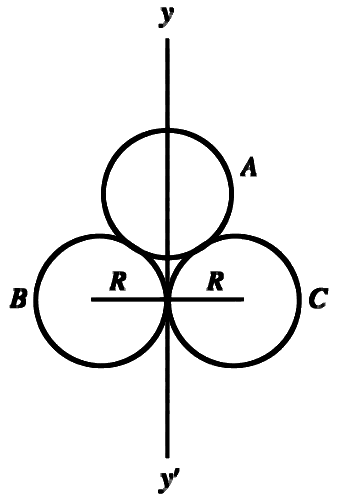
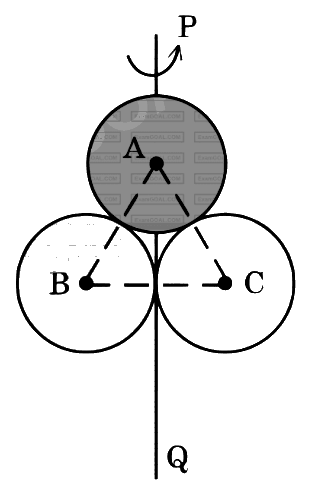
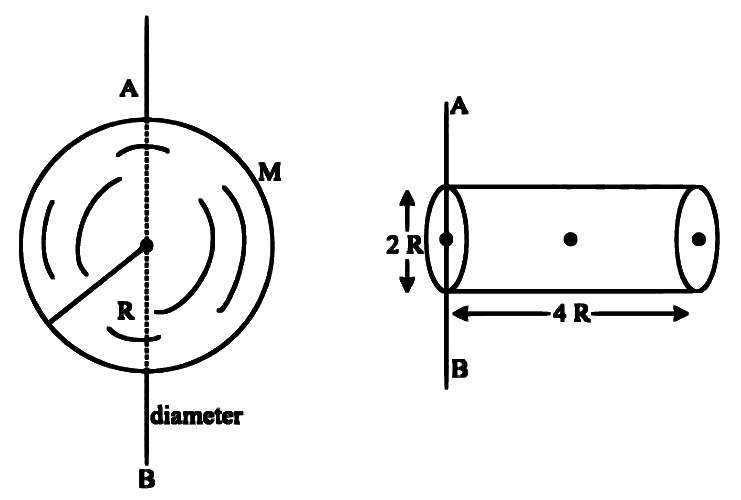
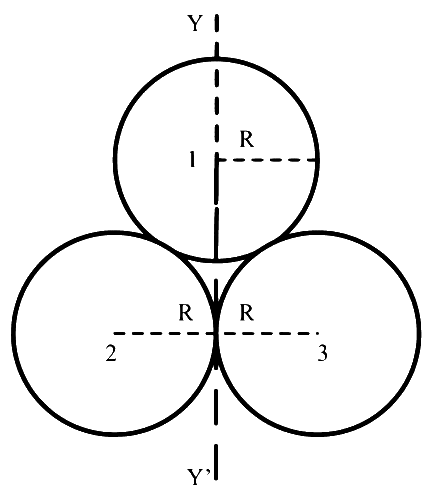
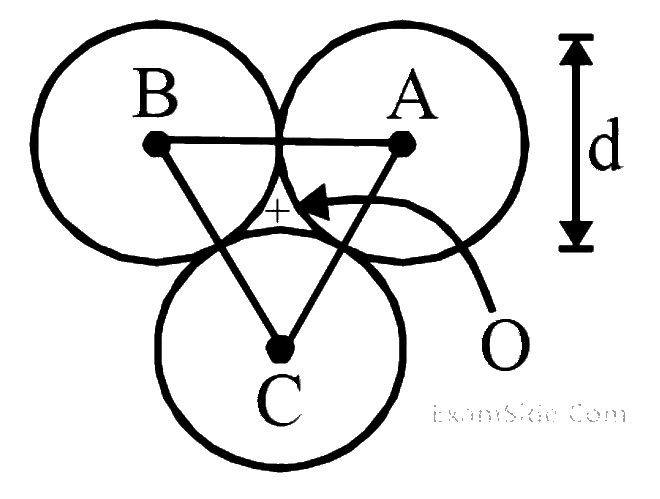
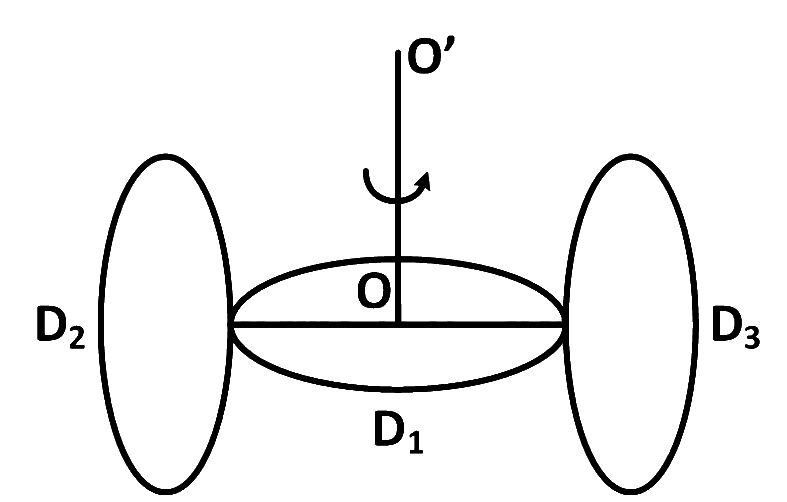
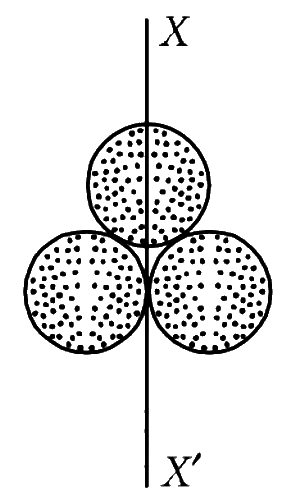
Three rings each of mass MM and radius RR are arranged as shown in the figure. The moment of inertia of a system about axis YY′YY' will be

Figure

Show answer and solution

Answer: (c)

  1. Ring A: YY′YY' is its diameter, IA=12MR2I_A = \frac{1}{2}MR^2.
  2. Rings B, C: YY′YY' is a tangent in their plane, I=12MR2+MR2=32MR2I = \frac{1}{2}MR^2 + MR^2 = \frac{3}{2}MR^2 each.
  3. I=12MR2+2×32MR2=72MR2I = \frac{1}{2}MR^2 + 2\times\frac{3}{2}MR^2 = \frac{7}{2}MR^2
  4. So the answer is (c) 7MR22\frac{7MR^2}{2}.
Report a mistake
Q10MHT CET 2026 · 15 MAY · SHIFT 1Medium

Moment of Inertia & Radius of Gyration · Point masses & rigid systems

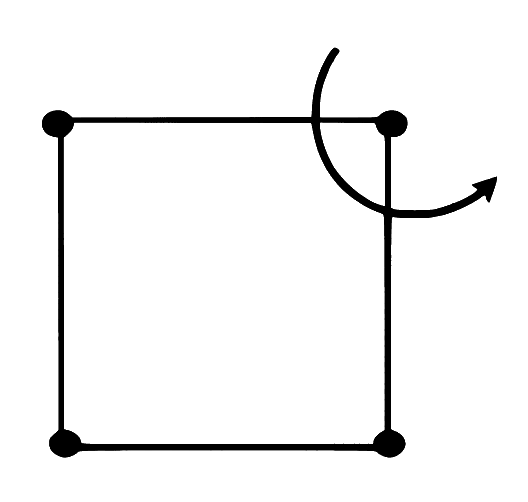
A square frame ABCD is formed by 4 identical rods each of mass mm and length ℓ\ell. This frame is in XY plane such that side AB coincides with x-axis and side AD along y-axis. The moment of inertia of the frame about x-axis is

Show answer and solution

Answer: (a)

  1. Rod AB lies on the x-axis: I=0I = 0.
  2. Rods AD and BC are perpendicular to x-axis with one end on it: mℓ23\frac{m\ell^2}{3} each.
  3. Rod DC is parallel to x-axis at distance ℓ\ell: mℓ2m\ell^2.
  4. I=0+2mℓ23+mℓ2=5mℓ23I = 0 + \frac{2m\ell^2}{3} + m\ell^2 = \frac{5m\ell^2}{3}, so the answer is (a).
Report a mistake
Q11MHT CET 2026 · 12 MAY · SHIFT 1Medium

Moment of Inertia & Radius of Gyration · Point masses & rigid systems

Four solid spheres, each of diameter 5\sqrt{5} cm and mass 0.50.5 kg are placed with their centres at the corners of a square of side 44 cm. The M.I. of the system about the diagonal of the square is N×10−4N \times 10^{-4} kg-m22, then NN is

Show answer and solution

Answer: (a)

  1. r=52r = \frac{\sqrt5}{2} cm, so 25mr2=25(0.5)(1.25×10⁻⁴)=0.25×10⁻⁴\frac{2}{5}mr^2 = \frac{2}{5}(0.5)(1.25\times10^{-4}) = 0.25\times10^{-4} kg m2^2.
  2. Two spheres on the diagonal: 2×0.25×10−4=0.5×10−42\times0.25\times10^{-4} = 0.5\times10^{-4}.
  3. Other two are at half-diagonal 222\sqrt2 cm: each 0.25×10⁻⁴+0.5×8×10−4=4.25×10−40.25\times10^{-4} + 0.5\times8\times10^{-4} = 4.25\times10^{-4}.
  4. Total =0.5+8.5=9×10−4= 0.5 + 8.5 = 9\times10^{-4} kg m2^2, so N=9N = 9, answer (a).
Report a mistake
Q12MHT CET 2026 · 17 APR · SHIFT 1Medium

Moment of Inertia & Radius of Gyration · Point masses & rigid systems

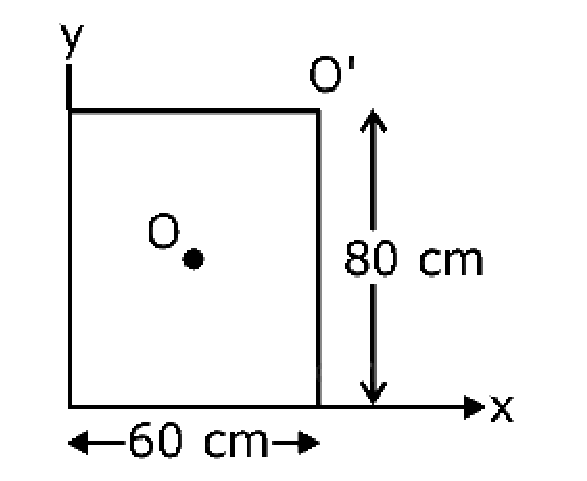
Four point masses m, 2m, 3m and 4m are kept at the corners A, B, C and D respectively of a square ABCD of side 'bb'. The moment of inertia of the system about an axis perpendicular to the plane of the square and passing through the point D is

Show answer and solution

Answer: (c)

  1. Distances from D: A and C at bb, B at 2b\sqrt2 b; D itself gives 0.
  2. I=mb2+3mb2+2m(2b2)I = m b^2 + 3m b^2 + 2m(2b^2)
  3. I=8mb2I = 8mb^2, so the answer is (c).
Report a mistake
Q13MHT CET 2026 · 17 APR · SHIFT 1Medium

Moment of Inertia & Radius of Gyration · Point masses & rigid systems

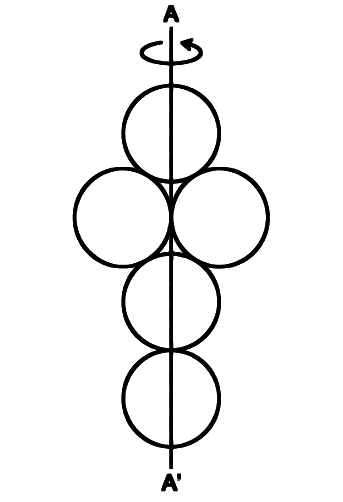
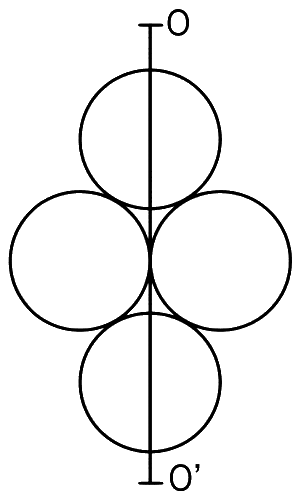
A system of five solid spheres each of mass 'mm' and radius 'rr' are rotating about an axis AA' as shown in figure. Hence the moment of inertia of the system about the axis of rotation AA' is

Figure

Show answer and solution

Answer: (c)

  1. Three spheres have AA' as a diameter: 3×25mr2=65mr23\times\frac{2}{5}mr^2 = \frac{6}{5}mr^2.
  2. Two side spheres touch the axis (d=rd = r): 2(25mr2+mr2)=145mr22\left(\frac{2}{5}mr^2 + mr^2\right) = \frac{14}{5}mr^2.
  3. I=205mr2=4mr2I = \frac{20}{5}mr^2 = 4mr^2, so the answer is (c).
Report a mistake
Q14JEE Main 2026 · 21 JAN · SHIFT 1Medium

Moment of Inertia & Radius of Gyration · Point masses & rigid systems

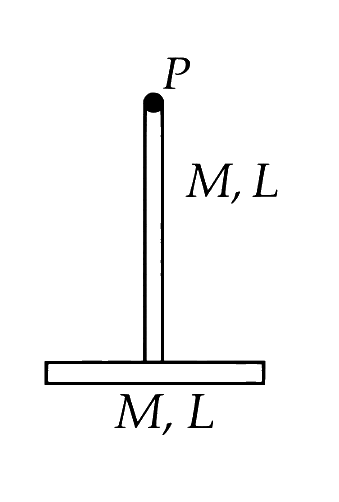
Two identical thin rods of mass M kgM\text{ kg} and length L mL\text{ m} are connected as shown in figure. Moment of inertia of the combined rod system about an axis passing through point PP and perpendicular to the plane of the rods is x12ML2 kg m2\frac{x}{12}ML^2\text{ kg m}^2. The value of xx is ______.

Figure

Numerical answer type. Work it out, then open the answer.

Show answer and solution

Answer: 17

  1. Vertical rod, axis through its end P: ML23\frac{ML^2}{3}.
  2. Horizontal rod's centre is LL below P: ML212+ML2\frac{ML^2}{12} + ML^2.
  3. I=4+1+1212ML2=1712ML2I = \frac{4+1+12}{12}ML^2 = \frac{17}{12}ML^2, so x=17x = 17.
Report a mistake
Q15MHT CET 2026 · 17 APR · SHIFT 2Medium

Moment of Inertia & Radius of Gyration · Standard bodies & radius of gyration

Radius of gyration of a thin uniform circular disc about the axis passing through its centre and perpendicular to its plane is KcK_c. Radius of gyration of the same disc about a diamter of the disc is KdK_d. the ratio Kd:KcK_d : K_c is

Show answer and solution

Answer: (b)

  1. Perpendicular axis: Ic=12MR2⇒Kc2=R22I_c = \frac{1}{2}MR^2 \Rightarrow K_c^2 = \frac{R^2}{2}.
  2. Diameter: Id=14MR2⇒Kd2=R24I_d = \frac{1}{4}MR^2 \Rightarrow K_d^2 = \frac{R^2}{4}.
  3. KdKc=1/41/2=12\frac{K_d}{K_c} = \sqrt{\frac{1/4}{1/2}} = \frac{1}{\sqrt{2}}
  4. So the answer is (b) 1:21 : \sqrt{2}.
Report a mistake
Q16MHT CET 2026 · 13 MAY · SHIFT 2Medium

Moment of Inertia & Radius of Gyration · Parallel & perpendicular axis theorems

The ratio of radius of gyration of circular disc about a tangential axis in its plane and of a circular ring of the same radius about a tangential axis in its plane is

Show answer and solution

Answer: (c)

  1. Disc, tangent in its plane: 14MR2+MR2=54MR2⇒K12=54R2\frac{1}{4}MR^2 + MR^2 = \frac{5}{4}MR^2 \Rightarrow K_1^2 = \frac{5}{4}R^2.
  2. Ring, tangent in its plane: 12MR2+MR2=32MR2⇒K22=32R2\frac{1}{2}MR^2 + MR^2 = \frac{3}{2}MR^2 \Rightarrow K_2^2 = \frac{3}{2}R^2.
  3. K1K2=5/43/2=56\frac{K_1}{K_2} = \sqrt{\frac{5/4}{3/2}} = \sqrt{\frac{5}{6}}
  4. So the answer is (c) 5:6\sqrt{5} : \sqrt{6}.
Report a mistake
Q17MHT CET 2026 · 20 APR · SHIFT 2Medium

Moment of Inertia & Radius of Gyration · Parallel & perpendicular axis theorems

A solid sphere of mass 5 kg and a disc of mass 4 kg have the same radius. The ratio of moment of inertia of the sphere about its tangent to the moment of inertia of the disc about a tangent in its plane will be x:yx : y. The value of xx and yy respectively is

Show answer and solution

Answer: (c)

  1. Sphere about tangent: 75MR2=75(5)R2=7R2\frac{7}{5}MR^2 = \frac{7}{5}(5)R^2 = 7R^2.
  2. Disc about tangent in its plane: 54MR2=54(4)R2=5R2\frac{5}{4}MR^2 = \frac{5}{4}(4)R^2 = 5R^2.
  3. Ratio =7:5= 7 : 5.
  4. So the answer is (c) 7,57, 5.
Report a mistake
Q18MHT CET 2026 · 20 APR · SHIFT 1Medium

Moment of Inertia & Radius of Gyration · Parallel & perpendicular axis theorems

Two identical rings A and B of same mass and radius are revolving, ring A arounds its own diameter and ring B about tangential axis in its own plane. Both the rings A and B have same rotational kinetic energy. The ratio of the angular velocity of ring B to that of ring A is

Show answer and solution

Answer: (b)

  1. Ring A about diameter: IA=12MR2I_A = \frac{1}{2}MR^2. Ring B about tangent in its plane: IB=32MR2I_B = \frac{3}{2}MR^2.
  2. Equal KE: 12IAωA2=12IBωB2⇒ωBωA=IAIB=13\frac{1}{2}I_A\omega_A^2 = \frac{1}{2}I_B\omega_B^2 \Rightarrow \frac{\omega_B}{\omega_A} = \sqrt{\frac{I_A}{I_B}} = \sqrt{\frac{1}{3}}
  3. So the answer is (b) 1:31 : \sqrt{3}.
Report a mistake
Q19MHT CET 2026 · 19 APR · SHIFT 1Medium

Moment of Inertia & Radius of Gyration · Parallel & perpendicular axis theorems

The radius of gyration of a solid sphere of radius 'R' and mass 'M' about its diameter is KdK_d and that about a tangent of a solid sphere is KtK_t. The ratio of KdK_d to KtK_t is

Show answer and solution

Answer: (c)

  1. Diameter: Kd2=25R2K_d^2 = \frac{2}{5}R^2. Tangent: Kt2=25R2+R2=75R2K_t^2 = \frac{2}{5}R^2 + R^2 = \frac{7}{5}R^2.
  2. KdKt=27\frac{K_d}{K_t} = \sqrt{\frac{2}{7}}
  3. So the answer is (c) (27)1/2\left(\frac{2}{7}\right)^{1/2}.
Report a mistake
Q20MHT CET 2026 · 18 APR · SHIFT 1Medium

Moment of Inertia & Radius of Gyration · Parallel & perpendicular axis theorems

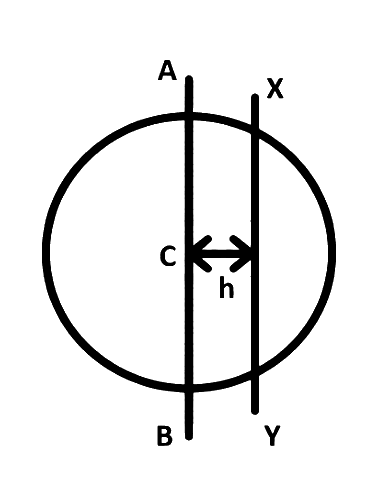
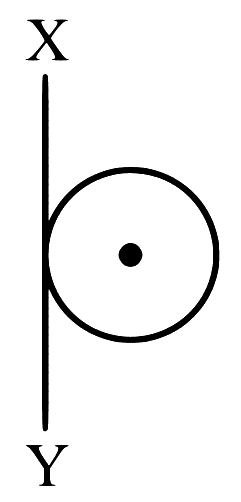
The radius of gyration K of a hollow sphere of mass M and radius R about an axis XY is equal to R as shown in figure. The distance of that axis from the center of the sphere is h. The value of h is

Figure

Show answer and solution

Answer: (a)

  1. Parallel axis: IXY=23MR2+Mh2I_{XY} = \frac{2}{3}MR^2 + Mh^2.
  2. K=R⇒IXY=MR2K = R \Rightarrow I_{XY} = MR^2, so h2=R2−23R2=R23h^2 = R^2 - \frac{2}{3}R^2 = \frac{R^2}{3}.
  3. So the answer is (a) R3\frac{R}{\sqrt{3}}.
Report a mistake
Q21MHT CET 2026 · 16 APR · SHIFT 2Medium

Moment of Inertia & Radius of Gyration · Parallel & perpendicular axis theorems

A solid sphere of mass M and a disc of mass M2\frac{M}{2} have the same radius. The ratio of moment of inertia of the disc about a tangent in its plane to the moment of inertia of the sphere about its tangent will be

Show answer and solution

Answer: (b)

  1. Disc (mass M2\frac{M}{2}), tangent in its plane: 54⋅M2R2=58MR2\frac{5}{4}\cdot\frac{M}{2}R^2 = \frac{5}{8}MR^2.
  2. Sphere, tangent: 75MR2\frac{7}{5}MR^2.
  3. Ratio =5/87/5=2556= \frac{5/8}{7/5} = \frac{25}{56}
  4. So the answer is (b) 25:5625 : 56.
Report a mistake
Q22MHT CET 2026 · 16 APR · SHIFT 2Medium

Moment of Inertia & Radius of Gyration · Parallel & perpendicular axis theorems

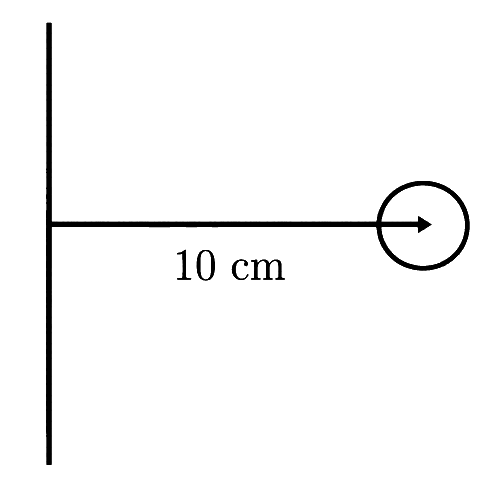
Solid sphere is rotating about an axis as shown in figure. If the radius of the sphere is 5 cm, then radius of gyration about that axis will be x\sqrt{x} cm. The value of x is

Figure

Show answer and solution

Answer: (b)

  1. Centre of the sphere is d=10 cmd = 10\text{ cm} from the axis; R=5 cmR = 5\text{ cm}.
  2. K2=25R2+d2=25(25)+100=110 cm2K^2 = \frac{2}{5}R^2 + d^2 = \frac{2}{5}(25) + 100 = 110\text{ cm}^2
  3. So the answer is (b) x=110x = 110.
Report a mistake
Q23JEE Main 2026 · 2 APR · SHIFT 2Medium

Moment of Inertia & Radius of Gyration · Parallel & perpendicular axis theorems

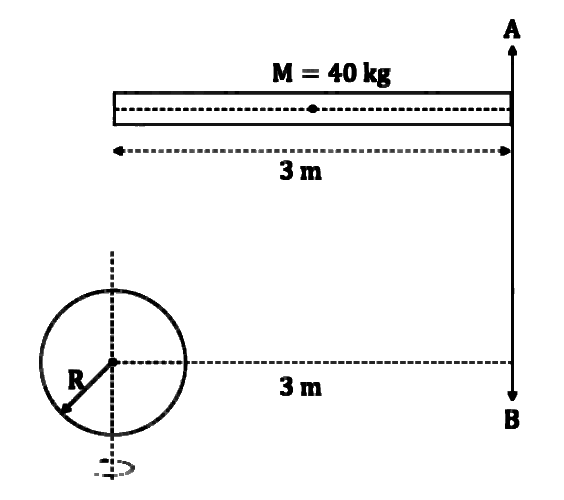
Moment of inertia about an axis AB for a rod of mass 40 kg and length 3 m is same as that of a solid sphere of mass of 10 kg and radius RR about an axis parallel to AB axis with separation of 3 m as shown in figure below. The value of RR is given as α2\sqrt{\frac{\alpha}{2}}. The value of α\alpha is ________.

Figure

Numerical answer type. Work it out, then open the answer.

Show answer and solution

Answer: 15

  1. Rod about axis AB at its end: Irod=ML23=40×93=120 kg m2I_{rod} = \frac{ML^2}{3} = \frac{40 \times 9}{3} = 120\ \text{kg m}^2.
  2. Sphere about a parallel axis 3 m from its centre: I=25mR2+md2=4R2+90I = \frac{2}{5}mR^2 + md^2 = 4R^2 + 90.
  3. 4R2+90=120⇒R2=7.5=1524R^2 + 90 = 120 \Rightarrow R^2 = 7.5 = \frac{15}{2}
  4. R=152R = \sqrt{\frac{15}{2}}, so α=15\alpha = 15.
Report a mistake
Q24JEE Main 2026 · 28 JAN · SHIFT 1Medium

Moment of Inertia & Radius of Gyration · Parallel & perpendicular axis theorems

A solid sphere of radius 10 cm is rotating about an axis which is at a distance 15 cm from its centre. The radius of gyration about this axis is n cm\sqrt{n}\text{ cm}. The value of nn is

Numerical answer type. Work it out, then open the answer.

Show answer and solution

Answer: 265

  1. Parallel axis theorem: k2=25R2+d2k^2 = \frac{2}{5}R^2 + d^2.
  2. k2=25(10)2+(15)2=40+225=265 cm2k^2 = \frac{2}{5}(10)^2 + (15)^2 = 40 + 225 = 265\ \text{cm}^2
  3. k=265k = \sqrt{265} cm, so n=265n = 265.
Report a mistake
Q25MHT CET 2026 · 13 MAY · SHIFT 2Medium

Moment of Inertia & Radius of Gyration · Bending, recasting & scaling

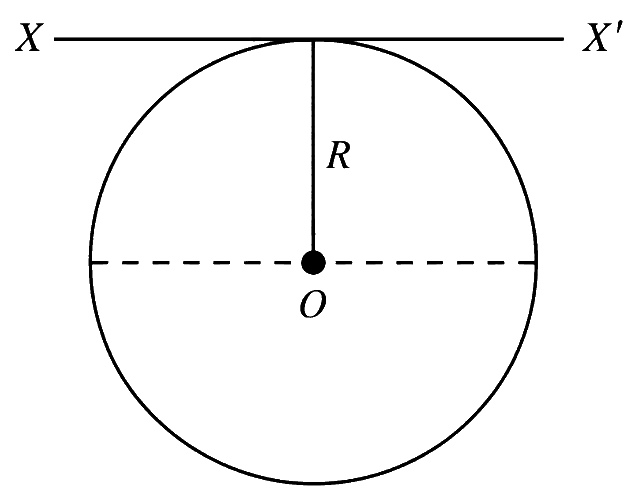
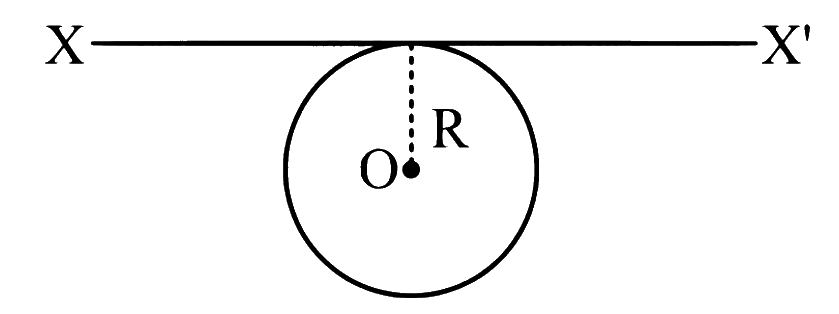
A thin wire of length LL and uniform linear mass density ρ\rho is bent into a circular loop with centre at 'OO' as shown in figure. The moment of inertia of the loop about the axis XX′XX' is

Figure

Show answer and solution

Answer: (d)

  1. Mass M=ρLM = \rho L, radius R=L2πR = \frac{L}{2\pi}.
  2. XX′XX' is a tangent in the plane of the loop: I=MR22+MR2=32MR2I = \frac{MR^2}{2} + MR^2 = \frac{3}{2}MR^2.
  3. I=32ρL⋅L24π2=3ρL38π2I = \frac{3}{2}\rho L \cdot \frac{L^2}{4\pi^2} = \frac{3\rho L^3}{8\pi^2}
  4. So the answer is (d) 3ρL38π2\frac{3\rho L^3}{8\pi^2}.
Report a mistake
Q26MHT CET 2026 · 13 MAY · SHIFT 1Medium

Moment of Inertia & Radius of Gyration · Bending, recasting & scaling

Moment of inertia of a thin uniform rod rotating about the perpendicular axis passing through its centre is I. If the same rod is bent in to a ring and its moment of inertia about its diameter is I1I_1, then the ratio I/I1I/I_1 is

Show answer and solution

Answer: (a)

  1. Rod: I=ML212I = \frac{ML^2}{12}.
  2. Ring: R=L2πR = \frac{L}{2\pi}, about a diameter I1=MR22=ML28π2I_1 = \frac{MR^2}{2} = \frac{ML^2}{8\pi^2}.
  3. II1=8π212=2π23\frac{I}{I_1} = \frac{8\pi^2}{12} = \frac{2\pi^2}{3}
  4. So the answer is (a) 2π23\frac{2\pi^2}{3}.
Report a mistake
Q27MHT CET 2026 · 12 MAY · SHIFT 2Medium

Moment of Inertia & Radius of Gyration · Bending, recasting & scaling

Two loops AA and BB of radii R1R_1 and R2R_2 are made from uniform wire. If moment of inertia of loops AA and BB is IAI_A and IBI_B respectively then R1R2\frac{R_1}{R_2} is (Given: IAIB=27\frac{I_A}{I_B} = 27)

Show answer and solution

Answer: (d)

  1. Same wire: M=λ(2πR)∝RM = \lambda (2\pi R) \propto R, so I=MR2∝R3I = MR^2 \propto R^3.
  2. (R1R2)3=27⇒R1R2=3\left(\frac{R_1}{R_2}\right)^3 = 27 \Rightarrow \frac{R_1}{R_2} = 3
  3. So the answer is (d) 3:13 : 1.
Report a mistake
Q28MHT CET 2026 · 13 APR · SHIFT 2Medium

Moment of Inertia & Radius of Gyration · Bending, recasting & scaling

A thin uniform rod of length 22 m cross-sectional area 'A' and density 'd' is rotated about an axis passing through the centre and perpendicular to its length with angular velocity ω\omega. If the value of ω\omega in terms of its rotational kinetic energy EE is (αE/Ad)1/2(\alpha E/Ad)^{1/2}, then the value of α\alpha is

Show answer and solution

Answer: (b)

  1. Mass M=A⋅2⋅d=2AdM = A \cdot 2 \cdot d = 2Ad, I=ML212=2Ad⋅412=2Ad3I = \frac{ML^2}{12} = \frac{2Ad \cdot 4}{12} = \frac{2Ad}{3}.
  2. E=12Iω2=Ad ω23E = \frac{1}{2}I\omega^2 = \frac{Ad\,\omega^2}{3}
  3. ω=(3EAd)1/2\omega = \left(\frac{3E}{Ad}\right)^{1/2}, so α=3\alpha = 3.
  4. So the answer is (b) 3.
Report a mistake
Q29NEET 2026Medium

Moment of Inertia & Radius of Gyration · Bending, recasting & scaling

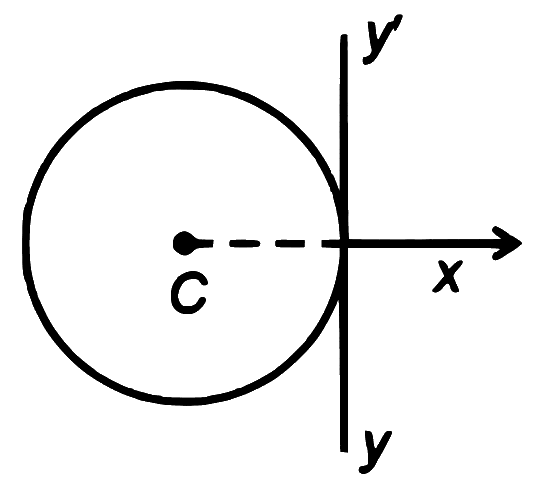
A thin wire of length ' LL ' and linear mass density ' mm ' is bent into a circular ring (in x−yx-y plane) with centre ' CC ' as shown in figure. The moment of inertia of the ring about an axis yy′yy' will be:

Figure

Show answer and solution

Answer: (b)

  1. Mass M=mLM = mL, radius R=L2πR = \frac{L}{2\pi}.
  2. yy′yy' touches the ring and lies in its plane (tangent): I=MR22+MR2=32MR2I = \frac{MR^2}{2} + MR^2 = \frac{3}{2}MR^2.
  3. I=32mL⋅L24π2=3mL38π2I = \frac{3}{2}mL\cdot\frac{L^2}{4\pi^2} = \frac{3mL^3}{8\pi^2}
  4. So the answer is (b) 3mL38π2\frac{3mL^3}{8\pi^2}.
Report a mistake
Q30JEE Main 2026 · 22 JAN · SHIFT 1Medium

Moment of Inertia & Radius of Gyration · Bending, recasting & scaling

A circular disc has radius R1R_1 and thickness T1T_1. Another circular disc made of the same material has radius R2R_2 and thickness T2T_2. If the moment of inertia of both discs are same and R1R2=2\frac{R_1}{R_2} = 2 then T1T2=1α\frac{T_1}{T_2} = \frac{1}{\alpha}. The value of α\alpha is ______.

Numerical answer type. Work it out, then open the answer.

Show answer and solution

Answer: 16

  1. I=12(ρπR2T)R2∝TR4I = \frac{1}{2}(\rho\pi R^2 T)R^2 \propto TR^4.
  2. T1R14=T2R24⇒T1T2=(R2R1)4=116T_1R_1^4 = T_2R_2^4 \Rightarrow \frac{T_1}{T_2} = \left(\frac{R_2}{R_1}\right)^4 = \frac{1}{16}
  3. So α=16\alpha = 16.
Report a mistake
Q31NEET 2026 · RE-NEETMedium

Moment of Inertia & Radius of Gyration · Composite bodies & cut-outs

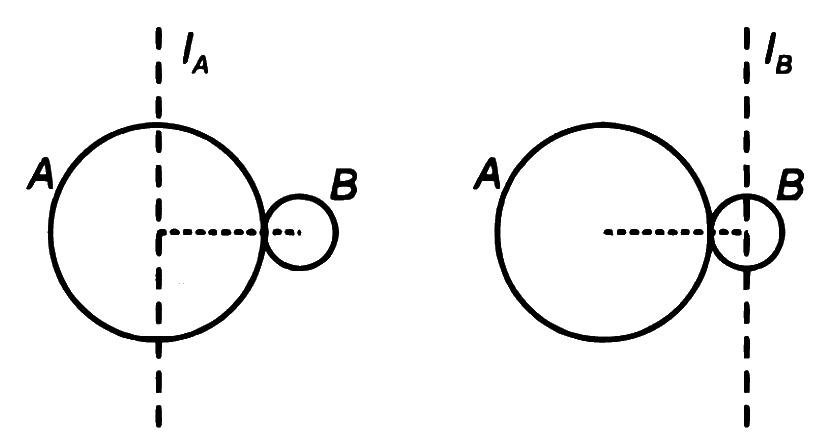
A solid sphere AA of radius RR and mass MM is attached at a point to a smaller solid sphere BB of radius r<Rr < R and mass m<Mm < M. Assume that the line joining their centres lies along the horizontal. The moment of inertia of the system calculated about a vertical axis passing through the centre of AA is IAI_A and that about a vertical axis passing through the centre of BB is IBI_B. The difference IA−IBI_A - I_B is:

Figure

Show answer and solution

Answer: (c)

  1. Distance between centres =R+r= R + r.
  2. IA=25MR2+25mr2+m(R+r)2I_A = \frac{2}{5}MR^2 + \frac{2}{5}mr^2 + m(R+r)^2
  3. IB=25MR2+M(R+r)2+25mr2I_B = \frac{2}{5}MR^2 + M(R+r)^2 + \frac{2}{5}mr^2
  4. IA−IB=(m−M)(R+r)2I_A - I_B = (m - M)(R+r)^2, so the answer is (c).
Report a mistake
Q32JEE Main 2026 · 28 JAN · SHIFT 1Medium

Moment of Inertia & Radius of Gyration · Composite bodies & cut-outs

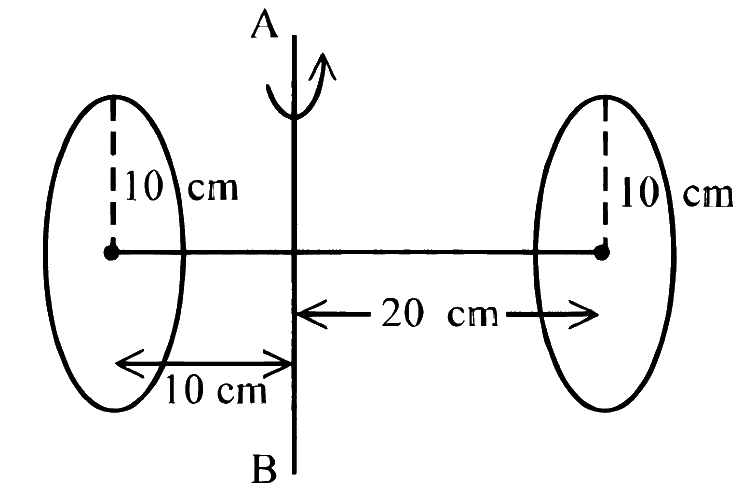
Two circular discs of radius each 10 cm are joined at their centres by a rod of length 30 cm and mass 600 gm as shown in figure.

If the mass of each disc is 600 gm and applied torque between two discs is 43×10543 \times 10^{5} dyne.cm, the angular acceleration of the discs about the given axis ABAB is ‾ rad/s2\underline{\qquad}\ \text{rad/s}^2.

Figure

Show answer and solution

Answer: (d)

  1. In CGS: discs 600 g600\text{ g}, r=10 cmr = 10\text{ cm}, centres at 10 cm10\text{ cm} and 20 cm20\text{ cm} from AB; AB lies along a diameter direction of each disc.
  2. Discs: mr24+md2\frac{mr^2}{4} + md^2: 15000+60000=7500015000 + 60000 = 75000 and 15000+240000=255000 g cm215000 + 240000 = 255000\text{ g cm}^2
  3. Rod (30 cm, centre 5 cm from AB): 600×90012+600×25=60000 g cm2\frac{600 \times 900}{12} + 600 \times 25 = 60000\text{ g cm}^2
  4. I=3.9×10⁵ g cm2I = 3.9 \times 10^5\text{ g cm}^2, α=τI=43×1053.9×105≈11 rad/s2\alpha = \frac{\tau}{I} = \frac{43 \times 10^5}{3.9 \times 10^5} \approx 11\text{ rad/s}^2
  5. So the answer is (d) 11.
Report a mistake
Q33JEE Main 2026 · 22 JAN · SHIFT 1Medium

Moment of Inertia & Radius of Gyration · Composite bodies & cut-outs

A solid sphere of mass 5 kg and radius 10 cm is kept in contact with another solid sphere of mass 10 kg and radius 20 cm. The moment of inertia of this pair of spheres about the tangent passing through the point of contact is ‾ kg⋅m2\underline{\qquad}\ \text{kg}\cdot\text{m}^2.

Show answer and solution

Answer: (d)

  1. The tangent is perpendicular to the line of centres, at distances 0.1 m0.1\text{ m} and 0.2 m0.2\text{ m} from the centres.
  2. Small: 25(5)(0.1)2+5(0.1)2=0.02+0.05=0.07\frac{2}{5}(5)(0.1)^2 + 5(0.1)^2 = 0.02 + 0.05 = 0.07
  3. Large: 25(10)(0.2)2+10(0.2)2=0.16+0.40=0.56\frac{2}{5}(10)(0.2)^2 + 10(0.2)^2 = 0.16 + 0.40 = 0.56
  4. Total =0.63 kg m2= 0.63\text{ kg m}^2, so the answer is (d).
Report a mistake
Q34JEE Main 2026 · 4 APR · SHIFT 1Difficult

Moment of Inertia & Radius of Gyration · Bending, recasting & scaling

A solid sphere of mass MM and radius RR is divided into two unequal parts. The smaller part having mass M/8M/8 is converted into a sphere of radius rr and the larger part is converted into a circular disc of thickness tt and radius 2R2R. If I1I_1 is moment of inertia of a sphere having radius rr about an axis through its centre and I2I_2 is the moment of inertia of a disc about its diameter, the ratio of their moment of inertia I2/I1=‾I_2/I_1 = \underline{\qquad}

Show answer and solution

Answer: (b)

  1. Mass M8\frac{M}{8} has 18\frac{1}{8} the volume, so r=R2r = \frac{R}{2}: I1=25M8R24=MR280I_1 = \frac{2}{5}\frac{M}{8}\frac{R^2}{4} = \frac{MR^2}{80}
  2. Disc of mass 7M8\frac{7M}{8}, radius 2R2R, about a diameter (thin): I2=147M8(2R)2=7MR28I_2 = \frac{1}{4}\frac{7M}{8}(2R)^2 = \frac{7MR^2}{8}
  3. I2I1=78×80=70\frac{I_2}{I_1} = \frac{7}{8} \times 80 = 70
  4. So the answer is (b) 70.
Report a mistake
Q35MHT CET 2026 · 18 APR · SHIFT 2Difficult

Moment of Inertia & Radius of Gyration · Composite bodies & cut-outs

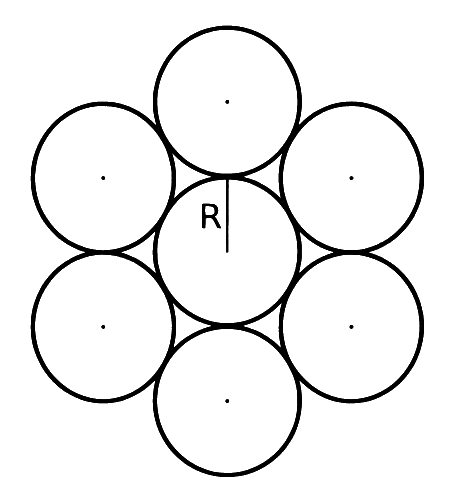
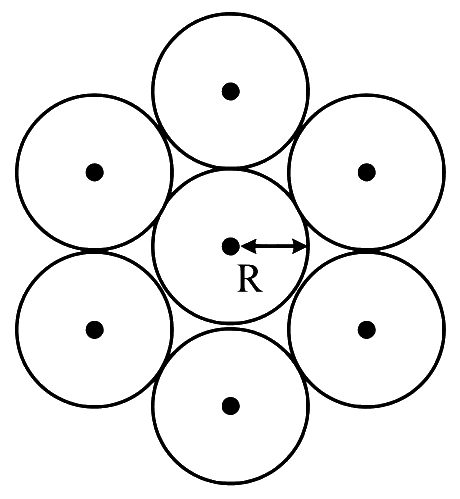
Given identical rings are arranged in a hexagonal plane pattern so as to touch each neighbouring ring as shown in figure. Each ring has mass M and radius R. The moment of inertia of the system of seven rings about an axis passing through the centre of central ring and normal to plane of all rings is

Figure

Show answer and solution

Answer: (a)

  1. Central ring: MR2MR^2.
  2. Each outer ring centre is 2R2R away: MR2+M(2R)2=5MR2MR^2 + M(2R)^2 = 5MR^2.
  3. I=MR2+6×5MR2=31MR2I = MR^2 + 6 \times 5MR^2 = 31MR^2
  4. So the answer is (a).
Report a mistake
Q36MHT CET 2026 · 16 APR · SHIFT 2Difficult

Moment of Inertia & Radius of Gyration · Composite bodies & cut-outs

A uniform solid cylinder with radius R and length L has moment of inertia I1I_1 about the axis of the cylinder. A concentric solid cylinder of radius R/2R/2 and length L/2L/2 is carved out of the original cylinder. If I2I_2 is the moment of inertia of the carved out portion of the cylinder then I1/I2I_1/I_2 is (Both I1I_1 and I2I_2 are about the axis of the cylinder)

Show answer and solution

Answer: (d)

  1. I1=MR22I_1 = \frac{MR^2}{2}
  2. Carved mass =M×14×12=M8= M \times \frac{1}{4} \times \frac{1}{2} = \frac{M}{8}: I2=12M8R24=MR264I_2 = \frac{1}{2}\frac{M}{8}\frac{R^2}{4} = \frac{MR^2}{64}
  3. I1I2=32\frac{I_1}{I_2} = 32, so the answer is (d) 32:132:1.
Report a mistake
Q37JEE Main 2026 · 23 JAN · SHIFT 1Difficult

Moment of Inertia & Radius of Gyration · Composite bodies & cut-outs

The moment of inertia of a square loop made of four uniform solid cylinders, each having radius RR and length L (R<L)L\,(R < L) about an axis passing through the mid points of opposite sides, is (Take the mass of the entire loop as MM):

Show answer and solution

Answer: (d)

axisL/2 awayL/2 awaycut at centre
  1. Each cylinder has mass m=M4m = \frac{M}{4}.
  2. Two sides cut by the axis at their centres (axis ⊥\perp to their length): m(R24+L212)m\left(\frac{R^2}{4} + \frac{L^2}{12}\right) each.
  3. Two sides parallel to the axis at distance L2\frac{L}{2}: mR22+mL24\frac{mR^2}{2} + \frac{mL^2}{4} each.
  4. I=2m(3R24+L23)=38MR2+16ML2I = 2m\left(\frac{3R^2}{4} + \frac{L^2}{3}\right) = \frac{3}{8}MR^2 + \frac{1}{6}ML^2
  5. So the answer is (d).
Report a mistake
Q38JEE Main 2026 · 24 JAN · SHIFT 2Difficult

Moment of Inertia & Radius of Gyration · Composite bodies & cut-outs

A uniform solid cylinder of length LL and radius RR has moment of inertia about its axis equal to I1I_1. A small co-centric cylinder of length L/2L/2 and radius R/3R/3 carved from this cylinder has moment of inertia about its axis equals to I2I_2. The ratio I1/I2I_1/I_2 is ______.

Numerical answer type. Work it out, then open the answer.

Show answer and solution

Answer: 162

  1. I1=MR22I_1 = \frac{MR^2}{2}
  2. Carved mass =M×19×12=M18= M \times \frac{1}{9} \times \frac{1}{2} = \frac{M}{18}: I2=12M18R29I_2 = \frac{1}{2}\frac{M}{18}\frac{R^2}{9}
  3. I1I2=18×9=162\frac{I_1}{I_2} = 18 \times 9 = 162
Report a mistake
Q39JEE Main 2026 · 23 JAN · SHIFT 2Difficult

Moment of Inertia & Radius of Gyration · Composite bodies & cut-outs

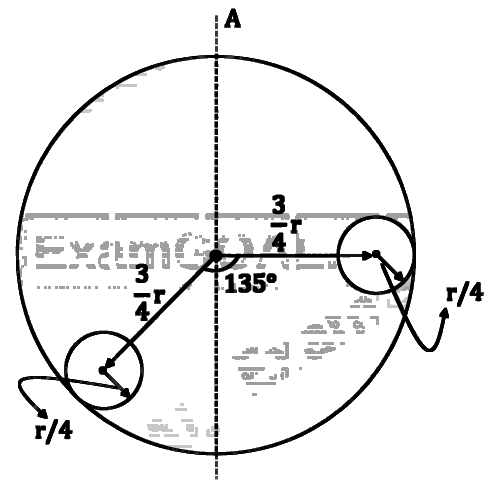
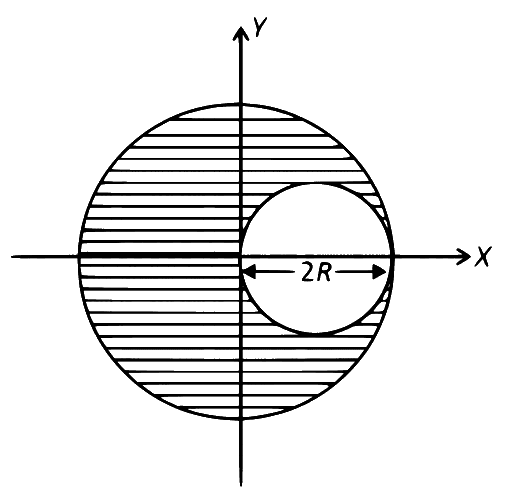
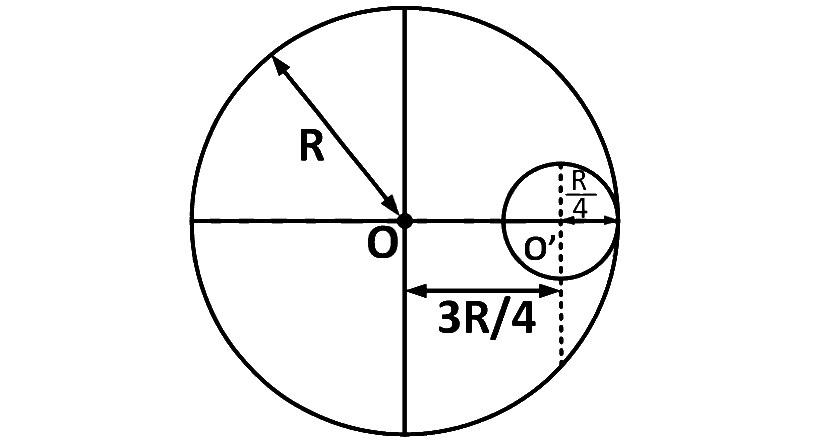
Suppose there is a uniform circular disc of mass M kgM\text{ kg} and radius r mr\text{ m} shown in figure. The shaded regions are cut out from the disc. The moment of inertia of the remainder about the axis AA of the disc is given by x256Mr2\frac{x}{256}Mr^2. The value of xx is ______.

Figure

Numerical answer type. Work it out, then open the answer.

Show answer and solution

Answer: 109

  1. Each hole: radius r4\frac{r}{4}, mass M16\frac{M}{16}, centre 3r4\frac{3r}{4} from axis A.
  2. One hole: 12M16r216+M169r216=19Mr2512\frac{1}{2}\frac{M}{16}\frac{r^2}{16} + \frac{M}{16}\frac{9r^2}{16} = \frac{19Mr^2}{512}
  3. Two holes: 19Mr2256\frac{19Mr^2}{256}
  4. I=128Mr2256−19Mr2256=109256Mr2I = \frac{128Mr^2}{256} - \frac{19Mr^2}{256} = \frac{109}{256}Mr^2, so x=109x = 109.
Report a mistake
Q40MHT CET 2025 · 25 APR · SHIFT 1Easy

Moment of Inertia & Radius of Gyration · Point masses & rigid systems

Four particles each of mass M are placed at the corners of a square of side L. The radius of gyration of the system about an axis perpendicular to the square and passing through its centre is

Show answer and solution

Answer: (b)

  1. Each corner is at half the diagonal from the centre: r=2L2=L2r = \frac{\sqrt{2}L}{2} = \frac{L}{\sqrt{2}}.
  2. I=4M(L2)2=2ML2I = 4M\left(\frac{L}{\sqrt{2}}\right)^2 = 2ML^2
  3. K2=I4M=L22⇒K=L2K^2 = \frac{I}{4M} = \frac{L^2}{2} \Rightarrow K = \frac{L}{\sqrt{2}}
  4. So the answer is (b) L2\frac{L}{\sqrt{2}}.
Report a mistake
Q41MHT CET 2025 · 19 APR · SHIFT 1Easy

Moment of Inertia & Radius of Gyration · Point masses & rigid systems

Four particles each of mass M are placed at the corners of a square of side LL. The radius of gyration of the system about an axis perpendicular to the square and passing through its centre is

Show answer and solution

Answer: (d)

  1. Each corner is at r=L2r = \frac{L}{\sqrt{2}} from the centre (half the diagonal).
  2. I=4M⋅L22=2ML2I = 4M \cdot \frac{L^2}{2} = 2ML^2
  3. K=I4M=L22=L2K = \sqrt{\frac{I}{4M}} = \sqrt{\frac{L^2}{2}} = \frac{L}{\sqrt{2}}
  4. So the answer is (d) L2\frac{L}{\sqrt{2}}.
Report a mistake
Q42MHT CET 2025 · 22 APR · SHIFT 1Easy

Moment of Inertia & Radius of Gyration · Standard bodies & radius of gyration

A solid sphere and thin walled hollow sphere have same mass and same material. Which of them have greater moment of inertia about their diameter?

[ Ih=I_h = moment of inertia of hollow sphere about an axis coinciding with its diameter, Is=I_s = moment of inertia of solid sphere about an axis coinciding with its diameter]

Show answer and solution

Answer: (c)

  1. Is=25MRs2I_s = \frac{2}{5}MR_s^2 and Ih=23MRh2I_h = \frac{2}{3}MR_h^2.
  2. Same mass and same material means the thin hollow sphere must be much larger: Rh>RsR_h > R_s.
  3. Also 23>25\frac{2}{3} > \frac{2}{5}, and the hollow sphere's mass is all at the largest radius, so Ih>IsI_h > I_s.
  4. So the answer is (c) Ih>IsI_h > I_s.
Report a mistake
Q43MHT CET 2025 · 5 MAY · SHIFT 2Easy

Moment of Inertia & Radius of Gyration · Parallel & perpendicular axis theorems

The moment of inertia of a thin uniform rod of mass ' MM ' and length ' LL ', about an axis perpendicular to length of the rod and at a distance ' L/4L/4 ' from one end is

Show answer and solution

Answer: (d)

  1. The point at L4\frac{L}{4} from one end is at d=L2−L4=L4d = \frac{L}{2} - \frac{L}{4} = \frac{L}{4} from the centre.
  2. I=ML212+ML216=4ML2+3ML248I = \frac{ML^2}{12} + M\frac{L^2}{16} = \frac{4ML^2 + 3ML^2}{48}
  3. I=7ML248I = \frac{7ML^2}{48}
  4. So the answer is (d) 7ML248\frac{7ML^2}{48}.
Report a mistake
Q44MHT CET 2025 · 25 APR · SHIFT 2Easy

Moment of Inertia & Radius of Gyration · Parallel & perpendicular axis theorems

The moment of inertia of a solid sphere of mass ' mm ' and radius ' RR ' about its diametric axis is ' II '. Its moment of inertia about a tangent in the plane is

Show answer and solution

Answer: (c)

  1. I=25mR2I = \frac{2}{5}mR^2 about a diameter.
  2. Tangent is parallel to a diameter at distance RR: It=25mR2+mR2=75mR2I_t = \frac{2}{5}mR^2 + mR^2 = \frac{7}{5}mR^2
  3. ItI=7/52/5=3.5\frac{I_t}{I} = \frac{7/5}{2/5} = 3.5
  4. So the answer is (c) 3.5 I3.5\,I.
Report a mistake
Q45JEE Main 2025 · 2 APR · SHIFT 2Easy

Moment of Inertia & Radius of Gyration · Parallel & perpendicular axis theorems

The moment of inertia of a circular ring of mass M and diameter r about a tangential axis lying in the plane of the ring is:

Show answer and solution

Answer: (a)

  1. Radius R=r/2R = r/2. About a diameter, ring: Id=12MR2I_d = \frac{1}{2}MR^2.
  2. Tangent in the plane (d=Rd = R): I=12MR2+MR2=32MR2I = \frac{1}{2}MR^2 + MR^2 = \frac{3}{2}MR^2.
  3. I=32Mr24=38Mr2I = \frac{3}{2}M\frac{r^2}{4} = \frac{3}{8}Mr^2
  4. So the answer is (a) 38Mr2\frac{3}{8}Mr^2.
Report a mistake
Q46MHT CET 2025 · 20 APR · SHIFT 1Medium

Moment of Inertia & Radius of Gyration · Point masses & rigid systems

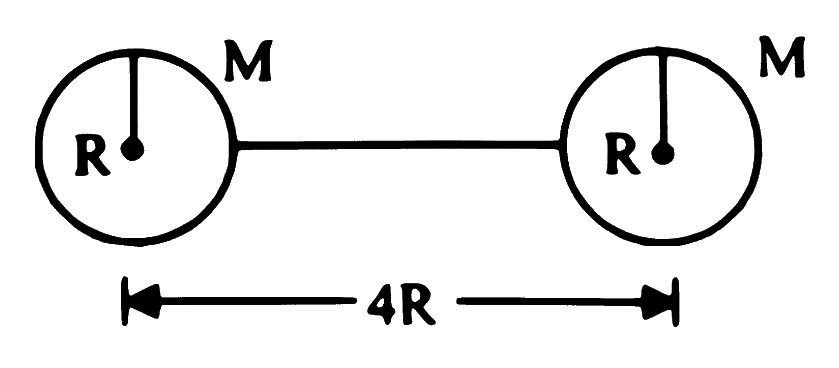
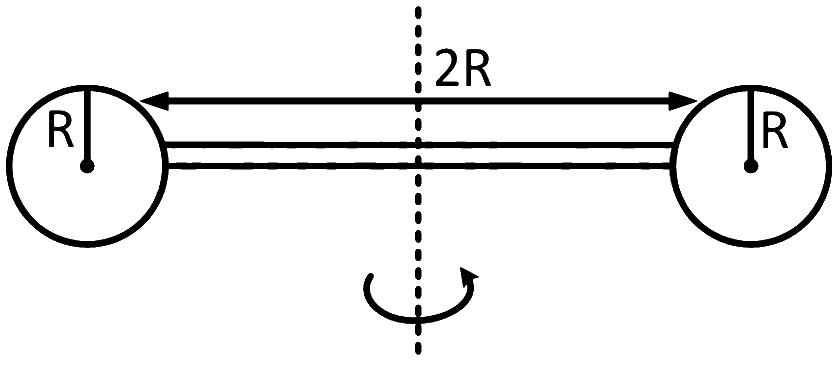
Two spheres each of mass MM and radius RR are connected with a massless rod of length 4 R. The moment of inertia of the system about an axis passing through the centre of one of the spheres and perpendicular to the rod will be

Figure

Show answer and solution

Answer: (b)

  1. Sphere on the axis: 25MR2\frac{2}{5}MR^2.
  2. Other sphere, centre at 4R4R: 25MR2+M(4R)2\frac{2}{5}MR^2 + M(4R)^2.
  3. I=45MR2+16MR2=845MR2I = \frac{4}{5}MR^2 + 16MR^2 = \frac{84}{5}MR^2, so the answer is (b).
Report a mistake
Q47JEE Main 2025 · 7 APR · SHIFT 1Medium

Moment of Inertia & Radius of Gyration · Point masses & rigid systems

A,BA, B and C are disc, solid sphere and spherical shell respectively with same radii and masses. These masses are placed as shown in figure.

Figure

The moment of inertia of the given system about PQ axis is x15I\frac{x}{15}I, where I is the moment of inertia of the disc about its diameter. The value of xx is ____________.

Numerical answer type. Work it out, then open the answer.

Show answer and solution

Answer: 199

  1. Disc A: PQ is its diameter, IA=I=14MR2I_A = I = \frac{1}{4}MR^2, so MR2=4IMR^2 = 4I.
  2. Solid sphere B touches PQ: 25MR2+MR2=75MR2\frac{2}{5}MR^2 + MR^2 = \frac{7}{5}MR^2.
  3. Shell C touches PQ: 23MR2+MR2=53MR2\frac{2}{3}MR^2 + MR^2 = \frac{5}{3}MR^2.
  4. Itotal=I+4I(21+2515)=I+18415I=19915II_{total} = I + 4I\left(\frac{21+25}{15}\right) = I + \frac{184}{15}I = \frac{199}{15}I, so x=199x = 199.
Report a mistake
Q48JEE Main 2025 · 28 JAN · SHIFT 1Medium

Moment of Inertia & Radius of Gyration · Standard bodies & radius of gyration

The moment of inertia of a solid disc rotating along its diameter is 2.5 times higher than the moment of inertia of a ring rotating in similar way. The moment of inertia of a solid sphere which has same radius as the disc and rotating in similar way, is nn times higher than the moment of inertia of the given ring. Here, n=n = ________ Consider all the bodies have equal masses.

Numerical answer type. Work it out, then open the answer.

Show answer and solution

Answer: 4

  1. Equal masses, so radii differ. Disc about diameter 14MRd2\frac{1}{4}MR_d^2, ring about diameter 12MRr2\frac{1}{2}MR_r^2.
  2. 14Rd2=2.5×12Rr2⇒Rd2=5Rr2\frac{1}{4}R_d^2 = 2.5 \times \frac{1}{2}R_r^2 \Rightarrow R_d^2 = 5R_r^2
  3. Sphere (radius RdR_d): Is=25MRd2=2MRr2I_s = \frac{2}{5}MR_d^2 = 2MR_r^2.
  4. n=2MRr212MRr2=4n = \frac{2MR_r^2}{\frac{1}{2}MR_r^2} = 4
Report a mistake
Q49MHT CET 2025 · 26 APR · SHIFT 1Medium

Moment of Inertia & Radius of Gyration · Bending, recasting & scaling

Moment of inertia of a solid sphere about its diameter is 'I'. It is then casted into 27 small spheres of same diameter. The moment of inertia of each small sphere about its diameter is

Show answer and solution

Answer: (d)

  1. Each small sphere: mass M27\frac{M}{27}, radius R3\frac{R}{3} (volume shares 1/27).
  2. I′=25⋅M27⋅R29=I243I' = \frac{2}{5}\cdot\frac{M}{27}\cdot\frac{R^2}{9} = \frac{I}{243}
  3. So the answer is (d) I243\frac{I}{243}.
Report a mistake
Q50MHT CET 2025 · 26 APR · SHIFT 1Medium

Moment of Inertia & Radius of Gyration · Bending, recasting & scaling

Moment of inertia of the rod about an axis passing through the centre and perpendicular to its length is ' I1I_1 '. The same rod is bent into a ring and its moment of inertia about the diameter is ' I2I_2 '. Then I1/I2I_1/I_2 is

Show answer and solution

Answer: (b)

  1. Rod: I1=ML212I_1 = \frac{ML^2}{12}.
  2. Ring of radius R=L2πR = \frac{L}{2\pi} about a diameter: I2=MR22=ML28π2I_2 = \frac{MR^2}{2} = \frac{ML^2}{8\pi^2}.
  3. I1I2=8π212=2π23\frac{I_1}{I_2} = \frac{8\pi^2}{12} = \frac{2\pi^2}{3}
  4. So the answer is (b) 2π23\frac{2\pi^2}{3}.
Report a mistake
Q51MHT CET 2025 · 22 APR · SHIFT 2Medium

Moment of Inertia & Radius of Gyration · Bending, recasting & scaling

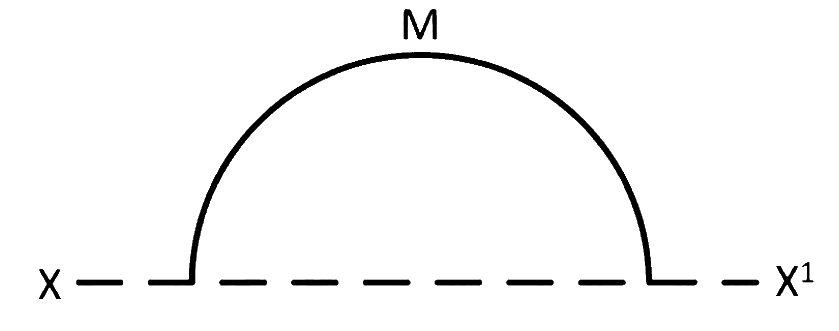
A thin metal wire of length ' L ' and mass ' M ' is bent to form semicircular ring as shown. The moment of inertia about XX′XX' is

Figure

Show answer and solution

Answer: (c)

  1. Semicircle: L=πR⇒R=LπL = \pi R \Rightarrow R = \frac{L}{\pi}.
  2. XX′XX' is the diameter joining the ends. Half of a ring about its diameter keeps the same MR22\frac{MR^2}{2} form (symmetry).
  3. I=MR22=ML22π2I = \frac{MR^2}{2} = \frac{ML^2}{2\pi^2}
  4. So the answer is (c) ML22π2\frac{ML^2}{2\pi^2}.
Report a mistake
Q52MHT CET 2025 · 21 APR · SHIFT 2Medium

Moment of Inertia & Radius of Gyration · Bending, recasting & scaling

Moment of inertia of a thin uniform rod rotating about the perpendicular axis passing through its centre is ' II '. If the same rod is bent in the form of ring, its moment of inertia about the diameter is ' I1I_1 '. If I1=xII_1 = xI, then the value of ' x ' is

Show answer and solution

Answer: (b)

  1. Rod: I=ML212I = \frac{ML^2}{12}; ring (R=L2πR = \frac{L}{2\pi}) about diameter: I1=ML28π2I_1 = \frac{ML^2}{8\pi^2}.
  2. x=I1I=128π2=32π2x = \frac{I_1}{I} = \frac{12}{8\pi^2} = \frac{3}{2\pi^2}
  3. So the answer is (b) 32π2\frac{3}{2\pi^2}.
Report a mistake
Q53MHT CET 2025 · 21 APR · SHIFT 1Medium

Moment of Inertia & Radius of Gyration · Bending, recasting & scaling

Two circular loops P and Q of radii ' r ' and ' nr ' are made respectively from a uniform wire. Moment of inertia of loop Q about its axis is 4 times that of loop PP about its axis. The value of nn is

Show answer and solution

Answer: (b)

  1. Same wire: M∝RM \propto R, so I=MR2∝R3I = MR^2 \propto R^3.
  2. n3=4⇒n=41/3=22/3n^3 = 4 \Rightarrow n = 4^{1/3} = 2^{2/3}
  3. So the answer is (b) (2)2/3(2)^{2/3}.
Report a mistake
Q54MHT CET 2025 · 20 APR · SHIFT 1Medium

Moment of Inertia & Radius of Gyration · Bending, recasting & scaling

Two discs A and B of same material and thickness have radii RR and 3R3R respectively. Their moments of inertia about their axis will be in the ratio

Show answer and solution

Answer: (c)

  1. Same material and thickness: M=ρπR2t∝R2M = \rho \pi R^2 t \propto R^2, so I=MR22∝R4I = \frac{MR^2}{2} \propto R^4.
  2. IAIB=(R3R)4=181\frac{I_A}{I_B} = \left(\frac{R}{3R}\right)^4 = \frac{1}{81}
  3. So the answer is (c) 1:811 : 81.
Report a mistake
Q55JEE Main 2025 · 8 APR · SHIFT 2Medium

Moment of Inertia & Radius of Gyration · Bending, recasting & scaling

A rod of linear mass density 'λ' and length 'L' is bent to form a ring of radius 'R'. Moment of inertia of ring about any of its diameter is.

Show answer and solution

Answer: (a)

  1. Mass M=λLM = \lambda L, radius R=L2πR = \frac{L}{2\pi}.
  2. About a diameter: I=MR22=λL2⋅L24π2=λL38π2I = \frac{MR^2}{2} = \frac{\lambda L}{2}\cdot\frac{L^2}{4\pi^2} = \frac{\lambda L^3}{8\pi^2}
  3. So the answer is (a) λL38π2\frac{\lambda L^3}{8\pi^2}.
Report a mistake
Q56JEE Main 2025 · 2 APR · SHIFT 1Medium

Moment of Inertia & Radius of Gyration · Bending, recasting & scaling

Moment of inertia of a rod of mass ' M ' and length ' L ' about an axis passing through its center and normal to its length is ' α\alpha '. Now the rod is cut into two equal parts and these parts are joined symmetrically to form a cross shape. Moment of inertia of cross about an axis passing through its center and normal to plane containing cross is:

Show answer and solution

Answer: (a)

  1. Original rod: α=ML212\alpha = \frac{ML^2}{12}.
  2. Each half (mass M2\frac{M}{2}, length L2\frac{L}{2}) is centred on the axis: I=112⋅M2⋅L24=ML296I = \frac{1}{12}\cdot\frac{M}{2}\cdot\frac{L^2}{4} = \frac{ML^2}{96}.
  3. Cross: I=2×ML296=ML248=α4I = 2\times\frac{ML^2}{96} = \frac{ML^2}{48} = \frac{\alpha}{4}
  4. So the answer is (a) α/4\alpha/4.
Report a mistake
Q57JEE Main 2025 · 28 JAN · SHIFT 1Medium

Moment of Inertia & Radius of Gyration · Bending, recasting & scaling

Two iron solid discs of negligible thickness have radii R1R_1 and R2R_2 and moment of inertia I1I_1 and I2I_2, respectively. For R2=2R1R_2 = 2R_1, the ratio of I1I_1 and I2I_2 would be 1/x1/x, where x=x = _______.

Numerical answer type. Work it out, then open the answer.

Show answer and solution

Answer: 16

  1. Same material and same (negligible) thickness: M∝R2M \propto R^2, so I∝R4I \propto R^4.
  2. I1I2=(R12R1)4=116\frac{I_1}{I_2} = \left(\frac{R_1}{2R_1}\right)^4 = \frac{1}{16}
  3. So x=16x = 16.
Report a mistake
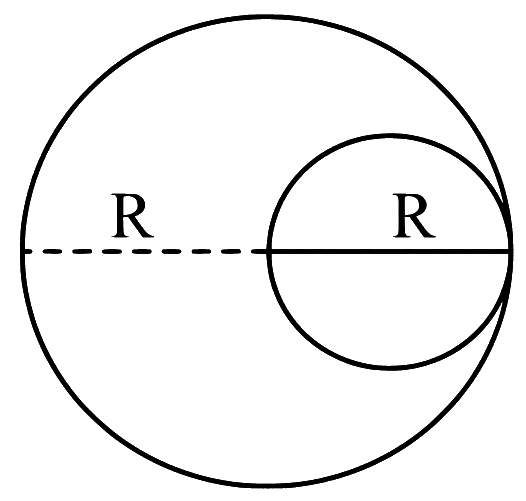
Q58NEET 2025Medium

Moment of Inertia & Radius of Gyration · Composite bodies & cut-outs

A sphere of radius RR is cut from a larger solid sphere of radius 2R2R as shown in the figure. The ratio of the moment of inertia of the smaller sphere to that of the rest part of the sphere about the YY-axis is:

Figure

Show answer and solution

Answer: (a)

  1. Let big sphere mass be MM (radius 2R2R); cut sphere has 18\frac{1}{8} the volume, so mass M8\frac{M}{8}, centre at distance RR from YY-axis.
  2. Ismall=25M8R2+M8R2=7MR240I_{small} = \frac{2}{5}\frac{M}{8}R^2 + \frac{M}{8}R^2 = \frac{7MR^2}{40}
  3. Ibig=25M(2R)2=64MR240I_{big} = \frac{2}{5}M(2R)^2 = \frac{64MR^2}{40}, so Irest=57MR240I_{rest} = \frac{57MR^2}{40}
  4. Ratio =757= \frac{7}{57}, so the answer is (a).
Report a mistake
Q59JEE Main 2025 · 7 APR · SHIFT 2Medium

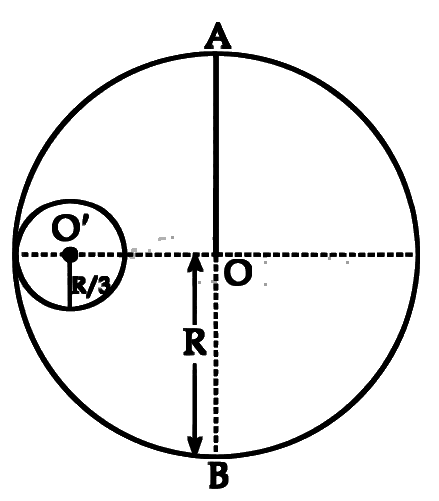
Moment of Inertia & Radius of Gyration · Composite bodies & cut-outs

Let M and R be the mass and radius of a disc. A small disc of radius R/3R/3 is removed from the bigger disc as shown in figure. The moment of inertia of remaining part of bigger disc about an axis ABAB passing through the centre OO and perpendicular to the plane of disc is 4xMR2\frac{4}{x}MR^2. The value of xx is ____________.

Figure

Numerical answer type. Work it out, then open the answer.

Show answer and solution

Answer: 9

  1. Small disc mass M9\frac{M}{9}, centre at 2R3\frac{2R}{3} from O.
  2. Ismall=12M9R29+M94R29=MR218I_{small} = \frac{1}{2}\frac{M}{9}\frac{R^2}{9} + \frac{M}{9}\frac{4R^2}{9} = \frac{MR^2}{18}
  3. I=MR22−MR218=49MR2I = \frac{MR^2}{2} - \frac{MR^2}{18} = \frac{4}{9}MR^2
  4. So x=9x = 9.
Report a mistake
Q60MHT CET 2025 · 21 APR · SHIFT 1Difficult

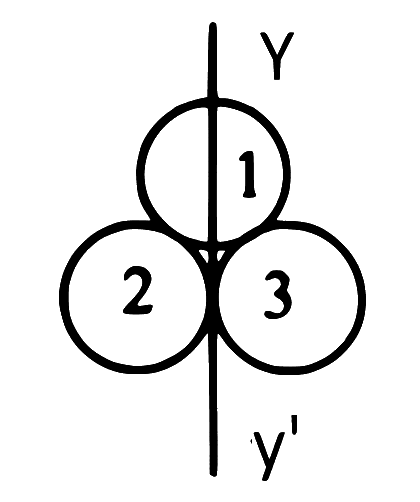
Moment of Inertia & Radius of Gyration · Point masses & rigid systems

Three spheres, each of mass ' mm ' and radius ' rr ' are placed as shown in figure. Consider an axis YY′YY', which is touching two spheres and passing through the diameter of third sphere. The moment of inertia of the system consisting of these three spheres about YY′YY' axis is

Figure

Show answer and solution

Answer: (c)

  1. Sphere 1: axis is its diameter, 25mr2\frac{2}{5}mr^2.
  2. Spheres 2 and 3: axis is a tangent, 25mr2+mr2=75mr2\frac{2}{5}mr^2 + mr^2 = \frac{7}{5}mr^2 each.
  3. I=25mr2+145mr2=165mr2I = \frac{2}{5}mr^2 + \frac{14}{5}mr^2 = \frac{16}{5}mr^2
  4. So the answer is (c).
Report a mistake
Q61JEE Main 2025 · 22 JAN · SHIFT 1Difficult

Moment of Inertia & Radius of Gyration · Composite bodies & cut-outs

A uniform circular disc of radius ' RR ' and mass ' MM ' is rotating about an axis perpendicular to its plane and passing through its centre. A small circular part of radius R/2R/2 is removed from the original disc as shown in the figure. Find the moment of inertia of the remaining part of the original disc about the axis as given above.

Figure

Show answer and solution

Answer: (b)

  1. Removed disc: radius R2\frac{R}{2}, mass M4\frac{M}{4}, centre at R2\frac{R}{2} from the axis.
  2. Ihole=12M4R24+M4R24=3MR232I_{hole} = \frac{1}{2}\frac{M}{4}\frac{R^2}{4} + \frac{M}{4}\frac{R^2}{4} = \frac{3MR^2}{32}
  3. I=MR22−3MR232=1332MR2I = \frac{MR^2}{2} - \frac{3MR^2}{32} = \frac{13}{32}MR^2
  4. So the answer is (b).
Report a mistake
Q62MHT CET 2024 · 16 MAY · SHIFT 2Easy

Moment of Inertia & Radius of Gyration · Point masses & rigid systems

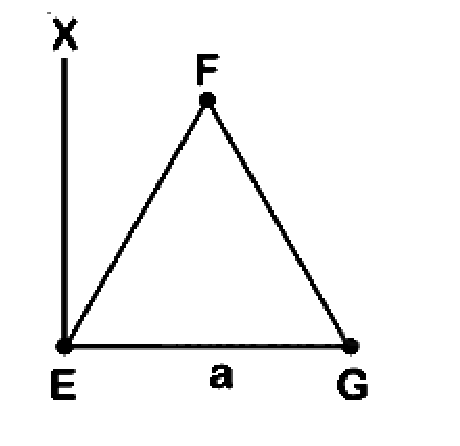
Three point masses, each of mass ' mm ' are placed at the corners of an equilateral triangle of side ' LL '. The moment of inertia of the system about an axis passing through one of the vertices and parallel to the side joining other two vertices will be

Show answer and solution

Answer: (c)

  1. The mass at the vertex lies on the axis, so it contributes nothing.
  2. The other two masses are at distance equal to the triangle's height h=32Lh = \frac{\sqrt{3}}{2}L from the axis.
  3. I=2m(3L2)2=3mL22I = 2m\left(\frac{\sqrt{3}L}{2}\right)^2 = \frac{3mL^2}{2}
  4. So the answer is (c) 3mL22\frac{3mL^2}{2}.
Report a mistake
Q63JEE Main 2024 · 27 JAN · SHIFT 1Easy

Moment of Inertia & Radius of Gyration · Point masses & rigid systems

Four particles each of mass 1 kg1\text{ kg} are placed at four corners of a square of side 2 m2\text{ m}. Moment of inertia of system about an axis perpendicular to its plane and passing through one of its vertex is _____ kg m2\text{kg m}^{2}.

Figure

Numerical answer type. Work it out, then open the answer.

Show answer and solution

Answer: 16

  1. The mass at the chosen vertex is on the axis. Two adjacent masses are at 22 m and the opposite one is at 222\sqrt{2} m.
  2. I=1(2)2+1(2)2+1(22)2=4+4+8I = 1(2)^2 + 1(2)^2 + 1(2\sqrt{2})^2 = 4 + 4 + 8
  3. I=16 kg m2I = 16\ \text{kg m}^2
Report a mistake
Q64MHT CET 2024 · 3 MAY · SHIFT 1Easy

Moment of Inertia & Radius of Gyration · Standard bodies & radius of gyration

Ratio of radius of gyration of a circular disc to that of circular ring each of same mass and radius around their respective axes is

Show answer and solution

Answer: (d)

  1. Disc: I=MR22⇒Kd=R2I = \frac{MR^2}{2} \Rightarrow K_d = \frac{R}{\sqrt{2}}.
  2. Ring: I=MR2⇒Kr=RI = MR^2 \Rightarrow K_r = R.
  3. Kd:Kr=12:1=1:2K_d : K_r = \frac{1}{\sqrt{2}} : 1 = 1 : \sqrt{2}
  4. So the answer is (d) 1:21 : \sqrt{2}.
Report a mistake
Q65MHT CET 2024 · 2 MAY · SHIFT 1Easy

Moment of Inertia & Radius of Gyration · Standard bodies & radius of gyration

An annular ring has mass 10 kg and inner and outer radii are 5 m and 10 m respectively. Its moment of inertia about an axis passing through its centre and perpendicular to its plane is

Show answer and solution

Answer: (b)

  1. Annular disc about its central perpendicular axis: I=M2(R12+R22)I = \frac{M}{2}(R_1^2 + R_2^2).
  2. I=102(52+102)=5×125I = \frac{10}{2}(5^2 + 10^2) = 5 \times 125
  3. I=625 kg m2I = 625\ \text{kg m}^2
  4. So the answer is (b) 625 kg m2625\ \text{kg m}^2.
Report a mistake
Q66MHT CET 2024 · 15 MAY · SHIFT 2Easy

Moment of Inertia & Radius of Gyration · Parallel & perpendicular axis theorems

The radius of gyration of a circular disc of radius R and mass m rotating about diameter as axis is

Show answer and solution

Answer: (c)

  1. Disc about a diameter: I=mR24I = \frac{mR^2}{4} (half of mR22\frac{mR^2}{2} by the perpendicular axis theorem).
  2. K=Im=R24=R2K = \sqrt{\frac{I}{m}} = \sqrt{\frac{R^2}{4}} = \frac{R}{2}
  3. So the answer is (c) R/2R/2.
Report a mistake
Q67MHT CET 2024 · 11 MAY · SHIFT 2Easy

Moment of Inertia & Radius of Gyration · Parallel & perpendicular axis theorems

Moment of inertia of a disc about an axis passing through its centre and perpendicular to its plane is 'I'. The ratio of moment of inertia about a parallel axis tangential to its rim to that about a parallel axis passing through a point midway between the centre and the rim is

Show answer and solution

Answer: (a)

  1. I=MR22I = \frac{MR^2}{2}, so MR2=2IMR^2 = 2I.
  2. Axis tangential to rim (distance RR): I1=I+MR2=I+2I=3II_1 = I + MR^2 = I + 2I = 3I
  3. Axis midway (distance R2\frac{R}{2}): I2=I+MR24=I+I2=3I2I_2 = I + \frac{MR^2}{4} = I + \frac{I}{2} = \frac{3I}{2}
  4. I1:I2=3I:3I2=2:1I_1 : I_2 = 3I : \frac{3I}{2} = 2 : 1
  5. So the answer is (a) 2:12 : 1.
Report a mistake
Q68MHT CET 2024 · 10 MAY · SHIFT 1Easy

Moment of Inertia & Radius of Gyration · Parallel & perpendicular axis theorems

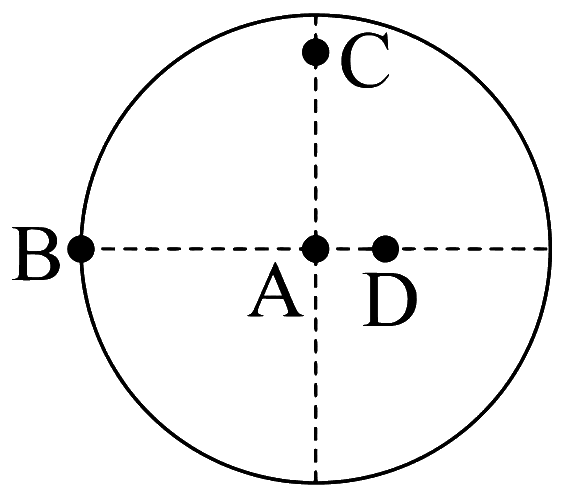
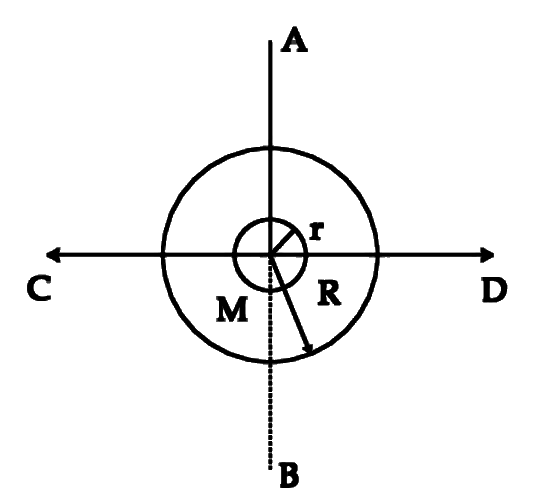
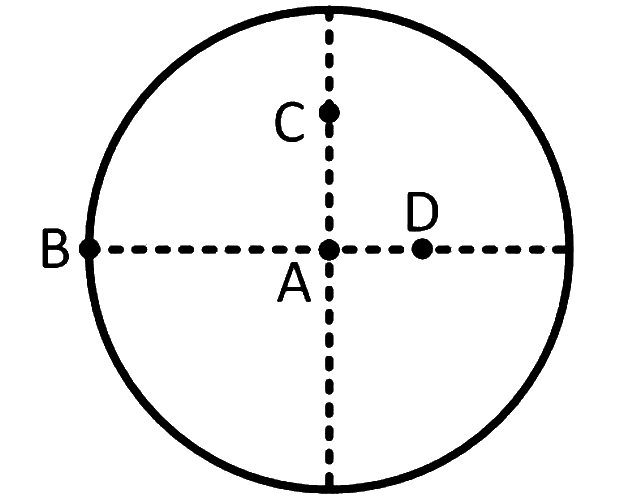
The moment of inertia of uniform circular disc is maximum about an axis perpendicular to the disc and passing through point

Figure

Show answer and solution

Answer: (b)

  1. Parallel axis theorem: I=MR22+Md2I = \frac{MR^2}{2} + Md^2, which grows with distance dd from the centre.
  2. BB is on the rim (d=Rd = R), the farthest of the marked points; AA is the centre, CC and DD lie inside.
  3. IB=32MR2I_B = \frac{3}{2}MR^2 is the largest.
  4. So the answer is (b) B.
Report a mistake
Q69MHT CET 2024 · 9 MAY · SHIFT 1Easy

Moment of Inertia & Radius of Gyration · Parallel & perpendicular axis theorems

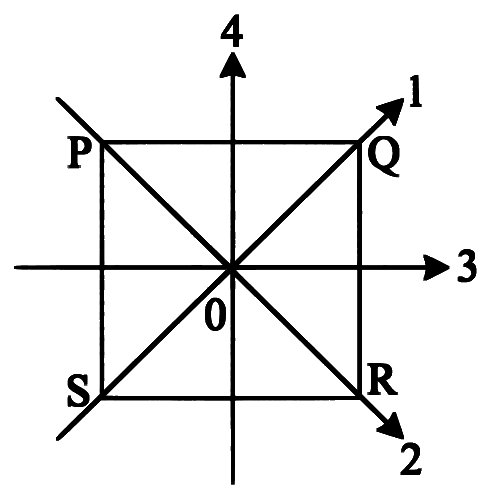
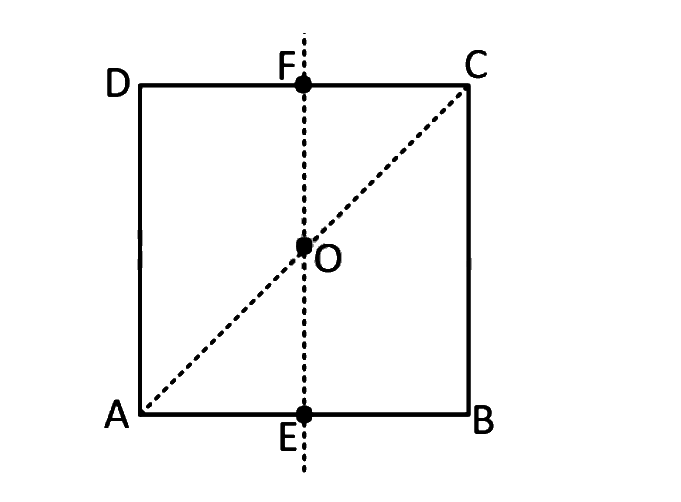
The moment of inertia of thin square plate PQRS of uniform thickness, about an axis passing through centre ' O ' and perpendicular to the plane of the plate is (I1,I2,I3,I4(I_1, I_2, I_3, I_4 are respectively the moments of inertia about axis 1,2,3,41, 2, 3, 4 which are in the plane of the plate as shown in figure)

Figure

Show answer and solution

Answer: (d)

  1. Perpendicular axis theorem: IzI_z equals the sum of the moments of inertia about any two perpendicular in-plane axes through OO.
  2. Axes 1 and 2 (diagonals) are perpendicular, and so are 3 and 4: Iz=I1+I2=I3+I4I_z = I_1 + I_2 = I_3 + I_4.
  3. For a square, all in-plane axes through OO have equal II by symmetry, so I1=I2=I3=I4I_1 = I_2 = I_3 = I_4 and Iz=2I1=I1+I3I_z = 2I_1 = I_1 + I_3.
  4. So the answer is (d) I1+I3I_1 + I_3.
Report a mistake
Q70NEET 2024Easy

Moment of Inertia & Radius of Gyration · Parallel & perpendicular axis theorems

The moment of inertia of a thin rod about an axis passing through its mid point and perpendicular to the rod is 2400 g cm22400\text{ g cm}^{2}. The length of the 400 g400\text{ g} rod is nearly:

Show answer and solution

Answer: (a)

  1. I=ML212⇒L2=12IMI = \frac{ML^2}{12} \Rightarrow L^2 = \frac{12I}{M}
  2. L2=12×2400400=72 cm2L^2 = \frac{12 \times 2400}{400} = 72\ \text{cm}^2
  3. L=72≈8.5 cmL = \sqrt{72} \approx 8.5\ \text{cm}
  4. So the answer is (a) 8.5 cm.
Report a mistake
Q71MHT CET 2024 · 15 MAY · SHIFT 1Medium

Moment of Inertia & Radius of Gyration · Point masses & rigid systems

Three thin rods, each of mass ' MM ' and length ' LL ' are placed along X,YX, Y and Z axes which are mutually perpendicular. One end of each rod is at origin. M. I. of the system about Z axis is

Show answer and solution

Answer: (c)

  1. Rod along Z lies on the axis: I=0I = 0.
  2. Rods along X and Y are perpendicular to Z with one end on it: ML23\frac{ML^2}{3} each.
  3. I=2ML23I = \frac{2ML^2}{3}, so the answer is (c).
Report a mistake
Q72MHT CET 2024 · 9 MAY · SHIFT 2Medium

Moment of Inertia & Radius of Gyration · Point masses & rigid systems

Three thin rods, each mass ' 2 M ' and length ' L ' are placed along x,yx, y and z axis which are mutually perpendicular. One end of each rod is at origin. Moment of inertia of the system about x - axis is

Show answer and solution

Answer: (a)

  1. Rod along x: I=0I = 0.
  2. Rods along y and z (mass 2M2M), end on the axis: 2ML23\frac{2ML^2}{3} each.
  3. I=4ML23I = \frac{4ML^2}{3}, so the answer is (a).
Report a mistake
Q73JEE Main 2024 · 6 APR · SHIFT 2Medium

Moment of Inertia & Radius of Gyration · Point masses & rigid systems

Three balls of masses 2 kg,4 kg2\text{ kg}, 4\text{ kg} and 6 kg6\text{ kg} respectively are arranged at centre of the edges of an equilateral triangle of side 2 m2\text{ m}. The moment of inertia of the system about an axis through the centroid and perpendicular to the plane of triangle, will be ________ kg m2\text{kg m}^2.

Numerical answer type. Work it out, then open the answer.

Show answer and solution

Answer: 4

  1. Edge midpoints are at the inradius from the centroid: r=a23=223=13r = \frac{a}{2\sqrt3} = \frac{2}{2\sqrt3} = \frac{1}{\sqrt3} m.
  2. I=(2+4+6)r2=12×13I = (2+4+6)r^2 = 12\times\frac{1}{3}
  3. I=4I = 4 kg m2^2.
Report a mistake
Q74JEE Main 2024 · 31 JAN · SHIFT 2Medium

Moment of Inertia & Radius of Gyration · Point masses & rigid systems

Two identical spheres each of mass 2 kg2\text{ kg} and radius 50 cm50\text{ cm} are fixed at the ends of a light rod so that the separation between the centers is 150 cm150\text{ cm}. Then, moment of inertia of the system about an axis perpendicular to the rod and passing through its middle point is x20 kg m2\frac{x}{20}\text{ kg m}^2, where the value of xx is ___________.

Numerical answer type. Work it out, then open the answer.

Show answer and solution

Answer: 53

  1. Each sphere: I=25mr2+md2I = \frac{2}{5}mr^2 + md^2 with r=0.5 mr = 0.5\text{ m}, d=0.75 md = 0.75\text{ m} from the middle.
  2. I1=25(2)(0.25)+2(0.5625)=0.2+1.125=1.325 kg m2I_1 = \frac{2}{5}(2)(0.25) + 2(0.5625) = 0.2 + 1.125 = 1.325\text{ kg m}^2
  3. I=2I1=2.65 kg m2=5320 kg m2I = 2I_1 = 2.65\text{ kg m}^2 = \frac{53}{20}\text{ kg m}^2
  4. So x=53x = 53.
Report a mistake
Q75MHT CET 2024 · 16 MAY · SHIFT 1Medium

Moment of Inertia & Radius of Gyration · Standard bodies & radius of gyration

Two spheres of equal masses, one of which is a thin spherical shell and the other solid sphere, have the same moment of inertia about their respective diameters. The ratio of their radii is

Show answer and solution

Answer: (b)

  1. Shell: I=23MR12I = \frac{2}{3}MR_1^2; solid sphere: I=25MR22I = \frac{2}{5}MR_2^2.
  2. 23R12=25R22⇒R12R22=35\frac{2}{3}R_1^2 = \frac{2}{5}R_2^2 \Rightarrow \frac{R_1^2}{R_2^2} = \frac{3}{5}
  3. So the answer is (b) 3:5\sqrt{3} : \sqrt{5}.
Report a mistake
Q76NEET 2024Medium

Moment of Inertia & Radius of Gyration · Standard bodies & radius of gyration

The radius of gyration of a solid sphere of mass 5 kg5\text{ kg} about XYXY is 5 m5\text{ m} as shown in figure. The radius of the sphere is 5x7 m\frac{5x}{\sqrt{7}}\text{ m}, then the value of xx is:

Figure

Show answer and solution

Answer: (d)

  1. XY is a tangent: I=25MR2+MR2=75MR2=MK2I = \frac{2}{5}MR^2 + MR^2 = \frac{7}{5}MR^2 = MK^2.
  2. 75R2=25⇒R=557 m\frac{7}{5}R^2 = 25 \Rightarrow R = \frac{5\sqrt{5}}{\sqrt{7}}\text{ m}
  3. Comparing with 5x7\frac{5x}{\sqrt{7}}, x=5x = \sqrt{5}.
  4. So the answer is (d) 5\sqrt{5}.
Report a mistake
Q77MHT CET 2024 · 4 MAY · SHIFT 1Medium

Moment of Inertia & Radius of Gyration · Parallel & perpendicular axis theorems

A disc and a ring both have same mass and radius. The ratio of moment of inertia of the disc about its diameter to that of a ring about a tangent in its plane is

Show answer and solution

Answer: (c)

  1. Disc about diameter: 14MR2\frac{1}{4}MR^2.
  2. Ring about tangent in its plane: 12MR2+MR2=32MR2\frac{1}{2}MR^2 + MR^2 = \frac{3}{2}MR^2.
  3. Ratio =1/43/2=16= \frac{1/4}{3/2} = \frac{1}{6}
  4. So the answer is (c) 1:61 : 6.
Report a mistake
Q78JEE Main 2024 · 5 APR · SHIFT 1Medium

Moment of Inertia & Radius of Gyration · Parallel & perpendicular axis theorems

Ratio of radius of gyration of a hollow sphere to that of a solid cylinder of equal mass, for moment of Inertia about their diameter axis ABAB as shown in figure is 8/x\sqrt{8/x}. The value of xx is:

Figure

Show answer and solution

Answer: (c)

  1. Hollow sphere about a diameter: K12=23R2K_1^2 = \frac{2}{3}R^2.
  2. Solid cylinder (radius RR, length L=4RL = 4R), axis through centre perpendicular to its length: M(R24+L212)=1912MR2M\left(\frac{R^2}{4} + \frac{L^2}{12}\right) = \frac{19}{12}MR^2.
  3. AB passes through the end face, L2=2R\frac{L}{2} = 2R away: I=1912MR2+4MR2=6712MR2I = \frac{19}{12}MR^2 + 4MR^2 = \frac{67}{12}MR^2.
  4. K12K22=2/367/12=867\frac{K_1^2}{K_2^2} = \frac{2/3}{67/12} = \frac{8}{67}
  5. So the answer is (c) x=67x = 67.
Report a mistake
Q79MHT CET 2024 · 16 MAY · SHIFT 1Medium

Moment of Inertia & Radius of Gyration · Bending, recasting & scaling

Two loops P and Q of radii R1R_1 and R2R_2 are made from uniform metal wire of same material. IpI_p and IQI_Q be the moment of inertia of loop P and Q respectively then ratio R1/R2R_1/R_2 is (( Given IP/IQ=27)I_P/I_Q = 27)

Show answer and solution

Answer: (b)

  1. Same wire: M∝RM \propto R, so I∝R3I \propto R^3.
  2. (R1R2)3=27⇒R1R2=3\left(\frac{R_1}{R_2}\right)^3 = 27 \Rightarrow \frac{R_1}{R_2} = 3
  3. So the answer is (b) 3:13 : 1.
Report a mistake
Q80MHT CET 2024 · 10 MAY · SHIFT 1Medium

Moment of Inertia & Radius of Gyration · Bending, recasting & scaling

A solid metallic sphere of radius ' RR ' having moment of inertia 'II' about diameter is melted and recast into a solid disc of radius ' rr ' of a uniform thickness. The moment of inertia of a disc about an axis passing through its edge and perpendicular to its plane is also equal to 'II'. The ratio rR\frac{r}{R} is

Show answer and solution

Answer: (d)

  1. Sphere: I=25MR2I = \frac{2}{5}MR^2 (mass unchanged on recasting).
  2. Disc about an axis through its edge, perpendicular to plane: I=Mr22+Mr2=32Mr2I = \frac{Mr^2}{2} + Mr^2 = \frac{3}{2}Mr^2.
  3. 32Mr2=25MR2⇒r2=415R2\frac{3}{2}Mr^2 = \frac{2}{5}MR^2 \Rightarrow r^2 = \frac{4}{15}R^2
  4. So the answer is (d) rR=215\frac{r}{R} = \frac{2}{\sqrt{15}}.
Report a mistake
Q81MHT CET 2024 · 9 MAY · SHIFT 1Medium

Moment of Inertia & Radius of Gyration · Bending, recasting & scaling

A circular disc of radius ' RR ' and thickness R6\frac{R}{6} has moment of inertia 'I' about an axis passing through its centre and perpendicular to its plane. It is melted and recasted into a solid sphere then moment of inertia of sphere about an axis passing through diameter is

Show answer and solution

Answer: (c)

  1. Volume conserved: πR2⋅R6=43πa3⇒a3=R38⇒a=R2\pi R^2 \cdot \frac{R}{6} = \frac{4}{3}\pi a^3 \Rightarrow a^3 = \frac{R^3}{8} \Rightarrow a = \frac{R}{2}.
  2. Disc: I=MR22I = \frac{MR^2}{2}.
  3. Sphere: Is=25MR24=MR210=I5I_s = \frac{2}{5}M\frac{R^2}{4} = \frac{MR^2}{10} = \frac{I}{5}
  4. So the answer is (c) I5\frac{I}{5}.
Report a mistake
Q82MHT CET 2024 · 4 MAY · SHIFT 2Medium

Moment of Inertia & Radius of Gyration · Bending, recasting & scaling

Two solid spheres ( A and B) are made of metals having densities ρA\rho_A and ρB\rho_B respectively. If there masses are equal then ratio of their moments of inertia (IBIA)\left(\frac{I_B}{I_A}\right) about their respective diameter is

Show answer and solution

Answer: (b)

  1. Equal mass: 43πR3ρ=\frac{4}{3}\pi R^3 \rho = constant, so R∝ρ−1/3R \propto \rho^{-1/3}.
  2. I=25MR2∝R2∝ρ−2/3I = \frac{2}{5}MR^2 \propto R^2 \propto \rho^{-2/3}
  3. IBIA=(ρAρB)2/3\frac{I_B}{I_A} = \left(\frac{\rho_A}{\rho_B}\right)^{2/3}
  4. So the answer is (b).
Report a mistake
Q83MHT CET 2024 · 3 MAY · SHIFT 2Medium

Moment of Inertia & Radius of Gyration · Bending, recasting & scaling

Two loops ' AA ' and ' BB ' of radii ' R1R_1 ' and ' R2R_2 ' are made from uniform wire. If moment of inertia of ' A ' is ' IAI_A ' and that of ' B ' is ' IBI_B ', then R2/R1R_2/R_1 is [IAIB=27]\left[\frac{I_A}{I_B} = 27\right]

Show answer and solution

Answer: (c)

  1. Same wire: M∝RM \propto R, so I∝R3I \propto R^3.
  2. (R1R2)3=27⇒R1R2=3\left(\frac{R_1}{R_2}\right)^3 = 27 \Rightarrow \frac{R_1}{R_2} = 3
  3. So the answer is (c) R2R1=1:3\frac{R_2}{R_1} = 1 : 3.
Report a mistake
Q84MHT CET 2024 · 3 MAY · SHIFT 1Medium

Moment of Inertia & Radius of Gyration · Bending, recasting & scaling

Two circular loops P and Q of radii ' r ' and ' nr ' are made respectively from a uniform wire. Moment of inertia of loop Q about its axis is four times that of loop P about its axis. The value of ' nn ' is

Show answer and solution

Answer: (b)

  1. Same wire: M∝RM \propto R, so I∝R3I \propto R^3.
  2. n3=4⇒n=22/3n^3 = 4 \Rightarrow n = 2^{2/3}
  3. So the answer is (b) (2)2/3(2)^{2/3}.
Report a mistake
Q85MHT CET 2024 · 2 MAY · SHIFT 2Medium

Moment of Inertia & Radius of Gyration · Bending, recasting & scaling

A solid sphere of mass ' mm ', radius ' RR ', having moment of inertia about an axis passing through center of mass as 'I' is recast into a disc of thickness ' tt ' whose moment of inertia about an axis passing through the rim (edge) \& perpendicular to plane remains 'I'. Then the radius of disc is

Show answer and solution

Answer: (a)

  1. Sphere about centre: I=25mR2I = \frac{2}{5}mR^2.
  2. Disc about an axis through the rim, perpendicular to plane: I=32mr2I = \frac{3}{2}mr^2.
  3. 32mr2=25mR2⇒r2=4R215\frac{3}{2}mr^2 = \frac{2}{5}mR^2 \Rightarrow r^2 = \frac{4R^2}{15}
  4. So the answer is (a) r=2R15r = \frac{2R}{\sqrt{15}}.
Report a mistake
Q86MHT CET 2024 · 11 MAY · SHIFT 2Medium

Moment of Inertia & Radius of Gyration · Composite bodies & cut-outs

Four thin metal rods each of mass ' MM ' and length ' LL ', are welded end to end to form a square. The moment of inertia of the system about an axis passing through the centre of the square and perpendicular to its plane is

Show answer and solution

Answer: (d)

  1. Each rod's centre is L2\frac{L}{2} from the square's centre.
  2. One rod: ML212+M(L2)2=ML23\frac{ML^2}{12} + M\left(\frac{L}{2}\right)^2 = \frac{ML^2}{3}
  3. Four rods: I=4ML23I = \frac{4ML^2}{3}
  4. So the answer is (d) 4ML23\frac{4ML^2}{3}.
Report a mistake
Q87MHT CET 2023 · 10 MAY · SHIFT 2Easy

Moment of Inertia & Radius of Gyration · Standard bodies & radius of gyration

The moment of inertia of a uniform square plate about an axis perpendicular to its plane and passing through the centre is Ma26\frac{Ma^2}{6}, where 'MM' is the mass and 'aa' is the side of square plate. Moment of inertia of this plate about an axis perpendicular to its plane and passing through one of its corners is

Show answer and solution

Answer: (b)

  1. A corner is at half the diagonal from the centre: d=a2d = \frac{a}{\sqrt{2}}, so d2=a22d^2 = \frac{a^2}{2}.
  2. Parallel axis theorem: I=Ma26+Ma22I = \frac{Ma^2}{6} + M\frac{a^2}{2}
  3. I=Ma2+3Ma26=2Ma23I = \frac{Ma^2 + 3Ma^2}{6} = \frac{2Ma^2}{3}
  4. So the answer is (b) 2Ma23\frac{2Ma^2}{3}.
Report a mistake
Q88NEET 2023Easy

Moment of Inertia & Radius of Gyration · Standard bodies & radius of gyration

The ratio of radius of gyration of a solid sphere of mass MM and radius RR about its own axis to the radius of gyration of the thin hollow sphere of same mass and radius about its axis is :-

Show answer and solution

Answer: (d)

  1. Solid sphere: I=25MR2⇒Ks=25RI = \frac{2}{5}MR^2 \Rightarrow K_s = \sqrt{\frac{2}{5}}R.
  2. Thin hollow sphere: I=23MR2⇒Kh=23RI = \frac{2}{3}MR^2 \Rightarrow K_h = \sqrt{\frac{2}{3}}R.
  3. KsKh=2/52/3=35\frac{K_s}{K_h} = \sqrt{\frac{2/5}{2/3}} = \sqrt{\frac{3}{5}}
  4. So the answer is (d) 3:5\sqrt{3} : \sqrt{5}.
Report a mistake
Q89MHT CET 2023 · 12 MAY · SHIFT 1Easy

Moment of Inertia & Radius of Gyration · Parallel & perpendicular axis theorems

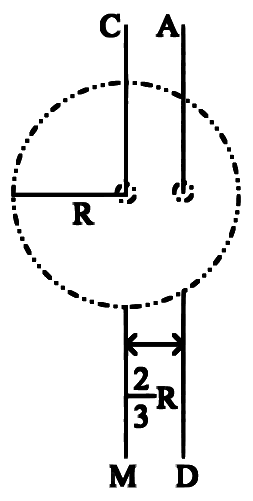
I1I_1 is the moment of inertia of a circular disc about an axis passing through its centre and perpendicular to the plane of disc. I2I_2 is its moment of inertia about an axis ABAB perpendicular to plane and parallel to axis CM\text{CM} at a distance 2R3\frac{2R}{3} from centre. The ratio of I1I_1 and I2I_2 is x:17x : 17. The value of 'xx' is (R = radius of the disc)

Figure

Show answer and solution

Answer: (a)

  1. I1=MR22I_1 = \frac{MR^2}{2}.
  2. Parallel axis at 2R3\frac{2R}{3}: I2=MR22+4MR29=1718MR2I_2 = \frac{MR^2}{2} + \frac{4MR^2}{9} = \frac{17}{18}MR^2
  3. I1I2=917⇒x=9\frac{I_1}{I_2} = \frac{9}{17} \Rightarrow x = 9
  4. So the answer is (a) 9.
Report a mistake
Q90JEE Main 2023 · 1 FEB · SHIFT 2Easy

Moment of Inertia & Radius of Gyration · Parallel & perpendicular axis theorems

Moment of inertia of a disc of mass 'MM' and radius 'RR' about any of its diameter is MR24\frac{MR^2}{4}. The moment of inertia of this disc about an axis normal to the disc and passing through a point on its edge will be, x2\frac{x}{2} MR22. The value of xx is ___________.

Numerical answer type. Work it out, then open the answer.

Show answer and solution

Answer: 3

  1. Perpendicular axis theorem: Icm=2×MR24=MR22I_{cm} = 2\times\frac{MR^2}{4} = \frac{MR^2}{2}.
  2. Parallel axis to the edge: I=MR22+MR2=32MR2I = \frac{MR^2}{2} + MR^2 = \frac{3}{2}MR^2.
  3. Comparing with x2MR2\frac{x}{2}MR^2: x=3x = 3.
Report a mistake
Q91JEE Main 2023 · 25 JAN · SHIFT 1Easy

Moment of Inertia & Radius of Gyration · Parallel & perpendicular axis theorems

ICMI_{\text{CM}} is the moment of inertia of a circular disc about an axis (CM) passing through its center and perpendicular to the plane of disc. IABI_{\text{AB}} is its moment of inertia about an axis AB perpendicular to plane and parallel to axis CM at a distance 23\frac{2}{3} R from center. Where R is the radius of the disc. The ratio of IABI_{\text{AB}} and ICMI_{\text{CM}} is x:9x : 9. The value of xx is _____________.

Figure

Numerical answer type. Work it out, then open the answer.

Show answer and solution

Answer: 17

  1. ICM=12MR2I_{CM} = \frac{1}{2}MR^2
  2. IAB=12MR2+M(2R3)2=9+818MR2=1718MR2I_{AB} = \frac{1}{2}MR^2 + M\left(\frac{2R}{3}\right)^2 = \frac{9+8}{18}MR^2 = \frac{17}{18}MR^2
  3. IABICM=179\frac{I_{AB}}{I_{CM}} = \frac{17}{9}, so x=17x = 17.
Report a mistake
Q92MHT CET 2023 · 14 MAY · SHIFT 2Medium

Moment of Inertia & Radius of Gyration · Point masses & rigid systems

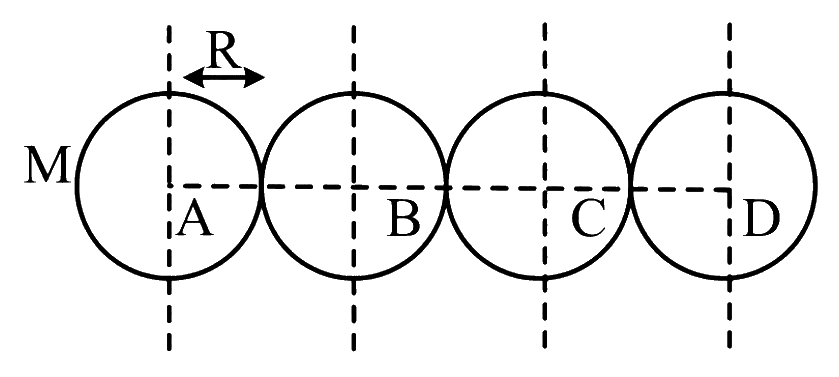
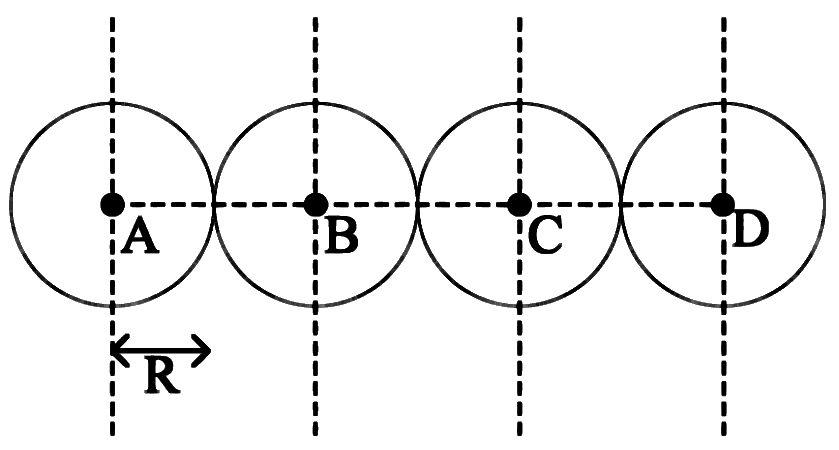
Four identical uniform solid spheres each of same mass 'MM' and radius 'RR' are placed touching each other as shown in figure, with centres A, B, C, D. IA,IB,ICI_A, I_B, I_C and IDI_D are the moment of inertia of these spheres respectively about an axis passing through centre and perpendicular to the plane. The difference in IAI_A, and IBI_B is

Figure

Show answer and solution

Answer: (b)

  1. Centres are 2R2R apart; each sphere's own term is 25MR2\frac{2}{5}MR^2, same in IAI_A and IBI_B.
  2. IA=85MR2+M[(2R)2+(4R)2+(6R)2]=85MR2+56MR2I_A = \frac{8}{5}MR^2 + M[(2R)^2 + (4R)^2 + (6R)^2] = \frac{8}{5}MR^2 + 56MR^2
  3. IB=85MR2+M[(2R)2+(2R)2+(4R)2]=85MR2+24MR2I_B = \frac{8}{5}MR^2 + M[(2R)^2 + (2R)^2 + (4R)^2] = \frac{8}{5}MR^2 + 24MR^2
  4. IA−IB=32MR2I_A - I_B = 32MR^2, so the answer is (b).
Report a mistake
Q93MHT CET 2023 · 13 MAY · SHIFT 2Medium

Moment of Inertia & Radius of Gyration · Point masses & rigid systems

Four identical uniform solid spheres each of same mass MM and radius RR are placed touching each other as shown in figure with centres A,B,C,D. IA,IB,IC,IDA, B, C, D.\ I_A, I_B, I_C, I_D are the moment of inertia of these spheres respectively about an axis passing through centre and perpendicular to the plane, then

Figure

Show answer and solution

Answer: (c)

  1. Each is the system MI about an axis through that centre; the 85MR2\frac{8}{5}MR^2 part is common.
  2. End axes (A, D): M(4+16+36)R2=56MR2M(4+16+36)R^2 = 56MR^2; inner axes (B, C): M(4+4+16)R2=24MR2M(4+4+16)R^2 = 24MR^2.
  3. So the answer is (c) IA=ID>IB=ICI_A = I_D > I_B = I_C.
Report a mistake
Q94MHT CET 2023 · 10 MAY · SHIFT 2Medium

Moment of Inertia & Radius of Gyration · Point masses & rigid systems

Two spheres each of mass 'MM' and radius R2\frac{R}{2} are connected at the ends of massless rod of length '2R2R'. What will be the moment of inertia of the system about an axis passing through centre of one of the spheres and perpendicular to the rod?

Show answer and solution

Answer: (d)

  1. Each sphere: 25M(R2)2=MR210\frac{2}{5}M\left(\frac{R}{2}\right)^2 = \frac{MR^2}{10}; centres 2R2R apart.
  2. I=MR210+MR210+M(2R)2I = \frac{MR^2}{10} + \frac{MR^2}{10} + M(2R)^2
  3. I=15MR2+4MR2=215MR2I = \frac{1}{5}MR^2 + 4MR^2 = \frac{21}{5}MR^2, so the answer is (d).
Report a mistake
Q95JEE Main 2023 · 6 APR · SHIFT 1Medium

Moment of Inertia & Radius of Gyration · Point masses & rigid systems

Two identical solid spheres each of mass 2 kg2\text{ kg} and radii 10 cm10\text{ cm} are fixed at the ends of a light rod. The separation between the centres of the spheres is 40 cm40\text{ cm}. The moment of inertia of the system about an axis perpendicular to the rod passing through its middle point is __________ ×10−3 kg m2\times 10^{-3}\text{ kg m}^2

Numerical answer type. Work it out, then open the answer.

Show answer and solution

Answer: 176

  1. Each sphere: I=25mr2+md2I = \frac{2}{5}mr^2 + md^2 with r=0.1 mr = 0.1\text{ m}, d=0.2 md = 0.2\text{ m}.
  2. I1=25(2)(0.01)+2(0.04)=0.008+0.08=0.088 kg m2I_1 = \frac{2}{5}(2)(0.01) + 2(0.04) = 0.008 + 0.08 = 0.088\text{ kg m}^2
  3. I=2I1=0.176 kg m2=176×10−3 kg m2I = 2I_1 = 0.176\text{ kg m}^2 = 176 \times 10^{-3}\text{ kg m}^2
  4. So the answer is 176176.
Report a mistake
Q96MHT CET 2023 · 9 MAY · SHIFT 1Medium

Moment of Inertia & Radius of Gyration · Standard bodies & radius of gyration

A square lamina of side 'bb' has same mass as a disc of radius 'RR' the moment of inertia of the two objects about an axis perpendicular to the plane and passing through the centre is equal. The ratio bR\frac{b}{R} is

Show answer and solution

Answer: (b)

  1. Square lamina about the perpendicular axis through centre: I=Mb26I = \frac{Mb^2}{6}.
  2. Disc: I=MR22I = \frac{MR^2}{2}.
  3. b26=R22⇒b2=3R2\frac{b^2}{6} = \frac{R^2}{2} \Rightarrow b^2 = 3R^2
  4. So the answer is (b) 3:1\sqrt{3} : 1.
Report a mistake
Q97JEE Main 2023 · 8 APR · SHIFT 1Medium

Moment of Inertia & Radius of Gyration · Standard bodies & radius of gyration

The moment of inertia of a semicircular ring about an axis, passing through the center and perpendicular to the plane of ring, is 1xMR2\frac{1}{x}MR^2, where RR is the radius and MM is the mass of the semicircular ring. The value of xx will be __________.

Numerical answer type. Work it out, then open the answer.

Show answer and solution

Answer: 1

  1. All mass of the semicircular ring is at distance RR from the centre.
  2. I=∑mR2=MR2I = \sum m R^2 = MR^2
  3. So x=1x = 1.
Report a mistake
Q98JEE Main 2023 · 6 APR · SHIFT 2Medium

Moment of Inertia & Radius of Gyration · Standard bodies & radius of gyration

A ring and a solid sphere rotating about an axis passing through their centers have same radii of gyration. The axis of rotation is perpendicular to plane of ring. The ratio of radius of ring to that of sphere is 2x\sqrt{\frac{2}{x}}. The value of xx is ___________.

Numerical answer type. Work it out, then open the answer.

Show answer and solution

Answer: 5

  1. Ring (perpendicular axis): K2=Rr2K^2 = R_r^2. Solid sphere: K2=25Rs2K^2 = \frac{2}{5}R_s^2.
  2. Rr2=25Rs2⇒RrRs=25R_r^2 = \frac{2}{5}R_s^2 \Rightarrow \frac{R_r}{R_s} = \sqrt{\frac{2}{5}}
  3. So x=5x = 5.
Report a mistake
Q99MHT CET 2023 · 11 MAY · SHIFT 1Medium

Moment of Inertia & Radius of Gyration · Parallel & perpendicular axis theorems

Radius of gyration of a thin uniform circular disc about the axis passing through its centre and perpendicular to its plane is KcK_c. Radius of gyration of the same disc about a diameter of the disc is KdK_d. The ratio Kc:KdK_c : K_d is

Show answer and solution

Answer: (a)

  1. Kc2=R22K_c^2 = \frac{R^2}{2} (perpendicular axis), Kd2=R24K_d^2 = \frac{R^2}{4} (diameter).
  2. KcKd=2\frac{K_c}{K_d} = \sqrt{2}
  3. So the answer is (a) 2:1\sqrt{2} : 1.
Report a mistake
Q100MHT CET 2023 · 10 MAY · SHIFT 1Medium

Moment of Inertia & Radius of Gyration · Parallel & perpendicular axis theorems

If 'I' is moment of inertia of a thin circular disc about an axis passing through the tangent of the disc and in the plane of disc. The moment of inertia of same circular disc about an axis perpendicular to plane and passing through its centre is

Show answer and solution

Answer: (b)

  1. Tangent in plane: I=14MR2+MR2=54MR2⇒MR2=4I5I = \frac{1}{4}MR^2 + MR^2 = \frac{5}{4}MR^2 \Rightarrow MR^2 = \frac{4I}{5}.
  2. Perpendicular axis through centre: Ic=12MR2=2I5I_c = \frac{1}{2}MR^2 = \frac{2I}{5}
  3. So the answer is (b) 2I5\frac{2I}{5}.
Report a mistake
Q101JEE Main 2023 · 25 JAN · SHIFT 2Medium

Moment of Inertia & Radius of Gyration · Parallel & perpendicular axis theorems

If a solid sphere of mass 5 kg and a disc of mass 4 kg have the same radius. Then the ratio of moment of inertia of the disc about a tangent in its plane to the moment of inertia of the sphere about its tangent will be x7\frac{x}{7}. The value of xx is ___________.

Numerical answer type. Work it out, then open the answer.

Show answer and solution

Answer: 5

  1. Disc about a tangent in its plane: Id=mR24+mR2=54mR2=54(4)R2=5R2I_d = \frac{mR^2}{4} + mR^2 = \frac{5}{4}mR^2 = \frac{5}{4}(4)R^2 = 5R^2.
  2. Sphere about a tangent: Is=25MR2+MR2=75(5)R2=7R2I_s = \frac{2}{5}MR^2 + MR^2 = \frac{7}{5}(5)R^2 = 7R^2.
  3. IdIs=57\frac{I_d}{I_s} = \frac{5}{7}, so x=5x = 5.
Report a mistake
Q102JEE Main 2023 · 24 JAN · SHIFT 1Medium

Moment of Inertia & Radius of Gyration · Parallel & perpendicular axis theorems

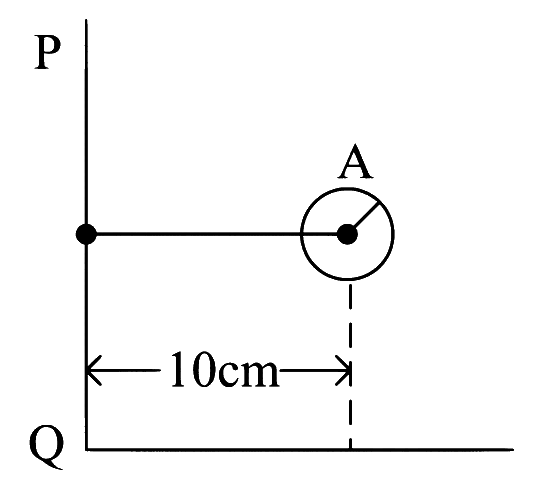
Solid sphere A is rotating about an axis PQ. If the radius of the sphere is 5 cm then its radius of gyration about PQ will be x\sqrt{x} cm. The value of xx is ________.

Figure

Numerical answer type. Work it out, then open the answer.

Show answer and solution

Answer: 110

  1. From the figure the centre of sphere A is 10 cm from axis PQ.
  2. k2=25R2+d2=25(25)+100=110 cm2k^2 = \frac{2}{5}R^2 + d^2 = \frac{2}{5}(25) + 100 = 110\ \text{cm}^2
  3. k=110k = \sqrt{110} cm, so x=110x = 110.
Report a mistake
Q103MHT CET 2023 · 12 MAY · SHIFT 2Medium

Moment of Inertia & Radius of Gyration · Bending, recasting & scaling

A thin wire of length 'LL' and uniform linear mass density 'mm' is bent into a circular coil. The moment of inertia of this coil about tangential axis and in plane of the coil is

Show answer and solution

Answer: (b)

  1. Mass M=mLM = mL, radius R=L2πR = \frac{L}{2\pi}.
  2. Tangent in the plane: I=MR22+MR2=32MR2I = \frac{MR^2}{2} + MR^2 = \frac{3}{2}MR^2.
  3. I=32mL⋅L24π2=3mL38π2I = \frac{3}{2}mL\cdot\frac{L^2}{4\pi^2} = \frac{3mL^3}{8\pi^2}
  4. So the answer is (b) 3mL38π2\frac{3mL^3}{8\pi^2}.
Report a mistake
Q104MHT CET 2023 · 9 MAY · SHIFT 2Medium

Moment of Inertia & Radius of Gyration · Bending, recasting & scaling

A disc of radius RR and thickness R6\frac{R}{6} has moment of inertia I about an axis passing through its centre and perpendicular to its plane. The disc is melted and recast into a solid sphere. The moment of inertia of a sphere about its diameter is

Show answer and solution

Answer: (a)

  1. Volume conserved: πR2⋅R6=43πa3⇒a=R2\pi R^2 \cdot \frac{R}{6} = \frac{4}{3}\pi a^3 \Rightarrow a = \frac{R}{2}.
  2. Disc: I=MR22I = \frac{MR^2}{2}; sphere: Is=25MR24=MR210I_s = \frac{2}{5}M\frac{R^2}{4} = \frac{MR^2}{10}.
  3. Is=I5I_s = \frac{I}{5}
  4. So the answer is (a) I5\frac{I}{5}.
Report a mistake
Q105MHT CET 2023 · 9 MAY · SHIFT 1Medium

Moment of Inertia & Radius of Gyration · Bending, recasting & scaling

Two discs of same mass and same thickness (t) are made from two different materials of densities 'd1d_1' and 'd2d_2 ' respectively. The ratio of the moment of inertia I1I_1 to I2I_2 of two discs about an axis passing through the centre and perpendicular to the plane of disc is

Show answer and solution

Answer: (b)

  1. Same mass and thickness: M=πR2td⇒R2∝1dM = \pi R^2 t d \Rightarrow R^2 \propto \frac{1}{d}.
  2. I=MR22∝R2∝1dI = \frac{MR^2}{2} \propto R^2 \propto \frac{1}{d}
  3. I1I2=d2d1\frac{I_1}{I_2} = \frac{d_2}{d_1}
  4. So the answer is (b) d2:d1d_2 : d_1.
Report a mistake
Q106JEE Main 2023 · 31 JAN · SHIFT 2Medium

Moment of Inertia & Radius of Gyration · Bending, recasting & scaling

Two discs of same mass and different radii are made of different materials such that their thicknesses are 1 cm1\text{ cm} and 0.5 cm0.5\text{ cm} respectively. The densities of materials are in the ratio 3:53:5. The moment of inertia of these discs respectively about their diameters will be in the ratio of x6\frac{x}{6}. The value of xx is ________.

Numerical answer type. Work it out, then open the answer.

Show answer and solution

Answer: 5

  1. Thin disc about a diameter: I=14mR2I = \frac{1}{4}mR^2.
  2. Same mass: m=ρπR2t⇒R2=mπρtm = \rho \pi R^2 t \Rightarrow R^2 = \frac{m}{\pi \rho t}, so I∝1ρtI \propto \frac{1}{\rho t}.
  3. I1I2=ρ2t2ρ1t1=5×0.53×1=56\frac{I_1}{I_2} = \frac{\rho_2 t_2}{\rho_1 t_1} = \frac{5 \times 0.5}{3 \times 1} = \frac{5}{6}
  4. So x=5x = 5.
Report a mistake
Q107JEE Main 2023 · 30 JAN · SHIFT 1Medium

Moment of Inertia & Radius of Gyration · Bending, recasting & scaling

A thin uniform rod of length 2 m2\text{ m}, cross sectional area 'AA' and density 'dd' is rotated about an axis passing through the centre and perpendicular to its length with angular velocity ω\omega. If value of ω\omega in terms of its rotational kinetic energy EE is αEAd\sqrt{\frac{\alpha E}{Ad}} then value of α\alpha is ______________.

Numerical answer type. Work it out, then open the answer.

Show answer and solution

Answer: 3

  1. Mass of rod m=AdL=2Adm = A d L = 2Ad (with L=2 mL = 2\text{ m}).
  2. I=mL212=2Ad×412=2Ad3I = \frac{mL^2}{12} = \frac{2Ad \times 4}{12} = \frac{2Ad}{3}
  3. E=12Iω2=Ad ω23⇒ω=3EAdE = \frac{1}{2}I\omega^2 = \frac{Ad\,\omega^2}{3} \Rightarrow \omega = \sqrt{\frac{3E}{Ad}}
  4. So α=3\alpha = 3.
Report a mistake
Q108MHT CET 2023 · 11 MAY · SHIFT 2Difficult

Moment of Inertia & Radius of Gyration · Composite bodies & cut-outs

From a disc of mass 'MM' and radius 'RR', a circular hole of diameter 'RR' is cut whose rim passes through the centre. The moment of inertia of the remaining part of the disc about perpendicular axis passing through the centre is

Show answer and solution

Answer: (a)

  1. Hole radius R2\frac{R}{2}, mass M4\frac{M}{4}, centre at R2\frac{R}{2} from O.
  2. Ihole=12M4R24+M4R24=3MR232I_{hole} = \frac{1}{2}\frac{M}{4}\frac{R^2}{4} + \frac{M}{4}\frac{R^2}{4} = \frac{3MR^2}{32}
  3. I=MR22−3MR232=13MR232I = \frac{MR^2}{2} - \frac{3MR^2}{32} = \frac{13MR^2}{32}
  4. So the answer is (a).
Report a mistake
Q109MHT CET 2023 · 10 MAY · SHIFT 1Difficult

Moment of Inertia & Radius of Gyration · Composite bodies & cut-outs

Seven identical discs each of mass MM and radius RR are arranged in a hexagonal plane pattern so as to touch each neighbour disc as shown in the figure. The moment of inertia of the system of seven discs about an axis passing through the centre of central disc and normal to the plane of all discs is

Figure

Show answer and solution

Answer: (d)

  1. Central disc: MR22\frac{MR^2}{2}.
  2. Each outer disc centre is 2R2R away: MR22+4MR2=92MR2\frac{MR^2}{2} + 4MR^2 = \frac{9}{2}MR^2.
  3. I=12MR2+6×92MR2=552MR2I = \frac{1}{2}MR^2 + 6 \times \frac{9}{2}MR^2 = \frac{55}{2}MR^2
  4. So the answer is (d).
Report a mistake
Q110JEE Main 2023 · 24 JAN · SHIFT 2Difficult

Moment of Inertia & Radius of Gyration · Composite bodies & cut-outs

A uniform solid cylinder with radius R and length L has moment of inertia I 11, about the axis of the cylinder. A concentric solid cylinder of radius R′=R2R' = \frac{R}{2} and length L′=L2L' = \frac{L}{2} is carved out of the original cylinder. If I22 is the moment of inertia of the carved out portion of the cylinder then I1I2=\frac{I_1}{I_2} = __________. (Both I11 and I22 are about the axis of the cylinder)

Numerical answer type. Work it out, then open the answer.

Show answer and solution

Answer: 32

  1. I1=MR22I_1 = \frac{MR^2}{2}
  2. Carved mass =M×14×12=M8= M \times \frac{1}{4} \times \frac{1}{2} = \frac{M}{8}: I2=12M8R24=MR264I_2 = \frac{1}{2}\frac{M}{8}\frac{R^2}{4} = \frac{MR^2}{64}
  3. I1I2=32\frac{I_1}{I_2} = 32
Report a mistake
Q111NEET 2022 · PHASE 1Easy

Moment of Inertia & Radius of Gyration · Parallel & perpendicular axis theorems

The ratio of the radius of gyration of a thin uniform disc about an axis passing through its centre and normal to its plane to the radius of gyration of the disc about its diameter is

Show answer and solution

Answer: (b)

  1. Normal axis through centre: I=MR22⇒K1=R2I = \frac{MR^2}{2} \Rightarrow K_1 = \frac{R}{\sqrt{2}}.
  2. About a diameter: I=MR24⇒K2=R2I = \frac{MR^2}{4} \Rightarrow K_2 = \frac{R}{2}.
  3. K1K2=22=2\frac{K_1}{K_2} = \frac{2}{\sqrt{2}} = \sqrt{2}
  4. So the answer is (b) 2:1\sqrt{2} : 1.
Report a mistake
Q112JEE Main 2022 · 28 JUL · SHIFT 1Medium

Moment of Inertia & Radius of Gyration · Point masses & rigid systems

Four identical discs each of mass 'MM' and diameter 'aa' are arranged in a small plane as shown in figure. If the moment of inertia of the system about OO′OO' is x4Ma2\frac{x}{4}Ma^2. Then, the value of xx will be ____________.

Figure

Numerical answer type. Work it out, then open the answer.

Show answer and solution

Answer: 3

  1. Each disc has radius r=a2r = \frac{a}{2}. About a diameter, I=14Mr2=Ma216I = \frac{1}{4}Mr^2 = \frac{Ma^2}{16}.
  2. Top and bottom discs: OO′OO' is their diameter, so 2×Ma2162 \times \frac{Ma^2}{16}.
  3. Side discs: OO′OO' is a tangent in their plane, I=14Mr2+Mr2=54Mr2=5Ma216I = \frac{1}{4}Mr^2 + Mr^2 = \frac{5}{4}Mr^2 = \frac{5Ma^2}{16} each.
  4. I=2Ma216+10Ma216=34Ma2I = \frac{2Ma^2}{16} + \frac{10Ma^2}{16} = \frac{3}{4}Ma^2
  5. So x=3x = 3.
Report a mistake
Q113JEE Main 2022 · 30 JUN · SHIFT 1Medium

Moment of Inertia & Radius of Gyration · Point masses & rigid systems

Four particles with a mass of 1 kg, 2 kg, 3 kg and 4 kg are situated at the corners of a square with side 1 m (as shown in the figure). The moment of inertia of the system, about an axis passing through the point O and perpendicular to the plane of the square, is ______________ kg m2.

Figure

Numerical answer type. Work it out, then open the answer.

Show answer and solution

Answer: 5

  1. Each mass is at distance 12 m\frac{1}{\sqrt{2}}\text{ m} from O (half the diagonal), so r2=12 m2r^2 = \frac{1}{2}\text{ m}^2.
  2. I=∑mr2=(1+2+3+4)×12I = \sum m r^2 = (1+2+3+4) \times \frac{1}{2}
  3. I=5 kg m2I = 5\text{ kg m}^2
Report a mistake
Q114JEE Main 2022 · 28 JUN · SHIFT 1Medium

Moment of Inertia & Radius of Gyration · Standard bodies & radius of gyration

Match List-I with List-II

Choose the correct answer from the options given below:

List-IList-II
(A)Moment of inertia of solid sphere of radius R about any tangent.(I)53MR2\frac{5}{3}MR^2
(B)Moment of inertia of hollow sphere of radius (R) about any tangent.(II)75MR2\frac{7}{5}MR^2
(C)Moment of inertia of circular ring of radius (R) about its diameter.(III)14MR2\frac{1}{4}MR^2
(D)Moment of inertia of circular disc of radius (R) about any diameter.(IV)12MR2\frac{1}{2}MR^2
Show answer and solution

Answer: (a)

  1. (A) Solid sphere, tangent: 25MR2+MR2=75MR2\frac{2}{5}MR^2 + MR^2 = \frac{7}{5}MR^2 (II).
  2. (B) Hollow sphere, tangent: 23MR2+MR2=53MR2\frac{2}{3}MR^2 + MR^2 = \frac{5}{3}MR^2 (I).
  3. (C) Ring about diameter: 12MR2\frac{1}{2}MR^2 (IV).
  4. (D) Disc about diameter: 14MR2\frac{1}{4}MR^2 (III).
  5. So the answer is (a).
Report a mistake
Q115JEE Main 2022 · 26 JUL · SHIFT 2Medium

Moment of Inertia & Radius of Gyration · Standard bodies & radius of gyration

The radius of gyration of a cylindrical rod about an axis of rotation perpendicular to its length and passing through the center will be ___________ m\text{m}.

Given, the length of the rod is 103 m10\sqrt{3}\text{ m}.

Numerical answer type. Work it out, then open the answer.

Show answer and solution

Answer: 5

  1. Thin rod about centre: I=ML212⇒K=L12=L23I = \frac{ML^2}{12} \Rightarrow K = \frac{L}{\sqrt{12}} = \frac{L}{2\sqrt{3}}.
  2. K=10323=5 mK = \frac{10\sqrt{3}}{2\sqrt{3}} = 5\text{ m}
Report a mistake
Q116JEE Main 2022 · 25 JUN · SHIFT 2Medium

Moment of Inertia & Radius of Gyration · Standard bodies & radius of gyration

Moment of Inertia (M.I.) of four bodies having same mass 'M' and radius '2R' are as follows: I1 = M.I. of solid sphere about its diameter

I2 = M.I. of solid cylinder about its axis

I3 = M.I. of solid circular disc about its diameter

I4 = M.I. of thin circular ring about its diameter

If 2(I2 + I3) + I4 = x. I1, then the value of x will be __________.

Numerical answer type. Work it out, then open the answer.

Show answer and solution

Answer: 5

  1. Radius 2R2R, so r2=4R2r^2 = 4R^2.
  2. I1=25M(4R2)=85MR2I_1 = \frac{2}{5}M(4R^2) = \frac{8}{5}MR^2, I2=12M(4R2)=2MR2I_2 = \frac{1}{2}M(4R^2) = 2MR^2
  3. I3=14M(4R2)=MR2I_3 = \frac{1}{4}M(4R^2) = MR^2, I4=12M(4R2)=2MR2I_4 = \frac{1}{2}M(4R^2) = 2MR^2
  4. 2(I2+I3)+I4=6MR2+2MR2=8MR2=x⋅85MR22(I_2 + I_3) + I_4 = 6MR^2 + 2MR^2 = 8MR^2 = x \cdot \frac{8}{5}MR^2
  5. So x=5x = 5.
Report a mistake
Q117JEE Main 2022 · 29 JUN · SHIFT 2Medium

Moment of Inertia & Radius of Gyration · Bending, recasting & scaling

The moment of inertia of a uniform thin rod about a perpendicular axis passing through one end is I1. The same rod is bent into a ring and its moment of inertia about a diameter is I2. If I1I2\frac{I_1}{I_2} is xπ23\frac{x\pi^2}{3}, then the value of x will be ____________.

Numerical answer type. Work it out, then open the answer.

Show answer and solution

Answer: 8

  1. Rod about one end: I1=mL23I_1 = \frac{mL^2}{3}.
  2. Ring: 2πR=L⇒R=L2π2\pi R = L \Rightarrow R = \frac{L}{2\pi}; about a diameter I2=mR22=mL28π2I_2 = \frac{mR^2}{2} = \frac{mL^2}{8\pi^2}.
  3. I1I2=8π23\frac{I_1}{I_2} = \frac{8\pi^2}{3}
  4. So x=8x = 8.
Report a mistake
Q118MHT CET 2021 · 24 SEP · SHIFT 1Easy

Moment of Inertia & Radius of Gyration · Point masses & rigid systems

Two identical particles each of mass 'mm' are separated by a distance 'dd'. The axis of rotation passes through the midpoint of 'dd' and is perpendicular to the length dd. If 'KK' is the average rotational kinetic energy of the system, then the angular frequency is

Show answer and solution

Answer: (c)

  1. Each particle is at d2\frac{d}{2} from the axis: I=2m(d2)2=md22I = 2m\left(\frac{d}{2}\right)^2 = \frac{md^2}{2}.
  2. K=12Iω2=md2ω24K = \frac{1}{2}I\omega^2 = \frac{md^2\omega^2}{4}
  3. ω2=4Kmd2⇒ω=2dKm\omega^2 = \frac{4K}{md^2} \Rightarrow \omega = \frac{2}{d}\sqrt{\frac{K}{m}}
  4. So the answer is (c) 2dKm\frac{2}{d}\sqrt{\frac{K}{m}}.
Report a mistake
Q119JEE Main 2021 · 16 MAR · SHIFT 1Easy

Moment of Inertia & Radius of Gyration · Point masses & rigid systems

Four equal masses, m each are placed at the corners of a square of length (l) as shown in the figure. The moment of inertia of the system about an axis passing through A and parallel to DB would be:

Figure

Show answer and solution

Answer: (d)

ABCDaxisC at √2 lB, D at l/√2
  1. Diagonal BDBD is at distance l2\frac{l}{\sqrt{2}} (half the diagonal) from AA, so the axis through AA parallel to BDBD is at l2\frac{l}{\sqrt{2}} from BB and DD.
  2. CC is a full diagonal away: distance 2 l\sqrt{2}\,l. AA is on the axis.
  3. I=0+2m(l2)2+m(2l)2=ml2+2ml2=3ml2I = 0 + 2m\left(\frac{l}{\sqrt{2}}\right)^2 + m(\sqrt{2}l)^2 = ml^2 + 2ml^2 = 3ml^2
  4. So the answer is (d) 3ml23ml^2.
Report a mistake
Q120MHT CET 2021 · 20 SEP · SHIFT 2Easy

Moment of Inertia & Radius of Gyration · Standard bodies & radius of gyration

The ratio of radii of gyration of a circular ring and circular disc of the same mass and radius, about an axis passing through their centres and perpendicular to their planes is

Show answer and solution

Answer: (c)

  1. Ring: I=MR2⇒Kr=RI = MR^2 \Rightarrow K_r = R.
  2. Disc: I=MR22⇒Kd=R2I = \frac{MR^2}{2} \Rightarrow K_d = \frac{R}{\sqrt{2}}.
  3. Kr:Kd=1:12=2:1K_r : K_d = 1 : \frac{1}{\sqrt{2}} = \sqrt{2} : 1
  4. So the answer is (c) 2:1\sqrt{2} : 1.
Report a mistake
Q121MHT CET 2021 · 24 SEP · SHIFT 2Easy

Moment of Inertia & Radius of Gyration · Parallel & perpendicular axis theorems

The moment of inertia of a thin uniform rod of mass 'M' and length 'L' about an axis passing through a point at a distance L4\frac{L}{4} from one of its ends and perpendicular to the length of the rod is

Show answer and solution

Answer: (b)

  1. Distance of the axis from the centre: d=L2−L4=L4d = \frac{L}{2} - \frac{L}{4} = \frac{L}{4}.
  2. I=ML212+ML216=7ML248I = \frac{ML^2}{12} + \frac{ML^2}{16} = \frac{7ML^2}{48}
  3. So the answer is (b) 7ML248\frac{7ML^2}{48}.
Report a mistake
Q122MHT CET 2021 · 23 SEP · SHIFT 1Easy

Moment of Inertia & Radius of Gyration · Parallel & perpendicular axis theorems

Figure

Figure shows triangular lamina which can rotate about different axes moment of inertia is maximum, about the axis

Show answer and solution

Answer: (c)

  1. II is largest about the axis from which the mass lies farthest on average.
  2. QSQS and QTQT pass through the lamina, so mass lies close on both sides; PRPR (hypotenuse) has the shortest perpendicular height.
  3. About a leg, I=Mh26I = \frac{Mh^2}{6} with hh the other leg. For QRQR, h=PQh = PQ, the longer leg; for PQPQ, h=QRh = QR, the shorter one.
  4. So II is maximum about (c) QR.
Report a mistake
Q123JEE Main 2021 · 27 AUG · SHIFT 1Easy

Moment of Inertia & Radius of Gyration · Parallel & perpendicular axis theorems

Moment of inertia of a square plate of side l about the axis passing through one of the corner and perpendicular to the plane of square plate is given by:

Show answer and solution

Answer: (d)

  1. About the central axis normal to the plate: Icm=Ml26I_{cm} = \frac{Ml^2}{6}.
  2. Corner is at half-diagonal: d2=l22d^2 = \frac{l^2}{2}.
  3. I=Ml26+Ml22=23Ml2I = \frac{Ml^2}{6} + \frac{Ml^2}{2} = \frac{2}{3}Ml^2
  4. So the answer is (d) 23Ml2\frac{2}{3}Ml^2.
Report a mistake
Q124JEE Main 2021 · 25 JUL · SHIFT 1Easy

Moment of Inertia & Radius of Gyration · Parallel & perpendicular axis theorems

Given below are two statements: one is labelled as Assertion A and the other is labelled as Reason R.

Assertion A: Moment of inertia of a circular disc of mass 'M' and radius 'R' about X, Y axes (passing through its plane) and Z-axis which is perpendicular to its plane were found to be Ix, Iy and Iz respectively. The respectively radii of gyration about all the three axes will be the same. Reason R: A rigid body making rotational motion has fixed mass and shape. In the light of the above statements, choose the most appropriate answer from the options given below:

Show answer and solution

Answer: (b)

  1. Disc: Ix=Iy=MR24I_x = I_y = \frac{MR^2}{4}, Iz=MR22I_z = \frac{MR^2}{2}.
  2. So kx=ky=R2k_x = k_y = \frac{R}{2} but kz=R2k_z = \frac{R}{\sqrt{2}}: radii of gyration are not all equal, A is false.
  3. R is true: a rigid body keeps its mass and shape while rotating.
  4. So the answer is (b).
Report a mistake
Q125MHT CET 2021 · 23 SEP · SHIFT 1Medium

Moment of Inertia & Radius of Gyration · Point masses & rigid systems

Three solid spheres each of mass 'MM' and radius 'RR' are arranged as shown in the figure. The moment of inertia of the system about YY' will be

Figure

Show answer and solution

Answer: (a)

  1. Top sphere has YY' as a diameter: 25MR2\frac{2}{5}MR^2.
  2. Bottom two touch YY' (d=Rd = R): 2(25+1)MR2=145MR22\left(\frac{2}{5}+1\right)MR^2 = \frac{14}{5}MR^2.
  3. I=165MR2I = \frac{16}{5}MR^2, so the answer is (a).
Report a mistake
Q126MHT CET 2021 · 21 SEP · SHIFT 2Medium

Moment of Inertia & Radius of Gyration · Point masses & rigid systems

Figure

Three rings each of mass 'M' and radius 'R' are arranged as shown in the figure. The moment of inertia of system about axis YY' will be

Show answer and solution

Answer: (b)

  1. Ring 1: YY' is a diameter, 12MR2\frac{1}{2}MR^2.
  2. Rings 2, 3: YY' is a tangent in their plane, 12MR2+MR2=32MR2\frac{1}{2}MR^2 + MR^2 = \frac{3}{2}MR^2 each.
  3. I=12MR2+3MR2=72MR2I = \frac{1}{2}MR^2 + 3MR^2 = \frac{7}{2}MR^2, so the answer is (b).
Report a mistake
Q127JEE Main 2021 · 31 AUG · SHIFT 2Medium

Moment of Inertia & Radius of Gyration · Point masses & rigid systems

A system consists of two identical spheres each of mass 1.5 kg and radius 50 cm at the ends of a light rod. The distance between the centres of the two spheres is 5 m. What will be the moment of inertia of the system about an axis perpendicular to the rod passing through its midpoint?

Show answer and solution

Answer: (c)

  1. Each sphere: 25mr2=25(1.5)(0.5)2=0.15\frac{2}{5}mr^2 = \frac{2}{5}(1.5)(0.5)^2 = 0.15 kg m2^2.
  2. Each centre is 2.52.5 m from the axis: md2=1.5×6.25=9.375md^2 = 1.5\times6.25 = 9.375 kg m2^2.
  3. I=2(0.15+9.375)=19.05I = 2(0.15 + 9.375) = 19.05 kg m2^2, so the answer is (c).
Report a mistake
Q128JEE Main 2021 · 26 FEB · SHIFT 1Medium

Moment of Inertia & Radius of Gyration · Point masses & rigid systems

Four identical solid spheres each of mass 'm' and radius 'a' are placed with their centres on the four corners of a square of side 'b'. The moment of inertia of the system about one side of square where the axis of rotation is parallel to the plane of the square is:

Show answer and solution

Answer: (d)

  1. Two spheres have their centres on the side (axis): 25ma2\frac{2}{5}ma^2 each.
  2. Other two are at distance bb: 25ma2+mb2\frac{2}{5}ma^2 + mb^2 each.
  3. I=85ma2+2mb2I = \frac{8}{5}ma^2 + 2mb^2, so the answer is (d).
Report a mistake
Q129JEE Main 2021 · 26 AUG · SHIFT 2Medium

Moment of Inertia & Radius of Gyration · Standard bodies & radius of gyration

The solid cylinder of length 80 cm and mass M has a radius of 20 cm. Calculate the density of the material used if the moment of inertia of the cylinder about an axis CD parallel to AB as shown in figure is 2.7 kg m2.

Figure

Show answer and solution

Answer: (d)

  1. CD is parallel to the cylinder axis AB at distance L2=0.4 m\frac{L}{2} = 0.4\text{ m}.
  2. I=12Mr2+M(L2)2=M(0.02+0.16)=0.18M=2.7⇒M=15 kgI = \frac{1}{2}Mr^2 + M\left(\frac{L}{2}\right)^2 = M(0.02 + 0.16) = 0.18M = 2.7 \Rightarrow M = 15\text{ kg}
  3. V=πr2L=π(0.04)(0.8)≈0.1005 m3V = \pi r^2 L = \pi(0.04)(0.8) \approx 0.1005\text{ m}^3
  4. ρ=150.1005≈149 kg/m3\rho = \frac{15}{0.1005} \approx 149\text{ kg/m}^3
  5. So the answer is (d) 1.49×10² kg/m31.49 \times 10^2\text{ kg/m}^3.
Report a mistake
Q130JEE Main 2021 · 27 JUL · SHIFT 1Medium

Moment of Inertia & Radius of Gyration · Standard bodies & radius of gyration

Choose the correct answer from the options given below:

List-IList-II
(a) MI of the rod (length L, Mass M, about an axis ⊥\perp to the rod passing through the midpoint)(i) 8ML2/38ML^2/3
(b) MI of the rod (length L, Mass 2M, about an axis ⊥\perp to the rod passing through one of its end)(ii) ML2/3ML^2/3
(c) MI of the rod (length 2L, Mass M, about an axis ⊥\perp to the rod passing through its midpoint)(iii) ML2/12ML^2/12
(d) MI of the rod (Length 2L, Mass 2M, about an axis ⊥\perp to the rod passing through one of its end)(iv) 2ML2/32ML^2/3
Show answer and solution

Answer: (c)

  1. (a) ML212\frac{ML^2}{12} (iii).
  2. (b) (2M)L23=2ML23\frac{(2M)L^2}{3} = \frac{2ML^2}{3} (iv).
  3. (c) M(2L)212=ML23\frac{M(2L)^2}{12} = \frac{ML^2}{3} (ii).
  4. (d) (2M)(2L)23=8ML23\frac{(2M)(2L)^2}{3} = \frac{8ML^2}{3} (i).
  5. So the answer is (c).
Report a mistake
Q131JEE Main 2021 · 24 FEB · SHIFT 1Medium

Moment of Inertia & Radius of Gyration · Standard bodies & radius of gyration

Moment of inertia (M. I.) of four bodies, having same mass and radius, are reported as; I1 = M.I. of thin circular ring about its diameter,

I2 = M.I. of circular disc about an axis perpendicular to disc and going through the centre, I3 = M.I. of solid cylinder about its axis and

I4 = M.I. of solid sphere about its diameter.

Then:

Show answer and solution

Answer: (a)

  1. I1I_1 (ring, diameter) =12MR2= \frac{1}{2}MR^2; I2I_2 (disc, perpendicular axis) =12MR2= \frac{1}{2}MR^2.
  2. I3I_3 (solid cylinder, own axis) =12MR2= \frac{1}{2}MR^2; I4I_4 (solid sphere, diameter) =25MR2= \frac{2}{5}MR^2.
  3. So the answer is (a) I1=I2=I3>I4I_1 = I_2 = I_3 > I_4.
Report a mistake
Q132MHT CET 2021 · 21 SEP · SHIFT 1Medium

Moment of Inertia & Radius of Gyration · Parallel & perpendicular axis theorems

The moment of inertia of a circular disc of radius 2 m2\text{ m} and mass 1 kg1\text{ kg} about an axis XY passing through its centre of mass and perpendicular to the plane of the disc is 2 kg m22\text{ kg m}^2. The moment of inertia about an axis parallel to the axis XYXY and passing through the edge of the disc is

Show answer and solution

Answer: (a)

  1. Parallel axis theorem with d=R=2 md = R = 2\text{ m}: I=Icm+MR2I = I_{cm} + MR^2.
  2. I=2+1×22=6 kg m2I = 2 + 1 \times 2^2 = 6\text{ kg m}^2
  3. So the answer is (a) 6 kg m26\text{ kg m}^2.
Report a mistake
Q133MHT CET 2021 · 23 SEP · SHIFT 2Medium

Moment of Inertia & Radius of Gyration · Bending, recasting & scaling

Two circular loops P and Q are made from a uniform wire. The radii of P and Q are R 11 and R22 respectively. The moments of inertia about their own axis are IPI_P and IQI_Q respectively. If IPIQ=18\frac{I_P}{I_Q} = \frac{1}{8} then R2R1\frac{R_2}{R_1} is

Show answer and solution

Answer: (c)

  1. Same wire: M∝RM \propto R, so I∝R3I \propto R^3.
  2. (R1R2)3=18⇒R2R1=2\left(\frac{R_1}{R_2}\right)^3 = \frac{1}{8} \Rightarrow \frac{R_2}{R_1} = 2
  3. So the answer is (c) 2.
Report a mistake
Q134MHT CET 2021 · 22 SEP · SHIFT 2Medium

Moment of Inertia & Radius of Gyration · Bending, recasting & scaling

Two rings of radius 'R' and 'nR' made of same material have the ratio of moment of inertia about an axis passing through its centre and perpendicular to the plane is 1:81 : 8. The value of 'nn' is (mass per unit length =λ= \lambda)

Show answer and solution

Answer: (a)

  1. Ring: I=(2πRλ)R2=2πλR3∝R3I = (2\pi R\lambda)R^2 = 2\pi\lambda R^3 \propto R^3.
  2. R3(nR)3=18⇒n3=8\frac{R^3}{(nR)^3} = \frac{1}{8} \Rightarrow n^3 = 8
  3. So the answer is (a) n=2n = 2.
Report a mistake
Q135MHT CET 2021 · 20 SEP · SHIFT 1Medium

Moment of Inertia & Radius of Gyration · Bending, recasting & scaling

A solid sphere of mass MM, radius RR has moment of inertia 'II' about its diameter. It is recast into a disc of thickness 't' whose moment of inertia about an axis passing through its edge and perpendicular to its plane remains 'I'. Radius of the disc will be

Show answer and solution

Answer: (c)

  1. Sphere: I=25MR2I = \frac{2}{5}MR^2; disc about its edge, perpendicular to plane: I=32Mr2I = \frac{3}{2}Mr^2.
  2. 32Mr2=25MR2⇒r2=4R215\frac{3}{2}Mr^2 = \frac{2}{5}MR^2 \Rightarrow r^2 = \frac{4R^2}{15}
  3. So the answer is (c) 2R15\frac{2R}{\sqrt{15}}.
Report a mistake
Q136JEE Main 2021 · 27 JUL · SHIFT 1Medium

Moment of Inertia & Radius of Gyration · Bending, recasting & scaling

The figure shows two solid discs with radius R and r respectively. If mass per unit area is same for both, what is the ratio of MI of bigger disc around axis AB (Which is ⊥\perp to the plane of the disc and passing through its centre) to MI of smaller disc around one of its diameters lying on its plane? Given 'M' is the mass of the larger disc. (MI stands for moment of inertia)

Figure

Show answer and solution

Answer: (d)

  1. Bigger disc about AB (perpendicular, through centre): I1=MR22I_1 = \frac{MR^2}{2}.
  2. Same mass per area: smaller disc mass m=Mr2R2m = M\frac{r^2}{R^2}; about a diameter I2=mr24=Mr44R2I_2 = \frac{mr^2}{4} = \frac{Mr^4}{4R^2}.
  3. I1I2=MR2/2Mr4/4R2=2R4r4\frac{I_1}{I_2} = \frac{MR^2/2}{Mr^4/4R^2} = \frac{2R^4}{r^4}
  4. So the answer is (d) 2R4:r42R^4 : r^4.
Report a mistake
Q137JEE Main 2021 · 18 MAR · SHIFT 2Medium

Moment of Inertia & Radius of Gyration · Bending, recasting & scaling

Consider a uniform wire of mass M and length L. It is bent into a semicircle. Its moment of inertia about a line perpendicular to the plane of the wire passing through the center is:

Show answer and solution

Answer: (d)

  1. Semicircle: L=πR⇒R=LπL = \pi R \Rightarrow R = \frac{L}{\pi}.
  2. Every element is at distance RR from the axis: I=MR2I = MR^2.
  3. I=ML2π2I = \frac{ML^2}{\pi^2}
  4. So the answer is (d) ML2π2\frac{ML^2}{\pi^2}.
Report a mistake
Q138JEE Main 2021 · 24 FEB · SHIFT 2Medium

Moment of Inertia & Radius of Gyration · Bending, recasting & scaling

A uniform thin bar of mass 6 kg and length 2.4 meter is bent to make an equilateral hexagon. The moment of inertia about an axis passing through the centre of mass and perpendicular to the plane of hexagon is _______ ×\times 10−-1 kg m2.

Numerical answer type. Work it out, then open the answer.

Show answer and solution

Answer: 8

  1. Each side: m=1 kgm = 1\text{ kg}, a=0.4 ma = 0.4\text{ m}, at distance 3a2\frac{\sqrt{3}a}{2} from the centre.
  2. One side: ma212+m3a24=56ma2\frac{ma^2}{12} + m\frac{3a^2}{4} = \frac{5}{6}ma^2
  3. Hexagon: I=6×56ma2=5ma2=5×1×0.16=0.8 kg m2I = 6 \times \frac{5}{6}ma^2 = 5ma^2 = 5 \times 1 \times 0.16 = 0.8\text{ kg m}^2
  4. So the answer is 8×10⁻¹ kg m28 \times 10^{-1}\text{ kg m}^2, i.e. 88.
Report a mistake
Q139NEET 2021Medium

Moment of Inertia & Radius of Gyration · Composite bodies & cut-outs

From a circular ring of mass 'M' and radius 'R' an arc corresponding to a 90∘^\circ sector is removed. The moment of inertia of the remaining part of the ring about an axis passing through the center of the ring and perpendicular to the plane of the ring is 'K' times 'MR2'. Then the value of 'K' is:

Show answer and solution

Answer: (b)

  1. Removing a 90∘90^\circ arc removes 14\frac{1}{4} of the mass; remaining mass 3M4\frac{3M}{4}.
  2. All remaining mass is still at distance RR: I=34MR2I = \frac{3}{4}MR^2.
  3. So K=34K = \frac{3}{4}, answer (b).
Report a mistake
Q140JEE Main 2021 · 26 AUG · SHIFT 1Medium

Moment of Inertia & Radius of Gyration · Composite bodies & cut-outs

Consider a badminton racket with length scales as shown in the figure.

Figure

If the mass of the linear and circular portions of the badminton racket are same (M) and the mass of the threads are negligible, the moment of inertia of the racket about an axis perpendicular to the handle and in the plane of the ring at r2\frac{r}{2} distance from the end A of the handle will be ................ Mr2.

Numerical answer type. Work it out, then open the answer.

Show answer and solution

Answer: 52

  1. Handle: length 6r6r, centre 3r3r from A, so 2.5r2.5r from axis: M(6r)212+M(2.5r)2=9.25Mr2\frac{M(6r)^2}{12} + M(2.5r)^2 = 9.25Mr^2
  2. Ring: radius rr, centre 7r7r from A, so 6.5r6.5r from axis; axis is parallel to a diameter.
  3. Ring: Mr22+M(6.5r)2=42.75Mr2\frac{Mr^2}{2} + M(6.5r)^2 = 42.75Mr^2
  4. Total =52Mr2= 52Mr^2, so the answer is 5252.
Report a mistake
Q141MHT CET 2020 · 19 OCT · SHIFT 2Easy

Moment of Inertia & Radius of Gyration · Point masses & rigid systems

Three point masses, each of mass mm are placed at the corners of an equilateral triangle of side ℓ\ell. The moment of inertia of the system about an axis passing through one of the vertices and parallel to the side joining other two vertices, will be

Show answer and solution

Answer: (c)

  1. The mass at the vertex is on the axis and contributes zero.
  2. The other two masses are at height 32ℓ\frac{\sqrt{3}}{2}\ell from the axis.
  3. I=2m⋅3ℓ24=32mℓ2I = 2m \cdot \frac{3\ell^2}{4} = \frac{3}{2}m\ell^2
  4. So the answer is (c) 32mℓ2\frac{3}{2}m\ell^2.
Report a mistake
Q142MHT CET 2020 · 16 OCT · SHIFT 2Easy

Moment of Inertia & Radius of Gyration · Parallel & perpendicular axis theorems

A thin uniform rod has mass MM and length LL The moment of inertia about an axis perpendicular to it and passing through the point at a distance L3\frac{L}{3} from one of its ends, will be

Show answer and solution

Answer: (c)

  1. Distance from the centre: d=L2−L3=L6d = \frac{L}{2} - \frac{L}{3} = \frac{L}{6}.
  2. I=ML212+ML236=3ML2+ML236I = \frac{ML^2}{12} + \frac{ML^2}{36} = \frac{3ML^2 + ML^2}{36}
  3. I=ML29I = \frac{ML^2}{9}
  4. So the answer is (c) ML29\frac{ML^2}{9}.
Report a mistake
Q143JEE Main 2020 · 7 JAN · SHIFT 1Easy

Moment of Inertia & Radius of Gyration · Parallel & perpendicular axis theorems

The radius of gyration of a uniform rod of length ll, about an axis passing through a point l4\frac{l}{4} away from the centre of the rod, and perpendicular to it, is:

Show answer and solution

Answer: (c)

  1. I=ml212+m(l4)2=ml2(4+348)=748ml2I = \frac{ml^2}{12} + m\left(\frac{l}{4}\right)^2 = ml^2\left(\frac{4+3}{48}\right) = \frac{7}{48}ml^2
  2. I=mk2⇒k=748 lI = mk^2 \Rightarrow k = \sqrt{\frac{7}{48}}\,l
  3. So the answer is (c) 748 l\sqrt{\frac{7}{48}}\,l.
Report a mistake
Q144JEE Main 2020 · 3 SEP · SHIFT 2Medium

Moment of Inertia & Radius of Gyration · Point masses & rigid systems

A massless equilateral triangle EFG of side ‘a’ (As shown in figure) has three particles of mass m situated at its vertices. The moment of inertia of the system about the line EX perpendicular to EG in the plane of EFG is N20\frac{N}{20} ma2 where N is an integer. The value of N is _____.

Figure

Numerical answer type. Work it out, then open the answer.

Show answer and solution

Answer: 25

XEGFa/2a
  1. I=∑mr2I = \sum m r^2, with rr the perpendicular distance from line EX.
  2. E lies on the axis: r=0r = 0. F is above the midpoint of EG: r=a2r = \frac{a}{2}. G: r=ar = a.
  3. I=ma24+ma2=54ma2=2520ma2I = m\frac{a^2}{4} + ma^2 = \frac{5}{4}ma^2 = \frac{25}{20}ma^2
  4. So N=25N = 25.
Report a mistake
Q145JEE Main 2020 · 3 SEP · SHIFT 1Medium

Moment of Inertia & Radius of Gyration · Standard bodies & radius of gyration

Moment of inertia of a cylinder of mass M, length L and radius R about an axis passing through its centre and perpendicular to the axis of the cylinder is

I = M(R24+L212)M\left(\frac{R^2}{4} + \frac{L^2}{12}\right). If such a cylinder is to be made for a given mass of a material, the ratio LR\frac{L}{R} for it to have minimum possible I is

Show answer and solution

Answer: (b)

  1. Fixed mass means fixed volume V=πR2LV = \pi R^2 L, so R2=VπLR^2 = \frac{V}{\pi L}.
  2. I=M(V4πL+L212)I = M\left(\frac{V}{4\pi L} + \frac{L^2}{12}\right)
  3. dIdL=0⇒−V4πL2+L6=0⇒L3=3V2π=32R2L\frac{dI}{dL} = 0 \Rightarrow -\frac{V}{4\pi L^2} + \frac{L}{6} = 0 \Rightarrow L^3 = \frac{3V}{2\pi} = \frac{3}{2}R^2 L
  4. L2=32R2L^2 = \frac{3}{2}R^2
  5. So the answer is (b) 32\sqrt{\frac{3}{2}}.
Report a mistake
Q146MHT CET 2020 · 16 OCT · SHIFT 2Medium

Moment of Inertia & Radius of Gyration · Parallel & perpendicular axis theorems

The ratio of radii of gyration of a ring to a disc (both circular) of same radii and mass, about a tangential axis perpendicular to the plane is

Show answer and solution

Answer: (d)

  1. Ring, tangent perpendicular to plane: MR2+MR2=2MR2⇒Kr=2RMR^2 + MR^2 = 2MR^2 \Rightarrow K_r = \sqrt{2}R.
  2. Disc, tangent perpendicular to plane: 12MR2+MR2=32MR2⇒Kd=32R\frac{1}{2}MR^2 + MR^2 = \frac{3}{2}MR^2 \Rightarrow K_d = \sqrt{\frac{3}{2}}R.
  3. KrKd=23/2=23\frac{K_r}{K_d} = \sqrt{\frac{2}{3/2}} = \frac{2}{\sqrt{3}}
  4. So the answer is (d) 23\frac{2}{\sqrt{3}}.
Report a mistake
Q147JEE Main 2020 · 4 SEP · SHIFT 2Medium

Moment of Inertia & Radius of Gyration · Parallel & perpendicular axis theorems

For a uniform rectangular sheet shown in the figure, the ratio of moments of inertia about the axes perpendicular to the sheet and passing through O (the centre of mass) and O' (corner point) is:

Figure

Show answer and solution

Answer: (b)

  1. Through centre O: IO=M12(a2+b2)I_O = \frac{M}{12}(a^2 + b^2).
  2. O' is a corner, at distance 12a2+b2\frac{1}{2}\sqrt{a^2 + b^2} from O: IO′=M12(a2+b2)+M4(a2+b2)=M3(a2+b2)I_{O'} = \frac{M}{12}(a^2+b^2) + \frac{M}{4}(a^2+b^2) = \frac{M}{3}(a^2+b^2).
  3. IOIO′=1/121/3=14\frac{I_O}{I_{O'}} = \frac{1/12}{1/3} = \frac{1}{4}
  4. So the answer is (b) 14\frac{1}{4}.
Report a mistake
Q148MHT CET 2020 · 19 OCT · SHIFT 2Medium

Moment of Inertia & Radius of Gyration · Bending, recasting & scaling

Two circular loop AA and BB of radii RR and NRNR respectively are made from a uniform wire. Moment of inertia of BB about its axis is 3 times that of AA about its axis. The value of NN is

Show answer and solution

Answer: (c)

  1. Same wire: M∝RM \propto R, so I=MR2∝R3I = MR^2 \propto R^3.
  2. N3=3⇒N=31/3N^3 = 3 \Rightarrow N = 3^{1/3}
  3. So the answer is (c) [3]1/3[3]^{1/3}.
Report a mistake
Q149JEE Main 2020 · 4 SEP · SHIFT 2Medium

Moment of Inertia & Radius of Gyration · Bending, recasting & scaling

Consider two uniform discs of the same thickness and different radii R1 = R and R2 = α\alphaR made of the same material. If the ratio of their moments of inertia I1 and I2, respectively, about their axes is I1: I2 = 1: 16 then the value of α\alpha is:

Show answer and solution

Answer: (b)

  1. Same material and thickness: M∝R2M \propto R^2, so I=MR22∝R4I = \frac{MR^2}{2} \propto R^4.
  2. α4=16⇒α=2\alpha^4 = 16 \Rightarrow \alpha = 2
  3. So the answer is (b) 2.
Report a mistake
Q150JEE Main 2020 · 9 JAN · SHIFT 1Medium

Moment of Inertia & Radius of Gyration · Composite bodies & cut-outs

Figure

Three solid spheres each of mass m and diameter d are stuck together such that the lines connecting the centres form an equilateral triangle of side of length d. The ratio I0/IA of moment of inertia I0 of the system about an axis passing through the centroid and about center of any of the spheres IA and perpendicular to the plane of the triangle is:

Show answer and solution

Answer: (a)

  1. Each sphere: Icm=25m(d2)2=md210I_{cm} = \frac{2}{5}m\left(\frac{d}{2}\right)^2 = \frac{md^2}{10}; centroid to centre =d3= \frac{d}{\sqrt{3}}.
  2. I0=3(md210+md23)=13md210I_0 = 3\left(\frac{md^2}{10} + \frac{md^2}{3}\right) = \frac{13md^2}{10}
  3. IA=3×md210+2md2=23md210I_A = 3 \times \frac{md^2}{10} + 2md^2 = \frac{23md^2}{10}
  4. I0IA=1323\frac{I_0}{I_A} = \frac{13}{23}, so the answer is (a).
Report a mistake
Q151JEE Main 2020 · 5 SEP · SHIFT 2Difficult

Moment of Inertia & Radius of Gyration · Standard bodies & radius of gyration

A ring is hung on a nail. It can oscillate, without slipping or sliding

(i) in its plane with a time period T1 and,

(ii) back and forth in a direction perpendicular to its plane,

with a period T2. The ratio T1T2\frac{T_1}{T_2} will be:

Show answer and solution

Answer: (b)

  1. Physical pendulum: T=2πImgRT = 2\pi\sqrt{\frac{I}{mgR}}, so T∝IT \propto \sqrt{I} (same RR).
  2. (i) In plane, axis ⊥\perp plane at rim: I1=MR2+MR2=2MR2I_1 = MR^2 + MR^2 = 2MR^2
  3. (ii) ⊥\perp to plane, axis tangent in plane: I2=MR22+MR2=32MR2I_2 = \frac{MR^2}{2} + MR^2 = \frac{3}{2}MR^2
  4. T1T2=23/2=23\frac{T_1}{T_2} = \sqrt{\frac{2}{3/2}} = \frac{2}{\sqrt{3}}, so the answer is (b).
Report a mistake
Q152JEE Main 2020 · 6 SEP · SHIFT 1Difficult

Moment of Inertia & Radius of Gyration · Composite bodies & cut-outs

Shown in the figure is a hollow icecream cone (it is open at the top). If its mass is M, radius of its top, R and height, H, then its moment of inertia about its axis is:

Figure

Show answer and solution

Answer: (b)

  1. Cut the cone surface into rings: a ring at slant distance ss has radius r=Rlsr = \frac{R}{l}s and mass dm=2Ml2s dsdm = \frac{2M}{l^2}s\,ds.
  2. I=∫0lR2s2l2⋅2Ml2s ds=2MR2l4⋅l44=MR22I = \int_0^l \frac{R^2 s^2}{l^2} \cdot \frac{2M}{l^2}s\,ds = \frac{2MR^2}{l^4} \cdot \frac{l^4}{4} = \frac{MR^2}{2}
  3. Independent of HH, so the answer is (b) MR22\frac{MR^2}{2}.
Report a mistake
Q153JEE Main 2020 · 4 SEP · SHIFT 1Difficult

Moment of Inertia & Radius of Gyration · Composite bodies & cut-outs

ABC is a plane lamina of the shape of an equilateral triangle. D, E are mid points of AB, AC and G is the centroid of the lamina. Moment of inertia of the lamina about an axis passing through G and perpendicular to the plane ABC is I0. If part ADE is removed, the moment of inertia of the remaining part about the same axis is NI016\frac{NI_0}{16} where N is an integer. Value of N is ______.

Figure

Numerical answer type. Work it out, then open the answer.

Show answer and solution

Answer: 11

  1. For a triangular lamina of side aa about its centroid, I0=Ma212I_0 = \frac{Ma^2}{12}.
  2. ADE is a similar triangle of side a2\frac{a}{2} and mass M4\frac{M}{4}, so about its own centroid I′=M4⋅(a/2)212=I016I' = \frac{M}{4}\cdot\frac{(a/2)^2}{12} = \frac{I_0}{16}.
  3. With height h=3a2h = \frac{\sqrt{3}a}{2}: G is 2h3\frac{2h}{3} below A and the centroid of ADE is h3\frac{h}{3} below A, so d=h3=a23d = \frac{h}{3} = \frac{a}{2\sqrt{3}}, d2=a212d^2 = \frac{a^2}{12}.
  4. Parallel axes: IADE=I016+M4⋅a212=I016+I04=5I016I_{ADE} = \frac{I_0}{16} + \frac{M}{4}\cdot\frac{a^2}{12} = \frac{I_0}{16} + \frac{I_0}{4} = \frac{5I_0}{16}.
  5. Remaining part: I0−5I016=11I016I_0 - \frac{5I_0}{16} = \frac{11I_0}{16}, so N = 11.
Report a mistake
Q154JEE Main 2020 · 6 SEP · SHIFT 2Difficult

Moment of Inertia & Radius of Gyration · Variable density bodies

The linear mass density of a thin rod AB of length L varies from A to B as

λ(x)=λ0(1+xL)\lambda(x) = \lambda_0\left(1+\frac{x}{L}\right), where x is the distance from A. If M is the mass of the rod then its moment of inertia about an axis passing through A and perpendicular to the rod is:

Show answer and solution

Answer: (c)

  1. M=∫0Lλ0(1+xL)dx=32λ0LM = \int_0^L \lambda_0\left(1+\frac{x}{L}\right)dx = \frac{3}{2}\lambda_0 L
  2. IA=∫0Lλ0(1+xL)x2dx=λ0(L33+L34)=712λ0L3I_A = \int_0^L \lambda_0\left(1+\frac{x}{L}\right)x^2 dx = \lambda_0\left(\frac{L^3}{3}+\frac{L^3}{4}\right) = \frac{7}{12}\lambda_0 L^3
  3. Put λ0=2M3L\lambda_0 = \frac{2M}{3L}: IA=712⋅2M3LL3=718ML2I_A = \frac{7}{12}\cdot\frac{2M}{3L}L^3 = \frac{7}{18}ML^2
  4. So the answer is (c) 718ML2\frac{7}{18}ML^2.
Report a mistake
Q155JEE Main 2020 · 7 JAN · SHIFT 2Difficult

Moment of Inertia & Radius of Gyration · Variable density bodies

Mass per unit area of a circular disc of radius aa depends on the distance r from its centre as σ(r)\sigma(r) = A + Br. The moment of inertia of the disc about the axis, perpendicular to the plane and passing through its centre is:

Show answer and solution

Answer: (a)

  1. Take a ring of radius rr, width drdr: dm=(A+Br) 2πr drdm = (A+Br)\,2\pi r\,dr, dI=r2dmdI = r^2 dm.
  2. I=2π∫0a(Ar3+Br4)dr=2π(Aa44+Ba55)I = 2\pi\int_0^a (Ar^3 + Br^4)dr = 2\pi\left(\frac{Aa^4}{4} + \frac{Ba^5}{5}\right)
  3. I=2πa4(A4+aB5)I = 2\pi a^4\left(\frac{A}{4} + \frac{aB}{5}\right)
  4. So the answer is (a).
Report a mistake
Q156MHT CET 2019 · 2 MAY · SHIFT 2Easy

Moment of Inertia & Radius of Gyration · Point masses & rigid systems

Three point masses each of mass ' mm ' are kept at the corners of an equilateral triangle of side ' LL '. The system rotates about the center of the triangle without any change in the separation of masses during rotation. The period of rotation is directly proportional to (cos⁡30∘=sin⁡60∘=32)\left(\cos 30^\circ = \sin 60^\circ = \frac{\sqrt{3}}{2}\right)

Show answer and solution

Answer: (a)

  1. The separation stays fixed because mutual gravity supplies the centripetal force. Each mass is at r=L3r = \frac{L}{\sqrt{3}} from the centre.
  2. Net pull on one mass toward the centre: 2Gm2L2cos⁡30∘=3Gm2L22\frac{Gm^2}{L^2}\cos 30^\circ = \frac{\sqrt{3}Gm^2}{L^2}
  3. mω2L3=3Gm2L2⇒ω2=3GmL3m\omega^2 \frac{L}{\sqrt{3}} = \frac{\sqrt{3}Gm^2}{L^2} \Rightarrow \omega^2 = \frac{3Gm}{L^3}
  4. T=2πω=2πL33Gm⇒T∝L3/2T = \frac{2\pi}{\omega} = 2\pi\sqrt{\frac{L^3}{3Gm}} \Rightarrow T \propto L^{3/2}
  5. So the answer is (b) L3/2L^{3/2}.
Report a mistake
Q157MHT CET 2019 · 2 MAY · SHIFT 1Easy

Moment of Inertia & Radius of Gyration · Bending, recasting & scaling

If radius of the solid sphere is doubled by keeping its mass constant, the ratio of their moment of inertia about any of its diameter is

Show answer and solution

Answer: (d)

  1. I=25MR2⇒I∝R2I = \frac{2}{5}MR^2 \Rightarrow I \propto R^2 for fixed MM.
  2. I1I2=(R2R)2=14\frac{I_1}{I_2} = \left(\frac{R}{2R}\right)^2 = \frac{1}{4}
  3. So the answer is (d) 1:41:4.
Report a mistake
Q158MHT CET 2019 · 2 MAY · SHIFT 2Medium

Moment of Inertia & Radius of Gyration · Point masses & rigid systems

Three identical rods each of mass ' MM ' and length ' LL ' are joined to form a symbol ' HH. The moment of inertia of the system about one of the sides of ' HH ' is

Show answer and solution

Answer: (d)

  1. Take one vertical side of H as the axis: it gives 0.
  2. Other vertical side is parallel at distance LL: ML2ML^2.
  3. Crossbar is perpendicular with one end on the axis: ML23\frac{ML^2}{3}.
  4. I=ML2+ML23=4ML23I = ML^2 + \frac{ML^2}{3} = \frac{4ML^2}{3}, so the answer is (d).
Report a mistake
Q159JEE Main 2019 · 12 JAN · SHIFT 1Medium

Moment of Inertia & Radius of Gyration · Standard bodies & radius of gyration

Let the moment of inertia of a hollow cylinder of length 30 cm (inner radius 10 cm and outer radius 20 cm), about its axis be I. The radius of a thin cylinder of the same mass such that its moment of inertia about its axis is also I, is:

Show answer and solution

Answer: (a)

  1. Hollow cylinder: I=M2(R12+R22)=M2(100+400)=250MI = \frac{M}{2}(R_1^2 + R_2^2) = \frac{M}{2}(100 + 400) = 250M (cm units).
  2. Thin cylinder: I=MR2I = MR^2.
  3. R2=250⇒R≈15.8 cmR^2 = 250 \Rightarrow R \approx 15.8\text{ cm}
  4. So the answer is (a) 16 cm.
Report a mistake
Q160JEE Main 2019 · 12 JAN · SHIFT 2Medium

Moment of Inertia & Radius of Gyration · Parallel & perpendicular axis theorems

The moment of inertia of a solid sphere, about an axis parallel to its diameter and at a distance of x from it, is 'I(x)'. Which one of the graphs represents the variation of I(x) with x correctly?

Show answer and solution

Answer: (c)

  1. Parallel axis theorem: I(x)=25MR2+Mx2I(x) = \frac{2}{5}MR^2 + Mx^2.
  2. At x=0x = 0, I=25MR2≠0I = \frac{2}{5}MR^2 \neq 0, and II grows as x2x^2: a parabola starting above the origin.
  3. So the answer is (c).
Report a mistake
Q161MHT CET 2019 · 2 MAY · SHIFT 1Medium

Moment of Inertia & Radius of Gyration · Bending, recasting & scaling

A thin metal wire of length 'L' and uniform linear mass density 'ρ\rho' is bent into a circular coil with 'O' as centre. the moment of inertia of a coil about the axis XX' is

Figure

Show answer and solution

Answer: (a)

  1. Mass M=ρLM = \rho L, radius R=L2πR = \frac{L}{2\pi}.
  2. XX′XX' is a tangent in the plane of the coil: I=32MR2I = \frac{3}{2}MR^2.
  3. I=32ρL⋅L24π2=3ρL38π2I = \frac{3}{2}\rho L\cdot\frac{L^2}{4\pi^2} = \frac{3\rho L^3}{8\pi^2}
  4. So the answer is (a) 3ρL38π2\frac{3\rho L^3}{8\pi^2}.
Report a mistake
Q162JEE Main 2019 · 11 JAN · SHIFT 2Medium

Moment of Inertia & Radius of Gyration · Composite bodies & cut-outs

A circular disc D1 of mass M and radius R has two identical discs D2 and D3 of the same mass M and radius R attached rigidly at its opposite ends (see figure). The moment of inertia of the system about the axis OO' ,passing through the centre of D1 as shown in the figure, will be:

Figure

Show answer and solution

Answer: (a)

  1. D1D_1 about its own axis: MR22\frac{MR^2}{2}.
  2. D2D_2, D3D_3: axis is parallel to their diameter at distance RR: MR24+MR2=5MR24\frac{MR^2}{4} + MR^2 = \frac{5MR^2}{4} each.
  3. I=MR22+2×5MR24=3MR2I = \frac{MR^2}{2} + 2 \times \frac{5MR^2}{4} = 3MR^2
  4. So the answer is (a).
Report a mistake
Q163JEE Main 2019 · 10 JAN · SHIFT 2Medium

Moment of Inertia & Radius of Gyration · Composite bodies & cut-outs

Two identical spherical balls of mass M and radius R each are stuck on two ends of a rod of length 2R and mass M (see figure). The moment of inertia of the system about the axis passing perpendicularly through the centre of the rod is:

Figure

Show answer and solution

Answer: (b)

  1. Ball centres are R+R=2RR + R = 2R from the axis.
  2. Each ball: 25MR2+M(2R)2=225MR2\frac{2}{5}MR^2 + M(2R)^2 = \frac{22}{5}MR^2
  3. Rod: M(2R)212=MR23\frac{M(2R)^2}{12} = \frac{MR^2}{3}
  4. I=445MR2+13MR2=13715MR2I = \frac{44}{5}MR^2 + \frac{1}{3}MR^2 = \frac{137}{15}MR^2, so the answer is (b).
Report a mistake
Q164JEE Main 2019 · 10 APR · SHIFT 1Medium

Moment of Inertia & Radius of Gyration · Variable density bodies

A thin disc of mass M and radius R has mass per unit area σ\sigma(r) = kr2 where r is the distance from its centre. Its moment of inertia about an axis going through its centre of mass and perpendicular to its plane is:

Show answer and solution

Answer: (c)

  1. M=∫0Rkr2⋅2πr dr=πkR42M = \int_0^R kr^2 \cdot 2\pi r\,dr = \frac{\pi k R^4}{2}
  2. I=∫0Rkr2⋅r2⋅2πr dr=πkR63I = \int_0^R kr^2 \cdot r^2 \cdot 2\pi r\,dr = \frac{\pi k R^6}{3}
  3. IM=2R23⇒I=2MR23\frac{I}{M} = \frac{2R^2}{3} \Rightarrow I = \frac{2MR^2}{3}
  4. So the answer is (c).
Report a mistake
Q165JEE Main 2019 · 8 APR · SHIFT 1Medium

Moment of Inertia & Radius of Gyration · Variable density bodies

A thin circular plate of mass M and radius R has its density varying as ρ\rho(r) = ρ\rho0r with ρ\rho0 as constant and r is the distance from its centre. The moment of Inertia of the circular plate about an axis perpendicular to the plate and passing through its edge is I = aMR2. The value of the coefficient a is:

Show answer and solution

Answer: (c)

  1. M=∫0Rρ0r⋅2πr dr=2πρ0R33M = \int_0^R \rho_0 r \cdot 2\pi r\,dr = \frac{2\pi\rho_0 R^3}{3}
  2. Ic=∫0Rρ0r⋅r2⋅2πr dr=2πρ0R55=35MR2I_c = \int_0^R \rho_0 r \cdot r^2 \cdot 2\pi r\,dr = \frac{2\pi\rho_0 R^5}{5} = \frac{3}{5}MR^2
  3. Edge axis (parallel axis): I=35MR2+MR2=85MR2I = \frac{3}{5}MR^2 + MR^2 = \frac{8}{5}MR^2
  4. So a=85a = \frac{8}{5}, answer (c).
Report a mistake
Q166JEE Main 2019 · 10 APR · SHIFT 2Difficult

Moment of Inertia & Radius of Gyration · Bending, recasting & scaling

A solid sphere of mass M and radius R is divided into two unequal parts. The first part has a mass of 7M8\frac{7M}{8} and is converted into a uniform disc of radius 2R. The second part is converted into a uniform solid sphere. Let I1 be the moment of inertia of the disc about its axis and I2 be the moment of inertia of the new sphere about its axis. The ratio I1/I2 is given by:

Show answer and solution

Answer: (b)

  1. Disc: I1=127M8(2R)2=7MR24I_1 = \frac{1}{2}\frac{7M}{8}(2R)^2 = \frac{7MR^2}{4}
  2. New sphere has mass M8\frac{M}{8}, so radius R2\frac{R}{2}: I2=25M8R24=MR280I_2 = \frac{2}{5}\frac{M}{8}\frac{R^2}{4} = \frac{MR^2}{80}
  3. I1I2=74×80=140\frac{I_1}{I_2} = \frac{7}{4} \times 80 = 140
  4. So the answer is (b).
Report a mistake
Q167JEE Main 2019 · 11 JAN · SHIFT 1Difficult

Moment of Inertia & Radius of Gyration · Composite bodies & cut-outs

An equilateral triangle ABC is cut from a thin solid sheet of wood. (see figure) D, E and F are the mid- points of its sides as shown and G is the centre of the triangle. The moment of inertia of the triangle about an axis passing through G and perpendicular to the plane of the triangle is I0. If the smaller triangle DEF is removed from ABC, the moment of inertia of the remaining figure about the same axis is I. Then:

Figure

Show answer and solution

Answer: (b)

  1. DEF has side a2\frac{a}{2}, mass M4\frac{M}{4} and the same centre G.
  2. I∝Ma2⇒IDEF=14×14I0=I016I \propto Ma^2 \Rightarrow I_{DEF} = \frac{1}{4} \times \frac{1}{4}I_0 = \frac{I_0}{16}
  3. I=I0−I016=1516I0I = I_0 - \frac{I_0}{16} = \frac{15}{16}I_0, so the answer is (b).
Report a mistake
Q168JEE Main 2019 · 12 APR · SHIFT 1Difficult

Moment of Inertia & Radius of Gyration · Variable density bodies

A circular disc of radius b has a hole of radius a at its centre (see figure). If the mass per unit area of the disc varies as (σ0r)\left(\frac{\sigma_0}{r}\right), then the radius of gyration of the disc about its axis passing through the centre is:

Figure

Show answer and solution

Answer: (c)

  1. Ring element: dm=σ0r 2πr dr=2πσ0 drdm = \frac{\sigma_0}{r}\,2\pi r\,dr = 2\pi\sigma_0\,dr.
  2. M=2πσ0(b−a)M = 2\pi\sigma_0(b-a) and I=∫ab2πσ0r2dr=2πσ0(b3−a3)3I = \int_a^b 2\pi\sigma_0 r^2 dr = \frac{2\pi\sigma_0(b^3-a^3)}{3}
  3. K2=IM=b3−a33(b−a)=a2+ab+b23K^2 = \frac{I}{M} = \frac{b^3-a^3}{3(b-a)} = \frac{a^2+ab+b^2}{3}
  4. So the answer is (c) a2+b2+ab3\sqrt{\frac{a^2+b^2+ab}{3}}.
Report a mistake
Q169JEE Main 2018 · 16 APR · SHIFT 1Medium

Moment of Inertia & Radius of Gyration · Standard bodies & radius of gyration

A thin circular disk is in the xy plane as shown in the figure. The ratio of its moment of inertia about z and z' axes will be:

Figure

Show answer and solution

Answer: (a)

  1. About z (through centre, perpendicular): Iz=12MR2I_z = \frac{1}{2}MR^2.
  2. z' is parallel at distance R: Iz′=12MR2+MR2=32MR2I_{z'} = \frac{1}{2}MR^2 + MR^2 = \frac{3}{2}MR^2.
  3. So the answer is (a) 1:31 : 3.
Report a mistake
Q170JEE Main 2018Medium

Moment of Inertia & Radius of Gyration · Composite bodies & cut-outs

Seven identical circular planar disks, each of mass M and radius R are welded symmetrically as shown. The moment of inertia of the arrangement about the axis normal to the plane and passing through the point P is:

Figure

Show answer and solution

Answer: (a)

  1. About O: centre disc MR22\frac{MR^2}{2}; each outer disc MR22+M(2R)2=92MR2\frac{MR^2}{2} + M(2R)^2 = \frac{9}{2}MR^2.
  2. IO=12MR2+6×92MR2=552MR2I_O = \frac{1}{2}MR^2 + 6 \times \frac{9}{2}MR^2 = \frac{55}{2}MR^2
  3. P is 3R3R from O, total mass 7M7M: IP=552MR2+7M(3R)2I_P = \frac{55}{2}MR^2 + 7M(3R)^2
  4. IP=55+1262MR2=1812MR2I_P = \frac{55 + 126}{2}MR^2 = \frac{181}{2}MR^2, so the answer is (a).
Report a mistake
Q171JEE Main 2018Medium

Moment of Inertia & Radius of Gyration · Composite bodies & cut-outs

From a uniform circular disc of radius R and mass 9M, a small disc of radius R/3 is removed as shown in the figure. The moment of inertia of the remaining disc about an axis perpendicular to the plane of the disc and passing through centre of disc is:

Figure

Show answer and solution

Answer: (b)

  1. Small disc mass =9M×19=M= 9M \times \frac{1}{9} = M, centre at 2R3\frac{2R}{3}.
  2. Ismall=M2R29+M4R29=MR22I_{small} = \frac{M}{2}\frac{R^2}{9} + M\frac{4R^2}{9} = \frac{MR^2}{2}
  3. I=9MR22−MR22=4MR2I = \frac{9MR^2}{2} - \frac{MR^2}{2} = 4MR^2
  4. So the answer is (b).
Report a mistake
Q172JEE Main 2017 · 9 APR · SHIFT 1Medium

Moment of Inertia & Radius of Gyration · Composite bodies & cut-outs

A circular hole of radius R4\frac{R}{4} is made in a thin uniform disc having mass M and radius R, as shown in figure. The moment of inertia of the remaining portion of the disc about an axis passing through the point O and perpendicular to the plane of the disc is:

Figure

Show answer and solution

Answer: (b)

  1. Hole mass =M16= \frac{M}{16}, centre at 3R4\frac{3R}{4}.
  2. Ihole=12M16R216+M169R216=19MR2512I_{hole} = \frac{1}{2}\frac{M}{16}\frac{R^2}{16} + \frac{M}{16}\frac{9R^2}{16} = \frac{19MR^2}{512}
  3. I=256MR2512−19MR2512=237MR2512I = \frac{256MR^2}{512} - \frac{19MR^2}{512} = \frac{237MR^2}{512}
  4. So the answer is (b).
Report a mistake
Q173JEE Main 2017 · 8 APR · SHIFT 1Difficult

Moment of Inertia & Radius of Gyration · Parallel & perpendicular axis theorems

Moment of inertia of an equilateral triangular lamina ABC, about the axis passing through its centre O and perpendicular to its plane is Io as shown in the figure. A cavity DEF is cut out from the lamina, where D, E, F are the mid points of the sides. Moment of inertia of the remaining part of lamina about the same axis is:

Figure

Show answer and solution

Answer: (b)

  1. DEF is equilateral with side a2\frac{a}{2} and the same centre O; its mass is M4\frac{M}{4}.
  2. I∝Ma2I \propto Ma^2, so IDEF=14×14I0=I016I_{DEF} = \frac{1}{4} \times \frac{1}{4}I_0 = \frac{I_0}{16}
  3. I=I0−I016=1516I0I = I_0 - \frac{I_0}{16} = \frac{15}{16}I_0, so the answer is (b).
Report a mistake
Q174JEE Main 2017Difficult

Moment of Inertia & Radius of Gyration · Parallel & perpendicular axis theorems

The moment of inertia of a uniform cylinder of length ll and radius R about its perpendicular bisector is II. What is the ratio lR\frac{l}{R} such that the moment of inertia is minimum?

Show answer and solution

Answer: (b)

  1. I=m(R24+l212)I = m\left(\frac{R^2}{4} + \frac{l^2}{12}\right) with fixed volume V=πR2lV = \pi R^2 l, so R2=VπlR^2 = \frac{V}{\pi l}.
  2. I=m(V4πl+l212)I = m\left(\frac{V}{4\pi l} + \frac{l^2}{12}\right); dIdl=0⇒V4πl2=l6\frac{dI}{dl} = 0 \Rightarrow \frac{V}{4\pi l^2} = \frac{l}{6}
  3. l3=3V2π=3R2l2⇒l2=32R2l^3 = \frac{3V}{2\pi} = \frac{3R^2 l}{2} \Rightarrow l^2 = \frac{3}{2}R^2
  4. lR=32\frac{l}{R} = \sqrt{\frac{3}{2}}, so the answer is (b).
Report a mistake
Q175NEET 2016 · PHASE 2Medium

Moment of Inertia & Radius of Gyration · Point masses & rigid systems

A light rod of length ll has two masses m1 and m2 attached to its two ends. The moment of inertia of the system about an axis perpendicular to the rod and passing through the centre of mass is

Show answer and solution

Answer: (a)

  1. Distances from the CM: r1=m2lm1+m2r_1 = \frac{m_2 l}{m_1+m_2}, r2=m1lm1+m2r_2 = \frac{m_1 l}{m_1+m_2}.
  2. I=m1r12+m2r22=m1m2(m2+m1)l2(m1+m2)2I = m_1r_1^2 + m_2r_2^2 = \frac{m_1m_2(m_2+m_1)l^2}{(m_1+m_2)^2}
  3. I=m1m2m1+m2l2I = \frac{m_1m_2}{m_1+m_2}l^2 (reduced mass ×l2\times l^2), so the answer is (a).
Report a mistake
Q176NEET 2016 · PHASE 1Medium

Moment of Inertia & Radius of Gyration · Composite bodies & cut-outs

From a disc of radius R and mass M, a circular hole of diameter R, whose rim passes through the centre is cut. What is the moment of inertia of the remaining part of the disc about a perpendicular axis, passing through the centre?

Show answer and solution

Answer: (d)

  1. Hole radius R2\frac{R}{2}, mass M4\frac{M}{4}, centre at R2\frac{R}{2} from O.
  2. Ihole=12M4R24+M4R24=3MR232I_{hole} = \frac{1}{2}\frac{M}{4}\frac{R^2}{4} + \frac{M}{4}\frac{R^2}{4} = \frac{3MR^2}{32}
  3. I=MR22−3MR232=13MR232I = \frac{MR^2}{2} - \frac{3MR^2}{32} = \frac{13MR^2}{32}
  4. So the answer is (d).
Report a mistake
Q177NEET 2015 · AIPMTMedium

Moment of Inertia & Radius of Gyration · Point masses & rigid systems

Point masses m1 and m2 are placed at the opposite ends of a rigid rod of length L, and negligible mass. The rod is to be set rotating about an axis perpendicular to it. The position of point P on this rod through which the axis should pass so that the work required to set the rod rotating with angular velocity ω\omega0 is minimum, is given by

Figure

Show answer and solution

Answer: (b)

  1. Work =12Iω02= \frac{1}{2}I\omega_0^2, so II must be minimum.
  2. I=m1x2+m2(L−x)2I = m_1x^2 + m_2(L-x)^2; dIdx=2m1x−2m2(L−x)=0\frac{dI}{dx} = 2m_1x - 2m_2(L-x) = 0.
  3. x=m2Lm1+m2x = \frac{m_2L}{m_1+m_2} (the centre of mass), so the answer is (b).
Report a mistake
Q178NEET 2015 · AIPMT · CANCELLED PAPERMedium

Moment of Inertia & Radius of Gyration · Point masses & rigid systems

Three identical spherical shells, each of mass m and radius r are placed as shown in figure. Consider an axis XX' which is touching to two shells and passing through diameter of third shell. Moment of inertia of the system consisting of these three spherical shells about XX' axis is

Figure

Show answer and solution

Answer: (b)

  1. Shell on the axis (diameter): 23mr2\frac{2}{3}mr^2.
  2. Two shells touching the axis (d=rd = r): 2(23+1)mr2=103mr22\left(\frac{2}{3}+1\right)mr^2 = \frac{10}{3}mr^2.
  3. I=123mr2=4mr2I = \frac{12}{3}mr^2 = 4mr^2, so the answer is (b).
Report a mistake
Q179JEE Main 2015 · 10 APR · SHIFT 1Medium

Moment of Inertia & Radius of Gyration · Parallel & perpendicular axis theorems

Consider a thin uniform square sheet made of a rigid material. If its side is 'a', mass m and moment of inertia I about one of its diagonals, then:

Show answer and solution

Answer: (c)

  1. About the axis through the centre perpendicular to the sheet: Iz=m(a2+a2)12=ma26I_z = \frac{m(a^2+a^2)}{12} = \frac{ma^2}{6}.
  2. Perpendicular axis theorem with the two diagonals (equal by symmetry): Iz=Id1+Id2=2II_z = I_{d1} + I_{d2} = 2I.
  3. I=ma212I = \frac{ma^2}{12}
  4. So the answer is (c) I=ma212I = \frac{ma^2}{12}.
Report a mistake
Q180JEE Main 2015Difficult

Moment of Inertia & Radius of Gyration · Composite bodies & cut-outs

From a solid sphere of mass MM and radius RR a cube of maximum possible volume is cut. Moment of inertia of cube about an axis passing through its center and perpendicular to one of its face is:

Show answer and solution

Answer: (a)

  1. Largest cube: body diagonal =2R⇒a=2R3= 2R \Rightarrow a = \frac{2R}{\sqrt{3}}.
  2. Mass m=Ma343πR3=M⋅8R333⋅34πR3=2M3πm = M\frac{a^3}{\frac{4}{3}\pi R^3} = M \cdot \frac{8R^3}{3\sqrt{3}} \cdot \frac{3}{4\pi R^3} = \frac{2M}{\sqrt{3}\pi}
  3. I=ma26=2M3π⋅4R23×6=4MR293πI = \frac{ma^2}{6} = \frac{2M}{\sqrt{3}\pi} \cdot \frac{4R^2}{3 \times 6} = \frac{4MR^2}{9\sqrt{3}\pi}
  4. So the answer is (a).
Report a mistake
Q181NEET 2013Easy

Moment of Inertia & Radius of Gyration · Standard bodies & radius of gyration

The ratio of radii of gyration of a circular ring and a circular disc, of the same mass and radius, about an axis passing through their centres and perpendicular to their planes are

Show answer and solution

Answer: (d)

  1. Ring: Kr=RK_r = R (from I=MR2I = MR^2).
  2. Disc: Kd=R2K_d = \frac{R}{\sqrt{2}} (from I=MR22I = \frac{MR^2}{2}).
  3. Kr:Kd=2:1K_r : K_d = \sqrt{2} : 1
  4. So the answer is (d) 2:1\sqrt{2} : 1.
Report a mistake
Q182NEET 2012 · AIPMT · MAINSEasy

Moment of Inertia & Radius of Gyration · Parallel & perpendicular axis theorems

The moment of inertia of a uniform circular disc is maximum about an axis perpendicular to the disc and passing through

Figure

Show answer and solution

Answer: (a)

  1. I=MR22+Md2I = \frac{MR^2}{2} + Md^2 increases with the distance dd of the axis from the centre.
  2. BB lies on the rim (d=Rd = R); AA is the centre and CC, DD are inside.
  3. IB=32MR2I_B = \frac{3}{2}MR^2 is the maximum.
  4. So the answer is (a) B.
Report a mistake
Q183NEET 2011 · AIPMT · PRELIMSEasy

Moment of Inertia & Radius of Gyration · Parallel & perpendicular axis theorems

The moment of inertia of a thin uniform rod of mass M and length L about an axis passing through its midpoint and perpendicular to its length is II0. Its moment of inertia about an axis passing through one of its ends and perpendicular to its length is

Show answer and solution

Answer: (b)

  1. Parallel axis theorem: I=Icm+Md2I = I_{cm} + Md^2.
  2. The end is at d=L/2d = L/2 from the midpoint, so I=I0+M(L/2)2I = I_0 + M(L/2)^2.
  3. So the answer is (b) I0+ML2/4I_0 + ML^2/4.
Report a mistake
Q184NEET 2010 · AIPMT · MAINSMedium

Moment of Inertia & Radius of Gyration · Composite bodies & cut-outs

From a circular disc of radius R and mass 9M, a small disc of mass M and radius R3\frac{R}{3} is removed concentrically. The moment of inertia of the remaining disc about an axis perpendicular to the plane of the disc and passing through its centre is

Show answer and solution

Answer: (a)

  1. Both discs are concentric, so no parallel-axis term.
  2. I=9MR22−M2(R3)2=81MR2−MR218I = \frac{9MR^2}{2} - \frac{M}{2}\left(\frac{R}{3}\right)^2 = \frac{81MR^2 - MR^2}{18}
  3. I=409MR2I = \frac{40}{9}MR^2, so the answer is (a).
Report a mistake
Q185NEET 2009 · AIPMTMedium

Moment of Inertia & Radius of Gyration · Point masses & rigid systems

Four identical thin rods each of mass M and length ll, form a square frame. Moment of inertia of this frame about an axis through the centre of the square and perpendicular to its plane is

Show answer and solution

Answer: (d)

  1. Each rod about the square's centre (normal axis): Ml212+M(l2)2=Ml23\frac{Ml^2}{12} + M\left(\frac{l}{2}\right)^2 = \frac{Ml^2}{3}.
  2. Four rods: I=4×Ml23I = 4\times\frac{Ml^2}{3}
  3. So the answer is (d) 43Ml2\frac{4}{3}Ml^2.
Report a mistake
Q186NEET 2008 · AIPMTEasy

Moment of Inertia & Radius of Gyration · Standard bodies & radius of gyration

The ratio of the radii of gyration of a circular disc to that of a circular ring, each of same mass and radius, around their respective axes is

Show answer and solution

Answer: (d)

  1. Disc: Kd=R2K_d = \frac{R}{\sqrt{2}}; ring: Kr=RK_r = R.
  2. Kd:Kr=1:2K_d : K_r = 1 : \sqrt{2}
  3. So the answer is (d) 1:21 : \sqrt{2}.
Report a mistake
Q187JEE Main 2008 · AIEEEEasy

Moment of Inertia & Radius of Gyration · Parallel & perpendicular axis theorems

Consider a uniform square plate of side ’a’\text{'}a\text{'} and mass ’m’\text{'}m\text{'}. The moment of inertia of this plate about an axis perpendicular to its plane and passing through one of its corners is

Show answer and solution

Answer: (d)

  1. Central normal axis: Icm=m(a2+a2)12=ma26I_{cm} = \frac{m(a^2+a^2)}{12} = \frac{ma^2}{6}.
  2. Corner distance d2=a22d^2 = \frac{a^2}{2}, so I=ma26+ma22I = \frac{ma^2}{6} + \frac{ma^2}{2}.
  3. So the answer is (d) 23ma2\frac{2}{3}ma^2.
Report a mistake
Q188NEET 2008 · AIPMTMedium

Moment of Inertia & Radius of Gyration · Bending, recasting & scaling

A thin rod of length L and mass M is bent at its midpoint into two halves so that the angle between them is 90°. The moment of inertia of the bent rod about an axis passing through the bending point and perpendicular to the plane defined by the two halves of the rod is

Show answer and solution

Answer: (d)

  1. Each half: mass M2\frac{M}{2}, length L2\frac{L}{2}, rotating about its end (the bend point).
  2. Each half: 13⋅M2⋅L24=ML224\frac{1}{3}\cdot\frac{M}{2}\cdot\frac{L^2}{4} = \frac{ML^2}{24}. The angle between halves does not matter.
  3. I=2×ML224=ML212I = 2 \times \frac{ML^2}{24} = \frac{ML^2}{12}
  4. So the answer is (d) ML212\frac{ML^2}{12}.
Report a mistake
Q189JEE Main 2007 · AIEEEMedium

Moment of Inertia & Radius of Gyration · Standard bodies & radius of gyration

For the given uniform square lamina ABCDABCD, whose center is O,O,

Figure

Show answer and solution

Answer: (d)

  1. Perpendicular axis theorem: IEF+I⊥EF=IzI_{EF} + I_{\perp EF} = I_z and IAC+IBD=IzI_{AC} + I_{BD} = I_z.
  2. By symmetry of the square, IEF=I⊥EFI_{EF} = I_{\perp EF} and IAC=IBDI_{AC} = I_{BD}, so both equal Iz2\frac{I_z}{2}.
  3. Hence IAC=IEFI_{AC} = I_{EF}. (Also IAD=Ma212+Ma24=4IEFI_{AD} = \frac{Ma^2}{12} + \frac{Ma^2}{4} = 4I_{EF}, so (c) is false.)
  4. So the answer is (d) IAC=IEFI_{AC} = I_{EF}.
Report a mistake
Q190JEE Main 2006 · AIEEEEasy

Moment of Inertia & Radius of Gyration · Point masses & rigid systems

Four point masses, each of value m,m, are placed at the corners of a square ABCDABCD of side ll. The moment of inertia of this system about an axis passing through AA and parallel to BDBD is

Show answer and solution

Answer: (c)

  1. The axis through AA parallel to BDBD is at distance l2\frac{l}{\sqrt{2}} from BB and DD, and 2 l\sqrt{2}\,l from CC; AA is on it.
  2. I=2m⋅l22+m⋅2l2I = 2m\cdot\frac{l^2}{2} + m\cdot 2l^2
  3. I=ml2+2ml2=3ml2I = ml^2 + 2ml^2 = 3ml^2
  4. So the answer is (c) 3ml23ml^2.
Report a mistake
Q191NEET 2006 · AIPMTEasy

Moment of Inertia & Radius of Gyration · Parallel & perpendicular axis theorems

The moment of inertia of a uniform circular disc of radius R and mass M about an axis touching the disc at its diameter and normal to the disc

Show answer and solution

Answer: (d)

  1. About the central axis normal to the disc: Icm=12MR2I_{cm} = \frac{1}{2}MR^2.
  2. The new axis is parallel and touches the rim, so d=Rd = R.
  3. I=12MR2+MR2=32MR2I = \frac{1}{2}MR^2 + MR^2 = \frac{3}{2}MR^2
  4. So the answer is (d) 32MR2\frac{3}{2}MR^2.
Report a mistake
Q192NEET 2005 · AIPMTEasy

Moment of Inertia & Radius of Gyration · Parallel & perpendicular axis theorems

The moment of inertia of a uniform circular disc of radius R and mass M about an axis passing from the edge of the disc and normal to the disc is

Show answer and solution

Answer: (c)

  1. Icm=12MR2I_{cm} = \frac{1}{2}MR^2 about the central normal axis.
  2. Shift to the edge (d=Rd = R): I=12MR2+MR2I = \frac{1}{2}MR^2 + MR^2.
  3. So the answer is (c) 32MR2\frac{3}{2}MR^2.
Report a mistake
Q193JEE Main 2005 · AIEEEMedium

Moment of Inertia & Radius of Gyration · Standard bodies & radius of gyration

The moment of inertia of a uniform semicircular disc of mass MM and radius rr about a line perpendicular to the plane of the disc through the center is

Show answer and solution

Answer: (c)

  1. Every mass element of the semicircular disc lies at the same distances from the centre as in a full disc.
  2. So the mass is spread over rr the same way: I=12Mr2I = \frac{1}{2}Mr^2 with MM the semicircle's mass.
  3. So the answer is (c) 12Mr2\frac{1}{2}Mr^2.
Report a mistake
Q194JEE Main 2004 · AIEEEEasy

Moment of Inertia & Radius of Gyration · Parallel & perpendicular axis theorems

One solid sphere AA and another hollow sphere BB are of same mass and same outer radii. Their moment of inertia about their diameters are respectively IAI_A and IBI_B such that

Show answer and solution

Answer: (a)

  1. Solid sphere: IA=25MR2I_A = \frac{2}{5}MR^2; hollow sphere: IB=23MR2I_B = \frac{2}{3}MR^2.
  2. In the hollow sphere all mass is at the surface, farther from the axis.
  3. So the answer is (a) IA<IBI_A < I_B.
Report a mistake
Q195NEET 2004 · AIPMTMedium

Moment of Inertia & Radius of Gyration · Point masses & rigid systems

Three particles, each of mass m gram, are situated at the vertices of an equilateral triangle ABC of side ll cm (as shown in the figure). The moment of inertia of the system about a line AX perpendicular to AB and in the plane of ABC, in gram-cm2 units will be

Figure

Show answer and solution

Answer: (c)

XABCl/2l
  1. Distances from line AX: A is on it (0), B is at ll, C is at l2\frac{l}{2} (C lies above the midpoint of AB).
  2. I=m(0)+ml2+m(l2)2I = m(0) + ml^2 + m\left(\frac{l}{2}\right)^2
  3. I=54ml2I = \frac{5}{4}ml^2, so the answer is (c).
Report a mistake
Q196NEET 2004 · AIPMTMedium

Moment of Inertia & Radius of Gyration · Parallel & perpendicular axis theorems

The ratio of the radii of gyration of a circular disc about a tangential axis in the plane of the disc and of a circular ring of the same radius about a tangential axes in the plane of the ring is

Show answer and solution

Answer: (c)

  1. Disc, tangent in its plane: K12=14R2+R2=54R2K_1^2 = \frac{1}{4}R^2 + R^2 = \frac{5}{4}R^2.
  2. Ring, tangent in its plane: K22=12R2+R2=32R2K_2^2 = \frac{1}{2}R^2 + R^2 = \frac{3}{2}R^2.
  3. K1K2=56\frac{K_1}{K_2} = \sqrt{\frac{5}{6}}
  4. So the answer is (c) 5:6\sqrt{5} : \sqrt{6}.
Report a mistake
Q197JEE Main 2003 · AIEEEMedium

Moment of Inertia & Radius of Gyration · Bending, recasting & scaling

A circular disc XX of radius RR is made from an iron plate of thickness t,t, and another disc YY of radius 4R4R is made from an iron plate of thickness t4.\frac{t}{4}. Then the relation between the moment of inertia IXI_X and IYI_Y is

Show answer and solution

Answer: (d)

  1. I=12(ρπR2t)R2∝tR4I = \frac{1}{2}(\rho\pi R^2 t)R^2 \propto tR^4.
  2. IYIX=(t/4)(4R)4tR4=2564=64\frac{I_Y}{I_X} = \frac{(t/4)(4R)^4}{tR^4} = \frac{256}{4} = 64
  3. So the answer is (d) IY=64IXI_Y = 64I_X.
Report a mistake
Q198JEE Main 2002 · AIEEEEasy

Moment of Inertia & Radius of Gyration · Standard bodies & radius of gyration

Moment of inertia of a circular wire of mass MM and radius RR about its diameter is

Show answer and solution

Answer: (a)

  1. Ring about its central perpendicular axis: Iz=MR2I_z = MR^2.
  2. Perpendicular axis theorem: Iz=Id+Id=2IdI_z = I_{d} + I_{d} = 2I_d (two equal diameters).
  3. Id=MR22I_d = \frac{MR^2}{2}
  4. So the answer is (a) MR22\frac{MR^2}{2}.
Report a mistake
Q199NEET 2002 · AIPMTEasy

Moment of Inertia & Radius of Gyration · Bending, recasting & scaling

A circular disc is to be made by using iron and aluminium so that it acquired maximum moment of inertia about geometrical axis. It is possible with

Show answer and solution

Answer: (a)

  1. I=∑mr2I = \sum mr^2: mass far from the axis contributes most.
  2. Iron is denser, so more mass should be placed at the rim.
  3. So the answer is (a) aluminium inside, iron around it.
Report a mistake
Q200NEET 2000 · AIPMTEasy

Moment of Inertia & Radius of Gyration · Standard bodies & radius of gyration

For the adjoining diagram, the correct relation between I1, I2, and I3 is, (I-moment of inertia)

Figure

Show answer and solution

Answer: (b)

  1. For a triangular lamina about one side, I=Mh26I = \frac{Mh^2}{6}, where hh is the perpendicular distance of the opposite vertex from that side.
  2. About ABAB (I1I_1): h=BC=3⇒I1=9M6=1.5Mh = BC = 3 \Rightarrow I_1 = \frac{9M}{6} = 1.5M
  3. About ACAC (I2I_2): h=3×45=2.4⇒I2=5.76M6=0.96Mh = \frac{3 \times 4}{5} = 2.4 \Rightarrow I_2 = \frac{5.76M}{6} = 0.96M
  4. About BCBC (I3I_3): h=AB=4⇒I3=16M6≈2.67Mh = AB = 4 \Rightarrow I_3 = \frac{16M}{6} \approx 2.67M
  5. So I3>I1>I2I_3 > I_1 > I_2: options (a), (c) and (d) hold, and (b) I2>I1I_2 > I_1 does not.
Report a mistake
Q201NEET 1999 · AIPMTEasy

Moment of Inertia & Radius of Gyration · Parallel & perpendicular axis theorems

The moment of inertia of a disc of mass MM and radius RR about a tangent to its rim in its plane is

Show answer and solution

Answer: (d)

  1. About a diameter (in the plane): Id=14MR2I_d = \frac{1}{4}MR^2 (perpendicular axis theorem: 2Id=12MR22I_d = \frac{1}{2}MR^2).
  2. Tangent in the plane is parallel to a diameter at d=Rd = R: I=14MR2+MR2I = \frac{1}{4}MR^2 + MR^2.
  3. So the answer is (d) 54MR2\frac{5}{4}MR^2.
Report a mistake
Q202NEET 1995 · AIPMTMedium

Moment of Inertia & Radius of Gyration · Parallel & perpendicular axis theorems

The ABCABC is a triangular plate of uniform thickness. The sides are in the ratio shown in the figure. IAB,IBCI_{AB}, I_{BC} and ICAI_{CA} are the moments of inertia of the plate about AB,BCAB, BC and CACA respectively. Which one of the following relations is correct?

Figure

Show answer and solution

Answer: (d)

  1. For a triangular plate, II about a side =Mh26= \frac{Mh^2}{6}, where hh is the height of the opposite vertex from that side.
  2. Right angle at B: about AB, h=BC=3h = BC = 3; about BC, h=AB=4h = AB = 4; about CA, h=3×45=2.4h = \frac{3 \times 4}{5} = 2.4.
  3. IAB∝9I_{AB} \propto 9, IBC∝16I_{BC} \propto 16, ICA∝5.76I_{CA} \propto 5.76: mass lies farther from BC than from AB.
  4. So the answer is (d) IBC>IABI_{BC} > I_{AB}.
Report a mistake
Q203NEET 1993 · AIPMTEasy

Moment of Inertia & Radius of Gyration · Parallel & perpendicular axis theorems

In a rectangle ABCDABCD (BC=2ABBC = 2AB). The moment of inertia is minimum along axis through

Figure

Show answer and solution

Answer: (d)

  1. MI is smallest when the mass is closest to the axis, i.e. about a central axis parallel to the longer side.
  2. AD=BCAD = BC is the longer side, and EGEG is the central axis parallel to it: IEG=M(AB)212I_{EG} = \frac{M(AB)^2}{12}.
  3. IHF=M(BC)212=4IEGI_{HF} = \frac{M(BC)^2}{12} = 4I_{EG}; BCBC is an edge axis and BDBD (diagonal) also has more mass far away.
  4. So the answer is (d) EGEG.
Report a mistake
Q204NEET 1990 · AIPMTEasy

Moment of Inertia & Radius of Gyration · Parallel & perpendicular axis theorems

Moment of inertia of a uniform circular disc about a diameter is II. Its moment of inertia about an axis perpendicular to its plane and passing through a point on its rim will be

Show answer and solution

Answer: (c)

  1. About a diameter: I=14MR2I = \frac{1}{4}MR^2, so MR2=4IMR^2 = 4I.
  2. About the rim, normal to the plane: I′=12MR2+MR2=32MR2I' = \frac{1}{2}MR^2 + MR^2 = \frac{3}{2}MR^2.
  3. I′=32(4I)=6II' = \frac{3}{2}(4I) = 6I
  4. So the answer is (c) 6I6I.
Report a mistake
Q205MHT CET 2026 · 19 APR · SHIFT 2Easy

Torque, Couple & Equilibrium of Rigid Bodies · Torque as a vector (r × F)

A force of 3i^+2j^−k^3\hat{i}+2\hat{j}-\hat{k} N acts on a particle with position vector i^+j^−k^\hat{i}+\hat{j}-\hat{k} m. The magnitude of torque of given force is

Show answer and solution

Answer: (c)

  1. τ⃗=r⃗×F⃗\vec{\tau} = \vec{r}\times\vec{F} with r⃗=(1,1,−1)\vec{r} = (1,1,-1), F⃗=(3,2,−1)\vec{F} = (3,2,-1).
  2. τx=(1)(−1)−(−1)(2)=1\tau_x = (1)(-1)-(-1)(2) = 1, τy=−[(1)(−1)−(−1)(3)]=−2\tau_y = -[(1)(-1)-(-1)(3)] = -2, τz=(1)(2)−(1)(3)=−1\tau_z = (1)(2)-(1)(3) = -1
  3. ∣τ⃗∣=1+4+1=6|\vec{\tau}| = \sqrt{1+4+1} = \sqrt{6} N m
  4. So the answer is (c) 6\sqrt{6} N m.
Report a mistake
Q206MHT CET 2026 · 12 MAY · SHIFT 1Easy

Torque, Couple & Equilibrium of Rigid Bodies · Couple & torque concepts

In the case of rotational dynamics, which of the following statements is correct? {SS = linear displacement, α\alpha = angular acceleration, rr = radius vector, aa = linear acceleration, LL = angular momentum, pp = linear momentum, θ\theta = angular displacement}

1. S=r×θ,a=r×α,L=p×rS = r \times \theta, a = r \times \alpha, L = p \times r

2. S=θ×r,a=α×r,L=r×pS = \theta \times r, a = \alpha \times r, L = r \times p

3. S=r⋅θ,a=r⋅α,L=p⋅rS = r \cdot \theta, a = r \cdot \alpha, L = p \cdot r

4. S=ω×r,a=r×p,L=r×fS = \omega \times r, a = r \times p, L = r \times f

Show answer and solution

Answer: (c)

  1. Correct vector relations: S⃗=θ⃗×r⃗\vec{S} = \vec{\theta}\times\vec{r}, a⃗t=α⃗×r⃗\vec{a}_t = \vec{\alpha}\times\vec{r}, L⃗=r⃗×p⃗\vec{L} = \vec{r}\times\vec{p}.
  2. Statement 1 has L=p×rL = p\times r (wrong sign), 3 uses dot products (scalars), 4 mixes wrong quantities.
  3. Statement 2 matches, so the answer is (c) 2.
Report a mistake
Q207MHT CET 2026 · 12 MAY · SHIFT 1Easy

Torque, Couple & Equilibrium of Rigid Bodies · Couple & torque concepts

Which of the following sentence is true?

a. Moment of a couple is independent of the axis of rotation or the points of application of forces. b. Moment of a couple produces translational acceleration.

c. Moment of a couple can be balanced by single force.

d. Moment of a couple depends upon the axis of rotation or the points of application of forces.

Show answer and solution

Answer: (d)

  1. Moment of a couple =F×d= F\times d is the same about every point, so it is independent of the axis: a is true, d is false.
  2. A couple has zero net force, so it gives no translational acceleration: b is false.
  3. A couple can be balanced only by an equal and opposite couple, not a single force: c is false.
  4. So the answer is (d) a.
Report a mistake
Q208MHT CET 2025 · 22 APR · SHIFT 1Easy

Torque, Couple & Equilibrium of Rigid Bodies · Torque as a vector (r × F)

If force F⃗=−3i^+j^+5k^\vec{F} = -3\hat{i}+\hat{j}+5\hat{k} acts along r⃗=7i^+3j^+k^\vec{r} = 7\hat{i}+3\hat{j}+\hat{k} then the torque acting at that point is

Show answer and solution

Answer: (a)

  1. Torque τ⃗=r⃗×F⃗\vec{\tau} = \vec{r}\times\vec{F} with r⃗=(7,3,1)\vec{r} = (7,3,1), F⃗=(−3,1,5)\vec{F} = (-3,1,5).
  2. τx=3(5)−1(1)=14\tau_x = 3(5)-1(1) = 14, τy=−[7(5)−1(−3)]=−38\tau_y = -[7(5)-1(-3)] = -38, τz=7(1)−3(−3)=16\tau_z = 7(1)-3(-3) = 16
  3. So the answer is (a) 14i^−38j^+16k^14\hat{i}-38\hat{j}+16\hat{k}.
Report a mistake
Q209MHT CET 2025 · 19 APR · SHIFT 1Easy

Torque, Couple & Equilibrium of Rigid Bodies · Torque as a vector (r × F)

If F⃗=(5i^−10j^)\vec{F} = (5\hat{i}-10\hat{j}) and r⃗=(4i^−3j^)\vec{r} = (4\hat{i}-3\hat{j}), then the torque acting on the object will be

Show answer and solution

Answer: (d)

  1. Both vectors lie in the xy-plane, so τ⃗=(xFy−yFx)k^\vec{\tau} = (xF_y - yF_x)\hat{k}.
  2. τz=4(−10)−(−3)(5)=−40+15=−25\tau_z = 4(-10) - (-3)(5) = -40 + 15 = -25
  3. So the answer is (d) −25k^-25\hat{k}.
Report a mistake
Q210JEE Main 2025 · 22 JAN · SHIFT 2Easy

Torque, Couple & Equilibrium of Rigid Bodies · Torque as a vector (r × F)

The torque due to the force (2i^+j^+2k^)(2\hat{i}+\hat{j}+2\hat{k}) about the origin, acting on a particle whose position vector is (i^+j^+k^)(\hat{i}+\hat{j}+\hat{k}), would be

Show answer and solution

Answer: (b)

  1. τ⃗=r⃗×F⃗\vec{\tau} = \vec{r}\times\vec{F} with r⃗=(1,1,1)\vec{r} = (1,1,1), F⃗=(2,1,2)\vec{F} = (2,1,2).
  2. τx=1(2)−1(1)=1\tau_x = 1(2)-1(1) = 1, τy=−[1(2)−1(2)]=0\tau_y = -[1(2)-1(2)] = 0, τz=1(1)−1(2)=−1\tau_z = 1(1)-1(2) = -1
  3. So the answer is (b) i^−k^\hat{i}-\hat{k}.
Report a mistake
Q211JEE Main 2025 · 29 JAN · SHIFT 1Easy

Torque, Couple & Equilibrium of Rigid Bodies · Torque as a vector (r × F)

The coordinates of a particle with respect to origin in a given reference frame is (1, 1, 1) meters. If a force of F⃗=i^−j^+k^\vec{F} = \hat{i} - \hat{j} + \hat{k} acts on the particle, then the magnitude of torque (with respect to origin) in z- direction is __________.

Numerical answer type. Work it out, then open the answer.

Show answer and solution

Answer: 2

  1. τz=xFy−yFx\tau_z = xF_y - yF_x with r⃗=(1,1,1)\vec{r} = (1,1,1), F⃗=(1,−1,1)\vec{F} = (1,-1,1).
  2. τz=1(−1)−1(1)=−2\tau_z = 1(-1) - 1(1) = -2
  3. Magnitude of the z-component = 2 N m.
Report a mistake
Q212JEE Main 2025 · 4 APR · SHIFT 1Easy

Torque, Couple & Equilibrium of Rigid Bodies · Couple & torque concepts

Which of the following are correct expression for torque acting on a body?

A. τ⃗=r⃗×L⃗\vec{\tau} = \vec{r} \times \vec{L}

B. τ⃗=ddt(r⃗×p⃗)\vec{\tau} = \frac{d}{dt}(\vec{r} \times \vec{p})

C. τ⃗=r⃗×dp⃗dt\vec{\tau} = \vec{r} \times \frac{d\vec{p}}{dt}

D. τ⃗=Iα⃗\vec{\tau} = I\vec{\alpha}

E. τ⃗=r⃗×F⃗\vec{\tau} = \vec{r} \times \vec{F}

( r⃗=\vec{r} = position vector; p⃗=\vec{p} = linear momentum; L⃗=\vec{L} = angular momentum; α⃗=\vec{\alpha} = angular acceleration; I=I = moment of inertia; F⃗=\vec{F} = force; t=t = time)

Choose the correct answer from the options given below:

Show answer and solution

Answer: (c)

  1. A: r⃗×L⃗\vec{r}\times\vec{L} is not torque (wrong dimensions), so A is wrong.
  2. B: ddt(r⃗×p⃗)=dL⃗dt=τ⃗\frac{d}{dt}(\vec{r}\times\vec{p}) = \frac{d\vec{L}}{dt} = \vec{\tau}, correct.
  3. C: r⃗×dp⃗dt=r⃗×F⃗\vec{r}\times\frac{d\vec{p}}{dt} = \vec{r}\times\vec{F}, correct; E is the definition, correct.
  4. D: τ⃗=Iα⃗\vec{\tau} = I\vec{\alpha} for a fixed axis, correct.
  5. So the answer is (c) B, C, D and E only.
Report a mistake
Q213JEE Main 2025 · 2 APR · SHIFT 1Medium

Torque, Couple & Equilibrium of Rigid Bodies · Equilibrium: rods, scales & beams

A square Lamina OABC of length 10 cm is pivoted at ' O\text{O} '. Forces act at Lamina as shown in figure. If Lamina remains stationary, then the magnitude of F is:

Figure

Show answer and solution

Answer: (a)

  1. Take O as origin: A = (10,0), B = (10,10), C = (0,10) cm. Use τz=xFy−yFx\tau_z = xF_y - yF_x; the pivot force at O has no torque.
  2. At A: 10 N down gives 10(−10)=−10010(-10) = -100; 10 N right gives 0.
  3. At B: 10 N up gives +100+100; 10 N right gives −10(10)=−100-10(10) = -100.
  4. At C: 10 N up gives 0; F to the left gives −10(−F)=+10F-10(-F) = +10F.
  5. 10F−100=0⇒F=1010F - 100 = 0 \Rightarrow F = 10 N, so the answer is (a).
Report a mistake
Q214JEE Main 2025 · 28 JAN · SHIFT 2Medium

Torque, Couple & Equilibrium of Rigid Bodies · Equilibrium: rods, scales & beams

A uniform rod of mass 250 g having length 100 cm is balanced on a sharp edge at 40 cm mark. A mass of 400 g is suspended at 10 cm mark. To maintain the balance of the rod, the mass to be suspended at 90 cm mark, is

Show answer and solution

Answer: (c)

  1. Take moments about the knife edge at 40 cm. The rod's weight acts at its centre, 50 cm.
  2. Anticlockwise: 400×(40−10)=12000400 \times (40-10) = 12000 g cm
  3. Clockwise: 250×(50−40)+m×(90−40)=2500+50m250 \times (50-40) + m \times (90-40) = 2500 + 50m
  4. 12000=2500+50m⇒m=19012000 = 2500 + 50m \Rightarrow m = 190 g
  5. So the answer is (c) 190 g.
Report a mistake
Q215NEET 2025Medium

Torque, Couple & Equilibrium of Rigid Bodies · Ladder, step & toppling

A uniform rod of mass 20 kg and length 5 m leans against a smooth vertical wall making an angle of 60∘60^\circ with it. The other end rests on a rough horizontal floor. The friction force that the floor exerts on the rod is (Take g=10 m/s2g = 10\text{ m/s}^{2})

Show answer and solution

Answer: (d)

  1. The wall is smooth, so it gives only a horizontal push NwN_w. Horizontal balance: friction f=Nwf = N_w.
  2. Rod makes 60∘60^\circ with the wall: top height =Lcos⁡60∘= L\cos 60^\circ, CM horizontal distance from foot =L2sin⁡60∘= \frac{L}{2}\sin 60^\circ.
  3. Moments about the foot: NwLcos⁡60∘=mg L2sin⁡60∘⇒Nw=mg2tan⁡60∘N_w L\cos 60^\circ = mg\,\frac{L}{2}\sin 60^\circ \Rightarrow N_w = \frac{mg}{2}\tan 60^\circ
  4. f=2002×3=1003f = \frac{200}{2} \times \sqrt{3} = 100\sqrt{3} N
  5. So the answer is (d) 1003100\sqrt{3} N.
Report a mistake
Q216MHT CET 2024 · 3 MAY · SHIFT 1Easy

Torque, Couple & Equilibrium of Rigid Bodies · Couple & torque concepts

In case of rotational dynamics, which one of the following statements is correct? [ω⃗=\vec{\omega} = angular velocity,v⃗=\vec{v} = linear velocity

r⃗=\vec{r} = radius vector, α⃗=\vec{\alpha} = angular acceleration

a⃗=\vec{a} = linear acceleration,L⃗=\vec{L} = angular momentum

p⃗=\vec{p} = linear momentum, τ⃗=\vec{\tau} = torque,

f⃗=\vec{f} = centripetal force]

Show answer and solution

Answer: (c)

  1. v⃗=ω⃗×r⃗\vec{v} = \vec{\omega}\times\vec{r}, L⃗=r⃗×p⃗\vec{L} = \vec{r}\times\vec{p}, τ⃗=r⃗×f⃗\vec{\tau} = \vec{r}\times\vec{f} are the standard forms.
  2. (a) reverses v⃗\vec{v}, (b) reverses L⃗\vec{L}, (d) writes L⃗\vec{L} as a dot product (a scalar).
  3. Only (c) has all of these right, so the answer is (c).
Report a mistake
Q217JEE Main 2024 · 9 APR · SHIFT 1Medium

Torque, Couple & Equilibrium of Rigid Bodies · Ladder, step & toppling

A heavy iron bar, of weight WW is having its one end on the ground and the other on the shoulder of a person. The bar makes an angle θ\theta with the horizontal. The weight experienced by the person is:

Show answer and solution

Answer: (c)

  1. Take the shoulder's support force NN as vertical. Moments about the end on the ground.
  2. Weight WW acts at the middle: horizontal arm L2cos⁡θ\frac{L}{2}\cos\theta; NN acts at the far end: arm Lcos⁡θL\cos\theta.
  3. NLcos⁡θ=WL2cos⁡θ⇒N=W2N L\cos\theta = W\frac{L}{2}\cos\theta \Rightarrow N = \frac{W}{2}
  4. So the answer is (c) W2\frac{W}{2}.
Report a mistake
Q218JEE Main 2024 · 27 JAN · SHIFT 2Medium

Torque, Couple & Equilibrium of Rigid Bodies · Ladder, step & toppling

A heavy iron bar of weight 12 kg12\text{ kg} is having its one end on the ground and the other on the shoulder of a man. The rod makes an angle 60∘60^\circ with the horizontal, the weight experienced by the man is:

Show answer and solution

Answer: (a)

  1. In the key's working the shoulder's reaction NN is perpendicular to the bar (smooth contact). Moments about the end on the ground.
  2. N×L=W×L2cos⁡60∘N \times L = W \times \frac{L}{2}\cos 60^\circ
  3. N=W2cos⁡60∘=122×12=3N = \frac{W}{2}\cos 60^\circ = \frac{12}{2} \times \frac{1}{2} = 3 kg wt
  4. So the answer is (a) 3 kg.
Report a mistake
Q219JEE Main 2023 · 10 APR · SHIFT 2Easy

Torque, Couple & Equilibrium of Rigid Bodies · Couple & torque concepts

Given below are two statements: one is labelled as Assertion A\mathbf{A} and the other is labelled as Reason R\mathbf{R}

Assertion A: An electric fan continues to rotate for some time after the current is switched off. Reason R: Fan continues to rotate due to inertia of motion.

In the light of above statements, choose the most appropriate answer from the options given below.

Show answer and solution

Answer: (c)

  1. After switch-off no driving torque acts, only small friction torque.
  2. Because of rotational inertia (moment of inertia) the fan keeps rotating and slows down gradually.
  3. Both A and R are true and R explains A, so the answer is (c).
Report a mistake
Q220JEE Main 2023 · 10 APR · SHIFT 2Medium

Torque, Couple & Equilibrium of Rigid Bodies · Torque as a vector (r × F)

A force of −Pk^-P\hat{k} acts on the origin of the coordinate system. The torque about the point (2,−3)(2, -3) is P(ai^+bj^)P(a\hat{i} + b\hat{j}). The ratio of ab\frac{a}{b} is x2\frac{x}{2}. The value of xx is ___________.

Numerical answer type. Work it out, then open the answer.

Show answer and solution

Answer: 3

  1. Force acts at origin, so r⃗=O−(2,−3,0)=−2i^+3j^\vec{r} = O - (2,-3,0) = -2\hat{i}+3\hat{j}.
  2. τ⃗=(−2i^+3j^)×(−Pk^)=2P(i^×k^)−3P(j^×k^)=−2Pj^−3Pi^\vec{\tau} = (-2\hat{i}+3\hat{j})\times(-P\hat{k}) = 2P(\hat{i}\times\hat{k}) - 3P(\hat{j}\times\hat{k}) = -2P\hat{j} - 3P\hat{i}
  3. a=−3a = -3, b=−2b = -2, so ab=32=x2\frac{a}{b} = \frac{3}{2} = \frac{x}{2}
  4. x = 3
Report a mistake
Q221JEE Main 2023 · 25 JAN · SHIFT 1Medium

Torque, Couple & Equilibrium of Rigid Bodies · Equilibrium: rods, scales & beams

An object of mass 8 kg is hanging from one end of a uniform rod CD of mass 2 kg and length 1 m pivoted at its end C on a vertical wall as shown in figure. It is supported by a cable AB such that the system is in equilibrium. The tension in the cable is (Take g = 10 m/s22)

Figure

Show answer and solution

Answer: (d)

  1. Take torques about the pivot C. The cable at B (CB=0.6CB = 0.6 m) makes 30∘30^\circ with the rod, so its perpendicular part is Tsin⁡30∘T\sin 30^\circ.
  2. Rod weight 2020 N acts at 0.50.5 m; hanging weight 8080 N acts at 11 m.
  3. Tsin⁡30∘×0.6=20×0.5+80×1=90T \sin 30^\circ \times 0.6 = 20 \times 0.5 + 80 \times 1 = 90
  4. 0.3 T=90⇒T=3000.3\,T = 90 \Rightarrow T = 300 N
  5. So the answer is (d) 300 N.
Report a mistake
Q222JEE Main 2022 · 29 JUL · SHIFT 2Easy

Torque, Couple & Equilibrium of Rigid Bodies · Torque as a vector (r × F)

The torque of a force 5i^+3j^−7k^5\hat{i}+3\hat{j}-7\hat{k} about the origin is τ\tau. If the force acts on a particle whose position vector is 2i^+2j^+k^2\hat{i}+2\hat{j}+\hat{k}, then the value of τ\tau will be

Show answer and solution

Answer: (c)

  1. τ⃗=r⃗×F⃗\vec{\tau} = \vec{r}\times\vec{F} with r⃗=(2,2,1)\vec{r} = (2,2,1), F⃗=(5,3,−7)\vec{F} = (5,3,-7).
  2. τx=2(−7)−1(3)=−17\tau_x = 2(-7)-1(3) = -17, τy=−[2(−7)−1(5)]=19\tau_y = -[2(-7)-1(5)] = 19, τz=2(3)−2(5)=−4\tau_z = 2(3)-2(5) = -4
  3. So the answer is (c) −17i^+19j^−4k^-17\hat{i}+19\hat{j}-4\hat{k}.
Report a mistake
Q223JEE Main 2022 · 25 JUN · SHIFT 1Easy

Torque, Couple & Equilibrium of Rigid Bodies · Torque as a vector (r × F)

If force F⃗=3i^+4j^−2k^\vec{F} = 3\hat{i}+4\hat{j}-2\hat{k} acts on a particle position vector 2i^+j^+2k^2\hat{i}+\hat{j}+2\hat{k} then, the torque about the origin will be:

Show answer and solution

Answer: (b)

  1. τ⃗=r⃗×F⃗\vec{\tau} = \vec{r}\times\vec{F} with r⃗=(2,1,2)\vec{r} = (2,1,2), F⃗=(3,4,−2)\vec{F} = (3,4,-2).
  2. τx=1(−2)−2(4)=−10\tau_x = 1(-2)-2(4) = -10, τy=−[2(−2)−2(3)]=10\tau_y = -[2(-2)-2(3)] = 10, τz=2(4)−1(3)=5\tau_z = 2(4)-1(3) = 5
  3. So the answer is (b) −10i^+10j^+5k^-10\hat{i}+10\hat{j}+5\hat{k}.
Report a mistake
Q224JEE Main 2022 · 24 JUN · SHIFT 1Medium

Torque, Couple & Equilibrium of Rigid Bodies · Equilibrium: rods, scales & beams

A metre scale is balanced on a knife edge at its centre. When two coins, each of mass 10 g are put one on the top of the other at the 10.0 cm mark the scale is found to be balanced at 40.0 cm mark. The mass of the metre scale is found to be x ×\times 10−-2 kg. The value of x is ___________.

Numerical answer type. Work it out, then open the answer.

Show answer and solution

Answer: 6

  1. The scale's weight acts at 50 cm; the new balance point is 40 cm.
  2. Coins: 2020 g at 10 cm, arm =30= 30 cm. Scale: mass MM at 50 cm, arm =10= 10 cm.
  3. 20×30=M×10⇒M=6020 \times 30 = M \times 10 \Rightarrow M = 60 g =6×10−2= 6 \times 10^{-2} kg
  4. So x=6x = 6.
Report a mistake
Q225JEE Main 2022 · 28 JUN · SHIFT 2Medium

Torque, Couple & Equilibrium of Rigid Bodies · Ladder, step & toppling

A 34\sqrt{34} m long ladder weighing 10 kg leans on a frictionless wall. Its feet rest on the floor 3 m away from the wall as shown in the figure. If Ff and Fw are the reaction forces of the floor and the wall, then ratio of Fw/FfF_w/F_f will be:

(Use g = 10 m/s2.)

Figure

Show answer and solution

Answer: (c)

  1. Height of the top =34−9=5= \sqrt{34 - 9} = 5 m. The smooth wall gives only a horizontal force FwF_w.
  2. Moments about the foot: Fw×5=mg×1.5=100×1.5⇒Fw=30F_w \times 5 = mg \times 1.5 = 100 \times 1.5 \Rightarrow F_w = 30 N
  3. Floor: normal =100= 100 N, friction =Fw=30= F_w = 30 N, so Ff=1002+302=10109F_f = \sqrt{100^2 + 30^2} = 10\sqrt{109} N
  4. FwFf=3010109=3109\frac{F_w}{F_f} = \frac{30}{10\sqrt{109}} = \frac{3}{\sqrt{109}}
  5. So the answer is (c) 3109\frac{3}{\sqrt{109}}.
Report a mistake
Q226JEE Main 2021 · 17 MAR · SHIFT 1Medium

Torque, Couple & Equilibrium of Rigid Bodies · Torque as a vector (r × F)

A triangular plate is shown. A force F⃗\vec{F}= 4i^−\hat{i} - 3j^\hat{j} is applied at point P. The torque at point P with respect to point 'O' and 'Q' are:

Figure

Show answer and solution

Answer: (d)

  1. From the figure: O = (0,0), Q = (10,0), P = (10cos⁡60∘,10sin⁡60∘)=(5,53)(10\cos 60^\circ, 10\sin 60^\circ) = (5, 5\sqrt{3}) cm; F⃗=4i^−3j^\vec{F} = 4\hat{i}-3\hat{j}.
  2. Planar torque: τz=xFy−yFx\tau_z = xF_y - yF_x.
  3. About O: τ=5(−3)−53(4)=−15−203\tau = 5(-3) - 5\sqrt{3}(4) = -15 - 20\sqrt{3}
  4. About Q: r⃗=(−5,53)\vec{r} = (-5, 5\sqrt{3}), τ=(−5)(−3)−53(4)=15−203\tau = (-5)(-3) - 5\sqrt{3}(4) = 15 - 20\sqrt{3}
  5. So the answer is (d).
Report a mistake
Q227JEE Main 2021 · 16 MAR · SHIFT 2Medium

Torque, Couple & Equilibrium of Rigid Bodies · Torque as a vector (r × F)

A force F⃗=4i^+3j^+4k^\vec{F} = 4\hat{i} + 3\hat{j} + 4\hat{k} is applied on an intersection point of x = 2 plane and x-axis. The magnitude of torque of this force about a point (2, 3, 4) is ___________. (Round off to the Nearest Integer)

Numerical answer type. Work it out, then open the answer.

Show answer and solution

Answer: 20

  1. Point of application: x=2x = 2 plane meets x-axis at (2,0,0)(2,0,0).
  2. r⃗=(2,0,0)−(2,3,4)=(0,−3,−4)\vec{r} = (2,0,0)-(2,3,4) = (0,-3,-4), F⃗=(4,3,4)\vec{F} = (4,3,4)
  3. τx=(−3)(4)−(−4)(3)=0\tau_x = (-3)(4)-(-4)(3) = 0, τy=−[0(4)−(−4)(4)]=−16\tau_y = -[0(4)-(-4)(4)] = -16, τz=0(3)−(−3)(4)=12\tau_z = 0(3)-(-3)(4) = 12
  4. ∣τ⃗∣=162+122=20|\vec{\tau}| = \sqrt{16^2+12^2} = 20
Report a mistake
Q228MHT CET 2021 · 23 SEP · SHIFT 2Medium

Torque, Couple & Equilibrium of Rigid Bodies · Equilibrium: rods, scales & beams

A metre scale is supported on a wedge at its centre of gravity. A body of weight 'w' is suspended from the 20 cm20\text{ cm} mark and another weight of 25 gram is suspended from 74 cm74\text{ cm} mark to balance it and the metre scale remains perfectly horizontal. Neglecting the weight of the metre scale, the weight of the body is

Show answer and solution

Answer: (a)

  1. Pivot at 50 cm (centre of gravity). Take moments about it.
  2. w(50−20)=25(74−50)w(50-20) = 25(74-50)
  3. 30w=600⇒w=2030w = 600 \Rightarrow w = 20 gram-wt
  4. So the answer is (a).
Report a mistake
Q229NEET 2021Medium

Torque, Couple & Equilibrium of Rigid Bodies · Equilibrium: rods, scales & beams

A uniform rod of length 200 cm and mass 500 g is balanced on a wedge placed at 40 cm mark. A mass of 2 kg is suspended from the rod at 20 cm and another unknown mass 'm' is suspended from the rod at 160 cm mark as shown in the figure. Find the value of 'm' such that the rod is in equilibrium. (g = 10 m/s2)

Figure

Show answer and solution

Answer: (a)

  1. Moments about the wedge at 40 cm; the rod's weight acts at its centre, 100 cm.
  2. Anticlockwise: 2×(40−20)=402\times(40-20) = 40 kg cm
  3. Clockwise: 0.5×(100−40)+m(160−40)=30+120m0.5\times(100-40) + m(160-40) = 30 + 120m
  4. 40=30+120m⇒m=11240 = 30 + 120m \Rightarrow m = \frac{1}{12} kg, so the answer is (a).
Report a mistake
Q230JEE Main 2021 · 16 MAR · SHIFT 1Medium

Torque, Couple & Equilibrium of Rigid Bodies · Ladder, step & toppling

Consider a frame that is made up of two thin massless rods AB and AC as shown in the figure. A vertical force P⃗\vec{P}of magnitude 100 N is applied at point A of the frame.

Figure

Suppose the force P⃗\vec{P}is resolved parallel to the arms AB and AC of the frame.

The magnitude of the resolved component along the arm AC is xN.

The value of x, to the nearest integer, is ___________.

[Given: sin(35∘^\circ) = 0.573, cos(35∘^\circ) = 0.819

sin(110∘^\circ) = 0.939, cos(110∘^\circ) = −- 0.342]

Numerical answer type. Work it out, then open the answer.

Show answer and solution

Answer: 82

  1. The angle at C between rod CA and the wall is 145∘145^\circ, so AC makes 180∘−145∘=35∘180^\circ - 145^\circ = 35^\circ with the vertical.
  2. P⃗\vec{P} is vertical, so the angle between P⃗\vec{P} and arm AC is 35∘35^\circ.
  3. Component along AC =Pcos⁡35∘=100×0.819=81.9= P\cos 35^\circ = 100 \times 0.819 = 81.9 N
  4. So x≈82x \approx 82.
Report a mistake
Q231NEET 2020 · PHASE 1Easy

Torque, Couple & Equilibrium of Rigid Bodies · Torque as a vector (r × F)

Find the torque about the origin when a force of 3 j^\hat{j} N acts on a particle whose position vector is 2 k^\hat{k} m.

Show answer and solution

Answer: (b)

  1. τ⃗=r⃗×F⃗=2k^×3j^=6(k^×j^)\vec{\tau} = \vec{r}\times\vec{F} = 2\hat{k}\times 3\hat{j} = 6(\hat{k}\times\hat{j})
  2. k^×j^=−i^\hat{k}\times\hat{j} = -\hat{i}, so τ⃗=−6i^\vec{\tau} = -6\hat{i} N m
  3. So the answer is (b).
Report a mistake
Q232JEE Main 2020 · 5 SEP · SHIFT 1Easy

Torque, Couple & Equilibrium of Rigid Bodies · Torque as a vector (r × F)

A force F⃗=(i^+2j^+3k^)\vec{F} = \left(\hat{i} + 2\hat{j} + 3\hat{k}\right) N acts at a point

(4i^+3j^−k^)\left(4\hat{i} + 3\hat{j} - \hat{k}\right) m. Then the magnitude of torque

about the point (i^+2j^+k^)\left(\hat{i} + 2\hat{j} + \hat{k}\right) m will be x\sqrt{x} N m.

The value of x is _______.

Numerical answer type. Work it out, then open the answer.

Show answer and solution

Answer: 195

  1. r⃗=(4,3,−1)−(1,2,1)=(3,1,−2)\vec{r} = (4,3,-1)-(1,2,1) = (3,1,-2) m, F⃗=(1,2,3)\vec{F} = (1,2,3) N.
  2. τx=1(3)−(−2)(2)=7\tau_x = 1(3)-(-2)(2) = 7, τy=−[3(3)−(−2)(1)]=−11\tau_y = -[3(3)-(-2)(1)] = -11, τz=3(2)−1(1)=5\tau_z = 3(2)-1(1) = 5
  3. ∣τ⃗∣2=49+121+25=195|\vec{\tau}|^2 = 49+121+25 = 195, so ∣τ⃗∣=195|\vec{\tau}| = \sqrt{195} N m.
  4. x = 195
Report a mistake
Q233JEE Main 2020 · 2 SEP · SHIFT 1Difficult

Torque, Couple & Equilibrium of Rigid Bodies · Ladder, step & toppling

A uniform cylinder of mass M and radius R is to be pulled over a step of height a (a < R) by applying a force F at its centre ‘O’ perpendicular to the plane through the axes of the cylinder on the edge of the step (see figure). The minimum value of F required is:

Figure

Show answer and solution

Answer: (a)

  1. Just before lift-off the floor reaction is zero; take moments about the step edge P (the cylinder pivots about it).
  2. FF at O is perpendicular to OP, so its arm is RR (the largest possible), which gives the minimum FF.
  3. Weight arm = horizontal distance of O from P =R2−(R−a)2= \sqrt{R^2 - (R-a)^2}
  4. FR=MgR2−(R−a)2⇒F=Mg1−(R−aR)2F R = Mg\sqrt{R^2 - (R-a)^2} \Rightarrow F = Mg\sqrt{1 - \left(\frac{R-a}{R}\right)^2}
  5. So the answer is (a).
Report a mistake
Q234JEE Main 2020 · 7 JAN · SHIFT 2Difficult

Torque, Couple & Equilibrium of Rigid Bodies · Ladder, step & toppling

Figure

Consider a uniform cubical box of side a on a rough floor that is to be moved by applying minimum possible force F at a point b above its centre of mass (see figure). If the coefficient of friction is μ\mu = 0.4, the maximum possible value of 100 × ba\frac{b}{a} for box not to topple before moving is .......

Numerical answer type. Work it out, then open the answer.

Show answer and solution

Answer: 50

  1. To just slide, the horizontal force is F=μmgF = \mu mg. It acts at height a2+b\frac{a}{2} + b above the floor.
  2. No toppling about the front edge: F(a2+b)≤mga2⇒b≤a(1−μ)2μ=0.75aF\left(\frac{a}{2} + b\right) \le mg\frac{a}{2} \Rightarrow b \le \frac{a(1-\mu)}{2\mu} = 0.75a
  3. But the force must act on the face, so b≤a2b \le \frac{a}{2}. This is less than 0.75a0.75a, so the box never topples.
  4. Maximum possible b=a2b = \frac{a}{2}, so 100×ba=50100 \times \frac{b}{a} = 50.
Report a mistake
Q235JEE Main 2019 · 11 JAN · SHIFT 2Easy

Torque, Couple & Equilibrium of Rigid Bodies · Torque as a vector (r × F)

The magnitude of torque on a particle of mass 1 kg is 2.5 Nm about the origin. If the force acting on it is 1 N, and the distance of the particle from the origin is 5m, the angle between the force and the position vector is (in radians):

Show answer and solution

Answer: (b)

  1. τ=rFsin⁡θ\tau = rF\sin\theta
  2. 2.5=5×1×sin⁡θ⇒sin⁡θ=122.5 = 5\times 1\times\sin\theta \Rightarrow \sin\theta = \frac{1}{2}
  3. So the answer is (b) θ=π6\theta = \frac{\pi}{6}.
Report a mistake
Q236MHT CET 2019 · 3 MAY · SHIFT 1Easy

Torque, Couple & Equilibrium of Rigid Bodies · Couple & torque concepts

A rod l ml\text{ m} long is acted upon by a couple as shown in the figure. The moment of couple is τ N m\tau\text{ N m}. If the force acts at each end of the rod, then magnitude of each force is

(sin⁡30∘=cos⁡60∘=0.5)(\sin 30^\circ = \cos 60^\circ = 0.5)

Figure

Show answer and solution

Answer: (c)

  1. Moment of couple = force ×\times perpendicular distance between the two lines of action.
  2. The forces make 30∘30^\circ with the rod, so the perpendicular distance is lsin⁡30∘=l2l\sin 30^\circ = \frac{l}{2}.
  3. τ=F⋅l2⇒F=2τl\tau = F\cdot\frac{l}{2} \Rightarrow F = \frac{2\tau}{l}
  4. So the answer is (c) 2τl\frac{2\tau}{l}.
Report a mistake
Q237MHT CET 2019 · 2 MAY · SHIFT 1Easy

Torque, Couple & Equilibrium of Rigid Bodies · Couple & torque concepts

The dimensions of torque are same as that of

Show answer and solution

Answer: (a)

  1. Torque is the moment of a force, τ=rFsin⁡θ\tau = rF\sin\theta, with dimensions [ML2T−2][ML^2T^{-2}].
  2. Pressure [ML−1T−2][ML^{-1}T^{-2}], acceleration [LT−2][LT^{-2}], impulse [MLT−1][MLT^{-1}] do not match.
  3. So the answer is (a) moment of force.
Report a mistake
Q238JEE Main 2019 · 11 JAN · SHIFT 1Medium

Torque, Couple & Equilibrium of Rigid Bodies · Torque as a vector (r × F)

A slab is subjected to two forces F1⃗\vec{F_1} and F2⃗\vec{F_2} of same magnitude F as shown in the figure. Force F2⃗\vec{F_2} is in XY-plane while force F1⃗\vec{F_1} acts along z = axis at the point (2i⃗+3j⃗).\left(2\vec{i} + 3\vec{j}\right).. The moment of these forces about point O will be:

Figure

Show answer and solution

Answer: (d)

  1. F1⃗=Fk^\vec{F_1} = F\hat{k} at (2i^+3j^)(2\hat{i}+3\hat{j}): τ1⃗=(2i^+3j^)×Fk^=F(3i^−2j^)\vec{\tau_1} = (2\hat{i}+3\hat{j})\times F\hat{k} = F(3\hat{i}-2\hat{j}).
  2. F2⃗\vec{F_2} acts at (0,6,0)(0,6,0), making 30∘30^\circ with the y-axis and pointing towards −x-x, −y-y: F2⃗=−Fsin⁡30∘i^−Fcos⁡30∘j^\vec{F_2} = -F\sin 30^\circ\hat{i} - F\cos 30^\circ\hat{j}.
  3. τ2⃗=6j^×(−F2i^)=3Fk^\vec{\tau_2} = 6\hat{j}\times\left(-\frac{F}{2}\hat{i}\right) = 3F\hat{k} (the j^\hat{j} part gives zero).
  4. Total: τ⃗=(3i^−2j^+3k^)F\vec{\tau} = (3\hat{i}-2\hat{j}+3\hat{k})F, so the answer is (d).
Report a mistake
Q239JEE Main 2019 · 9 JAN · SHIFT 1Medium

Torque, Couple & Equilibrium of Rigid Bodies · Equilibrium: rods, scales & beams

An L-shaped object, made of thin rods of uniform mass density, is suspended with a string as shown in figure. If AB = BC, and the angle made by AB with downward vertical is θ\theta, then:

Figure

Show answer and solution

Answer: (d)

  1. In equilibrium the centre of mass lies vertically below A. Let AB=BC=lAB = BC = l, each of mass mm.
  2. With A as origin, AB points along (−sin⁡θ,−cos⁡θ)(-\sin\theta, -\cos\theta) and BC (perpendicular) along (cos⁡θ,−sin⁡θ)(\cos\theta, -\sin\theta).
  3. Horizontal positions: centre of AB at −l2sin⁡θ-\frac{l}{2}\sin\theta; centre of BC at −lsin⁡θ+l2cos⁡θ-l\sin\theta + \frac{l}{2}\cos\theta.
  4. Net horizontal CM =0= 0: −12sin⁡θ−sin⁡θ+12cos⁡θ=0⇒3sin⁡θ=cos⁡θ-\frac{1}{2}\sin\theta - \sin\theta + \frac{1}{2}\cos\theta = 0 \Rightarrow 3\sin\theta = \cos\theta
  5. So the answer is (d) tan⁡θ=13\tan\theta = \frac{1}{3}.
Report a mistake
Q240NEET 2018Easy

Torque, Couple & Equilibrium of Rigid Bodies · Torque as a vector (r × F)

The moment of the force, F⃗=4i^+5j^−6k^\vec{F} = 4\hat{i}+5\hat{j}-6\hat{k} at

(2, 0, –3), about the point (2, –2, –2), is given by

Show answer and solution

Answer: (d)

  1. Position relative to the point: r⃗=(2,0,−3)−(2,−2,−2)=(0,2,−1)\vec{r} = (2,0,-3)-(2,-2,-2) = (0,2,-1).
  2. τ⃗=r⃗×F⃗\vec{\tau} = \vec{r}\times\vec{F} with F⃗=(4,5,−6)\vec{F} = (4,5,-6).
  3. τx=2(−6)−(−1)(5)=−7\tau_x = 2(-6)-(-1)(5) = -7, τy=−[0(−6)−(−1)(4)]=−4\tau_y = -[0(-6)-(-1)(4)] = -4, τz=0(5)−2(4)=−8\tau_z = 0(5)-2(4) = -8
  4. So the answer is (d) −7i^−4j^−8k^-7\hat{i}-4\hat{j}-8\hat{k}.
Report a mistake
Q241JEE Main 2018 · 15 APR · SHIFT 1Medium

Torque, Couple & Equilibrium of Rigid Bodies · Torque as a vector (r × F)

A force of 40 N40\text{ N} acts on a point BB at the end of an LL-shaped object, as shown in the figure. The angle θ\theta that will produce maximum moment of the force about point AA is given by:

Figure

Show answer and solution

Answer: (a)

  1. Take A as origin: B is at (2,−4)(2, -4) m. F⃗=−40(cos⁡θ i^+sin⁡θ j^)\vec{F} = -40(\cos\theta\,\hat{i} + \sin\theta\,\hat{j}) (pointing into B from upper right).
  2. τz=xFy−yFx=2(−40sin⁡θ)−(−4)(−40cos⁡θ)=−(80sin⁡θ+160cos⁡θ)\tau_z = xF_y - yF_x = 2(-40\sin\theta) - (-4)(-40\cos\theta) = -(80\sin\theta + 160\cos\theta)
  3. Maximum of 80sin⁡θ+160cos⁡θ80\sin\theta + 160\cos\theta: ddθ=80cos⁡θ−160sin⁡θ=0\frac{d}{d\theta} = 80\cos\theta - 160\sin\theta = 0
  4. tan⁡θ=80160=12\tan\theta = \frac{80}{160} = \frac{1}{2}, so the answer is (a).
Report a mistake
Q242JEE Main 2018 · 15 APR · SHIFT 1Medium

Torque, Couple & Equilibrium of Rigid Bodies · Equilibrium: rods, scales & beams

Figure

A uniform rod ABAB is suspended from a point X,X, at a variable distance xx from AA, as shown. To make the rod horizontal, a mass mm is suspended from its end A.A. A set of (m,x)(m, x) values is recorded. The appropriate variables that give a straight line, when plotted, are:

Show answer and solution

Answer: (b)

  1. Let the rod have mass MM and length LL; its weight acts at L/2L/2 from A.
  2. Moments about X: mg x=Mg(L2−x)mg\,x = Mg\left(\frac{L}{2} - x\right)
  3. m=ML2⋅1x−Mm = \frac{ML}{2}\cdot\frac{1}{x} - M, a straight line between mm and 1x\frac{1}{x}.
  4. So the answer is (b) m,1xm, \frac{1}{x}.
Report a mistake
Q243JEE Main 2017 · 8 APR · SHIFT 1Medium

Torque, Couple & Equilibrium of Rigid Bodies · Equilibrium: rods, scales & beams

In a physical balance working on the principle of moments, when 5 mg weight is placed on the left pan, the beam becomes horizontal. Both the empty pans of the balance are of equal mass. Which of the following statements is correct?

Show answer and solution

Answer: (c)

  1. Empty pans have equal mass PP, yet 5 mg must be added on the left to level the beam, so the arms are unequal.
  2. Moments about the fulcrum: (P+5) lL=P lR(P + 5)\,l_L = P\,l_R
  3. Since P+5>PP + 5 > P, we need lL<lRl_L < l_R.
  4. So the answer is (c): the left arm is shorter than the right arm.
Report a mistake
Q244JEE Main 2017 · 9 APR · SHIFT 1Difficult

Torque, Couple & Equilibrium of Rigid Bodies · Equilibrium: rods, scales & beams

The machine as shown has 2 rods of length1 m connected by a pivot at the top. The end of one rod is connected to the floor by a stationary pivot and the end of the other rod has a roller that rolls along the floor in a slot. As the roller goes back and forth, a 2 kg weight moves up and down. If the roller is moving towards right at a constant speed, the weight moves up with a:

Figure

Show answer and solution

Answer: (b)

  1. Rods of length 1 m form an isosceles triangle: height hh, base xx, so h2+x24=1h^2 + \frac{x^2}{4} = 1.
  2. Differentiate: 2hdhdt+x2dxdt=02h\frac{dh}{dt} + \frac{x}{2}\frac{dx}{dt} = 0. The roller moves right at speed vv, so dxdt=−v\frac{dx}{dt} = -v and dhdt=xv4h\frac{dh}{dt} = \frac{x v}{4h}.
  3. As the roller moves right, xx falls and hh rises, so xh\frac{x}{h} falls and the upward speed decreases.
  4. At h=0.4h = 0.4 m: x=20.84≈1.83x = 2\sqrt{0.84} \approx 1.83 m, speed ≈1.15v\approx 1.15v, not 34v\frac{3}{4}v.
  5. So the answer is (b) decreasing speed.
Report a mistake
Q245NEET 2015 · AIPMT · CANCELLED PAPERMedium

Torque, Couple & Equilibrium of Rigid Bodies · Equilibrium: rods, scales & beams

A rod of weight W is supported by two parallel knife edges A and B and is in equilibrium in a horizontal position. The knives are at a distance d from each other. The centre of mass of the rod is at distance x from A. The normal reaction on A is

Show answer and solution

Answer: (b)

  1. Take moments about B so that NBN_B drops out.
  2. NAN_A acts at distance dd from B; W acts at distance (d−x)(d-x) from B.
  3. NAd=W(d−x)⇒NA=W(d−x)dN_A d = W(d-x) \Rightarrow N_A = \frac{W(d-x)}{d}
  4. So the answer is (b).
Report a mistake
Q246NEET 2013Medium

Torque, Couple & Equilibrium of Rigid Bodies · Equilibrium: rods, scales & beams

A rod PQ of mass M and length L is hinged at end P. The rod is kept horizontal by a massless string tied to point Q as shown in figure. When string is cut, the initial angular acceleration of the rod is

Figure

Show answer and solution

Answer: (c)

  1. After the string is cut, only gravity gives torque about the hinge P: τ=MgL2\tau = Mg\frac{L}{2}.
  2. IP=ML23I_P = \frac{ML^2}{3}
  3. α=τIP=MgL/2ML2/3=3g2L\alpha = \frac{\tau}{I_P} = \frac{MgL/2}{ML^2/3} = \frac{3g}{2L}
  4. So the answer is (c).
Report a mistake
Q247NEET 2012 · AIPMT · PRELIMSMedium

Torque, Couple & Equilibrium of Rigid Bodies · Equilibrium: rods, scales & beams

ABC is an equilateral triangle with O as its centre. F1⃗,F2⃗\vec{F_1}, \vec{F_2} and F3⃗\vec{F_3} represent three forces acting along the sides AB, BC and AC respectively. If the total torque about O is zero then magnitude of F3⃗\vec{F_3} is

Figure

Show answer and solution

Answer: (a)

  1. O is equidistant (distance r) from all three sides, so each torque is F⋅rF\cdot r.
  2. From the figure, F1F_1 (along AB) and F2F_2 (along BC) turn the triangle anticlockwise about O; F3F_3 (along AC) turns it clockwise.
  3. F3r=F1r+F2r⇒F3=F1+F2F_3 r = F_1 r + F_2 r \Rightarrow F_3 = F_1 + F_2
  4. So the answer is (a).
Report a mistake
Q248NEET 2009 · AIPMTEasy

Torque, Couple & Equilibrium of Rigid Bodies · Torque as a vector (r × F)

If F⃗\vec{F}is the force acting on a particle having position vectorr⃗\vec{r}and τ⃗\vec{\tau}be the torque of this force about the origin, then

Show answer and solution

Answer: (b)

  1. τ⃗=r⃗×F⃗\vec{\tau} = \vec{r}\times\vec{F} is perpendicular to both r⃗\vec{r} and F⃗\vec{F}.
  2. So r⃗⋅τ⃗=0\vec{r}\cdot\vec{\tau} = 0 and F⃗⋅τ⃗=0\vec{F}\cdot\vec{\tau} = 0.
  3. So the answer is (b).
Report a mistake
Q249JEE Main 2006 · AIEEEEasy

Torque, Couple & Equilibrium of Rigid Bodies · Torque as a vector (r × F)

A force of −Fk^-F\hat{k} acts on O,O, the origin of the coordinate system. The torque about the point (1,−1)(1,-1) is

Figure

Show answer and solution

Answer: (b)

  1. Force acts at O, so r⃗=O−(1,−1,0)=−i^+j^\vec{r} = O - (1,-1,0) = -\hat{i}+\hat{j}.
  2. τ⃗=(−i^+j^)×(−Fk^)=F(i^×k^)−F(j^×k^)=−Fj^−Fi^\vec{\tau} = (-\hat{i}+\hat{j})\times(-F\hat{k}) = F(\hat{i}\times\hat{k}) - F(\hat{j}\times\hat{k}) = -F\hat{j} - F\hat{i}
  3. So the answer is (b) −F(i^+j^)-F(\hat{i}+\hat{j}).
Report a mistake
Q250JEE Main 2003 · AIEEEEasy

Torque, Couple & Equilibrium of Rigid Bodies · Torque as a vector (r × F)

Let F⃗\vec{F}be the force acting on a particle having position vectorr⃗,\vec{r}, andτ⃗\vec{\tau}be the torque of this force about the origin. Then

Show answer and solution

Answer: (d)

  1. τ⃗=r⃗×F⃗\vec{\tau} = \vec{r}\times\vec{F} is perpendicular to both r⃗\vec{r} and F⃗\vec{F}.
  2. So both dot products are zero: r⃗⋅τ⃗=0\vec{r}\cdot\vec{\tau} = 0, F⃗⋅τ⃗=0\vec{F}\cdot\vec{\tau} = 0.
  3. So the answer is (d).
Report a mistake
Q251NEET 1998 · AIPMTMedium

Torque, Couple & Equilibrium of Rigid Bodies · Equilibrium: rods, scales & beams

OO is the centre of an equilateral triangle ABC. F1, F2ABC.\ F_1,\ F_2 and F3F_3 are three forces acting along the sides AB, BCAB,\ BC and ACAC as shown in figure. What should be the magnitude of F3F_3 so that the total torque about OO is zero?

Figure

Show answer and solution

Answer: (c)

  1. O is the incentre, so every side is at the same distance r from O and each torque is F⋅rF\cdot r.
  2. F1F_1 along AB and F2F_2 along BC both give anticlockwise torque about O; F3F_3 along AC gives clockwise torque.
  3. F3r=(F1+F2)r⇒F3=F1+F2F_3 r = (F_1 + F_2) r \Rightarrow F_3 = F_1 + F_2
  4. So the answer is (c).
Report a mistake
Q252NEET 1998 · AIPMTMedium

Torque, Couple & Equilibrium of Rigid Bodies · Ladder, step & toppling

A weightless ladder 20 ft20\text{ ft} long rests against a frictionless wall at an angle of 60∘60^\circ from the horizontal. A 150150 pound man is 4 ft4\text{ ft} from the top of the ladder. A horizontal force is needed to keep it from slipping. Choose the correct magnitude of force from the following:

Show answer and solution

Answer:

  1. The horizontal force needed at the foot equals the wall's horizontal reaction NwN_w (smooth wall, weightless ladder).
  2. Man is 20−4=1620 - 4 = 16 ft from the foot. Moments about the foot:
  3. Nw×20sin⁡60∘=150×16cos⁡60∘N_w \times 20\sin 60^\circ = 150 \times 16\cos 60^\circ
  4. Nw=150×16×0.520×0.866=120017.32≈69.3N_w = \frac{150 \times 16 \times 0.5}{20 \times 0.866} = \frac{1200}{17.32} \approx 69.3 pound
  5. This value (40340\sqrt{3} pound) does not match any option.
Report a mistake
Q253NEET 1997 · AIPMTEasy

Torque, Couple & Equilibrium of Rigid Bodies · Torque as a vector (r × F)

Find the torque of a force F⃗=−3i^+j^+5k^\vec{F} = -3\hat{i}+\hat{j}+5\hat{k} acting at the point r⃗=7i^+3j^+k^\vec{r} = 7\hat{i}+3\hat{j}+\hat{k}.

Show answer and solution

Answer: (c)

  1. τ⃗=r⃗×F⃗\vec{\tau} = \vec{r}\times\vec{F} with r⃗=(7,3,1)\vec{r} = (7,3,1), F⃗=(−3,1,5)\vec{F} = (-3,1,5).
  2. τx=3(5)−1(1)=14\tau_x = 3(5)-1(1) = 14, τy=−[7(5)−1(−3)]=−38\tau_y = -[7(5)-1(-3)] = -38, τz=7(1)−3(−3)=16\tau_z = 7(1)-3(-3) = 16
  3. So the answer is (c) 14i^−38j^+16k^14\hat{i}-38\hat{j}+16\hat{k}.
Report a mistake
Q254NEET 1997 · AIPMTEasy

Torque, Couple & Equilibrium of Rigid Bodies · Couple & torque concepts

A couple produces

Show answer and solution

Answer: (d)

  1. A couple is two equal, opposite, non-collinear forces: net force = 0, net torque ≠0\neq 0.
  2. No net force means no translation; the torque gives rotation only.
  3. So the answer is (d) purely rotational motion.
Report a mistake
Q255NEET 1995 · AIPMTEasy

Torque, Couple & Equilibrium of Rigid Bodies · Torque as a vector (r × F)

What is the torque of the force F⃗=2i^−3j^+4k^ N\vec{F} = 2\hat{i}-3\hat{j}+4\hat{k}\text{ N} acting at the point r⃗=3i^+2j^+3k^ m\vec{r} = 3\hat{i}+2\hat{j}+3\hat{k}\text{ m} about origin?

Show answer and solution

Answer: (d)

  1. τ⃗=r⃗×F⃗\vec{\tau} = \vec{r}\times\vec{F} with r⃗=(3,2,3)\vec{r} = (3,2,3), F⃗=(2,−3,4)\vec{F} = (2,-3,4).
  2. τx=2(4)−3(−3)=17\tau_x = 2(4)-3(-3) = 17, τy=−[3(4)−3(2)]=−6\tau_y = -[3(4)-3(2)] = -6, τz=3(−3)−2(2)=−13\tau_z = 3(-3)-2(2) = -13
  3. So the answer is (d) 17i^−6j^−13k^17\hat{i}-6\hat{j}-13\hat{k} N m.
Report a mistake
Q256MHT CET 2026 · 11 APR · SHIFT 1Easy

Rotational Kinematics & Dynamics · Angular kinematics

A wheel is rotating at 600600 rpm about its axis of rotation. When the power is cut off, it comes to rest in half a minute. Its angular retardation expressed in rad/s2/\text{s}^{2} is (retardation is uniform)

Show answer and solution

Answer: (a)

  1. ω0=600\omega_0 = 600 rpm =600×2π60=20π= \frac{600 \times 2\pi}{60} = 20\pi rad/s, t=30t = 30 s, ω=0\omega = 0
  2. α=ω0t=20π30=2π3\alpha = \frac{\omega_0}{t} = \frac{20\pi}{30} = \frac{2\pi}{3} rad/s2^2
  3. So the answer is (a) 2π3\frac{2\pi}{3}.
Report a mistake
Q257NEET 2026Easy

Rotational Kinematics & Dynamics · Angular kinematics

The angular speed of a flywheel is increased from 600 rpm to 1200 rpm in 10 s. The number of revolutions completed by the flywheel during this time is:

Show answer and solution

Answer: (c)

  1. 600 rpm =10= 10 rev/s, 1200 rpm =20= 20 rev/s
  2. With uniform acceleration, revolutions =n1+n22×t=10+202×10= \frac{n_1 + n_2}{2} \times t = \frac{10 + 20}{2} \times 10
  3. =150= 150 revolutions
  4. So the answer is (c) 150.
Report a mistake
Q258MHT CET 2026 · 13 APR · SHIFT 1Easy

Rotational Kinematics & Dynamics · Torque = Iα (wheels & discs)

A disc of radius 0.4 m and mass 1 kg rotates about an axis passing through its centre and perpendicular to its plane. The angular acceleration is 10 rad/s22. The tangential force applied to the rim of the disc is

Show answer and solution

Answer: (b)

  1. Disc: I=12MR2=12×1×0.42=0.08I = \frac{1}{2}MR^2 = \frac{1}{2} \times 1 \times 0.4^2 = 0.08 kg m2^2
  2. τ=Iα=0.08×10=0.8\tau = I\alpha = 0.08 \times 10 = 0.8 N m
  3. F=τR=0.80.4=2F = \frac{\tau}{R} = \frac{0.8}{0.4} = 2 N
  4. So the answer is (b) 2 N.
Report a mistake
Q259JEE Main 2026 · 5 APR · SHIFT 2Medium

Rotational Kinematics & Dynamics · Angular kinematics

A wheel initially at rest is subjected to a uniform angular acceleration about its axis. In the first 2 s it rotates through an angle θ1\theta_1 and in the next 2 s it rotates through an angle θ2\theta_2. The ratio θ2θ1\frac{\theta_2}{\theta_1} is ______.

Show answer and solution

Answer: (b)

  1. From rest: θ=12αt2\theta = \frac{1}{2}\alpha t^2.
  2. θ1=12α(2)2=2α\theta_1 = \frac{1}{2}\alpha (2)^2 = 2\alpha; angle in 4 s =12α(4)2=8α= \frac{1}{2}\alpha(4)^2 = 8\alpha
  3. θ2=8α−2α=6α\theta_2 = 8\alpha - 2\alpha = 6\alpha, so θ2θ1=3\frac{\theta_2}{\theta_1} = 3
  4. So the answer is (b) 3.
Report a mistake
Q260MHT CET 2026 · 12 MAY · SHIFT 2Medium

Rotational Kinematics & Dynamics · Torque = Iα (wheels & discs)

A disc of mass 100100 kg and radius 11m is rotating at 300300 r.p.m. The torque required to rotate the disc in opposite direction with same speed in time 5050 second is

Show answer and solution

Answer: (c)

  1. I=12MR2=12(100)(1)2=50 kg m2I = \frac{1}{2}MR^2 = \frac{1}{2}(100)(1)^2 = 50\text{ kg m}^2
  2. ω=300 rpm=10π rad/s\omega = 300\text{ rpm} = 10\pi\text{ rad/s}; reversing gives Δω=20π rad/s\Delta\omega = 20\pi\text{ rad/s}.
  3. α=20π50=0.4π rad/s2\alpha = \frac{20\pi}{50} = 0.4\pi\text{ rad/s}^2
  4. τ=Iα=50×0.4π=20π N m\tau = I\alpha = 50 \times 0.4\pi = 20\pi\text{ N m}
  5. So the answer is (c) 20π20\pi N m.
Report a mistake
Q261JEE Main 2026 · 6 APR · SHIFT 1Medium

Rotational Kinematics & Dynamics · Torque = Iα (wheels & discs)

A solid sphere of radius 4 cm and mass 5 kg is rotating (rotation axis is passing through the centre of the sphere) with an angular velocity of 1200 rpm. It is brought to rest in 10 s by applying a constant torque. The torque applied and the number of rotations it made before it comes to rest are ______ and ______ respectively.

Show answer and solution

Answer: (d)

  1. I=25MR2=25(5)(0.04)2=3.2×10⁻³ kg m2I = \frac{2}{5}MR^2 = \frac{2}{5}(5)(0.04)^2 = 3.2\times10^{-3}\text{ kg m}^2
  2. ω0=1200 rpm=40π rad/s\omega_0 = 1200\text{ rpm} = 40\pi\text{ rad/s}, α=40π10=4π rad/s2\alpha = \frac{40\pi}{10} = 4\pi\text{ rad/s}^2
  3. τ=Iα=3.2×10−3×4π=0.0128π N m\tau = I\alpha = 3.2\times10^{-3}\times4\pi = 0.0128\pi\text{ N m}
  4. θ=ω0t2=40π×102=200π rad=100\theta = \frac{\omega_0 t}{2} = \frac{40\pi\times10}{2} = 200\pi\text{ rad} = 100 rotations
  5. So the answer is (d) 0.0128π0.0128\pi N m, 100.
Report a mistake
Q262JEE Main 2026 · 28 JAN · SHIFT 2Medium

Rotational Kinematics & Dynamics · Pulley, string & hanging mass

A fly wheel having mass 3 kg and radius 5 m is free to rotate about a horizontal axis. A string having negligible mass is wound around the wheel and the loose end of the string is connected to 3 kg mass. The mass is kept at rest initially and released. Kinetic energy of the wheel when the mass descends by 3 m is ________ J. (g=10 m/s2g = 10\text{ m/s}^{2})

Numerical answer type. Work it out, then open the answer.

Show answer and solution

Answer: 30

  1. Treat the flywheel as a disc: KEwheel=12⋅12MR2ω2=14Mv2KE_{wheel} = \frac{1}{2}\cdot\frac{1}{2}MR^2\omega^2 = \frac{1}{4}Mv^2, KEmass=12mv2KE_{mass} = \frac{1}{2}mv^2.
  2. mgh=3×10×3=90mgh = 3\times10\times3 = 90 J =(34+32)v2=94v2⇒v2=40= \left(\frac{3}{4} + \frac{3}{2}\right)v^2 = \frac{9}{4}v^2 \Rightarrow v^2 = 40
  3. KEwheel=14(3)(40)=30KE_{wheel} = \frac{1}{4}(3)(40) = 30 J
Report a mistake
Q263JEE Main 2026 · 22 JAN · SHIFT 2Medium

Rotational Kinematics & Dynamics · Pulley, string & hanging mass

Two masses mm and 2 m are connected by a light string going over a pulley (disc) of mass 30 m with radius r=0.1 mr = 0.1\text{ m}. The pulley is mounted in a vertical plane and it is free to rotate about its axis. The 2 m mass is released from rest and its speed when it has descended through a height of 3.6 m is ‾ m/s\underline{\qquad}\text{ m/s}. (Assume string does not slip and g=10 m/s2g = 10\text{ m/s}^{2})

Numerical answer type. Work it out, then open the answer.

Show answer and solution

Answer: 2

  1. Pulley disc: I=12(30m)r2=15mr2I = \frac{1}{2}(30m)r^2 = 15mr^2, rotational KE =12(15m)v2= \frac{1}{2}(15m)v^2.
  2. Energy: (2m−m)gh=12(3m)v2+12(15m)v2=9mv2(2m - m)gh = \frac{1}{2}(3m)v^2 + \frac{1}{2}(15m)v^2 = 9mv^2
  3. v2=gh9=10×3.69=4v^2 = \frac{gh}{9} = \frac{10\times3.6}{9} = 4
  4. v=2 m/sv = 2\text{ m/s}
Report a mistake
Q264JEE Main 2026 · 24 JAN · SHIFT 1Difficult

Rotational Kinematics & Dynamics · Pulley, string & hanging mass

Two masses 400 g and 350 g are suspended from the ends of a light string passing over a heavy pulley of radius 2 cm. When released from rest the heavier mass is observed to fall 81 cm in 9 s. The rotational inertia of the pulley is ‾ kg⋅m2⋅(g=9.8 m/s2)\underline{\qquad}\ \text{kg}\cdot\text{m}^{2}\cdot\left(g = 9.8\text{ m/s}^{2}\right)

Show answer and solution

Answer: (d)

  1. From rest: s=12at2⇒0.81=12a(81)⇒a=0.02s = \tfrac{1}{2}at^2 \Rightarrow 0.81 = \tfrac{1}{2}a(81) \Rightarrow a = 0.02 m/s2^2.
  2. a=(m1−m2)gm1+m2+I/r2⇒0.75+Ir2=0.05×9.80.02=24.5a = \dfrac{(m_1 - m_2)g}{m_1 + m_2 + I/r^2} \Rightarrow 0.75 + \dfrac{I}{r^2} = \dfrac{0.05 \times 9.8}{0.02} = 24.5
  3. Ir2=23.75⇒I=23.75×(0.02)2=9.5×10⁻³\dfrac{I}{r^2} = 23.75 \Rightarrow I = 23.75 \times (0.02)^2 = 9.5 \times 10^{-3} kg m2^2
  4. So the answer is (d) 9.5×10−39.5 \times 10^{-3}.
Report a mistake
Q265JEE Main 2026 · 21 JAN · SHIFT 2Difficult

Rotational Kinematics & Dynamics · Pulley, string & hanging mass

The pulley shown in figure is made using a thin rim and two rods of length equal to diameter of the rim. The rim and each rod have a mass of M. Two blocks of mass of M and m are attached to two ends of a light string passing over the pulley, which is hinged to rotate freely in vertical plane about its center. The magnitudes of the acceleration experienced by the blocks is ________ (assume no slipping of string on pulley).

Figure

Show answer and solution

Answer: (a)

  1. Rim: MR2MR^2. Each rod (length 2R2R) about its centre: M(2R)212=MR23\dfrac{M(2R)^2}{12} = \dfrac{MR^2}{3}.
  2. I=MR2+2⋅MR23=53MR2I = MR^2 + 2\cdot\dfrac{MR^2}{3} = \dfrac{5}{3}MR^2
  3. a=(M−m)gM+m+I/R2=(M−m)g83M+ma = \dfrac{(M - m)g}{M + m + I/R^2} = \dfrac{(M - m)g}{\frac{8}{3}M + m}
  4. So the answer is (a).
Report a mistake
Q266JEE Main 2026 · 21 JAN · SHIFT 1Difficult

Rotational Kinematics & Dynamics · Pivoted rods & sudden release

A uniform rod of mass mm and length ll is suspended by means of two identical inextensible light strings as shown in figure. Tension in one string immediately after the other string is cut, is ‾ . (g\underline{\qquad}\ .\ (g acceleration due to gravity)

Figure

Show answer and solution

Answer: (b)

  1. Just after the cut, the rod turns about the end still held; that end has no vertical acceleration, so acm=αl2a_{cm} = \alpha \dfrac{l}{2}.
  2. Torque about CM: Tl2=ml212α=ml212⋅2acml⇒T=macm3T\dfrac{l}{2} = \dfrac{ml^2}{12}\alpha = \dfrac{ml^2}{12}\cdot\dfrac{2a_{cm}}{l} \Rightarrow T = \dfrac{m a_{cm}}{3}
  3. Translation: mg−T=macm=3T⇒T=mg4mg - T = m a_{cm} = 3T \Rightarrow T = \dfrac{mg}{4}
  4. So the answer is (b) mg/4mg/4.
Report a mistake
Q267JEE Main 2026 · 22 JAN · SHIFT 1Difficult

Rotational Kinematics & Dynamics · Circular motion & rotating frames

A cylindrical tube ABAB of length ll, closed at both ends contains an ideal gas of 1 mol having molecular weight MM. The tube is rotated in a horizontal plane with constant angular velocity ω\omega about an axis perpendicular to ABAB and passing through the edge at end AA, as shown in the figure. If PAP_A and PBP_B are the pressures at AA and BB respectively, then (Consider the temperature is same at all points in the tube)

Figure

Show answer and solution

Answer: (c)

  1. Pressure gradient gives centripetal force: dPdx=ρω2x\dfrac{dP}{dx} = \rho\omega^2 x, with ρ=PMRT\rho = \dfrac{PM}{RT}.
  2. ∫PAPBdPP=Mω2RT∫0lx dx⇒ln⁡PBPA=Mω2l22RT\int_{P_A}^{P_B}\dfrac{dP}{P} = \dfrac{M\omega^2}{RT}\int_0^l x\,dx \Rightarrow \ln\dfrac{P_B}{P_A} = \dfrac{M\omega^2 l^2}{2RT}
  3. PB=PAeMω2l2/2RTP_B = P_A e^{M\omega^2 l^2/2RT}, so the answer is (c).
Report a mistake
Q268MHT CET 2025 · 23 APR · SHIFT 2Easy

Rotational Kinematics & Dynamics · Angular kinematics

What is the linear velocity if angular velocity ω⃗=3i^−4j^+k^\vec{\omega} = 3\hat{i} - 4\hat{j} + \hat{k} and radius r⃗=(5i^−6j^+6k^)\vec{r} = (5\hat{i} - 6\hat{j} + 6\hat{k})?

Show answer and solution

Answer: (c)

  1. v⃗=ω⃗×r⃗\vec{v} = \vec{\omega} \times \vec{r} with ω⃗=(3,−4,1)\vec{\omega} = (3, -4, 1), r⃗=(5,−6,6)\vec{r} = (5, -6, 6)
  2. i^:(−4)(6)−(1)(−6)=−18\hat{i}: (-4)(6) - (1)(-6) = -18
  3. j^:−[(3)(6)−(1)(5)]=−13\hat{j}: -[(3)(6) - (1)(5)] = -13
  4. k^:(3)(−6)−(−4)(5)=2\hat{k}: (3)(-6) - (-4)(5) = 2
  5. So the answer is (c) −18i^−13j^+2k^-18\hat{i} - 13\hat{j} + 2\hat{k}.
Report a mistake
Q269MHT CET 2025 · 26 APR · SHIFT 2Easy

Rotational Kinematics & Dynamics · Torque = Iα (wheels & discs)

A same torque is applied to a disc and a ring of equal mass and radii then

Show answer and solution

Answer: (c)

  1. Same mass and radius: Idisc=12MR2<Iring=MR2I_{disc} = \frac{1}{2}MR^2 < I_{ring} = MR^2.
  2. Same torque: α=τI\alpha = \frac{\tau}{I}, so the disc has the larger angular acceleration.
  3. After the same time the disc spins faster.
  4. So the answer is (c): the disc rotates with greater angular frequency.
Report a mistake
Q270MHT CET 2025 · 26 APR · SHIFT 1Medium

Rotational Kinematics & Dynamics · Angular kinematics

A rigid body rotates about a fixed axis with variable angular velocity (α−βt)(\alpha - \beta t) at time tt, where α\alpha and β\beta are constants. The angle through which it rotates before it comes to rest is

Show answer and solution

Answer: (c)

  1. ω=α−βt=0\omega = \alpha - \beta t = 0 at t=αβt = \frac{\alpha}{\beta}.
  2. θ=∫0α/β(α−βt) dt=αt−βt22\theta = \int_0^{\alpha/\beta} (\alpha - \beta t)\,dt = \alpha t - \frac{\beta t^2}{2}
  3. θ=α2β−α22β=α22β\theta = \frac{\alpha^2}{\beta} - \frac{\alpha^2}{2\beta} = \frac{\alpha^2}{2\beta}
  4. So the answer is (c) α22β\frac{\alpha^2}{2\beta}.
Report a mistake
Q271MHT CET 2025 · 21 APR · SHIFT 1Medium

Rotational Kinematics & Dynamics · Torque = Iα (wheels & discs)

A disc of mass 25 kg and radius 0.2 m is rotating at 240 r.p.m. A retarding torque brings it to rest in 20 second. If the torque is due to a force applied tangentially on the rim of the disc then the magnitude of the force is

Show answer and solution

Answer: (c)

  1. I=12MR2=12(25)(0.2)2=0.5 kg m2I = \frac{1}{2}MR^2 = \frac{1}{2}(25)(0.2)^2 = 0.5\text{ kg m}^2
  2. ω0=240 rpm=8π rad/s\omega_0 = 240\text{ rpm} = 8\pi\text{ rad/s}, α=8π20=0.4π rad/s2\alpha = \frac{8\pi}{20} = 0.4\pi\text{ rad/s}^2
  3. τ=Iα=0.2π N m\tau = I\alpha = 0.2\pi\text{ N m}, F=τR=0.2π0.2=π NF = \frac{\tau}{R} = \frac{0.2\pi}{0.2} = \pi\text{ N}
  4. So the answer is (c) π\pi N.
Report a mistake
Q272JEE Main 2025 · 23 JAN · SHIFT 2Medium

Rotational Kinematics & Dynamics · Torque = Iα (wheels & discs)

A circular disk of radius R meter and mass M kg is rotating around the axis perpendicular to the disk. An external torque is applied to the disk such that θ(t)=5t2−8t\theta(t) = 5t^2 - 8t, where θ(t)\theta(t) is the angular position of the rotating disc as a function of time tt. How much power is delivered by the applied torque, when t=2 st = 2\text{ s}?

Show answer and solution

Answer: (a)

  1. ω=dθdt=10t−8=12 rad/s\omega = \frac{d\theta}{dt} = 10t - 8 = 12\text{ rad/s} at t=2t = 2 s; α=10 rad/s2\alpha = 10\text{ rad/s}^2.
  2. τ=Iα=12MR2×10=5MR2\tau = I\alpha = \frac{1}{2}MR^2 \times 10 = 5MR^2
  3. P=τω=5MR2×12=60MR2P = \tau\omega = 5MR^2 \times 12 = 60MR^2
  4. So the answer is (a) 60MR260MR^2.
Report a mistake
Q273JEE Main 2025 · 8 APR · SHIFT 2Medium

Rotational Kinematics & Dynamics · Torque = Iα (wheels & discs)

A thin solid disk of 1 kg is rotating along its diameter axis at the speed of 1800 rpm. By applying an external torque of 25π N m25\pi\text{ N m} for 40 s, the speed increases to 2100 rpm. The diameter of the disk is ___________ m.

Numerical answer type. Work it out, then open the answer.

Show answer and solution

Answer: 40

  1. About a diameter: I=14MR2=R24I = \frac{1}{4}MR^2 = \frac{R^2}{4}.
  2. Δω=300 rpm=10π rad/s\Delta\omega = 300\text{ rpm} = 10\pi\text{ rad/s}, α=10π40=π4 rad/s2\alpha = \frac{10\pi}{40} = \frac{\pi}{4}\text{ rad/s}^2
  3. τ=Iα⇒25π=R24⋅π4⇒R2=400\tau = I\alpha \Rightarrow 25\pi = \frac{R^2}{4}\cdot\frac{\pi}{4} \Rightarrow R^2 = 400, R=20R = 20 m
  4. Diameter =2R=40= 2R = 40 m.
Report a mistake
Q274MHT CET 2025 · 25 APR · SHIFT 2Medium

Rotational Kinematics & Dynamics · Pulley, string & hanging mass

A bob of mass ' mm ' is tied by a massless string whose other end is wound on a flywheel (disc) of radius ' RR ' and mass ' mm '. When released from the rest, the bob starts falling vertically downwards. If the bob has covered a vertical distance ' hh ', then angular speed of wheel will be (There is no slipping between string and wheel, g - acceleration due to gravity)

Show answer and solution

Answer: (a)

  1. Energy: mgh=12mv2+12(12mR2)ω2mgh = \frac{1}{2}mv^2 + \frac{1}{2}\left(\frac{1}{2}mR^2\right)\omega^2 with v=ωRv = \omega R.
  2. mgh=34mω2R2⇒ω2=4gh3R2mgh = \frac{3}{4}m\omega^2R^2 \Rightarrow \omega^2 = \frac{4gh}{3R^2}
  3. ω=1R4gh3=2Rgh3\omega = \frac{1}{R}\sqrt{\frac{4gh}{3}} = \frac{2}{R}\sqrt{\frac{gh}{3}}
  4. So the answer is (a).
Report a mistake
Q275JEE Main 2025 · 2 APR · SHIFT 1Medium

Rotational Kinematics & Dynamics · Pulley, string & hanging mass

A cord of negligible mass is wound around the rim of a wheel supported by spokes with negligible mass. The mass of wheel is 10 kg and radius is 10 cm and it can freely rotate without any friction. Initially the wheel is at rest. If a steady pull of 20 N is applied on the cord, the angular velocity of the wheel, after the cord is unwound by 1 m, would be:

Figure

Show answer and solution

Answer: (a)

  1. Spokes massless, so the wheel is a ring: I=MR2=10(0.1)2=0.1 kg m2I = MR^2 = 10(0.1)^2 = 0.1\text{ kg m}^2.
  2. Work by pull =F s=20×1=20= F\,s = 20\times1 = 20 J =12Iω2= \frac{1}{2}I\omega^2
  3. ω2=400.1=400⇒ω=20 rad/s\omega^2 = \frac{40}{0.1} = 400 \Rightarrow \omega = 20\text{ rad/s}
  4. So the answer is (a) 20 rad/s.
Report a mistake
Q276JEE Main 2025 · 2 APR · SHIFT 2Medium

Rotational Kinematics & Dynamics · Pulley, string & hanging mass

Figure

A wheel of radius 0.2 m rotates freely about its center when a string that is wrapped over its rim is pulled by force of 10 N as shown in figure. The established torque produces an angular acceleration of 2 rad/s22\text{ rad/s}^{2}. Moment of intertia of the wheel is___________ kg m2\text{kg m}^{2}. (Acceleration due to gravity =10 m/s2= 10\text{ m/s}^{2})

Numerical answer type. Work it out, then open the answer.

Show answer and solution

Answer: 1

  1. τ=FR=10×0.2=2 N m\tau = FR = 10\times0.2 = 2\text{ N m}
  2. I=τα=22=1 kg m2I = \frac{\tau}{\alpha} = \frac{2}{2} = 1\text{ kg m}^2
Report a mistake
Q277NEET 2024Easy

Rotational Kinematics & Dynamics · Circular motion & rotating frames

A bob is whirled in a horizontal plane by means of a string with an initial speed of ω rpm\omega\text{ rpm}. The tension in the string is TT. If speed becomes 2ω2\omega while keeping the same radius, the tension in the string becomes:

Show answer and solution

Answer: (b)

  1. Tension provides the centripetal force: T=mω2rT = m\omega^2 r.
  2. Same rr, ω→2ω\omega \to 2\omega: T′=m(2ω)2r=4TT' = m(2\omega)^2 r = 4T
  3. So the answer is (b) 4T4T.
Report a mistake
Q278NEET 2023Easy

Rotational Kinematics & Dynamics · Torque = Iα (wheels & discs)

A constant torque of 100 N m100\text{ N m} turns a wheel of moment of inertia 300 kg m2300\text{ kg m}^{2} about an axis passing through its centre. Starting from rest, its angular velocity after 3 s3\text{ s} is :-

Show answer and solution

Answer: (a)

  1. α=τI=100300=13\alpha = \frac{\tau}{I} = \frac{100}{300} = \frac{1}{3} rad/s2^2
  2. From rest: ω=αt=13×3=1\omega = \alpha t = \frac{1}{3} \times 3 = 1 rad/s
  3. So the answer is (a) 1 rad/s.
Report a mistake
Q279JEE Main 2023 · 13 APR · SHIFT 2Easy

Rotational Kinematics & Dynamics · Pulley, string & hanging mass

A light rope is wound around a hollow cylinder of mass 5 kg and radius 70 cm. The rope is pulled with a force of 52.5 N. The angular acceleration of the cylinder will be _________ rad s−2-2.

Numerical answer type. Work it out, then open the answer.

Show answer and solution

Answer: 15

  1. Hollow cylinder: I=MR2=5×0.72=2.45I = MR^2 = 5 \times 0.7^2 = 2.45 kg m2^2
  2. τ=FR=52.5×0.7=36.75\tau = FR = 52.5 \times 0.7 = 36.75 N m
  3. α=36.752.45=15\alpha = \frac{36.75}{2.45} = 15 rad s−2^{-2}
  4. So the answer is 15.
Report a mistake
Q280MHT CET 2023 · 11 MAY · SHIFT 1Easy

Rotational Kinematics & Dynamics · Circular motion & rotating frames

A particle moves along a circular path with decreasing speed. Hence

Show answer and solution

Answer: (c)

  1. Speed decreases, so there is a tangential acceleration too; the resultant acceleration is not towards the centre.
  2. The path is still the given circle, not a spiral.
  3. L=mvrL = mvr decreases in magnitude, but L⃗\vec{L} always points perpendicular to the plane of the circle.
  4. So the answer is (c): the direction of angular momentum stays constant.
Report a mistake
Q281NEET 2023Easy

Rotational Kinematics & Dynamics · Circular motion & rotating frames

The angular acceleration of a body, moving along the circumference of a circle, is:

Show answer and solution

Answer: (c)

  1. α⃗=dω⃗dt\vec{\alpha} = \frac{d\vec{\omega}}{dt}, and ω⃗\vec{\omega} points along the axis of rotation.
  2. For motion in a fixed circle only the magnitude of ω⃗\vec{\omega} changes, so α⃗\vec{\alpha} is also along the axis.
  3. So the answer is (c).
Report a mistake
Q282MHT CET 2023 · 12 MAY · SHIFT 2Medium

Rotational Kinematics & Dynamics · Angular kinematics

In PPth second, a particle describes angular displacement of 'β\beta' rad. If it starts from rest, the angular acceleration is

Show answer and solution

Answer: (c)

  1. Displacement in the nnth second from rest: θn=α2(2n−1)\theta_n = \frac{\alpha}{2}(2n-1).
  2. β=α2(2P−1)\beta = \frac{\alpha}{2}(2P-1)
  3. So the answer is (c) α=2β2P−1\alpha = \frac{2\beta}{2P-1}.
Report a mistake
Q283MHT CET 2023 · 11 MAY · SHIFT 1Medium

Rotational Kinematics & Dynamics · Torque = Iα (wheels & discs)

A disc has mass MM and radius RR. How much tangential force should be applied to the rim of the disc, so as to rotate with angular velocity 'ω\omega' in time tt?

Show answer and solution

Answer: (b)

  1. τ=FR=Iα\tau = FR = I\alpha with I=12MR2I = \frac{1}{2}MR^2 and α=ωt\alpha = \frac{\omega}{t}.
  2. FR=12MR2ωtFR = \frac{1}{2}MR^2\frac{\omega}{t}
  3. So the answer is (b) F=MRω2tF = \frac{MR\omega}{2t}.
Report a mistake
Q284NEET 2022 · PHASE 1Easy

Rotational Kinematics & Dynamics · Angular kinematics

The angular speed of a fly wheel moving with uniform angular acceleration changes from 1200 rpm to 3120 rpm in 16 seconds. The angular acceleration in rad/s2 is

Show answer and solution

Answer: (b)

  1. 1200 rpm =20= 20 rev/s =40π= 40\pi rad/s; 3120 rpm =52= 52 rev/s =104π= 104\pi rad/s
  2. α=104π−40π16=64π16=4π\alpha = \frac{104\pi - 40\pi}{16} = \frac{64\pi}{16} = 4\pi rad/s2^2
  3. So the answer is (b) 4π4\pi.
Report a mistake
Q285JEE Main 2022 · 24 JUN · SHIFT 2Easy

Rotational Kinematics & Dynamics · Angular kinematics

A fly wheel is accelerated uniformly from rest and rotates through 5 rad in the first second. The angle rotated by the fly wheel in the next second, will be:

Show answer and solution

Answer: (b)

  1. From rest: θ=12αt2\theta = \frac{1}{2}\alpha t^2. First second: 5=12α(1)2⇒α=105 = \frac{1}{2}\alpha (1)^2 \Rightarrow \alpha = 10 rad/s2^2
  2. In 2 s: θ=12×10×4=20\theta = \frac{1}{2} \times 10 \times 4 = 20 rad
  3. Next second: 20−5=1520 - 5 = 15 rad
  4. So the answer is (b) 15 rad.
Report a mistake
Q286JEE Main 2022 · 28 JUN · SHIFT 2Medium

Rotational Kinematics & Dynamics · Angular kinematics

A ball is spun with angular acceleration α\alpha = 6t2 −- 2t where t is in second and α\alpha is in rads−2{}^{-2}. At t = 0, the ball has angular velocity of 10 rads−1{}^{-1} and angular position of 4 rad. The most appropriate expression for the angular position of the ball is:

Show answer and solution

Answer: (b)

  1. ω=∫(6t2−2t) dt=2t3−t2+C\omega = \int (6t^2 - 2t)\,dt = 2t^3 - t^2 + C; ω(0)=10⇒C=10\omega(0) = 10 \Rightarrow C = 10.
  2. θ=∫(2t3−t2+10) dt=t42−t33+10t+C′\theta = \int (2t^3 - t^2 + 10)\,dt = \frac{t^4}{2} - \frac{t^3}{3} + 10t + C'; θ(0)=4⇒C′=4\theta(0) = 4 \Rightarrow C' = 4
  3. So the answer is (b) t42−t33+10t+4\frac{t^4}{2} - \frac{t^3}{3} + 10t + 4.
Report a mistake
Q287JEE Main 2022 · 30 JUL · SHIFT 2Medium

Rotational Kinematics & Dynamics · Torque = Iα (wheels & discs)

A fly wheel of mass 10 kg10\text{ kg} and radius 50 cm50\text{ cm} is rotating at a rate of 360360 rpm. Assuming mass to be concentrated at the rim, the constant retarding torque required to stop the rotation of wheel in 66 rotations will be xπ N mx\pi\text{ N m}. The value of xx is ________

Numerical answer type. Work it out, then open the answer.

Show answer and solution

Answer: 15

  1. Mass at rim: I=MR2=10(0.5)2=2.5 kg m2I = MR^2 = 10(0.5)^2 = 2.5\text{ kg m}^2.
  2. ω0=360 rpm=12π rad/s\omega_0 = 360\text{ rpm} = 12\pi\text{ rad/s}, θ=6×2π=12π rad\theta = 6\times2\pi = 12\pi\text{ rad}
  3. α=ω022θ=144π224π=6π rad/s2\alpha = \frac{\omega_0^2}{2\theta} = \frac{144\pi^2}{24\pi} = 6\pi\text{ rad/s}^2
  4. τ=Iα=2.5×6π=15π N m\tau = I\alpha = 2.5\times6\pi = 15\pi\text{ N m}, so x=15x = 15.
Report a mistake
Q288JEE Main 2022 · 26 JUL · SHIFT 1Medium

Rotational Kinematics & Dynamics · Torque = Iα (wheels & discs)

A disc of mass 1 kg1\text{ kg} and radius RR is free to rotate about a horizontal axis passing through its centre and perpendicular to the plane of disc. A body of same mass as that of disc is fixed at the highest point of the disc. Now the system is released, when the body comes to the lowest position, its angular speed will be 4x3R rad s−14\sqrt{\frac{x}{3R}}\text{ rad s}^{-1} where x=x = ____________. (g=10 m s−2)\left(g = 10\text{ m s}^{-2}\right)

Numerical answer type. Work it out, then open the answer.

Show answer and solution

Answer: 5

  1. I=12(1)R2+(1)R2=32R2I = \frac{1}{2}(1)R^2 + (1)R^2 = \frac{3}{2}R^2 (disc + point mass on rim).
  2. Body falls 2R2R: mg(2R)=12Iω2⇒20R=34R2ω2mg(2R) = \frac{1}{2}I\omega^2 \Rightarrow 20R = \frac{3}{4}R^2\omega^2
  3. ω2=803R⇒ω=453R\omega^2 = \frac{80}{3R} \Rightarrow \omega = 4\sqrt{\frac{5}{3R}}
  4. So x=5x = 5.
Report a mistake
Q289JEE Main 2022 · 27 JUL · SHIFT 1Medium

Rotational Kinematics & Dynamics · Pulley, string & hanging mass

A pulley of radius 1.5 m1.5\text{ m} is rotated about its axis by a force F=(12t−3t2)NF = \left(12t - 3t^{2}\right)N applied tangentially (while t is measured in seconds). If moment of inertia of the pulley about its axis of rotation is 4.5 kg m24.5\text{ kg m}^{2}, the number of rotations made by the pulley before its direction of motion is reversed, will be Kπ\frac{K}{\pi}. The value of K is ___________.

Numerical answer type. Work it out, then open the answer.

Show answer and solution

Answer: 18

  1. τ=FR=1.5(12t−3t2)=18t−4.5t2\tau = FR = 1.5(12t - 3t^2) = 18t - 4.5t^2, α=τ4.5=4t−t2\alpha = \frac{\tau}{4.5} = 4t - t^2.
  2. ω=2t2−t33=0\omega = 2t^2 - \frac{t^3}{3} = 0 at t=6t = 6 s
  3. θ=2t33−t412∣06=144−108=36 rad\theta = \frac{2t^3}{3} - \frac{t^4}{12}\Big|_0^6 = 144 - 108 = 36\text{ rad}
  4. Rotations =362π=18π= \frac{36}{2\pi} = \frac{18}{\pi}, so K=18K = 18.
Report a mistake
Q290JEE Main 2022 · 28 JUN · SHIFT 2Medium

Rotational Kinematics & Dynamics · Pulley, string & hanging mass

A uniform disc with mass M = 4 kg and radius R = 10 cm is mounted on a fixed horizontal axle as shown in figure. A block with mass m = 2 kg hangs from a massless cord that is wrapped around the rim of the disc. During the fall of the block, the cord does not slip and there is no friction at the axle. The tension in the cord is ____________ N.

(Take g = 10 ms−2{}^{-2})

Figure

Numerical answer type. Work it out, then open the answer.

Show answer and solution

Answer: 10

  1. a=mgm+M/2=2×102+2=5 m s−2a = \frac{mg}{m + M/2} = \frac{2\times10}{2 + 2} = 5\text{ m s}^{-2}
  2. T=m(g−a)=2(10−5)=10 NT = m(g - a) = 2(10 - 5) = 10\text{ N}
Report a mistake
Q291JEE Main 2022 · 27 JUN · SHIFT 2Medium

Rotational Kinematics & Dynamics · Circular motion & rotating frames

One end of a massless spring of spring constant k and natural length l0 is fixed while the other end is connected to a small object of mass m lying on a frictionless table. The spring remains horizontal on the table. If the object is made to rotate at an angular velocity ω\omega about an axis passing through fixed end, then the elongation of the spring will be:

Show answer and solution

Answer: (c)

  1. Spring force gives the centripetal force; radius of circle =l0+x= l_0 + x.
  2. kx=mω2(l0+x)kx = m\omega^2 (l_0 + x)
  3. x(k−mω2)=mω2l0⇒x=mω2l0k−mω2x(k - m\omega^2) = m\omega^2 l_0 \Rightarrow x = \dfrac{m\omega^2 l_0}{k - m\omega^2}
  4. So the answer is (c).
Report a mistake
Q292JEE Main 2021 · 20 JUL · SHIFT 2Easy

Rotational Kinematics & Dynamics · Angular kinematics

A body rotating with an angular speed of 600 rpm is uniformly accelerated to 1800 rpm in 10 sec. The number of rotations made in the process is ___________.

Numerical answer type. Work it out, then open the answer.

Show answer and solution

Answer: 200

  1. 600 rpm =10= 10 rev/s, 1800 rpm =30= 30 rev/s
  2. Rotations =10+302×10=200= \frac{10 + 30}{2} \times 10 = 200
  3. So the number of rotations is 200.
Report a mistake
Q293JEE Main 2021 · 17 MAR · SHIFT 1Easy

Rotational Kinematics & Dynamics · Angular kinematics

The angular speed of truck wheel is increased from 900 rpm to 2460 rpm in 26 seconds. The number of revolutions by the truck engine during this time is _____________. (Assuming the acceleration to be uniform).

Numerical answer type. Work it out, then open the answer.

Show answer and solution

Answer: 728

  1. 900 rpm =15= 15 rev/s, 2460 rpm =41= 41 rev/s
  2. Revolutions =15+412×26=28×26=728= \frac{15 + 41}{2} \times 26 = 28 \times 26 = 728
  3. So the number of revolutions is 728.
Report a mistake
Q294MHT CET 2021 · 20 SEP · SHIFT 2Easy

Rotational Kinematics & Dynamics · Torque = Iα (wheels & discs)

A disc of radius 0.4 metre and mass 1 kg rotates about an axis passing through its centre and perpendicular to its plane. The angular acceleration is 10 rad s−2-2. The tangential force applied to the rim of the disc is

Show answer and solution

Answer: (a)

  1. Disc: I=12MR2=12×1×0.16=0.08I = \frac{1}{2}MR^2 = \frac{1}{2} \times 1 \times 0.16 = 0.08 kg m2^2
  2. τ=Iα=0.08×10=0.8\tau = I\alpha = 0.08 \times 10 = 0.8 N m
  3. F=τR=0.80.4=2F = \frac{\tau}{R} = \frac{0.8}{0.4} = 2 N
  4. So the answer is (a) 2 N.
Report a mistake
Q295MHT CET 2021 · 20 SEP · SHIFT 1Easy

Rotational Kinematics & Dynamics · Torque = Iα (wheels & discs)

A disc of radius 0.4 m and mass one kg rotates about an axis passing through its centre and perpendicular to its plane. The angular acceleration of the disc is 10 rad/s22. The tangential force applied to the rim of the disc is

Show answer and solution

Answer: (c)

  1. Disc: I=12MR2=12×1×0.16=0.08I = \frac{1}{2}MR^2 = \frac{1}{2} \times 1 \times 0.16 = 0.08 kg m2^2
  2. τ=Iα=0.08×10=0.8\tau = I\alpha = 0.08 \times 10 = 0.8 N m
  3. F=τR=0.80.4=2F = \frac{\tau}{R} = \frac{0.8}{0.4} = 2 N
  4. So the answer is (c) 2 N.
Report a mistake
Q296JEE Main 2021 · 25 JUL · SHIFT 2Easy

Rotational Kinematics & Dynamics · Torque = Iα (wheels & discs)

A solid disc of radius 20 cm and mass 10 kg is rotating with an angular velocity of 600 rpm, about an axis normal to its circular plane and passing through its centre of mass. The retarding torque required to bring the disc at rest in 10 s is ____________ π×\pi \times 10−-1 Nm.

Numerical answer type. Work it out, then open the answer.

Show answer and solution

Answer: 4

  1. I=12MR2=12×10×0.22=0.2I = \frac{1}{2}MR^2 = \frac{1}{2} \times 10 \times 0.2^2 = 0.2 kg m2^2
  2. ω0=600\omega_0 = 600 rpm =20π= 20\pi rad/s, so α=20π10=2π\alpha = \frac{20\pi}{10} = 2\pi rad/s2^2
  3. τ=Iα=0.2×2π=0.4π=4π×10−1\tau = I\alpha = 0.2 \times 2\pi = 0.4\pi = 4\pi \times 10^{-1} N m
  4. So the answer is 4.
Report a mistake
Q297JEE Main 2021 · 16 MAR · SHIFT 1Medium

Rotational Kinematics & Dynamics · Torque = Iα (wheels & discs)

Consider a 20 kg uniform circular disk of radius 0.2 m. It is pin supported at its center and is at rest initially. The disk is acted upon by a constant force F = 20 N through a massless string wrapped around its periphery as shown in the figure.

Figure

Suppose the disk makes n number of revolutions to attain an angular speed of 50 rad s−1{}^{-1}. The value of n, to the nearest integer, is __________.

[Given: In one complete revolution, the disk rotates by 6.28 rad]

Numerical answer type. Work it out, then open the answer.

Show answer and solution

Answer: 20

  1. I=12MR2=12(20)(0.2)2=0.4 kg m2I = \frac{1}{2}MR^2 = \frac{1}{2}(20)(0.2)^2 = 0.4\text{ kg m}^2, τ=FR=20×0.2=4 N m\tau = FR = 20\times0.2 = 4\text{ N m}
  2. α=τI=10 rad/s2\alpha = \frac{\tau}{I} = 10\text{ rad/s}^2
  3. θ=ω22α=250020=125 rad\theta = \frac{\omega^2}{2\alpha} = \frac{2500}{20} = 125\text{ rad}
  4. n=1256.28≈20n = \frac{125}{6.28} \approx 20 revolutions.
Report a mistake
Q298JEE Main 2021 · 26 FEB · SHIFT 2Medium

Rotational Kinematics & Dynamics · Pulley, string & hanging mass

A cord is wound round the circumference of wheel of radius r. The axis of the wheel is horizontal and the moment of inertia about it is I. A weight mg is attached to the cord at the end. The weight falls from rest. After falling through a distance 'h', the square of angular velocity of wheel will be:

Show answer and solution

Answer: (b)

  1. Energy: mgh=12mv2+12Iω2mgh = \frac{1}{2}mv^2 + \frac{1}{2}I\omega^2 with v=ωrv = \omega r.
  2. mgh=12ω2(I+mr2)mgh = \frac{1}{2}\omega^2(I + mr^2)
  3. So the answer is (b) ω2=2mghI+mr2\omega^2 = \frac{2mgh}{I + mr^2}.
Report a mistake
Q299NEET 2020 · PHASE 2Easy

Rotational Kinematics & Dynamics · Angular kinematics

The angular speed of the wheel of a vehicle is increased from 360 rpm to 1200 rpm in 14 second. Its angular acceleration is,

Show answer and solution

Answer: (b)

  1. 360 rpm =6= 6 rev/s =12π= 12\pi rad/s; 1200 rpm =20= 20 rev/s =40π= 40\pi rad/s
  2. α=40π−12π14=2π\alpha = \frac{40\pi - 12\pi}{14} = 2\pi rad/s2^2
  3. So the answer is (b) 2π2\pi rad/s2^2.
Report a mistake
Q300MHT CET 2020 · 16 OCT · SHIFT 1Easy

Rotational Kinematics & Dynamics · Torque = Iα (wheels & discs)

If there is a change of angular momentum from 1 J s1\text{ J s} to 4 J s4\text{ J s} in 4 s4\text{ s}, then the torque

Show answer and solution

Answer: (b)

  1. τ=ΔLΔt=4−14\tau = \frac{\Delta L}{\Delta t} = \frac{4 - 1}{4}
  2. τ=34\tau = \frac{3}{4} J (N m)
  3. So the answer is (b) 34\frac{3}{4} J.
Report a mistake
Q301MHT CET 2020 · 19 OCT · SHIFT 2Easy

Rotational Kinematics & Dynamics · Pulley, string & hanging mass

A rope is wound around a solid cylinder of mass 1 kg and radius 0.4 m. What is the angular acceleration of cylinder, if the rope is pulled with a force of 25 N? (Cylinder is rotating about its own axis.)

Show answer and solution

Answer: (a)

  1. Solid cylinder: I=12MR2=12×1×0.42=0.08I = \frac{1}{2}MR^2 = \frac{1}{2} \times 1 \times 0.4^2 = 0.08 kg m2^2
  2. τ=FR=25×0.4=10\tau = FR = 25 \times 0.4 = 10 N m
  3. α=τI=100.08=125\alpha = \frac{\tau}{I} = \frac{10}{0.08} = 125 rad/s2^2
  4. So the answer is (a) 125 rad/s2^2.
Report a mistake
Q302JEE Main 2020 · 9 JAN · SHIFT 2Medium

Rotational Kinematics & Dynamics · Pulley, string & hanging mass

A uniformly thick wheel with moment of inertia I and radius R is free to rotate about its centre of mass (see fig). A massless string is wrapped over its rim and two blocks of masses m1 and m2 (m1 >> m2) are attached to the ends of the string. The system is released from rest. The angular speed of the wheel when m1 descents by a distance h is:

Figure

Show answer and solution

Answer: (d)

  1. m1m_1 falls hh, m2m_2 rises hh; both move with v=ωRv = \omega R.
  2. (m1−m2)gh=12(m1+m2)ω2R2+12Iω2(m_1 - m_2)gh = \frac{1}{2}(m_1 + m_2)\omega^2R^2 + \frac{1}{2}I\omega^2
  3. ω=[2(m1−m2)gh(m1+m2)R2+I]1/2\omega = \left[\frac{2(m_1 - m_2)gh}{(m_1 + m_2)R^2 + I}\right]^{1/2}
  4. So the answer is (d).
Report a mistake
Q303JEE Main 2020 · 7 JAN · SHIFT 1Medium

Rotational Kinematics & Dynamics · Pulley, string & hanging mass

Figure

As shown in the figure, a bob of mass m is tied by a massless string whose other end portion is wound on a fly wheel (disc) of radius r and mass m. When released from rest the bob starts falling vertically. When it has covered a distance of h, the angular speed of the wheel will be:

Show answer and solution

Answer: (c)

  1. Energy: mgh=12mv2+12(12mr2)ω2mgh = \frac{1}{2}mv^2 + \frac{1}{2}\left(\frac{1}{2}mr^2\right)\omega^2 with v=ωrv = \omega r.
  2. mgh=34mω2r2⇒ω2=4gh3r2mgh = \frac{3}{4}m\omega^2r^2 \Rightarrow \omega^2 = \frac{4gh}{3r^2}
  3. So the answer is (c) 1r4gh3\frac{1}{r}\sqrt{\frac{4gh}{3}}.
Report a mistake
Q304JEE Main 2020 · 2 SEP · SHIFT 1Medium

Rotational Kinematics & Dynamics · Pivoted rods & sudden release

Figure

Shown in the figure is rigid and uniform one meter long rod AB held in horizontal position by two strings tied to its ends and attached to the ceiling. The rod is of mass ‘m’ and has another weight of mass 2 m hung at a distance of 75 cm from A. The tension in the string at A is:

Show answer and solution

Answer: (d)

  1. Take torques about B (rod length 1 m).
  2. TA(1)=mg(0.5)+2mg(0.25)T_A(1) = mg(0.5) + 2mg(0.25)
  3. TA=0.5mg+0.5mg=mgT_A = 0.5mg + 0.5mg = mg
  4. So the answer is (d) 1 mg.
Report a mistake
Q305JEE Main 2020 · 3 SEP · SHIFT 2Difficult

Rotational Kinematics & Dynamics · Circular motion & rotating frames

A uniform rod of length ‘ll’ is pivoted at one of its ends on a vertical shaft of negligible radius. When the shaft rotates at angular speed ω\omega the rod makes an angle θ\theta with it (see figure). To find θ\theta equate the rate of change of angular momentum (direction going into the paper) ml212ω2sin⁡θcos⁡θ\frac{ml^{2}}{12}\omega^{2}\sin\theta\cos\theta about the centre of mass (CM) to the torque provided by the horizontal and vertical forces FH and FV about the CM. The value of θ\theta is then such that:

Figure

Show answer and solution

Answer: (b)

  1. CM moves in a circle of radius l2sin⁡θ\tfrac{l}{2}\sin\theta: FV=mgF_V = mg, FH=mω2l2sin⁡θF_H = m\omega^2\tfrac{l}{2}\sin\theta.
  2. Torque about CM: FVl2sin⁡θ−FHl2cos⁡θ=ml212ω2sin⁡θcos⁡θF_V\tfrac{l}{2}\sin\theta - F_H\tfrac{l}{2}\cos\theta = \dfrac{ml^2}{12}\omega^2\sin\theta\cos\theta
  3. mgl2=mω2l2cos⁡θ(14+112)=mω2l2cos⁡θ3\dfrac{mgl}{2} = m\omega^2 l^2\cos\theta\left(\dfrac{1}{4} + \dfrac{1}{12}\right) = \dfrac{m\omega^2 l^2\cos\theta}{3}
  4. cos⁡θ=3g2lω2\cos\theta = \dfrac{3g}{2l\omega^2}, so the answer is (b).
Report a mistake
Q306MHT CET 2019 · 2 MAY · SHIFT 2Easy

Rotational Kinematics & Dynamics · Angular kinematics

A rigid body is rotating with angular velocity ' ω\omega ' about an axis of rotation. Let vv ' be the linear velocity of particle which is at perpendicular distance ' rr ' from the axis of rotation. Then the relation v=rωv = r\omega ' implies that

Show answer and solution

Answer: (a)

  1. In a rigid body every particle turns through the same angle in the same time, so ω\omega is the same for all particles.
  2. v=rωv = r\omega only says v∝rv \propto r; ω\omega does not depend on rr.
  3. So the answer is (a).
Report a mistake
Q307NEET 2019Easy

Rotational Kinematics & Dynamics · Circular motion & rotating frames

Two particles A and B are moving in uniform circular motion in concentric circles of radii rA and rB with speed vA and vB respecitively. Their time period of rotation is the same. The ratio of angular speed of A to that of B will be:

Show answer and solution

Answer: (b)

  1. ω=2πT\omega = \frac{2\pi}{T} depends only on the time period.
  2. Same period ⇒ωA=ωB\Rightarrow \omega_A = \omega_B
  3. So the answer is (b) 1 : 1.
Report a mistake
Q308NEET 2019Medium

Rotational Kinematics & Dynamics · Torque = Iα (wheels & discs)

A solid cylinder of mass 2 kg and radius 4 cm is rotating about its axis at the rate of 3 rpm. The torque required to stop after 2π\pi revolutions is:

Show answer and solution

Answer: (b)

  1. I=12MR2=12(2)(0.04)2=1.6×10⁻³ kg m2I = \frac{1}{2}MR^2 = \frac{1}{2}(2)(0.04)^2 = 1.6\times10^{-3}\text{ kg m}^2
  2. ω0=3 rpm=3×2π60=0.1π rad/s\omega_0 = 3\text{ rpm} = \frac{3\times 2\pi}{60} = 0.1\pi\text{ rad/s}; θ=2π rev=4π2 rad\theta = 2\pi\text{ rev} = 4\pi^2\text{ rad}
  3. α=ω022θ=0.01π28π2=1.25×10⁻³ rad/s2\alpha = \frac{\omega_0^2}{2\theta} = \frac{0.01\pi^2}{8\pi^2} = 1.25\times10^{-3}\text{ rad/s}^2
  4. τ=Iα=1.6×10−3×1.25×10−3=2×10⁻⁶ N m\tau = I\alpha = 1.6\times10^{-3}\times1.25\times10^{-3} = 2\times10^{-6}\text{ N m}
  5. So the answer is (b) 2×10−62\times10^{-6} N m.
Report a mistake
Q309JEE Main 2019 · 10 APR · SHIFT 2Medium

Rotational Kinematics & Dynamics · Torque = Iα (wheels & discs)

A metal coin of mass 5 g and radius 1 cm is fixed to a thin stick AB of negligible mass as shown in the figure. The system is initially at rest. The constant torque, that will make the system rotate about AB at 25 rotations per second in 5s, is close to:

Figure

Show answer and solution

Answer: (c)

  1. AB is a tangent in the plane of the coin: I=14mR2+mR2=54mR2I = \frac{1}{4}mR^2 + mR^2 = \frac{5}{4}mR^2.
  2. I=54(5×10⁻³)(10−2)2=6.25×10⁻⁷ kg m2I = \frac{5}{4}(5\times10^{-3})(10^{-2})^2 = 6.25\times10^{-7}\text{ kg m}^2
  3. ω=25×2π=50π rad/s\omega = 25\times2\pi = 50\pi\text{ rad/s}, α=50π5=10π rad/s2\alpha = \frac{50\pi}{5} = 10\pi\text{ rad/s}^2
  4. τ=Iα=6.25×10−7×31.4≈2.0×10⁻⁵ N m\tau = I\alpha = 6.25\times10^{-7}\times31.4 \approx 2.0\times10^{-5}\text{ N m}
  5. So the answer is (c) 2.0×10−52.0\times10^{-5} N m.
Report a mistake
Q310JEE Main 2019 · 10 APR · SHIFT 1Medium

Rotational Kinematics & Dynamics · Torque = Iα (wheels & discs)

A particle of mass m is moving along a trajectory given by

x = x0 + a cosω\omega1t

y = y0 + b sinω\omega2t

The torque, acting on the particle about the origin, at t = 0 is:

Show answer and solution

Answer: (b)

  1. At t=0t = 0: r⃗=(x0+a)i^+y0j^\vec r = (x_0 + a)\hat i + y_0\hat j.
  2. ax=−aω12cos⁡ω1t=−aω12a_x = -a\omega_1^2\cos\omega_1 t = -a\omega_1^2, ay=−bω22sin⁡ω2t=0a_y = -b\omega_2^2\sin\omega_2 t = 0, so F⃗=−maω12i^\vec F = -ma\omega_1^2\hat i.
  3. τ⃗=r⃗×F⃗=(xFy−yFx)k^=−y0(−maω12)k^\vec\tau = \vec r\times\vec F = (xF_y - yF_x)\hat k = -y_0(-ma\omega_1^2)\hat k
  4. So the answer is (b) +my0aω12k^+my_0a\omega_1^2\hat k.
Report a mistake
Q311JEE Main 2019 · 10 JAN · SHIFT 2Medium

Rotational Kinematics & Dynamics · Pivoted rods & sudden release

A rigid massless rod of length 3l has two masses attached at each end as shown in the figure. The rod is pivoted at point P on the horizontal axis (see figure). When released from initial horizontal position, its instantaneous angular acceleration will be -

Figure

Show answer and solution

Answer: (a)

5M₀g2M₀gPl2lnet τ = M₀gl
  1. Torques about P: 5M05M_0 at ll on one side, 2M02M_0 at 2l2l on the other.
  2. Net τ=5M0gl−2M0g(2l)=M0gl\tau = 5M_0gl - 2M_0g(2l) = M_0gl
  3. I=5M0l2+2M0(2l)2=13M0l2I = 5M_0l^2 + 2M_0(2l)^2 = 13M_0l^2
  4. α=τI=g13l\alpha = \frac{\tau}{I} = \frac{g}{13l}
  5. So the answer is (a) g13l\frac{g}{13l}.
Report a mistake
Q312JEE Main 2019 · 9 JAN · SHIFT 2Medium

Rotational Kinematics & Dynamics · Pivoted rods & sudden release

A rod of length 50 cm is pivoted at one end. It is raised such that it makes an angle of 30° from the horizontal as shown and released from rest. Its angular speed when it passes through the horizontal (in rad s−1{}^{-1}) will be (g = 10 ms−2{}^{-2})

Figure

Show answer and solution

Answer: (b)

  1. Pivot at one end, I=mL23I = \frac{mL^2}{3}; centre of mass falls L2sin⁡30∘=L4\frac{L}{2}\sin30^\circ = \frac{L}{4}.
  2. mgL4=12⋅mL23ω2⇒ω2=3g2Lmg\frac{L}{4} = \frac{1}{2}\cdot\frac{mL^2}{3}\omega^2 \Rightarrow \omega^2 = \frac{3g}{2L}
  3. ω2=3×102×0.5=30\omega^2 = \frac{3\times10}{2\times0.5} = 30
  4. So the answer is (b) 30\sqrt{30} rad s−1^{-1}.
Report a mistake
Q313JEE Main 2019 · 9 APR · SHIFT 1Difficult

Rotational Kinematics & Dynamics · Torque = Iα (wheels & discs)

A stationary horizontal disc is free to rotate about its axis. When a torque is applied on it, its kinetic energy as a function of θ\theta, where θ\theta is the angle by which it has rotated, is given as kθ\theta2. If its moment of inertia is I then the angular acceleration of the disc is:

Show answer and solution

Answer: (d)

  1. 12Iω2=kθ2⇒ω2=2kθ2I\tfrac{1}{2}I\omega^2 = k\theta^2 \Rightarrow \omega^2 = \dfrac{2k\theta^2}{I}
  2. α=ωdωdθ=12d(ω2)dθ=12⋅4kθI\alpha = \omega\dfrac{d\omega}{d\theta} = \dfrac{1}{2}\dfrac{d(\omega^2)}{d\theta} = \dfrac{1}{2}\cdot\dfrac{4k\theta}{I}
  3. α=2kIθ\alpha = \dfrac{2k}{I}\theta, so the answer is (d).
Report a mistake
Q314JEE Main 2019 · 10 JAN · SHIFT 1Difficult

Rotational Kinematics & Dynamics · Torque = Iα (wheels & discs)

To mop-clean a floor, a cleaning machine presses a circular mop of radius R vertically down with a total force F and rotates it with a constant angular speed about its axis. If the force F is distributed uniformly over the mop and if coefficient of friction between the mop and the floor is μ\mu, the torque, applied by the machine on the mop is -

Show answer and solution

Answer: (d)

  1. Pressure on mop =FπR2= \dfrac{F}{\pi R^2}; a ring of radius rr, width drdr carries friction dF=μFπR22πr drdF = \mu \dfrac{F}{\pi R^2} 2\pi r\,dr.
  2. Torque of the ring =r dF= r\,dF, so τ=2μFR2∫0Rr2dr=2μFR2⋅R33\tau = \dfrac{2\mu F}{R^2}\int_0^R r^2 dr = \dfrac{2\mu F}{R^2}\cdot\dfrac{R^3}{3}
  3. τ=23μFR\tau = \dfrac{2}{3}\mu F R (machine torque balances friction at constant ω).
  4. So the answer is (d).
Report a mistake
Q315JEE Main 2019 · 8 APR · SHIFT 2Difficult

Rotational Kinematics & Dynamics · Pivoted rods & sudden release

A rectangular solid box of length 0.3 m is held horizontally, with one of its sides on the edge of a platform of height 5m. When released, it slips off the table in a very short time t = 0.01s, remaining essentially horizontal. The angle by which it would rotate when it hits the ground will be (in radians) close to :-

Figure

Show answer and solution

Answer: (d)

  1. While slipping off, gravity gives a torque about the edge: α=mg(l/2)ml2/3=3g2l\alpha = \dfrac{mg(l/2)}{ml^2/3} = \dfrac{3g}{2l}.
  2. Angular speed gained: ω=αt=3×10×0.012×0.3=0.5\omega = \alpha t = \dfrac{3 \times 10 \times 0.01}{2 \times 0.3} = 0.5 rad/s.
  3. Fall time: t′=2h/g=2×5/10=1t' = \sqrt{2h/g} = \sqrt{2 \times 5/10} = 1 s.
  4. θ=ωt′=0.5×1=0.5\theta = \omega t' = 0.5 \times 1 = 0.5 rad, so the answer is (d).
Report a mistake
Q316JEE Main 2019 · 9 JAN · SHIFT 1Difficult

Rotational Kinematics & Dynamics · Pivoted rods & sudden release

Two masses m and m2\frac{m}{2} are connected at the two ends of a massless rigid rod of length l. The rod is suspended by a thin wire of torsional constant k, at the centre of mass of the rod-mass system(see figure). Because of torsional constant k, the restoring torque is τ\tau = kθ\theta for angular displacement θ\theta. If the rod is rotated by θ\theta0 and released, the tension in it when it passes through its mean position will be:

Figure

Show answer and solution

Answer: (c)

  1. CM is at l/3l/3 from mm and 2l/32l/3 from m/2m/2; I=m(l3)2+m2(2l3)2=ml23I = m\left(\tfrac{l}{3}\right)^2 + \tfrac{m}{2}\left(\tfrac{2l}{3}\right)^2 = \dfrac{ml^2}{3}.
  2. Energy: 12kθ02=12Iω2⇒ω2=3kθ02ml2\tfrac{1}{2}k\theta_0^2 = \tfrac{1}{2}I\omega^2 \Rightarrow \omega^2 = \dfrac{3k\theta_0^2}{ml^2}
  3. Rod tension = centripetal force on mm: T=mω2l3=kθ02lT = m\omega^2\dfrac{l}{3} = \dfrac{k\theta_0^2}{l}
  4. So the answer is (c).
Report a mistake
Q317JEE Main 2019 · 12 APR · SHIFT 1Difficult

Rotational Kinematics & Dynamics · Circular motion & rotating frames

A uniform rod of length ℓ\ell is being rotated in a horizontal plane with a constant angular speed about an axis passing through one of its ends. If the tension generated in the rod due to rotation is T(x) at a distance x from the axis, then which of the following graphs depicts it most closely?

Show answer and solution

Answer: (b)

  1. Tension at xx provides centripetal force for the part from xx to ℓ\ell: T(x)=∫xℓmℓω2s dsT(x) = \int_x^{\ell}\dfrac{m}{\ell}\omega^2 s\,ds.
  2. T(x)=mω22ℓ(ℓ2−x2)T(x) = \dfrac{m\omega^2}{2\ell}(\ell^2 - x^2): a downward parabola, maximum at x=0x = 0 with zero slope, zero at x=ℓx = \ell.
  3. This matches graph (b).
Report a mistake
Q318NEET 2017Easy

Rotational Kinematics & Dynamics · Pulley, string & hanging mass

A rope is wound around a hollow cylinder of mass 3 kg and radius 40 cm. What is the angular acceleration of the cylinder if the rope is pulled with a force of 30 N?

Show answer and solution

Answer: (b)

  1. Hollow cylinder: I=MR2=3×0.42=0.48I = MR^2 = 3 \times 0.4^2 = 0.48 kg m2^2
  2. τ=FR=30×0.4=12\tau = FR = 30 \times 0.4 = 12 N m
  3. α=τI=120.48=25\alpha = \frac{\tau}{I} = \frac{12}{0.48} = 25 rad s−2^{-2}
  4. So the answer is (b) 25 rad s−2^{-2}.
Report a mistake
Q319JEE Main 2017 · 8 APR · SHIFT 1Medium

Rotational Kinematics & Dynamics · Pulley, string & hanging mass

A uniform disc of radius R and mass M is free to rotate only about its axis. A string is wrapped over its rim and a body of mass m is tied to the free end of the string as shown in the figure. The body is released from rest. Then the acceleration of the body is:

Figure

Show answer and solution

Answer: (a)

  1. Block: mg−T=mamg - T = ma. Disc: TR=12MR2⋅aR⇒T=Ma2TR = \frac{1}{2}MR^2\cdot\frac{a}{R} \Rightarrow T = \frac{Ma}{2}.
  2. mg=a(m+M2)mg = a\left(m + \frac{M}{2}\right)
  3. So the answer is (a) a=2mg2m+Ma = \frac{2mg}{2m + M}.
Report a mistake
Q320NEET 2016 · PHASE 1Medium

Rotational Kinematics & Dynamics · Torque = Iα (wheels & discs)

A uniform circular disc of radius 50 cm at rest is free to turn about an axis which is perpendicular to its plane and passes through its centre. It is subjected to a torque which produces a constant angular acceleration of 2.0 rad s−2{}^{-2}. Its net acceleration in m s−2{}^{-2} at the end of 2.0 s is approximately

Show answer and solution

Answer: (c)

  1. At t=2t = 2 s: ω=αt=4 rad/s\omega = \alpha t = 4\text{ rad/s} (rim point, r=0.5r = 0.5 m).
  2. at=αr=2×0.5=1 m s−2a_t = \alpha r = 2 \times 0.5 = 1\text{ m s}^{-2}, ac=ω2r=16×0.5=8 m s−2a_c = \omega^2 r = 16 \times 0.5 = 8\text{ m s}^{-2}
  3. a=at2+ac2=65≈8 m s−2a = \sqrt{a_t^2 + a_c^2} = \sqrt{65} \approx 8\text{ m s}^{-2}
  4. So the answer is (c) 8.0.
Report a mistake
Q321JEE Main 2016Difficult

Rotational Kinematics & Dynamics · Torque = Iα (wheels & discs)

A roller is made by joining together two cones at their vertices OO. It is kept on two rails ABAB and CDCD, which are placed asymmetrically (see figure), with its axis perpendicular to CDCD and its center OO at the center of line joining ABAB and CDCD (see figure). It is given a light push so that it starts rolling with its center OO moving parallel to CDCD in the direction shown. As it moves, the roller will tend to:

Figure

Show answer and solution

Answer: (c)

  1. Each cone touches a rail where its radius equals that point's distance from O along the axis; larger distance means larger radius.
  2. As O moves forward, rail AB (slanting) gets closer to O, so the left contact radius decreases; CD stays at fixed distance.
  3. The left side then covers less distance per turn than the right side, so the roller turns towards the left.
  4. So the answer is (c) turn left.
Report a mistake
Q322JEE Main 2015 · 11 APR · SHIFT 1Medium

Rotational Kinematics & Dynamics · Circular motion & rotating frames

A particle of mass 2 kg is on a smooth horizontal table and moves in a circular path of radius 0.6 m. The height of the table from the ground is 0.8 m. If the angular speed of the particle is 12 rad s−1{}^{-1}, the magnitude of its angular momentum about a point on the ground right under the center of the circle is:

Show answer and solution

Answer: (c)

0.6 m0.8 mr = 1.0 mground point
  1. v=ωr=12×0.6=7.2v = \omega r = 12 \times 0.6 = 7.2 m/s, p=mv=2×7.2=14.4p = mv = 2 \times 7.2 = 14.4 kg m/s.
  2. Position vector from the ground point: 0.60.6 m horizontal and 0.80.8 m vertical, so ∣r⃗∣=0.62+0.82=1.0|\vec r| = \sqrt{0.6^2 + 0.8^2} = 1.0 m.
  3. p⃗\vec p is tangential, perpendicular to both components of r⃗\vec r, so L=rp=1.0×14.4L = r p = 1.0 \times 14.4.
  4. So the answer is (c) 14.414.4 kg m2^2 s−1^{-1}.
Report a mistake
Q323NEET 2014 · AIPMTMedium

Rotational Kinematics & Dynamics · Pulley, string & hanging mass

A solid cylinder of mass 50 kg and radius 0.5 m is free to rotate about the horizontal axis. A massless string is wound round the cylinder with one end attached to it and other hanging freely. Tension in the string required to produce an angular acceleration of 2 revolutions s−2{}^{-2} is

Show answer and solution

Answer: (d)

  1. I=12MR2=12(50)(0.5)2=6.25 kg m2I = \frac{1}{2}MR^2 = \frac{1}{2}(50)(0.5)^2 = 6.25\text{ kg m}^2
  2. α=2 rev s−2=4π rad s−2\alpha = 2\text{ rev s}^{-2} = 4\pi\text{ rad s}^{-2}, τ=Iα=25π N m\tau = I\alpha = 25\pi\text{ N m}
  3. T=τR=25π0.5=50π≈157 NT = \frac{\tau}{R} = \frac{25\pi}{0.5} = 50\pi \approx 157\text{ N}
  4. So the answer is (d) 157 N.
Report a mistake
Q324JEE Main 2014Medium

Rotational Kinematics & Dynamics · Pulley, string & hanging mass

A mass ′m′'m' is supported by a massless string wound around a uniform hollow cylinder of mass mm and radius R.R. If the string does not slip on the cylinder, with what acceleration will the mass fall on release?

Figure

Show answer and solution

Answer: (b)

  1. Hollow cylinder: I=mR2I = mR^2, so T=IaR2=maT = \frac{I a}{R^2} = ma.
  2. Block: mg−T=ma⇒mg=2mamg - T = ma \Rightarrow mg = 2ma
  3. So the answer is (b) g2\frac{g}{2}.
Report a mistake
Q325NEET 2012 · AIPMT · MAINSEasy

Rotational Kinematics & Dynamics · Circular motion & rotating frames

A car of mass m is moving on a level circular track of radius R. If μ\mus represents the static friction between the road and tyres of the car, the maximum speed of the car in circular motion is given by

Show answer and solution

Answer: (d)

  1. On a level track, static friction supplies the centripetal force: mv2R≤μsmg\frac{mv^2}{R} \le \mu_s mg.
  2. vmax2=μsRgv_{max}^2 = \mu_s Rg (mass cancels).
  3. So the answer is (d) μsRg\sqrt{\mu_s Rg}.
Report a mistake
Q326NEET 2012 · AIPMT · PRELIMSEasy

Rotational Kinematics & Dynamics · Circular motion & rotating frames

A car of mass 1000 kg negotiates a banked curve of radius 90 m on a frictionless road. If the banking angle is 45°, the speed of the car is

Show answer and solution

Answer: (b)

  1. Frictionless banked road: tan⁡θ=v2Rg\tan\theta = \frac{v^2}{Rg}.
  2. v2=Rgtan⁡45∘=90×10×1=900v^2 = Rg\tan 45^\circ = 90 \times 10 \times 1 = 900
  3. So the answer is (b) v=30 m s−1v = 30\text{ m s}^{-1}.
Report a mistake
Q327NEET 2011 · AIPMT · PRELIMSMedium

Rotational Kinematics & Dynamics · Angular kinematics

The instantaneous angular position of a point on a rotating wheel is given by the equation θ(t)=2t3−6t2\theta(t) = 2t^3 - 6t^2

The torque on the wheel becomes zero at

Show answer and solution

Answer: (a)

  1. Torque is zero when angular acceleration is zero.
  2. ω=dθdt=6t2−12t\omega = \frac{d\theta}{dt} = 6t^2 - 12t, α=dωdt=12t−12\alpha = \frac{d\omega}{dt} = 12t - 12
  3. α=0⇒t=1 s\alpha = 0 \Rightarrow t = 1\text{ s}
  4. So the answer is (a) t=1t = 1 s.
Report a mistake
Q328JEE Main 2011 · AIEEEMedium

Rotational Kinematics & Dynamics · Pulley, string & hanging mass

A mass mm hangs with the help of a string wrapped around a pulley on a frictionless bearing. The pulley has mass mm and radius R.R. Assuming pulley to be a perfect uniform circular disc, the acceleration of the mass m,m, if the string does not slip on the pulley, is:

Show answer and solution

Answer: (b)

  1. Disc pulley: I=12mR2I = \frac{1}{2}mR^2, so T=IaR2=ma2T = \frac{Ia}{R^2} = \frac{ma}{2}.
  2. Block: mg−ma2=ma⇒a=2g3mg - \frac{ma}{2} = ma \Rightarrow a = \frac{2g}{3}
  3. So the answer is (b) 23g\frac{2}{3}g.
Report a mistake
Q329JEE Main 2011 · AIEEEMedium

Rotational Kinematics & Dynamics · Pulley, string & hanging mass

A pulley of radius 2 m2\text{ m} is rotated about its axis by a force F=(20t−5t2)F = \left(20t - 5t^{2}\right) newton (where tt is measured in seconds) applied tangentially. If the moment of inertia of the pulley about its axis of rotation is 10 kg-m210\text{ kg-m}^{2} the number of rotation made by the pulley before its direction of motion is reversed, is:

Show answer and solution

Answer: (a)

  1. τ=FR=2(20t−5t2)\tau = FR = 2(20t - 5t^2), α=τI=4t−t2\alpha = \frac{\tau}{I} = 4t - t^2.
  2. ω=2t2−t33\omega = 2t^2 - \frac{t^3}{3}; direction reverses when ω=0\omega = 0: t=6t = 6 s.
  3. θ=∫06ω dt=2t33−t412=144−108=36 rad\theta = \int_0^6 \omega\,dt = \frac{2t^3}{3} - \frac{t^4}{12} = 144 - 108 = 36\text{ rad}
  4. Rotations =362π≈5.7= \frac{36}{2\pi} \approx 5.7
  5. So the answer is (a) more than 3 but less than 6.
Report a mistake
Q330JEE Main 2011 · AIEEEMedium

Rotational Kinematics & Dynamics · Circular motion & rotating frames

A thin horizontal circular disc is rotating about a vertical axis passing through its center. An insect is at rest at a point near the rim of the disc. The insect now moves along a diameter of the disc to reach its other end. During the journey of the insect, the angular speed of the disc.

Show answer and solution

Answer: (c)

  1. No external torque about the axis, so IωI\omega = constant.
  2. As the insect moves from rim towards centre, II decreases; from centre to the other rim, II increases.
  3. So ω\omega first increases and then decreases: answer (c).
Report a mistake
Q331NEET 2010 · AIPMT · PRELIMSMedium

Rotational Kinematics & Dynamics · Circular motion & rotating frames

A gramophone record is revolving with an angular velocity ω\omega. A coin is placed at a distance r from the centre of the record. The static coefficient of friction is μ\mu. The coin will revolve with the record if

Show answer and solution

Answer: (c)

  1. Static friction supplies the centripetal force: mω2r≤μmgm\omega^2 r \le \mu m g.
  2. So r≤μgω2r \le \dfrac{\mu g}{\omega^2}.
  3. So the answer is (c) r≤μgω2r \leq \dfrac{\mu g}{\omega^2}.
Report a mistake
Q332NEET 2007 · AIPMTEasy

Rotational Kinematics & Dynamics · Angular kinematics

A wheel has angular acceleration of 3.0 rad/sec2 and an initial angular speed of 2.00 rad/sec. In a time of 2 sec it has rotated through an angle (in radian) of

Show answer and solution

Answer: (a)

  1. θ=ω0t+12αt2\theta = \omega_0 t + \frac{1}{2}\alpha t^2
  2. θ=2×2+12×3×22=4+6=10\theta = 2 \times 2 + \frac{1}{2} \times 3 \times 2^2 = 4 + 6 = 10 rad
  3. So the answer is (a) 10.
Report a mistake
Q333NEET 2007 · AIPMTMedium

Rotational Kinematics & Dynamics · Pivoted rods & sudden release

A uniform rod AB of length ll and mass m is free to rotate about point A. The rod is released from rest in the horizontal position. Given that the moment of inertia of the rod about A is ml2/3, the initial angular acceleration of the rod will be

Figure

Show answer and solution

Answer: (c)

  1. Weight acts at the centre, l2\frac{l}{2} from A: τ=mgl2\tau = mg\frac{l}{2}.
  2. α=τI=mgl/2ml2/3=3g2l\alpha = \frac{\tau}{I} = \frac{mgl/2}{ml^2/3} = \frac{3g}{2l}
  3. So the answer is (c) 3g2l\frac{3g}{2l}.
Report a mistake
Q334NEET 2006 · AIPMTMedium

Rotational Kinematics & Dynamics · Pivoted rods & sudden release

A uniform rod AB of length ll and mass m is free to rotate about point A. The rod is released from rest in the horizontal position. Given that the moment of inertia of the rod about A is ml2/3, the initial angular acceleration of the rod will be

Show answer and solution

Answer: (c)

  1. Weight acts at the centre, l2\frac{l}{2} from A: τ=mgl2\tau = mg\frac{l}{2}.
  2. α=τI=mgl/2ml2/3=3g2l\alpha = \frac{\tau}{I} = \frac{mgl/2}{ml^2/3} = \frac{3g}{2l}
  3. So the answer is (c) 3g2l\frac{3g}{2l}.
Report a mistake
Q335NEET 2006 · AIPMTDifficult

Rotational Kinematics & Dynamics · Circular motion & rotating frames

A tube of length L is filled completely with an incompressible liquid of mass M and closed at both the ends. The tube is then rotated in a horizontal plane about one of its ends with a uniform angular velocity ω\omega. The force exerted by the liquid at the other end is

Show answer and solution

Answer: (b)

  1. The end wall supplies centripetal force to all the liquid: F=∫ω2x dmF = \int \omega^2 x\,dm, with dm=MLdxdm = \dfrac{M}{L}dx.
  2. F=Mω2L∫0Lx dx=Mω2L⋅L22F = \dfrac{M\omega^2}{L}\int_0^L x\,dx = \dfrac{M\omega^2}{L}\cdot\dfrac{L^2}{2}
  3. F=MLω22F = \dfrac{ML\omega^2}{2}, so the answer is (b).
Report a mistake
Q336NEET 2004 · AIPMTEasy

Rotational Kinematics & Dynamics · Torque = Iα (wheels & discs)

A wheel having moment of inertia 2 kg m2 about its vertical axis, rotates at the rate of 60 rpm about this axis. The torque which can stop the wheel's rotation in one minute would be

Show answer and solution

Answer: (c)

  1. ω0=60\omega_0 = 60 rpm =1= 1 rev/s =2π= 2\pi rad/s; stops in t=60t = 60 s
  2. α=2π60=π30\alpha = \frac{2\pi}{60} = \frac{\pi}{30} rad/s2^2
  3. τ=Iα=2×π30=π15\tau = I\alpha = 2 \times \frac{\pi}{30} = \frac{\pi}{15} N m
  4. So the answer is (c) π15\frac{\pi}{15} N m.
Report a mistake
Q337NEET 2004 · AIPMTMedium

Rotational Kinematics & Dynamics · Circular motion & rotating frames

A stone is tied to a string of length ll and is whirled in a vertical circle with the other end of the string as the centre. At a certain instant of time, the stone is at its lowest position and has a speed u. The magnitude of the change in velocity as it reaches a position where the string is horizontal (g being acceleration due to gravity) is

Show answer and solution

Answer: (a)

uv|Δv| = √(u² + v²)
  1. Energy from lowest point to horizontal position (rise ll): v2=u2−2glv^2 = u^2 - 2gl.
  2. At the bottom u⃗\vec u is horizontal; with the string horizontal v⃗\vec v is vertical, so u⃗⊥v⃗\vec u \perp \vec v.
  3. ∣Δv⃗∣=u2+v2=u2+u2−2gl=2(u2−gl)|\Delta \vec v| = \sqrt{u^2 + v^2} = \sqrt{u^2 + u^2 - 2gl} = \sqrt{2(u^2 - gl)}
  4. So the answer is (a) 2(u2−gl)\sqrt{2(u^2 - gl)}.
Report a mistake
Q338NEET 2000 · AIPMTMedium

Rotational Kinematics & Dynamics · Circular motion & rotating frames

As shown in the figure at point O a mass is performing vertical circular motion. The average velocity of the particle is increased, then at which point will the string break

Figure

Show answer and solution

Answer: (b)

  1. In a vertical circle T=mv2r+mgcos⁡θT = \dfrac{mv^2}{r} + mg\cos\theta (θ measured from the lowest point).
  2. At the lowest point B the speed is maximum and gravity also acts away from the centre, so tension is maximum there.
  3. So the string breaks first at B: answer (b).
Report a mistake
Q339JEE Main 2026 · 28 JAN · SHIFT 2Easy

Angular Momentum & its Conservation · Angular momentum of a particle

When the position vector r⃗=xi^+yj^+zk^\vec{r} = x\hat{i} + y\hat{j} + z\hat{k} changes sign as −r⃗-\vec{r}, which one of the following vector will not flip under sign change?

Show answer and solution

Answer: (d)

  1. Under r⃗→−r⃗\vec r \to -\vec r: v⃗=dr⃗/dt\vec v = d\vec r/dt, p⃗=mv⃗\vec p = m\vec v and a⃗\vec a all flip sign.
  2. L⃗=r⃗×p⃗→(−r⃗)×(−p⃗)=r⃗×p⃗\vec L = \vec r \times \vec p \to (-\vec r) \times (-\vec p) = \vec r \times \vec p, unchanged.
  3. So the answer is (d) angular momentum.
Report a mistake
Q340MHT CET 2026 · 14 MAY · SHIFT 2Medium

Angular Momentum & its Conservation · Angular momentum of a particle

A particle of mass m is projected with velocity V making an angle of 45∘45^\circ with the horizontal. The magnitude of the angular momentum of the projectile about an axis of projection when the particle is at maximum height h is (gg = acceleration due to gravity) (sin⁡45∘=12) (cos⁡45∘=12)\left(\sin 45^\circ = \frac{1}{\sqrt{2}}\right)\ \left(\cos 45^\circ = \frac{1}{\sqrt{2}}\right)

Show answer and solution

Answer: (b)

  1. At maximum height the velocity is horizontal: Vcos⁡45∘=V2V\cos 45^\circ = \dfrac{V}{\sqrt{2}}; perpendicular distance from the point of projection is hh.
  2. h=V2sin⁡245∘2g=V24gh = \dfrac{V^2\sin^2 45^\circ}{2g} = \dfrac{V^2}{4g}
  3. L=mV2⋅V24g=mV342gL = m\dfrac{V}{\sqrt{2}}\cdot\dfrac{V^2}{4g} = \dfrac{mV^3}{4\sqrt{2}g}
  4. So the answer is (b).
Report a mistake
Q341MHT CET 2026 · 14 MAY · SHIFT 1Medium

Angular Momentum & its Conservation · Angular momentum of a particle

A particle of mass mm is projected with speed vv at 45∘45^\circ with the horizontal. The magnitude of angular momentum of the particle about the point of projection when the particle is at its maximum height hh is (cos⁡45∘=12)\left(\cos 45^\circ = \frac{1}{\sqrt{2}}\right)

Show answer and solution

Answer: (d)

  1. At maximum height the velocity is horizontal: vcos⁡45∘=v2v\cos 45^\circ = \dfrac{v}{\sqrt{2}}.
  2. Its perpendicular distance from the point of projection is hh.
  3. L=mv2h=mvh2L = m\dfrac{v}{\sqrt{2}}h = \dfrac{mvh}{\sqrt{2}}, so the answer is (d).
Report a mistake
Q342JEE Main 2026 · 2 APR · SHIFT 1Medium

Angular Momentum & its Conservation · Angular momentum of a particle

The position of an object having mass 0.1 kg as a function of time tt is given as

r⃗=(10t2i^+5t3j^)\vec{r} = \left(10t^{2}\hat{i} + 5t^{3}\hat{j}\right) m. At t=1t = 1 s, which of the following statements are correct? A. The linear momentum p⃗=(2i^+1.5j^)\vec{p} = \left(2\hat{i} + 1.5\hat{j}\right) kg·m/s.

B. The force acting on the object F⃗=(2i^+3j^)\vec{F} = \left(2\hat{i} + 3\hat{j}\right) N.

C. The angular momentum of the object about its origin L⃗=15k^\vec{L} = 15\hat{k} J·s.

D. The torque acting on the object about its origin τ⃗=20k^\vec{\tau} = 20\hat{k} N·m.

Choose the correct answer from the options given below:

Show answer and solution

Answer: (d)

  1. v⃗=20ti^+15t2j^\vec v=20t\hat i+15t^2\hat j, a⃗=20i^+30tj^\vec a=20\hat i+30t\hat j. At t=1t=1: r⃗=10i^+5j^\vec r=10\hat i+5\hat j, v⃗=20i^+15j^\vec v=20\hat i+15\hat j, a⃗=20i^+30j^\vec a=20\hat i+30\hat j.
  2. A: p⃗=0.1v⃗=2i^+1.5j^\vec p=0.1\vec v=2\hat i+1.5\hat j — correct.
  3. B: F⃗=0.1a⃗=2i^+3j^\vec F=0.1\vec a=2\hat i+3\hat j N — correct.
  4. C: L⃗=r⃗×p⃗=(10×1.5−5×2)k^=5k^\vec L=\vec r\times\vec p=(10\times1.5-5\times2)\hat k=5\hat k, not 15k^15\hat k — wrong.
  5. D: τ⃗=r⃗×F⃗=(10×3−5×2)k^=20k^\vec\tau=\vec r\times\vec F=(10\times3-5\times2)\hat k=20\hat k — correct.
  6. So the answer is (d) A, B and D only.
Report a mistake
Q343JEE Main 2026 · 21 JAN · SHIFT 2Medium

Angular Momentum & its Conservation · Angular momentum of a particle

Two cars A and B each of mass 10310^{3} kg are moving on parallel tracks separated by a distance of 10 m, in same direction with speeds 72 km/h and 36 km/h. The magnitude of angular momentum of car A with respect to car B is ________ J·s.

Show answer and solution

Answer: (b)

  1. Relative velocity of A w.r.t. B: vrel=20−10=10v_{rel}=20-10=10 m/s (72 km/h = 20 m/s, 36 km/h = 10 m/s).
  2. L=m vrel d=103×10×10L=m\,v_{rel}\,d=10^3\times10\times10
  3. L=105L=10^5 J·s
  4. So the answer is (b) 10510^5.
Report a mistake
Q344MHT CET 2026 · 11 APR · SHIFT 2Medium

Angular Momentum & its Conservation · L = Iω & torque–L relation

The moment of inertia of a ring about an axis passing through its centre and perpendicular to its plane is I. It is rotating with angular velocity ω\omega. Another identical ring is gently placed on it so that their centres coincide. If both rings are rotating about the same axis then loss in kinetic energy is

Show answer and solution

Answer: (c)

  1. No external torque: Iω=(2I)ω′I\omega=(2I)\omega', so ω′=ω2\omega'=\frac{\omega}{2}.
  2. Ki=12Iω2K_i=\frac12I\omega^2, Kf=12(2I)ω24=Iω24K_f=\frac12(2I)\frac{\omega^2}{4}=\frac{I\omega^2}{4}
  3. Loss =Iω22−Iω24=Iω24=\frac{I\omega^2}{2}-\frac{I\omega^2}{4}=\frac{I\omega^2}{4}
  4. So the answer is (c) Iω24\frac{I\omega^2}{4}.
Report a mistake
Q345NEET 2026 · RE-NEETMedium

Angular Momentum & its Conservation · L = Iω & torque–L relation

A thin horizontal disc is rotating about a vertical axis passing through its fixed centre OO. Its angular momentum is LAL_A and LBL_B computed about points AA and BB, respectively, with OB=2×OAOB = 2 \times OA. The value of LALB\frac{L_A}{L_B} is:

Figure

Show answer and solution

Answer: (d)

  1. L⃗P=L⃗cm+M r⃗cm×v⃗cm\vec L_P=\vec L_{cm}+M\,\vec r_{cm}\times\vec v_{cm} about any point P.
  2. The centre O is fixed, so v⃗cm=0\vec v_{cm}=0 and L⃗A=L⃗B=Iω\vec L_A=\vec L_B=I\omega.
  3. LALB=1\frac{L_A}{L_B}=1
  4. So the answer is (d) 1.
Report a mistake
Q346JEE Main 2026 · 23 JAN · SHIFT 1Medium

Angular Momentum & its Conservation · L = Iω & torque–L relation

Two small balls with masses mm and 2 m are attached to both ends of a rigid rod of length dd and negligible mass. If angular momentum of this system is LL about an axis (A) passing through its centre of mass and perpendicular to the rod then angular velocity of the system about AA is:

Show answer and solution

Answer: (b)

  1. CM is 2d3\frac{2d}{3} from mm and d3\frac{d}{3} from 2m2m.
  2. I=m4d29+2md29=2md23I=m\frac{4d^2}{9}+2m\frac{d^2}{9}=\frac{2md^2}{3}
  3. ω=LI=3L2md2\omega=\frac{L}{I}=\frac{3L}{2md^2}
  4. So the answer is (b) 32Lmd2\frac32\frac{L}{md^2}.
Report a mistake
Q347MHT CET 2026 · 14 MAY · SHIFT 2Medium

Angular Momentum & its Conservation · Conservation: changing moment of inertia

A solid sphere isthrotating about a diameter at an angular velocity ω\omega. If it cools so that its radius reduces to (1n)\left(\frac{1}{n}\right) of its original value, its angular velocity becomes

Show answer and solution

Answer: (d)

  1. Solid sphere: I=25MR2∝R2I=\frac25MR^2\propto R^2; L=IωL=I\omega is conserved.
  2. R→Rn⇒I→In2R\to\frac{R}{n}\Rightarrow I\to\frac{I}{n^2}
  3. ω′=n2ω\omega'=n^2\omega
  4. So the answer is (d) n2ωn^2\omega.
Report a mistake
Q348MHT CET 2026 · 18 APR · SHIFT 2Medium

Angular Momentum & its Conservation · Conservation: changing moment of inertia

A kathak dancer is standing on horizontal surface with folded hands. In the begining dancer is rotating about his central axis and his kinetic energy is 'K' at that time. The kathak dancer now stretches his arms so that the moment of inertia of the dancer becomes three times and the angular velocity becomes one-third. The kinetic energy of the dancer now is

Show answer and solution

Answer: (b)

  1. K=12Iω2K=\frac12I\omega^2
  2. K′=12(3I)(ω3)2=13⋅12Iω2K'=\frac12(3I)\left(\frac{\omega}{3}\right)^2=\frac13\cdot\frac12I\omega^2
  3. K′=K3K'=\frac{K}{3}
  4. So the answer is (b) K3\frac{K}{3}.
Report a mistake
Q349MHT CET 2026 · 17 APR · SHIFT 2Medium

Angular Momentum & its Conservation · Conservation: changing moment of inertia

A mass tied to a string is whirled in a horizontal circular path with a constant angular velocity and its angular momentum is 'L'. If the length of the string is now halved, keeping angular velocity same then the angular momentum will be

Show answer and solution

Answer: (a)

  1. L=Iω=mr2ωL=I\omega=mr^2\omega
  2. r→r2r\to\frac r2 with same ω\omega: L′=mr24ωL'=m\frac{r^2}{4}\omega
  3. L′=L4L'=\frac L4
  4. So the answer is (a) L4\frac L4.
Report a mistake
Q350MHT CET 2026 · 19 MAY · SHIFT 2Medium

Angular Momentum & its Conservation · Conservation: discs coupled / masses added

A ring of mass MM and radius RR is rotating with angular speed ω\omega about a fixed vertical axis passing through its centre OO with two point masses each of mass M8\frac{M}{8} at rest at OO. These masses can move radially outwards along two mass-less rods fixed on the ring as shown in figure. At some instant the angular speed of the system is 8ω9\frac{8\omega}{9} and one of the masses is at a distance of 35R\frac{3}{5}R from point OO. At this instant, the distance of the other mass from point OO is

Figure

Show answer and solution

Answer: (d)

  1. No external torque: Iiω=If⋅8ω9I_i\omega=I_f\cdot\frac{8\omega}{9}, with Ii=MR2I_i=MR^2 (masses at O).
  2. If=MR2+M8(3R5)2+M8x2=98MR2I_f=MR^2+\frac M8\left(\frac{3R}{5}\right)^2+\frac M8x^2=\frac98MR^2
  3. x28=R28−9R2200=16R2200⇒x2=16R225\frac{x^2}{8}=\frac{R^2}{8}-\frac{9R^2}{200}=\frac{16R^2}{200}\Rightarrow x^2=\frac{16R^2}{25}
  4. x=4R5x=\frac{4R}{5}, so the answer is (d).
Report a mistake
Q351MHT CET 2026 · 14 MAY · SHIFT 1Medium

Angular Momentum & its Conservation · Conservation: discs coupled / masses added

A disc of moment of inertia I1I_1 is rotating in horizontal plane about an axis passing through centre and perpendicular to its plane with constant angular speed ω1\omega_1. Another disc of moment of inertia I2I_2 having zero angular speed is placed co-axially on a rotating disc. Now, both the discs are rotating with constant angular speed ω2\omega_2. The energy lost by the entire system is xω122\frac{x\omega_1^2}{2} where the value of xx is

Show answer and solution

Answer: (d)

  1. I1ω1=(I1+I2)ω2⇒ω2=I1ω1I1+I2I_1\omega_1=(I_1+I_2)\omega_2\Rightarrow\omega_2=\frac{I_1\omega_1}{I_1+I_2}
  2. Loss =12I1ω12−12I12ω12I1+I2=ω122⋅I1I2I1+I2=\frac12I_1\omega_1^2-\frac12\frac{I_1^2\omega_1^2}{I_1+I_2}=\frac{\omega_1^2}{2}\cdot\frac{I_1I_2}{I_1+I_2}
  3. So x=I1I2I1+I2x=\frac{I_1I_2}{I_1+I_2}, answer (d).
Report a mistake
Q352JEE Main 2026 · 22 JAN · SHIFT 2Difficult

Angular Momentum & its Conservation · Collisions with rods & impulse

A uniform bar of length 12 cm and mass 20 m lies on a smooth horizontal table. Two point masses mm and 2m2m are moving in opposite directions with same speed of vv and in the same plane as the bar, as shown in figure. These masses strike the bar simultaneously and get stuck to it. After collision the entire system is rotating with angular frequency ω\omega. The ratio of vv and ω\omega is:

Figure

Show answer and solution

Answer: (a)

  1. From the figure the dashed middle line is the bar centre: 2m2m hits 2 cm left of it, mm hits 4 cm right of it; both give the same sense of rotation.
  2. Centre of mass of the system: 2m(−2)+m(4)23m=0\frac{2m(-2) + m(4)}{23m} = 0, so it stays at the bar centre.
  3. L=2m(v)(2)+m(v)(4)=8mvL = 2m(v)(2) + m(v)(4) = 8mv (cm units).
  4. I=112(20m)(12)2+2m(2)2+m(4)2=240m+8m+16m=264mI = \frac{1}{12}(20m)(12)^2 + 2m(2)^2 + m(4)^2 = 240m + 8m + 16m = 264m
  5. ω=8mv264m=v33⇒vω=33\omega = \frac{8mv}{264m} = \frac{v}{33} \Rightarrow \frac{v}{\omega} = 33 (cm)
  6. So the answer is (a) 33.
Report a mistake
Q353NEET 2025Easy

Angular Momentum & its Conservation · Conservation: changing moment of inertia

The Sun rotates around its centre once in 27 days. What will be the period of revolution if the Sun were to expand to twice its present radius without any external influence? Assume the Sun to be a sphere of uniform density.

Show answer and solution

Answer: (b)

  1. No external torque: IωI\omega = constant, so T∝IT \propto I.
  2. Uniform sphere, same mass: I∝R2I \propto R^2, so R→2RR \to 2R gives I→4II \to 4I.
  3. T′=4×27=108T' = 4 \times 27 = 108 days, so the answer is (b).
Report a mistake
Q354JEE Main 2025 · 4 APR · SHIFT 1Medium

Angular Momentum & its Conservation · Angular momentum of a particle

If L⃗\vec{L} and P⃗\vec{P} represent the angular momentum and linear momentum respectively of a particle of mass ' mm ' having position vector as r⃗=a(i^cos⁡ωt+j^sin⁡ωt)\vec{r} = a\left(\hat{i}\cos\omega t + \hat{j}\sin\omega t\right). The direction of force is

Show answer and solution

Answer: (c)

  1. r⃗=a(cos⁡ωt i^+sin⁡ωt j^)\vec r=a(\cos\omega t\,\hat i+\sin\omega t\,\hat j) is uniform circular motion.
  2. F⃗=mr⃗¨=−mω2r⃗\vec F=m\ddot{\vec r}=-m\omega^2\vec r
  3. So the force is directed opposite to r⃗\vec r (towards the centre).
  4. So the answer is (c).
Report a mistake
Q355MHT CET 2025 · 21 APR · SHIFT 2Medium

Angular Momentum & its Conservation · L = Iω & torque–L relation

The moment of inertia of a ring about an axis passing through its centre and perpendicular to its plane is I. It is rotating with angular velocity ω\omega. Another identical ring is gently placed on it so that their centres coincide. If both the rings are rotating about the same axis then loss in kinetic energy is

Show answer and solution

Answer: (c)

  1. Angular momentum conserved: Iω=2Iω′I\omega=2I\omega', so ω′=ω2\omega'=\frac{\omega}{2}.
  2. Kf=12(2I)(ω2)2=Iω24K_f=\frac12(2I)\left(\frac{\omega}{2}\right)^2=\frac{I\omega^2}{4}, Ki=Iω22K_i=\frac{I\omega^2}{2}
  3. Loss =Iω24=\frac{I\omega^2}{4}
  4. So the answer is (c) Iω24\frac{I\omega^2}{4}.
Report a mistake
Q356MHT CET 2025 · 26 APR · SHIFT 2Medium

Angular Momentum & its Conservation · Conservation: changing moment of inertia

A man standing on a turn-table is rotating at a certain angular frequency with his arms outstretched. He suddenly folds his arms. If his moment of inertia with folded arms is 75%75\% of that with outstretched arms, then his rotational kinetic energy will

Show answer and solution

Answer: (a)

  1. No external torque, so LL is constant and K=L22I∝1IK=\frac{L^2}{2I}\propto\frac1I.
  2. I′=0.75I⇒K′=K0.75=43KI'=0.75I\Rightarrow K'=\frac{K}{0.75}=\frac43K
  3. Increase =13=33.3%=\frac13=33.3\%
  4. So the answer is (a) increase by 33.3%.
Report a mistake
Q357JEE Main 2025 · 4 APR · SHIFT 2Medium

Angular Momentum & its Conservation · Conservation: changing moment of inertia

A solid sphere with uniform density and radius RR is rotating initially with constant angular velocity (ω1)(\omega_1) about its diameter. After some time during the rotation it starts losing mass at a uniform rate, with no change in its shape. The angular velocity of the sphere when its radius become R/2R/2 is xω1x\omega_1. The value of xx is _________.

Numerical answer type. Work it out, then open the answer.

Show answer and solution

Answer: 32

  1. Density and shape unchanged, so M∝R3M\propto R^3: at R/2R/2, mass is M/8M/8.
  2. I=25MR2∝R5⇒I′=I32I=\frac25MR^2\propto R^5\Rightarrow I'=\frac{I}{32}
  3. Taking angular momentum conserved: Iω1=I32ωI\omega_1=\frac{I}{32}\omega
  4. ω=32ω1\omega=32\omega_1, so x=32x=32.
Report a mistake
Q358MHT CET 2025 · 25 APR · SHIFT 1Medium

Angular Momentum & its Conservation · Conservation: discs coupled / masses added

Two discs of moment of inertia ' I1I_1 ' and ' I2I_2 ' and angular speeds ' ω1\omega_1 ' and ' ω2\omega_2 ' are rotating along the collinear axes passing through their centre of mass and perpendicular to their plane. If the two discs are made to rotate together along the same axis. The rotational kinetic energy of the system will be

Show answer and solution

Answer: (d)

  1. Angular momentum conserved: (I1+I2)ω=I1ω1+I2ω2(I_1+I_2)\omega=I_1\omega_1+I_2\omega_2 (same sense of rotation).
  2. K=12(I1+I2)ω2=(I1ω1+I2ω2)22(I1+I2)K=\frac12(I_1+I_2)\omega^2=\frac{(I_1\omega_1+I_2\omega_2)^2}{2(I_1+I_2)}
  3. So the answer is (d).
Report a mistake
Q359JEE Main 2025 · 22 JAN · SHIFT 1Difficult

Angular Momentum & its Conservation · Angular momentum of a particle

The position vectors of two 1 kg particles, (A) and (B), are given by

r⃗A=(α1t2i^+α2tj^+α3tk^) m\vec{r}_A = \left(\alpha_1 t^2\hat{i} + \alpha_2 t\hat{j} + \alpha_3 t\hat{k}\right)\text{ m} andr⃗B=(β1ti^+β2t2j^+β3tk^) m\vec{r}_B = \left(\beta_1 t\hat{i} + \beta_2 t^2\hat{j} + \beta_3 t\hat{k}\right)\text{ m}, respectively;

(α1=1 m/s2,α2=3n m/s,α3=2 m/s,β1=2 m/s,β2=−1 m/s2,β3=4p m/s)\left(\alpha_1 = 1\text{ m/s}^2, \alpha_2 = 3n\text{ m/s}, \alpha_3 = 2\text{ m/s}, \beta_1 = 2\text{ m/s}, \beta_2 = -1\text{ m/s}^2, \beta_3 = 4p\text{ m/s}\right), where t is time, n and pp are constants. At Figure and velocities V⃗A\vec{V}_A and V⃗B\vec{V}_B of the particles are orthogonal to each other. At t=1 st = 1\text{ s}, the magnitude of angular momentum of particle (A) with respect to the position of particle (B) is L kg m2 s−1\sqrt{L}\text{ kg m}^{2}\text{ s}^{-1}. The value of L is _________.

Numerical answer type. Work it out, then open the answer.

Show answer and solution

Answer: 90

  1. V⃗A=2ti^+3nj^+2k^\vec{V}_A = 2t\hat{i} + 3n\hat{j} + 2\hat{k}, V⃗B=2i^−2tj^+4pk^\vec{V}_B = 2\hat{i} - 2t\hat{j} + 4p\hat{k}; at t=1t = 1 s: V⃗A=(2,3n,2)\vec{V}_A = (2, 3n, 2), V⃗B=(2,−2,4p)\vec{V}_B = (2, -2, 4p).
  2. Equal magnitudes: 9n2=16p29n^2 = 16p^2. Orthogonal: 4−6n+8p=04 - 6n + 8p = 0. Only 3n=−4p3n = -4p works, giving p=−14p = -\frac{1}{4}, n=13n = \frac{1}{3}.
  3. r⃗A=(1,1,2)\vec{r}_A = (1, 1, 2), r⃗B=(2,−1,−1)\vec{r}_B = (2, -1, -1), so r⃗A/B=(−1,2,3)\vec{r}_{A/B} = (-1, 2, 3) and p⃗A=(2,1,2)\vec{p}_A = (2, 1, 2).
  4. L⃗=r⃗A/B×p⃗A=(1,8,−5)\vec{L} = \vec{r}_{A/B}\times\vec{p}_A = (1, 8, -5), ∣L⃗∣2=1+64+25=90|\vec{L}|^2 = 1 + 64 + 25 = 90
  5. Answer: L=90L = 90
Report a mistake
Q360MHT CET 2024 · 3 MAY · SHIFT 2Easy

Angular Momentum & its Conservation · Conservation: changing moment of inertia

The earth is assumed to be a sphere of radius ' RR ' and mass ' MM ' having period of rotation ' TT '. The angular momentum of earth about its axis of rotation is

Show answer and solution

Answer: (b)

  1. Solid sphere: I=25MR2I = \tfrac{2}{5}MR^2, ω=2πT\omega = \dfrac{2\pi}{T}.
  2. L=Iω=25MR2⋅2πT=4πMR25TL = I\omega = \dfrac{2}{5}MR^2 \cdot \dfrac{2\pi}{T} = \dfrac{4\pi MR^2}{5T}
  3. So the answer is (b).
Report a mistake
Q361MHT CET 2024 · 9 MAY · SHIFT 2Medium

Angular Momentum & its Conservation · Angular momentum of a particle

A particle of mass ' m ' is rotating in a circular path of radius ' rr '. Its angular momentum is ' LL ' The centripetal force acting on it is ' FF '. The relation between ' FF ', ' LL ', ' rr ' and ' mm ' is

Show answer and solution

Answer: (c)

  1. L=mvr⇒v=LmrL = mvr \Rightarrow v = \dfrac{L}{mr}
  2. F=mv2r=L2mr3F = \dfrac{mv^2}{r} = \dfrac{L^2}{mr^3}
  3. So L2m=Fr3\dfrac{L^2}{m} = Fr^3: answer (c).
Report a mistake
Q362JEE Main 2024 · 30 JAN · SHIFT 1Medium

Angular Momentum & its Conservation · Angular momentum of a particle

A particle of mass m\mathrm{m} is projected with a velocity 'u\mathrm{u}' making an angle of 30∘30^\circ with the horizontal. The magnitude of angular momentum of the projectile about the point of projection when the particle is at its maximum height h\mathrm{h} is:

Show answer and solution

Answer: (d)

  1. At the top, velocity is horizontal ucos⁡30∘u\cos30^\circ at height H=u2sin⁡230∘2g=u28gH=\frac{u^2\sin^2 30^\circ}{2g}=\frac{u^2}{8g}.
  2. L=m(ucos⁡30∘)H=m⋅3u2⋅u28gL=m(u\cos30^\circ)H=m\cdot\frac{\sqrt3u}{2}\cdot\frac{u^2}{8g}
  3. L=316mu3gL=\frac{\sqrt3}{16}\frac{mu^3}{g}
  4. So the answer is (d).
Report a mistake
Q363JEE Main 2024 · 31 JAN · SHIFT 2Medium

Angular Momentum & its Conservation · Angular momentum of a particle

A body of mass 'mm' is projected with a speed 'uu' making an angle of 45∘45^\circ with the ground. The angular momentum of the body about the point of projection, at the highest point is expressed as 2mu3Xg\frac{\sqrt{2}mu^{3}}{Xg}. The value of 'XX' is _________.

Numerical answer type. Work it out, then open the answer.

Show answer and solution

Answer: 8

  1. At the top: v=ucos⁡45∘=u2v=u\cos45^\circ=\frac{u}{\sqrt2}, H=u2sin⁡245∘2g=u24gH=\frac{u^2\sin^2 45^\circ}{2g}=\frac{u^2}{4g}.
  2. L=mvH=mu2⋅u24g=mu342g=2mu38gL=mvH=\frac{mu}{\sqrt2}\cdot\frac{u^2}{4g}=\frac{mu^3}{4\sqrt2g}=\frac{\sqrt2mu^3}{8g}
  3. So X=8X=8.
Report a mistake
Q364JEE Main 2024 · 29 JAN · SHIFT 2Medium

Angular Momentum & its Conservation · Angular momentum of a particle

A body of mass 5 kg5\text{ kg} moving with a uniform speed 32 ms−13\sqrt{2}\text{ ms}^{-1} in X−YX - Y plane along the line y=x+4y = x + 4. The angular momentum of the particle about the origin will be _________ kg m2 s−1\text{kg m}^{2}\ \text{s}^{-1}.

Numerical answer type. Work it out, then open the answer.

Show answer and solution

Answer: 60

  1. L=mv dL=mv\,d, with dd = perpendicular distance of line x−y+4=0x-y+4=0 from origin =42=22=\frac{4}{\sqrt2}=2\sqrt2 m.
  2. L=5×32×22L=5\times3\sqrt2\times2\sqrt2
  3. L=60L=60 kg m² s⁻¹
Report a mistake
Q365JEE Main 2024 · 8 APR · SHIFT 2Medium

Angular Momentum & its Conservation · Conservation: changing moment of inertia

A circular table is rotating with an angular velocity of ω rad/s\omega\text{ rad/s} about its axis (see figure). There is a smooth groove along a radial direction on the table. A steel ball is gently placed at a distance of 1 m1\text{ m} on the groove. All the surfaces are smooth. If the radius of the table is 3 m3\text{ m}, the radial velocity of the ball w.r.t. the table at the time ball leaves the table is x2 ω m/sx\sqrt{2}\,\omega\text{ m/s}, where the value of xx is _________.

Figure

Numerical answer type. Work it out, then open the answer.

Show answer and solution

Answer: 2

  1. Table turns at constant ω\omega; in its frame the ball feels only the centrifugal force mω2rm\omega^2r along the groove.
  2. vdvdr=ω2r⇒v2=ω2(r2−r02)v\frac{dv}{dr}=\omega^2r\Rightarrow v^2=\omega^2(r^2-r_0^2)
  3. v2=ω2(32−12)=8ω2⇒v=22 ωv^2=\omega^2(3^2-1^2)=8\omega^2\Rightarrow v=2\sqrt2\,\omega
  4. So x=2x=2.
Report a mistake
Q366JEE Main 2024 · 6 APR · SHIFT 1Medium

Angular Momentum & its Conservation · Conservation: changing moment of inertia

If the radius of earth is reduced to three-fourth of its present value without change in its mass then value of duration of the day of earth will be ________ hours 30 minutes.

Numerical answer type. Work it out, then open the answer.

Show answer and solution

Answer: 13

  1. L=IωL=I\omega conserved, I=25MR2I=\frac25MR^2, so T∝I∝R2T\propto I\propto R^2.
  2. T′=24×(34)2=24×916=13.5T'=24\times\left(\frac34\right)^2=24\times\frac{9}{16}=13.5 h
  3. T′=13T'=13 h 30 min, so the answer is 13.
Report a mistake
Q367MHT CET 2024 · 4 MAY · SHIFT 2Medium

Angular Momentum & its Conservation · Conservation: discs coupled / masses added

A thin uniform circular disc of mass ' MM ' and radius ' RR ' is rotating with angular velocity ' ω\omega ' in a horizontal plane about an axis passing through its centre and perpendicular to its plane. Another disc of same radius but of mass (M3)\left(\frac{M}{3}\right) is placed gently on the first disc co-axially. The new angular velocity will be

Show answer and solution

Answer: (b)

  1. No external torque, so angular momentum is conserved: I1ω=(I1+I2)ω′I_1\omega = (I_1+I_2)\omega'.
  2. I1=12MR2I_1 = \frac{1}{2}MR^2, I2=12(M3)R2I_2 = \frac{1}{2}\left(\frac{M}{3}\right)R^2, so I1+I2=12⋅4M3R2I_1+I_2 = \frac{1}{2}\cdot\frac{4M}{3}R^2.
  3. ω′=M4M/3 ω=34ω\omega' = \frac{M}{4M/3}\,\omega = \frac{3}{4}\omega
  4. So the answer is (b) 34ω\frac{3}{4}\omega.
Report a mistake
Q368JEE Main 2024 · 8 APR · SHIFT 2Medium

Angular Momentum & its Conservation · Conservation: discs coupled / masses added

A thin circular disc of mass MM and radius RR is rotating in a horizontal plane about an axis passing through its centre and perpendicular to its plane with angular velocity ω\omega. If another disc of same dimensions but of mass M/2M/2 is placed gently on the first disc co-axially, then the new angular velocity of the system is:

Show answer and solution

Answer: (d)

  1. Conservation of LL: 12MR2ω=12(M+M2)R2ω′\frac{1}{2}MR^2\omega = \frac{1}{2}\left(M+\frac{M}{2}\right)R^2\omega'.
  2. ω′=M3M/2 ω=23ω\omega' = \frac{M}{3M/2}\,\omega = \frac{2}{3}\omega
  3. So the answer is (d) 23ω\frac{2}{3}\omega.
Report a mistake
Q369JEE Main 2024 · 30 JAN · SHIFT 2Medium

Angular Momentum & its Conservation · Conservation: discs coupled / masses added

Two discs of moment of inertia I1=4 kg m2I_1 = 4\text{ kg m}^{2} and I2=2 kg m2I_2 = 2\text{ kg m}^{2}, about their central axes & normal to their planes, rotating with angular speeds 10 rad/s10\text{ rad/s} & 4 rad/s4\text{ rad/s} respectively are brought into contact face to face with their axes of rotation coincident. The loss in kinetic energy of the system in the process is _________ J.

Numerical answer type. Work it out, then open the answer.

Show answer and solution

Answer: 24

  1. Loss on coupling: ΔK=12I1I2I1+I2(ω1−ω2)2\Delta K = \frac{1}{2}\frac{I_1I_2}{I_1+I_2}(\omega_1-\omega_2)^2.
  2. I1I2I1+I2=4×26=43 kg m2\frac{I_1I_2}{I_1+I_2} = \frac{4\times 2}{6} = \frac{4}{3}\ \text{kg m}^2, ω1−ω2=6 rad/s\omega_1-\omega_2 = 6\ \text{rad/s}.
  3. ΔK=12⋅43⋅36=24 J\Delta K = \frac{1}{2}\cdot\frac{4}{3}\cdot 36 = 24\ \text{J}
  4. Answer: 24 J
Report a mistake
Q370JEE Main 2024 · 30 JAN · SHIFT 1Medium

Angular Momentum & its Conservation · Conservation: discs coupled / masses added

Figure

Consider a Disc of mass 5 kg5\text{ kg}, radius 2 m2\text{ m}, rotating with angular velocity of 10 rad/s10\text{ rad/s} about an axis perpendicular to the plane of rotation. An identical disc is kept gently over the rotating disc along the same axis. The energy dissipated so that both the discs continue to rotate together without slipping is ________ J.

Numerical answer type. Work it out, then open the answer.

Show answer and solution

Answer: 250

  1. I=12MR2=12(5)(2)2=10 kg m2I = \frac{1}{2}MR^2 = \frac{1}{2}(5)(2)^2 = 10\ \text{kg m}^2 for each disc.
  2. Conservation of LL: Iω=2Iω′⇒ω′=5 rad/sI\omega = 2I\omega' \Rightarrow \omega' = 5\ \text{rad/s}.
  3. Ki=12(10)(10)2=500 JK_i = \frac{1}{2}(10)(10)^2 = 500\ \text{J}, Kf=12(20)(5)2=250 JK_f = \frac{1}{2}(20)(5)^2 = 250\ \text{J}
  4. Energy dissipated =500−250=250 J= 500 - 250 = 250\ \text{J}
  5. Answer: 250 J
Report a mistake
Q371JEE Main 2024 · 1 FEB · SHIFT 2Difficult

Angular Momentum & its Conservation · Collisions with rods & impulse

A uniform rod ABAB of mass 2 kg2\text{ kg} and length 30 cm30\text{ cm} is at rest on a smooth horizontal surface. An impulse of force 0.2 N s0.2\text{ N s} is applied to end B. The time taken by the rod to turn through at right angles will be πx s\frac{\pi}{x}\text{ s}, where x=x = _______.

Numerical answer type. Work it out, then open the answer.

Show answer and solution

Answer: 4

  1. Rod is free, so it spins about its centre: JL2=ML212ω⇒ω=6JMLJ\frac{L}{2} = \frac{ML^2}{12}\omega \Rightarrow \omega = \frac{6J}{ML}.
  2. ω=6(0.2)2(0.3)=2 rad/s\omega = \frac{6(0.2)}{2(0.3)} = 2\ \text{rad/s}
  3. Time to turn π2\frac{\pi}{2}: t=π/22=π4 st = \frac{\pi/2}{2} = \frac{\pi}{4}\ \text{s}
  4. Answer: x=4x = 4
Report a mistake
Q372MHT CET 2023 · 14 MAY · SHIFT 2Easy

Angular Momentum & its Conservation · Angular momentum of a particle

A mass 'MM' is moving with constant velocity parallel to X\mathrm{X}-axis. Its angular momentum with respect to the origin is

Show answer and solution

Answer: (a)

  1. L=mvdL = mvd, where dd is the perpendicular distance of the line of motion from the origin.
  2. vv is constant and the line is parallel to the X-axis, so dd is fixed.
  3. So LL is constant: answer (a).
Report a mistake
Q373MHT CET 2023 · 10 MAY · SHIFT 2Medium

Angular Momentum & its Conservation · Angular momentum of a particle

What is the moment of inertia of the electron moving in second Bohr orbit of hydrogen atom? [ h=\mathrm{h} = Planck's constant, m=\mathrm{m} = mass of electron, ε0=\varepsilon_0 = permittivity of free space, e=\mathrm{e} = charge on electron]

Show answer and solution

Answer: (c)

  1. Bohr radius: rn=n2ε0h2πme2r_n = \dfrac{n^2\varepsilon_0 h^2}{\pi m e^2}, so r2=4ε0h2πme2r_2 = \dfrac{4\varepsilon_0 h^2}{\pi m e^2}.
  2. I=mr22=m⋅16ε02h4π2m2e4I = mr_2^2 = m\cdot\dfrac{16\varepsilon_0^2 h^4}{\pi^2 m^2 e^4}
  3. I=16ε02h4π2me4I = \dfrac{16\varepsilon_0^2 h^4}{\pi^2 m e^4}, so the answer is (c).
Report a mistake
Q374MHT CET 2023 · 10 MAY · SHIFT 1Medium

Angular Momentum & its Conservation · Angular momentum of a particle

A particle of mass 'm\mathrm{m}' is rotating along a circular path of radius 'rr' having angular momentum 'LL'. The centripetal force acting on the particle is given by

Show answer and solution

Answer: (d)

  1. L=mvr⇒v=LmrL = mvr \Rightarrow v = \dfrac{L}{mr}
  2. F=mv2r=mr⋅L2m2r2=L2mr3F = \dfrac{mv^2}{r} = \dfrac{m}{r}\cdot\dfrac{L^2}{m^2r^2} = \dfrac{L^2}{mr^3}
  3. So the answer is (d).
Report a mistake
Q375JEE Main 2023 · 29 JAN · SHIFT 2Medium

Angular Momentum & its Conservation · Angular momentum of a particle

A particle of mass 100 g is projected at time t = 0 with a speed 20 ms−1-1 at an angle 45∘^\circ to the horizontal as given in the figure. The magnitude of the angular momentum of the particle about the starting point at time t = 2s is found to be K kg m2/s\sqrt{\mathrm{K}}\text{ kg m}^{2}\text{/s}. The value of K is ___________. (Take g = 10 ms−2-2)

Figure

Numerical answer type. Work it out, then open the answer.

Show answer and solution

Answer: 800

  1. For a projectile, LL about the launch point =12mg uxt2=\frac12mg\,u_x t^2 (only gravity gives torque).
  2. ux=20cos⁡45∘=102u_x=20\cos45^\circ=10\sqrt2 m/s
  3. L=12×0.1×10×102×22=202=800L=\frac12\times0.1\times10\times10\sqrt2\times2^2=20\sqrt2=\sqrt{800}
  4. So K=800K=800.
Report a mistake
Q376JEE Main 2023 · 11 APR · SHIFT 2Medium

Angular Momentum & its Conservation · L = Iω & torque–L relation

A circular plate is rotating in horizontal plane, about an axis passing through its center and perpendicular to the plate, with an angular velocity ω\omega. A person sits at the center having two dumbbells in his hands. When he stretches out his hands, the moment of inertia of the system becomes triple. If E be the initial Kinetic energy of the system, then final Kinetic energy will be Ex\frac{E}{x}. The value of xx is

Numerical answer type. Work it out, then open the answer.

Show answer and solution

Answer: 3

  1. No external torque, so LL is constant and K=L22IK=\frac{L^2}{2I}.
  2. I→3I⇒K→E3I\to3I \Rightarrow K\to\frac{E}{3}
  3. So x=3x=3.
Report a mistake
Q377JEE Main 2023 · 10 APR · SHIFT 1Medium

Angular Momentum & its Conservation · Conservation: changing moment of inertia

If the earth suddenly shrinks to 164\frac{1}{64} th of its original volume with its mass remaining the same, the period of rotation of earth becomes 24x\frac{24}{x}h. The value of x is __________.

Numerical answer type. Work it out, then open the answer.

Show answer and solution

Answer: 16

  1. Volume 164\frac{1}{64} means R′=R4R'=\frac R4; T∝I∝R2T\propto I\propto R^2 (L conserved).
  2. T′=24×116=2416T'=24\times\frac{1}{16}=\frac{24}{16} h
  3. So x=16x=16.
Report a mistake
Q378MHT CET 2023 · 12 MAY · SHIFT 1Medium

Angular Momentum & its Conservation · Conservation: discs coupled / masses added

A thin uniform circular disc of mass 'MM' and radius 'RR' is rotating with angular velocity 'ω\omega', in a horizontal plane about an axis passing through its centre and perpendicular to its plane. Another disc of same radius but of mass (M2)\left(\frac{M}{2}\right) is placed gently on the first disc co-axially. The new angular velocity will be

Show answer and solution

Answer: (a)

  1. Angular momentum is conserved: I1ω=(I1+I2)ω′I_1\omega = (I_1+I_2)\omega'.
  2. Both discs have I=12(mass)R2I = \frac{1}{2}(\text{mass})R^2, so ω′=MM+M/2 ω\omega' = \frac{M}{M + M/2}\,\omega.
  3. ω′=23ω\omega' = \frac{2}{3}\omega
  4. So the answer is (a) 23ω\frac{2}{3}\omega.
Report a mistake
Q379JEE Main 2022 · 28 JUN · SHIFT 1Medium

Angular Momentum & its Conservation · Angular momentum of a particle

The position vector of 1 kg object isr⃗=(3i^−j^)m\vec{r} = \left(3\hat{i} - \hat{j}\right)m and its velocityv⃗=(3j^+k^)ms−1\vec{v} = \left(3\hat{j} + \hat{k}\right)ms^{-1}. The magnitude of its angular momentum is x\sqrt{x} Nm where x is ___________.

Numerical answer type. Work it out, then open the answer.

Show answer and solution

Answer: 91

  1. L⃗=m(r⃗×v⃗)\vec L=m(\vec r\times\vec v) with r⃗=(3,−1,0)\vec r=(3,-1,0), v⃗=(0,3,1)\vec v=(0,3,1).
  2. r⃗×v⃗=[(−1)(1)−0]i^−[3(1)−0]j^+[3(3)−0]k^=−i^−3j^+9k^\vec r\times\vec v=[(-1)(1)-0]\hat i-[3(1)-0]\hat j+[3(3)-0]\hat k=-\hat i-3\hat j+9\hat k
  3. ∣L⃗∣=1+9+81=91|\vec L|=\sqrt{1+9+81}=\sqrt{91}
  4. So x=91x=91.
Report a mistake
Q380JEE Main 2022 · 29 JUN · SHIFT 1Medium

Angular Momentum & its Conservation · L = Iω & torque–L relation

A spherical shell of 1 kg mass and radius R is rolling with angular speed ω\omega on horizontal plane (as shown in figure). The magnitude of angular momentum of the shell about the origin O is a3\frac{a}{3} R2ω\omega. The value of a will be:

Figure

Show answer and solution

Answer: (c)

  1. LO=Icmω+MvcmRL_O=I_{cm}\omega+Mv_{cm}R (O lies on the ground line, CM at height RR; both terms clockwise).
  2. Rolling: vcm=Rωv_{cm}=R\omega; shell: Icm=23MR2I_{cm}=\frac23MR^2, M=1M=1 kg.
  3. LO=23R2ω+R2ω=53R2ωL_O=\frac23R^2\omega+R^2\omega=\frac53R^2\omega
  4. So a=5a=5, answer (c).
Report a mistake
Q381JEE Main 2022 · 26 JUN · SHIFT 1Medium

Angular Momentum & its Conservation · Conservation: discs coupled / masses added

A thin circular ring of mass M and radius R is rotating with a constant angular velocity 2 rads−1{}^{-1} in a horizontal plane about an axis vertical to its plane and passing through the center of the ring. If two objects each of mass m be attached gently to the opposite ends of a diameter of ring, the ring will then rotate with an angular velocity (in rads−1{}^{-1}).

Show answer and solution

Answer: (c)

  1. Conservation of LL: MR2(2)=(M+2m)R2ω′MR^2(2) = (M+2m)R^2\omega'.
  2. ω′=2MM+2m rad s−1\omega' = \frac{2M}{M+2m}\ \text{rad s}^{-1}
  3. So the answer is (c) 2M(M+2m)\frac{2M}{(M+2m)}.
Report a mistake
Q382MHT CET 2021 · 22 SEP · SHIFT 2Easy

Angular Momentum & its Conservation · Angular momentum of a particle

A particle with position vectorr⃗\vec{r}has a linear momentum P⃗\vec{P}. Which one of the following statements is true in respect of its angular momentum 'L' about the origin?

Show answer and solution

Answer: (b)

  1. L⃗=r⃗×P⃗\vec L = \vec r \times \vec P is perpendicular to both r⃗\vec r and P⃗\vec P, so (a) and (c) are false.
  2. L=rPsin⁡θL = rP\sin\theta is maximum at θ=90∘\theta = 90^\circ and zero when parallel, so (d) is false.
  3. So the answer is (b).
Report a mistake
Q383JEE Main 2021 · 31 AUG · SHIFT 1Easy

Angular Momentum & its Conservation · Angular momentum of a particle

Angular momentum of a single particle moving with constant speed along circular path:

Show answer and solution

Answer: (b)

  1. About the centre, L=mvrL = mvr with vv and rr constant, so the magnitude is constant.
  2. L⃗\vec L is always perpendicular to the fixed plane of the circle, so its direction is constant.
  3. So the answer is (b).
Report a mistake
Q384MHT CET 2021 · 24 SEP · SHIFT 1Easy

Angular Momentum & its Conservation · L = Iω & torque–L relation

A body of mass 'm\mathrm{m}' and radius of gyration 'K\mathrm{K}' has an angular momentum L\mathrm{L}. Its angular velocity is

Show answer and solution

Answer: (d)

  1. I=mK2I = mK^2 and L=IωL = I\omega.
  2. ω=LI=LmK2\omega = \dfrac{L}{I} = \dfrac{L}{mK^2}
  3. So the answer is (d).
Report a mistake
Q385MHT CET 2021 · 23 SEP · SHIFT 2Easy

Angular Momentum & its Conservation · L = Iω & torque–L relation

A body of mass 'm' and radius of gyration 'K' has an angular momentum 'L'. Then its angular velocity is

Show answer and solution

Answer: (a)

  1. I=mK2I = mK^2 and L=IωL = I\omega.
  2. ω=LI=LmK2\omega = \dfrac{L}{I} = \dfrac{L}{mK^2}
  3. So the answer is (a).
Report a mistake
Q386JEE Main 2021 · 17 MAR · SHIFT 1Medium

Angular Momentum & its Conservation · Angular momentum of a particle

A mass M hangs on a massless rod of length l which rotates at a constant angular frequency. The mass M moves with steady speed in a circular path of constant radius. Assume that the system is in steady circular motion with constant angular velocity ω\omega. The angular momentum of M about point A is LA which lies in the positive z direction and the angular momentum of M about point B is LB. The correct statement for this system is:

Figure

Show answer and solution

Answer: (a)

  1. About A (centre of the circle): r⃗⊥v⃗\vec r\perp\vec v in the horizontal plane, so L⃗A=Mrv k^\vec L_A=Mrv\,\hat k — fixed magnitude and direction.
  2. About B: r⃗B\vec r_B is along the rod, so L⃗B=Mr⃗B×v⃗\vec L_B=M\vec r_B\times\vec v is perpendicular to the rod; it has a constant magnitude MlvMlv but its direction rotates with the mass.
  3. So the answer is (a) LAL_A is constant in magnitude and direction.
Report a mistake
Q387JEE Main 2021 · 25 JUL · SHIFT 1Medium

Angular Momentum & its Conservation · Angular momentum of a particle

A particle of mass 'm' is moving in time 't' on a trajectory given by

r⃗=10αt2i^+5β(t−5)j^\vec{r} = 10\alpha t^{2}\hat{i} + 5\beta(t - 5)\hat{j}

Where α\alpha and β\beta are dimensional constants.

The angular momentum of the particle becomes the same as it was for t = 0 at time t = ____________ seconds.

Numerical answer type. Work it out, then open the answer.

Show answer and solution

Answer: 10

  1. v⃗=20αti^+5βj^\vec v=20\alpha t\hat i+5\beta\hat j.
  2. Lz=m(xvy−yvx)=m[10αt2(5β)−5β(t−5)(20αt)]L_z=m(xv_y-yv_x)=m[10\alpha t^2(5\beta)-5\beta(t-5)(20\alpha t)]
  3. Lz=mαβ(500t−50t2)=50mαβ t(10−t)L_z=m\alpha\beta(500t-50t^2)=50m\alpha\beta\,t(10-t)
  4. L=0L=0 at t=0t=0, and again at t=10t=10 s.
Report a mistake
Q388MHT CET 2021 · 22 SEP · SHIFT 2Medium

Angular Momentum & its Conservation · Conservation: discs coupled / masses added

A child is standing with folded hands at the centre of the platform rotating about its central axis. The kinetic energy of the system is 'KK'. The child now stretches his arms so that the moment of inertia of the system becomes double. The kinetic energy of the system now is

Show answer and solution

Answer: (a)

  1. No external torque, so L=IωL = I\omega stays constant.
  2. K=L22IK = \frac{L^2}{2I}, so K∝1IK \propto \frac{1}{I} for constant LL.
  3. I′=2I⇒K′=K2I' = 2I \Rightarrow K' = \frac{K}{2}
  4. So the answer is (a) K2\frac{K}{2}.
Report a mistake
Q389JEE Main 2021 · 27 AUG · SHIFT 2Medium

Angular Momentum & its Conservation · Conservation: discs coupled / masses added

Two discs have moments of inertia I1 and I2 about their respective axes perpendicular to the plane and passing through the centre. They are rotating with angular speeds, ω\omega1 and ω\omega2 respectively and are brought into contact face to face with their axes of rotation coaxial. The loss in kinetic energy of the system in the process is given by:

Show answer and solution

Answer: (c)

  1. Conservation of LL: ω=I1ω1+I2ω2I1+I2\omega = \frac{I_1\omega_1 + I_2\omega_2}{I_1+I_2}.
  2. ΔK=12I1ω12+12I2ω22−(I1ω1+I2ω2)22(I1+I2)\Delta K = \frac{1}{2}I_1\omega_1^2 + \frac{1}{2}I_2\omega_2^2 - \frac{(I_1\omega_1+I_2\omega_2)^2}{2(I_1+I_2)}
  3. Simplifying: ΔK=I1I22(I1+I2)(ω1−ω2)2\Delta K = \frac{I_1I_2}{2(I_1+I_2)}(\omega_1-\omega_2)^2
  4. So the answer is (c).
Report a mistake
Q390JEE Main 2021 · 18 MAR · SHIFT 1Medium

Angular Momentum & its Conservation · Conservation: discs coupled / masses added

A thin circular ring of mass M and radius r is rotating about its axis with an angular speed ω\omega. Two particles having mass m each are now attached at diametrically opposite points. The angular speed of the ring will become:

Show answer and solution

Answer: (c)

  1. Conservation of LL: Mr2ω=(M+2m)r2ω′Mr^2\omega = (M+2m)r^2\omega'.
  2. ω′=ωMM+2m\omega' = \omega\frac{M}{M+2m}
  3. So the answer is (c) ωMM+2m\omega\frac{M}{M+2m}.
Report a mistake
Q391JEE Main 2020 · 5 SEP · SHIFT 1Medium

Angular Momentum & its Conservation · L = Iω & torque–L relation

A wheel is rotating freely with an angular speed ω\omega on a shaft. The moment of inertia of the wheel is I and the moment of inertia of the shaft is negligible. Another wheel of moment of inertia 3I initially at rest is suddenly coupled to the same shaft. The resultant fractional loss in the kinetic energy of the system is:

Show answer and solution

Answer: (d)

  1. Iω=(I+3I)ω′I\omega=(I+3I)\omega', so ω′=ω4\omega'=\frac{\omega}{4}.
  2. Kf=12(4I)ω216=Iω28K_f=\frac12(4I)\frac{\omega^2}{16}=\frac{I\omega^2}{8}, Ki=Iω22K_i=\frac{I\omega^2}{2}
  3. Fractional loss =1−1/81/2=34=1-\frac{1/8}{1/2}=\frac34
  4. So the answer is (d) 34\frac34.
Report a mistake
Q392JEE Main 2020 · 2 SEP · SHIFT 2Medium

Angular Momentum & its Conservation · Conservation: discs coupled / masses added

Two uniform circular discs are rotating independently in the same direction around their common axis passing through their centres. The moment of inertia and angular velocity of the first disc are 0.1 kg-m2 and 10 rad s–1 respectively while those for the second one are 0.2 kg-m2 and 5 rad s–1 respectively. At some instant they get stuck together and start rotating as a single system about their common axis with some angular speed. The kinetic energy of the combined system is:

Show answer and solution

Answer: (a)

  1. Total L=0.1(10)+0.2(5)=2 kg m2/sL = 0.1(10) + 0.2(5) = 2\ \text{kg m}^2\text{/s}, total I=0.3 kg m2I = 0.3\ \text{kg m}^2.
  2. ω=20.3=203 rad/s\omega = \frac{2}{0.3} = \frac{20}{3}\ \text{rad/s}
  3. K=L22I=40.6=203 JK = \frac{L^2}{2I} = \frac{4}{0.6} = \frac{20}{3}\ \text{J}
  4. So the answer is (a) 203\frac{20}{3} J.
Report a mistake
Q393JEE Main 2020 · 4 SEP · SHIFT 1Medium

Angular Momentum & its Conservation · Conservation: discs coupled / masses added

A circular disc of mass M and radius R is rotating about its axis with angular speed ω1\omega_1. If another stationary disc having radius R2\frac{R}{2} and same mass M is dropped co-axially on to the rotating disc. Gradually both discs attain constant angular speed ω2\omega_2 the energy lost in the process is p% of the initial energy. Value of p is __________.

Numerical answer type. Work it out, then open the answer.

Show answer and solution

Answer: 20

  1. I1=12MR2I_1 = \frac{1}{2}MR^2, I2=12M(R2)2=18MR2I_2 = \frac{1}{2}M\left(\frac{R}{2}\right)^2 = \frac{1}{8}MR^2.
  2. With LL conserved, KfKi=I1I1+I2\frac{K_f}{K_i} = \frac{I_1}{I_1+I_2}, so fraction lost =I2I1+I2= \frac{I_2}{I_1+I_2}.
  3. I2I1+I2=1/85/8=15=20%\frac{I_2}{I_1+I_2} = \frac{1/8}{5/8} = \frac{1}{5} = 20\%
  4. Answer: p=20p = 20
Report a mistake
Q394JEE Main 2020 · 3 SEP · SHIFT 1Medium

Angular Momentum & its Conservation · Conservation: discs coupled / masses added

A person of 80 kg mass is standing on the rim of a circular platform of mass 200 kg rotating about its axis at 5 revolutions per minute (rpm). The person now starts moving towards the centre of the platform. What will be the rotational speed (in rpm) of the platform when the person reaches its centre _________.

Numerical answer type. Work it out, then open the answer.

Show answer and solution

Answer: 9

  1. Treat the platform as a disc: Ip=12(200)R2=100R2I_p = \frac{1}{2}(200)R^2 = 100R^2.
  2. Person on rim: Ii=100R2+80R2=180R2I_i = 100R^2 + 80R^2 = 180R^2; at centre: If=100R2I_f = 100R^2.
  3. Conservation of LL: Iini=Ifnf⇒nf=180100×5=9 rpmI_in_i = I_fn_f \Rightarrow n_f = \frac{180}{100}\times 5 = 9\ \text{rpm}
  4. Answer: 9 rpm
Report a mistake
Q395JEE Main 2020 · 8 JAN · SHIFT 1Difficult

Angular Momentum & its Conservation · Collisions with rods & impulse

Consider a uniform rod of mass M = 4m and length ℓ\ell pivoted about its centre. A mass m moving with velocity v making angle θ=π4\theta = \frac{\pi}{4} to the rod's long axis collides with one end of the rod and sticks to it. The angular speed of the rod-mass system just after the collision is:

Show answer and solution

Answer: (a)

  1. Angular momentum about the pivot: L=mvsin⁡45∘⋅ℓ2=mvℓ22L = mv\sin 45^\circ\cdot\frac{\ell}{2} = \frac{mv\ell}{2\sqrt{2}}.
  2. I=112(4m)ℓ2+m(ℓ2)2=mℓ23+mℓ24=7mℓ212I = \frac{1}{12}(4m)\ell^2 + m\left(\frac{\ell}{2}\right)^2 = \frac{m\ell^2}{3} + \frac{m\ell^2}{4} = \frac{7m\ell^2}{12}
  3. ω=mvℓ22⋅127mℓ2=6v72 ℓ=327vℓ\omega = \frac{mv\ell}{2\sqrt{2}}\cdot\frac{12}{7m\ell^2} = \frac{6v}{7\sqrt{2}\,\ell} = \frac{3\sqrt{2}}{7}\frac{v}{\ell}
  4. So the answer is (a) 327vℓ\frac{3\sqrt{2}}{7}\frac{v}{\ell}.
Report a mistake
Q396JEE Main 2020 · 5 SEP · SHIFT 2Difficult

Angular Momentum & its Conservation · Collisions with rods & impulse

A thin rod of mass 0.9 kg and length 1 m is suspended, at rest, from one end so that it can freely oscillate in the vertical plane. A particle of mass 0.1 kg moving in a straight line with velocity 80 m/s hits the rod at its bottom most point and sticks to it (see figure). The angular speed (in rad/s) of the rod immediately after the collision will be _________.

Figure

Numerical answer type. Work it out, then open the answer.

Show answer and solution

Answer: 20

  1. Angular momentum about the pivot is conserved: mvL=IωmvL = I\omega.
  2. mvL=0.1(80)(1)=8 kg m2/smvL = 0.1(80)(1) = 8\ \text{kg m}^2\text{/s}
  3. I=13(0.9)(1)2+0.1(1)2=0.3+0.1=0.4 kg m2I = \frac{1}{3}(0.9)(1)^2 + 0.1(1)^2 = 0.3 + 0.1 = 0.4\ \text{kg m}^2
  4. ω=80.4=20 rad/s\omega = \frac{8}{0.4} = 20\ \text{rad/s}
  5. Answer: 20 rad/s
Report a mistake
Q397JEE Main 2019 · 10 APR · SHIFT 2Medium

Angular Momentum & its Conservation · Angular momentum of a particle

The time dependence of the position of a particle of mass m = 2 is given byr⃗(t)=2ti^−3t2j^\vec{r}(t) = 2t\hat{i} - 3t^{2}\hat{j}. Its angular momentum, with respect to the origin, at time t = 2 is

Show answer and solution

Answer: (b)

  1. v⃗=dr⃗dt=2i^−6tj^\vec v=\frac{d\vec r}{dt}=2\hat i-6t\hat j. At t=2t=2: r⃗=4i^−12j^\vec r=4\hat i-12\hat j, v⃗=2i^−12j^\vec v=2\hat i-12\hat j.
  2. L⃗=m(r⃗×v⃗)=2[(4)(−12)−(−12)(2)]k^\vec L=m(\vec r\times\vec v)=2[(4)(-12)-(-12)(2)]\hat k
  3. L⃗=2(−48+24)k^=−48k^\vec L=2(-48+24)\hat k=-48\hat k
  4. So the answer is (b) −48k^-48\hat k.
Report a mistake
Q398JEE Main 2019 · 9 APR · SHIFT 2Medium

Angular Momentum & its Conservation · Conservation: changing moment of inertia

A thin smooth rod of length L and mass M is rotating freely with angular speed ω\omega0 about an axis perpendicular to the rod and passing through its center. Two beads of mass m and negligible size are at the center of the rod initially. The beads are free to slide along the rod. The angular speed of the system, when the beads reach the opposite ends of the rod, will be :-

Show answer and solution

Answer: (c)

  1. No external torque: I1ω0=I2ωI_1\omega_0=I_2\omega.
  2. I1=ML212I_1=\frac{ML^2}{12} (beads at centre), I2=ML212+2m(L2)2=(M+6m)L212I_2=\frac{ML^2}{12}+2m\left(\frac L2\right)^2=\frac{(M+6m)L^2}{12}
  3. ω=Mω0M+6m\omega=\frac{M\omega_0}{M+6m}
  4. So the answer is (c).
Report a mistake
Q399JEE Main 2019 · 9 JAN · SHIFT 1Medium

Angular Momentum & its Conservation · Conservation: changing moment of inertia

If the angular momentum of a planet of mass m, moving around the Sun in a circular orbit is L, about the center of the Sun, its areal velocity is:

Show answer and solution

Answer: (c)

  1. Areal velocity dAdt=12r2ω=12rv\frac{dA}{dt}=\frac12r^2\omega=\frac12rv.
  2. L=mvr⇒rv=LmL=mvr\Rightarrow rv=\frac Lm
  3. dAdt=L2m\frac{dA}{dt}=\frac{L}{2m}
  4. So the answer is (c) L2m\frac{L}{2m}.
Report a mistake
Q400JEE Main 2019 · 10 APR · SHIFT 1Medium

Angular Momentum & its Conservation · Conservation: discs coupled / masses added

Two coaxial discs, having moments of inertia I1 and I1/2, are rotating with respective angular velocities ω\omega1 and ω\omega1/2, about their common axis. They are brought in contact with each other and thereafter they rotate with a common angular velocity. If Ef and Ei are the final and initial total energies, then (Ef - Ei) is:

Show answer and solution

Answer: (a)

  1. Conservation of LL: I1ω1+I12⋅ω12=3I12ω⇒ω=56ω1I_1\omega_1 + \frac{I_1}{2}\cdot\frac{\omega_1}{2} = \frac{3I_1}{2}\omega \Rightarrow \omega = \frac{5}{6}\omega_1.
  2. Ei=12I1ω12+12⋅I12⋅ω124=916I1ω12E_i = \frac{1}{2}I_1\omega_1^2 + \frac{1}{2}\cdot\frac{I_1}{2}\cdot\frac{\omega_1^2}{4} = \frac{9}{16}I_1\omega_1^2
  3. Ef=12⋅3I12⋅2536ω12=2548I1ω12E_f = \frac{1}{2}\cdot\frac{3I_1}{2}\cdot\frac{25}{36}\omega_1^2 = \frac{25}{48}I_1\omega_1^2
  4. Ef−Ei=25−2748I1ω12=−I1ω1224E_f - E_i = \frac{25-27}{48}I_1\omega_1^2 = -\frac{I_1\omega_1^2}{24}, i.e. energy lost =I1ω1224= \frac{I_1\omega_1^2}{24}.
  5. So the answer is (a) I1ω1224\frac{I_1\omega_1^2}{24} (in magnitude).
Report a mistake
Q401JEE Main 2019 · 12 JAN · SHIFT 2Difficult

Angular Momentum & its Conservation · Angular momentum of a particle

Two particles A, B are moving on two concentric circles of radii R1 and R2 with equal angular speed ω\omega. At t = 0, their positions and direction of motion are shown in the figure.:

Figure

The relative velocity V⃗A−V⃗B\vec{V}_A - \vec{V}_B at t = π2ω\frac{\pi}{2\omega} is given by:

Show answer and solution

Answer: (b)

xyAωR₁BωR₂t = π/2ω
  1. A moves anticlockwise, B moves clockwise; in time t=π2ωt = \frac{\pi}{2\omega} each turns through 90∘90^\circ.
  2. A reaches (0,R1)(0, R_1); anticlockwise motion there is along −i^-\hat{i}: V⃗A=−ωR1i^\vec{V}_A = -\omega R_1\hat{i}.
  3. B reaches (0,−R2)(0, -R_2); clockwise motion there is also along −i^-\hat{i}: V⃗B=−ωR2i^\vec{V}_B = -\omega R_2\hat{i}.
  4. V⃗A−V⃗B=ω(R2−R1)i^\vec{V}_A - \vec{V}_B = \omega(R_2 - R_1)\hat{i}
  5. So the answer is (b) ω(R2−R1)i^\omega(R_2-R_1)\hat{i}.
Report a mistake
Q402JEE Main 2019 · 12 APR · SHIFT 1Difficult

Angular Momentum & its Conservation · Conservation: changing moment of inertia

A person of mass M is, sitting on a swing of length L and swinging with an angular amplitude θ\theta0. If the person stands up when the swing passes through its lowest point, the work done by him, assuming that his center of mass moves by a distance ℓ\ell(ℓ\ell << L), is close to;

Show answer and solution

Answer: (a)

  1. At the lowest point the push is along the rope, so angular momentum about the pivot is conserved: v′=vLL−ℓv' = \frac{vL}{L-\ell}.
  2. ΔK=12mv2[(LL−ℓ)2−1]≈12mv2⋅2ℓL=mv2ℓL\Delta K = \frac{1}{2}mv^2\left[\left(\frac{L}{L-\ell}\right)^2 - 1\right] \approx \frac{1}{2}mv^2\cdot\frac{2\ell}{L} = \frac{mv^2\ell}{L}
  3. v2=2gL(1−cos⁡θ0)≈gLθ02v^2 = 2gL(1-\cos\theta_0) \approx gL\theta_0^2, so ΔK≈mgℓθ02\Delta K \approx mg\ell\theta_0^2.
  4. Work done =mgℓ+ΔK=mgℓ(1+θ02)= mg\ell + \Delta K = mg\ell(1+\theta_0^2)
  5. So the answer is (a) mgℓ(1+θ02)mg\ell(1+\theta_0^2).
Report a mistake
Q403MHT CET 2019 · 2 MAY · SHIFT 1Difficult

Angular Momentum & its Conservation · Collisions with rods & impulse

A uniform rod of length ' 6 L ' and mass ' 8 m ' is pivoted at its centre ' CC '. Two masses ' mm ' and ' 2m2m with speed 2v,v2v, v as shown strikes the rod and stick to the rod. Initially the rod is at rest. Due to impact, if it rotates with angular velocity ' ω\omega ' then ' ω\omega ' will be

Figure

Show answer and solution

Answer: (a)

  1. Rod: Irod=112(8m)(6L)2=24mL2I_{rod} = \frac{1}{12}(8m)(6L)^2 = 24mL^2.
  2. From the figure both masses give anticlockwise angular momentum about C: L=2m(v)(L)+m(2v)(2L)=6mvLL = 2m(v)(L) + m(2v)(2L) = 6mvL.
  3. After sticking: I=24mL2+2mL2+m(2L)2=30mL2I = 24mL^2 + 2m L^2 + m(2L)^2 = 30mL^2.
  4. ω=6mvL30mL2=v5L\omega = \frac{6mvL}{30mL^2} = \frac{v}{5L}
  5. So the answer is (a) v5L\frac{v}{5L}.
Report a mistake
Q404NEET 2018Easy

Angular Momentum & its Conservation · Conservation: changing moment of inertia

A solid sphere is rotating freely about its symmetry axis in free space. The radius of the sphere is increased keeping its mass same. Which of the following physical quantities would remain constant for the sphere?

Show answer and solution

Answer: (d)

  1. Free space: no external torque, so angular momentum L=IωL = I\omega is conserved.
  2. II increases with radius, so ω\omega decreases and KE=L22IKE = \dfrac{L^2}{2I} decreases.
  3. So the answer is (d) angular momentum.
Report a mistake
Q405JEE Main 2018 · 15 APR · SHIFT 2Difficult

Angular Momentum & its Conservation · Collisions with rods & impulse

A thin uniform bar of length LL and mass 88 m lies on a smooth horizontal table. Two point masses m and 2 m are moving in the same horizontal plane from opposite sides of the bar with speeds 2vv and vv respectively. The masses stick to the bar after collision at a distance L3\frac{L}{3} and L6\frac{L}{6} respectively from the center of the bar. If the bar starts rotating about its center of mass as a result of collision, the angular speed of the bar will be:

Figure

Show answer and solution

Answer: (b)

  1. Both masses give clockwise angular momentum about O: L=m(2v)L3+2m(v)L6=2mvL3+mvL3=mvLL = m(2v)\frac{L}{3} + 2m(v)\frac{L}{6} = \frac{2mvL}{3} + \frac{mvL}{3} = mvL.
  2. I=112(8m)L2+m(L3)2+2m(L6)2=(23+19+118)mL2=56mL2I = \frac{1}{12}(8m)L^2 + m\left(\frac{L}{3}\right)^2 + 2m\left(\frac{L}{6}\right)^2 = \left(\frac{2}{3} + \frac{1}{9} + \frac{1}{18}\right)mL^2 = \frac{5}{6}mL^2
  3. ω=mvL56mL2=6v5L\omega = \frac{mvL}{\frac{5}{6}mL^2} = \frac{6v}{5L}
  4. So the answer is (b) 6v5L\frac{6v}{5L}.
Report a mistake
Q406NEET 2017Medium

Angular Momentum & its Conservation · Conservation: discs coupled / masses added

Two discs of same moment of inertia rotating about their regular axis passing through centre and perpendicular to the plane of disc with angular velocities ω1\omega_1 and ω2\omega_2. They are brought into contact face to face coinciding the axis of rotation. The expression for loss of energy during this process is

Show answer and solution

Answer: (a)

  1. Conservation of LL: Iω1+Iω2=2Iω⇒ω=ω1+ω22I\omega_1 + I\omega_2 = 2I\omega \Rightarrow \omega = \frac{\omega_1+\omega_2}{2}.
  2. Ki=12I(ω12+ω22)K_i = \frac{1}{2}I(\omega_1^2+\omega_2^2), Kf=12(2I)ω2=14I(ω1+ω2)2K_f = \frac{1}{2}(2I)\omega^2 = \frac{1}{4}I(\omega_1+\omega_2)^2.
  3. Loss =Ki−Kf=14I(ω1−ω2)2= K_i - K_f = \frac{1}{4}I(\omega_1-\omega_2)^2
  4. So the answer is (a) 14I(ω1−ω2)2\frac{1}{4}I(\omega_1-\omega_2)^2.
Report a mistake
Q407JEE Main 2016 · (One or more correct)Medium

Angular Momentum & its Conservation · Angular momentum of a particle

A particle of mass m is moving along the side of a square of side ‘a’, with a uniform speed v in the x- y plane as shown in the figure:

Figure

Which of the following statements is false for the angular momentum L⃗\vec{L} about the origin?

Show answer and solution

Answer: (b)

  1. A is at (R2,R2)(\frac{R}{\sqrt2},\frac{R}{\sqrt2}). Use Lz=m(xvy−yvx)L_z=m(xv_y-yv_x) on each side.
  2. A→B (vx=vv_x=v, y=R2y=\frac{R}{\sqrt2}): L=−mvR2k^L=-\frac{mvR}{\sqrt2}\hat k — (c) true.
  3. B→C (vy=vv_y=v, x=R2+ax=\frac{R}{\sqrt2}+a): L=mv(R2+a)k^L=mv(\frac{R}{\sqrt2}+a)\hat k — (a) true.
  4. C→D (vx=−vv_x=-v, y=R2+ay=\frac{R}{\sqrt2}+a): L=mv(R2+a)k^L=mv(\frac{R}{\sqrt2}+a)\hat k — (d) is false.
  5. D→A (vy=−vv_y=-v, x=R2x=\frac{R}{\sqrt2}): L=−mvR2k^L=-\frac{mvR}{\sqrt2}\hat k — (b) is false.
  6. So (b) is false (as per the key); (d) is also false.
Report a mistake
Q408JEE Main 2016 · 9 APR · SHIFT 1Difficult

Angular Momentum & its Conservation · Collisions with rods & impulse

A cubical block of side 30 cm is moving with velocity 2 ms−1 on a smooth horizontal surface. The surface has a bump at a point O as shown in figure. The angular velocity (in rad/s) of the block immediately after it hits the bump, is:

Figure

Show answer and solution

Answer: (a)

CvOa/2a = 0.3 m
  1. The impulsive force acts at O, so angular momentum about O is conserved; the block then pivots about the edge at O.
  2. Before: L=Mva2L = Mv\frac{a}{2} (centre of mass at height a2\frac{a}{2}).
  3. After: IO=Ma26+M(a2)2=23Ma2I_O = \frac{Ma^2}{6} + M\left(\frac{a}{\sqrt{2}}\right)^2 = \frac{2}{3}Ma^2.
  4. ω=va/22a2/3=3v4a=3(2)4(0.3)=5 rad/s\omega = \frac{va/2}{2a^2/3} = \frac{3v}{4a} = \frac{3(2)}{4(0.3)} = 5\ \text{rad/s}
  5. So the answer is (a) 5.0.
Report a mistake
Q409NEET 2015 · AIPMTEasy

Angular Momentum & its Conservation · L = Iω & torque–L relation

An automobile moves on a road with a speed of 54 km h−1{}^{-1}. The radius of its wheels is 0.45 m and the moment of inertia of the wheel about its axis of rotation is 3 kg m2. If the vehicle is brought to rest in 15 s, the magnitude of average torque transmitted by its brakes to the wheel is

Show answer and solution

Answer: (c)

  1. v=54v = 54 km/h =15= 15 m/s, so ω0=vr=150.45=33.3\omega_0 = \dfrac{v}{r} = \dfrac{15}{0.45} = 33.3 rad/s.
  2. τ=Iω0t=3×33.315\tau = \dfrac{I\omega_0}{t} = \dfrac{3 \times 33.3}{15}
  3. τ=6.66\tau = 6.66 kg m2^2 s−2^{-2}, so the answer is (c).
Report a mistake
Q410NEET 2015 · AIPMTMedium

Angular Momentum & its Conservation · Angular momentum of a particle

A force F⃗=αi^+3j^+6k^\vec{F} = \alpha\hat{i} + 3\hat{j} + 6\hat{k} is acting at a pointr⃗=2i^−6j^−12k^\vec{r} = 2\hat{i} - 6\hat{j} - 12\hat{k}. The value of α\alpha for which angular momentum about origin is conserved is

Show answer and solution

Answer: (c)

  1. L⃗\vec L is conserved when torque τ⃗=r⃗×F⃗=0\vec\tau=\vec r\times\vec F=0, i.e. F⃗∥r⃗\vec F\parallel\vec r.
  2. r⃗=2i^−6j^−12k^=−2(−i^+3j^+6k^)\vec r = 2\hat i-6\hat j-12\hat k = -2(-\hat i+3\hat j+6\hat k)
  3. So F⃗=αi^+3j^+6k^\vec F=\alpha\hat i+3\hat j+6\hat k is parallel to r⃗\vec r only if α=−1\alpha=-1.
  4. So the answer is (c) −1-1.
Report a mistake
Q411NEET 2015 · AIPMT · CANCELLED PAPERMedium

Angular Momentum & its Conservation · Conservation: changing moment of inertia

A mass m moves in a circle on a smooth horizontal plane with velocity v0 at a radius R0. The mass is attached to a string which passes through a smooth hole in the plane as shown. the tension in the string is increased gradually and finally m moves in a circle of radius R02\frac{R_0}{2}.

The final value of the kinetic energy is

Figure

Show answer and solution

Answer: (a)

  1. Tension passes through the hole, so torque about it is zero and mvRmvR is conserved.
  2. mv0R0=mvR02⇒v=2v0mv_0R_0=mv\frac{R_0}{2}\Rightarrow v=2v_0
  3. K=12m(2v0)2=2mv02K=\frac12m(2v_0)^2=2mv_0^2
  4. So the answer is (a) 2mv022mv_0^2.
Report a mistake
Q412JEE Main 2014 · 19 APR · SHIFT 1Medium

Angular Momentum & its Conservation · Angular momentum of a particle

A ball of mass 160 g is thrown up at an angle of 60° to the horizontal at a speed of 10 ms−1{}^{-1}. The angular momentum of the ball at the highest point of the trajectory with respect to the point from which the ball is thrown is nearly (g = 10 ms−2{}^{-2})

Show answer and solution

Answer: (b)

  1. At the top, v=ucos⁡60∘=5v=u\cos60^\circ=5 m/s (horizontal), height H=u2sin⁡260∘2g=100×3/420=3.75H=\frac{u^2\sin^2 60^\circ}{2g}=\frac{100\times3/4}{20}=3.75 m.
  2. L=mvH=0.16×5×3.75L=mvH=0.16\times5\times3.75
  3. L=3.0L=3.0 kg m²/s
  4. So the answer is (b) 3.0 kg m²/s.
Report a mistake
Q413JEE Main 2014 · 12 APR · SHIFT 1Medium

Angular Momentum & its Conservation · Angular momentum of a particle

A particle is moving in a circular path of radius a, with a constant velocity vv as shown in the figure. The center of circle is marked by 'C'. The angular momentum from the origin O can be written as:

Figure

Show answer and solution

Answer: (a)

OCPθ2θa
  1. Angle at the centre is twice the angle at the circumference, so CP makes 2θ2\theta with the x-axis.
  2. P=(a+acos⁡2θ, asin⁡2θ)P=(a+a\cos2\theta,\ a\sin2\theta); tangential velocity v⃗=v(−sin⁡2θ, cos⁡2θ)\vec v=v(-\sin2\theta,\ \cos2\theta).
  3. L/m=xvy−yvx=va[(1+cos⁡2θ)cos⁡2θ+sin⁡22θ]L/m=xv_y-yv_x=va[(1+\cos2\theta)\cos2\theta+\sin^2 2\theta]
  4. L/m=va(1+cos⁡2θ)L/m=va(1+\cos2\theta) (options are written per unit mass).
  5. So the answer is (a) va(1+cos⁡2θ)va(1+\cos2\theta).
Report a mistake
Q414JEE Main 2014Medium

Angular Momentum & its Conservation · Angular momentum of a particle

A bob of mass mm attached to an inextensible string of length ll is suspended from a vertical support. The bob rotates in a horizontal circle with an angular speed ω rad/s\omega\, rad/s about the vertical. About the point of suspension:

Show answer and solution

Answer: (c)

  1. About the point of suspension, L⃗=mr⃗×v⃗\vec L=m\vec r\times\vec v with ∣r⃗∣=l|\vec r|=l, v⃗⊥r⃗\vec v\perp\vec r, so ∣L⃗∣=mlv|\vec L|=mlv is constant.
  2. L⃗\vec L is perpendicular to the string, which keeps turning, so the direction of L⃗\vec L changes (torque of gravity is not zero about this point).
  3. So the answer is (c).
Report a mistake
Q415JEE Main 2013 · 23 APR · SHIFT 1Medium

Angular Momentum & its Conservation · Angular momentum of a particle

A particle of mass 2 kg is moving such that at time t, its position, in meter, is given by r⃗(t)=5i^−2t2j^\vec{r}(t) = 5\hat{i} - 2t^{2}\hat{j}. The angular momentum of the particle at t=2st = 2s about the origin in kg m22 s−1-1 is:

Show answer and solution

Answer: (a)

  1. v⃗=−4tj^\vec v=-4t\hat j. At t=2t=2: r⃗=5i^−8j^\vec r=5\hat i-8\hat j, v⃗=−8j^\vec v=-8\hat j.
  2. L⃗=m(r⃗×v⃗)=2[(5)(−8)−(−8)(0)]k^\vec L=m(\vec r\times\vec v)=2[(5)(-8)-(-8)(0)]\hat k
  3. L⃗=−80k^\vec L=-80\hat k
  4. So the answer is (a) −80k^-80\hat k.
Report a mistake
Q416NEET 2013Medium

Angular Momentum & its Conservation · Conservation: discs coupled / masses added

Two discs are rotating about their axes, normal to the discs and passing through the centres of the discs. Disc D1 has 2 kg mass and 0.2 m radius and initial angular velocity of 50 rad s−1{}^{-1}. Disc D2 has 4 kg mass, 0.1 m radius and initial angular velocity of 200 rad s−1{}^{-1}. The two discs are brought in contact face to face, with their axes of rotation coincident. The final angular velocity (in rad s−1{}^{-1}) of the system is

Show answer and solution

Answer: (b)

  1. I1=12(2)(0.2)2=0.04 kg m2I_1 = \frac{1}{2}(2)(0.2)^2 = 0.04\ \text{kg m}^2, I2=12(4)(0.1)2=0.02 kg m2I_2 = \frac{1}{2}(4)(0.1)^2 = 0.02\ \text{kg m}^2.
  2. Conservation of LL: I1ω1+I2ω2=(I1+I2)ωI_1\omega_1 + I_2\omega_2 = (I_1+I_2)\omega.
  3. ω=0.04(50)+0.02(200)0.06=60.06=100 rad s−1\omega = \frac{0.04(50) + 0.02(200)}{0.06} = \frac{6}{0.06} = 100\ \text{rad s}^{-1}
  4. So the answer is (b) 100.
Report a mistake
Q417JEE Main 2013 · 25 APR · SHIFT 1Medium

Angular Momentum & its Conservation · Conservation: discs coupled / masses added

A ring of mass M and radius R is rotating about its axis with angular velocity ω\omega. Two identical bodies each of mass m are now gently attached at the two ends of a diameter of the ring. Because of this, the kinetic energy loss will be:

Show answer and solution

Answer: (c)

  1. Loss when two bodies are coupled: ΔK=12I1I2I1+I2ω2\Delta K = \frac{1}{2}\frac{I_1I_2}{I_1+I_2}\omega^2 (second body initially at rest).
  2. I1=MR2I_1 = MR^2 (ring), I2=2mR2I_2 = 2mR^2 (two masses).
  3. ΔK=12⋅MR2⋅2mR2(M+2m)R2ω2=MmM+2mω2R2\Delta K = \frac{1}{2}\cdot\frac{MR^2\cdot 2mR^2}{(M+2m)R^2}\omega^2 = \frac{Mm}{M+2m}\omega^2R^2
  4. So the answer is (c).
Report a mistake
Q418JEE Main 2013 · 9 APR · SHIFT 1Medium

Angular Momentum & its Conservation · Collisions with rods & impulse

A bullet of mass 10 g and speed 500 m/s is fired into a door and gets embedded exactly at the centre of the door. The door is 1.0 m wide and weighs 12 kg. It is hinged at one end and rotates about a vertical axis practically without friction. The angular speed of the door just after the bullet embeds into it will be:

Show answer and solution

Answer: (b)

  1. Angular momentum about the hinge is conserved: mvd2=Iωmv\frac{d}{2} = I\omega.
  2. mvd2=0.01(500)(0.5)=2.5 kg m2/smv\frac{d}{2} = 0.01(500)(0.5) = 2.5\ \text{kg m}^2\text{/s}
  3. I=13Md2+m(d2)2=123+0.0025≈4 kg m2I = \frac{1}{3}Md^2 + m\left(\frac{d}{2}\right)^2 = \frac{12}{3} + 0.0025 \approx 4\ \text{kg m}^2
  4. ω=2.54=0.625 rad/s\omega = \frac{2.5}{4} = 0.625\ \text{rad/s}
  5. So the answer is (b) 0.625 rad/sec.
Report a mistake
Q419NEET 2012 · AIPMT · PRELIMSEasy

Angular Momentum & its Conservation · L = Iω & torque–L relation

When a mass is rotating in a plane about a fixed point, its angular momentum is directed along

Show answer and solution

Answer: (a)

  1. L⃗=r⃗×p⃗\vec L = \vec r \times \vec p; both r⃗\vec r and p⃗\vec p lie in the plane of rotation.
  2. So L⃗\vec L is perpendicular to that plane: answer (a).
Report a mistake
Q420NEET 2012 · AIPMT · MAINSMedium

Angular Momentum & its Conservation · Conservation: discs coupled / masses added

A circular platform is mounted on a frictionless vertical axle. Its radius R = 2 m and its moment of inertia about the axle is 200 kg m2. It is initially at rest. A 50 kg man stands on the edge of the platform and begins to walk along the edge at the speed of 1 ms−1{}^{-1} relative to the ground. Time taken by the man to complete one revolution is

Show answer and solution

Answer: (c)

  1. Total L=0L = 0: man's L=mvR=50(1)(2)=100 kg m2/sL = mvR = 50(1)(2) = 100\ \text{kg m}^2\text{/s}, so platform gets Iωp=100I\omega_p = 100.
  2. ωp=100200=0.5 rad/s\omega_p = \frac{100}{200} = 0.5\ \text{rad/s}, opposite to the man.
  3. Man's angular speed (ground) =vR=0.5 rad/s= \frac{v}{R} = 0.5\ \text{rad/s}, so relative to the platform ωrel=0.5+0.5=1 rad/s\omega_{rel} = 0.5 + 0.5 = 1\ \text{rad/s}.
  4. One revolution on the platform: t=2πωrel=2π st = \frac{2\pi}{\omega_{rel}} = 2\pi\ \text{s}
  5. So the answer is (c) 2π2\pi s.
Report a mistake
Q421NEET 2011 · AIPMT · MAINSEasy

Angular Momentum & its Conservation · Conservation: changing moment of inertia

A small mass attached to a string rotates on a frictionless table top as shown. If the tension in the string is increased by pulling the string causing the radius of the circular motion to decrease by a factor of 2, the kinetic energy of the mass will

Figure

Show answer and solution

Answer: (d)

  1. The pull is along the string (central), so L=mvrL = mvr is conserved.
  2. r→r/2⇒v→2vr \to r/2 \Rightarrow v \to 2v
  3. KE=12mv2→4 KEKE = \tfrac{1}{2}mv^2 \to 4\,KE, so the answer is (d).
Report a mistake
Q422JEE Main 2010 · AIEEEMedium

Angular Momentum & its Conservation · Angular momentum of a particle

A small particle of mass mm is projected at an angle θ\theta with the xx-axis with an initial velocity v0v_0 in the x-yx\text{-}y plane as shown in the figure. At a time t<v0sin⁡θg,t < \frac{v_0\sin\theta}{g}, the angular momentum of the particle is ................,

Figure

where i^,j^\hat{i}, \hat{j} and k^\hat{k} are unit vectors along x,yx, y and zz-axis respectively.

Show answer and solution

Answer: (c)

  1. x=v0cos⁡θ tx=v_0\cos\theta\,t, y=v0sin⁡θ t−12gt2y=v_0\sin\theta\,t-\frac12gt^2; vx=v0cos⁡θv_x=v_0\cos\theta, vy=v0sin⁡θ−gtv_y=v_0\sin\theta-gt.
  2. Lz=m(xvy−yvx)=mv0cos⁡θ [t(v0sin⁡θ−gt)−(v0sin⁡θ t−12gt2)]L_z=m(xv_y-yv_x)=mv_0\cos\theta\,[t(v_0\sin\theta-gt)-(v_0\sin\theta\,t-\frac12gt^2)]
  3. Lz=−12mgv0t2cos⁡θL_z=-\frac12mgv_0t^2\cos\theta
  4. So the answer is (c) −12mgv0t2cos⁡θ k^-\frac12mgv_0t^2\cos\theta\,\hat k.
Report a mistake
Q423NEET 2010 · AIPMT · MAINSMedium

Angular Momentum & its Conservation · Conservation: discs coupled / masses added

A thin circular ring of mass M and radius r is rotating about its axis with constant angular velocity ω\omega. Two objects each of mass m are attached gently to the opposite ends of a diameter of the ring. The ring now rotates with angular velocity given by

Show answer and solution

Answer: (d)

  1. Conservation of LL: I1ω=I2ω′I_1\omega = I_2\omega'.
  2. I1=Mr2I_1 = Mr^2, I2=Mr2+2mr2=(M+2m)r2I_2 = Mr^2 + 2mr^2 = (M+2m)r^2.
  3. ω′=MωM+2m\omega' = \frac{M\omega}{M+2m}
  4. So the answer is (d) MωM+2m\frac{M\omega}{M+2m}.
Report a mistake
Q424NEET 2010 · AIPMT · PRELIMSMedium

Angular Momentum & its Conservation · Conservation: discs coupled / masses added

A circular disk of moment of inertia ItI_t is rotating in a horizontal plane, about its symmetry axis, with a constant angular speed ωi\omega_i. Another disk of moment of inertia IbI_b is dropped coaxially onto the rotating disk. Initially the second disk has zero angular speed. Eventually both the disks rotate with a constant angular speed ω\omega. The energy lost by the initially rotating disc to friction is

Show answer and solution

Answer: (d)

  1. Conservation of LL: ω=ItωiIt+Ib\omega = \frac{I_t\omega_i}{I_t+I_b}.
  2. Ki=12Itωi2K_i = \frac{1}{2}I_t\omega_i^2, Kf=12(It+Ib)ω2=12It2ωi2It+IbK_f = \frac{1}{2}(I_t+I_b)\omega^2 = \frac{1}{2}\frac{I_t^2\omega_i^2}{I_t+I_b}.
  3. Loss =12Itωi2(1−ItIt+Ib)=12IbItIt+Ibωi2= \frac{1}{2}I_t\omega_i^2\left(1 - \frac{I_t}{I_t+I_b}\right) = \frac{1}{2}\frac{I_bI_t}{I_t+I_b}\omega_i^2
  4. So the answer is (d).
Report a mistake
Q425NEET 2009 · AIPMTMedium

Angular Momentum & its Conservation · Conservation: discs coupled / masses added

A thin circular ring of mass M and radius R is rotating in a horizontal plane about an axis vertical to its plane with a constant angular velocity ω\omega. If two objects each of mass m be attached gently to the opposite ends of a diameter of the ring, the ring will then rotate with an angular velocity

Show answer and solution

Answer: (a)

  1. Conservation of LL: MR2ω=(M+2m)R2ω′MR^2\omega = (M+2m)R^2\omega'.
  2. ω′=ωMM+2m\omega' = \frac{\omega M}{M+2m}
  3. So the answer is (a) ωMM+2m\frac{\omega M}{M+2m}.
Report a mistake
Q426NEET 2007 · AIPMTEasy

Angular Momentum & its Conservation · Angular momentum of a particle

A particle of mass m moves in the XY plane with a velocity v along the straight line AB. If the angular momentum of the particle with respect to origin O is LA when it is at A and LB when it is at B, then

Figure

Show answer and solution

Answer: (a)

  1. L=mv×L = mv \times (perpendicular distance OC of line AB from O).
  2. A and B lie on the same line, so the perpendicular distance and mvmv are the same.
  3. So LA=LBL_A = L_B: answer (a).
Report a mistake
Q427JEE Main 2007 · AIEEEEasy

Angular Momentum & its Conservation · Angular momentum of a particle

Angular momentum of the particle rotating with a central force is constant due to

Show answer and solution

Answer: (d)

  1. A central force acts along r⃗\vec r, so τ⃗=r⃗×F⃗=0\vec\tau = \vec r \times \vec F = 0.
  2. dL⃗dt=τ⃗=0\dfrac{d\vec L}{dt} = \vec\tau = 0, so L⃗\vec L is constant.
  3. So the answer is (d) zero torque.
Report a mistake
Q428JEE Main 2006 · AIEEEMedium

Angular Momentum & its Conservation · Conservation: discs coupled / masses added

A thin circular ring of mass mm and radius RR is rotating about its axis with a constant angular velocity ω\omega. Two objects each of mass MM are attached gently to the opposite ends of a diameter of the ring. The ring now rotates with an angular velocity ω′=\omega' =

Show answer and solution

Answer: (d)

  1. Conservation of LL: mR2ω=(m+2M)R2ω′mR^2\omega = (m+2M)R^2\omega'.
  2. ω′=ωmm+2M\omega' = \frac{\omega m}{m+2M}
  3. So the answer is (d) ωm(m+2M)\frac{\omega m}{(m+2M)}.
Report a mistake
Q429JEE Main 2004 · AIEEEEasy

Angular Momentum & its Conservation · Conservation: changing moment of inertia

A solid sphere is rotating in free space. If the radius of the sphere is increased keeping mass same which one of the following will not be affected?

Show answer and solution

Answer: (b)

  1. No external torque in free space, so L=IωL = I\omega stays constant.
  2. II increases, ω\omega decreases and rotational KE =L2/2I= L^2/2I decreases.
  3. So the answer is (b) angular momentum.
Report a mistake
Q430NEET 2004 · AIPMTMedium

Angular Momentum & its Conservation · Conservation: discs coupled / masses added

A round disc of moment of inertia II2 about its axis perpendicular to its plane and passing through its centre is placed over another disc of moment of inertia II1 rotating with an angular velocity ω\omega about the same axis. The final angular velocity of the combination of discs is

Show answer and solution

Answer: (c)

  1. No external torque, so I1ω=(I1+I2)ω′I_1\omega = (I_1+I_2)\omega'.
  2. ω′=I1ωI1+I2\omega' = \frac{I_1\omega}{I_1+I_2}
  3. So the answer is (c) I1ωI1+I2\frac{I_1\omega}{I_1+I_2}.
Report a mistake
Q431NEET 2003 · AIPMTMedium

Angular Momentum & its Conservation · Conservation: discs coupled / masses added

A thin circular ring of mass M and radius r is rotating about its axis with a constant angular velocity ω\omega. Four objects each of mass m, are kept gently to the opposite ends of two perpendicular diameters of the ring. The angular velocity of the ring will be:

Show answer and solution

Answer: (b)

  1. Four masses on the rim add 4mr24mr^2: I′=(M+4m)r2I' = (M+4m)r^2.
  2. Conservation of LL: Mr2ω=(M+4m)r2ω′Mr^2\omega = (M+4m)r^2\omega'.
  3. ω′=MωM+4m\omega' = \frac{M\omega}{M+4m}
  4. So the answer is (b) MωM+4m\frac{M\omega}{M+4m}.
Report a mistake
Q432JEE Main 2002 · AIEEEEasy

Angular Momentum & its Conservation · Angular momentum of a particle

A particle of mass mm moves along line PC with velocity vv as shown. What is the angular momentum of the particle about P?

Figure

Show answer and solution

Answer: (d)

  1. The particle moves along line PC, which passes through P.
  2. So r⃗\vec r (from P) is parallel to v⃗\vec v, giving L⃗=m r⃗×v⃗=0\vec L = m\,\vec r \times \vec v = 0.
  3. So the answer is (d) zero.
Report a mistake
Q433NEET 2002 · AIPMTEasy

Angular Momentum & its Conservation · Conservation: discs coupled / masses added

A disc is rotating with angular speed ω\omega. If a child sits on it, what is conserved

Show answer and solution

Answer: (b)

  1. The child-disc interaction forces are internal; no external torque about the axis.
  2. So angular momentum is conserved (KE is lost, as in an inelastic collision).
  3. So the answer is (b).
Report a mistake
Q434JEE Main 2002 · AIEEEMedium

Angular Momentum & its Conservation · Conservation: discs coupled / masses added

Initial angular velocity of a circular disc of mass MM is ω1.\omega_1. Then two small spheres of mass mm are attached gently to diametrically opposite points on the edge of the disc. What is the final angular velocity of the disc?

Show answer and solution

Answer: (c)

  1. Disc: I1=12MR2I_1 = \frac{1}{2}MR^2; two spheres on the edge add 2mR22mR^2.
  2. Conservation of LL: 12MR2ω1=(12M+2m)R2ω2\frac{1}{2}MR^2\omega_1 = \left(\frac{1}{2}M + 2m\right)R^2\omega_2.
  3. ω2=MM+4mω1\omega_2 = \frac{M}{M+4m}\omega_1
  4. So the answer is (c) (MM+4m)ω1\left(\frac{M}{M+4m}\right)\omega_1.
Report a mistake
Q435NEET 1998 · AIPMTMedium

Angular Momentum & its Conservation · Conservation: discs coupled / masses added

A thin circular ring of mass MM and radius rr is rotating about its axis with a constant angular velocity ω\omega. Two objects each of mass mm are attached gently to the opposite ends of diameter of the ring. The ring will now rotate with an angular velocity

Show answer and solution

Answer: (b)

  1. Conservation of LL: Mr2ω=(M+2m)r2ω′Mr^2\omega = (M+2m)r^2\omega'.
  2. ω′=ωMM+2m\omega' = \frac{\omega M}{M+2m}
  3. So the answer is (b) ωM(M+2m)\frac{\omega M}{(M+2m)}.
Report a mistake
Q436NEET 1991 · AIPMTMedium

Angular Momentum & its Conservation · Angular momentum of a particle

A particle of mass m=5m = 5 is moving with a uniform speed v=32v = 3\sqrt{2} in the XOYXOY plane along the line Y=X+4Y = X + 4. The magnitude of the angular momentum of the particle about the origin is

Show answer and solution

Answer: (a)

  1. L=mv dL = mv\,d, where dd is the perpendicular distance of the line of motion from the origin.
  2. Line x−y+4=0x-y+4=0: d=412+12=22d=\frac{4}{\sqrt{1^2+1^2}}=2\sqrt2
  3. L=5×32×22=60L=5\times3\sqrt2\times2\sqrt2=60
  4. So the answer is (a) 60 units.
Report a mistake
Q437MHT CET 2026 · 20 APR · SHIFT 1Easy

Rotational Kinetic Energy, Work & Power · KE–L–I relations

A body is rotating about its own axis. Its rotational kinetic energy is 'xx' and its angular momentum is 'yy'. Hence its moment of inertia about its own axis is

Show answer and solution

Answer: (d)

  1. K=L22IK = \frac{L^2}{2I}, with K=xK = x and L=yL = y.
  2. I=L22K=y22xI = \frac{L^2}{2K} = \frac{y^2}{2x}
  3. So the answer is (d) y22x\frac{y^2}{2x}.
Report a mistake
Q438MHT CET 2026 · 15 APR · SHIFT 1Easy

Rotational Kinetic Energy, Work & Power · Work, power & flywheels

The power (P) is supplied to rotating body having moment of inertia 'I' and angular acceleration 'α\alpha'. Its instantaneous angular velocity is

Show answer and solution

Answer: (d)

  1. Rotational power P=τωP = \tau\omega and τ=Iα\tau = I\alpha
  2. P=Iαω⇒ω=PIαP = I\alpha\omega \Rightarrow \omega = \frac{P}{I\alpha}
  3. So the answer is (d) PIα\frac{P}{I\alpha}.
Report a mistake
Q439MHT CET 2026 · 11 APR · SHIFT 1Easy

Rotational Kinetic Energy, Work & Power · Work, power & flywheels

A flywheel rotating about a fixed axis has a kinetic energy of 500500 joule, if its angular frequency is 55 Hz, then calculate the moment of inertia of the wheel about the axis of rotation. (π2=10\pi^2 = 10)

Show answer and solution

Answer: (b)

  1. ω=2πn=10π\omega = 2\pi n = 10\pi rad/s, so ω2=100π2=1000\omega^2 = 100\pi^2 = 1000
  2. K=12Iω2⇒I=2Kω2=10001000K = \frac{1}{2}I\omega^2 \Rightarrow I = \frac{2K}{\omega^2} = \frac{1000}{1000}
  3. So the answer is (b) 11 kg m2^2.
Report a mistake
Q440MHT CET 2026 · 20 MAY · SHIFT 1Medium

Rotational Kinetic Energy, Work & Power · KE–L–I relations

The moment of inertia of two rotating bodies 'X' and 'Y' are I1I_1 and I2I_2 respectively where I2>I1I_2 > I_1. If KxK_x and KyK_y are their rotational kinetic energies and their angular momenta are equal, then

Show answer and solution

Answer: (b)

  1. K=L22IK = \frac{L^2}{2I}; for equal LL, K∝1IK \propto \frac{1}{I}
  2. I1<I2⇒Kx>KyI_1 < I_2 \Rightarrow K_x > K_y
  3. So the answer is (b) Kx>KyK_x > K_y.
Report a mistake
Q441MHT CET 2026 · 12 MAY · SHIFT 2Medium

Rotational Kinetic Energy, Work & Power · KE–L–I relations

Two bodies rotate with kinetic energies E1E_1 and E2E_2, moment of inertia about their axes of rotation is I1I_1 and I2I_2. If 3I1=I23I_1 = I_2 and E1=27E2E_1 = 27E_2 then the ratio of the angular momenta L1L_1 to L2L_2 is

Show answer and solution

Answer: (b)

  1. L=2IEL = \sqrt{2IE}
  2. L1L2=I1E1I2E2=13×27=9=3\frac{L_1}{L_2} = \sqrt{\frac{I_1 E_1}{I_2 E_2}} = \sqrt{\frac{1}{3} \times 27} = \sqrt{9} = 3
  3. So the answer is (b) 3:13 : 1.
Report a mistake
Q442MHT CET 2026 · 18 APR · SHIFT 1Medium

Rotational Kinetic Energy, Work & Power · KE–L–I relations

The angular momentum of a rotating body is 'L'. When the frequency of rotating body is tripled and its kinetic energy is made one-third, the new angular momentum becomes

Show answer and solution

Answer: (d)

  1. K=12Lω⇒L=2KωK = \frac{1}{2}L\omega \Rightarrow L = \frac{2K}{\omega}
  2. ω′=3ω\omega' = 3\omega, K′=K3K' = \frac{K}{3}: L′=2K/33ω=L9L' = \frac{2K/3}{3\omega} = \frac{L}{9}
  3. So the answer is (d) L9\frac{L}{9}.
Report a mistake
Q443MHT CET 2026 · 17 APR · SHIFT 1Medium

Rotational Kinetic Energy, Work & Power · KE–L–I relations

Two bodies A and B have moment of inertia IAI_A and IBI_B, and angular momenta LAL_A and LBL_B respectively. Both of them have same kinetic energy of rotation. So the ratio LAL_A to LBL_B is

Show answer and solution

Answer: (c)

  1. L=2IKL = \sqrt{2IK}; same KK gives L∝IL \propto \sqrt{I}
  2. LALB=IAIB\frac{L_A}{L_B} = \sqrt{\frac{I_A}{I_B}}
  3. So the answer is (c) IAIB\sqrt{\frac{I_A}{I_B}}.
Report a mistake
Q444MHT CET 2026 · 15 APR · SHIFT 1Medium

Rotational Kinetic Energy, Work & Power · KE–L–I relations

If the earth suddenly contracts to (13)rd\left(\frac{1}{3}\right)^{\text{rd}} of its present size without change in its mass, the ratio kinetic energy of the earth after and before contraction will be (Earth is assumed to be a rotating sphere about itself)

Show answer and solution

Answer: (a)

  1. No external torque, so LL is conserved.
  2. I=25MR2I = \frac{2}{5}MR^2; R′=R3⇒I′=I9R' = \frac{R}{3} \Rightarrow I' = \frac{I}{9}
  3. K=L22I⇒K′K=II′=9K = \frac{L^2}{2I} \Rightarrow \frac{K'}{K} = \frac{I}{I'} = 9
  4. So the answer is (a) 9.
Report a mistake
Q445MHT CET 2026 · 19 MAY · SHIFT 2Medium

Rotational Kinetic Energy, Work & Power · Energy of pivoted rods & pendulums

A uniform rod of length ll is free to rotate in a vertical plane about a fixed horizontal axis through point B. The rod begins rotating from rest, from its unstable equilibrium position. The angular velocity ω\omega, when it has turned through an angle θ\theta, is

Figure

Show answer and solution

Answer: (c)

  1. Rod pivoted at end B: I=ml23I = \frac{ml^2}{3}; centre of mass falls by l2(1−cos⁡θ)\frac{l}{2}(1 - \cos\theta).
  2. 12⋅ml23ω2=mgl2(1−cos⁡θ)\frac{1}{2}\cdot\frac{ml^2}{3}\omega^2 = mg\frac{l}{2}(1 - \cos\theta)
  3. ω2=3gl(1−cos⁡θ)=6glsin⁡2θ2\omega^2 = \frac{3g}{l}(1 - \cos\theta) = \frac{6g}{l}\sin^2\frac{\theta}{2}
  4. So the answer is (c) 6glsin⁡θ2\sqrt{\frac{6g}{l}}\sin\frac{\theta}{2}.
Report a mistake
Q446MHT CET 2026 · 15 MAY · SHIFT 1Medium

Rotational Kinetic Energy, Work & Power · Energy of pivoted rods & pendulums

A thin uniform rod of length LL and mass mm is swinging freely about a horizontal axis passing through its end. Its maximum angular speed is ω\omega. Its centre of mass rises to a maximum height of (gg = acceleration due to gravity)

Show answer and solution

Answer: (d)

  1. At the lowest point KE is maximum: 12⋅mL23ω2\frac{1}{2}\cdot\frac{mL^2}{3}\omega^2
  2. All of it becomes PE at the highest point: mgh=mL2ω26mgh = \frac{mL^2\omega^2}{6}
  3. h=L2ω26gh = \frac{L^2\omega^2}{6g}
  4. So the answer is (d) L2ω26g\frac{L^2\omega^2}{6g}.
Report a mistake
Q447MHT CET 2026 · 19 APR · SHIFT 1Medium

Rotational Kinetic Energy, Work & Power · Energy of pivoted rods & pendulums

A thin uniform rod AB of mass 'mm' and length 'll' is hinged at one end A to the ground level. Initially the rod stands vertically and is allowed to fall freely to the ground in the vertical plane. The angular velocity of the rod when its B end strikes the ground is

(gg = acceleration due to gravity)

Show answer and solution

Answer: (b)

  1. Centre of mass falls by l2\frac{l}{2}; IA=ml23I_A = \frac{ml^2}{3}
  2. 12⋅ml23ω2=mgl2\frac{1}{2}\cdot\frac{ml^2}{3}\omega^2 = mg\frac{l}{2}
  3. ω2=3gl\omega^2 = \frac{3g}{l}
  4. So the answer is (b) 3gl\sqrt{\frac{3g}{l}}.
Report a mistake
Q448JEE Main 2026 · 24 JAN · SHIFT 2Medium

Rotational Kinetic Energy, Work & Power · Energy of pivoted rods & pendulums

A thin uniform rod (X)(X) of mass MM and length LL is pivoted at a height (L3)\left(\frac{L}{3}\right) as shown in the figure. The rod is allowed to fall from a vertical position and lie horizontally on the table. The angular velocity of this rod when it hits the table top, is ______.

( g=g = gravitational acceleration)

Figure

Show answer and solution

Answer: (b)

CML/6pivotfinal: CM at pivot level
  1. Pivot is L3\frac{L}{3} from the lower end, so the centre of mass is L2−L3=L6\frac{L}{2} - \frac{L}{3} = \frac{L}{6} above the pivot.
  2. When the rod lies horizontally on the table, the centre of mass is level with the pivot, so it falls L6\frac{L}{6}.
  3. Ipivot=ML212+M(L6)2=ML29I_{pivot} = \frac{ML^2}{12} + M\left(\frac{L}{6}\right)^2 = \frac{ML^2}{9}
  4. MgL6=12⋅ML29ω2⇒ω2=3gLMg\frac{L}{6} = \frac{1}{2}\cdot\frac{ML^2}{9}\omega^2 \Rightarrow \omega^2 = \frac{3g}{L}
  5. So the answer is (b) 3gL\sqrt{\frac{3g}{L}}.
Report a mistake
Q449MHT CET 2025 · 21 APR · SHIFT 2Easy

Rotational Kinetic Energy, Work & Power · KE–L–I relations

A body is rotating about its own axis. Its rotational kinetic energy is ' x ' and its angular momentum is ' yy '. Hence its moment of inertia about its own axis is

Show answer and solution

Answer: (b)

  1. K=L22IK = \frac{L^2}{2I}, with K=xK = x and L=yL = y.
  2. I=L22K=y22xI = \frac{L^2}{2K} = \frac{y^2}{2x}
  3. So the answer is (b) y22x\frac{y^2}{2x}.
Report a mistake
Q450MHT CET 2025 · 5 MAY · SHIFT 2Medium

Rotational Kinetic Energy, Work & Power · KE–L–I relations

The angular momentum of a rotating body is ' LL '. When the frequency of rotating body is tripled and its kinetic energy is made one-third, the new angular momentum becomes

Show answer and solution

Answer: (a)

  1. L=2KωL = \frac{2K}{\omega} (since K=12LωK = \frac{1}{2}L\omega)
  2. L′=2(K/3)3ω=L9L' = \frac{2(K/3)}{3\omega} = \frac{L}{9}
  3. So the answer is (a) 19L\frac{1}{9}L.
Report a mistake
Q451MHT CET 2025 · 25 APR · SHIFT 2Medium

Rotational Kinetic Energy, Work & Power · KE–L–I relations

Using Bohr's quantisation condition, what is the rotational energy in the second orbit for a diatomic molecule?

( I=I = moment of inertia of diatomic molecule and h=h = Planck's constant)

Show answer and solution

Answer: (b)

  1. Bohr condition: L=nh2πL = \frac{nh}{2\pi}; for n=2n = 2, L=hπL = \frac{h}{\pi}
  2. E=L22I=h22Iπ2E = \frac{L^2}{2I} = \frac{h^2}{2I\pi^2}
  3. So the answer is (b) h22Iπ2\frac{h^2}{2I\pi^2}.
Report a mistake
Q452MHT CET 2025 · 22 APR · SHIFT 2Medium

Rotational Kinetic Energy, Work & Power · KE–L–I relations

A solid cylinder of mass ' MM ' and radius ' RR ' is rotating about its geometrical axis. A solid sphere of same mass and same radius is also rotating about its diameter with an angular speed half that of the cylinder. The ratio of the kinetic energy of rotation of the sphere to that of the cylinder will be

Show answer and solution

Answer: (c)

  1. Cylinder: Kc=12(12MR2)ω2=MR2ω24K_c = \frac{1}{2}\left(\frac{1}{2}MR^2\right)\omega^2 = \frac{MR^2\omega^2}{4}
  2. Sphere at ω2\frac{\omega}{2}: Ks=12(25MR2)ω24=MR2ω220K_s = \frac{1}{2}\left(\frac{2}{5}MR^2\right)\frac{\omega^2}{4} = \frac{MR^2\omega^2}{20}
  3. KsKc=15\frac{K_s}{K_c} = \frac{1}{5}
  4. So the answer is (c) 1:51 : 5.
Report a mistake
Q453MHT CET 2025 · 22 APR · SHIFT 1Medium

Rotational Kinetic Energy, Work & Power · KE–L–I relations

A solid sphere of mass ' mm ' and radius ' RR ' is rotating about its diameter. A solid cylinder of the same mass and same radius is also rotating about its geometrical axis with angular speed twice that of sphere. The ratio of kinetic energy of sphere to kinetic energy of cylinder will be

Show answer and solution

Answer: (b)

  1. Sphere: Ks=12(25mR2)ω2=mR2ω25K_s = \frac{1}{2}\left(\frac{2}{5}mR^2\right)\omega^2 = \frac{mR^2\omega^2}{5}
  2. Cylinder at 2ω2\omega: Kc=12(12mR2)(4ω2)=mR2ω2K_c = \frac{1}{2}\left(\frac{1}{2}mR^2\right)(4\omega^2) = mR^2\omega^2
  3. KsKc=15\frac{K_s}{K_c} = \frac{1}{5}
  4. So the answer is (b) 1:51 : 5.
Report a mistake
Q454MHT CET 2025 · 25 APR · SHIFT 2Medium

Rotational Kinetic Energy, Work & Power · Energy of pivoted rods & pendulums

A thin uniform rod of length ' LL ' and mass ' MM ' is swinging freely about a horizontal axis passing through its end. Its maximum angular speed is ' ω\omega '. Its centre of mass rises to a maximum height of ( g=g = acceleration due gravity)

Show answer and solution

Answer: (d)

  1. At the lowest point all energy is rotational KE; at the highest point it is all PE of the centre of mass.
  2. Moment of inertia about the end: I=ML23I = \frac{ML^2}{3}.
  3. 12⋅ML23ω2=Mgh⇒h=L2ω26g\frac{1}{2}\cdot\frac{ML^2}{3}\omega^2 = Mgh \Rightarrow h = \frac{L^2\omega^2}{6g}
  4. So the answer is (d) L2ω26g\frac{L^2\omega^2}{6g}.
Report a mistake
Q455MHT CET 2025 · 19 APR · SHIFT 1Medium

Rotational Kinetic Energy, Work & Power · Energy of pivoted rods & pendulums

A thin uniform rod of mass ' mm ' and length ' LL ' is pivoted at one end so that it can rotate in a vertical plane. The free end is held vertically above pivot and then released. The angular acceleration of the rod when it makes an angle ' θ\theta ' with the vertical is [consider negligible friction at the pivot] ( g=g = acceleration due to gravity)

Figure

Show answer and solution

Answer: (a)

  1. Torque of gravity about the pivot: weight acts at L/2L/2, so τ=mgL2sin⁡θ\tau = mg\frac{L}{2}\sin\theta.
  2. I=mL23I = \frac{mL^2}{3} about the end.
  3. α=τI=mg(L/2)sin⁡θmL2/3=3gsin⁡θ2L\alpha = \frac{\tau}{I} = \frac{mg(L/2)\sin\theta}{mL^2/3} = \frac{3g\sin\theta}{2L}
  4. So the answer is (a) 3gsin⁡θ2L\frac{3g\sin\theta}{2L}.
Report a mistake
Q456MHT CET 2024 · 15 MAY · SHIFT 1Easy

Rotational Kinetic Energy, Work & Power · KE–L–I relations

If the angular velocity of a body rotating about the given axis increases by 20%20\%, then its kinetic energy of rotation will increase by

Show answer and solution

Answer: (c)

  1. K=12Iω2K = \frac{1}{2}I\omega^2, so K∝ω2K \propto \omega^2 for the same axis.
  2. ω′=1.2ω⇒K′=1.44K\omega' = 1.2\omega \Rightarrow K' = 1.44K
  3. Increase =44%= 44\%
  4. So the answer is (c) 44%44\%.
Report a mistake
Q457MHT CET 2024 · 10 MAY · SHIFT 2Medium

Rotational Kinetic Energy, Work & Power · KE–L–I relations

Two bodies A and B have their moments of inertia I1I_1 and I2I_2 respectively about their axis of rotation. If their kinetic energies of rotation are equal and their angular momenta L1L_1 and L2L_2 respectively are in the ratio 1:31 : \sqrt{3}, then I2I_2 will be

Show answer and solution

Answer: (d)

  1. Equal KK: L=2IK⇒L1L2=I1I2L = \sqrt{2IK} \Rightarrow \frac{L_1}{L_2} = \sqrt{\frac{I_1}{I_2}}
  2. 13=I1I2⇒I1I2=13\frac{1}{\sqrt{3}} = \sqrt{\frac{I_1}{I_2}} \Rightarrow \frac{I_1}{I_2} = \frac{1}{3}
  3. So the answer is (d) 3I13I_1.
Report a mistake
Q458MHT CET 2024 · 4 MAY · SHIFT 1Medium

Rotational Kinetic Energy, Work & Power · KE–L–I relations

A rotating body has angular momentum ' LL '. If its frequency is doubled and kinetic energy is halved, its angular momentum will be

Show answer and solution

Answer: (a)

  1. L=2KωL = \frac{2K}{\omega}
  2. ω′=2ω\omega' = 2\omega, K′=K2K' = \frac{K}{2}: L′=2(K/2)2ω=L4L' = \frac{2(K/2)}{2\omega} = \frac{L}{4}
  3. So the answer is (a) L4\frac{L}{4}.
Report a mistake
Q459MHT CET 2024 · 4 MAY · SHIFT 1Medium

Rotational Kinetic Energy, Work & Power · KE–L–I relations

A solid cylinder of mass M and radius R is rotating about its geometrical axis. A solid sphere of the same mass and same radius is also rotating about its diameter with an angular speed half that of the cylinder. The ratio of the kinetic energy of rotation of the sphere to that of the cylinder will be

Show answer and solution

Answer: (b)

  1. Cylinder: Kc=12(12MR2)ω2=MR2ω24K_c = \frac{1}{2}\left(\frac{1}{2}MR^2\right)\omega^2 = \frac{MR^2\omega^2}{4}
  2. Sphere at ω2\frac{\omega}{2}: Ks=12(25MR2)ω24=MR2ω220K_s = \frac{1}{2}\left(\frac{2}{5}MR^2\right)\frac{\omega^2}{4} = \frac{MR^2\omega^2}{20}
  3. KsKc=15\frac{K_s}{K_c} = \frac{1}{5}
  4. So the answer is (b) 1:51 : 5.
Report a mistake
Q460JEE Main 2024 · 9 APR · SHIFT 1Medium

Rotational Kinetic Energy, Work & Power · Work, power & flywheels

A string is wrapped around the rim of a wheel of moment of inertia 0.40 kg m20.40\text{ kg m}^{2} and radius 10 cm10\text{ cm}. The wheel is free to rotate about its axis. Initially the wheel is at rest. The string is now pulled by a force of 40 N40\text{ N}. The angular velocity of the wheel after 10 s10\text{ s} is x rad/sx\text{ rad/s}, where xx is __________.

Numerical answer type. Work it out, then open the answer.

Show answer and solution

Answer: 100

  1. Torque τ=FR=40×0.1=4\tau = FR = 40 \times 0.1 = 4 N m
  2. α=τI=40.40=10\alpha = \frac{\tau}{I} = \frac{4}{0.40} = 10 rad/s2^2
  3. From rest: ω=αt=10×10=100\omega = \alpha t = 10 \times 10 = 100 rad/s
  4. So x=100x = 100 rad/s.
Report a mistake
Q461MHT CET 2024 · 15 MAY · SHIFT 1Medium

Rotational Kinetic Energy, Work & Power · Energy of pivoted rods & pendulums

A thin uniform metal rod of mass ' MM ' and length ' LL ' is swinging about a horizontal axis passing through its end. Its maximum angular velocity is ' ω\omega '. Its centre of mass rises to a maximum height of ( g=g = Acceleration due to gravity)

Show answer and solution

Answer: (c)

  1. Rotational KE at the lowest point becomes PE of the centre of mass at the highest point.
  2. I=ML23I = \frac{ML^2}{3} about the end.
  3. 12⋅ML23ω2=Mgh⇒h=L2ω26g\frac{1}{2}\cdot\frac{ML^2}{3}\omega^2 = Mgh \Rightarrow h = \frac{L^2\omega^2}{6g}
  4. So the answer is (c) L2ω26g\frac{L^2\omega^2}{6g}.
Report a mistake
Q462MHT CET 2024 · 9 MAY · SHIFT 1Medium

Rotational Kinetic Energy, Work & Power · Energy of pivoted rods & pendulums

A thin uniform rod of length ' LL ' and mass ' MM ' is swinging freely along a horizontal axis passing through its centre. Its maximum angular speed is ' ω\omega '. Its centre of mass rises to a maximum height of [ g=g = gravitational acceleration]

Show answer and solution

Answer: (d)

  1. Intended method: equate rotational KE to rise in PE, with II about the centre =ML212= \frac{ML^2}{12}.
  2. 12⋅ML212ω2=Mgh\frac{1}{2}\cdot\frac{ML^2}{12}\omega^2 = Mgh
  3. h=ω2L224gh = \frac{\omega^2L^2}{24g}
  4. So the answer is (d) ω2L224g\frac{\omega^2L^2}{24g}.
Report a mistake
Q463MHT CET 2023 · 13 MAY · SHIFT 1Easy

Rotational Kinetic Energy, Work & Power · KE–L–I relations

A rigid body rotates with an angular momentum L. If its rotational kinetic energy is made four times, its angular momentum will become

Show answer and solution

Answer: (d)

  1. L=2IKL = \sqrt{2IK}, so L∝KL \propto \sqrt{K} for the same II.
  2. K′=4K⇒L′=4 L=2LK' = 4K \Rightarrow L' = \sqrt{4}\,L = 2L
  3. So the answer is (d) 2 L.
Report a mistake
Q464MHT CET 2023 · 11 MAY · SHIFT 2Easy

Rotational Kinetic Energy, Work & Power · KE–L–I relations

Two bodies have their moments of inertia I and 2I respectively about their axis of rotation. If their kinetic energies of rotation are equal, their angular momenta will be in the ratio

Show answer and solution

Answer: (d)

  1. K=L22I⇒L=2IKK = \frac{L^2}{2I} \Rightarrow L = \sqrt{2IK}
  2. Equal KK: L∝IL \propto \sqrt{I}
  3. L1L2=I2I=12\frac{L_1}{L_2} = \sqrt{\frac{I}{2I}} = \frac{1}{\sqrt{2}}
  4. So the answer is (d) 1:21 : \sqrt{2}.
Report a mistake
Q465JEE Main 2023 · 11 APR · SHIFT 1Medium

Rotational Kinetic Energy, Work & Power · Work, power & flywheels

A solid sphere of mass 500 g500\text{ g} and radius 5 cm5\text{ cm} is rotated about one of its diameters with angular speed of 10 rad s−110\text{ rad s}^{-1}. If the moment of inertia of the sphere about its tangent is x×10−2x \times 10^{-2} times its angular momentum about the diameter. Then the value of xx will be ___________.

Numerical answer type. Work it out, then open the answer.

Show answer and solution

Answer: 35

  1. Id=25MR2=25(0.5)(0.05)2=5×10⁻⁴I_d = \frac{2}{5}MR^2 = \frac{2}{5}(0.5)(0.05)^2 = 5 \times 10^{-4} kg m2^2
  2. L=Idω=5×10⁻³L = I_d\omega = 5 \times 10^{-3} kg m2^2/s
  3. About a tangent: It=75MR2=1.75×10⁻³I_t = \frac{7}{5}MR^2 = 1.75 \times 10^{-3} kg m2^2
  4. ItL=1.75×10−35×10−3=0.35=35×10−2\frac{I_t}{L} = \frac{1.75 \times 10^{-3}}{5 \times 10^{-3}} = 0.35 = 35 \times 10^{-2}
  5. So x=35x = 35.
Report a mistake
Q466MHT CET 2023 · 14 MAY · SHIFT 1Medium

Rotational Kinetic Energy, Work & Power · Energy of pivoted rods & pendulums

A thin uniform rod of mass 'mm' and length 'll' is suspended from one end which can oscillate in a vertical plane about the point of suspension. It is pulled to one side and then released. It passes through the equilibrium position with angular speed 'ω\omega'. The kinetic energy while passing through mean position is

Show answer and solution

Answer: (c)

  1. At the mean position the rod rotates about the suspension point with I=ml23I = \frac{ml^2}{3}.
  2. KE=12Iω2=12⋅ml23ω2=ml2ω26KE = \frac{1}{2}I\omega^2 = \frac{1}{2}\cdot\frac{ml^2}{3}\omega^2 = \frac{ml^2\omega^2}{6}
  3. So the answer is (c) ml2ω26\frac{ml^2\omega^2}{6}.
Report a mistake
Q467MHT CET 2023 · 13 MAY · SHIFT 2Medium

Rotational Kinetic Energy, Work & Power · Energy of pivoted rods & pendulums

A thin uniform rod AB\text{rod } AB of mass mm and length ll is hinged at one end AA to the ground level. Initially the rod stands vertically and is allowed to fall freely to the ground in the vertical plane. The angular velocity of the rod when its end BB strikes the ground is ( g=g = acceleration due to gravity)

Show answer and solution

Answer: (c)

  1. Centre of mass falls from height l2\frac{l}{2} to ground level; this PE becomes rotational KE about AA.
  2. IA=ml23I_A = \frac{ml^2}{3}
  3. mgl2=12⋅ml23ω2⇒ω2=3glmg\frac{l}{2} = \frac{1}{2}\cdot\frac{ml^2}{3}\omega^2 \Rightarrow \omega^2 = \frac{3g}{l}
  4. So the answer is (c) 3gl\sqrt{\frac{3g}{l}}.
Report a mistake
Q468NEET 2022 · PHASE 2Easy

Rotational Kinetic Energy, Work & Power · Work, power & flywheels

An energy of 484 J is spent in increasing the speed of a flywheel from 60 rpm to 360 rpm. The moment of inertia of the flywheel is:

Show answer and solution

Answer: (b)

  1. ω1=2π\omega_1 = 2\pi rad/s (60 rpm), ω2=12π\omega_2 = 12\pi rad/s (360 rpm)
  2. W=12I(ω22−ω12)=12I(4π2)(36−1)=70π2IW = \frac{1}{2}I(\omega_2^2 - \omega_1^2) = \frac{1}{2}I(4\pi^2)(36 - 1) = 70\pi^2 I
  3. I=48470π2=484690.8≈0.7I = \frac{484}{70\pi^2} = \frac{484}{690.8} \approx 0.7 kg m2^2
  4. So the answer is (b) 0.7 kg m2^2.
Report a mistake
Q469MHT CET 2021 · 23 SEP · SHIFT 2Easy

Rotational Kinetic Energy, Work & Power · KE–L–I relations

The moment of inertia of a body about the given axis, rotating with angular velocity 1 rad/s is numerically equal to 'P' times its rotational kinetic energy. The value of 'P' is

Show answer and solution

Answer: (c)

  1. K=12Iω2K = \frac{1}{2}I\omega^2; with ω=1\omega = 1 rad/s, K=I2K = \frac{I}{2}
  2. I=2K⇒P=2I = 2K \Rightarrow P = 2
  3. So the answer is (c) 2.
Report a mistake
Q470MHT CET 2021 · 23 SEP · SHIFT 1Medium

Rotational Kinetic Energy, Work & Power · KE–L–I relations

A molecule consists of two atoms each of mass 'mm' and separated by a distance 'dd'. At room temperature, if the average rotational kinetic energy is 'EE' then the angular frequency is

Show answer and solution

Answer: (a)

  1. Axis through the centre, each atom at d2\frac{d}{2}: I=2m(d2)2=md22I = 2m\left(\frac{d}{2}\right)^2 = \frac{md^2}{2}
  2. E=12Iω2=md2ω24E = \frac{1}{2}I\omega^2 = \frac{md^2\omega^2}{4}
  3. ω=2dEm\omega = \frac{2}{d}\sqrt{\frac{E}{m}}
  4. So the answer is (a) 2dEm\frac{2}{d}\sqrt{\frac{E}{m}}.
Report a mistake
Q471MHT CET 2021 · 22 SEP · SHIFT 1Medium

Rotational Kinetic Energy, Work & Power · KE–L–I relations

Two rotating bodies PP and QQ of masses 'mm' and '2m2m' with moment of inertia IPI_P and IQ (IQ>IP)I_Q \, (I_Q > I_P) have equal Kinetic energy of rotation. If LPL_P and LQL_Q be their angular momenta respectively then

Show answer and solution

Answer: (d)

  1. L=2IKL = \sqrt{2IK}; equal KK gives L∝IL \propto \sqrt{I}
  2. IQ>IP⇒LQ>LPI_Q > I_P \Rightarrow L_Q > L_P
  3. So the answer is (d) LQ>LPL_Q > L_P.
Report a mistake
Q472MHT CET 2021 · 22 SEP · SHIFT 1Medium

Rotational Kinetic Energy, Work & Power · KE–L–I relations

A solid sphere of mass 'MM' and radius 'RR' is rotating about its diameter. A solid cylinder of same mass and same radius is also rotating about its geometrical axis with an angular speet twice that of the sphere. The ratio of the kinetic energy of rotation of the sphere to that of the cylinder is

Show answer and solution

Answer: (b)

  1. Sphere: Ks=12(25MR2)ω2=MR2ω25K_s = \frac{1}{2}\left(\frac{2}{5}MR^2\right)\omega^2 = \frac{MR^2\omega^2}{5}
  2. Cylinder at 2ω2\omega: Kc=12(12MR2)(4ω2)=MR2ω2K_c = \frac{1}{2}\left(\frac{1}{2}MR^2\right)(4\omega^2) = MR^2\omega^2
  3. KsKc=15\frac{K_s}{K_c} = \frac{1}{5}
  4. So the answer is (b) 1:51 : 5.
Report a mistake
Q473MHT CET 2021 · 21 SEP · SHIFT 2Medium

Rotational Kinetic Energy, Work & Power · KE–L–I relations

A particle performs rotational motion with an angular momentum 'L'. If frequency of rotation is doubled and its kinetic energy becomes one fourth, the angular momentum becomes.

Show answer and solution

Answer: (c)

  1. L=2KωL = \frac{2K}{\omega}
  2. ω′=2ω\omega' = 2\omega, K′=K4K' = \frac{K}{4}: L′=2(K/4)2ω=L8L' = \frac{2(K/4)}{2\omega} = \frac{L}{8}
  3. So the answer is (c) L8\frac{L}{8}.
Report a mistake
Q474MHT CET 2021 · 20 SEP · SHIFT 1Medium

Rotational Kinetic Energy, Work & Power · KE–L–I relations

Two bodies rotate with kinetic energies 'E11' and 'E22'. Moments of inertia about their axis of rotation are 'I 11' and 'I22'. If I1=I23I_1 = \frac{I_2}{3} and E 11 = 27 E22, then the ratio of angular momenta 'L 11' to 'L22' is

Show answer and solution

Answer: (b)

  1. L=2IEL = \sqrt{2IE}
  2. L1L2=I1E1I2E2=13×27=3\frac{L_1}{L_2} = \sqrt{\frac{I_1 E_1}{I_2 E_2}} = \sqrt{\frac{1}{3} \times 27} = 3
  3. So the answer is (b) 3: 1.
Report a mistake
Q475MHT CET 2021 · 21 SEP · SHIFT 1Medium

Rotational Kinetic Energy, Work & Power · Work, power & flywheels

The moment of inertia of a body about a given axis is 1.2 kg m21.2\text{ kg m}^{2}. Initially the body is at rest. In order to produce rotational kinetic energy of 1500 J1500\text{ J}, an angular acceleration of 25 rad/s225\text{ rad/s}^{2} must be applied about an axis for a time duration of

Show answer and solution

Answer: (b)

  1. 12Iω2=1500⇒ω2=30001.2=2500\frac{1}{2}I\omega^2 = 1500 \Rightarrow \omega^2 = \frac{3000}{1.2} = 2500, ω=50\omega = 50 rad/s
  2. From rest: t=ωα=5025=2t = \frac{\omega}{\alpha} = \frac{50}{25} = 2 s
  3. So the answer is (b) 2 s.
Report a mistake
Q476JEE Main 2021 · 27 JUL · SHIFT 2Medium

Rotational Kinetic Energy, Work & Power · Work, power & flywheels

In the given figure, two wheels P and Q are connected by a belt B. The radius of P is three times as that of Q. In case of same rotational kinetic energy, the ratio of rotational inertias (I1I2)\left(\frac{I_1}{I_2}\right) will be x: 1. The value of x will be _____________.

Figure

Numerical answer type. Work it out, then open the answer.

Show answer and solution

Answer: 9

  1. Belt does not slip, so rim speeds are equal: ωP(3R)=ωQR⇒ωQ=3ωP\omega_P(3R) = \omega_Q R \Rightarrow \omega_Q = 3\omega_P
  2. Same KE: 12I1ωP2=12I2ωQ2\frac{1}{2}I_1\omega_P^2 = \frac{1}{2}I_2\omega_Q^2
  3. I1I2=(ωQωP)2=9\frac{I_1}{I_2} = \left(\frac{\omega_Q}{\omega_P}\right)^2 = 9
  4. So x=9x = 9.
Report a mistake
Q477JEE Main 2021 · 1 SEP · SHIFT 2Medium

Rotational Kinetic Energy, Work & Power · Energy of pivoted rods & pendulums

A 2 kg steel rod of length 0.6 m is clamped on a table vertically at its lower end and is free to rotate in vertical plane. The upper end is pushed so that the rod falls under gravity, ignoring the friction due to clamping at its lower end, the speed of the free end of rod when it passes through its lowest position is ____________ ms______1. (Take g = 10 ms______2)

Numerical answer type. Work it out, then open the answer.

Show answer and solution

Answer: 6

  1. From vertically up to vertically down, the centre of mass falls by L=0.6L = 0.6 m.
  2. mgL=12⋅mL23ω2⇒ω2=6gL=600.6=100mgL = \frac{1}{2}\cdot\frac{mL^2}{3}\omega^2 \Rightarrow \omega^2 = \frac{6g}{L} = \frac{60}{0.6} = 100, ω=10\omega = 10 rad/s
  3. Speed of free end: v=ωL=10×0.6=6v = \omega L = 10 \times 0.6 = 6 m/s
  4. So the answer is 6 m/s.
Report a mistake
Q478JEE Main 2020 · 6 SEP · SHIFT 1Medium

Rotational Kinetic Energy, Work & Power · KE–L–I relations

Four point masses, each of mass m, are fixed at the corners of a square of side ll. The square is rotating with angular frequency ω\omega, about an axis passing through one of the corners of the square and parallel to its diagonal, as shown in the figure. The angular momentum of the square about this axis is:

Figure

Show answer and solution

Answer: (a)

axisl/√2l√2 from axisr = 0
  1. Corner on the axis: distance 00.
  2. The two corners on the parallel diagonal are at distance l2\frac{l}{\sqrt{2}} (half the other diagonal).
  3. The opposite corner is at distance l2l\sqrt{2} (full diagonal).
  4. I=2ml22+m(2l2)=3ml2I = 2m\frac{l^2}{2} + m(2l^2) = 3ml^2
  5. L=Iω=3ml2ωL = I\omega = 3ml^2\omega
  6. So the answer is (a) 3ml2ω3ml^2\omega.
Report a mistake
Q479JEE Main 2020 · 9 JAN · SHIFT 1Medium

Rotational Kinetic Energy, Work & Power · Energy of pivoted rods & pendulums

One end of a straight uniform 1m long bar is pivoted on horizontal table. It is released from rest when it makes an angle 30° from the horizontal (see figure). Its angular speed when it hits the table is given as n\sqrt{n} s-1, where n is an integer. The value of n is _________.

Figure

Numerical answer type. Work it out, then open the answer.

Show answer and solution

Answer: 15

  1. Centre of mass falls L2sin⁡30∘=12×12=0.25\frac{L}{2}\sin 30^\circ = \frac{1}{2}\times\frac{1}{2} = 0.25 m.
  2. Mg(0.25)=12⋅ML23ω2Mg(0.25) = \frac{1}{2}\cdot\frac{ML^2}{3}\omega^2 with L=1L = 1 m
  3. ω2=6g(0.25)=1.5×10=15⇒ω=15\omega^2 = 6g(0.25) = 1.5\times 10 = 15 \Rightarrow \omega = \sqrt{15} s−1^{-1}
  4. So n=15n = 15 (taking g=10g = 10 m/s2^2).
Report a mistake
Q480MHT CET 2019 · 2 MAY · SHIFT 2Easy

Rotational Kinetic Energy, Work & Power · Work, power & flywheels

When a 12000 joule of work is done on a flywheel, its frequency of rotation increases from 10 Hz to 20 Hz. The moment of inertia of flywheel about its axis of rotation is (π2=10)(\pi^2 = 10)

Show answer and solution

Answer: (b)

  1. Work = change in KE: W=12I(ω22−ω12)=2π2I(n22−n12)W = \frac{1}{2}I(\omega_2^2 - \omega_1^2) = 2\pi^2 I(n_2^2 - n_1^2)
  2. 12000=2(10)I(400−100)=6000 I12000 = 2(10)I(400 - 100) = 6000\,I
  3. I=2I = 2 kg m2^2
  4. So the answer is (b) 2 kg m22\text{ kg m}^2.
Report a mistake
Q481JEE Main 2019 · 9 APR · SHIFT 2Easy

Rotational Kinetic Energy, Work & Power · Work, power & flywheels

Moment of inertia of a body about a given axis is 1.5 kg m2. Initially the body is at rest. In order to produce a rotational kinetic energy of 1200 J, the angular accleration of 20 rad/s2 must be applied about the axis for a duration of :-

Show answer and solution

Answer: (d)

  1. 12Iω2=1200⇒ω2=24001.5=1600\frac{1}{2}I\omega^2 = 1200 \Rightarrow \omega^2 = \frac{2400}{1.5} = 1600, ω=40\omega = 40 rad/s
  2. From rest: t=ωα=4020=2t = \frac{\omega}{\alpha} = \frac{40}{20} = 2 s
  3. So the answer is (d) 2 s.
Report a mistake
Q482NEET 2018Medium

Rotational Kinetic Energy, Work & Power · Work, power & flywheels

Three objects, A: (a solid sphere), B: (a thin circular disk) and C: (a circular ring), each have the same mass M and radius R. They all spin with the same angular speed ω\omega about their own symmetry axes. The amounts of work (W) required to bring them to rest, would satisfy the relation

Show answer and solution

Answer: (a)

  1. Work to stop = initial KE =12Iω2= \frac{1}{2}I\omega^2, so W∝IW \propto I (same ω\omega).
  2. IA=25MR2I_A = \frac{2}{5}MR^2, IB=12MR2I_B = \frac{1}{2}MR^2, IC=MR2I_C = MR^2
  3. IC>IB>IA⇒WC>WB>WAI_C > I_B > I_A \Rightarrow W_C > W_B > W_A
  4. So the answer is (a) WC>WB>WAW_C > W_B > W_A.
Report a mistake
Q483JEE Main 2018 · 15 APR · SHIFT 2Medium

Rotational Kinetic Energy, Work & Power · Energy of pivoted rods & pendulums

A thin rod MN, free to rotate in the vertical plane about the fixed end N, is held horizontal. When the end M is released the speed of this end, when the rod makes an angle α\alpha with the horizontal, will be proportional to: (see figure)

Figure

Show answer and solution

Answer: (a)

  1. When the rod has turned by α\alpha, the centre of mass has fallen L2sin⁡α\frac{L}{2}\sin\alpha.
  2. 12⋅ML23ω2=MgL2sin⁡α⇒ω=3gsin⁡αL\frac{1}{2}\cdot\frac{ML^2}{3}\omega^2 = Mg\frac{L}{2}\sin\alpha \Rightarrow \omega = \sqrt{\frac{3g\sin\alpha}{L}}
  3. Speed of end M: v=ωL=3gLsin⁡α∝sin⁡αv = \omega L = \sqrt{3gL\sin\alpha} \propto \sqrt{\sin\alpha}
  4. So the answer is (a) sin⁡α\sqrt{\sin\alpha}.
Report a mistake
Q484JEE Main 2017Medium

Rotational Kinetic Energy, Work & Power · Energy of pivoted rods & pendulums

A slender uniform rod of mass M and length ll is pivoted at one end so that it can rotate in a vertical plane (see figure). There is negligible friction at the pivot. The free end is held vertically above the pivot and then released. The angular acceleration of the rod when it makes an angle θ\theta with the vertical is

Figure

Show answer and solution

Answer: (b)

  1. Torque of weight about the pivot: τ=Mgl2sin⁡θ\tau = Mg\frac{l}{2}\sin\theta.
  2. I=Ml23I = \frac{Ml^2}{3} about the end.
  3. α=τI=3g2lsin⁡θ\alpha = \frac{\tau}{I} = \frac{3g}{2l}\sin\theta
  4. So the answer is (b) 3g2lsin⁡θ\frac{3g}{2l}\sin\theta.
Report a mistake
Q485NEET 2016 · PHASE 2Medium

Rotational Kinetic Energy, Work & Power · KE–L–I relations

Two rotating bodies A and B of masses m and 2m with moments of inertia IAI_A and IBI_B (IBI_B > IAI_A) have equal kinetic energy of rotation. If LA and LB be their angular momenta respectively, then

Show answer and solution

Answer: (c)

  1. L=2IKL = \sqrt{2IK}; equal KK gives L∝IL \propto \sqrt{I}
  2. IB>IA⇒LB>LAI_B > I_A \Rightarrow L_B > L_A
  3. So the answer is (c) LB>LAL_B > L_A.
Report a mistake
Q486NEET 2016 · PHASE 2Medium

Rotational Kinetic Energy, Work & Power · KE–L–I relations

A solid sphere of mass m and radius R is rotating about its diameter. A solid cylinder of same mass and same radius is also rotating about its geometrical axis with an angular speed twice that of the sphere. The ratio of their kinetic energies of rotation (Esphere / Ecylinder) will be

Show answer and solution

Answer: (b)

  1. Sphere: Es=12(25mR2)ω2=mR2ω25E_s = \frac{1}{2}\left(\frac{2}{5}mR^2\right)\omega^2 = \frac{mR^2\omega^2}{5}
  2. Cylinder at 2ω2\omega: Ec=12(12mR2)(4ω2)=mR2ω2E_c = \frac{1}{2}\left(\frac{1}{2}mR^2\right)(4\omega^2) = mR^2\omega^2
  3. EsEc=15\frac{E_s}{E_c} = \frac{1}{5}
  4. So the answer is (b) 1: 5.
Report a mistake
Q487JEE Main 2009 · AIEEEMedium

Rotational Kinetic Energy, Work & Power · Energy of pivoted rods & pendulums

A thin uniform rod of length ll and mass mm is swinging freely about a horizontal axis passing through its end. Its maximum angular speed is ω\omega. Its center of mass rises to a maximum height of:

Show answer and solution

Answer: (c)

  1. Rotational KE at the lowest point equals the gain in PE of the centre of mass.
  2. 12⋅ml23ω2=mgh⇒h=l2ω26g\frac{1}{2}\cdot\frac{ml^2}{3}\omega^2 = mgh \Rightarrow h = \frac{l^2\omega^2}{6g}
  3. So the answer is (c) 16l2ω2g\frac{1}{6}\frac{l^2\omega^2}{g}.
Report a mistake
Q488NEET 2005 · AIPMTEasy

Rotational Kinetic Energy, Work & Power · KE–L–I relations

Two bodies have their moments of inertia I and 2I respectively about their axis of rotation. If their kinetic energies of rotation are equal, their angular velocity will be in the ratio

Show answer and solution

Answer: (c)

  1. K=12Iω2K = \frac{1}{2}I\omega^2; equal KK gives ω∝1I\omega \propto \frac{1}{\sqrt{I}}
  2. ω1ω2=2II=2\frac{\omega_1}{\omega_2} = \sqrt{\frac{2I}{I}} = \sqrt{2}
  3. So the answer is (c) 2:1\sqrt{2} : 1.
Report a mistake
Q489JEE Main 2003 · AIEEEMedium

Rotational Kinetic Energy, Work & Power · KE–L–I relations

A particle performing uniform circular motion has angular momentum LL. If its angular frequency is doubled & its kinetic energy halved, then the new angular momentum is

Show answer and solution

Answer: (a)

  1. K=12Lω⇒L=2KωK = \frac{1}{2}L\omega \Rightarrow L = \frac{2K}{\omega}
  2. ω′=2ω\omega' = 2\omega, K′=K2K' = \frac{K}{2}: L′=2(K/2)2ω=L4L' = \frac{2(K/2)}{2\omega} = \frac{L}{4}
  3. So the answer is (a) L4\frac{L}{4}.
Report a mistake
Q490NEET 1990 · AIPMTEasy

Rotational Kinetic Energy, Work & Power · Work, power & flywheels

A fly wheel rotating about fixed axis has a kinetic energy of 360 joule when its angular speed is 30 radian/sec. The moment of inertia of the wheel about the axis of rotation is

Show answer and solution

Answer: (c)

  1. K=12Iω2⇒I=2Kω2K = \frac{1}{2}I\omega^2 \Rightarrow I = \frac{2K}{\omega^2}
  2. I=2×360302=720900=0.8I = \frac{2 \times 360}{30^2} = \frac{720}{900} = 0.8 kg m2^2
  3. So the answer is (c) 0.8 kg m20.8\text{ kg m}^2.
Report a mistake
Q491NEET 1990 · AIPMTEasy

Rotational Kinetic Energy, Work & Power · Work, power & flywheels

The moment of inertia of a body about a given axis is 1.2 kg m21.2\text{ kg m}^{2}. Initially, the body is at rest. In order to produce a rotational kinetic energy of 1500 joule, an angular acceleration of 25 radian/sec2 must be applied about that axis for a duration of

Show answer and solution

Answer: (b)

  1. 12Iω2=1500⇒ω2=30001.2=2500\frac{1}{2}I\omega^2 = 1500 \Rightarrow \omega^2 = \frac{3000}{1.2} = 2500, ω=50\omega = 50 rad/s
  2. From rest: ω=αt⇒t=5025=2\omega = \alpha t \Rightarrow t = \frac{50}{25} = 2 s
  3. So the answer is (b) 2 s2\text{ s}.
Report a mistake
Q492NEET 1988 · AIPMTEasy

Rotational Kinetic Energy, Work & Power · KE–L–I relations

A ring of mass mm and radius rr rotates about an axis passing through its centre and perpendicular to its plane with angular velocity ω\omega. Its kinetic energy is

Show answer and solution

Answer: (a)

  1. Ring about its central perpendicular axis: I=mr2I = mr^2
  2. K=12Iω2=12mr2ω2K = \frac{1}{2}I\omega^2 = \frac{1}{2}mr^2\omega^2
  3. So the answer is (a) 12mr2ω2\frac{1}{2}mr^2\omega^2.
Report a mistake
Q493MHT CET 2026 · 18 APR · SHIFT 2Easy

Rolling Motion · KE split in rolling

A solid sphere rolls without slipping on an inclied plane at an angle θ\theta. The ratio of total kinetic energy to its rotational kinetic energy is

Show answer and solution

Answer: (b)

  1. Solid sphere: Krot=12⋅25mR2ω2=15mv2K_{rot} = \frac{1}{2}\cdot\frac{2}{5}mR^2\omega^2 = \frac{1}{5}mv^2, Ktrans=12mv2K_{trans} = \frac{1}{2}mv^2.
  2. Ktotal=710mv2K_{total} = \frac{7}{10}mv^2
  3. KtotalKrot=7/101/5=72\frac{K_{total}}{K_{rot}} = \frac{7/10}{1/5} = \frac{7}{2}
  4. So the answer is (b) 72\frac{7}{2}.
Report a mistake
Q494MHT CET 2026 · 13 APR · SHIFT 2Medium

Rolling Motion · KE split in rolling

A solid sphere of mass 11 kg rolls without slipping on a plane surface. Its kinetic energy is 7×10−37 \times 10^{-3} J. The speed of the center of mass of the sphere in cm s−1^{-1} is

Show answer and solution

Answer: (b)

  1. Rolling solid sphere: KE=12mv2(1+25)=710mv2KE = \frac{1}{2}mv^2\left(1 + \frac{2}{5}\right) = \frac{7}{10}mv^2.
  2. 710×1×v2=7×10⁻³⇒v2=10−2\frac{7}{10}\times 1 \times v^2 = 7\times 10^{-3} \Rightarrow v^2 = 10^{-2}
  3. v=0.1v = 0.1 m/s =10= 10 cm/s.
  4. So the answer is (b).
Report a mistake
Q495MHT CET 2026 · 15 MAY · SHIFT 2Medium

Rolling Motion · Rolling down an incline

A circular ring and a solid sphere having same radius roll down on an inclined plane from rest without slipping. The ratio of their velocities when reached at the bottom of the plane x5\sqrt{\frac{x}{5}} where the value of xx is

Show answer and solution

Answer: (b)

  1. Rolling from height hh: v2=2gh1+k2/R2v^2 = \dfrac{2gh}{1 + k^2/R^2}.
  2. Ring: vr2=ghv_r^2 = gh; solid sphere: vs2=107ghv_s^2 = \frac{10}{7}gh.
  3. vrvs=710=3.55\dfrac{v_r}{v_s} = \sqrt{\dfrac{7}{10}} = \sqrt{\dfrac{3.5}{5}}
  4. So x=3.5x = 3.5: answer (b).
Report a mistake
Q496MHT CET 2026 · 20 APR · SHIFT 1Medium

Rolling Motion · Rolling down an incline

A solid sphere rolls down from the top of an inclined plane. On reaching the bottom of the plane, its velocity is 'V1V_1'. When the same sphere slides down from the top of the same plane of same height, its velocity on reaching the bottom is 'V2V_2'. The ratio V1:V2V_1 : V_2 is (neglect friction)

Show answer and solution

Answer: (d)

  1. Rolling: V12=2gh1+2/5=107ghV_1^2 = \dfrac{2gh}{1 + 2/5} = \frac{10}{7}gh.
  2. Sliding (no friction): V22=2ghV_2^2 = 2gh.
  3. V1:V2=57=5:7V_1 : V_2 = \sqrt{\frac{5}{7}} = \sqrt{5} : \sqrt{7}.
  4. So the answer is (d).
Report a mistake
Q497MHT CET 2026 · 18 APR · SHIFT 1Medium

Rolling Motion · Rolling down an incline

A solid cylinder and a solid sphere having the same mass and radius roll down on the same smooth inclined plane. The ratio of the acceleration of the cylinder (ac)(a_c) to that of the sphere (as)(a_s) is

Show answer and solution

Answer: (a)

  1. Rolling acceleration: a=gsin⁡θ1+k2/R2a = \dfrac{g\sin\theta}{1 + k^2/R^2}.
  2. Cylinder: ac=23gsin⁡θa_c = \frac{2}{3}g\sin\theta; sphere: as=57gsin⁡θa_s = \frac{5}{7}g\sin\theta.
  3. acas=2/35/7=1415\dfrac{a_c}{a_s} = \dfrac{2/3}{5/7} = \dfrac{14}{15}
  4. So the answer is (a).
Report a mistake
Q498MHT CET 2026 · 13 APR · SHIFT 1Medium

Rolling Motion · Rolling down an incline

A body slides down a smooth inclined plane of inclination θ\theta and reaches the bottom with velocity 'V'. If the same body is a ring which rolls down the same inclined plane then linear velocity at the bottom of the plane is

Show answer and solution

Answer: (a)

  1. Sliding: V2=2ghV^2 = 2gh.
  2. Rolling ring (k=Rk = R): mgh=12mv2(1+1)⇒v2=ghmgh = \frac{1}{2}mv^2(1+1) \Rightarrow v^2 = gh.
  3. v=gh=V2v = \sqrt{gh} = \dfrac{V}{\sqrt{2}}.
  4. So the answer is (a).
Report a mistake
Q499JEE Main 2026 · 5 APR · SHIFT 2Medium

Rolling Motion · Rolling up / on curved paths

An object of uniform density rolls up the curved path with the initial velocity v0v_0 as shown in the figure. If the maximum height attained by an object is 7v0210g\frac{7v_0^{2}}{10g} ( g=g = acceleration due to gravity), the object is a ______.

Figure

Show answer and solution

Answer: (d)

  1. Rolling body with I=kmR2I = kmR^2: total KE =12mv02(1+k)= \frac{1}{2}mv_0^2(1+k).
  2. All KE becomes PE at the top: h=(1+k)v022gh = \dfrac{(1+k)v_0^2}{2g}.
  3. (1+k)2=710⇒k=25\dfrac{(1+k)}{2} = \dfrac{7}{10} \Rightarrow k = \dfrac{2}{5}, which is a solid sphere.
  4. So the answer is (d) solid sphere.
Report a mistake
Q500JEE Main 2026 · 6 APR · SHIFT 2Medium

Rolling Motion · Friction, slipping & transition to rolling

A solid sphere (A)(A) of mass 5m5m and a spherical shell (B)(B) of mass mm, both having same radius, are placed on a rough surface. When a force of same magnitude is applied tangentially at the highest points of AA and BB, they start rolling without slipping with an acceleration of aAa_A and aBa_B, respectively. The ratio of aAa_A and aBa_B is ______.

Show answer and solution

Answer: (a)

  1. Force FF at top, friction ff forward at bottom, I=kMR2I = kMR^2: F+f=MaF + f = Ma and (F−f)R=kMR2aR(F - f)R = kMR^2\dfrac{a}{R}.
  2. Adding: 2F=(1+k)Ma⇒a=2F(1+k)M2F = (1+k)Ma \Rightarrow a = \dfrac{2F}{(1+k)M}.
  3. Sphere A (k=25k = \frac{2}{5}, mass 5m5m): aA=2F7ma_A = \dfrac{2F}{7m}. Shell B (k=23k = \frac{2}{3}, mass mm): aB=6F5ma_B = \dfrac{6F}{5m}.
  4. aAaB=27×56=521\dfrac{a_A}{a_B} = \dfrac{2}{7}\times\dfrac{5}{6} = \dfrac{5}{21}.
  5. So the answer is (a) 5:215 : 21.
Report a mistake
Q501JEE Main 2026 · 8 APR · SHIFT 2Difficult

Rolling Motion · Friction, slipping & transition to rolling

A solid cylinder having radius RR and length LL is slipping on a rough horizontal plane. At time t=0t = 0 the cylinder has a translational velocity v0=49 m/sv_0 = 49\text{ m/s}, perpendicular to its axis and a rotational velocity v0/4Rv_0/4R about the centre. The time taken by the cylinder to start rolling is ______ seconds. (coefficient of kinetic friction μK=0.25\mu_K = 0.25 and g=9.8 m/s2g = 9.8\text{ m/s}^{2})

Show answer and solution

Answer: (b)

  1. Since v0>ω0Rv_0 > \omega_0 R, friction μmg\mu mg acts backward: v=v0−μgtv = v_0 - \mu g t.
  2. Torque μmgR=12mR2α⇒α=2μgR\mu mgR = \frac{1}{2}mR^2\alpha \Rightarrow \alpha = \dfrac{2\mu g}{R}, so ωR=v04+2μgt\omega R = \dfrac{v_0}{4} + 2\mu g t.
  3. Rolling when v=ωRv = \omega R: v0−μgt=v04+2μgt⇒t=v04μgv_0 - \mu g t = \dfrac{v_0}{4} + 2\mu g t \Rightarrow t = \dfrac{v_0}{4\mu g}.
  4. t=494×0.25×9.8=5t = \dfrac{49}{4 \times 0.25 \times 9.8} = 5 s, so the answer is (b).
Report a mistake
Q502JEE Main 2025 · 24 JAN · SHIFT 2Easy

Rolling Motion · KE split in rolling

A solid sphere is rolling without slipping on a horizontal plane. The ratio of the linear kinetic energy of the centre of mass of the sphere and rotational kinetic energy is:

Show answer and solution

Answer: (c)

  1. KtransKrot=R2k2\frac{K_{trans}}{K_{rot}} = \frac{R^2}{k^2} for rolling.
  2. Solid sphere: k2R2=25\frac{k^2}{R^2} = \frac{2}{5}, so KtransKrot=52\frac{K_{trans}}{K_{rot}} = \frac{5}{2}
  3. So the answer is (c) 52\frac{5}{2}.
Report a mistake
Q503MHT CET 2025 · 26 APR · SHIFT 2Easy

Rolling Motion · Rolling down an incline

A solid sphere at rests rolls down an inclined plane of vertical height hh without sliding. Its speed on reaching the bottom of plane is ( g=g = acceleration due to gravity)

Show answer and solution

Answer: (b)

  1. Energy conservation for rolling: mgh=12mv2(1+k2R2)mgh = \frac{1}{2}mv^2\left(1 + \frac{k^2}{R^2}\right).
  2. Solid sphere: k2R2=25\frac{k^2}{R^2} = \frac{2}{5}, so mgh=710mv2mgh = \frac{7}{10}mv^2
  3. v=10gh7v = \sqrt{\frac{10gh}{7}}
  4. So the answer is (b) (10gh7)1/2\left(\frac{10gh}{7}\right)^{1/2}.
Report a mistake
Q504MHT CET 2025 · 20 APR · SHIFT 2Easy

Rolling Motion · Rolling down an incline

A disc of mass ' mm ' and radius ' rr ' rolls down an inclined plane of height ' hh '. When it reaches the bottom of the plane, its rotational kinetic energy is ( g=g = acceleration due to gravity)

Show answer and solution

Answer: (a)

  1. Total KE at the bottom =mgh= mgh.
  2. Disc: KrotKtotal=1/21+1/2=13\frac{K_{rot}}{K_{total}} = \frac{1/2}{1 + 1/2} = \frac{1}{3}
  3. Krot=mgh3K_{rot} = \frac{mgh}{3}
  4. So the answer is (a) mgh3\frac{mgh}{3}.
Report a mistake
Q505MHT CET 2025 · 20 APR · SHIFT 1Easy

Rolling Motion · Rolling down an incline

An inclined plane makes an angle 30∘30^\circ with the horizontal. A solid sphere rolling down an inclined plane from rest without slipping has linear acceleration ( g=g = acceleration due gravity) ( sin⁡30∘=0.5\sin 30^\circ = 0.5)

Show answer and solution

Answer: (b)

  1. Rolling down an incline: a=gsin⁡θ1+k2/R2a = \frac{g\sin\theta}{1 + k^2/R^2}.
  2. Solid sphere: a=gsin⁡θ7/5=57g×0.5a = \frac{g\sin\theta}{7/5} = \frac{5}{7}g\times 0.5
  3. a=5g14a = \frac{5g}{14}
  4. So the answer is (b) 5g14\frac{5g}{14}.
Report a mistake
Q506JEE Main 2025 · 4 APR · SHIFT 2Medium

Rolling Motion · Rolling kinematics

A wheel is rolling on a plane surface. The speed of a particle on the highest point of the rim is 8 m/s8\text{ m/s}. The speed of the particle on the rim of the wheel at the same level as the centre of wheel, will be:

Show answer and solution

Answer: (a)

  1. For rolling, top point speed =2vcm=8⇒vcm=4= 2v_{cm} = 8 \Rightarrow v_{cm} = 4 m/s.
  2. A rim point level with the centre has velocity vcmv_{cm} (forward) and Rω=vcmR\omega = v_{cm} (vertical), at right angles.
  3. Speed =2 vcm=42= \sqrt{2}\,v_{cm} = 4\sqrt{2} m/s.
  4. So the answer is (a).
Report a mistake
Q507MHT CET 2025 · 19 APR · SHIFT 2Medium

Rolling Motion · Rolling down an incline

A body slides down a smooth inclined plane of inclination θ\theta and reaches the bottom with velocity V. If the same body is a ring which rolls down the same inclined plane then linear velocity at the bottom of plane is

Show answer and solution

Answer: (a)

  1. Sliding: V2=2ghV^2 = 2gh.
  2. Rolling ring (k=Rk = R): mgh=mv2⇒v2=ghmgh = mv^2 \Rightarrow v^2 = gh.
  3. v=V2v = \dfrac{V}{\sqrt{2}}.
  4. So the answer is (a).
Report a mistake
Q508JEE Main 2025 · 24 JAN · SHIFT 2Medium

Rolling Motion · Rolling down an incline

A solid sphere and a hollow sphere of the same mass and of same radius are rolled on an inclined plane. Let the time taken to reach the bottom by the solid sphere and the hollow sphere be t1t_1 and t2t_2, respectively, then

Show answer and solution

Answer: (a)

  1. Solid sphere k2/R2=25k^2/R^2 = \frac{2}{5}, hollow sphere k2/R2=23k^2/R^2 = \frac{2}{3}.
  2. Smaller k2/R2k^2/R^2 gives larger a=gsin⁡θ1+k2/R2a = \dfrac{g\sin\theta}{1 + k^2/R^2}, so the solid sphere is faster.
  3. So t1<t2t_1 < t_2: answer (a).
Report a mistake
Q509JEE Main 2025 · 23 JAN · SHIFT 1Medium

Rolling Motion · Rolling down an incline

A solid sphere of mass ' mm ' and radius ' rr ' is allowed to roll without slipping from the highest point of an inclined plane of length ' LL ' and makes an angle 30∘30^\circ with the horizontal. The speed of the particle at the bottom of the plane is v1v_1. If the angle of inclination is increased to 45∘45^\circ while keeping LL constant. Then the new speed of the sphere at the bottom of the plane is v2v_2. The ratio v12:v22v_1^{2} : v_2^{2} is

Show answer and solution

Answer: (c)

  1. Rolling sphere: v2=107ghv^2 = \frac{10}{7}gh with h=Lsin⁡θh = L\sin\theta, so v2∝sin⁡θv^2 \propto \sin\theta.
  2. v12v22=sin⁡30∘sin⁡45∘=1/21/2=12\dfrac{v_1^2}{v_2^2} = \dfrac{\sin 30^\circ}{\sin 45^\circ} = \dfrac{1/2}{1/\sqrt{2}} = \dfrac{1}{\sqrt{2}}
  3. So the answer is (c) 1:21 : \sqrt{2}.
Report a mistake
Q510JEE Main 2025 · 4 APR · SHIFT 1Medium

Rolling Motion · Rolling down an incline

A circular ring and a solid sphere having same radius roll down on an inclined plane from rest without slipping. The ratio of their velocities when reached at the bottom of the plane is x5\sqrt{\frac{x}{5}} where x=x = ________.

Numerical answer type. Work it out, then open the answer.

Show answer and solution

Answer: 4

  1. Rolling from height hh: v2=2gh1+k2/R2v^2 = \dfrac{2gh}{1 + k^2/R^2}.
  2. Ring: vr2=ghv_r^2 = gh; solid sphere: vs2=107ghv_s^2 = \frac{10}{7}gh.
  3. vrvs=710=3.55\dfrac{v_r}{v_s} = \sqrt{\dfrac{7}{10}} = \sqrt{\dfrac{3.5}{5}}, so x=3.5x = 3.5.
Report a mistake
Q511MHT CET 2025 · 20 APR · SHIFT 2Medium

Rolling Motion · Rolling up / on curved paths

A solid sphere rolling without friction on a horizontal surface with a constant speed of 2 m/s2\text{ m/s}, rolls up on an inclined ramp which is inclined at 30∘30^\circ. The maximum distance travelled by the sphere on the inclined ramp is (acceleration due to gravity g=10 m/s2,sin⁡30∘=12g = 10\text{ m/s}^{2}, \sin 30^\circ = \frac{1}{2})

Show answer and solution

Answer: (a)

  1. Rolling sphere KE =710mv2= \frac{7}{10}mv^2 becomes mghmgh at the highest point, with h=dsin⁡30∘h = d\sin 30^\circ.
  2. 710×22=10×d×12\frac{7}{10}\times 2^2 = 10 \times d \times \frac{1}{2}
  3. d=2.85=0.56d = \dfrac{2.8}{5} = 0.56 m =56= 56 cm.
  4. So the answer is (a).
Report a mistake
Q512JEE Main 2025 · 3 APR · SHIFT 1Medium

Rolling Motion · Friction, slipping & transition to rolling

A force of 49 N acts tangentially at the highest point of a sphere (solid) of mass 20 kg, kept on a rough horizontal plane. If the sphere rolls without slipping, then the acceleration of the center of the sphere is

Figure

Show answer and solution

Answer: (b)

Ffa
  1. Force at top of a rolling body: a=2F(1+k)ma = \dfrac{2F}{(1+k)m} (from F+f=maF + f = ma and (F−f)R=Iα(F - f)R = I\alpha).
  2. Solid sphere k=25k = \frac{2}{5}: a=2×491.4×20=9828a = \dfrac{2 \times 49}{1.4 \times 20} = \dfrac{98}{28}.
  3. a=3.5 m/s2a = 3.5\ \text{m/s}^2, so the answer is (b).
Report a mistake
Q513JEE Main 2025 · 24 JAN · SHIFT 1Medium

Rolling Motion · Friction, slipping & transition to rolling

A uniform solid cylinder of mass ' m ' and radius ' r ' rolls along an inclined rough plane of inclination 45∘45^\circ. If it starts to roll from rest from the top of the plane then the linear acceleration of the cylinder's axis will be

Show answer and solution

Answer: (d)

  1. Rolling down an incline: a=gsin⁡θ1+ka = \dfrac{g\sin\theta}{1+k}; solid cylinder k=12k = \frac{1}{2}.
  2. a=23gsin⁡45∘=23⋅g2=2 g3a = \dfrac{2}{3}g\sin 45^\circ = \dfrac{2}{3}\cdot\dfrac{g}{\sqrt{2}} = \dfrac{\sqrt{2}\,g}{3}.
  3. So the answer is (d).
Report a mistake
Q514NEET 2024Easy

Rolling Motion · Rolling kinematics

A wheel of a bullock cart is rolling on a level road as shown in the figure below. If its linear speed is vv in the direction shown, which one of the following options is correct (PP and QQ are any highest and lowest points on the wheel, respectively)?

Figure

Show answer and solution

Answer: (b)

  1. In rolling, each point has velocity vv (translation) plus ωr\omega r (rotation), with v=ωRv = \omega R.
  2. Top point P: vP=v+ωR=2vv_P = v + \omega R = 2v.
  3. Bottom point Q (contact point): vQ=v−ωR=0v_Q = v - \omega R = 0.
  4. So the answer is (b): P moves faster than Q.
Report a mistake
Q515JEE Main 2024 · 5 APR · SHIFT 2Easy

Rolling Motion · KE split in rolling

A hollow sphere is rolling on a plane surface about its axis of symmetry. The ratio of rotational kinetic energy to its total kinetic energy is x5\frac{x}{5}. The value of xx is _________.

Numerical answer type. Work it out, then open the answer.

Show answer and solution

Answer: 2

  1. Hollow sphere: k2R2=23\frac{k^2}{R^2} = \frac{2}{3}.
  2. KrotKtotal=2/31+2/3=25\frac{K_{rot}}{K_{total}} = \frac{2/3}{1 + 2/3} = \frac{2}{5}
  3. So x=2x = 2.
Report a mistake
Q516MHT CET 2024 · 11 MAY · SHIFT 1Easy

Rolling Motion · Rolling down an incline

An inclined plane makes an angle 30∘30^\circ with horizontal. A solid sphere rolls down from the top of the inclined plane from rest without slipping has a linear acceleration along the plane equal to (where gg is acceleration due to gravity) (given sin⁡30∘=0.5\sin 30^\circ = 0.5)

Show answer and solution

Answer: (a)

  1. a=gsin⁡θ1+k2/R2a = \frac{g\sin\theta}{1 + k^2/R^2}, with k2R2=25\frac{k^2}{R^2} = \frac{2}{5} for a solid sphere.
  2. a=57gsin⁡30∘=57×g2=5g14a = \frac{5}{7}g\sin 30^\circ = \frac{5}{7}\times\frac{g}{2} = \frac{5g}{14}
  3. So the answer is (a) 5g14\frac{5g}{14}.
Report a mistake
Q517MHT CET 2024 · 4 MAY · SHIFT 2Easy

Rolling Motion · Rolling down an incline

A solid cylinder of mass ' MM ' and radius ' RR ' rolls down an inclined plane of height ' hh '. When it reaches the foot of the plane, its rotational kinetic energy is ( g=g = acceleration due to gravity)

Show answer and solution

Answer: (a)

  1. Total KE at the foot =Mgh= Mgh.
  2. Solid cylinder: KrotKtotal=1/23/2=13\frac{K_{rot}}{K_{total}} = \frac{1/2}{3/2} = \frac{1}{3}
  3. Krot=Mgh3K_{rot} = \frac{Mgh}{3}
  4. So the answer is (a) Mgh3\frac{Mgh}{3}.
Report a mistake
Q518MHT CET 2024 · 2 MAY · SHIFT 2Easy

Rolling Motion · Rolling down an incline

An inclined plane makes an angle of 30∘30^\circ with the horizontal. A solid sphere rolling down this inclined plane from rest without slipping has a linear acceleration ( g=g = acceleration due to gravity, sin⁡30∘=0.5\sin 30^\circ = 0.5)

Show answer and solution

Answer: (b)

  1. a=gsin⁡θ1+k2/R2a = \frac{g\sin\theta}{1 + k^2/R^2}, with k2R2=25\frac{k^2}{R^2} = \frac{2}{5} for a solid sphere.
  2. a=57×g×0.5=5g14a = \frac{5}{7}\times g\times 0.5 = \frac{5g}{14}
  3. So the answer is (b) 5g14\frac{5g}{14}.
Report a mistake
Q519JEE Main 2024 · 29 JAN · SHIFT 1Easy

Rolling Motion · Rolling down an incline

A cylinder is rolling down on an inclined plane of inclination 60∘60^\circ. Its acceleration during rolling down will be x3 m/s2\frac{x}{\sqrt{3}}\text{ m/s}^{2}, where x=x = ________ (use g=10 m/s2g = 10\text{ m/s}^{2} ).

Numerical answer type. Work it out, then open the answer.

Show answer and solution

Answer: 10

  1. Rolling acceleration: a=gsin⁡θ1+k2/R2a = \dfrac{g\sin\theta}{1 + k^2/R^2}; for a solid cylinder k2/R2=12k^2/R^2 = \frac{1}{2}.
  2. a=23gsin⁡60∘=23×10×32=103 m/s2a = \frac{2}{3}g\sin 60^\circ = \frac{2}{3}\times 10 \times \frac{\sqrt{3}}{2} = \frac{10}{\sqrt{3}}\text{ m/s}^2
  3. So x=10x = 10.
Report a mistake
Q520MHT CET 2024 · 10 MAY · SHIFT 1Medium

Rolling Motion · KE split in rolling

A ring and a disc roll on horizontal surface without slipping with same linear velocity. If both have same mass and total kinetic energy of the ring is 6 J then total kinetic energy of the disc is

Show answer and solution

Answer: (d)

  1. Rolling KE =12mv2(1+k2/R2)= \frac{1}{2}mv^2(1 + k^2/R^2).
  2. Ring: k2/R2=1⇒KE=mv2=6k^2/R^2 = 1 \Rightarrow KE = mv^2 = 6 J.
  3. Disc: k2/R2=12⇒KE=34mv2=34×6=92k^2/R^2 = \frac{1}{2} \Rightarrow KE = \frac{3}{4}mv^2 = \frac{3}{4}\times 6 = \frac{9}{2} J.
  4. So the answer is (d).
Report a mistake
Q521MHT CET 2024 · 15 MAY · SHIFT 2Medium

Rolling Motion · Rolling down an incline

A body of mass mm slides down an incline and reaches the bottom with a velocity V. If the same mass were in the form of a disc which rolls down this incline, the velocity of the disc at bottom would have been

Show answer and solution

Answer: (d)

  1. Sliding: V2=2ghV^2 = 2gh.
  2. Rolling disc: mgh=12mv2(1+12)⇒v2=43ghmgh = \frac{1}{2}mv^2\left(1 + \frac{1}{2}\right) \Rightarrow v^2 = \frac{4}{3}gh.
  3. v2V2=23⇒v=V23\dfrac{v^2}{V^2} = \dfrac{2}{3} \Rightarrow v = V\sqrt{\frac{2}{3}}.
  4. So the answer is (d).
Report a mistake
Q522JEE Main 2024 · 9 APR · SHIFT 2Medium

Rolling Motion · Rolling down an incline

A circular disc reaches from top to bottom of an inclined plane of length ll. When it slips down the plane, it takes t st\text{ s}. When it rolls down the plane then it takes (α2)1/2t s\left(\frac{\alpha}{2}\right)^{1/2} t\text{ s}, where α\alpha is _________.

Numerical answer type. Work it out, then open the answer.

Show answer and solution

Answer: 3

  1. Slipping (no friction): a=gsin⁡θa = g\sin\theta, t=2lgsin⁡θt = \sqrt{\dfrac{2l}{g\sin\theta}}.
  2. Rolling disc: a′=23gsin⁡θa' = \frac{2}{3}g\sin\theta, t′=3lgsin⁡θ=32 tt' = \sqrt{\dfrac{3l}{g\sin\theta}} = \sqrt{\dfrac{3}{2}}\,t.
  3. Comparing with (α2)1/2t\left(\frac{\alpha}{2}\right)^{1/2}t: α=3\alpha = 3.
Report a mistake
Q523JEE Main 2024 · 27 JAN · SHIFT 2Medium

Rolling Motion · Rolling down an incline

A ring and a solid sphere roll down the same inclined plane without slipping. They start from rest. The radii of both bodies are identical and the ratio of their kinetic energies is 7x\frac{7}{x}, where xx is _________.

Numerical answer type. Work it out, then open the answer.

Show answer and solution

Answer: 7

  1. Starting from rest, each body's total KE at the bottom equals the PE lost, mghmgh, whatever its shape.
  2. Taking equal masses and the same height, KEring:KEsphere=1=77KE_{ring} : KE_{sphere} = 1 = \dfrac{7}{7}.
  3. So x=7x = 7.
Report a mistake
Q524JEE Main 2024 · 1 FEB · SHIFT 2Medium

Rolling Motion · Rolling up / on curved paths

A disc of radius RR and mass MM is rolling horizontally without slipping with speed vv. It then moves up an inclined smooth surface as shown in figure. The maximum height that the disc can go up the incline is:

Figure

Show answer and solution

Answer: (a)

  1. If the incline gives rolling (as the key assumes): KE of disc =12Mv2(1+12)=34Mv2= \frac{1}{2}Mv^2\left(1+\frac{1}{2}\right) = \frac{3}{4}Mv^2.
  2. Mgh=34Mv2⇒h=3v24gMgh = \frac{3}{4}Mv^2 \Rightarrow h = \dfrac{3v^2}{4g}.
  3. So the answer is (a) 34v2g\frac{3}{4}\frac{v^2}{g}.
Report a mistake
Q525JEE Main 2024 · 4 APR · SHIFT 1Medium

Rolling Motion · Rolling up / on curved paths

A solid sphere and a hollow cylinder roll up without slipping on same inclined plane with same initial speed vv. The sphere and the cylinder reach upto maximum heights h1h_1 and h2h_2 respectively, above the initial level. The ratio h1:h2h_1 : h_2 is n10\frac{n}{10}. The value of nn is __________.

Numerical answer type. Work it out, then open the answer.

Show answer and solution

Answer: 7

  1. h=v22g(1+k)h = \dfrac{v^2}{2g}(1+k), so h∝(1+k)h \propto (1+k).
  2. Solid sphere k=25k = \frac{2}{5}: 1+k=751+k = \frac{7}{5}; hollow cylinder k=1k = 1: 1+k=21+k = 2.
  3. h1h2=7/52=710\dfrac{h_1}{h_2} = \dfrac{7/5}{2} = \dfrac{7}{10}.
  4. So n=7n = 7.
Report a mistake
Q526JEE Main 2024 · 31 JAN · SHIFT 1Medium

Rolling Motion · Friction, slipping & transition to rolling

A solid circular disc of mass 50 kg50\text{ kg} rolls along a horizontal floor so that its center of mass has a speed of 0.4 m/s0.4\text{ m/s}. The absolute value of work done on the disc to stop it is ________ J.

Numerical answer type. Work it out, then open the answer.

Show answer and solution

Answer: 6

  1. KE of rolling disc =12mv2(1+12)=34mv2= \frac{1}{2}mv^2\left(1+\frac{1}{2}\right) = \frac{3}{4}mv^2.
  2. =34×50×(0.4)2=6= \frac{3}{4}\times 50 \times (0.4)^2 = 6 J.
  3. Work-energy theorem: work needed to stop it =6= 6 J.
Report a mistake
Q527MHT CET 2023 · 13 MAY · SHIFT 1Easy

Rolling Motion · KE split in rolling

The rotational kinetic energy and translational kinetic energy of a rolling body are same, the body is

Show answer and solution

Answer: (d)

  1. KrotKtrans=k2R2\frac{K_{rot}}{K_{trans}} = \frac{k^2}{R^2} for rolling.
  2. Equal energies need k2=R2k^2 = R^2, i.e. I=mR2I = mR^2.
  3. This is true for a ring (disc and cylinder 12\frac{1}{2}, sphere 25\frac{2}{5}).
  4. So the answer is (d) ring.
Report a mistake
Q528MHT CET 2023 · 9 MAY · SHIFT 1Easy

Rolling Motion · KE split in rolling

A solid sphere rolls without slipping on an inclined plane at an angle θ\theta. The ratio of total kinetic energy to its rotational kinetic energy is

Show answer and solution

Answer: (a)

  1. Solid sphere: Krot=15mv2K_{rot} = \frac{1}{5}mv^2, Ktrans=12mv2K_{trans} = \frac{1}{2}mv^2, so Ktotal=710mv2K_{total} = \frac{7}{10}mv^2.
  2. KtotalKrot=7/101/5=72\frac{K_{total}}{K_{rot}} = \frac{7/10}{1/5} = \frac{7}{2}
  3. So the answer is (a) 72\frac{7}{2}.
Report a mistake
Q529JEE Main 2023 · 12 APR · SHIFT 1Easy

Rolling Motion · KE split in rolling

For a rolling spherical shell, the ratio of rotational kinetic energy and total kinetic energy is x5\frac{x}{5}. The value of xx is ___________.

Numerical answer type. Work it out, then open the answer.

Show answer and solution

Answer: 2

  1. Spherical shell: I=23mR2I = \frac{2}{3}mR^2, so k2R2=23\frac{k^2}{R^2} = \frac{2}{3}.
  2. KrotKtotal=2/35/3=25\frac{K_{rot}}{K_{total}} = \frac{2/3}{5/3} = \frac{2}{5}
  3. So x=2x = 2.
Report a mistake
Q530JEE Main 2023 · 29 JAN · SHIFT 1Easy

Rolling Motion · KE split in rolling

A solid sphere of mass 2 kg is making pure rolling on a horizontal surface with kinetic energy 2240 J. The velocity of centre of mass of the sphere will be _______ ms−1^{-1}.

Numerical answer type. Work it out, then open the answer.

Show answer and solution

Answer: 40

  1. Rolling solid sphere: K=710mv2K = \frac{7}{10}mv^2.
  2. 2240=710×2×v2=1.4v2⇒v2=16002240 = \frac{7}{10}\times 2\times v^2 = 1.4v^2 \Rightarrow v^2 = 1600
  3. v=40v = 40 m/s
Report a mistake
Q531JEE Main 2023 · 15 APR · SHIFT 1Medium

Rolling Motion · Rolling kinematics

A solid sphere and a solid cylinder of same mass and radius are rolling on a horizontal surface without slipping. The ratio of their radii of gyration respectively (k(ksph :k: kcyl )) is 2:x2 : \sqrt{x}. The value of xx is ____________.

Numerical answer type. Work it out, then open the answer.

Show answer and solution

Answer: 5

  1. Solid sphere: ksph=25Rk_{sph} = \sqrt{\frac{2}{5}}R; solid cylinder: kcyl=12Rk_{cyl} = \sqrt{\frac{1}{2}}R.
  2. ksphkcyl=2/51/2=45=25\dfrac{k_{sph}}{k_{cyl}} = \sqrt{\dfrac{2/5}{1/2}} = \sqrt{\dfrac{4}{5}} = \dfrac{2}{\sqrt{5}}
  3. So x=5x = 5.
Report a mistake
Q532JEE Main 2023 · 13 APR · SHIFT 1Medium

Rolling Motion · KE split in rolling

A solid sphere is rolling on a horizontal plane without slipping. If the ratio of angular momentum about axis of rotation of the sphere to the total energy of moving sphere is π:22\pi : 22 then, the value of its angular speed will be ____________ rad/s\text{rad/s}.

Numerical answer type. Work it out, then open the answer.

Show answer and solution

Answer: 4

  1. L=Iω=25mR2ωL = I\omega = \frac{2}{5}mR^2\omega.
  2. Total KE of rolling sphere: E=710mv2=710mR2ω2E = \frac{7}{10}mv^2 = \frac{7}{10}mR^2\omega^2.
  3. LE=47ω=π22⇒ω=887π\dfrac{L}{E} = \dfrac{4}{7\omega} = \dfrac{\pi}{22} \Rightarrow \omega = \dfrac{88}{7\pi}
  4. With π=227\pi = \frac{22}{7}: ω=4\omega = 4 rad/s.
Report a mistake
Q533JEE Main 2023 · 31 JAN · SHIFT 1Medium

Rolling Motion · KE split in rolling

A solid sphere of mass 1 kg1\text{ kg} rolls without slipping on a plane surface. Its kinetic energy is 7×10⁻³ J7 \times 10^{-3}\text{ J}. The speed of the centre of mass of the sphere is __________ cm s−1\text{cm s}^{-1}

Numerical answer type. Work it out, then open the answer.

Show answer and solution

Answer: 10

  1. Rolling solid sphere: KE=710mv2KE = \frac{7}{10}mv^2.
  2. 710×1×v2=7×10⁻³⇒v=0.1\frac{7}{10}\times 1 \times v^2 = 7\times 10^{-3} \Rightarrow v = 0.1 m/s.
  3. Speed =10= 10 cm s−1^{-1}.
Report a mistake
Q534MHT CET 2023 · 14 MAY · SHIFT 2Medium

Rolling Motion · Rolling down an incline

A solid cylinder and a solid sphere having same mass and same radius roll down on the same inclined plane. The ratio of the acceleration of the cylinder 'aca_c' to that of sphere 'asa_s' is

Show answer and solution

Answer: (d)

  1. Rolling acceleration: a=gsin⁡θ1+k2/R2a = \dfrac{g\sin\theta}{1 + k^2/R^2}.
  2. Cylinder: ac=23gsin⁡θa_c = \frac{2}{3}g\sin\theta; sphere: as=57gsin⁡θa_s = \frac{5}{7}g\sin\theta.
  3. acas=1415\dfrac{a_c}{a_s} = \dfrac{14}{15}.
  4. So the answer is (d).
Report a mistake
Q535JEE Main 2023 · 1 FEB · SHIFT 1Medium

Rolling Motion · Rolling down an incline

A solid cylinder is released from rest from the top of an inclined plane of inclination 30∘30^\circ and length 60 cm60\text{ cm}. If the cylinder rolls without slipping, its speed upon reaching the bottom of the inclined plane is __________ ms−1\text{ms}^{-1}. (Given g=10 ms−2g = 10\text{ ms}^{-2})

Figure

Numerical answer type. Work it out, then open the answer.

Show answer and solution

Answer: 2

  1. Height h=Lsin⁡30∘=0.6×0.5=0.3h = L\sin 30^\circ = 0.6 \times 0.5 = 0.3 m.
  2. Rolling solid cylinder: mgh=34mv2⇒v2=43ghmgh = \frac{3}{4}mv^2 \Rightarrow v^2 = \frac{4}{3}gh.
  3. v2=43×10×0.3=4v^2 = \frac{4}{3}\times 10 \times 0.3 = 4
  4. v=2v = 2 m s−1^{-1}.
Report a mistake
Q536MHT CET 2023 · 13 MAY · SHIFT 1Medium

Rolling Motion · Rolling up / on curved paths

A solid cylinder of mass 3 kg3\text{ kg} is rolling on a horizontal surface with velocity 4 m/s4\text{ m/s}. It collides with a horizontal spring whose one end is fixed to rigid support. The force constant of material of spring is 200 N/m200\text{ N/m}. The maximum compression produced in the spring will be (assume collision between cylinder & spring be elastic)

Show answer and solution

Answer: (d)

  1. Total KE of rolling solid cylinder: 34mv2=34×3×42=36\frac{3}{4}mv^2 = \frac{3}{4}\times 3 \times 4^2 = 36 J.
  2. All of it is stored in the spring at maximum compression: 12kx2=36\frac{1}{2}kx^2 = 36.
  3. 100x2=36⇒x=0.6100x^2 = 36 \Rightarrow x = 0.6 m.
  4. So the answer is (d).
Report a mistake
Q537JEE Main 2023 · 8 APR · SHIFT 2Medium

Rolling Motion · Rolling up / on curved paths

A hollow spherical ball of uniform density rolls up a curved surface with an initial velocity 3 m/s3\text{ m/s} (as shown in figure). Maximum height with respect to the initial position covered by it will be __________ cm. (Take g=10 m/s2g = 10\text{ m/s}^{2})

Figure

Numerical answer type. Work it out, then open the answer.

Show answer and solution

Answer: 75

  1. Hollow sphere k=23k = \frac{2}{3}: KE =12mv2(1+23)=56mv2= \frac{1}{2}mv^2\left(1+\frac{2}{3}\right) = \frac{5}{6}mv^2.
  2. mgh=56mv2⇒h=5v26g=5×960=0.75mgh = \frac{5}{6}mv^2 \Rightarrow h = \dfrac{5v^2}{6g} = \dfrac{5 \times 9}{60} = 0.75 m.
  3. Maximum height =75= 75 cm.
Report a mistake
Q538JEE Main 2023 · 13 APR · SHIFT 1Difficult

Rolling Motion · Rolling kinematics

A disc is rolling without slipping on a surface. The radius of the disc is RR. At t=0t = 0, the top most point on the disc is AA as shown in figure. When the disc completes half of its rotation, the displacement of point A from its initial position is

Figure

Show answer and solution

Answer: (c)

  1. In half a rotation the centre moves πR\pi R forward (rolling without slipping).
  2. Point A goes from the top to the bottom: horizontal shift πR\pi R, vertical drop 2R2R.
  3. Displacement =(πR)2+(2R)2=Rπ2+4= \sqrt{(\pi R)^2 + (2R)^2} = R\sqrt{\pi^2 + 4}.
  4. So the answer is (c).
Report a mistake
Q539JEE Main 2023 · 30 JAN · SHIFT 2Difficult

Rolling Motion · Friction, slipping & transition to rolling

A uniform disc of mass 0.5 kg0.5\text{ kg} and radius rr is projected with velocity 18 m/s18\text{ m/s} at t=0t = 0 s on a rough horizontal surface. It starts off with a purely sliding motion at t=0 st = 0\text{ s}. After 2 s2\text{ s} it acquires a purely rolling motion (see figure). The total kinetic energy of the disc after 2 s2\text{ s} will be __________ J\text{J} (given, coefficient of friction is 0.30.3 and g=10 m/s2g = 10\text{ m/s}^{2} ).

Figure

Numerical answer type. Work it out, then open the answer.

Show answer and solution

Answer: 54

  1. Friction deceleration =μg=3 m/s2= \mu g = 3\ \text{m/s}^2, so after 2 s: v=18−3×2=12v = 18 - 3 \times 2 = 12 m/s.
  2. (Check: for a disc starting with pure sliding, v=v01+k=181.5=12v = \dfrac{v_0}{1+k} = \dfrac{18}{1.5} = 12 m/s.)
  3. KE of rolling disc =34mv2=34×0.5×144=54= \frac{3}{4}mv^2 = \frac{3}{4}\times 0.5 \times 144 = 54 J.
Report a mistake
Q540JEE Main 2022 · 26 JUN · SHIFT 2Easy

Rolling Motion · KE split in rolling

A solid spherical ball is rolling on a frictionless horizontal plane surface about its axis of symmetry. The ratio of rotational kinetic energy of the ball to its total kinetic energy is

Show answer and solution

Answer: (b)

  1. KrotKtotal=k2/R21+k2/R2\frac{K_{rot}}{K_{total}} = \frac{k^2/R^2}{1 + k^2/R^2}
  2. Solid sphere: k2R2=25\frac{k^2}{R^2} = \frac{2}{5}, so ratio =2/57/5=27= \frac{2/5}{7/5} = \frac{2}{7}
  3. So the answer is (b) 27\frac{2}{7}.
Report a mistake
Q541JEE Main 2022 · 25 JUL · SHIFT 1Medium

Rolling Motion · Rolling down an incline

A solid cylinder and a solid sphere, having same mass MM and radius RR, roll down the same inclined plane from top without slipping. They start from rest. The ratio of velocity of the solid cylinder to that of the solid sphere, with which they reach the ground, will be:

Show answer and solution

Answer: (d)

  1. Rolling from height hh: v2=2gh1+k2/R2v^2 = \dfrac{2gh}{1 + k^2/R^2}.
  2. Cylinder: vc2=43ghv_c^2 = \frac{4}{3}gh; sphere: vs2=107ghv_s^2 = \frac{10}{7}gh.
  3. vcvs=4/310/7=1415\dfrac{v_c}{v_s} = \sqrt{\dfrac{4/3}{10/7}} = \sqrt{\dfrac{14}{15}}
  4. So the answer is (d).
Report a mistake
Q542JEE Main 2022 · 27 JUL · SHIFT 2Difficult

Rolling Motion · Friction, slipping & transition to rolling

A solid cylinder is suspended symmetrically through two massless strings, as shown in the figure. The distance from the initial rest position, the cylinder should be unbinding the strings to achieve a speed of 4 ms−14\text{ ms}^{-1}, is ____________ cm. (take g = 10 ms−210\text{ ms}^{-2})

Figure

Numerical answer type. Work it out, then open the answer.

Show answer and solution

Answer: 120

  1. The cylinder unwinds like a yo-yo (rolling on the strings), k=12k = \frac{1}{2}.
  2. mgh=12mv2(1+12)⇒h=3v24gmgh = \frac{1}{2}mv^2\left(1+\frac{1}{2}\right) \Rightarrow h = \dfrac{3v^2}{4g}.
  3. h=3×1640=1.2h = \dfrac{3 \times 16}{40} = 1.2 m =120= 120 cm.
Report a mistake
Q543JEE Main 2022 · 27 JUN · SHIFT 2Difficult

Rolling Motion · Friction, slipping & transition to rolling

A rolling wheel of 12 kg is on an inclined plane at position P and connected to a mass of 3 kg through a string of fixed length and pulley as shown in figure. Consider PR as friction free surface. The velocity of centre of mass of the wheel when it reaches at the bottom Q of the inclined plane PQ will be 12xgh\frac{1}{2}\sqrt{xgh} m/s. The value of x is ___________.

Figure

Numerical answer type. Work it out, then open the answer.

Show answer and solution

Answer: 3

  1. Triangle is isosceles, so when the wheel falls hh (P to Q) the 3 kg block rises hh (R to P).
  2. Net PE loss =12gh−3gh=9gh= 12gh - 3gh = 9gh.
  3. Wheel as a ring (k=1k = 1): its KE =12(12)v2(1+1)=12v2= \frac{1}{2}(12)v^2(1+1) = 12v^2. The key's answer takes 9gh=12v29gh = 12v^2.
  4. v2=3gh4⇒v=123ghv^2 = \dfrac{3gh}{4} \Rightarrow v = \dfrac{1}{2}\sqrt{3gh}, so x=3x = 3.
Report a mistake
Q544JEE Main 2021 · 20 JUL · SHIFT 2Easy

Rolling Motion · KE split in rolling

A body rolls down an inclined plane without slipping. The kinetic energy of rotation is 50% of its translational kinetic energy. The body is:

Show answer and solution

Answer: (b)

  1. KrotKtrans=k2R2=0.5\frac{K_{rot}}{K_{trans}} = \frac{k^2}{R^2} = 0.5
  2. I=12mR2I = \frac{1}{2}mR^2, which is a solid cylinder (solid sphere gives 0.40.4, hollow cylinder and ring give 11).
  3. So the answer is (b) solid cylinder.
Report a mistake
Q545JEE Main 2021 · 16 MAR · SHIFT 2Easy

Rolling Motion · Rolling down an incline

A solid disc of radius 'a' and mass 'm' rolls down without slipping on an inclined plane making an angle θ\theta with the horizontal. The acceleration of the disc will be 2b\frac{2}{b} g sinθ\theta where b is ____________. (Round off to the Nearest Integer) (g = acceleration due to gravity, θ\theta = angle as shown in figure)

Figure

Numerical answer type. Work it out, then open the answer.

Show answer and solution

Answer: 3

  1. Rolling acceleration: a=gsin⁡θ1+k2/R2a = \dfrac{g\sin\theta}{1 + k^2/R^2}.
  2. Solid disc: k2/R2=12⇒a=23gsin⁡θk^2/R^2 = \frac{1}{2} \Rightarrow a = \frac{2}{3}g\sin\theta.
  3. Comparing with 2bgsin⁡θ\frac{2}{b}g\sin\theta: b=3b = 3.
Report a mistake
Q546JEE Main 2021 · 22 JUL · SHIFT 2Medium

Rolling Motion · Rolling kinematics

The centre of a wheel rolling on a plane surface moves with a speed v0. A particle on the rim of the wheel at the same level as the centre will be moving at a speed x v0\sqrt{x}\,v_0. Then the value of x is _____________.

Numerical answer type. Work it out, then open the answer.

Show answer and solution

Answer: 02

  1. Rim point at centre level: translational v0v_0 (horizontal) plus rotational Rω=v0R\omega = v_0 (vertical).
  2. These are perpendicular, so speed =v02+v02=2 v0= \sqrt{v_0^2 + v_0^2} = \sqrt{2}\,v_0.
  3. So x=2x = 2.
Report a mistake
Q547JEE Main 2021 · 22 JUL · SHIFT 2Medium

Rolling Motion · Rolling down an incline

Consider a situation in which a ring, a solid cylinder and a solid sphere roll down on the same inclined plane without slipping. Assume that they start rolling from rest and having identical diameter.

The correct statement for this situation is

Show answer and solution

Answer: (c)

  1. v2=2gh1+k2/R2v^2 = \dfrac{2gh}{1 + k^2/R^2}: smaller k2/R2k^2/R^2 gives larger speed.
  2. Sphere 25\frac{2}{5} < cylinder 12\frac{1}{2} < ring 11.
  3. So the sphere is fastest and the ring slowest: answer (c).
Report a mistake
Q548JEE Main 2021 · 20 JUL · SHIFT 2Medium

Rolling Motion · Rolling down an incline

Two bodies, a ring and a solid cylinder of same material are rolling down without slipping an inclined plane. The radii of the bodies are same. The ratio of velocity of the centre of mass at the bottom of the inclined plane of the ring to that of the cylinder is x2\frac{\sqrt{x}}{2}. Then, the value of x is _____________.

Numerical answer type. Work it out, then open the answer.

Show answer and solution

Answer: 3

  1. Rolling from height hh: v2=2gh1+k2/R2v^2 = \dfrac{2gh}{1 + k^2/R^2}.
  2. Ring: vr2=ghv_r^2 = gh; solid cylinder: vc2=43ghv_c^2 = \frac{4}{3}gh.
  3. vrvc=34=32\dfrac{v_r}{v_c} = \sqrt{\dfrac{3}{4}} = \dfrac{\sqrt{3}}{2}, so x=3x = 3.
Report a mistake
Q549JEE Main 2021 · 20 JUL · SHIFT 1Medium

Rolling Motion · Rolling down an incline

A circular disc reaches from top to bottom of an inclined plane of length 'L'. When it slips down the plane, it makes time 't1'. When it rolls down the plane, it takes time t2. The value of t2t1\frac{t_2}{t_1} is 3x\sqrt{\frac{3}{x}}. The value of x will be _______________.

Numerical answer type. Work it out, then open the answer.

Show answer and solution

Answer: 2

  1. Slipping: a1=gsin⁡θa_1 = g\sin\theta; rolling disc: a2=23gsin⁡θa_2 = \frac{2}{3}g\sin\theta.
  2. For the same LL from rest, t∝1at \propto \dfrac{1}{\sqrt{a}}.
  3. t2t1=a1a2=32\dfrac{t_2}{t_1} = \sqrt{\dfrac{a_1}{a_2}} = \sqrt{\dfrac{3}{2}}, so x=2x = 2.
Report a mistake
Q550JEE Main 2021 · 17 MAR · SHIFT 1Medium

Rolling Motion · Rolling down an incline

The following bodies,

(1) a ring

(2) a disc

(3) a solid cylinder

(4) a solid sphere,

of same mass 'm' and radius 'R' are allowed to roll down without slipping simultaneously from the top of the inclined plane. The body which will reach first at the bottom of the inclined plane is ___________. [Mark the body as per their respective numbering given in the question]

Figure

Numerical answer type. Work it out, then open the answer.

Show answer and solution

Answer: 4

  1. Rolling acceleration a=gsin⁡θ1+k2/R2a = \dfrac{g\sin\theta}{1 + k^2/R^2}; smallest k2/R2k^2/R^2 reaches first.
  2. Ring 11, disc 12\frac{1}{2}, solid cylinder 12\frac{1}{2}, solid sphere 25\frac{2}{5}.
  3. The solid sphere reaches first: answer 4.
Report a mistake
Q551JEE Main 2021 · 17 MAR · SHIFT 2Medium

Rolling Motion · Rolling up / on curved paths

A sphere of mass 2 kg and radius 0.5 m is rolling with an initial speed of 1 ms-1 goes up an inclined plane which makes an angle of 30∘{}^\circ with the horizontal plane, without slipping. How long will the sphere take to return to the starting point A?

Figure

Show answer and solution

Answer: (d)

  1. Solid sphere rolling on incline: a=gsin⁡θ1+25=57gsin⁡30∘=57(9.8)(0.5)=3.5 m/s2a = \dfrac{g\sin\theta}{1 + \frac{2}{5}} = \dfrac{5}{7}g\sin 30^\circ = \dfrac{5}{7}(9.8)(0.5) = 3.5\ \text{m/s}^2.
  2. Same deceleration going up and acceleration coming down, so time up == time down =va=13.5= \dfrac{v}{a} = \dfrac{1}{3.5} s.
  3. Total time =23.5=0.57= \dfrac{2}{3.5} = 0.57 s.
  4. So the answer is (d) 0.57 s.
Report a mistake
Q552JEE Main 2021 · 25 FEB · SHIFT 2Medium

Rolling Motion · Rolling up / on curved paths

A sphere of radius 'a' and mass 'm' rolls along a horizontal plane with constant speed v0. It encounters an inclined plane at angle θ\theta and climbs upward. Assuming that it rolls without slipping, how far up the sphere will travel?

Figure

Show answer and solution

Answer: (b)

  1. KE of rolling solid sphere =12mv02(1+25)=710mv02= \frac{1}{2}mv_0^2\left(1+\frac{2}{5}\right) = \frac{7}{10}mv_0^2.
  2. mgh=710mv02⇒h=7v0210gmgh = \frac{7}{10}mv_0^2 \Rightarrow h = \dfrac{7v_0^2}{10g}.
  3. Distance along incline s=hsin⁡θ=7v0210gsin⁡θs = \dfrac{h}{\sin\theta} = \dfrac{7v_0^2}{10g\sin\theta}.
  4. So the answer is (b).
Report a mistake
Q553JEE Main 2021 · 18 MAR · SHIFT 2Difficult

Rolling Motion · Friction, slipping & transition to rolling

A solid cylinder of mass m is wrapped with an inextensible light string and, is placed on a rough inclined plane as shown in the figure. The frictional force acting between the cylinder and the inclined plane is:

Figure

[The coefficient of static friction, μ\mus is 0.4]

Show answer and solution

Answer: (d)

  1. The string touches the cylinder on the top side and is fixed, so that point is at rest; for equilibrium the torques give T=fT = f, and T+f=mgsin⁡60∘⇒f=34mg≈0.43mgT + f = mg\sin 60^\circ \Rightarrow f = \dfrac{\sqrt{3}}{4}mg \approx 0.43mg.
  2. Maximum static friction =μN=0.4×mgcos⁡60∘=0.2mg= \mu N = 0.4 \times mg\cos 60^\circ = 0.2mg, which is less, so the cylinder cannot stay at rest.
  3. It turns about the string point and the contact point slips, so kinetic friction acts: f=μN=0.2mg=mg5f = \mu N = 0.2mg = \dfrac{mg}{5}.
  4. So the answer is (d) mg5\frac{mg}{5}.
Report a mistake
Q554JEE Main 2020 · 8 JAN · SHIFT 2Easy

Rolling Motion · KE split in rolling

A uniform sphere of mass 500 g rolls without slipping on a plane horizontal surface with its centre moving at a speed of 5.00 cm/s. Its kinetic energy is:

Show answer and solution

Answer: (c)

  1. Rolling sphere: K=12mv2(1+25)=710mv2K = \frac{1}{2}mv^2\left(1 + \frac{2}{5}\right) = \frac{7}{10}mv^2
  2. K=710×0.5×(0.05)2=0.35×2.5×10−3K = \frac{7}{10}\times 0.5\times(0.05)^2 = 0.35\times 2.5\times 10^{-3}
  3. K=8.75×10⁻⁴K = 8.75\times 10^{-4} J
  4. So the answer is (c) 8.75×10−48.75\times 10^{-4} J.
Report a mistake
Q555MHT CET 2020 · 16 OCT · SHIFT 1Easy

Rolling Motion · Rolling down an incline

A solid cylinder of radius rr and mass MM rolls down an inclined plane of height hh. When it reaches the bottom of the plane, then its rotational kinetic energy is (g=g = acceleration due to gravity)

Show answer and solution

Answer: (d)

  1. Total KE at the bottom =Mgh= Mgh.
  2. Solid cylinder: Krot=14Mv2K_{rot} = \frac{1}{4}Mv^2, Ktotal=34Mv2K_{total} = \frac{3}{4}Mv^2, so Krot=13KtotalK_{rot} = \frac{1}{3}K_{total}
  3. Krot=Mgh3K_{rot} = \frac{Mgh}{3}
  4. So the answer is (d) Mgh3\frac{Mgh}{3}.
Report a mistake
Q556MHT CET 2020 · 16 OCT · SHIFT 2Medium

Rolling Motion · Rolling down an incline

A body slides down a smooth inclined plane having angle θ\theta and reaches the bottom with velocity vv. If a body is a sphere, then its linear velocity at the bottom of the plane is

Show answer and solution

Answer: (b)

  1. Sliding: v2=2ghv^2 = 2gh.
  2. Rolling sphere: mgh=710mv′2⇒v′2=107ghmgh = \frac{7}{10}mv'^2 \Rightarrow v'^2 = \frac{10}{7}gh.
  3. v′=57 vv' = \sqrt{\frac{5}{7}}\,v.
  4. So the answer is (b).
Report a mistake
Q557NEET 2019Easy

Rolling Motion · KE split in rolling

A disc of radius 2 m and mass 100 kg rolls on a horizontal floor. Its centre of mass has speed of 20 cm/s. How much work is needed to stop it?

Show answer and solution

Answer: (c)

  1. Work needed = total KE of the rolling disc.
  2. Disc: K=12mv2(1+12)=34mv2K = \frac{1}{2}mv^2\left(1 + \frac{1}{2}\right) = \frac{3}{4}mv^2
  3. K=34×100×(0.2)2=3K = \frac{3}{4}\times 100\times(0.2)^2 = 3 J
  4. So the answer is (c) 3 J.
Report a mistake
Q558MHT CET 2019 · 3 MAY · SHIFT 1Easy

Rolling Motion · Rolling down an incline

A solid sphere rolls down from top of inclined plane, 7 m high, without slipping. Its linear speed at the foot of plane is (g=10 m/s2)\left(g = 10\text{ m/s}^{2}\right)

Show answer and solution

Answer: (d)

  1. Solid sphere rolling: v=10gh7v = \sqrt{\frac{10gh}{7}}.
  2. v=10×10×77=100v = \sqrt{\frac{10\times 10\times 7}{7}} = \sqrt{100} m/s
  3. So the answer is (d) 100\sqrt{100} m/s =10= 10 m/s.
Report a mistake
Q559NEET 2019Medium

Rolling Motion · Rolling up / on curved paths

A solid cylinder of mass 2 kg and radius 50 cm rolls up an inclined plane of angle of inclination 30∘30^\circ. The centre of mass of the cylinder has speed of 4 m/s. The distance travelled by the cylinder on the inclined surface will be, [take g=10 m/s2g = 10\text{ m/s}^{2}]

Show answer and solution

Answer: (a)

  1. Rolling solid cylinder KE =34mv2= \frac{3}{4}mv^2 becomes mgdsin⁡30∘mgd\sin 30^\circ.
  2. 34×42=10×d×12⇒12=5d\frac{3}{4}\times 4^2 = 10 \times d \times \frac{1}{2} \Rightarrow 12 = 5d
  3. d=2.4d = 2.4 m.
  4. So the answer is (a).
Report a mistake
Q560JEE Main 2019 · 9 APR · SHIFT 1Medium

Rolling Motion · Rolling up / on curved paths

The following bodies are made to roll up (without slipping) the same inclined plane from a horizontal plane.: (i) a ring of radius R, (ii) a solid cylinder of radius R/2 and (iii) a solid sphere of radius R/4. If in each case, the speed of the centre of mass at the bottom of the incline is same, the ratio of the maximum heights they climb is:

Show answer and solution

Answer: (a)

  1. h=v22g(1+k)h = \dfrac{v^2}{2g}(1+k), independent of radius, so h∝(1+k)h \propto (1+k).
  2. Ring k=1k=1: 22; solid cylinder k=12k=\frac{1}{2}: 32\frac{3}{2}; solid sphere k=25k=\frac{2}{5}: 75\frac{7}{5}.
  3. Ratio 2:32:75=20:15:142 : \frac{3}{2} : \frac{7}{5} = 20 : 15 : 14 (multiply by 10).
  4. So the answer is (a) 20 : 15 : 14.
Report a mistake
Q561JEE Main 2019 · 8 APR · SHIFT 2Medium

Rolling Motion · Rolling up / on curved paths

A solid sphere and solid cylinder of identical radii approach an incline with the same linear velocity (see figure). Both roll without slipping all throughout. The two climb maximum heights hsph and hcyl on the incline. The ratio hsph/hcyl is given by :-

Figure

Show answer and solution

Answer: (b)

  1. h=v22g(1+k)h = \dfrac{v^2}{2g}(1+k), so h∝(1+k)h \propto (1+k).
  2. hsphhcyl=1+251+12=7/53/2=1415\dfrac{h_{sph}}{h_{cyl}} = \dfrac{1 + \frac{2}{5}}{1+\frac{1}{2}} = \dfrac{7/5}{3/2} = \dfrac{14}{15}.
  3. So the answer is (b) 14/15.
Report a mistake
Q562JEE Main 2019 · 12 JAN · SHIFT 2Medium

Rolling Motion · Rolling up / on curved paths

A particle of mass 20 g is released with an initial velocity 5 m/s along the curve from the point A, as shown in the figure. The point A is at height h from point B. The particle slides along the frictionless surface. When the particle reaches point B, its angular momentum about O will be: (Take g = 10 m/s2)

Figure

Show answer and solution

Answer: (a)

  1. Frictionless slide: vB2=vA2+2gh=25+2(10)(10)=225⇒vB=15v_B^2 = v_A^2 + 2gh = 25 + 2(10)(10) = 225 \Rightarrow v_B = 15 m/s.
  2. At B the velocity is horizontal and B is a+h=20a + h = 20 m below O, so this is the perpendicular distance.
  3. L=mvB(a+h)=0.02×15×20=6 kg m2/sL = m v_B (a+h) = 0.02 \times 15 \times 20 = 6\ \text{kg m}^2/\text{s}.
  4. So the answer is (a) 6 kg-m2^2/s.
Report a mistake
Q563JEE Main 2019 · 11 JAN · SHIFT 2Medium

Rolling Motion · Friction, slipping & transition to rolling

A string is wound around a hollow cylinder of mass 5 kg and radius 0.5m. If the string is now pulled with a horizontal force of 40 N, and the cylinder is rolling without slipping on a horizontal surface (see figure), then the angular acceleration of the cylinder will be (Neglect the mass and thickness of the string):

Figure

Show answer and solution

Answer: (a)

  1. String pulled from the top: a=2F(1+k)ma = \dfrac{2F}{(1+k)m}; hollow cylinder k=1k = 1.
  2. a=2×402×5=8 m/s2a = \dfrac{2 \times 40}{2 \times 5} = 8\ \text{m/s}^2.
  3. α=aR=80.5=16 rad/s2\alpha = \dfrac{a}{R} = \dfrac{8}{0.5} = 16\ \text{rad/s}^2.
  4. So the answer is (a) 16 rad/s2^2.
Report a mistake
Q564JEE Main 2019 · 10 JAN · SHIFT 1Medium

Rolling Motion · Friction, slipping & transition to rolling

A homogeneous solid cylindrical roller of radius R and mass M is pulled on a cricket pitch by a horizontal force. Assuming rolling without slipping, angular acceleration of the cylinder is -

Show answer and solution

Answer: (b)

  1. Force FF at the axle, friction ff backward: F−f=MaF - f = Ma, fR=12MR2αfR = \frac{1}{2}MR^2\alpha with a=Rαa = R\alpha.
  2. f=12Ma⇒F=32Ma⇒a=2F3Mf = \frac{1}{2}Ma \Rightarrow F = \frac{3}{2}Ma \Rightarrow a = \dfrac{2F}{3M}.
  3. α=aR=2F3MR\alpha = \dfrac{a}{R} = \dfrac{2F}{3MR}.
  4. So the answer is (b) (options write mm for MM).
Report a mistake
Q565NEET 2018Easy

Rolling Motion · KE split in rolling

A solid sphere is in rolling motion. In rolling motion a body possesses translational kinetic energy (Kt) as well as rotational kinetic energy (Kr) simultaneously. The ratio Kt: (Kt + Kr) for the sphere is

Show answer and solution

Answer: (b)

  1. Solid sphere: Kt=12mv2K_t = \frac{1}{2}mv^2, Kr=15mv2K_r = \frac{1}{5}mv^2.
  2. Kt+Kr=710mv2K_t + K_r = \frac{7}{10}mv^2
  3. KtKt+Kr=1/27/10=57\frac{K_t}{K_t + K_r} = \frac{1/2}{7/10} = \frac{5}{7}
  4. So the answer is (b) 5 : 7.
Report a mistake
Q566NEET 2016 · PHASE 1Medium

Rolling Motion · Rolling down an incline

A disc and a sphere of same radius but different masses roll off on two inclined planes of the same altitude and length. Which one of the two objects gets to the bottom of the plane first?

Show answer and solution

Answer: (d)

  1. Rolling acceleration a=gsin⁡θ1+k2/R2a = \dfrac{g\sin\theta}{1 + k^2/R^2} does not depend on mass.
  2. Disc: k2/R2=12k^2/R^2 = \frac{1}{2}; sphere: k2/R2=25k^2/R^2 = \frac{2}{5} (smaller), so the sphere has larger aa.
  3. Same length, larger aa means less time: the sphere reaches first, answer (d).
Report a mistake
Q567JEE Main 2015 · 10 APR · SHIFT 1Medium

Rolling Motion · Friction, slipping & transition to rolling

A uniform solid cylindrical roller of mass 'm' is being pulled on a horizontal surface with force F parallel to the surface and applied at its centre. If the acceleration of the cylinder is 'a' and it is rolling without slipping then the value of 'F' is:

Show answer and solution

Answer: (c)

  1. F−f=maF - f = ma and fR=12mR2⋅aR⇒f=12mafR = \frac{1}{2}mR^2\cdot\dfrac{a}{R} \Rightarrow f = \frac{1}{2}ma.
  2. F=ma+12ma=32maF = ma + \frac{1}{2}ma = \frac{3}{2}ma.
  3. So the answer is (c) 32ma\frac{3}{2}ma.
Report a mistake
Q568NEET 2014 · AIPMTEasy

Rolling Motion · Rolling down an incline

The ratio of the accelerations for a solid sphere (mass m and radius R) rolling down an incline of angle θ\theta without slipping and slipping down the incline without rolling is

Show answer and solution

Answer: (a)

  1. Rolling: a1=gsin⁡θ1+2/5=57gsin⁡θa_1 = \frac{g\sin\theta}{1 + 2/5} = \frac{5}{7}g\sin\theta.
  2. Slipping without rolling (frictionless): a2=gsin⁡θa_2 = g\sin\theta.
  3. a1a2=57\frac{a_1}{a_2} = \frac{5}{7}
  4. So the answer is (a) 5 : 7.
Report a mistake
Q569JEE Main 2014 · 9 APR · SHIFT 1Medium

Rolling Motion · Rolling down an incline

A cylinder of mass Mc and sphere of mass Ms are placed at points A and B of two inclines, respectively. (See Figure). If they roll on the incline without slipping such that their accelerations are the same, then the ratio sin⁡θcsin⁡θs\frac{\sin\theta_c}{\sin\theta_s} is:

Figure

Show answer and solution

Answer: (d)

  1. Cylinder: ac=23gsin⁡θca_c = \frac{2}{3}g\sin\theta_c; sphere: as=57gsin⁡θsa_s = \frac{5}{7}g\sin\theta_s.
  2. Equal accelerations: 23sin⁡θc=57sin⁡θs\frac{2}{3}\sin\theta_c = \frac{5}{7}\sin\theta_s.
  3. sin⁡θcsin⁡θs=5/72/3=1514\dfrac{\sin\theta_c}{\sin\theta_s} = \dfrac{5/7}{2/3} = \dfrac{15}{14}
  4. So the answer is (d).
Report a mistake
Q570JEE Main 2014 · 19 APR · SHIFT 1Difficult

Rolling Motion · Friction, slipping & transition to rolling

Consider a cylinder of mass M resting on a rough horizontal rug that is pulled out from under it with acceleration 'a' perpendicular to the axis of the cylinder. What is Ffriction at point P? It is assumed that the cylinder does not slip.

Figure

Show answer and solution

Answer: (d)

  1. Friction ff on the cylinder points along aa: centre acceleration ac=fMa_c = \dfrac{f}{M}.
  2. Torque: fR=12MR2α⇒αR=2fMfR = \frac{1}{2}MR^2\alpha \Rightarrow \alpha R = \dfrac{2f}{M}.
  3. No slipping: acceleration of P equals the rug's, ac+αR=a⇒3fM=aa_c + \alpha R = a \Rightarrow \dfrac{3f}{M} = a.
  4. f=Ma3f = \dfrac{Ma}{3}, so the answer is (d).
Report a mistake
Q571NEET 2013Medium

Rolling Motion · Rolling up / on curved paths

A small object of uniform density rolls up a curved surface with an initial velocity 'v'. It reaches upto a maximum height of 3v24g\frac{3v^{2}}{4g} with respect to the initial position. The object is

Show answer and solution

Answer: (b)

  1. Energy: 12mv2(1+k2R2)=mgh\frac{1}{2}mv^2\left(1 + \frac{k^2}{R^2}\right) = mgh with h=3v24gh = \dfrac{3v^2}{4g}.
  2. 12(1+k2R2)=34⇒k2R2=12\frac{1}{2}\left(1 + \frac{k^2}{R^2}\right) = \frac{3}{4} \Rightarrow \frac{k^2}{R^2} = \frac{1}{2}
  3. k2=12R2k^2 = \frac{1}{2}R^2 is a disc.
  4. So the answer is (b).
Report a mistake
Q572JEE Main 2013 · 22 APR · SHIFT 1Difficult

Rolling Motion · Rolling up / on curved paths

A tennis ball (treated as hollow spherical shell) starting from O rolls down a hill. At point A, the ball becomes air borne leaving at an angle of 30° with the horizontal. The ball strikes the ground at B. What is the value of the distance AB? (Moment of inertia of a spherical shell of mass m and radius R about its diameter = 23mR2\frac{2}{3}mR^{2})

Figure

Show answer and solution

Answer: (a)

  1. From the figure, O is 2.0−0.2=1.82.0 - 0.2 = 1.8 m above A.
  2. Rolling shell (k=23k = \frac{2}{3}): mgh=12mv2(1+23)⇒v2=6gh5=6×10×1.85=21.6mgh = \frac{1}{2}mv^2\left(1+\frac{2}{3}\right) \Rightarrow v^2 = \dfrac{6gh}{5} = \dfrac{6 \times 10 \times 1.8}{5} = 21.6.
  3. Projectile range on level ground: AB=v2sin⁡60∘g=21.6×0.86610AB = \dfrac{v^2\sin 60^\circ}{g} = \dfrac{21.6 \times 0.866}{10}.
  4. AB≈1.87AB \approx 1.87 m, so the answer is (a).
Report a mistake
Q573JEE Main 2013Difficult

Rolling Motion · Friction, slipping & transition to rolling

A hoop of radius rr and mass mm rotating with an angular velocity ω0\omega_0 is placed on a rough horizontal surface. The initial velocity of the center of the hoop is zero. What will be the velocity of the center of the hoop when it ceases to slip?

Show answer and solution

Answer: (c)

  1. Friction acts at the contact point, so angular momentum about the contact point is conserved.
  2. Initial: Iω0=mr2ω0I\omega_0 = mr^2\omega_0. Final (rolling): mvr+mr2vr=2mvrmvr + mr^2\dfrac{v}{r} = 2mvr.
  3. mr2ω0=2mvr⇒v=rω02mr^2\omega_0 = 2mvr \Rightarrow v = \dfrac{r\omega_0}{2}.
  4. So the answer is (c).
Report a mistake
Q574NEET 2010 · AIPMT · MAINSEasy

Rolling Motion · Rolling down an incline

A solid cylinder and a hollow cylinder, both of the same mass and same external diameter are released from the same height at the same time on an inclined plane. Both roll down without slipping. Which one will reach the bottom first?

Show answer and solution

Answer: (d)

  1. a=gsin⁡θ1+k2/R2a = \frac{g\sin\theta}{1 + k^2/R^2}: smaller k2R2\frac{k^2}{R^2} gives larger acceleration.
  2. Solid cylinder: k2R2=12\frac{k^2}{R^2} = \frac{1}{2}; hollow cylinder: k2R2=1\frac{k^2}{R^2} = 1.
  3. The solid cylinder accelerates faster, independent of mass and angle.
  4. So the answer is (d) solid cylinder.
Report a mistake
Q575JEE Main 2007 · AIEEEMedium

Rolling Motion · Rolling down an incline

A round uniform body of radius R,R, mass MM and moment of inertia II rolls down (without slipping) an inclined plane making an angle θ\theta with the horizontal. Then its acceleration is

Show answer and solution

Answer: (b)

  1. Along incline: Mgsin⁡θ−f=MaMg\sin\theta - f = Ma; about centre: fR=Iα=Ia/RfR = I\alpha = I a/R.
  2. So f=IaR2f = \dfrac{Ia}{R^2} and Mgsin⁡θ=a(M+IR2)Mg\sin\theta = a\left(M + \dfrac{I}{R^2}\right).
  3. a=gsin⁡θ1+I/MR2a = \dfrac{g\sin\theta}{1 + I/MR^2}: answer (b).
Report a mistake
Q576NEET 2005 · AIPMTEasy

Rolling Motion · Friction, slipping & transition to rolling

A drum of radius R and mass M, rolls down without slipping along an inclined plane of angle θ\theta. The frictional force

Show answer and solution

Answer: (d)

  1. In rolling without slipping the contact point is at rest, so static friction does no work and dissipates no energy.
  2. Friction acts up the incline: it reduces the linear acceleration but gives a torque that increases the angular speed.
  3. So it converts part of the translational energy into rotational energy: answer (d).
Report a mistake
Q577JEE Main 2005 · AIEEEDifficult

Rolling Motion · Rolling kinematics

An annular ring with inner and outer radii R1R_1 and R2R_2 is rolling without slipping with a uniform angular speed. The ratio of the forces experienced by the two particles situated on the inner and outer parts of the ring, F1F2\frac{F_1}{F_2} is

Show answer and solution

Answer: (c)

  1. Uniform ω\omega means the centre moves with constant velocity; in that frame each particle moves in a circle.
  2. Force on a particle =mω2r= m\omega^2 r, so F∝rF \propto r for equal masses.
  3. F1F2=R1R2\dfrac{F_1}{F_2} = \dfrac{R_1}{R_2}.
  4. So the answer is (c).
Report a mistake
Q578NEET 2003 · AIPMTEasy

Rolling Motion · Rolling down an incline

A solid cylinder of mass M and radius R rolls without slipping down an inclined plane of length L and height h. What is the speed of its centre of mass when the cylinder reaches its bottom?

Show answer and solution

Answer: (c)

  1. Mgh=12Mv2(1+k2R2)Mgh = \frac{1}{2}Mv^2\left(1 + \frac{k^2}{R^2}\right)
  2. Solid cylinder: k2R2=12\frac{k^2}{R^2} = \frac{1}{2}, so Mgh=34Mv2Mgh = \frac{3}{4}Mv^2
  3. v=43ghv = \sqrt{\frac{4}{3}gh}
  4. So the answer is (c) 43gh\sqrt{\frac{4}{3}gh}.
Report a mistake
Q579NEET 2003 · AIPMTMedium

Rolling Motion · KE split in rolling

A ball rolls without slipping. The radius of gyration of the ball about an axis passing through its centre of mass is K. If radius of the ball be R. then the fraction of total energy associated with its rotational energy will be

Show answer and solution

Answer: (c)

  1. KErot=12mK2ω2KE_{rot} = \frac{1}{2}mK^2\omega^2 and KEtr=12mv2=12mR2ω2KE_{tr} = \frac{1}{2}mv^2 = \frac{1}{2}mR^2\omega^2.
  2. Fraction =K2K2+R2= \dfrac{K^2}{K^2 + R^2}.
  3. So the answer is (c).
Report a mistake
Q580JEE Main 2002 · AIEEEEasy

Rolling Motion · Rolling down an incline

A solid sphere, a hollow sphere and a ring are released from top of an inclined plane (frictionless) so that they slide down the plane. Then maximum acceleration down the plane is for (no rolling)

Show answer and solution

Answer: (d)

  1. On a frictionless incline there is no torque about the centre, so the bodies only slide and do not rotate.
  2. For pure sliding, a=gsin⁡θa = g\sin\theta, independent of shape and mass.
  3. So the answer is (d) all same.
Report a mistake
Q581NEET 2002 · AIPMTMedium

Rolling Motion · Rolling kinematics

A point P consider at contact point of a wheel on ground which rolls on ground without slipping then value of displacement of point P when wheel completes half of rotation (if radius of wheel is 1 m)

Show answer and solution

Answer: (b)

PPπR2Rs
  1. In half a rotation the centre moves πR\pi R forward, so P moves πR=π\pi R = \pi m horizontally.
  2. P goes from the bottom to the top of the wheel: vertical shift 2R=22R = 2 m.
  3. Displacement =π2+22=π2+4= \sqrt{\pi^2 + 2^2} = \sqrt{\pi^2 + 4} m.
  4. So the answer is (b).
Report a mistake
Q582NEET 2002 · AIPMTDifficult

Rolling Motion · Friction, slipping & transition to rolling

A solid sphere of radius R is placed on smooth horizontal surface. A horizontal force F is applied at height h from the lowest point. For the maximum acceleration of centre of mass, which is correct?

Show answer and solution

Answer: (d)

  1. The surface is smooth, so there is no friction; the only horizontal force is FF.
  2. acm=FMa_{cm} = \dfrac{F}{M} whatever the height hh (h only changes the angular acceleration).
  3. So the answer is (d) no relation between h and R.
Report a mistake
Q583NEET 1994 · AIPMTEasy

Rolling Motion · KE split in rolling

A solid spherical ball rolls on a table. Ratio of its rotational kinetic energy to total kinetic energy is

Show answer and solution

Answer: (d)

  1. Solid sphere: Kr=15mv2K_r = \frac{1}{5}mv^2, Ktotal=710mv2K_{total} = \frac{7}{10}mv^2.
  2. KrKtotal=1/57/10=27\frac{K_r}{K_{total}} = \frac{1/5}{7/10} = \frac{2}{7}
  3. So the answer is (d) 27\frac{2}{7}.
Report a mistake
Q584NEET 1993 · AIPMTMedium

Rolling Motion · Rolling down an incline

A solid sphere, disc and solid cylinder all of the same mass and made of the same material are allowed to roll down (from rest) on the inclined plane, then

Show answer and solution

Answer: (a)

  1. Rolling acceleration a=gsin⁡θ1+k2/R2a = \dfrac{g\sin\theta}{1 + k^2/R^2}.
  2. Sphere 25\frac{2}{5} is less than disc and cylinder 12\frac{1}{2}, so the sphere has the largest aa.
  3. So the solid sphere reaches the bottom first: answer (a).
Report a mistake
Q585NEET 1992 · AIPMTEasy

Rolling Motion · Rolling down an incline

The speed of a homogenous solid sphere after rolling down an inclined plane of vertical height hh form rest without sliding is

Show answer and solution

Answer: (a)

  1. mgh=12mv2(1+k2R2)mgh = \frac{1}{2}mv^2\left(1 + \frac{k^2}{R^2}\right) with k2R2=25\frac{k^2}{R^2} = \frac{2}{5} for a solid sphere.
  2. mgh=710mv2⇒v=107ghmgh = \frac{7}{10}mv^2 \Rightarrow v = \sqrt{\frac{10}{7}gh}
  3. So the answer is (a) 107gh\sqrt{\frac{10}{7}gh}.
Report a mistake
Q586NEET 1991 · AIPMTEasy

Rolling Motion · KE split in rolling

If a sphere is rolling, the ratio of the translational energy to total kinetic energy is given by

Show answer and solution

Answer: (d)

  1. Sphere: Kt=12mv2K_t = \frac{1}{2}mv^2, Ktotal=710mv2K_{total} = \frac{7}{10}mv^2.
  2. KtKtotal=1/27/10=57\frac{K_t}{K_{total}} = \frac{1/2}{7/10} = \frac{5}{7}
  3. So the answer is (d) 5 : 7.
Report a mistake
Q587NEET 1989 · AIPMTEasy

Rolling Motion · Rolling down an incline

A solid cylinder of mass MM and radius RR rolls without slipping down an inclined plane of length LL and height hh. What is the speed of its centre of mass when the cylinder reaches its bottom?

Show answer and solution

Answer: (c)

  1. Mgh=12Mv2(1+k2R2)Mgh = \frac{1}{2}Mv^2\left(1 + \frac{k^2}{R^2}\right), with k2R2=12\frac{k^2}{R^2} = \frac{1}{2} for a solid cylinder.
  2. Mgh=34Mv2⇒v=43ghMgh = \frac{3}{4}Mv^2 \Rightarrow v = \sqrt{\frac{4}{3}gh}
  3. So the answer is (c) 43gh\sqrt{\frac{4}{3}gh}.
Report a mistake
Q588NEET 1988 · AIPMTMedium

Rolling Motion · Friction, slipping & transition to rolling

A solid homogenous sphere of mass MM and radius is moving on a rough horizontal surface, partly rolling and partly sliding. During this kind of motion of this sphere

Show answer and solution

Answer: (b)

  1. (a) Kinetic friction does work during slipping, so total KE is not conserved.
  2. (b) Friction acts at the contact point and gravity and normal pass through the line of it, so torque about the contact point is zero: this angular momentum is conserved.
  3. (c), (d) Friction has a torque about the centre, so spin KE and angular momentum about the centre change.

  4. So the answer is (b).
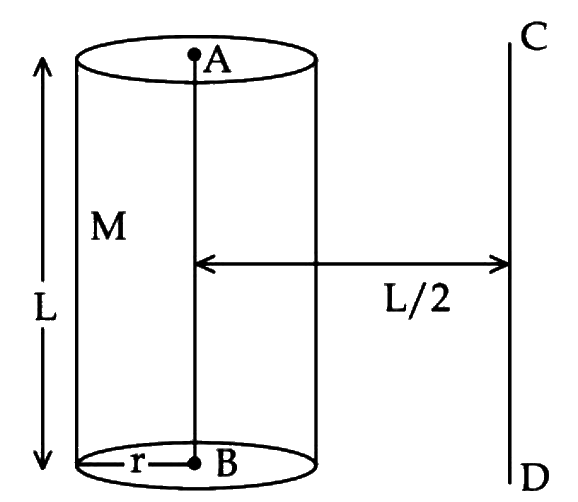
Report a mistake