0 of 588 attemptedPick an answer to see the solution
Q1MHT CET 2026 · 20 MAY · SHIFT 1Easy
Moment of Inertia & Radius of Gyration · Point masses & rigid systems
At the corners of an equilateral triangle of side L, point masses, each of mass 2 kg are placed. The moment of inertia of the system about an axis along any one side is (in kg-m2)
Show answer and solution
Answer: (c)
Two masses lie on the axis (the chosen side), so they contribute nothing.
The third mass is at the triangle's height h=23L from that side.
Moment of Inertia & Radius of Gyration · Point masses & rigid systems
The moment of inertia of two equal masses each of mass m at separation L connected by a rod of mass M about an axis passing through centre and perpendicular to the length of rod is
Show answer and solution
Answer: (b)
Rod about its centre: Irod=12ML2.
Each mass is at 2L from the axis: Imasses=2m(2L)2=2mL2=126mL2
Moment of Inertia & Radius of Gyration · Standard bodies & radius of gyration
Let M and L be the mass and length of thin uniform rod respectively. In first case, axis of rotation is passing through centre and perpendicular to length of rod. In second case axis of rotation is passing through one end and perpendicular to length of rod. The ratio of radius of gyration in first case to second case is
Moment of Inertia & Radius of Gyration · Parallel & perpendicular axis theorems
Moment of inertia of a disc of mass m and radius R about the centre of mass and perpendicular to plane is I1 and moment of inertia of disc at a distance 32R from centre and perpendicular to plane is I2 then I1/I2 is
Moment of Inertia & Radius of Gyration · Parallel & perpendicular axis theorems
The moment of inertia of a solid sphere about an axis passing through centre of gravity is 52MR2 where M is the mass and R is the radius. The radius of gyration about a parallel axis at a distance 2R from first axis is
Moment of Inertia & Radius of Gyration · Parallel & perpendicular axis theorems
A solid sphere of radius R and mass M is rotating about its diameter. The moment of intertia of the solid sphere rotating about an axis at a distance 3R from the centre and parallel to that diameter is
Moment of Inertia & Radius of Gyration · Parallel & perpendicular axis theorems
Moment of inertia of a disc of mass M and radius 'R' about any of its diameter is MR2/4. The moment of inertia of this disc about an axis normal to the disc and passing through a point on its edge will be, (x/2)MR2. The value of x is
Show answer and solution
Answer: (b)
Perpendicular axis theorem: Icm=2×4MR2=2MR2 (normal to disc through centre).
Parallel axis through a point on the edge: I=2MR2+MR2=23MR2
Moment of Inertia & Radius of Gyration · Point masses & rigid systems
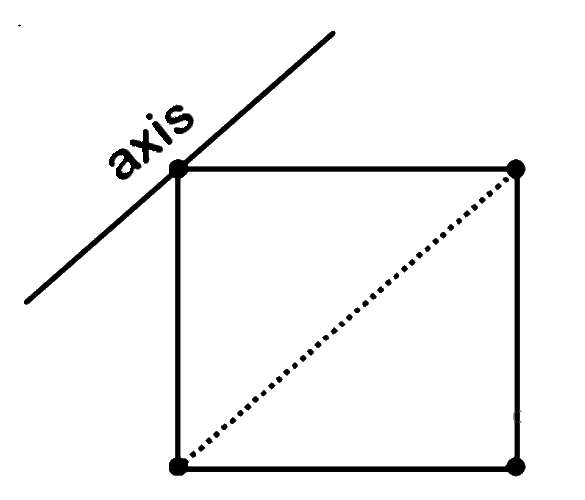
A square frame ABCD is formed by 4 identical rods each of mass m and length ℓ. This frame is in XY plane such that side AB coincides with x-axis and side AD along y-axis. The moment of inertia of the frame about x-axis is
Show answer and solution
Answer: (a)
Rod AB lies on the x-axis: I=0.
Rods AD and BC are perpendicular to x-axis with one end on it: 3mℓ2 each.
Moment of Inertia & Radius of Gyration · Point masses & rigid systems
Four solid spheres, each of diameter 5 cm and mass 0.5 kg are placed with their centres at the corners of a square of side 4 cm. The M.I. of the system about the diagonal of the square is N×10−4 kg-m2, then N is
Show answer and solution
Answer: (a)
r=25 cm, so 52mr2=52(0.5)(1.25×10⁻⁴)=0.25×10⁻⁴ kg m2.
Two spheres on the diagonal: 2×0.25×10−4=0.5×10⁻⁴.
Other two are at half-diagonal 22 cm: each 0.25×10⁻⁴+0.5×8×10−4=4.25×10⁻⁴.
Moment of Inertia & Radius of Gyration · Point masses & rigid systems
Four point masses m, 2m, 3m and 4m are kept at the corners A, B, C and D respectively of a square ABCD of side 'b'. The moment of inertia of the system about an axis perpendicular to the plane of the square and passing through the point D is
Show answer and solution
Answer: (c)
Distances from D: A and C at b, B at 2b; D itself gives 0.
Moment of Inertia & Radius of Gyration · Point masses & rigid systems
A system of five solid spheres each of mass 'm' and radius 'r' are rotating about an axis AA' as shown in figure. Hence the moment of inertia of the system about the axis of rotation AA' is
Show answer and solution
Answer: (c)
Three spheres have AA' as a diameter: 3×52mr2=56mr2.
Two side spheres touch the axis (d=r): 2(52mr2+mr2)=514mr2.
Moment of Inertia & Radius of Gyration · Point masses & rigid systems
Two identical thin rods of mass M kg and length L m are connected as shown in figure. Moment of inertia of the combined rod system about an axis passing through point P and perpendicular to the plane of the rods is 12xML2 kg m2. The value of x is ______.
Numerical answer type. Work it out, then open the answer.
Moment of Inertia & Radius of Gyration · Standard bodies & radius of gyration
Radius of gyration of a thin uniform circular disc about the axis passing through its centre and perpendicular to its plane is Kc. Radius of gyration of the same disc about a diamter of the disc is Kd. the ratio Kd:Kc is
Moment of Inertia & Radius of Gyration · Parallel & perpendicular axis theorems
The ratio of radius of gyration of circular disc about a tangential axis in its plane and of a circular ring of the same radius about a tangential axis in its plane is
Show answer and solution
Answer: (c)
Disc, tangent in its plane: 41MR2+MR2=45MR2⇒K12=45R2.
Ring, tangent in its plane: 21MR2+MR2=23MR2⇒K22=23R2.
Moment of Inertia & Radius of Gyration · Parallel & perpendicular axis theorems
A solid sphere of mass 5 kg and a disc of mass 4 kg have the same radius. The ratio of moment of inertia of the sphere about its tangent to the moment of inertia of the disc about a tangent in its plane will be x:y. The value of x and y respectively is
Show answer and solution
Answer: (c)
Sphere about tangent: 57MR2=57(5)R2=7R2.
Disc about tangent in its plane: 45MR2=45(4)R2=5R2.
Moment of Inertia & Radius of Gyration · Parallel & perpendicular axis theorems
Two identical rings A and B of same mass and radius are revolving, ring A arounds its own diameter and ring B about tangential axis in its own plane. Both the rings A and B have same rotational kinetic energy. The ratio of the angular velocity of ring B to that of ring A is
Show answer and solution
Answer: (b)
Ring A about diameter: IA=21MR2. Ring B about tangent in its plane: IB=23MR2.
Moment of Inertia & Radius of Gyration · Parallel & perpendicular axis theorems
The radius of gyration of a solid sphere of radius 'R' and mass 'M' about its diameter is Kd and that about a tangent of a solid sphere is Kt. The ratio of Kd to Kt is
Moment of Inertia & Radius of Gyration · Parallel & perpendicular axis theorems
The radius of gyration K of a hollow sphere of mass M and radius R about an axis XY is equal to R as shown in figure. The distance of that axis from the center of the sphere is h. The value of h is
Moment of Inertia & Radius of Gyration · Parallel & perpendicular axis theorems
A solid sphere of mass M and a disc of mass 2M have the same radius. The ratio of moment of inertia of the disc about a tangent in its plane to the moment of inertia of the sphere about its tangent will be
Show answer and solution
Answer: (b)
Disc (mass 2M), tangent in its plane: 45⋅2MR2=85MR2.
Moment of Inertia & Radius of Gyration · Parallel & perpendicular axis theorems
Solid sphere is rotating about an axis as shown in figure. If the radius of the sphere is 5 cm, then radius of gyration about that axis will be x cm. The value of x is
Show answer and solution
Answer: (b)
Centre of the sphere is d=10 cm from the axis; R=5 cm.
Moment of Inertia & Radius of Gyration · Parallel & perpendicular axis theorems
Moment of inertia about an axis AB for a rod of mass 40 kg and length 3 m is same as that of a solid sphere of mass of 10 kg and radius R about an axis parallel to AB axis with separation of 3 m as shown in figure below. The value of R is given as 2α. The value of α is ________.
Numerical answer type. Work it out, then open the answer.
Show answer and solution
Answer: 15
Rod about axis AB at its end: Irod=3ML2=340×9=120kg m2.
Sphere about a parallel axis 3 m from its centre: I=52mR2+md2=4R2+90.
Moment of Inertia & Radius of Gyration · Parallel & perpendicular axis theorems
A solid sphere of radius 10 cm is rotating about an axis which is at a distance 15 cm from its centre. The radius of gyration about this axis is n cm. The value of n is
Numerical answer type. Work it out, then open the answer.
Moment of Inertia & Radius of Gyration · Bending, recasting & scaling
A thin wire of length L and uniform linear mass density ρ is bent into a circular loop with centre at 'O' as shown in figure. The moment of inertia of the loop about the axis XX′ is
Show answer and solution
Answer: (d)
Mass M=ρL, radius R=2πL.
XX′ is a tangent in the plane of the loop: I=2MR2+MR2=23MR2.
Moment of Inertia & Radius of Gyration · Bending, recasting & scaling
Moment of inertia of a thin uniform rod rotating about the perpendicular axis passing through its centre is I. If the same rod is bent in to a ring and its moment of inertia about its diameter is I1, then the ratio I/I1 is
Moment of Inertia & Radius of Gyration · Bending, recasting & scaling
Two loops A and B of radii R1 and R2 are made from uniform wire. If moment of inertia of loops A and B is IA and IB respectively then R2R1 is (Given: IBIA=27)
Moment of Inertia & Radius of Gyration · Bending, recasting & scaling
A thin uniform rod of length 2 m cross-sectional area 'A' and density 'd' is rotated about an axis passing through the centre and perpendicular to its length with angular velocity ω. If the value of ω in terms of its rotational kinetic energy E is (αE/Ad)1/2, then the value of α is
Moment of Inertia & Radius of Gyration · Bending, recasting & scaling
A thin wire of length ' L ' and linear mass density ' m ' is bent into a circular ring (in x−y plane) with centre ' C ' as shown in figure. The moment of inertia of the ring about an axis yy′ will be:
Show answer and solution
Answer: (b)
Mass M=mL, radius R=2πL.
yy′ touches the ring and lies in its plane (tangent): I=2MR2+MR2=23MR2.
Moment of Inertia & Radius of Gyration · Bending, recasting & scaling
A circular disc has radius R1 and thickness T1. Another circular disc made of the same material has radius R2 and thickness T2. If the moment of inertia of both discs are same and R2R1=2 then T2T1=α1. The value of α is ______.
Numerical answer type. Work it out, then open the answer.
Moment of Inertia & Radius of Gyration · Composite bodies & cut-outs
A solid sphere A of radius R and mass M is attached at a point to a smaller solid sphere B of radius r<R and mass m<M. Assume that the line joining their centres lies along the horizontal. The moment of inertia of the system calculated about a vertical axis passing through the centre of A is IA and that about a vertical axis passing through the centre of B is IB. The difference IA−IB is:
Moment of Inertia & Radius of Gyration · Composite bodies & cut-outs
Two circular discs of radius each 10 cm are joined at their centres by a rod of length 30 cm and mass 600 gm as shown in figure.
If the mass of each disc is 600 gm and applied torque between two discs is 43×105 dyne.cm, the angular acceleration of the discs about the given axis AB is rad/s2.
Show answer and solution
Answer: (d)
In CGS: discs 600 g, r=10 cm, centres at 10 cm and 20 cm from AB; AB lies along a diameter direction of each disc.
Discs: 4mr2+md2: 15000+60000=75000 and 15000+240000=255000 g cm2
Rod (30 cm, centre 5 cm from AB): 12600×900+600×25=60000 g cm2
Moment of Inertia & Radius of Gyration · Composite bodies & cut-outs
A solid sphere of mass 5 kg and radius 10 cm is kept in contact with another solid sphere of mass 10 kg and radius 20 cm. The moment of inertia of this pair of spheres about the tangent passing through the point of contact is kg⋅m2.
Show answer and solution
Answer: (d)
The tangent is perpendicular to the line of centres, at distances 0.1 m and 0.2 m from the centres.
Moment of Inertia & Radius of Gyration · Bending, recasting & scaling
A solid sphere of mass M and radius R is divided into two unequal parts. The smaller part having mass M/8 is converted into a sphere of radius r and the larger part is converted into a circular disc of thickness t and radius 2R. If I1 is moment of inertia of a sphere having radius r about an axis through its centre and I2 is the moment of inertia of a disc about its diameter, the ratio of their moment of inertia I2/I1=
Show answer and solution
Answer: (b)
Mass 8M has 81 the volume, so r=2R: I1=528M4R2=80MR2
Disc of mass 87M, radius 2R, about a diameter (thin): I2=4187M(2R)2=87MR2
Moment of Inertia & Radius of Gyration · Composite bodies & cut-outs
Given identical rings are arranged in a hexagonal plane pattern so as to touch each neighbouring ring as shown in figure. Each ring has mass M and radius R. The moment of inertia of the system of seven rings about an axis passing through the centre of central ring and normal to plane of all rings is
Show answer and solution
Answer: (a)
Central ring: MR2.
Each outer ring centre is 2R away: MR2+M(2R)2=5MR2.
Moment of Inertia & Radius of Gyration · Composite bodies & cut-outs
A uniform solid cylinder with radius R and length L has moment of inertia I1 about the axis of the cylinder. A concentric solid cylinder of radius R/2 and length L/2 is carved out of the original cylinder. If I2 is the moment of inertia of the carved out portion of the cylinder then I1/I2 is (Both I1 and I2 are about the axis of the cylinder)
Moment of Inertia & Radius of Gyration · Composite bodies & cut-outs
The moment of inertia of a square loop made of four uniform solid cylinders, each having radius R and length L(R<L) about an axis passing through the mid points of opposite sides, is (Take the mass of the entire loop as M):
Show answer and solution
Answer: (d)
Each cylinder has mass m=4M.
Two sides cut by the axis at their centres (axis ⊥ to their length): m(4R2+12L2) each.
Two sides parallel to the axis at distance 2L: 2mR2+4mL2 each.
Moment of Inertia & Radius of Gyration · Composite bodies & cut-outs
A uniform solid cylinder of length L and radius R has moment of inertia about its axis equal to I1. A small co-centric cylinder of length L/2 and radius R/3 carved from this cylinder has moment of inertia about its axis equals to I2. The ratio I1/I2 is ______.
Numerical answer type. Work it out, then open the answer.
Moment of Inertia & Radius of Gyration · Composite bodies & cut-outs
Suppose there is a uniform circular disc of mass M kg and radius r m shown in figure. The shaded regions are cut out from the disc. The moment of inertia of the remainder about the axis A of the disc is given by 256xMr2. The value of x is ______.
Numerical answer type. Work it out, then open the answer.
Show answer and solution
Answer: 109
Each hole: radius 4r, mass 16M, centre 43r from axis A.
Moment of Inertia & Radius of Gyration · Point masses & rigid systems
Four particles each of mass M are placed at the corners of a square of side L. The radius of gyration of the system about an axis perpendicular to the square and passing through its centre is
Show answer and solution
Answer: (b)
Each corner is at half the diagonal from the centre: r=22L=2L.
Moment of Inertia & Radius of Gyration · Point masses & rigid systems
Four particles each of mass M are placed at the corners of a square of side L. The radius of gyration of the system about an axis perpendicular to the square and passing through its centre is
Show answer and solution
Answer: (d)
Each corner is at r=2L from the centre (half the diagonal).
Moment of Inertia & Radius of Gyration · Standard bodies & radius of gyration
A solid sphere and thin walled hollow sphere have same mass and same material. Which of them have greater moment of inertia about their diameter?
[ Ih= moment of inertia of hollow sphere about an axis coinciding with its diameter, Is= moment of inertia of solid sphere about an axis coinciding with its diameter]
Show answer and solution
Answer: (c)
Is=52MRs2 and Ih=32MRh2.
Same mass and same material means the thin hollow sphere must be much larger: Rh>Rs.
Also 32>52, and the hollow sphere's mass is all at the largest radius, so Ih>Is.
Moment of Inertia & Radius of Gyration · Parallel & perpendicular axis theorems
The moment of inertia of a thin uniform rod of mass ' M ' and length ' L ', about an axis perpendicular to length of the rod and at a distance ' L/4 ' from one end is
Show answer and solution
Answer: (d)
The point at 4L from one end is at d=2L−4L=4L from the centre.
Moment of Inertia & Radius of Gyration · Parallel & perpendicular axis theorems
The moment of inertia of a solid sphere of mass ' m ' and radius ' R ' about its diametric axis is ' I '. Its moment of inertia about a tangent in the plane is
Show answer and solution
Answer: (c)
I=52mR2 about a diameter.
Tangent is parallel to a diameter at distance R: It=52mR2+mR2=57mR2
Moment of Inertia & Radius of Gyration · Point masses & rigid systems
Two spheres each of mass M and radius R are connected with a massless rod of length 4 R. The moment of inertia of the system about an axis passing through the centre of one of the spheres and perpendicular to the rod will be
Moment of Inertia & Radius of Gyration · Point masses & rigid systems
A,B and C are disc, solid sphere and spherical shell respectively with same radii and masses. These masses are placed as shown in figure.
The moment of inertia of the given system about PQ axis is 15xI, where I is the moment of inertia of the disc about its diameter. The value of x is ____________.
Numerical answer type. Work it out, then open the answer.
Show answer and solution
Answer: 199
Disc A: PQ is its diameter, IA=I=41MR2, so MR2=4I.
Solid sphere B touches PQ: 52MR2+MR2=57MR2.
Shell C touches PQ: 32MR2+MR2=35MR2.
Itotal=I+4I(1521+25)=I+15184I=15199I, so x=199.
Moment of Inertia & Radius of Gyration · Standard bodies & radius of gyration
The moment of inertia of a solid disc rotating along its diameter is 2.5 times higher than the moment of inertia of a ring rotating in similar way. The moment of inertia of a solid sphere which has same radius as the disc and rotating in similar way, is n times higher than the moment of inertia of the given ring. Here, n= ________ Consider all the bodies have equal masses.
Numerical answer type. Work it out, then open the answer.
Show answer and solution
Answer: 4
Equal masses, so radii differ. Disc about diameter 41MRd2, ring about diameter 21MRr2.
Moment of Inertia & Radius of Gyration · Bending, recasting & scaling
Moment of inertia of a solid sphere about its diameter is 'I'. It is then casted into 27 small spheres of same diameter. The moment of inertia of each small sphere about its diameter is
Show answer and solution
Answer: (d)
Each small sphere: mass 27M, radius 3R (volume shares 1/27).
Moment of Inertia & Radius of Gyration · Bending, recasting & scaling
Moment of inertia of the rod about an axis passing through the centre and perpendicular to its length is ' I1 '. The same rod is bent into a ring and its moment of inertia about the diameter is ' I2 '. Then I1/I2 is
Show answer and solution
Answer: (b)
Rod: I1=12ML2.
Ring of radius R=2πL about a diameter: I2=2MR2=8π2ML2.
Moment of Inertia & Radius of Gyration · Bending, recasting & scaling
Moment of inertia of a thin uniform rod rotating about the perpendicular axis passing through its centre is ' I '. If the same rod is bent in the form of ring, its moment of inertia about the diameter is ' I1 '. If I1=xI, then the value of ' x ' is
Show answer and solution
Answer: (b)
Rod: I=12ML2; ring (R=2πL) about diameter: I1=8π2ML2.
Moment of Inertia & Radius of Gyration · Bending, recasting & scaling
Two circular loops P and Q of radii ' r ' and ' nr ' are made respectively from a uniform wire. Moment of inertia of loop Q about its axis is 4 times that of loop P about its axis. The value of n is
Moment of Inertia & Radius of Gyration · Bending, recasting & scaling
Moment of inertia of a rod of mass ' M ' and length ' L ' about an axis passing through its center and normal to its length is ' α '. Now the rod is cut into two equal parts and these parts are joined symmetrically to form a cross shape. Moment of inertia of cross about an axis passing through its center and normal to plane containing cross is:
Show answer and solution
Answer: (a)
Original rod: α=12ML2.
Each half (mass 2M, length 2L) is centred on the axis: I=121⋅2M⋅4L2=96ML2.
Moment of Inertia & Radius of Gyration · Bending, recasting & scaling
Two iron solid discs of negligible thickness have radii R1 and R2 and moment of inertia I1 and I2, respectively. For R2=2R1, the ratio of I1 and I2 would be 1/x, where x= _______.
Numerical answer type. Work it out, then open the answer.
Show answer and solution
Answer: 16
Same material and same (negligible) thickness: M∝R2, so I∝R4.
Moment of Inertia & Radius of Gyration · Composite bodies & cut-outs
A sphere of radius R is cut from a larger solid sphere of radius 2R as shown in the figure. The ratio of the moment of inertia of the smaller sphere to that of the rest part of the sphere about the Y-axis is:
Show answer and solution
Answer: (a)
Let big sphere mass be M (radius 2R); cut sphere has 81 the volume, so mass 8M, centre at distance R from Y-axis.
Moment of Inertia & Radius of Gyration · Composite bodies & cut-outs
Let M and R be the mass and radius of a disc. A small disc of radius R/3 is removed from the bigger disc as shown in figure. The moment of inertia of remaining part of bigger disc about an axis AB passing through the centre O and perpendicular to the plane of disc is x4MR2. The value of x is ____________.
Numerical answer type. Work it out, then open the answer.
Moment of Inertia & Radius of Gyration · Point masses & rigid systems
Three spheres, each of mass ' m ' and radius ' r ' are placed as shown in figure. Consider an axis YY′, which is touching two spheres and passing through the diameter of third sphere. The moment of inertia of the system consisting of these three spheres about YY′ axis is
Show answer and solution
Answer: (c)
Sphere 1: axis is its diameter, 52mr2.
Spheres 2 and 3: axis is a tangent, 52mr2+mr2=57mr2 each.
Moment of Inertia & Radius of Gyration · Composite bodies & cut-outs
A uniform circular disc of radius ' R ' and mass ' M ' is rotating about an axis perpendicular to its plane and passing through its centre. A small circular part of radius R/2 is removed from the original disc as shown in the figure. Find the moment of inertia of the remaining part of the original disc about the axis as given above.
Show answer and solution
Answer: (b)
Removed disc: radius 2R, mass 4M, centre at 2R from the axis.
Moment of Inertia & Radius of Gyration · Point masses & rigid systems
Three point masses, each of mass ' m ' are placed at the corners of an equilateral triangle of side ' L '. The moment of inertia of the system about an axis passing through one of the vertices and parallel to the side joining other two vertices will be
Show answer and solution
Answer: (c)
The mass at the vertex lies on the axis, so it contributes nothing.
The other two masses are at distance equal to the triangle's height h=23L from the axis.
Moment of Inertia & Radius of Gyration · Point masses & rigid systems
Four particles each of mass 1 kg are placed at four corners of a square of side 2 m. Moment of inertia of system about an axis perpendicular to its plane and passing through one of its vertex is _____ kg m2.
Numerical answer type. Work it out, then open the answer.
Show answer and solution
Answer: 16
The mass at the chosen vertex is on the axis. Two adjacent masses are at 2 m and the opposite one is at 22 m.
Moment of Inertia & Radius of Gyration · Standard bodies & radius of gyration
An annular ring has mass 10 kg and inner and outer radii are 5 m and 10 m respectively. Its moment of inertia about an axis passing through its centre and perpendicular to its plane is
Show answer and solution
Answer: (b)
Annular disc about its central perpendicular axis: I=2M(R12+R22).
Moment of Inertia & Radius of Gyration · Parallel & perpendicular axis theorems
Moment of inertia of a disc about an axis passing through its centre and perpendicular to its plane is 'I'. The ratio of moment of inertia about a parallel axis tangential to its rim to that about a parallel axis passing through a point midway between the centre and the rim is
Show answer and solution
Answer: (a)
I=2MR2, so MR2=2I.
Axis tangential to rim (distance R): I1=I+MR2=I+2I=3I
Moment of Inertia & Radius of Gyration · Parallel & perpendicular axis theorems
The moment of inertia of thin square plate PQRS of uniform thickness, about an axis passing through centre ' O ' and perpendicular to the plane of the plate is (I1,I2,I3,I4 are respectively the moments of inertia about axis 1,2,3,4 which are in the plane of the plate as shown in figure)
Show answer and solution
Answer: (d)
Perpendicular axis theorem: Iz equals the sum of the moments of inertia about any two perpendicular in-plane axes through O.
Axes 1 and 2 (diagonals) are perpendicular, and so are 3 and 4: Iz=I1+I2=I3+I4.
For a square, all in-plane axes through O have equal I by symmetry, so I1=I2=I3=I4 and Iz=2I1=I1+I3.
Moment of Inertia & Radius of Gyration · Parallel & perpendicular axis theorems
The moment of inertia of a thin rod about an axis passing through its mid point and perpendicular to the rod is 2400 g cm2. The length of the 400 g rod is nearly:
Moment of Inertia & Radius of Gyration · Point masses & rigid systems
Three thin rods, each of mass ' M ' and length ' L ' are placed along X,Y and Z axes which are mutually perpendicular. One end of each rod is at origin. M. I. of the system about Z axis is
Show answer and solution
Answer: (c)
Rod along Z lies on the axis: I=0.
Rods along X and Y are perpendicular to Z with one end on it: 3ML2 each.
Moment of Inertia & Radius of Gyration · Point masses & rigid systems
Three thin rods, each mass ' 2 M ' and length ' L ' are placed along x,y and z axis which are mutually perpendicular. One end of each rod is at origin. Moment of inertia of the system about x - axis is
Show answer and solution
Answer: (a)
Rod along x: I=0.
Rods along y and z (mass 2M), end on the axis: 32ML2 each.
Moment of Inertia & Radius of Gyration · Point masses & rigid systems
Three balls of masses 2 kg,4 kg and 6 kg respectively are arranged at centre of the edges of an equilateral triangle of side 2 m. The moment of inertia of the system about an axis through the centroid and perpendicular to the plane of triangle, will be ________ kg m2.
Numerical answer type. Work it out, then open the answer.
Show answer and solution
Answer: 4
Edge midpoints are at the inradius from the centroid: r=23a=232=31 m.
Moment of Inertia & Radius of Gyration · Point masses & rigid systems
Two identical spheres each of mass 2 kg and radius 50 cm are fixed at the ends of a light rod so that the separation between the centers is 150 cm. Then, moment of inertia of the system about an axis perpendicular to the rod and passing through its middle point is 20x kg m2, where the value of x is ___________.
Numerical answer type. Work it out, then open the answer.
Show answer and solution
Answer: 53
Each sphere: I=52mr2+md2 with r=0.5 m, d=0.75 m from the middle.
Moment of Inertia & Radius of Gyration · Standard bodies & radius of gyration
Two spheres of equal masses, one of which is a thin spherical shell and the other solid sphere, have the same moment of inertia about their respective diameters. The ratio of their radii is
Moment of Inertia & Radius of Gyration · Parallel & perpendicular axis theorems
A disc and a ring both have same mass and radius. The ratio of moment of inertia of the disc about its diameter to that of a ring about a tangent in its plane is
Show answer and solution
Answer: (c)
Disc about diameter: 41MR2.
Ring about tangent in its plane: 21MR2+MR2=23MR2.
Moment of Inertia & Radius of Gyration · Parallel & perpendicular axis theorems
Ratio of radius of gyration of a hollow sphere to that of a solid cylinder of equal mass, for moment of Inertia about their diameter axis AB as shown in figure is 8/x. The value of x is:
Show answer and solution
Answer: (c)
Hollow sphere about a diameter: K12=32R2.
Solid cylinder (radius R, length L=4R), axis through centre perpendicular to its length: M(4R2+12L2)=1219MR2.
AB passes through the end face, 2L=2R away: I=1219MR2+4MR2=1267MR2.
Moment of Inertia & Radius of Gyration · Bending, recasting & scaling
Two loops P and Q of radii R1 and R2 are made from uniform metal wire of same material. Ip and IQ be the moment of inertia of loop P and Q respectively then ratio R1/R2 is ( Given IP/IQ=27)
Moment of Inertia & Radius of Gyration · Bending, recasting & scaling
A solid metallic sphere of radius ' R ' having moment of inertia 'I' about diameter is melted and recast into a solid disc of radius ' r ' of a uniform thickness. The moment of inertia of a disc about an axis passing through its edge and perpendicular to its plane is also equal to 'I'. The ratio Rr is
Show answer and solution
Answer: (d)
Sphere: I=52MR2 (mass unchanged on recasting).
Disc about an axis through its edge, perpendicular to plane: I=2Mr2+Mr2=23Mr2.
Moment of Inertia & Radius of Gyration · Bending, recasting & scaling
A circular disc of radius ' R ' and thickness 6R has moment of inertia 'I' about an axis passing through its centre and perpendicular to its plane. It is melted and recasted into a solid sphere then moment of inertia of sphere about an axis passing through diameter is
Moment of Inertia & Radius of Gyration · Bending, recasting & scaling
Two solid spheres ( A and B) are made of metals having densities ρA and ρB respectively. If there masses are equal then ratio of their moments of inertia (IAIB) about their respective diameter is
Moment of Inertia & Radius of Gyration · Bending, recasting & scaling
Two loops ' A ' and ' B ' of radii ' R1 ' and ' R2 ' are made from uniform wire. If moment of inertia of ' A ' is ' IA ' and that of ' B ' is ' IB ', then R2/R1 is [IBIA=27]
Moment of Inertia & Radius of Gyration · Bending, recasting & scaling
Two circular loops P and Q of radii ' r ' and ' nr ' are made respectively from a uniform wire. Moment of inertia of loop Q about its axis is four times that of loop P about its axis. The value of ' n ' is
Moment of Inertia & Radius of Gyration · Bending, recasting & scaling
A solid sphere of mass ' m ', radius ' R ', having moment of inertia about an axis passing through center of mass as 'I' is recast into a disc of thickness ' t ' whose moment of inertia about an axis passing through the rim (edge) \& perpendicular to plane remains 'I'. Then the radius of disc is
Show answer and solution
Answer: (a)
Sphere about centre: I=52mR2.
Disc about an axis through the rim, perpendicular to plane: I=23mr2.
Moment of Inertia & Radius of Gyration · Composite bodies & cut-outs
Four thin metal rods each of mass ' M ' and length ' L ', are welded end to end to form a square. The moment of inertia of the system about an axis passing through the centre of the square and perpendicular to its plane is
Show answer and solution
Answer: (d)
Each rod's centre is 2L from the square's centre.
Moment of Inertia & Radius of Gyration · Standard bodies & radius of gyration
The moment of inertia of a uniform square plate about an axis perpendicular to its plane and passing through the centre is 6Ma2, where 'M' is the mass and 'a' is the side of square plate. Moment of inertia of this plate about an axis perpendicular to its plane and passing through one of its corners is
Show answer and solution
Answer: (b)
A corner is at half the diagonal from the centre: d=2a, so d2=2a2.
Moment of Inertia & Radius of Gyration · Standard bodies & radius of gyration
The ratio of radius of gyration of a solid sphere of mass M and radius R about its own axis to the radius of gyration of the thin hollow sphere of same mass and radius about its axis is :-
Moment of Inertia & Radius of Gyration · Parallel & perpendicular axis theorems
I1 is the moment of inertia of a circular disc about an axis passing through its centre and perpendicular to the plane of disc. I2 is its moment of inertia about an axis AB perpendicular to plane and parallel to axis CM at a distance 32R from centre. The ratio of I1 and I2 is x:17. The value of 'x' is (R = radius of the disc)
Moment of Inertia & Radius of Gyration · Parallel & perpendicular axis theorems
Moment of inertia of a disc of mass 'M' and radius 'R' about any of its diameter is 4MR2. The moment of inertia of this disc about an axis normal to the disc and passing through a point on its edge will be, 2x MR2. The value of x is ___________.
Numerical answer type. Work it out, then open the answer.
Moment of Inertia & Radius of Gyration · Parallel & perpendicular axis theorems
ICM is the moment of inertia of a circular disc about an axis (CM) passing through its center and perpendicular to the plane of disc. IAB is its moment of inertia about an axis AB perpendicular to plane and parallel to axis CM at a distance 32 R from center. Where R is the radius of the disc. The ratio of IAB and ICM is x:9. The value of x is _____________.
Numerical answer type. Work it out, then open the answer.
Moment of Inertia & Radius of Gyration · Point masses & rigid systems
Four identical uniform solid spheres each of same mass 'M' and radius 'R' are placed touching each other as shown in figure, with centres A, B, C, D. IA,IB,IC and ID are the moment of inertia of these spheres respectively about an axis passing through centre and perpendicular to the plane. The difference in IA, and IB is
Show answer and solution
Answer: (b)
Centres are 2R apart; each sphere's own term is 52MR2, same in IA and IB.
Moment of Inertia & Radius of Gyration · Point masses & rigid systems
Four identical uniform solid spheres each of same mass M and radius R are placed touching each other as shown in figure with centres A,B,C,D.IA,IB,IC,ID are the moment of inertia of these spheres respectively about an axis passing through centre and perpendicular to the plane, then
Show answer and solution
Answer: (c)
Each is the system MI about an axis through that centre; the 58MR2 part is common.
End axes (A, D): M(4+16+36)R2=56MR2; inner axes (B, C): M(4+4+16)R2=24MR2.
Moment of Inertia & Radius of Gyration · Point masses & rigid systems
Two spheres each of mass 'M' and radius 2R are connected at the ends of massless rod of length '2R'. What will be the moment of inertia of the system about an axis passing through centre of one of the spheres and perpendicular to the rod?
Moment of Inertia & Radius of Gyration · Point masses & rigid systems
Two identical solid spheres each of mass 2 kg and radii 10 cm are fixed at the ends of a light rod. The separation between the centres of the spheres is 40 cm. The moment of inertia of the system about an axis perpendicular to the rod passing through its middle point is __________ ×10−3 kg m2
Numerical answer type. Work it out, then open the answer.
Moment of Inertia & Radius of Gyration · Standard bodies & radius of gyration
A square lamina of side 'b' has same mass as a disc of radius 'R' the moment of inertia of the two objects about an axis perpendicular to the plane and passing through the centre is equal. The ratio Rb is
Show answer and solution
Answer: (b)
Square lamina about the perpendicular axis through centre: I=6Mb2.
Moment of Inertia & Radius of Gyration · Standard bodies & radius of gyration
The moment of inertia of a semicircular ring about an axis, passing through the center and perpendicular to the plane of ring, is x1MR2, where R is the radius and M is the mass of the semicircular ring. The value of x will be __________.
Numerical answer type. Work it out, then open the answer.
Show answer and solution
Answer: 1
All mass of the semicircular ring is at distance R from the centre.
Moment of Inertia & Radius of Gyration · Standard bodies & radius of gyration
A ring and a solid sphere rotating about an axis passing through their centers have same radii of gyration. The axis of rotation is perpendicular to plane of ring. The ratio of radius of ring to that of sphere is x2. The value of x is ___________.
Numerical answer type. Work it out, then open the answer.
Show answer and solution
Answer: 5
Ring (perpendicular axis): K2=Rr2. Solid sphere: K2=52Rs2.
Moment of Inertia & Radius of Gyration · Parallel & perpendicular axis theorems
Radius of gyration of a thin uniform circular disc about the axis passing through its centre and perpendicular to its plane is Kc. Radius of gyration of the same disc about a diameter of the disc is Kd. The ratio Kc:Kd is
Moment of Inertia & Radius of Gyration · Parallel & perpendicular axis theorems
If 'I' is moment of inertia of a thin circular disc about an axis passing through the tangent of the disc and in the plane of disc. The moment of inertia of same circular disc about an axis perpendicular to plane and passing through its centre is
Show answer and solution
Answer: (b)
Tangent in plane: I=41MR2+MR2=45MR2⇒MR2=54I.
Perpendicular axis through centre: Ic=21MR2=52I
Moment of Inertia & Radius of Gyration · Parallel & perpendicular axis theorems
If a solid sphere of mass 5 kg and a disc of mass 4 kg have the same radius. Then the ratio of moment of inertia of the disc about a tangent in its plane to the moment of inertia of the sphere about its tangent will be 7x. The value of x is ___________.
Numerical answer type. Work it out, then open the answer.
Show answer and solution
Answer: 5
Disc about a tangent in its plane: Id=4mR2+mR2=45mR2=45(4)R2=5R2.
Sphere about a tangent: Is=52MR2+MR2=57(5)R2=7R2.
Moment of Inertia & Radius of Gyration · Parallel & perpendicular axis theorems
Solid sphere A is rotating about an axis PQ. If the radius of the sphere is 5 cm then its radius of gyration about PQ will be x cm. The value of x is ________.
Numerical answer type. Work it out, then open the answer.
Show answer and solution
Answer: 110
From the figure the centre of sphere A is 10 cm from axis PQ.
Moment of Inertia & Radius of Gyration · Bending, recasting & scaling
A thin wire of length 'L' and uniform linear mass density 'm' is bent into a circular coil. The moment of inertia of this coil about tangential axis and in plane of the coil is
Moment of Inertia & Radius of Gyration · Bending, recasting & scaling
A disc of radius R and thickness 6R has moment of inertia I about an axis passing through its centre and perpendicular to its plane. The disc is melted and recast into a solid sphere. The moment of inertia of a sphere about its diameter is
Moment of Inertia & Radius of Gyration · Bending, recasting & scaling
Two discs of same mass and same thickness (t) are made from two different materials of densities 'd1' and 'd2 ' respectively. The ratio of the moment of inertia I1 to I2 of two discs about an axis passing through the centre and perpendicular to the plane of disc is
Moment of Inertia & Radius of Gyration · Bending, recasting & scaling
Two discs of same mass and different radii are made of different materials such that their thicknesses are 1 cm and 0.5 cm respectively. The densities of materials are in the ratio 3:5. The moment of inertia of these discs respectively about their diameters will be in the ratio of 6x. The value of x is ________.
Numerical answer type. Work it out, then open the answer.
Moment of Inertia & Radius of Gyration · Bending, recasting & scaling
A thin uniform rod of length 2 m, cross sectional area 'A' and density 'd' is rotated about an axis passing through the centre and perpendicular to its length with angular velocity ω. If value of ω in terms of its rotational kinetic energy E is AdαE then value of α is ______________.
Numerical answer type. Work it out, then open the answer.
Moment of Inertia & Radius of Gyration · Composite bodies & cut-outs
From a disc of mass 'M' and radius 'R', a circular hole of diameter 'R' is cut whose rim passes through the centre. The moment of inertia of the remaining part of the disc about perpendicular axis passing through the centre is
Moment of Inertia & Radius of Gyration · Composite bodies & cut-outs
Seven identical discs each of mass M and radius R are arranged in a hexagonal plane pattern so as to touch each neighbour disc as shown in the figure. The moment of inertia of the system of seven discs about an axis passing through the centre of central disc and normal to the plane of all discs is
Show answer and solution
Answer: (d)
Central disc: 2MR2.
Each outer disc centre is 2R away: 2MR2+4MR2=29MR2.
Moment of Inertia & Radius of Gyration · Composite bodies & cut-outs
A uniform solid cylinder with radius R and length L has moment of inertia I 1, about the axis of the cylinder. A concentric solid cylinder of radius R′=2R and length L′=2L is carved out of the original cylinder. If I2 is the moment of inertia of the carved out portion of the cylinder then I2I1= __________. (Both I1 and I2 are about the axis of the cylinder)
Numerical answer type. Work it out, then open the answer.
Moment of Inertia & Radius of Gyration · Parallel & perpendicular axis theorems
The ratio of the radius of gyration of a thin uniform disc about an axis passing through its centre and normal to its plane to the radius of gyration of the disc about its diameter is
Moment of Inertia & Radius of Gyration · Point masses & rigid systems
Four identical discs each of mass 'M' and diameter 'a' are arranged in a small plane as shown in figure. If the moment of inertia of the system about OO′ is 4xMa2. Then, the value of x will be ____________.
Numerical answer type. Work it out, then open the answer.
Show answer and solution
Answer: 3
Each disc has radius r=2a. About a diameter, I=41Mr2=16Ma2.
Top and bottom discs: OO′ is their diameter, so 2×16Ma2.
Side discs: OO′ is a tangent in their plane, I=41Mr2+Mr2=45Mr2=165Ma2 each.
Moment of Inertia & Radius of Gyration · Point masses & rigid systems
Four particles with a mass of 1 kg, 2 kg, 3 kg and 4 kg are situated at the corners of a square with side 1 m (as shown in the figure). The moment of inertia of the system, about an axis passing through the point O and perpendicular to the plane of the square, is ______________ kg m2.
Numerical answer type. Work it out, then open the answer.
Show answer and solution
Answer: 5
Each mass is at distance 21 m from O (half the diagonal), so r2=21 m2.
Moment of Inertia & Radius of Gyration · Standard bodies & radius of gyration
The radius of gyration of a cylindrical rod about an axis of rotation perpendicular to its length and passing through the center will be ___________ m.
Given, the length of the rod is 103 m.
Numerical answer type. Work it out, then open the answer.
Moment of Inertia & Radius of Gyration · Bending, recasting & scaling
The moment of inertia of a uniform thin rod about a perpendicular axis passing through one end is I1. The same rod is bent into a ring and its moment of inertia about a diameter is I2. If I2I1 is 3xπ2, then the value of x will be ____________.
Numerical answer type. Work it out, then open the answer.
Show answer and solution
Answer: 8
Rod about one end: I1=3mL2.
Ring: 2πR=L⇒R=2πL; about a diameter I2=2mR2=8π2mL2.
Moment of Inertia & Radius of Gyration · Point masses & rigid systems
Two identical particles each of mass 'm' are separated by a distance 'd'. The axis of rotation passes through the midpoint of 'd' and is perpendicular to the length d. If 'K' is the average rotational kinetic energy of the system, then the angular frequency is
Show answer and solution
Answer: (c)
Each particle is at 2d from the axis: I=2m(2d)2=2md2.
Moment of Inertia & Radius of Gyration · Point masses & rigid systems
Four equal masses, m each are placed at the corners of a square of length (l) as shown in the figure. The moment of inertia of the system about an axis passing through A and parallel to DB would be:
Show answer and solution
Answer: (d)
Diagonal BD is at distance 2l (half the diagonal) from A, so the axis through A parallel to BD is at 2l from B and D.
C is a full diagonal away: distance 2l. A is on the axis.
Moment of Inertia & Radius of Gyration · Standard bodies & radius of gyration
The ratio of radii of gyration of a circular ring and circular disc of the same mass and radius, about an axis passing through their centres and perpendicular to their planes is
Moment of Inertia & Radius of Gyration · Parallel & perpendicular axis theorems
The moment of inertia of a thin uniform rod of mass 'M' and length 'L' about an axis passing through a point at a distance 4L from one of its ends and perpendicular to the length of the rod is
Show answer and solution
Answer: (b)
Distance of the axis from the centre: d=2L−4L=4L.
Moment of Inertia & Radius of Gyration · Parallel & perpendicular axis theorems
Moment of inertia of a square plate of side l about the axis passing through one of the corner and perpendicular to the plane of square plate is given by:
Show answer and solution
Answer: (d)
About the central axis normal to the plate: Icm=6Ml2.
Moment of Inertia & Radius of Gyration · Parallel & perpendicular axis theorems
Given below are two statements: one is labelled as Assertion A and the other is labelled as Reason R.
Assertion A: Moment of inertia of a circular disc of mass 'M' and radius 'R' about X, Y axes (passing through its plane) and Z-axis which is perpendicular to its plane were found to be Ix, Iy and Iz respectively. The respectively radii of gyration about all the three axes will be the same. Reason R: A rigid body making rotational motion has fixed mass and shape. In the light of the above statements, choose the most appropriate answer from the options given below:
Show answer and solution
Answer: (b)
Disc: Ix=Iy=4MR2, Iz=2MR2.
So kx=ky=2R but kz=2R: radii of gyration are not all equal, A is false.
R is true: a rigid body keeps its mass and shape while rotating.
Moment of Inertia & Radius of Gyration · Point masses & rigid systems
A system consists of two identical spheres each of mass 1.5 kg and radius 50 cm at the ends of a light rod. The distance between the centres of the two spheres is 5 m. What will be the moment of inertia of the system about an axis perpendicular to the rod passing through its midpoint?
Show answer and solution
Answer: (c)
Each sphere: 52mr2=52(1.5)(0.5)2=0.15 kg m2.
Each centre is 2.5 m from the axis: md2=1.5×6.25=9.375 kg m2.
I=2(0.15+9.375)=19.05 kg m2, so the answer is (c).
Moment of Inertia & Radius of Gyration · Point masses & rigid systems
Four identical solid spheres each of mass 'm' and radius 'a' are placed with their centres on the four corners of a square of side 'b'. The moment of inertia of the system about one side of square where the axis of rotation is parallel to the plane of the square is:
Show answer and solution
Answer: (d)
Two spheres have their centres on the side (axis): 52ma2 each.
Moment of Inertia & Radius of Gyration · Standard bodies & radius of gyration
The solid cylinder of length 80 cm and mass M has a radius of 20 cm. Calculate the density of the material used if the moment of inertia of the cylinder about an axis CD parallel to AB as shown in figure is 2.7 kg m2.
Show answer and solution
Answer: (d)
CD is parallel to the cylinder axis AB at distance 2L=0.4 m.
Moment of Inertia & Radius of Gyration · Parallel & perpendicular axis theorems
The moment of inertia of a circular disc of radius 2 m and mass 1 kg about an axis XY passing through its centre of mass and perpendicular to the plane of the disc is 2 kg m2. The moment of inertia about an axis parallel to the axis XY and passing through the edge of the disc is
Moment of Inertia & Radius of Gyration · Bending, recasting & scaling
Two circular loops P and Q are made from a uniform wire. The radii of P and Q are R 1 and R2 respectively. The moments of inertia about their own axis are IP and IQ respectively. If IQIP=81 then R1R2 is
Moment of Inertia & Radius of Gyration · Bending, recasting & scaling
Two rings of radius 'R' and 'nR' made of same material have the ratio of moment of inertia about an axis passing through its centre and perpendicular to the plane is 1:8. The value of 'n' is (mass per unit length =λ)
Moment of Inertia & Radius of Gyration · Bending, recasting & scaling
A solid sphere of mass M, radius R has moment of inertia 'I' about its diameter. It is recast into a disc of thickness 't' whose moment of inertia about an axis passing through its edge and perpendicular to its plane remains 'I'. Radius of the disc will be
Show answer and solution
Answer: (c)
Sphere: I=52MR2; disc about its edge, perpendicular to plane: I=23Mr2.
Moment of Inertia & Radius of Gyration · Bending, recasting & scaling
The figure shows two solid discs with radius R and r respectively. If mass per unit area is same for both, what is the ratio of MI of bigger disc around axis AB (Which is ⊥ to the plane of the disc and passing through its centre) to MI of smaller disc around one of its diameters lying on its plane? Given 'M' is the mass of the larger disc. (MI stands for moment of inertia)
Show answer and solution
Answer: (d)
Bigger disc about AB (perpendicular, through centre): I1=2MR2.
Same mass per area: smaller disc mass m=MR2r2; about a diameter I2=4mr2=4R2Mr4.
Moment of Inertia & Radius of Gyration · Bending, recasting & scaling
Consider a uniform wire of mass M and length L. It is bent into a semicircle. Its moment of inertia about a line perpendicular to the plane of the wire passing through the center is:
Show answer and solution
Answer: (d)
Semicircle: L=πR⇒R=πL.
Every element is at distance R from the axis: I=MR2.
Moment of Inertia & Radius of Gyration · Bending, recasting & scaling
A uniform thin bar of mass 6 kg and length 2.4 meter is bent to make an equilateral hexagon. The moment of inertia about an axis passing through the centre of mass and perpendicular to the plane of hexagon is _______ × 10−1 kg m2.
Numerical answer type. Work it out, then open the answer.
Show answer and solution
Answer: 8
Each side: m=1 kg, a=0.4 m, at distance 23a from the centre.
Moment of Inertia & Radius of Gyration · Composite bodies & cut-outs
From a circular ring of mass 'M' and radius 'R' an arc corresponding to a 90∘ sector is removed. The moment of inertia of the remaining part of the ring about an axis passing through the center of the ring and perpendicular to the plane of the ring is 'K' times 'MR2'. Then the value of 'K' is:
Show answer and solution
Answer: (b)
Removing a 90∘ arc removes 41 of the mass; remaining mass 43M.
All remaining mass is still at distance R: I=43MR2.
Moment of Inertia & Radius of Gyration · Composite bodies & cut-outs
Consider a badminton racket with length scales as shown in the figure.
If the mass of the linear and circular portions of the badminton racket are same (M) and the mass of the threads are negligible, the moment of inertia of the racket about an axis perpendicular to the handle and in the plane of the ring at 2r distance from the end A of the handle will be ................ Mr2.
Numerical answer type. Work it out, then open the answer.
Show answer and solution
Answer: 52
Handle: length 6r, centre 3r from A, so 2.5r from axis: 12M(6r)2+M(2.5r)2=9.25Mr2
Ring: radius r, centre 7r from A, so 6.5r from axis; axis is parallel to a diameter.
Moment of Inertia & Radius of Gyration · Point masses & rigid systems
Three point masses, each of mass m are placed at the corners of an equilateral triangle of side ℓ. The moment of inertia of the system about an axis passing through one of the vertices and parallel to the side joining other two vertices, will be
Show answer and solution
Answer: (c)
The mass at the vertex is on the axis and contributes zero.
The other two masses are at height 23ℓ from the axis.
Moment of Inertia & Radius of Gyration · Parallel & perpendicular axis theorems
A thin uniform rod has mass M and length L The moment of inertia about an axis perpendicular to it and passing through the point at a distance 3L from one of its ends, will be
Moment of Inertia & Radius of Gyration · Parallel & perpendicular axis theorems
The radius of gyration of a uniform rod of length l, about an axis passing through a point 4l away from the centre of the rod, and perpendicular to it, is:
Moment of Inertia & Radius of Gyration · Point masses & rigid systems
A massless equilateral triangle EFG of side ‘a’ (As shown in figure) has three particles of mass m situated at its vertices. The moment of inertia of the system about the line EX perpendicular to EG in the plane of EFG is 20N ma2 where N is an integer. The value of N is _____.
Numerical answer type. Work it out, then open the answer.
Show answer and solution
Answer: 25
I=∑mr2, with r the perpendicular distance from line EX.
E lies on the axis: r=0. F is above the midpoint of EG: r=2a. G: r=a.
Moment of Inertia & Radius of Gyration · Standard bodies & radius of gyration
Moment of inertia of a cylinder of mass M, length L and radius R about an axis passing through its centre and perpendicular to the axis of the cylinder is
I = M(4R2+12L2). If such a cylinder is to be made for a given mass of a material, the ratio RL for it to have minimum possible I is
Moment of Inertia & Radius of Gyration · Parallel & perpendicular axis theorems
For a uniform rectangular sheet shown in the figure, the ratio of moments of inertia about the axes perpendicular to the sheet and passing through O (the centre of mass) and O' (corner point) is:
Show answer and solution
Answer: (b)
Through centre O: IO=12M(a2+b2).
O' is a corner, at distance 21a2+b2 from O: IO′=12M(a2+b2)+4M(a2+b2)=3M(a2+b2).
Moment of Inertia & Radius of Gyration · Bending, recasting & scaling
Two circular loop A and B of radii R and NR respectively are made from a uniform wire. Moment of inertia of B about its axis is 3 times that of A about its axis. The value of N is
Moment of Inertia & Radius of Gyration · Bending, recasting & scaling
Consider two uniform discs of the same thickness and different radii R1 = R and R2 = αR made of the same material. If the ratio of their moments of inertia I1 and I2, respectively, about their axes is I1: I2 = 1: 16 then the value of α is:
Moment of Inertia & Radius of Gyration · Composite bodies & cut-outs
Three solid spheres each of mass m and diameter d are stuck together such that the lines connecting the centres form an equilateral triangle of side of length d. The ratio I0/IA of moment of inertia I0 of the system about an axis passing through the centroid and about center of any of the spheres IA and perpendicular to the plane of the triangle is:
Show answer and solution
Answer: (a)
Each sphere: Icm=52m(2d)2=10md2; centroid to centre =3d.
Moment of Inertia & Radius of Gyration · Composite bodies & cut-outs
Shown in the figure is a hollow icecream cone (it is open at the top). If its mass is M, radius of its top, R and height, H, then its moment of inertia about its axis is:
Show answer and solution
Answer: (b)
Cut the cone surface into rings: a ring at slant distance s has radius r=lRs and mass dm=l22Msds.
Moment of Inertia & Radius of Gyration · Composite bodies & cut-outs
ABC is a plane lamina of the shape of an equilateral triangle. D, E are mid points of AB, AC and G is the centroid of the lamina. Moment of inertia of the lamina about an axis passing through G and perpendicular to the plane ABC is I0. If part ADE is removed, the moment of inertia of the remaining part about the same axis is 16NI0 where N is an integer. Value of N is ______.
Numerical answer type. Work it out, then open the answer.
Show answer and solution
Answer: 11
For a triangular lamina of side a about its centroid, I0=12Ma2.
ADE is a similar triangle of side 2a and mass 4M, so about its own centroid I′=4M⋅12(a/2)2=16I0.
With height h=23a: G is 32h below A and the centroid of ADE is 3h below A, so d=3h=23a, d2=12a2.
Moment of Inertia & Radius of Gyration · Variable density bodies
The linear mass density of a thin rod AB of length L varies from A to B as
λ(x)=λ0(1+Lx), where x is the distance from A. If M is the mass of the rod then its moment of inertia about an axis passing through A and perpendicular to the rod is:
Moment of Inertia & Radius of Gyration · Variable density bodies
Mass per unit area of a circular disc of radius a depends on the distance r from its centre as σ(r) = A + Br. The moment of inertia of the disc about the axis, perpendicular to the plane and passing through its centre is:
Show answer and solution
Answer: (a)
Take a ring of radius r, width dr: dm=(A+Br)2πrdr, dI=r2dm.
Moment of Inertia & Radius of Gyration · Point masses & rigid systems
Three point masses each of mass ' m ' are kept at the corners of an equilateral triangle of side ' L '. The system rotates about the center of the triangle without any change in the separation of masses during rotation. The period of rotation is directly proportional to (cos30∘=sin60∘=23)
Show answer and solution
Answer: (a)
The separation stays fixed because mutual gravity supplies the centripetal force. Each mass is at r=3L from the centre.
Net pull on one mass toward the centre: 2L2Gm2cos30∘=L23Gm2
Moment of Inertia & Radius of Gyration · Point masses & rigid systems
Three identical rods each of mass ' M ' and length ' L ' are joined to form a symbol ' H. The moment of inertia of the system about one of the sides of ' H ' is
Show answer and solution
Answer: (d)
Take one vertical side of H as the axis: it gives 0.
Other vertical side is parallel at distance L: ML2.
Crossbar is perpendicular with one end on the axis: 3ML2.
Moment of Inertia & Radius of Gyration · Standard bodies & radius of gyration
Let the moment of inertia of a hollow cylinder of length 30 cm (inner radius 10 cm and outer radius 20 cm), about its axis be I. The radius of a thin cylinder of the same mass such that its moment of inertia about its axis is also I, is:
Moment of Inertia & Radius of Gyration · Parallel & perpendicular axis theorems
The moment of inertia of a solid sphere, about an axis parallel to its diameter and at a distance of x from it, is 'I(x)'. Which one of the graphs represents the variation of I(x) with x correctly?
Show answer and solution
Answer: (c)
Parallel axis theorem: I(x)=52MR2+Mx2.
At x=0, I=52MR2=0, and I grows as x2: a parabola starting above the origin.
Moment of Inertia & Radius of Gyration · Bending, recasting & scaling
A thin metal wire of length 'L' and uniform linear mass density 'ρ' is bent into a circular coil with 'O' as centre. the moment of inertia of a coil about the axis XX' is
Show answer and solution
Answer: (a)
Mass M=ρL, radius R=2πL.
XX′ is a tangent in the plane of the coil: I=23MR2.
Moment of Inertia & Radius of Gyration · Composite bodies & cut-outs
A circular disc D1 of mass M and radius R has two identical discs D2 and D3 of the same mass M and radius R attached rigidly at its opposite ends (see figure). The moment of inertia of the system about the axis OO' ,passing through the centre of D1 as shown in the figure, will be:
Show answer and solution
Answer: (a)
D1 about its own axis: 2MR2.
D2, D3: axis is parallel to their diameter at distance R: 4MR2+MR2=45MR2 each.
Moment of Inertia & Radius of Gyration · Composite bodies & cut-outs
Two identical spherical balls of mass M and radius R each are stuck on two ends of a rod of length 2R and mass M (see figure). The moment of inertia of the system about the axis passing perpendicularly through the centre of the rod is:
Moment of Inertia & Radius of Gyration · Variable density bodies
A thin disc of mass M and radius R has mass per unit area σ(r) = kr2 where r is the distance from its centre. Its moment of inertia about an axis going through its centre of mass and perpendicular to its plane is:
Moment of Inertia & Radius of Gyration · Variable density bodies
A thin circular plate of mass M and radius R has its density varying as ρ(r) = ρ0r with ρ0 as constant and r is the distance from its centre. The moment of Inertia of the circular plate about an axis perpendicular to the plate and passing through its edge is I = aMR2. The value of the coefficient a is:
Moment of Inertia & Radius of Gyration · Bending, recasting & scaling
A solid sphere of mass M and radius R is divided into two unequal parts. The first part has a mass of 87M and is converted into a uniform disc of radius 2R. The second part is converted into a uniform solid sphere. Let I1 be the moment of inertia of the disc about its axis and I2 be the moment of inertia of the new sphere about its axis. The ratio I1/I2 is given by:
Show answer and solution
Answer: (b)
Disc: I1=2187M(2R)2=47MR2
New sphere has mass 8M, so radius 2R: I2=528M4R2=80MR2
Moment of Inertia & Radius of Gyration · Composite bodies & cut-outs
An equilateral triangle ABC is cut from a thin solid sheet of wood. (see figure) D, E and F are the mid- points of its sides as shown and G is the centre of the triangle. The moment of inertia of the triangle about an axis passing through G and perpendicular to the plane of the triangle is I0. If the smaller triangle DEF is removed from ABC, the moment of inertia of the remaining figure about the same axis is I. Then:
Moment of Inertia & Radius of Gyration · Variable density bodies
A circular disc of radius b has a hole of radius a at its centre (see figure). If the mass per unit area of the disc varies as (rσ0), then the radius of gyration of the disc about its axis passing through the centre is:
Moment of Inertia & Radius of Gyration · Composite bodies & cut-outs
Seven identical circular planar disks, each of mass M and radius R are welded symmetrically as shown. The moment of inertia of the arrangement about the axis normal to the plane and passing through the point P is:
Show answer and solution
Answer: (a)
About O: centre disc 2MR2; each outer disc 2MR2+M(2R)2=29MR2.
IO=21MR2+6×29MR2=255MR2
P is 3R from O, total mass 7M: IP=255MR2+7M(3R)2
Moment of Inertia & Radius of Gyration · Composite bodies & cut-outs
From a uniform circular disc of radius R and mass 9M, a small disc of radius R/3 is removed as shown in the figure. The moment of inertia of the remaining disc about an axis perpendicular to the plane of the disc and passing through centre of disc is:
Moment of Inertia & Radius of Gyration · Composite bodies & cut-outs
A circular hole of radius 4R is made in a thin uniform disc having mass M and radius R, as shown in figure. The moment of inertia of the remaining portion of the disc about an axis passing through the point O and perpendicular to the plane of the disc is:
Moment of Inertia & Radius of Gyration · Parallel & perpendicular axis theorems
Moment of inertia of an equilateral triangular lamina ABC, about the axis passing through its centre O and perpendicular to its plane is Io as shown in the figure. A cavity DEF is cut out from the lamina, where D, E, F are the mid points of the sides. Moment of inertia of the remaining part of lamina about the same axis is:
Show answer and solution
Answer: (b)
DEF is equilateral with side 2a and the same centre O; its mass is 4M.
Moment of Inertia & Radius of Gyration · Parallel & perpendicular axis theorems
The moment of inertia of a uniform cylinder of length l and radius R about its perpendicular bisector is I. What is the ratio Rl such that the moment of inertia is minimum?
Show answer and solution
Answer: (b)
I=m(4R2+12l2) with fixed volume V=πR2l, so R2=πlV.
Moment of Inertia & Radius of Gyration · Point masses & rigid systems
A light rod of length l has two masses m1 and m2 attached to its two ends. The moment of inertia of the system about an axis perpendicular to the rod and passing through the centre of mass is
Show answer and solution
Answer: (a)
Distances from the CM: r1=m1+m2m2l, r2=m1+m2m1l.
I=m1r12+m2r22=(m1+m2)2m1m2(m2+m1)l2
I=m1+m2m1m2l2 (reduced mass ×l2), so the answer is (a).
Moment of Inertia & Radius of Gyration · Composite bodies & cut-outs
From a disc of radius R and mass M, a circular hole of diameter R, whose rim passes through the centre is cut. What is the moment of inertia of the remaining part of the disc about a perpendicular axis, passing through the centre?
Moment of Inertia & Radius of Gyration · Point masses & rigid systems
Point masses m1 and m2 are placed at the opposite ends of a rigid rod of length L, and negligible mass. The rod is to be set rotating about an axis perpendicular to it. The position of point P on this rod through which the axis should pass so that the work required to set the rod rotating with angular velocity ω0 is minimum, is given by
Show answer and solution
Answer: (b)
Work =21Iω02, so I must be minimum.
I=m1x2+m2(L−x)2; dxdI=2m1x−2m2(L−x)=0.
x=m1+m2m2L (the centre of mass), so the answer is (b).
Moment of Inertia & Radius of Gyration · Point masses & rigid systems
Three identical spherical shells, each of mass m and radius r are placed as shown in figure. Consider an axis XX' which is touching to two shells and passing through diameter of third shell. Moment of inertia of the system consisting of these three spherical shells about XX' axis is
Show answer and solution
Answer: (b)
Shell on the axis (diameter): 32mr2.
Two shells touching the axis (d=r): 2(32+1)mr2=310mr2.
Moment of Inertia & Radius of Gyration · Composite bodies & cut-outs
From a solid sphere of mass M and radius R a cube of maximum possible volume is cut. Moment of inertia of cube about an axis passing through its center and perpendicular to one of its face is:
Moment of Inertia & Radius of Gyration · Standard bodies & radius of gyration
The ratio of radii of gyration of a circular ring and a circular disc, of the same mass and radius, about an axis passing through their centres and perpendicular to their planes are
Moment of Inertia & Radius of Gyration · Parallel & perpendicular axis theorems
The moment of inertia of a thin uniform rod of mass M and length L about an axis passing through its midpoint and perpendicular to its length is I0. Its moment of inertia about an axis passing through one of its ends and perpendicular to its length is
Show answer and solution
Answer: (b)
Parallel axis theorem: I=Icm+Md2.
The end is at d=L/2 from the midpoint, so I=I0+M(L/2)2.
Moment of Inertia & Radius of Gyration · Composite bodies & cut-outs
From a circular disc of radius R and mass 9M, a small disc of mass M and radius 3R is removed concentrically. The moment of inertia of the remaining disc about an axis perpendicular to the plane of the disc and passing through its centre is
Show answer and solution
Answer: (a)
Both discs are concentric, so no parallel-axis term.
Moment of Inertia & Radius of Gyration · Point masses & rigid systems
Four identical thin rods each of mass M and length l, form a square frame. Moment of inertia of this frame about an axis through the centre of the square and perpendicular to its plane is
Show answer and solution
Answer: (d)
Each rod about the square's centre (normal axis): 12Ml2+M(2l)2=3Ml2.
Moment of Inertia & Radius of Gyration · Parallel & perpendicular axis theorems
Consider a uniform square plate of side ’a’ and mass ’m’. The moment of inertia of this plate about an axis perpendicular to its plane and passing through one of its corners is
Moment of Inertia & Radius of Gyration · Bending, recasting & scaling
A thin rod of length L and mass M is bent at its midpoint into two halves so that the angle between them is 90°. The moment of inertia of the bent rod about an axis passing through the bending point and perpendicular to the plane defined by the two halves of the rod is
Show answer and solution
Answer: (d)
Each half: mass 2M, length 2L, rotating about its end (the bend point).
Each half: 31⋅2M⋅4L2=24ML2. The angle between halves does not matter.
Moment of Inertia & Radius of Gyration · Point masses & rigid systems
Four point masses, each of value m, are placed at the corners of a square ABCD of side l. The moment of inertia of this system about an axis passing through A and parallel to BD is
Show answer and solution
Answer: (c)
The axis through A parallel to BD is at distance 2l from B and D, and 2l from C; A is on it.
Moment of Inertia & Radius of Gyration · Parallel & perpendicular axis theorems
One solid sphere A and another hollow sphere B are of same mass and same outer radii. Their moment of inertia about their diameters are respectively IA and IB such that
Moment of Inertia & Radius of Gyration · Point masses & rigid systems
Three particles, each of mass m gram, are situated at the vertices of an equilateral triangle ABC of side l cm (as shown in the figure). The moment of inertia of the system about a line AX perpendicular to AB and in the plane of ABC, in gram-cm2 units will be
Show answer and solution
Answer: (c)
Distances from line AX: A is on it (0), B is at l, C is at 2l (C lies above the midpoint of AB).
Moment of Inertia & Radius of Gyration · Parallel & perpendicular axis theorems
The ratio of the radii of gyration of a circular disc about a tangential axis in the plane of the disc and of a circular ring of the same radius about a tangential axes in the plane of the ring is
Moment of Inertia & Radius of Gyration · Bending, recasting & scaling
A circular disc X of radius R is made from an iron plate of thickness t, and another disc Y of radius 4R is made from an iron plate of thickness 4t. Then the relation between the moment of inertia IX and IY is
Moment of Inertia & Radius of Gyration · Parallel & perpendicular axis theorems
The ABC is a triangular plate of uniform thickness. The sides are in the ratio shown in the figure. IAB,IBC and ICA are the moments of inertia of the plate about AB,BC and CA respectively. Which one of the following relations is correct?
Show answer and solution
Answer: (d)
For a triangular plate, I about a side =6Mh2, where h is the height of the opposite vertex from that side.
Right angle at B: about AB, h=BC=3; about BC, h=AB=4; about CA, h=53×4=2.4.
IAB∝9, IBC∝16, ICA∝5.76: mass lies farther from BC than from AB.
Moment of Inertia & Radius of Gyration · Parallel & perpendicular axis theorems
Moment of inertia of a uniform circular disc about a diameter is I. Its moment of inertia about an axis perpendicular to its plane and passing through a point on its rim will be
Show answer and solution
Answer: (c)
About a diameter: I=41MR2, so MR2=4I.
About the rim, normal to the plane: I′=21MR2+MR2=23MR2.
In the case of rotational dynamics, which of the following statements is correct? {S = linear displacement, α = angular acceleration, r = radius vector, a = linear acceleration, L = angular momentum, p = linear momentum, θ = angular displacement}
a. Moment of a couple is independent of the axis of rotation or the points of application of forces. b. Moment of a couple produces translational acceleration.
c. Moment of a couple can be balanced by single force.
d. Moment of a couple depends upon the axis of rotation or the points of application of forces.
Show answer and solution
Answer: (d)
Moment of a couple =F×d is the same about every point, so it is independent of the axis: a is true, d is false.
A couple has zero net force, so it gives no translational acceleration: b is false.
A couple can be balanced only by an equal and opposite couple, not a single force: c is false.
Torque, Couple & Equilibrium of Rigid Bodies · Torque as a vector (r × F)
The coordinates of a particle with respect to origin in a given reference frame is (1, 1, 1) meters. If a force of F=i^−j^+k^ acts on the particle, then the magnitude of torque (with respect to origin) in z- direction is __________.
Numerical answer type. Work it out, then open the answer.
A square Lamina OABC of length 10 cm is pivoted at ' O '. Forces act at Lamina as shown in figure. If Lamina remains stationary, then the magnitude of F is:
Show answer and solution
Answer: (a)
Take O as origin: A = (10,0), B = (10,10), C = (0,10) cm. Use τz=xFy−yFx; the pivot force at O has no torque.
At A: 10 N down gives 10(−10)=−100; 10 N right gives 0.
At B: 10 N up gives +100; 10 N right gives −10(10)=−100.
At C: 10 N up gives 0; F to the left gives −10(−F)=+10F.
A uniform rod of mass 250 g having length 100 cm is balanced on a sharp edge at 40 cm mark. A mass of 400 g is suspended at 10 cm mark. To maintain the balance of the rod, the mass to be suspended at 90 cm mark, is
Show answer and solution
Answer: (c)
Take moments about the knife edge at 40 cm. The rod's weight acts at its centre, 50 cm.
A uniform rod of mass 20 kg and length 5 m leans against a smooth vertical wall making an angle of 60∘ with it. The other end rests on a rough horizontal floor. The friction force that the floor exerts on the rod is (Take g=10 m/s2)
Show answer and solution
Answer: (d)
The wall is smooth, so it gives only a horizontal push Nw. Horizontal balance: friction f=Nw.
Rod makes 60∘ with the wall: top height =Lcos60∘, CM horizontal distance from foot =2Lsin60∘.
Moments about the foot: NwLcos60∘=mg2Lsin60∘⇒Nw=2mgtan60∘
A heavy iron bar, of weight W is having its one end on the ground and the other on the shoulder of a person. The bar makes an angle θ with the horizontal. The weight experienced by the person is:
Show answer and solution
Answer: (c)
Take the shoulder's support force N as vertical. Moments about the end on the ground.
Weight W acts at the middle: horizontal arm 2Lcosθ; N acts at the far end: arm Lcosθ.
A heavy iron bar of weight 12 kg is having its one end on the ground and the other on the shoulder of a man. The rod makes an angle 60∘ with the horizontal, the weight experienced by the man is:
Show answer and solution
Answer: (a)
In the key's working the shoulder's reaction N is perpendicular to the bar (smooth contact). Moments about the end on the ground.
Given below are two statements: one is labelled as Assertion A and the other is labelled as Reason R
Assertion A: An electric fan continues to rotate for some time after the current is switched off. Reason R: Fan continues to rotate due to inertia of motion.
In the light of above statements, choose the most appropriate answer from the options given below.
Show answer and solution
Answer: (c)
After switch-off no driving torque acts, only small friction torque.
Because of rotational inertia (moment of inertia) the fan keeps rotating and slows down gradually.
Both A and R are true and R explains A, so the answer is (c).
Torque, Couple & Equilibrium of Rigid Bodies · Torque as a vector (r × F)
A force of −Pk^ acts on the origin of the coordinate system. The torque about the point (2,−3) is P(ai^+bj^). The ratio of ba is 2x. The value of x is ___________.
Numerical answer type. Work it out, then open the answer.
An object of mass 8 kg is hanging from one end of a uniform rod CD of mass 2 kg and length 1 m pivoted at its end C on a vertical wall as shown in figure. It is supported by a cable AB such that the system is in equilibrium. The tension in the cable is (Take g = 10 m/s2)
Show answer and solution
Answer: (d)
Take torques about the pivot C. The cable at B (CB=0.6 m) makes 30∘ with the rod, so its perpendicular part is Tsin30∘.
Rod weight 20 N acts at 0.5 m; hanging weight 80 N acts at 1 m.
Torque, Couple & Equilibrium of Rigid Bodies · Torque as a vector (r × F)
The torque of a force 5i^+3j^−7k^ about the origin is τ. If the force acts on a particle whose position vector is 2i^+2j^+k^, then the value of τ will be
A metre scale is balanced on a knife edge at its centre. When two coins, each of mass 10 g are put one on the top of the other at the 10.0 cm mark the scale is found to be balanced at 40.0 cm mark. The mass of the metre scale is found to be x × 10−2 kg. The value of x is ___________.
Numerical answer type. Work it out, then open the answer.
Show answer and solution
Answer: 6
The scale's weight acts at 50 cm; the new balance point is 40 cm.
Coins: 20 g at 10 cm, arm =30 cm. Scale: mass M at 50 cm, arm =10 cm.
A 34 m long ladder weighing 10 kg leans on a frictionless wall. Its feet rest on the floor 3 m away from the wall as shown in the figure. If Ff and Fw are the reaction forces of the floor and the wall, then ratio of Fw/Ff will be:
(Use g = 10 m/s2.)
Show answer and solution
Answer: (c)
Height of the top =34−9=5 m. The smooth wall gives only a horizontal force Fw.
Moments about the foot: Fw×5=mg×1.5=100×1.5⇒Fw=30 N
Floor: normal =100 N, friction =Fw=30 N, so Ff=1002+302=10109 N
Torque, Couple & Equilibrium of Rigid Bodies · Torque as a vector (r × F)
A force F=4i^+3j^+4k^ is applied on an intersection point of x = 2 plane and x-axis. The magnitude of torque of this force about a point (2, 3, 4) is ___________. (Round off to the Nearest Integer)
Numerical answer type. Work it out, then open the answer.
Show answer and solution
Answer: 20
Point of application: x=2 plane meets x-axis at (2,0,0).
A metre scale is supported on a wedge at its centre of gravity. A body of weight 'w' is suspended from the 20 cm mark and another weight of 25 gram is suspended from 74 cm mark to balance it and the metre scale remains perfectly horizontal. Neglecting the weight of the metre scale, the weight of the body is
Show answer and solution
Answer: (a)
Pivot at 50 cm (centre of gravity). Take moments about it.
A uniform rod of length 200 cm and mass 500 g is balanced on a wedge placed at 40 cm mark. A mass of 2 kg is suspended from the rod at 20 cm and another unknown mass 'm' is suspended from the rod at 160 cm mark as shown in the figure. Find the value of 'm' such that the rod is in equilibrium. (g = 10 m/s2)
Show answer and solution
Answer: (a)
Moments about the wedge at 40 cm; the rod's weight acts at its centre, 100 cm.
Consider a frame that is made up of two thin massless rods AB and AC as shown in the figure. A vertical force Pof magnitude 100 N is applied at point A of the frame.
Suppose the force Pis resolved parallel to the arms AB and AC of the frame.
The magnitude of the resolved component along the arm AC is xN.
The value of x, to the nearest integer, is ___________.
[Given: sin(35∘) = 0.573, cos(35∘) = 0.819
sin(110∘) = 0.939, cos(110∘) = − 0.342]
Numerical answer type. Work it out, then open the answer.
Show answer and solution
Answer: 82
The angle at C between rod CA and the wall is 145∘, so AC makes 180∘−145∘=35∘ with the vertical.
P is vertical, so the angle between P and arm AC is 35∘.
A uniform cylinder of mass M and radius R is to be pulled over a step of height a (a < R) by applying a force F at its centre ‘O’ perpendicular to the plane through the axes of the cylinder on the edge of the step (see figure). The minimum value of F required is:
Show answer and solution
Answer: (a)
Just before lift-off the floor reaction is zero; take moments about the step edge P (the cylinder pivots about it).
F at O is perpendicular to OP, so its arm is R (the largest possible), which gives the minimum F.
Weight arm = horizontal distance of O from P =R2−(R−a)2
Consider a uniform cubical box of side a on a rough floor that is to be moved by applying minimum possible force F at a point b above its centre of mass (see figure). If the coefficient of friction is μ = 0.4, the maximum possible value of 100 × ab for box not to topple before moving is .......
Numerical answer type. Work it out, then open the answer.
Show answer and solution
Answer: 50
To just slide, the horizontal force is F=μmg. It acts at height 2a+b above the floor.
No toppling about the front edge: F(2a+b)≤mg2a⇒b≤2μa(1−μ)=0.75a
But the force must act on the face, so b≤2a. This is less than 0.75a, so the box never topples.
Torque, Couple & Equilibrium of Rigid Bodies · Torque as a vector (r × F)
The magnitude of torque on a particle of mass 1 kg is 2.5 Nm about the origin. If the force acting on it is 1 N, and the distance of the particle from the origin is 5m, the angle between the force and the position vector is (in radians):
A rod l m long is acted upon by a couple as shown in the figure. The moment of couple is τ N m. If the force acts at each end of the rod, then magnitude of each force is
(sin30∘=cos60∘=0.5)
Show answer and solution
Answer: (c)
Moment of couple = force × perpendicular distance between the two lines of action.
The forces make 30∘ with the rod, so the perpendicular distance is lsin30∘=2l.
Torque, Couple & Equilibrium of Rigid Bodies · Torque as a vector (r × F)
A slab is subjected to two forces F1 and F2 of same magnitude F as shown in the figure. Force F2 is in XY-plane while force F1 acts along z = axis at the point (2i+3j).. The moment of these forces about point O will be:
Show answer and solution
Answer: (d)
F1=Fk^ at (2i^+3j^): τ1=(2i^+3j^)×Fk^=F(3i^−2j^).
F2 acts at (0,6,0), making 30∘ with the y-axis and pointing towards −x, −y: F2=−Fsin30∘i^−Fcos30∘j^.
τ2=6j^×(−2Fi^)=3Fk^ (the j^ part gives zero).
An L-shaped object, made of thin rods of uniform mass density, is suspended with a string as shown in figure. If AB = BC, and the angle made by AB with downward vertical is θ, then:
Show answer and solution
Answer: (d)
In equilibrium the centre of mass lies vertically below A. Let AB=BC=l, each of mass m.
With A as origin, AB points along (−sinθ,−cosθ) and BC (perpendicular) along (cosθ,−sinθ).
Horizontal positions: centre of AB at −2lsinθ; centre of BC at −lsinθ+2lcosθ.
Net horizontal CM =0: −21sinθ−sinθ+21cosθ=0⇒3sinθ=cosθ
Torque, Couple & Equilibrium of Rigid Bodies · Torque as a vector (r × F)
A force of 40 N acts on a point B at the end of an L-shaped object, as shown in the figure. The angle θ that will produce maximum moment of the force about point A is given by:
Show answer and solution
Answer: (a)
Take A as origin: B is at (2,−4) m. F=−40(cosθi^+sinθj^) (pointing into B from upper right).
A uniform rod AB is suspended from a point X, at a variable distance x from A, as shown. To make the rod horizontal, a mass m is suspended from its end A. A set of (m,x) values is recorded. The appropriate variables that give a straight line, when plotted, are:
Show answer and solution
Answer: (b)
Let the rod have mass M and length L; its weight acts at L/2 from A.
In a physical balance working on the principle of moments, when 5 mg weight is placed on the left pan, the beam becomes horizontal. Both the empty pans of the balance are of equal mass. Which of the following statements is correct?
Show answer and solution
Answer: (c)
Empty pans have equal mass P, yet 5 mg must be added on the left to level the beam, so the arms are unequal.
Moments about the fulcrum: (P+5)lL=PlR
Since P+5>P, we need lL<lR.
So the answer is (c): the left arm is shorter than the right arm.
The machine as shown has 2 rods of length1 m connected by a pivot at the top. The end of one rod is connected to the floor by a stationary pivot and the end of the other rod has a roller that rolls along the floor in a slot. As the roller goes back and forth, a 2 kg weight moves up and down. If the roller is moving towards right at a constant speed, the weight moves up with a:
Show answer and solution
Answer: (b)
Rods of length 1 m form an isosceles triangle: height h, base x, so h2+4x2=1.
Differentiate: 2hdtdh+2xdtdx=0. The roller moves right at speed v, so dtdx=−v and dtdh=4hxv.
As the roller moves right, x falls and h rises, so hx falls and the upward speed decreases.
At h=0.4 m: x=20.84≈1.83 m, speed ≈1.15v, not 43v.
A rod of weight W is supported by two parallel knife edges A and B and is in equilibrium in a horizontal position. The knives are at a distance d from each other. The centre of mass of the rod is at distance x from A. The normal reaction on A is
Show answer and solution
Answer: (b)
Take moments about B so that NB drops out.
NA acts at distance d from B; W acts at distance (d−x) from B.
A rod PQ of mass M and length L is hinged at end P. The rod is kept horizontal by a massless string tied to point Q as shown in figure. When string is cut, the initial angular acceleration of the rod is
Show answer and solution
Answer: (c)
After the string is cut, only gravity gives torque about the hinge P: τ=Mg2L.
ABC is an equilateral triangle with O as its centre. F1,F2 and F3 represent three forces acting along the sides AB, BC and AC respectively. If the total torque about O is zero then magnitude of F3 is
Show answer and solution
Answer: (a)
O is equidistant (distance r) from all three sides, so each torque is F⋅r.
From the figure, F1 (along AB) and F2 (along BC) turn the triangle anticlockwise about O; F3 (along AC) turns it clockwise.
O is the centre of an equilateral triangle ABC.F1,F2 and F3 are three forces acting along the sides AB,BC and AC as shown in figure. What should be the magnitude of F3 so that the total torque about O is zero?
Show answer and solution
Answer: (c)
O is the incentre, so every side is at the same distance r from O and each torque is F⋅r.
F1 along AB and F2 along BC both give anticlockwise torque about O; F3 along AC gives clockwise torque.
A weightless ladder 20 ft long rests against a frictionless wall at an angle of 60∘ from the horizontal. A 150 pound man is 4 ft from the top of the ladder. A horizontal force is needed to keep it from slipping. Choose the correct magnitude of force from the following:
Show answer and solution
Answer:
The horizontal force needed at the foot equals the wall's horizontal reaction Nw (smooth wall, weightless ladder).
Man is 20−4=16 ft from the foot. Moments about the foot:
Nw×20sin60∘=150×16cos60∘
Nw=20×0.866150×16×0.5=17.321200≈69.3 pound
This value (403 pound) does not match any option.
A wheel is rotating at 600 rpm about its axis of rotation. When the power is cut off, it comes to rest in half a minute. Its angular retardation expressed in rad/s2 is (retardation is uniform)
The angular speed of a flywheel is increased from 600 rpm to 1200 rpm in 10 s. The number of revolutions completed by the flywheel during this time is:
Show answer and solution
Answer: (c)
600 rpm =10 rev/s, 1200 rpm =20 rev/s
With uniform acceleration, revolutions =2n1+n2×t=210+20×10
A disc of radius 0.4 m and mass 1 kg rotates about an axis passing through its centre and perpendicular to its plane. The angular acceleration is 10 rad/s2. The tangential force applied to the rim of the disc is
A wheel initially at rest is subjected to a uniform angular acceleration about its axis. In the first 2 s it rotates through an angle θ1 and in the next 2 s it rotates through an angle θ2. The ratio θ1θ2 is ______.
A disc of mass 100 kg and radius 1m is rotating at 300 r.p.m. The torque required to rotate the disc in opposite direction with same speed in time 50 second is
A solid sphere of radius 4 cm and mass 5 kg is rotating (rotation axis is passing through the centre of the sphere) with an angular velocity of 1200 rpm. It is brought to rest in 10 s by applying a constant torque. The torque applied and the number of rotations it made before it comes to rest are ______ and ______ respectively.
Rotational Kinematics & Dynamics · Pulley, string & hanging mass
A fly wheel having mass 3 kg and radius 5 m is free to rotate about a horizontal axis. A string having negligible mass is wound around the wheel and the loose end of the string is connected to 3 kg mass. The mass is kept at rest initially and released. Kinetic energy of the wheel when the mass descends by 3 m is ________ J. (g=10 m/s2)
Numerical answer type. Work it out, then open the answer.
Show answer and solution
Answer: 30
Treat the flywheel as a disc: KEwheel=21⋅21MR2ω2=41Mv2, KEmass=21mv2.
Rotational Kinematics & Dynamics · Pulley, string & hanging mass
Two masses m and 2 m are connected by a light string going over a pulley (disc) of mass 30 m with radius r=0.1 m. The pulley is mounted in a vertical plane and it is free to rotate about its axis. The 2 m mass is released from rest and its speed when it has descended through a height of 3.6 m is m/s. (Assume string does not slip and g=10 m/s2)
Numerical answer type. Work it out, then open the answer.
Show answer and solution
Answer: 2
Pulley disc: I=21(30m)r2=15mr2, rotational KE =21(15m)v2.
Rotational Kinematics & Dynamics · Pulley, string & hanging mass
Two masses 400 g and 350 g are suspended from the ends of a light string passing over a heavy pulley of radius 2 cm. When released from rest the heavier mass is observed to fall 81 cm in 9 s. The rotational inertia of the pulley is kg⋅m2⋅(g=9.8 m/s2)
Rotational Kinematics & Dynamics · Pulley, string & hanging mass
The pulley shown in figure is made using a thin rim and two rods of length equal to diameter of the rim. The rim and each rod have a mass of M. Two blocks of mass of M and m are attached to two ends of a light string passing over the pulley, which is hinged to rotate freely in vertical plane about its center. The magnitudes of the acceleration experienced by the blocks is ________ (assume no slipping of string on pulley).
Show answer and solution
Answer: (a)
Rim: MR2. Each rod (length 2R) about its centre: 12M(2R)2=3MR2.
A uniform rod of mass m and length l is suspended by means of two identical inextensible light strings as shown in figure. Tension in one string immediately after the other string is cut, is .(g acceleration due to gravity)
Show answer and solution
Answer: (b)
Just after the cut, the rod turns about the end still held; that end has no vertical acceleration, so acm=α2l.
Torque about CM: T2l=12ml2α=12ml2⋅l2acm⇒T=3macm
A cylindrical tube AB of length l, closed at both ends contains an ideal gas of 1 mol having molecular weight M. The tube is rotated in a horizontal plane with constant angular velocity ω about an axis perpendicular to AB and passing through the edge at end A, as shown in the figure. If PA and PB are the pressures at A and B respectively, then (Consider the temperature is same at all points in the tube)
Show answer and solution
Answer: (c)
Pressure gradient gives centripetal force: dxdP=ρω2x, with ρ=RTPM.
A rigid body rotates about a fixed axis with variable angular velocity (α−βt) at time t, where α and β are constants. The angle through which it rotates before it comes to rest is
A disc of mass 25 kg and radius 0.2 m is rotating at 240 r.p.m. A retarding torque brings it to rest in 20 second. If the torque is due to a force applied tangentially on the rim of the disc then the magnitude of the force is
A circular disk of radius R meter and mass M kg is rotating around the axis perpendicular to the disk. An external torque is applied to the disk such that θ(t)=5t2−8t, where θ(t) is the angular position of the rotating disc as a function of time t. How much power is delivered by the applied torque, when t=2 s?
A thin solid disk of 1 kg is rotating along its diameter axis at the speed of 1800 rpm. By applying an external torque of 25π N m for 40 s, the speed increases to 2100 rpm. The diameter of the disk is ___________ m.
Numerical answer type. Work it out, then open the answer.
Rotational Kinematics & Dynamics · Pulley, string & hanging mass
A bob of mass ' m ' is tied by a massless string whose other end is wound on a flywheel (disc) of radius ' R ' and mass ' m '. When released from the rest, the bob starts falling vertically downwards. If the bob has covered a vertical distance ' h ', then angular speed of wheel will be (There is no slipping between string and wheel, g - acceleration due to gravity)
Rotational Kinematics & Dynamics · Pulley, string & hanging mass
A cord of negligible mass is wound around the rim of a wheel supported by spokes with negligible mass. The mass of wheel is 10 kg and radius is 10 cm and it can freely rotate without any friction. Initially the wheel is at rest. If a steady pull of 20 N is applied on the cord, the angular velocity of the wheel, after the cord is unwound by 1 m, would be:
Show answer and solution
Answer: (a)
Spokes massless, so the wheel is a ring: I=MR2=10(0.1)2=0.1 kg m2.
Rotational Kinematics & Dynamics · Pulley, string & hanging mass
A wheel of radius 0.2 m rotates freely about its center when a string that is wrapped over its rim is pulled by force of 10 N as shown in figure. The established torque produces an angular acceleration of 2 rad/s2. Moment of intertia of the wheel is___________ kg m2. (Acceleration due to gravity =10 m/s2)
Numerical answer type. Work it out, then open the answer.
A bob is whirled in a horizontal plane by means of a string with an initial speed of ω rpm. The tension in the string is T. If speed becomes 2ω while keeping the same radius, the tension in the string becomes:
A constant torque of 100 N m turns a wheel of moment of inertia 300 kg m2 about an axis passing through its centre. Starting from rest, its angular velocity after 3 s is :-
Rotational Kinematics & Dynamics · Pulley, string & hanging mass
A light rope is wound around a hollow cylinder of mass 5 kg and radius 70 cm. The rope is pulled with a force of 52.5 N. The angular acceleration of the cylinder will be _________ rad s−2.
Numerical answer type. Work it out, then open the answer.
A disc has mass M and radius R. How much tangential force should be applied to the rim of the disc, so as to rotate with angular velocity 'ω' in time t?
The angular speed of a fly wheel moving with uniform angular acceleration changes from 1200 rpm to 3120 rpm in 16 seconds. The angular acceleration in rad/s2 is
A fly wheel is accelerated uniformly from rest and rotates through 5 rad in the first second. The angle rotated by the fly wheel in the next second, will be:
Show answer and solution
Answer: (b)
From rest: θ=21αt2. First second: 5=21α(1)2⇒α=10 rad/s2
A ball is spun with angular acceleration α = 6t2 − 2t where t is in second and α is in rads−2. At t = 0, the ball has angular velocity of 10 rads−1 and angular position of 4 rad. The most appropriate expression for the angular position of the ball is:
A fly wheel of mass 10 kg and radius 50 cm is rotating at a rate of 360 rpm. Assuming mass to be concentrated at the rim, the constant retarding torque required to stop the rotation of wheel in 6 rotations will be xπ N m. The value of x is ________
Numerical answer type. Work it out, then open the answer.
A disc of mass 1 kg and radius R is free to rotate about a horizontal axis passing through its centre and perpendicular to the plane of disc. A body of same mass as that of disc is fixed at the highest point of the disc. Now the system is released, when the body comes to the lowest position, its angular speed will be 43Rx rad s−1 where x= ____________. (g=10 m s−2)
Numerical answer type. Work it out, then open the answer.
Show answer and solution
Answer: 5
I=21(1)R2+(1)R2=23R2 (disc + point mass on rim).
Rotational Kinematics & Dynamics · Pulley, string & hanging mass
A pulley of radius 1.5 m is rotated about its axis by a force F=(12t−3t2)N applied tangentially (while t is measured in seconds). If moment of inertia of the pulley about its axis of rotation is 4.5 kg m2, the number of rotations made by the pulley before its direction of motion is reversed, will be πK. The value of K is ___________.
Numerical answer type. Work it out, then open the answer.
Rotational Kinematics & Dynamics · Pulley, string & hanging mass
A uniform disc with mass M = 4 kg and radius R = 10 cm is mounted on a fixed horizontal axle as shown in figure. A block with mass m = 2 kg hangs from a massless cord that is wrapped around the rim of the disc. During the fall of the block, the cord does not slip and there is no friction at the axle. The tension in the cord is ____________ N.
(Take g = 10 ms−2)
Numerical answer type. Work it out, then open the answer.
One end of a massless spring of spring constant k and natural length l0 is fixed while the other end is connected to a small object of mass m lying on a frictionless table. The spring remains horizontal on the table. If the object is made to rotate at an angular velocity ω about an axis passing through fixed end, then the elongation of the spring will be:
Show answer and solution
Answer: (c)
Spring force gives the centripetal force; radius of circle =l0+x.
A body rotating with an angular speed of 600 rpm is uniformly accelerated to 1800 rpm in 10 sec. The number of rotations made in the process is ___________.
Numerical answer type. Work it out, then open the answer.
The angular speed of truck wheel is increased from 900 rpm to 2460 rpm in 26 seconds. The number of revolutions by the truck engine during this time is _____________. (Assuming the acceleration to be uniform).
Numerical answer type. Work it out, then open the answer.
A disc of radius 0.4 metre and mass 1 kg rotates about an axis passing through its centre and perpendicular to its plane. The angular acceleration is 10 rad s−2. The tangential force applied to the rim of the disc is
A disc of radius 0.4 m and mass one kg rotates about an axis passing through its centre and perpendicular to its plane. The angular acceleration of the disc is 10 rad/s2. The tangential force applied to the rim of the disc is
A solid disc of radius 20 cm and mass 10 kg is rotating with an angular velocity of 600 rpm, about an axis normal to its circular plane and passing through its centre of mass. The retarding torque required to bring the disc at rest in 10 s is ____________ π× 10−1 Nm.
Numerical answer type. Work it out, then open the answer.
Consider a 20 kg uniform circular disk of radius 0.2 m. It is pin supported at its center and is at rest initially. The disk is acted upon by a constant force F = 20 N through a massless string wrapped around its periphery as shown in the figure.
Suppose the disk makes n number of revolutions to attain an angular speed of 50 rad s−1. The value of n, to the nearest integer, is __________.
[Given: In one complete revolution, the disk rotates by 6.28 rad]
Numerical answer type. Work it out, then open the answer.
Show answer and solution
Answer: 20
I=21MR2=21(20)(0.2)2=0.4 kg m2, τ=FR=20×0.2=4 N m
Rotational Kinematics & Dynamics · Pulley, string & hanging mass
A cord is wound round the circumference of wheel of radius r. The axis of the wheel is horizontal and the moment of inertia about it is I. A weight mg is attached to the cord at the end. The weight falls from rest. After falling through a distance 'h', the square of angular velocity of wheel will be:
Rotational Kinematics & Dynamics · Pulley, string & hanging mass
A rope is wound around a solid cylinder of mass 1 kg and radius 0.4 m. What is the angular acceleration of cylinder, if the rope is pulled with a force of 25 N? (Cylinder is rotating about its own axis.)
Rotational Kinematics & Dynamics · Pulley, string & hanging mass
A uniformly thick wheel with moment of inertia I and radius R is free to rotate about its centre of mass (see fig). A massless string is wrapped over its rim and two blocks of masses m1 and m2 (m1 > m2) are attached to the ends of the string. The system is released from rest. The angular speed of the wheel when m1 descents by a distance h is:
Rotational Kinematics & Dynamics · Pulley, string & hanging mass
As shown in the figure, a bob of mass m is tied by a massless string whose other end portion is wound on a fly wheel (disc) of radius r and mass m. When released from rest the bob starts falling vertically. When it has covered a distance of h, the angular speed of the wheel will be:
Shown in the figure is rigid and uniform one meter long rod AB held in horizontal position by two strings tied to its ends and attached to the ceiling. The rod is of mass ‘m’ and has another weight of mass 2 m hung at a distance of 75 cm from A. The tension in the string at A is:
A uniform rod of length ‘l’ is pivoted at one of its ends on a vertical shaft of negligible radius. When the shaft rotates at angular speed ω the rod makes an angle θ with it (see figure). To find θ equate the rate of change of angular momentum (direction going into the paper) 12ml2ω2sinθcosθ about the centre of mass (CM) to the torque provided by the horizontal and vertical forces FH and FV about the CM. The value of θ is then such that:
Show answer and solution
Answer: (b)
CM moves in a circle of radius 2lsinθ: FV=mg, FH=mω22lsinθ.
Torque about CM: FV2lsinθ−FH2lcosθ=12ml2ω2sinθcosθ
A rigid body is rotating with angular velocity ' ω ' about an axis of rotation. Let v ' be the linear velocity of particle which is at perpendicular distance ' r ' from the axis of rotation. Then the relation v=rω ' implies that
Show answer and solution
Answer: (a)
In a rigid body every particle turns through the same angle in the same time, so ω is the same for all particles.
Two particles A and B are moving in uniform circular motion in concentric circles of radii rA and rB with speed vA and vB respecitively. Their time period of rotation is the same. The ratio of angular speed of A to that of B will be:
A metal coin of mass 5 g and radius 1 cm is fixed to a thin stick AB of negligible mass as shown in the figure. The system is initially at rest. The constant torque, that will make the system rotate about AB at 25 rotations per second in 5s, is close to:
Show answer and solution
Answer: (c)
AB is a tangent in the plane of the coin: I=41mR2+mR2=45mR2.
A rigid massless rod of length 3l has two masses attached at each end as shown in the figure. The rod is pivoted at point P on the horizontal axis (see figure). When released from initial horizontal position, its instantaneous angular acceleration will be -
Show answer and solution
Answer: (a)
Torques about P: 5M0 at l on one side, 2M0 at 2l on the other.
A rod of length 50 cm is pivoted at one end. It is raised such that it makes an angle of 30° from the horizontal as shown and released from rest. Its angular speed when it passes through the horizontal (in rad s−1) will be (g = 10 ms−2)
Show answer and solution
Answer: (b)
Pivot at one end, I=3mL2; centre of mass falls 2Lsin30∘=4L.
A stationary horizontal disc is free to rotate about its axis. When a torque is applied on it, its kinetic energy as a function of θ, where θ is the angle by which it has rotated, is given as kθ2. If its moment of inertia is I then the angular acceleration of the disc is:
To mop-clean a floor, a cleaning machine presses a circular mop of radius R vertically down with a total force F and rotates it with a constant angular speed about its axis. If the force F is distributed uniformly over the mop and if coefficient of friction between the mop and the floor is μ, the torque, applied by the machine on the mop is -
Show answer and solution
Answer: (d)
Pressure on mop =πR2F; a ring of radius r, width dr carries friction dF=μπR2F2πrdr.
Torque of the ring =rdF, so τ=R22μF∫0Rr2dr=R22μF⋅3R3
τ=32μFR (machine torque balances friction at constant ω).
A rectangular solid box of length 0.3 m is held horizontally, with one of its sides on the edge of a platform of height 5m. When released, it slips off the table in a very short time t = 0.01s, remaining essentially horizontal. The angle by which it would rotate when it hits the ground will be (in radians) close to :-
Show answer and solution
Answer: (d)
While slipping off, gravity gives a torque about the edge: α=ml2/3mg(l/2)=2l3g.
Two masses m and 2m are connected at the two ends of a massless rigid rod of length l. The rod is suspended by a thin wire of torsional constant k, at the centre of mass of the rod-mass system(see figure). Because of torsional constant k, the restoring torque is τ = kθ for angular displacement θ. If the rod is rotated by θ0 and released, the tension in it when it passes through its mean position will be:
Show answer and solution
Answer: (c)
CM is at l/3 from m and 2l/3 from m/2; I=m(3l)2+2m(32l)2=3ml2.
Energy: 21kθ02=21Iω2⇒ω2=ml23kθ02
Rod tension = centripetal force on m: T=mω23l=lkθ02
A uniform rod of length ℓ is being rotated in a horizontal plane with a constant angular speed about an axis passing through one of its ends. If the tension generated in the rod due to rotation is T(x) at a distance x from the axis, then which of the following graphs depicts it most closely?
Show answer and solution
Answer: (b)
Tension at x provides centripetal force for the part from x to ℓ: T(x)=∫xℓℓmω2sds.
T(x)=2ℓmω2(ℓ2−x2): a downward parabola, maximum at x=0 with zero slope, zero at x=ℓ.
Rotational Kinematics & Dynamics · Pulley, string & hanging mass
A rope is wound around a hollow cylinder of mass 3 kg and radius 40 cm. What is the angular acceleration of the cylinder if the rope is pulled with a force of 30 N?
Rotational Kinematics & Dynamics · Pulley, string & hanging mass
A uniform disc of radius R and mass M is free to rotate only about its axis. A string is wrapped over its rim and a body of mass m is tied to the free end of the string as shown in the figure. The body is released from rest. Then the acceleration of the body is:
A uniform circular disc of radius 50 cm at rest is free to turn about an axis which is perpendicular to its plane and passes through its centre. It is subjected to a torque which produces a constant angular acceleration of 2.0 rad s−2. Its net acceleration in m s−2 at the end of 2.0 s is approximately
A roller is made by joining together two cones at their vertices O. It is kept on two rails AB and CD, which are placed asymmetrically (see figure), with its axis perpendicular to CD and its center O at the center of line joining AB and CD (see figure). It is given a light push so that it starts rolling with its center O moving parallel to CD in the direction shown. As it moves, the roller will tend to:
Show answer and solution
Answer: (c)
Each cone touches a rail where its radius equals that point's distance from O along the axis; larger distance means larger radius.
As O moves forward, rail AB (slanting) gets closer to O, so the left contact radius decreases; CD stays at fixed distance.
The left side then covers less distance per turn than the right side, so the roller turns towards the left.
A particle of mass 2 kg is on a smooth horizontal table and moves in a circular path of radius 0.6 m. The height of the table from the ground is 0.8 m. If the angular speed of the particle is 12 rad s−1, the magnitude of its angular momentum about a point on the ground right under the center of the circle is:
Show answer and solution
Answer: (c)
v=ωr=12×0.6=7.2 m/s, p=mv=2×7.2=14.4 kg m/s.
Position vector from the ground point: 0.6 m horizontal and 0.8 m vertical, so ∣r∣=0.62+0.82=1.0 m.
p is tangential, perpendicular to both components of r, so L=rp=1.0×14.4.
Rotational Kinematics & Dynamics · Pulley, string & hanging mass
A solid cylinder of mass 50 kg and radius 0.5 m is free to rotate about the horizontal axis. A massless string is wound round the cylinder with one end attached to it and other hanging freely. Tension in the string required to produce an angular acceleration of 2 revolutions s−2 is
Rotational Kinematics & Dynamics · Pulley, string & hanging mass
A mass ′m′ is supported by a massless string wound around a uniform hollow cylinder of mass m and radius R. If the string does not slip on the cylinder, with what acceleration will the mass fall on release?
A car of mass m is moving on a level circular track of radius R. If μs represents the static friction between the road and tyres of the car, the maximum speed of the car in circular motion is given by
Show answer and solution
Answer: (d)
On a level track, static friction supplies the centripetal force: Rmv2≤μsmg.
Rotational Kinematics & Dynamics · Pulley, string & hanging mass
A mass m hangs with the help of a string wrapped around a pulley on a frictionless bearing. The pulley has mass m and radius R. Assuming pulley to be a perfect uniform circular disc, the acceleration of the mass m, if the string does not slip on the pulley, is:
Rotational Kinematics & Dynamics · Pulley, string & hanging mass
A pulley of radius 2 m is rotated about its axis by a force F=(20t−5t2) newton (where t is measured in seconds) applied tangentially. If the moment of inertia of the pulley about its axis of rotation is 10 kg-m2 the number of rotation made by the pulley before its direction of motion is reversed, is:
A thin horizontal circular disc is rotating about a vertical axis passing through its center. An insect is at rest at a point near the rim of the disc. The insect now moves along a diameter of the disc to reach its other end. During the journey of the insect, the angular speed of the disc.
Show answer and solution
Answer: (c)
No external torque about the axis, so Iω = constant.
As the insect moves from rim towards centre, I decreases; from centre to the other rim, I increases.
So ω first increases and then decreases: answer (c).
A gramophone record is revolving with an angular velocity ω. A coin is placed at a distance r from the centre of the record. The static coefficient of friction is μ. The coin will revolve with the record if
Show answer and solution
Answer: (c)
Static friction supplies the centripetal force: mω2r≤μmg.
A wheel has angular acceleration of 3.0 rad/sec2 and an initial angular speed of 2.00 rad/sec. In a time of 2 sec it has rotated through an angle (in radian) of
A uniform rod AB of length l and mass m is free to rotate about point A. The rod is released from rest in the horizontal position. Given that the moment of inertia of the rod about A is ml2/3, the initial angular acceleration of the rod will be
A uniform rod AB of length l and mass m is free to rotate about point A. The rod is released from rest in the horizontal position. Given that the moment of inertia of the rod about A is ml2/3, the initial angular acceleration of the rod will be
A tube of length L is filled completely with an incompressible liquid of mass M and closed at both the ends. The tube is then rotated in a horizontal plane about one of its ends with a uniform angular velocity ω. The force exerted by the liquid at the other end is
Show answer and solution
Answer: (b)
The end wall supplies centripetal force to all the liquid: F=∫ω2xdm, with dm=LMdx.
A wheel having moment of inertia 2 kg m2 about its vertical axis, rotates at the rate of 60 rpm about this axis. The torque which can stop the wheel's rotation in one minute would be
A stone is tied to a string of length l and is whirled in a vertical circle with the other end of the string as the centre. At a certain instant of time, the stone is at its lowest position and has a speed u. The magnitude of the change in velocity as it reaches a position where the string is horizontal (g being acceleration due to gravity) is
Show answer and solution
Answer: (a)
Energy from lowest point to horizontal position (rise l): v2=u2−2gl.
At the bottom u is horizontal; with the string horizontal v is vertical, so u⊥v.
As shown in the figure at point O a mass is performing vertical circular motion. The average velocity of the particle is increased, then at which point will the string break
Show answer and solution
Answer: (b)
In a vertical circle T=rmv2+mgcosθ (θ measured from the lowest point).
At the lowest point B the speed is maximum and gravity also acts away from the centre, so tension is maximum there.
Angular Momentum & its Conservation · Angular momentum of a particle
A particle of mass m is projected with velocity V making an angle of 45∘ with the horizontal. The magnitude of the angular momentum of the projectile about an axis of projection when the particle is at maximum height h is (g = acceleration due to gravity) (sin45∘=21)(cos45∘=21)
Show answer and solution
Answer: (b)
At maximum height the velocity is horizontal: Vcos45∘=2V; perpendicular distance from the point of projection is h.
Angular Momentum & its Conservation · Angular momentum of a particle
A particle of mass m is projected with speed v at 45∘ with the horizontal. The magnitude of angular momentum of the particle about the point of projection when the particle is at its maximum height h is (cos45∘=21)
Show answer and solution
Answer: (d)
At maximum height the velocity is horizontal: vcos45∘=2v.
Its perpendicular distance from the point of projection is h.
Angular Momentum & its Conservation · Angular momentum of a particle
Two cars A and B each of mass 103 kg are moving on parallel tracks separated by a distance of 10 m, in same direction with speeds 72 km/h and 36 km/h. The magnitude of angular momentum of car A with respect to car B is ________ J·s.
Show answer and solution
Answer: (b)
Relative velocity of A w.r.t. B: vrel=20−10=10 m/s (72 km/h = 20 m/s, 36 km/h = 10 m/s).
Angular Momentum & its Conservation · L = Iω & torque–L relation
The moment of inertia of a ring about an axis passing through its centre and perpendicular to its plane is I. It is rotating with angular velocity ω. Another identical ring is gently placed on it so that their centres coincide. If both rings are rotating about the same axis then loss in kinetic energy is
Angular Momentum & its Conservation · L = Iω & torque–L relation
A thin horizontal disc is rotating about a vertical axis passing through its fixed centre O. Its angular momentum is LA and LB computed about points A and B, respectively, with OB=2×OA. The value of LBLA is:
Angular Momentum & its Conservation · L = Iω & torque–L relation
Two small balls with masses m and 2 m are attached to both ends of a rigid rod of length d and negligible mass. If angular momentum of this system is L about an axis (A) passing through its centre of mass and perpendicular to the rod then angular velocity of the system about A is:
Angular Momentum & its Conservation · Conservation: changing moment of inertia
A solid sphere isthrotating about a diameter at an angular velocity ω. If it cools so that its radius reduces to (n1) of its original value, its angular velocity becomes
Angular Momentum & its Conservation · Conservation: changing moment of inertia
A kathak dancer is standing on horizontal surface with folded hands. In the begining dancer is rotating about his central axis and his kinetic energy is 'K' at that time. The kathak dancer now stretches his arms so that the moment of inertia of the dancer becomes three times and the angular velocity becomes one-third. The kinetic energy of the dancer now is
Angular Momentum & its Conservation · Conservation: changing moment of inertia
A mass tied to a string is whirled in a horizontal circular path with a constant angular velocity and its angular momentum is 'L'. If the length of the string is now halved, keeping angular velocity same then the angular momentum will be
A ring of mass M and radius R is rotating with angular speed ω about a fixed vertical axis passing through its centre O with two point masses each of mass 8M at rest at O. These masses can move radially outwards along two mass-less rods fixed on the ring as shown in figure. At some instant the angular speed of the system is 98ω and one of the masses is at a distance of 53R from point O. At this instant, the distance of the other mass from point O is
Show answer and solution
Answer: (d)
No external torque: Iiω=If⋅98ω, with Ii=MR2 (masses at O).
A disc of moment of inertia I1 is rotating in horizontal plane about an axis passing through centre and perpendicular to its plane with constant angular speed ω1. Another disc of moment of inertia I2 having zero angular speed is placed co-axially on a rotating disc. Now, both the discs are rotating with constant angular speed ω2. The energy lost by the entire system is 2xω12 where the value of x is
Show answer and solution
Answer: (d)
I1ω1=(I1+I2)ω2⇒ω2=I1+I2I1ω1
Loss =21I1ω12−21I1+I2I12ω12=2ω12⋅I1+I2I1I2
Angular Momentum & its Conservation · Collisions with rods & impulse
A uniform bar of length 12 cm and mass 20 m lies on a smooth horizontal table. Two point masses m and 2m are moving in opposite directions with same speed of v and in the same plane as the bar, as shown in figure. These masses strike the bar simultaneously and get stuck to it. After collision the entire system is rotating with angular frequency ω. The ratio of v and ω is:
Show answer and solution
Answer: (a)
From the figure the dashed middle line is the bar centre: 2m hits 2 cm left of it, m hits 4 cm right of it; both give the same sense of rotation.
Centre of mass of the system: 23m2m(−2)+m(4)=0, so it stays at the bar centre.
Angular Momentum & its Conservation · Conservation: changing moment of inertia
The Sun rotates around its centre once in 27 days. What will be the period of revolution if the Sun were to expand to twice its present radius without any external influence? Assume the Sun to be a sphere of uniform density.
Show answer and solution
Answer: (b)
No external torque: Iω = constant, so T∝I.
Uniform sphere, same mass: I∝R2, so R→2R gives I→4I.
Angular Momentum & its Conservation · Angular momentum of a particle
If L and P represent the angular momentum and linear momentum respectively of a particle of mass ' m ' having position vector as r=a(i^cosωt+j^sinωt). The direction of force is
Show answer and solution
Answer: (c)
r=a(cosωti^+sinωtj^) is uniform circular motion.
F=mr¨=−mω2r
So the force is directed opposite to r (towards the centre).
Angular Momentum & its Conservation · L = Iω & torque–L relation
The moment of inertia of a ring about an axis passing through its centre and perpendicular to its plane is I. It is rotating with angular velocity ω. Another identical ring is gently placed on it so that their centres coincide. If both the rings are rotating about the same axis then loss in kinetic energy is
Angular Momentum & its Conservation · Conservation: changing moment of inertia
A man standing on a turn-table is rotating at a certain angular frequency with his arms outstretched. He suddenly folds his arms. If his moment of inertia with folded arms is 75% of that with outstretched arms, then his rotational kinetic energy will
Show answer and solution
Answer: (a)
No external torque, so L is constant and K=2IL2∝I1.
Angular Momentum & its Conservation · Conservation: changing moment of inertia
A solid sphere with uniform density and radius R is rotating initially with constant angular velocity (ω1) about its diameter. After some time during the rotation it starts losing mass at a uniform rate, with no change in its shape. The angular velocity of the sphere when its radius become R/2 is xω1. The value of x is _________.
Numerical answer type. Work it out, then open the answer.
Show answer and solution
Answer: 32
Density and shape unchanged, so M∝R3: at R/2, mass is M/8.
Two discs of moment of inertia ' I1 ' and ' I2 ' and angular speeds ' ω1 ' and ' ω2 ' are rotating along the collinear axes passing through their centre of mass and perpendicular to their plane. If the two discs are made to rotate together along the same axis. The rotational kinetic energy of the system will be
Show answer and solution
Answer: (d)
Angular momentum conserved: (I1+I2)ω=I1ω1+I2ω2 (same sense of rotation).
Angular Momentum & its Conservation · Angular momentum of a particle
The position vectors of two 1 kg particles, (A) and (B), are given by
rA=(α1t2i^+α2tj^+α3tk^) m andrB=(β1ti^+β2t2j^+β3tk^) m, respectively;
(α1=1 m/s2,α2=3n m/s,α3=2 m/s,β1=2 m/s,β2=−1 m/s2,β3=4p m/s), where t is time, n and p are constants. At and velocities VA and VB of the particles are orthogonal to each other. At t=1 s, the magnitude of angular momentum of particle (A) with respect to the position of particle (B) is L kg m2 s−1. The value of L is _________.
Numerical answer type. Work it out, then open the answer.
Show answer and solution
Answer: 90
VA=2ti^+3nj^+2k^, VB=2i^−2tj^+4pk^; at t=1 s: VA=(2,3n,2), VB=(2,−2,4p).
Angular Momentum & its Conservation · Conservation: changing moment of inertia
The earth is assumed to be a sphere of radius ' R ' and mass ' M ' having period of rotation ' T '. The angular momentum of earth about its axis of rotation is
Angular Momentum & its Conservation · Angular momentum of a particle
A particle of mass ' m ' is rotating in a circular path of radius ' r '. Its angular momentum is ' L ' The centripetal force acting on it is ' F '. The relation between ' F ', ' L ', ' r ' and ' m ' is
Angular Momentum & its Conservation · Angular momentum of a particle
A particle of mass m is projected with a velocity 'u' making an angle of 30∘ with the horizontal. The magnitude of angular momentum of the projectile about the point of projection when the particle is at its maximum height h is:
Show answer and solution
Answer: (d)
At the top, velocity is horizontal ucos30∘ at height H=2gu2sin230∘=8gu2.
Angular Momentum & its Conservation · Angular momentum of a particle
A body of mass 'm' is projected with a speed 'u' making an angle of 45∘ with the ground. The angular momentum of the body about the point of projection, at the highest point is expressed as Xg2mu3. The value of 'X' is _________.
Numerical answer type. Work it out, then open the answer.
Angular Momentum & its Conservation · Angular momentum of a particle
A body of mass 5 kg moving with a uniform speed 32 ms−1 in X−Y plane along the line y=x+4. The angular momentum of the particle about the origin will be _________ kg m2s−1.
Numerical answer type. Work it out, then open the answer.
Show answer and solution
Answer: 60
L=mvd, with d = perpendicular distance of line x−y+4=0 from origin =24=22 m.
Angular Momentum & its Conservation · Conservation: changing moment of inertia
A circular table is rotating with an angular velocity of ω rad/s about its axis (see figure). There is a smooth groove along a radial direction on the table. A steel ball is gently placed at a distance of 1 m on the groove. All the surfaces are smooth. If the radius of the table is 3 m, the radial velocity of the ball w.r.t. the table at the time ball leaves the table is x2ω m/s, where the value of x is _________.
Numerical answer type. Work it out, then open the answer.
Show answer and solution
Answer: 2
Table turns at constant ω; in its frame the ball feels only the centrifugal force mω2r along the groove.
Angular Momentum & its Conservation · Conservation: changing moment of inertia
If the radius of earth is reduced to three-fourth of its present value without change in its mass then value of duration of the day of earth will be ________ hours 30 minutes.
Numerical answer type. Work it out, then open the answer.
A thin uniform circular disc of mass ' M ' and radius ' R ' is rotating with angular velocity ' ω ' in a horizontal plane about an axis passing through its centre and perpendicular to its plane. Another disc of same radius but of mass (3M) is placed gently on the first disc co-axially. The new angular velocity will be
Show answer and solution
Answer: (b)
No external torque, so angular momentum is conserved: I1ω=(I1+I2)ω′.
I1=21MR2, I2=21(3M)R2, so I1+I2=21⋅34MR2.
A thin circular disc of mass M and radius R is rotating in a horizontal plane about an axis passing through its centre and perpendicular to its plane with angular velocity ω. If another disc of same dimensions but of mass M/2 is placed gently on the first disc co-axially, then the new angular velocity of the system is:
Two discs of moment of inertia I1=4 kg m2 and I2=2 kg m2, about their central axes & normal to their planes, rotating with angular speeds 10 rad/s & 4 rad/s respectively are brought into contact face to face with their axes of rotation coincident. The loss in kinetic energy of the system in the process is _________ J.
Numerical answer type. Work it out, then open the answer.
Consider a Disc of mass 5 kg, radius 2 m, rotating with angular velocity of 10 rad/s about an axis perpendicular to the plane of rotation. An identical disc is kept gently over the rotating disc along the same axis. The energy dissipated so that both the discs continue to rotate together without slipping is ________ J.
Numerical answer type. Work it out, then open the answer.
Angular Momentum & its Conservation · Collisions with rods & impulse
A uniform rod AB of mass 2 kg and length 30 cm is at rest on a smooth horizontal surface. An impulse of force 0.2 N s is applied to end B. The time taken by the rod to turn through at right angles will be xπ s, where x= _______.
Numerical answer type. Work it out, then open the answer.
Show answer and solution
Answer: 4
Rod is free, so it spins about its centre: J2L=12ML2ω⇒ω=ML6J.
Angular Momentum & its Conservation · Angular momentum of a particle
What is the moment of inertia of the electron moving in second Bohr orbit of hydrogen atom? [ h= Planck's constant, m= mass of electron, ε0= permittivity of free space, e= charge on electron]
Show answer and solution
Answer: (c)
Bohr radius: rn=πme2n2ε0h2, so r2=πme24ε0h2.
Angular Momentum & its Conservation · Angular momentum of a particle
A particle of mass 'm' is rotating along a circular path of radius 'r' having angular momentum 'L'. The centripetal force acting on the particle is given by
Angular Momentum & its Conservation · Angular momentum of a particle
A particle of mass 100 g is projected at time t = 0 with a speed 20 ms−1 at an angle 45∘ to the horizontal as given in the figure. The magnitude of the angular momentum of the particle about the starting point at time t = 2s is found to be K kg m2/s. The value of K is ___________. (Take g = 10 ms−2)
Numerical answer type. Work it out, then open the answer.
Show answer and solution
Answer: 800
For a projectile, L about the launch point =21mguxt2 (only gravity gives torque).
Angular Momentum & its Conservation · L = Iω & torque–L relation
A circular plate is rotating in horizontal plane, about an axis passing through its center and perpendicular to the plate, with an angular velocity ω. A person sits at the center having two dumbbells in his hands. When he stretches out his hands, the moment of inertia of the system becomes triple. If E be the initial Kinetic energy of the system, then final Kinetic energy will be xE. The value of x is
Numerical answer type. Work it out, then open the answer.
Angular Momentum & its Conservation · Conservation: changing moment of inertia
If the earth suddenly shrinks to 641 th of its original volume with its mass remaining the same, the period of rotation of earth becomes x24h. The value of x is __________.
Numerical answer type. Work it out, then open the answer.
A thin uniform circular disc of mass 'M' and radius 'R' is rotating with angular velocity 'ω', in a horizontal plane about an axis passing through its centre and perpendicular to its plane. Another disc of same radius but of mass (2M) is placed gently on the first disc co-axially. The new angular velocity will be
Angular Momentum & its Conservation · Angular momentum of a particle
The position vector of 1 kg object isr=(3i^−j^)m and its velocityv=(3j^+k^)ms−1. The magnitude of its angular momentum is x Nm where x is ___________.
Numerical answer type. Work it out, then open the answer.
Angular Momentum & its Conservation · L = Iω & torque–L relation
A spherical shell of 1 kg mass and radius R is rolling with angular speed ω on horizontal plane (as shown in figure). The magnitude of angular momentum of the shell about the origin O is 3a R2ω. The value of a will be:
Show answer and solution
Answer: (c)
LO=Icmω+MvcmR (O lies on the ground line, CM at height R; both terms clockwise).
A thin circular ring of mass M and radius R is rotating with a constant angular velocity 2 rads−1 in a horizontal plane about an axis vertical to its plane and passing through the center of the ring. If two objects each of mass m be attached gently to the opposite ends of a diameter of ring, the ring will then rotate with an angular velocity (in rads−1).
Angular Momentum & its Conservation · Angular momentum of a particle
A particle with position vectorrhas a linear momentum P. Which one of the following statements is true in respect of its angular momentum 'L' about the origin?
Show answer and solution
Answer: (b)
L=r×P is perpendicular to both r and P, so (a) and (c) are false.
L=rPsinθ is maximum at θ=90∘ and zero when parallel, so (d) is false.
Angular Momentum & its Conservation · Angular momentum of a particle
A mass M hangs on a massless rod of length l which rotates at a constant angular frequency. The mass M moves with steady speed in a circular path of constant radius. Assume that the system is in steady circular motion with constant angular velocity ω. The angular momentum of M about point A is LA which lies in the positive z direction and the angular momentum of M about point B is LB. The correct statement for this system is:
Show answer and solution
Answer: (a)
About A (centre of the circle): r⊥v in the horizontal plane, so LA=Mrvk^ — fixed magnitude and direction.
About B: rB is along the rod, so LB=MrB×v is perpendicular to the rod; it has a constant magnitude Mlv but its direction rotates with the mass.
So the answer is (a) LA is constant in magnitude and direction.
A child is standing with folded hands at the centre of the platform rotating about its central axis. The kinetic energy of the system is 'K'. The child now stretches his arms so that the moment of inertia of the system becomes double. The kinetic energy of the system now is
Two discs have moments of inertia I1 and I2 about their respective axes perpendicular to the plane and passing through the centre. They are rotating with angular speeds, ω1 and ω2 respectively and are brought into contact face to face with their axes of rotation coaxial. The loss in kinetic energy of the system in the process is given by:
A thin circular ring of mass M and radius r is rotating about its axis with an angular speed ω. Two particles having mass m each are now attached at diametrically opposite points. The angular speed of the ring will become:
Angular Momentum & its Conservation · L = Iω & torque–L relation
A wheel is rotating freely with an angular speed ω on a shaft. The moment of inertia of the wheel is I and the moment of inertia of the shaft is negligible. Another wheel of moment of inertia 3I initially at rest is suddenly coupled to the same shaft. The resultant fractional loss in the kinetic energy of the system is:
Two uniform circular discs are rotating independently in the same direction around their common axis passing through their centres. The moment of inertia and angular velocity of the first disc are 0.1 kg-m2 and 10 rad s–1 respectively while those for the second one are 0.2 kg-m2 and 5 rad s–1 respectively. At some instant they get stuck together and start rotating as a single system about their common axis with some angular speed. The kinetic energy of the combined system is:
Show answer and solution
Answer: (a)
Total L=0.1(10)+0.2(5)=2kg m2/s, total I=0.3kg m2.
A circular disc of mass M and radius R is rotating about its axis with angular speed ω1. If another stationary disc having radius 2R and same mass M is dropped co-axially on to the rotating disc. Gradually both discs attain constant angular speed ω2 the energy lost in the process is p% of the initial energy. Value of p is __________.
Numerical answer type. Work it out, then open the answer.
Show answer and solution
Answer: 20
I1=21MR2, I2=21M(2R)2=81MR2.
With L conserved, KiKf=I1+I2I1, so fraction lost =I1+I2I2.
A person of 80 kg mass is standing on the rim of a circular platform of mass 200 kg rotating about its axis at 5 revolutions per minute (rpm). The person now starts moving towards the centre of the platform. What will be the rotational speed (in rpm) of the platform when the person reaches its centre _________.
Numerical answer type. Work it out, then open the answer.
Show answer and solution
Answer: 9
Treat the platform as a disc: Ip=21(200)R2=100R2.
Person on rim: Ii=100R2+80R2=180R2; at centre: If=100R2.
Conservation of L: Iini=Ifnf⇒nf=100180×5=9rpm
Angular Momentum & its Conservation · Collisions with rods & impulse
Consider a uniform rod of mass M = 4m and length ℓ pivoted about its centre. A mass m moving with velocity v making angle θ=4π to the rod's long axis collides with one end of the rod and sticks to it. The angular speed of the rod-mass system just after the collision is:
Show answer and solution
Answer: (a)
Angular momentum about the pivot: L=mvsin45∘⋅2ℓ=22mvℓ.
Angular Momentum & its Conservation · Collisions with rods & impulse
A thin rod of mass 0.9 kg and length 1 m is suspended, at rest, from one end so that it can freely oscillate in the vertical plane. A particle of mass 0.1 kg moving in a straight line with velocity 80 m/s hits the rod at its bottom most point and sticks to it (see figure). The angular speed (in rad/s) of the rod immediately after the collision will be _________.
Numerical answer type. Work it out, then open the answer.
Show answer and solution
Answer: 20
Angular momentum about the pivot is conserved: mvL=Iω.
Angular Momentum & its Conservation · Angular momentum of a particle
The time dependence of the position of a particle of mass m = 2 is given byr(t)=2ti^−3t2j^. Its angular momentum, with respect to the origin, at time t = 2 is
Show answer and solution
Answer: (b)
v=dtdr=2i^−6tj^. At t=2: r=4i^−12j^, v=2i^−12j^.
Angular Momentum & its Conservation · Conservation: changing moment of inertia
A thin smooth rod of length L and mass M is rotating freely with angular speed ω0 about an axis perpendicular to the rod and passing through its center. Two beads of mass m and negligible size are at the center of the rod initially. The beads are free to slide along the rod. The angular speed of the system, when the beads reach the opposite ends of the rod, will be :-
Show answer and solution
Answer: (c)
No external torque: I1ω0=I2ω.
I1=12ML2 (beads at centre), I2=12ML2+2m(2L)2=12(M+6m)L2
Two coaxial discs, having moments of inertia I1 and I1/2, are rotating with respective angular velocities ω1 and ω1/2, about their common axis. They are brought in contact with each other and thereafter they rotate with a common angular velocity. If Ef and Ei are the final and initial total energies, then (Ef - Ei) is:
Show answer and solution
Answer: (a)
Conservation of L: I1ω1+2I1⋅2ω1=23I1ω⇒ω=65ω1.
Ei=21I1ω12+21⋅2I1⋅4ω12=169I1ω12
Ef=21⋅23I1⋅3625ω12=4825I1ω12
Ef−Ei=4825−27I1ω12=−24I1ω12, i.e. energy lost =24I1ω12.
Angular Momentum & its Conservation · Angular momentum of a particle
Two particles A, B are moving on two concentric circles of radii R1 and R2 with equal angular speed ω. At t = 0, their positions and direction of motion are shown in the figure.:
The relative velocity VA−VB at t = 2ωπ is given by:
Show answer and solution
Answer: (b)
A moves anticlockwise, B moves clockwise; in time t=2ωπ each turns through 90∘.
A reaches (0,R1); anticlockwise motion there is along −i^: VA=−ωR1i^.
B reaches (0,−R2); clockwise motion there is also along −i^: VB=−ωR2i^.
Angular Momentum & its Conservation · Conservation: changing moment of inertia
A person of mass M is, sitting on a swing of length L and swinging with an angular amplitude θ0. If the person stands up when the swing passes through its lowest point, the work done by him, assuming that his center of mass moves by a distance ℓ(ℓ << L), is close to;
Show answer and solution
Answer: (a)
At the lowest point the push is along the rope, so angular momentum about the pivot is conserved: v′=L−ℓvL.
Angular Momentum & its Conservation · Collisions with rods & impulse
A uniform rod of length ' 6 L ' and mass ' 8 m ' is pivoted at its centre ' C '. Two masses ' m ' and ' 2m with speed 2v,v as shown strikes the rod and stick to the rod. Initially the rod is at rest. Due to impact, if it rotates with angular velocity ' ω ' then ' ω ' will be
Show answer and solution
Answer: (a)
Rod: Irod=121(8m)(6L)2=24mL2.
From the figure both masses give anticlockwise angular momentum about C: L=2m(v)(L)+m(2v)(2L)=6mvL.
Angular Momentum & its Conservation · Conservation: changing moment of inertia
A solid sphere is rotating freely about its symmetry axis in free space. The radius of the sphere is increased keeping its mass same. Which of the following physical quantities would remain constant for the sphere?
Show answer and solution
Answer: (d)
Free space: no external torque, so angular momentum L=Iω is conserved.
I increases with radius, so ω decreases and KE=2IL2 decreases.
Angular Momentum & its Conservation · Collisions with rods & impulse
A thin uniform bar of length L and mass 8 m lies on a smooth horizontal table. Two point masses m and 2 m are moving in the same horizontal plane from opposite sides of the bar with speeds 2v and v respectively. The masses stick to the bar after collision at a distance 3L and 6L respectively from the center of the bar. If the bar starts rotating about its center of mass as a result of collision, the angular speed of the bar will be:
Show answer and solution
Answer: (b)
Both masses give clockwise angular momentum about O: L=m(2v)3L+2m(v)6L=32mvL+3mvL=mvL.
Two discs of same moment of inertia rotating about their regular axis passing through centre and perpendicular to the plane of disc with angular velocities ω1 and ω2. They are brought into contact face to face coinciding the axis of rotation. The expression for loss of energy during this process is
Angular Momentum & its Conservation · Collisions with rods & impulse
A cubical block of side 30 cm is moving with velocity 2 ms−1 on a smooth horizontal surface. The surface has a bump at a point O as shown in figure. The angular velocity (in rad/s) of the block immediately after it hits the bump, is:
Show answer and solution
Answer: (a)
The impulsive force acts at O, so angular momentum about O is conserved; the block then pivots about the edge at O.
Angular Momentum & its Conservation · L = Iω & torque–L relation
An automobile moves on a road with a speed of 54 km h−1. The radius of its wheels is 0.45 m and the moment of inertia of the wheel about its axis of rotation is 3 kg m2. If the vehicle is brought to rest in 15 s, the magnitude of average torque transmitted by its brakes to the wheel is
Angular Momentum & its Conservation · Conservation: changing moment of inertia
A mass m moves in a circle on a smooth horizontal plane with velocity v0 at a radius R0. The mass is attached to a string which passes through a smooth hole in the plane as shown. the tension in the string is increased gradually and finally m moves in a circle of radius 2R0.
The final value of the kinetic energy is
Show answer and solution
Answer: (a)
Tension passes through the hole, so torque about it is zero and mvR is conserved.
Angular Momentum & its Conservation · Angular momentum of a particle
A ball of mass 160 g is thrown up at an angle of 60° to the horizontal at a speed of 10 ms−1. The angular momentum of the ball at the highest point of the trajectory with respect to the point from which the ball is thrown is nearly (g = 10 ms−2)
Show answer and solution
Answer: (b)
At the top, v=ucos60∘=5 m/s (horizontal), height H=2gu2sin260∘=20100×3/4=3.75 m.
Angular Momentum & its Conservation · Angular momentum of a particle
A particle is moving in a circular path of radius a, with a constant velocity v as shown in the figure. The center of circle is marked by 'C'. The angular momentum from the origin O can be written as:
Show answer and solution
Answer: (a)
Angle at the centre is twice the angle at the circumference, so CP makes 2θ with the x-axis.
Angular Momentum & its Conservation · Angular momentum of a particle
A bob of mass m attached to an inextensible string of length l is suspended from a vertical support. The bob rotates in a horizontal circle with an angular speed ωrad/s about the vertical. About the point of suspension:
Show answer and solution
Answer: (c)
About the point of suspension, L=mr×v with ∣r∣=l, v⊥r, so ∣L∣=mlv is constant.
L is perpendicular to the string, which keeps turning, so the direction of L changes (torque of gravity is not zero about this point).
Angular Momentum & its Conservation · Angular momentum of a particle
A particle of mass 2 kg is moving such that at time t, its position, in meter, is given by r(t)=5i^−2t2j^. The angular momentum of the particle at t=2s about the origin in kg m2 s−1 is:
Two discs are rotating about their axes, normal to the discs and passing through the centres of the discs. Disc D1 has 2 kg mass and 0.2 m radius and initial angular velocity of 50 rad s−1. Disc D2 has 4 kg mass, 0.1 m radius and initial angular velocity of 200 rad s−1. The two discs are brought in contact face to face, with their axes of rotation coincident. The final angular velocity (in rad s−1) of the system is
A ring of mass M and radius R is rotating about its axis with angular velocity ω. Two identical bodies each of mass m are now gently attached at the two ends of a diameter of the ring. Because of this, the kinetic energy loss will be:
Show answer and solution
Answer: (c)
Loss when two bodies are coupled: ΔK=21I1+I2I1I2ω2 (second body initially at rest).
Angular Momentum & its Conservation · Collisions with rods & impulse
A bullet of mass 10 g and speed 500 m/s is fired into a door and gets embedded exactly at the centre of the door. The door is 1.0 m wide and weighs 12 kg. It is hinged at one end and rotates about a vertical axis practically without friction. The angular speed of the door just after the bullet embeds into it will be:
Show answer and solution
Answer: (b)
Angular momentum about the hinge is conserved: mv2d=Iω.
A circular platform is mounted on a frictionless vertical axle. Its radius R = 2 m and its moment of inertia about the axle is 200 kg m2. It is initially at rest. A 50 kg man stands on the edge of the platform and begins to walk along the edge at the speed of 1 ms−1 relative to the ground. Time taken by the man to complete one revolution is
Show answer and solution
Answer: (c)
Total L=0: man's L=mvR=50(1)(2)=100kg m2/s, so platform gets Iωp=100.
ωp=200100=0.5rad/s, opposite to the man.
Man's angular speed (ground) =Rv=0.5rad/s, so relative to the platform ωrel=0.5+0.5=1rad/s.
Angular Momentum & its Conservation · Conservation: changing moment of inertia
A small mass attached to a string rotates on a frictionless table top as shown. If the tension in the string is increased by pulling the string causing the radius of the circular motion to decrease by a factor of 2, the kinetic energy of the mass will
Show answer and solution
Answer: (d)
The pull is along the string (central), so L=mvr is conserved.
Angular Momentum & its Conservation · Angular momentum of a particle
A small particle of mass m is projected at an angle θ with the x-axis with an initial velocity v0 in the x-y plane as shown in the figure. At a time t<gv0sinθ, the angular momentum of the particle is ................,
where i^,j^ and k^ are unit vectors along x,y and z-axis respectively.
A thin circular ring of mass M and radius r is rotating about its axis with constant angular velocity ω. Two objects each of mass m are attached gently to the opposite ends of a diameter of the ring. The ring now rotates with angular velocity given by
A circular disk of moment of inertia It is rotating in a horizontal plane, about its symmetry axis, with a constant angular speed ωi. Another disk of moment of inertia Ib is dropped coaxially onto the rotating disk. Initially the second disk has zero angular speed. Eventually both the disks rotate with a constant angular speed ω. The energy lost by the initially rotating disc to friction is
A thin circular ring of mass M and radius R is rotating in a horizontal plane about an axis vertical to its plane with a constant angular velocity ω. If two objects each of mass m be attached gently to the opposite ends of a diameter of the ring, the ring will then rotate with an angular velocity
Angular Momentum & its Conservation · Angular momentum of a particle
A particle of mass m moves in the XY plane with a velocity v along the straight line AB. If the angular momentum of the particle with respect to origin O is LA when it is at A and LB when it is at B, then
Show answer and solution
Answer: (a)
L=mv× (perpendicular distance OC of line AB from O).
A and B lie on the same line, so the perpendicular distance and mv are the same.
A thin circular ring of mass m and radius R is rotating about its axis with a constant angular velocity ω. Two objects each of mass M are attached gently to the opposite ends of a diameter of the ring. The ring now rotates with an angular velocity ω′=
A round disc of moment of inertia I2 about its axis perpendicular to its plane and passing through its centre is placed over another disc of moment of inertia I1 rotating with an angular velocity ω about the same axis. The final angular velocity of the combination of discs is
A thin circular ring of mass M and radius r is rotating about its axis with a constant angular velocity ω. Four objects each of mass m, are kept gently to the opposite ends of two perpendicular diameters of the ring. The angular velocity of the ring will be:
Initial angular velocity of a circular disc of mass M is ω1. Then two small spheres of mass m are attached gently to diametrically opposite points on the edge of the disc. What is the final angular velocity of the disc?
Show answer and solution
Answer: (c)
Disc: I1=21MR2; two spheres on the edge add 2mR2.
A thin circular ring of mass M and radius r is rotating about its axis with a constant angular velocity ω. Two objects each of mass m are attached gently to the opposite ends of diameter of the ring. The ring will now rotate with an angular velocity
Angular Momentum & its Conservation · Angular momentum of a particle
A particle of mass m=5 is moving with a uniform speed v=32 in the XOY plane along the line Y=X+4. The magnitude of the angular momentum of the particle about the origin is
Show answer and solution
Answer: (a)
L=mvd, where d is the perpendicular distance of the line of motion from the origin.
Rotational Kinetic Energy, Work & Power · KE–L–I relations
A body is rotating about its own axis. Its rotational kinetic energy is 'x' and its angular momentum is 'y'. Hence its moment of inertia about its own axis is
Rotational Kinetic Energy, Work & Power · Work, power & flywheels
A flywheel rotating about a fixed axis has a kinetic energy of 500 joule, if its angular frequency is 5 Hz, then calculate the moment of inertia of the wheel about the axis of rotation. (π2=10)
Rotational Kinetic Energy, Work & Power · KE–L–I relations
The moment of inertia of two rotating bodies 'X' and 'Y' are I1 and I2 respectively where I2>I1. If Kx and Ky are their rotational kinetic energies and their angular momenta are equal, then
Rotational Kinetic Energy, Work & Power · KE–L–I relations
Two bodies rotate with kinetic energies E1 and E2, moment of inertia about their axes of rotation is I1 and I2. If 3I1=I2 and E1=27E2 then the ratio of the angular momenta L1 to L2 is
Rotational Kinetic Energy, Work & Power · KE–L–I relations
The angular momentum of a rotating body is 'L'. When the frequency of rotating body is tripled and its kinetic energy is made one-third, the new angular momentum becomes
Rotational Kinetic Energy, Work & Power · KE–L–I relations
Two bodies A and B have moment of inertia IA and IB, and angular momenta LA and LB respectively. Both of them have same kinetic energy of rotation. So the ratio LA to LB is
Rotational Kinetic Energy, Work & Power · KE–L–I relations
If the earth suddenly contracts to (31)rd of its present size without change in its mass, the ratio kinetic energy of the earth after and before contraction will be (Earth is assumed to be a rotating sphere about itself)
Rotational Kinetic Energy, Work & Power · Energy of pivoted rods & pendulums
A uniform rod of length l is free to rotate in a vertical plane about a fixed horizontal axis through point B. The rod begins rotating from rest, from its unstable equilibrium position. The angular velocity ω, when it has turned through an angle θ, is
Show answer and solution
Answer: (c)
Rod pivoted at end B: I=3ml2; centre of mass falls by 2l(1−cosθ).
Rotational Kinetic Energy, Work & Power · Energy of pivoted rods & pendulums
A thin uniform rod of length L and mass m is swinging freely about a horizontal axis passing through its end. Its maximum angular speed is ω. Its centre of mass rises to a maximum height of (g = acceleration due to gravity)
Show answer and solution
Answer: (d)
At the lowest point KE is maximum: 21⋅3mL2ω2
All of it becomes PE at the highest point: mgh=6mL2ω2
Rotational Kinetic Energy, Work & Power · Energy of pivoted rods & pendulums
A thin uniform rod AB of mass 'm' and length 'l' is hinged at one end A to the ground level. Initially the rod stands vertically and is allowed to fall freely to the ground in the vertical plane. The angular velocity of the rod when its B end strikes the ground is
Rotational Kinetic Energy, Work & Power · Energy of pivoted rods & pendulums
A thin uniform rod (X) of mass M and length L is pivoted at a height (3L) as shown in the figure. The rod is allowed to fall from a vertical position and lie horizontally on the table. The angular velocity of this rod when it hits the table top, is ______.
( g= gravitational acceleration)
Show answer and solution
Answer: (b)
Pivot is 3L from the lower end, so the centre of mass is 2L−3L=6L above the pivot.
When the rod lies horizontally on the table, the centre of mass is level with the pivot, so it falls 6L.
Rotational Kinetic Energy, Work & Power · KE–L–I relations
A body is rotating about its own axis. Its rotational kinetic energy is ' x ' and its angular momentum is ' y '. Hence its moment of inertia about its own axis is
Rotational Kinetic Energy, Work & Power · KE–L–I relations
The angular momentum of a rotating body is ' L '. When the frequency of rotating body is tripled and its kinetic energy is made one-third, the new angular momentum becomes
Rotational Kinetic Energy, Work & Power · KE–L–I relations
A solid cylinder of mass ' M ' and radius ' R ' is rotating about its geometrical axis. A solid sphere of same mass and same radius is also rotating about its diameter with an angular speed half that of the cylinder. The ratio of the kinetic energy of rotation of the sphere to that of the cylinder will be
Rotational Kinetic Energy, Work & Power · KE–L–I relations
A solid sphere of mass ' m ' and radius ' R ' is rotating about its diameter. A solid cylinder of the same mass and same radius is also rotating about its geometrical axis with angular speed twice that of sphere. The ratio of kinetic energy of sphere to kinetic energy of cylinder will be
Rotational Kinetic Energy, Work & Power · Energy of pivoted rods & pendulums
A thin uniform rod of length ' L ' and mass ' M ' is swinging freely about a horizontal axis passing through its end. Its maximum angular speed is ' ω '. Its centre of mass rises to a maximum height of ( g= acceleration due gravity)
Show answer and solution
Answer: (d)
At the lowest point all energy is rotational KE; at the highest point it is all PE of the centre of mass.
Rotational Kinetic Energy, Work & Power · Energy of pivoted rods & pendulums
A thin uniform rod of mass ' m ' and length ' L ' is pivoted at one end so that it can rotate in a vertical plane. The free end is held vertically above pivot and then released. The angular acceleration of the rod when it makes an angle ' θ ' with the vertical is [consider negligible friction at the pivot] ( g= acceleration due to gravity)
Show answer and solution
Answer: (a)
Torque of gravity about the pivot: weight acts at L/2, so τ=mg2Lsinθ.
Rotational Kinetic Energy, Work & Power · KE–L–I relations
Two bodies A and B have their moments of inertia I1 and I2 respectively about their axis of rotation. If their kinetic energies of rotation are equal and their angular momenta L1 and L2 respectively are in the ratio 1:3, then I2 will be
Rotational Kinetic Energy, Work & Power · KE–L–I relations
A solid cylinder of mass M and radius R is rotating about its geometrical axis. A solid sphere of the same mass and same radius is also rotating about its diameter with an angular speed half that of the cylinder. The ratio of the kinetic energy of rotation of the sphere to that of the cylinder will be
Rotational Kinetic Energy, Work & Power · Work, power & flywheels
A string is wrapped around the rim of a wheel of moment of inertia 0.40 kg m2 and radius 10 cm. The wheel is free to rotate about its axis. Initially the wheel is at rest. The string is now pulled by a force of 40 N. The angular velocity of the wheel after 10 s is x rad/s, where x is __________.
Numerical answer type. Work it out, then open the answer.
Rotational Kinetic Energy, Work & Power · Energy of pivoted rods & pendulums
A thin uniform metal rod of mass ' M ' and length ' L ' is swinging about a horizontal axis passing through its end. Its maximum angular velocity is ' ω '. Its centre of mass rises to a maximum height of ( g= Acceleration due to gravity)
Show answer and solution
Answer: (c)
Rotational KE at the lowest point becomes PE of the centre of mass at the highest point.
Rotational Kinetic Energy, Work & Power · Energy of pivoted rods & pendulums
A thin uniform rod of length ' L ' and mass ' M ' is swinging freely along a horizontal axis passing through its centre. Its maximum angular speed is ' ω '. Its centre of mass rises to a maximum height of [ g= gravitational acceleration]
Show answer and solution
Answer: (d)
Intended method: equate rotational KE to rise in PE, with I about the centre =12ML2.
Rotational Kinetic Energy, Work & Power · KE–L–I relations
Two bodies have their moments of inertia I and 2I respectively about their axis of rotation. If their kinetic energies of rotation are equal, their angular momenta will be in the ratio
Rotational Kinetic Energy, Work & Power · Work, power & flywheels
A solid sphere of mass 500 g and radius 5 cm is rotated about one of its diameters with angular speed of 10 rad s−1. If the moment of inertia of the sphere about its tangent is x×10−2 times its angular momentum about the diameter. Then the value of x will be ___________.
Numerical answer type. Work it out, then open the answer.
Rotational Kinetic Energy, Work & Power · Energy of pivoted rods & pendulums
A thin uniform rod of mass 'm' and length 'l' is suspended from one end which can oscillate in a vertical plane about the point of suspension. It is pulled to one side and then released. It passes through the equilibrium position with angular speed 'ω'. The kinetic energy while passing through mean position is
Show answer and solution
Answer: (c)
At the mean position the rod rotates about the suspension point with I=3ml2.
Rotational Kinetic Energy, Work & Power · Energy of pivoted rods & pendulums
A thin uniform rod AB of mass m and length l is hinged at one end A to the ground level. Initially the rod stands vertically and is allowed to fall freely to the ground in the vertical plane. The angular velocity of the rod when its end B strikes the ground is ( g= acceleration due to gravity)
Show answer and solution
Answer: (c)
Centre of mass falls from height 2l to ground level; this PE becomes rotational KE about A.
Rotational Kinetic Energy, Work & Power · KE–L–I relations
The moment of inertia of a body about the given axis, rotating with angular velocity 1 rad/s is numerically equal to 'P' times its rotational kinetic energy. The value of 'P' is
Rotational Kinetic Energy, Work & Power · KE–L–I relations
A molecule consists of two atoms each of mass 'm' and separated by a distance 'd'. At room temperature, if the average rotational kinetic energy is 'E' then the angular frequency is
Show answer and solution
Answer: (a)
Axis through the centre, each atom at 2d: I=2m(2d)2=2md2
Rotational Kinetic Energy, Work & Power · KE–L–I relations
Two rotating bodies P and Q of masses 'm' and '2m' with moment of inertia IP and IQ(IQ>IP) have equal Kinetic energy of rotation. If LP and LQ be their angular momenta respectively then
Rotational Kinetic Energy, Work & Power · KE–L–I relations
A solid sphere of mass 'M' and radius 'R' is rotating about its diameter. A solid cylinder of same mass and same radius is also rotating about its geometrical axis with an angular speet twice that of the sphere. The ratio of the kinetic energy of rotation of the sphere to that of the cylinder is
Rotational Kinetic Energy, Work & Power · KE–L–I relations
A particle performs rotational motion with an angular momentum 'L'. If frequency of rotation is doubled and its kinetic energy becomes one fourth, the angular momentum becomes.
Rotational Kinetic Energy, Work & Power · KE–L–I relations
Two bodies rotate with kinetic energies 'E1' and 'E2'. Moments of inertia about their axis of rotation are 'I 1' and 'I2'. If I1=3I2 and E 1 = 27 E2, then the ratio of angular momenta 'L 1' to 'L2' is
Rotational Kinetic Energy, Work & Power · Work, power & flywheels
The moment of inertia of a body about a given axis is 1.2 kg m2. Initially the body is at rest. In order to produce rotational kinetic energy of 1500 J, an angular acceleration of 25 rad/s2 must be applied about an axis for a time duration of
Rotational Kinetic Energy, Work & Power · Work, power & flywheels
In the given figure, two wheels P and Q are connected by a belt B. The radius of P is three times as that of Q. In case of same rotational kinetic energy, the ratio of rotational inertias (I2I1) will be x: 1. The value of x will be _____________.
Numerical answer type. Work it out, then open the answer.
Show answer and solution
Answer: 9
Belt does not slip, so rim speeds are equal: ωP(3R)=ωQR⇒ωQ=3ωP
Rotational Kinetic Energy, Work & Power · Energy of pivoted rods & pendulums
A 2 kg steel rod of length 0.6 m is clamped on a table vertically at its lower end and is free to rotate in vertical plane. The upper end is pushed so that the rod falls under gravity, ignoring the friction due to clamping at its lower end, the speed of the free end of rod when it passes through its lowest position is ____________ ms______1. (Take g = 10 ms______2)
Numerical answer type. Work it out, then open the answer.
Show answer and solution
Answer: 6
From vertically up to vertically down, the centre of mass falls by L=0.6 m.
Rotational Kinetic Energy, Work & Power · KE–L–I relations
Four point masses, each of mass m, are fixed at the corners of a square of side l. The square is rotating with angular frequency ω, about an axis passing through one of the corners of the square and parallel to its diagonal, as shown in the figure. The angular momentum of the square about this axis is:
Show answer and solution
Answer: (a)
Corner on the axis: distance 0.
The two corners on the parallel diagonal are at distance 2l (half the other diagonal).
The opposite corner is at distance l2 (full diagonal).
Rotational Kinetic Energy, Work & Power · Energy of pivoted rods & pendulums
One end of a straight uniform 1m long bar is pivoted on horizontal table. It is released from rest when it makes an angle 30° from the horizontal (see figure). Its angular speed when it hits the table is given as n s-1, where n is an integer. The value of n is _________.
Numerical answer type. Work it out, then open the answer.
Rotational Kinetic Energy, Work & Power · Work, power & flywheels
When a 12000 joule of work is done on a flywheel, its frequency of rotation increases from 10 Hz to 20 Hz. The moment of inertia of flywheel about its axis of rotation is (π2=10)
Show answer and solution
Answer: (b)
Work = change in KE: W=21I(ω22−ω12)=2π2I(n22−n12)
Rotational Kinetic Energy, Work & Power · Work, power & flywheels
Moment of inertia of a body about a given axis is 1.5 kg m2. Initially the body is at rest. In order to produce a rotational kinetic energy of 1200 J, the angular accleration of 20 rad/s2 must be applied about the axis for a duration of :-
Rotational Kinetic Energy, Work & Power · Work, power & flywheels
Three objects, A: (a solid sphere), B: (a thin circular disk) and C: (a circular ring), each have the same mass M and radius R. They all spin with the same angular speed ω about their own symmetry axes. The amounts of work (W) required to bring them to rest, would satisfy the relation
Show answer and solution
Answer: (a)
Work to stop = initial KE =21Iω2, so W∝I (same ω).
Rotational Kinetic Energy, Work & Power · Energy of pivoted rods & pendulums
A thin rod MN, free to rotate in the vertical plane about the fixed end N, is held horizontal. When the end M is released the speed of this end, when the rod makes an angle α with the horizontal, will be proportional to: (see figure)
Show answer and solution
Answer: (a)
When the rod has turned by α, the centre of mass has fallen 2Lsinα.
Rotational Kinetic Energy, Work & Power · Energy of pivoted rods & pendulums
A slender uniform rod of mass M and length l is pivoted at one end so that it can rotate in a vertical plane (see figure). There is negligible friction at the pivot. The free end is held vertically above the pivot and then released. The angular acceleration of the rod when it makes an angle θ with the vertical is
Rotational Kinetic Energy, Work & Power · KE–L–I relations
Two rotating bodies A and B of masses m and 2m with moments of inertia IA and IB (IB > IA) have equal kinetic energy of rotation. If LA and LB be their angular momenta respectively, then
Rotational Kinetic Energy, Work & Power · KE–L–I relations
A solid sphere of mass m and radius R is rotating about its diameter. A solid cylinder of same mass and same radius is also rotating about its geometrical axis with an angular speed twice that of the sphere. The ratio of their kinetic energies of rotation (Esphere / Ecylinder) will be
Rotational Kinetic Energy, Work & Power · Energy of pivoted rods & pendulums
A thin uniform rod of length l and mass m is swinging freely about a horizontal axis passing through its end. Its maximum angular speed is ω. Its center of mass rises to a maximum height of:
Show answer and solution
Answer: (c)
Rotational KE at the lowest point equals the gain in PE of the centre of mass.
Rotational Kinetic Energy, Work & Power · KE–L–I relations
Two bodies have their moments of inertia I and 2I respectively about their axis of rotation. If their kinetic energies of rotation are equal, their angular velocity will be in the ratio
Rotational Kinetic Energy, Work & Power · KE–L–I relations
A particle performing uniform circular motion has angular momentum L. If its angular frequency is doubled & its kinetic energy halved, then the new angular momentum is
Rotational Kinetic Energy, Work & Power · Work, power & flywheels
A fly wheel rotating about fixed axis has a kinetic energy of 360 joule when its angular speed is 30 radian/sec. The moment of inertia of the wheel about the axis of rotation is
Rotational Kinetic Energy, Work & Power · Work, power & flywheels
The moment of inertia of a body about a given axis is 1.2 kg m2. Initially, the body is at rest. In order to produce a rotational kinetic energy of 1500 joule, an angular acceleration of 25 radian/sec2 must be applied about that axis for a duration of
Rotational Kinetic Energy, Work & Power · KE–L–I relations
A ring of mass m and radius r rotates about an axis passing through its centre and perpendicular to its plane with angular velocity ω. Its kinetic energy is
A solid sphere of mass 1 kg rolls without slipping on a plane surface. Its kinetic energy is 7×10⁻³ J. The speed of the center of mass of the sphere in cm s−1 is
A circular ring and a solid sphere having same radius roll down on an inclined plane from rest without slipping. The ratio of their velocities when reached at the bottom of the plane 5x where the value of x is
A solid sphere rolls down from the top of an inclined plane. On reaching the bottom of the plane, its velocity is 'V1'. When the same sphere slides down from the top of the same plane of same height, its velocity on reaching the bottom is 'V2'. The ratio V1:V2 is (neglect friction)
A solid cylinder and a solid sphere having the same mass and radius roll down on the same smooth inclined plane. The ratio of the acceleration of the cylinder (ac) to that of the sphere (as) is
A body slides down a smooth inclined plane of inclination θ and reaches the bottom with velocity 'V'. If the same body is a ring which rolls down the same inclined plane then linear velocity at the bottom of the plane is
An object of uniform density rolls up the curved path with the initial velocity v0 as shown in the figure. If the maximum height attained by an object is 10g7v02 ( g= acceleration due to gravity), the object is a ______.
Show answer and solution
Answer: (d)
Rolling body with I=kmR2: total KE =21mv02(1+k).
Rolling Motion · Friction, slipping & transition to rolling
A solid sphere (A) of mass 5m and a spherical shell (B) of mass m, both having same radius, are placed on a rough surface. When a force of same magnitude is applied tangentially at the highest points of A and B, they start rolling without slipping with an acceleration of aA and aB, respectively. The ratio of aA and aB is ______.
Show answer and solution
Answer: (a)
Force F at top, friction f forward at bottom, I=kMR2: F+f=Ma and (F−f)R=kMR2Ra.
Adding: 2F=(1+k)Ma⇒a=(1+k)M2F.
Sphere A (k=52, mass 5m): aA=7m2F. Shell B (k=32, mass m): aB=5m6F.
Rolling Motion · Friction, slipping & transition to rolling
A solid cylinder having radius R and length L is slipping on a rough horizontal plane. At time t=0 the cylinder has a translational velocity v0=49 m/s, perpendicular to its axis and a rotational velocity v0/4R about the centre. The time taken by the cylinder to start rolling is ______ seconds. (coefficient of kinetic friction μK=0.25 and g=9.8 m/s2)
Show answer and solution
Answer: (b)
Since v0>ω0R, friction μmg acts backward: v=v0−μgt.
A solid sphere is rolling without slipping on a horizontal plane. The ratio of the linear kinetic energy of the centre of mass of the sphere and rotational kinetic energy is:
A solid sphere at rests rolls down an inclined plane of vertical height h without sliding. Its speed on reaching the bottom of plane is ( g= acceleration due to gravity)
Show answer and solution
Answer: (b)
Energy conservation for rolling: mgh=21mv2(1+R2k2).
A disc of mass ' m ' and radius ' r ' rolls down an inclined plane of height ' h '. When it reaches the bottom of the plane, its rotational kinetic energy is ( g= acceleration due to gravity)
An inclined plane makes an angle 30∘ with the horizontal. A solid sphere rolling down an inclined plane from rest without slipping has linear acceleration ( g= acceleration due gravity) ( sin30∘=0.5)
A wheel is rolling on a plane surface. The speed of a particle on the highest point of the rim is 8 m/s. The speed of the particle on the rim of the wheel at the same level as the centre of wheel, will be:
Show answer and solution
Answer: (a)
For rolling, top point speed =2vcm=8⇒vcm=4 m/s.
A rim point level with the centre has velocity vcm (forward) and Rω=vcm (vertical), at right angles.
A body slides down a smooth inclined plane of inclination θ and reaches the bottom with velocity V. If the same body is a ring which rolls down the same inclined plane then linear velocity at the bottom of plane is
A solid sphere and a hollow sphere of the same mass and of same radius are rolled on an inclined plane. Let the time taken to reach the bottom by the solid sphere and the hollow sphere be t1 and t2, respectively, then
Show answer and solution
Answer: (a)
Solid sphere k2/R2=52, hollow sphere k2/R2=32.
Smaller k2/R2 gives larger a=1+k2/R2gsinθ, so the solid sphere is faster.
A solid sphere of mass ' m ' and radius ' r ' is allowed to roll without slipping from the highest point of an inclined plane of length ' L ' and makes an angle 30∘ with the horizontal. The speed of the particle at the bottom of the plane is v1. If the angle of inclination is increased to 45∘ while keeping L constant. Then the new speed of the sphere at the bottom of the plane is v2. The ratio v12:v22 is
Show answer and solution
Answer: (c)
Rolling sphere: v2=710gh with h=Lsinθ, so v2∝sinθ.
A circular ring and a solid sphere having same radius roll down on an inclined plane from rest without slipping. The ratio of their velocities when reached at the bottom of the plane is 5x where x= ________.
Numerical answer type. Work it out, then open the answer.
A solid sphere rolling without friction on a horizontal surface with a constant speed of 2 m/s, rolls up on an inclined ramp which is inclined at 30∘. The maximum distance travelled by the sphere on the inclined ramp is (acceleration due to gravity g=10 m/s2,sin30∘=21)
Show answer and solution
Answer: (a)
Rolling sphere KE =107mv2 becomes mgh at the highest point, with h=dsin30∘.
Rolling Motion · Friction, slipping & transition to rolling
A force of 49 N acts tangentially at the highest point of a sphere (solid) of mass 20 kg, kept on a rough horizontal plane. If the sphere rolls without slipping, then the acceleration of the center of the sphere is
Show answer and solution
Answer: (b)
Force at top of a rolling body: a=(1+k)m2F (from F+f=ma and (F−f)R=Iα).
Rolling Motion · Friction, slipping & transition to rolling
A uniform solid cylinder of mass ' m ' and radius ' r ' rolls along an inclined rough plane of inclination 45∘. If it starts to roll from rest from the top of the plane then the linear acceleration of the cylinder's axis will be
Show answer and solution
Answer: (d)
Rolling down an incline: a=1+kgsinθ; solid cylinder k=21.
A wheel of a bullock cart is rolling on a level road as shown in the figure below. If its linear speed is v in the direction shown, which one of the following options is correct (P and Q are any highest and lowest points on the wheel, respectively)?
Show answer and solution
Answer: (b)
In rolling, each point has velocity v (translation) plus ωr (rotation), with v=ωR.
A hollow sphere is rolling on a plane surface about its axis of symmetry. The ratio of rotational kinetic energy to its total kinetic energy is 5x. The value of x is _________.
Numerical answer type. Work it out, then open the answer.
An inclined plane makes an angle 30∘ with horizontal. A solid sphere rolls down from the top of the inclined plane from rest without slipping has a linear acceleration along the plane equal to (where g is acceleration due to gravity) (given sin30∘=0.5)
Show answer and solution
Answer: (a)
a=1+k2/R2gsinθ, with R2k2=52 for a solid sphere.
A solid cylinder of mass ' M ' and radius ' R ' rolls down an inclined plane of height ' h '. When it reaches the foot of the plane, its rotational kinetic energy is ( g= acceleration due to gravity)
An inclined plane makes an angle of 30∘ with the horizontal. A solid sphere rolling down this inclined plane from rest without slipping has a linear acceleration ( g= acceleration due to gravity, sin30∘=0.5)
Show answer and solution
Answer: (b)
a=1+k2/R2gsinθ, with R2k2=52 for a solid sphere.
A cylinder is rolling down on an inclined plane of inclination 60∘. Its acceleration during rolling down will be 3x m/s2, where x= ________ (use g=10 m/s2 ).
Numerical answer type. Work it out, then open the answer.
Show answer and solution
Answer: 10
Rolling acceleration: a=1+k2/R2gsinθ; for a solid cylinder k2/R2=21.
A ring and a disc roll on horizontal surface without slipping with same linear velocity. If both have same mass and total kinetic energy of the ring is 6 J then total kinetic energy of the disc is
A body of mass m slides down an incline and reaches the bottom with a velocity V. If the same mass were in the form of a disc which rolls down this incline, the velocity of the disc at bottom would have been
A circular disc reaches from top to bottom of an inclined plane of length l. When it slips down the plane, it takes t s. When it rolls down the plane then it takes (2α)1/2t s, where α is _________.
Numerical answer type. Work it out, then open the answer.
A ring and a solid sphere roll down the same inclined plane without slipping. They start from rest. The radii of both bodies are identical and the ratio of their kinetic energies is x7, where x is _________.
Numerical answer type. Work it out, then open the answer.
Show answer and solution
Answer: 7
Starting from rest, each body's total KE at the bottom equals the PE lost, mgh, whatever its shape.
Taking equal masses and the same height, KEring:KEsphere=1=77.
A disc of radius R and mass M is rolling horizontally without slipping with speed v. It then moves up an inclined smooth surface as shown in figure. The maximum height that the disc can go up the incline is:
Show answer and solution
Answer: (a)
If the incline gives rolling (as the key assumes): KE of disc =21Mv2(1+21)=43Mv2.
A solid sphere and a hollow cylinder roll up without slipping on same inclined plane with same initial speed v. The sphere and the cylinder reach upto maximum heights h1 and h2 respectively, above the initial level. The ratio h1:h2 is 10n. The value of n is __________.
Numerical answer type. Work it out, then open the answer.
Rolling Motion · Friction, slipping & transition to rolling
A solid circular disc of mass 50 kg rolls along a horizontal floor so that its center of mass has a speed of 0.4 m/s. The absolute value of work done on the disc to stop it is ________ J.
Numerical answer type. Work it out, then open the answer.
A solid sphere of mass 2 kg is making pure rolling on a horizontal surface with kinetic energy 2240 J. The velocity of centre of mass of the sphere will be _______ ms−1.
Numerical answer type. Work it out, then open the answer.
A solid sphere and a solid cylinder of same mass and radius are rolling on a horizontal surface without slipping. The ratio of their radii of gyration respectively (ksph :kcyl ) is 2:x. The value of x is ____________.
Numerical answer type. Work it out, then open the answer.
A solid sphere is rolling on a horizontal plane without slipping. If the ratio of angular momentum about axis of rotation of the sphere to the total energy of moving sphere is π:22 then, the value of its angular speed will be ____________ rad/s.
Numerical answer type. Work it out, then open the answer.
A solid sphere of mass 1 kg rolls without slipping on a plane surface. Its kinetic energy is 7×10⁻³ J. The speed of the centre of mass of the sphere is __________ cm s−1
Numerical answer type. Work it out, then open the answer.
A solid cylinder and a solid sphere having same mass and same radius roll down on the same inclined plane. The ratio of the acceleration of the cylinder 'ac' to that of sphere 'as' is
A solid cylinder is released from rest from the top of an inclined plane of inclination 30∘ and length 60 cm. If the cylinder rolls without slipping, its speed upon reaching the bottom of the inclined plane is __________ ms−1. (Given g=10 ms−2)
Numerical answer type. Work it out, then open the answer.
A solid cylinder of mass 3 kg is rolling on a horizontal surface with velocity 4 m/s. It collides with a horizontal spring whose one end is fixed to rigid support. The force constant of material of spring is 200 N/m. The maximum compression produced in the spring will be (assume collision between cylinder & spring be elastic)
Show answer and solution
Answer: (d)
Total KE of rolling solid cylinder: 43mv2=43×3×42=36 J.
All of it is stored in the spring at maximum compression: 21kx2=36.
A hollow spherical ball of uniform density rolls up a curved surface with an initial velocity 3 m/s (as shown in figure). Maximum height with respect to the initial position covered by it will be __________ cm. (Take g=10 m/s2)
Numerical answer type. Work it out, then open the answer.
A disc is rolling without slipping on a surface. The radius of the disc is R. At t=0, the top most point on the disc is A as shown in figure. When the disc completes half of its rotation, the displacement of point A from its initial position is
Show answer and solution
Answer: (c)
In half a rotation the centre moves πR forward (rolling without slipping).
Point A goes from the top to the bottom: horizontal shift πR, vertical drop 2R.
Rolling Motion · Friction, slipping & transition to rolling
A uniform disc of mass 0.5 kg and radius r is projected with velocity 18 m/s at t=0 s on a rough horizontal surface. It starts off with a purely sliding motion at t=0 s. After 2 s it acquires a purely rolling motion (see figure). The total kinetic energy of the disc after 2 s will be __________ J (given, coefficient of friction is 0.3 and g=10 m/s2 ).
Numerical answer type. Work it out, then open the answer.
Show answer and solution
Answer: 54
Friction deceleration =μg=3m/s2, so after 2 s: v=18−3×2=12 m/s.
(Check: for a disc starting with pure sliding, v=1+kv0=1.518=12 m/s.)
A solid spherical ball is rolling on a frictionless horizontal plane surface about its axis of symmetry. The ratio of rotational kinetic energy of the ball to its total kinetic energy is
A solid cylinder and a solid sphere, having same mass M and radius R, roll down the same inclined plane from top without slipping. They start from rest. The ratio of velocity of the solid cylinder to that of the solid sphere, with which they reach the ground, will be:
Rolling Motion · Friction, slipping & transition to rolling
A solid cylinder is suspended symmetrically through two massless strings, as shown in the figure. The distance from the initial rest position, the cylinder should be unbinding the strings to achieve a speed of 4 ms−1, is ____________ cm. (take g = 10 ms−2)
Numerical answer type. Work it out, then open the answer.
Show answer and solution
Answer: 120
The cylinder unwinds like a yo-yo (rolling on the strings), k=21.
Rolling Motion · Friction, slipping & transition to rolling
A rolling wheel of 12 kg is on an inclined plane at position P and connected to a mass of 3 kg through a string of fixed length and pulley as shown in figure. Consider PR as friction free surface. The velocity of centre of mass of the wheel when it reaches at the bottom Q of the inclined plane PQ will be 21xgh m/s. The value of x is ___________.
Numerical answer type. Work it out, then open the answer.
Show answer and solution
Answer: 3
Triangle is isosceles, so when the wheel falls h (P to Q) the 3 kg block rises h (R to P).
Net PE loss =12gh−3gh=9gh.
Wheel as a ring (k=1): its KE =21(12)v2(1+1)=12v2. The key's answer takes 9gh=12v2.
A solid disc of radius 'a' and mass 'm' rolls down without slipping on an inclined plane making an angle θ with the horizontal. The acceleration of the disc will be b2 g sinθ where b is ____________. (Round off to the Nearest Integer) (g = acceleration due to gravity, θ = angle as shown in figure)
Numerical answer type. Work it out, then open the answer.
The centre of a wheel rolling on a plane surface moves with a speed v0. A particle on the rim of the wheel at the same level as the centre will be moving at a speed xv0. Then the value of x is _____________.
Numerical answer type. Work it out, then open the answer.
Show answer and solution
Answer: 02
Rim point at centre level: translational v0 (horizontal) plus rotational Rω=v0 (vertical).
These are perpendicular, so speed =v02+v02=2v0.
Consider a situation in which a ring, a solid cylinder and a solid sphere roll down on the same inclined plane without slipping. Assume that they start rolling from rest and having identical diameter.
The correct statement for this situation is
Show answer and solution
Answer: (c)
v2=1+k2/R22gh: smaller k2/R2 gives larger speed.
Sphere 52 < cylinder 21 < ring 1.
So the sphere is fastest and the ring slowest: answer (c).
Two bodies, a ring and a solid cylinder of same material are rolling down without slipping an inclined plane. The radii of the bodies are same. The ratio of velocity of the centre of mass at the bottom of the inclined plane of the ring to that of the cylinder is 2x. Then, the value of x is _____________.
Numerical answer type. Work it out, then open the answer.
A circular disc reaches from top to bottom of an inclined plane of length 'L'. When it slips down the plane, it makes time 't1'. When it rolls down the plane, it takes time t2. The value of t1t2 is x3. The value of x will be _______________.
Numerical answer type. Work it out, then open the answer.
of same mass 'm' and radius 'R' are allowed to roll down without slipping simultaneously from the top of the inclined plane. The body which will reach first at the bottom of the inclined plane is ___________. [Mark the body as per their respective numbering given in the question]
Numerical answer type. Work it out, then open the answer.
Show answer and solution
Answer: 4
Rolling acceleration a=1+k2/R2gsinθ; smallest k2/R2 reaches first.
Ring 1, disc 21, solid cylinder 21, solid sphere 52.
A sphere of mass 2 kg and radius 0.5 m is rolling with an initial speed of 1 ms-1 goes up an inclined plane which makes an angle of 30∘ with the horizontal plane, without slipping. How long will the sphere take to return to the starting point A?
Show answer and solution
Answer: (d)
Solid sphere rolling on incline: a=1+52gsinθ=75gsin30∘=75(9.8)(0.5)=3.5m/s2.
Same deceleration going up and acceleration coming down, so time up = time down =av=3.51 s.
A sphere of radius 'a' and mass 'm' rolls along a horizontal plane with constant speed v0. It encounters an inclined plane at angle θ and climbs upward. Assuming that it rolls without slipping, how far up the sphere will travel?
Show answer and solution
Answer: (b)
KE of rolling solid sphere =21mv02(1+52)=107mv02.
Rolling Motion · Friction, slipping & transition to rolling
A solid cylinder of mass m is wrapped with an inextensible light string and, is placed on a rough inclined plane as shown in the figure. The frictional force acting between the cylinder and the inclined plane is:
[The coefficient of static friction, μs is 0.4]
Show answer and solution
Answer: (d)
The string touches the cylinder on the top side and is fixed, so that point is at rest; for equilibrium the torques give T=f, and T+f=mgsin60∘⇒f=43mg≈0.43mg.
Maximum static friction =μN=0.4×mgcos60∘=0.2mg, which is less, so the cylinder cannot stay at rest.
It turns about the string point and the contact point slips, so kinetic friction acts: f=μN=0.2mg=5mg.
A uniform sphere of mass 500 g rolls without slipping on a plane horizontal surface with its centre moving at a speed of 5.00 cm/s. Its kinetic energy is:
A solid cylinder of radius r and mass M rolls down an inclined plane of height h. When it reaches the bottom of the plane, then its rotational kinetic energy is (g= acceleration due to gravity)
Show answer and solution
Answer: (d)
Total KE at the bottom =Mgh.
Solid cylinder: Krot=41Mv2, Ktotal=43Mv2, so Krot=31Ktotal
A body slides down a smooth inclined plane having angle θ and reaches the bottom with velocity v. If a body is a sphere, then its linear velocity at the bottom of the plane is
A solid cylinder of mass 2 kg and radius 50 cm rolls up an inclined plane of angle of inclination 30∘. The centre of mass of the cylinder has speed of 4 m/s. The distance travelled by the cylinder on the inclined surface will be, [take g=10 m/s2]
Show answer and solution
Answer: (a)
Rolling solid cylinder KE =43mv2 becomes mgdsin30∘.
The following bodies are made to roll up (without slipping) the same inclined plane from a horizontal plane.: (i) a ring of radius R, (ii) a solid cylinder of radius R/2 and (iii) a solid sphere of radius R/4. If in each case, the speed of the centre of mass at the bottom of the incline is same, the ratio of the maximum heights they climb is:
A solid sphere and solid cylinder of identical radii approach an incline with the same linear velocity (see figure). Both roll without slipping all throughout. The two climb maximum heights hsph and hcyl on the incline. The ratio hsph/hcyl is given by :-
A particle of mass 20 g is released with an initial velocity 5 m/s along the curve from the point A, as shown in the figure. The point A is at height h from point B. The particle slides along the frictionless surface. When the particle reaches point B, its angular momentum about O will be: (Take g = 10 m/s2)
Rolling Motion · Friction, slipping & transition to rolling
A string is wound around a hollow cylinder of mass 5 kg and radius 0.5m. If the string is now pulled with a horizontal force of 40 N, and the cylinder is rolling without slipping on a horizontal surface (see figure), then the angular acceleration of the cylinder will be (Neglect the mass and thickness of the string):
Show answer and solution
Answer: (a)
String pulled from the top: a=(1+k)m2F; hollow cylinder k=1.
Rolling Motion · Friction, slipping & transition to rolling
A homogeneous solid cylindrical roller of radius R and mass M is pulled on a cricket pitch by a horizontal force. Assuming rolling without slipping, angular acceleration of the cylinder is -
Show answer and solution
Answer: (b)
Force F at the axle, friction f backward: F−f=Ma, fR=21MR2α with a=Rα.
A solid sphere is in rolling motion. In rolling motion a body possesses translational kinetic energy (Kt) as well as rotational kinetic energy (Kr) simultaneously. The ratio Kt: (Kt + Kr) for the sphere is
A disc and a sphere of same radius but different masses roll off on two inclined planes of the same altitude and length. Which one of the two objects gets to the bottom of the plane first?
Show answer and solution
Answer: (d)
Rolling acceleration a=1+k2/R2gsinθ does not depend on mass.
Disc: k2/R2=21; sphere: k2/R2=52 (smaller), so the sphere has larger a.
Same length, larger a means less time: the sphere reaches first, answer (d).
Rolling Motion · Friction, slipping & transition to rolling
A uniform solid cylindrical roller of mass 'm' is being pulled on a horizontal surface with force F parallel to the surface and applied at its centre. If the acceleration of the cylinder is 'a' and it is rolling without slipping then the value of 'F' is:
The ratio of the accelerations for a solid sphere (mass m and radius R) rolling down an incline of angle θ without slipping and slipping down the incline without rolling is
Show answer and solution
Answer: (a)
Rolling: a1=1+2/5gsinθ=75gsinθ.
Slipping without rolling (frictionless): a2=gsinθ.
A cylinder of mass Mc and sphere of mass Ms are placed at points A and B of two inclines, respectively. (See Figure). If they roll on the incline without slipping such that their accelerations are the same, then the ratio sinθssinθc is:
Rolling Motion · Friction, slipping & transition to rolling
Consider a cylinder of mass M resting on a rough horizontal rug that is pulled out from under it with acceleration 'a' perpendicular to the axis of the cylinder. What is Ffriction at point P? It is assumed that the cylinder does not slip.
Show answer and solution
Answer: (d)
Friction f on the cylinder points along a: centre acceleration ac=Mf.
Torque: fR=21MR2α⇒αR=M2f.
No slipping: acceleration of P equals the rug's, ac+αR=a⇒M3f=a.
A small object of uniform density rolls up a curved surface with an initial velocity 'v'. It reaches upto a maximum height of 4g3v2 with respect to the initial position. The object is
A tennis ball (treated as hollow spherical shell) starting from O rolls down a hill. At point A, the ball becomes air borne leaving at an angle of 30° with the horizontal. The ball strikes the ground at B. What is the value of the distance AB? (Moment of inertia of a spherical shell of mass m and radius R about its diameter = 32mR2)
Show answer and solution
Answer: (a)
From the figure, O is 2.0−0.2=1.8 m above A.
Rolling shell (k=32): mgh=21mv2(1+32)⇒v2=56gh=56×10×1.8=21.6.
Projectile range on level ground: AB=gv2sin60∘=1021.6×0.866.
Rolling Motion · Friction, slipping & transition to rolling
A hoop of radius r and mass m rotating with an angular velocity ω0 is placed on a rough horizontal surface. The initial velocity of the center of the hoop is zero. What will be the velocity of the center of the hoop when it ceases to slip?
Show answer and solution
Answer: (c)
Friction acts at the contact point, so angular momentum about the contact point is conserved.
Initial: Iω0=mr2ω0. Final (rolling): mvr+mr2rv=2mvr.
A solid cylinder and a hollow cylinder, both of the same mass and same external diameter are released from the same height at the same time on an inclined plane. Both roll down without slipping. Which one will reach the bottom first?
A round uniform body of radius R, mass M and moment of inertia I rolls down (without slipping) an inclined plane making an angle θ with the horizontal. Then its acceleration is
Show answer and solution
Answer: (b)
Along incline: Mgsinθ−f=Ma; about centre: fR=Iα=Ia/R.
An annular ring with inner and outer radii R1 and R2 is rolling without slipping with a uniform angular speed. The ratio of the forces experienced by the two particles situated on the inner and outer parts of the ring, F2F1 is
Show answer and solution
Answer: (c)
Uniform ω means the centre moves with constant velocity; in that frame each particle moves in a circle.
Force on a particle =mω2r, so F∝r for equal masses.
A solid cylinder of mass M and radius R rolls without slipping down an inclined plane of length L and height h. What is the speed of its centre of mass when the cylinder reaches its bottom?
A ball rolls without slipping. The radius of gyration of the ball about an axis passing through its centre of mass is K. If radius of the ball be R. then the fraction of total energy associated with its rotational energy will be
A solid sphere, a hollow sphere and a ring are released from top of an inclined plane (frictionless) so that they slide down the plane. Then maximum acceleration down the plane is for (no rolling)
Show answer and solution
Answer: (d)
On a frictionless incline there is no torque about the centre, so the bodies only slide and do not rotate.
For pure sliding, a=gsinθ, independent of shape and mass.
A point P consider at contact point of a wheel on ground which rolls on ground without slipping then value of displacement of point P when wheel completes half of rotation (if radius of wheel is 1 m)
Show answer and solution
Answer: (b)
In half a rotation the centre moves πR forward, so P moves πR=π m horizontally.
P goes from the bottom to the top of the wheel: vertical shift 2R=2 m.
Rolling Motion · Friction, slipping & transition to rolling
A solid sphere of radius R is placed on smooth horizontal surface. A horizontal force F is applied at height h from the lowest point. For the maximum acceleration of centre of mass, which is correct?
Show answer and solution
Answer: (d)
The surface is smooth, so there is no friction; the only horizontal force is F.
acm=MF whatever the height h (h only changes the angular acceleration).
A solid sphere, disc and solid cylinder all of the same mass and made of the same material are allowed to roll down (from rest) on the inclined plane, then
Show answer and solution
Answer: (a)
Rolling acceleration a=1+k2/R2gsinθ.
Sphere 52 is less than disc and cylinder 21, so the sphere has the largest a.
So the solid sphere reaches the bottom first: answer (a).
A solid cylinder of mass M and radius R rolls without slipping down an inclined plane of length L and height h. What is the speed of its centre of mass when the cylinder reaches its bottom?
Show answer and solution
Answer: (c)
Mgh=21Mv2(1+R2k2), with R2k2=21 for a solid cylinder.
Rolling Motion · Friction, slipping & transition to rolling
A solid homogenous sphere of mass M and radius is moving on a rough horizontal surface, partly rolling and partly sliding. During this kind of motion of this sphere
Show answer and solution
Answer: (b)
(a) Kinetic friction does work during slipping, so total KE is not conserved.
(b) Friction acts at the contact point and gravity and normal pass through the line of it, so torque about the contact point is zero: this angular momentum is conserved.
(c), (d) Friction has a torque about the centre, so spin KE and angular momentum about the centre change.

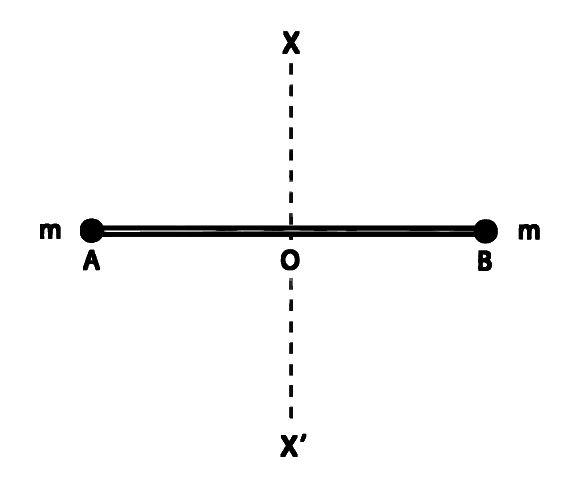
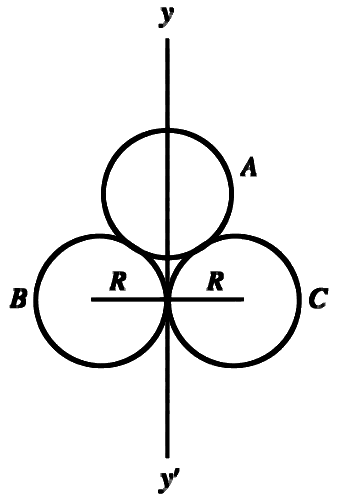
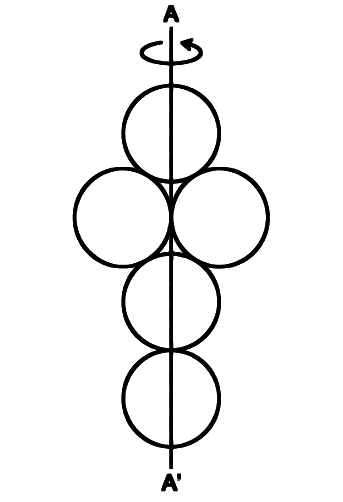
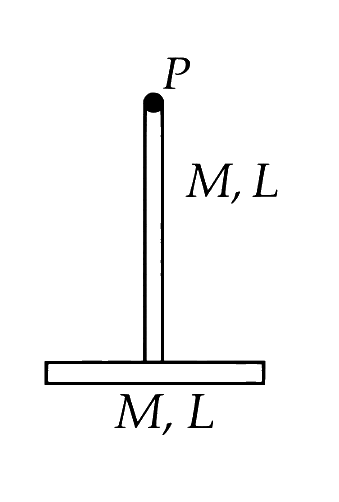
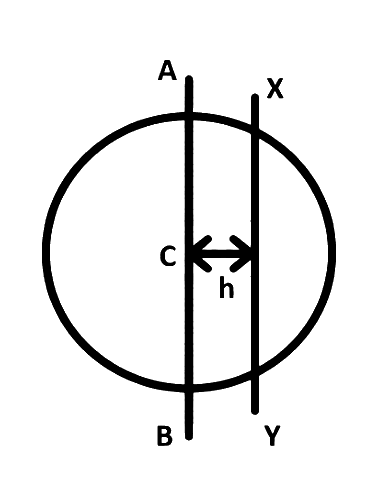
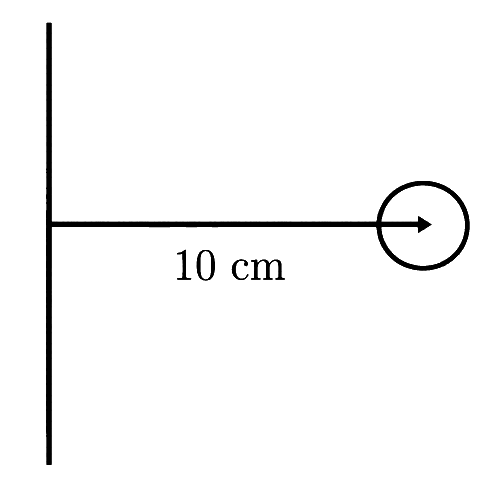
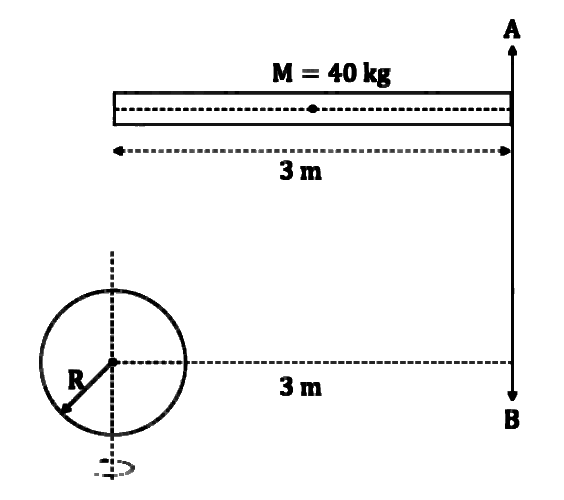
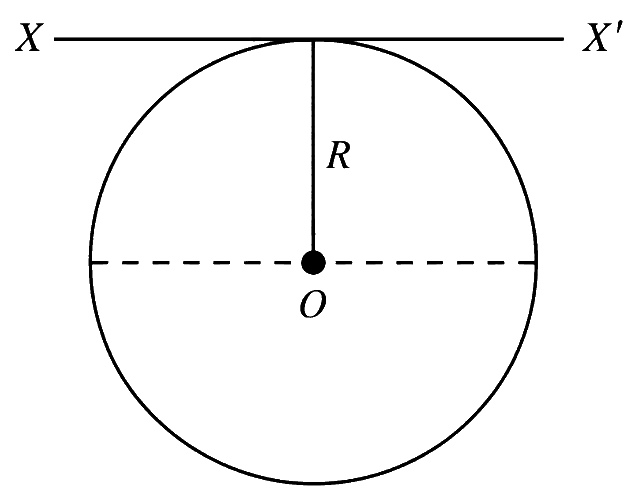
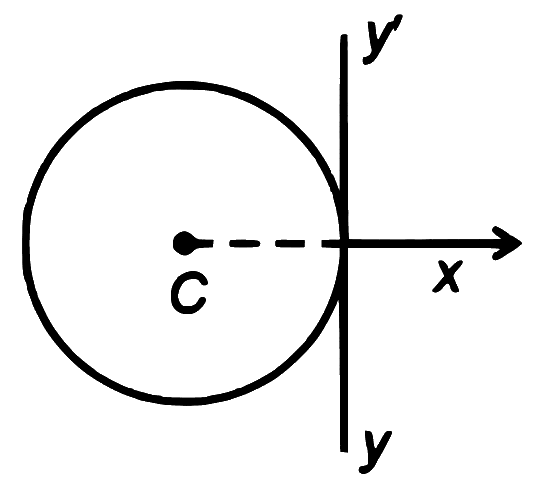
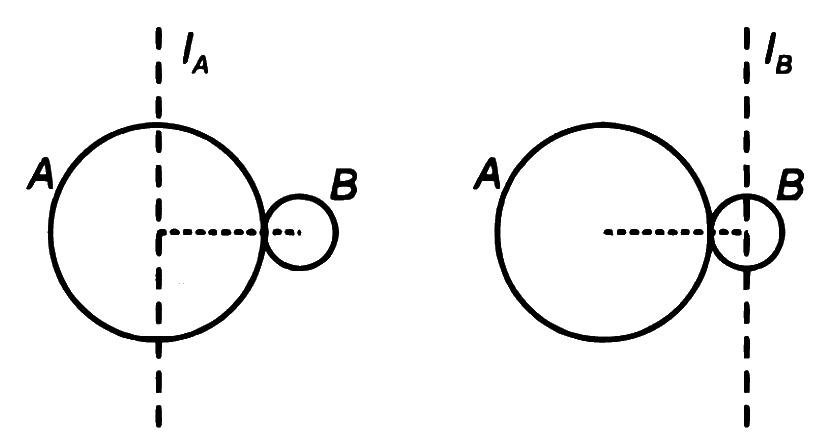
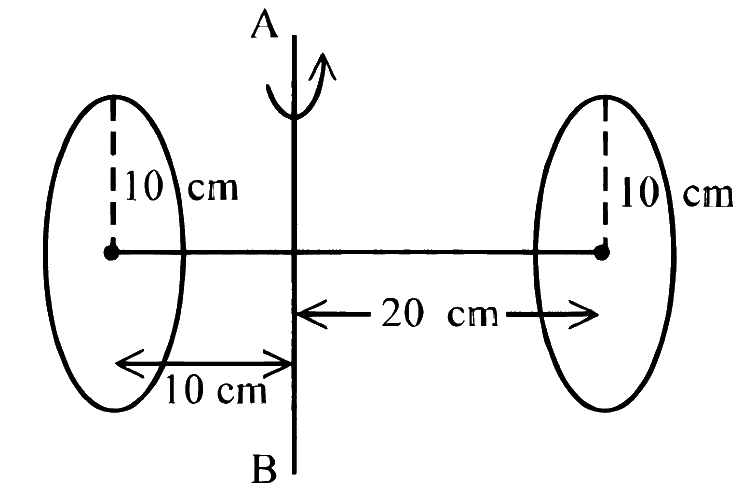
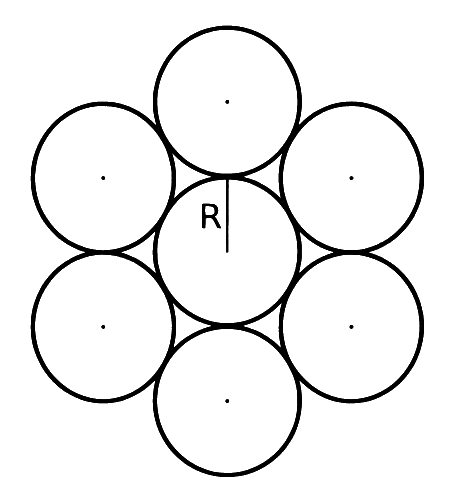
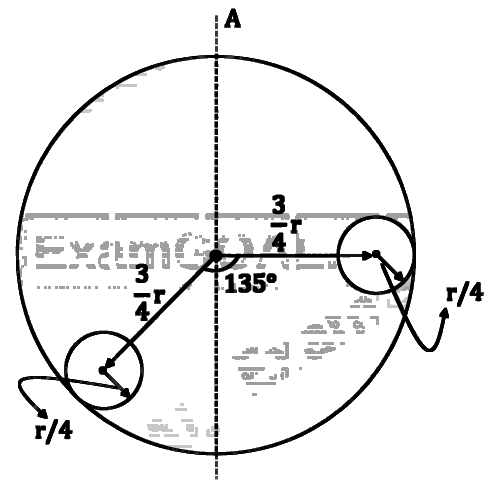
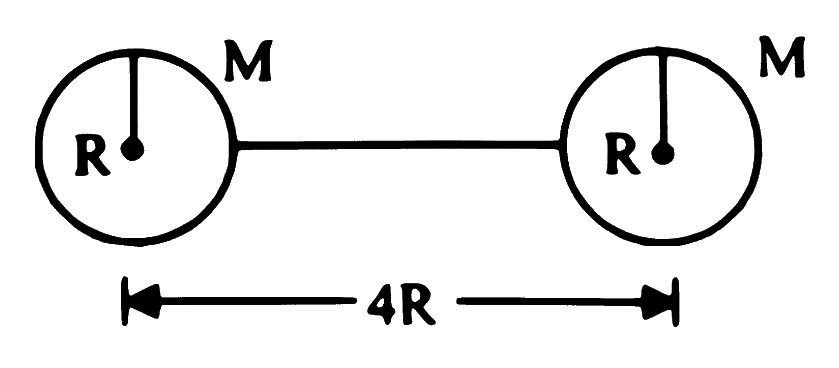
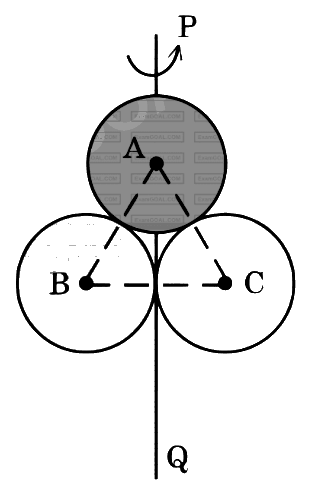
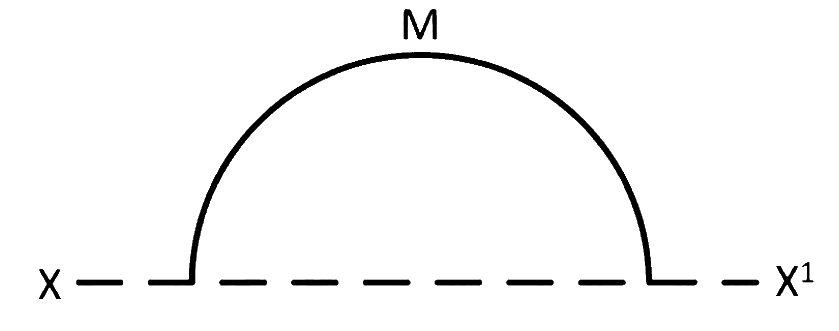
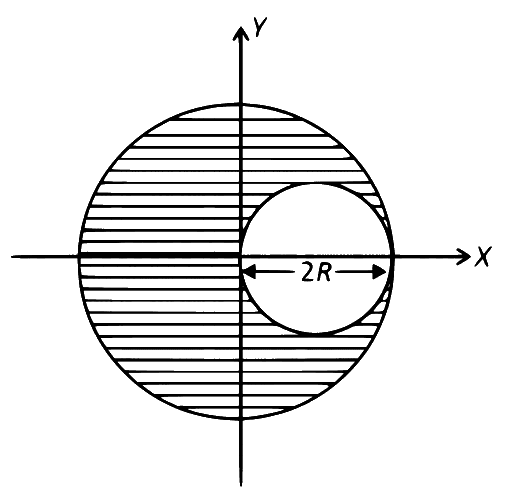
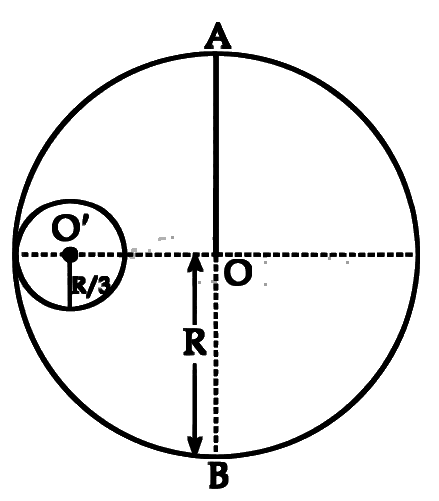
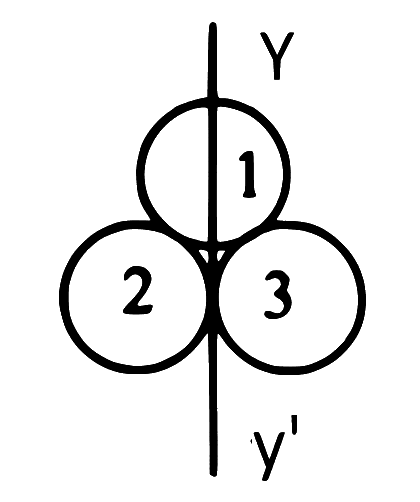
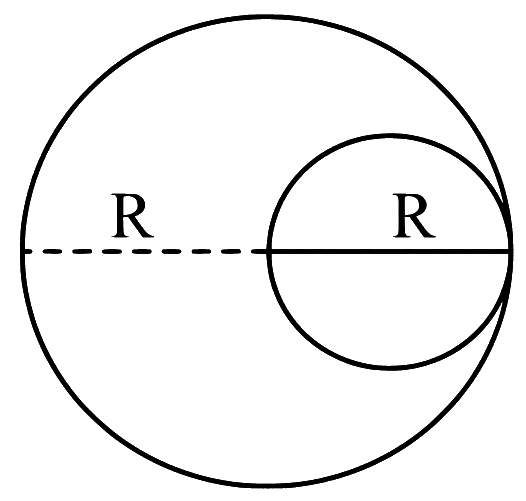
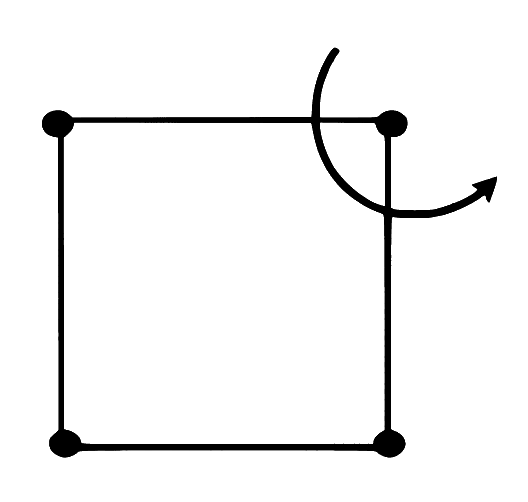
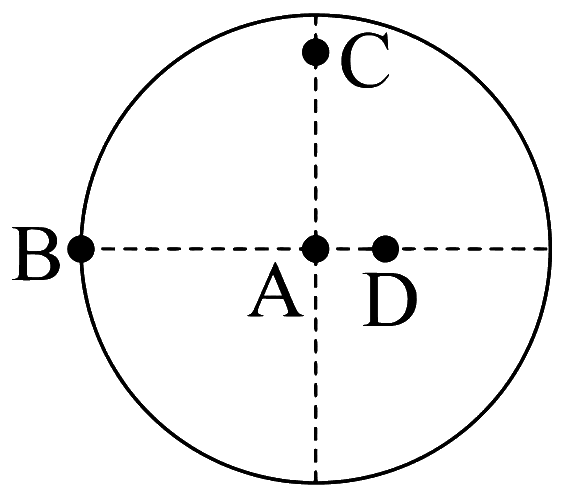
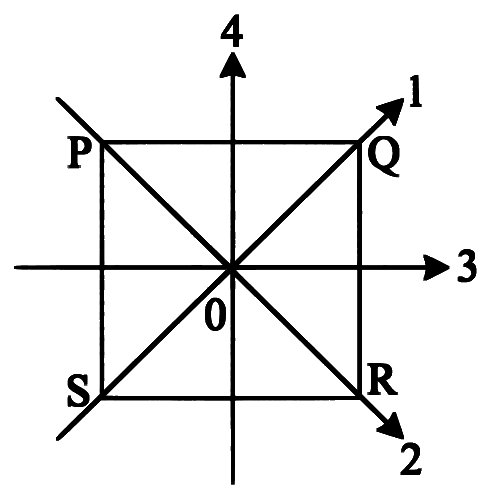
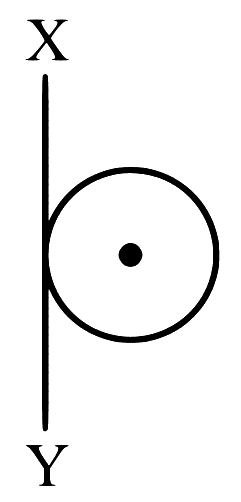
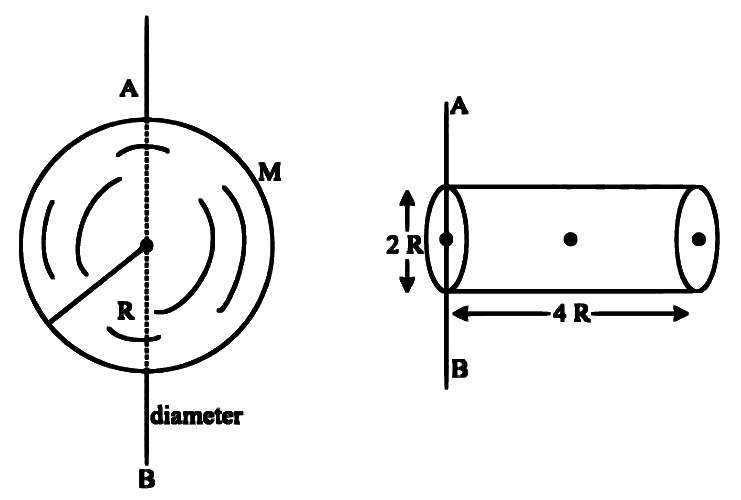
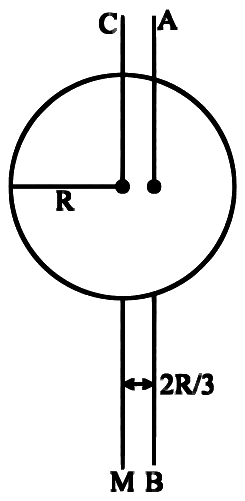
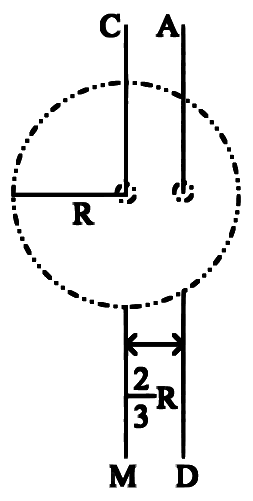
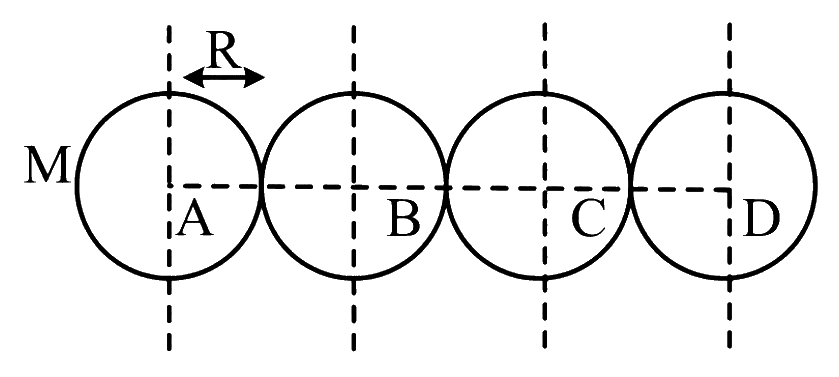
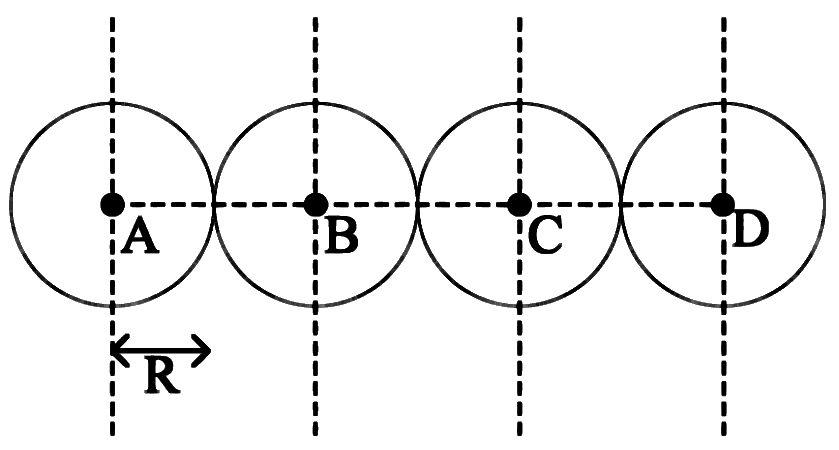
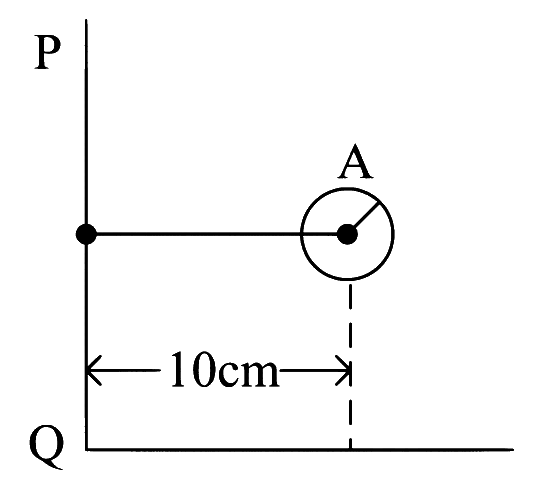
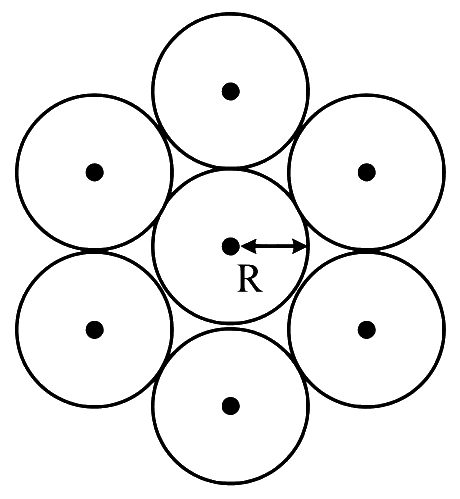
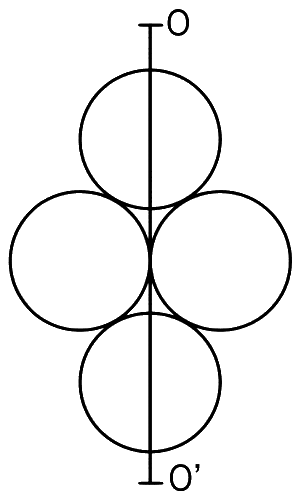
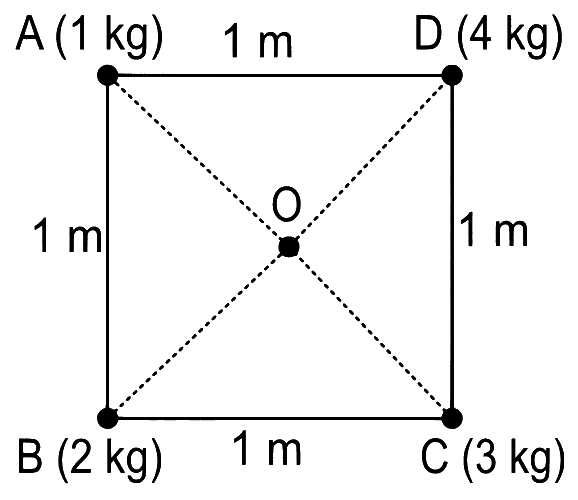
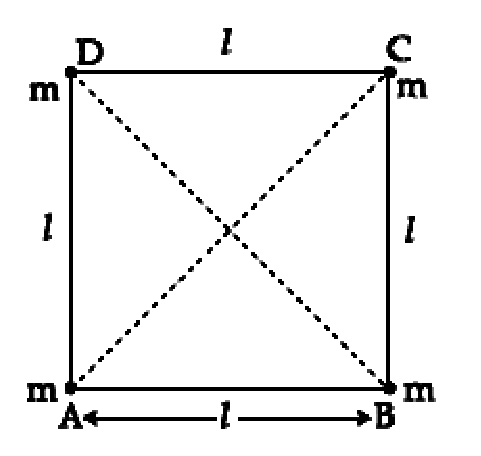
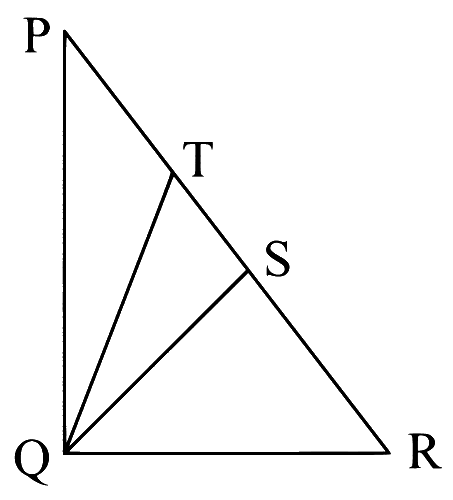
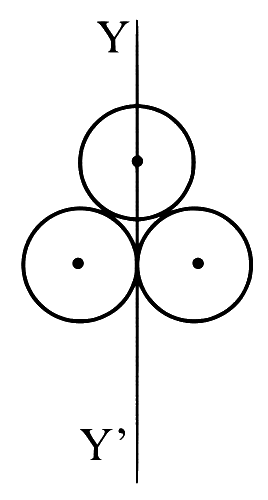
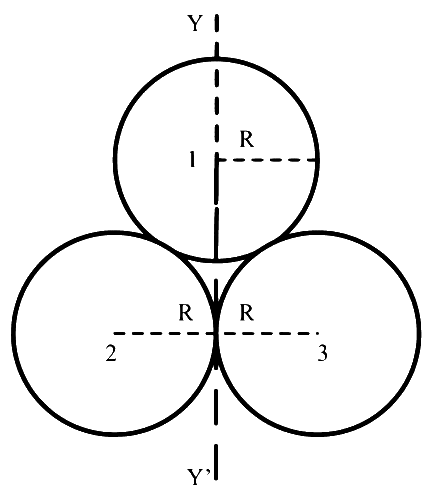
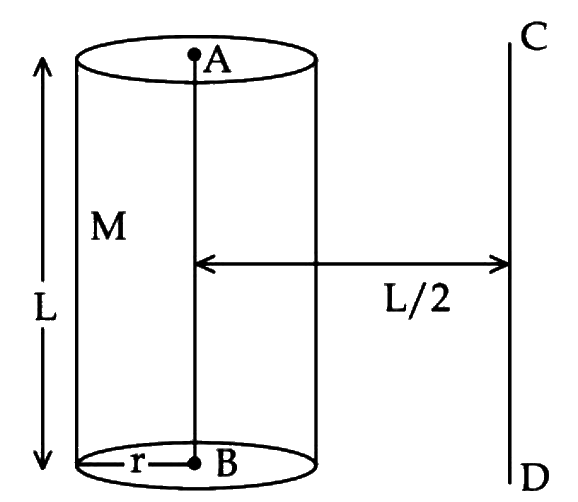
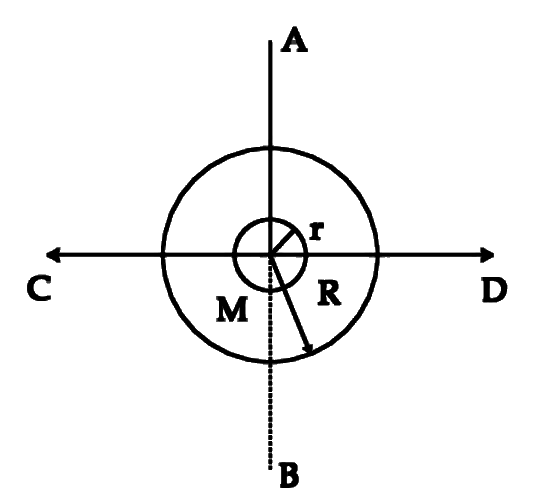
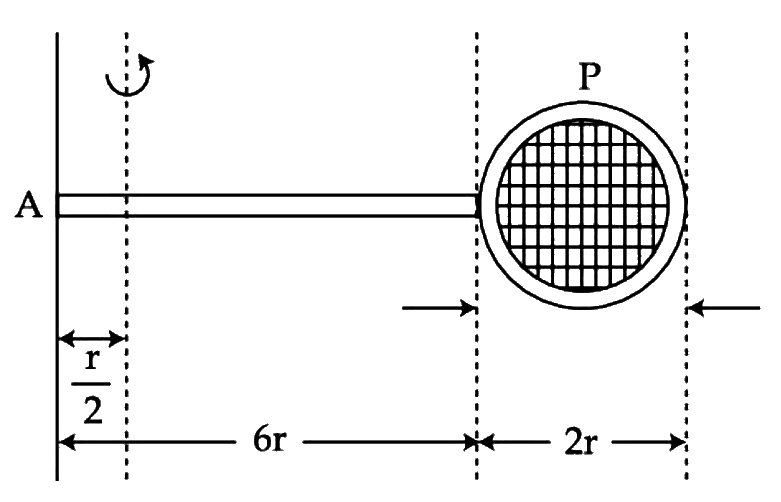
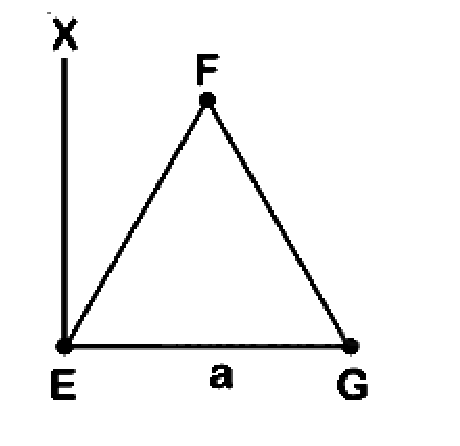
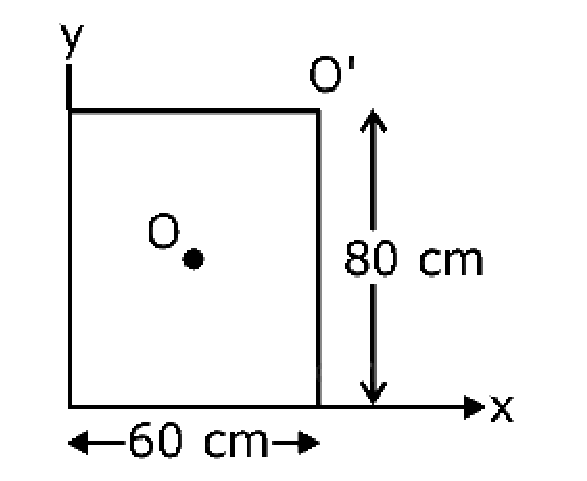
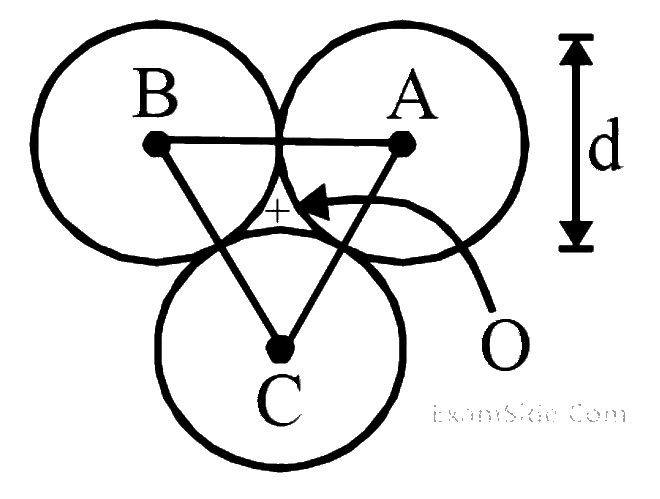
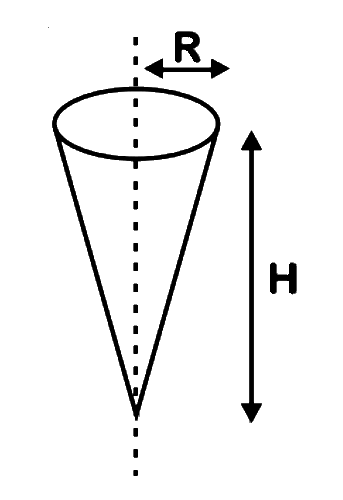
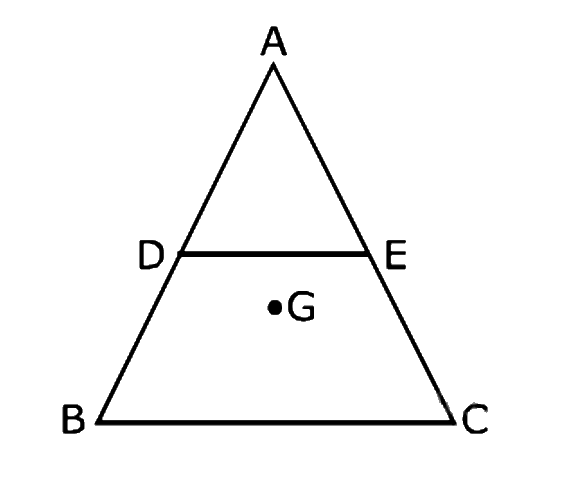
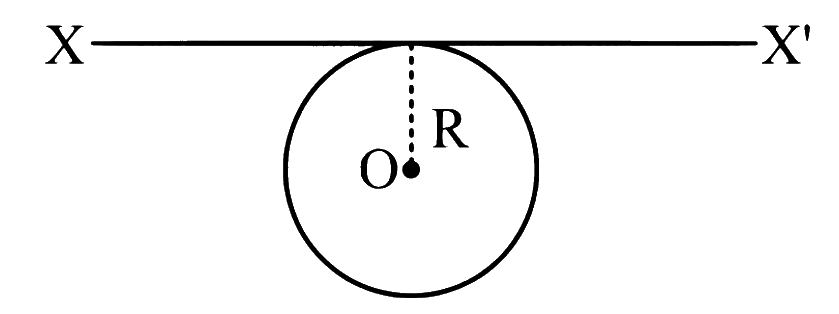
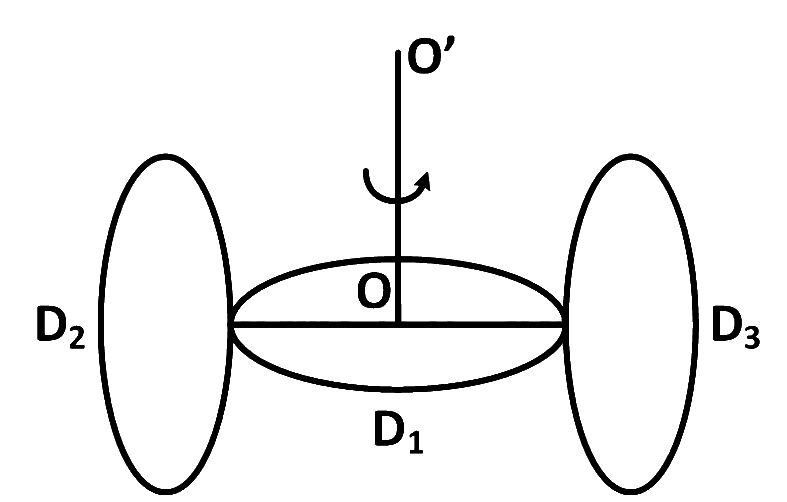
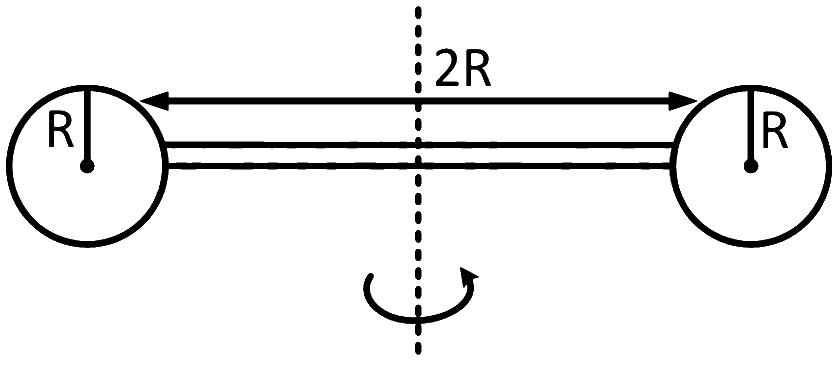
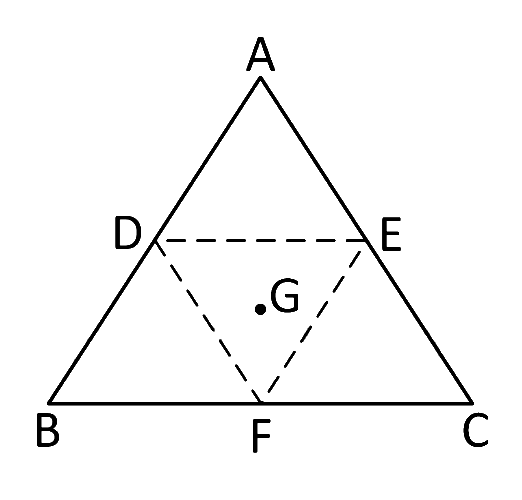
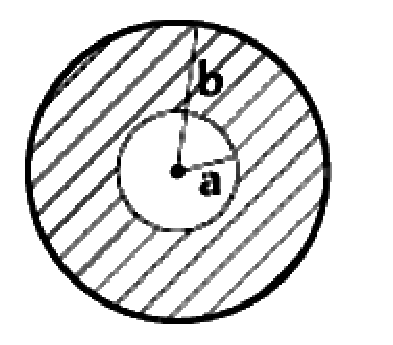
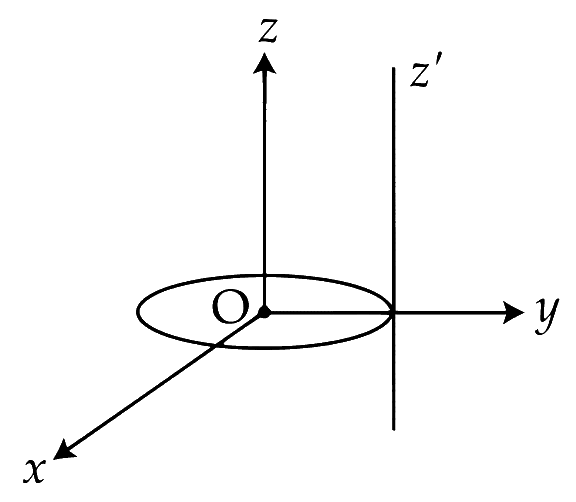
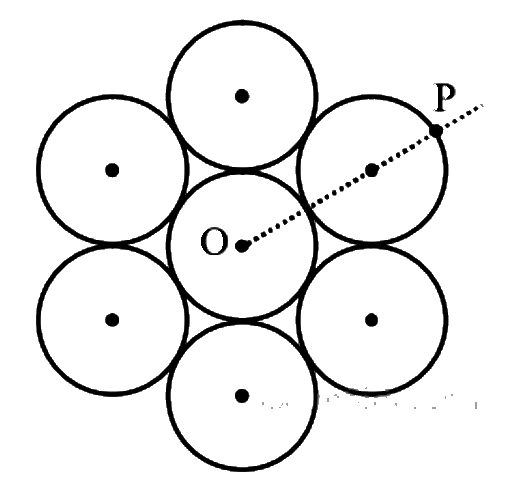
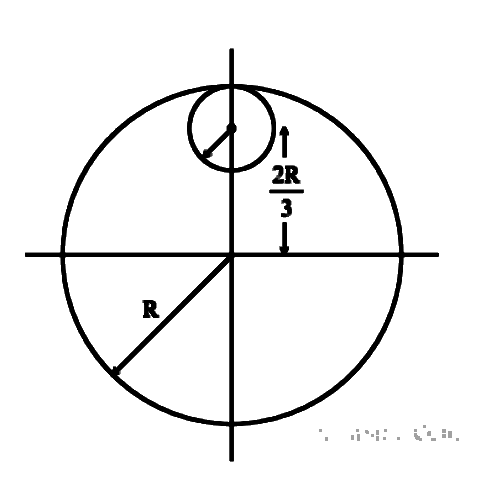
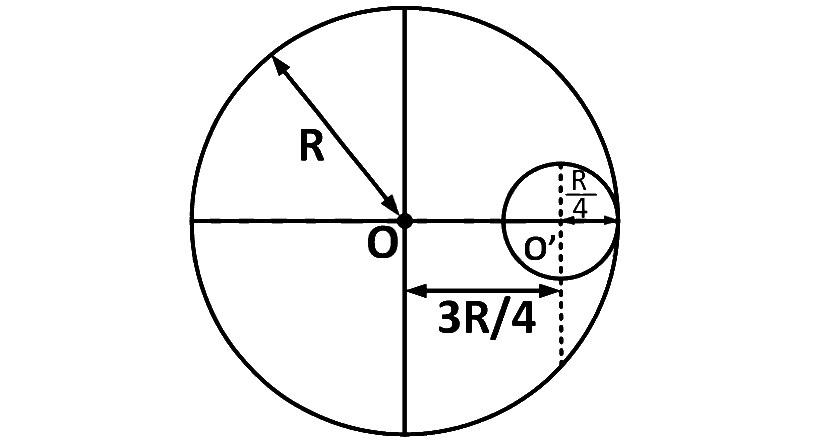
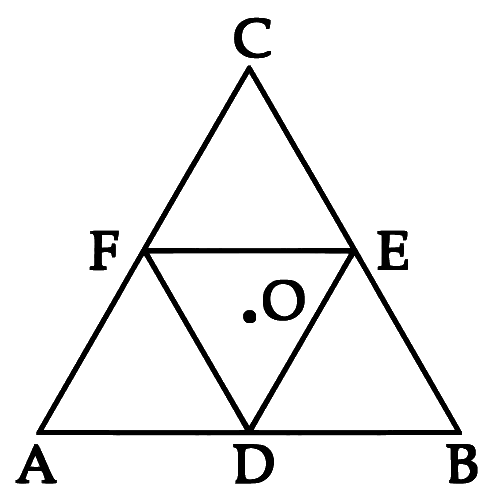
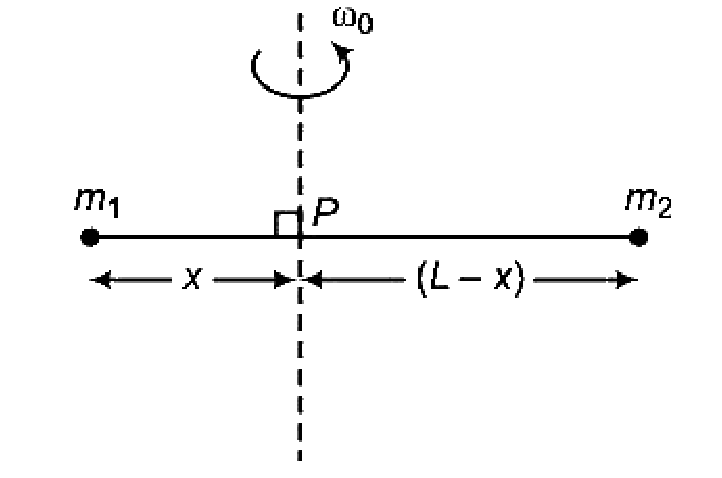
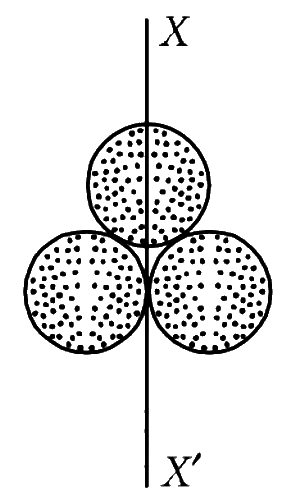
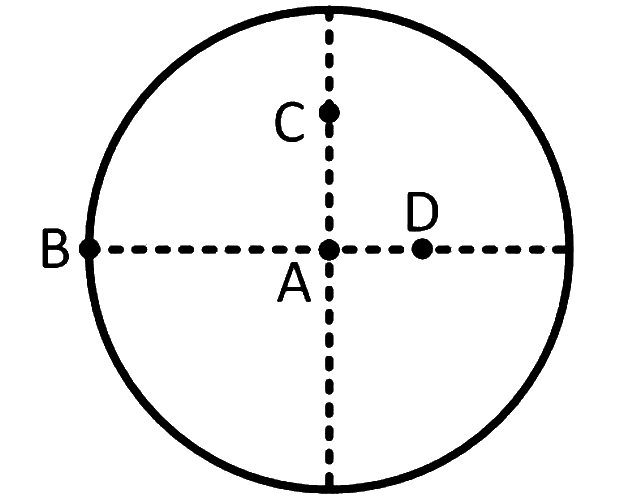
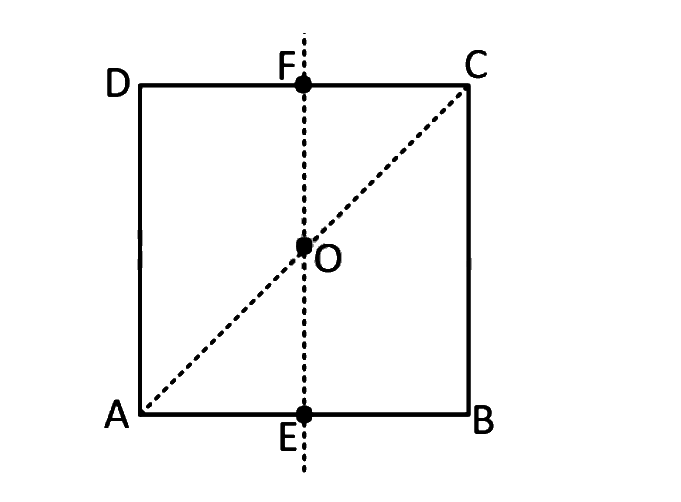
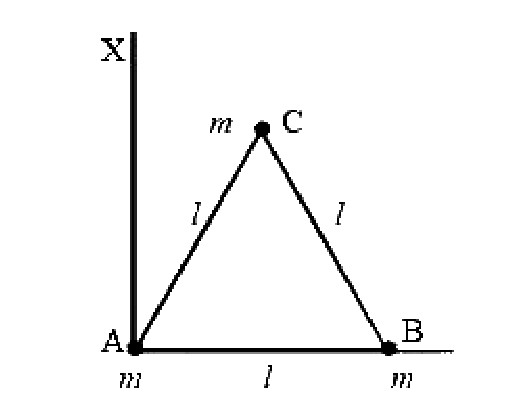
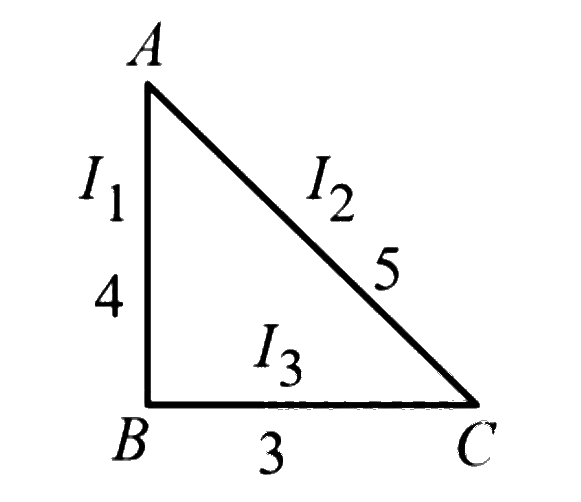
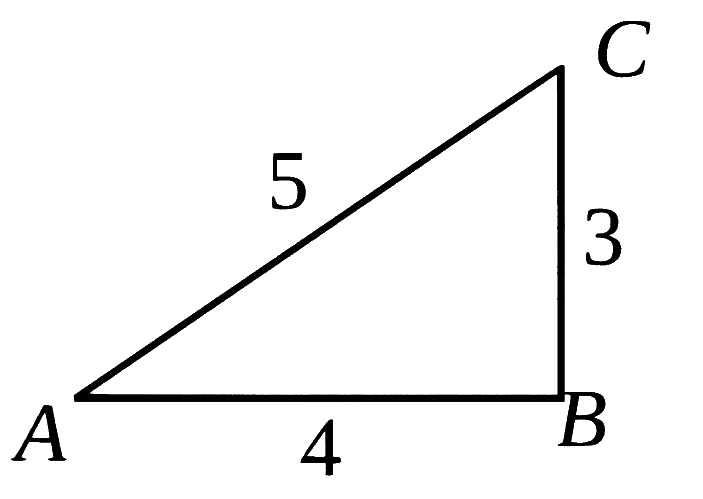
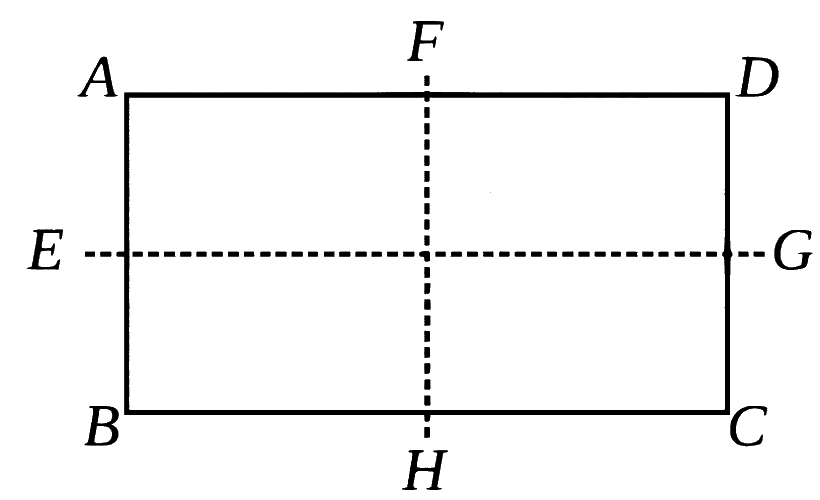
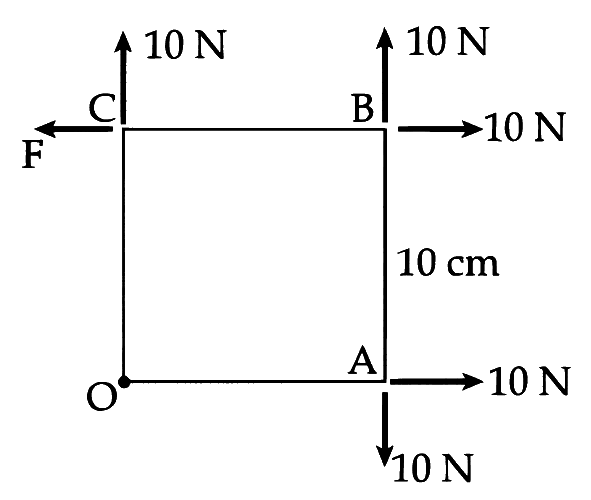
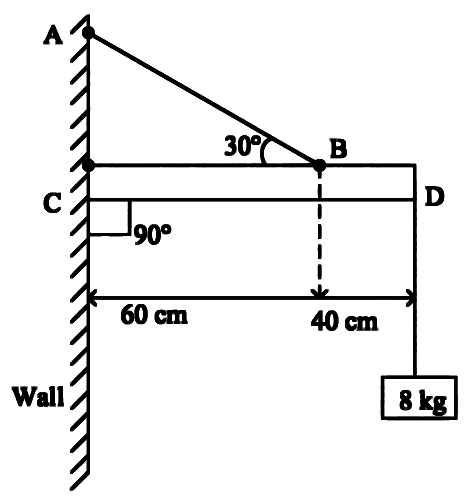
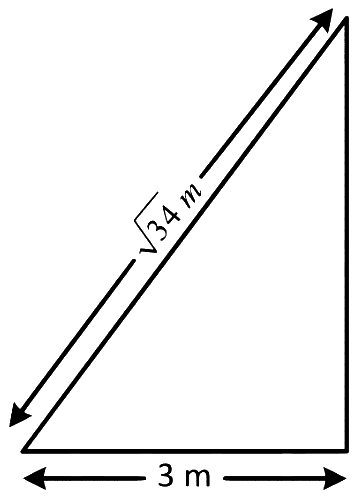
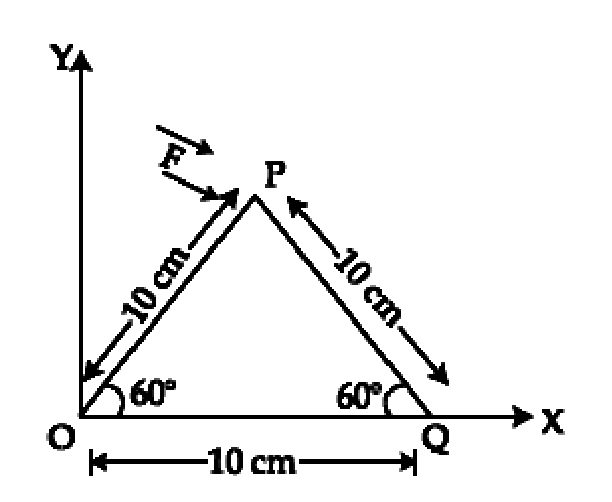
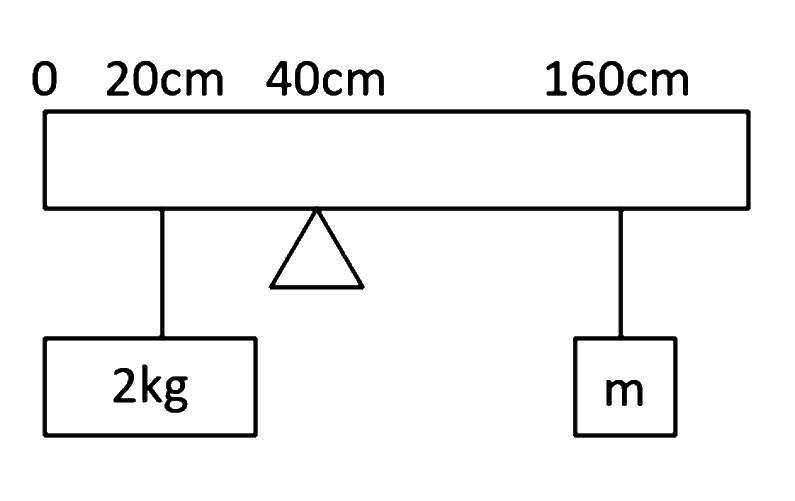
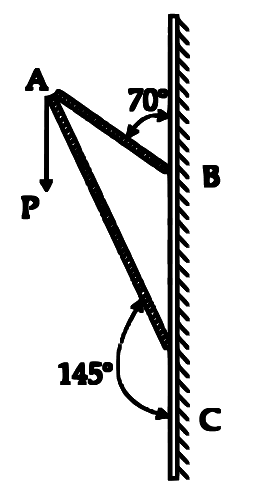
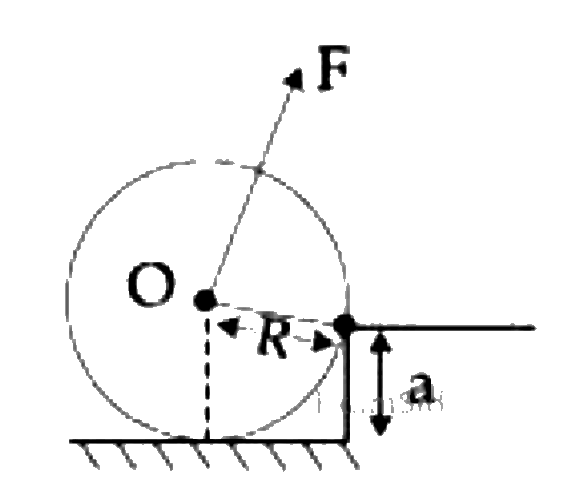
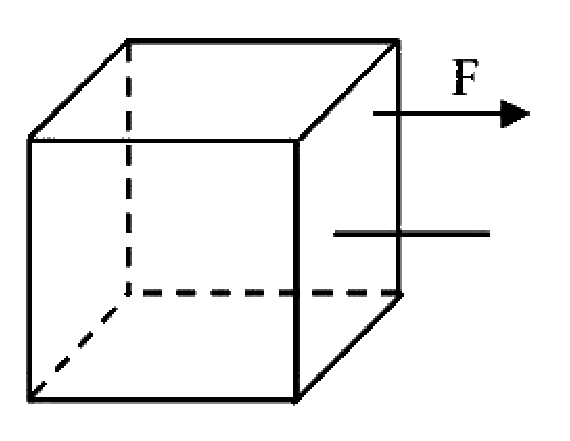
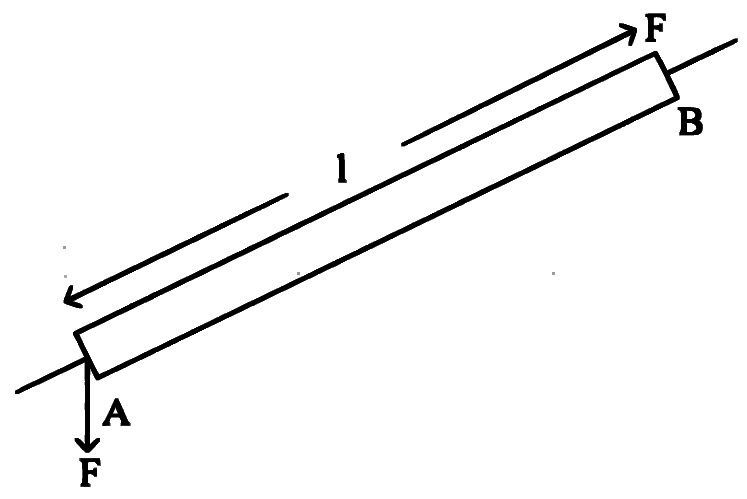
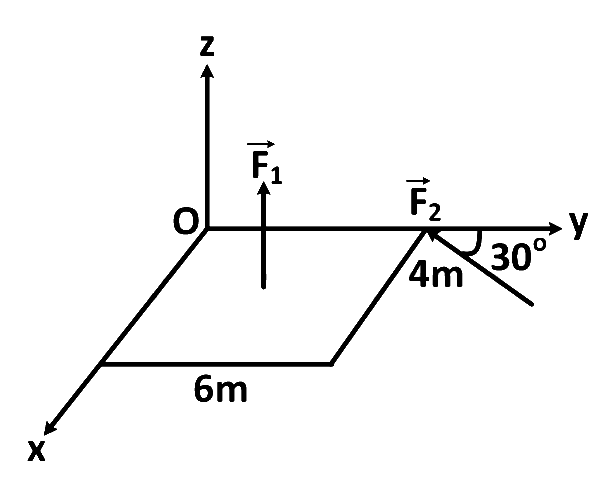
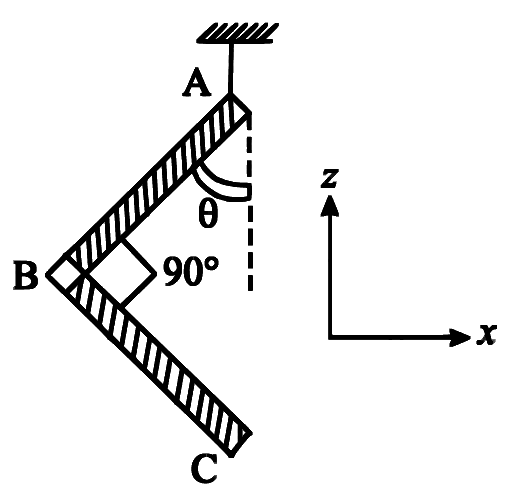
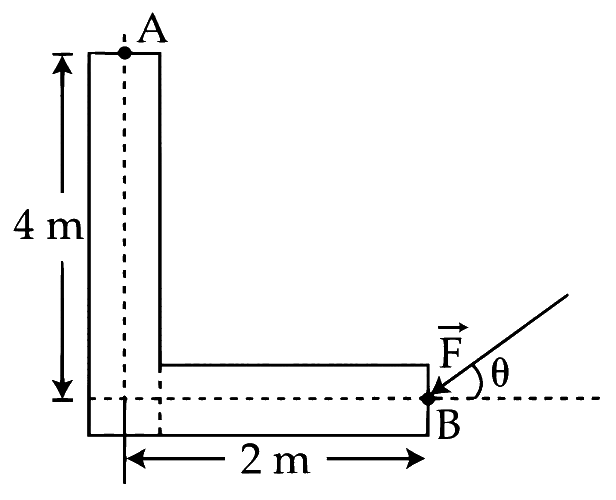
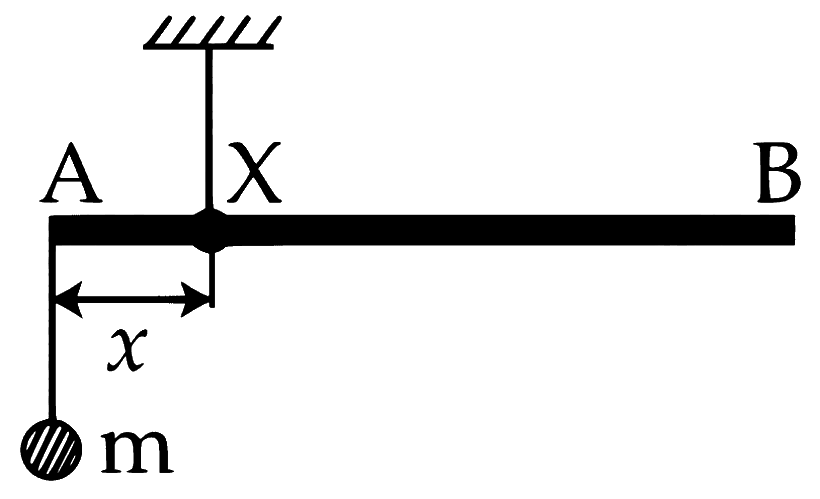
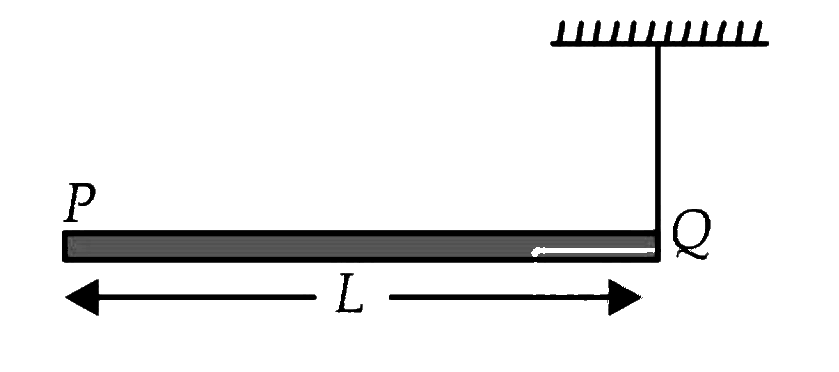
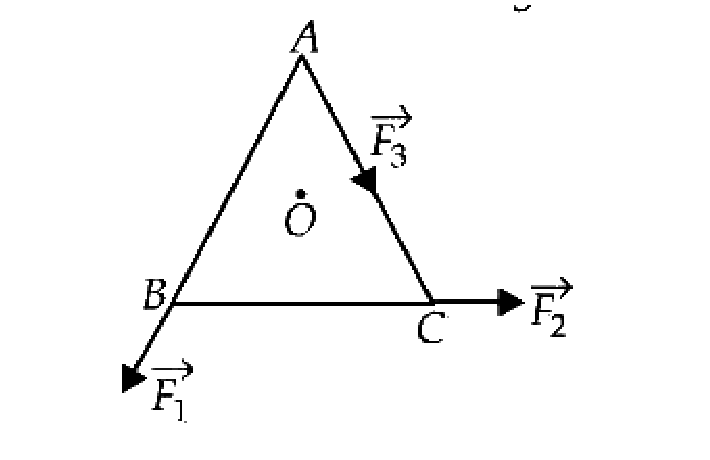
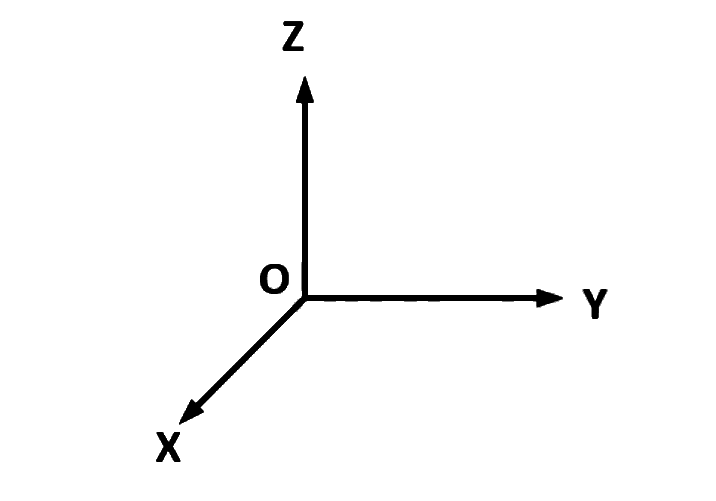
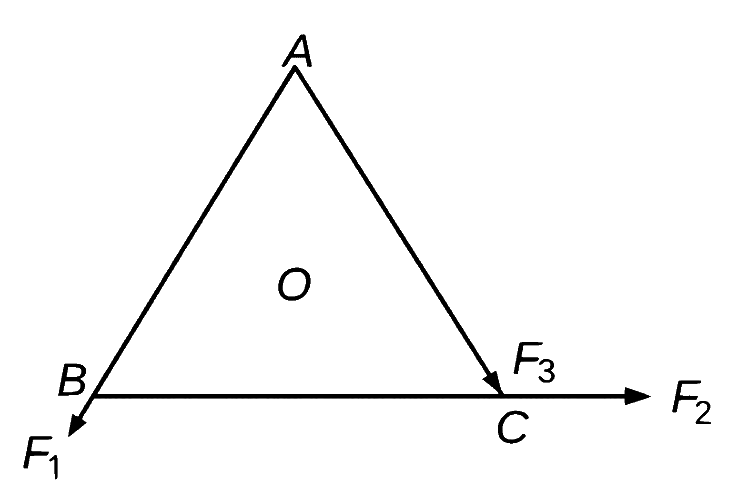
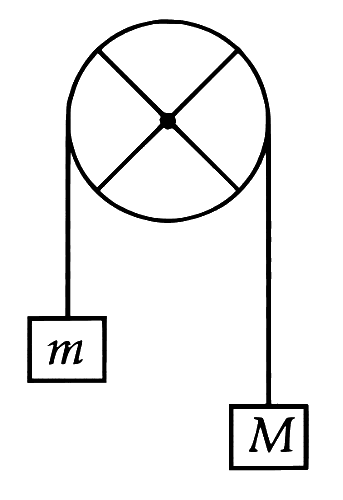
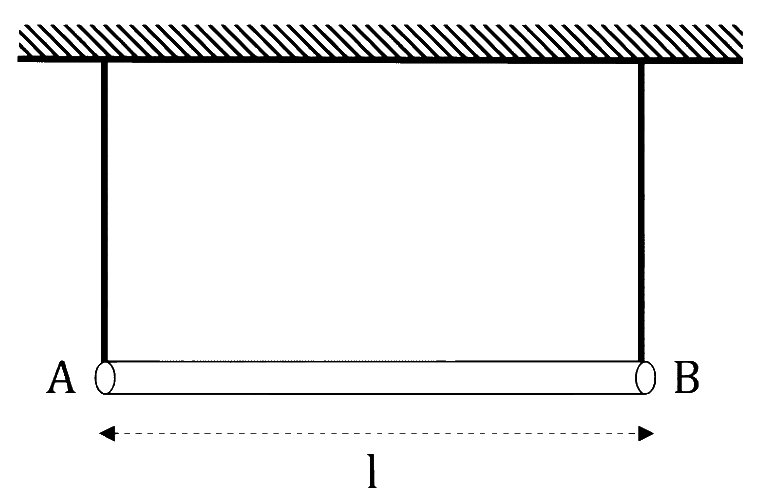
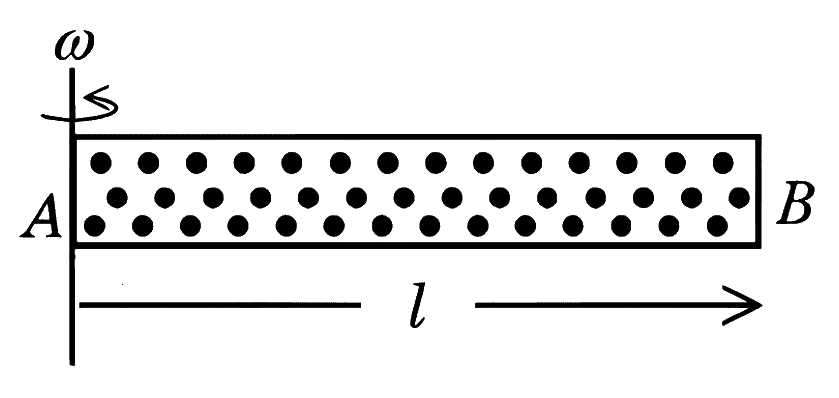
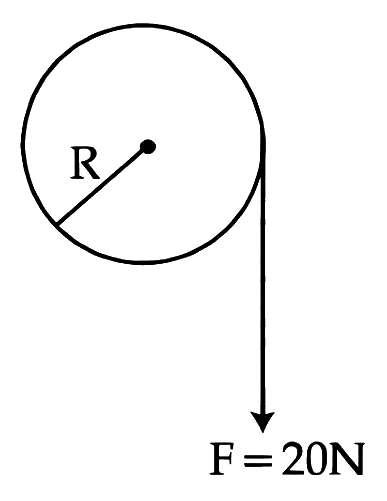
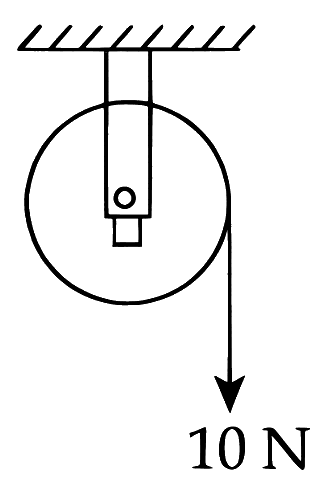
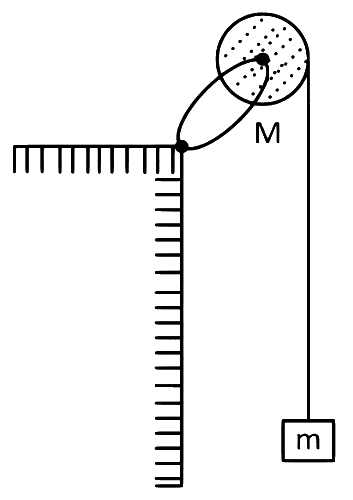
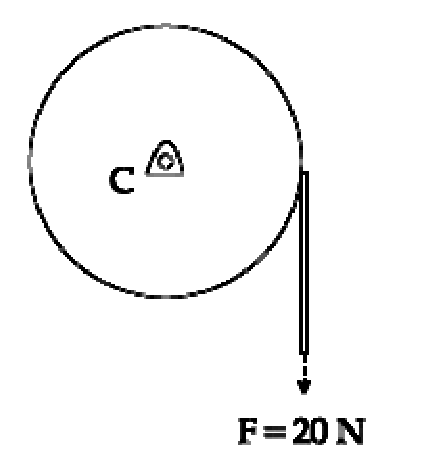
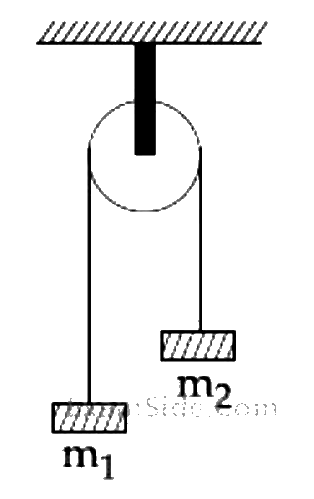
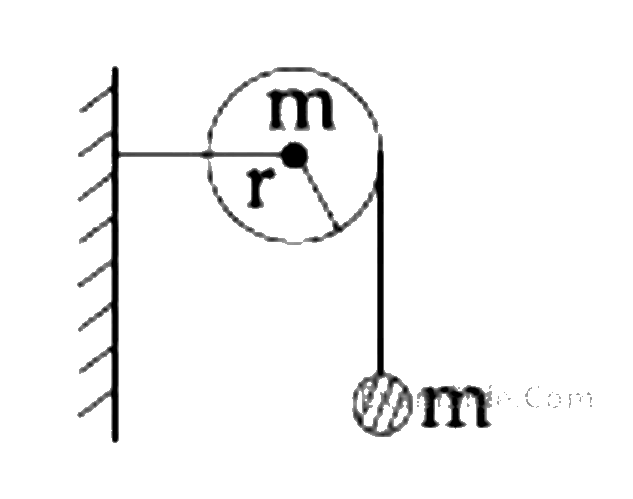
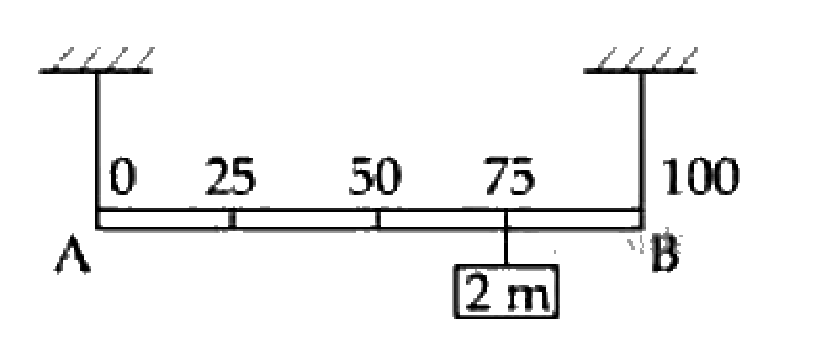
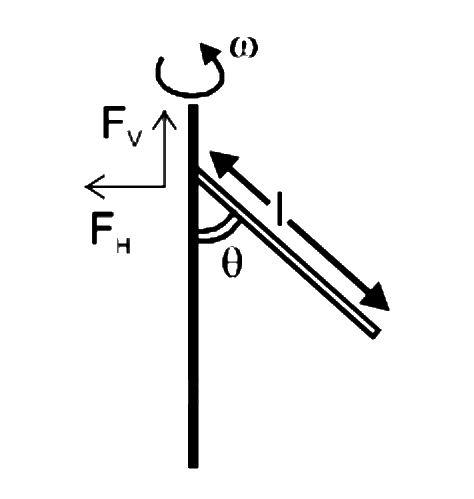
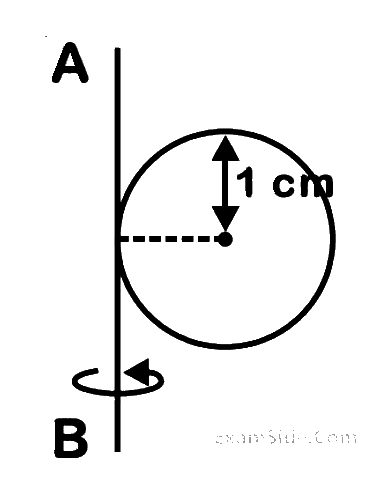
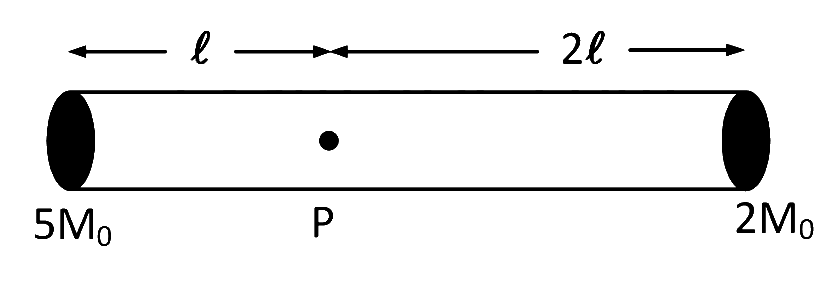
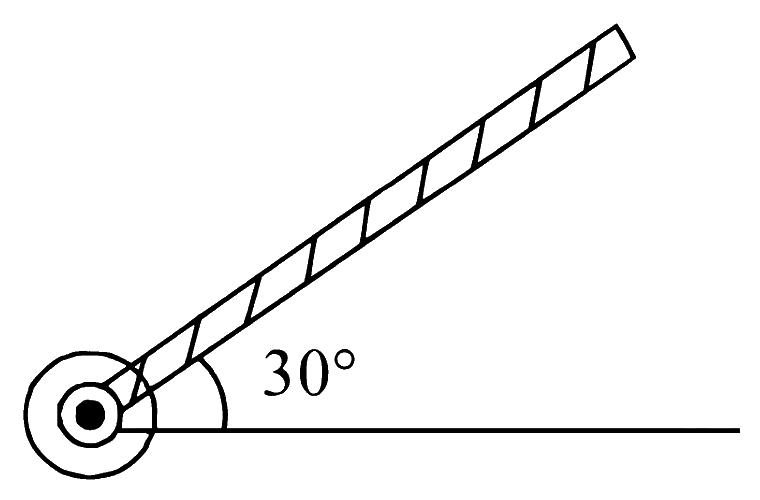
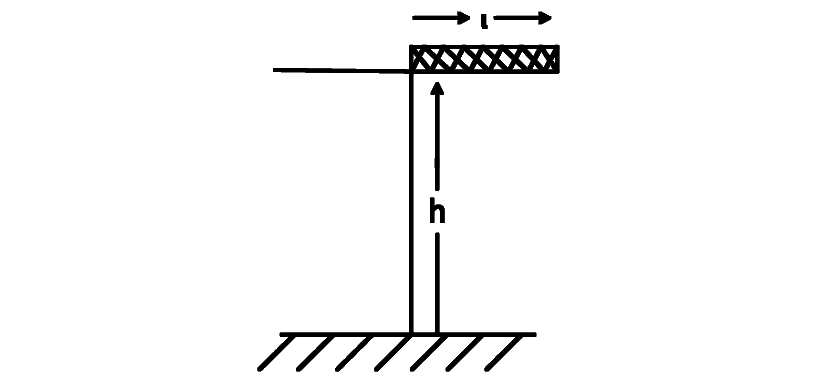
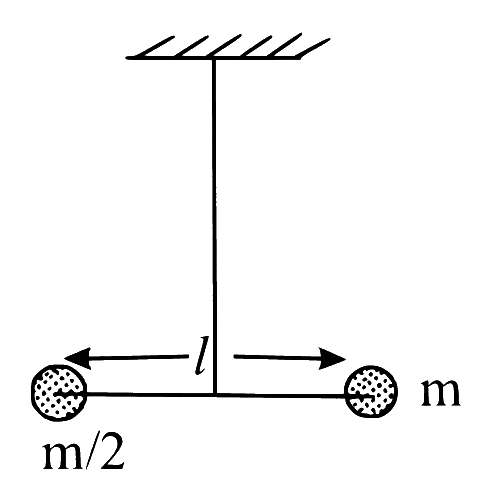
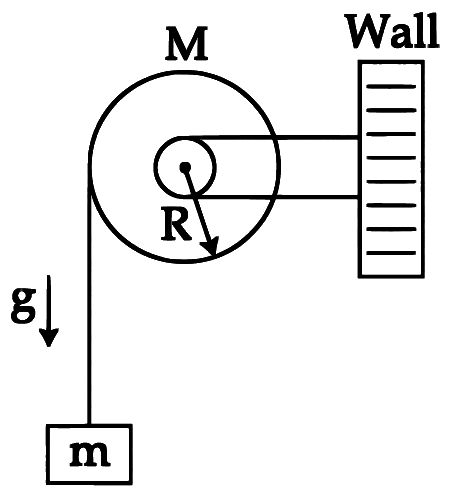
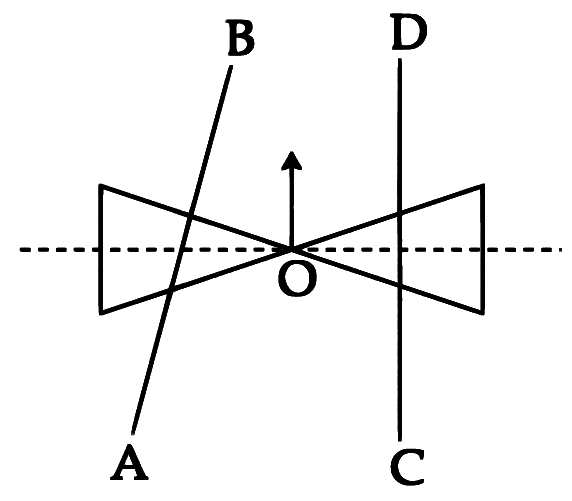
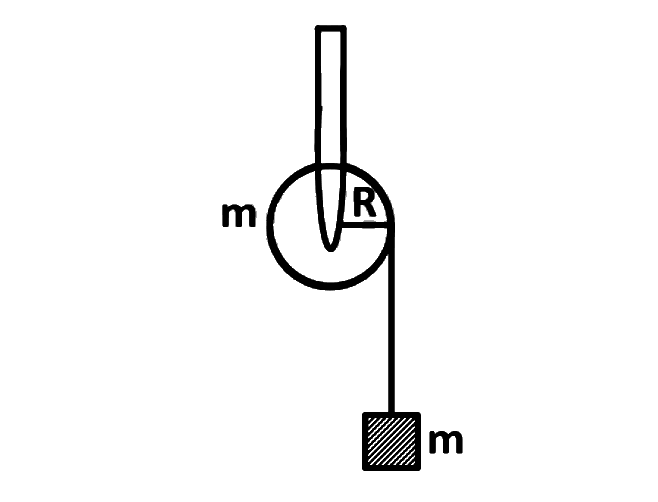
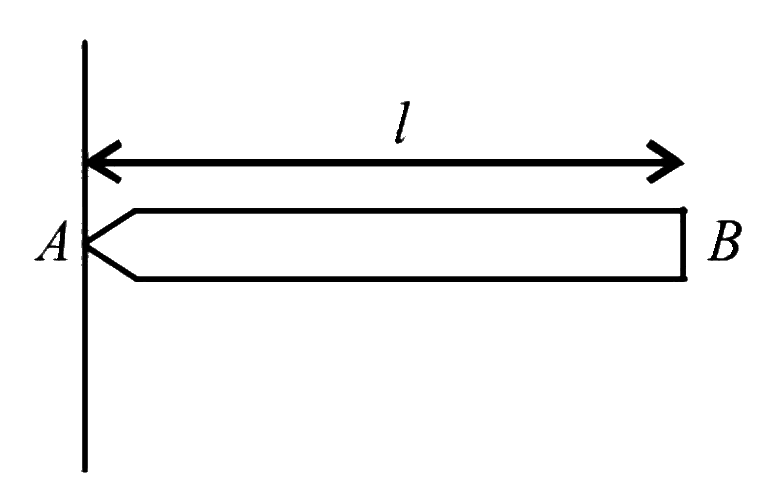
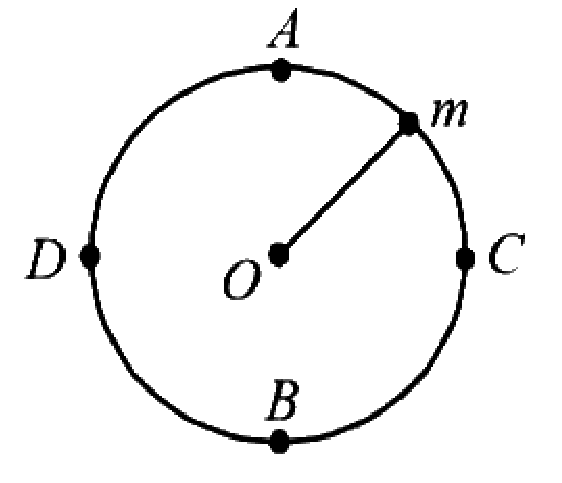
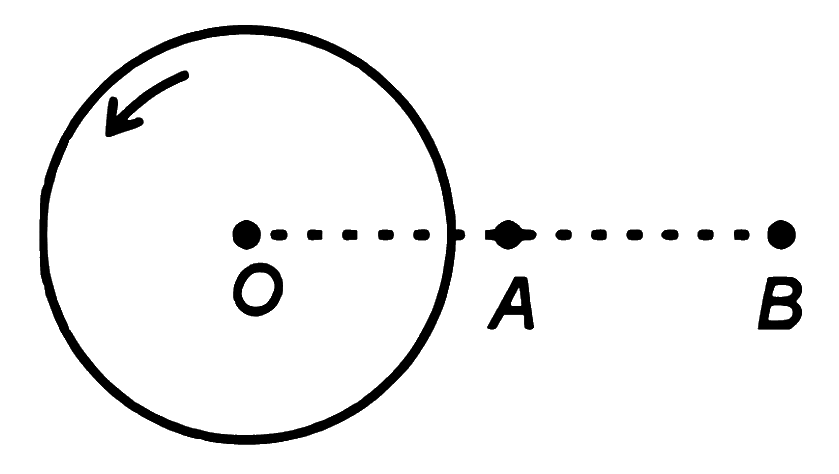
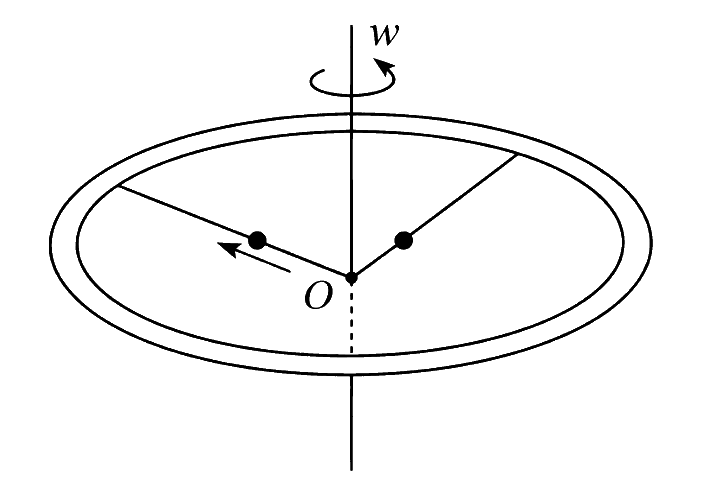
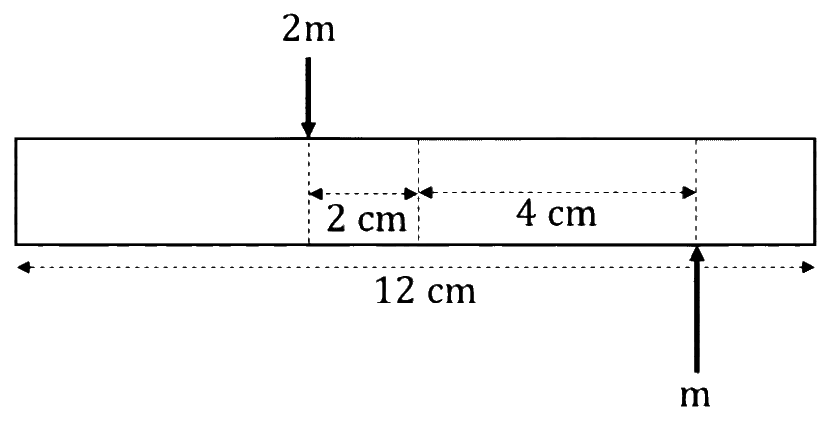
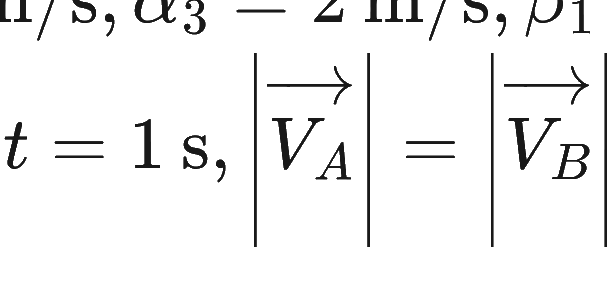 and velocities