a. When soluble substance is dissolved in water, the surface tension of water increases. b. When sparingly soluble substance is mixed with water, surface tension of water increases. c. When insoluble impurity is added into the water, surface tension of water decreases. d. In case of molten copper or molten cadmium, the surface tension increases with increase in its temperature.
The frequency (ν) of an oscillating liquid drop may depend upon radius (r) of the drop, density (ρ) of liquid and the surface tension (s) of the liquid as ν=raρbsc. The values of a, b and c respectively are
Given below are two statements: One is labelled as Assertion (A) and the other is labelled as Reason (R).
Assertion (A): Clothes containing oil or grease stains cannot be cleaned by water wash. Reason (R): Because the angle of contact between the oil/grease and water is obtuse. In the light of the above statements, choose the correct answer from the option given below.
Show answer and solution
Answer: (a)
Water does not wet oil or grease: the angle of contact between them is obtuse.
So water cannot spread over and lift the grease; detergent is needed to lower the angle of contact.
(A) and (R) are both true and (R) explains (A). So the answer is (a).
A metal wire of length 'L' and density 'd' rests horizontally on the free surface of water. The maximum radius of the wire so that the wire does not sink in water is
[T = surface tension of water, g = gravitational acceleration]
Show answer and solution
Answer: (b)
Surface tension acts along both sides of the wire: upward force =2TL.
A drop of some liquid of volume 0.04 cm3 is placed on the surface of the glass plate. Then another glass plate is placed on it such that the liquid forms a thin layer of area 20 cm2 between the surfaces. To separate the plates a force of 16×105 dyne has to be applied normal to the surfaces. The surface tension of the liquid in dyne/cm is
Show answer and solution
Answer: (c)
Thickness of layer t=AV=200.04=0.002 cm.
Force to separate plates: F=t2AT⇒T=2AFt.
T=2×2016×105×0.002=80 dyne/cm. So the answer is (c).
What is the radius of the biggest aluminium coin of thickness t and density ρ, which will be able to float on the water surface of surface tension T? (g = acceleration due to gravity)
Show answer and solution
Answer: (c)
Surface tension acts along the rim: upward force =2πRT.
A disc of paper of radius ' R ' has a hole of radius ' r '. It is floating on a liquid of surface tension ' T '. The force of surface tension on the disc is
Show answer and solution
Answer: (b)
Surface tension acts along every boundary in contact with the liquid surface.
A liquid drop of volume V is placed on the surface of glass plate. Then another glass plate is placed on it such that liquid forms a thin layer of area A between the surfaces of two plates. To separate the plates a force F has to be applied normal to the surfaces. The surface tension of the liquid is
A water drop of 0.01 cm3 is squeezed between two glass plates and spreads in to area of 10 cm2. If surface tension of water is 70 dyne /cm then the normal force required to separate glass plates from each other will be
A thin flat circular disc of radius 4.5 cm is placed gently over the surface of water. If surface tension of water is 0.07 N m−1, then the excess force required to take it away from the surface is
Show answer and solution
Answer: (a)
Extra force = surface tension along the rim: F=T×2πr.
Liquid drops are falling slowly one by one from vertical glass tube. The relation between the weight of a drop ' w ', the surface tension ' T ' and the radius ' r ' of the bore of the tube is (Angle of contact is zero)
Show answer and solution
Answer: (d)
Just before falling, the drop hangs from the rim of the bore of circumference 2πr.
A liquid drop of density ' ρ ' is floating half immersed in a liquid of density ' d '. If ' T ' is the surface tension then the diameter of the liquid drop is ( g= acceleration due to gravity)
Show answer and solution
Answer: (c)
Weight = buoyancy + surface tension force along the waterline: 34πr3ρg=32πr3dg+2πrT.
A steel coin of thickness 'd' and density 'ρ' is floating on water of surface tension 'T'. The radius of the coin (R) is [g= acceleration due to gravity]
A thin metal disc of radius 'r' floats on water surface and bends the surface downwards along the perimeter making an angle 'θ' with the vertical edge of the disc. If the weight of water displaced by the disc is 'W', the weight of the metal disc is [T = surface tension of water]
Show answer and solution
Answer: (a)
Upward forces on the disc: buoyancy W and vertical component of surface tension along the rim.
Surface tension makes angle θ with the vertical: vertical part =2πrTcosθ.
A drop of liquid of density 'ρ' is floating half immersed in a liquid of density 'd'. If 'T' is the surface tension, then the diameter of the drop of the liquid is
A small spherical droplet of density d is floating exactly half immersed in a liquid of density ρ and surface tension T. The radius of the droplet is (take note that the surface tension applies an upward force on the droplet):
Show answer and solution
Answer: (d)
Weight = buoyancy (half volume) + upward surface force 2πrT.
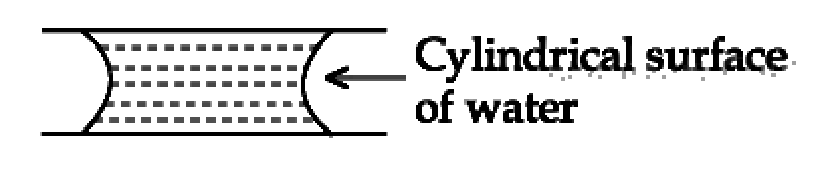
If two glass plates have water between them and are separated by very small distance (see figure), it is very difficult to pull them apart. It is because the water in between forms cylindrical surface on the side that gives rise to lower pressure in the water in comparison to atmosphere. If the radius of the cylindrical surface is R and surface tension of water is T then the pressure in water between the plates is lower by:
Show answer and solution
Answer: (b)
Laplace excess pressure: ΔP=T(R11+R21).
For a cylindrical surface R1=R and R2=∞, so ΔP=RT.
The surface is concave towards air, so the water pressure is lower than atmospheric.
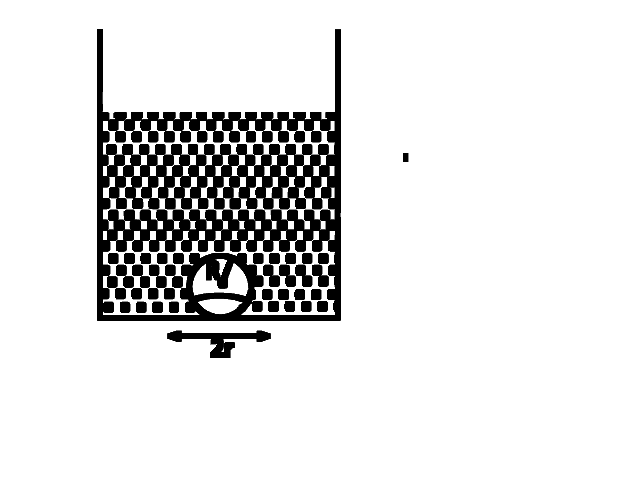
On heating water, bubbles being formed at the bottom of the vessel detach and rise. Take the bubbles to be spheres of radius R and making a circular contact of radius r with the bottom of the vessel. If r≪R and the surface tension of water is T, value of r just before bubbles detach is: (density of water is ρw)
Show answer and solution
Answer: (d)
Upward buoyancy on the bubble ≈34πR3ρwg (since r≪R).
Surface tension acts along the contact circle 2πr; its vertical (downward) part is 2πrTsinθ with sinθ=Rr.
Just before detaching: R2πr2T=34πR3ρwg⇒r2=3T2R4ρwg.
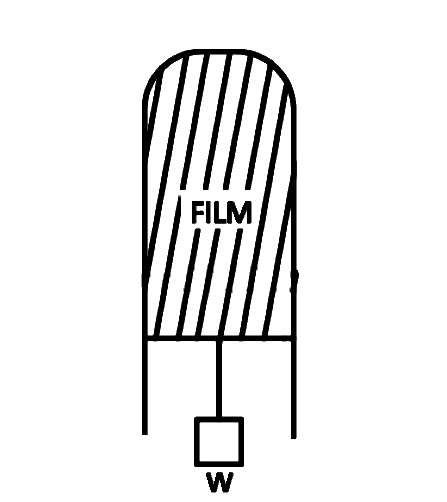
A thin liquid film formed between a U-shaped wire and a light slider supports a weight of 1.5×10⁻² N (see figure). The length of the slider is 30 cm and its weight negligible. The surface tension of the liquid film is
Show answer and solution
Answer: (d)
The film has two surfaces, each pulling the slider with TL: total 2TL.
Equilibrium: 2TL=W⇒T=2LW.
T=2×0.301.5×10−2=0.025 N m−1. So the answer is (d).
Surface Energy & Work Done · Blowing a soap bubble
A soap bubble of radius R is blown. After heating the solution, a second bubble of radius 2R is blown. The work required to blow the second bubble in comparison to that required for the first bubble is
Show answer and solution
Answer: (a)
W=8πR2T, so for radius 2R at the same T, W would be exactly 4 times.
Surface tension decreases with rise in temperature, so T′<T.
Surface Energy & Work Done · Blowing a soap bubble
The surface tension of a soap bubble is 0.03 N/m. The work done in increasing the diameter of bubble from 2 cm to 6 cm is απ×10−4 J. The value of α is _________. (Take π=3.14)
Surface Energy & Work Done · Blowing a soap bubble
The surface tension of a soap is 3.5×10⁻² N/m. The work required to increase the radius of a soap bubble from 1 cm to 2 cm is α×10−6 J. The value of α is ______.
(π=22/7)
Numerical answer type. Work it out, then open the answer.
Surface Energy & Work Done · Blowing a soap bubble
A soap bubble of surface tension 0.04 N/m is blown to a diameter of 7 cm. If (15000−x)μJ of work is done in blowing it further to make its diameter 14 cm, then the value of x is .(π=22/7)
Numerical answer type. Work it out, then open the answer.
A frame made up of metallic wire enclosing a surface area A is covered with a soap film. If the area of the frame of metallic wire is reduced by 25% the energy of the soap film will be changed by
Show answer and solution
Answer: (d)
Surface energy of the film E=T×2A∝A.
Area reduced by 25% means energy is reduced by 25%.
Surface Energy & Work Done · Blowing a soap bubble
The work done in blowing a soap bubble of radius R is W1 at room temperature. Now the soap is heated. From the heated another soap bubble of radius 2 R is blown and the work done is W2. Then
Surface Energy & Work Done · Blowing a soap bubble
A soap bubble is blown to a diameter of 7 cm.36960 erg of work is done in blowing it further. If surface tension of soap is 40 dyne/cm then the new radius is ________ cm. Take (π=722).
Numerical answer type. Work it out, then open the answer.
A water film is formed between two parallel wires of 10 cm length. The distance of 0.5 cm between the wires is increased by 1 mm. The work done in the process is (surface tension of water =72 N/m)
Consider a soap film on a rectangular frame of wire of area 3×3 cm2. If the area of the soap film is increased to 5×5 cm2, the work done in the process will be (surface tension of soap is 2.5×10⁻² N/m)
Show answer and solution
Answer: (d)
A film has two surfaces: W=2TΔA.
ΔA=(25−9) cm2=16×10−4 m2.
W=2×2.5×10−2×16×10−4=80×10−6 J. So the answer is (d).
Surface Energy & Work Done · Blowing a soap bubble
A soap bubble of radius 'R' is blown. After heating a solution, a second bubble of radius '2R' is blown. The work required to blow the 2nd bubble in comparison to that required for the 1st bubble is
Show answer and solution
Answer: (c)
W=8πR2T; doubling R at the same T would give 4 times the work.
Surface tension decreases on heating, so T′<T.
So W2 is slightly less than 4W1: the answer is (c).
Surface Energy & Work Done · Blowing a soap bubble
The surface tension of soap is 3.5×10⁻² N m−1. The amount of work done required to increase the radius of soap bubble from 10 cm to 20 cm is _________ ×10−4 J.
(take π=22/7)
Numerical answer type. Work it out, then open the answer.
A film of soap is formed between two straight parallel wires of length 10 cm each separated by 0.5 cm. If their separation is increased by 1 mm while still maintaining their parallelism. How much work will have to be done?
Surface Energy & Work Done · Blowing a soap bubble
The work done in blowing a soap bubble of radius R is 'W1' at room temperature. Now the soap is heated. From the heated another soap bubble of radius 2R is blown and the work done is 'W2'. Then
Surface Energy & Work Done · Blowing a soap bubble
The work done in blowing a soap bubble of volume 'V' is 'W'. The work required to blow a soap bubble of volume '2V' is [T= surface tension of soap solution]
A rectangular film of liquid is extended from (4 cm × 2 cm) to (5 cm × 4 cm). If the work done is 3 × 10⁻⁴ J, the value of the surface tension of the liquid is
Eight mercury drops, each of radius r, coalesce to form a bigger drop. The surface energy released in this process is ______ - ( S is the surface tension of mercury).
Show answer and solution
Answer: (b)
Volume conserved: R=81/3r=2r.
Initial energy =8×4πr2S=32πr2S; final =4π(2r)2S=16πr2S.
A spherical drop of liquid splits into 1000 identical spherical drops. If ui is the surface energy of the original drop and uf is the total surface energy of the resulting drops, the (ignoring evaporation). uf/ui=(10/x). Then value of x is
A liquid drop of diameter 2 mm breaks into 512 droplets. The change in surface energy is α×10−6 J. The value of α is _______. (Take surface tension of liquid = 0.08 N/m)
Two water drops each of radius r coalesce to form a big drop. If T is the surface tension, the surface energy released in this process is 4πr2Tx. The value of x is
When a big drop of water is formed from n small drops of water, the energy loss is 3E, where E is the energy of the big drop. If R is the radius of big drop and r is the radius of the smaller drop then number of smaller drops n is
A spherical liquid drop splits in to 729 identical spherical drops. If E is the surface energy of the original drop and U is the total surface energy of resulting drops, then UE=x1. The value of x is
The energy needed for breaking a liquid drop of radius ' R ' into 216 droplets, each of radius ' r ' is ' x ' times TR2. The value of ' x ' is [ T= surface tension of the liquid].
The amount of work done to break a big water drop of radius ' R ' into 27 small drops of equal radius is 10 J. The work done required to break the same big drop into 64 small drops of equal radius will be
When a big drop of water is formed from ' n ' small drops of water, the energy loss is ' 3 E ' where ' E ' is the energy of the bigger drop. The radius of the bigger drop is ' R ' and that of smaller drop is ' r ' then the value of ' n ' is
A big drop is formed by coalescing 1000 small droplets of water. The ratio of surface energy of 1000 droplets to that of energy of big drop is x10. The value of x is ________.
Numerical answer type. Work it out, then open the answer.
Show answer and solution
Answer: 1
Volume conserved: 1000r3=R3⇒R=10r.
Energy of droplets =1000⋅4πr2T; energy of big drop =4π(10r)2T=100⋅4πr2T.
A big drop is formed by coalescing 1000 small identical drops of water. If E1 be the total surface energy of 1000 small drops of water and E2 be the surface energy of single big drop of water, then E1:E2 is x:1 where x= ________.
Numerical answer type. Work it out, then open the answer.
A big water drop is formed by the combination of ' n ' small water droplets of equal radii. The ratio of the surface energy of ' n ' droplets to the surface energy of the big drop is
Eight small drops of mercury each of radius 'r', coalesce to form a large single drop. The ratio of total surface energy before and after the change is
A spherical drop of liquid splits into 1000 identical spherical drops. If 'E1' is the surface energy of the original drop and 'E2' is the total surface energy of the resulting drops, then E2E1=10x. Then value of 'x' is
A spherical drop of liquid splits into 1000 identical spherical drops. If ui is the surface energy of the original drop and uf is the total surface energy of the resulting drops, then (ignoring evaporation), uiuf=(x10). Then value of x is ____________:
Numerical answer type. Work it out, then open the answer.
If 1000 droplets of water of surface tension 0.07 N/m, having same radius 1 mm each, combine to form a single drop. In the process the released surface energy is :-
(Take π=722)
Show answer and solution
Answer: (a)
1000r3=R3⇒R=10r=10−2 m.
Energy released =4πT(1000r2−R2)=4π(0.07)(10−3−10−4)
A large number of water droplets each of radius 'r' combine to form a large drop of Radius 'R'. If the surface tension of water is 'T' & mechanical equivalent of heat is 'J' then the rise in temperature due to this is
Show answer and solution
Answer: (c)
Energy released =3VT(r1−R1) (area change ×T, with V=34πR3).
'n' number of liquid drops each of radius 'r' coalesce to form a single drop of radius 'R'. The energy released in the process is converted into the kinetic energy of the big drop so formed. The speed of the big drop is
[T= surface tension of liquid, ρ= density of liquid.]
Show answer and solution
Answer: (d)
Energy released =TΔA=3VT(r1−R1), where V=34πR3.
A water drop of radius 1 cm is broken into 729 equal droplets. If surface tension of water is 75 dyne/ cm, then the gain in surface energy upto first decimal place will be:
(Given π=3.14)
Show answer and solution
Answer: (c)
Use ΔE=4πR2T(n1/3−1) with R=0.01 m, T=75 dyne/cm=0.075 N/m.
A water drop of diameter 2 cm is broken into 64 equal droplets. The surface tension of water is 0.075 N/m. In this process the gain in surface energy will be:
A water drop of radius 1 cm is broken into eight equal droplets. Surface tension of water is 0.075 N m−1. The gain in surface energy is ___________ ×10−7 J. (Take π=3.14)
Numerical answer type. Work it out, then open the answer.
Two small drops of mercury each of radius 'R' coalesce to form a large single drop. The ratio of the total surface energies before and after the change is
A large number of water drops, each of radius r, combine to have a drop of radius R. If the surface tension is T and mechanical equivalent of heat is J, the rise in heat energy per unit volume will be:
Show answer and solution
Answer: (b)
Volume V=n⋅34πr3=34πR3, so n⋅4πr2=r3V and 4πR2=R3V.
Two small drops of mercury each of radius r coalesce to form a large single drop. The ratio of the total surface energies before and after the change is
Two small drops of mercury each of radius ' R ' coalesce to form a large single drop. The ratio of the total surface energies before and after the change is
A certain number of spherical drops of a liquid of radius r coalesce to form a single drop of radius R and volume V. If T is the surface tension of the liquid, then
Show answer and solution
Answer: (c)
Total volume V: area of small drops =r3V, area of big drop =R3V.
A large number of liquid drops each of radius r coalesce to form a single drop of radius R. The energy released in the process is converted into kinetic energy of the big drop so formed. The speed of the big drop is (given surface tension of liquid T, density ρ)
Assume that a drop of liquid evaporates by decreases in its surface energy, so that its temperature remains unchanged. What should be the minimum radius of the drop for this to be possible? The surface tension is T, density of liquid is ρ and L is its latent heat of vaporization.
Show answer and solution
Answer: (d)
Let radius shrink by dr. Surface energy released =T⋅d(4πr2)=8πrTdr.
Heat needed to evaporate that shell =(4πr2dr)ρL.
Condition: 8πrTdr≥4πr2ρLdr⇒r≤ρL2T
The limiting radius is ρL2T, so the answer is (d).
Excess Pressure: Drops & Bubbles · Bubbles combining or in contact
Under isothermal conditions, a single drop of radius R is formed from two mercury drops of radii R1 and R2. After combination, the relation between R,R1 and R2 is
Show answer and solution
Answer: (b)
When drops combine, the total volume stays the same.
Excess Pressure: Drops & Bubbles · Excess pressure in a drop or bubble
The pressures inside two soap bubbles A and B are 1.02 atmosphere and 1.04 atmosphere respectively. The ratio of volume of bubble A to that of bubble B is (outside pressure =1 atmosphere)
Excess Pressure: Drops & Bubbles · Excess pressure in a drop or bubble
The excess pressure inside the first soap bubble is three times that inside the second soap bubble. The ratio of the volume of the first soap bubble to the volume of the second soap bubble is
Excess Pressure: Drops & Bubbles · Excess pressure in a drop or bubble
The excess pressure inside a spherical water drop A is four times that of another water drop B. Then, the ratio of the mass of water drop A to that of drop B is
Excess Pressure: Drops & Bubbles · Excess pressure in a drop or bubble
The excess pressure inside the first soap bubble of radius R1 is three times that inside the second soap bubble of radius R2. The ratio of volumes of the first to second bubble is
Excess Pressure: Drops & Bubbles · Excess pressure in a drop or bubble
The excess pressure inside the first soap bubble of radius R1 is three times that inside the second soap bubble of radius R2. The ratio of volumes of the first bubble to second bubble is
Excess Pressure: Drops & Bubbles · Bubbles combining or in contact
Due to surface tension, the excess pressure inside a smaller drop is 9 units. If 27 smaller drops combine then excess pressure inside the bigger drop is
Excess Pressure: Drops & Bubbles · Bubbles combining or in contact
Under isothermal condition, two soap bubbles of radii r1 and r2 combine to form a single soap bubble of radius R. The surface tension of the soap is (P = outside pressure)
Show answer and solution
Answer: (a)
Isothermal: PinV total is conserved, with Pin=P+r4T.
Excess Pressure: Drops & Bubbles · Bubbles combining or in contact
Let R1,R2 and R3 be the radii of three mercury drops. A big mercury drop is formed from them under isothermal conditions. The radius of the resultant drop is
Excess Pressure: Drops & Bubbles · Excess pressure in a drop or bubble
The excess pressure inside a soap bubble is 1.5 times the excess pressure inside a second soap bubble. The volume of the second bubble is ' x ' times the volume of the first bubble. The value of ' x ' is
Excess Pressure: Drops & Bubbles · Excess pressure in a drop or bubble
An air bubble of radius 0.1 cm lies at a depth of 20 cm below the free surface of a liquid of density 1000 kg/m3. If the pressure inside the bubble is 2100 N/m2 greater than the atmospheric pressure, then the surface tension of the liquid in SI unit is (use g=10 m/s2)
Show answer and solution
Answer: (b)
An air bubble inside a liquid has one surface: Pin=P0+ρgh+r2T.
ρgh=1000×10×0.2=2000 N/m2, so r2T=2100−2000=100 N/m2.
Excess Pressure: Drops & Bubbles · Excess pressure in a drop or bubble
An air bubble of radius 1.0 mm is observed at a depth 20 cm below the free surface of a liquid having surface tension 0.095 J/m2 and density 103 kg/m3. The difference between pressure inside the bubble and atmospheric pressure is __________ N/m2. (Take g=10 m/s2)
Numerical answer type. Work it out, then open the answer.
Show answer and solution
Answer: 2190
Air bubble in liquid (one surface): Pin−P0=hρg+r2T.
Excess Pressure: Drops & Bubbles · Bubbles combining or in contact
The excess pressure inside a soap bubble A in air is half the excess pressure inside another soap bubble B in air. If the volume of the bubble A is n times the volume of the bubble B, then, the value of n is__________.
Numerical answer type. Work it out, then open the answer.
Excess Pressure: Drops & Bubbles · Bubbles combining or in contact
Two soap bubbles of radius 2 cm and 4 cm, respectively, are in contact with each other. The radius of curvature of the common surface, in cm, is _________.
Numerical answer type. Work it out, then open the answer.
Show answer and solution
Answer: 4
Common surface: r1=r11−r21 (from r4T=r14T−r24T).
Excess Pressure: Drops & Bubbles · Excess pressure in a drop or bubble
In air, a charged soap bubble of radius R breaks into 64 small soap bubbles of equal radius r. The ratio of mechanical force per unit area of big soap bubble to that of a small bubble is
Show answer and solution
Answer: (a)
Mechanical force per unit area = excess pressure due to surface tension, P=r4T∝r1.
Excess Pressure: Drops & Bubbles · Excess pressure in a drop or bubble
The excess pressure inside a soap bubble is thrice the excess pressure inside a second soap bubble. The ratio between the volume of the first and the second bubble is:
Excess Pressure: Drops & Bubbles · Excess pressure in a drop or bubble
Two soap bubbles having radii ' r1 ' and ' r2 ' has inside pressure ' P1 ' and ' P2 ' respectively. If P0 is external pressure then ratio of their volume is
Excess Pressure: Drops & Bubbles · Excess pressure in a drop or bubble
The pressure inside a soap bubble A is 1.01 atmosphere and that in a soap bubble B is 1.02 atmosphere. The ratio of volume of bubble A to that of B is [Surrounding pressure =1 atmosphere]
Excess Pressure: Drops & Bubbles · Excess pressure in a drop or bubble
The pressure inside two soap bubbles, (A) is 1.01 and that of (B) is 1.02 atmosphere respectively. The ratio of their respective radii (A to B) is (outside pressure =1 atm.)
Excess Pressure: Drops & Bubbles · Excess pressure in a drop or bubble
A liquid column of height 0.04 cm balances excess pressure of a soap bubble of certain radius. If density of liquid is 8×10³ kg m−3 and surface tension of soap is 0.28 N m−1, then diameter of the soap bubble is __________ cm. (if g=10 m s−2)
Numerical answer type. Work it out, then open the answer.
Show answer and solution
Answer: 7
Soap bubble has two surfaces: ΔP=r4T, balanced by hρg.
Excess Pressure: Drops & Bubbles · Excess pressure in a drop or bubble
The excess pressure inside a first spherical drop of water is three times that of second spherical drop of water. Then the ratio of mass of first spherical drop to that of second spherical drop is
Excess Pressure: Drops & Bubbles · Excess pressure in a drop or bubble
There is an air bubble of radius 1.0 mm in a liquid of surface tension 0.075 N m−1 and density 1000 kg m−3 at a depth of 10 cm below the free surface. The amount by which the pressure inside the bubble is greater than the atmospheric pressure is _________ Pa(g=10 m s−2)
Numerical answer type. Work it out, then open the answer.
Excess Pressure: Drops & Bubbles · Bubbles combining or in contact
The radii of two soap bubbles are r1 and r2. In isothermal condition they combine with each other to form a single bubble. The radius of resultant bubble is
Show answer and solution
Answer: (c)
Isothermal, pressure terms from surface tension only (vacuum / neglect outside pressure): PV is conserved.
Excess Pressure: Drops & Bubbles · Excess pressure in a drop or bubble
The excess pressure inside a liquid drop is 500 Nm−2. If the radius of the drop is 2 mm, the surface tension of liquid is x × 10−3 Nm−1. The value of x is _____________.
Numerical answer type. Work it out, then open the answer.
Excess Pressure: Drops & Bubbles · Bubbles combining or in contact
A spherical soap bubble of radius 3 cm is formed inside another spherical soap bubble of radius 6 cm. If the internal pressure of the smaller bubble of radius 3 cm in the above system is equal to the internal pressure of another single soap bubble of radius r cm. The value of r is ___________.
Numerical answer type. Work it out, then open the answer.
Show answer and solution
Answer: 2
Inside the small bubble: P2−P0=34T+64T (both films add).
Excess Pressure: Drops & Bubbles · Excess pressure in a drop or bubble
A big water drop is divided into 8 equal droplets. ΔPs and ΔPB be the excess pressure inside a smaller and bigger drop respectively. The relation between ΔPs and ΔPB is
Excess Pressure: Drops & Bubbles · Bubbles combining or in contact
Let 'R1' and 'R2' are radii of two mercury drops. A big mercury drop is formed from them under isothermal conditions. The radius of the resultant drop is
Excess Pressure: Drops & Bubbles · Bubbles combining or in contact
A soap bubble of radius 3 cm is formed inside the another soap bubble of radius 6 cm. The radius of an equivalent soap bubble which has the same excess pressure as inside the smaller bubble with respect to the atmospheric pressure is ................ cm.
Numerical answer type. Work it out, then open the answer.
Show answer and solution
Answer: 2
Inside the small bubble: P2−P0=34T+64T (both films add).
Excess Pressure: Drops & Bubbles · Bubbles combining or in contact
Under isothermal conditions, two soap bubbles of radii 'r1' and 'r2 ' combine to form a single soap bubble of radius 'R'. The surface tension of soap is ( P= outside pressure)
Show answer and solution
Answer: (c)
Isothermal: PinV total is conserved, with Pin=P+r4T.
Excess Pressure: Drops & Bubbles · Excess pressure in a drop or bubble
A soap bubble, having radius of 1 mm, is blown from a detergent having a surface tension of 2.5 × 10⁻² N/m. The pressure inside the bubble equals the pressure at a point Z0 below the free surface of water in a container. Taking g = 10 m/s2, density of water = 103 kg/m3, the value of Z0 is:
Show answer and solution
Answer: (a)
Excess pressure in the bubble ΔP=R4T=10−34×2.5×10−2=100 Pa.
At depth Z0 in water, pressure =P0+ρgZ0, so ρgZ0=100.
Excess Pressure: Drops & Bubbles · Excess pressure in a drop or bubble
In air, a charged soap bubble of radius ' R ' breaks into 27 small soap bubbles of equal radius ' r '. Then the ratio of mechanical force acting per unit area of big soap bubble to that of a small soap bubble is
Show answer and solution
Answer: (c)
Mechanical force per unit area = excess pressure due to surface tension, P=r4T∝r1.
Excess Pressure: Drops & Bubbles · Excess pressure in a drop or bubble
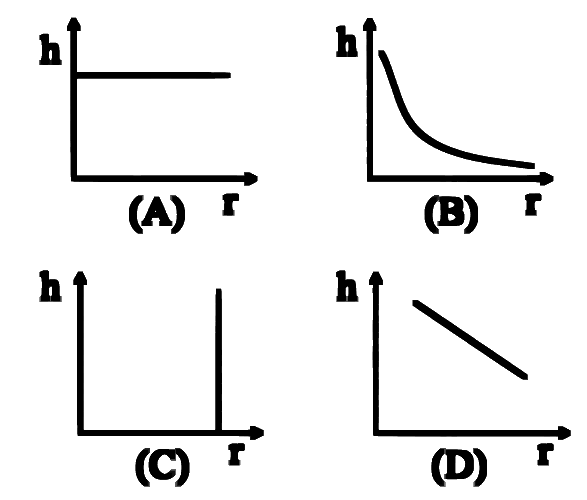
A soap bubble, blown by a mechanical pump at the mouth of a tube, increases in volume, with time, at a constant rate. The graph that correctly depicts the time dependence of pressure inside the bubble is given by:
Show answer and solution
Answer: (b)
V=kt and V=34πr3⇒r∝t1/3.
P=P0+r4T=P0+t1/3C
So P vs t1/31 is a straight line with intercept P0.
Excess Pressure: Drops & Bubbles · Bubbles combining or in contact
A small soap bubble of radius 4 cm is trapped inside another bubble of radius 6 cm without any contact. Let P2 be the pressure inside the inner bubble and P0, the pressure outside the outer bubble. Radius of another bubble with pressure difference P2 ______ P0 between its inside and outside would be:
Excess Pressure: Drops & Bubbles · Excess pressure in a drop or bubble
An air bubble of radius 0.1 cm is in a liquid having surface tension 0.06 N/m and density 103 kg/m3. The pressure inside the bubble is 1100 Nm−2 greater than the atmospheric pressure. At what depth is the bubble below the surface of the liquid? (g = 9.8 ms−2)
Show answer and solution
Answer: (a)
An air bubble in a liquid has one surface: Pin−P0=hρg+r2T.
Excess Pressure: Drops & Bubbles · Bubbles combining or in contact
Two soap bubbles coalesce to form a single bubble. If V is the subsequent change in volume of contained air and S the change in total surface area, T is the surface tension and P atmospheric pressure, which of the following relation is correct?
Show answer and solution
Answer: (b)
Isothermal: P(R3−r13−r23)=−4T(R2−r12−r22) (from Boyle's law with Pin=P+r4T).
Change in volume V=34π(R3−r13−r23), change in area S=4π(R2−r12−r22).
Angle of Contact & Capillarity · Angle of contact & meniscus
The height of the liquid column raised in a capillary tube of certain radius when dipped in liquid A vertically is 5 cm. If the same tube is dipped in similar way in another liquid B of surface tension and density double the values of liquid A, the height of liquid column raised in liquid B is (Assume that angle of contact for both the liquids is almost same)
Show answer and solution
Answer: (c)
Capillary rise h=rρg2Tcosθ∝ρT for the same tube and same θ.
Both T and ρ double, so ρT is unchanged: hB=hA=5 cm.
Angle of Contact & Capillarity · Capillary rise: h and r
Water rises to a height of 2.2 cm in glass capillary tube. The height to which water will rise in another capillary having one-fourth area of cross-section as that of the first is.
Angle of Contact & Capillarity · Capillary rise: h and r
Water rises up to a height h in a capillary tube on the surface of the earth. The value of h will increase, if the experimental set up is kept in (g = acceleration due to gravity)
Show answer and solution
Answer: (d)
h=rρgeff2Tcosθ∝geff1
Lift going up: geff=g+a, h decreases. Lift going down with a<g: geff=g−a, h increases.
Angle of Contact & Capillarity · Capillary rise: h and r
In a capillary tube of area of cross-section 'a' water rises to height 'h'. To what height will water rise in a capillary tube of area of cross-section 4a?
Angle of Contact & Capillarity · Capillary rise: h and r
Water rises to a height 3 cm in a capillary tube. If cross-sectional area of capillary tube is reduced to 1/3rd of its initial area then water will rise to a height of
Angle of Contact & Capillarity · Capillary in changed g (moon, lift, mine)
A capillary tube is taken from the earth to the surface of the moon. The rise of the liquid column on the moon (acceleration due to gravity on earth is 6 times that of the moon) is
Show answer and solution
Answer: (a)
h=rρg2Tcosθ, so h∝g1.
gmoon=6g⇒hmoon=6h (tube long enough).
So the answer is (a) 6 times that of earth's surface.
Angle of Contact & Capillarity · Capillary rise: h and r
Three liquids have same surface tension and densities ρ1,ρ2 and ρ3 (ρ1<ρ2<ρ3). In three identical capillaries rise of liquid is same. The corresponding angle of contact θ1,θ2 and θ3 are related as
Show answer and solution
Answer: (b)
h=rρg2Tcosθ; same h, T, r gives cosθ∝ρ.
ρ1<ρ2<ρ3⇒cosθ1<cosθ2<cosθ3.
Cosine decreases as angle increases, so θ1>θ2>θ3.
Angle of Contact & Capillarity · Capillary rise: h and r
Three liquids have same surface tension and have densities ρ1,ρ2 and ρ3(ρ1>ρ2>ρ3). In three identical capillaries rise of liquid is same. The corresponding angles of contact θ1,θ2 and θ3 are related as
Angle of Contact & Capillarity · Capillary rise: h and r
When a part of a straight capillary tube is placed vertically in a liquid, the liquid raises upto certain height h. If the inner radius of the capillary tube, density of the liquid and surface tension of the liquid decrease by 1% each, then the height of the liquid in the tube will change by %.
Angle of Contact & Capillarity · Mass and force of the raised column
When one end of a capillary tube is dipped in water, water rises to a height h. The upward force of 105 dyne due to surface tension is balanced by the force due to weight of water column. The inner circumference of the capillary is (surface tension of water = 7×10⁻² N/m)
Show answer and solution
Answer: (a)
Upward force F=T×L, where L=2πr is the inner circumference (θ=0).
Angle of Contact & Capillarity · Mass and force of the raised column
When a capillary tube of radius 'r' is immersed in water, rise of water is upto height 'h'. The mass of water in capillary tube is 'm'. When another capillary tube of radius 'xr' is immersed in water, the mass of water that will rise in this tube is
Angle of Contact & Capillarity · Mass and force of the raised column
Surface tension of two liquids (having same densities), T1 and T2, are measured using capillary rise method utilizing two tubes with inner radii of r1 and r2 where r1>r2. The measured liquid heights in these tubes are h1 and h2 respectively. [Ignore the weight of the liquid above the lowest point of miniscus]. The heights h1 and h2 and surface tensions T1 and T2 satisfy the relation:
Show answer and solution
Answer: (b)
Capillary rise h=rρg2Tcosθ, so h2h1=T2T1⋅r1r2 (same ρ).
If T1=T2: h2h1=r1r2<1 since r1>r2, so h1<h2. This rules out (a) and (d).
If T1<T2: h2h1<1 again, so h1>h2 is impossible. This rules out (c).
Angle of Contact & Capillarity · Capillary in changed g (moon, lift, mine)
A 20 cm long capillary is dipped vertically in water. Water rises to 8 cm. If the arrangement is put in a freely falling elevator, the length of water column in capillary tube will be
Show answer and solution
Answer: (d)
h=rρgeff2Tcosθ.
In a freely falling elevator geff=0, so water feels no weight and keeps rising.
It climbs to the top of the tube; it does not overflow because the meniscus adjusts its radius.
So the length of water column is the full 20 cm, answer (d).
Angle of Contact & Capillarity · Capillary rise: h and r
In a capillary tube of radius 'R', a straight thin metal wire of radius 'r' is inserted symmetrically and one end of the combination is dipped vertically in water such that lower end of the capillary and thin wire are at same level. If 'T' is the surface tension of water and 'ρ' is the density of water then the rise of water in the capillary is
Show answer and solution
Answer: (b)
Water rises in the annular gap; surface tension acts on both the inner wall of the tube and the wire surface.
Upward force (contact angle ≈0): F=T(2πR+2πr)=2πT(R+r).
Angle of Contact & Capillarity · Angle of contact & meniscus
Two capillary tubes of same diameter are kept vertically in two liquids whose densities are in the ratio 4:3. If their surface tensions are in the ratio 6:5, the ratio of heights (h2h1) of liquids in the two capillary tubes is (Their angle of contacts are same)
Angle of Contact & Capillarity · Capillary rise: h and r
In a capillary tube of area of cross-section 'a' water rises to height ' h '. To what height will water rise in a capillary tube of area of cross-section 4a?
Angle of Contact & Capillarity · Capillary rise: h and r
A liquid rises to a height of 2.4 cm in a glass capillary P. Another glass capillary Q having diameter 80% of capillary P is immersed in the same liquid. The rise of liquid in capillary Q is
Angle of Contact & Capillarity · Capillary in changed g (moon, lift, mine)
A capillary tube is taken from earth's surface to moon's surface. The rise of liquid column on the moon's surface is (acceleration due to gravity on the earth's surface is six times that of moon's surface)
Show answer and solution
Answer: (b)
h∝g1 for the same tube and liquid.
gmoon=6g⇒hmoon=6h.
So the answer is (b) six times that on the earth's surface.
Angle of Contact & Capillarity · Capillary rise: h and r
Pure water rises through a height h in a capillary tube of internal radius r. Surface tension of water is T. The pressure difference between the water level in the container and the lowest point of the concave meniscus is
Show answer and solution
Answer: (c)
Pressure just below the meniscus is less than atmospheric by the excess pressure r2Tcosθ.
Angle of Contact & Capillarity · Capillary rise: h and r
A capillary tube of radius 0.1 mm is partly dipped in water (surface tension 70 dyn/cm and glass water contact angle ≈ 0°) with 30° inclined with the vertical. The length of water risen in the capillary is _______ cm. (Take g=9.8 m/s2)
Show answer and solution
Answer: (a)
Vertical rise h=rρg2T=10−4×103×9.82×0.07=71 m≈14.29 cm.
Length along the tube inclined at 30∘ to the vertical: l=cos30∘h=0.86614.29
Angle of Contact & Capillarity · Mass and force of the raised column
When one end of the capillary is dipped in water, the height of water column is ' h '. The upward force of 108 dyne due to surface tension is balanced by the force due to the weight of water column. The inner circumference of the capillary is (surface tension of water =7.2×10⁻² N/m)
Angle of Contact & Capillarity · Mass and force of the raised column
When one end of a capillary tube is dipped in water, the height of water column is ' h '. The upward force of 105 dyne due to surface tension is balanced by the force due to the weight of water column. The inner circumference of the capillary tube is
Angle of Contact & Capillarity · Mass and force of the raised column
Water rises in a capillary tube of radius r up to height h. The mass of water in a capillary is m. The mass of water that will rise in capillary of radius 5r will be
Angle of Contact & Capillarity · Mass and force of the raised column
One end of a capillary tube is dipped in water, the rise of water column is ' h '. The upward force of 98 dyne due to surface tension is balanced by the force due to the weight of the water column. The inner circumference of the capillary is ( surface tension of water =7×10⁻² N m−1)
Angle of Contact & Capillarity · Capillary in changed g (moon, lift, mine)
A capillary tube when immersed vertically in water, the rise of water column is upto height h1 on earth's surface. When this arrangement is taken into a mine of depth 'd', below earth's surface, the height of the water column is h2. If R is the radius of the earth, the ratio h1h2 is
Angle of Contact & Capillarity · Capillary rise: h and r
Two capillary tubes A and B of the same internal diameter are kept vertically in two different liquids whose densities are in the ratio 4:3. If the surface tensions of these two liquids are in the ratio 6:5, then the ratio of rise of liquid in capillary A to that in B is (assume their angles of contact are nearly equal)
Angle of Contact & Capillarity · Capillary rise: h and r
Given below are two statements:
Statement I: The contact angle between a solid and a liquid is a property of the material of the solid and liquid as well.
Statement II: The rise of a liquid in a capillary tube does not depend on the inner radius of the tube. In the light of the above statements, choose the correct answer from the options given below:
Show answer and solution
Answer: (d)
Statement I: contact angle depends on both the solid and the liquid. True.
Statement II: h=rρg2Tcosθ, so h∝r1; it does depend on radius. False.
So the answer is (d) Statement I is true but Statement II is false.
Angle of Contact & Capillarity · Capillary rise: h and r
When capillary is dipped vertically in water, rise of water in capillary is ' h '. The angle of contact is zero. Now the tube is depressed so that its length above the water surface is 3h. The new apparent angle of contact is (cos0∘=1)
Show answer and solution
Answer: (b)
h=rρg2Tcosθ, so for the same tube and liquid h∝cosθ; with θ=0 the full rise is h.
If only 3h of tube is above water, the meniscus adjusts so that cosθ′=hh/3=31.
Angle of Contact & Capillarity · Capillary rise: h and r
The angle of contact between glass and water is 0∘ and water rises in a glass capillary upto 6 cm (Surface tension of water is T). Another liquid of surface tension ' 2T ', angle of contact 60∘ and relative density 2 will rise in the same capillary up to (cos0∘=1,cos60∘=0.5)
Angle of Contact & Capillarity · Capillary rise: h and r
A glass capillary of radius 0.35 mm is inclined at 60∘ with the vertical in water. The height of the water column in the capillary is (surface tension of water =7×10⁻² N/m, acceleration due to gravity, g=10 m/s2,cos0∘=1,cos60∘=0.5)
Show answer and solution
Answer: (b)
Vertical rise is fixed: h=rρg2T=0.35×10−3×103×102×7×10−2=0.04 m=4 cm.
In a tube inclined at θ to the vertical, the length of the column is l=cosθh.
Angle of Contact & Capillarity · Capillary rise: h and r
Three liquids of densities ρ1,ρ2 and ρ3 (with ρ1>ρ2>ρ3) having same value of surface tension T, rise to the same height in three identical capillaries. Angle of contact θ1,θ2 and θ3 respectively obey
Show answer and solution
Answer: (b)
All three rise, so each θ<2π (cosθ>0).
Same h, T, r: cosθ∝ρ; ρ1>ρ2>ρ3⇒cosθ1>cosθ2>cosθ3.
Angle of Contact & Capillarity · Mass and force of the raised column
Water rises in a capillary tube of radius ' r ' up to height ' h '. The mass of water in capillary is ' m '. The mass of water that will rise in capillary of radius r/3 will be
Angle of Contact & Capillarity · Capillary in changed g (moon, lift, mine)
Water rises up to height ' X ' in a capillary tube immersed vertically in water. When the whole arrangement is taken to a depth ' d ' in a mine, the water level rises up to height ' Y '. If ' R ' is the radius of earth then the ratio XY is
Angle of Contact & Capillarity · Angle of contact & meniscus
The height of liquid column raised in a capillary tube of certain radius when dipped in liquid 'A' vertically is 5 cm. If the tube is dipped in a similar manner in another liquid 'B' of surface tension and density double the values of liquid 'A', the height of liquid column raised in liquid 'B' would be (Assume angle of contact same)
Show answer and solution
Answer: (c)
Capillary rise h=rρg2Tcosθ∝ρT for the same tube and same θ.
Both T and ρ double, so ρT is unchanged: hB=hA=5 cm.
Angle of Contact & Capillarity · Capillary rise: h and r
The height of liquid column raised in a capillary tube of certain radius when dipped in liquid A vertically is, 5 cm. If the tube is dipped in a similar manner in another liquid B of surface tension and density double the values of liquid A, the height of liquid column raised in liquid B would be __________ m.
Show answer and solution
Answer: (a)
h=rρg2Tcosθ∝ρT for the same tube.
For B: ρBTB=2ρA2TA=ρATA, so hB=hA=5 cm.
Angle of Contact & Capillarity · Capillary rise: h and r
Two capillary tubes of the same diameter are kept vertically in two different liquids whose densities are in the ratio 4:3. The rise of liquid in two capillaries is 'h1 ' and 'h2' respectively. If the surface tensions of liquids are in the ratio 6:5, the ratio of heights (h2h1) is
Angle of Contact & Capillarity · Capillary rise: h and r
Three liquids have same surface tension and densities ρ1,ρ2, and ρ3(ρ1>ρ2>ρ3). In three identical capillaries rise of liquid is same. The corresponding angles of contact θ1,θ2 and θ3 are related as
Angle of Contact & Capillarity · Mass and force of the raised column
Water rises in a capillary tube of radius 'r' upto a height 'h'. The mass of water in a capillary is 'm'. The mass of water that will rise in a capillary tube of radius 3r will be
Angle of Contact & Capillarity · Capillary rise: h and r
Water rises to a height of 2 cm in a capillary tube. If cross-sectional area of the tube is reduced to 161th of initial area then water will rise to a height of
Angle of Contact & Capillarity · Capillary rise: h and r
In a capillary tube having area of cross-section A, water rises to a height 'h'. If cross-sectional area is reduced to 9A, the rise of water in the capillary tube is
Angle of Contact & Capillarity · Angle of contact & meniscus
Two narrow bores of diameter 5.0 mm and 8.0 mm are joined together to form a U-shaped tube open at both ends. If this U-tube contains water, what is the difference in the level of two limbs of the tube. [Take surface tension of water T = 7.3 × 10⁻² Nm−1, angle of contact = 0, g = 10 ms2 and density of water = 1.0 × 10³ kg m−3]
Show answer and solution
Answer: (b)
Rise in each limb h=rρg2T with θ=0; r1=2.5 mm, r2=4.0 mm.
Angle of Contact & Capillarity · Capillary rise: h and r
Water rises upto a height 10 cm in a capillary tube. It will rise to a height which is much more than 10 cm in a very long capillary tube if the apparatus is kept.
Show answer and solution
Answer: (a)
h∝g1; a much larger rise needs a much smaller g.
At the poles g is slightly larger, at the equator only slightly smaller, and in a lift going up geff=g+a is larger.
Angle of Contact & Capillarity · Mass and force of the raised column
Water rises in a capillary tube of radius 'r' up to a height 'h'. The mass of water in a capillary is 'm'. The mass of water that will rise in a capillary tube of radius 3r will be
Angle of Contact & Capillarity · Capillary rise: h and r
A glass rod of radius 'r1 ' is inserted symmetrically into a vertical capillary tube of radius 'r2' (r1<r2) such that their lower ends are at same level. The arrangement is dipped in water. The height to which water will rise into the tube will be (ρ= density of water, T = surface tension in water, g = acceleration due to gravity)
Show answer and solution
Answer: (a)
Surface tension acts along both the tube wall (perimeter 2πr2) and the rod (perimeter 2πr1): F=2πT(r1+r2).
Angle of Contact & Capillarity · Capillary rise: h and r
Water rises upto a height of 4 cm in a capillary tube. The lower end of the capillary tube is at a depth of 8 cm below the water level. The mouth pressure required to blow an air bubble at the lower end of the capillary will be 'X' cm of water, where X is equal to
Show answer and solution
Answer: (d)
Capillary rise of 4 cm means excess pressure across the meniscus r2T=hρg = 4 cm of water.
A bubble of the same radius at the lower end needs this excess pressure 2T/r = 4 cm of water.
It must also overcome the hydrostatic pressure at depth 8 cm = 8 cm of water.
Required pressure X=8+4=12 cm of water, answer (d).
Angle of Contact & Capillarity · Capillary rise: h and r
Water rises upto a height h in a capillary tube on the surface of the earth. The value of h will increase, if the experimental setup is kept in [ g= acceleration due to gravity]
Show answer and solution
Answer: (d)
Capillary rise h=rρgeff2Tcosθ, so h∝geff1.
Lift going up with acceleration: geff=g+a, so h decreases.
Accelerating train: geff=g2+a2>g, so h decreases.
Lift going down with a<g: geff=g−a<g, so h increases.
So the answer is (d) a lift going down with acceleration a<g.
Angle of Contact & Capillarity · Capillary rise: h and r
A capillary tube made of glass of radius 0.15 mm is dipped vertically in a beaker filled with methylene iodide (surface tension = 0.05 Nm–1, density = 667 kg m–3) which rises to height h in the tube. It is observed that the two tangents drawn from liquid-glass interfaces (from opp. sides of the capillary) make an angle of 60° with one another. Then h is close to (g = 10 ms–2)
Show answer and solution
Answer: (b)
Each tangent makes the contact angle θ with the vertical wall; the two tangents meet at 2θ=60∘, so θ=30∘.
Angle of Contact & Capillarity · Capillary rise: h and r
When a long glass capillary tube of radius 0.015 cm is dipped in a liquid, the liquid rises to a height of 15 cm within it. If the contact angle between the liquid and glass to close to 0°, the surface tension of the liquid, in milliNewton m–1, is [ρ(liquid) = 900 kgm–3, g = 10 ms–2]
(Give answer in closest integer) _____.
Numerical answer type. Work it out, then open the answer.
Angle of Contact & Capillarity · Mass and force of the raised column
Water rises in a capillary tube of radius r upto a height h. The mass of water in a capillary is m. The mass of water that will rise in a capillary of radius 4r will be
Angle of Contact & Capillarity · Mass and force of the raised column
A capillary tube of radius r is immersed in water and water rises in it to a height h. The mass of the water in the capillary is 5 g. Another capillary tube of radius 2r is immersed in water. The mass of water that will rise in this tube is:
Angle of Contact & Capillarity · Capillary rise: h and r
The ratio of surface tensions of mercury and water is given to be 7.5 while the ratio of their densities is 13.6. Their contact angles, with glass, are close to 135° and 0°, respectively. It is observed that mercury gets depressed by an amount h in a capillary tube of radius r1, while water rises by the same amount h in a capillary tube of radius r2. The ratio, (r1/r2), is then close to:
Show answer and solution
Answer: (a)
h=rρg2T∣cosθ∣ for both, so r∝ρT∣cosθ∣ for the same h.
Angle of Contact & Capillarity · Capillary rise: h and r
Three liquids of densities ρ1, ρ2 and ρ3 (with ρ1 > ρ2 > ρ3), having the same value of surface tension T, rise to the same height in three identical capillaries. The angles of contact θ1, θ2 and θ3 obey
Angle of Contact & Capillarity · Capillary in changed g (moon, lift, mine)
A capillary tube is immersed vertically in water and the height of the water column is x. When this arrangement is taken into a mine of depth d, the height of the water column is y. If R is the radius of earth, the ratio yx is:
Angle of Contact & Capillarity · Capillary rise: h and r
Wax is coated on the inner wall of a capillary tube and the tube is then dipped in water. Then, compared to the unwaxed capillary, the angle of contact θ and the height h upto which water rises change. These changes are:
Show answer and solution
Answer: (c)
Water does not wet wax, so the contact angle increases (becomes more than 90∘).
h=rρg2Tcosθ: larger θ gives smaller cosθ, so h decreases (water may even be depressed).
Angle of Contact & Capillarity · Capillary rise: h and r
This question has Statement-1 and Statement-2. Of the four choices given after the Statements, choose the one that best describes the two Statements.
Statement-1: A capillary is dipped in a liquid and liquid rises to a height h in it. As the temperature of the liquid is raised, the height h increases (if the density of the liquid and the angle of contact remain the same).
Statement-2: Surface tension of a liquid decreases with the rise in its temperature.
Show answer and solution
Answer: (b)
Statement-2: surface tension decreases as temperature rises. True.
Statement-1: h∝T (with ρ, θ fixed), so h decreases on heating, not increases. False.
So the answer is (b) Statement-1 is false, Statement-2 is true.
Angle of Contact & Capillarity · Capillary rise: h and r
A capillary tube (A) is dipped in water. Another identical tube (B) is dipped in a soap-water solution. Which of the following shows the relative nature of the liquid columns in the two tubes?
Show answer and solution
Answer: (c)
Soap lowers the surface tension of water, and h∝T.
Both liquids wet glass (θ<90∘), so both menisci are concave and both columns rise.
Tube B (soap solution) shows a smaller rise than tube A.
Angle of Contact & Capillarity · Capillary in changed g (moon, lift, mine)
A 20 cm long capillary tube is dipped in water. The water rises up to 8 cm. If the entire arrangement is put in a freely falling elevator the length of water column in the capillary tube will be
Show answer and solution
Answer: (c)
h=rρgeff2Tcosθ; in free fall geff=0.
With no effective weight, water rises till the top of the tube (no overflow, the meniscus flattens).
So the water column is the whole tube length, 20 cm, answer (c).