Physics Circle home Home Practice Hub Register / Login

Home›Practice Hub›Chapters›Surface Tension

Physics PYQs · MHT CET · JEE Main · NEET

Surface Tension

Questions
251
MHT CET
170
JEE Main
70
NEET
11
Years
2004–2026
0 of 251 attemptedPick an answer to see the solution

Q1MHT CET 2026 · 19 APR · SHIFT 2Easy

Molecular Theory & Factors

In most liquids, with rise in temperature surface tension of liquid

Show answer and solution

Answer: (a)

  1. On heating, molecules gain kinetic energy and intermolecular (cohesive) forces weaken.
  2. Weaker cohesion means lower surface tension; it becomes zero at the critical temperature.
  3. So the answer is (a) decreases.
Report a mistake
Q2MHT CET 2026 · 16 APR · SHIFT 1Easy

Molecular Theory & Factors

A liquid is at rest in a container. In a sphere of influence, the liquid molecule at its centre is

Show answer and solution

Answer: (a)

  1. Molecular forces act only within the sphere of influence (range about 10−9 m10^{-9}\text{ m}).
  2. A molecule at the centre is attracted equally in all directions by the molecules inside this sphere; molecules outside exert no force.
  3. So the answer is (a).
Report a mistake
Q3MHT CET 2026 · 19 MAY · SHIFT 2Medium

Molecular Theory & Factors

Which of the following is NOT TRUE?

a. When soluble substance is dissolved in water, the surface tension of water increases. b. When sparingly soluble substance is mixed with water, surface tension of water increases. c. When insoluble impurity is added into the water, surface tension of water decreases. d. In case of molten copper or molten cadmium, the surface tension increases with increase in its temperature.

Show answer and solution

Answer: (a)

  1. a: A highly soluble substance (e.g. salt) increases surface tension. True.
  2. b: A sparingly soluble substance (e.g. soap, phenol) decreases surface tension, so 'increases' is false.
  3. c: Insoluble impurities (oil, dust) on the surface decrease surface tension. True.
  4. d: For molten copper and cadmium, surface tension increases with temperature (exception). True.
  5. So the statement NOT true is b, i.e. answer (a).
Report a mistake
Q4JEE Main 2025 · 28 JAN · SHIFT 1Medium

Molecular Theory & Factors

Consider following statements:

A. Surface tension arises due to extra energy of the molecules at the interior as compared to the molecules at the surface, of a liquid.

B. As the temperature of liquid rises, the coefficient of viscosity increases.

C. As the temperature of gas increases, the coefficient of viscosity increases

D. The onset of turbulence is determined by Reynold's number.

E. In a steady flow two stream lines never intersect.

Choose the correct answer from the options given below:

Show answer and solution

Answer: (b)

  1. A: False. Extra energy belongs to molecules at the surface, not the interior.
  2. B: False. Viscosity of a liquid decreases as temperature rises.
  3. C: True. Viscosity of a gas increases with temperature.
  4. D: True. Reynolds number decides the onset of turbulence. E: True. Streamlines never cross in steady flow.
  5. So the answer is (b) C, D, E only.
Report a mistake
Q5MHT CET 2024 · 16 MAY · SHIFT 2Easy

Molecular Theory & Factors

On the surface of the liquid in equilibrium, molecules of the liquid possess

Show answer and solution

Answer: (a)

  1. A surface molecule feels a net inward pull, so work must be done to bring a molecule from the interior to the surface.
  2. This work is stored as extra potential energy of the surface molecules.
  3. So the answer is (a) maximum potential energy.
Report a mistake
Q6MHT CET 2024 · 16 MAY · SHIFT 1Easy

Molecular Theory & Factors

In most liquids, with rise in temperature, surface tension of a liquid

Show answer and solution

Answer: (c)

  1. Rise in temperature weakens cohesive forces between molecules.
  2. So surface tension falls with temperature (zero at the critical temperature).
  3. So the answer is (c) decreases.
Report a mistake
Q7MHT CET 2023 · 14 MAY · SHIFT 2Easy

Molecular Theory & Factors

It is easier to spray water to which soap is added because addition of soap to water

Show answer and solution

Answer: (a)

  1. Soap molecules gather at the surface and reduce the cohesive pull between water molecules.
  2. Lower surface tension means less work is needed to create new surface, i.e. to break water into fine drops.
  3. So the answer is (a) soap decreases surface tension.
Report a mistake
Q8MHT CET 2023 · 14 MAY · SHIFT 1Easy

Molecular Theory & Factors

The potential energy of a molecule on the surface of a liquid compared to the molecules inside the liquid is

Show answer and solution

Answer: (d)

  1. Work is done against the net inward cohesive force to bring a molecule to the surface.
  2. This work is stored as potential energy, so a surface molecule has more PE than an interior one.
  3. So the answer is (d) large.
Report a mistake
Q9MHT CET 2023 · 10 MAY · SHIFT 2Easy

Molecular Theory & Factors

At critical temperature, the surface tension of liquid is

Show answer and solution

Answer: (a)

  1. At the critical temperature the liquid and vapour become identical, so there is no free surface.
  2. With no surface, there is no surface tension.
  3. So the answer is (a) zero.
Report a mistake
Q10JEE Main 2023 · 24 JAN · SHIFT 2Medium

Molecular Theory & Factors

The frequency (ν\nu) of an oscillating liquid drop may depend upon radius (rr) of the drop, density (ρ\rho) of liquid and the surface tension (s) of the liquid as ν=raρbsc\nu = r^{a}\rho^{b}s^{c}. The values of a, b and c respectively are

Show answer and solution

Answer: (b)

  1. [ν]=T−1[\nu] = T^{-1}, [r]=L[r] = L, [ρ]=ML−3[\rho] = ML^{-3}, [s]=MT−2[s] = MT^{-2}.
  2. M:b+c=0M: b + c = 0; L:a−3b=0L: a - 3b = 0; T:−2c=−1T: -2c = -1.
  3. c=12, b=−12, a=−32c = \frac{1}{2},\ b = -\frac{1}{2},\ a = -\frac{3}{2}.
  4. So the answer is (b) (−32,−12,12)\left(-\frac{3}{2}, -\frac{1}{2}, \frac{1}{2}\right).
Report a mistake
Q11JEE Main 2022 · 29 JUL · SHIFT 1Easy

Molecular Theory & Factors

Given below are two statements: One is labelled as Assertion (A) and the other is labelled as Reason (R).

Assertion (A): Clothes containing oil or grease stains cannot be cleaned by water wash. Reason (R): Because the angle of contact between the oil/grease and water is obtuse. In the light of the above statements, choose the correct answer from the option given below.

Show answer and solution

Answer: (a)

  1. Water does not wet oil or grease: the angle of contact between them is obtuse.
  2. So water cannot spread over and lift the grease; detergent is needed to lower the angle of contact.
  3. (A) and (R) are both true and (R) explains (A). So the answer is (a).
Report a mistake
Q12MHT CET 2021 · 21 SEP · SHIFT 1Easy

Molecular Theory & Factors

The surface tension of most of the liquid decreases with rise in

Show answer and solution

Answer: (c)

  1. Surface tension depends on cohesive forces, which weaken as the temperature rises.
  2. So the answer is (c) temperature of the liquid.
Report a mistake
Q13MHT CET 2021 · 23 SEP · SHIFT 2Medium

Molecular Theory & Factors

An ice cube of edge 1 cm1\text{ cm} melts in a gravity free container. The approximate surface area of water formed is (water is in the form of spherical drop)

Show answer and solution

Answer: (a)

  1. Volume is conserved: 43πr3=1 cm3⇒r=(34π)1/3\frac{4}{3}\pi r^3 = 1\text{ cm}^3 \Rightarrow r = \left(\frac{3}{4\pi}\right)^{1/3}.
  2. Area A=4πr2=4π(34π)2/3=(64π3⋅916π2)1/3A = 4\pi r^2 = 4\pi\left(\frac{3}{4\pi}\right)^{2/3} = \left(64\pi^3 \cdot \frac{9}{16\pi^2}\right)^{1/3}.
  3. A=(36π)1/3 cm2A = (36\pi)^{1/3}\text{ cm}^2. So the answer is (a).
Report a mistake
Q14MHT CET 2019 · 3 MAY · SHIFT 1Easy

Molecular Theory & Factors

A molecule of water on the surface experiences a net

Show answer and solution

Answer: (c)

  1. A surface molecule has liquid molecules only below and beside it, not above.
  2. The cohesive attractions do not cancel; the net force is downward, into the liquid.
  3. So the answer is (c) downward resultant unbalanced cohesive force.
Report a mistake
Q15MHT CET 2019 · 2 MAY · SHIFT 2Easy

Molecular Theory & Factors

Which one of the following statement is correct?

Show answer and solution

Answer: (b)

  1. Work done to increase the surface area: W=T ΔAW = T\,\Delta A, so T=WΔAT = \dfrac{W}{\Delta A}.
  2. So surface tension equals work done per unit area (also equal to force per unit length).
  3. So the answer is (b).
Report a mistake
Q16MHT CET 2026 · 15 APR · SHIFT 2Easy

Force due to Surface Tension

A square frame of each side L is dipped in a soap and taken out, the force acting on the film formed is ( T = surface tension of soap solution)

Show answer and solution

Answer: (b)

  1. A film has two surfaces, so F=2T×perimeterF = 2T \times \text{perimeter}.
  2. Perimeter =4L= 4L, so F=2T(4L)=8TLF = 2T(4L) = 8TL.
  3. So the answer is (b) 8TL8TL.
Report a mistake
Q17MHT CET 2026 · 19 MAY · SHIFT 1Medium

Force due to Surface Tension

A metal wire of length 'LL' and density 'dd' rests horizontally on the free surface of water. The maximum radius of the wire so that the wire does not sink in water is

[TT = surface tension of water, gg = gravitational acceleration]

Show answer and solution

Answer: (b)

  1. Surface tension acts along both sides of the wire: upward force =2TL= 2TL.
  2. Weight =πr2Ldg= \pi r^2 L d g.
  3. For floating: πr2Ldg=2TL⇒r=2Tπdg\pi r^2 L d g = 2TL \Rightarrow r = \sqrt{\dfrac{2T}{\pi d g}}.
  4. So the answer is (b).
Report a mistake
Q18MHT CET 2026 · 14 MAY · SHIFT 1Medium

Force due to Surface Tension

A drop of some liquid of volume 0.040.04 cm33 is placed on the surface of the glass plate. Then another glass plate is placed on it such that the liquid forms a thin layer of area 2020 cm22 between the surfaces. To separate the plates a force of 16×10516 \times 10^{5} dyne has to be applied normal to the surfaces. The surface tension of the liquid in dyne/cm is

Show answer and solution

Answer: (c)

  1. Thickness of layer t=VA=0.0420=0.002 cmt = \frac{V}{A} = \frac{0.04}{20} = 0.002\text{ cm}.
  2. Force to separate plates: F=2ATt⇒T=Ft2AF = \dfrac{2AT}{t} \Rightarrow T = \dfrac{Ft}{2A}.
  3. T=16×105×0.0022×20=80 dyne/cmT = \dfrac{16\times10^5 \times 0.002}{2 \times 20} = 80\text{ dyne/cm}. So the answer is (c).
Report a mistake
Q19MHT CET 2026 · 13 MAY · SHIFT 2Medium

Force due to Surface Tension

What is the radius of the biggest aluminium coin of thickness tt and density ρ\rho, which will be able to float on the water surface of surface tension TT? (gg = acceleration due to gravity)

Show answer and solution

Answer: (c)

  1. Surface tension acts along the rim: upward force =2πRT= 2\pi R T.
  2. Weight =πR2tρg= \pi R^2 t \rho g.
  3. Balance: πR2tρg=2πRT⇒R=2Tρgt\pi R^2 t\rho g = 2\pi R T \Rightarrow R = \dfrac{2T}{\rho g t}.
  4. So the answer is (c).
Report a mistake
Q20MHT CET 2026 · 19 APR · SHIFT 2Medium

Force due to Surface Tension

A metal wire of length 'L' and density 'd' floats horizontally on the free surface of water. The maximum radius of the wire does not sink in water is

[ TT = surface tension of water, gg = gravitational acceleration]

Show answer and solution

Answer: (b)

  1. Surface tension acts along both sides of the wire: upward force =2TL= 2TL.
  2. Weight =πr2Ldg= \pi r^2 L d g.
  3. Balance: πr2Ldg=2TL⇒r=2Tπdg\pi r^2 L d g = 2TL \Rightarrow r = \sqrt{\dfrac{2T}{\pi d g}}.
  4. So the answer is (b).
Report a mistake
Q21MHT CET 2025 · 23 APR · SHIFT 1Medium

Force due to Surface Tension

A disc of paper of radius ' RR ' has a hole of radius ' rr '. It is floating on a liquid of surface tension ' T '. The force of surface tension on the disc is

Show answer and solution

Answer: (b)

  1. Surface tension acts along every boundary in contact with the liquid surface.
  2. Outer edge length 2πR2\pi R, inner (hole) edge length 2πr2\pi r.
  3. F=T(2πR+2πr)=2πT(R+r)F = T(2\pi R + 2\pi r) = 2\pi T(R + r). So the answer is (b).
Report a mistake
Q22MHT CET 2025 · 21 APR · SHIFT 1Difficult

Force due to Surface Tension

A liquid drop of volume V is placed on the surface of glass plate. Then another glass plate is placed on it such that liquid forms a thin layer of area A between the surfaces of two plates. To separate the plates a force F has to be applied normal to the surfaces. The surface tension of the liquid is

Show answer and solution

Answer: (b)

  1. Thickness of layer t=VAt = \dfrac{V}{A}.
  2. Force to separate plates: F=2ATt=2A2TVF = \dfrac{2AT}{t} = \dfrac{2A^2 T}{V}.
  3. T=FV2A2T = \dfrac{FV}{2A^2}. So the answer is (b).
Report a mistake
Q23MHT CET 2025 · 20 APR · SHIFT 1Difficult

Force due to Surface Tension

A water drop of 0.01 cm30.01\text{ cm}^{3} is squeezed between two glass plates and spreads in to area of 10 cm210\text{ cm}^{2}. If surface tension of water is 70 dyne /cm/\text{cm} then the normal force required to separate glass plates from each other will be

Show answer and solution

Answer: (b)

  1. Thickness t=VA=0.0110=0.001 cmt = \frac{V}{A} = \frac{0.01}{10} = 0.001\text{ cm}.
  2. F=2ATt=2×10×700.001=1.4×10⁶ dyneF = \dfrac{2AT}{t} = \dfrac{2 \times 10 \times 70}{0.001} = 1.4\times10^{6}\text{ dyne}.
  3. F=14 NF = 14\text{ N}. So the answer is (b).
Report a mistake
Q24NEET 2024Easy

Force due to Surface Tension

A thin flat circular disc of radius 4.5 cm4.5\text{ cm} is placed gently over the surface of water. If surface tension of water is 0.07 N m−10.07\text{ N m}^{-1}, then the excess force required to take it away from the surface is

Show answer and solution

Answer: (a)

  1. Extra force = surface tension along the rim: F=T×2πrF = T \times 2\pi r.
  2. F=0.07×2π×0.045=0.0198 NF = 0.07 \times 2\pi \times 0.045 = 0.0198\text{ N}.
  3. F=19.8 mNF = 19.8\text{ mN}. So the answer is (a).
Report a mistake
Q25MHT CET 2024 · 2 MAY · SHIFT 2Medium

Force due to Surface Tension

Liquid drops are falling slowly one by one from vertical glass tube. The relation between the weight of a drop ' ww ', the surface tension ' TT ' and the radius ' rr ' of the bore of the tube is (Angle of contact is zero)

Show answer and solution

Answer: (d)

  1. Just before falling, the drop hangs from the rim of the bore of circumference 2πr2\pi r.
  2. Upward surface force =2πrTcos⁡0∘=2πrT= 2\pi r T\cos 0^\circ = 2\pi r T.
  3. Balance: W=2πrTW = 2\pi r T. So the answer is (d).
Report a mistake
Q26MHT CET 2024 · 3 MAY · SHIFT 2Difficult

Force due to Surface Tension

A liquid drop of density ' ρ\rho ' is floating half immersed in a liquid of density ' dd '. If ' TT ' is the surface tension then the diameter of the liquid drop is ( g=g = acceleration due to gravity)

Show answer and solution

Answer: (c)

  1. Weight = buoyancy + surface tension force along the waterline: 43πr3ρg=23πr3dg+2πrT\frac{4}{3}\pi r^3\rho g = \frac{2}{3}\pi r^3 d g + 2\pi r T.
  2. 23r2g(2ρ−d)=2T⇒r2=3Tg(2ρ−d)\frac{2}{3} r^2 g(2\rho - d) = 2T \Rightarrow r^2 = \dfrac{3T}{g(2\rho - d)}.
  3. Diameter D=2r⇒D2=12Tg(2ρ−d)D = 2r \Rightarrow D^2 = \dfrac{12T}{g(2\rho - d)}.
  4. So the answer is (c) [12Tg(2ρ−d)]1/2\left[\frac{12T}{g(2\rho - d)}\right]^{1/2}.
Report a mistake
Q27MHT CET 2022 · 11 AUG · SHIFT 2Medium

Force due to Surface Tension

A steel coin of thickness 'dd' and density 'ρ\rho' is floating on water of surface tension 'TT'. The radius of the coin (R)(R) is [g=g = acceleration due to gravity]

Show answer and solution

Answer: (d)

  1. Upward surface tension force along the rim =2πRT= 2\pi R T.
  2. Weight of coin =πR2dρg= \pi R^2 d \rho g.
  3. Balance: R=2TρgdR = \dfrac{2T}{\rho g d}. So the answer is (d).
Report a mistake
Q28JEE Main 2022 · 25 JUL · SHIFT 2Difficult

Force due to Surface Tension

A drop of liquid of density ρ\rho is floating half immersed in a liquid of density σ\sigma and surface tension 7.5×10−47.5 \times 10^{-4} Ncm−1{}^{-1}. The radius of drop in cm\text{cm} will be:

(g = 10 ms−2{}^{-2})

Show answer and solution

Answer: (a)

  1. Weight = buoyancy + surface force gives r2=3T(2ρ−σ)gr^2 = \dfrac{3T}{(2\rho - \sigma)g}.
  2. T=7.5×10⁻⁴ N cm−1=7.5×10⁻² N m−1T = 7.5\times10^{-4}\text{ N cm}^{-1} = 7.5\times10^{-2}\text{ N m}^{-1}, g=10g = 10.
  3. r2=0.22510(2ρ−σ)=0.02252ρ−σ m2⇒r=0.152ρ−σ mr^2 = \dfrac{0.225}{10(2\rho - \sigma)} = \dfrac{0.0225}{2\rho-\sigma}\text{ m}^2 \Rightarrow r = \dfrac{0.15}{\sqrt{2\rho - \sigma}}\text{ m}.
  4. r=152ρ−σ cmr = \dfrac{15}{\sqrt{2\rho - \sigma}}\text{ cm} (densities in SI). So the answer is (a).
Report a mistake
Q29MHT CET 2021 · 20 SEP · SHIFT 1Easy

Force due to Surface Tension

The force required to take away a flat circular plate of radius 2 cm2\text{ cm} from the surface of water is [[Surface tension of water =70×10−3 N m−1,π=227]= 70 \times 10^{-3}\text{ N m}^{-1}, \pi = \frac{22}{7}]

Show answer and solution

Answer: (b)

  1. Surface tension acts along the rim of the plate: F=T×2πrF = T \times 2\pi r.
  2. F=70×10−3×2×227×0.02F = 70\times10^{-3} \times 2 \times \frac{22}{7} \times 0.02.
  3. F=8.8×10⁻³ NF = 8.8 \times 10^{-3}\text{ N}. So the answer is (b).
Report a mistake
Q30MHT CET 2021 · 22 SEP · SHIFT 2Medium

Force due to Surface Tension

A needle is 7 cm7\text{ cm} long. Assuming that the needle is not wetted by water, what is the weight of the needle, so that it floats on water?

[T=[T = surface tension of water =70 dynecm]= 70\,\frac{\text{dyne}}{\text{cm}}]

[acceleration due to gravity =980 cm s−2= 980\text{ cm s}^{-2}]

Show answer and solution

Answer: (a)

  1. Surface tension acts along both sides of the needle: F=2TLF = 2TL.
  2. F=2×70×7=980 dyneF = 2 \times 70 \times 7 = 980\text{ dyne}.
  3. Weight =980980=1 g wt= \dfrac{980}{980} = 1\text{ g wt}. So the answer is (a).
Report a mistake
Q31MHT CET 2021 · 24 SEP · SHIFT 1Difficult

Force due to Surface Tension

A thin metal disc of radius 'r' floats on water surface and bends the surface downwards along the perimeter making an angle 'θ\theta' with the vertical edge of the disc. If the weight of water displaced by the disc is 'WW', the weight of the metal disc is [T = surface tension of water]

Show answer and solution

Answer: (a)

  1. Upward forces on the disc: buoyancy WW and vertical component of surface tension along the rim.
  2. Surface tension makes angle θ\theta with the vertical: vertical part =2πrTcos⁡θ= 2\pi r T\cos\theta.
  3. Weight of disc =2πrTcos⁡θ+W= 2\pi r T\cos\theta + W. So the answer is (a).
Report a mistake
Q32MHT CET 2021 · 22 SEP · SHIFT 1Difficult

Force due to Surface Tension

A drop of liquid of density 'ρ\rho' is floating half immersed in a liquid of density 'dd'. If 'TT' is the surface tension, then the diameter of the drop of the liquid is

Show answer and solution

Answer: (d)

  1. Weight = buoyancy + surface force: 43πr3ρg=23πr3dg+2πrT\frac{4}{3}\pi r^3\rho g = \frac{2}{3}\pi r^3 d g + 2\pi r T.
  2. r2=3Tg(2ρ−d)r^2 = \dfrac{3T}{g(2\rho - d)}.
  3. Diameter D=2r=12Tg(2ρ−d)D = 2r = \sqrt{\dfrac{12T}{g(2\rho - d)}}. So the answer is (d).
Report a mistake
Q33MHT CET 2020 · 16 OCT · SHIFT 2Easy

Force due to Surface Tension

A square frame of each side LL is dipped in a soap and taken out. The force acting on the film formed is (T=T = surface tension of soap solution)

Show answer and solution

Answer: (a)

  1. A film has two surfaces, so F=2T×perimeterF = 2T \times \text{perimeter}.
  2. F=2T(4L)=8TLF = 2T(4L) = 8TL.
  3. So the answer is (a) 8TL8TL.
Report a mistake
Q34JEE Main 2020 · 9 JAN · SHIFT 2Difficult

Force due to Surface Tension

A small spherical droplet of density d is floating exactly half immersed in a liquid of density ρ\rho and surface tension T. The radius of the droplet is (take note that the surface tension applies an upward force on the droplet):

Show answer and solution

Answer: (d)

  1. Weight = buoyancy (half volume) + upward surface force 2πrT2\pi r T.
  2. 43πr3dg=23πr3ρg+2πrT⇒23r2g(2d−ρ)=2T\frac{4}{3}\pi r^3 d g = \frac{2}{3}\pi r^3\rho g + 2\pi r T \Rightarrow \frac{2}{3}r^2 g(2d - \rho) = 2T.
  3. r=3T(2d−ρ)gr = \sqrt{\dfrac{3T}{(2d - \rho)g}}. So the answer is (d).
Report a mistake
Q35JEE Main 2015 · 10 APR · SHIFT 1Medium

Force due to Surface Tension

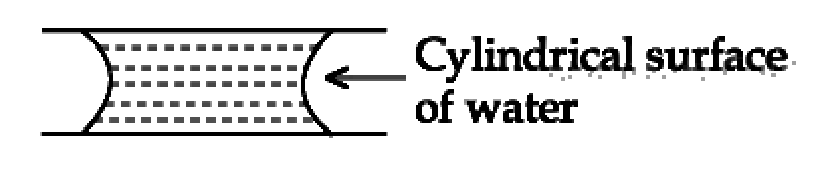
If two glass plates have water between them and are separated by very small distance (see figure), it is very difficult to pull them apart. It is because the water in between forms cylindrical surface on the side that gives rise to lower pressure in the water in comparison to atmosphere. If the radius of the cylindrical surface is R and surface tension of water is T then the pressure in water between the plates is lower by:

Figure

Show answer and solution

Answer: (b)

  1. Laplace excess pressure: ΔP=T(1R1+1R2)\Delta P = T\left(\frac{1}{R_1} + \frac{1}{R_2}\right).
  2. For a cylindrical surface R1=RR_1 = R and R2=∞R_2 = \infty, so ΔP=TR\Delta P = \dfrac{T}{R}.
  3. The surface is concave towards air, so the water pressure is lower than atmospheric.
  4. The official answer is (b) T2R\dfrac{T}{2R}.
Report a mistake
Q36JEE Main 2014Difficult

Force due to Surface Tension

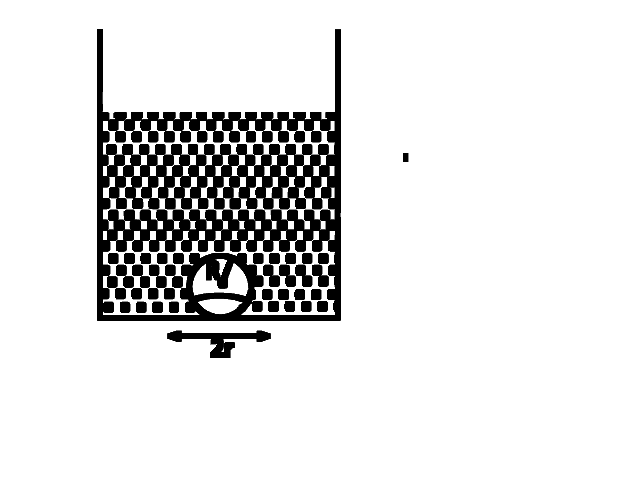
On heating water, bubbles being formed at the bottom of the vessel detach and rise. Take the bubbles to be spheres of radius RR and making a circular contact of radius rr with the bottom of the vessel. If r≪Rr \ll R and the surface tension of water is T,T, value of rr just before bubbles detach is: (density of water is ρw\rho_w)

Figure

Show answer and solution

Answer: (d)

RF_BTT2r
  1. Upward buoyancy on the bubble ≈43πR3ρwg\approx \frac{4}{3}\pi R^3 \rho_w g (since r≪Rr \ll R).
  2. Surface tension acts along the contact circle 2πr2\pi r; its vertical (downward) part is 2πrTsin⁡θ2\pi r T\sin\theta with sin⁡θ=rR\sin\theta = \frac{r}{R}.
  3. Just before detaching: 2πr2TR=43πR3ρwg⇒r2=2R4ρwg3T\dfrac{2\pi r^2 T}{R} = \frac{4}{3}\pi R^3\rho_w g \Rightarrow r^2 = \dfrac{2R^4\rho_w g}{3T}.
  4. r=R22ρwg3Tr = R^2\sqrt{\dfrac{2\rho_w g}{3T}}. So the answer is (d).
Report a mistake
Q37JEE Main 2012 · AIEEEEasy

Force due to Surface Tension

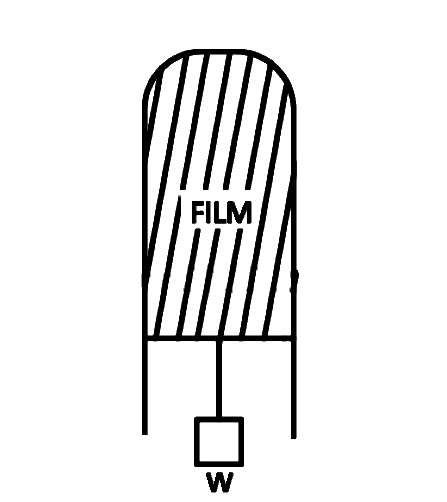
A thin liquid film formed between a U-shaped wire and a light slider supports a weight of 1.5×10⁻² N1.5 \times 10^{-2}\text{ N} (see figure). The length of the slider is 30 cm30\text{ cm} and its weight negligible. The surface tension of the liquid film is

Figure

Show answer and solution

Answer: (d)

  1. The film has two surfaces, each pulling the slider with TLTL: total 2TL2TL.
  2. Equilibrium: 2TL=W⇒T=W2L2TL = W \Rightarrow T = \dfrac{W}{2L}.
  3. T=1.5×10−22×0.30=0.025 N m−1T = \dfrac{1.5\times10^{-2}}{2 \times 0.30} = 0.025\text{ N m}^{-1}. So the answer is (d).
Report a mistake
Q38MHT CET 2026 · 17 APR · SHIFT 1Easy

Surface Energy & Work Done · Blowing a soap bubble

A soap bubble of radius 1π\frac{1}{\sqrt{\pi}} cm is expanded to radius 3π\frac{3}{\sqrt{\pi}} cm. Surface tension of soap is 25 dyne/cm. The work done during expansion in erg is

Show answer and solution

Answer: (c)

  1. A soap bubble has two surfaces: W=2T×4π(R22−R12)=8πT(R22−R12)W = 2T \times 4\pi(R_2^2 - R_1^2) = 8\pi T(R_2^2 - R_1^2).
  2. R22−R12=9π−1π=8π cm2R_2^2 - R_1^2 = \frac{9}{\pi} - \frac{1}{\pi} = \frac{8}{\pi}\text{ cm}^2.
  3. W=8π×25×8π=1600 ergW = 8\pi \times 25 \times \frac{8}{\pi} = 1600\text{ erg}. So the answer is (c).
Report a mistake
Q39MHT CET 2026 · 20 APR · SHIFT 1Medium

Surface Energy & Work Done · Blowing a soap bubble

If 450450 erg of work is done in blowing a soap bubble of radius 'rr', the additional work required to be done to blow it to a radius equal to 3r3r is

Show answer and solution

Answer: (c)

  1. A bubble has two surfaces: W=T×2×4πr2=8πr2TW = T\times 2\times 4\pi r^2 = 8\pi r^2 T, so W∝r2W \propto r^2.
  2. At radius 3r3r: W′=9×450=4050W' = 9 \times 450 = 4050 erg.
  3. Additional work =4050−450=3600= 4050 - 450 = 3600 erg.
  4. So the answer is (c) 36003600 erg.
Report a mistake
Q40MHT CET 2026 · 19 APR · SHIFT 1Medium

Surface Energy & Work Done · Blowing a soap bubble

One large soap bubble of diameter 'D' breaks into 6464 bubbles having surface tension 'T'. The change in surface energy is

Show answer and solution

Answer: (c)

  1. Surface energy of a bubble =8πr2T= 8\pi r^2 T. Big bubble radius R=D/2R = D/2: E1=8π(D/2)2T=2πTD2E_1 = 8\pi (D/2)^2 T = 2\pi T D^2.
  2. Volume conserved: 64r3=R3⇒r=R/4=D/864 r^3 = R^3 \Rightarrow r = R/4 = D/8.
  3. E2=64×8π(D/8)2T=8πTD2E_2 = 64 \times 8\pi (D/8)^2 T = 8\pi T D^2
  4. ΔE=8πTD2−2πTD2=6πTD2\Delta E = 8\pi TD^2 - 2\pi TD^2 = 6\pi TD^2
  5. So the answer is (c) 6πTD26\pi TD^2.
Report a mistake
Q41MHT CET 2026 · 15 APR · SHIFT 1Medium

Surface Energy & Work Done · Blowing a soap bubble

A soap bubble of radius R is blown. After heating the solution, a second bubble of radius 2R is blown. The work required to blow the second bubble in comparison to that required for the first bubble is

Show answer and solution

Answer: (a)

  1. W=8πR2TW = 8\pi R^2 T, so for radius 2R2R at the same TT, WW would be exactly 4 times.
  2. Surface tension decreases with rise in temperature, so T′<TT' < T.
  3. Hence W2=8π(2R)2T′<4W1W_2 = 8\pi(2R)^2 T' < 4W_1, but only slightly.
  4. So the answer is (a) slightly less than 4 times.
Report a mistake
Q42JEE Main 2026 · 2 APR · SHIFT 2Medium

Surface Energy & Work Done · Blowing a soap bubble

The surface tension of a soap bubble is 0.03 N/m. The work done in increasing the diameter of bubble from 2 cm to 6 cm is απ×10−4\alpha\pi \times 10^{-4} J. The value of α\alpha is _________. (Take π=3.14\pi = 3.14)

Show answer and solution

Answer: (c)

  1. Radii: r1=1 cmr_1 = 1\text{ cm}, r2=3 cmr_2 = 3\text{ cm}. W=8πT(r22−r12)W = 8\pi T (r_2^2 - r_1^2).
  2. W=8π×0.03×(9−1)×10−4W = 8\pi \times 0.03 \times (9 - 1)\times10^{-4}
  3. W=1.92π×10−4 JW = 1.92\pi \times 10^{-4}\text{ J}, so α=1.92\alpha = 1.92.
  4. So the answer is (c) 1.92.
Report a mistake
Q43JEE Main 2026 · 4 APR · SHIFT 1Medium

Surface Energy & Work Done · Blowing a soap bubble

The surface tension of a soap is 3.5×10⁻² N/m3.5 \times 10^{-2}\text{ N/m}. The work required to increase the radius of a soap bubble from 1 cm to 2 cm is α×10−6 J\alpha \times 10^{-6}\text{ J}. The value of α\alpha is ______.

(π=22/7)(\pi = 22/7)

Numerical answer type. Work it out, then open the answer.

Show answer and solution

Answer: 264

  1. W=8πT(r22−r12)W = 8\pi T (r_2^2 - r_1^2)
  2. W=8×227×3.5×10−2×(4−1)×10−4W = 8 \times \frac{22}{7} \times 3.5\times10^{-2} \times (4 - 1)\times10^{-4}
  3. W=0.88×3×10−4=2.64×10⁻⁴ J=264×10−6 JW = 0.88 \times 3 \times 10^{-4} = 2.64\times10^{-4}\text{ J} = 264\times10^{-6}\text{ J}
  4. So α=264\alpha = 264.
Report a mistake
Q44JEE Main 2026 · 24 JAN · SHIFT 2Medium

Surface Energy & Work Done · Blowing a soap bubble

A soap bubble of surface tension 0.04 N/m0.04\text{ N/m} is blown to a diameter of 7 cm. If (15000−x) μJ(15000 - x)\,\mu\text{J} of work is done in blowing it further to make its diameter 14 cm, then the value of xx is ‾ . (π=22/7)\underline{\qquad}\ .\ (\pi = 22/7)

Numerical answer type. Work it out, then open the answer.

Show answer and solution

Answer: 11304

  1. Radii: 3.5 cm→7 cm3.5\text{ cm} \to 7\text{ cm}. W=8πT(r22−r12)W = 8\pi T (r_2^2 - r_1^2).
  2. W=8×227×0.04×(49−12.25)×10−4W = 8 \times \frac{22}{7} \times 0.04 \times (49 - 12.25)\times10^{-4}
  3. W=36.96×10⁻⁴ J=3696 μJW = 36.96\times10^{-4}\text{ J} = 3696\ \mu\text{J}
  4. 15000−x=3696⇒x=1130415000 - x = 3696 \Rightarrow x = 11304
Report a mistake
Q45MHT CET 2026 · 14 MAY · SHIFT 2Medium

Surface Energy & Work Done · Soap film on a frame

A frame made up of metallic wire enclosing a surface area A is covered with a soap film. If the area of the frame of metallic wire is reduced by 25% the energy of the soap film will be changed by

Show answer and solution

Answer: (d)

  1. Surface energy of the film E=T×2A∝AE = T \times 2A \propto A.
  2. Area reduced by 25% means energy is reduced by 25%.
  3. So the answer is (d) 25%25\%.
Report a mistake
Q46MHT CET 2026 · 12 MAY · SHIFT 1Medium

Surface Energy & Work Done · Soap film on a frame

A rectangular film of liquid is expanded from (66 cm ×5\times 5 cm) to (88 cm ×9\times 9 cm). If the work done is 4×10−44 \times 10^{-4} J, the surface tension of the liquid is

Show answer and solution

Answer: (b)

  1. Film has two surfaces: W=2TΔAW = 2T\Delta A.
  2. ΔA=72−30=42 cm2=42×10−4 m2\Delta A = 72 - 30 = 42\text{ cm}^2 = 42\times10^{-4}\text{ m}^2
  3. T=4×10−42×42×10−4≈0.048≈0.05 N/mT = \dfrac{4\times10^{-4}}{2 \times 42\times10^{-4}} \approx 0.048 \approx 0.05\text{ N/m}
  4. So the answer is (b) 0.05 N/m0.05\text{ N/m}.
Report a mistake
Q47MHT CET 2025 · 25 APR · SHIFT 2Medium

Surface Energy & Work Done · Blowing a soap bubble

The amount of work done in blowing a soap bubble such that its diameter increases from 'd' to ' DD ' is ( T=T = surface tension of solution)

Show answer and solution

Answer: (b)

  1. Two surfaces: W=2TΔ(4πr2)=8πT(r22−r12)W = 2T \Delta(4\pi r^2) = 8\pi T (r_2^2 - r_1^2).
  2. With r1=d/2r_1 = d/2, r2=D/2r_2 = D/2: W=8πTD2−d24W = 8\pi T \dfrac{D^2 - d^2}{4}
  3. W=2π(D2−d2)TW = 2\pi (D^2 - d^2) T
  4. So the answer is (b) 2π(D2−d2)T2\pi(D^2-d^2)T.
Report a mistake
Q48MHT CET 2025 · 23 APR · SHIFT 2Medium

Surface Energy & Work Done · Blowing a soap bubble

The amount of work done in blowing a soap bubble such that its diameter increases from d1d_1 to d2d_2 is ( T=T = surface tension of soap solution)

Show answer and solution

Answer: (d)

  1. Two surfaces: W=8πT(r22−r12)W = 8\pi T (r_2^2 - r_1^2) with r=d/2r = d/2.
  2. W=8πTd22−d124=2π(d22−d12)TW = 8\pi T \dfrac{d_2^2 - d_1^2}{4} = 2\pi(d_2^2 - d_1^2)T
  3. So the answer is (d) 2π(d22−d12)T2\pi(d_2^2-d_1^2)T.
Report a mistake
Q49MHT CET 2025 · 22 APR · SHIFT 1Medium

Surface Energy & Work Done · Soap film on a frame

A rectangular film of liquid is expanded from (5 cm×4 cm)(5\text{ cm} \times 4\text{ cm}) to (7 cm×8 cm)(7\text{ cm} \times 8\text{ cm}). If the work done is 3×10⁻⁴ J3 \times 10^{-4}\text{ J}, the surface tension of the liquid is (nearly)

Show answer and solution

Answer: (b)

  1. Film has two surfaces: W=2TΔAW = 2T\Delta A.
  2. ΔA=56−20=36 cm2=36×10−4 m2\Delta A = 56 - 20 = 36\text{ cm}^2 = 36\times10^{-4}\text{ m}^2
  3. T=3×10−472×10−4≈0.042≈0.04 N/mT = \dfrac{3\times10^{-4}}{72\times10^{-4}} \approx 0.042 \approx 0.04\text{ N/m}
  4. So the answer is (b) 0.04 N/m0.04\text{ N/m}.
Report a mistake
Q50MHT CET 2024 · 11 MAY · SHIFT 1Medium

Surface Energy & Work Done · Blowing a soap bubble

The work done in blowing a soap bubble of radius RR is W1W_1 at room temperature. Now the soap is heated. From the heated another soap bubble of radius 2 R is blown and the work done is W2W_2. Then

Show answer and solution

Answer: (c)

  1. W=8πR2TW = 8\pi R^2 T; at the same TT, doubling RR gives 4W14W_1.
  2. Heating lowers the surface tension, T′<TT' < T.
  3. W2=8π(2R)2T′=4W1T′T<4W1W_2 = 8\pi (2R)^2 T' = 4W_1 \dfrac{T'}{T} < 4W_1
  4. So the answer is (c) W2<4W1W_2 < 4W_1.
Report a mistake
Q51JEE Main 2024 · 4 APR · SHIFT 1Medium

Surface Energy & Work Done · Blowing a soap bubble

A soap bubble is blown to a diameter of 7 cm. 36960 erg7\text{ cm}.\ 36960\text{ erg} of work is done in blowing it further. If surface tension of soap is 40 dyne/cm\text{cm} then the new radius is ________ cm. Take (π=227)\left(\pi = \frac{22}{7}\right).

Numerical answer type. Work it out, then open the answer.

Show answer and solution

Answer: 7

  1. In CGS: W=8πT(R2−r2)W = 8\pi T (R^2 - r^2) with r=3.5 cmr = 3.5\text{ cm}, T=40T = 40 dyne/cm.
  2. 36960=8×227×40×(R2−12.25)36960 = 8 \times \frac{22}{7} \times 40 \times (R^2 - 12.25)
  3. R2−12.25=36.75⇒R2=49R^2 - 12.25 = 36.75 \Rightarrow R^2 = 49
  4. New radius R=7 cmR = 7\text{ cm}.
Report a mistake
Q52MHT CET 2024 · 4 MAY · SHIFT 2Medium

Surface Energy & Work Done · Soap film on a frame

A water film is formed between two parallel wires of 10 cm length. The distance of 0.5 cm between the wires is increased by 1 mm. The work done in the process is (surface tension of water =72 N/m= 72\text{ N/m})

Show answer and solution

Answer: (c)

l = 10 cm0.5 cm+1 mmfilm: 2 surfaces, ΔA = l·Δx
  1. Film has two surfaces: W=2TΔAW = 2T\Delta A, with ΔA=lΔx\Delta A = l \Delta x.
  2. ΔA=0.1 m×10−3 m=10−4 m2\Delta A = 0.1\text{ m} \times 10^{-3}\text{ m} = 10^{-4}\text{ m}^2
  3. W=2×72×10−4=1.44×10⁻² JW = 2 \times 72 \times 10^{-4} = 1.44\times10^{-2}\text{ J}
  4. So the answer is (c) 1.44×10⁻² J1.44\times10^{-2}\text{ J}.
Report a mistake
Q53MHT CET 2023 · 12 MAY · SHIFT 1Easy

Surface Energy & Work Done · Soap film on a frame

Consider a soap film on a rectangular frame of wire of area 3×3 cm23 \times 3\text{ cm}^{2}. If the area of the soap film is increased to 5×5 cm25 \times 5\text{ cm}^{2}, the work done in the process will be (surface tension of soap is 2.5×10⁻² N/m)2.5 \times 10^{-2}\text{ N/m})

Show answer and solution

Answer: (d)

  1. A film has two surfaces: W=2T ΔAW = 2T\,\Delta A.
  2. ΔA=(25−9) cm2=16×10−4 m2\Delta A = (25 - 9)\text{ cm}^2 = 16\times10^{-4}\text{ m}^2.
  3. W=2×2.5×10−2×16×10−4=80×10−6 JW = 2 \times 2.5\times10^{-2} \times 16\times10^{-4} = 80\times10^{-6}\text{ J}. So the answer is (d).
Report a mistake
Q54MHT CET 2023 · 13 MAY · SHIFT 2Medium

Surface Energy & Work Done · Blowing a soap bubble

If work done in blowing a soap bubble of volume VV is WW, then the work done in blowing the bubble of volume 2V2V from same soap is

Show answer and solution

Answer: (d)

  1. W=8πr2T∝r2W = 8\pi r^2 T \propto r^2 and V∝r3V \propto r^3, so W∝V2/3W \propto V^{2/3}.
  2. W′W=22/3=(4)1/3\dfrac{W'}{W} = 2^{2/3} = (4)^{1/3}
  3. So the answer is (d) (4)1/3W(4)^{1/3}W.
Report a mistake
Q55MHT CET 2023 · 9 MAY · SHIFT 2Medium

Surface Energy & Work Done · Blowing a soap bubble

A soap bubble of radius 'RR' is blown. After heating a solution, a second bubble of radius '2R2R' is blown. The work required to blow the 22nd bubble in comparison to that required for the 11st bubble is

Show answer and solution

Answer: (c)

  1. W=8πR2TW = 8\pi R^2 T; doubling RR at the same TT would give 4 times the work.
  2. Surface tension decreases on heating, so T′<TT' < T.
  3. So W2W_2 is slightly less than 4W14W_1: the answer is (c).
Report a mistake
Q56NEET 2023Medium

Surface Energy & Work Done · Blowing a soap bubble

The amount of energy required to form a soap bubble of radius 2 cm2\text{ cm} from a soap is nearly: (surface tension of soap =0.03 N m−1= 0.03\text{ N m}^{-1})

Show answer and solution

Answer: (b)

  1. Two surfaces: W=8πr2TW = 8\pi r^2 T.
  2. W=8×3.14×(2×10−2)2×0.03W = 8 \times 3.14 \times (2\times10^{-2})^2 \times 0.03
  3. W=8×3.14×1.2×10−5≈3.01×10⁻⁴ JW = 8 \times 3.14 \times 1.2\times10^{-5} \approx 3.01\times10^{-4}\text{ J}
  4. So the answer is (b) 3.01×10⁻⁴ J3.01\times10^{-4}\text{ J}.
Report a mistake
Q57JEE Main 2023 · 29 JAN · SHIFT 1Medium

Surface Energy & Work Done · Blowing a soap bubble

Surface tension of a soap bubble is 2.0×10⁻² N m−12.0 \times 10^{-2}\text{ N m}^{-1}. Work done to increase the radius of soap bubble from 3.5 cm3.5\text{ cm} to 7 cm7\text{ cm} will be:

Take [π=227]\left[\pi = \frac{22}{7}\right]

Show answer and solution

Answer: (a)

  1. W=8πT(r22−r12)W = 8\pi T (r_2^2 - r_1^2) (two surfaces).
  2. r22−r12=49−12.25=36.75 cm2=36.75×10⁻⁴ m2r_2^2 - r_1^2 = 49 - 12.25 = 36.75\text{ cm}^2 = 36.75\times10^{-4}\text{ m}^2
  3. W=8×227×0.02×36.75×10−4=18.48×10⁻⁴ JW = 8 \times \frac{22}{7} \times 0.02 \times 36.75\times10^{-4} = 18.48\times10^{-4}\text{ J}
  4. So the answer is (a) 18.48×10⁻⁴ J18.48\times10^{-4}\text{ J}.
Report a mistake
Q58JEE Main 2023 · 11 APR · SHIFT 2Medium

Surface Energy & Work Done · Blowing a soap bubble

The surface tension of soap is 3.5×10⁻² N m−13.5 \times 10^{-2}\text{ N m}^{-1}. The amount of work done required to increase the radius of soap bubble from 10 cm10\text{ cm} to 20 cm20\text{ cm} is _________ ×10−4 J\times 10^{-4}\text{ J}.

(take π=22/7)(\text{take } \pi = 22/7)

Numerical answer type. Work it out, then open the answer.

Show answer and solution

Answer: 264

  1. W=8πT(r22−r12)W = 8\pi T (r_2^2 - r_1^2)
  2. W=8×227×3.5×10−2×(0.04−0.01)W = 8 \times \frac{22}{7} \times 3.5\times10^{-2} \times (0.04 - 0.01)
  3. W=0.88×0.03=0.0264 J=264×10−4 JW = 0.88 \times 0.03 = 0.0264\text{ J} = 264\times10^{-4}\text{ J}
  4. So the answer is 264.
Report a mistake
Q59MHT CET 2023 · 9 MAY · SHIFT 2Medium

Surface Energy & Work Done · Soap film on a frame

A film of soap is formed between two straight parallel wires of length 10 cm10\text{ cm} each separated by 0.5 cm0.5\text{ cm}. If their separation is increased by 1 mm1\text{ mm} while still maintaining their parallelism. How much work will have to be done?

(surface tension of =65×10−2 N/m= 65 \times 10^{-2}\text{ N/m})

Show answer and solution

Answer: (b)

  1. Film has two surfaces: W=2TΔAW = 2T\Delta A, ΔA=lΔx\Delta A = l\Delta x.
  2. ΔA=0.1×10−3=10−4 m2\Delta A = 0.1 \times 10^{-3} = 10^{-4}\text{ m}^2
  3. W=2×65×10−2×10−4=1.3×10−4=13.0×10⁻⁵ JW = 2 \times 65\times10^{-2} \times 10^{-4} = 1.3\times10^{-4} = 13.0\times10^{-5}\text{ J}
  4. So the answer is (b) 13.0×10⁻⁵ J13.0\times10^{-5}\text{ J}.
Report a mistake
Q60MHT CET 2022 · 11 AUG · SHIFT 2Medium

Surface Energy & Work Done · Blowing a soap bubble

The work done in blowing a soap bubble of radius RR is 'W1W_1' at room temperature. Now the soap is heated. From the heated another soap bubble of radius 2R2R is blown and the work done is 'W2W_2'. Then

Show answer and solution

Answer: (c)

  1. W=8πR2TW = 8\pi R^2 T; at the same TT, W(2R)=4W1W(2R) = 4W_1.
  2. Heating lowers surface tension: T′<TT' < T.
  3. W2=4W1T′T<4W1W_2 = 4W_1 \dfrac{T'}{T} < 4W_1
  4. So the answer is (c) W2<4W1W_2 < 4W_1.
Report a mistake
Q61MHT CET 2021 · 23 SEP · SHIFT 1Easy

Surface Energy & Work Done · Blowing a soap bubble

Work done in increasing the size of a soap bubble from radius of 3 cm3\text{ cm} to 5 cm5\text{ cm} in millijoule is nearly (surface tension of soap =0.03 N m−1= 0.03\text{ N m}^{-1})

Show answer and solution

Answer: (a)

  1. Two surfaces: W=8πT(R22−R12)W = 8\pi T(R_2^2 - R_1^2).
  2. R22−R12=0.052−0.032=16×10−4 m2R_2^2 - R_1^2 = 0.05^2 - 0.03^2 = 16\times10^{-4}\text{ m}^2.
  3. W=8π×0.03×16×10−4=3.84×10⁻⁴π J≈0.4π mJW = 8\pi \times 0.03 \times 16\times10^{-4} = 3.84\times10^{-4}\pi\text{ J} \approx 0.4\pi\text{ mJ}.
  4. So the answer is (a).
Report a mistake
Q62MHT CET 2021 · 24 SEP · SHIFT 2Medium

Surface Energy & Work Done · Blowing a soap bubble

If the work done in blowing a soap bubble of volume 'VV' is 'WW', then the work done in blowing a soap bubble of volume '2V2V' will be

Show answer and solution

Answer: (b)

  1. W∝r2W \propto r^2 and r∝V1/3r \propto V^{1/3}, so W∝V2/3W \propto V^{2/3}.
  2. W′=22/3W=(4)1/3WW' = 2^{2/3} W = (4)^{1/3} W
  3. So the answer is (b) (4)1/3W(4)^{1/3}W.
Report a mistake
Q63MHT CET 2021 · 24 SEP · SHIFT 1Medium

Surface Energy & Work Done · Blowing a soap bubble

The work done in blowing a soap bubble of volume 'VV' is 'WW'. The work required to blow a soap bubble of volume '2V2V' is [T=T = surface tension of soap solution]

Show answer and solution

Answer: (a)

  1. W=8πr2T∝r2W = 8\pi r^2 T \propto r^2, and r∝V1/3r \propto V^{1/3}, so W∝V2/3W \propto V^{2/3}.
  2. W′=22/3WW' = 2^{2/3} W
  3. So the answer is (a) 22/3W2^{2/3}W.
Report a mistake
Q64MHT CET 2020 · 19 OCT · SHIFT 2Easy

Surface Energy & Work Done · Soap film on a frame

If the surface tension of a soap is 3×10⁻² N/m3 \times 10^{-2}\text{ N/m} then the work done in forming a soap film of 20 cm×5 cm20\text{ cm} \times 5\text{ cm} will be

Show answer and solution

Answer: (c)

  1. A soap film has two surfaces, so W=T×2AW = T \times 2A.
  2. A=20 cm×5 cm=100 cm2=10−2 m2A = 20\text{ cm} \times 5\text{ cm} = 100\text{ cm}^2 = 10^{-2}\text{ m}^2
  3. W=3×10−2×2×10−2=6×10⁻⁴ JW = 3\times10^{-2} \times 2 \times 10^{-2} = 6\times10^{-4}\text{ J}
  4. So the answer is (c) 6×10⁻⁴ J6\times10^{-4}\text{ J}.
Report a mistake
Q65MHT CET 2020 · 16 OCT · SHIFT 2Medium

Surface Energy & Work Done · Blowing a soap bubble

The work done in blowing a soap bubble of radius RR is WW. The work done in blowing a bubble of radius 2R2R of the same soap is

Show answer and solution

Answer: (c)

  1. W=8πR2T∝R2W = 8\pi R^2 T \propto R^2 for the same soap.
  2. W′=(2)2W=4WW' = (2)^2 W = 4W
  3. So the answer is (c) 4W4W.
Report a mistake
Q66NEET 2016 · PHASE 2Medium

Surface Energy & Work Done · Soap film on a frame

A rectangular film of liquid is extended from (4 cm ×\times 2 cm) to (5 cm ×\times 4 cm). If the work done is 3 ×\times 10−-4 J, the value of the surface tension of the liquid is

Show answer and solution

Answer: (b)

  1. Film has two surfaces: W=2TΔAW = 2T\Delta A.
  2. ΔA=20−8=12 cm2=12×10−4 m2\Delta A = 20 - 8 = 12\text{ cm}^2 = 12\times10^{-4}\text{ m}^2
  3. T=3×10−42×12×10−4=0.125 N m−1T = \dfrac{3\times10^{-4}}{2 \times 12\times10^{-4}} = 0.125\text{ N m}^{-1}
  4. So the answer is (b) 0.125 N m−10.125\text{ N m}^{-1}.
Report a mistake
Q67JEE Main 2011 · AIEEEMedium

Surface Energy & Work Done · Blowing a soap bubble

Work done in increasing the size of a soap bubble from a radius of 3 cm3\text{ cm} to 5 cm5\text{ cm} is nearly (Surface tension of soap =0.03 N m−1,= 0.03\text{ N m}^{-1},

Show answer and solution

Answer: (c)

  1. W=8πT(r22−r12)W = 8\pi T (r_2^2 - r_1^2)
  2. W=8π×0.03×(25−9)×10−4=3.84π×10−4 JW = 8\pi \times 0.03 \times (25 - 9)\times10^{-4} = 3.84\pi\times10^{-4}\text{ J}
  3. W=0.384π mJ≈0.4π mJW = 0.384\pi\text{ mJ} \approx 0.4\pi\text{ mJ}
  4. So the answer is (c) 0.4π mJ0.4\pi\text{ mJ}.
Report a mistake
Q68MHT CET 2026 · 19 APR · SHIFT 2Easy

Splitting & Merging of Drops · Splitting a drop

The energy needed for breaking a liquid drop of radius 'R' into 'n' droplets each of radius 'r' is [ TT = surface tension of the liquid]

Show answer and solution

Answer: (a)

  1. Volume conserved: nr3=R3⇒n=R3/r3n r^3 = R^3 \Rightarrow n = R^3/r^3.
  2. Energy =TΔA=4πT(nr2−R2)=4πT(R3r−R2)= T\Delta A = 4\pi T (n r^2 - R^2) = 4\pi T\left(\dfrac{R^3}{r} - R^2\right)
  3. E=4πTR2[Rr−1]E = 4\pi T R^2\left[\dfrac{R}{r} - 1\right]
  4. So the answer is (a).
Report a mistake
Q69MHT CET 2026 · 11 APR · SHIFT 2Easy

Splitting & Merging of Drops · Splitting a drop

A liquid drop having surface energy E is sprayed into 512512 droplets of the same size. Then the final surface energy is

Show answer and solution

Answer: (b)

  1. Volume conserved: r=R/n1/3=R/8r = R/n^{1/3} = R/8.
  2. Final energy =n×4πr2T=512×164×4πR2T=8E= n \times 4\pi r^2 T = 512 \times \dfrac{1}{64} \times 4\pi R^2 T = 8E
  3. In general Ef=n1/3EE_f = n^{1/3} E.
  4. So the answer is (b) 8E8E.
Report a mistake
Q70MHT CET 2026 · 20 MAY · SHIFT 1Easy

Splitting & Merging of Drops · Merging drops

729729 water droplets of equal radii combine to form a big drop. The ratio of final surface energy to the total initial surface energy is

Show answer and solution

Answer: (d)

  1. Merging nn drops: R=n1/3rR = n^{1/3}r.
  2. EfEi=4πR2Tn⋅4πr2T=n2/3n=1n1/3\dfrac{E_f}{E_i} = \dfrac{4\pi R^2 T}{n \cdot 4\pi r^2 T} = \dfrac{n^{2/3}}{n} = \dfrac{1}{n^{1/3}}
  3. EfEi=19\dfrac{E_f}{E_i} = \dfrac{1}{9}
  4. So the answer is (d) 1:91:9.
Report a mistake
Q71MHT CET 2026 · 16 APR · SHIFT 2Easy

Splitting & Merging of Drops · Merging drops

One thousand small water drops of equal radii combine to form a big drop. The ratio of final surface energy to the total initial surface energy is

Show answer and solution

Answer: (b)

  1. Merging nn drops: Ef/Ei=1/n1/3E_f/E_i = 1/n^{1/3}.
  2. Ef/Ei=1/(1000)1/3=1/10E_f/E_i = 1/(1000)^{1/3} = 1/10
  3. So the answer is (b) 1:101:10.
Report a mistake
Q72JEE Main 2026 · 5 APR · SHIFT 2Easy

Splitting & Merging of Drops · Merging drops

Eight mercury drops, each of radius rr, coalesce to form a bigger drop. The surface energy released in this process is ______ - ( SS is the surface tension of mercury).

Show answer and solution

Answer: (b)

  1. Volume conserved: R=81/3r=2rR = 8^{1/3}r = 2r.
  2. Initial energy =8×4πr2S=32πr2S= 8 \times 4\pi r^2 S = 32\pi r^2 S; final =4π(2r)2S=16πr2S= 4\pi(2r)^2 S = 16\pi r^2 S.
  3. Energy released =32πr2S−16πr2S=16πr2S= 32\pi r^2 S - 16\pi r^2 S = 16\pi r^2 S
  4. So the answer is (b) 16πr2S16\pi r^2 S.
Report a mistake
Q73MHT CET 2026 · 13 APR · SHIFT 2Medium

Splitting & Merging of Drops · Splitting a drop

A spherical drop of liquid splits into 10001000 identical spherical drops. If uiu_i is the surface energy of the original drop and ufu_f is the total surface energy of the resulting drops, the (ignoring evaporation). uf/ui=(10/x)u_f/u_i = (10/x). Then value of xx is

Show answer and solution

Answer: (a)

  1. Volume conserved: 1000 r3=R3⇒r=R/101000\, r^3 = R^3 \Rightarrow r = R/10.
  2. uf=1000⋅4π(R10)2T=10⋅4πR2T=10 uiu_f = 1000 \cdot 4\pi \left(\frac{R}{10}\right)^2 T = 10 \cdot 4\pi R^2 T = 10\, u_i
  3. ufui=10=10x⇒x=1\frac{u_f}{u_i} = 10 = \frac{10}{x} \Rightarrow x = 1
  4. So the answer is (a) 11.
Report a mistake
Q74MHT CET 2026 · 13 APR · SHIFT 1Medium

Splitting & Merging of Drops · Splitting a drop

The work done in splitting a water drop of radius 'R' into 64 droplets is (T is the surface tension of water)

Show answer and solution

Answer: (b)

  1. Volume conserved: 64 r3=R3⇒r=R/464\, r^3 = R^3 \Rightarrow r = R/4.
  2. Final area =64⋅4πR216=16πR2= 64 \cdot 4\pi \frac{R^2}{16} = 16\pi R^2; initial area =4πR2= 4\pi R^2.
  3. W=T ΔA=T(16πR2−4πR2)=12πR2TW = T\,\Delta A = T(16\pi R^2 - 4\pi R^2) = 12\pi R^2 T
  4. So the answer is (b) 12πR2T12\pi R^2 T.
Report a mistake
Q75JEE Main 2026 · 2 APR · SHIFT 1Medium

Splitting & Merging of Drops · Splitting a drop

A liquid drop of diameter 2 mm breaks into 512 droplets. The change in surface energy is α×10−6\alpha \times 10^{-6} J. The value of α\alpha is _______. (Take surface tension of liquid = 0.08 N/m)

Show answer and solution

Answer: (b)

  1. Use ΔE=4πR2T(n1/3−1)\Delta E = 4\pi R^2 T\left(n^{1/3} - 1\right) with R=1 mm=10−3 mR = 1\text{ mm} = 10^{-3}\text{ m}.
  2. n=512⇒n1/3=8n = 512 \Rightarrow n^{1/3} = 8
  3. ΔE=4π(10−6)(0.08)(7)=7.04×10⁻⁶ J\Delta E = 4\pi (10^{-6})(0.08)(7) = 7.04 \times 10^{-6}\text{ J}
  4. So α≈7\alpha \approx 7, answer (b).
Report a mistake
Q76MHT CET 2026 · 15 MAY · SHIFT 2Medium

Splitting & Merging of Drops · Merging drops

Two water drops each of radius rr coalesce to form a big drop. If TT is the surface tension, the surface energy released in this process is 4πr2Tx4\pi r^2 T x. The value of xx is

Show answer and solution

Answer: (a)

  1. Volume conserved: R3=2r3⇒R=21/3rR^3 = 2r^3 \Rightarrow R = 2^{1/3} r.
  2. Energy released =T(2⋅4πr2−4π22/3r2)=4πr2T(2−22/3)= T\left(2 \cdot 4\pi r^2 - 4\pi 2^{2/3} r^2\right) = 4\pi r^2 T\left(2 - 2^{2/3}\right)
  3. So x=2−22/3x = 2 - 2^{2/3}, answer (a).
Report a mistake
Q77MHT CET 2026 · 13 MAY · SHIFT 1Medium

Splitting & Merging of Drops · Merging drops

When a big drop of water is formed from n small drops of water, the energy loss is 3E, where E is the energy of the big drop. If R is the radius of big drop and r is the radius of the smaller drop then number of smaller drops n is

Show answer and solution

Answer: (d)

  1. E=4πR2TE = 4\pi R^2 T (big drop). Energy lost =4πT(nr2−R2)= 4\pi T(n r^2 - R^2).
  2. 4πT(nr2−R2)=3⋅4πR2T⇒nr2=4R24\pi T(n r^2 - R^2) = 3 \cdot 4\pi R^2 T \Rightarrow n r^2 = 4R^2
  3. n=4R2r2n = \frac{4R^2}{r^2}
  4. So the answer is (d).
Report a mistake
Q78MHT CET 2026 · 13 APR · SHIFT 2Medium

Splitting & Merging of Drops · Merging drops

Determine the ratio of surface energy of 11 large drop to 11 small drop, if 10001000 small drops combined to form 11 large drop.

Show answer and solution

Answer: (a)

  1. 1000 r3=R3⇒R=10r1000\, r^3 = R^3 \Rightarrow R = 10r.
  2. Surface energy ∝\propto radius2^2: ElargeEsmall=R2r2=100\frac{E_{large}}{E_{small}} = \frac{R^2}{r^2} = 100
  3. So the answer is (a) 100:1100 : 1.
Report a mistake
Q79MHT CET 2026 · 13 APR · SHIFT 1Medium

Splitting & Merging of Drops · Merging drops

Two small drops of liquid of same radius coalesce to form a big drop. The ratio of the total surface energies after and before the change is

Show answer and solution

Answer: (c)

  1. R=21/3rR = 2^{1/3} r (volume conserved).
  2. EafterEbefore=4π22/3r2T2⋅4πr2T=22/3−1=2−1/3\frac{E_{after}}{E_{before}} = \frac{4\pi 2^{2/3} r^2 T}{2 \cdot 4\pi r^2 T} = 2^{2/3 - 1} = 2^{-1/3}
  3. So the answer is (c) 2−1/3:12^{-1/3} : 1.
Report a mistake
Q80MHT CET 2025 · 20 APR · SHIFT 2Easy

Splitting & Merging of Drops · Splitting a drop

A liquid drop having surface energy EE is sprayed into 512 droplets of same size. The final surface energy is

Show answer and solution

Answer: (c)

  1. When a drop splits into nn equal droplets, Ef=n1/3EE_f = n^{1/3}E.
  2. Ef=(512)1/3E=8EE_f = (512)^{1/3}E = 8E
  3. So the answer is (c) 8 E.
Report a mistake
Q81MHT CET 2025 · 20 APR · SHIFT 1Easy

Splitting & Merging of Drops · Splitting a drop

The surface energy of a liquid drop is ' VV '. It is sprayed into 1000 equal droplets. The surface energy of all the droplets is

Show answer and solution

Answer: (b)

  1. Splitting into nn equal droplets: r=R/n1/3r = R/n^{1/3}, so Ef=n⋅1n2/3V=n1/3VE_f = n \cdot \dfrac{1}{n^{2/3}} V = n^{1/3}V.
  2. Ef=(1000)1/3V=10VE_f = (1000)^{1/3}V = 10V
  3. So the answer is (b) 10 V.
Report a mistake
Q82MHT CET 2025 · 20 APR · SHIFT 1Easy

Splitting & Merging of Drops · Splitting a drop

A liquid drop having surface energy EE is spread into 729 droplets of same size. The final surface energy of the droplets is

Show answer and solution

Answer: (b)

  1. Splitting into nn equal droplets: Ef=n1/3EE_f = n^{1/3}E.
  2. Ef=(729)1/3E=9EE_f = (729)^{1/3}E = 9E
  3. So the answer is (b) 9 E.
Report a mistake
Q83MHT CET 2025 · 5 MAY · SHIFT 2Medium

Splitting & Merging of Drops · Splitting a drop

A spherical liquid drop splits in to 729 identical spherical drops. If EE is the surface energy of the original drop and UU is the total surface energy of resulting drops, then EU=1x\frac{E}{U} = \frac{1}{x}. The value of xx is

Show answer and solution

Answer: (a)

  1. Volume conserved: 729 r3=R3⇒r=R/9729\, r^3 = R^3 \Rightarrow r = R/9.
  2. U=729⋅4πR281T=9⋅4πR2T=9EU = 729 \cdot 4\pi \frac{R^2}{81} T = 9 \cdot 4\pi R^2 T = 9E
  3. EU=19⇒x=9\frac{E}{U} = \frac{1}{9} \Rightarrow x = 9
  4. So the answer is (a) 9.
Report a mistake
Q84MHT CET 2025 · 26 APR · SHIFT 2Medium

Splitting & Merging of Drops · Splitting a drop

The work done in splitting a water drop of radius R into 64 droplets is ( T=T = surface tension of water)

Show answer and solution

Answer: (c)

  1. 64 r3=R3⇒r=R/464\, r^3 = R^3 \Rightarrow r = R/4.
  2. Final area =64⋅4πR216=16πR2= 64 \cdot 4\pi \frac{R^2}{16} = 16\pi R^2
  3. W=T(16πR2−4πR2)=12πTR2W = T(16\pi R^2 - 4\pi R^2) = 12\pi T R^2
  4. So the answer is (c) 12πTR212\pi T R^2.
Report a mistake
Q85MHT CET 2025 · 23 APR · SHIFT 2Medium

Splitting & Merging of Drops · Splitting a drop

The energy needed for breaking a liquid drop of radius ' RR ' into 216 droplets, each of radius ' rr ' is ' xx ' times TR2TR^2. The value of ' xx ' is [ T=T = surface tension of the liquid].

Show answer and solution

Answer: (d)

  1. 216 r3=R3⇒r=R/6216\, r^3 = R^3 \Rightarrow r = R/6.
  2. Final area =216⋅4πR236=24πR2= 216 \cdot 4\pi \frac{R^2}{36} = 24\pi R^2
  3. W=T(24πR2−4πR2)=20πTR2W = T(24\pi R^2 - 4\pi R^2) = 20\pi T R^2
  4. So the answer is (d) 20π20\pi.
Report a mistake
Q86MHT CET 2025 · 22 APR · SHIFT 2Medium

Splitting & Merging of Drops · Splitting a drop

The energy needed for breaking a liquid drop of radius ' RR ' into ' nn ' droplets each of radius ' rr ' is [T=[T = surface tension of the liquid]

Show answer and solution

Answer: (b)

  1. Volume conserved: nr3=R3⇒n=R3/r3n r^3 = R^3 \Rightarrow n = R^3/r^3.
  2. W=T(n⋅4πr2−4πR2)=4πT(R3r−R2)W = T(n \cdot 4\pi r^2 - 4\pi R^2) = 4\pi T\left(\frac{R^3}{r} - R^2\right)
  3. W=4πTR2[Rr−1]W = 4\pi T R^2\left[\frac{R}{r} - 1\right]
  4. So the answer is (b).
Report a mistake
Q87JEE Main 2025 · 24 JAN · SHIFT 1Medium

Splitting & Merging of Drops · Splitting a drop

The amount of work done to break a big water drop of radius ' RR ' into 27 small drops of equal radius is 10 J. The work done required to break the same big drop into 64 small drops of equal radius will be

Show answer and solution

Answer: (d)

  1. W=4πR2T(n1/3−1)W = 4\pi R^2 T\left(n^{1/3} - 1\right), so W∝(n1/3−1)W \propto \left(n^{1/3} - 1\right) for the same drop.
  2. n=27n = 27: factor 3−1=23 - 1 = 2; n=64n = 64: factor 4−1=34 - 1 = 3.
  3. W′=10×32=15 JW' = 10 \times \frac{3}{2} = 15\text{ J}
  4. So the answer is (d) 15 J.
Report a mistake
Q88MHT CET 2025 · 19 APR · SHIFT 1Medium

Splitting & Merging of Drops · Merging drops

When a big drop of water is formed from ' nn ' small drops of water, the energy loss is ' 3 E ' where ' EE ' is the energy of the bigger drop. The radius of the bigger drop is ' R ' and that of smaller drop is ' rr ' then the value of ' nn ' is

Show answer and solution

Answer: (b)

  1. E=4πR2TE = 4\pi R^2 T (big drop). Energy lost =4πT(nr2−R2)= 4\pi T(n r^2 - R^2).
  2. 4πT(nr2−R2)=3⋅4πR2T⇒nr2=4R24\pi T(n r^2 - R^2) = 3 \cdot 4\pi R^2 T \Rightarrow n r^2 = 4R^2
  3. So the answer is (b) n=4R2r2n = \frac{4R^2}{r^2}.
Report a mistake
Q89JEE Main 2025 · 2 APR · SHIFT 2Medium

Splitting & Merging of Drops · Merging drops

Two water drops each of radius ' rr ' coalesce to form a bigger drop. If ' TT ' is the surface tension, the surface energy released in this process is:

Show answer and solution

Answer: (c)

  1. R=21/3rR = 2^{1/3} r (volume conserved).
  2. Energy released =T(2⋅4πr2−4π22/3r2)= T\left(2 \cdot 4\pi r^2 - 4\pi 2^{2/3} r^2\right)
  3. =4πr2T[2−22/3]= 4\pi r^2 T\left[2 - 2^{2/3}\right]
  4. So the answer is (c).
Report a mistake
Q90MHT CET 2024 · 16 MAY · SHIFT 2Easy

Splitting & Merging of Drops · Splitting a drop

A liquid drop having surface energy ' EE ' is spread into 512 droplets of same size. The final surface energy of the droplets is

Show answer and solution

Answer: (c)

  1. Splitting into nn equal droplets: Ef=n1/3EE_f = n^{1/3}E.
  2. Ef=(512)1/3E=8EE_f = (512)^{1/3}E = 8E
  3. So the answer is (c) 8 E.
Report a mistake
Q91JEE Main 2024 · 1 FEB · SHIFT 2Easy

Splitting & Merging of Drops · Merging drops

A big drop is formed by coalescing 1000 small droplets of water. The surface energy will become:

Show answer and solution

Answer: (b)

  1. Merging nn drops: R=n1/3rR = n^{1/3}r, so Ef/Ei=1/n1/3E_f/E_i = 1/n^{1/3}.
  2. Ef/Ei=1/(1000)1/3=1/10E_f/E_i = 1/(1000)^{1/3} = 1/10
  3. So the answer is (b) 110\frac{1}{10} th.
Report a mistake
Q92JEE Main 2024 · 6 APR · SHIFT 1Easy

Splitting & Merging of Drops · Merging drops

A big drop is formed by coalescing 1000 small droplets of water. The ratio of surface energy of 1000 droplets to that of energy of big drop is 10x\frac{10}{x}. The value of xx is ________.

Numerical answer type. Work it out, then open the answer.

Show answer and solution

Answer: 1

  1. Volume conserved: 1000 r3=R3⇒R=10r1000\, r^3 = R^3 \Rightarrow R = 10r.
  2. Energy of droplets =1000⋅4πr2T= 1000 \cdot 4\pi r^2 T; energy of big drop =4π(10r)2T=100⋅4πr2T= 4\pi (10r)^2 T = 100 \cdot 4\pi r^2 T.
  3. Ratio =1000100=10=10x= \frac{1000}{100} = 10 = \frac{10}{x}
  4. So x=1x = 1.
Report a mistake
Q93JEE Main 2024 · 30 JAN · SHIFT 2Easy

Splitting & Merging of Drops · Merging drops

A big drop is formed by coalescing 1000 small identical drops of water. If E1E_1 be the total surface energy of 1000 small drops of water and E2E_2 be the surface energy of single big drop of water, then E1:E2E_1 : E_2 is x:1x : 1 where x=x = ________.

Numerical answer type. Work it out, then open the answer.

Show answer and solution

Answer: 10

  1. Volume conserved: 1000 r3=R3⇒R=10r1000\, r^3 = R^3 \Rightarrow R = 10r.
  2. E1=1000⋅4πr2TE_1 = 1000 \cdot 4\pi r^2 T, E2=4π(10r)2T=100⋅4πr2TE_2 = 4\pi (10r)^2 T = 100 \cdot 4\pi r^2 T
  3. E1:E2=1000:100=10:1E_1 : E_2 = 1000 : 100 = 10 : 1
  4. So x=10x = 10.
Report a mistake
Q94MHT CET 2024 · 15 MAY · SHIFT 1Medium

Splitting & Merging of Drops · Splitting a drop

When a mercury drop of radius ' RR ' splits up into 1000 droplets of radius ' rr ', the change in surface energy is ( T=T = surface tension of mercury)

Show answer and solution

Answer: (d)

  1. 1000 r3=R3⇒r=R/101000\, r^3 = R^3 \Rightarrow r = R/10.
  2. Final area =1000⋅4πR2100=40πR2= 1000 \cdot 4\pi \frac{R^2}{100} = 40\pi R^2
  3. ΔE=T(40πR2−4πR2)=36πR2T\Delta E = T(40\pi R^2 - 4\pi R^2) = 36\pi R^2 T
  4. So the answer is (d) 36πR2T36\pi R^2 T.
Report a mistake
Q95MHT CET 2024 · 9 MAY · SHIFT 2Medium

Splitting & Merging of Drops · Splitting a drop

The work done in splitting a water drop of radius R into 64 droplets is ( T=T = Surface tension of water)

Show answer and solution

Answer: (b)

  1. 64 r3=R3⇒r=R/464\, r^3 = R^3 \Rightarrow r = R/4.
  2. Final area =64⋅4πR216=16πR2= 64 \cdot 4\pi \frac{R^2}{16} = 16\pi R^2
  3. W=T(16πR2−4πR2)=12πTR2W = T(16\pi R^2 - 4\pi R^2) = 12\pi T R^2
  4. So the answer is (b) 12πTR212\pi T R^2.
Report a mistake
Q96JEE Main 2024 · 29 JAN · SHIFT 2Medium

Splitting & Merging of Drops · Splitting a drop

A small liquid drop of radius RR is divided into 27 identical liquid drops. If the surface tension is TT, then the work done in the process will be:

Show answer and solution

Answer: (b)

  1. Use W=4πR2T(n1/3−1)W = 4\pi R^2 T\left(n^{1/3} - 1\right).
  2. n=27⇒n1/3=3n = 27 \Rightarrow n^{1/3} = 3, so W=4πR2T(2)W = 4\pi R^2 T(2)
  3. So the answer is (b) 8πR2T8\pi R^2 T.
Report a mistake
Q97MHT CET 2024 · 11 MAY · SHIFT 1Medium

Splitting & Merging of Drops · Merging drops

A big water drop is formed by the combination of ' nn ' small water droplets of equal radii. The ratio of the surface energy of ' nn ' droplets to the surface energy of the big drop is

Show answer and solution

Answer: (b)

  1. nr3=R3⇒R=n1/3rn r^3 = R^3 \Rightarrow R = n^{1/3} r.
  2. EnEbig=n⋅4πr2T4πn2/3r2T=n1/3\frac{E_n}{E_{big}} = \frac{n \cdot 4\pi r^2 T}{4\pi n^{2/3} r^2 T} = n^{1/3}
  3. So the answer is (b) n3:1\sqrt[3]{n} : 1.
Report a mistake
Q98MHT CET 2024 · 9 MAY · SHIFT 2Medium

Splitting & Merging of Drops · Merging drops

Let ' nn ' is the number of liquid drops, each with surface energy ' EE '. These drops join to form single drop. In this process

Show answer and solution

Answer: (c)

  1. Each small drop: E=4πr2TE = 4\pi r^2 T. Big drop radius R=n1/3rR = n^{1/3} r, so its energy =n2/3E= n^{2/3} E.
  2. Total area decreases on merging, so energy is released (not absorbed).
  3. Energy released =nE−n2/3E=E(n−n2/3)= nE - n^{2/3}E = E\left(n - n^{2/3}\right)
  4. So the answer is (c).
Report a mistake
Q99MHT CET 2023 · 14 MAY · SHIFT 2Easy

Splitting & Merging of Drops · Merging drops

1000 small water drops of equal size combine to form a big drop. The ratio of final surface energy to the total initial surface energy is

Show answer and solution

Answer: (b)

  1. Merging nn drops: R=n1/3rR = n^{1/3}r, so Ef/Ei=1/n1/3E_f/E_i = 1/n^{1/3}.
  2. Ef/Ei=1/10E_f/E_i = 1/10
  3. So the answer is (b) 1:101:10.
Report a mistake
Q100MHT CET 2023 · 12 MAY · SHIFT 2Easy

Splitting & Merging of Drops · Merging drops

Eight small drops of mercury each of radius 'rr', coalesce to form a large single drop. The ratio of total surface energy before and after the change is

Show answer and solution

Answer: (a)

  1. Volume conserved: R=81/3r=2rR = 8^{1/3}r = 2r.
  2. Ebefore=8×4πr2T=32πr2TE_{before} = 8 \times 4\pi r^2 T = 32\pi r^2 T, Eafter=4π(2r)2T=16πr2TE_{after} = 4\pi(2r)^2 T = 16\pi r^2 T
  3. Ebefore:Eafter=2:1E_{before} : E_{after} = 2 : 1
  4. So the answer is (a) 2:12:1.
Report a mistake
Q101MHT CET 2023 · 12 MAY · SHIFT 1Medium

Splitting & Merging of Drops · Splitting a drop

A spherical drop of liquid splits into 1000 identical spherical drops. If 'E1E_1' is the surface energy of the original drop and 'E2E_2' is the total surface energy of the resulting drops, then E1E2=x10\frac{E_1}{E_2} = \frac{x}{10}. Then value of 'xx' is

Show answer and solution

Answer: (d)

  1. 1000 r3=R3⇒r=R/101000\, r^3 = R^3 \Rightarrow r = R/10.
  2. E2=1000⋅4πR2100T=10⋅4πR2T=10E1E_2 = 1000 \cdot 4\pi \frac{R^2}{100} T = 10 \cdot 4\pi R^2 T = 10 E_1
  3. E1E2=110=x10⇒x=1\frac{E_1}{E_2} = \frac{1}{10} = \frac{x}{10} \Rightarrow x = 1
  4. So the answer is (d) 1.
Report a mistake
Q102MHT CET 2023 · 11 MAY · SHIFT 2Medium

Splitting & Merging of Drops · Splitting a drop

A liquid drop of radius 'RR' is broken into 'nn' identical small droplets. The work done is [T = surface tension of the liquid]

Show answer and solution

Answer: (b)

  1. nr3=R3⇒r=R n−1/3n r^3 = R^3 \Rightarrow r = R\, n^{-1/3}.
  2. Final area =n⋅4πR2n−2/3=4πR2n1/3= n \cdot 4\pi R^2 n^{-2/3} = 4\pi R^2 n^{1/3}
  3. W=T ΔA=4πR2(n1/3−1)TW = T\,\Delta A = 4\pi R^2 \left(n^{1/3} - 1\right) T
  4. So the answer is (b).
Report a mistake
Q103MHT CET 2023 · 11 MAY · SHIFT 1Medium

Splitting & Merging of Drops · Splitting a drop

A spherical liquid drop of radius RR is divided into 8 equal droplets. If surface tension is SS, then the work done in this process will be

Show answer and solution

Answer: (c)

  1. Use W=4πR2S(n1/3−1)W = 4\pi R^2 S\left(n^{1/3} - 1\right).
  2. n=8⇒n1/3=2n = 8 \Rightarrow n^{1/3} = 2, so W=4πR2S(2−1)W = 4\pi R^2 S(2 - 1)
  3. So the answer is (c) 4πR2S4\pi R^2 S.
Report a mistake
Q104JEE Main 2023 · 1 FEB · SHIFT 1Medium

Splitting & Merging of Drops · Splitting a drop

A mercury drop of radius 10−3 m10^{-3}\text{ m} is broken into 125 equal size droplets. Surface tension of mercury is 0.45 N m−10.45\text{ N m}^{-1}. The gain in surface energy is:

Show answer and solution

Answer: (d)

  1. Use ΔE=4πR2T(n1/3−1)\Delta E = 4\pi R^2 T\left(n^{1/3} - 1\right).
  2. n=125⇒n1/3=5n = 125 \Rightarrow n^{1/3} = 5
  3. ΔE=4π(10−6)(0.45)(4)=2.26×10⁻⁵ J\Delta E = 4\pi (10^{-6})(0.45)(4) = 2.26 \times 10^{-5}\text{ J}
  4. So the answer is (d) 2.26×10⁻⁵ J2.26 \times 10^{-5}\text{ J}.
Report a mistake
Q105JEE Main 2023 · 25 JAN · SHIFT 2Medium

Splitting & Merging of Drops · Splitting a drop

A spherical drop of liquid splits into 1000 identical spherical drops. If ui{}_{i} is the surface energy of the original drop and uf{}_{f} is the total surface energy of the resulting drops, then (ignoring evaporation), ufui=(10x)\frac{u_f}{u_i} = \left(\frac{10}{x}\right). Then value of x is ____________:

Numerical answer type. Work it out, then open the answer.

Show answer and solution

Answer: 1

  1. 1000 r3=R3⇒r=R/101000\, r^3 = R^3 \Rightarrow r = R/10.
  2. uf=1000⋅4πR2100T=10 uiu_f = 1000 \cdot 4\pi \frac{R^2}{100} T = 10\, u_i
  3. ufui=10=10x\frac{u_f}{u_i} = 10 = \frac{10}{x}
  4. So x=1x = 1.
Report a mistake
Q106MHT CET 2023 · 13 MAY · SHIFT 1Medium

Splitting & Merging of Drops · Merging drops

Twenty seven droplets of water each of radius 0.1 mm0.1\text{ mm} merge to form a single drop then the energy released is

Show answer and solution

Answer: (d)

  1. 27 r3=R3⇒R=3r=3×10⁻⁴ m27\, r^3 = R^3 \Rightarrow R = 3r = 3 \times 10^{-4}\text{ m}.
  2. Energy released =4πT(27r2−R2)=4πT(27−9)(10−8)=2.26×10⁻⁶ T= 4\pi T(27 r^2 - R^2) = 4\pi T(27 - 9)(10^{-8}) = 2.26 \times 10^{-6}\, T
  3. With T≈0.07 N/mT \approx 0.07\text{ N/m} for water: E≈1.6×10⁻⁷ JE \approx 1.6 \times 10^{-7}\text{ J}
  4. So the answer is (d) 1.6×10⁻⁷ J1.6 \times 10^{-7}\text{ J}.
Report a mistake
Q107JEE Main 2023 · 31 JAN · SHIFT 1Medium

Splitting & Merging of Drops · Merging drops

If 1000 droplets of water of surface tension 0.07 N/m0.07\text{ N/m}, having same radius 1 mm1\text{ mm} each, combine to form a single drop. In the process the released surface energy is :-

(Take π=227)\left(\text{Take } \pi = \frac{22}{7}\right)

Show answer and solution

Answer: (a)

  1. 1000 r3=R3⇒R=10r=10−2 m1000\, r^3 = R^3 \Rightarrow R = 10r = 10^{-2}\text{ m}.
  2. Energy released =4πT(1000r2−R2)=4π(0.07)(10−3−10−4)= 4\pi T(1000 r^2 - R^2) = 4\pi(0.07)(10^{-3} - 10^{-4})
  3. =4⋅227⋅0.07⋅9×10−4=7.92×10⁻⁴ J= 4 \cdot \frac{22}{7} \cdot 0.07 \cdot 9 \times 10^{-4} = 7.92 \times 10^{-4}\text{ J}
  4. So the answer is (a) 7.92×10⁻⁴ J7.92 \times 10^{-4}\text{ J}.
Report a mistake
Q108MHT CET 2023 · 13 MAY · SHIFT 1Difficult

Splitting & Merging of Drops · Merging drops

A large number of water droplets each of radius 'rr' combine to form a large drop of Radius 'RR'. If the surface tension of water is 'TT' & mechanical equivalent of heat is 'JJ' then the rise in temperature due to this is

Show answer and solution

Answer: (c)

  1. Energy released =3VT(1r−1R)= 3VT\left(\frac{1}{r} - \frac{1}{R}\right) (area change ×T\times T, with V=43πR3V = \frac{4}{3}\pi R^3).
  2. Heat =3VTJ(1r−1R)=msΔθ=VρsΔθ= \frac{3VT}{J}\left(\frac{1}{r} - \frac{1}{R}\right) = m s \Delta\theta = V \rho s \Delta\theta
  3. For water in CGS units ρ=1\rho = 1, s=1s = 1: Δθ=3TJ(1r−1R)\Delta\theta = \frac{3T}{J}\left(\frac{1}{r} - \frac{1}{R}\right)
  4. So the answer is (c).
Report a mistake
Q109MHT CET 2023 · 10 MAY · SHIFT 2Difficult

Splitting & Merging of Drops · Merging drops

'nn' number of liquid drops each of radius 'rr' coalesce to form a single drop of radius 'RR'. The energy released in the process is converted into the kinetic energy of the big drop so formed. The speed of the big drop is

[T=[T = surface tension of liquid, ρ=\rho = density of liquid.]

Show answer and solution

Answer: (d)

  1. Energy released =T ΔA=3VT(1r−1R)= T\,\Delta A = 3VT\left(\frac{1}{r} - \frac{1}{R}\right), where V=43πR3V = \frac{4}{3}\pi R^3.
  2. KE of big drop =12(ρV)v2= \frac{1}{2}(\rho V) v^2
  3. 12ρVv2=3VT(1r−1R)⇒v=6Tρ[1r−1R]\frac{1}{2}\rho V v^2 = 3VT\left(\frac{1}{r} - \frac{1}{R}\right) \Rightarrow v = \sqrt{\frac{6T}{\rho}\left[\frac{1}{r} - \frac{1}{R}\right]}
  4. So the answer is (d).
Report a mistake
Q110JEE Main 2022 · 26 JUL · SHIFT 1Medium

Splitting & Merging of Drops · Splitting a drop

A water drop of radius 1 cm1\text{ cm} is broken into 729 equal droplets. If surface tension of water is 75 dyne/ cm\text{cm}, then the gain in surface energy upto first decimal place will be:

(Given π=3.14\pi = 3.14)

Show answer and solution

Answer: (c)

  1. Use ΔE=4πR2T(n1/3−1)\Delta E = 4\pi R^2 T\left(n^{1/3} - 1\right) with R=0.01 mR = 0.01\text{ m}, T=75 dyne/cm=0.075 N/mT = 75\text{ dyne/cm} = 0.075\text{ N/m}.
  2. n=729⇒n1/3=9n = 729 \Rightarrow n^{1/3} = 9
  3. ΔE=4(3.14)(10−4)(0.075)(8)=7.54×10⁻⁴ J\Delta E = 4(3.14)(10^{-4})(0.075)(8) = 7.54 \times 10^{-4}\text{ J}
  4. So the answer is (c) 7.5×10⁻⁴ J7.5 \times 10^{-4}\text{ J}.
Report a mistake
Q111JEE Main 2022 · 28 JUN · SHIFT 1Medium

Splitting & Merging of Drops · Splitting a drop

A water drop of diameter 2 cm is broken into 64 equal droplets. The surface tension of water is 0.075 N/m. In this process the gain in surface energy will be:

Show answer and solution

Answer: (a)

  1. Use ΔE=4πR2T(n1/3−1)\Delta E = 4\pi R^2 T\left(n^{1/3} - 1\right) with R=1 cm=0.01 mR = 1\text{ cm} = 0.01\text{ m}.
  2. n=64⇒n1/3=4n = 64 \Rightarrow n^{1/3} = 4
  3. ΔE=4π(10−4)(0.075)(3)=2.83×10⁻⁴ J\Delta E = 4\pi (10^{-4})(0.075)(3) = 2.83 \times 10^{-4}\text{ J}
  4. So the answer is (a) 2.8×10⁻⁴ J2.8 \times 10^{-4}\text{ J}.
Report a mistake
Q112JEE Main 2022 · 30 JUL · SHIFT 2Medium

Splitting & Merging of Drops · Splitting a drop

A water drop of radius 1 cm1\text{ cm} is broken into eight equal droplets. Surface tension of water is 0.075 N m−10.075\text{ N m}^{-1}. The gain in surface energy is ___________ ×10−7 J\times 10^{-7}\text{ J}. (Take π=3.14\pi = 3.14)

Numerical answer type. Work it out, then open the answer.

Show answer and solution

Answer: 942

  1. Use ΔE=4πR2T(n1/3−1)\Delta E = 4\pi R^2 T\left(n^{1/3} - 1\right) with R=0.01 mR = 0.01\text{ m}.
  2. n=8⇒n1/3−1=1n = 8 \Rightarrow n^{1/3} - 1 = 1
  3. ΔE=4(3.14)(10−4)(0.075)=9.42×10⁻⁵ J=942×10−7 J\Delta E = 4(3.14)(10^{-4})(0.075) = 9.42 \times 10^{-5}\text{ J} = 942 \times 10^{-7}\text{ J}
  4. So the answer is 942.
Report a mistake
Q113MHT CET 2021 · 20 SEP · SHIFT 2Easy

Splitting & Merging of Drops · Splitting a drop

The surface energy of a liquid drop is 'U'. It splits up into 512 equal droplets. The surface energy becomes

Show answer and solution

Answer: (a)

  1. Splitting into nn equal droplets: r=R/n1/3r = R/n^{1/3}, Uf=n1/3UU_f = n^{1/3}U.
  2. Uf=(512)1/3U=8UU_f = (512)^{1/3}U = 8U
  3. So the answer is (a) 8 U.
Report a mistake
Q114JEE Main 2021 · 20 JUL · SHIFT 2Easy

Splitting & Merging of Drops · Merging drops

Two small drops of mercury each of radius R coalesce to form a single large drop. The ratio of total surface energy before and after the change is:

Show answer and solution

Answer: (a)

  1. Volume is conserved: 2⋅43πR3=43πR′3⇒R′=21/3R2 \cdot \frac{4}{3}\pi R^3 = \frac{4}{3}\pi R'^3 \Rightarrow R' = 2^{1/3}R.
  2. Surface energy E=4πr2TE = 4\pi r^2 T, so Ebefore=2⋅4πR2TE_{before} = 2 \cdot 4\pi R^2 T and Eafter=4π(21/3R)2T=22/3⋅4πR2TE_{after} = 4\pi (2^{1/3}R)^2 T = 2^{2/3} \cdot 4\pi R^2 T.
  3. EbeforeEafter=222/3=21/3\frac{E_{before}}{E_{after}} = \frac{2}{2^{2/3}} = 2^{1/3}
  4. So the answer is (a) 21/3:12^{1/3} : 1.
Report a mistake
Q115MHT CET 2021 · 21 SEP · SHIFT 1Medium

Splitting & Merging of Drops · Merging drops

Two small drops of mercury each of radius 'RR' coalesce to form a large single drop. The ratio of the total surface energies before and after the change is

Show answer and solution

Answer: (c)

  1. R′=21/3RR' = 2^{1/3} R (volume conserved).
  2. EbeforeEafter=2⋅4πR2T4π22/3R2T=21/3\frac{E_{before}}{E_{after}} = \frac{2 \cdot 4\pi R^2 T}{4\pi 2^{2/3} R^2 T} = 2^{1/3}
  3. So the answer is (c) 21/3:12^{1/3} : 1.
Report a mistake
Q116JEE Main 2021 · 26 FEB · SHIFT 1Medium

Splitting & Merging of Drops · Merging drops

A large number of water drops, each of radius r, combine to have a drop of radius R. If the surface tension is T and mechanical equivalent of heat is J, the rise in heat energy per unit volume will be:

Show answer and solution

Answer: (b)

  1. Volume V=n⋅43πr3=43πR3V = n \cdot \frac{4}{3}\pi r^3 = \frac{4}{3}\pi R^3, so n⋅4πr2=3Vrn \cdot 4\pi r^2 = \frac{3V}{r} and 4πR2=3VR4\pi R^2 = \frac{3V}{R}.
  2. Energy released =T ΔA=3VT(1r−1R)= T\,\Delta A = 3VT\left(\frac{1}{r} - \frac{1}{R}\right)
  3. Heat per unit volume =3TJ(1r−1R)= \frac{3T}{J}\left(\frac{1}{r} - \frac{1}{R}\right)
  4. So the answer is (b).
Report a mistake
Q117MHT CET 2020 · 16 OCT · SHIFT 1Medium

Splitting & Merging of Drops · Merging drops

Two small drops of mercury each of radius rr coalesce to form a large single drop. The ratio of the total surface energies before and after the change is

Show answer and solution

Answer: (b)

  1. R=21/3rR = 2^{1/3} r (volume conserved).
  2. EbeforeEafter=2⋅4πr2T4π22/3r2T=21/3\frac{E_{before}}{E_{after}} = \frac{2 \cdot 4\pi r^2 T}{4\pi 2^{2/3} r^2 T} = 2^{1/3}
  3. So the answer is (b) 21/3:12^{1/3} : 1.
Report a mistake
Q118MHT CET 2019 · 2 MAY · SHIFT 1Medium

Splitting & Merging of Drops · Merging drops

Two small drops of mercury each of radius ' RR ' coalesce to form a large single drop. The ratio of the total surface energies before and after the change is

Show answer and solution

Answer: (c)

  1. R′=21/3RR' = 2^{1/3} R (volume conserved).
  2. EbeforeEafter=2⋅4πR2T4π22/3R2T=21/3\frac{E_{before}}{E_{after}} = \frac{2 \cdot 4\pi R^2 T}{4\pi 2^{2/3} R^2 T} = 2^{1/3}
  3. So the answer is (c) 21/3:12^{1/3} : 1.
Report a mistake
Q119NEET 2014 · AIPMTDifficult

Splitting & Merging of Drops · Merging drops

A certain number of spherical drops of a liquid of radius r coalesce to form a single drop of radius R and volume V. If T is the surface tension of the liquid, then

Show answer and solution

Answer: (c)

  1. Total volume VV: area of small drops =3Vr= \frac{3V}{r}, area of big drop =3VR= \frac{3V}{R}.
  2. Area decreases on merging, so energy is released.
  3. Energy released =3VT(1r−1R)= 3VT\left(\frac{1}{r} - \frac{1}{R}\right)
  4. So the answer is (c).
Report a mistake
Q120JEE Main 2014 · 19 APR · SHIFT 1Difficult

Splitting & Merging of Drops · Merging drops

A large number of liquid drops each of radius r coalesce to form a single drop of radius R. The energy released in the process is converted into kinetic energy of the big drop so formed. The speed of the big drop is (given surface tension of liquid T, density ρ\rho)

Show answer and solution

Answer: (d)

  1. Volume is conserved: n⋅43πr3=43πR3⇒n=R3r3n \cdot \frac{4}{3}\pi r^3 = \frac{4}{3}\pi R^3 \Rightarrow n = \frac{R^3}{r^3}.
  2. Energy released =T ΔA=T⋅4π(nr2−R2)=4πR3T(1r−1R)= T\,\Delta A = T \cdot 4\pi(nr^2 - R^2) = 4\pi R^3 T\left(\frac{1}{r} - \frac{1}{R}\right).
  3. This becomes KE: 12(43πR3ρ)v2=4πR3T(1r−1R)\frac{1}{2}\left(\frac{4}{3}\pi R^3 \rho\right)v^2 = 4\pi R^3 T\left(\frac{1}{r} - \frac{1}{R}\right).
  4. v2=6Tρ(1r−1R)v^2 = \frac{6T}{\rho}\left(\frac{1}{r} - \frac{1}{R}\right)
  5. So the answer is (d) 6Tρ(1r−1R)\sqrt{\frac{6T}{\rho}\left(\frac{1}{r} - \frac{1}{R}\right)}.
Report a mistake
Q121JEE Main 2013Medium

Splitting & Merging of Drops · Splitting a drop

Assume that a drop of liquid evaporates by decreases in its surface energy, so that its temperature remains unchanged. What should be the minimum radius of the drop for this to be possible? The surface tension is T,T, density of liquid is ρ\rho and LL is its latent heat of vaporization.

Show answer and solution

Answer: (d)

  1. Let radius shrink by drdr. Surface energy released =T⋅d(4πr2)=8πrT dr= T \cdot d(4\pi r^2) = 8\pi r T\, dr.
  2. Heat needed to evaporate that shell =(4πr2dr)ρL= (4\pi r^2 dr)\rho L.
  3. Condition: 8πrT dr≥4πr2ρL dr⇒r≤2TρL8\pi r T\, dr \ge 4\pi r^2 \rho L\, dr \Rightarrow r \le \frac{2T}{\rho L}
  4. The limiting radius is 2TρL\frac{2T}{\rho L}, so the answer is (d).
Report a mistake
Q122MHT CET 2026 · 15 MAY · SHIFT 1Easy

Excess Pressure: Drops & Bubbles · Excess pressure in a drop or bubble

A water drop is divided into 8 equal droplets. The pressure difference between the inner and outer side of the big drop will be

Show answer and solution

Answer: (b)

  1. Volume conserved: 43πR3=8⋅43πr3⇒R=2r\frac{4}{3}\pi R^3 = 8 \cdot \frac{4}{3}\pi r^3 \Rightarrow R = 2r.
  2. Excess pressure in a drop ΔP=2TR\Delta P = \frac{2T}{R}, so ΔP∝1R\Delta P \propto \frac{1}{R}.
  3. ΔPbigΔPsmall=rR=12\frac{\Delta P_{big}}{\Delta P_{small}} = \frac{r}{R} = \frac{1}{2}
  4. So the answer is (b) half of that for a smaller droplet.
Report a mistake
Q123MHT CET 2026 · 20 APR · SHIFT 1Easy

Excess Pressure: Drops & Bubbles · Excess pressure in a drop or bubble

The excess pressure inside a soap bubble of radius 2.52.5 cm is 4848 dyne/cm2{}^{2}. The surface tension of soap in dyne /cm is

Show answer and solution

Answer: (b)

  1. For a soap bubble (two surfaces) ΔP=4TR\Delta P = \frac{4T}{R}, so T=ΔP⋅R4T = \frac{\Delta P \cdot R}{4}.
  2. T=48×2.54=30T = \frac{48 \times 2.5}{4} = 30 dyne/cm
  3. So the answer is (b) 3030.
Report a mistake
Q124MHT CET 2026 · 18 APR · SHIFT 2Easy

Excess Pressure: Drops & Bubbles · Excess pressure in a drop or bubble

If the shape of the liquid surface is curved, then

Show answer and solution

Answer: (c)

  1. Surface tension pulls a curved surface towards its centre of curvature, i.e. towards the concave side.
  2. For equilibrium the pressure on the concave side must exceed that on the convex side by 2TR\frac{2T}{R}.
  3. So the answer is (c) the pressure on the concave side is greater.
Report a mistake
Q125MHT CET 2026 · 17 APR · SHIFT 2Easy

Excess Pressure: Drops & Bubbles · Excess pressure in a drop or bubble

Two soap bubbles, A and B, have radii in the ratio 3:23 : 2. The excess pressure inside the bubble A to that of B is in the ratio

Show answer and solution

Answer: (a)

  1. Excess pressure in a soap bubble ΔP=4TR\Delta P = \frac{4T}{R}, so ΔP∝1R\Delta P \propto \frac{1}{R}.
  2. ΔPAΔPB=RBRA=23\frac{\Delta P_A}{\Delta P_B} = \frac{R_B}{R_A} = \frac{2}{3}
  3. So the answer is (a) 2:32 : 3.
Report a mistake
Q126MHT CET 2026 · 19 MAY · SHIFT 1Easy

Excess Pressure: Drops & Bubbles · Bubbles combining or in contact

Under isothermal conditions, a single drop of radius RR is formed from two mercury drops of radii R1R_1 and R2R_2. After combination, the relation between R,R1R, R_1 and R2R_2 is

Show answer and solution

Answer: (b)

  1. When drops combine, the total volume stays the same.
  2. 43πR3=43πR13+43πR23\frac{4}{3}\pi R^3 = \frac{4}{3}\pi R_1^3 + \frac{4}{3}\pi R_2^3
  3. So the answer is (b) R3=R13+R23R^3 = R_1^3 + R_2^3.
Report a mistake
Q127MHT CET 2026 · 14 MAY · SHIFT 2Medium

Excess Pressure: Drops & Bubbles · Excess pressure in a drop or bubble

The excess pressure inside a spherical drop of water is four times that of another drop. Then, their respective mass ratio is

Show answer and solution

Answer: (d)

  1. ΔP=2Tr∝1r\Delta P = \frac{2T}{r} \propto \frac{1}{r}; ΔP1=4ΔP2⇒r1=r24\Delta P_1 = 4\Delta P_2 \Rightarrow r_1 = \frac{r_2}{4}.
  2. Mass ∝\propto volume ∝r3\propto r^3: m1m2=(14)3=164\frac{m_1}{m_2} = \left(\frac{1}{4}\right)^3 = \frac{1}{64}
  3. So the answer is (d) 1:641 : 64.
Report a mistake
Q128MHT CET 2026 · 13 MAY · SHIFT 2Medium

Excess Pressure: Drops & Bubbles · Excess pressure in a drop or bubble

The excess pressure inside a spherical drop of water is four times that of another drop. Their respective mass ratio is

Show answer and solution

Answer: (d)

  1. ΔP=2Tr∝1r\Delta P = \frac{2T}{r} \propto \frac{1}{r}; ΔP1=4ΔP2⇒r1=r24\Delta P_1 = 4\Delta P_2 \Rightarrow r_1 = \frac{r_2}{4}.
  2. m1m2=(r1r2)3=164\frac{m_1}{m_2} = \left(\frac{r_1}{r_2}\right)^3 = \frac{1}{64}
  3. So the answer is (d) 1:641 : 64.
Report a mistake
Q129MHT CET 2026 · 19 APR · SHIFT 1Medium

Excess Pressure: Drops & Bubbles · Excess pressure in a drop or bubble

The pressures inside two soap bubbles A and B are 1.021.02 atmosphere and 1.041.04 atmosphere respectively. The ratio of volume of bubble A to that of bubble B is (outside pressure =1= 1 atmosphere)

Show answer and solution

Answer: (b)

  1. Excess pressures: ΔPA=0.02\Delta P_A = 0.02 atm, ΔPB=0.04\Delta P_B = 0.04 atm.
  2. ΔP∝1R⇒RARB=0.040.02=2\Delta P \propto \frac{1}{R} \Rightarrow \frac{R_A}{R_B} = \frac{0.04}{0.02} = 2
  3. VAVB=23=8\frac{V_A}{V_B} = 2^3 = 8
  4. So the answer is (b) 8:18 : 1.
Report a mistake
Q130MHT CET 2026 · 17 APR · SHIFT 2Medium

Excess Pressure: Drops & Bubbles · Excess pressure in a drop or bubble

The excess pressure inside the first soap bubble is three times that inside the second soap bubble. The ratio of the volume of the first soap bubble to the volume of the second soap bubble is

Show answer and solution

Answer: (d)

  1. ΔP∝1R\Delta P \propto \frac{1}{R}; ΔP1=3ΔP2⇒R1=R23\Delta P_1 = 3\Delta P_2 \Rightarrow R_1 = \frac{R_2}{3}.
  2. V1V2=(13)3=127\frac{V_1}{V_2} = \left(\frac{1}{3}\right)^3 = \frac{1}{27}
  3. So the answer is (d) 1:271 : 27.
Report a mistake
Q131MHT CET 2026 · 17 APR · SHIFT 1Medium

Excess Pressure: Drops & Bubbles · Excess pressure in a drop or bubble

The excess pressure inside a spherical water drop A is four times that of another water drop B. Then, the ratio of the mass of water drop A to that of drop B is

Show answer and solution

Answer: (d)

  1. ΔP=2Tr∝1r\Delta P = \frac{2T}{r} \propto \frac{1}{r}; ΔPA=4ΔPB⇒rA=rB4\Delta P_A = 4\Delta P_B \Rightarrow r_A = \frac{r_B}{4}.
  2. mAmB=(rArB)3=164\frac{m_A}{m_B} = \left(\frac{r_A}{r_B}\right)^3 = \frac{1}{64}
  3. So the answer is (d) 1:641 : 64.
Report a mistake
Q132MHT CET 2026 · 15 APR · SHIFT 2Medium

Excess Pressure: Drops & Bubbles · Excess pressure in a drop or bubble

The excess pressure inside the first soap bubble of radius R1R_1 is three times that inside the second soap bubble of radius R2R_2. The ratio of volumes of the first to second bubble is

Show answer and solution

Answer: (a)

  1. ΔP=4TR∝1R\Delta P = \frac{4T}{R} \propto \frac{1}{R}; ΔP1=3ΔP2⇒R1=R23\Delta P_1 = 3\Delta P_2 \Rightarrow R_1 = \frac{R_2}{3}.
  2. V1V2=(R1R2)3=127\frac{V_1}{V_2} = \left(\frac{R_1}{R_2}\right)^3 = \frac{1}{27}
  3. So the answer is (a) 1:271 : 27.
Report a mistake
Q133MHT CET 2026 · 15 APR · SHIFT 1Medium

Excess Pressure: Drops & Bubbles · Excess pressure in a drop or bubble

The excess pressure inside the first soap bubble of radius R1R_1 is three times that inside the second soap bubble of radius R2R_2. The ratio of volumes of the first bubble to second bubble is

Show answer and solution

Answer: (c)

  1. ΔP∝1R\Delta P \propto \frac{1}{R}; ΔP1=3ΔP2⇒R1=R23\Delta P_1 = 3\Delta P_2 \Rightarrow R_1 = \frac{R_2}{3}.
  2. V1V2=(13)3=127\frac{V_1}{V_2} = \left(\frac{1}{3}\right)^3 = \frac{1}{27}
  3. So the answer is (c) 1:271 : 27.
Report a mistake
Q134MHT CET 2026 · 11 APR · SHIFT 2Medium

Excess Pressure: Drops & Bubbles · Bubbles combining or in contact

Due to surface tension, the excess pressure inside a smaller drop is 99 units. If 2727 smaller drops combine then excess pressure inside the bigger drop is

Show answer and solution

Answer: (a)

  1. Volume conserved: 43πR3=27×43πr3⇒R=3r\frac{4}{3}\pi R^3 = 27 \times \frac{4}{3}\pi r^3 \Rightarrow R = 3r.
  2. Excess pressure P=2Tr∝1rP = \frac{2T}{r} \propto \frac{1}{r}, so P′=93=3P' = \frac{9}{3} = 3 units.
  3. So the answer is (a) 33 units.
Report a mistake
Q135MHT CET 2026 · 16 APR · SHIFT 2Difficult

Excess Pressure: Drops & Bubbles · Bubbles combining or in contact

Under isothermal condition, two soap bubbles of radii r1r_1 and r2r_2 combine to form a single soap bubble of radius R. The surface tension of the soap is (P = outside pressure)

Show answer and solution

Answer: (a)

  1. Isothermal: PinVP_{in}V total is conserved, with Pin=P+4TrP_{in} = P + \frac{4T}{r}.
  2. (P+4TR)R3=(P+4Tr1)r13+(P+4Tr2)r23\left(P + \frac{4T}{R}\right)R^3 = \left(P + \frac{4T}{r_1}\right)r_1^3 + \left(P + \frac{4T}{r_2}\right)r_2^3
  3. P(R3−r13−r23)=4T(r12+r22−R2)P(R^3 - r_1^3 - r_2^3) = 4T(r_1^2 + r_2^2 - R^2)
  4. T=P(R3−r13−r23)4(r12+r22−R2)T = \frac{P(R^3 - r_1^3 - r_2^3)}{4(r_1^2 + r_2^2 - R^2)}
  5. So the answer is (a).
Report a mistake
Q136MHT CET 2025 · 26 APR · SHIFT 1Easy

Excess Pressure: Drops & Bubbles · Bubbles combining or in contact

Let R1,R2R_1, R_2 and R3R_3 be the radii of three mercury drops. A big mercury drop is formed from them under isothermal conditions. The radius of the resultant drop is

Show answer and solution

Answer: (a)

  1. Volume is conserved: 43πR3=43π(R13+R23+R33)\frac{4}{3}\pi R^3 = \frac{4}{3}\pi(R_1^3 + R_2^3 + R_3^3).
  2. R=(R13+R23+R33)1/3R = \left(R_1^3 + R_2^3 + R_3^3\right)^{1/3}
  3. So the answer is (a).
Report a mistake
Q137MHT CET 2025 · 23 APR · SHIFT 1Medium

Excess Pressure: Drops & Bubbles · Excess pressure in a drop or bubble

The excess pressure inside first soap bubble is three times that of a second soap bubble. The ratio of volumes of the first to second bubble

Show answer and solution

Answer: (c)

  1. ΔP∝1R\Delta P \propto \frac{1}{R}; ΔP1=3ΔP2⇒R1=R23\Delta P_1 = 3\Delta P_2 \Rightarrow R_1 = \frac{R_2}{3}.
  2. V1V2=(13)3=127\frac{V_1}{V_2} = \left(\frac{1}{3}\right)^3 = \frac{1}{27}
  3. So the answer is (c) 1:271 : 27.
Report a mistake
Q138MHT CET 2025 · 22 APR · SHIFT 2Medium

Excess Pressure: Drops & Bubbles · Excess pressure in a drop or bubble

The excess pressure inside a soap bubble is 1.5 times the excess pressure inside a second soap bubble. The volume of the second bubble is ' xx ' times the volume of the first bubble. The value of ' x ' is

Show answer and solution

Answer: (d)

  1. ΔP∝1R\Delta P \propto \frac{1}{R}; ΔP1=1.5 ΔP2⇒R2=1.5 R1=32R1\Delta P_1 = 1.5\,\Delta P_2 \Rightarrow R_2 = 1.5\,R_1 = \frac{3}{2}R_1.
  2. x=V2V1=(32)3=278x = \frac{V_2}{V_1} = \left(\frac{3}{2}\right)^3 = \frac{27}{8}
  3. So the answer is (d) 278\frac{27}{8}.
Report a mistake
Q139JEE Main 2025 · 24 JAN · SHIFT 1Medium

Excess Pressure: Drops & Bubbles · Excess pressure in a drop or bubble

An air bubble of radius 0.1 cm lies at a depth of 20 cm below the free surface of a liquid of density 1000 kg/m31000\text{ kg/m}^3. If the pressure inside the bubble is 2100 N/m22100\text{ N/m}^2 greater than the atmospheric pressure, then the surface tension of the liquid in SI unit is (use g=10 m/s2g = 10\text{ m/s}^2)

Show answer and solution

Answer: (b)

  1. An air bubble inside a liquid has one surface: Pin=P0+ρgh+2TrP_{in} = P_0 + \rho g h + \frac{2T}{r}.
  2. ρgh=1000×10×0.2=2000\rho g h = 1000 \times 10 \times 0.2 = 2000 N/m2^2, so 2Tr=2100−2000=100\frac{2T}{r} = 2100 - 2000 = 100 N/m2^2.
  3. T=100×10−32=0.05T = \frac{100 \times 10^{-3}}{2} = 0.05 N/m
  4. So the answer is (b) 0.05.
Report a mistake
Q140JEE Main 2025 · 23 JAN · SHIFT 2Medium

Excess Pressure: Drops & Bubbles · Excess pressure in a drop or bubble

An air bubble of radius 1.0 mm is observed at a depth 20 cm below the free surface of a liquid having surface tension 0.095 J/m20.095\text{ J/m}^2 and density 103 kg/m310^3\text{ kg/m}^3. The difference between pressure inside the bubble and atmospheric pressure is __________ N/m2\text{N/m}^2. (Take g=10 m/s2g = 10\text{ m/s}^2)

Numerical answer type. Work it out, then open the answer.

Show answer and solution

Answer: 2190

  1. Air bubble in liquid (one surface): Pin−P0=hρg+2TrP_{in} - P_0 = h\rho g + \frac{2T}{r}.
  2. hρg=0.2×103×10=2000 Pah\rho g = 0.2 \times 10^3 \times 10 = 2000\text{ Pa}
  3. 2Tr=2×0.09510−3=190 Pa\frac{2T}{r} = \frac{2 \times 0.095}{10^{-3}} = 190\text{ Pa}
  4. Difference =2000+190=2190 N/m2= 2000 + 190 = 2190\text{ N/m}^2
Report a mistake
Q141MHT CET 2025 · 26 APR · SHIFT 2Medium

Excess Pressure: Drops & Bubbles · Bubbles combining or in contact

Under isothermal conditions, two soap bubbles of radii r1r_1 and r2r_2 coalesce to form a big drop. The radius of the big drop is

Show answer and solution

Answer: (c)

  1. Isothermal, pressure terms from surface tension only (vacuum / neglect outside pressure): PVPV is conserved.
  2. For a soap bubble P=4TrP = \frac{4T}{r}, so PV=4Tr⋅43πr3∝r2PV = \frac{4T}{r} \cdot \frac{4}{3}\pi r^3 \propto r^2.
  3. 4TRR3=4Tr1r13+4Tr2r23⇒R2=r12+r22\frac{4T}{R}R^3 = \frac{4T}{r_1}r_1^3 + \frac{4T}{r_2}r_2^3 \Rightarrow R^2 = r_1^2 + r_2^2
  4. So the answer is (c) (r12+r22)1/2\left(r_1^2 + r_2^2\right)^{1/2}.
Report a mistake
Q142JEE Main 2025 · 3 APR · SHIFT 2Medium

Excess Pressure: Drops & Bubbles · Bubbles combining or in contact

The excess pressure inside a soap bubble A in air is half the excess pressure inside another soap bubble B in air. If the volume of the bubble A is nn times the volume of the bubble BB, then, the value of nn is__________.

Numerical answer type. Work it out, then open the answer.

Show answer and solution

Answer: 8

  1. Excess pressure P=4Tr∝1rP = \frac{4T}{r} \propto \frac{1}{r}.
  2. PA=PB2⇒rA=2rBP_A = \frac{P_B}{2} \Rightarrow r_A = 2r_B
  3. VAVB=(rArB)3=8\frac{V_A}{V_B} = \left(\frac{r_A}{r_B}\right)^3 = 8
  4. n=8n = 8
Report a mistake
Q143JEE Main 2025 · 22 JAN · SHIFT 1Medium

Excess Pressure: Drops & Bubbles · Bubbles combining or in contact

Two soap bubbles of radius 2 cm and 4 cm, respectively, are in contact with each other. The radius of curvature of the common surface, in cm, is _________.

Numerical answer type. Work it out, then open the answer.

Show answer and solution

Answer: 4

  1. Common surface: 1r=1r1−1r2\frac{1}{r} = \frac{1}{r_1} - \frac{1}{r_2} (from 4Tr=4Tr1−4Tr2\frac{4T}{r} = \frac{4T}{r_1} - \frac{4T}{r_2}).
  2. 1r=12−14=14\frac{1}{r} = \frac{1}{2} - \frac{1}{4} = \frac{1}{4}
  3. Radius of curvature r=4 cmr = 4\text{ cm}
Report a mistake
Q144MHT CET 2025 · 21 APR · SHIFT 2Difficult

Excess Pressure: Drops & Bubbles · Excess pressure in a drop or bubble

In air, a charged soap bubble of radius R breaks into 64 small soap bubbles of equal radius rr. The ratio of mechanical force per unit area of big soap bubble to that of a small bubble is

Show answer and solution

Answer: (a)

  1. Mechanical force per unit area = excess pressure due to surface tension, P=4Tr∝1rP = \frac{4T}{r} \propto \frac{1}{r}.
  2. Volume conserved: R3=64r3⇒R=4rR^3 = 64r^3 \Rightarrow R = 4r
  3. PRPr=rR=14\frac{P_R}{P_r} = \frac{r}{R} = \frac{1}{4}
  4. So the answer is (a) 1:41 : 4.
Report a mistake
Q145MHT CET 2024 · 16 MAY · SHIFT 2Easy

Excess Pressure: Drops & Bubbles · Excess pressure in a drop or bubble

A water drop is divided into 8 equal droplets. The pressure difference between the inner and outer side of the big drop will be

Show answer and solution

Answer: (b)

  1. Volume conserved: R3=8r3⇒R=2rR^3 = 8r^3 \Rightarrow R = 2r.
  2. ΔP=2TR∝1R\Delta P = \frac{2T}{R} \propto \frac{1}{R}
  3. ΔPbigΔPsmall=r2r=12\frac{\Delta P_{big}}{\Delta P_{small}} = \frac{r}{2r} = \frac{1}{2}
  4. So the answer is (b) half of that for a smaller droplet.
Report a mistake
Q146JEE Main 2024 · 9 APR · SHIFT 2Easy

Excess Pressure: Drops & Bubbles · Excess pressure in a drop or bubble

The excess pressure inside a soap bubble is thrice the excess pressure inside a second soap bubble. The ratio between the volume of the first and the second bubble is:

Show answer and solution

Answer: (b)

  1. ΔP=4TR∝1R\Delta P = \frac{4T}{R} \propto \frac{1}{R}; ΔP1=3ΔP2⇒R1=R23\Delta P_1 = 3\Delta P_2 \Rightarrow R_1 = \frac{R_2}{3}.
  2. V1V2=(R1R2)3=127\frac{V_1}{V_2} = \left(\frac{R_1}{R_2}\right)^3 = \frac{1}{27}
  3. So the answer is (b) 1:271 : 27.
Report a mistake
Q147JEE Main 2024 · 6 APR · SHIFT 2Easy

Excess Pressure: Drops & Bubbles · Excess pressure in a drop or bubble

Pressure inside a soap bubble is greater than the pressure outside by an amount: (given: R=R = Radius of bubble, S=S = Surface tension of bubble)

Show answer and solution

Answer: (b)

  1. A soap bubble has two free surfaces (inner and outer), each giving 2SR\frac{2S}{R}.
  2. Total excess pressure =2SR+2SR=4SR= \frac{2S}{R} + \frac{2S}{R} = \frac{4S}{R}
  3. So the answer is (b) 4SR\frac{4S}{R}.
Report a mistake
Q148MHT CET 2024 · 10 MAY · SHIFT 2Medium

Excess Pressure: Drops & Bubbles · Excess pressure in a drop or bubble

Two soap bubbles having radii ' r1r_1 ' and ' r2r_2 ' has inside pressure ' P1P_1 ' and ' P2P_2 ' respectively. If P0P_0 is external pressure then ratio of their volume is

Show answer and solution

Answer: (c)

  1. Excess pressure P−P0=4TrP - P_0 = \frac{4T}{r}, so r∝1P−P0r \propto \frac{1}{P - P_0}.
  2. r1r2=P2−P0P1−P0\frac{r_1}{r_2} = \frac{P_2 - P_0}{P_1 - P_0}
  3. V1V2=(r1r2)3=(P2−P0)3(P1−P0)3\frac{V_1}{V_2} = \left(\frac{r_1}{r_2}\right)^3 = \frac{(P_2 - P_0)^3}{(P_1 - P_0)^3}
  4. So the answer is (c).
Report a mistake
Q149MHT CET 2024 · 4 MAY · SHIFT 1Medium

Excess Pressure: Drops & Bubbles · Excess pressure in a drop or bubble

The excess pressure inside a spherical drop of water A is four times that of another drop B. Then the ratio of mass of drop AA to that of drop BB is

Show answer and solution

Answer: (d)

  1. ΔP=2Tr∝1r\Delta P = \frac{2T}{r} \propto \frac{1}{r}; ΔPA=4ΔPB⇒rA=rB4\Delta P_A = 4\Delta P_B \Rightarrow r_A = \frac{r_B}{4}.
  2. mAmB=(14)3=164\frac{m_A}{m_B} = \left(\frac{1}{4}\right)^3 = \frac{1}{64}
  3. So the answer is (d) 1:641 : 64.
Report a mistake
Q150MHT CET 2024 · 3 MAY · SHIFT 2Medium

Excess Pressure: Drops & Bubbles · Excess pressure in a drop or bubble

The pressure inside a soap bubble AA is 1.01 atmosphere and that in a soap bubble B is 1.02 atmosphere. The ratio of volume of bubble A to that of B is [Surrounding pressure =1= 1 atmosphere]

Show answer and solution

Answer: (c)

  1. Excess pressures: ΔPA=0.01\Delta P_A = 0.01 atm, ΔPB=0.02\Delta P_B = 0.02 atm.
  2. ΔP∝1R⇒RARB=2\Delta P \propto \frac{1}{R} \Rightarrow \frac{R_A}{R_B} = 2
  3. VAVB=23=8\frac{V_A}{V_B} = 2^3 = 8
  4. So the answer is (c) 8:18 : 1.
Report a mistake
Q151MHT CET 2024 · 3 MAY · SHIFT 1Medium

Excess Pressure: Drops & Bubbles · Excess pressure in a drop or bubble

The pressure inside two soap bubbles, (A) is 1.01 and that of (B) is 1.02 atmosphere respectively. The ratio of their respective radii (A to B) is (outside pressure =1 atm= 1\text{ atm}.)

Show answer and solution

Answer: (a)

  1. Excess pressures: ΔPA=0.01\Delta P_A = 0.01 atm, ΔPB=0.02\Delta P_B = 0.02 atm.
  2. ΔP=4TR∝1R⇒RARB=0.020.01=2\Delta P = \frac{4T}{R} \propto \frac{1}{R} \Rightarrow \frac{R_A}{R_B} = \frac{0.02}{0.01} = 2
  3. So the answer is (a) 2:12 : 1.
Report a mistake
Q152MHT CET 2024 · 2 MAY · SHIFT 1Medium

Excess Pressure: Drops & Bubbles · Excess pressure in a drop or bubble

The pressure inside a soap bubble A is 1.01 atmosphere and that in a soap bubble B is 1.02 atmosphere. The ratio of volume of AA to that of BB is

Show answer and solution

Answer: (b)

  1. Excess pressures (outside 1 atm): ΔPA=0.01\Delta P_A = 0.01 atm, ΔPB=0.02\Delta P_B = 0.02 atm.
  2. RARB=ΔPBΔPA=2\frac{R_A}{R_B} = \frac{\Delta P_B}{\Delta P_A} = 2
  3. VAVB=23=8\frac{V_A}{V_B} = 2^3 = 8
  4. So the answer is (b) 8:18 : 1.
Report a mistake
Q153JEE Main 2024 · 8 APR · SHIFT 1Medium

Excess Pressure: Drops & Bubbles · Excess pressure in a drop or bubble

A liquid column of height 0.04 cm0.04\text{ cm} balances excess pressure of a soap bubble of certain radius. If density of liquid is 8×10³ kg m−38 \times 10^3\text{ kg m}^{-3} and surface tension of soap is 0.28 N m−10.28\text{ N m}^{-1}, then diameter of the soap bubble is __________ cm\text{cm}. (if g=10 m s−2g = 10\text{ m s}^{-2})

Numerical answer type. Work it out, then open the answer.

Show answer and solution

Answer: 7

  1. Soap bubble has two surfaces: ΔP=4Tr\Delta P = \frac{4T}{r}, balanced by hρgh\rho g.
  2. hρg=4×10−4×8×103×10=32 Pah\rho g = 4 \times 10^{-4} \times 8 \times 10^3 \times 10 = 32\text{ Pa}
  3. r=4Thρg=4×0.2832=0.035 m=3.5 cmr = \frac{4T}{h\rho g} = \frac{4 \times 0.28}{32} = 0.035\text{ m} = 3.5\text{ cm}
  4. Diameter =2r=7 cm= 2r = 7\text{ cm}
Report a mistake
Q154MHT CET 2023 · 11 MAY · SHIFT 2Easy

Excess Pressure: Drops & Bubbles · Excess pressure in a drop or bubble

What should be the diameter of a soap bubble, in order that the excess pressure inside it is 25.6 N m−225.6\text{ N m}^{-2}? [surface tension of soap =3.2×10⁻² N m−1]= 3.2 \times 10^{-2}\text{ N m}^{-1}]

Show answer and solution

Answer: (c)

  1. Soap bubble: ΔP=4TR⇒R=4TΔP\Delta P = \frac{4T}{R} \Rightarrow R = \frac{4T}{\Delta P}.
  2. R=4×3.2×10−225.6=5×10⁻³R = \frac{4 \times 3.2 \times 10^{-2}}{25.6} = 5 \times 10^{-3} m =0.5= 0.5 cm
  3. Diameter =2R=1= 2R = 1 cm
  4. So the answer is (c) 1 cm.
Report a mistake
Q155MHT CET 2023 · 12 MAY · SHIFT 1Medium

Excess Pressure: Drops & Bubbles · Excess pressure in a drop or bubble

The excess pressure inside a first spherical drop of water is three times that of second spherical drop of water. Then the ratio of mass of first spherical drop to that of second spherical drop is

Show answer and solution

Answer: (d)

  1. ΔP=2Tr∝1r\Delta P = \frac{2T}{r} \propto \frac{1}{r}; ΔP1=3ΔP2⇒r1=r23\Delta P_1 = 3\Delta P_2 \Rightarrow r_1 = \frac{r_2}{3}.
  2. m1m2=(13)3=127\frac{m_1}{m_2} = \left(\frac{1}{3}\right)^3 = \frac{1}{27}
  3. So the answer is (d) 1:271 : 27.
Report a mistake
Q156MHT CET 2023 · 9 MAY · SHIFT 1Medium

Excess Pressure: Drops & Bubbles · Excess pressure in a drop or bubble

The excess of pressure in a first soap bubble is three times that of other soap bubble. Then the ratio of the volume of first bubble to other is

Show answer and solution

Answer: (d)

  1. ΔP∝1R\Delta P \propto \frac{1}{R}; ΔP1=3ΔP2⇒R1=R23\Delta P_1 = 3\Delta P_2 \Rightarrow R_1 = \frac{R_2}{3}.
  2. V1V2=(13)3=127\frac{V_1}{V_2} = \left(\frac{1}{3}\right)^3 = \frac{1}{27}
  3. So the answer is (d) 1:271 : 27.
Report a mistake
Q157JEE Main 2023 · 15 APR · SHIFT 1Medium

Excess Pressure: Drops & Bubbles · Excess pressure in a drop or bubble

There is an air bubble of radius 1.0 mm1.0\text{ mm} in a liquid of surface tension 0.075 N m−10.075\text{ N m}^{-1} and density 1000 kg m−31000\text{ kg m}^{-3} at a depth of 10 cm10\text{ cm} below the free surface. The amount by which the pressure inside the bubble is greater than the atmospheric pressure is _________ Pa(g=10 m s−2)\text{Pa}\left(g = 10\text{ m s}^{-2}\right)

Numerical answer type. Work it out, then open the answer.

Show answer and solution

Answer: 1150

  1. Air bubble in liquid: Pin−P0=hρg+2TrP_{in} - P_0 = h\rho g + \frac{2T}{r}.
  2. hρg=0.1×1000×10=1000 Pah\rho g = 0.1 \times 1000 \times 10 = 1000\text{ Pa}
  3. 2Tr=2×0.07510−3=150 Pa\frac{2T}{r} = \frac{2 \times 0.075}{10^{-3}} = 150\text{ Pa}
  4. Excess pressure =1000+150=1150 Pa= 1000 + 150 = 1150\text{ Pa}
Report a mistake
Q158MHT CET 2023 · 14 MAY · SHIFT 2Medium

Excess Pressure: Drops & Bubbles · Bubbles combining or in contact

Two spherical soap bubbles of radii 'aa' and 'bb' in vacuum coalesce under isothermal conditions. The resulting bubble has a radius equal to

Show answer and solution

Answer: (c)

  1. Isothermal, pressure terms from surface tension only (vacuum / neglect outside pressure): PVPV is conserved.
  2. For a soap bubble P=4TrP = \frac{4T}{r}, so PV=4Tr⋅43πr3∝r2PV = \frac{4T}{r} \cdot \frac{4}{3}\pi r^3 \propto r^2.
  3. 4TRR3=4Taa3+4Tbb3⇒R2=a2+b2\frac{4T}{R}R^3 = \frac{4T}{a}a^3 + \frac{4T}{b}b^3 \Rightarrow R^2 = a^2 + b^2
  4. So the answer is (c) a2+b2\sqrt{a^2 + b^2}.
Report a mistake
Q159MHT CET 2023 · 9 MAY · SHIFT 1Medium

Excess Pressure: Drops & Bubbles · Bubbles combining or in contact

The radii of two soap bubbles are r1r_1 and r2r_2. In isothermal condition they combine with each other to form a single bubble. The radius of resultant bubble is

Show answer and solution

Answer: (c)

  1. Isothermal, pressure terms from surface tension only (vacuum / neglect outside pressure): PVPV is conserved.
  2. For a soap bubble P=4TrP = \frac{4T}{r}, so PV=4Tr⋅43πr3∝r2PV = \frac{4T}{r} \cdot \frac{4}{3}\pi r^3 \propto r^2.
  3. 4TRR3=4Tr1r13+4Tr2r23⇒R2=r12+r22\frac{4T}{R}R^3 = \frac{4T}{r_1}r_1^3 + \frac{4T}{r_2}r_2^3 \Rightarrow R^2 = r_1^2 + r_2^2
  4. So the answer is (c) R=r12+r22R = \sqrt{r_1^2 + r_2^2}.
Report a mistake
Q160MHT CET 2022 · 11 AUG · SHIFT 2Easy

Excess Pressure: Drops & Bubbles · Excess pressure in a drop or bubble

The excess pressure inside a soap bubble of radius 2 cm2\text{ cm} is 50 dyne/cm2{}^{2}. The surface tension is

Show answer and solution

Answer: (d)

  1. Soap bubble: ΔP=4TR⇒T=ΔP⋅R4\Delta P = \frac{4T}{R} \Rightarrow T = \frac{\Delta P \cdot R}{4}.
  2. T=50×24=25T = \frac{50 \times 2}{4} = 25 dyne/cm
  3. So the answer is (d) 25 dyne/cm.
Report a mistake
Q161NEET 2022 · PHASE 1Easy

Excess Pressure: Drops & Bubbles · Excess pressure in a drop or bubble

If a soap bubble expands, the pressure inside the bubble

Show answer and solution

Answer: (a)

  1. Pressure inside =P0+4TR= P_0 + \frac{4T}{R}.
  2. As the bubble expands, RR increases, so 4TR\frac{4T}{R} decreases.
  3. So the answer is (a) decreases.
Report a mistake
Q162JEE Main 2022 · 30 JUN · SHIFT 1Easy

Excess Pressure: Drops & Bubbles · Excess pressure in a drop or bubble

The excess pressure inside a liquid drop is 500 Nm−2{}^{-2}. If the radius of the drop is 2 mm, the surface tension of liquid is x ×\times 10−-3 Nm−1{}^{-1}. The value of x is _____________.

Numerical answer type. Work it out, then open the answer.

Show answer and solution

Answer: 500

  1. Liquid drop: ΔP=2TR⇒T=ΔP⋅R2\Delta P = \frac{2T}{R} \Rightarrow T = \frac{\Delta P \cdot R}{2}.
  2. T=500×2×10−32=0.5T = \frac{500 \times 2 \times 10^{-3}}{2} = 0.5 N/m =500×10−3= 500 \times 10^{-3} N/m
  3. So x=500x = 500.
Report a mistake
Q163JEE Main 2022 · 27 JUL · SHIFT 2Medium

Excess Pressure: Drops & Bubbles · Bubbles combining or in contact

A spherical soap bubble of radius 3 cm is formed inside another spherical soap bubble of radius 6 cm. If the internal pressure of the smaller bubble of radius 3 cm in the above system is equal to the internal pressure of another single soap bubble of radius r cm. The value of r is ___________.

Numerical answer type. Work it out, then open the answer.

Show answer and solution

Answer: 2

  1. Inside the small bubble: P2−P0=4T3+4T6P_2 - P_0 = \frac{4T}{3} + \frac{4T}{6} (both films add).
  2. Equivalent single bubble: 4Tr=4T(13+16)=4T2\frac{4T}{r} = 4T\left(\frac{1}{3} + \frac{1}{6}\right) = \frac{4T}{2}
  3. r=2 cmr = 2\text{ cm}
Report a mistake
Q164MHT CET 2021 · 21 SEP · SHIFT 2Easy

Excess Pressure: Drops & Bubbles · Excess pressure in a drop or bubble

A big water drop is divided into 8 equal droplets. ΔPs\Delta P_s and ΔPB\Delta P_B be the excess pressure inside a smaller and bigger drop respectively. The relation between ΔPs\Delta P_s and ΔPB\Delta P_B is

Show answer and solution

Answer: (b)

  1. Volume conserved: R3=8r3⇒R=2rR^3 = 8r^3 \Rightarrow R = 2r.
  2. ΔP=2TR∝1R\Delta P = \frac{2T}{R} \propto \frac{1}{R}, so ΔPBΔPS=rR=12\frac{\Delta P_B}{\Delta P_S} = \frac{r}{R} = \frac{1}{2}.
  3. So the answer is (b) ΔPB=12ΔPS\Delta P_B = \frac{1}{2}\Delta P_S.
Report a mistake
Q165MHT CET 2021 · 20 SEP · SHIFT 2Easy

Excess Pressure: Drops & Bubbles · Excess pressure in a drop or bubble

What should be the radius of water drop so that excess pressure inside it is 72 Nm −2{}^{-2}? (The surface tension of water 7.2 ×\times 10 −2{}^{-2} Nm −1{}^{-1})

Show answer and solution

Answer: (b)

  1. Water drop (one surface): ΔP=2Tr⇒r=2TΔP\Delta P = \frac{2T}{r} \Rightarrow r = \frac{2T}{\Delta P}.
  2. r=2×7.2×10−272=2×10⁻³r = \frac{2 \times 7.2 \times 10^{-2}}{72} = 2 \times 10^{-3} m
  3. So the answer is (b) 2 mm.
Report a mistake
Q166MHT CET 2021 · 20 SEP · SHIFT 1Easy

Excess Pressure: Drops & Bubbles · Excess pressure in a drop or bubble

Air is pushed in a soap bubble to increase its radius from 'R' to '2R'. In this case, the pressure inside the bubble

Show answer and solution

Answer: (b)

  1. Pressure inside =P0+4TR= P_0 + \frac{4T}{R}; the excess part varies as 1R\frac{1}{R}.
  2. When R→2RR \to 2R, the excess pressure becomes half, so the inside pressure falls.
  3. So the answer is (b) decreases.
Report a mistake
Q167MHT CET 2021 · 20 SEP · SHIFT 1Easy

Excess Pressure: Drops & Bubbles · Bubbles combining or in contact

Let 'R1R_1' and 'R2R_2' are radii of two mercury drops. A big mercury drop is formed from them under isothermal conditions. The radius of the resultant drop is

Show answer and solution

Answer: (b)

  1. Volume is conserved: R3=R13+R23R^3 = R_1^3 + R_2^3.
  2. R=(R13+R23)1/3R = \left(R_1^3 + R_2^3\right)^{1/3}
  3. So the answer is (b).
Report a mistake
Q168MHT CET 2021 · 24 SEP · SHIFT 2Medium

Excess Pressure: Drops & Bubbles · Excess pressure in a drop or bubble

Pressure inside two soap bubbles are 1.01 atm and 1.03 atm. The ratio between their volumes is (Pressure outside the soap bubble is 1 atmosphere)

Show answer and solution

Answer: (b)

  1. Excess pressures: ΔP1=0.01\Delta P_1 = 0.01 atm, ΔP2=0.03\Delta P_2 = 0.03 atm.
  2. ΔP∝1R⇒R1R2=0.030.01=3\Delta P \propto \frac{1}{R} \Rightarrow \frac{R_1}{R_2} = \frac{0.03}{0.01} = 3
  3. V1V2=33=27\frac{V_1}{V_2} = 3^3 = 27
  4. So the answer is (b) 27:127 : 1.
Report a mistake
Q169JEE Main 2021 · 25 JUL · SHIFT 2Medium

Excess Pressure: Drops & Bubbles · Bubbles combining or in contact

Two spherical soap bubbles of radii r1 and r2 in vacuum combine under isothermal conditions. The resulting bubble has a radius equal to:

Show answer and solution

Answer: (c)

  1. Isothermal, pressure terms from surface tension only (vacuum / neglect outside pressure): PVPV is conserved.
  2. For a soap bubble P=4TrP = \frac{4T}{r}, so PV=4Tr⋅43πr3∝r2PV = \frac{4T}{r} \cdot \frac{4}{3}\pi r^3 \propto r^2.
  3. 4TRR3=4Tr1r13+4Tr2r23⇒R2=r12+r22\frac{4T}{R}R^3 = \frac{4T}{r_1}r_1^3 + \frac{4T}{r_2}r_2^3 \Rightarrow R^2 = r_1^2 + r_2^2
  4. So the answer is (c) r12+r22\sqrt{r_1^2 + r_2^2}.
Report a mistake
Q170JEE Main 2021 · 17 MAR · SHIFT 1Medium

Excess Pressure: Drops & Bubbles · Bubbles combining or in contact

When two soap bubbles of radii a and b (b > a) coalesce, the radius of curvature of common surface is:

Show answer and solution

Answer: (d)

  1. The smaller bubble (aa) has higher pressure, so the common film bulges into the bigger one.
  2. Pressure difference across the film: 4Tr=4Ta−4Tb\frac{4T}{r} = \frac{4T}{a} - \frac{4T}{b}
  3. 1r=b−aab⇒r=abb−a\frac{1}{r} = \frac{b-a}{ab} \Rightarrow r = \frac{ab}{b-a}
  4. So the answer is (d) abb−a\frac{ab}{b-a}.
Report a mistake
Q171JEE Main 2021 · 26 AUG · SHIFT 1Medium

Excess Pressure: Drops & Bubbles · Bubbles combining or in contact

A soap bubble of radius 3 cm is formed inside the another soap bubble of radius 6 cm. The radius of an equivalent soap bubble which has the same excess pressure as inside the smaller bubble with respect to the atmospheric pressure is ................ cm.

Numerical answer type. Work it out, then open the answer.

Show answer and solution

Answer: 2

  1. Inside the small bubble: P2−P0=4T3+4T6P_2 - P_0 = \frac{4T}{3} + \frac{4T}{6} (both films add).
  2. Equivalent single bubble: 4Tr=4T(13+16)=4T2\frac{4T}{r} = 4T\left(\frac{1}{3} + \frac{1}{6}\right) = \frac{4T}{2}
  3. r=2 cmr = 2\text{ cm}
Report a mistake
Q172MHT CET 2021 · 21 SEP · SHIFT 2Difficult

Excess Pressure: Drops & Bubbles · Bubbles combining or in contact

Under isothermal conditions, two soap bubbles of radii 'r1r_1' and 'r2r_2 ' combine to form a single soap bubble of radius 'RR'. The surface tension of soap is ( P=P = outside pressure)

Show answer and solution

Answer: (c)

  1. Isothermal: PinVP_{in}V total is conserved, with Pin=P+4TrP_{in} = P + \frac{4T}{r}.
  2. (P+4TR)R3=(P+4Tr1)r13+(P+4Tr2)r23\left(P + \frac{4T}{R}\right)R^3 = \left(P + \frac{4T}{r_1}\right)r_1^3 + \left(P + \frac{4T}{r_2}\right)r_2^3
  3. P(R3−r13−r23)=4T(r12+r22−R2)P(R^3 - r_1^3 - r_2^3) = 4T(r_1^2 + r_2^2 - R^2)
  4. T=P(R3−r13−r23)4(r12+r22−R2)T = \frac{P(R^3 - r_1^3 - r_2^3)}{4(r_1^2 + r_2^2 - R^2)}
  5. So the answer is (c).
Report a mistake
Q173JEE Main 2020 · 3 SEP · SHIFT 1Easy

Excess Pressure: Drops & Bubbles · Excess pressure in a drop or bubble

Pressure inside two soap bubbles are 1.01 and 1.02 atmosphere, respectively. The ratio of their volumes is:

Show answer and solution

Answer: (b)

  1. Excess pressures (outside 1 atm): ΔP1=0.01\Delta P_1 = 0.01 atm, ΔP2=0.02\Delta P_2 = 0.02 atm.
  2. ΔP∝1R⇒R1R2=0.020.01=2\Delta P \propto \frac{1}{R} \Rightarrow \frac{R_1}{R_2} = \frac{0.02}{0.01} = 2
  3. V1V2=23=8\frac{V_1}{V_2} = 2^3 = 8
  4. So the answer is (b) 8:18 : 1.
Report a mistake
Q174MHT CET 2019 · 2 MAY · SHIFT 2Easy

Excess Pressure: Drops & Bubbles · Excess pressure in a drop or bubble

The excess of pressure, due to surface tension, on a spherical liquid drop of radius ' RR ' is proportional to

Show answer and solution

Answer: (a)

  1. Excess pressure in a drop ΔP=2TR\Delta P = \frac{2T}{R}.
  2. So ΔP∝R−1\Delta P \propto R^{-1}.
  3. So the answer is (a) R−1R^{-1}.
Report a mistake
Q175NEET 2019Easy

Excess Pressure: Drops & Bubbles · Excess pressure in a drop or bubble

A soap bubble, having radius of 1 mm, is blown from a detergent having a surface tension of 2.5 ×\times 10–2 N/m. The pressure inside the bubble equals the pressure at a point Z0 below the free surface of water in a container. Taking g = 10 m/s2, density of water = 103 kg/m3, the value of Z0 is:

Show answer and solution

Answer: (a)

  1. Excess pressure in the bubble ΔP=4TR=4×2.5×10−210−3=100\Delta P = \frac{4T}{R} = \frac{4 \times 2.5 \times 10^{-2}}{10^{-3}} = 100 Pa.
  2. At depth Z0Z_0 in water, pressure =P0+ρgZ0= P_0 + \rho g Z_0, so ρgZ0=100\rho g Z_0 = 100.
  3. Z0=100103×10=0.01Z_0 = \frac{100}{10^3 \times 10} = 0.01 m
  4. So the answer is (a) 1 cm.
Report a mistake
Q176MHT CET 2019 · 2 MAY · SHIFT 1Difficult

Excess Pressure: Drops & Bubbles · Excess pressure in a drop or bubble

In air, a charged soap bubble of radius ' RR ' breaks into 27 small soap bubbles of equal radius ' rr '. Then the ratio of mechanical force acting per unit area of big soap bubble to that of a small soap bubble is

Show answer and solution

Answer: (c)

  1. Mechanical force per unit area = excess pressure due to surface tension, P=4Tr∝1rP = \frac{4T}{r} \propto \frac{1}{r}.
  2. Volume conserved: R3=27r3⇒R=3rR^3 = 27r^3 \Rightarrow R = 3r
  3. PRPr=rR=13\frac{P_R}{P_r} = \frac{r}{R} = \frac{1}{3}
  4. So the answer is (c) 13\frac{1}{3}.
Report a mistake
Q177JEE Main 2019 · 12 JAN · SHIFT 2Difficult

Excess Pressure: Drops & Bubbles · Excess pressure in a drop or bubble

A soap bubble, blown by a mechanical pump at the mouth of a tube, increases in volume, with time, at a constant rate. The graph that correctly depicts the time dependence of pressure inside the bubble is given by:

Show answer and solution

Answer: (b)

  1. V=ktV = kt and V=43πr3⇒r∝t1/3V = \frac{4}{3}\pi r^3 \Rightarrow r \propto t^{1/3}.
  2. P=P0+4Tr=P0+Ct1/3P = P_0 + \frac{4T}{r} = P_0 + \frac{C}{t^{1/3}}
  3. So PP vs 1t1/3\frac{1}{t^{1/3}} is a straight line with intercept P0P_0.
  4. So the answer is (b).
Report a mistake
Q178JEE Main 2018 · 16 APR · SHIFT 1Medium

Excess Pressure: Drops & Bubbles · Bubbles combining or in contact

A small soap bubble of radius 4 cm is trapped inside another bubble of radius 6 cm without any contact. Let P2 be the pressure inside the inner bubble and P0, the pressure outside the outer bubble. Radius of another bubble with pressure difference P2 ______ P0 between its inside and outside would be:

Show answer and solution

Answer: (b)

P2P1P0r = 4 cm, R = 6 cm
  1. Outer bubble: P1−P0=4T6P_1 - P_0 = \frac{4T}{6}; inner bubble: P2−P1=4T4P_2 - P_1 = \frac{4T}{4}.
  2. Adding: P2−P0=4T(14+16)=4T⋅512P_2 - P_0 = 4T\left(\frac{1}{4} + \frac{1}{6}\right) = 4T \cdot \frac{5}{12}
  3. A single bubble with the same difference: 4Tr=4T12/5⇒r=2.4 cm\frac{4T}{r} = \frac{4T}{12/5} \Rightarrow r = 2.4\text{ cm}
  4. So the answer is (b) 2.4 cm2.4\text{ cm}.
Report a mistake
Q179JEE Main 2014 · 11 APR · SHIFT 1Medium

Excess Pressure: Drops & Bubbles · Excess pressure in a drop or bubble

An air bubble of radius 0.1 cm is in a liquid having surface tension 0.06 N/m and density 103 kg/m3. The pressure inside the bubble is 1100 Nm−2{}^{-2} greater than the atmospheric pressure. At what depth is the bubble below the surface of the liquid? (g = 9.8 ms−2{}^{-2})

Show answer and solution

Answer: (a)

  1. An air bubble in a liquid has one surface: Pin−P0=hρg+2TrP_{in} - P_0 = h\rho g + \frac{2T}{r}.
  2. 2Tr=2×0.0610−3=120 Pa\frac{2T}{r} = \frac{2 \times 0.06}{10^{-3}} = 120\text{ Pa}
  3. hρg=1100−120=980 Pah\rho g = 1100 - 120 = 980\text{ Pa}
  4. h=980103×9.8=0.1 mh = \frac{980}{10^3 \times 9.8} = 0.1\text{ m}
  5. So the answer is (a) 0.1 m0.1\text{ m}.
Report a mistake
Q180JEE Main 2014 · 12 APR · SHIFT 1Difficult

Excess Pressure: Drops & Bubbles · Bubbles combining or in contact

Two soap bubbles coalesce to form a single bubble. If V is the subsequent change in volume of contained air and S the change in total surface area, T is the surface tension and P atmospheric pressure, which of the following relation is correct?

Show answer and solution

Answer: (b)

  1. Isothermal: P(R3−r13−r23)=−4T(R2−r12−r22)P(R^3 - r_1^3 - r_2^3) = -4T(R^2 - r_1^2 - r_2^2) (from Boyle's law with Pin=P+4TrP_{in} = P + \frac{4T}{r}).
  2. Change in volume V=43π(R3−r13−r23)V = \frac{4}{3}\pi(R^3 - r_1^3 - r_2^3), change in area S=4π(R2−r12−r22)S = 4\pi(R^2 - r_1^2 - r_2^2).
  3. Substituting: P⋅3V4π=−4T⋅S4πP \cdot \frac{3V}{4\pi} = -4T \cdot \frac{S}{4\pi}
  4. 3PV+4ST=03PV + 4ST = 0
  5. So the answer is (b).
Report a mistake
Q181JEE Main 2004 · AIEEEEasy

Excess Pressure: Drops & Bubbles · Bubbles combining or in contact

If two soap bubbles of different radii are connected by a tube

Show answer and solution

Answer: (a)

  1. Excess pressure in a bubble =4TR= \frac{4T}{R}, so the smaller bubble has the higher pressure.
  2. Air flows from higher to lower pressure: from the smaller bubble to the bigger one.
  3. The small bubble keeps shrinking (its pressure keeps rising), so the flow continues.
  4. So the answer is (a) air flows from the smaller bubble to the bigger.
Report a mistake
Q182MHT CET 2026 · 12 MAY · SHIFT 2Easy

Angle of Contact & Capillarity · Angle of contact & meniscus

The height of the liquid column raised in a capillary tube of certain radius when dipped in liquid AA vertically is 55 cm. If the same tube is dipped in similar way in another liquid BB of surface tension and density double the values of liquid AA, the height of liquid column raised in liquid BB is (Assume that angle of contact for both the liquids is almost same)

Show answer and solution

Answer: (c)

  1. Capillary rise h=2Tcos⁡θrρg∝Tρh = \frac{2T\cos\theta}{r\rho g} \propto \frac{T}{\rho} for the same tube and same θ\theta.
  2. Both TT and ρ\rho double, so Tρ\frac{T}{\rho} is unchanged: hB=hA=5 cmh_B = h_A = 5\text{ cm}.
  3. So the answer is (c) 0.05 m0.05\text{ m}.
Report a mistake
Q183MHT CET 2026 · 20 MAY · SHIFT 1Easy

Angle of Contact & Capillarity · Capillary rise: h and r

Water rises to a height of 2.22.2 cm in glass capillary tube. The height to which water will rise in another capillary having one-fourth area of cross-section as that of the first is.

Show answer and solution

Answer: (b)

  1. h∝1rh \propto \frac{1}{r} and area A=πr2A = \pi r^2, so h∝1Ah \propto \frac{1}{\sqrt{A}}.
  2. A′=A4⇒r′=r2⇒h′=2hA' = \frac{A}{4} \Rightarrow r' = \frac{r}{2} \Rightarrow h' = 2h
  3. h′=2×2.2=4.4 cmh' = 2 \times 2.2 = 4.4\text{ cm}
  4. So the answer is (b) 4.4 cm4.4\text{ cm}.
Report a mistake
Q184MHT CET 2026 · 14 MAY · SHIFT 1Easy

Angle of Contact & Capillarity · Capillary rise: h and r

Water rises up to a height hh in a capillary tube on the surface of the earth. The value of hh will increase, if the experimental set up is kept in (gg = acceleration due to gravity)

Show answer and solution

Answer: (d)

  1. h=2Tcos⁡θrρgeff∝1geffh = \frac{2T\cos\theta}{r\rho g_{eff}} \propto \frac{1}{g_{eff}}
  2. Lift going up: geff=g+ag_{eff} = g + a, hh decreases. Lift going down with a<ga < g: geff=g−ag_{eff} = g - a, hh increases.
  3. So the answer is (d).
Report a mistake
Q185MHT CET 2026 · 20 APR · SHIFT 2Easy

Angle of Contact & Capillarity · Capillary rise: h and r

If we dip capillary tubes of different radii rnr_n in water and the water rises to different heights hnh_n in them, then (n=1,2,3n = 1, 2, 3 .........)

Show answer and solution

Answer: (d)

  1. h=2Tcos⁡θrρgh = \frac{2T\cos\theta}{r\rho g}, so for the same liquid and tube material hr=2Tcos⁡θρghr = \frac{2T\cos\theta}{\rho g} = constant.
  2. So the answer is (d) hnrnh_n r_n = constant.
Report a mistake
Q186MHT CET 2026 · 17 APR · SHIFT 1Easy

Angle of Contact & Capillarity · Capillary rise: h and r

In a capillary tube of area of cross-section 'aa' water rises to height 'hh'. To what height will water rise in a capillary tube of area of cross-section 4a4a?

Show answer and solution

Answer: (b)

  1. h∝1rh \propto \frac{1}{r}, A=πr2A = \pi r^2. Area 4a⇒4a \Rightarrow radius doubles.
  2. h′=h2h' = \frac{h}{2}
  3. So the answer is (b) h2\frac{h}{2}.
Report a mistake
Q187MHT CET 2026 · 15 APR · SHIFT 1Easy

Angle of Contact & Capillarity · Capillary rise: h and r

Water rises to a height 33 cm in a capillary tube. If cross-sectional area of capillary tube is reduced to 1/3rd1/3^{rd} of its initial area then water will rise to a height of

Show answer and solution

Answer: (a)

  1. h∝1r∝1Ah \propto \frac{1}{r} \propto \frac{1}{\sqrt{A}}
  2. A′=A3⇒h′=h3=33 cmA' = \frac{A}{3} \Rightarrow h' = h\sqrt{3} = 3\sqrt{3}\text{ cm}
  3. So the answer is (a) 333\sqrt{3} cm.
Report a mistake
Q188MHT CET 2026 · 15 MAY · SHIFT 2Easy

Angle of Contact & Capillarity · Capillary in changed g (moon, lift, mine)

A capillary tube is taken from the earth to the surface of the moon. The rise of the liquid column on the moon (acceleration due to gravity on earth is 66 times that of the moon) is

Show answer and solution

Answer: (a)

  1. h=2Tcos⁡θrρgh = \frac{2T\cos\theta}{r\rho g}, so h∝1gh \propto \frac{1}{g}.
  2. gmoon=g6⇒hmoon=6hg_{\text{moon}} = \frac{g}{6} \Rightarrow h_{\text{moon}} = 6h (tube long enough).
  3. So the answer is (a) 6 times that of earth's surface.
Report a mistake
Q189MHT CET 2026 · 15 APR · SHIFT 2Medium

Angle of Contact & Capillarity · Capillary rise: h and r

Three liquids have same surface tension and densities ρ1,ρ2\rho_1, \rho_2 and ρ3\rho_3 (ρ1<ρ2<ρ3\rho_1 < \rho_2 < \rho_3). In three identical capillaries rise of liquid is same. The corresponding angle of contact θ1,θ2\theta_1, \theta_2 and θ3\theta_3 are related as

Show answer and solution

Answer: (b)

  1. h=2Tcos⁡θrρgh = \frac{2T\cos\theta}{r\rho g}; same hh, TT, rr gives cos⁡θ∝ρ\cos\theta \propto \rho.
  2. ρ1<ρ2<ρ3⇒cos⁡θ1<cos⁡θ2<cos⁡θ3\rho_1 < \rho_2 < \rho_3 \Rightarrow \cos\theta_1 < \cos\theta_2 < \cos\theta_3.
  3. Cosine decreases as angle increases, so θ1>θ2>θ3\theta_1 > \theta_2 > \theta_3.
  4. So the answer is (b).
Report a mistake
Q190MHT CET 2026 · 13 APR · SHIFT 1Medium

Angle of Contact & Capillarity · Capillary rise: h and r

Three liquids have same surface tension and have densities ρ1,ρ2\rho_1, \rho_2 and ρ3 (ρ1>ρ2>ρ3)\rho_3\ (\rho_1 > \rho_2 > \rho_3). In three identical capillaries rise of liquid is same. The corresponding angles of contact θ1,θ2\theta_1, \theta_2 and θ3\theta_3 are related as

Show answer and solution

Answer: (b)

  1. Same hh, TT, rr: cos⁡θ∝ρ\cos\theta \propto \rho.
  2. ρ1>ρ2>ρ3⇒cos⁡θ1>cos⁡θ2>cos⁡θ3\rho_1 > \rho_2 > \rho_3 \Rightarrow \cos\theta_1 > \cos\theta_2 > \cos\theta_3.
  3. So θ1<θ2<θ3\theta_1 < \theta_2 < \theta_3; the answer is (b).
Report a mistake
Q191JEE Main 2026 · 22 JAN · SHIFT 2Medium

Angle of Contact & Capillarity · Capillary rise: h and r

When a part of a straight capillary tube is placed vertically in a liquid, the liquid raises upto certain height hh. If the inner radius of the capillary tube, density of the liquid and surface tension of the liquid decrease by 1%1\% each, then the height of the liquid in the tube will change by ‾ %\underline{\qquad}\ \%.

Show answer and solution

Answer: (b)

  1. h=2Tcos⁡θrρg⇒Δhh=ΔTT−Δrr−Δρρh = \frac{2T\cos\theta}{r\rho g} \Rightarrow \frac{\Delta h}{h} = \frac{\Delta T}{T} - \frac{\Delta r}{r} - \frac{\Delta \rho}{\rho}
  2. Δhh=(−1)−(−1)−(−1)=+1%\frac{\Delta h}{h} = (-1) - (-1) - (-1) = +1\%
  3. So the answer is (b) +1%+1\%.
Report a mistake
Q192MHT CET 2026 · 13 MAY · SHIFT 1Medium

Angle of Contact & Capillarity · Mass and force of the raised column

When one end of a capillary tube is dipped in water, water rises to a height h. The upward force of 105105 dyne due to surface tension is balanced by the force due to weight of water column. The inner circumference of the capillary is (surface tension of water = 7×10⁻²⁷ \times 10^{-2} N/m)

Show answer and solution

Answer: (a)

  1. Upward force F=T×LF = T \times L, where L=2πrL = 2\pi r is the inner circumference (θ=0\theta = 0).
  2. F=105 dyne=1.05×10⁻³ NF = 105\text{ dyne} = 1.05\times10^{-3}\text{ N}
  3. L=1.05×10−37×10−2=1.5×10⁻² mL = \frac{1.05\times10^{-3}}{7\times10^{-2}} = 1.5\times10^{-2}\text{ m}
  4. So the answer is (a) 1.5 cm1.5\text{ cm}.
Report a mistake
Q193MHT CET 2026 · 17 APR · SHIFT 2Medium

Angle of Contact & Capillarity · Mass and force of the raised column

When a capillary tube of radius 'r' is immersed in water, rise of water is upto height 'h'. The mass of water in capillary tube is 'm'. When another capillary tube of radius 'xr' is immersed in water, the mass of water that will rise in this tube is

Show answer and solution

Answer: (a)

  1. m=πr2hρm = \pi r^2 h\rho and h∝1rh \propto \frac{1}{r}, so m∝rm \propto r (also mg=2πrTmg = 2\pi rT).
  2. Radius xr⇒xr \Rightarrow mass =x m= x\,m.
  3. So the answer is (a) x⋅mx \cdot m.
Report a mistake
Q194JEE Main 2026 · 21 JAN · SHIFT 2Medium

Angle of Contact & Capillarity · Mass and force of the raised column

Surface tension of two liquids (having same densities), T1T_1 and T2T_2, are measured using capillary rise method utilizing two tubes with inner radii of r1r_1 and r2r_2 where r1>r2r_1 > r_2. The measured liquid heights in these tubes are h1h_1 and h2h_2 respectively. [Ignore the weight of the liquid above the lowest point of miniscus]. The heights h1h_1 and h2h_2 and surface tensions T1T_1 and T2T_2 satisfy the relation:

Show answer and solution

Answer: (b)

  1. Capillary rise h=2Tcos⁡θrρgh = \dfrac{2T\cos\theta}{r\rho g}, so h1h2=T1T2⋅r2r1\dfrac{h_1}{h_2} = \dfrac{T_1}{T_2}\cdot\dfrac{r_2}{r_1} (same ρ\rho).
  2. If T1=T2T_1 = T_2: h1h2=r2r1<1\dfrac{h_1}{h_2} = \dfrac{r_2}{r_1} < 1 since r1>r2r_1 > r_2, so h1<h2h_1 < h_2. This rules out (a) and (d).
  3. If T1<T2T_1 < T_2: h1h2<1\dfrac{h_1}{h_2} < 1 again, so h1>h2h_1 > h_2 is impossible. This rules out (c).
  4. So the answer is (b) h1<h2h_1 < h_2 and T1=T2T_1 = T_2.
Report a mistake
Q195MHT CET 2026 · 15 MAY · SHIFT 1Medium

Angle of Contact & Capillarity · Capillary in changed g (moon, lift, mine)

A 2020 cm long capillary is dipped vertically in water. Water rises to 88 cm. If the arrangement is put in a freely falling elevator, the length of water column in capillary tube will be

Show answer and solution

Answer: (d)

  1. h=2Tcos⁡θrρgeffh = \dfrac{2T\cos\theta}{r\rho g_{\text{eff}}}.
  2. In a freely falling elevator geff=0g_{\text{eff}} = 0, so water feels no weight and keeps rising.
  3. It climbs to the top of the tube; it does not overflow because the meniscus adjusts its radius.
  4. So the length of water column is the full 2020 cm, answer (d).
Report a mistake
Q196MHT CET 2026 · 11 APR · SHIFT 2Difficult

Angle of Contact & Capillarity · Capillary rise: h and r

In a capillary tube of radius 'R', a straight thin metal wire of radius 'r' is inserted symmetrically and one end of the combination is dipped vertically in water such that lower end of the capillary and thin wire are at same level. If 'T' is the surface tension of water and 'ρ\rho' is the density of water then the rise of water in the capillary is

Show answer and solution

Answer: (b)

htube Rwire rwater level
  1. Water rises in the annular gap; surface tension acts on both the inner wall of the tube and the wire surface.
  2. Upward force (contact angle ≈0\approx 0): F=T(2πR+2πr)=2πT(R+r)F = T(2\pi R + 2\pi r) = 2\pi T(R + r).
  3. Weight of column: W=π(R2−r2)hρg=π(R−r)(R+r)hρgW = \pi(R^2 - r^2)h\rho g = \pi(R-r)(R+r)h\rho g.
  4. F=W⇒h=2T(R−r)ρgF = W \Rightarrow h = \dfrac{2T}{(R-r)\rho g}.
  5. So the answer is (b) 2T(R−r)ρg\dfrac{2T}{(R-r)\rho g}.
Report a mistake
Q197MHT CET 2025 · 5 MAY · SHIFT 2Easy

Angle of Contact & Capillarity · Angle of contact & meniscus

The liquid (mercury) meniscus in capillary tube will be convex if the angle of contact is

Show answer and solution

Answer: (a)

  1. For θ>90∘\theta > 90^\circ (e.g. mercury on glass) cohesion exceeds adhesion; the liquid is depressed and the meniscus is convex.
  2. So the answer is (a) greater than 90∘90^\circ.
Report a mistake
Q198MHT CET 2025 · 21 APR · SHIFT 2Easy

Angle of Contact & Capillarity · Angle of contact & meniscus

Two capillary tubes of same diameter are kept vertically in two liquids whose densities are in the ratio 4:34 : 3. If their surface tensions are in the ratio 6:56 : 5, the ratio of heights (h1h2)\left(\frac{h_1}{h_2}\right) of liquids in the two capillary tubes is (Their angle of contacts are same)

Show answer and solution

Answer: (b)

  1. h=2Tcos⁡θrρg∝Tρh = \frac{2T\cos\theta}{r\rho g} \propto \frac{T}{\rho} (same rr, θ\theta).
  2. h1h2=T1T2⋅ρ2ρ1=65×34=910\frac{h_1}{h_2} = \frac{T_1}{T_2} \cdot \frac{\rho_2}{\rho_1} = \frac{6}{5} \times \frac{3}{4} = \frac{9}{10}
  3. So the answer is (b) 910\frac{9}{10}.
Report a mistake
Q199MHT CET 2025 · 25 APR · SHIFT 1Easy

Angle of Contact & Capillarity · Capillary rise: h and r

In a capillary tube of area of cross-section 'a' water rises to height ' hh '. To what height will water rise in a capillary tube of area of cross-section 4a4a?

Show answer and solution

Answer: (c)

  1. h∝1rh \propto \frac{1}{r}, A=πr2A = \pi r^2. Area 4a⇒4a \Rightarrow radius doubles.
  2. h′=h2h' = \frac{h}{2}
  3. So the answer is (c) h2\frac{h}{2}.
Report a mistake
Q200MHT CET 2025 · 19 APR · SHIFT 1Easy

Angle of Contact & Capillarity · Capillary rise: h and r

A liquid rises to a height of 2.4 cm in a glass capillary P. Another glass capillary Q having diameter 80%80\% of capillary PP is immersed in the same liquid. The rise of liquid in capillary QQ is

Show answer and solution

Answer: (c)

  1. h∝1dh \propto \frac{1}{d} for the same liquid.
  2. hQ=hP⋅dPdQ=2.40.8=3 cmh_Q = h_P \cdot \frac{d_P}{d_Q} = \frac{2.4}{0.8} = 3\text{ cm}
  3. So the answer is (c) 33 cm.
Report a mistake
Q201MHT CET 2025 · 22 APR · SHIFT 1Easy

Angle of Contact & Capillarity · Capillary in changed g (moon, lift, mine)

A capillary tube is taken from earth's surface to moon's surface. The rise of liquid column on the moon's surface is (acceleration due to gravity on the earth's surface is six times that of moon's surface)

Show answer and solution

Answer: (b)

  1. h∝1gh \propto \frac{1}{g} for the same tube and liquid.
  2. gmoon=g6⇒hmoon=6hg_{\text{moon}} = \frac{g}{6} \Rightarrow h_{\text{moon}} = 6h.
  3. So the answer is (b) six times that on the earth's surface.
Report a mistake
Q202JEE Main 2025 · 4 APR · SHIFT 1Medium

Angle of Contact & Capillarity · Angle of contact & meniscus

Two liquids AA and BB have θA\theta_A and θB\theta_B as contact angles in a capillary tube. If K=cos⁡θA/cos⁡θBK = \cos\theta_A / \cos\theta_B, then identify the correct statement:

Show answer and solution

Answer: (d)

  1. Concave meniscus: θ<90∘\theta < 90^\circ, cos⁡θ>0\cos\theta > 0. Convex meniscus: θ>90∘\theta > 90^\circ, cos⁡θ<0\cos\theta < 0.
  2. K=cos⁡θAcos⁡θB<0K = \frac{\cos\theta_A}{\cos\theta_B} < 0 means cos⁡θA\cos\theta_A and cos⁡θB\cos\theta_B have opposite signs, so one meniscus is concave and the other convex.
  3. K=0K = 0 would need θA=90∘\theta_A = 90^\circ (flat surface), so (c) is wrong; (a) and (b) are wrong since both menisci cannot be the same type.
  4. So the answer is (d) A concave and B convex.
Report a mistake
Q203MHT CET 2025 · 20 APR · SHIFT 2Medium

Angle of Contact & Capillarity · Capillary rise: h and r

Pure water rises through a height hh in a capillary tube of internal radius r. Surface tension of water is T. The pressure difference between the water level in the container and the lowest point of the concave meniscus is

Show answer and solution

Answer: (c)

  1. Pressure just below the meniscus is less than atmospheric by the excess pressure 2Tcos⁡θr\frac{2T\cos\theta}{r}.
  2. For pure water θ=0\theta = 0, so ΔP=hρg=2Tr\Delta P = h\rho g = \frac{2T}{r}.
  3. So the answer is (c) 2Tr\frac{2T}{r}.
Report a mistake
Q204JEE Main 2025 · 7 APR · SHIFT 2Medium

Angle of Contact & Capillarity · Capillary rise: h and r

A capillary tube of radius 0.1 mm is partly dipped in water (surface tension 70 dyn/cm and glass water contact angle ≈ 0°) with 30° inclined with the vertical. The length of water risen in the capillary is _______ cm. (Take g=9.8g = 9.8 m/s2{}^{2})

Show answer and solution

Answer: (a)

  1. Vertical rise h=2Trρg=2×0.0710−4×103×9.8=17 m≈14.29 cmh = \frac{2T}{r\rho g} = \frac{2 \times 0.07}{10^{-4} \times 10^3 \times 9.8} = \frac{1}{7}\text{ m} \approx 14.29\text{ cm}.
  2. Length along the tube inclined at 30∘30^\circ to the vertical: l=hcos⁡30∘=14.290.866l = \frac{h}{\cos 30^\circ} = \frac{14.29}{0.866}
  3. l≈16.5 cm≈825 cml \approx 16.5\text{ cm} \approx \frac{82}{5}\text{ cm}
  4. So the answer is (a) 825\frac{82}{5}.
Report a mistake
Q205MHT CET 2025 · 26 APR · SHIFT 2Medium

Angle of Contact & Capillarity · Mass and force of the raised column

When one end of the capillary is dipped in water, the height of water column is ' hh '. The upward force of 108 dyne due to surface tension is balanced by the force due to the weight of water column. The inner circumference of the capillary is (surface tension of water =7.2×10⁻² N/m= 7.2 \times 10^{-2}\text{ N/m})

Show answer and solution

Answer: (d)

  1. Upward force F=T×LF = T \times L (θ=0\theta = 0).
  2. L=108×10−57.2×10−2=1.5×10⁻² mL = \frac{108\times10^{-5}}{7.2\times10^{-2}} = 1.5\times10^{-2}\text{ m}
  3. So the answer is (d) 1.5 cm1.5\text{ cm}.
Report a mistake
Q206MHT CET 2025 · 25 APR · SHIFT 2Medium

Angle of Contact & Capillarity · Mass and force of the raised column

When one end of a capillary tube is dipped in water, the height of water column is ' hh '. The upward force of 105 dyne due to surface tension is balanced by the force due to the weight of water column. The inner circumference of the capillary tube is

(Surface tension of water =7×10⁻² N/m= 7 \times 10^{-2}\text{ N/m})

Show answer and solution

Answer: (a)

  1. Upward force F=T×LF = T \times L (θ=0\theta = 0).
  2. L=105×10−57×10−2=1.5×10⁻² mL = \frac{105\times10^{-5}}{7\times10^{-2}} = 1.5\times10^{-2}\text{ m}
  3. So the answer is (a) 1.5 cm1.5\text{ cm}.
Report a mistake
Q207MHT CET 2025 · 22 APR · SHIFT 2Medium

Angle of Contact & Capillarity · Mass and force of the raised column

Water rises in a capillary tube of radius r up to height h. The mass of water in a capillary is m. The mass of water that will rise in capillary of radius r5\frac{r}{5} will be

Show answer and solution

Answer: (a)

  1. Weight of column mg=2πrTmg = 2\pi rT, so m∝rm \propto r.
  2. Radius r5⇒\frac{r}{5} \Rightarrow mass m5\frac{m}{5}.
  3. So the answer is (a) m5\frac{m}{5}.
Report a mistake
Q208MHT CET 2025 · 19 APR · SHIFT 1Medium

Angle of Contact & Capillarity · Mass and force of the raised column

One end of a capillary tube is dipped in water, the rise of water column is ' hh '. The upward force of 98 dyne due to surface tension is balanced by the force due to the weight of the water column. The inner circumference of the capillary is (( surface tension of water =7×10⁻² N m−1)= 7 \times 10^{-2}\text{ N m}^{-1})

Show answer and solution

Answer: (a)

  1. Upward force F=T×LF = T \times L (θ=0\theta = 0).
  2. L=98×10−57×10−2=1.4×10⁻² mL = \frac{98\times10^{-5}}{7\times10^{-2}} = 1.4\times10^{-2}\text{ m}
  3. So the answer is (a) 1.4 cm1.4\text{ cm}.
Report a mistake
Q209MHT CET 2025 · 26 APR · SHIFT 1Medium

Angle of Contact & Capillarity · Capillary in changed g (moon, lift, mine)

A capillary tube when immersed vertically in water, the rise of water column is upto height h1h_1 on earth's surface. When this arrangement is taken into a mine of depth 'd', below earth's surface, the height of the water column is h2h_2. If R is the radius of the earth, the ratio h2h1\frac{h_2}{h_1} is

Show answer and solution

Answer: (d)

  1. h=2Tcos⁡θrρg⇒h∝1gh = \dfrac{2T\cos\theta}{r\rho g} \Rightarrow h \propto \dfrac{1}{g}.
  2. In a mine of depth dd: g′=g(1−dR)=g R−dRg' = g\left(1 - \dfrac{d}{R}\right) = g\,\dfrac{R-d}{R}.
  3. h2h1=gg′=RR−d\dfrac{h_2}{h_1} = \dfrac{g}{g'} = \dfrac{R}{R-d}.
  4. So the answer is (d) RR−d\dfrac{R}{R-d}.
Report a mistake
Q210MHT CET 2024 · 11 MAY · SHIFT 2Easy

Angle of Contact & Capillarity · Angle of contact & meniscus

A capillary tube stands with its lower end dipped into liquid for which the angle of contact is 90∘90^\circ. The liquid will

Show answer and solution

Answer: (a)

  1. h=2Tcos⁡θrρgh = \frac{2T\cos\theta}{r\rho g} and cos⁡90∘=0\cos 90^\circ = 0, so h=0h = 0.
  2. The meniscus is flat: the liquid neither rises nor falls. So the answer is (a).
Report a mistake
Q211MHT CET 2024 · 15 MAY · SHIFT 1Easy

Angle of Contact & Capillarity · Capillary rise: h and r

Two capillary tubes A and B of the same internal diameter are kept vertically in two different liquids whose densities are in the ratio 4:34 : 3. If the surface tensions of these two liquids are in the ratio 6:56 : 5, then the ratio of rise of liquid in capillary A to that in B is (assume their angles of contact are nearly equal)

Show answer and solution

Answer: (b)

  1. h=2Tcos⁡θrρg∝Tρh = \frac{2T\cos\theta}{r\rho g} \propto \frac{T}{\rho} (same rr, θ\theta).
  2. hAhB=65×34=910\frac{h_A}{h_B} = \frac{6}{5} \times \frac{3}{4} = \frac{9}{10}
  3. So the answer is (b) 9:109 : 10.
Report a mistake
Q212MHT CET 2024 · 4 MAY · SHIFT 2Easy

Angle of Contact & Capillarity · Capillary rise: h and r

Identify the correct figure which shows the relation between the height of water column in a capillary tube and the capillary radius.

Figure

Show answer and solution

Answer: (b)

  1. h=2Tcos⁡θrρg⇒hrh = \frac{2T\cos\theta}{r\rho g} \Rightarrow hr = constant.
  2. The hh vs rr graph is a rectangular hyperbola, which is figure (B).
  3. Figure (B) is option (a).
Report a mistake
Q213JEE Main 2024 · 5 APR · SHIFT 1Easy

Angle of Contact & Capillarity · Capillary rise: h and r

Given below are two statements:

Statement I: When a capillary tube is dipped into a liquid, the liquid neither rises nor falls in the capillary. The contact angle may be 0∘0^\circ.

Statement II: The contact angle between a solid and a liquid is a property of the material of the solid and liquid as well.

In the light of the above statement, choose the correct answer from the options given below.

Show answer and solution

Answer: (b)

  1. Statement I: no rise or fall means h=0h = 0, so cos⁡θ=0\cos\theta = 0, i.e. θ=90∘\theta = 90^\circ, not 0∘0^\circ. False.
  2. Statement II: contact angle depends on both the solid and the liquid (adhesion vs cohesion). True.
  3. So the answer is (b) Statement I is false but Statement II is true.
Report a mistake
Q214JEE Main 2024 · 4 APR · SHIFT 2Easy

Angle of Contact & Capillarity · Capillary rise: h and r

Given below are two statements:

Statement I: The contact angle between a solid and a liquid is a property of the material of the solid and liquid as well.

Statement II: The rise of a liquid in a capillary tube does not depend on the inner radius of the tube. In the light of the above statements, choose the correct answer from the options given below:

Show answer and solution

Answer: (d)

  1. Statement I: contact angle depends on both the solid and the liquid. True.
  2. Statement II: h=2Tcos⁡θrρgh = \frac{2T\cos\theta}{r\rho g}, so h∝1rh \propto \frac{1}{r}; it does depend on radius. False.
  3. So the answer is (d) Statement I is true but Statement II is false.
Report a mistake
Q215JEE Main 2024 · 29 JAN · SHIFT 1Easy

Angle of Contact & Capillarity · Capillary rise: h and r

Given below are two statements:

Statement I: If a capillary tube is immersed first in cold water and then in hot water, the height of capillary rise will be smaller in hot water.

Statement II: If a capillary tube is immersed first in cold water and then in hot water, the height of capillary rise will be smaller in cold water.

In the light of the above statements, choose the most appropriate from the options given below

Show answer and solution

Answer: (c)

  1. h=2Tcos⁡θrρgh = \frac{2T\cos\theta}{r\rho g}, so h∝Th \propto T.
  2. Surface tension decreases as temperature rises, so Thot<TcoldT_{\text{hot}} < T_{\text{cold}}.
  3. Rise is smaller in hot water: Statement I true, Statement II false.
  4. So the answer is (c).
Report a mistake
Q216MHT CET 2024 · 16 MAY · SHIFT 1Medium

Angle of Contact & Capillarity · Capillary rise: h and r

When capillary is dipped vertically in water, rise of water in capillary is ' h '. The angle of contact is zero. Now the tube is depressed so that its length above the water surface is h3\frac{h}{3}. The new apparent angle of contact is (cos⁡0∘=1)(\cos 0^\circ = 1)

Show answer and solution

Answer: (b)

  1. h=2Tcos⁡θrρgh = \frac{2T\cos\theta}{r\rho g}, so for the same tube and liquid h∝cos⁡θh \propto \cos\theta; with θ=0\theta = 0 the full rise is hh.
  2. If only h3\frac{h}{3} of tube is above water, the meniscus adjusts so that cos⁡θ′=h/3h=13\cos\theta' = \frac{h/3}{h} = \frac{1}{3}.
  3. So the answer is (b) cos⁡−1(13)\cos^{-1}\left(\frac{1}{3}\right).
Report a mistake
Q217MHT CET 2024 · 15 MAY · SHIFT 1Medium

Angle of Contact & Capillarity · Capillary rise: h and r

The angle of contact between glass and water is 0∘0^\circ and water rises in a glass capillary upto 6 cm (Surface tension of water is T). Another liquid of surface tension ' 2T2T ', angle of contact 60∘60^\circ and relative density 2 will rise in the same capillary up to (cos⁡0∘=1,cos⁡60∘=0.5)(\cos 0^\circ = 1, \cos 60^\circ = 0.5)

Show answer and solution

Answer: (c)

  1. h=2Tcos⁡θrρg⇒h∝Tcos⁡θρh = \frac{2T\cos\theta}{r\rho g} \Rightarrow h \propto \frac{T\cos\theta}{\rho} for the same tube.
  2. h2h1=2T×0.5/2T×1/1=12\frac{h_2}{h_1} = \frac{2T \times 0.5 / 2}{T \times 1 / 1} = \frac{1}{2}
  3. h2=62=3 cmh_2 = \frac{6}{2} = 3\text{ cm}
  4. So the answer is (c) 3 cm3\text{ cm}.
Report a mistake
Q218MHT CET 2024 · 10 MAY · SHIFT 2Medium

Angle of Contact & Capillarity · Capillary rise: h and r

A glass capillary of radius 0.35 mm is inclined at 60∘60^\circ with the vertical in water. The height of the water column in the capillary is (surface tension of water =7×10⁻² N/m= 7 \times 10^{-2}\text{ N/m}, acceleration due to gravity, g=10 m/s2,cos⁡0∘=1,cos⁡60∘=0.5g = 10\text{ m/s}^2, \cos 0^\circ = 1, \cos 60^\circ = 0.5)

Show answer and solution

Answer: (b)

h (vertical)l = h/cosθθwater surface
  1. Vertical rise is fixed: h=2Trρg=2×7×10−20.35×10−3×103×10=0.04 m=4 cmh = \frac{2T}{r\rho g} = \frac{2 \times 7\times10^{-2}}{0.35\times10^{-3} \times 10^3 \times 10} = 0.04\text{ m} = 4\text{ cm}.
  2. In a tube inclined at θ\theta to the vertical, the length of the column is l=hcos⁡θl = \frac{h}{\cos\theta}.
  3. l=40.5=8 cml = \frac{4}{0.5} = 8\text{ cm}
  4. So the answer is (b) 8 cm8\text{ cm}.
Report a mistake
Q219MHT CET 2024 · 9 MAY · SHIFT 2Medium

Angle of Contact & Capillarity · Capillary rise: h and r

Three liquids of densities ρ1,ρ2\rho_1, \rho_2 and ρ3\rho_3 (with ρ1>ρ2>ρ3\rho_1 > \rho_2 > \rho_3) having same value of surface tension T, rise to the same height in three identical capillaries. Angle of contact θ1,θ2\theta_1, \theta_2 and θ3\theta_3 respectively obey

Show answer and solution

Answer: (b)

  1. All three rise, so each θ<π2\theta < \frac{\pi}{2} (cos⁡θ>0\cos\theta > 0).
  2. Same hh, TT, rr: cos⁡θ∝ρ\cos\theta \propto \rho; ρ1>ρ2>ρ3⇒cos⁡θ1>cos⁡θ2>cos⁡θ3\rho_1 > \rho_2 > \rho_3 \Rightarrow \cos\theta_1 > \cos\theta_2 > \cos\theta_3.
  3. So 0≤θ1<θ2<θ3<π20 \le \theta_1 < \theta_2 < \theta_3 < \frac{\pi}{2}; the answer is (b).
Report a mistake
Q220MHT CET 2024 · 11 MAY · SHIFT 1Medium

Angle of Contact & Capillarity · Mass and force of the raised column

Water rises in a capillary tube of radius ' rr ' up to height ' hh '. The mass of water in capillary is ' mm '. The mass of water that will rise in capillary of radius r/3r/3 will be

Show answer and solution

Answer: (b)

  1. Weight of column mg=2πrTmg = 2\pi rT, so m∝rm \propto r.
  2. Radius r3⇒\frac{r}{3} \Rightarrow mass m3\frac{m}{3}.
  3. So the answer is (b) m3\frac{m}{3}.
Report a mistake
Q221MHT CET 2024 · 4 MAY · SHIFT 1Difficult

Angle of Contact & Capillarity · Capillary in changed g (moon, lift, mine)

Water rises up to height ' XX ' in a capillary tube immersed vertically in water. When the whole arrangement is taken to a depth ' d ' in a mine, the water level rises up to height ' YY '. If ' RR ' is the radius of earth then the ratio YX\frac{Y}{X} is

Show answer and solution

Answer: (a)

  1. h=2Tcos⁡θrρg⇒h∝1gh = \dfrac{2T\cos\theta}{r\rho g} \Rightarrow h \propto \dfrac{1}{g}.
  2. In the mine g′=g(1−dR)g' = g\left(1 - \dfrac{d}{R}\right).
  3. YX=gg′=(1−dR)−1\dfrac{Y}{X} = \dfrac{g}{g'} = \left(1 - \dfrac{d}{R}\right)^{-1}.
  4. So the answer is (a) (1−dR)−1\left(1 - \dfrac{d}{R}\right)^{-1}.
Report a mistake
Q222MHT CET 2023 · 14 MAY · SHIFT 1Easy

Angle of Contact & Capillarity · Angle of contact & meniscus

By adding soluble impurity in a liquid, angle of contact

Show answer and solution

Answer: (a)

  1. A soluble impurity (like detergent) increases wetting, so the angle of contact decreases.
  2. So the answer is (a) decreases.
Report a mistake
Q223MHT CET 2023 · 10 MAY · SHIFT 1Easy

Angle of Contact & Capillarity · Angle of contact & meniscus

The height of liquid column raised in a capillary tube of certain radius when dipped in liquid 'AA' vertically is 5 cm5\text{ cm}. If the tube is dipped in a similar manner in another liquid 'BB' of surface tension and density double the values of liquid 'AA', the height of liquid column raised in liquid 'BB' would be (Assume angle of contact same)

Show answer and solution

Answer: (c)

  1. Capillary rise h=2Tcos⁡θrρg∝Tρh = \frac{2T\cos\theta}{r\rho g} \propto \frac{T}{\rho} for the same tube and same θ\theta.
  2. Both TT and ρ\rho double, so Tρ\frac{T}{\rho} is unchanged: hB=hA=5 cmh_B = h_A = 5\text{ cm}.
  3. So the answer is (c) 0.05 m0.05\text{ m}.
Report a mistake
Q224JEE Main 2023 · 30 JAN · SHIFT 1Easy

Angle of Contact & Capillarity · Capillary rise: h and r

The height of liquid column raised in a capillary tube of certain radius when dipped in liquid A vertically is, 5 cm5\text{ cm}. If the tube is dipped in a similar manner in another liquid BB of surface tension and density double the values of liquid AA, the height of liquid column raised in liquid BB would be __________ m.

Show answer and solution

Answer: (a)

  1. h=2Tcos⁡θrρg∝Tρh = \frac{2T\cos\theta}{r\rho g} \propto \frac{T}{\rho} for the same tube.
  2. For B: TBρB=2TA2ρA=TAρA\frac{T_B}{\rho_B} = \frac{2T_A}{2\rho_A} = \frac{T_A}{\rho_A}, so hB=hA=5 cmh_B = h_A = 5\text{ cm}.
  3. So the answer is (a) 0.05 m0.05\text{ m}.
Report a mistake
Q225MHT CET 2023 · 11 MAY · SHIFT 1Medium

Angle of Contact & Capillarity · Capillary rise: h and r

Two capillary tubes of the same diameter are kept vertically in two different liquids whose densities are in the ratio 4:34 : 3. The rise of liquid in two capillaries is 'h1h_1 ' and 'h2h_2' respectively. If the surface tensions of liquids are in the ratio 6:56 : 5, the ratio of heights (h1h2)\left(\frac{h_1}{h_2}\right) is

(Assume that their angles of contact are same)

Show answer and solution

Answer: (d)

  1. h=2Tcos⁡θrρg⇒h∝Tρh = \frac{2T\cos\theta}{r\rho g} \Rightarrow h \propto \frac{T}{\rho} (same rr, θ\theta).
  2. h1h2=T1T2×ρ2ρ1=65×34=1820\frac{h_1}{h_2} = \frac{T_1}{T_2} \times \frac{\rho_2}{\rho_1} = \frac{6}{5} \times \frac{3}{4} = \frac{18}{20}
  3. So the answer is (d) 0.90.9.
Report a mistake
Q226MHT CET 2023 · 10 MAY · SHIFT 1Medium

Angle of Contact & Capillarity · Capillary rise: h and r

Three liquids have same surface tension and densities ρ1,ρ2\rho_1, \rho_2, and ρ3 (ρ1>ρ2>ρ3)\rho_3\ (\rho_1 > \rho_2 > \rho_3). In three identical capillaries rise of liquid is same. The corresponding angles of contact θ1,θ2\theta_1, \theta_2 and θ3\theta_3 are related as

Show answer and solution

Answer: (c)

  1. Same hh, TT, rr: cos⁡θ∝ρ\cos\theta \propto \rho.
  2. ρ1>ρ2>ρ3⇒cos⁡θ1>cos⁡θ2>cos⁡θ3\rho_1 > \rho_2 > \rho_3 \Rightarrow \cos\theta_1 > \cos\theta_2 > \cos\theta_3.
  3. So θ1<θ2<θ3\theta_1 < \theta_2 < \theta_3; the answer is (c).
Report a mistake
Q227MHT CET 2023 · 14 MAY · SHIFT 1Medium

Angle of Contact & Capillarity · Mass and force of the raised column

Water rises in a capillary tube of radius 'rr' upto a height 'hh'. The mass of water in a capillary is 'mm'. The mass of water that will rise in a capillary tube of radius r3\frac{r}{3} will be

Show answer and solution

Answer: (b)

  1. Weight of column mg=2πrTmg = 2\pi rT, so m∝rm \propto r.
  2. Radius r3⇒\frac{r}{3} \Rightarrow mass m3\frac{m}{3}.
  3. So the answer is (b) m3\frac{m}{3}.
Report a mistake
Q228MHT CET 2021 · 23 SEP · SHIFT 1Easy

Angle of Contact & Capillarity · Capillary rise: h and r

Water rises to a height of 2 cm2\text{ cm} in a capillary tube. If cross-sectional area of the tube is reduced to 116\frac{1}{16}th of initial area then water will rise to a height of

Show answer and solution

Answer: (b)

  1. h∝1r∝1Ah \propto \frac{1}{r} \propto \frac{1}{\sqrt{A}}
  2. A′=A16⇒r′=r4⇒h′=4h=8 cmA' = \frac{A}{16} \Rightarrow r' = \frac{r}{4} \Rightarrow h' = 4h = 8\text{ cm}
  3. So the answer is (b) 88 cm.
Report a mistake
Q229MHT CET 2021 · 21 SEP · SHIFT 2Easy

Angle of Contact & Capillarity · Capillary rise: h and r

In a capillary tube having area of cross-section A, water rises to a height 'h'. If cross-sectional area is reduced to A9\frac{A}{9}, the rise of water in the capillary tube is

Show answer and solution

Answer: (a)

  1. h∝1r∝1Ah \propto \frac{1}{r} \propto \frac{1}{\sqrt{A}}
  2. A′=A9⇒r′=r3⇒h′=3hA' = \frac{A}{9} \Rightarrow r' = \frac{r}{3} \Rightarrow h' = 3h
  3. So the answer is (a) 3h3h.
Report a mistake
Q230JEE Main 2021 · 26 AUG · SHIFT 1Medium

Angle of Contact & Capillarity · Angle of contact & meniscus

Two narrow bores of diameter 5.0 mm and 8.0 mm are joined together to form a U-shaped tube open at both ends. If this U-tube contains water, what is the difference in the level of two limbs of the tube. [Take surface tension of water T = 7.3 ×\times 10−-2 Nm−1{}^{-1}, angle of contact = 0, g = 10 ms2 and density of water = 1.0 ×\times 103 kg m−3{}^{-3}]

Show answer and solution

Answer: (b)

  1. Rise in each limb h=2Trρgh = \frac{2T}{r\rho g} with θ=0\theta = 0; r1=2.5 mmr_1 = 2.5\text{ mm}, r2=4.0 mmr_2 = 4.0\text{ mm}.
  2. Δh=2Tρg(1r1−1r2)=2×7.3×10−2103×10(400−250)\Delta h = \frac{2T}{\rho g}\left(\frac{1}{r_1} - \frac{1}{r_2}\right) = \frac{2 \times 7.3\times10^{-2}}{10^3 \times 10}\left(400 - 250\right)
  3. Δh=1.46×10−5×150=2.19×10⁻³ m\Delta h = 1.46\times10^{-5} \times 150 = 2.19\times10^{-3}\text{ m}
  4. So the answer is (b) 2.19 mm2.19\text{ mm}.
Report a mistake
Q231MHT CET 2021 · 21 SEP · SHIFT 2Medium

Angle of Contact & Capillarity · Capillary rise: h and r

Water rises upto a height 10 cm10\text{ cm} in a capillary tube. It will rise to a height which is much more than 10 cm10\text{ cm} in a very long capillary tube if the apparatus is kept.

Show answer and solution

Answer: (a)

  1. h∝1gh \propto \frac{1}{g}; a much larger rise needs a much smaller gg.
  2. At the poles gg is slightly larger, at the equator only slightly smaller, and in a lift going up geff=g+ag_{\text{eff}} = g + a is larger.
  3. On the moon gg is about g6\frac{g}{6}, so h≈60 cmh \approx 60\text{ cm}.
  4. So the answer is (a) on the surface of the moon.
Report a mistake
Q232MHT CET 2021 · 22 SEP · SHIFT 1Medium

Angle of Contact & Capillarity · Mass and force of the raised column

Water rises in a capillary tube of radius 'rr' up to a height 'hh'. The mass of water in a capillary is 'mm'. The mass of water that will rise in a capillary tube of radius r3\frac{r}{3} will be

Show answer and solution

Answer: (b)

  1. Weight of column mg=2πrTmg = 2\pi rT, so m∝rm \propto r.
  2. Radius r3⇒\frac{r}{3} \Rightarrow mass m3\frac{m}{3}.
  3. So the answer is (b) m3\frac{m}{3}.
Report a mistake
Q233MHT CET 2021 · 23 SEP · SHIFT 2Difficult

Angle of Contact & Capillarity · Capillary rise: h and r

A glass rod of radius 'r1r_1 ' is inserted symmetrically into a vertical capillary tube of radius 'r2r_2' (r1<r2r_1 < r_2) such that their lower ends are at same level. The arrangement is dipped in water. The height to which water will rise into the tube will be (ρ=\rho = density of water, T = surface tension in water, g = acceleration due to gravity)

Show answer and solution

Answer: (a)

  1. Surface tension acts along both the tube wall (perimeter 2πr22\pi r_2) and the rod (perimeter 2πr12\pi r_1): F=2πT(r1+r2)F = 2\pi T(r_1 + r_2).
  2. Weight of water in the gap: W=π(r22−r12)hρgW = \pi(r_2^2 - r_1^2)h\rho g.
  3. F=W⇒h=2T(r1+r2)(r2−r1)(r2+r1)ρg=2T(r2−r1)ρgF = W \Rightarrow h = \dfrac{2T(r_1 + r_2)}{(r_2 - r_1)(r_2 + r_1)\rho g} = \dfrac{2T}{(r_2 - r_1)\rho g}.
  4. So the answer is (a) 2T(r2−r1)ρg\dfrac{2T}{(r_2 - r_1)\rho g}.
Report a mistake
Q234MHT CET 2021 · 23 SEP · SHIFT 2Difficult

Angle of Contact & Capillarity · Capillary rise: h and r

Water rises upto a height of 4 cm4\text{ cm} in a capillary tube. The lower end of the capillary tube is at a depth of 8 cm8\text{ cm} below the water level. The mouth pressure required to blow an air bubble at the lower end of the capillary will be 'XX' cm\text{cm} of water, where XX is equal to

Show answer and solution

Answer: (d)

  1. Capillary rise of 44 cm means excess pressure across the meniscus 2Tr=hρg\dfrac{2T}{r} = h\rho g = 44 cm of water.
  2. A bubble of the same radius at the lower end needs this excess pressure 2T/r2T/r = 44 cm of water.
  3. It must also overcome the hydrostatic pressure at depth 88 cm = 88 cm of water.
  4. Required pressure X=8+4=12X = 8 + 4 = 12 cm of water, answer (d).
Report a mistake
Q235NEET 2020 · PHASE 2Easy

Angle of Contact & Capillarity · Angle of contact & meniscus

A liquid does not wet the solid surface if angle of contact is

Show answer and solution

Answer: (d)

  1. A liquid wets a surface when θ<90∘\theta < 90^\circ and does not wet it when θ>90∘\theta > 90^\circ (e.g. mercury on glass).
  2. So the answer is (d) greater than 90∘90^\circ.
Report a mistake
Q236MHT CET 2020 · 19 OCT · SHIFT 2Easy

Angle of Contact & Capillarity · Capillary rise: h and r

Water rises upto a height hh in a capillary tube on the surface of the earth. The value of hh will increase, if the experimental setup is kept in [ g=g = acceleration due to gravity]

Show answer and solution

Answer: (d)

  1. Capillary rise h=2Tcos⁡θrρgeffh = \frac{2T\cos\theta}{r\rho g_{\text{eff}}}, so h∝1geffh \propto \frac{1}{g_{\text{eff}}}.
  2. Lift going up with acceleration: geff=g+ag_{\text{eff}} = g + a, so hh decreases.
  3. Accelerating train: geff=g2+a2>gg_{\text{eff}} = \sqrt{g^2 + a^2} > g, so hh decreases.
  4. Lift going down with a<ga < g: geff=g−a<gg_{\text{eff}} = g - a < g, so hh increases.
  5. So the answer is (d) a lift going down with acceleration a<ga < g.
Report a mistake
Q237JEE Main 2020 · 2 SEP · SHIFT 2Medium

Angle of Contact & Capillarity · Capillary rise: h and r

A capillary tube made of glass of radius 0.15 mm is dipped vertically in a beaker filled with methylene iodide (surface tension = 0.05 Nm–1, density = 667 kg m–3) which rises to height h in the tube. It is observed that the two tangents drawn from liquid-glass interfaces (from opp. sides of the capillary) make an angle of 60° with one another. Then h is close to (g = 10 ms–2)

Show answer and solution

Answer: (b)

  1. Each tangent makes the contact angle θ\theta with the vertical wall; the two tangents meet at 2θ=60∘2\theta = 60^\circ, so θ=30∘\theta = 30^\circ.
  2. h=2Tcos⁡θrρg=2×0.05×0.8660.15×10−3×667×10h = \frac{2T\cos\theta}{r\rho g} = \frac{2 \times 0.05 \times 0.866}{0.15\times10^{-3} \times 667 \times 10}
  3. h=0.08661.0≈0.087 mh = \frac{0.0866}{1.0} \approx 0.087\text{ m}
  4. So the answer is (b) 0.087 m0.087\text{ m}.
Report a mistake
Q238JEE Main 2020 · 3 SEP · SHIFT 1Medium

Angle of Contact & Capillarity · Capillary rise: h and r

When a long glass capillary tube of radius 0.015 cm is dipped in a liquid, the liquid rises to a height of 15 cm within it. If the contact angle between the liquid and glass to close to 0°, the surface tension of the liquid, in milliNewton m–1, is [ρ\rho(liquid) = 900 kgm–3, g = 10 ms–2]

(Give answer in closest integer) _____.

Numerical answer type. Work it out, then open the answer.

Show answer and solution

Answer: 101

  1. h=2Trρg⇒T=hrρg2h = \frac{2T}{r\rho g} \Rightarrow T = \frac{hr\rho g}{2}
  2. T=0.15×1.5×10−4×900×102=0.10125 N/mT = \frac{0.15 \times 1.5\times10^{-4} \times 900 \times 10}{2} = 0.10125\text{ N/m}
  3. T≈101 mN/mT \approx 101\text{ mN/m}
Report a mistake
Q239MHT CET 2020 · 16 OCT · SHIFT 1Medium

Angle of Contact & Capillarity · Mass and force of the raised column

Water rises in a capillary tube of radius rr upto a height hh. The mass of water in a capillary is mm. The mass of water that will rise in a capillary of radius r4\frac{r}{4} will be

Show answer and solution

Answer: (b)

  1. Weight of column mg=2πrTmg = 2\pi rT, so m∝rm \propto r.
  2. Radius r4⇒\frac{r}{4} \Rightarrow mass m4\frac{m}{4}.
  3. So the answer is (b) m4\frac{m}{4}.
Report a mistake
Q240NEET 2020 · PHASE 1Medium

Angle of Contact & Capillarity · Mass and force of the raised column

A capillary tube of radius r is immersed in water and water rises in it to a height h. The mass of the water in the capillary is 5 g. Another capillary tube of radius 2r is immersed in water. The mass of water that will rise in this tube is:

Show answer and solution

Answer: (b)

  1. Capillary rise h=2Tcos⁡θrρgh = \dfrac{2T\cos\theta}{r\rho g}, so h∝1rh \propto \dfrac{1}{r}.
  2. Mass raised m=πr2hρ∝r2⋅1r=rm = \pi r^2 h \rho \propto r^2 \cdot \dfrac{1}{r} = r.
  3. Radius doubled ⇒m′=2m=2×5=10\Rightarrow m' = 2m = 2 \times 5 = 10 g.
  4. So the answer is (b) 10.010.0 g.
Report a mistake
Q241MHT CET 2019 · 2 MAY · SHIFT 1Easy

Angle of Contact & Capillarity · Capillary rise: h and r

Two capillary tubes of different diameters are dipped in water. The rise of water is

Show answer and solution

Answer: (d)

  1. h=2Tcos⁡θrρgh = \frac{2T\cos\theta}{r\rho g}, so h∝1rh \propto \frac{1}{r} for the same liquid.
  2. The narrower tube has the larger rise.
  3. So the answer is (d) more in the tube of smaller diameter.
Report a mistake
Q242JEE Main 2019 · 10 APR · SHIFT 1Medium

Angle of Contact & Capillarity · Capillary rise: h and r

The ratio of surface tensions of mercury and water is given to be 7.5 while the ratio of their densities is 13.6. Their contact angles, with glass, are close to 135° and 0°, respectively. It is observed that mercury gets depressed by an amount h in a capillary tube of radius r1, while water rises by the same amount h in a capillary tube of radius r2. The ratio, (r1/r2), is then close to:

Show answer and solution

Answer: (a)

  1. h=2T∣cos⁡θ∣rρgh = \frac{2T|\cos\theta|}{r\rho g} for both, so r∝T∣cos⁡θ∣ρr \propto \frac{T|\cos\theta|}{\rho} for the same hh.
  2. r1r2=TmTw×ρwρm×∣cos⁡135∘∣cos⁡0∘=7.513.6×0.707\frac{r_1}{r_2} = \frac{T_m}{T_w} \times \frac{\rho_w}{\rho_m} \times \frac{|\cos 135^\circ|}{\cos 0^\circ} = \frac{7.5}{13.6} \times 0.707
  3. r1r2≈0.39≈25\frac{r_1}{r_2} \approx 0.39 \approx \frac{2}{5}
  4. So the answer is (a) 25\frac{2}{5}.
Report a mistake
Q243JEE Main 2019 · 9 APR · SHIFT 1Medium

Angle of Contact & Capillarity · Mass and force of the raised column

If 'M' is the mass of water that rises in a capillary tube of radius 'r', then mass of water which will rise in a capillary tube of radius '2r' is:

Show answer and solution

Answer: (d)

  1. h=2Tcos⁡θrρg∝1rh = \dfrac{2T\cos\theta}{r\rho g} \propto \dfrac{1}{r}.
  2. Mass m=πr2hρ∝rm = \pi r^2 h\rho \propto r (equivalently, weight mgmg = upward force 2πrTcos⁡θ∝r2\pi r T\cos\theta \propto r).
  3. Radius 2r⇒2r \Rightarrow mass 2M2M.
  4. So the answer is (d) 2M2M.
Report a mistake
Q244NEET 2016 · PHASE 2Medium

Angle of Contact & Capillarity · Capillary rise: h and r

Three liquids of densities ρ\rho1, ρ\rho2 and ρ\rho3 (with ρ\rho1 > ρ\rho2 > ρ\rho3), having the same value of surface tension T, rise to the same height in three identical capillaries. The angles of contact θ\theta1, θ\theta2 and θ\theta3 obey

Show answer and solution

Answer: (b)

  1. All rise, so each θ<π2\theta < \frac{\pi}{2}.
  2. Same hh, TT, rr: cos⁡θ∝ρ\cos\theta \propto \rho; ρ1>ρ2>ρ3⇒θ1<θ2<θ3\rho_1 > \rho_2 > \rho_3 \Rightarrow \theta_1 < \theta_2 < \theta_3.
  3. So 0≤θ1<θ2<θ3<π20 \le \theta_1 < \theta_2 < \theta_3 < \frac{\pi}{2}; the answer is (b).
Report a mistake
Q245NEET 2015 · AIPMTMedium

Angle of Contact & Capillarity · Capillary rise: h and r

Water rises to a height h in capillary tube. If the length of capillary tube above the surface of water is made less than h, then

Show answer and solution

Answer: (d)

  1. hR=2TρghR = \frac{2T}{\rho g} is constant, where RR is the meniscus radius.
  2. If the tube length h′<hh' < h, water reaches the top and the meniscus flattens so that R′=hRh′>RR' = \frac{hR}{h'} > R.
  3. No extra force pushes water out, so there is no overflow.
  4. So the answer is (d) water rises to the top and stays there without overflowing.
Report a mistake
Q246JEE Main 2014 · 9 APR · SHIFT 1Medium

Angle of Contact & Capillarity · Capillary in changed g (moon, lift, mine)

A capillary tube is immersed vertically in water and the height of the water column is x. When this arrangement is taken into a mine of depth d, the height of the water column is y. If R is the radius of earth, the ratio xy\frac{x}{y} is:

Show answer and solution

Answer: (a)

  1. h∝1gh \propto \dfrac{1}{g}, so xy=g′g\dfrac{x}{y} = \dfrac{g'}{g}.
  2. At depth dd: g′=g(1−dR)g' = g\left(1 - \dfrac{d}{R}\right).
  3. xy=1−dR\dfrac{x}{y} = 1 - \dfrac{d}{R}.
  4. So the answer is (a) (1−dR)\left(1 - \dfrac{d}{R}\right).
Report a mistake
Q247NEET 2013Easy

Angle of Contact & Capillarity · Angle of contact & meniscus

The wettability of a surface by a liquid depends primarily on

Show answer and solution

Answer: (b)

  1. Wetting is decided by the angle of contact: small θ\theta means good wetting, θ>90∘\theta > 90^\circ means no wetting.
  2. So the answer is (b) angle of contact.
Report a mistake
Q248JEE Main 2013 · 23 APR · SHIFT 1Easy

Angle of Contact & Capillarity · Capillary rise: h and r

Wax is coated on the inner wall of a capillary tube and the tube is then dipped in water. Then, compared to the unwaxed capillary, the angle of contact θ\theta and the height hh upto which water rises change. These changes are:

Show answer and solution

Answer: (c)

  1. Water does not wet wax, so the contact angle increases (becomes more than 90∘90^\circ).
  2. h=2Tcos⁡θrρgh = \frac{2T\cos\theta}{r\rho g}: larger θ\theta gives smaller cos⁡θ\cos\theta, so hh decreases (water may even be depressed).
  3. So the answer is (c) θ\theta increases and hh decreases.
Report a mistake
Q249JEE Main 2013 · 9 APR · SHIFT 1Medium

Angle of Contact & Capillarity · Capillary rise: h and r

This question has Statement-1 and Statement-2. Of the four choices given after the Statements, choose the one that best describes the two Statements.

Statement-1: A capillary is dipped in a liquid and liquid rises to a height h in it. As the temperature of the liquid is raised, the height h increases (if the density of the liquid and the angle of contact remain the same).

Statement-2: Surface tension of a liquid decreases with the rise in its temperature.

Show answer and solution

Answer: (b)

  1. Statement-2: surface tension decreases as temperature rises. True.
  2. Statement-1: h∝Th \propto T (with ρ\rho, θ\theta fixed), so hh decreases on heating, not increases. False.
  3. So the answer is (b) Statement-1 is false, Statement-2 is true.
Report a mistake
Q250JEE Main 2008 · AIEEEEasy

Angle of Contact & Capillarity · Capillary rise: h and r

A capillary tube (A) is dipped in water. Another identical tube (B) is dipped in a soap-water solution. Which of the following shows the relative nature of the liquid columns in the two tubes?

Show answer and solution

Answer: (c)

  1. Soap lowers the surface tension of water, and h∝Th \propto T.
  2. Both liquids wet glass (θ<90∘\theta < 90^\circ), so both menisci are concave and both columns rise.
  3. Tube B (soap solution) shows a smaller rise than tube A.
  4. So the answer is (c).
Report a mistake
Q251JEE Main 2005 · AIEEEMedium

Angle of Contact & Capillarity · Capillary in changed g (moon, lift, mine)

A 20 cm20\text{ cm} long capillary tube is dipped in water. The water rises up to 8 cm.8\text{ cm.} If the entire arrangement is put in a freely falling elevator the length of water column in the capillary tube will be

Show answer and solution

Answer: (c)

  1. h=2Tcos⁡θrρgeffh = \dfrac{2T\cos\theta}{r\rho g_{\text{eff}}}; in free fall geff=0g_{\text{eff}} = 0.
  2. With no effective weight, water rises till the top of the tube (no overflow, the meniscus flattens).
  3. So the water column is the whole tube length, 2020 cm, answer (c).
Report a mistake