Physics Circle home Home Practice Hub Register / Login

Home›Practice Hub›Chapters›Thermodynamics

Physics PYQs · MHT CET · JEE Main · NEET

Thermodynamics

Questions
662
MHT CET
248
JEE Main
310
NEET
104
Years
1988–2026
0 of 662 attemptedPick an answer to see the solution

Q1MHT CET 2026 · 14 MAY · SHIFT 2Easy

Gas Laws & Ideal Gas Equation · Gas laws & ideal gas equation

At constant temperature, the volume of a gas is to be decreased by 4%. The pressure must be increased by

Show answer and solution

Answer: (b)

  1. Boyle's law at constant TT: PV=constantPV = \text{constant}, so P′=PVV′P' = \dfrac{PV}{V'}.
  2. V′=0.96V⇒P′=P0.96=1.0417PV' = 0.96V \Rightarrow P' = \dfrac{P}{0.96} = 1.0417P
  3. Increase ≈4.17%\approx 4.17\%, i.e. about 4.16%4.16\%.
  4. So the answer is (b) 4.16%4.16\%.
Report a mistake
Q2MHT CET 2026 · 13 MAY · SHIFT 2Easy

Gas Laws & Ideal Gas Equation · Gas laws & ideal gas equation

A balloon contains 500500 m3^{3} of He at 27∘27^\circC and 11 atmospheric pressure. Then, volume of He at −3∘-3^\circC and 0.50.5 atmospheric pressure will be

Show answer and solution

Answer: (b)

  1. Gas equation: P1V1T1=P2V2T2\dfrac{P_1V_1}{T_1} = \dfrac{P_2V_2}{T_2}, with T1=300T_1 = 300 K, T2=270T_2 = 270 K.
  2. V2=V1⋅P1P2⋅T2T1=500×10.5×270300V_2 = V_1 \cdot \dfrac{P_1}{P_2} \cdot \dfrac{T_2}{T_1} = 500 \times \dfrac{1}{0.5} \times \dfrac{270}{300}
  3. V2=500×2×0.9=900V_2 = 500 \times 2 \times 0.9 = 900 m3^3
  4. So the answer is (b) 900900 m3^3.
Report a mistake
Q3MHT CET 2026 · 12 MAY · SHIFT 1Easy

Gas Laws & Ideal Gas Equation · Gas laws & ideal gas equation

The pressure of a given mass of a gas is decreased by 20%20\% at constant temperature, then its volume will

Show answer and solution

Answer: (d)

  1. Boyle's law: V∝1PV \propto \dfrac{1}{P} at constant TT.
  2. P′=0.8P⇒V′=V0.8=1.25VP' = 0.8P \Rightarrow V' = \dfrac{V}{0.8} = 1.25V
  3. So the answer is (d): volume increases by 25%25\%.
Report a mistake
Q4MHT CET 2026 · 18 APR · SHIFT 1Easy

Gas Laws & Ideal Gas Equation · Gas laws & ideal gas equation

An ideal gas is heated from 27∘27^\circC to 627∘627^\circC at constant pressure. If initial volume of gas is 44 m3^{3}, then the new volume of the gas will be

Show answer and solution

Answer: (a)

  1. Charles's law: V∝TV \propto T at constant PP; T1=300T_1 = 300 K, T2=900T_2 = 900 K.
  2. V2=V1T2T1=4×900300=12V_2 = V_1 \dfrac{T_2}{T_1} = 4 \times \dfrac{900}{300} = 12 m3^3
  3. So the answer is (a) 1212 m3^3.
Report a mistake
Q5JEE Main 2026 · 24 JAN · SHIFT 1Easy

Gas Laws & Ideal Gas Equation · Gas laws & ideal gas equation

A gas of certain mass filled in a closed cylinder at a pressure of 3.23 kPa has temperature 50∘C50^\circ\text{C}. The gas is now heated to double its temperature. The modified pressure is ______ Pa.

Numerical answer type. Work it out, then open the answer.

Show answer and solution

Answer: 3730

  1. Closed cylinder (constant VV): P∝TP \propto T (in kelvin).
  2. T1=50∘T_1 = 50^\circC =323= 323 K; doubled temperature 100∘100^\circC =373= 373 K.
  3. P2=3230×373323=3730P_2 = 3230 \times \dfrac{373}{323} = 3730 Pa
  4. Answer: 37303730 Pa
Report a mistake
Q6MHT CET 2026 · 15 MAY · SHIFT 1Medium

Gas Laws & Ideal Gas Equation · Gas laws & ideal gas equation

The gas in a vessel is subjected to a pressure of 2020 atm. at 27∘27^\circ C. Now half of the gas is released from the vessel and the temperature is raised by 50∘50^\circ C. The pressure of a gas in a vessel is nearly

Show answer and solution

Answer: (c)

  1. Fixed volume: P=nRTV⇒P2P1=n2n1⋅T2T1P = \dfrac{nRT}{V} \Rightarrow \dfrac{P_2}{P_1} = \dfrac{n_2}{n_1}\cdot\dfrac{T_2}{T_1}.
  2. n2=n12n_2 = \dfrac{n_1}{2}, T1=300T_1 = 300 K, T2=350T_2 = 350 K.
  3. P2=20×12×350300=11.67≈12P_2 = 20 \times \dfrac{1}{2} \times \dfrac{350}{300} = 11.67 \approx 12 atm
  4. So the answer is (c) 1212 atm.
Report a mistake
Q7MHT CET 2026 · 18 APR · SHIFT 2Medium

Gas Laws & Ideal Gas Equation · Gas laws & ideal gas equation

At a pressure P and temperature T, 7 gram of oxygen occupies a volume V. The equation of state will be (Molecular weight of Oxygen =32= 32)

Show answer and solution

Answer: (d)

  1. PV=nRTPV = nRT with n=mM=732n = \dfrac{m}{M} = \dfrac{7}{32}.
  2. So the answer is (d) PV=(732)RTPV = \left(\dfrac{7}{32}\right)RT.
Report a mistake
Q8MHT CET 2026 · 11 APR · SHIFT 1Medium

Gas Laws & Ideal Gas Equation · Gas laws & ideal gas equation

A vessel has 66 gram of hydrogen at pressure PP and temperature 500500 K. A small hole is made in it so that hydrogen leaks out. How much hydrogen leaks out if the final pressure is P2\frac{P}{2} and the temperature falls to 300300 K?

Show answer and solution

Answer: (d)

  1. PV=mMRTPV = \dfrac{m}{M}RT with VV fixed ⇒m∝PT\Rightarrow m \propto \dfrac{P}{T}.
  2. m2=6×P/2P×500300=6×12×53=5m_2 = 6 \times \dfrac{P/2}{P} \times \dfrac{500}{300} = 6 \times \dfrac{1}{2} \times \dfrac{5}{3} = 5 g
  3. Leaked mass =6−5=1= 6 - 5 = 1 g
  4. So the answer is (d) 11 gram.
Report a mistake
Q9JEE Main 2026 · 24 JAN · SHIFT 2Medium

Gas Laws & Ideal Gas Equation · Gas laws & ideal gas equation

When 300 J of heat given to an ideal gas with Cp=72RC_p = \frac{7}{2}R its temperature raises from 20∘C20^\circ\text{C} to 50∘C50^\circ\text{C} keeping its volume constant. The mass of the gas is (approximately) ______ g. (R=8.314 J/mol.K)(R = 8.314\text{ J/mol.K})

Numerical answer type. Work it out, then open the answer.

Show answer and solution

Answer: 481

  1. Volume constant, so Q=nCVΔTQ = nC_V\Delta T with CV=Cp−R=52RC_V = C_p - R = \frac{5}{2}R.
  2. ΔT=50−20=30 K\Delta T = 50 - 20 = 30\text{ K}.
  3. n=30052×8.314×30=300623.6≈0.481n = \frac{300}{\frac{5}{2} \times 8.314 \times 30} = \frac{300}{623.6} \approx 0.481 mol.
  4. Expressed as asked (in units of 10−310^{-3}), the answer is 481.
Report a mistake
Q10JEE Main 2026 · 22 JAN · SHIFT 2Medium

Gas Laws & Ideal Gas Equation · Gas laws & ideal gas equation

An insulated cylinder of volume 60 cm360\text{ cm}^{3} is filled with a gas at 27∘C27^\circ\text{C} and 2 atmospheric pressure. Then the gas is compressed making the final volume as 20 cm320\text{ cm}^{3} while allowing the temperature to rise to 77∘C77^\circ\text{C}. The final pressure is ______ atmospheric pressure.

Numerical answer type. Work it out, then open the answer.

Show answer and solution

Answer: 7

  1. Same gas: P1V1T1=P2V2T2\frac{P_1V_1}{T_1} = \frac{P_2V_2}{T_2}.
  2. T1=300 KT_1 = 300\text{ K}, T2=350 KT_2 = 350\text{ K}.
  3. P2=P1V1V2⋅T2T1=2×6020×350300=7P_2 = P_1\frac{V_1}{V_2}\cdot\frac{T_2}{T_1} = 2 \times \frac{60}{20} \times \frac{350}{300} = 7 atm.
  4. Final pressure = 7 atm.
Report a mistake
Q11MHT CET 2026 · 14 MAY · SHIFT 1Medium

Gas Laws & Ideal Gas Equation · Number of molecules & density

At 10∘10^\circC, the value of density of a fixed mass of a gas (ideal) divided by its pressure is xx. At 110∘110^\circC this ratio is

Show answer and solution

Answer: (d)

  1. P=ρRTM⇒ρP=MRT∝1TP = \frac{\rho RT}{M} \Rightarrow \frac{\rho}{P} = \frac{M}{RT} \propto \frac{1}{T}.
  2. T1=283 KT_1 = 283\text{ K}, T2=383 KT_2 = 383\text{ K}.
  3. New ratio =x⋅283383= x\cdot\frac{283}{383}.
  4. So the answer is (d) 283x383\frac{283x}{383}.
Report a mistake
Q12MHT CET 2026 · 20 APR · SHIFT 1Medium

Gas Laws & Ideal Gas Equation · Number of molecules & density

Gas at pressure P, temperature T, and volume V is filled in jar A. Another jar B is filled with gas having parameters 2P,V4,2T2P, \frac{V}{4}, 2T. The ratio of number of molecules of jar B to those of jar A is

Show answer and solution

Answer: (b)

  1. Number of molecules N=PVkT∝PVTN = \frac{PV}{kT} \propto \frac{PV}{T}.
  2. NA∝PVTN_A \propto \frac{PV}{T}, NB∝2P⋅V42T=14PVTN_B \propto \frac{2P\cdot\frac{V}{4}}{2T} = \frac{1}{4}\frac{PV}{T}.
  3. NB:NA=1:4N_B : N_A = 1 : 4.
  4. So the answer is (b) 1:41 : 4.
Report a mistake
Q13MHT CET 2026 · 19 APR · SHIFT 2Medium

Gas Laws & Ideal Gas Equation · Number of molecules & density

An ideal gas at pressure 'P' and temperature 'T' is enclosed in a vessel of volume 'V'. Some gas leaks through a hole from the vessel and the pressure of the enclosed gas falls to P′P'. Assuming that the temperature of the gas remains constant during the leakage, the number of moles of the gas that have leaked is

Show answer and solution

Answer: (b)

  1. Moles at start n1=PVRTn_1 = \frac{PV}{RT}; after leakage n2=P′VRTn_2 = \frac{P'V}{RT} (VV, TT same).
  2. Leaked moles =n1−n2=VRT(P−P′)= n_1 - n_2 = \frac{V}{RT}(P - P').
  3. So the answer is (b) VRT(P−P′)\frac{V}{RT}(P - P').
Report a mistake
Q14JEE Main 2026 · 23 JAN · SHIFT 2Medium

Gas Laws & Ideal Gas Equation · Number of molecules & density

An air bubble of volume 2.9 cm32.9\text{ cm}^{3} rises from the bottom of a swimming pool of 5 m deep. At the bottom of the pool water temperature is 17∘C17^\circ\text{C}. The volume of the bubble when it reaches the surface, where the water temperature is 27∘C27^\circ\text{C}, is ‾ cm3\underline{\qquad}\ \text{cm}^{3}.

( g=10 m/s2g = 10\text{ m/s}^{2}, density of water =103 kg/m3= 10^{3}\text{ kg/m}^{3}, and 1 atm pressure is 105 Pa10^{5}\text{ Pa})

Show answer and solution

Answer: (d)

  1. Pressure at bottom P1=P0+ρgh=105+103×10×5=1.5×10⁵ PaP_1 = P_0 + \rho g h = 10^5 + 10^3 \times 10 \times 5 = 1.5 \times 10^5\text{ Pa}; at surface P2=105 PaP_2 = 10^5\text{ Pa}.
  2. P1V1T1=P2V2T2\frac{P_1V_1}{T_1} = \frac{P_2V_2}{T_2} with T1=290 KT_1 = 290\text{ K}, T2=300 KT_2 = 300\text{ K}.
  3. V2=2.9×1.5×300290=4.5 cm3V_2 = 2.9 \times 1.5 \times \frac{300}{290} = 4.5\text{ cm}^3.
  4. So the answer is (d) 4.5.
Report a mistake
Q15JEE Main 2026 · 2 APR · SHIFT 2Medium

Gas Laws & Ideal Gas Equation · Gas mixtures & connected vessels

A mixture of carbon dioxide and oxygen has volume 8310 cm3, temperature 300 K, pressure 100 kPa and mass 13.2 g. The number of moles of carbon dioxide and oxygen gases in the mixture respectively are ______.

(Assume both carbon dioxide and oxygen gases behave like ideal gases) [R = 8.31 J/mol K]

Show answer and solution

Answer: (c)

  1. Total moles n=PVRT=105×8.31×10−38.31×300=13≈0.333n = \frac{PV}{RT} = \frac{10^5 \times 8.31 \times 10^{-3}}{8.31 \times 300} = \frac{1}{3} \approx 0.333 mol.
  2. Let xx = moles of CO₂, yy = moles of O₂: x+y=13x + y = \frac{1}{3} and 44x+32y=13.244x + 32y = 13.2.
  3. 44x+32(13−x)=13.2⇒12x=2.53⇒x≈0.2144x + 32\left(\frac{1}{3} - x\right) = 13.2 \Rightarrow 12x = 2.53 \Rightarrow x \approx 0.21, y≈0.12y \approx 0.12.
  4. So the answer is (c) 0.21 and 0.12.
Report a mistake
Q16JEE Main 2026 · 6 APR · SHIFT 1Difficult

Gas Laws & Ideal Gas Equation · Gas laws & ideal gas equation

Two closed vessels of same volume are joined through a narrow tube and both vessels are filled with air of pressure 90 kPa and temperature 400 K. Keeping the temperature of one vessel constant at 400 K the second vessel temperature is raised to 500 K. The final pressure in the vessels is ______ kPa.

Show answer and solution

Answer: (a)

  1. Total moles are conserved and the final pressure PP is common: 90V400+90V400=PV400+PV500\frac{90V}{400} + \frac{90V}{400} = \frac{PV}{400} + \frac{PV}{500}.
  2. 0.45=P(0.0025+0.0020)=0.0045P0.45 = P(0.0025 + 0.0020) = 0.0045P.
  3. P=100P = 100 kPa.
  4. So the answer is (a) 100.
Report a mistake
Q17MHT CET 2025 · 25 APR · SHIFT 2Easy

Gas Laws & Ideal Gas Equation · Gas laws & ideal gas equation

A balloon is filled at 27∘C27^\circ\text{C} and 1 atmospheric pressure by volume 500 m3500\text{ m}^{3} helium gas. At −3∘C-3^\circ\text{C} and 0.5 atmospheric pressure, the volume of helium gas will be

Show answer and solution

Answer: (c)

  1. Gas equation: P1V1T1=P2V2T2\dfrac{P_1V_1}{T_1} = \dfrac{P_2V_2}{T_2}, with T1=300T_1 = 300 K, T2=270T_2 = 270 K.
  2. V2=500×10.5×270300=900V_2 = 500 \times \dfrac{1}{0.5} \times \dfrac{270}{300} = 900 m3^3
  3. So the answer is (c) 900900 m3^3.
Report a mistake
Q18MHT CET 2025 · 25 APR · SHIFT 1Easy

Gas Laws & Ideal Gas Equation · Gas laws & ideal gas equation

The volume of given mass of a gas is decreased by 7%7\% at constant temperature. The pressure should be increased by

Show answer and solution

Answer: (c)

  1. Boyle's law: P∝1VP \propto \dfrac{1}{V} at constant TT.
  2. V′=0.93V⇒P′=P0.93=1.0753PV' = 0.93V \Rightarrow P' = \dfrac{P}{0.93} = 1.0753P
  3. Increase ≈7.5%\approx 7.5\%.
  4. So the answer is (c) 7.52%7.52\%.
Report a mistake
Q19MHT CET 2025 · 23 APR · SHIFT 1Easy

Gas Laws & Ideal Gas Equation · Gas laws & ideal gas equation

How much should the pressure be increased in order to reduce the volume of a given mass of gas by 5%5\% at the constant temperature?

Show answer and solution

Answer: (c)

  1. Boyle's law: P∝1VP \propto \dfrac{1}{V} at constant TT.
  2. V′=0.95V⇒P′=P0.95=1.0526PV' = 0.95V \Rightarrow P' = \dfrac{P}{0.95} = 1.0526P
  3. So the answer is (c) 5.26%5.26\%.
Report a mistake
Q20MHT CET 2025 · 20 APR · SHIFT 1Easy

Gas Laws & Ideal Gas Equation · Gas laws & ideal gas equation

A tyre of a vehicle is filled with air having pressure 270 kPa at 27∘C27^\circ\text{C}. The air pressure in the tyre when the temperature increases to 37∘C37^\circ\text{C} is

Show answer and solution

Answer: (d)

  1. Volume of tyre fixed, so P∝TP \propto T; T1=300T_1 = 300 K, T2=310T_2 = 310 K.
  2. P2=270×310300=279P_2 = 270 \times \dfrac{310}{300} = 279 kPa
  3. So the answer is (d) 279 kPa.
Report a mistake
Q21JEE Main 2025 · 7 APR · SHIFT 2Easy

Gas Laws & Ideal Gas Equation · Gas laws & ideal gas equation

The helium and argon are put in the flask at the same room temperature (300 K). The ratio of average kinetic energies (per molecule) of helium and argon is:

(Give: Molar mass of helium = 4 g/mol, Molar mass of argon = 40 g/mol)

Show answer and solution

Answer: (d)

  1. Average translational KE per molecule =32kBT= \dfrac{3}{2}k_BT, independent of molar mass.
  2. Both gases are at 300 K, so the KEs are equal.
  3. So the answer is (d) 1 : 1.
Report a mistake
Q22JEE Main 2025 · 3 APR · SHIFT 2Easy

Gas Laws & Ideal Gas Equation · Gas laws & ideal gas equation

Pressure of an ideal gas, contained in a closed vessel, is increased by 0.4%0.4\% when heated by 1∘C1^\circ\text{C}. Its initial temperature must be:

Show answer and solution

Answer: (d)

  1. Closed vessel (constant VV): P∝T⇒ΔPP=ΔTTP \propto T \Rightarrow \dfrac{\Delta P}{P} = \dfrac{\Delta T}{T}.
  2. 0.004=1T⇒T=2500.004 = \dfrac{1}{T} \Rightarrow T = 250 K
  3. So the answer is (d) 250 K.
Report a mistake
Q23JEE Main 2025 · 29 JAN · SHIFT 1Easy

Gas Laws & Ideal Gas Equation · Gas laws & ideal gas equation

A container of fixed volume contains a gas at 27°C. To double the pressure of the gas, the temperature of gas should be raised to _____ °C.

Numerical answer type. Work it out, then open the answer.

Show answer and solution

Answer: 327

  1. Fixed volume: P∝TP \propto T, so doubling PP needs doubling TT in kelvin.
  2. T1=300T_1 = 300 K ⇒T2=600\Rightarrow T_2 = 600 K =327∘= 327^\circC
  3. Answer: 327∘327^\circC
Report a mistake
Q24MHT CET 2025 · 22 APR · SHIFT 2Medium

Gas Laws & Ideal Gas Equation · Gas laws & ideal gas equation

When the pressure of the gas contained in a closed vessel is increased by 2.3%2.3\%, the temperature of the gas increases by 4 K. The initial temperature of the gas is

Show answer and solution

Answer: (c)

  1. Closed vessel: P∝T⇒ΔPP=ΔTTP \propto T \Rightarrow \dfrac{\Delta P}{P} = \dfrac{\Delta T}{T}.
  2. 0.023=4T⇒T=40.023≈1740.023 = \dfrac{4}{T} \Rightarrow T = \dfrac{4}{0.023} \approx 174 K
  3. No option matches exactly; with 2.5%2.5\% the result is 40.025=160\dfrac{4}{0.025} = 160 K.
  4. So the intended answer is (c) 160 K.
Report a mistake
Q25NEET 2025Medium

Gas Laws & Ideal Gas Equation · Gas laws & ideal gas equation

An oxygen cylinder of volume 30 litre has 18.20 moles of oxygen. After some oxygen is withdrawn from the cylinder, its gauge pressure drops to 11 atmospheric pressures at temperature 27∘C27^\circ\text{C}. The mass of the oxygen withdrawn from the cylinder is nearly equal to:

[Given, R=10012 J mol−1 K−1R = \frac{100}{12}\text{ J mol}^{-1}\text{ K}^{-1}, and molecular mass of O2=32, 1\text{O}_2 = 32,\ 1 atm pressure =1.01×10⁵ N/m2= 1.01 \times 10^{5}\text{ N/m}^{2}]

Show answer and solution

Answer: (a)

  1. Absolute pressure = gauge + 1 atm =12= 12 atm =12×1.01×105=1.212×106= 12 \times 1.01 \times 10^5 = 1.212 \times 10^6 Pa.
  2. Moles left: n=PVRT=1.212×106×0.03010012×300=363602500=14.54n = \dfrac{PV}{RT} = \dfrac{1.212 \times 10^6 \times 0.030}{\frac{100}{12} \times 300} = \dfrac{36360}{2500} = 14.54 mol
  3. Moles withdrawn =18.20−14.54=3.66= 18.20 - 14.54 = 3.66 mol
  4. Mass =3.66×32≈117= 3.66 \times 32 \approx 117 g ≈0.116\approx 0.116 kg
  5. So the answer is (a) 0.116 kg.
Report a mistake
Q26MHT CET 2025 · 23 APR · SHIFT 1Medium

Gas Laws & Ideal Gas Equation · Number of molecules & density

The pressure ' P ', volume ' V ' and temperature ' T ' of a gas in a jar ' AA ' and the gas in other jar ' BB ' is at pressure ' 2 P ', volume ' V4\frac{V}{4} ' and temperature ' T4\frac{T}{4} '. Then the ratio of the number of molecules in jar A and jar B will be

Show answer and solution

Answer: (b)

  1. N∝PVTN \propto \frac{PV}{T}.
  2. NA∝PVTN_A \propto \frac{PV}{T}, NB∝2P⋅V4T4=2PVTN_B \propto \frac{2P\cdot\frac{V}{4}}{\frac{T}{4}} = \frac{2PV}{T}.
  3. NA:NB=1:2N_A : N_B = 1 : 2.
  4. So the answer is (b) 1:21 : 2.
Report a mistake
Q27MHT CET 2025 · 21 APR · SHIFT 1Medium

Gas Laws & Ideal Gas Equation · Number of molecules & density

For an ideal gas, the density of the gas is ρ0\rho_0 when temperature and pressure of the gas are T0T_0 and P0P_0 respectively. when the temperature of the gas is 2T02T_0, its pressure becomes 3P03P_0. The new density will be

Show answer and solution

Answer: (d)

  1. ρ=PMRT⇒ρ∝PT\rho = \frac{PM}{RT} \Rightarrow \rho \propto \frac{P}{T}.
  2. ρρ0=3P0P0⋅T02T0=32\frac{\rho}{\rho_0} = \frac{3P_0}{P_0}\cdot\frac{T_0}{2T_0} = \frac{3}{2}.
  3. So the answer is (d) 32ρ0\frac{3}{2}\rho_0.
Report a mistake
Q28MHT CET 2025 · 19 APR · SHIFT 2Medium

Gas Laws & Ideal Gas Equation · Number of molecules & density

An ideal gas at pressure ' P ' and temperature ' T ' is enclosed in a vessel of volume ' VV '. Some gas leaks through a hole from the vessel and the pressure of the enclosed gas falls to ' P′P' '. Assuming that the temperature of the gas remains constant during the leakage, the number of moles of the gas that have leaked is

Show answer and solution

Answer: (b)

  1. Moles before =PVRT= \frac{PV}{RT}, after =P′VRT= \frac{P'V}{RT} (same VV and TT).
  2. Leaked =VRT(P−P′)= \frac{V}{RT}(P - P').
  3. So the answer is (b) VRT(P−P′)\frac{V}{RT}(P - P').
Report a mistake
Q29NEET 2025Medium

Gas Laws & Ideal Gas Equation · Gas mixtures & connected vessels

A container has two chambers of volumes V1=2V_1 = 2 litres and V2=3V_2 = 3 litres separated by a partition made of a thermal insulator. The chambers contain n1=5n_1 = 5 and n2=4n_2 = 4 moles of ideal gas at pressures p1=1 atmp_1 = 1\text{ atm} and p2=2 atmp_2 = 2\text{ atm}, respectively. When the partition is removed, the mixture attains an equilibrium pressure of

Show answer and solution

Answer: (d)

  1. For an ideal gas PVPV is proportional to internal energy, which is conserved when the partition is removed.
  2. p(V1+V2)=p1V1+p2V2p(V_1 + V_2) = p_1V_1 + p_2V_2.
  3. p=1×2+2×32+3=85=1.6p = \frac{1 \times 2 + 2 \times 3}{2 + 3} = \frac{8}{5} = 1.6 atm.
  4. So the answer is (d) 1.6 atm.
Report a mistake
Q30JEE Main 2025 · 4 APR · SHIFT 2Medium

Gas Laws & Ideal Gas Equation · Gas mixtures & connected vessels

There are two vessels filled with an ideal gas where volume of one is double the volume of other. The large vessel contains the gas at 8 kPa at 1000 K while the smaller vessel contains the gas at 7 kPa at 500 K. If the vessels are connected to each other by a thin tube allowing the gas to flow and the temperature of both vessels is maintained at 600 K, at steady state the pressure in the vessels will be (in kPa ).

Show answer and solution

Answer: (d)

  1. Total moles are conserved: P1(2V)R⋅1000+P2VR⋅500=P(3V)R⋅600\frac{P_1(2V)}{R \cdot 1000} + \frac{P_2V}{R \cdot 500} = \frac{P(3V)}{R \cdot 600}.
  2. 8×21000+7500=3P600\frac{8 \times 2}{1000} + \frac{7}{500} = \frac{3P}{600}.
  3. 0.016+0.014=0.030=P200⇒P=60.016 + 0.014 = 0.030 = \frac{P}{200} \Rightarrow P = 6 kPa.
  4. So the answer is (d) 6.
Report a mistake
Q31MHT CET 2024 · 16 MAY · SHIFT 2Easy

Gas Laws & Ideal Gas Equation · Gas laws & ideal gas equation

Temperature remaining constant, the pressure of gas is decreased by 20%20\%. The percentage change in volume is

Show answer and solution

Answer: (c)

  1. Boyle's law: V∝1PV \propto \dfrac{1}{P} at constant TT.
  2. P′=0.8P⇒V′=V0.8=1.25VP' = 0.8P \Rightarrow V' = \dfrac{V}{0.8} = 1.25V
  3. So the answer is (c): volume increases by 25%25\%.
Report a mistake
Q32MHT CET 2024 · 9 MAY · SHIFT 1Medium

Gas Laws & Ideal Gas Equation · Gas laws & ideal gas equation

A gas is contained in closed vessel. The initial temperature of the gas is 100∘C100^\circ\text{C}. If the pressure of the gas is increased by 4%4\%, the increase in the temperature of the gas is

Show answer and solution

Answer: (a)

  1. Closed vessel: P∝T⇒ΔPP=ΔTTP \propto T \Rightarrow \dfrac{\Delta P}{P} = \dfrac{\Delta T}{T}.
  2. T=100∘T = 100^\circC =373= 373 K.
  3. ΔT=0.04×373≈14.9∘\Delta T = 0.04 \times 373 \approx 14.9^\circC
  4. This matches none of the options; key gives (a) 2∘2^\circC.
Report a mistake
Q33MHT CET 2024 · 2 MAY · SHIFT 1Medium

Gas Laws & Ideal Gas Equation · Gas laws & ideal gas equation

A sample of oxygen gas and a sample of hydrogen gas both have the same mass, same volume and the same pressure. The ratio of their absolute temperature is (Molecular wt. of O2 & H2\text{O}_2 \,\&\, \text{H}_2 is 32 and 2 respectively)

Show answer and solution

Answer: (c)

  1. PV=mMRTPV = \dfrac{m}{M}RT; same mm, PP, VV ⇒T∝M\Rightarrow T \propto M.
  2. TO2TH2=322=16\dfrac{T_{O_2}}{T_{H_2}} = \dfrac{32}{2} = 16
  3. So the answer is (c) 16:116 : 1.
Report a mistake
Q34NEET 2024Medium

Gas Laws & Ideal Gas Equation · Gas laws & ideal gas equation

The following graph represents the T-VT\text{-}V curves of an ideal gas (where TT is the temperature and VV the volume) at three pressures P1,P2P_1, P_2 and P3P_3 compared with those of Charles's law represented as dotted lines.

Figure

Then the correct relation is:

Show answer and solution

Answer: (d)

  1. Charles's law: V=nRPT⇒T=(PnR)VV = \dfrac{nR}{P}T \Rightarrow T = \left(\dfrac{P}{nR}\right)V, so slope of the TT–VV line ∝P\propto P.
  2. Dotted line for P1P_1 is steepest, then P2P_2, then P3P_3.
  3. So the answer is (d) P1>P2>P3P_1 > P_2 > P_3.
Report a mistake
Q35JEE Main 2024 · 4 APR · SHIFT 1Medium

Gas Laws & Ideal Gas Equation · Gas laws & ideal gas equation

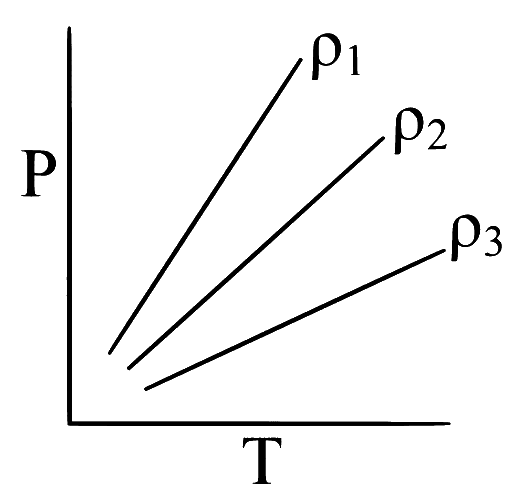
P-T diagram of an ideal gas having three different densities ρ1,ρ2,ρ3\rho_1, \rho_2, \rho_3 (in three different cases) is shown in the figure. Which of the following is correct:

Figure

Show answer and solution

Answer: (a)

  1. P=ρRTMP = \frac{\rho R T}{M}, so for a fixed density the PP-TT graph is a straight line of slope ρRM\frac{\rho R}{M}.
  2. Slope ∝ρ\propto \rho: the steepest line has the largest density.
  3. From the figure, slope of ρ1\rho_1 > slope of ρ2\rho_2 > slope of ρ3\rho_3, so ρ1>ρ2>ρ3\rho_1 > \rho_2 > \rho_3.
  4. So the answer is (a) ρ1>ρ2\rho_1 > \rho_2.
Report a mistake
Q36JEE Main 2024 · 29 JAN · SHIFT 2Medium

Gas Laws & Ideal Gas Equation · Number of molecules & density

The temperature of a gas having 2.0×10252.0 \times 10^{25} molecules per cubic meter at 1.38 atm1.38\text{ atm} (Given, k=1.38×10⁻²³ J K−1k = 1.38 \times 10^{-23}\text{ J K}^{-1}) is:

Show answer and solution

Answer: (a)

  1. P=nkTP = nkT, where nn is the number of molecules per m³.
  2. T=Pnk=1.38×1052.0×1025×1.38×10−23T = \frac{P}{nk} = \frac{1.38 \times 10^5}{2.0 \times 10^{25} \times 1.38 \times 10^{-23}} (taking 1 atm ≈105\approx 10^5 Pa).
  3. T=105200=500 KT = \frac{10^5}{200} = 500\text{ K}.
  4. So the answer is (a) 500 K.
Report a mistake
Q37MHT CET 2024 · 11 MAY · SHIFT 1Medium

Gas Laws & Ideal Gas Equation · Gas mixtures & connected vessels

Two vessels separately contain two ideal gases A and B at the same temperature, pressure of A being twice that of B. Under such conditions, the density of A is found to be 1.5 times the density of BB. The ratio of molecular weights of AA and BB is

Show answer and solution

Answer: (c)

  1. ρ=PMRT⇒M∝ρP\rho = \frac{PM}{RT} \Rightarrow M \propto \frac{\rho}{P} at the same TT.
  2. MAMB=ρAρB⋅PBPA=1.5×12=34\frac{M_A}{M_B} = \frac{\rho_A}{\rho_B}\cdot\frac{P_B}{P_A} = 1.5 \times \frac{1}{2} = \frac{3}{4}.
  3. So the answer is (c) 3:43 : 4.
Report a mistake
Q38JEE Main 2024 · 29 JAN · SHIFT 1Medium

Gas Laws & Ideal Gas Equation · Gas mixtures & connected vessels

Two vessels AA and BB are of the same size and are at same temperature. A contains 1 g1\text{ g} of hydrogen and BB contains 1 g1\text{ g} of oxygen. PAP_A and PBP_B are the pressures of the gases in AA and BB respectively, then PAPB\frac{P_A}{P_B} is:

Show answer and solution

Answer: (d)

  1. Same VV and TT, so P∝nP \propto n.
  2. nA=12n_A = \frac{1}{2} (H₂), nB=132n_B = \frac{1}{32} (O₂).
  3. PAPB=1/21/32=16\frac{P_A}{P_B} = \frac{1/2}{1/32} = 16.
  4. So the answer is (d) 16.
Report a mistake
Q39MHT CET 2023 · 14 MAY · SHIFT 2Easy

Gas Laws & Ideal Gas Equation · Gas laws & ideal gas equation

At constant temperature, increasing the pressure of a gas by 5%5\% its volume will decrease by

Show answer and solution

Answer: (d)

  1. Boyle's law: V∝1PV \propto \dfrac{1}{P} at constant TT.
  2. P′=1.05P⇒V′=V1.05=0.9524VP' = 1.05P \Rightarrow V' = \dfrac{V}{1.05} = 0.9524V
  3. Decrease ≈4.76%\approx 4.76\%, nearest option 4.70%4.70\%.
  4. So the answer is (d) 4.70%4.70\%.
Report a mistake
Q40MHT CET 2023 · 13 MAY · SHIFT 1Easy

Gas Laws & Ideal Gas Equation · Gas laws & ideal gas equation

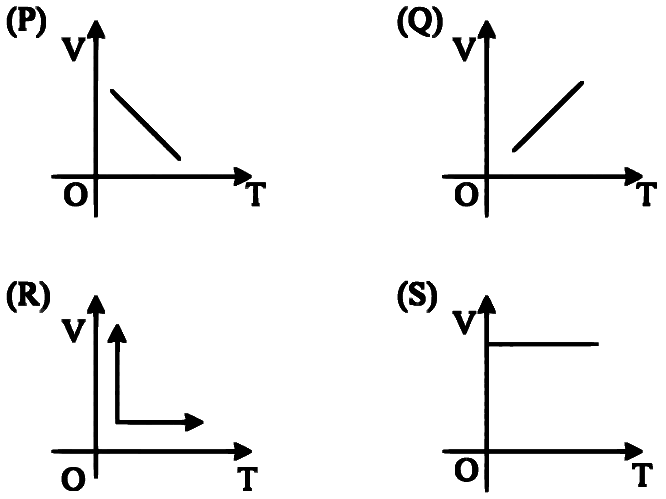
Which one of the following represents correctly the variation of volume (V) of an ideal gas with temperature (T)(T) under constant pressure conditions?

Figure

Show answer and solution

Answer: (b)

  1. Charles's law: at constant PP, V=(nRP)TV = \left(\dfrac{nR}{P}\right)T, so V∝TV \propto T.
  2. The VV–TT graph is a straight line of positive slope that passes through the origin when extended.
  3. Graph Q shows this rising straight line; P falls, R is not a single line, S is constant.
  4. So the answer is (b) Q.
Report a mistake
Q41MHT CET 2023 · 11 MAY · SHIFT 2Easy

Gas Laws & Ideal Gas Equation · Gas laws & ideal gas equation

According to Boyle's law, the product PV remains constant. The unit of PVPV is same as that of

Show answer and solution

Answer: (a)

  1. Unit of PVPV = Nm2×m3=N m=J\dfrac{\text{N}}{\text{m}^2} \times \text{m}^3 = \text{N m} = \text{J}.
  2. So the answer is (a) energy.
Report a mistake
Q42JEE Main 2023 · 29 JAN · SHIFT 1Easy

Gas Laws & Ideal Gas Equation · Gas laws & ideal gas equation

A bicycle tyre is filled with air having pressure of 270 kPa270\text{ kPa} at 27∘C27^\circ\text{C}. The approximate pressure of the air in the tyre when the temperature increases to 36∘C36^\circ\text{C} is

Show answer and solution

Answer: (d)

  1. Volume fixed, so P∝TP \propto T; T1=300T_1 = 300 K, T2=309T_2 = 309 K.
  2. P2=270×309300=278.1P_2 = 270 \times \dfrac{309}{300} = 278.1 kPa
  3. So the answer is (d) 278 kPa.
Report a mistake
Q43JEE Main 2023 · 1 FEB · SHIFT 2Easy

Gas Laws & Ideal Gas Equation · Number of molecules & density

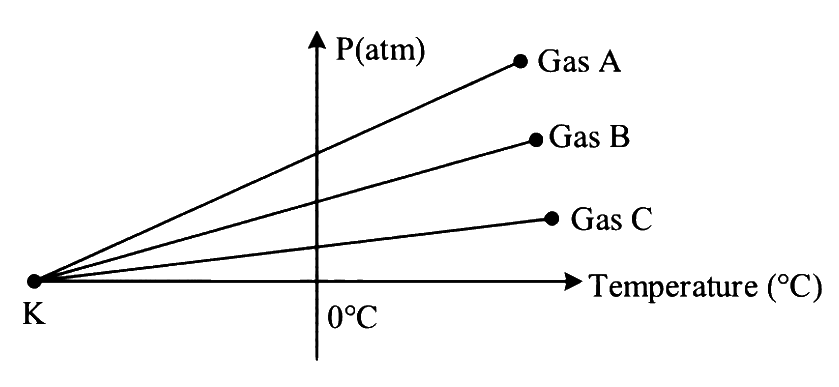
For three low density gases A, B, C pressure versus temperature graphs are plotted while keeping them at constant volume, as shown in the figure.

Figure

The temperature corresponding to the point 'K\text{K}' is:

Show answer and solution

Answer: (a)

  1. At constant volume, P∝TP \propto T (absolute), so each PP–tt line reaches P=0P = 0 at absolute zero.
  2. All lines meet the temperature axis at K, so K is absolute zero.
  3. So the answer is (a) −273∘-273^\circC.
Report a mistake
Q44MHT CET 2023 · 13 MAY · SHIFT 2Medium

Gas Laws & Ideal Gas Equation · Gas laws & ideal gas equation

A sample of oxygen gas and a sample of hydrogen gas both have the same mass, same volume and the same pressure. The ratio of their absolute temperature is

Show answer and solution

Answer: (d)

  1. PV=mMRTPV = \dfrac{m}{M}RT; same mm, PP, VV ⇒T∝M\Rightarrow T \propto M.
  2. TO2TH2=322=16\dfrac{T_{O_2}}{T_{H_2}} = \dfrac{32}{2} = 16
  3. So the answer is (d) 16:116 : 1.
Report a mistake
Q45NEET 2023Medium

Gas Laws & Ideal Gas Equation · Gas laws & ideal gas equation

A container of volume 200 cm3200\text{ cm}^{3} contains 0.2 mole of hydrogen gas and 0.3 mole of argon gas. The pressure of the system at temperature 200 K200\text{ K} (R=8.3 J K−1 mol−1R = 8.3\text{ J K}^{-1}\text{ mol}^{-1}) will be :-

Show answer and solution

Answer: (d)

  1. Dalton's law: total moles n=0.2+0.3=0.5n = 0.2 + 0.3 = 0.5; V=200V = 200 cm3=2×10⁻⁴^3 = 2 \times 10^{-4} m3^3.
  2. P=nRTV=0.5×8.3×2002×10−4=8302×10−4P = \dfrac{nRT}{V} = \dfrac{0.5 \times 8.3 \times 200}{2 \times 10^{-4}} = \dfrac{830}{2 \times 10^{-4}}
  3. P=4.15×10⁶P = 4.15 \times 10^6 Pa
  4. So the answer is (d) 4.15×1064.15 \times 10^{6} Pa.
Report a mistake
Q46JEE Main 2023 · 31 JAN · SHIFT 1Medium

Gas Laws & Ideal Gas Equation · Gas laws & ideal gas equation

The correct relation between γ=cpcv\gamma = \frac{c_p}{c_v} and temperature T is:

Show answer and solution

Answer: (d)

  1. For an ideal gas γ=1+2f\gamma = 1 + \frac{2}{f} depends only on the degrees of freedom ff.
  2. It does not change with temperature, so γ∝T0\gamma \propto T^0.
  3. So the answer is (d) γ∝T0\gamma \propto T^{0}.
Report a mistake
Q47JEE Main 2023 · 30 JAN · SHIFT 1Medium

Gas Laws & Ideal Gas Equation · Gas laws & ideal gas equation

The pressure (P)(P) and temperature (T)T) relationship of an ideal gas obeys the equation PT2=PT^{2} = constant. The volume expansion coefficient of the gas will be:

Show answer and solution

Answer: (d)

  1. From PV=nRTPV = nRT: P∝TVP \propto \frac{T}{V}.
  2. PT2=PT^2 = const ⇒TVT2=\Rightarrow \frac{T}{V}T^2 = const ⇒V∝T3\Rightarrow V \propto T^3.
  3. Volume expansion coefficient γV=1VdVdT=3T\gamma_V = \frac{1}{V}\frac{dV}{dT} = \frac{3}{T}.
  4. So the answer is (d) 3T\frac{3}{T}.
Report a mistake
Q48MHT CET 2023 · 13 MAY · SHIFT 1Medium

Gas Laws & Ideal Gas Equation · Number of molecules & density

For an ideal gas the density of the gas is ρ0\rho_0 when temperature and pressure of the gas are T0T_0 and P0P_0 respectively. When the temperature of the gas is 2T02T_0, its pressure will be 3P03P_0. The new density will be

Show answer and solution

Answer: (a)

  1. ρ=PMRT⇒ρ∝PT\rho = \frac{PM}{RT} \Rightarrow \rho \propto \frac{P}{T}.
  2. ρρ0=3P0P0⋅T02T0=32\frac{\rho}{\rho_0} = \frac{3P_0}{P_0}\cdot\frac{T_0}{2T_0} = \frac{3}{2}.
  3. So the answer is (a) 32ρ0\frac{3}{2}\rho_0.
Report a mistake
Q49MHT CET 2023 · 10 MAY · SHIFT 2Medium

Gas Laws & Ideal Gas Equation · Number of molecules & density

We have a jar filled with gas characterized by parameters P,V,TP, V, T and another jar B filled with gas having parameters 2P,V4,2T2P, \frac{V}{4}, 2T, where symbols have their usual meaning. The ratio of number of molecules in jar A to those in jar B is

Show answer and solution

Answer: (d)

  1. N∝PVTN \propto \frac{PV}{T}.
  2. NA∝PVTN_A \propto \frac{PV}{T}, NB∝2P⋅V42T=PV4TN_B \propto \frac{2P\cdot\frac{V}{4}}{2T} = \frac{PV}{4T}.
  3. NA:NB=4:1N_A : N_B = 4 : 1.
  4. So the answer is (d) 4:14 : 1.
Report a mistake
Q50MHT CET 2023 · 9 MAY · SHIFT 1Medium

Gas Laws & Ideal Gas Equation · Number of molecules & density

A jar 'PP' is filled with gas having pressure, volume and temperature P,V,TP, V, T respectively. Another gas jar QQ filled with a gas having pressure 2P2P, volume V4\frac{V}{4} and temperature 2T2T. The ratio of the number of molecules in jar PP to those in jar QQ is

Show answer and solution

Answer: (d)

  1. N∝PVTN \propto \frac{PV}{T}.
  2. NP∝PVTN_P \propto \frac{PV}{T}, NQ∝2P⋅V42T=PV4TN_Q \propto \frac{2P\cdot\frac{V}{4}}{2T} = \frac{PV}{4T}.
  3. NP:NQ=4:1N_P : N_Q = 4 : 1.
  4. So the answer is (d) 4:14 : 1.
Report a mistake
Q51JEE Main 2022 · 25 JUN · SHIFT 2Easy

Gas Laws & Ideal Gas Equation · Gas laws & ideal gas equation

When a gas filled in a closed vessel is heated by raising the temperature by 1∘^\circC, its pressure increases by 0.4%. The initial temperature of the gas is ___________ K.

Numerical answer type. Work it out, then open the answer.

Show answer and solution

Answer: 250

  1. Closed vessel: P∝T⇒ΔPP=ΔTTP \propto T \Rightarrow \dfrac{\Delta P}{P} = \dfrac{\Delta T}{T}.
  2. 0.004=1T⇒T=2500.004 = \dfrac{1}{T} \Rightarrow T = 250 K
  3. Answer: 250250 K
Report a mistake
Q52NEET 2022 · PHASE 1Medium

Gas Laws & Ideal Gas Equation · Gas laws & ideal gas equation

The volume occupied by the molecules contained in 4.5 kg water at STP, if the intermolecular forces vanish away is

Show answer and solution

Answer: (d)

  1. With no intermolecular forces the water behaves as an ideal gas: 1 mol occupies 22.422.4 L at STP.
  2. Moles =450018=250= \dfrac{4500}{18} = 250 mol
  3. V=250×22.4 L=5600 L=5.6V = 250 \times 22.4 \text{ L} = 5600 \text{ L} = 5.6 m3^3
  4. So the answer is (d) 5.65.6 m3^3.
Report a mistake
Q53JEE Main 2022 · 29 JUN · SHIFT 2Medium

Gas Laws & Ideal Gas Equation · Gas laws & ideal gas equation

A vessel contains 16g of hydrogen and 128g of oxygen at standard temperature and pressure. The volume of the vessel in cm3 is:

Show answer and solution

Answer: (c)

  1. Moles: nH2=162=8n_{H_2} = \frac{16}{2} = 8, nO2=12832=4n_{O_2} = \frac{128}{32} = 4, total n=12n = 12.
  2. At STP 1 mol occupies 22.4 L=22400 cm322.4\text{ L} = 22400\text{ cm}^3.
  3. V=12×22400=2.69×105 cm3≈27×104 cm3V = 12 \times 22400 = 2.69 \times 10^5\text{ cm}^3 \approx 27 \times 10^4\text{ cm}^3.
  4. So the answer is (c) 27×10427 \times 10^4.
Report a mistake
Q54JEE Main 2022 · 29 JUN · SHIFT 1Medium

Gas Laws & Ideal Gas Equation · Gas laws & ideal gas equation

A cylinder of fixed capacity of 44.8 litres contains helium gas at standard temperature and pressure. The amount of heat needed to raise the temperature of gas in the cylinder by 20.0∘^\circC will be: (Given gas constant R = 8.3 JK−1{}^{-1}-mol−1{}^{-1})

Show answer and solution

Answer: (c)

  1. At STP, n=44.822.4=2n = \frac{44.8}{22.4} = 2 mol of helium.
  2. Fixed volume, monatomic gas: CV=32RC_V = \frac{3}{2}R.
  3. Q=nCVΔT=2×32×8.3×20=498 JQ = nC_V\Delta T = 2 \times \frac{3}{2} \times 8.3 \times 20 = 498\text{ J}.
  4. So the answer is (c) 498 J.
Report a mistake
Q55JEE Main 2022 · 27 JUN · SHIFT 2Medium

Gas Laws & Ideal Gas Equation · Gas laws & ideal gas equation

For a perfect gas, two pressures P1 and P2 are shown in figure. The graph shows:

Figure

Show answer and solution

Answer: (a)

  1. V=nRPTV = \frac{nR}{P}T, so at constant pressure VV-TT is a straight line of slope nRP\frac{nR}{P}.
  2. Slope ∝1P\propto \frac{1}{P}: the steeper line has the lower pressure.
  3. The P2P_2 line is steeper, so P2<P1P_2 < P_1.
  4. So the answer is (a) P1>P2P_1 > P_2.
Report a mistake
Q56JEE Main 2022 · 27 JUN · SHIFT 1Medium

Gas Laws & Ideal Gas Equation · Gas mixtures & connected vessels

A mixture of hydrogen and oxygen has volume 2000 cm3, temperature 300 K, pressure 100 kPa and mass 0.76 g. The ratio of number of moles of hydrogen to number of moles of oxygen in the mixture will be:

[Take gas constant R = 8.3 JK−1{}^{-1}mol−1{}^{-1}]

Show answer and solution

Answer: (b)

  1. Total moles n=PVRT=105×2×10−38.3×300=0.0803n = \frac{PV}{RT} = \frac{10^5 \times 2 \times 10^{-3}}{8.3 \times 300} = 0.0803 mol.
  2. Let xx = moles of H₂, yy = moles of O₂: x+y=0.0803x + y = 0.0803, 2x+32y=0.762x + 32y = 0.76.
  3. Solving: 30y=0.76−0.161⇒y≈0.02030y = 0.76 - 0.161 \Rightarrow y \approx 0.020, x≈0.060x \approx 0.060.
  4. xy=31\frac{x}{y} = \frac{3}{1}, so the answer is (b).
Report a mistake
Q57JEE Main 2021 · 27 AUG · SHIFT 1Medium

Gas Laws & Ideal Gas Equation · Gas laws & ideal gas equation

A balloon carries a total load of 185 kg at normal pressure and temperature of 27∘^\circC. What load will the balloon carry on rising to a height at which the barometric pressure is 45 cm of Hg and the temperature is −7∘-7^\circC. Assuming the volume constant?

Show answer and solution

Answer: (d)

  1. At constant volume the load the balloon can carry is proportional to the air density, ρ∝PT\rho \propto \frac{P}{T}.
  2. W2W1=P2P1⋅T1T2=4576⋅300266\frac{W_2}{W_1} = \frac{P_2}{P_1}\cdot\frac{T_1}{T_2} = \frac{45}{76}\cdot\frac{300}{266}.
  3. W2=185×0.592×1.128≈123.54 kgW_2 = 185 \times 0.592 \times 1.128 \approx 123.54\text{ kg}.
  4. So the answer is (d) 123.54 kg.
Report a mistake
Q58JEE Main 2021 · 27 AUG · SHIFT 1Medium

Gas Laws & Ideal Gas Equation · Gas laws & ideal gas equation

An ideal gas is expanding such that PT3 = constant. The coefficient of volume expansion of the gas is:

Show answer and solution

Answer: (c)

  1. From PV=nRTPV = nRT: P∝TVP \propto \frac{T}{V}.
  2. PT3=PT^3 = const ⇒T4V=\Rightarrow \frac{T^4}{V} = const ⇒V∝T4\Rightarrow V \propto T^4.
  3. γV=1VdVdT=4T\gamma_V = \frac{1}{V}\frac{dV}{dT} = \frac{4}{T}.
  4. So the answer is (c) 4T\frac{4}{T}.
Report a mistake
Q59JEE Main 2021 · 20 JUL · SHIFT 2Medium

Gas Laws & Ideal Gas Equation · Gas laws & ideal gas equation

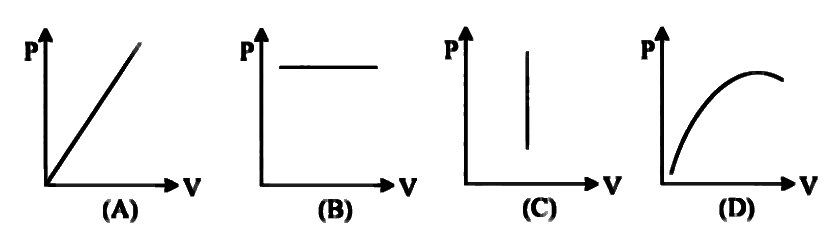
Which of the following graphs represent the behavior of an ideal gas? Symbols have their usual meaning.

Show answer and solution

Answer: (c)

  1. For a fixed amount of ideal gas PV=nRTPV = nRT, so PV∝TPV \propto T.
  2. The PVPV-TT graph must be a rising straight line.
  3. (a) falls, (b) is constant, (d) is a curve; only (c) rises linearly.
  4. So the answer is (c).
Report a mistake
Q60JEE Main 2021 · 31 AUG · SHIFT 2Medium

Gas Laws & Ideal Gas Equation · Gas mixtures & connected vessels

A mixture of hydrogen and oxygen has volume 500 cm3, temperature 300 K, pressure 400 kPa and mass 0.76 g. The ratio of masses of oxygen to hydrogen will be :-

Show answer and solution

Answer: (c)

  1. Total moles n=PVRT=4×105×5×10−48.31×300≈0.080n = \frac{PV}{RT} = \frac{4 \times 10^5 \times 5 \times 10^{-4}}{8.31 \times 300} \approx 0.080 mol.
  2. x+y=0.080x + y = 0.080 and 2x+32y=0.762x + 32y = 0.76 give x≈0.06x \approx 0.06 mol H₂, y≈0.02y \approx 0.02 mol O₂.
  3. Masses: H₂ =0.12= 0.12 g, O₂ =0.64= 0.64 g; ratio =0.640.12=163= \frac{0.64}{0.12} = \frac{16}{3}.
  4. So the answer is (c) 16:316 : 3.
Report a mistake
Q61JEE Main 2021 · 26 AUG · SHIFT 2Medium

Gas Laws & Ideal Gas Equation · Gas mixtures & connected vessels

A cylindrical container of volume 4.0 ×\times 10−-3 m3 contains one mole of hydrogen and two moles of carbon dioxide. Assume the temperature of the mixture is 400 K. The pressure of the mixture of gases is:

[Take gas constant as 8.3 J mol−1{}^{-1} K−1{}^{-1}]

Show answer and solution

Answer: (c)

  1. Total moles n=1+2=3n = 1 + 2 = 3 (Dalton's law: pressures add).
  2. P=nRTV=3×8.3×4004.0×10−3=2.49×10⁶ PaP = \frac{nRT}{V} = \frac{3 \times 8.3 \times 400}{4.0 \times 10^{-3}} = 2.49 \times 10^6\text{ Pa}.
  3. So the answer is (c) 24.9×10524.9 \times 10^5 Pa.
Report a mistake
Q62JEE Main 2021 · 26 FEB · SHIFT 1Medium

Gas Laws & Ideal Gas Equation · Gas mixtures & connected vessels

A container is divided into two chambers by a partition. The volume of first chamber is 4.5 litre and second chamber is 5.5 litre. The first chamber contain 3.0 moles of gas at pressure 2.0 atm and second chamber contain 4.0 moles of gas at pressure 3.0 atm. After the partition is removed and the mixture attains equilibrium, then, the common equilibrium pressure existing in the mixture is x ×\times 10−-1 atm. Value of x is ________.

Numerical answer type. Work it out, then open the answer.

Show answer and solution

Answer: 25

  1. Internal energy (and so PVPV total) is conserved on mixing: P(V1+V2)=P1V1+P2V2P(V_1 + V_2) = P_1V_1 + P_2V_2.
  2. P=2.0×4.5+3.0×5.510=9+16.510=2.55P = \frac{2.0 \times 4.5 + 3.0 \times 5.5}{10} = \frac{9 + 16.5}{10} = 2.55 atm.
  3. 2.55 atm=25.5×10−12.55\text{ atm} = 25.5 \times 10^{-1} atm, so x≈25x \approx 25.
Report a mistake
Q63JEE Main 2021 · 31 AUG · SHIFT 1Difficult

Gas Laws & Ideal Gas Equation · Gas laws & ideal gas equation

For an ideal gas the instantaneous change in pressure 'p' with volume 'v' is given by the equation dpdv=−ap\frac{dp}{dv} = -ap. If p = p0 at v =0 is the given boundary condition, then the maximum temperature one mole of gas can attain is: (Here R is the gas constant)

Show answer and solution

Answer: (a)

  1. Integrate dpp=−a dv\frac{dp}{p} = -a\,dv with p=p0p = p_0 at v=0v = 0: p=p0e−avp = p_0 e^{-av}.
  2. For one mole T=pvR=p0ve−avRT = \frac{pv}{R} = \frac{p_0 v e^{-av}}{R}.
  3. dTdv=p0Re−av(1−av)=0⇒v=1a\frac{dT}{dv} = \frac{p_0}{R}e^{-av}(1 - av) = 0 \Rightarrow v = \frac{1}{a}.
  4. Tmax=p0R⋅1a⋅e−1=p0aeRT_{max} = \frac{p_0}{R}\cdot\frac{1}{a}\cdot e^{-1} = \frac{p_0}{aeR}
  5. So the answer is (a) p0aeR\frac{p_0}{aeR}.
Report a mistake
Q64NEET 2020 · PHASE 1Easy

Gas Laws & Ideal Gas Equation · Gas laws & ideal gas equation

The average thermal energy for a mono-atomic gas is: (kB is Boltzmann constant and T absolute temperature)

Show answer and solution

Answer: (a)

  1. A monoatomic molecule has 3 translational degrees of freedom, each with energy 12kBT\frac{1}{2}k_BT.
  2. Average energy =3×12kBT=32kBT= 3 \times \frac{1}{2}k_BT = \frac{3}{2}k_BT
  3. So the answer is (a) 32kBT\frac{3}{2}k_BT.
Report a mistake
Q65NEET 2020 · PHASE 2Medium

Gas Laws & Ideal Gas Equation · Gas laws & ideal gas equation

An ideal gas equation can be written as

P=ρRTM0P = \frac{\rho RT}{M_0}

where ρ\rho and M0M_0 are respectively,

Show answer and solution

Answer: (d)

  1. PV=mM0RT⇒P=mV⋅RTM0=ρRTM0PV = \dfrac{m}{M_0}RT \Rightarrow P = \dfrac{m}{V}\cdot\dfrac{RT}{M_0} = \dfrac{\rho RT}{M_0}
  2. Here ρ=m/V\rho = m/V is mass density and M0M_0 is molar mass.
  3. So the answer is (d) mass density, molar mass.
Report a mistake
Q66NEET 2020 · PHASE 1Medium

Gas Laws & Ideal Gas Equation · Number of molecules & density

A cylinder contains hydrogen gas at pressure 249 kPa and temperature 27∘^\circC

Its density is: (R = 8.3 J mol-1 K-1)

Show answer and solution

Answer: (a)

  1. ρ=PMRT\rho = \frac{PM}{RT} with M=2×10⁻³ kg/molM = 2 \times 10^{-3}\text{ kg/mol}, T=300 KT = 300\text{ K}.
  2. ρ=249×103×2×10−38.3×300=4982490=0.2 kg/m3\rho = \frac{249 \times 10^3 \times 2 \times 10^{-3}}{8.3 \times 300} = \frac{498}{2490} = 0.2\text{ kg/m}^3.
  3. So the answer is (a) 0.2 kg/m³.
Report a mistake
Q67JEE Main 2020 · 4 SEP · SHIFT 2Difficult

Gas Laws & Ideal Gas Equation · Gas laws & ideal gas equation

The change in the magnitude of the volume of an ideal gas when a small additional pressure Δ\DeltaP is applied at a constant temperature, is the same as the change when the temperature is reduced by a small quantity Δ\DeltaT at constant pressure. The initial temperature and pressure of the gas were 300 K and 2 atm. respectively.

If |Δ\DeltaT| = C|Δ\DeltaP| then value of C in (K/atm.) is _________.

Numerical answer type. Work it out, then open the answer.

Show answer and solution

Answer: 150

  1. Constant TT: V=nRTP⇒∣ΔV∣=nRTP2∣ΔP∣V = \frac{nRT}{P} \Rightarrow |\Delta V| = \frac{nRT}{P^2}|\Delta P|.
  2. Constant PP: ∣ΔV∣=nRP∣ΔT∣|\Delta V| = \frac{nR}{P}|\Delta T|.
  3. Equate: ∣ΔT∣=TP∣ΔP∣⇒C=TP=3002|\Delta T| = \frac{T}{P}|\Delta P| \Rightarrow C = \frac{T}{P} = \frac{300}{2}
  4. So C=150C = 150 K/atm.
Report a mistake
Q68MHT CET 2019 · 2 MAY · SHIFT 2Medium

Gas Laws & Ideal Gas Equation · Gas laws & ideal gas equation

The equation of state for 2 g of oxygen at a pressure ' PP ' and temperature ' TT, when occupying a volume ' VV ' will be

Show answer and solution

Answer: (c)

  1. PV=nRTPV = nRT with n=232=116n = \dfrac{2}{32} = \dfrac{1}{16}.
  2. So the answer is (c) pV=116RTpV = \dfrac{1}{16}RT.
Report a mistake
Q69JEE Main 2019 · 10 APR · SHIFT 1Medium

Gas Laws & Ideal Gas Equation · Gas laws & ideal gas equation

A cylinder with fixed capacity of 67.2 lit contains helium gas at STP. The amount of heat needed to raise the temperature of the gas by 20°C is: [Given that R = 8.31 J mol–1 K–1]

Show answer and solution

Answer: (c)

  1. At STP, n=67.222.4=3n = \frac{67.2}{22.4} = 3 mol of helium.
  2. Fixed volume, monatomic gas: CV=32RC_V = \frac{3}{2}R.
  3. Q=nCVΔT=3×32×8.31×20≈748 JQ = nC_V\Delta T = 3 \times \frac{3}{2} \times 8.31 \times 20 \approx 748\text{ J}.
  4. So the answer is (c) 748 J.
Report a mistake
Q70JEE Main 2019 · 12 JAN · SHIFT 1Medium

Gas Laws & Ideal Gas Equation · Gas laws & ideal gas equation

An ideal gas occupies a volume of 2m3 at a pressure of 3 ×\times 106 Pa. The energy of the gas is:

Show answer and solution

Answer: (b)

  1. Taking the gas as monatomic, internal energy U=32nRT=32PVU = \frac{3}{2}nRT = \frac{3}{2}PV.
  2. U=32×3×106×2=9×10⁶ JU = \frac{3}{2} \times 3 \times 10^6 \times 2 = 9 \times 10^6\text{ J}.
  3. So the answer is (b) 9×1069 \times 10^6 J.
Report a mistake
Q71JEE Main 2017Medium

Gas Laws & Ideal Gas Equation · Number of molecules & density

The temperature of an open room of volume 30 m3 increases from 17oC to 27oC due to the sunshine. The atmospheric pressure in the room remains 1 ×\times 105 Pa. If Ni and Nf are the number of molecules in the room before and after heating, then Nf – Ni will be:

Show answer and solution

Answer: (d)

  1. Room is open, so PP and VV stay fixed: N=PVkTN = \frac{PV}{kT}.
  2. Nf−Ni=PVk(1300−1290)=105×301.38×10−23×(−1087000)N_f - N_i = \frac{PV}{k}\left(\frac{1}{300} - \frac{1}{290}\right) = \frac{10^5 \times 30}{1.38 \times 10^{-23}} \times \left(-\frac{10}{87000}\right).
  3. =2.17×1029×(−1.15×10⁻⁴)≈−2.5×1025= 2.17 \times 10^{29} \times (-1.15 \times 10^{-4}) \approx -2.5 \times 10^{25}.
  4. So the answer is (d) −2.5×1025-2.5 \times 10^{25}.
Report a mistake
Q72NEET 2016 · PHASE 2Easy

Gas Laws & Ideal Gas Equation · Number of molecules & density

A given sample of an ideal gas occupies a volume V at a pressure P and absolute temperature T. The mass of each molecule of the gas is m. Which of the following gives the density of the gas?

Show answer and solution

Answer: (b)

  1. P=nkBTP = nk_BT, where nn = number of molecules per unit volume, so n=PkTn = \dfrac{P}{kT}.
  2. Density ρ=nm=PmkT\rho = nm = \dfrac{Pm}{kT}
  3. So the answer is (b) PmkT\dfrac{Pm}{kT}.
Report a mistake
Q73JEE Main 2016 · 10 APR · SHIFT 1Easy

Gas Laws & Ideal Gas Equation · Number of molecules & density

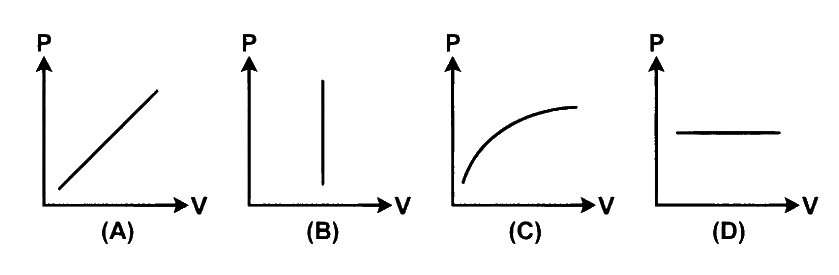
Which of the following shows the correct relationship between the pressure ‘P’ and density ρ\rho of an ideal gas at constant temperature?

Show answer and solution

Answer: (d)

  1. PV=mMRT⇒P=ρRTMPV = \dfrac{m}{M}RT \Rightarrow P = \dfrac{\rho RT}{M}.
  2. At constant TT, P∝ρP \propto \rho: a straight line through the origin.
  3. Graph (d) is a rising straight line which, extended, passes through O.
  4. So the answer is (d).
Report a mistake
Q74NEET 2015 · AIPMTMedium

Gas Laws & Ideal Gas Equation · Gas mixtures & connected vessels

Two vessels separately contain two ideal gases A and B at the same temperature, the pressure of A being twice that of B. Under such conditions, the density of A is found to be 1.5 times the density of B. The ratio of molecular weight of A and B is

Show answer and solution

Answer: (d)

  1. ρ=PMRT⇒M∝ρP\rho = \frac{PM}{RT} \Rightarrow M \propto \frac{\rho}{P} at the same TT.
  2. MAMB=1.5×12=34\frac{M_A}{M_B} = 1.5 \times \frac{1}{2} = \frac{3}{4}.
  3. So the answer is (d) 34\frac{3}{4}.
Report a mistake
Q75JEE Main 2014 · 9 APR · SHIFT 1Difficult

Gas Laws & Ideal Gas Equation · Number of molecules & density

Modern vacuum pumps can evacuate a vessel down to a pressure of 4.0 ×\times 10−-15 atm. at room temperature (300 K). Taking R = 8.3 JK−1{}^{-1} mole−1{}^{-1}, 1 atm = 105 Pa and NAvogadro = 6 ×\times 1023 mole−1{}^{-1}, the mean distance between molecules of gas in an evacuated vessel will be of the order of:

Show answer and solution

Answer: (b)

  1. Number density n=PkT=PNARTn = \frac{P}{kT} = \frac{PN_A}{RT}.
  2. n=4×10−15×105×6×10238.3×300≈9.6×10¹⁰ m−3n = \frac{4 \times 10^{-15} \times 10^5 \times 6 \times 10^{23}}{8.3 \times 300} \approx 9.6 \times 10^{10}\ \text{m}^{-3}
  3. Mean distance d=n−1/3≈(96×109)−1/3≈2.2×10−4d = n^{-1/3} \approx (96 \times 10^{9})^{-1/3} \approx 2.2 \times 10^{-4} m
  4. So the answer is (b) 0.2 mm.
Report a mistake
Q76NEET 2013Easy

Gas Laws & Ideal Gas Equation · Gas laws & ideal gas equation

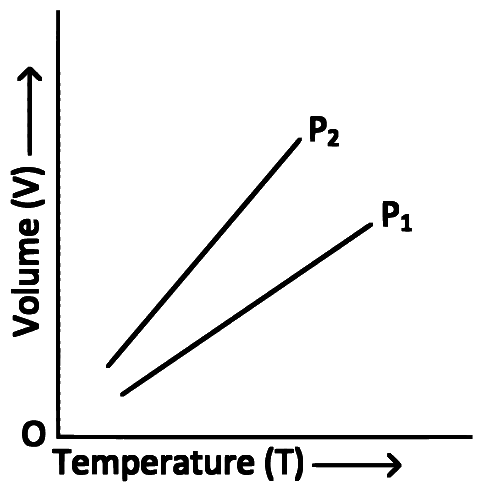
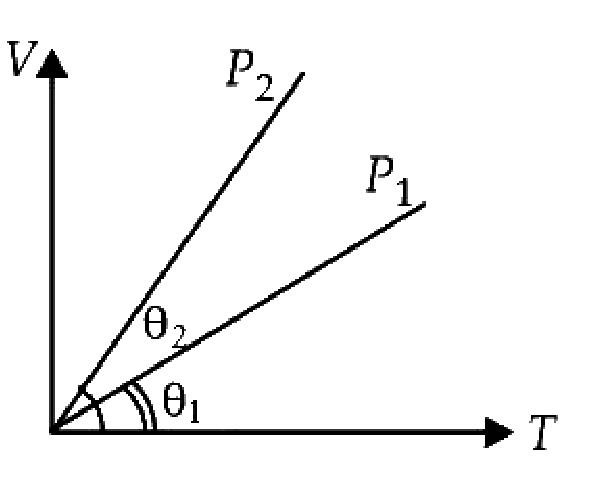
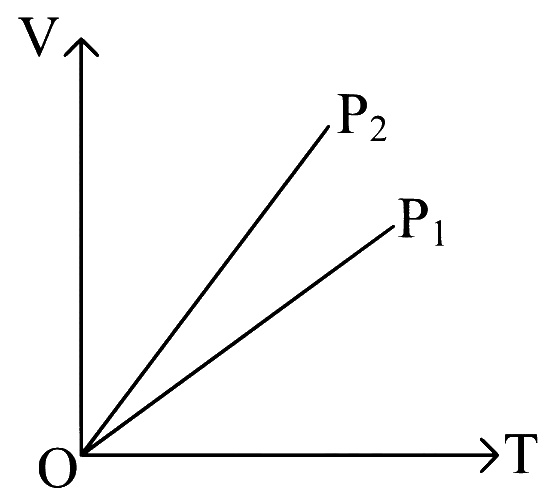
In the given (V −- T) diagram, what is the relation between pressure P1 and P2?

Figure

Show answer and solution

Answer: (a)

  1. At constant PP: V=(nRP)TV = \left(\dfrac{nR}{P}\right)T, so slope tan⁡θ=nRP∝1P\tan\theta = \dfrac{nR}{P} \propto \dfrac{1}{P}.
  2. θ2>θ1⇒tan⁡θ2>tan⁡θ1⇒P2<P1\theta_2 > \theta_1 \Rightarrow \tan\theta_2 > \tan\theta_1 \Rightarrow P_2 < P_1
  3. So the answer is (a) P2<P1P_2 < P_1.
Report a mistake
Q77NEET 2013Medium

Gas Laws & Ideal Gas Equation · Gas laws & ideal gas equation

The amount of heat energy required to raise the temperature of 1 g of Helium at NTP, from T1K to T2K is

Show answer and solution

Answer: (c)

  1. Helium is monoatomic: CV=32RC_V = \dfrac{3}{2}R; 1 g He is n=14n = \dfrac{1}{4} mol.
  2. Q=nCVΔT=14×32R(T2−T1)=38R(T2−T1)Q = nC_V\Delta T = \dfrac{1}{4} \times \dfrac{3}{2}R(T_2 - T_1) = \dfrac{3}{8}R(T_2 - T_1)
  3. With R=NakBR = N_a k_B: Q=38NakB(T2−T1)Q = \dfrac{3}{8}N_a k_B (T_2 - T_1)
  4. So the answer is (c).
Report a mistake
Q78JEE Main 2013 · 23 APR · SHIFT 1Difficult

Gas Laws & Ideal Gas Equation · Gas laws & ideal gas equation

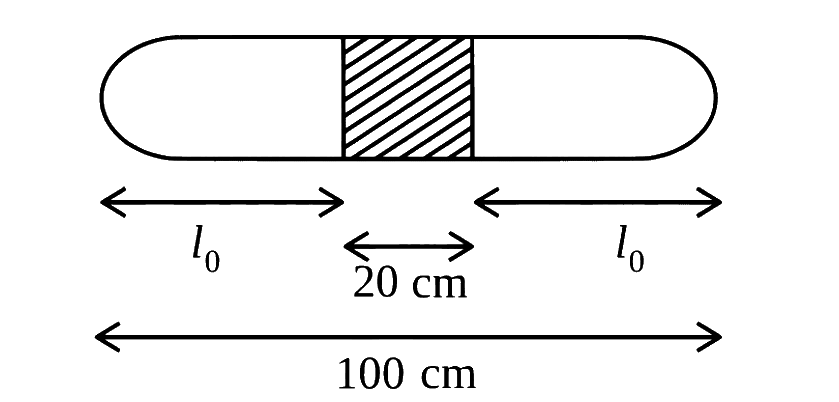
A thin tube sealed at both ends is 100 cm long. It lies horizontally, the middle 20 cm containing mercury and two equal ends containing air at standard atmospheric pressure. If the tube is now turned to a vertical position, by what amount will the mercury be displaced?

(Given: cross-section of the tube can be assumed to be uniform)

Figure

Show answer and solution

Answer: (b)

Hg40 + x40 − x20 cmP_upP_low
  1. Each air column is 4040 cm long at 7676 cm of Hg. When vertical, mercury moves down by xx: upper column 40+x40 + x, lower column 40−x40 - x.
  2. Boyle's law: Pup=76×4040+xP_{up} = \frac{76 \times 40}{40 + x}, Plow=76×4040−xP_{low} = \frac{76 \times 40}{40 - x}.
  3. Equilibrium of mercury: Plow=Pup+20⇒3040(140−x−140+x)=20P_{low} = P_{up} + 20 \Rightarrow 3040\left(\frac{1}{40-x} - \frac{1}{40+x}\right) = 20
  4. ⇒x2+304x−1600=0⇒x=−304+988162≈5.18\Rightarrow x^2 + 304x - 1600 = 0 \Rightarrow x = \frac{-304 + \sqrt{98816}}{2} \approx 5.18 cm
  5. So the answer is (b) 5.18 cm.
Report a mistake
Q79NEET 2008 · AIPMTMedium

Gas Laws & Ideal Gas Equation · Number of molecules & density

At 10oC the value of the density of a fixed mass of an ideal gas divided by its pressure is x. At 110oC this ratio is

Show answer and solution

Answer: (b)

  1. ρP=MRT∝1T\frac{\rho}{P} = \frac{M}{RT} \propto \frac{1}{T}.
  2. T1=283 KT_1 = 283\text{ K}, T2=383 KT_2 = 383\text{ K}, so new ratio =283383x= \frac{283}{383}x.
  3. So the answer is (b) 283383x\frac{283}{383}x.
Report a mistake
Q80JEE Main 2008 · AIEEEDifficult

Gas Laws & Ideal Gas Equation · Gas mixtures & connected vessels

An insulated container of gas has two chambers separated by an insulating partition. One of the chambers has volume V1V_1 and contains ideal gas at pressure P1P_1 and temperature T1T_1. The other chamber has volume V2V_2 and contains ideal gas at pressure P2P_2 and temperature T2T_2. If the partition is removed without doing any work on the gas, the final equilibrium temperature of the gas in the container will be

Show answer and solution

Answer: (a)

  1. Insulated and no work, so total internal energy is conserved: n1CvT1+n2CvT2=(n1+n2)CvTn_1C_vT_1 + n_2C_vT_2 = (n_1 + n_2)C_vT.
  2. Moles: n1=P1V1RT1n_1 = \frac{P_1V_1}{RT_1}, n2=P2V2RT2n_2 = \frac{P_2V_2}{RT_2}.
  3. T=P1V1+P2V2P1V1T1+P2V2T2=T1T2(P1V1+P2V2)P1V1T2+P2V2T1T = \frac{P_1V_1 + P_2V_2}{\frac{P_1V_1}{T_1} + \frac{P_2V_2}{T_2}} = \frac{T_1T_2(P_1V_1 + P_2V_2)}{P_1V_1T_2 + P_2V_2T_1}
  4. So the answer is (a).
Report a mistake
Q81NEET 2004 · AIPMTEasy

Gas Laws & Ideal Gas Equation · Gas laws & ideal gas equation

The equation of state for 5 g of oxygen at a pressure P and temperature T, when occupying a volume V, will be

(where R is the gas constant)

Show answer and solution

Answer: (a)

  1. PV=nRTPV = nRT with n=mM=532n = \dfrac{m}{M} = \dfrac{5}{32} for O2_2 (M=32M = 32 g/mol).
  2. So the answer is (a) PV=532RTPV = \dfrac{5}{32}RT.
Report a mistake
Q82JEE Main 2004 · AIEEEDifficult

Gas Laws & Ideal Gas Equation · Gas mixtures & connected vessels

Two thermally insulated vessels 11 and 22 are filled with air at temperatures (T1,T2),(T_1, T_2), volume (V1,V2)(V_1, V_2) and pressure (P1,P2)(P_1, P_2) respectively. If the valve joining the two vessels is opened, the temperature inside the vessel at equilibrium will be

Show answer and solution

Answer: (a)

  1. Vessels are insulated, so internal energy is conserved: (n1+n2)CvT=n1CvT1+n2CvT2(n_1 + n_2)C_vT = n_1C_vT_1 + n_2C_vT_2.
  2. With n=PVRTn = \frac{PV}{RT}: T=P1V1+P2V2P1V1/T1+P2V2/T2T = \frac{P_1V_1 + P_2V_2}{P_1V_1/T_1 + P_2V_2/T_2}.
  3. T=T1T2(P1V1+P2V2)P1V1T2+P2V2T1T = \frac{T_1T_2(P_1V_1 + P_2V_2)}{P_1V_1T_2 + P_2V_2T_1}
  4. So the answer is (a).
Report a mistake
Q83NEET 2000 · AIPMTEasy

Gas Laws & Ideal Gas Equation · Gas laws & ideal gas equation

The gases carbon-monoxide (CO) and nitrogen at the same temperature have kinetic energies E1E_1 and E2E_2 respectively. Then

Show answer and solution

Answer: (a)

  1. Average KE per molecule depends only on TT and degrees of freedom: E=f2kBTE = \dfrac{f}{2}k_BT.
  2. CO and N2_2 are both diatomic (f=5f = 5) and at the same TT.
  3. So the answer is (a) E1=E2E_1 = E_2.
Report a mistake
Q84NEET 1991 · AIPMTEasy

Gas Laws & Ideal Gas Equation · Gas laws & ideal gas equation

Relation between pressure (PP) and energy (EE) of a gas is

Show answer and solution

Answer: (a)

  1. Kinetic theory: P=13ρv2ˉP = \dfrac{1}{3}\rho \bar{v^2}, and KE per unit volume E=12ρv2ˉE = \dfrac{1}{2}\rho \bar{v^2}.
  2. P=23(12ρv2ˉ)=23EP = \dfrac{2}{3}\left(\dfrac{1}{2}\rho \bar{v^2}\right) = \dfrac{2}{3}E
  3. So the answer is (a) P=23EP = \frac{2}{3}E.
Report a mistake
Q85NEET 1991 · AIPMTMedium

Gas Laws & Ideal Gas Equation · Gas laws & ideal gas equation

For hydrogen gas CP−CV=aC_P - C_V = a and for oxygen gas CP−CV=bC_P - C_V = b, so the relation between aa and bb is given by

Show answer and solution

Answer: (d)

  1. Mayer's relation for molar specific heats of any ideal gas: CP−CV=RC_P - C_V = R.
  2. It does not depend on the gas, so a=Ra = R for hydrogen and b=Rb = R for oxygen.
  3. So the answer is (d) a=ba = b.
Report a mistake
Q86NEET 1988 · AIPMTMedium

Gas Laws & Ideal Gas Equation · Gas mixtures & connected vessels

Two containers AA and BB are partly filled with water and closed. The volume of AA is twice that of BB and it contains half the amount of water in BB. If both are at the same temperature, the water vapour in the containers will have pressure in the ratio of

Show answer and solution

Answer: (b)

  1. Saturated vapour pressure depends only on temperature, not on the volume of the container or the amount of water.
  2. Both are at the same temperature, so the vapour pressures are equal.
  3. So the answer is (b) 1:11 : 1.
Report a mistake
Q87MHT CET 2026 · 15 MAY · SHIFT 2Medium

Degrees of Freedom & Internal Energy · Internal energy of gases & mixtures

The internal energy of a diatomic molecule (air) in 4 m×4 m×3 m4\text{ m} \times 4\text{ m} \times 3\text{ m} sized room at 10510^{5} N/m2^{2} atmospheric pressure will be x×106x \times 10^{6} J. The value of xx is

Show answer and solution

Answer: (b)

  1. For a diatomic gas U=52nRT=52PVU = \frac{5}{2}nRT = \frac{5}{2}PV.
  2. V=4×4×3=48 m3V = 4 \times 4 \times 3 = 48\ \text{m}^3
  3. U=52×105×48=12×106U = \frac{5}{2} \times 10^5 \times 48 = 12 \times 10^6 J
  4. So the answer is (b) x=12x = 12.
Report a mistake
Q88JEE Main 2026 · 6 APR · SHIFT 2Medium

Degrees of Freedom & Internal Energy · Internal energy of gases & mixtures

If 2 mole of an ideal monoatomic gas at temperature TT, is mixed with 6 mole of another ideal monoatomic gas at temperature 2T2T then the temperature of mixture is:

Show answer and solution

Answer: (d)

  1. No energy lost and both gases monoatomic: (n1+n2)Tmix=n1T1+n2T2(n_1 + n_2)T_{mix} = n_1T_1 + n_2T_2.
  2. Tmix=2T+6(2T)8=14T8T_{mix} = \frac{2T + 6(2T)}{8} = \frac{14T}{8}
  3. So the answer is (d) 74T\frac{7}{4}T.
Report a mistake
Q89JEE Main 2026 · 4 APR · SHIFT 1Medium

Degrees of Freedom & Internal Energy · Internal energy of gases & mixtures

One gas of n1n_1 mole of molecules at temperature T1T_1, volume V1V_1, and pressure P1P_1, and another gas of n2n_2 mole of molecules at temperature T2T_2, volume V2V_2, and pressure P2P_2, are mixed resulting in pressure PP and volume VV of the mixture. The temperature of the mixture is ______.

Show answer and solution

Answer: (b)

  1. Total moles are conserved: n=n1+n2n = n_1 + n_2, with n=PVRTn = \frac{PV}{RT}.
  2. PVRT=P1V1RT1+P2V2RT2\frac{PV}{RT} = \frac{P_1V_1}{RT_1} + \frac{P_2V_2}{RT_2}
  3. T=PVP1V1/T1+P2V2/T2=T1T2PVT2P1V1+T1P2V2T = \frac{PV}{P_1V_1/T_1 + P_2V_2/T_2} = \frac{T_1T_2PV}{T_2P_1V_1 + T_1P_2V_2}
  4. So the answer is (b).
Report a mistake
Q90MHT CET 2026 · 16 APR · SHIFT 2Medium

Degrees of Freedom & Internal Energy · Moving container stopped suddenly

A rigid diatomic gas having molar mass m is contained in an insulated container. The container is moving with velocity V. If it is stopped suddenly, the change in temperature is (R - gas constant)

Show answer and solution

Answer: (c)

  1. Insulated container: the bulk KE of the gas becomes internal energy, 12(nm)V2=nCvΔT\frac{1}{2}(nm)V^2 = nC_v\Delta T.
  2. Rigid diatomic: Cv=52RC_v = \frac{5}{2}R.
  3. 12mV2=52R ΔT⇒ΔT=mV25R\frac{1}{2}mV^2 = \frac{5}{2}R\,\Delta T \Rightarrow \Delta T = \frac{mV^2}{5R}
  4. So the answer is (c) mV25R\frac{mV^2}{5R}.
Report a mistake
Q91MHT CET 2026 · 11 APR · SHIFT 2Medium

Degrees of Freedom & Internal Energy · Moving container stopped suddenly

An insulated container contains a monoatomic gas of molar mass 'm'. The container is moving with velocity 'V'. If it is stopped suddenly, the change in temperature of the gas is (R-gas constant)

Show answer and solution

Answer: (c)

  1. KE lost per mole goes into internal energy: 12mv2=CvΔT\frac{1}{2}mv^2 = C_v\Delta T.
  2. Monoatomic: Cv=32RC_v = \frac{3}{2}R.
  3. ΔT=mv22⋅32R=mv23R\Delta T = \frac{mv^2}{2\cdot\frac{3}{2}R} = \frac{mv^2}{3R}
  4. So the answer is (c) mv23R\frac{mv^2}{3R}.
Report a mistake
Q92JEE Main 2025 · 7 APR · SHIFT 1Medium

Degrees of Freedom & Internal Energy · Degrees of freedom

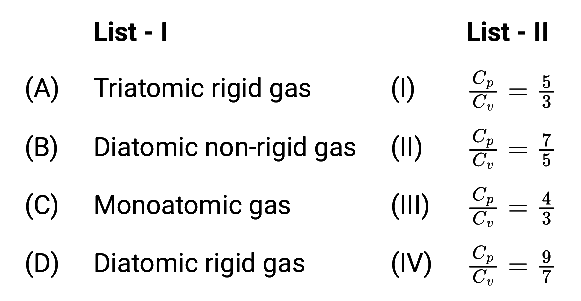
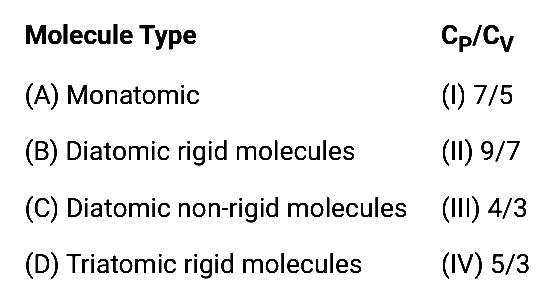
Match the List I with List II

Figure

Choose the correct answer from the options given below:

Show answer and solution

Answer: (a)

  1. Use γ=1+2f\gamma = 1 + \frac{2}{f}.
  2. (A) Triatomic rigid (non-linear): f=6f = 6, γ=43\gamma = \frac{4}{3} →\to (III).
  3. (B) Diatomic non-rigid: f=7f = 7, γ=97\gamma = \frac{9}{7} →\to (IV).
  4. (C) Monoatomic: f=3f = 3, γ=53\gamma = \frac{5}{3} →\to (I). (D) Diatomic rigid: f=5f = 5, γ=75\gamma = \frac{7}{5} →\to (II).
  5. So the answer is (a) A-III, B-IV, C-I, D-II.
Report a mistake
Q93MHT CET 2025 · 5 MAY · SHIFT 2Medium

Degrees of Freedom & Internal Energy · Internal energy of gases & mixtures

500 gram of a diatomic gas is enclosed at a pressure of 105 N m−210^{5}\text{ N m}^{-2}. The density of the gas is 5 kg m−35\text{ kg m}^{-3}. The energy of one mole of the gas due to its thermal motion is [consider the gas molecule as a rigid rotator]

Show answer and solution

Answer: (b)

  1. Volume V=mρ=0.55=0.1 m3V = \frac{m}{\rho} = \frac{0.5}{5} = 0.1\ \text{m}^3.
  2. Rigid diatomic: U=52nRT=52PVU = \frac{5}{2}nRT = \frac{5}{2}PV.
  3. U=52×105×0.1=2.5×10⁴U = \frac{5}{2} \times 10^5 \times 0.1 = 2.5 \times 10^4 J
  4. So the answer is (b) 2.5×1042.5 \times 10^4 J.
Report a mistake
Q94JEE Main 2025 · 2 APR · SHIFT 2Medium

Degrees of Freedom & Internal Energy · Internal energy of gases & mixtures

The internal energy of air in 4 m×4 m×3 m4\text{ m} \times 4\text{ m} \times 3\text{ m} sized room at 1 atmospheric pressure will be___________________ ×106 J\times 10^{6}\text{ J}

(Consider air as diatomic molecule)

Numerical answer type. Work it out, then open the answer.

Show answer and solution

Answer: 12

  1. Diatomic air: U=52nRT=52PVU = \frac{5}{2}nRT = \frac{5}{2}PV.
  2. V=4×4×3=48 m3V = 4 \times 4 \times 3 = 48\ \text{m}^3, P=1.013×10⁵P = 1.013 \times 10^5 Pa
  3. U=52×1.013×105×48≈12.2×10⁶U = \frac{5}{2} \times 1.013 \times 10^5 \times 48 \approx 12.2 \times 10^6 J
  4. So the answer is 1212 (×106\times 10^6 J).
Report a mistake
Q95JEE Main 2024 · 4 APR · SHIFT 2Easy

Degrees of Freedom & Internal Energy · Degrees of freedom

The translational degrees of freedom (ft)(f_t) and rotational degrees of freedom (fr)(f_r) of CH4\text{CH}_4 molecule are:

Show answer and solution

Answer: (b)

  1. CH4\text{CH}_4 is a non-linear (tetrahedral) molecule.
  2. Translation along 3 axes: ft=3f_t = 3; rotation about 3 axes: fr=3f_r = 3.
  3. So the answer is (b) ft=3f_t = 3, fr=3f_r = 3.
Report a mistake
Q96JEE Main 2024 · 6 APR · SHIFT 2Medium

Degrees of Freedom & Internal Energy · Internal energy of gases & mixtures

Energy of 10 non rigid diatomic molecules at temperature TT is:

Show answer and solution

Answer: (d)

  1. Non-rigid diatomic: f=3+2+2=7f = 3 + 2 + 2 = 7 (vibration gives 2 terms).
  2. Energy per molecule =72kBT= \frac{7}{2}k_BT; for 10 molecules E=10×72kBTE = 10 \times \frac{7}{2}k_BT.
  3. So the answer is (d) 35kBT35k_BT.
Report a mistake
Q97JEE Main 2024 · 31 JAN · SHIFT 2Medium

Degrees of Freedom & Internal Energy · Internal energy of gases & mixtures

A gas mixture consists of 8 moles of argon and 6 moles of oxygen at temperature T. Neglecting all vibrational modes, the total internal energy of the system is:

Show answer and solution

Answer: (b)

  1. Ar: f=3f = 3; O2\text{O}_2 (no vibration): f=5f = 5.
  2. U=8×32RT+6×52RT=12RT+15RTU = 8 \times \frac{3}{2}RT + 6 \times \frac{5}{2}RT = 12RT + 15RT
  3. So the answer is (b) 27RT27RT.
Report a mistake
Q98JEE Main 2024 · 29 JAN · SHIFT 2Medium

Degrees of Freedom & Internal Energy · Internal energy of gases & mixtures

NN moles of a polyatomic gas (f=6)(f = 6) must be mixed with two moles of a monoatomic gas so that the mixture behaves as a diatomic gas. The value of NN is:

Show answer and solution

Answer: (c)

  1. Mixture acts diatomic, so Cv,mix=52RC_{v,mix} = \frac{5}{2}R.
  2. Cv,mix=N(3R)+2(32R)N+2=52RC_{v,mix} = \frac{N(3R) + 2\left(\frac{3}{2}R\right)}{N + 2} = \frac{5}{2}R
  3. 3N+3=52N+5⇒N2=2⇒N=43N + 3 = \frac{5}{2}N + 5 \Rightarrow \frac{N}{2} = 2 \Rightarrow N = 4
  4. So the answer is (c) 4.
Report a mistake
Q99MHT CET 2024 · 11 MAY · SHIFT 1Medium

Degrees of Freedom & Internal Energy · Moving container stopped suddenly

An insulated container contains a diatomic gas of molar mass ' m '. The container is moving with velocity ' VV ', if it is stopped suddenly, the change in temperature is ( R=R = gas constant)

Show answer and solution

Answer: (b)

  1. Per mole: 12mV2=CvΔT\frac{1}{2}mV^2 = C_v\Delta T (no heat lost, insulated).
  2. Diatomic: Cv=52RC_v = \frac{5}{2}R.
  3. ΔT=mV25R\Delta T = \frac{mV^2}{5R}
  4. So the answer is (b) mV25R\frac{mV^2}{5R}.
Report a mistake
Q100MHT CET 2024 · 4 MAY · SHIFT 1Medium

Degrees of Freedom & Internal Energy · Moving container stopped suddenly

An insulated container contains a monoatomic gas of molar mass ' mm '. The container is moving with velocity ' VV '. If it is stopped suddenly, the change in temperature is ( R=R = gas constant)

Show answer and solution

Answer: (b)

  1. Per mole: 12mV2=CvΔT\frac{1}{2}mV^2 = C_v\Delta T.
  2. Monoatomic: Cv=32RC_v = \frac{3}{2}R.
  3. ΔT=mV23R\Delta T = \frac{mV^2}{3R}
  4. So the answer is (b) mV23R\frac{mV^2}{3R}.
Report a mistake
Q101JEE Main 2023 · 11 APR · SHIFT 1Easy

Degrees of Freedom & Internal Energy · Degrees of freedom

Three vessels of equal volume contain gases at the same temperature and pressure. The first vessel contains neon (monoatomic), the second contains chlorine (diatomic) and third contains uranium hexafluoride (polyatomic). Arrange these on the basis of their root mean square speed (vrms)(v_{\text{rms}}) and choose the correct answer from the options given below:

Show answer and solution

Answer: (b)

  1. vrms=3RTM∝1Mv_{rms} = \sqrt{\frac{3RT}{M}} \propto \frac{1}{\sqrt{M}} at the same TT.
  2. MM: Ne =20= 20, Cl2=71\text{Cl}_2 = 71, UF6=352\text{UF}_6 = 352 g/mol.
  3. So vrmsv_{rms}(mono) >vrms> v_{rms}(dia) >vrms> v_{rms}(poly): answer (b).
Report a mistake
Q102JEE Main 2023 · 10 APR · SHIFT 1Easy

Degrees of Freedom & Internal Energy · Degrees of freedom

Match List I with List II:

Choose the correct answer from the options given below:

List IList II
(A)3 Translational degrees of freedom(I)Monoatomic gases
(B)3 Translational, 2 rotational degrees of freedom(II)Polyatomic gases
(C)3 Translational, 2 rotational and 1 vibrational degrees of freedom(III)Rigid diatomic gases
(D)3 Translational, 3 rotational and more than one vibrational degrees of freedom(IV)Nonrigid diatomic gases
Show answer and solution

Answer: (a)

  1. (A) Only 3 translational: monoatomic gas →\to (I).
  2. (B) 3 translational + 2 rotational: rigid diatomic →\to (III).
  3. (C) Adds 1 vibrational mode: non-rigid diatomic →\to (IV).
  4. (D) 3 rotational and several vibrational modes: polyatomic →\to (II).
  5. So the answer is (a).
Report a mistake
Q103MHT CET 2023 · 13 MAY · SHIFT 2Easy

Degrees of Freedom & Internal Energy · Internal energy of gases & mixtures

The internal energy of a monoatomic ideal gas molecule is

Show answer and solution

Answer: (b)

  1. An ideal gas has no intermolecular forces, so there is no potential energy between molecules.
  2. A monoatomic molecule has only translational kinetic energy 32kT\frac{3}{2}kT.
  3. So the answer is (b) totally kinetic.
Report a mistake
Q104JEE Main 2023 · 10 APR · SHIFT 2Medium

Degrees of Freedom & Internal Energy · Internal energy of gases & mixtures

A gas mixture consists of 2 moles of oxygen and 4 moles of neon at temperature T. Neglecting all vibrational modes, the total internal energy of the system will be,

Show answer and solution

Answer: (d)

  1. O2\text{O}_2 (no vibration): f=5f = 5; Ne: f=3f = 3.
  2. U=2×52RT+4×32RT=5RT+6RTU = 2 \times \frac{5}{2}RT + 4 \times \frac{3}{2}RT = 5RT + 6RT
  3. So the answer is (d) 11RT11RT.
Report a mistake
Q105MHT CET 2023 · 10 MAY · SHIFT 2Medium

Degrees of Freedom & Internal Energy · Moving container stopped suddenly

An insulated container contains a monoatomic gas of molar mass 'mm'. The container is moving with velocity 'VV'. If it is stopped suddenly, the change in temperature of a gas is [R is gas constant]

Show answer and solution

Answer: (c)

  1. Per mole: 12MV2=CvΔT\frac{1}{2}MV^2 = C_v\Delta T.
  2. Monoatomic: Cv=32RC_v = \frac{3}{2}R.
  3. ΔT=MV23R\Delta T = \frac{MV^2}{3R}
  4. So the answer is (c) MV23R\frac{MV^2}{3R}.
Report a mistake
Q106NEET 2022 · PHASE 2Easy

Degrees of Freedom & Internal Energy · Degrees of freedom

Three vessels of equal capacity have gases at the same temperature and pressure. The first vessel contains helium (monoatomic), the second contains fluorine (diatomic) and the third contains sulfur hexafluoride (polyatomic). The correct statement, among the following is:

Show answer and solution

Answer: (d)

  1. Same PP, VV, TT means the same number of molecules in each vessel (Avogadro), so (b) is wrong.
  2. vrms=3RTMv_{rms} = \sqrt{\frac{3RT}{M}}, so at the same TT the lightest gas is fastest.
  3. Helium (M=4M = 4) is the lightest, SF6\text{SF}_6 the heaviest.
  4. So the answer is (d) helium has the largest vrmsv_{rms}.
Report a mistake
Q107JEE Main 2022 · 28 JUN · SHIFT 1Easy

Degrees of Freedom & Internal Energy · Internal energy of gases & mixtures

The total internal energy of two mole monoatomic ideal gas at temperature T = 300 K will be _____________ J. (Given R = 8.31 J/mol.K)

Numerical answer type. Work it out, then open the answer.

Show answer and solution

Answer: 7479

  1. Monoatomic gas: U=n32RTU = n\frac{3}{2}RT.
  2. U=2×32×8.31×300U = 2 \times \frac{3}{2} \times 8.31 \times 300
  3. U=7479U = 7479 J
Report a mistake
Q108JEE Main 2022 · 26 JUN · SHIFT 1Medium

Degrees of Freedom & Internal Energy · Moving container stopped suddenly

A thermally insulated vessel contains an ideal gas of molecular mass M and ratio of specific heats 1.4. Vessel is moving with speed v and is suddenly brought to rest. Assuming no heat is lost to the surrounding and vessel, temperature of the gas increases by:

(R = universal gas constant)

Show answer and solution

Answer: (b)

  1. γ=1.4⇒Cv=Rγ−1=52R\gamma = 1.4 \Rightarrow C_v = \frac{R}{\gamma-1} = \frac{5}{2}R.
  2. Per mole: 12Mv2=CvΔT\frac{1}{2}Mv^2 = C_v\Delta T.
  3. ΔT=Mv22⋅52R=Mv25R\Delta T = \frac{Mv^2}{2\cdot\frac{5}{2}R} = \frac{Mv^2}{5R}
  4. So the answer is (b) Mv25R\frac{Mv^2}{5R}.
Report a mistake
Q109MHT CET 2021 · 24 SEP · SHIFT 1Medium

Degrees of Freedom & Internal Energy · Internal energy of gases & mixtures

Internal energy of n1n_1 moles of hydrogen at temperature 'TT' is equal to internal energy of 'n2n_2' moles of helium at temperature 2T2T, then the ratio n1:n2n_1 : n_2 is

[Degree of freedom of He=3\text{He} = 3, Degree of freedom of H2=5\text{H}_2 = 5]

Show answer and solution

Answer: (b)

  1. U=nf2RTU = n\frac{f}{2}RT.
  2. n1⋅52RT=n2⋅32R(2T)n_1 \cdot \frac{5}{2}R T = n_2 \cdot \frac{3}{2}R(2T)
  3. 5n1=6n2⇒n1:n2=6:55n_1 = 6n_2 \Rightarrow n_1 : n_2 = 6 : 5
  4. So the answer is (b) 6:56 : 5.
Report a mistake
Q110JEE Main 2021 · 17 MAR · SHIFT 1Medium

Degrees of Freedom & Internal Energy · Internal energy of gases & mixtures

Two ideal polyatomic gases at temperatures T1 and T2 are mixed so that there is no loss of energy. If F1 and F2, m1 and m2, n1 and n2 be the degrees of freedom, masses, number of molecules of the first and second gas respectively, the temperature of mixture of these two gases is:

Show answer and solution

Answer: (b)

  1. Energy conserved: n1F12kT1+n2F22kT2=(n1F12+n2F22)kTn_1\frac{F_1}{2}kT_1 + n_2\frac{F_2}{2}kT_2 = \left(n_1\frac{F_1}{2} + n_2\frac{F_2}{2}\right)kT.
  2. T=n1F1T1+n2F2T2n1F1+n2F2T = \frac{n_1F_1T_1 + n_2F_2T_2}{n_1F_1 + n_2F_2}
  3. So the answer is (b).
Report a mistake
Q111JEE Main 2021 · 16 MAR · SHIFT 1Medium

Degrees of Freedom & Internal Energy · Internal energy of gases & mixtures

The volume V of an enclosure contains a mixture of three gases, 16 g of oxygen, 28 g of nitrogen and 44 g of carbon dioxide at absolute temperature T. Consider R as universal gas constant. The pressure of the mixture of gases is:

Show answer and solution

Answer: (d)

  1. Moles: O2=1632=0.5\text{O}_2 = \frac{16}{32} = 0.5, N2=2828=1\text{N}_2 = \frac{28}{28} = 1, CO2=4444=1\text{CO}_2 = \frac{44}{44} = 1; total n=2.5n = 2.5.
  2. Dalton's law: P=nRTV=2.5RTVP = \frac{nRT}{V} = \frac{2.5RT}{V}
  3. So the answer is (d) 52RTV\frac{5}{2}\frac{RT}{V}.
Report a mistake
Q112JEE Main 2021 · 26 FEB · SHIFT 2Medium

Degrees of Freedom & Internal Energy · Internal energy of gases & mixtures

The internal energy (U), pressure (P) and volume (V) of an ideal gas are related as U == 3PV + 4. The gas is:

Show answer and solution

Answer: (c)

  1. For an ideal gas U=f2nRT=f2PVU = \frac{f}{2}nRT = \frac{f}{2}PV (plus a constant).
  2. Compare with U=3PV+4U = 3PV + 4: f2=3⇒f=6\frac{f}{2} = 3 \Rightarrow f = 6.
  3. f=6f = 6 means 3 translational + 3 rotational: a non-linear polyatomic gas.
  4. So the answer is (c) polyatomic only.
Report a mistake
Q113JEE Main 2021 · 25 FEB · SHIFT 1Medium

Degrees of Freedom & Internal Energy · Moving container stopped suddenly

A monoatomic gas of mass 4.0 u is kept in an insulated container. Container is moving with velocity 30 m/s. If container is suddenly stopped then change in temperature of the gas (R = gas constant) is x3R\frac{x}{3R}. Value of x is ___________.

Numerical answer type. Work it out, then open the answer.

Show answer and solution

Answer: 3600

  1. Per mole: 12Mv2=32R ΔT⇒ΔT=Mv23R\frac{1}{2}Mv^2 = \frac{3}{2}R\,\Delta T \Rightarrow \Delta T = \frac{Mv^2}{3R}.
  2. Mv2=4×302=3600Mv^2 = 4 \times 30^2 = 3600 (taking M=4M = 4 as in the official answer).
  3. ΔT=36003R\Delta T = \frac{3600}{3R}, so x=3600x = 3600.
Report a mistake
Q114JEE Main 2020 · 6 SEP · SHIFT 1Easy

Degrees of Freedom & Internal Energy · Internal energy of gases & mixtures

Molecules of an ideal gas are known to have three translational degrees of freedom and two rotational degrees of freedom.The gas is maintained at a temperature of T. The total internal energy, U of a mole of this gas, and the value of

γ(=CpCv)\gamma\left(=\frac{C_p}{C_v}\right) are given, respectively by:

Show answer and solution

Answer: (a)

  1. f=3+2=5f = 3 + 2 = 5, so for one mole U=f2RT=52RTU = \frac{f}{2}RT = \frac{5}{2}RT.
  2. γ=1+2f=1+25=75\gamma = 1 + \frac{2}{f} = 1 + \frac{2}{5} = \frac{7}{5}
  3. So the answer is (a).
Report a mistake
Q115JEE Main 2020 · 3 SEP · SHIFT 1Medium

Degrees of Freedom & Internal Energy · Internal energy of gases & mixtures

Figure

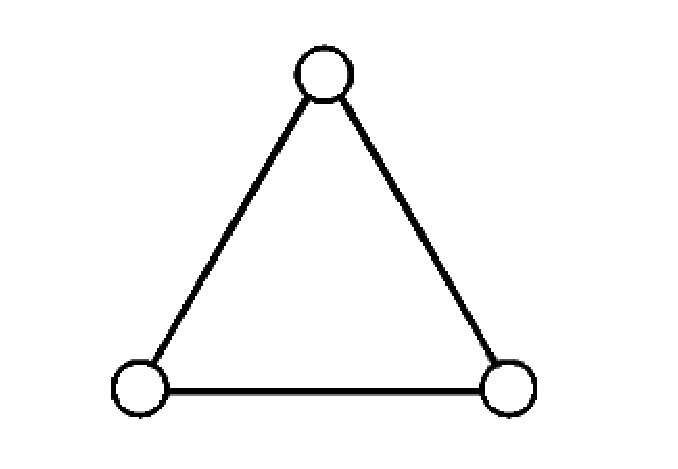
Consider a gas of triatomic molecules. The molecules are assumed to be triangular and made of massless rigid rods whose vertices are occupied by atoms. The internal energy of a mole of the gas at temperature T is:

Show answer and solution

Answer: (d)

  1. A rigid triangular (non-linear) molecule: 3 translational + 3 rotational, no vibration, so f=6f = 6.
  2. U=f2RT=62RTU = \frac{f}{2}RT = \frac{6}{2}RT per mole
  3. So the answer is (d) 3RT3RT.
Report a mistake
Q116JEE Main 2020 · 2 SEP · SHIFT 1Medium

Degrees of Freedom & Internal Energy · Internal energy of gases & mixtures

A gas mixture consists of 3 moles of oxygen and 5 moles of argon at temperature T. Assuming the gases to be ideal and the oxygen bond to be rigid, the total internal energy (in units of RT) of the mixture is:

Show answer and solution

Answer: (c)

  1. Rigid O2\text{O}_2: f=5f = 5; Ar: f=3f = 3.
  2. U=3×52RT+5×32RT=7.5RT+7.5RTU = 3 \times \frac{5}{2}RT + 5 \times \frac{3}{2}RT = 7.5RT + 7.5RT
  3. So the answer is (c) 15.
Report a mistake
Q117JEE Main 2020 · 4 SEP · SHIFT 1Medium

Degrees of Freedom & Internal Energy · Internal energy of gases & mixtures

A closed vessel contains 0.1 mole of a monoatomic ideal gas at 200 K. If 0.05 mole of the same gas at 400 K is added to it, the final equilibrium temperature (in K) of the gas in the vessel will be close to _______.

Numerical answer type. Work it out, then open the answer.

Show answer and solution

Answer: 266

  1. Same monoatomic gas, closed vessel, no energy lost: (n1+n2)T=n1T1+n2T2(n_1 + n_2)T = n_1T_1 + n_2T_2.
  2. T=0.1×200+0.05×4000.15=400.15T = \frac{0.1 \times 200 + 0.05 \times 400}{0.15} = \frac{40}{0.15}
  3. T≈266.7T \approx 266.7 K, so about 266266 K.
Report a mistake
Q118JEE Main 2020 · 6 SEP · SHIFT 1Difficult

Degrees of Freedom & Internal Energy · Internal energy of gases & mixtures

Initially a gas of diatomic molecules is contained in a cylinder of volume V1 at a pressure P1 and temperature 250 K. Assuming that 25% of the molecules get dissociated causing a change in number of moles. The pressure of the resulting gas at temperature 2000 K, when contained in a volume 2V1 is given by P2. The ratio P2P1\frac{P_2}{P_1} is ________.

Numerical answer type. Work it out, then open the answer.

Show answer and solution

Answer: 5

  1. 25% dissociate: moles become 0.75n+2(0.25n)=1.25n0.75n + 2(0.25n) = 1.25n.
  2. PV=nRT⇒P2P1=n2n1⋅T2T1⋅V1V2PV = nRT \Rightarrow \frac{P_2}{P_1} = \frac{n_2}{n_1}\cdot\frac{T_2}{T_1}\cdot\frac{V_1}{V_2}
  3. P2P1=1.25×2000250×12=1.25×8×0.5\frac{P_2}{P_1} = 1.25 \times \frac{2000}{250} \times \frac{1}{2} = 1.25 \times 8 \times 0.5
  4. So P2P1=5\frac{P_2}{P_1} = 5.
Report a mistake
Q119JEE Main 2019 · 11 JAN · SHIFT 1Medium

Degrees of Freedom & Internal Energy · Internal energy of gases & mixtures

A gas mixture consists of 3 moles of oxygen and 5 moles of argon at temperature T. considering only translational and rotational modes, the total internal energy of the system is:

Show answer and solution

Answer: (d)

  1. Translational + rotational only: O2\text{O}_2 f=5f = 5, Ar f=3f = 3.
  2. U=3×52RT+5×32RT=15RTU = 3 \times \frac{5}{2}RT + 5 \times \frac{3}{2}RT = 15RT
  3. So the answer is (d) 15RT15RT.
Report a mistake
Q120JEE Main 2019 · 10 JAN · SHIFT 2Medium

Degrees of Freedom & Internal Energy · Internal energy of gases & mixtures

Two kg of a monoatomic gas is at a pressure of 4 ×\times 104 N/m2. The density of the gas is 8 kg/m3. What is the order of energy of the gas due to its thermal motion?

Show answer and solution

Answer: (a)

  1. V=mρ=28=0.25 m3V = \frac{m}{\rho} = \frac{2}{8} = 0.25\ \text{m}^3
  2. Monoatomic: U=32nRT=32PV=32×4×104×0.25U = \frac{3}{2}nRT = \frac{3}{2}PV = \frac{3}{2} \times 4 \times 10^4 \times 0.25
  3. U=1.5×10⁴U = 1.5 \times 10^4 J
  4. So the order is (a) 10410^4 J.
Report a mistake
Q121NEET 2017Medium

Degrees of Freedom & Internal Energy · Internal energy of gases & mixtures

A gas mixture consists of 2 moles of O2 and 4 moles of Ar at temperature T. Neglecting all vibrational modes, the total internal energy of the system is

Show answer and solution

Answer: (c)

  1. U=∑nf2RTU = \sum n\frac{f}{2}RT; O2\text{O}_2 (no vibration) f=5f = 5, Ar f=3f = 3.
  2. U=2×52RT+4×32RT=5RT+6RTU = 2 \times \frac{5}{2}RT + 4 \times \frac{3}{2}RT = 5RT + 6RT
  3. So the answer is (c) 11RT11RT.
Report a mistake
Q122JEE Main 2017 · 9 APR · SHIFT 1Difficult

Degrees of Freedom & Internal Energy · Internal energy of gases & mixtures

N moles of a diatomic gas in a cylinder are at a temperature T. Heat is supplied to the cylinder such that the temperature remains constant but n moles of the diatomic gas get converted into monoatomic gas. What is the change in the total kinetic energy of the gas?

Show answer and solution

Answer: (a)

  1. Temperature is constant. Each mole of diatomic gas splits into 2 moles of monoatomic gas.
  2. Before: KE of these nn moles =n⋅52RT= n\cdot\frac{5}{2}RT.
  3. After: 2n2n moles monoatomic, KE =2n⋅32RT=3nRT= 2n\cdot\frac{3}{2}RT = 3nRT.
  4. ΔKE=3nRT−52nRT=12nRT\Delta KE = 3nRT - \frac{5}{2}nRT = \frac{1}{2}nRT
  5. So the answer is (a) 12nRT\frac{1}{2}nRT.
Report a mistake
Q123JEE Main 2013 · 23 APR · SHIFT 1Easy

Degrees of Freedom & Internal Energy · Internal energy of gases & mixtures

This question has Statement-1 and Statement-2. Of the four choices given after the Statements, choose the one that best describes the two Statements.

Statement 1: The internal energy of a perfect gas is entirely kinetic and depends only on absolute temperature of the gas and not on its pressure or volume.

Statement 2: A perfect gas is heated keeping pressure constant and later at constant volume. For the same amount of heat the temperature of the gas at constant pressure is lower than that at constant volume.

Show answer and solution

Answer: (c)

  1. Statement 1: a perfect gas has no intermolecular forces, so UU is only kinetic and depends only on TT. True.
  2. Statement 2: at constant PP part of the heat does work PΔVP\Delta V, so ΔT=QnCp<QnCv\Delta T = \frac{Q}{nC_p} < \frac{Q}{nC_v}. True.
  3. Statement 2 is about Cp>CvC_p > C_v, not about why UU depends only on TT, so it does not explain Statement 1.
  4. So the answer is (c).
Report a mistake
Q124JEE Main 2011 · AIEEEMedium

Degrees of Freedom & Internal Energy · Internal energy of gases & mixtures

Three perfect gases at absolute temperatures T1,T2T_1, T_2 and T3T_3 are mixed. The masses of molecules are m1,m2m_1, m_2 and m3m_3 and the number of molecules are n1,n2n_1, n_2 and n3n_3 respectively. Assuming no loss of energy, the final temperature of the mixture is:

Show answer and solution

Answer: (a)

  1. No energy lost; for the same type of gas, energy per molecule ∝T\propto T: ∑nif2kTi=(∑ni)f2kT\sum n_i\frac{f}{2}kT_i = \left(\sum n_i\right)\frac{f}{2}kT.
  2. Molecular masses do not matter; only the number of molecules.
  3. T=n1T1+n2T2+n3T3n1+n2+n3T = \frac{n_1T_1 + n_2T_2 + n_3T_3}{n_1 + n_2 + n_3}
  4. So the answer is (a).
Report a mistake
Q125JEE Main 2011 · AIEEEMedium

Degrees of Freedom & Internal Energy · Moving container stopped suddenly

A thermally insulated vessel contains an ideal gas of molecular mass MM and ratio of specific heats γ.\gamma. It is moving with speed vv and it's suddenly brought to rest. Assuming no heat is lost to the surroundings, Its temperature increases by:

Show answer and solution

Answer: (c)

  1. Per mole: 12Mv2=CvΔT\frac{1}{2}Mv^2 = C_v\Delta T with Cv=Rγ−1C_v = \frac{R}{\gamma-1}.
  2. ΔT=Mv2(γ−1)2R\Delta T = \frac{Mv^2(\gamma-1)}{2R}
  3. So the answer is (c) (γ−1)2RMv2\frac{(\gamma-1)}{2R}Mv^2 K.
Report a mistake
Q126JEE Main 2009 · AIEEEMedium

Degrees of Freedom & Internal Energy · Internal energy of gases & mixtures

One kg\text{kg} of a diatomic gas is at a pressure of 8×10⁴ N/m2.8 \times 10^{4}\text{ N/m}^{2}. The density of the gas is 4 kg/m34\text{ kg/m}^{3}. What is the energy of the gas due to its thermal motion?

Show answer and solution

Answer: (a)

  1. V=mρ=14=0.25 m3V = \frac{m}{\rho} = \frac{1}{4} = 0.25\ \text{m}^3
  2. Diatomic: U=52PV=52×8×104×0.25U = \frac{5}{2}PV = \frac{5}{2} \times 8 \times 10^4 \times 0.25
  3. U=5×10⁴U = 5 \times 10^4 J
  4. So the answer is (a) 5×1045 \times 10^4 J.
Report a mistake
Q127JEE Main 2006 · AIEEEDifficult

Degrees of Freedom & Internal Energy · Internal energy of gases & mixtures

Two rigid boxes containing different ideal gases are placed on a table. Box A contains one mole of nitrogen at temperature T0,T_0, while Box contains one mole of helium at temperature (73)T0.\left(\frac{7}{3}\right)T_0. The boxes are then put into thermal contact with each other, and heat flows between them until the gases reach a common final temperature (ignore the heat capacity of boxes). Then, the final temperature of the gases, TfT_f in terms of T0T_0 is

Show answer and solution

Answer: (c)

  1. Heat lost by He = heat gained by N2N_2 (rigid boxes, so constant volume).
  2. 52R(Tf−T0)=32R(73T0−Tf)\frac{5}{2}R(T_f - T_0) = \frac{3}{2}R\left(\frac{7}{3}T_0 - T_f\right)
  3. 5Tf−5T0=7T0−3Tf⇒8Tf=12T05T_f - 5T_0 = 7T_0 - 3T_f \Rightarrow 8T_f = 12T_0
  4. So the answer is (c) Tf=32T0T_f = \frac{3}{2}T_0.
Report a mistake
Q128NEET 2000 · AIPMTEasy

Degrees of Freedom & Internal Energy · Degrees of freedom

To find out degree of freedom, the expansion is

Show answer and solution

Answer: (a)

  1. Cv=f2RC_v = \frac{f}{2}R, Cp=(f2+1)RC_p = \left(\frac{f}{2} + 1\right)R, so γ=1+2f\gamma = 1 + \frac{2}{f}.
  2. γ−1=2f⇒f=2γ−1\gamma - 1 = \frac{2}{f} \Rightarrow f = \frac{2}{\gamma - 1}
  3. So the answer is (a).
Report a mistake
Q129NEET 1999 · AIPMTEasy

Degrees of Freedom & Internal Energy · Degrees of freedom

The degrees of freedom of a molecule of a triatomic gas are

Show answer and solution

Answer: (c)

  1. A (non-linear) triatomic molecule has 3 translational and 3 rotational degrees of freedom.
  2. f=3+3=6f = 3 + 3 = 6
  3. So the answer is (c) 6.
Report a mistake
Q130NEET 1993 · AIPMTEasy

Degrees of Freedom & Internal Energy · Degrees of freedom

The number of translational degrees of freedom for a diatomic gas is

Show answer and solution

Answer: (b)

  1. Every molecule's centre of mass can move along xx, yy, zz: 3 translational degrees of freedom.
  2. Diatomic gas adds 2 rotational, but the question asks only translational.
  3. So the answer is (b) 3.
Report a mistake
Q131NEET 1991 · AIPMTMedium

Degrees of Freedom & Internal Energy · Internal energy of gases & mixtures

Three containers of the same volume contain three different gases. The masses of the molecules are m1,m2m_1, m_2 and m3m_3 and the number of molecules in their respective containers are N1,N2N_1, N_2 and N3N_3. The gas pressure in the containers are P1,P2P_1, P_2 and P3P_3 respectively. All the gases are now mixed and put in one of these containers. The pressure PP of the mixture will be

Show answer and solution

Answer: (c)

  1. At the same temperature and volume, each gas exerts its own pressure in the mixture (Dalton's law).
  2. P=(N1+N2+N3)kTV=P1+P2+P3P = \frac{(N_1 + N_2 + N_3)kT}{V} = P_1 + P_2 + P_3
  3. So the answer is (c) P=P1+P2+P3P = P_1 + P_2 + P_3.
Report a mistake
Q132MHT CET 2026 · 19 MAY · SHIFT 1Easy

Specific Heats of Gases - Cp, Cv, γ & Mayer's Relation · γ, Cv & degrees of freedom

The molar specific heat at constant pressure of an ideal gas is 72R\frac{7}{2}R. The gas is made up of molecules which are

Show answer and solution

Answer: (c)

  1. Cv=Cp−R=72R−R=52RC_v = C_p - R = \frac{7}{2}R - R = \frac{5}{2}R.
  2. Cv=f2R⇒f=5C_v = \frac{f}{2}R \Rightarrow f = 5: 3 translational + 2 rotational.
  3. So the answer is (c) rigid diatomic.
Report a mistake
Q133MHT CET 2026 · 15 MAY · SHIFT 2Easy

Specific Heats of Gases - Cp, Cv, γ & Mayer's Relation · γ, Cv & degrees of freedom

For a gas, if the ratio of specific heats at constant pressure and volume is γ\gamma then the value of degree of freedom is

Show answer and solution

Answer: (b)

  1. γ=1+2f\gamma = 1 + \frac{2}{f}
  2. γ−1=2f⇒f=2γ−1\gamma - 1 = \frac{2}{f} \Rightarrow f = \frac{2}{\gamma-1}
  3. So the answer is (b) 2γ−1\frac{2}{\gamma-1}.
Report a mistake
Q134MHT CET 2026 · 12 MAY · SHIFT 2Easy

Specific Heats of Gases - Cp, Cv, γ & Mayer's Relation · γ, Cv & degrees of freedom

The ratio of CpC_p to CvC_v for a non-rigid diatomic gas is

Show answer and solution

Answer: (d)

  1. Non-rigid diatomic: f=3+2+2=7f = 3 + 2 + 2 = 7 (vibration adds 2).
  2. γ=1+2f=1+27\gamma = 1 + \frac{2}{f} = 1 + \frac{2}{7}
  3. So the answer is (d) 97\frac{9}{7}.
Report a mistake
Q135MHT CET 2026 · 13 APR · SHIFT 2Easy

Specific Heats of Gases - Cp, Cv, γ & Mayer's Relation · γ, Cv & degrees of freedom

According to law of equipartition of energy the molar specific heat of a non rigid diatomic gas at constant volume is

Show answer and solution

Answer: (d)

  1. Non-rigid diatomic: f=7f = 7 (3 translational, 2 rotational, 2 vibrational).
  2. Cv=f2R=72RC_v = \frac{f}{2}R = \frac{7}{2}R
  3. So the answer is (d) (7/2)R(7/2)R.
Report a mistake
Q136MHT CET 2026 · 11 APR · SHIFT 2Easy

Specific Heats of Gases - Cp, Cv, γ & Mayer's Relation · γ, Cv & degrees of freedom

For a gas, RCv=0.4\frac{R}{C_v} = 0.4 where R is the universal gas constant and CvC_v is the molar specific heat at constant volume. The gas is made up of molecules which are

Show answer and solution

Answer: (d)

  1. Cv=R0.4=52RC_v = \frac{R}{0.4} = \frac{5}{2}R
  2. f2=52⇒f=5\frac{f}{2} = \frac{5}{2} \Rightarrow f = 5
  3. So the answer is (d) rigid diatomic.
Report a mistake
Q137MHT CET 2026 · 12 MAY · SHIFT 1Medium

Specific Heats of Gases - Cp, Cv, γ & Mayer's Relation · Cp − Cv: Mayer's relation

The difference between two molar specific heats of a gas is 70007000 J-kg−1-1-K −1-1. If the ratio of two specific heats of gas is 7/57/5, the molar specific heat of the gas at constant pressure in J-kg −1-1-K −1-1 is

Show answer and solution

Answer: (c)

  1. Cp−Cv=7000C_p - C_v = 7000 and Cv=CpγC_v = \frac{C_p}{\gamma}.
  2. Cp(1−1γ)=7000⇒Cp=γγ−1×7000C_p\left(1 - \frac{1}{\gamma}\right) = 7000 \Rightarrow C_p = \frac{\gamma}{\gamma-1}\times 7000
  3. Cp=7/52/5×7000=3.5×7000=24500C_p = \frac{7/5}{2/5}\times 7000 = 3.5 \times 7000 = 24500
  4. So the answer is (c) 2450024500 J kg−1^{-1} K−1^{-1}.
Report a mistake
Q138MHT CET 2026 · 13 APR · SHIFT 2Medium

Specific Heats of Gases - Cp, Cv, γ & Mayer's Relation · γ, Cv & degrees of freedom

Let γ1\gamma_1 be the ratio of molar specific heat at constant pressure and molar specific heat at constant volume of a mono-atomic gas and γ2\gamma_2 be the similar ratio of diatomic gas. Considering the diatomic gas molecule as a rigid rotator, the ratio, γ1/γ2\gamma_1/\gamma_2 is

Show answer and solution

Answer: (c)

  1. Monoatomic: γ1=53\gamma_1 = \dfrac{5}{3}; rigid diatomic: γ2=75\gamma_2 = \dfrac{7}{5}.
  2. γ1γ2=53×57=2521\dfrac{\gamma_1}{\gamma_2} = \dfrac{5}{3}\times\dfrac{5}{7} = \dfrac{25}{21}
  3. So the answer is (c) 25/2125/21.
Report a mistake
Q139NEET 2026 · RE-NEETMedium

Specific Heats of Gases - Cp, Cv, γ & Mayer's Relation · γ, Cv & degrees of freedom

An ideal gas is made of polyatomic molecules. Each of the molecules has three translational, three rotational and ff number of vibrational modes. If the ratio of heat capacities CP/CVC_P/C_V of the gas is 8/78/7, then the value of ff is:

Show answer and solution

Answer: (b)

  1. Translation + rotation: 6×12R=3R6 \times \dfrac{1}{2}R = 3R; each vibrational mode adds RR.
  2. CV=(3+f)RC_V = (3 + f)R, CP=(4+f)RC_P = (4 + f)R.
  3. 4+f3+f=87⇒28+7f=24+8f⇒f=4\dfrac{4+f}{3+f} = \dfrac{8}{7} \Rightarrow 28 + 7f = 24 + 8f \Rightarrow f = 4
  4. So the answer is (b) 4.
Report a mistake
Q140MHT CET 2025 · 19 APR · SHIFT 1Easy

Specific Heats of Gases - Cp, Cv, γ & Mayer's Relation · γ, Cv & degrees of freedom

For ideal non-rigid diatomic gas, the value of RCV\frac{R}{C_V} is nearly (γ=CPCV=97)\left(\gamma = \frac{C_P}{C_V} = \frac{9}{7}\right)

Show answer and solution

Answer: (c)

  1. Cv=Rγ−1=R2/7=72RC_v = \frac{R}{\gamma-1} = \frac{R}{2/7} = \frac{7}{2}R
  2. RCv=27≈0.286\frac{R}{C_v} = \frac{2}{7} \approx 0.286
  3. So the answer is (c) 0.28.
Report a mistake
Q141MHT CET 2025 · 19 APR · SHIFT 1Medium

Specific Heats of Gases - Cp, Cv, γ & Mayer's Relation · γ, Cv & degrees of freedom

The molar specific heat of an ideal gas at constant pressure and constant volume is ' CpC_p ' and ' CvC_v ' respectively. If ' R ' is a universal gas constant and the ratio of ' CpC_p ' to ' CvC_v ' is γ\gamma, then ' CpC_p ' is equal to

Show answer and solution

Answer: (c)

  1. Cp−Cv=RC_p - C_v = R and Cv=CpγC_v = \dfrac{C_p}{\gamma}.
  2. Cp(1−1γ)=R⇒Cp=Rγγ−1C_p\left(1 - \dfrac{1}{\gamma}\right) = R \Rightarrow C_p = \dfrac{R\gamma}{\gamma - 1}
  3. So the answer is (c) Rγγ−1\dfrac{R\gamma}{\gamma-1}.
Report a mistake
Q142JEE Main 2025 · 22 JAN · SHIFT 2Medium

Specific Heats of Gases - Cp, Cv, γ & Mayer's Relation · γ, Cv & degrees of freedom

For a diatomic gas, if γ1=(CpCv)\gamma_1 = \left(\frac{C_p}{C_v}\right) for rigid molecules and γ2=(CpCv)\gamma_2 = \left(\frac{C_p}{C_v}\right) for another diatomic molecules, but also having vibrational modes. Then, which one of the following options is correct? (Cp and Cv are specific heats of the gas at constant pressure and volume)

Show answer and solution

Answer: (a)

  1. γ=1+RCV\gamma = 1 + \dfrac{R}{C_V}.
  2. Vibrational modes increase CVC_V, so γ\gamma decreases.
  3. Rigid: γ1=1.4\gamma_1 = 1.4; with vibration, e.g. γ2=97≈1.29\gamma_2 = \dfrac{9}{7} \approx 1.29.
  4. So the answer is (a) γ2<γ1\gamma_2 < \gamma_1.
Report a mistake
Q143JEE Main 2025 · 2 APR · SHIFT 1Medium

Specific Heats of Gases - Cp, Cv, γ & Mayer's Relation · γ, Cv & degrees of freedom

γA\gamma_A is the specific heat ratio of monoatomic gas A having 3 translational degrees of freedom. γB\gamma_B is the specific heat ratio of polyatomic gas BB having 3 translational, 3 rotational degrees of freedom and 1 vibrational mode. If γAγB=(1+1n)\frac{\gamma_A}{\gamma_B} = \left(1 + \frac{1}{n}\right), then the value of nn is ________.

Numerical answer type. Work it out, then open the answer.

Show answer and solution

Answer: 3

  1. Gas A (monoatomic): γA=53\gamma_A = \dfrac{5}{3}.
  2. Gas B: CV=3R+R=4RC_V = 3R + R = 4R, CP=5RC_P = 5R, γB=54\gamma_B = \dfrac{5}{4}.
  3. γAγB=53×45=43=1+13\dfrac{\gamma_A}{\gamma_B} = \dfrac{5}{3}\times\dfrac{4}{5} = \dfrac{4}{3} = 1 + \dfrac{1}{3}
  4. So n=3n = 3.
Report a mistake
Q144MHT CET 2024 · 16 MAY · SHIFT 2Easy

Specific Heats of Gases - Cp, Cv, γ & Mayer's Relation · γ, Cv & degrees of freedom

The ratio of the specific heats CpCv=γ\frac{C_p}{C_v} = \gamma, in terms of degrees of freedom ( n) is

Show answer and solution

Answer: (b)

  1. Cv=n2RC_v = \frac{n}{2}R, Cp=Cv+R=(n2+1)RC_p = C_v + R = \left(\frac{n}{2}+1\right)R.
  2. γ=CpCv=1+2n\gamma = \frac{C_p}{C_v} = 1 + \frac{2}{n}
  3. So the answer is (b) (1+2n)\left(1 + \frac{2}{n}\right).
Report a mistake
Q145MHT CET 2024 · 10 MAY · SHIFT 2Easy

Specific Heats of Gases - Cp, Cv, γ & Mayer's Relation · γ, Cv & degrees of freedom

For a gas, RCv=0.4\frac{R}{C_v} = 0.4 where R is the universal gas constant and ' CVC_V ' is molar specific heat at constant volume. The gas is made up of molecules which are

Show answer and solution

Answer: (a)

  1. Cv=R0.4=52R⇒f=5C_v = \frac{R}{0.4} = \frac{5}{2}R \Rightarrow f = 5.
  2. So the answer is (a) rigid diatomic.
Report a mistake
Q146MHT CET 2024 · 4 MAY · SHIFT 2Easy

Specific Heats of Gases - Cp, Cv, γ & Mayer's Relation · γ, Cv & degrees of freedom

If CpC_p and CvC_v are molar specific heats of an ideal gas at constant pressure and volume respectively and ' γ\gamma ' is Cp/CvC_p/C_v then Cp=C_p = ( R=R = universal gas constant)

Show answer and solution

Answer: (a)

  1. Mayer: Cp−Cv=RC_p - C_v = R and Cv=CpγC_v = \frac{C_p}{\gamma}.
  2. Cp(1−1γ)=R⇒Cp=γRγ−1C_p\left(1 - \frac{1}{\gamma}\right) = R \Rightarrow C_p = \frac{\gamma R}{\gamma-1}
  3. So the answer is (a) γRγ−1\frac{\gamma R}{\gamma-1}.
Report a mistake
Q147MHT CET 2024 · 4 MAY · SHIFT 1Medium

Specific Heats of Gases - Cp, Cv, γ & Mayer's Relation · γ, Cv & degrees of freedom

According to the law of equipartition of energy the molar specific heat of a diatomic gas at constant volume where the molecule has one additional vibrational mode is

Show answer and solution

Answer: (d)

  1. Diatomic: 3 translational + 2 rotational give 52R\dfrac{5}{2}R.
  2. One vibrational mode adds KE + PE, i.e. 2×12R=R2 \times \dfrac{1}{2}R = R.
  3. CV=52R+R=72RC_V = \dfrac{5}{2}R + R = \dfrac{7}{2}R
  4. So the answer is (d) 72R\dfrac{7}{2}R.
Report a mistake
Q148NEET 2024Medium

Specific Heats of Gases - Cp, Cv, γ & Mayer's Relation · γ, Cv & degrees of freedom

According to the law of equipartition of energy, the number of vibrational modes of a polyatomic gas of constant γ=CpCv\gamma = \frac{C_p}{C_v} is (CPC_P and CVC_V are the specific heat capacities of the gas at constant pressure and constant volume, respectively):

Show answer and solution

Answer: (c)

  1. Polyatomic with ff vibrational modes: CV=(3+f)RC_V = (3 + f)R.
  2. γ=1+RCV=1+13+f⇒3+f=1γ−1\gamma = 1 + \dfrac{R}{C_V} = 1 + \dfrac{1}{3+f} \Rightarrow 3 + f = \dfrac{1}{\gamma - 1}
  3. f=1γ−1−3=4−3γγ−1f = \dfrac{1}{\gamma-1} - 3 = \dfrac{4 - 3\gamma}{\gamma - 1}
  4. So the answer is (c).
Report a mistake
Q149JEE Main 2024 · 8 APR · SHIFT 1Medium

Specific Heats of Gases - Cp, Cv, γ & Mayer's Relation · Specific heat of gas mixtures

A mixture of one mole of monoatomic gas and one mole of a diatomic gas (rigid) are kept at room temperature (27∘C)(27^\circ\text{C}). The ratio of specific heat of gases at constant volume respectively is:

Show answer and solution

Answer: (b)

  1. Monoatomic: CV=32RC_V = \dfrac{3}{2}R; rigid diatomic: CV=52RC_V = \dfrac{5}{2}R.
  2. Ratio =3/25/2=35= \dfrac{3/2}{5/2} = \dfrac{3}{5}
  3. So the answer is (b) 3/53/5.
Report a mistake
Q150JEE Main 2024 · 1 FEB · SHIFT 1Medium

Specific Heats of Gases - Cp, Cv, γ & Mayer's Relation · Specific heat of gas mixtures

Two moles of a monoatomic gas is mixed with six moles of a diatomic gas. The molar specific heat of the mixture at constant volume is:

Show answer and solution

Answer: (d)

  1. CVmix=n1CV1+n2CV2n1+n2C_V^{mix} = \dfrac{n_1 C_{V1} + n_2 C_{V2}}{n_1 + n_2}
  2. =2×32R+6×52R8=3R+15R8=94R= \dfrac{2 \times \frac{3}{2}R + 6 \times \frac{5}{2}R}{8} = \dfrac{3R + 15R}{8} = \dfrac{9}{4}R
  3. So the answer is (d) 94R\dfrac{9}{4}R.
Report a mistake
Q151JEE Main 2024 · 30 JAN · SHIFT 2Medium

Specific Heats of Gases - Cp, Cv, γ & Mayer's Relation · Specific heat of gas mixtures

If three moles of monoatomic gas (γ=53)\left(\gamma = \frac{5}{3}\right) is mixed with two moles of a diatomic gas (γ=75)\left(\gamma = \frac{7}{5}\right), the value of adiabatic exponent γ\gamma for the mixture is

Show answer and solution

Answer: (b)

  1. CVmix=3×32R+2×52R5=9.5R5=1.9RC_V^{mix} = \dfrac{3 \times \frac{3}{2}R + 2 \times \frac{5}{2}R}{5} = \dfrac{9.5R}{5} = 1.9R
  2. CPmix=CVmix+R=2.9RC_P^{mix} = C_V^{mix} + R = 2.9R
  3. γ=2.91.9≈1.52\gamma = \dfrac{2.9}{1.9} \approx 1.52
  4. So the answer is (b) 1.52.
Report a mistake
Q152MHT CET 2024 · 3 MAY · SHIFT 2Difficult

Specific Heats of Gases - Cp, Cv, γ & Mayer's Relation · Cp − Cv: Mayer's relation

The specific heat of argon at constant pressure and constant volume are CpC_p and CvC_v respectively. It's density ' ρ\rho ' at N.T.P. will be [P[P and T are pressure and temperature respectively at N.T.P.]

Show answer and solution

Answer: (a)

  1. Ideal gas: ρ=PMRT\rho = \dfrac{PM}{RT}.
  2. Specific heats per unit mass: Cp−Cv=RM⇒MR=1Cp−CvC_p - C_v = \dfrac{R}{M} \Rightarrow \dfrac{M}{R} = \dfrac{1}{C_p - C_v}
  3. ρ=PT(Cp−Cv)\rho = \dfrac{P}{T(C_p - C_v)}
  4. So the answer is (a).
Report a mistake
Q153JEE Main 2024 · 6 APR · SHIFT 1Difficult

Specific Heats of Gases - Cp, Cv, γ & Mayer's Relation · Cp − Cv: Mayer's relation

The specific heat at constant pressure of a real gas obeying PV2=RTPV^2 = RT equation is:

Show answer and solution

Answer: (c)

  1. First law at constant pressure: CP=CV+P(∂V∂T)PC_P = C_V + P\left(\dfrac{\partial V}{\partial T}\right)_P (one mole).
  2. PV2=RTPV^2 = RT at constant PP: 2PV dV=R dT⇒dVdT=R2PV2PV\,dV = R\,dT \Rightarrow \dfrac{dV}{dT} = \dfrac{R}{2PV}
  3. CP=CV+P⋅R2PV=CV+R2VC_P = C_V + P \cdot \dfrac{R}{2PV} = C_V + \dfrac{R}{2V}
  4. So the answer is (c).
Report a mistake
Q154MHT CET 2024 · 15 MAY · SHIFT 1Difficult

Specific Heats of Gases - Cp, Cv, γ & Mayer's Relation · Specific heat of gas mixtures

Four moles of hydrogen, two moles of helium and one mole of water vapour form an ideal gas mixture. [Cv[C_v for hydrogen =52R,Cv= \frac{5}{2}R, C_v for helium =32R,Cv= \frac{3}{2}R, C_v for water vapour =3R]= 3R] What is the molar specific heat at constant pressure of the mixture?

Show answer and solution

Answer: (b)

  1. CVmix=4(2.5R)+2(1.5R)+1(3R)7=16R7C_V^{mix} = \dfrac{4(2.5R) + 2(1.5R) + 1(3R)}{7} = \dfrac{16R}{7}
  2. CPmix=CVmix+R=237RC_P^{mix} = C_V^{mix} + R = \dfrac{23}{7}R
  3. So the answer is (b) 237R\dfrac{23}{7}R.
Report a mistake
Q155MHT CET 2023 · 12 MAY · SHIFT 2Easy

Specific Heats of Gases - Cp, Cv, γ & Mayer's Relation · γ, Cv & degrees of freedom

For polyatomic gases, the ratio of molar specific heat at constant pressure to constant volume is ( f=f = degrees of freedom)

Show answer and solution

Answer: (d)

  1. Polyatomic molecule with ff vibrational modes: Cv=(3+f)RC_v = (3+f)R (3 translational + 3 rotational halves give 3R3R, each vibrational mode gives RR).
  2. Cp=Cv+R=(4+f)RC_p = C_v + R = (4+f)R
  3. γ=4+f3+f\gamma = \frac{4+f}{3+f}
  4. So the answer is (d) 4+f3+f\frac{4+f}{3+f}.
Report a mistake
Q156MHT CET 2023 · 12 MAY · SHIFT 1Easy

Specific Heats of Gases - Cp, Cv, γ & Mayer's Relation · γ, Cv & degrees of freedom

The molar specific heat of an ideal gas at constant pressure and constant volume is CpC_p and CvC_v respectively. If RR is universal gas constant and γ=CpCv\gamma = \frac{C_p}{C_v} then Cv=C_v =

Show answer and solution

Answer: (d)

  1. Mayer: Cp−Cv=RC_p - C_v = R, with Cp=γCvC_p = \gamma C_v.
  2. Cv(γ−1)=R⇒Cv=Rγ−1C_v(\gamma - 1) = R \Rightarrow C_v = \frac{R}{\gamma-1}
  3. So the answer is (d) Rγ−1\frac{R}{\gamma-1}.
Report a mistake
Q157MHT CET 2023 · 11 MAY · SHIFT 2Easy

Specific Heats of Gases - Cp, Cv, γ & Mayer's Relation · γ, Cv & degrees of freedom

For a gas, RCv=0.4\frac{R}{C_v} = 0.4, where RR is universal gas constant and CvC_v is molar specific heat at constant volume. The gas is made up of molecules which are

Show answer and solution

Answer: (a)

  1. Cv=R0.4=52R⇒f=5C_v = \frac{R}{0.4} = \frac{5}{2}R \Rightarrow f = 5.
  2. So the answer is (a) rigid diatomic.
Report a mistake
Q158MHT CET 2023 · 9 MAY · SHIFT 1Easy

Specific Heats of Gases - Cp, Cv, γ & Mayer's Relation · γ, Cv & degrees of freedom

For a gas having 'XX' degrees of freedom, 'γ\gamma' is (γ=\gamma = ratio of specific heats =CP/CV= C_P/C_V)

Show answer and solution

Answer: (c)

  1. Cv=X2RC_v = \frac{X}{2}R, Cp=(X2+1)RC_p = \left(\frac{X}{2}+1\right)R.
  2. γ=1+2X\gamma = 1 + \frac{2}{X}
  3. So the answer is (c) 1+2X1 + \frac{2}{X}.
Report a mistake
Q159MHT CET 2023 · 12 MAY · SHIFT 1Medium

Specific Heats of Gases - Cp, Cv, γ & Mayer's Relation · γ, Cv & degrees of freedom

Let γ1\gamma_1 be the ratio of molar specific heat at constant pressure and molar specific heat at constant volume of a monoatomic gas and γ2\gamma_2 be the similar ratio of diatomic gas. Considering the diatomic gas molecule as a rigid rotator, the ratio γ2γ1\frac{\gamma_2}{\gamma_1} is

Show answer and solution

Answer: (c)

  1. Monoatomic: γ1=53\gamma_1 = \dfrac{5}{3}; rigid diatomic: γ2=75\gamma_2 = \dfrac{7}{5}.
  2. γ2γ1=75×35=2125\dfrac{\gamma_2}{\gamma_1} = \dfrac{7}{5}\times\dfrac{3}{5} = \dfrac{21}{25}
  3. So the answer is (c) 21/2521/25.
Report a mistake
Q160JEE Main 2023 · 25 JAN · SHIFT 2Medium

Specific Heats of Gases - Cp, Cv, γ & Mayer's Relation · γ, Cv & degrees of freedom

According to law of equipartition of energy the molar specific heat of a diatomic gas at constant volume where the molecule has one additional vibrational mode is :-

Show answer and solution

Answer: (d)

  1. Diatomic: 3 translational + 2 rotational give 52R\dfrac{5}{2}R.
  2. One vibrational mode adds 2×12R=R2 \times \dfrac{1}{2}R = R (KE + PE).
  3. CV=72RC_V = \dfrac{7}{2}R
  4. So the answer is (d) 72R\dfrac{7}{2}R.
Report a mistake
Q161JEE Main 2023 · 24 JAN · SHIFT 2Medium

Specific Heats of Gases - Cp, Cv, γ & Mayer's Relation · γ, Cv & degrees of freedom

Let γ1\gamma_1 be the ratio of molar specific heat at constant pressure and molar specific heat at constant volume of a monoatomic gas and γ2\gamma_2 be the similar ratio of diatomic gas. Considering the diatomic gas molecule as a rigid rotator, the ratio, γ1γ2\frac{\gamma_1}{\gamma_2} is:

Show answer and solution

Answer: (b)

  1. Monoatomic: γ1=53\gamma_1 = \dfrac{5}{3}; rigid diatomic: γ2=75\gamma_2 = \dfrac{7}{5}.
  2. γ1γ2=53×57=2521\dfrac{\gamma_1}{\gamma_2} = \dfrac{5}{3}\times\dfrac{5}{7} = \dfrac{25}{21}
  3. So the answer is (b) 25/2125/21.
Report a mistake
Q162JEE Main 2022 · 26 JUL · SHIFT 2Easy

Specific Heats of Gases - Cp, Cv, γ & Mayer's Relation · γ, Cv & degrees of freedom

A gas has nn degrees of freedom. The ratio of specific heat of gas at constant volume to the specific heat of gas at constant pressure will be:

Show answer and solution

Answer: (a)

  1. Cv=n2RC_v = \frac{n}{2}R, Cp=n+22RC_p = \frac{n+2}{2}R.
  2. CvCp=nn+2\frac{C_v}{C_p} = \frac{n}{n+2}
  3. So the answer is (a) nn+2\frac{n}{n+2}.
Report a mistake
Q163JEE Main 2022 · 25 JUN · SHIFT 2Easy

Specific Heats of Gases - Cp, Cv, γ & Mayer's Relation · γ, Cv & degrees of freedom

The ratio of specific heats (CPCV)\left(\frac{C_P}{C_V}\right) in terms of degree of freedom (f) is given by:

Show answer and solution

Answer: (b)

  1. Cv=f2RC_v = \frac{f}{2}R, Cp=(f2+1)RC_p = \left(\frac{f}{2}+1\right)R.
  2. γ=1+2f\gamma = 1 + \frac{2}{f}
  3. So the answer is (b) (1+2f)\left(1 + \frac{2}{f}\right).
Report a mistake
Q164JEE Main 2022 · 29 JUL · SHIFT 1Medium

Specific Heats of Gases - Cp, Cv, γ & Mayer's Relation · Specific heat of gas mixtures

One mole of a monoatomic gas is mixed with three moles of a diatomic gas. The molecular specific heat of mixture at constant volume is α24R J/mol K\frac{\alpha^2}{4}R\text{ J/mol K}; then the value of α\alpha will be _________. (Assume that the given diatomic gas has no vibrational mode).

Numerical answer type. Work it out, then open the answer.

Show answer and solution

Answer: 3

  1. CVmix=1×32R+3×52R4=9R4C_V^{mix} = \dfrac{1 \times \frac{3}{2}R + 3 \times \frac{5}{2}R}{4} = \dfrac{9R}{4}
  2. α24R=94R⇒α2=9\dfrac{\alpha^2}{4}R = \dfrac{9}{4}R \Rightarrow \alpha^2 = 9
  3. So α=3\alpha = 3.
Report a mistake
Q165JEE Main 2021 · 20 JUL · SHIFT 1Easy

Specific Heats of Gases - Cp, Cv, γ & Mayer's Relation · Cp − Cv: Mayer's relation

The amount of heat needed to raise the temperature of 4 moles of rigid diatomic gas from 0∘^\circ C to 50∘^\circ C when no work is done is ___________. (R is the universal gas constant).

Show answer and solution

Answer: (a)

  1. No work done means constant volume: Q=nCvΔTQ = nC_v\Delta T.
  2. Rigid diatomic: Cv=52RC_v = \frac{5}{2}R, ΔT=50\Delta T = 50 K.
  3. Q=4×52R×50=500RQ = 4 \times \frac{5}{2}R \times 50 = 500R
  4. So the answer is (a) 500R500R.
Report a mistake
Q166MHT CET 2021 · 24 SEP · SHIFT 2Easy

Specific Heats of Gases - Cp, Cv, γ & Mayer's Relation · γ, Cv & degrees of freedom

Which one of the following is NOT a correct expression for an ideal gas?

[Cp=C_p = Molar specific heat of a gas at constant pressure,

Cv=C_v = Molar specific heat of a gas at constant volume,

γ=\gamma = Ratio of two specific heats of a gas,

R=R = Universal gas constant]

Show answer and solution

Answer: (a)

  1. Mayer: Cp−Cv=RC_p - C_v = R, so Cv=Cp−RC_v = C_p - R, not Cp+RC_p + R. (a) is wrong.
  2. (b) R=Cp−Cv=Cv(γ−1)R = C_p - C_v = C_v(\gamma - 1): correct.
  3. (c) CvCp=1γ\frac{C_v}{C_p} = \frac{1}{\gamma}: correct by definition.
  4. (d) R=Cp−Cpγ=Cp(γ−1)γR = C_p - \frac{C_p}{\gamma} = \frac{C_p(\gamma-1)}{\gamma}: correct.
  5. So the answer is (a).
Report a mistake
Q167MHT CET 2021 · 23 SEP · SHIFT 2Easy

Specific Heats of Gases - Cp, Cv, γ & Mayer's Relation · γ, Cv & degrees of freedom

For an ideal gas, R=23CvR = \frac{2}{3}C_v. This suggests that the gas consists of molecules, which are [R=R = universal gas constant]

Show answer and solution

Answer: (c)

  1. Cv=32R=f2R⇒f=3C_v = \frac{3}{2}R = \frac{f}{2}R \Rightarrow f = 3 (translation only).
  2. So the answer is (c) monoatomic.
Report a mistake
Q168MHT CET 2021 · 22 SEP · SHIFT 1Easy

Specific Heats of Gases - Cp, Cv, γ & Mayer's Relation · γ, Cv & degrees of freedom

For a gas molecule with 6 degrees of freedom, which one of the following relation between gas constant 'RR' and molar specific heat 'CvC_v' is correct?

Show answer and solution

Answer: (a)

  1. Cv=f2R=62R=3RC_v = \frac{f}{2}R = \frac{6}{2}R = 3R
  2. R=Cv3R = \frac{C_v}{3}
  3. So the answer is (a) R=Cv3R = \frac{C_v}{3}.
Report a mistake
Q169MHT CET 2021 · 21 SEP · SHIFT 1Easy

Specific Heats of Gases - Cp, Cv, γ & Mayer's Relation · γ, Cv & degrees of freedom

The molar specific heats of an ideal gas at constant pressure and volume are denoted by 'CpC_p' and 'CvC_v' respectively. If γ=CpCv\gamma = \frac{C_p}{C_v} and 'RR' is universal gas constant, then CvC_v is equal to

Show answer and solution

Answer: (a)

  1. Cp−Cv=RC_p - C_v = R and Cp=γCvC_p = \gamma C_v.
  2. Cv(γ−1)=R⇒Cv=Rγ−1C_v(\gamma-1) = R \Rightarrow C_v = \frac{R}{\gamma-1}
  3. So the answer is (a) Rγ−1\frac{R}{\gamma-1}.
Report a mistake
Q170MHT CET 2021 · 20 SEP · SHIFT 1Easy

Specific Heats of Gases - Cp, Cv, γ & Mayer's Relation · γ, Cv & degrees of freedom

Specific heats of an ideal gas at constant pressure and volume are denoted by CpC_p and CvC_v respectively. If γ=CpCv\gamma = \frac{C_p}{C_v} and RR it's the universal gas constant then CvC_v is equal to

Show answer and solution

Answer: (d)

  1. Cp−Cv=RC_p - C_v = R and Cp=γCvC_p = \gamma C_v.
  2. Cv(γ−1)=R⇒Cv=Rγ−1C_v(\gamma-1) = R \Rightarrow C_v = \frac{R}{\gamma-1}
  3. So the answer is (d) R(γ−1)\frac{R}{(\gamma-1)}.
Report a mistake
Q171JEE Main 2021 · 20 JUL · SHIFT 2Easy

Specific Heats of Gases - Cp, Cv, γ & Mayer's Relation · γ, Cv & degrees of freedom

The correct relation between the degrees of freedom f and the ratio of specific heat γ\gamma is:

Show answer and solution

Answer: (a)

  1. γ=1+2f\gamma = 1 + \frac{2}{f}
  2. f=2γ−1f = \frac{2}{\gamma-1}
  3. So the answer is (a) f=2γ−1f = \frac{2}{\gamma-1}.
Report a mistake
Q172JEE Main 2021 · 25 JUL · SHIFT 1Medium

Specific Heats of Gases - Cp, Cv, γ & Mayer's Relation · γ, Cv & degrees of freedom

For a gas CP −- CV = R in a state P and CP −- CV = 1.10 R in a state Q, TP and TQ are the temperatures in two different states P and Q respectively. Then

Show answer and solution

Answer: (d)

  1. CP−CV=RC_P - C_V = R holds exactly only for an ideal gas.
  2. A real gas behaves most ideally at high temperature (and low pressure).
  3. In state P the gas follows CP−CV=RC_P - C_V = R (ideal), in Q it deviates (1.10 R), so Q is at lower temperature.
  4. So the answer is (d) TP>TQT_P > T_Q.
Report a mistake
Q173JEE Main 2021 · 17 MAR · SHIFT 2Medium

Specific Heats of Gases - Cp, Cv, γ & Mayer's Relation · γ, Cv & degrees of freedom

If one mole of the polyatomic gas is having two vibrational modes and β\beta is the ratio of molar specific heats for polyatomic gas (β=CPCV)\left(\beta = \frac{C_P}{C_V}\right) then the value of β\beta is:

Show answer and solution

Answer: (c)

  1. Polyatomic: translation + rotation give 3R3R; each vibrational mode adds RR.
  2. CV=3R+2R=5RC_V = 3R + 2R = 5R, CP=6RC_P = 6R
  3. β=6R5R=1.2\beta = \dfrac{6R}{5R} = 1.2
  4. So the answer is (c) 1.2.
Report a mistake
Q174JEE Main 2021 · 17 MAR · SHIFT 1Medium

Specific Heats of Gases - Cp, Cv, γ & Mayer's Relation · γ, Cv & degrees of freedom

A polyatomic ideal gas has 24 vibrational modes. What is the value of γ\gamma?

Show answer and solution

Answer: (c)

  1. Translation + rotation: 3R3R; each vibrational mode adds RR.
  2. CV=3R+24R=27RC_V = 3R + 24R = 27R, CP=28RC_P = 28R
  3. γ=2827≈1.03\gamma = \dfrac{28}{27} \approx 1.03
  4. So the answer is (c) 1.03.
Report a mistake
Q175MHT CET 2020 · 16 OCT · SHIFT 1Easy

Specific Heats of Gases - Cp, Cv, γ & Mayer's Relation · γ, Cv & degrees of freedom

For a gas, RCV=0.4\frac{R}{C_V} = 0.4, where RR is universal gas constant and CVC_V is the molar specific heat at constant volume. The gas is made up of molecules, which are

Show answer and solution

Answer: (b)

  1. Cv=R0.4=52R⇒f=5C_v = \frac{R}{0.4} = \frac{5}{2}R \Rightarrow f = 5.
  2. So the answer is (b) rigid diatomic.
Report a mistake
Q176JEE Main 2020 · 4 SEP · SHIFT 1Medium

Specific Heats of Gases - Cp, Cv, γ & Mayer's Relation · γ, Cv & degrees of freedom

Match the CPCV\frac{C_P}{C_V} ratio for ideal gases with different type of molecules:

Figure

Show answer and solution

Answer: (c)

  1. Monatomic: f=3f = 3, γ=1+23=53\gamma = 1 + \dfrac{2}{3} = \dfrac{5}{3} → (IV).
  2. Diatomic rigid: f=5f = 5, γ=75\gamma = \dfrac{7}{5} → (I).
  3. Diatomic non-rigid (one vibrational mode): CV=72RC_V = \dfrac{7}{2}R, γ=97\gamma = \dfrac{9}{7} → (II).
  4. Triatomic rigid (non-linear): f=6f = 6, γ=1+26=43\gamma = 1 + \dfrac{2}{6} = \dfrac{4}{3} → (III).
  5. So the answer is (c) (A)-(IV), (B)-(I), (C)-(II), (D)-(III).
Report a mistake
Q177JEE Main 2020 · 9 JAN · SHIFT 1Medium

Specific Heats of Gases - Cp, Cv, γ & Mayer's Relation · γ, Cv & degrees of freedom

Consider two ideal diatomic gases A and B at some temperature T. Molecules of the gas A are rigid, and have a mass m. Molecules of the gas B have an additional vibrational mode, and have a mass m4\frac{m}{4}. The ratio of the specific heats (CVAC_V^A and CVBC_V^B) of gas A and B, respectively is:

Show answer and solution

Answer: (b)

  1. Molar CVC_V depends only on degrees of freedom, not on molecular mass.
  2. Gas A (rigid diatomic): CVA=52RC_V^A = \dfrac{5}{2}R.
  3. Gas B (one vibrational mode): CVB=52R+R=72RC_V^B = \dfrac{5}{2}R + R = \dfrac{7}{2}R.
  4. So the answer is (b) 5:75 : 7.
Report a mistake
Q178JEE Main 2020 · 8 JAN · SHIFT 2Medium

Specific Heats of Gases - Cp, Cv, γ & Mayer's Relation · Specific heat of gas mixtures

Consider a mixture of n moles of helium gas and 2n moles of oxygen gas (molecules taken to be rigid) as an ideal gas. Its CP/CV value will be:

Show answer and solution

Answer: (d)

  1. He: nn moles, CV=32RC_V = \dfrac{3}{2}R; O2O_2: 2n2n moles, CV=52RC_V = \dfrac{5}{2}R.
  2. Total CVC_V: 32nR+5nR=132nR\dfrac{3}{2}n R + 5nR = \dfrac{13}{2}nR; total CPC_P: 52nR+7nR=192nR\dfrac{5}{2}nR + 7nR = \dfrac{19}{2}nR
  3. γ=1913\gamma = \dfrac{19}{13}
  4. So the answer is (d) 19/1319/13.
Report a mistake
Q179JEE Main 2020 · 7 JAN · SHIFT 1Medium

Specific Heats of Gases - Cp, Cv, γ & Mayer's Relation · Specific heat of gas mixtures

Two moles of an ideal gas with CPCV=53\frac{C_P}{C_V} = \frac{5}{3} are mixed with 3 moles of another ideal gas with CPCV=43\frac{C_P}{C_V} = \frac{4}{3}. The value of CPCV\frac{C_P}{C_V} for the mixture is:

Show answer and solution

Answer: (d)

  1. CV=Rγ−1C_V = \dfrac{R}{\gamma - 1}: gas 1 CV=32RC_V = \dfrac{3}{2}R, gas 2 CV=3RC_V = 3R.
  2. CVmix=2(1.5R)+3(3R)5=12R5=2.4RC_V^{mix} = \dfrac{2(1.5R) + 3(3R)}{5} = \dfrac{12R}{5} = 2.4R
  3. CPmix=3.4RC_P^{mix} = 3.4R, γ=3.42.4≈1.42\gamma = \dfrac{3.4}{2.4} \approx 1.42
  4. So the answer is (d) 1.42.
Report a mistake
Q180MHT CET 2019 · 2 MAY · SHIFT 1Easy

Specific Heats of Gases - Cp, Cv, γ & Mayer's Relation · γ, Cv & degrees of freedom

If ' CPC_P ' and ' CVC_V ' are molar specific heats of an ideal gas at constant pressure and volume respectively. If ' γ\gamma ' is the ratio of two specific heats and ' RR ' is universal gas constant then ' CpC_p ' is equal to

Show answer and solution

Answer: (a)

  1. Cp−Cv=RC_p - C_v = R with Cv=CpγC_v = \frac{C_p}{\gamma}.
  2. Cp⋅γ−1γ=R⇒Cp=Rγγ−1C_p\cdot\frac{\gamma-1}{\gamma} = R \Rightarrow C_p = \frac{R\gamma}{\gamma-1}
  3. So the answer is (a) Rγγ−1\frac{R\gamma}{\gamma-1}.
Report a mistake
Q181NEET 2019Medium

Specific Heats of Gases - Cp, Cv, γ & Mayer's Relation · γ, Cv & degrees of freedom

The value of γ(=CpCv)\gamma \left(= \frac{C_p}{C_v}\right), for hydrogen, helium and another ideal diatomic gas X (whose molecules are not rigid but have an additional vibrational mode), are respectively equal to,

Show answer and solution

Answer: (b)

  1. Hydrogen (rigid diatomic): CV=52RC_V = \dfrac{5}{2}R, γ=75\gamma = \dfrac{7}{5}.
  2. Helium (monoatomic): γ=53\gamma = \dfrac{5}{3}.
  3. Gas X (one vibrational mode): CV=72RC_V = \dfrac{7}{2}R, CP=92RC_P = \dfrac{9}{2}R, γ=97\gamma = \dfrac{9}{7}.
  4. So the answer is (b) 75,53,97\dfrac{7}{5}, \dfrac{5}{3}, \dfrac{9}{7}.
Report a mistake
Q182JEE Main 2019 · 9 APR · SHIFT 2Medium

Specific Heats of Gases - Cp, Cv, γ & Mayer's Relation · γ, Cv & degrees of freedom

The specific heats, CP and CV of a gas of diatomic molecules, A, are given (in units of J mol–1 K–1) by 29 and 22, respectively. Another gas of diatomic molecules, B, has the corresponding values 30 and 21. If they are treated as ideal gases, then :-

Show answer and solution

Answer: (b)

  1. Rigid diatomic: CV=52R≈20.8C_V = \dfrac{5}{2}R \approx 20.8 J/mol K; a vibrational mode raises it towards 72R≈29\dfrac{7}{2}R \approx 29.
  2. Gas A: CV=22>20.8C_V = 22 > 20.8, so extra energy goes into vibration: A has a vibrational mode.
  3. Gas B: CV=21≈52RC_V = 21 \approx \dfrac{5}{2}R, so B is rigid.
  4. So the answer is (b) A has a vibrational mode but B has none.
Report a mistake
Q183JEE Main 2019 · 12 APR · SHIFT 1Medium

Specific Heats of Gases - Cp, Cv, γ & Mayer's Relation · Specific heat of gas mixtures

Two moles of helium gas is mixed with three moles of hydrogen molecules (taken to be rigid). What is the molar specific heat of mixture at constant volume? (R = 8.3 J/mol K)

Show answer and solution

Answer: (b)

  1. He: CV=32RC_V = \dfrac{3}{2}R; H2H_2 (rigid): CV=52RC_V = \dfrac{5}{2}R.
  2. CVmix=2(1.5R)+3(2.5R)5=2.1RC_V^{mix} = \dfrac{2(1.5R) + 3(2.5R)}{5} = 2.1R
  3. =2.1×8.3≈17.4= 2.1 \times 8.3 \approx 17.4 J/mol K
  4. So the answer is (b) 17.4 J/mol K.
Report a mistake
Q184JEE Main 2018 · 16 APR · SHIFT 1Medium

Specific Heats of Gases - Cp, Cv, γ & Mayer's Relation · Specific heat of gas mixtures

Two moles of helium are mixed with n moles of hydrogen. If CpCv=32\frac{C_p}{C_v} = \frac{3}{2} for the mixture, then the value of n is:

Show answer and solution

Answer: (c)

  1. Total CV=2(1.5R)+n(2.5R)C_V = 2(1.5R) + n(2.5R), total CP=2(2.5R)+n(3.5R)C_P = 2(2.5R) + n(3.5R).
  2. 5+3.5n3+2.5n=32⇒10+7n=9+7.5n\dfrac{5 + 3.5n}{3 + 2.5n} = \dfrac{3}{2} \Rightarrow 10 + 7n = 9 + 7.5n
  3. n=2n = 2
  4. So the answer is (c) 2.
Report a mistake
Q185JEE Main 2017 · 8 APR · SHIFT 1Easy

Specific Heats of Gases - Cp, Cv, γ & Mayer's Relation · γ, Cv & degrees of freedom

An ideal gas has molecules with 5 degrees of freedom. The ratio of specific heats at constant pressure (Cp) and at constant volume (Cv) is:

Show answer and solution

Answer: (d)

  1. γ=1+2f=1+25\gamma = 1 + \frac{2}{f} = 1 + \frac{2}{5}
  2. So the answer is (d) 75\frac{7}{5}.
Report a mistake
Q186JEE Main 2017Medium

Specific Heats of Gases - Cp, Cv, γ & Mayer's Relation · Cp − Cv: Mayer's relation

CP and Cv are specific heats at constant pressure and constant volume respectively. It is observed that

CP – Cv = a for hydrogen gas

CP – Cv = b for nitrogen gas

The correct relation between a and b is

Show answer and solution

Answer: (d)

  1. Per unit mass: CP−CV=RMC_P - C_V = \dfrac{R}{M}.
  2. Hydrogen: a=R2a = \dfrac{R}{2}; nitrogen: b=R28b = \dfrac{R}{28}.
  3. ab=282=14\dfrac{a}{b} = \dfrac{28}{2} = 14
  4. So the answer is (d) a=14ba = 14b.
Report a mistake
Q187NEET 2015 · AIPMT · CANCELLED PAPEREasy

Specific Heats of Gases - Cp, Cv, γ & Mayer's Relation · γ, Cv & degrees of freedom

The ratio of the specific heats CpCv=γ\frac{C_p}{C_v} = \gamma in terms of degrees of freedom (n) is given by

Show answer and solution

Answer: (a)

  1. Cv=n2RC_v = \frac{n}{2}R, Cp=(n2+1)RC_p = \left(\frac{n}{2}+1\right)R.
  2. γ=1+2n\gamma = 1 + \frac{2}{n}
  3. So the answer is (a) (1+2n)\left(1 + \frac{2}{n}\right).
Report a mistake
Q188JEE Main 2015 · 11 APR · SHIFT 1Difficult

Specific Heats of Gases - Cp, Cv, γ & Mayer's Relation · γ, Cv & degrees of freedom

Using equipartition of energy, the specific heat (in J kg−1{}^{-1} K−1{}^{-1}) of aluminium at room temperature can be estimated to be (atomic weight of aluminium = 27)

Show answer and solution

Answer: (c)

  1. Solid: each atom has 3 vibrational modes, each with energy kBTk_BT, so U=3RTU = 3RT per mole and C=3RC = 3R (Dulong–Petit).
  2. C=3×8.31≈25C = 3 \times 8.31 \approx 25 J/mol K
  3. Per kg: c=250.027≈925c = \dfrac{25}{0.027} \approx 925 J kg−1^{-1} K−1^{-1}
  4. So the answer is (c) 925.
Report a mistake
Q189NEET 2010 · AIPMT · MAINSMedium

Specific Heats of Gases - Cp, Cv, γ & Mayer's Relation · Cp − Cv: Mayer's relation

If cp and cv denote the specific heats (per unit mass of an ideal gas of molecular weight M, then

Show answer and solution

Answer: (c)

  1. Mayer's relation for molar heats: CP−CV=RC_P - C_V = R.
  2. Specific heat per unit mass c=C/Mc = C/M, so cp−cv=RMc_p - c_v = \dfrac{R}{M}.
  3. So the answer is (c) cp−cv=R/Mc_p - c_v = R/M.
Report a mistake
Q190JEE Main 2007 · AIEEEMedium

Specific Heats of Gases - Cp, Cv, γ & Mayer's Relation · Cp − Cv: Mayer's relation

If CpC_p and CvC_v denote the specific heats of nitrogen per unit mass at constant pressure and constant volume respectively, then

Show answer and solution

Answer: (b)

  1. Per unit mass: Cp−Cv=RMC_p - C_v = \dfrac{R}{M}.
  2. For N2N_2, M=28M = 28, so Cp−Cv=R28C_p - C_v = \dfrac{R}{28}.
  3. So the answer is (b) R/28R/28.
Report a mistake
Q191NEET 2006 · AIPMTEasy

Specific Heats of Gases - Cp, Cv, γ & Mayer's Relation · γ, Cv & degrees of freedom

The molar specific heat at constant pressure of an ideal gas is (7/2) R. The ratio of specific heat at constant pressure to that at constant volume is

Show answer and solution

Answer: (b)

  1. Cv=Cp−R=72R−R=52RC_v = C_p - R = \frac{7}{2}R - R = \frac{5}{2}R.
  2. γ=7/25/2=75\gamma = \frac{7/2}{5/2} = \frac{7}{5}
  3. So the answer is (b) 7/5.
Report a mistake
Q192JEE Main 2005 · AIEEEMedium

Specific Heats of Gases - Cp, Cv, γ & Mayer's Relation · Specific heat of gas mixtures

A gaseous mixture consists of 16 g16\text{ g} of helium and 16 g16\text{ g} of oxygen. The ratio CpCv\frac{C_p}{C_v} of the mixture is

Show answer and solution

Answer: (a)

  1. Moles: He =164=4= \dfrac{16}{4} = 4, O2=1632=0.5O_2 = \dfrac{16}{32} = 0.5.
  2. Total CV=4(1.5R)+0.5(2.5R)=7.25RC_V = 4(1.5R) + 0.5(2.5R) = 7.25R; total CP=4(2.5R)+0.5(3.5R)=11.75RC_P = 4(2.5R) + 0.5(3.5R) = 11.75R
  3. γ=11.757.25≈1.62\gamma = \dfrac{11.75}{7.25} \approx 1.62
  4. So the answer is (a) 1.62.
Report a mistake
Q193JEE Main 2004 · AIEEEMedium

Specific Heats of Gases - Cp, Cv, γ & Mayer's Relation · Specific heat of gas mixtures

One mole of ideal monatomic gas (γ=5/3)(\gamma = 5/3) is mixed with one mole of diatomic gas (γ=7/5)(\gamma = 7/5). What is γ\gamma for the mixture? γ\gamma Denotes the ratio of specific heat at constant pressure, to that at constant volume

Show answer and solution

Answer: (c)

  1. CVmix=1.5R+2.5R2=2RC_V^{mix} = \dfrac{1.5R + 2.5R}{2} = 2R
  2. CPmix=2R+R=3RC_P^{mix} = 2R + R = 3R
  3. γ=3R2R=32\gamma = \dfrac{3R}{2R} = \dfrac{3}{2}
  4. So the answer is (c) 3/23/2.
Report a mistake
Q194JEE Main 2002 · AIEEEMedium

Specific Heats of Gases - Cp, Cv, γ & Mayer's Relation · Specific heat of gas mixtures

1 mole of a gas with γ=7/5\gamma = 7/5 is mixed with 11 mole of a gas with γ=5/3,\gamma = 5/3, then the value of γ\gamma for the resulting mixture is

Show answer and solution

Answer: (c)

  1. γ=75\gamma = \dfrac{7}{5}: CV=52RC_V = \dfrac{5}{2}R; γ=53\gamma = \dfrac{5}{3}: CV=32RC_V = \dfrac{3}{2}R.
  2. CVmix=2.5R+1.5R2=2RC_V^{mix} = \dfrac{2.5R + 1.5R}{2} = 2R, CPmix=3RC_P^{mix} = 3R
  3. γ=32\gamma = \dfrac{3}{2}
  4. So the answer is (c) 3/23/2.
Report a mistake
Q195NEET 1992 · AIPMTEasy

Specific Heats of Gases - Cp, Cv, γ & Mayer's Relation · γ, Cv & degrees of freedom

If for a gas, RCV=0.67\frac{R}{C_V} = 0.67, this gas is made up of molecules which are

Show answer and solution

Answer: (c)

  1. Cv=R0.67≈32RC_v = \frac{R}{0.67} \approx \frac{3}{2}R
  2. f2=32⇒f=3\frac{f}{2} = \frac{3}{2} \Rightarrow f = 3
  3. So the answer is (c) monoatomic.
Report a mistake
Q196NEET 1990 · AIPMTMedium

Specific Heats of Gases - Cp, Cv, γ & Mayer's Relation · γ, Cv & degrees of freedom

For a certain gas the ratio of specific heats is given to be γ=1.5\gamma = 1.5. For this gas

Show answer and solution

Answer: (b)

  1. CV=Rγ−1=R0.5=2RC_V = \dfrac{R}{\gamma - 1} = \dfrac{R}{0.5} = 2R
  2. CP=CV+R=3RC_P = C_V + R = 3R (in work units); in heat units divide by JJ.
  3. So the answer is (b) CP=3R/JC_P = 3R/J.
Report a mistake
Q197NEET 2026Easy

Heat, Work & First Law of Thermodynamics

An electric heater supplies heat to a system at a rate of 100 W. If the system performs work at a rate of 75 J/s75\text{ J/s}, then the rate at which internal energy increases will be:

Show answer and solution

Answer: (d)

  1. First law per second: dUdt=dQdt−dWdt\dfrac{dU}{dt} = \dfrac{dQ}{dt} - \dfrac{dW}{dt}
  2. =100−75=25= 100 - 75 = 25 W
  3. So the answer is (d) 25 W.
Report a mistake
Q198JEE Main 2026 · 5 APR · SHIFT 1Easy

Heat, Work & First Law of Thermodynamics

Given below are two statements: one is labelled as Assertion A and the other is labelled as Reason R\mathbf{R}

Statement I: Change in internal energy of a system containing nn mole of ideal gas can be written as ΔU=nCv(Tf−Ti)=nRγ−1(Tf−Ti)\Delta U = nC_v\left(T_f - T_i\right) = \frac{nR}{\gamma-1}\left(T_f - T_i\right), where γ=CpCv,Ti=\gamma = \frac{C_p}{C_v}, T_i = initial temperature, Tf=T_f = final temperature. Statement II: Relation between degree of freedom ff and γ (=Cp/Cv)\gamma\,(= C_p/C_v) is (γ=1+2f)\left(\gamma = 1 + \frac{2}{f}\right) Choose the correct answer from the options given below

Show answer and solution

Answer: (b)

  1. Statement I: ΔU=nCvΔT\Delta U = nC_v\Delta T for any process of an ideal gas, and Cv=Rγ−1C_v = \frac{R}{\gamma - 1} (from Cp−Cv=RC_p - C_v = R). So I is true.
  2. Statement II: Cv=f2RC_v = \frac{f}{2}R, Cp=(f2+1)R⇒γ=1+2fC_p = \left(\frac{f}{2}+1\right)R \Rightarrow \gamma = 1 + \frac{2}{f}. So II is true.
  3. Statement I follows from Cp−Cv=RC_p - C_v = R, not from the degrees-of-freedom relation, so R does not explain A.
  4. So the answer is (b).
Report a mistake
Q199MHT CET 2026 · 20 MAY · SHIFT 1Medium

Heat, Work & First Law of Thermodynamics

An ideal gas having pressure P, volume V and temperature T undergoes a thermodynamic process in which dW=0dW = 0 and dQ<0dQ < 0. Then, for the gas

Show answer and solution

Answer: (d)

  1. dW=0⇒dW = 0 \Rightarrow volume constant (isochoric).
  2. First law: dU=dQ−dW=dQ<0dU = dQ - dW = dQ < 0, so internal energy falls.
  3. For an ideal gas U∝TU \propto T, so TT decreases (and P∝TP \propto T also decreases).
  4. So the answer is (d) T will decrease.
Report a mistake
Q200MHT CET 2026 · 19 APR · SHIFT 2Medium

Heat, Work & First Law of Thermodynamics

An ideal gas having pressure P, volume V and temperature T undergoes a thermodynamic process in which dW=0dW = 0 and dQ<0dQ < 0. Then, for the gas

Show answer and solution

Answer: (c)

  1. dW=0⇒dW = 0 \Rightarrow volume constant (isochoric).
  2. First law: dU=dQ−dW=dQ<0dU = dQ - dW = dQ < 0, so internal energy falls.
  3. For an ideal gas U∝TU \propto T, so TT decreases (and P∝TP \propto T decreases, not 'may increase').
  4. So the answer is (c) T will decrease.
Report a mistake
Q201MHT CET 2026 · 16 APR · SHIFT 2Medium

Heat, Work & First Law of Thermodynamics

One gram of a liquid is converted to vapour at 3×1053 \times 10^{5} Pa pressure. If 10% of the heat supplied is used for increasing the volume by 16001600 cm33 during this phase change, then the increase in internal energy in the process will be

Show answer and solution

Answer: (c)

  1. Work done in expansion: W=PΔV=3×105×1600×10−6=480 JW = P\Delta V = 3\times10^{5} \times 1600\times10^{-6} = 480\text{ J}
  2. This is 10% of heat supplied: Q=4800 JQ = 4800\text{ J}
  3. ΔU=Q−W=4800−480=4320 J\Delta U = Q - W = 4800 - 480 = 4320\text{ J}
  4. So the answer is (c) 4320 J.
Report a mistake
Q202JEE Main 2025 · 22 JAN · SHIFT 2Easy

Heat, Work & First Law of Thermodynamics

Given are statements for certain thermodynamic variables,

(A) Internal energy, volume (V)(V) and mass (M)(M) are extensive variables.

(B) Pressure (P), temperature ( T) and density ( ρ\rho) are intensive variables.

(C) Volume (V), temperature (T) and density ( ρ\rho) are intensive variables.

(D) Mass (M), temperature (T) and internal energy are extensive variables.

Choose the correct answer from the options given below:

Show answer and solution

Answer: (b)

  1. Extensive variables depend on the amount of matter: internal energy, volume, mass. So (A) is true.
  2. Intensive variables do not: pressure, temperature, density. So (B) is true.
  3. (C) is false since volume is extensive; (D) is false since temperature is intensive.
  4. So the answer is (b) (A) and (B) only.
Report a mistake
Q203JEE Main 2025 · 3 APR · SHIFT 1Medium

Heat, Work & First Law of Thermodynamics

During the melting of a slab of ice at 273 K at atmospheric pressure:

Show answer and solution

Answer: (c)

  1. Ice is less dense than water, so the volume decreases on melting.
  2. With ΔV<0\Delta V < 0 at constant pressure, work done by the system PΔVP\Delta V is negative, i.e. the atmosphere does positive work on the system.
  3. Latent heat is absorbed, so internal energy increases; (a) and (d) are wrong.
  4. So the answer is (c).
Report a mistake
Q204MHT CET 2024 · 16 MAY · SHIFT 1Medium

Heat, Work & First Law of Thermodynamics

If heat energy ΔQ\Delta Q is supplied to an ideal diatomic gas, the increase in internal energy is ΔU\Delta U and the amount of work done by the gas is ΔW\Delta W. The ratio ΔW:ΔU:ΔQ\Delta W : \Delta U : \Delta Q is

Show answer and solution

Answer: (b)

  1. Heat is supplied at constant pressure: ΔQ=nCpΔT=72nRΔT\Delta Q = nC_p\Delta T = \frac{7}{2}nR\Delta T for a diatomic gas.
  2. ΔU=nCvΔT=52nRΔT\Delta U = nC_v\Delta T = \frac{5}{2}nR\Delta T, ΔW=nRΔT\Delta W = nR\Delta T
  3. ΔW:ΔU:ΔQ=1:52:72=2:5:7\Delta W : \Delta U : \Delta Q = 1 : \frac{5}{2} : \frac{7}{2} = 2 : 5 : 7
  4. So the answer is (b) 2 : 5 : 7.
Report a mistake
Q205JEE Main 2023 · 6 APR · SHIFT 1Easy

Heat, Work & First Law of Thermodynamics

A source supplies heat to a system at the rate of 1000 W1000\text{ W}. If the system performs work at a rate of 200 W200\text{ W}. The rate at which internal energy of the system increases is

Show answer and solution

Answer: (d)

  1. First law per unit time: dQdt=dUdt+dWdt\frac{dQ}{dt} = \frac{dU}{dt} + \frac{dW}{dt}
  2. dUdt=1000−200=800 W\frac{dU}{dt} = 1000 - 200 = 800\text{ W}
  3. So the answer is (d) 800 W.
Report a mistake
Q206JEE Main 2023 · 29 JAN · SHIFT 1Easy

Heat, Work & First Law of Thermodynamics

Given below are two statements: One is labelled as Assertion A and the other is labelled as Reason R.

Assertion A: If dQdQ and dWdW represent the heat supplied to the system and the work done on the system respectively. Then according to the first law of thermodynamics dQ=dU−dWdQ = dU - dW. Reason R: First law of thermodynamics is based on law of conservation of energy. In the light of the above statements, choose the correct answer from the options given below:

Show answer and solution

Answer: (b)

  1. First law: dQ=dU+dWbydQ = dU + dW_{by}. Work done on the system dW=−dWbydW = -dW_{by}, so dQ=dU−dWdQ = dU - dW. A is correct.
  2. The first law is a statement of conservation of energy, so R is correct and explains A.
  3. So the answer is (b).
Report a mistake
Q207JEE Main 2023 · 11 APR · SHIFT 1Medium

Heat, Work & First Law of Thermodynamics

1 kg1\text{ kg} of water at 100∘C100^\circ\text{C} is converted into steam at 100∘C100^\circ\text{C} by boiling at atmospheric pressure. The volume of water changes from 1.00×10⁻³ m31.00 \times 10^{-3}\text{ m}^{3} as a liquid to 1.671 m31.671\text{ m}^{3} as steam. The change in internal energy of the system during the process will be

(Given latent heat of vaporisation =2257 kJ/kg= 2257\text{ kJ/kg}, Atmospheric pressure = 1×10⁵ Pa)1 \times 10^{5}\text{ Pa})

Show answer and solution

Answer: (a)

  1. Heat absorbed: Q=mL=1×2257=2257 kJQ = mL = 1 \times 2257 = 2257\text{ kJ}
  2. Work done: W=PΔV=105×(1.671−0.001)=1.67×10⁵ J=167 kJW = P\Delta V = 10^{5} \times (1.671 - 0.001) = 1.67\times10^{5}\text{ J} = 167\text{ kJ}
  3. ΔU=Q−W=2257−167=+2090 kJ\Delta U = Q - W = 2257 - 167 = +2090\text{ kJ}
  4. So the answer is (a) +2090 kJ.
Report a mistake
Q208JEE Main 2023 · 8 APR · SHIFT 1Medium

Heat, Work & First Law of Thermodynamics

Given below are two statements:

Statement I: If heat is added to a system, its temperature must increase.

Statement II: If positive work is done by a system in a thermodynamic process, its volume must increase.

In the light of the above statements, choose the correct answer from the options given below

Show answer and solution

Answer: (b)

  1. Statement I: false. Heat can be added without a rise in temperature, e.g. during melting/boiling or isothermal expansion.
  2. Statement II: true. Work by the system W=∫P dV>0W = \int P\,dV > 0 needs dV>0dV > 0 since P>0P > 0.
  3. So the answer is (b).
Report a mistake
Q209JEE Main 2023 · 24 JAN · SHIFT 1Medium

Heat, Work & First Law of Thermodynamics

1 g of a liquid is converted to vapour at 3 ×\times 1055 Pa pressure. If 10% of the heat supplied is used for increasing the volume by 1600 cm33 during this phase change, then the increase in internal energy in the process will be:

Show answer and solution

Answer: (b)

  1. Work done in expansion: W=PΔV=3×105×1600×10−6=480 JW = P\Delta V = 3\times10^{5} \times 1600\times10^{-6} = 480\text{ J}
  2. This is 10% of heat supplied: Q=4800 JQ = 4800\text{ J}
  3. ΔU=Q−W=4800−480=4320 J\Delta U = Q - W = 4800 - 480 = 4320\text{ J}
  4. So the answer is (b) 4320 J.
Report a mistake
Q210JEE Main 2021 · 26 AUG · SHIFT 1Medium

Heat, Work & First Law of Thermodynamics

An electric appliance supplies 6000 J/min heat to the system. If the system delivers a power of 90W. How long it would take to increase the internal energy by 2.5 ×\times 103 J?

Show answer and solution

Answer: (a)

  1. Heat input rate: 600060=100 W\frac{6000}{60} = 100\text{ W}; work output rate =90 W= 90\text{ W}
  2. dUdt=100−90=10 W\frac{dU}{dt} = 100 - 90 = 10\text{ W}
  3. t=2.5×10310=250 s=2.5×10² st = \frac{2.5\times10^{3}}{10} = 250\text{ s} = 2.5\times10^{2}\text{ s}
  4. So the answer is (a).
Report a mistake
Q211JEE Main 2021 · 17 MAR · SHIFT 2Medium

Heat, Work & First Law of Thermodynamics

Which one is the correct option for the two different thermodynamic processes?

Figure

Figure

Figure

Figure

Show answer and solution

Answer: (b)

  1. (a) On a PP-VV graph a vertical line means constant VV (isochoric), not adiabatic. Wrong.
  2. (b) Isothermal means constant TT, which is a vertical line on a PP-TT graph, not horizontal. Wrong.
  3. (c) VV-TT: isothermal is vertical (TT constant); adiabatic TVγ−1=TV^{\gamma-1} = constant, so VV falls as TT rises. Correct.
  4. (d) PP-TT: isothermal is vertical; adiabatic P1−γTγ=P^{1-\gamma}T^{\gamma} = constant gives P∝Tγ/(γ−1)P \propto T^{\gamma/(\gamma-1)}, rising curve. Correct.
  5. So the answer is (b) (c) and (d).
Report a mistake
Q212JEE Main 2021 · 1 SEP · SHIFT 2Medium

Heat, Work & First Law of Thermodynamics

The temperature of 3.00 mol of an ideal diatomic gas is increased by 40.0∘^\circC without changing the pressure of the gas. The molecules in the gas rotate but do not oscillate. If the ratio of change in internal energy of the gas to the amount of workdone by the gas is x10\frac{x}{10}. Then the value of x (round off to the nearest integer) is ___________. (Given R = 8.31 J mol−1{}^{-1} K−1{}^{-1})

Numerical answer type. Work it out, then open the answer.

Show answer and solution

Answer: 25

  1. At constant pressure: ΔU=nCvΔT\Delta U = nC_v\Delta T, W=nRΔTW = nR\Delta T
  2. Diatomic with rotation, no vibration: Cv=52RC_v = \frac{5}{2}R
  3. ΔUW=52=2510\frac{\Delta U}{W} = \frac{5}{2} = \frac{25}{10}
  4. So x=25x = 25.
Report a mistake
Q213NEET 2019Medium

Heat, Work & First Law of Thermodynamics

1 g of water, of volume 1 cm31\text{ cm}^{3} at 100∘C100^\circ\text{C}, is converted into steam at same temperature under normal atmospheric pressure (≃1×10⁵ Pa\simeq 1 \times 10^{5}\text{ Pa}). The volume of steam formed equals 1671 cm31671\text{ cm}^{3}. If the specific latent heat of vaporisation of water is 2256 J/g2256\text{ J/g}, the change in internal energy is,

Show answer and solution

Answer: (c)

  1. Heat absorbed: Q=mL=1×2256=2256 JQ = mL = 1 \times 2256 = 2256\text{ J}
  2. Work done by expansion: W=PΔV=105×(1671−1)×10−6=167 JW = P\Delta V = 10^{5} \times (1671 - 1)\times10^{-6} = 167\text{ J}
  3. ΔU=Q−W=2256−167=2089 J\Delta U = Q - W = 2256 - 167 = 2089\text{ J}
  4. So the answer is (c) 2089 J.
Report a mistake
Q214JEE Main 2019 · 12 JAN · SHIFT 2Difficult

Heat, Work & First Law of Thermodynamics

A vertical closed cylinder is separated into two parts by a frictionless piston of mass m and of negligible thickness. The piston is free to move along the length of the cylinder. The length of the cylinder above the piston is ℓ\ell1, and that below the piston is ℓ\ell2, such that ℓ\ell1 > ℓ\ell2. Each part of the cylinder contains n moles of an ideal gas at equal temperature T. If the piston is stationary, its mass, m, will be given by:

(R is universal gas constant and g is the acceleration due to gravity)

Show answer and solution

Answer: (a)

  1. With cross-section AA: pressure above P1=nRTAℓ1P_1 = \frac{nRT}{A\ell_1}, pressure below P2=nRTAℓ2P_2 = \frac{nRT}{A\ell_2}
  2. Piston in equilibrium: P2A=P1A+mgP_2A = P_1A + mg
  3. mg=nRT(1ℓ2−1ℓ1)=nRT ℓ1−ℓ2ℓ1ℓ2mg = nRT\left(\frac{1}{\ell_2} - \frac{1}{\ell_1}\right) = nRT\,\frac{\ell_1 - \ell_2}{\ell_1\ell_2}
  4. So the answer is (a) m=nRTg[ℓ1−ℓ2ℓ1ℓ2]m = \frac{nRT}{g}\left[\frac{\ell_1 - \ell_2}{\ell_1\ell_2}\right].
Report a mistake
Q215NEET 2018Medium

Heat, Work & First Law of Thermodynamics

A sample of 0.1 g of water at 100°C and normal pressure (1.013 × 10⁵ N m–2) requires 54 cal of heat energy to convert to steam at 100°C. If the volume of the steam produced is 167.1 cc, the change in internal energy of the sample, is

Show answer and solution

Answer: (b)

  1. Heat: Q=54 cal=54×4.18≈225.7 JQ = 54\text{ cal} = 54 \times 4.18 \approx 225.7\text{ J}
  2. Volume of 0.1 g water =0.1 cc= 0.1\text{ cc}, so ΔV=167.1−0.1=167 cc=167×10−6 m3\Delta V = 167.1 - 0.1 = 167\text{ cc} = 167\times10^{-6}\text{ m}^3
  3. W=PΔV=1.013×105×167×10−6≈16.9 JW = P\Delta V = 1.013\times10^{5} \times 167\times10^{-6} \approx 16.9\text{ J}
  4. ΔU=225.7−16.9≈208.8 J\Delta U = 225.7 - 16.9 \approx 208.8\text{ J}
  5. So the answer is (b) 208.7 J.
Report a mistake
Q216NEET 2009 · AIPMTEasy

Heat, Work & First Law of Thermodynamics

The internal energy change in a system that has absorbed 2 kcal of heat and done 500 J of work is

Show answer and solution

Answer: (c)

  1. Q=2Q = 2 kcal =2000×4.2=8400= 2000 \times 4.2 = 8400 J
  2. ΔU=Q−W=8400−500=7900\Delta U = Q - W = 8400 - 500 = 7900 J
  3. So the answer is (c) 7900 J.
Report a mistake
Q217JEE Main 2003 · AIEEEEasy

Heat, Work & First Law of Thermodynamics

Which of the following parameters does not characterize the thermodynamic state of mattter?

Show answer and solution

Answer: (c)

  1. State variables (PP, VV, TT) describe the condition of the system at one instant.
  2. Work depends on the path between states, so it is not a state variable.
  3. So the answer is (c) Work.
Report a mistake
Q218NEET 1993 · AIPMTEasy

Heat, Work & First Law of Thermodynamics

Which of the following is not thermodynamical function?

Show answer and solution

Answer: (b)

  1. Enthalpy, Gibbs energy and internal energy depend only on the state: they are state functions.
  2. Work done depends on the path followed, so it is not a state (thermodynamic) function.
  3. So the answer is (b) Work done.
Report a mistake
Q219NEET 1993 · AIPMTEasy

Heat, Work & First Law of Thermodynamics

110 joule of heat is added to a gaseous system whose internal energy is 40 J, then the amount of external work done is

Show answer and solution

Answer: (b)

  1. Take the 40 J as the increase in internal energy, ΔU=40\Delta U = 40 J.
  2. W=Q−ΔU=110−40=70W = Q - \Delta U = 110 - 40 = 70 J
  3. So the answer is (b) 70 J.
Report a mistake
Q220NEET 1988 · AIPMTEasy

Heat, Work & First Law of Thermodynamics

First law of thermodynamics is consequence of conservation of

Show answer and solution

Answer: (b)

  1. First law: ΔQ=ΔU+W\Delta Q = \Delta U + W, i.e. heat supplied is fully accounted for as internal energy plus work.
  2. This is the law of conservation of energy applied to heat and work.
  3. So the answer is (b) energy.
Report a mistake
Q221MHT CET 2026 · 15 MAY · SHIFT 1Easy

Thermodynamic Processes · Types of processes: identify & compare

We consider a thermodynamic system. If ΔU\Delta U is the increase in internal energy and WW is the work done by the system, which one of the following statement is true?

Show answer and solution

Answer: (a)

  1. First law: Q=ΔU+WQ = \Delta U + W.
  2. Adiabatic: Q=0⇒ΔU=−WQ = 0 \Rightarrow \Delta U = -W.
  3. Isothermal (ideal gas): ΔU=0\Delta U = 0, so neither (b) nor (c) holds in general.
  4. So the answer is (a).
Report a mistake
Q222MHT CET 2026 · 13 MAY · SHIFT 1Easy

Thermodynamic Processes · Types of processes: identify & compare

Out of the following relations which one is true in the case of an adiabatic process, where γ=Cp/Cv\gamma = C_p/C_v?

Show answer and solution

Answer: (a)

  1. Adiabatic: PVγ=PV^{\gamma} = constant and V=nRTPV = \frac{nRT}{P}.
  2. P(TP)γ=P\left(\frac{T}{P}\right)^{\gamma} = constant ⇒P1−γTγ=\Rightarrow P^{1-\gamma}T^{\gamma} = constant
  3. So the answer is (a).
Report a mistake
Q223MHT CET 2026 · 19 APR · SHIFT 1Easy

Thermodynamic Processes · Types of processes: identify & compare

The thermodynamic process in which no work is done by the gas or on the gas is

Show answer and solution

Answer: (d)

  1. Work W=∫P dVW = \int P\,dV is zero only when dV=0dV = 0.
  2. Constant volume is the isochoric process.
  3. So the answer is (d) isochoric process.
Report a mistake
Q224MHT CET 2026 · 19 MAY · SHIFT 1Easy

Thermodynamic Processes · Isobaric & isochoric processes

When the temperature of 4 moles of a gas was increased from 70∘70^\circC to 90∘90^\circC, at constant volume, the change in internal energy was 6060 J. The total heat capacity of the gas at constant volume is

Show answer and solution

Answer: (c)

  1. At constant volume, ΔU=CVtotal ΔT\Delta U = C_V^{total}\,\Delta T.
  2. ΔT=90−70=20\Delta T = 90 - 70 = 20 K
  3. CVtotal=6020=3C_V^{total} = \frac{60}{20} = 3 J/K
  4. So the answer is (c) 33 J/K.
Report a mistake
Q225MHT CET 2026 · 15 APR · SHIFT 1Easy

Thermodynamic Processes · Isobaric & isochoric processes

In thermodynamic isobaric process

Show answer and solution

Answer: (c)

  1. At constant PP, V∝TV \propto T, so the temperature changes when the volume changes.
  2. ΔT≠0⇒ΔU≠0\Delta T \neq 0 \Rightarrow \Delta U \neq 0; work PΔV≠0P\Delta V \neq 0 and heat ≠0\neq 0.
  3. So the answer is (c) change in internal energy is not zero.
Report a mistake
Q226JEE Main 2026 · 2 APR · SHIFT 1Easy

Thermodynamic Processes · Isobaric & isochoric processes

Heat is supplied to a diatomic gas at constant pressure. Then the ratio of ΔQ:ΔU:ΔW\Delta Q : \Delta U : \Delta W is ______.

Show answer and solution

Answer: (d)

  1. At constant pressure: ΔQ=nCpΔT\Delta Q = nC_p\Delta T, ΔU=nCvΔT\Delta U = nC_v\Delta T, ΔW=nRΔT\Delta W = nR\Delta T.
  2. Diatomic: Cp=72RC_p = \frac{7}{2}R, Cv=52RC_v = \frac{5}{2}R.
  3. ΔQ:ΔU:ΔW=72:52:1=7:5:2\Delta Q : \Delta U : \Delta W = \frac{7}{2} : \frac{5}{2} : 1 = 7 : 5 : 2
  4. So the answer is (d) 7 : 5 : 2.
Report a mistake
Q227MHT CET 2026 · 16 APR · SHIFT 2Easy

Thermodynamic Processes · Isothermal process

If a gas is compressed isothermally then the r.m.s. velocity of the molecules

Show answer and solution

Answer: (b)

  1. vrms=3RTMv_{rms} = \sqrt{\frac{3RT}{M}}, so vrms∝Tv_{rms} \propto \sqrt{T}.
  2. Isothermal: TT stays constant.
  3. So the answer is (b) remains the same.
Report a mistake
Q228MHT CET 2026 · 17 APR · SHIFT 2Easy

Thermodynamic Processes · Adiabatic process

A thermodynamic system is compressed adiabatically, then its temperature

Show answer and solution

Answer: (c)

  1. Adiabatic: Q=0Q = 0, so ΔU=−W\Delta U = -W.
  2. Compression: work is done on the gas, W<0⇒ΔU>0W < 0 \Rightarrow \Delta U > 0.
  3. UU rises, so TT rises.
  4. So the answer is (c) increases.
Report a mistake
Q229NEET 2026 · RE-NEETEasy

Thermodynamic Processes · Adiabatic process

In an adiabatic expansion, the temperature of one mole of an ideal monatomic gas ( γ=5/3\gamma = 5/3) decreases from 60 K to 50 K. The work done by the gas in the process is:

(Take the universal gas constant as R=8.3 J mol−1 K−1R = 8.3\text{ J mol}^{-1}\text{ K}^{-1})

Show answer and solution

Answer: (d)

  1. Adiabatic work by gas: W=nR(T1−T2)γ−1W = \frac{nR(T_1 - T_2)}{\gamma - 1}.
  2. W=1×8.3×(60−50)5/3−1=832/3W = \frac{1 \times 8.3 \times (60 - 50)}{5/3 - 1} = \frac{83}{2/3}
  3. W=124.5W = 124.5 J
  4. So the answer is (d) 124.5 J.
Report a mistake
Q230MHT CET 2026 · 15 MAY · SHIFT 2Easy

Thermodynamic Processes · Polytropic & other processes

In an adiabatic process, which one of the following statement is true?

Show answer and solution

Answer: (c)

  1. Molar heat capacity C=ΔQn ΔTC = \dfrac{\Delta Q}{n\,\Delta T}.
  2. Adiabatic: ΔQ=0\Delta Q = 0 while ΔT≠0\Delta T \neq 0, so C=0C = 0.
  3. Work done by the gas equals the decrease (not increase) in internal energy, and UU rises with TT for an ideal gas, so (b) and (d) are false.
  4. So the answer is (c) the molar heat capacity is zero.
Report a mistake
Q231JEE Main 2026 · 5 APR · SHIFT 1Medium

Thermodynamic Processes · Types of processes: identify & compare

Consider the following statements:

A. Zeroth law of thermodynamics gives concept of temperature

B. First law of thermodynamics gives concept of internal energy

C. In isothermal expansion of ideal gas, ΔQ≠ΔW\Delta Q \neq \Delta W

D. Product of intensive and extensive variables is extensive

E. The ratio of any extensive variable to mass will be an extensive variable

Choose the correct combination of statements from the options given below:

Show answer and solution

Answer: (c)

  1. A: true, the zeroth law defines temperature. B: true, the first law introduces internal energy.
  2. C: false, isothermal ideal gas has ΔU=0\Delta U = 0, so ΔQ=ΔW\Delta Q = \Delta W.
  3. D: true, e.g. density ×\times volume = mass (extensive).
  4. E: false, extensive/mass (e.g. V/mV/m) is intensive.
  5. So the answer is (c) A, B and D only.
Report a mistake
Q232JEE Main 2026 · 2 APR · SHIFT 1Medium

Thermodynamic Processes · Types of processes: identify & compare

A vessel contains 0.15 m3 of a gas at pressure 8 bar and temperature 140 °C with cp=3Rc_p = 3R and cv=2Rc_v = 2R. It is expanded adiabatically till pressure falls to 1 bar. The work done during this process is _________ kJ. (R is gas constant)

Numerical answer type. Work it out, then open the answer.

Show answer and solution

Answer: 120

  1. γ=cpcv=3R2R=1.5\gamma = \dfrac{c_p}{c_v} = \dfrac{3R}{2R} = 1.5
  2. V2=V1(P1P2)1/γ=0.15×82/3=0.15×4=0.6 m3V_2 = V_1\left(\dfrac{P_1}{P_2}\right)^{1/\gamma} = 0.15 \times 8^{2/3} = 0.15 \times 4 = 0.6\text{ m}^3
  3. P1V1=8×105×0.15=1.2×10⁵ JP_1V_1 = 8\times10^5 \times 0.15 = 1.2\times10^5\text{ J}, P2V2=105×0.6=0.6×10⁵ JP_2V_2 = 10^5 \times 0.6 = 0.6\times10^5\text{ J}
  4. W=P1V1−P2V2γ−1=0.6×1050.5=1.2×10⁵ JW = \dfrac{P_1V_1 - P_2V_2}{\gamma - 1} = \dfrac{0.6\times10^5}{0.5} = 1.2\times10^5\text{ J}
  5. Work done =120 kJ= 120\text{ kJ}.
Report a mistake
Q233JEE Main 2026 · 21 JAN · SHIFT 2Medium

Thermodynamic Processes · Types of processes: identify & compare

A diatomic gas (γ=1.4)(\gamma = 1.4) does 100 J of work when it is expanded isobarically. Then the heat given to the gas ______ J.

Numerical answer type. Work it out, then open the answer.

Show answer and solution

Answer: 350

  1. Isobaric: QW=CpR=γγ−1=1.40.4=3.5\dfrac{Q}{W} = \dfrac{C_p}{R} = \dfrac{\gamma}{\gamma - 1} = \dfrac{1.4}{0.4} = 3.5
  2. Q=3.5×100=350 JQ = 3.5 \times 100 = 350\text{ J}
  3. Heat given =350 J= 350\text{ J}.
Report a mistake
Q234MHT CET 2026 · 19 MAY · SHIFT 2Medium

Thermodynamic Processes · Isobaric & isochoric processes

Heat is supplied to a rigid diatomic gas at constant pressure. The ratio of ΔQ:ΔU:ΔW\Delta Q : \Delta U : \Delta W is {ΔQ=\{\Delta Q = heat supplied,ΔU=, \Delta U = change in internal energy ,ΔW=, \Delta W = work done during expansion}\}

Show answer and solution

Answer: (c)

  1. At constant pressure: ΔQ=nCpΔT\Delta Q = nC_p\Delta T, ΔU=nCvΔT\Delta U = nC_v\Delta T, ΔW=nRΔT\Delta W = nR\Delta T.
  2. Rigid diatomic: Cp=72RC_p = \dfrac{7}{2}R, Cv=52RC_v = \dfrac{5}{2}R.
  3. ΔQ:ΔU:ΔW=72:52:1=7:5:2\Delta Q : \Delta U : \Delta W = \dfrac{7}{2} : \dfrac{5}{2} : 1 = 7 : 5 : 2
  4. So the answer is (c) 7:5:27 : 5 : 2.
Report a mistake
Q235MHT CET 2026 · 15 MAY · SHIFT 2Medium

Thermodynamic Processes · Isobaric & isochoric processes

Two moles of a rigid diatomic gas does a work Q4\frac{Q}{4} when the amount of heat supplied is QQ. In this process the total heat capacity of the gas is (RR = gas constant)

Show answer and solution

Answer: (d)

  1. First law: ΔU=Q−Q4=3Q4\Delta U = Q - \dfrac{Q}{4} = \dfrac{3Q}{4}.
  2. ΔU=nCvΔT=2×52R ΔT=5R ΔT⇒ΔT=3Q20R\Delta U = nC_v\Delta T = 2 \times \dfrac{5}{2}R\,\Delta T = 5R\,\Delta T \Rightarrow \Delta T = \dfrac{3Q}{20R}
  3. Total heat capacity =QΔT=20R3= \dfrac{Q}{\Delta T} = \dfrac{20R}{3}
  4. So the answer is (d) 20R3\dfrac{20R}{3}.
Report a mistake
Q236MHT CET 2026 · 15 MAY · SHIFT 1Medium

Thermodynamic Processes · Isobaric & isochoric processes

How much heat energy in joule must be supplied to 1414 g of nitrogen at room temperature to raise its temperature by 40∘40^\circC at constant pressure?

(molecular wt. of nitrogen = 2828 g, RR = gas constant) (gas is diatomic)

Show answer and solution

Answer: (c)

  1. n=1428=0.5n = \dfrac{14}{28} = 0.5 mol; diatomic Cp=72RC_p = \dfrac{7}{2}R.
  2. Q=nCpΔT=0.5×72R×40Q = nC_p\Delta T = 0.5 \times \dfrac{7}{2}R \times 40
  3. Q=70RQ = 70R, so the answer is (c).
Report a mistake
Q237MHT CET 2026 · 14 MAY · SHIFT 2Medium

Thermodynamic Processes · Isobaric & isochoric processes

If the ratio of molar heat capacities CpCv=γ\frac{C_p}{C_v} = \gamma then the ratio of ΔQΔU\frac{\Delta Q}{\Delta U} and ΔQΔW\frac{\Delta Q}{\Delta W} in an isobaric process is

Show answer and solution

Answer: (b)

  1. Isobaric: ΔQ=nCpΔT\Delta Q = nC_p\Delta T, ΔU=nCvΔT\Delta U = nC_v\Delta T, ΔW=nRΔT\Delta W = nR\Delta T.
  2. ΔQΔU=CpCv=γ\dfrac{\Delta Q}{\Delta U} = \dfrac{C_p}{C_v} = \gamma
  3. ΔQΔW=CpCp−Cv=γγ−1\dfrac{\Delta Q}{\Delta W} = \dfrac{C_p}{C_p - C_v} = \dfrac{\gamma}{\gamma - 1}
  4. So the answer is (b).
Report a mistake
Q238MHT CET 2026 · 14 MAY · SHIFT 2Medium

Thermodynamic Processes · Isobaric & isochoric processes

Heat required to raise the temperature of 2 mol of an ideal gas at constant pressure from 25∘25^\circC to 35∘35^\circ C is 310 J. The amount of heat required to raise the temperature of the gas through the same range at constant volume is

(R=8.3R = 8.3 J/mol K)

Show answer and solution

Answer: (b)

  1. Qp−Qv=n(Cp−Cv)ΔT=nRΔTQ_p - Q_v = n(C_p - C_v)\Delta T = nR\Delta T
  2. nRΔT=2×8.3×10=166 JnR\Delta T = 2 \times 8.3 \times 10 = 166\text{ J}
  3. Qv=310−166=144 JQ_v = 310 - 166 = 144\text{ J}
  4. So the answer is (b) 144144 J.
Report a mistake
Q239MHT CET 2026 · 13 MAY · SHIFT 1Medium

Thermodynamic Processes · Isobaric & isochoric processes

Six moles of oxygen gas is heated from 20∘20^\circC to 35∘35^\circC at constant volume. If specific heat capacity at constant pressure is 88 cal mol−1^{-1}k −1^{-1} and gas constant is 22 cal mol−1^{-1}k −1^{-1}. The change in internal energy of the gas is

Show answer and solution

Answer: (d)

  1. Cv=Cp−R=8−2=6 cal mol−1K−1C_v = C_p - R = 8 - 2 = 6\text{ cal mol}^{-1}\text{K}^{-1}
  2. ΔU=nCvΔT=6×6×15\Delta U = nC_v\Delta T = 6 \times 6 \times 15
  3. ΔU=540\Delta U = 540 cal, so the answer is (d).
Report a mistake
Q240MHT CET 2026 · 18 APR · SHIFT 1Medium

Thermodynamic Processes · Isobaric & isochoric processes

The r.m.s. speed of hydrogen at S.T.P. is 'uu' m/s. If the gas is heated at constant pressure till its volume becomes three times, the final temperature of the gas and the r.m.s. speed are respectively

Show answer and solution

Answer: (c)

  1. At constant pressure V∝TV \propto T: T2=3×273=819 KT_2 = 3 \times 273 = 819\text{ K}.
  2. vrms=3RTM∝Tv_{rms} = \sqrt{\dfrac{3RT}{M}} \propto \sqrt{T}, so v2=3 uv_2 = \sqrt{3}\,u.
  3. So the answer is (c) 819819 K, 3 u\sqrt{3}\,u m/s.
Report a mistake
Q241MHT CET 2026 · 17 APR · SHIFT 2Medium

Thermodynamic Processes · Isobaric & isochoric processes

Two cylinders A and B fitted with pistons contain equal amount of an ideal diatomic gas at 303 K. The piston of cylinder A is free to move and that of cylinder B is held fixed. The same amount of heat is given to the gas in each cylinder. If the rise in temperature of the gas in cylinder B is 63 K then the rise in temperature of the gas in A is

Show answer and solution

Answer: (c)

  1. Same heat: nCpΔTA=nCvΔTBnC_p\Delta T_A = nC_v\Delta T_B (A at constant pressure, B at constant volume).
  2. ΔTA=ΔTBγ=631.4\Delta T_A = \dfrac{\Delta T_B}{\gamma} = \dfrac{63}{1.4}
  3. ΔTA=45 K\Delta T_A = 45\text{ K}, so the answer is (c).
Report a mistake
Q242MHT CET 2026 · 17 APR · SHIFT 1Medium

Thermodynamic Processes · Isobaric & isochoric processes

The heat energy that must be supplied to 14 g of nitrogen at room temperature to raise its temperature by 48∘48^\circC at constant pressure is (RR = gas constant, Molecular weight of nitrogen (N2)(\text{N}_2) = 28)

Show answer and solution

Answer: (b)

  1. n=1428=0.5n = \dfrac{14}{28} = 0.5 mol; diatomic Cp=72RC_p = \dfrac{7}{2}R.
  2. Q=nCpΔT=0.5×72R×48Q = nC_p\Delta T = 0.5 \times \dfrac{7}{2}R \times 48
  3. Q=84RQ = 84R, so the answer is (b).
Report a mistake
Q243MHT CET 2026 · 13 APR · SHIFT 1Medium

Thermodynamic Processes · Isobaric & isochoric processes

The change in internal energy of the mass of gas, when the volume changes from V to 2V at constant pressure P is (γ\gamma is the ratio of specific heat at constant pressure to that of volume) (γ=CpCv\gamma = \frac{C_p}{C_v})

Show answer and solution

Answer: (a)

  1. ΔU=nCvΔT\Delta U = nC_v\Delta T with Cv=Rγ−1C_v = \dfrac{R}{\gamma - 1}, so ΔU=nRΔTγ−1\Delta U = \dfrac{nR\Delta T}{\gamma - 1}.
  2. At constant pressure nRΔT=PΔV=P(2V−V)=PVnR\Delta T = P\Delta V = P(2V - V) = PV.
  3. ΔU=PVγ−1\Delta U = \dfrac{PV}{\gamma - 1}, so the answer is (a).
Report a mistake
Q244MHT CET 2026 · 11 APR · SHIFT 2Medium

Thermodynamic Processes · Isobaric & isochoric processes

If ΔQ\Delta Q is the amount of heat supplied to 'n' moles of a rigid diatomic gas at constant pressure, ΔU\Delta U is the change in internal energy and ΔW\Delta W is the work done then ΔW:ΔU:ΔQ\Delta W : \Delta U : \Delta Q is

Show answer and solution

Answer: (a)

  1. Isobaric: ΔW:ΔU:ΔQ=R:Cv:Cp\Delta W : \Delta U : \Delta Q = R : C_v : C_p.
  2. Rigid diatomic: Cv=52RC_v = \dfrac{5}{2}R, Cp=72RC_p = \dfrac{7}{2}R.
  3. 1:52:72=2:5:71 : \dfrac{5}{2} : \dfrac{7}{2} = 2 : 5 : 7
  4. So the answer is (a) 2:5:72 : 5 : 7.
Report a mistake
Q245JEE Main 2026 · 2 APR · SHIFT 2Medium

Thermodynamic Processes · Isobaric & isochoric processes

5 moles of unknown gas is heated at constant volume from 10°C to 20°C. The molar specific heat of this gas at constant pressure cp=8c_p = 8 cal/mol.°C and R=8.36R = 8.36 J/mol.°C. The change in the internal energy of the gas is __________ calorie.

Numerical answer type. Work it out, then open the answer.

Show answer and solution

Answer: 300

  1. Convert RR to calories: R=8.364.18=2 cal/mol∘CR = \frac{8.36}{4.18} = 2\text{ cal/mol}^\circ\text{C}.
  2. Cv=Cp−R=8−2=6 cal/mol∘CC_v = C_p - R = 8 - 2 = 6\text{ cal/mol}^\circ\text{C}
  3. ΔU=nCvΔT=5×6×10=300 cal\Delta U = nC_v\Delta T = 5 \times 6 \times 10 = 300\text{ cal}
  4. So the answer is 300 cal.
Report a mistake
Q246JEE Main 2026 · 21 JAN · SHIFT 1Medium

Thermodynamic Processes · Isobaric & isochoric processes

10 mole of oxygen is heated at constant volume from 30∘C30^\circ\text{C} to 40∘C40^\circ\text{C}. The change in the internal energy of the gas is ______ cal. (The molecular specific heat of oxygen at constant pressure, CP=7 cal/mol. ∘CC_P = 7\text{ cal/mol.}\,{}^\circ\text{C} and R=2 cal./mol. ∘C.)R = 2\text{ cal./mol.}\,{}^\circ\text{C.})

Numerical answer type. Work it out, then open the answer.

Show answer and solution

Answer: 500

  1. Cv=Cp−R=7−2=5 cal/mol∘CC_v = C_p - R = 7 - 2 = 5\text{ cal/mol}^\circ\text{C}
  2. ΔU=nCvΔT=10×5×10=500 cal\Delta U = nC_v\Delta T = 10 \times 5 \times 10 = 500\text{ cal}
  3. So the answer is 500 cal.
Report a mistake
Q247MHT CET 2026 · 19 MAY · SHIFT 2Medium

Thermodynamic Processes · Isothermal process

Two identical containers A and B with friction-less pistons contain the same ideal gas at the same temperature and the same volume, VV. The mass of gas in A is mAm_A and that in B is mBm_B. The gas in each cylinder is now allowed to expand isothermally to the same final volume 2V2V. The changes in pressure in A and B are found to be Δp\Delta p and 3Δp3\Delta p respectively. Then

Show answer and solution

Answer: (c)

  1. Same VV and TT: initial pressure p∝p \propto number of moles ∝m\propto m.
  2. Isothermal expansion to 2V2V: pf=p2p_f = \frac{p}{2}, so Δp=p2∝m\Delta p = \frac{p}{2} \propto m.
  3. mAmB=Δp3Δp=13⇒mB=3mA\frac{m_A}{m_B} = \frac{\Delta p}{3\Delta p} = \frac{1}{3} \Rightarrow m_B = 3m_A
  4. So the answer is (c) 3mA=mB3m_A = m_B.
Report a mistake
Q248MHT CET 2026 · 14 MAY · SHIFT 1Medium

Thermodynamic Processes · Adiabatic process

The temperature of an ideal gas increases 22 times when compressed adiabatically to half the volume. Its equation of state is

Show answer and solution

Answer: (d)

  1. Adiabatic: TVγ−1=TV^{\gamma - 1} = constant, so T2T1=(V1V2)γ−1\frac{T_2}{T_1} = \left(\frac{V_1}{V_2}\right)^{\gamma - 1}.
  2. 2=2γ−1⇒γ−1=1⇒γ=22 = 2^{\gamma - 1} \Rightarrow \gamma - 1 = 1 \Rightarrow \gamma = 2
  3. So the answer is (d) PV2=PV^2 = constant.
Report a mistake
Q249MHT CET 2026 · 13 MAY · SHIFT 2Medium

Thermodynamic Processes · Adiabatic process

During an adiabatic process, the pressure of a gas is found to be proportional to the cube of its temperature. The ratio Cp/CvC_p/C_v for the gas is

Show answer and solution

Answer: (d)

  1. Adiabatic: P1−γTγ=P^{1-\gamma}T^{\gamma} = constant, so P∝Tγγ−1P \propto T^{\frac{\gamma}{\gamma - 1}}.
  2. γγ−1=3⇒γ=3γ−3⇒γ=32\frac{\gamma}{\gamma - 1} = 3 \Rightarrow \gamma = 3\gamma - 3 \Rightarrow \gamma = \frac{3}{2}
  3. So the answer is (d) 32\frac{3}{2}.
Report a mistake
Q250MHT CET 2026 · 20 APR · SHIFT 1Medium

Thermodynamic Processes · Adiabatic process

A rigid diatomic gas (γ=75)\left(\gamma = \frac{7}{5}\right) is compressed adiabatically to volume (Vi32)\left(\frac{V_i}{32}\right), where ViV_i is the initial volume. The initial temperature of the gas is 'TiT_i ' K and the final temperature is 'xTixT_i ' K. The value of xx is

Show answer and solution

Answer: (c)

  1. Tf=Ti(ViVf)γ−1=Ti(32)2/5T_f = T_i\left(\frac{V_i}{V_f}\right)^{\gamma - 1} = T_i(32)^{2/5}
  2. 322/5=(25)2/5=22=432^{2/5} = (2^5)^{2/5} = 2^2 = 4
  3. So the answer is (c) x=4x = 4.
Report a mistake
Q251MHT CET 2026 · 19 APR · SHIFT 2Medium

Thermodynamic Processes · Adiabatic process

An ideal gas (γ=1.5\gamma = 1.5) is expanded adiabatically. To reduce the root mean square velocity of molecules two times, the gas should be expanded

Show answer and solution

Answer: (b)

  1. vrms∝Tv_{rms} \propto \sqrt{T}: halving it needs T2=T14T_2 = \frac{T_1}{4}.
  2. Adiabatic: TVγ−1=TV1/2=TV^{\gamma - 1} = TV^{1/2} = constant, so (V2V1)1/2=T1T2=4\left(\frac{V_2}{V_1}\right)^{1/2} = \frac{T_1}{T_2} = 4.
  3. V2V1=16\frac{V_2}{V_1} = 16
  4. So the answer is (b) 16 times.
Report a mistake
Q252MHT CET 2026 · 19 APR · SHIFT 1Medium

Thermodynamic Processes · Adiabatic process

A gas at normal temperature is suddenly compressed to one-fourth of its original volume. If γ=1.5\gamma = 1.5, then the increase in the temperature of the gas in Kelvin is (γ\gamma is the ratio of specific heats)

Show answer and solution

Answer: (a)

  1. Sudden compression is adiabatic: T2=T1(V1V2)γ−1=T1(4)0.5=2T1T_2 = T_1\left(\frac{V_1}{V_2}\right)^{\gamma - 1} = T_1(4)^{0.5} = 2T_1.
  2. Normal temperature T1=273 KT_1 = 273\text{ K}, so T2=546 KT_2 = 546\text{ K}.
  3. Rise =546−273=273 K= 546 - 273 = 273\text{ K}
  4. So the answer is (a) 273.
Report a mistake
Q253MHT CET 2026 · 16 APR · SHIFT 1Medium

Thermodynamic Processes · Adiabatic process

An ideal gas at 27∘27^\circC is compressed adiabatically to (827)\left(\frac{8}{27}\right) of its original volume. If γ=5/3\gamma = 5/3, then the rise in temperature of a gas is

Show answer and solution

Answer: (c)

  1. T2=T1(V1V2)γ−1=300(278)2/3T_2 = T_1\left(\frac{V_1}{V_2}\right)^{\gamma - 1} = 300\left(\frac{27}{8}\right)^{2/3}
  2. (278)2/3=(32)2=94\left(\frac{27}{8}\right)^{2/3} = \left(\frac{3}{2}\right)^2 = \frac{9}{4}, so T2=675 KT_2 = 675\text{ K}.
  3. Rise =675−300=375 K= 675 - 300 = 375\text{ K}
  4. So the answer is (c) 375 K.
Report a mistake
Q254MHT CET 2026 · 15 APR · SHIFT 2Medium

Thermodynamic Processes · Adiabatic process

An ideal gas is expanded adiabatically. How many times has the gas to be expanded to reduce the r.m.s. speed of molecules 3 times? (γ=1.5\gamma = 1.5)

Show answer and solution

Answer: (d)

  1. vrms∝Tv_{rms} \propto \sqrt{T}: reducing it 3 times needs T2=T19T_2 = \frac{T_1}{9}.
  2. Adiabatic: TV1/2=TV^{1/2} = constant, so (V2V1)1/2=9\left(\frac{V_2}{V_1}\right)^{1/2} = 9.
  3. V2V1=81\frac{V_2}{V_1} = 81
  4. So the answer is (d) 81 times.
Report a mistake
Q255MHT CET 2026 · 15 APR · SHIFT 1Medium

Thermodynamic Processes · Adiabatic process

A monoatomic gas is stored in a thermally insulated container and the gas is suddenly compressed to (18)th\left(\frac{1}{8}\right)^{th} of its initial volume. The ratio of final pressure to initial pressure is

Show answer and solution

Answer: (c)

  1. Insulated and sudden compression is adiabatic: PVγ=constPV^\gamma = \text{const}, with γ=53\gamma = \frac{5}{3} for a monoatomic gas.
  2. P2P1=(V1V2)γ=85/3=25=32\frac{P_2}{P_1} = \left(\frac{V_1}{V_2}\right)^\gamma = 8^{5/3} = 2^5 = 32
  3. So the answer is (c) 32:132 : 1.
Report a mistake
Q256MHT CET 2026 · 13 APR · SHIFT 2Medium

Thermodynamic Processes · Adiabatic process

A sample of gas at temperature TT is adiabatically expanded to double its volume. The work done by the gas in the process is (given, γ=32\gamma = \frac{3}{2} ):

Show answer and solution

Answer: (d)

  1. Adiabatic: TVγ−1=constTV^{\gamma-1} = \text{const}, so T2=T(12)1/2=T2T_2 = T\left(\frac{1}{2}\right)^{1/2} = \frac{T}{\sqrt{2}}.
  2. Work by gas (taking 1 mole): W=R(T1−T2)γ−1=RT(1−1/2)1/2W = \frac{R(T_1 - T_2)}{\gamma - 1} = \frac{RT(1 - 1/\sqrt{2})}{1/2}
  3. W=2RT(1−12)=RT(2−2)W = 2RT\left(1 - \frac{1}{\sqrt{2}}\right) = RT(2 - \sqrt{2})
  4. So the answer is (d) W=RT[2−2]W = RT[2 - \sqrt{2}].
Report a mistake
Q257MHT CET 2026 · 13 APR · SHIFT 1Medium

Thermodynamic Processes · Adiabatic process

An ideal gas expands adiabatically (γ=1.5\gamma = 1.5). To reduce the r.m.s. velocity of the molecules 3 times the gas has to be expanded

Show answer and solution

Answer: (b)

  1. vrms∝Tv_{rms} \propto \sqrt{T}, so reducing vrmsv_{rms} 3 times means T2=T19T_2 = \frac{T_1}{9}.
  2. Adiabatic: TVγ−1=constTV^{\gamma-1} = \text{const} with γ−1=0.5\gamma - 1 = 0.5, so V∝T−2V \propto T^{-2}.
  3. V2V1=92=81\frac{V_2}{V_1} = 9^2 = 81
  4. So the answer is (b) 81 times.
Report a mistake
Q258JEE Main 2026 · 8 APR · SHIFT 2Medium

Thermodynamic Processes · Adiabatic process

Initial pressure and volume of a monoatomic ideal gas are PP and VV. The change in internal energy of this gas in adiabatic expansion to volume VVfinal =27 V= 27\,V is ______ J.

Show answer and solution

Answer: (c)

  1. Monoatomic: γ=53\gamma = \frac{5}{3}; adiabatic T2=T1(127)2/3=T19T_2 = T_1\left(\frac{1}{27}\right)^{2/3} = \frac{T_1}{9}.
  2. ΔU=32nR(T2−T1)\Delta U = \frac{3}{2}nR(T_2 - T_1) and nRT1=PVnRT_1 = PV.
  3. ΔU=32PV(19−1)=−43PV\Delta U = \frac{3}{2}PV\left(\frac{1}{9} - 1\right) = -\frac{4}{3}PV
  4. So the answer is (c) −43PV-\frac{4}{3}PV.
Report a mistake
Q259JEE Main 2026 · 22 JAN · SHIFT 1Medium

Thermodynamic Processes · Adiabatic process

The volume of an ideal gas increases 8 times and temperature becomes (1/4)(1/4)th of initial temperature during a reversible change. If there is no exchange of heat in this process (ΔQ=0)(\Delta Q = 0) then identify the gas from the following options (Assuming the gases given in the options are ideal gases):

Show answer and solution

Answer: (d)

  1. ΔQ=0\Delta Q = 0, reversible: TVγ−1=constTV^{\gamma-1} = \text{const}.
  2. T4(8V)γ−1=TVγ−1⇒8γ−1=4⇒3(γ−1)=2\frac{T}{4}(8V)^{\gamma-1} = TV^{\gamma-1} \Rightarrow 8^{\gamma-1} = 4 \Rightarrow 3(\gamma - 1) = 2
  3. γ=53\gamma = \frac{5}{3}, which is a monoatomic gas.
  4. So the answer is (d) He.
Report a mistake
Q260MHT CET 2026 · 20 APR · SHIFT 2Medium

Thermodynamic Processes · Isothermal + adiabatic combined

An ideal gas having pressure PP, volume VV and temperature TT is expanded isothermally, to a volume 3V3V and final pressure PIP_I. The same gas is expanded adiabatically to a volume 3V3V, the final pressure being PAP_A. The ratio PAPI\frac{P_A}{P_I} is (CPCV=γ)\left(\frac{C_P}{C_V} = \gamma\right)

Show answer and solution

Answer: (c)

  1. Isothermal: PI(3V)=PV⇒PI=P3P_I(3V) = PV \Rightarrow P_I = \frac{P}{3}.
  2. Adiabatic: PA(3V)γ=PVγ⇒PA=P3γP_A(3V)^{\gamma} = PV^{\gamma} \Rightarrow P_A = \frac{P}{3^{\gamma}}.
  3. PAPI=33γ=31−γ\frac{P_A}{P_I} = \frac{3}{3^{\gamma}} = 3^{1-\gamma}
  4. So the answer is (c) 3(1−γ)3^{(1-\gamma)}.
Report a mistake
Q261MHT CET 2026 · 18 APR · SHIFT 2Medium

Thermodynamic Processes · Isothermal + adiabatic combined

An ideal gas with pressure P, volume V and temperature T is expanded isothermally to volume 2V and a final pressure PiP_i. The same gas is expanded adiabatically to a volume 2V then the final pressure is PaP_a. In terms of γ\gamma, the ratio of the two specific heats for the gas, the ratio Pi/PaP_i/P_a is

Show answer and solution

Answer: (c)

  1. Isothermal: Pi=P2P_i = \frac{P}{2}. Adiabatic: Pa=P2γP_a = \frac{P}{2^{\gamma}}.
  2. PiPa=2γ2=2γ−1\frac{P_i}{P_a} = \frac{2^{\gamma}}{2} = 2^{\gamma-1}
  3. So the answer is (c) 2γ−12^{\gamma-1}.
Report a mistake
Q262MHT CET 2026 · 11 APR · SHIFT 1Medium

Thermodynamic Processes · Isothermal + adiabatic combined

Two samples A and B of gas initially at the same pressure and temperature. They are compressed from volume VV to V2\frac{V}{2} (A isothermally and B adiabatically). The relation between pressure of the gas A (PAP_A) and pressure of gas B (PBP_B) is

Show answer and solution

Answer: (a)

VPV/2VA: isothermalB: adiabatic
  1. Isothermal: PA=P⋅2=2PP_A = P\cdot2 = 2P.
  2. Adiabatic: PB=P⋅2γP_B = P\cdot2^{\gamma}, and γ>1\gamma > 1 so 2γ>22^{\gamma} > 2.
  3. The adiabatic curve is steeper, so it reaches a higher pressure for the same compression.
  4. So the answer is (a) PA<PBP_A < P_B.
Report a mistake
Q263JEE Main 2026 · 23 JAN · SHIFT 2Medium

Thermodynamic Processes · Isothermal + adiabatic combined

One mole of an ideal diatomic gas expands from volume VV to 2V2V isothermally at a temperature 27∘C27^\circ\text{C} and does WW joule of work. If the gas undergoes same magnitude of expansion adiabatically from 27∘C27^\circ\text{C} doing the same amount of work WW, then its final temperature will be (close to) ‾ ∘C. (log⁡e2=0.693)\underline{\hspace{3em}}\ ^\circ\text{C}.\ (\log_e 2 = 0.693)

Show answer and solution

Answer: (a)

  1. Isothermal work: W=nRTln⁡2=1×8.314×300×0.693≈1728W = nRT\ln 2 = 1 \times 8.314 \times 300 \times 0.693 \approx 1728 J.
  2. Adiabatic work: W=nCv(T1−T2)W = nC_v(T_1 - T_2) with Cv=52R=20.8C_v = \frac{5}{2}R = 20.8 J mol−1^{-1} K−1^{-1}.
  3. T1−T2=172820.8≈83T_1 - T_2 = \frac{1728}{20.8} \approx 83 K
  4. T2≈27−83=−56∘T_2 \approx 27 - 83 = -56^\circC
  5. So the answer is (a) −56-56.
Report a mistake
Q264MHT CET 2026 · 12 MAY · SHIFT 2Medium

Thermodynamic Processes · Polytropic & other processes

A monoatomic gas undergoes adiabatic change. Its pressure PP and temperature TT are related as P∝TxP \propto T^{x} where xx is

Show answer and solution

Answer: (b)

  1. Adiabatic: P∝Tγ/(γ−1)P \propto T^{\gamma/(\gamma-1)}.
  2. Monoatomic: γ=53\gamma = \frac{5}{3}, so x=5/32/3=2.5x = \frac{5/3}{2/3} = 2.5
  3. So the answer is (b) 2.5.
Report a mistake
Q265MHT CET 2026 · 20 APR · SHIFT 1Medium

Thermodynamic Processes · Polytropic & other processes

An ideal rigid diatomic gas (γ=75)\left(\gamma = \frac{7}{5}\right) undergoes an adiabatic change. If the relation between temperature and volume is TVx=TV^{x} = constant then the value of x is

Show answer and solution

Answer: (c)

  1. Adiabatic: TVγ−1=TV^{\gamma-1} = const, so x=γ−1x = \gamma - 1.
  2. x=75−1=0.40x = \frac{7}{5} - 1 = 0.40
  3. So the answer is (c) 0.40.
Report a mistake
Q266MHT CET 2026 · 11 APR · SHIFT 2Medium

Thermodynamic Processes · Polytropic & other processes

A rigid diatomic gas undergoes adiabatic change. Its pressure P and temperature T are related as P∝TxP \propto T^{x} where x is

Show answer and solution

Answer: (c)

  1. Adiabatic: P∝Tγ/(γ−1)P \propto T^{\gamma/(\gamma-1)}.
  2. Rigid diatomic: γ=75\gamma = \frac{7}{5}, so x=7/52/5=3.5x = \frac{7/5}{2/5} = 3.5
  3. So the answer is (c) 3.5.
Report a mistake
Q267JEE Main 2026 · 8 APR · SHIFT 2Medium

Thermodynamic Processes · Polytropic & other processes

One mole of diatomic gas having rotational modes only is kept in a cylinder with a piston system. The cross-section area of the cylinder is 4 cm24\text{ cm}^{2}. The gas is heated slowly to raise the temperature by 1.2∘C1.2^\circ\text{C} during which the piston moves by 25 mm. The amount of heat supplied to the gas is ______ J. (Atmospheric pressure =100 kPa,R=8.3 J/mol.K= 100\text{ kPa}, R = 8.3\text{ J/mol.K}) (Neglect mass of the piston)

Show answer and solution

Answer: (b)

  1. Work against the atmosphere: W=PAx=105×4×10−4×0.025=1 JW = P A x = 10^5 \times 4\times10^{-4} \times 0.025 = 1\text{ J}.
  2. "Rotational modes only" is meant to count the energy in the 2 rotational degrees of freedom: U=2×12RT=RTU = 2 \times \frac{1}{2}RT = RT per mole.
  3. ΔU=nRΔT=1×8.3×1.2=9.96 J\Delta U = nR\Delta T = 1 \times 8.3 \times 1.2 = 9.96\text{ J}
  4. Q=ΔU+W=9.96+1=10.96 JQ = \Delta U + W = 9.96 + 1 = 10.96\text{ J}
  5. So the answer is (b) 10.96 J.
Report a mistake
Q268JEE Main 2026 · 23 JAN · SHIFT 2Medium

Thermodynamic Processes · Polytropic & other processes

The internal energy of a monoatomic gas is 3nRT. One mole of helium is kept in a cylinder having internal cross section area of 17 cm217\text{ cm}^{2} and fitted with a light movable frictionless piston. The gas is heated slowly by suppling 126 J heat. If the temperature rises by 4∘C4^\circ\text{C}, then the piston will move ______ cm.

(atmospheric pressure =105 Pa= 10^{5}\text{ Pa})

Show answer and solution

Answer: (c)

  1. Given U=3nRTU = 3nRT: ΔU=3×1×8.3×4=99.6 J\Delta U = 3 \times 1 \times 8.3 \times 4 = 99.6\text{ J} (taking R=8.3R = 8.3).
  2. First law: W=Q−ΔU=126−99.6=26.4 JW = Q - \Delta U = 126 - 99.6 = 26.4\text{ J}
  3. Light piston, so gas pressure stays 10510^5 Pa: W=PAxW = P A x.
  4. x=26.4105×17×10−4=26.4170=0.155 mx = \frac{26.4}{10^5 \times 17\times10^{-4}} = \frac{26.4}{170} = 0.155\text{ m}
  5. So the piston moves 15.5 cm, answer (c).
Report a mistake
Q269MHT CET 2026 · 13 MAY · SHIFT 2Difficult

Thermodynamic Processes · Adiabatic process

A monoatomic ideal gas, initially at temperature T1T_1 is enclosed in a cylinder fitted with a frictionless piston. The gas is allowed to expand adiabatically to a temperature T2T_2 by releasing the piston suddenly. If L1L_1 and L2L_2 be the lengths of the gas column before and after expansion respectively, then T1T2\frac{T_1}{T_2} is

Show answer and solution

Answer: (d)

  1. Adiabatic, monatomic γ=53\gamma = \frac{5}{3}: TV2/3=TV^{2/3} = constant.
  2. Same cross-section, so V∝LV \propto L: T1L12/3=T2L22/3T_1L_1^{2/3} = T_2L_2^{2/3}.
  3. T1T2=(L2L1)2/3\frac{T_1}{T_2} = \left(\frac{L_2}{L_1}\right)^{2/3}
  4. So the answer is (d).
Report a mistake
Q270JEE Main 2026 · 6 APR · SHIFT 2Difficult

Thermodynamic Processes · Adiabatic process

A cylinder with adiabatic walls is closed at both ends and is divided into two compartments by a frictionless adiabatic piston. Ideal gas is filled in both (left and right) the compartments at same P,V,TP, V, T. Heating is started from left side until pressure changes to 27P/827P/8. If initial volume of each compartment was 9 litres then the final volume in right-hand side compartment is ______ litres. (for this ideal gas CP/CV=1.5C_P/C_V = 1.5)

Show answer and solution

Answer: (b)

  1. The right compartment is compressed adiabatically by the piston: PVγ=PV^{\gamma} = constant with γ=1.5\gamma = 1.5.
  2. Pressure on both sides is equal, so right side ends at 27P8\frac{27P}{8}.
  3. V2=9(P27P/8)1/1.5=9(827)2/3=9×49V_2 = 9\left(\frac{P}{27P/8}\right)^{1/1.5} = 9\left(\frac{8}{27}\right)^{2/3} = 9 \times \frac{4}{9}
  4. V2=4V_2 = 4 litres, so the answer is (b).
Report a mistake
Q271MHT CET 2026 · 16 APR · SHIFT 1Difficult

Thermodynamic Processes · Isothermal + adiabatic combined

A monoatomic gas at pressure P having volume V expands isothermally to a volume 3V and then adiabatically to a volume 81 V. The final pressure of the gas is (γ=5/3\gamma = 5/3).

Show answer and solution

Answer: (d)

  1. Isothermal V→3VV \to 3V: P1=P3P_1 = \frac{P}{3}.
  2. Adiabatic 3V→81V3V \to 81V (ratio 27): P2=P3(127)5/3=P3×135P_2 = \frac{P}{3}\left(\frac{1}{27}\right)^{5/3} = \frac{P}{3} \times \frac{1}{3^5}
  3. P2=P36P_2 = \frac{P}{3^6}, so the answer is (d).
Report a mistake
Q272JEE Main 2026 · 4 APR · SHIFT 1Difficult

Thermodynamic Processes · Polytropic & other processes

An ideal gas undergoes a process maintaining relation between pressure (P)(P) and volume(V)\text{volume}(V) as {}

P=P0(1+(V0V)2)−1P = P_0\left(1 + \left(\frac{V_0}{V}\right)^{2}\right)^{-1}, where P0P_0 and V0V_0 are constants. If two samples AA and BB (two moles each) with initial volumes V0V_0 and 3V03V_0 respectively undergo above mentioned process and attain same pressure, then the difference at the temperatures of these samples, TB−TAT_B - T_A is ______. ( R=R = gas constant)

Show answer and solution

Answer: (b)

  1. The key matches the temperature difference at the two initial states, using T=PVnRT = \frac{PV}{nR} with n=2n = 2.
  2. A at V0V_0: P=P02P = \frac{P_0}{2}, so TA=(P0/2)V02R=P0V04RT_A = \frac{(P_0/2)V_0}{2R} = \frac{P_0V_0}{4R}.
  3. B at 3V03V_0: P=P01+1/9=9P010P = \frac{P_0}{1 + 1/9} = \frac{9P_0}{10}, so TB=(9P0/10)(3V0)2R=27P0V020RT_B = \frac{(9P_0/10)(3V_0)}{2R} = \frac{27P_0V_0}{20R}.
  4. TB−TA=27−520P0V0R=11P0V010RT_B - T_A = \frac{27 - 5}{20}\frac{P_0V_0}{R} = \frac{11P_0V_0}{10R}, so the answer is (b).
Report a mistake
Q273MHT CET 2025 · 26 APR · SHIFT 2Easy

Thermodynamic Processes · Types of processes: identify & compare

In the thermodynamic processes, which of the following statements is NOT true?

Show answer and solution

Answer: (c)

  1. (a), (b), (d) are correct definitions/relations.
  2. In an isochoric process the volume is constant, not the pressure.
  3. So the answer is (c).
Report a mistake
Q274MHT CET 2025 · 25 APR · SHIFT 2Easy

Thermodynamic Processes · Types of processes: identify & compare

Heat supplied dQ=dQ = increase in internal energy dU is true for

Show answer and solution

Answer: (d)

  1. First law: dQ=dU+P dVdQ = dU + P\,dV.
  2. dQ=dUdQ = dU requires dV=0dV = 0, i.e. constant volume.
  3. So the answer is (d) isochoric process.
Report a mistake
Q275MHT CET 2025 · 23 APR · SHIFT 2Easy

Thermodynamic Processes · Types of processes: identify & compare

During thermodynamic process, the increase in internal energy of a system is equal to the work\text{work} done on the system. Which process does the system undergo?

Show answer and solution

Answer: (b)

  1. First law: ΔU=Q+Won\Delta U = Q + W_{on}.
  2. ΔU=Won\Delta U = W_{on} requires Q=0Q = 0, which is an adiabatic process.
  3. So the answer is (b) Adiabatic.
Report a mistake
Q276JEE Main 2025 · 7 APR · SHIFT 2Easy

Thermodynamic Processes · Types of processes: identify & compare

Match List - I with List - II.

Figure

Choose the correct answer from the options given below:

Show answer and solution

Answer: (c)

  1. Isothermal: TT constant ⇒ΔU=0\Rightarrow \Delta U = 0: (A)-(IV).
  2. Adiabatic: no heat exchange, ΔQ=0\Delta Q = 0: (B)-(II).
  3. Isobaric: TT changes, so ΔU≠0\Delta U \neq 0: (C)-(III).
  4. Isochoric: VV constant, so ΔW=0\Delta W = 0: (D)-(I).
  5. So the answer is (c).
Report a mistake
Q277JEE Main 2025 · 2 APR · SHIFT 2Easy

Thermodynamic Processes · Types of processes: identify & compare

Identify the characteristics of an adiabatic process in a monoatomic gas.

(A) Internal energy is constant.

(B) Work done in the process is equal to the change in internal energy.

(C) The product of temperature and volume is a constant.

(D) The product of pressure and volume is a constant.

(E) The work done to change the temperature from T1T_1 to T2T_2 is proportional to (T2−T1)(T_2 - T_1). Choose the correct answer from the options given below:

Show answer and solution

Answer: (b)

  1. (A) False: TT changes, so UU changes.
  2. (B) True: ΔQ=0\Delta Q = 0, so ∣W∣=∣ΔU∣|W| = |\Delta U|.
  3. (C) False: TVγ−1TV^{\gamma-1} is constant, not TVTV. (D) False: PVγPV^{\gamma} is constant, not PVPV.
  4. (E) True: W=nR(T1−T2)γ−1W = \frac{nR(T_1 - T_2)}{\gamma - 1}, proportional to the temperature change.
  5. So the answer is (b) (B), (E) only.
Report a mistake
Q278JEE Main 2025 · 23 JAN · SHIFT 1Easy

Thermodynamic Processes · Types of processes: identify & compare

Match the List - I with List - II

Choose the correct answer from the options given below:

List - IList - II
(A)Pressure varies inversely with volume of an ideal gas.(I)Adiabatic process
(B)Heat absorbed goes partly to increase internal energy and partly to do work.(II)Isochoric process
(C)Heat is neither absorbed nor released by a system.(III)Isothermal process
(D)No work is done on or by a gas.(IV)Isobaric process
Show answer and solution

Answer: (d)

  1. P∝1/VP \propto 1/V means PVPV constant: isothermal, (A)-(III).
  2. Heat partly raises UU and partly does work: isobaric, (B)-(IV).
  3. No heat exchanged: adiabatic, (C)-(I).
  4. No work done: VV constant, isochoric, (D)-(II).
  5. So the answer is (d).
Report a mistake
Q279MHT CET 2025 · 21 APR · SHIFT 2Easy

Thermodynamic Processes · Isothermal process

Heat is given to an ideal gas in an isothermal process. Then

A. internal energy of the gas will decrease.

B. internal energy of the gas will increase.

C. internal energy of the gas will not change.

D. the gas will do negative work.

Show answer and solution

Answer: (b)

  1. Isothermal: ΔT=0⇒ΔU=0\Delta T = 0 \Rightarrow \Delta U = 0 (C true, A and B false).
  2. Q=WQ = W; heat given means Q>0Q > 0, so the gas does positive work (D false).
  3. So the answer is (b) C.
Report a mistake
Q280MHT CET 2025 · 20 APR · SHIFT 2Easy

Thermodynamic Processes · Isothermal process

If a gas is compressed isothermally then the r.m.s. velocity of its molecules

Show answer and solution

Answer: (c)

  1. vrms=3RTM∝Tv_{rms} = \sqrt{\frac{3RT}{M}} \propto \sqrt{T}.
  2. Isothermal compression keeps TT constant.
  3. So the answer is (c) remains the same.
Report a mistake
Q281MHT CET 2025 · 19 APR · SHIFT 1Easy

Thermodynamic Processes · Isothermal process

When the heat is given to a gas in an Isothermal process, then there will be

Show answer and solution

Answer: (a)

  1. Isothermal: ΔT=0\Delta T = 0, so ΔU=0\Delta U = 0.
  2. First law: Q=ΔU+W=WQ = \Delta U + W = W; all heat goes into external work.
  3. No rise in temperature and no change in UU.
  4. So the answer is (a) external work done.
Report a mistake
Q282MHT CET 2025 · 25 APR · SHIFT 1Easy

Thermodynamic Processes · Adiabatic process

During the isothermal expansion, a confined ideal gas does (−150) J(-150)\text{ J} of work against its surroundings. This means that

Show answer and solution

Answer: (b)

  1. Isothermal: ΔU=0\Delta U = 0, so Q=WQ = W.
  2. W=−150W = -150 J ⇒Q=−150\Rightarrow Q = -150 J.
  3. Negative QQ means heat leaves the gas.
  4. So the answer is (b) 150 J of heat has been removed from the gas.
Report a mistake
Q283JEE Main 2025 · 29 JAN · SHIFT 1Easy

Thermodynamic Processes · Adiabatic process

The work done in an adiabatic change in an ideal gas depends upon only:

Show answer and solution

Answer: (b)

  1. Adiabatic: Q=0⇒W=−ΔU=−nCvΔTQ = 0 \Rightarrow W = -\Delta U = -nC_v\Delta T.
  2. Equivalently W=nR(T1−T2)γ−1W = \frac{nR(T_1 - T_2)}{\gamma - 1}, which needs only ΔT\Delta T.
  3. So the answer is (b) change in its temperature.
Report a mistake
Q284JEE Main 2025 · 2 APR · SHIFT 1Easy

Thermodynamic Processes · Polytropic & other processes

In an adiabatic process, which of the following statements is true?

Show answer and solution

Answer: (b)

  1. Adiabatic: ΔQ=0\Delta Q = 0 for any ΔT\Delta T, so C=ΔQn ΔT=0C = \dfrac{\Delta Q}{n\,\Delta T} = 0.
  2. Work by the gas equals the decrease in UU, and UU increases with TT, so (a), (c) are false; CC is infinite only for isothermal, so (d) is false.
  3. So the answer is (b) the molar heat capacity is zero.
Report a mistake
Q285JEE Main 2025 · 4 APR · SHIFT 2Medium

Thermodynamic Processes · Types of processes: identify & compare

Match List - I with List - II.

Figure

ΔQ=\Delta Q = Heat supplied

ΔW=\Delta W = Work done by the system

ΔU=\Delta U = Change in internal energy

P=P = Pressure of the system

ΔV=\Delta V = Change in volume of the system

Choose the correct answer from the options given below:

Show answer and solution

Answer: (b)

  1. Isobaric: ΔW=PΔV\Delta W = P\Delta V, so ΔQ=ΔU+PΔV\Delta Q = \Delta U + P\Delta V: (A)–(IV).
  2. Isochoric: ΔV=0\Delta V = 0, ΔW=0\Delta W = 0, so ΔQ=ΔU\Delta Q = \Delta U: (B)–(II).
  3. Adiabatic: ΔQ=0\Delta Q = 0: (C)–(III).
  4. Isothermal (ideal gas): ΔU=0\Delta U = 0, so ΔQ=ΔW\Delta Q = \Delta W: (D)–(I).
  5. So the answer is (b).
Report a mistake
Q286JEE Main 2025 · 3 APR · SHIFT 2Medium

Thermodynamic Processes · Types of processes: identify & compare

An ideal gas exists in a state with pressure P0P_0, volume V0V_0. It is isothermally expanded to 4 times of its initial volume (V0)(V_0), then isobarically compressed to its original volume. Finally the system is heated isochorically to bring it to its initial state. The amount of heat exchanged in this process is

Show answer and solution

Answer: (b)

VP(P0, V0)P0/4V04V0isothermalisobaric
  1. Cyclic process: ΔU=0\Delta U = 0, so net heat == net work.
  2. Isothermal V0→4V0V_0 \to 4V_0: W1=P0V0ln⁡4=2P0V0ln⁡2W_1 = P_0V_0\ln 4 = 2P_0V_0\ln 2.
  3. Pressure after expansion is P0/4P_0/4; isobaric 4V0→V04V_0 \to V_0: W2=P04(V0−4V0)=−0.75 P0V0W_2 = \dfrac{P_0}{4}(V_0 - 4V_0) = -0.75\,P_0V_0.
  4. Isochoric: W3=0W_3 = 0.
  5. Q=P0V0(2ln⁡2−0.75)Q = P_0V_0(2\ln 2 - 0.75), so the answer is (b).
Report a mistake
Q287JEE Main 2025 · 29 JAN · SHIFT 2Medium

Thermodynamic Processes · Types of processes: identify & compare

Given below are two statements. One is labelled as Assertion (A) and the other is labelled as Reason (R).

Assertion (A): With the increase in the pressure of an ideal gas, the volume falls off more rapidly in an isothermal process in comparison to the adiabatic process.

Reason (R): In isothermal process, PV = constant, while in adiabatic process PVγPV^{\gamma} = constant. Here γ\gamma is the ratio of specific heats, P is the pressure and V is the volume of the ideal gas. In the light of the above statements, choose the correct answer from the options given below:

Show answer and solution

Answer: (d)

  1. Isothermal: PV=PV = const ⇒dVdP=−VP\Rightarrow \dfrac{dV}{dP} = -\dfrac{V}{P}.
  2. Adiabatic: PVγ=PV^{\gamma} = const ⇒dVdP=−VγP\Rightarrow \dfrac{dV}{dP} = -\dfrac{V}{\gamma P}.
  3. Since γ>1\gamma > 1, volume falls faster with pressure in the isothermal process, so (A) is true.
  4. (R) gives exactly the relations used, so it explains (A). So the answer is (d).
Report a mistake
Q288JEE Main 2025 · 24 JAN · SHIFT 2Medium

Thermodynamic Processes · Types of processes: identify & compare

Given below are two statements. One is labelled as Assertion (A) and the other is labelled as Reason (R).

Assertion (A): In an insulated container, a gas is adiabatically shrunk to half of its initial volume. The temperature of the gas decreases.

Reason (R): Free expansion of an ideal gas is an irreversible and an adiabatic process. In the light of the above statements, choose the correct answer from the options given below:

Show answer and solution

Answer: (c)

  1. Adiabatic compression: ΔQ=0\Delta Q = 0, work is done on the gas, so ΔU>0\Delta U > 0 and temperature rises. (A) is false.
  2. Free expansion happens suddenly with no heat exchange and cannot be reversed: irreversible and adiabatic. (R) is true.
  3. So the answer is (c).
Report a mistake
Q289MHT CET 2025 · 26 APR · SHIFT 2Medium

Thermodynamic Processes · Isobaric & isochoric processes

Two cylinders A and B fitted with piston contain equal amount of an ideal diatomic gas at temperature T K. The piston of cylinder A is free to move while that of cylinder BB is held fixed. The same amount of heat is given to the gas in each cylinder. If the rise of temperature of the gas in A is dTAdT_A, then the rise in temperature of the gas in B is (γ=CpCv)\left(\gamma = \frac{C_p}{C_v}\right)

Show answer and solution

Answer: (c)

  1. A is at constant pressure, B at constant volume; same heat: nCp dTA=nCv dTBnC_p\,dT_A = nC_v\,dT_B.
  2. dTB=CpCvdTA=γ dTAdT_B = \dfrac{C_p}{C_v}dT_A = \gamma\,dT_A
  3. So the answer is (c) γ dTA\gamma\,dT_A.
Report a mistake
Q290MHT CET 2025 · 26 APR · SHIFT 1Medium

Thermodynamic Processes · Isobaric & isochoric processes

The heat energy that must be supplied to 14 gram of nitrogen at room temperature to raise its temperature by 48∘C48^\circ\text{C} at constant pressure is (Molecular weight of nitrogen =28,R== 28, R = gas constant, Cp=72RC_p = \frac{7}{2}R for diatomic gas)

Show answer and solution

Answer: (b)

  1. n=1428=0.5n = \dfrac{14}{28} = 0.5 mol, Cp=72RC_p = \dfrac{7}{2}R.
  2. Q=nCpΔT=0.5×72R×48Q = nC_p\Delta T = 0.5 \times \dfrac{7}{2}R \times 48
  3. Q=84RQ = 84R, so the answer is (b) 84 R.
Report a mistake
Q291MHT CET 2025 · 25 APR · SHIFT 2Medium

Thermodynamic Processes · Isobaric & isochoric processes

A sample of an ideal gas (γ=53)\left(\gamma = \frac{5}{3}\right) is heated at constant pressure. If 100 J of heat is supplied to the gas, the work done by the gas is

Show answer and solution

Answer: (c)

  1. Isobaric: WQ=RCp=γ−1γ\dfrac{W}{Q} = \dfrac{R}{C_p} = \dfrac{\gamma - 1}{\gamma}.
  2. γ−1γ=2/35/3=25\dfrac{\gamma - 1}{\gamma} = \dfrac{2/3}{5/3} = \dfrac{2}{5}
  3. W=25×100=40 JW = \dfrac{2}{5} \times 100 = 40\text{ J}
  4. So the answer is (c) 40 J.
Report a mistake
Q292MHT CET 2025 · 22 APR · SHIFT 2Medium

Thermodynamic Processes · Isobaric & isochoric processes

In an isobaric process of an ideal gas, the ratio of heat supplied and work done by the system (QW)\left(\frac{Q}{W}\right) is [CPCV=γ]\left[\frac{C_P}{C_V} = \gamma\right].

Show answer and solution

Answer: (c)

  1. Isobaric: Q=nCpΔTQ = nC_p\Delta T, W=nRΔTW = nR\Delta T.
  2. QW=CpCp−Cv=γγ−1\dfrac{Q}{W} = \dfrac{C_p}{C_p - C_v} = \dfrac{\gamma}{\gamma - 1}
  3. So the answer is (c).
Report a mistake
Q293MHT CET 2025 · 22 APR · SHIFT 1Medium

Thermodynamic Processes · Isobaric & isochoric processes

When an ideal gas (γ=53)\left(\gamma = \frac{5}{3}\right) is heated under constant pressure, then what percentage of given heat energy will be utilised in doing external work?

Show answer and solution

Answer: (d)

  1. Isobaric: fraction of heat used as work =WQ=γ−1γ= \dfrac{W}{Q} = \dfrac{\gamma - 1}{\gamma}.
  2. 2/35/3=25=0.4\dfrac{2/3}{5/3} = \dfrac{2}{5} = 0.4
  3. So the answer is (d) 40%40\%.
Report a mistake
Q294MHT CET 2025 · 21 APR · SHIFT 1Medium

Thermodynamic Processes · Isobaric & isochoric processes

Two cylinders A and B fitted with pistons contain equal amount of an ideal rigid diatomic gas at 303 K. The piston of cylinder AA is free to move and that of cylinder B is held fixed. The same amount heat is given to the gas in each cylinder. If the rise in temperature of the gas in cylinder B is 49 K, then the rise in temperature of the gas in AA is

Show answer and solution

Answer: (b)

  1. Same heat: nCpΔTA=nCvΔTBnC_p\Delta T_A = nC_v\Delta T_B, so ΔTA=ΔTBγ\Delta T_A = \dfrac{\Delta T_B}{\gamma}.
  2. Rigid diatomic: γ=1.4\gamma = 1.4.
  3. ΔTA=491.4=35 K\Delta T_A = \dfrac{49}{1.4} = 35\text{ K}
  4. So the answer is (b) 35 K.
Report a mistake
Q295MHT CET 2025 · 20 APR · SHIFT 2Medium

Thermodynamic Processes · Isobaric & isochoric processes

The change in the internal energy of the mass of gas, when the volume changes from V to 2 V at constant pressure P is (γ=CpCv)\left(\gamma = \frac{C_p}{C_v}\right)

Show answer and solution

Answer: (d)

  1. ΔU=nCvΔT=nRΔTγ−1\Delta U = nC_v\Delta T = \dfrac{nR\Delta T}{\gamma - 1}
  2. At constant pressure nRΔT=PΔV=P(2V−V)=PVnR\Delta T = P\Delta V = P(2V - V) = PV.
  3. ΔU=PVγ−1\Delta U = \dfrac{PV}{\gamma - 1}, so the answer is (d).
Report a mistake
Q296MHT CET 2025 · 19 APR · SHIFT 2Medium

Thermodynamic Processes · Isobaric & isochoric processes

A monoatomic ideal gas is heated at constant pressure. The percentage of total heat used in increasing the internal energy and that used for doing external work is AA and BB respectively. Then the ratio, A:BA : B is

Show answer and solution

Answer: (c)

  1. Monatomic, isobaric: ΔU:W:Q=Cv:R:Cp=32:1:52\Delta U : W : Q = C_v : R : C_p = \dfrac{3}{2} : 1 : \dfrac{5}{2}.
  2. A=35=60%A = \dfrac{3}{5} = 60\%, B=25=40%B = \dfrac{2}{5} = 40\%
  3. A:B=3:2A : B = 3 : 2, so the answer is (c).
Report a mistake
Q297JEE Main 2025 · 24 JAN · SHIFT 1Medium

Thermodynamic Processes · Isobaric & isochoric processes

An ideal gas goes from an initial state to final state. During the process, the pressure of gas increases linearly with temperature.

A. The work done by gas during the process is zero.

B. The heat added to gas is different from change in its internal energy.

C. The volume of the gas is increased.

D. The internal energy of the gas is increased.

E. The process is isochoric (constant volume process)

Choose the correct answer from the options given below:

Show answer and solution

Answer: (b)

  1. P∝TP \propto T for an ideal gas means V=nRTPV = \frac{nRT}{P} is constant: the process is isochoric (E true, C false).
  2. No volume change, so W=0W = 0 (A true).
  3. Then Q=ΔUQ = \Delta U (B false).
  4. Pressure rises, so TT rises and ΔU>0\Delta U > 0 (D true).
  5. So the answer is (b) A, D, E only.
Report a mistake
Q298JEE Main 2025 · 24 JAN · SHIFT 1Medium

Thermodynamic Processes · Isobaric & isochoric processes

The temperature of 1 mole of an ideal monoatomic gas is increased by 50∘C50^\circ\text{C} at constant pressure. The total heat added and change in internal energy are E1E_1 and E2E_2, respectively. If E1E2=x9\frac{E_1}{E_2} = \frac{x}{9} then the value of xx is _________.

Numerical answer type. Work it out, then open the answer.

Show answer and solution

Answer: 15

  1. E1=nCpΔTE_1 = nC_p\Delta T, E2=nCvΔTE_2 = nC_v\Delta T, so E1E2=γ\frac{E_1}{E_2} = \gamma.
  2. Monoatomic: γ=53=159\gamma = \frac{5}{3} = \frac{15}{9}
  3. So x=15x = 15.
Report a mistake
Q299MHT CET 2025 · 5 MAY · SHIFT 2Medium

Thermodynamic Processes · Adiabatic process

A gas having γ=52\gamma = \frac{5}{2} and volume 360 c.c. is suddenly compressed to 90 c.c. If the initial pressure of the gas is P, then the final pressure will be

Show answer and solution

Answer: (d)

  1. Sudden compression is adiabatic: P2=P(V1V2)γP_2 = P\left(\frac{V_1}{V_2}\right)^\gamma.
  2. V1V2=36090=4\frac{V_1}{V_2} = \frac{360}{90} = 4, so P2=P⋅45/2=P⋅25=32PP_2 = P \cdot 4^{5/2} = P \cdot 2^5 = 32P
  3. So the answer is (d) 32P32P.
Report a mistake
Q300MHT CET 2025 · 26 APR · SHIFT 1Medium

Thermodynamic Processes · Adiabatic process

An ideal gas expands adiabatically, (γ=1.5)(\gamma = 1.5). To reduce the r.m.s. velocity of the molecules 4 times, the gas has to be expanded

Show answer and solution

Answer: (a)

  1. vrms∝Tv_{rms} \propto \sqrt{T}, so reducing vrmsv_{rms} 4 times means T2=T116T_2 = \frac{T_1}{16}.
  2. Adiabatic: TV0.5=constTV^{0.5} = \text{const}, so V∝T−2V \propto T^{-2}.
  3. V2V1=162=256\frac{V_2}{V_1} = 16^2 = 256
  4. So the answer is (a) 256 times.
Report a mistake
Q301MHT CET 2025 · 25 APR · SHIFT 1Medium

Thermodynamic Processes · Adiabatic process

A monoatomic ideal gas is compressed adiabatically to (127)\left(\frac{1}{27}\right) of its initial volume. If initial temperature of the gas is ' T ' K and final temperature is ' xT ' K, the value of ' x ' is

Show answer and solution

Answer: (b)

  1. Adiabatic: TVγ−1=constTV^{\gamma-1} = \text{const}, γ−1=23\gamma - 1 = \frac{2}{3} for a monoatomic gas.
  2. T2=T(V1V2)2/3=T⋅272/3=9TT_2 = T\left(\frac{V_1}{V_2}\right)^{2/3} = T \cdot 27^{2/3} = 9T
  3. So the answer is (b) x=9x = 9.
Report a mistake
Q302MHT CET 2025 · 23 APR · SHIFT 1Medium

Thermodynamic Processes · Adiabatic process

A polyatomic gas is compressed to (18)\left(\frac{1}{8}\right)th of its volume adiabatically. If its initial pressure is P0P_0, its new pressure will be [Given, CpCv=43\frac{C_p}{C_v} = \frac{4}{3} ]

Show answer and solution

Answer: (d)

  1. Adiabatic: P2=P0(V1V2)γP_2 = P_0\left(\frac{V_1}{V_2}\right)^\gamma with γ=43\gamma = \frac{4}{3}.
  2. P2=P0⋅84/3=P0⋅24=16P0P_2 = P_0 \cdot 8^{4/3} = P_0 \cdot 2^4 = 16P_0
  3. So the answer is (d) 16P016P_0.
Report a mistake
Q303MHT CET 2025 · 20 APR · SHIFT 1Medium

Thermodynamic Processes · Adiabatic process

A diatomic gas (γ=75)\left(\gamma = \frac{7}{5}\right) is compressed adiabatically to volume V032\frac{V_0}{32}, where V0V_0 is its initial volume. The initial temperature of the gas is TiT_i in kelvin and the final temperature is xTixT_i in kelvin. The value of xx is

Show answer and solution

Answer: (b)

  1. Adiabatic: T2=Ti(V1V2)γ−1T_2 = T_i\left(\frac{V_1}{V_2}\right)^{\gamma-1} with γ−1=25\gamma - 1 = \frac{2}{5}.
  2. T2=Ti⋅322/5=Ti⋅22=4TiT_2 = T_i \cdot 32^{2/5} = T_i \cdot 2^2 = 4T_i
  3. So the answer is (b) x=4x = 4.
Report a mistake
Q304JEE Main 2025 · 8 APR · SHIFT 2Medium

Thermodynamic Processes · Adiabatic process

A monoatomic gas having γ=53\gamma = \frac{5}{3} is stored in a thermally insulated container and the gas is suddenly compressed to (18)\left(\frac{1}{8}\right)th of its initial volume. The ratio of final pressure and initial pressure is: (γ\gamma is the ratio of specific heats of the gas at constant pressure and at constant volume)

Show answer and solution

Answer: (b)

  1. Insulated, sudden compression is adiabatic: P2P1=(V1V2)γ\frac{P_2}{P_1} = \left(\frac{V_1}{V_2}\right)^\gamma.
  2. P2P1=85/3=32\frac{P_2}{P_1} = 8^{5/3} = 32
  3. So the answer is (b) 32.
Report a mistake
Q305JEE Main 2025 · 23 JAN · SHIFT 1Medium

Thermodynamic Processes · Adiabatic process

An ideal gas initially at 0∘C0^\circ\text{C} temperature, is compressed suddenly to one fourth of its volume. If the ratio of specific heat at constant pressure to that at constant volume is 3/23/2, the change in temperature due to the thermodynamic process is _________ K.

Numerical answer type. Work it out, then open the answer.

Show answer and solution

Answer: 273

  1. Sudden compression is adiabatic: TVγ−1=TV^{\gamma-1} = const.
  2. T2=273×43/2−1=273×41/2=546T_2 = 273 \times 4^{3/2 - 1} = 273 \times 4^{1/2} = 546 K
  3. ΔT=546−273=273\Delta T = 546 - 273 = 273 K
Report a mistake
Q306MHT CET 2025 · 21 APR · SHIFT 1Medium

Thermodynamic Processes · Polytropic & other processes

When a diatomic gas (rigid) undergoes adiabatic change, its pressure (P)(P) and temperature (T)(T) are related as P∝TcP \propto T^{c}. The value of cc is

Show answer and solution

Answer: (b)

  1. Adiabatic: P∝Tγ/(γ−1)P \propto T^{\gamma/(\gamma-1)}.
  2. Rigid diatomic: γ=75\gamma = \frac{7}{5}, so c=7/52/5=3.5c = \frac{7/5}{2/5} = 3.5
  3. So the answer is (b) 3.5.
Report a mistake
Q307JEE Main 2025 · 3 APR · SHIFT 1Medium

Thermodynamic Processes · Polytropic & other processes

A gas is kept in a container having walls which are thermally non-conducting. Initially the gas has a volume of 800 cm3800\text{ cm}^{3} and temperature 27∘C27^\circ\text{C}. The change in temperature when the gas is adiabatically compressed to 200 cm3200\text{ cm}^{3} is:

(Take γ=1.5;γ\gamma = 1.5; \gamma is the ratio of specific heats at constant pressure and at constant volume)

Show answer and solution

Answer: (a)

  1. Adiabatic: TVγ−1=TV^{\gamma-1} = constant, so T2=T1(V1V2)γ−1T_2 = T_1\left(\frac{V_1}{V_2}\right)^{\gamma-1}.
  2. T2=300×(4)0.5=600 KT_2 = 300 \times (4)^{0.5} = 600\text{ K}
  3. ΔT=600−300=300 K\Delta T = 600 - 300 = 300\text{ K}
  4. So the answer is (a) 300 K.
Report a mistake
Q308MHT CET 2025 · 19 APR · SHIFT 1Difficult

Thermodynamic Processes · Types of processes: identify & compare

Three samples X,YX, Y, and ZZ of same gas have equal volumes and temperatures. The volume of each sample is doubled, the process being isothermal for X, adiabatic for Y and isobaric for Z. If the final pressures are equal for the three samples, the ratio of the initial pressures is ( γ=3/2\gamma = 3/2)

Show answer and solution

Answer: (b)

  1. Let the common final pressure be PfP_f and the volume double in each case.
  2. X (isothermal): PX=2PfP_X = 2P_f
  3. Y (adiabatic): PY=2γPf=23/2Pf=22PfP_Y = 2^{\gamma}P_f = 2^{3/2}P_f = 2\sqrt{2}P_f
  4. Z (isobaric): PZ=PfP_Z = P_f
  5. Ratio =2:22:1= 2 : 2\sqrt{2} : 1, so the answer is (b).
Report a mistake
Q309NEET 2025Difficult

Thermodynamic Processes · Isobaric & isochoric processes

Two gases AA and BB are filled at the same pressure in separate cylinders with movable pistons of radius rAr_A and rBr_B, respectively. On supplying an equal amount of heat to both the systems reversibly under constant pressure, the pistons of gas AA and BB are displaced by 16 cm and 9 cm, respectively. If the change in their internal energy is the same, then the ratio rArB\frac{r_A}{r_B} is equal to

Show answer and solution

Answer: (d)

  1. Constant pressure: Q=ΔU+PΔVQ = \Delta U + P\Delta V.
  2. Equal QQ and equal ΔU\Delta U give equal work, so equal ΔV\Delta V (same PP).
  3. πrA2×16=πrB2×9⇒rA2rB2=916\pi r_A^2 \times 16 = \pi r_B^2 \times 9 \Rightarrow \frac{r_A^2}{r_B^2} = \frac{9}{16}
  4. rArB=34\frac{r_A}{r_B} = \frac{3}{4}, so the answer is (d).
Report a mistake
Q310JEE Main 2025 · 3 APR · SHIFT 1Difficult

Thermodynamic Processes · Isothermal process

Figure

A piston of mass MM is hung from a massless spring whose restoring force law goes as F=−kx3F = -kx^{3}, where k is the spring constant of appropriate dimension. The piston separates the vertical chamber into two parts, where the bottom part is filled with ' nn ' moles of an ideal gas. An external work is done on the gas isothermally (at a constant temperature T) with the help of a heating filament (with negligible volume) mounted in lower part of the chamber, so that the piston goes up from a height L0L_0 to L1L_1, the total energy delivered by the filament is:(Assume spring to be in its natural length before heating)

Show answer and solution

Answer: (b)

  1. Isothermal gas: ΔU=0\Delta U = 0, and gas work =nRTln⁡V1V0=nRTln⁡L1L0= nRT\ln\frac{V_1}{V_0} = nRT\ln\frac{L_1}{L_0} (area constant).
  2. Piston rises by L1−L0L_1 - L_0: gain in PE =Mg(L1−L0)= Mg(L_1 - L_0).
  3. Spring energy for F=−kx3F = -kx^3: ∫kx3 dx=k4x4\int kx^3\,dx = \frac{k}{4}x^4, written in the official answer as k4(L14−L04)\frac{k}{4}(L_1^4 - L_0^4).
  4. Adding the three terms gives option (b).
Report a mistake
Q311MHT CET 2025 · 22 APR · SHIFT 2Difficult

Thermodynamic Processes · Adiabatic process

A monoatomic ideal gas, initially at temperature T1T_1 is enclosed in a cylinder fitted with massless, frictionless piston. By releasing the piston suddenly, the gas is allowed to expand adiabatically to a temperature T2T_2. If L1L_1 and L2L_2 are the lengths of the gas columns before and after expansion respectively, then (T2/T1)(T_2/T_1) is given by

Show answer and solution

Answer: (c)

  1. Adiabatic, monatomic γ=53\gamma = \frac{5}{3}: TV2/3=TV^{2/3} = constant, and V∝LV \propto L.
  2. T1L12/3=T2L22/3T_1L_1^{2/3} = T_2L_2^{2/3}
  3. T2T1=(L1L2)2/3\frac{T_2}{T_1} = \left(\frac{L_1}{L_2}\right)^{2/3}
  4. So the answer is (c).
Report a mistake
Q312MHT CET 2025 · 23 APR · SHIFT 2Difficult

Thermodynamic Processes · Isothermal + adiabatic combined

A polyatomic gas at pressure P, having volume ' VV ' expands isothermally to a volume ' 3 V ' and then adiabatically to a volume ' 24 V '. The final pressure of gas is (for moderate temperature changes)

Show answer and solution

Answer: (d)

  1. Polyatomic gas: γ=43\gamma = \frac{4}{3}.
  2. Isothermal V→3VV \to 3V: P1=P3P_1 = \frac{P}{3}.
  3. Adiabatic 3V→24V3V \to 24V (ratio 8): P2=P3(18)4/3=P3×116P_2 = \frac{P}{3}\left(\frac{1}{8}\right)^{4/3} = \frac{P}{3} \times \frac{1}{16}
  4. P2=P48P_2 = \frac{P}{48}, so the answer is (d).
Report a mistake
Q313MHT CET 2025 · 22 APR · SHIFT 1Difficult

Thermodynamic Processes · Polytropic & other processes

A gas undergoes a change in which its pressure ' P ' and volume ' V ' are related as PVn=PV^{n} = constant, where n is a constant. If the specific heat of the gas in this change is zero, then the value of nn is ( γ=\gamma = adiabatic ratio)

Show answer and solution

Answer: (d)

  1. Specific heat zero means Q=0Q = 0 for any temperature change, i.e. the process is adiabatic.
  2. Adiabatic process: PVγ=PV^{\gamma} = constant, so n=γn = \gamma.
  3. So the answer is (d).
Report a mistake
Q314MHT CET 2024 · 10 MAY · SHIFT 2Easy

Thermodynamic Processes · Types of processes: identify & compare

In a thermodynamic system ' ΔU\Delta U ' represents the increase in internal energy and ' WW ' the work done by the system. Which of the following statement is true?

Show answer and solution

Answer: (a)

  1. First law: Q=ΔU+WQ = \Delta U + W.
  2. Adiabatic: Q=0⇒ΔU=−WQ = 0 \Rightarrow \Delta U = -W.
  3. Isothermal (ideal gas): ΔU=0\Delta U = 0, so (b) and (c) fail.
  4. So the answer is (a).
Report a mistake
Q315MHT CET 2024 · 9 MAY · SHIFT 1Easy

Thermodynamic Processes · Types of processes: identify & compare

The internal energy of a gas will increase when it

Show answer and solution

Answer: (b)

  1. Isothermal: TT constant, so ΔU=0\Delta U = 0; (c), (d) are out.
  2. Adiabatic: ΔU=−W\Delta U = -W. Compression means W<0W < 0, so ΔU>0\Delta U > 0.
  3. So the answer is (b) is compressed adiabatically.
Report a mistake
Q316MHT CET 2024 · 2 MAY · SHIFT 2Easy

Thermodynamic Processes · Isobaric & isochoric processes

In an isobaric process

Show answer and solution

Answer: (a)

  1. 'Iso' means equal and 'baric' refers to pressure.
  2. An isobaric process takes place at constant pressure.
  3. So the answer is (a).
Report a mistake
Q317MHT CET 2024 · 4 MAY · SHIFT 2Easy

Thermodynamic Processes · Isothermal process

A perfect gas of volume 5 litre is compressed isothermally to volume of 1 litre. The r.m.s. speed of the molecules will

Show answer and solution

Answer: (d)

  1. vrms=3RTMv_{rms} = \sqrt{\frac{3RT}{M}} depends only on TT, not on volume.
  2. Isothermal: TT is unchanged, so vrmsv_{rms} is unchanged.
  3. So the answer is (d) remain unchanged.
Report a mistake
Q318NEET 2024Easy

Thermodynamic Processes · Polytropic & other processes

The equilibrium state of a thermodynamic system is described by

A. Pressure

B. Total heat

C. Temperature

D. Volume

E. Work done

Choose the most appropriate answer from the options given below.

Show answer and solution

Answer: (d)

  1. An equilibrium state is fixed by state variables: PP, VV, TT.
  2. Heat and work are path functions; they describe a process, not a state.
  3. So the answer is (d) A, C and D only.
Report a mistake
Q319JEE Main 2024 · 1 FEB · SHIFT 2Medium

Thermodynamic Processes · Types of processes: identify & compare

A diatomic gas (γ=1.4)(\gamma = 1.4) does 200 J200\text{ J} of work when it is expanded isobarically. The heat given to the gas in the process is:

Show answer and solution

Answer: (c)

  1. Isobaric: QW=nCpΔTnRΔT=γγ−1\dfrac{Q}{W} = \dfrac{nC_p\Delta T}{nR\Delta T} = \dfrac{\gamma}{\gamma - 1}.
  2. γγ−1=1.40.4=3.5\dfrac{\gamma}{\gamma - 1} = \dfrac{1.4}{0.4} = 3.5
  3. Q=3.5×200=700 JQ = 3.5 \times 200 = 700\text{ J}
  4. So the answer is (c) 700 J700\text{ J}.
Report a mistake
Q320MHT CET 2024 · 16 MAY · SHIFT 2Medium

Thermodynamic Processes · Isobaric & isochoric processes

A monoatomic ideal gas is heated at constant pressure. The percentage of total heat used in changing the internal energy is

Show answer and solution

Answer: (d)

  1. Isobaric: ΔUQ=CvCp=1γ\dfrac{\Delta U}{Q} = \dfrac{C_v}{C_p} = \dfrac{1}{\gamma}.
  2. Monatomic: γ=53\gamma = \dfrac{5}{3}, so ΔUQ=35=0.6\dfrac{\Delta U}{Q} = \dfrac{3}{5} = 0.6.
  3. So the answer is (d) 60%60\%.
Report a mistake
Q321MHT CET 2024 · 16 MAY · SHIFT 1Medium

Thermodynamic Processes · Isobaric & isochoric processes

An ideal diatomic gas is heated at constant pressure. What is the fraction of total energy applied, which increases the internal energy for the gas?

Show answer and solution

Answer: (b)

  1. Isobaric: ΔUQ=CvCp\dfrac{\Delta U}{Q} = \dfrac{C_v}{C_p}.
  2. Diatomic: Cv=52RC_v = \dfrac{5}{2}R, Cp=72RC_p = \dfrac{7}{2}R.
  3. ΔUQ=57\dfrac{\Delta U}{Q} = \dfrac{5}{7}, so the answer is (b).
Report a mistake
Q322MHT CET 2024 · 15 MAY · SHIFT 1Medium

Thermodynamic Processes · Isobaric & isochoric processes

The ratio of work done by an ideal rigid diatomic gas to the heat supplied by the gas in an isobaric process is

Show answer and solution

Answer: (b)

  1. Isobaric: WQ=nRΔTnCpΔT=RCp\dfrac{W}{Q} = \dfrac{nR\Delta T}{nC_p\Delta T} = \dfrac{R}{C_p}.
  2. Rigid diatomic: Cp=72RC_p = \dfrac{7}{2}R.
  3. WQ=27\dfrac{W}{Q} = \dfrac{2}{7}, so the answer is (b).
Report a mistake
Q323MHT CET 2024 · 15 MAY · SHIFT 1Medium

Thermodynamic Processes · Isobaric & isochoric processes

The internal energy of an ideal diatomic gas corresponding to volume ' VV ' and pressure ' P ' is 2.5 PV. The gas expands from 1 litre to 2 litre at a constant pressure of 105 N/m210^{5}\text{ N/m}^2. The heat supplied to a gas is

Show answer and solution

Answer: (a)

  1. U=2.5PV⇒ΔU=2.5PΔVU = 2.5PV \Rightarrow \Delta U = 2.5P\Delta V at constant PP.
  2. PΔV=105×(2−1)×10−3=100 JP\Delta V = 10^5 \times (2 - 1)\times10^{-3} = 100\text{ J}, so W=100 JW = 100\text{ J}, ΔU=250 J\Delta U = 250\text{ J}.
  3. Q=ΔU+W=250+100=350 JQ = \Delta U + W = 250 + 100 = 350\text{ J}
  4. So the answer is (a) 350 J.
Report a mistake
Q324MHT CET 2024 · 15 MAY · SHIFT 1Medium

Thermodynamic Processes · Isobaric & isochoric processes

A quantity of heat ' QQ ' is supplied to monoatomic ideal gas which expands at constant pressure. The fraction of heat converted into work is [γ=CpCv=53]\left[\gamma = \frac{C_p}{C_v} = \frac{5}{3}\right]

Show answer and solution

Answer: (c)

  1. At constant pressure Q=nCpΔTQ = nC_p\Delta T and W=nRΔTW = nR\Delta T.
  2. WQ=RCp=1−1γ=1−35=25\frac{W}{Q} = \frac{R}{C_p} = 1 - \frac{1}{\gamma} = 1 - \frac{3}{5} = \frac{2}{5}
  3. So the answer is (c) 2:52 : 5.
Report a mistake
Q325MHT CET 2024 · 11 MAY · SHIFT 2Medium

Thermodynamic Processes · Isobaric & isochoric processes

Two cylinders A and B fitted with piston contain equal amount of an ideal diatomic as at temperature ' T ' K. The piston of cylinder A is free to move while that of B is held fixed. The same amount of heat is given to the gas in each cylinder. If the rise temperature of the gas in A is ' dTAdT_A ', then the rise in temperature of the gas in cylinder B is (γ=CpCv)\left(\gamma = \frac{C_p}{C_v}\right)

Show answer and solution

Answer: (c)

  1. A (free piston) is heated at constant pressure: Q=nCp dTAQ = nC_p\,dT_A.
  2. B (fixed piston) is heated at constant volume: Q=nCv dTBQ = nC_v\,dT_B.
  3. Equal heat: Cv dTB=Cp dTA⇒dTB=CpCvdTA=γ dTAC_v\,dT_B = C_p\,dT_A \Rightarrow dT_B = \frac{C_p}{C_v}dT_A = \gamma\,dT_A
  4. So the answer is (c) γ dTA\gamma\, dT_A.
Report a mistake
Q326MHT CET 2024 · 9 MAY · SHIFT 2Medium

Thermodynamic Processes · Isobaric & isochoric processes

In an isobaric process of an ideal gas, the ratio of work done by the system (W) during the expansion and the heat exchanged (Q)(Q) is (γ=CpCv)\left(\gamma = \frac{C_p}{C_v}\right)

Show answer and solution

Answer: (d)

  1. Isobaric: W=nRΔTW = nR\Delta T, Q=nCpΔTQ = nC_p\Delta T.
  2. WQ=RCp=Cp−CvCp=1−1γ=γ−1γ\frac{W}{Q} = \frac{R}{C_p} = \frac{C_p - C_v}{C_p} = 1 - \frac{1}{\gamma} = \frac{\gamma - 1}{\gamma}
  3. So the answer is (d) γ−1γ\frac{\gamma - 1}{\gamma}.
Report a mistake
Q327MHT CET 2024 · 9 MAY · SHIFT 1Medium

Thermodynamic Processes · Isobaric & isochoric processes

For an ideal gas, in an isobaric process, the ratio of heat supplied ' QQ ' to the work done ' ww ' by the system is ( γ=\gamma = ratio of specific heat at constant pressure to that at constant volume)

Show answer and solution

Answer: (c)

  1. Isobaric: Q=nCpΔTQ = nC_p\Delta T, W=nRΔTW = nR\Delta T.
  2. QW=CpR=CpCp−Cv=γγ−1\frac{Q}{W} = \frac{C_p}{R} = \frac{C_p}{C_p - C_v} = \frac{\gamma}{\gamma - 1}
  3. So the answer is (c) γγ−1\frac{\gamma}{\gamma - 1}.
Report a mistake
Q328MHT CET 2024 · 4 MAY · SHIFT 2Medium

Thermodynamic Processes · Isobaric & isochoric processes

The change in the internal energy of the mass of gas, when the volume changes from ' VV ' to ' 2 V ' at constant pressure ' PP ' is ( γ\gamma is the ratio of specific heat of gas at constant pressure to specific heat at constant volume)

Show answer and solution

Answer: (a)

  1. ΔU=nCvΔT\Delta U = nC_v\Delta T with Cv=Rγ−1C_v = \frac{R}{\gamma - 1}, so ΔU=nRΔTγ−1\Delta U = \frac{nR\Delta T}{\gamma - 1}.
  2. At constant PP: nRΔT=PΔV=P(2V−V)=PVnR\Delta T = P\Delta V = P(2V - V) = PV.
  3. ΔU=PVγ−1\Delta U = \frac{PV}{\gamma - 1}
  4. So the answer is (a) PVγ−1\frac{PV}{\gamma - 1}.
Report a mistake
Q329MHT CET 2024 · 4 MAY · SHIFT 1Medium

Thermodynamic Processes · Isobaric & isochoric processes

In an isobaric process of an ideal gas, the ratio of work done by the system to the heat supplied (WQ)\left(\frac{W}{Q}\right) is

Show answer and solution

Answer: (d)

  1. Isobaric: W=nRΔTW = nR\Delta T, Q=nCpΔTQ = nC_p\Delta T.
  2. WQ=RCp=1−CvCp=γ−1γ\frac{W}{Q} = \frac{R}{C_p} = 1 - \frac{C_v}{C_p} = \frac{\gamma - 1}{\gamma}
  3. So the answer is (d) γ−1γ\frac{\gamma - 1}{\gamma}.
Report a mistake
Q330MHT CET 2024 · 3 MAY · SHIFT 2Medium

Thermodynamic Processes · Isobaric & isochoric processes

A monoatomic gas is heated at constant pressure. The percentage of total heat used for doing external work is

Show answer and solution

Answer: (b)

  1. Monoatomic: Cp=52RC_p = \frac{5}{2}R, and at constant pressure WQ=RCp\frac{W}{Q} = \frac{R}{C_p}.
  2. WQ=25=0.4\frac{W}{Q} = \frac{2}{5} = 0.4
  3. So the answer is (b) 40%.
Report a mistake
Q331MHT CET 2024 · 3 MAY · SHIFT 1Medium

Thermodynamic Processes · Isobaric & isochoric processes

The r.m.s. velocity of hydrogen at S.T.P. is ' uu ' m/s\text{m/s}. If the gas is heated at constant pressure till its volume becomes three times, then the final temperature of the gas and the r.m.s. speed are respectively

Show answer and solution

Answer: (a)

  1. At constant pressure V∝TV \propto T: T2=3×273=819 KT_2 = 3 \times 273 = 819\text{ K}.
  2. vrms∝Tv_{rms} \propto \sqrt{T}, so v2=3 uv_2 = \sqrt{3}\,u.
  3. So the answer is (a) 819 K,3u m/s819\text{ K}, \sqrt{3}u\text{ m/s}.
Report a mistake
Q332MHT CET 2024 · 2 MAY · SHIFT 2Medium

Thermodynamic Processes · Isobaric & isochoric processes

A fixed mass of gas at constant pressure occupies a volume ' V '. The gas undergoes a rise in temperature so that the r.m.s. velocity of the molecules is doubled. The new volume will be

Show answer and solution

Answer: (d)

  1. vrms∝Tv_{rms} \propto \sqrt{T}: doubling vrmsv_{rms} makes T′=4TT' = 4T.
  2. At constant pressure V∝TV \propto T, so V′=4VV' = 4V.
  3. So the answer is (d) 4V4V.
Report a mistake
Q333JEE Main 2024 · 8 APR · SHIFT 2Medium

Thermodynamic Processes · Isobaric & isochoric processes

A diatomic gas (γ=1.4)(\gamma = 1.4) does 100 J100\text{ J} of work in an isobaric expansion. The heat given to the gas is:

Show answer and solution

Answer: (c)

  1. Isobaric: QW=CpR=γγ−1\frac{Q}{W} = \frac{C_p}{R} = \frac{\gamma}{\gamma - 1}
  2. Q=100×1.40.4=350 JQ = 100 \times \frac{1.4}{0.4} = 350\text{ J}
  3. So the answer is (c) 350 J.
Report a mistake
Q334JEE Main 2024 · 27 JAN · SHIFT 1Medium

Thermodynamic Processes · Isobaric & isochoric processes

0.08 kg0.08\text{ kg} air is heated at constant volume through 5∘C5^\circ\text{C}. The specific heat of air at constant volume is 0.17 kcal/kg ∘C0.17\text{ kcal/kg}\,{}^\circ\text{C} and J=4.18J = 4.18 joule/ cal\text{cal}. The change in its internal energy is approximately.

Show answer and solution

Answer: (c)

  1. At constant volume ΔU=Q=mcvΔT\Delta U = Q = mc_v\Delta T.
  2. ΔU=0.08×0.17×5=0.068 kcal=68 cal\Delta U = 0.08 \times 0.17 \times 5 = 0.068\text{ kcal} = 68\text{ cal}
  3. 68×4.18≈284 J68 \times 4.18 \approx 284\text{ J}
  4. So the answer is (c) 284 J.
Report a mistake
Q335MHT CET 2024 · 16 MAY · SHIFT 1Medium

Thermodynamic Processes · Adiabatic process

In ideal gas of 27∘C27^\circ\text{C} is compressed adiabatically to (8/27)(8/27) of its original volume. If γ=53\gamma = \frac{5}{3}, the rise in temperature of a gas is

Show answer and solution

Answer: (b)

  1. Adiabatic: T2=T1(V1V2)γ−1T_2 = T_1\left(\frac{V_1}{V_2}\right)^{\gamma-1}, T1=300 KT_1 = 300\ \text{K}, γ−1=23\gamma - 1 = \frac{2}{3}.
  2. T2=300(278)2/3=300×94=675 KT_2 = 300\left(\frac{27}{8}\right)^{2/3} = 300 \times \frac{9}{4} = 675\ \text{K}
  3. Rise =675−300=375 K= 675 - 300 = 375\ \text{K}
  4. So the answer is (b) 375 K.
Report a mistake
Q336MHT CET 2024 · 9 MAY · SHIFT 2Medium

Thermodynamic Processes · Adiabatic process

An ideal gas (γ=1.5)(\gamma = 1.5) is expanded adiabatically. To reduce root mean square velocity of molecules two times, the gas should be expanded

Show answer and solution

Answer: (b)

  1. vrms∝Tv_{rms} \propto \sqrt{T}, so halving vrmsv_{rms} means T2=T14T_2 = \frac{T_1}{4}.
  2. Adiabatic: TV0.5=constTV^{0.5} = \text{const}, so V∝T−2V \propto T^{-2}.
  3. V2V1=42=16\frac{V_2}{V_1} = 4^2 = 16
  4. So the answer is (b) 16 times.
Report a mistake
Q337MHT CET 2024 · 2 MAY · SHIFT 1Medium

Thermodynamic Processes · Adiabatic process

One mole of an ideal gas at an initial temperature of ' TT ' K\text{K} does ' 6R6R ' of work adiabatically. If the ratio of specific heats of this gas at constant pressure and at constant volume is 5/35/3, the final temperature of gas will be (R=8.31 J mole−1 K−1)\left(R = 8.31\text{ J mole}^{-1}\text{ K}^{-1}\right)

Show answer and solution

Answer: (d)

  1. Adiabatic work by gas: W=nR(T1−T2)γ−1W = \frac{nR(T_1 - T_2)}{\gamma - 1}, with n=1n = 1, γ−1=23\gamma - 1 = \frac{2}{3}.
  2. 6R=R(T−T2)2/3⇒T−T2=46R = \frac{R(T - T_2)}{2/3} \Rightarrow T - T_2 = 4
  3. Gas does work, so it cools: T2=T−4T_2 = T - 4
  4. So the answer is (d) (T−4)(T - 4) K.
Report a mistake
Q338JEE Main 2024 · 9 APR · SHIFT 1Medium

Thermodynamic Processes · Adiabatic process

The volume of an ideal gas (γ=1.5)(\gamma = 1.5) is changed adiabatically from 5 litres to 4 litres. The ratio of initial pressure to final pressure is:

Show answer and solution

Answer: (b)

  1. Adiabatic: P1V1γ=P2V2γ⇒P1P2=(V2V1)γP_1V_1^\gamma = P_2V_2^\gamma \Rightarrow \frac{P_1}{P_2} = \left(\frac{V_2}{V_1}\right)^\gamma.
  2. P1P2=(45)3/2=855\frac{P_1}{P_2} = \left(\frac{4}{5}\right)^{3/2} = \frac{8}{5\sqrt{5}}
  3. So the answer is (b) 855\frac{8}{5\sqrt{5}}.
Report a mistake
Q339JEE Main 2024 · 9 APR · SHIFT 1Medium

Thermodynamic Processes · Adiabatic process

A sample of 1 mole gas at temperature TT is adiabatically expanded to double its volume. If adiabatic constant for the gas is γ=32\gamma = \frac{3}{2}, then the work done by the gas in the process is:

Show answer and solution

Answer: (b)

  1. Adiabatic: T2=T(12)γ−1=T2T_2 = T\left(\frac{1}{2}\right)^{\gamma-1} = \frac{T}{\sqrt{2}}.
  2. W=R(T−T2)γ−1=2RT(1−12)=RT(2−2)W = \frac{R(T - T_2)}{\gamma - 1} = 2RT\left(1 - \frac{1}{\sqrt{2}}\right) = RT(2 - \sqrt{2})
  3. So the answer is (b) RT[2−2]RT[2 - \sqrt{2}].
Report a mistake
Q340JEE Main 2024 · 5 APR · SHIFT 2Medium

Thermodynamic Processes · Adiabatic process

During an adiabatic process, if the pressure of a gas is found to be proportional to the cube of its absolute temperature, then the ratio of CPCV\frac{C_P}{C_V} for the gas is:

Show answer and solution

Answer: (b)

  1. Adiabatic: P1−γTγ=constP^{1-\gamma}T^\gamma = \text{const}, so P∝Tγ/(γ−1)P \propto T^{\gamma/(\gamma-1)}.
  2. γγ−1=3⇒γ=32\frac{\gamma}{\gamma - 1} = 3 \Rightarrow \gamma = \frac{3}{2}
  3. So the answer is (b) 32\frac{3}{2}.
Report a mistake
Q341JEE Main 2024 · 4 APR · SHIFT 2Medium

Thermodynamic Processes · Adiabatic process

A sample of gas at temperature TT is adiabatically expanded to double its volume. Adiabatic constant for the gas is γ=3/2\gamma = 3/2. The work done by the gas in the process is:

(μ=1(\mu = 1 mole ))

Show answer and solution

Answer: (b)

  1. Adiabatic: T2=T⋅2−1/2=T2T_2 = T \cdot 2^{-1/2} = \frac{T}{\sqrt{2}}.
  2. W=μR(T−T2)γ−1=2RT(1−12)=RT(2−2)W = \frac{\mu R(T - T_2)}{\gamma - 1} = 2RT\left(1 - \frac{1}{\sqrt{2}}\right) = RT(2 - \sqrt{2})
  3. So the answer is (b) RT[2−2]RT[2 - \sqrt{2}].
Report a mistake
Q342JEE Main 2024 · 27 JAN · SHIFT 2Medium

Thermodynamic Processes · Adiabatic process

During an adiabatic process, the pressure of a gas is found to be proportional to the cube of its absolute temperature. The ratio of CpCv\frac{C_p}{C_v} for the gas is:

Show answer and solution

Answer: (b)

  1. Adiabatic: P∝Tγ/(γ−1)P \propto T^{\gamma/(\gamma-1)}.
  2. γγ−1=3⇒γ=32\frac{\gamma}{\gamma - 1} = 3 \Rightarrow \gamma = \frac{3}{2}
  3. So the answer is (b) 32\frac{3}{2}.
Report a mistake
Q343MHT CET 2024 · 11 MAY · SHIFT 1Medium

Thermodynamic Processes · Isothermal + adiabatic combined

Two gases A and B having same initial state ( P,V,n,TP, V, n, T ). Now gas A is compressed to V8\frac{V}{8} by isothermal process and other gas B is compressed to V8\frac{V}{8} by adiabatic process. The ratio of final pressure of gas AA and BB is (Both gases are monoatomic, γ=5/3\gamma = 5/3)

Show answer and solution

Answer: (b)

  1. Isothermal: PA=P×8=8PP_A = P \times 8 = 8P.
  2. Adiabatic: PB=P×85/3=32PP_B = P \times 8^{5/3} = 32P.
  3. PAPB=832=14\frac{P_A}{P_B} = \frac{8}{32} = \frac{1}{4}
  4. So the answer is (b) 14\frac{1}{4}.
Report a mistake
Q344MHT CET 2024 · 10 MAY · SHIFT 1Medium

Thermodynamic Processes · Isothermal + adiabatic combined

Initial pressure and volume of a gas are ' P ' and ' VV ' respectively. First its volume is expanded to ' 4 V ' by isothermal process and then again its volume is reduced to ' V ' by adiabatic process then its final pressure if (γ=32)\left(\gamma = \frac{3}{2}\right)

Show answer and solution

Answer: (b)

  1. Isothermal V→4VV \to 4V: P1=P4P_1 = \frac{P}{4}.
  2. Adiabatic 4V→V4V \to V: P2=P4×43/2=P4×8P_2 = \frac{P}{4} \times 4^{3/2} = \frac{P}{4} \times 8
  3. P2=2PP_2 = 2P
  4. So the answer is (b) 2P.
Report a mistake
Q345MHT CET 2024 · 3 MAY · SHIFT 1Medium

Thermodynamic Processes · Isothermal + adiabatic combined

There are two samples A and B of a certain gas, which are initially at the same temperature and pressure. Both are compressed from volume v to v2\frac{v}{2}. Sample A is compressed isothermally while sample B is compressed adiabatically. The final pressure of AA is

Show answer and solution

Answer: (d)

  1. Isothermal: PA=2PP_A = 2P. Adiabatic: PB=2γPP_B = 2^{\gamma}P.
  2. γ>1⇒2γ>2\gamma > 1 \Rightarrow 2^{\gamma} > 2, so PA<PBP_A < P_B.
  3. So the answer is (d) less than that of B.
Report a mistake
Q346MHT CET 2024 · 11 MAY · SHIFT 1Medium

Thermodynamic Processes · Polytropic & other processes

In an adiabatic process for an ideal gas, the relation between the universal gas constant ' RR ' and specific heat at constant volume ' CvC_v ' is R=0.4CvR = 0.4C_v. The pressure ' PP ' of the gas is proportional to the temperature ' TT ', of the gas as TkT^{k}. The value of constant ' K ' is

Show answer and solution

Answer: (a)

  1. Cp−Cv=R=0.4Cv⇒Cp=1.4CvC_p - C_v = R = 0.4C_v \Rightarrow C_p = 1.4C_v, so γ=1.4\gamma = 1.4.
  2. Adiabatic: P∝Tγ/(γ−1)P \propto T^{\gamma/(\gamma-1)}, so k=1.40.4=3.5k = \frac{1.4}{0.4} = 3.5
  3. So the answer is (a) 72\frac{7}{2}.
Report a mistake
Q347MHT CET 2024 · 3 MAY · SHIFT 2Medium

Thermodynamic Processes · Polytropic & other processes

A gas expands in such a way that its pressure and volume satisfy the condition PV2=PV^{2} = constant. Then the temperature of the gas

Show answer and solution

Answer: (a)

  1. PV=nRTPV = nRT and PV2=CPV^2 = C give PV=CVPV = \frac{C}{V}, so T=CnRVT = \frac{C}{nRV}, i.e. T∝1VT \propto \frac{1}{V}.
  2. The gas expands (VV increases), so TT decreases.
  3. So the answer is (a) will decrease.
Report a mistake
Q348MHT CET 2024 · 3 MAY · SHIFT 2Medium

Thermodynamic Processes · Polytropic & other processes

A diatomic gas undergoes adiabatic change. Its pressure P and temperature T are related as P∝TxP \propto T^{x} where the value of x is

Show answer and solution

Answer: (a)

  1. Adiabatic: P∝Tγ/(γ−1)P \propto T^{\gamma/(\gamma-1)}.
  2. Diatomic: γ=75\gamma = \frac{7}{5}, so x=7/52/5=3.5x = \frac{7/5}{2/5} = 3.5
  3. So the answer is (a) 3.5.
Report a mistake
Q349JEE Main 2024 · 6 APR · SHIFT 2Medium

Thermodynamic Processes · Polytropic & other processes

A total of 48 J48\text{ J} heat is given to one mole of helium kept in a cylinder. The temperature of helium increases by 2∘C2^\circ\text{C}. The work done by the gas is: Given, R=8.3 J K−1 mol−1R = 8.3\text{ J K}^{-1}\text{ mol}^{-1}.

Show answer and solution

Answer: (a)

  1. Helium is monatomic: ΔU=nCvΔT=1×32×8.3×2=24.9 J\Delta U = nC_v\Delta T = 1 \times \frac{3}{2} \times 8.3 \times 2 = 24.9\text{ J}
  2. First law: W=Q−ΔU=48−24.9=23.1 JW = Q - \Delta U = 48 - 24.9 = 23.1\text{ J}
  3. So the answer is (a) 23.1 J.
Report a mistake
Q350JEE Main 2024 · 1 FEB · SHIFT 1Medium

Thermodynamic Processes · Polytropic & other processes

The pressure and volume of an ideal gas are related as PV32=KPV^{\frac{3}{2}} = K (Constant). The work done when the gas is taken from state A (P1,V1,T1)A\,(P_1, V_1, T_1) to state B (P2,V2,T2)B\,(P_2, V_2, T_2) is:

Show answer and solution

Answer: (d)

  1. For PVx=KPV^{x} = K: W=P1V1−P2V2x−1W = \frac{P_1V_1 - P_2V_2}{x - 1}.
  2. Here x=32x = \frac{3}{2}, so x−1=12x - 1 = \frac{1}{2}.
  3. W=2(P1V1−P2V2)W = 2(P_1V_1 - P_2V_2)
  4. So the answer is (d).
Report a mistake
Q351MHT CET 2024 · 15 MAY · SHIFT 2Difficult

Thermodynamic Processes · Adiabatic process

A monoatomic ideal gas, initially at temperature T1T_1 is enclosed in a cylinder fitted with frictionless piston. The gas is allowed to expand adiabatically to a temperature T2T_2 by releasing the piston suddenly. L1L_1 and L2L_2 are the lengths of the gas columns before and after the expansion respectively. The ratio T2/T1T_2/T_1 is

Show answer and solution

Answer: (a)

  1. Adiabatic, monatomic γ=53\gamma = \frac{5}{3}: TV2/3=TV^{2/3} = constant, and V∝LV \propto L.
  2. T1L12/3=T2L22/3T_1L_1^{2/3} = T_2L_2^{2/3}
  3. T2T1=[L1L2]2/3\frac{T_2}{T_1} = \left[\frac{L_1}{L_2}\right]^{2/3}
  4. So the answer is (a).
Report a mistake
Q352MHT CET 2024 · 16 MAY · SHIFT 2Difficult

Thermodynamic Processes · Polytropic & other processes

During an experiment, an ideal gas is found to obey an additional law VP2=VP^{2} = constant. The gas is initially at temperature ' T ' and volume ' V '. What will be the temperature of the gas when it expands to a volume 2 V?

Show answer and solution

Answer: (c)

  1. VP2=VP^2 = constant ⇒P∝V−1/2\Rightarrow P \propto V^{-1/2}.
  2. T∝PV∝V1/2T \propto PV \propto V^{1/2}
  3. V→2VV \to 2V: T′=2 TT' = \sqrt{2}\,T, so the answer is (c).
Report a mistake
Q353MHT CET 2023 · 14 MAY · SHIFT 1Easy

Thermodynamic Processes · Types of processes: identify & compare

In a thermodynamic system, ΔU\Delta U represents the increases in its internal energy and dW is the work done by the system then correct statement out of the following is

Show answer and solution

Answer: (b)

  1. First law: dQ=ΔU+dWdQ = \Delta U + dW.
  2. Adiabatic: dQ=0⇒ΔU=−dWdQ = 0 \Rightarrow \Delta U = -dW.
  3. Isothermal (ideal gas): ΔU=0\Delta U = 0, so (a) and (c) fail.
  4. So the answer is (b).
Report a mistake
Q354MHT CET 2023 · 12 MAY · SHIFT 2Easy

Thermodynamic Processes · Types of processes: identify & compare

Select the WRONG statement from the following. For an isothermal process

Show answer and solution

Answer: (c)

  1. Isothermal: TT constant, so ΔU=0\Delta U = 0 and all heat exchanged goes into work; the system stays in thermal equilibrium with the surroundings. (a), (b), (d) are correct.
  2. From PV=nRTPV = nRT with TT constant, PVPV is constant, so (c) is wrong.
  3. So the answer is (c).
Report a mistake
Q355MHT CET 2023 · 9 MAY · SHIFT 1Easy

Thermodynamic Processes · Types of processes: identify & compare

In a thermodynamic process, there is no exchange of heat between the system and surroundings. Then the thermodynamic process is

Show answer and solution

Answer: (d)

  1. No heat exchange, Q=0Q = 0, defines an adiabatic process.
  2. So the answer is (d) adiabatic.
Report a mistake
Q356JEE Main 2023 · 11 APR · SHIFT 2Easy

Thermodynamic Processes · Types of processes: identify & compare

The Thermodynamic process, in which internal energy of the system remains constant is

Show answer and solution

Answer: (d)

  1. For an ideal gas UU depends only on TT.
  2. In an isothermal process ΔT=0⇒ΔU=0\Delta T = 0 \Rightarrow \Delta U = 0.
  3. So the answer is (d) Isothermal.
Report a mistake
Q357JEE Main 2023 · 25 JAN · SHIFT 2Easy

Thermodynamic Processes · Types of processes: identify & compare

Match List I with List II

Choose the correct answer from the options given below:

List IList II
A.Isothermal ProcessI.Work done by the gas decreases internal energy
B.Adiabatic ProcessII.No change in internal energy
C.Isochoric ProcessIII.The heat absorbed goes partly to increase internal energy and partly to do work
D.Isobaric ProcessIV.No work is done on or by the gas
Show answer and solution

Answer: (c)

  1. Isothermal: ΔU=0\Delta U = 0: A-II.
  2. Adiabatic: Q=0Q = 0, so W=−ΔUW = -\Delta U; work by gas lowers UU: B-I.
  3. Isochoric: ΔV=0\Delta V = 0, no work: C-IV.
  4. Isobaric: Q=ΔU+PΔVQ = \Delta U + P\Delta V, heat goes partly to each: D-III.
  5. So the answer is (c).
Report a mistake
Q358MHT CET 2023 · 13 MAY · SHIFT 1Easy

Thermodynamic Processes · Isobaric & isochoric processes

dQdQ is the heat energy supplied to an ideal gas under isochoric conditions. If dUdU and dWdW denote the change in internal energy and the work done respectively then

Show answer and solution

Answer: (d)

  1. Isochoric: dV=0⇒dW=P dV=0dV = 0 \Rightarrow dW = P\,dV = 0.
  2. First law: dQ=dU+dW=dUdQ = dU + dW = dU.
  3. So the answer is (d) dQ=dUdQ = dU.
Report a mistake
Q359MHT CET 2023 · 11 MAY · SHIFT 1Easy

Thermodynamic Processes · Isothermal process

If a gas is compressed isothermally then the r.m.s. velocity of the molecules

Show answer and solution

Answer: (c)

  1. vrms∝Tv_{rms} \propto \sqrt{T}.
  2. Isothermal compression: TT is constant.
  3. So the answer is (c) remains the same.
Report a mistake
Q360JEE Main 2023 · 24 JAN · SHIFT 2Easy

Thermodynamic Processes · Isothermal process

In an Isothermal change, the change in pressure and volume of a gas can be represented for three different temperatures; T3>T2>T1T_3 > T_2 > T_1 as:

Show answer and solution

Answer: (b)

  1. Isothermal: PV=nRTPV = nRT = constant, so each curve is a rectangular hyperbola (not a straight line).
  2. At the same VV, higher TT gives higher PP, so the higher-temperature curve lies farther from the origin.
  3. Order outward: T1T_1, T2T_2, T3T_3.
  4. So the answer is (b).
Report a mistake
Q361MHT CET 2023 · 13 MAY · SHIFT 2Easy

Thermodynamic Processes · Adiabatic process

For an adiabatic process, which one of the following is wrong statement?

Show answer and solution

Answer: (b)

  1. Adiabatic: no heat exchange with the surroundings, so (b) is wrong.
  2. pVγpV^{\gamma} = constant (a), W=−ΔUW = -\Delta U (c) and ΔT≠0\Delta T \neq 0 (d) are all correct.
  3. So the wrong statement is (b).
Report a mistake
Q362JEE Main 2023 · 13 APR · SHIFT 2Easy

Thermodynamic Processes · Adiabatic process

The initial pressure and volume of an ideal gas are P00 and V00. The final pressure of the gas when the gas is suddenly compressed to volume V04\frac{V_0}{4} will be:

(Given γ\gamma = ratio of specific heats at constant pressure and at constant volume)

Show answer and solution

Answer: (d)

  1. Sudden compression has no time for heat exchange: adiabatic, PVγPV^{\gamma} = constant.
  2. P0V0γ=P(V04)γP_0V_0^{\gamma} = P\left(\frac{V_0}{4}\right)^{\gamma}
  3. P=P0(4)γP = P_0(4)^{\gamma}
  4. So the answer is (d) P0(4)γP_0(4)^{\gamma}.
Report a mistake
Q363JEE Main 2023 · 10 APR · SHIFT 2Easy

Thermodynamic Processes · Adiabatic process

A gas is compressed adiabatically, which one of the following statements is NOT true?

Show answer and solution

Answer: (c)

  1. Adiabatic: ΔQ=0\Delta Q = 0, so (a) is true.
  2. First law: ΔU=ΔQ−W=−W\Delta U = \Delta Q - W = -W; on compression W<0W < 0, so ΔU=\Delta U = work done on the gas >0> 0, so (d) is true.
  3. ΔU>0\Delta U > 0 means the temperature rises, so (b) is true.
  4. Internal energy does change, so (c) is NOT true. So the answer is (c).
Report a mistake
Q364MHT CET 2023 · 9 MAY · SHIFT 2Medium

Thermodynamic Processes · Isobaric & isochoric processes

A gas is compressed at a constant pressure of 50 N/m250\text{ N/m}^2 from a volume of 10 m310\text{ m}^3 to a volume of 4 m34\text{ m}^3. Energy of 100 J100\text{ J} is then added to the gas by heating. Its internal energy is

Show answer and solution

Answer: (a)

  1. Work done by gas W=PΔV=50×(4−10)=−300 JW = P\Delta V = 50 \times (4 - 10) = -300\text{ J} (work is done on the gas).
  2. First law: ΔU=Q−W=100−(−300)=400 J\Delta U = Q - W = 100 - (-300) = 400\text{ J}
  3. So the answer is (a) increased by 400 J400\text{ J}.
Report a mistake
Q365JEE Main 2023 · 31 JAN · SHIFT 2Medium

Thermodynamic Processes · Isobaric & isochoric processes

Heat energy of 735 J735\text{ J} is given to a diatomic gas allowing the gas to expand at constant pressure. Each gas molecule rotates around an internal axis but do not oscillate. The increase in the internal energy of the gas will be:

Show answer and solution

Answer: (c)

  1. Rigid diatomic (rotation, no vibration): Cv=52RC_v = \frac{5}{2}R, Cp=72RC_p = \frac{7}{2}R.
  2. At constant pressure ΔUQ=CvCp=57\frac{\Delta U}{Q} = \frac{C_v}{C_p} = \frac{5}{7}
  3. ΔU=735×57=525 J\Delta U = 735 \times \frac{5}{7} = 525\text{ J}
  4. So the answer is (c) 525 J525\text{ J}.
Report a mistake
Q366JEE Main 2023 · 30 JAN · SHIFT 1Medium

Thermodynamic Processes · Isothermal process

Heat is given to an ideal gas in an isothermal process.

A. Internal energy of the gas will decrease.

B. Internal energy of the gas will increase.

C. Internal energy of the gas will not change.

D. The gas will do positive work.

E. The gas will do negative work.

Choose the correct answer from the options given below:

Show answer and solution

Answer: (d)

  1. Isothermal ideal gas: ΔU=0\Delta U = 0 (C true, A and B false).
  2. Q=WQ = W; heat is given (Q>0Q > 0), so W>0W > 0: the gas does positive work (D true, E false).
  3. So the answer is (d) C and D only.
Report a mistake
Q367MHT CET 2023 · 14 MAY · SHIFT 2Medium

Thermodynamic Processes · Adiabatic process

The pressure and density of a diatomic gas (γ=75)\left(\gamma = \frac{7}{5}\right) changes adiabatically from (P,ρ)(P, \rho) to (P′,ρ′)(P', \rho'). If ρ′ρ=32\frac{\rho'}{\rho} = 32 then P′P\frac{P'}{P} should be

Show answer and solution

Answer: (b)

  1. ρ∝1V\rho \propto \frac{1}{V}, so PVγ=constPV^\gamma = \text{const} gives P∝ργP \propto \rho^\gamma.
  2. P′P=327/5=27=128\frac{P'}{P} = 32^{7/5} = 2^7 = 128
  3. So the answer is (b) 128.
Report a mistake
Q368MHT CET 2023 · 12 MAY · SHIFT 1Medium

Thermodynamic Processes · Adiabatic process

A gas at normal temperature is suddenly compressed to one-fourth of its original volume. If CpCv=γ=1.5\frac{C_p}{C_v} = \gamma = 1.5, then the increase in its temperature is

Show answer and solution

Answer: (a)

  1. Sudden compression is adiabatic: T2=T1(V1V2)γ−1T_2 = T_1\left(\frac{V_1}{V_2}\right)^{\gamma-1}, T1=273 KT_1 = 273\ \text{K}.
  2. T2=273×40.5=546 KT_2 = 273 \times 4^{0.5} = 546\ \text{K}
  3. Increase =546−273=273 K= 546 - 273 = 273\ \text{K}
  4. So the answer is (a) 273 K.
Report a mistake
Q369MHT CET 2023 · 11 MAY · SHIFT 2Medium

Thermodynamic Processes · Adiabatic process

An ideal gas expands adiabatically. (γ=1.5)(\gamma = 1.5) To reduce the r.m.s. velocity of the molecules 3 times, the gas has to be expanded

Show answer and solution

Answer: (a)

  1. vrms∝Tv_{rms} \propto \sqrt{T}, so reducing vrmsv_{rms} 3 times means T2=T19T_2 = \frac{T_1}{9}.
  2. Adiabatic: TV0.5=constTV^{0.5} = \text{const}, so V∝T−2V \propto T^{-2}.
  3. V2V1=92=81\frac{V_2}{V_1} = 9^2 = 81
  4. So the answer is (a) 81 times.
Report a mistake
Q370MHT CET 2023 · 11 MAY · SHIFT 1Medium

Thermodynamic Processes · Adiabatic process

A diatomic gas (γ=75)\left(\gamma = \frac{7}{5}\right) is compressed adiabatically to volume Vi32\frac{V_i}{32} where ViV_i is its initial volume. The initial temperature of the gas is TiT_i in Kelvin and the final temperature is 'xTixT_i '. The value of 'xx' is

Show answer and solution

Answer: (b)

  1. Adiabatic: T2=Ti(V1V2)γ−1T_2 = T_i\left(\frac{V_1}{V_2}\right)^{\gamma-1} with γ−1=25\gamma - 1 = \frac{2}{5}.
  2. T2=Ti⋅322/5=4TiT_2 = T_i \cdot 32^{2/5} = 4T_i
  3. So the answer is (b) x=4x = 4.
Report a mistake
Q371MHT CET 2023 · 10 MAY · SHIFT 1Medium

Thermodynamic Processes · Adiabatic process

A sample of gas at temperature TT is adiabatically expanded to double its volume. The work done by the gas in the process is (CPCV=γ=32) (R=\left(\frac{C_P}{C_V} = \gamma = \frac{3}{2}\right)\ (R = gas constant ))

Show answer and solution

Answer: (d)

  1. Adiabatic: TVγ−1=constTV^{\gamma-1} = \text{const}, so T2=T⋅2−1/2=T2T_2 = T \cdot 2^{-1/2} = \frac{T}{\sqrt{2}}.
  2. Work by gas (taking 1 mole): W=R(T−T/2)1/2=2RT(1−12)W = \frac{R(T - T/\sqrt{2})}{1/2} = 2RT\left(1 - \frac{1}{\sqrt{2}}\right)
  3. W=RT(2−2)W = RT(2 - \sqrt{2})
  4. So the answer is (d) RT(2−2)RT(2 - \sqrt{2}).
Report a mistake
Q372MHT CET 2023 · 9 MAY · SHIFT 2Medium

Thermodynamic Processes · Adiabatic process

A gas at N.T.P. is suddenly compressed to onefourth of its original volume. If γ=1.5\gamma = 1.5, then the final pressure is

Show answer and solution

Answer: (c)

  1. Sudden compression is adiabatic: P2P1=(V1V2)γ\frac{P_2}{P_1} = \left(\frac{V_1}{V_2}\right)^\gamma.
  2. P2P1=41.5=8\frac{P_2}{P_1} = 4^{1.5} = 8
  3. So the answer is (c) 8 times.
Report a mistake
Q373MHT CET 2023 · 9 MAY · SHIFT 1Medium

Thermodynamic Processes · Adiabatic process

A gas at N.T.P. is suddenly compressed to (14)\left(\frac{1}{4}\right)th of its original volume. The final pressure in (Given γ=\gamma = ratio of sp. heats =32= \frac{3}{2}) atmosphere is ( P=P = original pressure)

Show answer and solution

Answer: (c)

  1. Sudden compression is adiabatic: P2=P(V1V2)γP_2 = P\left(\frac{V_1}{V_2}\right)^\gamma.
  2. P2=P⋅43/2=8PP_2 = P \cdot 4^{3/2} = 8P
  3. So the answer is (c) 8P8P.
Report a mistake
Q374JEE Main 2023 · 1 FEB · SHIFT 1Medium

Thermodynamic Processes · Adiabatic process

A sample of gas at temperature TT is adiabatically expanded to double its volume. The work done by the gas in the process is (given, γ=32)\left(\text{given, } \gamma = \frac{3}{2}\right):

Show answer and solution

Answer: (d)

  1. Adiabatic: TVγ−1=constTV^{\gamma-1} = \text{const}, so T2=T2T_2 = \frac{T}{\sqrt{2}}.
  2. Work by gas (taking 1 mole): W=R(T−T/2)1/2=RT(2−2)W = \frac{R(T - T/\sqrt{2})}{1/2} = RT(2 - \sqrt{2})
  3. So the answer is (d) W=RT[2−2]W = RT[2 - \sqrt{2}].
Report a mistake
Q375JEE Main 2023 · 31 JAN · SHIFT 2Medium

Thermodynamic Processes · Adiabatic process

A hypothetical gas expands adiabatically such that its volume changes from 8 litres to 27 litres. If the ratio of final pressure of the gas to initial pressure of the gas is 1681\frac{16}{81}. Then the ratio of CpCv\frac{C_p}{C_v} will be.

Show answer and solution

Answer: (b)

  1. Adiabatic: PVγ=PV^{\gamma} = const, so P2P1=(V1V2)γ\frac{P_2}{P_1} = \left(\frac{V_1}{V_2}\right)^{\gamma}.
  2. 1681=(827)γ=(23)3γ\frac{16}{81} = \left(\frac{8}{27}\right)^{\gamma} = \left(\frac{2}{3}\right)^{3\gamma} and 1681=(23)4\frac{16}{81} = \left(\frac{2}{3}\right)^{4}.
  3. 3γ=4⇒γ=433\gamma = 4 \Rightarrow \gamma = \frac{4}{3}
  4. So the answer is (b) 43\frac{4}{3}.
Report a mistake
Q376MHT CET 2023 · 11 MAY · SHIFT 1Medium

Thermodynamic Processes · Isothermal + adiabatic combined

A monoatomic gas at pressure 'PP', having volume 'VV' expands isothermally to a volume '2 V2\,V' and then adiabatically to a volume ' 16 V16\,V'. The final pressure of the gas is (Take γ=5/3\gamma = 5/3)

Show answer and solution

Answer: (a)

  1. Isothermal V→2VV \to 2V: P1=P2P_1 = \frac{P}{2}.
  2. Adiabatic 2V→16V2V \to 16V: P2=P2(2V16V)5/3=P2×(18)5/3=P2×132P_2 = \frac{P}{2}\left(\frac{2V}{16V}\right)^{5/3} = \frac{P}{2} \times \left(\frac{1}{8}\right)^{5/3} = \frac{P}{2} \times \frac{1}{32}
  3. P2=P64P_2 = \frac{P}{64}
  4. So the answer is (a) P/64P/64.
Report a mistake
Q377JEE Main 2023 · 10 APR · SHIFT 1Medium

Thermodynamic Processes · Isothermal + adiabatic combined

Consider two containers A and B containing monoatomic gases at the same Pressure (P), Volume (V) and Temperature (T). The gas in A is compressed isothermally to 18\frac{1}{8} of its original volume while the gas in B is compressed adiabatically to 18\frac{1}{8} of its original volume. The ratio of final pressure of gas in B to that of gas in A is

Show answer and solution

Answer: (c)

  1. Isothermal: PA=8PP_A = 8P.
  2. Adiabatic, monoatomic: PB=P×85/3=32PP_B = P \times 8^{5/3} = 32P.
  3. PBPA=328=4\frac{P_B}{P_A} = \frac{32}{8} = 4
  4. So the answer is (c) 4.
Report a mistake
Q378MHT CET 2023 · 12 MAY · SHIFT 2Difficult

Thermodynamic Processes · Adiabatic process

A monoatomic ideal gas initially at temperature 'T1T_1 ' is enclosed in a cylinder fitted with massless, frictionless piston. By releasing the piston suddenly the gas is allowed to expand to adiabatically to a temperature 'T2T_2 '. If 'L1L_1 ' and 'L2L_2' are the lengths of the gas columns before and after expansion respectively, then T2T1\frac{T_2}{T_1} is

Show answer and solution

Answer: (c)

  1. Adiabatic, monatomic γ=53\gamma = \frac{5}{3}: TV2/3=TV^{2/3} = constant, and V∝LV \propto L.
  2. T1L12/3=T2L22/3T_1L_1^{2/3} = T_2L_2^{2/3}
  3. T2T1=(L1L2)2/3\frac{T_2}{T_1} = \left(\frac{L_1}{L_2}\right)^{2/3}
  4. So the answer is (c).
Report a mistake
Q379MHT CET 2022 · 11 AUG · SHIFT 2Easy

Thermodynamic Processes · Types of processes: identify & compare

The thermodynamic process in which no work is done on or by the gas is

Show answer and solution

Answer: (a)

  1. Work W=∫P dVW = \int P\,dV is zero only when dV=0dV = 0.
  2. Constant volume is the isochoric process.
  3. So the answer is (a) isochoric process.
Report a mistake
Q380JEE Main 2022 · 27 JUN · SHIFT 2Easy

Thermodynamic Processes · Types of processes: identify & compare

A diatomic gas (γ\gamma = 1.4) does 400J of work when it is expanded isobarically. The heat given to the gas in the process is __________ J.

Numerical answer type. Work it out, then open the answer.

Show answer and solution

Answer: 1400

  1. Isobaric: W=nRΔTW = nR\Delta T, Q=nCpΔTQ = nC_p\Delta T with Cp=γRγ−1C_p = \frac{\gamma R}{\gamma - 1}.
  2. QW=γγ−1=1.40.4=3.5\frac{Q}{W} = \frac{\gamma}{\gamma - 1} = \frac{1.4}{0.4} = 3.5
  3. Q=3.5×400=1400Q = 3.5 \times 400 = 1400 J
  4. Heat given =1400= 1400 J.
Report a mistake
Q381JEE Main 2022 · 29 JUN · SHIFT 2Medium

Thermodynamic Processes · Types of processes: identify & compare

Starting with the same initial conditions, an ideal gas expands from volume V1 to V2 in three different ways. The work done by the gas is W1 if the process is purely isothermal, W2, if the process is purely adiabatic and W3 if the process is purely isobaric. Then, choose the correct option

Show answer and solution

Answer: (d)

  1. Work by the gas = area under the PP–VV curve from V1V_1 to V2V_2.
  2. Isobaric: pressure stays at P1P_1 (largest area). Isothermal: PP falls as 1/V1/V. Adiabatic: PP falls fastest, as 1/Vγ1/V^{\gamma} (smallest area).
  3. W2<W1<W3W_2 < W_1 < W_3, so the answer is (d).
Report a mistake
Q382JEE Main 2022 · 28 JUN · SHIFT 1Medium

Thermodynamic Processes · Types of processes: identify & compare

Given below are two statements:

Statement I: When μ\mu amount of an ideal gas undergoes adiabatic change from state (P1, V1, T1) to state (P2, V2, T2), then work done is W=μR(T2−T1)1−γW = \frac{\mu R(T_2 - T_1)}{1-\gamma}, where γ=CpCv\gamma = \frac{C_p}{C_v} and R = universal gas constant. Statement II: In the above case, when work is done on the gas, the temperature of the gas would rise.

Choose the correct answer from the options given below:

Show answer and solution

Answer: (a)

  1. Adiabatic work by gas W=μR(T1−T2)γ−1=μR(T2−T1)1−γW = \dfrac{\mu R(T_1 - T_2)}{\gamma - 1} = \dfrac{\mu R(T_2 - T_1)}{1 - \gamma}, so Statement I is true.
  2. Work done on the gas with ΔQ=0\Delta Q = 0 goes into ΔU>0\Delta U > 0, so temperature rises; Statement II is true.
  3. So the answer is (a).
Report a mistake
Q383JEE Main 2022 · 26 JUL · SHIFT 1Medium

Thermodynamic Processes · Isobaric & isochoric processes

7 mol of a certain monoatomic ideal gas undergoes a temperature increase of 40 K40\text{ K} at constant pressure. The increase in the internal energy of the gas in this process is:

(Given R=8.3 J K−1 mol−1R = 8.3\text{ J K}^{-1}\text{ mol}^{-1})

Show answer and solution

Answer: (b)

  1. ΔU=nCvΔT\Delta U = nC_v\Delta T for any process; monoatomic Cv=32RC_v = \frac{3}{2}R.
  2. ΔU=7×32×8.3×40=3486 J\Delta U = 7 \times \frac{3}{2} \times 8.3 \times 40 = 3486\text{ J}
  3. So the answer is (b) 3486 J.
Report a mistake
Q384JEE Main 2022 · 28 JUL · SHIFT 2Medium

Thermodynamic Processes · Isobaric & isochoric processes

At a certain temperature, the degrees of freedom per molecule for gas is 8. The gas performs 150 J of work when it expands under constant pressure. The amount of heat absorbed by the gas will be _________ J.

Numerical answer type. Work it out, then open the answer.

Show answer and solution

Answer: 750

  1. f=8f = 8: Cv=f2R=4RC_v = \frac{f}{2}R = 4R, Cp=5RC_p = 5R.
  2. At constant pressure QW=CpR=5\frac{Q}{W} = \frac{C_p}{R} = 5
  3. Q=5×150=750 JQ = 5 \times 150 = 750\text{ J}
  4. So the answer is 750 J.
Report a mistake
Q385MHT CET 2022 · 11 AUG · SHIFT 2Medium

Thermodynamic Processes · Adiabatic process

A monoatomic gas (γ=53)\left(\gamma = \frac{5}{3}\right) initially at 27∘C27^\circ\text{C} having volume 'VV' is suddenly compressed to one- eighth of its original volume (V8)\left(\frac{V}{8}\right). After the compression its temperature becomes

Show answer and solution

Answer: (b)

  1. Adiabatic: T2=T1(V1V2)γ−1T_2 = T_1\left(\frac{V_1}{V_2}\right)^{\gamma-1}, T1=300 KT_1 = 300\ \text{K}, γ−1=23\gamma - 1 = \frac{2}{3}.
  2. T2=300×82/3=300×4=1200 KT_2 = 300 \times 8^{2/3} = 300 \times 4 = 1200\ \text{K}
  3. So the answer is (b) 1200 K.
Report a mistake
Q386JEE Main 2022 · 26 JUL · SHIFT 1Medium

Thermodynamic Processes · Adiabatic process

A monoatomic gas at pressure PP and volume VV is suddenly compressed to one eighth of its original volume. The final pressure at constant entropy will be:

Show answer and solution

Answer: (c)

  1. Sudden compression at constant entropy is adiabatic: P2=P(V1V2)γP_2 = P\left(\frac{V_1}{V_2}\right)^{\gamma}, with γ=53\gamma = \frac{5}{3} for a monoatomic gas.
  2. P2=P(8)5/3=P(23)5/3=25PP_2 = P(8)^{5/3} = P(2^3)^{5/3} = 2^5P
  3. So the answer is (c) 32P32P.
Report a mistake
Q387JEE Main 2022 · 30 JUN · SHIFT 1Medium

Thermodynamic Processes · Adiabatic process

A sample of monoatomic gas is taken at initial pressure of 75 kPa. The volume of the gas is then compressed from 1200 cm3 to 150 cm3 adiabatically. In this process, the value of workdone on the gas will be:

Show answer and solution

Answer: (b)

  1. Monoatomic: γ=53\gamma = \frac{5}{3}. P2=P1(V1V2)γ=75×85/3=75×32=2400P_2 = P_1\left(\frac{V_1}{V_2}\right)^{\gamma} = 75 \times 8^{5/3} = 75 \times 32 = 2400 kPa.
  2. Work done on gas W=P2V2−P1V1γ−1W = \frac{P_2V_2 - P_1V_1}{\gamma - 1}.
  3. P2V2=2400×103×150×10−6=360P_2V_2 = 2400\times10^3 \times 150\times10^{-6} = 360 J, P1V1=75×103×1200×10−6=90P_1V_1 = 75\times10^3\times1200\times10^{-6} = 90 J.
  4. W=360−902/3=405W = \frac{360 - 90}{2/3} = 405 J
  5. So the answer is (b) 405 J.
Report a mistake
Q388JEE Main 2022 · 29 JUL · SHIFT 1Medium

Thermodynamic Processes · Adiabatic process

The pressure P1P_1 and density d1d_1 of diatomic gas (γ=75)\left(\gamma = \frac{7}{5}\right) changes suddenly to P2 (>P1)P_2\ (> P_1) and d2d_2 respectively during an adiabatic process. The temperature of the gas increases and becomes ________ times of its initial temperature. (given d2d1=32\frac{d_2}{d_1} = 32)

Numerical answer type. Work it out, then open the answer.

Show answer and solution

Answer: 4

  1. TVγ−1=TV^{\gamma-1} = const and ρ∝1V\rho \propto \frac{1}{V}, so T∝ργ−1T \propto \rho^{\gamma-1}.
  2. T2T1=322/5=(25)2/5=22\frac{T_2}{T_1} = 32^{2/5} = (2^5)^{2/5} = 2^2
  3. T2T1=4\frac{T_2}{T_1} = 4
Report a mistake
Q389JEE Main 2022 · 25 JUL · SHIFT 1Medium

Thermodynamic Processes · Isothermal + adiabatic combined

A certain amount of gas of volume VV at 27∘C27^\circ\text{C} temperature and pressure 2×10⁷ Nm−22 \times 10^{7}\text{ Nm}^{-2} expands isothermally until its volume gets doubled. Later it expands adiabatically until its volume gets redoubled. The final pressure of the gas will be (Use γ=1.5)\gamma = 1.5):

Show answer and solution

Answer: (b)

  1. Isothermal, volume doubles: P1=2×1072=107P_1 = \frac{2\times10^7}{2} = 10^7 Pa.
  2. Adiabatic, volume doubles again: P2=10721.5=1072.828P_2 = \frac{10^7}{2^{1.5}} = \frac{10^7}{2.828}
  3. P2≈3.536×10⁶P_2 \approx 3.536\times10^6 Pa
  4. So the answer is (b) 3.536×1063.536\times10^6 Pa.
Report a mistake
Q390NEET 2022 · PHASE 2Medium

Thermodynamic Processes · Polytropic & other processes

An ideal gas follows a process described by the equation PV2=CPV^{2} = C from the initial (P1,V1,T1)(P_1, V_1, T_1) to final (P2,V2,T2)(P_2, V_2, T_2) thermodynamic states, where C is a constant. Then

Show answer and solution

Answer: (d)

  1. PV2=CPV^2 = C and PV=nRTPV = nRT give T=PVnR=CnRVT = \frac{PV}{nR} = \frac{C}{nRV}, so T∝1VT \propto \frac{1}{V}.
  2. Also P∝1V2P \propto \frac{1}{V^2}: if P1>P2P_1 > P_2 then V1<V2V_1 < V_2, so (a) is false, and then T1>T2T_1 > T_2, so (b) is false.
  3. If V2>V1V_2 > V_1 then T2<T1T_2 < T_1, so (c) is false and (d) is true.
  4. So the answer is (d).
Report a mistake
Q391JEE Main 2022 · 24 JUN · SHIFT 2Medium

Thermodynamic Processes · Polytropic & other processes

A monoatomic gas performs a work of Q4\frac{Q}{4} where Q is the heat supplied to it. The molar heat capacity of the gas will be ______________ R during this transformation. Where R is the gas constant.

Numerical answer type. Work it out, then open the answer.

Show answer and solution

Answer: 2

  1. W=Q4⇒ΔU=Q−W=3Q4W = \frac{Q}{4} \Rightarrow \Delta U = Q - W = \frac{3Q}{4}, so Q=43ΔUQ = \frac{4}{3}\Delta U.
  2. C=QnΔT=43⋅ΔUnΔT=43CvC = \frac{Q}{n\Delta T} = \frac{4}{3} \cdot \frac{\Delta U}{n\Delta T} = \frac{4}{3}C_v
  3. Monatomic: Cv=32RC_v = \frac{3}{2}R, so C=43×32R=2RC = \frac{4}{3} \times \frac{3}{2}R = 2R.
  4. Answer: 2
Report a mistake
Q392MHT CET 2021 · 23 SEP · SHIFT 1Easy

Thermodynamic Processes · Types of processes: identify & compare

Which one of the following statements is wrong for an isobaric process?

Show answer and solution

Answer: (c)

  1. Isobaric: PP constant, W=PΔVW = P\Delta V needs a volume change, and Q=ΔU+WQ = \Delta U + W. So (a), (b), (d) are correct.
  2. With PP constant, V∝TV \propto T, so temperature changes when volume changes. (c) is wrong.
  3. So the answer is (c).
Report a mistake
Q393MHT CET 2021 · 22 SEP · SHIFT 1Easy

Thermodynamic Processes · Types of processes: identify & compare

Which of the following statements is true?

(ΔU=\Delta U = increase in internal energy, dW=dW = work done by the system)

Show answer and solution

Answer: (b)

  1. First law: Q=ΔU+dWQ = \Delta U + dW.
  2. Adiabatic: Q=0⇒ΔU=−dWQ = 0 \Rightarrow \Delta U = -dW.
  3. Isothermal (ideal gas): ΔU=0\Delta U = 0, so (c) and (d) fail.
  4. So the answer is (b).
Report a mistake
Q394MHT CET 2021 · 21 SEP · SHIFT 1Easy

Thermodynamic Processes · Types of processes: identify & compare

Which one of the following equations specifies an isobaric process? [Q=[Q = heat supplied ΔP,ΔV\Delta P, \Delta V and ΔT\Delta T are change in pressure, volume and temperature respectively]

Show answer and solution

Answer: (d)

  1. Isobaric means constant pressure.
  2. Q=0Q = 0 is adiabatic, ΔT=0\Delta T = 0 isothermal, ΔV=0\Delta V = 0 isochoric.
  3. So the answer is (d) ΔP=0\Delta P = 0.
Report a mistake
Q395JEE Main 2021 · 24 FEB · SHIFT 1Easy

Thermodynamic Processes · Types of processes: identify & compare

Match List I with List II.

Figure

Choose the correct answer from the options given below:

(1) (a) - (ii), (b) - (iii), (c) - (iv), (d) - (i)

(2) (a) - (ii), (b) - (iv), (c) - (iii), (d) - (i)

(3) (a) - (iii), (b) - (ii), (c) - (i), (d) - (iv)

(4) (a) - (i), (b) - (iii), (c) - (ii), (d) - (iv)

Numerical answer type. Work it out, then open the answer.

Show answer and solution

Answer: 1

  1. Isothermal: temperature constant, (a)-(ii).
  2. Isochoric: volume constant, (b)-(iii).
  3. Adiabatic: no heat in or out, heat content constant, (c)-(iv).
  4. Isobaric: pressure constant, (d)-(i).
  5. So the answer is (1).
Report a mistake
Q396MHT CET 2021 · 21 SEP · SHIFT 2Easy

Thermodynamic Processes · Isobaric & isochoric processes

In thermodynamics, for an isochoric process, which one of the following statement is INCORRECT?

Show answer and solution

Answer: (a)

  1. Isochoric: volume constant (c true), so W=0W = 0 (b true).
  2. All heat changes UU, so the temperature changes (d true).
  3. Statement (a) says energy also does work, which is false.
  4. So the INCORRECT statement is (a).
Report a mistake
Q397JEE Main 2021 · 25 FEB · SHIFT 1Easy

Thermodynamic Processes · Isobaric & isochoric processes

A diatomic gas, having Cp=72RC_p = \frac{7}{2}R and Cv=52RC_v = \frac{5}{2}R, is heated at constant pressure. The ratio dU: dQ: dW:

Show answer and solution

Answer: (c)

  1. At constant pressure: dU=nCvdTdU = nC_v dT, dQ=nCpdTdQ = nC_p dT, dW=nR dTdW = nR\,dT.
  2. dU:dQ:dW=52R:72R:R=5:7:2dU : dQ : dW = \frac{5}{2}R : \frac{7}{2}R : R = 5 : 7 : 2
  3. So the answer is (c) 5 : 7 : 2.
Report a mistake
Q398MHT CET 2021 · 22 SEP · SHIFT 2Easy

Thermodynamic Processes · Isothermal process

If the pressure of an ideal gas is decreased by 10%10\% isothermally, then its volume will

Show answer and solution

Answer: (d)

  1. Isothermal: PVPV = constant.
  2. P′=0.9P⇒V′=V0.9=1.111VP' = 0.9P \Rightarrow V' = \frac{V}{0.9} = 1.111V
  3. Increase =11.1%= 11.1\%
  4. So the answer is (d) increase by 11.1%11.1\%.
Report a mistake
Q399MHT CET 2021 · 20 SEP · SHIFT 2Easy

Thermodynamic Processes · Isothermal process

A perfect gas of volume 10 litre n compressed isothermally to a volume of 1 litre. The rms speed of the molecules will

Show answer and solution

Answer: (b)

  1. vrms=3RTMv_{rms} = \sqrt{\frac{3RT}{M}} depends only on TT.
  2. Isothermal: TT is constant, so vrmsv_{rms} does not change.
  3. So the answer is (b) remain unchanged.
Report a mistake
Q400MHT CET 2021 · 24 SEP · SHIFT 1Medium

Thermodynamic Processes · Isobaric & isochoric processes

For a monoatomic gas, the work done at constant pressure is 'WW'. The heat supplied at constant volume for the same rise in temperature of the gas is

[γ=CpCv=53[\gamma = \frac{C_p}{C_v} = \frac{5}{3} for monoatomic gas]

Show answer and solution

Answer: (d)

  1. At constant pressure W=nRΔTW = nR\Delta T.
  2. At constant volume Q=nCvΔT=n32RΔT=32WQ = nC_v\Delta T = n\frac{3}{2}R\Delta T = \frac{3}{2}W (monoatomic).
  3. So the answer is (d) 3W2\frac{3W}{2}.
Report a mistake
Q401MHT CET 2021 · 22 SEP · SHIFT 2Medium

Thermodynamic Processes · Isobaric & isochoric processes

The change in internal energy of the mass of a gas, when the volume changes from 'VV' to '2V2V' at constant pressure 'P' is (γ=\gamma = Ratio of Cp to Cv)

Show answer and solution

Answer: (a)

  1. ΔU=nCvΔT=nRΔTγ−1\Delta U = nC_v\Delta T = \frac{nR\Delta T}{\gamma - 1}
  2. At constant PP: nRΔT=P(2V−V)=PVnR\Delta T = P(2V - V) = PV.
  3. So the answer is (a) PVγ−1\frac{PV}{\gamma - 1}.
Report a mistake
Q402MHT CET 2021 · 20 SEP · SHIFT 1Medium

Thermodynamic Processes · Isobaric & isochoric processes

For a monoatomic gas, work done at constant pressure is W. The heat supplied at constant volume for the same rise in temperature of the gas is

Show answer and solution

Answer: (d)

  1. At constant pressure W=nRΔTW = nR\Delta T.
  2. At constant volume Q=nCvΔT=32nRΔT=32WQ = nC_v\Delta T = \frac{3}{2}nR\Delta T = \frac{3}{2}W (monoatomic, Cv=32RC_v = \frac{3}{2}R).
  3. So the answer is (d) 3W2\frac{3W}{2}.
Report a mistake
Q403MHT CET 2021 · 24 SEP · SHIFT 2Medium

Thermodynamic Processes · Adiabatic process

A monoatomic gas is suddenly compressed to (1/8)(1/8)th of its initial volume adiabatically. The ratio of the final pressure to initial pressure of the gas is (γ=5/3)(\gamma = 5/3)

Show answer and solution

Answer: (a)

  1. Adiabatic: P2P1=(V1V2)γ\frac{P_2}{P_1} = \left(\frac{V_1}{V_2}\right)^\gamma.
  2. P2P1=85/3=25=32\frac{P_2}{P_1} = 8^{5/3} = 2^5 = 32
  3. So the answer is (a) 32.
Report a mistake
Q404MHT CET 2021 · 23 SEP · SHIFT 1Medium

Thermodynamic Processes · Adiabatic process

An ideal gas at pressure 'pp' is adiabatically compressed so that its density becomes twice that of the initial. If γ=cpcv=75\gamma = \frac{c_p}{c_v} = \frac{7}{5}, then final pressure of the gas is

Show answer and solution

Answer: (d)

  1. Density doubles, so volume halves; adiabatic P∝ργP \propto \rho^\gamma.
  2. P2=p⋅27/5=p⋅21.4≈2.64pP_2 = p \cdot 2^{7/5} = p \cdot 2^{1.4} \approx 2.64p
  3. So the answer is (d) 2.63p2.63p.
Report a mistake
Q405MHT CET 2021 · 22 SEP · SHIFT 2Medium

Thermodynamic Processes · Adiabatic process

An ideal gas at 27∘C27^\circ\text{C} is compressed adiabatically to (8/27)(8/27) of its original volume. If ratio of specific heats, γ=5/3\gamma = 5/3 then the rise in temperature of the gas is

Show answer and solution

Answer: (d)

  1. Adiabatic: T2=T1(V1V2)γ−1T_2 = T_1\left(\frac{V_1}{V_2}\right)^{\gamma-1}, T1=300 KT_1 = 300\ \text{K}.
  2. T2=300(278)2/3=300×94=675 KT_2 = 300\left(\frac{27}{8}\right)^{2/3} = 300 \times \frac{9}{4} = 675\ \text{K}
  3. Rise =675−300=375 K= 675 - 300 = 375\ \text{K}
  4. So the answer is (d) 375 K.
Report a mistake
Q406MHT CET 2021 · 22 SEP · SHIFT 1Medium

Thermodynamic Processes · Adiabatic process

A polyatomic gas (γ=4/3)(\gamma = 4/3) is compressed to (18)\left(\frac{1}{8}\right)th of its volume adiabatically. If its initial pressure is P0P_0, its new pressure will be

Show answer and solution

Answer: (d)

  1. Adiabatic: P2=P0(V1V2)γP_2 = P_0\left(\frac{V_1}{V_2}\right)^\gamma.
  2. P2=P0⋅84/3=16P0P_2 = P_0 \cdot 8^{4/3} = 16P_0
  3. So the answer is (d) 16P016P_0.
Report a mistake
Q407MHT CET 2021 · 20 SEP · SHIFT 2Medium

Thermodynamic Processes · Adiabatic process

The relation obeyed by a perfect gas during an adiabatic process is PV3/2PV^{3/2}. The initial temperature of the gas is 'TT'. When the gas is compressed to half of its Initial volume, the final temperature of the gas is

Show answer and solution

Answer: (c)

  1. PV3/2=constPV^{3/2} = \text{const} means γ=32\gamma = \frac{3}{2}, so TV1/2=constTV^{1/2} = \text{const}.
  2. T2=T(VV/2)1/2=2 TT_2 = T\left(\frac{V}{V/2}\right)^{1/2} = \sqrt{2}\,T
  3. So the answer is (c) 2 T\sqrt{2}\,T.
Report a mistake
Q408MHT CET 2021 · 20 SEP · SHIFT 2Medium

Thermodynamic Processes · Adiabatic process

A monoatomic gas is suddenly compressed to (1/8)th of its initial volume adiabatically. The ratio of the final pressure to initial pressure of the gas is (γ=5/3\gamma = 5/3)

Show answer and solution

Answer: (a)

  1. Adiabatic: P2P1=(V1V2)γ\frac{P_2}{P_1} = \left(\frac{V_1}{V_2}\right)^\gamma.
  2. P2P1=85/3=32\frac{P_2}{P_1} = 8^{5/3} = 32
  3. So the answer is (a) 32.
Report a mistake
Q409MHT CET 2021 · 20 SEP · SHIFT 1Medium

Thermodynamic Processes · Adiabatic process

One mole of an ideal gas expands adiabatically at constant pressure such that its temperature T∝1VT \propto \frac{1}{\sqrt{V}}. The value of γ\gamma for the gas is (γ=CpCv ,V=\gamma = \frac{C_p}{C_v}\ , V = Volume of the gas)

Show answer and solution

Answer: (b)

  1. For an adiabatic process TVγ−1=constTV^{\gamma-1} = \text{const}, i.e. T∝V−(γ−1)T \propto V^{-(\gamma-1)}.
  2. Given T∝V−1/2T \propto V^{-1/2}, so γ−1=12\gamma - 1 = \frac{1}{2}.
  3. So the answer is (b) γ=1.5\gamma = 1.5.
Report a mistake
Q410JEE Main 2021 · 27 JUL · SHIFT 2Medium

Thermodynamic Processes · Adiabatic process

One mole of an ideal gas is taken through an adiabatic process where the temperature rises from 27∘^\circ C to 37∘^\circ C. If the ideal gas is composed of polyatomic molecule that has 4 vibrational modes, which of the following is true? [R = 8.314 J mol−1{}^{-1} K−1{}^{-1}]

Show answer and solution

Answer: (b)

  1. Degrees of freedom: 3 translational + 3 rotational + 2×42\times4 vibrational =14= 14, so Cv=142R=7RC_v = \frac{14}{2}R = 7R.
  2. Adiabatic: Q=0Q = 0, so Won=ΔU=nCvΔTW_{on} = \Delta U = nC_v\Delta T.
  3. ΔU=1×7×8.314×10≈582\Delta U = 1 \times 7 \times 8.314 \times 10 \approx 582 J (positive, temperature rises, so work is done on the gas).
  4. So the answer is (b) work done on the gas is close to 582 J.
Report a mistake
Q411JEE Main 2021 · 18 MAR · SHIFT 2Medium

Thermodynamic Processes · Adiabatic process

For an adiabatic expansion of an ideal gas, the fractional change in its pressure is equal to (where γ\gamma is the ratio of specific heats):

Show answer and solution

Answer: (c)

  1. PVγ=PV^{\gamma} = const. Take logs: ln⁡P+γln⁡V=\ln P + \gamma \ln V = const.
  2. Differentiate: dPP+γdVV=0\frac{dP}{P} + \gamma\frac{dV}{V} = 0
  3. So the answer is (c) dPP=−γdVV\frac{dP}{P} = -\gamma\frac{dV}{V}.
Report a mistake
Q412JEE Main 2021 · 31 AUG · SHIFT 2Medium

Thermodynamic Processes · Adiabatic process

A sample of gas with γ\gamma = 1.5 is taken through an adiabatic process in which the volume is compressed from 1200 cm3 to 300 cm3. If the initial pressure is 200 kPa. The absolute value of the workdone by the gas in the process = _____________ J.

Numerical answer type. Work it out, then open the answer.

Show answer and solution

Answer: 480

  1. P2=P1(V1V2)γ=200×41.5=1600P_2 = P_1\left(\frac{V_1}{V_2}\right)^{\gamma} = 200 \times 4^{1.5} = 1600 kPa
  2. ∣W∣=P2V2−P1V1γ−1|W| = \frac{P_2V_2 - P_1V_1}{\gamma - 1}
  3. P2V2=1600×103×300×10−6=480P_2V_2 = 1600\times10^3 \times 300\times10^{-6} = 480 J, P1V1=200×103×1200×10−6=240P_1V_1 = 200\times10^3 \times 1200\times10^{-6} = 240 J
  4. ∣W∣=480−2400.5=480|W| = \frac{480 - 240}{0.5} = 480 J
Report a mistake
Q413MHT CET 2021 · 24 SEP · SHIFT 1Medium

Thermodynamic Processes · Isothermal + adiabatic combined

An ideal gas with pressure PP, volume VV and temperature TT is expanded isothermally to a volume 2 V2\,V and a final pressure PiP_i. The same gas is expanded adiabatically to a volume 2 V2\,V, the final pressure is PaP_a. In terms of the ratio of the two specific heats for the gas 'γ\gamma', the ratio PiPa\frac{P_i}{P_a} is

Show answer and solution

Answer: (b)

  1. Isothermal: Pi=P2P_i = \frac{P}{2}. Adiabatic: Pa=P2γP_a = \frac{P}{2^{\gamma}}.
  2. PiPa=2γ2=2γ−1\frac{P_i}{P_a} = \frac{2^{\gamma}}{2} = 2^{\gamma-1}
  3. So the answer is (b) 2γ−12^{\gamma-1}.
Report a mistake
Q414MHT CET 2021 · 23 SEP · SHIFT 2Medium

Thermodynamic Processes · Isothermal + adiabatic combined

The initial pressure and volume of a gas is 'PP' and 'VV' respectively. First by isothermal process gas is expanded to volume '9 V9\,V' and then by adiabatic process its volume is compressed to 'VV' then its final pressure is (Ratio of specific heat at constant pressure to constant volume =32= \frac{3}{2})

Show answer and solution

Answer: (c)

  1. Isothermal V→9VV \to 9V: P1=P9P_1 = \frac{P}{9}.
  2. Adiabatic 9V→V9V \to V: P2=P9×93/2=P9×27P_2 = \frac{P}{9} \times 9^{3/2} = \frac{P}{9} \times 27
  3. P2=3PP_2 = 3P
  4. So the answer is (c) 3 P.
Report a mistake
Q415MHT CET 2021 · 21 SEP · SHIFT 1Medium

Thermodynamic Processes · Isothermal + adiabatic combined

A monoatomic gas at pressure 'PP' having volume 'VV' expands isothermally to a volume 2 V2\,V and then adiabatically to a volume 16 V16\,V. The final pressure of the gas is (γ=53)\left(\gamma = \frac{5}{3}\right)

Show answer and solution

Answer: (a)

  1. Isothermal V→2VV \to 2V: P1=P2P_1 = \frac{P}{2}.
  2. Adiabatic 2V→16V2V \to 16V: P2=P2(18)5/3=P2×132P_2 = \frac{P}{2}\left(\frac{1}{8}\right)^{5/3} = \frac{P}{2} \times \frac{1}{32}
  3. So the answer is (a) P64\frac{P}{64}.
Report a mistake
Q416JEE Main 2021 · 26 FEB · SHIFT 2Medium

Thermodynamic Processes · Polytropic & other processes

1 mole of rigid diatomic gas performs a work of Q5\frac{Q}{5} when heat Q is supplied to it. The molar heat capacity of the gas during this transformation is xR8\frac{xR}{8}. The value of x is _________. [R = universal gas constant]

Numerical answer type. Work it out, then open the answer.

Show answer and solution

Answer: 25

  1. W=Q5⇒ΔU=4Q5W = \frac{Q}{5} \Rightarrow \Delta U = \frac{4Q}{5}, so Q=54ΔUQ = \frac{5}{4}\Delta U.
  2. C=54CvC = \frac{5}{4}C_v, and rigid diatomic Cv=52RC_v = \frac{5}{2}R.
  3. C=54×52R=25R8C = \frac{5}{4} \times \frac{5}{2}R = \frac{25R}{8}
  4. So x=25x = 25.
Report a mistake
Q417JEE Main 2021 · 26 FEB · SHIFT 2Medium

Thermodynamic Processes · Polytropic & other processes

The volume V of a given mass of monoatomic gas changes with temperature T according to the relation V=KT23V = KT^{\frac{2}{3}}. The workdone when temperature changes by 90K will be xR. The value of x is _________. [R = universal gas constant]

Numerical answer type. Work it out, then open the answer.

Show answer and solution

Answer: 60

  1. V=KT2/3⇒dVV=23dTTV = KT^{2/3} \Rightarrow \frac{dV}{V} = \frac{2}{3}\frac{dT}{T}
  2. W=∫P dV=∫nRTVdV=∫nRT⋅23dTT=23nRΔTW = \int P\,dV = \int \frac{nRT}{V}dV = \int nRT \cdot \frac{2}{3}\frac{dT}{T} = \frac{2}{3}nR\Delta T
  3. For one mole: W=23×R×90=60RW = \frac{2}{3} \times R \times 90 = 60R
  4. So x=60x = 60.
Report a mistake
Q418JEE Main 2021 · 25 FEB · SHIFT 1Medium

Thermodynamic Processes · Polytropic & other processes

In a certain thermodynamical process, the pressure of a gas depends on its volume as kV3. The work done when the temperature changes from 100∘^\circ C to 300∘^\circC will be ___________ nR, where n denotes number of moles of a gas.

Numerical answer type. Work it out, then open the answer.

Show answer and solution

Answer: 50

  1. P=kV3⇒PV−3=P = kV^3 \Rightarrow PV^{-3} = constant, a polytropic process with index x=−3x = -3.
  2. W=nRΔT1−x=nRΔT4W = \frac{nR\Delta T}{1 - x} = \frac{nR\Delta T}{4}
  3. ΔT=300−100=200 K\Delta T = 300 - 100 = 200\text{ K}, so W=2004nR=50 nRW = \frac{200}{4}nR = 50\,nR.
  4. Answer: 50
Report a mistake
Q419MHT CET 2021 · 24 SEP · SHIFT 1Difficult

Thermodynamic Processes · Adiabatic process

A monoatomic ideal gas initially at temperature T1T_1 is enclosed in a cylinder fitted with 8 frictionless piston. The gas is allowed to expand adiabatically to a temperature T2T_2 by releasing the piston suddenly. L1L_1 and L2L_2 are the lengths of the gas columns before and after the expansion respectively. Then T2T1\frac{T_2}{T_1} is

Show answer and solution

Answer: (b)

  1. Adiabatic, monatomic γ=53\gamma = \frac{5}{3}: TV2/3=TV^{2/3} = constant, and V∝LV \propto L.
  2. T1L12/3=T2L22/3T_1L_1^{2/3} = T_2L_2^{2/3}
  3. T2T1=(L1L2)2/3\frac{T_2}{T_1} = \left(\frac{L_1}{L_2}\right)^{2/3}
  4. So the answer is (b).
Report a mistake
Q420JEE Main 2021 · 25 JUL · SHIFT 1Difficult

Thermodynamic Processes · Adiabatic process

A monoatomic ideal gas, initially at temperature T1 is enclosed in a cylinder fitted with a frictionless piston. The gas is allowed to expand adiabatically to a temperature T2 by releasing the piston suddenly. If l1 and l2 are the lengths of the gas column, before and after the expansion respectively, then the value of T1T2\frac{T_1}{T_2} will be:

Show answer and solution

Answer: (b)

  1. Adiabatic, monatomic γ=53\gamma = \frac{5}{3}: TV2/3=TV^{2/3} = constant, and V∝lV \propto l.
  2. T1l12/3=T2l22/3T_1l_1^{2/3} = T_2l_2^{2/3}
  3. T1T2=(l2l1)2/3\frac{T_1}{T_2} = \left(\frac{l_2}{l_1}\right)^{2/3}
  4. So the answer is (b).
Report a mistake
Q421NEET 2020 · PHASE 1Easy

Thermodynamic Processes · Types of processes: identify & compare

Two cylinders A and B of equal capacity are connected to each other via a stop cock. A contains an ideal gas at standard temperature and pressure. B is completely evacuated. The entire systems is thermally insulated. The stop cock is suddenly opened. The Process is:

Show answer and solution

Answer: (a)

  1. The whole system is thermally insulated, so Q=0Q = 0: the process is adiabatic.
  2. Gas expands into vacuum (free expansion), so W=0W = 0 and ΔU=0\Delta U = 0; volume and pressure both change, so it is not isochoric or isobaric.
  3. So the answer is (a) adiabatic.
Report a mistake
Q422JEE Main 2020 · 4 SEP · SHIFT 2Easy

Thermodynamic Processes · Types of processes: identify & compare

Match the thermodynamic processes taking place in a system with the correct conditions. In the

table: Δ\DeltaQ is the heat supplied, Δ\DeltaW is the work done and Δ\DeltaU is change in internal energy of the

system.

Figure

Show answer and solution

Answer: (b)

  1. Adiabatic: ΔQ=0\Delta Q = 0: (I)-(2).
  2. Isothermal: ΔU=0\Delta U = 0: (II)-(4).
  3. Isochoric: ΔW=0\Delta W = 0: (III)-(1).
  4. Isobaric: ΔU,ΔW,ΔQ\Delta U, \Delta W, \Delta Q all non-zero: (IV)-(3).
  5. So the answer is (b).
Report a mistake
Q423JEE Main 2020 · 3 SEP · SHIFT 1Easy

Thermodynamic Processes · Types of processes: identify & compare

A balloon filled with helium (32oC and 1.7 atm.) bursts. Immediately afterwards the expansion of helium can be considered as

Show answer and solution

Answer: (a)

  1. The burst is sudden, so there is no time for heat exchange: adiabatic.
  2. The gas expands rapidly and uncontrollably into the air, not through equilibrium states: irreversible.
  3. So the answer is (a) Irreversible adiabatic.
Report a mistake
Q424JEE Main 2020 · 3 SEP · SHIFT 2Medium

Thermodynamic Processes · Isobaric & isochoric processes

To raise the temperature of a certain mass of gas by 50oC at a constant pressure, 160 calories of heat is required. When the same mass of gas is cooled by 100oC at constant volume, 240 calories of heat is released. How many degrees of freedom does each molecule of this gas have (assume gas to be ideal)?

Show answer and solution

Answer: (a)

  1. Constant pressure: nCp×50=160⇒nCp=3.2nC_p \times 50 = 160 \Rightarrow nC_p = 3.2
  2. Constant volume: nCv×100=240⇒nCv=2.4nC_v \times 100 = 240 \Rightarrow nC_v = 2.4
  3. γ=3.22.4=43\gamma = \frac{3.2}{2.4} = \frac{4}{3}, and γ=1+2f⇒f=2γ−1=6\gamma = 1 + \frac{2}{f} \Rightarrow f = \frac{2}{\gamma - 1} = 6
  4. So the answer is (a) 6.
Report a mistake
Q425JEE Main 2020 · 5 SEP · SHIFT 2Medium

Thermodynamic Processes · Adiabatic process

In an adiabatic process, the density of a diatomic gas becomes 32 times its initial value. The final pressure of the gas is found to be n times the initial pressure. The value of n is:

Show answer and solution

Answer: (a)

  1. Density ρ∝1V\rho \propto \frac{1}{V}, so adiabatic PVγ=PV^{\gamma} = const gives P∝ργP \propto \rho^{\gamma}.
  2. Diatomic: γ=75\gamma = \frac{7}{5}. n=327/5=(25)7/5=27n = 32^{7/5} = (2^5)^{7/5} = 2^7
  3. So the answer is (a) 128.
Report a mistake
Q426JEE Main 2020 · 7 JAN · SHIFT 1Medium

Thermodynamic Processes · Adiabatic process

A litre of dry air at STP expands adiabatically to a volume of 3 litres. If γ\gamma = 1.40, the work done by air is: (31.4 = 4.6555) [Take air to be an ideal gas]

Show answer and solution

Answer: (c)

  1. P1=1.013×10⁵P_1 = 1.013\times10^5 Pa, V1=10−3V_1 = 10^{-3} m3^3, V2=3×10⁻³V_2 = 3\times10^{-3} m3^3.
  2. P2=P1(13)1.4=P14.6555P_2 = P_1\left(\frac{1}{3}\right)^{1.4} = \frac{P_1}{4.6555}, so P2V2=P1V1×34.6555=0.644 P1V1P_2V_2 = P_1V_1 \times \frac{3}{4.6555} = 0.644\,P_1V_1.
  3. W=P1V1−P2V2γ−1=101.3×(1−0.644)0.4≈90W = \frac{P_1V_1 - P_2V_2}{\gamma - 1} = \frac{101.3 \times (1 - 0.644)}{0.4} \approx 90 J
  4. So the answer is (c) 90.5 J.
Report a mistake
Q427JEE Main 2020 · 2 SEP · SHIFT 1Medium

Thermodynamic Processes · Adiabatic process

An engine takes in 5 moles of air at 20oC and 1 atm, and compresses it adiabatically to 1/10th of the original volume. Assuming air to be a diatomic ideal gas made up of rigid molecules, the change in its internal energy during this process comes out to be X kJ. The value of X to the nearest integer is________.

Numerical answer type. Work it out, then open the answer.

Show answer and solution

Answer: 46

  1. Rigid diatomic: γ=1.4\gamma = 1.4, Cv=52RC_v = \frac{5}{2}R. TVγ−1=TV^{\gamma-1} = const.
  2. T2=293×100.4=293×2.512≈736T_2 = 293 \times 10^{0.4} = 293 \times 2.512 \approx 736 K, so ΔT≈443\Delta T \approx 443 K.
  3. ΔU=nCvΔT=5×2.5×8.314×443≈46×103\Delta U = nC_v\Delta T = 5 \times 2.5 \times 8.314 \times 443 \approx 46\times10^3 J
  4. X=46X = 46 kJ
Report a mistake
Q428MHT CET 2020 · 16 OCT · SHIFT 1Medium

Thermodynamic Processes · Isothermal + adiabatic combined

A monoatomic gas of pressure pp having volume VV expands isothermally to a volume 2V2V and then adiabatically to a volume 16 V16\,V. The final pressure of the gas is (ratio of specific heats =53= \frac{5}{3}

Show answer and solution

Answer: (c)

  1. Isothermal V→2VV \to 2V: p1=p2p_1 = \frac{p}{2}.
  2. Adiabatic 2V→16V2V \to 16V: p2=p2(18)5/3=p2×132p_2 = \frac{p}{2}\left(\frac{1}{8}\right)^{5/3} = \frac{p}{2} \times \frac{1}{32}
  3. So the answer is (c) p64\frac{p}{64}.
Report a mistake
Q429MHT CET 2020 · 16 OCT · SHIFT 2Medium

Thermodynamic Processes · Polytropic & other processes

A diatomic gas undergoes adiabatic change. Its pressure pp and temperature TT are related as p∝Txp \propto T^{x}, where xx is

Show answer and solution

Answer: (d)

  1. Adiabatic: p∝Tγ/(γ−1)p \propto T^{\gamma/(\gamma-1)}.
  2. Diatomic: γ=75\gamma = \frac{7}{5}, so x=7/52/5=3.5x = \frac{7/5}{2/5} = 3.5
  3. So the answer is (d) 3.5.
Report a mistake
Q430JEE Main 2020 · 9 JAN · SHIFT 2Difficult

Thermodynamic Processes · Types of processes: identify & compare

Starting at temperature 300 K, one mole of an

ideal diatomic gas (γ\gamma = 1.4) is first compressed

adiabatically from volume V1 to V2 = V116\frac{V_1}{16}. It is

then allowed to expand isobarically to volume 2V2. If all the processes are the quasi-static then the final temperature of the gas (in oK) is (to the nearest integer) _____.

Numerical answer type. Work it out, then open the answer.

Show answer and solution

Answer: 1818

  1. Adiabatic: T2=T1(V1V2)γ−1=300×160.4T_2 = T_1\left(\frac{V_1}{V_2}\right)^{\gamma-1} = 300 \times 16^{0.4}
  2. 160.4=21.6≈3.0316^{0.4} = 2^{1.6} \approx 3.03, so T2≈909.4 KT_2 \approx 909.4\text{ K}.
  3. Isobaric: V∝TV \propto T, so doubling volume doubles temperature: T3=2×909.4≈1819 KT_3 = 2 \times 909.4 \approx 1819\text{ K}.
  4. Final temperature ≈1818\approx 1818–18191819 K.
Report a mistake
Q431JEE Main 2020 · 7 JAN · SHIFT 2Difficult

Thermodynamic Processes · Adiabatic process

Under an adiabatic process, the volume of an ideal gas gets doubled. Consequently the mean collision time between the gas molecule changes from τ1\tau_1 to τ2\tau_2. If CpCv=γ\frac{C_p}{C_v} = \gamma for this gas then a good estimate for τ2τ1\frac{\tau_2}{\tau_1} is given by:

Show answer and solution

Answer: (a)

  1. Mean collision time τ=λvrms\tau = \frac{\lambda}{v_{rms}}, with λ∝V\lambda \propto V (fixed number of molecules) and vrms∝Tv_{rms} \propto \sqrt{T}, so τ∝VT\tau \propto \frac{V}{\sqrt{T}}.
  2. Adiabatic: T∝V1−γT \propto V^{1-\gamma}, so τ∝V⋅Vγ−12=Vγ+12\tau \propto V \cdot V^{\frac{\gamma-1}{2}} = V^{\frac{\gamma+1}{2}}.
  3. Volume doubles: τ2τ1=21+γ2\frac{\tau_2}{\tau_1} = 2^{\frac{1+\gamma}{2}}
  4. So the answer is (a).
Report a mistake
Q432NEET 2019Easy

Thermodynamic Processes · Types of processes: identify & compare

In which of the following processes, heat is neither absorbed nor released by a system?

Show answer and solution

Answer: (a)

  1. No heat absorbed or released means Q=0Q = 0.
  2. That defines the adiabatic process.
  3. So the answer is (a) adiabatic.
Report a mistake
Q433JEE Main 2019 · 11 JAN · SHIFT 1Easy

Thermodynamic Processes · Polytropic & other processes

A rigid diatomic ideal gas undergoes an adiabatic process at room temperature. The relation between temperature and volume for this process is TVx = constant, then x is:

Show answer and solution

Answer: (b)

  1. Adiabatic: TVγ−1=TV^{\gamma - 1} = constant, so x=γ−1x = \gamma - 1.
  2. Rigid diatomic: γ=75\gamma = \dfrac{7}{5}.
  3. x=75−1=25x = \dfrac{7}{5} - 1 = \dfrac{2}{5}
  4. So the answer is (b) 25\dfrac{2}{5}.
Report a mistake
Q434JEE Main 2019 · 12 APR · SHIFT 2Medium

Thermodynamic Processes · Isobaric & isochoric processes

A diatomic gas with rigid molecules does 10 J of work when expanded at constant pressure. What would be the heat energy absorbed by the gas, in this process?

Show answer and solution

Answer: (a)

  1. Rigid diatomic: Cp=72RC_p = \frac{7}{2}R; at constant pressure QW=CpR=72\frac{Q}{W} = \frac{C_p}{R} = \frac{7}{2}.
  2. Q=72×10=35 JQ = \frac{7}{2} \times 10 = 35\text{ J}
  3. So the answer is (a) 35 J.
Report a mistake
Q435JEE Main 2019 · 10 APR · SHIFT 2Medium

Thermodynamic Processes · Isobaric & isochoric processes

When heat Q is supplied to a diatomic gas of rigid molecules, at constant volume its temperature increases by Δ\DeltaT. the heat required to produce the same change in temperature, at a constant pressure is:

Show answer and solution

Answer: (a)

  1. Q=nCvΔTQ = nC_v\Delta T and Q′=nCpΔTQ' = nC_p\Delta T, so Q′=γQQ' = \gamma Q.
  2. Rigid diatomic: γ=75\gamma = \frac{7}{5}, so Q′=75QQ' = \frac{7}{5}Q.
  3. So the answer is (a) 75Q\frac{7}{5}Q.
Report a mistake
Q436JEE Main 2019 · 10 APR · SHIFT 1Medium

Thermodynamic Processes · Isobaric & isochoric processes

n moles of an ideal gas with constant volume heat capcity CV undergo an isobaric expansion by certain volume. The ratio of the work done in the process, to the heat supplied is:

Show answer and solution

Answer: (d)

  1. Here CVC_V is the heat capacity of the whole gas, so Q=(CV+nR)ΔTQ = (C_V + nR)\Delta T at constant pressure.
  2. W=PΔV=nRΔTW = P\Delta V = nR\Delta T
  3. WQ=nRCV+nR\frac{W}{Q} = \frac{nR}{C_V + nR}
  4. So the answer is (d) nRCV+nR\frac{nR}{C_V + nR}.
Report a mistake
Q437JEE Main 2019 · 10 JAN · SHIFT 2Medium

Thermodynamic Processes · Isobaric & isochoric processes

Half mole of an ideal monoatomic gas is heated at constant pressure of 1 atm from 20oC to 90oC. Work done by gas is close to – (Gas constant R = 8.31 J/mol.K)

Show answer and solution

Answer: (d)

  1. At constant pressure W=nRΔTW = nR\Delta T.
  2. W=0.5×8.31×(90−20)=0.5×8.31×70≈291 JW = 0.5 \times 8.31 \times (90 - 20) = 0.5 \times 8.31 \times 70 \approx 291\text{ J}
  3. So the answer is (d) 291 J.
Report a mistake
Q438JEE Main 2019 · 10 APR · SHIFT 2Difficult

Thermodynamic Processes · Polytropic & other processes

One mole of ideal gas passes through a process where pressure and volume obey the relation {}

P=P0[1−12(V0V)2]P = P_0\left[1 - \frac{1}{2}\left(\frac{V_0}{V}\right)^{2}\right]. Here P0 and V0 are constants. Calculate the change in the temperature of the gas if its volume changes form V0 to 2V0

Show answer and solution

Answer: (c)

  1. One mole: T=PVRT = \frac{PV}{R}.
  2. At V0V_0: P=P02P = \frac{P_0}{2}, so T1=P0V02RT_1 = \frac{P_0V_0}{2R}.
  3. At 2V02V_0: P=P0(1−18)=7P08P = P_0\left(1 - \frac{1}{8}\right) = \frac{7P_0}{8}, so T2=7P0V04RT_2 = \frac{7P_0V_0}{4R}.
  4. ΔT=74−24=54P0V0R\Delta T = \frac{7}{4} - \frac{2}{4} = \frac{5}{4}\frac{P_0V_0}{R}, so the answer is (c).
Report a mistake
Q439JEE Main 2019 · 11 JAN · SHIFT 2Difficult

Thermodynamic Processes · Polytropic & other processes

In a process, temperature and volume of one mole of an ideal monoatomic gas are varied according to the relation VT = K, where K is a constant. In this process the temperature of the gas is increased by Δ\DeltaT. The amount of heat absorbed by gas is (R is gas constant):

Show answer and solution

Answer: (b)

  1. VT=KVT = K and PV=RTPV = RT give P∝TV∝1V2P \propto \frac{T}{V} \propto \frac{1}{V^2}, so PV2=PV^2 = constant (x=2x = 2).
  2. C=Cv+R1−x=32R−R=R2C = C_v + \frac{R}{1 - x} = \frac{3}{2}R - R = \frac{R}{2}
  3. Q=CΔT=12RΔTQ = C\Delta T = \frac{1}{2}R\Delta T, so the answer is (b).
Report a mistake
Q440JEE Main 2018 · 15 APR · SHIFT 1Easy

Thermodynamic Processes · Isothermal process

One mole of an ideal monoatomic gas is compressed isothermally in a rigid vessel to double its pressure at room temperature, 27∘C.27^\circ\text{C}. The work done on the gas will be:

Show answer and solution

Answer: (c)

  1. Isothermal: Won=nRTln⁡P2P1W_{on} = nRT\ln\frac{P_2}{P_1}.
  2. n=1n = 1, T=300T = 300 K, P2P1=2\frac{P_2}{P_1} = 2
  3. Won=300Rln⁡2W_{on} = 300R\ln 2
  4. So the answer is (c) 300Rln⁡2300R\ln 2.
Report a mistake
Q441JEE Main 2018Medium

Thermodynamic Processes · Adiabatic process

Two moles of an ideal monatomic gas occupies a volume V at 27oC. The gas expands adiabatically to a volume 2 V. Calculate (a) the final temperature of the gas and (b) change in its internal energy.

Show answer and solution

Answer: (d)

  1. Adiabatic: TVγ−1=TV^{\gamma-1} = const, γ=53\gamma = \frac{5}{3}.
  2. T2=300(12)2/3=3001.587≈189T_2 = 300\left(\frac{1}{2}\right)^{2/3} = \frac{300}{1.587} \approx 189 K
  3. ΔU=n⋅32R ΔT=2×1.5×8.314×(189−300)≈−2.7\Delta U = n\cdot\frac{3}{2}R\,\Delta T = 2 \times 1.5 \times 8.314 \times (189 - 300) \approx -2.7 kJ
  4. So the answer is (d) 189 K, −2.7-2.7 kJ.
Report a mistake
Q442JEE Main 2016 · 9 APR · SHIFT 1Easy

Thermodynamic Processes · Isobaric & isochoric processes

The ratio of work done by an ideal monoatomic gas to the heat supplied to it in an isobaric process is:

Show answer and solution

Answer: (d)

  1. Isobaric: W=nRΔTW = nR\Delta T, Q=nCpΔTQ = nC_p\Delta T.
  2. Monoatomic: Cp=52RC_p = \frac{5}{2}R.
  3. WQ=R52R=25\frac{W}{Q} = \frac{R}{\frac{5}{2}R} = \frac{2}{5}
  4. So the answer is (d) 25\frac{2}{5}.
Report a mistake
Q443NEET 2016 · PHASE 1Medium

Thermodynamic Processes · Types of processes: identify & compare

A gas is compressed isothermally to half its initial volume. The same gas is compressed separately through an adiabatic process until its volume is again reduced to half. Then

Show answer and solution

Answer: (d)

  1. Work done on the gas = area under the PP–VV curve from VV to V/2V/2.
  2. In adiabatic compression the temperature rises, so pressure rises faster (PVγPV^{\gamma} = const, γ>1\gamma > 1) than in isothermal (PVPV = const).
  3. The adiabatic curve lies above the isothermal one over the same volume change, so its area is larger.
  4. So the answer is (d) adiabatic compression needs more work.
Report a mistake
Q444NEET 2016 · PHASE 2Difficult

Thermodynamic Processes · Polytropic & other processes

One mole of an ideal monatomic gas undergoes a process described by the equation PV3 = constant. The heat capacity of the gas during this process is

Show answer and solution

Answer: (d)

  1. For PVx=PV^{x} = constant: C=Cv+R1−xC = C_v + \frac{R}{1 - x}.
  2. Monatomic Cv=32RC_v = \frac{3}{2}R, x=3x = 3: C=32R−R2=RC = \frac{3}{2}R - \frac{R}{2} = R
  3. So the answer is (d) R.
Report a mistake
Q445JEE Main 2016Difficult

Thermodynamic Processes · Polytropic & other processes

An ideal gas undergoes a quasi static, reversible process in which its molar heat capacity CC remains constant. If during this process the relation of pressure PP and volume VV is given by PVn=PV^{n} = constant, then nn is given by (Here CpC_p and CvC_v are molar specific heat at constant pressure and constant volume, respectively:

Show answer and solution

Answer: (d)

  1. For PVn=PV^{n} = constant: C=Cv+R1−nC = C_v + \frac{R}{1 - n} with R=Cp−CvR = C_p - C_v.
  2. 1−n=Cp−CvC−Cv1 - n = \frac{C_p - C_v}{C - C_v}
  3. n=C−Cv−Cp+CvC−Cv=C−CpC−Cvn = \frac{C - C_v - C_p + C_v}{C - C_v} = \frac{C - C_p}{C - C_v}
  4. So the answer is (d).
Report a mistake
Q446NEET 2015 · AIPMTMedium

Thermodynamic Processes · Types of processes: identify & compare

An ideal gas is compressed to half its initial volume by means of several processes. Which of the process results in the maximum work done on the gas?

Show answer and solution

Answer: (c)

  1. Work on the gas = area under the PP–VV curve for the same volume change V→V/2V \to V/2.
  2. Isochoric: no volume change, W=0W = 0. Isobaric: PP stays at P0P_0 (least area of the rest).
  3. Isothermal: PP rises to 2P02P_0; adiabatic: PP rises to 2γP02^{\gamma}P_0, the steepest curve with the largest area.
  4. So the answer is (c) adiabatic.
Report a mistake
Q447JEE Main 2015Difficult

Thermodynamic Processes · Types of processes: identify & compare

Consider a spherical shell of radius RR at temperature TT. The black body radiation inside it can be considered as an ideal gas of photons with internal energy per unit volume u=UV∝T4u = \frac{U}{V} \propto T^{4} and pressure p=13(UV)p = \frac{1}{3}\left(\frac{U}{V}\right). If the shell now undergoes an adiabatic expansion the relation between TT and RR is:

Show answer and solution

Answer: (a)

  1. Adiabatic: dU=−p dVdU = -p\,dV, with U=aT4VU = aT^4V and p=13aT4p = \frac{1}{3}aT^4.
  2. 4aT3V dT+aT4 dV=−13aT4 dV⇒dTT=−13dVV4aT^3V\,dT + aT^4\,dV = -\frac{1}{3}aT^4\,dV \Rightarrow \frac{dT}{T} = -\frac{1}{3}\frac{dV}{V}
  3. So T∝V−1/3T \propto V^{-1/3}, and V∝R3V \propto R^3 gives T∝1RT \propto \frac{1}{R}.
  4. So the answer is (a).
Report a mistake
Q448JEE Main 2015Difficult

Thermodynamic Processes · Adiabatic process

Consider an ideal gas confined in an isolated closed chamber. As the gas undergoes an adiabatic expansion, the average time of collision between molecules increases as Vq,V^{q}, where VV is the volume of the gas. The value of qq is: (γ=CpCv)\left(\gamma = \frac{C_p}{C_v}\right)

Show answer and solution

Answer: (a)

  1. τ=λvrms\tau = \frac{\lambda}{v_{rms}} with λ∝V\lambda \propto V and vrms∝Tv_{rms} \propto \sqrt{T}, so τ∝VT\tau \propto \frac{V}{\sqrt{T}}.
  2. Adiabatic: T∝V1−γT \propto V^{1-\gamma}, so τ∝V1+γ−12=Vγ+12\tau \propto V^{1 + \frac{\gamma-1}{2}} = V^{\frac{\gamma+1}{2}}.
  3. So q=γ+12q = \frac{\gamma+1}{2}, answer (a).
Report a mistake
Q449JEE Main 2014 · 19 APR · SHIFT 1Easy

Thermodynamic Processes · Isobaric & isochoric processes

A gas is compressed from a volume of 2 m3 to a volume of 1 m3 at a constant pressure of 100 N/m2. Then it is heated at constant volume by supplying 150 J of energy. As a result, the internal energy of the gas:

Show answer and solution

Answer: (a)

  1. Step 1 (isobaric compression): W1=PΔV=100×(1−2)=−100W_1 = P\Delta V = 100 \times (1 - 2) = -100 J (work done on the gas is 100 J).
  2. Step 2 (isochoric): W2=0W_2 = 0, Q=150Q = 150 J.
  3. Taking no heat exchange in step 1: ΔU=Q−W=150−(−100)=250\Delta U = Q - W = 150 - (-100) = 250 J.
  4. So the answer is (a) Increases by 250 J.
Report a mistake
Q450JEE Main 2014 · 11 APR · SHIFT 1Medium

Thermodynamic Processes · Adiabatic process

During an adiabatic compression, 830 J of work is done on 2 moles of a diatomic ideal gas to reduce its volume by 50%. The change in its temperature is nearly: (R = 8.3 JK−1{}^{-1} mol−1{}^{-1})

Show answer and solution

Answer: (c)

  1. Adiabatic: Q=0Q = 0, so work done on gas =ΔU=nCvΔT= \Delta U = nC_v\Delta T.
  2. Diatomic: Cv=52RC_v = \frac{5}{2}R. 830=2×52×8.3×ΔT=41.5 ΔT830 = 2 \times \frac{5}{2} \times 8.3 \times \Delta T = 41.5\,\Delta T
  3. ΔT=20\Delta T = 20 K
  4. So the answer is (c) 20 K.
Report a mistake
Q451NEET 2014 · AIPMTMedium

Thermodynamic Processes · Isothermal + adiabatic combined

A monatomic gas at a pressure P, having a volume V expands isothermally to a volume 2V and then adiabatically to a volume 16V. The final pressure of the gas is (Take γ\gamma = 5/3)

Show answer and solution

Answer: (c)

  1. Isothermal V→2VV \to 2V: P1=P2P_1 = \frac{P}{2}.
  2. Adiabatic 2V→16V2V \to 16V: P2=P2(18)5/3=P2×132P_2 = \frac{P}{2}\left(\frac{1}{8}\right)^{5/3} = \frac{P}{2} \times \frac{1}{32}
  3. So the answer is (c) P/64.
Report a mistake
Q452JEE Main 2014 · 9 APR · SHIFT 1Difficult

Thermodynamic Processes · Isobaric & isochoric processes

The equation of state for a gas is given by PV = nRT + α\alphaV, where n is the number of moles and α\alpha is a positive constant. The initial temperature and pressure of one mole of the gas contained in a cylinder are To and Po respectively. The work done by the gas when its temperature doubles isobarically will be:

Show answer and solution

Answer: (a)

  1. For 1 mole: PV=RT+αV⇒V=RTP−αPV = RT + \alpha V \Rightarrow V = \frac{RT}{P - \alpha}.
  2. At constant PoP_o, To→2ToT_o \to 2T_o: ΔV=RToPo−α\Delta V = \frac{RT_o}{P_o - \alpha}
  3. W=PoΔV=PoToRPo−αW = P_o\Delta V = \frac{P_oT_oR}{P_o - \alpha}
  4. So the answer is (a).
Report a mistake
Q453NEET 2013Easy

Thermodynamic Processes · Types of processes: identify & compare

Which of the following relations does not give the equation of an adiabatic process, where terms have their usual meaning?

Show answer and solution

Answer: (d)

  1. Adiabatic relations: PVγ=PV^{\gamma} = const, TVγ−1=TV^{\gamma-1} = const, P1−γTγ=P^{1-\gamma}T^{\gamma} = const.
  2. PγT1−γ=P^{\gamma}T^{1-\gamma} = const has the exponents swapped, so it is not adiabatic.
  3. So the answer is (d).
Report a mistake
Q454JEE Main 2013 · 25 APR · SHIFT 1Easy

Thermodynamic Processes · Types of processes: identify & compare

A sample of gas expands from V1V_1 to V2V_2. In which of the following, the work done will be greatest?

Figure

Show answer and solution

Answer: (b)

  1. Work done = area under the PP-VV curve from V1V_1 to V2V_2.
  2. From the graph, the isobaric line lies above the isothermal curve, which lies above the adiabatic curve.
  3. So the area, and the work, is largest for the isobaric process.
  4. So the answer is (b) Isobaric process.
Report a mistake
Q455JEE Main 2013 · 25 APR · SHIFT 1Medium

Thermodynamic Processes · Isothermal process

In the isothermal expansion of 10 g of gas from volume V to 2V the work done by the gas is 575 J. What is the root mean square speed of the molecules of the gas at that temperature?

Show answer and solution

Answer: (c)

  1. Isothermal work: W=mMRTln⁡2⇒RTM=Wmln⁡2W = \frac{m}{M}RT\ln 2 \Rightarrow \frac{RT}{M} = \frac{W}{m\ln 2}
  2. vrms=3RTM=3Wmln⁡2=3×5750.01×0.693v_{rms} = \sqrt{\frac{3RT}{M}} = \sqrt{\frac{3W}{m\ln 2}} = \sqrt{\frac{3 \times 575}{0.01 \times 0.693}}
  3. vrms=2.49×10⁵≈499 m/sv_{rms} = \sqrt{2.49 \times 10^5} \approx 499\text{ m/s}
  4. So the answer is (c) 499 m/s.
Report a mistake
Q456NEET 2013Medium

Thermodynamic Processes · Adiabatic process

During an adiabatic process, the pressure of a gas is found to be proportional to the cube of its temperature. The ratio of CpCv\frac{C_p}{C_v} for the gas is

Show answer and solution

Answer: (b)

  1. Adiabatic in PP-TT form: P1−γTγ=constP^{1-\gamma}T^\gamma = \text{const}, so P∝Tγ/(γ−1)P \propto T^{\gamma/(\gamma-1)}.
  2. Given P∝T3P \propto T^3: γγ−1=3⇒γ=3γ−3⇒γ=32\frac{\gamma}{\gamma - 1} = 3 \Rightarrow \gamma = 3\gamma - 3 \Rightarrow \gamma = \frac{3}{2}
  3. So the answer is (b) 32\frac{3}{2}.
Report a mistake
Q457JEE Main 2013 · 22 APR · SHIFT 1Medium

Thermodynamic Processes · Adiabatic process

An ideal gas at atmospheric pressure is adiabatically compressed so that its density becomes 32 times of its initial value. If the final pressure of gas is 128 atmospheres, the value of 'γ\gamma' of the gas is:

Show answer and solution

Answer: (b)

  1. ρ∝1V\rho \propto \frac{1}{V}, so adiabatic gives P∝ργP \propto \rho^{\gamma}.
  2. 1281=32γ⇒27=25γ\frac{128}{1} = 32^{\gamma} \Rightarrow 2^7 = 2^{5\gamma}
  3. γ=75=1.4\gamma = \frac{7}{5} = 1.4
  4. So the answer is (b) 1.4.
Report a mistake
Q458JEE Main 2013 · 9 APR · SHIFT 1Medium

Thermodynamic Processes · Adiabatic process

There are two identical chambers, completely thermally insulated from surroundings. Both chambers have a partition wall dividing the chambers in two compartments. Compartment 1 is filled with an ideal gas and Compartment 3 is filled with a real gas. Compartments 2 and 4 are vacuum. A small hole (orifice) is made in the partition walls and the gases are allowed to expand in vacuum. Statement - 1: No change in the temperature of the gas takes place when ideal gas expands in vacuum. However, the temperature of real gas goes down (cooling) when it expands in vacuum. Statement - 2: The internal energy of an ideal gas is only kinetic. The internal energy of a real gas is kinetic as well as potential.

Figure

Show answer and solution

Answer: (b)

  1. Free expansion into vacuum in an insulated chamber: Q=0Q = 0, W=0W = 0, so ΔU=0\Delta U = 0.
  2. Ideal gas: UU is only kinetic, so UU constant means TT constant.
  3. Real gas: U=U = KE + PE. On expansion molecules move apart against attraction, PE increases, so KE (and TT) falls.
  4. Both statements are true and Statement-2 explains Statement-1.
  5. So the answer is (b).
Report a mistake
Q459NEET 2011 · AIPMT · PRELIMSEasy

Thermodynamic Processes · Adiabatic process

During an isothermal expansion, a confined ideal gas does −- 150 J of work against its surroundings. This implies that

Show answer and solution

Answer: (d)

  1. Isothermal: ΔU=0\Delta U = 0, so Q=WQ = W.
  2. W=−150W = -150 J ⇒Q=−150\Rightarrow Q = -150 J.
  3. Negative QQ means 150 J of heat is removed from the gas.
  4. By this working the answer is (a); the official key gives (d).
Report a mistake
Q460NEET 2011 · AIPMT · MAINSMedium

Thermodynamic Processes · Adiabatic process

A mass of diatomic gas (γ=1.4)(\gamma = 1.4) at a pressure of 2 atmospheres is compressed adiabatically so that its temperature rises from 27oC to 927oC. The pressure of the gas in the final state is

Show answer and solution

Answer: (d)

  1. Adiabatic: P∝Tγ/(γ−1)=T1.4/0.4=T3.5P \propto T^{\gamma/(\gamma-1)} = T^{1.4/0.4} = T^{3.5}.
  2. T1=300 KT_1 = 300\ \text{K}, T2=1200 KT_2 = 1200\ \text{K}, ratio =4= 4.
  3. P2=2×43.5=2×128=256 atmP_2 = 2 \times 4^{3.5} = 2 \times 128 = 256\ \text{atm}
  4. So the answer is (d) 256 atm.
Report a mistake
Q461NEET 2010 · AIPMT · PRELIMSEasy

Thermodynamic Processes · Types of processes: identify & compare

If Δ\DeltaU and Δ\DeltaW represent the increase in internal energy and work done by the system respectively in a thermodynamical process, which of the following is true?

Show answer and solution

Answer: (a)

  1. First law: Q=ΔU+ΔWQ = \Delta U + \Delta W.
  2. Adiabatic: Q=0⇒ΔU=−ΔWQ = 0 \Rightarrow \Delta U = -\Delta W.
  3. Isothermal (ideal gas): ΔU=0\Delta U = 0, so (b) and (d) fail.
  4. So the answer is (a).
Report a mistake
Q462NEET 2010 · AIPMT · MAINSEasy

Thermodynamic Processes · Adiabatic process

A monatomic gas at pressure P1 and volume V1 is compressed adiabatically to 18th{\frac{1}{8}}^{\text{th}} of its original volume. What is the final pressure of the gas?

Show answer and solution

Answer: (d)

  1. Adiabatic: P1V1γ=P2V2γP_1V_1^{\gamma} = P_2V_2^{\gamma}, monatomic γ=53\gamma = \frac{5}{3}.
  2. P2=P1(V1V2)γ=P1(8)5/3P_2 = P_1\left(\frac{V_1}{V_2}\right)^{\gamma} = P_1 (8)^{5/3}
  3. 85/3=25=328^{5/3} = 2^5 = 32
  4. So the answer is (d) 32P132P_1.
Report a mistake
Q463NEET 2009 · AIPMTEasy

Thermodynamic Processes · Types of processes: identify & compare

In thermodynamic processes which of the following statements is not true?

Show answer and solution

Answer: (a)

  1. (b), (c), (d) are correct statements.
  2. In an isochoric process the volume is constant, not the pressure.
  3. So the answer is (a).
Report a mistake
Q464JEE Main 2006 · AIEEEMedium

Thermodynamic Processes · Adiabatic process

The work of 146 kJ146\text{ kJ} is performed in order to compress one kilo mole of gas adiabatically and in this process the temperature of the gas increases by 7∘C.7^\circ\text{C}. The gas is (R=8.3 J mol−1 K−1)\left(R = 8.3\text{ J mol}^{-1}\text{ K}^{-1}\right)

Show answer and solution

Answer: (a)

  1. Adiabatic: Won=ΔU=nCvΔTW_{on} = \Delta U = nC_v\Delta T.
  2. 146×103=103×Cv×7⇒Cv=20.86146\times10^3 = 10^3 \times C_v \times 7 \Rightarrow C_v = 20.86 J mol−1^{-1} K−1^{-1}
  3. CvR=20.868.3≈2.5\frac{C_v}{R} = \frac{20.86}{8.3} \approx 2.5, so Cv=52RC_v = \frac{5}{2}R.
  4. So the answer is (a) diatomic.
Report a mistake
Q465NEET 2004 · AIPMTMedium

Thermodynamic Processes · Adiabatic process

One mole of an ideal gas at an initial temperature of T K does 6R joule of work adiabatically. If the ratio of specific heats of this gas at constant pressure and at constant volume is 5/3, the final temperature of gas will be

Show answer and solution

Answer: (d)

  1. Adiabatic work by gas: W=nR(T1−T2)γ−1W = \frac{nR(T_1 - T_2)}{\gamma - 1}, with n=1n = 1, γ−1=23\gamma - 1 = \frac{2}{3}.
  2. 6R=32R(T−T2)⇒T−T2=46R = \frac{3}{2}R(T - T_2) \Rightarrow T - T_2 = 4
  3. So the answer is (d) (T−4)(T - 4) K.
Report a mistake
Q466JEE Main 2003 · AIEEEMedium

Thermodynamic Processes · Adiabatic process

During an adiabatic process, the pressure of a gas is found to be proportional to the cube of its absolute temperature. The ratio Cp/CVC_p/C_V for the gas is

Show answer and solution

Answer: (d)

  1. Adiabatic in PP–TT form: P1−γTγ=P^{1-\gamma}T^{\gamma} = const, so P∝Tγ/(γ−1)P \propto T^{\gamma/(\gamma-1)}.
  2. γγ−1=3⇒γ=3γ−3\frac{\gamma}{\gamma - 1} = 3 \Rightarrow \gamma = 3\gamma - 3
  3. γ=32\gamma = \frac{3}{2}
  4. So the answer is (d) 32\frac{3}{2}.
Report a mistake
Q467NEET 1999 · AIPMTMedium

Thermodynamic Processes · Adiabatic process

An ideal gas at 27∘C27^\circ\text{C} is compressed adiabatically to 827\frac{8}{27} of its original volume. The rise in temperature is (γ=53)\left(\gamma = \frac{5}{3}\right)

Show answer and solution

Answer: (d)

  1. Adiabatic: T2=300(278)2/3=300×94=675 KT_2 = 300\left(\frac{27}{8}\right)^{2/3} = 300 \times \frac{9}{4} = 675\ \text{K}.
  2. Rise =675−300=375 K= 675 - 300 = 375\ \text{K}; a temperature difference is the same in K and ∘C^\circ\text{C}.
  3. So the answer is (d) 375∘C375^\circ\text{C}.
Report a mistake
Q468NEET 1998 · AIPMTEasy

Thermodynamic Processes · Types of processes: identify & compare

We consider a thermodynamic system. If ΔU\Delta U represents the increase in its internal energy and WW the work done by the system, which of the following statements is true?

Show answer and solution

Answer: (a)

  1. First law: ΔQ=ΔU+W\Delta Q = \Delta U + W.
  2. Adiabatic: ΔQ=0⇒ΔU=−W\Delta Q = 0 \Rightarrow \Delta U = -W.
  3. Isothermal: ΔU=0\Delta U = 0, so (b) and (c) are wrong; (d) has the wrong sign.
  4. So the answer is (a) ΔU=−W\Delta U = -W in an adiabatic process.
Report a mistake
Q469NEET 1998 · AIPMTMedium

Thermodynamic Processes · Isobaric & isochoric processes

If the ratio of specific heat of a gas at constant pressure to that at constant volume is γ\gamma, the change in internal energy of a mass of gas, when the volume changes from VV to 2V2V at constant pressure PP is

Show answer and solution

Answer: (c)

  1. ΔU=nCvΔT=nRΔTγ−1\Delta U = nC_v\Delta T = \frac{nR\Delta T}{\gamma - 1}
  2. At constant PP: nRΔT=PΔV=PVnR\Delta T = P\Delta V = PV.
  3. So the answer is (c) PVγ−1\frac{PV}{\gamma - 1}.
Report a mistake
Q470NEET 1997 · AIPMTEasy

Thermodynamic Processes · Types of processes: identify & compare

A sample of gas expands from volume V1V_1 to V2V_2. The amount of work done by the gas is greatest, when the expansion is

Show answer and solution

Answer: (d)

VPisobaricisothermaladiabaticV1V2
  1. Work done = area under the PP-VV curve between V1V_1 and V2V_2.
  2. Starting from the same state, the isobaric line stays highest, then the isothermal curve, and the adiabatic curve falls fastest.
  3. Wisobaric>Wisothermal>WadiabaticW_{isobaric} > W_{isothermal} > W_{adiabatic}
  4. So the answer is (d) isobaric.
Report a mistake
Q471NEET 1996 · AIPMTEasy

Thermodynamic Processes · Adiabatic process

An ideal gas, undergoing adiabatic change, has which of the following pressure temperature relationship?

Show answer and solution

Answer: (b)

  1. Adiabatic: PVγPV^{\gamma} = constant, and V∝TPV \propto \frac{T}{P}.
  2. P(TP)γ=P1−γTγP\left(\frac{T}{P}\right)^{\gamma} = P^{1-\gamma}T^{\gamma} = constant
  3. So the answer is (b) P1−γTγP^{1-\gamma}T^{\gamma} = constant.
Report a mistake
Q472NEET 1996 · AIPMTMedium

Thermodynamic Processes · Adiabatic process

A diatomic gas initially at 18∘C18^\circ\text{C} is compressed adiabatically to one eighth of its original volume. The temperature after compression will be

Show answer and solution

Answer: (a)

  1. Diatomic: γ=1.4\gamma = 1.4; adiabatic T2=T1(V1V2)0.4T_2 = T_1\left(\frac{V_1}{V_2}\right)^{0.4}, T1=291 KT_1 = 291\ \text{K}.
  2. 80.4=21.2≈2.2978^{0.4} = 2^{1.2} \approx 2.297
  3. T2=291×2.297≈668.4 K=395.4∘CT_2 = 291 \times 2.297 \approx 668.4\ \text{K} = 395.4^\circ\text{C}
  4. So the answer is (a) 395.4∘C395.4^\circ\text{C}.
Report a mistake
Q473NEET 1994 · AIPMTMedium

Thermodynamic Processes · Polytropic & other processes

In an adiabatic change, the pressure and temperature of a monatomic gas are related as P∝TCP \propto T^{C}, where CC equals

Show answer and solution

Answer: (d)

  1. Adiabatic: P1−γTγ=P^{1-\gamma}T^{\gamma} = constant, so P∝Tγγ−1P \propto T^{\frac{\gamma}{\gamma-1}}.
  2. Monatomic gas: γ=53\gamma = \frac{5}{3}, so C=5/32/3=52C = \frac{5/3}{2/3} = \frac{5}{2}.
  3. So the answer is (d) 52\frac{5}{2}.
Report a mistake
Q474NEET 1993 · AIPMTMedium

Thermodynamic Processes · Isothermal process

An ideal gas AA and a real gas BB have their volumes increased from VV to 2V2V under isothermal conditions. The increase in internal energy

Show answer and solution

Answer: (c)

  1. Ideal gas A: UU depends only on TT, so isothermal ΔU=0\Delta U = 0.
  2. Real gas B: on expansion, work is done against intermolecular attraction, so its potential energy and hence UU increases.
  3. So the answer is (c) increase of B is more than that of A.
Report a mistake
Q475NEET 1990 · AIPMTMedium

Thermodynamic Processes · Isobaric & isochoric processes

One mole of an ideal gas requires 207 J heat to rise the temperature by 10 K when heated at constant pressure. If the same gas is heated at constant volume to raise the temperature by the same 10 K, the heat required is

(Given the gas constant R=8.3 J/mole KR = 8.3\text{ J/mole K})

Show answer and solution

Answer: (d)

  1. Qp−Qv=n(Cp−Cv)ΔT=nRΔTQ_p - Q_v = n(C_p - C_v)\Delta T = nR\Delta T
  2. nRΔT=1×8.3×10=83 JnR\Delta T = 1 \times 8.3 \times 10 = 83\text{ J}
  3. Qv=207−83=124 JQ_v = 207 - 83 = 124\text{ J}
  4. So the answer is (d) 124 J124\text{ J}.
Report a mistake
Q476MHT CET 2026 · 12 MAY · SHIFT 1Easy

P-V Diagrams & Cyclic Processes · Work done & area under P-V

For any thermodynamic process, the work done by the system depends

Show answer and solution

Answer: (c)

  1. Work done = area under the PP-VV curve, which differs for different paths between the same two states.
  2. So work is a path function: it depends on the initial state, the final state and the path.
  3. So the answer is (c).
Report a mistake
Q477MHT CET 2026 · 14 MAY · SHIFT 2Easy

P-V Diagrams & Cyclic Processes · Graphs of processes: P-V, P-T, V-T

Arrange the correct order of P-V diagrams in thermodynamics for an isothermal process, isobaric process, isochoric process and adiabatic process

Figure

Show answer and solution

Answer: (a)

  1. Graph (a): curve falling gently, PV=PV = constant: isothermal.
  2. Graph (b): horizontal line, constant PP: isobaric.
  3. Graph (c): vertical line, constant VV: isochoric.
  4. Graph (d): steeper curve (PVγ=PV^{\gamma} = constant, γ>1\gamma > 1): adiabatic.
  5. Order isothermal, isobaric, isochoric, adiabatic is a, b, c, d, so the answer is (a).
Report a mistake
Q478MHT CET 2026 · 18 APR · SHIFT 1Easy

P-V Diagrams & Cyclic Processes · Graphs of processes: P-V, P-T, V-T

Which of the following graphs between pressure and volume of a gas correctly shows isochoric process in thermodynamics?

Figure

Show answer and solution

Answer: (d)

  1. Isochoric process: volume stays constant, V=V = constant.
  2. On a PP-VV graph this is a vertical line (P changes, V fixed), which is graph (B).
  3. So the answer is (d) (B).
Report a mistake
Q479MHT CET 2026 · 15 APR · SHIFT 2Easy

P-V Diagrams & Cyclic Processes · Cyclic processes

In a cyclic process, work done by the system is

Show answer and solution

Answer: (b)

  1. In a cyclic process the system returns to its initial state, so ΔU=0\Delta U = 0.
  2. First law: Q=ΔU+W⇒W=QQ = \Delta U + W \Rightarrow W = Q.
  3. So the answer is (b) equal to the heat given to the system.
Report a mistake
Q480MHT CET 2026 · 20 MAY · SHIFT 1Easy

P-V Diagrams & Cyclic Processes · Free expansion

In case of 'free expansion', which one of the following statements is 'WRONG'?

Show answer and solution

Answer: (c)

  1. Free expansion is sudden and uncontrolled; intermediate states are not equilibrium states.
  2. Only equilibrium states have definite PP and VV, so the process cannot be plotted on a pp-VV diagram.
  3. So the wrong statement is (c).
Report a mistake
Q481MHT CET 2026 · 19 MAY · SHIFT 1Easy

P-V Diagrams & Cyclic Processes · Free expansion

There is an expansion of a gas in a thermodynamic system. But this change cannot be plotted on a P-V diagram. Then it is

Show answer and solution

Answer: (b)

  1. Isothermal, adiabatic and isobaric expansions (quasi-static) pass through equilibrium states and can be plotted.
  2. Free expansion is instantaneous; intermediate states have no definite PP, VV, so it cannot be plotted.
  3. So the answer is (b) a free expansion.
Report a mistake
Q482MHT CET 2026 · 18 APR · SHIFT 1Easy

P-V Diagrams & Cyclic Processes · Free expansion

In thermodynamic process for free expansion, select the 'WRONG' statement out of the following options.

Show answer and solution

Answer: (b)

  1. (a) Free expansion is adiabatic, Q=0Q = 0: true.
  2. (c) Gas expands into vacuum, so W=0W = 0: true.
  3. (d) It is sudden and the system is not in equilibrium: true.
  4. (b) Non-equilibrium states cannot be plotted on a pp-VV diagram, so (b) is wrong.
  5. So the answer is (b).
Report a mistake
Q483MHT CET 2026 · 15 MAY · SHIFT 1Medium

P-V Diagrams & Cyclic Processes · Work done & area under P-V

One mole of an ideal diatomic gas undergoes a transition from A to B along a path AB as shown. The change in internal energy of the gas during the transition is

Figure

Show answer and solution

Answer: (b)

  1. Diatomic gas: ΔU=nCvΔT=52(PBVB−PAVA)\Delta U = nC_v\Delta T = \frac{5}{2}(P_BV_B - P_AV_A) using PV=nRTPV = nRT.
  2. PAVA=5×4=20 kJP_AV_A = 5 \times 4 = 20\ \text{kJ}, PBVB=2×6=12 kJP_BV_B = 2 \times 6 = 12\ \text{kJ}
  3. ΔU=52(12−20)=−20 kJ\Delta U = \frac{5}{2}(12 - 20) = -20\ \text{kJ}
  4. So the answer is (b) −20-20 kJ.
Report a mistake
Q484JEE Main 2026 · 24 JAN · SHIFT 2Medium

P-V Diagrams & Cyclic Processes · Work done & area under P-V

10 mole of an ideal gas is undergoing the process shown in the figure. The heat involved in the process from P1P_1 to P2P_2 is α\alpha Joule ( P1=21.7 PaP_1 = 21.7\text{ Pa} and

P2=30 Pa,Cv=21 J/K.mol,R=8.3 J/mol.K)P_2 = 30\text{ Pa}, C_v = 21\text{ J/K.mol}, R = 8.3\text{ J/mol.K}). The value of α\alpha is ______.

Figure

Show answer and solution

Answer: (a)

  1. P1→P2P_1 \to P_2 is at constant V=1 m3V = 1\ \text{m}^3 (isochoric), so Q=nCvΔTQ = nC_v\Delta T.
  2. ΔT=VΔPnR=1×(30−21.7)10×8.3=0.1 K\Delta T = \frac{V\Delta P}{nR} = \frac{1 \times (30 - 21.7)}{10 \times 8.3} = 0.1\ \text{K}
  3. Q=10×21×0.1=21 JQ = 10 \times 21 \times 0.1 = 21\ \text{J}
  4. So the answer is (a) 21.
Report a mistake
Q485MHT CET 2026 · 15 MAY · SHIFT 2Medium

P-V Diagrams & Cyclic Processes · Graphs of processes: P-V, P-T, V-T

Consider p-Vp\text{-}V diagram for an ideal gas as shown. Out of the following diagrams which represents the T-pT\text{-}p diagram?

Figure

Show answer and solution

Answer: (b)

  1. P=constant/VP = \text{constant}/V means PV=PV = constant, so TT is constant (isothermal).
  2. From 1 to 2 the volume increases, so pressure decreases: P2<P1P_2 < P_1.
  3. TT-pp graph: horizontal line with point 2 at lower pp (left) and 1 at higher pp (right), which is graph (c).
  4. So the answer is (b) c.
Report a mistake
Q486MHT CET 2026 · 12 MAY · SHIFT 1Medium

P-V Diagrams & Cyclic Processes · Cyclic processes

One mole of a mono-atomic ideal gas is taken through a cycle ABCDA as shown in the P-V diagram, then

Figure

Show answer and solution

Answer: (c)

  1. Use T∝PVT \propto PV: PVPV at A =9pV= 9pV, B =3pV= 3pV, C =pV= pV, D =9pV= 9pV.
  2. A to B: TT falls, so ΔU<0\Delta U < 0; (a) is wrong.
  3. B to C: TT falls, so ΔU<0\Delta U < 0; (b) is wrong.
  4. C to D: isobaric expansion, TT rises from pV/RpV/R to 9pV/R9pV/R, so ΔU>0\Delta U > 0 and Q=nCPΔT>0Q = nC_P\Delta T > 0: heat is gained.
  5. D to A: TT is the same at both ends (isothermal compression), ΔU=0\Delta U = 0; (d) is wrong.
  6. So the answer is (c).
Report a mistake
Q487MHT CET 2026 · 18 APR · SHIFT 2Medium

P-V Diagrams & Cyclic Processes · Cyclic processes

An ideal monoatomic gas is taken around the cycle ABCDA as shown in the P.V diagram. The work done during the cycle is

Figure

Show answer and solution

Answer: (c)

  1. Net work in a cycle = area enclosed on the P-V graph.
  2. Area =(2P0−P0)(3V0−V0)=2P0V0= (2P_0 - P_0)(3V_0 - V_0) = 2P_0V_0.
  3. A to B (bottom, rightwards), B to C (up), C to D (top, leftwards), D to A (down) is anticlockwise, so the work is negative.
  4. So the answer is (c) −2P0V0-2P_0V_0.
Report a mistake
Q488MHT CET 2026 · 11 APR · SHIFT 1Medium

P-V Diagrams & Cyclic Processes · Cyclic processes

An ideal gas undergoes cyclic process ABCDA as shown in given p-V diagram. What is the magnitude of amount of work done by the gas?

Figure

Show answer and solution

Answer: (b)

  1. Magnitude of net work = area enclosed by the cycle.
  2. Area =(4P0−2P0)(5V0−3V0)=2P0×2V0=4P0V0= (4P_0 - 2P_0)(5V_0 - 3V_0) = 2P_0 \times 2V_0 = 4P_0V_0.
  3. So the answer is (b) 4P0V04P_0V_0.
Report a mistake
Q489NEET 2026 · RE-NEETMedium

P-V Diagrams & Cyclic Processes · Cyclic processes

One mole of an ideal monatomic gas undergoes a cyclic process as shown in the figure. The total heat supplied to the gas is:

Figure

Show answer and solution

Answer: (d)

  1. In a cycle ΔU=0\Delta U = 0, so Q=WQ = W = area enclosed.
  2. W=(300−100)(5−2)=200×3=600W = (300 - 100)(5 - 2) = 200 \times 3 = 600 J; the cycle a-b-c-d is clockwise, so W>0W > 0.
  3. So the answer is (d) 600 J.
Report a mistake
Q490JEE Main 2026 · 28 JAN · SHIFT 2Medium

P-V Diagrams & Cyclic Processes · Cyclic processes

A thermodynamic system is taken through the cyclic process ABC as shown in the figure. The total work done by the system during the cycle ABC is ______ J.

Figure

Numerical answer type. Work it out, then open the answer.

Show answer and solution

Answer: 300

  1. Net work = area of triangle ABC (A to B to C is clockwise, so positive).
  2. Base =5−2=3= 5 - 2 = 3 m3^3, height =300−100=200= 300 - 100 = 200 Pa.
  3. W=12×3×200=300W = \frac{1}{2} \times 3 \times 200 = 300 J
  4. Answer: 300 J.
Report a mistake
Q491JEE Main 2026 · 28 JAN · SHIFT 1Difficult

P-V Diagrams & Cyclic Processes · Graphs of processes: P-V, P-T, V-T

In the following p−Vp - V diagram the equation of state along the curved path is given by (V−2)2=4ap(V-2)^2 = 4ap where aa is a constant. The total work done in the closed path is

Figure

Show answer and solution

Answer: (d)

  1. Curve: p=(V−2)24ap = \frac{(V-2)^2}{4a}, so at V=1V = 1 and V=3V = 3, p=14ap = \frac{1}{4a} (line AC).
  2. Enclosed area =∫13[14a−(V−2)24a]dV=14a(2−23)=13a= \int_1^3 \left[\frac{1}{4a} - \frac{(V-2)^2}{4a}\right] dV = \frac{1}{4a}\left(2 - \frac{2}{3}\right) = \frac{1}{3a}.
  3. A to B to C (along the bottom, rightwards) then C to A (along the top, leftwards) is anticlockwise, so the work is negative.
  4. So the answer is (d) −13a-\frac{1}{3a}.
Report a mistake
Q492MHT CET 2026 · 19 MAY · SHIFT 2Difficult

P-V Diagrams & Cyclic Processes · Cyclic processes

One mole of diatomic ideal gas undergoes a cyclic process ABC as shown in the figure. The process BC is adiabatic. The temperatures at A, B and C are 400400 K, 800800 K and 600600 K, respectively. The correct statement is

Figure

Show answer and solution

Answer: (d)

  1. Diatomic gas: ΔU=nCVΔT\Delta U = nC_V\Delta T with CV=52RC_V = \frac{5}{2}R, n=1n = 1.
  2. BC: ΔU=52R(600−800)=−500R\Delta U = \frac{5}{2}R(600 - 800) = -500R.
  3. Check others: whole cycle ΔU=0\Delta U = 0; CA: 52R(−200)=−500R\frac{5}{2}R(-200) = -500R; AB: 52R(400)=+1000R\frac{5}{2}R(400) = +1000R.
  4. So the answer is (d).
Report a mistake
Q493MHT CET 2025 · 20 APR · SHIFT 2Easy

P-V Diagrams & Cyclic Processes · Cyclic processes

In a cyclic process, work done by the system is

Show answer and solution

Answer: (b)

  1. For a complete cycle ΔU=0\Delta U = 0 (U is a state function).
  2. Q=ΔU+W⇒W=QQ = \Delta U + W \Rightarrow W = Q.
  3. So the answer is (b) equal to the heat given to the system.
Report a mistake
Q494MHT CET 2025 · 26 APR · SHIFT 1Easy

P-V Diagrams & Cyclic Processes · Free expansion

In case of free expansion, which one of the following statements is WRONG?

Show answer and solution

Answer: (c)

  1. Free expansion is instantaneous and uncontrolled; the system is not in equilibrium during it.
  2. Non-equilibrium states have no definite PP, VV, so it cannot be plotted on a PP-VV diagram.
  3. So the wrong statement is (c).
Report a mistake
Q495JEE Main 2025 · 23 JAN · SHIFT 2Medium

P-V Diagrams & Cyclic Processes · Work done & area under P-V

Figure

Using the given P−VP - V diagram, the work done by an ideal gas along the path ABCDABCD is:

Show answer and solution

Answer: (b)

  1. A→BA \to B (isobaric, P0P_0): W=P0(3V0−2V0)=P0V0W = P_0(3V_0 - 2V_0) = P_0V_0.
  2. B→CB \to C (isochoric): W=0W = 0.
  3. C→DC \to D (isobaric, 2P02P_0): W=2P0(V0−3V0)=−4P0V0W = 2P_0(V_0 - 3V_0) = -4P_0V_0.
  4. Total W=P0V0−4P0V0=−3P0V0W = P_0V_0 - 4P_0V_0 = -3P_0V_0
  5. So the answer is (b) −3P0V0-3P_0V_0.
Report a mistake
Q496MHT CET 2025 · 26 APR · SHIFT 2Medium

P-V Diagrams & Cyclic Processes · Cyclic processes

An ideal gas taken through a process ABCA as shown in figure. If the net heat supplied to gas in the cycle is 5 J, then the work done by the gas in process from C to A is

Figure

Show answer and solution

Answer: (a)

  1. For a cycle ΔU=0\Delta U = 0, so net work =WAB+WBC+WCA=Qnet=5= W_{AB} + W_{BC} + W_{CA} = Q_{net} = 5 J.
  2. A to B: constant P=10P = 10 N m−2^{-2}, volume from 1 m3^3 to 2 m3^3: WAB=10×1=10W_{AB} = 10 \times 1 = 10 J.
  3. B to C: volume constant, WBC=0W_{BC} = 0.
  4. WCA=5−10−0=−5W_{CA} = 5 - 10 - 0 = -5 J
  5. So the answer is (a) −5-5 J.
Report a mistake
Q497MHT CET 2025 · 20 APR · SHIFT 1Medium

P-V Diagrams & Cyclic Processes · Cyclic processes

The work done by a gas as it is taken in a cyclic process (shown in graph) is

Figure

Show answer and solution

Answer: (d)

  1. Net work = area of triangle ABC =12(3V−V)(4P−P)=12(2V)(3P)=3PV= \frac{1}{2}(3V - V)(4P - P) = \frac{1}{2}(2V)(3P) = 3PV.
  2. A to B (rightwards), B to C (up), C to A (down-left) is anticlockwise on the P-V graph, so the work is negative.
  3. So the answer is (d) −3pv-3pv.
Report a mistake
Q498JEE Main 2025 · 24 JAN · SHIFT 2Medium

P-V Diagrams & Cyclic Processes · Cyclic processes

The magnitude of heat exchanged by a system for the given cyclic process ABCA (as shown in figure) is (in SI unit):

Figure

Show answer and solution

Answer: (c)

  1. For a cycle ΔU=0\Delta U = 0, so ∣Q∣=∣W∣|Q| = |W| = area enclosed.
  2. Path A-B-C is a semicircle and C-A is its diameter; enclosed area =12π rV rP= \frac{1}{2}\pi \, r_V \, r_P.
  3. rV=100r_V = 100 cc =10−4= 10^{-4} m3^3, rP=100r_P = 100 kPa =105= 10^{5} Pa.
  4. ∣Q∣=12π×10−4×105=5π|Q| = \frac{1}{2}\pi \times 10^{-4} \times 10^{5} = 5\pi J
  5. So the answer is (c) 5π5\pi.
Report a mistake
Q499JEE Main 2025 · 7 APR · SHIFT 1Medium

P-V Diagrams & Cyclic Processes · Cyclic processes

An ideal gas has undergone through the cyclic process as shown in the figure. Work done by the gas in the entire cycle is ________ ×10−1 J\times 10^{-1}\text{ J}. (Take π=3.14\pi = 3.14)

Figure

Numerical answer type. Work it out, then open the answer.

Show answer and solution

Answer: 314

  1. Work in the cycle = area of the circle on the V-P graph.
  2. Radius along P: 100100 kPa =105= 10^{5} Pa; radius along V: 100100 cm3=10−4^3 = 10^{-4} m3^3.
  3. W=π×105×10−4=10π=31.4W = \pi \times 10^{5} \times 10^{-4} = 10\pi = 31.4 J =314×10−1= 314 \times 10^{-1} J
  4. Answer: 314.
Report a mistake
Q500JEE Main 2025 · 29 JAN · SHIFT 2Difficult

P-V Diagrams & Cyclic Processes · Work done & area under P-V

Figure

A poly-atomic molecule (CV=3R,CP=4R(C_V = 3R, C_P = 4R, where RR is gas constant) goes from phase space point A(PA=105 Pa, VA=4×10⁻⁶ m3)A\left(P_A = 10^{5}\text{ Pa},\ V_A = 4 \times 10^{-6}\text{ m}^3\right) to point B(PB=5×10⁴ Pa, VB=6×10⁻⁶ m3)B\left(P_B = 5 \times 10^{4}\text{ Pa},\ V_B = 6 \times 10^{-6}\text{ m}^3\right) to point C (PC=104 Pa,VC=8×10⁻⁶ m3C\ (P_C = 10^{4}\text{ Pa}, V_C = 8 \times 10^{-6}\text{ m}^3 ). A to BB is an adiabatic path and BB to CC is an isothermal path. The net heat absorbed per unit mole by the system is:

Show answer and solution

Answer: (b)

  1. A to B is adiabatic: QAB=0Q_{AB} = 0.
  2. B to C is isothermal at T=450T = 450 K (from the figure): QBC=RTln⁡VCVBQ_{BC} = RT\ln\frac{V_C}{V_B} per mole.
  3. Q=450Rln⁡86=450Rln⁡43=450R(ln⁡4−ln⁡3)Q = 450R\ln\frac{8}{6} = 450R\ln\frac{4}{3} = 450R(\ln 4 - \ln 3)
  4. So the answer is (b).
Report a mistake
Q501MHT CET 2025 · 23 APR · SHIFT 1Difficult

P-V Diagrams & Cyclic Processes · Cyclic processes

Two moles of an ideal monoatomic gas undergo a cyclic process as shown in figure. The temperatures in different states are given as 6 T1=3 T2=2 T4=T3=2400 K6\,\mathrm{T}_1 = 3\,\mathrm{T}_2 = 2\,\mathrm{T}_4 = \mathrm{T}_3 = 2400\text{ K}. The work done by the gas during the complete cycle is ( R=\mathrm{R} = Universal gas constant)

Figure

Show answer and solution

Answer: (a)

  1. T1=400T_1 = 400 K, T2=800T_2 = 800 K, T3=2400T_3 = 2400 K, T4=1200T_4 = 1200 K.
  2. 1 to 2 and 3 to 4 are at constant PP (vertical lines on the T-P graph); 2 to 3 and 4 to 1 lie on lines through the origin (T∝PT \propto P), so they are isochoric with zero work.
  3. W12=nRΔT=2R(800−400)=800RW_{12} = nR\Delta T = 2R(800 - 400) = 800R; W34=2R(1200−2400)=−2400RW_{34} = 2R(1200 - 2400) = -2400R.
  4. Wcycle=800R−2400R=−1600RW_{cycle} = 800R - 2400R = -1600R
  5. So the answer is (a) −1600R-1600R.
Report a mistake
Q502MHT CET 2024 · 10 MAY · SHIFT 1Easy

P-V Diagrams & Cyclic Processes · Graphs of processes: P-V, P-T, V-T

Which of the following graphs between pressure and volume correctly show isochoric process?

Figure

Show answer and solution

Answer: (d)

  1. Isochoric means V=V = constant, so only PP changes.
  2. On a PP-VV graph this is a line parallel to the P-axis: graph (B).
  3. So the answer is (d) B.
Report a mistake
Q503MHT CET 2024 · 9 MAY · SHIFT 2Easy

P-V Diagrams & Cyclic Processes · Graphs of processes: P-V, P-T, V-T

The P-V diagrams for particular gas of different thermodynamic processes are given by

Figure

Show answer and solution

Answer: (d)

  1. Fig (a): P∝1/VP \propto 1/V hyperbola, so PV=PV = constant: isothermal.
  2. Fig (b): vertical line, V=V = constant: isochoric.
  3. Fig (c): horizontal line, P=P = constant: isobaric.
  4. So the answer is (d) (a) isothermal and (c) isobaric.
Report a mistake
Q504MHT CET 2024 · 2 MAY · SHIFT 1Easy

P-V Diagrams & Cyclic Processes · Cyclic processes

The P-V graph of an ideal gas, cycle is shown. The adiabatic process is described by the region

Figure

Show answer and solution

Answer: (c)

  1. Adiabatic curves are steeper than isotherms (slope −γP/V-\gamma P/V vs −P/V-P/V).
  2. AB and DC are the gently sloping curves (isothermal); AD and BC are the steep ones.
  3. So the answer is (c) AD and BC.
Report a mistake
Q505MHT CET 2024 · 15 MAY · SHIFT 1Medium

P-V Diagrams & Cyclic Processes · Work done & area under P-V

When a system is taken from state ' aa ' to state ' cc ' along a path abc, it is found that Q=80 calQ = 80\text{ cal} and W=35 calW = 35\text{ cal}. Along path adc Q=65 calQ = 65\text{ cal} the work done W along path adc is

Figure

Show answer and solution

Answer: (a)

  1. ΔU\Delta U is path independent: ΔU=Q−W=80−35=45 cal\Delta U = Q - W = 80 - 35 = 45\ \text{cal}.
  2. Path adc: W=Q−ΔU=65−45=20 calW = Q - \Delta U = 65 - 45 = 20\ \text{cal}
  3. So the answer is (a) 20 cal.
Report a mistake
Q506JEE Main 2024 · 29 JAN · SHIFT 1Medium

P-V Diagrams & Cyclic Processes · Work done & area under P-V

A thermodynamic system is taken from an original state AA to an intermediate state BB by a linear process as shown in the figure. Its volume is then reduced to the original value from BB to CC by an isobaric process. The total work done by the gas from AA to BB and BB to CC would be:

Figure

Show answer and solution

Answer: (a)

  1. A→B→C→A is a closed triangle traversed clockwise, so W=W = enclosed area (positive).
  2. Area =12×(7−3) m3×(8000−4000) dyne/cm2= \frac{1}{2} \times (7 - 3)\ \text{m}^3 \times (8000 - 4000)\ \text{dyne/cm}^2.
  3. 4000 dyne/cm2=400 Pa4000\ \text{dyne/cm}^2 = 400\ \text{Pa}, so W=12×4×400=800 JW = \frac{1}{2} \times 4 \times 400 = 800\ \text{J}
  4. So the answer is (a) 800 J.
Report a mistake
Q507JEE Main 2024 · 30 JAN · SHIFT 2 (One or more correct)Medium

P-V Diagrams & Cyclic Processes · Work done & area under P-V

Choose the correct statement for processes A & B shown in figure.

Figure

Show answer and solution

Answer: (b)

  1. Adiabatic curve is steeper than an isotherm, so B is adiabatic and A is isothermal (T=kT = k).
  2. Adiabatic: PVγ=kPV^\gamma = k with V∝T/PV \propto T/P gives P1−γTγ=kP^{1-\gamma}T^\gamma = k, i.e. Pγ−1Tγ=k\frac{P^{\gamma - 1}}{T^\gamma} = k.
  3. So the answer is (b).
Report a mistake
Q508JEE Main 2024 · 31 JAN · SHIFT 1Medium

P-V Diagrams & Cyclic Processes · Graphs of processes: P-V, P-T, V-T

The given figure represents two isobaric processes for the same mass of an ideal gas, then

Figure

Show answer and solution

Answer: (b)

  1. For an isobaric process V=nRPTV = \frac{nR}{P}T, so the slope of the V-T line is nRP\frac{nR}{P}.
  2. Larger slope means smaller pressure. The P2P_2 line is steeper, so P2<P1P_2 < P_1.
  3. So the answer is (b) P1>P2P_1 > P_2.
Report a mistake
Q509JEE Main 2024 · 30 JAN · SHIFT 1Medium

P-V Diagrams & Cyclic Processes · Graphs of processes: P-V, P-T, V-T

Two thermodynamical processes are shown in the figure. The molar heat capacity for process A and B are CAC_A and CBC_B. The molar heat capacity at constant pressure and constant volume are represented by CPC_P and CVC_V, respectively. Choose the correct statement.

Figure

Show answer and solution

Answer: (a)

  1. A straight line on the log P - log V graph with slope kk means P∝VkP \propto V^{k}, i.e. a polytropic process PVn=PV^{n} = const with n=−kn = -k.
  2. Molar heat capacity: C=CV+R1−n=CV+R1+kC = C_V + \frac{R}{1-n} = C_V + \frac{R}{1+k}.
  3. For k>0k > 0: CV<C<CV+R=CPC_V < C < C_V + R = C_P, and a larger kk gives a smaller CC.
  4. Line A is steeper than line B (kB=tan⁡45∘=1k_B = \tan 45^\circ = 1), so CA<CBC_A < C_B.
  5. So the answer is (a) CP>CB>CA>CVC_P > C_B > C_A > C_V.
Report a mistake
Q510NEET 2024Medium

P-V Diagrams & Cyclic Processes · Cyclic processes

A thermodynamic system is taken through the cycle abcdaabcda. The work done by the gas along the path bcbc is:

Figure

Show answer and solution

Answer: (a)

  1. Along bc the volume stays at 400 cm3^3 (vertical line), so ΔV=0\Delta V = 0.
  2. Wbc=∫P dV=0W_{bc} = \int P\,dV = 0
  3. So the answer is (a) Zero.
Report a mistake
Q511JEE Main 2024 · 5 APR · SHIFT 1Medium

P-V Diagrams & Cyclic Processes · Cyclic processes

The heat absorbed by a system in going through the given cyclic process is:

Figure

Show answer and solution

Answer: (a)

  1. For a cycle ΔU=0\Delta U = 0, so heat absorbed = work = area enclosed.
  2. The circle spans 60 to 340 on both axes, so each semi-axis is 140 units: 140140 kPa and 140140 cc.
  3. Area =π(140×103)(140×10−6)=19.6π≈61.6= \pi (140 \times 10^{3})(140 \times 10^{-6}) = 19.6\pi \approx 61.6 J
  4. So the answer is (a) 61.6 J.
Report a mistake
Q512JEE Main 2024 · 8 APR · SHIFT 1Difficult

P-V Diagrams & Cyclic Processes · Graphs of processes: P-V, P-T, V-T

Two different adiabatic paths for the same gas intersect two isothermal curves as shown in P-V diagram. The relation between the ratio VaVd\frac{V_a}{V_d} and the ratio VbVc\frac{V_b}{V_c} is:

Figure

Show answer and solution

Answer: (c)

  1. Adiabatic: TVγ−1=TV^{\gamma-1} = const. a and b lie on the hotter isotherm T1T_1; d and c on the colder one T2T_2.
  2. Path a to d: T1Vaγ−1=T2Vdγ−1⇒(VaVd)γ−1=T2T1T_1V_a^{\gamma-1} = T_2V_d^{\gamma-1} \Rightarrow \left(\frac{V_a}{V_d}\right)^{\gamma-1} = \frac{T_2}{T_1}.
  3. Path b to c: T1Vbγ−1=T2Vcγ−1⇒(VbVc)γ−1=T2T1T_1V_b^{\gamma-1} = T_2V_c^{\gamma-1} \Rightarrow \left(\frac{V_b}{V_c}\right)^{\gamma-1} = \frac{T_2}{T_1}.
  4. So the answer is (c) VaVd=VbVc\frac{V_a}{V_d} = \frac{V_b}{V_c}.
Report a mistake
Q513MHT CET 2024 · 11 MAY · SHIFT 2Difficult

P-V Diagrams & Cyclic Processes · Cyclic processes

The p−V\mathrm{p} - \mathrm{V} diagram for a fixed mass of an ideal gas undergoing cyclic process is as shown in figure. AB represents isothermal process and CA represents adiabatic process. Which one of the following graphs represents the p-T diagram of this cyclic process?

Figure

Show answer and solution

Answer: (d)

TPABCisothermalisobaricadiabatic
  1. AB isothermal: TT constant while PP falls, so AB is a vertical line on the P-T graph.
  2. BC isobaric: PP constant, so BC is a horizontal line.
  3. CA adiabatic: P∝Tγ/(γ−1)P \propto T^{\gamma/(\gamma-1)}, a rising curve (not a straight line), which rules out the straight-line triangles (G) and (H).
  4. (F) puts C on the constant-TT line through A, which is wrong; (E) has AB at constant TT, BC at constant PP and a curved CA.
  5. So the answer is (d) (E).
Report a mistake
Q514JEE Main 2024 · 9 APR · SHIFT 2Difficult

P-V Diagrams & Cyclic Processes · Cyclic processes

A real gas within a closed chamber at 27∘C27^\circ\text{C} undergoes the cyclic process as shown in figure. The gas obeys PV3=RTPV^3 = RT equation for the path AA to BB. The net work done in the complete cycle is (assuming R=8 J/mol KR = 8\text{ J/mol K}):

Figure

Show answer and solution

Answer: (b)

  1. Path A→BA \to B: P=RTV3P = \frac{RT}{V^3} with the chamber temperature T=300T = 300 K, so WAB=∫24RTV3 dV=RT2(122−142)W_{AB} = \int_2^4 \frac{RT}{V^3}\,dV = \frac{RT}{2}\left(\frac{1}{2^2} - \frac{1}{4^2}\right)
  2. WAB=8×3002×316=225W_{AB} = \frac{8 \times 300}{2} \times \frac{3}{16} = 225 J
  3. Path B→CB \to C (isobaric, P=10P = 10 N/m2^2): WBC=10×(2−4)=−20W_{BC} = 10 \times (2 - 4) = -20 J
  4. Path C→AC \to A is isochoric: WCA=0W_{CA} = 0
  5. Net work =225−20+0=205= 225 - 20 + 0 = 205 J. So the answer is (b) 205 J.
Report a mistake
Q515MHT CET 2023 · 10 MAY · SHIFT 2Easy

P-V Diagrams & Cyclic Processes · Graphs of processes: P-V, P-T, V-T

Which of the following graphs between pressure (P) and volume (V) correctly shows isochoric changes?

Figure

Show answer and solution

Answer: (c)

  1. Isochoric: V=V = constant, so the PP-VV graph is a vertical line.
  2. Graph (C) is the vertical line.
  3. So the answer is (c) C.
Report a mistake
Q516NEET 2023Easy

P-V Diagrams & Cyclic Processes · Cyclic processes

For the given cycle, the work done during isobaric process is:

Figure

Show answer and solution

Answer: (d)

  1. Isobaric part is AB at P=3×10² N/m2P = 3 \times 10^2\ \text{N/m}^2, from V=1V = 1 to 3 m33\ \text{m}^3.
  2. W=PΔV=3×102×(3−1)=600 JW = P\Delta V = 3 \times 10^2 \times (3 - 1) = 600\ \text{J}
  3. So the answer is (d) 600 J.
Report a mistake
Q517JEE Main 2023 · 15 APR · SHIFT 1Easy

P-V Diagrams & Cyclic Processes · Cyclic processes

A thermodynamic system is taken through cyclic process. The total work done in the process is:

Figure

Show answer and solution

Answer: (c)

  1. Net work = area of the closed loop; cycle D→E→C→DD \to E \to C \to D is clockwise, so work is positive.
  2. Triangle: base =4−2=2 m3= 4 - 2 = 2\ \text{m}^3, height =400−100=300 Pa= 400 - 100 = 300\ \text{Pa}.
  3. W=12×2×300=300 JW = \frac{1}{2} \times 2 \times 300 = 300\ \text{J}
  4. So the answer is (c) 300 J300\text{ J}.
Report a mistake
Q518JEE Main 2023 · 31 JAN · SHIFT 1Medium

P-V Diagrams & Cyclic Processes · Work done & area under P-V

The pressure of a gas changes linearly with volume from AA to BB as shown in figure. If no heat is supplied to or extracted from the gas then change in the internal energy of the gas will be

Figure

Show answer and solution

Answer: (b)

  1. Gas is compressed from A (200 cc, 10 kPa) to B (50 cc, 50 kPa); work done on gas = area under line.
  2. Won=12(10+50)×103×150×10−6=4.5 JW_{on} = \frac{1}{2}(10 + 50) \times 10^3 \times 150 \times 10^{-6} = 4.5\ \text{J}
  3. Q=0⇒ΔU=Q−Wby=0−(−4.5)=4.5 JQ = 0 \Rightarrow \Delta U = Q - W_{by} = 0 - (-4.5) = 4.5\ \text{J}
  4. So the answer is (b) 4.5 J.
Report a mistake
Q519NEET 2022 · PHASE 1Easy

P-V Diagrams & Cyclic Processes · Graphs of processes: P-V, P-T, V-T

An ideal gas undergoes four different processes from the same initial state as shown in the figure below. Those processes are adiabatic, isothermal, isobaric and isochoric. The curve which represents the adiabatic process among 1, 2, 3 and 4 is

Figure

Show answer and solution

Answer: (b)

  1. Slope of PP-VV curve: isothermal −P/V-P/V, adiabatic −γP/V-\gamma P/V (steeper since γ>1\gamma > 1).
  2. 1 is vertical (isochoric), 4 is horizontal (isobaric).
  3. Of the two falling curves, 2 is steeper than 3, so 2 is adiabatic and 3 isothermal.
  4. So the answer is (b) 2.
Report a mistake
Q520JEE Main 2022 · 29 JUL · SHIFT 2Medium

P-V Diagrams & Cyclic Processes · Work done & area under P-V

A thermodynamic system is taken from an original state D to an intermediate state E by the linear process shown in the figure. Its volume is then reduced to the original volume from E to F by an isobaric process. The total work done by the gas from D to E to F will be

Figure

Show answer and solution

Answer: (b)

  1. D→E→F→D is a closed loop traversed clockwise; net work = enclosed triangle area.
  2. Base =5−2=3 m3= 5 - 2 = 3\ \text{m}^3, height =600−300=300 N/m2= 600 - 300 = 300\ \text{N/m}^2.
  3. W=12×3×300=450 JW = \frac{1}{2} \times 3 \times 300 = 450\ \text{J} (F→D is isochoric, adds no work)
  4. So the answer is (b) 450 J.
Report a mistake
Q521JEE Main 2022 · 28 JUN · SHIFT 2Medium

P-V Diagrams & Cyclic Processes · Cyclic processes

A sample of an ideal gas is taken through the cyclic process ABCA as shown in figure. It absorbs, 40 J of heat during the part AB, no heat during BC and rejects 60 J of heat during CA. A work of 50 J is done on the gas during the part BC. The internal energy of the gas at A is 1560 J. The workdone by the gas during the part CA is:

Figure

Show answer and solution

Answer: (b)

  1. For the cycle ΔU=0\Delta U = 0, so Wnet=Qnet=40+0−60=−20W_{net} = Q_{net} = 40 + 0 - 60 = -20 J.
  2. A to B is vertical (isochoric): WAB=0W_{AB} = 0. Work done on gas in BC is 50 J, so WBC=−50W_{BC} = -50 J.
  3. WCA=−20−0−(−50)=30W_{CA} = -20 - 0 - (-50) = 30 J
  4. So the answer is (b) 30 J.
Report a mistake
Q522JEE Main 2021 · 16 MAR · SHIFT 1Easy

P-V Diagrams & Cyclic Processes · Work done & area under P-V

In thermodynamics, heat and work are:

Show answer and solution

Answer: (a)

  1. Heat and work depend on the path followed between two states, not only on the end states.
  2. So they are path functions, not state (point) functions.
  3. So the answer is (a).
Report a mistake
Q523MHT CET 2021 · 24 SEP · SHIFT 2Easy

P-V Diagrams & Cyclic Processes · Graphs of processes: P-V, P-T, V-T

Which one of the following p-V diagram is correct for an isochoric process:

Figure

Show answer and solution

Answer: (c)

  1. For an isochoric process Vi=VfV_i = V_f while pressure changes.
  2. Graph III goes from pip_i to pfp_f at the same ViV_i (vertical line).
  3. So the answer is (c) III.
Report a mistake
Q524JEE Main 2021 · 25 FEB · SHIFT 2Medium

P-V Diagrams & Cyclic Processes · Work done & area under P-V

Thermodynamic process is shown below on a P-V diagram for one mole of an ideal gas. If V2 = 2V1 then the ratio of temperature T2/T1 is:

Figure

Show answer and solution

Answer: (a)

  1. PV1/2=PV^{1/2} = constant and P=nRT/VP = nRT/V give TV−1/2=TV^{-1/2} = constant, i.e. T∝VT \propto \sqrt{V}.
  2. T2T1=V2V1=2\frac{T_2}{T_1} = \sqrt{\frac{V_2}{V_1}} = \sqrt{2}
  3. So the answer is (a) 2\sqrt{2}.
Report a mistake
Q525JEE Main 2021 · 24 FEB · SHIFT 2Medium

P-V Diagrams & Cyclic Processes · Work done & area under P-V

If one mole of an ideal gas at (P1, V1) is allowed to expand reversibly and isothermally (A to B) its pressure is reduced to one-half of the original pressure (see figure). This is followed by a constant volume cooling till its pressure is reduced to one-fourth of the initial value (B →\rightarrow C). Then it is restored to its initial state by a reversible adiabatic compression (C to A). The net work done by the gas is equal to:

Figure

Show answer and solution

Answer: (b)

  1. A→B isothermal at TT, V1→2V1V_1 \to 2V_1: WAB=RTln⁡2W_{AB} = RT\ln 2.
  2. B→C isochoric: WBC=0W_{BC} = 0; pressure halves at fixed VV, so TC=T/2T_C = T/2.
  3. C→A adiabatic: WCA=R(TC−TA)γ−1=R(T/2−T)γ−1=−RT2(γ−1)W_{CA} = \frac{R(T_C - T_A)}{\gamma - 1} = \frac{R(T/2 - T)}{\gamma - 1} = -\frac{RT}{2(\gamma - 1)}
  4. Wnet=RT(ln⁡2−12(γ−1))W_{net} = RT\left(\ln 2 - \frac{1}{2(\gamma - 1)}\right)
  5. So the answer is (b).
Report a mistake
Q526JEE Main 2021 · 20 JUL · SHIFT 2Medium

P-V Diagrams & Cyclic Processes · Work done & area under P-V

One mole of an ideal gas at 27∘^\circC is taken from A to B as shown in the given PV indicator diagram. The work done by the system will be _________ ×\times 10−-1 J. [Given: R = 8.3 J/mole K, ln2 = 0.6931] (Round off to the nearest integer)

Figure

Numerical answer type. Work it out, then open the answer.

Show answer and solution

Answer: 17258

  1. PAVA=200×2=400P_AV_A = 200 \times 2 = 400 and PBVB=100×4=400P_BV_B = 100 \times 4 = 400, so the process is isothermal.
  2. W=nRTln⁡V2V1=1×8.3×300×ln⁡2W = nRT\ln\frac{V_2}{V_1} = 1 \times 8.3 \times 300 \times \ln 2
  3. W=2490×0.6931=1725.8 J=17258×10−1 JW = 2490 \times 0.6931 = 1725.8\ \text{J} = 17258 \times 10^{-1}\ \text{J}
  4. So the answer is 17258.
Report a mistake
Q527JEE Main 2021 · 27 JUL · SHIFT 1Medium

P-V Diagrams & Cyclic Processes · Cyclic processes

In the reported figure, there is a cyclic process ABCDA on a sample of 1 mol of a diatomic gas. The temperature of the gas during the process A →\rightarrow B and C →\rightarrow D are T1 and T2 (T1 > T2) respectively.

Figure

Choose the correct option out of the following for work done if processes BC and DA are adiabatic.

Show answer and solution

Answer: (b)

  1. For an adiabatic process W=nCV(Tinitial−Tfinal)W = nC_V(T_{initial} - T_{final}).
  2. B to C (T1→T2T_1 \to T_2): WBC=CV(T1−T2)W_{BC} = C_V(T_1 - T_2). D to A (T2→T1T_2 \to T_1): WDA=CV(T2−T1)W_{DA} = C_V(T_2 - T_1), so WBC+WDA=0W_{BC} + W_{DA} = 0; (c) is wrong.
  3. A to D is D to A reversed: WAD=−WDA=CV(T1−T2)=WBCW_{AD} = -W_{DA} = C_V(T_1 - T_2) = W_{BC}.
  4. So the answer is (b) WAD=WBCW_{AD} = W_{BC}.
Report a mistake
Q528JEE Main 2021 · 18 MAR · SHIFT 1Medium

P-V Diagrams & Cyclic Processes · Cyclic processes

The P-V diagram of a diatomic ideal gas system going under cyclic process as shown in figure. The work done during an adiabatic process CD is (use γ\gamma = 1.4):

Figure

Show answer and solution

Answer: (a)

  1. Adiabatic work: W=PCVC−PDVDγ−1W = \frac{P_CV_C - P_DV_D}{\gamma - 1}.
  2. C: 100×4=400100 \times 4 = 400 J; D: 200×3=600200 \times 3 = 600 J.
  3. WCD=400−6000.4=−500W_{CD} = \frac{400 - 600}{0.4} = -500 J
  4. So the answer is (a) −500-500 J.
Report a mistake
Q529JEE Main 2021 · 20 JUL · SHIFT 1Medium

P-V Diagrams & Cyclic Processes · Cyclic processes

In the reported figure, heat energy absorbed by a system in going through a cyclic process is ___________ π\piJ.

Figure

Numerical answer type. Work it out, then open the answer.

Show answer and solution

Answer: 100

  1. For a cycle ΔU=0\Delta U = 0, so heat absorbed = area enclosed.
  2. Radius along P: 1010 kPa =104= 10^{4} Pa; radius along V: 1010 L =10−2= 10^{-2} m3^3.
  3. Q=π×104×10−2=100πQ = \pi \times 10^{4} \times 10^{-2} = 100\pi J
  4. Answer: 100.
Report a mistake
Q530JEE Main 2021 · 24 FEB · SHIFT 1Difficult

P-V Diagrams & Cyclic Processes · Cyclic processes

n mole of a perfect gas undergoes a cyclic process ABCA (see figure) consisting of the following processes.

A →\rightarrow B: Isothermal expansion at temperature T so that the volume is doubled from V1 to V2 = 2V1 and pressure changes from P1 to P2

B →\rightarrow C: Isobaric compression at pressure P2 to initial volume V1.

C →\rightarrow A: Isochoric change leading to change of pressure from P2 to P1.

Total work done in the complete cycle ABCA is:

Figure

Show answer and solution

Answer: (c)

  1. A→BA \to B isothermal: WAB=nRTln⁡V2V1=nRTln⁡2W_{AB} = nRT\ln\frac{V_2}{V_1} = nRT\ln 2
  2. B→CB \to C isobaric: WBC=P2(V1−2V1)=−P2V1W_{BC} = P_2(V_1 - 2V_1) = -P_2V_1. Since P2(2V1)=nRTP_2(2V_1) = nRT, P2V1=nRT2P_2V_1 = \frac{nRT}{2}
  3. C→AC \to A isochoric: WCA=0W_{CA} = 0
  4. Total W=nRTln⁡2−nRT2=nRT(ln⁡2−12)W = nRT\ln 2 - \frac{nRT}{2} = nRT\left(\ln 2 - \frac{1}{2}\right). So the answer is (c).
Report a mistake
Q531NEET 2020 · PHASE 2Easy

P-V Diagrams & Cyclic Processes · Work done & area under P-V

The P-VP\text{-}V diagram for an ideal gas in a piston cylinder assembly undergoing a thermodynamic process is shown in the figure. The process is

Figure

Show answer and solution

Answer: (d)

  1. The graph is a horizontal line on the PP-VV diagram: PP stays constant while VV increases.
  2. Constant pressure process is isobaric.
  3. So the answer is (d) isobaric.
Report a mistake
Q532JEE Main 2020 · 5 SEP · SHIFT 1Medium

P-V Diagrams & Cyclic Processes · Graphs of processes: P-V, P-T, V-T

Three different processes that can occur in an ideal monoatomic gas are shown in the P vs V diagram. The paths are labelled as A →\rightarrow B, A →\rightarrow C and A →\rightarrow D. The change in internal energies during these process are taken as EAB, EAC and EAD and the work done as WAB, WAC and WAD. The correct relation between these parameters are:

Figure

Show answer and solution

Answer: (b)

  1. B, C and D all lie on the same isotherm T1T_1, and UU of an ideal gas depends only on TT, so EAB=EAC=EADE_{AB} = E_{AC} = E_{AD}.
  2. A to B: volume increases, so WAB>0W_{AB} > 0.
  3. A to C: volume constant, so WAC=0W_{AC} = 0.
  4. A to D: volume decreases, so WAD<0W_{AD} < 0.
  5. So the answer is (b).
Report a mistake
Q533JEE Main 2020 · 9 JAN · SHIFT 1Difficult

P-V Diagrams & Cyclic Processes · Cyclic processes

Which of the following is an equivalent cyclic process corresponding to the thermodynamic cycle given in the figure? where, 1 →\rightarrow 2 is adiabatic.

(Graphs are schematic and are not to scale)

Figure

(A)

Figure

(B)

Figure

(C)

Figure

Numerical answer type. Work it out, then open the answer.

Show answer and solution

Answer: b

  1. 1→21 \to 2 adiabatic expansion: VV increases and TT decreases.
  2. 2→32 \to 3 isobaric compression: V∝TV \propto T, so on a VV-TT graph it is a straight line towards the origin, with VV and TT both falling.
  3. 3→13 \to 1 isochoric pressure rise: VV constant, TT increases (horizontal line to the right).
  4. Only graph (B) shows all three. So the answer is (B).
Report a mistake
Q534JEE Main 2020 · 8 JAN · SHIFT 1Difficult

P-V Diagrams & Cyclic Processes · Cyclic processes

A thermodynamic cycle xyzx is shown on a V-T diagram.

Figure

The P-V diagram that best describes this cycle is:

(Diagrams are schematic and not to scale)

Show answer and solution

Answer: (a)

  1. x→yx \to y: straight line through the origin on VV-TT, so V∝TV \propto T: isobaric expansion.
  2. y→zy \to z: VV constant, TT falls: isochoric, so PP decreases.
  3. z→xz \to x: TT constant, VV falls: isothermal compression, PP rises along a hyperbola.
  4. On PP-VV: horizontal line x→yx \to y, vertical drop y→zy \to z, isothermal curve z→xz \to x. So the answer is (a).
Report a mistake
Q535JEE Main 2019 · 9 APR · SHIFT 1Medium

P-V Diagrams & Cyclic Processes · Work done & area under P-V

Following figure shows two processes A and B for a gas. If Δ\DeltaQA and Δ\DeltaQB are the amount of heat absorbed by the system in two cases, and Δ\DeltaUA and Δ\DeltaUB are changes in internal energies, respectively, then:

Figure

Show answer and solution

Answer: (c)

  1. Both processes go from ii to ff, so ΔUA=ΔUB\Delta U_A = \Delta U_B.
  2. Curve A lies above B, so area under A is larger: WA>WBW_A > W_B.
  3. Q=ΔU+W⇒ΔQA>ΔQBQ = \Delta U + W \Rightarrow \Delta Q_A > \Delta Q_B
  4. So the answer is (c).
Report a mistake
Q536JEE Main 2019 · 9 JAN · SHIFT 1Medium

P-V Diagrams & Cyclic Processes · Work done & area under P-V

A gas can be taken from A to B via two different processes ACB and ADB.

Figure

When path ACB is used 60 J of heat flows into the system and 30 J of work is done by the system. If path ADB is used work done by the system is 10 J. The heat Flow into the system in path ADB is:

Show answer and solution

Answer: (a)

  1. Path ACB: ΔU=Q−W=60−30=30 J\Delta U = Q - W = 60 - 30 = 30\ \text{J}.
  2. Path ADB: Q=ΔU+W=30+10=40 JQ = \Delta U + W = 30 + 10 = 40\ \text{J}
  3. So the answer is (a) 40 J.
Report a mistake
Q537JEE Main 2019 · 8 APR · SHIFT 2Medium

P-V Diagrams & Cyclic Processes · Graphs of processes: P-V, P-T, V-T

The given diagram shows four processes i.e., isochoric, isobaric, isothermal and adiabatic. The correct assignment of the processes, in the same order is given by :-

Figure

Show answer and solution

Answer: (a)

  1. Isochoric: vertical line (VV constant), so it is d.
  2. Isobaric: horizontal line (PP constant), so it is a.
  3. Isothermal and adiabatic are both falling curves; the adiabatic is steeper (slope −γPV-\gamma\frac{P}{V} versus −PV-\frac{P}{V}), so isothermal is b and adiabatic is c.
  4. So the answer is (a) d a b c.
Report a mistake
Q538JEE Main 2019 · 12 APR · SHIFT 1Medium

P-V Diagrams & Cyclic Processes · Cyclic processes

A sample of an ideal gas is taken through the cyclic process abca as shown in the figure. The change in the internal energy of the gas along the path ca is –180 J. The gas absorbs 250 J of heat along the path ab and 60 J along the path bc. The work done by the gas along the path abc is:

Figure

Show answer and solution

Answer: (b)

  1. ΔUca=−180\Delta U_{ca} = -180 J, so ΔUabc=ΔUac=+180\Delta U_{abc} = \Delta U_{ac} = +180 J.
  2. Qabc=250+60=310Q_{abc} = 250 + 60 = 310 J
  3. Wabc=Qabc−ΔUabc=310−180=130W_{abc} = Q_{abc} - \Delta U_{abc} = 310 - 180 = 130 J
  4. So the answer is (b) 130 J.
Report a mistake
Q539JEE Main 2019 · 12 JAN · SHIFT 1Medium

P-V Diagrams & Cyclic Processes · Cyclic processes

For the given cyclic process CAB as shown for a gas, the work done is:

Figure

Show answer and solution

Answer: (b)

  1. Net work = area of triangle CAB.
  2. Base CA =5−1=4= 5 - 1 = 4 m3^3, height AB =6−1=5= 6 - 1 = 5 Pa.
  3. W=12×4×5=10W = \frac{1}{2} \times 4 \times 5 = 10 J (C to A to B to C is clockwise, so positive).
  4. So the answer is (b) 10 J.
Report a mistake
Q540NEET 2018Medium

P-V Diagrams & Cyclic Processes · Graphs of processes: P-V, P-T, V-T

The volume (V) of a monatomic gas varies with its temperature (T), as shown in the graph. The ratio of work done by the gas, to the heat absorbed by it, when it undergoes a change from state A to state B, is

Figure

Show answer and solution

Answer: (a)

  1. The V-T graph is a straight line through the origin, so V∝TV \propto T: the process A to B is isobaric.
  2. Work W=PΔV=nRΔTW = P\Delta V = nR\Delta T; heat Q=nCPΔTQ = nC_P\Delta T with CP=52RC_P = \frac{5}{2}R for a monatomic gas.
  3. WQ=R52R=25\frac{W}{Q} = \frac{R}{\frac{5}{2}R} = \frac{2}{5}
  4. So the answer is (a) 25\frac{2}{5}.
Report a mistake
Q541JEE Main 2018 · 16 APR · SHIFT 1Difficult

P-V Diagrams & Cyclic Processes · Work done & area under P-V

One mole of an ideal monoatomic gas is taken along the path ABCA as shown in the PV diagram. The maximum temperature attained by the gas along the path BC is given by:

Figure

Show answer and solution

Answer: (b)

  1. Line BC through (V0,3P0)(V_0, 3P_0) and (2V0,P0)(2V_0, P_0): P=5P0−2P0V0VP = 5P_0 - \frac{2P_0}{V_0}V.
  2. T=PVR=1R(5P0V−2P0V0V2)T = \frac{PV}{R} = \frac{1}{R}\left(5P_0V - \frac{2P_0}{V_0}V^2\right)
  3. dTdV=0⇒V=54V0\frac{dT}{dV} = 0 \Rightarrow V = \frac{5}{4}V_0, P=52P0P = \frac{5}{2}P_0.
  4. Tmax=1R×52P0×54V0=258P0V0RT_{max} = \frac{1}{R} \times \frac{5}{2}P_0 \times \frac{5}{4}V_0 = \frac{25}{8}\frac{P_0V_0}{R}
  5. So the answer is (b).
Report a mistake
Q542NEET 2017Easy

P-V Diagrams & Cyclic Processes · Graphs of processes: P-V, P-T, V-T

Thermodynamic processes are indicated in the following diagram.

Figure

Match the following

Figure

Show answer and solution

Answer: (a)

  1. I: vertical line, VV constant: isochoric (C).
  2. II: ends on the 300 K curve while dropping steeper than the isotherm: adiabatic (A).
  3. III: stays on the 500 K curve: isothermal (D).
  4. IV: horizontal line, PP constant: isobaric (B).
  5. So the answer is (a) P→C, Q→A, R→D, S→B.
Report a mistake
Q543JEE Main 2017 · 9 APR · SHIFT 1Medium

P-V Diagrams & Cyclic Processes · Graphs of processes: P-V, P-T, V-T

For the P-V diagram given for an ideal gas,

Figure

out of the following which one correctly represents the T-P diagram?

(A)

Figure

(B)

Figure

(C)

Figure

Numerical answer type. Work it out, then open the answer.

Show answer and solution

Answer: c

  1. P=constVP = \frac{\text{const}}{V} means PVPV is constant, so TT is constant (isothermal).
  2. From 1 to 2 the pressure decreases while TT stays the same.
  3. On a T-P graph this is a horizontal line with point 2 at lower PP than point 1, as in option (C).
  4. So the answer is (c).
Report a mistake
Q544JEE Main 2016Difficult

P-V Diagrams & Cyclic Processes · Work done & area under P-V

’n’\text{'}n\text{'} moles of an ideal gas undergoes a process A→BA \rightarrow B as shown in the figure. The maximum temperature of the gas during the process will be:

Figure

Show answer and solution

Answer: (c)

  1. Line AB through (V0,2P0)(V_0, 2P_0) and (2V0,P0)(2V_0, P_0): P=3P0−P0V0VP = 3P_0 - \frac{P_0}{V_0}V.
  2. T=PVnRT = \frac{PV}{nR} is maximum when PVPV is maximum: ddV(3P0V−P0V0V2)=0⇒V=32V0\frac{d}{dV}\left(3P_0V - \frac{P_0}{V_0}V^2\right) = 0 \Rightarrow V = \frac{3}{2}V_0.
  3. Then P=32P0P = \frac{3}{2}P_0, so Tmax=9P0V04nRT_{max} = \frac{9P_0V_0}{4nR}.
  4. So the answer is (c).
Report a mistake
Q545NEET 2015 · AIPMT · CANCELLED PAPERMedium

P-V Diagrams & Cyclic Processes · Work done & area under P-V

One mole of an ideal diatomic gas undergoes a transition from A to B along a path AB as shown in the figure.

Figure

The change in internal energy of the gas during the transition is

Show answer and solution

Answer: (d)

  1. Diatomic: ΔU=52nRΔT=52(PBVB−PAVA)\Delta U = \frac{5}{2}nR\Delta T = \frac{5}{2}(P_BV_B - P_AV_A).
  2. PAVA=5 kPa×4 m3=20 kJP_AV_A = 5\ \text{kPa} \times 4\ \text{m}^3 = 20\ \text{kJ}, PBVB=2×6=12 kJP_BV_B = 2 \times 6 = 12\ \text{kJ}
  3. ΔU=52(12−20)=−20 kJ\Delta U = \frac{5}{2}(12 - 20) = -20\ \text{kJ}
  4. So the answer is (d) −20-20 kJ.
Report a mistake
Q546NEET 2015 · AIPMT · CANCELLED PAPERMedium

P-V Diagrams & Cyclic Processes · Work done & area under P-V

Figure below shows two paths that may be taken by a gas to go from a state A to a state C.

Figure

In process AB, 400 J of heat is added to the system and in process BC, 100 J of heat is added to the system. The heat absorbed by the system in the process AC will be

Show answer and solution

Answer: (a)

  1. From the figure: VA=2×10⁻³V_A = 2 \times 10^{-3}, VC=4×10⁻³ m3V_C = 4 \times 10^{-3}\ \text{m}^3; PA=2×10⁴P_A = 2 \times 10^4, PB=PC=6×10⁴ PaP_B = P_C = 6 \times 10^4\ \text{Pa}.
  2. Path ABC: Q=400+100=500 JQ = 400 + 100 = 500\ \text{J}, W=WBC=6×104×2×10−3=120 JW = W_{BC} = 6 \times 10^4 \times 2 \times 10^{-3} = 120\ \text{J}, so ΔU=380 J\Delta U = 380\ \text{J}.
  3. Path AC (trapezium): W=12(2+6)×104×2×10−3=80 JW = \frac{1}{2}(2 + 6) \times 10^4 \times 2 \times 10^{-3} = 80\ \text{J}
  4. QAC=ΔU+W=380+80=460 JQ_{AC} = \Delta U + W = 380 + 80 = 460\ \text{J}
  5. So the answer is (a) 460 J.
Report a mistake
Q547JEE Main 2015 · 10 APR · SHIFT 1Difficult

P-V Diagrams & Cyclic Processes · Cyclic processes

An ideal gas goes through a reversible cycle a →\rightarrow b →\rightarrow c →\rightarrow d which has the V −- T diagram shown below. Process d →\rightarrow a and b →\rightarrow c are adiabatic.

Figure

The corresponding P - V diagram for the process is (all figures are schematic and not drawn to scale):

(A)

Figure

(B)

Figure

(C)

Figure

Numerical answer type. Work it out, then open the answer.

Show answer and solution

Answer: a

  1. a→ba \to b and c→dc \to d are straight lines through the origin on VV-TT, so V∝TV \propto T: both are isobaric.
  2. a→ba \to b: isobaric expansion at the higher pressure; b→cb \to c: adiabatic expansion (VV up, TT down), so PP drops.
  3. c→dc \to d: isobaric compression at the lower pressure; d→ad \to a: adiabatic compression back up to the higher pressure.
  4. So abab is the top horizontal line, cdcd the bottom one, with adiabatic curves at the sides. The answer is (A).
Report a mistake
Q548NEET 2014 · AIPMTMedium

P-V Diagrams & Cyclic Processes · Cyclic processes

A thermodynamic system undergoes cyclic process ABCDA as shown in figure. The work done by the system in the cycle is

Figure

Show answer and solution

Answer: (d)

  1. The cycle forms two triangles meeting at (1.5V0,2P0)(1.5V_0, 2P_0).
  2. Upper loop and lower loop each have area 12(V0)(P0)=P0V02\frac{1}{2}(V_0)(P_0) = \frac{P_0V_0}{2}.
  3. One loop is traced clockwise and the other anticlockwise, so their works cancel.
  4. So the answer is (d) zero.
Report a mistake
Q549JEE Main 2014 · 11 APR · SHIFT 1Difficult

P-V Diagrams & Cyclic Processes · Work done & area under P-V

An ideal monoatomic gas is confined in a cylinder by a spring loaded piston of cross section 8.0 ×\times 10 −-3 m2. Initially the gas is at 300K and occupies a volume of 2.4 ×\times 10−-3 m3 and the spring is in its relaxed state as shown in figure. The gas is heated by a small heater until the piston moves out slowly by 0.1 m. The force constant of the spring is 8000 N/m and the atmospheric pressure is 1.0 ×\times 105 N/m2. The cylinder and the piston are thermally insulated. The piston and the spring are massless and there is no friction between the piston and the cylinder. The final temperature of the gas will be:

(Neglect the heat loss through the lead wires of the heater. The heat capacity of the heater coil is also negligible)

Figure

Show answer and solution

Answer: (b)

  1. Final pressure P2=P0+kxA=105+8000×0.18×10−3=2×10⁵P_2 = P_0 + \frac{kx}{A} = 10^{5} + \frac{8000 \times 0.1}{8 \times 10^{-3}} = 2 \times 10^{5} Pa.
  2. Final volume V2=2.4×10⁻³+8×10−3×0.1=3.2×10⁻³V_2 = 2.4 \times 10^{-3} + 8 \times 10^{-3} \times 0.1 = 3.2 \times 10^{-3} m3^3.
  3. T2=T1P2V2P1V1=300×2×3.22.4=800T_2 = T_1\frac{P_2V_2}{P_1V_1} = 300 \times 2 \times \frac{3.2}{2.4} = 800 K
  4. So the answer is (b) 800 K.
Report a mistake
Q550JEE Main 2014Difficult

P-V Diagrams & Cyclic Processes · Cyclic processes

One mole of a diatomic ideal gas undergoes a cyclic process ABCABC as shown in figure. The process BCBC is adiabatic. The temperatures at A,BA, B and CC are 400 K, 800 K400\text{ K},\ 800\text{ K} and 600 K600\text{ K} respectively. Choose the correct statement:

Figure

Show answer and solution

Answer: (d)

  1. For 1 mol of diatomic gas, ΔU=CvΔT=52R ΔT\Delta U = C_v\Delta T = \frac{5}{2}R\,\Delta T
  2. ABAB: ΔU=52R(800−400)=1000R\Delta U = \frac{5}{2}R(800 - 400) = 1000R
  3. BCBC: ΔU=52R(600−800)=−500R\Delta U = \frac{5}{2}R(600 - 800) = -500R
  4. CACA: ΔU=52R(400−600)=−500R\Delta U = \frac{5}{2}R(400 - 600) = -500R; whole cycle: ΔU=0\Delta U = 0
  5. So the answer is (d) ΔUBC=−500R\Delta U_{BC} = -500R.
Report a mistake
Q551NEET 2013Medium

P-V Diagrams & Cyclic Processes · Work done & area under P-V

A system is taken from state a to state c by two paths adc and abc as shown in the figure. The internal energy at a is Ua=10 JU_a = 10\text{ J}. Along the path adc the amount of heat absorbed dQ1 == 50 J and the work obtained dW1 == 20 J whereas along the path abc the heat absorbed dQ2 = 36 J. The amount of work along the path abc is

Figure

Show answer and solution

Answer: (d)

  1. Path adc: ΔU=Q1−W1=50−20=30 J\Delta U = Q_1 - W_1 = 50 - 20 = 30\ \text{J}.
  2. Same ΔU\Delta U for path abc: W2=Q2−ΔU=36−30=6 JW_2 = Q_2 - \Delta U = 36 - 30 = 6\ \text{J}
  3. So the answer is (d) 6 J.
Report a mistake
Q552JEE Main 2013 · 9 APR · SHIFT 1Medium

P-V Diagrams & Cyclic Processes · Work done & area under P-V

Figure shows the variation in temperature (ΔT\Delta T) with the amount of heat supplied (Q) in an isobaric process corresponding to a monoatomic (M), diatomic (D) and a polyatomic (P) gas. The initial state of all the gases are the same and the scales for the two axes coincide. Ignoring vibrational degrees of freedom, the lines a, b and c respectively correspond to:

Figure

Show answer and solution

Answer: (c)

  1. Isobaric: Q=nCpΔTQ = nC_p\Delta T, so slope of the QQ-ΔT\Delta T line is nCpnC_p.
  2. CpC_p: monoatomic 52R\frac{5}{2}R, diatomic 72R\frac{7}{2}R, polyatomic 4R4R.
  3. Steepest line a is polyatomic, b is diatomic, least steep c is monoatomic.
  4. So the answer is (c) P, D and M.
Report a mistake
Q553NEET 2013Medium

P-V Diagrams & Cyclic Processes · Cyclic processes

A gas is taken through the cycle

A →\rightarrow B →\rightarrow C →\rightarrow A, as shown. What is the net work done by the gas?

Figure

Show answer and solution

Answer: (d)

  1. Net work = area of triangle ABC (clockwise, so positive).
  2. Base along V: (7−2)×10−3=5×10⁻³(7 - 2) \times 10^{-3} = 5 \times 10^{-3} m3^3; height along P: (6−2)×105=4×10⁵(6 - 2) \times 10^{5} = 4 \times 10^{5} Pa.
  3. W=12×5×10−3×4×105=1000W = \frac{1}{2} \times 5 \times 10^{-3} \times 4 \times 10^{5} = 1000 J
  4. So the answer is (d) 1000 J.
Report a mistake
Q554JEE Main 2013 · 22 APR · SHIFT 1Medium

P-V Diagrams & Cyclic Processes · Cyclic processes

A certain amount of gas is taken through a cyclic process (A B C D A) that has two isobars, one isochore and one isothermal. The cycle can be represented on a P - V indicator diagram as:

Show answer and solution

Answer: (c)

  1. Isobars are horizontal lines and an isochore is a vertical line on a P-V diagram.
  2. An isotherm is a falling hyperbola (P∝1VP \propto \frac{1}{V}).
  3. Graph (c) has AB vertical (isochore), BC and DA horizontal (isobars) and CD a falling curve (isotherm).
  4. So the answer is (c).
Report a mistake
Q555JEE Main 2013Difficult

P-V Diagrams & Cyclic Processes · Cyclic processes

Figure

The above p-vp\text{-}v diagram represents the thermodynamic cycle of an engine, operating with an ideal monatomic gas. The amount of heat, extracted from the source in a single cycle is

Show answer and solution

Answer: (b)

  1. nRT=PVnRT = PV: D=p0v0D = p_0v_0, A=2p0v0A = 2p_0v_0, B=4p0v0B = 4p_0v_0, C=2p0v0C = 2p_0v_0. Heat is taken in only where TT rises: D→AD \to A and A→BA \to B.
  2. D→AD \to A (isochoric): Q=32nRΔT=32(2p0v0−p0v0)=32p0v0Q = \frac{3}{2}nR\Delta T = \frac{3}{2}(2p_0v_0 - p_0v_0) = \frac{3}{2}p_0v_0
  3. A→BA \to B (isobaric): Q=52nRΔT=52(4p0v0−2p0v0)=5p0v0Q = \frac{5}{2}nR\Delta T = \frac{5}{2}(4p_0v_0 - 2p_0v_0) = 5p_0v_0
  4. Heat from source =32p0v0+5p0v0=132p0v0= \frac{3}{2}p_0v_0 + 5p_0v_0 = \frac{13}{2}p_0v_0. So the answer is (b).
Report a mistake
Q556NEET 2012 · AIPMT · MAINSMedium

P-V Diagrams & Cyclic Processes · Work done & area under P-V

An ideal gas goes from state A to state B via three different processes as indicated in the P-V diagram.

Figure

If Q1, Q2, Q3 indicate the heat absorbed by the gas along the three processes and Δ\DeltaU1, Δ\DeltaU2, Δ\DeltaU3 indicate the change in internal energy along the three processes respectively, then

Show answer and solution

Answer: (a)

  1. Same initial and final states, so ΔU1=ΔU2=ΔU3\Delta U_1 = \Delta U_2 = \Delta U_3.
  2. Work = area under the curve: path 1 is highest, 3 is lowest, so W1>W2>W3W_1 > W_2 > W_3.
  3. Q=ΔU+W⇒Q1>Q2>Q3Q = \Delta U + W \Rightarrow Q_1 > Q_2 > Q_3
  4. So the answer is (a).
Report a mistake
Q557NEET 2012 · AIPMT · PRELIMSMedium

P-V Diagrams & Cyclic Processes · Graphs of processes: P-V, P-T, V-T

One mole of an ideal gas goes from an initial state A to final state B via two processes: It first undergoes isothermal expansion from volume V to 3V and then its volume is reduced from 3V to V at constant pressure. The correct P-V diagram representing the two process is

Show answer and solution

Answer: (d)

  1. Isothermal expansion from VV to 3V3V: P∝1VP \propto \frac{1}{V}, so pressure falls along a hyperbola from A.
  2. Then compression from 3V3V to VV at constant pressure: a horizontal line moving left at the lower pressure, ending at B below A.
  3. Only graph (d) shows a falling curve from A to 3V3V followed by a horizontal line back to VV.
  4. So the answer is (d).
Report a mistake
Q558NEET 2012 · AIPMT · PRELIMSMedium

P-V Diagrams & Cyclic Processes · Cyclic processes

A thermodynamic system is taken through the cycle ABCD as shown in figure. Heat rejected by the gas during the cycle is

Figure

Show answer and solution

Answer: (a)

  1. Area enclosed =(2P−P)(3V−V)=2PV= (2P - P)(3V - V) = 2PV.
  2. A to B (rightwards at PP), B to C (up), C to D (leftwards at 2P2P) is anticlockwise, so W=−2PVW = -2PV.
  3. For a cycle Q=W=−2PVQ = W = -2PV: the gas rejects heat 2PV2PV.
  4. So the answer is (a) 2PV.
Report a mistake
Q559JEE Main 2009 · AIEEEMedium

P-V Diagrams & Cyclic Processes · Cyclic processes

Two moles of helium gas are taken over the cycle ABCD,ABCD, as shown in the P-TP\text{-}T diagram.

Figure

Assuming the gas to be ideal the work done on the gas in taking it from AA to BB is:

Show answer and solution

Answer: (b)

  1. A to B: PP constant at 2×1052 \times 10^{5} Pa, TT from 300 K to 500 K (isobaric).
  2. Work by gas =nRΔT=2×R×200=400R= nR\Delta T = 2 \times R \times 200 = 400R.
  3. Work done on the gas =−400R= -400R, magnitude 400R400R.
  4. So the answer is (b) 400R400R.
Report a mistake
Q560JEE Main 2009 · AIEEEMedium

P-V Diagrams & Cyclic Processes · Cyclic processes

Two moles of helium gas are taken over the cycle ABCD,ABCD, as shown in the P-TP\text{-}T diagram.

Figure

The work done on the gas in taking it from DD to AA is:

Show answer and solution

Answer: (a)

  1. D to A: T=300T = 300 K constant (isothermal), PP rises from 1×1051 \times 10^{5} to 2×1052 \times 10^{5} Pa, so the gas is compressed.
  2. Work on gas =nRTln⁡PAPD=2×R×300×ln⁡2= nRT\ln\frac{P_A}{P_D} = 2 \times R \times 300 \times \ln 2.
  3. =600R×0.69≈414R= 600R \times 0.69 \approx 414R
  4. So the answer is (a) +414R+414R.
Report a mistake
Q561JEE Main 2009 · AIEEEMedium

P-V Diagrams & Cyclic Processes · Cyclic processes

Two moles of helium gas are taken over the cycle ABCDABCD, as shown in the P-TP\text{-}T diagram.

Figure

The net work done on the gas in the cycle ABCDAABCDA is:

Show answer and solution

Answer: (a)

  1. Work done on gas in each step (n=2n = 2, ln⁡2=0.69\ln 2 = 0.69): AB isobaric heating: −nRΔT=−400R-nR\Delta T = -400R.
  2. BC isothermal at 500 K, PP halves (expansion): −nRTln⁡2=−690R-nRT\ln 2 = -690R.
  3. CD isobaric cooling: +400R+400R. DA isothermal at 300 K, PP doubles: +414R+414R.
  4. Net work on gas =−400R−690R+400R+414R=−276R= -400R - 690R + 400R + 414R = -276R, magnitude 276R276R (the gas does 276R276R of net work).
  5. So the answer is (a) 276R276R.
Report a mistake
Q562NEET 2008 · AIPMTEasy

P-V Diagrams & Cyclic Processes · Cyclic processes

If Q, E and W denote respectively the heat added, change in internal energy and the work done in a closed cyclic process, then

Show answer and solution

Answer: (a)

  1. Internal energy is a state function; in a closed cycle initial and final states are the same.
  2. So E=ΔU=0E = \Delta U = 0, while Q=WQ = W need not be zero.
  3. So the answer is (a) E=0E = 0.
Report a mistake
Q563JEE Main 2007 · AIEEEMedium

P-V Diagrams & Cyclic Processes · Work done & area under P-V

When a system is taken from state ii to state ff along the path iaf, it is found that Q=50Q = 50 cal and W=20 calW = 20\text{ cal}. Along the path ibf Q=36 cal. Wibf\ Q = 36\text{ cal}.\ W along the path ibfibf is

Figure

Show answer and solution

Answer: (b)

  1. Path iaf: ΔU=Q−W=50−20=30 cal\Delta U = Q - W = 50 - 20 = 30\ \text{cal}.
  2. Path ibf: W=Q−ΔU=36−30=6 calW = Q - \Delta U = 36 - 30 = 6\ \text{cal}
  3. So the answer is (b) 6 cal6\text{ cal}.
Report a mistake
Q564JEE Main 2005 · AIEEEEasy

P-V Diagrams & Cyclic Processes · Work done & area under P-V

A system goes from AA to BB via two processes II and IIII as shown in figure. If ΔU1\Delta U_1 and ΔU2\Delta U_2 are the changes in internal energies in the processes II and IIII respectively, then

Figure

Show answer and solution

Answer: (b)

  1. Internal energy is a state function: ΔU\Delta U depends only on the initial and final states.
  2. Both processes start at A and end at B.
  3. So ΔU1=ΔU2\Delta U_1 = \Delta U_2, answer (b).
Report a mistake
Q565JEE Main 2005 · AIEEE · (One or more correct)Easy

P-V Diagrams & Cyclic Processes · Cyclic processes

Which of the following is incorrect regarding the first law of thermodynamics?

Show answer and solution

Answer: (b)

  1. First law Q=ΔU+WQ = \Delta U + W is the law of conservation of energy: (a) correct.
  2. It defines internal energy UU as a state function: (d) correct.
  3. It applies to every process, including cyclic ones (there Q=WQ = W): (b) is incorrect.
  4. So the answer is (b).
Report a mistake
Q566NEET 1992 · AIPMTEasy

P-V Diagrams & Cyclic Processes · Cyclic processes

A thermodynamic system is taken from state AA to BB along ACBACB and is brought back to AA along BDABDA as shown in the PVPV diagram. The net work done during the complete cycle is given by the area

Figure

Show answer and solution

Answer: (c)

  1. Net work in a cycle = area enclosed by the closed loop on the PP-VV diagram.
  2. The loop is A→C→B→D→AA \to C \to B \to D \to A.
  3. So the answer is (c) ACBDAACBDA.
Report a mistake
Q567NEET 1991 · AIPMTMedium

P-V Diagrams & Cyclic Processes · Work done & area under P-V

A thermodynamic process is shown in the figure. The pressure and volumes corresponding to some points in the figure are PA=3×10⁴ PaP_A = 3 \times 10^{4}\text{ Pa}; VA=2×10⁻³ m3V_A = 2 \times 10^{-3}\text{ m}^3; PB=8×10⁴ PaP_B = 8 \times 10^{4}\text{ Pa}; VD=5×10⁻³ m3V_D = 5 \times 10^{-3}\text{ m}^3. In the process ABAB, 600 J of heat is added to the system and in process BCBC, 200 J of heat is added to the system. The change in internal energy of the system in process ACAC would be

Figure

Show answer and solution

Answer: (a)

  1. Along ABC: Q=600+200=800 JQ = 600 + 200 = 800\ \text{J}; AB is isochoric (W=0W = 0).
  2. BC is isobaric at PB=8×10⁴ PaP_B = 8 \times 10^4\ \text{Pa} from V=2×10⁻³V = 2 \times 10^{-3} to 5×10⁻³ m35 \times 10^{-3}\ \text{m}^3: W=8×104×3×10−3=240 JW = 8 \times 10^4 \times 3 \times 10^{-3} = 240\ \text{J}.
  3. ΔUAC=Q−W=800−240=560 J\Delta U_{AC} = Q - W = 800 - 240 = 560\ \text{J}
  4. So the answer is (a) 560 J560\text{ J}.
Report a mistake
Q568MHT CET 2026 · 19 MAY · SHIFT 2Easy

Heat Engines, Refrigerators & Second Law · Heat engine & Carnot efficiency

A Carnot engine has an efficiency of 30%30\%. The energy is supplied to the engine at the rate of 33 kW. The output power of the engine is

Show answer and solution

Answer: (c)

  1. Output power =η×= \eta \times input power
  2. Pout=0.30×3000=900P_{out} = 0.30 \times 3000 = 900 W
  3. So the answer is (c) 900 W.
Report a mistake
Q569MHT CET 2026 · 12 MAY · SHIFT 2Easy

Heat Engines, Refrigerators & Second Law · Heat engine & Carnot efficiency

An ideal gas heat engine operate in Carnot cycle between 327∘C327^\circ\text{C} and 227∘C227^\circ\text{C}. It absorbs 6×1046 \times 10^{4} cal of heat at higher temperature. How much is the amount of heat converted in to work?

Show answer and solution

Answer: (b)

  1. T1=600T_1 = 600 K, T2=500T_2 = 500 K, so η=1−500600=16\eta = 1 - \frac{500}{600} = \frac{1}{6}
  2. W=ηQ1=16×6×104=1×10⁴W = \eta Q_1 = \frac{1}{6} \times 6 \times 10^4 = 1 \times 10^4 cal
  3. So the answer is (b) 1×1041 \times 10^4 cal.
Report a mistake
Q570MHT CET 2026 · 20 APR · SHIFT 2Easy

Heat Engines, Refrigerators & Second Law · Heat engine & Carnot efficiency

The efficiency of Carnot engine which operates between the two temperatures T1=500T_1 = 500 K and T2=300T_2 = 300 K is

Show answer and solution

Answer: (d)

  1. η=1−T2T1=1−300500=0.4\eta = 1 - \frac{T_2}{T_1} = 1 - \frac{300}{500} = 0.4
  2. So the answer is (d) 40%40\%.
Report a mistake
Q571MHT CET 2026 · 17 APR · SHIFT 2Medium

Heat Engines, Refrigerators & Second Law · Heat engine & Carnot efficiency

A carnot engine having efficiency 16\frac{1}{6}, operates between the source temperature THT_H and the sink temperature TCT_C. Its efficiency increases to 13\frac{1}{3}, when TCT_C is decreased by 64 K. The temperatures THT_H and TCT_C are repectively

Show answer and solution

Answer: (b)

  1. 16=1−TCTH⇒TC=56TH\frac{1}{6} = 1 - \frac{T_C}{T_H} \Rightarrow T_C = \frac{5}{6}T_H
  2. 13=1−TC−64TH⇒TC−64=23TH\frac{1}{3} = 1 - \frac{T_C - 64}{T_H} \Rightarrow T_C - 64 = \frac{2}{3}T_H
  3. Subtract: 56TH−23TH=64⇒TH=384\frac{5}{6}T_H - \frac{2}{3}T_H = 64 \Rightarrow T_H = 384 K, TC=320T_C = 320 K
  4. So the answer is (b).
Report a mistake
Q572MHT CET 2026 · 17 APR · SHIFT 1Medium

Heat Engines, Refrigerators & Second Law · Heat engine & Carnot efficiency

A Carnot engine, whose efficiency is 40% takes heat from a source maintained at temperature 600K. To have an efficiency 60%, the intake temperature for the same exhaust temperature should be

Show answer and solution

Answer: (b)

  1. 0.4=1−T2600⇒T2=3600.4 = 1 - \frac{T_2}{600} \Rightarrow T_2 = 360 K
  2. 0.6=1−360T1′⇒T1′=3600.4=9000.6 = 1 - \frac{360}{T_1'} \Rightarrow T_1' = \frac{360}{0.4} = 900 K
  3. So the answer is (b) 900 K.
Report a mistake
Q573MHT CET 2026 · 16 APR · SHIFT 2Medium

Heat Engines, Refrigerators & Second Law · Heat engine & Carnot efficiency

A Carnot engine with efficiency 50% takes heat from a source at 600 K. To increase the efficiency by 20%, keeping temperature of the sink same, the new temperature of the source will be

Show answer and solution

Answer: (c)

  1. 0.5=1−T2600⇒T2=3000.5 = 1 - \frac{T_2}{600} \Rightarrow T_2 = 300 K
  2. Efficiency rises by 20 percentage points, to 70%70\%: 0.7=1−300T1′0.7 = 1 - \frac{300}{T_1'}
  3. T1′=3000.3=1000T_1' = \frac{300}{0.3} = 1000 K
  4. So the answer is (c) 1000 K.
Report a mistake
Q574MHT CET 2026 · 11 APR · SHIFT 2Medium

Heat Engines, Refrigerators & Second Law · Heat engine & Carnot efficiency

Carnot engine operating between temperatures T1T_1 and T2T_2 has efficiency 0.20.2. When T2T_2 is lowered by 4545 K, its efficiency becomes 0.50.5. Temperatures T1T_1 and T2T_2 are respectively

Show answer and solution

Answer: (a)

  1. 0.2=1−T2T1⇒T2=0.8T10.2 = 1 - \frac{T_2}{T_1} \Rightarrow T_2 = 0.8T_1
  2. 0.5=1−T2−45T1⇒T2−45=0.5T10.5 = 1 - \frac{T_2 - 45}{T_1} \Rightarrow T_2 - 45 = 0.5T_1
  3. Subtract: 0.3T1=45⇒T1=1500.3T_1 = 45 \Rightarrow T_1 = 150 K, T2=120T_2 = 120 K
  4. So the answer is (a).
Report a mistake
Q575MHT CET 2025 · 5 MAY · SHIFT 2Easy

Heat Engines, Refrigerators & Second Law · Refrigerators & COP

The relation between efficiency (η)(\eta) of Carnot engine and coefficient of performance (η1)(\eta_1) of refrigerator is

Show answer and solution

Answer: (a)

  1. η=1−T2T1=T1−T2T1\eta = 1 - \frac{T_2}{T_1} = \frac{T_1 - T_2}{T_1} and η1=T2T1−T2\eta_1 = \frac{T_2}{T_1 - T_2}
  2. 1+η1=T1T1−T2=1η1 + \eta_1 = \frac{T_1}{T_1 - T_2} = \frac{1}{\eta}
  3. So η=11+η1\eta = \frac{1}{1 + \eta_1}; the answer is (a).
Report a mistake
Q576MHT CET 2025 · 21 APR · SHIFT 2Medium

Heat Engines, Refrigerators & Second Law · Heat engine & Carnot efficiency

A Carnot engine has efficiency 16\frac{1}{6}. It becomes 13\frac{1}{3}, when the temperature of sink\text{sink} is lowered by 57 K. The temperature of the source is

Show answer and solution

Answer: (c)

  1. η=1−T2T1\eta = 1 - \frac{T_2}{T_1}, so lowering T2T_2 by ΔT\Delta T raises η\eta by ΔTT1\frac{\Delta T}{T_1}
  2. 13−16=57T1⇒16=57T1\frac{1}{3} - \frac{1}{6} = \frac{57}{T_1} \Rightarrow \frac{1}{6} = \frac{57}{T_1}
  3. T1=342T_1 = 342 K. So the answer is (c).
Report a mistake
Q577MHT CET 2025 · 21 APR · SHIFT 1Medium

Heat Engines, Refrigerators & Second Law · Heat engine & Carnot efficiency

An engine operating between temperatures T1T_1 and T2T_2 has efficiency 15\frac{1}{5}. When T2T_2 is lowered by 45 K, its efficiency becomes 12\frac{1}{2}. Temperatures T1T_1 and T2T_2 are respectively

Show answer and solution

Answer: (d)

  1. η=1−T2T1\eta = 1 - \frac{T_2}{T_1}. First case: T2T1=45⇒T2=0.8T1\frac{T_2}{T_1} = \frac{4}{5} \Rightarrow T_2 = 0.8T_1.
  2. Second case: T2−45T1=12⇒T2−45=0.5T1\frac{T_2 - 45}{T_1} = \frac{1}{2} \Rightarrow T_2 - 45 = 0.5T_1.
  3. Subtract: 0.3T1=45⇒T1=150 K0.3T_1 = 45 \Rightarrow T_1 = 150\text{ K}, T2=120 KT_2 = 120\text{ K}.
  4. So the answer is (d) 150 K, 120 K150\text{ K},\ 120\text{ K}.
Report a mistake
Q578JEE Main 2025 · 28 JAN · SHIFT 1Medium

Heat Engines, Refrigerators & Second Law · Heat engine & Carnot efficiency

A Carnot engine (E)(\mathrm{E}) is working between two temperatures 473 K and 273 K. In a new system two engines - engine E1E_1 works between 473 K to 373 K and engine E2E_2 works between 373 K to 273 K. If η12,η1\eta_{12}, \eta_1 and η2\eta_2 are the efficiencies of the engines E,E1E, E_1 and E2E_2, respectively, then

Show answer and solution

Answer: (d)

  1. η12=1−273473=200473≈0.423\eta_{12} = 1 - \frac{273}{473} = \frac{200}{473} \approx 0.423
  2. η1=100473≈0.211\eta_1 = \frac{100}{473} \approx 0.211, η2=100373≈0.268\eta_2 = \frac{100}{373} \approx 0.268
  3. η1+η2≈0.479>η12\eta_1 + \eta_2 \approx 0.479 > \eta_{12}
  4. So the answer is (d) η12<η1+η2\eta_{12} < \eta_1 + \eta_2.
Report a mistake
Q579JEE Main 2025 · 23 JAN · SHIFT 2Medium

Heat Engines, Refrigerators & Second Law · Heat engine & Carnot efficiency

Water of mass mm gram is slowly heated to increase the temperature from T1T_1 to T2T_2. The change in entropy of the water, given specific heat of water is 1 J kg−1 K−11\text{ J kg}^{-1}\text{ K}^{-1}, is:

Show answer and solution

Answer: (d)

  1. dS=dQT=mc dTTdS = \frac{dQ}{T} = \frac{mc\,dT}{T}
  2. ΔS=mc∫T1T2dTT=mcln⁡T2T1\Delta S = mc\int_{T_1}^{T_2} \frac{dT}{T} = mc\ln\frac{T_2}{T_1}
  3. With c=1c = 1: ΔS=mln⁡T2T1\Delta S = m\ln\frac{T_2}{T_1}.
  4. So the answer is (d) mln⁡(T2T1)m\ln\left(\frac{T_2}{T_1}\right).
Report a mistake
Q580MHT CET 2024 · 16 MAY · SHIFT 2Easy

Heat Engines, Refrigerators & Second Law · Heat engine & Carnot efficiency

The first operation involved in a Carnot cycle is

Show answer and solution

Answer: (a)

  1. The Carnot cycle runs: isothermal expansion, adiabatic expansion, isothermal compression, adiabatic compression.
  2. So the first operation is (a) isothermal expansion.
Report a mistake
Q581MHT CET 2024 · 2 MAY · SHIFT 2Easy

Heat Engines, Refrigerators & Second Law · Heat engine & Carnot efficiency

The first operation involved in a carnot cycle is

Show answer and solution

Answer: (a)

  1. The Carnot cycle runs: isothermal expansion, adiabatic expansion, isothermal compression, adiabatic compression.
  2. So the first operation is (a) isothermal expansion.
Report a mistake
Q582MHT CET 2024 · 15 MAY · SHIFT 2Medium

Heat Engines, Refrigerators & Second Law · Heat engine & Carnot efficiency

Heat engine operating between temperature T1T_1 and T2T_2 has efficiency 16\frac{1}{6}. When T2T_2 is lowered by 62 K, its efficiency increases to 13\frac{1}{3}. Then T1T_1 and T2T_2 respectively are

Show answer and solution

Answer: (a)

  1. η=1−T2T1\eta = 1 - \frac{T_2}{T_1}. First case: T2=56T1T_2 = \frac{5}{6}T_1.
  2. Second case: T2−62=23T1T_2 - 62 = \frac{2}{3}T_1.
  3. Subtract: T16=62⇒T1=372 K\frac{T_1}{6} = 62 \Rightarrow T_1 = 372\text{ K}, T2=310 KT_2 = 310\text{ K}.
  4. So the answer is (a) 372 K, 310 K372\text{ K},\ 310\text{ K}.
Report a mistake
Q583MHT CET 2024 · 10 MAY · SHIFT 2Medium

Heat Engines, Refrigerators & Second Law · Heat engine & Carnot efficiency

A Carnot's cycle operating between TH=600 KT_H = 600\text{ K} and Tc=300 KT_c = 300\text{ K} produces 1.5 kJ of mechanical work per cycle. The heat transferred to the engine by the reservoir is

Show answer and solution

Answer: (b)

  1. η=1−TcTH=1−300600=0.5\eta = 1 - \frac{T_c}{T_H} = 1 - \frac{300}{600} = 0.5
  2. QH=Wη=1.50.5=3.0 kJQ_H = \frac{W}{\eta} = \frac{1.5}{0.5} = 3.0\text{ kJ}
  3. So the answer is (b) 3.0 kJ.
Report a mistake
Q584MHT CET 2024 · 4 MAY · SHIFT 1Medium

Heat Engines, Refrigerators & Second Law · Heat engine & Carnot efficiency

A carnot engine, whose efficiency is 40%40\% takes heat from a source maintained at temperature 600 K. It is desired to have an efficiency 60%60\%, then the intake temperature for the same exhaust (sink) temperature should be

Show answer and solution

Answer: (c)

  1. η=1−T2T1\eta = 1 - \frac{T_2}{T_1}: T2=(1−0.4)(600)=360 KT_2 = (1 - 0.4)(600) = 360\text{ K}.
  2. For η=0.6\eta = 0.6 with same sink: T1′=T21−0.6=3600.4=900 KT_1' = \frac{T_2}{1 - 0.6} = \frac{360}{0.4} = 900\text{ K}.
  3. So the answer is (c) 900 K.
Report a mistake
Q585MHT CET 2024 · 3 MAY · SHIFT 1Difficult

Heat Engines, Refrigerators & Second Law · Heat engine & Carnot efficiency

A diatomic ideal gas is used in Carnot engine as a working substance. If during the adiabatic expansion part of the cycle, the volume of the gas increases from V to 32 V, the efficiency of the engine is

Show answer and solution

Answer: (c)

  1. Adiabatic: TVγ−1=TV^{\gamma - 1} = constant, with γ=75\gamma = \frac{7}{5} for a diatomic gas.
  2. T2T1=(V32V)2/5=(12)2=14\frac{T_2}{T_1} = \left(\frac{V}{32V}\right)^{2/5} = \left(\frac{1}{2}\right)^{2} = \frac{1}{4}
  3. η=1−T2T1=1−14=0.75\eta = 1 - \frac{T_2}{T_1} = 1 - \frac{1}{4} = 0.75
  4. So the answer is (c) 0.75.
Report a mistake
Q586MHT CET 2023 · 13 MAY · SHIFT 2Easy

Heat Engines, Refrigerators & Second Law · Heat engine & Carnot efficiency

A carnot engine operates with source at 227∘C227^\circ\text{C} and sink at 27∘C27^\circ\text{C}. If the source supplies 50 kJ50\text{ kJ} of heat energy, the work done by the engine is

Show answer and solution

Answer: (d)

  1. T1=500T_1 = 500 K, T2=300T_2 = 300 K, so η=1−300500=0.4\eta = 1 - \frac{300}{500} = 0.4
  2. W=ηQ1=0.4×50=20W = \eta Q_1 = 0.4 \times 50 = 20 kJ
  3. So the answer is (d) 20 kJ.
Report a mistake
Q587NEET 2023Easy

Heat Engines, Refrigerators & Second Law · Heat engine & Carnot efficiency

A Carnot engine has an efficiency of 50%50\% when its source is at a temperature 327∘C327^\circ\text{C}. The temperature of the sink is :-

Show answer and solution

Answer: (d)

  1. η=1−T2T1⇒T2=(1−η)T1\eta = 1 - \frac{T_2}{T_1} \Rightarrow T_2 = (1 - \eta)T_1
  2. T2=0.5×600=300T_2 = 0.5 \times 600 = 300 K =27∘= 27^\circC
  3. So the answer is (d) 27∘27^\circC.
Report a mistake
Q588JEE Main 2023 · 8 APR · SHIFT 2EasyOld syllabus

Heat Engines, Refrigerators & Second Law · Heat engine & Carnot efficiency

Work done by a Carnot engine operating between temperatures 127∘C127^\circ\text{C} and 27∘C27^\circ\text{C} is 2 kJ2\text{ kJ}. The amount of heat transferred to the engine by the reservoir is:

Show answer and solution

Answer: (a)

  1. T1=400T_1 = 400 K, T2=300T_2 = 300 K, so η=1−300400=0.25\eta = 1 - \frac{300}{400} = 0.25
  2. Q1=Wη=20.25=8Q_1 = \frac{W}{\eta} = \frac{2}{0.25} = 8 kJ
  3. So the answer is (a) 8 kJ.
Report a mistake
Q589JEE Main 2023 · 25 JAN · SHIFT 1EasyOld syllabus

Heat Engines, Refrigerators & Second Law · Heat engine & Carnot efficiency

A Carnot engine with efficiency 50% takes heat from a source at 600 K. In order to increase the efficiency to 70%, keeping the temperature of sink same, the new temperature of the source will be:

Show answer and solution

Answer: (b)

  1. 0.5=1−T2600⇒T2=3000.5 = 1 - \frac{T_2}{600} \Rightarrow T_2 = 300 K
  2. 0.7=1−300T1′⇒T1′=3000.3=10000.7 = 1 - \frac{300}{T_1'} \Rightarrow T_1' = \frac{300}{0.3} = 1000 K
  3. So the answer is (b) 1000 K.
Report a mistake
Q590MHT CET 2023 · 13 MAY · SHIFT 1Medium

Heat Engines, Refrigerators & Second Law · Heat engine & Carnot efficiency

A Carnot engine has the same efficiency between (i) 100 K100\text{ K} and 600 K600\text{ K} and (ii) T K\mathrm{T}\text{ K} and 960 K960\text{ K}. The temperature T\mathrm{T} in kelvin of the sink is

Show answer and solution

Answer: (b)

  1. Same efficiency means same ratio T2T1\frac{T_2}{T_1}.
  2. 100600=T960⇒T=9606=160 K\frac{100}{600} = \frac{T}{960} \Rightarrow T = \frac{960}{6} = 160\text{ K}
  3. So the answer is (b) 160.
Report a mistake
Q591MHT CET 2023 · 10 MAY · SHIFT 1Medium

Heat Engines, Refrigerators & Second Law · Heat engine & Carnot efficiency

A Carnot engine with efficiency 50%50\% takes heat from a source at 600 K600\text{ K}. To increase the efficiency to 70%70\%, keeping the temperature of the sink same, the new temperature of the source will be

Show answer and solution

Answer: (b)

  1. T2=(1−0.5)(600)=300 KT_2 = (1 - 0.5)(600) = 300\text{ K}
  2. For η=0.7\eta = 0.7: T1′=T21−0.7=3000.3=1000 KT_1' = \frac{T_2}{1 - 0.7} = \frac{300}{0.3} = 1000\text{ K}
  3. So the answer is (b) 1000 K1000\text{ K}.
Report a mistake
Q592JEE Main 2023 · 12 APR · SHIFT 1MediumOld syllabus

Heat Engines, Refrigerators & Second Law · Heat engine & Carnot efficiency

An engine operating between the boiling and freezing points of water will have

A. efficiency more than 27%.

B. efficiency less than the efficiency of a Carnot engine operating between the same two temperatures.

C. efficiency equal to 27%27\%

D. efficiency less than 27%27\%

Choose the correct answer from the options given below:

Show answer and solution

Answer: (b)

  1. Carnot efficiency between 373 K and 273 K: ηC=1−273373=100373≈26.8%≈27%\eta_C = 1 - \frac{273}{373} = \frac{100}{373} \approx 26.8\% \approx 27\%.
  2. A: false, no engine can exceed the Carnot efficiency (about 27%).
  3. B: true, a real engine is less efficient than a Carnot engine between the same temperatures.
  4. C: false and D: true, since a real engine has η<ηC≈27%\eta < \eta_C \approx 27\%.
  5. So the answer is (b) B and D only.
Report a mistake
Q593JEE Main 2023 · 1 FEB · SHIFT 2MediumOld syllabus

Heat Engines, Refrigerators & Second Law · Heat engine & Carnot efficiency

A Carnot engine operating between two reservoirs has efficiency 13\frac{1}{3}. When the temperature of cold reservoir is raised by x, its efficiency decreases to 16\frac{1}{6}. The value of x, if the temperature of hot reservoir is 99∘99^\circ C, will be:

Show answer and solution

Answer: (b)

  1. T1=99+273=372 KT_1 = 99 + 273 = 372\text{ K}
  2. η=13\eta = \frac{1}{3}: T2=23(372)=248 KT_2 = \frac{2}{3}(372) = 248\text{ K}
  3. η=16\eta = \frac{1}{6}: T2+x=56(372)=310 KT_2 + x = \frac{5}{6}(372) = 310\text{ K}
  4. x=310−248=62 Kx = 310 - 248 = 62\text{ K}. So the answer is (b) 62 K.
Report a mistake
Q594JEE Main 2023 · 30 JAN · SHIFT 2MediumOld syllabus

Heat Engines, Refrigerators & Second Law · Heat engine & Carnot efficiency

Given below are two statements: one is labelled as Assertion A\mathbf{A} and the other is labelled as Reason R\mathbf{R}

Assertion A: Efficiency of a reversible heat engine will be highest at −273∘C-273^\circ\text{C} temperature of cold reservoir.

Reason R: The efficiency of Carnot's engine depends not only on the temperature of the cold reservoir but it depends on the temperature of the hot reservoir too and is given as η=(1−T2T1)\eta = \left(1 - \frac{T_2}{T_1}\right) In the light of the above statements, choose the correct answer from the options given below

Show answer and solution

Answer: (a)

  1. R: η=1−T2T1\eta = 1 - \frac{T_2}{T_1} depends on both T1T_1 and T2T_2, so R is true.
  2. A: at T2=−273∘C=0 KT_2 = -273^\circ\text{C} = 0\text{ K}, η=1−0=1\eta = 1 - 0 = 1, the highest possible value, so A is true (as an idealised limit).
  3. R's formula directly gives A.
  4. So the answer is (a) Both A and R are true and R is the correct explanation of A.
Report a mistake
Q595MHT CET 2023 · 14 MAY · SHIFT 2Medium

Heat Engines, Refrigerators & Second Law · Refrigerators & COP

An ideal refrigerator has freezer at a temperature of −13∘C-13^\circ\text{C}. The coefficient of performance of the engine is 5. The temperature of the air (to which heat is rejected) is

Show answer and solution

Answer: (b)

  1. Ideal refrigerator: β=T2T1−T2\beta = \frac{T_2}{T_1 - T_2} with T2=−13∘C=260T_2 = -13^\circ\text{C} = 260 K.
  2. 5=260T1−260⇒T1−260=525 = \frac{260}{T_1 - 260} \Rightarrow T_1 - 260 = 52
  3. T1=312 K=39∘CT_1 = 312\text{ K} = 39^\circ\text{C}
  4. So the answer is (b) 39∘C39^\circ\text{C}.
Report a mistake
Q596MHT CET 2023 · 14 MAY · SHIFT 1Medium

Heat Engines, Refrigerators & Second Law · Refrigerators & COP

The efficiency of a heat engine is 'η\eta' and the coefficient of performance of a refrigerator is 'β\beta'. Then

Show answer and solution

Answer: (b)

  1. η=WQ1\eta = \frac{W}{Q_1} and β=Q2W=Q1−WW=1η−1\beta = \frac{Q_2}{W} = \frac{Q_1 - W}{W} = \frac{1}{\eta} - 1.
  2. β+1=1η⇒η=1β+1\beta + 1 = \frac{1}{\eta} \Rightarrow \eta = \frac{1}{\beta + 1}
  3. So the answer is (b) η=1β+1\eta = \frac{1}{\beta+1}.
Report a mistake
Q597JEE Main 2022 · 30 JUL · SHIFT 2EasyOld syllabus

Heat Engines, Refrigerators & Second Law · Heat engine & Carnot efficiency

A Carnot engine is operating between the two reservoirs of temperature 227∘C227^\circ\text{C} and 127∘C127^\circ\text{C} respectively. If the engine performs 1.04×10⁵ J1.04 \times 10^{5}\text{ J} work per cycle. Then, the heat absorbed from hot reservoir per cycle will be:

Show answer and solution

Answer: (c)

  1. T1=500T_1 = 500 K, T2=400T_2 = 400 K, so η=1−400500=0.2\eta = 1 - \frac{400}{500} = 0.2
  2. Q1=Wη=1.04×1050.2=5.20×10⁵Q_1 = \frac{W}{\eta} = \frac{1.04 \times 10^5}{0.2} = 5.20 \times 10^5 J
  3. So the answer is (c).
Report a mistake
Q598JEE Main 2022 · 26 JUN · SHIFT 1EasyOld syllabus

Heat Engines, Refrigerators & Second Law · Heat engine & Carnot efficiency

The efficiency of a Carnot's engine, working between steam point and ice point, will be:

Show answer and solution

Answer: (a)

  1. Steam point T1=373.15T_1 = 373.15 K, ice point T2=273.15T_2 = 273.15 K
  2. η=100373.15=0.2681\eta = \frac{100}{373.15} = 0.2681
  3. So the answer is (a) 26.81%.
Report a mistake
Q599JEE Main 2022 · 28 JUL · SHIFT 1MediumOld syllabus

Heat Engines, Refrigerators & Second Law · Heat engine & Carnot efficiency

A Carnot engine has efficiency of 50%50\%. If the temperature of sink is reduced by 40∘C40^\circ\text{C}, its efficiency increases by 30%30\%. The temperature of the source will be:

Show answer and solution

Answer: (c)

  1. η=0.5⇒T2=0.5T1\eta = 0.5 \Rightarrow T_2 = 0.5T_1.
  2. Efficiency increases by 30% of itself: η′=0.5×1.3=0.65\eta' = 0.5 \times 1.3 = 0.65, so T2−40=0.35T1T_2 - 40 = 0.35T_1.
  3. Subtract: 0.15T1=40⇒T1=266.7 K0.15T_1 = 40 \Rightarrow T_1 = 266.7\text{ K}.
  4. So the answer is (c) 266.7 K.
Report a mistake
Q600JEE Main 2022 · 27 JUL · SHIFT 2MediumOld syllabus

Heat Engines, Refrigerators & Second Law · Heat engine & Carnot efficiency

In 11st case, Carnot engine operates between temperatures 300 K300\text{ K} and 100 K100\text{ K}. In 22nd case, as shown in the figure, a combination of two engines is used. The efficiency of this combination (in 22nd case) will be:

Figure

Show answer and solution

Answer: (a)

  1. 1st case: η=1−100300=23\eta = 1 - \frac{100}{300} = \frac{2}{3}.
  2. 2nd case: Q1=Q_1 = heat from 300 K, Q3=Q_3 = heat to 100 K; for reversible engines Q3Q1=Q3Q2⋅Q2Q1=100200⋅200300=13\frac{Q_3}{Q_1} = \frac{Q_3}{Q_2}\cdot\frac{Q_2}{Q_1} = \frac{100}{200}\cdot\frac{200}{300} = \frac{1}{3}.
  3. ηcomb=1−Q3Q1=23\eta_{\text{comb}} = 1 - \frac{Q_3}{Q_1} = \frac{2}{3}
  4. So the answer is (a) same as the 1st case.
Report a mistake
Q601JEE Main 2022 · 25 JUL · SHIFT 2MediumOld syllabus

Heat Engines, Refrigerators & Second Law · Heat engine & Carnot efficiency

Let η1\eta_1 is the efficiency of an engine at T1=447∘CT_1 = 447^\circ\text{C} and T2=147∘C\mathrm{T}_2 = 147^\circ\text{C} while η2\eta_2 is the efficiency at T1=947∘C\mathrm{T}_1 = 947^\circ\text{C} and T2=47∘C\mathrm{T}_2 = 47^\circ\text{C}. The ratio η1η2\frac{\eta_1}{\eta_2} will be:

Show answer and solution

Answer: (b)

  1. Convert to kelvin: 720 K, 420 K and 1220 K, 320 K.
  2. η1=1−420720=300720≈0.417\eta_1 = 1 - \frac{420}{720} = \frac{300}{720} \approx 0.417
  3. η2=1−3201220=9001220≈0.738\eta_2 = 1 - \frac{320}{1220} = \frac{900}{1220} \approx 0.738
  4. η1η2≈0.56\frac{\eta_1}{\eta_2} \approx 0.56. So the answer is (b) 0.56.
Report a mistake
Q602JEE Main 2022 · 24 JUN · SHIFT 2MediumOld syllabus

Heat Engines, Refrigerators & Second Law · Heat engine & Carnot efficiency

A Carnot engine takes 5000 kcal of heat from a reservoir at 727∘^\circC and gives heat to a sink at 127∘^\circ C. The work done by the engine is

Show answer and solution

Answer: (c)

  1. T1=1000 KT_1 = 1000\text{ K}, T2=400 KT_2 = 400\text{ K}: η=1−4001000=0.6\eta = 1 - \frac{400}{1000} = 0.6.
  2. W=ηQ=0.6×5000=3000 kcalW = \eta Q = 0.6 \times 5000 = 3000\text{ kcal}
  3. W=3000×4200 J=12.6×10⁶ JW = 3000 \times 4200\text{ J} = 12.6 \times 10^6\text{ J}
  4. So the answer is (c) 12.6×10612.6 \times 10^6 J.
Report a mistake
Q603JEE Main 2022 · 24 JUN · SHIFT 1MediumOld syllabus

Heat Engines, Refrigerators & Second Law · Heat engine & Carnot efficiency

A Carnot engine whose heat sink is at 27∘^\circC, has an efficiency of 25%. By how many degrees should the temperature of the source be changed to increase the efficiency by 100% of the original efficiency?

Show answer and solution

Answer: (b)

  1. T2=300 KT_2 = 300\text{ K}: T1=3001−0.25=400 KT_1 = \frac{300}{1 - 0.25} = 400\text{ K}.
  2. Efficiency doubles to 0.5: T1′=3000.5=600 KT_1' = \frac{300}{0.5} = 600\text{ K}.
  3. Change =600−400=200 K=200∘C= 600 - 400 = 200\text{ K} = 200^\circ\text{C}
  4. So the answer is (b) increases by 200∘C200^\circ\text{C}.
Report a mistake
Q604JEE Main 2022 · 29 JUN · SHIFT 1MediumOld syllabus

Heat Engines, Refrigerators & Second Law · Heat engine & Carnot efficiency

300 cal. of heat is given to a heat engine and it rejects 225 cal. If source temperature is 227∘^\circC, then the temperature of sink will be ______________ ∘^\circC.

Numerical answer type. Work it out, then open the answer.

Show answer and solution

Answer: 102

  1. Treating it as a Carnot engine: T2T1=Q2Q1=225300=0.75\frac{T_2}{T_1} = \frac{Q_2}{Q_1} = \frac{225}{300} = 0.75.
  2. T1=227+273=500 K⇒T2=375 KT_1 = 227 + 273 = 500\text{ K} \Rightarrow T_2 = 375\text{ K}
  3. T2=375−273=102∘CT_2 = 375 - 273 = 102^\circ\text{C}
Report a mistake
Q605JEE Main 2022 · 27 JUN · SHIFT 1MediumOld syllabus

Heat Engines, Refrigerators & Second Law · Heat engine & Carnot efficiency

In a carnot engine, the temperature of reservoir is 527∘^\circ C and that of sink is 200 K. If the work done by the engine when it transfers heat from reservoir to sink is 12000 kJ, the quantity of heat absorbed by the engine from reservoir is ______________ ×\times 106 J.

Numerical answer type. Work it out, then open the answer.

Show answer and solution

Answer: 16

  1. T1=527+273=800 KT_1 = 527 + 273 = 800\text{ K}, T2=200 KT_2 = 200\text{ K}: η=1−200800=0.75\eta = 1 - \frac{200}{800} = 0.75.
  2. Q1=Wη=12000 kJ0.75=16000 kJQ_1 = \frac{W}{\eta} = \frac{12000\text{ kJ}}{0.75} = 16000\text{ kJ}
  3. Q1=16×106 JQ_1 = 16 \times 10^6\text{ J}, so the answer is 16.
Report a mistake
Q606JEE Main 2022 · 26 JUN · SHIFT 2MediumOld syllabus

Heat Engines, Refrigerators & Second Law · Heat engine & Carnot efficiency

A heat engine operates with the cold reservoir at temperature 324 K. The minimum temperature of the hot reservoir, if the heat engine takes 300 J heat from the hot reservoir and delivers 180 J heat to the cold reservoir per cycle, is ____________ K.

Numerical answer type. Work it out, then open the answer.

Show answer and solution

Answer: 540

  1. Actual efficiency η=1−180300=0.4\eta = 1 - \frac{180}{300} = 0.4.
  2. It cannot exceed Carnot: 0.4≤1−324T1⇒T1≥3240.60.4 \le 1 - \frac{324}{T_1} \Rightarrow T_1 \ge \frac{324}{0.6}.
  3. Minimum T1=540 KT_1 = 540\text{ K}
Report a mistake
Q607JEE Main 2022 · 25 JUN · SHIFT 1MediumOld syllabus

Heat Engines, Refrigerators & Second Law · Heat engine & Carnot efficiency

A steam engine intakes 50 g of steam at 100∘^\circC per minute and cools it down to 20 ∘^\circC. If latent heat of vaporization of steam is 540 cal g−- 1, then the heat rejected by the steam engine per minute is __________ ×\times 103 cal.

(Given: specific heat capacity of water: 1 cal g−1{}^{-1} ∘C−{}^\circ\text{C}^{-}1)

Numerical answer type. Work it out, then open the answer.

Show answer and solution

Answer: 31

  1. Heat rejected = latent heat on condensing + heat lost cooling water from 100∘C100^\circ\text{C} to 20∘C20^\circ\text{C}.
  2. Q=mL+mcΔT=50×540+50×1×80Q = mL + mc\Delta T = 50 \times 540 + 50 \times 1 \times 80
  3. Q=27000+4000=31000 cal=31×103 calQ = 27000 + 4000 = 31000\text{ cal} = 31 \times 10^3\text{ cal}
Report a mistake
Q608JEE Main 2021 · 17 MAR · SHIFT 1EasyOld syllabus

Heat Engines, Refrigerators & Second Law · Heat engine & Carnot efficiency

A Carnot's engine working between 400 K and 800 K has a work output of 1200 J per cycle. The amount of heat energy supplied to the engine from the source in each cycle is:

Show answer and solution

Answer: (a)

  1. η=1−400800=0.5\eta = 1 - \frac{400}{800} = 0.5
  2. Q1=Wη=12000.5=2400Q_1 = \frac{W}{\eta} = \frac{1200}{0.5} = 2400 J
  3. So the answer is (a) 2400 J.
Report a mistake
Q609JEE Main 2021 · 16 MAR · SHIFT 2EasyOld syllabus

Heat Engines, Refrigerators & Second Law · Heat engine & Carnot efficiency

For an ideal heat engine, the temperature of the source is 127∘^\circ C. In order to have 60% efficiency the temperature of the sink should be ___________∘^\circC. (Round off to the Nearest Integer)

Numerical answer type. Work it out, then open the answer.

Show answer and solution

Answer: -113

  1. T1=127+273=400T_1 = 127 + 273 = 400 K
  2. 0.6=1−T2400⇒T2=0.4×400=1600.6 = 1 - \frac{T_2}{400} \Rightarrow T_2 = 0.4 \times 400 = 160 K
  3. T2=160−273=−113∘T_2 = 160 - 273 = -113^\circC
Report a mistake
Q610JEE Main 2021 · 18 MAR · SHIFT 2Medium

Heat Engines, Refrigerators & Second Law · Heat engine & Carnot efficiency

An ideal gas in a cylinder is separated by a piston in such a way that the entropy of one part is S1 and that of the other part is S2. Given that S1 > S2. If the piston is removed then the total entropy of the system will be:

Show answer and solution

Answer: (d)

  1. Entropy is an extensive (additive) quantity.
  2. Total entropy of the two parts =S1+S2= S_1 + S_2.
  3. So the answer is (d) S1+S2S_1 + S_2.
Report a mistake
Q611JEE Main 2021 · 31 AUG · SHIFT 1MediumOld syllabus

Heat Engines, Refrigerators & Second Law · Heat engine & Carnot efficiency

A reversible engine has an efficiency of 14\frac{1}{4}. If the temperature of the sink is reduced by 58∘^\circC, its efficiency becomes double. Calculate the temperature of the sink:

Show answer and solution

Answer: (a)

  1. η=14⇒T2=34T1\eta = \frac{1}{4} \Rightarrow T_2 = \frac{3}{4}T_1; doubled η=12⇒T2−58=12T1\eta = \frac{1}{2} \Rightarrow T_2 - 58 = \frac{1}{2}T_1.
  2. Subtract: T14=58⇒T1=232 K\frac{T_1}{4} = 58 \Rightarrow T_1 = 232\text{ K}.
  3. T2=34(232)=174 KT_2 = \frac{3}{4}(232) = 174\text{ K}
  4. So the answer is (a) 174 (the value is 174 K).
Report a mistake
Q612JEE Main 2021 · 25 JUL · SHIFT 2MediumOld syllabus

Heat Engines, Refrigerators & Second Law · Heat engine & Carnot efficiency

A heat engine has an efficiency of 16\frac{1}{6}. When the temperature of sink is reduced by 62∘^\circ C, its efficiency gets doubled. The temperature of the source is:

Show answer and solution

Answer: (d)

  1. T2=56T1T_2 = \frac{5}{6}T_1 and, with doubled efficiency 13\frac{1}{3}, T2−62=23T1T_2 - 62 = \frac{2}{3}T_1.
  2. Subtract: T16=62⇒T1=372 K\frac{T_1}{6} = 62 \Rightarrow T_1 = 372\text{ K}.
  3. T1=372−273=99∘CT_1 = 372 - 273 = 99^\circ\text{C}
  4. So the answer is (d) 99∘C99^\circ\text{C}.
Report a mistake
Q613JEE Main 2021 · 27 AUG · SHIFT 2MediumOld syllabus

Heat Engines, Refrigerators & Second Law · Heat engine & Carnot efficiency

A heat engine operates between a cold reservoir at temperature T2 = 400 K and a hot reservoir at temperature T1. It takes 300 J of heat from the hot reservoir and delivers 240 J of heat to the cold reservoir in a cycle. The minimum temperature of the hot reservoir has to be ______________ K.

Numerical answer type. Work it out, then open the answer.

Show answer and solution

Answer: 500

  1. Actual efficiency η=1−240300=0.2\eta = 1 - \frac{240}{300} = 0.2.
  2. It cannot exceed Carnot: 0.2≤1−400T1⇒T1≥4000.80.2 \le 1 - \frac{400}{T_1} \Rightarrow T_1 \ge \frac{400}{0.8}.
  3. Minimum T1=500 KT_1 = 500\text{ K}
Report a mistake
Q614JEE Main 2021 · 25 FEB · SHIFT 2MediumOld syllabus

Heat Engines, Refrigerators & Second Law · Heat engine & Carnot efficiency

A reversible heat engine converts one-fourth of the heat input into work. When the temperature of the sink is reduced by 52K, its efficiency is doubled. The temperature in Kelvin of the source will be __________.

Numerical answer type. Work it out, then open the answer.

Show answer and solution

Answer: 208

  1. Reversible engine: η=1−T2T1\eta = 1 - \frac{T_2}{T_1}.
  2. 14=1−T2T1⇒T2=34T1\frac{1}{4} = 1 - \frac{T_2}{T_1} \Rightarrow T_2 = \frac{3}{4}T_1
  3. After cooling the sink: 12=1−T2−52T1⇒T2−52=T12\frac{1}{2} = 1 - \frac{T_2 - 52}{T_1} \Rightarrow T_2 - 52 = \frac{T_1}{2}
  4. 34T1−12T1=52⇒T1=208\frac{3}{4}T_1 - \frac{1}{2}T_1 = 52 \Rightarrow T_1 = 208 K
  5. So the source temperature is 208208 K.
Report a mistake
Q615JEE Main 2021 · 26 AUG · SHIFT 2MediumOld syllabus

Heat Engines, Refrigerators & Second Law · Refrigerators & COP

A refrigerator consumes an average 35W power to operate between temperature −10∘-10^\circC to 25∘^\circ C. If there is no loss of energy then how much average heat per second does it transfer?

Show answer and solution

Answer: (a)

  1. T2=263T_2 = 263 K, T1=298T_1 = 298 K, so β=T2T1−T2=26335\beta = \frac{T_2}{T_1 - T_2} = \frac{263}{35}.
  2. Heat removed per second: Q2=βP=26335×35=263Q_2 = \beta P = \frac{263}{35} \times 35 = 263 J/s
  3. So the answer is (a) 263 J/s.
Report a mistake
Q616JEE Main 2021 · 27 JUL · SHIFT 2DifficultOld syllabus

Heat Engines, Refrigerators & Second Law · Heat engine & Carnot efficiency

Two Carnot engines A and B operate in series such that engine A absorbs heat at T1 and rejects heat to a sink at temperature T. Engine B absorbs half of the heat rejected by Engine A and rejects heat to the sink at T3. When workdone in both the cases is equal, to value of T is:

Show answer and solution

Answer: (d)

  1. Engine A: WA=Q1(1−TT1)W_A = Q_1\left(1 - \frac{T}{T_1}\right), heat rejected =Q1TT1= Q_1\frac{T}{T_1}.
  2. Engine B takes half of it: WB=Q1T2T1(1−T3T)=Q1(T−T3)2T1W_B = \frac{Q_1T}{2T_1}\left(1 - \frac{T_3}{T}\right) = \frac{Q_1(T - T_3)}{2T_1}
  3. WA=WB⇒2(T1−T)=T−T3⇒T=2T1+T33W_A = W_B \Rightarrow 2(T_1 - T) = T - T_3 \Rightarrow T = \frac{2T_1 + T_3}{3}
  4. So the answer is (d) 23T1+13T3\frac{2}{3}T_1 + \frac{1}{3}T_3.
Report a mistake
Q617NEET 2020 · PHASE 2Easy

Heat Engines, Refrigerators & Second Law · Heat engine & Carnot efficiency

The efficiency of a Carnot engine depends upon

Show answer and solution

Answer: (c)

  1. η=1−T2T1\eta = 1 - \frac{T_2}{T_1} depends only on the source temperature T1T_1 and sink temperature T2T_2.
  2. So the answer is (c).
Report a mistake
Q618JEE Main 2020 · 7 JAN · SHIFT 1EasyOld syllabus

Heat Engines, Refrigerators & Second Law · Heat engine & Carnot efficiency

A Carnot engine operates between two reservoirs of temperatures 900 K and 300 K. The engine performs 1200 J of work per cycle. The heat energy (in J) delivered by the engine to the low temperature reservoir, in a cycle, is _______.

Numerical answer type. Work it out, then open the answer.

Show answer and solution

Answer: 600

  1. η=1−300900=23\eta = 1 - \frac{300}{900} = \frac{2}{3}
  2. Q1=Wη=12002/3=1800Q_1 = \frac{W}{\eta} = \frac{1200}{2/3} = 1800 J
  3. Q2=Q1−W=1800−1200=600Q_2 = Q_1 - W = 1800 - 1200 = 600 J
Report a mistake
Q619JEE Main 2020 · 2 SEP · SHIFT 2MediumOld syllabus

Heat Engines, Refrigerators & Second Law · Heat engine & Carnot efficiency

A heat engine is involved with exchange of heat of 1915 J, – 40J, + 125 J and –Q J, during one cycle achieving an efficiency of 50.0%. The value of Q is

Show answer and solution

Answer: (a)

  1. Heat absorbed Qin=1915+125=2040 JQ_{in} = 1915 + 125 = 2040\text{ J}.
  2. Net work W=1915−40+125−Q=2000−QW = 1915 - 40 + 125 - Q = 2000 - Q.
  3. η=WQin\eta = \frac{W}{Q_{in}}: 0.5×2040=2000−Q⇒Q=980 J0.5 \times 2040 = 2000 - Q \Rightarrow Q = 980\text{ J}
  4. So the answer is (a) 980 J.
Report a mistake
Q620JEE Main 2020 · 8 JAN · SHIFT 2MediumOld syllabus

Heat Engines, Refrigerators & Second Law · Refrigerators & COP

A carnot engine having an efficiency of 110\frac{1}{10} is being used as a refrigerator. If the work done on the refrigerator is 10 J, the amount of heat absorbed from the reservoir at lower temperature is:

Show answer and solution

Answer: (a)

  1. Carnot refrigerator: β=1−ηη=9/101/10=9\beta = \frac{1-\eta}{\eta} = \frac{9/10}{1/10} = 9.
  2. Q2=βW=9×10=90Q_2 = \beta W = 9 \times 10 = 90 J
  3. So the answer is (a) 90 J.
Report a mistake
Q621JEE Main 2020 · 7 JAN · SHIFT 2DifficultOld syllabus

Heat Engines, Refrigerators & Second Law · Heat engine & Carnot efficiency

Two ideal Carnot engines operate in cascade (all heat given up by one engine is used by the other engine to produce work) between temperature, T1 and T2. The temperature of the hot reservoir of the first engine is T1 and the temperature of the cold reservoir of the second engine is T2. T is temperature of the sink of first engine which is also the source for the second engine. How is T related to T1 and T2, if both engines perform equal amount of work?

Show answer and solution

Answer: (c)

  1. First engine: W1=Q1(1−TT1)W_1 = Q_1\left(1 - \frac{T}{T_1}\right), rejects Q=Q1TT1Q = Q_1\frac{T}{T_1}.
  2. Second engine: W2=Q(1−T2T)=Q1(T−T2)T1W_2 = Q\left(1 - \frac{T_2}{T}\right) = \frac{Q_1(T - T_2)}{T_1}
  3. W1=W2⇒T1−T=T−T2⇒T=T1+T22W_1 = W_2 \Rightarrow T_1 - T = T - T_2 \Rightarrow T = \frac{T_1 + T_2}{2}
  4. So the answer is (c) T=T1+T22T = \frac{T_1 + T_2}{2}.
Report a mistake
Q622JEE Main 2020 · 6 SEP · SHIFT 2DifficultOld syllabus

Heat Engines, Refrigerators & Second Law · Heat engine & Carnot efficiency

An engine operates by taking a monoatomic ideal gas through the cycle shown in the figure. The percentage efficiency of the engine is close to __________.

Figure

Numerical answer type. Work it out, then open the answer.

Show answer and solution

Answer: 19

  1. Monatomic gas: CV=32RC_V = \frac{3}{2}R, CP=52RC_P = \frac{5}{2}R. Net work =(3P0−P0)(2V0−V0)=2P0V0= (3P_0 - P_0)(2V_0 - V_0) = 2P_0V_0.
  2. Heat in A→B (isochoric): 32(3P0−P0)V0=3P0V0\frac{3}{2}(3P_0 - P_0)V_0 = 3P_0V_0
  3. Heat in B→C (isobaric): 52 (3P0)(V0)=7.5P0V0\frac{5}{2}\,(3P_0)(V_0) = 7.5P_0V_0
  4. η=2P0V010.5P0V0≈0.19\eta = \frac{2P_0V_0}{10.5P_0V_0} \approx 0.19
  5. So the efficiency is about 19%19\%.
Report a mistake
Q623JEE Main 2020 · 3 SEP · SHIFT 2DifficultOld syllabus

Heat Engines, Refrigerators & Second Law · Refrigerators & COP

If minimum possible work is done by a refrigerator in converting 100 grams of water at 0oC to ice, how much heat (in calories) is released to the surroundings at temperature 27oC (Latent heat of ice = 80 Cal/gram) to the nearest integer?

Numerical answer type. Work it out, then open the answer.

Show answer and solution

Answer: 8791

  1. Minimum work means a Carnot (reversible) refrigerator: Q1Q2=T1T2\frac{Q_1}{Q_2} = \frac{T_1}{T_2}.
  2. Heat removed: Q2=mL=100×80=8000Q_2 = mL = 100 \times 80 = 8000 cal.
  3. Q1=8000×300273≈8791Q_1 = 8000 \times \frac{300}{273} \approx 8791 cal
  4. So the heat released is 87918791 cal.
Report a mistake
Q624MHT CET 2019 · 2 MAY · SHIFT 1Easy

Heat Engines, Refrigerators & Second Law · Refrigerators & COP

If α\alpha is the coefficient of performance of a refrigerator and ' QQ ' is heat released to the hot reservoir, then the heat extracted from the cold reservoir ' Q2Q_2 ' is

Show answer and solution

Answer: (c)

  1. α=Q2W=Q2Q1−Q2\alpha = \frac{Q_2}{W} = \frac{Q_2}{Q_1 - Q_2}
  2. αQ1−αQ2=Q2⇒Q2=αQ11+α\alpha Q_1 - \alpha Q_2 = Q_2 \Rightarrow Q_2 = \frac{\alpha Q_1}{1 + \alpha}
  3. So the answer is (c).
Report a mistake
Q625JEE Main 2019 · 12 APR · SHIFT 2MediumOld syllabus

Heat Engines, Refrigerators & Second Law · Heat engine & Carnot efficiency

A Carnot engine has an efficiency of 16\frac{1}{6}. When the temperature of the sink is reduced by 62ºC, its efficiency is doubled. The temperatures of the source and the sink are, respectively

Show answer and solution

Answer: (a)

  1. T2=56T1T_2 = \frac{5}{6}T_1 and T2−62=23T1T_2 - 62 = \frac{2}{3}T_1.
  2. Subtract: T16=62⇒T1=372 K=99∘C\frac{T_1}{6} = 62 \Rightarrow T_1 = 372\text{ K} = 99^\circ\text{C}.
  3. T2=310 K=37∘CT_2 = 310\text{ K} = 37^\circ\text{C}
  4. So the answer is (a) 99∘C, 37∘C99^\circ\text{C},\ 37^\circ\text{C}.
Report a mistake
Q626JEE Main 2019 · 9 JAN · SHIFT 2MediumOld syllabus

Heat Engines, Refrigerators & Second Law · Heat engine & Carnot efficiency

Two Carnot engines A and B are operated in series. The first one, A, receives heat at T1 (= 600 K) and rejects to a reservoir at temperature T2. The second engine B receives heat rejected by the first engine and, in turn, rejects to a heat reservoir at T3 (=400 K). Calculate the temperature T2 if the work outputs of the two engines are equal:

Show answer and solution

Answer: (d)

  1. For Carnot engines Q∝TQ \propto T: WA=k(T1−T2)W_A = k(T_1 - T_2), WB=k(T2−T3)W_B = k(T_2 - T_3).
  2. WA=WB⇒T2=T1+T32=600+4002W_A = W_B \Rightarrow T_2 = \frac{T_1 + T_3}{2} = \frac{600 + 400}{2}
  3. T2=500 KT_2 = 500\text{ K}. So the answer is (d) 500 K.
Report a mistake
Q627JEE Main 2019 · 10 JAN · SHIFT 1DifficultOld syllabus

Heat Engines, Refrigerators & Second Law · Heat engine & Carnot efficiency

Three Carnot engines operate in series between a heat source at a temperature T1 and a heat sink at temperature T4 (see figure). There are two other reservoirs at temperature T2 and T3, as shown, with T1 > T2 > T3 > T4. The three engines are equally efficient if -

Figure

Show answer and solution

Answer: (d)

  1. Equal Carnot efficiencies mean equal ratios: T2T1=T3T2=T4T3=r\frac{T_2}{T_1} = \frac{T_3}{T_2} = \frac{T_4}{T_3} = r.
  2. Multiplying: r3=T4T1⇒r=(T4T1)1/3r^3 = \frac{T_4}{T_1} \Rightarrow r = \left(\frac{T_4}{T_1}\right)^{1/3}
  3. T2=T1r=(T12T4)1/3T_2 = T_1 r = (T_1^2T_4)^{1/3}, T3=T1r2=(T1T42)1/3T_3 = T_1 r^2 = (T_1T_4^2)^{1/3}
  4. So the answer is (d).
Report a mistake
Q628NEET 2018Easy

Heat Engines, Refrigerators & Second Law · Heat engine & Carnot efficiency

The efficiency of an ideal heat engine working between the freezing point and boiling point of water, is

Show answer and solution

Answer: (a)

  1. T1=373T_1 = 373 K, T2=273T_2 = 273 K
  2. η=1−273373=100373=0.268\eta = 1 - \frac{273}{373} = \frac{100}{373} = 0.268
  3. So the answer is (a) 26.8%.
Report a mistake
Q629JEE Main 2018 · 15 APR · SHIFT 2MediumOld syllabus

Heat Engines, Refrigerators & Second Law · Heat engine & Carnot efficiency

Two Carnot engines A and B are operated in series. Engine A receives heat from a reservoir at 600 K and rejects heat to a reservoir at temperature T. Engine B receives heat rejected by engine A and in turn rejects it to a reservoir at 100 K. If the efficiencies of the two engines A and B are represented by ηA\eta_A and ηB,\eta_B, respectively, then what is the value of ηBηA\frac{\eta_B}{\eta_A}?

Show answer and solution

Answer: (a)

  1. Assuming equal work outputs (the original condition): T=600+1002=350 KT = \frac{600 + 100}{2} = 350\text{ K}.
  2. ηA=1−350600=512\eta_A = 1 - \frac{350}{600} = \frac{5}{12}
  3. ηB=1−100350=57\eta_B = 1 - \frac{100}{350} = \frac{5}{7}
  4. ηBηA=5/75/12=127\frac{\eta_B}{\eta_A} = \frac{5/7}{5/12} = \frac{12}{7}. So the answer is (a) 127\frac{12}{7}.
Report a mistake
Q630JEE Main 2018 · 15 APR · SHIFT 1MediumOld syllabus

Heat Engines, Refrigerators & Second Law · Refrigerators & COP

A Carnot's engine works as a refrigerator between 250250 K and 300300 K. It receives 500500 cal heat from the reservoir at the lower temperature. The amount of work done in each cycle to operate the refrigerator is:

Show answer and solution

Answer: (a)

  1. β=T2T1−T2=250300−250=5\beta = \frac{T_2}{T_1 - T_2} = \frac{250}{300 - 250} = 5
  2. Q2=500 cal=500×4.2=2100Q_2 = 500\text{ cal} = 500 \times 4.2 = 2100 J
  3. W=Q2β=21005=420W = \frac{Q_2}{\beta} = \frac{2100}{5} = 420 J
  4. So the answer is (a) 420420 J.
Report a mistake
Q631NEET 2017Medium

Heat Engines, Refrigerators & Second Law · Refrigerators & COP

A carnot engine having an efficiency of 110\frac{1}{10} as heat engine, is used as a refrigerator. If the work done on the system is 10 J, the amount of energy absorbed from the reservoir at lower temperature is

Show answer and solution

Answer: (a)

  1. For the same Carnot cycle reversed: β=1−ηη\beta = \frac{1-\eta}{\eta}.
  2. β=1−1/101/10=9\beta = \frac{1 - 1/10}{1/10} = 9
  3. Heat taken from the cold reservoir: Q2=βW=9×10=90Q_2 = \beta W = 9 \times 10 = 90 J
  4. So the answer is (a) 90 J.
Report a mistake
Q632JEE Main 2017 · 8 APR · SHIFT 1DifficultOld syllabus

Heat Engines, Refrigerators & Second Law · Heat engine & Carnot efficiency

An engine operates by taking n moles of an ideal gas through the cycle ABCDA shown in figure. The thermal efficiency of the engine is: (Take Cv = 1.5 R, where R is gas constant)

Figure

Show answer and solution

Answer: (b)

  1. Net work = area of rectangle =(2P0−P0)(2V0−V0)=P0V0= (2P_0 - P_0)(2V_0 - V_0) = P_0V_0.
  2. Heat in A→B (isochoric): nCVΔT=1.5(2P0V0−P0V0)=1.5P0V0nC_V\Delta T = 1.5(2P_0V_0 - P_0V_0) = 1.5P_0V_0
  3. Heat in B→C (isobaric, CP=2.5RC_P = 2.5R): 2.5×2P0(2V0−V0)=5P0V02.5 \times 2P_0(2V_0 - V_0) = 5P_0V_0
  4. η=P0V06.5P0V0≈0.15\eta = \frac{P_0V_0}{6.5P_0V_0} \approx 0.15
  5. So the answer is (b) 0.15.
Report a mistake
Q633NEET 2016 · PHASE 2Easy

Heat Engines, Refrigerators & Second Law · Refrigerators & COP

The temperature inside a refrigerator is t2 oC and the room temperature is t1 oC. The amount of heat delivered to the room for each joule of electrical energy consumed ideally will be

Show answer and solution

Answer: (b)

  1. Ideal refrigerator: Q1T1=Q2T2\frac{Q_1}{T_1} = \frac{Q_2}{T_2} and W=Q1−Q2W = Q_1 - Q_2
  2. Heat to room per joule: Q1W=T1T1−T2\frac{Q_1}{W} = \frac{T_1}{T_1 - T_2}
  3. T1=t1+273T_1 = t_1 + 273 and T1−T2=t1−t2T_1 - T_2 = t_1 - t_2, so Q1W=t1+273t1−t2\frac{Q_1}{W} = \frac{t_1 + 273}{t_1 - t_2}
  4. So the answer is (b).
Report a mistake
Q634NEET 2016 · PHASE 1Medium

Heat Engines, Refrigerators & Second Law · Refrigerators & COP

A refrigerator works between 4oC and 30oC. It is required to remove 600 calories of heat every second in order to keep the temperature of the refrigerated space constant. The power required is (Take 1 cal = 4.2 Joules)

Show answer and solution

Answer: (a)

  1. T2=4∘C=277T_2 = 4^\circ\text{C} = 277 K, T1=30∘C=303T_1 = 30^\circ\text{C} = 303 K, so β=T2T1−T2=27726≈10.65\beta = \frac{T_2}{T_1 - T_2} = \frac{277}{26} \approx 10.65.
  2. Heat removed per second: Q2=600×4.2=2520Q_2 = 600 \times 4.2 = 2520 W
  3. Power P=Q2β=2520×26277≈236.5P = \frac{Q_2}{\beta} = \frac{2520 \times 26}{277} \approx 236.5 W
  4. So the answer is (a) 236.5 W.
Report a mistake
Q635JEE Main 2016 · 10 APR · SHIFT 1DifficultOld syllabus

Heat Engines, Refrigerators & Second Law · Refrigerators & COP

A Carnot freezer takes heat from water at 0oC inside it and rejects it to the room at a temperature of 27oC. The latent heat of ice is 336×103 J kg−1. If 5 kg of water at 0oC is converted into ice at 0oC by the freezer, then the energy consumed by the freezer is close to:

Show answer and solution

Answer: (a)

  1. Heat removed: Q2=mL=5×336×103=1.68×10⁶Q_2 = mL = 5 \times 336 \times 10^3 = 1.68 \times 10^6 J.
  2. Carnot freezer: WQ2=T1−T2T2=300−273273=27273\frac{W}{Q_2} = \frac{T_1 - T_2}{T_2} = \frac{300 - 273}{273} = \frac{27}{273}
  3. W=1.68×106×27273≈1.67×10⁵W = 1.68 \times 10^6 \times \frac{27}{273} \approx 1.67 \times 10^5 J
  4. So the answer is (a) 1.67×1051.67 \times 10^5 J.
Report a mistake
Q636NEET 2015 · AIPMTMedium

Heat Engines, Refrigerators & Second Law · Refrigerators & COP

The coefficient of performance of a refrigerator is 5. If the temperature inside freezer is −-20oC, the temperature of the surroundings to which it rejects heat is

Show answer and solution

Answer: (c)

  1. β=T2T1−T2\beta = \frac{T_2}{T_1 - T_2} with T2=−20∘C=253T_2 = -20^\circ\text{C} = 253 K.
  2. 5=253T1−253⇒T1−253=50.65 = \frac{253}{T_1 - 253} \Rightarrow T_1 - 253 = 50.6
  3. T1=303.6 K≈31∘CT_1 = 303.6\text{ K} \approx 31^\circ\text{C}
  4. So the answer is (c) 31∘C31^\circ\text{C}.
Report a mistake
Q637NEET 2015 · AIPMT · CANCELLED PAPERMedium

Heat Engines, Refrigerators & Second Law · Refrigerators & COP

A Carnot engine, having an efficiency of η=110\eta = \frac{1}{10} as heat engine, is used as a refrigerator. If the work done on the system is 10 J, the amount of energy absorbed from the reservoir at lower temperature is

Show answer and solution

Answer: (a)

  1. Carnot refrigerator: β=1−ηη=1−1/101/10=9\beta = \frac{1-\eta}{\eta} = \frac{1 - 1/10}{1/10} = 9.
  2. Q2=βW=9×10=90Q_2 = \beta W = 9 \times 10 = 90 J
  3. So the answer is (a) 90 J.
Report a mistake
Q638JEE Main 2015Difficult

Heat Engines, Refrigerators & Second Law · Heat engine & Carnot efficiency

A solid body of constant heat capacity 1 J/∘C1\ J/{}^\circ C is being heated by keeping it in contact with reservoirs in two ways:

(i)(i) Sequentially keeping in contact with 22 reservoirs such that each reservoir

supplies same amount of heat.

(ii)(ii) Sequentially keeping in contact with 88 reservoirs such that each reservoir

supplies same amount of heat.

In both the cases body is brought from initial temperature 100∘C100^\circ C to final temperature 200∘C200^\circ C. Entropy change of the body in the two cases respectively is:

Show answer and solution

Answer: (d)

  1. Entropy is a state function: ΔS\Delta S depends only on the initial and final states of the body.
  2. ΔS=∫C dTT=Cln⁡TfTi=ln⁡473373\Delta S = \int \frac{C\,dT}{T} = C\ln\frac{T_f}{T_i} = \ln\frac{473}{373} in both cases.
  3. The number of reservoirs used does not matter, so both changes are equal.
  4. So the answer is (d): the same value in both cases.
Report a mistake
Q639JEE Main 2014 · 12 APR · SHIFT 1MediumOld syllabus

Heat Engines, Refrigerators & Second Law · Heat engine & Carnot efficiency

A Carnot engine absorbs 1000 J of heat energy from a reservoir at 127oC and rejects 600 J of heat energy during each cycle. The efficiency of engine and temperature of sink will be:

Show answer and solution

Answer: (b)

  1. η=1−Q2Q1=1−6001000=40%\eta = 1 - \frac{Q_2}{Q_1} = 1 - \frac{600}{1000} = 40\%
  2. T2T1=Q2Q1\frac{T_2}{T_1} = \frac{Q_2}{Q_1}: T2=0.6×400=240 KT_2 = 0.6 \times 400 = 240\text{ K}
  3. T2=240−273=−33∘CT_2 = 240 - 273 = -33^\circ\text{C}
  4. So the answer is (b) 40% and −33∘C-33^\circ\text{C}.
Report a mistake
Q640NEET 2013Medium

Heat Engines, Refrigerators & Second Law · Heat engine & Carnot efficiency

Two Carnot engines A and B are operated in series. The engine A receives heat from the source at temperature T1 and rejects the heat to the sink at temperature T. The second engine B receives the heat at temperature T and rejects to its sink at temperature T2. For what values of T the efficiencies of the two engines are equal

Show answer and solution

Answer: (c)

  1. ηA=1−TT1\eta_A = 1 - \frac{T}{T_1}, ηB=1−T2T\eta_B = 1 - \frac{T_2}{T}.
  2. Equal efficiencies: TT1=T2T⇒T2=T1T2\frac{T}{T_1} = \frac{T_2}{T} \Rightarrow T^2 = T_1T_2.
  3. So the answer is (c) T1T2\sqrt{T_1T_2}.
Report a mistake
Q641JEE Main 2012 · AIEEEMediumOld syllabus

Heat Engines, Refrigerators & Second Law · Heat engine & Carnot efficiency

A Carnot engine, whose efficiency is 40%40\%, takes in heat from a source maintained at a temperature of 500 K.500\ K. It is desired to have an engine of efficiency 60%.60\%. Then, the intake temperature for the same exhaust (sink) temperature must be:

Show answer and solution

Answer: (c)

  1. T2=(1−0.4)(500)=300 KT_2 = (1 - 0.4)(500) = 300\text{ K}
  2. For η=0.6\eta = 0.6: T1′=3000.4=750 KT_1' = \frac{300}{0.4} = 750\text{ K}
  3. So the answer is (c) 750 K750\ K.
Report a mistake
Q642JEE Main 2012 · AIEEEDifficult

Heat Engines, Refrigerators & Second Law · Heat engine & Carnot efficiency

Helium gas goes through a cycle ABCDABCD (consisting of two isochoric and isobaric lines) as shown in figure efficiency of this cycle is nearly: (Assume the gas to be close to ideal gas)

Figure

Show answer and solution

Answer: (a)

  1. Helium is monatomic: CV=32RC_V = \frac{3}{2}R, CP=52RC_P = \frac{5}{2}R. Net work = area =P0V0= P_0V_0.
  2. Heat in A→B (isochoric): 32(2P0V0−P0V0)=1.5P0V0\frac{3}{2}(2P_0V_0 - P_0V_0) = 1.5P_0V_0
  3. Heat in B→C (isobaric): 52 (2P0)(2V0−V0)=5P0V0\frac{5}{2}\,(2P_0)(2V_0 - V_0) = 5P_0V_0
  4. η=P0V06.5P0V0≈0.154=15.4%\eta = \frac{P_0V_0}{6.5P_0V_0} \approx 0.154 = 15.4\%
  5. So the answer is (a) 15.4%15.4\%.
Report a mistake
Q643NEET 2011 · AIPMT · PRELIMSMedium

Heat Engines, Refrigerators & Second Law · Heat engine & Carnot efficiency

When 1 kg of ice at 0oC melts to water at 0oC, the resulting change in its entropy, taking latent heat of ice to be 80 cal/oC, is

Show answer and solution

Answer: (d)

  1. Melting is at constant temperature, so ΔS=QT=mLT\Delta S = \frac{Q}{T} = \frac{mL}{T}.
  2. Q=1000 g×80 cal/g=8×104 calQ = 1000\text{ g} \times 80\text{ cal/g} = 8 \times 10^4\text{ cal}, T=273 KT = 273\text{ K}.
  3. ΔS=8×104273≈293 cal/K\Delta S = \frac{8 \times 10^4}{273} \approx 293\text{ cal/K}
  4. So the answer is (d) 293 cal/K.
Report a mistake
Q644JEE Main 2011 · AIEEEMediumOld syllabus

Heat Engines, Refrigerators & Second Law · Heat engine & Carnot efficiency

A Carnot engine operating between temperatures T1T_1 and T2T_2 has efficiency 16\frac{1}{6}. When T2T_2 is lowered by 62 K62\ K its efficiency increases to 13\frac{1}{3}. Then T1T_1 and T2T_2 are, respectively:

Show answer and solution

Answer: (d)

  1. T2=56T1T_2 = \frac{5}{6}T_1 and T2−62=23T1T_2 - 62 = \frac{2}{3}T_1.
  2. Subtract: T16=62⇒T1=372 K\frac{T_1}{6} = 62 \Rightarrow T_1 = 372\text{ K}, T2=310 KT_2 = 310\text{ K}.
  3. So the answer is (d) 372 K372\ K and 310 K310\ K.
Report a mistake
Q645JEE Main 2010 · AIEEEDifficultOld syllabus

Heat Engines, Refrigerators & Second Law · Heat engine & Carnot efficiency

A diatomic ideal gas is used in a Carnot engine as the working substance. If during the adiabatic expansion part of the cycle the volume of the gas increases from VV to 32 V32\ V, the efficiency of the engine is

Show answer and solution

Answer: (b)

  1. Adiabatic: TVγ−1=TV^{\gamma - 1} = constant, γ=75\gamma = \frac{7}{5} for a diatomic gas.
  2. T2T1=(132)2/5=14\frac{T_2}{T_1} = \left(\frac{1}{32}\right)^{2/5} = \frac{1}{4}
  3. η=1−14=0.75\eta = 1 - \frac{1}{4} = 0.75
  4. So the answer is (b) 0.750.75.
Report a mistake
Q646NEET 2007 · AIPMTMedium

Heat Engines, Refrigerators & Second Law · Heat engine & Carnot efficiency

An engine has an efficiency of 1/6. When the temperature of sink is reduced by 62oC, its efficiency is doubled. Temperatures of the source is

Show answer and solution

Answer: (c)

  1. η=1−T2T1\eta = 1 - \frac{T_2}{T_1}: T2=56T1T_2 = \frac{5}{6}T_1; after reduction η=13\eta = \frac{1}{3}, so T2−62=23T1T_2 - 62 = \frac{2}{3}T_1.
  2. A change of 62∘C62^\circ\text{C} equals 62 K. Subtract: T16=62⇒T1=372 K\frac{T_1}{6} = 62 \Rightarrow T_1 = 372\text{ K}.
  3. T1=372−273=99∘CT_1 = 372 - 273 = 99^\circ\text{C}
  4. So the answer is (c) 99∘C99^\circ\text{C}.
Report a mistake
Q647JEE Main 2007 · AIEEEMediumOld syllabus

Heat Engines, Refrigerators & Second Law · Refrigerators & COP

A Carnot engine, having an efficiency of η=1/10\eta = 1/10 as heat engine, is used as a refrigerator. If the work done on the system is 10 J10\ J, the amount of energy absorbed from the reservoir at lower temperature is

Show answer and solution

Answer: (c)

  1. Carnot refrigerator: β=1−ηη=9/101/10=9\beta = \frac{1-\eta}{\eta} = \frac{9/10}{1/10} = 9.
  2. Q2=βW=9×10=90Q_2 = \beta W = 9 \times 10 = 90 J
  3. So the answer is (c) 9090 J.
Report a mistake
Q648NEET 2006 · AIPMTMedium

Heat Engines, Refrigerators & Second Law · Heat engine & Carnot efficiency

A Carnot engine whose sink is at 300 K has an efficiency of 40%. By how much should the temperature of source be increased so as to increase its efficiency by 50% of original efficiency?

Show answer and solution

Answer: (d)

  1. T1=T21−η=3000.6=500 KT_1 = \frac{T_2}{1 - \eta} = \frac{300}{0.6} = 500\text{ K}
  2. New efficiency =0.4×1.5=0.6= 0.4 \times 1.5 = 0.6, so T1′=3000.4=750 KT_1' = \frac{300}{0.4} = 750\text{ K}.
  3. Increase =750−500=250 K= 750 - 500 = 250\text{ K}
  4. So the answer is (d) 250 K.
Report a mistake
Q649NEET 2005 · AIPMTEasy

Heat Engines, Refrigerators & Second Law · Heat engine & Carnot efficiency

An ideal gas heat engine operates in Carnot cycle between 227oC and 127oC. It absorbs 6 ×\times 104 cal of heat at higher temperature. Amount of heat converted to work is

Show answer and solution

Answer: (d)

  1. T1=500T_1 = 500 K, T2=400T_2 = 400 K, so η=1−400500=0.2\eta = 1 - \frac{400}{500} = 0.2
  2. W=0.2×6×104=1.2×10⁴W = 0.2 \times 6 \times 10^4 = 1.2 \times 10^4 cal
  3. So the answer is (d) 1.2×1041.2 \times 10^4 cal.
Report a mistake
Q650NEET 2005 · AIPMTEasy

Heat Engines, Refrigerators & Second Law · Heat engine & Carnot efficiency

Which of the following processes is reversible?

Show answer and solution

Answer: (c)

  1. Conduction and radiation transfer heat across a finite temperature difference, and Joule heating is dissipative: all irreversible.
  2. A slow (quasi-static) isothermal compression can be reversed step by step.
  3. So the answer is (c) isothermal compression.
Report a mistake
Q651JEE Main 2005 · AIEEEMedium

Heat Engines, Refrigerators & Second Law · Heat engine & Carnot efficiency

The temperature-entropy diagram of a reversible engine cycle is given in the figure. Its efficiency is

Figure

Show answer and solution

Answer: (d)

ST2T₀T₀S₀2S₀WQ₂ = T₀S₀Q₁ = 1.5T₀S₀
  1. On a TT-SS diagram, heat == area under the path; net work == area enclosed.
  2. Heat absorbed along the slanted line (S0→2S0S_0 \to 2S_0): Q1=(2T0+T0)2S0=32T0S0Q_1 = \frac{(2T_0 + T_0)}{2} S_0 = \frac{3}{2}T_0S_0.
  3. Vertical path: ΔS=0\Delta S = 0, no heat. Bottom path rejects Q2=T0S0Q_2 = T_0S_0.
  4. W=Q1−Q2=12T0S0W = Q_1 - Q_2 = \frac{1}{2}T_0S_0, so η=WQ1=1/23/2=13\eta = \frac{W}{Q_1} = \frac{1/2}{3/2} = \frac{1}{3}.
  5. So the answer is (d) 13\frac{1}{3}.
Report a mistake
Q652JEE Main 2004 · AIEEEEasy

Heat Engines, Refrigerators & Second Law · Heat engine & Carnot efficiency

Which of the following statements is correct for any thermodynamic system?

Show answer and solution

Answer: (b)

  1. (a) False: entropy change is zero in a reversible adiabatic process.
  2. (b) True: UU and SS depend only on the state.
  3. (c) False: ΔU=0\Delta U = 0 in an isothermal process of an ideal gas.
  4. (d) False: in an adiabatic process Q=0Q = 0, but W=−ΔU≠0W = -\Delta U \ne 0 in general.
  5. So the answer is (b).
Report a mistake
Q653NEET 2003 · AIPMTEasy

Heat Engines, Refrigerators & Second Law · Heat engine & Carnot efficiency

An ideal gas heat engine operates in a Carnot cycle between 227oC and 127oC. It absorbs 6 kcal at the higher temperature. The amount of heat (in kcal) converted into work is equal to

Show answer and solution

Answer: (d)

  1. T1=500T_1 = 500 K, T2=400T_2 = 400 K, so η=1−400500=0.2\eta = 1 - \frac{400}{500} = 0.2
  2. W=0.2×6=1.2W = 0.2 \times 6 = 1.2 kcal
  3. So the answer is (d) 1.2.
Report a mistake
Q654JEE Main 2003 · AIEEEEasy

Heat Engines, Refrigerators & Second Law · Heat engine & Carnot efficiency

''Heat cannot by itself flow from a body at lower temperature to a body at higher temperature'' is a statement or consequence of:

Show answer and solution

Answer: (a)

  1. This is the Clausius statement of the second law of thermodynamics.
  2. So the answer is (a).
Report a mistake
Q655JEE Main 2003 · AIEEEMediumOld syllabus

Heat Engines, Refrigerators & Second Law · Heat engine & Carnot efficiency

A carnot engine takes 3×1063 \times 10^{6} cal. of heat from a reservoir at 627∘C,627^\circ C, and gives it to a sink at 27∘C27^\circ C. The work done by the engine is

Show answer and solution

Answer: (b)

  1. T1=900 KT_1 = 900\text{ K}, T2=300 KT_2 = 300\text{ K}: η=1−300900=23\eta = 1 - \frac{300}{900} = \frac{2}{3}.
  2. W=23×3×106=2×10⁶ calW = \frac{2}{3} \times 3 \times 10^6 = 2 \times 10^6\text{ cal}
  3. W=2×106×4.2=8.4×10⁶ JW = 2 \times 10^6 \times 4.2 = 8.4 \times 10^6\text{ J}
  4. So the answer is (b) 8.4×10⁶ J8.4 \times 10^6\ J.
Report a mistake
Q656JEE Main 2002 · AIEEEEasyOld syllabus

Heat Engines, Refrigerators & Second Law · Heat engine & Carnot efficiency

Which statement is incorrect?

Show answer and solution

Answer: (a)

  1. (a) Incorrect: reversible cycles have equal efficiency only when they work between the same two temperatures.
  2. (b), (c), (d) are correct statements (Carnot's theorem).
  3. So the incorrect statement is (a).
Report a mistake
Q657JEE Main 2002 · AIEEEEasyOld syllabus

Heat Engines, Refrigerators & Second Law · Heat engine & Carnot efficiency

Even Carnot engine cannot give 100%100\% efficiency because we cannot

Show answer and solution

Answer: (c)

  1. η=1−T2T1\eta = 1 - \frac{T_2}{T_1} equals 1 only if the sink is at T2=0T_2 = 0 K.
  2. Absolute zero cannot be reached, so the answer is (c).
Report a mistake
Q658NEET 2002 · AIPMTMedium

Heat Engines, Refrigerators & Second Law · Heat engine & Carnot efficiency

The efficiency of Carnot engine is 50% and temperature of sink is 500 K. If temperature of source is kept constant and its efficiency raised to 60%, then the required temperature of sink will be

Show answer and solution

Answer: (c)

  1. T1=T21−η=5000.5=1000 KT_1 = \frac{T_2}{1 - \eta} = \frac{500}{0.5} = 1000\text{ K}
  2. For η=0.6\eta = 0.6: T2′=(1−0.6)(1000)=400 KT_2' = (1 - 0.6)(1000) = 400\text{ K}
  3. So the answer is (c) 400 K.
Report a mistake
Q659NEET 2001 · AIPMTEasy

Heat Engines, Refrigerators & Second Law · Heat engine & Carnot efficiency

A scientist says that the efficiency of his heat engine which work at source temperature 127oC and sink temperature 27oC is 26%, then

Show answer and solution

Answer: (a)

  1. Maximum (Carnot) efficiency: ηmax=1−300400=0.25=25%\eta_{max} = 1 - \frac{300}{400} = 0.25 = 25\%
  2. No engine between these temperatures can exceed 25%25\%; the claimed 26%26\% is larger.
  3. So the answer is (a) it is impossible.
Report a mistake
Q660NEET 2000 · AIPMTMedium

Heat Engines, Refrigerators & Second Law · Heat engine & Carnot efficiency

The (W/Q) of a Carnot engine is 1/6, now the temperature of sink is reduced by 62oC, then this ratio becomes twice, therefore the initial temperature of the sink and source are respectively

Show answer and solution

Answer: (b)

  1. WQ=η=1−T2T1\frac{W}{Q} = \eta = 1 - \frac{T_2}{T_1}: T2=56T1T_2 = \frac{5}{6}T_1 and T2−62=23T1T_2 - 62 = \frac{2}{3}T_1.
  2. Subtract: T16=62⇒T1=372 K=99∘C\frac{T_1}{6} = 62 \Rightarrow T_1 = 372\text{ K} = 99^\circ\text{C}.
  3. T2=310 K=37∘CT_2 = 310\text{ K} = 37^\circ\text{C}
  4. So the answer is (b) 37∘C, 99∘C37^\circ\text{C},\ 99^\circ\text{C}.
Report a mistake
Q661NEET 1997 · AIPMTEasy

Heat Engines, Refrigerators & Second Law · Heat engine & Carnot efficiency

The efficiency of a Carnot engine operating with reservoir temperature of 100∘C100^\circ\text{C} and −23∘C-23^\circ\text{C} will be

Show answer and solution

Answer: (b)

  1. T1=100+273=373T_1 = 100 + 273 = 373 K, T2=−23+273=250T_2 = -23 + 273 = 250 K
  2. η=T1−T2T1=373−250373\eta = \frac{T_1 - T_2}{T_1} = \frac{373 - 250}{373}
  3. So the answer is (b).
Report a mistake
Q662NEET 1995 · AIPMTMedium

Heat Engines, Refrigerators & Second Law · Heat engine & Carnot efficiency

An ideal Carnot engine, whose efficiency is 40%, receives heat at 500 K. If its efficiency is 50%, then the intake temperature for the same exhaust temperature is

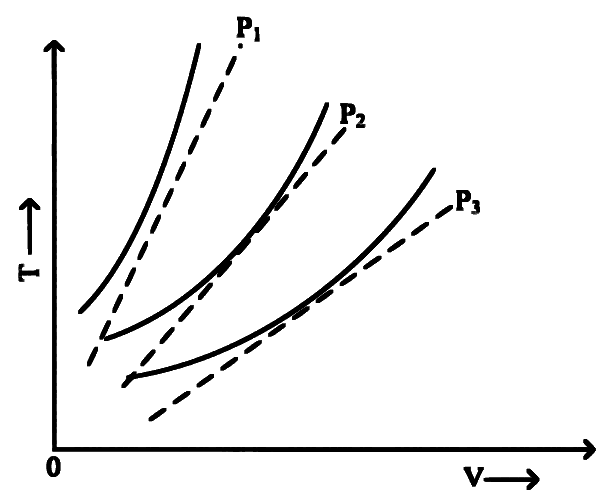
Show answer and solution

Answer: (c)

  1. T2=(1−0.4)(500)=300 KT_2 = (1 - 0.4)(500) = 300\text{ K}
  2. For η=0.5\eta = 0.5: T1′=3000.5=600 KT_1' = \frac{300}{0.5} = 600\text{ K}
  3. So the answer is (c) 600 K600\text{ K}.
Report a mistake