Gas Laws & Ideal Gas Equation · Gas laws & ideal gas equation
A gas of certain mass filled in a closed cylinder at a pressure of 3.23 kPa has temperature 50∘C. The gas is now heated to double its temperature. The modified pressure is ______ Pa.
Numerical answer type. Work it out, then open the answer.
Show answer and solution
Answer: 3730
Closed cylinder (constant V): P∝T (in kelvin).
T1=50∘C =323 K; doubled temperature 100∘C =373 K.
Gas Laws & Ideal Gas Equation · Gas laws & ideal gas equation
The gas in a vessel is subjected to a pressure of 20 atm. at 27∘ C. Now half of the gas is released from the vessel and the temperature is raised by 50∘ C. The pressure of a gas in a vessel is nearly
Gas Laws & Ideal Gas Equation · Gas laws & ideal gas equation
A vessel has 6 gram of hydrogen at pressure P and temperature 500 K. A small hole is made in it so that hydrogen leaks out. How much hydrogen leaks out if the final pressure is 2P and the temperature falls to 300 K?
Gas Laws & Ideal Gas Equation · Gas laws & ideal gas equation
When 300 J of heat given to an ideal gas with Cp=27R its temperature raises from 20∘C to 50∘C keeping its volume constant. The mass of the gas is (approximately) ______ g. (R=8.314 J/mol.K)
Numerical answer type. Work it out, then open the answer.
Show answer and solution
Answer: 481
Volume constant, so Q=nCVΔT with CV=Cp−R=25R.
ΔT=50−20=30 K.
n=25×8.314×30300=623.6300≈0.481 mol.
Expressed as asked (in units of 10−3), the answer is 481.
Gas Laws & Ideal Gas Equation · Gas laws & ideal gas equation
An insulated cylinder of volume 60 cm3 is filled with a gas at 27∘C and 2 atmospheric pressure. Then the gas is compressed making the final volume as 20 cm3 while allowing the temperature to rise to 77∘C. The final pressure is ______ atmospheric pressure.
Numerical answer type. Work it out, then open the answer.
Gas Laws & Ideal Gas Equation · Number of molecules & density
Gas at pressure P, temperature T, and volume V is filled in jar A. Another jar B is filled with gas having parameters 2P,4V,2T. The ratio of number of molecules of jar B to those of jar A is
Gas Laws & Ideal Gas Equation · Number of molecules & density
An ideal gas at pressure 'P' and temperature 'T' is enclosed in a vessel of volume 'V'. Some gas leaks through a hole from the vessel and the pressure of the enclosed gas falls to P′. Assuming that the temperature of the gas remains constant during the leakage, the number of moles of the gas that have leaked is
Show answer and solution
Answer: (b)
Moles at start n1=RTPV; after leakage n2=RTP′V (V, T same).
Gas Laws & Ideal Gas Equation · Number of molecules & density
An air bubble of volume 2.9 cm3 rises from the bottom of a swimming pool of 5 m deep. At the bottom of the pool water temperature is 17∘C. The volume of the bubble when it reaches the surface, where the water temperature is 27∘C, is cm3.
( g=10 m/s2, density of water =103 kg/m3, and 1 atm pressure is 105 Pa)
Show answer and solution
Answer: (d)
Pressure at bottom P1=P0+ρgh=105+103×10×5=1.5×10⁵ Pa; at surface P2=105 Pa.
Gas Laws & Ideal Gas Equation · Gas mixtures & connected vessels
A mixture of carbon dioxide and oxygen has volume 8310 cm3, temperature 300 K, pressure 100 kPa and mass 13.2 g. The number of moles of carbon dioxide and oxygen gases in the mixture respectively are ______.
(Assume both carbon dioxide and oxygen gases behave like ideal gases) [R = 8.31 J/mol K]
Show answer and solution
Answer: (c)
Total moles n=RTPV=8.31×300105×8.31×10−3=31≈0.333 mol.
Let x = moles of CO₂, y = moles of O₂: x+y=31 and 44x+32y=13.2.
Gas Laws & Ideal Gas Equation · Gas laws & ideal gas equation
Two closed vessels of same volume are joined through a narrow tube and both vessels are filled with air of pressure 90 kPa and temperature 400 K. Keeping the temperature of one vessel constant at 400 K the second vessel temperature is raised to 500 K. The final pressure in the vessels is ______ kPa.
Show answer and solution
Answer: (a)
Total moles are conserved and the final pressure P is common: 40090V+40090V=400PV+500PV.
Gas Laws & Ideal Gas Equation · Gas laws & ideal gas equation
A balloon is filled at 27∘C and 1 atmospheric pressure by volume 500 m3 helium gas. At −3∘C and 0.5 atmospheric pressure, the volume of helium gas will be
Show answer and solution
Answer: (c)
Gas equation: T1P1V1=T2P2V2, with T1=300 K, T2=270 K.
Gas Laws & Ideal Gas Equation · Gas laws & ideal gas equation
The helium and argon are put in the flask at the same room temperature (300 K). The ratio of average kinetic energies (per molecule) of helium and argon is:
(Give: Molar mass of helium = 4 g/mol, Molar mass of argon = 40 g/mol)
Show answer and solution
Answer: (d)
Average translational KE per molecule =23kBT, independent of molar mass.
Gas Laws & Ideal Gas Equation · Gas laws & ideal gas equation
When the pressure of the gas contained in a closed vessel is increased by 2.3%, the temperature of the gas increases by 4 K. The initial temperature of the gas is
Show answer and solution
Answer: (c)
Closed vessel: P∝T⇒PΔP=TΔT.
0.023=T4⇒T=0.0234≈174 K
No option matches exactly; with 2.5% the result is 0.0254=160 K.
Gas Laws & Ideal Gas Equation · Gas laws & ideal gas equation
An oxygen cylinder of volume 30 litre has 18.20 moles of oxygen. After some oxygen is withdrawn from the cylinder, its gauge pressure drops to 11 atmospheric pressures at temperature 27∘C. The mass of the oxygen withdrawn from the cylinder is nearly equal to:
[Given, R=12100 J mol−1 K−1, and molecular mass of O2=32,1 atm pressure =1.01×10⁵ N/m2]
Gas Laws & Ideal Gas Equation · Number of molecules & density
The pressure ' P ', volume ' V ' and temperature ' T ' of a gas in a jar ' A ' and the gas in other jar ' B ' is at pressure ' 2 P ', volume ' 4V ' and temperature ' 4T '. Then the ratio of the number of molecules in jar A and jar B will be
Gas Laws & Ideal Gas Equation · Number of molecules & density
For an ideal gas, the density of the gas is ρ0 when temperature and pressure of the gas are T0 and P0 respectively. when the temperature of the gas is 2T0, its pressure becomes 3P0. The new density will be
Gas Laws & Ideal Gas Equation · Number of molecules & density
An ideal gas at pressure ' P ' and temperature ' T ' is enclosed in a vessel of volume ' V '. Some gas leaks through a hole from the vessel and the pressure of the enclosed gas falls to ' P′ '. Assuming that the temperature of the gas remains constant during the leakage, the number of moles of the gas that have leaked is
Show answer and solution
Answer: (b)
Moles before =RTPV, after =RTP′V (same V and T).
Gas Laws & Ideal Gas Equation · Gas mixtures & connected vessels
A container has two chambers of volumes V1=2 litres and V2=3 litres separated by a partition made of a thermal insulator. The chambers contain n1=5 and n2=4 moles of ideal gas at pressures p1=1 atm and p2=2 atm, respectively. When the partition is removed, the mixture attains an equilibrium pressure of
Show answer and solution
Answer: (d)
For an ideal gas PV is proportional to internal energy, which is conserved when the partition is removed.
Gas Laws & Ideal Gas Equation · Gas mixtures & connected vessels
There are two vessels filled with an ideal gas where volume of one is double the volume of other. The large vessel contains the gas at 8 kPa at 1000 K while the smaller vessel contains the gas at 7 kPa at 500 K. If the vessels are connected to each other by a thin tube allowing the gas to flow and the temperature of both vessels is maintained at 600 K, at steady state the pressure in the vessels will be (in kPa ).
Show answer and solution
Answer: (d)
Total moles are conserved: R⋅1000P1(2V)+R⋅500P2V=R⋅600P(3V).
Gas Laws & Ideal Gas Equation · Gas laws & ideal gas equation
A gas is contained in closed vessel. The initial temperature of the gas is 100∘C. If the pressure of the gas is increased by 4%, the increase in the temperature of the gas is
Show answer and solution
Answer: (a)
Closed vessel: P∝T⇒PΔP=TΔT.
T=100∘C =373 K.
ΔT=0.04×373≈14.9∘C
This matches none of the options; key gives (a) 2∘C.
Gas Laws & Ideal Gas Equation · Gas laws & ideal gas equation
A sample of oxygen gas and a sample of hydrogen gas both have the same mass, same volume and the same pressure. The ratio of their absolute temperature is (Molecular wt. of O2&H2 is 32 and 2 respectively)
Gas Laws & Ideal Gas Equation · Gas laws & ideal gas equation
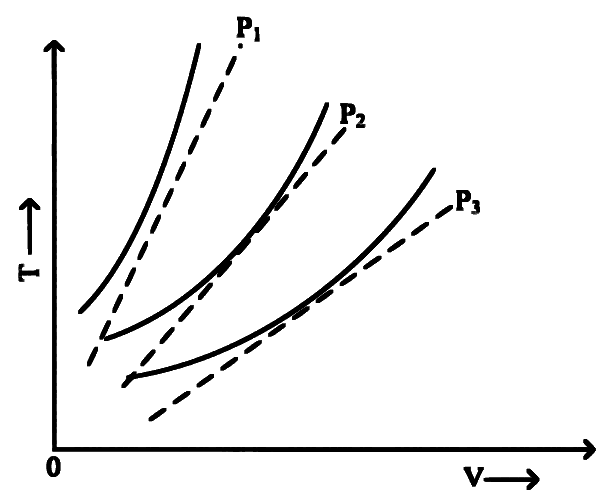
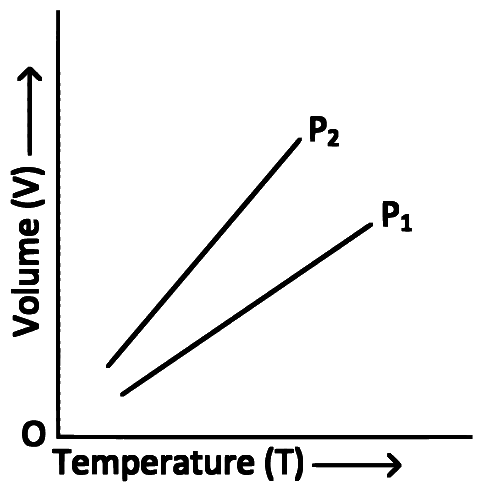
The following graph represents the T-V curves of an ideal gas (where T is the temperature and V the volume) at three pressures P1,P2 and P3 compared with those of Charles's law represented as dotted lines.
Then the correct relation is:
Show answer and solution
Answer: (d)
Charles's law: V=PnRT⇒T=(nRP)V, so slope of the T–V line ∝P.
Dotted line for P1 is steepest, then P2, then P3.
Gas Laws & Ideal Gas Equation · Gas laws & ideal gas equation
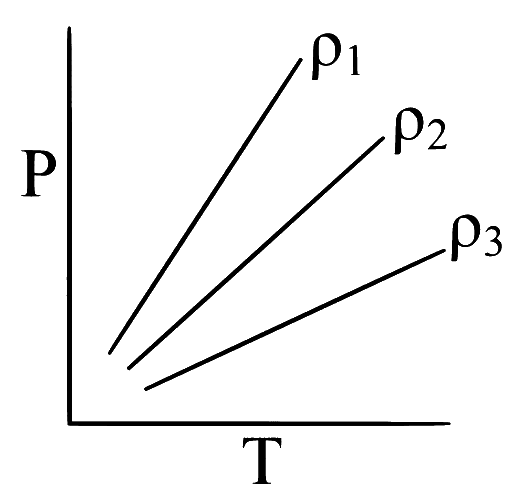
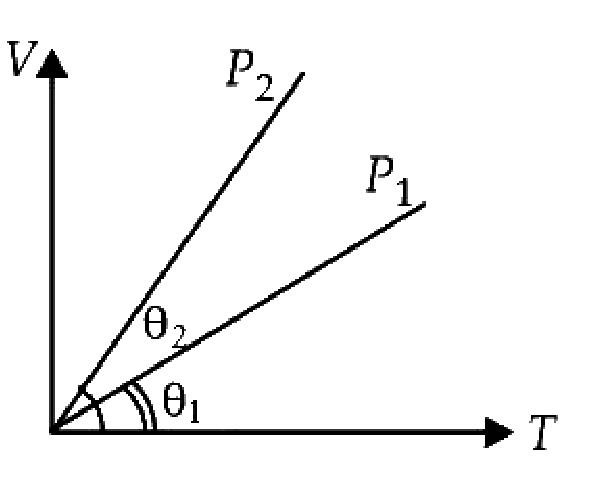
P-T diagram of an ideal gas having three different densities ρ1,ρ2,ρ3 (in three different cases) is shown in the figure. Which of the following is correct:
Show answer and solution
Answer: (a)
P=MρRT, so for a fixed density the P-T graph is a straight line of slope MρR.
Slope ∝ρ: the steepest line has the largest density.
From the figure, slope of ρ1 > slope of ρ2 > slope of ρ3, so ρ1>ρ2>ρ3.
Gas Laws & Ideal Gas Equation · Gas mixtures & connected vessels
Two vessels separately contain two ideal gases A and B at the same temperature, pressure of A being twice that of B. Under such conditions, the density of A is found to be 1.5 times the density of B. The ratio of molecular weights of A and B is
Gas Laws & Ideal Gas Equation · Gas mixtures & connected vessels
Two vessels A and B are of the same size and are at same temperature. A contains 1 g of hydrogen and B contains 1 g of oxygen. PA and PB are the pressures of the gases in A and B respectively, then PBPA is:
Gas Laws & Ideal Gas Equation · Gas laws & ideal gas equation
A bicycle tyre is filled with air having pressure of 270 kPa at 27∘C. The approximate pressure of the air in the tyre when the temperature increases to 36∘C is
Gas Laws & Ideal Gas Equation · Gas laws & ideal gas equation
A sample of oxygen gas and a sample of hydrogen gas both have the same mass, same volume and the same pressure. The ratio of their absolute temperature is
Gas Laws & Ideal Gas Equation · Gas laws & ideal gas equation
A container of volume 200 cm3 contains 0.2 mole of hydrogen gas and 0.3 mole of argon gas. The pressure of the system at temperature 200 K (R=8.3 J K−1 mol−1) will be :-
Show answer and solution
Answer: (d)
Dalton's law: total moles n=0.2+0.3=0.5; V=200 cm3=2×10⁻⁴ m3.
Gas Laws & Ideal Gas Equation · Gas laws & ideal gas equation
The pressure (P) and temperature (T) relationship of an ideal gas obeys the equation PT2= constant. The volume expansion coefficient of the gas will be:
Gas Laws & Ideal Gas Equation · Number of molecules & density
For an ideal gas the density of the gas is ρ0 when temperature and pressure of the gas are T0 and P0 respectively. When the temperature of the gas is 2T0, its pressure will be 3P0. The new density will be
Gas Laws & Ideal Gas Equation · Number of molecules & density
We have a jar filled with gas characterized by parameters P,V,T and another jar B filled with gas having parameters 2P,4V,2T, where symbols have their usual meaning. The ratio of number of molecules in jar A to those in jar B is
Gas Laws & Ideal Gas Equation · Number of molecules & density
A jar 'P' is filled with gas having pressure, volume and temperature P,V,T respectively. Another gas jar Q filled with a gas having pressure 2P, volume 4V and temperature 2T. The ratio of the number of molecules in jar P to those in jar Q is
Gas Laws & Ideal Gas Equation · Gas laws & ideal gas equation
When a gas filled in a closed vessel is heated by raising the temperature by 1∘C, its pressure increases by 0.4%. The initial temperature of the gas is ___________ K.
Numerical answer type. Work it out, then open the answer.
Gas Laws & Ideal Gas Equation · Gas laws & ideal gas equation
A cylinder of fixed capacity of 44.8 litres contains helium gas at standard temperature and pressure. The amount of heat needed to raise the temperature of gas in the cylinder by 20.0∘C will be: (Given gas constant R = 8.3 JK−1-mol−1)
Gas Laws & Ideal Gas Equation · Gas mixtures & connected vessels
A mixture of hydrogen and oxygen has volume 2000 cm3, temperature 300 K, pressure 100 kPa and mass 0.76 g. The ratio of number of moles of hydrogen to number of moles of oxygen in the mixture will be:
[Take gas constant R = 8.3 JK−1mol−1]
Show answer and solution
Answer: (b)
Total moles n=RTPV=8.3×300105×2×10−3=0.0803 mol.
Let x = moles of H₂, y = moles of O₂: x+y=0.0803, 2x+32y=0.76.
Gas Laws & Ideal Gas Equation · Gas laws & ideal gas equation
A balloon carries a total load of 185 kg at normal pressure and temperature of 27∘C. What load will the balloon carry on rising to a height at which the barometric pressure is 45 cm of Hg and the temperature is −7∘C. Assuming the volume constant?
Show answer and solution
Answer: (d)
At constant volume the load the balloon can carry is proportional to the air density, ρ∝TP.
Gas Laws & Ideal Gas Equation · Gas mixtures & connected vessels
A mixture of hydrogen and oxygen has volume 500 cm3, temperature 300 K, pressure 400 kPa and mass 0.76 g. The ratio of masses of oxygen to hydrogen will be :-
Show answer and solution
Answer: (c)
Total moles n=RTPV=8.31×3004×105×5×10−4≈0.080 mol.
x+y=0.080 and 2x+32y=0.76 give x≈0.06 mol H₂, y≈0.02 mol O₂.
Masses: H₂ =0.12 g, O₂ =0.64 g; ratio =0.120.64=316.
Gas Laws & Ideal Gas Equation · Gas mixtures & connected vessels
A cylindrical container of volume 4.0 × 10⁻³ m3 contains one mole of hydrogen and two moles of carbon dioxide. Assume the temperature of the mixture is 400 K. The pressure of the mixture of gases is:
[Take gas constant as 8.3 J mol−1 K−1]
Show answer and solution
Answer: (c)
Total moles n=1+2=3 (Dalton's law: pressures add).
Gas Laws & Ideal Gas Equation · Gas mixtures & connected vessels
A container is divided into two chambers by a partition. The volume of first chamber is 4.5 litre and second chamber is 5.5 litre. The first chamber contain 3.0 moles of gas at pressure 2.0 atm and second chamber contain 4.0 moles of gas at pressure 3.0 atm. After the partition is removed and the mixture attains equilibrium, then, the common equilibrium pressure existing in the mixture is x × 10−1 atm. Value of x is ________.
Numerical answer type. Work it out, then open the answer.
Show answer and solution
Answer: 25
Internal energy (and so PV total) is conserved on mixing: P(V1+V2)=P1V1+P2V2.
Gas Laws & Ideal Gas Equation · Gas laws & ideal gas equation
For an ideal gas the instantaneous change in pressure 'p' with volume 'v' is given by the equation dvdp=−ap. If p = p0 at v =0 is the given boundary condition, then the maximum temperature one mole of gas can attain is: (Here R is the gas constant)
Gas Laws & Ideal Gas Equation · Gas laws & ideal gas equation
The change in the magnitude of the volume of an ideal gas when a small additional pressure ΔP is applied at a constant temperature, is the same as the change when the temperature is reduced by a small quantity ΔT at constant pressure. The initial temperature and pressure of the gas were 300 K and 2 atm. respectively.
If |ΔT| = C|ΔP| then value of C in (K/atm.) is _________.
Numerical answer type. Work it out, then open the answer.
Gas Laws & Ideal Gas Equation · Gas laws & ideal gas equation
A cylinder with fixed capacity of 67.2 lit contains helium gas at STP. The amount of heat needed to raise the temperature of the gas by 20°C is: [Given that R = 8.31 J mol–1 K–1]
Gas Laws & Ideal Gas Equation · Number of molecules & density
The temperature of an open room of volume 30 m3 increases from 17oC to 27oC due to the sunshine. The atmospheric pressure in the room remains 1 × 10⁵ Pa. If Ni and Nf are the number of molecules in the room before and after heating, then Nf – Ni will be:
Gas Laws & Ideal Gas Equation · Number of molecules & density
A given sample of an ideal gas occupies a volume V at a pressure P and absolute temperature T. The mass of each molecule of the gas is m. Which of the following gives the density of the gas?
Show answer and solution
Answer: (b)
P=nkBT, where n = number of molecules per unit volume, so n=kTP.
Gas Laws & Ideal Gas Equation · Gas mixtures & connected vessels
Two vessels separately contain two ideal gases A and B at the same temperature, the pressure of A being twice that of B. Under such conditions, the density of A is found to be 1.5 times the density of B. The ratio of molecular weight of A and B is
Gas Laws & Ideal Gas Equation · Number of molecules & density
Modern vacuum pumps can evacuate a vessel down to a pressure of 4.0 × 10⁻¹⁵ atm. at room temperature (300 K). Taking R = 8.3 JK−1 mole−1, 1 atm = 105 Pa and NAvogadro = 6 × 10²³ mole−1, the mean distance between molecules of gas in an evacuated vessel will be of the order of:
Gas Laws & Ideal Gas Equation · Gas laws & ideal gas equation
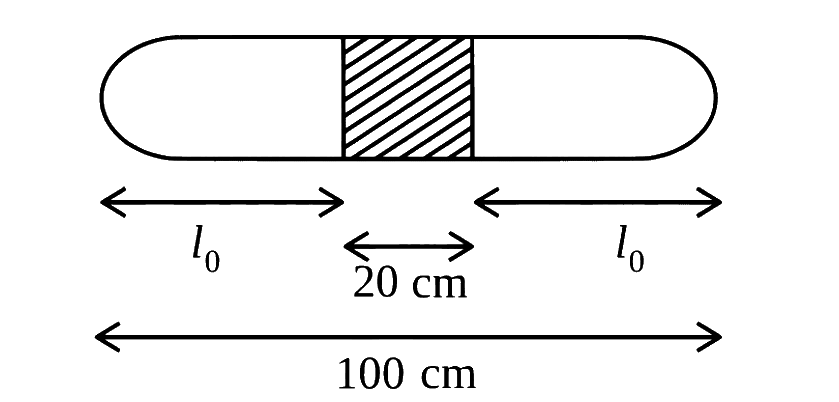
A thin tube sealed at both ends is 100 cm long. It lies horizontally, the middle 20 cm containing mercury and two equal ends containing air at standard atmospheric pressure. If the tube is now turned to a vertical position, by what amount will the mercury be displaced?
(Given: cross-section of the tube can be assumed to be uniform)
Show answer and solution
Answer: (b)
Each air column is 40 cm long at 76 cm of Hg. When vertical, mercury moves down by x: upper column 40+x, lower column 40−x.
Boyle's law: Pup=40+x76×40, Plow=40−x76×40.
Equilibrium of mercury: Plow=Pup+20⇒3040(40−x1−40+x1)=20
Gas Laws & Ideal Gas Equation · Gas mixtures & connected vessels
An insulated container of gas has two chambers separated by an insulating partition. One of the chambers has volume V1 and contains ideal gas at pressure P1 and temperature T1. The other chamber has volume V2 and contains ideal gas at pressure P2 and temperature T2. If the partition is removed without doing any work on the gas, the final equilibrium temperature of the gas in the container will be
Show answer and solution
Answer: (a)
Insulated and no work, so total internal energy is conserved: n1CvT1+n2CvT2=(n1+n2)CvT.
Gas Laws & Ideal Gas Equation · Gas mixtures & connected vessels
Two thermally insulated vessels 1 and 2 are filled with air at temperatures (T1,T2), volume (V1,V2) and pressure (P1,P2) respectively. If the valve joining the two vessels is opened, the temperature inside the vessel at equilibrium will be
Show answer and solution
Answer: (a)
Vessels are insulated, so internal energy is conserved: (n1+n2)CvT=n1CvT1+n2CvT2.
With n=RTPV: T=P1V1/T1+P2V2/T2P1V1+P2V2.
Gas Laws & Ideal Gas Equation · Gas mixtures & connected vessels
Two containers A and B are partly filled with water and closed. The volume of A is twice that of B and it contains half the amount of water in B. If both are at the same temperature, the water vapour in the containers will have pressure in the ratio of
Show answer and solution
Answer: (b)
Saturated vapour pressure depends only on temperature, not on the volume of the container or the amount of water.
Both are at the same temperature, so the vapour pressures are equal.
Degrees of Freedom & Internal Energy · Internal energy of gases & mixtures
If 2 mole of an ideal monoatomic gas at temperature T, is mixed with 6 mole of another ideal monoatomic gas at temperature 2T then the temperature of mixture is:
Show answer and solution
Answer: (d)
No energy lost and both gases monoatomic: (n1+n2)Tmix=n1T1+n2T2.
Degrees of Freedom & Internal Energy · Internal energy of gases & mixtures
One gas of n1 mole of molecules at temperature T1, volume V1, and pressure P1, and another gas of n2 mole of molecules at temperature T2, volume V2, and pressure P2, are mixed resulting in pressure P and volume V of the mixture. The temperature of the mixture is ______.
Show answer and solution
Answer: (b)
Total moles are conserved: n=n1+n2, with n=RTPV.
Degrees of Freedom & Internal Energy · Moving container stopped suddenly
A rigid diatomic gas having molar mass m is contained in an insulated container. The container is moving with velocity V. If it is stopped suddenly, the change in temperature is (R - gas constant)
Show answer and solution
Answer: (c)
Insulated container: the bulk KE of the gas becomes internal energy, 21(nm)V2=nCvΔT.
Degrees of Freedom & Internal Energy · Moving container stopped suddenly
An insulated container contains a monoatomic gas of molar mass 'm'. The container is moving with velocity 'V'. If it is stopped suddenly, the change in temperature of the gas is (R-gas constant)
Show answer and solution
Answer: (c)
KE lost per mole goes into internal energy: 21mv2=CvΔT.
Degrees of Freedom & Internal Energy · Internal energy of gases & mixtures
500 gram of a diatomic gas is enclosed at a pressure of 105 N m−2. The density of the gas is 5 kg m−3. The energy of one mole of the gas due to its thermal motion is [consider the gas molecule as a rigid rotator]
Degrees of Freedom & Internal Energy · Internal energy of gases & mixtures
A gas mixture consists of 8 moles of argon and 6 moles of oxygen at temperature T. Neglecting all vibrational modes, the total internal energy of the system is:
Degrees of Freedom & Internal Energy · Moving container stopped suddenly
An insulated container contains a diatomic gas of molar mass ' m '. The container is moving with velocity ' V ', if it is stopped suddenly, the change in temperature is ( R= gas constant)
Degrees of Freedom & Internal Energy · Moving container stopped suddenly
An insulated container contains a monoatomic gas of molar mass ' m '. The container is moving with velocity ' V '. If it is stopped suddenly, the change in temperature is ( R= gas constant)
Degrees of Freedom & Internal Energy · Degrees of freedom
Three vessels of equal volume contain gases at the same temperature and pressure. The first vessel contains neon (monoatomic), the second contains chlorine (diatomic) and third contains uranium hexafluoride (polyatomic). Arrange these on the basis of their root mean square speed (vrms) and choose the correct answer from the options given below:
Show answer and solution
Answer: (b)
vrms=M3RT∝M1 at the same T.
M: Ne =20, Cl2=71, UF6=352 g/mol.
So vrms(mono) >vrms(dia) >vrms(poly): answer (b).
Degrees of Freedom & Internal Energy · Internal energy of gases & mixtures
A gas mixture consists of 2 moles of oxygen and 4 moles of neon at temperature T. Neglecting all vibrational modes, the total internal energy of the system will be,
Degrees of Freedom & Internal Energy · Moving container stopped suddenly
An insulated container contains a monoatomic gas of molar mass 'm'. The container is moving with velocity 'V'. If it is stopped suddenly, the change in temperature of a gas is [R is gas constant]
Degrees of Freedom & Internal Energy · Degrees of freedom
Three vessels of equal capacity have gases at the same temperature and pressure. The first vessel contains helium (monoatomic), the second contains fluorine (diatomic) and the third contains sulfur hexafluoride (polyatomic). The correct statement, among the following is:
Show answer and solution
Answer: (d)
Same P, V, T means the same number of molecules in each vessel (Avogadro), so (b) is wrong.
vrms=M3RT, so at the same T the lightest gas is fastest.
Helium (M=4) is the lightest, SF6 the heaviest.
So the answer is (d) helium has the largest vrms.
Degrees of Freedom & Internal Energy · Moving container stopped suddenly
A thermally insulated vessel contains an ideal gas of molecular mass M and ratio of specific heats 1.4. Vessel is moving with speed v and is suddenly brought to rest. Assuming no heat is lost to the surrounding and vessel, temperature of the gas increases by:
Degrees of Freedom & Internal Energy · Internal energy of gases & mixtures
Internal energy of n1 moles of hydrogen at temperature 'T' is equal to internal energy of 'n2' moles of helium at temperature 2T, then the ratio n1:n2 is
[Degree of freedom of He=3, Degree of freedom of H2=5]
Degrees of Freedom & Internal Energy · Internal energy of gases & mixtures
Two ideal polyatomic gases at temperatures T1 and T2 are mixed so that there is no loss of energy. If F1 and F2, m1 and m2, n1 and n2 be the degrees of freedom, masses, number of molecules of the first and second gas respectively, the temperature of mixture of these two gases is:
Show answer and solution
Answer: (b)
Energy conserved: n12F1kT1+n22F2kT2=(n12F1+n22F2)kT.
Degrees of Freedom & Internal Energy · Internal energy of gases & mixtures
The volume V of an enclosure contains a mixture of three gases, 16 g of oxygen, 28 g of nitrogen and 44 g of carbon dioxide at absolute temperature T. Consider R as universal gas constant. The pressure of the mixture of gases is:
Show answer and solution
Answer: (d)
Moles: O2=3216=0.5, N2=2828=1, CO2=4444=1; total n=2.5.
Degrees of Freedom & Internal Energy · Moving container stopped suddenly
A monoatomic gas of mass 4.0 u is kept in an insulated container. Container is moving with velocity 30 m/s. If container is suddenly stopped then change in temperature of the gas (R = gas constant) is 3Rx. Value of x is ___________.
Numerical answer type. Work it out, then open the answer.
Show answer and solution
Answer: 3600
Per mole: 21Mv2=23RΔT⇒ΔT=3RMv2.
Mv2=4×302=3600 (taking M=4 as in the official answer).
Degrees of Freedom & Internal Energy · Internal energy of gases & mixtures
Molecules of an ideal gas are known to have three translational degrees of freedom and two rotational degrees of freedom.The gas is maintained at a temperature of T. The total internal energy, U of a mole of this gas, and the value of
Degrees of Freedom & Internal Energy · Internal energy of gases & mixtures
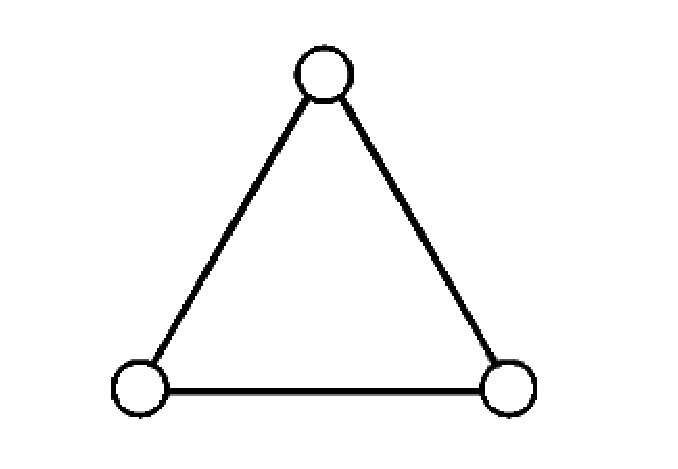
Consider a gas of triatomic molecules. The molecules are assumed to be triangular and made of massless rigid rods whose vertices are occupied by atoms. The internal energy of a mole of the gas at temperature T is:
Show answer and solution
Answer: (d)
A rigid triangular (non-linear) molecule: 3 translational + 3 rotational, no vibration, so f=6.
Degrees of Freedom & Internal Energy · Internal energy of gases & mixtures
A gas mixture consists of 3 moles of oxygen and 5 moles of argon at temperature T. Assuming the gases to be ideal and the oxygen bond to be rigid, the total internal energy (in units of RT) of the mixture is:
Degrees of Freedom & Internal Energy · Internal energy of gases & mixtures
A closed vessel contains 0.1 mole of a monoatomic ideal gas at 200 K. If 0.05 mole of the same gas at 400 K is added to it, the final equilibrium temperature (in K) of the gas in the vessel will be close to _______.
Numerical answer type. Work it out, then open the answer.
Show answer and solution
Answer: 266
Same monoatomic gas, closed vessel, no energy lost: (n1+n2)T=n1T1+n2T2.
Degrees of Freedom & Internal Energy · Internal energy of gases & mixtures
Initially a gas of diatomic molecules is contained in a cylinder of volume V1 at a pressure P1 and temperature 250 K. Assuming that 25% of the molecules get dissociated causing a change in number of moles. The pressure of the resulting gas at temperature 2000 K, when contained in a volume 2V1 is given by P2. The ratio P1P2 is ________.
Numerical answer type. Work it out, then open the answer.
Show answer and solution
Answer: 5
25% dissociate: moles become 0.75n+2(0.25n)=1.25n.
Degrees of Freedom & Internal Energy · Internal energy of gases & mixtures
A gas mixture consists of 3 moles of oxygen and 5 moles of argon at temperature T. considering only translational and rotational modes, the total internal energy of the system is:
Degrees of Freedom & Internal Energy · Internal energy of gases & mixtures
Two kg of a monoatomic gas is at a pressure of 4 × 10⁴ N/m2. The density of the gas is 8 kg/m3. What is the order of energy of the gas due to its thermal motion?
Degrees of Freedom & Internal Energy · Internal energy of gases & mixtures
A gas mixture consists of 2 moles of O2 and 4 moles of Ar at temperature T. Neglecting all vibrational modes, the total internal energy of the system is
Degrees of Freedom & Internal Energy · Internal energy of gases & mixtures
N moles of a diatomic gas in a cylinder are at a temperature T. Heat is supplied to the cylinder such that the temperature remains constant but n moles of the diatomic gas get converted into monoatomic gas. What is the change in the total kinetic energy of the gas?
Show answer and solution
Answer: (a)
Temperature is constant. Each mole of diatomic gas splits into 2 moles of monoatomic gas.
Degrees of Freedom & Internal Energy · Internal energy of gases & mixtures
This question has Statement-1 and Statement-2. Of the four choices given after the Statements, choose the one that best describes the two Statements.
Statement 1: The internal energy of a perfect gas is entirely kinetic and depends only on absolute temperature of the gas and not on its pressure or volume.
Statement 2: A perfect gas is heated keeping pressure constant and later at constant volume. For the same amount of heat the temperature of the gas at constant pressure is lower than that at constant volume.
Show answer and solution
Answer: (c)
Statement 1: a perfect gas has no intermolecular forces, so U is only kinetic and depends only on T. True.
Statement 2: at constant P part of the heat does work PΔV, so ΔT=nCpQ<nCvQ. True.
Statement 2 is about Cp>Cv, not about why U depends only on T, so it does not explain Statement 1.
Degrees of Freedom & Internal Energy · Internal energy of gases & mixtures
Three perfect gases at absolute temperatures T1,T2 and T3 are mixed. The masses of molecules are m1,m2 and m3 and the number of molecules are n1,n2 and n3 respectively. Assuming no loss of energy, the final temperature of the mixture is:
Show answer and solution
Answer: (a)
No energy lost; for the same type of gas, energy per molecule ∝T: ∑ni2fkTi=(∑ni)2fkT.
Molecular masses do not matter; only the number of molecules.
Degrees of Freedom & Internal Energy · Moving container stopped suddenly
A thermally insulated vessel contains an ideal gas of molecular mass M and ratio of specific heats γ. It is moving with speed v and it's suddenly brought to rest. Assuming no heat is lost to the surroundings, Its temperature increases by:
Degrees of Freedom & Internal Energy · Internal energy of gases & mixtures
Two rigid boxes containing different ideal gases are placed on a table. Box A contains one mole of nitrogen at temperature T0, while Box contains one mole of helium at temperature (37)T0. The boxes are then put into thermal contact with each other, and heat flows between them until the gases reach a common final temperature (ignore the heat capacity of boxes). Then, the final temperature of the gases, Tf in terms of T0 is
Show answer and solution
Answer: (c)
Heat lost by He = heat gained by N2 (rigid boxes, so constant volume).
Degrees of Freedom & Internal Energy · Internal energy of gases & mixtures
Three containers of the same volume contain three different gases. The masses of the molecules are m1,m2 and m3 and the number of molecules in their respective containers are N1,N2 and N3. The gas pressure in the containers are P1,P2 and P3 respectively. All the gases are now mixed and put in one of these containers. The pressure P of the mixture will be
Show answer and solution
Answer: (c)
At the same temperature and volume, each gas exerts its own pressure in the mixture (Dalton's law).
Specific Heats of Gases - Cp, Cv, γ & Mayer's Relation · γ, Cv & degrees of freedom
For a gas, CvR=0.4 where R is the universal gas constant and Cv is the molar specific heat at constant volume. The gas is made up of molecules which are
Specific Heats of Gases - Cp, Cv, γ & Mayer's Relation · Cp − Cv: Mayer's relation
The difference between two molar specific heats of a gas is 7000 J-kg−1-K −1. If the ratio of two specific heats of gas is 7/5, the molar specific heat of the gas at constant pressure in J-kg −1-K −1 is
Specific Heats of Gases - Cp, Cv, γ & Mayer's Relation · γ, Cv & degrees of freedom
Let γ1 be the ratio of molar specific heat at constant pressure and molar specific heat at constant volume of a mono-atomic gas and γ2 be the similar ratio of diatomic gas. Considering the diatomic gas molecule as a rigid rotator, the ratio, γ1/γ2 is
Specific Heats of Gases - Cp, Cv, γ & Mayer's Relation · γ, Cv & degrees of freedom
An ideal gas is made of polyatomic molecules. Each of the molecules has three translational, three rotational and f number of vibrational modes. If the ratio of heat capacities CP/CV of the gas is 8/7, then the value of f is:
Show answer and solution
Answer: (b)
Translation + rotation: 6×21R=3R; each vibrational mode adds R.
Specific Heats of Gases - Cp, Cv, γ & Mayer's Relation · γ, Cv & degrees of freedom
The molar specific heat of an ideal gas at constant pressure and constant volume is ' Cp ' and ' Cv ' respectively. If ' R ' is a universal gas constant and the ratio of ' Cp ' to ' Cv ' is γ, then ' Cp ' is equal to
Specific Heats of Gases - Cp, Cv, γ & Mayer's Relation · γ, Cv & degrees of freedom
For a diatomic gas, if γ1=(CvCp) for rigid molecules and γ2=(CvCp) for another diatomic molecules, but also having vibrational modes. Then, which one of the following options is correct? (Cp and Cv are specific heats of the gas at constant pressure and volume)
Show answer and solution
Answer: (a)
γ=1+CVR.
Vibrational modes increase CV, so γ decreases.
Rigid: γ1=1.4; with vibration, e.g. γ2=79≈1.29.
Specific Heats of Gases - Cp, Cv, γ & Mayer's Relation · γ, Cv & degrees of freedom
γA is the specific heat ratio of monoatomic gas A having 3 translational degrees of freedom. γB is the specific heat ratio of polyatomic gas B having 3 translational, 3 rotational degrees of freedom and 1 vibrational mode. If γBγA=(1+n1), then the value of n is ________.
Numerical answer type. Work it out, then open the answer.
Specific Heats of Gases - Cp, Cv, γ & Mayer's Relation · γ, Cv & degrees of freedom
For a gas, CvR=0.4 where R is the universal gas constant and ' CV ' is molar specific heat at constant volume. The gas is made up of molecules which are
Specific Heats of Gases - Cp, Cv, γ & Mayer's Relation · γ, Cv & degrees of freedom
If Cp and Cv are molar specific heats of an ideal gas at constant pressure and volume respectively and ' γ ' is Cp/Cv then Cp= ( R= universal gas constant)
Specific Heats of Gases - Cp, Cv, γ & Mayer's Relation · γ, Cv & degrees of freedom
According to the law of equipartition of energy the molar specific heat of a diatomic gas at constant volume where the molecule has one additional vibrational mode is
Show answer and solution
Answer: (d)
Diatomic: 3 translational + 2 rotational give 25R.
Specific Heats of Gases - Cp, Cv, γ & Mayer's Relation · γ, Cv & degrees of freedom
According to the law of equipartition of energy, the number of vibrational modes of a polyatomic gas of constant γ=CvCp is (CP and CV are the specific heat capacities of the gas at constant pressure and constant volume, respectively):
Specific Heats of Gases - Cp, Cv, γ & Mayer's Relation · Specific heat of gas mixtures
A mixture of one mole of monoatomic gas and one mole of a diatomic gas (rigid) are kept at room temperature (27∘C). The ratio of specific heat of gases at constant volume respectively is:
Specific Heats of Gases - Cp, Cv, γ & Mayer's Relation · Cp − Cv: Mayer's relation
The specific heat of argon at constant pressure and constant volume are Cp and Cv respectively. It's density ' ρ ' at N.T.P. will be [P and T are pressure and temperature respectively at N.T.P.]
Show answer and solution
Answer: (a)
Ideal gas: ρ=RTPM.
Specific heats per unit mass: Cp−Cv=MR⇒RM=Cp−Cv1
Specific Heats of Gases - Cp, Cv, γ & Mayer's Relation · Specific heat of gas mixtures
Four moles of hydrogen, two moles of helium and one mole of water vapour form an ideal gas mixture. [Cv for hydrogen =25R,Cv for helium =23R,Cv for water vapour =3R] What is the molar specific heat at constant pressure of the mixture?
Specific Heats of Gases - Cp, Cv, γ & Mayer's Relation · γ, Cv & degrees of freedom
The molar specific heat of an ideal gas at constant pressure and constant volume is Cp and Cv respectively. If R is universal gas constant and γ=CvCp then Cv=
Specific Heats of Gases - Cp, Cv, γ & Mayer's Relation · γ, Cv & degrees of freedom
Let γ1 be the ratio of molar specific heat at constant pressure and molar specific heat at constant volume of a monoatomic gas and γ2 be the similar ratio of diatomic gas. Considering the diatomic gas molecule as a rigid rotator, the ratio γ1γ2 is
Specific Heats of Gases - Cp, Cv, γ & Mayer's Relation · γ, Cv & degrees of freedom
According to law of equipartition of energy the molar specific heat of a diatomic gas at constant volume where the molecule has one additional vibrational mode is :-
Show answer and solution
Answer: (d)
Diatomic: 3 translational + 2 rotational give 25R.
Specific Heats of Gases - Cp, Cv, γ & Mayer's Relation · γ, Cv & degrees of freedom
Let γ1 be the ratio of molar specific heat at constant pressure and molar specific heat at constant volume of a monoatomic gas and γ2 be the similar ratio of diatomic gas. Considering the diatomic gas molecule as a rigid rotator, the ratio, γ2γ1 is:
Specific Heats of Gases - Cp, Cv, γ & Mayer's Relation · Specific heat of gas mixtures
One mole of a monoatomic gas is mixed with three moles of a diatomic gas. The molecular specific heat of mixture at constant volume is 4α2R J/mol K; then the value of α will be _________. (Assume that the given diatomic gas has no vibrational mode).
Numerical answer type. Work it out, then open the answer.
Specific Heats of Gases - Cp, Cv, γ & Mayer's Relation · Cp − Cv: Mayer's relation
The amount of heat needed to raise the temperature of 4 moles of rigid diatomic gas from 0∘ C to 50∘ C when no work is done is ___________. (R is the universal gas constant).
Specific Heats of Gases - Cp, Cv, γ & Mayer's Relation · γ, Cv & degrees of freedom
The molar specific heats of an ideal gas at constant pressure and volume are denoted by 'Cp' and 'Cv' respectively. If γ=CvCp and 'R' is universal gas constant, then Cv is equal to
Specific Heats of Gases - Cp, Cv, γ & Mayer's Relation · γ, Cv & degrees of freedom
Specific heats of an ideal gas at constant pressure and volume are denoted by Cp and Cv respectively. If γ=CvCp and R it's the universal gas constant then Cv is equal to
Specific Heats of Gases - Cp, Cv, γ & Mayer's Relation · γ, Cv & degrees of freedom
For a gas CP − CV = R in a state P and CP − CV = 1.10 R in a state Q, TP and TQ are the temperatures in two different states P and Q respectively. Then
Show answer and solution
Answer: (d)
CP−CV=R holds exactly only for an ideal gas.
A real gas behaves most ideally at high temperature (and low pressure).
In state P the gas follows CP−CV=R (ideal), in Q it deviates (1.10 R), so Q is at lower temperature.
Specific Heats of Gases - Cp, Cv, γ & Mayer's Relation · γ, Cv & degrees of freedom
If one mole of the polyatomic gas is having two vibrational modes and β is the ratio of molar specific heats for polyatomic gas (β=CVCP) then the value of β is:
Show answer and solution
Answer: (c)
Polyatomic: translation + rotation give 3R; each vibrational mode adds R.
Specific Heats of Gases - Cp, Cv, γ & Mayer's Relation · γ, Cv & degrees of freedom
For a gas, CVR=0.4, where R is universal gas constant and CV is the molar specific heat at constant volume. The gas is made up of molecules, which are
Specific Heats of Gases - Cp, Cv, γ & Mayer's Relation · γ, Cv & degrees of freedom
Consider two ideal diatomic gases A and B at some temperature T. Molecules of the gas A are rigid, and have a mass m. Molecules of the gas B have an additional vibrational mode, and have a mass 4m. The ratio of the specific heats (CVA and CVB) of gas A and B, respectively is:
Show answer and solution
Answer: (b)
Molar CV depends only on degrees of freedom, not on molecular mass.
Specific Heats of Gases - Cp, Cv, γ & Mayer's Relation · γ, Cv & degrees of freedom
If ' CP ' and ' CV ' are molar specific heats of an ideal gas at constant pressure and volume respectively. If ' γ ' is the ratio of two specific heats and ' R ' is universal gas constant then ' Cp ' is equal to
Specific Heats of Gases - Cp, Cv, γ & Mayer's Relation · γ, Cv & degrees of freedom
The value of γ(=CvCp), for hydrogen, helium and another ideal diatomic gas X (whose molecules are not rigid but have an additional vibrational mode), are respectively equal to,
Show answer and solution
Answer: (b)
Hydrogen (rigid diatomic): CV=25R, γ=57.
Helium (monoatomic): γ=35.
Gas X (one vibrational mode): CV=27R, CP=29R, γ=79.
Specific Heats of Gases - Cp, Cv, γ & Mayer's Relation · γ, Cv & degrees of freedom
The specific heats, CP and CV of a gas of diatomic molecules, A, are given (in units of J mol–1 K–1) by 29 and 22, respectively. Another gas of diatomic molecules, B, has the corresponding values 30 and 21. If they are treated as ideal gases, then :-
Show answer and solution
Answer: (b)
Rigid diatomic: CV=25R≈20.8 J/mol K; a vibrational mode raises it towards 27R≈29.
Gas A: CV=22>20.8, so extra energy goes into vibration: A has a vibrational mode.
Gas B: CV=21≈25R, so B is rigid.
So the answer is (b) A has a vibrational mode but B has none.
Specific Heats of Gases - Cp, Cv, γ & Mayer's Relation · Specific heat of gas mixtures
Two moles of helium gas is mixed with three moles of hydrogen molecules (taken to be rigid). What is the molar specific heat of mixture at constant volume? (R = 8.3 J/mol K)
Specific Heats of Gases - Cp, Cv, γ & Mayer's Relation · γ, Cv & degrees of freedom
Using equipartition of energy, the specific heat (in J kg−1 K−1) of aluminium at room temperature can be estimated to be (atomic weight of aluminium = 27)
Show answer and solution
Answer: (c)
Solid: each atom has 3 vibrational modes, each with energy kBT, so U=3RT per mole and C=3R (Dulong–Petit).
Specific Heats of Gases - Cp, Cv, γ & Mayer's Relation · Specific heat of gas mixtures
One mole of ideal monatomic gas (γ=5/3) is mixed with one mole of diatomic gas (γ=7/5). What is γ for the mixture? γ Denotes the ratio of specific heat at constant pressure, to that at constant volume
An electric heater supplies heat to a system at a rate of 100 W. If the system performs work at a rate of 75 J/s, then the rate at which internal energy increases will be:
Given below are two statements: one is labelled as Assertion A and the other is labelled as Reason R
Statement I: Change in internal energy of a system containing n mole of ideal gas can be written as ΔU=nCv(Tf−Ti)=γ−1nR(Tf−Ti), where γ=CvCp,Ti= initial temperature, Tf= final temperature. Statement II: Relation between degree of freedom f and γ(=Cp/Cv) is (γ=1+f2) Choose the correct answer from the options given below
Show answer and solution
Answer: (b)
Statement I: ΔU=nCvΔT for any process of an ideal gas, and Cv=γ−1R (from Cp−Cv=R). So I is true.
Statement II: Cv=2fR, Cp=(2f+1)R⇒γ=1+f2. So II is true.
Statement I follows from Cp−Cv=R, not from the degrees-of-freedom relation, so R does not explain A.
One gram of a liquid is converted to vapour at 3×10⁵ Pa pressure. If 10% of the heat supplied is used for increasing the volume by 1600 cm3 during this phase change, then the increase in internal energy in the process will be
Show answer and solution
Answer: (c)
Work done in expansion: W=PΔV=3×105×1600×10−6=480 J
If heat energy ΔQ is supplied to an ideal diatomic gas, the increase in internal energy is ΔU and the amount of work done by the gas is ΔW. The ratio ΔW:ΔU:ΔQ is
Show answer and solution
Answer: (b)
Heat is supplied at constant pressure: ΔQ=nCpΔT=27nRΔT for a diatomic gas.
A source supplies heat to a system at the rate of 1000 W. If the system performs work at a rate of 200 W. The rate at which internal energy of the system increases is
Given below are two statements: One is labelled as Assertion A and the other is labelled as Reason R.
Assertion A: If dQ and dW represent the heat supplied to the system and the work done on the system respectively. Then according to the first law of thermodynamics dQ=dU−dW. Reason R: First law of thermodynamics is based on law of conservation of energy. In the light of the above statements, choose the correct answer from the options given below:
Show answer and solution
Answer: (b)
First law: dQ=dU+dWby. Work done on the system dW=−dWby, so dQ=dU−dW. A is correct.
The first law is a statement of conservation of energy, so R is correct and explains A.
1 kg of water at 100∘C is converted into steam at 100∘C by boiling at atmospheric pressure. The volume of water changes from 1.00×10⁻³ m3 as a liquid to 1.671 m3 as steam. The change in internal energy of the system during the process will be
1 g of a liquid is converted to vapour at 3 × 10⁵ Pa pressure. If 10% of the heat supplied is used for increasing the volume by 1600 cm3 during this phase change, then the increase in internal energy in the process will be:
Show answer and solution
Answer: (b)
Work done in expansion: W=PΔV=3×105×1600×10−6=480 J
An electric appliance supplies 6000 J/min heat to the system. If the system delivers a power of 90W. How long it would take to increase the internal energy by 2.5 × 10³ J?
Show answer and solution
Answer: (a)
Heat input rate: 606000=100 W; work output rate =90 W
The temperature of 3.00 mol of an ideal diatomic gas is increased by 40.0∘C without changing the pressure of the gas. The molecules in the gas rotate but do not oscillate. If the ratio of change in internal energy of the gas to the amount of workdone by the gas is 10x. Then the value of x (round off to the nearest integer) is ___________. (Given R = 8.31 J mol−1 K−1)
Numerical answer type. Work it out, then open the answer.
1 g of water, of volume 1 cm3 at 100∘C, is converted into steam at same temperature under normal atmospheric pressure (≃1×10⁵ Pa). The volume of steam formed equals 1671 cm3. If the specific latent heat of vaporisation of water is 2256 J/g, the change in internal energy is,
Show answer and solution
Answer: (c)
Heat absorbed: Q=mL=1×2256=2256 J
Work done by expansion: W=PΔV=105×(1671−1)×10−6=167 J
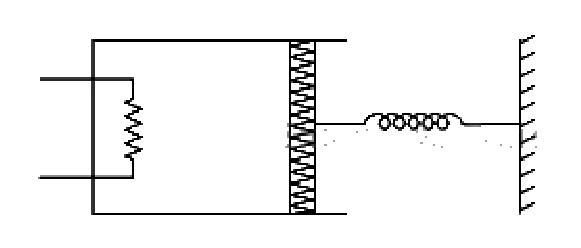
A vertical closed cylinder is separated into two parts by a frictionless piston of mass m and of negligible thickness. The piston is free to move along the length of the cylinder. The length of the cylinder above the piston is ℓ1, and that below the piston is ℓ2, such that ℓ1 > ℓ2. Each part of the cylinder contains n moles of an ideal gas at equal temperature T. If the piston is stationary, its mass, m, will be given by:
(R is universal gas constant and g is the acceleration due to gravity)
Show answer and solution
Answer: (a)
With cross-section A: pressure above P1=Aℓ1nRT, pressure below P2=Aℓ2nRT
A sample of 0.1 g of water at 100°C and normal pressure (1.013 × 10⁵ N m–2) requires 54 cal of heat energy to convert to steam at 100°C. If the volume of the steam produced is 167.1 cc, the change in internal energy of the sample, is
Show answer and solution
Answer: (b)
Heat: Q=54 cal=54×4.18≈225.7 J
Volume of 0.1 g water =0.1 cc, so ΔV=167.1−0.1=167 cc=167×10−6 m3
Thermodynamic Processes · Types of processes: identify & compare
We consider a thermodynamic system. If ΔU is the increase in internal energy and W is the work done by the system, which one of the following statement is true?
Show answer and solution
Answer: (a)
First law: Q=ΔU+W.
Adiabatic: Q=0⇒ΔU=−W.
Isothermal (ideal gas): ΔU=0, so neither (b) nor (c) holds in general.
When the temperature of 4 moles of a gas was increased from 70∘C to 90∘C, at constant volume, the change in internal energy was 60 J. The total heat capacity of the gas at constant volume is
In an adiabatic expansion, the temperature of one mole of an ideal monatomic gas ( γ=5/3) decreases from 60 K to 50 K. The work done by the gas in the process is:
(Take the universal gas constant as R=8.3 J mol−1 K−1)
Thermodynamic Processes · Types of processes: identify & compare
A vessel contains 0.15 m3 of a gas at pressure 8 bar and temperature 140 °C with cp=3R and cv=2R. It is expanded adiabatically till pressure falls to 1 bar. The work done during this process is _________ kJ. (R is gas constant)
Numerical answer type. Work it out, then open the answer.
Heat is supplied to a rigid diatomic gas at constant pressure. The ratio of ΔQ:ΔU:ΔW is {ΔQ= heat supplied,ΔU= change in internal energy ,ΔW= work done during expansion}
Show answer and solution
Answer: (c)
At constant pressure: ΔQ=nCpΔT, ΔU=nCvΔT, ΔW=nRΔT.
Two moles of a rigid diatomic gas does a work 4Q when the amount of heat supplied is Q. In this process the total heat capacity of the gas is (R = gas constant)
Heat required to raise the temperature of 2 mol of an ideal gas at constant pressure from 25∘C to 35∘ C is 310 J. The amount of heat required to raise the temperature of the gas through the same range at constant volume is
Six moles of oxygen gas is heated from 20∘C to 35∘C at constant volume. If specific heat capacity at constant pressure is 8 cal mol−1k −1 and gas constant is 2 cal mol−1k −1. The change in internal energy of the gas is
The r.m.s. speed of hydrogen at S.T.P. is 'u' m/s. If the gas is heated at constant pressure till its volume becomes three times, the final temperature of the gas and the r.m.s. speed are respectively
Two cylinders A and B fitted with pistons contain equal amount of an ideal diatomic gas at 303 K. The piston of cylinder A is free to move and that of cylinder B is held fixed. The same amount of heat is given to the gas in each cylinder. If the rise in temperature of the gas in cylinder B is 63 K then the rise in temperature of the gas in A is
Show answer and solution
Answer: (c)
Same heat: nCpΔTA=nCvΔTB (A at constant pressure, B at constant volume).
The heat energy that must be supplied to 14 g of nitrogen at room temperature to raise its temperature by 48∘C at constant pressure is (R = gas constant, Molecular weight of nitrogen (N2) = 28)
The change in internal energy of the mass of gas, when the volume changes from V to 2V at constant pressure P is (γ is the ratio of specific heat at constant pressure to that of volume) (γ=CvCp)
If ΔQ is the amount of heat supplied to 'n' moles of a rigid diatomic gas at constant pressure, ΔU is the change in internal energy and ΔW is the work done then ΔW:ΔU:ΔQ is
5 moles of unknown gas is heated at constant volume from 10°C to 20°C. The molar specific heat of this gas at constant pressure cp=8 cal/mol.°C and R=8.36 J/mol.°C. The change in the internal energy of the gas is __________ calorie.
Numerical answer type. Work it out, then open the answer.
10 mole of oxygen is heated at constant volume from 30∘C to 40∘C. The change in the internal energy of the gas is ______ cal. (The molecular specific heat of oxygen at constant pressure, CP=7 cal/mol.∘C and R=2 cal./mol.∘C.)
Numerical answer type. Work it out, then open the answer.
Two identical containers A and B with friction-less pistons contain the same ideal gas at the same temperature and the same volume, V. The mass of gas in A is mA and that in B is mB. The gas in each cylinder is now allowed to expand isothermally to the same final volume 2V. The changes in pressure in A and B are found to be Δp and 3Δp respectively. Then
Show answer and solution
Answer: (c)
Same V and T: initial pressure p∝ number of moles ∝m.
A rigid diatomic gas (γ=57) is compressed adiabatically to volume (32Vi), where Vi is the initial volume. The initial temperature of the gas is 'Ti ' K and the final temperature is 'xTi ' K. The value of x is
A gas at normal temperature is suddenly compressed to one-fourth of its original volume. If γ=1.5, then the increase in the temperature of the gas in Kelvin is (γ is the ratio of specific heats)
Show answer and solution
Answer: (a)
Sudden compression is adiabatic: T2=T1(V2V1)γ−1=T1(4)0.5=2T1.
A monoatomic gas is stored in a thermally insulated container and the gas is suddenly compressed to (81)th of its initial volume. The ratio of final pressure to initial pressure is
Show answer and solution
Answer: (c)
Insulated and sudden compression is adiabatic: PVγ=const, with γ=35 for a monoatomic gas.
Initial pressure and volume of a monoatomic ideal gas are P and V. The change in internal energy of this gas in adiabatic expansion to volume Vfinal =27V is ______ J.
The volume of an ideal gas increases 8 times and temperature becomes (1/4)th of initial temperature during a reversible change. If there is no exchange of heat in this process (ΔQ=0) then identify the gas from the following options (Assuming the gases given in the options are ideal gases):
An ideal gas having pressure P, volume V and temperature T is expanded isothermally, to a volume 3V and final pressure PI. The same gas is expanded adiabatically to a volume 3V, the final pressure being PA. The ratio PIPA is (CVCP=γ)
An ideal gas with pressure P, volume V and temperature T is expanded isothermally to volume 2V and a final pressure Pi. The same gas is expanded adiabatically to a volume 2V then the final pressure is Pa. In terms of γ, the ratio of the two specific heats for the gas, the ratio Pi/Pa is
Two samples A and B of gas initially at the same pressure and temperature. They are compressed from volume V to 2V (A isothermally and B adiabatically). The relation between pressure of the gas A (PA) and pressure of gas B (PB) is
Show answer and solution
Answer: (a)
Isothermal: PA=P⋅2=2P.
Adiabatic: PB=P⋅2γ, and γ>1 so 2γ>2.
The adiabatic curve is steeper, so it reaches a higher pressure for the same compression.
One mole of an ideal diatomic gas expands from volume V to 2V isothermally at a temperature 27∘C and does W joule of work. If the gas undergoes same magnitude of expansion adiabatically from 27∘C doing the same amount of work W, then its final temperature will be (close to) ∘C.(loge2=0.693)
Show answer and solution
Answer: (a)
Isothermal work: W=nRTln2=1×8.314×300×0.693≈1728 J.
Adiabatic work: W=nCv(T1−T2) with Cv=25R=20.8 J mol−1 K−1.
Thermodynamic Processes · Polytropic & other processes
An ideal rigid diatomic gas (γ=57) undergoes an adiabatic change. If the relation between temperature and volume is TVx= constant then the value of x is
Thermodynamic Processes · Polytropic & other processes
One mole of diatomic gas having rotational modes only is kept in a cylinder with a piston system. The cross-section area of the cylinder is 4 cm2. The gas is heated slowly to raise the temperature by 1.2∘C during which the piston moves by 25 mm. The amount of heat supplied to the gas is ______ J. (Atmospheric pressure =100 kPa,R=8.3 J/mol.K) (Neglect mass of the piston)
Show answer and solution
Answer: (b)
Work against the atmosphere: W=PAx=105×4×10−4×0.025=1 J.
"Rotational modes only" is meant to count the energy in the 2 rotational degrees of freedom: U=2×21RT=RT per mole.
Thermodynamic Processes · Polytropic & other processes
The internal energy of a monoatomic gas is 3nRT. One mole of helium is kept in a cylinder having internal cross section area of 17 cm2 and fitted with a light movable frictionless piston. The gas is heated slowly by suppling 126 J heat. If the temperature rises by 4∘C, then the piston will move ______ cm.
(atmospheric pressure =105 Pa)
Show answer and solution
Answer: (c)
Given U=3nRT: ΔU=3×1×8.3×4=99.6 J (taking R=8.3).
First law: W=Q−ΔU=126−99.6=26.4 J
Light piston, so gas pressure stays 105 Pa: W=PAx.
A monoatomic ideal gas, initially at temperature T1 is enclosed in a cylinder fitted with a frictionless piston. The gas is allowed to expand adiabatically to a temperature T2 by releasing the piston suddenly. If L1 and L2 be the lengths of the gas column before and after expansion respectively, then T2T1 is
A cylinder with adiabatic walls is closed at both ends and is divided into two compartments by a frictionless adiabatic piston. Ideal gas is filled in both (left and right) the compartments at same P,V,T. Heating is started from left side until pressure changes to 27P/8. If initial volume of each compartment was 9 litres then the final volume in right-hand side compartment is ______ litres. (for this ideal gas CP/CV=1.5)
Show answer and solution
Answer: (b)
The right compartment is compressed adiabatically by the piston: PVγ= constant with γ=1.5.
Pressure on both sides is equal, so right side ends at 827P.
A monoatomic gas at pressure P having volume V expands isothermally to a volume 3V and then adiabatically to a volume 81 V. The final pressure of the gas is (γ=5/3).
Thermodynamic Processes · Polytropic & other processes
An ideal gas undergoes a process maintaining relation between pressure (P) and volume(V) as
P=P0(1+(VV0)2)−1, where P0 and V0 are constants. If two samples A and B (two moles each) with initial volumes V0 and 3V0 respectively undergo above mentioned process and attain same pressure, then the difference at the temperatures of these samples, TB−TA is ______. ( R= gas constant)
Show answer and solution
Answer: (b)
The key matches the temperature difference at the two initial states, using T=nRPV with n=2.
A at V0: P=2P0, so TA=2R(P0/2)V0=4RP0V0.
B at 3V0: P=1+1/9P0=109P0, so TB=2R(9P0/10)(3V0)=20R27P0V0.
TB−TA=2027−5RP0V0=10R11P0V0, so the answer is (b).
Thermodynamic Processes · Types of processes: identify & compare
During thermodynamic process, the increase in internal energy of a system is equal to the work done on the system. Which process does the system undergo?
Show answer and solution
Answer: (b)
First law: ΔU=Q+Won.
ΔU=Won requires Q=0, which is an adiabatic process.
Thermodynamic Processes · Types of processes: identify & compare
An ideal gas exists in a state with pressure P0, volume V0. It is isothermally expanded to 4 times of its initial volume (V0), then isobarically compressed to its original volume. Finally the system is heated isochorically to bring it to its initial state. The amount of heat exchanged in this process is
Show answer and solution
Answer: (b)
Cyclic process: ΔU=0, so net heat = net work.
Isothermal V0→4V0: W1=P0V0ln4=2P0V0ln2.
Pressure after expansion is P0/4; isobaric 4V0→V0: W2=4P0(V0−4V0)=−0.75P0V0.
Thermodynamic Processes · Types of processes: identify & compare
Given below are two statements. One is labelled as Assertion (A) and the other is labelled as Reason (R).
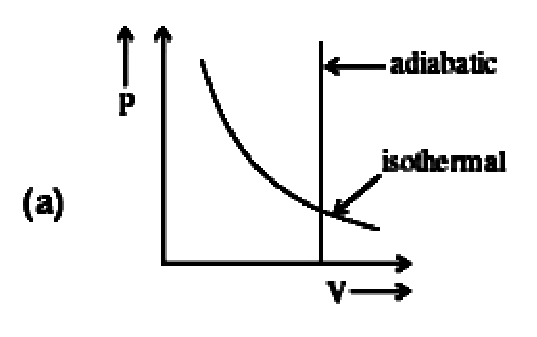
Assertion (A): With the increase in the pressure of an ideal gas, the volume falls off more rapidly in an isothermal process in comparison to the adiabatic process.
Reason (R): In isothermal process, PV = constant, while in adiabatic process PVγ = constant. Here γ is the ratio of specific heats, P is the pressure and V is the volume of the ideal gas. In the light of the above statements, choose the correct answer from the options given below:
Show answer and solution
Answer: (d)
Isothermal: PV= const ⇒dPdV=−PV.
Adiabatic: PVγ= const ⇒dPdV=−γPV.
Since γ>1, volume falls faster with pressure in the isothermal process, so (A) is true.
(R) gives exactly the relations used, so it explains (A). So the answer is (d).
Thermodynamic Processes · Types of processes: identify & compare
Given below are two statements. One is labelled as Assertion (A) and the other is labelled as Reason (R).
Assertion (A): In an insulated container, a gas is adiabatically shrunk to half of its initial volume. The temperature of the gas decreases.
Reason (R): Free expansion of an ideal gas is an irreversible and an adiabatic process. In the light of the above statements, choose the correct answer from the options given below:
Show answer and solution
Answer: (c)
Adiabatic compression: ΔQ=0, work is done on the gas, so ΔU>0 and temperature rises. (A) is false.
Free expansion happens suddenly with no heat exchange and cannot be reversed: irreversible and adiabatic. (R) is true.
Two cylinders A and B fitted with piston contain equal amount of an ideal diatomic gas at temperature T K. The piston of cylinder A is free to move while that of cylinder B is held fixed. The same amount of heat is given to the gas in each cylinder. If the rise of temperature of the gas in A is dTA, then the rise in temperature of the gas in B is (γ=CvCp)
Show answer and solution
Answer: (c)
A is at constant pressure, B at constant volume; same heat: nCpdTA=nCvdTB.
The heat energy that must be supplied to 14 gram of nitrogen at room temperature to raise its temperature by 48∘C at constant pressure is (Molecular weight of nitrogen =28,R= gas constant, Cp=27R for diatomic gas)
Two cylinders A and B fitted with pistons contain equal amount of an ideal rigid diatomic gas at 303 K. The piston of cylinder A is free to move and that of cylinder B is held fixed. The same amount heat is given to the gas in each cylinder. If the rise in temperature of the gas in cylinder B is 49 K, then the rise in temperature of the gas in A is
A monoatomic ideal gas is heated at constant pressure. The percentage of total heat used in increasing the internal energy and that used for doing external work is A and B respectively. Then the ratio, A:B is
The temperature of 1 mole of an ideal monoatomic gas is increased by 50∘C at constant pressure. The total heat added and change in internal energy are E1 and E2, respectively. If E2E1=9x then the value of x is _________.
Numerical answer type. Work it out, then open the answer.
A monoatomic ideal gas is compressed adiabatically to (271) of its initial volume. If initial temperature of the gas is ' T ' K and final temperature is ' xT ' K, the value of ' x ' is
Show answer and solution
Answer: (b)
Adiabatic: TVγ−1=const, γ−1=32 for a monoatomic gas.
A diatomic gas (γ=57) is compressed adiabatically to volume 32V0, where V0 is its initial volume. The initial temperature of the gas is Ti in kelvin and the final temperature is xTi in kelvin. The value of x is
A monoatomic gas having γ=35 is stored in a thermally insulated container and the gas is suddenly compressed to (81)th of its initial volume. The ratio of final pressure and initial pressure is: (γ is the ratio of specific heats of the gas at constant pressure and at constant volume)
Show answer and solution
Answer: (b)
Insulated, sudden compression is adiabatic: P1P2=(V2V1)γ.
An ideal gas initially at 0∘C temperature, is compressed suddenly to one fourth of its volume. If the ratio of specific heat at constant pressure to that at constant volume is 3/2, the change in temperature due to the thermodynamic process is _________ K.
Numerical answer type. Work it out, then open the answer.
Thermodynamic Processes · Polytropic & other processes
A gas is kept in a container having walls which are thermally non-conducting. Initially the gas has a volume of 800 cm3 and temperature 27∘C. The change in temperature when the gas is adiabatically compressed to 200 cm3 is:
(Take γ=1.5;γ is the ratio of specific heats at constant pressure and at constant volume)
Show answer and solution
Answer: (a)
Adiabatic: TVγ−1= constant, so T2=T1(V2V1)γ−1.
Thermodynamic Processes · Types of processes: identify & compare
Three samples X,Y, and Z of same gas have equal volumes and temperatures. The volume of each sample is doubled, the process being isothermal for X, adiabatic for Y and isobaric for Z. If the final pressures are equal for the three samples, the ratio of the initial pressures is ( γ=3/2)
Show answer and solution
Answer: (b)
Let the common final pressure be Pf and the volume double in each case.
Two gases A and B are filled at the same pressure in separate cylinders with movable pistons of radius rA and rB, respectively. On supplying an equal amount of heat to both the systems reversibly under constant pressure, the pistons of gas A and B are displaced by 16 cm and 9 cm, respectively. If the change in their internal energy is the same, then the ratio rBrA is equal to
Show answer and solution
Answer: (d)
Constant pressure: Q=ΔU+PΔV.
Equal Q and equal ΔU give equal work, so equal ΔV (same P).
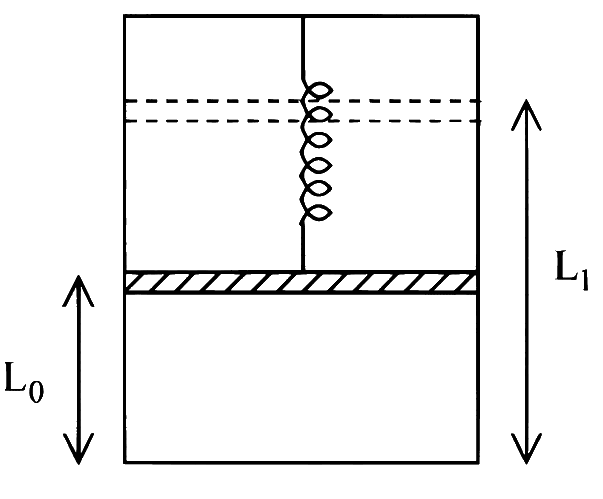
A piston of mass M is hung from a massless spring whose restoring force law goes as F=−kx3, where k is the spring constant of appropriate dimension. The piston separates the vertical chamber into two parts, where the bottom part is filled with ' n ' moles of an ideal gas. An external work is done on the gas isothermally (at a constant temperature T) with the help of a heating filament (with negligible volume) mounted in lower part of the chamber, so that the piston goes up from a height L0 to L1, the total energy delivered by the filament is:(Assume spring to be in its natural length before heating)
Show answer and solution
Answer: (b)
Isothermal gas: ΔU=0, and gas work =nRTlnV0V1=nRTlnL0L1 (area constant).
Piston rises by L1−L0: gain in PE =Mg(L1−L0).
Spring energy for F=−kx3: ∫kx3dx=4kx4, written in the official answer as 4k(L14−L04).
A monoatomic ideal gas, initially at temperature T1 is enclosed in a cylinder fitted with massless, frictionless piston. By releasing the piston suddenly, the gas is allowed to expand adiabatically to a temperature T2. If L1 and L2 are the lengths of the gas columns before and after expansion respectively, then (T2/T1) is given by
Show answer and solution
Answer: (c)
Adiabatic, monatomic γ=35: TV2/3= constant, and V∝L.
A polyatomic gas at pressure P, having volume ' V ' expands isothermally to a volume ' 3 V ' and then adiabatically to a volume ' 24 V '. The final pressure of gas is (for moderate temperature changes)
Thermodynamic Processes · Polytropic & other processes
A gas undergoes a change in which its pressure ' P ' and volume ' V ' are related as PVn= constant, where n is a constant. If the specific heat of the gas in this change is zero, then the value of n is ( γ= adiabatic ratio)
Show answer and solution
Answer: (d)
Specific heat zero means Q=0 for any temperature change, i.e. the process is adiabatic.
Thermodynamic Processes · Types of processes: identify & compare
In a thermodynamic system ' ΔU ' represents the increase in internal energy and ' W ' the work done by the system. Which of the following statement is true?
Show answer and solution
Answer: (a)
First law: Q=ΔU+W.
Adiabatic: Q=0⇒ΔU=−W.
Isothermal (ideal gas): ΔU=0, so (b) and (c) fail.
The internal energy of an ideal diatomic gas corresponding to volume ' V ' and pressure ' P ' is 2.5 PV. The gas expands from 1 litre to 2 litre at a constant pressure of 105 N/m2. The heat supplied to a gas is
A quantity of heat ' Q ' is supplied to monoatomic ideal gas which expands at constant pressure. The fraction of heat converted into work is [γ=CvCp=35]
Two cylinders A and B fitted with piston contain equal amount of an ideal diatomic as at temperature ' T ' K. The piston of cylinder A is free to move while that of B is held fixed. The same amount of heat is given to the gas in each cylinder. If the rise temperature of the gas in A is ' dTA ', then the rise in temperature of the gas in cylinder B is (γ=CvCp)
Show answer and solution
Answer: (c)
A (free piston) is heated at constant pressure: Q=nCpdTA.
B (fixed piston) is heated at constant volume: Q=nCvdTB.
For an ideal gas, in an isobaric process, the ratio of heat supplied ' Q ' to the work done ' w ' by the system is ( γ= ratio of specific heat at constant pressure to that at constant volume)
The change in the internal energy of the mass of gas, when the volume changes from ' V ' to ' 2 V ' at constant pressure ' P ' is ( γ is the ratio of specific heat of gas at constant pressure to specific heat at constant volume)
The r.m.s. velocity of hydrogen at S.T.P. is ' u ' m/s. If the gas is heated at constant pressure till its volume becomes three times, then the final temperature of the gas and the r.m.s. speed are respectively
A fixed mass of gas at constant pressure occupies a volume ' V '. The gas undergoes a rise in temperature so that the r.m.s. velocity of the molecules is doubled. The new volume will be
0.08 kg air is heated at constant volume through 5∘C. The specific heat of air at constant volume is 0.17 kcal/kg∘C and J=4.18 joule/ cal. The change in its internal energy is approximately.
One mole of an ideal gas at an initial temperature of ' T ' K does ' 6R ' of work adiabatically. If the ratio of specific heats of this gas at constant pressure and at constant volume is 5/3, the final temperature of gas will be (R=8.31 J mole−1 K−1)
Show answer and solution
Answer: (d)
Adiabatic work by gas: W=γ−1nR(T1−T2), with n=1, γ−1=32.
A sample of 1 mole gas at temperature T is adiabatically expanded to double its volume. If adiabatic constant for the gas is γ=23, then the work done by the gas in the process is:
During an adiabatic process, if the pressure of a gas is found to be proportional to the cube of its absolute temperature, then the ratio of CVCP for the gas is:
A sample of gas at temperature T is adiabatically expanded to double its volume. Adiabatic constant for the gas is γ=3/2. The work done by the gas in the process is:
During an adiabatic process, the pressure of a gas is found to be proportional to the cube of its absolute temperature. The ratio of CvCp for the gas is:
Two gases A and B having same initial state ( P,V,n,T ). Now gas A is compressed to 8V by isothermal process and other gas B is compressed to 8V by adiabatic process. The ratio of final pressure of gas A and B is (Both gases are monoatomic, γ=5/3)
Initial pressure and volume of a gas are ' P ' and ' V ' respectively. First its volume is expanded to ' 4 V ' by isothermal process and then again its volume is reduced to ' V ' by adiabatic process then its final pressure if (γ=23)
There are two samples A and B of a certain gas, which are initially at the same temperature and pressure. Both are compressed from volume v to 2v. Sample A is compressed isothermally while sample B is compressed adiabatically. The final pressure of A is
Thermodynamic Processes · Polytropic & other processes
In an adiabatic process for an ideal gas, the relation between the universal gas constant ' R ' and specific heat at constant volume ' Cv ' is R=0.4Cv. The pressure ' P ' of the gas is proportional to the temperature ' T ', of the gas as Tk. The value of constant ' K ' is
Thermodynamic Processes · Polytropic & other processes
A total of 48 J heat is given to one mole of helium kept in a cylinder. The temperature of helium increases by 2∘C. The work done by the gas is: Given, R=8.3 J K−1 mol−1.
Thermodynamic Processes · Polytropic & other processes
The pressure and volume of an ideal gas are related as PV23=K (Constant). The work done when the gas is taken from state A(P1,V1,T1) to state B(P2,V2,T2) is:
A monoatomic ideal gas, initially at temperature T1 is enclosed in a cylinder fitted with frictionless piston. The gas is allowed to expand adiabatically to a temperature T2 by releasing the piston suddenly. L1 and L2 are the lengths of the gas columns before and after the expansion respectively. The ratio T2/T1 is
Show answer and solution
Answer: (a)
Adiabatic, monatomic γ=35: TV2/3= constant, and V∝L.
Thermodynamic Processes · Polytropic & other processes
During an experiment, an ideal gas is found to obey an additional law VP2= constant. The gas is initially at temperature ' T ' and volume ' V '. What will be the temperature of the gas when it expands to a volume 2 V?
Thermodynamic Processes · Types of processes: identify & compare
In a thermodynamic system, ΔU represents the increases in its internal energy and dW is the work done by the system then correct statement out of the following is
Show answer and solution
Answer: (b)
First law: dQ=ΔU+dW.
Adiabatic: dQ=0⇒ΔU=−dW.
Isothermal (ideal gas): ΔU=0, so (a) and (c) fail.
Thermodynamic Processes · Types of processes: identify & compare
Select the WRONG statement from the following. For an isothermal process
Show answer and solution
Answer: (c)
Isothermal: T constant, so ΔU=0 and all heat exchanged goes into work; the system stays in thermal equilibrium with the surroundings. (a), (b), (d) are correct.
From PV=nRT with T constant, PV is constant, so (c) is wrong.
dQ is the heat energy supplied to an ideal gas under isochoric conditions. If dU and dW denote the change in internal energy and the work done respectively then
The initial pressure and volume of an ideal gas are P0 and V0. The final pressure of the gas when the gas is suddenly compressed to volume 4V0 will be:
(Given γ = ratio of specific heats at constant pressure and at constant volume)
Show answer and solution
Answer: (d)
Sudden compression has no time for heat exchange: adiabatic, PVγ = constant.
A gas is compressed at a constant pressure of 50 N/m2 from a volume of 10 m3 to a volume of 4 m3. Energy of 100 J is then added to the gas by heating. Its internal energy is
Show answer and solution
Answer: (a)
Work done by gas W=PΔV=50×(4−10)=−300 J (work is done on the gas).
Heat energy of 735 J is given to a diatomic gas allowing the gas to expand at constant pressure. Each gas molecule rotates around an internal axis but do not oscillate. The increase in the internal energy of the gas will be:
Show answer and solution
Answer: (c)
Rigid diatomic (rotation, no vibration): Cv=25R, Cp=27R.
A diatomic gas (γ=57) is compressed adiabatically to volume 32Vi where Vi is its initial volume. The initial temperature of the gas is Ti in Kelvin and the final temperature is 'xTi '. The value of 'x' is
A sample of gas at temperature T is adiabatically expanded to double its volume. The work done by the gas in the process is (CVCP=γ=23)(R= gas constant )
Show answer and solution
Answer: (d)
Adiabatic: TVγ−1=const, so T2=T⋅2−1/2=2T.
Work by gas (taking 1 mole): W=1/2R(T−T/2)=2RT(1−21)
A gas at N.T.P. is suddenly compressed to (41)th of its original volume. The final pressure in (Given γ= ratio of sp. heats =23) atmosphere is ( P= original pressure)
A hypothetical gas expands adiabatically such that its volume changes from 8 litres to 27 litres. If the ratio of final pressure of the gas to initial pressure of the gas is 8116. Then the ratio of CvCp will be.
A monoatomic gas at pressure 'P', having volume 'V' expands isothermally to a volume '2V' and then adiabatically to a volume ' 16V'. The final pressure of the gas is (Take γ=5/3)
Consider two containers A and B containing monoatomic gases at the same Pressure (P), Volume (V) and Temperature (T). The gas in A is compressed isothermally to 81 of its original volume while the gas in B is compressed adiabatically to 81 of its original volume. The ratio of final pressure of gas in B to that of gas in A is
A monoatomic ideal gas initially at temperature 'T1 ' is enclosed in a cylinder fitted with massless, frictionless piston. By releasing the piston suddenly the gas is allowed to expand to adiabatically to a temperature 'T2 '. If 'L1 ' and 'L2' are the lengths of the gas columns before and after expansion respectively, then T1T2 is
Show answer and solution
Answer: (c)
Adiabatic, monatomic γ=35: TV2/3= constant, and V∝L.
Thermodynamic Processes · Types of processes: identify & compare
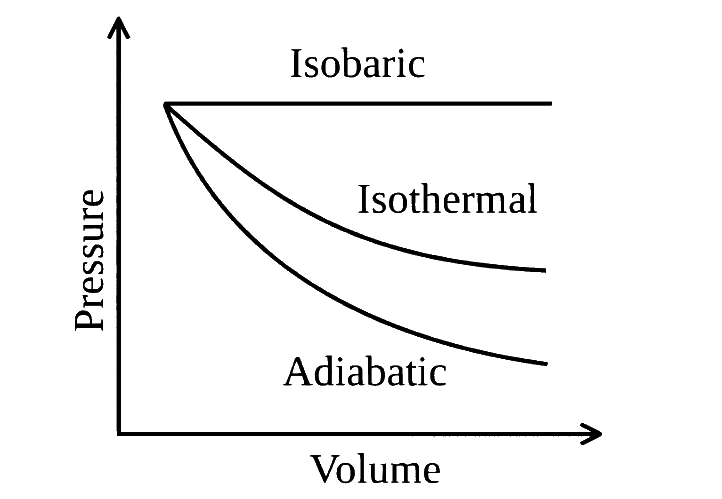
Starting with the same initial conditions, an ideal gas expands from volume V1 to V2 in three different ways. The work done by the gas is W1 if the process is purely isothermal, W2, if the process is purely adiabatic and W3 if the process is purely isobaric. Then, choose the correct option
Show answer and solution
Answer: (d)
Work by the gas = area under the P–V curve from V1 to V2.
Isobaric: pressure stays at P1 (largest area). Isothermal: P falls as 1/V. Adiabatic: P falls fastest, as 1/Vγ (smallest area).
Thermodynamic Processes · Types of processes: identify & compare
Given below are two statements:
Statement I: When μ amount of an ideal gas undergoes adiabatic change from state (P1, V1, T1) to state (P2, V2, T2), then work done is W=1−γμR(T2−T1), where γ=CvCp and R = universal gas constant. Statement II: In the above case, when work is done on the gas, the temperature of the gas would rise.
Choose the correct answer from the options given below:
Show answer and solution
Answer: (a)
Adiabatic work by gas W=γ−1μR(T1−T2)=1−γμR(T2−T1), so Statement I is true.
Work done on the gas with ΔQ=0 goes into ΔU>0, so temperature rises; Statement II is true.
7 mol of a certain monoatomic ideal gas undergoes a temperature increase of 40 K at constant pressure. The increase in the internal energy of the gas in this process is:
At a certain temperature, the degrees of freedom per molecule for gas is 8. The gas performs 150 J of work when it expands under constant pressure. The amount of heat absorbed by the gas will be _________ J.
Numerical answer type. Work it out, then open the answer.
A monoatomic gas (γ=35) initially at 27∘C having volume 'V' is suddenly compressed to one- eighth of its original volume (8V). After the compression its temperature becomes
A monoatomic gas at pressure P and volume V is suddenly compressed to one eighth of its original volume. The final pressure at constant entropy will be:
Show answer and solution
Answer: (c)
Sudden compression at constant entropy is adiabatic: P2=P(V2V1)γ, with γ=35 for a monoatomic gas.
A sample of monoatomic gas is taken at initial pressure of 75 kPa. The volume of the gas is then compressed from 1200 cm3 to 150 cm3 adiabatically. In this process, the value of workdone on the gas will be:
The pressure P1 and density d1 of diatomic gas (γ=57) changes suddenly to P2(>P1) and d2 respectively during an adiabatic process. The temperature of the gas increases and becomes ________ times of its initial temperature. (given d1d2=32)
Numerical answer type. Work it out, then open the answer.
A certain amount of gas of volume V at 27∘C temperature and pressure 2×10⁷ Nm−2 expands isothermally until its volume gets doubled. Later it expands adiabatically until its volume gets redoubled. The final pressure of the gas will be (Use γ=1.5):
Thermodynamic Processes · Polytropic & other processes
An ideal gas follows a process described by the equation PV2=C from the initial (P1,V1,T1) to final (P2,V2,T2) thermodynamic states, where C is a constant. Then
Show answer and solution
Answer: (d)
PV2=C and PV=nRT give T=nRPV=nRVC, so T∝V1.
Also P∝V21: if P1>P2 then V1<V2, so (a) is false, and then T1>T2, so (b) is false.
If V2>V1 then T2<T1, so (c) is false and (d) is true.
Thermodynamic Processes · Polytropic & other processes
A monoatomic gas performs a work of 4Q where Q is the heat supplied to it. The molar heat capacity of the gas will be ______________ R during this transformation. Where R is the gas constant.
Numerical answer type. Work it out, then open the answer.
Thermodynamic Processes · Types of processes: identify & compare
Which one of the following equations specifies an isobaric process? [Q= heat supplied ΔP,ΔV and ΔT are change in pressure, volume and temperature respectively]
Show answer and solution
Answer: (d)
Isobaric means constant pressure.
Q=0 is adiabatic, ΔT=0 isothermal, ΔV=0 isochoric.
A monoatomic gas is suddenly compressed to (1/8)th of its initial volume adiabatically. The ratio of the final pressure to initial pressure of the gas is (γ=5/3)
An ideal gas at pressure 'p' is adiabatically compressed so that its density becomes twice that of the initial. If γ=cvcp=57, then final pressure of the gas is
Show answer and solution
Answer: (d)
Density doubles, so volume halves; adiabatic P∝ργ.
An ideal gas at 27∘C is compressed adiabatically to (8/27) of its original volume. If ratio of specific heats, γ=5/3 then the rise in temperature of the gas is
The relation obeyed by a perfect gas during an adiabatic process is PV3/2. The initial temperature of the gas is 'T'. When the gas is compressed to half of its Initial volume, the final temperature of the gas is
A monoatomic gas is suddenly compressed to (1/8)th of its initial volume adiabatically. The ratio of the final pressure to initial pressure of the gas is (γ=5/3)
One mole of an ideal gas expands adiabatically at constant pressure such that its temperature T∝V1. The value of γ for the gas is (γ=CvCp,V= Volume of the gas)
Show answer and solution
Answer: (b)
For an adiabatic process TVγ−1=const, i.e. T∝V−(γ−1).
One mole of an ideal gas is taken through an adiabatic process where the temperature rises from 27∘ C to 37∘ C. If the ideal gas is composed of polyatomic molecule that has 4 vibrational modes, which of the following is true? [R = 8.314 J mol−1 K−1]
Show answer and solution
Answer: (b)
Degrees of freedom: 3 translational + 3 rotational + 2×4 vibrational =14, so Cv=214R=7R.
Adiabatic: Q=0, so Won=ΔU=nCvΔT.
ΔU=1×7×8.314×10≈582 J (positive, temperature rises, so work is done on the gas).
So the answer is (b) work done on the gas is close to 582 J.
A sample of gas with γ = 1.5 is taken through an adiabatic process in which the volume is compressed from 1200 cm3 to 300 cm3. If the initial pressure is 200 kPa. The absolute value of the workdone by the gas in the process = _____________ J.
Numerical answer type. Work it out, then open the answer.
An ideal gas with pressure P, volume V and temperature T is expanded isothermally to a volume 2V and a final pressure Pi. The same gas is expanded adiabatically to a volume 2V, the final pressure is Pa. In terms of the ratio of the two specific heats for the gas 'γ', the ratio PaPi is
The initial pressure and volume of a gas is 'P' and 'V' respectively. First by isothermal process gas is expanded to volume '9V' and then by adiabatic process its volume is compressed to 'V' then its final pressure is (Ratio of specific heat at constant pressure to constant volume =23)
A monoatomic gas at pressure 'P' having volume 'V' expands isothermally to a volume 2V and then adiabatically to a volume 16V. The final pressure of the gas is (γ=35)
Thermodynamic Processes · Polytropic & other processes
1 mole of rigid diatomic gas performs a work of 5Q when heat Q is supplied to it. The molar heat capacity of the gas during this transformation is 8xR. The value of x is _________. [R = universal gas constant]
Numerical answer type. Work it out, then open the answer.
Thermodynamic Processes · Polytropic & other processes
The volume V of a given mass of monoatomic gas changes with temperature T according to the relation V=KT32. The workdone when temperature changes by 90K will be xR. The value of x is _________. [R = universal gas constant]
Numerical answer type. Work it out, then open the answer.
Thermodynamic Processes · Polytropic & other processes
In a certain thermodynamical process, the pressure of a gas depends on its volume as kV3. The work done when the temperature changes from 100∘ C to 300∘C will be ___________ nR, where n denotes number of moles of a gas.
Numerical answer type. Work it out, then open the answer.
Show answer and solution
Answer: 50
P=kV3⇒PV−3= constant, a polytropic process with index x=−3.
A monoatomic ideal gas initially at temperature T1 is enclosed in a cylinder fitted with 8 frictionless piston. The gas is allowed to expand adiabatically to a temperature T2 by releasing the piston suddenly. L1 and L2 are the lengths of the gas columns before and after the expansion respectively. Then T1T2 is
Show answer and solution
Answer: (b)
Adiabatic, monatomic γ=35: TV2/3= constant, and V∝L.
A monoatomic ideal gas, initially at temperature T1 is enclosed in a cylinder fitted with a frictionless piston. The gas is allowed to expand adiabatically to a temperature T2 by releasing the piston suddenly. If l1 and l2 are the lengths of the gas column, before and after the expansion respectively, then the value of T2T1 will be:
Show answer and solution
Answer: (b)
Adiabatic, monatomic γ=35: TV2/3= constant, and V∝l.
Thermodynamic Processes · Types of processes: identify & compare
Two cylinders A and B of equal capacity are connected to each other via a stop cock. A contains an ideal gas at standard temperature and pressure. B is completely evacuated. The entire systems is thermally insulated. The stop cock is suddenly opened. The Process is:
Show answer and solution
Answer: (a)
The whole system is thermally insulated, so Q=0: the process is adiabatic.
Gas expands into vacuum (free expansion), so W=0 and ΔU=0; volume and pressure both change, so it is not isochoric or isobaric.
To raise the temperature of a certain mass of gas by 50oC at a constant pressure, 160 calories of heat is required. When the same mass of gas is cooled by 100oC at constant volume, 240 calories of heat is released. How many degrees of freedom does each molecule of this gas have (assume gas to be ideal)?
In an adiabatic process, the density of a diatomic gas becomes 32 times its initial value. The final pressure of the gas is found to be n times the initial pressure. The value of n is:
Show answer and solution
Answer: (a)
Density ρ∝V1, so adiabatic PVγ= const gives P∝ργ.
A litre of dry air at STP expands adiabatically to a volume of 3 litres. If γ = 1.40, the work done by air is: (31.4 = 4.6555) [Take air to be an ideal gas]
Show answer and solution
Answer: (c)
P1=1.013×10⁵ Pa, V1=10−3 m3, V2=3×10⁻³ m3.
P2=P1(31)1.4=4.6555P1, so P2V2=P1V1×4.65553=0.644P1V1.
An engine takes in 5 moles of air at 20oC and 1 atm, and compresses it adiabatically to 1/10th of the original volume. Assuming air to be a diatomic ideal gas made up of rigid molecules, the change in its internal energy during this process comes out to be X kJ. The value of X to the nearest integer is________.
Numerical answer type. Work it out, then open the answer.
A monoatomic gas of pressure p having volume V expands isothermally to a volume 2V and then adiabatically to a volume 16V. The final pressure of the gas is (ratio of specific heats =35
Thermodynamic Processes · Types of processes: identify & compare
Starting at temperature 300 K, one mole of an
ideal diatomic gas (γ = 1.4) is first compressed
adiabatically from volume V1 to V2 = 16V1. It is
then allowed to expand isobarically to volume 2V2. If all the processes are the quasi-static then the final temperature of the gas (in oK) is (to the nearest integer) _____.
Numerical answer type. Work it out, then open the answer.
Show answer and solution
Answer: 1818
Adiabatic: T2=T1(V2V1)γ−1=300×160.4
160.4=21.6≈3.03, so T2≈909.4 K.
Isobaric: V∝T, so doubling volume doubles temperature: T3=2×909.4≈1819 K.
Under an adiabatic process, the volume of an ideal gas gets doubled. Consequently the mean collision time between the gas molecule changes from τ1 to τ2. If CvCp=γ for this gas then a good estimate for τ1τ2 is given by:
Show answer and solution
Answer: (a)
Mean collision time τ=vrmsλ, with λ∝V (fixed number of molecules) and vrms∝T, so τ∝TV.
Thermodynamic Processes · Polytropic & other processes
A rigid diatomic ideal gas undergoes an adiabatic process at room temperature. The relation between temperature and volume for this process is TVx = constant, then x is:
A diatomic gas with rigid molecules does 10 J of work when expanded at constant pressure. What would be the heat energy absorbed by the gas, in this process?
Show answer and solution
Answer: (a)
Rigid diatomic: Cp=27R; at constant pressure WQ=RCp=27.
When heat Q is supplied to a diatomic gas of rigid molecules, at constant volume its temperature increases by ΔT. the heat required to produce the same change in temperature, at a constant pressure is:
n moles of an ideal gas with constant volume heat capcity CV undergo an isobaric expansion by certain volume. The ratio of the work done in the process, to the heat supplied is:
Show answer and solution
Answer: (d)
Here CV is the heat capacity of the whole gas, so Q=(CV+nR)ΔT at constant pressure.
Half mole of an ideal monoatomic gas is heated at constant pressure of 1 atm from 20oC to 90oC. Work done by gas is close to – (Gas constant R = 8.31 J/mol.K)
Thermodynamic Processes · Polytropic & other processes
In a process, temperature and volume of one mole of an ideal monoatomic gas are varied according to the relation VT = K, where K is a constant. In this process the temperature of the gas is increased by ΔT. The amount of heat absorbed by gas is (R is gas constant):
Show answer and solution
Answer: (b)
VT=K and PV=RT give P∝VT∝V21, so PV2= constant (x=2).
One mole of an ideal monoatomic gas is compressed isothermally in a rigid vessel to double its pressure at room temperature, 27∘C. The work done on the gas will be:
Two moles of an ideal monatomic gas occupies a volume V at 27oC. The gas expands adiabatically to a volume 2 V. Calculate (a) the final temperature of the gas and (b) change in its internal energy.
Thermodynamic Processes · Types of processes: identify & compare
A gas is compressed isothermally to half its initial volume. The same gas is compressed separately through an adiabatic process until its volume is again reduced to half. Then
Show answer and solution
Answer: (d)
Work done on the gas = area under the P–V curve from V to V/2.
In adiabatic compression the temperature rises, so pressure rises faster (PVγ = const, γ>1) than in isothermal (PV = const).
The adiabatic curve lies above the isothermal one over the same volume change, so its area is larger.
So the answer is (d) adiabatic compression needs more work.
Thermodynamic Processes · Polytropic & other processes
An ideal gas undergoes a quasi static, reversible process in which its molar heat capacity C remains constant. If during this process the relation of pressure P and volume V is given by PVn= constant, then n is given by (Here Cp and Cv are molar specific heat at constant pressure and constant volume, respectively:
Thermodynamic Processes · Types of processes: identify & compare
Consider a spherical shell of radius R at temperature T. The black body radiation inside it can be considered as an ideal gas of photons with internal energy per unit volume u=VU∝T4 and pressure p=31(VU). If the shell now undergoes an adiabatic expansion the relation between T and R is:
Consider an ideal gas confined in an isolated closed chamber. As the gas undergoes an adiabatic expansion, the average time of collision between molecules increases as Vq, where V is the volume of the gas. The value of q is: (γ=CvCp)
A gas is compressed from a volume of 2 m3 to a volume of 1 m3 at a constant pressure of 100 N/m2. Then it is heated at constant volume by supplying 150 J of energy. As a result, the internal energy of the gas:
Show answer and solution
Answer: (a)
Step 1 (isobaric compression): W1=PΔV=100×(1−2)=−100 J (work done on the gas is 100 J).
Step 2 (isochoric): W2=0, Q=150 J.
Taking no heat exchange in step 1: ΔU=Q−W=150−(−100)=250 J.
During an adiabatic compression, 830 J of work is done on 2 moles of a diatomic ideal gas to reduce its volume by 50%. The change in its temperature is nearly: (R = 8.3 JK−1 mol−1)
A monatomic gas at a pressure P, having a volume V expands isothermally to a volume 2V and then adiabatically to a volume 16V. The final pressure of the gas is (Take γ = 5/3)
The equation of state for a gas is given by PV = nRT + αV, where n is the number of moles and α is a positive constant. The initial temperature and pressure of one mole of the gas contained in a cylinder are To and Po respectively. The work done by the gas when its temperature doubles isobarically will be:
In the isothermal expansion of 10 g of gas from volume V to 2V the work done by the gas is 575 J. What is the root mean square speed of the molecules of the gas at that temperature?
An ideal gas at atmospheric pressure is adiabatically compressed so that its density becomes 32 times of its initial value. If the final pressure of gas is 128 atmospheres, the value of 'γ' of the gas is:
There are two identical chambers, completely thermally insulated from surroundings. Both chambers have a partition wall dividing the chambers in two compartments. Compartment 1 is filled with an ideal gas and Compartment 3 is filled with a real gas. Compartments 2 and 4 are vacuum. A small hole (orifice) is made in the partition walls and the gases are allowed to expand in vacuum. Statement - 1: No change in the temperature of the gas takes place when ideal gas expands in vacuum. However, the temperature of real gas goes down (cooling) when it expands in vacuum. Statement - 2: The internal energy of an ideal gas is only kinetic. The internal energy of a real gas is kinetic as well as potential.
Show answer and solution
Answer: (b)
Free expansion into vacuum in an insulated chamber: Q=0, W=0, so ΔU=0.
Ideal gas: U is only kinetic, so U constant means T constant.
Real gas: U= KE + PE. On expansion molecules move apart against attraction, PE increases, so KE (and T) falls.
Both statements are true and Statement-2 explains Statement-1.
A mass of diatomic gas (γ=1.4) at a pressure of 2 atmospheres is compressed adiabatically so that its temperature rises from 27oC to 927oC. The pressure of the gas in the final state is
Thermodynamic Processes · Types of processes: identify & compare
If ΔU and ΔW represent the increase in internal energy and work done by the system respectively in a thermodynamical process, which of the following is true?
Show answer and solution
Answer: (a)
First law: Q=ΔU+ΔW.
Adiabatic: Q=0⇒ΔU=−ΔW.
Isothermal (ideal gas): ΔU=0, so (b) and (d) fail.
The work of 146 kJ is performed in order to compress one kilo mole of gas adiabatically and in this process the temperature of the gas increases by 7∘C. The gas is (R=8.3 J mol−1 K−1)
One mole of an ideal gas at an initial temperature of T K does 6R joule of work adiabatically. If the ratio of specific heats of this gas at constant pressure and at constant volume is 5/3, the final temperature of gas will be
Show answer and solution
Answer: (d)
Adiabatic work by gas: W=γ−1nR(T1−T2), with n=1, γ−1=32.
During an adiabatic process, the pressure of a gas is found to be proportional to the cube of its absolute temperature. The ratio Cp/CV for the gas is
Show answer and solution
Answer: (d)
Adiabatic in P–T form: P1−γTγ= const, so P∝Tγ/(γ−1).
Thermodynamic Processes · Types of processes: identify & compare
We consider a thermodynamic system. If ΔU represents the increase in its internal energy and W the work done by the system, which of the following statements is true?
Show answer and solution
Answer: (a)
First law: ΔQ=ΔU+W.
Adiabatic: ΔQ=0⇒ΔU=−W.
Isothermal: ΔU=0, so (b) and (c) are wrong; (d) has the wrong sign.
So the answer is (a) ΔU=−W in an adiabatic process.
If the ratio of specific heat of a gas at constant pressure to that at constant volume is γ, the change in internal energy of a mass of gas, when the volume changes from V to 2V at constant pressure P is
One mole of an ideal gas requires 207 J heat to rise the temperature by 10 K when heated at constant pressure. If the same gas is heated at constant volume to raise the temperature by the same 10 K, the heat required is
P-V Diagrams & Cyclic Processes · Work done & area under P-V
One mole of an ideal diatomic gas undergoes a transition from A to B along a path AB as shown. The change in internal energy of the gas during the transition is
Show answer and solution
Answer: (b)
Diatomic gas: ΔU=nCvΔT=25(PBVB−PAVA) using PV=nRT.
A thermodynamic system is taken through the cyclic process ABC as shown in the figure. The total work done by the system during the cycle ABC is ______ J.
Numerical answer type. Work it out, then open the answer.
Show answer and solution
Answer: 300
Net work = area of triangle ABC (A to B to C is clockwise, so positive).
In the following p−V diagram the equation of state along the curved path is given by (V−2)2=4ap where a is a constant. The total work done in the closed path is
Show answer and solution
Answer: (d)
Curve: p=4a(V−2)2, so at V=1 and V=3, p=4a1 (line AC).
Enclosed area =∫13[4a1−4a(V−2)2]dV=4a1(2−32)=3a1.
A to B to C (along the bottom, rightwards) then C to A (along the top, leftwards) is anticlockwise, so the work is negative.
One mole of diatomic ideal gas undergoes a cyclic process ABC as shown in the figure. The process BC is adiabatic. The temperatures at A, B and C are 400 K, 800 K and 600 K, respectively. The correct statement is
An ideal gas taken through a process ABCA as shown in figure. If the net heat supplied to gas in the cycle is 5 J, then the work done by the gas in process from C to A is
Show answer and solution
Answer: (a)
For a cycle ΔU=0, so net work =WAB+WBC+WCA=Qnet=5 J.
A to B: constant P=10 N m−2, volume from 1 m3 to 2 m3: WAB=10×1=10 J.
An ideal gas has undergone through the cyclic process as shown in the figure. Work done by the gas in the entire cycle is ________ ×10−1 J. (Take π=3.14)
Numerical answer type. Work it out, then open the answer.
Show answer and solution
Answer: 314
Work in the cycle = area of the circle on the V-P graph.
Radius along P: 100 kPa =105 Pa; radius along V: 100 cm3=10−4 m3.
P-V Diagrams & Cyclic Processes · Work done & area under P-V
A poly-atomic molecule (CV=3R,CP=4R, where R is gas constant) goes from phase space point A(PA=105 Pa,VA=4×10⁻⁶ m3) to point B(PB=5×10⁴ Pa,VB=6×10⁻⁶ m3) to point C(PC=104 Pa,VC=8×10⁻⁶ m3 ). A to B is an adiabatic path and B to C is an isothermal path. The net heat absorbed per unit mole by the system is:
Show answer and solution
Answer: (b)
A to B is adiabatic: QAB=0.
B to C is isothermal at T=450 K (from the figure): QBC=RTlnVBVC per mole.
Two moles of an ideal monoatomic gas undergo a cyclic process as shown in figure. The temperatures in different states are given as 6T1=3T2=2T4=T3=2400 K. The work done by the gas during the complete cycle is ( R= Universal gas constant)
Show answer and solution
Answer: (a)
T1=400 K, T2=800 K, T3=2400 K, T4=1200 K.
1 to 2 and 3 to 4 are at constant P (vertical lines on the T-P graph); 2 to 3 and 4 to 1 lie on lines through the origin (T∝P), so they are isochoric with zero work.
P-V Diagrams & Cyclic Processes · Work done & area under P-V
When a system is taken from state ' a ' to state ' c ' along a path abc, it is found that Q=80 cal and W=35 cal. Along path adc Q=65 cal the work done W along path adc is
P-V Diagrams & Cyclic Processes · Work done & area under P-V
A thermodynamic system is taken from an original state A to an intermediate state B by a linear process as shown in the figure. Its volume is then reduced to the original value from B to C by an isobaric process. The total work done by the gas from A to B and B to C would be:
Show answer and solution
Answer: (a)
A→B→C→A is a closed triangle traversed clockwise, so W= enclosed area (positive).
Two thermodynamical processes are shown in the figure. The molar heat capacity for process A and B are CA and CB. The molar heat capacity at constant pressure and constant volume are represented by CP and CV, respectively. Choose the correct statement.
Show answer and solution
Answer: (a)
A straight line on the log P - log V graph with slope k means P∝Vk, i.e. a polytropic process PVn= const with n=−k.
Molar heat capacity: C=CV+1−nR=CV+1+kR.
For k>0: CV<C<CV+R=CP, and a larger k gives a smaller C.
Line A is steeper than line B (kB=tan45∘=1), so CA<CB.
Two different adiabatic paths for the same gas intersect two isothermal curves as shown in P-V diagram. The relation between the ratio VdVa and the ratio VcVb is:
Show answer and solution
Answer: (c)
Adiabatic: TVγ−1= const. a and b lie on the hotter isotherm T1; d and c on the colder one T2.
Path a to d: T1Vaγ−1=T2Vdγ−1⇒(VdVa)γ−1=T1T2.
Path b to c: T1Vbγ−1=T2Vcγ−1⇒(VcVb)γ−1=T1T2.
The p−V diagram for a fixed mass of an ideal gas undergoing cyclic process is as shown in figure. AB represents isothermal process and CA represents adiabatic process. Which one of the following graphs represents the p-T diagram of this cyclic process?
Show answer and solution
Answer: (d)
AB isothermal: T constant while P falls, so AB is a vertical line on the P-T graph.
BC isobaric: P constant, so BC is a horizontal line.
CA adiabatic: P∝Tγ/(γ−1), a rising curve (not a straight line), which rules out the straight-line triangles (G) and (H).
(F) puts C on the constant-T line through A, which is wrong; (E) has AB at constant T, BC at constant P and a curved CA.
A real gas within a closed chamber at 27∘C undergoes the cyclic process as shown in figure. The gas obeys PV3=RT equation for the path A to B. The net work done in the complete cycle is (assuming R=8 J/mol K):
Show answer and solution
Answer: (b)
Path A→B: P=V3RT with the chamber temperature T=300 K, so WAB=∫24V3RTdV=2RT(221−421)
P-V Diagrams & Cyclic Processes · Work done & area under P-V
The pressure of a gas changes linearly with volume from A to B as shown in figure. If no heat is supplied to or extracted from the gas then change in the internal energy of the gas will be
Show answer and solution
Answer: (b)
Gas is compressed from A (200 cc, 10 kPa) to B (50 cc, 50 kPa); work done on gas = area under line.
An ideal gas undergoes four different processes from the same initial state as shown in the figure below. Those processes are adiabatic, isothermal, isobaric and isochoric. The curve which represents the adiabatic process among 1, 2, 3 and 4 is
Show answer and solution
Answer: (b)
Slope of P-V curve: isothermal −P/V, adiabatic −γP/V (steeper since γ>1).
1 is vertical (isochoric), 4 is horizontal (isobaric).
Of the two falling curves, 2 is steeper than 3, so 2 is adiabatic and 3 isothermal.
P-V Diagrams & Cyclic Processes · Work done & area under P-V
A thermodynamic system is taken from an original state D to an intermediate state E by the linear process shown in the figure. Its volume is then reduced to the original volume from E to F by an isobaric process. The total work done by the gas from D to E to F will be
Show answer and solution
Answer: (b)
D→E→F→D is a closed loop traversed clockwise; net work = enclosed triangle area.
A sample of an ideal gas is taken through the cyclic process ABCA as shown in figure. It absorbs, 40 J of heat during the part AB, no heat during BC and rejects 60 J of heat during CA. A work of 50 J is done on the gas during the part BC. The internal energy of the gas at A is 1560 J. The workdone by the gas during the part CA is:
Show answer and solution
Answer: (b)
For the cycle ΔU=0, so Wnet=Qnet=40+0−60=−20 J.
A to B is vertical (isochoric): WAB=0. Work done on gas in BC is 50 J, so WBC=−50 J.
P-V Diagrams & Cyclic Processes · Work done & area under P-V
If one mole of an ideal gas at (P1, V1) is allowed to expand reversibly and isothermally (A to B) its pressure is reduced to one-half of the original pressure (see figure). This is followed by a constant volume cooling till its pressure is reduced to one-fourth of the initial value (B → C). Then it is restored to its initial state by a reversible adiabatic compression (C to A). The net work done by the gas is equal to:
Show answer and solution
Answer: (b)
A→B isothermal at T, V1→2V1: WAB=RTln2.
B→C isochoric: WBC=0; pressure halves at fixed V, so TC=T/2.
P-V Diagrams & Cyclic Processes · Work done & area under P-V
One mole of an ideal gas at 27∘C is taken from A to B as shown in the given PV indicator diagram. The work done by the system will be _________ × 10−1 J. [Given: R = 8.3 J/mole K, ln2 = 0.6931] (Round off to the nearest integer)
Numerical answer type. Work it out, then open the answer.
Show answer and solution
Answer: 17258
PAVA=200×2=400 and PBVB=100×4=400, so the process is isothermal.
In the reported figure, there is a cyclic process ABCDA on a sample of 1 mol of a diatomic gas. The temperature of the gas during the process A → B and C → D are T1 and T2 (T1 > T2) respectively.
Choose the correct option out of the following for work done if processes BC and DA are adiabatic.
Show answer and solution
Answer: (b)
For an adiabatic process W=nCV(Tinitial−Tfinal).
B to C (T1→T2): WBC=CV(T1−T2). D to A (T2→T1): WDA=CV(T2−T1), so WBC+WDA=0; (c) is wrong.
A to D is D to A reversed: WAD=−WDA=CV(T1−T2)=WBC.
The P-V diagram of a diatomic ideal gas system going under cyclic process as shown in figure. The work done during an adiabatic process CD is (use γ = 1.4):
Three different processes that can occur in an ideal monoatomic gas are shown in the P vs V diagram. The paths are labelled as A → B, A → C and A → D. The change in internal energies during these process are taken as EAB, EAC and EAD and the work done as WAB, WAC and WAD. The correct relation between these parameters are:
Show answer and solution
Answer: (b)
B, C and D all lie on the same isotherm T1, and U of an ideal gas depends only on T, so EAB=EAC=EAD.
P-V Diagrams & Cyclic Processes · Work done & area under P-V
Following figure shows two processes A and B for a gas. If ΔQA and ΔQB are the amount of heat absorbed by the system in two cases, and ΔUA and ΔUB are changes in internal energies, respectively, then:
Show answer and solution
Answer: (c)
Both processes go from i to f, so ΔUA=ΔUB.
Curve A lies above B, so area under A is larger: WA>WB.
P-V Diagrams & Cyclic Processes · Work done & area under P-V
A gas can be taken from A to B via two different processes ACB and ADB.
When path ACB is used 60 J of heat flows into the system and 30 J of work is done by the system. If path ADB is used work done by the system is 10 J. The heat Flow into the system in path ADB is:
The given diagram shows four processes i.e., isochoric, isobaric, isothermal and adiabatic. The correct assignment of the processes, in the same order is given by :-
Show answer and solution
Answer: (a)
Isochoric: vertical line (V constant), so it is d.
Isobaric: horizontal line (P constant), so it is a.
Isothermal and adiabatic are both falling curves; the adiabatic is steeper (slope −γVP versus −VP), so isothermal is b and adiabatic is c.
A sample of an ideal gas is taken through the cyclic process abca as shown in the figure. The change in the internal energy of the gas along the path ca is –180 J. The gas absorbs 250 J of heat along the path ab and 60 J along the path bc. The work done by the gas along the path abc is:
The volume (V) of a monatomic gas varies with its temperature (T), as shown in the graph. The ratio of work done by the gas, to the heat absorbed by it, when it undergoes a change from state A to state B, is
Show answer and solution
Answer: (a)
The V-T graph is a straight line through the origin, so V∝T: the process A to B is isobaric.
Work W=PΔV=nRΔT; heat Q=nCPΔT with CP=25R for a monatomic gas.
P-V Diagrams & Cyclic Processes · Work done & area under P-V
One mole of an ideal monoatomic gas is taken along the path ABCA as shown in the PV diagram. The maximum temperature attained by the gas along the path BC is given by:
Show answer and solution
Answer: (b)
Line BC through (V0,3P0) and (2V0,P0): P=5P0−V02P0V.
P-V Diagrams & Cyclic Processes · Work done & area under P-V
Figure below shows two paths that may be taken by a gas to go from a state A to a state C.
In process AB, 400 J of heat is added to the system and in process BC, 100 J of heat is added to the system. The heat absorbed by the system in the process AC will be
Show answer and solution
Answer: (a)
From the figure: VA=2×10⁻³, VC=4×10⁻³m3; PA=2×10⁴, PB=PC=6×10⁴Pa.
Path ABC: Q=400+100=500J, W=WBC=6×104×2×10−3=120J, so ΔU=380J.
P-V Diagrams & Cyclic Processes · Work done & area under P-V
An ideal monoatomic gas is confined in a cylinder by a spring loaded piston of cross section 8.0 × 10 −3 m2. Initially the gas is at 300K and occupies a volume of 2.4 × 10⁻³ m3 and the spring is in its relaxed state as shown in figure. The gas is heated by a small heater until the piston moves out slowly by 0.1 m. The force constant of the spring is 8000 N/m and the atmospheric pressure is 1.0 × 10⁵ N/m2. The cylinder and the piston are thermally insulated. The piston and the spring are massless and there is no friction between the piston and the cylinder. The final temperature of the gas will be:
(Neglect the heat loss through the lead wires of the heater. The heat capacity of the heater coil is also negligible)
Show answer and solution
Answer: (b)
Final pressure P2=P0+Akx=105+8×10−38000×0.1=2×10⁵ Pa.
One mole of a diatomic ideal gas undergoes a cyclic process ABC as shown in figure. The process BC is adiabatic. The temperatures at A,B and C are 400 K,800 K and 600 K respectively. Choose the correct statement:
P-V Diagrams & Cyclic Processes · Work done & area under P-V
A system is taken from state a to state c by two paths adc and abc as shown in the figure. The internal energy at a is Ua=10 J. Along the path adc the amount of heat absorbed dQ1 = 50 J and the work obtained dW1 = 20 J whereas along the path abc the heat absorbed dQ2 = 36 J. The amount of work along the path abc is
P-V Diagrams & Cyclic Processes · Work done & area under P-V
Figure shows the variation in temperature (ΔT) with the amount of heat supplied (Q) in an isobaric process corresponding to a monoatomic (M), diatomic (D) and a polyatomic (P) gas. The initial state of all the gases are the same and the scales for the two axes coincide. Ignoring vibrational degrees of freedom, the lines a, b and c respectively correspond to:
Show answer and solution
Answer: (c)
Isobaric: Q=nCpΔT, so slope of the Q-ΔT line is nCp.
A certain amount of gas is taken through a cyclic process (A B C D A) that has two isobars, one isochore and one isothermal. The cycle can be represented on a P - V indicator diagram as:
Show answer and solution
Answer: (c)
Isobars are horizontal lines and an isochore is a vertical line on a P-V diagram.
An isotherm is a falling hyperbola (P∝V1).
Graph (c) has AB vertical (isochore), BC and DA horizontal (isobars) and CD a falling curve (isotherm).
The above p-v diagram represents the thermodynamic cycle of an engine, operating with an ideal monatomic gas. The amount of heat, extracted from the source in a single cycle is
Show answer and solution
Answer: (b)
nRT=PV: D=p0v0, A=2p0v0, B=4p0v0, C=2p0v0. Heat is taken in only where T rises: D→A and A→B.
P-V Diagrams & Cyclic Processes · Work done & area under P-V
An ideal gas goes from state A to state B via three different processes as indicated in the P-V diagram.
If Q1, Q2, Q3 indicate the heat absorbed by the gas along the three processes and ΔU1, ΔU2, ΔU3 indicate the change in internal energy along the three processes respectively, then
Show answer and solution
Answer: (a)
Same initial and final states, so ΔU1=ΔU2=ΔU3.
Work = area under the curve: path 1 is highest, 3 is lowest, so W1>W2>W3.
One mole of an ideal gas goes from an initial state A to final state B via two processes: It first undergoes isothermal expansion from volume V to 3V and then its volume is reduced from 3V to V at constant pressure. The correct P-V diagram representing the two process is
Show answer and solution
Answer: (d)
Isothermal expansion from V to 3V: P∝V1, so pressure falls along a hyperbola from A.
Then compression from 3V to V at constant pressure: a horizontal line moving left at the lower pressure, ending at B below A.
Only graph (d) shows a falling curve from A to 3V followed by a horizontal line back to V.
P-V Diagrams & Cyclic Processes · Work done & area under P-V
When a system is taken from state i to state f along the path iaf, it is found that Q=50 cal and W=20 cal. Along the path ibfQ=36 cal.W along the path ibf is
P-V Diagrams & Cyclic Processes · Work done & area under P-V
A system goes from A to B via two processes I and II as shown in figure. If ΔU1 and ΔU2 are the changes in internal energies in the processes I and II respectively, then
Show answer and solution
Answer: (b)
Internal energy is a state function: ΔU depends only on the initial and final states.
A thermodynamic system is taken from state A to B along ACB and is brought back to A along BDA as shown in the PV diagram. The net work done during the complete cycle is given by the area
Show answer and solution
Answer: (c)
Net work in a cycle = area enclosed by the closed loop on the P-V diagram.
P-V Diagrams & Cyclic Processes · Work done & area under P-V
A thermodynamic process is shown in the figure. The pressure and volumes corresponding to some points in the figure are PA=3×10⁴ Pa; VA=2×10⁻³ m3; PB=8×10⁴ Pa; VD=5×10⁻³ m3. In the process AB, 600 J of heat is added to the system and in process BC, 200 J of heat is added to the system. The change in internal energy of the system in process AC would be
Show answer and solution
Answer: (a)
Along ABC: Q=600+200=800J; AB is isochoric (W=0).
BC is isobaric at PB=8×10⁴Pa from V=2×10⁻³ to 5×10⁻³m3: W=8×104×3×10−3=240J.
Heat Engines, Refrigerators & Second Law · Heat engine & Carnot efficiency
An ideal gas heat engine operate in Carnot cycle between 327∘C and 227∘C. It absorbs 6×10⁴ cal of heat at higher temperature. How much is the amount of heat converted in to work?
Heat Engines, Refrigerators & Second Law · Heat engine & Carnot efficiency
A carnot engine having efficiency 61, operates between the source temperature TH and the sink temperature TC. Its efficiency increases to 31, when TC is decreased by 64 K. The temperatures TH and TC are repectively
Heat Engines, Refrigerators & Second Law · Heat engine & Carnot efficiency
A Carnot engine, whose efficiency is 40% takes heat from a source maintained at temperature 600K. To have an efficiency 60%, the intake temperature for the same exhaust temperature should be
Heat Engines, Refrigerators & Second Law · Heat engine & Carnot efficiency
A Carnot engine with efficiency 50% takes heat from a source at 600 K. To increase the efficiency by 20%, keeping temperature of the sink same, the new temperature of the source will be
Show answer and solution
Answer: (c)
0.5=1−600T2⇒T2=300 K
Efficiency rises by 20 percentage points, to 70%: 0.7=1−T1′300
Heat Engines, Refrigerators & Second Law · Heat engine & Carnot efficiency
Carnot engine operating between temperatures T1 and T2 has efficiency 0.2. When T2 is lowered by 45 K, its efficiency becomes 0.5. Temperatures T1 and T2 are respectively
Heat Engines, Refrigerators & Second Law · Heat engine & Carnot efficiency
An engine operating between temperatures T1 and T2 has efficiency 51. When T2 is lowered by 45 K, its efficiency becomes 21. Temperatures T1 and T2 are respectively
Heat Engines, Refrigerators & Second Law · Heat engine & Carnot efficiency
A Carnot engine (E) is working between two temperatures 473 K and 273 K. In a new system two engines - engine E1 works between 473 K to 373 K and engine E2 works between 373 K to 273 K. If η12,η1 and η2 are the efficiencies of the engines E,E1 and E2, respectively, then
Heat Engines, Refrigerators & Second Law · Heat engine & Carnot efficiency
Water of mass m gram is slowly heated to increase the temperature from T1 to T2. The change in entropy of the water, given specific heat of water is 1 J kg−1 K−1, is:
Heat Engines, Refrigerators & Second Law · Heat engine & Carnot efficiency
Heat engine operating between temperature T1 and T2 has efficiency 61. When T2 is lowered by 62 K, its efficiency increases to 31. Then T1 and T2 respectively are
Heat Engines, Refrigerators & Second Law · Heat engine & Carnot efficiency
A Carnot's cycle operating between TH=600 K and Tc=300 K produces 1.5 kJ of mechanical work per cycle. The heat transferred to the engine by the reservoir is
Heat Engines, Refrigerators & Second Law · Heat engine & Carnot efficiency
A carnot engine, whose efficiency is 40% takes heat from a source maintained at temperature 600 K. It is desired to have an efficiency 60%, then the intake temperature for the same exhaust (sink) temperature should be
Show answer and solution
Answer: (c)
η=1−T1T2: T2=(1−0.4)(600)=360 K.
For η=0.6 with same sink: T1′=1−0.6T2=0.4360=900 K.
Heat Engines, Refrigerators & Second Law · Heat engine & Carnot efficiency
A diatomic ideal gas is used in Carnot engine as a working substance. If during the adiabatic expansion part of the cycle, the volume of the gas increases from V to 32 V, the efficiency of the engine is
Show answer and solution
Answer: (c)
Adiabatic: TVγ−1= constant, with γ=57 for a diatomic gas.
Q589JEE Main 2023 · 25 JAN · SHIFT 1EasyOld syllabus
Heat Engines, Refrigerators & Second Law · Heat engine & Carnot efficiency
A Carnot engine with efficiency 50% takes heat from a source at 600 K. In order to increase the efficiency to 70%, keeping the temperature of sink same, the new temperature of the source will be:
Heat Engines, Refrigerators & Second Law · Heat engine & Carnot efficiency
A Carnot engine with efficiency 50% takes heat from a source at 600 K. To increase the efficiency to 70%, keeping the temperature of the sink same, the new temperature of the source will be
Q593JEE Main 2023 · 1 FEB · SHIFT 2MediumOld syllabus
Heat Engines, Refrigerators & Second Law · Heat engine & Carnot efficiency
A Carnot engine operating between two reservoirs has efficiency 31. When the temperature of cold reservoir is raised by x, its efficiency decreases to 61. The value of x, if the temperature of hot reservoir is 99∘ C, will be:
Q594JEE Main 2023 · 30 JAN · SHIFT 2MediumOld syllabus
Heat Engines, Refrigerators & Second Law · Heat engine & Carnot efficiency
Given below are two statements: one is labelled as Assertion A and the other is labelled as Reason R
Assertion A: Efficiency of a reversible heat engine will be highest at −273∘C temperature of cold reservoir.
Reason R: The efficiency of Carnot's engine depends not only on the temperature of the cold reservoir but it depends on the temperature of the hot reservoir too and is given as η=(1−T1T2) In the light of the above statements, choose the correct answer from the options given below
Show answer and solution
Answer: (a)
R: η=1−T1T2 depends on both T1 and T2, so R is true.
A: at T2=−273∘C=0 K, η=1−0=1, the highest possible value, so A is true (as an idealised limit).
R's formula directly gives A.
So the answer is (a) Both A and R are true and R is the correct explanation of A.
Heat Engines, Refrigerators & Second Law · Refrigerators & COP
An ideal refrigerator has freezer at a temperature of −13∘C. The coefficient of performance of the engine is 5. The temperature of the air (to which heat is rejected) is
Show answer and solution
Answer: (b)
Ideal refrigerator: β=T1−T2T2 with T2=−13∘C=260 K.
Q597JEE Main 2022 · 30 JUL · SHIFT 2EasyOld syllabus
Heat Engines, Refrigerators & Second Law · Heat engine & Carnot efficiency
A Carnot engine is operating between the two reservoirs of temperature 227∘C and 127∘C respectively. If the engine performs 1.04×10⁵ J work per cycle. Then, the heat absorbed from hot reservoir per cycle will be:
Q599JEE Main 2022 · 28 JUL · SHIFT 1MediumOld syllabus
Heat Engines, Refrigerators & Second Law · Heat engine & Carnot efficiency
A Carnot engine has efficiency of 50%. If the temperature of sink is reduced by 40∘C, its efficiency increases by 30%. The temperature of the source will be:
Show answer and solution
Answer: (c)
η=0.5⇒T2=0.5T1.
Efficiency increases by 30% of itself: η′=0.5×1.3=0.65, so T2−40=0.35T1.
Q600JEE Main 2022 · 27 JUL · SHIFT 2MediumOld syllabus
Heat Engines, Refrigerators & Second Law · Heat engine & Carnot efficiency
In 1st case, Carnot engine operates between temperatures 300 K and 100 K. In 2nd case, as shown in the figure, a combination of two engines is used. The efficiency of this combination (in 2nd case) will be:
Show answer and solution
Answer: (a)
1st case: η=1−300100=32.
2nd case: Q1= heat from 300 K, Q3= heat to 100 K; for reversible engines Q1Q3=Q2Q3⋅Q1Q2=200100⋅300200=31.
Q603JEE Main 2022 · 24 JUN · SHIFT 1MediumOld syllabus
Heat Engines, Refrigerators & Second Law · Heat engine & Carnot efficiency
A Carnot engine whose heat sink is at 27∘C, has an efficiency of 25%. By how many degrees should the temperature of the source be changed to increase the efficiency by 100% of the original efficiency?
Q604JEE Main 2022 · 29 JUN · SHIFT 1MediumOld syllabus
Heat Engines, Refrigerators & Second Law · Heat engine & Carnot efficiency
300 cal. of heat is given to a heat engine and it rejects 225 cal. If source temperature is 227∘C, then the temperature of sink will be ______________ ∘C.
Numerical answer type. Work it out, then open the answer.
Show answer and solution
Answer: 102
Treating it as a Carnot engine: T1T2=Q1Q2=300225=0.75.
Q605JEE Main 2022 · 27 JUN · SHIFT 1MediumOld syllabus
Heat Engines, Refrigerators & Second Law · Heat engine & Carnot efficiency
In a carnot engine, the temperature of reservoir is 527∘ C and that of sink is 200 K. If the work done by the engine when it transfers heat from reservoir to sink is 12000 kJ, the quantity of heat absorbed by the engine from reservoir is ______________ × 106 J.
Numerical answer type. Work it out, then open the answer.
Q606JEE Main 2022 · 26 JUN · SHIFT 2MediumOld syllabus
Heat Engines, Refrigerators & Second Law · Heat engine & Carnot efficiency
A heat engine operates with the cold reservoir at temperature 324 K. The minimum temperature of the hot reservoir, if the heat engine takes 300 J heat from the hot reservoir and delivers 180 J heat to the cold reservoir per cycle, is ____________ K.
Numerical answer type. Work it out, then open the answer.
Show answer and solution
Answer: 540
Actual efficiency η=1−300180=0.4.
It cannot exceed Carnot: 0.4≤1−T1324⇒T1≥0.6324.
Q607JEE Main 2022 · 25 JUN · SHIFT 1MediumOld syllabus
Heat Engines, Refrigerators & Second Law · Heat engine & Carnot efficiency
A steam engine intakes 50 g of steam at 100∘C per minute and cools it down to 20 ∘C. If latent heat of vaporization of steam is 540 cal g− 1, then the heat rejected by the steam engine per minute is __________ × 103 cal.
(Given: specific heat capacity of water: 1 cal g−1∘C−1)
Numerical answer type. Work it out, then open the answer.
Show answer and solution
Answer: 31
Heat rejected = latent heat on condensing + heat lost cooling water from 100∘C to 20∘C.
Q608JEE Main 2021 · 17 MAR · SHIFT 1EasyOld syllabus
Heat Engines, Refrigerators & Second Law · Heat engine & Carnot efficiency
A Carnot's engine working between 400 K and 800 K has a work output of 1200 J per cycle. The amount of heat energy supplied to the engine from the source in each cycle is:
Q609JEE Main 2021 · 16 MAR · SHIFT 2EasyOld syllabus
Heat Engines, Refrigerators & Second Law · Heat engine & Carnot efficiency
For an ideal heat engine, the temperature of the source is 127∘ C. In order to have 60% efficiency the temperature of the sink should be ___________∘C. (Round off to the Nearest Integer)
Numerical answer type. Work it out, then open the answer.
Heat Engines, Refrigerators & Second Law · Heat engine & Carnot efficiency
An ideal gas in a cylinder is separated by a piston in such a way that the entropy of one part is S1 and that of the other part is S2. Given that S1 > S2. If the piston is removed then the total entropy of the system will be:
Q611JEE Main 2021 · 31 AUG · SHIFT 1MediumOld syllabus
Heat Engines, Refrigerators & Second Law · Heat engine & Carnot efficiency
A reversible engine has an efficiency of 41. If the temperature of the sink is reduced by 58∘C, its efficiency becomes double. Calculate the temperature of the sink:
Q612JEE Main 2021 · 25 JUL · SHIFT 2MediumOld syllabus
Heat Engines, Refrigerators & Second Law · Heat engine & Carnot efficiency
A heat engine has an efficiency of 61. When the temperature of sink is reduced by 62∘ C, its efficiency gets doubled. The temperature of the source is:
Show answer and solution
Answer: (d)
T2=65T1 and, with doubled efficiency 31, T2−62=32T1.
Q613JEE Main 2021 · 27 AUG · SHIFT 2MediumOld syllabus
Heat Engines, Refrigerators & Second Law · Heat engine & Carnot efficiency
A heat engine operates between a cold reservoir at temperature T2 = 400 K and a hot reservoir at temperature T1. It takes 300 J of heat from the hot reservoir and delivers 240 J of heat to the cold reservoir in a cycle. The minimum temperature of the hot reservoir has to be ______________ K.
Numerical answer type. Work it out, then open the answer.
Show answer and solution
Answer: 500
Actual efficiency η=1−300240=0.2.
It cannot exceed Carnot: 0.2≤1−T1400⇒T1≥0.8400.
Q614JEE Main 2021 · 25 FEB · SHIFT 2MediumOld syllabus
Heat Engines, Refrigerators & Second Law · Heat engine & Carnot efficiency
A reversible heat engine converts one-fourth of the heat input into work. When the temperature of the sink is reduced by 52K, its efficiency is doubled. The temperature in Kelvin of the source will be __________.
Numerical answer type. Work it out, then open the answer.
Show answer and solution
Answer: 208
Reversible engine: η=1−T1T2.
41=1−T1T2⇒T2=43T1
After cooling the sink: 21=1−T1T2−52⇒T2−52=2T1
Q615JEE Main 2021 · 26 AUG · SHIFT 2MediumOld syllabus
Heat Engines, Refrigerators & Second Law · Refrigerators & COP
A refrigerator consumes an average 35W power to operate between temperature −10∘C to 25∘ C. If there is no loss of energy then how much average heat per second does it transfer?
Q616JEE Main 2021 · 27 JUL · SHIFT 2DifficultOld syllabus
Heat Engines, Refrigerators & Second Law · Heat engine & Carnot efficiency
Two Carnot engines A and B operate in series such that engine A absorbs heat at T1 and rejects heat to a sink at temperature T. Engine B absorbs half of the heat rejected by Engine A and rejects heat to the sink at T3. When workdone in both the cases is equal, to value of T is:
Q618JEE Main 2020 · 7 JAN · SHIFT 1EasyOld syllabus
Heat Engines, Refrigerators & Second Law · Heat engine & Carnot efficiency
A Carnot engine operates between two reservoirs of temperatures 900 K and 300 K. The engine performs 1200 J of work per cycle. The heat energy (in J) delivered by the engine to the low temperature reservoir, in a cycle, is _______.
Numerical answer type. Work it out, then open the answer.
Q619JEE Main 2020 · 2 SEP · SHIFT 2MediumOld syllabus
Heat Engines, Refrigerators & Second Law · Heat engine & Carnot efficiency
A heat engine is involved with exchange of heat of 1915 J, – 40J, + 125 J and –Q J, during one cycle achieving an efficiency of 50.0%. The value of Q is
Q620JEE Main 2020 · 8 JAN · SHIFT 2MediumOld syllabus
Heat Engines, Refrigerators & Second Law · Refrigerators & COP
A carnot engine having an efficiency of 101 is being used as a refrigerator. If the work done on the refrigerator is 10 J, the amount of heat absorbed from the reservoir at lower temperature is:
Q621JEE Main 2020 · 7 JAN · SHIFT 2DifficultOld syllabus
Heat Engines, Refrigerators & Second Law · Heat engine & Carnot efficiency
Two ideal Carnot engines operate in cascade (all heat given up by one engine is used by the other engine to produce work) between temperature, T1 and T2. The temperature of the hot reservoir of the first engine is T1 and the temperature of the cold reservoir of the second engine is T2. T is temperature of the sink of first engine which is also the source for the second engine. How is T related to T1 and T2, if both engines perform equal amount of work?
Show answer and solution
Answer: (c)
First engine: W1=Q1(1−T1T), rejects Q=Q1T1T.
Q622JEE Main 2020 · 6 SEP · SHIFT 2DifficultOld syllabus
Heat Engines, Refrigerators & Second Law · Heat engine & Carnot efficiency
An engine operates by taking a monoatomic ideal gas through the cycle shown in the figure. The percentage efficiency of the engine is close to __________.
Numerical answer type. Work it out, then open the answer.
Show answer and solution
Answer: 19
Monatomic gas: CV=23R, CP=25R. Net work =(3P0−P0)(2V0−V0)=2P0V0.
Q623JEE Main 2020 · 3 SEP · SHIFT 2DifficultOld syllabus
Heat Engines, Refrigerators & Second Law · Refrigerators & COP
If minimum possible work is done by a refrigerator in converting 100 grams of water at 0oC to ice, how much heat (in calories) is released to the surroundings at temperature 27oC (Latent heat of ice = 80 Cal/gram) to the nearest integer?
Numerical answer type. Work it out, then open the answer.
Show answer and solution
Answer: 8791
Minimum work means a Carnot (reversible) refrigerator: Q2Q1=T2T1.
Heat Engines, Refrigerators & Second Law · Refrigerators & COP
If α is the coefficient of performance of a refrigerator and ' Q ' is heat released to the hot reservoir, then the heat extracted from the cold reservoir ' Q2 ' is
Q625JEE Main 2019 · 12 APR · SHIFT 2MediumOld syllabus
Heat Engines, Refrigerators & Second Law · Heat engine & Carnot efficiency
A Carnot engine has an efficiency of 61. When the temperature of the sink is reduced by 62ºC, its efficiency is doubled. The temperatures of the source and the sink are, respectively
Q626JEE Main 2019 · 9 JAN · SHIFT 2MediumOld syllabus
Heat Engines, Refrigerators & Second Law · Heat engine & Carnot efficiency
Two Carnot engines A and B are operated in series. The first one, A, receives heat at T1 (= 600 K) and rejects to a reservoir at temperature T2. The second engine B receives heat rejected by the first engine and, in turn, rejects to a heat reservoir at T3 (=400 K). Calculate the temperature T2 if the work outputs of the two engines are equal:
Show answer and solution
Answer: (d)
For Carnot engines Q∝T: WA=k(T1−T2), WB=k(T2−T3).
Q627JEE Main 2019 · 10 JAN · SHIFT 1DifficultOld syllabus
Heat Engines, Refrigerators & Second Law · Heat engine & Carnot efficiency
Three Carnot engines operate in series between a heat source at a temperature T1 and a heat sink at temperature T4 (see figure). There are two other reservoirs at temperature T2 and T3, as shown, with T1 > T2 > T3 > T4. The three engines are equally efficient if -
Show answer and solution
Answer: (d)
Equal Carnot efficiencies mean equal ratios: T1T2=T2T3=T3T4=r.
Q629JEE Main 2018 · 15 APR · SHIFT 2MediumOld syllabus
Heat Engines, Refrigerators & Second Law · Heat engine & Carnot efficiency
Two Carnot engines A and B are operated in series. Engine A receives heat from a reservoir at 600 K and rejects heat to a reservoir at temperature T. Engine B receives heat rejected by engine A and in turn rejects it to a reservoir at 100 K. If the efficiencies of the two engines A and B are represented by ηA and ηB, respectively, then what is the value of ηAηB?
Show answer and solution
Answer: (a)
Assuming equal work outputs (the original condition): T=2600+100=350 K.
Q630JEE Main 2018 · 15 APR · SHIFT 1MediumOld syllabus
Heat Engines, Refrigerators & Second Law · Refrigerators & COP
A Carnot's engine works as a refrigerator between 250 K and 300 K. It receives 500 cal heat from the reservoir at the lower temperature. The amount of work done in each cycle to operate the refrigerator is:
Heat Engines, Refrigerators & Second Law · Refrigerators & COP
A carnot engine having an efficiency of 101 as heat engine, is used as a refrigerator. If the work done on the system is 10 J, the amount of energy absorbed from the reservoir at lower temperature is
Show answer and solution
Answer: (a)
For the same Carnot cycle reversed: β=η1−η.
β=1/101−1/10=9
Heat taken from the cold reservoir: Q2=βW=9×10=90 J
Q632JEE Main 2017 · 8 APR · SHIFT 1DifficultOld syllabus
Heat Engines, Refrigerators & Second Law · Heat engine & Carnot efficiency
An engine operates by taking n moles of an ideal gas through the cycle ABCDA shown in figure. The thermal efficiency of the engine is: (Take Cv = 1.5 R, where R is gas constant)
Show answer and solution
Answer: (b)
Net work = area of rectangle =(2P0−P0)(2V0−V0)=P0V0.
Heat in A→B (isochoric): nCVΔT=1.5(2P0V0−P0V0)=1.5P0V0
Heat in B→C (isobaric, CP=2.5R): 2.5×2P0(2V0−V0)=5P0V0
Heat Engines, Refrigerators & Second Law · Refrigerators & COP
The temperature inside a refrigerator is t2 oC and the room temperature is t1 oC. The amount of heat delivered to the room for each joule of electrical energy consumed ideally will be
Show answer and solution
Answer: (b)
Ideal refrigerator: T1Q1=T2Q2 and W=Q1−Q2
Heat to room per joule: WQ1=T1−T2T1
T1=t1+273 and T1−T2=t1−t2, so WQ1=t1−t2t1+273
Heat Engines, Refrigerators & Second Law · Refrigerators & COP
A refrigerator works between 4oC and 30oC. It is required to remove 600 calories of heat every second in order to keep the temperature of the refrigerated space constant. The power required is (Take 1 cal = 4.2 Joules)
Show answer and solution
Answer: (a)
T2=4∘C=277 K, T1=30∘C=303 K, so β=T1−T2T2=26277≈10.65.
Q635JEE Main 2016 · 10 APR · SHIFT 1DifficultOld syllabus
Heat Engines, Refrigerators & Second Law · Refrigerators & COP
A Carnot freezer takes heat from water at 0oC inside it and rejects it to the room at a temperature of 27oC. The latent heat of ice is 336×103 J kg−1. If 5 kg of water at 0oC is converted into ice at 0oC by the freezer, then the energy consumed by the freezer is close to:
Heat Engines, Refrigerators & Second Law · Refrigerators & COP
The coefficient of performance of a refrigerator is 5. If the temperature inside freezer is −20oC, the temperature of the surroundings to which it rejects heat is
Heat Engines, Refrigerators & Second Law · Refrigerators & COP
A Carnot engine, having an efficiency of η=101 as heat engine, is used as a refrigerator. If the work done on the system is 10 J, the amount of energy absorbed from the reservoir at lower temperature is
Heat Engines, Refrigerators & Second Law · Heat engine & Carnot efficiency
A solid body of constant heat capacity 1J/∘C is being heated by keeping it in contact with reservoirs in two ways:
(i) Sequentially keeping in contact with 2 reservoirs such that each reservoir
supplies same amount of heat.
(ii) Sequentially keeping in contact with 8 reservoirs such that each reservoir
supplies same amount of heat.
In both the cases body is brought from initial temperature 100∘C to final temperature 200∘C. Entropy change of the body in the two cases respectively is:
Show answer and solution
Answer: (d)
Entropy is a state function: ΔS depends only on the initial and final states of the body.
ΔS=∫TCdT=ClnTiTf=ln373473 in both cases.
The number of reservoirs used does not matter, so both changes are equal.
So the answer is (d): the same value in both cases.
Q639JEE Main 2014 · 12 APR · SHIFT 1MediumOld syllabus
Heat Engines, Refrigerators & Second Law · Heat engine & Carnot efficiency
A Carnot engine absorbs 1000 J of heat energy from a reservoir at 127oC and rejects 600 J of heat energy during each cycle. The efficiency of engine and temperature of sink will be:
Heat Engines, Refrigerators & Second Law · Heat engine & Carnot efficiency
Two Carnot engines A and B are operated in series. The engine A receives heat from the source at temperature T1 and rejects the heat to the sink at temperature T. The second engine B receives the heat at temperature T and rejects to its sink at temperature T2. For what values of T the efficiencies of the two engines are equal
Heat Engines, Refrigerators & Second Law · Heat engine & Carnot efficiency
A Carnot engine, whose efficiency is 40%, takes in heat from a source maintained at a temperature of 500K. It is desired to have an engine of efficiency 60%. Then, the intake temperature for the same exhaust (sink) temperature must be:
Heat Engines, Refrigerators & Second Law · Heat engine & Carnot efficiency
Helium gas goes through a cycle ABCD (consisting of two isochoric and isobaric lines) as shown in figure efficiency of this cycle is nearly: (Assume the gas to be close to ideal gas)
Show answer and solution
Answer: (a)
Helium is monatomic: CV=23R, CP=25R. Net work = area =P0V0.
Heat in A→B (isochoric): 23(2P0V0−P0V0)=1.5P0V0
Heat in B→C (isobaric): 25(2P0)(2V0−V0)=5P0V0
Heat Engines, Refrigerators & Second Law · Heat engine & Carnot efficiency
A Carnot engine operating between temperatures T1 and T2 has efficiency 61. When T2 is lowered by 62K its efficiency increases to 31. Then T1 and T2 are, respectively:
Heat Engines, Refrigerators & Second Law · Heat engine & Carnot efficiency
A diatomic ideal gas is used in a Carnot engine as the working substance. If during the adiabatic expansion part of the cycle the volume of the gas increases from V to 32V, the efficiency of the engine is
Show answer and solution
Answer: (b)
Adiabatic: TVγ−1= constant, γ=57 for a diatomic gas.
Heat Engines, Refrigerators & Second Law · Refrigerators & COP
A Carnot engine, having an efficiency of η=1/10 as heat engine, is used as a refrigerator. If the work done on the system is 10J, the amount of energy absorbed from the reservoir at lower temperature is
Heat Engines, Refrigerators & Second Law · Heat engine & Carnot efficiency
A Carnot engine whose sink is at 300 K has an efficiency of 40%. By how much should the temperature of source be increased so as to increase its efficiency by 50% of original efficiency?
Show answer and solution
Answer: (d)
T1=1−ηT2=0.6300=500 K
New efficiency =0.4×1.5=0.6, so T1′=0.4300=750 K.
Heat Engines, Refrigerators & Second Law · Heat engine & Carnot efficiency
An ideal gas heat engine operates in Carnot cycle between 227oC and 127oC. It absorbs 6 × 10⁴ cal of heat at higher temperature. Amount of heat converted to work is
Heat Engines, Refrigerators & Second Law · Heat engine & Carnot efficiency
An ideal gas heat engine operates in a Carnot cycle between 227oC and 127oC. It absorbs 6 kcal at the higher temperature. The amount of heat (in kcal) converted into work is equal to
Heat Engines, Refrigerators & Second Law · Heat engine & Carnot efficiency
The efficiency of Carnot engine is 50% and temperature of sink is 500 K. If temperature of source is kept constant and its efficiency raised to 60%, then the required temperature of sink will be
Heat Engines, Refrigerators & Second Law · Heat engine & Carnot efficiency
The (W/Q) of a Carnot engine is 1/6, now the temperature of sink is reduced by 62oC, then this ratio becomes twice, therefore the initial temperature of the sink and source are respectively
Heat Engines, Refrigerators & Second Law · Heat engine & Carnot efficiency
An ideal Carnot engine, whose efficiency is 40%, receives heat at 500 K. If its efficiency is 50%, then the intake temperature for the same exhaust temperature is