0 of 130 attemptedPick an answer to see the solution
Q1MHT CET 2026 · 19 MAY · SHIFT 1Easy
Thermometry & Thermal Expansion · Temperature scales & thermometers
The length of mercury column in a mercury-in-glass thermometer is H1 mm at the ice point and H2 mm at the steam point. When the length is H mm, the temperature T is given in ∘C by (H1<H2)
Show answer and solution
Answer: (a)
Mercury length rises linearly with temperature: 100−0T−0=H2−H1H−H1.
Thermometry & Thermal Expansion · Area & volume expansion
The temperature of a metallic sphere of radius R is increased by a small amount ΔT. If the linear coefficient of thermal expansion of the metal is α, the approximate increase in the volume of the sphere is:
Thermometry & Thermal Expansion · Temperature scales & thermometers
The coefficient of volume expansion of mercury is 18×10−5/∘C. A thermometer bulb has volume 10−6 m3 and cross-section of stem is 0.004 cm2. Assuming bulb is filled with mercury at 0∘C then the mercury column at 100∘C is
Show answer and solution
Answer: (d)
Rise in mercury volume (bulb expansion neglected): ΔV=VγΔT=10−6×18×10−5×100=1.8×10⁻⁸ m3
Thermometry & Thermal Expansion · Temperature scales & thermometers
A celsius and a Fahrenheit thermometer are dipped in boiling water. The temperature of water is lowered until the Farenheit thermometer shows 140∘. What is the fall in temperature on the Celsius thermometer?
Show answer and solution
Answer: (b)
Boiling water: 100∘C. At 140∘F: C=95(140−32)=60∘C.
Thermometry & Thermal Expansion · Linear expansion
An iron tyre is to be fitted on to a wooden wheel 1.0 m in diameter. The diameter of the tyre is 6 mm smaller than that of the wheel. The tyre should be heated so that its temperature increases by a minimum of
(coefficient of volume expansion of iron = 3.6×10⁻⁵/∘C)
Show answer and solution
Answer: (c)
α=3γ=1.2×10⁻⁵/∘C; the diameter must grow by 6 mm.
Thermometry & Thermal Expansion · Linear expansion
The temperature of a metal strip having coefficient of linear expansion α is increased from T1 to T2 resulting in increase of its length by ΔL1. The temperature is further increased from T2 to T3 such that the increase in its length is ΔL2.
Given T3+T1=2T2 and T2−T1=ΔT, the value of ΔL2 is ______.
Show answer and solution
Answer: (d)
ΔL1=L1αΔT and the length at T2 is L2=L1(1+αΔT).
Thermometry & Thermal Expansion · Linear expansion
An aluminium and steel rods having same lengths and cross-sections are joined to make total length of 120 cm at 30∘C. The coefficient of linear expansion of aluminium and steel are 24×10−6/∘C and 1.2×10⁻⁵/∘C, respectively. The length of this composite rod when its temperature is raised to 100∘C, is ______ cm.
Thermometry & Thermal Expansion · Area & volume expansion
A sheet of solid material having area A and coefficient of linear expansion α. The mass of sheet is m and specific heat capacity is s. If dQ is the amount of heat given to the sheet then change in its area is
Thermometry & Thermal Expansion · Linear expansion
A metal rod (A) of length 20 cm expands by 0.075 cm when its temperature changes from 0∘C to 100∘ C. Another metal rod (B) of different metal of same length expands by 0.045 cm for same temperature change. A third rod of same length is composed of 2 parts, one of metal A and another of metal B. For same temperature change, this rod expands by 0.060 cm. The portion made of metal A has the length
Show answer and solution
Answer: (b)
Expansion per cm for 100∘C: A gives 0.075/20=0.00375, B gives 0.045/20=0.00225.
Thermometry & Thermal Expansion · Temperature scales & thermometers
The temperature of a body on Kelvin scale is ' x ' K. When it is measured by a Fahrenheit thermometer, it is found to be ' x ' ∘F. The value of ' x ' is (nearly)
Thermometry & Thermal Expansion · Temperature scales & thermometers
A centigrade and Fahrenheit thermometer are dipped in boiling water. The water temperature is lowered until the Fahrenheit temperature observed is 140∘F. At that time the temperature registered by the centigrade thermometer is
Thermometry & Thermal Expansion · Temperature scales & thermometers
A thermometer bulb has volume 10−6 m3 and cross-section of the stem is 0.002 cm2. The bulb is filled with mercury at 0∘C. If the thermometer reads temperature as 100∘C, then the length of mercury column is (coefficient of cubical expansion of mercury =18×10−5/∘C)
Thermometry & Thermal Expansion · Linear expansion
The length of steel rod is 5 cm longer than the copper rod at all temperatures. The length of the steel and copper rod is respectively (Coefficient of linear expansion for steel and copper is respectively 1.1×10⁻⁵/∘C and 1.7×10⁻⁵/∘C)
Thermometry & Thermal Expansion · Linear expansion
The difference in length between two rods A and B is 60 cm at all temperatures. If αA=18×10−6/∘C and αB=27×10−6/∘C, then the length of rod A and rod B at 0∘C is respectively
Thermometry & Thermal Expansion · Linear expansion
Two rods of different materials have lengths ' l1 ' and ' l2 ' whose coefficient of linear expansions are ' α1 ' and ' α2 ' respectively. If the difference between the two lengths is independent of temperature then
Show answer and solution
Answer: (b)
Difference constant means equal expansions: l1α1ΔT=l2α2ΔT.
Thermometry & Thermal Expansion · Area & volume expansion
Consider a rectangular sheet of solid material of length l=9 cm and width d=4 cm. The coefficient of linear expansion is α=3.1×10⁻⁵ K−1 at room temperature and one atmospheric pressure. The mass of sheet m=0.1 kg and the specific heat capacity Cv=900 J kg−1 K−1. If the amount of heat supplied to the material is 8.1×10² J then change in area of the rectangular sheet is:
Thermometry & Thermal Expansion · Linear expansion
A metal rod having coefficient of linear expansion 2×10⁻⁵/∘C is 0.75 m long at 45∘C. When the temperature rises to 65∘C, the increase in length of the rod will be
Thermometry & Thermal Expansion · Temperature scales & thermometers
The resistances of the platinum wire of a platinum resistance thermometer at the ice point and steam point are 8Ω and 10Ω respectively. After inserting in a hot bath of temperature 400∘C, the resistance of platinum wire is:
Thermometry & Thermal Expansion · Linear expansion
At certain temperature, rod A and rod B of different materials have lengths LA and LB respectively. Their co-efficients of linear expansion are αA and αB respectively. It is observed that the difference between their lengths remain constant at all temperatures. The ratio LA/LB is given by
Thermometry & Thermal Expansion · Linear expansion
Rails of material of steel are laid with gaps to allow for thermal expansion. Each track is 10 m long, when laid at temperature 17∘C. The maximum temperature that can be reached is 45∘C. The gap to be kept between the two segments of railway track is
Thermometry & Thermal Expansion · Linear expansion
At certain temperature, rod A and rod B of different materials have lengths LA and LB respectively. Their coefficients of linear expansion are αA and αB respectively. It is observed that the difference between their lengths remains constant at all temperatures. The ratio LA:LB is given by
Thermometry & Thermal Expansion · Linear expansion
Railway track is made of steel segments separated by small gaps to allow for linear expansion. The segment of track is 10 m long when laid at temperature 17∘C. The maximum temperature that can be reached is 45∘C. Increase in length of the segment of railway track is ' x ' ×10−5 m. The value of ' x ' is (αsteel =1.2×10⁻⁵/∘C)
Thermometry & Thermal Expansion · Area & volume expansion
A sheet of steel is 40 cm long and 5 cm broad at 0∘C. The surface area of the sheet increases by 1.4 cm2 at 100∘C. Coefficient of linear expansion of steel is
Thermometry & Thermal Expansion · Linear expansion
Two rods, one of copper ( Cu) and the other of iron ( Fe) having initial lengths L1 and L2 respectively are connected together to form a single rod of length L1+L2. The coefficient of linear expansion of Cu and Fe are αc and αi respectively. If the length of each rod increases by the same amount when their temperatures are raised by t∘C, then ratio of L1+L2L1−L2 will be
Thermometry & Thermal Expansion · Linear expansion
Two rods, one of aluminium and the other of steel, having initial lengths ' L1 ' and ' L2 ' are connected together to form a single rod of length (L1+L2). The coefficients of linear expansion of aluminium and steel are ' α1 ' and ' α2 ' respectively. If the length of each rod increases by the same amount, when their temperatures are raised by t∘C, then the ratio L1+L2L1 will be
Thermometry & Thermal Expansion · Area & volume expansion
The volume of a metal block increases by 0.225% when its temperature is increased by 30∘C. Hence coefficient of linear expansion of the material of metal block is
Thermometry & Thermal Expansion · Temperature scales & thermometers
On a temperature scale 'X', the boiling point of water is 65∘X and the freezing point is −15∘X. Assume that the X scale is linear. The equivalent temperature corresponding to −95∘X on the Fahrenheit scale would be:
Thermometry & Thermal Expansion · Temperature scales & thermometers
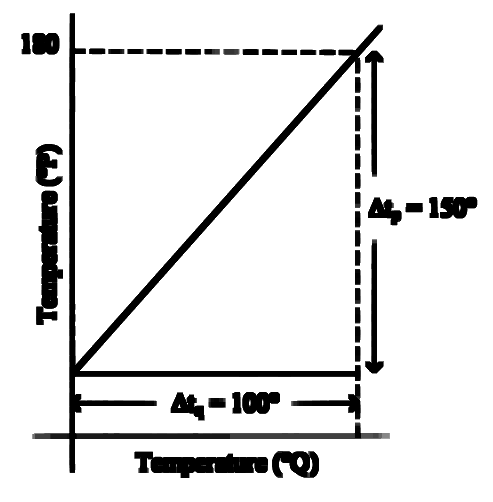
The graph between two temperature scales P and Q is shown in the figure. Between upper fixed point and lower fixed point there are 150 equal divisions of scale P and 100 divisions on scale Q. The relationship for conversion between the two scales is given by :-
Show answer and solution
Answer: (d)
From the graph, P runs from 30 (lower point, since 180−150=30) to 180; Q runs from 0 to 100.
Thermometry & Thermal Expansion · Temperature scales & thermometers
A faulty thermometer reads 5∘C in melting ice and 95∘C in steam. The correct temperature on absolute scale will be __________ K when the faulty thermometer reads 41∘C.
Numerical answer type. Work it out, then open the answer.
Thermometry & Thermal Expansion · Area & volume expansion
Two uniform brass rods A and B of length 'l' and '2l' and their radii '2r' and 'r' respectively are heated to same temperature. The ratio of the increase in the volume of rod A to that of rod B is
Thermometry & Thermal Expansion · Area & volume expansion
A hole is drilled in a metal sheet. At 27∘C, the diameter of hole is 5 cm. When the sheet is heated to 177∘C, the change in the diameter of hole is d×10−3 cm. The value of d will be __________ if coefficient of linear expansion of the metal is 1.6×10⁻⁵/∘C.
Numerical answer type. Work it out, then open the answer.
Show answer and solution
Answer: 12
A hole expands like the material around it: Δd=dαΔT.
A steel rod of length 1 m and cross sectional area 10−4 m2 is heated from 0∘C to 200∘C without being allowed to extend or bend. The compressive tension produced in the rod is ___________ ×104 N. (Given Young's modulus of steel =2×10¹¹ N m−2, coefficient of linear expansion =10−5 K−1)
Numerical answer type. Work it out, then open the answer.
Thermometry & Thermal Expansion · Temperature scales & thermometers
The pressure of the gas in a constant volume gas thermometer is 100 cm of mercury when placed in melting ice at 1 atm. When the bulb is placed in a liquid, the pressure becomes 180 cm of mercury. Temperature of the liquid is:
Thermometry & Thermal Expansion · Linear expansion
At what temperature a gold ring of diameter 6.230 cm be heated so that it can be fitted on a wooden bangle of diameter 6.241 cm? Both the diameters have been measured at room temperature (27∘C).
(Given: coefficient of linear thermal expansion of gold αL = 1.4 × 10⁻⁵ K−1)
Show answer and solution
Answer: (d)
Ring diameter must grow by ΔD=6.241−6.230=0.011 cm.
Thermometry & Thermal Expansion · Area & volume expansion
A solid metallic cube having total surface area 24 m2 is uniformly heated. If its temperature is increased by 10∘C, calculate the increase in volume of the cube. (Given α = 5.0 × 10 −4 ∘C−1).
A unit scale is to be prepared whose length does not change with temperature and remains 20 cm, using a bimetallic strip made of brass and iron each of different length. The length of both components would change in such a way that difference between their lengths remains constant. If length of brass is 40 cm, then length of iron will be __________ cm⋅(αiron =1.2×10⁻⁵ K−1 and αbrass =1.8×10⁻⁵ K−1).
Numerical answer type. Work it out, then open the answer.
Show answer and solution
Answer: 60
Difference stays constant if both expand equally: Lbαb=Liαi.
Thermometry & Thermal Expansion · Temperature scales & thermometers
On an imaginary linear scale of temperature (called 'W' scale) the freezing and boiling points of water are 39∘ W and 239∘ W respectively. The temperature on the new scale corresponding to 39 ∘C temperature on Celsius scale will be
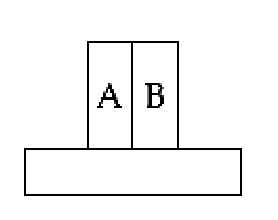
A bimetallic strip consists of metals A and B. It is mounted rigidly as shown. The metal A has higher coefficient of expansion compared to that of metal B. When the bimetallic strip is placed in a cold bath, it will:
Show answer and solution
Answer: (b)
In a cold bath both strips shrink, but A (larger α) shrinks more.
The shorter strip lies on the inside of the curve, so the strip bends towards A.
A is on the left, so the answer is (b) bend towards the left.
Thermometry & Thermal Expansion · Linear expansion
Two rods of different metals have coefficients of linear expansion 'α1' and 'α2' respectvely. Their respective lengths are 'L1' and 'L2'. At all temperatures (L2−L1) is same. The correct relation is
Show answer and solution
Answer: (d)
(L2−L1) constant means both rods expand by the same amount: L1α1ΔT=L2α2ΔT.
Thermometry & Thermal Expansion · Area & volume expansion
Let 'W1' be the work done in blowing a soap bubble of radius 'r' from soap at room temperature. The soap is now heated and second soap bubble of radius '2r' is blown from the heated soap solution. If 'W2' is the work done in forming this bubble then
Thermometry & Thermal Expansion · Area & volume expansion
Each side of a box made of metal sheet in cubic shape is 'a' at room temperature 'T', the coefficient of linear expansion of the metal sheet is 'α'. The metal sheet is heated uniformly, by a small temperature ΔT, so that its new temperature is T + ΔT. Calculate the increase in the volume of the metal box.
Show answer and solution
Answer: (a)
The box expands like a solid cube of the same metal: γ=3α.
The area of cross-section of a railway track is 0.01 m2. The temperature variation is 10∘C. Coefficient of linear expansion of material of track is 10−5/∘ C. The energy stored per meter in the track is ____________ J/m.
(Young's modulus of material of track is 1011 Nm−2)
Numerical answer type. Work it out, then open the answer.
Show answer and solution
Answer: 05
Thermal stress σ=YαΔT=1011×10−5×10=107 Pa.
Energy per unit length =21Yσ2A=21×10111014×0.01
Thermometry & Thermal Expansion · Area & volume expansion
A non-isotropic solid metal cube has coefficients of linear expansion as:
5 × 10⁻⁵/oC along the x-axis and 5 × 10⁻⁶/oC along the y and the z-axis. If the coefficient of volume expansion of the solid is C × 10-6/oC then the value of C is
Numerical answer type. Work it out, then open the answer.
Thermometry & Thermal Expansion · Linear expansion
Two different wires having lengths L1 and L2, and respective temperature coefficient of linear expansion α1 and α2, are joined end-to-end. Then the effective temperature coefficient of linear expansion is:
Show answer and solution
Answer: (d)
Total expansion: ΔL=(L1α1+L2α2)ΔT.
Also ΔL=(L1+L2)αeffΔT.
αeff=L1+L2α1L1+α2L2, so the answer is (d).
Thermometry & Thermal Expansion · Area & volume expansion
When the temperature of a metal wire is increased from 0oC to 10oC, its length increases by 0.02%. The percentage change in its mass density will be closest to:
Show answer and solution
Answer: (b)
Linear strain =0.02%, so volume increases by 3×0.02=0.06%.
Mass is constant, so ρ∝1/V: density falls by about 0.06%.
A bakelite beaker has volume capacity of 500 cc at 30oC. When it is partially filled with Vm volume (at 30oC) of mercury, it is found that the unfilled volume of the beaker remains constant as temperature is varied. If γ(beaker) = 6 × 10⁻⁶oC–1 and γ(mercury) = 1.5 × 10⁻⁴oC–1, where γ is the coefficient of volume expansion, then Vm (in cc) is close to ____.
Numerical answer type. Work it out, then open the answer.
Thermometry & Thermal Expansion · Temperature scales & thermometers
A thermometer graduated according to a linear scale reads a value x0 when in contact with boiling water, and x0/3 when in contact with ice. What is the temperature of an object inoC, if this thermometer in the contact with the object reads x0/2?
Thermometry & Thermal Expansion · Linear expansion
A copper rod of 88 cm and an aluminium rod of unknown length have their increase in length independent of increase in temperature. The length of aluminium rod is: (αCu = 1.7 × 10⁻⁵ K–1 and αAl = 2.2 × 10⁻⁵ K–1)
Show answer and solution
Answer: (c)
The difference in length stays constant when expansions are equal: LCuαCu=LAlαAl.
Thermometry & Thermal Expansion · Linear expansion
Two rods A and B of identical dimensions are at temperature 30°C. If A is heated upto 180oC and B upto ToC, then the new lengths are the same. If the ratio of the coefficients of linear expansion of A and B is 4: 3, then the value of T is
Show answer and solution
Answer: (c)
Same initial length and same final length means equal expansion: αA(180−30)=αB(T−30).
A rod, of length L at room temperature and uniform area of cross section A, is made of a metal having coefficient of linear expansion α/oC. It is observed that an external compressive force F, is applied on each of its ends, prevents any change in the length of the rod, when its temperature rises by ΔT K. Young's modulus, Y, for this metal is:
Show answer and solution
Answer: (a)
Prevented expansion gives thermal strain αΔT.
AF=YαΔT (a change of ΔT is the same in K and ∘C).
A clock pendulum having coefficient of linear expansion. α=9×10⁻⁷/∘C−1 has a period of 0.5 s at 20∘C. If the clock is used in a climate, where the temperature is 30∘C, how much time does the clock lose in each oscillation? ( g= constant)
At 40o C, a brass wire of 1 mm radius is hung from the ceiling. A small mass, M is hung from the free end of the wire. When the wire is cooled down from 40oC to 20oC it regains its original length of 0.2 m. The value of M is close to: (Coefficient of linear expansion and Young’s modulus of brass are 10–5 /oC and 1011 N/m 2, respectively; g= 10 ms–2)
Show answer and solution
Answer: (c)
Stretch by the load equals thermal contraction: πr2YMg=αΔθ.
A steel rail of length 5 m and area of cross section 40cm2 is prevented from expanding along its length while the temperature rises by 10oC. If coefficient of linear expansion and Young’s modulus of steel are 1.2×10⁻⁵ K−1 and 2×10¹¹ Nm−2 respectively, the force developed in the rail is approximately:
A compressive force, F is applied at the two ends of a long thin steel rod. It is heated, simultaneously, such that its temperature increases by ΔT. The net change in its length is zero. Let ℓ be the length of the rod, A its area of cross-section,Y its Young’s modulus, and α its coefficient of linear expansion. Then, F is equal to:
Thermometry & Thermal Expansion · Area & volume expansion
An external pressure P is applied on a cube at 0oC so that it is equally compressed from all sides. K is the bulk modulus of the material of the cube and α is its coefficient of linear expansion. Suppose we want to bring the cube to its original size by heating. The temperature should be raised by:
A simple pendulum made of a bob of mass m and a metallic wire of negligible mass has time period 2 s at T=0oC. If the temperature of the wire is increased and the corresponding change in its time period is plotted against its temperature, the resulting graph is a line of slope S. If the coefficient of linear expansion of metal is α then the value of S is:
A pendulum clock loses 12 s a day if the temperature is 40∘C and gains 4 s a day if the temperature is 20∘C. The temperature at which the clock will show correct time, and the co-efficient of linear expansion (α) of the metal of the pendulum shaft are respectively:
Show answer and solution
Answer: (c)
Time lost or gained per day: Δt=21α(θ−θ0)×86400.
Thermometry & Thermal Expansion · Temperature scales & thermometers
On a linear temperature scale Y, water freezes at −160∘ Y and boils at −50∘ Y. On this Y scale, a temperature of 340 K would be read as: (water freezes at 273 K and boils at 373 K)
The ratio of the coefficient of volume expansion of a glass container to that of a viscous liquid kept inside the container is 1: 4. What fraction of the inner volume of the container should the liquid occupy so that the volume of the remaining vacant space will be same at all temperatures?
Show answer and solution
Answer: (b)
Vacant space stays constant if liquid and container expand by the same volume: Vlγl=Vcγc.
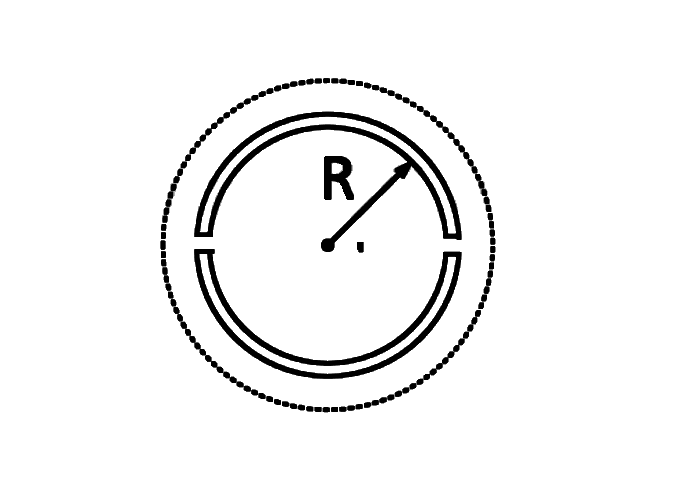
A wooden wheel of radius R is made of two semicircular part (see figure). The two parts are held together by a ring made of a metal strip of cross sectional area S and length L.L is slightly less than 2πR. To fit the ring on the wheel, it is heated so that its temperature rises by ΔT and it just steps over the wheel. As it cools down to surrounding temperature, it process the semicircular parts together. If the coefficient of linear expansion of the metal is α, and its Young's modulus is Y, the force that one part of the wheel applies on the other part is:
Show answer and solution
Answer: (d)
Ring strain after cooling: L2πR−L=αΔT.
Tension in the strip: T=YSαΔT.
Each half of the ring pulls the two halves together with T at both cut ends, so force =2T.
Thermometry & Thermal Expansion · Linear expansion
The coefficients of linear expansions of brass and steel are α1 and α2 respectively. When we take a brass rod of length l1 and a steel rod of length l2 at 0∘C, then the difference in their lengths (l2−l1) will remain the same at all temperatures if
Show answer and solution
Answer: (a)
At temperature θ: l2′−l1′=(l2−l1)+(l2α2−l1α1)θ.
The difference stays constant only if the two expansions are equal: l1α1=l2α2.
Thermometry & Thermal Expansion · Temperature scales & thermometers
A Centigrade and a Fahrenheit thermometer are dipped in boiling water. The water temperature is lowered until the Fahrenheit thermometer registers 140∘F. What is the fall in temperature as registered by the centigrade thermometer?
Show answer and solution
Answer: (c)
Boiling water: 100∘C. At 140∘F: C=95(140−32)=60∘C.
Calorimetry, Latent Heat & Mechanical Equivalent of Heat · Specific heat, thermal capacity & Joule's law
A lead bullet moving with velocity 'v' strikes a wall and stops. 75% of its energy is converted into heat. If the increase in the temperature is nJsv2, then the value of n is
{s= specific heat of lead,J= mechanical equivalent of heat}
1 g of water of volume 1 cm3 at 100∘C is converted into steam of same temperature under normal atmospheric pressure (105 Pa). The volume of steam formed equals 1671 cm3. If the latent heat of vaporisation of water is 2256 J/g, the change in internal energy is
The heat extracted out of x gram of water initially at 50∘C to cool it down to 0∘C is sufficient to evaporate (1000−x) gram of water also initially at 50∘C. The value of x (closest integer) is ______. (Take latent heat of water 2256 kJ/kg, specific heat capacity of water 4200 J/kg.K)
Numerical answer type. Work it out, then open the answer.
Show answer and solution
Answer: 922
Heat from x g cooling 50→0∘C: x×4.2×50=210x J.
Heat for (1000−x) g: warm to 100∘C and evaporate: (1000−x)(210+2256)=2466(1000−x) J.
Calorimetry, Latent Heat & Mechanical Equivalent of Heat · Principle of calorimetry: mixtures
540 gram of ice at 0∘ C is mixed with 540 gram of water at 90∘ C. The final temperature of the mixture will be [Latent heat of fusion of water = 80 cal/g]
Show answer and solution
Answer: (c)
Heat from water cooling to 0∘C: 540×90=48600 cal; to melt ice: 540×80=43200 cal.
All ice melts; extra 5400 cal heats 1080 g of water.
Calorimetry, Latent Heat & Mechanical Equivalent of Heat · Principle of calorimetry: mixtures
A piece of metal of 850 K is dropped into 1 kg of water at 300 K. If equilibrium temperature of water is 350 K then the heat capacity of the metal expressed in KJ is (Sp. heat of water =1g∘Ccal)
Show answer and solution
Answer: (a)
Heat gained by water =1000×1×50=50000 cal=2.1×10⁵ J
Calorimetry, Latent Heat & Mechanical Equivalent of Heat · Principle of calorimetry: mixtures
15 g of ice at 0∘C is added to a vessel containing water at 40∘C. The mass of water and water equivalent of the vessel is 60 g. Assuming that negligible heat is taken from the surroundings, the final temperature of the mixture will be
[ Lice =80 cal/g, Swater =1 cal/g ]
Show answer and solution
Answer: (c)
Heat from 60 g cooling to 0∘C: 60×40=2400 cal; to melt ice: 15×80=1200 cal, so all ice melts.
Calorimetry, Latent Heat & Mechanical Equivalent of Heat · Principle of calorimetry: mixtures
10 kg of ice at −10∘C is added to 100 kg of water to lower its temperature from 25 ∘C. Consider no heat exchange to surroundings. The decrement to the temperature of water is ∘C. (specific heat of ice =2100 J/kg.∘C, specific heat of water =4200 J/kg.∘C, latent heat of fusion of ice =3.36×10⁵ J/kg)
Calorimetry, Latent Heat & Mechanical Equivalent of Heat · Specific heat, thermal capacity & Joule's law
Density of water at 4∘C and 20∘C are 1000 kg/m3 and 998 kg/m3 respectively. The increase in internal energy of 4 kg of water when it is heated from 4∘C to 20∘C is ______ J.
(specific heat capacity of water =4.2 kJ/kg K and 1 atmospheric pressure =105 Pa)
Show answer and solution
Answer: (a)
First law: ΔU=Q−PΔV.
Q=mcΔT=4×4200×16=268800J
ΔV=9984−10004≈8.016×10⁻⁶m3, so PΔV=105×8.016×10−6≈0.8J
Calorimetry, Latent Heat & Mechanical Equivalent of Heat · Specific heat, thermal capacity & Joule's law
Water falls from a height of 200 m into a pool. Calculate the rise in temperature of the water assuming no heat dissipation from the water in the pool.
(Take g = 10 m/s2, specific heat of water = 4200 J/(kg K))
A gun fires a lead bullet of temperature 300 K into a wooden block. The bullet having melting temperature of 600 K penetrates into the block and melts down. If the total heat required for the process is 625 J, then the mass of the bullet is _______ grams. (Latent heat of fusion of lead =2.5×10⁴ J kg−1 and specific heat capacity of lead =125 J kg−1 K−1)
An amount of ice of mass 10−3 kg and temperature −10∘C is transformed to vapour of temperature 110∘C by applying heat. The total amount of work required for this conversion is, (Take, specific heat of ice =2100 J kg−1 K−1, specific heat of water =4180 J kg−1 K−1, specific heat of steam =1920 J kg−1 K−1, Latent heat of ice =3.35×10⁵ J kg−1 and Latent heat of steam =2.25×10⁶ J kg−1)
Show answer and solution
Answer: (b)
Ice −10→0∘C: 10−3×2100×10=21 J; melting: 335 J.
Water 0→100∘C: 10−3×4180×100=418 J; vaporising: 2250 J.
A stationary object at 4∘C and weighing 3.5 kg falls from a height of 2000 m on snow mountain at 0∘C. If the temperature of the object just before hitting the snow is 0∘C and the object comes to rest immediately then the quantity of ice that melts is (Acceleration due to gravity =10 m/s2, Latent heat of ice =3.5×10⁵ J/kg)
Show answer and solution
Answer: (c)
The object stops at 0∘C, so its mechanical energy mgh goes into melting ice: mgh=miceL.
Calorimetry, Latent Heat & Mechanical Equivalent of Heat · Specific heat, thermal capacity & Joule's law
A lead bullet moving with velocity ' v ' strikes a wall and stops. If 50% of its energy is converted into heat, then the increase in temperature is ( s= specific heat of lead)
Calorimetry, Latent Heat & Mechanical Equivalent of Heat · Specific heat, thermal capacity & Joule's law
A water heater of power 2000 W is used to heat water. The specific heat capacity of water is 4200 J kg−1 K−1. The efficiency of heater is 70%. Time required to heat 2 kg of water from 10∘C to 60∘C is _________ s.
(Assume that the specific heat capacity of water remains constant over the temperature range of the water).
Numerical answer type. Work it out, then open the answer.
Calorimetry, Latent Heat & Mechanical Equivalent of Heat · Principle of calorimetry: mixtures
A piece of metal at 850 K is dropped into 1 kg water at 300 K. If the equilibrium temperature of water is 350 K then the heat capacity of the metal, expressed in J K−1 is (1 cal=4.2 J)
Calorimetry, Latent Heat & Mechanical Equivalent of Heat · Specific heat, thermal capacity & Joule's law
A 100 g of iron nail is hit by a 1.5 kg hammer striking at a velocity of 60 ms−1. What will be the rise in the temperature of the nail if one fourth of energy of the hammer goes into heating the nail? [Specific heat capacity of iron = 0.42 Jg−1 ∘C−1]
Show answer and solution
Answer: (c)
KE of hammer =21(1.5)(60)2=2700 J; heat to nail =41×2700=675 J.
Calorimetry, Latent Heat & Mechanical Equivalent of Heat · Specific heat, thermal capacity & Joule's law
A geyser heats water flowing at a rate of 2.0 kg per minute from 30∘C to 70∘ C. If geyser operates on a gas burner, the rate of combustion of fuel will be ___________ g min−1.
[Heat of combustion = 8 × 10³ Jg−1, Specific heat of water = 4.2 Jg−1 ∘C−1]
Numerical answer type. Work it out, then open the answer.
A lead bullet penetrates into a solid object and melts. Assuming that 40% of its kinetic energy is used to heat it, the initial speed of bullet is:
(Given: initial temperature of the bullet = 127∘C, Melting point of the bullet = 327∘C, Latent heat of fusion of lead = 2.5 × 10⁴ J kg−1, Specific heat capacity of lead = 125 J/kg K)
A copper block of mass 5.0 kg is heated to a temperature of 500∘C and is placed on a large ice block. What is the maximum amount of ice that can melt? [Specific heat of copper: 0.39 J g−1 ∘C−1 and latent heat of fusion of water: 335 J g−1]
Show answer and solution
Answer: (c)
Copper cools from 500∘C to 0∘C: Q=5000×0.39×500=9.75×10⁵ J
Calorimetry, Latent Heat & Mechanical Equivalent of Heat · Principle of calorimetry: mixtures
A block of ice of mass 120 g at temperature 0∘C is put in 300 g of water at 25∘ C. The x g of ice melts as the temperature of the water reaches 0∘ C. The value of x is _____________. [Use specific heat capacity of water = 4200 Jkg−1K−1, Latent heat of ice = 3.5 × 10⁵ Jkg−1]
Numerical answer type. Work it out, then open the answer.
Show answer and solution
Answer: 90
Heat given by water cooling to 0∘C melts the ice: mwcΔT=xL
0.3×4200×25=31500J
x=3.5×10531500=0.09kg (less than 120 g, so valid)
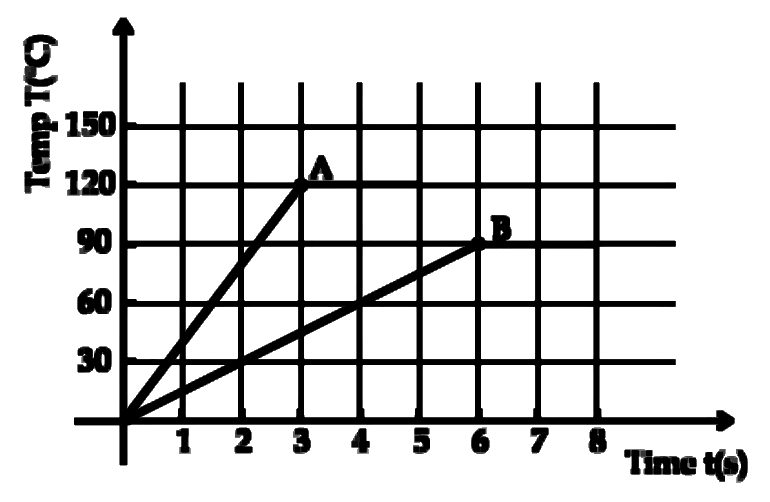
Two different metal bodies A and B of equal mass are heated at a uniform rate under similar conditions. The variation of temperature of the bodies is graphically represented as shown in the figure. The ratio of specific heat capacities is:
Show answer and solution
Answer: (b)
Same heating rate and mass: P=mcdtdT⇒c∝slope1.
Slope of A =3120=40∘C/s; slope of B =690=15∘C/s.
Calorimetry, Latent Heat & Mechanical Equivalent of Heat · Principle of calorimetry: mixtures
The temperature of equal masses of three different liquids x, y and z are 10∘C, 20∘C and 30∘C respectively. The temperature of mixture when x is mixed with y is 16∘C and that when y is mixed with z is 26∘ C. The temperature of mixture when x and z are mixed will be:
Show answer and solution
Answer: (c)
Equal masses: x and y: cx(16−10)=cy(20−16)⇒cy=1.5cx.
y and z: cy(26−20)=cz(30−26)⇒cz=1.5cy=2.25cx.
Calorimetry, Latent Heat & Mechanical Equivalent of Heat · Specific heat, thermal capacity & Joule's law
A bullet of mass 5 g, travelling with a speed of 210 m/s, strikes a fixed wooden target. One half of its kinetic energy is converted into heat in the bullet while the other half is converted into heat in the wood. The rise of temperature of the bullet if the specific heat of its material is 0.030 cal/(g –oC) (1 cal = 4.2 × 10⁷ ergs) close to:
Show answer and solution
Answer: (a)
KE =21(0.005)(210)2=110.25 J; heat in bullet =55.125 J.
c=0.030 cal/g∘C=0.126 J/g∘C, so mc=5×0.126=0.63 J/∘C.
Calorimetry, Latent Heat & Mechanical Equivalent of Heat · Principle of calorimetry: mixtures
A calorimeter of water equivalent 20 g contains 180 g of water at 25oC. ‘m’ grams of steam at 100oC is mixed in it till the temperature of the mixure is 31oC. The value of ‘m’ is close to: (Latent heat of water = 540 cal g–1, specific heat of water = 1 cal g–1oC–1)
Show answer and solution
Answer: (b)
Heat gained by water + calorimeter =(180+20)×1×(31−25)=1200 cal
Calorimetry, Latent Heat & Mechanical Equivalent of Heat · Principle of calorimetry: mixtures
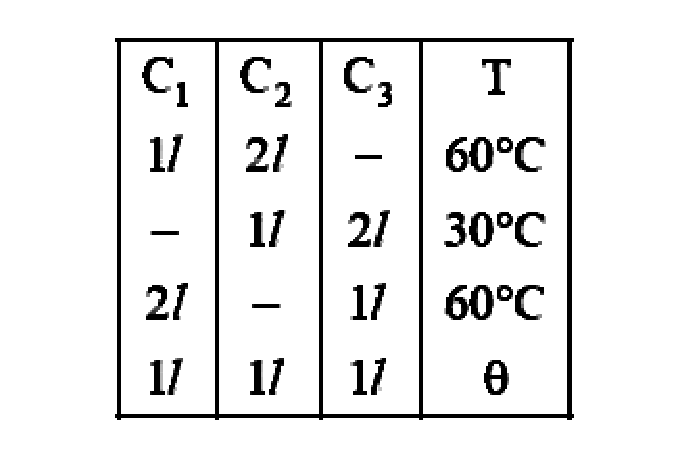
Three containers C1, C2 and C3 have water at different temperatures. The table below shows the final temperature T when different amounts of water (given in litres) are taken from each containers and mixed (assume no loss of heat during the process)
The value of θ (in °C to the nearest integer) is ..........
Numerical answer type. Work it out, then open the answer.
Show answer and solution
Answer: 50
For mixing equal-specific-heat water: T=∑Vi∑ViTi.
Calorimetry, Latent Heat & Mechanical Equivalent of Heat · Principle of calorimetry: mixtures
M grams of steam at 100oC is mixed with 200 g of ice at its melting point in a thermally insulated container. If it produced liquid water at 40oC [heat of vaporization of water is 540 cal/g and heat of fusion of ice is 80 cal/g] the value of M is ____
Numerical answer type. Work it out, then open the answer.
Show answer and solution
Answer: 40
Heat lost by steam (condense + cool to 40∘C) = heat gained by ice (melt + warm to 40∘C).
Calorimetry, Latent Heat & Mechanical Equivalent of Heat · Specific heat, thermal capacity & Joule's law
One kg of water, at 20oC, heated in an electric kettle whose heating element has a mean (temperature averaged) resistance of 20 Ω. The rms voltage in the mains is 200 V. Ignoring heat loss from the kettle, time taken for water to evaporate fully, is close to: [Specific heat of water = 4200 J/(kgoC), Latent heat of water = 2260 kJ/kg]
Calorimetry, Latent Heat & Mechanical Equivalent of Heat · Specific heat, thermal capacity & Joule's law
A massless spring (k = 800 N/m), attached with a mass (500 g) is completely immersed in 1 kg of water. The spring is stretched by 2 cm and released so that it starts vibrating. What would be the order of magnitude of the change in the temperature of water when the vibrations stop completely? (Assume that the water container and spring receive negligible heat and specific heat of mass = 400 J/kg K, specific heat of water = 4184 J/kg K)
Show answer and solution
Answer: (c)
Spring energy =21kx2=21(800)(0.02)2=0.16 J, all turned into heat.
Calorimetry, Latent Heat & Mechanical Equivalent of Heat · Principle of calorimetry: mixtures
When M1 gram of ice at –10oC (specific heat = 0.5 cal g–1oC–1) is added to M2 gram of water at 50°C, finally no ice is left and the water is at 0°C. The value of latent heat of ice, in cal g–1 is:
Calorimetry, Latent Heat & Mechanical Equivalent of Heat · Principle of calorimetry: mixtures
When 100 g of a liquid A at 100oC is added to 50 g of a liquid B at temperature 75oC, the temperature of the mixture becomes 90oC. The temperature of the mixture, if 100 g of liquid A at 100oC is added to 50 g of liquid B at 50oC, will be:
Show answer and solution
Answer: (d)
First mixing: 100sA(100−90)=50sB(90−75)⇒sB=34sA
Calorimetry, Latent Heat & Mechanical Equivalent of Heat · Principle of calorimetry: mixtures
A metal ball of mass 0.1 kg is heated upto 500oC and dropped into a vessel of heat capacity 800 JK–1 and containing 0.5 kg water. The initial temperature of water and vessel is 30oC. What is the approximate percentage increment in the temperature of the water? [Specific Heat Capacities of water and metal are, respectively, 4200 Jkg–1 K–1 and 400 Jkg–1 K–1]
Show answer and solution
Answer: (a)
Ball: mc=0.1×400=40 J/K; water + vessel: 0.5×4200+800=2900 J/K.
Calorimetry, Latent Heat & Mechanical Equivalent of Heat · Principle of calorimetry: mixtures
Ice at –20oC is added to 50 g of water at 40oC. When the temperature of the mixture reaches 0oC, it is found that 20 g of ice is still unmelted. The amount of ice added to the water was close to (Specific heat of water = 4.2J/g/oC Specific heat of Ice = 2.1J/g/oC Heat of fusion of water at 0oC= 334J/g)
Show answer and solution
Answer: (d)
Heat lost by water =50×4.2×40=8400 J
Ice of mass m: warming m×2.1×20=42m; melting (m−20)×334.
Calorimetry, Latent Heat & Mechanical Equivalent of Heat · Principle of calorimetry: mixtures
An unknown metal of mass 192 g heated to a temperature of 100oC was immersed into a brass calorimeter of mass 128 g containing 240 g of water at a temperature of 8.4oC. Calculate the specific heat of the unknown metal if water temperature stabilizes at 21.5oC. (Specific heat of brass is 394 J kg–1 K–1)
Show answer and solution
Answer: (d)
Heat lost by metal = heat gained by water + brass calorimeter.
A thermally insulated vessel contains 150g of water at 0°C. Then the air from the vessel is pumped out adiabatically. A fraction of water turns into ice and the rest evaporates at 0°C itself. The mass of evaporated water will be closest to: (Latent heat of vaporization of water = 2.10 × 10⁶ J kg–1 and Latent heat of Fusion of water = 3.36 × 10⁵ J kg–1)
Show answer and solution
Answer: (c)
Heat for evaporation comes from water freezing: mvLv=miLf, with mv+mi=150g.
Calorimetry, Latent Heat & Mechanical Equivalent of Heat · Principle of calorimetry: mixtures
In an experiment, a sphere of aluminium of mass 0.20 kg is heated upto 150oC. Immediately, it is put into water of volume 150 cc at 27oC kept in a calorimeter of water equivalent to 0.025 kg. Final temperature of the system is 40oC. The specific heat of aluminium is: (take 4.2 Joule = 1 calorie)
Show answer and solution
Answer: (d)
Water mass =150g=0.150kg; add water equivalent 0.025kg.
Heat lost by Al = heat gained: 0.20s(150−40)=(0.150+0.025)(4200)(40−27)
Calorimetry, Latent Heat & Mechanical Equivalent of Heat · Principle of calorimetry: mixtures
A copper ball of mass 100 gm is at a temperature T. It is dropped in a copper calorimeter of mass 100 gm, filled with 170 gm of water at room temperature. Subsequently, the temperature of the system is found to be 75oC. T is given by: (Given: room temperature = 30oC, specific heat of copper = 0.1 cal/gmoC)
Show answer and solution
Answer: (c)
Heat lost by ball = heat gained by calorimeter + water.
Calorimetry, Latent Heat & Mechanical Equivalent of Heat · Specific heat, thermal capacity & Joule's law
200 g water is heated from 40oC to 60oC. Ignoring the slight expansion of water, the change in its internal energy is close to (Given specific heat of water = 4184 J/kg/K):
An experiment takes 10 minutes to raise the temperature of water in a container from 0oC to 100oC and another 55 minutes to convert it totally into steam by a heater supplying heat at a uniform rate. Neglecting the specific heat of the container and taking specific heat of water to be 1 cal/goC, the heat of vapourization according to this experiment will come out to be:
Calorimetry, Latent Heat & Mechanical Equivalent of Heat · Specific heat, thermal capacity & Joule's law
Water of volume 2 L in a closed container is heated with a coil of 1 kW. While water is heated, the container loses energy at a rate of 160J/s. In how much time will the temperature of water rise from 27oC to 77oC? (Specific heat of water is 4.2 kJ/kg K and that of the container is negligible).
Given that 1 g of water in liquid phase has volume 1 cm3 and in vapour phase 1671 cm3 at atmospheric pressure and the latent heat of vaporization of water is 2256 J/g; the change in the internal energy in joules for 1 g of water at 373 K when it changes from liquid phase to vapour phase at the same temperature is:
Calorimetry, Latent Heat & Mechanical Equivalent of Heat · Principle of calorimetry: mixtures
500 g of water and 100 g of ice at 0°C are in a calorimeter whose water equivalent is 40 g. 10 g of steam at 100°C is added to it. Then water in the calorimeter is: (Latent heat of ice = 80 cal/g, Latent heat of steam = 540 cal/g)
Show answer and solution
Answer: (b)
Heat steam can give down to 0∘C: 10(540+100)=6400cal.
Heat to melt all ice: 100×80=8000cal>6400, so final temperature is 0∘C.
Calorimetry, Latent Heat & Mechanical Equivalent of Heat · Specific heat, thermal capacity & Joule's law
100 g of water is heated from 30∘C to 50∘C. Ignoring the slight expansion of the water, the change in its internal energy is (specific heat of water is 4184 J/kg/K):
Calorimetry, Latent Heat & Mechanical Equivalent of Heat · Principle of calorimetry: mixtures
10 gm of ice cubes at 0∘C are released in a tumbler (water equivalent 55 g) at 40∘C. Assuming that negligible heat is taken from the surroundings, the temperature of water in the tumbler becomes nearly (L=80 cal/g)
Show answer and solution
Answer: (b)
Heat lost by tumbler = heat to melt ice + warm melt water.