Q1 MHT CET 2026 · 13 APR · SHIFT 1 Easy ☆
Units & Dimensions · Physical quantities & SI units
According to Boyle's law, the product PV remains constant. The SI unit of PV is same as that of
(a) momentum (b) energy (c) force (d) impulse Show answer and solution
Answer: (b)
Unit of P P P N/m 2 \text{N/m}^2 N/m 2 V V V m 3 \text{m}^3 m 3 P V → N m 2 × m 3 = N m = J PV \to \frac{\text{N}}{\text{m}^2} \times \text{m}^3 = \text{N m} = \text{J} P V → m 2 N × m 3 = N m = J So the answer is (b) energy. Report a mistake Q2 JEE Main 2026 · 22 JAN · SHIFT 2 Easy ☆
Units & Dimensions · Physical quantities & SI units
If ϵ , E \epsilon, E ϵ , E t t t ϵ E t \frac{\epsilon E}{t} t ϵ E
(a) Am (b) A/m \text{A/m} A/m (c) A/m 2 \text{A/m}^2 A/m 2 (d) Am 2 \text{Am}^2 Am 2 Show answer and solution
Answer: (c)
Displacement current I d = ϵ d Φ E d t = ϵ A d E d t I_d = \epsilon \frac{d\Phi_E}{dt} = \epsilon A \frac{dE}{dt} I d = ϵ d t d Φ E = ϵ A d t d E So ϵ E t \frac{\epsilon E}{t} t ϵ E I d A \frac{I_d}{A} A I d So the answer is (c) A/m 2 \text{A/m}^2 A/m 2 Report a mistake Q3 NEET 2026 · RE-NEET Easy ☆
Units & Dimensions · Dimensional formula of a quantity
Consider that σ s , k B , b \sigma_s, k_B, b σ s , k B , b σ s k B − 1 b \sigma_s k_B^{-1} b σ s k B − 1 b
(a) [ L − 1 T − 1 K − 4 ] \left[\mathrm{L^{-1}T^{-1}K^{-4}}\right] [ L − 1 T − 1 K − 4 ] (b) [ L − 1 T − 1 K − 2 ] \left[\mathrm{L^{-1}T^{-1}K^{-2}}\right] [ L − 1 T − 1 K − 2 ] (c) [ L − 1 K − 2 ] \left[\mathrm{L^{-1}K^{-2}}\right] [ L − 1 K − 2 ] (d) [ L − 1 T − 1 K − 3 ] \left[\mathrm{L^{-1}T^{-1}K^{-3}}\right] [ L − 1 T − 1 K − 3 ] Show answer and solution
Answer: (b)
[ σ s ] = [ M T − 3 K − 4 ] [\sigma_s] = [\mathrm{MT^{-3}K^{-4}}] [ σ s ] = [ M T − 3 K − 4 ] [ k B ] = [ M L 2 T − 2 K − 1 ] [k_B] = [\mathrm{ML^2T^{-2}K^{-1}}] [ k B ] = [ M L 2 T − 2 K − 1 ] [ b ] = [ L K ] [b] = [\mathrm{LK}] [ b ] = [ LK ] [ k B − 1 ] = [ M − 1 L − 2 T 2 K ] [k_B^{-1}] = [\mathrm{M^{-1}L^{-2}T^{2}K}] [ k B − 1 ] = [ M − 1 L − 2 T 2 K ] [ σ s k B − 1 b ] = [ M 0 L − 2 + 1 T − 3 + 2 K − 4 + 1 + 1 ] = [ L − 1 T − 1 K − 2 ] [\sigma_s k_B^{-1} b] = [\mathrm{M^{0}L^{-2+1}T^{-3+2}K^{-4+1+1}}] = [\mathrm{L^{-1}T^{-1}K^{-2}}] [ σ s k B − 1 b ] = [ M 0 L − 2 + 1 T − 3 + 2 K − 4 + 1 + 1 ] = [ L − 1 T − 1 K − 2 ] So the answer is (b). Report a mistake Q4 JEE Main 2026 · 6 APR · SHIFT 2 Medium ☆
Units & Dimensions · Match-the-dimension lists
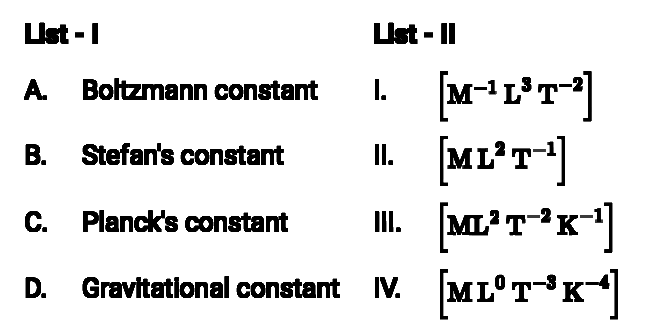
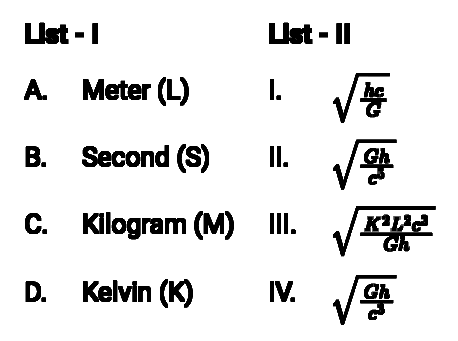
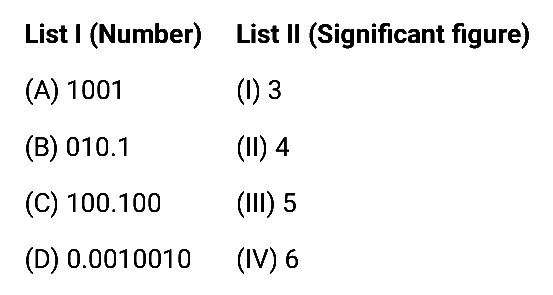
Match List - I with List - II.
Choose the correct answer from the options given below:
(a) A-I, B-II, C-III, D-IV (b) A-IV, B-III, C-II, D-I (c) A-III, B-IV, C-II, D-I (d) A-II, B-I, C-IV, D-III Show answer and solution
Answer: (c)
Boltzmann constant k = E / T = [ M L 2 T − 2 K − 1 ] k = E/T = [\mathrm{ML^2T^{-2}K^{-1}}] k = E / T = [ M L 2 T − 2 K − 1 ] Stefan's constant σ = P A T 4 = [ M L 0 T − 3 K − 4 ] \sigma = \dfrac{P}{AT^4} = [\mathrm{ML^0T^{-3}K^{-4}}] σ = A T 4 P = [ M L 0 T − 3 K − 4 ] Planck's constant h = E / ν = [ M L 2 T − 1 ] h = E/\nu = [\mathrm{ML^2T^{-1}}] h = E / ν = [ M L 2 T − 1 ] G = F r 2 m 2 = [ M − 1 L 3 T − 2 ] G = \dfrac{Fr^2}{m^2} = [\mathrm{M^{-1}L^3T^{-2}}] G = m 2 F r 2 = [ M − 1 L 3 T − 2 ] So the answer is (c) A-III, B-IV, C-II, D-I. Report a mistake Q5 JEE Main 2026 · 4 APR · SHIFT 2 Medium ☆
Units & Dimensions · Match-the-dimension lists
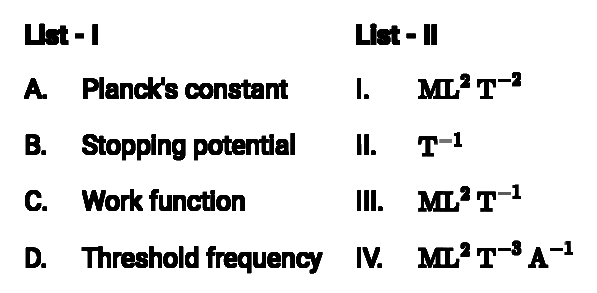
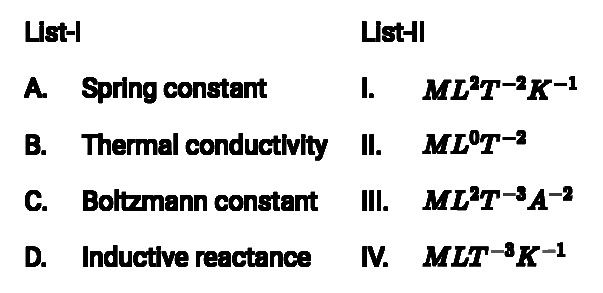
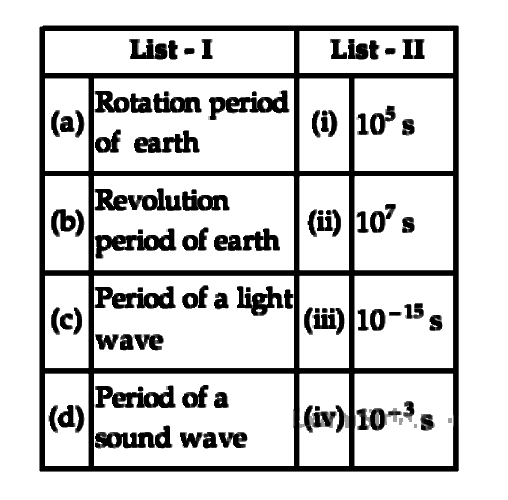
Match the LIST-I with LIST-II
Choose the correct answer from the options given below:
(a) A-III, B-IV, C-I, D-II (b) A-I, B-II, C-III, D-IV (c) A-IV, B-III, C-I, D-II (d) A-I, B-IV, C-III, D-II Show answer and solution
Answer: (a)
Planck's constant = [ M L 2 T − 1 ] = [\mathrm{ML^2T^{-1}}] = [ M L 2 T − 1 ] Stopping potential is a voltage = W / q = [ M L 2 T − 3 A − 1 ] = W/q = [\mathrm{ML^2T^{-3}A^{-1}}] = W / q = [ M L 2 T − 3 A − 1 ] Work function is an energy = [ M L 2 T − 2 ] = [\mathrm{ML^2T^{-2}}] = [ M L 2 T − 2 ] Threshold frequency = [ T − 1 ] = [\mathrm{T^{-1}}] = [ T − 1 ] So the answer is (a) A-III, B-IV, C-I, D-II. Report a mistake Q6 JEE Main 2026 · 28 JAN · SHIFT 2 Medium ☆
Units & Dimensions · Match-the-dimension lists
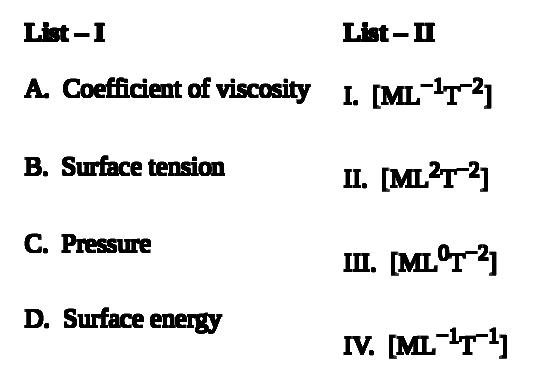
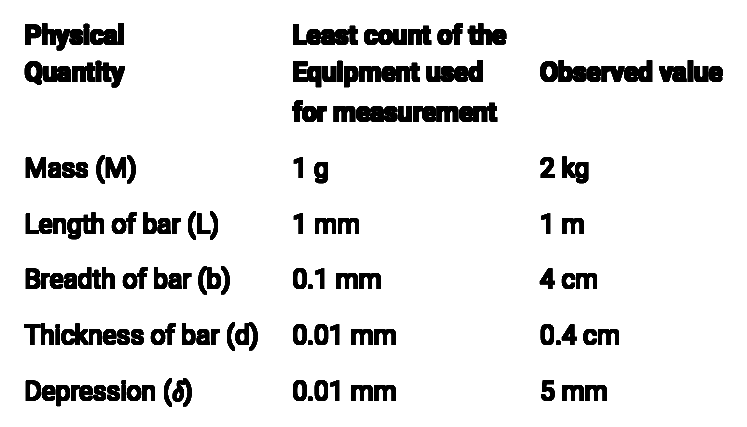
Match List - I with List - II.
Choose the correct answer from the options given below:
(a) A-I, B-II, C-IV, D-III (b) A-IV, B-III, C-I, D-II (c) A-IV, B-I, C-II, D-III (d) A-I, B-III, C-II, D-IV Show answer and solution
Answer: (b)
Viscosity = [ M L − 1 T − 1 ] = [\mathrm{ML^{-1}T^{-1}}] = [ M L − 1 T − 1 ] Surface tension = F / l = [ M L 0 T − 2 ] = F/l = [\mathrm{ML^0T^{-2}}] = F / l = [ M L 0 T − 2 ] Pressure = F / A = [ M L − 1 T − 2 ] = F/A = [\mathrm{ML^{-1}T^{-2}}] = F / A = [ M L − 1 T − 2 ] Surface energy is an energy = [ M L 2 T − 2 ] = [\mathrm{ML^2T^{-2}}] = [ M L 2 T − 2 ] So the answer is (b) A-IV, B-III, C-I, D-II. Report a mistake Q7 JEE Main 2026 · 24 JAN · SHIFT 1 Medium ☆
Units & Dimensions · Match-the-dimension lists
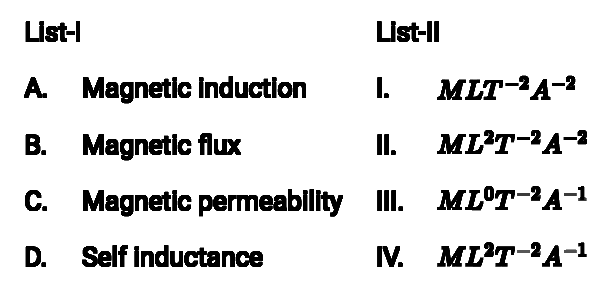
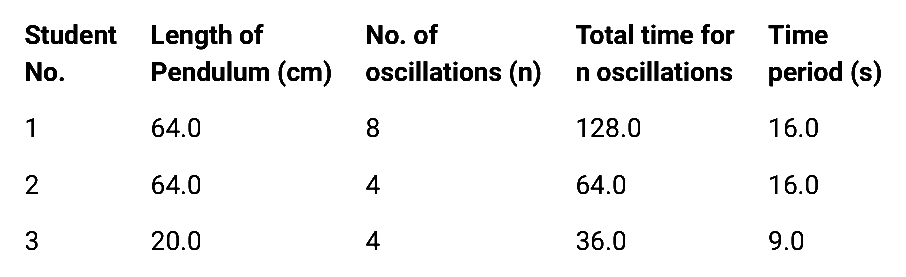
Match the LIST-I with LIST-II
Choose the correct answer from the options given below:
(a) A-III, B-IV, C-II, D-I (b) A-I, B-III, C-IV, D-II (c) A-IV, B-III, C-I, D-II (d) A-III, B-IV, C-I, D-II Show answer and solution
Answer: (d)
Magnetic induction B = F I L = [ M L 0 T − 2 A − 1 ] B = \dfrac{F}{IL} = [\mathrm{ML^0T^{-2}A^{-1}}] B = I L F = [ M L 0 T − 2 A − 1 ] Flux = B A = [ M L 2 T − 2 A − 1 ] = BA = [\mathrm{ML^2T^{-2}A^{-1}}] = B A = [ M L 2 T − 2 A − 1 ] Permeability = [ M L T − 2 A − 2 ] = [\mathrm{MLT^{-2}A^{-2}}] = [ ML T − 2 A − 2 ] Self inductance L = ϕ / I = [ M L 2 T − 2 A − 2 ] L = \phi/I = [\mathrm{ML^2T^{-2}A^{-2}}] L = ϕ / I = [ M L 2 T − 2 A − 2 ] So the answer is (d) A-III, B-IV, C-I, D-II. Report a mistake Q8 JEE Main 2026 · 22 JAN · SHIFT 1 Medium ☆
Units & Dimensions · Match-the-dimension lists
Match the LIST-I with LIST-II
Choose the correct answer from the options given below:
(a) A-III, B-II, C-IV, D-I (b) A-I, B-IV, C-II, D-III (c) A-II, B-I, C-IV, D-III (d) A-II, B-IV, C-I, D-III Show answer and solution
Answer: (d)
Spring constant k = F / x = [ M L 0 T − 2 ] k = F/x = [\mathrm{ML^0T^{-2}}] k = F / x = [ M L 0 T − 2 ] Thermal conductivity K = Q l A Δ T t = [ M L T − 3 K − 1 ] K = \dfrac{Q\,l}{A\,\Delta T\,t} = [\mathrm{MLT^{-3}K^{-1}}] K = A Δ T t Q l = [ ML T − 3 K − 1 ] Boltzmann constant = E / T = [ M L 2 T − 2 K − 1 ] = E/T = [\mathrm{ML^2T^{-2}K^{-1}}] = E / T = [ M L 2 T − 2 K − 1 ] Inductive reactance is a resistance = [ M L 2 T − 3 A − 2 ] = [\mathrm{ML^2T^{-3}A^{-2}}] = [ M L 2 T − 3 A − 2 ] So the answer is (d) A-II, B-IV, C-I, D-III. Report a mistake Q9 MHT CET 2025 · 19 APR · SHIFT 2 Easy ☆
Units & Dimensions · Physical quantities & SI units
If L L L R R R L R \frac{L}{R} R L
(a) second (b) volt (c) ampere (d) per second Show answer and solution
Answer: (a)
L R \frac{L}{R} R L L R LR L R L L L V s/A \text{V s/A} V s/A R R R V/A \text{V/A} V/A L R → s \frac{L}{R} \to \text{s} R L → s So the answer is (a) second. Report a mistake Q10 JEE Main 2025 · 22 JAN · SHIFT 2 Easy ☆
Units & Dimensions · Physical quantities & SI units
Which one of the following is the correct dimensional formula for the capacitance in F? M , L , T \mathrm{M, L, T} M , L , T C C C
(a) [ F ] = [ C M − 1 L − 2 T 2 ] [\mathrm{F}] = \left[\mathrm{CM^{-1}L^{-2}T^{2}}\right] [ F ] = [ C M − 1 L − 2 T 2 ] (b) [ F ] = [ C 2 M − 2 L 2 T 2 ] [\mathrm{F}] = \left[\mathrm{C^{2}M^{-2}L^{2}T^{2}}\right] [ F ] = [ C 2 M − 2 L 2 T 2 ] (c) [ F ] = [ C 2 M − 1 L − 2 T 2 ] [\mathrm{F}] = \left[\mathrm{C^{2}M^{-1}L^{-2}T^{2}}\right] [ F ] = [ C 2 M − 1 L − 2 T 2 ] (d) [ F ] = [ C M − 2 L − 2 T − 2 ] [\mathrm{F}] = \left[\mathrm{CM^{-2}L^{-2}T^{-2}}\right] [ F ] = [ C M − 2 L − 2 T − 2 ] Show answer and solution
Answer: (c)
C = Q V C = \frac{Q}{V} C = V Q V = W Q V = \frac{W}{Q} V = Q W C = Q 2 W C = \frac{Q^2}{W} C = W Q 2 [ W ] = [ M L 2 T − 2 ] [W] = [\mathrm{ML^2T^{-2}}] [ W ] = [ M L 2 T − 2 ] [ C ] = [ C 2 ] [ M L 2 T − 2 ] = [ C 2 M − 1 L − 2 T 2 ] [C] = \frac{[\mathrm{C^2}]}{[\mathrm{ML^2T^{-2}}]} = [\mathrm{C^2M^{-1}L^{-2}T^{2}}] [ C ] = [ M L 2 T − 2 ] [ C 2 ] = [ C 2 M − 1 L − 2 T 2 ] So the answer is (c). Report a mistake Q11 JEE Main 2025 · 7 APR · SHIFT 2 Easy ☆
Units & Dimensions · Dimensional formula of a quantity
The dimension of μ 0 ϵ 0 \sqrt{\frac{\mu_0}{\epsilon_0}} ϵ 0 μ 0
(μ 0 \mu_0 μ 0 ϵ 0 \epsilon_0 ϵ 0
(a) Voltage (b) Inductance (c) Resistance (d) Capacitance Show answer and solution
Answer: (c)
μ 0 = M L T − 2 A − 2 \mu_0 = \mathrm{ML T^{-2}A^{-2}} μ 0 = ML T − 2 A − 2 ϵ 0 = M − 1 L − 3 T 4 A 2 \epsilon_0 = \mathrm{M^{-1}L^{-3}T^4A^2} ϵ 0 = M − 1 L − 3 T 4 A 2 μ 0 / ϵ 0 = M 2 L 4 T − 6 A − 4 \mu_0/\epsilon_0 = \mathrm{M^2L^4T^{-6}A^{-4}} μ 0 / ϵ 0 = M 2 L 4 T − 6 A − 4 μ 0 / ϵ 0 = M L 2 T − 3 A − 2 \sqrt{\mu_0/\epsilon_0} = \mathrm{ML^2T^{-3}A^{-2}} μ 0 / ϵ 0 = M L 2 T − 3 A − 2 This is [ R ] = [ V / I ] [R] = [V/I] [ R ] = [ V / I ] ≈ 377 Ω \approx 377\ \Omega ≈ 377 Ω So the answer is (c) Resistance. Report a mistake Q12 JEE Main 2025 · 4 APR · SHIFT 2 Easy ☆
Units & Dimensions · Dimensional formula of a quantity
In an electromagnetic system, a quantity defined as the ratio of electric dipole moment and magnetic dipole moment has dimension of [ M P L Q T R A S ] [\mathrm{M^{P}L^{Q}T^{R}A^{S}}] [ M P L Q T R A S ]
(a) − 1 , 0 -1, 0 − 1 , 0 (b) 0 , − 1 0,\ -1 0 , − 1 (c) − 1 , 1 -1, 1 − 1 , 1 (d) 1 , − 1 1,\ -1 1 , − 1 Show answer and solution
Answer: (b)
Electric dipole moment p = q d p = qd p = q d [ p ] = A T L [p] = \mathrm{ATL} [ p ] = ATL Magnetic dipole moment m = I A m = IA m = I A [ m ] = A L 2 [m] = \mathrm{AL^2} [ m ] = A L 2 [ p / m ] = A T L / A L 2 = M 0 L − 1 T 1 A 0 [p/m] = \mathrm{ATL}/\mathrm{AL^2} = \mathrm{M^0L^{-1}T^1A^0} [ p / m ] = ATL / A L 2 = M 0 L − 1 T 1 A 0 So P = 0 P = 0 P = 0 Q = − 1 Q = -1 Q = − 1 Report a mistake Q13 JEE Main 2025 · 2 APR · SHIFT 2 Easy ☆
Units & Dimensions · Dimensional formula of a quantity
If μ 0 \mu_0 μ 0 ϵ 0 \epsilon_0 ϵ 0 ( 1 μ 0 ϵ 0 ) \left(\frac{1}{\mu_0\epsilon_0}\right) ( μ 0 ϵ 0 1 )
(a) T 2 / L \mathrm{T^{2}/L} T 2 /L (b) L 2 / T 2 \mathrm{L^{2}/T^{2}} L 2 / T 2 (c) T 2 / L 2 \mathrm{T^{2}/L^{2}} T 2 / L 2 (d) L / T 2 \mathrm{L/T^{2}} L/ T 2 Show answer and solution
Answer: (b)
c = 1 / μ 0 ϵ 0 c = 1/\sqrt{\mu_0\epsilon_0} c = 1/ μ 0 ϵ 0 1 / ( μ 0 ϵ 0 ) = c 2 1/(\mu_0\epsilon_0) = c^2 1/ ( μ 0 ϵ 0 ) = c 2 [ c 2 ] = L 2 T − 2 [c^2] = \mathrm{L^2T^{-2}} [ c 2 ] = L 2 T − 2 So the answer is (b) L 2 / T 2 \mathrm{L^2/T^2} L 2 / T 2 Report a mistake Q14 JEE Main 2025 · 22 JAN · SHIFT 1 Easy ☆
Units & Dimensions · Dimensional formula of a quantity
If B B B μ 0 \mu_0 μ 0 ( B / μ 0 ) (B/\mu_0) ( B / μ 0 )
(a) M T − 2 A − 1 \mathrm{MT^{-2}A^{-1}} M T − 2 A − 1 (b) L − 1 A \mathrm{L^{-1}A} L − 1 A (c) M L 2 T − 2 A − 1 \mathrm{ML^{2}T^{-2}A^{-1}} M L 2 T − 2 A − 1 (d) L T − 2 A − 1 \mathrm{LT^{-2}A^{-1}} L T − 2 A − 1 Show answer and solution
Answer: (b)
B / μ 0 = H B/\mu_0 = H B / μ 0 = H A / m \mathrm{A/m} A/m B = μ 0 n I B = \mu_0 nI B = μ 0 n I n n n [ B / μ 0 ] = [ n I ] = L − 1 A [B/\mu_0] = [nI] = \mathrm{L^{-1}A} [ B / μ 0 ] = [ n I ] = L − 1 A So the answer is (b) L − 1 A \mathrm{L^{-1}A} L − 1 A Report a mistake Q15 JEE Main 2025 · 2 APR · SHIFT 2 Easy ☆
Units & Dimensions · Same dimensions & dimensionless
Given a charge q, current I and permeability of vacuum μ o \mu_o μ o
(a) q I / μ o qI/\mu_o q I / μ o (b) q 2 μ o I q^2\mu_o I q 2 μ o I (c) q μ 0 / I q\mu_0/I q μ 0 / I (d) q μ o I q\mu_o I q μ o I Show answer and solution
Answer: (d)
[ μ 0 ] = M L T − 2 A − 2 [\mu_0] = \mathrm{MLT^{-2}A^{-2}} [ μ 0 ] = ML T − 2 A − 2 F / l = μ 0 I 2 / 2 π d F/l = \mu_0 I^2/2\pi d F / l = μ 0 I 2 /2 π d [ q ] = A T [q] = \mathrm{AT} [ q ] = AT [ I ] = A [I] = \mathrm{A} [ I ] = A [ q μ 0 I ] = A T ⋅ M L T − 2 A − 2 ⋅ A = M L T − 1 [q\mu_0 I] = \mathrm{AT}\cdot\mathrm{MLT^{-2}A^{-2}}\cdot\mathrm{A} = \mathrm{MLT^{-1}} [ q μ 0 I ] = AT ⋅ ML T − 2 A − 2 ⋅ A = ML T − 1 This is the dimension of momentum. So the answer is (d) q μ 0 I q\mu_0 I q μ 0 I Report a mistake Q16 JEE Main 2025 · 29 JAN · SHIFT 1 Easy ☆
Units & Dimensions · Same dimensions & dimensionless
The pair of physical quantities not having the same dimensions is:
(a) Angular momentum and Planck's constant (b) Torque and energy (c) Surface tension and impulse (d) Pressure and Young's modulus Show answer and solution
Answer: (c)
Surface tension = F / l = F/l = F / l M T − 2 \mathrm{MT^{-2}} M T − 2 = F t = Ft = Ft M L T − 1 \mathrm{MLT^{-1}} ML T − 1 Angular momentum = h h h M L 2 T − 1 \mathrm{ML^2T^{-1}} M L 2 T − 1 M L 2 T − 2 \mathrm{ML^2T^{-2}} M L 2 T − 2 M L − 1 T − 2 \mathrm{ML^{-1}T^{-2}} M L − 1 T − 2 So the answer is (c). Report a mistake Q17 JEE Main 2025 · 7 APR · SHIFT 2 Easy ☆
Units & Dimensions · Match-the-dimension lists
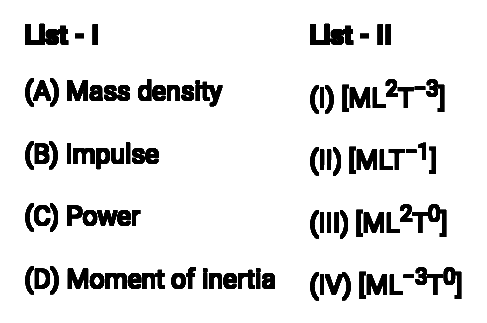
Match List - I with List - II.
Choose the correct answer from the options given below:
(a) (A)-(IV), (B)-(II), (C)-(III), (D)-(I) (b) (A)-(II), (B)-(III), (C)-(IV), (D)-(I) (c) (A)-(IV), (B)-(III), (C)-(I), (D)-(II) (d) (A)-(IV), (B)-(II), (C)-(I), (D)-(III) Show answer and solution
Answer: (d)
Mass density = M / V = [ M L − 3 T 0 ] = M/V = [\mathrm{ML^{-3}T^0}] = M / V = [ M L − 3 T 0 ] Impulse = F t = [ M L T − 1 ] = F\,t = [\mathrm{MLT^{-1}}] = F t = [ ML T − 1 ] Power = W / t = [ M L 2 T − 3 ] = W/t = [\mathrm{ML^2T^{-3}}] = W / t = [ M L 2 T − 3 ] Moment of inertia = m r 2 = [ M L 2 T 0 ] = mr^2 = [\mathrm{ML^2T^0}] = m r 2 = [ M L 2 T 0 ] So the answer is (d) A-IV, B-II, C-I, D-III. Report a mistake Q18 JEE Main 2025 · 2 APR · SHIFT 1 Easy ☆
Units & Dimensions · Match-the-dimension lists
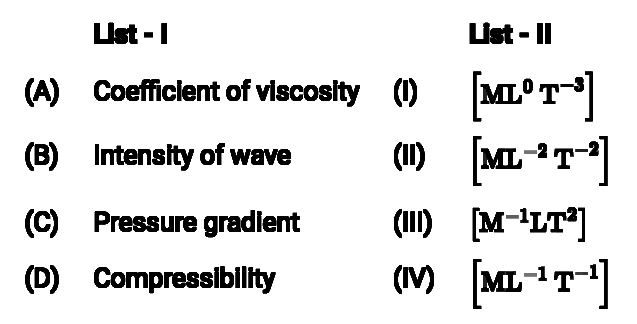
Match List I with List II.
Choose the correct answer from the options given below:
(a) (A)-(II), (B)-(III), (C)-(IV), (D)-(I) (b) (A)-(IV), (B)-(II), (C)-(I), (D)-(III) (c) (A)-(IV), (B)-(I), (C)-(II), (D)-(III) (d) (A)-(I), (B)-(IV), (C)-(III), (D)-(II) Show answer and solution
Answer: (c)
Viscosity η = F A ( d v / d x ) = [ M L − 1 T − 1 ] \eta = \dfrac{F}{A\,(dv/dx)} = [\mathrm{ML^{-1}T^{-1}}] η = A ( d v / d x ) F = [ M L − 1 T − 1 ] Intensity = P A = [ M L 2 T − 3 ] [ L 2 ] = [ M L 0 T − 3 ] = \dfrac{P}{A} = \dfrac{[\mathrm{ML^2T^{-3}}]}{[\mathrm{L^2}]} = [\mathrm{ML^0T^{-3}}] = A P = [ L 2 ] [ M L 2 T − 3 ] = [ M L 0 T − 3 ] Pressure gradient = [ M L − 1 T − 2 ] [ L ] = [ M L − 2 T − 2 ] = \dfrac{[\mathrm{ML^{-1}T^{-2}}]}{[\mathrm{L}]} = [\mathrm{ML^{-2}T^{-2}}] = [ L ] [ M L − 1 T − 2 ] = [ M L − 2 T − 2 ] Compressibility = 1 / bulk modulus = [ M − 1 L T 2 ] = 1/\text{bulk modulus} = [\mathrm{M^{-1}LT^{2}}] = 1/ bulk modulus = [ M − 1 L T 2 ] So the answer is (c) A-IV, B-I, C-II, D-III. Report a mistake Q19 JEE Main 2025 · 29 JAN · SHIFT 2 Easy ☆
Units & Dimensions · Match-the-dimension lists
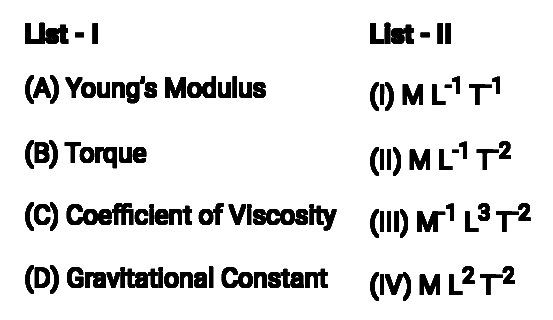
Match List - I with List - II.
Choose the correct answer from the options given below:
(a) (A)-(I), (B)-(III), (C)-(II), (D)-(IV) (b) (A)-(IV), (B)-(II), (C)-(III), (D)-(I) (c) (A)-(II), (B)-(I), (C)-(IV), (D)-(III) (d) (A)-(II), (B)-(IV), (C)-(I), (D)-(III) Show answer and solution
Answer: (d)
Young's modulus = stress/strain = [ M L − 1 T − 2 ] = [\mathrm{ML^{-1}T^{-2}}] = [ M L − 1 T − 2 ] Torque = r F = [ M L 2 T − 2 ] = rF = [\mathrm{ML^2T^{-2}}] = r F = [ M L 2 T − 2 ] Viscosity = [ M L − 1 T − 1 ] = [\mathrm{ML^{-1}T^{-1}}] = [ M L − 1 T − 1 ] G = F r 2 m 2 = [ M − 1 L 3 T − 2 ] G = \dfrac{Fr^2}{m^2} = [\mathrm{M^{-1}L^3T^{-2}}] G = m 2 F r 2 = [ M − 1 L 3 T − 2 ] So the answer is (d) A-II, B-IV, C-I, D-III. Report a mistake Q20 JEE Main 2025 · 28 JAN · SHIFT 2 Easy ☆
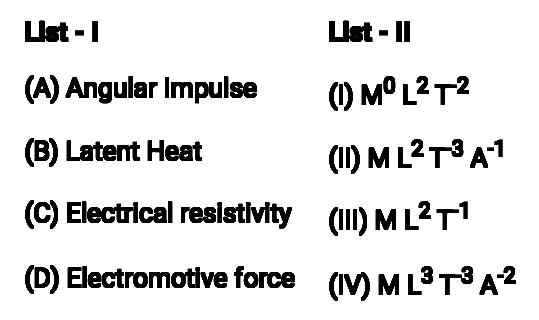
Units & Dimensions · Match-the-dimension lists
Match List - I with List - II.
Choose the correct answer from the options given below:
(a) (A)-(II), (B)-(I), (C)-(IV), (D)-(III) (b) (A)-(I), (B)-(III), (C)-(IV), (D)-(II) (c) (A)-(III), (B)-(I), (C)-(IV), (D)-(II) (d) (A)-(III), (B)-(I), (C)-(II), (D)-(IV) Show answer and solution
Answer: (c)
Angular impulse = τ t = \tau\,t = τ t = [ M L 2 T − 1 ] = [\mathrm{ML^2T^{-1}}] = [ M L 2 T − 1 ] Latent heat = Q / m = [ M 0 L 2 T − 2 ] = Q/m = [\mathrm{M^0L^2T^{-2}}] = Q / m = [ M 0 L 2 T − 2 ] Resistivity ρ = R A / l = [ M L 2 T − 3 A − 2 ] [ L ] = [ M L 3 T − 3 A − 2 ] \rho = RA/l = [\mathrm{ML^2T^{-3}A^{-2}}][\mathrm{L}] = [\mathrm{ML^3T^{-3}A^{-2}}] ρ = R A / l = [ M L 2 T − 3 A − 2 ] [ L ] = [ M L 3 T − 3 A − 2 ] EMF = W / q = [ M L 2 T − 3 A − 1 ] = W/q = [\mathrm{ML^2T^{-3}A^{-1}}] = W / q = [ M L 2 T − 3 A − 1 ] So the answer is (c) A-III, B-I, C-IV, D-II. Report a mistake Q21 JEE Main 2025 · 23 JAN · SHIFT 2 Easy ☆
Units & Dimensions · Match-the-dimension lists
Match List - I with List - II
Choose the correct answer from the options given below:
List - I List - II (A) Permeability of free space (I) [ M L 2 T − 2 ] \left[\mathrm{ML^{2}\ T^{-2}}\right] [ M L 2 T − 2 ] (B) Magnetic field (II) [ M T − 2 A − 1 ] \left[\mathrm{MT^{-2}\ A^{-1}}\right] [ M T − 2 A − 1 ] (C) Magnetic moment (III) [ M L T − 2 A − 2 ] \left[\mathrm{MLT^{-2}\ A^{-2}}\right] [ ML T − 2 A − 2 ] (D) Torsional constant (IV) [ L 2 A ] [\mathrm{L^{2}\ A}] [ L 2 A ]
(a) (A)-(III), (B)-(II), (C)-(IV), (D)-(I) (b) (A) − (I) , (B) − (IV) , (C) − (II) , (D) − (III) \text{(A)} - \text{(I)}, \text{(B)} - \text{(IV)}, \text{(C)} - \text{(II)}, \text{(D)} - \text{(III)} (A) − (I) , (B) − (IV) , (C) − (II) , (D) − (III) (c) (A) − (II) , (B) − (I) , (C) − (III) , (D) − (IV) \text{(A)} - \text{(II)}, \text{(B)} - \text{(I)}, \text{(C)} - \text{(III)}, \text{(D)} - \text{(IV)} (A) − (II) , (B) − (I) , (C) − (III) , (D) − (IV) (d) (A)-(IV), (B)-(III), (C)-(I), (D)-(II) Show answer and solution
Answer: (a)
μ 0 \mu_0 μ 0 F / l = μ 0 I 2 2 π d F/l = \dfrac{\mu_0 I^2}{2\pi d} F / l = 2 π d μ 0 I 2 [ μ 0 ] = [ M L T − 2 A − 2 ] [\mu_0] = [\mathrm{MLT^{-2}A^{-2}}] [ μ 0 ] = [ ML T − 2 A − 2 ] B = F q v = [ M T − 2 A − 1 ] B = \dfrac{F}{qv} = [\mathrm{MT^{-2}A^{-1}}] B = q v F = [ M T − 2 A − 1 ] Magnetic moment = I A = [ L 2 A ] = IA = [\mathrm{L^2A}] = I A = [ L 2 A ] Torsional constant = τ / θ = [ M L 2 T − 2 ] = \tau/\theta = [\mathrm{ML^2T^{-2}}] = τ / θ = [ M L 2 T − 2 ] So the answer is (a) A-III, B-II, C-IV, D-I. Report a mistake Q22 JEE Main 2025 · 28 JAN · SHIFT 1 Medium ☆
Units & Dimensions · Dimensional formula of a quantity
In a measurement, it is asked to find modulus of elasticity per unit torque applied on the system. The measured quantity has dimension of [ M a L b T c ] \left[M^{a}L^{b}T^{c}\right] [ M a L b T c ] b = 3 b = 3 b = 3 c c c
Numerical answer type. Work it out, then open the answer.
Show answer and solution
Answer: 0
Modulus of elasticity = [ M L − 1 T − 2 ] = [\mathrm{ML^{-1}T^{-2}}] = [ M L − 1 T − 2 ] = [ M L 2 T − 2 ] = [\mathrm{ML^2T^{-2}}] = [ M L 2 T − 2 ] Y τ = [ M L − 1 T − 2 ] [ M L 2 T − 2 ] = [ M 0 L − 3 T 0 ] \dfrac{Y}{\tau} = \dfrac{[\mathrm{ML^{-1}T^{-2}}]}{[\mathrm{ML^2T^{-2}}]} = [\mathrm{M^0L^{-3}T^0}] τ Y = [ M L 2 T − 2 ] [ M L − 1 T − 2 ] = [ M 0 L − 3 T 0 ] So a = 0 a = 0 a = 0 b = − 3 b = -3 b = − 3 c = 0 c = 0 c = 0 Hence c = 0 c = 0 c = 0 Report a mistake Q23 JEE Main 2025 · 3 APR · SHIFT 2 Medium ☆
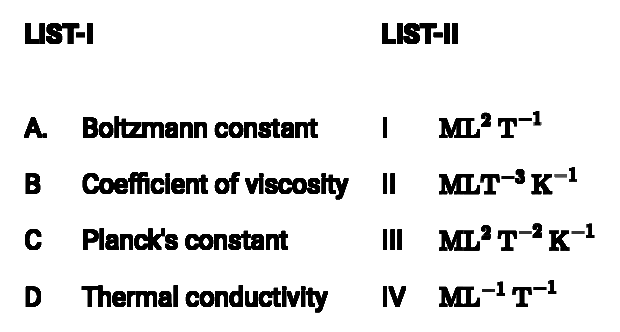
Units & Dimensions · Match-the-dimension lists
Match the LIST-I with LIST-II
Choose the correct answer from the options given below:
(a) A - III, B - IV, C - I, D - II (b) A - III, B - IV, C - II, D - I (c) A - III, B - II, C - I, D - IV (d) A - II, B - III, C - IV, D - I Show answer and solution
Answer: (a)
Boltzmann constant = [ M L 2 T − 2 K − 1 ] = [\mathrm{ML^2T^{-2}K^{-1}}] = [ M L 2 T − 2 K − 1 ] Viscosity = [ M L − 1 T − 1 ] = [\mathrm{ML^{-1}T^{-1}}] = [ M L − 1 T − 1 ] Planck's constant = [ M L 2 T − 1 ] = [\mathrm{ML^2T^{-1}}] = [ M L 2 T − 1 ] Thermal conductivity = [ M L T − 3 K − 1 ] = [\mathrm{MLT^{-3}K^{-1}}] = [ ML T − 3 K − 1 ] So the answer is (a) A-III, B-IV, C-I, D-II. Report a mistake Q24 JEE Main 2025 · 3 APR · SHIFT 1 Medium ☆
Units & Dimensions · Match-the-dimension lists
Match the LIST-I with LIST-II
Choose the correct answer from the options given below:
List - I List - II A. Gravitational constant I. [ L T − 2 ] [\mathrm{LT^{-2}}] [ L T − 2 ] B. Gravitational potential energy II. [ L 2 T − 2 ] \left[\mathrm{L^{2}\ T^{-2}}\right] [ L 2 T − 2 ] C. Gravitational potential III. [ M L 2 T − 2 ] \left[\mathrm{ML^{2}\ T^{-2}}\right] [ M L 2 T − 2 ] D. Acceleration due to gravity IV. [ M − 1 L 3 T − 2 ] \left[\mathrm{M^{-1}\ L^{3}\ T^{-2}}\right] [ M − 1 L 3 T − 2 ]
(a) A-IV, B-III, C-II, D-I (b) A-II, B-IV, C-III, D-I (c) A-I, B-III, C-IV, D-II (d) A-III, B-II, C-I, D-IV Show answer and solution
Answer: (a)
G = F r 2 m 2 = [ M − 1 L 3 T − 2 ] G = \dfrac{Fr^2}{m^2} = [\mathrm{M^{-1}L^3T^{-2}}] G = m 2 F r 2 = [ M − 1 L 3 T − 2 ] Gravitational potential energy is an energy = [ M L 2 T − 2 ] = [\mathrm{ML^2T^{-2}}] = [ M L 2 T − 2 ] Gravitational potential = energy per mass = [ L 2 T − 2 ] = [\mathrm{L^2T^{-2}}] = [ L 2 T − 2 ] g g g = [ L T − 2 ] = [\mathrm{LT^{-2}}] = [ L T − 2 ] So the answer is (a) A-IV, B-III, C-II, D-I. Report a mistake Q25 JEE Main 2024 · 9 APR · SHIFT 1 Easy ☆
Units & Dimensions · Dimensional formula of a quantity
The dimensional formula of latent heat is:
(a) [ M 0 L T − 2 ] [\mathrm{M^{0}LT^{-2}}] [ M 0 L T − 2 ] (b) [ M L T − 2 ] [\mathrm{MLT^{-2}}] [ ML T − 2 ] (c) [ M 0 L 2 T − 2 ] \left[\mathrm{M^{0}L^{2}T^{-2}}\right] [ M 0 L 2 T − 2 ] (d) [ M L 2 T − 2 ] \left[\mathrm{ML^{2}T^{-2}}\right] [ M L 2 T − 2 ] Show answer and solution
Answer: (c)
Latent heat L = Q / m L = Q/m L = Q / m [ L ] = M L 2 T − 2 / M = M 0 L 2 T − 2 [L] = \mathrm{ML^2T^{-2}}/\mathrm{M} = \mathrm{M^0L^2T^{-2}} [ L ] = M L 2 T − 2 / M = M 0 L 2 T − 2 So the answer is (c). Report a mistake Q26 JEE Main 2024 · 8 APR · SHIFT 2 Easy ☆
Units & Dimensions · Dimensional formula of a quantity
If ϵ o \epsilon_o ϵ o E \mathrm{E} E ϵ o E 2 \epsilon_o\mathrm{E}^2 ϵ o E 2
(a) [ M L − 1 T − 2 ] [\mathrm{ML^{-1}T^{-2}}] [ M L − 1 T − 2 ] (b) [ M L 2 T − 2 ] [\mathrm{ML^{2}T^{-2}}] [ M L 2 T − 2 ] (c) [ M 0 L − 2 T A ] [\mathrm{M^{0}L^{-2}TA}] [ M 0 L − 2 TA ] (d) [ M − 1 L − 3 T 4 A 2 ] [\mathrm{M^{-1}L^{-3}T^{4}A^{2}}] [ M − 1 L − 3 T 4 A 2 ] Show answer and solution
Answer: (a)
1 2 ϵ 0 E 2 \frac{1}{2}\epsilon_0E^2 2 1 ϵ 0 E 2 [ ϵ 0 E 2 ] = M L 2 T − 2 / L 3 = M L − 1 T − 2 [\epsilon_0E^2] = \mathrm{ML^2T^{-2}}/\mathrm{L^3} = \mathrm{ML^{-1}T^{-2}} [ ϵ 0 E 2 ] = M L 2 T − 2 / L 3 = M L − 1 T − 2 So the answer is (a) [ M L − 1 T − 2 ] [\mathrm{ML^{-1}T^{-2}}] [ M L − 1 T − 2 ] Report a mistake Q27 JEE Main 2024 · 5 APR · SHIFT 1 Easy ☆
Units & Dimensions · Dimensional formula of a quantity
If G \mathrm{G} G u \mathrm{u} u u G \sqrt{\mathrm{uG}} uG
(a) Gravitational potential (b) pressure gradient per unit mass (c) Energy per unit mass (d) Force per unit mass Show answer and solution
Answer: (d)
[ u ] = M L − 1 T − 2 [u] = \mathrm{ML^{-1}T^{-2}} [ u ] = M L − 1 T − 2 F = G m 2 / r 2 F = Gm^2/r^2 F = G m 2 / r 2 [ G ] = M − 1 L 3 T − 2 [G] = \mathrm{M^{-1}L^3T^{-2}} [ G ] = M − 1 L 3 T − 2 [ u G ] = L 2 T − 4 [uG] = \mathrm{L^2T^{-4}} [ u G ] = L 2 T − 4 [ u G ] = L T − 2 [\sqrt{uG}] = \mathrm{LT^{-2}} [ u G ] = L T − 2 Force per unit mass = M L T − 2 / M = L T − 2 = \mathrm{MLT^{-2}}/\mathrm{M} = \mathrm{LT^{-2}} = ML T − 2 / M = L T − 2 L 2 T − 2 \mathrm{L^2T^{-2}} L 2 T − 2 L − 2 T − 2 \mathrm{L^{-2}T^{-2}} L − 2 T − 2 So the answer is (d) Force per unit mass. Report a mistake Q28 JEE Main 2024 · 1 FEB · SHIFT 1 Easy ☆
Units & Dimensions · Dimensional formula of a quantity
The dimensional formula of angular impulse is:
(a) [ M L 2 T − 2 ] \left[\mathrm{ML^{2}T^{-2}}\right] [ M L 2 T − 2 ] (b) [ M L − 2 T − 1 ] \left[\mathrm{ML^{-2}T^{-1}}\right] [ M L − 2 T − 1 ] (c) [ M L 2 T − 1 ] \left[\mathrm{ML^{2}T^{-1}}\right] [ M L 2 T − 1 ] (d) [ M L T − 1 ] [\mathrm{MLT^{-1}}] [ ML T − 1 ] Show answer and solution
Answer: (c)
Angular impulse = τ × t = = \tau \times t = = τ × t = [ τ t ] = M L 2 T − 2 ⋅ T = M L 2 T − 1 [\tau t] = \mathrm{ML^2T^{-2}}\cdot\mathrm{T} = \mathrm{ML^2T^{-1}} [ τ t ] = M L 2 T − 2 ⋅ T = M L 2 T − 1 So the answer is (c) [ M L 2 T − 1 ] [\mathrm{ML^2T^{-1}}] [ M L 2 T − 1 ] Report a mistake Q29 NEET 2024 Easy ☆
Units & Dimensions · Same dimensions & dimensionless
The quantities which have the same dimensions as those of solid angle are:
(a) strain and angle (b) stress and angle (c) strain and arc (d) angular speed and stress Show answer and solution
Answer: (a)
Solid angle = A / r 2 = A/r^2 = A / r 2 Strain = Δ l / l = \Delta l/l = Δ l / l = = = Stress, arc and angular speed have dimensions. So the answer is (a) strain and angle. Report a mistake Q30 JEE Main 2024 · 30 JAN · SHIFT 1 Easy ☆
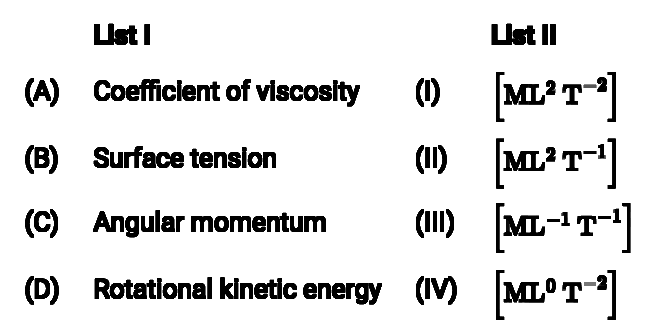
Units & Dimensions · Match-the-dimension lists
Match List I with List II.
Choose the correct answer from the options given below:
(a) (A)-(II), (B)-(I), (C)-(IV), (D)-(III) (b) (A)-(I), (B)-(II), (C)-(III), (D)-(IV) (c) (A)-(IV), (B)-(III), (C)-(II), (D)-(I) (d) (A)-(III), (B)-(IV), (C)-(II), (D)-(I) Show answer and solution
Answer: (d)
Viscosity = [ M L − 1 T − 1 ] = [\mathrm{ML^{-1}T^{-1}}] = [ M L − 1 T − 1 ] Surface tension = F / l = [ M L 0 T − 2 ] = F/l = [\mathrm{ML^0T^{-2}}] = F / l = [ M L 0 T − 2 ] Angular momentum = m v r = [ M L 2 T − 1 ] = mvr = [\mathrm{ML^2T^{-1}}] = m v r = [ M L 2 T − 1 ] Rotational KE = 1 2 I ω 2 = [ M L 2 T − 2 ] = \tfrac12 I\omega^2 = [\mathrm{ML^2T^{-2}}] = 2 1 I ω 2 = [ M L 2 T − 2 ] So the answer is (d) A-III, B-IV, C-II, D-I. Report a mistake Q31 JEE Main 2024 · 6 APR · SHIFT 2 Medium ☆
Units & Dimensions · Dimensional formula of a quantity
Given below are two statements:
Statement (I): Dimensions of specific heat is [ L 2 T − 2 K − 1 ] [\mathrm{L^{2}T^{-2}K^{-1}}] [ L 2 T − 2 K − 1 ]
Statement (II): Dimensions of gas constant is [ M L 2 T − 1 K − 1 ] [\mathrm{ML^{2}T^{-1}K^{-1}}] [ M L 2 T − 1 K − 1 ]
In the light of the above statements, choose the most appropriate answer from the options given below.
(a) Statement (I) is incorrect but statement (II) is correct (b) Both statement (I) and statement (II) are incorrect (c) Both statement (I) and statement (II) are correct (d) Statement (I) is correct but statement (II) is incorrect Show answer and solution
Answer: (d)
Specific heat c = Q m Δ T = [ M L 2 T − 2 ] [ M ] [ K ] = [ L 2 T − 2 K − 1 ] c = \dfrac{Q}{m\,\Delta T} = \dfrac{[\mathrm{ML^2T^{-2}}]}{[\mathrm{M}][\mathrm{K}]} = [\mathrm{L^2T^{-2}K^{-1}}] c = m Δ T Q = [ M ] [ K ] [ M L 2 T − 2 ] = [ L 2 T − 2 K − 1 ] Gas constant R = P V n T R = \dfrac{PV}{nT} R = n T P V = [ M L 2 T − 2 K − 1 m o l − 1 ] = [\mathrm{ML^2T^{-2}K^{-1}mol^{-1}}] = [ M L 2 T − 2 K − 1 mo l − 1 ] Statement II has T − 1 \mathrm{T^{-1}} T − 1 So the answer is (d). Report a mistake Q32 JEE Main 2024 · 27 JAN · SHIFT 2 Medium ☆
Units & Dimensions · Dimensional formula of a quantity
Given below are two statements: one is labelled as Assertion (A) and the other is labelled as Reason (R).
Assertion (A): In Vernier calliper if positive zero error exists, then while taking measurements, the reading taken will be more than the actual reading.
Reason (R): The zero error in Vernier Calliper might have happened due to manufacturing defect or due to rough handling.
In the light of the above statements, choose the correct answer from the options given below:
(a) Both (A) and (R) are correct and (R) is the correct explanation of (A) (b) Both (A) and (R) are correct but (R) is not the correct explanation of (A) (c) (A) is true but (R) is false (d) (A) is false but (R) is true Show answer and solution
Answer: (b)
With positive zero error the zero of the vernier is already to the right of the main-scale zero, so every reading is too large; true reading = observed − zero error. (A) is true. Zero error can indeed come from manufacturing defects or rough handling, so (R) is true. (R) tells the cause of zero error, not why the reading is larger, so it does not explain (A). So the answer is (b). Report a mistake Q33 JEE Main 2024 · 27 JAN · SHIFT 1 Medium ☆
Units & Dimensions · Same dimensions & dimensionless
Given below are two statements:
Statement (I): Planck's constant and angular momentum have same dimensions. Statement (II): Linear momentum and moment of force have same dimensions. In the light of the above statements, choose the correct answer from the options given below:
(a) Statement I is true but Statement II is false (b) Both Statement I and Statement II are false (c) Both Statement I and Statement II are true (d) Statement I is false but Statement II is true Show answer and solution
Answer: (a)
h = E / ν = [ M L 2 T − 1 ] h = E/\nu = [\mathrm{ML^2T^{-1}}] h = E / ν = [ M L 2 T − 1 ] m v r = [ M L 2 T − 1 ] mvr = [\mathrm{ML^2T^{-1}}] m v r = [ M L 2 T − 1 ] Linear momentum = [ M L T − 1 ] = [\mathrm{MLT^{-1}}] = [ ML T − 1 ] = [ M L 2 T − 2 ] = [\mathrm{ML^2T^{-2}}] = [ M L 2 T − 2 ] So the answer is (a). Report a mistake Q34 JEE Main 2024 · 6 APR · SHIFT 1 Medium ☆
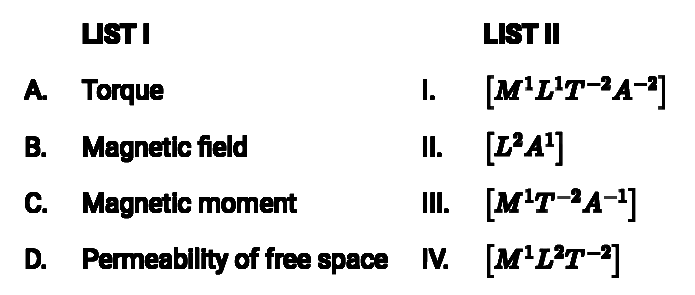
Units & Dimensions · Match-the-dimension lists
Match List I with List II
Choose the correct answer from the options given below:
(a) A-I, B-III, C-II, D-IV (b) A-IV, B-II, C-III, D-I (c) A-III, B-I, C-II, D-IV (d) A-IV, B-III, C-II, D-I Show answer and solution
Answer: (d)
Torque = [ M L 2 T − 2 ] = [\mathrm{ML^2T^{-2}}] = [ M L 2 T − 2 ] Magnetic field B = F q v = [ M T − 2 A − 1 ] B = \dfrac{F}{qv} = [\mathrm{MT^{-2}A^{-1}}] B = q v F = [ M T − 2 A − 1 ] Magnetic moment = I A = [ L 2 A ] = IA = [\mathrm{L^2A}] = I A = [ L 2 A ] μ 0 = [ M L T − 2 A − 2 ] \mu_0 = [\mathrm{MLT^{-2}A^{-2}}] μ 0 = [ ML T − 2 A − 2 ] So the answer is (d) A-IV, B-III, C-II, D-I. Report a mistake Q35 NEET 2023 Easy ☆
Units & Dimensions · Dimensional formula of a quantity
The mechanical quantity, which has dimensions of reciprocal of mass ( M − 1 ) (\mathrm{M}^{-1}) ( M − 1 )
(a) angular momentum (b) coefficient of thermal conductivity (c) torque (d) gravitational constant Show answer and solution
Answer: (d)
Angular momentum [ M L 2 T − 1 ] [\mathrm{ML^2T^{-1}}] [ M L 2 T − 1 ] [ M L T − 3 K − 1 ] [\mathrm{MLT^{-3}K^{-1}}] [ ML T − 3 K − 1 ] [ M L 2 T − 2 ] [\mathrm{ML^2T^{-2}}] [ M L 2 T − 2 ] G = F r 2 m 1 m 2 ⇒ [ G ] = [ M − 1 L 3 T − 2 ] G = \frac{Fr^2}{m_1 m_2} \Rightarrow [G] = [\mathrm{M^{-1}L^{3}T^{-2}}] G = m 1 m 2 F r 2 ⇒ [ G ] = [ M − 1 L 3 T − 2 ] Only G G G − 1 -1 − 1 So the answer is (d) gravitational constant. Report a mistake Q36 JEE Main 2023 · 8 APR · SHIFT 1 Easy ☆
Units & Dimensions · Dimensional formula of a quantity
Dimension of 1 μ 0 ϵ 0 \frac{1}{\mu_0\epsilon_0} μ 0 ϵ 0 1
(a) T 2 / L 2 \mathrm{T^{2}/L^{2}} T 2 / L 2 (b) T / L \mathrm{T/L} T/L (c) L 2 / T 2 \mathrm{L^{2}/T^{2}} L 2 / T 2 (d) L / T \mathrm{L/T} L/T Show answer and solution
Answer: (c)
1 / ( μ 0 ϵ 0 ) = c 2 1/(\mu_0\epsilon_0) = c^2 1/ ( μ 0 ϵ 0 ) = c 2 [ c 2 ] = L 2 T − 2 [c^2] = \mathrm{L^2T^{-2}} [ c 2 ] = L 2 T − 2 So the answer is (c) L 2 / T 2 \mathrm{L^2/T^2} L 2 / T 2 Report a mistake Q37 JEE Main 2023 · 11 APR · SHIFT 1 Medium ☆
Units & Dimensions · Physical quantities & SI units
Given below are two statements:
Statements I: Astronomical unit (Au), Parsec (Pc) and Light year (ly) are units for measuring astronomical distances.
Statements II: Au < Parsec(Pc) < ly \text{Au} < \text{Parsec(Pc)} < \text{ly} Au < Parsec(Pc) < ly
In the light of the above statements, choose the most appropriate answer from the options given below:
(a) Both Statements I and Statements II are incorrect. (b) Both Statements I and Statements II are correct, (c) Statements I is incorrect but Statements II is correct. (d) Statements I is correct but Statements II is incorrect. Show answer and solution
Answer: (d)
Statement I: AU, parsec and light year are all units of astronomical distance, so it is correct. 1 AU ≈ 1.5 × 1 0 11 1\ \text{AU} \approx 1.5\times10^{11} 1 AU ≈ 1.5 × 1 0 11 1 ly ≈ 9.46 × 1 0 15 1\ \text{ly} \approx 9.46\times10^{15} 1 ly ≈ 9.46 × 1 0 15 1 pc ≈ 3.08 × 1 0 16 1\ \text{pc} \approx 3.08\times10^{16} 1 pc ≈ 3.08 × 1 0 16 So AU < ly < pc; Statement II (AU < pc < ly) is wrong. So the answer is (d). Report a mistake Q38 JEE Main 2023 · 12 APR · SHIFT 1 Medium ☆
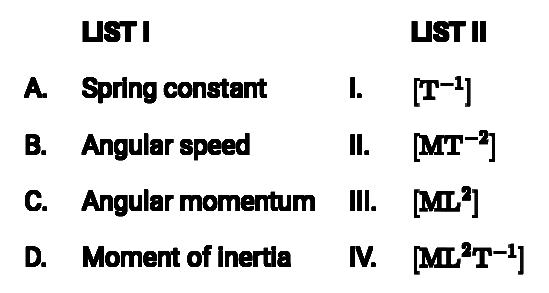
Units & Dimensions · Match-the-dimension lists
Match List I with List II
Choose the correct answer from the options given below:
(a) A-IV, B-I, C-III, D-II (b) A-II, B-III, C-I, D-IV (c) A-II, B-I, C-IV, D-III (d) A-I, B-III, C-II, D-IV Show answer and solution
Answer: (c)
Spring constant = F / x = [ M T − 2 ] = F/x = [\mathrm{MT^{-2}}] = F / x = [ M T − 2 ] Angular speed = θ / t = [ T − 1 ] = \theta/t = [\mathrm{T^{-1}}] = θ / t = [ T − 1 ] Angular momentum = I ω = [ M L 2 T − 1 ] = I\omega = [\mathrm{ML^2T^{-1}}] = I ω = [ M L 2 T − 1 ] Moment of inertia = m r 2 = [ M L 2 ] = mr^2 = [\mathrm{ML^2}] = m r 2 = [ M L 2 ] So the answer is (c) A-II, B-I, C-IV, D-III. Report a mistake Q39 JEE Main 2023 · 8 APR · SHIFT 2 Medium ☆
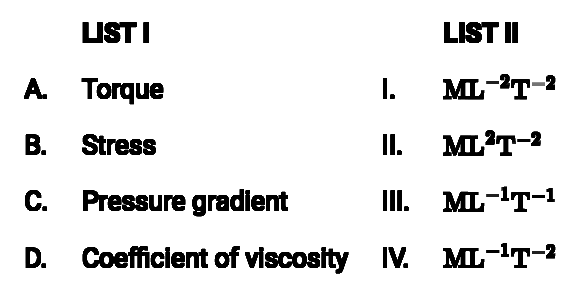
Units & Dimensions · Match-the-dimension lists
Match List I with List II
Choose the correct answer from the options given below:
(a) A-II, B-I, C-IV, D-III (b) A-II, B-IV, C-I, D-III (c) A-IV, B-II, C-III, D-I (d) A-III, B-IV, C-I, D-II Show answer and solution
Answer: (b)
Torque = [ M L 2 T − 2 ] = [\mathrm{ML^2T^{-2}}] = [ M L 2 T − 2 ] Stress = F / A = [ M L − 1 T − 2 ] = F/A = [\mathrm{ML^{-1}T^{-2}}] = F / A = [ M L − 1 T − 2 ] Pressure gradient = d P d x = [ M L − 2 T − 2 ] = \dfrac{dP}{dx} = [\mathrm{ML^{-2}T^{-2}}] = d x d P = [ M L − 2 T − 2 ] Viscosity = [ M L − 1 T − 1 ] = [\mathrm{ML^{-1}T^{-1}}] = [ M L − 1 T − 1 ] So the answer is (b) A-II, B-IV, C-I, D-III. Report a mistake Q40 JEE Main 2023 · 31 JAN · SHIFT 2 Medium ☆
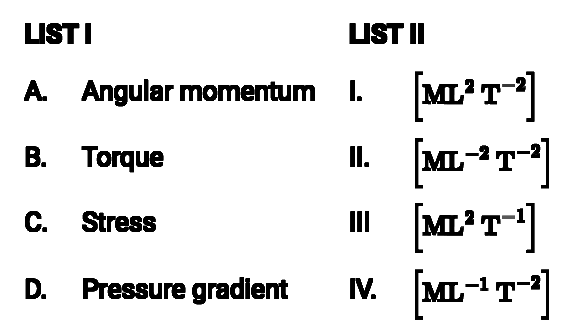
Units & Dimensions · Match-the-dimension lists
Match List I with List II
Choose the correct answer from the options given below:
(a) A - I, B - IV, C - III, D - II (b) A - III, B - I, C - IV, D - II (c) A - IV, B - II, C - I, D - III (d) A - II, B - III, C - IV, D - I Show answer and solution
Answer: (b)
Angular momentum = [ M L 2 T − 1 ] = [\mathrm{ML^2T^{-1}}] = [ M L 2 T − 1 ] Torque = [ M L 2 T − 2 ] = [\mathrm{ML^2T^{-2}}] = [ M L 2 T − 2 ] Stress = [ M L − 1 T − 2 ] = [\mathrm{ML^{-1}T^{-2}}] = [ M L − 1 T − 2 ] Pressure gradient = [ M L − 2 T − 2 ] = [\mathrm{ML^{-2}T^{-2}}] = [ M L − 2 T − 2 ] So the answer is (b) A-III, B-I, C-IV, D-II. Report a mistake Q41 JEE Main 2023 · 30 JAN · SHIFT 2 Medium ☆
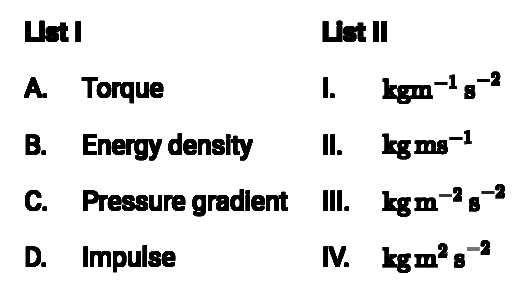
Units & Dimensions · Match-the-dimension lists
Match List I with List II:
Choose the correct answer from the options given below:
(a) A-IV, B-I, C-III, D-II (b) A-IV, B-I, C-II, D-III (c) A-I, B-IV, C-III, D-II (d) A-IV, B-III, C-I, D-II Show answer and solution
Answer: (a)
Torque = N m = kg m2 ^2 2 − 2 ^{-2} − 2 Energy density = J m− 3 ^{-3} − 3 − 1 ^{-1} − 1 − 2 ^{-2} − 2 Pressure gradient = Pa m− 1 ^{-1} − 1 − 2 ^{-2} − 2 − 2 ^{-2} − 2 Impulse = N s = kg m s− 1 ^{-1} − 1 So the answer is (a) A-IV, B-I, C-III, D-II. Report a mistake Q42 JEE Main 2023 · 25 JAN · SHIFT 2 Medium ☆
Units & Dimensions · Match-the-dimension lists
Match List I with List II
Choose the correct answer from the options given below:
(a) A-II, B-III, C-IV, D-I (b) A-I, B-II, C-III, D-IV (c) A-I, B-III, C-IV, D-II (d) A-III, B-I, C-II, D-IV Show answer and solution
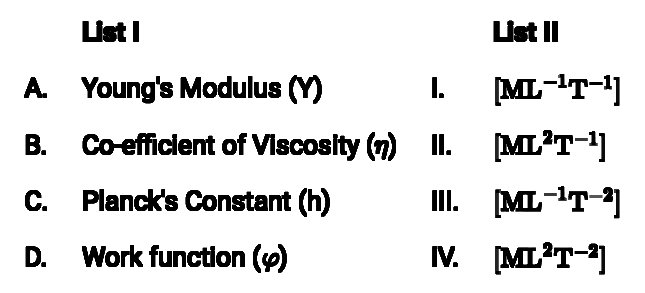
Answer: (d)
Young's modulus = stress/strain = [ M L − 1 T − 2 ] = [\mathrm{ML^{-1}T^{-2}}] = [ M L − 1 T − 2 ] Viscosity η = [ M L − 1 T − 1 ] \eta = [\mathrm{ML^{-1}T^{-1}}] η = [ M L − 1 T − 1 ] Planck's constant h = [ M L 2 T − 1 ] h = [\mathrm{ML^2T^{-1}}] h = [ M L 2 T − 1 ] Work function is an energy = [ M L 2 T − 2 ] = [\mathrm{ML^2T^{-2}}] = [ M L 2 T − 2 ] So the answer is (d) A-III, B-I, C-II, D-IV. Report a mistake Q43 JEE Main 2023 · 25 JAN · SHIFT 1 Medium ☆
Units & Dimensions · Match-the-dimension lists
Match List I with List II
Choose the correct answer from the options given below:
(a) A-IV, B-III, C-I, D-II (b) A-IV, B-III, C-II, D-I (c) A-II, B-I, C-III, D-IV (d) A-III, B-IV, C-I, D-II Show answer and solution
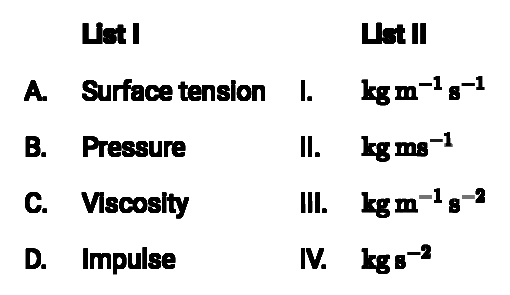
Answer: (a)
Surface tension = N m− 1 ^{-1} − 1 − 2 ^{-2} − 2 Pressure = N m− 2 ^{-2} − 2 − 1 ^{-1} − 1 − 2 ^{-2} − 2 Viscosity = Pa s = kg m− 1 ^{-1} − 1 − 1 ^{-1} − 1 Impulse = N s = kg m s− 1 ^{-1} − 1 So the answer is (a) A-IV, B-III, C-I, D-II. Report a mistake Q44 JEE Main 2023 · 24 JAN · SHIFT 1 Medium ☆
Units & Dimensions · Match-the-dimension lists
Match List I with List II
Choose the correct answer from the options given below:
(a) A-I, B-III, C-IV, D-II (b) A-III, B-IV, C-I, D-II (c) A-II, B-IV, C-III, D-I (d) A-III, B-I, C-II, D-IV Show answer and solution
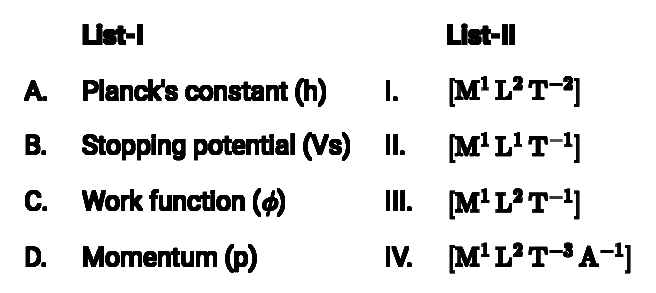
Answer: (b)
Planck's constant h = [ M L 2 T − 1 ] h = [\mathrm{ML^2T^{-1}}] h = [ M L 2 T − 1 ] Stopping potential is a voltage = [ M L 2 T − 3 A − 1 ] = [\mathrm{ML^2T^{-3}A^{-1}}] = [ M L 2 T − 3 A − 1 ] Work function is an energy = [ M L 2 T − 2 ] = [\mathrm{ML^2T^{-2}}] = [ M L 2 T − 2 ] Momentum = m v = [ M L T − 1 ] = mv = [\mathrm{MLT^{-1}}] = m v = [ ML T − 1 ] So the answer is (b) A-III, B-IV, C-I, D-II. Report a mistake Q45 JEE Main 2022 · 27 JUN · SHIFT 2 Easy ☆
Units & Dimensions · Physical quantities & SI units
The SI unit of a physical quantity is pascal-second. The dimensional formula of this quantity will be:
(a) [ML − 1 T − {}^{-1}\mathrm{T}^{-} − 1 T − (b) [ML− 1 T − {}^{-1}\mathrm{T}^{-} − 1 T − (c) [ML2T− 1 {}^{-1} − 1 (d) [M− 1 {}^{-1} − 1 Show answer and solution
Answer: (a)
Pascal is pressure: [ M L − 1 T − 2 ] [\mathrm{ML^{-1}T^{-2}}] [ M L − 1 T − 2 ] Pa s → [ M L − 1 T − 2 ] [ T ] = [ M L − 1 T − 1 ] \to [\mathrm{ML^{-1}T^{-2}}][\mathrm{T}] = [\mathrm{ML^{-1}T^{-1}}] → [ M L − 1 T − 2 ] [ T ] = [ M L − 1 T − 1 ] So the answer is (a) [ M L − 1 T − 1 ] [\mathrm{ML^{-1}T^{-1}}] [ M L − 1 T − 1 ] Report a mistake Q46 NEET 2022 · PHASE 1 Easy ☆
Units & Dimensions · Dimensional formula of a quantity
The dimensions [MLT− 2 A − {}^{-2}\mathrm{A}^{-} − 2 A −
(a) Magnetic flux (b) Self inductance (c) Magnetic permeability (d) Electric permittivity Show answer and solution
Answer: (c)
F = μ 0 I 1 I 2 l 2 π d ⇒ [ μ 0 ] = [ M L T − 2 ] [ A 2 ] F = \frac{\mu_0 I_1 I_2 l}{2\pi d} \Rightarrow [\mu_0] = \frac{[\mathrm{MLT^{-2}}]}{[\mathrm{A^2}]} F = 2 π d μ 0 I 1 I 2 l ⇒ [ μ 0 ] = [ A 2 ] [ ML T − 2 ] [ μ 0 ] = [ M L T − 2 A − 2 ] [\mu_0] = [\mathrm{MLT^{-2}A^{-2}}] [ μ 0 ] = [ ML T − 2 A − 2 ] So the answer is (c) magnetic permeability. Report a mistake Q47 NEET 2022 · PHASE 1 Easy ☆
Units & Dimensions · Dimensional formula of a quantity
Plane angle and solid angle have
(a) Units but no dimensions (b) Dimensions but no units (c) No units and no dimensions (d) Both units and dimensions Show answer and solution
Answer: (a)
Plane angle = arc radius = \frac{\text{arc}}{\text{radius}} = radius arc = area r 2 = \frac{\text{area}}{r^2} = r 2 area They still have units: radian and steradian. So the answer is (a) units but no dimensions. Report a mistake Q48 JEE Main 2022 · 28 JUL · SHIFT 1 Easy ☆
Units & Dimensions · Dimensional formula of a quantity
The dimensions of ( B 2 μ 0 ) \left(\frac{\mathrm{B}^2}{\mu_0}\right) ( μ 0 B 2 )
(if μ 0 \mu_0 μ 0 B B B
(a) [ M L 2 T − 2 ] [\mathrm{ML^{2}T^{-2}}] [ M L 2 T − 2 ] (b) [ M L T − 2 ] [\mathrm{MLT^{-2}}] [ ML T − 2 ] (c) [ M L − 1 T − 2 ] \left[\mathrm{ML^{-1}T^{-2}}\right] [ M L − 1 T − 2 ] (d) [ M L 2 T − 2 A − 1 ] \left[\mathrm{ML^{2}T^{-2}A^{-1}}\right] [ M L 2 T − 2 A − 1 ] Show answer and solution
Answer: (c)
B 2 / ( 2 μ 0 ) B^2/(2\mu_0) B 2 / ( 2 μ 0 ) [ B 2 / μ 0 ] = M L 2 T − 2 / L 3 = M L − 1 T − 2 [B^2/\mu_0] = \mathrm{ML^2T^{-2}}/\mathrm{L^3} = \mathrm{ML^{-1}T^{-2}} [ B 2 / μ 0 ] = M L 2 T − 2 / L 3 = M L − 1 T − 2 So the answer is (c) [ M L − 1 T − 2 ] [\mathrm{ML^{-1}T^{-2}}] [ M L − 1 T − 2 ] Report a mistake Q49 JEE Main 2022 · 26 JUN · SHIFT 2 Easy ☆
Units & Dimensions · Dimensional formula of a quantity
The dimension of mutual inductance is:
(a) [ M L 2 T − 2 A − 1 ] [ML^{2}T^{-2}A^{-1}] [ M L 2 T − 2 A − 1 ] (b) [ M L 2 T − 3 A − 1 ] [ML^{2}T^{-3}A^{-1}] [ M L 2 T − 3 A − 1 ] (c) [ M L 2 T − 2 A − 2 ] [ML^{2}T^{-2}A^{-2}] [ M L 2 T − 2 A − 2 ] (d) [ M L 2 T − 3 A − 2 ] [ML^{2}T^{-3}A^{-2}] [ M L 2 T − 3 A − 2 ] Show answer and solution
Answer: (c)
M = Φ / I M = \Phi/I M = Φ/ I Φ = B A \Phi = BA Φ = B A [ B ] = [ F / ( I L ) ] = M T − 2 A − 1 [B] = [F/(IL)] = \mathrm{MT^{-2}A^{-1}} [ B ] = [ F / ( I L )] = M T − 2 A − 1 [ Φ ] = M L 2 T − 2 A − 1 [\Phi] = \mathrm{ML^2T^{-2}A^{-1}} [ Φ ] = M L 2 T − 2 A − 1 [ M ] = M L 2 T − 2 A − 2 [M] = \mathrm{ML^2T^{-2}A^{-2}} [ M ] = M L 2 T − 2 A − 2 So the answer is (c). Report a mistake Q50 NEET 2022 · PHASE 2 Easy ☆
Units & Dimensions · Same dimensions & dimensionless
The physical quantity that has the same dimensional formula as pressure is
(a) Coefficient of viscosity (b) Force (c) Momentum (d) Young's modulus of elasticity Show answer and solution
Answer: (d)
Pressure = F / A = F/A = F / A M L − 1 T − 2 \mathrm{ML^{-1}T^{-2}} M L − 1 T − 2 Young's modulus = = = = = = M L − 1 T − 2 \mathrm{ML^{-1}T^{-2}} M L − 1 T − 2 Viscosity M L − 1 T − 1 \mathrm{ML^{-1}T^{-1}} M L − 1 T − 1 M L T − 2 \mathrm{MLT^{-2}} ML T − 2 M L T − 1 \mathrm{MLT^{-1}} ML T − 1 So the answer is (d). Report a mistake Q51 JEE Main 2022 · 25 JUL · SHIFT 1 Easy ☆
Units & Dimensions · Same dimensions & dimensionless
Which of the following physical quantities have the same dimensions?
(a) Electric displacement ( D ⃗ ) (\vec{D}) ( D ) (b) Displacement current and electric field (c) Current density and surface charge density (d) Electric potential and energy Show answer and solution
Answer: (a)
D = ε 0 E D = \varepsilon_0 E D = ε 0 E D = σ D = \sigma D = σ C / m 2 \mathrm{C/m^2} C/ m 2 Surface charge density also has unit C / m 2 \mathrm{C/m^2} C/ m 2 [ L − 2 T A ] [\mathrm{L^{-2}TA}] [ L − 2 TA ] Other pairs differ (current vs field, A / m 2 \mathrm{A/m^2} A/ m 2 C / m 2 \mathrm{C/m^2} C/ m 2 So the answer is (a). Report a mistake Q52 JEE Main 2022 · 24 JUN · SHIFT 2 Easy ☆
Units & Dimensions · Same dimensions & dimensionless
Identify the pair of physical quantities that have same dimensions:
(a) velocity gradient and decay constant (b) Wien's constant and Stefan constant (c) angular frequency and angular momentum (d) wave number and Avogadro number Show answer and solution
Answer: (a)
Velocity gradient d v / d x dv/dx d v / d x L T − 1 / L = T − 1 \mathrm{LT^{-1}}/\mathrm{L} = \mathrm{T^{-1}} L T − 1 / L = T − 1 Decay constant (N = N 0 e − λ t N = N_0e^{-\lambda t} N = N 0 e − λ t T − 1 \mathrm{T^{-1}} T − 1 Other pairs differ (e.g. angular frequency T − 1 \mathrm{T^{-1}} T − 1 M L 2 T − 1 \mathrm{ML^2T^{-1}} M L 2 T − 1 L − 1 \mathrm{L^{-1}} L − 1 m o l − 1 \mathrm{mol^{-1}} mo l − 1 So the answer is (a). Report a mistake Q53 JEE Main 2022 · 24 JUN · SHIFT 1 Easy ☆
Units & Dimensions · Same dimensions & dimensionless
Identify the pair of physical quantities which have different dimensions:
(a) Wave number and Rydberg's constant (b) Stress and Coefficient of elasticity (c) Coercivity and Magnetisation (d) Specific heat capacity and Latent heat Show answer and solution
Answer: (d)
Wave number and Rydberg constant: both L − 1 \mathrm{L^{-1}} L − 1 M L − 1 T − 2 \mathrm{ML^{-1}T^{-2}} M L − 1 T − 2 A / m \mathrm{A/m} A/m Specific heat c = Q / ( m Δ T ) c = Q/(m\Delta T) c = Q / ( m Δ T ) L 2 T − 2 K − 1 \mathrm{L^2T^{-2}K^{-1}} L 2 T − 2 K − 1 Q / m Q/m Q / m L 2 T − 2 \mathrm{L^2T^{-2}} L 2 T − 2 So the answer is (d). Report a mistake Q54 JEE Main 2022 · 29 JUL · SHIFT 2 Medium ☆
Units & Dimensions · Physical quantities & SI units
Match List I with List II.
Choose the correct answer from the options given below:
(a) A-III, B-II, C-I, D-IV (b) A-III, B-IV, C-II, D-I (c) A-IV, B-I, C-III, D-II (d) A-II, B-III, C-I, D-IV Show answer and solution
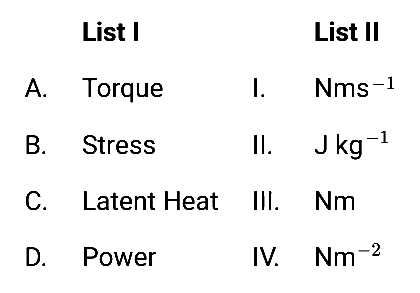
Answer: (b)
Torque = r × F = r \times F = r × F Stress = F / A = F/A = F / A − 2 ^{-2} − 2 Latent heat = Q / m = Q/m = Q / m − 1 ^{-1} − 1 Power = F v = Fv = F v − 1 ^{-1} − 1 So the answer is (b) A-III, B-IV, C-II, D-I. Report a mistake Q55 JEE Main 2022 · 29 JUL · SHIFT 1 Medium ☆
Units & Dimensions · Dimensional formula of a quantity
Given below are two statements: One is labelled as Assertion (A) and other is labelled as Reason (R).
Assertion (A): Time period of oscillation of a liquid drop depends on surface tension (S), if density of the liquid is ρ \rho ρ T = K ρ r 3 / S 3 / 2 \mathrm{T} = \mathrm{K}\sqrt{\rho \mathrm{r}^3/\mathrm{S}^{3/2}} T = K ρ r 3 / S 3/2
Reason (R): Using dimensional analysis we get R.H.S. having different dimension than that of time period.
In the light of above statements, choose the correct answer from the options given below.
(a) Both (A) and (R) are true and (R) is the correct explanation of (A) (b) Both (A) and (R) are true but (R) is not the correct explanation of (A) (c) (A) is true but (R) is false (d) (A) is false but (R) is true Show answer and solution
Answer: (d)
[ ρ r 3 ] = [ M L − 3 ] [ L 3 ] = [ M ] [\rho r^3] = [\mathrm{ML^{-3}}][\mathrm{L^3}] = [\mathrm{M}] [ ρ r 3 ] = [ M L − 3 ] [ L 3 ] = [ M ] [ S ] = [ M T − 2 ] ⇒ [ S 3 / 2 ] = [ M 3 / 2 T − 3 ] [S] = [\mathrm{MT^{-2}}] \Rightarrow [S^{3/2}] = [\mathrm{M^{3/2}T^{-3}}] [ S ] = [ M T − 2 ] ⇒ [ S 3/2 ] = [ M 3/2 T − 3 ] ρ r 3 S 3 / 2 = [ M − 1 / 2 T 3 ] = [ M − 1 / 4 T 3 / 2 ] ≠ [ T ] \sqrt{\dfrac{\rho r^3}{S^{3/2}}} = \sqrt{[\mathrm{M^{-1/2}T^{3}}]} = [\mathrm{M^{-1/4}T^{3/2}}] \neq [\mathrm{T}] S 3/2 ρ r 3 = [ M − 1/2 T 3 ] = [ M − 1/4 T 3/2 ] = [ T ] So the formula is dimensionally wrong: (A) false, (R) true. (Correct form: T = K ρ r 3 / S T = K\sqrt{\rho r^3/S} T = K ρ r 3 / S So the answer is (d). Report a mistake Q56 JEE Main 2021 · 27 AUG · SHIFT 1 Easy ☆
Units & Dimensions · Physical quantities & SI units
If E and H represents the intensity of electric field and magnetising field respectively, then the unit of E/H will be:
(a) ohm (b) mho (c) joule (d) newton Show answer and solution
Answer: (a)
Unit of E E E V/m \text{V/m} V/m H H H A/m \text{A/m} A/m E H → V/m A/m = V A = Ω \frac{E}{H} \to \frac{\text{V/m}}{\text{A/m}} = \frac{\text{V}}{\text{A}} = \Omega H E → A/m V/m = A V = Ω So the answer is (a) ohm. Report a mistake Q57 NEET 2021 Easy ☆
Units & Dimensions · Dimensional formula of a quantity
If E and G respectively denote energy and gravitational constant, then E G \frac{E}{G} G E
(a) [M2] [L− 2 {}^{-2} − 2 − 1 {}^{-1} − 1 (b) [M2] [L− 1 {}^{-1} − 1 (c) [M] [L− 1 {}^{-1} − 1 − 1 {}^{-1} − 1 (d) [M] [L0] [T0] Show answer and solution
Answer: (b)
[ E ] = [ M L 2 T − 2 ] [E] = [\mathrm{ML^2T^{-2}}] [ E ] = [ M L 2 T − 2 ] [ G ] = [ M − 1 L 3 T − 2 ] [G] = [\mathrm{M^{-1}L^3T^{-2}}] [ G ] = [ M − 1 L 3 T − 2 ] [ E ] [ G ] = [ M 2 L − 1 T 0 ] \frac{[E]}{[G]} = [\mathrm{M^{2}L^{-1}T^{0}}] [ G ] [ E ] = [ M 2 L − 1 T 0 ] So the answer is (b). Report a mistake Q58 JEE Main 2021 · 26 FEB · SHIFT 2 Easy ☆
Units & Dimensions · Dimensional formula of a quantity
If 'C' and 'V' represent capacitance and voltage respectively then what are the dimensions of λ \lambda λ λ \lambda λ
(a) [ M − 3 L − 4 I 3 T 7 ] [M^{-3}L^{-4}I^{3}T^{7}] [ M − 3 L − 4 I 3 T 7 ] (b) [ M − 2 L − 3 I 2 T 6 ] [M^{-2}L^{-3}I^{2}T^{6}] [ M − 2 L − 3 I 2 T 6 ] (c) [ M − 2 L − 4 I 3 T 7 ] [M^{-2}L^{-4}I^{3}T^{7}] [ M − 2 L − 4 I 3 T 7 ] (d) [ M − 1 L − 3 I − 2 T − 7 ] [M^{-1}L^{-3}I^{-2}T^{-7}] [ M − 1 L − 3 I − 2 T − 7 ] Show answer and solution
Answer: (c)
[ V ] = [ W / q ] = M L 2 T − 3 I − 1 [V] = [W/q] = \mathrm{ML^2T^{-3}I^{-1}} [ V ] = [ W / q ] = M L 2 T − 3 I − 1 [ C ] = [ q / V ] = I T / M L 2 T − 3 I − 1 = M − 1 L − 2 T 4 I 2 [C] = [q/V] = \mathrm{IT}/\mathrm{ML^2T^{-3}I^{-1}} = \mathrm{M^{-1}L^{-2}T^4I^2} [ C ] = [ q / V ] = IT / M L 2 T − 3 I − 1 = M − 1 L − 2 T 4 I 2 [ λ ] = [ C / V ] = M − 2 L − 4 T 7 I 3 [\lambda] = [C/V] = \mathrm{M^{-2}L^{-4}T^{7}I^{3}} [ λ ] = [ C / V ] = M − 2 L − 4 T 7 I 3 So the answer is (c) [ M − 2 L − 4 I 3 T 7 ] [M^{-2}L^{-4}I^3T^7] [ M − 2 L − 4 I 3 T 7 ] Report a mistake Q59 JEE Main 2021 · 25 FEB · SHIFT 2 Easy ☆
Units & Dimensions · Dimensional formula of a quantity
If e is the electronic charge, c is the speed of light in free space and h is Planck's constant, the quantity 1 4 π ε 0 ∣ e ∣ 2 h c \frac{1}{4\pi\varepsilon_0}\frac{|e|^2}{hc} 4 π ε 0 1 h c ∣ e ∣ 2
(a) [ M L T − 1 ] [MLT^{-1}] [ M L T − 1 ] (b) [ M L T 0 ] [MLT^{0}] [ M L T 0 ] (c) [ M 0 L 0 T 0 ] [M^{0}L^{0}T^{0}] [ M 0 L 0 T 0 ] (d) [ L C − 1 ] [LC^{-1}] [ L C − 1 ] Show answer and solution
Answer: (c)
e 2 4 π ε 0 r \frac{e^2}{4\pi\varepsilon_0 r} 4 π ε 0 r e 2 e 2 4 π ε 0 \frac{e^2}{4\pi\varepsilon_0} 4 π ε 0 e 2 × \times × h c = ( energy × time ) × ( length/time ) = hc = (\text{energy}\times\text{time})\times(\text{length/time}) = h c = ( energy × time ) × ( length/time ) = × \times × The ratio is dimensionless (it is the fine-structure constant ≈ 1 / 137 \approx 1/137 ≈ 1/137 So the answer is (c) [ M 0 L 0 T 0 ] [M^0L^0T^0] [ M 0 L 0 T 0 ] Report a mistake Q60 JEE Main 2021 · 27 AUG · SHIFT 1 Easy ☆
Units & Dimensions · Same dimensions & dimensionless
Which of the following is not a dimensionless quantity?
(a) Relative magnetic permeability (μ \mu μ (b) Power factor (c) Permeability of free space (μ \mu μ (d) Quality factor Show answer and solution
Answer: (c)
Relative permeability μ r = μ / μ 0 \mu_r = \mu/\mu_0 μ r = μ / μ 0 Power factor cos ϕ \cos\phi cos ϕ Q = ω L / R Q = \omega L/R Q = ω L / R μ 0 \mu_0 μ 0 B = μ 0 I 2 π r B = \dfrac{\mu_0 I}{2\pi r} B = 2 π r μ 0 I [ μ 0 ] = [ M L T − 2 A − 2 ] [\mu_0] = [\mathrm{MLT^{-2}A^{-2}}] [ μ 0 ] = [ ML T − 2 A − 2 ] So the answer is (c) μ 0 \mu_0 μ 0 Report a mistake Q61 JEE Main 2021 · 26 AUG · SHIFT 2 Easy ☆
Units & Dimensions · Match-the-dimension lists
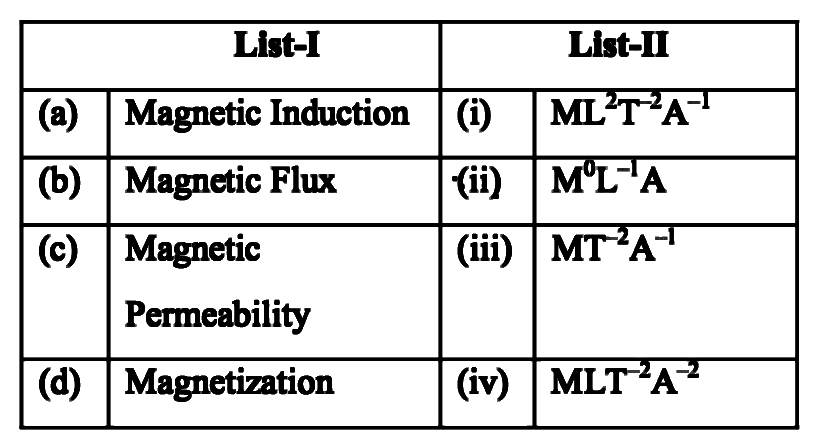
Match List - I with List - II
Choose the most appropriate answer from the options given below:
(a) (a)-(ii), (b)-(iv), (c)-(i), (d)-(iii) (b) (a)-(ii), (b)-(i), (c)-(iv), (d)-(iii) (c) (a)-(iii), (b)-(ii), (c)-(iv), (d)-(i) (d) (a)-(iii), (b)-(i), (c)-(iv), (d)-(ii) Show answer and solution
Answer: (d)
Magnetic induction B = F I L = [ M T − 2 A − 1 ] B = \dfrac{F}{IL} = [\mathrm{MT^{-2}A^{-1}}] B = I L F = [ M T − 2 A − 1 ] Flux ϕ = B A = [ M L 2 T − 2 A − 1 ] \phi = BA = [\mathrm{ML^2T^{-2}A^{-1}}] ϕ = B A = [ M L 2 T − 2 A − 1 ] Permeability μ = [ M L T − 2 A − 2 ] \mu = [\mathrm{MLT^{-2}A^{-2}}] μ = [ ML T − 2 A − 2 ] Magnetization = magnetic moment per volume = [ L 2 A ] [ L 3 ] = [ L − 1 A ] = \dfrac{[\mathrm{L^2A}]}{[\mathrm{L^3}]} = [\mathrm{L^{-1}A}] = [ L 3 ] [ L 2 A ] = [ L − 1 A ] So the answer is (d) (a)-(iii), (b)-(i), (c)-(iv), (d)-(ii). Report a mistake Q62 JEE Main 2021 · 31 AUG · SHIFT 1 Medium ☆
Units & Dimensions · Match-the-dimension lists
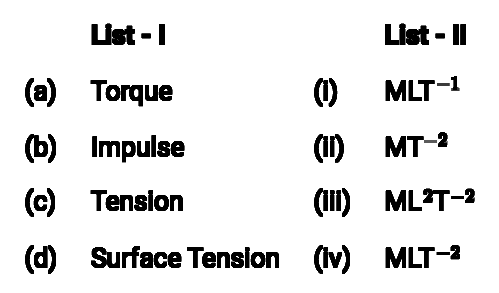
Match List - I with List - II.
Choose the most appropriate answer from the options given below:
(a) (a)-(iii), (b)-(i), (c)-(iv), (d)-(ii) (b) (a)-(ii), (b)-(i), (c)-(iv), (d)-(iii) (c) (a)-(i), (b)-(iii), (c)-(iv), (d)-(ii) (d) (a)-(iii), (b)-(iv), (c)-(i), (d)-(ii) Show answer and solution
Answer: (a)
Torque = r F = [ M L 2 T − 2 ] = rF = [\mathrm{ML^2T^{-2}}] = r F = [ M L 2 T − 2 ] Impulse = F t = [ M L T − 1 ] = Ft = [\mathrm{MLT^{-1}}] = Ft = [ ML T − 1 ] Tension is a force = [ M L T − 2 ] = [\mathrm{MLT^{-2}}] = [ ML T − 2 ] Surface tension = F / l = [ M T − 2 ] = F/l = [\mathrm{MT^{-2}}] = F / l = [ M T − 2 ] So the answer is (a) (a)-(iii), (b)-(i), (c)-(iv), (d)-(ii). Report a mistake Q63 JEE Main 2021 · 27 AUG · SHIFT 2 Medium ☆
Units & Dimensions · Match-the-dimension lists
Match List - I with List - II.
Choose the most appropriate answer from the options given below:
List - I List - II (a) R H R_H R H (i) kg m − 1 s − 1 \text{kg m}^{-1}\text{ s}^{-1} kg m − 1 s − 1 (b) h (Planck's constant) (ii) kg m 2 s − 1 \text{kg m}^{2}\text{ s}^{-1} kg m 2 s − 1 (c) μ B \mu_B μ B (iii) m − 1 \text{m}^{-1} m − 1 (d) η \eta η (iv) kg m − 1 s − 2 \text{kg m}^{-1}\text{ s}^{-2} kg m − 1 s − 2
(a) (a)-(ii), (b)-(iii), (c)-(iv), (d)-(i) (b) (a)-(iii), (b)-(ii), (c)-(iv), (d)-(i) (c) (a)-(iv), (b)-(ii), (c)-(i), (d)-(iii) (d) (a)-(iii), (b)-(ii), (c)-(i), (d)-(iv) Show answer and solution
Answer: (b)
Rydberg constant: 1 λ = R H ( 1 n 1 2 − 1 n 2 2 ) \dfrac{1}{\lambda} = R_H\left(\dfrac{1}{n_1^2} - \dfrac{1}{n_2^2}\right) λ 1 = R H ( n 1 2 1 − n 2 2 1 ) R H R_H R H − 1 ^{-1} − 1 h h h 2 ^2 2 − 1 ^{-1} − 1 Magnetic energy density B 2 2 μ 0 \dfrac{B^2}{2\mu_0} 2 μ 0 B 2 − 3 ^{-3} − 3 − 1 ^{-1} − 1 − 2 ^{-2} − 2 Viscosity = Pa s = kg m− 1 ^{-1} − 1 − 1 ^{-1} − 1 So the answer is (b) (a)-(iii), (b)-(ii), (c)-(iv), (d)-(i). Report a mistake Q64 JEE Main 2021 · 27 JUL · SHIFT 2 Medium ☆
Units & Dimensions · Match-the-dimension lists
Match List I with List II.
Choose the correct answer from the options given below
List - I List - II (a) Capacitance, C (i) M 1 L 1 T − 3 A − 1 M^{1}L^{1}T^{-3}A^{-1} M 1 L 1 T − 3 A − 1 (b) Permittivity of free space, ε 0 \varepsilon_0 ε 0 (ii) M − 1 L − 3 T 4 A 2 M^{-1}L^{-3}T^{4}A^{2} M − 1 L − 3 T 4 A 2 (c) Permeability of free space, μ 0 \mu_0 μ 0 (iii) M − 1 L − 2 T 4 A 2 M^{-1}L^{-2}T^{4}A^{2} M − 1 L − 2 T 4 A 2 (d) Electric field, E (iv) M 1 L 1 T − 2 A − 2 M^{1}L^{1}T^{-2}A^{-2} M 1 L 1 T − 2 A − 2
(a) (a) → \rightarrow → → \rightarrow → → \rightarrow → → \rightarrow → (b) (a) → \rightarrow → → \rightarrow → → \rightarrow → → \rightarrow → (c) (a) → \rightarrow → → \rightarrow → → \rightarrow → → \rightarrow → (d) (a) → \rightarrow → → \rightarrow → → \rightarrow → → \rightarrow → Show answer and solution
Answer: (a)
Capacitance C = q V = [ A T ] [ M L 2 T − 3 A − 1 ] = [ M − 1 L − 2 T 4 A 2 ] C = \dfrac{q}{V} = \dfrac{[\mathrm{AT}]}{[\mathrm{ML^2T^{-3}A^{-1}}]} = [\mathrm{M^{-1}L^{-2}T^4A^2}] C = V q = [ M L 2 T − 3 A − 1 ] [ AT ] = [ M − 1 L − 2 T 4 A 2 ] ε 0 = q 2 4 π F r 2 = [ M − 1 L − 3 T 4 A 2 ] \varepsilon_0 = \dfrac{q^2}{4\pi F r^2} = [\mathrm{M^{-1}L^{-3}T^4A^2}] ε 0 = 4 π F r 2 q 2 = [ M − 1 L − 3 T 4 A 2 ] μ 0 = 1 ε 0 c 2 = [ M L T − 2 A − 2 ] \mu_0 = \dfrac{1}{\varepsilon_0 c^2} = [\mathrm{MLT^{-2}A^{-2}}] μ 0 = ε 0 c 2 1 = [ ML T − 2 A − 2 ] E = F / q = [ M L T − 3 A − 1 ] E = F/q = [\mathrm{MLT^{-3}A^{-1}}] E = F / q = [ ML T − 3 A − 1 ] So the answer is (a) (a)-(iii), (b)-(ii), (c)-(iv), (d)-(i). Report a mistake Q65 JEE Main 2021 · 25 FEB · SHIFT 1 Medium ☆
Units & Dimensions · Match-the-dimension lists
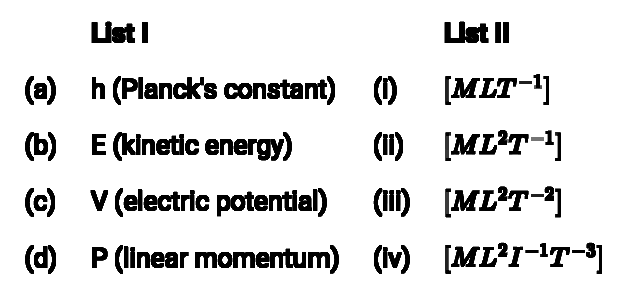
Match List - I with List - II:
Choose the correct answer from the options given below:
(a) (a) → \rightarrow → → \rightarrow → → \rightarrow → → \rightarrow → (b) (a) → \rightarrow → → \rightarrow → → \rightarrow → → \rightarrow → (c) (a) → \rightarrow → → \rightarrow → → \rightarrow → → \rightarrow → (d) (a) → \rightarrow → → \rightarrow → → \rightarrow → → \rightarrow → Show answer and solution
Answer: (a)
Planck's constant h = E / ν h = E/\nu h = E / ν [ M L 2 T − 1 ] [ML^2T^{-1}] [ M L 2 T − 1 ] → \rightarrow → Kinetic energy: [ M L 2 T − 2 ] [ML^2T^{-2}] [ M L 2 T − 2 ] → \rightarrow → Electric potential V = W / q = W / ( I t ) V = W/q = W/(It) V = W / q = W / ( I t ) [ M L 2 I − 1 T − 3 ] [ML^2I^{-1}T^{-3}] [ M L 2 I − 1 T − 3 ] → \rightarrow → Linear momentum p = m v p = mv p = m v [ M L T − 1 ] [MLT^{-1}] [ M L T − 1 ] → \rightarrow → So the answer is (a). Report a mistake Q66 NEET 2020 · PHASE 2 Easy ☆
Units & Dimensions · Physical quantities & SI units
The angle of 1′ (minute of arc) in radian is nearly equal to
(a) 1.75 × 1 0 − 2 rad 1.75 \times 10^{-2}\text{ rad} 1.75 × 1 0 − 2 rad (b) 2.91 × 1 0 − 4 rad 2.91 \times 10^{-4}\text{ rad} 2.91 × 1 0 − 4 rad (c) 4.85 × 1 0 − 4 rad 4.85 \times 10^{-4}\text{ rad} 4.85 × 1 0 − 4 rad (d) 4.80 × 1 0 − 6 rad 4.80 \times 10^{-6}\text{ rad} 4.80 × 1 0 − 6 rad Show answer and solution
Answer: (b)
1 ′ = ( 1 60 ) ∘ 1' = \left(\frac{1}{60}\right)^\circ 1 ′ = ( 60 1 ) ∘ 1 ∘ = π 180 rad 1^\circ = \frac{\pi}{180}\text{ rad} 1 ∘ = 180 π rad 1 ′ = π 180 × 60 = 3.1416 10800 rad 1' = \frac{\pi}{180 \times 60} = \frac{3.1416}{10800}\text{ rad} 1 ′ = 180 × 60 π = 10800 3.1416 rad 1 ′ ≈ 2.91 × 1 0 − 4 rad 1' \approx 2.91 \times 10^{-4}\text{ rad} 1 ′ ≈ 2.91 × 1 0 − 4 rad So the answer is (b) 2.91 × 1 0 − 4 rad 2.91 \times 10^{-4}\text{ rad} 2.91 × 1 0 − 4 rad Report a mistake Q67 NEET 2020 · PHASE 1 Easy ☆
Units & Dimensions · Physical quantities & SI units
The energy required to break one bond in DNA is 10-20 J. This value in eV is nearly:
(a) 0.6 (b) 0.06 (c) 0.006 (d) 6 Show answer and solution
Answer: (b)
The energy is 1 0 − 20 J 10^{-20}\text{ J} 1 0 − 20 J 1 eV = 1.6 × 1 0 − 19 J 1\text{ eV} = 1.6 \times 10^{-19}\text{ J} 1 eV = 1.6 × 1 0 − 19 J E = 1 0 − 20 1.6 × 1 0 − 19 eV = 0.0625 eV E = \frac{10^{-20}}{1.6 \times 10^{-19}}\text{ eV} = 0.0625\text{ eV} E = 1.6 × 1 0 − 19 1 0 − 20 eV = 0.0625 eV So the answer is (b) 0.06 0.06 0.06 Report a mistake Q68 MHT CET 2020 · 19 OCT · SHIFT 2 Easy ☆
Units & Dimensions · Dimensional formula of a quantity
Let σ \sigma σ b b b σ b \sigma b σb
(a) [ L 1 M − 1 T − 3 K − 3 ] [L^{1}M^{-1}T^{-3}K^{-3}] [ L 1 M − 1 T − 3 K − 3 ] (b) [ L 1 M 1 T 3 K − 3 ] [L^{1}M^{1}T^{3}K^{-3}] [ L 1 M 1 T 3 K − 3 ] (c) [ L − 1 M 1 T − 3 K − 3 ] \left[L^{-1}M^{1}\mathrm{T}^{-3}\mathrm{K}^{-3}\right] [ L − 1 M 1 T − 3 K − 3 ] (d) [ L 1 M 1 T − 3 K − 3 ] [L^{1}M^{1}T^{-3}K^{-3}] [ L 1 M 1 T − 3 K − 3 ] Show answer and solution
Answer: (d)
E = σ T 4 E = \sigma T^4 E = σ T 4 [ σ ] = [ M T − 3 ] [ K 4 ] = [ M T − 3 K − 4 ] [\sigma] = \frac{[\mathrm{MT^{-3}}]}{[\mathrm{K^4}]} = [\mathrm{MT^{-3}K^{-4}}] [ σ ] = [ K 4 ] [ M T − 3 ] = [ M T − 3 K − 4 ] λ m T = b \lambda_m T = b λ m T = b [ b ] = [ L K ] [b] = [\mathrm{LK}] [ b ] = [ LK ] [ σ b ] = [ L 1 M 1 T − 3 K − 3 ] [\sigma b] = [\mathrm{L^1M^1T^{-3}K^{-3}}] [ σb ] = [ L 1 M 1 T − 3 K − 3 ] So the answer is (d). Report a mistake Q69 MHT CET 2020 · 19 OCT · SHIFT 2 Easy ☆
Units & Dimensions · Dimensional formula of a quantity
Let x = π R ( P 2 − Q 2 2 ) x = \pi R\left(\frac{P^2 - Q^2}{2}\right) x = π R ( 2 P 2 − Q 2 ) P , Q P, Q P , Q R R R x x x
(a) area (b) length (c) volume (d) velocity Show answer and solution
Answer: (c)
P 2 − Q 2 P^2 - Q^2 P 2 − Q 2 [ L 2 ] [\mathrm{L^2}] [ L 2 ] π \pi π 2 2 2 [ x ] = [ L ] [ L 2 ] = [ L 3 ] [x] = [\mathrm{L}][\mathrm{L^2}] = [\mathrm{L^3}] [ x ] = [ L ] [ L 2 ] = [ L 3 ] So the answer is (c) volume. Report a mistake Q70 NEET 2020 · PHASE 1 Easy ☆
Units & Dimensions · Dimensional formula of a quantity
Dimensions of stress are:
(a) [ M L 2 T − 2 ] [ML^{2}T^{-2}] [ M L 2 T − 2 ] (b) [ M L 0 T − 2 ] [ML^{0}T^{-2}] [ M L 0 T − 2 ] (c) [ M L − 1 T − 2 ] [ML^{-1}T^{-2}] [ M L − 1 T − 2 ] (d) [ M L T − 2 ] [MLT^{-2}] [ M L T − 2 ] Show answer and solution
Answer: (c)
Stress = F A = \frac{F}{A} = A F [ stress ] = [ M L T − 2 ] [ L 2 ] = [ M L − 1 T − 2 ] [\text{stress}] = \frac{[\mathrm{MLT^{-2}}]}{[\mathrm{L^2}]} = [\mathrm{ML^{-1}T^{-2}}] [ stress ] = [ L 2 ] [ ML T − 2 ] = [ M L − 1 T − 2 ] So the answer is (c). Report a mistake Q71 JEE Main 2020 · 4 SEP · SHIFT 1 Easy ☆
Units & Dimensions · Dimensional formula of a quantity
Dimensional formula for thermal conductivity is (here K denotes the temperature):
(a) MLT–3K–1 (b) MLT–2K–2 (c) MLT–2K (d) MLT–3K Show answer and solution
Answer: (a)
Heat flow: Q t = k A Δ θ x \frac{Q}{t} = kA\frac{\Delta\theta}{x} t Q = k A x Δ θ k = ( Q / t ) x A Δ θ k = \frac{(Q/t)\,x}{A\,\Delta\theta} k = A Δ θ ( Q / t ) x [ k ] = M L 2 T − 3 ⋅ L L 2 ⋅ K = M L T − 3 K − 1 [k] = \frac{\mathrm{ML^2T^{-3}}\cdot\mathrm{L}}{\mathrm{L^2}\cdot\mathrm{K}} = \mathrm{MLT^{-3}K^{-1}} [ k ] = L 2 ⋅ K M L 2 T − 3 ⋅ L = ML T − 3 K − 1 So the answer is (a). Report a mistake Q72 JEE Main 2020 · 3 SEP · SHIFT 2 Easy ☆
Units & Dimensions · Dimensional formula of a quantity
Amount of solar energy received on the earth’s surface per unit area per unit time is defined as solar constant. Dimension of solar constant is:
(a) MLT–2 (b) ML0T–3 (c) M2L0T–1 (d) ML2T–2 Show answer and solution
Answer: (b)
Solar constant = = = × \times × = = = [ S ] = M L 2 T − 3 / L 2 = M L 0 T − 3 [S] = \mathrm{ML^2T^{-3}}/\mathrm{L^2} = \mathrm{ML^0T^{-3}} [ S ] = M L 2 T − 3 / L 2 = M L 0 T − 3 So the answer is (b). Report a mistake Q73 JEE Main 2020 · 7 JAN · SHIFT 2 Easy ☆
Units & Dimensions · Dimensional formula of a quantity
The dimension of B 2 2 μ 0 \frac{B^2}{2\mu_0} 2 μ 0 B 2 μ 0 \mu_0 μ 0
(a) ML2T–2 (b) MLT–2 (c) ML-1T–2 (d) ML2T–1 Show answer and solution
Answer: (c)
B 2 / ( 2 μ 0 ) B^2/(2\mu_0) B 2 / ( 2 μ 0 ) [ energy / volume ] = M L 2 T − 2 / L 3 = M L − 1 T − 2 [\text{energy}/\text{volume}] = \mathrm{ML^2T^{-2}}/\mathrm{L^3} = \mathrm{ML^{-1}T^{-2}} [ energy / volume ] = M L 2 T − 2 / L 3 = M L − 1 T − 2 So the answer is (c). Report a mistake Q74 JEE Main 2020 · 5 SEP · SHIFT 2 Medium ☆
Units & Dimensions · Dimensional formula of a quantity
The quantities x = 1 μ 0 ε 0 \frac{1}{\sqrt{\mu_0\varepsilon_0}} μ 0 ε 0 1 E B \frac{E}{B} B E l C R \frac{l}{CR} CR l
defined where C-capacitance, R-Resistance, l-length, E-Electric field, B-magnetic field and ε 0 , μ 0 \varepsilon_0, \mu_0 ε 0 , μ 0
(a) Only y and z have the same dimension (b) x, y and z have the same dimension (c) Only x and y have the same dimension (d) Only x and z have the same dimension Show answer and solution
Answer: (b)
x = 1 μ 0 ε 0 = c x = \dfrac{1}{\sqrt{\mu_0\varepsilon_0}} = c x = μ 0 ε 0 1 = c [ L T − 1 ] [\mathrm{LT^{-1}}] [ L T − 1 ] From F = q E = q v B F = qE = qvB F = qE = q v B E B = v \dfrac{E}{B} = v B E = v y = [ L T − 1 ] y = [\mathrm{LT^{-1}}] y = [ L T − 1 ] C R CR CR [ T ] [\mathrm{T}] [ T ] z = l C R = [ L T − 1 ] z = \dfrac{l}{CR} = [\mathrm{LT^{-1}}] z = CR l = [ L T − 1 ] So the answer is (b) x, y and z have the same dimension. Report a mistake Q75 JEE Main 2019 · 8 APR · SHIFT 1 Easy ☆
Units & Dimensions · Physical quantities & SI units
In SI units, the dimensions of ϵ 0 μ 0 \sqrt{\frac{\epsilon_0}{\mu_0}} μ 0 ϵ 0
(a) A–1 TML3 (b) A2T3M–1L–2 (c) AT–3ML3/2 (d) AT2M–1L–1 Show answer and solution
Answer: (b)
[ ε 0 ] = [ M − 1 L − 3 T 4 A 2 ] [\varepsilon_0] = [\mathrm{M^{-1}L^{-3}T^{4}A^{2}}] [ ε 0 ] = [ M − 1 L − 3 T 4 A 2 ] [ μ 0 ] = [ M L T − 2 A − 2 ] [\mu_0] = [\mathrm{MLT^{-2}A^{-2}}] [ μ 0 ] = [ ML T − 2 A − 2 ] ε 0 μ 0 = [ M − 2 L − 4 T 6 A 4 ] \frac{\varepsilon_0}{\mu_0} = [\mathrm{M^{-2}L^{-4}T^{6}A^{4}}] μ 0 ε 0 = [ M − 2 L − 4 T 6 A 4 ] ε 0 μ 0 = [ M − 1 L − 2 T 3 A 2 ] \sqrt{\frac{\varepsilon_0}{\mu_0}} = [\mathrm{M^{-1}L^{-2}T^{3}A^{2}}] μ 0 ε 0 = [ M − 1 L − 2 T 3 A 2 ] So the answer is (b) A 2 T 3 M − 1 L − 2 \mathrm{A^2T^3M^{-1}L^{-2}} A 2 T 3 M − 1 L − 2 Report a mistake Q76 JEE Main 2019 · 12 JAN · SHIFT 2 Easy ☆
Units & Dimensions · Physical quantities & SI units
Let ℓ \ell ℓ ℓ r C V \frac{\ell}{rCV} r C V ℓ
(a) [A–1] (b) [LTA] (c) [LA–2] (d) [LT2] Show answer and solution
Answer: (a)
ℓ r \frac{\ell}{r} r ℓ [ T ] [\mathrm{T}] [ T ] C V = Q CV = Q C V = Q [ A T ] [\mathrm{AT}] [ AT ] ℓ r C V = [ T ] [ A T ] = [ A − 1 ] \frac{\ell}{rCV} = \frac{[\mathrm{T}]}{[\mathrm{AT}]} = [\mathrm{A^{-1}}] r C V ℓ = [ AT ] [ T ] = [ A − 1 ] So the answer is (a) [ A − 1 ] [\mathrm{A^{-1}}] [ A − 1 ] Report a mistake Q77 MHT CET 2019 · 3 MAY · SHIFT 1 Easy ☆
Units & Dimensions · Dimensional formula of a quantity
[ L 2 M 1 T − 2 ] \left[\mathrm{L^{2}M^{1}T^{-2}}\right] [ L 2 M 1 T − 2 ]
(a) torque (b) force (c) angular acceleration (d) angular momentum Show answer and solution
Answer: (a)
Torque = r F → [ L ] [ M L T − 2 ] = [ M L 2 T − 2 ] = rF \to [\mathrm{L}][\mathrm{MLT^{-2}}] = [\mathrm{ML^2T^{-2}}] = r F → [ L ] [ ML T − 2 ] = [ M L 2 T − 2 ] Force is [ M L T − 2 ] [\mathrm{MLT^{-2}}] [ ML T − 2 ] [ T − 2 ] [\mathrm{T^{-2}}] [ T − 2 ] [ M L 2 T − 1 ] [\mathrm{ML^2T^{-1}}] [ M L 2 T − 1 ] So the answer is (a) torque. Report a mistake Q78 MHT CET 2019 · 2 MAY · SHIFT 2 Easy ☆
Units & Dimensions · Dimensional formula of a quantity
The dimensions of self or mutual inductance are given as
(a) [ L − 2 M 1 T − 2 I − 2 ] [L^{-2}M^{1}T^{-2}I^{-2}] [ L − 2 M 1 T − 2 I − 2 ] (b) [ L 2 M 2 T − 2 I − 2 ] [L^{2}M^{2}T^{-2}I^{-2}] [ L 2 M 2 T − 2 I − 2 ] (c) [ L 2 M 1 T − 2 I − 2 ] [L^{2}M^{1}T^{-2}I^{-2}] [ L 2 M 1 T − 2 I − 2 ] (d) [ L 2 M 2 T − 2 I − 2 ] [L^{2}M^{2}T^{-2}I^{-2}] [ L 2 M 2 T − 2 I − 2 ] Show answer and solution
Answer: (c)
Energy in inductor U = 1 2 L I 2 ⇒ L = 2 U I 2 U = \frac{1}{2}LI^2 \Rightarrow L = \frac{2U}{I^2} U = 2 1 L I 2 ⇒ L = I 2 2 U [ L ] = [ M L 2 T − 2 ] [ I 2 ] = [ L 2 M 1 T − 2 I − 2 ] [L] = \frac{[\mathrm{ML^2T^{-2}}]}{[\mathrm{I^2}]} = [\mathrm{L^2M^1T^{-2}I^{-2}}] [ L ] = [ I 2 ] [ M L 2 T − 2 ] = [ L 2 M 1 T − 2 I − 2 ] So the answer is (c). Report a mistake Q79 MHT CET 2019 · 2 MAY · SHIFT 2 Easy ☆
Units & Dimensions · Dimensional formula of a quantity
The ratio of the dimensions of Planck's constant to that of moment of inertia is the dimensions of
(a) angular momentum (b) velocity (c) frequency (d) time Show answer and solution
Answer: (c)
[ h ] = [ M L 2 T − 1 ] [h] = [\mathrm{ML^2T^{-1}}] [ h ] = [ M L 2 T − 1 ] E = h ν E = h\nu E = h ν [ I ] = [ M L 2 ] [I] = [\mathrm{ML^2}] [ I ] = [ M L 2 ] [ h ] [ I ] = [ T − 1 ] \frac{[h]}{[I]} = [\mathrm{T^{-1}}] [ I ] [ h ] = [ T − 1 ] So the answer is (c) frequency. Report a mistake Q80 MHT CET 2019 · 2 MAY · SHIFT 1 Easy ☆
Units & Dimensions · Dimensional formula of a quantity
Dimensions of Gyromagnetic ratio are
(a) [ L 1 M 0 T 1 I 1 ] [L^{1}M^{0}T^{1}I^{1}] [ L 1 M 0 T 1 I 1 ] (b) [ L 0 M − 1 T 1 I 1 ] [L^{0}M^{-1}T^{1}I^{1}] [ L 0 M − 1 T 1 I 1 ] (c) [ L 1 M 0 T 0 I − 1 ] [L^{1}M^{0}T^{0}I^{-1}] [ L 1 M 0 T 0 I − 1 ] (d) [ L − 1 M 0 T 1 I 1 ] [L^{-1}M^{0}T^{1}I^{1}] [ L − 1 M 0 T 1 I 1 ] Show answer and solution
Answer: (b)
Gyromagnetic ratio = magnetic moment angular momentum = e 2 m = \frac{\text{magnetic moment}}{\text{angular momentum}} = \frac{e}{2m} = angular momentum magnetic moment = 2 m e [ charge / mass ] = [ I T ] [ M ] = [ L 0 M − 1 T 1 I 1 ] [\text{charge}/\text{mass}] = \frac{[\mathrm{IT}]}{[\mathrm{M}]} = [\mathrm{L^0M^{-1}T^1I^1}] [ charge / mass ] = [ M ] [ IT ] = [ L 0 M − 1 T 1 I 1 ] So the answer is (b). Report a mistake Q81 JEE Main 2019 · 12 APR · SHIFT 1 Easy ☆
Units & Dimensions · Same dimensions & dimensionless
Which of the following combinations has the dimension of electrical resistance (ϵ \epsilon ϵ μ \mu μ
(a) ϵ 0 μ 0 \sqrt{\frac{\epsilon_0}{\mu_0}} μ 0 ϵ 0 (b) ϵ 0 μ 0 \frac{\epsilon_0}{\mu_0} μ 0 ϵ 0 (c) μ 0 ϵ 0 \sqrt{\frac{\mu_0}{\epsilon_0}} ϵ 0 μ 0 (d) μ 0 ϵ 0 \frac{\mu_0}{\epsilon_0} ϵ 0 μ 0 Show answer and solution
Answer: (c)
1 μ 0 ε 0 = c \dfrac{1}{\sqrt{\mu_0\varepsilon_0}} = c μ 0 ε 0 1 = c μ 0 ε 0 = 1 / c 2 \mu_0\varepsilon_0 = 1/c^2 μ 0 ε 0 = 1/ c 2 [ μ 0 ] = [ M L T − 2 A − 2 ] [\mu_0] = [\mathrm{MLT^{-2}A^{-2}}] [ μ 0 ] = [ ML T − 2 A − 2 ] [ ε 0 ] = [ M − 1 L − 3 T 4 A 2 ] [\varepsilon_0] = [\mathrm{M^{-1}L^{-3}T^{4}A^{2}}] [ ε 0 ] = [ M − 1 L − 3 T 4 A 2 ] μ 0 ε 0 = [ M 2 L 4 T − 6 A − 4 ] ⇒ μ 0 ε 0 = [ M L 2 T − 3 A − 2 ] \dfrac{\mu_0}{\varepsilon_0} = [\mathrm{M^2L^4T^{-6}A^{-4}}] \Rightarrow \sqrt{\dfrac{\mu_0}{\varepsilon_0}} = [\mathrm{ML^2T^{-3}A^{-2}}] ε 0 μ 0 = [ M 2 L 4 T − 6 A − 4 ] ⇒ ε 0 μ 0 = [ M L 2 T − 3 A − 2 ] This is the dimension of resistance (R = V / I R = V/I R = V / I 377 Ω 377\ \Omega 377 Ω So the answer is (c) μ 0 / ε 0 \sqrt{\mu_0/\varepsilon_0} μ 0 / ε 0 Report a mistake Q82 JEE Main 2016 · 9 APR · SHIFT 1 Easy ☆
Units & Dimensions · Dimensional formula of a quantity
In the following ‘I’ refers to current and other symbols have their usual meaning. Choose the option that corresponds to the dimensions of electrical conductivity:
(a) ML− 3 {}^{-3} − 3 − 3 {}^{-3} − 3 (b) M− 1 {}^{-1} − 1 (c) M− 1 {}^{-1} − 1 − 3 {}^{-3} − 3 (d) M− 1 {}^{-1} − 1 − 3 {}^{-3} − 3 Show answer and solution
Answer: (c)
σ = 1 / ρ \sigma = 1/\rho σ = 1/ ρ ρ = R A / l \rho = RA/l ρ = R A / l [ R ] = [ V / I ] = M L 2 T − 3 I − 2 [R] = [V/I] = \mathrm{ML^2T^{-3}I^{-2}} [ R ] = [ V / I ] = M L 2 T − 3 I − 2 [ ρ ] = M L 3 T − 3 I − 2 [\rho] = \mathrm{ML^3T^{-3}I^{-2}} [ ρ ] = M L 3 T − 3 I − 2 [ σ ] = M − 1 L − 3 T 3 I 2 [\sigma] = \mathrm{M^{-1}L^{-3}T^3I^2} [ σ ] = M − 1 L − 3 T 3 I 2 So the answer is (c). Report a mistake Q83 JEE Main 2014 · 11 APR · SHIFT 1 Easy ☆
Units & Dimensions · Dimensional formula of a quantity
In terms of resistance R and time T, the dimensions of ratio μ ϵ \frac{\mu}{\epsilon} ϵ μ μ \mu μ ϵ \epsilon ϵ
(a) [RT− 2 {}^{-2} − 2 (b) [R2T− 1 {}^{-1} − 1 (c) [R2] (d) [R2T2] Show answer and solution
Answer: (c)
μ / ϵ \sqrt{\mu/\epsilon} μ / ϵ [ μ / ϵ ] = M 2 L 4 T − 6 A − 4 = [ R ] 2 [\mu/\epsilon] = \mathrm{M^2L^4T^{-6}A^{-4}} = [R]^2 [ μ / ϵ ] = M 2 L 4 T − 6 A − 4 = [ R ] 2 [ R ] = M L 2 T − 3 A − 2 [R] = \mathrm{ML^2T^{-3}A^{-2}} [ R ] = M L 2 T − 3 A − 2 So the answer is (c) [ R 2 ] [R^2] [ R 2 ] Report a mistake Q84 JEE Main 2014 · 12 APR · SHIFT 1 Medium ☆
Units & Dimensions · Dimensional formula of a quantity
From the following combinations of physical constant (expressed through their usual symbols) the only combination, that would have the same value in different systems of unit, is:
(a) c h 2 π ϵ 0 2 \frac{ch}{2\pi\epsilon_0^2} 2 π ϵ 0 2 c h (b) e 2 2 π ϵ 0 G m e 2 \frac{e^2}{2\pi\epsilon_0 G m_e^2} 2 π ϵ 0 G m e 2 e 2 (c) μ 0 ϵ 0 c 2 G h e 2 \frac{\mu_0\epsilon_0}{c^2}\frac{G}{he^2} c 2 μ 0 ϵ 0 h e 2 G (d) 2 π μ 0 ϵ 0 c e 2 h G \frac{2\pi\sqrt{\mu_0\epsilon_0}}{ce^2}\frac{h}{G} c e 2 2 π μ 0 ϵ 0 G h Show answer and solution
Answer: (b)
A combination has the same value in every unit system only if it is dimensionless. e 2 4 π ε 0 r 2 \dfrac{e^2}{4\pi\varepsilon_0 r^2} 4 π ε 0 r 2 e 2 G m e 2 r 2 \dfrac{G m_e^2}{r^2} r 2 G m e 2 So e 2 2 π ε 0 G m e 2 = 2 × e 2 / ( 4 π ε 0 r 2 ) G m e 2 / r 2 \dfrac{e^2}{2\pi\varepsilon_0 G m_e^2} = 2\times\dfrac{e^2/(4\pi\varepsilon_0 r^2)}{G m_e^2/r^2} 2 π ε 0 G m e 2 e 2 = 2 × G m e 2 / r 2 e 2 / ( 4 π ε 0 r 2 ) So the answer is (b). Report a mistake Q85 JEE Main 2013 · 22 APR · SHIFT 1 Easy ☆
Units & Dimensions · Dimensional formula of a quantity
The dimensions of angular momentum, latent heat and capacitance are, respectively.
(a) M L 2 T 1 A 2 , L 2 T − 2 , M − 1 L − 2 T 2 ML^{2}T^{1}A^{2},\ L^{2}T^{-2},\ M^{-1}L^{-2}T^{2} M L 2 T 1 A 2 , L 2 T − 2 , M − 1 L − 2 T 2 (b) M L 2 T − 2 , L 2 T 2 , M − 1 L − 2 T 4 A 2 ML^{2}T^{-2},\ L^{2}T^{2},\ M^{-1}L^{-2}T^{4}A^{2} M L 2 T − 2 , L 2 T 2 , M − 1 L − 2 T 4 A 2 (c) M L 2 T − 1 , L 2 T − 2 , M L 2 T A 2 ML^{2}T^{-1},\ L^{2}T^{-2},\ ML^{2}TA^{2} M L 2 T − 1 , L 2 T − 2 , M L 2 T A 2 (d) M L 2 T − 1 , L 2 T − 2 , M − 1 L − 2 T 4 A 2 ML^{2}T^{-1},\ L^{2}T^{-2},\ M^{-1}L^{-2}T^{4}A^{2} M L 2 T − 1 , L 2 T − 2 , M − 1 L − 2 T 4 A 2 Show answer and solution
Answer: (d)
Angular momentum m v r mvr m v r M L 2 T − 1 \mathrm{ML^2T^{-1}} M L 2 T − 1 Latent heat Q / m Q/m Q / m L 2 T − 2 \mathrm{L^2T^{-2}} L 2 T − 2 Capacitance q / V = q 2 / W q/V = q^2/W q / V = q 2 / W A 2 T 2 / M L 2 T − 2 = M − 1 L − 2 T 4 A 2 \mathrm{A^2T^2}/\mathrm{ML^2T^{-2}} = \mathrm{M^{-1}L^{-2}T^4A^2} A 2 T 2 / M L 2 T − 2 = M − 1 L − 2 T 4 A 2 So the answer is (d). Report a mistake Q86 JEE Main 2013 Easy ☆
Units & Dimensions · Dimensional formula of a quantity
Let [ε 0 \varepsilon_0 ε 0
(a) ε 0 = [ M − 1 L − 3 T 2 A ] \varepsilon_0 = \left[M^{-1}L^{-3}T^{2}A\right] ε 0 = [ M − 1 L − 3 T 2 A ] (b) ε 0 = [ M − 1 L − 3 T 4 A 2 ] \varepsilon_0 = \left[M^{-1}L^{-3}T^{4}A^{2}\right] ε 0 = [ M − 1 L − 3 T 4 A 2 ] (c) ε 0 = [ M 1 L 2 T 1 A 2 ] \varepsilon_0 = \left[M^{1}L^{2}T^{1}A^{2}\right] ε 0 = [ M 1 L 2 T 1 A 2 ] (d) ε 0 = [ M 1 L 2 T 1 A ] \varepsilon_0 = \left[M^{1}L^{2}T^{1}A\right] ε 0 = [ M 1 L 2 T 1 A ] Show answer and solution
Answer: (b)
Coulomb's law: F = q 2 4 π ε 0 r 2 F = \frac{q^2}{4\pi\varepsilon_0 r^2} F = 4 π ε 0 r 2 q 2 ε 0 = q 2 F r 2 \varepsilon_0 = \frac{q^2}{Fr^2} ε 0 = F r 2 q 2 [ ε 0 ] = A 2 T 2 M L T − 2 ⋅ L 2 = M − 1 L − 3 T 4 A 2 [\varepsilon_0] = \frac{\mathrm{A^2T^2}}{\mathrm{MLT^{-2}}\cdot\mathrm{L^2}} = \mathrm{M^{-1}L^{-3}T^4A^2} [ ε 0 ] = ML T − 2 ⋅ L 2 A 2 T 2 = M − 1 L − 3 T 4 A 2 So the answer is (b). Report a mistake Q87 NEET 2013 Easy ☆
Units & Dimensions · Same dimensions & dimensionless
The pair of quantities having same dimensions is
(a) Impulse and Surface Tension (b) Angular momentum and Work (c) Work and Torque (d) Young's modulus and Energy Show answer and solution
Answer: (c)
Work and torque both are force × \times × M L 2 T − 2 \mathrm{ML^2T^{-2}} M L 2 T − 2 Impulse M L T − 1 \mathrm{MLT^{-1}} ML T − 1 M T − 2 \mathrm{MT^{-2}} M T − 2 M L 2 T − 1 \mathrm{ML^2T^{-1}} M L 2 T − 1 M L − 1 T − 2 \mathrm{ML^{-1}T^{-2}} M L − 1 T − 2 So the answer is (c). Report a mistake Q88 NEET 2012 · AIPMT · PRELIMS Easy ☆
Units & Dimensions · Physical quantities & SI units
The damping force on an oscillator is directly proportional to the velocity. The units of the constant of proportionality are
(a) kg m s− 1 {}^{-1} − 1 (b) kg m s− 2 {}^{-2} − 2 (c) kg s− 1 {}^{-1} − 1 (d) kg s Show answer and solution
Answer: (c)
F = k v ⇒ k = F v F = kv \Rightarrow k = \frac{F}{v} F = k v ⇒ k = v F k → kg m s − 2 m s − 1 = kg s − 1 k \to \frac{\text{kg m s}^{-2}}{\text{m s}^{-1}} = \text{kg s}^{-1} k → m s − 1 kg m s − 2 = kg s − 1 So the answer is (c) kg s − 1 \text{kg s}^{-1} kg s − 1 Report a mistake Q89 NEET 2012 · AIPMT · MAINS Easy ☆
Units & Dimensions · Dimensional formula of a quantity
The dimensions of ( μ 0 ε 0 ) − 1 / 2 (\mu_0\varepsilon_0)^{-1/2} ( μ 0 ε 0 ) − 1/2
(a) [ L 1 / 2 T − 1 / 2 ] [L^{1/2}T^{-1/2}] [ L 1/2 T − 1/2 ] (b) [ L − 1 T ] [L^{-1}T] [ L − 1 T ] (c) [ L T − 1 ] [LT^{-1}] [ L T − 1 ] (d) [ L 1 / 2 T 1 / 2 ] [L^{1/2}T^{1/2}] [ L 1/2 T 1/2 ] Show answer and solution
Answer: (c)
c = 1 μ 0 ε 0 c = \frac{1}{\sqrt{\mu_0\varepsilon_0}} c = μ 0 ε 0 1 [ ( μ 0 ε 0 ) − 1 / 2 ] = [ L T − 1 ] [(\mu_0\varepsilon_0)^{-1/2}] = [\mathrm{LT^{-1}}] [( μ 0 ε 0 ) − 1/2 ] = [ L T − 1 ] So the answer is (c). Report a mistake Q90 NEET 2011 · AIPMT · PRELIMS Easy ☆
Units & Dimensions · Dimensional formula of a quantity
The dimensions of ( μ 0 ε 0 ) − 1 / 2 (\mu_0\varepsilon_0)^{-1/2} ( μ 0 ε 0 ) − 1/2
(a) [ L 1 / 2 T − 1 / 2 ] [L^{1/2}T^{-1/2}] [ L 1/2 T − 1/2 ] (b) [ L − 1 T ] [L^{-1}T] [ L − 1 T ] (c) [ L T − 1 ] [LT^{-1}] [ L T − 1 ] (d) [ L 1 / 2 T 1 / 2 ] [L^{1/2}T^{1/2}] [ L 1/2 T 1/2 ] Show answer and solution
Answer: (c)
c = 1 μ 0 ε 0 c = \frac{1}{\sqrt{\mu_0\varepsilon_0}} c = μ 0 ε 0 1 [ ( μ 0 ε 0 ) − 1 / 2 ] = [ L T − 1 ] [(\mu_0\varepsilon_0)^{-1/2}] = [\mathrm{LT^{-1}}] [( μ 0 ε 0 ) − 1/2 ] = [ L T − 1 ] So the answer is (c). Report a mistake Q91 NEET 2009 · AIPMT Easy ☆
Units & Dimensions · Dimensional formula of a quantity
If the dimensions of a physical quantity are given by MaLbTc, then the physical quantity will be
(a) velocity if a = 1, b = 0, c = − - − (b) acceleration if a = 1, b = 1, c = − - − (c) force if a = 0, b = − - − − - − (d) pressure if a = 1, b = − - − − - − Show answer and solution
Answer: (d)
Velocity [ M 0 L T − 1 ] [\mathrm{M^0LT^{-1}}] [ M 0 L T − 1 ] a = 0 a = 0 a = 0 Acceleration [ M 0 L T − 2 ] [\mathrm{M^0LT^{-2}}] [ M 0 L T − 2 ] a = 0 a = 0 a = 0 Force [ M L T − 2 ] [\mathrm{MLT^{-2}}] [ ML T − 2 ] Pressure = F A = [ M L − 1 T − 2 ] = \frac{F}{A} = [\mathrm{ML^{-1}T^{-2}}] = A F = [ M L − 1 T − 2 ] a = 1 , b = − 1 , c = − 2 a = 1, b = -1, c = -2 a = 1 , b = − 1 , c = − 2 So the answer is (d). Report a mistake Q92 JEE Main 2008 · AIEEE Easy ☆
Units & Dimensions · Dimensional formula of a quantity
The dimension of magnetic field in M, L, T and C (coulomb) is given as
(a) MLT-1C-1 (b) MT2C-2 (c) MT-1C-1 (d) MT-2C-1 Show answer and solution
Answer: (c)
Magnetic force F = q v B F = qvB F = q v B B = F / ( q v ) B = F/(qv) B = F / ( q v ) [ B ] = M L T − 2 C ⋅ L T − 1 = M T − 1 C − 1 [B] = \frac{\mathrm{MLT^{-2}}}{\mathrm{C}\cdot\mathrm{LT^{-1}}} = \mathrm{MT^{-1}C^{-1}} [ B ] = C ⋅ L T − 1 ML T − 2 = M T − 1 C − 1 So the answer is (c). Report a mistake Q93 NEET 2008 · AIPMT Medium ☆
Units & Dimensions · Same dimensions & dimensionless
Which two of the following five physical parameters have the same dimensions? 1. Energy density
2. Refractive index
3. Dielectric constant
4. Young's modulus
5. Magnetic field
(a) 1 and 4 (b) 1 and 5 (c) 2 and 4 (d) 3 and 5 Show answer and solution
Answer: (a)
Energy density = E V = [ M L 2 T − 2 ] [ L 3 ] = [ M L − 1 T − 2 ] = \dfrac{E}{V} = \dfrac{[\mathrm{ML^2T^{-2}}]}{[\mathrm{L^3}]} = [\mathrm{ML^{-1}T^{-2}}] = V E = [ L 3 ] [ M L 2 T − 2 ] = [ M L − 1 T − 2 ] Young's modulus = stress/strain = [ M L − 1 T − 2 ] = [\mathrm{ML^{-1}T^{-2}}] = [ M L − 1 T − 2 ] Refractive index and dielectric constant are dimensionless; B = [ M T − 2 A − 1 ] B = [\mathrm{MT^{-2}A^{-1}}] B = [ M T − 2 A − 1 ] So the answer is (a) 1 and 4. Report a mistake Q94 NEET 2007 · AIPMT Easy ☆
Units & Dimensions · Dimensional formula of a quantity
Dimensions of resistance in an electrical circuit, in terms of dimension of mass M, of length L, of time T and of current I, would be
(a) [ML2T− 2 {}^{-2} − 2 (b) [ML2T− 1 I − {}^{-1}\mathrm{I}^{-} − 1 I − (c) [ML2T− 3 I − {}^{-3}\mathrm{I}^{-} − 3 I − (d) [ML2T− 3 I − {}^{-3}\mathrm{I}^{-} − 3 I − Show answer and solution
Answer: (c)
R = V I R = \frac{V}{I} R = I V V = W q ⇒ [ V ] = [ M L 2 T − 2 ] [ I T ] = [ M L 2 T − 3 I − 1 ] V = \frac{W}{q} \Rightarrow [V] = \frac{[\mathrm{ML^2T^{-2}}]}{[\mathrm{IT}]} = [\mathrm{ML^2T^{-3}I^{-1}}] V = q W ⇒ [ V ] = [ IT ] [ M L 2 T − 2 ] = [ M L 2 T − 3 I − 1 ] [ R ] = [ M L 2 T − 3 I − 2 ] [R] = [\mathrm{ML^2T^{-3}I^{-2}}] [ R ] = [ M L 2 T − 3 I − 2 ] So the answer is (c). Report a mistake Q95 JEE Main 2006 · AIEEE Easy ☆
Units & Dimensions · Dimensional formula of a quantity
Which of the following units denotes the dimension M L 2 Q 2 \frac{ML^2}{Q^2} Q 2 M L 2 Q Q Q
(a) W b / m 2 Wb/m^2 Wb / m 2 (b) Henry ( H ) (H) ( H ) (c) H / m 2 H/m^2 H / m 2 (d) Weber ( W b ) (Wb) ( Wb ) Show answer and solution
Answer: (b)
Energy in an inductor U = 1 2 L I 2 U = \frac{1}{2}LI^2 U = 2 1 L I 2 [ L ] = [ U ] / [ I 2 ] [L] = [U]/[I^2] [ L ] = [ U ] / [ I 2 ] [ I ] = Q T − 1 [I] = \mathrm{QT^{-1}} [ I ] = Q T − 1 [ L ] = M L 2 T − 2 Q 2 T − 2 = M L 2 Q − 2 [L] = \frac{\mathrm{ML^2T^{-2}}}{\mathrm{Q^2T^{-2}}} = \mathrm{ML^2Q^{-2}} [ L ] = Q 2 T − 2 M L 2 T − 2 = M L 2 Q − 2 So the answer is (b) Henry. Report a mistake Q96 NEET 2005 · AIPMT Easy ☆
Units & Dimensions · Dimensional formula of a quantity
The ratio of the dimensions of Planck's constant and that of moment of inertia is the dimensions of
(a) time (b) frequency (c) angular momentum (d) velocity Show answer and solution
Answer: (b)
[ h ] = [ M L 2 T − 1 ] [h] = [\mathrm{ML^2T^{-1}}] [ h ] = [ M L 2 T − 1 ] [ I ] = [ M L 2 ] [I] = [\mathrm{ML^2}] [ I ] = [ M L 2 ] [ h ] [ I ] = [ T − 1 ] \frac{[h]}{[I]} = [\mathrm{T^{-1}}] [ I ] [ h ] = [ T − 1 ] So the answer is (b) frequency. Report a mistake Q97 JEE Main 2005 · AIEEE Easy ☆
Units & Dimensions · Same dimensions & dimensionless
Out of the following pair, which one does NOT have identical dimensions is
(a) angular momentum and Planck's constant (b) impulse and momentum (c) moment of inertia and moment of a force (d) work and torque Show answer and solution
Answer: (c)
Angular momentum and h h h [ M L 2 T − 1 ] [\mathrm{ML^2T^{-1}}] [ M L 2 T − 1 ] [ M L T − 1 ] [\mathrm{MLT^{-1}}] [ ML T − 1 ] Work and torque: both [ M L 2 T − 2 ] [\mathrm{ML^2T^{-2}}] [ M L 2 T − 2 ] Moment of inertia = [ M L 2 ] = [\mathrm{ML^2}] = [ M L 2 ] = [ M L 2 T − 2 ] = [\mathrm{ML^2T^{-2}}] = [ M L 2 T − 2 ] So the answer is (c). Report a mistake Q98 NEET 2004 · AIPMT Easy ☆
Units & Dimensions · Physical quantities & SI units
The unit of permittivity of free space, ε 0 \varepsilon_0 ε 0
(a) coulomb/newton-metre (b) newton-metre2/coulomb2 (c) coulomb2/newton-metre2 (d) coulomb2/(newton-metre)2 Show answer and solution
Answer: (c)
Coulomb's law: F = 1 4 π ε 0 q 1 q 2 r 2 ⇒ ε 0 = q 1 q 2 4 π F r 2 F = \frac{1}{4\pi\varepsilon_0}\frac{q_1 q_2}{r^2} \Rightarrow \varepsilon_0 = \frac{q_1 q_2}{4\pi F r^2} F = 4 π ε 0 1 r 2 q 1 q 2 ⇒ ε 0 = 4 π F r 2 q 1 q 2 Unit of ε 0 = C 2 N m 2 \varepsilon_0 = \frac{\text{C}^2}{\text{N m}^2} ε 0 = N m 2 C 2 So the answer is (c) coulomb2 ^2 2 2 ^2 2 Report a mistake Q99 NEET 2004 · AIPMT Easy ☆
Units & Dimensions · Dimensional formula of a quantity
The dimensions of universal gravitational constant are
(a) [M− 1 {}^{-1} − 1 − 2 {}^{-2} − 2 (b) [ML2T− 1 {}^{-1} − 1 (c) [M− 2 {}^{-2} − 2 − 2 {}^{-2} − 2 (d) [M− 2 {}^{-2} − 2 − 1 {}^{-1} − 1 Show answer and solution
Answer: (a)
F = G m 1 m 2 r 2 ⇒ G = F r 2 m 1 m 2 F = \frac{Gm_1m_2}{r^2} \Rightarrow G = \frac{Fr^2}{m_1m_2} F = r 2 G m 1 m 2 ⇒ G = m 1 m 2 F r 2 [ G ] = [ M L T − 2 ] [ L 2 ] [ M 2 ] = [ M − 1 L 3 T − 2 ] [G] = \frac{[\mathrm{MLT^{-2}}][\mathrm{L^2}]}{[\mathrm{M^2}]} = [\mathrm{M^{-1}L^3T^{-2}}] [ G ] = [ M 2 ] [ ML T − 2 ] [ L 2 ] = [ M − 1 L 3 T − 2 ] So the answer is (a). Report a mistake Q100 JEE Main 2004 · AIEEE Easy ☆
Units & Dimensions · Dimensional formula of a quantity
Which one of the following represents the correct dimensions of the coefficient of viscosity?
(a) ML-1T-1 (b) MLT-1 (c) ML-1T-2 (d) ML-2T-2 Show answer and solution
Answer: (a)
Viscous force F = η A d v d x F = \eta A\frac{dv}{dx} F = η A d x d v η = F A ( d v / d x ) \eta = \frac{F}{A\,(dv/dx)} η = A ( d v / d x ) F [ η ] = M L T − 2 L 2 ⋅ T − 1 = M L − 1 T − 1 [\eta] = \frac{\mathrm{MLT^{-2}}}{\mathrm{L^2}\cdot\mathrm{T^{-1}}} = \mathrm{ML^{-1}T^{-1}} [ η ] = L 2 ⋅ T − 1 ML T − 2 = M L − 1 T − 1 So the answer is (a). Report a mistake Q101 JEE Main 2003 · AIEEE Easy ☆
Units & Dimensions · Dimensional formula of a quantity
Dimensions of 1 μ 0 ε 0 \frac{1}{\mu_0\varepsilon_0} μ 0 ε 0 1
(a) [ L-1T ] (b) [ L-2T2 ] (c) [ L2T-2 ] (d) [ LT-1 ] Show answer and solution
Answer: (c)
1 / ( μ 0 ε 0 ) = c 2 1/(\mu_0\varepsilon_0) = c^2 1/ ( μ 0 ε 0 ) = c 2 [ c 2 ] = L 2 T − 2 [c^2] = \mathrm{L^2T^{-2}} [ c 2 ] = L 2 T − 2 So the answer is (c). Report a mistake Q102 JEE Main 2003 · AIEEE Easy ☆
Units & Dimensions · Same dimensions & dimensionless
The physical quantities not having same dimensions are
(a) torque and work (b) momentum and Planck's constant (c) stress and Young's modulus (d) speed and ( μ 0 ε 0 ) − 1 / 2 (\mu_0\varepsilon_0)^{-1/2} ( μ 0 ε 0 ) − 1/2 Show answer and solution
Answer: (b)
Torque and work: both [ M L 2 T − 2 ] [\mathrm{ML^2T^{-2}}] [ M L 2 T − 2 ] [ M L − 1 T − 2 ] [\mathrm{ML^{-1}T^{-2}}] [ M L − 1 T − 2 ] ( μ 0 ε 0 ) − 1 / 2 = c (\mu_0\varepsilon_0)^{-1/2} = c ( μ 0 ε 0 ) − 1/2 = c Momentum = [ M L T − 1 ] = [\mathrm{MLT^{-1}}] = [ ML T − 1 ] h = E / ν = [ M L 2 T − 1 ] h = E/\nu = [\mathrm{ML^2T^{-1}}] h = E / ν = [ M L 2 T − 1 ] So the answer is (b). Report a mistake Q103 JEE Main 2002 · AIEEE Easy ☆
Units & Dimensions · Dimensional formula of a quantity
Identify the pair whose dimensions are equal
(a) torque and work (b) stress and energy (c) force and stress (d) force and work Show answer and solution
Answer: (a)
Torque = r F = rF = r F M L 2 T − 2 \mathrm{ML^2T^{-2}} M L 2 T − 2 = F d = Fd = F d M L 2 T − 2 \mathrm{ML^2T^{-2}} M L 2 T − 2 Stress M L − 1 T − 2 \mathrm{ML^{-1}T^{-2}} M L − 1 T − 2 M L 2 T − 2 \mathrm{ML^2T^{-2}} M L 2 T − 2 M L T − 2 \mathrm{MLT^{-2}} ML T − 2 So the answer is (a) torque and work. Report a mistake Q104 NEET 2001 · AIPMT Easy ☆
Units & Dimensions · Dimensional formula of a quantity
The dimensions of Planck's constant equals to that of
(a) energy (b) momentum (c) angular momentum (d) power Show answer and solution
Answer: (c)
E = h ν ⇒ [ h ] = [ M L 2 T − 2 ] [ T − 1 ] = [ M L 2 T − 1 ] E = h\nu \Rightarrow [h] = \frac{[\mathrm{ML^2T^{-2}}]}{[\mathrm{T^{-1}}]} = [\mathrm{ML^2T^{-1}}] E = h ν ⇒ [ h ] = [ T − 1 ] [ M L 2 T − 2 ] = [ M L 2 T − 1 ] Angular momentum L = m v r → [ M L 2 T − 1 ] L = mvr \to [\mathrm{ML^2T^{-1}}] L = m v r → [ M L 2 T − 1 ] So the answer is (c) angular momentum. Report a mistake Q105 NEET 2000 · AIPMT Easy ☆
Units & Dimensions · Same dimensions & dimensionless
Which pair do not have equal dimensions?
(a) Energy and torque (b) Force and impulse (c) Angular momentum and Planck constant (d) Elastic modulus and pressure. Show answer and solution
Answer: (b)
Force: M L T − 2 \mathrm{MLT^{-2}} ML T − 2 = F t = Ft = Ft M L T − 1 \mathrm{MLT^{-1}} ML T − 1 Energy = torque (M L 2 T − 2 \mathrm{ML^2T^{-2}} M L 2 T − 2 h h h M L 2 T − 1 \mathrm{ML^2T^{-1}} M L 2 T − 1 M L − 1 T − 2 \mathrm{ML^{-1}T^{-2}} M L − 1 T − 2 So the answer is (b). Report a mistake Q106 NEET 1999 · AIPMT Easy ☆
Units & Dimensions · Dimensional formula of a quantity
The dimensional formula for magnetic flux is
(a) [ M L 2 T − 2 A − 1 ] [\mathrm{ML^{2}T^{-2}A^{-1}}] [ M L 2 T − 2 A − 1 ] (b) [ M L 3 T − 2 A − 2 ] [\mathrm{ML^{3}T^{-2}A^{-2}}] [ M L 3 T − 2 A − 2 ] (c) [ M 0 L − 2 T 2 A − 2 ] [\mathrm{M^{0}L^{-2}T^{2}A^{-2}}] [ M 0 L − 2 T 2 A − 2 ] (d) [ M L 2 T − 1 A 2 ] [\mathrm{ML^{2}T^{-1}A^{2}}] [ M L 2 T − 1 A 2 ] Show answer and solution
Answer: (a)
ϕ = B A \phi = BA ϕ = B A F = B I l ⇒ [ B ] = [ M L T − 2 ] [ A L ] = [ M T − 2 A − 1 ] F = BIl \Rightarrow [B] = \frac{[\mathrm{MLT^{-2}}]}{[\mathrm{AL}]} = [\mathrm{MT^{-2}A^{-1}}] F = B I l ⇒ [ B ] = [ AL ] [ ML T − 2 ] = [ M T − 2 A − 1 ] [ ϕ ] = [ M T − 2 A − 1 ] [ L 2 ] = [ M L 2 T − 2 A − 1 ] [\phi] = [\mathrm{MT^{-2}A^{-1}}][\mathrm{L^2}] = [\mathrm{ML^2T^{-2}A^{-1}}] [ ϕ ] = [ M T − 2 A − 1 ] [ L 2 ] = [ M L 2 T − 2 A − 1 ] So the answer is (a). Report a mistake Q107 NEET 1996 · AIPMT Easy ☆
Units & Dimensions · Dimensional formula of a quantity
The dimensions of impulse are equal to that of
(a) pressure (b) linear momentum (c) force (d) angular momentum Show answer and solution
Answer: (b)
Impulse = F Δ t = Δ p = F\Delta t = \Delta p = F Δ t = Δ p [ impulse ] = [ M L T − 2 ] [ T ] = [ M L T − 1 ] [\text{impulse}] = [\mathrm{MLT^{-2}}][\mathrm{T}] = [\mathrm{MLT^{-1}}] [ impulse ] = [ ML T − 2 ] [ T ] = [ ML T − 1 ] So the answer is (b) linear momentum. Report a mistake Q108 NEET 1996 · AIPMT Easy ☆
Units & Dimensions · Same dimensions & dimensionless
Which of the following dimensions will be the same as that of time?
(a) L R \frac{L}{R} R L (b) C L \frac{C}{L} L C (c) L C LC L C (d) R L \frac{R}{L} L R Show answer and solution
Answer: (a)
L / R L/R L / R L C LC L C T 2 \mathrm{T^2} T 2 ω = 1 / L C \omega = 1/\sqrt{LC} ω = 1/ L C R / L R/L R / L T − 1 \mathrm{T^{-1}} T − 1 C / L C/L C / L So the answer is (a) L / R L/R L / R Report a mistake Q109 NEET 1995 · AIPMT Easy ☆
Units & Dimensions · Dimensional formula of a quantity
Which of the following is a dimensional constant?
(a) Relative density (b) Gravitational constant (c) Refractive index (d) Poisson ratio Show answer and solution
Answer: (b)
Relative density, refractive index and Poisson ratio are ratios of like quantities, so dimensionless. G G G [ M − 1 L 3 T − 2 ] [\mathrm{M^{-1}L^3T^{-2}}] [ M − 1 L 3 T − 2 ] So the answer is (b) gravitational constant. Report a mistake Q110 NEET 1995 · AIPMT Easy ☆
Units & Dimensions · Dimensional formula of a quantity
The dimensions of R C RC RC
(a) square of time (b) square of inverse time (c) time (d) inverse time Show answer and solution
Answer: (c)
R C RC RC q = q 0 ( 1 − e − t / R C ) q = q_0(1 - e^{-t/RC}) q = q 0 ( 1 − e − t / RC ) [ R C ] = [ T ] [RC] = [\mathrm{T}] [ RC ] = [ T ] So the answer is (c) time. Report a mistake Q111 NEET 1994 · AIPMT Easy ☆
Units & Dimensions · Same dimensions & dimensionless
Which of the following has the dimensions of pressure?
(a) [ M L T − 2 ] [\mathrm{MLT^{-2}}] [ ML T − 2 ] (b) [ M L − 1 T − 2 ] [\mathrm{ML^{-1}T^{-2}}] [ M L − 1 T − 2 ] (c) [ M L − 2 T − 2 ] [\mathrm{ML^{-2}T^{-2}}] [ M L − 2 T − 2 ] (d) [ M − 1 L − 1 ] [\mathrm{M^{-1}L^{-1}}] [ M − 1 L − 1 ] Show answer and solution
Answer: (b)
Pressure = F / A = F/A = F / A [ P ] = M L T − 2 / L 2 = M L − 1 T − 2 [P] = \mathrm{MLT^{-2}}/\mathrm{L^2} = \mathrm{ML^{-1}T^{-2}} [ P ] = ML T − 2 / L 2 = M L − 1 T − 2 So the answer is (b). Report a mistake Q112 NEET 1992 · AIPMT Easy ☆
Units & Dimensions · Dimensional formula of a quantity
The dimensions of universal gravitational constant are
(a) [ M − 1 L 3 T − 2 ] [\mathrm{M^{-1}L^{3}T^{-2}}] [ M − 1 L 3 T − 2 ] (b) [ M L 2 T − 1 ] [\mathrm{ML^{2}T^{-1}}] [ M L 2 T − 1 ] (c) [ M − 2 L 3 T − 2 ] [\mathrm{M^{-2}L^{3}T^{-2}}] [ M − 2 L 3 T − 2 ] (d) [ M − 2 L 2 T − 1 ] [\mathrm{M^{-2}L^{2}T^{-1}}] [ M − 2 L 2 T − 1 ] Show answer and solution
Answer: (a)
F = G m 1 m 2 r 2 ⇒ G = F r 2 m 1 m 2 F = \frac{Gm_1m_2}{r^2} \Rightarrow G = \frac{Fr^2}{m_1m_2} F = r 2 G m 1 m 2 ⇒ G = m 1 m 2 F r 2 [ G ] = [ M L T − 2 ] [ L 2 ] [ M 2 ] = [ M − 1 L 3 T − 2 ] [G] = \frac{[\mathrm{MLT^{-2}}][\mathrm{L^2}]}{[\mathrm{M^2}]} = [\mathrm{M^{-1}L^3T^{-2}}] [ G ] = [ M 2 ] [ ML T − 2 ] [ L 2 ] = [ M − 1 L 3 T − 2 ] So the answer is (a). Report a mistake Q113 NEET 1992 · AIPMT Medium ☆
Units & Dimensions · Same dimensions & dimensionless
P P P c c c S S S x , y , z x, y, z x , y , z P x S y c z P^{x}S^{y}c^{z} P x S y c z
(a) x = 1 , y = 1 , z = 1 x = 1,\ y = 1,\ z = 1 x = 1 , y = 1 , z = 1 (b) x = − 1 , y = 1 , z = 1 x = -1,\ y = 1,\ z = 1 x = − 1 , y = 1 , z = 1 (c) x = 1 , y = − 1 , z = 1 x = 1,\ y = -1,\ z = 1 x = 1 , y = − 1 , z = 1 (d) x = 1 , y = 1 , z = − 1 x = 1,\ y = 1,\ z = -1 x = 1 , y = 1 , z = − 1 Show answer and solution
Answer: (c)
[ P ] = [ M L − 1 T − 2 ] [P] = [\mathrm{ML^{-1}T^{-2}}] [ P ] = [ M L − 1 T − 2 ] [ S ] = energy area ⋅ time = [ M T − 3 ] [S] = \dfrac{\text{energy}}{\text{area}\cdot\text{time}} = [\mathrm{MT^{-3}}] [ S ] = area ⋅ time energy = [ M T − 3 ] [ c ] = [ L T − 1 ] [c] = [\mathrm{LT^{-1}}] [ c ] = [ L T − 1 ] Since P = S / c P = S/c P = S / c P c S \dfrac{Pc}{S} S P c Check: P 1 S − 1 c 1 = [ M L − 1 T − 2 ] [ M − 1 T 3 ] [ L T − 1 ] = [ M 0 L 0 T 0 ] P^1S^{-1}c^1 = [\mathrm{ML^{-1}T^{-2}}][\mathrm{M^{-1}T^{3}}][\mathrm{LT^{-1}}] = [\mathrm{M^0L^0T^0}] P 1 S − 1 c 1 = [ M L − 1 T − 2 ] [ M − 1 T 3 ] [ L T − 1 ] = [ M 0 L 0 T 0 ] So the answer is (c) x = 1 , y = − 1 , z = 1 x = 1,\ y = -1,\ z = 1 x = 1 , y = − 1 , z = 1 Report a mistake Q114 NEET 1991 · AIPMT Easy ☆
Units & Dimensions · Dimensional formula of a quantity
The dimensional formula of permeability of free space μ 0 \mu_0 μ 0
(a) [ M L T − 2 A − 2 ] [\mathrm{MLT^{-2}A^{-2}}] [ ML T − 2 A − 2 ] (b) [ M 0 L 1 T ] [\mathrm{M^{0}L^{1}T}] [ M 0 L 1 T ] (c) [ M 0 L 2 T − 1 A 2 ] [\mathrm{M^{0}L^{2}T^{-1}A^{2}}] [ M 0 L 2 T − 1 A 2 ] (d) none of these Show answer and solution
Answer: (a)
Force per length between two wires: F l = μ 0 I 1 I 2 2 π d ⇒ μ 0 = 2 π F d I 1 I 2 l \frac{F}{l} = \frac{\mu_0 I_1 I_2}{2\pi d} \Rightarrow \mu_0 = \frac{2\pi F d}{I_1 I_2 l} l F = 2 π d μ 0 I 1 I 2 ⇒ μ 0 = I 1 I 2 l 2 π F d [ μ 0 ] = [ M L T − 2 ] [ A 2 ] = [ M L T − 2 A − 2 ] [\mu_0] = \frac{[\mathrm{MLT^{-2}}]}{[\mathrm{A^2}]} = [\mathrm{MLT^{-2}A^{-2}}] [ μ 0 ] = [ A 2 ] [ ML T − 2 ] = [ ML T − 2 A − 2 ] So the answer is (a). Report a mistake Q115 NEET 1990 · AIPMT Easy ☆
Units & Dimensions · Same dimensions & dimensionless
Which of the following has the dimensions of pressure?
(a) [ M L T − 2 ] [\mathrm{MLT^{-2}}] [ ML T − 2 ] (b) [ M L − 1 T − 2 ] [\mathrm{ML^{-1}T^{-2}}] [ M L − 1 T − 2 ] (c) [ M L − 2 T − 2 ] [\mathrm{ML^{-2}T^{-2}}] [ M L − 2 T − 2 ] (d) [ M − 1 L − 1 ] [\mathrm{M^{-1}L^{-1}}] [ M − 1 L − 1 ] Show answer and solution
Answer: (b)
Pressure = F / A = F/A = F / A [ P ] = M L T − 2 / L 2 = M L − 1 T − 2 [P] = \mathrm{MLT^{-2}}/\mathrm{L^2} = \mathrm{ML^{-1}T^{-2}} [ P ] = ML T − 2 / L 2 = M L − 1 T − 2 So the answer is (b). Report a mistake Q116 NEET 1989 · AIPMT Easy ☆
Units & Dimensions · Physical quantities & SI units
If x = a t + b t 2 x = at + bt^2 x = a t + b t 2 x x x t t t b b b
(a) km/s \text{km/s} km/s (b) km s \text{km s} km s (c) km/s 2 \text{km/s}^2 km/s 2 (d) km s 2 \text{km s}^2 km s 2 Show answer and solution
Answer: (c)
Each term must have the unit of x x x b t 2 → km ⇒ b → km s 2 bt^2 \to \text{km} \Rightarrow b \to \frac{\text{km}}{\text{s}^2} b t 2 → km ⇒ b → s 2 km So the answer is (c) km/s 2 \text{km/s}^2 km/s 2 Report a mistake Q117 NEET 1989 · AIPMT Easy ☆
Units & Dimensions · Dimensional formula of a quantity
Dimensional formula of self inductance is
(a) [ M L T − 2 A − 2 ] [\mathrm{MLT^{-2}A^{-2}}] [ ML T − 2 A − 2 ] (b) [ M L 2 T − 1 A − 2 ] [\mathrm{ML^{2}T^{-1}A^{-2}}] [ M L 2 T − 1 A − 2 ] (c) [ M L 2 T − 2 A − 2 ] [\mathrm{ML^{2}T^{-2}A^{-2}}] [ M L 2 T − 2 A − 2 ] (d) [ M L 2 T − 2 A − 1 ] [\mathrm{ML^{2}T^{-2}A^{-1}}] [ M L 2 T − 2 A − 1 ] Show answer and solution
Answer: (c)
U = 1 2 L I 2 ⇒ L = 2 U I 2 U = \frac{1}{2}LI^2 \Rightarrow L = \frac{2U}{I^2} U = 2 1 L I 2 ⇒ L = I 2 2 U [ L ] = [ M L 2 T − 2 ] [ A 2 ] = [ M L 2 T − 2 A − 2 ] [L] = \frac{[\mathrm{ML^2T^{-2}}]}{[\mathrm{A^2}]} = [\mathrm{ML^2T^{-2}A^{-2}}] [ L ] = [ A 2 ] [ M L 2 T − 2 ] = [ M L 2 T − 2 A − 2 ] So the answer is (c). Report a mistake Q118 NEET 1989 · AIPMT Easy ☆
Units & Dimensions · Dimensional formula of a quantity
The dimensional formula of torque is
(a) [ M L 2 T − 2 ] [\mathrm{ML^{2}T^{-2}}] [ M L 2 T − 2 ] (b) [ M L T − 2 ] [\mathrm{MLT^{-2}}] [ ML T − 2 ] (c) [ M L − 1 T − 2 ] [\mathrm{ML^{-1}T^{-2}}] [ M L − 1 T − 2 ] (d) [ M L − 2 T − 2 ] [\mathrm{ML^{-2}T^{-2}}] [ M L − 2 T − 2 ] Show answer and solution
Answer: (a)
Torque τ = r F \tau = rF τ = r F [ τ ] = [ L ] [ M L T − 2 ] = [ M L 2 T − 2 ] [\tau] = [\mathrm{L}][\mathrm{MLT^{-2}}] = [\mathrm{ML^2T^{-2}}] [ τ ] = [ L ] [ ML T − 2 ] = [ M L 2 T − 2 ] So the answer is (a). Report a mistake Q119 NEET 1989 · AIPMT Easy ☆
Units & Dimensions · Same dimensions & dimensionless
Of the following quantities, which one has dimensions different from the remaining three?
(a) Energy per unit volume (b) Force per unit area (c) Product of voltage and charge per unit volume (d) Angular momentum Show answer and solution
Answer: (d)
Energy per volume: M L 2 T − 2 / L 3 = M L − 1 T − 2 \mathrm{ML^2T^{-2}}/\mathrm{L^3} = \mathrm{ML^{-1}T^{-2}} M L 2 T − 2 / L 3 = M L − 1 T − 2 Force per area: M L − 1 T − 2 \mathrm{ML^{-1}T^{-2}} M L − 1 T − 2 × \times × M L − 1 T − 2 \mathrm{ML^{-1}T^{-2}} M L − 1 T − 2 Angular momentum: M L 2 T − 1 \mathrm{ML^2T^{-1}} M L 2 T − 1 So the answer is (d). Report a mistake Q120 NEET 1988 · AIPMT Easy ☆
Units & Dimensions · Dimensional formula of a quantity
If C C C R R R C R CR CR
(a) [ M 0 L 0 T 1 ] [\mathrm{M^{0}L^{0}T^{1}}] [ M 0 L 0 T 1 ] (b) [ M 0 L 0 T 0 ] [\mathrm{M^{0}L^{0}T^{0}}] [ M 0 L 0 T 0 ] (c) [ M 0 L 0 T − 1 ] [\mathrm{M^{0}L^{0}T^{-1}}] [ M 0 L 0 T − 1 ] (d) not expressible in terms of MLT Show answer and solution
Answer: (a)
C R CR CR Check: C = Q / V C = Q/V C = Q / V R = V / I R = V/I R = V / I C R = Q / I = CR = Q/I = CR = Q / I = So the answer is (a) [ M 0 L 0 T 1 ] [\mathrm{M^0L^0T^1}] [ M 0 L 0 T 1 ] Report a mistake Q121 NEET 1988 · AIPMT Easy ☆
Units & Dimensions · Dimensional formula of a quantity
The dimensional formula of angular momentum is
(a) [ M L 2 T − 2 ] [\mathrm{ML^{2}T^{-2}}] [ M L 2 T − 2 ] (b) [ M L − 2 T − 1 ] [\mathrm{ML^{-2}T^{-1}}] [ M L − 2 T − 1 ] (c) [ M L T − 1 ] [\mathrm{MLT^{-1}}] [ ML T − 1 ] (d) [ M L 2 T − 1 ] [\mathrm{ML^{2}T^{-1}}] [ M L 2 T − 1 ] Show answer and solution
Answer: (d)
Angular momentum L = m v r L = mvr L = m v r [ L ] = M ⋅ L T − 1 ⋅ L = M L 2 T − 1 [L] = \mathrm{M}\cdot\mathrm{LT^{-1}}\cdot\mathrm{L} = \mathrm{ML^2T^{-1}} [ L ] = M ⋅ L T − 1 ⋅ L = M L 2 T − 1 So the answer is (d) [ M L 2 T − 1 ] [\mathrm{ML^2T^{-1}}] [ M L 2 T − 1 ] Report a mistake Q122 JEE Main 2026 · 8 APR · SHIFT 2 Easy ☆
Applications of Dimensional Analysis · Dimensions of constants in an equation
Consider the equation H = x p ϵ q E r t s H = \frac{x^p \epsilon^q E^r}{t^s} H = t s x p ϵ q E r
Where H = H = H = E = E = E = ϵ = \epsilon = ϵ = x = x = x = t = t = t = p , q , r p, q, r p , q , r s s s
(a) 1 , 1 , 1 , 1 1, 1, 1, 1 1 , 1 , 1 , 1 (b) − 1 , 1 , 2 , 1 -1, 1, 2, 1 − 1 , 1 , 2 , 1 (c) 1 , − 1 , − 2 , 1 1,\ -1,\ -2, 1 1 , − 1 , − 2 , 1 (d) − 1 , − 2 , − 2 , 1 -1,\ -2,\ -2, 1 − 1 , − 2 , − 2 , 1 Show answer and solution
Answer: (a)
[ H ] = [ A L − 1 ] [H] = [A L^{-1}] [ H ] = [ A L − 1 ] [ ϵ ] = [ M − 1 L − 3 T 4 A 2 ] [\epsilon] = [M^{-1}L^{-3}T^4A^2] [ ϵ ] = [ M − 1 L − 3 T 4 A 2 ] [ E ] = [ M L T − 3 A − 1 ] [E] = [MLT^{-3}A^{-1}] [ E ] = [ M L T − 3 A − 1 ] Try p = q = r = s = 1 p=q=r=s=1 p = q = r = s = 1 [ x ϵ E / t ] = [ L ] [ M − 1 L − 3 T 4 A 2 ] [ M L T − 3 A − 1 ] [ T − 1 ] [x\epsilon E/t] = [L][M^{-1}L^{-3}T^4A^2][MLT^{-3}A^{-1}][T^{-1}] [ x ϵ E / t ] = [ L ] [ M − 1 L − 3 T 4 A 2 ] [ M L T − 3 A − 1 ] [ T − 1 ] = [ M 0 L − 1 T 0 A ] = [M^0 L^{-1} T^0 A] = [ M 0 L − 1 T 0 A ] [ H ] [H] [ H ] So the answer is (a) 1 , 1 , 1 , 1 1, 1, 1, 1 1 , 1 , 1 , 1 Report a mistake Q123 JEE Main 2026 · 6 APR · SHIFT 1 Easy ☆
Applications of Dimensional Analysis · Dimensions of constants in an equation
The potential energy of a particle changes with distance x x x V = A x x + B V = \frac{A\sqrt{x}}{x+B} V = x + B A x A A A B B B A B AB A B ______
(a) [ M 1 L 5 / 2 T − 2 ] \left[\mathrm{M^{1}L^{5/2}T^{-2}}\right] [ M 1 L 5/2 T − 2 ] (b) [ M 3 / 2 L 5 / 2 T − 2 ] \left[\mathrm{M^{3/2}L^{5/2}T^{-2}}\right] [ M 3/2 L 5/2 T − 2 ] (c) [ M 1 L 2 T − 2 ] \left[\mathrm{M^{1}L^{2}T^{-2}}\right] [ M 1 L 2 T − 2 ] (d) [ M 1 L 7 / 2 T − 2 ] \left[\mathrm{M^{1}L^{7/2}T^{-2}}\right] [ M 1 L 7/2 T − 2 ] Show answer and solution
Answer: (d)
B B B x x x [ B ] = [ L ] [B] = [L] [ B ] = [ L ] [ V ] = [ A ] [ L 1 / 2 ] / [ L ] ⇒ [ A ] = [ M L 2 T − 2 ] [ L 1 / 2 ] = [ M L 5 / 2 T − 2 ] [V] = [A][L^{1/2}]/[L] \Rightarrow [A] = [ML^2T^{-2}][L^{1/2}] = [ML^{5/2}T^{-2}] [ V ] = [ A ] [ L 1/2 ] / [ L ] ⇒ [ A ] = [ M L 2 T − 2 ] [ L 1/2 ] = [ M L 5/2 T − 2 ] [ A B ] = [ M L 7 / 2 T − 2 ] [AB] = [ML^{7/2}T^{-2}] [ A B ] = [ M L 7/2 T − 2 ] So the answer is (d). Report a mistake Q124 JEE Main 2026 · 5 APR · SHIFT 1 Easy ☆
Applications of Dimensional Analysis · Dimensions of constants in an equation
L , C L, C L , C R R R M L 2 T − 4 A − 2 \mathrm{ML^{2}T^{-4}A^{-2}} M L 2 T − 4 A − 2 ______ .
(a) R L C \frac{R}{\sqrt{LC}} L C R (b) R L C \frac{R}{LC} L C R (c) C L R \frac{C}{\sqrt{LR}} L R C (d) 1 R L C \frac{1}{R}\sqrt{\frac{L}{C}} R 1 C L Show answer and solution
Answer: (a)
L C \sqrt{LC} L C [ L C ] = [ T ] [\sqrt{LC}] = [T] [ L C ] = [ T ] [ R ] = [ M L 2 T − 3 A − 2 ] [R] = [ML^2T^{-3}A^{-2}] [ R ] = [ M L 2 T − 3 A − 2 ] [ R / L C ] = [ M L 2 T − 4 A − 2 ] [R/\sqrt{LC}] = [ML^2T^{-4}A^{-2}] [ R / L C ] = [ M L 2 T − 4 A − 2 ] So the answer is (a) R L C \frac{R}{\sqrt{LC}} L C R Report a mistake Q125 JEE Main 2026 · 2 APR · SHIFT 1 Easy ☆
Applications of Dimensional Analysis · Dimensions of constants in an equation
The dimensional formula of 1 2 ϵ 0 E 2 \frac{1}{2}\epsilon_0 E^2 2 1 ϵ 0 E 2 ϵ 0 \epsilon_0 ϵ 0 E E E M a L b T c M^aL^bT^c M a L b T c 2 a − b + c = 2a - b + c = 2 a − b + c =
Show answer and solution
Answer: (b)
1 2 ϵ 0 E 2 \frac{1}{2}\epsilon_0E^2 2 1 ϵ 0 E 2 [ M L − 1 T − 2 ] [ML^{-1}T^{-2}] [ M L − 1 T − 2 ] a = 1 a = 1 a = 1 b = − 1 b = -1 b = − 1 c = − 2 c = -2 c = − 2 2 a − b + c = 2 + 1 − 2 = 1 2a - b + c = 2 + 1 - 2 = 1 2 a − b + c = 2 + 1 − 2 = 1 So the answer is (b) 1. Report a mistake Q126 JEE Main 2026 · 21 JAN · SHIFT 1 Easy ☆
Applications of Dimensional Analysis · Dimensions of constants in an equation
Consider a modified Bernoulli equation.
( P + A B t 2 ) + ρ g ( h + B t ) + 1 2 ρ V 2 = \left(\mathrm{P} + \frac{A}{Bt^2}\right) + \rho g(h + Bt) + \frac{1}{2}\rho V^2 = ( P + B t 2 A ) + ρ g ( h + Bt ) + 2 1 ρ V 2 =
If t t t A A A B B B ______ respectively.
(a) [ M L 0 T − 1 ] \left[\mathrm{ML^{0}T^{-1}}\right] [ M L 0 T − 1 ] [ M 0 L T ] [\mathrm{M^{0}LT}] [ M 0 LT ] (b) [ M L 0 T − 2 ] \left[\mathrm{ML^{0}T^{-2}}\right] [ M L 0 T − 2 ] [ M 0 L T − 1 ] [\mathrm{M^{0}LT^{-1}}] [ M 0 L T − 1 ] (c) [ M L 0 T − 2 ] \left[\mathrm{ML^{0}T^{-2}}\right] [ M L 0 T − 2 ] [ M 0 L T − 2 ] [\mathrm{M^{0}LT^{-2}}] [ M 0 L T − 2 ] (d) [ M L 0 T − 1 ] \left[\mathrm{ML^{0}T^{-1}}\right] [ M L 0 T − 1 ] [ M 0 L T − 1 ] [\mathrm{M^{0}LT^{-1}}] [ M 0 L T − 1 ] Show answer and solution
Answer: (d)
B t Bt Bt h h h [ B ] = [ L ] / [ T ] = [ M 0 L T − 1 ] [B] = [L]/[T] = [M^0LT^{-1}] [ B ] = [ L ] / [ T ] = [ M 0 L T − 1 ] A B t 2 \frac{A}{Bt^2} B t 2 A P P P [ A ] = [ P ] [ B ] [ T 2 ] = [ M L − 1 T − 2 ] [ L T − 1 ] [ T 2 ] [A] = [P][B][T^2] = [ML^{-1}T^{-2}][LT^{-1}][T^2] [ A ] = [ P ] [ B ] [ T 2 ] = [ M L − 1 T − 2 ] [ L T − 1 ] [ T 2 ] [ A ] = [ M L 0 T − 1 ] [A] = [ML^0T^{-1}] [ A ] = [ M L 0 T − 1 ] So the answer is (d). Report a mistake Q127 JEE Main 2026 · 2 APR · SHIFT 2 Easy ☆
Applications of Dimensional Analysis · New base quantities
Dimensions of universal gravitational constant (G G G h h h L L L M M M T T T
(a) [ h T L M − 2 ] [hTLM^{-2}] [ h T L M − 2 ] (b) [ h T − 1 L M − 2 ] [hT^{-1}LM^{-2}] [ h T − 1 L M − 2 ] (c) [ h T L 2 M − 2 ] [hTL^2M^{-2}] [ h T L 2 M − 2 ] (d) [ h − 1 T − 1 L M − 2 ] [h^{-1}T^{-1}LM^{-2}] [ h − 1 T − 1 L M − 2 ] Show answer and solution
Answer: (b)
[ G ] = [ M − 1 L 3 T − 2 ] [G] = [M^{-1}L^3T^{-2}] [ G ] = [ M − 1 L 3 T − 2 ] [ h ] = [ M L 2 T − 1 ] [h] = [ML^2T^{-1}] [ h ] = [ M L 2 T − 1 ] Check option (b): [ h T − 1 L M − 2 ] = [ M L 2 T − 1 ] [ T − 1 ] [ L ] [ M − 2 ] [hT^{-1}LM^{-2}] = [ML^2T^{-1}][T^{-1}][L][M^{-2}] [ h T − 1 L M − 2 ] = [ M L 2 T − 1 ] [ T − 1 ] [ L ] [ M − 2 ] = [ M − 1 L 3 T − 2 ] = [ G ] = [M^{-1}L^3T^{-2}] = [G] = [ M − 1 L 3 T − 2 ] = [ G ] So the answer is (b). Report a mistake Q128 NEET 2026 Easy ☆
Applications of Dimensional Analysis · Conversion of units
The speed of light in vacuum is taken as unity. If light takes 6 min 40 s to reach the Earth from the Sun, the distance between the Sun and the Earth in new unit is:
(a) 3 × 1 0 8 3 \times 10^{8} 3 × 1 0 8 (b) 500 (c) 3 × 1 0 10 3 \times 10^{10} 3 × 1 0 10 (d) 400 Show answer and solution
Answer: (d)
Time taken t = 6 × 60 + 40 = 400 t = 6\times 60 + 40 = 400 t = 6 × 60 + 40 = 400 With c = 1 c = 1 c = 1 = c t = 1 × 400 = c\,t = 1 \times 400 = c t = 1 × 400 So the answer is (d) 400 (new units). Report a mistake Q129 JEE Main 2026 · 8 APR · SHIFT 2 Medium ☆
Applications of Dimensional Analysis · Conversion of units
A new unit ( α \alpha α α \alpha α
(a) 200 α 200\alpha 200 α (b) 400 α 400\alpha 400 α (c) 300 α 300\alpha 300 α (d) 500 α 500\alpha 500 α Show answer and solution
Answer: (b)
Time t = 6 × 60 + 40 = 400 t = 6\times60 + 40 = 400 t = 6 × 60 + 40 = 400 Taking c c c = c t = 400 α = c\,t = 400\alpha = c t = 400 α So the answer is (b) 400 α 400\alpha 400 α Report a mistake Q130 JEE Main 2026 · 23 JAN · SHIFT 2 Medium ☆
Applications of Dimensional Analysis · Deriving relations by dimensions
A ball of radius r r r ρ \rho ρ σ \sigma σ η \eta η t t t t = A ρ a r b η c σ d t = A\rho^{a}r^{b}\eta^{c}\sigma^{d} t = A ρ a r b η c σ d A A A a , b , c a, b, c a , b , c d d d b + c a + d \frac{b+c}{a+d} a + d b + c ______ .
Numerical answer type. Work it out, then open the answer.
Show answer and solution
Answer: 1
[ T ] = ( M L − 3 ) a + d L b ( M L − 1 T − 1 ) c [T] = (ML^{-3})^{a+d}\,L^{b}\,(ML^{-1}T^{-1})^{c} [ T ] = ( M L − 3 ) a + d L b ( M L − 1 T − 1 ) c T T T − c = 1 ⇒ c = − 1 -c = 1 \Rightarrow c = -1 − c = 1 ⇒ c = − 1 M M M a + d + c = 0 ⇒ a + d = 1 a + d + c = 0 \Rightarrow a + d = 1 a + d + c = 0 ⇒ a + d = 1 L L L − 3 ( a + d ) + b − c = 0 ⇒ − 3 + b + 1 = 0 ⇒ b = 2 -3(a+d) + b - c = 0 \Rightarrow -3 + b + 1 = 0 \Rightarrow b = 2 − 3 ( a + d ) + b − c = 0 ⇒ − 3 + b + 1 = 0 ⇒ b = 2 t ∼ ρ r 2 / η t \sim \rho r^{2}/\eta t ∼ ρ r 2 / η b + c a + d = 2 − 1 1 = 1 \frac{b+c}{a+d} = \frac{2-1}{1} = 1 a + d b + c = 1 2 − 1 = 1 Report a mistake Q131 JEE Main 2026 · 5 APR · SHIFT 2 Difficult ☆
Applications of Dimensional Analysis · New base quantities
Match List - I with List - II.
where h (Planck's constant), G (gravitational constant) and c (speed of light in vacuum) as
fundamental units.
Choose the correct answer from the options given below:
(a) A-II, B-IV, C-I, D-III (b) A-IV, B-II, C-I, D-III (c) A-IV, B-I, C-II, D-III (d) A-III, B-I, C-II, D-IV Show answer and solution
Answer: (b)
Planck length = G h c 3 = \sqrt{\frac{Gh}{c^{3}}} = c 3 G h Planck time = G h c 5 = \sqrt{\frac{Gh}{c^{5}}} = c 5 G h Planck mass = h c G = \sqrt{\frac{hc}{G}} = G h c So the answer is (b) A-IV, B-II, C-I, D-III. Report a mistake Q132 JEE Main 2025 · 4 APR · SHIFT 1 Easy ☆
Applications of Dimensional Analysis · Dimensions of constants in an equation
In an electromagnetic system, the quantity representing the ratio of electric flux and magnetic flux has dimension of M P L Q T R A S M^PL^QT^RA^S M P L Q T R A S Q Q Q R R R
(a) ( 3 , − 5 ) (3,\ -5) ( 3 , − 5 ) (b) ( − 2 , 1 ) (-2, 1) ( − 2 , 1 ) (c) ( − 2 , 2 ) (-2, 2) ( − 2 , 2 ) (d) ( 1 , − 1 ) (1,\ -1) ( 1 , − 1 ) Show answer and solution
Answer: (d)
Electric flux ϕ E = E A \phi_E = EA ϕ E = E A [ M L T − 3 A − 1 ] [ L 2 ] = [ M L 3 T − 3 A − 1 ] [MLT^{-3}A^{-1}][L^2] = [ML^3T^{-3}A^{-1}] [ M L T − 3 A − 1 ] [ L 2 ] = [ M L 3 T − 3 A − 1 ] Magnetic flux ϕ B = B A \phi_B = BA ϕ B = B A [ M T − 2 A − 1 ] [ L 2 ] = [ M L 2 T − 2 A − 1 ] [MT^{-2}A^{-1}][L^2] = [ML^2T^{-2}A^{-1}] [ M T − 2 A − 1 ] [ L 2 ] = [ M L 2 T − 2 A − 1 ] [ ϕ E / ϕ B ] = [ L T − 1 ] [\phi_E/\phi_B] = [LT^{-1}] [ ϕ E / ϕ B ] = [ L T − 1 ] Q = 1 Q = 1 Q = 1 R = − 1 R = -1 R = − 1 So the answer is (d) ( 1 , − 1 ) (1, -1) ( 1 , − 1 ) Report a mistake Q133 JEE Main 2025 · 2 APR · SHIFT 1 Easy ☆
Applications of Dimensional Analysis · Dimensions of constants in an equation
The equation for real gas is given by ( P + a V 2 ) ( V − b ) = R T \left(\mathrm{P} + \frac{\mathrm{a}}{\mathrm{V}^2}\right)(\mathrm{V} - \mathrm{b}) = \mathrm{RT} ( P + V 2 a ) ( V − b ) = RT P , V , T \mathrm{P, V, T} P , V , T a b − 2 \mathrm{ab^{-2}} a b − 2
(a) Compressibility (b) Planck's constant (c) Energy density (d) Strain Show answer and solution
Answer: (c)
[ a / V 2 ] = [ P ] ⇒ [ a ] = [ P ] [ L 6 ] [a/V^2] = [P] \Rightarrow [a] = [P][L^6] [ a / V 2 ] = [ P ] ⇒ [ a ] = [ P ] [ L 6 ] [ b ] = [ V ] = [ L 3 ] [b] = [V] = [L^3] [ b ] = [ V ] = [ L 3 ] [ a b − 2 ] = [ P ] [ L 6 ] / [ L 6 ] = [ P ] = [ M L − 1 T − 2 ] [ab^{-2}] = [P][L^6]/[L^6] = [P] = [ML^{-1}T^{-2}] [ a b − 2 ] = [ P ] [ L 6 ] / [ L 6 ] = [ P ] = [ M L − 1 T − 2 ] Pressure has the same dimensions as energy per volume. So the answer is (c) energy density. Report a mistake Q134 JEE Main 2025 · 29 JAN · SHIFT 1 Easy ☆
Applications of Dimensional Analysis · Dimensions of constants in an equation
The expression given below shows the variation of velocity (v) with time (t),
v = A t 2 + B t C + t v = \mathrm{At^{2}} + \frac{\mathrm{Bt}}{\mathrm{C+t}} v = A t 2 + C + t Bt
The dimension of ABC is:
(a) [M0L1T−2] (b) [M0L2T−3] (c) [M0L2T−2] (d) [M0L1T−3] Show answer and solution
Answer: (b)
[ A t 2 ] = [ L T − 1 ] ⇒ [ A ] = [ L T − 3 ] [At^2] = [LT^{-1}] \Rightarrow [A] = [LT^{-3}] [ A t 2 ] = [ L T − 1 ] ⇒ [ A ] = [ L T − 3 ] C C C t t t [ C ] = [ T ] [C] = [T] [ C ] = [ T ] B t / ( C + t ) Bt/(C+t) Bt / ( C + t ) B B B [ B ] = [ L T − 1 ] [B] = [LT^{-1}] [ B ] = [ L T − 1 ] [ A B C ] = [ L T − 3 ] [ L T − 1 ] [ T ] = [ M 0 L 2 T − 3 ] [ABC] = [LT^{-3}][LT^{-1}][T] = [M^0L^2T^{-3}] [ A BC ] = [ L T − 3 ] [ L T − 1 ] [ T ] = [ M 0 L 2 T − 3 ] So the answer is (b). Report a mistake Q135 JEE Main 2025 · 23 JAN · SHIFT 1 Easy ☆
Applications of Dimensional Analysis · Dimensions of constants in an equation
The position of a particle moving on x x x x ( t ) = A sin t + B cos 2 t + C t 2 + D x(t) = A\sin t + B\cos^2 t + Ct^2 + D x ( t ) = A sin t + B cos 2 t + C t 2 + D t t t A B C D \frac{ABC}{D} D A BC
(a) L \mathrm{L} L (b) L 3 T − 2 \mathrm{L^{3}T^{-2}} L 3 T − 2 (c) L 2 T − 2 \mathrm{L^{2}T^{-2}} L 2 T − 2 (d) L 2 \mathrm{L^{2}} L 2 Show answer and solution
Answer: (c)
sin t \sin t sin t cos 2 t \cos^2 t cos 2 t [ A ] = [ B ] = [ D ] = [ L ] [A] = [B] = [D] = [L] [ A ] = [ B ] = [ D ] = [ L ] [ C t 2 ] = [ L ] ⇒ [ C ] = [ L T − 2 ] [Ct^2] = [L] \Rightarrow [C] = [LT^{-2}] [ C t 2 ] = [ L ] ⇒ [ C ] = [ L T − 2 ] [ A B C / D ] = [ L ] [ L ] [ L T − 2 ] / [ L ] = [ L 2 T − 2 ] [ABC/D] = [L][L][LT^{-2}]/[L] = [L^2T^{-2}] [ A BC / D ] = [ L ] [ L ] [ L T − 2 ] / [ L ] = [ L 2 T − 2 ] So the answer is (c). Report a mistake Q136 NEET 2025 Medium ☆
Applications of Dimensional Analysis · Deriving relations by dimensions
A balloon is made of a material of surface tension S S S A A A ρ \rho ρ R R R r r r R R R T T T v ( r ) v(r) v ( r ) r r r r a r^a r a T ∝ S α A β ρ γ R δ T \propto S^\alpha A^\beta \rho^\gamma R^\delta T ∝ S α A β ρ γ R δ
(a) a = − 1 2 , α = − 1 2 , β = − 1 , γ = 1 2 , δ = 7 2 a = -\frac{1}{2}, \alpha = -\frac{1}{2}, \beta = -1, \gamma = \frac{1}{2}, \delta = \frac{7}{2} a = − 2 1 , α = − 2 1 , β = − 1 , γ = 2 1 , δ = 2 7 (b) a = 1 2 , α = 1 2 , β = − 1 2 , γ = 1 2 , δ = 7 2 a = \frac{1}{2}, \alpha = \frac{1}{2}, \beta = -\frac{1}{2}, \gamma = \frac{1}{2}, \delta = \frac{7}{2} a = 2 1 , α = 2 1 , β = − 2 1 , γ = 2 1 , δ = 2 7 (c) a = 1 2 , α = 1 2 , β = − 1 , γ = + 1 , δ = 3 2 a = \frac{1}{2}, \alpha = \frac{1}{2}, \beta = -1, \gamma = +1, \delta = \frac{3}{2} a = 2 1 , α = 2 1 , β = − 1 , γ = + 1 , δ = 2 3 (d) a = − 1 2 , α = − 1 2 , β = − 1 , γ = − 1 2 , δ = 5 2 a = -\frac{1}{2}, \alpha = -\frac{1}{2}, \beta = -1, \gamma = -\frac{1}{2}, \delta = \frac{5}{2} a = − 2 1 , α = − 2 1 , β = − 1 , γ = − 2 1 , δ = 2 5 Show answer and solution
Answer: (a)
Excess pressure Δ P ∝ S r \Delta P \propto \dfrac{S}{r} Δ P ∝ r S 1 2 ρ v 2 = Δ P \frac{1}{2}\rho v^2 = \Delta P 2 1 ρ v 2 = Δ P v ∝ S ρ r v \propto \sqrt{\dfrac{S}{\rho r}} v ∝ ρ r S a = − 1 2 a = -\frac{1}{2} a = − 2 1 Volume outflow: − 4 π r 2 d r d t = A v ∝ A S ρ r − 1 / 2 -4\pi r^2\dfrac{dr}{dt} = A v \propto A\sqrt{\dfrac{S}{\rho}}\,r^{-1/2} − 4 π r 2 d t d r = A v ∝ A ρ S r − 1/2 d t ∝ 1 A ρ S r 5 / 2 d r dt \propto \dfrac{1}{A}\sqrt{\dfrac{\rho}{S}}\,r^{5/2}dr d t ∝ A 1 S ρ r 5/2 d r R R R T ∝ S − 1 / 2 A − 1 ρ 1 / 2 R 7 / 2 T \propto S^{-1/2}A^{-1}\rho^{1/2}R^{7/2} T ∝ S − 1/2 A − 1 ρ 1/2 R 7/2 So α = − 1 2 \alpha = -\frac{1}{2} α = − 2 1 β = − 1 \beta = -1 β = − 1 γ = 1 2 \gamma = \frac{1}{2} γ = 2 1 δ = 7 2 \delta = \frac{7}{2} δ = 2 7 Report a mistake Q137 NEET 2024 Easy ☆
Applications of Dimensional Analysis · Dimensions of constants in an equation
The potential energy of a particle moving along x x x V = A x 2 x + B V = \frac{Ax^2}{\sqrt{x} + B} V = x + B A x 2 A 2 B \frac{A^2}{B} B A 2
(a) [ M 3 / 2 L 1 / 2 T − 3 ] \left[\mathrm{M^{3/2}L^{1/2}T^{-3}}\right] [ M 3/2 L 1/2 T − 3 ] (b) [ M 1 / 2 L T − 3 ] [\mathrm{M^{1/2}LT^{-3}}] [ M 1/2 L T − 3 ] (c) [ M 2 L 1 / 2 T − 4 ] [M^{2}L^{1/2}T^{-4}] [ M 2 L 1/2 T − 4 ] (d) [ M L 2 T − 4 ] \left[\mathrm{ML^{2}T^{-4}}\right] [ M L 2 T − 4 ] Show answer and solution
Answer: (c)
Only like quantities can be added: [ B ] = [ x ] = [ L 1 / 2 ] [B] = [\sqrt{x}] = [L^{1/2}] [ B ] = [ x ] = [ L 1/2 ] [ V ] = [ A ] [ L 2 ] / [ L 1 / 2 ] ⇒ [ A ] = [ M L 2 T − 2 ] [ L − 3 / 2 ] = [ M L 1 / 2 T − 2 ] [V] = [A][L^2]/[L^{1/2}] \Rightarrow [A] = [ML^2T^{-2}][L^{-3/2}] = [ML^{1/2}T^{-2}] [ V ] = [ A ] [ L 2 ] / [ L 1/2 ] ⇒ [ A ] = [ M L 2 T − 2 ] [ L − 3/2 ] = [ M L 1/2 T − 2 ] [ A 2 / B ] = [ M 2 L T − 4 ] / [ L 1 / 2 ] = [ M 2 L 1 / 2 T − 4 ] [A^2/B] = [M^2LT^{-4}]/[L^{1/2}] = [M^2L^{1/2}T^{-4}] [ A 2 / B ] = [ M 2 L T − 4 ] / [ L 1/2 ] = [ M 2 L 1/2 T − 4 ] So the answer is (c). Report a mistake Q138 NEET 2024 Easy ☆
Applications of Dimensional Analysis · Dimensions of constants in an equation
A force defined by F = α t 2 + β t F = \alpha t^2 + \beta t F = α t 2 + βt t t t α \alpha α β \beta β
(a) β t / α \beta t/\alpha βt / α (b) α t / β \alpha t/\beta α t / β (c) α β t \alpha\beta t α βt (d) α β / t \alpha\beta/t α β / t Show answer and solution
Answer: (b)
Each term has dimensions of force: [ α ] = [ F T − 2 ] [\alpha] = [F T^{-2}] [ α ] = [ F T − 2 ] [ β ] = [ F T − 1 ] [\beta] = [F T^{-1}] [ β ] = [ F T − 1 ] [ α t / β ] = [ F T − 2 ] [ T ] [ F T − 1 ] = 1 [\alpha t/\beta] = \dfrac{[F T^{-2}][T]}{[F T^{-1}]} = 1 [ α t / β ] = [ F T − 1 ] [ F T − 2 ] [ T ] = 1 So the answer is (b) α t / β \alpha t/\beta α t / β Report a mistake Q139 JEE Main 2024 · 9 APR · SHIFT 2 Easy ☆
Applications of Dimensional Analysis · Dimensions of constants in an equation
The de-Broglie wavelength associated with a particle of mass m m m E E E h / 2 m E h/\sqrt{2mE} h / 2 m E
(a) [ M 2 L 2 T − 2 ] \left[\mathrm{M^{2}L^{2}T^{-2}}\right] [ M 2 L 2 T − 2 ] (b) [ M L − 1 T − 2 ] \left[\mathrm{ML^{-1}T^{-2}}\right] [ M L − 1 T − 2 ] (c) [ M L 2 T − 1 ] \left[\mathrm{ML^{2}T^{-1}}\right] [ M L 2 T − 1 ] (d) [ M L T − 2 ] [\mathrm{MLT^{-2}}] [ ML T − 2 ] Show answer and solution
Answer: (c)
λ = h / 2 m E ⇒ h = λ 2 m E \lambda = h/\sqrt{2mE} \Rightarrow h = \lambda\sqrt{2mE} λ = h / 2 m E ⇒ h = λ 2 m E m E \sqrt{mE} m E [ M L T − 1 ] [MLT^{-1}] [ M L T − 1 ] [ h ] = [ L ] [ M L T − 1 ] = [ M L 2 T − 1 ] [h] = [L][MLT^{-1}] = [ML^2T^{-1}] [ h ] = [ L ] [ M L T − 1 ] = [ M L 2 T − 1 ] So the answer is (c). Report a mistake Q140 JEE Main 2024 · 5 APR · SHIFT 2 Easy ☆
Applications of Dimensional Analysis · Dimensions of constants in an equation
What is the dimensional formula of a b − 1 ab^{-1} a b − 1 ( P + a V 2 ) ( V − b ) = R T \left(\mathrm{P} + \frac{\mathrm{a}}{\mathrm{V}^2}\right)(\mathrm{V} - \mathrm{b}) = \mathrm{RT} ( P + V 2 a ) ( V − b ) = RT
(a) [ M 6 L 7 T 4 ] [\mathrm{M^{6}L^{7}T^{4}}] [ M 6 L 7 T 4 ] (b) [ M − 1 L 5 T 3 ] [\mathrm{M^{-1}L^{5}T^{3}}] [ M − 1 L 5 T 3 ] (c) [ M 0 L 3 T − 2 ] [\mathrm{M^{0}L^{3}T^{-2}}] [ M 0 L 3 T − 2 ] (d) [ M L 2 T − 2 ] [\mathrm{ML^{2}T^{-2}}] [ M L 2 T − 2 ] Show answer and solution
Answer: (d)
[ a ] = [ P ] [ V 2 ] = [ M L − 1 T − 2 ] [ L 6 ] = [ M L 5 T − 2 ] [a] = [P][V^2] = [ML^{-1}T^{-2}][L^6] = [ML^5T^{-2}] [ a ] = [ P ] [ V 2 ] = [ M L − 1 T − 2 ] [ L 6 ] = [ M L 5 T − 2 ] [ b ] = [ V ] = [ L 3 ] [b] = [V] = [L^3] [ b ] = [ V ] = [ L 3 ] [ a b − 1 ] = [ M L 5 T − 2 ] / [ L 3 ] = [ M L 2 T − 2 ] [ab^{-1}] = [ML^5T^{-2}]/[L^3] = [ML^2T^{-2}] [ a b − 1 ] = [ M L 5 T − 2 ] / [ L 3 ] = [ M L 2 T − 2 ] So the answer is (d). Report a mistake Q141 JEE Main 2024 · 4 APR · SHIFT 2 Easy ☆
Applications of Dimensional Analysis · Dimensions of constants in an equation
Applying the principle of homogeneity of dimensions, determine which one is correct, where T T T G G G M M M r r r
(a) T 2 = 4 π 2 r G M 2 T^2 = \frac{4\pi^2 r}{GM^2} T 2 = G M 2 4 π 2 r (b) T 2 = 4 π 2 r 3 T^2 = 4\pi^2 r^3 T 2 = 4 π 2 r 3 (c) T 2 = 4 π 2 r 3 G M T^2 = \frac{4\pi^2 r^3}{GM} T 2 = GM 4 π 2 r 3 (d) T 2 = 4 π 2 r 2 G M T^2 = \frac{4\pi^2 r^2}{GM} T 2 = GM 4 π 2 r 2 Show answer and solution
Answer: (c)
[ G ] = [ M − 1 L 3 T − 2 ] [G] = [M^{-1}L^3T^{-2}] [ G ] = [ M − 1 L 3 T − 2 ] [ G M ] = [ L 3 T − 2 ] [GM] = [L^3T^{-2}] [ GM ] = [ L 3 T − 2 ] [ r 3 G M ] = [ L 3 ] [ L 3 T − 2 ] = [ T 2 ] \left[\dfrac{r^3}{GM}\right] = \dfrac{[L^3]}{[L^3T^{-2}]} = [T^2] [ GM r 3 ] = [ L 3 T − 2 ] [ L 3 ] = [ T 2 ] T 2 T^2 T 2 The other options do not give [ T 2 ] [T^2] [ T 2 ] So the answer is (c) T 2 = 4 π 2 r 3 G M T^2 = \frac{4\pi^2 r^3}{GM} T 2 = GM 4 π 2 r 3 Report a mistake Q142 JEE Main 2024 · 4 APR · SHIFT 1 Easy ☆
Applications of Dimensional Analysis · Dimensions of constants in an equation
The equation of stationary wave is:
y = 2 a sin ( 2 π n t λ ) cos ( 2 π x λ ) y = 2\mathrm{a}\sin\left(\frac{2\pi\mathrm{nt}}{\lambda}\right)\cos\left(\frac{2\pi x}{\lambda}\right) y = 2 a sin ( λ 2 π nt ) cos ( λ 2 π x )
Which of the following is NOT correct:
(a) The dimensions of n t \mathrm{nt} nt (b) The dimensions of n n n [ L T − 1 ] [\mathrm{LT^{-1}}] [ L T − 1 ] (c) The dimensions of x x x (d) The dimensions of n / λ n/\lambda n / λ Show answer and solution
Answer: (d)
Arguments of sine and cosine are dimensionless. 2 π n t / λ 2\pi nt/\lambda 2 πn t / λ ⇒ [ n t ] = [ L ] \Rightarrow [nt] = [L] ⇒ [ n t ] = [ L ] [ n ] = [ L T − 1 ] [n] = [LT^{-1}] [ n ] = [ L T − 1 ] 2 π x / λ 2\pi x/\lambda 2 π x / λ ⇒ [ x ] = [ L ] \Rightarrow [x] = [L] ⇒ [ x ] = [ L ] [ n / λ ] = [ L T − 1 ] / [ L ] = [ T − 1 ] [n/\lambda] = [LT^{-1}]/[L] = [T^{-1}] [ n / λ ] = [ L T − 1 ] / [ L ] = [ T − 1 ] [ T ] [T] [ T ] So the answer is (d). Report a mistake Q143 JEE Main 2024 · 31 JAN · SHIFT 2 Easy ☆
Applications of Dimensional Analysis · Dimensions of constants in an equation
Consider two physical quantities A A A B B B E = B − x 2 A t E = \frac{B - x^2}{At} E = A t B − x 2 E , x E, x E , x t t t A B AB A B
(a) L − 2 M 1 T 0 L^{-2}M^{1}T^{0} L − 2 M 1 T 0 (b) L 2 M − 1 T 1 L^{2}M^{-1}T^{1} L 2 M − 1 T 1 (c) L 0 M − 1 T 1 L^{0}M^{-1}T^{1} L 0 M − 1 T 1 (d) L − 2 M − 1 T 1 L^{-2}M^{-1}T^{1} L − 2 M − 1 T 1 Show answer and solution
Answer: (b)
B B B x 2 x^2 x 2 [ B ] = [ L 2 ] [B] = [L^2] [ B ] = [ L 2 ] [ E ] = [ L 2 ] / ( [ A ] [ T ] ) ⇒ [ A ] = [ L 2 ] / ( [ M L 2 T − 2 ] [ T ] ) = [ M − 1 T ] [E] = [L^2]/([A][T]) \Rightarrow [A] = [L^2]/([ML^2T^{-2}][T]) = [M^{-1}T] [ E ] = [ L 2 ] / ([ A ] [ T ]) ⇒ [ A ] = [ L 2 ] / ([ M L 2 T − 2 ] [ T ]) = [ M − 1 T ] [ A B ] = [ L 2 M − 1 T 1 ] [AB] = [L^2M^{-1}T^1] [ A B ] = [ L 2 M − 1 T 1 ] So the answer is (b). Report a mistake Q144 JEE Main 2024 · 31 JAN · SHIFT 1 Easy ☆
Applications of Dimensional Analysis · Dimensions of constants in an equation
A force is represented by F = a x 2 + b t 1 2 F = ax^2 + bt^{\frac{1}{2}} F = a x 2 + b t 2 1
where x = x = x = t = t = t = b 2 / a b^2/a b 2 / a
(a) [ M L 2 T − 3 ] \left[\mathrm{ML^{2}T^{-3}}\right] [ M L 2 T − 3 ] (b) [ M L 3 T − 3 ] \left[\mathrm{ML^{3}T^{-3}}\right] [ M L 3 T − 3 ] (c) [ M L T − 2 ] [MLT^{-2}] [ M L T − 2 ] (d) [ M L − 1 T − 1 ] [ML^{-1}T^{-1}] [ M L − 1 T − 1 ] Show answer and solution
Answer: (b)
[ a ] = [ F ] / [ L 2 ] = [ M L − 1 T − 2 ] [a] = [F]/[L^2] = [ML^{-1}T^{-2}] [ a ] = [ F ] / [ L 2 ] = [ M L − 1 T − 2 ] [ b ] = [ F ] / [ T 1 / 2 ] = [ M L T − 5 / 2 ] [b] = [F]/[T^{1/2}] = [MLT^{-5/2}] [ b ] = [ F ] / [ T 1/2 ] = [ M L T − 5/2 ] [ b 2 ] = [ M 2 L 2 T − 5 ] [b^2] = [M^2L^2T^{-5}] [ b 2 ] = [ M 2 L 2 T − 5 ] [ b 2 / a ] = [ M 2 L 2 T − 5 ] / [ M L − 1 T − 2 ] = [ M L 3 T − 3 ] [b^2/a] = [M^2L^2T^{-5}]/[ML^{-1}T^{-2}] = [ML^3T^{-3}] [ b 2 / a ] = [ M 2 L 2 T − 5 ] / [ M L − 1 T − 2 ] = [ M L 3 T − 3 ] So the answer is (b). Report a mistake Q145 JEE Main 2024 · 30 JAN · SHIFT 2 Easy ☆
Applications of Dimensional Analysis · Deriving relations by dimensions
If mass is written as m = k c P G − 1 / 2 h 1 / 2 m = k\mathrm{c}^{\mathrm{P}}G^{-1/2}h^{1/2} m = k c P G − 1/2 h 1/2 P P P k k k
(a) 1/3 (b) − - − (c) 1/2 (d) 2 Show answer and solution
Answer: (c)
[ G − 1 / 2 ] = M 1 / 2 L − 3 / 2 T 1 [G^{-1/2}] = M^{1/2}L^{-3/2}T^{1} [ G − 1/2 ] = M 1/2 L − 3/2 T 1 [ h 1 / 2 ] = M 1 / 2 L 1 T − 1 / 2 [h^{1/2}] = M^{1/2}L^{1}T^{-1/2} [ h 1/2 ] = M 1/2 L 1 T − 1/2 Product: M L − 1 / 2 T 1 / 2 M\,L^{-1/2}T^{1/2} M L − 1/2 T 1/2 [ c P ] = L P T − P [c^P] = L^PT^{-P} [ c P ] = L P T − P M L P − 1 / 2 T 1 / 2 − P M\,L^{P-1/2}T^{1/2-P} M L P − 1/2 T 1/2 − P For pure mass, P − 1 2 = 0 P - \frac{1}{2} = 0 P − 2 1 = 0 P = 1 2 P = \frac{1}{2} P = 2 1 So the answer is (c) 1/2. Report a mistake Q146 JEE Main 2024 · 27 JAN · SHIFT 2 Medium ☆
Applications of Dimensional Analysis · Dimensions of constants in an equation
The equation of state of a real gas is given by ( P + a V 2 ) ( V − b ) = R T \left(\mathrm{P} + \frac{\mathrm{a}}{\mathrm{V}^2}\right)(\mathrm{V} - \mathrm{b}) = \mathrm{RT} ( P + V 2 a ) ( V − b ) = RT P , V \mathrm{P, V} P , V T \mathrm{T} T R \mathrm{R} R a b 2 \frac{\mathrm{a}}{\mathrm{b}^2} b 2 a
Show answer and solution
Answer: (a)
Only like quantities add: a V 2 \dfrac{a}{V^2} V 2 a P P P [ a ] = [ P V 2 ] [a] = [PV^2] [ a ] = [ P V 2 ] b b b V V V [ b ] = [ V ] [b] = [V] [ b ] = [ V ] [ a b 2 ] = P V 2 V 2 = [ P ] \left[\dfrac{a}{b^2}\right] = \dfrac{PV^2}{V^2} = [P] [ b 2 a ] = V 2 P V 2 = [ P ] So the answer is (a) P. Report a mistake Q147 JEE Main 2023 · 13 APR · SHIFT 2 Easy ☆
Applications of Dimensional Analysis · Dimensions of constants in an equation
In the equation [ X + a Y 2 ] [ Y − b ] = R T , X \left[X + \frac{a}{Y^2}\right][Y - b] = \mathrm{R}T, X [ X + Y 2 a ] [ Y − b ] = R T , X Y Y Y R \mathrm{R} R T T T a b \frac{a}{b} b a
(a) Impulse (b) Energy (c) Pressure gradient (d) Coefficient of viscosity Show answer and solution
Answer: (b)
[ a ] = [ X ] [ Y 2 ] [a] = [X][Y^2] [ a ] = [ X ] [ Y 2 ] × \times × 2 ^2 2 [ b ] = [ Y ] [b] = [Y] [ b ] = [ Y ] [ a / b ] = [a/b] = [ a / b ] = × \times × = [ M L 2 T − 2 ] = [ML^2T^{-2}] = [ M L 2 T − 2 ] So the answer is (b) energy. Report a mistake Q148 JEE Main 2023 · 11 APR · SHIFT 2 Easy ☆
Applications of Dimensional Analysis · New base quantities
If force (F), velocity (V) and time (T) are considered as fundamental physical quantities, then dimensional formula of density will be:
(a) F V − 2 T 2 \mathrm{FV^{-2}T^{2}} F V − 2 T 2 (b) F V 4 T − 6 \mathrm{FV^{4}T^{-6}} F V 4 T − 6 (c) F 2 V − 2 T 6 \mathrm{F^{2}V^{-2}T^{6}} F 2 V − 2 T 6 (d) F V − 4 T − 2 \mathrm{FV^{-4}T^{-2}} F V − 4 T − 2 Show answer and solution
Answer: (d)
Density = M / L 3 = M/L^3 = M / L 3 M = F T / V M = FT/V M = FT / V F = M V / T F = MV/T F = M V / T L = V T L = VT L = V T ρ = F T V − 1 V 3 T 3 = F V − 4 T − 2 \rho = \dfrac{FTV^{-1}}{V^3T^3} = FV^{-4}T^{-2} ρ = V 3 T 3 FT V − 1 = F V − 4 T − 2 So the answer is (d). Report a mistake Q149 JEE Main 2023 · 1 FEB · SHIFT 2 Easy ☆
Applications of Dimensional Analysis · New base quantities
If the velocity of light c \mathrm{c} c G \mathrm{G} G h \mathrm{h} h
(a) [ h 1 c 1 G − 1 ] \left[\mathrm{h^{1}c^{1}G^{-1}}\right] [ h 1 c 1 G − 1 ] (b) [ h − 1 / 2 c 1 / 2 G 1 / 2 ] \left[\mathrm{h^{-1/2}c^{1/2}G^{1/2}}\right] [ h − 1/2 c 1/2 G 1/2 ] (c) [ h 1 / 2 c 1 / 2 G − 1 / 2 ] \left[\mathrm{h^{1/2}c^{1/2}G^{-1/2}}\right] [ h 1/2 c 1/2 G − 1/2 ] (d) [ h 1 / 2 c − 1 / 2 G 1 ] \left[\mathrm{h^{1/2}c^{-1/2}G^{1}}\right] [ h 1/2 c − 1/2 G 1 ] Show answer and solution
Answer: (c)
[ h ] = [ M L 2 T − 1 ] [h] = [ML^2T^{-1}] [ h ] = [ M L 2 T − 1 ] [ c ] = [ L T − 1 ] [c] = [LT^{-1}] [ c ] = [ L T − 1 ] [ G ] = [ M − 1 L 3 T − 2 ] [G] = [M^{-1}L^3T^{-2}] [ G ] = [ M − 1 L 3 T − 2 ] [ h c / G ] = [ M L 3 T − 2 ] [ M − 1 L 3 T − 2 ] = [ M 2 ] [hc/G] = \dfrac{[ML^3T^{-2}]}{[M^{-1}L^3T^{-2}]} = [M^2] [ h c / G ] = [ M − 1 L 3 T − 2 ] [ M L 3 T − 2 ] = [ M 2 ] Mass = h c / G = [ h 1 / 2 c 1 / 2 G − 1 / 2 ] = \sqrt{hc/G} = [h^{1/2}c^{1/2}G^{-1/2}] = h c / G = [ h 1/2 c 1/2 G − 1/2 ] So the answer is (c). Report a mistake Q150 JEE Main 2023 · 1 FEB · SHIFT 1 Medium ☆
Applications of Dimensional Analysis · Dimensions of constants in an equation
( P + a V 2 ) ( V − b ) = R T \left(P + \frac{a}{V^2}\right)(V - b) = RT ( P + V 2 a ) ( V − b ) = RT P P P V V V T T T a , b , R a, b, R a , b , R b 2 a \frac{b^2}{a} a b 2
(a) Energy density (b) Bulk modulus (c) Modulus of rigidity (d) Compressibility Show answer and solution
Answer: (d)
[ a ] = [ P V 2 ] [a] = [PV^2] [ a ] = [ P V 2 ] [ b ] = [ V ] [b] = [V] [ b ] = [ V ] [ b 2 a ] = V 2 P V 2 = 1 [ P ] \left[\dfrac{b^2}{a}\right] = \dfrac{V^2}{PV^2} = \dfrac{1}{[P]} [ a b 2 ] = P V 2 V 2 = [ P ] 1 Compressibility = 1 bulk modulus = \dfrac{1}{\text{bulk modulus}} = bulk modulus 1 1 / [ P ] 1/[P] 1/ [ P ] So the answer is (d) compressibility. Report a mistake Q151 JEE Main 2023 · 29 JAN · SHIFT 2 Medium ☆
Applications of Dimensional Analysis · Dimensions of constants in an equation
The equation of a circle is given by x 2 + y 2 = a 2 x^2 + y^2 = a^2 x 2 + y 2 = a 2 ( x − A t ) 2 + ( y − t B ) 2 = a 2 (x - At)^2 + \left(y - \frac{t}{B}\right)^2 = a^2 ( x − A t ) 2 + ( y − B t ) 2 = a 2 [ T − 1 ] [\mathrm{T^{-1}}] [ T − 1 ]
(a) A = [ L − 1 T − 1 ] , B = [ L T − 1 ] \mathrm{A} = [\mathrm{L^{-1}T^{-1}}], \mathrm{B} = [\mathrm{LT^{-1}}] A = [ L − 1 T − 1 ] , B = [ L T − 1 ] (b) A = [ L − 1 T − 1 ] , B = [ L T ] \mathrm{A} = [\mathrm{L^{-1}T^{-1}}], \mathrm{B} = [\mathrm{LT}] A = [ L − 1 T − 1 ] , B = [ LT ] (c) A = [ L T ] , B = [ L − 1 T − 1 ] \mathrm{A} = [\mathrm{LT}], \mathrm{B} = [\mathrm{L^{-1}T^{-1}}] A = [ LT ] , B = [ L − 1 T − 1 ] (d) A = [ L − 1 T ] , B = [ L T − 1 ] \mathrm{A} = [\mathrm{L^{-1}T}], \mathrm{B} = [\mathrm{LT^{-1}}] A = [ L − 1 T ] , B = [ L T − 1 ] Show answer and solution
Answer: (c)
Each term in a bracket must have the dimension of length. [ A t ] = L [At] = L [ A t ] = L [ t ] = T − 1 [t] = T^{-1} [ t ] = T − 1 [ A ] = L T [A] = LT [ A ] = L T [ t B ] = L \left[\dfrac{t}{B}\right] = L [ B t ] = L [ B ] = T − 1 L = L − 1 T − 1 [B] = \dfrac{T^{-1}}{L} = L^{-1}T^{-1} [ B ] = L T − 1 = L − 1 T − 1 So the answer is (c). Report a mistake Q152 JEE Main 2023 · 29 JAN · SHIFT 1 Medium ☆
Applications of Dimensional Analysis · Dimensions of constants in an equation
Match List I with List II:
Choose the correct answer from the options given below:
List I (Physical Quantity) List II (Dimensional Formula) A. Pressure gradient I. [ M 0 L 2 T − 2 ] \left[\mathrm{M^{0}L^{2}T^{-2}}\right] [ M 0 L 2 T − 2 ] B. Energy density II. [ M 1 L − 1 T − 2 ] \left[\mathrm{M^{1}L^{-1}T^{-2}}\right] [ M 1 L − 1 T − 2 ] C. Electric Field III. [ M 1 L − 2 T − 2 ] \left[\mathrm{M^{1}L^{-2}T^{-2}}\right] [ M 1 L − 2 T − 2 ] D. Latent heat IV. [ M 1 L 1 T − 3 A − 1 ] \left[\mathrm{M^{1}L^{1}T^{-3}A^{-1}}\right] [ M 1 L 1 T − 3 A − 1 ]
(a) A-III, B-II, C-IV, D-I (b) A-III, B-II, C-I, D-IV (c) A-II, B-III, C-IV, D-I (d) A-II, B-III, C-I, D-IV Show answer and solution
Answer: (a)
Pressure gradient = P / L = M L − 2 T − 2 = P/L = ML^{-2}T^{-2} = P / L = M L − 2 T − 2 Energy density = = = = M L − 1 T − 2 = ML^{-1}T^{-2} = M L − 1 T − 2 Electric field = F / q = M L T − 3 A − 1 = F/q = MLT^{-3}A^{-1} = F / q = M L T − 3 A − 1 Latent heat = = = = L 2 T − 2 = L^2T^{-2} = L 2 T − 2 So the answer is (a) A-III, B-II, C-IV, D-I. Report a mistake Q153 JEE Main 2023 · 15 APR · SHIFT 1 Medium ☆
Applications of Dimensional Analysis · Deriving relations by dimensions
The speed of a wave produced in water is given by v = λ a g b ρ c v = \lambda^{a}g^{b}\rho^{c} v = λ a g b ρ c λ , g \lambda, g λ , g ρ \rho ρ a , b a, b a , b c c c
(a) 1 2 , 0 , 1 2 \frac{1}{2}, 0, \frac{1}{2} 2 1 , 0 , 2 1 (b) 1 , 1 , 0 1, 1, 0 1 , 1 , 0 (c) 1 , − 1 , 0 1,\ -1, 0 1 , − 1 , 0 (d) 1 2 , 1 2 , 0 \frac{1}{2}, \frac{1}{2}, 0 2 1 , 2 1 , 0 Show answer and solution
Answer: (d)
L T − 1 = L a ( L T − 2 ) b ( M L − 3 ) c LT^{-1} = L^a\,(LT^{-2})^b\,(ML^{-3})^c L T − 1 = L a ( L T − 2 ) b ( M L − 3 ) c M: c = 0 c = 0 c = 0 − 2 b = − 1 ⇒ b = 1 2 -2b = -1 \Rightarrow b = \frac{1}{2} − 2 b = − 1 ⇒ b = 2 1 a + b − 3 c = 1 ⇒ a = 1 2 a + b - 3c = 1 \Rightarrow a = \frac{1}{2} a + b − 3 c = 1 ⇒ a = 2 1 So the answer is (d) 1 2 , 1 2 , 0 \frac{1}{2}, \frac{1}{2}, 0 2 1 , 2 1 , 0 Report a mistake Q154 JEE Main 2022 · 27 JUL · SHIFT 2 Easy ☆
Applications of Dimensional Analysis · Dimensions of constants in an equation
An expression of energy density is given by u = α β sin ( α x k t ) u = \frac{\alpha}{\beta}\sin\left(\frac{\alpha x}{kt}\right) u = β α sin ( k t αx ) α , β \alpha, \beta α , β x x x k k k β \beta β
(a) [ M L 2 T − 2 θ − 1 ] \left[\mathrm{ML^{2}T^{-2}}\theta^{-1}\right] [ M L 2 T − 2 θ − 1 ] (b) [ M 0 L 2 T − 2 ] \left[\mathrm{M^{0}L^{2}T^{-2}}\right] [ M 0 L 2 T − 2 ] (c) [ M 0 L 0 T 0 ] \left[\mathrm{M^{0}L^{0}T^{0}}\right] [ M 0 L 0 T 0 ] (d) [ M 0 L 2 T 0 ] \left[\mathrm{M^{0}L^{2}T^{0}}\right] [ M 0 L 2 T 0 ] Show answer and solution
Answer: (d)
α x k t \frac{\alpha x}{kt} k t αx [ α ] = [ k t ] / [ x ] = [ M L 2 T − 2 ] / [ L ] = [ M L T − 2 ] [\alpha] = [kt]/[x] = [ML^2T^{-2}]/[L] = [MLT^{-2}] [ α ] = [ k t ] / [ x ] = [ M L 2 T − 2 ] / [ L ] = [ M L T − 2 ] k t kt k t [ u ] = [ α ] / [ β ] ⇒ [ β ] = [ M L T − 2 ] / [ M L − 1 T − 2 ] [u] = [\alpha]/[\beta] \Rightarrow [\beta] = [MLT^{-2}]/[ML^{-1}T^{-2}] [ u ] = [ α ] / [ β ] ⇒ [ β ] = [ M L T − 2 ] / [ M L − 1 T − 2 ] [ β ] = [ M 0 L 2 T 0 ] [\beta] = [M^0L^2T^0] [ β ] = [ M 0 L 2 T 0 ] So the answer is (d). Report a mistake Q155 JEE Main 2022 · 29 JUN · SHIFT 1 Easy ☆
Applications of Dimensional Analysis · Dimensions of constants in an equation
In van der Waal equation [ P + a V 2 ] \left[P + \frac{a}{V^2}\right] [ P + V 2 a ] − - − a b \frac{a}{b} b a
(a) P V \frac{P}{V} V P (b) V P \frac{V}{P} P V (c) PV (d) PV3 Show answer and solution
Answer: (c)
[ a ] = [ P ] [ V 2 ] [a] = [P][V^2] [ a ] = [ P ] [ V 2 ] [ b ] = [ V ] [b] = [V] [ b ] = [ V ] [ a / b ] = [ P ] [ V ] [a/b] = [P][V] [ a / b ] = [ P ] [ V ] So the answer is (c) P V PV P V Report a mistake Q156 JEE Main 2022 · 30 JUL · SHIFT 2 Easy ☆
Applications of Dimensional Analysis · New base quantities
If current (I), kinetic energy (K) and charge (Q) are taken as the fundamental quantities, The dimensional representation of power will be:
(a) [ K − 1 Q I − 1 ] [\mathrm{K^{-1}\,Q\,I^{-1}}] [ K − 1 Q I − 1 ] (b) [ K I Q − 1 ] [\mathrm{K\,I\,Q^{-1}}] [ K I Q − 1 ] (c) [ K Q I − 1 ] [\mathrm{K\,Q\,I^{-1}}] [ K Q I − 1 ] (d) [ K − 1 Q − 1 I ] [\mathrm{K^{-1}\,Q^{-1}\,I}] [ K − 1 Q − 1 I ] Show answer and solution
Answer: (b)
Power = energy/time, and time t = Q / I t = Q/I t = Q / I P = K / ( Q / I ) = K I Q − 1 P = K/(Q/I) = KIQ^{-1} P = K / ( Q / I ) = K I Q − 1 So the answer is (b) [ K I Q − 1 ] [KIQ^{-1}] [ K I Q − 1 ] Report a mistake Q157 JEE Main 2022 · 25 JUL · SHIFT 1 Easy ☆
Applications of Dimensional Analysis · New base quantities
If momentum [P], area [ A ] [\mathrm{A}] [ A ] [ T ] [\mathrm{T}] [ T ]
(a) [ P A − 1 T 0 ] \left[\mathrm{P\,A^{-1}\,T^{0}}\right] [ P A − 1 T 0 ] (b) [ P A T − 1 ] \left[\mathrm{P\,A\,T^{-1}}\right] [ P A T − 1 ] (c) [ P A − 1 T ] [\mathrm{P\,A^{-1}\,T}] [ P A − 1 T ] (d) [ P A − 1 T − 1 ] \left[\mathrm{P\,A^{-1}\,T^{-1}}\right] [ P A − 1 T − 1 ] Show answer and solution
Answer: (a)
η = F / A d v / d x \eta = \dfrac{F/A}{dv/dx} η = d v / d x F / A [ T − 1 ] [T^{-1}] [ T − 1 ] [ η ] = [ F ] [ A − 1 ] [ T ] [\eta] = [F][A^{-1}][T] [ η ] = [ F ] [ A − 1 ] [ T ] F = P / T F = P/T F = P / T [ η ] = [ P T − 1 ] [ A − 1 ] [ T ] = [ P A − 1 T 0 ] [\eta] = [PT^{-1}][A^{-1}][T] = [PA^{-1}T^0] [ η ] = [ P T − 1 ] [ A − 1 ] [ T ] = [ P A − 1 T 0 ] So the answer is (a). Report a mistake Q158 JEE Main 2022 · 28 JUL · SHIFT 2 Medium ☆
Applications of Dimensional Analysis · Dimensions of constants in an equation
Consider the efficiency of Carnot's engine is given by η = α β sin θ log e β x k T \eta = \frac{\alpha\beta}{\sin\theta}\log_e\frac{\beta x}{kT} η = s i n θ α β log e k T β x α \alpha α β \beta β θ \theta θ
(a) Dimensions of β \beta β (b) Dimensions of α − 1 x \alpha^{-1}x α − 1 x (c) Dimensions of η − 1 sin θ \eta^{-1}\sin\theta η − 1 sin θ α β \alpha\beta α β (d) Dimensions of α \alpha α β \beta β Show answer and solution
Answer: (d)
The log argument is dimensionless: [ β x ] = [ k T ] = [\beta x] = [kT] = [ β x ] = [ k T ] = [ β ] = [\beta] = [ β ] = = = = η \eta η sin θ \sin\theta sin θ α β \alpha\beta α β [ α ] = 1 / force [\alpha] = 1/\text{force} [ α ] = 1/ force [ α − 1 x ] = [\alpha^{-1}x] = [ α − 1 x ] = × \times × = = = η − 1 sin θ \eta^{-1}\sin\theta η − 1 sin θ α β \alpha\beta α β [ α ] = 1 / force ≠ [ β ] [\alpha] = 1/\text{force} \neq [\beta] [ α ] = 1/ force = [ β ] Report a mistake Q159 JEE Main 2022 · 28 JUN · SHIFT 2 Medium ☆
Applications of Dimensional Analysis · Dimensions of constants in an equation
Velocity (v) and acceleration (a) in two systems of units 1 and 2 are related as v 2 = n m 2 v 1 v_2 = \frac{n}{m^2}v_1 v 2 = m 2 n v 1 a 2 = a 1 m n a_2 = \frac{a_1}{mn} a 2 = mn a 1
(a) n 3 m 3 L 1 = L 2 \frac{n^3}{m^3}L_1 = L_2 m 3 n 3 L 1 = L 2 n 2 m T 1 = T 2 \frac{n^2}{m}T_1 = T_2 m n 2 T 1 = T 2 (b) L 1 = n 4 m 2 L 2 L_1 = \frac{n^4}{m^2}L_2 L 1 = m 2 n 4 L 2 T 1 = n 2 m T 2 T_1 = \frac{n^2}{m}T_2 T 1 = m n 2 T 2 (c) L 1 = n 2 m L 2 L_1 = \frac{n^2}{m}L_2 L 1 = m n 2 L 2 T 1 = n 4 m 2 T 2 T_1 = \frac{n^4}{m^2}T_2 T 1 = m 2 n 4 T 2 (d) n 2 m L 1 = L 2 \frac{n^2}{m}L_1 = L_2 m n 2 L 1 = L 2 n 4 m 2 T 1 = T 2 \frac{n^4}{m^2}T_1 = T_2 m 2 n 4 T 1 = T 2 Show answer and solution
Answer: (a)
v = L / T v = L/T v = L / T a = L / T 2 a = L/T^2 a = L / T 2 T = v / a T = v/a T = v / a L = v 2 / a L = v^2/a L = v 2 / a T 2 = v 2 a 2 = n / m 2 1 / ( m n ) T 1 = n 2 m T 1 T_2 = \dfrac{v_2}{a_2} = \dfrac{n/m^2}{1/(mn)}\,T_1 = \dfrac{n^2}{m}T_1 T 2 = a 2 v 2 = 1/ ( mn ) n / m 2 T 1 = m n 2 T 1 L 2 = v 2 2 a 2 = n 2 / m 4 1 / ( m n ) L 1 = n 3 m 3 L 1 L_2 = \dfrac{v_2^2}{a_2} = \dfrac{n^2/m^4}{1/(mn)}\,L_1 = \dfrac{n^3}{m^3}L_1 L 2 = a 2 v 2 2 = 1/ ( mn ) n 2 / m 4 L 1 = m 3 n 3 L 1 So the answer is (a). Report a mistake Q160 JEE Main 2022 · 26 JUN · SHIFT 1 Medium ☆
Applications of Dimensional Analysis · Dimensions of constants in an equation
An expression for a dimensionless quantity P is given by P = α β log e ( k t β x ) P = \frac{\alpha}{\beta}\log_e\left(\frac{kt}{\beta x}\right) P = β α log e ( β x k t ) α \alpha α β \beta β α \alpha α
(a) [M0 L− 1 {}^{-1} − 1 (b) [M L0 T− 2 {}^{-2} − 2 (c) [M L T− 2 {}^{-2} − 2 (d) [M L2 T− 2 {}^{-2} − 2 Show answer and solution
Answer: (c)
The log argument is dimensionless: [ β x ] = [ k t ] = [\beta x] = [kt] = [ β x ] = [ k t ] = [ β ] = M L 2 T − 2 L = M L T − 2 [\beta] = \dfrac{ML^2T^{-2}}{L} = MLT^{-2} [ β ] = L M L 2 T − 2 = M L T − 2 P P P [ α ] = [ β ] [\alpha] = [\beta] [ α ] = [ β ] [ α ] = [ M L T − 2 ] [\alpha] = [MLT^{-2}] [ α ] = [ M L T − 2 ] Report a mistake Q161 JEE Main 2021 · 25 JUL · SHIFT 2 Easy ☆
Applications of Dimensional Analysis · Dimensions of constants in an equation
The force is given in terms of time t and displacement x by the equation
F = A cos Bx + C sin Dt
The dimensional formula of A D B \frac{AD}{B} B A D
(a) [ M 0 L T − 1 ] [M^0LT^{-1}] [ M 0 L T − 1 ] (b) [ M L 2 T − 3 ] [ML^2T^{-3}] [ M L 2 T − 3 ] (c) [ M 1 L 1 T − 2 ] [M^1L^1T^{-2}] [ M 1 L 1 T − 2 ] (d) [ M 2 L 2 T − 3 ] [M^2L^2T^{-3}] [ M 2 L 2 T − 3 ] Show answer and solution
Answer: (b)
Cosine and sine are dimensionless, so [ A ] = [ F ] = [ M L T − 2 ] [A] = [F] = [MLT^{-2}] [ A ] = [ F ] = [ M L T − 2 ] [ B ] = [ L − 1 ] [B] = [L^{-1}] [ B ] = [ L − 1 ] [ D ] = [ T − 1 ] [D] = [T^{-1}] [ D ] = [ T − 1 ] [ A D / B ] = [ M L T − 2 ] [ T − 1 ] [ L ] = [ M L 2 T − 3 ] [AD/B] = [MLT^{-2}][T^{-1}][L] = [ML^2T^{-3}] [ A D / B ] = [ M L T − 2 ] [ T − 1 ] [ L ] = [ M L 2 T − 3 ] So the answer is (b). Report a mistake Q162 NEET 2021 Easy ☆
Applications of Dimensional Analysis · New base quantities
If force [F], acceleration [A] and time [T] are chosen as the fundamental physical quantities. Find the dimensions of energy.
(a) [F] [A− 1 {}^{-1} − 1 (b) [F] [A] [T] (c) [F] [A] [T2] (d) [F] [A] [T− 1 {}^{-1} − 1 Show answer and solution
Answer: (c)
Energy = force × \times × Length in terms of acceleration and time: L = A T 2 L = AT^2 L = A T 2 [ E ] = [ F ] [ A ] [ T 2 ] [E] = [F][A][T^2] [ E ] = [ F ] [ A ] [ T 2 ] So the answer is (c). Report a mistake Q163 JEE Main 2021 · 31 AUG · SHIFT 2 Easy ☆
Applications of Dimensional Analysis · New base quantities
If velocity [V], time [T] and force [F] are chosen as the base quantities, the dimensions of the mass will be:
(a) [FT− 1 {}^{-1} − 1 − 1 {}^{-1} − 1 (b) [FTV− 1 {}^{-1} − 1 (c) [FT2 V] (d) [FVT− 1 {}^{-1} − 1 Show answer and solution
Answer: (b)
From F = m a = m V T F = ma = m\dfrac{V}{T} F = ma = m T V m = F T V m = \dfrac{FT}{V} m = V FT So [ m ] = [ F T V − 1 ] [m] = [F\,T\,V^{-1}] [ m ] = [ F T V − 1 ] So the answer is (b) [ F T V − 1 ] [FTV^{-1}] [ FT V − 1 ] Report a mistake Q164 JEE Main 2021 · 27 AUG · SHIFT 2 Easy ☆
Applications of Dimensional Analysis · New base quantities
If force (F), length (L) and time (T) are taken as the fundamental quantities. Then what will be the dimension of density:
(a) [FL− 4 {}^{-4} − 4 (b) [FL− 3 {}^{-3} − 3 (c) [FL− - − (d) [FL− 3 {}^{-3} − 3 Show answer and solution
Answer: (a)
From F = m a F = ma F = ma [ M ] = [ F ] [ a ] − 1 = F L − 1 T 2 [M] = [F][a]^{-1} = F\,L^{-1}T^{2} [ M ] = [ F ] [ a ] − 1 = F L − 1 T 2 Density ρ = M L 3 = F L − 1 T 2 ⋅ L − 3 \rho = \dfrac{M}{L^3} = F\,L^{-1}T^{2}\cdot L^{-3} ρ = L 3 M = F L − 1 T 2 ⋅ L − 3 [ ρ ] = [ F L − 4 T 2 ] [\rho] = [FL^{-4}T^{2}] [ ρ ] = [ F L − 4 T 2 ] Report a mistake Q165 JEE Main 2021 · 20 JUL · SHIFT 2 Easy ☆
Applications of Dimensional Analysis · New base quantities
If time (t), velocity (v), and angular momentum (l) are taken as the fundamental units. Then the dimension of mass (m) in terms of t, v and l is:
(a) [ t − 1 v 1 l − 2 ] [t^{-1}v^{1}l^{-2}] [ t − 1 v 1 l − 2 ] (b) [ t 1 v 2 l − 1 ] [t^{1}v^{2}l^{-1}] [ t 1 v 2 l − 1 ] (c) [ t − 2 v − 1 l 1 ] [t^{-2}v^{-1}l^{1}] [ t − 2 v − 1 l 1 ] (d) [ t − 1 v − 2 l 1 ] [t^{-1}v^{-2}l^{1}] [ t − 1 v − 2 l 1 ] Show answer and solution
Answer: (d)
Angular momentum l = m v r l = mvr l = m v r r = v t r = vt r = v t l = m v 2 t l = m v^2 t l = m v 2 t m = l v 2 t m = \dfrac{l}{v^2 t} m = v 2 t l [ m ] = [ t − 1 v − 2 l 1 ] [m] = [t^{-1}v^{-2}l^{1}] [ m ] = [ t − 1 v − 2 l 1 ] Report a mistake Q166 JEE Main 2021 · 26 AUG · SHIFT 1 Medium ☆
Applications of Dimensional Analysis · Dimensions of constants in an equation
If E, L, M and G denote the quantities as energy, angular momentum, mass and constant of gravitation respectively, then the dimensions of P in the formula P = EL2M− 5 G − -5\mathrm{G}- − 5 G −
(a) [M0 L1 T0] (b) [M− 1 {}^{-1} − 1 − 1 {}^{-1} − 1 (c) [M1 L1 T− 2 {}^{-2} − 2 (d) [M0 L0 T0] Show answer and solution
Answer: (d)
[ E ] = M L 2 T − 2 [E] = ML^2T^{-2} [ E ] = M L 2 T − 2 [ L 2 ] = M 2 L 4 T − 2 [L^2] = M^2L^4T^{-2} [ L 2 ] = M 2 L 4 T − 2 [ M − 5 ] = M − 5 [M^{-5}] = M^{-5} [ M − 5 ] = M − 5 [ G − 2 ] = M 2 L − 6 T 4 [G^{-2}] = M^{2}L^{-6}T^{4} [ G − 2 ] = M 2 L − 6 T 4 Powers of M: 1 + 2 − 5 + 2 = 0 1 + 2 - 5 + 2 = 0 1 + 2 − 5 + 2 = 0 2 + 4 − 6 = 0 2 + 4 - 6 = 0 2 + 4 − 6 = 0 − 2 − 2 + 4 = 0 -2 - 2 + 4 = 0 − 2 − 2 + 4 = 0 So P P P [ M 0 L 0 T 0 ] [M^0L^0T^0] [ M 0 L 0 T 0 ] Report a mistake Q167 JEE Main 2021 · 20 JUL · SHIFT 1 Medium ☆
Applications of Dimensional Analysis · Dimensions of constants in an equation
The entropy of any system is given by
S = α 2 β ln [ μ k R J β 2 + 3 ] S = \alpha^2\beta\ln\left[\frac{\mu kR}{J\beta^2} + 3\right] S = α 2 β ln [ J β 2 μ k R + 3 ] α \alpha α β \beta β μ \mu μ
[Take S = d Q T S = \frac{dQ}{T} S = T d Q
Choose the incorrect option from the following:
(a) α \alpha α (b) S and α \alpha α (c) S, β \beta β μ \mu μ (d) α \alpha α Show answer and solution
Answer: (d)
The log argument is dimensionless and J J J [ β 2 ] = [ μ k R ] = ( J/K ) 2 [\beta^2] = [\mu kR] = (\text{J/K})^2 [ β 2 ] = [ μ k R ] = ( J/K ) 2 [ β ] = [\beta] = [ β ] = = [ S ] = [S] = [ S ] S = α 2 β S = \alpha^2\beta S = α 2 β α \alpha α (a) α \alpha α J J J S S S α \alpha α S , β , k , μ R S, \beta, k, \mu R S , β , k , μ R (d) k k k α \alpha α Report a mistake Q168 JEE Main 2021 · 26 FEB · SHIFT 1 Medium ☆
Applications of Dimensional Analysis · Dimensions of constants in an equation
In a typical combustion engine the workdone by a gas molecule is given by W = α 2 β e − β x 2 k T W = \alpha^2\beta e^{\frac{-\beta x^2}{kT}} W = α 2 β e k T − β x 2 α \alpha α β \beta β α \alpha α
(a) [ M 0 L T 0 ] [M^0LT^0] [ M 0 L T 0 ] (b) [ M L T − 1 ] [MLT^{-1}] [ M L T − 1 ] (c) [ M L T − 2 ] [MLT^{-2}] [ M L T − 2 ] (d) [ M 2 L T − 2 ] [M^2LT^{-2}] [ M 2 L T − 2 ] Show answer and solution
Answer: (a)
Exponent is dimensionless: [ β ] = [ k T ] [ x 2 ] = M L 2 T − 2 L 2 = M T − 2 [\beta] = \dfrac{[kT]}{[x^2]} = \dfrac{ML^2T^{-2}}{L^2} = MT^{-2} [ β ] = [ x 2 ] [ k T ] = L 2 M L 2 T − 2 = M T − 2 [ W ] = [ α 2 ] [ β ] [W] = [\alpha^2][\beta] [ W ] = [ α 2 ] [ β ] [ α 2 ] = M L 2 T − 2 M T − 2 = L 2 [\alpha^2] = \dfrac{ML^2T^{-2}}{MT^{-2}} = L^2 [ α 2 ] = M T − 2 M L 2 T − 2 = L 2 [ α ] = L [\alpha] = L [ α ] = L [ M 0 L T 0 ] [M^0LT^0] [ M 0 L T 0 ] Report a mistake Q169 JEE Main 2021 · 24 FEB · SHIFT 1 Medium ☆
Applications of Dimensional Analysis · Dimensions of constants in an equation
The work done by a gas molecule in an isolated system is
given by, W = α β 2 e − x 2 α k T W = \alpha\beta^2 e^{-\frac{x^2}{\alpha kT}} W = α β 2 e − α k T x 2 α \alpha α β \beta β β \beta β
(a) [ M 0 L T 0 ] [M^0LT^0] [ M 0 L T 0 ] (b) [ M L 2 T − 2 ] [ML^2T^{-2}] [ M L 2 T − 2 ] (c) [ M L T − 2 ] [MLT^{-2}] [ M L T − 2 ] (d) [ M 2 L T 2 ] [M^2LT^2] [ M 2 L T 2 ] Show answer and solution
Answer: (c)
Exponent is dimensionless: [ α ] = [ x 2 ] [ k T ] = L 2 M L 2 T − 2 = M − 1 T 2 [\alpha] = \dfrac{[x^2]}{[kT]} = \dfrac{L^2}{ML^2T^{-2}} = M^{-1}T^2 [ α ] = [ k T ] [ x 2 ] = M L 2 T − 2 L 2 = M − 1 T 2 [ W ] = [ α ] [ β 2 ] [W] = [\alpha][\beta^2] [ W ] = [ α ] [ β 2 ] [ β 2 ] = M L 2 T − 2 M − 1 T 2 = M 2 L 2 T − 4 [\beta^2] = \dfrac{ML^2T^{-2}}{M^{-1}T^2} = M^2L^2T^{-4} [ β 2 ] = M − 1 T 2 M L 2 T − 2 = M 2 L 2 T − 4 [ β ] = M L T − 2 [\beta] = MLT^{-2} [ β ] = M L T − 2 Report a mistake Q170 JEE Main 2021 · 31 AUG · SHIFT 1 Difficult ☆
Applications of Dimensional Analysis · Dimensions of constants in an equation
Which of the following equations is dimensionally incorrect?
Where t = time, h = height, s = surface tension, θ \theta θ ρ \rho ρ Γ \Gamma Γ ϵ \epsilon ϵ
(a) v = π p a 4 8 η L v = \frac{\pi p a^4}{8\eta L} v = 8 η L π p a 4 (b) h = 2 s cos θ ρ r g h = \frac{2s\cos\theta}{\rho r g} h = ρ r g 2 s c o s θ (c) J = ϵ ∂ E ∂ t J = \epsilon \frac{\partial E}{\partial t} J = ϵ ∂ t ∂ E (d) W = Γ θ W = \Gamma\theta W = Γ θ Show answer and solution
Answer: (a)
(a) Poiseuille's formula gives volume flow rate: V t = π p a 4 8 η L \frac{V}{t} = \frac{\pi p a^{4}}{8\eta L} t V = 8 η L π p a 4 L 3 T − 1 L^{3}T^{-1} L 3 T − 1 L 3 L^{3} L 3 (b) s ρ r g = M T − 2 M L − 3 ⋅ L ⋅ L T − 2 = L \frac{s}{\rho r g} = \frac{MT^{-2}}{ML^{-3}\cdot L\cdot LT^{-2}} = L ρ r g s = M L − 3 ⋅ L ⋅ L T − 2 M T − 2 = L (c) ϵ ∂ E ∂ t \epsilon \frac{\partial E}{\partial t} ϵ ∂ t ∂ E A m − 2 A\,m^{-2} A m − 2 (d) Work = torque × angle: correct. So the answer is (a). Report a mistake Q171 MHT CET 2020 · 16 OCT · SHIFT 1 Easy ☆
Applications of Dimensional Analysis · Dimensions of constants in an equation
Let force F = A sin ( C t ) + B cos ( D x ) F = A\sin(Ct) + B\cos(Dx) F = A sin ( Ct ) + B cos ( D x ) x x x t t t C D \frac{C}{D} D C
(a) angular velocity (b) velocity (c) angular momentum (d) velocity gradient Show answer and solution
Answer: (b)
The argument of sine or cosine must be dimensionless. C t Ct Ct ⇒ [ C ] = [ T − 1 ] \Rightarrow [C] = [T^{-1}] ⇒ [ C ] = [ T − 1 ] D x Dx D x ⇒ [ D ] = [ L − 1 ] \Rightarrow [D] = [L^{-1}] ⇒ [ D ] = [ L − 1 ] [ C / D ] = [ L T − 1 ] [C/D] = [LT^{-1}] [ C / D ] = [ L T − 1 ] So the answer is (b) velocity. Report a mistake Q172 JEE Main 2020 · 2 SEP · SHIFT 2 Easy ☆
Applications of Dimensional Analysis · Dimensions of constants in an equation
If momentum (P), area (A) and time (T) are taken to be the fundamental quantities then the dimensional formula for energy is
(a) [P2AT–2] (b) [ P 1 2 A T − 1 ] \left[P^{\frac{1}{2}}AT^{-1}\right] [ P 2 1 A T − 1 ] (c) [ P A 1 2 T − 1 ] \left[PA^{\frac{1}{2}}T^{-1}\right] [ P A 2 1 T − 1 ] (d) [PA–1T–2] Show answer and solution
Answer: (c)
Let [ E ] = [ P a A b T c ] [E] = [P^aA^bT^c] [ E ] = [ P a A b T c ] [ P ] = [ M L T − 1 ] [P] = [MLT^{-1}] [ P ] = [ M L T − 1 ] [ A ] = [ L 2 ] [A] = [L^2] [ A ] = [ L 2 ] [ M L 2 T − 2 ] = [ M a L a + 2 b T − a + c ] [ML^2T^{-2}] = [M^aL^{a+2b}T^{-a+c}] [ M L 2 T − 2 ] = [ M a L a + 2 b T − a + c ] a = 1 a = 1 a = 1 1 + 2 b = 2 ⇒ b = 1 / 2 1 + 2b = 2 \Rightarrow b = 1/2 1 + 2 b = 2 ⇒ b = 1/2 − 1 + c = − 2 ⇒ c = − 1 -1 + c = -2 \Rightarrow c = -1 − 1 + c = − 2 ⇒ c = − 1 So the answer is (c) [ P A 1 / 2 T − 1 ] [PA^{1/2}T^{-1}] [ P A 1/2 T − 1 ] Report a mistake Q173 JEE Main 2020 · 8 JAN · SHIFT 1 Easy ☆
Applications of Dimensional Analysis · Dimensions of constants in an equation
The dimension of stopping potential V0 in photoelectric effect in units of Planck's constant 'h', speed of light 'c' and Gravitational constant 'G' and ampere A is:
(a) h1/3 G2/3 c1/3 A–1 (b) h0 c5 G-1 A-1 (c) h2/3 c5/3 G1/3 A–1 (d) h2 G3/2 c1/3 A–1 Show answer and solution
Answer: (b)
[ V 0 ] = [ M L 2 T − 3 A − 1 ] [V_0] = [ML^2T^{-3}A^{-1}] [ V 0 ] = [ M L 2 T − 3 A − 1 ] [ c 5 ] = [ L 5 T − 5 ] [c^5] = [L^5T^{-5}] [ c 5 ] = [ L 5 T − 5 ] [ G − 1 ] = [ M L − 3 T 2 ] [G^{-1}] = [ML^{-3}T^2] [ G − 1 ] = [ M L − 3 T 2 ] [ c 5 G − 1 ] = [ M L 2 T − 3 ] [c^5G^{-1}] = [ML^2T^{-3}] [ c 5 G − 1 ] = [ M L 2 T − 3 ] [ V 0 ] = [ h 0 c 5 G − 1 A − 1 ] [V_0] = [h^0c^5G^{-1}A^{-1}] [ V 0 ] = [ h 0 c 5 G − 1 A − 1 ] So the answer is (b). Report a mistake Q174 JEE Main 2020 · 4 SEP · SHIFT 2 Easy ☆
Applications of Dimensional Analysis · New base quantities
A quantity x is given by ( I F v 2 W L 4 ) \left(\frac{IFv^2}{WL^4}\right) ( W L 4 I F v 2 )
(a) Coefficient of viscosity (b) Force constant (c) Energy density (d) Planck's constant Show answer and solution
Answer: (c)
[ I ] = M L 2 [I] = ML^2 [ I ] = M L 2 [ F ] = M L T − 2 [F] = MLT^{-2} [ F ] = M L T − 2 [ v 2 ] = L 2 T − 2 [v^2] = L^2T^{-2} [ v 2 ] = L 2 T − 2 [ W ] = M L 2 T − 2 [W] = ML^2T^{-2} [ W ] = M L 2 T − 2 [ L 4 ] = L 4 [L^4] = L^4 [ L 4 ] = L 4 Numerator: M L 2 ⋅ M L T − 2 ⋅ L 2 T − 2 = M 2 L 5 T − 4 ML^2\cdot MLT^{-2}\cdot L^2T^{-2} = M^2L^5T^{-4} M L 2 ⋅ M L T − 2 ⋅ L 2 T − 2 = M 2 L 5 T − 4 M L 6 T − 2 ML^6T^{-2} M L 6 T − 2 [ x ] = M L − 1 T − 2 [x] = ML^{-1}T^{-2} [ x ] = M L − 1 T − 2 So the answer is (c) energy density. Report a mistake Q175 JEE Main 2020 · 2 SEP · SHIFT 1 Easy ☆
Applications of Dimensional Analysis · New base quantities
If speed V, area A and force F are chosen as fundamental units, then the dimension of Young’s modulus will be
(a) FA–1V0 (b) FA2V–1 (c) FA2V–2 (d) FA2V–3 Show answer and solution
Answer: (a)
Young's modulus Y = stress strain = F A Y = \dfrac{\text{stress}}{\text{strain}} = \dfrac{F}{A} Y = strain stress = A F So [ Y ] = F A − 1 V 0 [Y] = FA^{-1}V^{0} [ Y ] = F A − 1 V 0 So the answer is (a). Report a mistake Q176 JEE Main 2020 · 9 JAN · SHIFT 1 Easy ☆
Applications of Dimensional Analysis · Deriving relations by dimensions
A quantity f is given by f = h c 5 G f = \sqrt{\frac{hc^5}{G}} f = G h c 5
(a) Energy (b) Momentum (c) Area (d) Volume Show answer and solution
Answer: (a)
[ h c 5 ] = M L 2 T − 1 ⋅ L 5 T − 5 = M L 7 T − 6 [hc^5] = ML^2T^{-1}\cdot L^5T^{-5} = ML^7T^{-6} [ h c 5 ] = M L 2 T − 1 ⋅ L 5 T − 5 = M L 7 T − 6 Dividing by [ G ] = M − 1 L 3 T − 2 [G] = M^{-1}L^3T^{-2} [ G ] = M − 1 L 3 T − 2 M 2 L 4 T − 4 M^2L^4T^{-4} M 2 L 4 T − 4 Square root: M L 2 T − 2 ML^2T^{-2} M L 2 T − 2 So the answer is (a) energy. Report a mistake Q177 MHT CET 2019 · 2 MAY · SHIFT 2 Easy ☆
Applications of Dimensional Analysis · Dimensions of constants in an equation
The force ' F F F d d d F = y d F = \frac{y}{\sqrt{d}} F = d y y y y
(a) [ L − 1 2 M 3 2 T − 2 ] \left[\mathrm{L^{-\frac{1}{2}}M^{\frac{3}{2}}T^{-2}}\right] [ L − 2 1 M 2 3 T − 2 ] (b) [ L − 1 M 1 2 T − 2 ] \left[L^{-1}M^{\frac{1}{2}}T^{-2}\right] [ L − 1 M 2 1 T − 2 ] (c) [ L − 1 M 3 2 T − 2 ] \left[L^{-1}M^{\frac{3}{2}}T^{-2}\right] [ L − 1 M 2 3 T − 2 ] (d) [ L − 1 2 M 1 2 T − 2 ] \left[\mathrm{L^{-\frac{1}{2}}M^{\frac{1}{2}}T^{-2}}\right] [ L − 2 1 M 2 1 T − 2 ] Show answer and solution
Answer: (a)
y = F d y = F\sqrt{d} y = F d [ F ] = [ M L T − 2 ] [F] = [MLT^{-2}] [ F ] = [ M L T − 2 ] [ d ] = [ M L − 3 ] 1 / 2 = [ M 1 / 2 L − 3 / 2 ] [\sqrt{d}] = [ML^{-3}]^{1/2} = [M^{1/2}L^{-3/2}] [ d ] = [ M L − 3 ] 1/2 = [ M 1/2 L − 3/2 ] [ y ] = [ M 3 / 2 L − 1 / 2 T − 2 ] [y] = [M^{3/2}L^{-1/2}T^{-2}] [ y ] = [ M 3/2 L − 1/2 T − 2 ] So the answer is (a). Report a mistake Q178 JEE Main 2019 · 10 APR · SHIFT 2 Easy ☆
Applications of Dimensional Analysis · Dimensions of constants in an equation
In the formula X = 5YZ2, X and Z have dimensions of capacitance and magnetic field, respectively. What are the dimensions of Y in SI units?
(a) [M–3L–2T8A4] (b) [M–2L–2T6A3] (c) [M–1L–2T4A2] (d) [M–2L0 T–4A–2] Show answer and solution
Answer: (a)
Y = X / ( 5 Z 2 ) Y = X/(5Z^2) Y = X / ( 5 Z 2 ) [ C ] = [ M − 1 L − 2 T 4 A 2 ] [C] = [M^{-1}L^{-2}T^4A^2] [ C ] = [ M − 1 L − 2 T 4 A 2 ] [ B ] = [ M T − 2 A − 1 ] ⇒ [ B 2 ] = [ M 2 T − 4 A − 2 ] [B] = [MT^{-2}A^{-1}] \Rightarrow [B^2] = [M^2T^{-4}A^{-2}] [ B ] = [ M T − 2 A − 1 ] ⇒ [ B 2 ] = [ M 2 T − 4 A − 2 ] [ Y ] = [ M − 1 L − 2 T 4 A 2 ] / [ M 2 T − 4 A − 2 ] = [ M − 3 L − 2 T 8 A 4 ] [Y] = [M^{-1}L^{-2}T^4A^2]/[M^2T^{-4}A^{-2}] = [M^{-3}L^{-2}T^8A^4] [ Y ] = [ M − 1 L − 2 T 4 A 2 ] / [ M 2 T − 4 A − 2 ] = [ M − 3 L − 2 T 8 A 4 ] So the answer is (a). Report a mistake Q179 JEE Main 2019 · 11 JAN · SHIFT 2 Easy ☆
Applications of Dimensional Analysis · Dimensions of constants in an equation
If speed (V), acceleration (A) and force (F) are considered as fundamental units, the dimension of Young's modulus will be:
(a) V− 2 {}^{-2} − 2 (b) V− 4 A − -4\mathrm{A}- − 4 A − (c) V− 4 {}^{-4} − 4 (d) V− 2 {}^{-2} − 2 − 2 {}^{-2} − 2 Show answer and solution
Answer: (c)
Young's modulus Y Y Y Y = F / L 2 Y = F/L^2 Y = F / L 2 Length in terms of speed and acceleration: L = V 2 / A L = V^2/A L = V 2 / A L 2 = V 4 A − 2 L^2 = V^4A^{-2} L 2 = V 4 A − 2 Y = F V − 4 A 2 Y = F V^{-4} A^2 Y = F V − 4 A 2 So the answer is (c) V − 4 A 2 F V^{-4}A^2F V − 4 A 2 F Report a mistake Q180 JEE Main 2019 · 9 JAN · SHIFT 2 Easy ☆
Applications of Dimensional Analysis · New base quantities
Expression for time in terms of G (universal gravitational constant), h (Planck constant) and c (speed of light) is proportional to:
(a) h c 5 G \sqrt{\frac{hc^5}{G}} G h c 5 (b) c 3 G h \sqrt{\frac{c^3}{Gh}} G h c 3 (c) G h c 5 \sqrt{\frac{Gh}{c^5}} c 5 G h (d) G h c 3 \sqrt{\frac{Gh}{c^3}} c 3 G h Show answer and solution
Answer: (c)
[ G ] = M − 1 L 3 T − 2 [G] = M^{-1}L^3T^{-2} [ G ] = M − 1 L 3 T − 2 [ h ] = M L 2 T − 1 [h] = ML^2T^{-1} [ h ] = M L 2 T − 1 [ c ] = L T − 1 [c] = LT^{-1} [ c ] = L T − 1 [ G h ] = L 5 T − 3 [Gh] = L^5T^{-3} [ G h ] = L 5 T − 3 [ c 5 ] = L 5 T − 5 [c^5] = L^5T^{-5} [ c 5 ] = L 5 T − 5 [ G h c 5 ] = T 2 \left[\dfrac{Gh}{c^5}\right] = T^2 [ c 5 G h ] = T 2 G h c 5 \sqrt{\dfrac{Gh}{c^5}} c 5 G h So the answer is (c). Report a mistake Q181 JEE Main 2019 · 11 JAN · SHIFT 1 Medium ☆
Applications of Dimensional Analysis · Dimensions of constants in an equation
The force of interaction between two atoms is given by F = α β \alpha\beta α β ( − x 2 α k T ) \left(-\frac{x^2}{\alpha kT}\right) ( − α k T x 2 ) α \alpha α β \beta β β \beta β
(a) M2L2T− 2 {}^{-2} − 2 (b) M2LT− 4 {}^{-4} − 4 (c) MLT− 4 {}^{-4} − 4 (d) M0L2T− 4 {}^{-4} − 4 Show answer and solution
Answer: (b)
Exponent is dimensionless: [ α ] = L 2 M L 2 T − 2 = M − 1 T 2 [\alpha] = \dfrac{L^2}{ML^2T^{-2}} = M^{-1}T^2 [ α ] = M L 2 T − 2 L 2 = M − 1 T 2 [ F ] = [ α ] [ β ] [F] = [\alpha][\beta] [ F ] = [ α ] [ β ] [ β ] = M L T − 2 M − 1 T 2 [\beta] = \dfrac{MLT^{-2}}{M^{-1}T^2} [ β ] = M − 1 T 2 M L T − 2 [ β ] = M 2 L T − 4 [\beta] = M^2LT^{-4} [ β ] = M 2 L T − 4 Report a mistake Q182 JEE Main 2019 · 8 APR · SHIFT 2 Medium ☆
Applications of Dimensional Analysis · New base quantities
If surface tension (S), Moment of inertia (I) and Planck's constant (h), were to be taken as the fundamental units, the dimensional formula for linear momentum would be :-
(a) S1/2I1/2h0 (b) S3/2I1/2h0 (c) S1/2I1/2h-1 (d) S1/2I3/2h-1 Show answer and solution
Answer: (a)
[ S ] = M T − 2 [S] = MT^{-2} [ S ] = M T − 2 [ I ] = M L 2 [I] = ML^2 [ I ] = M L 2 [ h ] = M L 2 T − 1 [h] = ML^2T^{-1} [ h ] = M L 2 T − 1 p = M L T − 1 = S a I b h c p = MLT^{-1} = S^aI^bh^c p = M L T − 1 = S a I b h c M: a + b + c = 1 a + b + c = 1 a + b + c = 1 2 b + 2 c = 1 2b + 2c = 1 2 b + 2 c = 1 − 2 a − c = − 1 -2a - c = -1 − 2 a − c = − 1 First two give a = 1 2 a = \frac{1}{2} a = 2 1 c = 0 c = 0 c = 0 b = 1 2 b = \frac{1}{2} b = 2 1 So the answer is (a) S 1 / 2 I 1 / 2 h 0 S^{1/2}I^{1/2}h^0 S 1/2 I 1/2 h 0 Report a mistake Q183 JEE Main 2019 · 10 JAN · SHIFT 1 Medium ☆
Applications of Dimensional Analysis · Conversion of units
The density of a material in SI units is 128 kg m–3. In certain units in which the unit of length is 25 cm and the unit of mass is 50 g, the numerical value of density of the material is -
Show answer and solution
Answer: (a)
New unit of density = 0.05 kg ( 0.25 m ) 3 = 0.05 0.015625 = 3.2 = \dfrac{0.05\text{ kg}}{(0.25\text{ m})^3} = \dfrac{0.05}{0.015625} = 3.2 = ( 0.25 m ) 3 0.05 kg = 0.015625 0.05 = 3.2 − 3 ^{-3} − 3 Value = 128 3.2 = 40 = \dfrac{128}{3.2} = 40 = 3.2 128 = 40 So the answer is (a) 40. Report a mistake Q184 JEE Main 2018 · 15 APR · SHIFT 2 Medium ☆
Applications of Dimensional Analysis · New base quantities
The characteristic distance at which quantum gravitational effects are significant, the Planck length, can be determined from a suitable combination of the fundamental physical constants G, h and c. Which of the following correctly gives the Planck length?
(a) G ℏ \hbar ℏ (b) G2 ℏ \hbar ℏ (c) G 1 2 ℏ 2 c G^{\frac{1}{2}}\hbar^2 c G 2 1 ℏ 2 c (d) ( G ℏ c 3 ) 1 2 \left(\frac{G\hbar}{c^3}\right)^{\frac{1}{2}} ( c 3 G ℏ ) 2 1 Show answer and solution
Answer: (d)
[ G ℏ ] = M − 1 L 3 T − 2 ⋅ M L 2 T − 1 = L 5 T − 3 [G\hbar] = M^{-1}L^3T^{-2}\cdot ML^2T^{-1} = L^5T^{-3} [ G ℏ ] = M − 1 L 3 T − 2 ⋅ M L 2 T − 1 = L 5 T − 3 Dividing by [ c 3 ] = L 3 T − 3 [c^3] = L^3T^{-3} [ c 3 ] = L 3 T − 3 L 2 L^2 L 2 ( G ℏ c 3 ) 1 / 2 \left(\dfrac{G\hbar}{c^3}\right)^{1/2} ( c 3 G ℏ ) 1/2 L L L So the answer is (d). Report a mistake Q185 JEE Main 2017 · 8 APR · SHIFT 1 Easy ☆
Applications of Dimensional Analysis · New base quantities
Time (T), velocity (C) and angular momentum (h) are chosen as fundamentalquantities instead of mass, length and time. In terms of these, the dimensions of mass would be:
(a) [M] = [T− 1 {}^{-1} − 1 − 2 {}^{-2} − 2 (b) [M] = [T− 1 {}^{-1} − 1 (c) [M] = [T− 1 {}^{-1} − 1 − 2 {}^{-2} − 2 − 1 {}^{-1} − 1 (d) [M] = [T C− 2 {}^{-2} − 2 Show answer and solution
Answer: (a)
Angular momentum h = m v r h = mvr h = m v r r = C T r = CT r = CT h = M C 2 T h = M C^2 T h = M C 2 T M = h C − 2 T − 1 M = h\,C^{-2}T^{-1} M = h C − 2 T − 1 So the answer is (a) [ M ] = [ T − 1 C − 2 h ] [M] = [T^{-1}C^{-2}h] [ M ] = [ T − 1 C − 2 h ] Report a mistake Q186 NEET 2017 Medium ☆
Applications of Dimensional Analysis · Dimensions of constants in an equation
A physical quantity of the dimensions of length that can be formed out of c, G and e 2 4 π ε 0 \frac{e^2}{4\pi\varepsilon_0} 4 π ε 0 e 2
(a) c 2 [ G − e 2 4 π ε 0 ] 1 / 2 c^2\left[G - \frac{e^2}{4\pi\varepsilon_0}\right]^{1/2} c 2 [ G − 4 π ε 0 e 2 ] 1/2 (b) 1 c 2 [ e 2 G 4 π ε 0 ] 1 / 2 \frac{1}{c^2}\left[\frac{e^2}{G\,4\pi\varepsilon_0}\right]^{1/2} c 2 1 [ G 4 π ε 0 e 2 ] 1/2 (c) 1 c G e 2 4 π ε 0 \frac{1}{c}G\frac{e^2}{4\pi\varepsilon_0} c 1 G 4 π ε 0 e 2 (d) 1 c 2 [ G e 2 4 π ε 0 ] 1 / 2 \frac{1}{c^2}\left[G\frac{e^2}{4\pi\varepsilon_0}\right]^{1/2} c 2 1 [ G 4 π ε 0 e 2 ] 1/2 Show answer and solution
Answer: (d)
e 2 4 π ε 0 = F r 2 \dfrac{e^2}{4\pi\varepsilon_0} = F r^2 4 π ε 0 e 2 = F r 2 M L 3 T − 2 ML^3T^{-2} M L 3 T − 2 G e 2 4 π ε 0 G\dfrac{e^2}{4\pi\varepsilon_0} G 4 π ε 0 e 2 M − 1 L 3 T − 2 ⋅ M L 3 T − 2 = L 6 T − 4 M^{-1}L^3T^{-2}\cdot ML^3T^{-2} = L^6T^{-4} M − 1 L 3 T − 2 ⋅ M L 3 T − 2 = L 6 T − 4 L 3 T − 2 L^3T^{-2} L 3 T − 2 Dividing by c 2 = L 2 T − 2 c^2 = L^2T^{-2} c 2 = L 2 T − 2 L L L So the answer is (d). Report a mistake Q187 JEE Main 2016 · 10 APR · SHIFT 1 (One or more correct) Medium ☆
Applications of Dimensional Analysis · Dimensions of constants in an equation
A, B, C and D are four different physical quantities having different dimensions. None of them is dimensionless. But we know that the equation AD = C ln (BD) holds true. Then which of the combination is not a meaningful quantity?
(a) A2 − - − (b) ( A − C ) D \frac{(A-C)}{D} D ( A − C ) (c) A B − C \frac{A}{B} - C B A − C (d) C B D − A D 2 C \frac{C}{BD} - \frac{AD^2}{C} B D C − C A D 2 Show answer and solution
Answer: (b)
ln ( B D ) \ln(BD) ln ( B D ) B D BD B D [ B ] = 1 / [ D ] [B] = 1/[D] [ B ] = 1/ [ D ] [ A D ] = [ C ] [AD] = [C] [ A D ] = [ C ] (a) [ B 2 C 2 ] = C 2 / D 2 = [ A 2 ] [B^2C^2] = C^2/D^2 = [A^2] [ B 2 C 2 ] = C 2 / D 2 = [ A 2 ] [ A / B ] = [ A D ] = [ C ] [A/B] = [AD] = [C] [ A / B ] = [ A D ] = [ C ] (b) A A A C C C [ D ] [D] [ D ] A − C A - C A − C So the answer is (b). Report a mistake Q188 NEET 2016 · PHASE 2 Medium ☆
Applications of Dimensional Analysis · New base quantities
Planck's constant (h), speed of light in vacuum (c) and Newton's gravitional constant (G) are three fundamental constants. Which of the following combinations of these has the dimension of length?
(a) h G c 3 / 2 \frac{\sqrt{hG}}{c^{3/2}} c 3/2 h G (b) h G c 5 / 2 \frac{\sqrt{hG}}{c^{5/2}} c 5/2 h G (c) h c G \sqrt{\frac{hc}{G}} G h c (d) G c h 3 / 2 \sqrt{\frac{Gc}{h^{3/2}}} h 3/2 G c Show answer and solution
Answer: (a)
[ h G ] = M L 2 T − 1 ⋅ M − 1 L 3 T − 2 = L 5 T − 3 [hG] = ML^2T^{-1}\cdot M^{-1}L^3T^{-2} = L^5T^{-3} [ h G ] = M L 2 T − 1 ⋅ M − 1 L 3 T − 2 = L 5 T − 3 [ h G ] = L 5 / 2 T − 3 / 2 [\sqrt{hG}] = L^{5/2}T^{-3/2} [ h G ] = L 5/2 T − 3/2 [ c 3 / 2 ] = L 3 / 2 T − 3 / 2 [c^{3/2}] = L^{3/2}T^{-3/2} [ c 3/2 ] = L 3/2 T − 3/2 h G c 3 / 2 \dfrac{\sqrt{hG}}{c^{3/2}} c 3/2 h G L L L So the answer is (a). Report a mistake Q189 NEET 2015 · AIPMT · CANCELLED PAPER Easy ☆
Applications of Dimensional Analysis · New base quantities
If energy (E), velocity (V) and time (T) are chosen as the fundamental quantities, the dimensional formula of surface tension will be
(a) [ E V − 2 T − 2 ] [EV^{-2}T^{-2}] [ E V − 2 T − 2 ] (b) [ E − 2 V − 1 T − 3 ] [E^{-2}V^{-1}T^{-3}] [ E − 2 V − 1 T − 3 ] (c) [ E V − 2 T − 1 ] [EV^{-2}T^{-1}] [ E V − 2 T − 1 ] (d) [ E V − 1 T − 2 ] [EV^{-1}T^{-2}] [ E V − 1 T − 2 ] Show answer and solution
Answer: (a)
Surface tension = energy/area = E / L 2 = E/L^2 = E / L 2 Length L = V T L = VT L = V T L 2 = V 2 T 2 L^2 = V^2T^2 L 2 = V 2 T 2 Surface tension = [ E V − 2 T − 2 ] = [EV^{-2}T^{-2}] = [ E V − 2 T − 2 ] So the answer is (a). Report a mistake Q190 JEE Main 2015 · 11 APR · SHIFT 1 Medium ☆
Applications of Dimensional Analysis · New base quantities
If electronic charge e, electron mass m, speed of light in vacuum c and Planck's constant h are taken as fundamental quantities, the permeability of vacuum μ \mu μ
(a) ( h c m e 2 ) \left(\frac{hc}{me^2}\right) ( m e 2 h c ) (b) ( h m e 2 ) \left(\frac{h}{me^2}\right) ( m e 2 h ) (c) ( h c e 2 ) \left(\frac{h}{ce^2}\right) ( c e 2 h ) (d) ( m c 2 h e 2 ) \left(\frac{mc^2}{he^2}\right) ( h e 2 m c 2 ) Show answer and solution
Answer: (c)
The fine-structure constant e 2 4 π ε 0 ℏ c \dfrac{e^2}{4\pi\varepsilon_0\hbar c} 4 π ε 0 ℏ c e 2 With ε 0 = 1 μ 0 c 2 \varepsilon_0 = \dfrac{1}{\mu_0c^2} ε 0 = μ 0 c 2 1 μ 0 c e 2 2 h \dfrac{\mu_0 c e^2}{2h} 2 h μ 0 c e 2 So [ μ 0 ] = [ h c e 2 ] [\mu_0] = \left[\dfrac{h}{ce^2}\right] [ μ 0 ] = [ c e 2 h ] So the answer is (c). Report a mistake Q191 JEE Main 2015 · 10 APR · SHIFT 1 Medium ☆
Applications of Dimensional Analysis · New base quantities
If the capacitance of a nanocapacitor is measured in terms of a unit 'u' made by combining the electronic charge 'e', Bohr radius 'a0 ', Planck's constant 'h' and speed of light 'c' then:
(a) u = e 2 c h a 0 \frac{e^2c}{ha_0} h a 0 e 2 c (b) u = e 2 h c a 0 \frac{e^2h}{ca_0} c a 0 e 2 h (c) u = e 2 a 0 h c \frac{e^2a_0}{hc} h c e 2 a 0 (d) u = h c e 2 a 0 \frac{hc}{e^2a_0} e 2 a 0 h c Show answer and solution
Answer: (c)
Capacitance of a sphere C = 4 π ε 0 r C = 4\pi\varepsilon_0 r C = 4 π ε 0 r [ C ] = [ ε 0 a 0 ] [C] = [\varepsilon_0 a_0] [ C ] = [ ε 0 a 0 ] e 2 4 π ε 0 ℏ c \dfrac{e^2}{4\pi\varepsilon_0\hbar c} 4 π ε 0 ℏ c e 2 [ ε 0 ] = [ e 2 h c ] [\varepsilon_0] = \left[\dfrac{e^2}{hc}\right] [ ε 0 ] = [ h c e 2 ] [ u ] = [ e 2 a 0 h c ] [u] = \left[\dfrac{e^2a_0}{hc}\right] [ u ] = [ h c e 2 a 0 ] So the answer is (c). Report a mistake Q192 NEET 2015 · AIPMT Medium ☆
Applications of Dimensional Analysis · Deriving relations by dimensions
If dimensions of critical velocity v v v [ η x ρ y r z ] [\eta^{x}\rho^{y}r^{z}] [ η x ρ y r z ] η , ρ \eta, \rho η , ρ
(a) − - − − - − − - − (b) 1, 1, 1 (c) 1, − - − − - − (d) − - − − - − Show answer and solution
Answer: (c)
[ η ] = M L − 1 T − 1 [\eta] = ML^{-1}T^{-1} [ η ] = M L − 1 T − 1 [ ρ ] = M L − 3 [\rho] = ML^{-3} [ ρ ] = M L − 3 [ r ] = L [r] = L [ r ] = L [ v c ] = L T − 1 [v_c] = LT^{-1} [ v c ] = L T − 1 M: x + y = 0 x + y = 0 x + y = 0 − x = − 1 -x = -1 − x = − 1 − x − 3 y + z = 1 -x - 3y + z = 1 − x − 3 y + z = 1 x = 1 x = 1 x = 1 y = − 1 y = -1 y = − 1 z = 1 + 1 − 3 = − 1 z = 1 + 1 - 3 = -1 z = 1 + 1 − 3 = − 1 v c ∝ η ρ r v_c \propto \dfrac{\eta}{\rho r} v c ∝ ρ r η So the answer is (c) 1, − 1 -1 − 1 − 1 -1 − 1 Report a mistake Q193 JEE Main 2015 · 11 APR · SHIFT 1 Difficult ☆
Applications of Dimensional Analysis · Deriving relations by dimensions
A beaker contains a fluid of density ρ \rho ρ η \eta η Q ˙ / A \dot{Q}/A Q ˙ / A η ⋅ ( S Δ θ h ) \eta \cdot \left(\frac{S\Delta\theta}{h}\right) η ⋅ ( h S Δ θ ) ( 1 ρ g ) \left(\frac{1}{\rho g}\right) ( ρ g 1 ) Δ θ \Delta\theta Δ θ Q ˙ / A \dot{Q}/A Q ˙ / A
(a) η S Δ θ h \eta\frac{S\Delta\theta}{h} η h S Δ θ (b) η ( S Δ θ h ) ( 1 ρ g ) \eta\left(\frac{S\Delta\theta}{h}\right)\left(\frac{1}{\rho g}\right) η ( h S Δ θ ) ( ρ g 1 ) (c) S Δ θ η h \frac{S\Delta\theta}{\eta h} η h S Δ θ (d) ( S Δ θ η h ) ( 1 ρ g ) \left(\frac{S\Delta\theta}{\eta h}\right)\left(\frac{1}{\rho g}\right) ( η h S Δ θ ) ( ρ g 1 ) Show answer and solution
Answer: (a)
[ Q ˙ / A ] = M L 2 T − 3 L 2 = M T − 3 [\dot{Q}/A] = \frac{ML^{2}T^{-3}}{L^{2}} = MT^{-3} [ Q ˙ / A ] = L 2 M L 2 T − 3 = M T − 3 [ η ] = M L − 1 T − 1 [\eta] = ML^{-1}T^{-1} [ η ] = M L − 1 T − 1 [ S Δ θ ] = L 2 T − 2 [S\Delta\theta] = L^{2}T^{-2} [ S Δ θ ] = L 2 T − 2 [ h ] = L [h] = L [ h ] = L [ η S Δ θ h ] = M L − 1 T − 1 ⋅ L 2 T − 2 ⋅ L − 1 = M T − 3 \left[\eta\frac{S\Delta\theta}{h}\right] = ML^{-1}T^{-1}\cdot L^{2}T^{-2}\cdot L^{-1} = MT^{-3} [ η h S Δ θ ] = M L − 1 T − 1 ⋅ L 2 T − 2 ⋅ L − 1 = M T − 3 1 ρ g \frac{1}{\rho g} ρ g 1 So the answer is (a) η S Δ θ h \eta\frac{S\Delta\theta}{h} η h S Δ θ Report a mistake Q194 NEET 2014 · AIPMT Easy ☆
Applications of Dimensional Analysis · New base quantities
If force (F), velocity (V) and time (T) are taken as fundamental units, then dimensions of mass are
(a) [ F V T − 1 ] [FVT^{-1}] [ F V T − 1 ] (b) [ F V T − 2 ] [FVT^{-2}] [ F V T − 2 ] (c) [ F V − 1 T − 1 ] [FV^{-1}T^{-1}] [ F V − 1 T − 1 ] (d) [ F V − 1 T ] [FV^{-1}T] [ F V − 1 T ] Show answer and solution
Answer: (d)
F = m a F = ma F = ma a = V / T a = V/T a = V / T m = F / a = F V − 1 T m = F/a = FV^{-1}T m = F / a = F V − 1 T So the answer is (d) [ F V − 1 T ] [FV^{-1}T] [ F V − 1 T ] Report a mistake Q195 JEE Main 2013 · 9 APR · SHIFT 1 Medium ☆
Applications of Dimensional Analysis · New base quantities
From the following, the quantity (constructed from the basic constants of nature), that has the dimensions, as well as correct order of magnitude, vis-a-vis typical atomic size, is:
(a) e 2 4 π ϵ 0 m e c 2 \frac{e^2}{4\pi\epsilon_0 m_e c^2} 4 π ϵ 0 m e c 2 e 2 (b) 4 π ϵ 0 e 2 m e 2 \frac{4\pi\epsilon_0 e^2}{m_e^2} m e 2 4 π ϵ 0 e 2 (c) m e 4 4 π ϵ 0 ℏ 2 \frac{me^4}{4\pi\epsilon_0\hbar^2} 4 π ϵ 0 ℏ 2 m e 4 (d) 4 π ϵ 0 m e c 2 e 4 \frac{4\pi\epsilon_0 m_e c^2}{e^4} e 4 4 π ϵ 0 m e c 2 Show answer and solution
Answer: (a)
e 2 4 π ϵ 0 r \dfrac{e^2}{4\pi\epsilon_0 r} 4 π ϵ 0 r e 2 e 2 4 π ϵ 0 m e c 2 \dfrac{e^2}{4\pi\epsilon_0 m_ec^2} 4 π ϵ 0 m e c 2 e 2 × \times × = = = The other options do not have the dimension of length. Its value ≈ 2.8 × 1 0 − 15 \approx 2.8\times10^{-15} ≈ 2.8 × 1 0 − 15 So the answer is (a). Report a mistake Q196 JEE Main 2013 · 25 APR · SHIFT 1 Medium ☆
Applications of Dimensional Analysis · Deriving relations by dimensions
A metal sample carrying a current along X-axis with density J x J_x J x B z B_z B z E y E_y E y J x J_x J x B z B_z B z
(a) m 2 A \frac{m^2}{A} A m 2 (b) m 3 A s \frac{m^3}{As} A s m 3 (c) m 2 A s \frac{m^2}{As} A s m 2 (d) A s m 3 \frac{As}{m^3} m 3 A s Show answer and solution
Answer: (b)
E y = R J x B z E_y = R\,J_xB_z E y = R J x B z R = E J B R = \dfrac{E}{JB} R = J B E Units: E E E = = = − 3 ^{-3} − 3 − 1 ^{-1} − 1 J J J − 2 ^{-2} − 2 B B B = = = − 2 ^{-2} − 2 − 1 ^{-1} − 1 J B JB J B − 2 ^{-2} − 2 − 2 ^{-2} − 2 R R R kg m s − 3 A − 1 kg m − 2 s − 2 = \dfrac{\text{kg m s}^{-3}\text{A}^{-1}}{\text{kg m}^{-2}\text{s}^{-2}} = kg m − 2 s − 2 kg m s − 3 A − 1 = 3 ^3 3 − 1 ^{-1} − 1 − 1 ^{-1} − 1 So the answer is (b) m 3 A s \dfrac{m^3}{As} A s m 3 Report a mistake Q197 JEE Main 2013 · 23 APR · SHIFT 1 Medium ☆
Applications of Dimensional Analysis · Deriving relations by dimensions
If the time period t t t d d d r r r s s s t = r 2 b s c d a / 2 t = \sqrt{r^{2b}s^{c}d^{a/2}} t = r 2 b s c d a /2 d s \sqrt{\frac{d}{s}} s d b b b
(a) 3 4 \frac{3}{4} 4 3 (b) 3 \sqrt{3} 3 (c) 3 2 \frac{3}{2} 2 3 (d) 2 3 \frac{2}{3} 3 2 Show answer and solution
Answer: (c)
Write t = r b s c / 2 d a / 4 t = r^{b}s^{c/2}d^{a/4} t = r b s c /2 d a /4 t ∝ d / s t \propto \sqrt{d/s} t ∝ d / s a 4 = 1 2 \frac{a}{4} = \frac{1}{2} 4 a = 2 1 c 2 = − 1 2 \frac{c}{2} = -\frac{1}{2} 2 c = − 2 1 Dimensions: [ r ] = L [r] = L [ r ] = L [ s ] = M T − 2 [s] = MT^{-2} [ s ] = M T − 2 [ d ] = M L − 3 [d] = ML^{-3} [ d ] = M L − 3 Powers of L L L b − 3 ⋅ a 4 = 0 ⇒ b − 3 2 = 0 b - 3\cdot\frac{a}{4} = 0 \Rightarrow b - \frac{3}{2} = 0 b − 3 ⋅ 4 a = 0 ⇒ b − 2 3 = 0 So the answer is (c) b = 3 2 b = \frac{3}{2} b = 2 3 Report a mistake Q198 NEET 2011 · AIPMT · MAINS Medium ☆
Applications of Dimensional Analysis · Conversion of units
The density of a material in CGS system of units is 4 g cm− 3 {}^{-3} − 3
Show answer and solution
Answer: (c)
New unit of density = 100 g ( 10 cm ) 3 = 0.1 = \dfrac{100\text{ g}}{(10\text{ cm})^3} = 0.1 = ( 10 cm ) 3 100 g = 0.1 − 3 ^{-3} − 3 Value = 4 0.1 = 40 = \dfrac{4}{0.1} = 40 = 0.1 4 = 40 So the answer is (c) 40. Report a mistake Q199 NEET 2010 · AIPMT · PRELIMS Easy ☆
Applications of Dimensional Analysis · Dimensions of constants in an equation
The dimension of 1 2 ε 0 E 2 \frac{1}{2}\varepsilon_0 E^2 2 1 ε 0 E 2 ε 0 \varepsilon_0 ε 0
(a) ML2T− 2 {}^{-2} − 2 (b) ML− 1 T − {}^{-1}\mathrm{T}^{-} − 1 T − (c) ML2T− 1 {}^{-1} − 1 (d) MLT− 1 {}^{-1} − 1 Show answer and solution
Answer: (b)
1 2 ε 0 E 2 \frac{1}{2}\varepsilon_0 E^2 2 1 ε 0 E 2 [ energy / volume ] = [ M L 2 T − 2 ] / [ L 3 ] = [ M L − 1 T − 2 ] [\text{energy}/\text{volume}] = [ML^2T^{-2}]/[L^3] = [ML^{-1}T^{-2}] [ energy / volume ] = [ M L 2 T − 2 ] / [ L 3 ] = [ M L − 1 T − 2 ] So the answer is (b) [ M L − 1 T − 2 ] [ML^{-1}T^{-2}] [ M L − 1 T − 2 ] Report a mistake Q200 NEET 2006 · AIPMT Easy ☆
Applications of Dimensional Analysis · Dimensions of constants in an equation
The velocity v of a particle at time t is given by v = at + b t + c \frac{b}{t + c} t + c b
(a) [L], [LT] and [LT− 2 {}^{-2} − 2 (b) [LT− 2 {}^{-2} − 2 (c) [L2], [T] and [LT− 2 {}^{-2} − 2 (d) [LT− 2 {}^{-2} − 2 Show answer and solution
Answer: (b)
a t at a t [ a ] = [ L T − 1 ] / [ T ] = [ L T − 2 ] [a] = [LT^{-1}]/[T] = [LT^{-2}] [ a ] = [ L T − 1 ] / [ T ] = [ L T − 2 ] c c c t t t [ c ] = [ T ] [c] = [T] [ c ] = [ T ] b / ( t + c ) b/(t+c) b / ( t + c ) [ b ] = [ L T − 1 ] [ T ] = [ L ] [b] = [LT^{-1}][T] = [L] [ b ] = [ L T − 1 ] [ T ] = [ L ] So the answer is (b) [ L T − 2 ] , [ L ] , [ T ] [LT^{-2}], [L], [T] [ L T − 2 ] , [ L ] , [ T ] Report a mistake Q201 NEET 1996 · AIPMT Easy ☆
Applications of Dimensional Analysis · Dimensions of constants in an equation
An equation is given here ( P + a V 2 ) = b θ V \left(P + \frac{a}{V^2}\right) = b\frac{\theta}{V} ( P + V 2 a ) = b V θ P P P V V V θ \theta θ a a a b b b a a a
(a) [ M L − 5 T − 1 ] [\mathrm{ML^{-5}T^{-1}}] [ M L − 5 T − 1 ] (b) [ M L 5 T 1 ] [\mathrm{ML^{5}T^{1}}] [ M L 5 T 1 ] (c) [ M L 5 T − 2 ] [\mathrm{ML^{5}T^{-2}}] [ M L 5 T − 2 ] (d) [ M − 1 L 5 T 2 ] [\mathrm{M^{-1}L^{5}T^{2}}] [ M − 1 L 5 T 2 ] Show answer and solution
Answer: (c)
a / V 2 a/V^2 a / V 2 P P P [ a ] = [ P ] [ V 2 ] = [ M L − 1 T − 2 ] [ L 6 ] = [ M L 5 T − 2 ] [a] = [P][V^2] = [ML^{-1}T^{-2}][L^6] = [ML^5T^{-2}] [ a ] = [ P ] [ V 2 ] = [ M L − 1 T − 2 ] [ L 6 ] = [ M L 5 T − 2 ] So the answer is (c). Report a mistake Q202 NEET 1993 · AIPMT Easy ☆
Applications of Dimensional Analysis · Dimensions of constants in an equation
The time dependence of a physical quantity p p p p = p 0 exp ( − a t 2 ) p = p_0 \exp(-at^2) p = p 0 exp ( − a t 2 ) a a a t t t a a a
(a) is dimensionless (b) has dimensions [ T − 2 ] [\mathrm{T^{-2}}] [ T − 2 ] (c) has dimensions [ T 2 ] [\mathrm{T^{2}}] [ T 2 ] (d) has dimensions of p p p Show answer and solution
Answer: (b)
The exponent of e e e [ a t 2 ] = 1 [a t^2] = 1 [ a t 2 ] = 1 [ a ] = [ T − 2 ] [a] = [T^{-2}] [ a ] = [ T − 2 ] So the answer is (b). Report a mistake Q203 NEET 1993 · AIPMT Medium ☆
Applications of Dimensional Analysis · Deriving relations by dimensions
Turpentine oil is flowing through a tube of length l l l r r r P P P η = P ( r 2 − x 2 ) 4 v l \eta = \frac{P(r^2 - x^2)}{4vl} η = 4 v l P ( r 2 − x 2 ) v v v x x x η \eta η
(a) [ M 0 L 0 T 0 ] [\mathrm{M^{0}L^{0}T^{0}}] [ M 0 L 0 T 0 ] (b) [ M L T − 1 ] [\mathrm{MLT^{-1}}] [ ML T − 1 ] (c) [ M L 2 T − 2 ] [\mathrm{ML^{2}T^{-2}}] [ M L 2 T − 2 ] (d) [ M L − 1 T − 1 ] [\mathrm{ML^{-1}T^{-1}}] [ M L − 1 T − 1 ] Show answer and solution
Answer: (d)
[ r 2 − x 2 ] = L 2 [r^2 - x^2] = L^2 [ r 2 − x 2 ] = L 2 [ P ] = M L − 1 T − 2 [P] = ML^{-1}T^{-2} [ P ] = M L − 1 T − 2 [ v ] = L T − 1 [v] = LT^{-1} [ v ] = L T − 1 [ l ] = L [l] = L [ l ] = L [ η ] = M L − 1 T − 2 ⋅ L 2 L T − 1 ⋅ L [\eta] = \dfrac{ML^{-1}T^{-2}\cdot L^2}{LT^{-1}\cdot L} [ η ] = L T − 1 ⋅ L M L − 1 T − 2 ⋅ L 2 [ η ] = M L − 1 T − 1 [\eta] = ML^{-1}T^{-1} [ η ] = M L − 1 T − 1 Report a mistake Q204 NEET 1990 · AIPMT Easy ☆
Applications of Dimensional Analysis · Deriving relations by dimensions
The frequency of vibration f f f m m m k k k f = a m x k y f = am^xk^y f = a m x k y a a a x x x y y y
(a) x = 1 2 , y = 1 2 x = \frac{1}{2}, y = \frac{1}{2} x = 2 1 , y = 2 1 (b) x = − 1 2 , y = − 1 2 x = -\frac{1}{2}, y = -\frac{1}{2} x = − 2 1 , y = − 2 1 (c) x = 1 2 , y = − 1 2 x = \frac{1}{2}, y = -\frac{1}{2} x = 2 1 , y = − 2 1 (d) x = − 1 2 , y = 1 2 x = -\frac{1}{2}, y = \frac{1}{2} x = − 2 1 , y = 2 1 Show answer and solution
Answer: (d)
[ f ] = T − 1 [f] = T^{-1} [ f ] = T − 1 [ m ] = M [m] = M [ m ] = M [ k ] = M T − 2 [k] = MT^{-2} [ k ] = M T − 2 T − 1 = M x + y T − 2 y T^{-1} = M^{x+y}T^{-2y} T − 1 = M x + y T − 2 y x + y = 0 x + y = 0 x + y = 0 − 2 y = − 1 -2y = -1 − 2 y = − 1 y = 1 2 y = \frac{1}{2} y = 2 1 x = − 1 2 x = -\frac{1}{2} x = − 2 1 f ∝ k / m f \propto \sqrt{k/m} f ∝ k / m So the answer is (d). Report a mistake Q205 NEET 1990 · AIPMT Medium ☆
Applications of Dimensional Analysis · Dimensions of constants in an equation
According to Newton, the viscous force acting between liquid layers of area A A A Δ v / Δ Z \Delta v/\Delta Z Δ v /Δ Z F = − η A Δ v Δ Z F = -\eta A\frac{\Delta v}{\Delta Z} F = − η A Δ Z Δ v η \eta η η \eta η
(a) [ M L − 2 T − 2 ] [\mathrm{ML^{-2}T^{-2}}] [ M L − 2 T − 2 ] (b) [ M 0 L 0 T 0 ] [\mathrm{M^{0}L^{0}T^{0}}] [ M 0 L 0 T 0 ] (c) [ M L 2 T − 2 ] [\mathrm{ML^{2}T^{-2}}] [ M L 2 T − 2 ] (d) [ M L − 1 T − 1 ] [\mathrm{ML^{-1}T^{-1}}] [ M L − 1 T − 1 ] Show answer and solution
Answer: (d)
η = F A ( Δ v / Δ Z ) \eta = \dfrac{F}{A\,(\Delta v/\Delta Z)} η = A ( Δ v /Δ Z ) F [ Δ v / Δ Z ] = T − 1 [\Delta v/\Delta Z] = T^{-1} [ Δ v /Δ Z ] = T − 1 [ η ] = M L T − 2 L 2 T − 1 [\eta] = \dfrac{MLT^{-2}}{L^2T^{-1}} [ η ] = L 2 T − 1 M L T − 2 [ η ] = M L − 1 T − 1 [\eta] = ML^{-1}T^{-1} [ η ] = M L − 1 T − 1 Report a mistake Q206 JEE Main 2026 · 21 JAN · SHIFT 2 Easy ☆
Significant Figures & Order of Magnitude · Significant figures in calculations
Keeping the significant figures in view, the sum of the physical quantities 52.01 m, 153.2 m and 0.123 m is:
(a) 205.3 m (b) 205 m (c) 205.333 m (d) 205.33 m Show answer and solution
Answer: (a)
52.01 + 153.2 + 0.123 = 205.333 m 52.01 + 153.2 + 0.123 = 205.333\ \text{m} 52.01 + 153.2 + 0.123 = 205.333 m In addition keep the least number of decimal places: 153.2 has 1. So the answer is (a) 205.3 m 205.3\ \text{m} 205.3 m Report a mistake Q207 NEET 2026 Medium ☆
Significant Figures & Order of Magnitude · Significant figures in calculations
Each side of a metallic cube of mass 5.580 kg is measured to the 9.0 cm. Keeping the significant figures in view, the density of the material of the cube can be best expressed as X × 1 0 3 kg m − 3 X \times 10^{3}\text{ kg m}^{-3} X × 1 0 3 kg m − 3 X X X
(a) 7.654 (b) 7.6 (c) 7.65 (d) 7.7 Show answer and solution
Answer: (d)
V = ( 9.0 cm ) 3 = 729 cm 3 = 7.29 × 1 0 − 4 m 3 V = (9.0\ \text{cm})^{3} = 729\ \text{cm}^3 = 7.29 \times 10^{-4}\ \text{m}^3 V = ( 9.0 cm ) 3 = 729 cm 3 = 7.29 × 1 0 − 4 m 3 ρ = 5.580 7.29 × 1 0 − 4 = 7654 kg m − 3 \rho = \frac{5.580}{7.29 \times 10^{-4}} = 7654\ \text{kg m}^{-3} ρ = 7.29 × 1 0 − 4 5.580 = 7654 kg m − 3 9.0 has 2 significant figures, so ρ = 7.7 × 1 0 3 kg m − 3 \rho = 7.7 \times 10^{3}\ \text{kg m}^{-3} ρ = 7.7 × 1 0 3 kg m − 3 So the answer is (d) 7.7. Report a mistake Q208 JEE Main 2025 · 24 JAN · SHIFT 1 Easy ☆
Significant Figures & Order of Magnitude · Significant figures in calculations
For an experimental expression y = 32.3 × 1125 27.4 y = \frac{32.3 \times 1125}{27.4} y = 27.4 32.3 × 1125 y y y
(a) y = 1326.186 y = 1326.186 y = 1326.186 (b) y = 1326.2 y = 1326.2 y = 1326.2 (c) y = 1326.19 y = 1326.19 y = 1326.19 (d) y = 1330 y = 1330 y = 1330 Show answer and solution
Answer: (d)
y = 32.3 × 1125 27.4 = 1326.186 y = \frac{32.3 \times 1125}{27.4} = 1326.186 y = 27.4 32.3 × 1125 = 1326.186 Least significant figures among the data: 3 (32.3 and 27.4). Rounded to 3 significant figures: y = 1330 y = 1330 y = 1330 So the answer is (d). Report a mistake Q209 JEE Main 2025 · 3 APR · SHIFT 1 Medium ☆
Significant Figures & Order of Magnitude · Significant figures in calculations
A person measures mass of 3 different particles as 435.42 g , 226.3 g 435.42\text{ g}, 226.3\text{ g} 435.42 g , 226.3 g
(a) 661.845 g (b) 661.84 g (c) 662 g (d) 661.8 g Show answer and solution
Answer: (d)
435.42 + 226.3 + 0.125 = 661.845 g 435.42 + 226.3 + 0.125 = 661.845\ \text{g} 435.42 + 226.3 + 0.125 = 661.845 g In addition keep the least decimal places: 226.3 has 1. So the answer is (d) 661.8 g 661.8\ \text{g} 661.8 g Report a mistake Q210 JEE Main 2024 · 1 FEB · SHIFT 2 Easy ☆
Significant Figures & Order of Magnitude · Counting significant figures
Match List - I with List - II.
Choose the correct answer from the options given below:
(a) (A)-(II), (B)-(I), (C)-(IV), (D)-(III) (b) (A)-(IV), (B)-(III), (C)-(I), (D)-(II) (c) (A)-(I), (B)-(II), (C)-(III), (D)-(IV) (d) (A)-(III), (B)-(IV), (C)-(II), (D)-(I) Show answer and solution
Answer: (a)
1001: zeros between non-zero digits count, so 4 (II). 010.1: leading zero does not count, so 3 (I). 100.100: trailing zeros after the decimal point count, so 6 (IV). 0.0010010: leading zeros do not count, digits 10010 give 5 (III). So the answer is (a) A-II, B-I, C-IV, D-III. Report a mistake Q211 JEE Main 2024 · 8 APR · SHIFT 1 Easy ☆
Significant Figures & Order of Magnitude · Order of magnitude
In an expression a × 1 0 b a \times 10^{b} a × 1 0 b
(a) a a a b ≤ 5 b \le 5 b ≤ 5 (b) b b b a ≤ 5 a \le 5 a ≤ 5 (c) b b b a ≥ 5 a \ge 5 a ≥ 5 (d) b b b 5 < a ≤ 10 5 < a \le 10 5 < a ≤ 10 Show answer and solution
Answer: (b)
Write the number as a × 1 0 b a \times 10^{b} a × 1 0 b 1 ≤ a < 10 1 \le a < 10 1 ≤ a < 10 If a ≤ 5 a \le 5 a ≤ 5 b b b a > 5 a > 5 a > 5 b + 1 b + 1 b + 1 So the answer is (b). Report a mistake Q212 JEE Main 2024 · 5 APR · SHIFT 1 Medium ☆
Significant Figures & Order of Magnitude · Significant figures in calculations
Time periods of oscillation of the same simple pendulum measured using four different measuring clocks were recorded as 4.62 s , 4.632 s , 4.6 s 4.62\text{ s}, 4.632\text{ s}, 4.6\text{ s} 4.62 s , 4.632 s , 4.6 s 4.64 s 4.64\text{ s} 4.64 s
(a) 5 s (b) 4.6 s (c) 4.62 s (d) 4.623 s Show answer and solution
Answer: (b)
Mean = 4.62 + 4.632 + 4.6 + 4.64 4 = 18.492 4 = 4.623 s = \frac{4.62 + 4.632 + 4.6 + 4.64}{4} = \frac{18.492}{4} = 4.623\ \text{s} = 4 4.62 + 4.632 + 4.6 + 4.64 = 4 18.492 = 4.623 s 4.6 s has only 1 decimal place, so the sum (and mean) keeps 1 decimal place. So the answer is (b) 4.6 s 4.6\ \text{s} 4.6 s Report a mistake Q213 NEET 2022 · PHASE 1 Easy ☆
Significant Figures & Order of Magnitude · Significant figures in calculations
The area of a rectangular field (in m2) of length 55.3 m and breadth 25 m after rounding off the value for correct significant digits is
(a) 138 × \times × (b) 1382 (c) 1382.5 (d) 14 × \times × Show answer and solution
Answer: (d)
A = 55.3 × 25 = 1382.5 m 2 A = 55.3 \times 25 = 1382.5\ \text{m}^2 A = 55.3 × 25 = 1382.5 m 2 In multiplication keep the least number of significant figures: 25 has 2. 1382.5 → 1.4 × 1 0 3 = 14 × 1 0 2 m 2 1382.5 \to 1.4 \times 10^{3} = 14 \times 10^{2}\ \text{m}^2 1382.5 → 1.4 × 1 0 3 = 14 × 1 0 2 m 2 So the answer is (d). Report a mistake Q214 NEET 2020 · PHASE 1 Easy ☆
Significant Figures & Order of Magnitude · Significant figures in calculations
Taking into account of the significant figures, what is the value of 9.99 m − 0.0099 m 9.99\text{ m} - 0.0099\text{ m} 9.99 m − 0.0099 m
(a) 9.98 m (b) 9.980 m (c) 9.9 m (d) 9.9801 m Show answer and solution
Answer: (a)
9.99 − 0.0099 = 9.9801 m 9.99 - 0.0099 = 9.9801\ \text{m} 9.99 − 0.0099 = 9.9801 m In subtraction keep the least number of decimal places: 9.99 has 2. So the answer is (a) 9.98 m 9.98\ \text{m} 9.98 m Report a mistake Q215 JEE Main 2020 · 9 JAN · SHIFT 2 Medium ☆
Significant Figures & Order of Magnitude · Significant figures in calculations
For the four sets of three measured physical quantities as given below. Which of the following options is correct?
(i) A1 = 24.36, B1 = 0.0724, C1 = 256.2
(ii) A2 = 24.44, B2 = 16.082, C2 = 240.2
(iii) A3 = 25.2, B3 = 19.2812, C3 = 236.183
(iv) A4 = 25, B4 = 236.191, C4 = 19.5
(a) A1 + B1 + C1 = A2 + B2 + C2 = A3 + B3 + C3 = A4 + B4 + C4 (b) A4 + B4 + C4 < < < < < < < < < (c) A4 + B4 + C4 < < < (d) A4 + B4 + C4 > > > > > > Show answer and solution
Answer: (d)
(i) 24.36 + 0.0724 + 256.2 = 280.6324 → 280.6 24.36 + 0.0724 + 256.2 = 280.6324 \to 280.6 24.36 + 0.0724 + 256.2 = 280.6324 → 280.6 (ii) 24.44 + 16.082 + 240.2 = 280.722 → 280.7 24.44 + 16.082 + 240.2 = 280.722 \to 280.7 24.44 + 16.082 + 240.2 = 280.722 → 280.7 (iii) 25.2 + 19.2812 + 236.183 = 280.6642 → 280.7 25.2 + 19.2812 + 236.183 = 280.6642 \to 280.7 25.2 + 19.2812 + 236.183 = 280.6642 → 280.7 (iv) 25 + 236.191 + 19.5 = 280.691 → 281 25 + 236.191 + 19.5 = 280.691 \to 281 25 + 236.191 + 19.5 = 280.691 → 281 So 281 > 280.7 = 280.7 > 280.6 281 > 280.7 = 280.7 > 280.6 281 > 280.7 = 280.7 > 280.6 Report a mistake Q216 JEE Main 2019 · 9 APR · SHIFT 2 Easy ☆
Significant Figures & Order of Magnitude · Significant figures in calculations
The area of a square is 5.29 cm2. The area of 7 such squares taking into account the significant figures is :-
(a) 37.0 cm2 (b) 37 cm2 (c) 37.030 cm2 (d) 37.03 cm2 Show answer and solution
Answer: (a)
7 × 5.29 = 37.03 cm 2 7 \times 5.29 = 37.03\ \text{cm}^2 7 × 5.29 = 37.03 cm 2 7 is an exact count, so the result keeps the 3 significant figures of 5.29. So the answer is (a) 37.0 cm 2 37.0\ \text{cm}^2 37.0 cm 2 Report a mistake Q217 JEE Main 2014 · 19 APR · SHIFT 1 Easy ☆
Significant Figures & Order of Magnitude · Order of magnitude
Match List - I (Event) with List - II (order of the time interval for happening of the event) and select
the correct option from the options given below the lists.
(a) (a)-(i), (b)-(ii), (c)-(iii), (d)-(iv) (b) (a)-(ii), (b)-(i), (c)-(iv), (d)-(iii) (c) (a)-(i), (b)-(ii), (c)-(iv), (d)-(iii) (d) (a)-(ii), (b)-(i), (c)-(iii), (d)-(iv) Show answer and solution
Answer: (a)
Rotation of earth: 1 day = 86400 s ∼ 1 0 5 s 1\ \text{day} = 86400\ \text{s} \sim 10^{5}\ \text{s} 1 day = 86400 s ∼ 1 0 5 s Revolution of earth: 1 year ≈ 3.2 × 1 0 7 s ∼ 1 0 7 s 1\ \text{year} \approx 3.2 \times 10^{7}\ \text{s} \sim 10^{7}\ \text{s} 1 year ≈ 3.2 × 1 0 7 s ∼ 1 0 7 s Light wave: T = λ / c ≈ 5 × 1 0 − 7 / 3 × 1 0 8 ∼ 1 0 − 15 s T = \lambda/c \approx 5\times10^{-7}/3\times10^{8} \sim 10^{-15}\ \text{s} T = λ / c ≈ 5 × 1 0 − 7 /3 × 1 0 8 ∼ 1 0 − 15 s Sound wave: f ∼ 1 0 3 Hz f \sim 10^{3}\ \text{Hz} f ∼ 1 0 3 Hz T ∼ 1 0 − 3 s T \sim 10^{-3}\ \text{s} T ∼ 1 0 − 3 s So the answer is (a). Report a mistake Q218 JEE Main 2010 · AIEEE Easy ☆
Significant Figures & Order of Magnitude · Counting significant figures
The respective number of significant figures for the numbers 23.023, 0.0003 and 2.1 × \times ×
(a) 5, 1, 2 (b) 5, 1, 5 (c) 5, 5, 2 (d) 4, 4, 2 Show answer and solution
Answer: (a)
23.023: all digits significant, 5. 0.0003: leading zeros are not significant, 1. 2.1 × 1 0 − 3 2.1 \times 10^{-3} 2.1 × 1 0 − 3 So the answer is (a) 5, 1, 2. Report a mistake Q219 JEE Main 2008 · AIEEE Easy ☆
Significant Figures & Order of Magnitude · Significant figures in calculations
A body of mass m = 3.513 kg is moving along the x-axis with a speed of 5.00 ms−1. The magnitude of its momentum is recorded as
(a) 17.6 kg ms-1 (b) 17.565 kg ms-1 (c) 17.56 kg ms-1 (d) 17.57 kg ms-1 Show answer and solution
Answer: (a)
p = m v = 3.513 × 5.00 = 17.565 kg m s − 1 p = mv = 3.513 \times 5.00 = 17.565\ \text{kg m s}^{-1} p = m v = 3.513 × 5.00 = 17.565 kg m s − 1 5.00 has 3 significant figures (the least), so round to 3. So the answer is (a) 17.6 kg m s − 1 17.6\ \text{kg m s}^{-1} 17.6 kg m s − 1 Report a mistake Q220 JEE Main 2026 · 23 JAN · SHIFT 1 Easy ☆
Errors in Measurement · Mean & relative error
Four persons measure the length of a rod as 20.00 cm , 19.75 cm , 17.01 cm 20.00\text{ cm}, 19.75\text{ cm}, 17.01\text{ cm} 20.00 cm , 19.75 cm , 17.01 cm
(a) 0.18 (b) 0.24 (c) 0.06 (d) 0.08 Show answer and solution
Answer: (c)
Mean = 20.00 + 19.75 + 17.01 + 18.25 4 = 18.75 cm = \frac{20.00 + 19.75 + 17.01 + 18.25}{4} = 18.75\ \text{cm} = 4 20.00 + 19.75 + 17.01 + 18.25 = 18.75 cm Absolute errors: 1.25 , 1.00 , 1.74 , 0.50 1.25, 1.00, 1.74, 0.50 1.25 , 1.00 , 1.74 , 0.50 = 4.49 4 ≈ 1.12 cm = \frac{4.49}{4} \approx 1.12\ \text{cm} = 4 4.49 ≈ 1.12 cm Relative error = 1.12 18.75 ≈ 0.06 = \frac{1.12}{18.75} \approx 0.06 = 18.75 1.12 ≈ 0.06 So the answer is (c). Report a mistake Q221 MHT CET 2026 · 18 APR · SHIFT 1 Easy ☆
Errors in Measurement · Error in sum & difference
If two resistors of resistances have values R 1 = ( 350 ± 3 ) Ω R_1 = (350 \pm 3)\ \Omega R 1 = ( 350 ± 3 ) Ω R 2 = ( 140 ± 4 ) Ω R_2 = (140 \pm 4)\ \Omega R 2 = ( 140 ± 4 ) Ω R 1 R_1 R 1 R 2 R_2 R 2
(a) 1.43 % , 3.33 % 1.43\%,\ 3.33\% 1.43% , 3.33% (b) 7 % , 1 % 7\%,\ 1\% 7% , 1% (c) 1 % , 7 % 1\%,\ 7\% 1% , 7% (d) 3.33 % , 1.43 % 3.33\%,\ 1.43\% 3.33% , 1.43% Show answer and solution
Answer: (a)
In sum and difference, absolute errors add: Δ = 3 + 4 = 7 Ω \Delta = 3 + 4 = 7\ \Omega Δ = 3 + 4 = 7 Ω Sum = 490 Ω = 490\ \Omega = 490 Ω 7 490 × 100 = 1.43 % \frac{7}{490} \times 100 = 1.43\% 490 7 × 100 = 1.43% Difference = 210 Ω = 210\ \Omega = 210 Ω 7 210 × 100 = 3.33 % \frac{7}{210} \times 100 = 3.33\% 210 7 × 100 = 3.33% So the answer is (a). Report a mistake Q222 MHT CET 2026 · 20 MAY · SHIFT 1 Easy ☆
Errors in Measurement · Error in product, quotient & power
Mass and volume of a body are found to be ( 6.00 ± 0.03 ) (6.00 \pm 0.03) ( 6.00 ± 0.03 ) ( 2.00 ± 0.02 ) (2.00 \pm 0.02) ( 2.00 ± 0.02 ) 3 ^{3} 3
(a) 3 ± 0.010 3 \pm 0.010 3 ± 0.010 3 ^{3} 3 (b) 3 ± 0.015 3 \pm 0.015 3 ± 0.015 3 ^{3} 3 (c) 3 ± 0.020 3 \pm 0.020 3 ± 0.020 3 ^{3} 3 (d) 3 ± 0.045 3 \pm 0.045 3 ± 0.045 3 ^{3} 3 Show answer and solution
Answer: (d)
ρ = m V = 6.00 2.00 = 3 kg/m 3 \rho = \frac{m}{V} = \frac{6.00}{2.00} = 3\ \text{kg/m}^3 ρ = V m = 2.00 6.00 = 3 kg/m 3 Δ ρ ρ = 0.03 6.00 + 0.02 2.00 = 0.005 + 0.01 = 0.015 \frac{\Delta\rho}{\rho} = \frac{0.03}{6.00} + \frac{0.02}{2.00} = 0.005 + 0.01 = 0.015 ρ Δ ρ = 6.00 0.03 + 2.00 0.02 = 0.005 + 0.01 = 0.015 Δ ρ = 0.015 × 3 = 0.045 kg/m 3 \Delta\rho = 0.015 \times 3 = 0.045\ \text{kg/m}^3 Δ ρ = 0.015 × 3 = 0.045 kg/m 3 So the answer is (d) 3 ± 0.045 kg/m 3 3 \pm 0.045\ \text{kg/m}^3 3 ± 0.045 kg/m 3 Report a mistake Q223 MHT CET 2026 · 19 MAY · SHIFT 2 Easy ☆
Errors in Measurement · Error in product, quotient & power
A wire has mass ( 0.4 ± 0.002 ) (0.4 \pm 0.002) ( 0.4 ± 0.002 ) ( 0.6 ± 0.006 ) (0.6 \pm 0.006) ( 0.6 ± 0.006 ) ( 8 ± 0.04 ) (8 \pm 0.04) ( 8 ± 0.04 )
(a) 2 % 2\% 2% (b) 2.55 % 2.55\% 2.55% (c) 3 % 3\% 3% (d) 3.55 % 3.55\% 3.55% Show answer and solution
Answer: (c)
ρ = m π r 2 l ⇒ Δ ρ ρ = Δ m m + 2 Δ r r + Δ l l \rho = \frac{m}{\pi r^{2} l} \Rightarrow \frac{\Delta\rho}{\rho} = \frac{\Delta m}{m} + 2\frac{\Delta r}{r} + \frac{\Delta l}{l} ρ = π r 2 l m ⇒ ρ Δ ρ = m Δ m + 2 r Δ r + l Δ l = 0.002 0.4 + 2 ⋅ 0.006 0.6 + 0.04 8 = 0.5 % + 2 % + 0.5 % = \frac{0.002}{0.4} + 2\cdot\frac{0.006}{0.6} + \frac{0.04}{8} = 0.5\% + 2\% + 0.5\% = 0.4 0.002 + 2 ⋅ 0.6 0.006 + 8 0.04 = 0.5% + 2% + 0.5% So the answer is (c) 3 % 3\% 3% Report a mistake Q224 MHT CET 2026 · 19 MAY · SHIFT 1 Easy ☆
Errors in Measurement · Error in product, quotient & power
In a certain system, the quantities A and B are measured as 8 ± 0.08 8 \pm 0.08 8 ± 0.08 6 ± 0.06 6 \pm 0.06 6 ± 0.06 x = A B , y = A + B x = AB,\ y = A + B x = A B , y = A + B z = A − B z = A - B z = A − B x , y x,\ y x , y z z z
(a) x = y > z x = y > z x = y > z (b) x < z < y x < z < y x < z < y (c) z > x > y z > x > y z > x > y (d) x > z > y x > z > y x > z > y Show answer and solution
Answer: (c)
Each of A , B A, B A , B 1 % 1\% 1% Δ A = 0.08 \Delta A = 0.08 Δ A = 0.08 Δ B = 0.06 \Delta B = 0.06 Δ B = 0.06 x = A B x = AB x = A B 1 % + 1 % = 2 % 1\% + 1\% = 2\% 1% + 1% = 2% y = A + B = 14 ± 0.14 y = A + B = 14 \pm 0.14 y = A + B = 14 ± 0.14 1 % 1\% 1% z = A − B = 2 ± 0.14 z = A - B = 2 \pm 0.14 z = A − B = 2 ± 0.14 7 % 7\% 7% So z > x > y z > x > y z > x > y Report a mistake Q225 MHT CET 2026 · 14 MAY · SHIFT 1 Easy ☆
Errors in Measurement · Error in product, quotient & power
If the error in the measurement of volume of the sphere is 6 % 6\% 6%
(a) 2 % 2\% 2% (b) 3 % 3\% 3% (c) 4 % 4\% 4% (d) 7.5 % 7.5\% 7.5% Show answer and solution
Answer: (c)
V ∝ r 3 ⇒ 3 Δ r r = 6 % ⇒ Δ r r = 2 % V \propto r^{3} \Rightarrow 3\frac{\Delta r}{r} = 6\% \Rightarrow \frac{\Delta r}{r} = 2\% V ∝ r 3 ⇒ 3 r Δ r = 6% ⇒ r Δ r = 2% A ∝ r 2 ⇒ Δ A A = 2 × 2 % = 4 % A \propto r^{2} \Rightarrow \frac{\Delta A}{A} = 2 \times 2\% = 4\% A ∝ r 2 ⇒ A Δ A = 2 × 2% = 4% So the answer is (c) 4 % 4\% 4% Report a mistake Q226 MHT CET 2026 · 13 MAY · SHIFT 2 Easy ☆
Errors in Measurement · Error in product, quotient & power
The resistance of a conductor is R = V / I R = V/I R = V / I V = 100 ± 5 V = 100 \pm 5 V = 100 ± 5 I = 10 ± 0.2 I = 10 \pm 0.2 I = 10 ± 0.2 R R R
(a) 5 % 5\% 5% (b) 7 % 7\% 7% (c) 5.2 % 5.2\% 5.2% (d) 2.5 % 2.5\% 2.5% Show answer and solution
Answer: (b)
Δ R R = Δ V V + Δ I I = 5 100 + 0.2 10 \frac{\Delta R}{R} = \frac{\Delta V}{V} + \frac{\Delta I}{I} = \frac{5}{100} + \frac{0.2}{10} R Δ R = V Δ V + I Δ I = 100 5 + 10 0.2 = 5 % + 2 % = 7 % = 5\% + 2\% = 7\% = 5% + 2% = 7% So the answer is (b) 7 % 7\% 7% Report a mistake Q227 MHT CET 2026 · 13 MAY · SHIFT 1 Easy ☆
Errors in Measurement · Error in product, quotient & power
The percentage error in the measurement of mass and speed are 2 % 2\% 2% 3 % 3\% 3%
(a) 11 11 11 (b) 8 8 8 (c) 5 5 5 (d) 1 1 1 Show answer and solution
Answer: (b)
K = 1 2 m v 2 ⇒ Δ K K = Δ m m + 2 Δ v v K = \frac{1}{2}mv^{2} \Rightarrow \frac{\Delta K}{K} = \frac{\Delta m}{m} + 2\frac{\Delta v}{v} K = 2 1 m v 2 ⇒ K Δ K = m Δ m + 2 v Δ v = 2 % + 2 × 3 % = 8 % = 2\% + 2 \times 3\% = 8\% = 2% + 2 × 3% = 8% So the answer is (b) 8 % 8\% 8% Report a mistake Q228 MHT CET 2026 · 12 MAY · SHIFT 2 Easy ☆
Errors in Measurement · Error in product, quotient & power
A quantity Q Q Q X − 2 Y + 3 2 Z − 2 5 . X , Y X^{-2}Y^{+\frac{3}{2}}Z^{-\frac{2}{5}}.\ X,\ Y X − 2 Y + 2 3 Z − 5 2 . X , Y Z Z Z 0.1 , 0.2 0.1,\ 0.2 0.1 , 0.2 0.5 0.5 0.5 Q Q Q
(a) 0.6 0.6 0.6 (b) 0.7 0.7 0.7 (c) 0.8 0.8 0.8 (d) 0.1 0.1 0.1 Show answer and solution
Answer: (b)
Δ Q Q = 2 Δ X X + 3 2 Δ Y Y + 2 5 Δ Z Z \frac{\Delta Q}{Q} = 2\frac{\Delta X}{X} + \frac{3}{2}\frac{\Delta Y}{Y} + \frac{2}{5}\frac{\Delta Z}{Z} Q Δ Q = 2 X Δ X + 2 3 Y Δ Y + 5 2 Z Δ Z = 2 ( 0.1 ) + 1.5 ( 0.2 ) + 0.4 ( 0.5 ) = 0.2 + 0.3 + 0.2 = 2(0.1) + 1.5(0.2) + 0.4(0.5) = 0.2 + 0.3 + 0.2 = 2 ( 0.1 ) + 1.5 ( 0.2 ) + 0.4 ( 0.5 ) = 0.2 + 0.3 + 0.2 So the answer is (b) 0.7 0.7 0.7 Report a mistake Q229 MHT CET 2026 · 20 APR · SHIFT 2 Easy ☆
Errors in Measurement · Error in product, quotient & power
A physical quantity x x x x = a b 2 c 3 d − 4 x = \sqrt{a}\,b^{2}c^{3}d^{-4} x = a b 2 c 3 d − 4 a , b , c a,\ b,\ c a , b , c d d d x x x
Show answer and solution
Answer: (b)
Δ x x = 1 2 Δ a a + 2 Δ b b + 3 Δ c c + 4 Δ d d \frac{\Delta x}{x} = \frac{1}{2}\frac{\Delta a}{a} + 2\frac{\Delta b}{b} + 3\frac{\Delta c}{c} + 4\frac{\Delta d}{d} x Δ x = 2 1 a Δ a + 2 b Δ b + 3 c Δ c + 4 d Δ d = 1 2 ( 2 ) + 2 ( 1 ) + 3 ( 3 ) + 4 ( 4 ) = 1 + 2 + 9 + 16 = \frac{1}{2}(2) + 2(1) + 3(3) + 4(4) = 1 + 2 + 9 + 16 = 2 1 ( 2 ) + 2 ( 1 ) + 3 ( 3 ) + 4 ( 4 ) = 1 + 2 + 9 + 16 So the answer is (b) 28 % 28\% 28% Report a mistake Q230 MHT CET 2026 · 19 APR · SHIFT 1 Easy ☆
Errors in Measurement · Error in product, quotient & power
The voltage across a lamp is ( 6.0 ± 0.3 ) (6.0 \pm 0.3) ( 6.0 ± 0.3 ) ( 4.0 ± 0.1 ) (4.0 \pm 0.1) ( 4.0 ± 0.1 )
(a) ( 24.0 ± 1.8 ) (24.0 \pm 1.8) ( 24.0 ± 1.8 ) (b) ( 24.0 ± 0.75 ) (24.0 \pm 0.75) ( 24.0 ± 0.75 ) (c) ( 22.0 ± 0.4 ) (22.0 \pm 0.4) ( 22.0 ± 0.4 ) (d) ( 18.0 ± 0.4 ) (18.0 \pm 0.4) ( 18.0 ± 0.4 ) Show answer and solution
Answer: (a)
P = V I = 6.0 × 4.0 = 24.0 W P = VI = 6.0 \times 4.0 = 24.0\ \text{W} P = V I = 6.0 × 4.0 = 24.0 W Δ P P = 0.3 6.0 + 0.1 4.0 = 5 % + 2.5 % = 7.5 % \frac{\Delta P}{P} = \frac{0.3}{6.0} + \frac{0.1}{4.0} = 5\% + 2.5\% = 7.5\% P Δ P = 6.0 0.3 + 4.0 0.1 = 5% + 2.5% = 7.5% Δ P = 0.075 × 24.0 = 1.8 W \Delta P = 0.075 \times 24.0 = 1.8\ \text{W} Δ P = 0.075 × 24.0 = 1.8 W So the answer is (a) ( 24.0 ± 1.8 ) W (24.0 \pm 1.8)\ \text{W} ( 24.0 ± 1.8 ) W Report a mistake Q231 MHT CET 2026 · 17 APR · SHIFT 1 Easy ☆
Errors in Measurement · Error in product, quotient & power
Mass and volume of a body are found to be ( 6.00 ± 0.03 ) (6.00 \pm 0.03) ( 6.00 ± 0.03 ) ( 2.00 ± 0.02 ) (2.00 \pm 0.02) ( 2.00 ± 0.02 ) 3 ^{3} 3
(a) ( 3.00 ± 0.010 ) (3.00 \pm 0.010) ( 3.00 ± 0.010 ) 3 ^{3} 3 (b) ( 3.00 ± 0.015 ) (3.00 \pm 0.015) ( 3.00 ± 0.015 ) 3 ^{3} 3 (c) ( 3.00 ± 0.020 ) (3.00 \pm 0.020) ( 3.00 ± 0.020 ) 3 ^{3} 3 (d) ( 3.00 ± 0.045 ) (3.00 \pm 0.045) ( 3.00 ± 0.045 ) 3 ^{3} 3 Show answer and solution
Answer: (d)
ρ = 6.00 2.00 = 3.00 kg/m 3 \rho = \frac{6.00}{2.00} = 3.00\ \text{kg/m}^3 ρ = 2.00 6.00 = 3.00 kg/m 3 Δ ρ ρ = 0.03 6.00 + 0.02 2.00 = 0.015 \frac{\Delta\rho}{\rho} = \frac{0.03}{6.00} + \frac{0.02}{2.00} = 0.015 ρ Δ ρ = 6.00 0.03 + 2.00 0.02 = 0.015 Δ ρ = 0.015 × 3.00 = 0.045 kg/m 3 \Delta\rho = 0.015 \times 3.00 = 0.045\ \text{kg/m}^3 Δ ρ = 0.015 × 3.00 = 0.045 kg/m 3 So the answer is (d) ( 3.00 ± 0.045 ) kg/m 3 (3.00 \pm 0.045)\ \text{kg/m}^3 ( 3.00 ± 0.045 ) kg/m 3 Report a mistake Q232 MHT CET 2026 · 16 APR · SHIFT 2 Easy ☆
Errors in Measurement · Error in product, quotient & power
The error in the measurement of length and mass of a cube is 3% and 4% respectively. The error in the measurement of its density will be
(a) 13 % 13\ \% 13 % (b) 6 % 6\ \% 6 % (c) 9 % 9\ \% 9 % (d) 15 % 15\ \% 15 % Show answer and solution
Answer: (a)
ρ = m L 3 ⇒ Δ ρ ρ = Δ m m + 3 Δ L L \rho = \frac{m}{L^{3}} \Rightarrow \frac{\Delta\rho}{\rho} = \frac{\Delta m}{m} + 3\frac{\Delta L}{L} ρ = L 3 m ⇒ ρ Δ ρ = m Δ m + 3 L Δ L = 4 % + 3 × 3 % = 13 % = 4\% + 3 \times 3\% = 13\% = 4% + 3 × 3% = 13% So the answer is (a) 13 % 13\% 13% Report a mistake Q233 MHT CET 2026 · 16 APR · SHIFT 1 Easy ☆
Errors in Measurement · Error in product, quotient & power
A wire has mass ( 0.3 ± 0.003 ) (0.3 \pm 0.003) ( 0.3 ± 0.003 ) ( 0.5 ± 0.005 ) (0.5 \pm 0.005) ( 0.5 ± 0.005 ) ( 6 ± 0.06 ) (6 \pm 0.06) ( 6 ± 0.06 )
(a) 2 % 2\ \% 2 % (b) 3 % 3\ \% 3 % (c) 4 % 4\ \% 4 % (d) 5 % 5\ \% 5 % Show answer and solution
Answer: (c)
ρ = m π r 2 l ⇒ Δ ρ ρ = Δ m m + 2 Δ r r + Δ l l \rho = \frac{m}{\pi r^{2} l} \Rightarrow \frac{\Delta\rho}{\rho} = \frac{\Delta m}{m} + 2\frac{\Delta r}{r} + \frac{\Delta l}{l} ρ = π r 2 l m ⇒ ρ Δ ρ = m Δ m + 2 r Δ r + l Δ l = 0.003 0.3 + 2 ⋅ 0.005 0.5 + 0.06 6 = 1 % + 2 % + 1 % = \frac{0.003}{0.3} + 2\cdot\frac{0.005}{0.5} + \frac{0.06}{6} = 1\% + 2\% + 1\% = 0.3 0.003 + 2 ⋅ 0.5 0.005 + 6 0.06 = 1% + 2% + 1% So the answer is (c) 4 % 4\% 4% Report a mistake Q234 MHT CET 2026 · 15 APR · SHIFT 2 Easy ☆
Errors in Measurement · Error in product, quotient & power
A wire has mass ( 0.3 ± 0.003 ) (0.3 \pm 0.003) ( 0.3 ± 0.003 ) ( 0.5 ± 0.005 ) (0.5 \pm 0.005) ( 0.5 ± 0.005 ) ( 6 ± 0.06 ) (6 \pm 0.06) ( 6 ± 0.06 )
(a) 4 % 4\% 4% (b) 3 % 3\% 3% (c) 2 % 2\% 2% (d) 5 % 5\% 5% Show answer and solution
Answer: (a)
ρ = m π r 2 l ⇒ Δ ρ ρ = Δ m m + 2 Δ r r + Δ l l \rho = \frac{m}{\pi r^{2} l} \Rightarrow \frac{\Delta\rho}{\rho} = \frac{\Delta m}{m} + 2\frac{\Delta r}{r} + \frac{\Delta l}{l} ρ = π r 2 l m ⇒ ρ Δ ρ = m Δ m + 2 r Δ r + l Δ l Each fractional error is 1 % 1\% 1% r r r 1 % + 2 % + 1 % 1\% + 2\% + 1\% 1% + 2% + 1% So the answer is (a) 4 % 4\% 4% Report a mistake Q235 MHT CET 2026 · 11 APR · SHIFT 2 Easy ☆
Errors in Measurement · Error in product, quotient & power
A quantity P is related as X − 2 Y − 3 / 2 Z 2 / 5 X^{-2}Y^{-3/2}Z^{2/5} X − 2 Y − 3/2 Z 2/5 0.1 , 0.2 0.1, 0.2 0.1 , 0.2 0.5 0.5 0.5
(a) 0.7 0.7 0.7 (b) 0.1 0.1 0.1 (c) 0.8 0.8 0.8 (d) 0.6 0.6 0.6 Show answer and solution
Answer: (a)
For P = X a Y b Z c P = X^{a}Y^{b}Z^{c} P = X a Y b Z c Δ P P = ∣ a ∣ Δ X X + ∣ b ∣ Δ Y Y + ∣ c ∣ Δ Z Z \frac{\Delta P}{P} = |a|\frac{\Delta X}{X} + |b|\frac{\Delta Y}{Y} + |c|\frac{\Delta Z}{Z} P Δ P = ∣ a ∣ X Δ X + ∣ b ∣ Y Δ Y + ∣ c ∣ Z Δ Z Δ P P = 2 ( 0.1 ) + 3 2 ( 0.2 ) + 2 5 ( 0.5 ) = 0.2 + 0.3 + 0.2 \frac{\Delta P}{P} = 2(0.1) + \frac{3}{2}(0.2) + \frac{2}{5}(0.5) = 0.2 + 0.3 + 0.2 P Δ P = 2 ( 0.1 ) + 2 3 ( 0.2 ) + 5 2 ( 0.5 ) = 0.2 + 0.3 + 0.2 So the answer is (a) 0.7 0.7 0.7 Report a mistake Q236 JEE Main 2026 · 6 APR · SHIFT 2 Easy ☆
Errors in Measurement · Error in product, quotient & power
The percentage error in the calculated volume of a sphere, if there is 2 % 2\% 2% ______ .
Show answer and solution
Answer: (c)
V = π d 3 6 V = \frac{\pi d^3}{6} V = 6 π d 3 Δ V V = 3 Δ d d \frac{\Delta V}{V} = 3\frac{\Delta d}{d} V Δ V = 3 d Δ d = 3 ( 2 % ) = 6 % = 3(2\%) = 6\% = 3 ( 2% ) = 6% So the answer is (c) 6. Report a mistake Q237 JEE Main 2026 · 21 JAN · SHIFT 1 Medium ☆
Errors in Measurement · Error in sum & difference
In an experiment the values of two spring constants were measured as k 1 = ( 10 ± 0.2 ) N/m k_1 = (10 \pm 0.2)\text{ N/m} k 1 = ( 10 ± 0.2 ) N/m k 2 = ( 20 ± 0.3 ) N/m k_2 = (20 \pm 0.3)\text{ N/m} k 2 = ( 20 ± 0.3 ) N/m
(a) 1.33% (b) 2.67 % 2.67\% 2.67% (c) 1.67% (d) 2.33 % 2.33\% 2.33% Show answer and solution
Answer: (c)
In parallel k = k 1 + k 2 = 30 N/m k = k_1 + k_2 = 30\text{ N/m} k = k 1 + k 2 = 30 N/m Δ k = 0.2 + 0.3 = 0.5 N/m \Delta k = 0.2 + 0.3 = 0.5\text{ N/m} Δ k = 0.2 + 0.3 = 0.5 N/m Percentage error = 0.5 30 × 100 = 1.67 % = \frac{0.5}{30} \times 100 = 1.67\% = 30 0.5 × 100 = 1.67% So the answer is (c) 1.67%. Report a mistake Q238 MHT CET 2026 · 15 MAY · SHIFT 2 Medium ☆
Errors in Measurement · Error in product, quotient & power
A physical quantity C C C P , Q , R P,\ Q,\ R P , Q , R S S S C = P Q 2 R 3 S C = \frac{PQ^2}{R^3\sqrt{S}} C = R 3 S P Q 2 P , Q , R P,\ Q,\ R P , Q , R S S S 1 % , 2 % , 3 % 1\%,\ 2\%,\ 3\% 1% , 2% , 3% 2 % 2\% 2% C C C
(a) 18 % 18\% 18% (b) 6 % 6\% 6% (c) 9 % 9\% 9% (d) 15 % 15\% 15% Show answer and solution
Answer: (d)
For C = P Q 2 R 3 S C = \frac{PQ^2}{R^3\sqrt{S}} C = R 3 S P Q 2 Δ C C = Δ P P + 2 Δ Q Q + 3 Δ R R + 1 2 Δ S S \frac{\Delta C}{C} = \frac{\Delta P}{P} + 2\frac{\Delta Q}{Q} + 3\frac{\Delta R}{R} + \frac{1}{2}\frac{\Delta S}{S} C Δ C = P Δ P + 2 Q Δ Q + 3 R Δ R + 2 1 S Δ S = 1 + 2 ( 2 ) + 3 ( 3 ) + 1 2 ( 2 ) = 1 + 4 + 9 + 1 = 15 % = 1 + 2(2) + 3(3) + \frac{1}{2}(2) = 1 + 4 + 9 + 1 = 15\% = 1 + 2 ( 2 ) + 3 ( 3 ) + 2 1 ( 2 ) = 1 + 4 + 9 + 1 = 15% So the answer is (d) 15 % 15\% 15% Report a mistake Q239 MHT CET 2026 · 14 MAY · SHIFT 2 Medium ☆
Errors in Measurement · Error in product, quotient & power
The period of oscillation of a simple pendulum is T = 2 π l g T = 2\pi\sqrt{\frac{l}{g}} T = 2 π g l l l l 100 100 100 1 1 1 2 2 2 100 100 100 0.1 0.1 0.1 g g g
(a) 0.1 % 0.1\% 0.1% (b) 1 % 1\% 1% (c) 0.2 % 0.2\% 0.2% (d) 0.8 % 0.8\% 0.8% Show answer and solution
Answer: (c)
g = 4 π 2 l T 2 g = \frac{4\pi^2 l}{T^2} g = T 2 4 π 2 l Δ g g = Δ l l + 2 Δ T T \frac{\Delta g}{g} = \frac{\Delta l}{l} + 2\frac{\Delta T}{T} g Δ g = l Δ l + 2 T Δ T Δ l l = 0.1 cm 100 cm = 0.1 % \frac{\Delta l}{l} = \frac{0.1\text{ cm}}{100\text{ cm}} = 0.1\% l Δ l = 100 cm 0.1 cm = 0.1% Time of 100 oscillations = 200 s = 200\text{ s} = 200 s Δ T T = 0.1 200 = 0.05 % \frac{\Delta T}{T} = \frac{0.1}{200} = 0.05\% T Δ T = 200 0.1 = 0.05% Δ g g = 0.1 % + 2 ( 0.05 % ) = 0.2 % \frac{\Delta g}{g} = 0.1\% + 2(0.05\%) = 0.2\% g Δ g = 0.1% + 2 ( 0.05% ) = 0.2% So the answer is (c) 0.2 % 0.2\% 0.2% Report a mistake Q240 MHT CET 2026 · 12 MAY · SHIFT 1 Medium ☆
Errors in Measurement · Error in product, quotient & power
A particular physical quantity is given by X = 2 π a b X = 2\pi\sqrt{\frac{a}{b}} X = 2 π b a 40 40 40 0.01 0.01 0.01 98 10 \frac{98}{10} 10 98 1 1 1 X X X
(a) 4 % 4\% 4% (b) 5 % 5\% 5% (c) 6 % 6\% 6% (d) 7 % 7\% 7% Show answer and solution
Answer: (b)
X = 2 π a / b X = 2\pi\sqrt{a/b} X = 2 π a / b Δ X X = 1 2 ( Δ a a + Δ b b ) \frac{\Delta X}{X} = \frac{1}{2}\left(\frac{\Delta a}{a} + \frac{\Delta b}{b}\right) X Δ X = 2 1 ( a Δ a + b Δ b ) Δ a a = 0.01 40 = 0.025 % \frac{\Delta a}{a} = \frac{0.01}{40} = 0.025\% a Δ a = 40 0.01 = 0.025% Δ b b = 1 9.8 = 10.2 % \frac{\Delta b}{b} = \frac{1}{9.8} = 10.2\% b Δ b = 9.8 1 = 10.2% Δ X X = 1 2 ( 10.23 % ) ≈ 5.1 % \frac{\Delta X}{X} = \frac{1}{2}(10.23\%) \approx 5.1\% X Δ X = 2 1 ( 10.23% ) ≈ 5.1% So the answer is (b) 5 % 5\% 5% Report a mistake Q241 MHT CET 2026 · 20 APR · SHIFT 1 Medium ☆
Errors in Measurement · Error in product, quotient & power
The percentage error in the measurement of mass of a body and its speed are 0.73 % 0.73\% 0.73% 1.84 % 1.84\% 1.84%
(a) 2.57 % , 2.75 % 2.57\%,\ 2.75\% 2.57% , 2.75% (b) 2.57 % , 4.41 % 2.57\%,\ 4.41\% 2.57% , 4.41% (c) 1.46 % , 1.84 % 1.46\%,\ 1.84\% 1.46% , 1.84% (d) 1.84 % , 3.70 % 1.84\%,\ 3.70\% 1.84% , 3.70% Show answer and solution
Answer: (b)
Momentum p = m v p = mv p = m v Δ p p = 0.73 % + 1.84 % = 2.57 % \frac{\Delta p}{p} = 0.73\% + 1.84\% = 2.57\% p Δ p = 0.73% + 1.84% = 2.57% Kinetic energy K = 1 2 m v 2 K = \frac{1}{2}mv^2 K = 2 1 m v 2 Δ K K = 0.73 % + 2 ( 1.84 % ) = 4.41 % \frac{\Delta K}{K} = 0.73\% + 2(1.84\%) = 4.41\% K Δ K = 0.73% + 2 ( 1.84% ) = 4.41% So the answer is (b) 2.57 % , 4.41 % 2.57\%,\ 4.41\% 2.57% , 4.41% Report a mistake Q242 MHT CET 2026 · 19 APR · SHIFT 2 Medium ☆
Errors in Measurement · Error in product, quotient & power
A cuboid has volume V = l × l × l V = l \times l \times \sqrt{l} V = l × l × l l l l l l l 1 1 1 6.25 % 6.25\% 6.25% l l l
(a) 2 % 2\% 2% 2 2 2 (b) 2.5 % 2.5\% 2.5% 4 4 4 (c) 1.8 % 1.8\% 1.8% 3.6 3.6 3.6 (d) 1 % 1\% 1% 3 3 3 Show answer and solution
Answer: (b)
V = l 2 l = l 5 / 2 V = l^2\sqrt{l} = l^{5/2} V = l 2 l = l 5/2 Δ V V = 5 2 Δ l l \frac{\Delta V}{V} = \frac{5}{2}\frac{\Delta l}{l} V Δ V = 2 5 l Δ l 6.25 % = 2.5 Δ l l ⇒ Δ l l = 2.5 % 6.25\% = 2.5\,\frac{\Delta l}{l} \Rightarrow \frac{\Delta l}{l} = 2.5\% 6.25% = 2.5 l Δ l ⇒ l Δ l = 2.5% With Δ l = 1 mm = 0.1 cm \Delta l = 1\text{ mm} = 0.1\text{ cm} Δ l = 1 mm = 0.1 cm l = 0.1 0.025 = 4 cm l = \frac{0.1}{0.025} = 4\text{ cm} l = 0.025 0.1 = 4 cm So the answer is (b) 2.5 % 2.5\% 2.5% 4 4 4 Report a mistake Q243 MHT CET 2026 · 18 APR · SHIFT 2 Medium ☆
Errors in Measurement · Error in product, quotient & power
The maximum error in the measurement of the density and mass of the uniform cube are 8% and 2% respectively. Hence, the maximum error in the measurement of length will be
(a) 2 % 2\% 2% (b) 4 % 4\% 4% (c) 6 % 6\% 6% (d) 8 % 8\% 8% Show answer and solution
Answer: (b)
ρ = M L 3 \rho = \frac{M}{L^3} ρ = L 3 M Δ ρ ρ = Δ M M + 3 Δ L L \frac{\Delta\rho}{\rho} = \frac{\Delta M}{M} + 3\frac{\Delta L}{L} ρ Δ ρ = M Δ M + 3 L Δ L 8 % = 2 % + 3 Δ L L ⇒ Δ L L = 2 % 8\% = 2\% + 3\frac{\Delta L}{L} \Rightarrow \frac{\Delta L}{L} = 2\% 8% = 2% + 3 L Δ L ⇒ L Δ L = 2% So the working gives (a) 2 % 2\% 2% Report a mistake Q244 MHT CET 2026 · 17 APR · SHIFT 2 Medium ☆
Errors in Measurement · Error in product, quotient & power
A force 'F' is applied on a square plate of side 'L'. If the percentage error in determining 'L' is 3% and that in 'F' is 2% then the percentage error in determining the pressure is
(a) 5 % 5\% 5% (b) 6 % 6\% 6% (c) 7 % 7\% 7% (d) 8 % 8\% 8% Show answer and solution
Answer: (d)
Pressure P = F L 2 P = \frac{F}{L^2} P = L 2 F Δ P P = Δ F F + 2 Δ L L \frac{\Delta P}{P} = \frac{\Delta F}{F} + 2\frac{\Delta L}{L} P Δ P = F Δ F + 2 L Δ L = 2 % + 2 ( 3 % ) = 8 % = 2\% + 2(3\%) = 8\% = 2% + 2 ( 3% ) = 8% So the answer is (d) 8 % 8\% 8% Report a mistake Q245 MHT CET 2026 · 15 APR · SHIFT 1 Medium ☆
Errors in Measurement · Error in product, quotient & power
The length of rod is measured by meter scale having least count 0.1 0.1 0.1 0.01 0.01 0.01 5.0 5.0 5.0 2.0 2.0 2.0
(a) 1 % 1\% 1% (b) 2.5 % 2.5\% 2.5% (c) 5 % 5\% 5% (d) 7 % 7\% 7% Show answer and solution
Answer: (b)
V = π r 2 l = π d 2 l 4 V = \pi r^2 l = \frac{\pi d^2 l}{4} V = π r 2 l = 4 π d 2 l Δ V V = 2 Δ d d + Δ l l \frac{\Delta V}{V} = 2\frac{\Delta d}{d} + \frac{\Delta l}{l} V Δ V = 2 d Δ d + l Δ l Diameter d = 4.0 d = 4.0 d = 4.0 Δ d d = 0.01 4.0 = 0.25 % \frac{\Delta d}{d} = \frac{0.01}{4.0} = 0.25\% d Δ d = 4.0 0.01 = 0.25% Δ l l = 0.1 5.0 = 2 % \frac{\Delta l}{l} = \frac{0.1}{5.0} = 2\% l Δ l = 5.0 0.1 = 2% Δ V V = 2 ( 0.25 % ) + 2 % = 2.5 % \frac{\Delta V}{V} = 2(0.25\%) + 2\% = 2.5\% V Δ V = 2 ( 0.25% ) + 2% = 2.5% So the answer is (b) 2.5 % 2.5\% 2.5% Report a mistake Q246 MHT CET 2026 · 13 APR · SHIFT 2 Medium ☆
Errors in Measurement · Error in product, quotient & power
The length of a cylinder is measured with a meter rod having least count 0.1 0.1 0.1 0.01 0.01 0.01 8.0 8.0 8.0 4.0 4.0 4.0
(a) 1.25 % 1.25\% 1.25% (b) 1.75 % 1.75\% 1.75% (c) 1.5 % 1.5\% 1.5% (d) 2.75 % 2.75\% 2.75% Show answer and solution
Answer: (c)
V = π d 2 l 4 V = \frac{\pi d^2 l}{4} V = 4 π d 2 l Δ V V = 2 Δ d d + Δ l l \frac{\Delta V}{V} = 2\frac{\Delta d}{d} + \frac{\Delta l}{l} V Δ V = 2 d Δ d + l Δ l Diameter d = 8.0 d = 8.0 d = 8.0 Δ d d = 0.01 8.0 = 0.125 % \frac{\Delta d}{d} = \frac{0.01}{8.0} = 0.125\% d Δ d = 8.0 0.01 = 0.125% Δ l l = 0.1 8.0 = 1.25 % \frac{\Delta l}{l} = \frac{0.1}{8.0} = 1.25\% l Δ l = 8.0 0.1 = 1.25% Δ V V = 2 ( 0.125 % ) + 1.25 % = 1.5 % \frac{\Delta V}{V} = 2(0.125\%) + 1.25\% = 1.5\% V Δ V = 2 ( 0.125% ) + 1.25% = 1.5% So the answer is (c) 1.5 % 1.5\% 1.5% Report a mistake Q247 MHT CET 2026 · 13 APR · SHIFT 1 Medium ☆
Errors in Measurement · Error in product, quotient & power
The period of oscillation of a simple pendulum is T = 2 π ( L / g ) 1 / 2 T = 2\pi(L/g)^{1/2} T = 2 π ( L / g ) 1/2
(a) 2 % 2\% 2% (b) 4 % 4\% 4% (c) 5 % 5\% 5% (d) 8 % 8\% 8% Show answer and solution
Answer: (c)
g = 4 π 2 L T 2 g = \frac{4\pi^2 L}{T^2} g = T 2 4 π 2 L Δ g g = Δ L L + 2 Δ T T \frac{\Delta g}{g} = \frac{\Delta L}{L} + 2\frac{\Delta T}{T} g Δ g = L Δ L + 2 T Δ T Δ L L = 0.1 cm 10 cm = 1 % \frac{\Delta L}{L} = \frac{0.1\text{ cm}}{10\text{ cm}} = 1\% L Δ L = 10 cm 0.1 cm = 1% Δ T T = 1 s 50 s = 2 % \frac{\Delta T}{T} = \frac{1\text{ s}}{50\text{ s}} = 2\% T Δ T = 50 s 1 s = 2% Δ g g = 1 % + 2 ( 2 % ) = 5 % \frac{\Delta g}{g} = 1\% + 2(2\%) = 5\% g Δ g = 1% + 2 ( 2% ) = 5% So the answer is (c) 5 % 5\% 5% Report a mistake Q248 MHT CET 2026 · 11 APR · SHIFT 1 Medium ☆
Errors in Measurement · Error in product, quotient & power
The period of oscillation of a simple pendulum is given by T = 2 π l g T = 2\pi\sqrt{\frac{l}{g}} T = 2 π g l l l l 80 80 80 0.1 0.1 0.1 1.5 1.5 1.5 50 50 50 0.1 0.1 0.1 g g g
(a) 0.8 0.8 0.8 (b) 0.4 0.4 0.4 (c) 0.1 0.1 0.1 (d) 1 1 1 Show answer and solution
Answer: (b)
Δ g g = Δ l l + 2 Δ T T \frac{\Delta g}{g} = \frac{\Delta l}{l} + 2\frac{\Delta T}{T} g Δ g = l Δ l + 2 T Δ T Δ l l = 0.1 80 = 0.125 % \frac{\Delta l}{l} = \frac{0.1}{80} = 0.125\% l Δ l = 80 0.1 = 0.125% Time of 50 oscillations = 50 × 1.5 = 75 s = 50 \times 1.5 = 75\text{ s} = 50 × 1.5 = 75 s Δ T T = 0.1 75 = 0.133 % \frac{\Delta T}{T} = \frac{0.1}{75} = 0.133\% T Δ T = 75 0.1 = 0.133% Δ g g = 0.125 % + 0.267 % ≈ 0.4 % \frac{\Delta g}{g} = 0.125\% + 0.267\% \approx 0.4\% g Δ g = 0.125% + 0.267% ≈ 0.4% So the answer is (b) 0.4 0.4 0.4 Report a mistake Q249 JEE Main 2026 · 6 APR · SHIFT 1 Medium ☆
Errors in Measurement · Error in product, quotient & power
The density ρ \rho ρ m m m l l l d d d m , l m, l m , l d d d 97.42 ± 0.02 g , 8.35 ± 0.05 mm 97.42 \pm 0.02\text{ g},\ 8.35 \pm 0.05\text{ mm} 97.42 ± 0.02 g , 8.35 ± 0.05 mm 20.20 ± 0.02 mm 20.20 \pm 0.02\text{ mm} 20.20 ± 0.02 mm ρ \rho ρ ______ .
(a) 0.63% (b) 0.82% (c) 0.72% (d) 0.25% Show answer and solution
Answer: (b)
ρ = m π ( d / 2 ) 2 l = 4 m π d 2 l ⇒ Δ ρ ρ = Δ m m + 2 Δ d d + Δ l l \rho = \frac{m}{\pi (d/2)^2 l} = \frac{4m}{\pi d^2 l} \Rightarrow \frac{\Delta \rho}{\rho} = \frac{\Delta m}{m} + 2\frac{\Delta d}{d} + \frac{\Delta l}{l} ρ = π ( d /2 ) 2 l m = π d 2 l 4 m ⇒ ρ Δ ρ = m Δ m + 2 d Δ d + l Δ l Δ m m = 0.02 97.42 = 0.021 % \frac{\Delta m}{m} = \frac{0.02}{97.42} = 0.021\% m Δ m = 97.42 0.02 = 0.021% 2 Δ d d = 0.04 20.20 = 0.198 % 2\frac{\Delta d}{d} = \frac{0.04}{20.20} = 0.198\% 2 d Δ d = 20.20 0.04 = 0.198% Δ l l = 0.05 8.35 = 0.599 % \frac{\Delta l}{l} = \frac{0.05}{8.35} = 0.599\% l Δ l = 8.35 0.05 = 0.599% Total = 0.021 + 0.198 + 0.599 ≈ 0.82 % = 0.021 + 0.198 + 0.599 \approx 0.82\% = 0.021 + 0.198 + 0.599 ≈ 0.82% So the answer is (b) 0.82 % 0.82\% 0.82% Report a mistake Q250 JEE Main 2026 · 28 JAN · SHIFT 2 Medium ☆
Errors in Measurement · Error in product, quotient & power
The speed of a longitudinal wave in a metallic bar is 400 m/s. If the density and Young's modulus of the bar material are increased by 0.5% and 1%, respectively then the speed of the wave is changed approximately to ______ m/s.
Show answer and solution
Answer: (c)
Longitudinal wave in a bar: v = Y / ρ v = \sqrt{Y/\rho} v = Y / ρ For small changes: Δ v v = 1 2 ( Δ Y Y − Δ ρ ρ ) = 1 2 ( 1 % − 0.5 % ) = 0.25 % \frac{\Delta v}{v} = \frac{1}{2}\left(\frac{\Delta Y}{Y} - \frac{\Delta \rho}{\rho}\right) = \frac{1}{2}(1\% - 0.5\%) = 0.25\% v Δ v = 2 1 ( Y Δ Y − ρ Δ ρ ) = 2 1 ( 1% − 0.5% ) = 0.25% Δ v = 0.0025 × 400 = 1 m/s \Delta v = 0.0025 \times 400 = 1\text{ m/s} Δ v = 0.0025 × 400 = 1 m/s v ≈ 401 m/s v \approx 401\text{ m/s} v ≈ 401 m/s So the answer is (c) 401. Report a mistake Q251 JEE Main 2026 · 21 JAN · SHIFT 2 Medium ☆
Errors in Measurement · Error in product, quotient & power
A spherical body of radius r r r σ \sigma σ ρ \rho ρ η \eta η v 0 v_0 v 0 η \eta η σ , ρ \sigma,\ \rho σ , ρ g g g
(a) 2 [ Δ r r − Δ v 0 v 0 ] 2\left[\frac{\Delta r}{r} - \frac{\Delta v_0}{v_0}\right] 2 [ r Δ r − v 0 Δ v 0 ] (b) 2 [ Δ r r + Δ v 0 v 0 ] 2\left[\frac{\Delta r}{r} + \frac{\Delta v_0}{v_0}\right] 2 [ r Δ r + v 0 Δ v 0 ] (c) 2 Δ r r + Δ v 0 v 0 \frac{2\Delta r}{r} + \frac{\Delta v_0}{v_0} r 2Δ r + v 0 Δ v 0 (d) 2 Δ r r − Δ v 0 v 0 2\frac{\Delta r}{r} - \frac{\Delta v_0}{v_0} 2 r Δ r − v 0 Δ v 0 Show answer and solution
Answer: (c)
Terminal velocity (Stokes' law): v 0 = 2 r 2 ( σ − ρ ) g 9 η v_0 = \frac{2r^2(\sigma - \rho)g}{9\eta} v 0 = 9 η 2 r 2 ( σ − ρ ) g So η = 2 r 2 ( σ − ρ ) g 9 v 0 ∝ r 2 v 0 \eta = \frac{2r^2(\sigma - \rho)g}{9v_0} \propto \frac{r^2}{v_0} η = 9 v 0 2 r 2 ( σ − ρ ) g ∝ v 0 r 2 σ , ρ , g \sigma, \rho, g σ , ρ , g Δ η η = 2 Δ r r + Δ v 0 v 0 \frac{\Delta \eta}{\eta} = 2\frac{\Delta r}{r} + \frac{\Delta v_0}{v_0} η Δ η = 2 r Δ r + v 0 Δ v 0 So the answer is (c) 2 Δ r r + Δ v 0 v 0 \frac{2\Delta r}{r} + \frac{\Delta v_0}{v_0} r 2Δ r + v 0 Δ v 0 Report a mistake Q252 JEE Main 2026 · 5 APR · SHIFT 2 Difficult ☆
Errors in Measurement · Mean & relative error
In an experiment to determine the resistance of a given wire using Ohm's law, the voltmeter and ammeter readings are noted as 10 V and 5 A, respectively. The least counts of voltmeter and ammeter are 500 mV and 200 mA, respectively. The estimated error in the resistance measurement is ‾ Ω \underline{\qquad}\ \Omega Ω
Show answer and solution
Answer: (d)
R = V I = 10 5 = 2 Ω R = \frac{V}{I} = \frac{10}{5} = 2\ \Omega R = I V = 5 10 = 2 Ω Δ R R = Δ V V + Δ I I = 0.5 10 + 0.2 5 = 0.05 + 0.04 = 0.09 \frac{\Delta R}{R} = \frac{\Delta V}{V} + \frac{\Delta I}{I} = \frac{0.5}{10} + \frac{0.2}{5} = 0.05 + 0.04 = 0.09 R Δ R = V Δ V + I Δ I = 10 0.5 + 5 0.2 = 0.05 + 0.04 = 0.09 Δ R = 0.09 × 2 = 0.18 Ω \Delta R = 0.09 \times 2 = 0.18\ \Omega Δ R = 0.09 × 2 = 0.18 Ω So the answer is (d) 0.18 Ω 0.18\ \Omega 0.18 Ω Report a mistake Q253 JEE Main 2026 · 2 APR · SHIFT 1 Difficult ☆
Errors in Measurement · Error in product, quotient & power
The diameter of a wire measured by a screw gauge of least count 0.001 cm is 0.08 cm. The length measured by a scale of least count 0.1 cm is 150 cm. When a weight of 100 N is applied to the wire, the extension in length is 0.5 cm, measured by a micrometer of least count 0.001 cm. The error in the measured Young’s modulus is α × 1 0 9 N/m 2 \alpha \times 10^{9}\text{ N/m}^{2} α × 1 0 9 N/m 2 α \alpha α
(Ignore the contribution of the load to Young’s modulus error calculation)
(a) 1.3 (b) 1.65 (c) 0.13 (d) 0.25 Show answer and solution
Answer: (b)
Y = F L ( π d 2 / 4 ) l Y = \dfrac{FL}{(\pi d^2/4)\,l} Y = ( π d 2 /4 ) l F L Δ Y Y = 2 Δ d d + Δ L L + Δ l l \dfrac{\Delta Y}{Y} = 2\dfrac{\Delta d}{d} + \dfrac{\Delta L}{L} + \dfrac{\Delta l}{l} Y Δ Y = 2 d Δ d + L Δ L + l Δ l = 2 × 0.001 0.08 + 0.1 150 + 0.001 0.5 = 0.025 + 0.00067 + 0.002 = 0.0277 = 2\times\dfrac{0.001}{0.08} + \dfrac{0.1}{150} + \dfrac{0.001}{0.5} = 0.025 + 0.00067 + 0.002 = 0.0277 = 2 × 0.08 0.001 + 150 0.1 + 0.5 0.001 = 0.025 + 0.00067 + 0.002 = 0.0277 Y = 100 × 1.5 π ( 8 × 1 0 − 4 ) 2 / 4 × 5 × 1 0 − 3 ≈ 5.97 × 1 0 10 N/m 2 Y = \dfrac{100\times 1.5}{\pi(8\times10^{-4})^2/4 \times 5\times10^{-3}} \approx 5.97\times10^{10}\text{ N/m}^2 Y = π ( 8 × 1 0 − 4 ) 2 /4 × 5 × 1 0 − 3 100 × 1.5 ≈ 5.97 × 1 0 10 N/m 2 Δ Y = 0.0277 × 5.97 × 1 0 10 ≈ 1.65 × 1 0 9 N/m 2 \Delta Y = 0.0277\times 5.97\times10^{10} \approx 1.65\times10^{9}\text{ N/m}^2 Δ Y = 0.0277 × 5.97 × 1 0 10 ≈ 1.65 × 1 0 9 N/m 2 So α = 1.65 \alpha = 1.65 α = 1.65 Report a mistake Q254 JEE Main 2026 · 28 JAN · SHIFT 2 Difficult ☆
Errors in Measurement · Error in product, quotient & power
The time period of a simple harmonic oscillator is T = 2 π m k T = 2\pi\sqrt{\frac{m}{k}} T = 2 π k m ( m ) (m) ( m ) ( k ) (k) ( k )
(a) 3.43 (b) 7.60 (c) 3.35 (d) 6.76 Show answer and solution
Answer: (d)
T = 2 π m / k ⇒ k = 4 π 2 m T 2 T = 2\pi\sqrt{m/k} \Rightarrow k = \dfrac{4\pi^2 m}{T^2} T = 2 π m / k ⇒ k = T 2 4 π 2 m Δ k k = Δ m m + 2 Δ T T \dfrac{\Delta k}{k} = \dfrac{\Delta m}{m} + 2\dfrac{\Delta T}{T} k Δ k = m Δ m + 2 T Δ T Δ m m = 10 mg 10 g = 0.1 % \dfrac{\Delta m}{m} = \dfrac{10\text{ mg}}{10\text{ g}} = 0.1\% m Δ m = 10 g 10 mg = 0.1% Δ T T = Δ t t = 2 60 = 3.33 % \dfrac{\Delta T}{T} = \dfrac{\Delta t}{t} = \dfrac{2}{60} = 3.33\% T Δ T = t Δ t = 60 2 = 3.33% 2 Δ T T = 6.67 % 2\dfrac{\Delta T}{T} = 6.67\% 2 T Δ T = 6.67% Total ≈ 0.1 % + 6.67 % ≈ 6.76 % \approx 0.1\% + 6.67\% \approx 6.76\% ≈ 0.1% + 6.67% ≈ 6.76% Report a mistake Q255 MHT CET 2025 · 23 APR · SHIFT 1 Easy ☆
Errors in Measurement · Types of errors
Which of the following comes under the category of random errors?
(a) Improper calibration of thermometer (b) Zero error of 1 μ V 1\ \mu\text{V} 1 μ V (c) Student measures 2 2 ∘ 22^\circ 2 2 ∘ 2 0 ∘ 20^\circ 2 0 ∘ (d) Errors resulting from the fluctuations in electric power supply Show answer and solution
Answer: (d)
Calibration fault, zero error and a consistent misreading are systematic errors. Fluctuations in supply voltage are unpredictable, so they cause random errors. So the answer is (d). Report a mistake Q256 MHT CET 2025 · 19 APR · SHIFT 2 Easy ☆
Errors in Measurement · Error in sum & difference
The initial and final temperatures of water as recorded by an observer are ( 38.6 ± 0.2 ) ∘ C (38.6 \pm 0.2)^\circ\text{C} ( 38.6 ± 0.2 ) ∘ C ( 82.3 ± 0.3 ) ∘ C (82.3 \pm 0.3)^\circ\text{C} ( 82.3 ± 0.3 ) ∘ C
(a) ( 43.7 ± 0.2 ) ∘ C (43.7 \pm 0.2)^\circ\text{C} ( 43.7 ± 0.2 ) ∘ C (b) ( 43.7 ± 0.3 ) ∘ C (43.7 \pm 0.3)^\circ\text{C} ( 43.7 ± 0.3 ) ∘ C (c) ( 43.7 ± 0.1 ) ∘ C (43.7 \pm 0.1)^\circ\text{C} ( 43.7 ± 0.1 ) ∘ C (d) ( 43.7 ± 0.5 ) ∘ C (43.7 \pm 0.5)^\circ\text{C} ( 43.7 ± 0.5 ) ∘ C Show answer and solution
Answer: (d)
Rise = 82.3 − 38.6 = 43. 7 ∘ C = 82.3 - 38.6 = 43.7^\circ\text{C} = 82.3 − 38.6 = 43. 7 ∘ C In a difference, absolute errors add: 0.2 + 0.3 = 0. 5 ∘ C 0.2 + 0.3 = 0.5^\circ\text{C} 0.2 + 0.3 = 0. 5 ∘ C So the answer is (d) ( 43.7 ± 0.5 ) ∘ C (43.7 \pm 0.5)^\circ\text{C} ( 43.7 ± 0.5 ) ∘ C Report a mistake Q257 MHT CET 2025 · 26 APR · SHIFT 2 Easy ☆
Errors in Measurement · Error in product, quotient & power
In an experiment four quantities p , q , r p, q, r p , q , r 3 % , 2 % , 3 % 3\%, 2\%, 3\% 3% , 2% , 3% 1 % 1\% 1% A A A
A = p q 2 r 2 s 4 A = \frac{pq^{2}}{r^{2}s^{4}} A = r 2 s 4 p q 2
(a) 17 % 17\% 17% (b) 12 % 12\% 12% (c) 18 % 18\% 18% (d) 19 % 19\% 19% Show answer and solution
Answer: (a)
For A = p q 2 r 2 s 4 A = \frac{pq^2}{r^2s^4} A = r 2 s 4 p q 2 Δ A A = Δ p p + 2 Δ q q + 2 Δ r r + 4 Δ s s \frac{\Delta A}{A} = \frac{\Delta p}{p} + 2\frac{\Delta q}{q} + 2\frac{\Delta r}{r} + 4\frac{\Delta s}{s} A Δ A = p Δ p + 2 q Δ q + 2 r Δ r + 4 s Δ s = 3 % + 2 ( 2 % ) + 2 ( 3 % ) + 4 ( 1 % ) = 3 + 4 + 6 + 4 = 3\% + 2(2\%) + 2(3\%) + 4(1\%) = 3 + 4 + 6 + 4 = 3% + 2 ( 2% ) + 2 ( 3% ) + 4 ( 1% ) = 3 + 4 + 6 + 4 So the answer is (a) 17 % 17\% 17% Report a mistake Q258 MHT CET 2025 · 26 APR · SHIFT 1 Easy ☆
Errors in Measurement · Error in product, quotient & power
The error in the measurement of length and mass of a cube is 3 % 3\% 3% 4 % 4\% 4%
(a) 6 % 6\% 6% (b) 13 % 13\% 13% (c) 9 % 9\% 9% (d) 15 % 15\% 15% Show answer and solution
Answer: (b)
Density of a cube ρ = M L 3 \rho = \frac{M}{L^3} ρ = L 3 M Δ ρ ρ = Δ M M + 3 Δ L L \frac{\Delta\rho}{\rho} = \frac{\Delta M}{M} + 3\frac{\Delta L}{L} ρ Δ ρ = M Δ M + 3 L Δ L = 4 % + 3 ( 3 % ) = 13 % = 4\% + 3(3\%) = 13\% = 4% + 3 ( 3% ) = 13% So the answer is (b) 13 % 13\% 13% Report a mistake Q259 MHT CET 2025 · 25 APR · SHIFT 1 Easy ☆
Errors in Measurement · Error in product, quotient & power
A wire has a mass 0.3 ± 0.003 0.3 \pm 0.003 0.3 ± 0.003 0.5 ± 0.005 mm 0.5 \pm 0.005\text{ mm} 0.5 ± 0.005 mm 6 ± 0.06 cm 6 \pm 0.06\text{ cm} 6 ± 0.06 cm
(a) 2 % 2\% 2% (b) 5 % 5\% 5% (c) 4 % 4\% 4% (d) 3 % 3\% 3% Show answer and solution
Answer: (c)
ρ = m π r 2 l \rho = \frac{m}{\pi r^2 l} ρ = π r 2 l m Δ ρ ρ = Δ m m + 2 Δ r r + Δ l l \frac{\Delta\rho}{\rho} = \frac{\Delta m}{m} + 2\frac{\Delta r}{r} + \frac{\Delta l}{l} ρ Δ ρ = m Δ m + 2 r Δ r + l Δ l Δ m m = 0.003 0.3 = 1 % \frac{\Delta m}{m} = \frac{0.003}{0.3} = 1\% m Δ m = 0.3 0.003 = 1% Δ r r = 0.005 0.5 = 1 % \frac{\Delta r}{r} = \frac{0.005}{0.5} = 1\% r Δ r = 0.5 0.005 = 1% Δ l l = 0.06 6 = 1 % \frac{\Delta l}{l} = \frac{0.06}{6} = 1\% l Δ l = 6 0.06 = 1% Δ ρ ρ = 1 + 2 + 1 = 4 % \frac{\Delta\rho}{\rho} = 1 + 2 + 1 = 4\% ρ Δ ρ = 1 + 2 + 1 = 4% So the answer is (c) 4 % 4\% 4% Report a mistake Q260 MHT CET 2025 · 22 APR · SHIFT 2 Easy ☆
Errors in Measurement · Error in product, quotient & power
The percentage error in the measurement of mass and speed of a particular body is 3 % 3\% 3% 4 % 4\% 4%
(a) 9 % 9\% 9% (b) 10 % 10\% 10% (c) 11 % 11\% 11% (d) 12 % 12\% 12% Show answer and solution
Answer: (c)
K = 1 2 m v 2 K = \frac{1}{2}mv^2 K = 2 1 m v 2 Δ K K = Δ m m + 2 Δ v v \frac{\Delta K}{K} = \frac{\Delta m}{m} + 2\frac{\Delta v}{v} K Δ K = m Δ m + 2 v Δ v = 3 % + 2 ( 4 % ) = 11 % = 3\% + 2(4\%) = 11\% = 3% + 2 ( 4% ) = 11% So the answer is (c) 11 % 11\% 11% Report a mistake Q261 MHT CET 2025 · 21 APR · SHIFT 2 Easy ☆
Errors in Measurement · Error in product, quotient & power
Error in the measurement of radius of the sphere is 2 % 2\% 2%
(a) 3 % 3\% 3% (b) 2 % 2\% 2% (c) 6 % 6\% 6% (d) 9 % 9\% 9% Show answer and solution
Answer: (c)
V = 4 3 π r 3 V = \frac{4}{3}\pi r^3 V = 3 4 π r 3 Δ V V = 3 Δ r r \frac{\Delta V}{V} = 3\frac{\Delta r}{r} V Δ V = 3 r Δ r = 3 ( 2 % ) = 6 % = 3(2\%) = 6\% = 3 ( 2% ) = 6% So the answer is (c) 6 % 6\% 6% Report a mistake Q262 JEE Main 2025 · 22 JAN · SHIFT 2 Easy ☆
Errors in Measurement · Error in product, quotient & power
The maximum percentage error in the measurement of density of a wire is
[Given, mass of wire = ( 0.60 ± 0.003 ) g = (0.60 \pm 0.003)\text{ g} = ( 0.60 ± 0.003 ) g
radius of wire = ( 0.50 ± 0.01 ) cm = (0.50 \pm 0.01)\text{ cm} = ( 0.50 ± 0.01 ) cm
length of wire = ( 10.00 ± 0.05 ) cm ] = (10.00 \pm 0.05)\text{ cm}] = ( 10.00 ± 0.05 ) cm ]
Show answer and solution
Answer: (c)
ρ = m π r 2 l \rho = \frac{m}{\pi r^2 l} ρ = π r 2 l m Δ ρ ρ = Δ m m + 2 Δ r r + Δ l l \frac{\Delta\rho}{\rho} = \frac{\Delta m}{m} + 2\frac{\Delta r}{r} + \frac{\Delta l}{l} ρ Δ ρ = m Δ m + 2 r Δ r + l Δ l = 0.003 0.60 + 2 ⋅ 0.01 0.50 + 0.05 10.00 = 0.5 % + 4 % + 0.5 % = \frac{0.003}{0.60} + 2\cdot\frac{0.01}{0.50} + \frac{0.05}{10.00} = 0.5\% + 4\% + 0.5\% = 0.60 0.003 + 2 ⋅ 0.50 0.01 + 10.00 0.05 = 0.5% + 4% + 0.5% So the answer is (c) 5. Report a mistake Q263 MHT CET 2025 · 20 APR · SHIFT 1 Medium ☆
Errors in Measurement · Mean & relative error
A student measures time for 20 oscillations of a simple pendulum as 30 s , 32 s , 35 s 30\text{ s}, 32\text{ s}, 35\text{ s} 30 s , 32 s , 35 s
(a) ( 33 ± 2 ) (33 \pm 2) ( 33 ± 2 ) (b) ( 32 ± 3 ) (32 \pm 3) ( 32 ± 3 ) (c) ( 33 ± 3 ) (33 \pm 3) ( 33 ± 3 ) (d) ( 32 ± 2 ) (32 \pm 2) ( 32 ± 2 ) Show answer and solution
Answer: (a)
Mean = 30 + 32 + 35 + 35 4 = 132 4 = 33 s = \frac{30 + 32 + 35 + 35}{4} = \frac{132}{4} = 33\text{ s} = 4 30 + 32 + 35 + 35 = 4 132 = 33 s Absolute deviations: 3 , 1 , 2 , 2 3, 1, 2, 2 3 , 1 , 2 , 2 = 8 4 = 2 s = \frac{8}{4} = 2\text{ s} = 4 8 = 2 s This is larger than the least count (1 s), so it is kept: ( 33 ± 2 ) s (33 \pm 2)\text{ s} ( 33 ± 2 ) s So the answer is (a) ( 33 ± 2 ) (33 \pm 2) ( 33 ± 2 ) Report a mistake Q264 NEET 2025 Medium ☆
Errors in Measurement · Mean & relative error
A physical quantity P P P a , b , c a, b, c a , b , c d d d
P = a 3 b 2 / c d P = a^3b^2/c\sqrt{d} P = a 3 b 2 / c d
The percentage errors of measurement in a , b , c a, b, c a , b , c d d d 1 % , 3 % , 2 % 1\%, 3\%, 2\% 1% , 3% , 2% 4 % 4\% 4% P P P
(a) 13 % 13\% 13% (b) 15 % 15\% 15% (c) 10 % 10\% 10% (d) 2 % 2\% 2% Show answer and solution
Answer: (a)
For P = a 3 b 2 c d P = \frac{a^3b^2}{c\sqrt{d}} P = c d a 3 b 2 Δ P P = 3 Δ a a + 2 Δ b b + Δ c c + 1 2 Δ d d \frac{\Delta P}{P} = 3\frac{\Delta a}{a} + 2\frac{\Delta b}{b} + \frac{\Delta c}{c} + \frac{1}{2}\frac{\Delta d}{d} P Δ P = 3 a Δ a + 2 b Δ b + c Δ c + 2 1 d Δ d = 3 ( 1 ) + 2 ( 3 ) + 2 + 1 2 ( 4 ) = 3 + 6 + 2 + 2 = 13 % = 3(1) + 2(3) + 2 + \frac{1}{2}(4) = 3 + 6 + 2 + 2 = 13\% = 3 ( 1 ) + 2 ( 3 ) + 2 + 2 1 ( 4 ) = 3 + 6 + 2 + 2 = 13% So the answer is (a) 13 % 13\% 13% Report a mistake Q265 MHT CET 2025 · 5 MAY · SHIFT 2 Medium ☆
Errors in Measurement · Error in product, quotient & power
A physical quantity ' X ' is related to four measurable quantities ' a a a b b b c c c d d d X = a 2 b 3 c 5 / 2 d − 2 X = a^{2} b^{3} c^{5/2} d^{-2} X = a 2 b 3 c 5/2 d − 2 1 % , 2 % , 2 % 1\%,\ 2\%,\ 2\% 1% , 2% , 2% 4 % 4\% 4%
(a) 15 % 15\% 15% (b) 17 % 17\% 17% (c) 21 % 21\% 21% (d) 23 % 23\% 23% Show answer and solution
Answer: (c)
For X = a 2 b 3 c 5 / 2 d − 2 X = a^2b^3c^{5/2}d^{-2} X = a 2 b 3 c 5/2 d − 2 Δ X X = 2 Δ a a + 3 Δ b b + 5 2 Δ c c + 2 Δ d d \frac{\Delta X}{X} = 2\frac{\Delta a}{a} + 3\frac{\Delta b}{b} + \frac{5}{2}\frac{\Delta c}{c} + 2\frac{\Delta d}{d} X Δ X = 2 a Δ a + 3 b Δ b + 2 5 c Δ c + 2 d Δ d = 2 ( 1 ) + 3 ( 2 ) + 5 2 ( 2 ) + 2 ( 4 ) = 2 + 6 + 5 + 8 = 21 % = 2(1) + 3(2) + \frac{5}{2}(2) + 2(4) = 2 + 6 + 5 + 8 = 21\% = 2 ( 1 ) + 3 ( 2 ) + 2 5 ( 2 ) + 2 ( 4 ) = 2 + 6 + 5 + 8 = 21% So the answer is (c) 21 % 21\% 21% Report a mistake Q266 MHT CET 2025 · 25 APR · SHIFT 2 Medium ☆
Errors in Measurement · Error in product, quotient & power
A force F is applied on a square plate of side L. If the percentage error in determining F is 3 % 3\% 3% 2 % 2\% 2%
(a) 7 % 7\% 7% (b) 5 % 5\% 5% (c) 3 % 3\% 3% (d) 2 % 2\% 2% Show answer and solution
Answer: (a)
Pressure P = F L 2 P = \frac{F}{L^2} P = L 2 F Δ P P = Δ F F + 2 Δ L L \frac{\Delta P}{P} = \frac{\Delta F}{F} + 2\frac{\Delta L}{L} P Δ P = F Δ F + 2 L Δ L = 3 % + 2 ( 2 % ) = 7 % = 3\% + 2(2\%) = 7\% = 3% + 2 ( 2% ) = 7% So the answer is (a) 7 % 7\% 7% Report a mistake Q267 MHT CET 2025 · 23 APR · SHIFT 2 Medium ☆
Errors in Measurement · Error in product, quotient & power
The pressure on a square plate is measured by measuring the force acting on the plate and length of the sides of the plate. The maximum error in the measurement of force and length are respectively 4 % 4\% 4% 2 % 2\% 2%
(a) 1 % 1\% 1% (b) 2 % 2\% 2% (c) 6 % 6\% 6% (d) 8 % 8\% 8% Show answer and solution
Answer: (d)
Pressure on a square plate: P = F A = F L 2 P = \frac{F}{A} = \frac{F}{L^2} P = A F = L 2 F Maximum % error: Δ P P = Δ F F + 2 Δ L L \frac{\Delta P}{P} = \frac{\Delta F}{F} + 2\frac{\Delta L}{L} P Δ P = F Δ F + 2 L Δ L = 4 % + 2 ( 2 % ) = 8 % = 4\% + 2(2\%) = 8\% = 4% + 2 ( 2% ) = 8% So the answer is (d) 8 % 8\% 8% Report a mistake Q268 MHT CET 2025 · 22 APR · SHIFT 1 Medium ☆
Errors in Measurement · Error in product, quotient & power
The period of oscillating simple pendulum is T = 2 π l g T = 2\pi\sqrt{\frac{l}{g}} T = 2 π g l l l l
(a) 0.2 % 0.2\% 0.2% (b) 0.1 % 0.1\% 0.1% (c) 1 % 1\% 1% (d) 2 % 2\% 2% Show answer and solution
Answer: (a)
T = 2 π l / g ⇒ g = 4 π 2 l T 2 T = 2\pi\sqrt{l/g} \Rightarrow g = \frac{4\pi^2 l}{T^2} T = 2 π l / g ⇒ g = T 2 4 π 2 l Δ g g = Δ l l + 2 Δ T T \frac{\Delta g}{g} = \frac{\Delta l}{l} + 2\frac{\Delta T}{T} g Δ g = l Δ l + 2 T Δ T Δ l l = 0.1 cm 100 cm = 0.1 % \frac{\Delta l}{l} = \frac{0.1\text{ cm}}{100\text{ cm}} = 0.1\% l Δ l = 100 cm 0.1 cm = 0.1% Time for 100 oscillations t = 200 s t = 200\text{ s} t = 200 s Δ t = 0.1 s \Delta t = 0.1\text{ s} Δ t = 0.1 s Δ T T = 0.1 200 = 0.05 % \frac{\Delta T}{T} = \frac{0.1}{200} = 0.05\% T Δ T = 200 0.1 = 0.05% Δ g g = 0.1 % + 2 ( 0.05 % ) = 0.2 % \frac{\Delta g}{g} = 0.1\% + 2(0.05\%) = 0.2\% g Δ g = 0.1% + 2 ( 0.05% ) = 0.2% So the answer is (a) 0.2 % 0.2\% 0.2% Report a mistake Q269 MHT CET 2025 · 21 APR · SHIFT 1 Medium ☆
Errors in Measurement · Error in product, quotient & power
A physical quantity A can be determined by measuring parameters B , C , D B, C, D B , C , D A = B α C β D γ E δ A = \frac{B^{\alpha} C^{\beta}}{D^{\gamma} E^{\delta}} A = D γ E δ B α C β b % , c % , d % b\%,\ c\%,\ d\% b % , c % , d % e % e\% e %
(a) ( α b + β c − γ d − δ e ) % (\alpha b + \beta c - \gamma d - \delta e)\% ( α b + β c − γ d − δe ) % (b) ( b + c − d − e ) % (b + c - d - e)\% ( b + c − d − e ) % (c) ( α b + β c + γ d + δ e ) % (\alpha b + \beta c + \gamma d + \delta e)\% ( α b + β c + γ d + δe ) % (d) ( b + c + d + e ) % (b + c + d + e)\% ( b + c + d + e ) % Show answer and solution
Answer: (c)
For A = B α C β D γ E δ A = \frac{B^{\alpha} C^{\beta}}{D^{\gamma} E^{\delta}} A = D γ E δ B α C β Δ A A = α Δ B B + β Δ C C + γ Δ D D + δ Δ E E \frac{\Delta A}{A} = \alpha\frac{\Delta B}{B} + \beta\frac{\Delta C}{C} + \gamma\frac{\Delta D}{D} + \delta\frac{\Delta E}{E} A Δ A = α B Δ B + β C Δ C + γ D Δ D + δ E Δ E Errors in the denominator are also added, never subtracted. So the answer is (c) ( α b + β c + γ d + δ e ) % (\alpha b + \beta c + \gamma d + \delta e)\% ( α b + β c + γ d + δe ) % Report a mistake Q270 MHT CET 2025 · 20 APR · SHIFT 2 Medium ☆
Errors in Measurement · Error in product, quotient & power
The density of a cube is measured by measuring its mass and length of its sides. The \% error in the measurement of mass and length are 5 % 5\% 5% 6 % 6\% 6%
(a) 21 % 21\% 21% (b) 23 % 23\% 23% (c) 25 % 25\% 25% (d) 27 % 27\% 27% Show answer and solution
Answer: (b)
Density of a cube: ρ = m L 3 \rho = \frac{m}{L^3} ρ = L 3 m Δ ρ ρ = Δ m m + 3 Δ L L \frac{\Delta \rho}{\rho} = \frac{\Delta m}{m} + 3\frac{\Delta L}{L} ρ Δ ρ = m Δ m + 3 L Δ L = 5 % + 3 ( 6 % ) = 23 % = 5\% + 3(6\%) = 23\% = 5% + 3 ( 6% ) = 23% So the answer is (b) 23 % 23\% 23% Report a mistake Q271 MHT CET 2025 · 19 APR · SHIFT 1 Medium ☆
Errors in Measurement · Error in product, quotient & power
The formula for the physical quantity is P = x 3 y z 2 P = \frac{x^{3} y}{z^{2}} P = z 2 x 3 y x , y , z x, y, z x , y , z 0.6 % , 3 % 0.6\%,\ 3\% 0.6% , 3% 1.3 % 1.3\% 1.3%
(a) 2.2 % 2.2\% 2.2% (b) 4.9 % 4.9\% 4.9% (c) 5.3 % 5.3\% 5.3% (d) 7.4 % 7.4\% 7.4% Show answer and solution
Answer: (d)
P = x 3 y z 2 ⇒ Δ P P = 3 Δ x x + Δ y y + 2 Δ z z P = \frac{x^3 y}{z^2} \Rightarrow \frac{\Delta P}{P} = 3\frac{\Delta x}{x} + \frac{\Delta y}{y} + 2\frac{\Delta z}{z} P = z 2 x 3 y ⇒ P Δ P = 3 x Δ x + y Δ y + 2 z Δ z = 3 ( 0.6 ) + 3 + 2 ( 1.3 ) = 1.8 + 3 + 2.6 = 7.4 % = 3(0.6) + 3 + 2(1.3) = 1.8 + 3 + 2.6 = 7.4\% = 3 ( 0.6 ) + 3 + 2 ( 1.3 ) = 1.8 + 3 + 2.6 = 7.4% So the answer is (d) 7.4 % 7.4\% 7.4% Report a mistake Q272 JEE Main 2025 · 8 APR · SHIFT 2 Medium ☆
Errors in Measurement · Error in product, quotient & power
A quantity Q is formulated as X − 2 Y + 3 2 Z − 2 5 X^{-2} Y^{+\frac{3}{2}} Z^{-\frac{2}{5}} X − 2 Y + 2 3 Z − 5 2
Show answer and solution
Answer: (c)
Q = X − 2 Y 3 / 2 Z − 2 / 5 Q = X^{-2} Y^{3/2} Z^{-2/5} Q = X − 2 Y 3/2 Z − 2/5 Δ Q Q = 2 ( 0.1 ) + 3 2 ( 0.2 ) + 2 5 ( 0.5 ) \frac{\Delta Q}{Q} = 2(0.1) + \frac{3}{2}(0.2) + \frac{2}{5}(0.5) Q Δ Q = 2 ( 0.1 ) + 2 3 ( 0.2 ) + 5 2 ( 0.5 ) = 0.2 + 0.3 + 0.2 = 0.7 = 0.2 + 0.3 + 0.2 = 0.7 = 0.2 + 0.3 + 0.2 = 0.7 So the answer is (c) 0.7. Report a mistake Q273 JEE Main 2025 · 23 JAN · SHIFT 2 Medium ☆
Errors in Measurement · Error in product, quotient & power
The energy of a system is given as E ( t ) = α 3 e − β t E(t) = \alpha^{3} e^{-\beta t} E ( t ) = α 3 e − βt β = 0.3 s − 1 \beta = 0.3\text{ s}^{-1} β = 0.3 s − 1 α \alpha α t t t 1.2 % 1.2\% 1.2% 1.6 % 1.6\% 1.6% t = 5 s t = 5\text{ s} t = 5 s
(a) 6 % 6\% 6% (b) 11.6 % 11.6\% 11.6% (c) 4 % 4\% 4% (d) 8.4 % 8.4\% 8.4% Show answer and solution
Answer: (a)
ln E = 3 ln α − β t ⇒ Δ E E = 3 Δ α α + β Δ t \ln E = 3\ln\alpha - \beta t \Rightarrow \frac{\Delta E}{E} = 3\frac{\Delta \alpha}{\alpha} + \beta\,\Delta t ln E = 3 ln α − βt ⇒ E Δ E = 3 α Δ α + β Δ t 3 Δ α α = 3 ( 1.2 % ) = 3.6 % 3\frac{\Delta \alpha}{\alpha} = 3(1.2\%) = 3.6\% 3 α Δ α = 3 ( 1.2% ) = 3.6% Δ t = 1.6 % \Delta t = 1.6\% Δ t = 1.6% 5 s = 0.08 s 5\text{ s} = 0.08\text{ s} 5 s = 0.08 s β Δ t = 0.3 × 0.08 = 0.024 = 2.4 % \beta\Delta t = 0.3 \times 0.08 = 0.024 = 2.4\% β Δ t = 0.3 × 0.08 = 0.024 = 2.4% Δ E E = 3.6 % + 2.4 % = 6 % \frac{\Delta E}{E} = 3.6\% + 2.4\% = 6\% E Δ E = 3.6% + 2.4% = 6% So the answer is (a) 6 % 6\% 6% Report a mistake Q274 JEE Main 2025 · 3 APR · SHIFT 2 Medium ☆
Errors in Measurement · Error in product, quotient & power
A physical quantity C is related to four other quantities p , q , r p, q, r p , q , r
C = p q 2 r 3 s C = \frac{pq^{2}}{r^{3}\sqrt{s}} C = r 3 s p q 2
The percentage errors in the measurement of p , q , r p, q, r p , q , r 1 % , 2 % , 3 % 1\%,\ 2\%,\ 3\% 1% , 2% , 3% 2 % 2\% 2% C C C
Numerical answer type. Work it out, then open the answer.
Show answer and solution
Answer: 15
C = p q 2 r 3 s ⇒ Δ C C = Δ p p + 2 Δ q q + 3 Δ r r + 1 2 Δ s s C = \frac{p q^2}{r^3 \sqrt{s}} \Rightarrow \frac{\Delta C}{C} = \frac{\Delta p}{p} + 2\frac{\Delta q}{q} + 3\frac{\Delta r}{r} + \frac{1}{2}\frac{\Delta s}{s} C = r 3 s p q 2 ⇒ C Δ C = p Δ p + 2 q Δ q + 3 r Δ r + 2 1 s Δ s = 1 + 2 ( 2 ) + 3 ( 3 ) + 1 2 ( 2 ) = 1 + 4 + 9 + 1 = 15 % = 1 + 2(2) + 3(3) + \frac{1}{2}(2) = 1 + 4 + 9 + 1 = 15\% = 1 + 2 ( 2 ) + 3 ( 3 ) + 2 1 ( 2 ) = 1 + 4 + 9 + 1 = 15% Answer: 15 % 15\% 15% Report a mistake Q275 JEE Main 2025 · 29 JAN · SHIFT 2 Medium ☆
Errors in Measurement · Error in product, quotient & power
A physical quantity Q Q Q a , b , c , d a, b, c, d a , b , c , d
Q = a b 4 c d Q = \frac{ab^{4}}{cd} Q = c d a b 4
where, a = ( 60 ± 3 ) Pa ; b = ( 20 ± 0.1 ) m ; c = ( 40 ± 0.2 ) Nsm − 2 a = (60 \pm 3)\text{ Pa};\ b = (20 \pm 0.1)\text{ m};\ c = (40 \pm 0.2)\text{ Nsm}^{-2} a = ( 60 ± 3 ) Pa ; b = ( 20 ± 0.1 ) m ; c = ( 40 ± 0.2 ) Nsm − 2 d = ( 50 ± 0.1 ) m d = (50 \pm 0.1)\text{ m} d = ( 50 ± 0.1 ) m x 1000 \frac{x}{1000} 1000 x x = x = x =
Numerical answer type. Work it out, then open the answer.
Show answer and solution
Answer: 7700
Q = a b 4 c d ⇒ Δ Q Q = Δ a a + 4 Δ b b + Δ c c + Δ d d Q = \frac{a b^4}{c d} \Rightarrow \frac{\Delta Q}{Q} = \frac{\Delta a}{a} + 4\frac{\Delta b}{b} + \frac{\Delta c}{c} + \frac{\Delta d}{d} Q = c d a b 4 ⇒ Q Δ Q = a Δ a + 4 b Δ b + c Δ c + d Δ d Δ a a = 3 60 = 5 % \frac{\Delta a}{a} = \frac{3}{60} = 5\% a Δ a = 60 3 = 5% 4 Δ b b = 4 ( 0.1 20 ) = 2 % 4\frac{\Delta b}{b} = 4\left(\frac{0.1}{20}\right) = 2\% 4 b Δ b = 4 ( 20 0.1 ) = 2% Δ c c = 0.2 40 = 0.5 % \frac{\Delta c}{c} = \frac{0.2}{40} = 0.5\% c Δ c = 40 0.2 = 0.5% Δ d d = 0.1 50 = 0.2 % \frac{\Delta d}{d} = \frac{0.1}{50} = 0.2\% d Δ d = 50 0.1 = 0.2% Total = 7.7 % = 7700 1000 % = 7.7\% = \frac{7700}{1000}\% = 7.7% = 1000 7700 % Answer: x = 7700 x = 7700 x = 7700 Report a mistake Q276 NEET 2024 Easy ☆
Errors in Measurement · Error in product, quotient & power
In an electrical circuit, the voltage is measured as V = ( 200 ± 4 ) V = (200 \pm 4) V = ( 200 ± 4 ) I = ( 20 ± 0.2 ) I = (20 \pm 0.2) I = ( 20 ± 0.2 )
(a) ( 10 ± 4.2 ) Ω (10 \pm 4.2)\ \Omega ( 10 ± 4.2 ) Ω (b) ( 10 ± 0.3 ) Ω (10 \pm 0.3)\ \Omega ( 10 ± 0.3 ) Ω (c) ( 10 ± 0.1 ) Ω (10 \pm 0.1)\ \Omega ( 10 ± 0.1 ) Ω (d) ( 10 ± 0.8 ) Ω (10 \pm 0.8)\ \Omega ( 10 ± 0.8 ) Ω Show answer and solution
Answer: (b)
R = V I = 200 20 = 10 Ω R = \frac{V}{I} = \frac{200}{20} = 10\ \Omega R = I V = 20 200 = 10 Ω Δ R R = Δ V V + Δ I I = 4 200 + 0.2 20 = 0.02 + 0.01 = 0.03 \frac{\Delta R}{R} = \frac{\Delta V}{V} + \frac{\Delta I}{I} = \frac{4}{200} + \frac{0.2}{20} = 0.02 + 0.01 = 0.03 R Δ R = V Δ V + I Δ I = 200 4 + 20 0.2 = 0.02 + 0.01 = 0.03 Δ R = 0.03 × 10 = 0.3 Ω \Delta R = 0.03 \times 10 = 0.3\ \Omega Δ R = 0.03 × 10 = 0.3 Ω So the answer is (b) ( 10 ± 0.3 ) Ω (10 \pm 0.3)\ \Omega ( 10 ± 0.3 ) Ω Report a mistake Q277 JEE Main 2024 · 1 FEB · SHIFT 1 Easy ☆
Errors in Measurement · Error in product, quotient & power
The radius ( r ) (r) ( r ) ( l ) (l) ( l ) ( R ) (R) ( R ) r = ( 0.35 ± 0.05 ) cm r = (0.35 \pm 0.05)\text{ cm} r = ( 0.35 ± 0.05 ) cm
R = ( 100 ± 10 ) ohm R = (100 \pm 10)\text{ ohm} R = ( 100 ± 10 ) ohm
l = ( 15 ± 0.2 ) cm l = (15 \pm 0.2)\text{ cm} l = ( 15 ± 0.2 ) cm
The percentage error in resistivity of the material of the wire is:
(a) 37.3 % 37.3\% 37.3% (b) 25.6 % 25.6\% 25.6% (c) 35.6 % 35.6\% 35.6% (d) 39.9 % 39.9\% 39.9% Show answer and solution
Answer: (d)
R = ρ l π r 2 ⇒ ρ = R π r 2 l R = \frac{\rho l}{\pi r^2} \Rightarrow \rho = \frac{R\pi r^2}{l} R = π r 2 ρl ⇒ ρ = l R π r 2 Δ ρ ρ = Δ R R + 2 Δ r r + Δ l l \frac{\Delta\rho}{\rho} = \frac{\Delta R}{R} + 2\frac{\Delta r}{r} + \frac{\Delta l}{l} ρ Δ ρ = R Δ R + 2 r Δ r + l Δ l Δ R R = 10 100 = 10 % \frac{\Delta R}{R} = \frac{10}{100} = 10\% R Δ R = 100 10 = 10% 2 Δ r r = 2 ⋅ 0.05 0.35 = 28.57 % 2\frac{\Delta r}{r} = 2\cdot\frac{0.05}{0.35} = 28.57\% 2 r Δ r = 2 ⋅ 0.35 0.05 = 28.57% Δ l l = 0.2 15 = 1.33 % \frac{\Delta l}{l} = \frac{0.2}{15} = 1.33\% l Δ l = 15 0.2 = 1.33% Δ ρ ρ = 10 + 28.57 + 1.33 ≈ 39.9 % \frac{\Delta\rho}{\rho} = 10 + 28.57 + 1.33 \approx 39.9\% ρ Δ ρ = 10 + 28.57 + 1.33 ≈ 39.9% So the answer is (d) 39.9 % 39.9\% 39.9% Report a mistake Q278 JEE Main 2024 · 31 JAN · SHIFT 1 Easy ☆
Errors in Measurement · Error in product, quotient & power
If the percentage errors in measuring the length and the diameter of a wire are 0.1 % 0.1\% 0.1%
(a) 0.144% (b) 0.2% (c) 0.1% (d) 0.3% Show answer and solution
Answer: (d)
R = ρ l A = 4 ρ l π d 2 R = \frac{\rho l}{A} = \frac{4\rho l}{\pi d^2} R = A ρl = π d 2 4 ρl Δ R R = Δ l l + 2 Δ d d \frac{\Delta R}{R} = \frac{\Delta l}{l} + 2\frac{\Delta d}{d} R Δ R = l Δ l + 2 d Δ d = 0.1 % + 2 ( 0.1 % ) = 0.3 % = 0.1\% + 2(0.1\%) = 0.3\% = 0.1% + 2 ( 0.1% ) = 0.3% So the answer is (d) 0.3%. Report a mistake Q279 JEE Main 2024 · 29 JAN · SHIFT 2 Easy ☆
Errors in Measurement · Error in product, quotient & power
A physical quantity Q Q Q a , b , c a, b, c a , b , c Q = a 4 b 3 c 2 Q = \frac{a^4b^3}{c^2} Q = c 2 a 4 b 3 a , b a, b a , b c c c 3 % , 4 % 3\%, 4\% 3% , 4% 5 % 5\% 5% Q Q Q
Show answer and solution
Answer: (b)
For Q = a 4 b 3 c 2 Q = \frac{a^4b^3}{c^2} Q = c 2 a 4 b 3 Δ Q Q = 4 Δ a a + 3 Δ b b + 2 Δ c c \frac{\Delta Q}{Q} = 4\frac{\Delta a}{a} + 3\frac{\Delta b}{b} + 2\frac{\Delta c}{c} Q Δ Q = 4 a Δ a + 3 b Δ b + 2 c Δ c = 4 ( 3 ) + 3 ( 4 ) + 2 ( 5 ) = 12 + 12 + 10 = 34 % = 4(3) + 3(4) + 2(5) = 12 + 12 + 10 = 34\% = 4 ( 3 ) + 3 ( 4 ) + 2 ( 5 ) = 12 + 12 + 10 = 34% So the answer is (b) 34%. Report a mistake Q280 JEE Main 2024 · 29 JAN · SHIFT 1 Easy ☆
Errors in Measurement · Error in product, quotient & power
The resistance R = V I R = \frac{V}{I} R = I V V = ( 200 ± 5 ) V V = (200 \pm 5)\text{ V} V = ( 200 ± 5 ) V I = ( 20 ± 0.2 ) A I = (20 \pm 0.2)\text{ A} I = ( 20 ± 0.2 ) A R R R
Show answer and solution
Answer: (d)
Δ R R = Δ V V + Δ I I \frac{\Delta R}{R} = \frac{\Delta V}{V} + \frac{\Delta I}{I} R Δ R = V Δ V + I Δ I = 5 200 + 0.2 20 = 2.5 % + 1 % = 3.5 % = \frac{5}{200} + \frac{0.2}{20} = 2.5\% + 1\% = 3.5\% = 200 5 + 20 0.2 = 2.5% + 1% = 3.5% So the answer is (d) 3.5%. Report a mistake Q281 JEE Main 2024 · 6 APR · SHIFT 1 Medium ☆
Errors in Measurement · Error in product, quotient & power
To find the spring constant ( k ) (k) ( k ) 2 % 2\% 2% 1 % 1\% 1% k k k
Show answer and solution
Answer: (a)
Spring-mass system: T = 2 π m / k ⇒ k = 4 π 2 m T 2 T = 2\pi\sqrt{m/k} \Rightarrow k = \frac{4\pi^2 m}{T^2} T = 2 π m / k ⇒ k = T 2 4 π 2 m Δ k k = Δ m m − 2 Δ T T = ( − 1 % ) − 2 ( + 2 % ) = − 5 % \frac{\Delta k}{k} = \frac{\Delta m}{m} - 2\frac{\Delta T}{T} = (-1\%) - 2(+2\%) = -5\% k Δ k = m Δ m − 2 T Δ T = ( − 1% ) − 2 ( + 2% ) = − 5% Magnitude of error in k k k 5 % 5\% 5% So the answer is (a) 5 % 5\% 5% Report a mistake Q282 JEE Main 2024 · 4 APR · SHIFT 1 Medium ☆
Errors in Measurement · Error in product, quotient & power
In an experiment to measure focal length (f f f Δ u \Delta u Δ u Δ v \Delta v Δ v
(a) 2 f [ Δ u u + Δ v v ] 2f\left[\frac{\Delta u}{u} + \frac{\Delta v}{v}\right] 2 f [ u Δ u + v Δ v ] (b) f [ Δ u u + Δ v v ] f\left[\frac{\Delta u}{u} + \frac{\Delta v}{v}\right] f [ u Δ u + v Δ v ] (c) f 2 [ Δ u u 2 + Δ v v 2 ] f^{2}\left[\frac{\Delta u}{u^{2}} + \frac{\Delta v}{v^{2}}\right] f 2 [ u 2 Δ u + v 2 Δ v ] (d) Δ u u + Δ v v \frac{\Delta u}{u} + \frac{\Delta v}{v} u Δ u + v Δ v Show answer and solution
Answer: (c)
Lens formula: 1 f = 1 v − 1 u \frac{1}{f} = \frac{1}{v} - \frac{1}{u} f 1 = v 1 − u 1 Differentiate: Δ f f 2 = Δ v v 2 + Δ u u 2 \frac{\Delta f}{f^2} = \frac{\Delta v}{v^2} + \frac{\Delta u}{u^2} f 2 Δ f = v 2 Δ v + u 2 Δ u Δ f = f 2 [ Δ u u 2 + Δ v v 2 ] \Delta f = f^2\left[\frac{\Delta u}{u^2} + \frac{\Delta v}{v^2}\right] Δ f = f 2 [ u 2 Δ u + v 2 Δ v ] So the answer is (c). Report a mistake Q283 JEE Main 2024 · 31 JAN · SHIFT 2 Medium ☆
Errors in Measurement · Error in product, quotient & power
The measured value of the length of a simple pendulum is 20 cm 20\text{ cm} 20 cm 2 mm 2\text{ mm} 2 mm N % N\% N % N N N
Show answer and solution
Answer: (a)
g = 4 π 2 l T 2 ⇒ Δ g g = Δ l l + 2 Δ T T g = \frac{4\pi^2 l}{T^2} \Rightarrow \frac{\Delta g}{g} = \frac{\Delta l}{l} + 2\frac{\Delta T}{T} g = T 2 4 π 2 l ⇒ g Δ g = l Δ l + 2 T Δ T Δ l l = 0.2 cm 20 cm = 1 % \frac{\Delta l}{l} = \frac{0.2\text{ cm}}{20\text{ cm}} = 1\% l Δ l = 20 cm 0.2 cm = 1% Δ T T = Δ t t = 1 40 = 2.5 % \frac{\Delta T}{T} = \frac{\Delta t}{t} = \frac{1}{40} = 2.5\% T Δ T = t Δ t = 40 1 = 2.5% Δ g g = 1 % + 5 % = 6 % \frac{\Delta g}{g} = 1\% + 5\% = 6\% g Δ g = 1% + 5% = 6% So the answer is (a) 6. Report a mistake Q284 NEET 2023 Easy ☆
Errors in Measurement · Types of errors
The errors in the measurement which arise due to unpredictable fluctuations in temperature and voltage supply are:
(a) Personal errors (b) Least count errors (c) Random errors (d) Instrumental errors Show answer and solution
Answer: (c)
Errors from unpredictable fluctuations (temperature, voltage) occur irregularly in sign and size. Such errors are called random errors. So the answer is (c). Report a mistake Q285 NEET 2023 Easy ☆
Errors in Measurement · Mean & relative error
The diameter of a spherical bob, when measured with vernier callipers yielded the following values: 3.33 cm , 3.32 cm , 3.34 cm , 3.33 cm 3.33\text{ cm}, 3.32\text{ cm}, 3.34\text{ cm}, 3.33\text{ cm} 3.33 cm , 3.32 cm , 3.34 cm , 3.33 cm 3.32 cm 3.32\text{ cm} 3.32 cm
(a) 3.328 cm 3.328\text{ cm} 3.328 cm (b) 3.3 cm 3.3\text{ cm} 3.3 cm (c) 3.33 cm 3.33\text{ cm} 3.33 cm (d) 3.32 cm 3.32\text{ cm} 3.32 cm Show answer and solution
Answer: (c)
Mean = 3.33 + 3.32 + 3.34 + 3.33 + 3.32 5 = 16.64 5 = 3.328 cm = \frac{3.33 + 3.32 + 3.34 + 3.33 + 3.32}{5} = \frac{16.64}{5} = 3.328\ \text{cm} = 5 3.33 + 3.32 + 3.34 + 3.33 + 3.32 = 5 16.64 = 3.328 cm Readings have 2 decimal places (3 significant figures), so round to 3.33 cm 3.33\ \text{cm} 3.33 cm So the answer is (c). Report a mistake Q286 JEE Main 2023 · 6 APR · SHIFT 1 Easy ☆
Errors in Measurement · Error in sum & difference
Two resistances are given as R 1 = ( 10 ± 0.5 ) Ω R_1 = (10 \pm 0.5)\ \Omega R 1 = ( 10 ± 0.5 ) Ω R 2 = ( 15 ± 0.5 ) Ω R_2 = (15 \pm 0.5)\ \Omega R 2 = ( 15 ± 0.5 ) Ω
(a) 2.33 (b) 5.33 (c) 4.33 (d) 6.33 Show answer and solution
Answer: (c)
R p = R 1 R 2 R 1 + R 2 = 150 25 = 6 Ω R_p = \frac{R_1R_2}{R_1 + R_2} = \frac{150}{25} = 6\ \Omega R p = R 1 + R 2 R 1 R 2 = 25 150 = 6 Ω From 1 R p = 1 R 1 + 1 R 2 \frac{1}{R_p} = \frac{1}{R_1} + \frac{1}{R_2} R p 1 = R 1 1 + R 2 1 Δ R p R p 2 = Δ R 1 R 1 2 + Δ R 2 R 2 2 \frac{\Delta R_p}{R_p^2} = \frac{\Delta R_1}{R_1^2} + \frac{\Delta R_2}{R_2^2} R p 2 Δ R p = R 1 2 Δ R 1 + R 2 2 Δ R 2 Δ R p = 36 ( 0.5 100 + 0.5 225 ) = 0.26 Ω \Delta R_p = 36\left(\frac{0.5}{100} + \frac{0.5}{225}\right) = 0.26\ \Omega Δ R p = 36 ( 100 0.5 + 225 0.5 ) = 0.26 Ω Percentage error = 0.26 6 × 100 ≈ 4.33 % = \frac{0.26}{6} \times 100 \approx 4.33\% = 6 0.26 × 100 ≈ 4.33% So the answer is (c). Report a mistake Q287 NEET 2023 Easy ☆
Errors in Measurement · Error in product, quotient & power
A metal wire has mass ( 0.4 ± 0.002 ) g (0.4 \pm 0.002)\text{ g} ( 0.4 ± 0.002 ) g ( 0.3 ± 0.001 ) mm (0.3 \pm 0.001)\text{ mm} ( 0.3 ± 0.001 ) mm ( 5 ± 0.02 ) cm (5 \pm 0.02)\text{ cm} ( 5 ± 0.02 ) cm
(a) 1.3% (b) 1.6% (c) 1.4% (d) 1.2% Show answer and solution
Answer: (b)
ρ = m π r 2 l \rho = \frac{m}{\pi r^2 l} ρ = π r 2 l m Δ ρ ρ = Δ m m + 2 Δ r r + Δ l l \frac{\Delta\rho}{\rho} = \frac{\Delta m}{m} + 2\frac{\Delta r}{r} + \frac{\Delta l}{l} ρ Δ ρ = m Δ m + 2 r Δ r + l Δ l = 0.002 0.4 + 2 ⋅ 0.001 0.3 + 0.02 5 = 0.5 % + 0.67 % + 0.4 % = \frac{0.002}{0.4} + 2\cdot\frac{0.001}{0.3} + \frac{0.02}{5} = 0.5\% + 0.67\% + 0.4\% = 0.4 0.002 + 2 ⋅ 0.3 0.001 + 5 0.02 = 0.5% + 0.67% + 0.4% Δ ρ ρ ≈ 1.57 % ≈ 1.6 % \frac{\Delta\rho}{\rho} \approx 1.57\% \approx 1.6\% ρ Δ ρ ≈ 1.57% ≈ 1.6% So the answer is (b) 1.6%. Report a mistake Q288 JEE Main 2023 · 13 APR · SHIFT 1 Easy ☆
Errors in Measurement · Error in product, quotient & power
A body of mass ( 5 ± 0.5 ) kg (5 \pm 0.5)\text{ kg} ( 5 ± 0.5 ) kg ( 20 ± 0.4 ) m/s (20 \pm 0.4)\text{ m/s} ( 20 ± 0.4 ) m/s
(a) ( 1000 ± 140 ) J (1000 \pm 140)\text{ J} ( 1000 ± 140 ) J (b) ( 500 ± 0.14 ) J (500 \pm 0.14)\text{ J} ( 500 ± 0.14 ) J (c) ( 1000 ± 0.14 ) J (1000 \pm 0.14)\text{ J} ( 1000 ± 0.14 ) J (d) ( 500 ± 140 ) J (500 \pm 140)\text{ J} ( 500 ± 140 ) J Show answer and solution
Answer: (a)
K = 1 2 m v 2 = 1 2 ( 5 ) ( 20 ) 2 = 1000 J K = \frac{1}{2}mv^2 = \frac{1}{2}(5)(20)^2 = 1000\text{ J} K = 2 1 m v 2 = 2 1 ( 5 ) ( 20 ) 2 = 1000 J Δ K K = Δ m m + 2 Δ v v = 0.5 5 + 2 ⋅ 0.4 20 = 0.10 + 0.04 = 0.14 \frac{\Delta K}{K} = \frac{\Delta m}{m} + 2\frac{\Delta v}{v} = \frac{0.5}{5} + 2\cdot\frac{0.4}{20} = 0.10 + 0.04 = 0.14 K Δ K = m Δ m + 2 v Δ v = 5 0.5 + 2 ⋅ 20 0.4 = 0.10 + 0.04 = 0.14 Δ K = 0.14 × 1000 = 140 J \Delta K = 0.14 \times 1000 = 140\text{ J} Δ K = 0.14 × 1000 = 140 J So the answer is (a) ( 1000 ± 140 ) J (1000 \pm 140)\text{ J} ( 1000 ± 140 ) J Report a mistake Q289 JEE Main 2023 · 8 APR · SHIFT 1 Easy ☆
Errors in Measurement · Error in product, quotient & power
A cylindrical wire of mass ( 0.4 ± 0.01 ) g (0.4 \pm 0.01)\text{ g} ( 0.4 ± 0.01 ) g ( 8 ± 0.04 ) cm (8 \pm 0.04)\text{ cm} ( 8 ± 0.04 ) cm ( 6 ± 0.03 ) mm (6 \pm 0.03)\text{ mm} ( 6 ± 0.03 ) mm
Show answer and solution
Answer: (c)
ρ = m π r 2 l \rho = \frac{m}{\pi r^2 l} ρ = π r 2 l m Δ ρ ρ = Δ m m + 2 Δ r r + Δ l l \frac{\Delta\rho}{\rho} = \frac{\Delta m}{m} + 2\frac{\Delta r}{r} + \frac{\Delta l}{l} ρ Δ ρ = m Δ m + 2 r Δ r + l Δ l = 0.01 0.4 + 2 ⋅ 0.03 6 + 0.04 8 = 2.5 % + 1 % + 0.5 % = \frac{0.01}{0.4} + 2\cdot\frac{0.03}{6} + \frac{0.04}{8} = 2.5\% + 1\% + 0.5\% = 0.4 0.01 + 2 ⋅ 6 0.03 + 8 0.04 = 2.5% + 1% + 0.5% So the answer is (c) 4%. Report a mistake Q290 JEE Main 2023 · 10 APR · SHIFT 1 Medium ☆
Errors in Measurement · Error in product, quotient & power
A physical quantity P is given as
P = a 2 b 3 c d P = \frac{a^{2} b^{3}}{c\sqrt{d}} P = c d a 2 b 3
The percentage error in the measurement of a, b, c and d are 1%, 2%, 3% and 4% respectively. The percentage error in the measurement of quantity P will be
Show answer and solution
Answer: (b)
P = a 2 b 3 c d ⇒ Δ P P = 2 Δ a a + 3 Δ b b + Δ c c + 1 2 Δ d d P = \frac{a^2 b^3}{c\sqrt{d}} \Rightarrow \frac{\Delta P}{P} = 2\frac{\Delta a}{a} + 3\frac{\Delta b}{b} + \frac{\Delta c}{c} + \frac{1}{2}\frac{\Delta d}{d} P = c d a 2 b 3 ⇒ P Δ P = 2 a Δ a + 3 b Δ b + c Δ c + 2 1 d Δ d = 2 ( 1 ) + 3 ( 2 ) + 3 + 1 2 ( 4 ) = 2 + 6 + 3 + 2 = 13 % = 2(1) + 3(2) + 3 + \frac{1}{2}(4) = 2 + 6 + 3 + 2 = 13\% = 2 ( 1 ) + 3 ( 2 ) + 3 + 2 1 ( 4 ) = 2 + 6 + 3 + 2 = 13% So the answer is (b) 13 % 13\% 13% Report a mistake Q291 NEET 2022 · PHASE 2 Easy ☆
Errors in Measurement · Error in product, quotient & power
The percentage error in the measurement of g is: (Given that g = 4 π 2 L T 2 , L = ( 10 ± 0.1 ) g = \frac{4\pi^2 L}{T^2},\ L = (10 \pm 0.1) g = T 2 4 π 2 L , L = ( 10 ± 0.1 ) T = ( 100 ± 1 ) T = (100 \pm 1) T = ( 100 ± 1 )
Show answer and solution
Answer: (d)
g = 4 π 2 L T 2 g = \frac{4\pi^2 L}{T^2} g = T 2 4 π 2 L Δ g g = Δ L L + 2 Δ T T \frac{\Delta g}{g} = \frac{\Delta L}{L} + 2\frac{\Delta T}{T} g Δ g = L Δ L + 2 T Δ T = 0.1 10 + 2 ⋅ 1 100 = 1 % + 2 % = 3 % = \frac{0.1}{10} + 2\cdot\frac{1}{100} = 1\% + 2\% = 3\% = 10 0.1 + 2 ⋅ 100 1 = 1% + 2% = 3% So the answer is (d) 3%. Report a mistake Q292 JEE Main 2022 · 27 JUN · SHIFT 1 Easy ☆
Errors in Measurement · Error in product, quotient & power
A silver wire has a mass (0.6 ± \pm ± ± \pm ± ± \pm ±
Show answer and solution
Answer: (a)
ρ = m π r 2 l \rho = \frac{m}{\pi r^2 l} ρ = π r 2 l m Δ ρ ρ = Δ m m + 2 Δ r r + Δ l l \frac{\Delta\rho}{\rho} = \frac{\Delta m}{m} + 2\frac{\Delta r}{r} + \frac{\Delta l}{l} ρ Δ ρ = m Δ m + 2 r Δ r + l Δ l = 0.006 0.6 + 2 ⋅ 0.005 0.5 + 0.04 4 = 1 % + 2 % + 1 % = \frac{0.006}{0.6} + 2\cdot\frac{0.005}{0.5} + \frac{0.04}{4} = 1\% + 2\% + 1\% = 0.6 0.006 + 2 ⋅ 0.5 0.005 + 4 0.04 = 1% + 2% + 1% So the answer is (a) 4%. Report a mistake Q293 JEE Main 2022 · 25 JUN · SHIFT 1 Easy ☆
Errors in Measurement · Error in product, quotient & power
If Z = A 2 B 3 C 4 Z = \frac{A^2B^3}{C^4} Z = C 4 A 2 B 3
(a) Δ A A + Δ B B + Δ C C \frac{\Delta A}{A} + \frac{\Delta B}{B} + \frac{\Delta C}{C} A Δ A + B Δ B + C Δ C (b) 2 Δ A A + 3 Δ B B − 4 Δ C C \frac{2\Delta A}{A} + \frac{3\Delta B}{B} - \frac{4\Delta C}{C} A 2Δ A + B 3Δ B − C 4Δ C (c) 2 Δ A A + 3 Δ B B + 4 Δ C C \frac{2\Delta A}{A} + \frac{3\Delta B}{B} + \frac{4\Delta C}{C} A 2Δ A + B 3Δ B + C 4Δ C (d) Δ A A + Δ B B − Δ C C \frac{\Delta A}{A} + \frac{\Delta B}{B} - \frac{\Delta C}{C} A Δ A + B Δ B − C Δ C Show answer and solution
Answer: (c)
For a product or quotient, relative errors always add, each multiplied by the magnitude of its power. Z = A 2 B 3 C 4 ⇒ Δ Z Z = 2 Δ A A + 3 Δ B B + 4 Δ C C Z = \frac{A^2B^3}{C^4} \Rightarrow \frac{\Delta Z}{Z} = \frac{2\Delta A}{A} + \frac{3\Delta B}{B} + \frac{4\Delta C}{C} Z = C 4 A 2 B 3 ⇒ Z Δ Z = A 2Δ A + B 3Δ B + C 4Δ C So the answer is (c). Report a mistake Q294 JEE Main 2022 · 27 JUL · SHIFT 1 Medium ☆
Errors in Measurement · Error in product, quotient & power
A torque meter is calibrated to reference standards of mass, length and time each with 5 % 5\% 5%
Show answer and solution
Answer: (b)
Torque has dimensions [ M L 2 T − 2 ] [ML^2T^{-2}] [ M L 2 T − 2 ] Δ τ τ = Δ M M + 2 Δ L L + 2 Δ T T \frac{\Delta \tau}{\tau} = \frac{\Delta M}{M} + 2\frac{\Delta L}{L} + 2\frac{\Delta T}{T} τ Δ τ = M Δ M + 2 L Δ L + 2 T Δ T = 5 % + 10 % + 10 % = 25 % = 5\% + 10\% + 10\% = 25\% = 5% + 10% + 10% = 25% So the answer is (b) 25 % 25\% 25% Report a mistake Q295 JEE Main 2022 · 25 JUL · SHIFT 2 Medium ☆
Errors in Measurement · Error in product, quotient & power
The maximum error in the measurement of resistance, current and time for which current flows in an electrical circuit are 1 % , 2 % 1\%,\ 2\% 1% , 2% 3 % 3\% 3%
Show answer and solution
Answer: (d)
Joule heating: H = I 2 R t H = I^2 R t H = I 2 Rt Δ H H = 2 Δ I I + Δ R R + Δ t t \frac{\Delta H}{H} = 2\frac{\Delta I}{I} + \frac{\Delta R}{R} + \frac{\Delta t}{t} H Δ H = 2 I Δ I + R Δ R + t Δ t = 2 ( 2 % ) + 1 % + 3 % = 8 % = 2(2\%) + 1\% + 3\% = 8\% = 2 ( 2% ) + 1% + 3% = 8% So the answer is (d) 8. Report a mistake Q296 JEE Main 2022 · 25 JUN · SHIFT 2 Medium ☆
Errors in Measurement · Error in product, quotient & power
For z = a 2 x 3 y 1 2 z = a^{2} x^{3} y^{\frac{1}{2}} z = a 2 x 3 y 2 1
Numerical answer type. Work it out, then open the answer.
Show answer and solution
Answer: 18
z = a 2 x 3 y 1 / 2 z = a^2 x^3 y^{1/2} z = a 2 x 3 y 1/2 a a a Δ z z = 3 Δ x x + 1 2 Δ y y \frac{\Delta z}{z} = 3\frac{\Delta x}{x} + \frac{1}{2}\frac{\Delta y}{y} z Δ z = 3 x Δ x + 2 1 y Δ y = 3 ( 4 ) + 1 2 ( 12 ) = 12 + 6 = 18 % = 3(4) + \frac{1}{2}(12) = 12 + 6 = 18\% = 3 ( 4 ) + 2 1 ( 12 ) = 12 + 6 = 18% Answer: 18 % 18\% 18% Report a mistake Q297 JEE Main 2022 · 28 JUL · SHIFT 2 Difficult ☆
Errors in Measurement · Error in product, quotient & power
In an experiment to find acceleration due to gravity (g) using simple pendulum, time period of 0.5 s 0.5\text{ s} 0.5 s 1 s 1\text{ s} 1 s 10 cm 10\text{ cm} 10 cm 1 mm 1\text{ mm} 1 mm g g g x % x\% x % x x x
Numerical answer type. Work it out, then open the answer.
Show answer and solution
Answer: 5
g = 4 π 2 l T 2 g = \dfrac{4\pi^2 l}{T^2} g = T 2 4 π 2 l Δ g g = Δ l l + 2 Δ t t \dfrac{\Delta g}{g} = \dfrac{\Delta l}{l} + 2\dfrac{\Delta t}{t} g Δ g = l Δ l + 2 t Δ t Δ l l = 0.1 cm 10 cm = 1 % \dfrac{\Delta l}{l} = \dfrac{0.1\text{ cm}}{10\text{ cm}} = 1\% l Δ l = 10 cm 0.1 cm = 1% Total time t = 100 × 0.5 = 50 t = 100\times 0.5 = 50 t = 100 × 0.5 = 50 Δ t t = 1 50 = 2 % \dfrac{\Delta t}{t} = \dfrac{1}{50} = 2\% t Δ t = 50 1 = 2% 2 Δ t t = 4 % 2\dfrac{\Delta t}{t} = 4\% 2 t Δ t = 4% x = 1 + 4 = 5 x = 1 + 4 = 5 x = 1 + 4 = 5 Report a mistake Q298 JEE Main 2021 · 26 AUG · SHIFT 2 Easy ☆
Errors in Measurement · Error in product, quotient & power
If the length of the pendulum in pendulum clock increases by 0.1%, then the error in time per day is:
(a) 86.4 s (b) 4.32 s (c) 43.2 s (d) 8.64 s Show answer and solution
Answer: (c)
T = 2 π l / g T = 2\pi\sqrt{l/g} T = 2 π l / g Δ T T = 1 2 Δ l l = 1 2 ( 0.1 % ) = 0.05 % \frac{\Delta T}{T} = \frac{1}{2}\frac{\Delta l}{l} = \frac{1}{2}(0.1\%) = 0.05\% T Δ T = 2 1 l Δ l = 2 1 ( 0.1% ) = 0.05% Error in a day = 0.0005 × 86400 s = 0.0005 \times 86400\text{ s} = 0.0005 × 86400 s = 43.2 s = 43.2\text{ s} = 43.2 s So the answer is (c) 43.2 s. Report a mistake Q299 JEE Main 2021 · 27 JUL · SHIFT 2 Medium ☆
Errors in Measurement · Error in product, quotient & power
A physical quantity 'y' is represented by the formula y = m 2 r − 4 g x l − 3 2 y = m^{2} r^{-4} g^{x} l^{-\frac{3}{2}} y = m 2 r − 4 g x l − 2 3
If the percentage errors found in y, m, r, l and g are 18, 1, 0.5, 4 and p respectively, then find the value of x and p.
(a) 5 and ± \pm ± (b) 4 and ± \pm ± (c) 16 3 \frac{16}{3} 3 16 ± 3 2 \pm\frac{3}{2} ± 2 3 (d) 8 and ± \pm ± Show answer and solution
Answer: (c)
y = m 2 r − 4 g x l − 3 / 2 ⇒ Δ y y = 2 Δ m m + 4 Δ r r + x Δ g g + 3 2 Δ l l y = m^2 r^{-4} g^x l^{-3/2} \Rightarrow \frac{\Delta y}{y} = 2\frac{\Delta m}{m} + 4\frac{\Delta r}{r} + x\frac{\Delta g}{g} + \frac{3}{2}\frac{\Delta l}{l} y = m 2 r − 4 g x l − 3/2 ⇒ y Δ y = 2 m Δ m + 4 r Δ r + x g Δ g + 2 3 l Δ l 18 = 2 ( 1 ) + 4 ( 0.5 ) + x p + 3 2 ( 4 ) = 10 + x p 18 = 2(1) + 4(0.5) + xp + \frac{3}{2}(4) = 10 + xp 18 = 2 ( 1 ) + 4 ( 0.5 ) + x p + 2 3 ( 4 ) = 10 + x p So x p = 8 xp = 8 x p = 8 16 3 × 3 2 = 8 \frac{16}{3} \times \frac{3}{2} = 8 3 16 × 2 3 = 8 So the answer is (c) 16 3 \frac{16}{3} 3 16 ± 3 2 \pm\frac{3}{2} ± 2 3 Report a mistake Q300 JEE Main 2021 · 18 MAR · SHIFT 2 Medium ☆
Errors in Measurement · Error in product, quotient & power
The radius of a sphere is measured to be (7.50 ± \pm ±
The value of x, to the nearest integer, is __________.
Numerical answer type. Work it out, then open the answer.
Show answer and solution
Answer: 34
V = 4 3 π r 3 ⇒ Δ V V = 3 Δ r r V = \frac{4}{3}\pi r^3 \Rightarrow \frac{\Delta V}{V} = 3\frac{\Delta r}{r} V = 3 4 π r 3 ⇒ V Δ V = 3 r Δ r = 3 × 0.85 7.50 × 100 % = 34 % = 3 \times \frac{0.85}{7.50} \times 100\% = 34\% = 3 × 7.50 0.85 × 100% = 34% Answer: x = 34 x = 34 x = 34 Report a mistake Q301 JEE Main 2021 · 16 MAR · SHIFT 1 Medium ☆
Errors in Measurement · Error in product, quotient & power
The resistance R = V I \frac{V}{I} I V ± \pm ± ± \pm ±
Numerical answer type. Work it out, then open the answer.
Show answer and solution
Answer: 5
R = V I ⇒ Δ R R = Δ V V + Δ I I R = \frac{V}{I} \Rightarrow \frac{\Delta R}{R} = \frac{\Delta V}{V} + \frac{\Delta I}{I} R = I V ⇒ R Δ R = V Δ V + I Δ I = 2 50 + 0.2 20 = 4 % + 1 % = 5 % = \frac{2}{50} + \frac{0.2}{20} = 4\% + 1\% = 5\% = 50 2 + 20 0.2 = 4% + 1% = 5% Answer: x = 5 x = 5 x = 5 Report a mistake Q302 JEE Main 2021 · 1 SEP · SHIFT 2 Difficult ☆
Errors in Measurement · Mean & relative error
A student determined Young's Modulus of elasticity using the formula Y = M g L 3 4 b d 3 δ Y = \frac{MgL^{3}}{4bd^{3}\delta} Y = 4 b d 3 δ M g L 3
Then the fractional error in the measurement of Y is:
(a) 0.0083 (b) 0.0155 (c) 0.155 (d) 0.083 Show answer and solution
Answer: (b)
Y = M g L 3 4 b d 3 δ ⇒ Δ Y Y = Δ M M + 3 Δ L L + Δ b b + 3 Δ d d + Δ δ δ Y = \frac{MgL^3}{4bd^3\delta} \Rightarrow \frac{\Delta Y}{Y} = \frac{\Delta M}{M} + 3\frac{\Delta L}{L} + \frac{\Delta b}{b} + 3\frac{\Delta d}{d} + \frac{\Delta \delta}{\delta} Y = 4 b d 3 δ M g L 3 ⇒ Y Δ Y = M Δ M + 3 L Δ L + b Δ b + 3 d Δ d + δ Δ δ Δ M M = 1 2000 = 0.0005 \frac{\Delta M}{M} = \frac{1}{2000} = 0.0005 M Δ M = 2000 1 = 0.0005 3 Δ L L = 3 ( 1 1000 ) = 0.003 3\frac{\Delta L}{L} = 3\left(\frac{1}{1000}\right) = 0.003 3 L Δ L = 3 ( 1000 1 ) = 0.003 Δ b b = 0.1 40 = 0.0025 \frac{\Delta b}{b} = \frac{0.1}{40} = 0.0025 b Δ b = 40 0.1 = 0.0025 3 Δ d d = 3 ( 0.01 4 ) = 0.0075 3\frac{\Delta d}{d} = 3\left(\frac{0.01}{4}\right) = 0.0075 3 d Δ d = 3 ( 4 0.01 ) = 0.0075 Δ δ δ = 0.01 5 = 0.002 \frac{\Delta \delta}{\delta} = \frac{0.01}{5} = 0.002 δ Δ δ = 5 0.01 = 0.002 Sum = 0.0155 = 0.0155 = 0.0155 So the answer is (b) 0.0155. Report a mistake Q303 JEE Main 2021 · 22 JUL · SHIFT 2 Difficult ☆
Errors in Measurement · Mean & relative error
Three students S1, S2 and S3 perform an experiment for determining the acceleration due to gravity (g) using a simple pendulum. They use different lengths of pendulum and record time for different number of oscillations. The observations are as shown in the table.
(Least count of length = 0.1 cm and Least count for time = 0.1 s)
If E1, E2 and E3 are the percentage errors in 'g' for students 1, 2 and 3 respectively, then the minimum percentage error is obtained by student no. ______________.
Numerical answer type. Work it out, then open the answer.
Show answer and solution
Answer: 1
g = 4 π 2 L T 2 ⇒ Δ g g = Δ L L + 2 Δ t t g = \frac{4\pi^2 L}{T^2} \Rightarrow \frac{\Delta g}{g} = \frac{\Delta L}{L} + 2\frac{\Delta t}{t} g = T 2 4 π 2 L ⇒ g Δ g = L Δ L + 2 t Δ t t t t S1: 0.1 64 + 2 ( 0.1 128 ) = 0.156 % + 0.156 % = 0.31 % \frac{0.1}{64} + 2\left(\frac{0.1}{128}\right) = 0.156\% + 0.156\% = 0.31\% 64 0.1 + 2 ( 128 0.1 ) = 0.156% + 0.156% = 0.31% S2: 0.1 64 + 2 ( 0.1 64 ) = 0.156 % + 0.313 % = 0.47 % \frac{0.1}{64} + 2\left(\frac{0.1}{64}\right) = 0.156\% + 0.313\% = 0.47\% 64 0.1 + 2 ( 64 0.1 ) = 0.156% + 0.313% = 0.47% S3: 0.1 20 + 2 ( 0.1 36 ) = 0.5 % + 0.56 % = 1.06 % \frac{0.1}{20} + 2\left(\frac{0.1}{36}\right) = 0.5\% + 0.56\% = 1.06\% 20 0.1 + 2 ( 36 0.1 ) = 0.5% + 0.56% = 1.06% Minimum error: student 1. Answer: 1. Report a mistake Q304 JEE Main 2021 · 18 MAR · SHIFT 1 Difficult ☆
Errors in Measurement · Error in product, quotient & power
In the experiment of Ohm's law, a potential difference of 5.0 V is applied across the end of a conductor of length 10.0 cm and diameter of 5.00 mm. The measured current in the conductor is 2.00 A. The maximum permissible percentage error in the resistivity of the conductor is:
Show answer and solution
Answer: (a)
ρ = R A l = V π d 2 4 I l \rho = \dfrac{RA}{l} = \dfrac{V\pi d^2}{4Il} ρ = l R A = 4 I l Vπ d 2 Δ ρ ρ = Δ V V + Δ I I + 2 Δ d d + Δ l l \dfrac{\Delta\rho}{\rho} = \dfrac{\Delta V}{V} + \dfrac{\Delta I}{I} + 2\dfrac{\Delta d}{d} + \dfrac{\Delta l}{l} ρ Δ ρ = V Δ V + I Δ I + 2 d Δ d + l Δ l Errors from last digit: Δ V = 0.1 \Delta V = 0.1 Δ V = 0.1 Δ I = 0.01 \Delta I = 0.01 Δ I = 0.01 Δ d = 0.01 \Delta d = 0.01 Δ d = 0.01 Δ l = 0.1 \Delta l = 0.1 Δ l = 0.1 = 0.1 5.0 + 0.01 2.00 + 2 × 0.01 5.00 + 0.1 10.0 = 0.02 + 0.005 + 0.004 + 0.01 = 0.039 = \dfrac{0.1}{5.0} + \dfrac{0.01}{2.00} + 2\times\dfrac{0.01}{5.00} + \dfrac{0.1}{10.0} = 0.02 + 0.005 + 0.004 + 0.01 = 0.039 = 5.0 0.1 + 2.00 0.01 + 2 × 5.00 0.01 + 10.0 0.1 = 0.02 + 0.005 + 0.004 + 0.01 = 0.039 So the error is 3.9 % 3.9\% 3.9% Report a mistake Q305 JEE Main 2021 · 18 MAR · SHIFT 1 Difficult ☆
Errors in Measurement · Error in product, quotient & power
The time period of a simple pendulum is given by T = 2 π l g T = 2\pi\sqrt{\frac{l}{g}} T = 2 π g l
Show answer and solution
Answer: (b)
g = 4 π 2 l T 2 g = \dfrac{4\pi^2 l}{T^2} g = T 2 4 π 2 l Δ g g = Δ l l + 2 Δ T T \dfrac{\Delta g}{g} = \dfrac{\Delta l}{l} + 2\dfrac{\Delta T}{T} g Δ g = l Δ l + 2 T Δ T Δ l l = 0.1 cm 10 cm = 1 % \dfrac{\Delta l}{l} = \dfrac{0.1\text{ cm}}{10\text{ cm}} = 1\% l Δ l = 10 cm 0.1 cm = 1% Δ T T = Δ t t = 1 100 = 1 % \dfrac{\Delta T}{T} = \dfrac{\Delta t}{t} = \dfrac{1}{100} = 1\% T Δ T = t Δ t = 100 1 = 1% 2 Δ T T = 2 % 2\dfrac{\Delta T}{T} = 2\% 2 T Δ T = 2% x = 1 % + 2 % = 3 % x = 1\% + 2\% = 3\% x = 1% + 2% = 3% Report a mistake Q306 JEE Main 2021 · 16 MAR · SHIFT 2 Difficult ☆
Errors in Measurement · Error in product, quotient & power
In order to determine the Young's Modulus of a wire of radius 0.2 cm (measured using a scale of least count = 0.001 cm) and length 1m (measured using a scale of least count = 1 mm), a weight of mass 1 kg (measured using a scale of least count = 1 g) was hanged to get the elongation of 0.5 cm (measured using a scale of least count 0.001 cm). What will be the fractional error in the value of Young's Modulus determined by this experiment?
(a) 0.14% (b) 9% (c) 1.4% (d) 0.9% Show answer and solution
Answer: (c)
Y = m g L π r 2 Δ l Y = \dfrac{mgL}{\pi r^2\,\Delta l} Y = π r 2 Δ l m gL Δ Y Y = Δ m m + Δ L L + 2 Δ r r + δ ( Δ l ) Δ l \dfrac{\Delta Y}{Y} = \dfrac{\Delta m}{m} + \dfrac{\Delta L}{L} + 2\dfrac{\Delta r}{r} + \dfrac{\delta(\Delta l)}{\Delta l} Y Δ Y = m Δ m + L Δ L + 2 r Δ r + Δ l δ ( Δ l ) 1 1000 + 1 1000 + 2 × 0.001 0.2 + 0.001 0.5 \dfrac{1}{1000} + \dfrac{1}{1000} + 2\times\dfrac{0.001}{0.2} + \dfrac{0.001}{0.5} 1000 1 + 1000 1 + 2 × 0.2 0.001 + 0.5 0.001 = 0.1 % + 0.1 % + 1 % + 0.2 % = 1.4 % = 0.1\% + 0.1\% + 1\% + 0.2\% = 1.4\% = 0.1% + 0.1% + 1% + 0.2% = 1.4% So the answer is (c) 1.4 % 1.4\% 1.4% Report a mistake Q307 JEE Main 2021 · 24 FEB · SHIFT 2 Difficult ☆
Errors in Measurement · Error in product, quotient & power
The period of oscillation of a simple pendulum is T = 2 π L g T = 2\pi\sqrt{\frac{L}{g}} T = 2 π g L
(a) 1.30% (b) 1.33% (c) 1.13% (d) 1.03% Show answer and solution
Answer: (c)
g = 4 π 2 L T 2 g = \dfrac{4\pi^2 L}{T^2} g = T 2 4 π 2 L Δ g g = Δ L L + 2 Δ T T \dfrac{\Delta g}{g} = \dfrac{\Delta L}{L} + 2\dfrac{\Delta T}{T} g Δ g = L Δ L + 2 T Δ T Δ L L = 0.001 1.0 = 0.1 % \dfrac{\Delta L}{L} = \dfrac{0.001}{1.0} = 0.1\% L Δ L = 1.0 0.001 = 0.1% 2 Δ T T = 2 × 0.01 1.95 = 1.03 % 2\dfrac{\Delta T}{T} = 2\times\dfrac{0.01}{1.95} = 1.03\% 2 T Δ T = 2 × 1.95 0.01 = 1.03% Total = 1.13 % = 1.13\% = 1.13% Report a mistake Q308 JEE Main 2021 · 26 AUG · SHIFT 2 Difficult ☆
Errors in Measurement · Error in product, quotient & power
The acceleration due to gravity is found upto an accuracy of 4% on a planet. The energy supplied to a simple pendulum of known mass 'm' to undertake oscillations of time period T is being estimated. If time period is measured to an accuracy of 3%, the accuracy to which E is known is ..............%
Numerical answer type. Work it out, then open the answer.
Show answer and solution
Answer: 14
Pendulum energy E = 1 2 m ω 2 A 2 = 1 2 m g L ( L θ ) 2 = 1 2 m g L θ 2 E = \tfrac{1}{2}m\omega^2A^2 = \tfrac{1}{2}m\dfrac{g}{L}(L\theta)^2 = \tfrac{1}{2}mgL\theta^2 E = 2 1 m ω 2 A 2 = 2 1 m L g ( L θ ) 2 = 2 1 m gL θ 2 From T = 2 π L / g T = 2\pi\sqrt{L/g} T = 2 π L / g L = g T 2 4 π 2 L = \dfrac{gT^2}{4\pi^2} L = 4 π 2 g T 2 E ∝ g 2 T 2 E \propto g^2T^2 E ∝ g 2 T 2 m m m θ \theta θ Δ E E = 2 Δ g g + 2 Δ T T = 2 ( 4 ) + 2 ( 3 ) \dfrac{\Delta E}{E} = 2\dfrac{\Delta g}{g} + 2\dfrac{\Delta T}{T} = 2(4) + 2(3) E Δ E = 2 g Δ g + 2 T Δ T = 2 ( 4 ) + 2 ( 3 ) = 14 % = 14\% = 14% Report a mistake Q309 NEET 2020 · PHASE 2 Easy ☆
Errors in Measurement · Mean & relative error
Time intervals measured by a clock give the following readings:
1.25 s, 1.24 s, 1.27 s, 1.21 s and 1.28 s
What is the percentage relative error of the observations?
(a) 1.6 % 1.6\% 1.6% (b) 2 % 2\% 2% (c) 4 % 4\% 4% (d) 16 % 16\% 16% Show answer and solution
Answer: (a)
Mean = 6.25 5 = 1.25 s = \frac{6.25}{5} = 1.25\ \text{s} = 5 6.25 = 1.25 s Absolute errors: 0 , 0.01 , 0.02 , 0.04 , 0.03 0, 0.01, 0.02, 0.04, 0.03 0 , 0.01 , 0.02 , 0.04 , 0.03 = 0.10 5 = 0.02 s = \frac{0.10}{5} = 0.02\ \text{s} = 5 0.10 = 0.02 s Relative error = 0.02 1.25 × 100 = 1.6 % = \frac{0.02}{1.25} \times 100 = 1.6\% = 1.25 0.02 × 100 = 1.6% So the answer is (a). Report a mistake Q310 JEE Main 2020 · 5 SEP · SHIFT 1 Medium ☆
Errors in Measurement · Error in product, quotient & power
A physical quantity z depends on four observables
a, b, c and d, as z = a 2 b 2 3 c d 3 \frac{a^{2} b^{\frac{2}{3}}}{\sqrt{c}\, d^{3}} c d 3 a 2 b 3 2
(a) 13.5 % (b) 14.5% (c) 16.5% (d) 12.25% Show answer and solution
Answer: (b)
z = a 2 b 2 / 3 c d 3 ⇒ Δ z z = 2 Δ a a + 2 3 Δ b b + 1 2 Δ c c + 3 Δ d d z = \frac{a^2 b^{2/3}}{\sqrt{c}\, d^3} \Rightarrow \frac{\Delta z}{z} = 2\frac{\Delta a}{a} + \frac{2}{3}\frac{\Delta b}{b} + \frac{1}{2}\frac{\Delta c}{c} + 3\frac{\Delta d}{d} z = c d 3 a 2 b 2/3 ⇒ z Δ z = 2 a Δ a + 3 2 b Δ b + 2 1 c Δ c + 3 d Δ d = 2 ( 2 ) + 2 3 ( 1.5 ) + 1 2 ( 4 ) + 3 ( 2.5 ) = 4 + 1 + 2 + 7.5 = 14.5 % = 2(2) + \frac{2}{3}(1.5) + \frac{1}{2}(4) + 3(2.5) = 4 + 1 + 2 + 7.5 = 14.5\% = 2 ( 2 ) + 3 2 ( 1.5 ) + 2 1 ( 4 ) + 3 ( 2.5 ) = 4 + 1 + 2 + 7.5 = 14.5% So the answer is (b) 14.5 % 14.5\% 14.5% Report a mistake Q311 JEE Main 2020 · 6 SEP · SHIFT 1 Medium ☆
Errors in Measurement · Error in product, quotient & power
The density of a solid metal sphere is determined by measuring its mass and its diameter. The maximum error in the density of the sphere is ( x 100 ) \left(\frac{x}{100}\right) ( 100 x )
Numerical answer type. Work it out, then open the answer.
Show answer and solution
Answer: 1050
ρ = m 4 3 π ( D / 2 ) 3 = 6 m π D 3 ⇒ Δ ρ ρ = Δ m m + 3 Δ D D \rho = \frac{m}{\frac{4}{3}\pi (D/2)^3} = \frac{6m}{\pi D^3} \Rightarrow \frac{\Delta \rho}{\rho} = \frac{\Delta m}{m} + 3\frac{\Delta D}{D} ρ = 3 4 π ( D /2 ) 3 m = π D 3 6 m ⇒ ρ Δ ρ = m Δ m + 3 D Δ D = 6.0 % + 3 ( 1.5 % ) = 10.5 % = 1050 100 % = 6.0\% + 3(1.5\%) = 10.5\% = \frac{1050}{100}\% = 6.0% + 3 ( 1.5% ) = 10.5% = 100 1050 % Answer: x = 1050 x = 1050 x = 1050 Report a mistake Q312 NEET 2019 Medium ☆
Errors in Measurement · Error in product, quotient & power
In an experiment, the percentage of error occurred in the measurement of physical quantities A, B, C and D are 1%, 2 %, 3 % and 4 % respectively. Then the maximum percentage of error in the measurement X, where
X = A 2 B 1 / 2 C 1 / 3 D 3 \frac{A^{2} B^{1/2}}{C^{1/3} D^{3}} C 1/3 D 3 A 2 B 1/2
(a) 16% (b) -10% (c) 10% (d) ( 3 13 ) \left(\frac{3}{13}\right) ( 13 3 ) Show answer and solution
Answer: (a)
X = A 2 B 1 / 2 C 1 / 3 D 3 ⇒ Δ X X = 2 Δ A A + 1 2 Δ B B + 1 3 Δ C C + 3 Δ D D X = \frac{A^2 B^{1/2}}{C^{1/3} D^3} \Rightarrow \frac{\Delta X}{X} = 2\frac{\Delta A}{A} + \frac{1}{2}\frac{\Delta B}{B} + \frac{1}{3}\frac{\Delta C}{C} + 3\frac{\Delta D}{D} X = C 1/3 D 3 A 2 B 1/2 ⇒ X Δ X = 2 A Δ A + 2 1 B Δ B + 3 1 C Δ C + 3 D Δ D = 2 ( 1 ) + 1 2 ( 2 ) + 1 3 ( 3 ) + 3 ( 4 ) = 2 + 1 + 1 + 12 = 16 % = 2(1) + \frac{1}{2}(2) + \frac{1}{3}(3) + 3(4) = 2 + 1 + 1 + 12 = 16\% = 2 ( 1 ) + 2 1 ( 2 ) + 3 1 ( 3 ) + 3 ( 4 ) = 2 + 1 + 1 + 12 = 16% So the answer is (a) 16 % 16\% 16% Report a mistake Q313 JEE Main 2019 · 9 APR · SHIFT 1 Medium ☆
Errors in Measurement · Error in product, quotient & power
In the density measurement of a cube, the mass and edge length are measured as (10.00 ± 0.10) kg and (0.10 ± 0.01) m, respectively. The error in the measurement of density is:
(a) 0.01 kg/m3 (b) 0.10 kg/m3 (c) 0.31 kg/m3 (d) 0.07 kg/m3 Show answer and solution
Answer: (c)
ρ = m L 3 ⇒ Δ ρ ρ = Δ m m + 3 Δ L L \rho = \frac{m}{L^3} \Rightarrow \frac{\Delta \rho}{\rho} = \frac{\Delta m}{m} + 3\frac{\Delta L}{L} ρ = L 3 m ⇒ ρ Δ ρ = m Δ m + 3 L Δ L = 0.10 10.00 + 3 ( 0.01 0.10 ) = 0.01 + 0.30 = 0.31 = \frac{0.10}{10.00} + 3\left(\frac{0.01}{0.10}\right) = 0.01 + 0.30 = 0.31 = 10.00 0.10 + 3 ( 0.10 0.01 ) = 0.01 + 0.30 = 0.31 So the answer is (c) 0.31 (this is the fractional error in density). Report a mistake Q314 JEE Main 2019 · 10 JAN · SHIFT 2 Medium ☆
Errors in Measurement · Error in product, quotient & power
The diameter and height of a cylinder are measured by a meter scale to be 12.6 ± \pm ± ± \pm ±
(a) 4264.4 ± \pm ± (b) 4264 ± \pm ± (c) 4300 ± \pm ± (d) 4260 ± \pm ± Show answer and solution
Answer: (d)
V = π d 2 h 4 = π ( 12.6 ) 2 ( 34.2 ) 4 ≈ 4264 cm 3 V = \frac{\pi d^2 h}{4} = \frac{\pi (12.6)^2 (34.2)}{4} \approx 4264\text{ cm}^3 V = 4 π d 2 h = 4 π ( 12.6 ) 2 ( 34.2 ) ≈ 4264 cm 3 Δ V V = 2 Δ d d + Δ h h = 2 ( 0.1 12.6 ) + 0.1 34.2 = 0.0159 + 0.0029 = 0.0188 \frac{\Delta V}{V} = 2\frac{\Delta d}{d} + \frac{\Delta h}{h} = 2\left(\frac{0.1}{12.6}\right) + \frac{0.1}{34.2} = 0.0159 + 0.0029 = 0.0188 V Δ V = 2 d Δ d + h Δ h = 2 ( 12.6 0.1 ) + 34.2 0.1 = 0.0159 + 0.0029 = 0.0188 Δ V = 0.0188 × 4264 ≈ 80 cm 3 \Delta V = 0.0188 \times 4264 \approx 80\text{ cm}^3 Δ V = 0.0188 × 4264 ≈ 80 cm 3 Data have 3 significant figures, so V = 4260 ± 80 cm 3 V = 4260 \pm 80\text{ cm}^3 V = 4260 ± 80 cm 3 So the answer is (d) 4260 ± 80 cm 3 4260 \pm 80\text{ cm}^3 4260 ± 80 cm 3 Report a mistake Q315 JEE Main 2019 · 8 APR · SHIFT 2 Difficult ☆
Errors in Measurement · Mean & relative error
In a simple pendulum experiment for determination of acceleration due to gravity (g), time taken for 20 oscillations is measured by using a watch of 1 second least count. The mean value of time taken comes out to be 30 s. The length of pendulum is measured by using a meter scale of least count 1 mm and the value obtained is 55.0 cm. The percentage error in the determination of g is close to :-
(a) 0.2% (b) 3.5% (c) 0.7% (d) 6.8% Show answer and solution
Answer: (d)
g = 4 π 2 l T 2 g = \frac{4\pi^2 l}{T^2} g = T 2 4 π 2 l T = t / 20 T = t/20 T = t /20 Δ g g = Δ l l + 2 Δ t t \frac{\Delta g}{g} = \frac{\Delta l}{l} + 2\frac{\Delta t}{t} g Δ g = l Δ l + 2 t Δ t Δ l l = 0.1 55.0 = 0.18 % \frac{\Delta l}{l} = \frac{0.1}{55.0} = 0.18\% l Δ l = 55.0 0.1 = 0.18% 2 Δ t t = 2 ( 1 30 ) = 6.67 % 2\frac{\Delta t}{t} = 2\left(\frac{1}{30}\right) = 6.67\% 2 t Δ t = 2 ( 30 1 ) = 6.67% Total ≈ 6.85 % ≈ 6.8 % \approx 6.85\% \approx 6.8\% ≈ 6.85% ≈ 6.8% So the answer is (d) 6.8 % 6.8\% 6.8% Report a mistake Q316 JEE Main 2018 · 15 APR · SHIFT 1 Easy ☆
Errors in Measurement · Error in product, quotient & power
The relative error in the determination of the surface area of sphere is α \alpha α
(a) 3 2 α \frac{3}{2}\alpha 2 3 α (b) 2 3 α \frac{2}{3}\alpha 3 2 α (c) 5 2 α \frac{5}{2}\alpha 2 5 α (d) α \alpha α Show answer and solution
Answer: (a)
S = 4 π r 2 ⇒ Δ S S = 2 Δ r r = α S = 4\pi r^2 \Rightarrow \frac{\Delta S}{S} = 2\frac{\Delta r}{r} = \alpha S = 4 π r 2 ⇒ S Δ S = 2 r Δ r = α Δ r r = α 2 \frac{\Delta r}{r} = \frac{\alpha}{2} r Δ r = 2 α V = 4 3 π r 3 ⇒ Δ V V = 3 Δ r r = 3 2 α V = \frac{4}{3}\pi r^3 \Rightarrow \frac{\Delta V}{V} = 3\frac{\Delta r}{r} = \frac{3}{2}\alpha V = 3 4 π r 3 ⇒ V Δ V = 3 r Δ r = 2 3 α So the answer is (a) 3 2 α \frac{3}{2}\alpha 2 3 α Report a mistake Q317 JEE Main 2018 · 16 APR · SHIFT 1 Medium ☆
Errors in Measurement · Error in product, quotient & power
The percentage errors in quantities P, Q, R and S are 0.5%, 1%, 3% and 1.5% respectively in the measurement of a physical quantity A = P 3 Q 2 R S \frac{P^{3} Q^{2}}{\sqrt{RS}} RS P 3 Q 2
The maximum percentage error in the value of A will be:
(a) 6.0% (b) 7.5% (c) 8.5% (d) 6.5% Show answer and solution
Answer: (d)
Official JEE form: A = P 3 Q 2 R S A = \frac{P^3 Q^2}{\sqrt{R}\, S} A = R S P 3 Q 2 Δ A A = 3 Δ P P + 2 Δ Q Q + 1 2 Δ R R + Δ S S \frac{\Delta A}{A} = 3\frac{\Delta P}{P} + 2\frac{\Delta Q}{Q} + \frac{1}{2}\frac{\Delta R}{R} + \frac{\Delta S}{S} A Δ A = 3 P Δ P + 2 Q Δ Q + 2 1 R Δ R + S Δ S = 3 ( 0.5 ) + 2 ( 1 ) + 1 2 ( 3 ) + 1.5 = 1.5 + 2 + 1.5 + 1.5 = 6.5 % = 3(0.5) + 2(1) + \frac{1}{2}(3) + 1.5 = 1.5 + 2 + 1.5 + 1.5 = 6.5\% = 3 ( 0.5 ) + 2 ( 1 ) + 2 1 ( 3 ) + 1.5 = 1.5 + 2 + 1.5 + 1.5 = 6.5% So the answer is (d) 6.5 % 6.5\% 6.5% Report a mistake Q318 JEE Main 2018 · 16 APR · SHIFT 1 Medium ☆
Errors in Measurement · Error in product, quotient & power
The relative uncertainty in the period of a satellite orbiting around the earth is 10-2. If the relative uncertainty in the radius of the orbit is negligible, the relative uncertainty in the mass of the earth is:
(a) 10− - − (b) 2 × \times × − - − (c) 3 × \times × − - − (d) 6 × \times × − - − Show answer and solution
Answer: (b)
Kepler's law: T 2 = 4 π 2 r 3 G M ⇒ M = 4 π 2 r 3 G T 2 T^2 = \frac{4\pi^2 r^3}{GM} \Rightarrow M = \frac{4\pi^2 r^3}{GT^2} T 2 = GM 4 π 2 r 3 ⇒ M = G T 2 4 π 2 r 3 With Δ r \Delta r Δ r Δ M M = 2 Δ T T = 2 × 1 0 − 2 \frac{\Delta M}{M} = 2\frac{\Delta T}{T} = 2 \times 10^{-2} M Δ M = 2 T Δ T = 2 × 1 0 − 2 So the answer is (b) 2 × 1 0 − 2 2 \times 10^{-2} 2 × 1 0 − 2 Report a mistake Q319 JEE Main 2018 Medium ☆
Errors in Measurement · Error in product, quotient & power
The density of a material in the shape of a cube is determined by measuring three sides of the cube and its mass. If the relative errors in measuring the mass and length are respectively 1.5% and 1%, the maximum error in determining the density is:
(a) 6% (b) 2.5% (c) 3.5% (d) 4.5% Show answer and solution
Answer: (d)
ρ = m L 3 ⇒ Δ ρ ρ = Δ m m + 3 Δ L L \rho = \frac{m}{L^3} \Rightarrow \frac{\Delta \rho}{\rho} = \frac{\Delta m}{m} + 3\frac{\Delta L}{L} ρ = L 3 m ⇒ ρ Δ ρ = m Δ m + 3 L Δ L = 1.5 % + 3 ( 1 % ) = 4.5 % = 1.5\% + 3(1\%) = 4.5\% = 1.5% + 3 ( 1% ) = 4.5% So the answer is (d) 4.5 % 4.5\% 4.5% Report a mistake Q320 JEE Main 2017 · 9 APR · SHIFT 1 Medium ☆
Errors in Measurement · Error in product, quotient & power
A physical quantity P is described by the relation
P = a1 / 2 1/2 1/2 − 4 {}^{-4} − 4
If the relative errors in the measurement of a, b, c and d respectively, are 2%, 1%, 3% and 5%, then the relative error in P will be:
Show answer and solution
Answer: (c)
P = a 1 / 2 b 2 c 3 d − 4 ⇒ Δ P P = 1 2 Δ a a + 2 Δ b b + 3 Δ c c + 4 Δ d d P = a^{1/2} b^2 c^3 d^{-4} \Rightarrow \frac{\Delta P}{P} = \frac{1}{2}\frac{\Delta a}{a} + 2\frac{\Delta b}{b} + 3\frac{\Delta c}{c} + 4\frac{\Delta d}{d} P = a 1/2 b 2 c 3 d − 4 ⇒ P Δ P = 2 1 a Δ a + 2 b Δ b + 3 c Δ c + 4 d Δ d = 1 2 ( 2 ) + 2 ( 1 ) + 3 ( 3 ) + 4 ( 5 ) = 1 + 2 + 9 + 20 = 32 % = \frac{1}{2}(2) + 2(1) + 3(3) + 4(5) = 1 + 2 + 9 + 20 = 32\% = 2 1 ( 2 ) + 2 ( 1 ) + 3 ( 3 ) + 4 ( 5 ) = 1 + 2 + 9 + 20 = 32% So the answer is (c) 32 % 32\% 32% Report a mistake Q321 JEE Main 2017 Difficult ☆
Errors in Measurement · Mean & relative error
The following observations were taken for determining surface tension T of water by capillary method:
diameter of capillary, D = 1.25 × \times ×
rise of water, h = 1.45 × \times ×
Using g = 9.80 m/s2 and the simplified relation T = r h g 2 × 1 0 3 N/m \frac{rhg}{2} \times 10^{3}\text{ N/m} 2 r h g × 1 0 3 N/m
(a) 10 % (b) 0.15 % (c) 1.5 % (d) 2.4 % Show answer and solution
Answer: (c)
T = r h g 2 T = \frac{rhg}{2} T = 2 r h g r = D / 2 r = D/2 r = D /2 Δ T T = Δ D D + Δ h h + Δ g g \frac{\Delta T}{T} = \frac{\Delta D}{D} + \frac{\Delta h}{h} + \frac{\Delta g}{g} T Δ T = D Δ D + h Δ h + g Δ g Errors from last significant digit: 0.01 1.25 = 0.8 % \frac{0.01}{1.25} = 0.8\% 1.25 0.01 = 0.8% 0.01 1.45 = 0.69 % \frac{0.01}{1.45} = 0.69\% 1.45 0.01 = 0.69% 0.01 9.80 = 0.10 % \frac{0.01}{9.80} = 0.10\% 9.80 0.01 = 0.10% Total ≈ 1.59 % \approx 1.59\% ≈ 1.59% 1.5 % 1.5\% 1.5% So the answer is (c) 1.5 % 1.5\% 1.5% Report a mistake Q322 JEE Main 2016 Medium ☆
Errors in Measurement · Mean & relative error
A student measures the time period of 100 oscillations of a simple pendulum four times. The data set is 90 s, 91 s, 95 s and 92 s. If the minimum division in the measuring clock is 1 s, then the reported mean time should be:
(a) 92 ± \pm ± (b) 92 ± \pm ± (c) 92 ± \pm ± (d) 92 ± \pm ± Show answer and solution
Answer: (c)
Mean = 90 + 91 + 95 + 92 4 = 368 4 = 92 s = \frac{90 + 91 + 95 + 92}{4} = \frac{368}{4} = 92\text{ s} = 4 90 + 91 + 95 + 92 = 4 368 = 92 s Absolute deviations: 2 , 1 , 3 , 0 2, 1, 3, 0 2 , 1 , 3 , 0 = 6 4 = 1.5 s = \frac{6}{4} = 1.5\text{ s} = 4 6 = 1.5 s The clock reads only to 1 s, so the error is rounded to 2 s 2\text{ s} 2 s 92 ± 2 s 92 \pm 2\text{ s} 92 ± 2 s So the answer is (c) 92 ± 2 92 \pm 2 92 ± 2 Report a mistake Q323 JEE Main 2014 · 9 APR · SHIFT 1 Difficult ☆
Errors in Measurement · Error in product, quotient & power
An experiment is performed to obtain the value of acceleration due to gravity g by using a simple pendulum of length L. In this experiment time for 100 oscillations is measured by using a watch of 1 second least count and the value is 90.0 seconds. The length L is measured by using a meter scale of least count 1 mm and the value is 20.0 cm. The error in the determination of g would be:
(a) 1.7 % (b) 2.7 % (c) 4.4 % (d) 2.27 % Show answer and solution
Answer: (b)
g = 4 π 2 L T 2 g = \dfrac{4\pi^2 L}{T^2} g = T 2 4 π 2 L Δ g g = Δ L L + 2 Δ t t \dfrac{\Delta g}{g} = \dfrac{\Delta L}{L} + 2\dfrac{\Delta t}{t} g Δ g = L Δ L + 2 t Δ t Δ L L = 0.1 20.0 = 0.5 % \dfrac{\Delta L}{L} = \dfrac{0.1}{20.0} = 0.5\% L Δ L = 20.0 0.1 = 0.5% 2 Δ t t = 2 × 1 90 = 2.22 % 2\dfrac{\Delta t}{t} = 2\times\dfrac{1}{90} = 2.22\% 2 t Δ t = 2 × 90 1 = 2.22% Total ≈ 2.7 % \approx 2.7\% ≈ 2.7% Report a mistake Q324 NEET 2013 Easy ☆
Errors in Measurement · Error in product, quotient & power
If an experiment four quantities a, b, c and d are measured with percentage error 1%, 2%, 3% and 4% respectively.
Quantity P is calculated as follows P = a 3 b 2 c d = \frac{a^3b^2}{cd} = c d a 3 b 2
Show answer and solution
Answer: (c)
For P = a 3 b 2 c d P = \frac{a^3b^2}{cd} P = c d a 3 b 2 Δ P P = 3 Δ a a + 2 Δ b b + Δ c c + Δ d d \frac{\Delta P}{P} = 3\frac{\Delta a}{a} + 2\frac{\Delta b}{b} + \frac{\Delta c}{c} + \frac{\Delta d}{d} P Δ P = 3 a Δ a + 2 b Δ b + c Δ c + d Δ d = 3 ( 1 ) + 2 ( 2 ) + 3 + 4 = 14 % = 3(1) + 2(2) + 3 + 4 = 14\% = 3 ( 1 ) + 2 ( 2 ) + 3 + 4 = 14% So the answer is (c) 14%. Report a mistake Q325 JEE Main 2012 · AIEEE Difficult ☆
Errors in Measurement · Error in product, quotient & power
Resistance of a given wire is obtained by measuring the current flowing in it and the voltage difference applied across it. If the percentage errors in the measurement of the current and the voltage difference are 3% each, then error in the value of resistance of the wire is
(a) 6 % (b) zero (c) 1 % (d) 3 % Show answer and solution
Answer: (a)
R = V I R = \dfrac{V}{I} R = I V Δ R R = Δ V V + Δ I I \dfrac{\Delta R}{R} = \dfrac{\Delta V}{V} + \dfrac{\Delta I}{I} R Δ R = V Δ V + I Δ I = 3 % + 3 % = 6 % = 3\% + 3\% = 6\% = 3% + 3% = 6% So the answer is (a) 6 % 6\% 6% Report a mistake Q326 NEET 2010 · AIPMT · MAINS Medium ☆
Errors in Measurement · Error in product, quotient & power
A student measures the distance traversed in free fall of a body, initially at rest, in a given time. He uses this data to estimate g, the acceleration due to gravity. If the maximum percentage errors in measurement of the distance and the time are e1 and e2 respectively, the percentage error in the estimation of g is
(a) e2 − - − (b) e1 + 2e2 (c) e1 + e2 (d) e1 − - − Show answer and solution
Answer: (b)
Free fall from rest: h = 1 2 g t 2 ⇒ g = 2 h t 2 h = \frac{1}{2}g t^2 \Rightarrow g = \frac{2h}{t^2} h = 2 1 g t 2 ⇒ g = t 2 2 h Δ g g = Δ h h + 2 Δ t t = e 1 + 2 e 2 \frac{\Delta g}{g} = \frac{\Delta h}{h} + 2\frac{\Delta t}{t} = e_1 + 2e_2 g Δ g = h Δ h + 2 t Δ t = e 1 + 2 e 2 So the answer is (b) e 1 + 2 e 2 e_1 + 2e_2 e 1 + 2 e 2 Report a mistake Q327 NEET 2008 · AIPMT Easy ☆
Errors in Measurement · Error in product, quotient & power
If the error in the measurement of radius of a sphere is 2%, then the error in the determination of volume of the sphere will be
Show answer and solution
Answer: (d)
V = 4 3 π r 3 V = \frac{4}{3}\pi r^3 V = 3 4 π r 3 Δ V V = 3 Δ r r \frac{\Delta V}{V} = 3\frac{\Delta r}{r} V Δ V = 3 r Δ r = 3 ( 2 % ) = 6 % = 3(2\%) = 6\% = 3 ( 2% ) = 6% So the answer is (d) 6%. Report a mistake Q328 NEET 1996 · AIPMT Medium ☆
Errors in Measurement · Error in product, quotient & power
The density of a cube is measured by measuring its mass and length of its sides. If the maximum error in the measurement of mass and lengths are 3% and 2% respectively, the maximum error in the measurement of density would be
Show answer and solution
Answer: (d)
ρ = m L 3 ⇒ Δ ρ ρ = Δ m m + 3 Δ L L \rho = \frac{m}{L^3} \Rightarrow \frac{\Delta \rho}{\rho} = \frac{\Delta m}{m} + 3\frac{\Delta L}{L} ρ = L 3 m ⇒ ρ Δ ρ = m Δ m + 3 L Δ L = 3 % + 3 ( 2 % ) = 9 % = 3\% + 3(2\%) = 9\% = 3% + 3 ( 2% ) = 9% So the answer is (d) 9 % 9\% 9% Report a mistake Q329 NEET 1995 · AIPMT Medium ☆
Errors in Measurement · Error in product, quotient & power
Percentage errors in the measurement of mass and speed are 2% and 3% respectively. The error in the estimate of kinetic energy obtained by measuring mass and speed will be
Show answer and solution
Answer: (a)
K = 1 2 m v 2 ⇒ Δ K K = Δ m m + 2 Δ v v K = \frac{1}{2}mv^2 \Rightarrow \frac{\Delta K}{K} = \frac{\Delta m}{m} + 2\frac{\Delta v}{v} K = 2 1 m v 2 ⇒ K Δ K = m Δ m + 2 v Δ v = 2 % + 2 ( 3 % ) = 8 % = 2\% + 2(3\%) = 8\% = 2% + 2 ( 3% ) = 8% So the answer is (a) 8 % 8\% 8% Report a mistake Q330 NEET 1991 · AIPMT Medium ☆
Errors in Measurement · Error in product, quotient & power
A certain body weighs 22.42 g and has a measured volume of 4.7 cc. The possible error in the measurement of mass and volume are 0.01 g and 0.1 cc. Then maximum error in the density will be
(a) 22% (b) 2% (c) 0.2% (d) 0.02% Show answer and solution
Answer: (b)
ρ = m V ⇒ Δ ρ ρ = Δ m m + Δ V V \rho = \frac{m}{V} \Rightarrow \frac{\Delta \rho}{\rho} = \frac{\Delta m}{m} + \frac{\Delta V}{V} ρ = V m ⇒ ρ Δ ρ = m Δ m + V Δ V Δ m m = 0.01 22.42 ≈ 0.04 % \frac{\Delta m}{m} = \frac{0.01}{22.42} \approx 0.04\% m Δ m = 22.42 0.01 ≈ 0.04% Δ V V = 0.1 4.7 ≈ 2.1 % \frac{\Delta V}{V} = \frac{0.1}{4.7} \approx 2.1\% V Δ V = 4.7 0.1 ≈ 2.1% Total ≈ 2.2 % ≈ 2 % \approx 2.2\% \approx 2\% ≈ 2.2% ≈ 2% So the answer is (b) 2 % 2\% 2% Report a mistake Q331 NEET 2026 Easy ☆
Least Count, Vernier Callipers & Screw Gauge · Vernier callipers
In a vernier calliper, 20 VSD coincide with 16 MSD (each division of length 1 mm ). The least count of the vernier callipers is:
(a) 0.2 cm (b) 0.01 cm (c) 0.02 cm (d) 0.1 cm Show answer and solution
Answer: (c)
20 VSD = 16 MSD ⇒ 1 VSD = 0.8 20\text{ VSD} = 16\text{ MSD} \Rightarrow 1\text{ VSD} = 0.8 20 VSD = 16 MSD ⇒ 1 VSD = 0.8 LC = 1 MSD − 1 VSD = 1 − 0.8 = 0.2 = 1\text{ MSD} - 1\text{ VSD} = 1 - 0.8 = 0.2 = 1 MSD − 1 VSD = 1 − 0.8 = 0.2 So the answer is (c) 0.02 0.02 0.02 Report a mistake Q332 NEET 2026 · RE-NEET Medium ☆
Least Count, Vernier Callipers & Screw Gauge · Vernier callipers
One main scale division of a Vernier calliper is equal to 1 mm and the number of divisions on the Vernier scale is 10. When both the jaws touch each other, the Vernier scale shifts to the left of zero of the main scale in such a way that 4 4 4
(a) 1.04 cm (b) 0.60 cm (c) 0.96 cm (d) 1.00 cm Show answer and solution
Answer: (a)
LC = 1 mm 10 = 0.1 = \dfrac{1\text{ mm}}{10} = 0.1 = 10 1 mm = 0.1 = 0.01 = 0.01 = 0.01 Vernier zero to the left of main zero means negative zero error; taking it as 4 × LC 4\times\text{LC} 4 × LC e = − 0.04 e = -0.04 e = − 0.04 True length = reading − e = 1 − ( − 0.04 ) = 1.04 = \text{reading} - e = 1 - (-0.04) = 1.04 = reading − e = 1 − ( − 0.04 ) = 1.04 So the answer is (a) 1.04 1.04 1.04 Report a mistake Q333 JEE Main 2026 · 5 APR · SHIFT 1 Medium ☆
Least Count, Vernier Callipers & Screw Gauge · Vernier callipers
In a Vernier calipers, when both jaws touch each other, zero of the Vernier scale is shifted to the right of zero of the main scale and 7 7 7
(a) 0.07 cm negative zero error (b) 0.7 cm negative zero error (c) 0.07 cm positive zero error (d) 0.7 cm positive zero error Show answer and solution
Answer: (c)
LC = 1 mm 10 = 0.1 = \dfrac{1\text{ mm}}{10} = 0.1 = 10 1 mm = 0.1 Vernier zero to the right of main zero gives a positive zero error. Error = 7 × 0.1 = 0.7 = 7\times 0.1 = 0.7 = 7 × 0.1 = 0.7 = 0.07 = 0.07 = 0.07 So the answer is (c) 0.07 0.07 0.07 Report a mistake Q334 JEE Main 2026 · 28 JAN · SHIFT 2 Medium ☆
Least Count, Vernier Callipers & Screw Gauge · Vernier callipers
In an experiment, a set of readings are obtained as follows: 1.24 mm, 1.25 mm, 1.23 mm, 1.21 mm. The expected least count of the instrument used in recording these readings is _______ mm.
(a) 0.01 (b) 0.05 (c) 0.001 (d) 0.1 Show answer and solution
Answer: (a)
The last significant digit of each reading is in the 0.01 mm place. Readings differ in steps of 0.01 mm, so the instrument reads to 0.01 mm. So the least count is (a) 0.01 0.01 0.01 Report a mistake Q335 JEE Main 2026 · 24 JAN · SHIFT 2 Medium ☆
Least Count, Vernier Callipers & Screw Gauge · Vernier callipers
In a vernier callipers, 50 vernier scale divisions are equal to 48 main scale divisions. If one main scale division = 0.05 mm = 0.05\text{ mm} = 0.05 mm ______ mm.
(a) 0.002 (b) 0.02 (c) 0.05 (d) 0.005 Show answer and solution
Answer: (a)
50 VSD = 48 MSD ⇒ 1 VSD = 48 50 50\text{ VSD} = 48\text{ MSD} \Rightarrow 1\text{ VSD} = \dfrac{48}{50} 50 VSD = 48 MSD ⇒ 1 VSD = 50 48 LC = ( 1 − 48 50 ) MSD = 2 50 × 0.05 = \left(1 - \dfrac{48}{50}\right)\text{MSD} = \dfrac{2}{50}\times 0.05 = ( 1 − 50 48 ) MSD = 50 2 × 0.05 = 0.002 = 0.002 = 0.002 Report a mistake Q336 JEE Main 2026 · 4 APR · SHIFT 1 Medium ☆
Least Count, Vernier Callipers & Screw Gauge · Screw gauge
In a screw gauge when the circular scale is given five complete rotations it moves linearly by 2.5 mm. If the circular scale has 100 divisions, the least count of screw gauge is ______ mm.
(a) 1 × 1 0 − 2 1 \times 10^{-2} 1 × 1 0 − 2 (b) 1 × 1 0 − 3 1 \times 10^{-3} 1 × 1 0 − 3 (c) 5 × 1 0 − 2 5 \times 10^{-2} 5 × 1 0 − 2 (d) 5 × 1 0 − 3 5 \times 10^{-3} 5 × 1 0 − 3 Show answer and solution
Answer: (d)
Pitch = 2.5 mm 5 = 0.5 mm = \dfrac{2.5\text{ mm}}{5} = 0.5\text{ mm} = 5 2.5 mm = 0.5 mm LC = 0.5 mm 100 = 0.005 mm = \dfrac{0.5\text{ mm}}{100} = 0.005\text{ mm} = 100 0.5 mm = 0.005 mm So the answer is (d) 5 × 1 0 − 3 mm 5\times 10^{-3}\text{ mm} 5 × 1 0 − 3 mm Report a mistake Q337 JEE Main 2026 · 2 APR · SHIFT 2 Medium ☆
Least Count, Vernier Callipers & Screw Gauge · Screw gauge
In a screw gauge the zero of main scale reference line coincides with the fifth division of the circular scale when two studs are in contact. There are 100 divisions in circular scale and pitch of screw gauge is 0.1 mm. When diameter of a sphere is measured, the reading of main scale is 5 mm and 50th division of circular scale coincides with the reference line of main scale. The diameter of sphere is ______ mm.
(a) 5.045 (b) 5.055 (c) 5.450 (d) 5.550 Show answer and solution
Answer: (a)
LC = 0.1 mm 100 = 0.001 mm = \dfrac{0.1\text{ mm}}{100} = 0.001\text{ mm} = 100 0.1 mm = 0.001 mm With studs in contact the 5th division is on the reference line: positive zero error = + 5 × 0.001 = + 0.005 mm = +5\times 0.001 = +0.005\text{ mm} = + 5 × 0.001 = + 0.005 mm Observed reading = 5 + 50 × 0.001 = 5.050 mm = 5 + 50\times 0.001 = 5.050\text{ mm} = 5 + 50 × 0.001 = 5.050 mm Diameter = 5.050 − 0.005 = 5.045 mm = 5.050 - 0.005 = 5.045\text{ mm} = 5.050 − 0.005 = 5.045 mm Report a mistake Q338 JEE Main 2026 · 23 JAN · SHIFT 1 Medium ☆
Least Count, Vernier Callipers & Screw Gauge · Screw gauge
In a screw gauge, the zero of the circular scale lies 3 divisions above the horizontal pitch line when their metallic studs are brought in contact. Using this instrument thickness of a sheet is measured. If pitch scale reading is 1 mm and the circular scale reading is 51 then the correct thickness of the sheet is ______ mm.
[Assume least count is 0.01 mm ]
(a) 1.54 (b) 1.50 (c) 1.51 (d) 1.48 Show answer and solution
Answer: (a)
Zero of circular scale above the pitch line means negative zero error = − 3 × 0.01 = − 0.03 mm = -3\times 0.01 = -0.03\text{ mm} = − 3 × 0.01 = − 0.03 mm Observed reading = 1 + 51 × 0.01 = 1.51 mm = 1 + 51\times 0.01 = 1.51\text{ mm} = 1 + 51 × 0.01 = 1.51 mm Correct thickness = 1.51 − ( − 0.03 ) = 1.54 mm = 1.51 - (-0.03) = 1.54\text{ mm} = 1.51 − ( − 0.03 ) = 1.54 mm Report a mistake Q339 JEE Main 2026 · 28 JAN · SHIFT 1 Difficult ☆
Least Count, Vernier Callipers & Screw Gauge · Vernier callipers
When both jaws of vernier callipers touch each other, zero mark of the vernier scale is right to zero mark of main scale, 4 4 4 5 5 5 ______ mm. (Least count of Vernier calliper = 0.1 mm = 0.1\text{ mm} = 0.1 mm
(a) 15.5 (b) 15.4 (c) 15.9 (d) 15.1 Show answer and solution
Answer: (d)
Vernier zero right of main zero: positive zero error = + 4 × 0.1 = + 0.4 mm = +4\times 0.1 = +0.4\text{ mm} = + 4 × 0.1 = + 0.4 mm Observed reading = 15 + 5 × 0.1 = 15.5 mm = 15 + 5\times 0.1 = 15.5\text{ mm} = 15 + 5 × 0.1 = 15.5 mm Length = 15.5 − 0.4 = 15.1 mm = 15.5 - 0.4 = 15.1\text{ mm} = 15.5 − 0.4 = 15.1 mm Report a mistake Q340 NEET 2025 Medium ☆
Least Count, Vernier Callipers & Screw Gauge · Vernier callipers
Consider the diameter of a spherical object being measured with the help of a Vernier callipers. Suppose its 10 Vernier Scale Divisions (V.S.D.) are equal to its 9 Main Scale Divisions (M.S.D.). The least division in the M.S. is 0.1 cm and the zero of V.S. is at x = 0.1 cm x = 0.1\text{ cm} x = 0.1 cm M = 5 cm M = 5\text{ cm} M = 5 cm
(a) 4.98 cm (b) 5.00 cm (c) 5.18 cm (d) 5.08 cm Show answer and solution
Answer: (a)
LC = 1 MSD − 1 VSD = 0.1 − 0.09 = 0.01 = 1\text{ MSD} - 1\text{ VSD} = 0.1 - 0.09 = 0.01 = 1 MSD − 1 VSD = 0.1 − 0.09 = 0.01 Zero of VS at + 0.1 +0.1 + 0.1 e = + 0.1 e = +0.1 e = + 0.1 Reading = 5 + 8 × 0.01 = 5.08 = 5 + 8\times 0.01 = 5.08 = 5 + 8 × 0.01 = 5.08 Corrected = 5.08 − 0.1 = 4.98 = 5.08 - 0.1 = 4.98 = 5.08 − 0.1 = 4.98 Report a mistake Q341 JEE Main 2025 · 22 JAN · SHIFT 1 Medium ☆
Least Count, Vernier Callipers & Screw Gauge · Vernier callipers
Given below are two statements:
Statement I: In a vernier callipers, one vernier scale division is always smaller than one main scale division.
Statement II: The vernier constant is given by one main scale division multiplied by the number of vernier scale divisions.
In the light of the above statements, choose the correct answer from the options given below.
(a) Both Statement I and Statement II are false (b) Statement I is true but Statement II is false (c) Both Statement I and Statement II are true (d) Statement I is false but Statement II is true Show answer and solution
Answer: (b)
Statement I: in a standard vernier N N N = ( N − 1 ) = (N-1) = ( N − 1 ) Statement II: vernier constant = 1 MSD N = \dfrac{1\text{ MSD}}{N} = N 1 MSD So the answer is (b). Report a mistake Q342 JEE Main 2025 · 28 JAN · SHIFT 1 Medium ☆
Least Count, Vernier Callipers & Screw Gauge · Screw gauge
A tiny metallic rectangular sheet has length and breadth of 5 mm and 2.5 mm, respectively. Using a specially designed screw gauge which has pitch of 0.75 mm and 15 divisions in the circular scale, you are asked to find the area of the sheet. In this measurement, the maximum fractional error will be x 100 \frac{x}{100} 100 x x x x
Numerical answer type. Work it out, then open the answer.
Show answer and solution
Answer: 3
LC = 0.75 15 = 0.05 mm = \dfrac{0.75}{15} = 0.05\text{ mm} = 15 0.75 = 0.05 mm Δ l = Δ b = 0.05 mm \Delta l = \Delta b = 0.05\text{ mm} Δ l = Δ b = 0.05 mm A = l b ⇒ Δ A A = Δ l l + Δ b b A = lb \Rightarrow \dfrac{\Delta A}{A} = \dfrac{\Delta l}{l} + \dfrac{\Delta b}{b} A = l b ⇒ A Δ A = l Δ l + b Δ b = 0.05 5 + 0.05 2.5 = 0.01 + 0.02 = 3 100 = \dfrac{0.05}{5} + \dfrac{0.05}{2.5} = 0.01 + 0.02 = \dfrac{3}{100} = 5 0.05 + 2.5 0.05 = 0.01 + 0.02 = 100 3 So x = 3 x = 3 x = 3 Report a mistake Q343 JEE Main 2025 · 24 JAN · SHIFT 1 Medium ☆
Least Count, Vernier Callipers & Screw Gauge · Screw gauge
The least count of a screw guage is 0.01 mm. If the pitch is increased by 75 % 75\% 75% 50 % 50\% 50% × 1 0 − 3 mm \times 10^{-3}\text{ mm} × 1 0 − 3 mm
Numerical answer type. Work it out, then open the answer.
Show answer and solution
Answer: 35
LC = p N = 0.01 mm = \dfrac{p}{N} = 0.01\text{ mm} = N p = 0.01 mm New LC = 1.75 p 0.5 N = 3.5 × 0.01 = 0.035 mm = \dfrac{1.75p}{0.5N} = 3.5\times 0.01 = 0.035\text{ mm} = 0.5 N 1.75 p = 3.5 × 0.01 = 0.035 mm = 35 × 1 0 − 3 mm = 35\times 10^{-3}\text{ mm} = 35 × 1 0 − 3 mm Report a mistake Q344 JEE Main 2025 · 4 APR · SHIFT 2 Medium ☆
Least Count, Vernier Callipers & Screw Gauge · Travelling microscope & spectrometer
For the determination of refractive index of glass slab, a travelling microscope is used whose main scale contains 300 equal divisions equals to 15 cm. The vernier scale attached to the microscope has 25 divisions equals to 24 divisions of main scale. The least count (LC) of the travelling microscope is (in cm):
(a) 0.002 (b) 0.0025 (c) 0.0005 (d) 0.001 Show answer and solution
Answer: (a)
1 MSD = 15 cm 300 = 0.05 cm = \dfrac{15\text{ cm}}{300} = 0.05\text{ cm} = 300 15 cm = 0.05 cm 25 25 25 = 24 = 24 = 24 = 1 MSD − 1 VSD = 1 25 MSD = 1\text{ MSD} - 1\text{ VSD} = \dfrac{1}{25}\text{ MSD} = 1 MSD − 1 VSD = 25 1 MSD LC = 0.05 25 = 0.002 cm = \dfrac{0.05}{25} = 0.002\text{ cm} = 25 0.05 = 0.002 cm Report a mistake Q345 NEET 2024 Easy ☆
Least Count, Vernier Callipers & Screw Gauge · Vernier callipers
In a vernier callipers, ( N + 1 ) (N + 1) ( N + 1 ) N N N 1 MSD 1\text{ MSD} 1 MSD 0.1 mm 0.1\text{ mm} 0.1 mm cm \text{cm} cm
(a) 1 10 N \frac{1}{10N} 10 N 1 (b) 1 100 ( N + 1 ) \frac{1}{100(N+1)} 100 ( N + 1 ) 1 (c) 100 N 100N 100 N (d) 10 ( N + 1 ) 10(N + 1) 10 ( N + 1 ) Show answer and solution
Answer: (b)
( N + 1 ) VSD = N MSD ⇒ 1 VSD = N N + 1 (N+1)\text{ VSD} = N\text{ MSD} \Rightarrow 1\text{ VSD} = \dfrac{N}{N+1} ( N + 1 ) VSD = N MSD ⇒ 1 VSD = N + 1 N VC = 1 MSD − 1 VSD = 1 N + 1 = 1\text{ MSD} - 1\text{ VSD} = \dfrac{1}{N+1} = 1 MSD − 1 VSD = N + 1 1 = 0.1 mm N + 1 = 0.01 N + 1 = \dfrac{0.1\text{ mm}}{N+1} = \dfrac{0.01}{N+1} = N + 1 0.1 mm = N + 1 0.01 So the answer is (b) 1 100 ( N + 1 ) \dfrac{1}{100(N+1)} 100 ( N + 1 ) 1 Report a mistake Q346 JEE Main 2024 · 27 JAN · SHIFT 1 Easy ☆
Least Count, Vernier Callipers & Screw Gauge · Travelling microscope & spectrometer
Identify the physical quantity that cannot be measured using spherometer:
(a) Radius of curvature of concave surface (b) Specific rotation of liquids (c) Thickness of thin plates (d) Radius of curvature of convex surface Show answer and solution
Answer: (b)
A spherometer measures small thicknesses and radius of curvature of convex or concave surfaces. Specific rotation of a liquid is measured with a polarimeter, not a spherometer. So the answer is (b). Report a mistake Q347 JEE Main 2024 · 9 APR · SHIFT 1 Medium ☆
Least Count, Vernier Callipers & Screw Gauge · Vernier callipers
One main scale division of a vernier caliper is equal to m m m n n n ( n + 1 ) (n + 1) ( n + 1 )
(a) 1 ( n + 1 ) \frac{1}{(n+1)} ( n + 1 ) 1 (b) m ( n + 1 ) \frac{m}{(n+1)} ( n + 1 ) m (c) n ( n + 1 ) \frac{n}{(n+1)} ( n + 1 ) n (d) m n ( n + 1 ) \frac{m}{n(n+1)} n ( n + 1 ) m Show answer and solution
Answer: (b)
n MSD = ( n + 1 ) VSD ⇒ 1 VSD = n m n + 1 n\text{ MSD} = (n+1)\text{ VSD} \Rightarrow 1\text{ VSD} = \dfrac{nm}{n+1} n MSD = ( n + 1 ) VSD ⇒ 1 VSD = n + 1 nm LC = m − n m n + 1 = m n + 1 = m - \dfrac{nm}{n+1} = \dfrac{m}{n+1} = m − n + 1 nm = n + 1 m So the answer is (b) m n + 1 \dfrac{m}{n+1} n + 1 m Report a mistake Q348 JEE Main 2024 · 8 APR · SHIFT 2 Medium ☆
Least Count, Vernier Callipers & Screw Gauge · Vernier callipers
Least count of a vernier caliper is 1 20 N cm \frac{1}{20N}\text{ cm} 20 N 1 cm 1 mm 1\text{ mm} 1 mm N N N
(a) ( 2 N − 1 2 N ) \left(\frac{2N-1}{2N}\right) ( 2 N 2 N − 1 ) (b) ( 2 N − 1 20 N ) \left(\frac{2N-1}{20N}\right) ( 20 N 2 N − 1 ) (c) ( 2 N − 1 ) (2N - 1) ( 2 N − 1 ) (d) ( 2 N − 1 2 ) \left(\frac{2N-1}{2}\right) ( 2 2 N − 1 ) Show answer and solution
Answer: (d)
LC = 1 20 N = \dfrac{1}{20N} = 20 N 1 = 1 2 N = \dfrac{1}{2N} = 2 N 1 N N N = x = x = x = x N = \dfrac{x}{N} = N x LC = 1 − x N = 1 2 N = 1 - \dfrac{x}{N} = \dfrac{1}{2N} = 1 − N x = 2 N 1 x = N − 1 2 = 2 N − 1 2 x = N - \dfrac{1}{2} = \dfrac{2N-1}{2} x = N − 2 1 = 2 2 N − 1 So the answer is (d). Report a mistake Q349 JEE Main 2024 · 8 APR · SHIFT 1 Medium ☆
Least Count, Vernier Callipers & Screw Gauge · Vernier callipers
The diameter of a sphere is measured using a vernier caliper whose 9 divisions of main scale are equal to 10 divisions of vernier scale. The shortest division on the main scale is equal to 1 mm 1\text{ mm} 1 mm 2 cm 2\text{ cm} 2 cm g g g
(a) 2.2 g/cm 3 2.2\text{ g/cm}^{3} 2.2 g/cm 3 (b) 2.0 g/cm 3 2.0\text{ g/cm}^{3} 2.0 g/cm 3 (c) 1.7 g/cm 3 1.7\text{ g/cm}^{3} 1.7 g/cm 3 (d) 2.5 g/cm 3 2.5\text{ g/cm}^{3} 2.5 g/cm 3 Show answer and solution
Answer: (b)
LC = 1 MSD − 1 VSD = 1 − 0.9 = 0.1 = 1\text{ MSD} - 1\text{ VSD} = 1 - 0.9 = 0.1 = 1 MSD − 1 VSD = 1 − 0.9 = 0.1 = 0.01 = 0.01 = 0.01 D = 2 + 2 × 0.01 = 2.02 D = 2 + 2\times 0.01 = 2.02 D = 2 + 2 × 0.01 = 2.02 r = 1.01 r = 1.01 r = 1.01 V = 4 3 π ( 1.01 ) 3 ≈ 4.316 cm 3 V = \tfrac{4}{3}\pi(1.01)^3 \approx 4.316\text{ cm}^3 V = 3 4 π ( 1.01 ) 3 ≈ 4.316 cm 3 ρ = 8.635 4.316 ≈ 2.0 g/cm 3 \rho = \dfrac{8.635}{4.316} \approx 2.0\text{ g/cm}^3 ρ = 4.316 8.635 ≈ 2.0 g/cm 3 Report a mistake Q350 JEE Main 2024 · 6 APR · SHIFT 2 Medium ☆
Least Count, Vernier Callipers & Screw Gauge · Vernier callipers
In a vernier calliper, when both jaws touch each other, zero of the vernier scale shifts towards left and its 4 4 4 0.04 mm 0.04\text{ mm} 0.04 mm 1 cm 1\text{ cm} 1 cm
Show answer and solution
Answer: (d)
50 VSD = 49 MSD ⇒ 50\text{ VSD} = 49\text{ MSD} \Rightarrow 50 VSD = 49 MSD ⇒ = 1 MSD 50 = \dfrac{1\text{ MSD}}{50} = 50 1 MSD Zero error magnitude = 4 × LC = 0.04 = 4\times\text{LC} = 0.04 = 4 × LC = 0.04 ⇒ \Rightarrow ⇒ = 0.01 = 0.01 = 0.01 1 MSD = 50 × 0.01 = 0.5 = 50\times 0.01 = 0.5 = 50 × 0.01 = 0.5 Divisions in 1 cm = 10 0.5 = 20 = \dfrac{10}{0.5} = 20 = 0.5 10 = 20 Report a mistake Q351 JEE Main 2024 · 5 APR · SHIFT 2 Medium ☆
Least Count, Vernier Callipers & Screw Gauge · Vernier callipers
A vernier callipers has 20 divisions on the vernier scale, which coincides with 19 19 19 0.1 mm 0.1\text{ mm} 0.1 mm
Show answer and solution
Answer: (b)
20 VSD = 19 MSD ⇒ 20\text{ VSD} = 19\text{ MSD} \Rightarrow 20 VSD = 19 MSD ⇒ = 1 MSD 20 = \dfrac{1\text{ MSD}}{20} = 20 1 MSD 1 MSD 20 = 0.1 \dfrac{1\text{ MSD}}{20} = 0.1 20 1 MSD = 0.1 ⇒ 1 MSD = 2 \Rightarrow 1\text{ MSD} = 2 ⇒ 1 MSD = 2 So the answer is (b) 2. Report a mistake Q352 JEE Main 2024 · 1 FEB · SHIFT 1 Medium ☆
Least Count, Vernier Callipers & Screw Gauge · Vernier callipers
10 divisions on the main scale of a Vernier calliper coincide with 11 divisions on the Vernier scale. If each division on the main scale is of 5 units, the least count of the instrument is:
(a) 5 11 \frac{5}{11} 11 5 (b) 10 11 \frac{10}{11} 11 10 (c) 50 11 \frac{50}{11} 11 50 (d) 1 2 \frac{1}{2} 2 1 Show answer and solution
Answer: (a)
10 MSD = 11 VSD ⇒ 1 VSD = 10 11 10\text{ MSD} = 11\text{ VSD} \Rightarrow 1\text{ VSD} = \dfrac{10}{11} 10 MSD = 11 VSD ⇒ 1 VSD = 11 10 LC = ( 1 − 10 11 ) × 5 = 5 11 = \left(1 - \dfrac{10}{11}\right)\times 5 = \dfrac{5}{11} = ( 1 − 11 10 ) × 5 = 11 5 So the answer is (a) 5 11 \dfrac{5}{11} 11 5 Report a mistake Q353 NEET 2024 Medium ☆
Least Count, Vernier Callipers & Screw Gauge · Screw gauge
The pitch of an error free screw gauge is 1 mm 1\text{ mm} 1 mm 1 mm 1\text{ mm} 1 mm 63 63 63
(a) 1.63 cm 1.63\text{ cm} 1.63 cm (b) 0.163 cm 0.163\text{ cm} 0.163 cm (c) 0.163 m 0.163\text{ m} 0.163 m (d) 1.63 m 1.63\text{ m} 1.63 m Show answer and solution
Answer: (b)
LC = 1 mm 100 = 0.01 = \dfrac{1\text{ mm}}{100} = 0.01 = 100 1 mm = 0.01 Diameter = 1 + 63 × 0.01 = 1.63 = 1 + 63\times 0.01 = 1.63 = 1 + 63 × 0.01 = 1.63 = 0.163 = 0.163 = 0.163 Report a mistake Q354 JEE Main 2024 · 6 APR · SHIFT 1 Medium ☆
Least Count, Vernier Callipers & Screw Gauge · Screw gauge
While measuring diameter of wire using screw gauge the following readings were noted. Main scale reading is 1 mm 1\text{ mm} 1 mm 1 mm 1\text{ mm} 1 mm x 50 mm \frac{x}{50}\text{ mm} 50 x mm x x x
Show answer and solution
Answer: (b)
LC = 1 mm 100 = 0.01 mm = \dfrac{1\text{ mm}}{100} = 0.01\text{ mm} = 100 1 mm = 0.01 mm Diameter = 1 + 42 × 0.01 = 1.42 mm = 1 + 42\times 0.01 = 1.42\text{ mm} = 1 + 42 × 0.01 = 1.42 mm x 50 = 1.42 ⇒ x = 71 \dfrac{x}{50} = 1.42 \Rightarrow x = 71 50 x = 1.42 ⇒ x = 71 Report a mistake Q355 JEE Main 2024 · 6 APR · SHIFT 2 Medium ☆
Least Count, Vernier Callipers & Screw Gauge · Travelling microscope & spectrometer
In finding out refractive index of glass slab the following observations were made through travelling microscope 50 vernier scale division = 49 MSD ; 20 = 49\text{ MSD};\ 20 = 49 MSD ; 20 cm \text{cm} cm
MSR = 8.45 cm , VC = 26 = 8.45\text{ cm},\ \text{VC} = 26 = 8.45 cm , VC = 26
For mark on paper seen through slab
MSR = 7.12 cm , VC = 41 \text{MSR} = 7.12\text{ cm},\ \text{VC} = 41 MSR = 7.12 cm , VC = 41
For powder particle on the top surface of the glass slab
MSR = 4.05 cm , VC = 1 = 4.05\text{ cm},\ \text{VC} = 1 = 4.05 cm , VC = 1
(MSR = = =
Refractive index of the glass slab is:
(a) 1.52 (b) 1.35 (c) 1.24 (d) 1.42 Show answer and solution
Answer: (d)
1 MSD = 1 20 cm = 0.05 cm = \dfrac{1}{20}\text{ cm} = 0.05\text{ cm} = 20 1 cm = 0.05 cm = 0.05 50 = 0.001 cm = \dfrac{0.05}{50} = 0.001\text{ cm} = 50 0.05 = 0.001 cm Readings: R 1 = 8.45 + 0.026 = 8.476 R_1 = 8.45 + 0.026 = 8.476 R 1 = 8.45 + 0.026 = 8.476 R 2 = 7.12 + 0.041 = 7.161 R_2 = 7.12 + 0.041 = 7.161 R 2 = 7.12 + 0.041 = 7.161 R 3 = 4.05 + 0.001 = 4.051 cm R_3 = 4.05 + 0.001 = 4.051\text{ cm} R 3 = 4.05 + 0.001 = 4.051 cm Real depth = R 1 − R 3 = 4.425 cm = R_1 - R_3 = 4.425\text{ cm} = R 1 − R 3 = 4.425 cm = R 2 − R 3 = 3.110 cm = R_2 - R_3 = 3.110\text{ cm} = R 2 − R 3 = 3.110 cm μ = 4.425 3.110 ≈ 1.42 \mu = \dfrac{4.425}{3.110} \approx 1.42 μ = 3.110 4.425 ≈ 1.42 Report a mistake Q356 JEE Main 2024 · 30 JAN · SHIFT 2 Medium ☆
Least Count, Vernier Callipers & Screw Gauge · Travelling microscope & spectrometer
If 50 Vernier divisions are equal to 49 main scale divisions of a traveling microscope and one smallest reading of main scale is 0.5 mm 0.5\text{ mm} 0.5 mm
(a) 0.01 mm (b) 0.01 cm (c) 0.1 mm (d) 0.1 cm Show answer and solution
Answer: (a)
50 50 50 = 49 = 49 = 49 = 1 50 MSD = \dfrac{1}{50}\text{ MSD} = 50 1 MSD VC = 0.5 mm 50 = 0.01 mm = \dfrac{0.5\text{ mm}}{50} = 0.01\text{ mm} = 50 0.5 mm = 0.01 mm So the answer is (a) 0.01 mm 0.01\text{ mm} 0.01 mm Report a mistake Q357 JEE Main 2024 · 8 APR · SHIFT 2 Difficult ☆
Least Count, Vernier Callipers & Screw Gauge · Screw gauge
There are 100 divisions on the circular scale of a screw gauge of pitch 1 mm 1\text{ mm} 1 mm
(a) 4.65 mm (b) 4.60 mm (c) 4.55 mm (d) 3.35 mm Show answer and solution
Answer: (c)
LC = 1 100 = 0.01 mm = \dfrac{1}{100} = 0.01\text{ mm} = 100 1 = 0.01 mm = + 0.05 mm = +0.05\text{ mm} = + 0.05 mm Observed reading = 4 + 60 × 0.01 = 4.60 mm = 4 + 60\times 0.01 = 4.60\text{ mm} = 4 + 60 × 0.01 = 4.60 mm Diameter = 4.60 − 0.05 = 4.55 mm = 4.60 - 0.05 = 4.55\text{ mm} = 4.60 − 0.05 = 4.55 mm Report a mistake Q358 JEE Main 2023 · 10 APR · SHIFT 2 Difficult ☆
Least Count, Vernier Callipers & Screw Gauge · Vernier callipers
In an experiment with vernier callipers of least count 0.1 mm 0.1\text{ mm} 0.1 mm 3.2 cm 3.2\text{ cm} 3.2 cm 3.3 cm 3.3\text{ cm} 3.3 cm
(a) 3.18 cm 3.18\text{ cm} 3.18 cm (b) 3.22 cm 3.22\text{ cm} 3.22 cm (c) 3.26 cm 3.26\text{ cm} 3.26 cm (d) 3.25 cm 3.25\text{ cm} 3.25 cm Show answer and solution
Answer: (a)
Vernier zero right of main zero: zero error = + 6 × 0.01 = + 0.06 cm = +6\times 0.01 = +0.06\text{ cm} = + 6 × 0.01 = + 0.06 cm Observed reading = 3.2 + 4 × 0.01 = 3.24 cm = 3.2 + 4\times 0.01 = 3.24\text{ cm} = 3.2 + 4 × 0.01 = 3.24 cm Diameter = 3.24 − 0.06 = 3.18 cm = 3.24 - 0.06 = 3.18\text{ cm} = 3.24 − 0.06 = 3.18 cm Report a mistake Q359 JEE Main 2023 · 30 JAN · SHIFT 1 Difficult ☆
Least Count, Vernier Callipers & Screw Gauge · Screw gauge
In a screw gauge, there are 100 divisions on the circular scale and the main scale moves by 0.5 mm 0.5\text{ mm} 0.5 mm 46 46 46 × 1 0 − 2 mm \times 10^{-2}\text{ mm} × 1 0 − 2 mm
Numerical answer type. Work it out, then open the answer.
Show answer and solution
Answer: 220
LC = 0.5 100 = 0.005 mm = \dfrac{0.5}{100} = 0.005\text{ mm} = 100 0.5 = 0.005 mm = + 6 × 0.005 = + 0.03 mm = +6\times 0.005 = +0.03\text{ mm} = + 6 × 0.005 = + 0.03 mm Linear scale reading = 4 × 0.5 = 2 mm = 4\times 0.5 = 2\text{ mm} = 4 × 0.5 = 2 mm = 2 + 46 × 0.005 = 2.23 mm = 2 + 46\times 0.005 = 2.23\text{ mm} = 2 + 46 × 0.005 = 2.23 mm Diameter = 2.23 − 0.03 = 2.20 mm = 220 × 1 0 − 2 mm = 2.23 - 0.03 = 2.20\text{ mm} = 220\times 10^{-2}\text{ mm} = 2.23 − 0.03 = 2.20 mm = 220 × 1 0 − 2 mm Report a mistake Q360 JEE Main 2022 · 29 JUL · SHIFT 1 Easy ☆
Least Count, Vernier Callipers & Screw Gauge · Screw gauge
In an experiment to find out the diameter of wire using screw gauge, the following observations were noted:
(A) Screw moves 0.5 mm 0.5\text{ mm} 0.5 mm
(B) Total divisions on circular scale = 50 = 50 = 50
(C) Main scale reading is 2.5 mm 2.5\text{ mm} 2.5 mm
(D) 45 45 45
(E) Instrument has 0.03 mm negative error
Then the diameter of wire is:
(a) 2.92 mm (b) 2.54 mm (c) 2.98 mm (d) 3.45 mm Show answer and solution
Answer: (c)
LC = 0.5 mm 50 = 0.01 = \dfrac{0.5\text{ mm}}{50} = 0.01 = 50 0.5 mm = 0.01 Observed reading = 2.5 + 45 × 0.01 = 2.95 = 2.5 + 45\times 0.01 = 2.95 = 2.5 + 45 × 0.01 = 2.95 Negative zero error − 0.03 -0.03 − 0.03 = 2.95 − ( − 0.03 ) = 2.98 = 2.95 - (-0.03) = 2.98 = 2.95 − ( − 0.03 ) = 2.98 So the answer is (c) 2.98 2.98 2.98 Report a mistake Q361 JEE Main 2022 · 30 JUN · SHIFT 1 Medium ☆
Least Count, Vernier Callipers & Screw Gauge · Vernier callipers
If n main scale divisions coincide with (n + 1) vernier scale divisions. The least count of vernier callipers, when each centimetre on the main scale is divided into five equal parts, will be:
(a) 2 n + 1 \frac{2}{n+1} n + 1 2 (b) 5 n + 1 \frac{5}{n+1} n + 1 5 (c) 1 2 n \frac{1}{2n} 2 n 1 (d) 1 5 n \frac{1}{5n} 5 n 1 Show answer and solution
Answer: (a)
1 MSD = 1 cm 5 = 2 = \dfrac{1\text{ cm}}{5} = 2 = 5 1 cm = 2 n MSD = ( n + 1 ) VSD ⇒ n\text{ MSD} = (n+1)\text{ VSD} \Rightarrow n MSD = ( n + 1 ) VSD ⇒ = 1 MSD n + 1 = 2 n + 1 = \dfrac{1\text{ MSD}}{n+1} = \dfrac{2}{n+1} = n + 1 1 MSD = n + 1 2 So the answer is (a). Report a mistake Q362 JEE Main 2022 · 29 JUN · SHIFT 2 Medium ☆
Least Count, Vernier Callipers & Screw Gauge · Vernier callipers
The Vernier constant of Vernier callipers is 0.1 mm and it has zero error of ( − - − × \times × − - −
Numerical answer type. Work it out, then open the answer.
Show answer and solution
Answer: 180
VC = 0.1 = 0.1 = 0.1 = 0.01 = 0.01 = 0.01 Observed = 1.7 + 5 × 0.01 = 1.75 = 1.7 + 5\times 0.01 = 1.75 = 1.7 + 5 × 0.01 = 1.75 Corrected = 1.75 − ( − 0.05 ) = 1.80 = 1.75 - (-0.05) = 1.80 = 1.75 − ( − 0.05 ) = 1.80 = 180 × 1 0 − 2 = 180\times10^{-2} = 180 × 1 0 − 2 Answer: 180 Report a mistake Q363 JEE Main 2022 · 26 JUN · SHIFT 1 Medium ☆
Least Count, Vernier Callipers & Screw Gauge · Vernier callipers
In a vernier callipers, each cm on the main scale is divided into 20 equal parts. If tenth vernier scale division coincides with nineth main scale division. Then the value of vernier constant will be _________ × \times × − - −
Numerical answer type. Work it out, then open the answer.
Show answer and solution
Answer: 5
1 MSD = 1 cm 20 = 0.5 = \dfrac{1\text{ cm}}{20} = 0.5 = 20 1 cm = 0.5 10 VSD = 9 MSD ⇒ 10\text{ VSD} = 9\text{ MSD} \Rightarrow 10 VSD = 9 MSD ⇒ = 1 MSD 10 = 0.05 = \dfrac{1\text{ MSD}}{10} = 0.05 = 10 1 MSD = 0.05 = 5 × 1 0 − 2 = 5\times10^{-2} = 5 × 1 0 − 2 Report a mistake Q364 JEE Main 2022 · 26 JUL · SHIFT 1 Medium ☆
Least Count, Vernier Callipers & Screw Gauge · Screw gauge
A screw gauge of pitch 0.5 mm 0.5\text{ mm} 0.5 mm 6.8 cm 6.8\text{ cm} 6.8 cm 1.5 mm 1.5\text{ mm} 1.5 mm
[Screw gauge has 50 divisions on its circular scale]
(a) 6.8 cm2 (b) 3.4 cm2 (c) 3.9 cm2 (d) 2.4 cm2 Show answer and solution
Answer: (b)
LC = 0.5 50 = 0.01 mm = \dfrac{0.5}{50} = 0.01\text{ mm} = 50 0.5 = 0.01 mm d = 1.5 + 7 × 0.01 = 1.57 mm = 0.157 cm d = 1.5 + 7\times 0.01 = 1.57\text{ mm} = 0.157\text{ cm} d = 1.5 + 7 × 0.01 = 1.57 mm = 0.157 cm Curved surface area = π d L = 3.14 × 0.157 × 6.8 ≈ 3.35 cm 2 = \pi d L = 3.14\times 0.157\times 6.8 \approx 3.35\text{ cm}^2 = π d L = 3.14 × 0.157 × 6.8 ≈ 3.35 cm 2 Least significant figures in data are 2 (6.8 6.8 6.8 = 3.4 cm 2 = 3.4\text{ cm}^2 = 3.4 cm 2 Report a mistake Q365 JEE Main 2022 · 28 JUN · SHIFT 2 Medium ☆
Least Count, Vernier Callipers & Screw Gauge · Screw gauge
A student in the laboratory measures thickness of a wire using screw gauge. The readings are 1.22 mm, 1.23 mm, 1.19 mm and 1.20 mm. The percentage error is x 121 % \frac{x}{121}\% 121 x %
Numerical answer type. Work it out, then open the answer.
Show answer and solution
Answer: 150
Mean = 1.22 + 1.23 + 1.19 + 1.20 4 = 1.21 mm = \dfrac{1.22+1.23+1.19+1.20}{4} = 1.21\text{ mm} = 4 1.22 + 1.23 + 1.19 + 1.20 = 1.21 mm Absolute errors: 0.01 , 0.02 , 0.02 , 0.01 0.01, 0.02, 0.02, 0.01 0.01 , 0.02 , 0.02 , 0.01 = 0.015 mm = 0.015\text{ mm} = 0.015 mm Percentage error = 0.015 1.21 × 100 = 150 121 % = \dfrac{0.015}{1.21}\times 100 = \dfrac{150}{121}\% = 1.21 0.015 × 100 = 121 150 % So x = 150 x = 150 x = 150 Report a mistake Q366 JEE Main 2022 · 29 JUL · SHIFT 1 Medium ☆
Least Count, Vernier Callipers & Screw Gauge · Travelling microscope & spectrometer
A travelling microscope has 20 divisions per cm \text{cm} cm
(a) 0.001 cm (b) 0.002 mm (c) 0.002 cm (d) 0.005 cm Show answer and solution
Answer: (c)
1 MSD = 1 20 cm = 0.05 cm = \dfrac{1}{20}\text{ cm} = 0.05\text{ cm} = 20 1 cm = 0.05 cm 25 25 25 = 24 = 24 = 24 = 1 25 MSD = 0.05 25 = \dfrac{1}{25}\text{ MSD} = \dfrac{0.05}{25} = 25 1 MSD = 25 0.05 LC = 0.002 cm = 0.002\text{ cm} = 0.002 cm Report a mistake Q367 JEE Main 2022 · 26 JUN · SHIFT 2 Medium ☆
Least Count, Vernier Callipers & Screw Gauge · Travelling microscope & spectrometer
A travelling microscope is used to determine the refractive index of a glass slab. If 40 divisions are there in 1 cm on main scale and 50 Vernier scale divisions are equal to 49 main scale divisions, then least count of the travelling microscope is __________ × \times × − - −
Numerical answer type. Work it out, then open the answer.
Show answer and solution
Answer: 5
1 MSD = 1 cm 40 = 0.025 cm = 2.5 × 1 0 − 4 m = \dfrac{1\text{ cm}}{40} = 0.025\text{ cm} = 2.5\times 10^{-4}\text{ m} = 40 1 cm = 0.025 cm = 2.5 × 1 0 − 4 m 50 50 50 = 49 = 49 = 49 = 1 50 MSD = \dfrac{1}{50}\text{ MSD} = 50 1 MSD LC = 2.5 × 1 0 − 4 50 = 5 × 1 0 − 6 m = \dfrac{2.5\times 10^{-4}}{50} = 5\times 10^{-6}\text{ m} = 50 2.5 × 1 0 − 4 = 5 × 1 0 − 6 m Report a mistake Q368 JEE Main 2022 · 26 JUL · SHIFT 2 Difficult ☆
Least Count, Vernier Callipers & Screw Gauge · Vernier callipers
In a Vernier Calipers, 10 divisions of Vernier scale are equal to the 9 divisions of main scale. When both jaws of Vernier calipers touch each other, the zero of the Vernier scale is shifted to the left of zero of the main scale and 4 4 4 1 mm 1\text{ mm} 1 mm 6 6 6
(a) 3.02 cm (b) 3.06 cm (c) 3.10 cm (d) 3.20 cm Show answer and solution
Answer: (c)
LC = 1 MSD − 1 VSD = 1 − 0.9 = 0.1 mm = 1\text{ MSD} - 1\text{ VSD} = 1 - 0.9 = 0.1\text{ mm} = 1 MSD − 1 VSD = 1 − 0.9 = 0.1 mm Vernier zero left of main zero: negative zero error, taken as − 4 × 0.1 = − 0.4 mm -4\times 0.1 = -0.4\text{ mm} − 4 × 0.1 = − 0.4 mm Observed reading = 30 + 6 × 0.1 = 30.6 mm = 30 + 6\times 0.1 = 30.6\text{ mm} = 30 + 6 × 0.1 = 30.6 mm Diameter = 30.6 − ( − 0.4 ) = 31.0 mm = 3.10 cm = 30.6 - (-0.4) = 31.0\text{ mm} = 3.10\text{ cm} = 30.6 − ( − 0.4 ) = 31.0 mm = 3.10 cm Report a mistake Q369 JEE Main 2022 · 27 JUL · SHIFT 1 Difficult ☆
Least Count, Vernier Callipers & Screw Gauge · Vernier callipers
The one division of main scale of Vernier callipers reads 1 mm 1\text{ mm} 1 mm 4.1 cm 4.1\text{ cm} 4.1 cm 4.2 cm 4.2\text{ cm} 4.2 cm 6 6 6 × \times × − - −
Numerical answer type. Work it out, then open the answer.
Show answer and solution
Answer: 412
LC = 1 − 0.9 = 0.1 mm = 0.01 cm = 1 - 0.9 = 0.1\text{ mm} = 0.01\text{ cm} = 1 − 0.9 = 0.1 mm = 0.01 cm Vernier zero right of main zero: zero error = + 4 × 0.01 = + 0.04 cm = +4\times 0.01 = +0.04\text{ cm} = + 4 × 0.01 = + 0.04 cm Observed reading = 4.1 + 6 × 0.01 = 4.16 cm = 4.1 + 6\times 0.01 = 4.16\text{ cm} = 4.1 + 6 × 0.01 = 4.16 cm Diameter = 4.16 − 0.04 = 4.12 cm = 412 × 1 0 − 2 cm = 4.16 - 0.04 = 4.12\text{ cm} = 412\times 10^{-2}\text{ cm} = 4.16 − 0.04 = 4.12 cm = 412 × 1 0 − 2 cm Report a mistake Q370 JEE Main 2021 · 17 MAR · SHIFT 1 Medium ☆
Least Count, Vernier Callipers & Screw Gauge · Vernier callipers
The vernier scale used for measurement has a positive zero error of 0.2 mm. If while taking a measurement it was noted that '0' on the vernier scale lies between 8.5 cm and 8.6 cm, vernier coincidence is 6, then the correct value of measurement is ___________ cm. (least count = 0.01 cm)
(a) 8.58 cm (b) 8.54 cm (c) 8.56 cm (d) 8.36 cm Show answer and solution
Answer: (b)
Observed reading = 8.5 + 6 × 0.01 = 8.56 = 8.5 + 6\times 0.01 = 8.56 = 8.5 + 6 × 0.01 = 8.56 Positive zero error = 0.2 = 0.2 = 0.2 = 0.02 = 0.02 = 0.02 Correct value = 8.56 − 0.02 = 8.54 = 8.56 - 0.02 = 8.54 = 8.56 − 0.02 = 8.54 Report a mistake Q371 JEE Main 2021 · 16 MAR · SHIFT 1 Medium ☆
Least Count, Vernier Callipers & Screw Gauge · Vernier callipers
One main scale division of a vernier callipers is 'a' cm and nth division of the vernier scale coincide with (n − - −
(a) 10 a n \frac{10a}{n} n 10 a (b) 10 n a ( n − 1 ) \frac{10na}{(n-1)} ( n − 1 ) 10 na (c) ( n − 1 10 n ) a \left(\frac{n-1}{10n}\right)a ( 10 n n − 1 ) a (d) 10 a ( n − 1 ) \frac{10a}{(n-1)} ( n − 1 ) 10 a Show answer and solution
Answer: (a)
n VSD = ( n − 1 ) MSD ⇒ 1 VSD = n − 1 n a n\text{ VSD} = (n-1)\text{ MSD} \Rightarrow 1\text{ VSD} = \dfrac{n-1}{n}a n VSD = ( n − 1 ) MSD ⇒ 1 VSD = n n − 1 a LC = a − ( n − 1 ) a n = a n = a - \dfrac{(n-1)a}{n} = \dfrac{a}{n} = a − n ( n − 1 ) a = n a = 10 a n = \dfrac{10a}{n} = n 10 a So the answer is (a). Report a mistake Q372 NEET 2021 Medium ☆
Least Count, Vernier Callipers & Screw Gauge · Screw gauge
A screw gauge gives the following readings when used to measure the diameter of a wire Main scale reading: 0 mm
Circular scale reading: 52 divisions
Given that 1 mm on main scale corresponds to 100 divisions on the circular scale. The diameter of the wire from the above data is:
(a) 0.052 cm (b) 0.52 cm (c) 0.026 cm (d) 0.26 cm Show answer and solution
Answer: (a)
Least count = pitch N = 1 mm 100 = 0.01 mm = \dfrac{\text{pitch}}{N} = \dfrac{1\text{ mm}}{100} = 0.01\text{ mm} = N pitch = 100 1 mm = 0.01 mm Reading = MSR + CSR × LC = 0 + 52 × 0.01 = 0.52 mm = \text{MSR} + \text{CSR}\times \text{LC} = 0 + 52\times 0.01 = 0.52\text{ mm} = MSR + CSR × LC = 0 + 52 × 0.01 = 0.52 mm So the answer is (a) 0.052 cm 0.052\text{ cm} 0.052 cm Report a mistake Q373 JEE Main 2021 · 26 AUG · SHIFT 1 Medium ☆
Least Count, Vernier Callipers & Screw Gauge · Screw gauge
In a Screw Gauge, fifth division of the circular scale coincides with the reference line when the ratchet is closed. There are 50 divisions on the circular scale, and the main scale moves by 0.5 mm on a complete rotation. For a particular observation the reading on the main scale is 5 mm and the 20th division of the circular scale coincides with reference line. Calculate the true reading.
(a) 5.00 mm (b) 5.25 mm (c) 5.15 mm (d) 5.20 mm Show answer and solution
Answer: (c)
LC = 0.5 50 = 0.01 mm = \dfrac{0.5}{50} = 0.01\text{ mm} = 50 0.5 = 0.01 mm 5th division on reference line when closed: zero error = + 5 × 0.01 = + 0.05 mm = +5\times 0.01 = +0.05\text{ mm} = + 5 × 0.01 = + 0.05 mm Observed reading = 5 + 20 × 0.01 = 5.20 mm = 5 + 20\times 0.01 = 5.20\text{ mm} = 5 + 20 × 0.01 = 5.20 mm True reading = 5.20 − 0.05 = 5.15 mm = 5.20 - 0.05 = 5.15\text{ mm} = 5.20 − 0.05 = 5.15 mm Report a mistake Q374 JEE Main 2021 · 27 JUL · SHIFT 1 Medium ☆
Least Count, Vernier Callipers & Screw Gauge · Screw gauge
Assertion A: If in five complete rotations of the circular scale, the distance travelled on main scale of the screw gauge is 5 mm and there are 50 total divisions on circular scale, then least count is 0.001 cm.
Reason R:
Least Count = Pitch Total divisions on circular scale \frac{\text{Pitch}}{\text{Total divisions on circular scale}} Total divisions on circular scale Pitch
In the light of the above statements, choose the most appropriate answer from the options given below:
(a) A is not correct but R is correct. (b) Both A and R are correct and R is the correct explanation of A. (c) A is correct but R is not correct. (d) Both A and R are correct and R is NOT the correct explanation of A. Show answer and solution
Answer: (a)
Pitch = 5 mm 5 = 1 mm = \dfrac{5\text{ mm}}{5} = 1\text{ mm} = 5 5 mm = 1 mm LC = 1 mm 50 = 0.02 mm = 0.002 cm = \dfrac{1\text{ mm}}{50} = 0.02\text{ mm} = 0.002\text{ cm} = 50 1 mm = 0.02 mm = 0.002 cm 0.001 cm 0.001\text{ cm} 0.001 cm R is the correct formula for least count. So the answer is (a) A is not correct but R is correct. Report a mistake Q375 JEE Main 2021 · 25 FEB · SHIFT 1 Medium ☆
Least Count, Vernier Callipers & Screw Gauge · Screw gauge
The pitch of the screw gauge is 1 mm and there are 100 divisions on the circular scale. When nothing is put in between the jaws, the zero of the circular scale lies 8 divisions below the reference line. When a wire is placed between the jaws, the first linear scale division is clearly visible while 72nd division on circular scale coincides with the reference line. The radius of the wire is:
(a) 1.80 mm (b) 0.90 mm (c) 0.82 mm (d) 1.64 mm Show answer and solution
Answer: (c)
LC = 1 100 = 0.01 mm = \dfrac{1}{100} = 0.01\text{ mm} = 100 1 = 0.01 mm = + 0.08 mm = +0.08\text{ mm} = + 0.08 mm Observed reading = 1 + 72 × 0.01 = 1.72 mm = 1 + 72\times 0.01 = 1.72\text{ mm} = 1 + 72 × 0.01 = 1.72 mm Diameter = 1.72 − 0.08 = 1.64 mm = 1.72 - 0.08 = 1.64\text{ mm} = 1.72 − 0.08 = 1.64 mm Radius = 0.82 mm = 0.82\text{ mm} = 0.82 mm Report a mistake Q376 JEE Main 2021 · 25 JUL · SHIFT 1 Medium ☆
Least Count, Vernier Callipers & Screw Gauge · Screw gauge
Student A and student B used two screw gauges of equal pitch and 100 equal circular divisions to measure the radius of a given wire. The actual value of the radius of the wire is 0.322 cm. The absolute value of the difference between the final circular scale readings observed by the students A and B is ______________.
[Figure shows position of reference 'O' when jaws of screw gauge are closed]
Given pitch = 0.1 cm.
Numerical answer type. Work it out, then open the answer.
Show answer and solution
Answer: 13
LC = 0.1 cm 100 = 0.001 cm = \dfrac{0.1\text{ cm}}{100} = 0.001\text{ cm} = 100 0.1 cm = 0.001 cm Gauge A: reference O at division 5, zero error = + 0.005 cm = +0.005\text{ cm} = + 0.005 cm 0.322 + 0.005 = 0.327 cm 0.322 + 0.005 = 0.327\text{ cm} 0.322 + 0.005 = 0.327 cm = 27 = 27 = 27 Gauge B: reference O at division 92, zero error = − ( 100 − 92 ) × 0.001 = − 0.008 cm = -(100-92)\times 0.001 = -0.008\text{ cm} = − ( 100 − 92 ) × 0.001 = − 0.008 cm 0.322 − 0.008 = 0.314 cm 0.322 - 0.008 = 0.314\text{ cm} 0.322 − 0.008 = 0.314 cm = 14 = 14 = 14 Difference = 27 − 14 = 13 = 27 - 14 = 13 = 27 − 14 = 13 Report a mistake Q377 JEE Main 2021 · 31 AUG · SHIFT 2 Difficult ☆
Least Count, Vernier Callipers & Screw Gauge · Vernier callipers
The diameter of a spherical bob is measured using a vernier callipers. 9 divisions of the main scale, in the vernier callipers, are equal to 10 divisions of vernier scale. One main scale division is 1 mm. The main scale reading is 10 mm and 8th division of vernier scale was found to coincide exactly with one of the main scale division. If the given vernier callipers has positive zero error of 0.04 cm, then the radius of the bob is ___________ × \times × − - −
Numerical answer type. Work it out, then open the answer.
Show answer and solution
Answer: 52
LC = 1 − 0.9 = 0.1 mm = 0.01 cm = 1 - 0.9 = 0.1\text{ mm} = 0.01\text{ cm} = 1 − 0.9 = 0.1 mm = 0.01 cm Observed reading = 1.0 + 8 × 0.01 = 1.08 cm = 1.0 + 8\times 0.01 = 1.08\text{ cm} = 1.0 + 8 × 0.01 = 1.08 cm Diameter = 1.08 − 0.04 = 1.04 cm = 1.08 - 0.04 = 1.04\text{ cm} = 1.08 − 0.04 = 1.04 cm Radius = 0.52 cm = 52 × 1 0 − 2 cm = 0.52\text{ cm} = 52\times 10^{-2}\text{ cm} = 0.52 cm = 52 × 1 0 − 2 cm Report a mistake Q378 NEET 2020 · PHASE 1 Easy ☆
Least Count, Vernier Callipers & Screw Gauge · Screw gauge
A screw gauge has least count of 0.01 mm and there are 50 divisions in its circular scale. The pitch of the screw gauge is:
(a) 0.25 mm (b) 0.5 mm (c) 1.0 mm (d) 0.01 mm Show answer and solution
Answer: (b)
LC = pitch no. of circular divisions = \dfrac{\text{pitch}}{\text{no. of circular divisions}} = no. of circular divisions pitch Pitch = 0.01 mm × 50 = 0.5 = 0.01\text{ mm}\times 50 = 0.5 = 0.01 mm × 50 = 0.5 So the answer is (b) 0.5 0.5 0.5 Report a mistake Q379 JEE Main 2020 · 3 SEP · SHIFT 1 Easy ☆
Least Count, Vernier Callipers & Screw Gauge · Screw gauge
Using screw gauge of pitch 0.1 cm and 50 divisions on its circular scale, the thickness of an object is measured. It should correctly be recorded as
(a) 2.123 cm (b) 2.124 cm (c) 2.125 cm (d) 2.121 cm Show answer and solution
Answer: (b)
LC = 0.1 cm 50 = 0.002 = \dfrac{0.1\text{ cm}}{50} = 0.002 = 50 0.1 cm = 0.002 A correct reading must be a whole multiple of 0.002 0.002 0.002 Only 2.124 2.124 2.124 = 1062 × 0.002 = 1062\times 0.002 = 1062 × 0.002 So the answer is (b) 2.124 2.124 2.124 Report a mistake Q380 JEE Main 2020 · 6 SEP · SHIFT 2 Medium ☆
Least Count, Vernier Callipers & Screw Gauge · Vernier callipers
A student measuring the diameter of a pencil of circular cross-section with the help of a vernier scale records the following four readings 5.50 mm, 5.55 mm, 5.45 mm, 5.65 mm. The average of these four readings is 5.5375 mm and the standard deviation of the data is 0.07395 mm. The average diameter
of the pencil should therefore be recorded as:
(a) (5.54 ± \pm ± (b) (5.5375 ± \pm ± (c) (5.5375 ± \pm ± (d) (5.538 ± \pm ± Show answer and solution
Answer: (a)
The readings are given to 0.01 mm, so the result is kept to two decimal places. Mean 5.5375 → 5.54 5.5375 \to 5.54 5.5375 → 5.54 0.07395 → 0.07 0.07395 \to 0.07 0.07395 → 0.07 So the answer is (a) ( 5.54 ± 0.07 ) (5.54 \pm 0.07) ( 5.54 ± 0.07 ) Report a mistake Q381 JEE Main 2020 · 6 SEP · SHIFT 1 Medium ☆
Least Count, Vernier Callipers & Screw Gauge · Screw gauge
A screw gauge has 50 divisions on its circular scale. The circular scale is 4 units ahead of the pitch scale marking, prior to use. Upon one complete rotation of the circular scale, a displacement of 0.5mm is noticed on the pitch scale. The nature of zero error involved and the least count of the screw gauge, are respectively:
(a) Positive, 0.1 mm (b) Positive, 0.1 μ \mu μ (c) Positive, 10 μ \mu μ (d) Negative, 2 μ \mu μ Show answer and solution
Answer: (c)
Circular scale zero is ahead (below the line) before use, so the zero error is positive. LC = 0.5 mm 50 = 0.01 mm = 10 μ m = \dfrac{0.5\text{ mm}}{50} = 0.01\text{ mm} = 10\ \mu\text{m} = 50 0.5 mm = 0.01 mm = 10 μ m So the answer is (c) Positive, 10 μ 10\ \mu 10 μ Report a mistake Q382 JEE Main 2020 · 9 JAN · SHIFT 1 Medium ☆
Least Count, Vernier Callipers & Screw Gauge · Screw gauge
If the screw on a screw-gauge is given six rotations, it moves by 3 mm on the main scale. If there are 50 divisions on the circular scale the least count of the screw gauge is:
(a) 0.001 mm (b) 0.01 cm (c) 0.02 mm (d) 0.001 cm Show answer and solution
Answer: (d)
Pitch = 3 mm 6 = 0.5 mm = \dfrac{3\text{ mm}}{6} = 0.5\text{ mm} = 6 3 mm = 0.5 mm LC = 0.5 50 = 0.01 mm = 0.001 cm = \dfrac{0.5}{50} = 0.01\text{ mm} = 0.001\text{ cm} = 50 0.5 = 0.01 mm = 0.001 cm So the answer is (d) 0.001 cm 0.001\text{ cm} 0.001 cm Report a mistake Q383 JEE Main 2020 · 2 SEP · SHIFT 1 Difficult ☆
Least Count, Vernier Callipers & Screw Gauge · Vernier callipers
The least count of the main scale of a vernier callipers is 1 mm. Its vernier scale is divided into 10 divisions and coincide with 9 divisions of the main scale. When jaws are touching each other, the 7th division of vernier scale coincides with a division of main scale and the zero of vernier scale is lying right side of the zero of main scale. When this vernier is used to measure length of a cylinder the zero of the vernier scale between 3.1 cm and 3.2 cm and 4th VSD coincides with a main scale division. The length of the cylinder is: (VSD is vernier scale division)
(a) 3.21 cm (b) 2.99 cm (c) 3.07 cm (d) 3.2 cm Show answer and solution
Answer: (c)
LC = 1 − 0.9 = 0.1 mm = 0.01 cm = 1 - 0.9 = 0.1\text{ mm} = 0.01\text{ cm} = 1 − 0.9 = 0.1 mm = 0.01 cm Vernier zero right of main zero: zero error = + 7 × 0.01 = + 0.07 cm = +7\times 0.01 = +0.07\text{ cm} = + 7 × 0.01 = + 0.07 cm Observed reading = 3.1 + 4 × 0.01 = 3.14 cm = 3.1 + 4\times 0.01 = 3.14\text{ cm} = 3.1 + 4 × 0.01 = 3.14 cm Length = 3.14 − 0.07 = 3.07 cm = 3.14 - 0.07 = 3.07\text{ cm} = 3.14 − 0.07 = 3.07 cm Report a mistake Q384 JEE Main 2019 · 12 JAN · SHIFT 1 Easy ☆
Least Count, Vernier Callipers & Screw Gauge · Screw gauge
The least count of the main scale of a screw gauge is 1 mm. The minimum number of divisions on its circular scale required to measure 5 μ \mu μ
Show answer and solution
Answer: (c)
To measure 5 μ 5\,\mu 5 μ 5 μ m = 0.005 5\,\mu\text{m} = 0.005 5 μ m = 0.005 N = pitch LC = 1 mm 0.005 mm = 200 N = \dfrac{\text{pitch}}{\text{LC}} = \dfrac{1\text{ mm}}{0.005\text{ mm}} = 200 N = LC pitch = 0.005 mm 1 mm = 200 So the answer is (c) 200. Report a mistake Q385 NEET 2019 Medium ☆
Least Count, Vernier Callipers & Screw Gauge · Vernier callipers
The main scale of a vernier callipers has n n n n n n ( n − 1 ) (n - 1) ( n − 1 )
(a) 1 n ( n + 1 ) cm \frac{1}{n(n+1)}\text{ cm} n ( n + 1 ) 1 cm (b) 1 ( n + 1 ) ( n − 1 ) cm \frac{1}{(n+1)(n-1)}\text{ cm} ( n + 1 ) ( n − 1 ) 1 cm (c) 1 n cm \frac{1}{n}\text{ cm} n 1 cm (d) 1 n 2 cm \frac{1}{n^{2}}\text{ cm} n 2 1 cm Show answer and solution
Answer: (d)
1 MSD = 1 n = \dfrac{1}{n} = n 1 n VSD = ( n − 1 ) MSD ⇒ 1 VSD = n − 1 n n\text{ VSD} = (n-1)\text{ MSD} \Rightarrow 1\text{ VSD} = \dfrac{n-1}{n} n VSD = ( n − 1 ) MSD ⇒ 1 VSD = n n − 1 LC = 1 MSD − 1 VSD = 1 n MSD = 1 n 2 = 1\text{ MSD} - 1\text{ VSD} = \dfrac{1}{n}\text{ MSD} = \dfrac{1}{n^2} = 1 MSD − 1 VSD = n 1 MSD = n 2 1 So the answer is (d) 1 n 2 \dfrac{1}{n^2} n 2 1 Report a mistake Q386 JEE Main 2019 · 9 JAN · SHIFT 2 Medium ☆
Least Count, Vernier Callipers & Screw Gauge · Screw gauge
The pitch and the number of divisions, on the circular scale, for a given screw gauge are 0.5 mm and 100 respectively. When the screw gauge is fully tightened without any object, the zero of its circular scale lies 3 divisions below the mean line.
The readings of the main scale and the circular scale, for a thin sheet, are 5.5 mm and 48 respectively, the thickness of this sheet is:
(a) 5.755 mm (b) 5.950 mm (c) 5.725 mm (d) 5.740 mm Show answer and solution
Answer: (c)
LC = 0.5 100 = 0.005 mm = \dfrac{0.5}{100} = 0.005\text{ mm} = 100 0.5 = 0.005 mm = + 3 × 0.005 = + 0.015 mm = +3\times 0.005 = +0.015\text{ mm} = + 3 × 0.005 = + 0.015 mm Observed reading = 5.5 + 48 × 0.005 = 5.74 mm = 5.5 + 48\times 0.005 = 5.74\text{ mm} = 5.5 + 48 × 0.005 = 5.74 mm Thickness = 5.74 − 0.015 = 5.725 mm = 5.74 - 0.015 = 5.725\text{ mm} = 5.74 − 0.015 = 5.725 mm Report a mistake Q387 NEET 2018 Medium ☆
Least Count, Vernier Callipers & Screw Gauge · Screw gauge
A student measured the diameter of a small steel ball using a screw gauge of least count 0.001 cm. The main scale reading is 5 mm and zero of circular scale division coincides with 25 divisions above the reference level. If screw gauge has a zero error of –0.004 cm, the correct diameter of the ball is
(a) 0.521 cm (b) 0.525 cm (c) 0.053 cm (d) 0.529 cm Show answer and solution
Answer: (d)
Observed reading = MSR + CSR × LC = 0.5 cm + 25 × 0.001 cm = 0.525 cm = \text{MSR} + \text{CSR}\times\text{LC} = 0.5\text{ cm} + 25\times 0.001\text{ cm} = 0.525\text{ cm} = MSR + CSR × LC = 0.5 cm + 25 × 0.001 cm = 0.525 cm Correct reading = = = − - − = 0.525 − ( − 0.004 ) = 0.525 - (-0.004) = 0.525 − ( − 0.004 ) So the answer is (d) 0.529 cm 0.529\text{ cm} 0.529 cm Report a mistake Q388 JEE Main 2018 · 15 APR · SHIFT 1 Medium ☆
Least Count, Vernier Callipers & Screw Gauge · Screw gauge
In a screw gauge, 5 5 5 0.25 cm 0.25\text{ cm} 0.25 cm 100 100 100 4 4 4 30 30 30
(a) 0.4300 cm 0.4300\text{ cm} 0.4300 cm (b) 0.2150 cm 0.2150\text{ cm} 0.2150 cm (c) 0.3150 cm 0.3150\text{ cm} 0.3150 cm (d) 0.0430 cm 0.0430\text{ cm} 0.0430 cm Show answer and solution
Answer: (b)
Pitch = 0.25 5 = 0.05 cm = \dfrac{0.25}{5} = 0.05\text{ cm} = 5 0.25 = 0.05 cm LC = 0.05 100 = 0.0005 cm = \dfrac{0.05}{100} = 0.0005\text{ cm} = 100 0.05 = 0.0005 cm Thickness = 4 × 0.05 + 30 × 0.0005 = 0.2 + 0.015 = 0.2150 cm = 4\times 0.05 + 30\times 0.0005 = 0.2 + 0.015 = 0.2150\text{ cm} = 4 × 0.05 + 30 × 0.0005 = 0.2 + 0.015 = 0.2150 cm So the answer is (b). Report a mistake Q389 JEE Main 2016 Difficult ☆
Least Count, Vernier Callipers & Screw Gauge · Screw gauge
A screw gauge with a pitch of 0.5 mm and a circular scale with 50 divisions is used to measure the thickness of a thin sheet of Aluminium. Before starting the measurement, it is found that when the two jaws of the screw gauge are brought in contact, the 45th division coincides with the main scale line and that the zero of the main scale is barely visible. What is the thickness of the sheet if the main scale reading is 0.5 mm and the 25th division coincides with the main scale line?
(a) 0.70 mm (b) 0.50 mm (c) 0.75 mm (d) 0.80 mm Show answer and solution
Answer: (d)
LC = 0.5 50 = 0.01 mm = \dfrac{0.5}{50} = 0.01\text{ mm} = 50 0.5 = 0.01 mm Main scale zero barely visible with 45th division on the line: the circular zero is 5 divisions short, negative zero error = − ( 50 − 45 ) × 0.01 = − 0.05 mm = -(50-45)\times 0.01 = -0.05\text{ mm} = − ( 50 − 45 ) × 0.01 = − 0.05 mm Observed reading = 0.5 + 25 × 0.01 = 0.75 mm = 0.5 + 25\times 0.01 = 0.75\text{ mm} = 0.5 + 25 × 0.01 = 0.75 mm Thickness = 0.75 − ( − 0.05 ) = 0.80 mm = 0.75 - (-0.05) = 0.80\text{ mm} = 0.75 − ( − 0.05 ) = 0.80 mm Report a mistake Q390 JEE Main 2015 · 10 APR · SHIFT 1 Medium ☆
Least Count, Vernier Callipers & Screw Gauge · Vernier callipers
Diameter of a steel ball is measured using a Vernier callipers which has divisions of 0.1 cm on its main scale (MS) and 10 divisions of its vernier scale (VS) match 9 divisions on the main scale. Three such measurements for a ball are given as:
If the zero error is − - −
(a) 0.56 cm (b) 0.59 cm (c) 0.53 cm (d) 0.52 cm Show answer and solution
Answer: (b)
LC = 0.1 − 0.09 = 0.01 = 0.1 - 0.09 = 0.01 = 0.1 − 0.09 = 0.01 Readings: 0.5 + 8 ( 0.01 ) = 0.58 0.5 + 8(0.01) = 0.58 0.5 + 8 ( 0.01 ) = 0.58 0.54 0.54 0.54 0.56 0.56 0.56 = 0.56 = 0.56 = 0.56 Zero error − 0.03 -0.03 − 0.03 = 0.56 − ( − 0.03 ) = 0.59 = 0.56 - (-0.03) = 0.59 = 0.56 − ( − 0.03 ) = 0.59 So the answer is (b) 0.59 0.59 0.59 Report a mistake Q391 JEE Main 2014 Easy ☆
Least Count, Vernier Callipers & Screw Gauge · Vernier callipers
A student measured the length of a rod and wrote it as 3.50 cm. Which instrument did he use to measure it?
(a) A screw gauge having 100 divisions in the circular scale and pitch as 1 mm. (b) A screw gauge having 50 divisions in the circular scale and pitch as 1 mm. (c) A meter scale. (d) A vernier calliper where the 10 divisions in vernier scale matches with 9 divisions in main scale and main scale has 10 divisions in 1 cm. Show answer and solution
Answer: (d)
3.50 cm is written to 0.01 cm, so the instrument's least count is 0.01 0.01 0.01 = 0.1 = 0.1 = 0.1 Screw gauges in (a), (b) have LC 0.01 0.01 0.01 0.02 0.02 0.02 Vernier in (d): MSD = 1 = 1 = 1 10 10 10 = 9 = 9 = 9 ⇒ \Rightarrow ⇒ = 0.1 = 0.1 = 0.1 So the answer is (d). Report a mistake Q392 JEE Main 2012 · AIEEE Medium ☆
Least Count, Vernier Callipers & Screw Gauge · Travelling microscope & spectrometer
A spectrometer gives the following reading when used to measure the angle of a prism. Main scale reading: 58.5 degree
Vernier scale reading: 09 divisions
Given that 1 division on main scale corresponds to 0.5 degree. Total divisions on the vernier scale is 30 and match with 29 divisions of the main scale. The angle of the prism from the above data is
(a) 58.59 degree (b) 58.77 degree (c) 58.65 degree (d) 59 degree Show answer and solution
Answer: (c)
30 30 30 = 29 = 29 = 29 = 1 30 MSD = 0. 5 ∘ 30 = 1 60 ∘ = \dfrac{1}{30}\text{ MSD} = \dfrac{0.5^\circ}{30} = \dfrac{1}{60}^\circ = 30 1 MSD = 30 0. 5 ∘ = 60 1 ∘ Angle = 58. 5 ∘ + 9 × 1 60 ∘ = 58. 5 ∘ + 0.1 5 ∘ = 58.5^\circ + 9\times \dfrac{1}{60}^\circ = 58.5^\circ + 0.15^\circ = 58. 5 ∘ + 9 × 60 1 ∘ = 58. 5 ∘ + 0.1 5 ∘ So the answer is (c) 58.6 5 ∘ 58.65^\circ 58.6 5 ∘ Report a mistake Q393 JEE Main 2011 · AIEEE Medium ☆
Least Count, Vernier Callipers & Screw Gauge · Screw gauge
A screw gauge gives the following reading when used to measure the diameter of a wire. Main scale reading: 0 mm
Circular scale reading: 52 divisions
Given that 1 mm on main scale corresponds to 100 divisions of the circular scale. The diameter of wire from the above data is:
(a) 0.052 cm (b) 0.026 cm (c) 0.005 cm (d) 0.52 cm Show answer and solution
Answer: (a)
LC = 1 mm 100 = 0.01 mm = \dfrac{1\text{ mm}}{100} = 0.01\text{ mm} = 100 1 mm = 0.01 mm Diameter = 0 + 52 × 0.01 = 0.52 mm = 0 + 52\times 0.01 = 0.52\text{ mm} = 0 + 52 × 0.01 = 0.52 mm So the answer is (a) 0.052 cm 0.052\text{ cm} 0.052 cm Report a mistake Q394 JEE Main 2009 · AIEEE Medium ☆
Least Count, Vernier Callipers & Screw Gauge · Travelling microscope & spectrometer
In an experiment the angles are required to be measured using an instrument, 29 divisions of the main scale exactly coincide with the 30 divisions of the vernier scale. If the smallest division of the main scale is half-a degree(=0. 5 ∘ 0.5^\circ 0. 5 ∘
(a) one minute (b) half minute (c) one degree (d) half degree Show answer and solution
Answer: (a)
30 30 30 = 29 = 29 = 29 = 1 30 MSD = \dfrac{1}{30}\text{ MSD} = 30 1 MSD LC = 0. 5 ∘ 30 = 1 60 ∘ = 1 ′ = \dfrac{0.5^\circ}{30} = \dfrac{1}{60}^\circ = 1' = 30 0. 5 ∘ = 60 1 ∘ = 1 ′ So the answer is (a) one minute. Report a mistake Q395 JEE Main 2008 · AIEEE Easy ☆
Least Count, Vernier Callipers & Screw Gauge · Travelling microscope & spectrometer
An experiment is performed to find the refractive index of glass using a travelling microscope. In this experiment distances are measured by
(a) a vernier scale provided on the microscope (b) a standard laboratory scale (c) a meter scale provided on the microscope (d) a screw gauge provided on the microscope Show answer and solution
Answer: (a)
A travelling microscope reads the real and apparent positions of a mark on its vernier scale. μ = real depth apparent depth \mu = \dfrac{\text{real depth}}{\text{apparent depth}} μ = apparent depth real depth So the answer is (a). Report a mistake Q396 JEE Main 2008 · AIEEE Difficult ☆
Least Count, Vernier Callipers & Screw Gauge · Screw gauge
Two full turns of the circular scale of a screw gauge cover a distance of 1 mm on its main scale. The total number of divisions on the circular scale is 50. Further, it is found that the screw gauge has a zero error of − 0.03 mm. While measuring the diameter of a thin wire, a student notes the main scale reading of 3 mm and the number of circular scale divisions in line with the main scale as 35. The diameter of the wire is
(a) 3.32 mm (b) 3.73 mm (c) 3.67 mm (d) 3.38 mm Show answer and solution
Answer: (d)
Pitch = 1 2 = 0.5 mm = \dfrac{1}{2} = 0.5\text{ mm} = 2 1 = 0.5 mm = 0.5 50 = 0.01 mm = \dfrac{0.5}{50} = 0.01\text{ mm} = 50 0.5 = 0.01 mm Observed reading = 3 + 35 × 0.01 = 3.35 mm = 3 + 35\times 0.01 = 3.35\text{ mm} = 3 + 35 × 0.01 = 3.35 mm Diameter = 3.35 − ( − 0.03 ) = 3.38 mm = 3.35 - (-0.03) = 3.38\text{ mm} = 3.35 − ( − 0.03 ) = 3.38 mm Report a mistake
No questions match these filters.