Q1 MHT CET 2026 · 17 APR · SHIFT 2 Easy ☆
Vector Basics, Unit Vectors & Components · Types of vectors & vector laws
There are two vectors A ⃗ = 6 i ^ + 9 j ^ − k ^ \vec{A} = 6\hat{i} + 9\hat{j} - \hat{k} A = 6 i ^ + 9 j ^ − k ^ B ⃗ = 2 i ^ + 3 j ^ − p k ^ \vec{B} = 2\hat{i} + 3\hat{j} - p\hat{k} B = 2 i ^ + 3 j ^ − p k ^
(a) 3 3 3 (b) 1 3 \frac{1}{3} 3 1 (c) 2 3 \frac{2}{3} 3 2 (d) − 1 3 -\frac{1}{3} − 3 1 Show answer and solution
Answer: (b)
Vectors in the same direction have proportional components: 6 2 = 9 3 = − 1 − p \frac{6}{2} = \frac{9}{3} = \frac{-1}{-p} 2 6 = 3 9 = − p − 1 6 2 = 3 ⇒ 1 p = 3 ⇒ p = 1 3 \frac{6}{2} = 3 \Rightarrow \frac{1}{p} = 3 \Rightarrow p = \frac{1}{3} 2 6 = 3 ⇒ p 1 = 3 ⇒ p = 3 1 So the answer is (b) 1 3 \frac{1}{3} 3 1 Report a mistake Q2 MHT CET 2026 · 15 APR · SHIFT 2 Easy ☆
Vector Basics, Unit Vectors & Components · Types of vectors & vector laws
Let A ⃗ \vec{A} A B ⃗ \vec{B} B
(a) A ⃗ ⋅ B ⃗ = − B ⃗ ⋅ A ⃗ \vec{A} \cdot \vec{B} = -\vec{B} \cdot \vec{A} A ⋅ B = − B ⋅ A (b) A ⃗ × B ⃗ = B ⃗ × A ⃗ \vec{A} \times \vec{B} = \vec{B} \times \vec{A} A × B = B × A (c) A ⃗ + B ⃗ = B ⃗ + A ⃗ \vec{A} + \vec{B} = \vec{B} + \vec{A} A + B = B + A (d) A ⃗ − B ⃗ = B ⃗ − A ⃗ \vec{A} - \vec{B} = \vec{B} - \vec{A} A − B = B − A Show answer and solution
Answer: (c)
Vector addition is commutative: A ⃗ + B ⃗ = B ⃗ + A ⃗ \vec{A} + \vec{B} = \vec{B} + \vec{A} A + B = B + A (a) is wrong since A ⃗ ⋅ B ⃗ = + B ⃗ ⋅ A ⃗ \vec{A} \cdot \vec{B} = +\vec{B} \cdot \vec{A} A ⋅ B = + B ⋅ A A ⃗ × B ⃗ = − B ⃗ × A ⃗ \vec{A} \times \vec{B} = -\vec{B} \times \vec{A} A × B = − B × A A ⃗ − B ⃗ = − ( B ⃗ − A ⃗ ) \vec{A} - \vec{B} = -(\vec{B} - \vec{A}) A − B = − ( B − A ) So the answer is (c). Report a mistake Q3 MHT CET 2026 · 18 APR · SHIFT 2 Easy ☆
Vector Basics, Unit Vectors & Components · Unit vector & magnitude
If a unit vector is represented by U ⃗ = 0.9 i ^ − 0.2 j ^ + m k ^ \vec{U} = 0.9\hat{i} - 0.2\hat{j} + m\hat{k} U = 0.9 i ^ − 0.2 j ^ + m k ^
(a) 0.85 0.85 0.85 (b) 0.15 \sqrt{0.15} 0.15 (c) 1 1 1 (d) 0.77 \sqrt{0.77} 0.77 Show answer and solution
Answer: (b)
For a unit vector ∣ U ⃗ ∣ 2 = 1 |\vec{U}|^2 = 1 ∣ U ∣ 2 = 1 0. 9 2 + 0. 2 2 + m 2 = 1 ⇒ 0.81 + 0.04 + m 2 = 1 0.9^2 + 0.2^2 + m^2 = 1 \Rightarrow 0.81 + 0.04 + m^2 = 1 0. 9 2 + 0. 2 2 + m 2 = 1 ⇒ 0.81 + 0.04 + m 2 = 1 m 2 = 0.15 ⇒ m = 0.15 m^2 = 0.15 \Rightarrow m = \sqrt{0.15} m 2 = 0.15 ⇒ m = 0.15 So the answer is (b) 0.15 \sqrt{0.15} 0.15 Report a mistake Q4 MHT CET 2026 · 15 APR · SHIFT 1 Easy ☆
Vector Basics, Unit Vectors & Components · Unit vector & magnitude
A vector A ⃗ \vec{A} A ( i ^ − 2 j ^ + 2 k ^ ) (\hat{i} - 2\hat{j} + 2\hat{k}) ( i ^ − 2 j ^ + 2 k ^ ) ( − 2 i ^ + j ^ − k ^ ) (-2\hat{i} + \hat{j} - \hat{k}) ( − 2 i ^ + j ^ − k ^ ) A ⃗ \vec{A} A
(a) 3 \sqrt{3} 3 (b) 6 \sqrt{6} 6 (c) 8 \sqrt{8} 8 (d) 10 \sqrt{10} 10 Show answer and solution
Answer: (b)
Sum of the two vectors: ( i ^ − 2 j ^ + 2 k ^ ) + ( − 2 i ^ + j ^ − k ^ ) = − i ^ − j ^ + k ^ (\hat{i} - 2\hat{j} + 2\hat{k}) + (-2\hat{i} + \hat{j} - \hat{k}) = -\hat{i} - \hat{j} + \hat{k} ( i ^ − 2 j ^ + 2 k ^ ) + ( − 2 i ^ + j ^ − k ^ ) = − i ^ − j ^ + k ^ A ⃗ + ( − i ^ − j ^ + k ^ ) = j ^ ⇒ A ⃗ = i ^ + 2 j ^ − k ^ \vec{A} + (-\hat{i} - \hat{j} + \hat{k}) = \hat{j} \Rightarrow \vec{A} = \hat{i} + 2\hat{j} - \hat{k} A + ( − i ^ − j ^ + k ^ ) = j ^ ⇒ A = i ^ + 2 j ^ − k ^ ∣ A ⃗ ∣ = 1 + 4 + 1 = 6 |\vec{A}| = \sqrt{1 + 4 + 1} = \sqrt{6} ∣ A ∣ = 1 + 4 + 1 = 6 So the answer is (b) 6 \sqrt{6} 6 Report a mistake Q5 MHT CET 2026 · 15 MAY · SHIFT 2 Easy ☆
Vector Basics, Unit Vectors & Components · Components & direction cosines
The angle made by a vector B ⃗ = 3 i ^ + 2 j ^ + 4 k ^ \vec{B} = 3\hat{i} + 2\hat{j} + 4\hat{k} B = 3 i ^ + 2 j ^ + 4 k ^
(a) cos − 1 ( 4 11 ) \cos^{-1}\left(\frac{4}{\sqrt{11}}\right) cos − 1 ( 11 4 ) (b) cos − 1 ( 3 17 ) \cos^{-1}\left(\frac{3}{\sqrt{17}}\right) cos − 1 ( 17 3 ) (c) cos − 1 ( 2 29 ) \cos^{-1}\left(\frac{2}{\sqrt{29}}\right) cos − 1 ( 29 2 ) (d) cos − 1 ( 5 23 ) \cos^{-1}\left(\frac{5}{\sqrt{23}}\right) cos − 1 ( 23 5 ) Show answer and solution
Answer: (c)
Direction cosine with Y axis: cos β = B y ∣ B ⃗ ∣ \cos\beta = \frac{B_y}{|\vec{B}|} cos β = ∣ B ∣ B y ∣ B ⃗ ∣ = 9 + 4 + 16 = 29 |\vec{B}| = \sqrt{9 + 4 + 16} = \sqrt{29} ∣ B ∣ = 9 + 4 + 16 = 29 cos β = 2 29 ⇒ β = cos − 1 ( 2 29 ) \cos\beta = \frac{2}{\sqrt{29}} \Rightarrow \beta = \cos^{-1}\left(\frac{2}{\sqrt{29}}\right) cos β = 29 2 ⇒ β = cos − 1 ( 29 2 ) So the answer is (c). Report a mistake Q6 MHT CET 2026 · 18 APR · SHIFT 1 Easy ☆
Vector Basics, Unit Vectors & Components · Components & direction cosines
The angle made by vector A ⃗ = 2 i ^ + 3 j ^ \vec{A} = 2\hat{i} + 3\hat{j} A = 2 i ^ + 3 j ^
(a) tan − 1 2 13 tan − 1 3 13 \tan^{-1} 2\sqrt{13} \quad \tan^{-1} 3\sqrt{13} tan − 1 2 13 tan − 1 3 13 (b) cos − 1 2 13 cos − 1 3 13 \cos^{-1}\frac{2}{\sqrt{13}} \quad \cos^{-1}\frac{3}{\sqrt{13}} cos − 1 13 2 cos − 1 13 3 (c) cos − 1 1 2 cos − 1 1 3 \cos^{-1}\frac{1}{\sqrt{2}} \quad \cos^{-1}\frac{1}{\sqrt{3}} cos − 1 2 1 cos − 1 3 1 (d) sin − 1 1 6 sin − 1 1 2 3 \sin^{-1}\frac{1}{\sqrt{6}} \quad \sin^{-1}\frac{1}{2\sqrt{3}} sin − 1 6 1 sin − 1 2 3 1 Show answer and solution
Answer: (b)
∣ A ⃗ ∣ = 4 + 9 = 13 |\vec{A}| = \sqrt{4 + 9} = \sqrt{13} ∣ A ∣ = 4 + 9 = 13 With x-axis: cos α = 2 13 \cos\alpha = \frac{2}{\sqrt{13}} cos α = 13 2 cos β = 3 13 \cos\beta = \frac{3}{\sqrt{13}} cos β = 13 3 So the answer is (b) cos − 1 2 13 , cos − 1 3 13 \cos^{-1}\frac{2}{\sqrt{13}},\ \cos^{-1}\frac{3}{\sqrt{13}} cos − 1 13 2 , cos − 1 13 3 Report a mistake Q7 JEE Main 2026 · 2 APR · SHIFT 1 Medium ☆
Vector Basics, Unit Vectors & Components · Components & direction cosines
The velocity of a particle is given as v ⃗ = − x i ^ + 2 y j ^ − z k ^ \vec{v} = -x\hat{i} + 2y\hat{j} - z\hat{k} v = − x i ^ + 2 y j ^ − z k ^
(a) 6 \sqrt{6} 6 (b) 9 9 9 (c) 33 \sqrt{33} 33 (d) 0 0 0 Show answer and solution
Answer: (b)
Velocity depends on position, so a x = v x ∂ v x ∂ x a_x = v_x\frac{\partial v_x}{\partial x} a x = v x ∂ x ∂ v x y y y z z z a x = ( − x ) ( − 1 ) = x a_x = (-x)(-1) = x a x = ( − x ) ( − 1 ) = x a y = ( 2 y ) ( 2 ) = 4 y a_y = (2y)(2) = 4y a y = ( 2 y ) ( 2 ) = 4 y a z = ( − z ) ( − 1 ) = z a_z = (-z)(-1) = z a z = ( − z ) ( − 1 ) = z At ( 1 , 2 , 4 ) (1, 2, 4) ( 1 , 2 , 4 ) a ⃗ = i ^ + 8 j ^ + 4 k ^ \vec{a} = \hat{i} + 8\hat{j} + 4\hat{k} a = i ^ + 8 j ^ + 4 k ^ ∣ a ⃗ ∣ = 1 + 64 + 16 = 9 m/s 2 |\vec{a}| = \sqrt{1 + 64 + 16} = 9\ \text{m/s}^2 ∣ a ∣ = 1 + 64 + 16 = 9 m/s 2 So the answer is (b) 9. Report a mistake Q8 MHT CET 2025 · 20 APR · SHIFT 2 Easy ☆
Vector Basics, Unit Vectors & Components · Unit vector & magnitude
Three vectors are expressed as a ⃗ = 4 i ^ − j ^ , b ⃗ = − 3 i ^ + 2 j ^ \vec{a} = 4\hat{i} - \hat{j}, \vec{b} = -3\hat{i} + 2\hat{j} a = 4 i ^ − j ^ , b = − 3 i ^ + 2 j ^ c ⃗ = − k ^ \vec{c} = -\hat{k} c = − k ^
(a) i ^ + j ^ − k ^ 3 \frac{\hat{i} + \hat{j} - \hat{k}}{\sqrt{3}} 3 i ^ + j ^ − k ^ (b) 1 3 ( i ^ − j ^ + k ^ ) \frac{1}{3}(\hat{i} - \hat{j} + \hat{k}) 3 1 ( i ^ − j ^ + k ^ ) (c) 1 2 ( i ^ − j ^ + k ^ ) \frac{1}{\sqrt{2}}(\hat{i} - \hat{j} + \hat{k}) 2 1 ( i ^ − j ^ + k ^ ) (d) 1 2 ( i ^ + j ^ + k ^ ) \frac{1}{\sqrt{2}}(\hat{i} + \hat{j} + \hat{k}) 2 1 ( i ^ + j ^ + k ^ ) Show answer and solution
Answer: (a)
a ⃗ + b ⃗ + c ⃗ = ( 4 − 3 ) i ^ + ( − 1 + 2 ) j ^ − k ^ = i ^ + j ^ − k ^ \vec{a} + \vec{b} + \vec{c} = (4 - 3)\hat{i} + (-1 + 2)\hat{j} - \hat{k} = \hat{i} + \hat{j} - \hat{k} a + b + c = ( 4 − 3 ) i ^ + ( − 1 + 2 ) j ^ − k ^ = i ^ + j ^ − k ^ Magnitude = 1 + 1 + 1 = 3 = \sqrt{1 + 1 + 1} = \sqrt{3} = 1 + 1 + 1 = 3 Unit vector = i ^ + j ^ − k ^ 3 = \frac{\hat{i} + \hat{j} - \hat{k}}{\sqrt{3}} = 3 i ^ + j ^ − k ^ So the answer is (a). Report a mistake Q9 MHT CET 2025 · 21 APR · SHIFT 2 Medium ☆
Vector Basics, Unit Vectors & Components · Unit vector & magnitude
A unit vector in the direction of resultant vector of A ⃗ = − 2 i ^ + 3 j ^ + k ^ \vec{A} = -2\hat{i} + 3\hat{j} + \hat{k} A = − 2 i ^ + 3 j ^ + k ^ B ⃗ = i ^ + 2 j ^ − 4 k ^ \vec{B} = \hat{i} + 2\hat{j} - 4\hat{k} B = i ^ + 2 j ^ − 4 k ^
(a) − 3 i ^ + j ^ + 5 k ^ 35 \frac{-3\hat{i} + \hat{j} + 5\hat{k}}{\sqrt{35}} 35 − 3 i ^ + j ^ + 5 k ^ (b) i ^ + 2 j ^ − 4 k ^ 35 \frac{\hat{i} + 2\hat{j} - 4\hat{k}}{\sqrt{35}} 35 i ^ + 2 j ^ − 4 k ^ (c) − 2 i ^ + 3 j ^ + k ^ 35 \frac{-2\hat{i} + 3\hat{j} + \hat{k}}{\sqrt{35}} 35 − 2 i ^ + 3 j ^ + k ^ (d) − i ^ + 5 j ^ − 3 k ^ 35 \frac{-\hat{i} + 5\hat{j} - 3\hat{k}}{\sqrt{35}} 35 − i ^ + 5 j ^ − 3 k ^ Show answer and solution
Answer: (d)
A ⃗ + B ⃗ = ( − 2 + 1 ) i ^ + ( 3 + 2 ) j ^ + ( 1 − 4 ) k ^ = − i ^ + 5 j ^ − 3 k ^ \vec{A} + \vec{B} = (-2 + 1)\hat{i} + (3 + 2)\hat{j} + (1 - 4)\hat{k} = -\hat{i} + 5\hat{j} - 3\hat{k} A + B = ( − 2 + 1 ) i ^ + ( 3 + 2 ) j ^ + ( 1 − 4 ) k ^ = − i ^ + 5 j ^ − 3 k ^ Magnitude = 1 + 25 + 9 = 35 = \sqrt{1 + 25 + 9} = \sqrt{35} = 1 + 25 + 9 = 35 So the answer is (d) − i ^ + 5 j ^ − 3 k ^ 35 \frac{-\hat{i} + 5\hat{j} - 3\hat{k}}{\sqrt{35}} 35 − i ^ + 5 j ^ − 3 k ^ Report a mistake Q10 JEE Main 2024 · 30 JAN · SHIFT 2 Medium ☆
Vector Basics, Unit Vectors & Components · Unit vector & magnitude
A vector has magnitude same as that of A ⃗ = 3 i ^ + 4 j ^ \vec{A} = 3\hat{i} + 4\hat{j} A = 3 i ^ + 4 j ^ B ⃗ = 4 i ^ + 3 j ^ \vec{B} = 4\hat{i} + 3\hat{j} B = 4 i ^ + 3 j ^ x x x y y y x x x x = x = x =
Numerical answer type. Work it out, then open the answer.
Show answer and solution
Answer: 4
∣ A ⃗ ∣ = 9 + 16 = 5 |\vec{A}| = \sqrt{9 + 16} = 5 ∣ A ∣ = 9 + 16 = 5 B ⃗ \vec{B} B 4 i ^ + 3 j ^ 5 \frac{4\hat{i} + 3\hat{j}}{5} 5 4 i ^ + 3 j ^ Required vector = 5 × 4 i ^ + 3 j ^ 5 = 4 i ^ + 3 j ^ = 5 \times \frac{4\hat{i} + 3\hat{j}}{5} = 4\hat{i} + 3\hat{j} = 5 × 5 4 i ^ + 3 j ^ = 4 i ^ + 3 j ^ So x = 4 x = 4 x = 4 Report a mistake Q11 JEE Main 2024 · 8 APR · SHIFT 1 Medium ☆
Vector Basics, Unit Vectors & Components · Components & direction cosines
Three vectors O P → , O Q → \overrightarrow{OP}, \overrightarrow{OQ} OP , OQ O R → \overrightarrow{OR} OR A A A A x A\sqrt{x} A x x x x
Numerical answer type. Work it out, then open the answer.
Show answer and solution
Answer: 3
P (A) Q (A) R (A) O 45° x-sum = A(1 + 1/√2) y-sum = A(1 − 1/√2) O P ⃗ = A i ^ \vec{OP} = A\hat{i} OP = A i ^ O Q ⃗ = A j ^ \vec{OQ} = A\hat{j} OQ = A j ^ O R ⃗ = A 2 i ^ − A 2 j ^ \vec{OR} = \frac{A}{\sqrt{2}}\hat{i} - \frac{A}{\sqrt{2}}\hat{j} OR = 2 A i ^ − 2 A j ^ Sum = A ( 1 + 1 2 ) i ^ + A ( 1 − 1 2 ) j ^ = A\left(1 + \frac{1}{\sqrt{2}}\right)\hat{i} + A\left(1 - \frac{1}{\sqrt{2}}\right)\hat{j} = A ( 1 + 2 1 ) i ^ + A ( 1 − 2 1 ) j ^ R 2 = A 2 [ ( 1 + 1 2 ) 2 + ( 1 − 1 2 ) 2 ] = A 2 ( 2 + 1 ) = 3 A 2 R^2 = A^2\left[\left(1 + \frac{1}{\sqrt{2}}\right)^2 + \left(1 - \frac{1}{\sqrt{2}}\right)^2\right] = A^2(2 + 1) = 3A^2 R 2 = A 2 [ ( 1 + 2 1 ) 2 + ( 1 − 2 1 ) 2 ] = A 2 ( 2 + 1 ) = 3 A 2 R = A 3 R = A\sqrt{3} R = A 3 x = 3 x = 3 x = 3 Report a mistake Q12 JEE Main 2023 · 11 APR · SHIFT 2 Easy ☆
Vector Basics, Unit Vectors & Components · Unit vector & magnitude
When vector A ⃗ = 2 i ^ + 3 j ^ + 2 k ^ \vec{A} = 2\hat{i} + 3\hat{j} + 2\hat{k} A = 2 i ^ + 3 j ^ + 2 k ^ B ⃗ \vec{B} B 2 j ^ 2\hat{j} 2 j ^ B ⃗ \vec{B} B
(a) 3 (b) 33 \sqrt{33} 33 (c) 6 \sqrt{6} 6 (d) 5 \sqrt{5} 5 Show answer and solution
Answer: (b)
B ⃗ − A ⃗ = 2 j ^ ⇒ B ⃗ = A ⃗ + 2 j ^ = 2 i ^ + 5 j ^ + 2 k ^ \vec{B} - \vec{A} = 2\hat{j} \Rightarrow \vec{B} = \vec{A} + 2\hat{j} = 2\hat{i} + 5\hat{j} + 2\hat{k} B − A = 2 j ^ ⇒ B = A + 2 j ^ = 2 i ^ + 5 j ^ + 2 k ^ ∣ B ⃗ ∣ = 4 + 25 + 4 = 33 |\vec{B}| = \sqrt{4 + 25 + 4} = \sqrt{33} ∣ B ∣ = 4 + 25 + 4 = 33 So the answer is (b) 33 \sqrt{33} 33 Report a mistake Q13 JEE Main 2023 · 15 APR · SHIFT 1 Easy ☆
Vector Basics, Unit Vectors & Components · Components & direction cosines
A vector in x − y x - y x − y 3 0 ∘ 30^\circ 3 0 ∘ y y y y y y 2 3 2\sqrt{3} 2 3 x x x
(a) 3 \sqrt{3} 3 (b) 2 (c) 6 (d) 1 3 \frac{1}{\sqrt{3}} 3 1 Show answer and solution
Answer: (b)
Angle with y-axis is 3 0 ∘ 30^\circ 3 0 ∘ A y = A cos 3 0 ∘ A_y = A\cos30^\circ A y = A cos 3 0 ∘ A x = A sin 3 0 ∘ A_x = A\sin30^\circ A x = A sin 3 0 ∘ A ⋅ 3 2 = 2 3 ⇒ A = 4 A \cdot \frac{\sqrt{3}}{2} = 2\sqrt{3} \Rightarrow A = 4 A ⋅ 2 3 = 2 3 ⇒ A = 4 A x = 4 × 1 2 = 2 A_x = 4 \times \frac{1}{2} = 2 A x = 4 × 2 1 = 2 So the answer is (b) 2. Report a mistake Q14 JEE Main 2021 · 27 AUG · SHIFT 1 Medium ☆
Vector Basics, Unit Vectors & Components · Components & direction cosines
The resultant of these forces O P → , O Q → , O R → , O S → \overrightarrow{OP}, \overrightarrow{OQ}, \overrightarrow{OR}, \overrightarrow{OS} OP , OQ , OR , OS O T → \overrightarrow{OT} OT 3 = 1.7 , 2 = 1.4 \sqrt{3} = 1.7,\ \sqrt{2} = 1.4 3 = 1.7 , 2 = 1.4 i ^ \hat{i} i ^ j ^ \hat{j} j ^
(a) 9.25 i ^ + 5 j ^ 9.25\hat{i} + 5\hat{j} 9.25 i ^ + 5 j ^ (b) 3 i ^ + 15 j ^ 3\hat{i} + 15\hat{j} 3 i ^ + 15 j ^ (c) 2.5 i ^ − 14.5 j ^ 2.5\hat{i} - 14.5\hat{j} 2.5 i ^ − 14.5 j ^ (d) − 1.5 i ^ − 15.5 j ^ -1.5\hat{i} - 15.5\hat{j} − 1.5 i ^ − 15.5 j ^ Show answer and solution
Answer: (a)
Resolve each force (angles measured from + x +x + x 6 0 ∘ 60^\circ 6 0 ∘ 3 0 ∘ 30^\circ 3 0 ∘ − 4 5 ∘ -45^\circ − 4 5 ∘ 22 5 ∘ 225^\circ 22 5 ∘ 15 0 ∘ 150^\circ 15 0 ∘ x x x 20 cos 6 0 ∘ + 10 cos 3 0 ∘ + 20 cos 4 5 ∘ − 15 cos 4 5 ∘ − 15 cos 3 0 ∘ = 10 + 8.5 + 14 − 10.5 − 12.75 = 9.25 20\cos60^\circ + 10\cos30^\circ + 20\cos45^\circ - 15\cos45^\circ - 15\cos30^\circ = 10 + 8.5 + 14 - 10.5 - 12.75 = 9.25 20 cos 6 0 ∘ + 10 cos 3 0 ∘ + 20 cos 4 5 ∘ − 15 cos 4 5 ∘ − 15 cos 3 0 ∘ = 10 + 8.5 + 14 − 10.5 − 12.75 = 9.25 y y y 20 sin 6 0 ∘ + 10 sin 3 0 ∘ − 20 sin 4 5 ∘ − 15 sin 4 5 ∘ + 15 sin 3 0 ∘ = 17 + 5 − 14 − 10.5 + 7.5 = 5 20\sin60^\circ + 10\sin30^\circ - 20\sin45^\circ - 15\sin45^\circ + 15\sin30^\circ = 17 + 5 - 14 - 10.5 + 7.5 = 5 20 sin 6 0 ∘ + 10 sin 3 0 ∘ − 20 sin 4 5 ∘ − 15 sin 4 5 ∘ + 15 sin 3 0 ∘ = 17 + 5 − 14 − 10.5 + 7.5 = 5 So the answer is (a) 9.25 i ^ + 5 j ^ 9.25\hat{i} + 5\hat{j} 9.25 i ^ + 5 j ^ Report a mistake Q15 JEE Main 2021 · 26 AUG · SHIFT 1 Medium ☆
Vector Basics, Unit Vectors & Components · Components & direction cosines
The magnitude of vectors O A → O B → \overrightarrow{OA} \ \overrightarrow{OB} O A OB O C → \overrightarrow{OC} OC O A → + O B → − O C → \overrightarrow{OA} + \overrightarrow{OB} - \overrightarrow{OC} O A + OB − OC
(a) tan − 1 ( 1 − 3 − 2 ) ( 1 + 3 + 2 ) \tan^{-1}\frac{(1-\sqrt{3}-\sqrt{2})}{(1+\sqrt{3}+\sqrt{2})} tan − 1 ( 1 + 3 + 2 ) ( 1 − 3 − 2 ) (b) tan − 1 ( 3 − 1 + 2 ) ( 1 + 3 − 2 ) \tan^{-1}\frac{(\sqrt{3}-1+\sqrt{2})}{(1+\sqrt{3}-\sqrt{2})} tan − 1 ( 1 + 3 − 2 ) ( 3 − 1 + 2 ) (c) tan − 1 ( 3 − 1 + 2 ) ( 1 − 3 + 2 ) \tan^{-1}\frac{(\sqrt{3}-1+\sqrt{2})}{(1-\sqrt{3}+\sqrt{2})} tan − 1 ( 1 − 3 + 2 ) ( 3 − 1 + 2 ) (d) tan − 1 ( 1 + 3 − 2 ) ( 1 − 3 − 2 ) \tan^{-1}\frac{(1+\sqrt{3}-\sqrt{2})}{(1-\sqrt{3}-\sqrt{2})} tan − 1 ( 1 − 3 − 2 ) ( 1 + 3 − 2 ) Show answer and solution
Answer: (a)
Take each magnitude as 1. O A ⃗ = 3 2 i ^ + 1 2 j ^ \vec{OA} = \frac{\sqrt{3}}{2}\hat{i} + \frac{1}{2}\hat{j} O A = 2 3 i ^ + 2 1 j ^ O B ⃗ = 1 2 i ^ − 3 2 j ^ \vec{OB} = \frac{1}{2}\hat{i} - \frac{\sqrt{3}}{2}\hat{j} OB = 2 1 i ^ − 2 3 j ^ O C ⃗ = − 1 2 i ^ + 1 2 j ^ \vec{OC} = -\frac{1}{\sqrt{2}}\hat{i} + \frac{1}{\sqrt{2}}\hat{j} OC = − 2 1 i ^ + 2 1 j ^ x x x 3 2 + 1 2 + 1 2 = 1 + 3 + 2 2 \frac{\sqrt{3}}{2} + \frac{1}{2} + \frac{1}{\sqrt{2}} = \frac{1 + \sqrt{3} + \sqrt{2}}{2} 2 3 + 2 1 + 2 1 = 2 1 + 3 + 2 y y y 1 2 − 3 2 − 1 2 = 1 − 3 − 2 2 \frac{1}{2} - \frac{\sqrt{3}}{2} - \frac{1}{\sqrt{2}} = \frac{1 - \sqrt{3} - \sqrt{2}}{2} 2 1 − 2 3 − 2 1 = 2 1 − 3 − 2 tan θ = y x = 1 − 3 − 2 1 + 3 + 2 \tan\theta = \frac{y}{x} = \frac{1 - \sqrt{3} - \sqrt{2}}{1 + \sqrt{3} + \sqrt{2}} tan θ = x y = 1 + 3 + 2 1 − 3 − 2 So the answer is (a). Report a mistake Q16 MHT CET 2020 · 19 OCT · SHIFT 2 Easy ☆
Vector Basics, Unit Vectors & Components · Components & direction cosines
The angle subtended by the vector A = 4 i ^ + 3 j ^ + 12 k ^ A = 4\hat{i} + 3\hat{j} + 12\hat{k} A = 4 i ^ + 3 j ^ + 12 k ^ X X X
(a) cos − 1 ( 3 13 ) \cos^{-1}\left(\frac{3}{13}\right) cos − 1 ( 13 3 ) (b) sin − 1 ( 3 13 ) \sin^{-1}\left(\frac{3}{13}\right) sin − 1 ( 13 3 ) (c) sin − 1 ( 4 13 ) \sin^{-1}\left(\frac{4}{13}\right) sin − 1 ( 13 4 ) (d) cos − 1 ( 4 13 ) \cos^{-1}\left(\frac{4}{13}\right) cos − 1 ( 13 4 ) Show answer and solution
Answer: (d)
∣ A ⃗ ∣ = 16 + 9 + 144 = 13 |\vec{A}| = \sqrt{16 + 9 + 144} = 13 ∣ A ∣ = 16 + 9 + 144 = 13 cos α = A x ∣ A ⃗ ∣ = 4 13 \cos\alpha = \frac{A_x}{|\vec{A}|} = \frac{4}{13} cos α = ∣ A ∣ A x = 13 4 So the answer is (d) cos − 1 ( 4 13 ) \cos^{-1}\left(\frac{4}{13}\right) cos − 1 ( 13 4 ) Report a mistake Q17 MHT CET 2020 · 16 OCT · SHIFT 2 Easy ☆
Vector Basics, Unit Vectors & Components · Components & direction cosines
The x , y x, y x , y P \mathbf{P} P x , y x, y x , y P \mathbf{P} P Q \mathbf{Q} Q Q \mathbf{Q} Q
Show answer and solution
Answer: (a)
Q ⃗ = R ⃗ − P ⃗ \vec{Q} = \vec{R} - \vec{P} Q = R − P Q x = 5 − 1 = 4 Q_x = 5 - 1 = 4 Q x = 5 − 1 = 4 Q y = 6 − 3 = 3 Q_y = 6 - 3 = 3 Q y = 6 − 3 = 3 ∣ Q ⃗ ∣ = 16 + 9 = 5 |\vec{Q}| = \sqrt{16 + 9} = 5 ∣ Q ∣ = 16 + 9 = 5 So the answer is (a) 5. Report a mistake Q18 MHT CET 2019 · 3 MAY · SHIFT 1 Easy ☆
Vector Basics, Unit Vectors & Components · Components & direction cosines
A vector P P P X X X Y Y Y Q Q Q X X X ( Q − P ) (\mathbf{Q} - \mathbf{P}) ( Q − P )
(a) 4 ( 2 i ^ − j ^ ) 4(2\hat{i} - \hat{j}) 4 ( 2 i ^ − j ^ ) (b) − 4 ( 2 i ^ − j ^ ) -4(2\hat{i} - \hat{j}) − 4 ( 2 i ^ − j ^ ) (c) 4 ( 2 i ^ + j ^ ) 4(2\hat{i} + \hat{j}) 4 ( 2 i ^ + j ^ ) (d) − 4 ( 2 i ^ + j ^ ) -4(2\hat{i} + \hat{j}) − 4 ( 2 i ^ + j ^ ) Show answer and solution
Answer: (d)
P ⃗ = 2 i ^ + 4 j ^ \vec{P} = 2\hat{i} + 4\hat{j} P = 2 i ^ + 4 j ^ Q ⃗ = − 6 i ^ \vec{Q} = -6\hat{i} Q = − 6 i ^ Q ⃗ − P ⃗ = − 8 i ^ − 4 j ^ = − 4 ( 2 i ^ + j ^ ) \vec{Q} - \vec{P} = -8\hat{i} - 4\hat{j} = -4(2\hat{i} + \hat{j}) Q − P = − 8 i ^ − 4 j ^ = − 4 ( 2 i ^ + j ^ ) So the answer is (d). Report a mistake Q19 JEE Main 2019 · 10 JAN · SHIFT 1 Medium ☆
Vector Basics, Unit Vectors & Components · Components & direction cosines
In the cube of side ‘a’ shown in the figure, the vector from the central point of the face ABOD to the central point of the face BEFO will be -
(a) 1 2 a ( k ^ − i ^ ) \frac{1}{2}a\left(\hat{k} - \hat{i}\right) 2 1 a ( k ^ − i ^ ) (b) 1 2 a ( j ^ − i ^ ) \frac{1}{2}a\left(\hat{j} - \hat{i}\right) 2 1 a ( j ^ − i ^ ) (c) 1 2 a ( j ^ − k ^ ) \frac{1}{2}a\left(\hat{j} - \hat{k}\right) 2 1 a ( j ^ − k ^ ) (d) 1 2 a ( i ^ − k ^ ) \frac{1}{2}a\left(\hat{i} - \hat{k}\right) 2 1 a ( i ^ − k ^ ) Show answer and solution
Answer: (b)
From the figure: x x x y y y z z z Face ABOD lies in the x z xz x z G = ( a 2 , 0 , a 2 ) G = \left(\frac{a}{2}, 0, \frac{a}{2}\right) G = ( 2 a , 0 , 2 a ) Face BEFO lies in the y z yz yz H = ( 0 , a 2 , a 2 ) H = \left(0, \frac{a}{2}, \frac{a}{2}\right) H = ( 0 , 2 a , 2 a ) G H ⃗ = H − G = a 2 ( j ^ − i ^ ) \vec{GH} = H - G = \frac{a}{2}(\hat{j} - \hat{i}) G H = H − G = 2 a ( j ^ − i ^ ) So the answer is (b). Report a mistake Q20 NEET 1999 · AIPMT Easy ☆
Vector Basics, Unit Vectors & Components · Unit vector & magnitude
If a unit vector is represented by 0.5 i ^ + 0.8 j ^ + c k ^ 0.5\hat{i} + 0.8\hat{j} + c\hat{k} 0.5 i ^ + 0.8 j ^ + c k ^ c c c
(a) 1 1 1 (b) 0.11 \sqrt{0.11} 0.11 (c) 0.01 \sqrt{0.01} 0.01 (d) 0.39 0.39 0.39 Show answer and solution
Answer: (b)
For a unit vector the sum of squares of components is 1. 0.25 + 0.64 + c 2 = 1 ⇒ c 2 = 0.11 0.25 + 0.64 + c^2 = 1 \Rightarrow c^2 = 0.11 0.25 + 0.64 + c 2 = 1 ⇒ c 2 = 0.11 So the answer is (b) 0.11 \sqrt{0.11} 0.11 Report a mistake Q21 MHT CET 2026 · 17 APR · SHIFT 1 Easy ☆
Addition & Subtraction of Vectors · Resultant of two vectors
Resultant of two vectors P ⃗ \vec{P} P Q ⃗ \vec{Q} Q Q ⃗ \vec{Q} Q A 2 + B 2 A^2 + B^2 A 2 + B 2
(a) P 2 + Q 2 P^2 + Q^2 P 2 + Q 2 (b) P 2 − Q 2 P^2 - Q^2 P 2 − Q 2 (c) 2 ( P 2 + Q 2 ) 2(P^2 + Q^2) 2 ( P 2 + Q 2 ) (d) 2 ( P 2 − Q 2 ) 2(P^2 - Q^2) 2 ( P 2 − Q 2 ) Show answer and solution
Answer: (c)
A 2 = P 2 + Q 2 + 2 P Q cos θ A^2 = P^2 + Q^2 + 2PQ\cos\theta A 2 = P 2 + Q 2 + 2 PQ cos θ Reversing Q ⃗ \vec{Q} Q B 2 = P 2 + Q 2 − 2 P Q cos θ B^2 = P^2 + Q^2 - 2PQ\cos\theta B 2 = P 2 + Q 2 − 2 PQ cos θ Adding: A 2 + B 2 = 2 ( P 2 + Q 2 ) A^2 + B^2 = 2(P^2 + Q^2) A 2 + B 2 = 2 ( P 2 + Q 2 ) So the answer is (c). Report a mistake Q22 MHT CET 2026 · 20 MAY · SHIFT 1 Easy ☆
Addition & Subtraction of Vectors · Subtraction of vectors
Let P ⃗ = i ^ + j ^ + k ^ \vec{P} = \hat{i} + \hat{j} + \hat{k} P = i ^ + j ^ + k ^ Q ⃗ = − i ^ − j ^ − k ^ \vec{Q} = -\hat{i} - \hat{j} - \hat{k} Q = − i ^ − j ^ − k ^ ( P ⃗ − Q ⃗ ) (\vec{P} - \vec{Q}) ( P − Q ) P ⃗ \vec{P} P
(a) 9 0 ∘ 90^\circ 9 0 ∘ (b) 3 0 ∘ 30^\circ 3 0 ∘ (c) 6 0 ∘ 60^\circ 6 0 ∘ (d) 0 ∘ 0^\circ 0 ∘ Show answer and solution
Answer: (d)
Q ⃗ = − P ⃗ \vec{Q} = -\vec{P} Q = − P P ⃗ − Q ⃗ = 2 P ⃗ = 2 i ^ + 2 j ^ + 2 k ^ \vec{P} - \vec{Q} = 2\vec{P} = 2\hat{i} + 2\hat{j} + 2\hat{k} P − Q = 2 P = 2 i ^ + 2 j ^ + 2 k ^ 2 P ⃗ 2\vec{P} 2 P P ⃗ \vec{P} P 0 ∘ 0^\circ 0 ∘ So the answer is (d) 0 ∘ 0^\circ 0 ∘ Report a mistake Q23 MHT CET 2026 · 16 APR · SHIFT 1 Easy ☆
Addition & Subtraction of Vectors · Subtraction of vectors
Let P ⃗ = i ^ + j ^ + k ^ \vec{P} = \hat{i} + \hat{j} + \hat{k} P = i ^ + j ^ + k ^ Q ⃗ = − ( i ^ + j ^ + k ^ ) \vec{Q} = -(\hat{i} + \hat{j} + \hat{k}) Q = − ( i ^ + j ^ + k ^ ) ( P ⃗ − Q ⃗ ) (\vec{P} - \vec{Q}) ( P − Q ) P ⃗ \vec{P} P
(a) 9 0 ∘ 90^\circ 9 0 ∘ (b) 6 0 ∘ 60^\circ 6 0 ∘ (c) 0 ∘ 0^\circ 0 ∘ (d) 3 0 ∘ 30^\circ 3 0 ∘ Show answer and solution
Answer: (c)
Q ⃗ = − P ⃗ \vec{Q} = -\vec{P} Q = − P P ⃗ − Q ⃗ = 2 P ⃗ \vec{P} - \vec{Q} = 2\vec{P} P − Q = 2 P 2 P ⃗ 2\vec{P} 2 P P ⃗ \vec{P} P 0 ∘ 0^\circ 0 ∘ So the answer is (c) 0 ∘ 0^\circ 0 ∘ Report a mistake Q24 MHT CET 2026 · 14 MAY · SHIFT 2 Medium ☆
Addition & Subtraction of Vectors · Resultant of two vectors
The resultant R ⃗ \vec{R} R P ⃗ \vec{P} P Q ⃗ \vec{Q} Q P ⃗ \vec{P} P ∣ P ⃗ ∣ = ∣ R ⃗ ∣ |\vec{P}| = |\vec{R}| ∣ P ∣ = ∣ R ∣ P ⃗ \vec{P} P Q ⃗ \vec{Q} Q tan 4 5 ∘ = 1 \tan 45^\circ = 1 tan 4 5 ∘ = 1
(a) π 4 \frac{\pi}{4} 4 π (b) 3 π 4 \frac{3\pi}{4} 4 3 π (c) 5 π 4 \frac{5\pi}{4} 4 5 π (d) 7 π 4 \frac{7\pi}{4} 4 7 π Show answer and solution
Answer: (b)
P R Q 135° Take P ⃗ = P i ^ \vec{P} = P\hat{i} P = P i ^ R ⃗ ⊥ P ⃗ \vec{R} \perp \vec{P} R ⊥ P ∣ R ⃗ ∣ = P |\vec{R}| = P ∣ R ∣ = P R ⃗ = P j ^ \vec{R} = P\hat{j} R = P j ^ Q ⃗ = R ⃗ − P ⃗ = − P i ^ + P j ^ \vec{Q} = \vec{R} - \vec{P} = -P\hat{i} + P\hat{j} Q = R − P = − P i ^ + P j ^ Q ⃗ \vec{Q} Q 13 5 ∘ 135^\circ 13 5 ∘ + x +x + x P ⃗ \vec{P} P So the answer is (b) 3 π 4 \frac{3\pi}{4} 4 3 π Report a mistake Q25 MHT CET 2026 · 14 MAY · SHIFT 1 Medium ☆
Addition & Subtraction of Vectors · Resultant of two vectors
A vector A ⃗ \vec{A} A 6 6 6 B ⃗ \vec{B} B x x x A ⃗ \vec{A} A B ⃗ \vec{B} B y y y A ⃗ \vec{A} A B ⃗ \vec{B} B 3 3 3 B ⃗ \vec{B} B B ⃗ \vec{B} B
(a) 3 3 3 (b) 3.6 \sqrt{3.6} 3.6 (c) 6 6 6 (d) 4 4 4 Show answer and solution
Answer: (b)
B ⃗ = B i ^ \vec{B} = B\hat{i} B = B i ^ R ⃗ = 3 B j ^ \vec{R} = 3B\hat{j} R = 3 B j ^ A ⃗ = R ⃗ − B ⃗ = − B i ^ + 3 B j ^ \vec{A} = \vec{R} - \vec{B} = -B\hat{i} + 3B\hat{j} A = R − B = − B i ^ + 3 B j ^ ∣ A ⃗ ∣ 2 = 10 B 2 = 36 ⇒ B 2 = 3.6 |\vec{A}|^2 = 10B^2 = 36 \Rightarrow B^2 = 3.6 ∣ A ∣ 2 = 10 B 2 = 36 ⇒ B 2 = 3.6 So the answer is (b) 3.6 \sqrt{3.6} 3.6 Report a mistake Q26 MHT CET 2026 · 12 MAY · SHIFT 2 Medium ☆
Addition & Subtraction of Vectors · Resultant of two vectors
The resultant of two vectors A ⃗ \vec{A} A B ⃗ \vec{B} B C ⃗ \vec{C} C B ⃗ \vec{B} B A ⃗ \vec{A} A C ⃗ \vec{C} C
(a) B B B (b) 2 B 2B 2 B (c) 3 B 3B 3 B (d) 4 B 4B 4 B Show answer and solution
Answer: (a)
( A ⃗ + 2 B ⃗ ) ⊥ A ⃗ (\vec{A} + 2\vec{B}) \perp \vec{A} ( A + 2 B ) ⊥ A A 2 + 2 A B cos θ = 0 A^2 + 2AB\cos\theta = 0 A 2 + 2 A B cos θ = 0 C 2 = A 2 + B 2 + 2 A B cos θ = ( A 2 + 2 A B cos θ ) + B 2 = B 2 C^2 = A^2 + B^2 + 2AB\cos\theta = (A^2 + 2AB\cos\theta) + B^2 = B^2 C 2 = A 2 + B 2 + 2 A B cos θ = ( A 2 + 2 A B cos θ ) + B 2 = B 2 C = B C = B C = B So the answer is (a) B B B Report a mistake Q27 MHT CET 2025 · 19 APR · SHIFT 2 Medium ☆
Addition & Subtraction of Vectors · Resultant of two vectors
The resultant of two vectors A ⃗ \vec{A} A B ⃗ \vec{B} B C ⃗ \vec{C} C B ⃗ \vec{B} B A ⃗ \vec{A} A C ⃗ \vec{C} C
Show answer and solution
Answer: (c)
( A ⃗ + 2 B ⃗ ) ⋅ A ⃗ = 0 ⇒ A 2 + 2 A B cos θ = 0 (\vec{A} + 2\vec{B}) \cdot \vec{A} = 0 \Rightarrow A^2 + 2AB\cos\theta = 0 ( A + 2 B ) ⋅ A = 0 ⇒ A 2 + 2 A B cos θ = 0 C 2 = A 2 + B 2 + 2 A B cos θ = B 2 ⇒ C = B C^2 = A^2 + B^2 + 2AB\cos\theta = B^2 \Rightarrow C = B C 2 = A 2 + B 2 + 2 A B cos θ = B 2 ⇒ C = B So the answer is (c) B. Report a mistake Q28 MHT CET 2025 · 21 APR · SHIFT 1 Medium ☆
Addition & Subtraction of Vectors · Polygon law & triangle of vectors
The three vector A ⃗ = 3 i ^ − 2 j ^ + k ^ , B ⃗ = i ^ − 3 j ^ + 5 k ^ \vec{A} = 3\hat{i} - 2\hat{j} + \hat{k}, \vec{B} = \hat{i} - 3\hat{j} + 5\hat{k} A = 3 i ^ − 2 j ^ + k ^ , B = i ^ − 3 j ^ + 5 k ^ C ⃗ = 2 i ^ − j ^ + 4 k ^ \vec{C} = 2\hat{i} - \hat{j} + 4\hat{k} C = 2 i ^ − j ^ + 4 k ^
(a) isosceles triangle. (b) equilateral triangle. (c) no triangle. (d) right angled triangle. Show answer and solution
Answer: (c)
Three vectors form a triangle only if one of them equals the sum (or difference) of the other two, i.e. A ⃗ ± B ⃗ ± C ⃗ = 0 \vec{A} \pm \vec{B} \pm \vec{C} = 0 A ± B ± C = 0 B ⃗ + C ⃗ = 3 i ^ − 4 j ^ + 9 k ^ ≠ A ⃗ \vec{B} + \vec{C} = 3\hat{i} - 4\hat{j} + 9\hat{k} \neq \vec{A} B + C = 3 i ^ − 4 j ^ + 9 k ^ = A A ⃗ − B ⃗ = 2 i ^ + j ^ − 4 k ^ ≠ C ⃗ \vec{A} - \vec{B} = 2\hat{i} + \hat{j} - 4\hat{k} \neq \vec{C} A − B = 2 i ^ + j ^ − 4 k ^ = C A ⃗ + C ⃗ = 5 i ^ − 3 j ^ + 5 k ^ ≠ B ⃗ \vec{A} + \vec{C} = 5\hat{i} - 3\hat{j} + 5\hat{k} \neq \vec{B} A + C = 5 i ^ − 3 j ^ + 5 k ^ = B No combination gives zero, so the vectors do not close into a triangle. So the answer is (c) no triangle. Report a mistake Q29 JEE Main 2024 · 5 APR · SHIFT 1 Easy ☆
Addition & Subtraction of Vectors · Resultant of two vectors
The angle between vector Q ⃗ \vec{Q} Q ( 2 Q ⃗ + 2 P ⃗ ) (2\vec{Q} + 2\vec{P}) ( 2 Q + 2 P ) ( 2 Q ⃗ − 2 P ⃗ ) (2\vec{Q} - 2\vec{P}) ( 2 Q − 2 P )
(a) tan − 1 ( P / Q ) \tan^{-1}(P/Q) tan − 1 ( P / Q ) (b) 0∘ {}^\circ ∘ (c) tan − 1 ( 2 Q ⃗ − 2 P ⃗ ) 2 Q ⃗ + 2 P ⃗ \tan^{-1}\frac{(2\vec{Q} - 2\vec{P})}{2\vec{Q} + 2\vec{P}} tan − 1 2 Q + 2 P ( 2 Q − 2 P ) (d) tan − 1 ( 2 Q / P ) \tan^{-1}(2Q/P) tan − 1 ( 2 Q / P ) Show answer and solution
Answer: (b)
Resultant = ( 2 Q ⃗ + 2 P ⃗ ) + ( 2 Q ⃗ − 2 P ⃗ ) = 4 Q ⃗ = (2\vec{Q} + 2\vec{P}) + (2\vec{Q} - 2\vec{P}) = 4\vec{Q} = ( 2 Q + 2 P ) + ( 2 Q − 2 P ) = 4 Q 4 Q ⃗ 4\vec{Q} 4 Q Q ⃗ \vec{Q} Q So the answer is (b) 0 ∘ 0^\circ 0 ∘ Report a mistake Q30 JEE Main 2024 · 31 JAN · SHIFT 2 Easy ☆
Addition & Subtraction of Vectors · Resultant of two vectors
If two vectors A ⃗ \vec{A} A B ⃗ \vec{B} B R R R θ \theta θ
(a) ∣ A ⃗ + B ⃗ ∣ = 2 R cos ( θ 2 ) |\vec{A} + \vec{B}| = 2R\cos\left(\frac{\theta}{2}\right) ∣ A + B ∣ = 2 R cos ( 2 θ ) (b) ∣ A ⃗ − B ⃗ ∣ = 2 R cos ( θ 2 ) |\vec{A} - \vec{B}| = 2R\cos\left(\frac{\theta}{2}\right) ∣ A − B ∣ = 2 R cos ( 2 θ ) (c) ∣ A ⃗ − B ⃗ ∣ = 2 R sin ( θ 2 ) |\vec{A} - \vec{B}| = \sqrt{2}R\sin\left(\frac{\theta}{2}\right) ∣ A − B ∣ = 2 R sin ( 2 θ ) (d) ∣ A ⃗ + B ⃗ ∣ = 2 R sin ( θ 2 ) |\vec{A} + \vec{B}| = 2R\sin\left(\frac{\theta}{2}\right) ∣ A + B ∣ = 2 R sin ( 2 θ ) Show answer and solution
Answer: (a)
∣ A ⃗ + B ⃗ ∣ 2 = 2 R 2 ( 1 + cos θ ) = 4 R 2 cos 2 θ 2 |\vec{A} + \vec{B}|^2 = 2R^2(1 + \cos\theta) = 4R^2\cos^2\frac{\theta}{2} ∣ A + B ∣ 2 = 2 R 2 ( 1 + cos θ ) = 4 R 2 cos 2 2 θ ∣ A ⃗ + B ⃗ ∣ = 2 R cos θ 2 |\vec{A} + \vec{B}| = 2R\cos\frac{\theta}{2} ∣ A + B ∣ = 2 R cos 2 θ ∣ A ⃗ − B ⃗ ∣ = 2 R sin θ 2 |\vec{A} - \vec{B}| = 2R\sin\frac{\theta}{2} ∣ A − B ∣ = 2 R sin 2 θ So the answer is (a). Report a mistake Q31 JEE Main 2024 · 9 APR · SHIFT 2 Medium ☆
Addition & Subtraction of Vectors · Resultant of two vectors
The resultant of two vectors A ⃗ \vec{A} A B ⃗ \vec{B} B A ⃗ \vec{A} A B ⃗ \vec{B} B A ⃗ \vec{A} A B ⃗ \vec{B} B ∘ {}^\circ ∘
Numerical answer type. Work it out, then open the answer.
Show answer and solution
Answer: 150
Resultant ⊥ A ⃗ \perp \vec{A} ⊥ A A + B cos θ = 0 A + B\cos\theta = 0 A + B cos θ = 0 cos θ < 0 \cos\theta < 0 cos θ < 0 Then R = B sin θ R = B\sin\theta R = B sin θ R = B 2 ⇒ sin θ = 1 2 R = \frac{B}{2} \Rightarrow \sin\theta = \frac{1}{2} R = 2 B ⇒ sin θ = 2 1 Obtuse angle with sin θ = 1 2 \sin\theta = \frac{1}{2} sin θ = 2 1 θ = 15 0 ∘ \theta = 150^\circ θ = 15 0 ∘ Answer: 15 0 ∘ 150^\circ 15 0 ∘ Report a mistake Q32 JEE Main 2024 · 9 APR · SHIFT 1 Medium ☆
Addition & Subtraction of Vectors · Resultant of two vectors
If a ⃗ \vec{a} a b ⃗ \vec{b} b cos − 1 ( 5 9 ) \cos^{-1}\left(\frac{5}{9}\right) cos − 1 ( 9 5 ) ∣ a ⃗ + b ⃗ ∣ = 2 ∣ a ⃗ − b ⃗ ∣ |\vec{a} + \vec{b}| = \sqrt{2}|\vec{a} - \vec{b}| ∣ a + b ∣ = 2 ∣ a − b ∣ ∣ a ⃗ ∣ = n ∣ b ⃗ ∣ |\vec{a}| = n|\vec{b}| ∣ a ∣ = n ∣ b ∣ n n n
Numerical answer type. Work it out, then open the answer.
Show answer and solution
Answer: 3
Square both sides: a 2 + b 2 + 2 a b cos θ = 2 ( a 2 + b 2 − 2 a b cos θ ) a^2 + b^2 + 2ab\cos\theta = 2(a^2 + b^2 - 2ab\cos\theta) a 2 + b 2 + 2 ab cos θ = 2 ( a 2 + b 2 − 2 ab cos θ ) 6 a b cos θ = a 2 + b 2 6ab\cos\theta = a^2 + b^2 6 ab cos θ = a 2 + b 2 Put cos θ = 5 9 \cos\theta = \frac{5}{9} cos θ = 9 5 a = n b a = nb a = nb 10 3 n = n 2 + 1 \frac{10}{3}n = n^2 + 1 3 10 n = n 2 + 1 3 n 2 − 10 n + 3 = 0 ⇒ n = 3 3n^2 - 10n + 3 = 0 \Rightarrow n = 3 3 n 2 − 10 n + 3 = 0 ⇒ n = 3 1 3 \frac{1}{3} 3 1 Integer value: n = 3 n = 3 n = 3 Report a mistake Q33 JEE Main 2024 · 4 APR · SHIFT 1 Medium ☆
Addition & Subtraction of Vectors · Resultant of two vectors
Two forcesF ‾ 1 \overline{F}_1 F 1 F ‾ 2 \overline{F}_2 F 2 F ⃗ 1 \vec{F}_1 F 1 F ⃗ 2 \vec{F}_2 F 2 cos − 1 ( 1 n ) \cos^{-1}\left(\frac{1}{n}\right) cos − 1 ( n 1 ) ∣ n ∣ |n| ∣ n ∣
Numerical answer type. Work it out, then open the answer.
Show answer and solution
Answer: 6
Let the forces be F F F 3 F 3F 3 F R = 3 F R = 3F R = 3 F 9 F 2 = F 2 + 9 F 2 + 6 F 2 cos θ ⇒ cos θ = − 1 6 9F^2 = F^2 + 9F^2 + 6F^2\cos\theta \Rightarrow \cos\theta = -\frac{1}{6} 9 F 2 = F 2 + 9 F 2 + 6 F 2 cos θ ⇒ cos θ = − 6 1 So θ = cos − 1 ( − 1 6 ) \theta = \cos^{-1}\left(-\frac{1}{6}\right) θ = cos − 1 ( − 6 1 ) n = − 6 n = -6 n = − 6 Answer: ∣ n ∣ = 6 |n| = 6 ∣ n ∣ = 6 Report a mistake Q34 JEE Main 2023 · 8 APR · SHIFT 1 Easy ☆
Addition & Subtraction of Vectors · Resultant of two vectors
Two forces having magnitude A A A A 2 \frac{A}{2} 2 A
(a) 5 A 2 \frac{5A}{2} 2 5 A (b) 5 A 4 \frac{\sqrt{5}A}{4} 4 5 A (c) 5 A 2 \frac{\sqrt{5}A}{2} 2 5 A (d) 5 A 2 2 \frac{\sqrt{5}A^2}{2} 2 5 A 2 Show answer and solution
Answer: (c)
For perpendicular vectors R = A 2 + B 2 R = \sqrt{A^2 + B^2} R = A 2 + B 2 R = A 2 + A 2 4 = 5 A 2 R = \sqrt{A^2 + \frac{A^2}{4}} = \frac{\sqrt{5}A}{2} R = A 2 + 4 A 2 = 2 5 A So the answer is (c). Report a mistake Q35 JEE Main 2022 · 29 JUN · SHIFT 1 Medium ☆
Addition & Subtraction of Vectors · Resultant of two vectors
Two vectors A ⃗ \vec{A} A B ⃗ \vec{B} B A ⃗ + B ⃗ \vec{A} + \vec{B} A + B A ⃗ − B ⃗ \vec{A} - \vec{B} A − B A ⃗ \vec{A} A B ⃗ \vec{B} B
(a) sin − 1 ( 3 5 ) \sin^{-1}\left(\frac{3}{5}\right) sin − 1 ( 5 3 ) (b) sin − 1 ( 1 3 ) \sin^{-1}\left(\frac{1}{3}\right) sin − 1 ( 3 1 ) (c) cos − 1 ( 3 5 ) \cos^{-1}\left(\frac{3}{5}\right) cos − 1 ( 5 3 ) (d) cos − 1 ( 1 3 ) \cos^{-1}\left(\frac{1}{3}\right) cos − 1 ( 3 1 ) Show answer and solution
Answer: (c)
Equal magnitudes: ∣ A ⃗ + B ⃗ ∣ = 2 A cos θ 2 |\vec{A} + \vec{B}| = 2A\cos\frac{\theta}{2} ∣ A + B ∣ = 2 A cos 2 θ ∣ A ⃗ − B ⃗ ∣ = 2 A sin θ 2 |\vec{A} - \vec{B}| = 2A\sin\frac{\theta}{2} ∣ A − B ∣ = 2 A sin 2 θ cos θ 2 = 2 sin θ 2 ⇒ tan θ 2 = 1 2 \cos\frac{\theta}{2} = 2\sin\frac{\theta}{2} \Rightarrow \tan\frac{\theta}{2} = \frac{1}{2} cos 2 θ = 2 sin 2 θ ⇒ tan 2 θ = 2 1 cos θ = 1 − tan 2 ( θ / 2 ) 1 + tan 2 ( θ / 2 ) = 1 − 1 / 4 1 + 1 / 4 = 3 5 \cos\theta = \frac{1 - \tan^2(\theta/2)}{1 + \tan^2(\theta/2)} = \frac{1 - 1/4}{1 + 1/4} = \frac{3}{5} cos θ = 1 + t a n 2 ( θ /2 ) 1 − t a n 2 ( θ /2 ) = 1 + 1/4 1 − 1/4 = 5 3 So the answer is (c) cos − 1 ( 3 5 ) \cos^{-1}\left(\frac{3}{5}\right) cos − 1 ( 5 3 ) Report a mistake Q36 JEE Main 2022 · 25 JUN · SHIFT 1 Medium ☆
Addition & Subtraction of Vectors · Resultant of two vectors
Which of the following relations is true for two unit vectors A ^ \hat{A} A ^ B ^ \hat{B} B ^ θ \theta θ
(a) ∣ A ^ + B ^ ∣ = ∣ A ^ − B ^ ∣ tan θ 2 |\hat{A} + \hat{B}| = |\hat{A} - \hat{B}| \tan\frac{\theta}{2} ∣ A ^ + B ^ ∣ = ∣ A ^ − B ^ ∣ tan 2 θ (b) ∣ A ^ − B ^ ∣ = ∣ A ^ + B ^ ∣ tan θ 2 |\hat{A} - \hat{B}| = |\hat{A} + \hat{B}| \tan\frac{\theta}{2} ∣ A ^ − B ^ ∣ = ∣ A ^ + B ^ ∣ tan 2 θ (c) ∣ A ^ + B ^ ∣ = ∣ A ^ − B ^ ∣ cos θ 2 |\hat{A} + \hat{B}| = |\hat{A} - \hat{B}| \cos\frac{\theta}{2} ∣ A ^ + B ^ ∣ = ∣ A ^ − B ^ ∣ cos 2 θ (d) ∣ A ^ − B ^ ∣ = ∣ A ^ + B ^ ∣ cos θ 2 |\hat{A} - \hat{B}| = |\hat{A} + \hat{B}| \cos\frac{\theta}{2} ∣ A ^ − B ^ ∣ = ∣ A ^ + B ^ ∣ cos 2 θ Show answer and solution
Answer: (b)
For unit vectors: ∣ A ^ + B ^ ∣ = 2 cos θ 2 |\hat{A} + \hat{B}| = 2\cos\frac{\theta}{2} ∣ A ^ + B ^ ∣ = 2 cos 2 θ ∣ A ^ − B ^ ∣ = 2 sin θ 2 |\hat{A} - \hat{B}| = 2\sin\frac{\theta}{2} ∣ A ^ − B ^ ∣ = 2 sin 2 θ Dividing: ∣ A ^ − B ^ ∣ ∣ A ^ + B ^ ∣ = tan θ 2 \frac{|\hat{A} - \hat{B}|}{|\hat{A} + \hat{B}|} = \tan\frac{\theta}{2} ∣ A ^ + B ^ ∣ ∣ A ^ − B ^ ∣ = tan 2 θ So the answer is (b) ∣ A ^ − B ^ ∣ = ∣ A ^ + B ^ ∣ tan θ 2 |\hat{A} - \hat{B}| = |\hat{A} + \hat{B}|\tan\frac{\theta}{2} ∣ A ^ − B ^ ∣ = ∣ A ^ + B ^ ∣ tan 2 θ Report a mistake Q37 JEE Main 2021 · 25 JUL · SHIFT 1 Easy ☆
Addition & Subtraction of Vectors · Polygon law & triangle of vectors
Match List - I with List - II
Choose the correct answer from the options given below:
(a) (a) → \rightarrow → → \rightarrow → → \rightarrow → → \rightarrow → (b) (a) → \rightarrow → → \rightarrow → → \rightarrow → → \rightarrow → (c) (a) → \rightarrow → → \rightarrow → → \rightarrow → → \rightarrow → (d) (a) → \rightarrow → → \rightarrow → → \rightarrow → → \rightarrow → Show answer and solution
Answer: (b)
Triangle law: when two vectors are drawn head to tail, the vector from the free tail to the free head is their sum. Rewrite each relation: (a) C ⃗ = A ⃗ + B ⃗ \vec{C} = \vec{A} + \vec{B} C = A + B A ⃗ = B ⃗ + C ⃗ \vec{A} = \vec{B} + \vec{C} A = B + C B ⃗ = A ⃗ + C ⃗ \vec{B} = \vec{A} + \vec{C} B = A + C A ⃗ + B ⃗ + C ⃗ = 0 \vec{A} + \vec{B} + \vec{C} = 0 A + B + C = 0 Match each with the figure in which the single vector on the left runs from the start of the other two to their end; (d) is the figure where all three arrows go round the triangle in one sense. This gives (a) → (iv), (b) → (iii), (c) → (i), (d) → (ii). So the answer is (b). Report a mistake Q38 JEE Main 2021 · 25 JUL · SHIFT 2 Medium ☆
Addition & Subtraction of Vectors · Resultant of two vectors
Two vectors X ⃗ \vec{X} X Y ⃗ \vec{Y} Y X ⃗ − Y ⃗ \vec{X} - \vec{Y} X − Y X ⃗ + Y ⃗ \vec{X} + \vec{Y} X + Y X ⃗ \vec{X} X Y ⃗ \vec{Y} Y
(a) cos − 1 ( − n 2 − 1 n 2 − 1 ) \cos^{-1}\left(\frac{-n^2 - 1}{n^2 - 1}\right) cos − 1 ( n 2 − 1 − n 2 − 1 ) (b) cos − 1 ( n 2 − 1 − n 2 − 1 ) \cos^{-1}\left(\frac{n^2 - 1}{-n^2 - 1}\right) cos − 1 ( − n 2 − 1 n 2 − 1 ) (c) cos − 1 ( n 2 + 1 − n 2 − 1 ) \cos^{-1}\left(\frac{n^2 + 1}{-n^2 - 1}\right) cos − 1 ( − n 2 − 1 n 2 + 1 ) (d) cos − 1 ( n 2 + 1 n 2 − 1 ) \cos^{-1}\left(\frac{n^2 + 1}{n^2 - 1}\right) cos − 1 ( n 2 − 1 n 2 + 1 ) Show answer and solution
Answer: (b)
Equal magnitudes: ∣ X ⃗ − Y ⃗ ∣ ∣ X ⃗ + Y ⃗ ∣ = tan θ 2 = n \frac{|\vec{X} - \vec{Y}|}{|\vec{X} + \vec{Y}|} = \tan\frac{\theta}{2} = n ∣ X + Y ∣ ∣ X − Y ∣ = tan 2 θ = n cos θ = 1 − n 2 1 + n 2 = n 2 − 1 − n 2 − 1 \cos\theta = \frac{1 - n^2}{1 + n^2} = \frac{n^2 - 1}{-n^2 - 1} cos θ = 1 + n 2 1 − n 2 = − n 2 − 1 n 2 − 1 So the answer is (b). Report a mistake Q39 JEE Main 2021 · 20 JUL · SHIFT 2 Medium ☆
Addition & Subtraction of Vectors · Resultant of two vectors
Two vectors P ⃗ \vec{P} P Q ⃗ \vec{Q} Q P ⃗ + Q ⃗ \vec{P} + \vec{Q} P + Q P ⃗ − Q ⃗ \vec{P} - \vec{Q} P − Q P ⃗ \vec{P} P Q ⃗ \vec{Q} Q
(a) sin − 1 ( n − 1 n + 1 ) \sin^{-1}\left(\frac{n-1}{n+1}\right) sin − 1 ( n + 1 n − 1 ) (b) cos − 1 ( n − 1 n + 1 ) \cos^{-1}\left(\frac{n-1}{n+1}\right) cos − 1 ( n + 1 n − 1 ) (c) sin − 1 ( n 2 − 1 n 2 + 1 ) \sin^{-1}\left(\frac{n^2-1}{n^2+1}\right) sin − 1 ( n 2 + 1 n 2 − 1 ) (d) cos − 1 ( n 2 − 1 n 2 + 1 ) \cos^{-1}\left(\frac{n^2-1}{n^2+1}\right) cos − 1 ( n 2 + 1 n 2 − 1 ) Show answer and solution
Answer: (d)
Equal magnitudes: ∣ P ⃗ + Q ⃗ ∣ ∣ P ⃗ − Q ⃗ ∣ = cot θ 2 = n \frac{|\vec{P} + \vec{Q}|}{|\vec{P} - \vec{Q}|} = \cot\frac{\theta}{2} = n ∣ P − Q ∣ ∣ P + Q ∣ = cot 2 θ = n cos θ = cot 2 ( θ / 2 ) − 1 cot 2 ( θ / 2 ) + 1 = n 2 − 1 n 2 + 1 \cos\theta = \frac{\cot^2(\theta/2) - 1}{\cot^2(\theta/2) + 1} = \frac{n^2 - 1}{n^2 + 1} cos θ = c o t 2 ( θ /2 ) + 1 c o t 2 ( θ /2 ) − 1 = n 2 + 1 n 2 − 1 So the answer is (d) cos − 1 ( n 2 − 1 n 2 + 1 ) \cos^{-1}\left(\frac{n^2 - 1}{n^2 + 1}\right) cos − 1 ( n 2 + 1 n 2 − 1 ) Report a mistake Q40 JEE Main 2021 · 26 AUG · SHIFT 2 Medium ☆
Addition & Subtraction of Vectors · Subtraction of vectors
The angle between vector ( A ⃗ ) \left(\vec{A}\right) ( A ) ( A ⃗ − B ⃗ ) \left(\vec{A} - \vec{B}\right) ( A − B )
(a) tan − 1 ( − B 2 A − B 3 2 ) \tan^{-1}\left(\frac{-\frac{B}{2}}{A - B\frac{\sqrt{3}}{2}}\right) tan − 1 ( A − B 2 3 − 2 B ) (b) tan − 1 ( A 0.7 B ) \tan^{-1}\left(\frac{A}{0.7B}\right) tan − 1 ( 0.7 B A ) (c) tan − 1 ( 3 B 2 A − B ) \tan^{-1}\left(\frac{\sqrt{3}B}{2A - B}\right) tan − 1 ( 2 A − B 3 B ) (d) tan − 1 ( B cos θ A − B sin θ ) \tan^{-1}\left(\frac{B\cos\theta}{A - B\sin\theta}\right) tan − 1 ( A − B s i n θ B c o s θ ) Show answer and solution
Answer: (c)
A B -B A - B β 60° From the figure the angle between A ⃗ \vec{A} A B ⃗ \vec{B} B 18 0 ∘ − 12 0 ∘ = 6 0 ∘ 180^\circ - 120^\circ = 60^\circ 18 0 ∘ − 12 0 ∘ = 6 0 ∘ Take A ⃗ \vec{A} A x x x A ⃗ − B ⃗ = ( A − B 2 ) i ^ − 3 B 2 j ^ \vec{A} - \vec{B} = \left(A - \frac{B}{2}\right)\hat{i} - \frac{\sqrt{3}B}{2}\hat{j} A − B = ( A − 2 B ) i ^ − 2 3 B j ^ tan β = 3 B / 2 A − B / 2 = 3 B 2 A − B \tan\beta = \frac{\sqrt{3}B/2}{A - B/2} = \frac{\sqrt{3}B}{2A - B} tan β = A − B /2 3 B /2 = 2 A − B 3 B So the answer is (c) tan − 1 ( 3 B 2 A − B ) \tan^{-1}\left(\frac{\sqrt{3}B}{2A - B}\right) tan − 1 ( 2 A − B 3 B ) Report a mistake Q41 JEE Main 2021 · 31 AUG · SHIFT 2 Difficult ☆
Addition & Subtraction of Vectors · Resultant of two vectors
Statement I:
Two forces ( P ⃗ + Q ⃗ ) \left(\vec{P} + \vec{Q}\right) ( P + Q ) ( P ⃗ − Q ⃗ ) \left(\vec{P} - \vec{Q}\right) ( P − Q ) P ⃗ ⊥ Q ⃗ \vec{P} \perp \vec{Q} P ⊥ Q θ \theta θ 3 ( P 2 + Q 2 ) \sqrt{3(P^2 + Q^2)} 3 ( P 2 + Q 2 ) θ \theta θ 2 ( P 2 + Q 2 ) \sqrt{2(P^2 + Q^2)} 2 ( P 2 + Q 2 ) θ 1 < θ 2 \theta_1 < \theta_2 θ 1 < θ 2
Statement II:
In the situation given above.
θ \theta θ ∘ {}^\circ ∘ θ \theta θ ∘ {}^\circ ∘
In the light of the above statements, choose the most appropriate answer from the options given below :-
(a) Statement I is false but Statement II is true (b) Both Statement I and Statement II are true (c) Statement I is true but Statement II is false (d) Both Statement I and Statement II are false. Show answer and solution
Answer: (b)
Since P ⃗ ⊥ Q ⃗ \vec{P} \perp \vec{Q} P ⊥ Q ∣ P ⃗ + Q ⃗ ∣ = ∣ P ⃗ − Q ⃗ ∣ = P 2 + Q 2 = S |\vec{P} + \vec{Q}| = |\vec{P} - \vec{Q}| = \sqrt{P^2 + Q^2} = S ∣ P + Q ∣ = ∣ P − Q ∣ = P 2 + Q 2 = S Two equal forces S S S θ \theta θ R 2 = 2 S 2 ( 1 + cos θ ) R^2 = 2S^2(1 + \cos\theta) R 2 = 2 S 2 ( 1 + cos θ ) R 2 = 3 S 2 ⇒ cos θ 1 = 1 2 , θ 1 = 6 0 ∘ R^2 = 3S^2 \Rightarrow \cos\theta_1 = \frac{1}{2},\ \theta_1 = 60^\circ R 2 = 3 S 2 ⇒ cos θ 1 = 2 1 , θ 1 = 6 0 ∘ R 2 = 2 S 2 ⇒ cos θ 2 = 0 , θ 2 = 9 0 ∘ R^2 = 2S^2 \Rightarrow \cos\theta_2 = 0,\ \theta_2 = 90^\circ R 2 = 2 S 2 ⇒ cos θ 2 = 0 , θ 2 = 9 0 ∘ So θ 1 < θ 2 \theta_1 < \theta_2 θ 1 < θ 2 Report a mistake Q42 JEE Main 2021 · 27 JUL · SHIFT 1 Difficult ☆
Addition & Subtraction of Vectors · Polygon law & triangle of vectors
Assertion A: If A, B, C, D are four points on a semi-circular arc with centre at 'O' such that A B → + A C → + A D → = 4 A O → + O B → + O C → \overrightarrow{AB} + \overrightarrow{AC} + \overrightarrow{AD} = 4\overrightarrow{AO} + \overrightarrow{OB} + \overrightarrow{OC} A B + A C + A D = 4 A O + OB + OC
Reason R: Polygon law of vector addition yields A B → + B C → + C D → + A D → = 2 A O → \overrightarrow{AB} + \overrightarrow{BC} + \overrightarrow{CD} + \overrightarrow{AD} = 2\overrightarrow{AO} A B + BC + C D + A D = 2 A O
In the light of the above statements, choose the most appropriate answer from the options given below:
(a) A is correct but R is not correct. (b) A is not correct but R is correct. (c) Both A and R are correct and R is the correct explanation of A. (d) Both A and R are correct but R is not the correct explanation of A. Show answer and solution
Answer: (a)
Write each vector through O: A X → = A O → + O X → \overrightarrow{AX} = \overrightarrow{AO} + \overrightarrow{OX} A X = A O + OX A B → + A C → + A D → = 3 A O → + O B → + O C → + O D → \overrightarrow{AB} + \overrightarrow{AC} + \overrightarrow{AD} = 3\overrightarrow{AO} + \overrightarrow{OB} + \overrightarrow{OC} + \overrightarrow{OD} A B + A C + A D = 3 A O + OB + OC + O D O D → = A O → \overrightarrow{OD} = \overrightarrow{AO} O D = A O 4 A O → + O B → + O C → 4\overrightarrow{AO} + \overrightarrow{OB} + \overrightarrow{OC} 4 A O + OB + OC Polygon law: A B → + B C → + C D → = A D → = 2 A O → \overrightarrow{AB} + \overrightarrow{BC} + \overrightarrow{CD} = \overrightarrow{AD} = 2\overrightarrow{AO} A B + BC + C D = A D = 2 A O A D → \overrightarrow{AD} A D 4 A O → 4\overrightarrow{AO} 4 A O 2 A O → 2\overrightarrow{AO} 2 A O So the answer is (a). Report a mistake Q43 JEE Main 2021 · 25 FEB · SHIFT 1 Difficult ☆
Addition & Subtraction of Vectors · Polygon law & triangle of vectors
In an octagon ABCDEFGH of equal side, what is the sum of
A B → + A C → + A D → + A E → + A F → + A G → + A H → \overrightarrow{AB} + \overrightarrow{AC} + \overrightarrow{AD} + \overrightarrow{AE} + \overrightarrow{AF} + \overrightarrow{AG} + \overrightarrow{AH} A B + A C + A D + A E + A F + A G + A H
if, A O → = 2 i ^ + 3 j ^ − 4 k ^ \overrightarrow{AO} = 2\hat{i} + 3\hat{j} - 4\hat{k} A O = 2 i ^ + 3 j ^ − 4 k ^
(a) − 16 i ^ − 24 j ^ + 32 k ^ -16\hat{i} - 24\hat{j} + 32\hat{k} − 16 i ^ − 24 j ^ + 32 k ^ (b) 16 i ^ + 24 j ^ − 32 k ^ 16\hat{i} + 24\hat{j} - 32\hat{k} 16 i ^ + 24 j ^ − 32 k ^ (c) 16 i ^ + 24 j ^ + 32 k ^ 16\hat{i} + 24\hat{j} + 32\hat{k} 16 i ^ + 24 j ^ + 32 k ^ (d) 16 i ^ − 24 j ^ + 32 k ^ 16\hat{i} - 24\hat{j} + 32\hat{k} 16 i ^ − 24 j ^ + 32 k ^ Show answer and solution
Answer: (b)
A X → = A O → + O X → \overrightarrow{AX} = \overrightarrow{AO} + \overrightarrow{OX} A X = A O + OX Sum = 7 A O → + ( O B → + ⋯ + O H → ) = 7\overrightarrow{AO} + (\overrightarrow{OB} + \dots + \overrightarrow{OH}) = 7 A O + ( OB + ⋯ + O H ) For a regular octagon all 8 vectors from the centre add to zero, so O B → + ⋯ + O H → = − O A → = A O → \overrightarrow{OB} + \dots + \overrightarrow{OH} = -\overrightarrow{OA} = \overrightarrow{AO} OB + ⋯ + O H = − O A = A O Sum = 8 A O → = 16 i ^ + 24 j ^ − 32 k ^ = 8\overrightarrow{AO} = 16\hat{i} + 24\hat{j} - 32\hat{k} = 8 A O = 16 i ^ + 24 j ^ − 32 k ^ Report a mistake Q44 MHT CET 2020 · 16 OCT · SHIFT 1 Easy ☆
Addition & Subtraction of Vectors · Resultant of two vectors
Two vectors of same magnitude have a resultant equal to either of the two vectors. The angle between two vectors is
(a) cos − 1 ( − 0.5 ) \cos^{-1}(-0.5) cos − 1 ( − 0.5 ) (b) cos − 1 ( − 0.4 ) \cos^{-1}(-0.4) cos − 1 ( − 0.4 ) (c) cos − 1 ( − 0.3 ) \cos^{-1}(-0.3) cos − 1 ( − 0.3 ) (d) cos − 1 ( − 0.6 ) \cos^{-1}(-0.6) cos − 1 ( − 0.6 ) Show answer and solution
Answer: (a)
R 2 = A 2 + A 2 + 2 A 2 cos θ R^2 = A^2 + A^2 + 2A^2\cos\theta R 2 = A 2 + A 2 + 2 A 2 cos θ R = A R = A R = A A 2 = 2 A 2 ( 1 + cos θ ) ⇒ cos θ = − 1 2 A^2 = 2A^2(1 + \cos\theta) \Rightarrow \cos\theta = -\frac{1}{2} A 2 = 2 A 2 ( 1 + cos θ ) ⇒ cos θ = − 2 1 So the answer is (a) cos − 1 ( − 0.5 ) \cos^{-1}(-0.5) cos − 1 ( − 0.5 ) 12 0 ∘ 120^\circ 12 0 ∘ Report a mistake Q45 MHT CET 2020 · 16 OCT · SHIFT 2 Medium ☆
Addition & Subtraction of Vectors · Resultant of two vectors
The resultant of two vector A \mathbf{A} A B \mathbf{B} B C \mathbf{C} C B \mathbf{B} B C \mathbf{C} C
Show answer and solution
Answer: (b)
( A ⃗ + 2 B ⃗ ) ⋅ A ⃗ = 0 ⇒ A 2 + 2 A B cos θ = 0 (\vec{A} + 2\vec{B}) \cdot \vec{A} = 0 \Rightarrow A^2 + 2AB\cos\theta = 0 ( A + 2 B ) ⋅ A = 0 ⇒ A 2 + 2 A B cos θ = 0 C 2 = A 2 + B 2 + 2 A B cos θ = B 2 ⇒ C = B C^2 = A^2 + B^2 + 2AB\cos\theta = B^2 \Rightarrow C = B C 2 = A 2 + B 2 + 2 A B cos θ = B 2 ⇒ C = B So the answer is (b) B. Report a mistake Q46 JEE Main 2020 · 7 JAN · SHIFT 2 Difficult ☆
Addition & Subtraction of Vectors · Resultant of two vectors
The sum of two forces P ⃗ \vec{P} P Q ⃗ \vec{Q} Q R ⃗ \vec{R} R ∣ R ⃗ ∣ = ∣ P ⃗ ∣ \left|\vec{R}\right| = \left|\vec{P}\right| R = P θ \theta θ P ⃗ \vec{P} P Q ⃗ \vec{Q} Q Q ⃗ \vec{Q} Q
Numerical answer type. Work it out, then open the answer.
Show answer and solution
Answer: 90
∣ P ⃗ + Q ⃗ ∣ 2 = P 2 ⇒ Q 2 + 2 P ⃗ ⋅ Q ⃗ = 0 |\vec{P} + \vec{Q}|^2 = P^2 \Rightarrow Q^2 + 2\vec{P} \cdot \vec{Q} = 0 ∣ P + Q ∣ 2 = P 2 ⇒ Q 2 + 2 P ⋅ Q = 0 ( 2 P ⃗ + Q ⃗ ) ⋅ Q ⃗ = 2 P ⃗ ⋅ Q ⃗ + Q 2 = 0 (2\vec{P} + \vec{Q}) \cdot \vec{Q} = 2\vec{P} \cdot \vec{Q} + Q^2 = 0 ( 2 P + Q ) ⋅ Q = 2 P ⋅ Q + Q 2 = 0 Zero dot product means ( 2 P ⃗ + Q ⃗ ) ⊥ Q ⃗ (2\vec{P} + \vec{Q}) \perp \vec{Q} ( 2 P + Q ) ⊥ Q Answer: θ = 9 0 ∘ \theta = 90^\circ θ = 9 0 ∘ Report a mistake Q47 MHT CET 2019 · 2 MAY · SHIFT 1 Medium ☆
Addition & Subtraction of Vectors · Resultant of two vectors
The resultant R \mathbf{R} R P \mathbf{P} P Q \mathbf{Q} Q P \mathbf{P} P ∣ P ∣ = ∣ R ∣ |\mathbf{P}| = |\mathbf{R}| ∣ P ∣ = ∣ R ∣ P \mathbf{P} P Q \mathbf{Q} Q [ tan 4 5 ∘ = 1 ] \left[\tan 45^\circ = 1\right] [ tan 4 5 ∘ = 1 ]
(a) 5 π 4 \frac{5\pi}{4} 4 5 π (b) 7 π 4 \frac{7\pi}{4} 4 7 π (c) π 4 \frac{\pi}{4} 4 π (d) 3 π 4 \frac{3\pi}{4} 4 3 π Show answer and solution
Answer: (d)
Take P ⃗ = P i ^ \vec{P} = P\hat{i} P = P i ^ R ⃗ = P j ^ \vec{R} = P\hat{j} R = P j ^ Q ⃗ = R ⃗ − P ⃗ = − P i ^ + P j ^ \vec{Q} = \vec{R} - \vec{P} = -P\hat{i} + P\hat{j} Q = R − P = − P i ^ + P j ^ 13 5 ∘ 135^\circ 13 5 ∘ P ⃗ \vec{P} P So the answer is (d) 3 π 4 \frac{3\pi}{4} 4 3 π Report a mistake Q48 MHT CET 2019 · 2 MAY · SHIFT 1 Medium ☆
Addition & Subtraction of Vectors · Resultant of two vectors
If A 2 + B 2 \sqrt{A^2 + B^2} A 2 + B 2 ( A + B ) (\mathbf{A} + \mathbf{B}) ( A + B ) ( A − B ) (\mathbf{A} - \mathbf{B}) ( A − B )
(a) cos − 1 [ − 2 ( A 2 − B 2 ) ( A 2 + B 2 ) ] \cos^{-1}\left[-\frac{2(A^2 - B^2)}{(A^2 + B^2)}\right] cos − 1 [ − ( A 2 + B 2 ) 2 ( A 2 − B 2 ) ] (b) cos − 1 [ − A 2 − B 2 A 2 B 2 ] \cos^{-1}\left[-\frac{A^2 - B^2}{A^2 B^2}\right] cos − 1 [ − A 2 B 2 A 2 − B 2 ] (c) cos − 1 [ − ( A 2 + B 2 ) 2 ( A 2 − B 2 ) ] \cos^{-1}\left[-\frac{(A^2 + B^2)}{2(A^2 - B^2)}\right] cos − 1 [ − 2 ( A 2 − B 2 ) ( A 2 + B 2 ) ] (d) cos − 1 [ − ( A 2 − B 2 ) A 2 + B 2 ] \cos^{-1}\left[-\frac{(A^2 - B^2)}{A^2 + B^2}\right] cos − 1 [ − A 2 + B 2 ( A 2 − B 2 ) ] Show answer and solution
Answer: (c)
Treat the two vectors as having magnitudes ( A + B ) (A + B) ( A + B ) ( A − B ) (A - B) ( A − B ) θ \theta θ ( A + B ) 2 + ( A − B ) 2 + 2 ( A + B ) ( A − B ) cos θ = A 2 + B 2 (A + B)^2 + (A - B)^2 + 2(A + B)(A - B)\cos\theta = A^2 + B^2 ( A + B ) 2 + ( A − B ) 2 + 2 ( A + B ) ( A − B ) cos θ = A 2 + B 2 2 ( A 2 + B 2 ) + 2 ( A 2 − B 2 ) cos θ = A 2 + B 2 2(A^2 + B^2) + 2(A^2 - B^2)\cos\theta = A^2 + B^2 2 ( A 2 + B 2 ) + 2 ( A 2 − B 2 ) cos θ = A 2 + B 2 cos θ = − A 2 + B 2 2 ( A 2 − B 2 ) \cos\theta = -\frac{A^2 + B^2}{2(A^2 - B^2)} cos θ = − 2 ( A 2 − B 2 ) A 2 + B 2 So the answer is (c). Report a mistake Q49 JEE Main 2019 · 10 JAN · SHIFT 2 Medium ☆
Addition & Subtraction of Vectors · Resultant of two vectors
Two vectors A ⃗ \vec{A} A B ⃗ \vec{B} B ( A ⃗ + B ⃗ ) \left(\vec{A} + \vec{B}\right) ( A + B ) ( A ⃗ − B ⃗ ) \left(\vec{A} - \vec{B}\right) ( A − B ) A ⃗ \vec{A} A B ⃗ \vec{B} B
(a) sin − 1 [ n − 1 n + 1 ] \sin^{-1}\left[\frac{n-1}{n+1}\right] sin − 1 [ n + 1 n − 1 ] (b) sin − 1 [ n 2 − 1 n 2 + 1 ] \sin^{-1}\left[\frac{n^2-1}{n^2+1}\right] sin − 1 [ n 2 + 1 n 2 − 1 ] (c) cos − 1 [ n 2 − 1 n 2 + 1 ] \cos^{-1}\left[\frac{n^2-1}{n^2+1}\right] cos − 1 [ n 2 + 1 n 2 − 1 ] (d) cos − 1 [ n − 1 n + 1 ] \cos^{-1}\left[\frac{n-1}{n+1}\right] cos − 1 [ n + 1 n − 1 ] Show answer and solution
Answer: (c)
∣ A ⃗ + B ⃗ ∣ = 2 A cos θ 2 |\vec{A} + \vec{B}| = 2A\cos\frac{\theta}{2} ∣ A + B ∣ = 2 A cos 2 θ ∣ A ⃗ − B ⃗ ∣ = 2 A sin θ 2 |\vec{A} - \vec{B}| = 2A\sin\frac{\theta}{2} ∣ A − B ∣ = 2 A sin 2 θ cot θ 2 = n \cot\frac{\theta}{2} = n cot 2 θ = n cos θ = n 2 − 1 n 2 + 1 \cos\theta = \frac{n^2 - 1}{n^2 + 1} cos θ = n 2 + 1 n 2 − 1 So the answer is (c) cos − 1 [ n 2 − 1 n 2 + 1 ] \cos^{-1}\left[\frac{n^2 - 1}{n^2 + 1}\right] cos − 1 [ n 2 + 1 n 2 − 1 ] Report a mistake Q50 JEE Main 2019 · 10 JAN · SHIFT 2 Medium ☆
Addition & Subtraction of Vectors · Resultant of two vectors
Two forces P and Q, of magnitude 2F and 3F, respectively, are at an angle θ \theta θ θ \theta θ
(a) 90o (b) 60o (c) 30o (d) 120o Show answer and solution
Answer: (d)
R 2 = P 2 + Q 2 + 2 P Q cos θ R^2 = P^2 + Q^2 + 2PQ\cos\theta R 2 = P 2 + Q 2 + 2 PQ cos θ P = 2 F P = 2F P = 2 F Q = 3 F Q = 3F Q = 3 F R 2 = F 2 ( 13 + 12 cos θ ) R^2 = F^2(13 + 12\cos\theta) R 2 = F 2 ( 13 + 12 cos θ ) With Q → 6 F Q \to 6F Q → 6 F R ′ 2 = F 2 ( 40 + 24 cos θ ) R'^2 = F^2(40 + 24\cos\theta) R ′2 = F 2 ( 40 + 24 cos θ ) R ′ = 2 R R' = 2R R ′ = 2 R R ′ 2 = 4 R 2 R'^2 = 4R^2 R ′2 = 4 R 2 40 + 24 cos θ = 52 + 48 cos θ ⇒ cos θ = − 1 2 40 + 24\cos\theta = 52 + 48\cos\theta \Rightarrow \cos\theta = -\frac{1}{2} 40 + 24 cos θ = 52 + 48 cos θ ⇒ cos θ = − 2 1 So the answer is (d) 12 0 ∘ 120^\circ 12 0 ∘ Report a mistake Q51 JEE Main 2015 · 11 APR · SHIFT 1 Medium ☆
Addition & Subtraction of Vectors · Subtraction of vectors
A vector A ⃗ \vec{A} A Δ θ \Delta\theta Δ θ Δ θ \Delta\theta Δ θ B ⃗ \vec{B} B
Show answer and solution
Answer: (c)
∣ B ⃗ ∣ = ∣ A ⃗ ∣ |\vec{B}| = |\vec{A}| ∣ B ∣ = ∣ A ∣ Δ θ \Delta\theta Δ θ ∣ B ⃗ − A ⃗ ∣ = 2 ∣ A ⃗ ∣ sin Δ θ 2 |\vec{B} - \vec{A}| = 2|\vec{A}|\sin\frac{\Delta\theta}{2} ∣ B − A ∣ = 2∣ A ∣ sin 2 Δ θ For Δ θ ≪ 1 \Delta\theta \ll 1 Δ θ ≪ 1 sin Δ θ 2 ≈ Δ θ 2 \sin\frac{\Delta\theta}{2} \approx \frac{\Delta\theta}{2} sin 2 Δ θ ≈ 2 Δ θ ∣ B ⃗ − A ⃗ ∣ ≈ ∣ A ⃗ ∣ Δ θ |\vec{B} - \vec{A}| \approx |\vec{A}|\Delta\theta ∣ B − A ∣ ≈ ∣ A ∣Δ θ So the answer is (c) ∣ A ⃗ ∣ Δ θ |\vec{A}|\Delta\theta ∣ A ∣Δ θ Report a mistake Q52 MHT CET 2026 · 19 MAY · SHIFT 2 Easy ☆
Scalar (Dot) Product · Dot product: value
A vector A ⃗ \vec{A} A 7 2 7\sqrt{2} 7 2 B ⃗ \vec{B} B 14 14 14 6 0 ∘ 60^\circ 6 0 ∘ ( A ⃗ ⋅ B ⃗ ) (\vec{A} \cdot \vec{B}) ( A ⋅ B ) [ cos ( 60 ) ∘ = 1 2 ] \left[\cos(60)^\circ = \frac{1}{2}\right] [ cos ( 60 ) ∘ = 2 1 ]
(a) 49 2 49\sqrt{2} 49 2 (b) 7 2 7\sqrt{2} 7 2 (c) 14 2 14\sqrt{2} 14 2 (d) 9 2 9\sqrt{2} 9 2 Show answer and solution
Answer: (a)
A ⃗ ⋅ B ⃗ = A B cos θ \vec{A} \cdot \vec{B} = AB\cos\theta A ⋅ B = A B cos θ = 7 2 × 14 × 1 2 = 49 2 = 7\sqrt{2} \times 14 \times \frac{1}{2} = 49\sqrt{2} = 7 2 × 14 × 2 1 = 49 2 So the answer is (a) 49 2 49\sqrt{2} 49 2 Report a mistake Q53 MHT CET 2026 · 19 MAY · SHIFT 1 Easy ☆
Scalar (Dot) Product · Dot product: value
In a vector p ⃗ \vec{p} p q ⃗ \vec{q} q p ⃗ ⋅ q ⃗ \vec{p} \cdot \vec{q} p ⋅ q
(a) − 6 -6 − 6 (b) − 9 -9 − 9 (c) − 10 -10 − 10 (d) − 15 -15 − 15 Show answer and solution
Answer: (d)
p ⃗ = 2 i ^ + 5 j ^ \vec{p} = 2\hat{i} + 5\hat{j} p = 2 i ^ + 5 j ^ q ⃗ = − 3 j ^ \vec{q} = -3\hat{j} q = − 3 j ^ p ⃗ ⋅ q ⃗ = ( 2 ) ( 0 ) + ( 5 ) ( − 3 ) = − 15 \vec{p} \cdot \vec{q} = (2)(0) + (5)(-3) = -15 p ⋅ q = ( 2 ) ( 0 ) + ( 5 ) ( − 3 ) = − 15 So the answer is (d) − 15 -15 − 15 Report a mistake Q54 MHT CET 2026 · 13 MAY · SHIFT 2 Easy ☆
Scalar (Dot) Product · Perpendicular vectors
The vector P ⃗ = a i ^ + a j ^ + 3 k ^ \vec{P} = a\hat{i} + a\hat{j} + 3\hat{k} P = a i ^ + a j ^ + 3 k ^ Q ⃗ = a i ^ − 2 j ^ − k ^ \vec{Q} = a\hat{i} - 2\hat{j} - \hat{k} Q = a i ^ − 2 j ^ − k ^ a a a
(a) 3 3 3 (b) 4 4 4 (c) 9 9 9 (d) 13 13 13 Show answer and solution
Answer: (a)
Perpendicular: P ⃗ ⋅ Q ⃗ = 0 \vec{P} \cdot \vec{Q} = 0 P ⋅ Q = 0 a 2 − 2 a − 3 = 0 ⇒ ( a − 3 ) ( a + 1 ) = 0 a^2 - 2a - 3 = 0 \Rightarrow (a - 3)(a + 1) = 0 a 2 − 2 a − 3 = 0 ⇒ ( a − 3 ) ( a + 1 ) = 0 Positive value: a = 3 a = 3 a = 3 Report a mistake Q55 MHT CET 2026 · 12 MAY · SHIFT 1 Easy ☆
Scalar (Dot) Product · Perpendicular vectors
If A ⃗ = 5 i ^ + 2 j ^ \vec{A} = 5\hat{i} + 2\hat{j} A = 5 i ^ + 2 j ^ B ⃗ = a i ^ + 3 j ^ \vec{B} = a\hat{i} + 3\hat{j} B = a i ^ + 3 j ^
(a) − 6 5 \frac{-6}{5} 5 − 6 (b) 6 5 \frac{6}{5} 5 6 (c) 4 5 \frac{4}{5} 5 4 (d) − 4 5 \frac{-4}{5} 5 − 4 Show answer and solution
Answer: (a)
A ⃗ ⋅ B ⃗ = 0 ⇒ 5 a + 6 = 0 \vec{A} \cdot \vec{B} = 0 \Rightarrow 5a + 6 = 0 A ⋅ B = 0 ⇒ 5 a + 6 = 0 a = − 6 5 a = -\frac{6}{5} a = − 5 6 Report a mistake Q56 MHT CET 2026 · 20 APR · SHIFT 2 Easy ☆
Scalar (Dot) Product · Perpendicular vectors
If two vectors A ⃗ = 4 i ^ + n j ^ + 2 k ^ \vec{A} = 4\hat{i} + n\hat{j} + 2\hat{k} A = 4 i ^ + n j ^ + 2 k ^ B ⃗ = 2 i ^ + 2 j ^ − k ^ \vec{B} = 2\hat{i} + 2\hat{j} - \hat{k} B = 2 i ^ + 2 j ^ − k ^
(a) + 3 +3 + 3 (b) + 1 +1 + 1 (c) − 3 -3 − 3 (d) − 1 -1 − 1 Show answer and solution
Answer: (c)
A ⃗ ⋅ B ⃗ = 8 + 2 n − 2 = 0 \vec{A} \cdot \vec{B} = 8 + 2n - 2 = 0 A ⋅ B = 8 + 2 n − 2 = 0 2 n = − 6 ⇒ n = − 3 2n = -6 \Rightarrow n = -3 2 n = − 6 ⇒ n = − 3 Report a mistake Q57 MHT CET 2026 · 13 APR · SHIFT 1 Easy ☆
Scalar (Dot) Product · Perpendicular vectors
The vector sum of the two forces A ⃗ \vec{A} A B ⃗ \vec{B} B A ⃗ \vec{A} A B ⃗ \vec{B} B
(a) perpendicular to each other (b) unequal in magnitude (c) parallel to each other (d) equal in magnitude Show answer and solution
Answer: (d)
( A ⃗ + B ⃗ ) ⋅ ( A ⃗ − B ⃗ ) = A 2 − B 2 = 0 (\vec{A} + \vec{B}) \cdot (\vec{A} - \vec{B}) = A^2 - B^2 = 0 ( A + B ) ⋅ ( A − B ) = A 2 − B 2 = 0 So ∣ A ⃗ ∣ = ∣ B ⃗ ∣ |\vec{A}| = |\vec{B}| ∣ A ∣ = ∣ B ∣ Report a mistake Q58 MHT CET 2026 · 11 APR · SHIFT 2 Easy ☆
Scalar (Dot) Product · Perpendicular vectors
The vectors ( A ⃗ + B ⃗ ) (\vec{A} + \vec{B}) ( A + B ) ( A ⃗ − B ⃗ ) (\vec{A} - \vec{B}) ( A − B )
(a) ∣ A ⃗ ∣ = ∣ B ⃗ ∣ |\vec{A}| = |\vec{B}| ∣ A ∣ = ∣ B ∣ (b) A ⃗ ⋅ B ⃗ = 0 \vec{A} \cdot \vec{B} = 0 A ⋅ B = 0 (c) A ⃗ × B ⃗ = 0 \vec{A} \times \vec{B} = 0 A × B = 0 (d) A ⃗ ⋅ B ⃗ = 1 \vec{A} \cdot \vec{B} = 1 A ⋅ B = 1 Show answer and solution
Answer: (a)
( A ⃗ + B ⃗ ) ⋅ ( A ⃗ − B ⃗ ) = A 2 − B 2 = 0 (\vec{A} + \vec{B}) \cdot (\vec{A} - \vec{B}) = A^2 - B^2 = 0 ( A + B ) ⋅ ( A − B ) = A 2 − B 2 = 0 So ∣ A ⃗ ∣ = ∣ B ⃗ ∣ |\vec{A}| = |\vec{B}| ∣ A ∣ = ∣ B ∣ Report a mistake Q59 MHT CET 2026 · 16 APR · SHIFT 2 Medium ☆
Scalar (Dot) Product · Perpendicular vectors
Vectors a i ^ + b j ^ + k ^ a\hat{i} + b\hat{j} + \hat{k} a i ^ + b j ^ + k ^ 2 i ^ − 3 j ^ + 4 k ^ 2\hat{i} - 3\hat{j} + 4\hat{k} 2 i ^ − 3 j ^ + 4 k ^ 3 a + 2 b = 7 3a + 2b = 7 3 a + 2 b = 7 x / 2 x/2 x /2
Show answer and solution
Answer: (b)
Perpendicular: 2 a − 3 b + 4 = 0 2a - 3b + 4 = 0 2 a − 3 b + 4 = 0 3 a + 2 b = 7 3a + 2b = 7 3 a + 2 b = 7 Solving: a = 1 a = 1 a = 1 b = 2 b = 2 b = 2 a b = 1 2 = x 2 ⇒ x = 1 \frac{a}{b} = \frac{1}{2} = \frac{x}{2} \Rightarrow x = 1 b a = 2 1 = 2 x ⇒ x = 1 So the answer is (b) 1. Report a mistake Q60 MHT CET 2026 · 13 APR · SHIFT 2 Medium ☆
Scalar (Dot) Product · Perpendicular vectors
Calculate the values of a a a b b b a i ^ + b j ^ = n ^ a\hat{i} + b\hat{j} = \hat{n} a i ^ + b j ^ = n ^ ( i ^ + j ^ ) (\hat{i} + \hat{j}) ( i ^ + j ^ )
(a) 1 2 , 1 2 \frac{1}{2}, \frac{1}{2} 2 1 , 2 1 (b) 0 , 0 0, 0 0 , 0 (c) 2 , − 1 2 \sqrt{2}, \ -\frac{1}{\sqrt{2}} 2 , − 2 1 (d) ( 1 2 ) , ( − 1 2 ) \left(\frac{1}{\sqrt{2}}\right), \left(-\frac{1}{\sqrt{2}}\right) ( 2 1 ) , ( − 2 1 ) Show answer and solution
Answer: (d)
n ^ \hat{n} n ^ a 2 + b 2 = 1 a^2 + b^2 = 1 a 2 + b 2 = 1 Perpendicular to i ^ + j ^ \hat{i} + \hat{j} i ^ + j ^ a + b = 0 ⇒ b = − a a + b = 0 \Rightarrow b = -a a + b = 0 ⇒ b = − a 2 a 2 = 1 ⇒ a = 1 2 , b = − 1 2 2a^2 = 1 \Rightarrow a = \frac{1}{\sqrt{2}},\ b = -\frac{1}{\sqrt{2}} 2 a 2 = 1 ⇒ a = 2 1 , b = − 2 1 So the answer is (d). Report a mistake Q61 MHT CET 2025 · 22 APR · SHIFT 2 Easy ☆
Scalar (Dot) Product · Dot product: value
Given A ⃗ = ( 2 i ^ − 3 j ^ + k ^ ) , B ⃗ = ( 3 i ^ + j ^ − 2 k ^ ) \vec{A} = (2\hat{i} - 3\hat{j} + \hat{k}), \quad \vec{B} = (3\hat{i} + \hat{j} - 2\hat{k}) A = ( 2 i ^ − 3 j ^ + k ^ ) , B = ( 3 i ^ + j ^ − 2 k ^ ) C ⃗ = ( 3 i ^ + 2 j ^ + k ^ ) \vec{C} = (3\hat{i} + 2\hat{j} + \hat{k}) C = ( 3 i ^ + 2 j ^ + k ^ ) ( A ⃗ + B ⃗ ) ⋅ C ⃗ (\vec{A} + \vec{B}) \cdot \vec{C} ( A + B ) ⋅ C
Show answer and solution
Answer: (a)
A ⃗ + B ⃗ = 5 i ^ − 2 j ^ − k ^ \vec{A} + \vec{B} = 5\hat{i} - 2\hat{j} - \hat{k} A + B = 5 i ^ − 2 j ^ − k ^ ( A ⃗ + B ⃗ ) ⋅ C ⃗ = 5 ( 3 ) + ( − 2 ) ( 2 ) + ( − 1 ) ( 1 ) = 15 − 4 − 1 = 10 (\vec{A} + \vec{B}) \cdot \vec{C} = 5(3) + (-2)(2) + (-1)(1) = 15 - 4 - 1 = 10 ( A + B ) ⋅ C = 5 ( 3 ) + ( − 2 ) ( 2 ) + ( − 1 ) ( 1 ) = 15 − 4 − 1 = 10 So the answer is (a) 10. Report a mistake Q62 MHT CET 2025 · 22 APR · SHIFT 2 Easy ☆
Scalar (Dot) Product · Dot product: value
Given A ⃗ = ( 2 i ^ − 3 j ^ + k ^ ) , B ⃗ = ( 3 i ^ + j ^ − 2 k ^ ) \vec{A} = (2\hat{i} - 3\hat{j} + \hat{k}), \quad \vec{B} = (3\hat{i} + \hat{j} - 2\hat{k}) A = ( 2 i ^ − 3 j ^ + k ^ ) , B = ( 3 i ^ + j ^ − 2 k ^ ) C ⃗ = ( 3 i ^ + 2 j ^ + k ^ ) \vec{C} = (3\hat{i} + 2\hat{j} + \hat{k}) C = ( 3 i ^ + 2 j ^ + k ^ ) ( A ⃗ + B ⃗ ) ⋅ C ⃗ (\vec{A} + \vec{B}) \cdot \vec{C} ( A + B ) ⋅ C
Show answer and solution
Answer: (a)
A ⃗ + B ⃗ = 5 i ^ − 2 j ^ − k ^ \vec{A} + \vec{B} = 5\hat{i} - 2\hat{j} - \hat{k} A + B = 5 i ^ − 2 j ^ − k ^ ( A ⃗ + B ⃗ ) ⋅ C ⃗ = 15 − 4 − 1 = 10 (\vec{A} + \vec{B}) \cdot \vec{C} = 15 - 4 - 1 = 10 ( A + B ) ⋅ C = 15 − 4 − 1 = 10 So the answer is (a) 10. Report a mistake Q63 MHT CET 2025 · 26 APR · SHIFT 2 Easy ☆
Scalar (Dot) Product · Perpendicular vectors
The vector sum of two forces A ⃗ \vec{A} A B ⃗ \vec{B} B A ⃗ \vec{A} A B ⃗ \vec{B} B
(a) perpendicular to each other. (b) parallel to each other. (c) unequal in magnitude. (d) equal in magnitude. Show answer and solution
Answer: (d)
( A ⃗ + B ⃗ ) ⋅ ( A ⃗ − B ⃗ ) = A 2 − B 2 = 0 (\vec{A} + \vec{B}) \cdot (\vec{A} - \vec{B}) = A^2 - B^2 = 0 ( A + B ) ⋅ ( A − B ) = A 2 − B 2 = 0 So ∣ A ⃗ ∣ = ∣ B ⃗ ∣ |\vec{A}| = |\vec{B}| ∣ A ∣ = ∣ B ∣ Report a mistake Q64 MHT CET 2025 · 5 MAY · SHIFT 2 Medium ☆
Scalar (Dot) Product · Perpendicular vectors
Two vectors a i ^ + b j ^ + k ^ a\hat{i} + b\hat{j} + \hat{k} a i ^ + b j ^ + k ^ 2 i ^ − 3 j ^ + 4 k ^ 2\hat{i} - 3\hat{j} + 4\hat{k} 2 i ^ − 3 j ^ + 4 k ^ 3 a + 2 b = 7 3a + 2b = 7 3 a + 2 b = 7 a a a b b b x 2 \frac{x}{2} 2 x x x x
Show answer and solution
Answer: (c)
Perpendicular: 2 a − 3 b + 4 = 0 2a - 3b + 4 = 0 2 a − 3 b + 4 = 0 3 a + 2 b = 7 3a + 2b = 7 3 a + 2 b = 7 Solving: a = 1 a = 1 a = 1 b = 2 b = 2 b = 2 a b = 1 2 = x 2 ⇒ x = 1 \frac{a}{b} = \frac{1}{2} = \frac{x}{2} \Rightarrow x = 1 b a = 2 1 = 2 x ⇒ x = 1 So the answer is (c) 1. Report a mistake Q65 MHT CET 2025 · 23 APR · SHIFT 1 Medium ☆
Scalar (Dot) Product · Perpendicular vectors
If P ⃗ = b i ^ + 6 j ^ + k ^ \vec{P} = b\hat{i} + 6\hat{j} + \hat{k} P = b i ^ + 6 j ^ + k ^ Q ⃗ = i ^ − a j ^ + 4 k ^ \vec{Q} = \hat{i} - a\hat{j} + 4\hat{k} Q = i ^ − a j ^ + 4 k ^ 3 b − a = 5 3b - a = 5 3 b − a = 5 a a a b b b
(a) a = 2 , b = 10 a = 2, \ b = 10 a = 2 , b = 10 (b) a = 1 , b = 2 a = 1, \ b = 2 a = 1 , b = 2 (c) a = 2 , b = 3 a = 2, \ b = 3 a = 2 , b = 3 (d) a = 4 , b = 3 a = 4, \ b = 3 a = 4 , b = 3 Show answer and solution
Answer: (b)
Perpendicular: b − 6 a + 4 = 0 ⇒ b = 6 a − 4 b - 6a + 4 = 0 \Rightarrow b = 6a - 4 b − 6 a + 4 = 0 ⇒ b = 6 a − 4 Put in 3 b − a = 5 3b - a = 5 3 b − a = 5 18 a − 12 − a = 5 ⇒ a = 1 18a - 12 - a = 5 \Rightarrow a = 1 18 a − 12 − a = 5 ⇒ a = 1 b = 6 − 4 = 2 b = 6 - 4 = 2 b = 6 − 4 = 2 So the answer is (b) a = 1 , b = 2 a = 1,\ b = 2 a = 1 , b = 2 Report a mistake Q66 JEE Main 2025 · 23 JAN · SHIFT 1 Medium ☆
Scalar (Dot) Product · Perpendicular vectors
Two particles are located at equal distance from origin. The position vectors of those are represented by A ⃗ = 2 i ^ + 3 n j ^ + 2 k ^ \vec{A} = 2\hat{i} + 3n\hat{j} + 2\hat{k} A = 2 i ^ + 3 n j ^ + 2 k ^ B ⃗ = 2 i ^ − 2 j ^ + 4 p k ^ \vec{B} = 2\hat{i} - 2\hat{j} + 4p\hat{k} B = 2 i ^ − 2 j ^ + 4 p k ^ n − 1 n^{-1} n − 1
Numerical answer type. Work it out, then open the answer.
Show answer and solution
Answer: 3
Equal distance: 4 + 9 n 2 + 4 = 4 + 4 + 16 p 2 ⇒ 9 n 2 = 16 p 2 , p = ± 3 n 4 4 + 9n^2 + 4 = 4 + 4 + 16p^2 \Rightarrow 9n^2 = 16p^2,\ p = \pm\frac{3n}{4} 4 + 9 n 2 + 4 = 4 + 4 + 16 p 2 ⇒ 9 n 2 = 16 p 2 , p = ± 4 3 n Perpendicular: A ⃗ ⋅ B ⃗ = 4 − 6 n + 8 p = 0 \vec{A} \cdot \vec{B} = 4 - 6n + 8p = 0 A ⋅ B = 4 − 6 n + 8 p = 0 p = + 3 n 4 p = +\frac{3n}{4} p = + 4 3 n 4 = 0 4 = 0 4 = 0 p = − 3 n 4 p = -\frac{3n}{4} p = − 4 3 n 4 − 12 n = 0 ⇒ n = 1 3 4 - 12n = 0 \Rightarrow n = \frac{1}{3} 4 − 12 n = 0 ⇒ n = 3 1 Answer: n − 1 = 3 n^{-1} = 3 n − 1 = 3 Report a mistake Q67 JEE Main 2023 · 24 JAN · SHIFT 2 Easy ☆
Scalar (Dot) Product · Perpendicular vectors
If two vectors P ⃗ = i ^ + 2 m j ^ + m k ^ \vec{P} = \hat{i} + 2m\hat{j} + m\hat{k} P = i ^ + 2 m j ^ + m k ^ Q ⃗ = 4 i ^ − 2 j ^ + m k ^ \vec{Q} = 4\hat{i} - 2\hat{j} + m\hat{k} Q = 4 i ^ − 2 j ^ + m k ^
Show answer and solution
Answer: (d)
P ⃗ ⋅ Q ⃗ = 4 − 4 m + m 2 = 0 \vec{P} \cdot \vec{Q} = 4 - 4m + m^2 = 0 P ⋅ Q = 4 − 4 m + m 2 = 0 ( m − 2 ) 2 = 0 ⇒ m = 2 (m - 2)^2 = 0 \Rightarrow m = 2 ( m − 2 ) 2 = 0 ⇒ m = 2 Report a mistake Q68 JEE Main 2023 · 24 JAN · SHIFT 1 Medium ☆
Scalar (Dot) Product · Perpendicular vectors
Vectors a i ^ + b j ^ + k ^ a\hat{i} + b\hat{j} + \hat{k} a i ^ + b j ^ + k ^ 2 i ^ − 3 j ^ + 4 k ^ 2\hat{i} - 3\hat{j} + 4\hat{k} 2 i ^ − 3 j ^ + 4 k ^ 3 a + 2 b = 7 3a + 2b = 7 3 a + 2 b = 7 a a a b b b x 2 \frac{x}{2} 2 x x x x
Numerical answer type. Work it out, then open the answer.
Show answer and solution
Answer: 1
Perpendicular: 2 a − 3 b + 4 = 0 2a - 3b + 4 = 0 2 a − 3 b + 4 = 0 3 a + 2 b = 7 3a + 2b = 7 3 a + 2 b = 7 Solving: a = 1 a = 1 a = 1 b = 2 b = 2 b = 2 a b = 1 2 = x 2 \frac{a}{b} = \frac{1}{2} = \frac{x}{2} b a = 2 1 = 2 x Answer: x = 1 x = 1 x = 1 Report a mistake Q69 JEE Main 2022 · 28 JUL · SHIFT 1 Easy ☆
Scalar (Dot) Product · Angle & projection
If the projection of 2 i ^ + 4 j ^ − 2 k ^ 2\hat{i} + 4\hat{j} - 2\hat{k} 2 i ^ + 4 j ^ − 2 k ^ i ^ + 2 j ^ + α k ^ \hat{i} + 2\hat{j} + \alpha\hat{k} i ^ + 2 j ^ + α k ^ α \alpha α
Numerical answer type. Work it out, then open the answer.
Show answer and solution
Answer: 5
Projection zero means the dot product is zero. 2 ( 1 ) + 4 ( 2 ) − 2 α = 0 ⇒ 10 = 2 α 2(1) + 4(2) - 2\alpha = 0 \Rightarrow 10 = 2\alpha 2 ( 1 ) + 4 ( 2 ) − 2 α = 0 ⇒ 10 = 2 α Answer: α = 5 \alpha = 5 α = 5 Report a mistake Q70 JEE Main 2022 · 26 JUL · SHIFT 2 Easy ☆
Scalar (Dot) Product · Angle & projection
If A ⃗ = ( 2 i ^ + 3 j ^ − k ^ ) m \vec{A} = (2\hat{i} + 3\hat{j} - \hat{k})\text{ m} A = ( 2 i ^ + 3 j ^ − k ^ ) m B ⃗ = ( i ^ + 2 j ^ + 2 k ^ ) m \vec{B} = (\hat{i} + 2\hat{j} + 2\hat{k})\text{ m} B = ( i ^ + 2 j ^ + 2 k ^ ) m A ⃗ \vec{A} A B ⃗ \vec{B} B m \text{m} m
Numerical answer type. Work it out, then open the answer.
Show answer and solution
Answer: 2
Component of A ⃗ \vec{A} A B ⃗ \vec{B} B = A ⃗ ⋅ B ⃗ ∣ B ⃗ ∣ = \frac{\vec{A} \cdot \vec{B}}{|\vec{B}|} = ∣ B ∣ A ⋅ B A ⃗ ⋅ B ⃗ = 2 + 6 − 2 = 6 \vec{A} \cdot \vec{B} = 2 + 6 - 2 = 6 A ⋅ B = 2 + 6 − 2 = 6 ∣ B ⃗ ∣ = 1 + 4 + 4 = 3 |\vec{B}| = \sqrt{1 + 4 + 4} = 3 ∣ B ∣ = 1 + 4 + 4 = 3 Component = 6 3 = 2 m = \frac{6}{3} = 2\text{ m} = 3 6 = 2 m Report a mistake Q71 JEE Main 2021 · 22 JUL · SHIFT 2 Easy ☆
Scalar (Dot) Product · Angle & projection
What will be the projection of vector A ⃗ = i ^ + j ^ + k ^ \vec{A} = \hat{i} + \hat{j} + \hat{k} A = i ^ + j ^ + k ^ B ⃗ = i ^ + j ^ \vec{B} = \hat{i} + \hat{j} B = i ^ + j ^
(a) 2 ( i ^ + j ^ + k ^ ) \sqrt{2}(\hat{i} + \hat{j} + \hat{k}) 2 ( i ^ + j ^ + k ^ ) (b) ( i ^ + j ^ ) (\hat{i} + \hat{j}) ( i ^ + j ^ ) (c) 2 ( i ^ + j ^ ) \sqrt{2}(\hat{i} + \hat{j}) 2 ( i ^ + j ^ ) (d) 2 ( i ^ + j ^ + k ^ ) 2(\hat{i} + \hat{j} + \hat{k}) 2 ( i ^ + j ^ + k ^ ) Show answer and solution
Answer: (b)
Vector projection of A ⃗ \vec{A} A B ⃗ \vec{B} B ( A ⃗ ⋅ B ⃗ B 2 ) B ⃗ \left(\frac{\vec{A} \cdot \vec{B}}{B^2}\right)\vec{B} ( B 2 A ⋅ B ) B A ⃗ ⋅ B ⃗ = 2 \vec{A} \cdot \vec{B} = 2 A ⋅ B = 2 B 2 = 2 B^2 = 2 B 2 = 2 Projection = i ^ + j ^ = \hat{i} + \hat{j} = i ^ + j ^ Report a mistake Q72 MHT CET 2019 · 3 MAY · SHIFT 1 Easy ☆
Scalar (Dot) Product · Perpendicular vectors
The vectors ( A + B ) (\mathbf{A} + \mathbf{B}) ( A + B ) ( A − B ) (\mathbf{A} - \mathbf{B}) ( A − B )
(a) ∣ A ∣ = ∣ B ∣ |A| = |B| ∣ A ∣ = ∣ B ∣ (b) A ⋅ B = 0 A \cdot B = 0 A ⋅ B = 0 (c) A ⋅ B = 1 A \cdot B = 1 A ⋅ B = 1 (d) A × B = 0 A \times B = 0 A × B = 0 Show answer and solution
Answer: (a)
( A + B ) ⋅ ( A − B ) = A 2 − B 2 = 0 (\mathbf{A} + \mathbf{B}) \cdot (\mathbf{A} - \mathbf{B}) = A^2 - B^2 = 0 ( A + B ) ⋅ ( A − B ) = A 2 − B 2 = 0 So ∣ A ∣ = ∣ B ∣ |A| = |B| ∣ A ∣ = ∣ B ∣ Report a mistake Q73 MHT CET 2019 · 2 MAY · SHIFT 2 Easy ☆
Scalar (Dot) Product · Angle & projection
P \mathbf{P} P Q \mathbf{Q} Q θ \theta θ p p p q q q P \mathbf{P} P Q \mathbf{Q} Q Q \mathbf{Q} Q P \mathbf{P} P
(a) p ⋅ Q p \cdot Q p ⋅ Q (b) P × Q P \frac{P \times Q}{P} P P × Q (c) P ⋅ Q Q \frac{P \cdot Q}{Q} Q P ⋅ Q (d) p ⋅ q p \cdot q p ⋅ q Show answer and solution
Answer: (a)
Component of Q \mathbf{Q} Q P \mathbf{P} P = Q cos θ = Q\cos\theta = Q cos θ p ⋅ Q = ( 1 ) ( Q ) cos θ = Q cos θ p \cdot Q = (1)(Q)\cos\theta = Q\cos\theta p ⋅ Q = ( 1 ) ( Q ) cos θ = Q cos θ p p p P \mathbf{P} P So the answer is (a) p ⋅ Q p \cdot Q p ⋅ Q Report a mistake Q74 JEE Main 2019 · 8 APR · SHIFT 2 Difficult ☆
Scalar (Dot) Product · Dot product: value
Let ∣ A ⃗ 1 ∣ = 3 , ∣ A ⃗ 2 ∣ = 5 \left|\vec{A}_1\right| = 3, \ \left|\vec{A}_2\right| = 5 A 1 = 3 , A 2 = 5 ∣ A ⃗ 1 + A ⃗ 2 ∣ = 5 \left|\vec{A}_1 + \vec{A}_2\right| = 5 A 1 + A 2 = 5 ( 2 A ⃗ 1 + 3 A ⃗ 2 ) ⋅ ( 3 A ⃗ 1 − 2 A ⃗ 2 ) \left(2\vec{A}_1 + 3\vec{A}_2\right) \cdot \left(3\vec{A}_1 - 2\vec{A}_2\right) ( 2 A 1 + 3 A 2 ) ⋅ ( 3 A 1 − 2 A 2 )
(a) –118.5 (b) –112.5 (c) –99.5 (d) –106.5 Show answer and solution
Answer: (a)
∣ A ⃗ 1 + A ⃗ 2 ∣ 2 = 9 + 25 + 2 A ⃗ 1 ⋅ A ⃗ 2 = 25 ⇒ A ⃗ 1 ⋅ A ⃗ 2 = − 4.5 |\vec{A}_1 + \vec{A}_2|^2 = 9 + 25 + 2\vec{A}_1 \cdot \vec{A}_2 = 25 \Rightarrow \vec{A}_1 \cdot \vec{A}_2 = -4.5 ∣ A 1 + A 2 ∣ 2 = 9 + 25 + 2 A 1 ⋅ A 2 = 25 ⇒ A 1 ⋅ A 2 = − 4.5 ( 2 A ⃗ 1 + 3 A ⃗ 2 ) ⋅ ( 3 A ⃗ 1 − 2 A ⃗ 2 ) = 6 A 1 2 + 5 A ⃗ 1 ⋅ A ⃗ 2 − 6 A 2 2 (2\vec{A}_1 + 3\vec{A}_2) \cdot (3\vec{A}_1 - 2\vec{A}_2) = 6A_1^2 + 5\vec{A}_1 \cdot \vec{A}_2 - 6A_2^2 ( 2 A 1 + 3 A 2 ) ⋅ ( 3 A 1 − 2 A 2 ) = 6 A 1 2 + 5 A 1 ⋅ A 2 − 6 A 2 2 = 54 − 22.5 − 150 = − 118.5 = 54 - 22.5 - 150 = -118.5 = 54 − 22.5 − 150 = − 118.5 So the answer is (a) − 118.5 -118.5 − 118.5 Report a mistake Q75 JEE Main 2018 · 16 APR · SHIFT 1 Difficult ☆
Scalar (Dot) Product · Perpendicular vectors
Let A ⃗ = ( i ^ + j ^ ) \vec{A} = (\hat{i} + \hat{j}) A = ( i ^ + j ^ ) B ⃗ = ( 2 i ^ − j ^ ) . \vec{B} = (2\hat{i} - \hat{j}). B = ( 2 i ^ − j ^ ) . C ⃗ \vec{C} C A ⃗ ⋅ C ⃗ = B ⃗ ⋅ C ⃗ = A ⃗ ⋅ B ⃗ , \vec{A} \cdot \vec{C} = \vec{B} \cdot \vec{C} = \vec{A} \cdot \vec{B}, A ⋅ C = B ⋅ C = A ⋅ B ,
(a) 10 9 \sqrt{\frac{10}{9}} 9 10 (b) 5 9 \sqrt{\frac{5}{9}} 9 5 (c) 20 9 \sqrt{\frac{20}{9}} 9 20 (d) 9 12 \sqrt{\frac{9}{12}} 12 9 Show answer and solution
Answer: (b)
A ⃗ ⋅ B ⃗ = 2 − 1 = 1 \vec{A} \cdot \vec{B} = 2 - 1 = 1 A ⋅ B = 2 − 1 = 1 C ⃗ = x i ^ + y j ^ \vec{C} = x\hat{i} + y\hat{j} C = x i ^ + y j ^ A ⃗ ⋅ C ⃗ = x + y = 1 \vec{A} \cdot \vec{C} = x + y = 1 A ⋅ C = x + y = 1 B ⃗ ⋅ C ⃗ = 2 x − y = 1 \vec{B} \cdot \vec{C} = 2x - y = 1 B ⋅ C = 2 x − y = 1 x = 2 3 , y = 1 3 ⇒ ∣ C ⃗ ∣ = 4 9 + 1 9 = 5 9 x = \frac{2}{3},\ y = \frac{1}{3} \Rightarrow |\vec{C}| = \sqrt{\frac{4}{9} + \frac{1}{9}} = \sqrt{\frac{5}{9}} x = 3 2 , y = 3 1 ⇒ ∣ C ∣ = 9 4 + 9 1 = 9 5 So the answer is (b). Report a mistake Q76 MHT CET 2026 · 20 APR · SHIFT 1 Medium ☆
Vector (Cross) Product · Cross product & area
The area of parallelogram formed by vectors P ⃗ = 2 i ^ − j ^ + 5 k ^ \vec{P} = 2\hat{i} - \hat{j} + 5\hat{k} P = 2 i ^ − j ^ + 5 k ^ Q ⃗ = 3 i ^ − 2 j ^ + 4 k ^ \vec{Q} = 3\hat{i} - 2\hat{j} + 4\hat{k} Q = 3 i ^ − 2 j ^ + 4 k ^
(a) 72 \sqrt{72} 72 (b) 86 \sqrt{86} 86 (c) 104 \sqrt{104} 104 (d) 240 \sqrt{240} 240 Show answer and solution
Answer: (b)
Area of parallelogram = ∣ P ⃗ × Q ⃗ ∣ = |\vec{P} \times \vec{Q}| = ∣ P × Q ∣ P ⃗ × Q ⃗ = i ^ [ ( − 1 ) ( 4 ) − ( 5 ) ( − 2 ) ] − j ^ [ ( 2 ) ( 4 ) − ( 5 ) ( 3 ) ] + k ^ [ ( 2 ) ( − 2 ) − ( − 1 ) ( 3 ) ] \vec{P} \times \vec{Q} = \hat{i}[(-1)(4) - (5)(-2)] - \hat{j}[(2)(4) - (5)(3)] + \hat{k}[(2)(-2) - (-1)(3)] P × Q = i ^ [( − 1 ) ( 4 ) − ( 5 ) ( − 2 )] − j ^ [( 2 ) ( 4 ) − ( 5 ) ( 3 )] + k ^ [( 2 ) ( − 2 ) − ( − 1 ) ( 3 )] = 6 i ^ + 7 j ^ − k ^ = 6\hat{i} + 7\hat{j} - \hat{k} = 6 i ^ + 7 j ^ − k ^ ∣ P ⃗ × Q ⃗ ∣ = 36 + 49 + 1 = 86 |\vec{P} \times \vec{Q}| = \sqrt{36 + 49 + 1} = \sqrt{86} ∣ P × Q ∣ = 36 + 49 + 1 = 86 So the answer is (b) 86 \sqrt{86} 86 Report a mistake Q77 MHT CET 2026 · 15 MAY · SHIFT 1 Medium ☆
Vector (Cross) Product · Dot–cross relations
If ∣ A ⃗ × B ⃗ ∣ = 3 ( A ⃗ ⋅ B ⃗ ) |\vec{A} \times \vec{B}| = \sqrt{3}(\vec{A} \cdot \vec{B}) ∣ A × B ∣ = 3 ( A ⋅ B ) ∣ A ⃗ + B ⃗ ∣ |\vec{A} + \vec{B}| ∣ A + B ∣ tan 6 0 ∘ = 3 cos 6 0 ∘ = 1 2 \tan 60^\circ = \sqrt{3} \quad \cos 60^\circ = \frac{1}{2} tan 6 0 ∘ = 3 cos 6 0 ∘ = 2 1
(a) [ A 2 + B 2 + A B 3 ] 1 2 \left[A^2 + B^2 + \frac{AB}{\sqrt{3}}\right]^{\frac{1}{2}} [ A 2 + B 2 + 3 A B ] 2 1 (b) A + B A + B A + B (c) ( A 2 + B 2 + 3 A B ) 1 2 (A^2 + B^2 + \sqrt{3}AB)^{\frac{1}{2}} ( A 2 + B 2 + 3 A B ) 2 1 (d) ( A 2 + B 2 + A B ) 1 2 (A^2 + B^2 + AB)^{\frac{1}{2}} ( A 2 + B 2 + A B ) 2 1 Show answer and solution
Answer: (d)
A B sin θ = 3 A B cos θ ⇒ tan θ = 3 ⇒ θ = 6 0 ∘ AB\sin\theta = \sqrt{3}\,AB\cos\theta \Rightarrow \tan\theta = \sqrt{3} \Rightarrow \theta = 60^\circ A B sin θ = 3 A B cos θ ⇒ tan θ = 3 ⇒ θ = 6 0 ∘ ∣ A ⃗ + B ⃗ ∣ 2 = A 2 + B 2 + 2 A B cos 6 0 ∘ = A 2 + B 2 + A B |\vec{A} + \vec{B}|^2 = A^2 + B^2 + 2AB\cos 60^\circ = A^2 + B^2 + AB ∣ A + B ∣ 2 = A 2 + B 2 + 2 A B cos 6 0 ∘ = A 2 + B 2 + A B So the answer is (d) ( A 2 + B 2 + A B ) 1 / 2 (A^2 + B^2 + AB)^{1/2} ( A 2 + B 2 + A B ) 1/2 Report a mistake Q78 MHT CET 2026 · 19 APR · SHIFT 1 Medium ☆
Vector (Cross) Product · Dot–cross relations
For two vectors P ⃗ \vec{P} P Q ⃗ P ⃗ ⋅ Q ⃗ = ∣ P ⃗ × Q ⃗ ∣ \vec{Q} \quad \vec{P} \cdot \vec{Q} = |\vec{P} \times \vec{Q}| Q P ⋅ Q = ∣ P × Q ∣
The magnitude of R ⃗ = P ⃗ + Q ⃗ \vec{R} = \vec{P} + \vec{Q} R = P + Q cos 4 5 ∘ = 1 2 \cos 45^\circ = \frac{1}{\sqrt{2}} cos 4 5 ∘ = 2 1
(a) P 2 + Q 2 \sqrt{P^2 + Q^2} P 2 + Q 2 (b) P 2 + Q 2 2 \frac{\sqrt{P^2 + Q^2}}{\sqrt{2}} 2 P 2 + Q 2 (c) P 2 + Q 2 + P Q 2 \sqrt{P^2 + Q^2 + \frac{PQ}{\sqrt{2}}} P 2 + Q 2 + 2 PQ (d) P 2 + Q 2 + 2 P Q \sqrt{P^2 + Q^2 + \sqrt{2}\,PQ} P 2 + Q 2 + 2 PQ Show answer and solution
Answer: (d)
P Q cos θ = P Q sin θ ⇒ tan θ = 1 ⇒ θ = 4 5 ∘ PQ\cos\theta = PQ\sin\theta \Rightarrow \tan\theta = 1 \Rightarrow \theta = 45^\circ PQ cos θ = PQ sin θ ⇒ tan θ = 1 ⇒ θ = 4 5 ∘ R 2 = P 2 + Q 2 + 2 P Q cos 4 5 ∘ = P 2 + Q 2 + 2 P Q R^2 = P^2 + Q^2 + 2PQ\cos 45^\circ = P^2 + Q^2 + \sqrt{2}\,PQ R 2 = P 2 + Q 2 + 2 PQ cos 4 5 ∘ = P 2 + Q 2 + 2 PQ So the answer is (d) P 2 + Q 2 + 2 P Q \sqrt{P^2 + Q^2 + \sqrt{2}\,PQ} P 2 + Q 2 + 2 PQ Report a mistake Q79 MHT CET 2025 · 26 APR · SHIFT 1 Easy ☆
Vector (Cross) Product · Cross product & area
If ∣ a ⃗ ∣ = 26 , ∣ b ⃗ ∣ = 7 |\vec{a}| = \sqrt{26}, \ |\vec{b}| = 7 ∣ a ∣ = 26 , ∣ b ∣ = 7
∣ a ⃗ × b ⃗ ∣ = 35 |\vec{a} \times \vec{b}| = 35 ∣ a × b ∣ = 35 a ⃗ ⋅ b ⃗ \vec{a} \cdot \vec{b} a ⋅ b
Show answer and solution
Answer: (d)
∣ a ⃗ × b ⃗ ∣ 2 + ( a ⃗ ⋅ b ⃗ ) 2 = a 2 b 2 |\vec{a} \times \vec{b}|^2 + (\vec{a} \cdot \vec{b})^2 = a^2b^2 ∣ a × b ∣ 2 + ( a ⋅ b ) 2 = a 2 b 2 ( a ⃗ ⋅ b ⃗ ) 2 = 26 × 49 − 3 5 2 = 1274 − 1225 = 49 (\vec{a} \cdot \vec{b})^2 = 26 \times 49 - 35^2 = 1274 - 1225 = 49 ( a ⋅ b ) 2 = 26 × 49 − 3 5 2 = 1274 − 1225 = 49 a ⃗ ⋅ b ⃗ = 7 \vec{a} \cdot \vec{b} = 7 a ⋅ b = 7 Report a mistake Q80 MHT CET 2025 · 25 APR · SHIFT 1 Easy ☆
Vector (Cross) Product · Cross product & area
Vector A ⃗ \vec{A} A 5 3 5\sqrt{3} 5 3 B ⃗ \vec{B} B 3 0 ∘ 30^\circ 3 0 ∘ [ sin 3 0 ∘ = 1 2 ] \left[\sin 30^\circ = \frac{1}{2}\right] [ sin 3 0 ∘ = 2 1 ]
(a) 5 3 5\sqrt{3} 5 3 (b) 10 units (c) 25 3 25\sqrt{3} 25 3 (d) 75 units Show answer and solution
Answer: (c)
∣ A ⃗ × B ⃗ ∣ = A B sin θ |\vec{A} \times \vec{B}| = AB\sin\theta ∣ A × B ∣ = A B sin θ = 5 3 × 10 × 1 2 = 25 3 = 5\sqrt{3} \times 10 \times \frac{1}{2} = 25\sqrt{3} = 5 3 × 10 × 2 1 = 25 3 So the answer is (c). Report a mistake Q81 MHT CET 2025 · 20 APR · SHIFT 1 Medium ☆
Vector (Cross) Product · Direction & triple product
If A ⃗ = i ^ + j ^ + 3 k ^ , B ⃗ = − i ^ + j ^ + 4 k ^ \vec{A} = \hat{i} + \hat{j} + 3\hat{k}, \ \vec{B} = -\hat{i} + \hat{j} + 4\hat{k} A = i ^ + j ^ + 3 k ^ , B = − i ^ + j ^ + 4 k ^ C ⃗ = 2 i ^ − 2 j ^ − 8 k ^ \vec{C} = 2\hat{i} - 2\hat{j} - 8\hat{k} C = 2 i ^ − 2 j ^ − 8 k ^ P ⃗ = A ⃗ + B ⃗ + C ⃗ \vec{P} = \vec{A} + \vec{B} + \vec{C} P = A + B + C Q ⃗ = ( A ⃗ × B ⃗ ) \vec{Q} = (\vec{A} \times \vec{B}) Q = ( A × B )
(a) 0 ∘ 0^\circ 0 ∘ (b) 4 5 ∘ 45^\circ 4 5 ∘ (c) 9 0 ∘ 90^\circ 9 0 ∘ (d) 6 0 ∘ 60^\circ 6 0 ∘ Show answer and solution
Answer: (c)
P ⃗ = A ⃗ + B ⃗ + C ⃗ = 2 i ^ + 0 j ^ − k ^ \vec{P} = \vec{A} + \vec{B} + \vec{C} = 2\hat{i} + 0\hat{j} - \hat{k} P = A + B + C = 2 i ^ + 0 j ^ − k ^ Q ⃗ = A ⃗ × B ⃗ = i ^ ( 4 − 3 ) − j ^ ( 4 + 3 ) + k ^ ( 1 + 1 ) = i ^ − 7 j ^ + 2 k ^ \vec{Q} = \vec{A} \times \vec{B} = \hat{i}(4 - 3) - \hat{j}(4 + 3) + \hat{k}(1 + 1) = \hat{i} - 7\hat{j} + 2\hat{k} Q = A × B = i ^ ( 4 − 3 ) − j ^ ( 4 + 3 ) + k ^ ( 1 + 1 ) = i ^ − 7 j ^ + 2 k ^ P ⃗ ⋅ Q ⃗ = 2 + 0 − 2 = 0 \vec{P} \cdot \vec{Q} = 2 + 0 - 2 = 0 P ⋅ Q = 2 + 0 − 2 = 0 P ⃗ ⊥ Q ⃗ \vec{P} \perp \vec{Q} P ⊥ Q So the answer is (c) 9 0 ∘ 90^\circ 9 0 ∘ Report a mistake Q82 JEE Main 2024 · 6 APR · SHIFT 1 Medium ☆
Vector (Cross) Product · Direction & triple product
For three vectors A ⃗ = ( − x i ^ − 6 j ^ − 2 k ^ ) , B ⃗ = ( − i ^ + 4 j ^ + 3 k ^ ) \vec{A} = (-x\hat{i} - 6\hat{j} - 2\hat{k}), \ \vec{B} = (-\hat{i} + 4\hat{j} + 3\hat{k}) A = ( − x i ^ − 6 j ^ − 2 k ^ ) , B = ( − i ^ + 4 j ^ + 3 k ^ ) C ⃗ = ( − 8 i ^ − j ^ + 3 k ^ ) \vec{C} = (-8\hat{i} - \hat{j} + 3\hat{k}) C = ( − 8 i ^ − j ^ + 3 k ^ ) A ⃗ ⋅ ( B ⃗ × C ⃗ ) = 0 \vec{A} \cdot (\vec{B} \times \vec{C}) = 0 A ⋅ ( B × C ) = 0 x x x
Numerical answer type. Work it out, then open the answer.
Show answer and solution
Answer: 4
B ⃗ × C ⃗ = i ^ [ ( 4 ) ( 3 ) − ( 3 ) ( − 1 ) ] − j ^ [ ( − 1 ) ( 3 ) − ( 3 ) ( − 8 ) ] + k ^ [ ( − 1 ) ( − 1 ) − ( 4 ) ( − 8 ) ] \vec{B} \times \vec{C} = \hat{i}[(4)(3) - (3)(-1)] - \hat{j}[(-1)(3) - (3)(-8)] + \hat{k}[(-1)(-1) - (4)(-8)] B × C = i ^ [( 4 ) ( 3 ) − ( 3 ) ( − 1 )] − j ^ [( − 1 ) ( 3 ) − ( 3 ) ( − 8 )] + k ^ [( − 1 ) ( − 1 ) − ( 4 ) ( − 8 )] = 15 i ^ − 21 j ^ + 33 k ^ = 15\hat{i} - 21\hat{j} + 33\hat{k} = 15 i ^ − 21 j ^ + 33 k ^ A ⃗ ⋅ ( B ⃗ × C ⃗ ) = − 15 x + 126 − 66 = 60 − 15 x = 0 \vec{A} \cdot (\vec{B} \times \vec{C}) = -15x + 126 - 66 = 60 - 15x = 0 A ⋅ ( B × C ) = − 15 x + 126 − 66 = 60 − 15 x = 0 So x = 4 x = 4 x = 4 Report a mistake Q83 JEE Main 2023 · 25 JAN · SHIFT 1 Medium ☆
Vector (Cross) Product · Direction & triple product
If P ⃗ = 3 i ^ + 3 j ^ + 2 k ^ \vec{P} = 3\hat{i} + \sqrt{3}\hat{j} + 2\hat{k} P = 3 i ^ + 3 j ^ + 2 k ^ Q ⃗ = 4 i ^ + 3 j ^ + 2.5 k ^ \vec{Q} = 4\hat{i} + \sqrt{3}\hat{j} + 2.5\hat{k} Q = 4 i ^ + 3 j ^ + 2.5 k ^ P ⃗ × Q ⃗ \vec{P} \times \vec{Q} P × Q 1 x ( 3 i ^ + j ^ − 2 3 k ^ ) \frac{1}{x}\left(\sqrt{3}\hat{i} + \hat{j} - 2\sqrt{3}\hat{k}\right) x 1 ( 3 i ^ + j ^ − 2 3 k ^ ) x x x
Numerical answer type. Work it out, then open the answer.
Show answer and solution
Answer: 4
P ⃗ × Q ⃗ = i ^ ( 2.5 3 − 2 3 ) − j ^ ( 7.5 − 8 ) + k ^ ( 3 3 − 4 3 ) \vec{P} \times \vec{Q} = \hat{i}(2.5\sqrt{3} - 2\sqrt{3}) - \hat{j}(7.5 - 8) + \hat{k}(3\sqrt{3} - 4\sqrt{3}) P × Q = i ^ ( 2.5 3 − 2 3 ) − j ^ ( 7.5 − 8 ) + k ^ ( 3 3 − 4 3 ) = 1 2 ( 3 i ^ + j ^ − 2 3 k ^ ) = \frac{1}{2}\left(\sqrt{3}\hat{i} + \hat{j} - 2\sqrt{3}\hat{k}\right) = 2 1 ( 3 i ^ + j ^ − 2 3 k ^ ) Magnitude of 3 i ^ + j ^ − 2 3 k ^ \sqrt{3}\hat{i} + \hat{j} - 2\sqrt{3}\hat{k} 3 i ^ + j ^ − 2 3 k ^ 3 + 1 + 12 = 4 \sqrt{3 + 1 + 12} = 4 3 + 1 + 12 = 4 Unit vector = 1 4 ( 3 i ^ + j ^ − 2 3 k ^ ) = \frac{1}{4}\left(\sqrt{3}\hat{i} + \hat{j} - 2\sqrt{3}\hat{k}\right) = 4 1 ( 3 i ^ + j ^ − 2 3 k ^ ) x = 4 x = 4 x = 4 Report a mistake Q84 NEET 2022 · PHASE 2 Easy ☆
Vector (Cross) Product · Cross product & area
If F ⃗ = 2 i ^ + j ^ − k ^ \vec{F} = 2\hat{i} + \hat{j} - \hat{k} F = 2 i ^ + j ^ − k ^ r ⃗ = 3 i ^ + 2 j ^ − 2 k ^ \vec{r} = 3\hat{i} + 2\hat{j} - 2\hat{k} r = 3 i ^ + 2 j ^ − 2 k ^ F ⃗ \vec{F} F r ⃗ \vec{r} r
(a) 10, 2 (b) 5, 3 \sqrt{3} 3 (c) 4, 5 \sqrt{5} 5 (d) 10, 2 \sqrt{2} 2 Show answer and solution
Answer: (d)
F ⃗ ⋅ r ⃗ = 6 + 2 + 2 = 10 \vec{F} \cdot \vec{r} = 6 + 2 + 2 = 10 F ⋅ r = 6 + 2 + 2 = 10 F ⃗ × r ⃗ = i ^ ( − 2 + 2 ) − j ^ ( − 4 + 3 ) + k ^ ( 4 − 3 ) = j ^ + k ^ \vec{F} \times \vec{r} = \hat{i}(-2 + 2) - \hat{j}(-4 + 3) + \hat{k}(4 - 3) = \hat{j} + \hat{k} F × r = i ^ ( − 2 + 2 ) − j ^ ( − 4 + 3 ) + k ^ ( 4 − 3 ) = j ^ + k ^ ∣ F ⃗ × r ⃗ ∣ = 2 |\vec{F} \times \vec{r}| = \sqrt{2} ∣ F × r ∣ = 2 So the answer is (d) 10 , 2 10, \sqrt{2} 10 , 2 Report a mistake Q85 JEE Main 2022 · 25 JUN · SHIFT 1 Easy ☆
Vector (Cross) Product · Cross product & area
A ⃗ \vec{A} A ∣ A ⃗ ∣ |\vec{A}| ∣ A ∣ A ⃗ \vec{A} A
(a) A ⃗ ⋅ A ⃗ = 0 \vec{A} \cdot \vec{A} = 0 A ⋅ A = 0 (b) A ⃗ × A ⃗ < 0 \vec{A} \times \vec{A} < 0 A × A < 0 (c) A ⃗ × A ⃗ = 0 \vec{A} \times \vec{A} = 0 A × A = 0 (d) A ⃗ × A ⃗ > 0 \vec{A} \times \vec{A} > 0 A × A > 0 Show answer and solution
Answer: (c)
∣ A ⃗ × A ⃗ ∣ = A 2 sin 0 ∘ = 0 |\vec{A} \times \vec{A}| = A^2\sin 0^\circ = 0 ∣ A × A ∣ = A 2 sin 0 ∘ = 0 A ⃗ × A ⃗ \vec{A} \times \vec{A} A × A A ⃗ ⋅ A ⃗ = A 2 ≠ 0 \vec{A} \cdot \vec{A} = A^2 \neq 0 A ⋅ A = A 2 = 0 < 0 < 0 < 0 > 0 > 0 > 0 So the answer is (c) A ⃗ × A ⃗ = 0 \vec{A} \times \vec{A} = 0 A × A = 0 Report a mistake Q86 JEE Main 2021 · 25 FEB · SHIFT 2 Easy ☆
Vector (Cross) Product · Cross product & area
If P ⃗ × Q ⃗ = Q ⃗ × P ⃗ \vec{P} \times \vec{Q} = \vec{Q} \times \vec{P} P × Q = Q × P P ⃗ \vec{P} P Q ⃗ \vec{Q} Q θ ( 0 ∘ \theta(0^\circ θ ( 0 ∘ θ \theta θ ∘ ^\circ ∘ θ \theta θ ∘ ^\circ ∘
Numerical answer type. Work it out, then open the answer.
Show answer and solution
Answer: 180
Q ⃗ × P ⃗ = − P ⃗ × Q ⃗ \vec{Q} \times \vec{P} = -\vec{P} \times \vec{Q} Q × P = − P × Q 2 P ⃗ × Q ⃗ = 0 2\vec{P} \times \vec{Q} = 0 2 P × Q = 0 P Q sin θ = 0 ⇒ sin θ = 0 PQ\sin\theta = 0 \Rightarrow \sin\theta = 0 PQ sin θ = 0 ⇒ sin θ = 0 In 0 ∘ < θ < 36 0 ∘ 0^\circ < \theta < 360^\circ 0 ∘ < θ < 36 0 ∘ θ = 18 0 ∘ \theta = 180^\circ θ = 18 0 ∘ So θ = 18 0 ∘ \theta = 180^\circ θ = 18 0 ∘ Report a mistake Q87 JEE Main 2021 · 20 JUL · SHIFT 1 Medium ☆
Vector (Cross) Product · Dot–cross relations
If A ⃗ \vec{A} A B ⃗ \vec{B} B A ⃗ B ⃗ \vec{A} \quad \vec{B} A B
(a) A 2 + B 2 + 2 A B \sqrt{A^2 + B^2 + \sqrt{2}AB} A 2 + B 2 + 2 A B (b) A 2 + B 2 \sqrt{A^2 + B^2} A 2 + B 2 (c) A 2 + B 2 − 2 A B \sqrt{A^2 + B^2 - \sqrt{2}AB} A 2 + B 2 − 2 A B (d) A 2 + B 2 + 2 A B \sqrt{A^2 + B^2 + 2AB} A 2 + B 2 + 2 A B Show answer and solution
Answer: (c)
Given A ⃗ ⋅ B ⃗ = ∣ A ⃗ × B ⃗ ∣ \vec{A} \cdot \vec{B} = |\vec{A} \times \vec{B}| A ⋅ B = ∣ A × B ∣ ∣ A ⃗ − B ⃗ ∣ |\vec{A} - \vec{B}| ∣ A − B ∣ A B cos θ = A B sin θ ⇒ θ = 4 5 ∘ AB\cos\theta = AB\sin\theta \Rightarrow \theta = 45^\circ A B cos θ = A B sin θ ⇒ θ = 4 5 ∘ ∣ A ⃗ − B ⃗ ∣ 2 = A 2 + B 2 − 2 A B cos 4 5 ∘ = A 2 + B 2 − 2 A B |\vec{A} - \vec{B}|^2 = A^2 + B^2 - 2AB\cos 45^\circ = A^2 + B^2 - \sqrt{2}AB ∣ A − B ∣ 2 = A 2 + B 2 − 2 A B cos 4 5 ∘ = A 2 + B 2 − 2 A B So the answer is (c) A 2 + B 2 − 2 A B \sqrt{A^2 + B^2 - \sqrt{2}AB} A 2 + B 2 − 2 A B Report a mistake Q88 JEE Main 2021 · 22 JUL · SHIFT 2 Difficult ☆
Vector (Cross) Product · Direction & triple product
Three particles P, Q and R are moving along the vectors A ⃗ = i ^ + j ^ B ⃗ = j ^ + k ^ \vec{A} = \hat{i} + \hat{j} \quad \vec{B} = \hat{j} + \hat{k} A = i ^ + j ^ B = j ^ + k ^ C ⃗ = − i ^ + j ^ \vec{C} = -\hat{i} + \hat{j} C = − i ^ + j ^ A ⃗ \vec{A} A B ⃗ \vec{B} B A ⃗ \vec{A} A C ⃗ \vec{C} C cos − 1 ( 1 x ) \cos^{-1}\left(\frac{1}{\sqrt{x}}\right) cos − 1 ( x 1 )
Numerical answer type. Work it out, then open the answer.
Show answer and solution
Answer: 3
Direction of P: A ⃗ × B ⃗ = ( i ^ + j ^ ) × ( j ^ + k ^ ) = i ^ − j ^ + k ^ \vec{A} \times \vec{B} = (\hat{i} + \hat{j}) \times (\hat{j} + \hat{k}) = \hat{i} - \hat{j} + \hat{k} A × B = ( i ^ + j ^ ) × ( j ^ + k ^ ) = i ^ − j ^ + k ^ Direction of Q: A ⃗ × C ⃗ = ( i ^ + j ^ ) × ( − i ^ + j ^ ) = 2 k ^ \vec{A} \times \vec{C} = (\hat{i} + \hat{j}) \times (-\hat{i} + \hat{j}) = 2\hat{k} A × C = ( i ^ + j ^ ) × ( − i ^ + j ^ ) = 2 k ^ cos θ = ( i ^ − j ^ + k ^ ) ⋅ 2 k ^ 3 × 2 = 1 3 \cos\theta = \frac{(\hat{i} - \hat{j} + \hat{k}) \cdot 2\hat{k}}{\sqrt{3} \times 2} = \frac{1}{\sqrt{3}} cos θ = 3 × 2 ( i ^ − j ^ + k ^ ) ⋅ 2 k ^ = 3 1 So x = 3 x = 3 x = 3 Report a mistake Q89 MHT CET 2020 · 19 OCT · SHIFT 2 Easy ☆
Vector (Cross) Product · Cross product & area
What is the angle between resultant of A + B A + B A + B A × B \mathbf{A} \times \mathbf{B} A × B
(a) π rad \pi\text{ rad} π rad (b) 0 ∘ 0^\circ 0 ∘ (c) π 4 rad \frac{\pi}{4}\text{ rad} 4 π rad (d) π 2 rad \frac{\pi}{2}\text{ rad} 2 π rad Show answer and solution
Answer: (d)
A × B \mathbf{A} \times \mathbf{B} A × B A \mathbf{A} A B \mathbf{B} B A + B \mathbf{A} + \mathbf{B} A + B ( A + B ) ⋅ ( A × B ) = 0 (\mathbf{A} + \mathbf{B}) \cdot (\mathbf{A} \times \mathbf{B}) = 0 ( A + B ) ⋅ ( A × B ) = 0 So the angle is (d) π 2 \frac{\pi}{2} 2 π Report a mistake Q90 JEE Main 2004 · AIEEE Easy ☆
Vector (Cross) Product · Cross product & area
If A ⃗ × B ⃗ = B ⃗ × A ⃗ \vec{A} \times \vec{B} = \vec{B} \times \vec{A} A × B = B × A
(a) π 2 \frac{\pi}{2} 2 π (b) π 3 \frac{\pi}{3} 3 π (c) π \pi π (d) π 4 \frac{\pi}{4} 4 π Show answer and solution
Answer: (c)
Cross product is anti-commutative: B ⃗ × A ⃗ = − A ⃗ × B ⃗ \vec{B} \times \vec{A} = -\vec{A} \times \vec{B} B × A = − A × B Given A ⃗ × B ⃗ = − A ⃗ × B ⃗ ⇒ 2 A ⃗ × B ⃗ = 0 ⇒ A B sin θ = 0 \vec{A} \times \vec{B} = -\vec{A} \times \vec{B} \Rightarrow 2\vec{A} \times \vec{B} = 0 \Rightarrow AB\sin\theta = 0 A × B = − A × B ⇒ 2 A × B = 0 ⇒ A B sin θ = 0 sin θ = 0 ⇒ θ = 0 \sin\theta = 0 \Rightarrow \theta = 0 sin θ = 0 ⇒ θ = 0 π \pi π π \pi π So the answer is (c) π \pi π Report a mistake Q91 NEET 1999 · AIPMT Medium ☆
Vector (Cross) Product · Direction & triple product
What is the linear velocity if angular velocity vector ω ⃗ = 3 i ^ − 4 j ^ + k ^ \vec{\omega} = 3\hat{i} - 4\hat{j} + \hat{k} ω = 3 i ^ − 4 j ^ + k ^ r ⃗ = 5 i ^ − 6 j ^ + 6 k ^ \vec{r} = 5\hat{i} - 6\hat{j} + 6\hat{k} r = 5 i ^ − 6 j ^ + 6 k ^
(a) 6 i ^ + 2 j ^ − 3 k ^ 6\hat{i} + 2\hat{j} - 3\hat{k} 6 i ^ + 2 j ^ − 3 k ^ (b) − 18 i ^ − 13 j ^ + 2 k ^ -18\hat{i} - 13\hat{j} + 2\hat{k} − 18 i ^ − 13 j ^ + 2 k ^ (c) 18 i ^ + 13 j ^ − 2 k ^ 18\hat{i} + 13\hat{j} - 2\hat{k} 18 i ^ + 13 j ^ − 2 k ^ (d) 6 i ^ − 2 j ^ + 8 k ^ 6\hat{i} - 2\hat{j} + 8\hat{k} 6 i ^ − 2 j ^ + 8 k ^ Show answer and solution
Answer: (b)
Linear velocity v ⃗ = ω ⃗ × r ⃗ \vec{v} = \vec{\omega} \times \vec{r} v = ω × r v ⃗ = i ^ [ ( − 4 ) ( 6 ) − ( 1 ) ( − 6 ) ] − j ^ [ ( 3 ) ( 6 ) − ( 1 ) ( 5 ) ] + k ^ [ ( 3 ) ( − 6 ) − ( − 4 ) ( 5 ) ] \vec{v} = \hat{i}[(-4)(6) - (1)(-6)] - \hat{j}[(3)(6) - (1)(5)] + \hat{k}[(3)(-6) - (-4)(5)] v = i ^ [( − 4 ) ( 6 ) − ( 1 ) ( − 6 )] − j ^ [( 3 ) ( 6 ) − ( 1 ) ( 5 )] + k ^ [( 3 ) ( − 6 ) − ( − 4 ) ( 5 )] = − 18 i ^ − 13 j ^ + 2 k ^ = -18\hat{i} - 13\hat{j} + 2\hat{k} = − 18 i ^ − 13 j ^ + 2 k ^ So the answer is (b) − 18 i ^ − 13 j ^ + 2 k ^ -18\hat{i} - 13\hat{j} + 2\hat{k} − 18 i ^ − 13 j ^ + 2 k ^ Report a mistake
No questions match these filters.

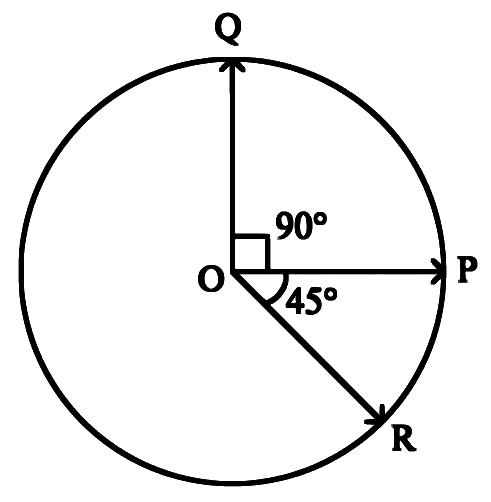
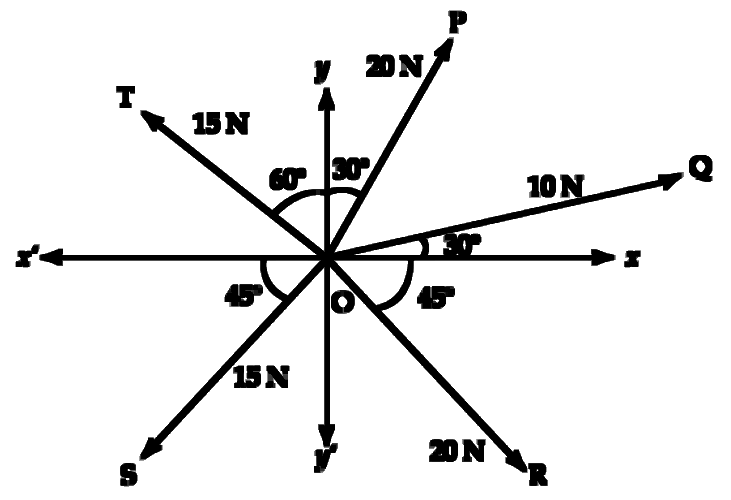
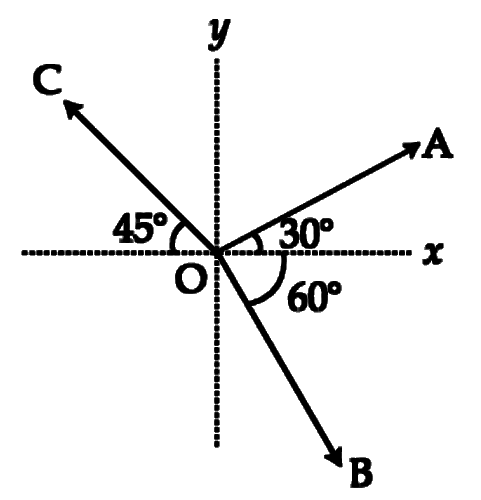
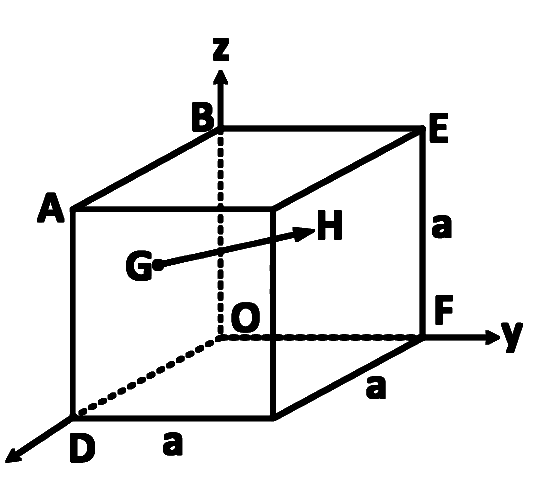
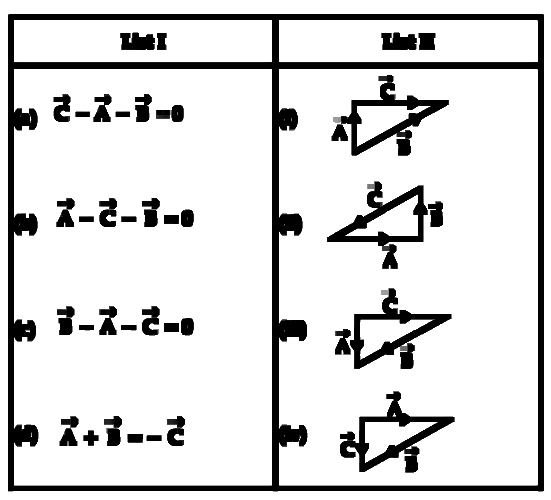
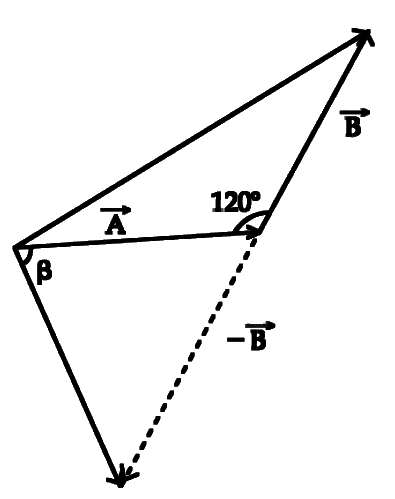
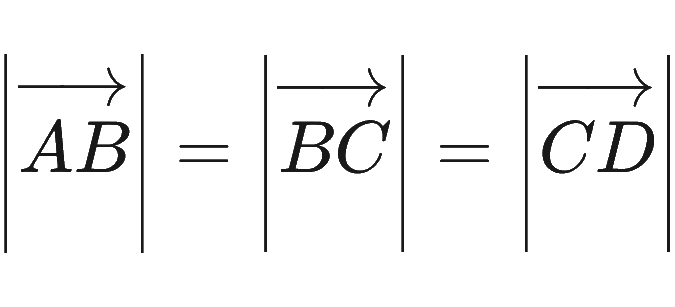 , then
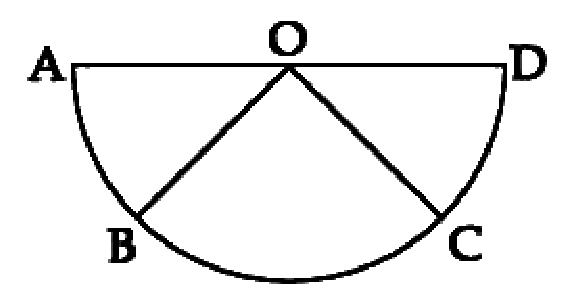
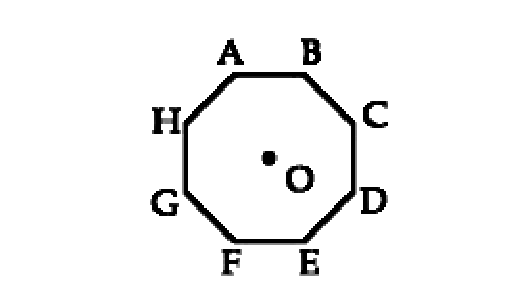
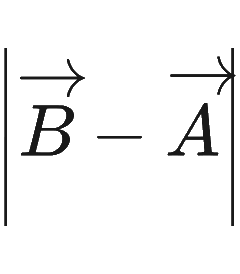 is:
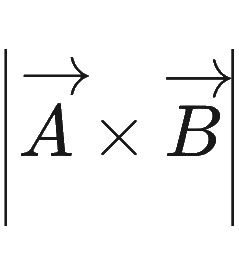 . Then the value of
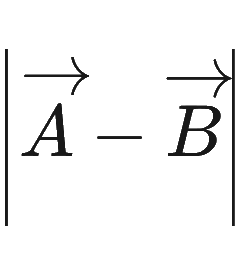 will be: