Physics Circle home Home Practice Hub Register / Login

Home›Practice Hub›Chapters›Viscosity

Physics PYQs · MHT CET · JEE Main · NEET

Viscosity

Questions
87
MHT CET
37
JEE Main
42
NEET
8
Years
2004–2026
0 of 87 attemptedPick an answer to see the solution

Q1MHT CET 2026 · 15 MAY · SHIFT 2Medium

Viscosity & Stokes' Law · Viscous force on a moving sphere

The velocity of a small ball of mass MM and density dd when dropped in a container filled with glycerine becomes constant after some time. If density of glycerine is d2\frac{d}{2} then the viscous force acting on the ball will be (gg=acceleration due to gravity)

Show answer and solution

Answer: (d)

  1. At constant velocity: Fv=Mg−BF_v = Mg - B.
  2. B=Vd2g=Mg2B = V\frac{d}{2}g = \frac{Mg}{2} since M=VdM = Vd.
  3. Fv=Mg−Mg2=Mg2F_v = Mg - \frac{Mg}{2} = \frac{Mg}{2}
  4. So the answer is (d) Mg2\frac{Mg}{2}.
Report a mistake
Q2MHT CET 2026 · 11 APR · SHIFT 1Medium

Viscosity & Stokes' Law · Viscous force on a moving sphere

A spherical ball of radius 11 mm and density 10.510.5 g/cc is dropped in glycerine of coefficient of viscosity 9.89.8 poise and density 1.51.5 g/cc. Viscous force on the ball when it attains constant velocity is 3696×10−x3696 \times 10^{-x} N. The value of is

(Given, g=9.8g = 9.8 m/s2/\text{s}^{2} and π=227\pi = \frac{22}{7})

Show answer and solution

Answer: (c)

  1. At constant velocity: Fv=W−B=43πr3(ρ−σ)gF_v = W - B = \frac{4}{3}\pi r^3(\rho - \sigma)g.
  2. r=10−3r = 10^{-3} m, ρ−σ=10.5−1.5=9 g/cc=9000 kg/m3\rho - \sigma = 10.5 - 1.5 = 9\text{ g/cc} = 9000\text{ kg/m}^3.
  3. Fv=43⋅227⋅10−9⋅9000⋅9.8=3.696×10−4=3696×10−7F_v = \frac{4}{3}\cdot\frac{22}{7}\cdot10^{-9}\cdot9000\cdot9.8 = 3.696\times10^{-4} = 3696\times10^{-7} N
  4. So x=7x = 7, answer (c) 77.
Report a mistake
Q3JEE Main 2025 · 23 JAN · SHIFT 1Easy

Viscosity & Stokes' Law · Newton's law & coefficient of viscosity

Given below are two statements:

Statement I: The hot water flows faster than cold water

Statement II: Soap water has higher surface tension as compared to fresh water. In the light above statements, choose the correct answer from the options given below

Show answer and solution

Answer: (d)

  1. Statement I: viscosity of a liquid decreases with temperature, so hot water flows faster. True.
  2. Statement II: soap (detergent) lowers the surface tension of water. False.
  3. So the answer is (d) Statement I is true but Statement II is false.
Report a mistake
Q4JEE Main 2025 · 22 JAN · SHIFT 2Easy

Viscosity & Stokes' Law · Viscous force on a moving sphere

A small rigid spherical ball of mass M is dropped in a long vertical tube containing glycerine. The velocity of the ball becomes constant after some time. If the density of glycerine is half of the density of the ball, then the viscous force acting on the ball will be (consider g as acceleration due to gravity)

Show answer and solution

Answer: (c)

MgBF (viscous)constant v: F + B = Mg
  1. At constant velocity the net force is zero: Fv+B=MgF_v + B = Mg.
  2. Buoyancy B=VσgB = V\sigma g with σ=ρ/2\sigma = \rho/2, so B=Vρg2=Mg2B = \frac{V\rho g}{2} = \frac{Mg}{2}.
  3. Fv=Mg−Mg2=Mg2F_v = Mg - \frac{Mg}{2} = \frac{Mg}{2}
  4. So the answer is (c) Mg2\frac{Mg}{2}.
Report a mistake
Q5MHT CET 2025 · 19 APR · SHIFT 2Medium

Viscosity & Stokes' Law · Newton's law & coefficient of viscosity

Water is flowing steadily in a river. A and B are the two layers of water at heights 40 cm and 90 cm from the bottom. The velocity of the layer A is 12 cm/s12\text{ cm/s}. The velocity of the layer B is

Show answer and solution

Answer: (c)

  1. In steady flow the velocity gradient is uniform and the bottom layer is at rest, so v∝hv \propto h.
  2. vBvA=9040⇒vB=12×94\frac{v_B}{v_A} = \frac{90}{40} \Rightarrow v_B = 12\times\frac{9}{4}
  3. vB=27v_B = 27 cm/s
  4. So the answer is (c) 2727 cm/s.
Report a mistake
Q6MHT CET 2025 · 25 APR · SHIFT 1Medium

Viscosity & Stokes' Law · Viscous force on a moving sphere

The velocity of small spherical ball of mass ' mm ' and density ' d1\mathrm{d}_1 ', when dropped in a container filled with glycerine becomes constant after some time. The viscous force acting on the ball if density of glycerine is ' d2\mathrm{d}_2 ' is

Show answer and solution

Answer: (a)

  1. At constant velocity: Fv=mg−BF_v = mg - B.
  2. B=Vd2g=md1d2gB = V d_2 g = \frac{m}{d_1}d_2 g
  3. Fv=mg(1−d2d1)F_v = mg\left(1 - \frac{d_2}{d_1}\right)
  4. So the answer is (a) mg(1−d2d1)mg\left(1 - \frac{d_2}{d_1}\right).
Report a mistake
Q7MHT CET 2024 · 15 MAY · SHIFT 2Easy

Viscosity & Stokes' Law · Newton's law & coefficient of viscosity

The viscous force between two liquid layers is

Show answer and solution

Answer: (c)

  1. Viscosity is internal friction between adjacent layers sliding over each other.
  2. Like friction, it acts along the surface of contact, opposing the relative motion of the layers.
  3. So the answer is (c) tangential to the liquid surface.
Report a mistake
Q8JEE Main 2024 · 27 JAN · SHIFT 1Easy

Viscosity & Stokes' Law · Newton's law & coefficient of viscosity

Given below are two statements:

Statement (I) :Viscosity of gases is greater than that of liquids.

Statement (II): Surface tension of a liquid decreases due to the presence of insoluble impurities. In the light of the above statements, choose the most appropriate answer from the options given below:

Show answer and solution

Answer: (b)

  1. Statement I: gases have much lower viscosity than liquids (air ≈1.8×10⁻⁵\approx 1.8\times10^{-5} Pa s, water ≈10−3\approx 10^{-3} Pa s). Incorrect.
  2. Statement II: insoluble impurities (dust, grease) on the surface reduce the surface tension. Correct.
  3. So the answer is (b) Statement I is incorrect but Statement II is correct.
Report a mistake
Q9MHT CET 2024 · 15 MAY · SHIFT 2Medium

Viscosity & Stokes' Law · Viscous force on a moving sphere

A ball rises to surface at a constant velocity in liquid whose density is 3 times greater than that of the material of the ball. The ratio of force of friction acting on the rising ball to its weight is

Show answer and solution

Answer: (a)

  1. Ball rises at constant velocity, so viscous force acts downward: B=W+FB = W + F.
  2. B=V(3ρ)g=3WB = V(3\rho)g = 3W
  3. F=3W−W=2W⇒F:W=2:1F = 3W - W = 2W \Rightarrow F : W = 2 : 1
  4. So the answer is (a) 2:12 : 1.
Report a mistake
Q10MHT CET 2024 · 2 MAY · SHIFT 2Medium

Viscosity & Stokes' Law · Viscous force on a moving sphere

A ball rises to surface at a constant velocity in liquid whose density is 4 times greater than that of the material of the ball. The ratio of the force of friction acting on the rising ball and its weight is

Show answer and solution

Answer: (a)

  1. Ball rises at constant velocity, so viscous force acts downward: B=W+FB = W + F.
  2. B=V(4ρ)g=4WB = V(4\rho)g = 4W
  3. F=4W−W=3W⇒F:W=3:1F = 4W - W = 3W \Rightarrow F : W = 3 : 1
  4. So the answer is (a) 3:13 : 1.
Report a mistake
Q11JEE Main 2024 · 6 APR · SHIFT 1Medium

Viscosity & Stokes' Law · Viscous force on a moving sphere

A small ball of mass mm and density ρ\rho is dropped in a viscous liquid of density ρ0\rho_0. After sometime, the ball falls with constant velocity. The viscous force on the ball is:

Show answer and solution

Answer: (a)

  1. At constant velocity: F=mg−BF = mg - B.
  2. B=Vρ0g=mρρ0gB = V\rho_0 g = \frac{m}{\rho}\rho_0 g
  3. F=mg(1−ρ0ρ)F = mg\left(1 - \frac{\rho_0}{\rho}\right)
  4. So the answer is (a).
Report a mistake
Q12NEET 2023Easy

Viscosity & Stokes' Law · Newton's law & coefficient of viscosity

Which of the following statements is not true?

Show answer and solution

Answer: (c)

  1. Coefficient of viscosity, surface tension and relative density have magnitude only: scalars.
  2. Pressure P=F/AP = F/A acts equally in all directions at a point and has no fixed direction, so it is a scalar.
  3. So the false statement is (c) Pressure is a vector quantity.
Report a mistake
Q13NEET 2023Easy

Viscosity & Stokes' Law · Viscous force on a moving sphere

The viscous drag acting on a metal sphere of diameter 1 mm1\text{ mm}, falling through a fluid of viscosity 0.8 Pa0.8\text{ Pa} s with a velocity of 2 m s−12\text{ m s}^{-1} is equal to:

Show answer and solution

Answer: (a)

  1. Stokes' law: F=6πηrvF = 6\pi\eta r v, with r=0.5 mm=5×10⁻⁴r = 0.5\text{ mm} = 5\times10^{-4} m.
  2. F=6π(0.8)(5×10⁻⁴)(2)=4.8π×10−3F = 6\pi(0.8)(5\times10^{-4})(2) = 4.8\pi\times10^{-3}
  3. F≈15×10−3F \approx 15\times10^{-3} N
  4. So the answer is (a) 15×10−315\times10^{-3} N.
Report a mistake
Q14MHT CET 2023 · 10 MAY · SHIFT 2Medium

Viscosity & Stokes' Law · Viscous force on a moving sphere

A metal sphere of mass 'mm' and density 'σ1\sigma_1' falls with terminal velocity through a container containing liquid. The density of liquid is 'σ2\sigma_2 '. The viscous force acting on the sphere is

Show answer and solution

Answer: (c)

  1. At terminal velocity: Fv=mg−BF_v = mg - B.
  2. B=Vσ2g=mσ1σ2gB = V\sigma_2 g = \frac{m}{\sigma_1}\sigma_2 g
  3. Fv=mg(1−σ2σ1)F_v = mg\left(1 - \frac{\sigma_2}{\sigma_1}\right)
  4. So the answer is (c).
Report a mistake
Q15JEE Main 2023 · 6 APR · SHIFT 1Medium

Viscosity & Stokes' Law · Viscous force on a moving sphere

A small ball of mass M\mathrm{M} and density ρ\rho is dropped in a viscous liquid of density ρ0\rho_0. After some time, the ball falls with a constant velocity. What is the viscous force on the ball?

Show answer and solution

Answer: (a)

  1. At constant velocity: F=Mg−BF = Mg - B.
  2. B=Vρ0g=Mρρ0gB = V\rho_0 g = \frac{M}{\rho}\rho_0 g
  3. F=Mg(1−ρ0ρ)F = Mg\left(1 - \frac{\rho_0}{\rho}\right)
  4. So the answer is (a).
Report a mistake
Q16JEE Main 2023 · 29 JAN · SHIFT 2Medium

Viscosity & Stokes' Law · Viscous force on a moving sphere

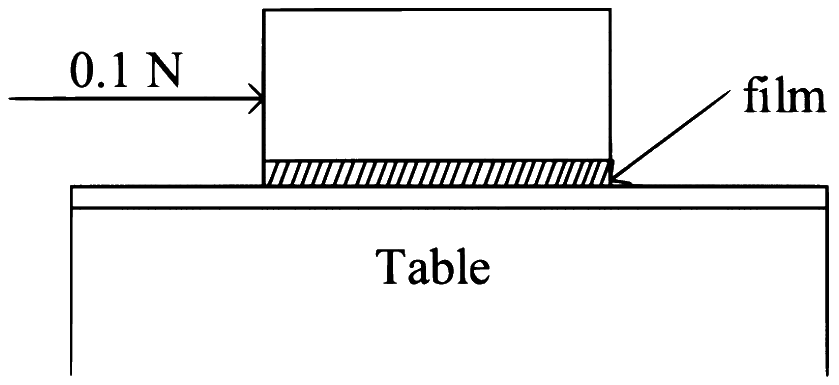
A metal block of base area 0.20 m2^{2} is placed on a table, as shown in figure. A liquid film of thickness 0.25 mm is inserted between the block and the table. The block is pushed by a horizontal force of 0.1 N and moves with a constant speed. If the viscosity of the liquid is 5.0×10⁻³ Pl5.0 \times 10^{-3}\text{ Pl}, the speed of block is ____________ ×10−3\times 10^{-3} m/s.

Figure

Numerical answer type. Work it out, then open the answer.

Show answer and solution

Answer: 25

  1. Constant speed, so applied force = viscous force: F=ηAvdF = \eta A\frac{v}{d}.
  2. v=FdηA=0.1×0.25×10−35×10−3×0.20v = \frac{Fd}{\eta A} = \frac{0.1\times0.25\times10^{-3}}{5\times10^{-3}\times0.20}
  3. v=2.5×10−510−3=25×10−3v = \frac{2.5\times10^{-5}}{10^{-3}} = 25\times10^{-3} m/s
  4. So the answer is 2525.
Report a mistake
Q17JEE Main 2023 · 24 JAN · SHIFT 2Medium

Viscosity & Stokes' Law · Viscous force on a moving sphere

A Spherical ball of radius 1mm and density 10.5 g/cc is dropped in glycerine of coefficient of viscosity 9.8 poise and density 1.5 g/cc. Viscous force on the ball when it attains constant velocity is 3696×10−x3696 \times 10^{-x} N. The value of xx is ________.

(Given, g = 9.8 m/s2^{2} and π=227\pi = \frac{22}{7})

Numerical answer type. Work it out, then open the answer.

Show answer and solution

Answer: 7

  1. At constant velocity: Fv=W−B=43πr3(ρ−σ)gF_v = W - B = \frac{4}{3}\pi r^3(\rho - \sigma)g.
  2. r=10−3r = 10^{-3} m, ρ−σ=9 g/cc=9000 kg/m3\rho - \sigma = 9\text{ g/cc} = 9000\text{ kg/m}^3.
  3. Fv=43⋅227⋅10−9⋅9000⋅9.8=3696×10−7F_v = \frac{4}{3}\cdot\frac{22}{7}\cdot10^{-9}\cdot9000\cdot9.8 = 3696\times10^{-7} N
  4. So x=7x = 7.
Report a mistake
Q18JEE Main 2022 · 28 JUN · SHIFT 1Easy

Viscosity & Stokes' Law · Newton's law & coefficient of viscosity

Given below are two statements: One is labelled as Assertion A and the other is labelled as Reason R.

Assertion A: Product of Pressure (P) and time (t) has the same dimension as that of coefficient of viscosity.

Reason R: Coefficient of viscosity = ForceVelocity gradient\frac{\text{Force}}{\text{Velocity gradient}}

Choose the correct answer from the options given below:

Show answer and solution

Answer: (c)

  1. [P t]=Nm2⋅s=Pa s[P\,t] = \frac{\text{N}}{\text{m}^2}\cdot\text{s} = \text{Pa s}, which is the SI unit of η\eta. So A is true.
  2. Newton's law: F=ηAdvdxF = \eta A\frac{dv}{dx}, so η=FA (dv/dx)\eta = \frac{F}{A\,(dv/dx)}, not Fdv/dx\frac{F}{dv/dx}. So R is false.
  3. So the answer is (c) A is true but R is false.
Report a mistake
Q19JEE Main 2022 · 25 JUN · SHIFT 1Medium

Viscosity & Stokes' Law · Newton's law & coefficient of viscosity

The velocity of upper layer of water in a river is 36 kmh−1{}^{-1}. Shearing stress between horizontal layers of water is 10−-3 Nm−2{}^{-2}. Depth of the river is __________ m. (Co-efficient of viscosity of water is 10−-2 Pa.s)

Numerical answer type. Work it out, then open the answer.

Show answer and solution

Answer: 100

  1. v=36 km/h=10v = 36\text{ km/h} = 10 m/s; stress =ηvh= \eta\frac{v}{h} (bottom layer at rest).
  2. h=ηvstress=10−2×10¹⁰−3h = \frac{\eta v}{\text{stress}} = \frac{10^{-2}\times10}{10^{-3}}
  3. h=100h = 100 m
Report a mistake
Q20NEET 2022 · PHASE 2Medium

Viscosity & Stokes' Law · Viscous force on a moving sphere

The terminal velocity of a copper ball of radius 5 mm falling through a tank of oil at room temperature is 10 cm s−1{}^{-1}. If the viscosity of oil at room temperature is 0.9 kg m−1{}^{-1} s−1{}^{-1}, the viscous drag force is:

Show answer and solution

Answer: (b)

  1. Stokes' law: F=6πηrvF = 6\pi\eta r v, with r=5×10⁻³r = 5\times10^{-3} m, v=0.1v = 0.1 m/s.
  2. F=6π(0.9)(5×10⁻³)(0.1)=2.7π×10−3F = 6\pi(0.9)(5\times10^{-3})(0.1) = 2.7\pi\times10^{-3}
  3. F≈8.48×10⁻³F \approx 8.48\times10^{-3} N
  4. So the answer is (b) 8.48×10−38.48\times10^{-3} N.
Report a mistake
Q21JEE Main 2022 · 27 JUN · SHIFT 1Medium

Viscosity & Stokes' Law · Viscous force on a moving sphere

The velocity of a small ball of mass 'm' and density d1, when dropped in a container filled with glycerin, becomes constant after some time. If the density of glycerin is d2, then the viscous force acting on the ball, will be:

Show answer and solution

Answer: (b)

  1. At constant velocity: Fv=mg−BF_v = mg - B.
  2. B=Vd2g=md1d2gB = V d_2 g = \frac{m}{d_1}d_2 g
  3. Fv=mg(1−d2d1)F_v = mg\left(1 - \frac{d_2}{d_1}\right)
  4. So the answer is (b).
Report a mistake
Q22JEE Main 2022 · 29 JUL · SHIFT 2Medium

Viscosity & Stokes' Law · Viscous force on a moving sphere

The velocity of a small ball of mass 0.3 g0.3\text{ g} and density 8 g/cc8\text{ g/cc} when dropped in a container filled with glycerine becomes constant after some time. If the density of glycerine is 1.3 g/cc1.3\text{ g/cc}, then the value of viscous force acting on the ball will be x×10−4 Nx \times 10^{-4}\text{ N}. The value of xx is _________. [use g=10 m/s2]\mathrm{g} = 10\text{ m/s}^{2}]

Numerical answer type. Work it out, then open the answer.

Show answer and solution

Answer: 25

  1. At constant velocity: Fv=mg(1−σρ)F_v = mg\left(1 - \frac{\sigma}{\rho}\right).
  2. Fv=(0.3×10⁻³)(10)(1−1.38)=3×10−3×0.8375F_v = (0.3\times10^{-3})(10)\left(1 - \frac{1.3}{8}\right) = 3\times10^{-3}\times0.8375
  3. Fv≈2.51×10−3=25×10−4F_v \approx 2.51\times10^{-3} = 25\times10^{-4} N
  4. So x≈25x \approx 25.
Report a mistake
Q23MHT CET 2021 · 22 SEP · SHIFT 2Medium

Viscosity & Stokes' Law · Viscous force on a moving sphere

A ball rises to the surface of a liquid with constant velocity. The density of the liquid is four times the density of the material of the ball. The viscous force of the liquid on the rising ball is greater than the weight of the ball by a factor of

Show answer and solution

Answer: (b)

  1. Rising at constant velocity: B=W+FB = W + F, with B=V(4ρ)g=4WB = V(4\rho)g = 4W.
  2. F=4W−W=3WF = 4W - W = 3W
  3. So the viscous force is 33 times the weight: answer (b) 3.
Report a mistake
Q24MHT CET 2021 · 21 SEP · SHIFT 1Medium

Viscosity & Stokes' Law · Viscous force on a moving sphere

The velocity of a small ball of mass 'MM' and density 'd1\mathrm{d}_1' when dropped in a container filled with glycerine becomes constant after some time. If the density of glycerine is 'd2\mathrm{d}_2', the viscous force acting on the ball is ( g=\mathrm{g} = acceleration due to gravity)

Show answer and solution

Answer: (d)

  1. At constant velocity: Fv=Mg−BF_v = Mg - B.
  2. B=Vd2g=Md1d2gB = V d_2 g = \frac{M}{d_1}d_2 g
  3. Fv=Mg(1−d2d1)F_v = Mg\left(1 - \frac{d_2}{d_1}\right)
  4. So the answer is (d).
Report a mistake
Q25NEET 2021Medium

Viscosity & Stokes' Law · Viscous force on a moving sphere

The velocity of a small ball of mass M and density d, when dropped in a container filled with glycerin becomes constant after some time. If the density of glycerin is d2\frac{d}{2}, then the viscous force acting on the ball will be:

Show answer and solution

Answer: (b)

  1. At constant velocity: Fv=Mg−BF_v = Mg - B.
  2. B=Vd2g=Mg2B = V\frac{d}{2}g = \frac{Mg}{2}
  3. Fv=Mg2F_v = \frac{Mg}{2}
  4. So the answer is (b) Mg2\frac{Mg}{2}.
Report a mistake
Q26JEE Main 2021 · 27 AUG · SHIFT 1Medium

Viscosity & Stokes' Law · Viscous force on a moving sphere

In Millikan's oil drop experiment, what is viscous force acting on an uncharged drop of radius 2.0 ×\times 10−-5 m and density 1.2 ×\times 103 kgm−- 3? Take viscosity of liquid = 1.8 ×\times 10−-5 Nsm−2{}^{-2}. (Neglect buoyancy due to air).

Show answer and solution

Answer: (b)

  1. The drop falls at terminal velocity and buoyancy is neglected, so Fv=mg=43πr3ρgF_v = mg = \frac{4}{3}\pi r^3\rho g.
  2. r3=(2×10⁻⁵)3=8×10⁻¹⁵ m3r^3 = (2\times10^{-5})^3 = 8\times10^{-15}\text{ m}^3
  3. Fv=43π(8×10⁻¹⁵)(1.2×10³)(9.8)≈3.9×10⁻¹⁰F_v = \frac{4}{3}\pi(8\times10^{-15})(1.2\times10^3)(9.8) \approx 3.9\times10^{-10} N
  4. So the answer is (b) 3.9×10−103.9\times10^{-10} N.
Report a mistake
Q27JEE Main 2021 · 27 JUL · SHIFT 2Difficult

Viscosity & Stokes' Law · Viscous force on a moving sphere

A raindrop with radius R = 0.2 mm falls from a cloud at a height h = 2000 m above the ground. Assume that the drop is spherical throughout its fall and the force of buoyance may be neglected, then the terminal speed attained by the raindrop is:

[Density of water fw = 1000 kg m−3{}^{-3} and Density of air fa = 1.2 kg m−3{}^{-3}, g = 10 m/s2, Coefficient of viscosity of air = 1.8 ×\times 10−-5 Nsm−2{}^{-2}]

Show answer and solution

Answer: (c)

  1. Terminal speed (buoyancy neglected): vt=2r2ρwg9ηv_t = \frac{2r^2\rho_w g}{9\eta}.
  2. vt=2(0.2×10⁻³)2(1000)(10)9×1.8×10−5=8×10−41.62×10−4v_t = \frac{2(0.2\times10^{-3})^2(1000)(10)}{9\times1.8\times10^{-5}} = \frac{8\times10^{-4}}{1.62\times10^{-4}}
  3. vt≈4.94v_t \approx 4.94 m/s (the height 2000 m is not needed)
  4. So the answer is (c) 4.94 m s−14.94\text{ m s}^{-1}.
Report a mistake
Q28MHT CET 2020 · 16 OCT · SHIFT 1Medium

Viscosity & Stokes' Law · Viscous force on a moving sphere

A small metal sphere of mass MM and density d1d_1 when dropped in a jar filled with liquid moves with terminal velocity after sometime. The viscous force acting on the sphere is (d2=d_2 = density of liquid and g=g = gravitational acceleration)

Show answer and solution

Answer: (b)

  1. At terminal velocity: Fv=Mg−BF_v = Mg - B.
  2. B=Vd2g=Md1d2gB = V d_2 g = \frac{M}{d_1}d_2 g
  3. Fv=Mg(1−d2d1)F_v = Mg\left(1 - \frac{d_2}{d_1}\right)
  4. So the answer is (b).
Report a mistake
Q29NEET 2018Medium

Viscosity & Stokes' Law · Viscous force on a moving sphere

A small sphere of radius ‘r’ falls from rest in a viscous liquid. As a result, heat is produced due to viscous force. The rate of production of heat when the sphere attains its terminal velocity, is proportional to

Show answer and solution

Answer: (c)

  1. Rate of heat production = power of viscous force: P=Fvt=6πηrvt2P = F v_t = 6\pi\eta r v_t^2.
  2. Terminal velocity vt=2r2(ρ−σ)g9η∝r2v_t = \frac{2r^2(\rho-\sigma)g}{9\eta} \propto r^2.
  3. P∝r⋅(r2)2=r5P \propto r\cdot(r^2)^2 = r^5
  4. So the answer is (c) r5r^5.
Report a mistake
Q30JEE Main 2017 · 9 APR · SHIFT 1Medium

Viscosity & Stokes' Law · Poiseuille's formula

Two tubes of radii r1 and r2, and lengths l1 and l2, respectively, are connected in series and a liquid flows through each of them in stream line conditions. P1 and P2 are pressure differences across the two tubes.

If P2 is 4P1 and l2 is l14\frac{l_1}{4}, then the radius r2 will be equal to:

Show answer and solution

Answer: (d)

  1. In series the same volume flows per second: Q=πPr48ηlQ = \frac{\pi P r^4}{8\eta l} is equal for both tubes.
  2. P1r14l1=P2r24l2=4P1r24l1/4=16P1r24l1\frac{P_1 r_1^4}{l_1} = \frac{P_2 r_2^4}{l_2} = \frac{4P_1 r_2^4}{l_1/4} = \frac{16P_1 r_2^4}{l_1}
  3. r24=r1416⇒r2=r12r_2^4 = \frac{r_1^4}{16} \Rightarrow r_2 = \frac{r_1}{2}
  4. So the answer is (d) r12\frac{r_1}{2}.
Report a mistake
Q31JEE Main 2014 · 19 APR · SHIFT 1Medium

Viscosity & Stokes' Law · Newton's law & coefficient of viscosity

The velocity of water in a river is 18 km/hr near the surface. If the river is 5 m deep, find the shearing stress between the horizontal layers of water. The co-efficient of viscosity of water = 10−-2 poise.

Show answer and solution

Answer: (c)

  1. v=18 km/h=5v = 18\text{ km/h} = 5 m/s; bottom layer at rest, so velocity gradient =55=1 s−1= \frac{5}{5} = 1\text{ s}^{-1}.
  2. η=10−2\eta = 10^{-2} poise =10−3= 10^{-3} Pa s.
  3. Shearing stress =ηdvdx=10−3×1=10−3 N/m2= \eta\frac{dv}{dx} = 10^{-3}\times1 = 10^{-3}\text{ N/m}^2
  4. So the answer is (c) 10−3 N/m210^{-3}\text{ N/m}^2.
Report a mistake
Q32JEE Main 2008 · AIEEEMedium

Viscosity & Stokes' Law · Viscous force on a moving sphere

A spherical solid ball of volume VV is made of a material of density ρ1\rho_1. It is falling through a liquid of density ρ2 (ρ2<ρ1)\rho_2\ (\rho_2 < \rho_1). Assume that the liquid applies a viscous force on the ball that is proportional to the square of its speed v,v, i.e., Fviscous=−kv2 (k>0).F_{viscous} = -kv^2\ (k > 0). The terminal speed of the ball is

Show answer and solution

Answer: (a)

  1. At terminal speed: weight == buoyancy ++ viscous force.
  2. Vρ1g=Vρ2g+kv2V\rho_1 g = V\rho_2 g + kv^2
  3. v=Vg(ρ1−ρ2)kv = \sqrt{\frac{Vg(\rho_1 - \rho_2)}{k}}
  4. So the answer is (a).
Report a mistake
Q33JEE Main 2004 · AIEEEEasy

Viscosity & Stokes' Law · Viscous force on a moving sphere

Spherical balls of radius RR are falling in a viscous fluid of viscosity η\eta with a velocity v.v. The retarding viscous force acting on the spherical ball is

Show answer and solution

Answer: (b)

  1. Stokes' law: F=6πηRvF = 6\pi\eta R v.
  2. For a given fluid, F∝RF \propto R and F∝vF \propto v.
  3. So the answer is (b) directly proportional to both RR and vv.
Report a mistake
Q34MHT CET 2026 · 18 APR · SHIFT 1Easy

Terminal Velocity · Terminal velocity: radius & density

A spherical object is falling under gravity through a viscous fluid. The sphere attains the terminal velocity when

Show answer and solution

Answer: (d)

  1. Gravity acts down; buoyancy and viscous force act up on a falling sphere.
  2. Terminal velocity means zero net force: FB+Fv=mgF_B + F_v = mg.
  3. So the answer is (d) buoyant force plus viscous force equals force due to gravity.
Report a mistake
Q35JEE Main 2026 · 21 JAN · SHIFT 2Easy

Terminal Velocity · Terminal velocity: radius & density

The terminal velocity of a metallic ball of radius 6 mm in a viscous fluid is 20 cm/s20\text{ cm/s}. The terminal velocity of another ball of same material and having radius 3 mm in the same fluid will be ‾ cm/s\underline{\hspace{3em}}\text{ cm/s}.

Numerical answer type. Work it out, then open the answer.

Show answer and solution

Answer: 5

  1. Terminal velocity v∝r2v \propto r^2 for the same material and fluid.
  2. v2=20(36)2=204v_2 = 20\left(\frac{3}{6}\right)^2 = \frac{20}{4}
  3. v2=5v_2 = 5 cm/s
Report a mistake
Q36MHT CET 2026 · 12 MAY · SHIFT 2Easy

Terminal Velocity · Terminal velocity of merged drops

′n′'n' small drops of water having same size fall through air with constant velocity 44 cm/s. They coalesce to form a big drop. The terminal velocity of the big drop is

Show answer and solution

Answer: (c)

  1. Terminal velocity v=2r2(ρ−σ)g9ηv = \dfrac{2r^2(\rho-\sigma)g}{9\eta}, so v∝r2v \propto r^2.
  2. Volume is conserved: 43πR3=n⋅43πr3⇒R=n1/3r\frac{4}{3}\pi R^3 = n\cdot\frac{4}{3}\pi r^3 \Rightarrow R = n^{1/3}r.
  3. v′=v(Rr)2=4n2/3v' = v\left(\frac{R}{r}\right)^2 = 4n^{2/3} cm/s
  4. So the answer is (c) 4n2/34n^{2/3} cm/s.
Report a mistake
Q37JEE Main 2026 · 24 JAN · SHIFT 1Easy

Terminal Velocity · Terminal velocity of merged drops

Sixty four rain drops of radius 1 mm each falling down with a terminal velocity of 10 cm/s10\text{ cm/s} coalesce to form a bigger drop. The terminal velocity of bigger drop is

‾ cm/s\underline{\hspace{3em}}\text{ cm/s}.

Numerical answer type. Work it out, then open the answer.

Show answer and solution

Answer: 160

  1. v∝r2v \propto r^2; volume conserved: R=641/3r=4rR = 64^{1/3}r = 4r.
  2. v′=42×10=160v' = 4^2 \times 10 = 160 cm/s
  3. Terminal velocity of bigger drop =160= 160 cm/s.
Report a mistake
Q38MHT CET 2026 · 20 APR · SHIFT 2Easy

Terminal Velocity · Velocity-time graph & experiment

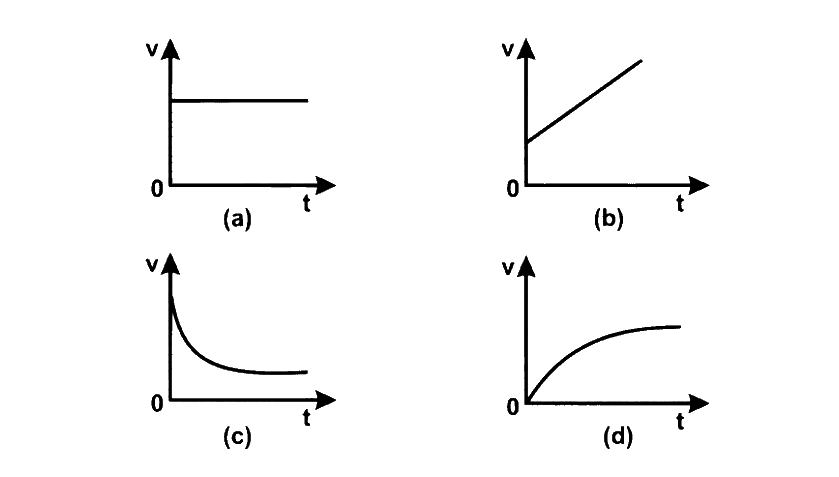
A small metal sphere is falling through a viscous liquid. The variation of velocity (VV) with time (tt) is shown correctly in graph

Figure

Show answer and solution

Answer: (c)

  1. At release v=0v = 0, so the graph must start from the origin.
  2. Viscous force 6πηrv6\pi\eta r v grows with vv, so acceleration keeps decreasing: the curve rises with falling slope.
  3. When weight = buoyancy + viscous force, vv becomes constant (terminal velocity): the curve flattens.
  4. This is graph (d), so the answer is option (c).
Report a mistake
Q39MHT CET 2026 · 15 MAY · SHIFT 1Medium

Terminal Velocity · Terminal velocity: radius & density

If terminal speed of a sphere of gold (density = 19.519.5 kg/m3^{3}) is 0.20.2 m/s in viscous liquid (density = 1.51.5 kg/m3^{3} ), find the terminal speed of a sphere of silver (density = 10.510.5 kg/m3^{3}) of the same size in the same liquid.

Show answer and solution

Answer: (c)

  1. Same size and liquid: v∝(ρ−σ)v \propto (\rho - \sigma).
  2. vsvg=10.5−1.519.5−1.5=918=12\dfrac{v_s}{v_g} = \dfrac{10.5 - 1.5}{19.5 - 1.5} = \dfrac{9}{18} = \dfrac{1}{2}
  3. vs=0.2×12=0.1v_s = 0.2 \times \frac{1}{2} = 0.1 m/s
  4. So the answer is (c) 0.10.1 m/s.
Report a mistake
Q40MHT CET 2026 · 14 MAY · SHIFT 1Medium

Terminal Velocity · Terminal velocity: radius & density

Two spherical rain drops reach the surface of the earth with terminal velocities having ratio 16:916 : 9. The ratio of their surface area is

Show answer and solution

Answer: (c)

  1. v∝r2v \propto r^2 and surface area A=4πr2∝r2A = 4\pi r^2 \propto r^2.
  2. So A∝vA \propto v: A1:A2=16:9A_1 : A_2 = 16 : 9
  3. So the answer is (c) 16:916 : 9.
Report a mistake
Q41MHT CET 2026 · 13 MAY · SHIFT 1Medium

Terminal Velocity · Terminal velocity: radius & density

Two solid spheres of same material but of mass M and 8M fall simultaneously on a viscous liquid and their terminal velocities are V and nV, then the value of n is

Show answer and solution

Answer: (c)

  1. Same material: M∝r3M \propto r^3, so 8M⇒r′=2r8M \Rightarrow r' = 2r.
  2. v∝r2⇒v′=4Vv \propto r^2 \Rightarrow v' = 4V
  3. So n=4n = 4, answer (c).
Report a mistake
Q42JEE Main 2026 · 8 APR · SHIFT 2Medium

Terminal Velocity · Terminal velocity: radius & density

A spherical liquid drop of radius RR acquires the terminal velocity v1v_1 when falls through a gas of viscosity η\eta. Now the drop is broken into 64 identical droplets and each droplet acquires terminal velocity v2v_2 falling through the same gas. The ratio of terminal velocities v1/v2v_1/v_2 is ______.

Show answer and solution

Answer: (d)

  1. Volume conserved: R3=64r3⇒r=R/4R^3 = 64r^3 \Rightarrow r = R/4.
  2. v∝r2⇒v1v2=(Rr)2=16v \propto r^2 \Rightarrow \dfrac{v_1}{v_2} = \left(\dfrac{R}{r}\right)^2 = 16
  3. So the answer is (d) 16.
Report a mistake
Q43JEE Main 2026 · 23 JAN · SHIFT 2Medium

Terminal Velocity · Terminal velocity: radius & density

A small metallic sphere of diameter 2 mm and density 10.5 g/cm310.5\text{ g/cm}^{3} is dropped in glycerine having viscosity 10 Poise and density 1.5 g/cm31.5\text{ g/cm}^{3} respectively. The terminal velocity attained by the sphere is ‾ cm/s\underline{\hspace{3em}}\text{ cm/s}.

(π=227\left(\pi = \frac{22}{7}\right. and g=10 m/s2)g = 10\text{ m/s}^{2})

Show answer and solution

Answer: (d)

  1. vt=2r2(ρ−σ)g9ηv_t = \dfrac{2r^2(\rho - \sigma)g}{9\eta} (CGS units).
  2. r=0.1r = 0.1 cm, ρ−σ=9 g/cm3\rho - \sigma = 9\ \text{g/cm}^3, g=1000 cm/s2g = 1000\ \text{cm/s}^2, η=10\eta = 10 P
  3. vt=2×0.01×9×10009×10=2v_t = \dfrac{2 \times 0.01 \times 9 \times 1000}{9 \times 10} = 2 cm/s
  4. So the answer is (d) 2.0.
Report a mistake
Q44MHT CET 2026 · 19 MAY · SHIFT 2Medium

Terminal Velocity · Terminal velocity of merged drops

A tiny water droplet falls through the air at a uniform terminal speed of 11 cm/s. If 2727 such identical droplets coalesce to form a single larger drop, what will be the new terminal velocity of the resulting drop, assuming the air remains the same?

Show answer and solution

Answer: (d)

  1. v∝r2v \propto r^2 and R=271/3r=3rR = 27^{1/3}r = 3r.
  2. v′=32×1=9v' = 3^2 \times 1 = 9 cm/s
  3. So the answer is (d) 99 cm/s.
Report a mistake
Q45MHT CET 2026 · 19 MAY · SHIFT 1Medium

Terminal Velocity · Terminal velocity of merged drops

'nn' identical small drops of water are falling down vertically through a medium each with a terminal velocity 'vv'. If they combine to form a single drop, then its terminal velocity is xvxv. The value of xx is

Show answer and solution

Answer: (b)

  1. Volume conserved: R=n1/3rR = n^{1/3}r.
  2. v∝r2⇒v′=n2/3vv \propto r^2 \Rightarrow v' = n^{2/3}v
  3. So x=n2/3x = n^{2/3}, answer (b).
Report a mistake
Q46MHT CET 2026 · 11 APR · SHIFT 1Medium

Terminal Velocity · Terminal velocity of merged drops

Two rain drops of same radius 'rr' falling with same terminal velocity 'VV' merge and form bigger drop of radius 'RR'. The terminal velocity of big drop is

Show answer and solution

Answer: (a)

  1. v∝r2v \propto r^2 (same liquid, same density).
  2. v′V=R2r2⇒v′=VR2r2\dfrac{v'}{V} = \dfrac{R^2}{r^2} \Rightarrow v' = \dfrac{VR^2}{r^2}
  3. So the answer is (a).
Report a mistake
Q47JEE Main 2026 · 2 APR · SHIFT 2Medium

Terminal Velocity · Air bubble rising steadily

If an air bubble of diameter 2 mm rises steadily through a liquid of density 2000 kg/m3 at a rate of 0.5 cm/s, then the coefficient of viscosity of liquid is ______ Poise. (Take g = 10 m/s2)

Show answer and solution

Answer: (b)

  1. For a rising bubble (air density neglected): η=2r2σg9v\eta = \dfrac{2r^2\sigma g}{9v}
  2. r=10−3r = 10^{-3} m, σ=2000 kg/m3\sigma = 2000\ \text{kg/m}^3, v=5×10⁻³v = 5 \times 10^{-3} m/s
  3. η=2×10−6×2000×109×5×10−3=0.040.045≈0.889\eta = \dfrac{2 \times 10^{-6} \times 2000 \times 10}{9 \times 5 \times 10^{-3}} = \dfrac{0.04}{0.045} \approx 0.889 Pa s =8.89= 8.89 Poise
  4. So the answer is (b) 8.8.
Report a mistake
Q48NEET 2026 · RE-NEETMedium

Terminal Velocity · Velocity-time graph & experiment

In the measurement of viscosity of liquids using terminal velocity experiment, spherical balls of same radius but having different densities are used. The variation of the terminal velocity ( vv) with the ratio of density of spherical ball ( σ\sigma) to density of the liquid ( ρ\rho ), is best represented by:

Show answer and solution

Answer: (b)

10σ/ρvv ∝ (σ/ρ − 1)
  1. Terminal velocity: v=2r2(σ−ρ)g9η=2r2ρg9η(σρ−1)v = \dfrac{2r^2(\sigma - \rho)g}{9\eta} = \dfrac{2r^2\rho g}{9\eta}\left(\dfrac{\sigma}{\rho} - 1\right).
  2. For the same radius and liquid, vv is a linear function of σ/ρ\sigma/\rho.
  3. v=0v = 0 at σ/ρ=1\sigma/\rho = 1 and vv rises as a straight line for σ/ρ>1\sigma/\rho > 1 (the ball sinks).
  4. So the answer is (b): a straight line starting from zero at σ/ρ=1\sigma/\rho = 1.
Report a mistake
Q49MHT CET 2025 · 26 APR · SHIFT 1Easy

Terminal Velocity · Terminal velocity of merged drops

125 small water drops of same size fall through air with constant velocity 4 cm/s4\text{ cm/s}. They coalesce to form a big drop. The terminal velocity of the big drop is

Show answer and solution

Answer: (b)

  1. v∝r2v \propto r^2 and R=n1/3rR = n^{1/3}r, so v′=n2/3vv' = n^{2/3}v.
  2. n=125⇒n2/3=25n = 125 \Rightarrow n^{2/3} = 25
  3. v′=25×4=100v' = 25 \times 4 = 100 cm/s =1= 1 m/s
  4. So the answer is (b) 11 m/s.
Report a mistake
Q50MHT CET 2025 · 20 APR · SHIFT 2Medium

Terminal Velocity · Terminal velocity: radius & density

Two raindrops reach the earth with different terminal velocities having the ratio 9:49 : 4. The ratio of their volumes is

Show answer and solution

Answer: (d)

  1. v∝r2⇒r1r2=94=32v \propto r^2 \Rightarrow \dfrac{r_1}{r_2} = \sqrt{\dfrac{9}{4}} = \dfrac{3}{2}
  2. V∝r3⇒V1V2=(32)3=278V \propto r^3 \Rightarrow \dfrac{V_1}{V_2} = \left(\dfrac{3}{2}\right)^3 = \dfrac{27}{8}
  3. So the answer is (d) 278\frac{27}{8}.
Report a mistake
Q51JEE Main 2025 · 3 APR · SHIFT 2Medium

Terminal Velocity · Terminal velocity: radius & density

A solid steel ball of diameter 3.6 mm acquired terminal velocity 2.45×10⁻² m/s2.45 \times 10^{-2}\text{ m/s} while falling under gravity through an oil of density 925 kg m−3925\text{ kg m}^{-3}. Take density of steel as 7825 kg m−37825\text{ kg m}^{-3} and g as 9.8 m/s29.8\text{ m/s}^{2}. The viscosity of the oil in SI unit is

Show answer and solution

Answer: (d)

  1. vt=2r2(ρ−σ)g9η⇒η=2r2(ρ−σ)g9vtv_t = \dfrac{2r^2(\rho - \sigma)g}{9\eta} \Rightarrow \eta = \dfrac{2r^2(\rho - \sigma)g}{9v_t}
  2. r=1.8×10⁻³r = 1.8 \times 10^{-3} m, ρ−σ=7825−925=6900 kg/m3\rho - \sigma = 7825 - 925 = 6900\ \text{kg/m}^3
  3. η=2×3.24×10−6×6900×9.89×2.45×10−2=0.4380.2205≈1.99\eta = \dfrac{2 \times 3.24 \times 10^{-6} \times 6900 \times 9.8}{9 \times 2.45 \times 10^{-2}} = \dfrac{0.438}{0.2205} \approx 1.99 Pa s
  4. So the answer is (d) 1.99.
Report a mistake
Q52MHT CET 2025 · 19 APR · SHIFT 2Medium

Terminal Velocity · Terminal velocity of merged drops

' nn ' small water drops of same size (radius rr) fall through air with constant velocity V. They coalesce to form a big drop of radius R. The terminal velocity of the big drop is

Show answer and solution

Answer: (a)

  1. v∝r2v \propto r^2 (same liquid, same density).
  2. v′V=R2r2⇒v′=VR2r2\dfrac{v'}{V} = \dfrac{R^2}{r^2} \Rightarrow v' = \dfrac{VR^2}{r^2}
  3. So the answer is (a).
Report a mistake
Q53JEE Main 2025 · 28 JAN · SHIFT 1Medium

Terminal Velocity · Velocity-time graph & experiment

In the experiment for measurement of viscosity ' η\eta ' of given liquid with a ball having radius RR, consider following statements.

A. Graph between terminal velocity V and R will be a parabola.

B. The terminal velocities of different diameter balls are constant for a given liquid. C. Measurement of terminal velocity is dependent on the temperature.

D. This experiment can be utilized to assess the density of a given liquid.

E. If balls are dropped with some initial speed, the value of η\eta will change.

Choose the correct answer from the options given below:

Show answer and solution

Answer: (c)

  1. vt=2R2(σ−ρ)g9ηv_t = \dfrac{2R^2(\sigma - \rho)g}{9\eta}, so vt∝R2v_t \propto R^2.
  2. A: vtv_t vs RR is a parabola. True.
  3. B: vtv_t changes with diameter (∝R2\propto R^2). False.
  4. C: η\eta depends on temperature, so vtv_t does too. True. D: vtv_t depends on liquid density ρ\rho, so ρ\rho can be found. True.
  5. E: η\eta is a property of the liquid; the initial speed of the ball does not change it. False.
  6. So the answer is (c) A, C and D only.
Report a mistake
Q54MHT CET 2024 · 9 MAY · SHIFT 2Easy

Terminal Velocity · Terminal velocity: radius & density

Two identical drops of water are falling through air with steady velocity ' V '. If the two drops come together to form a single drop. The new velocity of the single drop is

Show answer and solution

Answer: (c)

  1. Volume is conserved: 43πR3=2⋅43πr3⇒R=21/3r\frac{4}{3}\pi R^3 = 2\cdot\frac{4}{3}\pi r^3 \Rightarrow R = 2^{1/3}r.
  2. Terminal velocity v∝r2v \propto r^2.
  3. V′=V(21/3)2=22/3VV' = V\left(2^{1/3}\right)^2 = 2^{2/3}V
  4. So the answer is (c) (2)2/3V(2)^{2/3}V.
Report a mistake
Q55MHT CET 2024 · 3 MAY · SHIFT 2Easy

Terminal Velocity · Terminal velocity: radius & density

A steel ball of radius 6 mm has a terminal speed of 12 cms−112\text{ cms}^{-1} in a viscous liquid. What will be the terminal speed of a steel ball of radius 3 mm in the same liquid?

Show answer and solution

Answer: (d)

  1. Terminal speed v∝r2v \propto r^2 for the same material and liquid.
  2. v2=12(36)2=124v_2 = 12\left(\frac{3}{6}\right)^2 = \frac{12}{4}
  3. v2=3 cm s−1v_2 = 3\text{ cm s}^{-1}
  4. So the answer is (d) 3 cms−13\text{ cms}^{-1}.
Report a mistake
Q56MHT CET 2024 · 11 MAY · SHIFT 2Easy

Terminal Velocity · Terminal velocity of merged drops

Two rain drops of same radius are falling through air each with a steady speed of 5 cm/s5\text{ cm/s}. If the drops coalesce, the new steady velocity of big drop will be

Show answer and solution

Answer: (d)

  1. v∝r2v \propto r^2 and R=n1/3rR = n^{1/3}r, so v′=n2/3vv' = n^{2/3}v.
  2. n=2n = 2: v′=22/3×5=5×(4)1/3v' = 2^{2/3} \times 5 = 5 \times (4)^{1/3} cm/s
  3. So the answer is (d) 5×(4)1/35 \times (4)^{1/3} cm/s.
Report a mistake
Q57JEE Main 2024 · 31 JAN · SHIFT 1Easy

Terminal Velocity · Velocity-time graph & experiment

A small steel ball is dropped into a long cylinder containing glycerine. Which one of the following is the correct representation of the velocity time graph for the transit of the ball?

Show answer and solution

Answer: (b)

  1. Net force =W−U−6πηrv= W - U - 6\pi\eta r v decreases as vv increases, so acceleration falls from geffg_{\text{eff}} to zero.
  2. vv starts at zero, rises with decreasing slope and approaches the terminal velocity.
  3. Only graph (b) shows this rising curve that levels off.
  4. So the answer is (b).
Report a mistake
Q58MHT CET 2024 · 11 MAY · SHIFT 2Medium

Terminal Velocity · Terminal velocity: radius & density

A lead sphere of mass ' mm ' falls in viscous liquid with terminal velocity V0\mathrm{V}_0. Another lead sphere of mass ' 8 m ' but of same material will fall through the same liquid with terminal velocity

Show answer and solution

Answer: (c)

  1. Same material: m∝r3m \propto r^3, so 8m⇒r′=2r8m \Rightarrow r' = 2r.
  2. v∝r2⇒v′=4V0v \propto r^2 \Rightarrow v' = 4V_0
  3. So the answer is (c) 4V04V_0.
Report a mistake
Q59MHT CET 2024 · 10 MAY · SHIFT 2Medium

Terminal Velocity · Terminal velocity: radius & density

Two metal spheres are falling through a liquid of density 2.5×10³ kg/m32.5 \times 10^{3}\text{ kg/m}^{3} with the same uniform speed. The density of material of first sphere and second sphere is 11.5×10³ kg/m311.5 \times 10^{3}\text{ kg/m}^{3} and 8.5×10³ kg/m38.5 \times 10^{3}\text{ kg/m}^{3} respectively. The ratio of the radius of first sphere to that of second sphere is

Show answer and solution

Answer: (b)

  1. v∝r2(ρ−σ)v \propto r^2(\rho - \sigma); equal speeds give r12(ρ1−σ)=r22(ρ2−σ)r_1^2(\rho_1 - \sigma) = r_2^2(\rho_2 - \sigma).
  2. r12r22=8.5−2.511.5−2.5=69=23\dfrac{r_1^2}{r_2^2} = \dfrac{8.5 - 2.5}{11.5 - 2.5} = \dfrac{6}{9} = \dfrac{2}{3}
  3. r1r2=23\dfrac{r_1}{r_2} = \sqrt{\dfrac{2}{3}}
  4. So the answer is (b) 23\sqrt{\frac{2}{3}}.
Report a mistake
Q60MHT CET 2024 · 10 MAY · SHIFT 1Medium

Terminal Velocity · Terminal velocity: radius & density

A metal sphere of radius R, density ρ1\rho_1 moves with terminal velocity V1\mathrm{V}_1 through a liquid of density σ\sigma. Another sphere of same radius but density ρ2\rho_2 moves through same liquid. Its terminal velocity is V2\mathrm{V}_2. The ratio V1:V2\mathrm{V}_1 : \mathrm{V}_2 is

Show answer and solution

Answer: (d)

  1. v=2R2(ρ−σ)g9ηv = \dfrac{2R^2(\rho - \sigma)g}{9\eta}; same RR, liquid: v∝(ρ−σ)v \propto (\rho - \sigma).
  2. V1:V2=(ρ1−σ):(ρ2−σ)V_1 : V_2 = (\rho_1 - \sigma) : (\rho_2 - \sigma)
  3. So the answer is (d).
Report a mistake
Q61JEE Main 2024 · 9 APR · SHIFT 2Medium

Terminal Velocity · Terminal velocity: radius & density

A spherical ball of radius 1×10⁻⁴ m1 \times 10^{-4}\text{ m} and density 105 kg/m310^{5}\text{ kg/m}^{3} falls freely under gravity through a distance hh before entering a tank of water. If after entering in water the velocity of the ball does not change, then the value of hh is approximately:

(The coefficient of viscosity of water is 9.8×10⁻⁶ N s/m29.8 \times 10^{-6}\text{ N s/m}^{2})

Show answer and solution

Answer: (a)

  1. Velocity unchanged in water means it enters at terminal velocity: 2gh=vt\sqrt{2gh} = v_t.
  2. vt=2r2ρg9η=2×10−8×105×9.89×9.8×10−6≈222.2v_t = \dfrac{2r^2\rho g}{9\eta} = \dfrac{2 \times 10^{-8} \times 10^5 \times 9.8}{9 \times 9.8 \times 10^{-6}} \approx 222.2 m/s (water density neglected, ρ≫σ\rho \gg \sigma)
  3. h=vt22g=(222.2)219.6≈2518h = \dfrac{v_t^2}{2g} = \dfrac{(222.2)^2}{19.6} \approx 2518 m
  4. So the answer is (a) 2518 m.
Report a mistake
Q62JEE Main 2024 · 31 JAN · SHIFT 2Medium

Terminal Velocity · Terminal velocity: radius & density

A small spherical ball of radius rr, falling through a viscous medium of negligible density has terminal velocity 'vv'. Another ball of the same mass but of radius 2r2r, falling through the same viscous medium will have terminal velocity:

Show answer and solution

Answer: (d)

  1. Negligible medium density: v=2r2ρg9ηv = \dfrac{2r^2\rho g}{9\eta} with ρ=m43πr3\rho = \dfrac{m}{\frac{4}{3}\pi r^3}.
  2. So v∝mrv \propto \dfrac{m}{r}; same mass, radius doubled.
  3. v′=v2v' = \dfrac{v}{2}
  4. So the answer is (d) v2\frac{v}{2}.
Report a mistake
Q63JEE Main 2024 · 8 APR · SHIFT 2Medium

Terminal Velocity · Terminal velocity of merged drops

Small water droplets of radius 0.01 mm0.01\text{ mm} are formed in the upper atmosphere and falling with a terminal velocity of 10 cm/s10\text{ cm/s}. Due to condensation, if 8 such droplets are coalesced and formed a larger drop, the new terminal velocity will be ________ cm/s\text{cm/s}.

Numerical answer type. Work it out, then open the answer.

Show answer and solution

Answer: 40

  1. v∝r2v \propto r^2; volume conserved: R=81/3r=2rR = 8^{1/3}r = 2r.
  2. v′=22×10=40v' = 2^2 \times 10 = 40 cm/s
  3. New terminal velocity =40= 40 cm/s.
Report a mistake
Q64MHT CET 2024 · 3 MAY · SHIFT 1Difficult

Terminal Velocity · Terminal velocity: radius & density

A metal ball of radius 9×10⁻⁴ m9 \times 10^{-4}\text{ m} and density 104 kg/m310^{4}\text{ kg/m}^{3} falls freely under gravity through a distance ' h ' and enters a tank of water. Considering that the metal ball has constant velocity, the value of hh is [coefficient of viscosity of water =8.1×10⁻⁴ Pa-s, g=10 m/s2= 8.1 \times 10^{-4}\text{ Pa-s},\ \mathrm{g} = 10\text{ m/s}^{2} density of water =103 kg/m3]= 10^{3}\text{ kg/m}^{3}]

Show answer and solution

Answer: (a)

  1. Ball moves at constant velocity in water, so 2gh=vt=2r2(ρ−σ)g9η\sqrt{2gh} = v_t = \dfrac{2r^2(\rho - \sigma)g}{9\eta}.
  2. vt=2×(9×10−4)2×(104−103)×109×8.1×10−4=2×81×10−8×9×1047.29×10−3=20 m/sv_t = \dfrac{2\times(9\times10^{-4})^2\times(10^4 - 10^3)\times10}{9\times8.1\times10^{-4}} = \dfrac{2\times81\times10^{-8}\times9\times10^{4}}{7.29\times10^{-3}} = 20\text{ m/s}
  3. h=vt22g=40020=20 mh = \dfrac{v_t^2}{2g} = \dfrac{400}{20} = 20\text{ m}
  4. So the answer is (a) 20 m.
Report a mistake
Q65MHT CET 2023 · 12 MAY · SHIFT 2Easy

Terminal Velocity · Terminal velocity: radius & density

A spherical metal ball of radius 'rr' falls through viscous liquid with velocity 'V\mathrm{V}'. Another metal ball of same material but of radius (r3)\left(\frac{r}{3}\right) falls through same liquid, then its terminal velocity will be

Show answer and solution

Answer: (d)

  1. Terminal velocity v∝r2v \propto r^2 for the same material and liquid.
  2. v′=V(13)2=V9v' = V\left(\frac{1}{3}\right)^2 = \frac{V}{9}
  3. So the answer is (d) V9\frac{V}{9}.
Report a mistake
Q66JEE Main 2023 · 11 APR · SHIFT 2Easy

Terminal Velocity · Terminal velocity of merged drops

Eight equal drops of water are falling through air with a steady speed of 10 cm/s10\text{ cm/s}. If the drops coalesce, the new velocity is:-

Show answer and solution

Answer: (a)

  1. v∝r2v \propto r^2 and R=81/3r=2rR = 8^{1/3}r = 2r.
  2. v′=22×10=40v' = 2^2 \times 10 = 40 cm/s
  3. So the answer is (a) 4040 cm/s.
Report a mistake
Q67JEE Main 2023 · 8 APR · SHIFT 1Medium

Terminal Velocity · Air bubble rising steadily

An air bubble of diameter 6 mm6\text{ mm} rises steadily through a of density 1750 kg/m31750\text{ kg/m}^{3} at the rate of 0.35 cm/s0.35\text{ cm/s}. The co-efficient of viscosity of the (neglect density of air) is ___________ Pas (given, g=10 ms−2\mathrm{g} = 10\text{ ms}^{-2} ).

Numerical answer type. Work it out, then open the answer.

Show answer and solution

Answer: 10

  1. Upthrust balances viscous drag: η=2r2σg9v\eta = \dfrac{2r^2\sigma g}{9v}
  2. r=3×10⁻³r = 3 \times 10^{-3} m, σ=1750 kg/m3\sigma = 1750\ \text{kg/m}^3, v=3.5×10⁻³v = 3.5 \times 10^{-3} m/s
  3. η=2×9×10−6×1750×109×3.5×10−3=0.3150.0315=10\eta = \dfrac{2 \times 9 \times 10^{-6} \times 1750 \times 10}{9 \times 3.5 \times 10^{-3}} = \dfrac{0.315}{0.0315} = 10 Pa s
  4. Coefficient of viscosity =10= 10 Pa s.
Report a mistake
Q68JEE Main 2023 · 13 APR · SHIFT 2Medium

Terminal Velocity · Velocity-time graph & experiment

Given below are two statements: one is labelled as Assertion A\mathbf{A} and the other is labelled as Reason R\mathbf{R}

Assertion A: A spherical body of radius (5±0.1) mm(5 \pm 0.1)\text{ mm} having a particular density is falling through a liquid of constant density. The percentage error in the calculation of its terminal velocity is 4%4\%. Reason R: The terminal velocity of the spherical body falling through the liquid is inversely proportional to its radius.

In the light of the above statements, choose the correct answer from the options given below

Show answer and solution

Answer: (b)

  1. vt=2r2(σ−ρ)g9η⇒vt∝r2v_t = \dfrac{2r^2(\sigma - \rho)g}{9\eta} \Rightarrow v_t \propto r^2.
  2. Δvv×100=2×Δrr×100=2×0.15×100=4%\dfrac{\Delta v}{v}\times100 = 2\times\dfrac{\Delta r}{r}\times100 = 2\times\dfrac{0.1}{5}\times100 = 4\%, so A is true.
  3. R says vt∝1/rv_t \propto 1/r, but actually vt∝r2v_t \propto r^2, so R is false.
  4. So the answer is (b) A is true but R is false.
Report a mistake
Q69JEE Main 2022 · 25 JUN · SHIFT 1Easy

Terminal Velocity · Terminal velocity: radius & density

The terminal velocity (vt) of the spherical rain drop depends on the radius (r) of the spherical rain drop as:

Show answer and solution

Answer: (c)

  1. vt=2r2(ρ−σ)g9ηv_t = \frac{2r^2(\rho - \sigma)g}{9\eta}
  2. So vt∝r2v_t \propto r^2: answer (c) r2r^2.
Report a mistake
Q70NEET 2022 · PHASE 1Easy

Terminal Velocity · Velocity-time graph & experiment

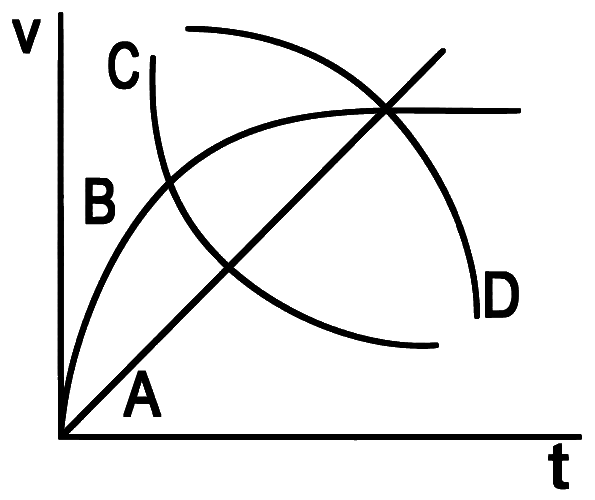
A spherical ball is dropped in a long column of a highly viscous liquid. The curve in the graph shown, which represents the speed of the ball (v) as a function of time (t) is

Figure

Show answer and solution

Answer: (b)

  1. The ball starts from rest, so v=0v = 0 at t=0t = 0 (rules out C and D).
  2. Viscous drag increases with speed, so acceleration decreases and vv cannot rise linearly (rules out A).
  3. vv rises and then becomes constant at terminal velocity: curve B.
  4. So the answer is (b) B.
Report a mistake
Q71JEE Main 2022 · 28 JUN · SHIFT 2Medium

Terminal Velocity · Terminal velocity: radius & density

A water drop of radius 1 μ\mum falls in a situation where the effect of buoyant force is negligible. Co- efficient of viscosity of air is 1.8 ×\times 10−-5 Nsm−2{}^{-2} and its density is negligible as compared to that of water 106 gm−3{}^{-3}. Terminal velocity of the water drop is:

(Take acceleration due to gravity = 10 ms−2{}^{-2})

Show answer and solution

Answer: (d)

  1. Buoyancy neglected: vt=2r2ρg9ηv_t = \dfrac{2r^2\rho g}{9\eta}, with ρ=106 g/m3=103 kg/m3\rho = 10^6\ \text{g/m}^3 = 10^3\ \text{kg/m}^3.
  2. vt=2×(10−6)2×103×109×1.8×10−5=2×10−81.62×10−4v_t = \dfrac{2 \times (10^{-6})^2 \times 10^3 \times 10}{9 \times 1.8 \times 10^{-5}} = \dfrac{2 \times 10^{-8}}{1.62 \times 10^{-4}}
  3. vt≈1.234×10−4=123.4×10⁻⁶ ms−1v_t \approx 1.234 \times 10^{-4} = 123.4 \times 10^{-6}\ \text{ms}^{-1}
  4. So the answer is (d).
Report a mistake
Q72JEE Main 2022 · 27 JUN · SHIFT 2Medium

Terminal Velocity · Terminal velocity: radius & density

When a ball is dropped into a lake from a height 4.9 m above the water level, it hits the water with a velocity v and then sinks to the bottom with the constant velocity v. It reaches the bottom of the lake 4.0 s after it is dropped. The approximate depth of the lake is:

Show answer and solution

Answer: (b)

  1. Free fall of 4.9 m: t1=2×4.99.8=1t_1 = \sqrt{\dfrac{2 \times 4.9}{9.8}} = 1 s, v=gt1=9.8v = gt_1 = 9.8 m/s.
  2. Remaining time in water =4−1=3= 4 - 1 = 3 s at constant vv.
  3. Depth =9.8×3=29.4= 9.8 \times 3 = 29.4 m
  4. So the answer is (b) 29.4 m.
Report a mistake
Q73JEE Main 2022 · 30 JUN · SHIFT 1Medium

Terminal Velocity · Air bubble rising steadily

An air bubble of negligible weight having radius r rises steadily through a of density σ\sigma at speed v. The coefficient of viscosity of the is given by:

Show answer and solution

Answer: (b)

  1. Bubble weight negligible: upthrust 43πr3σg\frac{4}{3}\pi r^3\sigma g balances viscous drag 6πηrv6\pi\eta r v.
  2. η=4πr3σg3×6πrv=2r2σg9v\eta = \dfrac{4\pi r^3\sigma g}{3 \times 6\pi r v} = \dfrac{2r^2\sigma g}{9v}
  3. So the answer is (b).
Report a mistake
Q74JEE Main 2022 · 28 JUL · SHIFT 1Medium

Terminal Velocity · Air bubble rising steadily

The diameter of an air bubble which was initially 2 mm2\text{ mm}, rises steadily through a of density 1750 kg m−31750\text{ kg m}^{-3} at the rate of 0.35 cms−10.35\text{ cms}^{-1}. The coefficient of viscosity of the is _________ poise (in nearest integer). (the density of air is negligible).

Numerical answer type. Work it out, then open the answer.

Show answer and solution

Answer: 11

  1. A bubble rising at terminal speed: v=2r2(ρ−ρair)g9η≈2r2ρg9ηv = \dfrac{2r^2(\rho - \rho_{air})g}{9\eta} \approx \dfrac{2r^2\rho g}{9\eta} (air density negligible).
  2. r=1 mm=10−3 mr = 1\text{ mm} = 10^{-3}\text{ m}, v=0.35 cm/s=3.5×10−3 m/sv = 0.35\text{ cm/s} = 3.5\times10^{-3}\text{ m/s}, ρ=1750 kg m−3\rho = 1750\text{ kg m}^{-3}.
  3. η=2r2ρg9v=2×10−6×1750×109×3.5×10−3=0.0350.0315≈1.11 Pa s\eta = \dfrac{2r^2\rho g}{9v} = \dfrac{2\times10^{-6}\times1750\times10}{9\times3.5\times10^{-3}} = \dfrac{0.035}{0.0315} \approx 1.11\text{ Pa s}
  4. 1 Pa s=10 poise⇒η≈11.1 poise1\text{ Pa s} = 10\text{ poise} \Rightarrow \eta \approx 11.1\text{ poise}
  5. So the answer is 1111 poise.
Report a mistake
Q75JEE Main 2022 · 29 JUN · SHIFT 2Difficult

Terminal Velocity · Terminal velocity: radius & density

A small spherical ball of radius 0.1 mm and density 104 kg m−3{}^{-3} falls freely under gravity through a distance h before entering a tank of water. If, after entering the water the velocity of ball does not change and it continue to fall with same constant velocity inside water, then the value of h will be ___________ m.

(Given g = 10 ms−2{}^{-2}, viscosity of water = 1.0 ×\times 10−-5 N-sm−2{}^{-2}).

Numerical answer type. Work it out, then open the answer.

Show answer and solution

Answer: 20

  1. Velocity just before entering = terminal velocity in water: 2gh=2r2(ρ−σ)g9η\sqrt{2gh} = \dfrac{2r^2(\rho - \sigma)g}{9\eta}.
  2. r=10−4 mr = 10^{-4}\text{ m}, ρ=104\rho = 10^4, σ=103 kg m−3\sigma = 10^3\text{ kg m}^{-3}, η=10−5 N s m−2\eta = 10^{-5}\text{ N s m}^{-2}.
  3. vt=2×10−8×9×103×109×10−5=20 m/sv_t = \dfrac{2\times10^{-8}\times9\times10^{3}\times10}{9\times10^{-5}} = 20\text{ m/s}
  4. h=vt22g=40020=20 mh = \dfrac{v_t^2}{2g} = \dfrac{400}{20} = 20\text{ m}
Report a mistake
Q76MHT CET 2021 · 23 SEP · SHIFT 1Easy

Terminal Velocity · Terminal velocity: radius & density

The speed of a ball of radius 2 cm2\text{ cm} in a viscous liquid is 20 cm/s20\text{ cm/s}. What will be the speed of a ball of radius 1 cm1\text{ cm} in same liquid?

Show answer and solution

Answer: (c)

  1. Terminal speed v∝r2v \propto r^2 for the same material and liquid.
  2. v2=20(12)2=5v_2 = 20\left(\frac{1}{2}\right)^2 = 5 cm/s
  3. So the answer is (c) 5 cm/s.
Report a mistake
Q77MHT CET 2021 · 22 SEP · SHIFT 2Medium

Terminal Velocity · Terminal velocity: radius & density

If the terminal speed of a sphere A [density ρA=7.5 kg m−3\rho_{\mathrm{A}} = 7.5\text{ kg m}^{-3} ] is 0.4 ms−10.4\text{ ms}^{-1}, in a viscous liquid [density ρL=1.5 kg m−3\rho_{\mathrm{L}} = 1.5\text{ kg m}^{-3} ], the terminal speed of sphere B [density ρB=3 kg m−3\rho_B = 3\text{ kg m}^{-3} ] of the same size in the same liquid is

Show answer and solution

Answer: (b)

  1. Same size and liquid: v∝(ρ−ρL)v \propto (\rho - \rho_L).
  2. vB=0.4×3−1.57.5−1.5=0.4×1.56=0.1v_B = 0.4 \times \dfrac{3 - 1.5}{7.5 - 1.5} = 0.4 \times \dfrac{1.5}{6} = 0.1 m/s
  3. So the answer is (b) 0.1 ms−10.1\ \text{ms}^{-1}.
Report a mistake
Q78MHT CET 2021 · 24 SEP · SHIFT 2Medium

Terminal Velocity · Terminal velocity of merged drops

'n' small drops of same size fall through air with constant velocity 5 cm/s5\text{ cm/s}. They coalesce to form a big drop. The terminal velocity of the big drop is

Show answer and solution

Answer: (b)

  1. v∝r2v \propto r^2 and R=n1/3rR = n^{1/3}r, so v′=n2/3vv' = n^{2/3}v.
  2. v′=5n2/3v' = 5n^{2/3} cm/s
  3. So the answer is (b) 5n2/35n^{2/3} cm/s.
Report a mistake
Q79MHT CET 2020 · 19 OCT · SHIFT 2Medium

Terminal Velocity · Terminal velocity: radius & density

Two spherical rain drops reach the surface of the earth with terminal velocities having ratio 16:916 : 9. The ratio of their surface area is

Show answer and solution

Answer: (c)

  1. v∝r2v \propto r^2 and surface area A=4πr2∝r2A = 4\pi r^2 \propto r^2.
  2. So A∝vA \propto v: A1:A2=16:9A_1 : A_2 = 16 : 9
  3. So the answer is (c) 16:916 : 9.
Report a mistake
Q80JEE Main 2020 · 5 SEP · SHIFT 2Medium

Terminal Velocity · Velocity-time graph & experiment

In an experiment to verify Stokes law, a small spherical ball of radius r and density ρ\rho falls under gravity through a distance h in air before entering a tank of water. If the terminal velocity of the ball inside water is same as its velocity just before entering the water surface, then the value of h is proportional to:

(ignore viscosity of air)

Show answer and solution

Answer: (b)

  1. Speed after falling hh in air: v=2ghv = \sqrt{2gh}.
  2. Terminal velocity in water: vt=2r2(ρ−ρw)g9η∝r2v_t = \dfrac{2r^2(\rho - \rho_w)g}{9\eta} \propto r^2.
  3. 2gh=vt⇒h=vt22g∝(r2)2=r4\sqrt{2gh} = v_t \Rightarrow h = \dfrac{v_t^2}{2g} \propto (r^2)^2 = r^4
  4. So the answer is (b) r4r^4.
Report a mistake
Q81MHT CET 2019 · 3 MAY · SHIFT 1Easy

Terminal Velocity · Terminal velocity of merged drops

Eight identical drops of water falling through air with uniform velocity of 10 cm/s10\text{ cm/s} combine to form a single drop of big size, then terminal velocity of the big drop will be

Show answer and solution

Answer: (d)

  1. v∝r2v \propto r^2 and R=n1/3rR = n^{1/3}r, so v′=n2/3vv' = n^{2/3}v.
  2. n=8⇒n2/3=4n = 8 \Rightarrow n^{2/3} = 4
  3. v′=4×10=40v' = 4 \times 10 = 40 cm/s
  4. So the answer is (d) 40 cm/s.
Report a mistake
Q82MHT CET 2019 · 2 MAY · SHIFT 1Medium

Terminal Velocity · Terminal velocity: radius & density

A metal sphere of radius ' RR ' and density ' ρ1\rho_1 ' is dropped in a liquid of density ' σ\sigma ' moves with terminal velocity ' vv '. Another metal sphere of same radius and density ' ρ2\rho_2 ' is dropped in the same liquid, its terminal velocity will be

Show answer and solution

Answer: (c)

  1. Same radius and liquid: v∝(ρ−σ)v \propto (\rho - \sigma).
  2. v2=v ρ2−σρ1−σv_2 = v\,\dfrac{\rho_2 - \sigma}{\rho_1 - \sigma}
  3. So the answer is (c).
Report a mistake
Q83NEET 2019Medium

Terminal Velocity · Terminal velocity: radius & density

Two small spherical metal balls, having equal masses, are made from materials of densities ρ1\rho_1 and ρ2\rho_2 (ρ1=8ρ2\rho_1 = 8\rho_2) and have radii of 1 mm and 2 mm, respectively. They are made to fall vertically (from rest) in a viscous medium whose coefficient of viscosity equals η\eta and whose density is 0.1ρ20.1\rho_2. The ratio of their terminal velocities would be,

Show answer and solution

Answer: (a)

  1. vt=2r2(ρ−σ)g9η⇒v∝r2(ρ−σ)v_t = \dfrac{2r^2(\rho - \sigma)g}{9\eta} \Rightarrow v \propto r^2(\rho - \sigma), with σ=0.1ρ2\sigma = 0.1\rho_2.
  2. v1v2=12(8ρ2−0.1ρ2)22(ρ2−0.1ρ2)=7.94×0.9\dfrac{v_1}{v_2} = \dfrac{1^2(8\rho_2 - 0.1\rho_2)}{2^2(\rho_2 - 0.1\rho_2)} = \dfrac{7.9}{4 \times 0.9}
  3. =7.93.6=7936= \dfrac{7.9}{3.6} = \dfrac{79}{36}
  4. So the answer is (a) 7936\frac{79}{36}.
Report a mistake
Q84JEE Main 2019 · 12 APR · SHIFT 2Medium

Terminal Velocity · Terminal velocity: radius & density

A solid sphere, of radius R acquires a terminal velocity v1 when falling (due to gravity) through a viscous fluid having a coefficient of viscosity. The sphere is broken into 27 identical solid spheres. If each of these spheres acquires a terminal velocity, v2, when falling through the same fluid, the ratio (v1/v2) equals:

Show answer and solution

Answer: (d)

  1. Volume conserved: R3=27r3⇒r=R/3R^3 = 27r^3 \Rightarrow r = R/3.
  2. v∝r2⇒v1v2=(Rr)2=9v \propto r^2 \Rightarrow \dfrac{v_1}{v_2} = \left(\dfrac{R}{r}\right)^2 = 9
  3. So the answer is (d) 9.
Report a mistake
Q85JEE Main 2016 · 9 APR · SHIFT 1Easy

Terminal Velocity · Velocity-time graph & experiment

Which of the following option correctly describes the variation of the speed v and acceleration ‘a’ of a point mass falling vertically in a viscous medium that applies a force F = − kv, where ‘k’ is a constant, on the body? (Graphs are schematic and not drawn to scale)

Show answer and solution

Answer: (b)

tvag
  1. mdvdt=mg−kv⇒v=mgk(1−e−kt/m)m\dfrac{dv}{dt} = mg - kv \Rightarrow v = \dfrac{mg}{k}\left(1 - e^{-kt/m}\right)
  2. a=g e−kt/ma = g\,e^{-kt/m}: starts at gg and decays to zero.
  3. So vv rises from zero and saturates, while aa falls exponentially towards zero.
  4. So the answer is (b).
Report a mistake
Q86JEE Main 2013 · 25 APR · SHIFT 1Easy

Terminal Velocity · Velocity-time graph & experiment

In an experiment, a small steel ball falls through a liquid at a constant speed of 10 cm/s. If the steel ball is pulled upward with a force equal to twice its effective weight, how fast will it move upward?

Show answer and solution

Answer: (c)

  1. At terminal speed 1010 cm/s the viscous force equals the effective weight: Fv=WeffF_v = W_{\text{eff}}, with Fv∝vF_v \propto v.
  2. Pulled up with 2Weff2W_{\text{eff}}: net driving force upward =2Weff−Weff=Weff= 2W_{\text{eff}} - W_{\text{eff}} = W_{\text{eff}}.
  3. Steady speed is reached when viscous force =Weff= W_{\text{eff}}, i.e. at the same speed 1010 cm/s.
  4. So the answer is (c) 10 cm/s.
Report a mistake
Q87JEE Main 2006 · AIEEEMedium

Terminal Velocity · Terminal velocity: radius & density

If the terminal speed of a sphere of gold (density =19.5 kg/m3= 19.5\ kg/m^{3}) is 0.2 m/s0.2\ m/s in a viscous liquid (density =1.5 kg/m3= 1.5\ kg/m^{3}, find the terminal speed of a sphere of silver (density =10.5 kg/m3= 10.5\ kg/m^{3}) of the same size in the same liquid
Show answer and solution

Answer: (c)

  1. Same size and liquid: v∝(ρ−σ)v \propto (\rho - \sigma).
  2. vsvg=10.5−1.519.5−1.5=918=12\dfrac{v_s}{v_g} = \dfrac{10.5 - 1.5}{19.5 - 1.5} = \dfrac{9}{18} = \dfrac{1}{2}
  3. vs=0.2×12=0.1v_s = 0.2 \times \frac{1}{2} = 0.1 m/s
  4. So the answer is (c) 0.10.1 m/s.
Report a mistake