Physics Circle home Home Practice Hub Register / Login

Home›Practice Hub›Chapters›Wave Motion

Physics PYQs · MHT CET · JEE Main · NEET

Wave Motion

Questions
614
MHT CET
351
JEE Main
169
NEET
94
Years
1988–2026
0 of 614 attemptedPick an answer to see the solution

Q1MHT CET 2026 · 20 MAY · SHIFT 1Easy

Wave Basics & Properties of Sound · Wave relation v = nλ

A body sends waves 150150 mm long through medium P and 0.300.30 m long in medium Q. If the velocity of wave in medium P is 8080 cm/s, the velocity of wave in medium Q in m/s is

Show answer and solution

Answer: (a)

  1. Frequency is set by the source and stays the same in both media: n=vλn = \frac{v}{\lambda}.
  2. n=vPλP=0.800.150=163n = \frac{v_P}{\lambda_P} = \frac{0.80}{0.150} = \frac{16}{3} Hz
  3. vQ=nλQ=163×0.30=1.6v_Q = n\lambda_Q = \frac{16}{3} \times 0.30 = 1.6 m/s
  4. So the answer is (a) 1.61.6 m/s.
Report a mistake
Q2MHT CET 2026 · 19 APR · SHIFT 2Easy

Wave Basics & Properties of Sound · Wave relation v = nλ

A body sends a wave 150150 mm long through medium P and 0.300.30 m long in medium Q. If velocity of the wave in medium P is 8080 cm s−1-1, the velocity of wave in medium Q is

Show answer and solution

Answer: (d)

  1. Frequency is the same in both media, so vQvP=λQλP\frac{v_Q}{v_P} = \frac{\lambda_Q}{\lambda_P}.
  2. vQ=0.80×0.300.150=1.6v_Q = 0.80 \times \frac{0.30}{0.150} = 1.6 m/s
  3. So the answer is (d) 1.61.6 m s−1^{-1}.
Report a mistake
Q3MHT CET 2026 · 18 APR · SHIFT 1Easy

Wave Basics & Properties of Sound · Wave relation v = nλ

The number of waves counted by an observer on the sea-coast in one minute is 54. If the wavelength of the waves is 55 m then the velocity of the waves in m/s will be

Show answer and solution

Answer: (a)

  1. Frequency n=5460=0.9n = \frac{54}{60} = 0.9 Hz
  2. v=nλ=0.9×5=4.5v = n\lambda = 0.9 \times 5 = 4.5 m/s
  3. So the answer is (a) 4.54.5 m/s.
Report a mistake
Q4MHT CET 2026 · 13 APR · SHIFT 2Easy

Wave Basics & Properties of Sound · Wave relation v = nλ

Sound waves travel at 350350 m/s through a warm air and at 35003500 m/s through brass. Which of the following is correct about the wavelength of a 700700 Hz accoustic wave as it enters brass from warm air?

Show answer and solution

Answer: (c)

  1. Frequency does not change on entering a new medium, so λ=vn∝v\lambda = \frac{v}{n} \propto v.
  2. λbrassλair=3500350=10\frac{\lambda_{brass}}{\lambda_{air}} = \frac{3500}{350} = 10
  3. So the answer is (c) it increases by a factor 1010.
Report a mistake
Q5MHT CET 2026 · 13 APR · SHIFT 1Easy

Wave Basics & Properties of Sound · Wave relation v = nλ

Waves having a velocity 10m/s, strike a stationary boat near the sea shore. The distance between two consecutive crests of the waves is 40m. After how many second, the consecutive waves strike the boat?

Show answer and solution

Answer: (c)

  1. Distance between consecutive crests is the wavelength: λ=40\lambda = 40 m.
  2. Time between consecutive waves is the period: T=λv=4010=4T = \frac{\lambda}{v} = \frac{40}{10} = 4 s
  3. So the answer is (c) 44 s.
Report a mistake
Q6MHT CET 2026 · 20 APR · SHIFT 1Easy

Wave Basics & Properties of Sound · Pitch, loudness and musical instruments

The 'Loudness' and 'Pitch' of sound respectively are the human perception to

Show answer and solution

Answer: (a)

  1. Loudness is the ear's response to intensity (energy per unit area per second).
  2. Pitch is the ear's response to frequency.
  3. So the answer is (a) intensity of sound and frequency of sound.
Report a mistake
Q7MHT CET 2026 · 19 APR · SHIFT 1Easy

Wave Basics & Properties of Sound · Pitch, loudness and musical instruments

Which one of the following statements regarding pitch of sound is 'WRONG'?

(A) Pitch refers to sharpness of sound.

(B) Tone refers to the single frequency of that wave.

(C) High pitch sound need not be louder.

(D) In general male sound is sharper than that of a female.

Show answer and solution

Answer: (a)

  1. (A) True: pitch is the shrillness or sharpness of sound.
  2. (B) True: a tone is a sound of a single frequency.
  3. (C) True: pitch depends on frequency, loudness on intensity, so a high pitch sound can be soft.
  4. (D) Wrong: a female voice usually has higher frequency, so it is sharper than a male voice.
  5. So the answer is (a) D.
Report a mistake
Q8MHT CET 2026 · 17 APR · SHIFT 1Easy

Wave Basics & Properties of Sound · Pitch, loudness and musical instruments

Out of the following musical instruments which is ' NOT ' a percussion instrument?

Show answer and solution

Answer: (b)

  1. Percussion instruments produce sound when struck: drum, daphali, xylophone.
  2. The saxophone is a wind instrument (vibrating air column).
  3. So the answer is (b) Saxophone.
Report a mistake
Q9MHT CET 2026 · 19 MAY · SHIFT 1Easy

Wave Basics & Properties of Sound · Intensity and sound level

The amplitude of a sound wave at a distance rr from a point source is AA. The amplitude at a distance 2r2r from the point source is

Show answer and solution

Answer: (b)

  1. For a point source, I=P4πr2∝1r2I = \frac{P}{4\pi r^2} \propto \frac{1}{r^2}.
  2. Also I∝A2I \propto A^2, so A∝1rA \propto \frac{1}{r}.
  3. At 2r2r: A′=A2A' = \frac{A}{2}
  4. So the answer is (b) A2\frac{A}{2}.
Report a mistake
Q10JEE Main 2026 · 24 JAN · SHIFT 2Easy

Wave Basics & Properties of Sound · Intensity and sound level

A point source is kept at the center of a spherically enclosed detector. If the volume of the detector increased by 8 times, the intensity will

Show answer and solution

Answer: (b)

  1. V=43πr3V = \frac{4}{3}\pi r^3, so V→8VV \to 8V means r→2rr \to 2r.
  2. I=P4πr2∝1r2I = \frac{P}{4\pi r^2} \propto \frac{1}{r^2}, so I→I4I \to \frac{I}{4}
  3. So the answer is (b) decrease by 4 times.
Report a mistake
Q11MHT CET 2026 · 13 APR · SHIFT 1Medium

Wave Basics & Properties of Sound · Intensity and sound level

A musical instrument P produces sound waves of frequency 'n' and amplitude 'A'. Another musical instrument Q produces sound waves of frequency n/4. The waves produced by P and Q have equal energies. The amplitude of waves produced by Q will be

Show answer and solution

Answer: (c)

  1. Wave energy E∝A2n2E \propto A^2 n^2.
  2. Equal energies: AQnQ=An⇒AQ=Ann/4A_Q n_Q = A n \Rightarrow A_Q = A \frac{n}{n/4}
  3. AQ=4AA_Q = 4A
  4. So the answer is (c) 4A4A.
Report a mistake
Q12MHT CET 2025 · 21 APR · SHIFT 1Easy

Wave Basics & Properties of Sound · Wave relation v = nλ

An observer on sea-coast counts 45 waves in one minute. If the wavelength of the waves is 7 m, then the velocity of the waves will be

Show answer and solution

Answer: (b)

  1. Frequency n=4560=0.75n = \frac{45}{60} = 0.75 Hz
  2. v=nλ=0.75×7=5.25v = n\lambda = 0.75 \times 7 = 5.25 m/s
  3. So the answer is (b) 5.255.25 m/s.
Report a mistake
Q13MHT CET 2025 · 26 APR · SHIFT 2Medium

Wave Basics & Properties of Sound · Intensity and sound level

A musical instrument ' P ' produce sound waves of frequency ' nn ' and amplitude ' AA '. Another musical instrument ' QQ ' produces sound waves of frequency ' n4\frac{n}{4} ' The waves produced by ' P ' and ' QQ ' have equal energies. If the amplitude of waves produced by ' P ' is ' ApA_p ', the amplitude of waves produced by ' QQ ' will be

Show answer and solution

Answer: (b)

  1. Wave energy E∝A2n2E \propto A^2 n^2, so equal energies give An=A n = constant.
  2. AQ=Apnn/4=4ApA_Q = A_p \frac{n}{n/4} = 4A_p
  3. So the answer is (b) 4Ap4A_p.
Report a mistake
Q14MHT CET 2024 · 11 MAY · SHIFT 2Easy

Wave Basics & Properties of Sound · Nature and types of waves

Which of the following statements is NOT true?

Show answer and solution

Answer: (c)

  1. Sound is a mechanical wave: it needs a material medium (solid, liquid or gas) to travel.
  2. In vacuum there are no particles to vibrate, so sound cannot travel there.
  3. Statements (a), (b), (d) are true.
  4. So the answer is (c) Sound can travel through vacuum.
Report a mistake
Q15MHT CET 2024 · 10 MAY · SHIFT 2Easy

Wave Basics & Properties of Sound · Wave relation v = nλ

Prong of a vibrating tuning fork is in contact with water surface. It produces concentric circular waves on the surface of water. The distance between five consecutive crests is 0.8 m and the velocity of wave on the water surface is 56 m/s56\text{ m/s}. The frequency of tuning fork is

Show answer and solution

Answer: (b)

  1. Five consecutive crests have four gaps: 4λ=0.84\lambda = 0.8 m, so λ=0.2\lambda = 0.2 m.
  2. n=vλ=560.2=280n = \frac{v}{\lambda} = \frac{56}{0.2} = 280 Hz
  3. So the answer is (b) 280 Hz.
Report a mistake
Q16MHT CET 2024 · 9 MAY · SHIFT 1Easy

Wave Basics & Properties of Sound · Pitch, loudness and musical instruments

Out of the following musical instruments, which is 'NOT' a percussion instrument?

Show answer and solution

Answer: (d)

  1. Daphali, sambal and cymbals are struck, so they are percussion instruments.
  2. The clarinet is a wind instrument (vibrating air column).
  3. So the answer is (d) Clarinet.
Report a mistake
Q17MHT CET 2024 · 16 MAY · SHIFT 1Easy

Wave Basics & Properties of Sound · Intensity and sound level

How many times more intense is a 60 dB sound than a 30 dB sound?

Show answer and solution

Answer: (c)

  1. L2−L1=10log⁡10I2I1L_2 - L_1 = 10\log_{10}\frac{I_2}{I_1}
  2. 60−30=30=10log⁡10I2I1⇒I2I1=10360 - 30 = 30 = 10\log_{10}\frac{I_2}{I_1} \Rightarrow \frac{I_2}{I_1} = 10^{3}
  3. So the answer is (c) 1000.
Report a mistake
Q18JEE Main 2024 · 30 JAN · SHIFT 2Easy

Wave Basics & Properties of Sound · Intensity and sound level

A point source is emitting sound waves of intensity 16×10−8 Wm−216 \times 10^{-8}\text{ Wm}^{-2} at the origin. The difference in intensity (magnitude only) at two points located at distances of 2 m2\text{ m} and 4 m4\text{ m} from the origin respectively will be _________ ×10−8 Wm−2\times 10^{-8}\text{ Wm}^{-2}.

Numerical answer type. Work it out, then open the answer.

Show answer and solution

Answer: 3

  1. Take the given 16×10−816 \times 10^{-8} W m−2^{-2} as the intensity at 11 m from the source; I∝1r2I \propto \frac{1}{r^2}.
  2. I2=1622×10−8=4×10⁻⁸I_2 = \frac{16}{2^2} \times 10^{-8} = 4 \times 10^{-8} W m−2^{-2}
  3. I4=1642×10−8=1×10⁻⁸I_4 = \frac{16}{4^2} \times 10^{-8} = 1 \times 10^{-8} W m−2^{-2}
  4. Difference =3×10−8= 3 \times 10^{-8} W m−2^{-2}, so the answer is 33.
Report a mistake
Q19MHT CET 2024 · 10 MAY · SHIFT 1Medium

Wave Basics & Properties of Sound · Intensity and sound level

A musical instrument X produces sound waves of frequency n and amplitude A. Another musical instrument YY produces sound waves of frequency n3\frac{n}{3}. The waves produced by XX and YY have equal energies. The amplitude of waves produced by Y will be

Show answer and solution

Answer: (a)

  1. Wave energy E∝A2n2E \propto A^2 n^2, so equal energies give An=A n = constant.
  2. AY=Ann/3=3AA_Y = A \frac{n}{n/3} = 3A
  3. So the answer is (a) 3A.
Report a mistake
Q20MHT CET 2024 · 9 MAY · SHIFT 2Medium

Wave Basics & Properties of Sound · Intensity and sound level

A musical instrument ' PP ' produces sound waves of frequency ' nn ' and amplitude ' AA '. Another musical instrument ' QQ ' produces sound waves of frequency n4\frac{n}{4}. The waves produced by ' PP ' and ' QQ ' have equal energies. If the amplitude of waves produced by ' PP ' is ' APA_P ', the amplitude of waves produced by ' QQ ' will be

Show answer and solution

Answer: (b)

  1. Wave energy E∝A2n2E \propto A^2 n^2, so equal energies give An=A n = constant.
  2. AQ=APnn/4=4APA_Q = A_P \frac{n}{n/4} = 4A_P
  3. So the answer is (b) 4AP4A_P.
Report a mistake
Q21MHT CET 2023 · 11 MAY · SHIFT 2Easy

Wave Basics & Properties of Sound · Wave relation v = nλ

A sound of frequency 480 Hz480\text{ Hz} is emitted from the stringed instrument. The velocity of sound in air is 320 m/s320\text{ m/s}. After completing 180 vibrations, the distance covered by a wave is

Show answer and solution

Answer: (c)

  1. In each vibration the wave advances one wavelength, so distance =Nλ=Nvn= N\lambda = N\frac{v}{n}.
  2. λ=320480=23\lambda = \frac{320}{480} = \frac{2}{3} m
  3. Distance =180×23=120= 180 \times \frac{2}{3} = 120 m
  4. So the answer is (c) 120 m.
Report a mistake
Q22MHT CET 2023 · 11 MAY · SHIFT 2Easy

Wave Basics & Properties of Sound · Related oscillation questions

A rectangular block of mass 'mm' and crosssectional area A, floats on a liquid of density 'ρ\rho'. It is given a small vertical displacement from equilibrium, it starts oscillating with frequency 'nn' equal to ( g=g = acceleration due to gravity)

Show answer and solution

Answer: (a)

  1. Pushing the block down by xx displaces extra liquid volume AxAx, giving extra upthrust F=−Aρg xF = -A\rho g\,x.
  2. This is SHM with force constant k=Aρgk = A\rho g.
  3. n=12πkm=12πAρgmn = \frac{1}{2\pi}\sqrt{\frac{k}{m}} = \frac{1}{2\pi}\sqrt{\frac{A\rho g}{m}}
  4. So the answer is (a).
Report a mistake
Q23JEE Main 2022 · 27 JUN · SHIFT 2Easy

Wave Basics & Properties of Sound · Wave relation v = nλ

If a wave gets refracted into a denser medium, then which of the following is true?

Show answer and solution

Answer: (c)

  1. Frequency is fixed by the source, so it does not change on refraction.
  2. In a denser medium the wave speed decreases, and λ=vn\lambda = \frac{v}{n} decreases with it.
  3. So the answer is (c) wavelength and speed decrease, frequency remains constant.
Report a mistake
Q24MHT CET 2021 · 20 SEP · SHIFT 2Easy

Wave Basics & Properties of Sound · Nature and types of waves

Which one of the following statements is true?

Show answer and solution

Answer: (a)

  1. Sound in air travels as compressions and rarefactions, so particles vibrate along the direction of travel: longitudinal.
  2. Light is an electromagnetic wave with E⃗\vec E and B⃗\vec B perpendicular to the direction of travel: transverse.
  3. So the answer is (a).
Report a mistake
Q25MHT CET 2021 · 24 SEP · SHIFT 1Easy

Wave Basics & Properties of Sound · Wave relation v = nλ

Two tuning forks of frequencies 320 Hz320\text{ Hz} and 480 Hz480\text{ Hz} are sounded together to produce sound waves. The velocity of sound in air is 320 ms−1320\text{ ms}^{-1}. The difference between wavelengths of these waves is nearly

Show answer and solution

Answer: (c)

  1. λ=vn\lambda = \frac{v}{n} for each fork.
  2. λ1=320320=1\lambda_1 = \frac{320}{320} = 1 m, λ2=320480=0.667\lambda_2 = \frac{320}{480} = 0.667 m
  3. Δλ=1−0.667=0.333\Delta\lambda = 1 - 0.667 = 0.333 m ≈33\approx 33 cm
  4. So the answer is (c) 33 cm.
Report a mistake
Q26MHT CET 2021 · 23 SEP · SHIFT 2Easy

Wave Basics & Properties of Sound · Wave relation v = nλ

The frequency of a tuning fork is 220 Hz220\text{ Hz} and the velocity of sound in air is 330 m/s330\text{ m/s}. When the tuning fork completes 80 vibrations, the distance travelled by the sound wave is

Show answer and solution

Answer: (a)

  1. Distance =Nλ=Nvn= N\lambda = N\frac{v}{n}.
  2. λ=330220=1.5\lambda = \frac{330}{220} = 1.5 m
  3. Distance =80×1.5=120= 80 \times 1.5 = 120 m
  4. So the answer is (a) 120 m.
Report a mistake
Q27MHT CET 2021 · 20 SEP · SHIFT 1Easy

Wave Basics & Properties of Sound · Wave relation v = nλ

The frequency of a tuning fork is 'n' Hz and velocity of sound in air is 'V' m/s. When the tuning fork completes 'x' vibrations, the distance travelled by the wave is

Show answer and solution

Answer: (c)

  1. One vibration moves the wave forward by one wavelength λ=Vn\lambda = \frac{V}{n}.
  2. After xx vibrations: distance =xλ=xVn= x\lambda = \frac{xV}{n}
  3. So the answer is (c) xVn\frac{xV}{n}.
Report a mistake
Q28JEE Main 2020 · 4 SEP · SHIFT 1Medium

Wave Basics & Properties of Sound · Wave relation v = nλ

For a transverse wave travelling along a straight line, the distance between two peaks (crests) is 5 m, while the distance between one crest and one trough is 1.5 m. The possible wavelengths (in m) of the wave are:

Show answer and solution

Answer: (b)

  1. Two crests are a whole number of wavelengths apart: 5=nλ5 = n\lambda.
  2. A crest and a trough are an odd number of half wavelengths apart: 1.5=(2m+1)λ21.5 = (2m+1)\frac{\lambda}{2}, so λ=32m+1\lambda = \frac{3}{2m+1}.
  3. Both hold for λ=1,13,15,…\lambda = 1, \frac{1}{3}, \frac{1}{5}, \dots e.g. λ=1\lambda = 1: 5=5λ5 = 5\lambda, 1.5=3⋅λ21.5 = 3 \cdot \frac{\lambda}{2}.
  4. So the answer is (b) 11,13,15,…\frac{1}{1}, \frac{1}{3}, \frac{1}{5}, \dots
Report a mistake
Q29JEE Main 2020 · 5 SEP · SHIFT 1Medium

Wave Basics & Properties of Sound · Intensity and sound level

Assume that the displacement(s) of air is proportional to the pressure difference (Δ\Deltap) created by a sound wave. Displacement (s) further depends on the speed of sound (v), density of air (ρ\rho) and the frequency (f). If Δ\Deltap ~ 10 Pa, v ~ 300 m/s, ρ\rho ~ 1 kg/m3 and f ~ 1000 Hz, then s will be of the order of (take the multiplicative constant to be 1):

Show answer and solution

Answer: (b)

  1. Write s=Δp vaρbfcs = \Delta p\, v^a \rho^b f^c; [s]=[s] = L and [Δp]=[\Delta p] = M L−1^{-1} T−2^{-2}.
  2. Matching M, L, T gives b=−1b = -1, a=−1a = -1, c=−1c = -1: s=Δpρvfs = \frac{\Delta p}{\rho v f}.
  3. s=101×300×1000=3.3×10⁻⁵s = \frac{10}{1 \times 300 \times 1000} = 3.3 \times 10^{-5} m ≈3100\approx \frac{3}{100} mm
  4. So the answer is (b) 3100\frac{3}{100} mm.
Report a mistake
Q30JEE Main 2019 · 12 APR · SHIFT 2Medium

Wave Basics & Properties of Sound · Intensity and sound level

A small speaker delivers 2 W of audio output. At what distance from the speaker will one detect 120 dB intensity sound? [Given reference intensity of sound as 10–12 W/m2 ]

Show answer and solution

Answer: (c)

  1. Sound level L=10log⁡10(I/I0)L = 10\log_{10}(I/I_0), so 120=10log⁡10(I/10−12)120 = 10\log_{10}(I/10^{-12}) gives I=1 W/m2I = 1\ \text{W/m}^2.
  2. Point source: I=P4πr2⇒r=P4πI=24π×1I = \dfrac{P}{4\pi r^2} \Rightarrow r = \sqrt{\dfrac{P}{4\pi I}} = \sqrt{\dfrac{2}{4\pi \times 1}}
  3. r=0.159≈0.40 mr = \sqrt{0.159} \approx 0.40\ \text{m}
  4. So the answer is (c) 40 cm40\ \text{cm}.
Report a mistake
Q31JEE Main 2017 · 9 APR · SHIFT 1Medium

Wave Basics & Properties of Sound · Related oscillation questions

In an experiment to determine the period of a simple pendulum of length 1 m, it is attached to different spherical bobs of radii r1 and r2. The two spherical bobs have uniform mass distribution. If the relative difference in the periods, is found to be 5×10⁻⁴ s, the difference in radii, ∣\vert r1 −- r2 ∣\vert is best given by:

Show answer and solution

Answer: (b)

  1. Effective length ≈L+r\approx L + r, so T=2π(L+r)/gT = 2\pi\sqrt{(L+r)/g} and ΔTT=12ΔrL\dfrac{\Delta T}{T} = \dfrac{1}{2}\dfrac{\Delta r}{L}.
  2. Δr=2LΔTT=2×1×5×10−4=10−3 m\Delta r = 2L\dfrac{\Delta T}{T} = 2 \times 1 \times 5\times10^{-4} = 10^{-3}\ \text{m}
  3. So the answer is (b) 0.1 cm0.1\ \text{cm}.
Report a mistake
Q32JEE Main 2013 · 25 APR · SHIFT 1Easy

Wave Basics & Properties of Sound · Wave relation v = nλ

In a transverse wave the distance between a crest and neighbouring trough at the same instant is 4.0 cm and the distance between a crest and trough at the same place is 1.0 cm. The next crest appears at the same place after a time interval of 0.4 s. The maximum speed of the vibrating particles in the medium is:

Show answer and solution

Answer: (b)

λ/2 = 4 cm2A = 1 cmcresttrough
  1. Crest to neighbouring trough at one instant is λ2=4\frac{\lambda}{2} = 4 cm, so λ=8\lambda = 8 cm.
  2. Crest to trough at the same place (vertical) is 2A=12A = 1 cm, so A=0.5A = 0.5 cm.
  3. Next crest at the same place after one period: T=0.4T = 0.4 s, so ω=2πT=5π\omega = \frac{2\pi}{T} = 5\pi rad/s.
  4. vmax=Aω=0.5×5π=5π2v_{max} = A\omega = 0.5 \times 5\pi = \frac{5\pi}{2} cm/s
  5. So the answer is (b) 5π2\frac{5\pi}{2} cm/s.
Report a mistake
Q33NEET 2011 · AIPMT · PRELIMSEasy

Wave Basics & Properties of Sound · Wave relation v = nλ

Sound waves travel at 350 m/s through a warm air and at 3500 m/s through brass. The wavelength of a 700 Hz acoustic wave as it enters brass from warm air

Show answer and solution

Answer: (c)

  1. Frequency stays 700700 Hz in both media, so λ∝v\lambda \propto v.
  2. λbrassλair=3500350=10\frac{\lambda_{brass}}{\lambda_{air}} = \frac{3500}{350} = 10
  3. So the answer is (c) increases by a factor 10.
Report a mistake
Q34NEET 2008 · AIPMTEasy

Wave Basics & Properties of Sound · Related oscillation questions

A point performs simple harmonic oscillation of period T and the equation of motion is given by x = a sin(ω\omegat + π\pi/6). After the elapse of what fraction of the time period the velocity of the point will be equal to half of its maximum velocity?

Show answer and solution

Answer: (b)

  1. v=aωcos⁡(ωt+π6)v = a\omega\cos(\omega t + \frac{\pi}{6}), vmax=aωv_{max} = a\omega.
  2. v=vmax2⇒cos⁡(ωt+π6)=12⇒ωt+π6=π3v = \frac{v_{max}}{2} \Rightarrow \cos(\omega t + \frac{\pi}{6}) = \frac{1}{2} \Rightarrow \omega t + \frac{\pi}{6} = \frac{\pi}{3}
  3. ωt=π6⇒2πTt=π6⇒t=T12\omega t = \frac{\pi}{6} \Rightarrow \frac{2\pi}{T}t = \frac{\pi}{6} \Rightarrow t = \frac{T}{12}
  4. So the answer is (b) T/12T/12.
Report a mistake
Q35JEE Main 2007 · AIEEEMedium

Wave Basics & Properties of Sound · Intensity and sound level

A sound absorber attenuates the sound level by 20 dB20\text{ dB}. The intensity decreases by a factor of

Show answer and solution

Answer: (a)

  1. ΔL=10log⁡10(I1/I2)\Delta L = 10\log_{10}(I_1/I_2)
  2. 20=10log⁡10(I1/I2)⇒I1/I2=10220 = 10\log_{10}(I_1/I_2) \Rightarrow I_1/I_2 = 10^2
  3. So the answer is (a) 100100.
Report a mistake
Q36NEET 2006 · AIPMTEasy

Wave Basics & Properties of Sound · Nature and types of waves

Which one of the following statements is true?

Show answer and solution

Answer: (c)

  1. Light (electromagnetic) travels in vacuum; sound (mechanical) does not, so (a) is false.
  2. Sound in air is longitudinal; light is transverse.
  3. So the answer is (c).
Report a mistake
Q37NEET 2006 · AIPMTEasy

Wave Basics & Properties of Sound · Intensity and sound level

The time of reverberation of a room A is one second. What will be the time (in seconds of reverberation of a room, having all the dimensions double of those of room A?

Show answer and solution

Answer: (b)

  1. Sabine's formula: T=0.161 VaST = \frac{0.161\,V}{aS}, so T∝VST \propto \frac{V}{S}.
  2. Doubling every dimension: V→8VV \to 8V, S→4SS \to 4S.
  3. T′=84×1=2T' = \frac{8}{4} \times 1 = 2 s
  4. So the answer is (b) 2.
Report a mistake
Q38NEET 2005 · AIPMTEasy

Wave Basics & Properties of Sound · Intensity and sound level

A point source emits sound equally in all directions in a non-absorbing medium. Two points P and Q are at distances of 2 m and 3 m respectively from the source. The ratio of the intensities of the waves at P and Q is

Show answer and solution

Answer: (c)

  1. For a point source, I∝1r2I \propto \frac{1}{r^2}.
  2. IPIQ=rQ2rP2=94\frac{I_P}{I_Q} = \frac{r_Q^2}{r_P^2} = \frac{9}{4}
  3. So the answer is (c) 9 : 4.
Report a mistake
Q39NEET 2000 · AIPMTEasy

Wave Basics & Properties of Sound · Related oscillation questions

The equations of two waves acting in perpendicular directions are given as

x = aacos(ω\omegat +δ\delta) and y = aacos(ω\omegat + α\alpha), where δ=α+π2\delta = \alpha + \frac{\pi}{2}, the resultant wave represents

Show answer and solution

Answer: (b)

  1. With δ=α+π2\delta = \alpha + \frac{\pi}{2}: x=acos⁡(ωt+α+π2)=−asin⁡(ωt+α)x = a\cos(\omega t + \alpha + \frac{\pi}{2}) = -a\sin(\omega t + \alpha).
  2. y=acos⁡(ωt+α)y = a\cos(\omega t + \alpha)
  3. x2+y2=a2x^2 + y^2 = a^2: equal amplitudes with π2\frac{\pi}{2} phase difference.
  4. So the answer is (b) a circle.
Report a mistake
Q40NEET 1998 · AIPMTEasy

Wave Basics & Properties of Sound · Wave relation v = nλ

In a sinusoidal wave, the time required for a particular point, to move from maximum displacement to zero displacement is 0.170 s0.170\text{ s}. The frequency of the wave is

Show answer and solution

Answer: (a)

  1. Going from maximum displacement to zero (mean position) takes a quarter period: T4=0.170\frac{T}{4} = 0.170 s.
  2. T=0.680T = 0.680 s
  3. n=1T=10.680≈1.47n = \frac{1}{T} = \frac{1}{0.680} \approx 1.47 Hz
  4. So the answer is (a) 1.471.47 Hz.
Report a mistake
Q41NEET 1995 · AIPMTEasy

Wave Basics & Properties of Sound · Wave relation v = nλ

A hospital uses an ultrasonic scanner to locate tumours in a tissue. The operating frequency of the scanner is 4.2 MHz4.2\text{ MHz}. The speed of sound in a tissue is 1.7 km/s1.7\text{ km/s}. The wavelength of sound in the tissue is close to

Show answer and solution

Answer: (c)

  1. λ=vn\lambda = \frac{v}{n}
  2. λ=1.7×1034.2×106≈4.0×10⁻⁴\lambda = \frac{1.7 \times 10^{3}}{4.2 \times 10^{6}} \approx 4.0 \times 10^{-4} m
  3. So the answer is (c) 4×10−44 \times 10^{-4} m.
Report a mistake
Q42NEET 1992 · AIPMTEasy

Wave Basics & Properties of Sound · Nature and types of waves

With the propogation of a longitudinal wave through a material medium, the quantities transmitted in the propogation direction are

Show answer and solution

Answer: (b)

  1. In a wave, the particles of the medium only oscillate about their mean positions; they do not move along with the wave.
  2. So no mass is carried forward; the disturbance carries energy.
  3. So the answer is (b) energy.
Report a mistake
Q43NEET 1989 · AIPMTMedium

Wave Basics & Properties of Sound · Intensity and sound level

If the amplitude of sound is doubled and the frequency reduced to one fourth, the intensity of sound at the same point will be

Show answer and solution

Answer: (c)

  1. Intensity I∝A2n2I \propto A^2 n^2.
  2. I′I=(2)2×(14)2=4×116=14\frac{I'}{I} = (2)^2 \times \left(\frac{1}{4}\right)^2 = 4 \times \frac{1}{16} = \frac{1}{4}
  3. So the answer is (c) decreasing by a factor of 4.
Report a mistake
Q44MHT CET 2026 · 15 MAY · SHIFT 1Easy

Speed of Waves · Speed on a stretched string

The speed of a wave on a string is 150150 m/s when the tension is 120120 N. The percentage increase in the tension to raise the wave speed by 20%20\% is

Show answer and solution

Answer: (a)

  1. v=T/μ⇒T∝v2v = \sqrt{T/\mu} \Rightarrow T \propto v^2
  2. T′/T=(1.2)2=1.44T'/T = (1.2)^2 = 1.44
  3. So the answer is (a) 44%44\%.
Report a mistake
Q45MHT CET 2026 · 15 APR · SHIFT 1Easy

Speed of Waves · Speed on a stretched string

A wire is under tension of 22 kg wt and a wave is travelling through it with some speed. Tension in the wire is so increased that the wave travels through it with thrice the original speed. The increase in tension is (in kg wt)

Show answer and solution

Answer: (c)

  1. T∝v2T \propto v^2, so tripling the speed makes T′=9T=9×2=18T' = 9T = 9 \times 2 = 18 kg wt.
  2. Increase =18−2=16= 18 - 2 = 16 kg wt.
  3. So the answer is (c) 1616.
Report a mistake
Q46MHT CET 2026 · 11 APR · SHIFT 1Easy

Speed of Waves · Effect of temperature, pressure and humidity

What is the effect of humidity on sound waves when humidity increases?

Show answer and solution

Answer: (a)

  1. Water vapour (M=18M = 18) is lighter than dry air (M≈29M \approx 29), so moist air has lower density.
  2. v=γP/ρv = \sqrt{\gamma P/\rho} increases as ρ\rho decreases.
  3. So the answer is (a) Speed of sound waves is more.
Report a mistake
Q47JEE Main 2026 · 23 JAN · SHIFT 2Easy

Speed of Waves · Effect of temperature, pressure and humidity

The velocity of sound in air is doubled when the temperature is raised from 0∘C0^\circ\text{C} to α∘C\alpha^\circ\text{C}. The value of α\alpha is ______.

Numerical answer type. Work it out, then open the answer.

Show answer and solution

Answer: 819

  1. v∝Tv \propto \sqrt{T}, so doubling vv needs T′=4×273=1092T' = 4 \times 273 = 1092 K.
  2. α=1092−273=819\alpha = 1092 - 273 = 819
  3. Answer: 819∘819^\circC.
Report a mistake
Q48MHT CET 2026 · 11 APR · SHIFT 1Medium

Speed of Waves · Speed on a stretched string

A string of length 0.50.5 m and mass 10−310^{-3} kg is tightly clamped at its ends. The tension in the string is 0.80.8 N. Identical wave pulses are produced at one end at equal intervals of time Δt\Delta t. What is the minimum value of Δt\Delta t which allows constructive interference between successive pulses?

Show answer and solution

Answer: (d)

  1. μ=10−3/0.5=2×10−3\mu = 10^{-3}/0.5 = 2\times10^{-3} kg/m, v=0.8/(2×10−3)=20v = \sqrt{0.8/(2\times10^{-3})} = 20 m/s.
  2. A pulse reflects at both fixed ends (two inversions), returning upright after a round trip 2L2L.
  3. Minimum Δt=2Lv=2×0.520=0.05 s\Delta t = \dfrac{2L}{v} = \dfrac{2\times0.5}{20} = 0.05\ \text{s}
  4. So the answer is (d) 0.050.05 s.
Report a mistake
Q49MHT CET 2026 · 20 APR · SHIFT 2Medium

Speed of Waves · Speed of sound in solids, liquids and gases

Two monoatomic ideal gases '1' and '2' of molecular masses m1m_1 and m2m_2 respectively are enclosed in separate containers kept at the same temperature. The ratio of the speed of sound in gas '1' to that in gas '2' is

Show answer and solution

Answer: (b)

  1. v=γRTMv = \sqrt{\dfrac{\gamma RT}{M}}; both monoatomic (same γ\gamma) at the same TT, so v∝1/Mv \propto 1/\sqrt{M}.
  2. v1v2=m2m1\dfrac{v_1}{v_2} = \sqrt{\dfrac{m_2}{m_1}}
  3. So the answer is (b).
Report a mistake
Q50MHT CET 2026 · 20 APR · SHIFT 1Medium

Speed of Waves · Speed of sound in solids, liquids and gases

The ratio of the speed of sound in helium gas to that in nitrogen gas at 295295 K is ( Ratio of specific heats γ\gamma for helium is 53\frac{5}{3} and that for nitrogen is 75\frac{7}{5}. Molecular weight for helium and nitrogen are 44 and 2828 respectively.)

Show answer and solution

Answer: (d)

  1. vHevN2=γHeγN2⋅MN2MHe\dfrac{v_{He}}{v_{N_2}} = \sqrt{\dfrac{\gamma_{He}}{\gamma_{N_2}}\cdot\dfrac{M_{N_2}}{M_{He}}}
  2. =5/37/5×284=2521×7=253= \sqrt{\dfrac{5/3}{7/5}\times\dfrac{28}{4}} = \sqrt{\dfrac{25}{21}\times 7} = \sqrt{\dfrac{25}{3}}
  3. So the answer is (d) 53\dfrac{5}{\sqrt{3}}.
Report a mistake
Q51MHT CET 2026 · 17 APR · SHIFT 1Medium

Speed of Waves · Effect of temperature, pressure and humidity

The enclosed air inside a closed box of rigid walls has pressure P1P_1. The density of air inside this box is constant. On heating the gas, the pressure of the enclosed air is increased from P1P_1 to P2P_2. Now it is observed that the sound travels 1.41.4 times faster than at pressure P1P_1. The ratio P2P_2 by P1P_1 is

Show answer and solution

Answer: (b)

  1. v=γP/ρv = \sqrt{\gamma P/\rho} with ρ\rho constant, so v∝Pv \propto \sqrt{P}.
  2. P2P1=(1.4)2=1.96\dfrac{P_2}{P_1} = (1.4)^2 = 1.96
  3. So the answer is (b) 1.961.96.
Report a mistake
Q52JEE Main 2026 · 21 JAN · SHIFT 1Difficult

Speed of Waves · Speed on a stretched string

Two strings (A,B)(A, B) having linear densities μA=2×10⁻⁴ kg/m\mu_A = 2 \times 10^{-4}\text{ kg/m} and, μB=4×10⁻⁴ kg/m\mu_B = 4 \times 10^{-4}\text{ kg/m} and lengths LA=2.5 mL_A = 2.5\text{ m} and LB=1.5 mL_B = 1.5\text{ m} respectively are joined. Free ends of AA and BB are tied to two rigid supports CC and DD, respectively creating a tension of 500 N in the wire. Two identical pulses, sent from CC and DD ends, take time t1t_1 and t2t_2, respectively, to reach the joint. The ratio t1/t2t_1/t_2 is:

Show answer and solution

Answer: (b)

  1. t=L/v=Lμ/Tt = L/v = L\sqrt{\mu/T}, same TT for both.
  2. t1t2=LALBμAμB=2.51.512=1.667×0.707\dfrac{t_1}{t_2} = \dfrac{L_A}{L_B}\sqrt{\dfrac{\mu_A}{\mu_B}} = \dfrac{2.5}{1.5}\sqrt{\dfrac{1}{2}} = 1.667 \times 0.707
  3. t1/t2≈1.18t_1/t_2 \approx 1.18
  4. So the answer is (b) 1.18.
Report a mistake
Q53MHT CET 2026 · 14 MAY · SHIFT 2Difficult

Speed of Waves · Hanging rope and rope with a block

A uniform rope of mass 0.10.1 kg and length 2.52.5 m hangs from ceiling. The speed of transverse wave in the rope at upper end and at a point 0.50.5 m distance from lower end will be (g=10g = 10 m/s22)

Show answer and solution

Answer: (a)

  1. For a hanging rope, at height yy above the lower end v=gyv = \sqrt{gy}.
  2. Upper end: y=2.5y = 2.5 m, v=25=5v = \sqrt{25} = 5 m/s.
  3. At y=0.5y = 0.5 m: v=5v = \sqrt{5} m/s.
  4. So the answer is (a) 55 m/s, 5\sqrt{5} m/s.
Report a mistake
Q54JEE Main 2025 · 8 APR · SHIFT 2Easy

Speed of Waves · Speed on a stretched string

Two strings with circular cross section and made of same material, are stretched to have same amount of tension. A transverse wave is then made to pass through both the strings. The velocity of the wave in the first string having the radius of cross section R is v1v_1, and that in the other string having radius of cross section R/2 is v2v_2. Then v2v1\frac{v_2}{v_1} =

Show answer and solution

Answer: (c)

  1. μ=ρπR2\mu = \rho \pi R^2, so with equal TT: v=T/μ∝1Rv = \sqrt{T/\mu} \propto \dfrac{1}{R}.
  2. v2v1=RR/2=2\dfrac{v_2}{v_1} = \dfrac{R}{R/2} = 2
  3. So the answer is (c) 22.
Report a mistake
Q55JEE Main 2025 · 28 JAN · SHIFT 1Easy

Speed of Waves · Speed of sound in solids, liquids and gases

Given below are two statements: one is labelled as Assertion A and the other is labelled as Reason R\mathbf{R}

Assertion A: A sound wave has higher speed in solids than gases.

Reason R: Gases have higher value of Bulk modulus than solids.

In the light of the above statements, choose the correct answer from the options given below

Show answer and solution

Answer: (c)

  1. A: true, v=E/ρv = \sqrt{E/\rho} and solids have far larger elastic moduli, so sound is faster in solids.
  2. R: false, gases are highly compressible, so their bulk modulus is much smaller than that of solids.
  3. So the answer is (c) A is true but R is false.
Report a mistake
Q56MHT CET 2024 · 9 MAY · SHIFT 2Easy

Speed of Waves · Speed on a stretched string

A string of mass 0.2 Kg is under a tension of 2.5 N. The length of the string is 2 m. A transverse wave starts from one end of the string. The time taken by the wave to reach the other end is

Show answer and solution

Answer: (b)

  1. μ=0.2/2=0.1 kg/m\mu = 0.2/2 = 0.1\ \text{kg/m}
  2. v=T/μ=2.5/0.1=5 m/sv = \sqrt{T/\mu} = \sqrt{2.5/0.1} = 5\ \text{m/s}
  3. t=L/v=2/5=0.4 st = L/v = 2/5 = 0.4\ \text{s}
  4. So the answer is (b) 0.40.4 s.
Report a mistake
Q57JEE Main 2024 · 31 JAN · SHIFT 2Easy

Speed of Waves · Speed of sound in solids, liquids and gases

The speed of sound in oxygen at S.T.P. will be approximately: (given, R=8.3 JK−1, γ=1.4R = 8.3\text{ JK}^{-1},\ \gamma = 1.4)

Show answer and solution

Answer: (d)

  1. v=γRTMv = \sqrt{\dfrac{\gamma RT}{M}} with M=0.032M = 0.032 kg/mol, T=273T = 273 K.
  2. v=1.4×8.3×2730.032=9.91×10⁴v = \sqrt{\dfrac{1.4 \times 8.3 \times 273}{0.032}} = \sqrt{9.91\times10^4}
  3. v≈315 m/sv \approx 315\ \text{m/s}
  4. So the answer is (d) 315 m/s.
Report a mistake
Q58JEE Main 2023 · 1 FEB · SHIFT 1Easy

Speed of Waves · Speed on a stretched string

A steel wire with mass per unit length 7.0×10⁻³ kg m−17.0 \times 10^{-3}\text{ kg m}^{-1} is under tension of 70 N70\text{ N}. The speed of transverse waves in the wire will be:

Show answer and solution

Answer: (c)

  1. v=T/μ=707×10−3=104v = \sqrt{T/\mu} = \sqrt{\dfrac{70}{7\times10^{-3}}} = \sqrt{10^4}
  2. So the answer is (c) 100100 m/s.
Report a mistake
Q59JEE Main 2023 · 6 APR · SHIFT 2Easy

Speed of Waves · Speed of sound in solids, liquids and gases

The ratio of speed of sound in hydrogen gas to the speed of sound in oxygen gas at the same temperature is:

Show answer and solution

Answer: (d)

  1. Both diatomic (same γ\gamma), same TT: v∝1Mv \propto \dfrac{1}{\sqrt{M}}.
  2. vH2vO2=322=4\dfrac{v_{H_2}}{v_{O_2}} = \sqrt{\dfrac{32}{2}} = 4
  3. So the answer is (d) 4:14:1.
Report a mistake
Q60MHT CET 2023 · 13 MAY · SHIFT 1Medium

Speed of Waves · Hanging rope and rope with a block

A uniform wire 20 m20\text{ m} long and weighing 50 N50\text{ N} hangs vertically. The speed of the wave at mid point of the wire is (acceleration due to gravity =g=10 ms−2= g = 10\text{ ms}^{-2})

Show answer and solution

Answer: (c)

  1. At height yy above the lower end, tension =μgy= \mu g y, so v=gyv = \sqrt{gy}.
  2. Midpoint: y=10y = 10 m, v=10×10=10v = \sqrt{10 \times 10} = 10 m/s.
  3. So the answer is (c) 10 ms−110\ \text{ms}^{-1}.
Report a mistake
Q61MHT CET 2023 · 12 MAY · SHIFT 2Medium

Speed of Waves · Effect of temperature, pressure and humidity

A tuning fork of frequency 220 Hz220\text{ Hz} produces sound waves of wavelength 1.5 m1.5\text{ m} in air at N.T.P. The increase in wavelength when the temperature of air is 27∘C27^\circ\text{C} is nearly (300273=1.05)\left(\sqrt{\frac{300}{273}} = 1.05\right)

Show answer and solution

Answer: (d)

  1. Frequency fixed, so λ∝v∝T\lambda \propto v \propto \sqrt{T}.
  2. λ′=1.5×300/273=1.5×1.05≈1.575\lambda' = 1.5 \times \sqrt{300/273} = 1.5 \times 1.05 \approx 1.575 m (exact root 1.048 gives 1.572 m).
  3. Increase ≈0.07\approx 0.07 m.
  4. So the answer is (d) 0.07 m.
Report a mistake
Q62MHT CET 2023 · 14 MAY · SHIFT 2Difficult

Speed of Waves · Speed on a stretched string

A wire PQPQ has length 4.8 m4.8\text{ m} and mass 0.06 kg0.06\text{ kg}. Another wire QR has length 2.56 m2.56\text{ m} and mass 0.2 kg0.2\text{ kg}. Both wires have same radii and are joined as a single wire. This wire is under tension of 80 N80\text{ N}. A wave pulse of amplitude 3.5 cm3.5\text{ cm} is sent along the wire PQPQ from end PP. the time taken by the wave pulse to travel along the wire from point P to R is?

Show answer and solution

Answer: (c)

  1. PQ: μ1=0.06/4.8=0.0125\mu_1 = 0.06/4.8 = 0.0125 kg/m, v1=80/0.0125=80v_1 = \sqrt{80/0.0125} = 80 m/s, t1=4.8/80=0.06t_1 = 4.8/80 = 0.06 s.
  2. QR: μ2=0.2/2.56=0.078\mu_2 = 0.2/2.56 = 0.078 kg/m, v2=80/0.078125=32v_2 = \sqrt{80/0.078125} = 32 m/s, t2=2.56/32=0.08t_2 = 2.56/32 = 0.08 s.
  3. t=0.06+0.08=0.14t = 0.06 + 0.08 = 0.14 s
  4. So the answer is (c) 0.14 s.
Report a mistake
Q63MHT CET 2023 · 10 MAY · SHIFT 2Difficult

Speed of Waves · Hanging rope and rope with a block

A uniform rope of length 'LL' and mass 'm1m_1 ' hangs vertically from a rigid support. A block of mass 'm2m_2' is attached to the free end of the rope. A transverse wave of wavelength 'λ1\lambda_1' is produced at the lower end of the rope. The wavelength of the wave when it reaches the top of the rope is 'λ2\lambda_2'. The ratio λ1λ2\frac{\lambda_1}{\lambda_2} is

Show answer and solution

Answer: (a)

  1. Frequency unchanged, so λ∝T\lambda \propto \sqrt{T}.
  2. Bottom tension m2gm_2 g, top tension (m1+m2)g(m_1+m_2)g.
  3. λ1λ2=[m2m1+m2]1/2\dfrac{\lambda_1}{\lambda_2} = \left[\dfrac{m_2}{m_1+m_2}\right]^{1/2}
  4. So the answer is (a).
Report a mistake
Q64NEET 2022 · PHASE 1Easy

Speed of Waves · Speed on a stretched string

If the initial tension on a stretched string is doubled, then the ratio of the initial and final speeds of a transverse wave along the string is

Show answer and solution

Answer: (c)

  1. v∝Tv \propto \sqrt{T}
  2. vivf=T2T=12\dfrac{v_i}{v_f} = \sqrt{\dfrac{T}{2T}} = \dfrac{1}{\sqrt{2}}
  3. So the answer is (c) 1:21:\sqrt{2}.
Report a mistake
Q65NEET 2022 · PHASE 2Medium

Speed of Waves · Effect of temperature, pressure and humidity

An organ pipe filled with a gas at 27∘^\circC resonates at 400 Hz in its fundamental mode. If it is filled with the same gas at 90∘^\circC, the resonance frequency at the same mode will be

Show answer and solution

Answer: (c)

  1. Pipe length fixed, so f∝v∝Tf \propto v \propto \sqrt{T}.
  2. f′=400363300=400×1.1=440f' = 400\sqrt{\dfrac{363}{300}} = 400 \times 1.1 = 440 Hz
  3. So the answer is (c) 440 Hz.
Report a mistake
Q66JEE Main 2021 · 25 FEB · SHIFT 2Easy

Speed of Waves · Speed on a stretched string

The percentage increase in the speed of transverse waves produced in a stretched string if the tension is increased by 4%, will be __________%.

Numerical answer type. Work it out, then open the answer.

Show answer and solution

Answer: 2

  1. v∝T1/2⇒Δvv=12ΔTTv \propto T^{1/2} \Rightarrow \dfrac{\Delta v}{v} = \dfrac{1}{2}\dfrac{\Delta T}{T}
  2. Δvv=12×4%=2%\dfrac{\Delta v}{v} = \dfrac{1}{2}\times 4\% = 2\%
  3. Answer: 2%2\%.
Report a mistake
Q67MHT CET 2021 · 24 SEP · SHIFT 1Easy

Speed of Waves · Speed of sound in solids, liquids and gases

The wavelength of sound in any gas depends upon

Show answer and solution

Answer: (c)

  1. λ=v/f\lambda = v/f and v=E/ρv = \sqrt{E/\rho} depends on the elasticity and density of the gas.
  2. So for a given source, the wavelength in the gas depends on its density and elasticity.
  3. So the answer is (c) density and elasticity of the gas.
Report a mistake
Q68MHT CET 2021 · 23 SEP · SHIFT 2Easy

Speed of Waves · Effect of temperature, pressure and humidity

What is the effect of pressure on the speed of sound in a medium, if pressure is doubled at constant temperature?

Show answer and solution

Answer: (a)

  1. v=γP/ρv = \sqrt{\gamma P/\rho}; at constant TT, P∝ρP \propto \rho (Boyle's law), so P/ρP/\rho stays constant.
  2. Equivalently v=γRT/Mv = \sqrt{\gamma RT/M} does not depend on PP.
  3. So the answer is (a) Remains same.
Report a mistake
Q69MHT CET 2021 · 23 SEP · SHIFT 2Difficult

Speed of Waves · Hanging rope and rope with a block

A uniform rope of length 12 m12\text{ m} and mass 6 kg6\text{ kg} hangs vertically from the rigid support. A block of mass 2 kg2\text{ kg} is attached to the free end of the rope. A transverse pulse of wavelength 0.06 m0.06\text{ m} is produced at the lower end of the rope. The wavelength of the pulse when it reaches the top of the rope is

Show answer and solution

Answer: (c)

  1. Frequency stays the same along the rope, so λ∝v∝T\lambda \propto v \propto \sqrt{T}.
  2. Tension at the bottom: T1=2gT_1 = 2g; at the top: T2=(6+2)g=8gT_2 = (6+2)g = 8g.
  3. λ2λ1=8g2g=2⇒λ2=2×0.06=0.12 m\dfrac{\lambda_2}{\lambda_1} = \sqrt{\dfrac{8g}{2g}} = 2 \Rightarrow \lambda_2 = 2 \times 0.06 = 0.12\text{ m}
  4. So the answer is (c) 0.12 m0.12\text{ m}.
Report a mistake
Q70MHT CET 2020 · 19 OCT · SHIFT 2Easy

Speed of Waves · Speed on a stretched string

A uniform metal wire has length LL, mass MM and density ρ\rho. It is under tension TT and vv is the speed of transverse wave along the wire. The area of cross-section of the wire is

Show answer and solution

Answer: (a)

  1. Mass per unit length μ=ρA\mu = \rho A, so v=TρAv = \sqrt{\dfrac{T}{\rho A}}.
  2. v2=TρA⇒A=Tv2ρv^2 = \dfrac{T}{\rho A} \Rightarrow A = \dfrac{T}{v^2\rho}
  3. So the answer is (a) Tv2ρ\dfrac{T}{v^2\rho}.
Report a mistake
Q71JEE Main 2020 · 8 JAN · SHIFT 2Easy

Speed of Waves · Speed on a stretched string

A transverse wave travels on a taut steel wire with a velocity of v when tension in it is 2.06 × 10⁴ N. When the tension is changed to T, the velocity changed to v/2. The value of T is close to:

Show answer and solution

Answer: (d)

  1. T∝v2T \propto v^2, so halving vv makes T′=T/4T' = T/4.
  2. T′=2.06×1044=5.15×10³ NT' = \dfrac{2.06\times10^4}{4} = 5.15\times10^3\ \text{N}
  3. So the answer is (d) 5.15×1035.15\times10^3 N.
Report a mistake
Q72MHT CET 2020 · 16 OCT · SHIFT 1Medium

Speed of Waves · Speed on a stretched string

The extension in a wire obeying Hooke's law is xx. The speed of sound in the stretched wire is vv. If the extension in the wire is increased to 4x4x, then the speed of sound in a wire is

Show answer and solution

Answer: (b)

  1. Hooke's law: T∝xT \propto x, and v=T/μ∝xv = \sqrt{T/\mu} \propto \sqrt{x}.
  2. v′=v4x/x=2vv' = v\sqrt{4x/x} = 2v
  3. So the answer is (b) 2v2v.
Report a mistake
Q73JEE Main 2020 · 3 SEP · SHIFT 1Medium

Speed of Waves · Hanging rope and rope with a block

A uniform thin rope of length 12 m and mass 6 kg hangs vertically from a rigid support and a block of mass 2 kg is attached to its free end. A transverse short wavetrain of wavelength 6 cm is produced at the lower end of the rope. What is the wavelength of the wavetrain (in cm) when it reaches the top of the rope?

Show answer and solution

Answer: (a)

  1. λ∝T\lambda \propto \sqrt{T} (frequency unchanged).
  2. Bottom T=2gT = 2g, top T=(6+2)g=8gT = (6+2)g = 8g, so λtop=68/2=12\lambda_{top} = 6\sqrt{8/2} = 12 cm.
  3. So the answer is (a) 12.
Report a mistake
Q74JEE Main 2020 · 7 JAN · SHIFT 1Difficult

Speed of Waves · Speed on a stretched string

Speed of a transverse wave on a straight wire (mass 6.0 g, length 60 cm and area of cross-section 1.0 mm2) is 90 ms-1. If the Young's modulus of wire is 16 ×\times 1011 Nm-2, the extension of wire over its natural length is:

Show answer and solution

Answer: (a)

  1. μ=6×10⁻³/0.6=0.01\mu = 6\times10^{-3}/0.6 = 0.01 kg/m, so T=μv2=0.01×902=81T = \mu v^2 = 0.01 \times 90^2 = 81 N.
  2. Δl=TLAY=81×0.610−6×16×1011=3.0×10⁻⁵\Delta l = \dfrac{TL}{AY} = \dfrac{81 \times 0.6}{10^{-6} \times 16\times10^{11}} = 3.0\times10^{-5} m
  3. So the answer is (a) 0.03 mm.
Report a mistake
Q75JEE Main 2019 · 9 JAN · SHIFT 1Difficult

Speed of Waves · Speed on a stretched string

A heavy ball of mass M is suspendeed from the ceiling of a car by a light string of mass m (m < < M). When the car is at rest, the speed of transverse waves in the string is 60 ms−1{}^{-1}. When the car has acceleration a, the wave-speed increases to 60.5 ms−1{}^{-1}. The value of a, in terms of gravitational acceleration g, is closest to:

Show answer and solution

Answer: (b)

  1. Tension ∝geff\propto g_{eff}; at rest geff=gg_{eff} = g, with acceleration geff=g2+a2g_{eff} = \sqrt{g^2 + a^2}.
  2. v∝Tv \propto \sqrt{T}: g2+a2g=(60.560)2≈1.0168\dfrac{\sqrt{g^2+a^2}}{g} = \left(\dfrac{60.5}{60}\right)^2 \approx 1.0168
  3. a2=(1.01682−1)g2≈0.034 g2⇒a≈0.18ga^2 = (1.0168^2 - 1)g^2 \approx 0.034\,g^2 \Rightarrow a \approx 0.18g
  4. So the answer is (b) g5\dfrac{g}{5}.
Report a mistake
Q76JEE Main 2019 · 9 APR · SHIFT 1Difficult

Speed of Waves · Effect of temperature, pressure and humidity

The pressure wave, P = 0.01 sin [1000t – 3x] Nm–2, corresponds to the sound produced by a vibrating blade on a day when atmospheric temperature is 0°C. On some other day, when temperature is T, the speed of sound produced by the same blade and at the same frequency is found to be 336 ms–1. Approximate value of T is

Show answer and solution

Answer: (c)

  1. At 0∘C0^\circ\text{C}: v0=ωk=10003=333.3 m/sv_0 = \dfrac{\omega}{k} = \dfrac{1000}{3} = 333.3\text{ m/s}.
  2. v∝Tv \propto \sqrt{T}, so T=273(336333.3)2≈273×1.016≈277.4 KT = 273\left(\dfrac{336}{333.3}\right)^2 \approx 273 \times 1.016 \approx 277.4\text{ K}
  3. T≈4.4∘CT \approx 4.4^\circ\text{C}
  4. So the answer is (c) 4∘C4^\circ\text{C}.
Report a mistake
Q77JEE Main 2018Difficult

Speed of Waves · Speed of sound in solids, liquids and gases

A granite rod of 60 cm length is clamped at its middle point and is set into longitudinal vibrations. The density of granite is 2.7 ×\times 103 kg/m3 and its Young’s modulus is 9.27 ×\times 1010 Pa. What will be the fundamental frequency of the longitudinal vibrations?

Show answer and solution

Answer: (b)

  1. Clamped at the middle, both ends free: fundamental has L=λ2L = \dfrac{\lambda}{2}, so λ=2×0.6=1.2 m\lambda = 2 \times 0.6 = 1.2\text{ m}.
  2. v=Yρ=9.27×10102.7×103≈5.86×10³ m/sv = \sqrt{\dfrac{Y}{\rho}} = \sqrt{\dfrac{9.27 \times 10^{10}}{2.7 \times 10^{3}}} \approx 5.86 \times 10^{3}\text{ m/s}
  3. f=vλ=58601.2≈4.9×10³ Hzf = \dfrac{v}{\lambda} = \dfrac{5860}{1.2} \approx 4.9 \times 10^{3}\text{ Hz}
  4. So the answer is (b) 5 kHz5\text{ kHz}.
Report a mistake
Q78NEET 2016 · PHASE 1Medium

Speed of Waves · Hanging rope and rope with a block

A uniform rope of length L and mass m1 hangs vertically from a rigid support. A block of mass m2 is attached to the free end of the rope. A transverse pulse of wavelength λ\lambda1 is produced at the lower end of the rope. The wavelength of the pulse when it reaches the top of the rope is λ\lambda2. The ratio λ\lambda 2/λ\lambda1 is

Show answer and solution

Answer: (d)

  1. Frequency stays the same, so λ∝v∝T\lambda \propto v \propto \sqrt{T}.
  2. Bottom: T1=m2gT_1 = m_2 g; top: T2=(m1+m2)gT_2 = (m_1+m_2)g.
  3. λ2λ1=m1+m2m2\dfrac{\lambda_2}{\lambda_1} = \sqrt{\dfrac{m_1+m_2}{m_2}}
  4. So the answer is (d).
Report a mistake
Q79JEE Main 2016Medium

Speed of Waves · Hanging rope and rope with a block

A uniform string of length 20 m20\text{ m} is suspended from a rigid support. A short wave pulse is introduced at its lowest end. It starts moving up the string. The time taken to reach the supports is: (take g=10 ms−2g = 10\text{ ms}^{-2})

Show answer and solution

Answer: (a)

  1. At distance yy from the lower end, v=gyv = \sqrt{gy}, so dt=dygydt = \dfrac{dy}{\sqrt{gy}}.
  2. t=∫0Ldygy=2Lg=22010t = \displaystyle\int_0^L \dfrac{dy}{\sqrt{gy}} = 2\sqrt{\dfrac{L}{g}} = 2\sqrt{\dfrac{20}{10}}
  3. So the answer is (a) 222\sqrt{2} s.
Report a mistake
Q80NEET 2015 · AIPMTMedium

Speed of Waves · Speed of sound in solids, liquids and gases

4.0 g of a gas occupies 22.4 litres at NTP. The specific heat capacity of the gas at constant volume is 5.0 J K−1{}^{-1} mol−1{}^{-1}. If the speed of sound in this gas at NTP is 952 m s−1{}^{-1}, then the heat capacity at constant pressure is

(Take gas constant R == 8.3 J K−1{}^{-1} mol−1{}^{-1})

Show answer and solution

Answer: (c)

  1. 22.4 L at NTP is 1 mol, so M=4M = 4 g/mol =4×10−3= 4\times10^{-3} kg/mol.
  2. γ=v2MRT=9522×4×10−38.3×273≈1.6\gamma = \dfrac{v^2 M}{RT} = \dfrac{952^2 \times 4\times10^{-3}}{8.3 \times 273} \approx 1.6
  3. Cp=γCv=1.6×5.0=8.0 J K−1mol−1C_p = \gamma C_v = 1.6 \times 5.0 = 8.0\ \text{J K}^{-1}\text{mol}^{-1}
  4. So the answer is (c).
Report a mistake
Q81NEET 1993 · AIPMTEasy

Speed of Waves · Effect of temperature, pressure and humidity

The temperature at which the speed of sound becomes double as was at 27∘C27^\circ\text{C} is

Show answer and solution

Answer: (c)

  1. v∝Tv \propto \sqrt{T} (kelvin), so doubling vv needs T′=4TT' = 4T.
  2. T′=4×300=1200 K=927∘CT' = 4 \times 300 = 1200\ \text{K} = 927^\circ\text{C}
  3. So the answer is (c) 927∘927^\circC.
Report a mistake
Q82NEET 1989 · AIPMTEasy

Speed of Waves · Speed on a stretched string

A 5.55.5 metre length of string has a mass of 0.035 kg0.035\text{ kg}. If the tension in the string in 77 N77\text{ N}, the speed of a wave on the string is

Show answer and solution

Answer: (a)

  1. μ=0.035/5.5=6.36×10−3 kg/m\mu = 0.035/5.5 = 6.36\times10^{-3}\ \text{kg/m}
  2. v=T/μ=77×5.50.035=12100v = \sqrt{T/\mu} = \sqrt{\dfrac{77 \times 5.5}{0.035}} = \sqrt{12100}
  3. So the answer is (a) 110 m s−1110\ \text{m s}^{-1}.
Report a mistake
Q83NEET 1988 · AIPMTEasy

Speed of Waves · Speed of sound in solids, liquids and gases

The velocity of sound in any gas depends upon

Show answer and solution

Answer: (b)

  1. v=γP/ρv = \sqrt{\gamma P/\rho} (bulk modulus over density); it does not depend on wavelength, intensity, amplitude or frequency.
  2. So the answer is (b) density and elasticity of gas.
Report a mistake
Q84MHT CET 2026 · 15 MAY · SHIFT 1Easy

Progressive Wave Equation · Reading the wave equation

The equation of a wave is y=0.07sin⁡(12πx−3000πt)y = 0.07\sin(12\pi x - 3000\pi t) where xx is in metre and tt is in second then 11 m m

Show answer and solution

Answer: (a)

  1. Compare with y=Asin⁡(kx−ωt)y = A\sin(kx - \omega t): A=0.07 mA = 0.07\text{ m}, k=12πk = 12\pi, ω=3000π\omega = 3000\pi.
  2. λ=2πk=2π12π=16 m\lambda = \dfrac{2\pi}{k} = \dfrac{2\pi}{12\pi} = \dfrac{1}{6}\text{ m}, n=ω2π=1500 Hzn = \dfrac{\omega}{2\pi} = 1500\text{ Hz}
  3. v=ωk=3000π12π=250 m/sv = \dfrac{\omega}{k} = \dfrac{3000\pi}{12\pi} = 250\text{ m/s}
  4. So the answer is (a) λ=16 m\lambda = \dfrac{1}{6}\text{ m}, v=250 m/sv = 250\text{ m/s}.
Report a mistake
Q85MHT CET 2026 · 14 MAY · SHIFT 2Easy

Progressive Wave Equation · Reading the wave equation

The equation of a plane progressive wave is Y=0.025sin⁡(100t+0.25x)Y = 0.025\sin(100t + 0.25x). The frequency of this wave would be

Show answer and solution

Answer: (a)

  1. Compare with Y=Asin⁡(ωt+kx)Y = A\sin(\omega t + kx): ω=100 rad/s\omega = 100\text{ rad/s}.
  2. f=ω2π=1002π=50π Hzf = \dfrac{\omega}{2\pi} = \dfrac{100}{2\pi} = \dfrac{50}{\pi}\text{ Hz}
  3. So the answer is (a) 50π Hz\dfrac{50}{\pi}\text{ Hz}.
Report a mistake
Q86MHT CET 2026 · 16 APR · SHIFT 1Easy

Progressive Wave Equation · Reading the wave equation

The equation of wave motion is Y=6sin⁡(12πt−0.02πx+π3)Y = 6\sin\left(12\pi t - 0.02\pi x + \frac{\pi}{3}\right) where x is in metre and time in second. The velocity of the wave is

Show answer and solution

Answer: (d)

  1. ω=12π\omega = 12\pi, k=0.02πk = 0.02\pi
  2. v=ωk=12π0.02π=600 m/sv = \dfrac{\omega}{k} = \dfrac{12\pi}{0.02\pi} = 600\text{ m/s}
  3. So the answer is (d) 600 m/s600\text{ m/s}.
Report a mistake
Q87MHT CET 2026 · 13 APR · SHIFT 2Easy

Progressive Wave Equation · Reading the wave equation

A traveling wave is described by the equation y(x,t)=[0.05sin⁡(8x−4t)]y(x, t) = [0.05\sin(8x - 4t)] m

The velocity of the wave is [All the quantities are in SI unit]

Show answer and solution

Answer: (c)

  1. k=8 m−1k = 8\text{ m}^{-1}, ω=4 rad/s\omega = 4\text{ rad/s}
  2. v=ωk=48=0.5 m/sv = \dfrac{\omega}{k} = \dfrac{4}{8} = 0.5\text{ m/s}
  3. So the answer is (c) 0.5 m s−10.5\text{ m s}^{-1}.
Report a mistake
Q88MHT CET 2026 · 11 APR · SHIFT 2Easy

Progressive Wave Equation · Reading the wave equation

The equation of a progressive wave is Y=3sin⁡[π(t3−x5)+π4]Y = 3\sin\left[\pi\left(\frac{t}{3} - \frac{x}{5}\right) + \frac{\pi}{4}\right] where X and Y are in metre and time in second. Which of the following is correct?

Show answer and solution

Answer: (c)

  1. Y=3sin⁡(π3t−π5x+π4)Y = 3\sin\left(\dfrac{\pi}{3}t - \dfrac{\pi}{5}x + \dfrac{\pi}{4}\right): A=3 mA = 3\text{ m}, ω=π3\omega = \dfrac{\pi}{3}, k=π5k = \dfrac{\pi}{5}.
  2. λ=2πk=10 m\lambda = \dfrac{2\pi}{k} = 10\text{ m}; f=ω2π=16 Hzf = \dfrac{\omega}{2\pi} = \dfrac{1}{6}\text{ Hz}; v=ωk=53 m/sv = \dfrac{\omega}{k} = \dfrac{5}{3}\text{ m/s}
  3. Only the wavelength matches.
  4. So the answer is (c) wavelength =10 m= 10\text{ m}.
Report a mistake
Q89JEE Main 2026 · 2 APR · SHIFT 1Easy

Progressive Wave Equation · Reading the wave equation

The equation of a plane progressive wave is given by y=5cos⁡π(200t−x150)y = 5\cos\pi\left(200t - \frac{x}{150}\right) where xx and yy are in cm and tt is in second. The velocity of the wave is ________ m/s.

Show answer and solution

Answer: (d)

  1. y=5cos⁡(200πt−π150x)y = 5\cos\left(200\pi t - \dfrac{\pi}{150}x\right): ω=200π s−1\omega = 200\pi\text{ s}^{-1}, k=π150 cm−1k = \dfrac{\pi}{150}\text{ cm}^{-1}.
  2. v=ωk=200×150=30000 cm/s=300 m/sv = \dfrac{\omega}{k} = 200 \times 150 = 30000\text{ cm/s} = 300\text{ m/s}
  3. So the answer is (d) 300 m/s300\text{ m/s}.
Report a mistake
Q90JEE Main 2026 · 5 APR · SHIFT 1Easy

Progressive Wave Equation · Reading the wave equation

A transverse wave on a string is described by y=3sin⁡(36t+0.018x+π/4)y = 3\sin(36t + 0.018x + \pi/4), where x,yx, y are in cm and tt in seconds. The least distance between the two successive crests in the wave is ______ cm. (Nearest integer)

(π=3.14)(\pi = 3.14)

Numerical answer type. Work it out, then open the answer.

Show answer and solution

Answer: 349

  1. Distance between successive crests is the wavelength λ=2πk\lambda = \dfrac{2\pi}{k}.
  2. k=0.018 cm−1k = 0.018\text{ cm}^{-1}
  3. λ=2×3.140.018=348.9 cm\lambda = \dfrac{2 \times 3.14}{0.018} = 348.9\text{ cm}
  4. So the answer is 349 cm349\text{ cm}.
Report a mistake
Q91MHT CET 2026 · 14 MAY · SHIFT 1Easy

Progressive Wave Equation · Writing the wave equation and its direction

A wave travelling in the positive xx-direction having displacement along yy-direction as 11 m, wavelength 2π2\pi m and frequency Hz is represented by

1π\frac{1}{\pi}

Show answer and solution

Answer: (a)

  1. k=2πλ=2π2π=1 m−1k = \dfrac{2\pi}{\lambda} = \dfrac{2\pi}{2\pi} = 1\text{ m}^{-1}
  2. ω=2πf=2π×1π=2 rad/s\omega = 2\pi f = 2\pi \times \dfrac{1}{\pi} = 2\text{ rad/s}
  3. Wave along +x+x with A=1 mA = 1\text{ m}: y=sin⁡(kx−ωt)=sin⁡(x−2t)y = \sin(kx - \omega t) = \sin(x - 2t)
  4. So the answer is (a) y=sin⁡(x−2t)y = \sin(x - 2t).
Report a mistake
Q92MHT CET 2026 · 19 APR · SHIFT 2Easy

Progressive Wave Equation · Particle velocity and wave velocity

The equation of a progressive wave is given by y=6cos⁡(100t−4x)y = 6\cos(100t - 4x) where yy is in μ\mum, xx in metre and tt in second. The ratio of the maximum particle velocity to the velocity of wave is

Show answer and solution

Answer: (c)

  1. For y=Acos⁡(ωt−kx)y = A\cos(\omega t - kx): vmax=Aωv_{max} = A\omega and v=ωkv = \frac{\omega}{k}, so vmaxv=Ak\frac{v_{max}}{v} = Ak.
  2. A=6 μm=6×10⁻⁶A = 6\ \mu\text{m} = 6 \times 10^{-6} m, k=4 m−1k = 4\ \text{m}^{-1}
  3. vmaxv=6×10−6×4=2.4×10⁻⁵\frac{v_{max}}{v} = 6 \times 10^{-6} \times 4 = 2.4 \times 10^{-5}
  4. So the answer is (c) 2.4×10−52.4 \times 10^{-5}.
Report a mistake
Q93MHT CET 2026 · 15 MAY · SHIFT 2Easy

Progressive Wave Equation · Phase difference and path difference

In a sine wave, minimum distance between 22 particles always having same speed is

Show answer and solution

Answer: (a)

  1. Particle speed =Aω∣cos⁡ϕ∣= A\omega|\cos\phi|, so two particles always have the same speed if their phases differ by π\pi.
  2. Phase difference π\pi corresponds to path difference λ2π×π=λ2\frac{\lambda}{2\pi} \times \pi = \frac{\lambda}{2}.
  3. So the answer is (a) λ2\frac{\lambda}{2}.
Report a mistake
Q94MHT CET 2026 · 15 MAY · SHIFT 2Easy

Progressive Wave Equation · Phase difference and path difference

Two points separated by 66 cm on a string has phase difference of 60∘60^\circ. If frequency of oscillation is 500500 Hz, the velocity of the wave in ms\frac{m}{s} is

Show answer and solution

Answer: (b)

  1. Δϕ=2πλΔx\Delta\phi = \frac{2\pi}{\lambda}\Delta x; 60∘=π360^\circ = \frac{\pi}{3} means Δx=λ6\Delta x = \frac{\lambda}{6}.
  2. λ=6×6=36\lambda = 6 \times 6 = 36 cm =0.36= 0.36 m
  3. v=fλ=500×0.36=180v = f\lambda = 500 \times 0.36 = 180 m/s
  4. So the answer is (b) 180180.
Report a mistake
Q95MHT CET 2026 · 13 MAY · SHIFT 2Easy

Progressive Wave Equation · Phase difference and path difference

The path difference between two waves Y1=a1sin⁡(ωt−2πxλ)Y_1 = a_1\sin\left(\omega t - \frac{2\pi x}{\lambda}\right) and Y2=a2cos⁡(ωt−2πxλ+Φ)Y_2 = a_2\cos\left(\omega t - \frac{2\pi x}{\lambda} + \Phi\right) is

Show answer and solution

Answer: (b)

  1. Write Y2Y_2 as a sine: cos⁡θ=sin⁡(θ+π2)\cos\theta = \sin\left(\theta + \frac{\pi}{2}\right), so Y2=a2sin⁡(ωt−2πxλ+Φ+π2)Y_2 = a_2\sin\left(\omega t - \frac{2\pi x}{\lambda} + \Phi + \frac{\pi}{2}\right).
  2. Phase difference Δϕ=Φ+π2\Delta\phi = \Phi + \frac{\pi}{2}
  3. Path difference =λ2πΔϕ=λ2π(Φ+π2)= \frac{\lambda}{2\pi}\Delta\phi = \frac{\lambda}{2\pi}\left(\Phi + \frac{\pi}{2}\right)
  4. So the answer is (b).
Report a mistake
Q96MHT CET 2026 · 13 MAY · SHIFT 1Easy

Progressive Wave Equation · Phase difference and path difference

Two points on a travelling wave having frequency 500500 Hz and velocity 300300 m/s are 60∘60^\circ out of phase, then the minimum distance between the two points is

Show answer and solution

Answer: (b)

  1. λ=vf=300500=0.6\lambda = \frac{v}{f} = \frac{300}{500} = 0.6 m
  2. 60∘=π360^\circ = \frac{\pi}{3}, so Δx=λ2π×π3=λ6\Delta x = \frac{\lambda}{2\pi} \times \frac{\pi}{3} = \frac{\lambda}{6}
  3. Δx=0.66=0.1\Delta x = \frac{0.6}{6} = 0.1 m
  4. So the answer is (b) 0.10.1 m.
Report a mistake
Q97MHT CET 2026 · 12 MAY · SHIFT 2Easy

Progressive Wave Equation · Phase difference and path difference

The equation of a wave travelling on a string is Y=sin⁡(20πx+10πt)Y = \sin(20\pi x + 10\pi t), where xx and tt are distance and time in SI units. The minimum distance between two points having the same oscillating speed is

Show answer and solution

Answer: (b)

  1. k=20π m−1k = 20\pi\ \text{m}^{-1}, so λ=2πk=0.1\lambda = \frac{2\pi}{k} = 0.1 m =10= 10 cm.
  2. Points always having the same speed are at least λ2\frac{\lambda}{2} apart (phase difference π\pi).
  3. λ2=5\frac{\lambda}{2} = 5 cm
  4. So the answer is (b) 55 cm.
Report a mistake
Q98MHT CET 2026 · 12 MAY · SHIFT 1Easy

Progressive Wave Equation · Phase difference and path difference

Two simple harmonic progressive waves have displacements y1=5sin⁡(2πxλ−ωt)y_1 = 5\sin\left(\frac{2\pi x}{\lambda} - \omega t\right) and y2=5cos⁡(2πxλ−ωt+π6)y_2 = 5\cos\left(\frac{2\pi x}{\lambda} - \omega t + \frac{\pi}{6}\right). The phase difference between the two waves is

Show answer and solution

Answer: (c)

  1. Let θ=2πxλ−ωt\theta = \frac{2\pi x}{\lambda} - \omega t. Then y1=5sin⁡θy_1 = 5\sin\theta.
  2. y2=5cos⁡(θ+π6)=5sin⁡(θ+π6+π2)=5sin⁡(θ+2π3)y_2 = 5\cos\left(\theta + \frac{\pi}{6}\right) = 5\sin\left(\theta + \frac{\pi}{6} + \frac{\pi}{2}\right) = 5\sin\left(\theta + \frac{2\pi}{3}\right)
  3. Phase difference =2π3= \frac{2\pi}{3}
  4. So the answer is (c) 2π3\frac{2\pi}{3}.
Report a mistake
Q99MHT CET 2026 · 20 APR · SHIFT 2Easy

Progressive Wave Equation · Phase difference and path difference

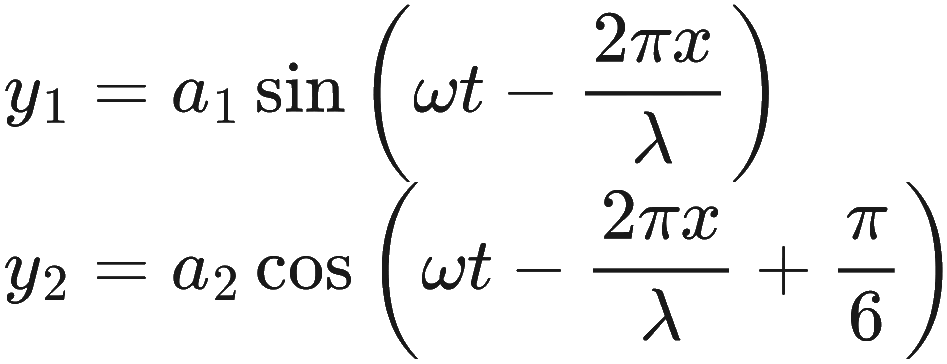
Two waves are represented as

Figureand

The path difference between two waves is

Show answer and solution

Answer: (c)

  1. From the figure: y1=a1sin⁡(ωt−2πxλ)y_1 = a_1\sin\left(\omega t - \frac{2\pi x}{\lambda}\right), y2=a2cos⁡(ωt−2πxλ+π6)y_2 = a_2\cos\left(\omega t - \frac{2\pi x}{\lambda} + \frac{\pi}{6}\right).
  2. y2=a2sin⁡(ωt−2πxλ+π6+π2)y_2 = a_2\sin\left(\omega t - \frac{2\pi x}{\lambda} + \frac{\pi}{6} + \frac{\pi}{2}\right), so Δϕ=2π3\Delta\phi = \frac{2\pi}{3}.
  3. Path difference =λ2π×2π3=λ3= \frac{\lambda}{2\pi} \times \frac{2\pi}{3} = \frac{\lambda}{3}
  4. So the answer is (c) λ3\frac{\lambda}{3}.
Report a mistake
Q100MHT CET 2026 · 16 APR · SHIFT 1Easy

Progressive Wave Equation · Phase difference and path difference

A progressive wave of frequency 50 Hz is travelling with velocity 350 m/s through a medium. The change in phase at given time interval of 0.01s is

Show answer and solution

Answer: (c)

  1. At a fixed point, phase changes with time as Δϕ=ω Δt=2πf Δt\Delta\phi = \omega\,\Delta t = 2\pi f\,\Delta t.
  2. Δϕ=2π×50×0.01=π\Delta\phi = 2\pi \times 50 \times 0.01 = \pi rad
  3. So the answer is (c) π\pi rad.
Report a mistake
Q101MHT CET 2026 · 15 APR · SHIFT 2Easy

Progressive Wave Equation · Phase difference and path difference

A simple harmonic progressive wave is represented by y=Asin⁡(120πt+3x)y = A\sin(120\pi t + 3x). The distance between two points on the wave at a phase difference of π3\frac{\pi}{3} radian is

Show answer and solution

Answer: (b)

  1. From y=Asin⁡(120πt+3x)y = A\sin(120\pi t + 3x): k=3 m−1k = 3\ \text{m}^{-1}.
  2. Δx=Δϕk=π/33=π9\Delta x = \frac{\Delta\phi}{k} = \frac{\pi/3}{3} = \frac{\pi}{9} m
  3. So the answer is (b) π9\frac{\pi}{9} m.
Report a mistake
Q102MHT CET 2026 · 13 APR · SHIFT 2Easy

Progressive Wave Equation · Phase difference and path difference

Two waves are represented by the equations, y1=asin⁡(ωt+kx+0.57)y_1 = a\sin(\omega t + kx + 0.57) m and y2=acos⁡(ωt+kx)y_2 = a\cos(\omega t + kx) m, where xx is in metre and tt is in second. What is the phase difference between them? (π=3.14\pi = 3.14)

Show answer and solution

Answer: (d)

  1. y2=acos⁡(ωt+kx)=asin⁡(ωt+kx+π2)=asin⁡(ωt+kx+1.57)y_2 = a\cos(\omega t + kx) = a\sin\left(\omega t + kx + \frac{\pi}{2}\right) = a\sin(\omega t + kx + 1.57)
  2. y1y_1 has phase constant 0.570.57, y2y_2 has 1.571.57.
  3. Δϕ=1.57−0.57=1.0\Delta\phi = 1.57 - 0.57 = 1.0 rad
  4. So the answer is (d) 1.01.0 radian.
Report a mistake
Q103MHT CET 2026 · 13 APR · SHIFT 2Easy

Progressive Wave Equation · Phase difference and path difference

The distance between two consecutive points with phase difference of 60∘60^\circ in a wave of frequency nn is xx meter. The velocity with which wave is traveling is

Show answer and solution

Answer: (d)

  1. 60∘=π360^\circ = \frac{\pi}{3} corresponds to Δx=λ6\Delta x = \frac{\lambda}{6}, so x=λ6x = \frac{\lambda}{6} and λ=6x\lambda = 6x.
  2. v=nλ=6nxv = n\lambda = 6nx
  3. So the answer is (d) 6nx6nx.
Report a mistake
Q104NEET 2026Easy

Progressive Wave Equation · Phase difference and path difference

For a travelling harmonic wave

y(x,t)=2.0cos⁡2π(10t−0.0080x+0.35)y(x, t) = 2.0\cos 2\pi(10t - 0.0080x + 0.35), where xx and yy are in cm and tt in s\text{s}. The phase difference between oscillatory motion of two points separated by a distance of 0.5 m is:

Show answer and solution

Answer: (b)

  1. k=2π×0.0080 cm−1k = 2\pi \times 0.0080\ \text{cm}^{-1} (xx in cm).
  2. Δx=0.5\Delta x = 0.5 m =50= 50 cm
  3. Δϕ=k Δx=2π×0.0080×50=0.8π\Delta\phi = k\,\Delta x = 2\pi \times 0.0080 \times 50 = 0.8\pi rad
  4. So the answer is (b) 0.8π0.8\pi rad.
Report a mistake
Q105MHT CET 2026 · 12 MAY · SHIFT 1Medium

Progressive Wave Equation · Particle velocity and wave velocity

A simple harmonic progressive wave is given by the equation y=asin⁡2π(nt−xλ)y = a\sin 2\pi\left(nt - \frac{x}{\lambda}\right). If the wave velocity is equal to 16×\frac{1}{6} \times (maximum particle velocity), then the wavelength λ\lambda is {a=\{a = amplitude, n=n = frequency, t=t = time, y=y = displacement, x=x = distance}\}

Show answer and solution

Answer: (b)

  1. Wave velocity v=nλv = n\lambda; maximum particle velocity =aω=2πna= a\omega = 2\pi n a
  2. nλ=16(2πna)⇒λ=πa3n\lambda = \frac{1}{6}(2\pi n a) \Rightarrow \lambda = \frac{\pi a}{3}
  3. So the answer is (b) πa3\frac{\pi a}{3}.
Report a mistake
Q106MHT CET 2026 · 15 MAY · SHIFT 1Medium

Progressive Wave Equation · Tension from the wave equation

A transverse wave is propagating on the string. The linear density of vibrating string is 10−310^{-3} kg/m. The equation of the wave is Y=0.05sin⁡(x+15t)Y = 0.05\sin(x + 15t) where xx and YY are in metre and time in second. The tension in the string is

Show answer and solution

Answer: (c)

  1. Wave speed v=ωk=151=15 m/sv = \frac{\omega}{k} = \frac{15}{1} = 15\text{ m/s}
  2. v=T/μ⇒T=μv2=10−3×225v = \sqrt{T/\mu} \Rightarrow T = \mu v^2 = 10^{-3} \times 225
  3. T=0.225 NT = 0.225\text{ N}
  4. So the answer is (c) 0.225 N.
Report a mistake
Q107MHT CET 2026 · 20 APR · SHIFT 2Medium

Progressive Wave Equation · Tension from the wave equation

The equation of a wave on a string of linear mass density 0.020.02 kg m−1^{-1} is

Y=0.01sin⁡[2π(t0.02−x0.50)]Y = 0.01\sin\left[2\pi\left(\frac{t}{0.02} - \frac{x}{0.50}\right)\right] m. The tension in the string is

Show answer and solution

Answer: (a)

  1. From the equation: Tperiod=0.02 sT_{period} = 0.02\text{ s} (f=50 Hzf = 50\text{ Hz}), λ=0.50 m\lambda = 0.50\text{ m}
  2. v=fλ=50×0.5=25 m/sv = f\lambda = 50 \times 0.5 = 25\text{ m/s}
  3. Tension =μv2=0.02×625=12.5 N= \mu v^2 = 0.02 \times 625 = 12.5\text{ N}
  4. So the answer is (a) 12.50 N.
Report a mistake
Q108MHT CET 2025 · 21 APR · SHIFT 2Easy

Progressive Wave Equation · Reading the wave equation

The equation of a progressive wave is Y=3sin⁡[π(t3−x5)+π4]Y = 3\sin\left[\pi\left(\frac{t}{3} - \frac{x}{5}\right) + \frac{\pi}{4}\right] where x and y are in meter and time in second. Which of the following is correct?

Show answer and solution

Answer: (a)

  1. ω=π3\omega = \dfrac{\pi}{3}, k=π5k = \dfrac{\pi}{5}, A=3 mA = 3\text{ m}.
  2. λ=2ππ/5=10 m\lambda = \dfrac{2\pi}{\pi/5} = 10\text{ m}; v=53 m/sv = \dfrac{5}{3}\text{ m/s}; f=16 Hzf = \dfrac{1}{6}\text{ Hz}
  3. So the answer is (a) wavelength =10 m= 10\text{ m}.
Report a mistake
Q109JEE Main 2025 · 4 APR · SHIFT 2Easy

Progressive Wave Equation · Reading the wave equation

Displacement of a wave is expressed as x(t)=5cos⁡(628t+π2)mx(t) = 5\cos\left(628t + \frac{\pi}{2}\right)\text{m}. The wavelength of the wave when its velocity is 300 m/s300\text{ m/s} is:

(π=3.14)(\pi = 3.14)

Show answer and solution

Answer: (c)

  1. ω=628 rad/s\omega = 628\text{ rad/s}, so f=6282×3.14=100 Hzf = \dfrac{628}{2 \times 3.14} = 100\text{ Hz}.
  2. λ=vf=300100=3 m\lambda = \dfrac{v}{f} = \dfrac{300}{100} = 3\text{ m}
  3. So the answer is (c) 3 m3\text{ m}.
Report a mistake
Q110JEE Main 2025 · 23 JAN · SHIFT 2Easy

Progressive Wave Equation · Reading the wave equation

The equation of a transverse wave travelling along a string is

y(x,t)=4.0sin⁡[20×10−3x+600t]mmy(x, t) = 4.0\sin\left[20 \times 10^{-3}x + 600t\right]\text{mm}, where xx is in mm and tt is in second. The velocity of the wave is:

Show answer and solution

Answer: (d)

  1. k=20×10−3 mm−1k = 20 \times 10^{-3}\text{ mm}^{-1}, ω=600 s−1\omega = 600\text{ s}^{-1}
  2. v=ωk=6000.02=3×104 mm/s=30 m/sv = \dfrac{\omega}{k} = \dfrac{600}{0.02} = 3 \times 10^{4}\text{ mm/s} = 30\text{ m/s}
  3. kxkx and ωt\omega t have the same sign, so the wave moves along −x-x.
  4. So the answer is (d) −30 m/s-30\text{ m/s}.
Report a mistake
Q111MHT CET 2025 · 23 APR · SHIFT 1Easy

Progressive Wave Equation · Particle velocity and wave velocity

A particle performs S.H.M. of amplitude 'A' and wavelength ' λ\lambda ', Then the velocity of the wave (V) and the maximum particle velocity (v) are related as

Show answer and solution

Answer: (c)

  1. Maximum particle velocity v=Aωv = A\omega; wave velocity V=ωk=ωλ2πV = \frac{\omega}{k} = \frac{\omega\lambda}{2\pi}.
  2. vV=Aωωλ/2π=2πAλ\frac{v}{V} = \frac{A\omega}{\omega\lambda/2\pi} = \frac{2\pi A}{\lambda}
  3. So the answer is (c) v=2πAλVv = \frac{2\pi A}{\lambda}V.
Report a mistake
Q112MHT CET 2025 · 22 APR · SHIFT 1Easy

Progressive Wave Equation · Particle velocity and wave velocity

The equation of wave is y=60sin⁡(1200t−6x)y = 60\sin(1200t - 6x), where ' yy ' is in micron, ' tt ' is in second and ' xx ' is in metre. The ratio of maximum particle velocity to the wave velocity of wave propagation is

Show answer and solution

Answer: (c)

  1. vmaxv=Aωω/k=Ak\frac{v_{max}}{v} = \frac{A\omega}{\omega/k} = Ak
  2. A=60 μm=6×10⁻⁵A = 60\ \mu\text{m} = 6 \times 10^{-5} m, k=6 m−1k = 6\ \text{m}^{-1}
  3. Ak=6×10−5×6=3.6×10⁻⁴Ak = 6 \times 10^{-5} \times 6 = 3.6 \times 10^{-4}
  4. So the answer is (c) 3.6×10−43.6 \times 10^{-4}.
Report a mistake
Q113MHT CET 2025 · 5 MAY · SHIFT 2Easy

Progressive Wave Equation · Phase difference and path difference

The distance between two consecutive points with phase difference of 45∘45^\circ in a wave of frequency 300 Hz is 4.0 m. The velocity of the travelling wave is (in km/s\text{km/s})

Show answer and solution

Answer: (d)

  1. 45∘=π445^\circ = \frac{\pi}{4} corresponds to Δx=λ8\Delta x = \frac{\lambda}{8}, so λ=8×4=32\lambda = 8 \times 4 = 32 m.
  2. v=fλ=300×32=9600v = f\lambda = 300 \times 32 = 9600 m/s
  3. So the answer is (d) 9.69.6 km/s.
Report a mistake
Q114MHT CET 2025 · 19 APR · SHIFT 2Easy

Progressive Wave Equation · Phase difference and path difference

A progressive wave of frequency 400 Hz is travelling with velocity 336 m/s336\text{ m/s}. How far apart are the two points on a wave which are 60∘60^\circ out of phase?

Show answer and solution

Answer: (b)

  1. λ=vf=336400=0.84\lambda = \frac{v}{f} = \frac{336}{400} = 0.84 m
  2. 60∘60^\circ out of phase means Δx=λ6=0.846=0.14\Delta x = \frac{\lambda}{6} = \frac{0.84}{6} = 0.14 m
  3. So the answer is (b) 0.140.14 m.
Report a mistake
Q115JEE Main 2025 · 7 APR · SHIFT 2Easy

Progressive Wave Equation · Phase difference and path difference

The equation of a wave travelling on a string is y = sin[20πx + 10πt], where x and t are distance and time in SI units. The minimum distance between two points having the same oscillating speed is:

Show answer and solution

Answer: (d)

  1. k=20π m−1⇒λ=2πk=0.1 m=10 cmk = 20\pi\text{ m}^{-1} \Rightarrow \lambda = \frac{2\pi}{k} = 0.1\text{ m} = 10\text{ cm}
  2. Particle speed ∝∣cos⁡(20πx+10πt)∣\propto |\cos(20\pi x + 10\pi t)|, which repeats when the phase changes by π\pi.
  3. Phase difference π\pi corresponds to Δx=λ2=5 cm\Delta x = \frac{\lambda}{2} = 5\text{ cm}
  4. So the answer is (d) 5.0 cm.
Report a mistake
Q116JEE Main 2025 · 2 APR · SHIFT 2Medium

Progressive Wave Equation · Writing the wave equation and its direction

A sinusoidal wave of wavelength 7.5 cm travels a distance of 1.2 cm along the xx-direction in 0.3 sec. The crest P is at x=0x = 0 at t=0 sect = 0\text{ sec} and maximum displacement of the wave is 2 cm. Which equation correctly represents this wave?

Show answer and solution

Answer: (a)

  1. v=1.20.3=4 cm/sv = \frac{1.2}{0.3} = 4\text{ cm/s}, k=2π7.5=0.83 cm−1k = \frac{2\pi}{7.5} = 0.83\text{ cm}^{-1}
  2. ω=kv=0.838×4≈3.35 rad/s\omega = kv = 0.838 \times 4 \approx 3.35\text{ rad/s}
  3. Crest at x=0x = 0, t=0t = 0 means y=Ay = A there, so use cosine; travelling along +x+x gives (kx−ωt)(kx - \omega t).
  4. So the answer is (a) y=2cos⁡(0.83x−3.35t) cmy = 2\cos(0.83x - 3.35t)\text{ cm}.
Report a mistake
Q117MHT CET 2025 · 21 APR · SHIFT 2Medium

Progressive Wave Equation · Tension from the wave equation

A transverse displacement of vibrating string is y=0.06sin⁡(2π3x)cos⁡(120πt)y = 0.06\sin\left(\frac{2\pi}{3}x\right)\cos(120\pi t).

If the mass per unit length of a string is 4×10⁻² kg/m4 \times 10^{-2}\text{ kg/m}, then the tension in the string will be

Show answer and solution

Answer: (a)

  1. Stationary wave: k=2π3 m−1k = \frac{2\pi}{3}\text{ m}^{-1}, ω=120π rad/s\omega = 120\pi\text{ rad/s}
  2. Speed of component waves v=ωk=120π×32π=180 m/sv = \frac{\omega}{k} = \frac{120\pi \times 3}{2\pi} = 180\text{ m/s}
  3. T=μv2=4×10−2×32400=1296 NT = \mu v^2 = 4\times10^{-2} \times 32400 = 1296\text{ N}
  4. So the answer is (a) 1296 N.
Report a mistake
Q118MHT CET 2024 · 15 MAY · SHIFT 2Easy

Progressive Wave Equation · Reading the wave equation

A wave is given by Y=3sin⁡2π(t0.04−x0.01)Y = 3\sin 2\pi\left(\frac{t}{0.04} - \frac{x}{0.01}\right) where Y is in cm. Frequency of the wave and maximum acceleration will be (π2=10)(\pi^2 = 10)

Show answer and solution

Answer: (d)

  1. Compare with Y=Asin⁡2π(tT−xλ)Y = A\sin 2\pi\left(\dfrac{t}{T} - \dfrac{x}{\lambda}\right): T=0.04 sT = 0.04\text{ s}, f=25 Hzf = 25\text{ Hz}, A=3 cmA = 3\text{ cm}.
  2. ω=2πf=50π rad/s\omega = 2\pi f = 50\pi\text{ rad/s}
  3. amax=ω2A=2500π2×3=2500×10×3=7.5×104 cm/s2a_{max} = \omega^2 A = 2500\pi^2 \times 3 = 2500 \times 10 \times 3 = 7.5 \times 10^{4}\text{ cm/s}^2
  4. So the answer is (d) 25 Hz25\text{ Hz}, 7.5×104 cm/s27.5 \times 10^{4}\text{ cm/s}^2.
Report a mistake
Q119NEET 2024Easy

Progressive Wave Equation · Reading the wave equation

The displacement of a travelling wave y=Csin⁡2πλ(at−x)y = C\sin\frac{2\pi}{\lambda}(at - x) where tt is time, xx is distance and λ\lambda is the wavelength, all in S.I. units. Then the frequency of the wave is

Show answer and solution

Answer: (d)

  1. y=Csin⁡(2πaλt−2πλx)y = C\sin\left(\dfrac{2\pi a}{\lambda}t - \dfrac{2\pi}{\lambda}x\right), so ω=2πaλ\omega = \dfrac{2\pi a}{\lambda}.
  2. f=ω2π=aλf = \dfrac{\omega}{2\pi} = \dfrac{a}{\lambda}
  3. So the answer is (d) aλ\dfrac{a}{\lambda}.
Report a mistake
Q120JEE Main 2024 · 8 APR · SHIFT 2Easy

Progressive Wave Equation · Reading the wave equation

A plane progressive wave is given by y=2cos⁡2π(330t−x)my = 2\cos 2\pi(330t - x)\text{m}. The frequency of the wave is:

Show answer and solution

Answer: (c)

  1. y=2cos⁡(2π⋅330 t−2πx)y = 2\cos(2\pi \cdot 330\, t - 2\pi x), so ω=2π×330\omega = 2\pi \times 330.
  2. f=ω2π=330 Hzf = \dfrac{\omega}{2\pi} = 330\text{ Hz}
  3. So the answer is (c) 330 Hz330\text{ Hz}.
Report a mistake
Q121MHT CET 2024 · 3 MAY · SHIFT 1Easy

Progressive Wave Equation · Writing the wave equation and its direction

The displacement of a wave is given by y=0.002sin⁡(100t+x)y = 0.002\sin(100t + x) where ' xx 'and ' yy ' are in metre and ' tt ' is in second. This represents a wave

Show answer and solution

Answer: (b)

  1. ω=100 rad/s\omega = 100\text{ rad/s}, k=1 m−1k = 1\text{ m}^{-1}
  2. λ=2π m\lambda = 2\pi\text{ m} (not 1 m); f=1002π=50π Hzf = \dfrac{100}{2\pi} = \dfrac{50}{\pi}\text{ Hz} (not 100π\dfrac{100}{\pi})
  3. v=ωk=100 m/sv = \dfrac{\omega}{k} = 100\text{ m/s}, and (ωt+kx)(\omega t + kx) means motion along −x-x.
  4. So the answer is (b) 100 m/s100\text{ m/s} in the negative xx-direction.
Report a mistake
Q122MHT CET 2024 · 15 MAY · SHIFT 2Easy

Progressive Wave Equation · Phase difference and path difference

Velocity of sound waves in air is 330 m/s330\text{ m/s}. For a particular sound wave in air, path difference of 40 cm is equivalent to phase difference of 1.6π1.6\pi. frequency of this wave is

Show answer and solution

Answer: (c)

  1. Δϕ=2πλΔx⇒1.6π=2π×0.4λ\Delta\phi = \frac{2\pi}{\lambda}\Delta x \Rightarrow 1.6\pi = \frac{2\pi \times 0.4}{\lambda}
  2. λ=0.81.6=0.5\lambda = \frac{0.8}{1.6} = 0.5 m
  3. f=vλ=3300.5=660f = \frac{v}{\lambda} = \frac{330}{0.5} = 660 Hz
  4. So the answer is (c) 660 Hz.
Report a mistake
Q123MHT CET 2024 · 9 MAY · SHIFT 2Easy

Progressive Wave Equation · Phase difference and path difference

The diagram shows the propagation of a progressive wave. A, B, C, D, E are five points on this wave

Figure

Which of the following points are in the same state of vibration?

Show answer and solution

Answer: (d)

  1. Points in the same state of vibration have the same displacement and the same direction of motion (phase difference 2πn2\pi n).
  2. B and E both have the same positive displacement and both lie on the falling side of a crest.
  3. B and E are two full wavelengths apart, so they are in phase.
  4. So the answer is (d) E, B.
Report a mistake
Q124MHT CET 2024 · 4 MAY · SHIFT 2Easy

Progressive Wave Equation · Phase difference and path difference

A transverse wave travelling along a stretched string has a speed of 30 m/s30\text{ m/s} and a frequency of 250 Hz. The phase difference between two points on the string 10 cm apart at the same instant is

Show answer and solution

Answer: (c)

  1. λ=vf=30250=0.12\lambda = \frac{v}{f} = \frac{30}{250} = 0.12 m
  2. Δϕ=2πλΔx=2π×0.100.12=5π3\Delta\phi = \frac{2\pi}{\lambda}\Delta x = \frac{2\pi \times 0.10}{0.12} = \frac{5\pi}{3} rad
  3. So the answer is (c) (5π3)c\left(\frac{5\pi}{3}\right)^c.
Report a mistake
Q125MHT CET 2024 · 4 MAY · SHIFT 1Easy

Progressive Wave Equation · Phase difference and path difference

The distance between two consecutive points with phase difference of 60∘60^\circ in wave of frequency 500 Hz is 0.6 m. The velocity with which wave is travelling is

Show answer and solution

Answer: (a)

  1. 60∘60^\circ phase difference means Δx=λ6\Delta x = \frac{\lambda}{6}, so λ=6×0.6=3.6\lambda = 6 \times 0.6 = 3.6 m.
  2. v=fλ=500×3.6=1800v = f\lambda = 500 \times 3.6 = 1800 m/s
  3. So the answer is (a) 1.81.8 km/s.
Report a mistake
Q126MHT CET 2024 · 4 MAY · SHIFT 1Easy

Progressive Wave Equation · Phase difference and path difference

A progressive wave of frequency 400 Hz is travelling with a velocity 336 m/s336\text{ m/s}. How far apart are the two points which are 60∘60^\circ out of phase?

Show answer and solution

Answer: (a)

  1. λ=vf=336400=0.84\lambda = \frac{v}{f} = \frac{336}{400} = 0.84 m
  2. Δx=λ6=0.14\Delta x = \frac{\lambda}{6} = 0.14 m for 60∘60^\circ
  3. So the answer is (a) 0.14 m.
Report a mistake
Q127MHT CET 2024 · 3 MAY · SHIFT 1Easy

Progressive Wave Equation · Phase difference and path difference

The path difference between two waves Y1=a1sin⁡(ωt−2πxλ)Y_1 = a_1\sin\left(\omega t - \frac{2\pi x}{\lambda}\right) and Y2=a2cos⁡(ωt−2πxλ+ϕ)Y_2 = a_2\cos\left(\omega t - \frac{2\pi x}{\lambda} + \phi\right) is

Show answer and solution

Answer: (b)

  1. Y2=a2cos⁡(θ+ϕ)=a2sin⁡(θ+ϕ+π2)Y_2 = a_2\cos(\theta + \phi) = a_2\sin\left(\theta + \phi + \frac{\pi}{2}\right) with θ=ωt−2πxλ\theta = \omega t - \frac{2\pi x}{\lambda}.
  2. Phase difference =ϕ+π2= \phi + \frac{\pi}{2}
  3. Path difference =λ2π(ϕ+π2)= \frac{\lambda}{2\pi}\left(\phi + \frac{\pi}{2}\right)
  4. So the answer is (b).
Report a mistake
Q128MHT CET 2024 · 2 MAY · SHIFT 1Easy

Progressive Wave Equation · Phase difference and path difference

Two simple harmonic progressive waves have displacements y1=a1sin⁡(2πxλ−ωt)y_1 = a_1\sin\left(\frac{2\pi x}{\lambda} - \omega t\right) and y2=a2cos⁡(2πxλ−ωt+ϕ)y_2 = a_2\cos\left(\frac{2\pi x}{\lambda} - \omega t + \phi\right) What is the phase difference between two waves?

Show answer and solution

Answer: (a)

  1. Let θ=2πxλ−ωt\theta = \frac{2\pi x}{\lambda} - \omega t; then y1=a1sin⁡θy_1 = a_1\sin\theta.
  2. y2=a2cos⁡(θ+ϕ)=a2sin⁡(θ+ϕ+π2)y_2 = a_2\cos(\theta + \phi) = a_2\sin\left(\theta + \phi + \frac{\pi}{2}\right)
  3. Phase difference =ϕ+π2= \phi + \frac{\pi}{2}
  4. So the answer is (a).
Report a mistake
Q129MHT CET 2024 · 2 MAY · SHIFT 1Easy

Progressive Wave Equation · Phase difference and path difference

Velocity of sound waves in air is 330 m/s330\text{ m/s}. For a particular sound wave in air, path difference of 40 cm is equivalent to phase difference of 1.6π1.6\pi. The frequency of this wave is

Show answer and solution

Answer: (c)

  1. Δϕ=2πλΔx⇒1.6π=2π×0.4λ\Delta\phi = \frac{2\pi}{\lambda}\Delta x \Rightarrow 1.6\pi = \frac{2\pi \times 0.4}{\lambda}, so λ=0.5\lambda = 0.5 m.
  2. f=vλ=3300.5=660f = \frac{v}{\lambda} = \frac{330}{0.5} = 660 Hz
  3. So the answer is (c) 660 Hz.
Report a mistake
Q130MHT CET 2024 · 15 MAY · SHIFT 2Medium

Progressive Wave Equation · Tension from the wave equation

A string has mass per unit length of 10−6 kg/cm10^{-6}\text{ kg/cm} The equation of simple harmonic wave produced in it is Y=0.2sin⁡(2x+80t) mY = 0.2\sin(2x + 80t)\text{ m}. The tension in the string is

Show answer and solution

Answer: (a)

  1. μ=10−6 kg/cm=10−4 kg/m\mu = 10^{-6}\text{ kg/cm} = 10^{-4}\text{ kg/m}
  2. v=ωk=802=40 m/sv = \frac{\omega}{k} = \frac{80}{2} = 40\text{ m/s}
  3. T=μv2=10−4×1600=0.16 NT = \mu v^2 = 10^{-4} \times 1600 = 0.16\text{ N}
  4. So the answer is (a) 0.16 N.
Report a mistake
Q131MHT CET 2023 · 12 MAY · SHIFT 2Easy

Progressive Wave Equation · Reading the wave equation

The equation of wave motion is Y=5sin⁡(10πt−0.02πx+π/3)Y = 5\sin(10\pi t - 0.02\pi x + \pi/3) where xx is in metre and tt in second. The velocity of the wave is

Show answer and solution

Answer: (c)

  1. ω=10π\omega = 10\pi, k=0.02πk = 0.02\pi
  2. v=ωk=10π0.02π=500 m/sv = \dfrac{\omega}{k} = \dfrac{10\pi}{0.02\pi} = 500\text{ m/s}
  3. So the answer is (c) 500 m/s500\text{ m/s}.
Report a mistake
Q132MHT CET 2023 · 10 MAY · SHIFT 2Easy

Progressive Wave Equation · Reading the wave equation

The equation of wave is Y=6sin⁡(12πt−0.02πx+π3)Y = 6\sin\left(12\pi t - 0.02\pi x + \frac{\pi}{3}\right) where 'xx' is in m\text{m} and 'tt' in s\text{s}. The velocity of the wave is

Show answer and solution

Answer: (d)

  1. ω=12π\omega = 12\pi, k=0.02πk = 0.02\pi
  2. v=ωk=12π0.02π=600 m/sv = \dfrac{\omega}{k} = \dfrac{12\pi}{0.02\pi} = 600\text{ m/s}
  3. So the answer is (d) 600 m/s600\text{ m/s}.
Report a mistake
Q133JEE Main 2023 · 24 JAN · SHIFT 1Easy

Progressive Wave Equation · Reading the wave equation

A travelling wave is described by the equation

y(x,t)=[0.05sin⁡(8x−4t)]y(x, t) = [0.05\sin(8x - 4t)] m

The velocity of the wave is: [all the quantities are in SI unit]

Show answer and solution

Answer: (d)

  1. k=8 m−1k = 8\text{ m}^{-1}, ω=4 rad/s\omega = 4\text{ rad/s}
  2. v=ωk=48=0.5 m/sv = \dfrac{\omega}{k} = \dfrac{4}{8} = 0.5\text{ m/s}
  3. So the answer is (d) 0.5 m s−10.5\text{ m s}^{-1}.
Report a mistake
Q134JEE Main 2023 · 11 APR · SHIFT 1Easy

Progressive Wave Equation · Reading the wave equation

The equation of wave is given by

Y=10−2sin⁡2π(160t−0.5x+π/4)Y = 10^{-2}\sin 2\pi(160t - 0.5x + \pi/4)

where xx and YY are in m\text{m} and tt in s\text{s}. The speed of the wave is ________ km h−1\text{km h}^{-1}.

Numerical answer type. Work it out, then open the answer.

Show answer and solution

Answer: 1152

  1. Y=10−2sin⁡(2π⋅160 t−2π⋅0.5 x+… )Y = 10^{-2}\sin(2\pi \cdot 160\, t - 2\pi \cdot 0.5\, x + \dots): ω=320π\omega = 320\pi, k=πk = \pi.
  2. v=ωk=320 m/sv = \dfrac{\omega}{k} = 320\text{ m/s}
  3. 320×185=1152 km/h320 \times \dfrac{18}{5} = 1152\text{ km/h}
  4. So the answer is 1152 km h−11152\text{ km h}^{-1}.
Report a mistake
Q135JEE Main 2023 · 10 APR · SHIFT 1Easy

Progressive Wave Equation · Reading the wave equation

A transverse harmonic wave on a string is given by

y(x,t)=5sin⁡(6t+0.003x)y(x, t) = 5\sin(6t + 0.003x)

where x and y are in cm and t in sec. The wave velocity is _______________ ms−1-1.

Numerical answer type. Work it out, then open the answer.

Show answer and solution

Answer: 20

  1. ω=6 rad/s\omega = 6\text{ rad/s}, k=0.003 cm−1k = 0.003\text{ cm}^{-1}
  2. v=ωk=60.003=2000 cm/sv = \dfrac{\omega}{k} = \dfrac{6}{0.003} = 2000\text{ cm/s}
  3. So the answer is 20 m s−120\text{ m s}^{-1}.
Report a mistake
Q136MHT CET 2023 · 13 MAY · SHIFT 2Easy

Progressive Wave Equation · Particle velocity and wave velocity

The equation of a progressive wave is Y=asin⁡2π(nt−x5)Y = a\sin 2\pi\left(nt - \frac{x}{5}\right). The ratio of maximum particle velocity to wave velocity is

Show answer and solution

Answer: (b)

  1. Y=asin⁡(2πnt−2π5x)Y = a\sin\left(2\pi n t - \frac{2\pi}{5}x\right), so k=2π5k = \frac{2\pi}{5}.
  2. vmaxv=aωω/k=ak=2πa5\frac{v_{max}}{v} = \frac{a\omega}{\omega/k} = ak = \frac{2\pi a}{5}
  3. So the answer is (b) 2πa5\frac{2\pi a}{5}.
Report a mistake
Q137MHT CET 2023 · 14 MAY · SHIFT 1Easy

Progressive Wave Equation · Phase difference and path difference

A progressive wave is given by, Y=12sin⁡(5t−4x)Y = 12\sin(5t - 4x). On this wave, how far away are the two points having a phase difference of 90∘90^\circ?

Show answer and solution

Answer: (b)

  1. From Y=12sin⁡(5t−4x)Y = 12\sin(5t - 4x): k=4k = 4.
  2. 90∘=π290^\circ = \frac{\pi}{2}, so Δx=Δϕk=π/24=π8\Delta x = \frac{\Delta\phi}{k} = \frac{\pi/2}{4} = \frac{\pi}{8}
  3. So the answer is (b) π8\frac{\pi}{8}.
Report a mistake
Q138MHT CET 2023 · 12 MAY · SHIFT 1Easy

Progressive Wave Equation · Phase difference and path difference

The displacement of two sinusoidal waves is given by the equation

y1=8sin⁡(20x−30t)y2=8sin⁡(25x−40t)\begin{matrix} y_1 = 8\sin(20x - 30t) \\ y_2 = 8\sin(25x - 40t) \end{matrix}

then the phase difference between the waves after time t=2 st = 2\text{ s} and distance x=5 cmx = 5\text{ cm} will be

Show answer and solution

Answer: (d)

  1. Phases: ϕ1=20x−30t\phi_1 = 20x - 30t, ϕ2=25x−40t\phi_2 = 25x - 40t.
  2. Δϕ=ϕ2−ϕ1=5x−10t\Delta\phi = \phi_2 - \phi_1 = 5x - 10t (magnitude taken).
  3. With x=5x = 5 and t=2t = 2: Δϕ=25−20=5\Delta\phi = 25 - 20 = 5 rad
  4. So the answer is (d) 5 radian.
Report a mistake
Q139MHT CET 2023 · 11 MAY · SHIFT 2Easy

Progressive Wave Equation · Phase difference and path difference

The path difference between two waves, represented by y1=a1sin⁡(ωt−2πxλ)y_1 = a_1\sin\left(\omega t - \frac{2\pi x}{\lambda}\right) and y2=a2cos⁡(ωt−2πxλ+ϕ)y_2 = a_2\cos\left(\omega t - \frac{2\pi x}{\lambda} + \phi\right) is

Show answer and solution

Answer: (b)

  1. y2=a2cos⁡(θ+ϕ)=a2sin⁡(θ+ϕ+π2)y_2 = a_2\cos(\theta + \phi) = a_2\sin\left(\theta + \phi + \frac{\pi}{2}\right) with θ=ωt−2πxλ\theta = \omega t - \frac{2\pi x}{\lambda}.
  2. Phase difference =ϕ+π2= \phi + \frac{\pi}{2}
  3. Path difference =λ2π(ϕ+π2)= \frac{\lambda}{2\pi}\left(\phi + \frac{\pi}{2}\right)
  4. So the answer is (b).
Report a mistake
Q140JEE Main 2023 · 25 JAN · SHIFT 1Easy

Progressive Wave Equation · Phase difference and path difference

The distance between two consecutive points with phase difference of 60∘^\circ in a wave of frequency 500 Hz is 6.0 m. The velocity with which wave is travelling is __________ km/s

Numerical answer type. Work it out, then open the answer.

Show answer and solution

Answer: 18

  1. Δx=λ2πΔϕ\Delta x = \frac{\lambda}{2\pi}\Delta\phi with Δϕ=π3\Delta\phi = \frac{\pi}{3} gives Δx=λ6\Delta x = \frac{\lambda}{6}
  2. λ6=6.0 m⇒λ=36 m\frac{\lambda}{6} = 6.0\text{ m} \Rightarrow \lambda = 36\text{ m}
  3. v=fλ=500×36=18000 m/sv = f\lambda = 500 \times 36 = 18000\text{ m/s}
  4. So v=18 km/sv = 18\text{ km/s}.
Report a mistake
Q141MHT CET 2023 · 11 MAY · SHIFT 1Medium

Progressive Wave Equation · Reading the wave equation

A transverse wave Y=2sin⁡(0.01x+30t)Y = 2\sin(0.01x + 30t) moves on a stretched string from one end to another end in 0.5 second. If xx and yy are in cm\text{cm} and tt in second, then the length of the string is

Show answer and solution

Answer: (c)

  1. Wave speed v=ωk=300.01=3000 cm/s=30 m/sv = \frac{\omega}{k} = \frac{30}{0.01} = 3000\text{ cm/s} = 30\text{ m/s}
  2. Length L=vt=30×0.5=15 mL = v t = 30 \times 0.5 = 15\text{ m}
  3. So the answer is (c) 15 m.
Report a mistake
Q142MHT CET 2023 · 11 MAY · SHIFT 2Medium

Progressive Wave Equation · Particle velocity and wave velocity

A transverse wave in a medium is given by y=Asin⁡2(ωt−kx)y = A\sin 2(\omega t - kx). It is found that the magnitude of the maximum velocity of particles in the medium is equal to that of the wave velocity. What is the value of AA?

Show answer and solution

Answer: (d)

  1. y=Asin⁡(2ωt−2kx)y = A\sin(2\omega t - 2kx): maximum particle velocity =2ωA= 2\omega A
  2. Wave velocity =2ω2k=ωk= \frac{2\omega}{2k} = \frac{\omega}{k}
  3. 2ωA=ωk⇒A=12k2\omega A = \frac{\omega}{k} \Rightarrow A = \frac{1}{2k}; with k=2πλk = \frac{2\pi}{\lambda}, A=λ4πA = \frac{\lambda}{4\pi}
  4. So the answer is (d) λ4π\frac{\lambda}{4\pi}.
Report a mistake
Q143MHT CET 2023 · 9 MAY · SHIFT 2Medium

Progressive Wave Equation · Particle velocity and wave velocity

The equation of simple harmonic progressive wave is given by y=asin⁡2π(bt−cx)y = a\sin 2\pi(bt - cx). The maximum particle velocity will be half the wave velocity, if c=c =

Show answer and solution

Answer: (b)

  1. y=asin⁡(2πbt−2πcx)y = a\sin(2\pi b t - 2\pi c x): vp,max⁡=2πbav_{p,\max} = 2\pi b a, wave velocity v=2πb2πc=bcv = \frac{2\pi b}{2\pi c} = \frac{b}{c}
  2. 2πba=12⋅bc⇒c=14πa2\pi b a = \frac{1}{2}\cdot\frac{b}{c} \Rightarrow c = \frac{1}{4\pi a}
  3. So the answer is (b) 14πa\frac{1}{4\pi a}.
Report a mistake
Q144MHT CET 2023 · 14 MAY · SHIFT 1Medium

Progressive Wave Equation · Phase difference and path difference

The equation of the wave is Y=10sin⁡(2πt30+α)Y = 10\sin\left(\frac{2\pi t}{30} + \alpha\right) If the displacement is 5 cm5\text{ cm} at t=0t = 0 then the total phase at t=7.5 st = 7.5\text{ s} will be (sin⁡30∘=0.5)(\sin 30^\circ = 0.5)

Show answer and solution

Answer: (d)

  1. At t=0t = 0: 10sin⁡α=5⇒α=π610\sin\alpha = 5 \Rightarrow \alpha = \frac{\pi}{6}
  2. Phase at t=7.5 st = 7.5\text{ s}: 2π(7.5)30+π6=π2+π6\frac{2\pi(7.5)}{30} + \frac{\pi}{6} = \frac{\pi}{2} + \frac{\pi}{6}
  3. =2π3 rad= \frac{2\pi}{3}\text{ rad}
  4. So the answer is (d) 2π3 rad\frac{2\pi}{3}\text{ rad}.
Report a mistake
Q145JEE Main 2022 · 28 JUL · SHIFT 1Easy

Progressive Wave Equation · Reading the wave equation

In the wave equation

y=0.5sin⁡2πλ(400t−x) my = 0.5\sin\frac{2\pi}{\lambda}(400t - x)\text{ m}

the velocity of the wave will be:

Show answer and solution

Answer: (c)

  1. Compare with y=Asin⁡2πλ(vt−x)y = A\sin\dfrac{2\pi}{\lambda}(vt - x).
  2. So v=400 m/sv = 400\text{ m/s}.
  3. So the answer is (c) 400 m/s400\text{ m/s}.
Report a mistake
Q146JEE Main 2022 · 30 JUN · SHIFT 1Easy

Progressive Wave Equation · Writing the wave equation and its direction

Which of the following equations correctly represents a travelling wave having wavelength λ\lambda = 4.0 cm, frequency ν\nu = 100 Hz and travelling in positive x-axis direction?

Show answer and solution

Answer: (d)

  1. k=2πλ=2π4=0.5π cm−1k = \dfrac{2\pi}{\lambda} = \dfrac{2\pi}{4} = 0.5\pi\text{ cm}^{-1}
  2. ω=2πν=200π s−1\omega = 2\pi\nu = 200\pi\text{ s}^{-1}
  3. y=Asin⁡(0.5πx−200πt)=Asin⁡π[(0.5)x−(200)t]y = A\sin(0.5\pi x - 200\pi t) = A\sin\pi[(0.5)x - (200)t]
  4. So the answer is (d).
Report a mistake
Q147JEE Main 2022 · 26 JUL · SHIFT 2Medium

Progressive Wave Equation · Particle velocity and wave velocity

A transverse wave is represented by y=2sin⁡(ωt−kx) cmy = 2\sin(\omega t - kx)\text{ cm}. The value of wavelength (in cm\text{cm}) for which the wave velocity becomes equal to the maximum particle velocity, will be:

Show answer and solution

Answer: (a)

  1. Wave velocity ωk=ωλ2π\frac{\omega}{k} = \frac{\omega\lambda}{2\pi}; maximum particle velocity =Aω= A\omega
  2. Equal when λ=2πA=2π(2)=4π cm\lambda = 2\pi A = 2\pi(2) = 4\pi\text{ cm}
  3. So the answer is (a) 4π4\pi.
Report a mistake
Q148JEE Main 2022 · 29 JUN · SHIFT 1Medium

Progressive Wave Equation · Particle velocity and wave velocity

A longitudinal wave is represented by x=10sin⁡2π(nt−xλ)x = 10\sin 2\pi\left(nt - \frac{x}{\lambda}\right) cm. The maximum particle velocity will be four times the wave velocity if the determined value of wavelength is equal to:

Show answer and solution

Answer: (b)

  1. Wave velocity v=nλv = n\lambda; maximum particle velocity =2πn(10) cm/s= 2\pi n (10)\text{ cm/s}
  2. 20πn=4nλ⇒λ=5π cm20\pi n = 4 n\lambda \Rightarrow \lambda = 5\pi\text{ cm}
  3. So the answer is (b) 5π5\pi.
Report a mistake
Q149MHT CET 2021 · 21 SEP · SHIFT 2Easy

Progressive Wave Equation · Reading the wave equation

Equation of two simple harmonic waves are given by Y1=2sin⁡8π(t0.2−x2)mY_1 = 2\sin 8\pi\left(\frac{t}{0.2} - \frac{x}{2}\right)\text{m} and Y2=4sin⁡8π(t0.16−x1.6)mY_2 = 4\sin 8\pi\left(\frac{t}{0.16} - \frac{x}{1.6}\right)\text{m} then both waves have

Show answer and solution

Answer: (d)

  1. Y1Y_1: ω1=8π0.2=40π\omega_1 = \dfrac{8\pi}{0.2} = 40\pi, k1=8π2=4πk_1 = \dfrac{8\pi}{2} = 4\pi, so v1=10 m/sv_1 = 10\text{ m/s}.
  2. Y2Y_2: ω2=8π0.16=50π\omega_2 = \dfrac{8\pi}{0.16} = 50\pi, k2=8π1.6=5πk_2 = \dfrac{8\pi}{1.6} = 5\pi, so v2=10 m/sv_2 = 10\text{ m/s}.
  3. Periods, frequencies and wavelengths differ; speeds are equal.
  4. So the answer is (d) same velocity.
Report a mistake
Q150JEE Main 2021 · 24 FEB · SHIFT 2Easy

Progressive Wave Equation · Writing the wave equation and its direction

Which of the following equations represents a travelling wave?

Show answer and solution

Answer: (c)

  1. A travelling wave has the form f(kx±ωt)f(kx \pm \omega t), a single function of a combination of xx and tt.
  2. Asin⁡(15x−2t)A\sin(15x - 2t) has this form, moving along +x+x with v=215v = \dfrac{2}{15}.
  3. Asin⁡xcos⁡ωtA\sin x\cos\omega t is a stationary wave; the others do not depend on xx and tt only through (x±vt)(x \pm vt).
  4. So the answer is (c) y=Asin⁡(15x−2t)y = A\sin(15x - 2t).
Report a mistake
Q151MHT CET 2021 · 24 SEP · SHIFT 2Easy

Progressive Wave Equation · Phase difference and path difference

Velocity of sound waves in air is 'VV' m/s\text{m/s}. For a particular sound wave in air, path difference of 'x' cm\text{cm} is equivalent to phase difference nπn\pi. The frequency of this wave is

Show answer and solution

Answer: (c)

  1. Δϕ=2πλΔx⇒nπ=2πxλ\Delta\phi = \frac{2\pi}{\lambda}\Delta x \Rightarrow n\pi = \frac{2\pi x}{\lambda}
  2. λ=2xn\lambda = \frac{2x}{n}
  3. f=Vλ=Vn2xf = \frac{V}{\lambda} = \frac{Vn}{2x}
  4. So the answer is (c) Vn2x\frac{Vn}{2x}.
Report a mistake
Q152MHT CET 2021 · 23 SEP · SHIFT 1Easy

Progressive Wave Equation · Phase difference and path difference

Two waves are represented by the equation, y1=Asin⁡(ωt+kx+0.57)my_1 = A\sin(\omega t + kx + 0.57)\text{m} and y2=Acos⁡(ωt+kx)my_2 = A\cos(\omega t + kx)\text{m}, where xx is in metre and tt is in second. What is the phase difference between them?

Show answer and solution

Answer: (b)

  1. y2=Acos⁡(ωt+kx)=Asin⁡(ωt+kx+1.57)y_2 = A\cos(\omega t + kx) = A\sin(\omega t + kx + 1.57) since π2≈1.57\frac{\pi}{2} \approx 1.57.
  2. Δϕ=1.57−0.57=1.0\Delta\phi = 1.57 - 0.57 = 1.0 rad
  3. So the answer is (b) 1.0 radian.
Report a mistake
Q153MHT CET 2021 · 22 SEP · SHIFT 2Easy

Progressive Wave Equation · Phase difference and path difference

A sound wave of frequency 160 Hz160\text{ Hz} has a velocity of 320 m/s320\text{ m/s}. When it travels through air, the particles having a phase difference of 90∘90^\circ, are separated by a distance of

Show answer and solution

Answer: (a)

  1. λ=vf=320160=2\lambda = \frac{v}{f} = \frac{320}{160} = 2 m
  2. 90∘90^\circ phase difference means Δx=λ4=0.5\Delta x = \frac{\lambda}{4} = 0.5 m
  3. So the answer is (a) 50 cm.
Report a mistake
Q154MHT CET 2021 · 22 SEP · SHIFT 1Easy

Progressive Wave Equation · Phase difference and path difference

A sound wave is travelling with a frequency of 50 Hz50\text{ Hz}. The phase difference between the two points in the path of a wave is π3\frac{\pi}{3}. The distance between those two points is (Velocity of sound in air =330 m/s= 330\text{ m/s})

Show answer and solution

Answer: (a)

  1. λ=vf=33050=6.6\lambda = \frac{v}{f} = \frac{330}{50} = 6.6 m
  2. Δϕ=π3\Delta\phi = \frac{\pi}{3} means Δx=λ6=6.66=1.1\Delta x = \frac{\lambda}{6} = \frac{6.6}{6} = 1.1 m
  3. So the answer is (a) 1.1 m.
Report a mistake
Q155MHT CET 2021 · 21 SEP · SHIFT 1Easy

Progressive Wave Equation · Phase difference and path difference

A progressive wave of frequency 50 Hz is travelling with velocity 350 m/s through a medium. The change in phase at a given time interval of 0.01 second is

Figure

Show answer and solution

Answer: (c)

  1. At a fixed point, phase changes with time as Δϕ=2πf Δt\Delta\phi = 2\pi f\,\Delta t.
  2. Δϕ=2π×50×0.01=π\Delta\phi = 2\pi \times 50 \times 0.01 = \pi rad
  3. So the answer is (c) π\pi rad.
Report a mistake
Q156MHT CET 2021 · 22 SEP · SHIFT 1Medium

Progressive Wave Equation · Reading the wave equation

A transverse wave given by y=2sin⁡(0.01x+30t)y = 2\sin(0.01x + 30t) moves on a stretched string from one end to another end in 0.5 second. If 'xx' and 'yy' are in cm\text{cm} and 'tt' is in second, then the length of the string is

Show answer and solution

Answer: (d)

  1. Wave speed v=ωk=300.01=3000 cm/s=30 m/sv = \frac{\omega}{k} = \frac{30}{0.01} = 3000\text{ cm/s} = 30\text{ m/s}
  2. Length L=vt=30×0.5=15 mL = v t = 30 \times 0.5 = 15\text{ m}
  3. So the answer is (d) 15 m.
Report a mistake
Q157JEE Main 2021 · 17 MAR · SHIFT 2Medium

Progressive Wave Equation · Writing the wave equation and its direction

A sound wave of frequency 245 Hz travels with the speed of 300 ms−1{}^{-1} along the positive x-axis. Each point of the wave moves to and fro through a total distance of 6 cm. What will be the mathematical expression of this travelling wave?

Show answer and solution

Answer: (b)

  1. Total to-and-fro distance =2A=6 cm⇒A=0.03 m= 2A = 6\text{ cm} \Rightarrow A = 0.03\text{ m}
  2. ω=2πf=2π(245)≈1.5×10³ rad/s\omega = 2\pi f = 2\pi(245) \approx 1.5 \times 10^3\text{ rad/s}
  3. k=ωv=1539300≈5.1 m−1k = \frac{\omega}{v} = \frac{1539}{300} \approx 5.1\text{ m}^{-1}
  4. So the answer is (b) Y=0.03sin⁡[5.1x−(1.5×10³)t]Y = 0.03\sin[5.1x - (1.5\times10^3)t].
Report a mistake
Q158MHT CET 2021 · 21 SEP · SHIFT 1Medium

Progressive Wave Equation · Particle velocity and wave velocity

A simple harmonic progressive wave is given by Y=Y0sin⁡2π(nt−xλ)Y = Y_0\sin 2\pi\left(nt - \frac{x}{\lambda}\right). If the wave velocity is (18)\left(\frac{1}{8}\right)th the maximum particle velocity then the wavelength is

Show answer and solution

Answer: (b)

  1. Wave velocity v=nλv = n\lambda; maximum particle velocity =2πnY0= 2\pi n Y_0
  2. nλ=18(2πnY0)⇒λ=πY04n\lambda = \frac{1}{8}(2\pi n Y_0) \Rightarrow \lambda = \frac{\pi Y_0}{4}
  3. So the answer is (b) πY04\frac{\pi Y_0}{4}.
Report a mistake
Q159MHT CET 2021 · 20 SEP · SHIFT 1Medium

Progressive Wave Equation · Phase difference and path difference

The equation of wave is given by y=10sin⁡(2πt30+α)y = 10\sin\left(\frac{2\pi t}{30} + \alpha\right). If the displacement is 5 cm5\text{ cm} at t=0t = 0, then the total phase at t=7.5 st = 7.5\text{ s} will be

[sin⁡30∘=cos⁡60∘=12,cos⁡30∘=sin⁡60∘=32]\left[\sin 30^\circ = \cos 60^\circ = \frac{1}{2}, \cos 30^\circ = \sin 60^\circ = \frac{\sqrt{3}}{2}\right]

Show answer and solution

Answer: (d)

  1. At t=0t = 0: 10sin⁡α=5⇒sin⁡α=12, α=π610\sin\alpha = 5 \Rightarrow \sin\alpha = \frac{1}{2},\ \alpha = \frac{\pi}{6}
  2. Phase at t=7.5 st = 7.5\text{ s}: 2π(7.5)30+π6=π2+π6\frac{2\pi(7.5)}{30} + \frac{\pi}{6} = \frac{\pi}{2} + \frac{\pi}{6}
  3. =2π3 rad= \frac{2\pi}{3}\text{ rad}
  4. So the answer is (d) 2π3 rad\frac{2\pi}{3}\text{ rad}.
Report a mistake
Q160MHT CET 2021 · 21 SEP · SHIFT 2Medium

Progressive Wave Equation · Tension from the wave equation

The equation of simple harmonic wave produced in the string under tension 0.4 N0.4\text{ N} is given by y=4sin⁡(3x+60t) my = 4\sin(3x + 60t)\text{ m}. The mass per unit length of the string is

Show answer and solution

Answer: (a)

  1. v=ωk=603=20 m/sv = \frac{\omega}{k} = \frac{60}{3} = 20\text{ m/s}
  2. μ=Tv2=0.4400=10−3 kg m−1\mu = \frac{T}{v^2} = \frac{0.4}{400} = 10^{-3}\text{ kg m}^{-1}
  3. So the answer is (a) 10−3 kg m−110^{-3}\text{ kg m}^{-1}.
Report a mistake
Q161JEE Main 2021 · 26 FEB · SHIFT 1Medium

Progressive Wave Equation · Tension from the wave equation

The mass per unit length of a uniform wire is 0.135 g/cm. A transverse wave of the form y = −- 0.21 sin (x + 30t) is produced in it, where x is in meter and t is in second. Then, the expected value of tension in the wire is x ×\times 10−-2 N. Value of x is _________. (Round off to the nearest integer)

Numerical answer type. Work it out, then open the answer.

Show answer and solution

Answer: 1215

  1. μ=0.135 g/cm=0.0135 kg/m\mu = 0.135\text{ g/cm} = 0.0135\text{ kg/m}
  2. v=ωk=301=30 m/sv = \frac{\omega}{k} = \frac{30}{1} = 30\text{ m/s}
  3. T=μv2=0.0135×900=12.15 N=1215×10−2 NT = \mu v^2 = 0.0135 \times 900 = 12.15\text{ N} = 1215 \times 10^{-2}\text{ N}
  4. So x=1215x = 1215.
Report a mistake
Q162JEE Main 2021 · 20 JUL · SHIFT 1Difficult

Progressive Wave Equation · Writing the wave equation and its direction

The amplitude of wave disturbance propagating in the positive x-direction is given by y=11+x2y = \frac{1}{1 + x^2} at time t = 0 and y=11+(x−2)2y = \frac{1}{1 + (x - 2)^2} at t = 1 s, where x and y are in metres. The shape of wave does not change during the propagation. The velocity of the wave will be ___________ m/s.

Numerical answer type. Work it out, then open the answer.

Show answer and solution

Answer: 2

  1. The peak (y=1y = 1) is at x=0x = 0 at t=0t = 0 and at x=2 mx = 2\text{ m} at t=1 st = 1\text{ s}.
  2. Shape is unchanged, so the pulse moves 2 m2\text{ m} in 1 s1\text{ s}.
  3. v=2 m/sv = 2\text{ m/s}
Report a mistake
Q163JEE Main 2019 · 12 JAN · SHIFT 1Easy

Progressive Wave Equation · Reading the wave equation

A travelling harmonic wave is represented by the equation y(x,t) = 10–3sin (50t + 2x), where, x and y are in metre and t is in seconds. Which of the following is a correct statement about the wave?

Show answer and solution

Answer: (c)

  1. ω=50 rad/s\omega = 50\text{ rad/s}, k=2 m−1k = 2\text{ m}^{-1}, so v=ωk=25 m/sv = \dfrac{\omega}{k} = 25\text{ m/s}.
  2. Form (ωt+kx)(\omega t + kx) means the wave travels along −x-x.
  3. So the answer is (c) negative xx-axis with speed 25 m s−125\text{ m s}^{-1}.
Report a mistake
Q164MHT CET 2019 · 2 MAY · SHIFT 2Easy

Progressive Wave Equation · Phase difference and path difference

A simple harmonic progressive wave is represented as y=0.03sin⁡π(2t−0.01x)my = 0.03\sin\pi(2t - 0.01x)\text{m}. At a given instant of time, the phase difference between two particles 25 m apart is

Show answer and solution

Answer: (c)

  1. y=0.03sin⁡(2πt−0.01πx)y = 0.03\sin(2\pi t - 0.01\pi x), so k=0.01π m−1k = 0.01\pi\ \text{m}^{-1}.
  2. Δϕ=k Δx=0.01π×25=π4\Delta\phi = k\,\Delta x = 0.01\pi \times 25 = \frac{\pi}{4} rad
  3. So the answer is (c) π4\frac{\pi}{4} rad.
Report a mistake
Q165MHT CET 2019 · 2 MAY · SHIFT 1Medium

Progressive Wave Equation · Particle velocity and wave velocity

The equation of simple harmonic progressive wave is given by Y=asin⁡2π(bt−cx)Y = a\sin 2\pi(bt - cx). The maximum particle velocity will be twice the wave velocity if

Show answer and solution

Answer: (c)

  1. vp,max⁡=2πbav_{p,\max} = 2\pi b a, wave velocity v=bcv = \frac{b}{c}
  2. 2πba=2⋅bc⇒c=1πa2\pi b a = 2\cdot\frac{b}{c} \Rightarrow c = \frac{1}{\pi a}
  3. So the answer is (c) c=1πac = \frac{1}{\pi a}.
Report a mistake
Q166MHT CET 2019 · 2 MAY · SHIFT 1Medium

Progressive Wave Equation · Tension from the wave equation

A transverse wave is propagating on the string. The linear density of a vibrating string is 10−3 kg/m10^{-3}\text{ kg/m}. The equation of the wave is Y=0.05sin⁡(x+15t)Y = 0.05\sin(x + 15t) where xx and YY are measured in metre and time in second. The tension force in the string is

Show answer and solution

Answer: (c)

  1. Wave speed v=ωk=151=15 m/sv = \frac{\omega}{k} = \frac{15}{1} = 15\text{ m/s}
  2. T=μv2=10−3×225=0.225 NT = \mu v^2 = 10^{-3} \times 225 = 0.225\text{ N}
  3. So the answer is (c) 0.225 N.
Report a mistake
Q167JEE Main 2019 · 11 JAN · SHIFT 1Medium

Progressive Wave Equation · Tension from the wave equation

Equation of travelling wave on a stretched string of linear density 5 g/m is y = 0.03 sin(450 t – 9x) where distance and time are measured in SI units. The tension in the string is:

Show answer and solution

Answer: (d)

  1. v=ωk=4509=50 m/sv = \frac{\omega}{k} = \frac{450}{9} = 50\text{ m/s}
  2. μ=5 g/m=5×10−3 kg/m\mu = 5\text{ g/m} = 5\times10^{-3}\text{ kg/m}
  3. T=μv2=5×10−3×2500=12.5 NT = \mu v^2 = 5\times10^{-3} \times 2500 = 12.5\text{ N}
  4. So the answer is (d) 12.5 N.
Report a mistake
Q168JEE Main 2019 · 12 APR · SHIFT 1Difficult

Progressive Wave Equation · Writing the wave equation and its direction

A progressive wave travelling along the positive x-direction is represented by y(x,t) = Asin(kx – ω\omegat + ϕ\phi). Its snapshot at t = 0 is given in the figure.

Figure

For this wave, the phase ϕ\phi is:

Show answer and solution

Answer: (b)

  1. At t=0t = 0: y=Asin⁡(kx+ϕ)y = A\sin(kx + \phi).
  2. From the graph, y=0y = 0 at x=0x = 0 and yy becomes negative for small x>0x > 0, so y=−Asin⁡kxy = -A\sin kx.
  3. −Asin⁡kx=Asin⁡(kx+π)⇒ϕ=π-A\sin kx = A\sin(kx + \pi) \Rightarrow \phi = \pi
  4. So the answer is (b) π\pi.
Report a mistake
Q169JEE Main 2014 · 9 APR · SHIFT 1Medium

Progressive Wave Equation · Particle velocity and wave velocity

A transverse wave is represented by:

y = 10π\frac{10}{\pi} sin (2πTt−2πλx)\left(\frac{2\pi}{T}t - \frac{2\pi}{\lambda}x\right)

For what value of the wavelength the wave velocity is twice the maximum particle velocity?

Show answer and solution

Answer: (a)

  1. Wave velocity v=λTv = \frac{\lambda}{T}; maximum particle velocity =10π⋅2πT=20T= \frac{10}{\pi}\cdot\frac{2\pi}{T} = \frac{20}{T}
  2. λT=2⋅20T⇒λ=40\frac{\lambda}{T} = 2\cdot\frac{20}{T} \Rightarrow \lambda = 40 (cm)
  3. So the answer is (a) 40 cm.
Report a mistake
Q170NEET 2013Easy

Progressive Wave Equation · Writing the wave equation and its direction

A wave travelling in the + ve x-direction having displacement along y-direction as 1 m, wavelength 2π\pi m and frequency of 1π\frac{1}{\pi} Hz is represented by

Show answer and solution

Answer: (c)

  1. k=2π2π=1 m−1k = \dfrac{2\pi}{2\pi} = 1\text{ m}^{-1}, ω=2π×1π=2 rad/s\omega = 2\pi \times \dfrac{1}{\pi} = 2\text{ rad/s}
  2. Wave along +x+x, A=1 mA = 1\text{ m}: y=sin⁡(x−2t)y = \sin(x - 2t)
  3. So the answer is (c) y=sin⁡(x−2t)y = \sin(x - 2t).
Report a mistake
Q171NEET 2012 · AIPMT · MAINSEasy

Progressive Wave Equation · Particle velocity and wave velocity

The equation of a simple harmonic wave is given by

y = 3 sinπ2\frac{\pi}{2} (50t −- x),

where x and y are in metres and t is in seconds. The ratio of maximum particle velocity to the wave velocity is

Show answer and solution

Answer: (b)

  1. y=3sin⁡(25πt−π2x)y = 3\sin\left(25\pi t - \frac{\pi}{2}x\right), so A=3A = 3 m, k=π2 m−1k = \frac{\pi}{2}\ \text{m}^{-1}.
  2. vmaxv=Ak=3×π2=3π2\frac{v_{max}}{v} = Ak = 3 \times \frac{\pi}{2} = \frac{3\pi}{2}
  3. So the answer is (b) 3π2\frac{3\pi}{2}.
Report a mistake
Q172JEE Main 2011 · AIEEEEasy

Progressive Wave Equation · Writing the wave equation and its direction

The transverse displacement y(x,t)y(x, t) of a wave on a string is given by y(x,t)=e−(ax2+bt2+2ab xt).y(x, t) = e^{-\left(ax^2 + bt^2 + 2\sqrt{ab}\,xt\right)}. This represents a:

Show answer and solution

Answer: (a)

  1. The exponent is a perfect square: ax2+bt2+2ab xt=(a x+b t)2ax^2 + bt^2 + 2\sqrt{ab}\,xt = (\sqrt{a}\,x + \sqrt{b}\,t)^2.
  2. So y=f(a x+b t)=f(x+ba t)y = f(\sqrt{a}\,x + \sqrt{b}\,t) = f\left(x + \sqrt{\frac{b}{a}}\,t\right), a function of (x+vt)(x + vt).
  3. A function of (x+vt)(x + vt) is a wave moving in the −x-x direction with speed v=bav = \sqrt{\frac{b}{a}}.
  4. So the answer is (a).
Report a mistake
Q173NEET 2011 · AIPMT · PRELIMSEasy

Progressive Wave Equation · Phase difference and path difference

Two waves are represented by the equations

y1 = aasin(ω\omegat + kx + 0.57) m and

y2 = acos(ω\omegat + kx) m, where x is in meter and t in\text{in} sec. The phase difference between them is

Show answer and solution

Answer: (a)

  1. y2=acos⁡(ωt+kx)=asin⁡(ωt+kx+1.57)y_2 = a\cos(\omega t + kx) = a\sin(\omega t + kx + 1.57)
  2. Δϕ=1.57−0.57=1.0\Delta\phi = 1.57 - 0.57 = 1.0 rad
  3. So the answer is (a) 1.0 radian.
Report a mistake
Q174NEET 2010 · AIPMT · PRELIMSMedium

Progressive Wave Equation · Particle velocity and wave velocity

A transverse wave is represented by

y = Asin(ω\omegat −- kx). For what value of the wavelength is the wave velocity equal to the maximum particle velocity?

Show answer and solution

Answer: (c)

  1. Wave velocity v=ωk=ωλ2πv = \frac{\omega}{k} = \frac{\omega\lambda}{2\pi}; maximum particle velocity =Aω= A\omega
  2. ωλ2π=Aω⇒λ=2πA\frac{\omega\lambda}{2\pi} = A\omega \Rightarrow \lambda = 2\pi A
  3. So the answer is (c) 2πA2\pi A.
Report a mistake
Q175JEE Main 2010 · AIEEEMedium

Progressive Wave Equation · Tension from the wave equation

The equation of a wave on a string of linear mass density 0.04 kg m−10.04\text{ kg m}^{-1} is given by y=0.02 (m)sin⁡[2π(t0.04 (s)−x0.50 (m))].y = 0.02\,(\text{m})\sin\left[2\pi\left(\frac{t}{0.04\,(\text{s})} - \frac{x}{0.50\,(\text{m})}\right)\right].

The tension in the string is

Show answer and solution

Answer: (d)

  1. From the equation: period 0.04 s0.04\text{ s} (f=25 Hzf = 25\text{ Hz}), λ=0.50 m\lambda = 0.50\text{ m}
  2. v=fλ=25×0.5=12.5 m/sv = f\lambda = 25 \times 0.5 = 12.5\text{ m/s}
  3. Tension =μv2=0.04×156.25=6.25 N= \mu v^2 = 0.04 \times 156.25 = 6.25\text{ N}
  4. So the answer is (d) 6.25 N.
Report a mistake
Q176NEET 2009 · AIPMTMedium

Progressive Wave Equation · Writing the wave equation and its direction

A wave in a string has an amplitude of 2 cm. The wave travels in the +ve direction of x axis with a speed of 128 m/s. and it is noted that 5 complete waves fit in 4m length of the string. The equation describing the wave is

Show answer and solution

Answer: (c)

  1. 5 waves in 4 m: λ=0.8 m\lambda = 0.8\text{ m}, so k=2π0.8=7.85 m−1k = \frac{2\pi}{0.8} = 7.85\text{ m}^{-1}
  2. ω=kv=7.85×128≈1005 rad/s\omega = kv = 7.85 \times 128 \approx 1005\text{ rad/s}
  3. Wave along +x+x has the form sin⁡(kx−ωt)\sin(kx - \omega t); A=2 cm=0.02 mA = 2\text{ cm} = 0.02\text{ m}
  4. So the answer is (c) y=0.02sin⁡(7.85x−1005t)y = 0.02\sin(7.85x - 1005t).
Report a mistake
Q177JEE Main 2008 · AIEEEEasy

Progressive Wave Equation · Reading the wave equation

A wave travelling along the xx-axis is described by the equation y(x,t)=0.005cos⁡(αx−βt).y(x, t) = 0.005\cos(\alpha x - \beta t). If the wavelength and the time period of the wave are 0.08 m0.08\text{ m} and 2.0 s2.0\text{ s}, respectively, then α\alpha and β\beta in appropriate units are

Show answer and solution

Answer: (a)

  1. α=k=2πλ=2π0.08=25π m−1\alpha = k = \dfrac{2\pi}{\lambda} = \dfrac{2\pi}{0.08} = 25\pi\text{ m}^{-1}
  2. β=ω=2πT=2π2.0=π rad/s\beta = \omega = \dfrac{2\pi}{T} = \dfrac{2\pi}{2.0} = \pi\text{ rad/s}
  3. So the answer is (a) α=25.00π\alpha = 25.00\pi, β=π\beta = \pi.
Report a mistake
Q178NEET 2008 · AIPMTEasy

Progressive Wave Equation · Writing the wave equation and its direction

The wave described by y = 0.25 sin(10π\pix −- 2π\pit), where x and y are in metres and t in seconds, is a wave travelling along the

Show answer and solution

Answer: (a)

  1. k=10πk = 10\pi, so λ=2π10π=0.2 m\lambda = \dfrac{2\pi}{10\pi} = 0.2\text{ m}.
  2. ω=2π\omega = 2\pi, so f=1 Hzf = 1\text{ Hz}.
  3. Form (kx−ωt)(kx - \omega t) means the wave travels along +x+x.
  4. So the answer is (a) +x+x direction, f=1 Hzf = 1\text{ Hz}, λ=0.2 m\lambda = 0.2\text{ m}.
Report a mistake
Q179NEET 2008 · AIPMTEasy

Progressive Wave Equation · Phase difference and path difference

Two points are located at a distance of 10 m and 15 m from the source of oscillation. The period of oscillation is 0.05 sec and the velocity of the wave is 300 m/s. What is the phase difference between the oscillations of two points?

Show answer and solution

Answer: (d)

  1. λ=vT=300×0.05=15\lambda = vT = 300 \times 0.05 = 15 m
  2. Path difference Δx=15−10=5\Delta x = 15 - 10 = 5 m
  3. Δϕ=2πλΔx=2π×515=2π3\Delta\phi = \frac{2\pi}{\lambda}\Delta x = \frac{2\pi \times 5}{15} = \frac{2\pi}{3}
  4. So the answer is (d) 2π/32\pi/3.
Report a mistake
Q180NEET 2006 · AIPMTEasy

Progressive Wave Equation · Reading the wave equation

A transverse wave propagating along x-axis is represented by y(x, t) = 8.0 sin (0.5 π\pix −- 4π\pit −π-\pi/4) where x is in metres and t is in seconds. The speed of the wave is

Show answer and solution

Answer: (a)

  1. k=0.5π m−1k = 0.5\pi\text{ m}^{-1}, ω=4π rad/s\omega = 4\pi\text{ rad/s}
  2. v=ωk=4π0.5π=8 m/sv = \dfrac{\omega}{k} = \dfrac{4\pi}{0.5\pi} = 8\text{ m/s}
  3. So the answer is (a) 8 m/s8\text{ m/s}.
Report a mistake
Q181JEE Main 2004 · AIEEEEasy

Progressive Wave Equation · Reading the wave equation

The displacement yy of a particle in a medium can be expressed as, y=10−6sin⁡(100t+20x+π4) my = 10^{-6}\sin\left(100t + 20x + \frac{\pi}{4}\right)\text{ m} where tt is in second and xx in meter. The speed of the wave is

Show answer and solution

Answer: (b)

  1. ω=100 rad/s\omega = 100\text{ rad/s}, k=20 m−1k = 20\text{ m}^{-1}
  2. v=ωk=10020=5 m/sv = \dfrac{\omega}{k} = \dfrac{100}{20} = 5\text{ m/s}
  3. So the answer is (b) 5 m/s5\text{ m/s}.
Report a mistake
Q182NEET 2004 · AIPMTEasy

Progressive Wave Equation · Phase difference and path difference

The phase difference between two waves. represented by

y1 = 10−-6 sin[100t + (x/50) + 0.5] m

y2 = 10−-6 cos[100t + (x/50)] m,

where x is expressed in metres and t is exressed in secondss, is approximately.

Show answer and solution

Answer: (a)

  1. y2=10−6cos⁡(100t+x50)=10−6sin⁡(100t+x50+1.57)y_2 = 10^{-6}\cos\left(100t + \frac{x}{50}\right) = 10^{-6}\sin\left(100t + \frac{x}{50} + 1.57\right)
  2. y1y_1 has phase constant 0.50.5, y2y_2 has 1.571.57.
  3. Δϕ=1.57−0.5=1.07\Delta\phi = 1.57 - 0.5 = 1.07 rad
  4. So the answer is (a) 1.07 radians.
Report a mistake
Q183JEE Main 2003 · AIEEEEasy

Progressive Wave Equation · Reading the wave equation

The displacement yy of a wave travelling in the xx-direction is given by

y=10−4sin⁡(600t−2x+π3) metresy = 10^{-4}\sin\left(600t - 2x + \frac{\pi}{3}\right)\text{ metres}

where xx is expressed in metres and tt in seconds. The speed of the wave - motion, in ms−1\text{ms}^{-1}, is

Show answer and solution

Answer: (a)

  1. ω=600 rad/s\omega = 600\text{ rad/s}, k=2 m−1k = 2\text{ m}^{-1}
  2. v=ωk=6002=300 m/sv = \dfrac{\omega}{k} = \dfrac{600}{2} = 300\text{ m/s}
  3. So the answer is (a) 300300.
Report a mistake
Q184NEET 2002 · AIPMTEasy

Progressive Wave Equation · Writing the wave equation and its direction

A wave travelling in positive X-direction with a == 0.2 m, velocity = 360 ms−1{}^{-1} and λ=\lambda = 60 m, then correct expression for the wave is

Show answer and solution

Answer: (c)

  1. f=vλ=36060=6 Hzf = \dfrac{v}{\lambda} = \dfrac{360}{60} = 6\text{ Hz}
  2. Wave along +x+x: y=asin⁡2π(ft−xλ)y = a\sin 2\pi\left(ft - \dfrac{x}{\lambda}\right)
  3. y=0.2sin⁡[2π(6t−x60)]y = 0.2\sin\left[2\pi\left(6t - \dfrac{x}{60}\right)\right]
  4. So the answer is (c).
Report a mistake
Q185NEET 2001 · AIPMTEasy

Progressive Wave Equation · Reading the wave equation

The equation of a wave is represented by

y == 10−-4 sin(100t −x10-\frac{x}{10}) m. then the velocity of wave will be

Show answer and solution

Answer: (c)

  1. y=10−4sin⁡(100t−x10)y = 10^{-4}\sin\left(100t - \dfrac{x}{10}\right): ω=100\omega = 100, k=110k = \dfrac{1}{10}.
  2. v=ωk=1000.1=1000 m/sv = \dfrac{\omega}{k} = \dfrac{100}{0.1} = 1000\text{ m/s}
  3. So the answer is (c) 1000 m/s1000\text{ m/s}.
Report a mistake
Q186NEET 1998 · AIPMTMedium

Progressive Wave Equation · Particle velocity and wave velocity

A transverse wave is represented by the equation

y=y0sin⁡2πλ(vt−x)y = y_0\sin\frac{2\pi}{\lambda}(vt - x)

For what value of λ\lambda is the maximum particle velocity equal to two times the wave velocity?

Show answer and solution

Answer: (d)

  1. y=y0sin⁡(2πvλt−2πλx)y = y_0\sin\left(\frac{2\pi v}{\lambda}t - \frac{2\pi}{\lambda}x\right): vp,max⁡=2πvy0λv_{p,\max} = \frac{2\pi v y_0}{\lambda}
  2. 2πvy0λ=2v⇒λ=πy0\frac{2\pi v y_0}{\lambda} = 2v \Rightarrow \lambda = \pi y_0
  3. So the answer is (d) λ=πy0\lambda = \pi y_0.
Report a mistake
Q187NEET 1996 · AIPMTEasy

Progressive Wave Equation · Reading the wave equation

The equation of a sound wave is y=0.0015sin⁡(62.4x+316t)y = 0.0015\sin(62.4x + 316t). The wavelength of this wave is

Show answer and solution

Answer: (c)

  1. k=62.4k = 62.4
  2. λ=2πk=6.2862.4≈0.1\lambda = \dfrac{2\pi}{k} = \dfrac{6.28}{62.4} \approx 0.1 unit
  3. So the answer is (c) 0.10.1 unit.
Report a mistake
Q188NEET 1996 · AIPMTEasy

Progressive Wave Equation · Phase difference and path difference

Two sound waves having a phase difference of 60∘60^\circ have path difference of

Show answer and solution

Answer: (a)

  1. Path difference Δx=λ2π Δϕ\Delta x = \frac{\lambda}{2\pi}\,\Delta\phi.
  2. Δϕ=60∘=π3\Delta\phi = 60^\circ = \frac{\pi}{3}, so Δx=λ2π⋅π3=λ6\Delta x = \frac{\lambda}{2\pi}\cdot\frac{\pi}{3} = \frac{\lambda}{6}
  3. So the answer is (a) λ6\frac{\lambda}{6}.
Report a mistake
Q189NEET 1994 · AIPMTEasy

Progressive Wave Equation · Writing the wave equation and its direction

Which one of the following represents a wave?

Show answer and solution

Answer: (a)

  1. A travelling wave must be a function of (ωt±kx)(\omega t \pm kx), depending on both xx and tt.
  2. y=Asin⁡(ωt−kx)y = A\sin(\omega t - kx) is the standard progressive wave.
  3. Asin⁡kxA\sin kx has no time dependence and Asin⁡ωtA\sin\omega t has no space dependence, so they are not waves.
  4. So the answer is (a) y=Asin⁡(ωt−kx)y = A\sin(\omega t - kx).
Report a mistake
Q190NEET 1992 · AIPMTEasy

Progressive Wave Equation · Reading the wave equation

The frequency of sinusodial wave y=0.40cos⁡[2000t+0.80]y = 0.40\cos[2000t + 0.80] would be

Show answer and solution

Answer: (d)

  1. ω=2000 rad/s\omega = 2000\text{ rad/s}
  2. f=ω2π=20002π=1000π Hzf = \dfrac{\omega}{2\pi} = \dfrac{2000}{2\pi} = \dfrac{1000}{\pi}\text{ Hz}
  3. So the answer is (d) 1000π Hz\dfrac{1000}{\pi}\text{ Hz}.
Report a mistake
Q191NEET 1990 · AIPMTEasy

Progressive Wave Equation · Phase difference and path difference

Velocity of sound waves in air is 330 m/s330\text{ m/s}. For a particular sound wave in air, a path difference of 40 cm40\text{ cm} is equivalent to phase difference of 1.6π1.6\pi. The frequency of this wave is

Show answer and solution

Answer: (c)

  1. Δϕ=2πλΔx⇒1.6π=2π(0.4)λ\Delta\phi = \frac{2\pi}{\lambda}\Delta x \Rightarrow 1.6\pi = \frac{2\pi(0.4)}{\lambda}
  2. λ=0.81.6=0.5 m\lambda = \frac{0.8}{1.6} = 0.5\text{ m}
  3. f=vλ=3300.5=660 Hzf = \frac{v}{\lambda} = \frac{330}{0.5} = 660\text{ Hz}
  4. So the answer is (c) 660 Hz660\text{ Hz}.
Report a mistake
Q192NEET 1988 · AIPMTEasy

Progressive Wave Equation · Reading the wave equation

Equation of progressive wave is given by y=4sin⁡[π(t5−x9)+π6]y = 4\sin\left[\pi\left(\frac{t}{5} - \frac{x}{9}\right) + \frac{\pi}{6}\right] where y,xy, x are in cm and tt is in seconds. Then which of the following is correct?

Show answer and solution

Answer: (b)

  1. y=4sin⁡(π5t−π9x+π6)y = 4\sin\left(\dfrac{\pi}{5}t - \dfrac{\pi}{9}x + \dfrac{\pi}{6}\right): A=4 cmA = 4\text{ cm}, ω=π5\omega = \dfrac{\pi}{5}, k=π9k = \dfrac{\pi}{9}.
  2. λ=2ππ/9=18 cm\lambda = \dfrac{2\pi}{\pi/9} = 18\text{ cm}; v=95=1.8 cm/sv = \dfrac{9}{5} = 1.8\text{ cm/s}; f=0.1 Hzf = 0.1\text{ Hz}
  3. So the answer is (b) λ=18 cm\lambda = 18\text{ cm}.
Report a mistake
Q193MHT CET 2026 · 19 MAY · SHIFT 2Easy

Reflection, Superposition & Interference · Reflection of waves and echo

A man standing between two parallel cliffs fires a gun. He hear two echos one after 33 second and the other after 55 second. The separation between the two cliffs is 13601360 m, the speed of sound is

Show answer and solution

Answer: (c)

  1. Echo time t=2dvt = \frac{2d}{v}, so distances to the cliffs are d1=3v2d_1 = \frac{3v}{2} and d2=5v2d_2 = \frac{5v}{2}
  2. d1+d2=4v=1360⇒v=340 m/sd_1 + d_2 = 4v = 1360 \Rightarrow v = 340\text{ m/s}
  3. So the answer is (c) 340 m/s.
Report a mistake
Q194MHT CET 2026 · 18 APR · SHIFT 2Easy

Reflection, Superposition & Interference · Reflection of waves and echo

A person standing between two parallel cliffs fires a gun and hears two echoes, first echo after 1 second and second echo after 3 second. The distance between the two cliffs is (The velocity of sound =330= 330 m/s)

Show answer and solution

Answer: (b)

  1. d1=vt12=330×12=165 md_1 = \frac{v t_1}{2} = \frac{330 \times 1}{2} = 165\text{ m}, d2=330×32=495 md_2 = \frac{330 \times 3}{2} = 495\text{ m}
  2. Separation =165+495=660 m= 165 + 495 = 660\text{ m}
  3. So the answer is (b) 660 m.
Report a mistake
Q195MHT CET 2026 · 20 APR · SHIFT 2Medium

Reflection, Superposition & Interference · Superposition: resultant amplitude

Two sound waves each of wavelength λ\lambda and same amplitude AA interfere at point QQ. If the path difference is λ4\frac{\lambda}{4}, the amplitude of the resultant wave at point QQ is [sin⁡π2=1,cos⁡π2=0]\left[\sin\frac{\pi}{2} = 1, \cos\frac{\pi}{2} = 0\right]

Show answer and solution

Answer: (b)

  1. Phase difference ϕ=2πλ×λ4=π2\phi = \frac{2\pi}{\lambda} \times \frac{\lambda}{4} = \frac{\pi}{2}.
  2. AR=A2+A2+2A2cos⁡π2=2AA_R = \sqrt{A^2 + A^2 + 2A^2\cos\frac{\pi}{2}} = \sqrt{2}A.
  3. So the answer is (b) 2A\sqrt{2}A.
Report a mistake
Q196JEE Main 2026 · 22 JAN · SHIFT 1Difficult

Reflection, Superposition & Interference · Interference: maximum and minimum intensity

Two loudspeakers (L1(L_1 and L2)L_2) are placed with a separation of 10 m, as shown in figure. Both speakers are fed with an audio input signal of same frequency with constant volume. A voice recorder, initially at point AA, at equidistant to both loudspeakers, is moved by 25 m along the line ABAB while monitoring the audio signal. The measured signal was found to undergo 10 cycles of minima and maxima during the movement. The frequency of the input signal is ______ Hz (Speed of sound in air is 324 m/s324\text{ m/s} and 5=2.23\sqrt{5} = 2.23)

Figure

Numerical answer type. Work it out, then open the answer.

Show answer and solution

Answer: 600

  1. At AA the path difference is 00. At BB (25 m up): L1B=402+202=205=44.6 mL_1B = \sqrt{40^2 + 20^2} = 20\sqrt{5} = 44.6\text{ m}, L2B=402+302=50 mL_2B = \sqrt{40^2 + 30^2} = 50\text{ m}.
  2. Path difference at BB =50−44.6=5.4 m= 50 - 44.6 = 5.4\text{ m}.
  3. 10 cycles of maxima and minima means the path difference changed by 10λ10\lambda: λ=0.54 m\lambda = 0.54\text{ m}.
  4. f=vλ=3240.54=600 Hzf = \frac{v}{\lambda} = \frac{324}{0.54} = 600\text{ Hz}.
Report a mistake
Q197MHT CET 2025 · 22 APR · SHIFT 1Easy

Reflection, Superposition & Interference · Reflection of waves and echo

A person standing between two parallel cliffs fires a gun and hears two echoes, first echo after 1 second and the second echo after 3 second. The distance between the two cliffs is (Velocity of sound =340 m/s= 340\text{ m/s})

Show answer and solution

Answer: (b)

  1. d1=vt12=340×12=170 md_1 = \frac{v t_1}{2} = \frac{340 \times 1}{2} = 170\text{ m}, d2=340×32=510 md_2 = \frac{340 \times 3}{2} = 510\text{ m}
  2. Separation =170+510=680 m= 170 + 510 = 680\text{ m}
  3. So the answer is (b) 680 m.
Report a mistake
Q198JEE Main 2025 · 8 APR · SHIFT 2Difficult

Reflection, Superposition & Interference · Superposition: resultant amplitude

The amplitude and phase of a wave that is formed by the superposition of two harmonic travelling waves, y1(x,t)=4sin⁡(kx−ωt)y_1(x, t) = 4\sin(kx - \omega t) and y2(x,t)=2sin⁡(kx−ωt+2π3)y_2(x, t) = 2\sin\left(kx - \omega t + \frac{2\pi}{3}\right), are:

(Take the angular frequency of initial waves same as ω\omega)

Show answer and solution

Answer: (b)

  1. A2=42+22+2(4)(2)cos⁡2π3=16+4−8=12⇒A=23A^2 = 4^2 + 2^2 + 2(4)(2)\cos\frac{2\pi}{3} = 16 + 4 - 8 = 12 \Rightarrow A = 2\sqrt{3}.
  2. tan⁡δ=2sin⁡120∘4+2cos⁡120∘=33=13⇒δ=π6\tan\delta = \frac{2\sin 120^\circ}{4 + 2\cos 120^\circ} = \frac{\sqrt{3}}{3} = \frac{1}{\sqrt{3}} \Rightarrow \delta = \frac{\pi}{6}.
  3. So the answer is (b) [23,π6]\left[2\sqrt{3}, \frac{\pi}{6}\right].
Report a mistake
Q199MHT CET 2024 · 9 MAY · SHIFT 2Easy

Reflection, Superposition & Interference · Superposition: resultant amplitude

The equations of two waves are given as

y1=asin⁡(ωt+ϕ1)y2=asin⁡(ωt+ϕ2)\begin{matrix} y_1 = a\sin(\omega t + \phi_1) \\ y_2 = a\sin(\omega t + \phi_2) \end{matrix}

If amplitude and time period of resultant wave is same as the individual waves, then (ϕ1−ϕ2)(\phi_1 - \phi_2) is

Show answer and solution

Answer: (a)

  1. Resultant amplitude: AR2=a2+a2+2a2cos⁡ϕA_R^2 = a^2 + a^2 + 2a^2\cos\phi, with ϕ=ϕ1−ϕ2\phi = \phi_1 - \phi_2
  2. AR=a⇒a2=2a2(1+cos⁡ϕ)⇒cos⁡ϕ=−12A_R = a \Rightarrow a^2 = 2a^2(1 + \cos\phi) \Rightarrow \cos\phi = -\frac{1}{2}
  3. So the answer is (a) cos⁡−1(−12)\cos^{-1}\left(-\frac{1}{2}\right).
Report a mistake
Q200MHT CET 2024 · 9 MAY · SHIFT 1Easy

Reflection, Superposition & Interference · Superposition: resultant amplitude

Two sound waves having same amplitude ' AA ' and angular frequency ' ω\omega ' but having a phase difference of (π2)c\left(\frac{\pi}{2}\right)^{c} are superimposed then the maximum amplitude of the resultant wave is

Show answer and solution

Answer: (c)

  1. AR=A2+A2+2A2cos⁡ϕA_R = \sqrt{A^2 + A^2 + 2A^2\cos\phi}
  2. ϕ=π2⇒cos⁡ϕ=0\phi = \frac{\pi}{2} \Rightarrow \cos\phi = 0, so AR=2AA_R = \sqrt{2}A
  3. So the answer is (c) 2A\sqrt{2}A.
Report a mistake
Q201MHT CET 2023 · 13 MAY · SHIFT 2Easy

Reflection, Superposition & Interference · Reflection of waves and echo

A transverse wave strike against a wall,

Show answer and solution

Answer: (a)

  1. A wall is a rigid (denser) boundary, so the reflected wave is inverted: phase change of 180∘180^\circ.
  2. The reflected wave travels back in the same medium, so its speed is unchanged.
  3. So the answer is (a).
Report a mistake
Q202MHT CET 2023 · 9 MAY · SHIFT 1Easy

Reflection, Superposition & Interference · Superposition: resultant amplitude

Equation of simple harmonic progressive wave is given by y=1asin⁡ωt±1bcos⁡ωty = \frac{1}{\sqrt{a}}\sin\omega t \pm \frac{1}{\sqrt{b}}\cos\omega t then the resultant amplitude of the wave is (cos⁡90∘=0)(\cos 90^\circ = 0)

Show answer and solution

Answer: (d)

  1. sin⁡ωt\sin\omega t and cos⁡ωt\cos\omega t differ in phase by 90∘90^\circ, so AR=A12+A22A_R = \sqrt{A_1^2 + A_2^2}
  2. AR=1a+1b=a+babA_R = \sqrt{\frac{1}{a} + \frac{1}{b}} = \sqrt{\frac{a + b}{ab}}
  3. So the answer is (d) a+bab\sqrt{\frac{a+b}{ab}}.
Report a mistake
Q203JEE Main 2023 · 31 JAN · SHIFT 2Easy

Reflection, Superposition & Interference · Superposition: resultant amplitude

The displacement equations of two interfering waves are given by

y1=10sin⁡(ωt+π3) cm,y2=5[sin⁡ωt+3cos⁡ωt] cmy_1 = 10\sin\left(\omega t + \frac{\pi}{3}\right)\text{ cm}, y_2 = 5[\sin\omega t + \sqrt{3}\cos\omega t]\text{ cm} respectively.

The amplitude of the resultant wave is _______ cm\text{cm}.

Numerical answer type. Work it out, then open the answer.

Show answer and solution

Answer: 20

  1. y2=5sin⁡ωt+53cos⁡ωt=10sin⁡(ωt+π3)y_2 = 5\sin\omega t + 5\sqrt{3}\cos\omega t = 10\sin\left(\omega t + \frac{\pi}{3}\right) since 52+(53)2=10\sqrt{5^2 + (5\sqrt{3})^2} = 10 and tan⁡ϕ=3\tan\phi = \sqrt{3}.
  2. So y1y_1 and y2y_2 are in phase, each of amplitude 10 cm10\text{ cm}.
  3. Resultant amplitude =10+10=20 cm= 10 + 10 = 20\text{ cm}.
Report a mistake
Q204JEE Main 2023 · 29 JAN · SHIFT 1Easy

Reflection, Superposition & Interference · Superposition: resultant amplitude

Two simple harmonic waves having equal amplitudes of 8 cm and equal frequency of 10 Hz are moving along the same direction. The resultant amplitude is also 8 cm. The phase difference between the individual waves is _________ degree.

Numerical answer type. Work it out, then open the answer.

Show answer and solution

Answer: 120

  1. AR=A2+2cos⁡ϕA_R = A\sqrt{2 + 2\cos\phi} with AR=A=8 cmA_R = A = 8\text{ cm}.
  2. 2+2cos⁡ϕ=1⇒cos⁡ϕ=−122 + 2\cos\phi = 1 \Rightarrow \cos\phi = -\frac{1}{2}.
  3. So ϕ=120∘\phi = 120^\circ.
Report a mistake
Q205JEE Main 2022 · 25 JUL · SHIFT 2EasyOld syllabus

Reflection, Superposition & Interference · Superposition: resultant amplitude

Two waves executing simple harmonic motions travelling in the same direction with same amplitude and frequency are superimposed. The resultant amplitude is equal to the 3\sqrt{3} times of amplitude of individual motions. The phase difference between the two motions is ___________ (degree).

Numerical answer type. Work it out, then open the answer.

Show answer and solution

Answer: 60

  1. Resultant amplitude AR=A2+A2+2A2cos⁡ϕ=A2+2cos⁡ϕA_R = \sqrt{A^2 + A^2 + 2A^2\cos\phi} = A\sqrt{2 + 2\cos\phi}.
  2. 2+2cos⁡ϕ=3⇒2+2cos⁡ϕ=3⇒cos⁡ϕ=12\sqrt{2 + 2\cos\phi} = \sqrt{3} \Rightarrow 2 + 2\cos\phi = 3 \Rightarrow \cos\phi = \frac{1}{2}.
  3. So ϕ=60∘\phi = 60^\circ.
Report a mistake
Q206MHT CET 2022 · 11 AUG · SHIFT 2Easy

Reflection, Superposition & Interference · Interference: maximum and minimum intensity

Two waves are superimposed whose ratio of intensities is 9:19 : 1. The ratio of maximum and minimum intensity is

Show answer and solution

Answer: (b)

  1. I∝a2I \propto a^2, so a1a2=91=3\frac{a_1}{a_2} = \sqrt{\frac{9}{1}} = 3.
  2. ImaxImin=(a1+a2a1−a2)2=(3+13−1)2=4\frac{I_{max}}{I_{min}} = \left(\frac{a_1 + a_2}{a_1 - a_2}\right)^2 = \left(\frac{3 + 1}{3 - 1}\right)^2 = 4.
  3. So the answer is (b) 4:14 : 1.
Report a mistake
Q207JEE Main 2022 · 24 JUN · SHIFT 1Medium

Reflection, Superposition & Interference · Superposition: resultant amplitude

The equations of two waves are given by:

y1 = 5 sin 2π\pi(x - vt) cm

y2 = 3 sin 2π\pi(x −- vt + 1.5) cm

These waves are simultaneously passing through a string. The amplitude of the resulting wave is:

Show answer and solution

Answer: (a)

  1. Phase difference ϕ=2π×1.5=3π\phi = 2\pi \times 1.5 = 3\pi, i.e. the waves are in opposite phase.
  2. AR=5−3=2 cmA_R = 5 - 3 = 2\text{ cm}.
  3. So the answer is (a) 2 cm2\text{ cm}.
Report a mistake
Q208JEE Main 2021 · 26 AUG · SHIFT 2Medium

Reflection, Superposition & Interference · Superposition: resultant amplitude

Two waves are simultaneously passing through a string and their equations are: y1 = A1 sin k(x −- vt), y2 = A2 sin k(x −- vt + x0). Given amplitudes A1 = 12 mm and A2 = 5 mm, x0 = 3.5 cm and wave number k = 6.28 cm−1{}^{-1}. The amplitude of resulting wave will be ................ mm.

Numerical answer type. Work it out, then open the answer.

Show answer and solution

Answer: 7

  1. Phase difference ϕ=kx0=6.28×3.5=2π×3.5=7π\phi = kx_0 = 6.28 \times 3.5 = 2\pi \times 3.5 = 7\pi, i.e. opposite phase.
  2. AR=A1−A2=12−5=7 mmA_R = A_1 - A_2 = 12 - 5 = 7\text{ mm}.
Report a mistake
Q209JEE Main 2020 · 9 JAN · SHIFT 1Difficult

Reflection, Superposition & Interference · Superposition: resultant amplitude

Three harmonic waves having equal frequency ν\nu and same intensity I0I_0, have phase angles 0, π4\frac{\pi}{4} and −π4-\frac{\pi}{4} respectively. When they are superimposed the intensity of the resultant wave is close to:

Show answer and solution

Answer: (a)

  1. Equal intensities, so equal amplitudes aa with I0∝a2I_0 \propto a^2.
  2. The ±π4\pm\frac{\pi}{4} waves add to 2acos⁡π4=2a2a\cos\frac{\pi}{4} = \sqrt{2}a along the phase-0 wave.
  3. AR=a+2a=2.414aA_R = a + \sqrt{2}a = 2.414a, so I=(2.414)2I0≈5.8I0I = (2.414)^2 I_0 \approx 5.8I_0.
  4. So the answer is (a) 5.8I05.8I_0.
Report a mistake
Q210JEE Main 2020 · 5 SEP · SHIFT 2Difficult

Reflection, Superposition & Interference · Interference: maximum and minimum intensity

Two coherent sources of sound, S1 and S2, produce sound waves of the same wavelength, λ\lambda = 1 m, in phase. S1 and S2 are placed 1.5 m apart (see fig). A listener, located at L, directly in front of S2 finds that the intensity is at a minimum

when he is 2 m away from S2. The listener moves away from S1, keeping his distance from S2 fixed. The adjacent maximum of intensity is observed when the listener is at a distance d from S1. Then, d is:

Figure

Show answer and solution

Answer: (c)

  1. At LL: S1L=1.52+22=2.5 mS_1L = \sqrt{1.5^2 + 2^2} = 2.5\text{ m}, path difference =2.5−2=0.5 m=λ2= 2.5 - 2 = 0.5\text{ m} = \frac{\lambda}{2} (minimum).
  2. Moving away from S1S_1 increases the path difference; the next maximum needs path difference =λ=1 m= \lambda = 1\text{ m}.
  3. d−2=1⇒d=3 md - 2 = 1 \Rightarrow d = 3\text{ m}.
  4. So the answer is (c) 3 m3\text{ m}.
Report a mistake
Q211JEE Main 2013 · 9 APR · SHIFT 1Medium

Reflection, Superposition & Interference · Reflection of waves and echo

An engine approaches a hill with a constant speed. When it is at a distance of 0.9 km, it blows a whistle whose echo is heard by the driver after 5 seconds. If the speed of sound in air is 330 m/s, then the speed of the engine is:

Show answer and solution

Answer: (d)

  1. In 5 s5\text{ s} the engine moves 5v5v, so it is at 900−5v900 - 5v from the hill when it hears the echo.
  2. Sound path: 900+(900−5v)=330×5=1650900 + (900 - 5v) = 330 \times 5 = 1650.
  3. 1800−5v=1650⇒v=30 m/s1800 - 5v = 1650 \Rightarrow v = 30\text{ m/s}.
  4. So the answer is (d) 30 m/s30\text{ m/s}.
Report a mistake
Q212NEET 2008 · AIPMTEasy

Reflection, Superposition & Interference · Interference: maximum and minimum intensity

Two periodic waves of intensities II1 and II2 pass through a region at the same time in the same direction. The sum of the maximum and minimum intensities is

Show answer and solution

Answer: (b)

  1. Imax=(I1+I2)2I_{max} = \left(\sqrt{I_1} + \sqrt{I_2}\right)^2, Imin=(I1−I2)2I_{min} = \left(\sqrt{I_1} - \sqrt{I_2}\right)^2.
  2. Adding, the cross terms ±2I1I2\pm 2\sqrt{I_1 I_2} cancel: Imax+Imin=2(I1+I2)I_{max} + I_{min} = 2(I_1 + I_2).
  3. So the answer is (b) 2(I1+I2)2(I_1 + I_2).
Report a mistake
Q213NEET 2001 · AIPMTEasy

Reflection, Superposition & Interference · Superposition: resultant amplitude

Two waves having equation x1 = aasin(ω\omegat −- kx + ϕ\phi1), x2 = asin(ω\omegat −-kx + ϕ\phi2). If in the resultant wave the frequency and amplitude remain equal to amplitude of superimposing waves, the phase difference between them is

Show answer and solution

Answer: (b)

  1. AR2=2a2(1+cos⁡ϕ)A_R^2 = 2a^2(1 + \cos\phi) where ϕ=ϕ1−ϕ2\phi = \phi_1 - \phi_2
  2. AR=a⇒1+cos⁡ϕ=12⇒cos⁡ϕ=−12A_R = a \Rightarrow 1 + \cos\phi = \frac{1}{2} \Rightarrow \cos\phi = -\frac{1}{2}
  3. ϕ=2π3\phi = \frac{2\pi}{3}
  4. So the answer is (b) 2π3\frac{2\pi}{3}.
Report a mistake
Q214NEET 1993 · AIPMTEasy

Reflection, Superposition & Interference · Superposition: resultant amplitude

Wave has simple harmonic motion whose period is 4 seconds while another wave which also possesses simple harmonic motion has its period 3 second. If both are combined, then the resultant wave will have the period equal to

Show answer and solution

Answer: (c)

  1. The combined motion repeats only when both waves complete whole numbers of cycles together.
  2. Resultant period == LCM of 4 s4\text{ s} and 3 s3\text{ s} =12 s= 12\text{ s}.
  3. So the answer is (c) 12 s12\text{ s}.
Report a mistake
Q215MHT CET 2026 · 19 MAY · SHIFT 1Easy

Stationary Waves & Vibrating Strings · Stationary wave equation

For a stationary wave, y=10cos⁡(πx/15)sin⁡(48πt)y = 10\cos(\pi x/15)\sin(48\pi t) cm, the distance between a node and the successive antinode is

Show answer and solution

Answer: (d)

  1. k=π15=2πλ⇒λ=30 cmk = \frac{\pi}{15} = \frac{2\pi}{\lambda} \Rightarrow \lambda = 30\text{ cm}.
  2. Node to next antinode =λ4=7.5 cm= \frac{\lambda}{4} = 7.5\text{ cm}.
  3. So the answer is (d) 7.57.5 cm.
Report a mistake
Q216MHT CET 2026 · 14 MAY · SHIFT 2Easy

Stationary Waves & Vibrating Strings · Stationary wave equation

The equation of a stationary wave along a stretched string is y=5sin⁡πx3cos⁡40πty = 5\sin\frac{\pi x}{3}\cos 40\pi t where xx and yy are in cm and tt in second. The separation between two adjacent nodes is

Show answer and solution

Answer: (c)

  1. k=π3=2πλ⇒λ=6 cmk = \frac{\pi}{3} = \frac{2\pi}{\lambda} \Rightarrow \lambda = 6\text{ cm}.
  2. Adjacent nodes are λ2=3 cm\frac{\lambda}{2} = 3\text{ cm} apart.
  3. So the answer is (c) 33 cm.
Report a mistake
Q217MHT CET 2026 · 19 APR · SHIFT 2Easy

Stationary Waves & Vibrating Strings · Stationary wave equation

For stationary wave, y=12cos⁡(πx10)sin⁡(36πt)y = 12\cos\left(\frac{\pi x}{10}\right)\sin(36\pi t) cm, the distance between a node and the successive antinode is

Show answer and solution

Answer: (d)

  1. k=π10=2πλ⇒λ=20 cmk = \frac{\pi}{10} = \frac{2\pi}{\lambda} \Rightarrow \lambda = 20\text{ cm}.
  2. Node to next antinode =λ4=5 cm= \frac{\lambda}{4} = 5\text{ cm}.
  3. So the answer is (d) 55 cm.
Report a mistake
Q218MHT CET 2026 · 19 APR · SHIFT 2Easy

Stationary Waves & Vibrating Strings · Nodes, antinodes and properties

Two waves of same frequency (nn) approaching each other with same velocity of 1818 m/s interfere. The distance between two consecutive antinodes is

Show answer and solution

Answer: (c)

  1. λ=vn=18n\lambda = \frac{v}{n} = \frac{18}{n}.
  2. Consecutive antinodes are λ2=9n\frac{\lambda}{2} = \frac{9}{n} apart.
  3. So the answer is (c) 9n\frac{9}{n}.
Report a mistake
Q219MHT CET 2026 · 17 APR · SHIFT 1Easy

Stationary Waves & Vibrating Strings · Nodes, antinodes and properties

In case of stationary wave pattern, which of the following statement is CORRECT?

Show answer and solution

Answer: (d)

  1. (a) Consecutive antinodes are λ2\frac{\lambda}{2} apart, not λ\lambda: false.
  2. (b) An open pipe gives all harmonics: false.
  3. (c) A closed pipe gives only odd harmonics: false.
  4. (d) For a string the first overtone is the second harmonic 2n2n: true.
  5. So the answer is (d).
Report a mistake
Q220MHT CET 2026 · 13 APR · SHIFT 1Easy

Stationary Waves & Vibrating Strings · Nodes, antinodes and properties

In a stationary wave, all the particles

Show answer and solution

Answer: (a)

  1. In a stationary wave all particles (except nodes, which stay at rest) oscillate with the same period.
  2. Amplitude 2Asin⁡kx2A\sin kx varies with position: zero at nodes, maximum at antinodes.
  3. So the answer is (a).
Report a mistake
Q221MHT CET 2026 · 19 MAY · SHIFT 1Easy

Stationary Waves & Vibrating Strings · String modes: harmonics and overtones

A stretched string of length 'LL' is fixed at both the ends, has 'nn' nodes (n>2n > 2). The length of the string in terms of nn and wavelength λ\lambda is

Show answer and solution

Answer: (d)

  1. nn nodes (including both ends) divide the string into n−1n - 1 loops.
  2. Each loop is λ2\frac{\lambda}{2}, so L=(n−1)λ2L = (n - 1)\frac{\lambda}{2}.
  3. So the answer is (d).
Report a mistake
Q222MHT CET 2026 · 18 APR · SHIFT 2Easy

Stationary Waves & Vibrating Strings · String modes: harmonics and overtones

The fundamental frequency 'nn' of the tuning fork is 288 Hz, it will not resonate with the frequency

Show answer and solution

Answer: (c)

  1. Resonance occurs at the fundamental or its whole-number multiples: 288,576,864,…288, 576, 864, \dots Hz.
  2. 844288=2.93\frac{844}{288} = 2.93 is not a whole number.
  3. So the answer is (c) 844844 Hz.
Report a mistake
Q223MHT CET 2026 · 16 APR · SHIFT 1Easy

Stationary Waves & Vibrating Strings · String modes: harmonics and overtones

When a sonometer wire vibrates in the third overtone, the number of antinodes and nodes formed on the wire are respectively

Show answer and solution

Answer: (a)

  1. Third overtone == fourth harmonic, so the wire forms 4 loops.
  2. 4 loops give 4 antinodes and 4+1=54 + 1 = 5 nodes.
  3. So the answer is (a) 4,54, 5.
Report a mistake
Q224MHT CET 2026 · 13 APR · SHIFT 1Easy

Stationary Waves & Vibrating Strings · String modes: harmonics and overtones

A sonometer wire is vibrating in third overtone. There are

Show answer and solution

Answer: (a)

  1. Third overtone == fourth harmonic, so the wire forms 4 loops.
  2. 4 loops give 5 nodes and 4 antinodes.
  3. So the answer is (a).
Report a mistake
Q225MHT CET 2026 · 15 MAY · SHIFT 1Easy

Stationary Waves & Vibrating Strings · Laws of a vibrating string

A uniform wire of length LL, diameter DD and density ρ\rho is stretched under tension TT. The relation between its fundamental frequency ff, length LL and diameter DD is

Show answer and solution

Answer: (a)

  1. f=12LTμf = \dfrac{1}{2L}\sqrt{\dfrac{T}{\mu}} with μ=ρ⋅πD24\mu = \rho \cdot \dfrac{\pi D^2}{4}.
  2. f=12L4TπρD2=1LDTπρf = \dfrac{1}{2L}\sqrt{\dfrac{4T}{\pi \rho D^2}} = \dfrac{1}{LD}\sqrt{\dfrac{T}{\pi\rho}}.
  3. For fixed TT and ρ\rho: f∝1LDf \propto \dfrac{1}{LD}.
  4. So the answer is (a) f∝1LDf \propto \frac{1}{LD}.
Report a mistake
Q226MHT CET 2026 · 15 APR · SHIFT 2Easy

Stationary Waves & Vibrating Strings · Laws of a vibrating string

To increase the frequency of transverse oscillations of a stretched string by 40%, the tension must be increased by

Show answer and solution

Answer: (c)

  1. f∝T⇒T2T1=(f2f1)2f \propto \sqrt{T} \Rightarrow \dfrac{T_2}{T_1} = \left(\dfrac{f_2}{f_1}\right)^2.
  2. T2T1=(1.4)2=1.96\dfrac{T_2}{T_1} = (1.4)^2 = 1.96.
  3. Increase =96%= 96\%.
  4. So the answer is (c) 96%96\%.
Report a mistake
Q227MHT CET 2026 · 13 MAY · SHIFT 1Easy

Stationary Waves & Vibrating Strings · Bridges, segments and composite wires

A stretched wire of length 110110 cm is divided in to 3 segments whose frequencies are in the ratio 1:2:31:2:3. Their respective lengths must be

Show answer and solution

Answer: (b)

  1. Same wire and tension: f∝1lf \propto \dfrac{1}{l}, so l1:l2:l3=1:12:13=6:3:2l_1 : l_2 : l_3 = 1 : \dfrac{1}{2} : \dfrac{1}{3} = 6 : 3 : 2.
  2. Total parts =11= 11, each part =11011=10 cm= \dfrac{110}{11} = 10\text{ cm}.
  3. Lengths: 60,30,20 cm60, 30, 20\text{ cm}.
  4. So the answer is (b) 6060 cm, 3030 cm, 2020 cm.
Report a mistake
Q228MHT CET 2026 · 13 MAY · SHIFT 2Medium

Stationary Waves & Vibrating Strings · String modes: harmonics and overtones

A spring of mass 0.20.2 kg/m has length l=0.6l = 0.6 m. It is fixed at both ends and stretched such that is has a tension 8080 N. The string vibrates in three segments with amplitude 0.50.5 cm. The amplitude of transverse (particle) velocity is

Show answer and solution

Answer: (c)

  1. v=Tμ=800.2=20 m/sv = \sqrt{\dfrac{T}{\mu}} = \sqrt{\dfrac{80}{0.2}} = 20\text{ m/s}.
  2. 3 segments: L=3λ2⇒λ=0.4 mL = \dfrac{3\lambda}{2} \Rightarrow \lambda = 0.4\text{ m}, so f=200.4=50 Hzf = \dfrac{20}{0.4} = 50\text{ Hz} and ω=100π rad/s\omega = 100\pi\text{ rad/s}.
  3. Maximum particle velocity (at an antinode) =Aω=0.005×100π=0.5π≈1.57 m/s= A\omega = 0.005 \times 100\pi = 0.5\pi \approx 1.57\text{ m/s}.
  4. So the answer is (c) 1.57 m/s1.57\text{ m/s}.
Report a mistake
Q229MHT CET 2026 · 12 MAY · SHIFT 2Medium

Stationary Waves & Vibrating Strings · String modes: harmonics and overtones

In sonometer experiment, the string of length ′L′'L' under tension vibrates in second overtone between the two bridges. The amplitude of vibration is maximum at length

Show answer and solution

Answer: (b)

L/6L/25L/60L
  1. Second overtone = 3rd harmonic: 3 loops, each of length L/3L/3.
  2. Antinodes lie at the middle of each loop: L6,L2,5L6\dfrac{L}{6}, \dfrac{L}{2}, \dfrac{5L}{6}.
  3. So the answer is (b) L6,L2,5L6\frac{L}{6}, \frac{L}{2}, \frac{5L}{6}.
Report a mistake
Q230MHT CET 2026 · 18 APR · SHIFT 2Medium

Stationary Waves & Vibrating Strings · String modes: harmonics and overtones

A wire of length 'L' and linear density 'm' is stretched between two rigid supports with tension 'T'. It is observed that wire resonates in the PthP^{th} harmonic at a frequency of 320 Hz and resonates again at next higher frequency of 400 Hz in two successive modes. The value of 'P' is

Show answer and solution

Answer: (b)

  1. For a string fixed at both ends, np=p n1n_p = p\,n_1, so two successive harmonics differ by n1n_1.
  2. n1=400−320=80 Hzn_1 = 400 - 320 = 80\text{ Hz}
  3. p=32080=4p = \dfrac{320}{80} = 4
  4. So the answer is (b) 44.
Report a mistake
Q231MHT CET 2026 · 20 MAY · SHIFT 1Medium

Stationary Waves & Vibrating Strings · Laws of a vibrating string

Two vibrating metal wires of the same material of length 'L' and '3L' and have radii '2r' and 'r' respectively. They are stretched under same tension. Both the wires vibrate in their fundamental modes. The ratio n1n2\frac{n_1}{n_2} is [n1n_1 and n2n_2 are the frequencies of first and second wire respectively]

Show answer and solution

Answer: (b)

  1. n=12LTπr2ρ⇒n∝1Lrn = \dfrac{1}{2L}\sqrt{\dfrac{T}{\pi r^2\rho}} \Rightarrow n \propto \dfrac{1}{Lr} for same TT and material.
  2. n1n2=L2r2L1r1=3L⋅rL⋅2r=32\dfrac{n_1}{n_2} = \dfrac{L_2 r_2}{L_1 r_1} = \dfrac{3L \cdot r}{L \cdot 2r} = \dfrac{3}{2}
  3. So the answer is (b) 1.5:11.5:1.
Report a mistake
Q232MHT CET 2026 · 14 MAY · SHIFT 1Medium

Stationary Waves & Vibrating Strings · Laws of a vibrating string

Two uniform strings A and B made of steel are vibrating under the same tension. If the first overtone of A is equal to the second overtone of B and if the radius of A is twice that of B, the ratio of the lengths of the strings is

Show answer and solution

Answer: (d)

  1. First overtone =2n= 2n, second overtone =3n= 3n, and n∝1Lrn \propto \dfrac{1}{Lr} (same TT, same material).
  2. 2LArA=3LBrB\dfrac{2}{L_A r_A} = \dfrac{3}{L_B r_B}
  3. LALB=2rB3rA=23×2=13\dfrac{L_A}{L_B} = \dfrac{2 r_B}{3 r_A} = \dfrac{2}{3\times2} = \dfrac{1}{3}
  4. So the answer is (d) 1:31:3.
Report a mistake
Q233MHT CET 2026 · 20 APR · SHIFT 1Medium

Stationary Waves & Vibrating Strings · Laws of a vibrating string

A wire of length 'LL', diameter 'dd', density of material 'ρ\rho' is under tension 'TT' has fundamental frequency of vibration 'nAn_A'. Another wire of length '2L2L', diameter '3d3d', density of material '2ρ2\rho' is vibrated under tension '2T2T', the fundamental frequency of vibration becomes 'nBn_B'. The ratio nB:nAn_B : n_A is

Show answer and solution

Answer: (c)

  1. n=1LdTπρ⇒n∝1LdTρn = \dfrac{1}{Ld}\sqrt{\dfrac{T}{\pi\rho}} \Rightarrow n \propto \dfrac{1}{Ld}\sqrt{\dfrac{T}{\rho}}
  2. nBnA=L⋅d2L⋅3d2T/2ρT/ρ=16\dfrac{n_B}{n_A} = \dfrac{L \cdot d}{2L \cdot 3d}\sqrt{\dfrac{2T/2\rho}{T/\rho}} = \dfrac{1}{6}
  3. So the answer is (c) 1:61:6.
Report a mistake
Q234MHT CET 2026 · 15 APR · SHIFT 1Medium

Stationary Waves & Vibrating Strings · Laws of a vibrating string

The fundamental frequency of sonometer wire is 5050 Hz for some length and tension. If the length is increased by 25%25\% by keeping the tension same, then the frequency change of second harmonic is

Show answer and solution

Answer: (b)

  1. For fixed tension, every harmonic ∝1L\propto \dfrac{1}{L}.
  2. L′=1.25L⇒n′=n1.25=0.8nL' = 1.25L \Rightarrow n' = \dfrac{n}{1.25} = 0.8n
  3. Second harmonic goes from 100 Hz100\text{ Hz} to 80 Hz80\text{ Hz}: a 20%20\% decrease.
  4. So the answer is (b) decrease by 20%20\%.
Report a mistake
Q235MHT CET 2026 · 11 APR · SHIFT 2Medium

Stationary Waves & Vibrating Strings · Laws of a vibrating string

Two uniform wires of same material are vibrating under the same tension. If the first overtone of the first wire is equal to the second overtone of the second wire and radius of first wire is twice the radius of second wire then the ratio of length of first to second wire is

Show answer and solution

Answer: (b)

  1. n∝1Lrn \propto \dfrac{1}{Lr} (same TT, same material); first overtone =2n1= 2n_1, second overtone =3n2= 3n_2.
  2. 2L1r1=3L2r2\dfrac{2}{L_1 r_1} = \dfrac{3}{L_2 r_2}
  3. L1L2=2r23r1=23×2=13\dfrac{L_1}{L_2} = \dfrac{2 r_2}{3 r_1} = \dfrac{2}{3\times2} = \dfrac{1}{3}
  4. So the answer is (b) 13\dfrac{1}{3}.
Report a mistake
Q236MHT CET 2026 · 19 MAY · SHIFT 2Medium

Stationary Waves & Vibrating Strings · Sonometer: load and immersed bob

A sonometer wire resonates with a given tuning fork, forming standing waves with five antinodes between the two bridges, when a mass of 99 kg is suspended from the wire. When this mass is replaced by mass MM, the wire resonates with the same tuning fork, forming three antinodes for the same positions of the bridges. The value of MM (in kg) is

Show answer and solution

Answer: (d)

  1. With pp loops: n=p2LMgμn = \dfrac{p}{2L}\sqrt{\dfrac{Mg}{\mu}}. Same nn, LL, μ\mu gives p2M=constantp^2 M = \text{constant}.
  2. 5 antinodes means p=5p = 5; 3 antinodes means p=3p = 3.
  3. 25×9=9×M⇒M=25 kg25 \times 9 = 9 \times M \Rightarrow M = 25\text{ kg}
  4. So the answer is (d) 2525.
Report a mistake
Q237MHT CET 2026 · 12 MAY · SHIFT 2Medium

Stationary Waves & Vibrating Strings · Sonometer: load and immersed bob

A sonometer wire resonates with a given tuning fork forming standing wave with 55 antinodes between two bridges when mass of 99 kg is suspended from the wire. When mass MM is suspended from the wire with same fork and same length between two bridges, 33 antinodes are formed. Mass MM is

Show answer and solution

Answer: (d)

  1. Same fork and length: n=p2LMgμ⇒p2M=constantn = \dfrac{p}{2L}\sqrt{\dfrac{Mg}{\mu}} \Rightarrow p^2 M = \text{constant}.
  2. 52×9=32×M⇒M=25 kg5^2 \times 9 = 3^2 \times M \Rightarrow M = 25\text{ kg}
  3. So the answer is (d) 2525 kg.
Report a mistake
Q238MHT CET 2026 · 17 APR · SHIFT 2Medium

Stationary Waves & Vibrating Strings · Sonometer: load and immersed bob

In a sonometer experiment, the fundamental frequency of vibration of wire is 'n1n_1' when wire is stretched by hanging a metal bob. If the bob is completely immersed in water, the frequency of vibration of wire becomes 'n2n_2'. The relative density of the metal of the bob is

Show answer and solution

Answer: (c)

  1. n∝Tn \propto \sqrt{T}. In air T1=VρgT_1 = V\rho g; in water T2=V(ρ−ρw)gT_2 = V(\rho - \rho_w)g.
  2. n22n12=ρ−ρwρ=d−1d\dfrac{n_2^2}{n_1^2} = \dfrac{\rho - \rho_w}{\rho} = \dfrac{d-1}{d}, where dd is the relative density.
  3. d=n12n12−n22d = \dfrac{n_1^2}{n_1^2 - n_2^2}
  4. So the answer is (c).
Report a mistake
Q239MHT CET 2026 · 15 APR · SHIFT 1Medium

Stationary Waves & Vibrating Strings · Sonometer: load and immersed bob

A sonometer wire resonates with 44 antinodes between the two bridges for a given tuning fork when 11 kg mass is suspended from the wire. Using same fork, when mass M is suspended, the wire resonates producing 22 antinodes between the two bridges. (Distance between the bridges as before) The value of M is

Show answer and solution

Answer: (c)

  1. Same fork and length: n=p2LMgμ⇒p2M=constantn = \dfrac{p}{2L}\sqrt{\dfrac{Mg}{\mu}} \Rightarrow p^2 M = \text{constant}.
  2. 42×1=22×M⇒M=4 kg4^2 \times 1 = 2^2 \times M \Rightarrow M = 4\text{ kg}
  3. So the answer is (c) 44 kg.
Report a mistake
Q240MHT CET 2025 · 22 APR · SHIFT 1Easy

Stationary Waves & Vibrating Strings · Nodes, antinodes and properties

Two waves of same frequency ( n) are approaching each other with same velocity 12 m/s12\text{ m/s} along the same linear path and interfere. The distance between two consecutive nodes is

Show answer and solution

Answer: (d)

  1. λ=vn=12n\lambda = \frac{v}{n} = \frac{12}{n}.
  2. Consecutive nodes are λ2=6n\frac{\lambda}{2} = \frac{6}{n} apart.
  3. So the answer is (d) 6n\frac{6}{n}.
Report a mistake
Q241MHT CET 2025 · 26 APR · SHIFT 1Easy

Stationary Waves & Vibrating Strings · String modes: harmonics and overtones

In Sonometer experiment, the frequency of a tuning fork used is 288 Hz. Harmonics will 'NOT' be produced at the frequency

Show answer and solution

Answer: (c)

  1. A sonometer wire resonates only at integer multiples of the fork frequency: fp=p×288 Hzf_p = p \times 288\text{ Hz}.
  2. p=1,2,3⇒288,576,864 Hzp = 1, 2, 3 \Rightarrow 288, 576, 864\text{ Hz}.
  3. 844/288≈2.93844/288 \approx 2.93 is not an integer.
  4. So the answer is (c) 844 Hz844\text{ Hz}.
Report a mistake
Q242MHT CET 2025 · 19 APR · SHIFT 2Easy

Stationary Waves & Vibrating Strings · String modes: harmonics and overtones

The frequency of a tuning fork is 256 Hz. It will not resonate with the tuning fork of frequency

Show answer and solution

Answer: (c)

  1. Resonance (harmonics) occurs only at integer multiples of 256 Hz256\text{ Hz}.
  2. 256×1=256256 \times 1 = 256, 256×2=512256 \times 2 = 512, 256×3=768 Hz256 \times 3 = 768\text{ Hz}.
  3. 754/256754/256 is not an integer.
  4. So the answer is (c) 754 Hz754\text{ Hz}.
Report a mistake
Q243MHT CET 2025 · 26 APR · SHIFT 1Easy

Stationary Waves & Vibrating Strings · Laws of a vibrating string

Fundamental frequency of sonometer wire is ' nn '. If the tension and length are increased 3 times and diameter is increased twice, the new frequency will be

Show answer and solution

Answer: (c)

  1. n=1LDTπρ⇒n∝TLDn = \dfrac{1}{LD}\sqrt{\dfrac{T}{\pi\rho}} \Rightarrow n \propto \dfrac{\sqrt{T}}{LD}.
  2. n′n=33×2=123\dfrac{n'}{n} = \dfrac{\sqrt{3}}{3 \times 2} = \dfrac{1}{2\sqrt{3}}.
  3. So the answer is (c) n23\frac{n}{2\sqrt{3}}.
Report a mistake
Q244MHT CET 2025 · 23 APR · SHIFT 2Easy

Stationary Waves & Vibrating Strings · Laws of a vibrating string

The fundamental frequency of sonometer wire is ' nn '. If the tension and length are increased 3 times and diameter is increased twice, the new frequency will be

Show answer and solution

Answer: (c)

  1. n=1LDTπρ⇒n∝TLDn = \dfrac{1}{LD}\sqrt{\dfrac{T}{\pi\rho}} \Rightarrow n \propto \dfrac{\sqrt{T}}{LD}.
  2. n′n=33×2=123\dfrac{n'}{n} = \dfrac{\sqrt{3}}{3 \times 2} = \dfrac{1}{2\sqrt{3}}.
  3. So the answer is (c) n23\frac{n}{2\sqrt{3}}.
Report a mistake
Q245MHT CET 2025 · 19 APR · SHIFT 1Medium

Stationary Waves & Vibrating Strings · String modes: harmonics and overtones

A string of mass per unit length 0.1 kg m−10.1\text{ kg m}^{-1} has length 0.9 m. It is fixed at both ends and stretched such that it has a tension of 40 N. The string vibrates in three segments with amplitude 0.3 cm. The amplitude (maximum) of the particle velocity is (in m/s\text{m/s})

Show answer and solution

Answer: (c)

  1. Wave speed v=T/μ=40/0.1=20 m/sv = \sqrt{T/\mu} = \sqrt{40/0.1} = 20\text{ m/s}.
  2. Three segments: 3λ2=0.9⇒λ=0.6 m3\dfrac{\lambda}{2} = 0.9 \Rightarrow \lambda = 0.6\text{ m}, so n=vλ=1003 Hzn = \dfrac{v}{\lambda} = \dfrac{100}{3}\text{ Hz}.
  3. ω=2πn=200π3 rad/s\omega = 2\pi n = \dfrac{200\pi}{3}\text{ rad/s}
  4. vmax=Aω=0.003×200π3=0.2π=π5 m/sv_{max} = A\omega = 0.003 \times \dfrac{200\pi}{3} = 0.2\pi = \dfrac{\pi}{5}\text{ m/s}
  5. So the answer is (c) π5\dfrac{\pi}{5}.
Report a mistake
Q246MHT CET 2025 · 22 APR · SHIFT 2Medium

Stationary Waves & Vibrating Strings · Laws of a vibrating string

The fundamental frequency of a sonometer wire is 50 Hz for some length and tension. If the length is increased by 25%25\% by keeping tension same then frequency change of second harmonic is

Show answer and solution

Answer: (b)

  1. At constant tension, all harmonics ∝1L\propto \dfrac{1}{L}.
  2. L′=1.25L⇒n′=0.8nL' = 1.25L \Rightarrow n' = 0.8n: second harmonic 100 Hz→80 Hz100\text{ Hz} \to 80\text{ Hz}.
  3. So the answer is (b) decreased by 20%20\%.
Report a mistake
Q247MHT CET 2025 · 21 APR · SHIFT 1Medium

Stationary Waves & Vibrating Strings · Laws of a vibrating string

Two uniform wires of same material are vibrating under the same tension. If the 11st overtone of 11st wire is equal to the 22nd overtone of 22nd wire and radius of 11st wire is twice the radius of 22nd wire, the ratio of length of 11st wire to that 22nd wire is

Show answer and solution

Answer: (a)

  1. n∝1Lrn \propto \dfrac{1}{Lr}; first overtone =2n1= 2n_1, second overtone =3n2= 3n_2.
  2. 2L1r1=3L2r2⇒L1L2=2r23r1=26\dfrac{2}{L_1 r_1} = \dfrac{3}{L_2 r_2} \Rightarrow \dfrac{L_1}{L_2} = \dfrac{2r_2}{3r_1} = \dfrac{2}{6}
  3. So the answer is (a) 1:31:3.
Report a mistake
Q248MHT CET 2025 · 20 APR · SHIFT 1Medium

Stationary Waves & Vibrating Strings · Laws of a vibrating string

A wire of length L, diameter ' d ' density of material ' e ' is under tension ' T ', having fundamental frequency of vibration nAn_A. Another wire of length 2 L, tension 2 T, density 2 e and diameter 3 d has fundamental frequency of vibration nBn_B. The ratio nB:nAn_B : n_A is

Show answer and solution

Answer: (c)

  1. n=1LdTπe⇒n∝1LdTen = \dfrac{1}{Ld}\sqrt{\dfrac{T}{\pi e}} \Rightarrow n \propto \dfrac{1}{Ld}\sqrt{\dfrac{T}{e}}
  2. nBnA=12×322=16\dfrac{n_B}{n_A} = \dfrac{1}{2\times3}\sqrt{\dfrac{2}{2}} = \dfrac{1}{6}
  3. So the answer is (c) 1:61:6.
Report a mistake
Q249MHT CET 2025 · 25 APR · SHIFT 1Medium

Stationary Waves & Vibrating Strings · Sonometer: load and immersed bob

At poles, a stretched wire of a given length vibrates in unison with a tuning fork. At the equator, for same setting, to produce resonance with same fork, the vibrating length of wire

Show answer and solution

Answer: (a)

  1. gg is smaller at the equator, so the tension T=MgT = Mg and the wave speed v=T/μv = \sqrt{T/\mu} decrease.
  2. For the same frequency n=v2Ln = \dfrac{v}{2L}, LL must decrease along with vv.
  3. So the answer is (a) should be decreased.
Report a mistake
Q250MHT CET 2024 · 4 MAY · SHIFT 2Easy

Stationary Waves & Vibrating Strings · Stationary wave equation

A stationery wave is represented by y=12cos⁡(π6x)sin⁡(8πt)y = 12\cos\left(\frac{\pi}{6}x\right)\sin(8\pi t), where x & yx \,\&\, y are in cm and tt in second. The distance between two successive antinodes is

Show answer and solution

Answer: (c)

  1. k=π6=2πλ⇒λ=12 cmk = \frac{\pi}{6} = \frac{2\pi}{\lambda} \Rightarrow \lambda = 12\text{ cm}.
  2. Successive antinodes are λ2=6 cm\frac{\lambda}{2} = 6\text{ cm} apart.
  3. So the answer is (c) 6 cm.
Report a mistake
Q251MHT CET 2024 · 10 MAY · SHIFT 1Easy

Stationary Waves & Vibrating Strings · Nodes, antinodes and properties

When the string is stretched between two rigid supports, under certain tension and vibrated

Show answer and solution

Answer: (b)

  1. Rigid supports cannot move, so both ends are nodes.
  2. Even the fundamental mode has one antinode in the middle.
  3. So the answer is (b).
Report a mistake
Q252MHT CET 2024 · 2 MAY · SHIFT 2Easy

Stationary Waves & Vibrating Strings · Nodes, antinodes and properties

In a vibrating string with fixed ends the waves are of type

Show answer and solution

Answer: (b)

  1. Particles of the string vibrate perpendicular to its length: transverse.
  2. Waves reflected from the fixed ends superpose to form a stationary pattern.
  3. So the answer is (b) stationary transverse.
Report a mistake
Q253MHT CET 2024 · 15 MAY · SHIFT 1Easy

Stationary Waves & Vibrating Strings · String modes: harmonics and overtones

When a sonometer wire vibrates in third overtone there are

Show answer and solution

Answer: (c)

NNNNNAAAA
  1. Third overtone = 4th harmonic, so the wire forms p=4p = 4 loops.
  2. For a wire fixed at both ends: nodes =p+1= p + 1, antinodes =p= p.
  3. Nodes =5= 5, antinodes =4= 4.
  4. So the answer is (c) 5 nodes and 4 antinodes.
Report a mistake
Q254MHT CET 2024 · 10 MAY · SHIFT 2Easy

Stationary Waves & Vibrating Strings · String modes: harmonics and overtones

Stationary wave is produced along the stretched string of length 80 cm. The resonant frequencies of string are 90 Hz,150 Hz90\text{ Hz}, 150\text{ Hz} and 210 Hz. The speed of transverse wave in the string is

Show answer and solution

Answer: (c)

  1. The given frequencies 90,150,210 Hz90, 150, 210\text{ Hz} are all multiples of 30 Hz30\text{ Hz} (their HCF), so take the fundamental f0=30 Hzf_0 = 30\text{ Hz}.
  2. For a string fixed at both ends, f0=v2Lf_0 = \dfrac{v}{2L}, so v=2Lf0v = 2Lf_0.
  3. v=2×0.80×30=48 m/sv = 2 \times 0.80 \times 30 = 48\text{ m/s}.
  4. So the answer is (c) 48 m/s48\text{ m/s}.
Report a mistake
Q255MHT CET 2024 · 9 MAY · SHIFT 2Easy

Stationary Waves & Vibrating Strings · String modes: harmonics and overtones

A stationary wave is formed having 3 nodes along the length of the string 90 cm. The wavelength of the wave is

Show answer and solution

Answer: (c)

  1. 3 nodes on a string means 2 loops; each loop is λ/2\lambda/2.
  2. L=2×λ2=λL = 2 \times \dfrac{\lambda}{2} = \lambda.
  3. λ=90 cm\lambda = 90\text{ cm}.
  4. So the answer is (c) 90 cm90\text{ cm}.
Report a mistake
Q256MHT CET 2024 · 2 MAY · SHIFT 2Easy

Stationary Waves & Vibrating Strings · String modes: harmonics and overtones

A stretched string is fixed at both ends. It is made to vibrate so that the total number of nodes formed in it is ' xx '. The length of the string in terms of the wavelength of waves formed in it is ( λ=\lambda = wavelength ))

Show answer and solution

Answer: (d)

  1. With both ends fixed, xx nodes give (x−1)(x - 1) loops.
  2. Each loop has length λ/2\lambda/2.
  3. L=(x−1)λ2L = (x - 1)\dfrac{\lambda}{2}.
  4. So the answer is (d) (X−1)λ2(X - 1)\frac{\lambda}{2}.
Report a mistake
Q257MHT CET 2024 · 9 MAY · SHIFT 1Easy

Stationary Waves & Vibrating Strings · Laws of a vibrating string

When the tension in string is increased by 3 kg wt3\text{ kg wt}, the frequency of the fundamental mode increases in the ratio 2:32:3. The initial tension in the string is

Show answer and solution

Answer: (c)

  1. f∝Tf \propto \sqrt{T}: TT+3=23\sqrt{\dfrac{T}{T + 3}} = \dfrac{2}{3}.
  2. TT+3=49⇒9T=4T+12\dfrac{T}{T + 3} = \dfrac{4}{9} \Rightarrow 9T = 4T + 12.
  3. T=2.4 kg wtT = 2.4\text{ kg wt}.
  4. So the answer is (c) 2.4 kg wt2.4\text{ kg wt}.
Report a mistake
Q258MHT CET 2024 · 3 MAY · SHIFT 2Easy

Stationary Waves & Vibrating Strings · Laws of a vibrating string

A violin emits sound waves of frequency ' n1n_1 ' under tension T. When tension is increased by 44%44\%, keeping the length and mass per unit length constant, frequency of sound waves becomes ' n2n_2 '. The ratio of frequency ' n2n_2 ' to frequency ' n1n_1 ' is

Show answer and solution

Answer: (c)

  1. With LL and μ\mu fixed, n∝Tn \propto \sqrt{T}.
  2. n2n1=1.44=1.2=65\dfrac{n_2}{n_1} = \sqrt{1.44} = 1.2 = \dfrac{6}{5}.
  3. So the answer is (c) 6:56:5.
Report a mistake
Q259JEE Main 2024 · 5 APR · SHIFT 2Easy

Stationary Waves & Vibrating Strings · Laws of a vibrating string

A sonometer wire of resonating length 90 cm90\text{ cm} has a fundamental frequency of 400 Hz400\text{ Hz} when kept under some tension. The resonating length of the wire with fundamental frequency of 600 Hz600\text{ Hz} under same tension _______ cm\text{cm}.

Numerical answer type. Work it out, then open the answer.

Show answer and solution

Answer: 60

  1. Same tension and wire: f∝1Lf \propto \dfrac{1}{L}.
  2. L2=90×400600=60 cmL_2 = 90 \times \dfrac{400}{600} = 60\text{ cm}.
  3. So the resonating length is 60 cm60\text{ cm}.
Report a mistake
Q260MHT CET 2024 · 10 MAY · SHIFT 2Easy

Stationary Waves & Vibrating Strings · Bridges, segments and composite wires

The length of a sonometer wire 'AB' is 110 cm. Where should the two bridges be placed from end ' AA ' to divide the wire in three segments whose fundamental frequencies are in the ratio 1:2:31:2:3?

Show answer and solution

Answer: (a)

  1. f∝1lf \propto \dfrac{1}{l}: l1:l2:l3=1:12:13=6:3:2l_1 : l_2 : l_3 = 1 : \dfrac{1}{2} : \dfrac{1}{3} = 6 : 3 : 2.
  2. Each part =11011=10 cm⇒60,30,20 cm= \dfrac{110}{11} = 10\text{ cm} \Rightarrow 60, 30, 20\text{ cm}.
  3. Bridges from A at 60 cm60\text{ cm} and 60+30=90 cm60 + 30 = 90\text{ cm}.
  4. So the answer is (a) 60 cm and 90 cm.
Report a mistake
Q261MHT CET 2024 · 15 MAY · SHIFT 1Medium

Stationary Waves & Vibrating Strings · Stationary wave equation

Two progressive waves Y1=sin⁡2π(t0.4−x4)Y_1 = \sin 2\pi\left(\frac{t}{0.4} - \frac{x}{4}\right) and Y2=sin⁡2π(t0.4+x4)Y_2 = \sin 2\pi\left(\frac{t}{0.4} + \frac{x}{4}\right) superpose to form a standing wave. ' xx ' and ' yy ' are in SI system. Amplitude of the particle at x=0.5 mx = 0.5\text{ m} is [sin⁡45∘=cos⁡45∘=12]\left[\sin 45^\circ = \cos 45^\circ = \frac{1}{\sqrt{2}}\right]

Show answer and solution

Answer: (c)

  1. sin⁡(A−B)+sin⁡(A+B)=2sin⁡Acos⁡B\sin(A - B) + \sin(A + B) = 2\sin A\cos B, so Y=2cos⁡(2πx4)sin⁡(2πt0.4)Y = 2\cos\left(\dfrac{2\pi x}{4}\right)\sin\left(\dfrac{2\pi t}{0.4}\right).
  2. Amplitude at xx: A(x)=2cos⁡(πx2)A(x) = 2\cos\left(\dfrac{\pi x}{2}\right).
  3. At x=0.5 mx = 0.5\text{ m}: A=2cos⁡45∘=2×12=2 mA = 2\cos 45^\circ = 2 \times \dfrac{1}{\sqrt{2}} = \sqrt{2}\text{ m}.
  4. So the answer is (c) 2 m\sqrt{2}\text{ m}.
Report a mistake
Q262MHT CET 2024 · 16 MAY · SHIFT 1Medium

Stationary Waves & Vibrating Strings · String modes: harmonics and overtones

A string is under tension of 180 N and mass per unit length 2×10⁻³ kg/m2 \times 10^{-3}\text{ kg/m}. It produces two consecutive resonant frequencies with a tuning fork, which are 375 Hz and 450 Hz. The mass of the string is

Show answer and solution

Answer: (d)

  1. Consecutive resonant frequencies differ by the fundamental: n1=450−375=75 Hzn_1 = 450 - 375 = 75\text{ Hz}.
  2. v=T/μ=1802×10−3=300 m/sv = \sqrt{T/\mu} = \sqrt{\dfrac{180}{2\times10^{-3}}} = 300\text{ m/s}
  3. L=v2n1=300150=2 mL = \dfrac{v}{2n_1} = \dfrac{300}{150} = 2\text{ m}
  4. Mass =μL=2×10−3×2=4×10⁻³ kg=4 g= \mu L = 2\times10^{-3}\times 2 = 4\times10^{-3}\text{ kg} = 4\text{ g}
  5. So the answer is (d) 4 gram.
Report a mistake
Q263MHT CET 2024 · 11 MAY · SHIFT 2Medium

Stationary Waves & Vibrating Strings · String modes: harmonics and overtones

A wire of length ' LL ' and linear density ' mm ' is stretched between two rigid supports with tension ' TT '. It is observed that wire resonates in the PPth harmonic at a frequency of 320 Hz and resonates again at next higher frequency of 400 Hz. The value of ' pp ' is

Show answer and solution

Answer: (b)

  1. Successive harmonics of a string differ by the fundamental: n1=400−320=80 Hzn_1 = 400 - 320 = 80\text{ Hz}.
  2. p=32080=4p = \dfrac{320}{80} = 4
  3. So the answer is (b) 4.
Report a mistake
Q264MHT CET 2024 · 16 MAY · SHIFT 2Medium

Stationary Waves & Vibrating Strings · Laws of a vibrating string

Two uniform strings A and B made of steel are made to vibrate under the same tension. If first overtone of A is equal to the second overtone of BB and if the radius of AA is twice that of BB, the ratio of the length of string BB to that of AA is

Show answer and solution

Answer: (d)

  1. n∝1Lrn \propto \dfrac{1}{Lr}; first overtone of A =2nA= 2n_A, second overtone of B =3nB= 3n_B.
  2. 2LArA=3LBrB⇒LBLA=3rA2rB=3×22=3\dfrac{2}{L_A r_A} = \dfrac{3}{L_B r_B} \Rightarrow \dfrac{L_B}{L_A} = \dfrac{3 r_A}{2 r_B} = \dfrac{3\times2}{2} = 3
  3. So the answer is (d) 3:13:1.
Report a mistake
Q265MHT CET 2024 · 4 MAY · SHIFT 1Medium

Stationary Waves & Vibrating Strings · Laws of a vibrating string

A string A has twice the length, twice the diameter, twice the tension and twice the density of another string B. The overtone of A which will have the same fundamental frequency as that of BB is

Show answer and solution

Answer: (c)

  1. n∝1LDTρn \propto \dfrac{1}{LD}\sqrt{\dfrac{T}{\rho}}
  2. nAnB=12×222=14⇒nB=4nA\dfrac{n_A}{n_B} = \dfrac{1}{2\times2}\sqrt{\dfrac{2}{2}} = \dfrac{1}{4} \Rightarrow n_B = 4n_A
  3. The 4th harmonic of A equals nBn_B; the 4th harmonic is the third overtone.
  4. So the answer is (c) third.
Report a mistake
Q266MHT CET 2024 · 11 MAY · SHIFT 1Medium

Stationary Waves & Vibrating Strings · Sonometer: load and immersed bob

At the poles of earth, a stretched wire of a given length vibrates in unison with a tuning fork. At the equator of earth, for same setting, to produce resonance with same fork, the vibrating length of wire

Show answer and solution

Answer: (a)

  1. gequator<gpoleg_{equator} < g_{pole}, so T=MgT = Mg and v=T/μv = \sqrt{T/\mu} are smaller at the equator.
  2. To keep n=v2Ln = \dfrac{v}{2L} unchanged, LL must be reduced.
  3. So the answer is (a) should be decreased.
Report a mistake
Q267MHT CET 2024 · 9 MAY · SHIFT 2Medium

Stationary Waves & Vibrating Strings · Sonometer: load and immersed bob

A sonometer wire is in unison with a tuning fork of frequency ' nn ' when it is stretched by a weight of specific gravity ' dd '. When the weight is completely immersed in water, ' xx ' beats are produced per second, then

Show answer and solution

Answer: (b)

  1. In water the tension falls to Td−1dT\dfrac{d-1}{d}, so the frequency drops to n−xn - x (that gives xx beats with the fork).
  2. n∝T⇒n−xn=d−1dn \propto \sqrt{T} \Rightarrow \dfrac{n-x}{n} = \sqrt{\dfrac{d-1}{d}}
  3. nn−x=dd−1\dfrac{n}{n-x} = \sqrt{\dfrac{d}{d-1}}
  4. So the answer is (b).
Report a mistake
Q268MHT CET 2024 · 9 MAY · SHIFT 1Medium

Stationary Waves & Vibrating Strings · Sonometer: load and immersed bob

A sonometer wire is stretched by hanging a metal bob, the fundamental frequency of the wire is ' n1n_1 '. When the bob is completely immersed in water, the frequency of vibration of wire becomes ' n2n_2 '. The relative density of the metal of the bob is

Show answer and solution

Answer: (c)

  1. n∝Tn \propto \sqrt{T}; T1=VρgT_1 = V\rho g in air, T2=V(ρ−ρw)gT_2 = V(\rho - \rho_w)g in water.
  2. n22n12=d−1d⇒d=n12n12−n22\dfrac{n_2^2}{n_1^2} = \dfrac{d-1}{d} \Rightarrow d = \dfrac{n_1^2}{n_1^2 - n_2^2}
  3. So the answer is (c).
Report a mistake
Q269MHT CET 2024 · 2 MAY · SHIFT 2Medium

Stationary Waves & Vibrating Strings · Sonometer: load and immersed bob

A sonometer wire is stretched by hanging a metal bob. The fundamental frequency of vibration of wire is ' n1n_1 '. When the bob is completely immersed in water, the frequency of vibration of wire becomes ' n2n_2 '. The relative density of the metal of the bob is

Show answer and solution

Answer: (c)

  1. n∝Tn \propto \sqrt{T}; the buoyant force reduces tension from VρgV\rho g to V(ρ−ρw)gV(\rho - \rho_w)g.
  2. n22n12=d−1d⇒d=n12n12−n22\dfrac{n_2^2}{n_1^2} = \dfrac{d-1}{d} \Rightarrow d = \dfrac{n_1^2}{n_1^2 - n_2^2}
  3. So the answer is (c).
Report a mistake
Q270MHT CET 2023 · 11 MAY · SHIFT 2Easy

Stationary Waves & Vibrating Strings · Nodes, antinodes and properties

Two progressive waves are travelling towards each other with velocity 50 m/s50\text{ m/s} and frequency 200 Hz200\text{ Hz}. The distance between the two consecutive antinodes is

Show answer and solution

Answer: (a)

  1. λ=vn=50200=0.25 m\lambda = \frac{v}{n} = \frac{50}{200} = 0.25\text{ m}.
  2. Consecutive antinodes are λ2=0.125 m\frac{\lambda}{2} = 0.125\text{ m} apart.
  3. So the answer is (a) 0.125 m0.125\text{ m}.
Report a mistake
Q271MHT CET 2023 · 11 MAY · SHIFT 1Easy

Stationary Waves & Vibrating Strings · Nodes, antinodes and properties

A string fixed at both the ends forms standing wave with node separation of 5 cm5\text{ cm}. If the velocity of the wave on the string is 2 m/s2\text{ m/s}, then the frequency of vibration of the string is

Show answer and solution

Answer: (c)

  1. Node separation λ2=5 cm⇒λ=0.1 m\frac{\lambda}{2} = 5\text{ cm} \Rightarrow \lambda = 0.1\text{ m}.
  2. n=vλ=20.1=20 Hzn = \frac{v}{\lambda} = \frac{2}{0.1} = 20\text{ Hz}.
  3. So the answer is (c) 20 Hz.
Report a mistake
Q272MHT CET 2023 · 10 MAY · SHIFT 1Easy

Stationary Waves & Vibrating Strings · Nodes, antinodes and properties

In case of a stationary wave pattern which of the following statements is CORRECT?

Show answer and solution

Answer: (d)

  1. (a) Consecutive nodes are λ2\frac{\lambda}{2} apart: false.
  2. (b) A pipe open at both ends gives all harmonics: false.
  3. (c) A closed pipe gives only odd harmonics: false.
  4. (d) For a string the first overtone is the second harmonic: true.
  5. So the answer is (d).
Report a mistake
Q273MHT CET 2023 · 9 MAY · SHIFT 2Easy

Stationary Waves & Vibrating Strings · Nodes, antinodes and properties

Stationary waves can be produced in

Show answer and solution

Answer: (d)

  1. Stationary waves form wherever two identical waves travel in opposite directions, transverse or longitudinal.
  2. Examples: strings and rods (solid), water surface (liquid), air columns (gas).
  3. So the answer is (d).
Report a mistake
Q274JEE Main 2023 · 8 APR · SHIFT 2Easy

Stationary Waves & Vibrating Strings · Laws of a vibrating string

A guitar string of length 90 cm vibrates with a fundamental frequency of 120 Hz. The length of the string producing a fundamental frequency of 180 Hz will be _________ cm.

Numerical answer type. Work it out, then open the answer.

Show answer and solution

Answer: 60

  1. Same string and tension: f∝1Lf \propto \dfrac{1}{L}.
  2. L2=90×120180=60 cmL_2 = 90 \times \dfrac{120}{180} = 60\text{ cm}.
  3. So the length is 60 cm60\text{ cm}.
Report a mistake
Q275MHT CET 2023 · 9 MAY · SHIFT 1Easy

Stationary Waves & Vibrating Strings · Bridges, segments and composite wires

When a string of length 'll' is divided into three segments of length l1,l2l_1, l_2 and l3l_3. The fundamental frequencies of three segments are n1,n2n_1, n_2 and n3n_3 respectively. The original fundamental frequency 'nn' of the string is

Show answer and solution

Answer: (c)

  1. Same tension and μ\mu: n=kln = \dfrac{k}{l}, so l=knl = \dfrac{k}{n}.
  2. l=l1+l2+l3⇒kn=kn1+kn2+kn3l = l_1 + l_2 + l_3 \Rightarrow \dfrac{k}{n} = \dfrac{k}{n_1} + \dfrac{k}{n_2} + \dfrac{k}{n_3}.
  3. 1n=1n1+1n2+1n3\dfrac{1}{n} = \dfrac{1}{n_1} + \dfrac{1}{n_2} + \dfrac{1}{n_3}.
  4. So the answer is (c).
Report a mistake
Q276MHT CET 2023 · 14 MAY · SHIFT 2Medium

Stationary Waves & Vibrating Strings · Nodes, antinodes and properties

Sound waves of frequency 600 Hz600\text{ Hz} fall normally on a perfectly reflecting wall. The shortest distance from the wall at which all particles will have maximum amplitude of vibration is (speed of sound =300 m s−1= 300\text{ m s}^{-1})

Show answer and solution

Answer: (b)

  1. λ=vf=300600=0.5 m\lambda = \dfrac{v}{f} = \dfrac{300}{600} = 0.5\text{ m}.
  2. A rigid wall is a displacement node; the nearest displacement antinode (maximum amplitude) is λ/4\lambda/4 away.
  3. d=0.54=18 md = \dfrac{0.5}{4} = \dfrac{1}{8}\text{ m}.
  4. So the answer is (b) 18 m\frac{1}{8}\text{ m}.
Report a mistake
Q277MHT CET 2023 · 14 MAY · SHIFT 1Medium

Stationary Waves & Vibrating Strings · String modes: harmonics and overtones

A string is stretched between two rigid supports separated by 75 cm75\text{ cm}. There are no resonant frequencies between 420 Hz420\text{ Hz} and 315 Hz315\text{ Hz}. The lowest resonant frequency for the string is

Show answer and solution

Answer: (c)

  1. No resonance between them, so 315 Hz and 420 Hz are consecutive harmonics.
  2. Difference of consecutive harmonics = fundamental: n1=420−315=105 Hzn_1 = 420 - 315 = 105\text{ Hz}.
  3. So the answer is (c) 105 Hz105\text{ Hz}.
Report a mistake
Q278JEE Main 2023 · 15 APR · SHIFT 1Medium

Stationary Waves & Vibrating Strings · String modes: harmonics and overtones

The fundamental frequency of vibration of a string stretched between two rigid supports is 50 Hz50\text{ Hz}. The mass of the string is 18 g18\text{ g} and its linear mass density is 20 g/m20\text{ g/m}. The speed of the transverse waves so produced in the string is ___________ m s−1\text{m s}^{-1}

Numerical answer type. Work it out, then open the answer.

Show answer and solution

Answer: 90

  1. Length L=mμ=1820=0.9 mL = \dfrac{m}{\mu} = \dfrac{18}{20} = 0.9\text{ m}.
  2. Fundamental: n=v2L⇒v=2Ln=2×0.9×50n = \dfrac{v}{2L} \Rightarrow v = 2Ln = 2\times0.9\times50
  3. v=90 m/sv = 90\text{ m/s}
Report a mistake
Q279MHT CET 2023 · 12 MAY · SHIFT 1Medium

Stationary Waves & Vibrating Strings · Laws of a vibrating string

A uniform string is vibrating with a fundamental frequency 'nn'. If radius and length of string both are doubled keeping tension constant then the new frequency of vibration is

Show answer and solution

Answer: (c)

  1. n=12LrTπρ⇒n∝1Lrn = \dfrac{1}{2Lr}\sqrt{\dfrac{T}{\pi\rho}} \Rightarrow n \propto \dfrac{1}{Lr} at constant TT.
  2. n′=n2×2=n4n' = \dfrac{n}{2\times2} = \dfrac{n}{4}
  3. So the answer is (c) n4\dfrac{n}{4}.
Report a mistake
Q280MHT CET 2023 · 11 MAY · SHIFT 2Medium

Stationary Waves & Vibrating Strings · Laws of a vibrating string

A sonometer wire 'AA' of diameter 'dd' under tension 'TT' having density 'ρ1\rho_1' vibrates with fundamental frequency 'nn'. If we use another wire 'BB' which vibrates with same frequency under tension '2T2T' and diameter '2d2d' then density 'ρ2\rho_2 ' of wire 'BB' will be

Show answer and solution

Answer: (c)

  1. Same length: n∝1dTρn \propto \dfrac{1}{d}\sqrt{\dfrac{T}{\rho}}.
  2. 1dTρ1=12d2Tρ2⇒1ρ1=24ρ2\dfrac{1}{d}\sqrt{\dfrac{T}{\rho_1}} = \dfrac{1}{2d}\sqrt{\dfrac{2T}{\rho_2}} \Rightarrow \dfrac{1}{\rho_1} = \dfrac{2}{4\rho_2}
  3. ρ2=ρ12\rho_2 = \dfrac{\rho_1}{2}
  4. So the answer is (c) ρ2=ρ12\rho_2 = \dfrac{\rho_1}{2}.
Report a mistake
Q281MHT CET 2023 · 10 MAY · SHIFT 2Medium

Stationary Waves & Vibrating Strings · Laws of a vibrating string

Two uniform wires of same material are vibrating under the same tension. If the first overtone of first wire is equal to the 22nd overtone of 22nd wire and radius of the first wire is twice the radius of the 22nd wire then the ratio of length of first wire to 22nd wire is

Show answer and solution

Answer: (a)

  1. n∝1Lrn \propto \dfrac{1}{Lr}; first overtone =2n1= 2n_1, second overtone =3n2= 3n_2.
  2. 2L1r1=3L2r2⇒L1L2=2r23r1=13\dfrac{2}{L_1 r_1} = \dfrac{3}{L_2 r_2} \Rightarrow \dfrac{L_1}{L_2} = \dfrac{2r_2}{3r_1} = \dfrac{1}{3}
  3. So the answer is (a) 1:31:3.
Report a mistake
Q282MHT CET 2023 · 10 MAY · SHIFT 1Medium

Stationary Waves & Vibrating Strings · Laws of a vibrating string

If the length of stretched string is reduced by 40%40\% and tension is increased by 44%44\% then the ratio of final to initial frequencies of stretched string is

Show answer and solution

Answer: (a)

  1. n∝TLn \propto \dfrac{\sqrt{T}}{L}
  2. L′=0.6LL' = 0.6L, T′=1.44TT' = 1.44T: n′n=1.440.6=1.20.6=2\dfrac{n'}{n} = \dfrac{\sqrt{1.44}}{0.6} = \dfrac{1.2}{0.6} = 2
  3. So the answer is (a) 2:12:1.
Report a mistake
Q283JEE Main 2023 · 11 APR · SHIFT 2Medium

Stationary Waves & Vibrating Strings · Laws of a vibrating string

A wire of density 8×10³ kg/m38 \times 10^{3}\text{ kg/m}^3 is stretched between two clamps 0.5 m0.5\text{ m} apart. The extension developed in the wire is 3.2×10⁻⁴ m3.2 \times 10^{-4}\text{ m}. If Y=8×10¹⁰ N/m2Y = 8 \times 10^{10}\text{ N/m}^2, the fundamental frequency of vibration in the wire will be ___________ Hz\text{Hz}.

Numerical answer type. Work it out, then open the answer.

Show answer and solution

Answer: 80

  1. Stress TA=Y×strain=8×1010×3.2×10−40.5=5.12×10⁷ N/m2\dfrac{T}{A} = Y \times \text{strain} = 8\times10^{10} \times \dfrac{3.2\times10^{-4}}{0.5} = 5.12\times10^{7}\text{ N/m}^2
  2. v=Tμ=T/Aρ=5.12×1078×103=80 m/sv = \sqrt{\dfrac{T}{\mu}} = \sqrt{\dfrac{T/A}{\rho}} = \sqrt{\dfrac{5.12\times10^7}{8\times10^3}} = 80\text{ m/s}
  3. n=v2L=802×0.5=80 Hzn = \dfrac{v}{2L} = \dfrac{80}{2\times0.5} = 80\text{ Hz}
Report a mistake
Q284JEE Main 2023 · 13 APR · SHIFT 2Medium

Stationary Waves & Vibrating Strings · Sonometer: load and immersed bob

In an experiment with sonometer when a mass of 180 g180\text{ g} is attached to the string, it vibrates with fundamental frequency of 30 Hz30\text{ Hz}. When a mass m\text{m} is attached, the string vibrates with fundamental frequency of 50 Hz50\text{ Hz}. The value of m\text{m} is ___________ g.

Numerical answer type. Work it out, then open the answer.

Show answer and solution

Answer: 500

  1. n∝T∝mn \propto \sqrt{T} \propto \sqrt{m} for the same string.
  2. m=180(5030)2=180×259m=180\left(\frac{50}{30}\right)^2=180\times\frac{25}{9}
  3. m=500 gm=500\text{ g}
Report a mistake
Q285MHT CET 2022 · 11 AUG · SHIFT 2Easy

Stationary Waves & Vibrating Strings · Stationary wave equation

A stationary wave is represented by y=10sin⁡(πx4)cos⁡(20πt)y = 10\sin\left(\frac{\pi x}{4}\right)\cos(20\pi t) where xx and yy are in cm\text{cm} and tt in second. The distance between two consecutive nodes is

Show answer and solution

Answer: (c)

  1. k=π4=2πλ⇒λ=8 cmk = \frac{\pi}{4} = \frac{2\pi}{\lambda} \Rightarrow \lambda = 8\text{ cm}.
  2. Consecutive nodes are λ2=4 cm\frac{\lambda}{2} = 4\text{ cm} apart.
  3. So the answer is (c) 4 cm.
Report a mistake
Q286JEE Main 2022 · 24 JUN · SHIFT 2Easy

Stationary Waves & Vibrating Strings · Stationary wave equation

Two travelling waves of equal amplitudes and equal frequencies move in opposite directions along a string. They interfere to produce a stationary wave whose equation is given by y=(10cos⁡πxsin⁡2πtT)y = \left(10\cos\pi x\sin\frac{2\pi t}{T}\right) cm

The amplitude of the particle at x=43x = \frac{4}{3} cm will be ___________ cm.

Numerical answer type. Work it out, then open the answer.

Show answer and solution

Answer: 5

  1. Amplitude at xx: ∣10cos⁡πx∣|10\cos\pi x|.
  2. At x=43x = \frac{4}{3}: 10∣cos⁡4π3∣=10×12=5 cm10\left|\cos\frac{4\pi}{3}\right| = 10 \times \frac{1}{2} = 5\text{ cm}.
Report a mistake
Q287MHT CET 2022 · 11 AUG · SHIFT 2Easy

Stationary Waves & Vibrating Strings · Nodes, antinodes and properties

Consider the following statements about stationary waves.

A. The distance between two adjacent nodes or antinodes is equal to λ2(λ=\frac{\lambda}{2}(\lambda = wavelength of the wave)

B. A node is always formed at the open end of the open organ pipe.

Choose the correct option from the following.

Show answer and solution

Answer: (c)

  1. A: Adjacent nodes (or antinodes) are λ2\frac{\lambda}{2} apart: true.
  2. B: The open end of a pipe is always an antinode, not a node: false.
  3. So the answer is (c) only A is true.
Report a mistake
Q288JEE Main 2022 · 27 JUL · SHIFT 2Medium

Stationary Waves & Vibrating Strings · String modes: harmonics and overtones

A wire of length 30 cm, stretched between rigid supports, has it's nth and (n + 1)th harmonics at 400 Hz and 450 Hz, respectively. If tension in the string is 2700 N, it's linear mass density is ____________ kg/m.

Numerical answer type. Work it out, then open the answer.

Show answer and solution

Answer: 3

  1. Fundamental n1=450−400=50 Hzn_1 = 450 - 400 = 50\text{ Hz}.
  2. v=2Ln1=2×0.3×50=30 m/sv = 2Ln_1 = 2\times0.3\times50 = 30\text{ m/s}
  3. μ=Tv2=2700900=3 kg/m\mu = \dfrac{T}{v^2} = \dfrac{2700}{900} = 3\text{ kg/m}
Report a mistake
Q289JEE Main 2021 · 26 AUG · SHIFT 1Easy

Stationary Waves & Vibrating Strings · Stationary wave equation

Two travelling waves produce a standing wave represented by equation,

y = 1.0 mm cos(1.57 cm−1{}^{-1}) x sin(78.5 s−1{}^{-1})t.

The node closest to the origin in the region x > 0 will be at x = .............. cm.

Numerical answer type. Work it out, then open the answer.

Show answer and solution

Answer: 1

  1. Nodes where cos⁡(1.57x)=0\cos(1.57x) = 0, i.e. 1.57x=π21.57x = \frac{\pi}{2} for the first node.
  2. x=1.571.57=1 cmx = \frac{1.57}{1.57} = 1\text{ cm}.
Report a mistake
Q290JEE Main 2021 · 31 AUG · SHIFT 1Easy

Stationary Waves & Vibrating Strings · String modes: harmonics and overtones

A wire having a linear mass density 9.0 ×\times 10−-4 kg/m is stretched between two rigid supports with a tension of 900 N. The wire resonates at a frequency of 500 Hz. The next higher frequency at which the same wire resonates is 550 Hz. The length of the wire is ____________ m.

Numerical answer type. Work it out, then open the answer.

Show answer and solution

Answer: 10

  1. Wave speed v=Tμ=9009.0×10−4=106=1000 m/sv = \sqrt{\dfrac{T}{\mu}} = \sqrt{\dfrac{900}{9.0 \times 10^{-4}}} = \sqrt{10^6} = 1000\text{ m/s}.
  2. Consecutive resonances differ by f0=v2Lf_0 = \dfrac{v}{2L}: f0=550−500=50 Hzf_0 = 550 - 500 = 50\text{ Hz}.
  3. L=v2f0=10002×50=10 mL = \dfrac{v}{2f_0} = \dfrac{1000}{2 \times 50} = 10\text{ m}.
  4. So the length is 10 m10\text{ m}.
Report a mistake
Q291MHT CET 2021 · 24 SEP · SHIFT 2Medium

Stationary Waves & Vibrating Strings · Laws of a vibrating string

The length and diameter of a metal wire used in sonometer is doubled. The fundamental frequency will change from 'n' to

Show answer and solution

Answer: (a)

  1. n=1LDTπρ⇒n∝1LDn = \dfrac{1}{LD}\sqrt{\dfrac{T}{\pi\rho}} \Rightarrow n \propto \dfrac{1}{LD}
  2. Doubling both: n′=n2×2=n4n' = \dfrac{n}{2\times2} = \dfrac{n}{4}
  3. So the answer is (a) n4\dfrac{n}{4}.
Report a mistake
Q292MHT CET 2021 · 22 SEP · SHIFT 1Medium

Stationary Waves & Vibrating Strings · Sonometer: load and immersed bob

A sonometer wire resonates with a given tuning fork forming standing waves with five antinodes between the two bridges when a mass of 9 kg9\text{ kg} is suspended from the wire. When this mass is replaced by a mass MM, the wire resonates with the same tuning fork forming three antinodes for the same positions of the bridges. The value of 'MM' is

Show answer and solution

Answer: (d)

  1. Same fork and same bridge length: n=p2LTμn=\frac{p}{2L}\sqrt{\frac{T}{\mu}}, so pT=p\sqrt{T}= constant (pp = number of loops = antinodes).
  2. 59g=3Mg⇒M=55\sqrt{9g}=3\sqrt{Mg} \Rightarrow \sqrt{M}=5
  3. So the answer is (d) 25 kg25\text{ kg}.
Report a mistake
Q293MHT CET 2021 · 20 SEP · SHIFT 1Medium

Stationary Waves & Vibrating Strings · Sonometer: load and immersed bob

A sonometer wire resonates with 4 antinodes between two bridges for a given tuning fork, when 1 kg mass is suspended from the wire. Using same fork, when mass M is suspended, the wire resonates producing 2 antinodes between the two bridges (distance between two bridges is as before). The value of M is

Show answer and solution

Answer: (c)

  1. Same nn and LL: pT=p\sqrt{T}= constant.
  2. 41=2M⇒M=24\sqrt{1}=2\sqrt{M} \Rightarrow \sqrt{M}=2
  3. So the answer is (c) 4 kg4\text{ kg}.
Report a mistake
Q294MHT CET 2021 · 20 SEP · SHIFT 1Difficult

Stationary Waves & Vibrating Strings · Bridges, segments and composite wires

Two wires of same material of radius 'r' and '2r' respectively are welded together end to end. The combination is then used as a sonometer wire under tension 'T'. The joint is kept midway between the two bridges. The ratio of the number of loops formed in the wires such that the joint is a node is

Show answer and solution

Answer: (b)

  1. μ=πr2d⇒μ2=4μ1\mu=\pi r^2 d \Rightarrow \mu_2=4\mu_1, so v=T/μv=\sqrt{T/\mu} gives v1=2v2v_1=2v_2.
  2. Same frequency and same length ll for both parts: n=pv2l⇒p∝1vn=\frac{p v}{2l} \Rightarrow p \propto \frac{1}{v}.
  3. p1:p2=1:2p_1:p_2=1:2, so the answer is (b) 1:21:2.
Report a mistake
Q295NEET 2020 · PHASE 2Easy

Stationary Waves & Vibrating Strings · Laws of a vibrating string

The length of the string of a musical instrument is 90 cm and has a fundamental frequency of 120 Hz. Where should it be pressed to produce fundamental frequency of 180 Hz?

Show answer and solution

Answer: (c)

  1. Same tension and string, so f∝1Lf \propto \dfrac{1}{L}.
  2. L2=L1f1f2=90×120180=60 cmL_2 = L_1\dfrac{f_1}{f_2} = 90 \times \dfrac{120}{180} = 60\text{ cm}.
  3. So the answer is (c) 60 cm60\text{ cm}.
Report a mistake
Q296JEE Main 2020 · 2 SEP · SHIFT 1Easy

Stationary Waves & Vibrating Strings · Laws of a vibrating string

Two identical strings X and Z made of same material have tension TX and TZ in them. If their fundamental frequencies are 450 Hz and 300 Hz, respectively, then the ratio TX/TZ is

Show answer and solution

Answer: (a)

  1. Identical strings (same LL, μ\mu): f∝T⇒T∝f2f \propto \sqrt{T} \Rightarrow T \propto f^2.
  2. TXTZ=(450300)2=(1.5)2=2.25\dfrac{T_X}{T_Z} = \left(\dfrac{450}{300}\right)^2 = (1.5)^2 = 2.25.
  3. So the answer is (a) 2.252.25.
Report a mistake
Q297JEE Main 2020 · 9 JAN · SHIFT 2Medium

Stationary Waves & Vibrating Strings · String modes: harmonics and overtones

A wire of length L and mass per unit length 6.0 × 10⁻³ kgm–1 is put under tension of 540 N. Two consecutive frequencies that it resonates at are: 420 Hz and 490 Hz. Then L in meters is:

Show answer and solution

Answer: (b)

  1. Fundamental n1=490−420=70 Hzn_1 = 490 - 420 = 70\text{ Hz}.
  2. v=T/μ=5406×10−3=300 m/sv = \sqrt{T/\mu} = \sqrt{\dfrac{540}{6\times10^{-3}}} = 300\text{ m/s}
  3. L=v2n1=300140≈2.14 mL = \dfrac{v}{2n_1} = \dfrac{300}{140} \approx 2.14\text{ m}
  4. So the answer is (b) 2.1 m.
Report a mistake
Q298MHT CET 2020 · 16 OCT · SHIFT 1Medium

Stationary Waves & Vibrating Strings · Laws of a vibrating string

Two identical strings of length ll and 2l2l vibrate with fundamental frequencies N HzN\text{ Hz} and 1.5N1.5N Hz, respectively. The ratio of tensions for smaller length to large length is

Show answer and solution

Answer: (b)

  1. Identical strings (same μ\mu): n=12LTμ⇒T∝(nL)2n = \dfrac{1}{2L}\sqrt{\dfrac{T}{\mu}} \Rightarrow T \propto (nL)^2.
  2. T1T2=(N⋅l1.5N⋅2l)2=(13)2=19\dfrac{T_1}{T_2} = \left(\dfrac{N \cdot l}{1.5N \cdot 2l}\right)^2 = \left(\dfrac{1}{3}\right)^2 = \dfrac{1}{9}
  3. So the answer is (b) 1:91:9.
Report a mistake
Q299JEE Main 2020 · 2 SEP · SHIFT 2Medium

Stationary Waves & Vibrating Strings · Laws of a vibrating string

A wire of density 9 ×\times 10–3 kg cm–3 is stretched between two clamps 1 m apart. The resulting strain in the wire is 4.9 ×\times 10–4. The lowest frequency of the transverse vibrations in the wire is: (Young’s modulus of wire Y = 9 ×\times 1010 Nm–2), (to the nearest integer), _________

Numerical answer type. Work it out, then open the answer.

Show answer and solution

Answer: 35

  1. ρ=9×10⁻³ kg/cm3=9×103 kg/m3\rho = 9\times10^{-3}\text{ kg/cm}^3 = 9\times10^{3}\text{ kg/m}^3
  2. Stress =Y×strain=9×1010×4.9×10−4=4.41×10⁷ N/m2= Y \times \text{strain} = 9\times10^{10}\times4.9\times10^{-4} = 4.41\times10^{7}\text{ N/m}^2
  3. v=stressρ=4.41×1079×103=70 m/sv = \sqrt{\dfrac{\text{stress}}{\rho}} = \sqrt{\dfrac{4.41\times10^7}{9\times10^3}} = 70\text{ m/s}
  4. n=v2L=702=35 Hzn = \dfrac{v}{2L} = \dfrac{70}{2} = 35\text{ Hz}
Report a mistake
Q300MHT CET 2020 · 19 OCT · SHIFT 2Medium

Stationary Waves & Vibrating Strings · Sonometer: load and immersed bob

At the poles, a stretched wire of a given length vibrates in unison with a tuning fork. At the equator, for same setting to produce resonance with same fork, the vibrating length of wire

Show answer and solution

Answer: (c)

  1. n=12lMgμn=\frac{1}{2l}\sqrt{\frac{Mg}{\mu}}, so for fixed nn: l∝gl \propto \sqrt{g}.
  2. gg is smaller at the equator than at the poles, so tension and wave speed fall.
  3. So the length must be decreased: answer (c).
Report a mistake
Q301MHT CET 2020 · 16 OCT · SHIFT 2Medium

Stationary Waves & Vibrating Strings · Sonometer: load and immersed bob

A sonometer wire under suitable tension having specific gravity ρ\rho, vibrates with frequency nn in air. If the load is completely immersed in water the frequency of vibration of wire will become

Show answer and solution

Answer: (b)

  1. Immersed load loses weight equal to buoyancy: T′=Mg(1−1ρ)=T ρ−1ρT'=Mg\left(1-\frac{1}{\rho}\right)=T\,\frac{\rho-1}{\rho}.
  2. n∝T⇒n′=n[ρ−1ρ]1/2n \propto \sqrt{T} \Rightarrow n'=n\left[\frac{\rho-1}{\rho}\right]^{1/2}
  3. So the answer is (b).
Report a mistake
Q302MHT CET 2020 · 16 OCT · SHIFT 2Medium

Stationary Waves & Vibrating Strings · Sonometer: load and immersed bob

When tension TT is applied to a sonometer wire of length ll, it vibrates with the fundamental frequency nn. Keeping the experimental setup same, when the tension is increased by 8 N, the fundamental frequency becomes three times the earlier fundamental frequency nn. The initial tension applied to the wire (in newton) was

Show answer and solution

Answer: (d)

  1. n∝Tn \propto \sqrt{T} for the same wire and length.
  2. T+8T=3⇒T+8=9T\sqrt{\frac{T+8}{T}}=3 \Rightarrow T+8=9T
  3. T=1 NT=1\text{ N}, so the answer is (d) 1.0.
Report a mistake
Q303MHT CET 2019 · 2 MAY · SHIFT 2Easy

Stationary Waves & Vibrating Strings · Stationary wave equation

Find the wrong statement from the following about the equation of stationary wave given by Y=0.04cos⁡(πx)sin⁡(50πt) mY = 0.04\cos(\pi x)\sin(50\pi t)\text{ m} where tt is in second. Then for the stationary wave.

Show answer and solution

Answer: (a)

  1. ω=50π⇒T=2π50π=0.04 s\omega = 50\pi \Rightarrow T = \frac{2\pi}{50\pi} = 0.04\text{ s}, so (a) is wrong.
  2. k=π⇒λ=2 mk = \pi \Rightarrow \lambda = 2\text{ m}; v=ωk=50 m/sv = \frac{\omega}{k} = 50\text{ m/s}: (b), (c) true.
  3. Each component wave has amplitude 0.042=0.02 m\frac{0.04}{2} = 0.02\text{ m}: (d) true.
  4. So the wrong statement is (a).
Report a mistake
Q304MHT CET 2019 · 2 MAY · SHIFT 2Easy

Stationary Waves & Vibrating Strings · String modes: harmonics and overtones

A stretched string fixed at both ends has ' mm ' nodes, then the length of the string will be

Show answer and solution

Answer: (a)

  1. mm nodes on a string fixed at both ends give (m−1)(m - 1) loops.
  2. Each loop is λ/2\lambda/2 long, so L=(m−1)λ2L = (m - 1)\dfrac{\lambda}{2}.
  3. So the answer is (a) (m−1)λ2(m - 1)\frac{\lambda}{2}.
Report a mistake
Q305JEE Main 2019 · 9 APR · SHIFT 2Easy

Stationary Waves & Vibrating Strings · String modes: harmonics and overtones

A string 2.0 m long and fixed at its ends is driven by a 240 Hz vibrator. The string vibrates in its third harmonic mode. The speed of the wave and its fundamental frequency is :-

Show answer and solution

Answer: (d)

  1. Third harmonic: L=3λ2⇒λ=2×2.03=43 mL = \dfrac{3\lambda}{2} \Rightarrow \lambda = \dfrac{2 \times 2.0}{3} = \dfrac{4}{3}\text{ m}.
  2. v=fλ=240×43=320 m/sv = f\lambda = 240 \times \dfrac{4}{3} = 320\text{ m/s}.
  3. Fundamental f0=2403=80 Hzf_0 = \dfrac{240}{3} = 80\text{ Hz}.
  4. So the answer is (d) 320 m/s,80 Hz320\text{ m/s}, 80\text{ Hz}.
Report a mistake
Q306MHT CET 2019 · 2 MAY · SHIFT 2Easy

Stationary Waves & Vibrating Strings · Bridges, segments and composite wires

A stretched wire of length 260 cm is set into vibrations. It is divided into three segments whose frequencies are in the ratio 2:3:42:3:4. Their lengths must be

Show answer and solution

Answer: (b)

  1. f∝1lf \propto \dfrac{1}{l}: l1:l2:l3=12:13:14=6:4:3l_1 : l_2 : l_3 = \dfrac{1}{2} : \dfrac{1}{3} : \dfrac{1}{4} = 6 : 4 : 3.
  2. Total parts =13= 13, each part =26013=20 cm= \dfrac{260}{13} = 20\text{ cm}.
  3. Lengths: 120,80,60 cm120, 80, 60\text{ cm}.
  4. So the answer is (b) 120 cm,80 cm,60 cm120\text{ cm}, 80\text{ cm}, 60\text{ cm}.
Report a mistake
Q307JEE Main 2019 · 9 APR · SHIFT 1Medium

Stationary Waves & Vibrating Strings · Stationary wave equation

A string is clamped at both the ends and it is vibrating in its 4th harmonic. The equation of the stationary wave is Y = 0.3 sin(0.157x) cos(200π\pit). The length of the string is: (All quantities are in SI units.)

Show answer and solution

Answer: (c)

  1. k=0.157=π20 m−1k = 0.157 = \dfrac{\pi}{20}\text{ m}^{-1}, so λ=2πk=40 m\lambda = \dfrac{2\pi}{k} = 40\text{ m}.
  2. 4th harmonic: L=4×λ2=2λL = 4 \times \dfrac{\lambda}{2} = 2\lambda.
  3. L=2×40=80 mL = 2 \times 40 = 80\text{ m}.
  4. So the answer is (c) 80 m80\text{ m}.
Report a mistake
Q308JEE Main 2019 · 10 JAN · SHIFT 1Medium

Stationary Waves & Vibrating Strings · String modes: harmonics and overtones

A string of length 1 m and mass 5 g is fixed at both ends. The tension in the string is 8.0 N. The string is set into vibration using an external vibrator of frequency 100 Hz. The separation between successive nodes on the string is close to -

Show answer and solution

Answer: (c)

  1. μ=5×10−31=5×10⁻³ kg/m\mu = \dfrac{5\times10^{-3}}{1} = 5\times10^{-3}\text{ kg/m}, v=85×10−3=40 m/sv = \sqrt{\dfrac{8}{5\times10^{-3}}} = 40\text{ m/s}.
  2. The string vibrates at the driver frequency: λ=vn=40100=0.4 m\lambda = \dfrac{v}{n} = \dfrac{40}{100} = 0.4\text{ m}.
  3. Successive nodes are λ2=0.2 m=20 cm\dfrac{\lambda}{2} = 0.2\text{ m} = 20\text{ cm} apart.
  4. So the answer is (c) 20.0 cm.
Report a mistake
Q309MHT CET 2019 · 3 MAY · SHIFT 1Medium

Stationary Waves & Vibrating Strings · Laws of a vibrating string

The fundamental frequency of sonometer wire increases by 9 Hz, if its tension is increased by 69%69\%, keeping the length constant. The frequency of the wire is

Show answer and solution

Answer: (c)

  1. n∝Tn \propto \sqrt{T} at fixed length.
  2. T′=1.69T⇒n′=1.3nT' = 1.69T \Rightarrow n' = 1.3n, so the increase is 0.3n0.3n.
  3. 0.3n=9⇒n=30 Hz0.3n = 9 \Rightarrow n = 30\text{ Hz}
  4. So the answer is (c) 30 Hz.
Report a mistake
Q310MHT CET 2019 · 3 MAY · SHIFT 1Medium

Stationary Waves & Vibrating Strings · Sonometer: load and immersed bob

A sonometer wire is in unison with a tuning fork, when it is stretched by weight ww and the corresponding resonating length is L1L_1. If the weight is reduced to (w4)\left(\frac{w}{4}\right), the corresponding resonating length becomes L2L_2. The ratio (L1L2)\left(\frac{L_1}{L_2}\right) is

Show answer and solution

Answer: (d)

  1. Unison with same fork: n=12Lwμn=\frac{1}{2L}\sqrt{\frac{w}{\mu}}, so L∝wL \propto \sqrt{w}.
  2. L1L2=ww/4=2\frac{L_1}{L_2}=\sqrt{\frac{w}{w/4}}=2
  3. So the answer is (d) 2:12:1.
Report a mistake
Q311JEE Main 2019 · 8 APR · SHIFT 1Difficult

Stationary Waves & Vibrating Strings · Bridges, segments and composite wires

Figure

A wire of length 2L, is made by joining two wires A and B of same length but different radii r and 2r and made of the same material. It is vibrating at a frequency such that the joint of the two wires forms a node. If the number of antinodes in wire A is p and that in B is q then the ratio p: q is:

Show answer and solution

Answer: (c)

  1. Radii rr and 2r2r: μB=4μA\mu_B=4\mu_A, so vA=2vBv_A=2v_B.
  2. Same ff, same length LL, joint a node: f=pvA2L=qvB2Lf=\frac{p v_A}{2L}=\frac{q v_B}{2L}.
  3. pq=vBvA=12\frac{p}{q}=\frac{v_B}{v_A}=\frac{1}{2}, so the answer is (c) 1:21:2.
Report a mistake
Q312JEE Main 2017 · 9 APR · SHIFT 1Easy

Stationary Waves & Vibrating Strings · Stationary wave equation

A standing wave is formed by the superposition of two waves travelling in opposite directions. The transverse displacement is given by

y(x, t) = 0.5 sin (5π4x)\left(\frac{5\pi}{4}x\right) cos(200 π\pit).

What is the speed of the travelling wave moving in the positive x direction?

(x and t are in meter and second, respectively.)

Show answer and solution

Answer: (a)

  1. Speed of each travelling wave v=ωkv = \frac{\omega}{k}.
  2. v=200π5π/4=160 m/sv = \frac{200\pi}{5\pi/4} = 160\text{ m/s}.
  3. So the answer is (a) 160 m/s.
Report a mistake
Q313JEE Main 2017 · 8 APR · SHIFT 1Difficult

Stationary Waves & Vibrating Strings · Bridges, segments and composite wires

Two wires W1 and W2 have the same radius r and respective densities ρ\rho1 and ρ\rho2 such that ρ2 = 4ρ\rho1. They are joined together at the point O, as shown in the figure. The combination is used as a sonometer wire and kept under tension T. The point O is midway between the two bridges. When a stationary wave is set up in the composite wire, the joint is found to be a node. The ratio of the number of antinodes formed in W1 to W2 is:

Figure

Show answer and solution

Answer: (b)

  1. Same radius: μ∝ρ\mu \propto \rho, so μ2=4μ1\mu_2=4\mu_1 and v1=2v2v_1=2v_2.
  2. Equal lengths, same frequency, joint a node: p∝1vp \propto \frac{1}{v}.
  3. p1:p2=1:2p_1:p_2=1:2, so the answer is (b).
Report a mistake
Q314NEET 2015 · AIPMTEasy

Stationary Waves & Vibrating Strings · String modes: harmonics and overtones

A string is stretched between fixed points separated by 75.0 cm. It is observed to have resonant frequencies of 420 Hz and 315 Hz. There are no other resonant frequencies between these two. The lowest resonant frequency for this string is

Show answer and solution

Answer: (b)

  1. Consecutive resonant frequencies of a string differ by the fundamental: f0=fp+1−fpf_0 = f_{p+1} - f_p.
  2. f0=420−315=105 Hzf_0 = 420 - 315 = 105\text{ Hz} (check: 315=3×105315 = 3 \times 105, 420=4×105420 = 4 \times 105).
  3. So the answer is (b) 105 Hz105\text{ Hz}.
Report a mistake
Q315NEET 2014 · AIPMTEasy

Stationary Waves & Vibrating Strings · Bridges, segments and composite wires

If n1, n2 and n3 are the fundamental frequencies of three segments into which a string is divided, then the original fundamental frequency n of the string is given by

Show answer and solution

Answer: (a)

  1. Same tension and μ\mu: n∝1ln \propto \dfrac{1}{l}, so l=knl = \dfrac{k}{n}.
  2. l=l1+l2+l3⇒1n=1n1+1n2+1n3l = l_1 + l_2 + l_3 \Rightarrow \dfrac{1}{n} = \dfrac{1}{n_1} + \dfrac{1}{n_2} + \dfrac{1}{n_3}.
  3. So the answer is (a).
Report a mistake
Q316JEE Main 2014 · 19 APR · SHIFT 1Medium

Stationary Waves & Vibrating Strings · Bridges, segments and composite wires

The total length of a sonometer wire between fixed ends is 110 cm. Two bridges are placed to divide the length of wire in ratio 6: 3: 2. The tension in the wire is 400 N and the mass per unit length is 0.01 kg/m. What is the minimum common frequency with which three parts can vibrate?

Show answer and solution

Answer: (b)

  1. Lengths: 60,30,20 cm60, 30, 20\text{ cm}. Wave speed v=T/μ=400/0.01=200 m/sv=\sqrt{T/\mu}=\sqrt{400/0.01}=200\text{ m/s}.
  2. Fundamentals f=v2lf=\frac{v}{2l}: 2001.2=166.7\frac{200}{1.2}=166.7, 2000.6=333.3\frac{200}{0.6}=333.3, 2000.4=500 Hz\frac{200}{0.4}=500\text{ Hz}.
  3. Common frequency must be a whole multiple of each: LCM of 5003,10003,500\frac{500}{3}, \frac{1000}{3}, 500 is 1000 Hz1000\text{ Hz}.
  4. So the answer is (b) 1000 Hz.
Report a mistake
Q317NEET 2013Easy

Stationary Waves & Vibrating Strings · Bridges, segments and composite wires

The length of the wire between two ends of a sonometer is 100 cm. What should be the positions of two bridges below the wire so that the three segments of the wire have their fundamental frequencies in the ratio 1: 3: 5.

Show answer and solution

Answer: (d)

  1. f∝1lf \propto \dfrac{1}{l}: l1:l2:l3=1:13:15=15:5:3l_1 : l_2 : l_3 = 1 : \dfrac{1}{3} : \dfrac{1}{5} = 15 : 5 : 3.
  2. Total parts =23= 23: l1=150023l_1 = \dfrac{1500}{23}, l2=50023l_2 = \dfrac{500}{23}, l3=30023 cml_3 = \dfrac{300}{23}\text{ cm}.
  3. Bridges at 150023 cm\dfrac{1500}{23}\text{ cm} and 1500+50023=200023 cm\dfrac{1500 + 500}{23} = \dfrac{2000}{23}\text{ cm} from one end.
  4. So the answer is (d) 150023 cm,200023 cm\frac{1500}{23}\text{ cm}, \frac{2000}{23}\text{ cm}.
Report a mistake
Q318JEE Main 2013 · 23 APR · SHIFT 1Easy

Stationary Waves & Vibrating Strings · Bridges, segments and composite wires

A sonometer wire of length 114 cm is fixed at both the ends. Where should the two bridges be placed so as to divide the wire into three segments whose fundamental frequencies are in the ratio 1: 3: 4?

Show answer and solution

Answer: (d)

  1. f∝1lf \propto \dfrac{1}{l}: l1:l2:l3=1:13:14=12:4:3l_1 : l_2 : l_3 = 1 : \dfrac{1}{3} : \dfrac{1}{4} = 12 : 4 : 3.
  2. Total parts =19= 19, each part =11419=6 cm⇒72,24,18 cm= \dfrac{114}{19} = 6\text{ cm} \Rightarrow 72, 24, 18\text{ cm}.
  3. Bridges at 72 cm72\text{ cm} and 72+24=96 cm72 + 24 = 96\text{ cm} from one end.
  4. So the answer is (d) at 72 cm and 96 cm from one end.
Report a mistake
Q319JEE Main 2013Difficult

Stationary Waves & Vibrating Strings · Laws of a vibrating string

A sonometer wire of length 1.5 m1.5\text{ m} is made of steel. The tension in it produces an elastic strain of 1%1\%. What is the fundamental frequency of steel if density and elasticity of steel are 7.7×10³ kg/m37.7 \times 10^{3}\text{ kg/m}^{3} and 2.2×10¹¹ N/m22.2 \times 10^{11}\text{ N/m}^{2} respectively?

Show answer and solution

Answer: (b)

  1. Stress TA=Y×strain=2.2×1011×0.01=2.2×10⁹ N/m2\frac{T}{A}=Y\times\text{strain}=2.2\times10^{11}\times0.01=2.2\times10^{9}\text{ N/m}^2.
  2. v=TAρ=2.2×1097.7×103=2.857×10⁵≈534.5 m/sv=\sqrt{\frac{T}{A\rho}}=\sqrt{\frac{2.2\times10^9}{7.7\times10^3}}=\sqrt{2.857\times10^5}\approx534.5\text{ m/s}
  3. n=v2L=534.53≈178.2 Hzn=\frac{v}{2L}=\frac{534.5}{3}\approx178.2\text{ Hz}
  4. So the answer is (b).
Report a mistake
Q320NEET 2012 · AIPMT · PRELIMSEasy

Stationary Waves & Vibrating Strings · Bridges, segments and composite wires

When a string is divided into three segments of length ll1, ll2 and ll3 the fundamental frequencies of these three segments are v1,v2v_1, v_2 and v3v_3 respectively. The original fundamental frequency (vv) of the string is

Show answer and solution

Answer: (c)

  1. Same tension and μ\mu: v∝1lv \propto \dfrac{1}{l}, so l=kvl = \dfrac{k}{v}.
  2. l=l1+l2+l3⇒1v=1v1+1v2+1v3l = l_1 + l_2 + l_3 \Rightarrow \dfrac{1}{v} = \dfrac{1}{v_1} + \dfrac{1}{v_2} + \dfrac{1}{v_3}.
  3. So the answer is (c).
Report a mistake
Q321JEE Main 2006 · AIEEEEasy

Stationary Waves & Vibrating Strings · String modes: harmonics and overtones

A string is stretched between fixed points separated by 75.0 cm.75.0\text{ cm.} It is observed to have resonant frequencies of 420 Hz420\text{ Hz} and 315 Hz315\text{ Hz}. There are no other resonant frequencies between these two. Then, the lowest resonant frequency for this string is

Show answer and solution

Answer: (a)

  1. Consecutive resonant frequencies differ by the fundamental.
  2. f0=420−315=105 Hzf_0 = 420 - 315 = 105\text{ Hz} (315=3f0315 = 3f_0, 420=4f0420 = 4f_0).
  3. So the answer is (a) 105 Hz105\text{ Hz}.
Report a mistake
Q322JEE Main 2003 · AIEEEMedium

Stationary Waves & Vibrating Strings · String modes: harmonics and overtones

A metal wire of linear mass density of 9.8 g/m9.8\text{ g/m} is stretched with a tension of 10 kg-wt10\text{ kg-wt} between two rigid supports 11 metre apart. The wire passes at its middle point between the poles of a permanent magnet, and it vibrates in resonance when carrying an alternating current of frequency n.n. The frequency nn of the alternating source is

Show answer and solution

Answer: (a)

  1. Force on the wire at its middle excites the fundamental (antinode at the centre).
  2. T=10×9.8=98 NT = 10 \times 9.8 = 98\text{ N}, μ=9.8×10⁻³ kg/m\mu = 9.8\times10^{-3}\text{ kg/m}, so v=989.8×10−3=100 m/sv = \sqrt{\dfrac{98}{9.8\times10^{-3}}} = 100\text{ m/s}.
  3. n=v2L=1002×1=50 Hzn = \dfrac{v}{2L} = \dfrac{100}{2\times1} = 50\text{ Hz}
  4. So the answer is (a) 50 Hz50\text{ Hz}.
Report a mistake
Q323JEE Main 2002 · AIEEEEasy

Stationary Waves & Vibrating Strings · String modes: harmonics and overtones

length of a string tied to two rigid supports is 40 cm40\text{ cm}. Maximum length (wavelength in cm\text{cm}) of a stationary wave produced on it is

Show answer and solution

Answer: (b)

  1. The longest wavelength is in the fundamental mode, one loop: L=λ2L = \dfrac{\lambda}{2}.
  2. λmax=2L=2×40=80 cm\lambda_{max} = 2L = 2 \times 40 = 80\text{ cm}.
  3. So the answer is (b) 8080.
Report a mistake
Q324JEE Main 2002 · AIEEEMedium

Stationary Waves & Vibrating Strings · Stationary wave equation

A wave y=asin⁡(ωt−kx)y = a\sin(\omega t - kx) on a string meets with another wave producing a node at x=0.x = 0. Then the equation of the unknown wave is

Show answer and solution

Answer: (b)

  1. A standing wave needs a wave of the same aa, ω\omega, kk moving in the opposite direction: y2=±asin⁡(ωt+kx)y_2 = \pm a\sin(\omega t + kx).
  2. Node at x=0x = 0: y1+y2=0y_1 + y_2 = 0 for all tt, i.e. asin⁡ωt+y2(0,t)=0a\sin\omega t + y_2(0, t) = 0.
  3. This needs y2=−asin⁡(ωt+kx)y_2 = -a\sin(\omega t + kx); then y=−2acos⁡ωtsin⁡kxy = -2a\cos\omega t\sin kx, which is zero at x=0x = 0.
  4. So the answer is (b) y=−asin⁡(ωt+kx)y = -a\sin(\omega t + kx).
Report a mistake
Q325NEET 2001 · AIPMTMedium

Stationary Waves & Vibrating Strings · Laws of a vibrating string

If the tension and diameter of a sonometer wire of fundamental frequency n is doubled and density is halved then its fundamental frequency will become

Show answer and solution

Answer: (c)

  1. n∝1DTρn \propto \dfrac{1}{D}\sqrt{\dfrac{T}{\rho}} at fixed length.
  2. n′n=1221/2=12×2=1\dfrac{n'}{n} = \dfrac{1}{2}\sqrt{\dfrac{2}{1/2}} = \dfrac{1}{2}\times 2 = 1
  3. So the answer is (c) n.
Report a mistake
Q326NEET 2000 · AIPMTEasy

Stationary Waves & Vibrating Strings · Bridges, segments and composite wires

A string is cut into three parts, having fundamental frequencies n1, n2, n3 respectively. Then original fundamental frequency n related by the expression as

Show answer and solution

Answer: (a)

  1. For the same string material and tension, n∝1ln \propto \dfrac{1}{l}, so l=knl = \dfrac{k}{n}.
  2. l=l1+l2+l3⇒1n=1n1+1n2+1n3l = l_1 + l_2 + l_3 \Rightarrow \dfrac{1}{n} = \dfrac{1}{n_1} + \dfrac{1}{n_2} + \dfrac{1}{n_3}.
  3. So the answer is (a).
Report a mistake
Q327NEET 1998 · AIPMTEasy

Stationary Waves & Vibrating Strings · Nodes, antinodes and properties

A standing wave having 3 nodes and 2 antinodes is formed between two atoms having a distance 1.211.21 Å between them. The wavelength of the standing wave is

Show answer and solution

Answer: (a)

  1. 3 nodes and 2 antinodes means 2 loops, with nodes at both atoms.
  2. Each loop is λ2\frac{\lambda}{2}, so 2×λ2=λ=1.212 \times \frac{\lambda}{2} = \lambda = 1.21 Å.
  3. So the answer is (a) 1.211.21 Å.
Report a mistake
Q328NEET 1997 · AIPMTEasy

Stationary Waves & Vibrating Strings · String modes: harmonics and overtones

Standing waves are produced in 10 m10\text{ m} long stretched string. If the string vibrates in 5 segments and wave velocity is 20 m/s20\text{ m/s}, the frequency is

Show answer and solution

Answer: (a)

  1. 5 segments (loops): L=5λ2L = 5\dfrac{\lambda}{2}.
  2. λ=2×105=4 m\lambda = \dfrac{2 \times 10}{5} = 4\text{ m}.
  3. f=vλ=204=5 Hzf = \dfrac{v}{\lambda} = \dfrac{20}{4} = 5\text{ Hz}.
  4. So the answer is (a) 5 Hz5\text{ Hz}.
Report a mistake
Q329NEET 1995 · AIPMTEasy

Stationary Waves & Vibrating Strings · Bridges, segments and composite wires

The length of a sonometer wire ABAB is 110 cm110\text{ cm}. Where should the two bridges be placed from AA to divide the wire in 3 segments whose fundamental frequencies are in the ratio of 1:2:31:2:3?

Show answer and solution

Answer: (a)

  1. f∝1lf \propto \dfrac{1}{l}: l1:l2:l3=1:12:13=6:3:2l_1 : l_2 : l_3 = 1 : \dfrac{1}{2} : \dfrac{1}{3} = 6 : 3 : 2.
  2. Each part =11011=10 cm⇒60,30,20 cm= \dfrac{110}{11} = 10\text{ cm} \Rightarrow 60, 30, 20\text{ cm}.
  3. Bridges from A at 60 cm60\text{ cm} and 90 cm90\text{ cm}.
  4. So the answer is (a) 60 cm60\text{ cm} and 90 cm90\text{ cm}.
Report a mistake
Q330NEET 1994 · AIPMTEasy

Stationary Waves & Vibrating Strings · Nodes, antinodes and properties

A wave of frequency 100 Hz100\text{ Hz} travels along a string towards its fixed end. When this wave travels back, after reflection, a node is formed at a distance of 10 cm10\text{ cm} from the fixed end. The speed of the wave (incident and reflected) is

Show answer and solution

Answer: (a)

  1. The fixed end is a node; the next node is λ2\frac{\lambda}{2} away.
  2. λ2=10 cm⇒λ=0.2 m\frac{\lambda}{2} = 10\text{ cm} \Rightarrow \lambda = 0.2\text{ m}.
  3. v=nλ=100×0.2=20 m/sv = n\lambda = 100 \times 0.2 = 20\text{ m/s}.
  4. So the answer is (a) 20 m/s20\text{ m/s}.
Report a mistake
Q331NEET 1994 · AIPMTMedium

Stationary Waves & Vibrating Strings · Stationary wave equation

A stationary wave is represented by y=Asin⁡(100t)cos⁡(0.01x)y = A\sin(100t)\cos(0.01x), where yy and AA are in millimetres, tt is in seconds and xx is in metres. The velocity of the wave is

Show answer and solution

Answer: (a)

  1. Compare with y=Asin⁡(ωt)cos⁡(kx)y = A\sin(\omega t)\cos(kx): ω=100 rad/s\omega = 100\text{ rad/s}, k=0.01 m−1k = 0.01\text{ m}^{-1}.
  2. Speed of the component waves v=ωk=1000.01=104 m/sv = \dfrac{\omega}{k} = \dfrac{100}{0.01} = 10^4\text{ m/s}.
  3. So the answer is (a) 104 m/s10^4\text{ m/s}.
Report a mistake
Q332NEET 1993 · AIPMTMedium

Stationary Waves & Vibrating Strings · Laws of a vibrating string

A stretched string resonates with tuning fork frequency 512 Hz512\text{ Hz} when length of the string is 0.5 m0.5\text{ m}. The length of the string required to vibrate resonantly with a tuning fork of frequency 256 Hz256\text{ Hz} would be

Show answer and solution

Answer: (c)

  1. Same string and tension: n∝1Ln \propto \dfrac{1}{L}, so nLnL is constant.
  2. 512×0.5=256×L⇒L=1 m512 \times 0.5 = 256 \times L \Rightarrow L = 1\text{ m}
  3. So the answer is (c) 1 m1\text{ m}.
Report a mistake
Q333MHT CET 2026 · 17 APR · SHIFT 2Easy

Organ Pipes & Resonance Tube · Closed organ pipe

In a pipe closed at one end, air column is vibrating in the fourth overtone so the vibrating air column has 'xx' nodes and 'yy' antinodes. The values of xx and yy are respectively

Show answer and solution

Answer: (d)

  1. Fourth overtone of a closed pipe is the 9th harmonic: L=9λ4L=\frac{9\lambda}{4}.
  2. The kk-th overtone of a closed pipe has k+1k+1 nodes and k+1k+1 antinodes.
  3. So x=5x=5, y=5y=5: answer (d).
Report a mistake
Q334MHT CET 2026 · 16 APR · SHIFT 2Easy

Organ Pipes & Resonance Tube · Closed organ pipe

An air column in a pipe which is closed at one end will be in resonance with a vibrating tuning fork of frequency 415 Hz for various vibrating air columns. Which one of the following lengths is not in resonance? (velocity of sound in air = 332 m/s) (Neglect end correction)

Show answer and solution

Answer: (b)

  1. λ=vf=332415=0.8 m\lambda=\frac{v}{f}=\frac{332}{415}=0.8\text{ m}, so λ4=20 cm\frac{\lambda}{4}=20\text{ cm}.
  2. Closed pipe resonates at odd multiples of λ4\frac{\lambda}{4}: 20,60,100,140 cm…20, 60, 100, 140\text{ cm} \ldots
  3. 40 cm40\text{ cm} is an even multiple, so the answer is (b).
Report a mistake
Q335JEE Main 2026 · 24 JAN · SHIFT 2Easy

Organ Pipes & Resonance Tube · Comparing closed and open pipes

The fifth harmonic of a closed organ pipe is found to be in unison with the first harmonic of an open pipe. The ratio of lengths of closed pipe to that of the open pipe is 5/x5/x. The value of xx is ______

Show answer and solution

Answer: (b)

  1. Fifth harmonic of closed pipe: 5v4Lc\frac{5v}{4L_c}. First harmonic of open pipe: v2Lo\frac{v}{2L_o}.
  2. 5v4Lc=v2Lo⇒LcLo=52\frac{5v}{4L_c}=\frac{v}{2L_o} \Rightarrow \frac{L_c}{L_o}=\frac{5}{2}
  3. So x=2x=2: answer (b).
Report a mistake
Q336MHT CET 2026 · 19 MAY · SHIFT 2Easy

Organ Pipes & Resonance Tube · Pipe dipped in water, cut or filled

A pipe open at both ends has a frequency ff in air. The pipe is dipped vertically in water, so that its (1/3)(1/3) part of its length is in water. The fundamental frequency of the air column is now xfxf, the value of xx is

Show answer and solution

Answer: (b)

  1. In air (open pipe): f=v2Lf=\frac{v}{2L}.
  2. With 13\frac{1}{3} in water it becomes a closed pipe of length 2L3\frac{2L}{3}: f′=v4⋅2L3=3v8Lf'=\frac{v}{4\cdot\frac{2L}{3}}=\frac{3v}{8L}.
  3. f′=34ff'=\frac{3}{4}f, so x=34x=\frac{3}{4}: answer (b).
Report a mistake
Q337MHT CET 2026 · 15 MAY · SHIFT 2Easy

Organ Pipes & Resonance Tube · Pipe dipped in water, cut or filled

In an experiment with a closed organ pipe, it is filled with water by (15)th\left(\frac{1}{5}\right)^{th} of its volume. The frequency of the fundamental note will change by

Show answer and solution

Answer: (a)

  1. Closed pipe: f=v4Lf=\frac{v}{4L}. Water fills 15\frac{1}{5}, so the air column is L′=4L5L'=\frac{4L}{5}.
  2. f′=54ff'=\frac{5}{4}f
  3. Change =+25%=+25\%, so the answer is (a).
Report a mistake
Q338MHT CET 2026 · 18 APR · SHIFT 2Easy

Organ Pipes & Resonance Tube · Pipe dipped in water, cut or filled

In an organ pipe closed at one end produces a fundamental note of frequency 'ν\nu'. The pipe is cut into two pipes of equal length. The fundamental frequencies produced in the two pipes are

Show answer and solution

Answer: (c)

  1. Original closed pipe: ν=v4L\nu=\frac{v}{4L}.
  2. Piece with the closed end: closed pipe of length L2\frac{L}{2}: v4(L/2)=2ν\frac{v}{4(L/2)}=2\nu.
  3. Other piece is open at both ends, length L2\frac{L}{2}: v2(L/2)=vL=4ν\frac{v}{2(L/2)}=\frac{v}{L}=4\nu.
  4. So the answer is (c) 2ν,4ν2\nu, 4\nu.
Report a mistake
Q339MHT CET 2026 · 15 APR · SHIFT 2Easy

Organ Pipes & Resonance Tube · Pipe dipped in water, cut or filled

A pipe open at both ends has a fundamental frequency 'f' in air. The pipe is dipped in water, so that 23rd{\frac{2}{3}}^{rd} length of pipe is in water, Now the fundamental frequency of the air column is

Show answer and solution

Answer: (b)

  1. Open pipe of length LL: f=v2Lf = \frac{v}{2L}.
  2. Dipping in water closes the lower end; air column left =L−23L=L3= L - \frac{2}{3}L = \frac{L}{3} (closed pipe).
  3. f′=v4(L/3)=3v4L=32⋅v2Lf' = \frac{v}{4(L/3)} = \frac{3v}{4L} = \frac{3}{2}\cdot\frac{v}{2L}
  4. So the answer is (b) 32f\frac{3}{2}f.
Report a mistake
Q340MHT CET 2026 · 13 MAY · SHIFT 2Medium

Organ Pipes & Resonance Tube · Closed organ pipe

An organ pipe closed at one end has fundamental frequency of 15001500 Hz. The maximum number of overtones generated by this pipe a normal person can hear is (neglect end connection)

Show answer and solution

Answer: (c)

  1. Closed pipe gives only odd harmonics: (2n+1)f0(2n+1)f_0, where nn = overtone number.
  2. Audible limit ≈20 kHz\approx 20\text{ kHz}: (2n+1)(1500)≤20000⇒2n+1≤13.3(2n+1)(1500) \le 20000 \Rightarrow 2n+1 \le 13.3
  3. Highest odd harmonic =13= 13, so 2n+1=13⇒n=62n+1 = 13 \Rightarrow n = 6.
  4. So the answer is (c) 66.
Report a mistake
Q341MHT CET 2026 · 13 APR · SHIFT 1Medium

Organ Pipes & Resonance Tube · Closed organ pipe

In fundamental mode, the time required for the sound wave to reach upto the closed end of a pipe filled with air is tt second. The frequency of vibration of air column is

(λ\lambda = wavelength of the wave)

Show answer and solution

Answer: (b)

  1. Fundamental of closed pipe: L=λ4L = \frac{\lambda}{4} and f=v4Lf = \frac{v}{4L}.
  2. Time to travel the pipe length: t=Lvt = \frac{L}{v}.
  3. f=14⋅vL=14t=0.25tf = \frac{1}{4}\cdot\frac{v}{L} = \frac{1}{4t} = \frac{0.25}{t}
  4. So the answer is (b) 0.25t\frac{0.25}{t}.
Report a mistake
Q342MHT CET 2026 · 20 MAY · SHIFT 1Medium

Organ Pipes & Resonance Tube · Open organ pipe

A pipe open at both ends has length 11 m. The air column in a pipe cannot resonate for a frequency (Neglect end correction, speed of sound in air =340= 340 m/s)

Show answer and solution

Answer: (d)

  1. Open pipe: fn=nv2Lf_n = \frac{nv}{2L}, fundamental =3402×1=170 Hz= \frac{340}{2 \times 1} = 170\text{ Hz}.
  2. Allowed: 170,340,510,…170, 340, 510, \dots (integer multiples of 170 Hz).
  3. 85 Hz=12×17085\text{ Hz} = \frac{1}{2}\times 170 is not a multiple, so it cannot resonate.
  4. So the answer is (d) 8585 Hz.
Report a mistake
Q343JEE Main 2026 · 22 JAN · SHIFT 2Medium

Organ Pipes & Resonance Tube · Open organ pipe

In an open organ pipe ν3\nu_3 and ν6\nu_6 are 33rd and 66th harmonic frequencies, respectively. If ν6−ν3=2200 Hz\nu_6 - \nu_3 = 2200\text{ Hz} then length of the pipe is ______ mm.

(Take velocity of sound in air is 330 m/s330\text{ m/s}.)

Show answer and solution

Answer: (b)

  1. Open pipe: νn=nv2L\nu_n = \frac{nv}{2L}.
  2. ν6−ν3=3v2L=2200\nu_6 - \nu_3 = \frac{3v}{2L} = 2200
  3. L=3×3302×2200=0.225 m=225 mmL = \frac{3 \times 330}{2 \times 2200} = 0.225\text{ m} = 225\text{ mm}
  4. So the answer is (b) 225.
Report a mistake
Q344MHT CET 2026 · 15 MAY · SHIFT 2Medium

Organ Pipes & Resonance Tube · Comparing closed and open pipes

An organ pipe P1P_1 closed at one end and vibrating in its first overtone and other pipe P2P_2 open at both ends vibrating in its third overtone are in resonance with a given tuning fork. The ratio of length of P1P_1 and P2P_2 will be

Show answer and solution

Answer: (a)

  1. Closed pipe, first overtone (3rd harmonic): f=3v4L1f = \frac{3v}{4L_1}.
  2. Open pipe, third overtone (4th harmonic): f=4v2L2=2vL2f = \frac{4v}{2L_2} = \frac{2v}{L_2}.
  3. 3v4L1=2vL2⇒L1L2=38\frac{3v}{4L_1} = \frac{2v}{L_2} \Rightarrow \frac{L_1}{L_2} = \frac{3}{8}
  4. So the answer is (a) 3:83 : 8.
Report a mistake
Q345MHT CET 2026 · 12 MAY · SHIFT 2Medium

Organ Pipes & Resonance Tube · Comparing closed and open pipes

The third overtone of a closed organ pipe is in unison with 3rd3^{rd} overtone of an open pipe. The ratio of length of closed to open pipe is

Show answer and solution

Answer: (d)

  1. Closed pipe, third overtone (7th harmonic): 7v4Lc\frac{7v}{4L_c}.
  2. Open pipe, third overtone (4th harmonic): 4v2Lo=2vLo\frac{4v}{2L_o} = \frac{2v}{L_o}.
  3. 74Lc=2Lo⇒LcLo=78\frac{7}{4L_c} = \frac{2}{L_o} \Rightarrow \frac{L_c}{L_o} = \frac{7}{8}
  4. So the answer is (d) 78\frac{7}{8}.
Report a mistake
Q346MHT CET 2026 · 12 MAY · SHIFT 1Medium

Organ Pipes & Resonance Tube · Comparing closed and open pipes

A pipe closed at one end vibrating in the sixth overtone is in unison with the open pipe vibrating in its sixth overtone. The ratio lc:lol_c : l_o is {lc=\{l_c = vibrating length of pipe closed at one end, lo=l_o = vibrating length of pipe open at both ends}\}

Show answer and solution

Answer: (a)

  1. Closed pipe, sixth overtone (13th harmonic): 13v4lc\frac{13v}{4l_c}.
  2. Open pipe, sixth overtone (7th harmonic): 7v2lo\frac{7v}{2l_o}.
  3. 134lc=72lo⇒lclo=2628=1314\frac{13}{4l_c} = \frac{7}{2l_o} \Rightarrow \frac{l_c}{l_o} = \frac{26}{28} = \frac{13}{14}
  4. So the answer is (a) 13:1413 : 14.
Report a mistake
Q347MHT CET 2026 · 19 APR · SHIFT 1Medium

Organ Pipes & Resonance Tube · Comparing closed and open pipes

The third overtone of a closed pipe of length 'LcL_c' has the same frequency as the third overtone of the open pipe of length 'L0L_0'. Both the pipes have same diameters. The ratio Lc:L0L_c : L_0 is equal to

Show answer and solution

Answer: (b)

  1. Closed pipe, third overtone (7th harmonic): 7v4Lc\frac{7v}{4L_c}.
  2. Open pipe, third overtone (4th harmonic): 4v2L0=2vL0\frac{4v}{2L_0} = \frac{2v}{L_0}.
  3. 74Lc=2L0⇒Lc:L0=7:8\frac{7}{4L_c} = \frac{2}{L_0} \Rightarrow L_c : L_0 = 7 : 8
  4. So the answer is (b) 7:87 : 8.
Report a mistake
Q348MHT CET 2026 · 18 APR · SHIFT 1Medium

Organ Pipes & Resonance Tube · Comparing closed and open pipes

Fifth overtone of an open pipe of length L0L_0 is in unison with the fifth overtone of the pipe closed at one end of length LcL_c.

The ratio L0L_0 to LcL_c is

Show answer and solution

Answer: (d)

  1. Open pipe, fifth overtone (6th harmonic): 6v2L0=3vL0\frac{6v}{2L_0} = \frac{3v}{L_0}.
  2. Closed pipe, fifth overtone (11th harmonic): 11v4Lc\frac{11v}{4L_c}.
  3. 3L0=114Lc⇒L0Lc=1211\frac{3}{L_0} = \frac{11}{4L_c} \Rightarrow \frac{L_0}{L_c} = \frac{12}{11}
  4. So the answer is (d) 12:1112 : 11.
Report a mistake
Q349MHT CET 2026 · 16 APR · SHIFT 2Medium

Organ Pipes & Resonance Tube · Comparing closed and open pipes

When open pipe is closed from one end then third overtone of closed pipe is higher in frequency by 150Hz than second overtone of open pipe. The fundamental frequency of open end pipe will be (Neglect end correction)

Show answer and solution

Answer: (d)

  1. Open pipe fundamental f=v2Lf = \frac{v}{2L}; closing one end gives fundamental v4L=f2\frac{v}{4L} = \frac{f}{2}.
  2. Closed third overtone (7th harmonic) =7f2= \frac{7f}{2}; open second overtone (3rd harmonic) =3f= 3f.
  3. 7f2−3f=f2=150⇒f=300 Hz\frac{7f}{2} - 3f = \frac{f}{2} = 150 \Rightarrow f = 300\text{ Hz}
  4. So the answer is (d) 300300 Hz.
Report a mistake
Q350MHT CET 2026 · 15 APR · SHIFT 2Medium

Organ Pipes & Resonance Tube · Comparing closed and open pipes

When open pipe is closed from one end then second overtone of closed pipe is higher in frequency by 100 Hz than first overtone of open pipe. The fundamental frequency of open end pipe will be (Neglect end correction)

Show answer and solution

Answer: (a)

  1. Open pipe fundamental f=v2Lf = \frac{v}{2L}; closing one end gives fundamental f2\frac{f}{2}.
  2. Closed second overtone (5th harmonic) =5f2= \frac{5f}{2}; open first overtone (2nd harmonic) =2f= 2f.
  3. 5f2−2f=f2=100⇒f=200 Hz\frac{5f}{2} - 2f = \frac{f}{2} = 100 \Rightarrow f = 200\text{ Hz}
  4. So the answer is (a) 200200 Hz.
Report a mistake
Q351NEET 2026 · RE-NEETMedium

Organ Pipes & Resonance Tube · Comparing closed and open pipes

For sound waves, if the number of nodes for the 55th harmonic of an open-ended pipe is nn and that for the 99th harmonic of the same pipe with one of its ends closed is mm, the ratio nm\frac{n}{m} is

Show answer and solution

Answer: (d)

  1. Open pipe, kkth harmonic: L=kλ2L = k\frac{\lambda}{2} with antinodes at both ends, so it has kk displacement nodes. 5th harmonic: n=5n = 5.
  2. Closed pipe, (2k−1)(2k-1)th harmonic: L=(2k−1)λ4L = (2k-1)\frac{\lambda}{4} has kk nodes (one at the closed end). 9th harmonic: 2k−1=9⇒m=52k-1 = 9 \Rightarrow m = 5.
  3. nm=55=1\frac{n}{m} = \frac{5}{5} = 1
  4. So the answer is (d) 1.
Report a mistake
Q352MHT CET 2026 · 13 MAY · SHIFT 1Medium

Organ Pipes & Resonance Tube · Pipe dipped in water, cut or filled

The fundamental frequency of a closed pipe is 400400 Hz. If 13rd{\frac{1}{3}}^{rd} pipe is filled with water then the frequency of 3rd3^{rd} harmonic of the pipe will be (Neglect end correction)

Show answer and solution

Answer: (b)

  1. Closed pipe: n0=v4L=400n_0 = \frac{v}{4L} = 400 Hz.
  2. With 13\frac{1}{3} filled, air column =2L3= \frac{2L}{3}, so new fundamental =400×32=600= 400 \times \frac{3}{2} = 600 Hz.
  3. 3rd harmonic =3×600=1800= 3 \times 600 = 1800 Hz
  4. So the answer is (b) 1800 Hz.
Report a mistake
Q353MHT CET 2026 · 14 MAY · SHIFT 2Medium

Organ Pipes & Resonance Tube · Resonance tube and end correction

Two closed organ pipes A and B have the same length and A is wider than B. They resonate in the fundamental mode at frequencies nAn_A and nBn_B respectively, then

Show answer and solution

Answer: (c)

  1. End correction e=0.3de = 0.3d, so the effective length is L+0.3dL + 0.3d.
  2. Fundamental n=v4(L+0.3d)n = \frac{v}{4(L + 0.3d)}: the wider pipe A has the larger effective length.
  3. So nA<nBn_A < n_B, the answer is (c).
Report a mistake
Q354MHT CET 2026 · 20 APR · SHIFT 1Medium

Organ Pipes & Resonance Tube · Resonance tube and end correction

A tuning fork of frequency 'nn' is held near the open end of a tube which is dipped in water and length of the tube is adjusted until resonance occurs. If the two shortest lengths that produce resonance are l1l_1 and l2l_2, the speed of sound in air is (neglect end correction)

Show answer and solution

Answer: (a)

  1. Successive resonating lengths of a closed tube differ by half a wavelength: l2−l1=λ2l_2 - l_1 = \frac{\lambda}{2}.
  2. λ=2(l2−l1)\lambda = 2(l_2 - l_1), so v=nλ=2n(l2−l1)v = n\lambda = 2n(l_2 - l_1)
  3. So the answer is (a) 2n(l2−l1)2n(l_2 - l_1).
Report a mistake
Q355MHT CET 2026 · 19 APR · SHIFT 2Medium

Organ Pipes & Resonance Tube · Resonance tube and end correction

In a resonance tube open at one end, the end correction is 1.11.1 cm. If the shortest length of resonating air column with a tuning fork is 1818 cm, the next resonating length will be

Show answer and solution

Answer: (d)

1st2nde = 1.1 cm (above top)l1 + e = λ/4 = 19.1 cml2 + e = 3λ/4 = 57.3 cm
  1. First resonance: l1+e=λ4⇒λ4=18+1.1=19.1l_1 + e = \frac{\lambda}{4} \Rightarrow \frac{\lambda}{4} = 18 + 1.1 = 19.1 cm.
  2. Second resonance: l2+e=3λ4=3×19.1=57.3l_2 + e = \frac{3\lambda}{4} = 3 \times 19.1 = 57.3 cm.
  3. l2=57.3−1.1=56.2l_2 = 57.3 - 1.1 = 56.2 cm
  4. So the answer is (d) 56.2 cm.
Report a mistake
Q356MHT CET 2026 · 14 MAY · SHIFT 1Medium

Organ Pipes & Resonance Tube · Joined pipes, gases and string-pipe resonance

n1n_1 is the fundamental frequency of the pipe closed at one end and n2n_2 is the fundamental frequency of the pipe open at both ends. If both are joined end to end, the fundamental frequency of closed pipe so formed is

Show answer and solution

Answer: (a)

  1. Closed pipe: L1=v4n1L_1 = \frac{v}{4n_1}; open pipe: L2=v2n2L_2 = \frac{v}{2n_2}.
  2. Joined: closed pipe of length L1+L2L_1 + L_2, fundamental n=v4(L1+L2)n = \frac{v}{4(L_1 + L_2)}.
  3. n=vvn1+2vn2=n1n2n2+2n1n = \frac{v}{\frac{v}{n_1} + \frac{2v}{n_2}} = \frac{n_1 n_2}{n_2 + 2n_1}
  4. So the answer is (a) n1n2n2+2n1\frac{n_1 n_2}{n_2 + 2n_1}.
Report a mistake
Q357MHT CET 2026 · 15 APR · SHIFT 1Difficult

Organ Pipes & Resonance Tube · Joined pipes, gases and string-pipe resonance

A Pipe open at one end has length 0.80.8 m. At the open end of the tube a string 0.50.5 m long is vibrating in its first overtone and resonates with fundamental frequency of pipe. If tension in the string is 5050 N, the mass of string is (Neglect end correction) (Speed of sound =320= 320 m/s)

Show answer and solution

Answer: (c)

  1. Pipe (closed at one end) fundamental: f=v4L=3204×0.8=100 Hzf = \frac{v}{4L} = \frac{320}{4 \times 0.8} = 100\text{ Hz}
  2. String first overtone (2nd harmonic): f=22lTμ=10.550μf = \frac{2}{2l}\sqrt{\frac{T}{\mu}} = \frac{1}{0.5}\sqrt{\frac{50}{\mu}}
  3. 250μ=100⇒μ=502500=0.02 kg/m2\sqrt{\frac{50}{\mu}} = 100 \Rightarrow \mu = \frac{50}{2500} = 0.02\text{ kg/m}
  4. Mass =μl=0.02×0.5=0.01 kg=10 g= \mu l = 0.02 \times 0.5 = 0.01\text{ kg} = 10\text{ g}
  5. So the answer is (c) 10 gram.
Report a mistake
Q358MHT CET 2025 · 22 APR · SHIFT 2Easy

Organ Pipes & Resonance Tube · Closed organ pipe

In a pipe closed at one end, air column is vibrating in its second overtone. The column has

Show answer and solution

Answer: (a)

NNNAAAClosed pipe, second overtone: L = 5λ/4
  1. Second overtone of a closed pipe: L=5λ4L=\frac{5\lambda}{4} (5th harmonic).
  2. Pattern from closed end: N A N A N A, i.e. 3 nodes and 3 antinodes.
  3. So the answer is (a).
Report a mistake
Q359MHT CET 2025 · 25 APR · SHIFT 2Easy

Organ Pipes & Resonance Tube · Open organ pipe

In an open end organ pipe of length ' LL ', if the velocity of sound is ' V ', then the fundamental frequency will be (Neglect end correction)

Show answer and solution

Answer: (a)

  1. Open pipe: antinodes at both ends, L=λ2L=\frac{\lambda}{2}, so n=V2Ln=\frac{V}{2L}.
  2. Allowed modes L=pλ2L=\frac{p\lambda}{2}, p=1,2,3…p=1,2,3\ldots, so all harmonics are present.
  3. So the answer is (a).
Report a mistake
Q360MHT CET 2025 · 26 APR · SHIFT 2Easy

Organ Pipes & Resonance Tube · Comparing closed and open pipes

The fundamental frequency of an air column in a pipe closed at one end is 150 Hz. If the same pipe is open at both the end, the frequencies produced in Hz are

Show answer and solution

Answer: (d)

  1. Closed: v4L=150 Hz\frac{v}{4L}=150\text{ Hz}, so open: v2L=300 Hz\frac{v}{2L}=300\text{ Hz}.
  2. Open pipe gives all harmonics: 300,600,900,1200…300, 600, 900, 1200 \ldots
  3. So the answer is (d).
Report a mistake
Q361MHT CET 2025 · 25 APR · SHIFT 2Easy

Organ Pipes & Resonance Tube · Comparing closed and open pipes

The fundamental frequencies of vibrations of air column in pipe open at both ends and in pipe closed at one end are ' n1n_1 ' and ' n2n_2 ' respectively, then

Show answer and solution

Answer: (b)

  1. For the same length: n1=v2Ln_1=\frac{v}{2L}, n2=v4Ln_2=\frac{v}{4L}.
  2. n1=2n2n_1=2n_2, so the answer is (b).
Report a mistake
Q362MHT CET 2025 · 22 APR · SHIFT 1Easy

Organ Pipes & Resonance Tube · Comparing closed and open pipes

An organ pipe has fundamental frequency 80 Hz. If its one end is closed, the frequencies produced will be (in Hz) (Neglect end correction)

Show answer and solution

Answer: (c)

  1. Open: v2L=80 Hz\frac{v}{2L}=80\text{ Hz}. Closing one end: v4L=40 Hz\frac{v}{4L}=40\text{ Hz}.
  2. Closed pipe gives only odd harmonics: 40,120,200,28040, 120, 200, 280.
  3. So the answer is (c).
Report a mistake
Q363MHT CET 2025 · 23 APR · SHIFT 1Easy

Organ Pipes & Resonance Tube · Pipe dipped in water, cut or filled

A pipe open at both ends produces a fundamental frequency n1n_1. When the pipe is kept with 34th{\frac{3}{4}}^{\text{th}} of its length in water, it produces a note of fundamental frequency n2n_2. The ratio of n1n2\frac{n_1}{n_2} is

Show answer and solution

Answer: (d)

  1. Open pipe: n1=v2Ln_1 = \frac{v}{2L}.
  2. With 34\frac{3}{4} in water it becomes a closed pipe of length L4\frac{L}{4}: n2=v4(L/4)=vLn_2 = \frac{v}{4(L/4)} = \frac{v}{L}.
  3. n1n2=v/2Lv/L=12\frac{n_1}{n_2} = \frac{v/2L}{v/L} = \frac{1}{2}
  4. So the answer is (d) 12\frac{1}{2}.
Report a mistake
Q364NEET 2025Easy

Organ Pipes & Resonance Tube · Pipe dipped in water, cut or filled

A pipe open at both ends has a fundamental frequency ff in air. The pipe is now dipped vertically in a water drum to half of its length. The fundamental frequency of the air column is now equal to:

Show answer and solution

Answer: (d)

  1. Open pipe: f=v2Lf = \frac{v}{2L}.
  2. Half in water leaves a closed pipe of length L2\frac{L}{2}: f′=v4(L/2)=v2Lf' = \frac{v}{4(L/2)} = \frac{v}{2L}.
  3. So the answer is (d) ff.
Report a mistake
Q365JEE Main 2025 · 4 APR · SHIFT 1Easy

Organ Pipes & Resonance Tube · Pipe dipped in water, cut or filled

In an experiment with a closed organ pipe, it is filled with water by (15)\left(\frac{1}{5}\right) th of its volume. The frequency of the fundamental note will change by

Show answer and solution

Answer: (b)

  1. Closed pipe: f=v4Lf = \frac{v}{4L}, so f∝1Lf \propto \frac{1}{L}.
  2. Water fills 15\frac{1}{5} of the volume, so air column L′=45LL' = \frac{4}{5}L.
  3. f′=54ff' = \frac{5}{4}f, change =f′−ff×100=+25%= \frac{f'-f}{f}\times 100 = +25\%
  4. So the answer is (b) 25%25\%.
Report a mistake
Q366MHT CET 2025 · 5 MAY · SHIFT 2Medium

Organ Pipes & Resonance Tube · Closed organ pipe

An organ pipe closed at one end has fundamental frequency of 1500 Hz. The maximum number of overtones generated by this pipe which a normal person can hear is (Normal man can hear the frequency up to 19.5 kHz, Neglect end correction)

Show answer and solution

Answer: (a)

  1. Closed pipe gives only odd harmonics: (2n+1)f0(2n+1)f_0, where nn = overtone number.
  2. (2n+1)(1500)≤19500⇒2n+1≤13(2n+1)(1500) \le 19500 \Rightarrow 2n+1 \le 13
  3. 2n+1=13⇒n=62n+1 = 13 \Rightarrow n = 6 overtones.
  4. So the answer is (a) 6.
Report a mistake
Q367MHT CET 2025 · 20 APR · SHIFT 1Medium

Organ Pipes & Resonance Tube · Closed organ pipe

In fundamental mode, the time required for the sound wave to reach up to closed end of a pipe filled with air is ' tt ' second. The frequency of vibration of air column is (Neglect end correction)

Show answer and solution

Answer: (a)

  1. Fundamental of closed pipe: f=v4Lf = \frac{v}{4L}.
  2. Time to travel the pipe length: t=Lvt = \frac{L}{v}.
  3. f=14t=(4t)−1f = \frac{1}{4t} = (4t)^{-1}
  4. So the answer is (a) (4t)−1(4t)^{-1}.
Report a mistake
Q368MHT CET 2025 · 19 APR · SHIFT 2Medium

Organ Pipes & Resonance Tube · Closed organ pipe

In an organ pipe closed at one end; the sum of the frequencies of first three overtones is 3930 Hz. The frequency of the fundamental mode of organ pipe is

Show answer and solution

Answer: (b)

  1. Closed pipe overtones are odd harmonics: first three overtones =3f,5f,7f= 3f, 5f, 7f.
  2. 3f+5f+7f=15f=39303f + 5f + 7f = 15f = 3930
  3. f=393015=262 Hzf = \frac{3930}{15} = 262\text{ Hz}
  4. So the answer is (b) 262 Hz.
Report a mistake
Q369MHT CET 2025 · 26 APR · SHIFT 1Medium

Organ Pipes & Resonance Tube · Comparing closed and open pipes

An air column is of length 17 cm. The ratio of frequencies of 55th overtone if the air column is closed at one end to that open at both ends is (velocity of sound in air =340 ms−1= 340\text{ ms}^{-1})

Show answer and solution

Answer: (c)

  1. Closed pipe, 5th overtone (11th harmonic): 11v4L\frac{11v}{4L}.
  2. Open pipe, 5th overtone (6th harmonic): 6v2L=12v4L\frac{6v}{2L} = \frac{12v}{4L}.
  3. Ratio =1112= \frac{11}{12} (independent of LL and vv).
  4. So the answer is (c) 1112\frac{11}{12}.
Report a mistake
Q370MHT CET 2025 · 23 APR · SHIFT 2Medium

Organ Pipes & Resonance Tube · Comparing closed and open pipes

An open organ pipe is closed such that the third overtone of the closed pipe is found to be higher in frequency by 200 Hz than the second overtone of the original pipe. The fundamental frequency of the open pipe is (Neglect end correction)

Show answer and solution

Answer: (c)

  1. Open pipe fundamental f=v2Lf = \frac{v}{2L}; closing one end gives fundamental f2\frac{f}{2}.
  2. Closed third overtone (7th harmonic) =7f2= \frac{7f}{2}; open second overtone (3rd harmonic) =3f= 3f.
  3. 7f2−3f=f2=200⇒f=400 Hz\frac{7f}{2} - 3f = \frac{f}{2} = 200 \Rightarrow f = 400\text{ Hz}
  4. So the answer is (c) 400 Hz.
Report a mistake
Q371MHT CET 2025 · 20 APR · SHIFT 2Medium

Organ Pipes & Resonance Tube · Comparing closed and open pipes

The length of closed and open pipe is same. The ratio of frequency of nnth overtone for closed pipe to that of open pipe is (Neglect end correction)

Show answer and solution

Answer: (a)

  1. Closed pipe, nnth overtone =(2n+1)= (2n+1)th harmonic: (2n+1)v4L\frac{(2n+1)v}{4L}.
  2. Open pipe, nnth overtone =(n+1)= (n+1)th harmonic: (n+1)v2L\frac{(n+1)v}{2L}.
  3. Ratio =(2n+1)2(n+1)= \frac{(2n+1)}{2(n+1)}
  4. So the answer is (a) (2n+1)2(n+1)\frac{(2n+1)}{2(n+1)}.
Report a mistake
Q372MHT CET 2025 · 19 APR · SHIFT 1Medium

Organ Pipes & Resonance Tube · Comparing closed and open pipes

The frequency of fourth overtone of a closed pipe is in unison with the fifth overtone of an open pipe. The ratio of length of closed pipe to that of open pipe is

Show answer and solution

Answer: (b)

  1. Closed pipe, fourth overtone (9th harmonic): 9v4Lc\frac{9v}{4L_c}.
  2. Open pipe, fifth overtone (6th harmonic): 6v2Lo=3vLo\frac{6v}{2L_o} = \frac{3v}{L_o}.
  3. 94Lc=3Lo⇒LcLo=912=34\frac{9}{4L_c} = \frac{3}{L_o} \Rightarrow \frac{L_c}{L_o} = \frac{9}{12} = \frac{3}{4}
  4. So the answer is (b) 3:43 : 4.
Report a mistake
Q373MHT CET 2025 · 19 APR · SHIFT 1Medium

Organ Pipes & Resonance Tube · Comparing closed and open pipes

The fundamental frequency of a closed pipe of length LL is equal to the second overtone of a pipe open at both the ends of length (XL). The value of X is (Neglect end correction)

Show answer and solution

Answer: (c)

  1. Closed pipe fundamental: nc=v4Ln_c = \frac{v}{4L}.
  2. Open pipe second overtone (3rd harmonic): no=3v2(XL)n_o = \frac{3v}{2(XL)}.
  3. v4L=3v2XL⇒2XL=12L⇒X=6\frac{v}{4L} = \frac{3v}{2XL} \Rightarrow 2XL = 12L \Rightarrow X = 6
  4. So the answer is (c) 6.
Report a mistake
Q374MHT CET 2025 · 25 APR · SHIFT 1Medium

Organ Pipes & Resonance Tube · Pipe dipped in water, cut or filled

The fundamental frequency of a closed pipe is 400 Hz. If (13)\left(\frac{1}{3}\right)rd length of the pipe is filled with water, the frequency of the 22nd harmonic of the pipe will be (Neglect end correction)

Show answer and solution

Answer: (d)

  1. Closed pipe: n0=v4L=400n_0 = \frac{v}{4L} = 400 Hz.
  2. With 13\frac{1}{3} filled, air column =2L3= \frac{2L}{3}, new fundamental =400×32=600= 400 \times \frac{3}{2} = 600 Hz.
  3. A closed pipe gives only odd harmonics, so the next (second) note is the 3rd harmonic: 3×600=18003 \times 600 = 1800 Hz.
  4. So the answer is (d) 1800 Hz.
Report a mistake
Q375MHT CET 2025 · 20 APR · SHIFT 2Medium

Organ Pipes & Resonance Tube · Joined pipes, gases and string-pipe resonance

The frequency of a stretched uniform wire of length LL under tension is in resonance with the fundamental frequency of a closed pipe of same length. If the tension in the wire is increased by 8 N, it is in resonance with the first overtone of the same closed pipe. The initial tension in the wire is

Show answer and solution

Answer: (d)

  1. String frequency f∝Tf \propto \sqrt{T}; closed pipe first overtone =3×= 3 \times fundamental.
  2. T+8T=3⇒T+8=9T\sqrt{\frac{T + 8}{T}} = 3 \Rightarrow T + 8 = 9T
  3. T=1T = 1 N
  4. So the answer is (d) 1 N.
Report a mistake
Q376MHT CET 2025 · 20 APR · SHIFT 1Medium

Organ Pipes & Resonance Tube · Joined pipes, gases and string-pipe resonance

Two pipes of lengths L1L_1 and L2L_2, open at both ends are joined in series. If ' f1f_1 ' and ' f2f_2 ' are the fundamental frequencies of two pipes, then the fundamental frequency of series combination will be (neglect end correction)

Show answer and solution

Answer: (c)

  1. Open pipes: L1=v2f1L_1 = \frac{v}{2f_1}, L2=v2f2L_2 = \frac{v}{2f_2}.
  2. Combined open pipe: f=v2(L1+L2)=11f1+1f2f = \frac{v}{2(L_1 + L_2)} = \frac{1}{\frac{1}{f_1} + \frac{1}{f_2}}
  3. f=f1f2f1+f2f = \frac{f_1 f_2}{f_1 + f_2}, so the answer is (c).
Report a mistake
Q377MHT CET 2025 · 21 APR · SHIFT 1Difficult

Organ Pipes & Resonance Tube · Pipe dipped in water, cut or filled

A pipe open at both ends of length 1.5 m is dipped in water at one end such that 22nd overtone of vibrating air column is resonating with a tuning fork of frequency 330 Hz. The length of the pipe immersed in water is (Speed of sound in air =330 m/s= 330\text{ m/s}) (Neglect end correction)

Show answer and solution

Answer: (d)

  1. Dipped in water, the pipe acts as a closed pipe of air length ll
  2. 2nd overtone of closed pipe = 5th harmonic: f=5v4lf = \frac{5v}{4l}
  3. 330=5×3304l⇒l=1.25 m330 = \frac{5 \times 330}{4l} \Rightarrow l = 1.25\text{ m}
  4. Immersed length =1.5−1.25=0.25 m= 1.5 - 1.25 = 0.25\text{ m}
  5. So the answer is (d) 0.25 m.
Report a mistake
Q378JEE Main 2025 · 22 JAN · SHIFT 1Difficult

Organ Pipes & Resonance Tube · Joined pipes, gases and string-pipe resonance

A closed organ and an open organ tube are filled by two different gases having same bulk modulus but different densities ρ1\rho_1 and ρ2\rho_2, respectively. The frequency of 99th harmonic of closed tube is identical with 44th harmonic of open tube. If the length of the closed tube is 10 cm and the density ratio of the gases is ρ1:ρ2=1:16\rho_1 : \rho_2 = 1 : 16, then the length of the open tube is:

Show answer and solution

Answer: (b)

  1. Closed tube 9th harmonic: 9v14Lc\frac{9v_1}{4L_c}; open tube 4th harmonic: 4v22Lo=2v2Lo\frac{4v_2}{2L_o} = \frac{2v_2}{L_o}
  2. Equate: Lo=8Lc9v2v1L_o = \frac{8L_c}{9}\frac{v_2}{v_1}
  3. Same BB: v2v1=ρ1ρ2=116=14\frac{v_2}{v_1} = \sqrt{\frac{\rho_1}{\rho_2}} = \sqrt{\frac{1}{16}} = \frac{1}{4}
  4. Lo=8×109×4=209 cmL_o = \frac{8 \times 10}{9 \times 4} = \frac{20}{9}\text{ cm}
  5. So the answer is (b) 209 cm\frac{20}{9}\text{ cm}.
Report a mistake
Q379MHT CET 2024 · 2 MAY · SHIFT 1Easy

Organ Pipes & Resonance Tube · Closed organ pipe

An air column in a closed organ pipe vibrating in unison with a fork, produces second overtone. The vibrating air column has

Show answer and solution

Answer: (b)

  1. Second overtone of a closed pipe: L=5λ4L=\frac{5\lambda}{4}.
  2. From the closed end: N A N A N A, giving 3 nodes and 3 antinodes.
  3. So the answer is (b).
Report a mistake
Q380MHT CET 2024 · 16 MAY · SHIFT 2Easy

Organ Pipes & Resonance Tube · Open organ pipe

A pipe 60 cm long and open at both the ends produces harmonics. Which harmonic mode of pipe resonates a 2.2 KHz source? (Speed of sound in air =330 m/s)(= 330\text{ m/s})( Neglect end correction)

Show answer and solution

Answer: (b)

  1. Fundamental n=v2L=3302×0.6=275 Hzn=\frac{v}{2L}=\frac{330}{2\times0.6}=275\text{ Hz}.
  2. 2200275=8\frac{2200}{275}=8
  3. So it is the eighth harmonic: answer (b).
Report a mistake
Q381MHT CET 2024 · 10 MAY · SHIFT 1Easy

Organ Pipes & Resonance Tube · Comparing closed and open pipes

The pipe open at both ends and pipe closed at one end have same length and both are vibrating in fundamental mode. Air column vibrating in open pipe has resonance frequency n1n_1 and air column vibrating in closed pipe has resonance frequency n2n_2, then

Show answer and solution

Answer: (a)

  1. n1=v2Ln_1=\frac{v}{2L}, n2=v4Ln_2=\frac{v}{4L} for the same length.
  2. n1=2n2n_1=2n_2, so the answer is (a).
Report a mistake
Q382JEE Main 2024 · 31 JAN · SHIFT 1Easy

Organ Pipes & Resonance Tube · Comparing closed and open pipes

The fundamental frequency of a closed organ pipe is equal to the first overtone frequency of an open organ pipe. If length of the open pipe is 60 cm60\text{ cm}, the length of the closed pipe will be:

Show answer and solution

Answer: (a)

  1. First overtone of open pipe: 2v2Lo=vLo\frac{2v}{2L_o}=\frac{v}{L_o}. Closed fundamental: v4Lc\frac{v}{4L_c}.
  2. v4Lc=vLo⇒Lc=Lo4=604\frac{v}{4L_c}=\frac{v}{L_o} \Rightarrow L_c=\frac{L_o}{4}=\frac{60}{4}
  3. Lc=15 cmL_c=15\text{ cm}, so the answer is (a).
Report a mistake
Q383JEE Main 2024 · 8 APR · SHIFT 1Easy

Organ Pipes & Resonance Tube · Comparing closed and open pipes

A closed and an open organ pipe have same lengths. If the ratio of frequencies of their seventh overtones is (a−1a)\left(\frac{a-1}{a}\right) then the value of aa is _________.

Numerical answer type. Work it out, then open the answer.

Show answer and solution

Answer: 16

  1. Seventh overtone of closed pipe = 15th harmonic: 15v4L\frac{15v}{4L}.
  2. Seventh overtone of open pipe = 8th harmonic: 8v2L=16v4L\frac{8v}{2L}=\frac{16v}{4L}.
  3. Ratio =1516=a−1a⇒a=16=\frac{15}{16}=\frac{a-1}{a} \Rightarrow a=16
  4. a=16a=16
Report a mistake
Q384MHT CET 2024 · 3 MAY · SHIFT 1Easy

Organ Pipes & Resonance Tube · Pipe dipped in water, cut or filled

The fundamental frequency of an air column in a pipe open at both ends is ' f1f_1 '. Now 80%80\% of its length is immersed in water, the fundamental frequency of the air column becomes f2f_2. The ratio of f1:f2f_1 : f_2 is

Show answer and solution

Answer: (d)

  1. Open pipe: f1=v2Lf_1 = \frac{v}{2L}.
  2. 80%80\% in water leaves a closed pipe of length 0.2L0.2L: f2=v4(0.2L)=v0.8Lf_2 = \frac{v}{4(0.2L)} = \frac{v}{0.8L}.
  3. f1f2=0.8L2L=25\frac{f_1}{f_2} = \frac{0.8L}{2L} = \frac{2}{5}
  4. So the answer is (d) 2:52 : 5.
Report a mistake
Q385MHT CET 2024 · 3 MAY · SHIFT 2Easy

Organ Pipes & Resonance Tube · Resonance tube and end correction

If ' ll ' is the length of pipe, ' rr ' is the internal radius of the pipe and ' vv ' is the velocity of sound in air then fundamental frequency of open pipe is

Show answer and solution

Answer: (a)

  1. End correction at each open end e=0.6re = 0.6r; an open pipe has two ends, so effective length =l+1.2r= l + 1.2r.
  2. Fundamental of open pipe: f=V2(l+1.2r)f = \frac{V}{2(l + 1.2r)}
  3. So the answer is (a) V2(l+1.2r)\frac{V}{2(l+1.2r)}.
Report a mistake
Q386JEE Main 2024 · 6 APR · SHIFT 2Medium

Organ Pipes & Resonance Tube · Open organ pipe

Two open organ pipes of lengths 60 cm60\text{ cm} and 90 cm90\text{ cm} resonate at 66th and 55th harmonics respectively. The difference of frequencies for the given modes is _________ Hz\text{Hz}. (Velocity of sound in air =333 m/s= 333\text{ m/s})

Numerical answer type. Work it out, then open the answer.

Show answer and solution

Answer: 740

  1. Open pipe: fn=nv2Lf_n = \frac{nv}{2L}.
  2. f6=6×3332×0.6=1665 Hzf_6 = \frac{6 \times 333}{2 \times 0.6} = 1665\text{ Hz}
  3. f5=5×3332×0.9=925 Hzf_5 = \frac{5 \times 333}{2 \times 0.9} = 925\text{ Hz}
  4. Difference =1665−925=740 Hz= 1665 - 925 = 740\text{ Hz}
Report a mistake
Q387MHT CET 2024 · 11 MAY · SHIFT 2Medium

Organ Pipes & Resonance Tube · Comparing closed and open pipes

The frequency of the third overtone of a pipe of length ' LcL_c ', closed at one end is same as the frequency of the sixth overtone of a pipe of length ' L0L_0 ', open at both ends. Then the ratio Lc:L0L_c : L_0 is

Show answer and solution

Answer: (b)

  1. Closed pipe third overtone = 7th harmonic: 7v4Lc\frac{7v}{4L_c}.
  2. Open pipe sixth overtone = 7th harmonic: 7v2L0\frac{7v}{2L_0}.
  3. 7v4Lc=7v2L0⇒4Lc=2L0⇒Lc:L0=1:2\frac{7v}{4L_c} = \frac{7v}{2L_0} \Rightarrow 4L_c = 2L_0 \Rightarrow L_c : L_0 = 1 : 2
  4. So the answer is (b) 1:21:2.
Report a mistake
Q388MHT CET 2024 · 15 MAY · SHIFT 2Medium

Organ Pipes & Resonance Tube · Resonance tube and end correction

The end correction for the vibrations of air column in a tube of circular cross-section will be more if the tube is

Show answer and solution

Answer: (d)

  1. End correction e=0.3de = 0.3d (open end, circular tube), so it depends only on the diameter, not the length.
  2. Widening the tube increases dd, so ee increases.
  3. So the answer is (d) widened.
Report a mistake
Q389MHT CET 2024 · 11 MAY · SHIFT 1Medium

Organ Pipes & Resonance Tube · Resonance tube and end correction

A resonance tube closed at one end is of height 1.5 m. A tuning fork of frequency 340 Hz is vibrating above the tube. Water is poured in the tube gradually. The minimum height of water column for which resonance is obtained is (Neglect end correction, speed of sound in air =340 m/s= 340\text{ m/s})

Show answer and solution

Answer: (d)

  1. λ=vn=340340=1\lambda = \frac{v}{n} = \frac{340}{340} = 1 m.
  2. Resonating air-column lengths: λ4,3λ4,5λ4=25,75,125\frac{\lambda}{4}, \frac{3\lambda}{4}, \frac{5\lambda}{4} = 25, 75, 125 cm (all within 150 cm).
  3. Minimum water height uses the longest air column: 150−125=25150 - 125 = 25 cm
  4. So the answer is (d) 25 cm.
Report a mistake
Q390MHT CET 2024 · 10 MAY · SHIFT 2Medium

Organ Pipes & Resonance Tube · Resonance tube and end correction

The end correction for the vibrations of air column in a tube of circular cross-section will be more if the tube is

Show answer and solution

Answer: (d)

  1. End correction e=0.3de = 0.3d (open end, circular tube), so it depends only on the diameter, not the length.
  2. Widening the tube increases dd, so ee increases.
  3. So the answer is (d) widened.
Report a mistake
Q391MHT CET 2024 · 9 MAY · SHIFT 1Medium

Organ Pipes & Resonance Tube · Resonance tube and end correction

A tuning fork of frequency 340 Hz is vibrated just above a tube of 120 cm height. Water is slowly poured in the tube. What is the minimum height of water necessary for resonance?

Show answer and solution

Answer: (a)

  1. Taking v=340v = 340 m/s: λ=340340=1\lambda = \frac{340}{340} = 1 m.
  2. Resonating lengths: 25,75,12525, 75, 125 cm; within 120 cm the longest is 75 cm.
  3. Minimum water height =120−75=45= 120 - 75 = 45 cm
  4. So the answer is (a) 45 cm.
Report a mistake
Q392MHT CET 2024 · 3 MAY · SHIFT 2Medium

Organ Pipes & Resonance Tube · Resonance tube and end correction

The end correction of resonance tube is 1 cm. If the shortest length resonating with a tuning fork is 15 cm, the next resonating length will be

Show answer and solution

Answer: (c)

  1. l1+e=λ4⇒λ4=15+1=16l_1 + e = \frac{\lambda}{4} \Rightarrow \frac{\lambda}{4} = 15 + 1 = 16 cm.
  2. l2+e=3λ4=48l_2 + e = \frac{3\lambda}{4} = 48 cm ⇒l2=48−1=47\Rightarrow l_2 = 48 - 1 = 47 cm
  3. So the answer is (c) 47 cm.
Report a mistake
Q393JEE Main 2024 · 30 JAN · SHIFT 1Difficult

Organ Pipes & Resonance Tube · Pipe dipped in water, cut or filled

In a closed organ pipe, the frequency of fundamental note is 30 Hz30\text{ Hz}. A certain amount of water is now poured in the organ pipe so that the fundamental frequency is increased to 110 Hz110\text{ Hz}. If the organ pipe has a cross-sectional area of 2 cm22\text{ cm}^{2}, the amount of water poured in the organ tube is __________ g. (Take speed of sound in air is 330 m/s330\text{ m/s})

Numerical answer type. Work it out, then open the answer.

Show answer and solution

Answer: 400

  1. Closed pipe fundamental: f=v4L⇒L=v4ff = \frac{v}{4L} \Rightarrow L = \frac{v}{4f}
  2. Before: L1=3304×30=2.75 mL_1 = \frac{330}{4 \times 30} = 2.75\text{ m}; after: L2=3304×110=0.75 mL_2 = \frac{330}{4 \times 110} = 0.75\text{ m}
  3. Water column height =2 m=200 cm= 2\text{ m} = 200\text{ cm}
  4. Volume =200×2=400 cm3= 200 \times 2 = 400\text{ cm}^3, mass =400 g= 400\text{ g} (density 1 g/cm31\text{ g/cm}^3)
  5. Answer: 400 g400\text{ g}
Report a mistake
Q394MHT CET 2023 · 9 MAY · SHIFT 2Easy

Organ Pipes & Resonance Tube · Open organ pipe

If the length of an open organ pipe is 33.3 cm33.3\text{ cm}, then the frequency of fifth overtone is [Neglect end correction, velocity of sound =333 m/s= 333\text{ m/s} ]

Show answer and solution

Answer: (b)

  1. Fundamental n=v2L=3332×0.333=500 Hzn=\frac{v}{2L}=\frac{333}{2\times0.333}=500\text{ Hz}.
  2. Fifth overtone of an open pipe is the 6th harmonic: 6×5006\times500.
  3. 3000 Hz3000\text{ Hz}, so the answer is (b).
Report a mistake
Q395JEE Main 2023 · 8 APR · SHIFT 1Easy

Organ Pipes & Resonance Tube · Open organ pipe

An organ pipe 40 cm40\text{ cm} long is open at both ends. The speed of sound in air is 360 ms−1360\text{ ms}^{-1}. The frequency of the second harmonic is ___________ Hz\text{Hz}.

Numerical answer type. Work it out, then open the answer.

Show answer and solution

Answer: 900

  1. Open pipe: np=pv2Ln_p=\frac{p v}{2L}.
  2. n2=2×3602×0.40n_2=\frac{2\times360}{2\times0.40}
  3. n2=900 Hzn_2=900\text{ Hz}
Report a mistake
Q396NEET 2023Easy

Organ Pipes & Resonance Tube · Comparing closed and open pipes

The ratio of frequencies of fundamental harmonic produced by an open pipe to that of closed pipe having the same length is

Show answer and solution

Answer: (a)

  1. nopennclosed=v/2Lv/4L=2\frac{n_{open}}{n_{closed}}=\frac{v/2L}{v/4L}=2
  2. So the answer is (a) 2:12:1.
Report a mistake
Q397MHT CET 2023 · 14 MAY · SHIFT 1Easy

Organ Pipes & Resonance Tube · Resonance tube and end correction

If 'll' is the length of the open pipe, 'rr' is the internal radius of the pipe and 'VV ' is the velocity of sound in air then fundamental frequency of open pipe is

Show answer and solution

Answer: (d)

  1. End correction at each open end e=0.6re = 0.6r; an open pipe has two ends, so effective length =l+1.2r= l + 1.2r.
  2. Fundamental of open pipe: f=V2(l+1.2r)f = \frac{V}{2(l + 1.2r)}
  3. So the answer is (d) V2(l+1.2r)\frac{V}{2(l+1.2r)}.
Report a mistake
Q398MHT CET 2023 · 9 MAY · SHIFT 2Easy

Organ Pipes & Resonance Tube · Resonance tube and end correction

If the end correction of an open pipe is 0.8 cm0.8\text{ cm}, then the inner radius of that pipe is

Show answer and solution

Answer: (b)

  1. An open pipe has two open ends, so its total end correction is 2(0.6r)=1.2r2(0.6r) = 1.2r.
  2. 1.2r=0.8⇒r=0.81.2=23 cm1.2r = 0.8 \Rightarrow r = \frac{0.8}{1.2} = \frac{2}{3}\text{ cm}
  3. So the answer is (b) 23 cm\frac{2}{3}\text{ cm}.
Report a mistake
Q399JEE Main 2023 · 12 APR · SHIFT 1Medium

Organ Pipes & Resonance Tube · Closed organ pipe

For a certain organ pipe, the first three resonance frequencies are in the ratio of 1:3:51 : 3 : 5 respectively. If the frequency of fifth harmonic is 405 Hz405\text{ Hz} and the speed of sound in air is 324 ms−1324\text{ ms}^{-1} the length of the organ pipe is _________ m\text{m}.

Numerical answer type. Work it out, then open the answer.

Show answer and solution

Answer: 1

  1. Ratio 1:3:51 : 3 : 5 means odd harmonics only, so it is a closed pipe: fn=nv4Lf_n = \frac{nv}{4L}.
  2. Fifth harmonic: 5v4L=405⇒f0=81 Hz\frac{5v}{4L} = 405 \Rightarrow f_0 = 81\text{ Hz}
  3. L=v4f0=3244×81=1 mL = \frac{v}{4f_0} = \frac{324}{4 \times 81} = 1\text{ m}
  4. So the length is 1 m1\text{ m}.
Report a mistake
Q400MHT CET 2023 · 13 MAY · SHIFT 2Medium

Organ Pipes & Resonance Tube · Comparing closed and open pipes

A closed pipe and an open pipe have their first overtone equal in frequency. Then, the lengths of these pipe are in the ratio

Show answer and solution

Answer: (c)

  1. Closed pipe first overtone: 3v4Lc\frac{3v}{4L_c}; open pipe first overtone: 2v2Lo=vLo\frac{2v}{2L_o} = \frac{v}{L_o}.
  2. 3v4Lc=vLo⇒Lc:Lo=3:4\frac{3v}{4L_c} = \frac{v}{L_o} \Rightarrow L_c : L_o = 3 : 4
  3. So the answer is (c) 3:43:4.
Report a mistake
Q401MHT CET 2023 · 11 MAY · SHIFT 1Medium

Organ Pipes & Resonance Tube · Comparing closed and open pipes

The second overtone of an open pipe has the same frequency as the first overtone of a closed pipe of length 'LL'. The length of the open pipe will be

Show answer and solution

Answer: (c)

  1. Open pipe second overtone: 3v2Lo\frac{3v}{2L_o}; closed pipe first overtone: 3v4L\frac{3v}{4L}.
  2. 3v2Lo=3v4L⇒Lo=2L\frac{3v}{2L_o} = \frac{3v}{4L} \Rightarrow L_o = 2L
  3. So the answer is (c) 2L2L.
Report a mistake
Q402MHT CET 2023 · 10 MAY · SHIFT 2Medium

Organ Pipes & Resonance Tube · Comparing closed and open pipes

The fundamental frequency of air column in pipe 'A' closed at one end is in unison with second overtone of an air column in pipe 'B' open at both ends. The ratio of length of air column in pipe 'AA' to that of air column in pipe 'BB' is

Show answer and solution

Answer: (a)

  1. Pipe A (closed) fundamental: v4LA\frac{v}{4L_A}; pipe B (open) second overtone: 3v2LB\frac{3v}{2L_B}.
  2. v4LA=3v2LB⇒12LA=2LB⇒LA:LB=1:6\frac{v}{4L_A} = \frac{3v}{2L_B} \Rightarrow 12L_A = 2L_B \Rightarrow L_A : L_B = 1 : 6
  3. So the answer is (a) 1:61:6.
Report a mistake
Q403NEET 2023Medium

Organ Pipes & Resonance Tube · Comparing closed and open pipes

The 44th overtone of a closed organ pipe is same as that of 33rd overtone of an open pipe. The ratio of the length of the closed pipe to the length of the open pipe is:

Show answer and solution

Answer: (c)

  1. Closed pipe 4th overtone = 9th harmonic: 9v4Lc\frac{9v}{4L_c}.
  2. Open pipe 3rd overtone = 4th harmonic: 4v2Lo=2vLo\frac{4v}{2L_o} = \frac{2v}{L_o}.
  3. 9v4Lc=2vLo⇒Lc:Lo=9:8\frac{9v}{4L_c} = \frac{2v}{L_o} \Rightarrow L_c : L_o = 9 : 8
  4. So the answer is (c) 9:89:8.
Report a mistake
Q404MHT CET 2023 · 13 MAY · SHIFT 1Medium

Organ Pipes & Resonance Tube · Resonance tube and end correction

In resonance tube, first and second resonance are obtained at depths 22.7 cm22.7\text{ cm} and 70.2 cm70.2\text{ cm} respectively. The third resonance will be obtained at a depth

Show answer and solution

Answer: (a)

  1. Successive resonances differ by λ2\frac{\lambda}{2}: λ2=70.2−22.7=47.5\frac{\lambda}{2} = 70.2 - 22.7 = 47.5 cm.
  2. Third resonance: l3=l2+λ2=70.2+47.5=117.7l_3 = l_2 + \frac{\lambda}{2} = 70.2 + 47.5 = 117.7 cm
  3. So the answer is (a) 117.7 cm.
Report a mistake
Q405MHT CET 2023 · 12 MAY · SHIFT 2Medium

Organ Pipes & Resonance Tube · Resonance tube and end correction

End correction at open end for air column in a pipe of length 'll' is 'ee'. For its second overtone of an open pipe, the wavelength of the wave is

Show answer and solution

Answer: (b)

  1. An open pipe has end correction at both ends: effective length =l+2e= l + 2e.
  2. Second overtone = 3rd harmonic: l+2e=3λ2l + 2e = \frac{3\lambda}{2}.
  3. λ=2(l+2e)3\lambda = \frac{2(l + 2e)}{3}
  4. So the answer is (b) 2(l+2e)3\frac{2(l+2e)}{3}.
Report a mistake
Q406MHT CET 2023 · 10 MAY · SHIFT 1Medium

Organ Pipes & Resonance Tube · Joined pipes, gases and string-pipe resonance

An open organ pipe having fundamental frequency (n) is in unison with a vibrating string. If the tube is dipped in water so that 75%75\% of the length of the tube is inside the water then the ratio of fundamental frequency of the air column of dipped tube with that of string will be (Neglect end corrections)

Show answer and solution

Answer: (b)

  1. Open pipe: n=v2Ln = \frac{v}{2L} = string frequency.
  2. Dipped 75%: closed pipe of length L4\frac{L}{4}, fundamental =v4⋅L/4=vL=2n= \frac{v}{4 \cdot L/4} = \frac{v}{L} = 2n.
  3. Ratio 2n:n=2:12n : n = 2 : 1
  4. So the answer is (b) 2:12:1.
Report a mistake
Q407MHT CET 2023 · 9 MAY · SHIFT 1Difficult

Organ Pipes & Resonance Tube · Joined pipes, gases and string-pipe resonance

A closed organ pipe of length 'L1L_1' and an open organ pipe contain diatomic gases of densities 'ρ1\rho_1 ' and 'ρ2\rho_2' respectively. The compressibilities of the gases are same in both pipes, which are vibrating in their first overtone with same frequency. The length of the open organ pipe is (Neglect end correction)

Show answer and solution

Answer: (b)

  1. Speed v=Bρv = \sqrt{\frac{B}{\rho}}; same BB, so v2v1=ρ1ρ2\frac{v_2}{v_1} = \sqrt{\frac{\rho_1}{\rho_2}}
  2. Closed pipe first overtone: 3v14L1\frac{3v_1}{4L_1}; open pipe first overtone: v2Lo\frac{v_2}{L_o}
  3. Equate: Lo=4L13v2v1=4L13ρ1ρ2L_o = \frac{4L_1}{3}\frac{v_2}{v_1} = \frac{4L_1}{3}\sqrt{\frac{\rho_1}{\rho_2}}
  4. So the answer is (b).
Report a mistake
Q408JEE Main 2022 · 25 JUN · SHIFT 1Easy

Organ Pipes & Resonance Tube · Comparing closed and open pipes

The first overtone frequency of an open organ pipe is equal to the fundamental frequency of a closed organ pipe. If the length of the closed organ pipe is 20 cm, the length of the open organ pipe is _____________ cm.

Numerical answer type. Work it out, then open the answer.

Show answer and solution

Answer: 80

  1. First overtone of open pipe: vLo\frac{v}{L_o}. Closed fundamental: v4Lc\frac{v}{4L_c}.
  2. vLo=v4Lc⇒Lo=4Lc=4×20\frac{v}{L_o}=\frac{v}{4L_c} \Rightarrow L_o=4L_c=4\times20
  3. Lo=80 cmL_o=80\text{ cm}
Report a mistake
Q409JEE Main 2022 · 29 JUN · SHIFT 2Medium

Organ Pipes & Resonance Tube · Resonance tube and end correction

In an experiment to determine the velocity of sound in air at room temperature using a resonance tube, the first resonance is observed when the air column has a length of 20.0 cm for a tuning fork of frequency 400 Hz is used. The velocity of the sound at room temperature is 336 ms−1{}^{-1}. The third resonance is observed when the air column has a length of _____________ cm.

Numerical answer type. Work it out, then open the answer.

Show answer and solution

Answer: 104

  1. λ=336400=0.84\lambda = \frac{336}{400} = 0.84 m =84= 84 cm, so λ4=21\frac{\lambda}{4} = 21 cm.
  2. First resonance: 20+e=21⇒e=120 + e = 21 \Rightarrow e = 1 cm.
  3. Third resonance: l3=5λ4−e=105−1=104l_3 = \frac{5\lambda}{4} - e = 105 - 1 = 104 cm
  4. So the answer is 104 cm.
Report a mistake
Q410JEE Main 2022 · 28 JUN · SHIFT 2Medium

Organ Pipes & Resonance Tube · Resonance tube and end correction

A tuning fork of frequency 340 Hz resonates in the fundamental mode with an air column of length 125 cm in a cylindrical tube closed at one end. When water is slowly poured in it, the minimum height of water required for observing resonance once again is ___________ cm.

(Velocity of sound in air is 340 ms−1{}^{-1})

Numerical answer type. Work it out, then open the answer.

Show answer and solution

Answer: 50

  1. λ=340340=1\lambda = \frac{340}{340} = 1 m, so resonating lengths are 25,75,12525, 75, 125 cm.
  2. The 125 cm column is the 5λ4\frac{5\lambda}{4} resonance; as water is poured the column shortens to the next resonance at 75 cm.
  3. Water height needed =125−75=50= 125 - 75 = 50 cm
  4. So the answer is 50 cm.
Report a mistake
Q411MHT CET 2022 · 11 AUG · SHIFT 2Difficult

Organ Pipes & Resonance Tube · Joined pipes, gases and string-pipe resonance

A hollow pipe of length 0.8 m0.8\text{ m} is closed at one end. At its open end, a 0.5 m0.5\text{ m} long uniform string is vibrating in its second harmonic and it resonates with the fundamental frequency of pipe. If the tension in the string is 50 N50\text{ N} and speed of sound in air is 320 m/s320\text{ m/s}, the mass of the string is

Show answer and solution

Answer: (a)

  1. Pipe fundamental: f=v4L=3204×0.8=100 Hzf = \frac{v}{4L} = \frac{320}{4 \times 0.8} = 100\text{ Hz}
  2. String 2nd harmonic: f=22lTμ=10.550μf = \frac{2}{2l}\sqrt{\frac{T}{\mu}} = \frac{1}{0.5}\sqrt{\frac{50}{\mu}}
  3. 250μ=100⇒μ=0.02 kg/m2\sqrt{\frac{50}{\mu}} = 100 \Rightarrow \mu = 0.02\text{ kg/m}
  4. Mass =μl=0.02×0.5=0.01 kg=10 g= \mu l = 0.02 \times 0.5 = 0.01\text{ kg} = 10\text{ g}
  5. So the answer is (b) 10 g.
Report a mistake
Q412MHT CET 2021 · 20 SEP · SHIFT 2Easy

Organ Pipes & Resonance Tube · Closed organ pipe

An air column in a pipe, which is closed at one end will be in resonance with a vibrating tuning fork of frequency 264 Hz for various lengths. Which one of the following lengths is not possible? (V = 330 m/s)

Show answer and solution

Answer: (a)

  1. λ=330264=1.25 m\lambda=\frac{330}{264}=1.25\text{ m}, so λ4=31.25 cm\frac{\lambda}{4}=31.25\text{ cm}.
  2. Possible lengths are odd multiples: 31.25,93.75,156.25 cm…31.25, 93.75, 156.25\text{ cm} \ldots
  3. 62.50 cm=2×λ462.50\text{ cm}=2\times\frac{\lambda}{4} is not possible, so the answer is (a).
Report a mistake
Q413JEE Main 2021 · 27 AUG · SHIFT 2Easy

Organ Pipes & Resonance Tube · Closed organ pipe

A tuning fork is vibrating at 250 Hz. The length of the shortest closed organ pipe that will resonate with the tuning fork will be __________ cm. (Take speed of sound in air as 340 ms−1{}^{-1})

Numerical answer type. Work it out, then open the answer.

Show answer and solution

Answer: 34

  1. Shortest closed pipe: L=λ4=v4fL=\frac{\lambda}{4}=\frac{v}{4f}.
  2. L=3404×250=0.34 mL=\frac{340}{4\times250}=0.34\text{ m}
  3. L=34 cmL=34\text{ cm}
Report a mistake
Q414MHT CET 2021 · 24 SEP · SHIFT 1Easy

Organ Pipes & Resonance Tube · Open organ pipe

When an air column in a pipe open at both ends vibrates such that four antinodes and three nodes are formed, then the corresponding mode of vibration is

Show answer and solution

Answer: (b)

  1. An open pipe in the pp-th harmonic has pp nodes and p+1p+1 antinodes.
  2. 3 nodes, 4 antinodes ⇒p=3\Rightarrow p=3, the third harmonic.
  3. Third harmonic = second overtone, so the answer is (b).
Report a mistake
Q415MHT CET 2021 · 24 SEP · SHIFT 2Easy

Organ Pipes & Resonance Tube · Pipe dipped in water, cut or filled

A cylindrical tube open at both ends has fundamental frequency 'n' in air. The tube is dipped vertically in water so that one-fourth of it is in water. The fundamental frequency of the air column becomes

Show answer and solution

Answer: (d)

  1. Open pipe: n=v2Ln = \frac{v}{2L}.
  2. One-fourth in water leaves a closed pipe of length 3L4\frac{3L}{4}: n′=v4(3L/4)=v3Ln' = \frac{v}{4(3L/4)} = \frac{v}{3L}.
  3. n′=23⋅v2L=2n3n' = \frac{2}{3}\cdot\frac{v}{2L} = \frac{2n}{3}
  4. So the answer is (d) 2n3\frac{2n}{3}.
Report a mistake
Q416MHT CET 2021 · 21 SEP · SHIFT 1Medium

Organ Pipes & Resonance Tube · Closed organ pipe

In fundamental mode, the time required for the sound wave to reach upto the closed end of pipe filled with air is tt second. The frequency of vibration of air column is

Show answer and solution

Answer: (d)

  1. Fundamental of closed pipe: f=v4Lf = \frac{v}{4L}.
  2. Time to travel the pipe length: t=Lvt = \frac{L}{v}.
  3. f=14t=0.25tf = \frac{1}{4t} = \frac{0.25}{t}
  4. So the answer is (d) 0.25t\frac{0.25}{t}.
Report a mistake
Q417MHT CET 2021 · 20 SEP · SHIFT 2Medium

Organ Pipes & Resonance Tube · Closed organ pipe

Two consecutive harmonics of an air column in a pipe closed at one end are of frequencies 150 Hz and 250 Hz. The fundamental frequency of an air column is

Show answer and solution

Answer: (d)

  1. A closed pipe has only odd harmonics, so consecutive harmonics differ by 2f02f_0.
  2. 2f0=250−150=100⇒f0=50 Hz2f_0 = 250 - 150 = 100 \Rightarrow f_0 = 50\text{ Hz}
  3. Check: 150=3f0150 = 3f_0, 250=5f0250 = 5f_0.
  4. So the answer is (d) 50 Hz.
Report a mistake
Q418MHT CET 2021 · 23 SEP · SHIFT 1Medium

Organ Pipes & Resonance Tube · Comparing closed and open pipes

The fundamental frequency of an air column in pipe 'A' closed at one end coincides with second overtone of pipe 'B' open at both ends. The ratio of length of pipe 'A' to that of pipe 'B' is

Show answer and solution

Answer: (c)

  1. Pipe A (closed) fundamental: v4LA\frac{v}{4L_A}; pipe B (open) second overtone: 3v2LB\frac{3v}{2L_B}.
  2. v4LA=3v2LB⇒LA:LB=2:12=1:6\frac{v}{4L_A} = \frac{3v}{2L_B} \Rightarrow L_A : L_B = 2 : 12 = 1 : 6
  3. So the answer is (c) 1:61:6.
Report a mistake
Q419MHT CET 2021 · 22 SEP · SHIFT 2Medium

Organ Pipes & Resonance Tube · Resonance tube and end correction

A tuning fork of frequency 'nn' is held near the open end of tube which is closed at the other end and the lengths are adjusted until resonance occurs. The first resonance occurs at length L1L_1 and immediate next resonance occurs at length L2L_2. The speed of sound in air is

Show answer and solution

Answer: (c)

  1. First two resonances: L1+e=λ4L_1 + e = \frac{\lambda}{4}, L2+e=3λ4L_2 + e = \frac{3\lambda}{4}.
  2. Subtract: L2−L1=λ2⇒λ=2(L2−L1)L_2 - L_1 = \frac{\lambda}{2} \Rightarrow \lambda = 2(L_2 - L_1).
  3. v=nλ=2n(L2−L1)v = n\lambda = 2n(L_2 - L_1)
  4. So the answer is (c) 2n(L2−L1)2n(L_2 - L_1).
Report a mistake
Q420MHT CET 2021 · 22 SEP · SHIFT 2Medium

Organ Pipes & Resonance Tube · Resonance tube and end correction

A glass tube of 1 m1\text{ m} length is filled with water. The water can be drained out slowly from the bottom of the tube. If vibrating tuning fork of frequency 500 Hz500\text{ Hz} is brought at the upper end of the tube then total number of resonances obtained are [Velocity of sound in air is 320 ms−1320\text{ ms}^{-1} ]

Show answer and solution

Answer: (a)

  1. λ=320500=0.64\lambda = \frac{320}{500} = 0.64 m, so λ4=0.16\frac{\lambda}{4} = 0.16 m.
  2. Resonating lengths: (2k−1)λ4=0.16,0.48,0.80,1.12\frac{(2k-1)\lambda}{4} = 0.16, 0.48, 0.80, 1.12 m...
  3. Only lengths up to 1 m are possible: 0.16, 0.48, 0.80 m, i.e. 3 resonances.
  4. So the answer is (a) 3.
Report a mistake
Q421JEE Main 2021 · 25 FEB · SHIFT 1Medium

Organ Pipes & Resonance Tube · Resonance tube and end correction

A student is performing the experiment of resonance column. The diameter of the column tube is 6 cm. The frequency of the tuning fork is 504 Hz. Speed of the sound at the given temperature is 336 m/s. The zero of the metre scale coincides with the top end of the resonance column tube. The reading of the water level in the column when the first resonance occurs is:

Show answer and solution

Answer: (d)

  1. λ=336504=0.667\lambda = \frac{336}{504} = 0.667 m, so λ4=16.67\frac{\lambda}{4} = 16.67 cm.
  2. End correction e=0.3d=0.3×6=1.8e = 0.3d = 0.3 \times 6 = 1.8 cm.
  3. First resonance: l1=λ4−e=16.67−1.8≈14.8l_1 = \frac{\lambda}{4} - e = 16.67 - 1.8 \approx 14.8 cm
  4. So the answer is (d) 14.8 cm.
Report a mistake
Q422JEE Main 2021 · 16 MAR · SHIFT 2Medium

Organ Pipes & Resonance Tube · Joined pipes, gases and string-pipe resonance

A closed organ pipe of length L and an open organ pipe contain gases of densities ρ\rho1 and ρ\rho2 respectively. The compressibility of gases are equal in both the pipes. Both the pipes are vibrating in their first overtone with same frequency. The length of the open pipe is x3Lρ1ρ2\frac{x}{3} L \sqrt{\frac{\rho_1}{\rho_2}} where x is ___________. (Round off to the Nearest Integer)

Numerical answer type. Work it out, then open the answer.

Show answer and solution

Answer: 4

  1. Speed v=Bρv = \sqrt{\frac{B}{\rho}}; same BB, so v2v1=ρ1ρ2\frac{v_2}{v_1} = \sqrt{\frac{\rho_1}{\rho_2}}
  2. Closed pipe first overtone: 3v14L\frac{3v_1}{4L}; open pipe first overtone: 2v22Lo=v2Lo\frac{2v_2}{2L_o} = \frac{v_2}{L_o}
  3. Equate: Lo=4L3v2v1=43Lρ1ρ2L_o = \frac{4L}{3}\frac{v_2}{v_1} = \frac{4}{3}L\sqrt{\frac{\rho_1}{\rho_2}}
  4. So x=4x = 4.
Report a mistake
Q423MHT CET 2021 · 22 SEP · SHIFT 1Difficult

Organ Pipes & Resonance Tube · Pipe dipped in water, cut or filled

A pipe open at both ends of length 1.5 m is dipped in water such that the second overtone of vibrating air column is resonating with a tuning fork of frequency 330 Hz. If speed of sound in air is 330 m/s then the length of the pipe immersed in water is (Neglect and correction)

Show answer and solution

Answer: (b)

  1. Dipped in water, the pipe acts as a closed pipe of air length ll
  2. 2nd overtone of closed pipe = 5th harmonic: f=5v4lf = \frac{5v}{4l}
  3. 330=5×3304l⇒l=1.25 m330 = \frac{5 \times 330}{4l} \Rightarrow l = 1.25\text{ m}
  4. Immersed length =1.5−1.25=0.25 m= 1.5 - 1.25 = 0.25\text{ m}
  5. So the answer is (b) 0.25 m.
Report a mistake
Q424MHT CET 2021 · 21 SEP · SHIFT 2Difficult

Organ Pipes & Resonance Tube · Joined pipes, gases and string-pipe resonance

A pipe closed at one end has length 0.8 m0.8\text{ m}. At its open end 0.5 m0.5\text{ m} long uniform string is vibrating in its 22nd harmonic and it resonates with the fundamental frequency of the pipe. If the tension in the wire is 50 N50\text{ N} and the speed of sound is 320 m/s320\text{ m/s}, the mass of the string is

Show answer and solution

Answer: (b)

  1. Pipe fundamental: f=v4L=3204×0.8=100 Hzf = \frac{v}{4L} = \frac{320}{4 \times 0.8} = 100\text{ Hz}
  2. String 2nd harmonic: f=22lTμ=10.550μf = \frac{2}{2l}\sqrt{\frac{T}{\mu}} = \frac{1}{0.5}\sqrt{\frac{50}{\mu}}
  3. 250μ=100⇒μ=0.02 kg/m2\sqrt{\frac{50}{\mu}} = 100 \Rightarrow \mu = 0.02\text{ kg/m}
  4. Mass =μl=0.02×0.5=0.01 kg=10 g= \mu l = 0.02 \times 0.5 = 0.01\text{ kg} = 10\text{ g}
  5. So the answer is (b) 10 gram.
Report a mistake
Q425MHT CET 2021 · 21 SEP · SHIFT 1Difficult

Organ Pipes & Resonance Tube · Joined pipes, gases and string-pipe resonance

A closed organ pipe of length 'LcL_c' and an open organ pipe of length 'LoL_o' contain different gases of densities 'ρ1\rho_1' and 'ρ2\rho_2' respectively. The compressibility of the gases is the same in both the pipes. The gases are vibrating in their first overtone with the same frequency. What is the length of open organ pipe?

Show answer and solution

Answer: (a)

  1. Speed v=Bρv = \sqrt{\frac{B}{\rho}}; same BB, so v2v1=ρ1ρ2\frac{v_2}{v_1} = \sqrt{\frac{\rho_1}{\rho_2}}
  2. Closed pipe first overtone: 3v14Lc\frac{3v_1}{4L_c}; open pipe first overtone: v2Lo\frac{v_2}{L_o}
  3. Equate: Lo=4Lc3ρ1ρ2L_o = \frac{4L_c}{3}\sqrt{\frac{\rho_1}{\rho_2}}
  4. So the answer is (a).
Report a mistake
Q426JEE Main 2020 · 5 SEP · SHIFT 1Easy

Organ Pipes & Resonance Tube · Resonance tube and end correction

In a resonance tube experiment when the tube is filled with water up to a height of 17.0 cm from bottom, it resonates with a given tuning fork. When the water level is raised the next resonance with the same tuning fork occurs at a height of 24.5 cm. If the velocity of sound in air is 330 m/s, the tuning fork frequency is:

Show answer and solution

Answer: (a)

  1. Two successive resonances differ in air-column length by λ2\frac{\lambda}{2}.
  2. λ2=24.5−17.0=7.5 cm⇒λ=15 cm=0.15 m\frac{\lambda}{2} = 24.5 - 17.0 = 7.5\text{ cm} \Rightarrow \lambda = 15\text{ cm} = 0.15\text{ m}
  3. f=vλ=3300.15=2200 Hzf = \frac{v}{\lambda} = \frac{330}{0.15} = 2200\text{ Hz}
  4. So the answer is (a) 2200 Hz.
Report a mistake
Q427JEE Main 2020 · 8 JAN · SHIFT 1Medium

Organ Pipes & Resonance Tube · Open organ pipe

A one metre long (both ends open) organ pipe is kept in a gas that has double the density of air at STP. Assuming the speed of sound in air at STP is 300 m/s, the frequency difference between the fundamental and second harmonic of this pipe is ________ Hz.

Numerical answer type. Work it out, then open the answer.

Show answer and solution

Answer: 105.75

  1. v=γPρ∝1ρv = \sqrt{\frac{\gamma P}{\rho}} \propto \frac{1}{\sqrt{\rho}}, so in the gas v′=3002≈212.1 m/sv' = \frac{300}{\sqrt{2}} \approx 212.1\text{ m/s}.
  2. Open pipe: fn=nv′2Lf_n = \frac{nv'}{2L}, so f2−f1=v′2Lf_2 - f_1 = \frac{v'}{2L}.
  3. f2−f1=212.12×1≈106 Hzf_2 - f_1 = \frac{212.1}{2 \times 1} \approx 106\text{ Hz}
Report a mistake
Q428MHT CET 2020 · 16 OCT · SHIFT 2Medium

Organ Pipes & Resonance Tube · Comparing closed and open pipes

An open organ pipe and a closed organ pipe have the frequency of their first overtone identical. The ratio of length of open pipe to that of closed pipe is

Show answer and solution

Answer: (c)

  1. Open pipe first overtone: 2v2Lo=vLo\frac{2v}{2L_o} = \frac{v}{L_o}; closed pipe first overtone: 3v4Lc\frac{3v}{4L_c}.
  2. vLo=3v4Lc⇒Lo:Lc=4:3\frac{v}{L_o} = \frac{3v}{4L_c} \Rightarrow L_o : L_c = 4 : 3
  3. So the answer is (c) 4:34:3.
Report a mistake
Q429MHT CET 2020 · 16 OCT · SHIFT 1Medium

Organ Pipes & Resonance Tube · Comparing closed and open pipes

When open pipe is closed from one end third overtone of closed pipe is higher in frequency by 150 Hz150\text{ Hz}, then second overtone of open pipe. The fundamental frequency of open end pipe will be

Show answer and solution

Answer: (d)

  1. Open pipe of length LL: fundamental n=v2Ln = \frac{v}{2L}, second overtone =3n= 3n.
  2. Closed from one end (same LL): fundamental v4L=n2\frac{v}{4L} = \frac{n}{2}, third overtone =7×n2=3.5n= 7 \times \frac{n}{2} = 3.5n.
  3. 3.5n−3n=150⇒0.5n=150⇒n=3003.5n - 3n = 150 \Rightarrow 0.5n = 150 \Rightarrow n = 300 Hz
  4. So the answer is (d) 300 Hz.
Report a mistake
Q430MHT CET 2020 · 19 OCT · SHIFT 2Medium

Organ Pipes & Resonance Tube · Pipe dipped in water, cut or filled

The fundamental frequency of a closed pipe is 400 Hz. If 13\frac{1}{3} rd pipe is filled with water, then the frequency of 2nd harmonic of the pipe will be (neglect and correction)

Show answer and solution

Answer: (b)

  1. Closed pipe: n0=v4L=400n_0 = \frac{v}{4L} = 400 Hz.
  2. With 13\frac{1}{3} filled, air column =2L3= \frac{2L}{3}, new fundamental =400×32=600= 400 \times \frac{3}{2} = 600 Hz.
  3. A closed pipe gives only odd harmonics, so the next (second) note is the 3rd harmonic: 3×600=18003 \times 600 = 1800 Hz.
  4. So the answer is (b) 1800 Hz.
Report a mistake
Q431JEE Main 2019 · 10 JAN · SHIFT 2EasyOld syllabus

Organ Pipes & Resonance Tube · Closed organ pipe

A closed organ pipe has a fundamental frequency of 1.5 kHz. The number of overtones that can be distinctly heard by a person with this organ pipe will be (Assume that the highest frequency a person can hear is 20,000 Hz)

Show answer and solution

Answer: (b)

  1. Closed pipe frequencies: (2n+1)×1.5 kHz(2n+1)\times1.5\text{ kHz}.
  2. (2n+1)×1.5≤20⇒2n+1≤13.3(2n+1)\times1.5 \le 20 \Rightarrow 2n+1 \le 13.3, so the highest audible is the 13th harmonic (19.5 kHz19.5\text{ kHz}).
  3. Audible tones: harmonics 1, 3, 5, 7, 9, 11, 13, i.e. 7 tones, of which 6 are overtones.
  4. The key counts all 7 audible frequencies: answer (b) 7.
Report a mistake
Q432MHT CET 2019 · 2 MAY · SHIFT 1Medium

Organ Pipes & Resonance Tube · Closed organ pipe

In a fundamental mode,the time required for the sound wave to reach upto the closed end of a pipe filled with air is ' tt ' second. The frequency of vibration of air column is

Show answer and solution

Answer: (d)

  1. Fundamental of closed pipe: f=v4Lf = \frac{v}{4L}.
  2. Time to travel the pipe length: t=Lvt = \frac{L}{v}.
  3. f=14t=(4t)−1f = \frac{1}{4t} = (4t)^{-1}
  4. So the answer is (d) (4t)−1(4t)^{-1}.
Report a mistake
Q433MHT CET 2019 · 3 MAY · SHIFT 1Medium

Organ Pipes & Resonance Tube · Comparing closed and open pipes

A pipe open at both ends and a pipe closed at one end have same length. The ratio of frequencies of their ppth overtone is

Show answer and solution

Answer: (c)

  1. Open pipe ppth overtone = (p+1)(p+1)th harmonic: (p+1)v2L\frac{(p+1)v}{2L}.
  2. Closed pipe ppth overtone = (2p+1)(2p+1)th harmonic: (2p+1)v4L\frac{(2p+1)v}{4L}.
  3. Ratio =(p+1)/2(2p+1)/4=2(p+1)2p+1= \frac{(p+1)/2}{(2p+1)/4} = \frac{2(p+1)}{2p+1}
  4. So the answer is (c) 2(p+1)2p+1\frac{2(p+1)}{2p+1}.
Report a mistake
Q434NEET 2019Medium

Organ Pipes & Resonance Tube · Resonance tube and end correction

A tuning fork with frequency 800 Hz produces resonance in a resonance column tube with upper end open and lower end closed by water surface. Successive resonance are observed at lengths 9.75 cm, 31.25 cm and 52.75 cm. The speed of sound in air is,

Show answer and solution

Answer: (d)

  1. Successive resonances differ by λ2\frac{\lambda}{2}: 31.25−9.75=21.531.25 - 9.75 = 21.5 cm.
  2. λ=43\lambda = 43 cm =0.43= 0.43 m
  3. v=nλ=800×0.43=344v = n\lambda = 800 \times 0.43 = 344 m/s
  4. So the answer is (d) 344 m/s.
Report a mistake
Q435JEE Main 2019 · 12 APR · SHIFT 2Medium

Organ Pipes & Resonance Tube · Resonance tube and end correction

A tuning fork of frequency 480 Hz is used in an experiment for measuring speed of sound (v) in air by resonance tube method. Resonance is observed to occur at two successive lengths of the air column, l1 = 30 cm and l2 = 70 cm. Then, v is equal to -

Show answer and solution

Answer: (b)

  1. Successive resonances differ by λ2\frac{\lambda}{2}: 70−30=4070 - 30 = 40 cm, so λ=0.8\lambda = 0.8 m.
  2. v=nλ=480×0.8=384v = n\lambda = 480 \times 0.8 = 384 m s−1^{-1}
  3. So the answer is (b) 384 m s−1^{-1}.
Report a mistake
Q436MHT CET 2019 · 2 MAY · SHIFT 1Medium

Organ Pipes & Resonance Tube · Joined pipes, gases and string-pipe resonance

Two open pipes of different lengths and same diameter in which the air column vibrates with fundamental frequencies ' n1n_1 ', and ' n2n_2 ' respectively. When both pipes are joined to form a single pipe, its fundamental frequency will be

Show answer and solution

Answer: (d)

  1. Open pipe fundamental: n=v2L⇒L=v2nn = \frac{v}{2L} \Rightarrow L = \frac{v}{2n}
  2. L1=v2n1L_1 = \frac{v}{2n_1}, L2=v2n2L_2 = \frac{v}{2n_2}; joined pipe has L=L1+L2=v2(1n1+1n2)L = L_1 + L_2 = \frac{v}{2}\left(\frac{1}{n_1} + \frac{1}{n_2}\right)
  3. n=v2L=11n1+1n2=n1n2n1+n2n = \frac{v}{2L} = \frac{1}{\frac{1}{n_1} + \frac{1}{n_2}} = \frac{n_1 n_2}{n_1 + n_2}
  4. So the answer is (d) n1n2n1+n2\frac{n_1 n_2}{n_1 + n_2}.
Report a mistake
Q437JEE Main 2019 · 12 JAN · SHIFT 2Difficult

Organ Pipes & Resonance Tube · Resonance tube and end correction

A resonance tube is old and has jagged end. It is still used in the laboratory to determine velocity of sound in air. A tuning fork of frequency 512 Hz produces first resonance when the tube is filled with water to a mark 11 cm below a reference mark, near the open end of the tube. The experiment is repeated with another fork of frequency 256 Hz which produces first resonance when water reaches a mark 27 cm below the reference mark. The velocity of sound in air, obtained in the experiment, is close to:

Show answer and solution

Answer: (b)

  1. First resonance: l+e=λ4=v4fl + e = \frac{\lambda}{4} = \frac{v}{4f}; the unknown end/reference offset ee is the same in both runs
  2. Subtract: l2−l1=v4(1256−1512)=v2048l_2 - l_1 = \frac{v}{4}\left(\frac{1}{256} - \frac{1}{512}\right) = \frac{v}{2048}
  3. 0.27−0.11=0.16=v2048⇒v=327.7 m/s0.27 - 0.11 = 0.16 = \frac{v}{2048} \Rightarrow v = 327.7\text{ m/s}
  4. So the answer is (b) 328 m s−1328\text{ m s}^{-1}.
Report a mistake
Q438JEE Main 2018 · 16 APR · SHIFT 1Easy

Organ Pipes & Resonance Tube · Resonance tube and end correction

The end correction of a resonance column is 1 cm. If the shortest length resonating with the tuning fork is 10 cm, the next resonating length should be:

Show answer and solution

Answer: (b)

  1. First resonance: l1+e=λ4⇒10+1=11 cml_1 + e = \frac{\lambda}{4} \Rightarrow 10 + 1 = 11\text{ cm}, so λ=44 cm\lambda = 44\text{ cm}.
  2. Second resonance: l2+e=3λ4=33 cml_2 + e = \frac{3\lambda}{4} = 33\text{ cm}
  3. l2=33−1=32 cml_2 = 33 - 1 = 32\text{ cm}
  4. So the answer is (b) 32 cm.
Report a mistake
Q439NEET 2018Medium

Organ Pipes & Resonance Tube · Comparing closed and open pipes

The fundamental frequency in an open organ pipe is equal to the third harmonic of a closed organ pipe. If the length of the closed organ pipe is 20 cm, the length of the open organ pipe is

Show answer and solution

Answer: (a)

  1. Open pipe fundamental v2Lo\frac{v}{2L_o} = closed pipe third harmonic 3v4Lc\frac{3v}{4L_c}.
  2. Lo=4Lc6=23×20=13.3L_o = \frac{4L_c}{6} = \frac{2}{3} \times 20 = 13.3 cm
  3. So the answer is (a) 13.2 cm (nearest option).
Report a mistake
Q440NEET 2018Medium

Organ Pipes & Resonance Tube · Resonance tube and end correction

A tuning fork is used to produce resonance in a glass tube. The length of the air column in this tube can be adjusted by a variable piston. At room temperature of 27°C two successive resonances are produced at 20 cm and 73 cm of column length. If the frequency of the tuning fork is 320 Hz, the velocity of sound in air at 27°C is

Show answer and solution

Answer: (b)

  1. Successive resonances differ by λ2\frac{\lambda}{2}: 73−20=5373 - 20 = 53 cm, so λ=1.06\lambda = 1.06 m.
  2. v=nλ=320×1.06=339.2v = n\lambda = 320 \times 1.06 = 339.2 m/s
  3. So the answer is (b) 339 m s−1^{-1}.
Report a mistake
Q441NEET 2017Easy

Organ Pipes & Resonance Tube · Closed organ pipe

The two nearest harmonics of a tube closed at one end and open at other end are 220 Hz and 260 Hz. What is the fundamental frequency of the system?

Show answer and solution

Answer: (a)

  1. Closed pipe has only odd harmonics, so neighbouring ones differ by 2f02f_0.
  2. 2f0=260−220=40⇒f0=20 Hz2f_0=260-220=40 \Rightarrow f_0=20\text{ Hz} (check: 220=11f0220=11f_0, 260=13f0260=13f_0).
  3. So the answer is (a) 20 Hz.
Report a mistake
Q442JEE Main 2016Easy

Organ Pipes & Resonance Tube · Pipe dipped in water, cut or filled

A pipe open at both ends has a fundamental frequency ff in air. The pipe is dipped vertically in water so that half of it is in water. The fundamental frequency of the air column is now:

Show answer and solution

Answer: (b)

  1. Open pipe: f=v2Lf = \frac{v}{2L}.
  2. Half in water leaves a closed pipe of length L2\frac{L}{2}: f′=v4(L/2)=v2Lf' = \frac{v}{4(L/2)} = \frac{v}{2L}.
  3. So the answer is (b) ff.
Report a mistake
Q443NEET 2016 · PHASE 1Easy

Organ Pipes & Resonance Tube · Resonance tube and end correction

An air column, closed at one end open at the other, resonates with a tuning fork when the smallest length of the column is 50 cm. The next larger length of the column resonating with the same tuning fork is

Show answer and solution

Answer: (a)

  1. Closed pipe resonates at l1=λ4l_1 = \frac{\lambda}{4}, l2=3λ4l_2 = \frac{3\lambda}{4}, so l2=3l1l_2 = 3l_1.
  2. l2=3×50=150 cml_2 = 3 \times 50 = 150\text{ cm}
  3. So the answer is (a) 150 cm.
Report a mistake
Q444NEET 2016 · PHASE 2Medium

Organ Pipes & Resonance Tube · Comparing closed and open pipes

The second overtone of an open organ pipe has the same frequency as the first overtone of a closed pipe L metre long. The length of the open pipe will be

Show answer and solution

Answer: (b)

  1. Open pipe second overtone: 3v2Lo\frac{3v}{2L_o}; closed pipe first overtone: 3v4L\frac{3v}{4L}.
  2. 3v2Lo=3v4L⇒Lo=2L\frac{3v}{2L_o} = \frac{3v}{4L} \Rightarrow L_o = 2L
  3. So the answer is (b) 2L2L.
Report a mistake
Q445NEET 2015 · AIPMT · CANCELLED PAPERMedium

Organ Pipes & Resonance Tube · Comparing closed and open pipes

The fundamental frequency of a closed organ pipe of length 20 cm is equal to the second overtone of an organ pipe open at both the ends. The length of organ pipe open at both the ends is

Show answer and solution

Answer: (a)

  1. Closed pipe fundamental: v4×20\frac{v}{4 \times 20}; open pipe second overtone: 3v2Lo\frac{3v}{2L_o}.
  2. v80=3v2Lo⇒2Lo=240⇒Lo=120\frac{v}{80} = \frac{3v}{2L_o} \Rightarrow 2L_o = 240 \Rightarrow L_o = 120 cm
  3. So the answer is (a) 120 cm.
Report a mistake
Q446NEET 2014 · AIPMTMedium

Organ Pipes & Resonance Tube · Closed organ pipe

The number of possible natural oscillations of air column in a pipe closed at one end length 85 cm whose frequencies lie below 1250 Hz are (Velocity of sound = 340 m s−1{}^{-1})

Show answer and solution

Answer: (d)

  1. Fundamental: f0=v4L=3404×0.85=100 Hzf_0 = \frac{v}{4L} = \frac{340}{4 \times 0.85} = 100\text{ Hz}.
  2. Allowed frequencies (odd harmonics): 100,300,500,700,900,1100,1300,…100, 300, 500, 700, 900, 1100, 1300, \dots
  3. Below 1250 Hz1250\text{ Hz}: 100100 to 11001100, i.e. 6 modes.
  4. So the answer is (d) 6.
Report a mistake
Q447JEE Main 2014Difficult

Organ Pipes & Resonance Tube · Closed organ pipe

A pipe of length 85 cm85\text{ cm} is closed from one end. Find the number of possible natural oscillations of air column in the pipe whose frequencies lie below 1250 Hz1250\text{ Hz}. The velocity of sound in air is 340 m/s340\text{ m/s}.

Show answer and solution

Answer: (c)

  1. Closed pipe: f=(2n−1)v4Lf = (2n-1)\frac{v}{4L} (odd harmonics only)
  2. v4L=3404×0.85=100 Hz\frac{v}{4L} = \frac{340}{4 \times 0.85} = 100\text{ Hz}
  3. Allowed: 100,300,500,700,900,1100 Hz100, 300, 500, 700, 900, 1100\text{ Hz} (next is 1300>12501300 > 1250)
  4. So the answer is (c) 66.
Report a mistake
Q448NEET 2013Easy

Organ Pipes & Resonance Tube · Open organ pipe

If we study the vibration of a pipe open at both ends. then the following statement is not true.

Show answer and solution

Answer: (b)

  1. (a) True: an open pipe gives all harmonics. (d) True: odd harmonics are among them.
  2. (c) True: open ends are displacement antinodes.
  3. (b) False: at open ends pressure stays atmospheric, so pressure change is zero (pressure node).
  4. So the answer is (b).
Report a mistake
Q449JEE Main 2012 · AIEEEEasy

Organ Pipes & Resonance Tube · Pipe dipped in water, cut or filled

A cylindrical tube, open at both ends, has a fundamental frequency, f,f, in air. The tube is dipped vertically in water so that half of it is in water. The fundamental frequency of the air-column is now:

Show answer and solution

Answer: (a)

  1. Open pipe: f=v2Lf = \frac{v}{2L}.
  2. Half in water leaves a closed pipe of length L2\frac{L}{2}: f′=v4(L/2)=v2Lf' = \frac{v}{4(L/2)} = \frac{v}{2L}.
  3. So the answer is (a) ff.
Report a mistake
Q450JEE Main 2008 · AIEEEMedium

Organ Pipes & Resonance Tube · Resonance tube and end correction

While measuring the speed of sound by performing a resonance column experiment, a student gets the first resonance condition at a column length of 18 cm18\text{ cm} during winter. Repeating the same experiment during summer, she measures the column length to be x cmx\text{ cm} for the second resonance. Then

Show answer and solution

Answer: (b)

  1. Winter: 18+e=λ418 + e = \frac{\lambda}{4}, so the second resonance would be at 3λ4−e=54+2e>54\frac{3\lambda}{4} - e = 54 + 2e > 54 cm.
  2. In summer the temperature is higher, so vv and λ=vn\lambda = \frac{v}{n} increase.
  3. So the second resonance length is even larger: x>54x > 54 cm.
  4. So the answer is (b) x>54x > 54.
Report a mistake
Q451JEE Main 2002 · AIEEEEasy

Organ Pipes & Resonance Tube · Comparing closed and open pipes

Tube AA has both ends open while tube BB has one end closed, otherwise they are identical. The ratio of fundamental frequency of tube AA and BB is

Show answer and solution

Answer: (c)

  1. fAfB=v/2Lv/4L=2\frac{f_A}{f_B}=\frac{v/2L}{v/4L}=2
  2. So the answer is (c) 2:12:1.
Report a mistake
Q452NEET 1997 · AIPMTEasy

Organ Pipes & Resonance Tube · Pipe dipped in water, cut or filled

A cylindrical tube, open at both ends has fundamental frequency ff in air. The tube is dipped vertically in water, so that half of it is in water. The fundamental frequency of air column is now

Show answer and solution

Answer: (d)

  1. Open pipe: f=v2Lf = \frac{v}{2L}.
  2. Half in water leaves a closed pipe of length L2\frac{L}{2}: f′=v4(L/2)=v2Lf' = \frac{v}{4(L/2)} = \frac{v}{2L}.
  3. So the answer is (d) ff.
Report a mistake
Q453NEET 1991 · AIPMTEasy

Organ Pipes & Resonance Tube · Closed organ pipe

A closed organ pipe (closed at one end) is excited to support the third overtone. It is found that air in the pipe has

Show answer and solution

Answer: (d)

  1. Third overtone of a closed pipe: L=7λ4L=\frac{7\lambda}{4} (7th harmonic).
  2. From the closed end: N A N A N A N A, i.e. 4 nodes and 4 antinodes.
  3. So the answer is (d).
Report a mistake
Q454MHT CET 2026 · 19 MAY · SHIFT 1Easy

Beats · Beat frequency from two waves

Two simple harmonic sound waves travelling in the same direction are given by y1(x,t)=Asin⁡(0.5πx−100πt)y_1(x,t) = A\sin(0.5\pi x - 100\pi t) and y2(x,t)=Asin⁡(0.46πx−92πt)y_2(x,t) = A\sin(0.46\pi x - 92\pi t)

The number of times, a stationary listener can hear sound of maximum intensity in one second is

Show answer and solution

Answer: (b)

  1. Frequency f=ω2πf = \frac{\omega}{2\pi}: f1=100π2π=50 Hzf_1 = \frac{100\pi}{2\pi} = 50\text{ Hz}, f2=92π2π=46 Hzf_2 = \frac{92\pi}{2\pi} = 46\text{ Hz}
  2. Beat frequency =f1−f2=4 Hz= f_1 - f_2 = 4\text{ Hz}, i.e. 4 maxima per second
  3. So the answer is (b) 44.
Report a mistake
Q455MHT CET 2026 · 18 APR · SHIFT 1Easy

Beats · Beat frequency from two waves

Two sources of sound are emitting progressive waves y1=4sin⁡708πty_1 = 4\sin 708\pi t and y2=3sin⁡700πty_2 = 3\sin 700\pi t. The sources are placed close to each other. The number of beats heard per second and intensity ratio between waxing and wanning are respectively

Show answer and solution

Answer: (d)

  1. f1=708π2π=354 Hzf_1 = \frac{708\pi}{2\pi} = 354\text{ Hz}, f2=700π2π=350 Hzf_2 = \frac{700\pi}{2\pi} = 350\text{ Hz}, so 4 beats/s
  2. ImaxImin=(A1+A2)2(A1−A2)2=7212=49:1\frac{I_{max}}{I_{min}} = \frac{(A_1 + A_2)^2}{(A_1 - A_2)^2} = \frac{7^2}{1^2} = 49 : 1
  3. So the answer is (d) 4, 49:14,\ 49 : 1.
Report a mistake
Q456MHT CET 2026 · 17 APR · SHIFT 2Easy

Beats · Beat frequency from two waves

The beats are produced when there is a superposition of two sound waves which will have

Show answer and solution

Answer: (c)

  1. Beats need a small frequency difference; equal frequencies give no beats
  2. Equal amplitudes make the minima zero, so the beats are clearest
  3. So the answer is (c) same amplitude but slightly different frequencies.
Report a mistake
Q457MHT CET 2026 · 16 APR · SHIFT 2Easy

Beats · Beat frequency from two waves

Two waves Y1=0.25sin⁡316tY_1 = 0.25\sin 316t and Y2=0.25sin⁡310tY_2 = 0.25\sin 310t are propagating along the same direction. The number of beats produced per second are

Show answer and solution

Answer: (a)

  1. f=ω2πf = \frac{\omega}{2\pi}, so beat frequency =ω1−ω22π= \frac{\omega_1 - \omega_2}{2\pi}
  2. =316−3102π=62π=3π= \frac{316 - 310}{2\pi} = \frac{6}{2\pi} = \frac{3}{\pi} per second
  3. So the answer is (a) 3π\frac{3}{\pi}.
Report a mistake
Q458MHT CET 2026 · 19 MAY · SHIFT 2Easy

Beats · Series of tuning forks

A set of 88 tuning forks is arranged in ascending order of frequencies. Each fork produces 44 beats with the next one and frequency of last fork is octave of first. The frequency of 55th fork is

Show answer and solution

Answer: (c)

  1. Fork frequencies: f,f+4,…f, f+4, \dots; last (8th) =f+7×4=f+28= f + 7 \times 4 = f + 28
  2. Octave: f+28=2f⇒f=28 Hzf + 28 = 2f \Rightarrow f = 28\text{ Hz}
  3. 5th fork =28+4×4=44 Hz= 28 + 4 \times 4 = 44\text{ Hz}
  4. So the answer is (c) 4444 Hz.
Report a mistake
Q459MHT CET 2026 · 19 APR · SHIFT 1Easy

Beats · Series of tuning forks

A set of 1414 tuning forks is arranged in a series of increasing frequencies. Each fork produces 'xx' beats per second with the preceding fork and the last fork is an octave of the first fork. If the seventh fork has the frequency of 114114 Hz, the value of xx is

Show answer and solution

Answer: (c)

  1. Last (14th) fork =f+13x=2f⇒f=13x= f + 13x = 2f \Rightarrow f = 13x
  2. 7th fork =f+6x=19x=114⇒x=6= f + 6x = 19x = 114 \Rightarrow x = 6
  3. So the answer is (c) 66.
Report a mistake
Q460JEE Main 2026 · 28 JAN · SHIFT 2Easy

Beats · Loading, filing and unknown frequency

Two tuning forks A and B are sounded together giving rise to 8 beats in 2 s. When fork A is loaded with wax, the beat frequency is reduced to 4 beats in 2 s. If the original frequency of tuning fork B is 380 Hz then original frequency of tuning fork A is _________ Hz.

Numerical answer type. Work it out, then open the answer.

Show answer and solution

Answer: 384

  1. Beat frequency: 8/2=4 Hz8/2 = 4\text{ Hz}, then 4/2=2 Hz4/2 = 2\text{ Hz}.
  2. nA=380±4=384n_A = 380 \pm 4 = 384 or 376 Hz376\text{ Hz}.
  3. Wax lowers nAn_A and the beats fall, so nA>380n_A > 380: 384→382 Hz384 \to 382\text{ Hz}.
  4. So nA=384 Hzn_A = 384\text{ Hz}.
Report a mistake
Q461MHT CET 2026 · 17 APR · SHIFT 2Medium

Beats · Beat frequency from two waves

Two sounding waves send waves at certain temperature in air of wavelength 50 cm and 50.5 cm repectively. The frequency of sources differ by 6 Hz. The velocity of sound in air at same temperature is

Show answer and solution

Answer: (c)

  1. n1−n2=vλ1−vλ2=6n_1 - n_2 = \dfrac{v}{\lambda_1} - \dfrac{v}{\lambda_2} = 6 with λ1=0.50 m\lambda_1 = 0.50\text{ m}, λ2=0.505 m\lambda_2 = 0.505\text{ m}.
  2. v⋅0.505−0.500.50×0.505=6⇒v⋅0.0050.2525=6v \cdot \dfrac{0.505 - 0.50}{0.50 \times 0.505} = 6 \Rightarrow v \cdot \dfrac{0.005}{0.2525} = 6
  3. v=6×0.25250.005=303 m/sv = \dfrac{6 \times 0.2525}{0.005} = 303\text{ m/s}
  4. So the answer is (c) 303 m/s.
Report a mistake
Q462MHT CET 2026 · 20 MAY · SHIFT 1Medium

Beats · Beats with strings and sonometer wires

There are two wires vibrating with same frequency of 500500 Hz. Tension in one wire is increased by 'x' % so that 55 beats per second are heard. The value of 'x' in % is

Show answer and solution

Answer: (d)

  1. f∝T⇒Δff=12ΔTTf \propto \sqrt{T} \Rightarrow \dfrac{\Delta f}{f} = \dfrac{1}{2}\dfrac{\Delta T}{T}
  2. Δff=5500=0.01\dfrac{\Delta f}{f} = \dfrac{5}{500} = 0.01
  3. ΔTT=0.02=2%\dfrac{\Delta T}{T} = 0.02 = 2\%
  4. So the answer is (d) 2.
Report a mistake
Q463MHT CET 2026 · 19 APR · SHIFT 1Medium

Beats · Beats with strings and sonometer wires

A tuning fork gives 55 beats per second with a 3333 cm length of sonometer wire. If the length of the wire is shortened by 11 cm, the number of beats is still the same. The frequency of the fork is

Show answer and solution

Answer: (b)

  1. f∝1Lf \propto \dfrac{1}{L}, so the 33 cm wire is below the fork and the 32 cm wire above it.
  2. (n−5)×33=(n+5)×32(n - 5) \times 33 = (n + 5) \times 32
  3. 33n−165=32n+160⇒n=325 Hz33n - 165 = 32n + 160 \Rightarrow n = 325\text{ Hz}
  4. So the answer is (b) 325 Hz.
Report a mistake
Q464MHT CET 2026 · 17 APR · SHIFT 1Medium

Beats · Beats with strings and sonometer wires

A and B are two wires whose fundamental frequencies are 256 Hz and 382 Hz respectively. When third harmonic of A and the second harmonic of B are sounded together, the number of beats heard in two second will be

Show answer and solution

Answer: (a)

  1. Third harmonic of A: 3×256=768 Hz3 \times 256 = 768\text{ Hz}.
  2. Second harmonic of B: 2×382=764 Hz2 \times 382 = 764\text{ Hz}.
  3. Beats per second =4= 4, so in 2 s: 88.
  4. So the answer is (a) 8.
Report a mistake
Q465MHT CET 2026 · 11 APR · SHIFT 1Medium

Beats · Beats with strings and sonometer wires

A tuning fork of frequency nn produces xx beats per second when sounded with a vibrating sonometer string. What must have been the frequency of the string, when a slight increase in tension produces lesser beats per second than before?

Show answer and solution

Answer: (b)

  1. String frequency =n±x= n \pm x.
  2. Increasing tension raises the string frequency; beats decrease, so the string was moving toward nn from below.
  3. So the answer is (b) n−xn - x.
Report a mistake
Q466MHT CET 2026 · 18 APR · SHIFT 1Medium

Beats · Beats with organ pipes

The lengths of the two pipes open at both ends are L and (L+L1)(L + L_1). If they are sounded together, the beat frequency will be

(vv = velocity of sound in air)

Show answer and solution

Answer: (d)

  1. Open pipe fundamental: f=v2Lf = \frac{v}{2L}.
  2. f1=v2Lf_1 = \frac{v}{2L}, f2=v2(L+L1)f_2 = \frac{v}{2(L+L_1)}
  3. Beat frequency =f1−f2=v2[1L−1L+L1]=vL12L(L+L1)= f_1 - f_2 = \frac{v}{2}\left[\frac{1}{L} - \frac{1}{L+L_1}\right] = \frac{vL_1}{2L(L+L_1)}
  4. So the answer is (d) vL12L(L+L1)\frac{vL_1}{2L(L+L_1)}.
Report a mistake
Q467MHT CET 2026 · 11 APR · SHIFT 2Difficult

Beats · Beats with organ pipes

The closed and open organ pipe have same length and when they are vibrating simultaneously in first overtone produce 33 beats. The length of open pipe is made (13)rd\left(\frac{1}{3}\right)^{rd} and closed pipe is made 33 times the original, the number of beats produced will be {neglect end correction}

Show answer and solution

Answer: (c)

  1. First overtone: closed fc=3v4Lf_c = \frac{3v}{4L}, open fo=2v2L=vLf_o = \frac{2v}{2L} = \frac{v}{L}.
  2. Beats: vL−3v4L=v4L=3⇒vL=12\frac{v}{L} - \frac{3v}{4L} = \frac{v}{4L} = 3 \Rightarrow \frac{v}{L} = 12
  3. New lengths, fundamental modes: open (L3\frac{L}{3}): 3v2L=18\frac{3v}{2L} = 18 Hz; closed (3L3L): v12L=1\frac{v}{12L} = 1 Hz
  4. Beats =18−1=17= 18 - 1 = 17. So the answer is (c) 17.
Report a mistake
Q468MHT CET 2025 · 25 APR · SHIFT 1Easy

Beats · Beat frequency from two waves

Two tuning forks of frequencies 256 Hz and 258 Hz are sounded together. The time interval between two consecutive maxima is

Show answer and solution

Answer: (d)

  1. Beat frequency =258−256=2 Hz= 258 - 256 = 2\text{ Hz}
  2. Time between consecutive maxima =12 s=0.5 s= \frac{1}{2}\text{ s} = 0.5\text{ s}
  3. So the answer is (d) 0.5 s.
Report a mistake
Q469MHT CET 2025 · 23 APR · SHIFT 2Easy

Beats · Beat frequency from two waves

Two sound waves travelling in the same direction have displacement y1=asin⁡(0.2πx−50πt)y_1 = a\sin(0.2\pi x - 50\pi t) and y2=asin⁡(0.15πx−46πt)y_2 = a\sin(0.15\pi x - 46\pi t).

How many times, a listener can hear sound of maximum intensity in one second?

Show answer and solution

Answer: (b)

  1. f1=50π2π=25 Hzf_1 = \frac{50\pi}{2\pi} = 25\text{ Hz}, f2=46π2π=23 Hzf_2 = \frac{46\pi}{2\pi} = 23\text{ Hz}
  2. Beat frequency =2 Hz= 2\text{ Hz}, so 2 maxima per second
  3. So the answer is (b) 2.
Report a mistake
Q470MHT CET 2025 · 21 APR · SHIFT 1Easy

Beats · Beat frequency from two waves

Two sources of sound are emitting progressive waves y1=4sin⁡710πty_1 = 4\sin 710\pi t and y2=3sin⁡702πty_2 = 3\sin 702\pi t. The sources are placed close to each other. The number of beats heard per second and intensity ratio between waxing and waning are respectively

Show answer and solution

Answer: (c)

  1. f1=710π2π=355 Hzf_1 = \frac{710\pi}{2\pi} = 355\text{ Hz}, f2=702π2π=351 Hzf_2 = \frac{702\pi}{2\pi} = 351\text{ Hz}, so 4 beats/s
  2. ImaxImin=(4+3)2(4−3)2=49:1\frac{I_{max}}{I_{min}} = \frac{(4+3)^2}{(4-3)^2} = 49 : 1
  3. So the answer is (c) 4, 49:14,\ 49 : 1.
Report a mistake
Q471JEE Main 2025 · 7 APR · SHIFT 1Medium

Beats · Beat frequency from two waves

Two harmonic waves moving in the same direction superimpose to form a wave x=acos⁡(1.5t)cos⁡(50.5t)x = a\cos(1.5t)\cos(50.5t) where t is in seconds. Find the period with which they beat. (close to nearest integer)

Show answer and solution

Answer: (c)

  1. acos⁡(1.5t)cos⁡(50.5t)=a2[cos⁡52t+cos⁡49t]a\cos(1.5t)\cos(50.5t) = \dfrac{a}{2}[\cos 52t + \cos 49t], so ω1=52\omega_1 = 52, ω2=49 rad/s\omega_2 = 49\text{ rad/s}.
  2. Beat frequency fb=ω1−ω22π=32π Hzf_b = \dfrac{\omega_1 - \omega_2}{2\pi} = \dfrac{3}{2\pi}\text{ Hz}.
  3. Beat period Tb=2π3≈2.09 s≈2 sT_b = \dfrac{2\pi}{3} \approx 2.09\text{ s} \approx 2\text{ s}
  4. So the answer is (c) 2 s.
Report a mistake
Q472MHT CET 2025 · 25 APR · SHIFT 2Medium

Beats · Beats with strings and sonometer wires

A tuning fork gives 5 beats per second with 40 cm length of sonometer wire. If the length of the wire is shortened by 1 cm, the number of beats is still the same. The frequency of the fork is

Show answer and solution

Answer: (b)

  1. f∝1Lf \propto \dfrac{1}{L}: 40 cm wire gives n−5n - 5, 39 cm wire gives n+5n + 5.
  2. (n−5)×40=(n+5)×39(n - 5) \times 40 = (n + 5) \times 39
  3. 40n−200=39n+195⇒n=395 Hz40n - 200 = 39n + 195 \Rightarrow n = 395\text{ Hz}
  4. So the answer is (b) 395 Hz.
Report a mistake
Q473MHT CET 2025 · 23 APR · SHIFT 1Medium

Beats · Beats with strings and sonometer wires

Two identical straight wires are stretched so as to produce 6 beats per second when vibrating simultaneously with tensions ' T1T_1 ' and ' T2T_2 ' respectively. On changing the tension slightly in one of them, the beat frequency remains unchanged. This will happen when (Given →T1>T2\rightarrow T_1 > T_2)

Show answer and solution

Answer: (d)

  1. T1>T2⇒f1=f2+6T_1 > T_2 \Rightarrow f_1 = f_2 + 6 (since f∝Tf \propto \sqrt{T}).
  2. Beats stay 6 only if the two frequencies swap order: f1f_1 drops to f2−6f_2 - 6, or f2f_2 rises to f1+6f_1 + 6.
  3. That needs T1T_1 decreased or T2T_2 increased. Increasing T1T_1 or decreasing T2T_2 would only raise the beats.
  4. So the answer is (d).
Report a mistake
Q474MHT CET 2025 · 23 APR · SHIFT 1Medium

Beats · Beats with strings and sonometer wires

Two tuning forks when sounded together produce 4 beats per second. One of the forks is in unison with 23 cm length of sonometer wire and other with 24 cm length of the same wire. The frequencies of the two tuning forks are

Show answer and solution

Answer: (a)

  1. f∝1Lf \propto \dfrac{1}{L}: f1×23=f2×24f_1 \times 23 = f_2 \times 24, with f1−f2=4f_1 - f_2 = 4.
  2. f2(2423−1)=4⇒f2=92 Hzf_2\left(\dfrac{24}{23} - 1\right) = 4 \Rightarrow f_2 = 92\text{ Hz}
  3. f1=96 Hzf_1 = 96\text{ Hz}
  4. So the answer is (a) 96 Hz, 92 Hz.
Report a mistake
Q475MHT CET 2025 · 21 APR · SHIFT 2Medium

Beats · Beats with strings and sonometer wires

Two strings ' X ' and ' Y ' of a guitar produces a beat frequency of 6 Hz. When the tension of the string ' Y ' is increased, the beat frequency is found to be 4 Hz. If the frequency of string ' X ' is 300 Hz, then the original frequency of string ' Y ' is

Show answer and solution

Answer: (b)

  1. fY=300±6=306f_Y = 300 \pm 6 = 306 or 294 Hz294\text{ Hz}.
  2. Increasing tension raises fYf_Y, and the beats fall to 4, so fY<300f_Y < 300.
  3. 294→296 Hz294 \to 296\text{ Hz} gives 4 beats.
  4. So the answer is (b) 294 Hz.
Report a mistake
Q476MHT CET 2025 · 19 APR · SHIFT 2Medium

Beats · Beats with strings and sonometer wires

When two tuning forks are sounded together, 6 beats per second are heard. One of the fork is in unison with 0.70 m length of sonometer wire and another fork is in unison with 0.69 m length of the same sonometer wire. The frequencies of the two tuning forks are

Show answer and solution

Answer: (b)

  1. f∝1Lf \propto \dfrac{1}{L}: f1×0.69=f2×0.70f_1 \times 0.69 = f_2 \times 0.70, with f1−f2=6f_1 - f_2 = 6.
  2. f2(0.700.69−1)=6⇒f2=6×0.690.01=414 Hzf_2\left(\dfrac{0.70}{0.69} - 1\right) = 6 \Rightarrow f_2 = \dfrac{6 \times 0.69}{0.01} = 414\text{ Hz}
  3. f1=420 Hzf_1 = 420\text{ Hz}
  4. So the answer is (b) 414 Hz, 420 Hz.
Report a mistake
Q477MHT CET 2025 · 5 MAY · SHIFT 2Medium

Beats · Beats with organ pipes

An open organ pipe and closed organ pipe of same length produce 2 beats per second, when they are set into vibrations together, in fundamental mode. The length of open pipe is made half and that of closed pipe is doubled.

The number of beats produced per second will be (neglect end correction)

Show answer and solution

Answer: (c)

  1. Open pipe: fo=v2Lf_o = \frac{v}{2L}; closed pipe: fc=v4Lf_c = \frac{v}{4L}.
  2. Beats: fo−fc=v4L=2⇒vL=8f_o - f_c = \frac{v}{4L} = 2 \Rightarrow \frac{v}{L} = 8
  3. Open pipe of length L2\frac{L}{2}: fo′=vL=8f_o' = \frac{v}{L} = 8 Hz; closed pipe of length 2L2L: fc′=v8L=1f_c' = \frac{v}{8L} = 1 Hz
  4. Beats =8−1=7= 8 - 1 = 7. So the answer is (c) 7.
Report a mistake
Q478MHT CET 2025 · 22 APR · SHIFT 2Medium

Beats · Beats with organ pipes

The lengths of the two organ pipes open at both ends are ' L ' and (L+L1)(L + L_1). If they are sounded together, the beat frequency will be ( v=v = velocity of sound in air)

Show answer and solution

Answer: (d)

  1. Open pipe fundamental: f=v2Lf = \frac{v}{2L}.
  2. Beat frequency =v2L−v2(L+L1)=v2⋅L1L(L+L1)= \frac{v}{2L} - \frac{v}{2(L+L_1)} = \frac{v}{2}\cdot\frac{L_1}{L(L+L_1)}
  3. So the answer is (d) vL12L(L+L1)\frac{vL_1}{2L(L+L_1)}.
Report a mistake
Q479JEE Main 2025 · 3 APR · SHIFT 2Medium

Beats · Beats with organ pipes

In the resonance experiment, two air columns (closed at one end) of 100 cm and 120 cm long, give 15 beats per second when each one is sounding in the respective fundamental modes. The velocity of sound in the air column is:

Show answer and solution

Answer: (d)

  1. Closed pipe fundamental: f=v4Lf = \frac{v}{4L}.
  2. v4(1.00)−v4(1.20)=15\frac{v}{4(1.00)} - \frac{v}{4(1.20)} = 15
  3. v4(1−56)=v24=15⇒v=360\frac{v}{4}\left(1 - \frac{5}{6}\right) = \frac{v}{24} = 15 \Rightarrow v = 360 m/s
  4. So the answer is (d) 360360 m/s.
Report a mistake
Q480MHT CET 2025 · 26 APR · SHIFT 2Difficult

Beats · Beats with organ pipes

The closed and open organ pipes have same length. When they are vibrating simultaneously in first overtone, they produce four beats. The length of open pipe is made half and that of the closed pipe is made two times the original. Now the number of beats produced if the two pipes are vibrating in their fundamental modes simultaneously is

Show answer and solution

Answer: (c)

  1. First overtone: closed 3v4L\frac{3v}{4L}, open vL\frac{v}{L}; beats v4L=4⇒vL=16\frac{v}{4L} = 4 \Rightarrow \frac{v}{L} = 16.
  2. Open pipe L2\frac{L}{2}, fundamental: vL=16\frac{v}{L} = 16 Hz
  3. Closed pipe 2L2L, fundamental: v8L=2\frac{v}{8L} = 2 Hz
  4. Beats =16−2=14= 16 - 2 = 14. So the answer is (c) 14.
Report a mistake
Q481MHT CET 2025 · 20 APR · SHIFT 2Difficult

Beats · Beats with organ pipes

The closed and open organ pipe have same length and when they are vibrating simultaneously in first overtone produce 3 beats. The length of open pipe is made (13)rd\left(\frac{1}{3}\right)^{\text{rd}} and that of closed pipe is made 3 times the original, the number of beats produced will be (Neglect end correction)

Show answer and solution

Answer: (b)

  1. First overtone: closed 3v4L\frac{3v}{4L}, open vL\frac{v}{L}; beats v4L=3⇒vL=12\frac{v}{4L} = 3 \Rightarrow \frac{v}{L} = 12.
  2. Open pipe L3\frac{L}{3}, fundamental: 3v2L=18\frac{3v}{2L} = 18 Hz
  3. Closed pipe 3L3L, fundamental: v12L=1\frac{v}{12L} = 1 Hz
  4. Beats =18−1=17= 18 - 1 = 17. So the answer is (b) 17.
Report a mistake
Q482MHT CET 2024 · 16 MAY · SHIFT 2Easy

Beats · Beat frequency from two waves

Two sound waves having frequencies 250 Hz and 256 Hz superimpose to produce beat wave. The resultant beat wave has intensity maximum at t=0t = 0. After how much time an intensity will be minimum produced at the same point?

Show answer and solution

Answer: (d)

  1. Beat frequency =256−250=6 Hz= 256 - 250 = 6\text{ Hz}, beat period T=16 sT = \frac{1}{6}\text{ s}
  2. A minimum comes half a beat period after a maximum: t=T2=112 st = \frac{T}{2} = \frac{1}{12}\text{ s}
  3. So the answer is (d) 112 s\frac{1}{12}\text{ s}.
Report a mistake
Q483MHT CET 2024 · 11 MAY · SHIFT 2Easy

Beats · Beat frequency from two waves

If the two waves of same amplitude, having frequencies 340 Hz and 335 Hz, are moving in same direction, then the time interval between two successive maxima formed (in second) is

Show answer and solution

Answer: (b)

  1. Beat frequency =340−335=5 Hz= 340 - 335 = 5\text{ Hz}
  2. Interval between successive maxima =15=0.2 s= \frac{1}{5} = 0.2\text{ s}
  3. So the answer is (b) 0.2.
Report a mistake
Q484MHT CET 2024 · 10 MAY · SHIFT 1Easy

Beats · Beat frequency from two waves

Two sound waves having displacements x1=2sin⁡(1000πt)x_1 = 2\sin(1000\pi t) and x2=3sin⁡(1006πt)x_2 = 3\sin(1006\pi t), when interfere, produce

Show answer and solution

Answer: (c)

  1. f1=1000π2π=500 Hzf_1 = \frac{1000\pi}{2\pi} = 500\text{ Hz}, f2=1006π2π=503 Hzf_2 = \frac{1006\pi}{2\pi} = 503\text{ Hz}, so 3 beats/s
  2. Maximum amplitude =2+3=5= 2 + 3 = 5, so Imax∝52=25I_{max} \propto 5^2 = 25 units
  3. So the answer is (c) 3 beats/s with maximum intensity 25 units.
Report a mistake
Q485MHT CET 2024 · 4 MAY · SHIFT 1Easy

Beats · Beat frequency from two waves

Two waves Y1=0.25sin⁡316tY_1 = 0.25\sin 316t and Y2=0.25sin⁡310tY_2 = 0.25\sin 310t are propagating along the same direction. The number of beats produced per second are

Show answer and solution

Answer: (b)

  1. Beat frequency =ω1−ω22π=316−3102π= \frac{\omega_1 - \omega_2}{2\pi} = \frac{316 - 310}{2\pi}
  2. =62π=3π= \frac{6}{2\pi} = \frac{3}{\pi} per second
  3. So the answer is (b) 3π\frac{3}{\pi}.
Report a mistake
Q486MHT CET 2024 · 4 MAY · SHIFT 2Easy

Beats · Series of tuning forks

A set of 28 turning forks is arranged in an increasing order of frequencies. Each fork produces ' xx ' beats per second with the preceding fork and the last fork is an octave of the first. If the frequency of the 1212th fork is 152 Hz, the value of ' xx ' (no. of beats per second) is

Show answer and solution

Answer: (b)

  1. Last (28th) fork =f+27x=2f⇒f=27x= f + 27x = 2f \Rightarrow f = 27x
  2. 12th fork =f+11x=38x=152⇒x=4= f + 11x = 38x = 152 \Rightarrow x = 4
  3. So the answer is (b) 4.
Report a mistake
Q487MHT CET 2024 · 11 MAY · SHIFT 1Medium

Beats · Loading, filing and unknown frequency

The frequency of two tuning forks A and B are respectively 1.4%1.4\% more and 2.6%2.6\% less than that of the tuning fork C. When A and B are sounded together, 10 beats are produced in 1 second. The frequency of tuning fork C is

Show answer and solution

Answer: (a)

  1. nA=1.014 nCn_A = 1.014\,n_C, nB=0.974 nCn_B = 0.974\,n_C
  2. nA−nB=0.04 nC=10n_A - n_B = 0.04\,n_C = 10
  3. nC=250 Hzn_C = 250\text{ Hz}
  4. So the answer is (a) 250 Hz.
Report a mistake
Q488MHT CET 2024 · 2 MAY · SHIFT 1Medium

Beats · Beats with strings and sonometer wires

A wire under tension 225 N produces 6 beats per second when it is tuned with a fork. When the tension changes to 256 N, it is again tuned with the same tuning fork, the number of beats remain unchanged. The frequency of tuning fork will be

Show answer and solution

Answer: (b)

  1. f∝Tf \propto \sqrt{T}: 225=15\sqrt{225} = 15, 256=16\sqrt{256} = 16.
  2. Same beats, so at 225 N the wire gives n−6n - 6 and at 256 N it gives n+6n + 6.
  3. n−6n+6=1516⇒16n−96=15n+90\dfrac{n - 6}{n + 6} = \dfrac{15}{16} \Rightarrow 16n - 96 = 15n + 90
  4. n=186 Hzn = 186\text{ Hz}. So the answer is (b) 186 Hz.
Report a mistake
Q489JEE Main 2024 · 1 FEB · SHIFT 1Medium

Beats · Beats with strings and sonometer wires

A tuning fork resonates with a sonometer wire of length 1 m1\text{ m} stretched with a tension of 6 N6\text{ N}. When the tension in the wire is changed to 54 N54\text{ N}, the same tuning fork produces 12 beats per second with it. The frequency of the tuning fork is ________________ Hz\text{Hz}.

Numerical answer type. Work it out, then open the answer.

Show answer and solution

Answer: 6

  1. f∝Tf \propto \sqrt{T}; at 6 N the wire is in unison with the fork, so f=nf = n.
  2. At 54 N: f′=n54/6=3nf' = n\sqrt{54/6} = 3n.
  3. 3n−n=12⇒n=6 Hz3n - n = 12 \Rightarrow n = 6\text{ Hz}
  4. So the frequency of the fork is 6 Hz6\text{ Hz}.
Report a mistake
Q490MHT CET 2024 · 15 MAY · SHIFT 1Medium

Beats · Beats with organ pipes

An open organ pipe of length ' ll ' is sounded together with another open organ pipe of length (l+l1)(l + l_1) in their fundamental modes. Speed of sound in air is ' VV '. The beat frequency heard will be ( l1<<l)l_1 << l)

Show answer and solution

Answer: (b)

  1. Open pipe fundamental: f=V2lf = \frac{V}{2l}.
  2. Beats =V2l−V2(l+l1)=Vl12l(l+l1)= \frac{V}{2l} - \frac{V}{2(l+l_1)} = \frac{Vl_1}{2l(l+l_1)}
  3. Since l1≪ll_1 \ll l, l(l+l1)≈l2l(l+l_1) \approx l^2, so beats ≈Vl12l2\approx \frac{Vl_1}{2l^2}.
  4. So the answer is (b) Vl12l2\frac{Vl_1}{2l^2}.
Report a mistake
Q491JEE Main 2024 · 27 JAN · SHIFT 2Medium

Beats · Beats with organ pipes

A closed organ pipe 150 cm150\text{ cm} long gives 7 beats per second with an open organ pipe of length 350 cm350\text{ cm}, both vibrating in fundamental mode. The velocity of sound is __________ m/s\text{m/s}.

Numerical answer type. Work it out, then open the answer.

Show answer and solution

Answer: 294

  1. Closed pipe: fc=v4×1.5=v6f_c = \frac{v}{4 \times 1.5} = \frac{v}{6}; open pipe: fo=v2×3.5=v7f_o = \frac{v}{2 \times 3.5} = \frac{v}{7}.
  2. Beats: v6−v7=v42=7\frac{v}{6} - \frac{v}{7} = \frac{v}{42} = 7
  3. v=294v = 294 m/s
Report a mistake
Q492MHT CET 2023 · 12 MAY · SHIFT 1Easy

Beats · Series of tuning forks

41 tuning forks are arranged in increasing order of frequency such that each produces 5 beats/second with next tuning fork. If frequency of last tuning fork is double that of frequency of first fork. Then frequency of first and last fork is

Show answer and solution

Answer: (b)

  1. Last (41st) fork =f+40×5=f+200= f + 40 \times 5 = f + 200
  2. f+200=2f⇒f=200 Hzf + 200 = 2f \Rightarrow f = 200\text{ Hz}, last =400 Hz= 400\text{ Hz}
  3. So the answer is (b) 200, 400 Hz200,\ 400\text{ Hz}.
Report a mistake
Q493MHT CET 2023 · 12 MAY · SHIFT 1Medium

Beats · Beat frequency from two waves

Two sounding sources send waves at certain temperature in air of wavelength 50 cm50\text{ cm} and 50.5 cm50.5\text{ cm} respectively. The frequency of sources differ by 6 Hz6\text{ Hz}. The velocity of sound in air at same temperature is

Show answer and solution

Answer: (b)

  1. n1−n2=vλ1−vλ2=6n_1 - n_2 = \dfrac{v}{\lambda_1} - \dfrac{v}{\lambda_2} = 6 with λ1=0.50 m\lambda_1 = 0.50\text{ m}, λ2=0.505 m\lambda_2 = 0.505\text{ m}.
  2. v⋅0.0050.50×0.505=6v \cdot \dfrac{0.005}{0.50 \times 0.505} = 6
  3. v=6×0.25250.005=303 m/sv = \dfrac{6 \times 0.2525}{0.005} = 303\text{ m/s}
  4. So the answer is (b) 303 m/s303\text{ m/s}.
Report a mistake
Q494MHT CET 2023 · 14 MAY · SHIFT 2Medium

Beats · Beats with strings and sonometer wires

A sonometer wire 49 cm49\text{ cm} long is in unison with a tuning fork of frequency 'nn'. If the length of the wire is decreased by 1 cm1\text{ cm} and it is vibrated with the same tuning fork, 6 beats are heard per second. The value of 'nn' is

Show answer and solution

Answer: (b)

  1. f∝1Lf \propto \dfrac{1}{L}: the 48 cm wire gives n+6n + 6.
  2. n×49=(n+6)×48n \times 49 = (n + 6) \times 48
  3. n=6×48=288 Hzn = 6 \times 48 = 288\text{ Hz}
  4. So the answer is (b) 288 Hz.
Report a mistake
Q495MHT CET 2023 · 13 MAY · SHIFT 2Medium

Beats · Beats with strings and sonometer wires

When two tuning forks are sounded together, 5 beats per second are heard. One of the forks is in unison with 0.97 m0.97\text{ m} length of sonometer wire and the other is in unison with 0.96 m0.96\text{ m} length of the same wire. The frequencies of the two tuning forks are

Show answer and solution

Answer: (d)

  1. f∝1Lf \propto \dfrac{1}{L}: f1×0.97=f2×0.96f_1 \times 0.97 = f_2 \times 0.96, with f2−f1=5f_2 - f_1 = 5.
  2. f1(0.970.96−1)=5⇒f1=5×0.960.01=480 Hzf_1\left(\dfrac{0.97}{0.96} - 1\right) = 5 \Rightarrow f_1 = \dfrac{5 \times 0.96}{0.01} = 480\text{ Hz}
  3. f2=485 Hzf_2 = 485\text{ Hz}
  4. So the answer is (d) 480 Hz, 485 Hz.
Report a mistake
Q496MHT CET 2023 · 12 MAY · SHIFT 2Medium

Beats · Beats with strings and sonometer wires

A tuning fork gives 3 beats with 50 cm50\text{ cm} length of sonometer wire. If the length of the wire is shortened by 1 cm1\text{ cm}, the number of beats is still the same. The frequency of the fork is

Show answer and solution

Answer: (c)

  1. f∝1Lf \propto \dfrac{1}{L}: 50 cm wire gives n−3n - 3, 49 cm wire gives n+3n + 3.
  2. (n−3)×50=(n+3)×49(n - 3) \times 50 = (n + 3) \times 49
  3. 50n−150=49n+147⇒n=297 Hz50n - 150 = 49n + 147 \Rightarrow n = 297\text{ Hz}
  4. So the answer is (c) 297 Hz.
Report a mistake
Q497JEE Main 2022 · 26 JUN · SHIFT 2Easy

Beats · Series of tuning forks

A set of 20 tuning forks is arranged in a series of increasing frequencies. If each fork gives 4 beats with respect to the preceding fork and the frequency of the last fork is twice the frequency of the first, then the frequency of last fork is _________ Hz.

Numerical answer type. Work it out, then open the answer.

Show answer and solution

Answer: 152

  1. Last (20th) fork =f+19×4=f+76= f + 19 \times 4 = f + 76
  2. f+76=2f⇒f=76 Hzf + 76 = 2f \Rightarrow f = 76\text{ Hz}
  3. Last fork =2×76=152 Hz= 2 \times 76 = 152\text{ Hz}
Report a mistake
Q498JEE Main 2022 · 28 JUN · SHIFT 1Medium

Beats · Beat frequency from two waves

The velocity of sound in a gas, in which two wavelengths 4.08 m and 4.16 m produce 40 beats in 12s, will be:

Show answer and solution

Answer: (d)

  1. Beat frequency =4012=103 Hz= \dfrac{40}{12} = \dfrac{10}{3}\text{ Hz}.
  2. v(14.08−14.16)=103⇒v⋅0.084.08×4.16=103v\left(\dfrac{1}{4.08} - \dfrac{1}{4.16}\right) = \dfrac{10}{3} \Rightarrow v \cdot \dfrac{0.08}{4.08 \times 4.16} = \dfrac{10}{3}
  3. v=10×16.973×0.08≈707.2 m/sv = \dfrac{10 \times 16.97}{3 \times 0.08} \approx 707.2\text{ m/s}
  4. So the answer is (d) 707.2 m s−1707.2\text{ m s}^{-1}.
Report a mistake
Q499MHT CET 2021 · 23 SEP · SHIFT 2Easy

Beats · Beat frequency from two waves

Two sound waves having wavelengths 5.0 m5.0\text{ m} and 5.5 m5.5\text{ m} propagate in a gas with velocity 300 m/s\text{m/s}. The number of beats produced per second is

Show answer and solution

Answer: (a)

  1. f=vλf = \frac{v}{\lambda}: f1=3005.0=60 Hzf_1 = \frac{300}{5.0} = 60\text{ Hz}, f2=3005.5=54.5 Hzf_2 = \frac{300}{5.5} = 54.5\text{ Hz}
  2. Beats =60−54.5≈5.5= 60 - 54.5 \approx 5.5 per second, nearest option is 6
  3. So the answer is (a) six.
Report a mistake
Q500MHT CET 2021 · 23 SEP · SHIFT 1Easy

Beats · Beat frequency from two waves

Two waves Y1=0.25sin⁡316tY_1 = 0.25\sin 316t and Y2=0.25sin⁡310tY_2 = 0.25\sin 310t are propagation same direction. The number of beats produced per second are

Show answer and solution

Answer: (a)

  1. Beat frequency =ω1−ω22π=316−3102π= \frac{\omega_1 - \omega_2}{2\pi} = \frac{316 - 310}{2\pi}
  2. =62π=3π= \frac{6}{2\pi} = \frac{3}{\pi} per second
  3. So the answer is (a) 3π\frac{3}{\pi}.
Report a mistake
Q501MHT CET 2021 · 20 SEP · SHIFT 2Easy

Beats · Beat frequency from two waves

Beats are produced by waves y1=asin⁡2000πty_1 = a\sin 2000\pi t and y2=asin⁡2008πty_2 = a\sin 2008\pi t. The number of beats heard per second is

Show answer and solution

Answer: (a)

  1. f1=2000π2π=1000 Hzf_1 = \frac{2000\pi}{2\pi} = 1000\text{ Hz}, f2=2008π2π=1004 Hzf_2 = \frac{2008\pi}{2\pi} = 1004\text{ Hz}
  2. Beats per second =1004−1000=4= 1004 - 1000 = 4
  3. So the answer is (a) 4.
Report a mistake
Q502JEE Main 2021 · 26 FEB · SHIFT 2Easy

Beats · Loading, filing and unknown frequency

A tuning fork A of unknown frequency produces 5 beats/s with a fork of known frequency 340 Hz. When fork A is filed, the beat frequency decreases to 2 beats/s. What is the frequency of fork A?

Show answer and solution

Answer: (a)

  1. 5 beats with 340 Hz, so nA=335n_A = 335 or 345 Hz345\text{ Hz}.
  2. Filing raises the frequency of AA, and the beats fall to 2.
  3. Beats fall only if nA<340n_A < 340: 335→338 Hz335 \to 338\text{ Hz} gives 2 beats.
  4. So the answer is (a) 335 Hz.
Report a mistake
Q503MHT CET 2021 · 20 SEP · SHIFT 1Medium

Beats · Loading, filing and unknown frequency

The frequencies of three tuning forks A,BA, B and CC are related as nA>nB>nCn_A > n_B > n_C. When the forks AA and BB are sounded together, the number of beats produced per second is 'n1n_1'. When forks AA and CC are sounded together the number of beats produced per second is 'n2n_2'. How may beats are produced per second when forks BB and CC are sounded together?

Show answer and solution

Answer: (c)

  1. nA−nB=n1n_A - n_B = n_1 and nA−nC=n2n_A - n_C = n_2.
  2. Subtract: nB−nC=n2−n1n_B - n_C = n_2 - n_1.
  3. So the answer is (c) n2−n1n_2 - n_1.
Report a mistake
Q504MHT CET 2021 · 24 SEP · SHIFT 1Medium

Beats · Beats with strings and sonometer wires

A sonometer wire of length 25 cm vibrates in unison with a tuning fork. When its length is decreased by 1 cm, 6 beats are heard per second. What is the frequency of the tuning fork?

Show answer and solution

Answer: (d)

  1. f∝1Lf \propto \dfrac{1}{L}: the 24 cm wire gives n+6n + 6.
  2. n×25=(n+6)×24n \times 25 = (n + 6) \times 24
  3. n=6×24=144 Hzn = 6 \times 24 = 144\text{ Hz}
  4. So the answer is (d) 144 Hz.
Report a mistake
Q505MHT CET 2021 · 24 SEP · SHIFT 2Medium

Beats · Beats with organ pipes

A closed organ pipe and an open organ pipe of same length produce 2 beats per second when they are set into vibrations together in fundamental mode. The length of open pipe is now halved and that of closed pipe is doubled. The number of beats produced per second will be

Show answer and solution

Answer: (d)

  1. Open: fo=v2Lf_o = \frac{v}{2L}; closed: fc=v4Lf_c = \frac{v}{4L}; beats v4L=2⇒vL=8\frac{v}{4L} = 2 \Rightarrow \frac{v}{L} = 8.
  2. Open pipe halved: fo′=vL=8f_o' = \frac{v}{L} = 8 Hz
  3. Closed pipe doubled: fc′=v8L=1f_c' = \frac{v}{8L} = 1 Hz
  4. Beats =8−1=7= 8 - 1 = 7. So the answer is (d) 7.
Report a mistake
Q506MHT CET 2020 · 16 OCT · SHIFT 1Easy

Beats · Beat frequency from two waves

Two waves Y1=0.25sin⁡316tY_1 = 0.25\sin 316t and Y2=0.25sin⁡310tY_2 = 0.25\sin 310t are propagating along the same direction. The number of beats produced per second are

Show answer and solution

Answer: (c)

  1. Beat frequency =ω1−ω22π=316−3102π= \frac{\omega_1 - \omega_2}{2\pi} = \frac{316 - 310}{2\pi}
  2. =62π=3π= \frac{6}{2\pi} = \frac{3}{\pi} per second
  3. So the answer is (c) 3π\frac{3}{\pi}.
Report a mistake
Q507MHT CET 2020 · 19 OCT · SHIFT 2Easy

Beats · Loading, filing and unknown frequency

A tuning fork AA produces 5 beats per second with a tuning fork of frequency 480 Hz. When a little wax is stuck to a prong of fork AA, the number of beats heard per second becomes 2. What is the frequency of tuning fork AA before the wax is stuck to it?

Show answer and solution

Answer: (d)

  1. 5 beats with 480 Hz, so nA=480±5=485n_A = 480 \pm 5 = 485 or 475 Hz475\text{ Hz}.
  2. Wax lowers the frequency of AA, and the beats fall from 5 to 2.
  3. Beats fall only if nAn_A moves closer to 480, so nA>480n_A > 480: 485→482 Hz485 \to 482\text{ Hz} gives 2 beats.
  4. So the answer is (d) 485 Hz.
Report a mistake
Q508NEET 2020 · PHASE 1Easy

Beats · Beats with strings and sonometer wires

In a guitar, two strings A and B made of same material are slightly out of tune and produce beats of frequency 6 Hz. When tension in B is slightly decreased, the beat frequency increases. If the frequency of A is 530 Hz, the original frequency of B will be:

Show answer and solution

Answer: (a)

  1. fB=530±6=536f_B = 530 \pm 6 = 536 or 524 Hz524\text{ Hz}.
  2. Decreasing tension lowers fBf_B (f∝Tf \propto \sqrt{T}), and the beats increase.
  3. Beats increase only if fBf_B moves away from 530, so fB<530f_B < 530.
  4. So the answer is (a) 524 Hz.
Report a mistake
Q509MHT CET 2019 · 3 MAY · SHIFT 1Easy

Beats · Beat frequency from two waves

For formation of beats, two sound notes must have

Show answer and solution

Answer: (d)

  1. Beats need a small frequency difference (nearly equal frequencies), not equal frequencies
  2. Equal amplitudes give zero intensity at minima, so beats are clearly heard
  3. So the answer is (d) nearly equal frequencies and equal amplitudes.
Report a mistake
Q510JEE Main 2019 · 10 APR · SHIFT 2Medium

Beats · Beat frequency from two waves

The correct figure that shows, schematically, the wave pattern produced by superposition of two waves of frequencies 9 Hz and 11 Hz, is:

Show answer and solution

Answer: (c)

  1. Beat frequency =11−9=2 Hz= 11 - 9 = 2\text{ Hz}, so beat period =0.5 s= 0.5\text{ s}.
  2. At t=0t = 0 both waves are in phase, so the amplitude is maximum at t=0,0.5,1,1.5,2 st = 0, 0.5, 1, 1.5, 2\text{ s}.
  3. Amplitude is zero midway, at t=0.25,0.75,… st = 0.25, 0.75, \dots\text{ s}: 4 beats in 2 s.
  4. Only figure (c) shows this. So the answer is (c).
Report a mistake
Q511JEE Main 2018 · 16 APR · SHIFT 1EasyOld syllabus

Beats · Beats with strings and sonometer wires

Two sitar strings, A and B, playing the note 'Dha' are slightly out of tune and produce beats of frequency 5 Hz. The tension of the string B s slightly increased and the beat frequency is found to decrease by 3Hz. If the frequency of A is 425 Hz, the original frequency of B is:

Show answer and solution

Answer: (b)

  1. fB=425±5=430f_B = 425 \pm 5 = 430 or 420 Hz420\text{ Hz}.
  2. Increasing tension raises fBf_B, and the beats fall to 5−3=2 Hz5 - 3 = 2\text{ Hz}.
  3. So fB<425f_B < 425: 420→423 Hz420 \to 423\text{ Hz}.
  4. So the answer is (b) 420 Hz.
Report a mistake
Q512JEE Main 2018 · 15 APR · SHIFT 2Medium

Beats · Beats with strings and sonometer wires

5 beats / second are heard when a tuning fork is sounded with a sonometer wire under tension, when the length of the sonometer wire is either 0.95 m or 1 m. The frequency of the fork will be:

Show answer and solution

Answer: (a)

  1. f∝1Lf \propto \dfrac{1}{L}: 0.95 m wire gives n+5n + 5, 1 m wire gives n−5n - 5.
  2. (n+5)×0.95=(n−5)×1(n + 5) \times 0.95 = (n - 5) \times 1
  3. 0.05n=9.75⇒n=195 Hz0.05n = 9.75 \Rightarrow n = 195\text{ Hz}
  4. So the answer is (a) 195 Hz.
Report a mistake
Q513JEE Main 2018 · 15 APR · SHIFT 1Medium

Beats · Beats with organ pipes

A tuning fork vibrates with frequency 256 Hz256\text{ Hz} and gives one beat per second with the third normal mode of vibration of an open pipe. What is the length of the pipe? (Speed of sound in air is 340 ms−1340\text{ ms}^{-1})

Show answer and solution

Answer: (d)

  1. Third normal mode of an open pipe: f=3v2Lf = \frac{3v}{2L}.
  2. 1 beat/s with 256 Hz, so f=255f = 255 Hz or 257257 Hz.
  3. With f=255f = 255 Hz: L=3×3402×255=2L = \frac{3 \times 340}{2 \times 255} = 2 m =200= 200 cm (257 Hz gives 198.4 cm, not an option).
  4. So the answer is (d) 200200 cm.
Report a mistake
Q514NEET 2016 · PHASE 2Easy

Beats · Beat frequency from two waves

Three sound waves of equal amplitudes have frequencies (n −- 1), n, (n + 1). They superimpose to give beats. The number of beats produced per second will be

Show answer and solution

Answer: (d)

  1. Adding the three waves: y=Asin⁡(2πnt)[1+2cos⁡(2πt)]y = A\sin(2\pi nt)\left[1 + 2\cos(2\pi t)\right]
  2. Amplitude A(1+2cos⁡2πt)A(1 + 2\cos 2\pi t) repeats every 1 s; in each second ∣1+2cos⁡2πt∣|1 + 2\cos 2\pi t| has two maxima (at cos⁡=1\cos = 1 and cos⁡=−1\cos = -1)
  3. So 2 beats per second: the answer is (d) 2.
Report a mistake
Q515JEE Main 2013 · 9 APR · SHIFT 1Medium

Beats · Beat frequency from two waves

When two sound waves travel in the same direction in a medium, the displacements of a particle located at 'x' at time 't' is given by:

y1=0.05cos⁡(0.50πx−100πt)y_1 = 0.05\cos(0.50\pi x - 100\pi t)

y2=0.05cos⁡(0.46πx−92πt)y_2 = 0.05\cos(0.46\pi x - 92\pi t)

where y1, y2y_1,\ y_2 and x are in meters and t in seconds. The speed of sound in the medium is:

Show answer and solution

Answer: (b)

  1. Wave speed v=ωkv = \dfrac{\omega}{k}.
  2. Wave 1: v=100π0.50π=200 m/sv = \dfrac{100\pi}{0.50\pi} = 200\text{ m/s}
  3. Wave 2: v=92π0.46π=200 m/sv = \dfrac{92\pi}{0.46\pi} = 200\text{ m/s} (same medium, same speed).
  4. So the answer is (b) 200 m/s.
Report a mistake
Q516NEET 2013Medium

Beats · Loading, filing and unknown frequency

A source of unknown frequency gives 4 beats/s when sounded with a source of known frequency 250 Hz. The second harmonic of the source of unknown frequency gives five beats per second, when sounded with a source of frequency 513 Hz. The unknown frequency is

Show answer and solution

Answer: (c)

  1. n=250±4=254n = 250 \pm 4 = 254 or 246 Hz246\text{ Hz}.
  2. Second harmonic 2n=5082n = 508 or 492 Hz492\text{ Hz}.
  3. With 513 Hz: 513−508=5513 - 508 = 5 beats (492 gives 21).
  4. So the answer is (c) 254 Hz.
Report a mistake
Q517NEET 2012 · AIPMT · PRELIMSEasy

Beats · Beat frequency from two waves

Two sources of sound placed close to each other, are emitting progressive waves given by y1 = 4sin600π\pit and y2 = 5sin608π\pit

An observer located near these two sources of sound will hear

Show answer and solution

Answer: (d)

  1. f1=600π2π=300 Hzf_1 = \frac{600\pi}{2\pi} = 300\text{ Hz}, f2=608π2π=304 Hzf_2 = \frac{608\pi}{2\pi} = 304\text{ Hz}, so 4 beats/s
  2. ImaxImin=(5+4)2(5−4)2=81:1\frac{I_{max}}{I_{min}} = \frac{(5+4)^2}{(5-4)^2} = 81 : 1
  3. So the answer is (d) 4 beats per second with intensity ratio 81 : 1.
Report a mistake
Q518NEET 2011 · AIPMT · MAINSMedium

Beats · Beats with strings and sonometer wires

Two identical piano wires, kept under the same tension T have a fundamental frequency of 600 Hz. The fractional increase in the tension of one of the wires which will lead to occurrence of 6 beats/s when both the wires oscillate together would be

Show answer and solution

Answer: (b)

  1. f∝T⇒Δff=12ΔTTf \propto \sqrt{T} \Rightarrow \dfrac{\Delta f}{f} = \dfrac{1}{2}\dfrac{\Delta T}{T}
  2. Δff=6600=0.01\dfrac{\Delta f}{f} = \dfrac{6}{600} = 0.01
  3. ΔTT=0.02\dfrac{\Delta T}{T} = 0.02
  4. So the answer is (b) 0.02.
Report a mistake
Q519NEET 2010 · AIPMT · PRELIMSEasy

Beats · Beats with strings and sonometer wires

A tuning fork of frequency 512 Hz makes 4 beats per second with the vibrating string of a piano. The beat frequency decreases to 2 beats per sec when the tension in the piano string is slightly increased. The frequency of the piano string before increasing the tension was

Show answer and solution

Answer: (d)

  1. String frequency =512±4=516= 512 \pm 4 = 516 or 508 Hz508\text{ Hz}.
  2. Increasing tension raises the string frequency, and the beats fall to 2.
  3. So the string was below 512: 508→510 Hz508 \to 510\text{ Hz}.
  4. So the answer is (d) 508 Hz.
Report a mistake
Q520JEE Main 2009 · AIEEEEasy

Beats · Beat frequency from two waves

Three sound waves of equal amplitudes have frequencies (v−1), v, (v+1).(v-1),\ v,\ (v+1). They superpose to give beats. The number of beats produced per second will be:

Show answer and solution

Answer: (b)

  1. Adding the three waves: y=Asin⁡(2πvt)[1+2cos⁡(2πt)]y = A\sin(2\pi vt)\left[1 + 2\cos(2\pi t)\right]
  2. Amplitude A(1+2cos⁡2πt)A(1 + 2\cos 2\pi t) repeats every 1 s; in each second ∣1+2cos⁡2πt∣|1 + 2\cos 2\pi t| has two maxima (at cos⁡=1\cos = 1 and cos⁡=−1\cos = -1)
  3. So 2 beats per second: the answer is (b) 22.
Report a mistake
Q521NEET 2009 · AIPMTMedium

Beats · Beats with strings and sonometer wires

Each of the two strings of length 51.6 cm and 49.1 cm are tensioned separately by 20 N force. Mass per unit length of both the strings is same and equal to 1 g/m. When both the strings vibrate simultaneously the number of beats is

Show answer and solution

Answer: (a)

  1. v=T/μ=20/10−3=141.4 m/sv = \sqrt{T/\mu} = \sqrt{20/10^{-3}} = 141.4\text{ m/s}
  2. f=v2Lf = \dfrac{v}{2L}: f1=141.42×0.491≈144.0 Hzf_1 = \dfrac{141.4}{2 \times 0.491} \approx 144.0\text{ Hz}, f2=141.42×0.516≈137.0 Hzf_2 = \dfrac{141.4}{2 \times 0.516} \approx 137.0\text{ Hz}
  3. Beats =144.0−137.0≈7= 144.0 - 137.0 \approx 7
  4. So the answer is (a) 7.
Report a mistake
Q522NEET 2006 · AIPMTEasy

Beats · Beat frequency from two waves

Two sound waves with wavelengths 5.0 m and 5.5. m respectively, each propagate in a gas with velocity 330 m/s. We expect the following number of beats per second.

Show answer and solution

Answer: (a)

  1. f=vλf = \frac{v}{\lambda}: f1=3305.0=66 Hzf_1 = \frac{330}{5.0} = 66\text{ Hz}, f2=3305.5=60 Hzf_2 = \frac{330}{5.5} = 60\text{ Hz}
  2. Beats per second =66−60=6= 66 - 60 = 6
  3. So the answer is (a) 6.
Report a mistake
Q523NEET 2005 · AIPMTEasy

Beats · Beat frequency from two waves

Two vibrating tuning forks produce progressive waves given by y1=4sin⁡500πty_1 = 4\sin 500\pi t and y2=2sin⁡506πty_2 = 2\sin 506\pi t. Number of beats produced per minute is

Show answer and solution

Answer: (b)

  1. f1=500π2π=250 Hzf_1 = \frac{500\pi}{2\pi} = 250\text{ Hz}, f2=506π2π=253 Hzf_2 = \frac{506\pi}{2\pi} = 253\text{ Hz}
  2. Beats =3= 3 per second =3×60=180= 3 \times 60 = 180 per minute
  3. So the answer is (b) 180.
Report a mistake
Q524JEE Main 2005 · AIEEEEasy

Beats · Loading, filing and unknown frequency

When two tuning forks (fork 11 and fork 22) are sounded simultaneously, 44 beats per second are heated. Now, some tape is attached on the prong of the fork 22 When the tuning forks are sounded again, 66 beats per second are heard. If the frequency of fork 11 is 200 Hz200\text{ Hz}, then what was the original frequency of fork 22?

Show answer and solution

Answer: (d)

  1. 4 beats with 200 Hz, so n2=204n_2 = 204 or 196 Hz196\text{ Hz}.
  2. Tape (loading) lowers n2n_2, and the beats rise from 4 to 6.
  3. Beats rise only if n2n_2 moves away from 200, so n2<200n_2 < 200: 196→194 Hz196 \to 194\text{ Hz} gives 6 beats.
  4. So the answer is (d) 196 Hz196\text{ Hz}.
Report a mistake
Q525JEE Main 2003 · AIEEEEasy

Beats · Beats with strings and sonometer wires

A tuning fork of known frequency 256 Hz256\text{ Hz} makes 55 beats per second with the vibrating string of a piano. The beat frequency decreases to 22 beats per second when the tension in the piano string is slightly increased. The frequency of the piano string before increasing the tension was

Show answer and solution

Answer: (c)

  1. String frequency =256±5 Hz= 256 \pm 5\text{ Hz}.
  2. Increasing tension raises the string frequency, and the beats fall from 5 to 2.
  3. So the string was below 256: 251→254 Hz251 \to 254\text{ Hz}.
  4. So the answer is (c) 256−5 Hz256 - 5\text{ Hz}.
Report a mistake
Q526JEE Main 2002 · AIEEEEasy

Beats · Loading, filing and unknown frequency

A tuning fork arrangement (pair) produces 44 beats/sec with one fork of frequency 288 cps288\text{ cps} A little wax is placed on the unknown fork and it then produces 22 beats/sec. The frequency of the unknown fork is

Show answer and solution

Answer: (b)

  1. 4 beats with 288 cps, so n=292n = 292 or 284 cps284\text{ cps}.
  2. Wax lowers nn, and the beats fall to 2, so nn was above 288.
  3. 292→290 cps292 \to 290\text{ cps} gives 2 beats.
  4. So the answer is (b) 292 cps292\text{ cps}.
Report a mistake
Q527JEE Main 2002 · AIEEEEasy

Beats · Loading, filing and unknown frequency

When temperature increases, the frequency of a tuning fork

Show answer and solution

Answer: (b)

  1. Frequency of a fork depends on the elasticity of its material.
  2. On heating, the Young's modulus decreases (and the prongs lengthen), so the fork vibrates more slowly.
  3. So the answer is (b) decreases.
Report a mistake
Q528NEET 1999 · AIPMTMedium

Beats · Beat frequency from two waves

Two waves of wavelength 50 cm50\text{ cm} and 51 cm51\text{ cm} produce 1212 beats/s. The speed of sound is

Show answer and solution

Answer: (a)

  1. v0.50−v0.51=12\dfrac{v}{0.50} - \dfrac{v}{0.51} = 12
  2. v⋅0.010.50×0.51=12⇒v=12×0.2550.01v \cdot \dfrac{0.01}{0.50 \times 0.51} = 12 \Rightarrow v = \dfrac{12 \times 0.255}{0.01}
  3. v=306 m/sv = 306\text{ m/s}
  4. So the answer is (a) 306 m/s306\text{ m/s}.
Report a mistake
Q529NEET 1995 · AIPMTMedium

Beats · Loading, filing and unknown frequency

A source of sound gives 5 beats per second, when sounded with another source of frequency 100 second−1100\text{ second}^{-1}. The second harmonic of the source, together with a source of frequency 205 sec−1205\text{ sec}^{-1} gives 5 beats per second. What is the frequency of the source?

Show answer and solution

Answer: (a)

  1. n=100±5=105n = 100 \pm 5 = 105 or 95 s−195\text{ s}^{-1}.
  2. Second harmonic 2n=2102n = 210 or 190 s−1190\text{ s}^{-1}.
  3. With 205: 210−205=5210 - 205 = 5 beats (190 gives 15).
  4. So the answer is (a) 105 second−1105\text{ second}^{-1}.
Report a mistake
Q530NEET 1994 · AIPMTMedium

Beats · Loading, filing and unknown frequency

A source of frequency υ\upsilon gives 5 beats/second when sounded with a source of frequency 200 Hz200\text{ Hz}. The second harmonic of frequency 2υ2\upsilon of source gives 10 beats/second when sounded with a source of frequency 420 Hz420\text{ Hz}. The value of υ\upsilon is

Show answer and solution

Answer: (a)

  1. υ=200±5=205\upsilon = 200 \pm 5 = 205 or 195 Hz195\text{ Hz}.
  2. 2υ=4102\upsilon = 410 or 390 Hz390\text{ Hz}.
  3. With 420 Hz: 420−410=10420 - 410 = 10 beats (390 gives 30).
  4. So the answer is (a) 205 Hz205\text{ Hz}.
Report a mistake
Q531NEET 1992 · AIPMTEasy

Beats · Beat frequency from two waves

For production of beats the two sources must have

Show answer and solution

Answer: (b)

  1. Beats occur whenever two waves of slightly different frequencies superpose
  2. Equal amplitude or same phase is not required (equal amplitude only makes them clearer)
  3. So the answer is (b) different frequencies.
Report a mistake
Q532MHT CET 2026 · 13 MAY · SHIFT 1Easy

Doppler Effect · Moving source

A whistle sends out 256 waves in a second. If the whistle approaches the observer with velocity (13)rd\left(\frac{1}{3}\right)^{rd} of the velocity of sound in air. The number of waves per second observer will receive is

Show answer and solution

Answer: (a)

  1. Source approaching: n′=nvv−vsn' = n\frac{v}{v - v_s}.
  2. n′=256×vv−v/3=256×32n' = 256 \times \frac{v}{v - v/3} = 256 \times \frac{3}{2}
  3. n′=384n' = 384 waves per second. So the answer is (a) 384384.
Report a mistake
Q533MHT CET 2026 · 12 MAY · SHIFT 1Easy

Doppler Effect · Moving source

A whistle giving out 400400 Hz approaches a stationary observer at a speed of 3434 m/s. The frequency heard by the observer (in Hz) is nearly (speed of sound=340= 340 m/s)

Show answer and solution

Answer: (c)

  1. Source approaching: n′=nvv−vsn' = n\frac{v}{v - v_s}.
  2. n′=400×340340−34=400×340306n' = 400 \times \frac{340}{340 - 34} = 400 \times \frac{340}{306}
  3. n′≈444n' \approx 444 Hz. So the answer is (c) 444444.
Report a mistake
Q534MHT CET 2026 · 20 APR · SHIFT 1Easy

Doppler Effect · Moving source

A train is moving towards a stationary observer with speed 3434 m/s. A train sounds a whistle of frequency 450450 Hz. If the speed of sound is 340340 m/s, the frequency heard by the observer in Hz is

Show answer and solution

Answer: (c)

  1. Source approaching: n′=nvv−vsn' = n\frac{v}{v - v_s}.
  2. n′=450×340306=450×109n' = 450 \times \frac{340}{306} = 450 \times \frac{10}{9}
  3. n′=500n' = 500 Hz. So the answer is (c) 500500.
Report a mistake
Q535MHT CET 2026 · 14 MAY · SHIFT 1Easy

Doppler Effect · Moving observer

An observer moves towards a stationary source of sound with a velocity (15)th\left(\frac{1}{5}\right)^{th} of the velocity of sound. The percentage increase in the apparent frequency is

Show answer and solution

Answer: (c)

  1. Observer approaching: n′=nv+vovn' = n\frac{v + v_o}{v}.
  2. n′=nv+v/5v=1.2nn' = n\frac{v + v/5}{v} = 1.2n
  3. Increase =20%= 20\%. So the answer is (c) 20%20\%.
Report a mistake
Q536MHT CET 2026 · 16 APR · SHIFT 2Easy

Doppler Effect · Source and observer both moving

A person observes two moving trains. 'A' reaching the station and 'B' leaving the station with equal speed of 30m/s. If both trains emit sounds with frequency 300 Hz, (speed of sound = 330 m/s) difference of frequencies heard by the person will be

Show answer and solution

Answer: (c)

  1. Train A approaching: fA=300×330330−30=330f_A = 300 \times \frac{330}{330 - 30} = 330 Hz.
  2. Train B receding: fB=300×330330+30=275f_B = 300 \times \frac{330}{330 + 30} = 275 Hz.
  3. Difference =330−275=55= 330 - 275 = 55 Hz. So the answer is (c) 5555 Hz.
Report a mistake
Q537MHT CET 2026 · 11 APR · SHIFT 2Medium

Doppler Effect · Moving source

A source of sound is moving towards a stationary observer with velocity 'VSV_S' and then moves away with velocity 'VSV_S'. Assume that medium through which the sound waves travel is at rest. If 'V' is the velocity of sound and 'n' is the frequency emitted by the source then the difference between the apparent frequencies heard by the observer is

Show answer and solution

Answer: (a)

  1. Approaching: n1=nVV−Vsn_1 = \dfrac{nV}{V - V_s}; receding: n2=nVV+Vsn_2 = \dfrac{nV}{V + V_s}.
  2. n1−n2=nV (V+Vs)−(V−Vs)V2−Vs2=2nVVsV2−Vs2n_1 - n_2 = nV\,\dfrac{(V+V_s) - (V-V_s)}{V^2 - V_s^2} = \dfrac{2nVV_s}{V^2 - V_s^2}
  3. So the answer is (a).
Report a mistake
Q538MHT CET 2026 · 16 APR · SHIFT 1Medium

Doppler Effect · Moving observer

When the observer moves towards a stationary source with velocity 'V1V_1 ', the apparent frequency of the emitted note is 'F1F_1 '. When the observer moves away from the source with velocity 'V1V_1', the apparent frequency is 'F2F_2'. If 'V' is the speed of sound in air and F1/F2=2F_1/F_2 = 2, then V/V1=V/V_1 =

Show answer and solution

Answer: (b)

  1. Observer moving: F1=F V+V1VF_1 = F\,\dfrac{V + V_1}{V}, F2=F V−V1VF_2 = F\,\dfrac{V - V_1}{V}.
  2. F1F2=V+V1V−V1=2⇒V=3V1\dfrac{F_1}{F_2} = \dfrac{V + V_1}{V - V_1} = 2 \Rightarrow V = 3V_1
  3. So the answer is (b) 3.
Report a mistake
Q539MHT CET 2026 · 13 MAY · SHIFT 2Medium

Doppler Effect · Beats from the Doppler effect

Two sirens situated one km apart are producing sound of frequency 330330 Hz. The observer starts moving from one siren to the other with a speed of 22 m/s. If the speed of sound is 330330 m/s, What will be the beat frequency heard by the observer?

Show answer and solution

Answer: (b)

  1. Observer moves away from one siren and towards the other with u=2u = 2 m/s.
  2. Towards: f1=fv+uv=330×332330=332f_1 = f\frac{v+u}{v} = 330 \times \frac{332}{330} = 332 Hz
  3. Away: f2=fv−uv=330×328330=328f_2 = f\frac{v-u}{v} = 330 \times \frac{328}{330} = 328 Hz
  4. Beat frequency =f1−f2=4= f_1 - f_2 = 4 Hz
  5. So the answer is (b) 44 Hz.
Report a mistake
Q540MHT CET 2025 · 25 APR · SHIFT 2Easy

Doppler Effect · Moving source

At what speed should a source of sound move so that the observer finds the apparent frequency equal to half the original frequency?

Show answer and solution

Answer: (d)

  1. A lower frequency means the source moves away: n′=nVV+vsn' = n\frac{V}{V + v_s}.
  2. n2=nVV+vs⇒V+vs=2V\frac{n}{2} = n\frac{V}{V + v_s} \Rightarrow V + v_s = 2V
  3. vs=Vv_s = V, moving away from the observer. So the answer is (d) V.
Report a mistake
Q541MHT CET 2025 · 25 APR · SHIFT 1Easy

Doppler Effect · Moving source

A sound source is moving towards a stationary observer with (110)\left(\frac{1}{10}\right)th the speed of sound, The ratio of apparent to real frequency is

Show answer and solution

Answer: (a)

  1. Source approaching: n′n=vv−vs\frac{n'}{n} = \frac{v}{v - v_s}.
  2. n′n=vv−v/10=109\frac{n'}{n} = \frac{v}{v - v/10} = \frac{10}{9}
  3. So the answer is (a) 109\frac{10}{9}.
Report a mistake
Q542MHT CET 2025 · 19 APR · SHIFT 1Easy

Doppler Effect · Moving source

When source of sound moves towards a stationary observer, the apparent frequency heard by him

Show answer and solution

Answer: (b)

  1. A moving source crowds its waves together in front: λ′=v−vsn\lambda' = \frac{v - v_s}{n}, smaller than λ\lambda.
  2. With the speed of sound unchanged, n′=vλ′n' = \frac{v}{\lambda'} is larger.
  3. So the answer is (b): frequency increases while wavelength decreases.
Report a mistake
Q543MHT CET 2025 · 23 APR · SHIFT 1Easy

Doppler Effect · Moving observer

An observer moves towards a stationary source of sound with a velocity of one fifth of the velocity of sound. The percentage increase in the apparent frequency is

Show answer and solution

Answer: (c)

  1. Observer approaching: n′=nv+vovn' = n\frac{v + v_o}{v}.
  2. n′=n(1+15)=1.2nn' = n\left(1 + \frac{1}{5}\right) = 1.2n
  3. Increase =20%= 20\%. So the answer is (c) 20%20\%.
Report a mistake
Q544MHT CET 2025 · 5 MAY · SHIFT 2Easy

Doppler Effect · Source and observer both moving

A person observes two moving trains. First reaching the station and another leaves the station with equal speed of 30 m/s30\text{ m/s}. If both trains emit sounds of frequency 300 Hz, difference of frequencies heard by the person will be (speed of sound in air 330 m/s330\text{ m/s})

Show answer and solution

Answer: (c)

  1. Approaching train: f1=300×330300=330f_1 = 300 \times \frac{330}{300} = 330 Hz.
  2. Receding train: f2=300×330360=275f_2 = 300 \times \frac{330}{360} = 275 Hz.
  3. Difference =55= 55 Hz. So the answer is (c) 55 Hz.
Report a mistake
Q545MHT CET 2025 · 22 APR · SHIFT 2Easy

Doppler Effect · Source and observer both moving

When source of sound and observer both are moving towards each other, the observer will hear

Show answer and solution

Answer: (c)

  1. Approaching each other: n′=nv+vov−vs>nn' = n\frac{v + v_o}{v - v_s} > n, so frequency is higher.
  2. The moving source compresses the waves ahead of it: λ′=v−vsn<λ\lambda' = \frac{v - v_s}{n} < \lambda.
  3. So the answer is (c): high frequency, low wavelength.
Report a mistake
Q546MHT CET 2025 · 26 APR · SHIFT 2Medium

Doppler Effect · Moving observer

When the observer moves towards a stationary source with velocity V1V_1, the apparent frequency of emitted note is F1F_1. When observer moves away from the source with velocity V1V_1, the apparent frequency is F2F_2. If V is the velocity of sound in air and F1/F2=2F_1/F_2 = 2 then V/V1V/V_1 is equal to

Show answer and solution

Answer: (a)

  1. Observer moving: F1=F V+V1VF_1 = F\,\dfrac{V + V_1}{V}, F2=F V−V1VF_2 = F\,\dfrac{V - V_1}{V}.
  2. V+V1V−V1=2⇒V=3V1\dfrac{V + V_1}{V - V_1} = 2 \Rightarrow V = 3V_1
  3. So the answer is (a) 3.
Report a mistake
Q547MHT CET 2025 · 20 APR · SHIFT 1Medium

Doppler Effect · Moving observer

When an observer moves towards a stationary source with velocity ' V1V_1 ', the apparent frequency of emitted note is ' F1F_1 '. When observer moves away from stationary source with velocity ' V1V_1 ' the apparent frequency is ' F2F_2 '. If ' v ' is velocity of sound in air and F1F2=2\frac{F_1}{F_2} = 2, then VV1\frac{V}{V_1} is equal to

Show answer and solution

Answer: (c)

  1. Observer moving: F1=F V+V1VF_1 = F\,\dfrac{V + V_1}{V}, F2=F V−V1VF_2 = F\,\dfrac{V - V_1}{V}.
  2. V+V1V−V1=2⇒V=3V1\dfrac{V + V_1}{V - V_1} = 2 \Rightarrow V = 3V_1
  3. So the answer is (c) 3.
Report a mistake
Q548MHT CET 2025 · 26 APR · SHIFT 1Medium

Doppler Effect · Source and observer both moving

A source of sound emits sound wave of frequency ' f ' and moves towards an observer with a velocity V3\frac{V}{3} where V is the velocity of sound. If the observer moves away from the source with a velocity V5\frac{V}{5} the apparent frequency heard by him will be

Show answer and solution

Answer: (c)

  1. Observer moving away, source approaching: f′=f V−VoV−Vsf' = f\,\dfrac{V - V_o}{V - V_s}.
  2. f′=f V−V/5V−V/3=f 4/52/3=65ff' = f\,\dfrac{V - V/5}{V - V/3} = f\,\dfrac{4/5}{2/3} = \dfrac{6}{5}f
  3. So the answer is (c) 65f\dfrac{6}{5}f.
Report a mistake
Q549MHT CET 2025 · 23 APR · SHIFT 2Medium

Doppler Effect · Source and observer both moving

If a source emitting waves of frequency ' FF ' moves towards an observer with a velocity V3\frac{V}{3} and the observer moves away from the source with a velocity V4\frac{V}{4}, the apparent frequency as heard by the observer will be ( V=V = velocity of sound)

Show answer and solution

Answer: (a)

  1. Observer moving away, source approaching: F′=F V−VoV−VsF' = F\,\dfrac{V - V_o}{V - V_s}.
  2. F′=F V−V/4V−V/3=F 3/42/3=98FF' = F\,\dfrac{V - V/4}{V - V/3} = F\,\dfrac{3/4}{2/3} = \dfrac{9}{8}F
  3. So the answer is (a) 98F\dfrac{9}{8}F.
Report a mistake
Q550MHT CET 2025 · 21 APR · SHIFT 2Difficult

Doppler Effect · Moving observer

A vehicle starts from rest and accelerates along straight path at 2 m/s22\text{ m/s}^2. At the starting point of the vehicle, there is a stationary electric siren. How far has the vehicle nearly gone when the driver hears the siren at 94%94\% of its value when the vehicle was at rest?

(speed of sound =330 m/s= 330\text{ m/s})

Show answer and solution

Answer: (a)

  1. Observer moving away from a stationary source: f′=fv−uvf' = f\frac{v-u}{v}
  2. 0.94=330−u330⇒u=0.06×330=19.80.94 = \frac{330 - u}{330} \Rightarrow u = 0.06 \times 330 = 19.8 m/s
  3. From rest: s=u22a=(19.8)22×2≈98s = \frac{u^2}{2a} = \frac{(19.8)^2}{2 \times 2} \approx 98 m
  4. So the answer is (a) 98 m.
Report a mistake
Q551MHT CET 2024 · 3 MAY · SHIFT 2Easy

Doppler Effect · Moving observer

An observer moves towards a stationary source of sound with a velocity of one-fifth of the velocity of sound. The percentage increase in the apparent frequency is

Show answer and solution

Answer: (c)

  1. Observer approaching: n′=nv+vovn' = n\frac{v + v_o}{v}.
  2. n′=n(1+15)=1.2nn' = n\left(1 + \frac{1}{5}\right) = 1.2n
  3. Increase =20%= 20\%. So the answer is (c) 20%20\%.
Report a mistake
Q552MHT CET 2024 · 4 MAY · SHIFT 2Easy

Doppler Effect · Source and observer both moving

A train sounding a whistle of frequency 510 Hz approaches a station at 72 km/hr72\text{ km/hr}. The frequency of the note heard by an observer on the platform as the train (1) approaches the station and then (2) recedes the station are respectively (in hertz) (velocity of sound in air =320 m/s= 320\text{ m/s})

Show answer and solution

Answer: (a)

  1. 7272 km/h =20= 20 m/s.
  2. Approaching: n1=510×320320−20=544n_1 = 510 \times \frac{320}{320 - 20} = 544 Hz
  3. Receding: n2=510×320320+20=480n_2 = 510 \times \frac{320}{320 + 20} = 480 Hz
  4. So the answer is (a) 544,480544, 480.
Report a mistake
Q553MHT CET 2024 · 11 MAY · SHIFT 1Medium

Doppler Effect · Moving observer

With what velocity an observer should move relative to a stationary source so that a sound of triple the frequency of source is heard by an observer?

Show answer and solution

Answer: (d)

  1. Observer moving towards a stationary source: f′=f v+uvf' = f\,\dfrac{v + u}{v}.
  2. 3f=f v+uv⇒u=2v3f = f\,\dfrac{v + u}{v} \Rightarrow u = 2v
  3. So the answer is (d) twice the speed of sound, towards the source.
Report a mistake
Q554MHT CET 2024 · 10 MAY · SHIFT 1Medium

Doppler Effect · Moving observer

When the listener moves towards stationary source with velocity ' V1V_1 ', the apparent frequency of emitted note is ' F1F_1 '. When observer moves away from the source with velocity ' V1V_1 ', apparent frequency is ' F2F_2 '. If V is the velocity of sound in air and F1F2=2\frac{F_1}{F_2} = 2 then VV1\frac{V}{V_1} is

Show answer and solution

Answer: (b)

  1. Observer moving: F1=F V+V1VF_1 = F\,\dfrac{V + V_1}{V}, F2=F V−V1VF_2 = F\,\dfrac{V - V_1}{V}.
  2. V+V1V−V1=2⇒V=3V1\dfrac{V + V_1}{V - V_1} = 2 \Rightarrow V = 3V_1
  3. So the answer is (b) 3.
Report a mistake
Q555MHT CET 2024 · 16 MAY · SHIFT 2Medium

Doppler Effect · Source and observer both moving

A source and listener are both moving towards each other with speed V10\frac{V}{10}. (where V is speed of sound) If the frequency of sound note emitted by the source is ' nn ', then the frequency heard by the listener would be nearly

Show answer and solution

Answer: (b)

  1. Both approaching: n′=n V+VoV−Vsn' = n\,\dfrac{V + V_o}{V - V_s}.
  2. n′=n 1+0.11−0.1=119n≈1.22nn' = n\,\dfrac{1 + 0.1}{1 - 0.1} = \dfrac{11}{9}n \approx 1.22n
  3. So the answer is (b) 1.22n1.22n.
Report a mistake
Q556MHT CET 2024 · 3 MAY · SHIFT 1Medium

Doppler Effect · Source and observer both moving

The pitch of a whistle of an engine appears to drop by 30%30\% of original value when it passes a stationary observer. If the speed of sound in air is 350 ms−1350\text{ ms}^{-1}, then the speed of engine in ms−1\text{ms}^{-1} is

Show answer and solution

Answer: (d)

  1. After passing, the engine recedes and the heard pitch is 70% of the original: f′=f vv+u=0.7ff' = f\,\dfrac{v}{v + u} = 0.7f.
  2. 350=0.7(350+u)⇒350+u=500350 = 0.7(350 + u) \Rightarrow 350 + u = 500
  3. So the answer is (d) u=150 m/su = 150\text{ m/s}.
Report a mistake
Q557MHT CET 2024 · 15 MAY · SHIFT 1Medium

Doppler Effect · Reflection from a wall or moving obstacle

The driver of a car travelling with a speed ' V1V_1 ' m/s\text{m/s} towards a wall sounds a siren of frequency ' nn ' Hz. If the velocity of sound in air is V m/sV\text{ m/s}, then the frequency of sound reflected from the wall and as heard by the driver, in Hz, is

Show answer and solution

Answer: (a)

  1. Wall receives n1=n VV−V1n_1 = n\,\dfrac{V}{V - V_1} (source approaching).
  2. Wall re-emits n1n_1; driver approaches it: n′=n1 V+V1V=(V+V1V−V1)nn' = n_1\,\dfrac{V + V_1}{V} = \left(\dfrac{V + V_1}{V - V_1}\right)n
  3. So the answer is (a).
Report a mistake
Q558MHT CET 2024 · 2 MAY · SHIFT 2Medium

Doppler Effect · Reflection from a wall or moving obstacle

The driver of a car travelling with a speed ' V1V_1 ' m/s\text{m/s} towards a wall sounds a siren of frequency ' nn ' Hz. If the velocity of sound in air is ' V ' m/s\text{m/s}, then the frequency of the sound reflected from the wall and as heard by the driver in Hz is

Show answer and solution

Answer: (c)

  1. Wall receives n1=n VV−V1n_1 = n\,\dfrac{V}{V - V_1} (source approaching).
  2. Wall re-emits n1n_1; driver approaches it: n′=n1 V+V1V=(V+V1V−V1)nn' = n_1\,\dfrac{V + V_1}{V} = \left(\dfrac{V + V_1}{V - V_1}\right)n
  3. So the answer is (c).
Report a mistake
Q559MHT CET 2023 · 14 MAY · SHIFT 2Easy

Doppler Effect · Moving source

A source of sound is moving towards a stationary observer with (110)\left(\frac{1}{10}\right)th the of the speed of sound. The ratio of apparent to real frequency is

Show answer and solution

Answer: (a)

  1. Source approaching: n′n=vv−vs\frac{n'}{n} = \frac{v}{v - v_s}.
  2. n′n=vv−v/10=109\frac{n'}{n} = \frac{v}{v - v/10} = \frac{10}{9}
  3. So the answer is (a) 10:910 : 9.
Report a mistake
Q560JEE Main 2023 · 25 JAN · SHIFT 2EasyOld syllabus

Doppler Effect · Moving source

A train blowing a whistle of frequency 320 Hz approaches an observer standing on the platform at a speed of 66 m/s. The frequency observed by the observer will be (given speed of sound = 330 ms −1-1) __________ Hz.

Numerical answer type. Work it out, then open the answer.

Show answer and solution

Answer: 400

  1. Source approaching: n′=nvv−vsn' = n\frac{v}{v - v_s}.
  2. n′=320×330330−66=320×330264n' = 320 \times \frac{330}{330 - 66} = 320 \times \frac{330}{264}
  3. n′=400n' = 400 Hz
Report a mistake
Q561MHT CET 2023 · 13 MAY · SHIFT 1Easy

Doppler Effect · Source and observer both moving

A passenger is sitting in a train which is moving fast. The engine of the train blows a whistle of frequency 'nn'. If the apparent frequency of sound heard by the passenger is 'ff' then

Show answer and solution

Answer: (a)

  1. The passenger and the engine move together, so there is no relative motion between source and listener.
  2. No Doppler shift: f=nf = n.
  3. So the answer is (a) f=nf = n.
Report a mistake
Q562MHT CET 2023 · 9 MAY · SHIFT 1Easy

Doppler Effect · Source and observer both moving

When both source and listener are approaching each other the observed frequency of sound is given by (VL(V_L and VSV_S is the velocity of listener and source respectively, n0=n_0 = radiated frequency)

Show answer and solution

Answer: (a)

  1. Listener moving towards the source raises the received rate: numerator V+VLV + V_L.
  2. Source moving towards the listener shortens the wavelength: denominator V−VsV - V_s.
  3. n=n0[V+VLV−Vs]n = n_0\left[\frac{V + V_L}{V - V_s}\right]. So the answer is (a).
Report a mistake
Q563JEE Main 2023 · 11 APR · SHIFT 2EasyOld syllabus

Doppler Effect · Source and observer both moving

A car P travelling at 20 ms−120\text{ ms}^{-1} sounds its horn at a frequency of400 Hz400\text{ Hz}. Another car QQ is travelling behind the first car in the same direction with a velocity 40 ms−140\text{ ms}^{-1}. The frequency heard by the passenger of the car QQ is approximately [Take, velocity of sound =360 ms−1= 360\text{ ms}^{-1} ]

Show answer and solution

Answer: (c)

Q40 m/sP20 m/ssound P to Q
  1. Sound travels backward from P to Q. Q moves towards P (towards the sound): numerator v+40v + 40.
  2. P moves away from Q: denominator v+20v + 20.
  3. n′=400×360+40360+20=400×400380n' = 400 \times \frac{360 + 40}{360 + 20} = 400 \times \frac{400}{380}
  4. n′≈421n' \approx 421 Hz. So the answer is (c) 421 Hz.
Report a mistake
Q564JEE Main 2023 · 8 APR · SHIFT 1EasyOld syllabus

Doppler Effect · Source and observer both moving

The engine of a train moving with speed 10 ms−110\text{ ms}^{-1} towards a platform sounds a whistle at frequency 400 Hz400\text{ Hz}. The frequency heard by a passenger inside the train is: (neglect air speed. Speed of sound in air =330 ms−1= 330\text{ ms}^{-1})

Show answer and solution

Answer: (c)

  1. The passenger moves with the engine at the same velocity, so there is no relative motion between source and listener.
  2. No Doppler shift: frequency heard =400= 400 Hz.
  3. So the answer is (c) 400 Hz.
Report a mistake
Q565JEE Main 2023 · 29 JAN · SHIFT 1EasyOld syllabus

Doppler Effect · Source and observer both moving

A person observes two moving trains, 'A' reaching the station and 'B' leaving the station with equal speed of 30 m/s30\text{ m/s}. If both trains emit sounds with frequency 300 Hz300\text{ Hz}, (Speed of sound: 330 m/s330\text{ m/s}) approximate difference of frequencies heard by the person will be:

Show answer and solution

Answer: (b)

  1. Train A approaching: fA=300×330300=330f_A = 300 \times \frac{330}{300} = 330 Hz.
  2. Train B receding: fB=300×330360=275f_B = 300 \times \frac{330}{360} = 275 Hz.
  3. Difference =55= 55 Hz. So the answer is (b) 55 Hz.
Report a mistake
Q566MHT CET 2023 · 11 MAY · SHIFT 1Medium

Doppler Effect · Source and observer both moving

A car sounding a horn of frequency 1000 Hz1000\text{ Hz} passes a stationary observer. The ratio of frequencies of the horn noted by the observer before and after passing the car is 11:911 : 9. If the speed of sound is 'vv', the speed of the car is

Show answer and solution

Answer: (d)

  1. Before: f1=f vv−uf_1 = f\,\dfrac{v}{v - u}; after: f2=f vv+uf_2 = f\,\dfrac{v}{v + u}, so f1f2=v+uv−u\dfrac{f_1}{f_2} = \dfrac{v + u}{v - u}.
  2. v+uv−u=119⇒9v+9u=11v−11u⇒20u=2v\dfrac{v + u}{v - u} = \dfrac{11}{9} \Rightarrow 9v + 9u = 11v - 11u \Rightarrow 20u = 2v
  3. So the answer is (d) u=v/10u = v/10.
Report a mistake
Q567MHT CET 2023 · 10 MAY · SHIFT 1Medium

Doppler Effect · Source and observer both moving

Consider the Doppler effect in two cases. In the first case, an observer moves towards a stationary source of sound with a speed of 50 m/s50\text{ m/s}. In the second case, the observer is at rest and the source moves towards the observer with the same speed of 50 m/s50\text{ m/s}. Then the frequency heard by the observer will be

[velocity of sound in air =330 m/s= 330\text{ m/s}.]

Show answer and solution

Answer: (b)

  1. Observer moving: f1=f 330+50330≈1.15ff_1 = f\,\dfrac{330 + 50}{330} \approx 1.15f.
  2. Source moving: f2=f 330330−50≈1.18ff_2 = f\,\dfrac{330}{330 - 50} \approx 1.18f.
  3. So the answer is (b) more in the second case.
Report a mistake
Q568JEE Main 2023 · 6 APR · SHIFT 1MediumOld syllabus

Doppler Effect · Reflection from a wall or moving obstacle

A person driving car at a constant speed of 15 m/s15\text{ m/s} is approaching a vertical wall. The person notices a change of 40 Hz40\text{ Hz} in the frequency of his car's horn upon reflection from the wall. The frequency of horn is _______________ Hz\text{Hz}.

(Given: Speed of sound: 330 m/s330\text{ m/s})

Numerical answer type. Work it out, then open the answer.

Show answer and solution

Answer: 420

  1. Echo frequency f′=f v+uv−u=f 345315f' = f\,\dfrac{v + u}{v - u} = f\,\dfrac{345}{315}.
  2. Change f′−f=f 30315=40f' - f = f\,\dfrac{30}{315} = 40
  3. f=40×31530=420 Hzf = \dfrac{40 \times 315}{30} = 420\text{ Hz}
Report a mistake
Q569JEE Main 2022 · 27 JUN · SHIFT 1EasyOld syllabus

Doppler Effect · Moving observer

An observer moves towards a stationary source of sound with a velocity equal to one-fifth of the velocity of sound. The percentage change in the frequency will be:

Show answer and solution

Answer: (a)

  1. Observer approaching: n′=nv+vovn' = n\frac{v + v_o}{v}.
  2. n′=n(1+15)=1.2nn' = n\left(1 + \frac{1}{5}\right) = 1.2n
  3. Change =20%= 20\%. So the answer is (a) 20%.
Report a mistake
Q570JEE Main 2022 · 28 JUL · SHIFT 1EasyOld syllabus

Doppler Effect · Reflection from a wall or moving obstacle

The frequency of echo will be __________ Hz if the train blowing a whistle of frequency 320 Hz is moving with a velocity of 36 km/h towards a hill from which an echo is heard by the train driver. Velocity of sound in air is 330 m/s.

Numerical answer type. Work it out, then open the answer.

Show answer and solution

Answer: 340

  1. Train speed u=36 km/h=10 m/su = 36\text{ km/h} = 10\text{ m/s}.
  2. Echo heard by the driver: f′=f v+uv−u=320×340320f' = f\,\dfrac{v+u}{v-u} = 320 \times \dfrac{340}{320}
  3. f′=340 Hzf' = 340\text{ Hz}
Report a mistake
Q571JEE Main 2022 · 26 JUL · SHIFT 1MediumOld syllabus

Doppler Effect · Source and observer both moving

When a car is approaching the observer, the frequency of horn is 100 Hz100\text{ Hz}. After passing the observer, it is 50 Hz50\text{ Hz}. If the observer moves with the car, the frequency will be x3 Hz\frac{x}{3}\text{ Hz} where x=x = ________________.

Numerical answer type. Work it out, then open the answer.

Show answer and solution

Answer: 200

  1. 100=f vv−u100 = f\,\dfrac{v}{v - u} and 50=f vv+u50 = f\,\dfrac{v}{v + u}, so v+uv−u=2⇒u=v3\dfrac{v + u}{v - u} = 2 \Rightarrow u = \dfrac{v}{3}.
  2. Actual frequency f=100 v−uv=100×23=2003 Hzf = 100\,\dfrac{v - u}{v} = 100 \times \dfrac{2}{3} = \dfrac{200}{3}\text{ Hz}.
  3. Moving with the car there is no relative motion, so the observer hears 2003 Hz\dfrac{200}{3}\text{ Hz}.
  4. x=200x = 200
Report a mistake
Q572JEE Main 2022 · 30 JUN · SHIFT 1DifficultOld syllabus

Doppler Effect · Source and observer both moving

An employee of a factory moving away from his workplace by a car listens to the siren of the factory. He drives the car at the speed of 72 kmh−1{}^{-1} in the direction of wind which is blowing at 72 kmh−1{}^{-1} speed. Frequency of siren is 720 Hz. The employee hears an apparent frequency of ____________ Hz.

(Assume speed of sound to be 340 ms−1{}^{-1})

Numerical answer type. Work it out, then open the answer.

Show answer and solution

Answer: 680

  1. Car speed == wind speed =72= 72 km/h =20= 20 m/s, both away from the factory.
  2. Wind adds to sound speed along its direction: v′=340+20=360v' = 340 + 20 = 360 m/s
  3. Observer moving away: f′=fv′−uv′=720×360−20360f' = f\frac{v' - u}{v'} = 720 \times \frac{360 - 20}{360}
  4. f′=680f' = 680 Hz
Report a mistake
Q573JEE Main 2022 · 25 JUL · SHIFT 1DifficultOld syllabus

Doppler Effect · Beats from the Doppler effect

An observer is riding on a bicycle and moving towards a hill at 18 kmh−118\text{ kmh}^{-1}. He hears a sound from a source at some distance behind him directly as well as after its reflection from the hill. If the original frequency of the sound as emitted by source is 640 Hz640\text{ Hz} and velocity of the sound in air is 320 m/s320\text{ m/s}, the beat frequency between the two sounds heard by observer will be _____________ Hz\text{Hz}.

Numerical answer type. Work it out, then open the answer.

Show answer and solution

Answer: 20

SourceObserver5 m/sHilldirect 630 Hzreflected 650 Hz
  1. Observer speed u=18u = 18 km/h =5= 5 m/s, towards the hill and away from the source.
  2. Direct sound (observer moving away): f1=640×320−5320=630f_1 = 640 \times \frac{320 - 5}{320} = 630 Hz
  3. Reflected sound reaches the hill at 640640 Hz (hill at rest); observer moves towards it: f2=640×320+5320=650f_2 = 640 \times \frac{320 + 5}{320} = 650 Hz
  4. Beat frequency =650−630=20= 650 - 630 = 20 Hz
Report a mistake
Q574JEE Main 2021 · 27 AUG · SHIFT 1EasyOld syllabus

Doppler Effect · Source and observer both moving

Two cars X and Y are approaching each other with velocities 36 km/h and 72 km/h respectively. The frequency of a whistle sound as emitted by a passenger in car X, heard by the passenger in car Y is 1320 Hz. If the velocity of sound in air is 340 m/s, the actual frequency of the whistle sound produced is .................. Hz.

Numerical answer type. Work it out, then open the answer.

Show answer and solution

Answer: 1210

  1. vX=36v_X = 36 km/h =10= 10 m/s (source), vY=72v_Y = 72 km/h =20= 20 m/s (observer), approaching.
  2. n′=nv+vov−vs⇒1320=n×340+20340−10=n×360330n' = n\frac{v + v_o}{v - v_s} \Rightarrow 1320 = n \times \frac{340 + 20}{340 - 10} = n \times \frac{360}{330}
  3. n=1320×330360=1210n = 1320 \times \frac{330}{360} = 1210 Hz
Report a mistake
Q575JEE Main 2021 · 26 AUG · SHIFT 1EasyOld syllabus

Doppler Effect · Source and observer both moving

A source and a detector move away from each other in absence of wind with a speed of 20 m/s with respect to the ground. If the detector detects a frequency of 1800 Hz of the sound coming from the source, then the original frequency of source considering speed of sound in air 340 m/s will be ............... Hz.

Numerical answer type. Work it out, then open the answer.

Show answer and solution

Answer: 2025

  1. Moving apart: n′=nv−vov+vsn' = n\frac{v - v_o}{v + v_s}.
  2. 1800=n×340−20340+20=n×891800 = n \times \frac{340 - 20}{340 + 20} = n \times \frac{8}{9}
  3. n=1800×98=2025n = 1800 \times \frac{9}{8} = 2025 Hz
Report a mistake
Q576JEE Main 2021 · 20 JUL · SHIFT 1MediumOld syllabus

Doppler Effect · Reflection from a wall or moving obstacle

The frequency of a car horn encountered a change from 400 Hz to 500 Hz, when the car approaches a vertical wall. If the speed of sound is 330 m/s. Then the speed of car is ___________ km/h.

Numerical answer type. Work it out, then open the answer.

Show answer and solution

Answer: 132

  1. Echo: 500400=330+u330−u\dfrac{500}{400} = \dfrac{330 + u}{330 - u}
  2. 5(330−u)=4(330+u)⇒9u=330⇒u=36.67 m/s5(330 - u) = 4(330 + u) \Rightarrow 9u = 330 \Rightarrow u = 36.67\text{ m/s}
  3. u=36.67×3.6=132 km/hu = 36.67 \times 3.6 = 132\text{ km/h}
Report a mistake
Q577JEE Main 2021 · 24 FEB · SHIFT 2MediumOld syllabus

Doppler Effect · Beats from the Doppler effect

Two cars are approaching each other at an equal speed of 7.2 km/hr. When they see each other, both blow horns having frequency of 676 Hz. The beat frequency heard by each driver will be ___________ Hz. [Velocity of sound in air is 340 m/s.]

Numerical answer type. Work it out, then open the answer.

Show answer and solution

Answer: 8

  1. Speed of each car =7.2= 7.2 km/h =2= 2 m/s.
  2. Each driver is an observer approaching a source approaching him: f′=fv+uv−uf' = f\frac{v+u}{v-u}
  3. f′=676×342338=684f' = 676 \times \frac{342}{338} = 684 Hz
  4. Beat frequency =684−676=8= 684 - 676 = 8 Hz
Report a mistake
Q578MHT CET 2020 · 16 OCT · SHIFT 2Medium

Doppler Effect · Reflection from a wall or moving obstacle

An obstacle is moving towards the source with velocity vv. The sound is reflected from the obstacle. If cc is the speed of sound and λ\lambda is the wavelength, then the wavelength of the reflected wave λr\lambda_r is

Show answer and solution

Answer: (a)

  1. Obstacle as moving observer: f1=f c+vcf_1 = f\,\dfrac{c + v}{c}.
  2. Obstacle as moving source towards the original source: fr=f1 cc−v=f c+vc−vf_r = f_1\,\dfrac{c}{c - v} = f\,\dfrac{c + v}{c - v}.
  3. λr=cfr=(c−vc+v)λ\lambda_r = \dfrac{c}{f_r} = \left(\dfrac{c - v}{c + v}\right)\lambda
  4. So the answer is (a).
Report a mistake
Q579JEE Main 2020 · 5 SEP · SHIFT 2MediumOld syllabus

Doppler Effect · Reflection from a wall or moving obstacle

A driver in a car, approaching a vertical wall notices that the frequency of his car horn, has changed from 440 Hz to 480 Hz, when it gets reflected from the wall. If the speed of sound in air is 345 m/s, then the speed of the car is:

Show answer and solution

Answer: (b)

  1. Echo: 480440=1211=345+u345−u\dfrac{480}{440} = \dfrac{12}{11} = \dfrac{345 + u}{345 - u}
  2. 12(345−u)=11(345+u)⇒23u=345⇒u=15 m/s12(345 - u) = 11(345 + u) \Rightarrow 23u = 345 \Rightarrow u = 15\text{ m/s}
  3. 15×3.6=54 km/h15 \times 3.6 = 54\text{ km/h}
  4. So the answer is (b) 54 km/hr.
Report a mistake
Q580JEE Main 2020 · 4 SEP · SHIFT 2MediumOld syllabus

Doppler Effect · Reflection from a wall or moving obstacle

The driver of a bus approaching a big wall notices that the frequency of his bus's horn changes from 420 Hz to 490 Hz when he hears it after it gets reflected from the wall. Find the speed of the bus if speed of the sound is 330 ms–1.

Show answer and solution

Answer: (a)

  1. Echo: 490420=76=330+u330−u\dfrac{490}{420} = \dfrac{7}{6} = \dfrac{330 + u}{330 - u}
  2. 7(330−u)=6(330+u)⇒13u=330⇒u≈25.4 m/s7(330 - u) = 6(330 + u) \Rightarrow 13u = 330 \Rightarrow u \approx 25.4\text{ m/s}
  3. 25.4×3.6≈91 km/h25.4 \times 3.6 \approx 91\text{ km/h}
  4. So the answer is (a) 91 km/h.
Report a mistake
Q581JEE Main 2020 · 6 SEP · SHIFT 1DifficultOld syllabus

Doppler Effect · Moving source

A sound source S is moving along a straight track with speed v, and is emitting, sound of frequency v0 (see figure). An observer is standing at a finite distance, at the point O, from the track. The time variation of frequency heard by the observer is best represented by:

(t0 represents the instant when the distance between the source and observer is minimum)

Show answer and solution

Answer: (d)

  1. Heard frequency ν=ν0vsoundvsound−vcos⁡θ\nu = \frac{\nu_0 v_{sound}}{v_{sound} - v\cos\theta}, where θ\theta is the angle between the source velocity and the line to O.
  2. Far before O: θ≈0\theta \approx 0, so ν\nu is maximum and nearly constant, above ν0\nu_0.
  3. As the source passes, cos⁡θ\cos\theta falls smoothly from +1+1 to −1-1, so ν\nu decreases continuously, through about ν0\nu_0 near t0t_0.
  4. Far after O: ν\nu levels off at a minimum below ν0\nu_0.
  5. So the answer is (d), the smooth decreasing curve.
Report a mistake
Q582JEE Main 2020 · 7 JAN · SHIFT 2DifficultOld syllabus

Doppler Effect · Beats from the Doppler effect

A stationary observer receives sound from two identical tuning forks, one of which approaches and the other one recedes with the same speed (much less than the speed of sound). The observer hears 2 beats/sec. The oscillation frequency of each tuning fork is v0 = 1400 Hz and the velocity of sound in air is 350 m/s. The speed of each tuning fork is close to:

Show answer and solution

Answer: (c)

  1. Approaching fork: f1=ν0vv−uf_1 = \nu_0\frac{v}{v - u}; receding fork: f2=ν0vv+uf_2 = \nu_0\frac{v}{v + u}
  2. For u≪vu \ll v: beats =f1−f2≈2ν0uv= f_1 - f_2 \approx \frac{2\nu_0 u}{v}
  3. 2=2×1400×u350=8u⇒u=142 = \frac{2 \times 1400 \times u}{350} = 8u \Rightarrow u = \frac{1}{4} m/s
  4. So the answer is (c) 14\frac{1}{4} m/s.
Report a mistake
Q583JEE Main 2019 · 9 APR · SHIFT 2EasyOld syllabus

Doppler Effect · Source and observer both moving

Two cars A and B are moving away from each other in opposite directions. Both the cars are moving with a speed of 20 ms–1 with respect to the ground. If an observer in car A detects a frequency 2000 Hz of the sound coming from car B, what is the natural frequency of the sound source in car B?

(speed of sound in air = 340 ms–1) :-

Show answer and solution

Answer: (c)

  1. Moving apart: n′=nv−vov+vsn' = n\frac{v - v_o}{v + v_s}.
  2. 2000=n×340−20340+20=n×892000 = n \times \frac{340 - 20}{340 + 20} = n \times \frac{8}{9}
  3. n=2000×98=2250n = 2000 \times \frac{9}{8} = 2250 Hz. So the answer is (c) 2250 Hz.
Report a mistake
Q584JEE Main 2019 · 10 APR · SHIFT 2MediumOld syllabus

Doppler Effect · Moving source

A source of sound S is moving with a velocity of 50 m/s towards a stationary observer. The observer measures the frequency of the source as 1000 Hz. What will be the apparent frequency of the source when it is moving away from the observer after crossing him? (Take velocity of sound in air is 350 m/s)

Show answer and solution

Answer: (a)

  1. Approaching: 1000=f 350350−50⇒f=1000×300350≈857 Hz1000 = f\,\dfrac{350}{350 - 50} \Rightarrow f = \dfrac{1000 \times 300}{350} \approx 857\text{ Hz}.
  2. Receding: f′=f 350350+50=1000×300400f' = f\,\dfrac{350}{350 + 50} = 1000 \times \dfrac{300}{400}
  3. So the answer is (a) 750 Hz.
Report a mistake
Q585JEE Main 2019 · 10 JAN · SHIFT 1MediumOld syllabus

Doppler Effect · Moving source

A train moves towards a stationary observer with speed 34 m/s. The train sounds a whistle and its frequency registered by the observer is ƒ1. If the speed of the train is reduced to 17 m/s, the frequency registered is ƒ2. If speed of sound is 340 m/s, then the ratio ƒ1/ƒ2 is -

Show answer and solution

Answer: (a)

  1. Source approaching: f′=f vv−uf' = f\,\dfrac{v}{v - u}, so f1f2=v−u2v−u1\dfrac{f_1}{f_2} = \dfrac{v - u_2}{v - u_1}.
  2. f1f2=340−17340−34=323306=1918\dfrac{f_1}{f_2} = \dfrac{340 - 17}{340 - 34} = \dfrac{323}{306} = \dfrac{19}{18}
  3. So the answer is (a) 19/18.
Report a mistake
Q586JEE Main 2019 · 10 APR · SHIFT 1MediumOld syllabus

Doppler Effect · Moving observer

A stationary source emits sound waves of frequency 500 Hz. Two observers moving along a line passing through the source detect sound to be of frequencies 480 Hz and 530 Hz. Their respective speeds are, in ms–1, (Given speed of sound = 300 m/s)

Show answer and solution

Answer: (a)

  1. 480 Hz is lower, so that observer moves away: 480=500 300−u1300⇒u1=12 m/s480 = 500\,\dfrac{300 - u_1}{300} \Rightarrow u_1 = 12\text{ m/s}.
  2. 530 Hz is higher, so that observer moves towards: 530=500 300+u2300⇒u2=18 m/s530 = 500\,\dfrac{300 + u_2}{300} \Rightarrow u_2 = 18\text{ m/s}.
  3. So the answer is (a) 12, 18.
Report a mistake
Q587JEE Main 2019 · 9 JAN · SHIFT 2MediumOld syllabus

Doppler Effect · Moving observer

A musician using an open flute of length 50 cm producess second harmonic sound waves. A person runs towards the musician from another end of hall at a speed of 10 km/h. If the wave speed is 330 m/s, the frequency heard by the running person shall be close to:

Show answer and solution

Answer: (a)

  1. Open pipe, second harmonic: f=2v2L=2×3302×0.5=660 Hzf = \dfrac{2v}{2L} = \dfrac{2 \times 330}{2 \times 0.5} = 660\text{ Hz}.
  2. Runner speed u=10 km/h≈2.78 m/su = 10\text{ km/h} \approx 2.78\text{ m/s}.
  3. f′=660×330+2.78330≈665.6 Hzf' = 660 \times \dfrac{330 + 2.78}{330} \approx 665.6\text{ Hz}
  4. So the answer is (a) 666 Hz.
Report a mistake
Q588JEE Main 2019 · 12 APR · SHIFT 1MediumOld syllabus

Doppler Effect · Reflection from a wall or moving obstacle

A submarine (A) travelling at 18 km/hr is being chased along the line of its velocity by another submarine (B) travelling at 27 km/hr. B sends a sonar signal of 500 Hz to detect A and receives a reflected sound of frequency vv. The value of vv is close to: (Speed of sound in water =1500 ms–1)

Show answer and solution

Answer: (b)

  1. vB=27 km/h=7.5 m/sv_B = 27\text{ km/h} = 7.5\text{ m/s} (chasing), vA=18 km/h=5 m/sv_A = 18\text{ km/h} = 5\text{ m/s} (ahead, same direction).
  2. A receives: f1=500 1500−51500−7.5=500 14951492.5f_1 = 500\,\dfrac{1500 - 5}{1500 - 7.5} = 500\,\dfrac{1495}{1492.5} (A moves away, B moves towards).
  3. B receives the echo: f2=f1 1500+7.51500+5=f1 1507.51505f_2 = f_1\,\dfrac{1500 + 7.5}{1500 + 5} = f_1\,\dfrac{1507.5}{1505}
  4. f2≈500×1.00334≈501.7 Hzf_2 \approx 500 \times 1.00334 \approx 501.7\text{ Hz}
  5. So the answer is (b) 502 Hz.
Report a mistake
Q589JEE Main 2019 · 12 APR · SHIFT 2MediumOld syllabus

Doppler Effect · Beats from the Doppler effect

Two sources of sound S1 and S2 produce sound waves of same frequency 660 Hz. A listener is moving from source S1 towards S2 with a constant speed u m/s and he hears 10 beats/s. The velocity of sound is 330 m/s. Then, u equals:

Show answer and solution

Answer: (d)

  1. Moving away from S1S_1: f1=fv−uvf_1 = f\frac{v-u}{v}; moving towards S2S_2: f2=fv+uvf_2 = f\frac{v+u}{v}
  2. Beats =f2−f1=2fuv= f_2 - f_1 = \frac{2fu}{v}
  3. 10=2×660×u330=4u⇒u=2.510 = \frac{2 \times 660 \times u}{330} = 4u \Rightarrow u = 2.5 m/s
  4. So the answer is (d) 2.5 m/s.
Report a mistake
Q590NEET 2017EasyOld syllabus

Doppler Effect · Source and observer both moving

Two cars moving in opposite directions approach each other with speed of 22 ms−1{}^{-1} and 16.5 m s−1{}^{-1} respectively. The driver of the first car blows a horn having a frequency 400 Hz. The frequency heard by the driver of the second car is (velocity of sound is 340 m s−1{}^{-1})

Show answer and solution

Answer: (c)

  1. Both approaching: n′=nv+vov−vsn' = n\frac{v + v_o}{v - v_s}, with vs=22v_s = 22 m/s, vo=16.5v_o = 16.5 m/s.
  2. n′=400×340+16.5340−22=400×356.5318n' = 400 \times \frac{340 + 16.5}{340 - 22} = 400 \times \frac{356.5}{318}
  3. n′≈448n' \approx 448 Hz. So the answer is (c) 448 Hz.
Report a mistake
Q591JEE Main 2017MediumOld syllabus

Doppler Effect · Moving observer

An observer is moving with half the speed of light towards a stationary microwave source emitting waves at frequency 10 GHz. What is the frequency of the microwave measured by the observer? (speed of light = 3 ×10⁸ ms–1)

Show answer and solution

Answer: (d)

  1. For light use the relativistic Doppler formula: f′=f1+β1−βf' = f\sqrt{\dfrac{1 + \beta}{1 - \beta}} with β=0.5\beta = 0.5.
  2. f′=101.50.5=103≈17.3 GHzf' = 10\sqrt{\dfrac{1.5}{0.5}} = 10\sqrt{3} \approx 17.3\text{ GHz}
  3. So the answer is (d) 17.3 GHz.
Report a mistake
Q592JEE Main 2016 · 9 APR · SHIFT 1MediumOld syllabus

Doppler Effect · Source and observer both moving

Two engines pass each other moving in opposite directions with uniform speed of 30 m/s. One of them is blowing a whistle of frequency 540 Hz. Calculate the frequency heard by driver of second engine before they pass each other. Speed of sound is 330 m/sec:

Show answer and solution

Answer: (c)

  1. Before passing, both engines approach each other: f′=f v+vov−vsf' = f\,\dfrac{v + v_o}{v - v_s}.
  2. f′=540×330+30330−30=540×360300f' = 540 \times \dfrac{330 + 30}{330 - 30} = 540 \times \dfrac{360}{300}
  3. So the answer is (c) 648 Hz.
Report a mistake
Q593NEET 2016 · PHASE 1MediumOld syllabus

Doppler Effect · Reflection from a wall or moving obstacle

A siren emitting a sound of frequency 800 Hz moves away from an observer towards a cliff at a speed of 15 m s−1{}^{-1}. Then, the frequency of sound that the observer hears in the echo reflected from the cliff is

(Take velocity of sound in air = 330 m s−1{}^{-1})

Show answer and solution

Answer: (a)

  1. The siren approaches the cliff, so the cliff receives f1=f vv−uf_1 = f\,\dfrac{v}{v - u}.
  2. The stationary cliff reflects f1f_1 unchanged to the stationary observer.
  3. f1=800×330315≈838 Hzf_1 = 800 \times \dfrac{330}{315} \approx 838\text{ Hz}
  4. So the answer is (a) 838 Hz.
Report a mistake
Q594JEE Main 2016 · 10 APR · SHIFT 1DifficultOld syllabus

Doppler Effect · Beats from the Doppler effect

A toy-car, blowing its horn, is moving with a steady speed of 5 m/s, away from a wall. An observer, towards whom the toy car is moving, is able to hear 5 beats per second. If the velocity of sound in air is 340 m/s, the frequency of the horn of the toy car is close to:

Show answer and solution

Answer: (d)

  1. Direct sound (car approaching observer): f1=fvv−uf_1 = f\frac{v}{v - u}
  2. Wall receives fvv+uf\frac{v}{v + u} (car receding from wall) and reflects it unchanged to the observer: f2=fvv+uf_2 = f\frac{v}{v + u}
  3. Beats =f1−f2≈2fuv= f_1 - f_2 \approx \frac{2fu}{v}
  4. 5=2×f×5340⇒f=1705 = \frac{2 \times f \times 5}{340} \Rightarrow f = 170 Hz
  5. So the answer is (d) 170 Hz.
Report a mistake
Q595NEET 2015 · AIPMTMediumOld syllabus

Doppler Effect · Moving source

A source of sound S emitting waves of frequency 100 Hz and an observer O are located at some distance from each other. The source is moving with a speed of 19.4 m s−1{}^{-1} at an angle of 60° with the source observer line as shown in the figure. The observer is at rest. The apparent frequency observed by the observer (velocity of sound in air 330 m s−1{}^{-1}), is

Figure

Show answer and solution

Answer: (d)

  1. Only the velocity component along the source–observer line matters: u=19.4cos⁡60∘=9.7 m/su = 19.4\cos 60^\circ = 9.7\text{ m/s} towards O.
  2. f′=f vv−u=100×330330−9.7=33000320.3f' = f\,\dfrac{v}{v - u} = 100 \times \dfrac{330}{330 - 9.7} = \dfrac{33000}{320.3}
  3. f′≈103 Hzf' \approx 103\text{ Hz}
  4. So the answer is (d) 103 Hz.
Report a mistake
Q596JEE Main 2015 · 10 APR · SHIFT 1MediumOld syllabus

Doppler Effect · Reflection from a wall or moving obstacle

A bat moving at 10 ms−1{}^{-1} towards a wall sends a sound signal of 8000 Hz towards it. On reflection it hears a sound of frequency f. The value of f in Hz is close to (speed of sound = 320 ms−1{}^{-1})

Show answer and solution

Answer: (b)

  1. Echo heard by the bat moving towards the wall: f=f0 v+uv−uf = f_0\,\dfrac{v + u}{v - u}.
  2. f=8000×330310≈8516 Hzf = 8000 \times \dfrac{330}{310} \approx 8516\text{ Hz}
  3. So the answer is (b) 8516 Hz.
Report a mistake
Q597JEE Main 2015 · 11 APR · SHIFT 1DifficultOld syllabus

Doppler Effect · Source and observer both moving

A source of sound emits sound waves at frequency f0. It is moving towards an observer with fixed speed vvs (vvs < vv, where vv is the speed of the sound in air). If the observer were to move towards the source with speed vv0, one of the following two graphs (A and B) will give the correct variation of the frequency f heard by the observer as vv0 is changed.

Figure

The variation of f with vv0 is given correctly by:

Show answer and solution

Answer: (a)

  1. Both approaching: f=f0v+v0v−vs=f0vv−vs+f0v−vsv0f = f_0\frac{v + v_0}{v - v_s} = \frac{f_0 v}{v - v_s} + \frac{f_0}{v - v_s}v_0
  2. ff is linear in v0v_0 with a positive intercept, which is graph A.
  3. Slope =f0v−vs= \frac{f_0}{v - v_s}
  4. So the answer is (a).
Report a mistake
Q598JEE Main 2015DifficultOld syllabus

Doppler Effect · Source and observer both moving

A train is moving on a straight track with speed 20 ms−1.20\text{ ms}^{-1}. It is blowing its whistle at the frequency of 1000 Hz1000\text{ Hz}. The percentage change in the frequency heard by a person standing near the track as the train passes him is (speed of sound =320 ms−1= 320\text{ ms}^{-1}) close to:

Show answer and solution

Answer: (d)

  1. Approaching: f1=1000×320320−20≈1066.7f_1 = 1000 \times \frac{320}{320 - 20} \approx 1066.7 Hz
  2. Receding: f2=1000×320320+20≈941.2f_2 = 1000 \times \frac{320}{320 + 20} \approx 941.2 Hz
  3. Percentage change =f1−f2f1×100=125.51066.7×100≈12%= \frac{f_1 - f_2}{f_1} \times 100 = \frac{125.5}{1066.7} \times 100 \approx 12\%
  4. So the answer is (d) 12%12\%.
Report a mistake
Q599JEE Main 2014 · 11 APR · SHIFT 1EasyOld syllabus

Doppler Effect · Beats from the Doppler effect

Two factories are sounding their sirens at 800 Hz. A man goes from one factory to other at a speed of 2 m/s. The velocity of sound is 320 m/s. The number of beats heard by the person in one second will be:

Show answer and solution

Answer: (d)

  1. Moving from one source to the other: beats =2fuv= \dfrac{2fu}{v}.
  2. =2×800×2320=10= \dfrac{2 \times 800 \times 2}{320} = 10
  3. So the answer is (d) 10.
Report a mistake
Q600NEET 2014 · AIPMTMediumOld syllabus

Doppler Effect · Source and observer both moving

A speeding motorcyclist sees traffic jam ahead him. He slows down to 36 km hour−1{}^{-1}. He finds that traffic has eased and a car moving ahead of him at 18 km hour−1{}^{-1} is honking at a frequency of 1392 Hz. If the speed of sound is 343 m s−1{}^{-1}, the frequency of the honk as heard by him will be

Show answer and solution

Answer: (c)

  1. Motorcyclist (observer) =36 km/h=10 m/s= 36\text{ km/h} = 10\text{ m/s} towards the car; car (source) =18 km/h=5 m/s= 18\text{ km/h} = 5\text{ m/s} away from him.
  2. f′=f v+vov+vs=1392×343+10343+5=1392×353348f' = f\,\dfrac{v + v_o}{v + v_s} = 1392 \times \dfrac{343 + 10}{343 + 5} = 1392 \times \dfrac{353}{348}
  3. f′≈1412 Hzf' \approx 1412\text{ Hz}
  4. So the answer is (c) 1412 Hz.
Report a mistake
Q601JEE Main 2014 · 12 APR · SHIFT 1DifficultOld syllabus

Doppler Effect · Moving source

A source of sound A emitting waves of frequency 1800 Hz is falling towards ground with a terminal speed vv. The observer B on the ground directly beneath the source receives waves of frequency 2150 Hz, The source A receives waves, reflected from ground, of frequency nearly: (Speed of sound = 343 m/s)

Show answer and solution

Answer: (b)

  1. At B (source approaching): 2150=1800×343343−v⇒v≈55.82150 = 1800 \times \frac{343}{343 - v} \Rightarrow v \approx 55.8 m/s
  2. Ground reflects 21502150 Hz; A is an observer moving towards it at vv.
  3. f=2150×343+55.8343≈2500f = 2150 \times \frac{343 + 55.8}{343} \approx 2500 Hz
  4. So the answer is (b) 2500 Hz.
Report a mistake
Q602NEET 2013EasyOld syllabus

Doppler Effect · Beats from the Doppler effect

Two sources P and Q produce notes of frequency 660 Hz. each. A listener moves from P to Q with a speed of 1 ms−1{}^{-1}. If the speed of sound is 330 m/s, then the number of beats heard by the listener per second will be

Show answer and solution

Answer: (a)

  1. Moving towards Q: fQ=f v+uvf_Q = f\,\dfrac{v+u}{v}; moving away from P: fP=f v−uvf_P = f\,\dfrac{v-u}{v}.
  2. Beats =fQ−fP=2fuv=2×660×1330= f_Q - f_P = \dfrac{2fu}{v} = \dfrac{2 \times 660 \times 1}{330}
  3. So the answer is (a) 4 beats per second.
Report a mistake
Q603JEE Main 2013 · 22 APR · SHIFT 1MediumOld syllabus

Doppler Effect · Beats from the Doppler effect

A and B are two sources generating sound waves. A listener is situated at C. The frequency of the source at A is 500 Hz. A, now, moves towards C with a speed 4 m/s. The number of beats heard at C is 6. When A moves away from C with speed 4 m/s, the number of beats heard at C is 18. The speed of sound is 340 m/s. The frequency of the source at B is:

Show answer and solution

Answer: (c)

  1. A approaching C: fA=500×340340−4=500×340336≈506f_A = 500 \times \frac{340}{340-4} = 500 \times \frac{340}{336} \approx 506 Hz
  2. A receding from C: fA′=500×340344≈494f_A' = 500 \times \frac{340}{344} \approx 494 Hz
  3. Beats: ∣506−fB∣=6|506 - f_B| = 6 and ∣494−fB∣=18|494 - f_B| = 18
  4. Both hold only for fB=512f_B = 512 Hz.
  5. So the answer is (c) 512 Hz.
Report a mistake
Q604NEET 2012 · AIPMT · MAINSMediumOld syllabus

Doppler Effect · Reflection from a wall or moving obstacle

A train moving at a speed of 220 m s−1{}^{-1} towards a stationary object, emits a sound of frequency 1000 Hz. Some of the sound reaching the object gets reflected back to the train as echo. The frequency of the echo as detected by the driver of the train is

(Speed of sound in air is 330 m s−1{}^{-1})

Show answer and solution

Answer: (c)

  1. Echo heard by a driver moving towards the reflector: f′=f v+uv−uf' = f\,\dfrac{v + u}{v - u}.
  2. f′=1000×330+220330−220=1000×550110f' = 1000 \times \dfrac{330 + 220}{330 - 220} = 1000 \times \dfrac{550}{110}
  3. So the answer is (c) 5000 Hz.
Report a mistake
Q605NEET 2009 · AIPMTEasyOld syllabus

Doppler Effect · Reflection from a wall or moving obstacle

The driver of a car travelling with speed 30 m/s towards a hill sounds a horn of frequency 600 Hz. If the velocity of sound in air is 330 m/s, the frequency of reflected sound as heard by driver is

Show answer and solution

Answer: (b)

  1. The hill receives the horn from a source approaching it, then reflects it back to the driver, who is an observer approaching the hill.
  2. n′=nv+vcv−vcn' = n\frac{v + v_c}{v - v_c}
  3. n′=600×330+30330−30=600×360300=720n' = 600 \times \frac{330 + 30}{330 - 30} = 600 \times \frac{360}{300} = 720 Hz
  4. So the answer is (b) 720 Hz.
Report a mistake
Q606JEE Main 2009 · AIEEEDifficultOld syllabus

Doppler Effect · Moving observer

A motor cycle starts from rest and accelerates along a straight path at 2 m/s2.2\text{ m/s}^2. At the starting point of the motor cycle there is a stationary electric siren. How far has the motor cycle gone when the driver hears the frequency of the siren at 94%94\% of its value when the motor cycle was at rest? (Speed of sound =330 ms−1= 330\text{ ms}^{-1})

Show answer and solution

Answer: (a)

  1. Observer moving away from a stationary source: f′=fv−uvf' = f\frac{v-u}{v}
  2. 0.94=330−u330⇒u=19.80.94 = \frac{330 - u}{330} \Rightarrow u = 19.8 m/s
  3. From rest: s=u22a=(19.8)24≈98s = \frac{u^2}{2a} = \frac{(19.8)^2}{4} \approx 98 m
  4. So the answer is (a) 9898 m.
Report a mistake
Q607JEE Main 2006 · AIEEEMediumOld syllabus

Doppler Effect · Moving source

A whistle producing sound waves of frequencies 9500 Hz9500\text{ Hz} and above is approaching a stationary person with speed v ms−1.v\text{ ms}^{-1}. The velocity of sound in air is 300 ms−1.300\text{ ms}^{-1}. If the person can hear frequencies upto a maximum of 10,000 Hz,10{,}000\text{ Hz}, the maximum value of vv upto which he can hear whistle is

Show answer and solution

Answer: (c)

  1. The lowest emitted frequency (9500 Hz) must not exceed 10000 Hz after the shift.
  2. 10000=9500×300300−v⇒300−v=28510000 = 9500 \times \dfrac{300}{300 - v} \Rightarrow 300 - v = 285
  3. So the answer is (c) v=15 m/sv = 15\text{ m/s}.
Report a mistake
Q608JEE Main 2005 · AIEEEEasyOld syllabus

Doppler Effect · Moving observer

An observer moves towards a stationary source of sound, with a velocity one-fifth of the velocity of sound. What is the percentage increase in the apparent frequency?

Show answer and solution

Answer: (c)

  1. Observer approaching: n′=nv+vovn' = n\frac{v + v_o}{v}.
  2. n′=n(1+15)=1.2nn' = n\left(1 + \frac{1}{5}\right) = 1.2n
  3. Increase =20%= 20\%. So the answer is (c) 20%20\%.
Report a mistake
Q609NEET 2004 · AIPMTEasyOld syllabus

Doppler Effect · Reflection from a wall or moving obstacle

A car is moving towards a high cliff. The driver sounds a horn of frequency ff. The reflected sound heard by the driver has frequency 2f2f. If v is the velocity of sound, then the velocity of the car, in the same velocity units, will be

Show answer and solution

Answer: (b)

  1. Echo from a cliff heard by a driver moving at uu: f′=f v+uv−uf' = f\,\dfrac{v+u}{v-u}.
  2. f′=2f⇒v+u=2v−2u⇒3u=vf' = 2f \Rightarrow v + u = 2v - 2u \Rightarrow 3u = v
  3. So the answer is (b) u=v/3u = v/3.
Report a mistake
Q610NEET 2003 · AIPMTEasyOld syllabus

Doppler Effect · Moving observer

An observer moves towards a stationary source of sound with a speed 1/5th of the speed of sound. The wavelength and frequency of the source emitted are λ\lambda and ff respectively. The apparent frequency and wavelength recorded by the observer are respectively

Show answer and solution

Answer: (b)

  1. Observer approaching: f′=fv+v/5v=1.2ff' = f\frac{v + v/5}{v} = 1.2f.
  2. The source is at rest, so the waves in air are not compressed: the wavelength stays λ\lambda.
  3. So the answer is (b) 1.2f1.2f, λ\lambda.
Report a mistake
Q611NEET 2002 · AIPMTMediumOld syllabus

Doppler Effect · Moving source

A whistle revolves in a circle with angular speed ω\omega = 20 rad/s using a string of length 50 cm. If the frequency of sound from the whistle is 385 Hz, then what is the minimum frequency heard by an observer which is far away from the centre (velocity of sound == 340 m/s)

Show answer and solution

Answer: (b)

  1. Speed of the whistle u=ωr=20×0.5=10 m/su = \omega r = 20 \times 0.5 = 10\text{ m/s}.
  2. Minimum frequency when the whistle moves directly away: fmin=f vv+u=385×340350f_{min} = f\,\dfrac{v}{v + u} = 385 \times \dfrac{340}{350}
  3. fmin=374 Hzf_{min} = 374\text{ Hz}
  4. So the answer is (b) 374 Hz.
Report a mistake
Q612NEET 2000 · AIPMTEasyOld syllabus

Doppler Effect · Beats from the Doppler effect

Two stationary sources each emitting waves of wavelength λ\lambda, an observer moves from one source to another with velocity u. Then number of beats heard by him

Show answer and solution

Answer: (a)

  1. Source frequency f=v/λf = v/\lambda.
  2. Approaching one source: f v+uvf\,\dfrac{v+u}{v}; leaving the other: f v−uvf\,\dfrac{v-u}{v}.
  3. Beats =2fuv=2uλ= \dfrac{2fu}{v} = \dfrac{2u}{\lambda}
  4. So the answer is (a) 2uλ\dfrac{2u}{\lambda}.
Report a mistake
Q613NEET 1998 · AIPMTEasy

Doppler Effect · Moving source

A vehicle, with a horn of frequency nn is moving with a velocity of 30 m/s30\text{ m/s} in a direction perpendicular to the straight line joining the observer and the vehicle. The observer perceives the sound to have a frequency n+n1n + n_1. Then (if the sound velocity in air is 300 m/s300\text{ m/s})

Show answer and solution

Answer: (b)

  1. Doppler shift depends only on the velocity component along the line joining source and observer.
  2. The vehicle moves perpendicular to this line, so that component is zero.
  3. So n′=nn' = n, i.e. n1=0n_1 = 0. So the answer is (b).
Report a mistake
Q614NEET 1991 · AIPMTMedium

Doppler Effect · Source and observer both moving

Two trains move towards each other with the same speed. The speed of sound is 340 m/s340\text{ m/s}. If the height of the tone of the whistle of one of them heard on the other changes to 9/89/8 times, then the speed of each train should be

Show answer and solution

Answer: (a)

  1. Both approaching with speed uu: f′f=340+u340−u=98\dfrac{f'}{f} = \dfrac{340 + u}{340 - u} = \dfrac{9}{8}.
  2. 2720+8u=3060−9u⇒17u=3402720 + 8u = 3060 - 9u \Rightarrow 17u = 340
  3. So the answer is (a) u=20 m/su = 20\text{ m/s}.
Report a mistake