0 of 614 attemptedPick an answer to see the solution
Q1MHT CET 2026 · 20 MAY · SHIFT 1Easy
Wave Basics & Properties of Sound · Wave relation v = nλ
A body sends waves 150 mm long through medium P and 0.30 m long in medium Q. If the velocity of wave in medium P is 80 cm/s, the velocity of wave in medium Q in m/s is
Show answer and solution
Answer: (a)
Frequency is set by the source and stays the same in both media: n=λv.
Wave Basics & Properties of Sound · Wave relation v = nλ
A body sends a wave 150 mm long through medium P and 0.30 m long in medium Q. If velocity of the wave in medium P is 80 cm s−1, the velocity of wave in medium Q is
Show answer and solution
Answer: (d)
Frequency is the same in both media, so vPvQ=λPλQ.
Wave Basics & Properties of Sound · Wave relation v = nλ
The number of waves counted by an observer on the sea-coast in one minute is 54. If the wavelength of the waves is 5 m then the velocity of the waves in m/s will be
Wave Basics & Properties of Sound · Wave relation v = nλ
Sound waves travel at 350 m/s through a warm air and at 3500 m/s through brass. Which of the following is correct about the wavelength of a 700 Hz accoustic wave as it enters brass from warm air?
Show answer and solution
Answer: (c)
Frequency does not change on entering a new medium, so λ=nv∝v.
Wave Basics & Properties of Sound · Wave relation v = nλ
Waves having a velocity 10m/s, strike a stationary boat near the sea shore. The distance between two consecutive crests of the waves is 40m. After how many second, the consecutive waves strike the boat?
Show answer and solution
Answer: (c)
Distance between consecutive crests is the wavelength: λ=40 m.
Time between consecutive waves is the period: T=vλ=1040=4 s
Wave Basics & Properties of Sound · Intensity and sound level
A musical instrument P produces sound waves of frequency 'n' and amplitude 'A'. Another musical instrument Q produces sound waves of frequency n/4. The waves produced by P and Q have equal energies. The amplitude of waves produced by Q will be
Wave Basics & Properties of Sound · Intensity and sound level
A musical instrument ' P ' produce sound waves of frequency ' n ' and amplitude ' A '. Another musical instrument ' Q ' produces sound waves of frequency ' 4n ' The waves produced by ' P ' and ' Q ' have equal energies. If the amplitude of waves produced by ' P ' is ' Ap ', the amplitude of waves produced by ' Q ' will be
Show answer and solution
Answer: (b)
Wave energy E∝A2n2, so equal energies give An= constant.
Wave Basics & Properties of Sound · Wave relation v = nλ
Prong of a vibrating tuning fork is in contact with water surface. It produces concentric circular waves on the surface of water. The distance between five consecutive crests is 0.8 m and the velocity of wave on the water surface is 56 m/s. The frequency of tuning fork is
Show answer and solution
Answer: (b)
Five consecutive crests have four gaps: 4λ=0.8 m, so λ=0.2 m.
Wave Basics & Properties of Sound · Intensity and sound level
A point source is emitting sound waves of intensity 16×10−8 Wm−2 at the origin. The difference in intensity (magnitude only) at two points located at distances of 2 m and 4 m from the origin respectively will be _________ ×10−8 Wm−2.
Numerical answer type. Work it out, then open the answer.
Show answer and solution
Answer: 3
Take the given 16×10−8 W m−2 as the intensity at 1 m from the source; I∝r21.
Wave Basics & Properties of Sound · Intensity and sound level
A musical instrument X produces sound waves of frequency n and amplitude A. Another musical instrument Y produces sound waves of frequency 3n. The waves produced by X and Y have equal energies. The amplitude of waves produced by Y will be
Show answer and solution
Answer: (a)
Wave energy E∝A2n2, so equal energies give An= constant.
Wave Basics & Properties of Sound · Intensity and sound level
A musical instrument ' P ' produces sound waves of frequency ' n ' and amplitude ' A '. Another musical instrument ' Q ' produces sound waves of frequency 4n. The waves produced by ' P ' and ' Q ' have equal energies. If the amplitude of waves produced by ' P ' is ' AP ', the amplitude of waves produced by ' Q ' will be
Show answer and solution
Answer: (b)
Wave energy E∝A2n2, so equal energies give An= constant.
Wave Basics & Properties of Sound · Wave relation v = nλ
A sound of frequency 480 Hz is emitted from the stringed instrument. The velocity of sound in air is 320 m/s. After completing 180 vibrations, the distance covered by a wave is
Show answer and solution
Answer: (c)
In each vibration the wave advances one wavelength, so distance =Nλ=Nnv.
Wave Basics & Properties of Sound · Related oscillation questions
A rectangular block of mass 'm' and crosssectional area A, floats on a liquid of density 'ρ'. It is given a small vertical displacement from equilibrium, it starts oscillating with frequency 'n' equal to ( g= acceleration due to gravity)
Show answer and solution
Answer: (a)
Pushing the block down by x displaces extra liquid volume Ax, giving extra upthrust F=−Aρgx.
Wave Basics & Properties of Sound · Wave relation v = nλ
Two tuning forks of frequencies 320 Hz and 480 Hz are sounded together to produce sound waves. The velocity of sound in air is 320 ms−1. The difference between wavelengths of these waves is nearly
Wave Basics & Properties of Sound · Wave relation v = nλ
The frequency of a tuning fork is 220 Hz and the velocity of sound in air is 330 m/s. When the tuning fork completes 80 vibrations, the distance travelled by the sound wave is
Wave Basics & Properties of Sound · Wave relation v = nλ
The frequency of a tuning fork is 'n' Hz and velocity of sound in air is 'V' m/s. When the tuning fork completes 'x' vibrations, the distance travelled by the wave is
Show answer and solution
Answer: (c)
One vibration moves the wave forward by one wavelength λ=nV.
Wave Basics & Properties of Sound · Wave relation v = nλ
For a transverse wave travelling along a straight line, the distance between two peaks (crests) is 5 m, while the distance between one crest and one trough is 1.5 m. The possible wavelengths (in m) of the wave are:
Show answer and solution
Answer: (b)
Two crests are a whole number of wavelengths apart: 5=nλ.
A crest and a trough are an odd number of half wavelengths apart: 1.5=(2m+1)2λ, so λ=2m+13.
Both hold for λ=1,31,51,… e.g. λ=1: 5=5λ, 1.5=3⋅2λ.
Wave Basics & Properties of Sound · Intensity and sound level
Assume that the displacement(s) of air is proportional to the pressure difference (Δp) created by a sound wave. Displacement (s) further depends on the speed of sound (v), density of air (ρ) and the frequency (f). If Δp ~ 10 Pa, v ~ 300 m/s, ρ ~ 1 kg/m3 and f ~ 1000 Hz, then s will be of the order of (take the multiplicative constant to be 1):
Show answer and solution
Answer: (b)
Write s=Δpvaρbfc; [s]= L and [Δp]= M L−1 T−2.
Matching M, L, T gives b=−1, a=−1, c=−1: s=ρvfΔp.
Wave Basics & Properties of Sound · Intensity and sound level
A small speaker delivers 2 W of audio output. At what distance from the speaker will one detect 120 dB intensity sound? [Given reference intensity of sound as 10–12 W/m2 ]
Show answer and solution
Answer: (c)
Sound level L=10log10(I/I0), so 120=10log10(I/10−12) gives I=1W/m2.
Wave Basics & Properties of Sound · Related oscillation questions
In an experiment to determine the period of a simple pendulum of length 1 m, it is attached to different spherical bobs of radii r1 and r2. The two spherical bobs have uniform mass distribution. If the relative difference in the periods, is found to be 5×10⁻⁴ s, the difference in radii, ∣ r1 − r2 ∣ is best given by:
Show answer and solution
Answer: (b)
Effective length ≈L+r, so T=2π(L+r)/g and TΔT=21LΔr.
Wave Basics & Properties of Sound · Wave relation v = nλ
In a transverse wave the distance between a crest and neighbouring trough at the same instant is 4.0 cm and the distance between a crest and trough at the same place is 1.0 cm. The next crest appears at the same place after a time interval of 0.4 s. The maximum speed of the vibrating particles in the medium is:
Show answer and solution
Answer: (b)
Crest to neighbouring trough at one instant is 2λ=4 cm, so λ=8 cm.
Crest to trough at the same place (vertical) is 2A=1 cm, so A=0.5 cm.
Next crest at the same place after one period: T=0.4 s, so ω=T2π=5π rad/s.
Wave Basics & Properties of Sound · Wave relation v = nλ
Sound waves travel at 350 m/s through a warm air and at 3500 m/s through brass. The wavelength of a 700 Hz acoustic wave as it enters brass from warm air
Wave Basics & Properties of Sound · Related oscillation questions
A point performs simple harmonic oscillation of period T and the equation of motion is given by x = a sin(ωt + π/6). After the elapse of what fraction of the time period the velocity of the point will be equal to half of its maximum velocity?
Wave Basics & Properties of Sound · Intensity and sound level
The time of reverberation of a room A is one second. What will be the time (in seconds of reverberation of a room, having all the dimensions double of those of room A?
Wave Basics & Properties of Sound · Intensity and sound level
A point source emits sound equally in all directions in a non-absorbing medium. Two points P and Q are at distances of 2 m and 3 m respectively from the source. The ratio of the intensities of the waves at P and Q is
Wave Basics & Properties of Sound · Wave relation v = nλ
In a sinusoidal wave, the time required for a particular point, to move from maximum displacement to zero displacement is 0.170 s. The frequency of the wave is
Show answer and solution
Answer: (a)
Going from maximum displacement to zero (mean position) takes a quarter period: 4T=0.170 s.
Wave Basics & Properties of Sound · Wave relation v = nλ
A hospital uses an ultrasonic scanner to locate tumours in a tissue. The operating frequency of the scanner is 4.2 MHz. The speed of sound in a tissue is 1.7 km/s. The wavelength of sound in the tissue is close to
A wire is under tension of 2 kg wt and a wave is travelling through it with some speed. Tension in the wire is so increased that the wave travels through it with thrice the original speed. The increase in tension is (in kg wt)
Show answer and solution
Answer: (c)
T∝v2, so tripling the speed makes T′=9T=9×2=18 kg wt.
A string of length 0.5 m and mass 10−3 kg is tightly clamped at its ends. The tension in the string is 0.8 N. Identical wave pulses are produced at one end at equal intervals of time Δt. What is the minimum value of Δt which allows constructive interference between successive pulses?
Show answer and solution
Answer: (d)
μ=10−3/0.5=2×10−3 kg/m, v=0.8/(2×10−3)=20 m/s.
A pulse reflects at both fixed ends (two inversions), returning upright after a round trip 2L.
Speed of Waves · Speed of sound in solids, liquids and gases
Two monoatomic ideal gases '1' and '2' of molecular masses m1 and m2 respectively are enclosed in separate containers kept at the same temperature. The ratio of the speed of sound in gas '1' to that in gas '2' is
Show answer and solution
Answer: (b)
v=MγRT; both monoatomic (same γ) at the same T, so v∝1/M.
Speed of Waves · Speed of sound in solids, liquids and gases
The ratio of the speed of sound in helium gas to that in nitrogen gas at 295 K is ( Ratio of specific heats γ for helium is 35 and that for nitrogen is 57. Molecular weight for helium and nitrogen are 4 and 28 respectively.)
Speed of Waves · Effect of temperature, pressure and humidity
The enclosed air inside a closed box of rigid walls has pressure P1. The density of air inside this box is constant. On heating the gas, the pressure of the enclosed air is increased from P1 to P2. Now it is observed that the sound travels 1.4 times faster than at pressure P1. The ratio P2 by P1 is
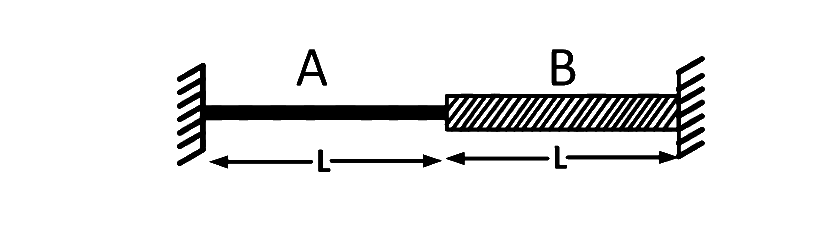
Two strings (A,B) having linear densities μA=2×10⁻⁴ kg/m and, μB=4×10⁻⁴ kg/m and lengths LA=2.5 m and LB=1.5 m respectively are joined. Free ends of A and B are tied to two rigid supports C and D, respectively creating a tension of 500 N in the wire. Two identical pulses, sent from C and D ends, take time t1 and t2, respectively, to reach the joint. The ratio t1/t2 is:
Speed of Waves · Hanging rope and rope with a block
A uniform rope of mass 0.1 kg and length 2.5 m hangs from ceiling. The speed of transverse wave in the rope at upper end and at a point 0.5 m distance from lower end will be (g=10 m/s2)
Show answer and solution
Answer: (a)
For a hanging rope, at height y above the lower end v=gy.
Two strings with circular cross section and made of same material, are stretched to have same amount of tension. A transverse wave is then made to pass through both the strings. The velocity of the wave in the first string having the radius of cross section R is v1, and that in the other string having radius of cross section R/2 is v2. Then v1v2 =
A string of mass 0.2 Kg is under a tension of 2.5 N. The length of the string is 2 m. A transverse wave starts from one end of the string. The time taken by the wave to reach the other end is
Speed of Waves · Hanging rope and rope with a block
A uniform wire 20 m long and weighing 50 N hangs vertically. The speed of the wave at mid point of the wire is (acceleration due to gravity =g=10 ms−2)
Show answer and solution
Answer: (c)
At height y above the lower end, tension =μgy, so v=gy.
Speed of Waves · Effect of temperature, pressure and humidity
A tuning fork of frequency 220 Hz produces sound waves of wavelength 1.5 m in air at N.T.P. The increase in wavelength when the temperature of air is 27∘C is nearly (273300=1.05)
Show answer and solution
Answer: (d)
Frequency fixed, so λ∝v∝T.
λ′=1.5×300/273=1.5×1.05≈1.575 m (exact root 1.048 gives 1.572 m).
A wire PQ has length 4.8 m and mass 0.06 kg. Another wire QR has length 2.56 m and mass 0.2 kg. Both wires have same radii and are joined as a single wire. This wire is under tension of 80 N. A wave pulse of amplitude 3.5 cm is sent along the wire PQ from end P. the time taken by the wave pulse to travel along the wire from point P to R is?
Show answer and solution
Answer: (c)
PQ: μ1=0.06/4.8=0.0125 kg/m, v1=80/0.0125=80 m/s, t1=4.8/80=0.06 s.
QR: μ2=0.2/2.56=0.078 kg/m, v2=80/0.078125=32 m/s, t2=2.56/32=0.08 s.
Speed of Waves · Hanging rope and rope with a block
A uniform rope of length 'L' and mass 'm1 ' hangs vertically from a rigid support. A block of mass 'm2' is attached to the free end of the rope. A transverse wave of wavelength 'λ1' is produced at the lower end of the rope. The wavelength of the wave when it reaches the top of the rope is 'λ2'. The ratio λ2λ1 is
Speed of Waves · Effect of temperature, pressure and humidity
An organ pipe filled with a gas at 27∘C resonates at 400 Hz in its fundamental mode. If it is filled with the same gas at 90∘C, the resonance frequency at the same mode will be
Speed of Waves · Hanging rope and rope with a block
A uniform rope of length 12 m and mass 6 kg hangs vertically from the rigid support. A block of mass 2 kg is attached to the free end of the rope. A transverse pulse of wavelength 0.06 m is produced at the lower end of the rope. The wavelength of the pulse when it reaches the top of the rope is
Show answer and solution
Answer: (c)
Frequency stays the same along the rope, so λ∝v∝T.
Tension at the bottom: T1=2g; at the top: T2=(6+2)g=8g.
A uniform metal wire has length L, mass M and density ρ. It is under tension T and v is the speed of transverse wave along the wire. The area of cross-section of the wire is
A transverse wave travels on a taut steel wire with a velocity of v when tension in it is 2.06 × 10⁴ N. When the tension is changed to T, the velocity changed to v/2. The value of T is close to:
The extension in a wire obeying Hooke's law is x. The speed of sound in the stretched wire is v. If the extension in the wire is increased to 4x, then the speed of sound in a wire is
Speed of Waves · Hanging rope and rope with a block
A uniform thin rope of length 12 m and mass 6 kg hangs vertically from a rigid support and a block of mass 2 kg is attached to its free end. A transverse short wavetrain of wavelength 6 cm is produced at the lower end of the rope. What is the wavelength of the wavetrain (in cm) when it reaches the top of the rope?
Show answer and solution
Answer: (a)
λ∝T (frequency unchanged).
Bottom T=2g, top T=(6+2)g=8g, so λtop=68/2=12 cm.
Speed of a transverse wave on a straight wire (mass 6.0 g, length 60 cm and area of cross-section 1.0 mm2) is 90 ms-1. If the Young's modulus of wire is 16 × 1011 Nm-2, the extension of wire over its natural length is:
A heavy ball of mass M is suspendeed from the ceiling of a car by a light string of mass m (m < < M). When the car is at rest, the speed of transverse waves in the string is 60 ms−1. When the car has acceleration a, the wave-speed increases to 60.5 ms−1. The value of a, in terms of gravitational acceleration g, is closest to:
Show answer and solution
Answer: (b)
Tension ∝geff; at rest geff=g, with acceleration geff=g2+a2.
Speed of Waves · Effect of temperature, pressure and humidity
The pressure wave, P = 0.01 sin [1000t – 3x] Nm–2, corresponds to the sound produced by a vibrating blade on a day when atmospheric temperature is 0°C. On some other day, when temperature is T, the speed of sound produced by the same blade and at the same frequency is found to be 336 ms–1. Approximate value of T is
Speed of Waves · Speed of sound in solids, liquids and gases
A granite rod of 60 cm length is clamped at its middle point and is set into longitudinal vibrations. The density of granite is 2.7 × 10³ kg/m3 and its Young’s modulus is 9.27 × 10¹⁰ Pa. What will be the fundamental frequency of the longitudinal vibrations?
Show answer and solution
Answer: (b)
Clamped at the middle, both ends free: fundamental has L=2λ, so λ=2×0.6=1.2 m.
Speed of Waves · Hanging rope and rope with a block
A uniform rope of length L and mass m1 hangs vertically from a rigid support. A block of mass m2 is attached to the free end of the rope. A transverse pulse of wavelength λ1 is produced at the lower end of the rope. The wavelength of the pulse when it reaches the top of the rope is λ2. The ratio λ 2/λ1 is
Speed of Waves · Hanging rope and rope with a block
A uniform string of length 20 m is suspended from a rigid support. A short wave pulse is introduced at its lowest end. It starts moving up the string. The time taken to reach the supports is: (take g=10 ms−2)
Show answer and solution
Answer: (a)
At distance y from the lower end, v=gy, so dt=gydy.
Speed of Waves · Speed of sound in solids, liquids and gases
4.0 g of a gas occupies 22.4 litres at NTP. The specific heat capacity of the gas at constant volume is 5.0 J K−1 mol−1. If the speed of sound in this gas at NTP is 952 m s−1, then the heat capacity at constant pressure is
(Take gas constant R = 8.3 J K−1 mol−1)
Show answer and solution
Answer: (c)
22.4 L at NTP is 1 mol, so M=4 g/mol =4×10⁻³ kg/mol.
Progressive Wave Equation · Reading the wave equation
The equation of a plane progressive wave is given by y=5cosπ(200t−150x) where x and y are in cm and t is in second. The velocity of the wave is ________ m/s.
Progressive Wave Equation · Reading the wave equation
A transverse wave on a string is described by y=3sin(36t+0.018x+π/4), where x,y are in cm and t in seconds. The least distance between the two successive crests in the wave is ______ cm. (Nearest integer)
(π=3.14)
Numerical answer type. Work it out, then open the answer.
Show answer and solution
Answer: 349
Distance between successive crests is the wavelength λ=k2π.
Progressive Wave Equation · Particle velocity and wave velocity
The equation of a progressive wave is given by y=6cos(100t−4x) where y is in μm, x in metre and t in second. The ratio of the maximum particle velocity to the velocity of wave is
Show answer and solution
Answer: (c)
For y=Acos(ωt−kx): vmax=Aω and v=kω, so vvmax=Ak.
Progressive Wave Equation · Phase difference and path difference
The equation of a wave travelling on a string is Y=sin(20πx+10πt), where x and t are distance and time in SI units. The minimum distance between two points having the same oscillating speed is
Show answer and solution
Answer: (b)
k=20πm−1, so λ=k2π=0.1 m =10 cm.
Points always having the same speed are at least 2λ apart (phase difference π).
Progressive Wave Equation · Phase difference and path difference
A simple harmonic progressive wave is represented by y=Asin(120πt+3x). The distance between two points on the wave at a phase difference of 3π radian is
Progressive Wave Equation · Phase difference and path difference
Two waves are represented by the equations, y1=asin(ωt+kx+0.57) m and y2=acos(ωt+kx) m, where x is in metre and t is in second. What is the phase difference between them? (π=3.14)
Progressive Wave Equation · Phase difference and path difference
The distance between two consecutive points with phase difference of 60∘ in a wave of frequency n is x meter. The velocity with which wave is traveling is
Progressive Wave Equation · Phase difference and path difference
For a travelling harmonic wave
y(x,t)=2.0cos2π(10t−0.0080x+0.35), where x and y are in cm and t in s. The phase difference between oscillatory motion of two points separated by a distance of 0.5 m is:
Progressive Wave Equation · Particle velocity and wave velocity
A simple harmonic progressive wave is given by the equation y=asin2π(nt−λx). If the wave velocity is equal to 61× (maximum particle velocity), then the wavelength λ is {a= amplitude, n= frequency, t= time, y= displacement, x= distance}
Show answer and solution
Answer: (b)
Wave velocity v=nλ; maximum particle velocity =aω=2πna
Progressive Wave Equation · Tension from the wave equation
A transverse wave is propagating on the string. The linear density of vibrating string is 10−3 kg/m. The equation of the wave is Y=0.05sin(x+15t) where x and Y are in metre and time in second. The tension in the string is
Progressive Wave Equation · Particle velocity and wave velocity
A particle performs S.H.M. of amplitude 'A' and wavelength ' λ ', Then the velocity of the wave (V) and the maximum particle velocity (v) are related as
Show answer and solution
Answer: (c)
Maximum particle velocity v=Aω; wave velocity V=kω=2πωλ.
Progressive Wave Equation · Particle velocity and wave velocity
The equation of wave is y=60sin(1200t−6x), where ' y ' is in micron, ' t ' is in second and ' x ' is in metre. The ratio of maximum particle velocity to the wave velocity of wave propagation is
Progressive Wave Equation · Phase difference and path difference
The distance between two consecutive points with phase difference of 45∘ in a wave of frequency 300 Hz is 4.0 m. The velocity of the travelling wave is (in km/s)
Progressive Wave Equation · Phase difference and path difference
The equation of a wave travelling on a string is y = sin[20πx + 10πt], where x and t are distance and time in SI units. The minimum distance between two points having the same oscillating speed is:
Show answer and solution
Answer: (d)
k=20π m−1⇒λ=k2π=0.1 m=10 cm
Particle speed ∝∣cos(20πx+10πt)∣, which repeats when the phase changes by π.
Progressive Wave Equation · Writing the wave equation and its direction
A sinusoidal wave of wavelength 7.5 cm travels a distance of 1.2 cm along the x-direction in 0.3 sec. The crest P is at x=0 at t=0 sec and maximum displacement of the wave is 2 cm. Which equation correctly represents this wave?
Show answer and solution
Answer: (a)
v=0.31.2=4 cm/s, k=7.52π=0.83 cm−1
ω=kv=0.838×4≈3.35 rad/s
Crest at x=0, t=0 means y=A there, so use cosine; travelling along +x gives (kx−ωt).
Progressive Wave Equation · Reading the wave equation
The displacement of a travelling wave y=Csinλ2π(at−x) where t is time, x is distance and λ is the wavelength, all in S.I. units. Then the frequency of the wave is
Progressive Wave Equation · Phase difference and path difference
Velocity of sound waves in air is 330 m/s. For a particular sound wave in air, path difference of 40 cm is equivalent to phase difference of 1.6π. frequency of this wave is
Progressive Wave Equation · Phase difference and path difference
A transverse wave travelling along a stretched string has a speed of 30 m/s and a frequency of 250 Hz. The phase difference between two points on the string 10 cm apart at the same instant is
Progressive Wave Equation · Phase difference and path difference
The distance between two consecutive points with phase difference of 60∘ in wave of frequency 500 Hz is 0.6 m. The velocity with which wave is travelling is
Show answer and solution
Answer: (a)
60∘ phase difference means Δx=6λ, so λ=6×0.6=3.6 m.
Progressive Wave Equation · Phase difference and path difference
Two simple harmonic progressive waves have displacements y1=a1sin(λ2πx−ωt) and y2=a2cos(λ2πx−ωt+ϕ) What is the phase difference between two waves?
Progressive Wave Equation · Phase difference and path difference
Velocity of sound waves in air is 330 m/s. For a particular sound wave in air, path difference of 40 cm is equivalent to phase difference of 1.6π. The frequency of this wave is
Progressive Wave Equation · Tension from the wave equation
A string has mass per unit length of 10−6 kg/cm The equation of simple harmonic wave produced in it is Y=0.2sin(2x+80t) m. The tension in the string is
Progressive Wave Equation · Phase difference and path difference
The distance between two consecutive points with phase difference of 60∘ in a wave of frequency 500 Hz is 6.0 m. The velocity with which wave is travelling is __________ km/s
Numerical answer type. Work it out, then open the answer.
Progressive Wave Equation · Reading the wave equation
A transverse wave Y=2sin(0.01x+30t) moves on a stretched string from one end to another end in 0.5 second. If x and y are in cm and t in second, then the length of the string is
Progressive Wave Equation · Particle velocity and wave velocity
A transverse wave in a medium is given by y=Asin2(ωt−kx). It is found that the magnitude of the maximum velocity of particles in the medium is equal to that of the wave velocity. What is the value of A?
Progressive Wave Equation · Writing the wave equation and its direction
Which of the following equations correctly represents a travelling wave having wavelength λ = 4.0 cm, frequency ν = 100 Hz and travelling in positive x-axis direction?
Progressive Wave Equation · Particle velocity and wave velocity
A transverse wave is represented by y=2sin(ωt−kx) cm. The value of wavelength (in cm) for which the wave velocity becomes equal to the maximum particle velocity, will be:
Show answer and solution
Answer: (a)
Wave velocity kω=2πωλ; maximum particle velocity =Aω
Progressive Wave Equation · Particle velocity and wave velocity
A longitudinal wave is represented by x=10sin2π(nt−λx) cm. The maximum particle velocity will be four times the wave velocity if the determined value of wavelength is equal to:
Show answer and solution
Answer: (b)
Wave velocity v=nλ; maximum particle velocity =2πn(10) cm/s
Progressive Wave Equation · Phase difference and path difference
Velocity of sound waves in air is 'V' m/s. For a particular sound wave in air, path difference of 'x' cm is equivalent to phase difference nπ. The frequency of this wave is
Progressive Wave Equation · Phase difference and path difference
Two waves are represented by the equation, y1=Asin(ωt+kx+0.57)m and y2=Acos(ωt+kx)m, where x is in metre and t is in second. What is the phase difference between them?
Progressive Wave Equation · Phase difference and path difference
A sound wave of frequency 160 Hz has a velocity of 320 m/s. When it travels through air, the particles having a phase difference of 90∘, are separated by a distance of
Progressive Wave Equation · Phase difference and path difference
A sound wave is travelling with a frequency of 50 Hz. The phase difference between the two points in the path of a wave is 3π. The distance between those two points is (Velocity of sound in air =330 m/s)
Progressive Wave Equation · Phase difference and path difference
A progressive wave of frequency 50 Hz is travelling with velocity 350 m/s through a medium. The change in phase at a given time interval of 0.01 second is
Show answer and solution
Answer: (c)
At a fixed point, phase changes with time as Δϕ=2πfΔt.
Progressive Wave Equation · Reading the wave equation
A transverse wave given by y=2sin(0.01x+30t) moves on a stretched string from one end to another end in 0.5 second. If 'x' and 'y' are in cm and 't' is in second, then the length of the string is
Progressive Wave Equation · Writing the wave equation and its direction
A sound wave of frequency 245 Hz travels with the speed of 300 ms−1 along the positive x-axis. Each point of the wave moves to and fro through a total distance of 6 cm. What will be the mathematical expression of this travelling wave?
Progressive Wave Equation · Particle velocity and wave velocity
A simple harmonic progressive wave is given by Y=Y0sin2π(nt−λx). If the wave velocity is (81)th the maximum particle velocity then the wavelength is
Show answer and solution
Answer: (b)
Wave velocity v=nλ; maximum particle velocity =2πnY0
Progressive Wave Equation · Tension from the wave equation
The equation of simple harmonic wave produced in the string under tension 0.4 N is given by y=4sin(3x+60t) m. The mass per unit length of the string is
Progressive Wave Equation · Tension from the wave equation
The mass per unit length of a uniform wire is 0.135 g/cm. A transverse wave of the form y = − 0.21 sin (x + 30t) is produced in it, where x is in meter and t is in second. Then, the expected value of tension in the wire is x × 10−2 N. Value of x is _________. (Round off to the nearest integer)
Numerical answer type. Work it out, then open the answer.
Progressive Wave Equation · Writing the wave equation and its direction
The amplitude of wave disturbance propagating in the positive x-direction is given by y=1+x21 at time t = 0 and y=1+(x−2)21 at t = 1 s, where x and y are in metres. The shape of wave does not change during the propagation. The velocity of the wave will be ___________ m/s.
Numerical answer type. Work it out, then open the answer.
Show answer and solution
Answer: 2
The peak (y=1) is at x=0 at t=0 and at x=2 m at t=1 s.
Shape is unchanged, so the pulse moves 2 m in 1 s.
Progressive Wave Equation · Reading the wave equation
A travelling harmonic wave is represented by the equation y(x,t) = 10–3sin (50t + 2x), where, x and y are in metre and t is in seconds. Which of the following is a correct statement about the wave?
Show answer and solution
Answer: (c)
ω=50 rad/s, k=2 m−1, so v=kω=25 m/s.
Form (ωt+kx) means the wave travels along −x.
So the answer is (c) negative x-axis with speed 25 m s−1.
Progressive Wave Equation · Phase difference and path difference
A simple harmonic progressive wave is represented as y=0.03sinπ(2t−0.01x)m. At a given instant of time, the phase difference between two particles 25 m apart is
Progressive Wave Equation · Tension from the wave equation
A transverse wave is propagating on the string. The linear density of a vibrating string is 10−3 kg/m. The equation of the wave is Y=0.05sin(x+15t) where x and Y are measured in metre and time in second. The tension force in the string is
Progressive Wave Equation · Tension from the wave equation
Equation of travelling wave on a stretched string of linear density 5 g/m is y = 0.03 sin(450 t – 9x) where distance and time are measured in SI units. The tension in the string is:
Progressive Wave Equation · Writing the wave equation and its direction
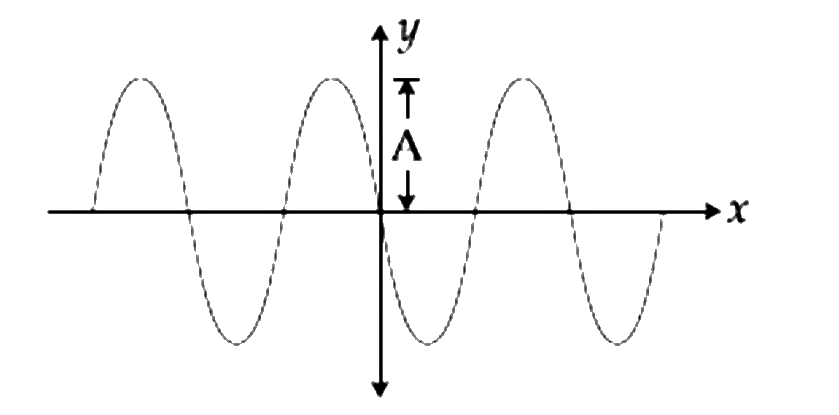
A progressive wave travelling along the positive x-direction is represented by y(x,t) = Asin(kx – ωt + ϕ). Its snapshot at t = 0 is given in the figure.
For this wave, the phase ϕ is:
Show answer and solution
Answer: (b)
At t=0: y=Asin(kx+ϕ).
From the graph, y=0 at x=0 and y becomes negative for small x>0, so y=−Asinkx.
Progressive Wave Equation · Writing the wave equation and its direction
A wave in a string has an amplitude of 2 cm. The wave travels in the +ve direction of x axis with a speed of 128 m/s. and it is noted that 5 complete waves fit in 4m length of the string. The equation describing the wave is
Show answer and solution
Answer: (c)
5 waves in 4 m: λ=0.8 m, so k=0.82π=7.85 m−1
ω=kv=7.85×128≈1005 rad/s
Wave along +x has the form sin(kx−ωt); A=2 cm=0.02 m
Progressive Wave Equation · Reading the wave equation
A wave travelling along the x-axis is described by the equation y(x,t)=0.005cos(αx−βt). If the wavelength and the time period of the wave are 0.08 m and 2.0 s, respectively, then α and β in appropriate units are
Progressive Wave Equation · Phase difference and path difference
Two points are located at a distance of 10 m and 15 m from the source of oscillation. The period of oscillation is 0.05 sec and the velocity of the wave is 300 m/s. What is the phase difference between the oscillations of two points?
Progressive Wave Equation · Reading the wave equation
A transverse wave propagating along x-axis is represented by y(x, t) = 8.0 sin (0.5 πx − 4πt −π/4) where x is in metres and t is in seconds. The speed of the wave is
Progressive Wave Equation · Reading the wave equation
The displacement y of a particle in a medium can be expressed as, y=10−6sin(100t+20x+4π) m where t is in second and x in meter. The speed of the wave is
Progressive Wave Equation · Phase difference and path difference
Velocity of sound waves in air is 330 m/s. For a particular sound wave in air, a path difference of 40 cm is equivalent to phase difference of 1.6π. The frequency of this wave is
Reflection, Superposition & Interference · Reflection of waves and echo
A man standing between two parallel cliffs fires a gun. He hear two echos one after 3 second and the other after 5 second. The separation between the two cliffs is 1360 m, the speed of sound is
Show answer and solution
Answer: (c)
Echo time t=v2d, so distances to the cliffs are d1=23v and d2=25v
Reflection, Superposition & Interference · Reflection of waves and echo
A person standing between two parallel cliffs fires a gun and hears two echoes, first echo after 1 second and second echo after 3 second. The distance between the two cliffs is (The velocity of sound =330 m/s)
Two sound waves each of wavelength λ and same amplitude A interfere at point Q. If the path difference is 4λ, the amplitude of the resultant wave at point Q is [sin2π=1,cos2π=0]
Reflection, Superposition & Interference · Interference: maximum and minimum intensity
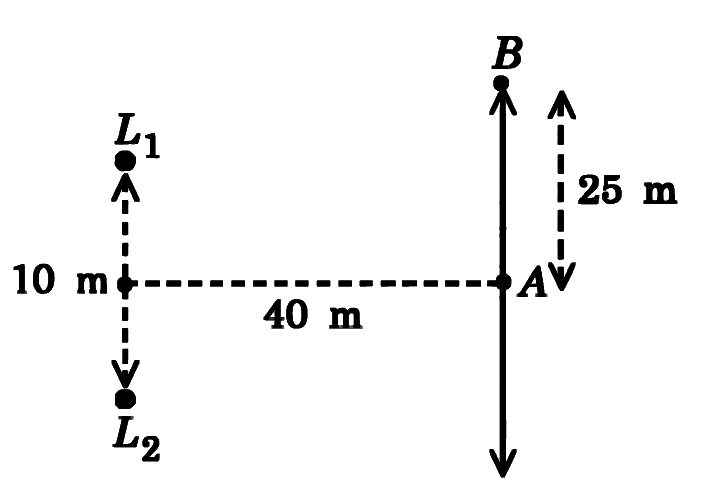
Two loudspeakers (L1 and L2) are placed with a separation of 10 m, as shown in figure. Both speakers are fed with an audio input signal of same frequency with constant volume. A voice recorder, initially at point A, at equidistant to both loudspeakers, is moved by 25 m along the line AB while monitoring the audio signal. The measured signal was found to undergo 10 cycles of minima and maxima during the movement. The frequency of the input signal is ______ Hz (Speed of sound in air is 324 m/s and 5=2.23)
Numerical answer type. Work it out, then open the answer.
Show answer and solution
Answer: 600
At A the path difference is 0. At B (25 m up): L1B=402+202=205=44.6 m, L2B=402+302=50 m.
Path difference at B=50−44.6=5.4 m.
10 cycles of maxima and minima means the path difference changed by 10λ: λ=0.54 m.
Reflection, Superposition & Interference · Reflection of waves and echo
A person standing between two parallel cliffs fires a gun and hears two echoes, first echo after 1 second and the second echo after 3 second. The distance between the two cliffs is (Velocity of sound =340 m/s)
The amplitude and phase of a wave that is formed by the superposition of two harmonic travelling waves, y1(x,t)=4sin(kx−ωt) and y2(x,t)=2sin(kx−ωt+32π), are:
(Take the angular frequency of initial waves same as ω)
Two sound waves having same amplitude ' A ' and angular frequency ' ω ' but having a phase difference of (2π)c are superimposed then the maximum amplitude of the resultant wave is
Two simple harmonic waves having equal amplitudes of 8 cm and equal frequency of 10 Hz are moving along the same direction. The resultant amplitude is also 8 cm. The phase difference between the individual waves is _________ degree.
Numerical answer type. Work it out, then open the answer.
Two waves executing simple harmonic motions travelling in the same direction with same amplitude and frequency are superimposed. The resultant amplitude is equal to the 3 times of amplitude of individual motions. The phase difference between the two motions is ___________ (degree).
Numerical answer type. Work it out, then open the answer.
Two waves are simultaneously passing through a string and their equations are: y1 = A1 sin k(x − vt), y2 = A2 sin k(x − vt + x0). Given amplitudes A1 = 12 mm and A2 = 5 mm, x0 = 3.5 cm and wave number k = 6.28 cm−1. The amplitude of resulting wave will be ................ mm.
Numerical answer type. Work it out, then open the answer.
Show answer and solution
Answer: 7
Phase difference ϕ=kx0=6.28×3.5=2π×3.5=7π, i.e. opposite phase.
Three harmonic waves having equal frequency ν and same intensity I0, have phase angles 0, 4π and −4π respectively. When they are superimposed the intensity of the resultant wave is close to:
Show answer and solution
Answer: (a)
Equal intensities, so equal amplitudes a with I0∝a2.
The ±4π waves add to 2acos4π=2a along the phase-0 wave.
Reflection, Superposition & Interference · Interference: maximum and minimum intensity
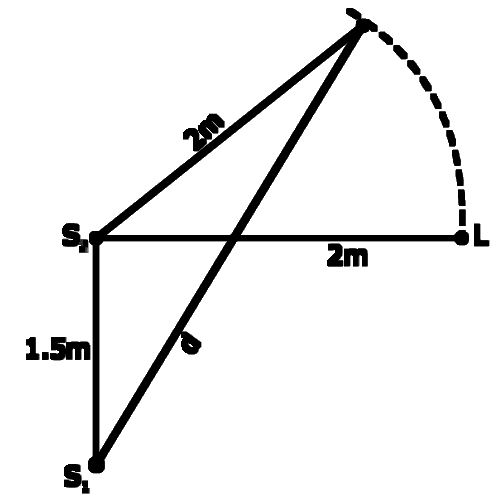
Two coherent sources of sound, S1 and S2, produce sound waves of the same wavelength, λ = 1 m, in phase. S1 and S2 are placed 1.5 m apart (see fig). A listener, located at L, directly in front of S2 finds that the intensity is at a minimum
when he is 2 m away from S2. The listener moves away from S1, keeping his distance from S2 fixed. The adjacent maximum of intensity is observed when the listener is at a distance d from S1. Then, d is:
Show answer and solution
Answer: (c)
At L: S1L=1.52+22=2.5 m, path difference =2.5−2=0.5 m=2λ (minimum).
Moving away from S1 increases the path difference; the next maximum needs path difference =λ=1 m.
Reflection, Superposition & Interference · Reflection of waves and echo
An engine approaches a hill with a constant speed. When it is at a distance of 0.9 km, it blows a whistle whose echo is heard by the driver after 5 seconds. If the speed of sound in air is 330 m/s, then the speed of the engine is:
Show answer and solution
Answer: (d)
In 5 s the engine moves 5v, so it is at 900−5v from the hill when it hears the echo.
Reflection, Superposition & Interference · Interference: maximum and minimum intensity
Two periodic waves of intensities I1 and I2 pass through a region at the same time in the same direction. The sum of the maximum and minimum intensities is
Show answer and solution
Answer: (b)
Imax=(I1+I2)2, Imin=(I1−I2)2.
Adding, the cross terms ±2I1I2 cancel: Imax+Imin=2(I1+I2).
Two waves having equation x1 = asin(ωt − kx + ϕ1), x2 = asin(ωt −kx + ϕ2). If in the resultant wave the frequency and amplitude remain equal to amplitude of superimposing waves, the phase difference between them is
Wave has simple harmonic motion whose period is 4 seconds while another wave which also possesses simple harmonic motion has its period 3 second. If both are combined, then the resultant wave will have the period equal to
Show answer and solution
Answer: (c)
The combined motion repeats only when both waves complete whole numbers of cycles together.
The equation of a stationary wave along a stretched string is y=5sin3πxcos40πt where x and y are in cm and t in second. The separation between two adjacent nodes is
Stationary Waves & Vibrating Strings · Laws of a vibrating string
A uniform wire of length L, diameter D and density ρ is stretched under tension T. The relation between its fundamental frequency f, length L and diameter D is
A spring of mass 0.2 kg/m has length l=0.6 m. It is fixed at both ends and stretched such that is has a tension 80 N. The string vibrates in three segments with amplitude 0.5 cm. The amplitude of transverse (particle) velocity is
Show answer and solution
Answer: (c)
v=μT=0.280=20 m/s.
3 segments: L=23λ⇒λ=0.4 m, so f=0.420=50 Hz and ω=100π rad/s.
Maximum particle velocity (at an antinode) =Aω=0.005×100π=0.5π≈1.57 m/s.
In sonometer experiment, the string of length ′L′ under tension vibrates in second overtone between the two bridges. The amplitude of vibration is maximum at length
Show answer and solution
Answer: (b)
Second overtone = 3rd harmonic: 3 loops, each of length L/3.
Antinodes lie at the middle of each loop: 6L,2L,65L.
A wire of length 'L' and linear density 'm' is stretched between two rigid supports with tension 'T'. It is observed that wire resonates in the Pth harmonic at a frequency of 320 Hz and resonates again at next higher frequency of 400 Hz in two successive modes. The value of 'P' is
Show answer and solution
Answer: (b)
For a string fixed at both ends, np=pn1, so two successive harmonics differ by n1.
Stationary Waves & Vibrating Strings · Laws of a vibrating string
Two vibrating metal wires of the same material of length 'L' and '3L' and have radii '2r' and 'r' respectively. They are stretched under same tension. Both the wires vibrate in their fundamental modes. The ratio n2n1 is [n1 and n2 are the frequencies of first and second wire respectively]
Stationary Waves & Vibrating Strings · Laws of a vibrating string
Two uniform strings A and B made of steel are vibrating under the same tension. If the first overtone of A is equal to the second overtone of B and if the radius of A is twice that of B, the ratio of the lengths of the strings is
Show answer and solution
Answer: (d)
First overtone =2n, second overtone =3n, and n∝Lr1 (same T, same material).
Stationary Waves & Vibrating Strings · Laws of a vibrating string
A wire of length 'L', diameter 'd', density of material 'ρ' is under tension 'T' has fundamental frequency of vibration 'nA'. Another wire of length '2L', diameter '3d', density of material '2ρ' is vibrated under tension '2T', the fundamental frequency of vibration becomes 'nB'. The ratio nB:nA is
Stationary Waves & Vibrating Strings · Laws of a vibrating string
The fundamental frequency of sonometer wire is 50 Hz for some length and tension. If the length is increased by 25% by keeping the tension same, then the frequency change of second harmonic is
Show answer and solution
Answer: (b)
For fixed tension, every harmonic ∝L1.
L′=1.25L⇒n′=1.25n=0.8n
Second harmonic goes from 100 Hz to 80 Hz: a 20% decrease.
Stationary Waves & Vibrating Strings · Laws of a vibrating string
Two uniform wires of same material are vibrating under the same tension. If the first overtone of the first wire is equal to the second overtone of the second wire and radius of first wire is twice the radius of second wire then the ratio of length of first to second wire is
Show answer and solution
Answer: (b)
n∝Lr1 (same T, same material); first overtone =2n1, second overtone =3n2.
Stationary Waves & Vibrating Strings · Sonometer: load and immersed bob
A sonometer wire resonates with a given tuning fork, forming standing waves with five antinodes between the two bridges, when a mass of 9 kg is suspended from the wire. When this mass is replaced by mass M, the wire resonates with the same tuning fork, forming three antinodes for the same positions of the bridges. The value of M (in kg) is
Show answer and solution
Answer: (d)
With p loops: n=2LpμMg. Same n, L, μ gives p2M=constant.
Stationary Waves & Vibrating Strings · Sonometer: load and immersed bob
A sonometer wire resonates with a given tuning fork forming standing wave with 5 antinodes between two bridges when mass of 9 kg is suspended from the wire. When mass M is suspended from the wire with same fork and same length between two bridges, 3 antinodes are formed. Mass M is
Stationary Waves & Vibrating Strings · Sonometer: load and immersed bob
In a sonometer experiment, the fundamental frequency of vibration of wire is 'n1' when wire is stretched by hanging a metal bob. If the bob is completely immersed in water, the frequency of vibration of wire becomes 'n2'. The relative density of the metal of the bob is
Show answer and solution
Answer: (c)
n∝T. In air T1=Vρg; in water T2=V(ρ−ρw)g.
n12n22=ρρ−ρw=dd−1, where d is the relative density.
Stationary Waves & Vibrating Strings · Sonometer: load and immersed bob
A sonometer wire resonates with 4 antinodes between the two bridges for a given tuning fork when 1 kg mass is suspended from the wire. Using same fork, when mass M is suspended, the wire resonates producing 2 antinodes between the two bridges. (Distance between the bridges as before) The value of M is
Stationary Waves & Vibrating Strings · Nodes, antinodes and properties
Two waves of same frequency ( n) are approaching each other with same velocity 12 m/s along the same linear path and interfere. The distance between two consecutive nodes is
Stationary Waves & Vibrating Strings · Laws of a vibrating string
Fundamental frequency of sonometer wire is ' n '. If the tension and length are increased 3 times and diameter is increased twice, the new frequency will be
Stationary Waves & Vibrating Strings · Laws of a vibrating string
The fundamental frequency of sonometer wire is ' n '. If the tension and length are increased 3 times and diameter is increased twice, the new frequency will be
A string of mass per unit length 0.1 kg m−1 has length 0.9 m. It is fixed at both ends and stretched such that it has a tension of 40 N. The string vibrates in three segments with amplitude 0.3 cm. The amplitude (maximum) of the particle velocity is (in m/s)
Show answer and solution
Answer: (c)
Wave speed v=T/μ=40/0.1=20 m/s.
Three segments: 32λ=0.9⇒λ=0.6 m, so n=λv=3100 Hz.
Stationary Waves & Vibrating Strings · Laws of a vibrating string
The fundamental frequency of a sonometer wire is 50 Hz for some length and tension. If the length is increased by 25% by keeping tension same then frequency change of second harmonic is
Stationary Waves & Vibrating Strings · Laws of a vibrating string
Two uniform wires of same material are vibrating under the same tension. If the 1st overtone of 1st wire is equal to the 2nd overtone of 2nd wire and radius of 1st wire is twice the radius of 2nd wire, the ratio of length of 1st wire to that 2nd wire is
Show answer and solution
Answer: (a)
n∝Lr1; first overtone =2n1, second overtone =3n2.
Stationary Waves & Vibrating Strings · Laws of a vibrating string
A wire of length L, diameter ' d ' density of material ' e ' is under tension ' T ', having fundamental frequency of vibration nA. Another wire of length 2 L, tension 2 T, density 2 e and diameter 3 d has fundamental frequency of vibration nB. The ratio nB:nA is
Stationary Waves & Vibrating Strings · Sonometer: load and immersed bob
At poles, a stretched wire of a given length vibrates in unison with a tuning fork. At the equator, for same setting, to produce resonance with same fork, the vibrating length of wire
Show answer and solution
Answer: (a)
g is smaller at the equator, so the tension T=Mg and the wave speed v=T/μ decrease.
For the same frequency n=2Lv, L must decrease along with v.
Stationary wave is produced along the stretched string of length 80 cm. The resonant frequencies of string are 90 Hz,150 Hz and 210 Hz. The speed of transverse wave in the string is
Show answer and solution
Answer: (c)
The given frequencies 90,150,210 Hz are all multiples of 30 Hz (their HCF), so take the fundamental f0=30 Hz.
For a string fixed at both ends, f0=2Lv, so v=2Lf0.
A stretched string is fixed at both ends. It is made to vibrate so that the total number of nodes formed in it is ' x '. The length of the string in terms of the wavelength of waves formed in it is ( λ= wavelength )
Stationary Waves & Vibrating Strings · Laws of a vibrating string
When the tension in string is increased by 3 kg wt, the frequency of the fundamental mode increases in the ratio 2:3. The initial tension in the string is
Stationary Waves & Vibrating Strings · Laws of a vibrating string
A violin emits sound waves of frequency ' n1 ' under tension T. When tension is increased by 44%, keeping the length and mass per unit length constant, frequency of sound waves becomes ' n2 '. The ratio of frequency ' n2 ' to frequency ' n1 ' is
Stationary Waves & Vibrating Strings · Laws of a vibrating string
A sonometer wire of resonating length 90 cm has a fundamental frequency of 400 Hz when kept under some tension. The resonating length of the wire with fundamental frequency of 600 Hz under same tension _______ cm.
Numerical answer type. Work it out, then open the answer.
The length of a sonometer wire 'AB' is 110 cm. Where should the two bridges be placed from end ' A ' to divide the wire in three segments whose fundamental frequencies are in the ratio 1:2:3?
Two progressive waves Y1=sin2π(0.4t−4x) and Y2=sin2π(0.4t+4x) superpose to form a standing wave. ' x ' and ' y ' are in SI system. Amplitude of the particle at x=0.5 m is [sin45∘=cos45∘=21]
Show answer and solution
Answer: (c)
sin(A−B)+sin(A+B)=2sinAcosB, so Y=2cos(42πx)sin(0.42πt).
A string is under tension of 180 N and mass per unit length 2×10⁻³ kg/m. It produces two consecutive resonant frequencies with a tuning fork, which are 375 Hz and 450 Hz. The mass of the string is
Show answer and solution
Answer: (d)
Consecutive resonant frequencies differ by the fundamental: n1=450−375=75 Hz.
A wire of length ' L ' and linear density ' m ' is stretched between two rigid supports with tension ' T '. It is observed that wire resonates in the Pth harmonic at a frequency of 320 Hz and resonates again at next higher frequency of 400 Hz. The value of ' p ' is
Show answer and solution
Answer: (b)
Successive harmonics of a string differ by the fundamental: n1=400−320=80 Hz.
Stationary Waves & Vibrating Strings · Laws of a vibrating string
Two uniform strings A and B made of steel are made to vibrate under the same tension. If first overtone of A is equal to the second overtone of B and if the radius of A is twice that of B, the ratio of the length of string B to that of A is
Show answer and solution
Answer: (d)
n∝Lr1; first overtone of A =2nA, second overtone of B =3nB.
Stationary Waves & Vibrating Strings · Laws of a vibrating string
A string A has twice the length, twice the diameter, twice the tension and twice the density of another string B. The overtone of A which will have the same fundamental frequency as that of B is
Show answer and solution
Answer: (c)
n∝LD1ρT
nBnA=2×2122=41⇒nB=4nA
The 4th harmonic of A equals nB; the 4th harmonic is the third overtone.
Stationary Waves & Vibrating Strings · Sonometer: load and immersed bob
At the poles of earth, a stretched wire of a given length vibrates in unison with a tuning fork. At the equator of earth, for same setting, to produce resonance with same fork, the vibrating length of wire
Show answer and solution
Answer: (a)
gequator<gpole, so T=Mg and v=T/μ are smaller at the equator.
Stationary Waves & Vibrating Strings · Sonometer: load and immersed bob
A sonometer wire is in unison with a tuning fork of frequency ' n ' when it is stretched by a weight of specific gravity ' d '. When the weight is completely immersed in water, ' x ' beats are produced per second, then
Show answer and solution
Answer: (b)
In water the tension falls to Tdd−1, so the frequency drops to n−x (that gives x beats with the fork).
Stationary Waves & Vibrating Strings · Sonometer: load and immersed bob
A sonometer wire is stretched by hanging a metal bob, the fundamental frequency of the wire is ' n1 '. When the bob is completely immersed in water, the frequency of vibration of wire becomes ' n2 '. The relative density of the metal of the bob is
Stationary Waves & Vibrating Strings · Sonometer: load and immersed bob
A sonometer wire is stretched by hanging a metal bob. The fundamental frequency of vibration of wire is ' n1 '. When the bob is completely immersed in water, the frequency of vibration of wire becomes ' n2 '. The relative density of the metal of the bob is
Show answer and solution
Answer: (c)
n∝T; the buoyant force reduces tension from Vρg to V(ρ−ρw)g.
Stationary Waves & Vibrating Strings · Nodes, antinodes and properties
Two progressive waves are travelling towards each other with velocity 50 m/s and frequency 200 Hz. The distance between the two consecutive antinodes is
Stationary Waves & Vibrating Strings · Nodes, antinodes and properties
A string fixed at both the ends forms standing wave with node separation of 5 cm. If the velocity of the wave on the string is 2 m/s, then the frequency of vibration of the string is
Stationary Waves & Vibrating Strings · Laws of a vibrating string
A guitar string of length 90 cm vibrates with a fundamental frequency of 120 Hz. The length of the string producing a fundamental frequency of 180 Hz will be _________ cm.
Numerical answer type. Work it out, then open the answer.
When a string of length 'l' is divided into three segments of length l1,l2 and l3. The fundamental frequencies of three segments are n1,n2 and n3 respectively. The original fundamental frequency 'n' of the string is
Stationary Waves & Vibrating Strings · Nodes, antinodes and properties
Sound waves of frequency 600 Hz fall normally on a perfectly reflecting wall. The shortest distance from the wall at which all particles will have maximum amplitude of vibration is (speed of sound =300 m s−1)
Show answer and solution
Answer: (b)
λ=fv=600300=0.5 m.
A rigid wall is a displacement node; the nearest displacement antinode (maximum amplitude) is λ/4 away.
A string is stretched between two rigid supports separated by 75 cm. There are no resonant frequencies between 420 Hz and 315 Hz. The lowest resonant frequency for the string is
Show answer and solution
Answer: (c)
No resonance between them, so 315 Hz and 420 Hz are consecutive harmonics.
Difference of consecutive harmonics = fundamental: n1=420−315=105 Hz.
The fundamental frequency of vibration of a string stretched between two rigid supports is 50 Hz. The mass of the string is 18 g and its linear mass density is 20 g/m. The speed of the transverse waves so produced in the string is ___________ m s−1
Numerical answer type. Work it out, then open the answer.
Stationary Waves & Vibrating Strings · Laws of a vibrating string
A uniform string is vibrating with a fundamental frequency 'n'. If radius and length of string both are doubled keeping tension constant then the new frequency of vibration is
Stationary Waves & Vibrating Strings · Laws of a vibrating string
A sonometer wire 'A' of diameter 'd' under tension 'T' having density 'ρ1' vibrates with fundamental frequency 'n'. If we use another wire 'B' which vibrates with same frequency under tension '2T' and diameter '2d' then density 'ρ2 ' of wire 'B' will be
Stationary Waves & Vibrating Strings · Laws of a vibrating string
Two uniform wires of same material are vibrating under the same tension. If the first overtone of first wire is equal to the 2nd overtone of 2nd wire and radius of the first wire is twice the radius of the 2nd wire then the ratio of length of first wire to 2nd wire is
Show answer and solution
Answer: (a)
n∝Lr1; first overtone =2n1, second overtone =3n2.
Stationary Waves & Vibrating Strings · Laws of a vibrating string
If the length of stretched string is reduced by 40% and tension is increased by 44% then the ratio of final to initial frequencies of stretched string is
Stationary Waves & Vibrating Strings · Laws of a vibrating string
A wire of density 8×10³ kg/m3 is stretched between two clamps 0.5 m apart. The extension developed in the wire is 3.2×10⁻⁴ m. If Y=8×10¹⁰ N/m2, the fundamental frequency of vibration in the wire will be ___________ Hz.
Numerical answer type. Work it out, then open the answer.
Stationary Waves & Vibrating Strings · Sonometer: load and immersed bob
In an experiment with sonometer when a mass of 180 g is attached to the string, it vibrates with fundamental frequency of 30 Hz. When a mass m is attached, the string vibrates with fundamental frequency of 50 Hz. The value of m is ___________ g.
Numerical answer type. Work it out, then open the answer.
Two travelling waves of equal amplitudes and equal frequencies move in opposite directions along a string. They interfere to produce a stationary wave whose equation is given by y=(10cosπxsinT2πt) cm
The amplitude of the particle at x=34 cm will be ___________ cm.
Numerical answer type. Work it out, then open the answer.
A wire of length 30 cm, stretched between rigid supports, has it's nth and (n + 1)th harmonics at 400 Hz and 450 Hz, respectively. If tension in the string is 2700 N, it's linear mass density is ____________ kg/m.
Numerical answer type. Work it out, then open the answer.
A wire having a linear mass density 9.0 × 10⁻⁴ kg/m is stretched between two rigid supports with a tension of 900 N. The wire resonates at a frequency of 500 Hz. The next higher frequency at which the same wire resonates is 550 Hz. The length of the wire is ____________ m.
Numerical answer type. Work it out, then open the answer.
Show answer and solution
Answer: 10
Wave speed v=μT=9.0×10−4900=106=1000 m/s.
Consecutive resonances differ by f0=2Lv: f0=550−500=50 Hz.
Stationary Waves & Vibrating Strings · Sonometer: load and immersed bob
A sonometer wire resonates with a given tuning fork forming standing waves with five antinodes between the two bridges when a mass of 9 kg is suspended from the wire. When this mass is replaced by a mass M, the wire resonates with the same tuning fork forming three antinodes for the same positions of the bridges. The value of 'M' is
Show answer and solution
Answer: (d)
Same fork and same bridge length: n=2LpμT, so pT= constant (p = number of loops = antinodes).
Stationary Waves & Vibrating Strings · Sonometer: load and immersed bob
A sonometer wire resonates with 4 antinodes between two bridges for a given tuning fork, when 1 kg mass is suspended from the wire. Using same fork, when mass M is suspended, the wire resonates producing 2 antinodes between the two bridges (distance between two bridges is as before). The value of M is
Two wires of same material of radius 'r' and '2r' respectively are welded together end to end. The combination is then used as a sonometer wire under tension 'T'. The joint is kept midway between the two bridges. The ratio of the number of loops formed in the wires such that the joint is a node is
Show answer and solution
Answer: (b)
μ=πr2d⇒μ2=4μ1, so v=T/μ gives v1=2v2.
Same frequency and same length l for both parts: n=2lpv⇒p∝v1.
Stationary Waves & Vibrating Strings · Laws of a vibrating string
The length of the string of a musical instrument is 90 cm and has a fundamental frequency of 120 Hz. Where should it be pressed to produce fundamental frequency of 180 Hz?
Stationary Waves & Vibrating Strings · Laws of a vibrating string
Two identical strings X and Z made of same material have tension TX and TZ in them. If their fundamental frequencies are 450 Hz and 300 Hz, respectively, then the ratio TX/TZ is
A wire of length L and mass per unit length 6.0 × 10⁻³ kgm–1 is put under tension of 540 N. Two consecutive frequencies that it resonates at are: 420 Hz and 490 Hz. Then L in meters is:
Stationary Waves & Vibrating Strings · Laws of a vibrating string
Two identical strings of length l and 2l vibrate with fundamental frequencies N Hz and 1.5N Hz, respectively. The ratio of tensions for smaller length to large length is
Stationary Waves & Vibrating Strings · Laws of a vibrating string
A wire of density 9 × 10⁻³ kg cm–3 is stretched between two clamps 1 m apart. The resulting strain in the wire is 4.9 × 10⁻⁴. The lowest frequency of the transverse vibrations in the wire is: (Young’s modulus of wire Y = 9 × 10¹⁰ Nm–2), (to the nearest integer), _________
Numerical answer type. Work it out, then open the answer.
Stationary Waves & Vibrating Strings · Sonometer: load and immersed bob
At the poles, a stretched wire of a given length vibrates in unison with a tuning fork. At the equator, for same setting to produce resonance with same fork, the vibrating length of wire
Show answer and solution
Answer: (c)
n=2l1μMg, so for fixed n: l∝g.
g is smaller at the equator than at the poles, so tension and wave speed fall.
Stationary Waves & Vibrating Strings · Sonometer: load and immersed bob
A sonometer wire under suitable tension having specific gravity ρ, vibrates with frequency n in air. If the load is completely immersed in water the frequency of vibration of wire will become
Show answer and solution
Answer: (b)
Immersed load loses weight equal to buoyancy: T′=Mg(1−ρ1)=Tρρ−1.
Stationary Waves & Vibrating Strings · Sonometer: load and immersed bob
When tension T is applied to a sonometer wire of length l, it vibrates with the fundamental frequency n. Keeping the experimental setup same, when the tension is increased by 8 N, the fundamental frequency becomes three times the earlier fundamental frequency n. The initial tension applied to the wire (in newton) was
Find the wrong statement from the following about the equation of stationary wave given by Y=0.04cos(πx)sin(50πt) m where t is in second. Then for the stationary wave.
Show answer and solution
Answer: (a)
ω=50π⇒T=50π2π=0.04 s, so (a) is wrong.
k=π⇒λ=2 m; v=kω=50 m/s: (b), (c) true.
Each component wave has amplitude 20.04=0.02 m: (d) true.
A string 2.0 m long and fixed at its ends is driven by a 240 Hz vibrator. The string vibrates in its third harmonic mode. The speed of the wave and its fundamental frequency is :-
A stretched wire of length 260 cm is set into vibrations. It is divided into three segments whose frequencies are in the ratio 2:3:4. Their lengths must be
A string is clamped at both the ends and it is vibrating in its 4th harmonic. The equation of the stationary wave is Y = 0.3 sin(0.157x) cos(200πt). The length of the string is: (All quantities are in SI units.)
A string of length 1 m and mass 5 g is fixed at both ends. The tension in the string is 8.0 N. The string is set into vibration using an external vibrator of frequency 100 Hz. The separation between successive nodes on the string is close to -
Show answer and solution
Answer: (c)
μ=15×10−3=5×10⁻³ kg/m, v=5×10−38=40 m/s.
The string vibrates at the driver frequency: λ=nv=10040=0.4 m.
Stationary Waves & Vibrating Strings · Laws of a vibrating string
The fundamental frequency of sonometer wire increases by 9 Hz, if its tension is increased by 69%, keeping the length constant. The frequency of the wire is
Stationary Waves & Vibrating Strings · Sonometer: load and immersed bob
A sonometer wire is in unison with a tuning fork, when it is stretched by weight w and the corresponding resonating length is L1. If the weight is reduced to (4w), the corresponding resonating length becomes L2. The ratio (L2L1) is
A wire of length 2L, is made by joining two wires A and B of same length but different radii r and 2r and made of the same material. It is vibrating at a frequency such that the joint of the two wires forms a node. If the number of antinodes in wire A is p and that in B is q then the ratio p: q is:
Show answer and solution
Answer: (c)
Radii r and 2r: μB=4μA, so vA=2vB.
Same f, same length L, joint a node: f=2LpvA=2LqvB.
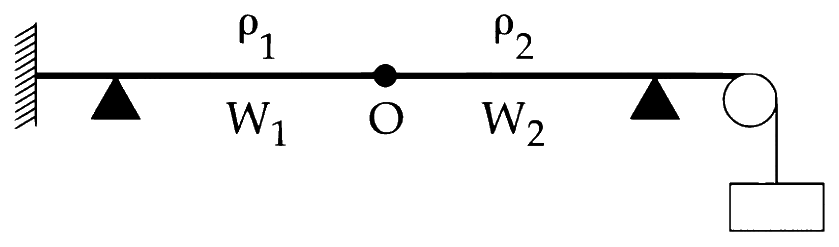
Two wires W1 and W2 have the same radius r and respective densities ρ1 and ρ2 such that ρ2 = 4ρ1. They are joined together at the point O, as shown in the figure. The combination is used as a sonometer wire and kept under tension T. The point O is midway between the two bridges. When a stationary wave is set up in the composite wire, the joint is found to be a node. The ratio of the number of antinodes formed in W1 to W2 is:
Show answer and solution
Answer: (b)
Same radius: μ∝ρ, so μ2=4μ1 and v1=2v2.
Equal lengths, same frequency, joint a node: p∝v1.
A string is stretched between fixed points separated by 75.0 cm. It is observed to have resonant frequencies of 420 Hz and 315 Hz. There are no other resonant frequencies between these two. The lowest resonant frequency for this string is
Show answer and solution
Answer: (b)
Consecutive resonant frequencies of a string differ by the fundamental: f0=fp+1−fp.
If n1, n2 and n3 are the fundamental frequencies of three segments into which a string is divided, then the original fundamental frequency n of the string is given by
The total length of a sonometer wire between fixed ends is 110 cm. Two bridges are placed to divide the length of wire in ratio 6: 3: 2. The tension in the wire is 400 N and the mass per unit length is 0.01 kg/m. What is the minimum common frequency with which three parts can vibrate?
Show answer and solution
Answer: (b)
Lengths: 60,30,20 cm. Wave speed v=T/μ=400/0.01=200 m/s.
Fundamentals f=2lv: 1.2200=166.7, 0.6200=333.3, 0.4200=500 Hz.
Common frequency must be a whole multiple of each: LCM of 3500,31000,500 is 1000 Hz.
The length of the wire between two ends of a sonometer is 100 cm. What should be the positions of two bridges below the wire so that the three segments of the wire have their fundamental frequencies in the ratio 1: 3: 5.
Show answer and solution
Answer: (d)
f∝l1: l1:l2:l3=1:31:51=15:5:3.
Total parts =23: l1=231500, l2=23500, l3=23300 cm.
Bridges at 231500 cm and 231500+500=232000 cm from one end.
A sonometer wire of length 114 cm is fixed at both the ends. Where should the two bridges be placed so as to divide the wire into three segments whose fundamental frequencies are in the ratio 1: 3: 4?
Show answer and solution
Answer: (d)
f∝l1: l1:l2:l3=1:31:41=12:4:3.
Total parts =19, each part =19114=6 cm⇒72,24,18 cm.
Bridges at 72 cm and 72+24=96 cm from one end.
So the answer is (d) at 72 cm and 96 cm from one end.
Stationary Waves & Vibrating Strings · Laws of a vibrating string
A sonometer wire of length 1.5 m is made of steel. The tension in it produces an elastic strain of 1%. What is the fundamental frequency of steel if density and elasticity of steel are 7.7×10³ kg/m3 and 2.2×10¹¹ N/m2 respectively?
When a string is divided into three segments of length l1, l2 and l3 the fundamental frequencies of these three segments are v1,v2 and v3 respectively. The original fundamental frequency (v) of the string is
A string is stretched between fixed points separated by 75.0 cm. It is observed to have resonant frequencies of 420 Hz and 315 Hz. There are no other resonant frequencies between these two. Then, the lowest resonant frequency for this string is
Show answer and solution
Answer: (a)
Consecutive resonant frequencies differ by the fundamental.
A metal wire of linear mass density of 9.8 g/m is stretched with a tension of 10 kg-wt between two rigid supports 1 metre apart. The wire passes at its middle point between the poles of a permanent magnet, and it vibrates in resonance when carrying an alternating current of frequency n. The frequency n of the alternating source is
Show answer and solution
Answer: (a)
Force on the wire at its middle excites the fundamental (antinode at the centre).
T=10×9.8=98 N, μ=9.8×10⁻³ kg/m, so v=9.8×10−398=100 m/s.
A string is cut into three parts, having fundamental frequencies n1, n2, n3 respectively. Then original fundamental frequency n related by the expression as
Show answer and solution
Answer: (a)
For the same string material and tension, n∝l1, so l=nk.
Stationary Waves & Vibrating Strings · Nodes, antinodes and properties
A standing wave having 3 nodes and 2 antinodes is formed between two atoms having a distance 1.21 Å between them. The wavelength of the standing wave is
Show answer and solution
Answer: (a)
3 nodes and 2 antinodes means 2 loops, with nodes at both atoms.
The length of a sonometer wire AB is 110 cm. Where should the two bridges be placed from A to divide the wire in 3 segments whose fundamental frequencies are in the ratio of 1:2:3?
Stationary Waves & Vibrating Strings · Nodes, antinodes and properties
A wave of frequency 100 Hz travels along a string towards its fixed end. When this wave travels back, after reflection, a node is formed at a distance of 10 cm from the fixed end. The speed of the wave (incident and reflected) is
Show answer and solution
Answer: (a)
The fixed end is a node; the next node is 2λ away.
A stationary wave is represented by y=Asin(100t)cos(0.01x), where y and A are in millimetres, t is in seconds and x is in metres. The velocity of the wave is
Show answer and solution
Answer: (a)
Compare with y=Asin(ωt)cos(kx): ω=100 rad/s, k=0.01 m−1.
Speed of the component waves v=kω=0.01100=104 m/s.
Stationary Waves & Vibrating Strings · Laws of a vibrating string
A stretched string resonates with tuning fork frequency 512 Hz when length of the string is 0.5 m. The length of the string required to vibrate resonantly with a tuning fork of frequency 256 Hz would be
Show answer and solution
Answer: (c)
Same string and tension: n∝L1, so nL is constant.
In a pipe closed at one end, air column is vibrating in the fourth overtone so the vibrating air column has 'x' nodes and 'y' antinodes. The values of x and y are respectively
Show answer and solution
Answer: (d)
Fourth overtone of a closed pipe is the 9th harmonic: L=49λ.
The k-th overtone of a closed pipe has k+1 nodes and k+1 antinodes.
An air column in a pipe which is closed at one end will be in resonance with a vibrating tuning fork of frequency 415 Hz for various vibrating air columns. Which one of the following lengths is not in resonance? (velocity of sound in air = 332 m/s) (Neglect end correction)
Show answer and solution
Answer: (b)
λ=fv=415332=0.8 m, so 4λ=20 cm.
Closed pipe resonates at odd multiples of 4λ: 20,60,100,140 cm…
Organ Pipes & Resonance Tube · Comparing closed and open pipes
The fifth harmonic of a closed organ pipe is found to be in unison with the first harmonic of an open pipe. The ratio of lengths of closed pipe to that of the open pipe is 5/x. The value of x is ______
Show answer and solution
Answer: (b)
Fifth harmonic of closed pipe: 4Lc5v. First harmonic of open pipe: 2Lov.
Organ Pipes & Resonance Tube · Pipe dipped in water, cut or filled
A pipe open at both ends has a frequency f in air. The pipe is dipped vertically in water, so that its (1/3) part of its length is in water. The fundamental frequency of the air column is now xf, the value of x is
Show answer and solution
Answer: (b)
In air (open pipe): f=2Lv.
With 31 in water it becomes a closed pipe of length 32L: f′=4⋅32Lv=8L3v.
Organ Pipes & Resonance Tube · Pipe dipped in water, cut or filled
In an organ pipe closed at one end produces a fundamental note of frequency 'ν'. The pipe is cut into two pipes of equal length. The fundamental frequencies produced in the two pipes are
Show answer and solution
Answer: (c)
Original closed pipe: ν=4Lv.
Piece with the closed end: closed pipe of length 2L: 4(L/2)v=2ν.
Other piece is open at both ends, length 2L: 2(L/2)v=Lv=4ν.
Organ Pipes & Resonance Tube · Pipe dipped in water, cut or filled
A pipe open at both ends has a fundamental frequency 'f' in air. The pipe is dipped in water, so that 32rd length of pipe is in water, Now the fundamental frequency of the air column is
Show answer and solution
Answer: (b)
Open pipe of length L: f=2Lv.
Dipping in water closes the lower end; air column left =L−32L=3L (closed pipe).
An organ pipe closed at one end has fundamental frequency of 1500 Hz. The maximum number of overtones generated by this pipe a normal person can hear is (neglect end connection)
Show answer and solution
Answer: (c)
Closed pipe gives only odd harmonics: (2n+1)f0, where n = overtone number.
In fundamental mode, the time required for the sound wave to reach upto the closed end of a pipe filled with air is t second. The frequency of vibration of air column is
A pipe open at both ends has length 1 m. The air column in a pipe cannot resonate for a frequency (Neglect end correction, speed of sound in air =340 m/s)
Show answer and solution
Answer: (d)
Open pipe: fn=2Lnv, fundamental =2×1340=170 Hz.
Allowed: 170,340,510,… (integer multiples of 170 Hz).
85 Hz=21×170 is not a multiple, so it cannot resonate.
Organ Pipes & Resonance Tube · Comparing closed and open pipes
An organ pipe P1 closed at one end and vibrating in its first overtone and other pipe P2 open at both ends vibrating in its third overtone are in resonance with a given tuning fork. The ratio of length of P1 and P2 will be
Show answer and solution
Answer: (a)
Closed pipe, first overtone (3rd harmonic): f=4L13v.
Open pipe, third overtone (4th harmonic): f=2L24v=L22v.
Organ Pipes & Resonance Tube · Comparing closed and open pipes
A pipe closed at one end vibrating in the sixth overtone is in unison with the open pipe vibrating in its sixth overtone. The ratio lc:lo is {lc= vibrating length of pipe closed at one end, lo= vibrating length of pipe open at both ends}
Organ Pipes & Resonance Tube · Comparing closed and open pipes
The third overtone of a closed pipe of length 'Lc' has the same frequency as the third overtone of the open pipe of length 'L0'. Both the pipes have same diameters. The ratio Lc:L0 is equal to
Show answer and solution
Answer: (b)
Closed pipe, third overtone (7th harmonic): 4Lc7v.
Open pipe, third overtone (4th harmonic): 2L04v=L02v.
Organ Pipes & Resonance Tube · Comparing closed and open pipes
When open pipe is closed from one end then third overtone of closed pipe is higher in frequency by 150Hz than second overtone of open pipe. The fundamental frequency of open end pipe will be (Neglect end correction)
Show answer and solution
Answer: (d)
Open pipe fundamental f=2Lv; closing one end gives fundamental 4Lv=2f.
Closed third overtone (7th harmonic) =27f; open second overtone (3rd harmonic) =3f.
Organ Pipes & Resonance Tube · Comparing closed and open pipes
When open pipe is closed from one end then second overtone of closed pipe is higher in frequency by 100 Hz than first overtone of open pipe. The fundamental frequency of open end pipe will be (Neglect end correction)
Show answer and solution
Answer: (a)
Open pipe fundamental f=2Lv; closing one end gives fundamental 2f.
Closed second overtone (5th harmonic) =25f; open first overtone (2nd harmonic) =2f.
Organ Pipes & Resonance Tube · Comparing closed and open pipes
For sound waves, if the number of nodes for the 5th harmonic of an open-ended pipe is n and that for the 9th harmonic of the same pipe with one of its ends closed is m, the ratio mn is
Show answer and solution
Answer: (d)
Open pipe, kth harmonic: L=k2λ with antinodes at both ends, so it has k displacement nodes. 5th harmonic: n=5.
Closed pipe, (2k−1)th harmonic: L=(2k−1)4λ has k nodes (one at the closed end). 9th harmonic: 2k−1=9⇒m=5.
Organ Pipes & Resonance Tube · Pipe dipped in water, cut or filled
The fundamental frequency of a closed pipe is 400 Hz. If 31rd pipe is filled with water then the frequency of 3rd harmonic of the pipe will be (Neglect end correction)
Show answer and solution
Answer: (b)
Closed pipe: n0=4Lv=400 Hz.
With 31 filled, air column =32L, so new fundamental =400×23=600 Hz.
Organ Pipes & Resonance Tube · Resonance tube and end correction
Two closed organ pipes A and B have the same length and A is wider than B. They resonate in the fundamental mode at frequencies nA and nB respectively, then
Show answer and solution
Answer: (c)
End correction e=0.3d, so the effective length is L+0.3d.
Fundamental n=4(L+0.3d)v: the wider pipe A has the larger effective length.
Organ Pipes & Resonance Tube · Resonance tube and end correction
A tuning fork of frequency 'n' is held near the open end of a tube which is dipped in water and length of the tube is adjusted until resonance occurs. If the two shortest lengths that produce resonance are l1 and l2, the speed of sound in air is (neglect end correction)
Show answer and solution
Answer: (a)
Successive resonating lengths of a closed tube differ by half a wavelength: l2−l1=2λ.
Organ Pipes & Resonance Tube · Resonance tube and end correction
In a resonance tube open at one end, the end correction is 1.1 cm. If the shortest length of resonating air column with a tuning fork is 18 cm, the next resonating length will be
Organ Pipes & Resonance Tube · Joined pipes, gases and string-pipe resonance
n1 is the fundamental frequency of the pipe closed at one end and n2 is the fundamental frequency of the pipe open at both ends. If both are joined end to end, the fundamental frequency of closed pipe so formed is
Show answer and solution
Answer: (a)
Closed pipe: L1=4n1v; open pipe: L2=2n2v.
Joined: closed pipe of length L1+L2, fundamental n=4(L1+L2)v.
Organ Pipes & Resonance Tube · Joined pipes, gases and string-pipe resonance
A Pipe open at one end has length 0.8 m. At the open end of the tube a string 0.5 m long is vibrating in its first overtone and resonates with fundamental frequency of pipe. If tension in the string is 50 N, the mass of string is (Neglect end correction) (Speed of sound =320 m/s)
Show answer and solution
Answer: (c)
Pipe (closed at one end) fundamental: f=4Lv=4×0.8320=100 Hz
String first overtone (2nd harmonic): f=2l2μT=0.51μ50
Organ Pipes & Resonance Tube · Comparing closed and open pipes
The fundamental frequency of an air column in a pipe closed at one end is 150 Hz. If the same pipe is open at both the end, the frequencies produced in Hz are
Organ Pipes & Resonance Tube · Comparing closed and open pipes
The fundamental frequencies of vibrations of air column in pipe open at both ends and in pipe closed at one end are ' n1 ' and ' n2 ' respectively, then
Organ Pipes & Resonance Tube · Pipe dipped in water, cut or filled
A pipe open at both ends produces a fundamental frequency n1. When the pipe is kept with 43th of its length in water, it produces a note of fundamental frequency n2. The ratio of n2n1 is
Show answer and solution
Answer: (d)
Open pipe: n1=2Lv.
With 43 in water it becomes a closed pipe of length 4L: n2=4(L/4)v=Lv.
Organ Pipes & Resonance Tube · Pipe dipped in water, cut or filled
A pipe open at both ends has a fundamental frequency f in air. The pipe is now dipped vertically in a water drum to half of its length. The fundamental frequency of the air column is now equal to:
Show answer and solution
Answer: (d)
Open pipe: f=2Lv.
Half in water leaves a closed pipe of length 2L: f′=4(L/2)v=2Lv.
An organ pipe closed at one end has fundamental frequency of 1500 Hz. The maximum number of overtones generated by this pipe which a normal person can hear is (Normal man can hear the frequency up to 19.5 kHz, Neglect end correction)
Show answer and solution
Answer: (a)
Closed pipe gives only odd harmonics: (2n+1)f0, where n = overtone number.
In fundamental mode, the time required for the sound wave to reach up to closed end of a pipe filled with air is ' t ' second. The frequency of vibration of air column is (Neglect end correction)
In an organ pipe closed at one end; the sum of the frequencies of first three overtones is 3930 Hz. The frequency of the fundamental mode of organ pipe is
Show answer and solution
Answer: (b)
Closed pipe overtones are odd harmonics: first three overtones =3f,5f,7f.
Organ Pipes & Resonance Tube · Comparing closed and open pipes
An air column is of length 17 cm. The ratio of frequencies of 5th overtone if the air column is closed at one end to that open at both ends is (velocity of sound in air =340 ms−1)
Organ Pipes & Resonance Tube · Comparing closed and open pipes
An open organ pipe is closed such that the third overtone of the closed pipe is found to be higher in frequency by 200 Hz than the second overtone of the original pipe. The fundamental frequency of the open pipe is (Neglect end correction)
Show answer and solution
Answer: (c)
Open pipe fundamental f=2Lv; closing one end gives fundamental 2f.
Closed third overtone (7th harmonic) =27f; open second overtone (3rd harmonic) =3f.
Organ Pipes & Resonance Tube · Comparing closed and open pipes
The frequency of fourth overtone of a closed pipe is in unison with the fifth overtone of an open pipe. The ratio of length of closed pipe to that of open pipe is
Organ Pipes & Resonance Tube · Comparing closed and open pipes
The fundamental frequency of a closed pipe of length L is equal to the second overtone of a pipe open at both the ends of length (XL). The value of X is (Neglect end correction)
Show answer and solution
Answer: (c)
Closed pipe fundamental: nc=4Lv.
Open pipe second overtone (3rd harmonic): no=2(XL)3v.
Organ Pipes & Resonance Tube · Pipe dipped in water, cut or filled
The fundamental frequency of a closed pipe is 400 Hz. If (31)rd length of the pipe is filled with water, the frequency of the 2nd harmonic of the pipe will be (Neglect end correction)
Show answer and solution
Answer: (d)
Closed pipe: n0=4Lv=400 Hz.
With 31 filled, air column =32L, new fundamental =400×23=600 Hz.
A closed pipe gives only odd harmonics, so the next (second) note is the 3rd harmonic: 3×600=1800 Hz.
Organ Pipes & Resonance Tube · Joined pipes, gases and string-pipe resonance
The frequency of a stretched uniform wire of length L under tension is in resonance with the fundamental frequency of a closed pipe of same length. If the tension in the wire is increased by 8 N, it is in resonance with the first overtone of the same closed pipe. The initial tension in the wire is
Show answer and solution
Answer: (d)
String frequency f∝T; closed pipe first overtone =3× fundamental.
Organ Pipes & Resonance Tube · Joined pipes, gases and string-pipe resonance
Two pipes of lengths L1 and L2, open at both ends are joined in series. If ' f1 ' and ' f2 ' are the fundamental frequencies of two pipes, then the fundamental frequency of series combination will be (neglect end correction)
Organ Pipes & Resonance Tube · Pipe dipped in water, cut or filled
A pipe open at both ends of length 1.5 m is dipped in water at one end such that 2nd overtone of vibrating air column is resonating with a tuning fork of frequency 330 Hz. The length of the pipe immersed in water is (Speed of sound in air =330 m/s) (Neglect end correction)
Show answer and solution
Answer: (d)
Dipped in water, the pipe acts as a closed pipe of air length l
2nd overtone of closed pipe = 5th harmonic: f=4l5v
Organ Pipes & Resonance Tube · Joined pipes, gases and string-pipe resonance
A closed organ and an open organ tube are filled by two different gases having same bulk modulus but different densities ρ1 and ρ2, respectively. The frequency of 9th harmonic of closed tube is identical with 4th harmonic of open tube. If the length of the closed tube is 10 cm and the density ratio of the gases is ρ1:ρ2=1:16, then the length of the open tube is:
Show answer and solution
Answer: (b)
Closed tube 9th harmonic: 4Lc9v1; open tube 4th harmonic: 2Lo4v2=Lo2v2
A pipe 60 cm long and open at both the ends produces harmonics. Which harmonic mode of pipe resonates a 2.2 KHz source? (Speed of sound in air =330 m/s)( Neglect end correction)
Organ Pipes & Resonance Tube · Comparing closed and open pipes
The pipe open at both ends and pipe closed at one end have same length and both are vibrating in fundamental mode. Air column vibrating in open pipe has resonance frequency n1 and air column vibrating in closed pipe has resonance frequency n2, then
Organ Pipes & Resonance Tube · Comparing closed and open pipes
The fundamental frequency of a closed organ pipe is equal to the first overtone frequency of an open organ pipe. If length of the open pipe is 60 cm, the length of the closed pipe will be:
Show answer and solution
Answer: (a)
First overtone of open pipe: 2Lo2v=Lov. Closed fundamental: 4Lcv.
Organ Pipes & Resonance Tube · Pipe dipped in water, cut or filled
The fundamental frequency of an air column in a pipe open at both ends is ' f1 '. Now 80% of its length is immersed in water, the fundamental frequency of the air column becomes f2. The ratio of f1:f2 is
Show answer and solution
Answer: (d)
Open pipe: f1=2Lv.
80% in water leaves a closed pipe of length 0.2L: f2=4(0.2L)v=0.8Lv.
Organ Pipes & Resonance Tube · Resonance tube and end correction
If ' l ' is the length of pipe, ' r ' is the internal radius of the pipe and ' v ' is the velocity of sound in air then fundamental frequency of open pipe is
Show answer and solution
Answer: (a)
End correction at each open end e=0.6r; an open pipe has two ends, so effective length =l+1.2r.
Two open organ pipes of lengths 60 cm and 90 cm resonate at 6th and 5th harmonics respectively. The difference of frequencies for the given modes is _________ Hz. (Velocity of sound in air =333 m/s)
Numerical answer type. Work it out, then open the answer.
Organ Pipes & Resonance Tube · Comparing closed and open pipes
The frequency of the third overtone of a pipe of length ' Lc ', closed at one end is same as the frequency of the sixth overtone of a pipe of length ' L0 ', open at both ends. Then the ratio Lc:L0 is
Show answer and solution
Answer: (b)
Closed pipe third overtone = 7th harmonic: 4Lc7v.
Organ Pipes & Resonance Tube · Resonance tube and end correction
A resonance tube closed at one end is of height 1.5 m. A tuning fork of frequency 340 Hz is vibrating above the tube. Water is poured in the tube gradually. The minimum height of water column for which resonance is obtained is (Neglect end correction, speed of sound in air =340 m/s)
Show answer and solution
Answer: (d)
λ=nv=340340=1 m.
Resonating air-column lengths: 4λ,43λ,45λ=25,75,125 cm (all within 150 cm).
Minimum water height uses the longest air column: 150−125=25 cm
Organ Pipes & Resonance Tube · Resonance tube and end correction
A tuning fork of frequency 340 Hz is vibrated just above a tube of 120 cm height. Water is slowly poured in the tube. What is the minimum height of water necessary for resonance?
Show answer and solution
Answer: (a)
Taking v=340 m/s: λ=340340=1 m.
Resonating lengths: 25,75,125 cm; within 120 cm the longest is 75 cm.
Organ Pipes & Resonance Tube · Pipe dipped in water, cut or filled
In a closed organ pipe, the frequency of fundamental note is 30 Hz. A certain amount of water is now poured in the organ pipe so that the fundamental frequency is increased to 110 Hz. If the organ pipe has a cross-sectional area of 2 cm2, the amount of water poured in the organ tube is __________ g. (Take speed of sound in air is 330 m/s)
Numerical answer type. Work it out, then open the answer.
Show answer and solution
Answer: 400
Closed pipe fundamental: f=4Lv⇒L=4fv
Before: L1=4×30330=2.75 m; after: L2=4×110330=0.75 m
Water column height =2 m=200 cm
Volume =200×2=400 cm3, mass =400 g (density 1 g/cm3)
Organ Pipes & Resonance Tube · Resonance tube and end correction
If 'l' is the length of the open pipe, 'r' is the internal radius of the pipe and 'V ' is the velocity of sound in air then fundamental frequency of open pipe is
Show answer and solution
Answer: (d)
End correction at each open end e=0.6r; an open pipe has two ends, so effective length =l+1.2r.
For a certain organ pipe, the first three resonance frequencies are in the ratio of 1:3:5 respectively. If the frequency of fifth harmonic is 405 Hz and the speed of sound in air is 324 ms−1 the length of the organ pipe is _________ m.
Numerical answer type. Work it out, then open the answer.
Show answer and solution
Answer: 1
Ratio 1:3:5 means odd harmonics only, so it is a closed pipe: fn=4Lnv.
Organ Pipes & Resonance Tube · Comparing closed and open pipes
The fundamental frequency of air column in pipe 'A' closed at one end is in unison with second overtone of an air column in pipe 'B' open at both ends. The ratio of length of air column in pipe 'A' to that of air column in pipe 'B' is
Show answer and solution
Answer: (a)
Pipe A (closed) fundamental: 4LAv; pipe B (open) second overtone: 2LB3v.
Organ Pipes & Resonance Tube · Comparing closed and open pipes
The 4th overtone of a closed organ pipe is same as that of 3rd overtone of an open pipe. The ratio of the length of the closed pipe to the length of the open pipe is:
Show answer and solution
Answer: (c)
Closed pipe 4th overtone = 9th harmonic: 4Lc9v.
Open pipe 3rd overtone = 4th harmonic: 2Lo4v=Lo2v.
Organ Pipes & Resonance Tube · Joined pipes, gases and string-pipe resonance
An open organ pipe having fundamental frequency (n) is in unison with a vibrating string. If the tube is dipped in water so that 75% of the length of the tube is inside the water then the ratio of fundamental frequency of the air column of dipped tube with that of string will be (Neglect end corrections)
Show answer and solution
Answer: (b)
Open pipe: n=2Lv = string frequency.
Dipped 75%: closed pipe of length 4L, fundamental =4⋅L/4v=Lv=2n.
Organ Pipes & Resonance Tube · Joined pipes, gases and string-pipe resonance
A closed organ pipe of length 'L1' and an open organ pipe contain diatomic gases of densities 'ρ1 ' and 'ρ2' respectively. The compressibilities of the gases are same in both pipes, which are vibrating in their first overtone with same frequency. The length of the open organ pipe is (Neglect end correction)
Show answer and solution
Answer: (b)
Speed v=ρB; same B, so v1v2=ρ2ρ1
Closed pipe first overtone: 4L13v1; open pipe first overtone: Lov2
Organ Pipes & Resonance Tube · Comparing closed and open pipes
The first overtone frequency of an open organ pipe is equal to the fundamental frequency of a closed organ pipe. If the length of the closed organ pipe is 20 cm, the length of the open organ pipe is _____________ cm.
Numerical answer type. Work it out, then open the answer.
Show answer and solution
Answer: 80
First overtone of open pipe: Lov. Closed fundamental: 4Lcv.
Organ Pipes & Resonance Tube · Resonance tube and end correction
In an experiment to determine the velocity of sound in air at room temperature using a resonance tube, the first resonance is observed when the air column has a length of 20.0 cm for a tuning fork of frequency 400 Hz is used. The velocity of the sound at room temperature is 336 ms−1. The third resonance is observed when the air column has a length of _____________ cm.
Numerical answer type. Work it out, then open the answer.
Organ Pipes & Resonance Tube · Resonance tube and end correction
A tuning fork of frequency 340 Hz resonates in the fundamental mode with an air column of length 125 cm in a cylindrical tube closed at one end. When water is slowly poured in it, the minimum height of water required for observing resonance once again is ___________ cm.
(Velocity of sound in air is 340 ms−1)
Numerical answer type. Work it out, then open the answer.
Show answer and solution
Answer: 50
λ=340340=1 m, so resonating lengths are 25,75,125 cm.
The 125 cm column is the 45λ resonance; as water is poured the column shortens to the next resonance at 75 cm.
Organ Pipes & Resonance Tube · Joined pipes, gases and string-pipe resonance
A hollow pipe of length 0.8 m is closed at one end. At its open end, a 0.5 m long uniform string is vibrating in its second harmonic and it resonates with the fundamental frequency of pipe. If the tension in the string is 50 N and speed of sound in air is 320 m/s, the mass of the string is
An air column in a pipe, which is closed at one end will be in resonance with a vibrating tuning fork of frequency 264 Hz for various lengths. Which one of the following lengths is not possible? (V = 330 m/s)
Show answer and solution
Answer: (a)
λ=264330=1.25 m, so 4λ=31.25 cm.
Possible lengths are odd multiples: 31.25,93.75,156.25 cm…
62.50 cm=2×4λ is not possible, so the answer is (a).
A tuning fork is vibrating at 250 Hz. The length of the shortest closed organ pipe that will resonate with the tuning fork will be __________ cm. (Take speed of sound in air as 340 ms−1)
Numerical answer type. Work it out, then open the answer.
When an air column in a pipe open at both ends vibrates such that four antinodes and three nodes are formed, then the corresponding mode of vibration is
Show answer and solution
Answer: (b)
An open pipe in the p-th harmonic has p nodes and p+1 antinodes.
3 nodes, 4 antinodes ⇒p=3, the third harmonic.
Third harmonic = second overtone, so the answer is (b).
Organ Pipes & Resonance Tube · Pipe dipped in water, cut or filled
A cylindrical tube open at both ends has fundamental frequency 'n' in air. The tube is dipped vertically in water so that one-fourth of it is in water. The fundamental frequency of the air column becomes
Show answer and solution
Answer: (d)
Open pipe: n=2Lv.
One-fourth in water leaves a closed pipe of length 43L: n′=4(3L/4)v=3Lv.
In fundamental mode, the time required for the sound wave to reach upto the closed end of pipe filled with air is t second. The frequency of vibration of air column is
Two consecutive harmonics of an air column in a pipe closed at one end are of frequencies 150 Hz and 250 Hz. The fundamental frequency of an air column is
Show answer and solution
Answer: (d)
A closed pipe has only odd harmonics, so consecutive harmonics differ by 2f0.
Organ Pipes & Resonance Tube · Comparing closed and open pipes
The fundamental frequency of an air column in pipe 'A' closed at one end coincides with second overtone of pipe 'B' open at both ends. The ratio of length of pipe 'A' to that of pipe 'B' is
Show answer and solution
Answer: (c)
Pipe A (closed) fundamental: 4LAv; pipe B (open) second overtone: 2LB3v.
Organ Pipes & Resonance Tube · Resonance tube and end correction
A tuning fork of frequency 'n' is held near the open end of tube which is closed at the other end and the lengths are adjusted until resonance occurs. The first resonance occurs at length L1 and immediate next resonance occurs at length L2. The speed of sound in air is
Organ Pipes & Resonance Tube · Resonance tube and end correction
A glass tube of 1 m length is filled with water. The water can be drained out slowly from the bottom of the tube. If vibrating tuning fork of frequency 500 Hz is brought at the upper end of the tube then total number of resonances obtained are [Velocity of sound in air is 320 ms−1 ]
Organ Pipes & Resonance Tube · Resonance tube and end correction
A student is performing the experiment of resonance column. The diameter of the column tube is 6 cm. The frequency of the tuning fork is 504 Hz. Speed of the sound at the given temperature is 336 m/s. The zero of the metre scale coincides with the top end of the resonance column tube. The reading of the water level in the column when the first resonance occurs is:
Organ Pipes & Resonance Tube · Joined pipes, gases and string-pipe resonance
A closed organ pipe of length L and an open organ pipe contain gases of densities ρ1 and ρ2 respectively. The compressibility of gases are equal in both the pipes. Both the pipes are vibrating in their first overtone with same frequency. The length of the open pipe is 3xLρ2ρ1 where x is ___________. (Round off to the Nearest Integer)
Numerical answer type. Work it out, then open the answer.
Show answer and solution
Answer: 4
Speed v=ρB; same B, so v1v2=ρ2ρ1
Closed pipe first overtone: 4L3v1; open pipe first overtone: 2Lo2v2=Lov2
Organ Pipes & Resonance Tube · Pipe dipped in water, cut or filled
A pipe open at both ends of length 1.5 m is dipped in water such that the second overtone of vibrating air column is resonating with a tuning fork of frequency 330 Hz. If speed of sound in air is 330 m/s then the length of the pipe immersed in water is (Neglect and correction)
Show answer and solution
Answer: (b)
Dipped in water, the pipe acts as a closed pipe of air length l
2nd overtone of closed pipe = 5th harmonic: f=4l5v
Organ Pipes & Resonance Tube · Joined pipes, gases and string-pipe resonance
A pipe closed at one end has length 0.8 m. At its open end 0.5 m long uniform string is vibrating in its 2nd harmonic and it resonates with the fundamental frequency of the pipe. If the tension in the wire is 50 N and the speed of sound is 320 m/s, the mass of the string is
Organ Pipes & Resonance Tube · Joined pipes, gases and string-pipe resonance
A closed organ pipe of length 'Lc' and an open organ pipe of length 'Lo' contain different gases of densities 'ρ1' and 'ρ2' respectively. The compressibility of the gases is the same in both the pipes. The gases are vibrating in their first overtone with the same frequency. What is the length of open organ pipe?
Show answer and solution
Answer: (a)
Speed v=ρB; same B, so v1v2=ρ2ρ1
Closed pipe first overtone: 4Lc3v1; open pipe first overtone: Lov2
Organ Pipes & Resonance Tube · Resonance tube and end correction
In a resonance tube experiment when the tube is filled with water up to a height of 17.0 cm from bottom, it resonates with a given tuning fork. When the water level is raised the next resonance with the same tuning fork occurs at a height of 24.5 cm. If the velocity of sound in air is 330 m/s, the tuning fork frequency is:
Show answer and solution
Answer: (a)
Two successive resonances differ in air-column length by 2λ.
A one metre long (both ends open) organ pipe is kept in a gas that has double the density of air at STP. Assuming the speed of sound in air at STP is 300 m/s, the frequency difference between the fundamental and second harmonic of this pipe is ________ Hz.
Numerical answer type. Work it out, then open the answer.
Organ Pipes & Resonance Tube · Comparing closed and open pipes
An open organ pipe and a closed organ pipe have the frequency of their first overtone identical. The ratio of length of open pipe to that of closed pipe is
Show answer and solution
Answer: (c)
Open pipe first overtone: 2Lo2v=Lov; closed pipe first overtone: 4Lc3v.
Organ Pipes & Resonance Tube · Comparing closed and open pipes
When open pipe is closed from one end third overtone of closed pipe is higher in frequency by 150 Hz, then second overtone of open pipe. The fundamental frequency of open end pipe will be
Show answer and solution
Answer: (d)
Open pipe of length L: fundamental n=2Lv, second overtone =3n.
Closed from one end (same L): fundamental 4Lv=2n, third overtone =7×2n=3.5n.
Organ Pipes & Resonance Tube · Pipe dipped in water, cut or filled
The fundamental frequency of a closed pipe is 400 Hz. If 31 rd pipe is filled with water, then the frequency of 2nd harmonic of the pipe will be (neglect and correction)
Show answer and solution
Answer: (b)
Closed pipe: n0=4Lv=400 Hz.
With 31 filled, air column =32L, new fundamental =400×23=600 Hz.
A closed pipe gives only odd harmonics, so the next (second) note is the 3rd harmonic: 3×600=1800 Hz.
Q431JEE Main 2019 · 10 JAN · SHIFT 2EasyOld syllabus
Organ Pipes & Resonance Tube · Closed organ pipe
A closed organ pipe has a fundamental frequency of 1.5 kHz. The number of overtones that can be distinctly heard by a person with this organ pipe will be (Assume that the highest frequency a person can hear is 20,000 Hz)
Show answer and solution
Answer: (b)
Closed pipe frequencies: (2n+1)×1.5 kHz.
(2n+1)×1.5≤20⇒2n+1≤13.3, so the highest audible is the 13th harmonic (19.5 kHz).
Audible tones: harmonics 1, 3, 5, 7, 9, 11, 13, i.e. 7 tones, of which 6 are overtones.
The key counts all 7 audible frequencies: answer (b) 7.
In a fundamental mode,the time required for the sound wave to reach upto the closed end of a pipe filled with air is ' t ' second. The frequency of vibration of air column is
Organ Pipes & Resonance Tube · Resonance tube and end correction
A tuning fork with frequency 800 Hz produces resonance in a resonance column tube with upper end open and lower end closed by water surface. Successive resonance are observed at lengths 9.75 cm, 31.25 cm and 52.75 cm. The speed of sound in air is,
Show answer and solution
Answer: (d)
Successive resonances differ by 2λ: 31.25−9.75=21.5 cm.
Organ Pipes & Resonance Tube · Resonance tube and end correction
A tuning fork of frequency 480 Hz is used in an experiment for measuring speed of sound (v) in air by resonance tube method. Resonance is observed to occur at two successive lengths of the air column, l1 = 30 cm and l2 = 70 cm. Then, v is equal to -
Show answer and solution
Answer: (b)
Successive resonances differ by 2λ: 70−30=40 cm, so λ=0.8 m.
Organ Pipes & Resonance Tube · Joined pipes, gases and string-pipe resonance
Two open pipes of different lengths and same diameter in which the air column vibrates with fundamental frequencies ' n1 ', and ' n2 ' respectively. When both pipes are joined to form a single pipe, its fundamental frequency will be
Show answer and solution
Answer: (d)
Open pipe fundamental: n=2Lv⇒L=2nv
L1=2n1v, L2=2n2v; joined pipe has L=L1+L2=2v(n11+n21)
Organ Pipes & Resonance Tube · Resonance tube and end correction
A resonance tube is old and has jagged end. It is still used in the laboratory to determine velocity of sound in air. A tuning fork of frequency 512 Hz produces first resonance when the tube is filled with water to a mark 11 cm below a reference mark, near the open end of the tube. The experiment is repeated with another fork of frequency 256 Hz which produces first resonance when water reaches a mark 27 cm below the reference mark. The velocity of sound in air, obtained in the experiment, is close to:
Show answer and solution
Answer: (b)
First resonance: l+e=4λ=4fv; the unknown end/reference offset e is the same in both runs
Organ Pipes & Resonance Tube · Resonance tube and end correction
The end correction of a resonance column is 1 cm. If the shortest length resonating with the tuning fork is 10 cm, the next resonating length should be:
Show answer and solution
Answer: (b)
First resonance: l1+e=4λ⇒10+1=11 cm, so λ=44 cm.
Organ Pipes & Resonance Tube · Comparing closed and open pipes
The fundamental frequency in an open organ pipe is equal to the third harmonic of a closed organ pipe. If the length of the closed organ pipe is 20 cm, the length of the open organ pipe is
Show answer and solution
Answer: (a)
Open pipe fundamental 2Lov = closed pipe third harmonic 4Lc3v.
Organ Pipes & Resonance Tube · Resonance tube and end correction
A tuning fork is used to produce resonance in a glass tube. The length of the air column in this tube can be adjusted by a variable piston. At room temperature of 27°C two successive resonances are produced at 20 cm and 73 cm of column length. If the frequency of the tuning fork is 320 Hz, the velocity of sound in air at 27°C is
Show answer and solution
Answer: (b)
Successive resonances differ by 2λ: 73−20=53 cm, so λ=1.06 m.
Organ Pipes & Resonance Tube · Pipe dipped in water, cut or filled
A pipe open at both ends has a fundamental frequency f in air. The pipe is dipped vertically in water so that half of it is in water. The fundamental frequency of the air column is now:
Show answer and solution
Answer: (b)
Open pipe: f=2Lv.
Half in water leaves a closed pipe of length 2L: f′=4(L/2)v=2Lv.
Organ Pipes & Resonance Tube · Resonance tube and end correction
An air column, closed at one end open at the other, resonates with a tuning fork when the smallest length of the column is 50 cm. The next larger length of the column resonating with the same tuning fork is
Show answer and solution
Answer: (a)
Closed pipe resonates at l1=4λ, l2=43λ, so l2=3l1.
Organ Pipes & Resonance Tube · Comparing closed and open pipes
The second overtone of an open organ pipe has the same frequency as the first overtone of a closed pipe L metre long. The length of the open pipe will be
Show answer and solution
Answer: (b)
Open pipe second overtone: 2Lo3v; closed pipe first overtone: 4L3v.
Organ Pipes & Resonance Tube · Comparing closed and open pipes
The fundamental frequency of a closed organ pipe of length 20 cm is equal to the second overtone of an organ pipe open at both the ends. The length of organ pipe open at both the ends is
Show answer and solution
Answer: (a)
Closed pipe fundamental: 4×20v; open pipe second overtone: 2Lo3v.
The number of possible natural oscillations of air column in a pipe closed at one end length 85 cm whose frequencies lie below 1250 Hz are (Velocity of sound = 340 m s−1)
A pipe of length 85 cm is closed from one end. Find the number of possible natural oscillations of air column in the pipe whose frequencies lie below 1250 Hz. The velocity of sound in air is 340 m/s.
Show answer and solution
Answer: (c)
Closed pipe: f=(2n−1)4Lv (odd harmonics only)
4Lv=4×0.85340=100 Hz
Allowed: 100,300,500,700,900,1100 Hz (next is 1300>1250)
Organ Pipes & Resonance Tube · Pipe dipped in water, cut or filled
A cylindrical tube, open at both ends, has a fundamental frequency, f, in air. The tube is dipped vertically in water so that half of it is in water. The fundamental frequency of the air-column is now:
Show answer and solution
Answer: (a)
Open pipe: f=2Lv.
Half in water leaves a closed pipe of length 2L: f′=4(L/2)v=2Lv.
Organ Pipes & Resonance Tube · Resonance tube and end correction
While measuring the speed of sound by performing a resonance column experiment, a student gets the first resonance condition at a column length of 18 cm during winter. Repeating the same experiment during summer, she measures the column length to be x cm for the second resonance. Then
Show answer and solution
Answer: (b)
Winter: 18+e=4λ, so the second resonance would be at 43λ−e=54+2e>54 cm.
In summer the temperature is higher, so v and λ=nv increase.
So the second resonance length is even larger: x>54 cm.
Organ Pipes & Resonance Tube · Pipe dipped in water, cut or filled
A cylindrical tube, open at both ends has fundamental frequency f in air. The tube is dipped vertically in water, so that half of it is in water. The fundamental frequency of air column is now
Show answer and solution
Answer: (d)
Open pipe: f=2Lv.
Half in water leaves a closed pipe of length 2L: f′=4(L/2)v=2Lv.
Two sources of sound are emitting progressive waves y1=4sin708πt and y2=3sin700πt. The sources are placed close to each other. The number of beats heard per second and intensity ratio between waxing and wanning are respectively
Show answer and solution
Answer: (d)
f1=2π708π=354 Hz, f2=2π700π=350 Hz, so 4 beats/s
A set of 8 tuning forks is arranged in ascending order of frequencies. Each fork produces 4 beats with the next one and frequency of last fork is octave of first. The frequency of 5th fork is
A set of 14 tuning forks is arranged in a series of increasing frequencies. Each fork produces 'x' beats per second with the preceding fork and the last fork is an octave of the first fork. If the seventh fork has the frequency of 114 Hz, the value of x is
Two tuning forks A and B are sounded together giving rise to 8 beats in 2 s. When fork A is loaded with wax, the beat frequency is reduced to 4 beats in 2 s. If the original frequency of tuning fork B is 380 Hz then original frequency of tuning fork A is _________ Hz.
Numerical answer type. Work it out, then open the answer.
Show answer and solution
Answer: 384
Beat frequency: 8/2=4 Hz, then 4/2=2 Hz.
nA=380±4=384 or 376 Hz.
Wax lowers nA and the beats fall, so nA>380: 384→382 Hz.
Two sounding waves send waves at certain temperature in air of wavelength 50 cm and 50.5 cm repectively. The frequency of sources differ by 6 Hz. The velocity of sound in air at same temperature is
Show answer and solution
Answer: (c)
n1−n2=λ1v−λ2v=6 with λ1=0.50 m, λ2=0.505 m.
There are two wires vibrating with same frequency of 500 Hz. Tension in one wire is increased by 'x' % so that 5 beats per second are heard. The value of 'x' in % is
A tuning fork gives 5 beats per second with a 33 cm length of sonometer wire. If the length of the wire is shortened by 1 cm, the number of beats is still the same. The frequency of the fork is
Show answer and solution
Answer: (b)
f∝L1, so the 33 cm wire is below the fork and the 32 cm wire above it.
A and B are two wires whose fundamental frequencies are 256 Hz and 382 Hz respectively. When third harmonic of A and the second harmonic of B are sounded together, the number of beats heard in two second will be
A tuning fork of frequency n produces x beats per second when sounded with a vibrating sonometer string. What must have been the frequency of the string, when a slight increase in tension produces lesser beats per second than before?
Show answer and solution
Answer: (b)
String frequency =n±x.
Increasing tension raises the string frequency; beats decrease, so the string was moving toward n from below.
The closed and open organ pipe have same length and when they are vibrating simultaneously in first overtone produce 3 beats. The length of open pipe is made (31)rd and closed pipe is made 3 times the original, the number of beats produced will be {neglect end correction}
Show answer and solution
Answer: (c)
First overtone: closed fc=4L3v, open fo=2L2v=Lv.
Beats: Lv−4L3v=4Lv=3⇒Lv=12
New lengths, fundamental modes: open (3L): 2L3v=18 Hz; closed (3L): 12Lv=1 Hz
Two sources of sound are emitting progressive waves y1=4sin710πt and y2=3sin702πt. The sources are placed close to each other. The number of beats heard per second and intensity ratio between waxing and waning are respectively
Show answer and solution
Answer: (c)
f1=2π710π=355 Hz, f2=2π702π=351 Hz, so 4 beats/s
Two harmonic waves moving in the same direction superimpose to form a wave x=acos(1.5t)cos(50.5t) where t is in seconds. Find the period with which they beat. (close to nearest integer)
Show answer and solution
Answer: (c)
acos(1.5t)cos(50.5t)=2a[cos52t+cos49t], so ω1=52, ω2=49 rad/s.
A tuning fork gives 5 beats per second with 40 cm length of sonometer wire. If the length of the wire is shortened by 1 cm, the number of beats is still the same. The frequency of the fork is
Show answer and solution
Answer: (b)
f∝L1: 40 cm wire gives n−5, 39 cm wire gives n+5.
Two identical straight wires are stretched so as to produce 6 beats per second when vibrating simultaneously with tensions ' T1 ' and ' T2 ' respectively. On changing the tension slightly in one of them, the beat frequency remains unchanged. This will happen when (Given →T1>T2)
Show answer and solution
Answer: (d)
T1>T2⇒f1=f2+6 (since f∝T).
Beats stay 6 only if the two frequencies swap order: f1 drops to f2−6, or f2 rises to f1+6.
That needs T1 decreased or T2 increased. Increasing T1 or decreasing T2 would only raise the beats.
Two tuning forks when sounded together produce 4 beats per second. One of the forks is in unison with 23 cm length of sonometer wire and other with 24 cm length of the same wire. The frequencies of the two tuning forks are
Two strings ' X ' and ' Y ' of a guitar produces a beat frequency of 6 Hz. When the tension of the string ' Y ' is increased, the beat frequency is found to be 4 Hz. If the frequency of string ' X ' is 300 Hz, then the original frequency of string ' Y ' is
Show answer and solution
Answer: (b)
fY=300±6=306 or 294 Hz.
Increasing tension raises fY, and the beats fall to 4, so fY<300.
When two tuning forks are sounded together, 6 beats per second are heard. One of the fork is in unison with 0.70 m length of sonometer wire and another fork is in unison with 0.69 m length of the same sonometer wire. The frequencies of the two tuning forks are
An open organ pipe and closed organ pipe of same length produce 2 beats per second, when they are set into vibrations together, in fundamental mode. The length of open pipe is made half and that of closed pipe is doubled.
The number of beats produced per second will be (neglect end correction)
Show answer and solution
Answer: (c)
Open pipe: fo=2Lv; closed pipe: fc=4Lv.
Beats: fo−fc=4Lv=2⇒Lv=8
Open pipe of length 2L: fo′=Lv=8 Hz; closed pipe of length 2L: fc′=8Lv=1 Hz
The lengths of the two organ pipes open at both ends are ' L ' and (L+L1). If they are sounded together, the beat frequency will be ( v= velocity of sound in air)
In the resonance experiment, two air columns (closed at one end) of 100 cm and 120 cm long, give 15 beats per second when each one is sounding in the respective fundamental modes. The velocity of sound in the air column is:
The closed and open organ pipes have same length. When they are vibrating simultaneously in first overtone, they produce four beats. The length of open pipe is made half and that of the closed pipe is made two times the original. Now the number of beats produced if the two pipes are vibrating in their fundamental modes simultaneously is
Show answer and solution
Answer: (c)
First overtone: closed 4L3v, open Lv; beats 4Lv=4⇒Lv=16.
The closed and open organ pipe have same length and when they are vibrating simultaneously in first overtone produce 3 beats. The length of open pipe is made (31)rd and that of closed pipe is made 3 times the original, the number of beats produced will be (Neglect end correction)
Show answer and solution
Answer: (b)
First overtone: closed 4L3v, open Lv; beats 4Lv=3⇒Lv=12.
Two sound waves having frequencies 250 Hz and 256 Hz superimpose to produce beat wave. The resultant beat wave has intensity maximum at t=0. After how much time an intensity will be minimum produced at the same point?
Show answer and solution
Answer: (d)
Beat frequency =256−250=6 Hz, beat period T=61 s
A minimum comes half a beat period after a maximum: t=2T=121 s
If the two waves of same amplitude, having frequencies 340 Hz and 335 Hz, are moving in same direction, then the time interval between two successive maxima formed (in second) is
A set of 28 turning forks is arranged in an increasing order of frequencies. Each fork produces ' x ' beats per second with the preceding fork and the last fork is an octave of the first. If the frequency of the 12th fork is 152 Hz, the value of ' x ' (no. of beats per second) is
The frequency of two tuning forks A and B are respectively 1.4% more and 2.6% less than that of the tuning fork C. When A and B are sounded together, 10 beats are produced in 1 second. The frequency of tuning fork C is
A wire under tension 225 N produces 6 beats per second when it is tuned with a fork. When the tension changes to 256 N, it is again tuned with the same tuning fork, the number of beats remain unchanged. The frequency of tuning fork will be
Show answer and solution
Answer: (b)
f∝T: 225=15, 256=16.
Same beats, so at 225 N the wire gives n−6 and at 256 N it gives n+6.
A tuning fork resonates with a sonometer wire of length 1 m stretched with a tension of 6 N. When the tension in the wire is changed to 54 N, the same tuning fork produces 12 beats per second with it. The frequency of the tuning fork is ________________ Hz.
Numerical answer type. Work it out, then open the answer.
Show answer and solution
Answer: 6
f∝T; at 6 N the wire is in unison with the fork, so f=n.
An open organ pipe of length ' l ' is sounded together with another open organ pipe of length (l+l1) in their fundamental modes. Speed of sound in air is ' V '. The beat frequency heard will be ( l1<<l)
A closed organ pipe 150 cm long gives 7 beats per second with an open organ pipe of length 350 cm, both vibrating in fundamental mode. The velocity of sound is __________ m/s.
Numerical answer type. Work it out, then open the answer.
Show answer and solution
Answer: 294
Closed pipe: fc=4×1.5v=6v; open pipe: fo=2×3.5v=7v.
41 tuning forks are arranged in increasing order of frequency such that each produces 5 beats/second with next tuning fork. If frequency of last tuning fork is double that of frequency of first fork. Then frequency of first and last fork is
Two sounding sources send waves at certain temperature in air of wavelength 50 cm and 50.5 cm respectively. The frequency of sources differ by 6 Hz. The velocity of sound in air at same temperature is
Show answer and solution
Answer: (b)
n1−n2=λ1v−λ2v=6 with λ1=0.50 m, λ2=0.505 m.
A sonometer wire 49 cm long is in unison with a tuning fork of frequency 'n'. If the length of the wire is decreased by 1 cm and it is vibrated with the same tuning fork, 6 beats are heard per second. The value of 'n' is
When two tuning forks are sounded together, 5 beats per second are heard. One of the forks is in unison with 0.97 m length of sonometer wire and the other is in unison with 0.96 m length of the same wire. The frequencies of the two tuning forks are
A tuning fork gives 3 beats with 50 cm length of sonometer wire. If the length of the wire is shortened by 1 cm, the number of beats is still the same. The frequency of the fork is
Show answer and solution
Answer: (c)
f∝L1: 50 cm wire gives n−3, 49 cm wire gives n+3.
A set of 20 tuning forks is arranged in a series of increasing frequencies. If each fork gives 4 beats with respect to the preceding fork and the frequency of the last fork is twice the frequency of the first, then the frequency of last fork is _________ Hz.
Numerical answer type. Work it out, then open the answer.
A tuning fork A of unknown frequency produces 5 beats/s with a fork of known frequency 340 Hz. When fork A is filed, the beat frequency decreases to 2 beats/s. What is the frequency of fork A?
Show answer and solution
Answer: (a)
5 beats with 340 Hz, so nA=335 or 345 Hz.
Filing raises the frequency of A, and the beats fall to 2.
Beats fall only if nA<340: 335→338 Hz gives 2 beats.
The frequencies of three tuning forks A,B and C are related as nA>nB>nC. When the forks A and B are sounded together, the number of beats produced per second is 'n1'. When forks A and C are sounded together the number of beats produced per second is 'n2'. How may beats are produced per second when forks B and C are sounded together?
A sonometer wire of length 25 cm vibrates in unison with a tuning fork. When its length is decreased by 1 cm, 6 beats are heard per second. What is the frequency of the tuning fork?
A closed organ pipe and an open organ pipe of same length produce 2 beats per second when they are set into vibrations together in fundamental mode. The length of open pipe is now halved and that of closed pipe is doubled. The number of beats produced per second will be
A tuning fork A produces 5 beats per second with a tuning fork of frequency 480 Hz. When a little wax is stuck to a prong of fork A, the number of beats heard per second becomes 2. What is the frequency of tuning fork A before the wax is stuck to it?
Show answer and solution
Answer: (d)
5 beats with 480 Hz, so nA=480±5=485 or 475 Hz.
Wax lowers the frequency of A, and the beats fall from 5 to 2.
Beats fall only if nA moves closer to 480, so nA>480: 485→482 Hz gives 2 beats.
In a guitar, two strings A and B made of same material are slightly out of tune and produce beats of frequency 6 Hz. When tension in B is slightly decreased, the beat frequency increases. If the frequency of A is 530 Hz, the original frequency of B will be:
Show answer and solution
Answer: (a)
fB=530±6=536 or 524 Hz.
Decreasing tension lowers fB (f∝T), and the beats increase.
Beats increase only if fB moves away from 530, so fB<530.
Q511JEE Main 2018 · 16 APR · SHIFT 1EasyOld syllabus
Beats · Beats with strings and sonometer wires
Two sitar strings, A and B, playing the note 'Dha' are slightly out of tune and produce beats of frequency 5 Hz. The tension of the string B s slightly increased and the beat frequency is found to decrease by 3Hz. If the frequency of A is 425 Hz, the original frequency of B is:
Show answer and solution
Answer: (b)
fB=425±5=430 or 420 Hz.
Increasing tension raises fB, and the beats fall to 5−3=2 Hz.
5 beats / second are heard when a tuning fork is sounded with a sonometer wire under tension, when the length of the sonometer wire is either 0.95 m or 1 m. The frequency of the fork will be:
A tuning fork vibrates with frequency 256 Hz and gives one beat per second with the third normal mode of vibration of an open pipe. What is the length of the pipe? (Speed of sound in air is 340 ms−1)
Show answer and solution
Answer: (d)
Third normal mode of an open pipe: f=2L3v.
1 beat/s with 256 Hz, so f=255 Hz or 257 Hz.
With f=255 Hz: L=2×2553×340=2 m =200 cm (257 Hz gives 198.4 cm, not an option).
Three sound waves of equal amplitudes have frequencies (n − 1), n, (n + 1). They superimpose to give beats. The number of beats produced per second will be
Show answer and solution
Answer: (d)
Adding the three waves: y=Asin(2πnt)[1+2cos(2πt)]
Amplitude A(1+2cos2πt) repeats every 1 s; in each second ∣1+2cos2πt∣ has two maxima (at cos=1 and cos=−1)
A source of unknown frequency gives 4 beats/s when sounded with a source of known frequency 250 Hz. The second harmonic of the source of unknown frequency gives five beats per second, when sounded with a source of frequency 513 Hz. The unknown frequency is
Two identical piano wires, kept under the same tension T have a fundamental frequency of 600 Hz. The fractional increase in the tension of one of the wires which will lead to occurrence of 6 beats/s when both the wires oscillate together would be
A tuning fork of frequency 512 Hz makes 4 beats per second with the vibrating string of a piano. The beat frequency decreases to 2 beats per sec when the tension in the piano string is slightly increased. The frequency of the piano string before increasing the tension was
Show answer and solution
Answer: (d)
String frequency =512±4=516 or 508 Hz.
Increasing tension raises the string frequency, and the beats fall to 2.
Each of the two strings of length 51.6 cm and 49.1 cm are tensioned separately by 20 N force. Mass per unit length of both the strings is same and equal to 1 g/m. When both the strings vibrate simultaneously the number of beats is
Two sound waves with wavelengths 5.0 m and 5.5. m respectively, each propagate in a gas with velocity 330 m/s. We expect the following number of beats per second.
When two tuning forks (fork 1 and fork 2) are sounded simultaneously, 4 beats per second are heated. Now, some tape is attached on the prong of the fork 2 When the tuning forks are sounded again, 6 beats per second are heard. If the frequency of fork 1 is 200 Hz, then what was the original frequency of fork 2?
Show answer and solution
Answer: (d)
4 beats with 200 Hz, so n2=204 or 196 Hz.
Tape (loading) lowers n2, and the beats rise from 4 to 6.
Beats rise only if n2 moves away from 200, so n2<200: 196→194 Hz gives 6 beats.
A tuning fork of known frequency 256 Hz makes 5 beats per second with the vibrating string of a piano. The beat frequency decreases to 2 beats per second when the tension in the piano string is slightly increased. The frequency of the piano string before increasing the tension was
Show answer and solution
Answer: (c)
String frequency =256±5 Hz.
Increasing tension raises the string frequency, and the beats fall from 5 to 2.
A tuning fork arrangement (pair) produces 4 beats/sec with one fork of frequency 288 cps A little wax is placed on the unknown fork and it then produces 2 beats/sec. The frequency of the unknown fork is
Show answer and solution
Answer: (b)
4 beats with 288 cps, so n=292 or 284 cps.
Wax lowers n, and the beats fall to 2, so n was above 288.
A source of sound gives 5 beats per second, when sounded with another source of frequency 100 second−1. The second harmonic of the source, together with a source of frequency 205 sec−1 gives 5 beats per second. What is the frequency of the source?
A source of frequency υ gives 5 beats/second when sounded with a source of frequency 200 Hz. The second harmonic of frequency 2υ of source gives 10 beats/second when sounded with a source of frequency 420 Hz. The value of υ is
A whistle sends out 256 waves in a second. If the whistle approaches the observer with velocity (31)rd of the velocity of sound in air. The number of waves per second observer will receive is
Show answer and solution
Answer: (a)
Source approaching: n′=nv−vsv.
n′=256×v−v/3v=256×23
n′=384 waves per second. So the answer is (a) 384.
A whistle giving out 400 Hz approaches a stationary observer at a speed of 34 m/s. The frequency heard by the observer (in Hz) is nearly (speed of sound=340 m/s)
A train is moving towards a stationary observer with speed 34 m/s. A train sounds a whistle of frequency 450 Hz. If the speed of sound is 340 m/s, the frequency heard by the observer in Hz is
An observer moves towards a stationary source of sound with a velocity (51)th of the velocity of sound. The percentage increase in the apparent frequency is
A person observes two moving trains. 'A' reaching the station and 'B' leaving the station with equal speed of 30m/s. If both trains emit sounds with frequency 300 Hz, (speed of sound = 330 m/s) difference of frequencies heard by the person will be
Show answer and solution
Answer: (c)
Train A approaching: fA=300×330−30330=330 Hz.
Train B receding: fB=300×330+30330=275 Hz.
Difference =330−275=55 Hz. So the answer is (c) 55 Hz.
A source of sound is moving towards a stationary observer with velocity 'VS' and then moves away with velocity 'VS'. Assume that medium through which the sound waves travel is at rest. If 'V' is the velocity of sound and 'n' is the frequency emitted by the source then the difference between the apparent frequencies heard by the observer is
When the observer moves towards a stationary source with velocity 'V1 ', the apparent frequency of the emitted note is 'F1 '. When the observer moves away from the source with velocity 'V1', the apparent frequency is 'F2'. If 'V' is the speed of sound in air and F1/F2=2, then V/V1=
Two sirens situated one km apart are producing sound of frequency 330 Hz. The observer starts moving from one siren to the other with a speed of 2 m/s. If the speed of sound is 330 m/s, What will be the beat frequency heard by the observer?
Show answer and solution
Answer: (b)
Observer moves away from one siren and towards the other with u=2 m/s.
An observer moves towards a stationary source of sound with a velocity of one fifth of the velocity of sound. The percentage increase in the apparent frequency is
A person observes two moving trains. First reaching the station and another leaves the station with equal speed of 30 m/s. If both trains emit sounds of frequency 300 Hz, difference of frequencies heard by the person will be (speed of sound in air 330 m/s)
When the observer moves towards a stationary source with velocity V1, the apparent frequency of emitted note is F1. When observer moves away from the source with velocity V1, the apparent frequency is F2. If V is the velocity of sound in air and F1/F2=2 then V/V1 is equal to
When an observer moves towards a stationary source with velocity ' V1 ', the apparent frequency of emitted note is ' F1 '. When observer moves away from stationary source with velocity ' V1 ' the apparent frequency is ' F2 '. If ' v ' is velocity of sound in air and F2F1=2, then V1V is equal to
A source of sound emits sound wave of frequency ' f ' and moves towards an observer with a velocity 3V where V is the velocity of sound. If the observer moves away from the source with a velocity 5V the apparent frequency heard by him will be
If a source emitting waves of frequency ' F ' moves towards an observer with a velocity 3V and the observer moves away from the source with a velocity 4V, the apparent frequency as heard by the observer will be ( V= velocity of sound)
A vehicle starts from rest and accelerates along straight path at 2 m/s2. At the starting point of the vehicle, there is a stationary electric siren. How far has the vehicle nearly gone when the driver hears the siren at 94% of its value when the vehicle was at rest?
(speed of sound =330 m/s)
Show answer and solution
Answer: (a)
Observer moving away from a stationary source: f′=fvv−u
An observer moves towards a stationary source of sound with a velocity of one-fifth of the velocity of sound. The percentage increase in the apparent frequency is
A train sounding a whistle of frequency 510 Hz approaches a station at 72 km/hr. The frequency of the note heard by an observer on the platform as the train (1) approaches the station and then (2) recedes the station are respectively (in hertz) (velocity of sound in air =320 m/s)
When the listener moves towards stationary source with velocity ' V1 ', the apparent frequency of emitted note is ' F1 '. When observer moves away from the source with velocity ' V1 ', apparent frequency is ' F2 '. If V is the velocity of sound in air and F2F1=2 then V1V is
A source and listener are both moving towards each other with speed 10V. (where V is speed of sound) If the frequency of sound note emitted by the source is ' n ', then the frequency heard by the listener would be nearly
The pitch of a whistle of an engine appears to drop by 30% of original value when it passes a stationary observer. If the speed of sound in air is 350 ms−1, then the speed of engine in ms−1 is
Show answer and solution
Answer: (d)
After passing, the engine recedes and the heard pitch is 70% of the original: f′=fv+uv=0.7f.
Doppler Effect · Reflection from a wall or moving obstacle
The driver of a car travelling with a speed ' V1 ' m/s towards a wall sounds a siren of frequency ' n ' Hz. If the velocity of sound in air is V m/s, then the frequency of sound reflected from the wall and as heard by the driver, in Hz, is
Doppler Effect · Reflection from a wall or moving obstacle
The driver of a car travelling with a speed ' V1 ' m/s towards a wall sounds a siren of frequency ' n ' Hz. If the velocity of sound in air is ' V ' m/s, then the frequency of the sound reflected from the wall and as heard by the driver in Hz is
Q560JEE Main 2023 · 25 JAN · SHIFT 2EasyOld syllabus
Doppler Effect · Moving source
A train blowing a whistle of frequency 320 Hz approaches an observer standing on the platform at a speed of 66 m/s. The frequency observed by the observer will be (given speed of sound = 330 ms −1) __________ Hz.
Numerical answer type. Work it out, then open the answer.
A passenger is sitting in a train which is moving fast. The engine of the train blows a whistle of frequency 'n'. If the apparent frequency of sound heard by the passenger is 'f' then
Show answer and solution
Answer: (a)
The passenger and the engine move together, so there is no relative motion between source and listener.
When both source and listener are approaching each other the observed frequency of sound is given by (VL and VS is the velocity of listener and source respectively, n0= radiated frequency)
Show answer and solution
Answer: (a)
Listener moving towards the source raises the received rate: numerator V+VL.
Source moving towards the listener shortens the wavelength: denominator V−Vs.
Q563JEE Main 2023 · 11 APR · SHIFT 2EasyOld syllabus
Doppler Effect · Source and observer both moving
A car P travelling at 20 ms−1 sounds its horn at a frequency of400 Hz. Another car Q is travelling behind the first car in the same direction with a velocity 40 ms−1. The frequency heard by the passenger of the car Q is approximately [Take, velocity of sound =360 ms−1 ]
Show answer and solution
Answer: (c)
Sound travels backward from P to Q. Q moves towards P (towards the sound): numerator v+40.
Q564JEE Main 2023 · 8 APR · SHIFT 1EasyOld syllabus
Doppler Effect · Source and observer both moving
The engine of a train moving with speed 10 ms−1 towards a platform sounds a whistle at frequency 400 Hz. The frequency heard by a passenger inside the train is: (neglect air speed. Speed of sound in air =330 ms−1)
Show answer and solution
Answer: (c)
The passenger moves with the engine at the same velocity, so there is no relative motion between source and listener.
Q565JEE Main 2023 · 29 JAN · SHIFT 1EasyOld syllabus
Doppler Effect · Source and observer both moving
A person observes two moving trains, 'A' reaching the station and 'B' leaving the station with equal speed of 30 m/s. If both trains emit sounds with frequency 300 Hz, (Speed of sound: 330 m/s) approximate difference of frequencies heard by the person will be:
A car sounding a horn of frequency 1000 Hz passes a stationary observer. The ratio of frequencies of the horn noted by the observer before and after passing the car is 11:9. If the speed of sound is 'v', the speed of the car is
Show answer and solution
Answer: (d)
Before: f1=fv−uv; after: f2=fv+uv, so f2f1=v−uv+u.
Consider the Doppler effect in two cases. In the first case, an observer moves towards a stationary source of sound with a speed of 50 m/s. In the second case, the observer is at rest and the source moves towards the observer with the same speed of 50 m/s. Then the frequency heard by the observer will be
Q568JEE Main 2023 · 6 APR · SHIFT 1MediumOld syllabus
Doppler Effect · Reflection from a wall or moving obstacle
A person driving car at a constant speed of 15 m/s is approaching a vertical wall. The person notices a change of 40 Hz in the frequency of his car's horn upon reflection from the wall. The frequency of horn is _______________ Hz.
(Given: Speed of sound: 330 m/s)
Numerical answer type. Work it out, then open the answer.
Q569JEE Main 2022 · 27 JUN · SHIFT 1EasyOld syllabus
Doppler Effect · Moving observer
An observer moves towards a stationary source of sound with a velocity equal to one-fifth of the velocity of sound. The percentage change in the frequency will be:
Q570JEE Main 2022 · 28 JUL · SHIFT 1EasyOld syllabus
Doppler Effect · Reflection from a wall or moving obstacle
The frequency of echo will be __________ Hz if the train blowing a whistle of frequency 320 Hz is moving with a velocity of 36 km/h towards a hill from which an echo is heard by the train driver. Velocity of sound in air is 330 m/s.
Numerical answer type. Work it out, then open the answer.
Q571JEE Main 2022 · 26 JUL · SHIFT 1MediumOld syllabus
Doppler Effect · Source and observer both moving
When a car is approaching the observer, the frequency of horn is 100 Hz. After passing the observer, it is 50 Hz. If the observer moves with the car, the frequency will be 3x Hz where x= ________________.
Numerical answer type. Work it out, then open the answer.
Show answer and solution
Answer: 200
100=fv−uv and 50=fv+uv, so v−uv+u=2⇒u=3v.
Actual frequency f=100vv−u=100×32=3200 Hz.
Moving with the car there is no relative motion, so the observer hears 3200 Hz.
Q572JEE Main 2022 · 30 JUN · SHIFT 1DifficultOld syllabus
Doppler Effect · Source and observer both moving
An employee of a factory moving away from his workplace by a car listens to the siren of the factory. He drives the car at the speed of 72 kmh−1 in the direction of wind which is blowing at 72 kmh−1 speed. Frequency of siren is 720 Hz. The employee hears an apparent frequency of ____________ Hz.
(Assume speed of sound to be 340 ms−1)
Numerical answer type. Work it out, then open the answer.
Show answer and solution
Answer: 680
Car speed = wind speed =72 km/h =20 m/s, both away from the factory.
Wind adds to sound speed along its direction: v′=340+20=360 m/s
Q573JEE Main 2022 · 25 JUL · SHIFT 1DifficultOld syllabus
Doppler Effect · Beats from the Doppler effect
An observer is riding on a bicycle and moving towards a hill at 18 kmh−1. He hears a sound from a source at some distance behind him directly as well as after its reflection from the hill. If the original frequency of the sound as emitted by source is 640 Hz and velocity of the sound in air is 320 m/s, the beat frequency between the two sounds heard by observer will be _____________ Hz.
Numerical answer type. Work it out, then open the answer.
Show answer and solution
Answer: 20
Observer speed u=18 km/h =5 m/s, towards the hill and away from the source.
Direct sound (observer moving away): f1=640×320320−5=630 Hz
Reflected sound reaches the hill at 640 Hz (hill at rest); observer moves towards it: f2=640×320320+5=650 Hz
Q574JEE Main 2021 · 27 AUG · SHIFT 1EasyOld syllabus
Doppler Effect · Source and observer both moving
Two cars X and Y are approaching each other with velocities 36 km/h and 72 km/h respectively. The frequency of a whistle sound as emitted by a passenger in car X, heard by the passenger in car Y is 1320 Hz. If the velocity of sound in air is 340 m/s, the actual frequency of the whistle sound produced is .................. Hz.
Numerical answer type. Work it out, then open the answer.
Show answer and solution
Answer: 1210
vX=36 km/h =10 m/s (source), vY=72 km/h =20 m/s (observer), approaching.
Q575JEE Main 2021 · 26 AUG · SHIFT 1EasyOld syllabus
Doppler Effect · Source and observer both moving
A source and a detector move away from each other in absence of wind with a speed of 20 m/s with respect to the ground. If the detector detects a frequency of 1800 Hz of the sound coming from the source, then the original frequency of source considering speed of sound in air 340 m/s will be ............... Hz.
Numerical answer type. Work it out, then open the answer.
Q576JEE Main 2021 · 20 JUL · SHIFT 1MediumOld syllabus
Doppler Effect · Reflection from a wall or moving obstacle
The frequency of a car horn encountered a change from 400 Hz to 500 Hz, when the car approaches a vertical wall. If the speed of sound is 330 m/s. Then the speed of car is ___________ km/h.
Numerical answer type. Work it out, then open the answer.
Q577JEE Main 2021 · 24 FEB · SHIFT 2MediumOld syllabus
Doppler Effect · Beats from the Doppler effect
Two cars are approaching each other at an equal speed of 7.2 km/hr. When they see each other, both blow horns having frequency of 676 Hz. The beat frequency heard by each driver will be ___________ Hz. [Velocity of sound in air is 340 m/s.]
Numerical answer type. Work it out, then open the answer.
Show answer and solution
Answer: 8
Speed of each car =7.2 km/h =2 m/s.
Each driver is an observer approaching a source approaching him: f′=fv−uv+u
Doppler Effect · Reflection from a wall or moving obstacle
An obstacle is moving towards the source with velocity v. The sound is reflected from the obstacle. If c is the speed of sound and λ is the wavelength, then the wavelength of the reflected wave λr is
Show answer and solution
Answer: (a)
Obstacle as moving observer: f1=fcc+v.
Obstacle as moving source towards the original source: fr=f1c−vc=fc−vc+v.
Q579JEE Main 2020 · 5 SEP · SHIFT 2MediumOld syllabus
Doppler Effect · Reflection from a wall or moving obstacle
A driver in a car, approaching a vertical wall notices that the frequency of his car horn, has changed from 440 Hz to 480 Hz, when it gets reflected from the wall. If the speed of sound in air is 345 m/s, then the speed of the car is:
Q580JEE Main 2020 · 4 SEP · SHIFT 2MediumOld syllabus
Doppler Effect · Reflection from a wall or moving obstacle
The driver of a bus approaching a big wall notices that the frequency of his bus's horn changes from 420 Hz to 490 Hz when he hears it after it gets reflected from the wall. Find the speed of the bus if speed of the sound is 330 ms–1.
Q581JEE Main 2020 · 6 SEP · SHIFT 1DifficultOld syllabus
Doppler Effect · Moving source
A sound source S is moving along a straight track with speed v, and is emitting, sound of frequency v0 (see figure). An observer is standing at a finite distance, at the point O, from the track. The time variation of frequency heard by the observer is best represented by:
(t0 represents the instant when the distance between the source and observer is minimum)
Show answer and solution
Answer: (d)
Heard frequency ν=vsound−vcosθν0vsound, where θ is the angle between the source velocity and the line to O.
Far before O: θ≈0, so ν is maximum and nearly constant, above ν0.
As the source passes, cosθ falls smoothly from +1 to −1, so ν decreases continuously, through about ν0 near t0.
Far after O: ν levels off at a minimum below ν0.
So the answer is (d), the smooth decreasing curve.
Q582JEE Main 2020 · 7 JAN · SHIFT 2DifficultOld syllabus
Doppler Effect · Beats from the Doppler effect
A stationary observer receives sound from two identical tuning forks, one of which approaches and the other one recedes with the same speed (much less than the speed of sound). The observer hears 2 beats/sec. The oscillation frequency of each tuning fork is v0 = 1400 Hz and the velocity of sound in air is 350 m/s. The speed of each tuning fork is close to:
Q583JEE Main 2019 · 9 APR · SHIFT 2EasyOld syllabus
Doppler Effect · Source and observer both moving
Two cars A and B are moving away from each other in opposite directions. Both the cars are moving with a speed of 20 ms–1 with respect to the ground. If an observer in car A detects a frequency 2000 Hz of the sound coming from car B, what is the natural frequency of the sound source in car B?
Q584JEE Main 2019 · 10 APR · SHIFT 2MediumOld syllabus
Doppler Effect · Moving source
A source of sound S is moving with a velocity of 50 m/s towards a stationary observer. The observer measures the frequency of the source as 1000 Hz. What will be the apparent frequency of the source when it is moving away from the observer after crossing him? (Take velocity of sound in air is 350 m/s)
Show answer and solution
Answer: (a)
Approaching: 1000=f350−50350⇒f=3501000×300≈857 Hz.
Q585JEE Main 2019 · 10 JAN · SHIFT 1MediumOld syllabus
Doppler Effect · Moving source
A train moves towards a stationary observer with speed 34 m/s. The train sounds a whistle and its frequency registered by the observer is ƒ1. If the speed of the train is reduced to 17 m/s, the frequency registered is ƒ2. If speed of sound is 340 m/s, then the ratio ƒ1/ƒ2 is -
Show answer and solution
Answer: (a)
Source approaching: f′=fv−uv, so f2f1=v−u1v−u2.
Q586JEE Main 2019 · 10 APR · SHIFT 1MediumOld syllabus
Doppler Effect · Moving observer
A stationary source emits sound waves of frequency 500 Hz. Two observers moving along a line passing through the source detect sound to be of frequencies 480 Hz and 530 Hz. Their respective speeds are, in ms–1, (Given speed of sound = 300 m/s)
Show answer and solution
Answer: (a)
480 Hz is lower, so that observer moves away: 480=500300300−u1⇒u1=12 m/s.
530 Hz is higher, so that observer moves towards: 530=500300300+u2⇒u2=18 m/s.
Q587JEE Main 2019 · 9 JAN · SHIFT 2MediumOld syllabus
Doppler Effect · Moving observer
A musician using an open flute of length 50 cm producess second harmonic sound waves. A person runs towards the musician from another end of hall at a speed of 10 km/h. If the wave speed is 330 m/s, the frequency heard by the running person shall be close to:
Show answer and solution
Answer: (a)
Open pipe, second harmonic: f=2L2v=2×0.52×330=660 Hz.
Q588JEE Main 2019 · 12 APR · SHIFT 1MediumOld syllabus
Doppler Effect · Reflection from a wall or moving obstacle
A submarine (A) travelling at 18 km/hr is being chased along the line of its velocity by another submarine (B) travelling at 27 km/hr. B sends a sonar signal of 500 Hz to detect A and receives a reflected sound of frequency v. The value of v is close to: (Speed of sound in water =1500 ms–1)
Show answer and solution
Answer: (b)
vB=27 km/h=7.5 m/s (chasing), vA=18 km/h=5 m/s (ahead, same direction).
A receives: f1=5001500−7.51500−5=5001492.51495 (A moves away, B moves towards).
B receives the echo: f2=f11500+51500+7.5=f115051507.5
Q589JEE Main 2019 · 12 APR · SHIFT 2MediumOld syllabus
Doppler Effect · Beats from the Doppler effect
Two sources of sound S1 and S2 produce sound waves of same frequency 660 Hz. A listener is moving from source S1 towards S2 with a constant speed u m/s and he hears 10 beats/s. The velocity of sound is 330 m/s. Then, u equals:
Show answer and solution
Answer: (d)
Moving away from S1: f1=fvv−u; moving towards S2: f2=fvv+u
Two cars moving in opposite directions approach each other with speed of 22 ms−1 and 16.5 m s−1 respectively. The driver of the first car blows a horn having a frequency 400 Hz. The frequency heard by the driver of the second car is (velocity of sound is 340 m s−1)
Show answer and solution
Answer: (c)
Both approaching: n′=nv−vsv+vo, with vs=22 m/s, vo=16.5 m/s.
An observer is moving with half the speed of light towards a stationary microwave source emitting waves at frequency 10 GHz. What is the frequency of the microwave measured by the observer? (speed of light = 3 ×10⁸ ms–1)
Show answer and solution
Answer: (d)
For light use the relativistic Doppler formula: f′=f1−β1+β with β=0.5.
Q592JEE Main 2016 · 9 APR · SHIFT 1MediumOld syllabus
Doppler Effect · Source and observer both moving
Two engines pass each other moving in opposite directions with uniform speed of 30 m/s. One of them is blowing a whistle of frequency 540 Hz. Calculate the frequency heard by driver of second engine before they pass each other. Speed of sound is 330 m/sec:
Show answer and solution
Answer: (c)
Before passing, both engines approach each other: f′=fv−vsv+vo.
Doppler Effect · Reflection from a wall or moving obstacle
A siren emitting a sound of frequency 800 Hz moves away from an observer towards a cliff at a speed of 15 m s−1. Then, the frequency of sound that the observer hears in the echo reflected from the cliff is
(Take velocity of sound in air = 330 m s−1)
Show answer and solution
Answer: (a)
The siren approaches the cliff, so the cliff receives f1=fv−uv.
The stationary cliff reflects f1 unchanged to the stationary observer.
Q594JEE Main 2016 · 10 APR · SHIFT 1DifficultOld syllabus
Doppler Effect · Beats from the Doppler effect
A toy-car, blowing its horn, is moving with a steady speed of 5 m/s, away from a wall. An observer, towards whom the toy car is moving, is able to hear 5 beats per second. If the velocity of sound in air is 340 m/s, the frequency of the horn of the toy car is close to:
Show answer and solution
Answer: (d)
Direct sound (car approaching observer): f1=fv−uv
Wall receives fv+uv (car receding from wall) and reflects it unchanged to the observer: f2=fv+uv
A source of sound S emitting waves of frequency 100 Hz and an observer O are located at some distance from each other. The source is moving with a speed of 19.4 m s−1 at an angle of 60° with the source observer line as shown in the figure. The observer is at rest. The apparent frequency observed by the observer (velocity of sound in air 330 m s−1), is
Show answer and solution
Answer: (d)
Only the velocity component along the source–observer line matters: u=19.4cos60∘=9.7 m/s towards O.
Q596JEE Main 2015 · 10 APR · SHIFT 1MediumOld syllabus
Doppler Effect · Reflection from a wall or moving obstacle
A bat moving at 10 ms−1 towards a wall sends a sound signal of 8000 Hz towards it. On reflection it hears a sound of frequency f. The value of f in Hz is close to (speed of sound = 320 ms−1)
Show answer and solution
Answer: (b)
Echo heard by the bat moving towards the wall: f=f0v−uv+u.
Q597JEE Main 2015 · 11 APR · SHIFT 1DifficultOld syllabus
Doppler Effect · Source and observer both moving
A source of sound emits sound waves at frequency f0. It is moving towards an observer with fixed speed vs (vs < v, where v is the speed of the sound in air). If the observer were to move towards the source with speed v0, one of the following two graphs (A and B) will give the correct variation of the frequency f heard by the observer as v0 is changed.
The variation of f with v0 is given correctly by:
Show answer and solution
Answer: (a)
Both approaching: f=f0v−vsv+v0=v−vsf0v+v−vsf0v0
f is linear in v0 with a positive intercept, which is graph A.
A train is moving on a straight track with speed 20 ms−1. It is blowing its whistle at the frequency of 1000 Hz. The percentage change in the frequency heard by a person standing near the track as the train passes him is (speed of sound =320 ms−1) close to:
Q599JEE Main 2014 · 11 APR · SHIFT 1EasyOld syllabus
Doppler Effect · Beats from the Doppler effect
Two factories are sounding their sirens at 800 Hz. A man goes from one factory to other at a speed of 2 m/s. The velocity of sound is 320 m/s. The number of beats heard by the person in one second will be:
Show answer and solution
Answer: (d)
Moving from one source to the other: beats =v2fu.
A speeding motorcyclist sees traffic jam ahead him. He slows down to 36 km hour−1. He finds that traffic has eased and a car moving ahead of him at 18 km hour−1 is honking at a frequency of 1392 Hz. If the speed of sound is 343 m s−1, the frequency of the honk as heard by him will be
Show answer and solution
Answer: (c)
Motorcyclist (observer) =36 km/h=10 m/s towards the car; car (source) =18 km/h=5 m/s away from him.
Q601JEE Main 2014 · 12 APR · SHIFT 1DifficultOld syllabus
Doppler Effect · Moving source
A source of sound A emitting waves of frequency 1800 Hz is falling towards ground with a terminal speed v. The observer B on the ground directly beneath the source receives waves of frequency 2150 Hz, The source A receives waves, reflected from ground, of frequency nearly: (Speed of sound = 343 m/s)
Show answer and solution
Answer: (b)
At B (source approaching): 2150=1800×343−v343⇒v≈55.8 m/s
Ground reflects 2150 Hz; A is an observer moving towards it at v.
Two sources P and Q produce notes of frequency 660 Hz. each. A listener moves from P to Q with a speed of 1 ms−1. If the speed of sound is 330 m/s, then the number of beats heard by the listener per second will be
Show answer and solution
Answer: (a)
Moving towards Q: fQ=fvv+u; moving away from P: fP=fvv−u.
Q603JEE Main 2013 · 22 APR · SHIFT 1MediumOld syllabus
Doppler Effect · Beats from the Doppler effect
A and B are two sources generating sound waves. A listener is situated at C. The frequency of the source at A is 500 Hz. A, now, moves towards C with a speed 4 m/s. The number of beats heard at C is 6. When A moves away from C with speed 4 m/s, the number of beats heard at C is 18. The speed of sound is 340 m/s. The frequency of the source at B is:
Show answer and solution
Answer: (c)
A approaching C: fA=500×340−4340=500×336340≈506 Hz
Doppler Effect · Reflection from a wall or moving obstacle
A train moving at a speed of 220 m s−1 towards a stationary object, emits a sound of frequency 1000 Hz. Some of the sound reaching the object gets reflected back to the train as echo. The frequency of the echo as detected by the driver of the train is
(Speed of sound in air is 330 m s−1)
Show answer and solution
Answer: (c)
Echo heard by a driver moving towards the reflector: f′=fv−uv+u.
Doppler Effect · Reflection from a wall or moving obstacle
The driver of a car travelling with speed 30 m/s towards a hill sounds a horn of frequency 600 Hz. If the velocity of sound in air is 330 m/s, the frequency of reflected sound as heard by driver is
Show answer and solution
Answer: (b)
The hill receives the horn from a source approaching it, then reflects it back to the driver, who is an observer approaching the hill.
A motor cycle starts from rest and accelerates along a straight path at 2 m/s2. At the starting point of the motor cycle there is a stationary electric siren. How far has the motor cycle gone when the driver hears the frequency of the siren at 94% of its value when the motor cycle was at rest? (Speed of sound =330 ms−1)
Show answer and solution
Answer: (a)
Observer moving away from a stationary source: f′=fvv−u
A whistle producing sound waves of frequencies 9500 Hz and above is approaching a stationary person with speed v ms−1. The velocity of sound in air is 300 ms−1. If the person can hear frequencies upto a maximum of 10,000 Hz, the maximum value of v upto which he can hear whistle is
Show answer and solution
Answer: (c)
The lowest emitted frequency (9500 Hz) must not exceed 10000 Hz after the shift.
An observer moves towards a stationary source of sound, with a velocity one-fifth of the velocity of sound. What is the percentage increase in the apparent frequency?
Doppler Effect · Reflection from a wall or moving obstacle
A car is moving towards a high cliff. The driver sounds a horn of frequency f. The reflected sound heard by the driver has frequency 2f. If v is the velocity of sound, then the velocity of the car, in the same velocity units, will be
Show answer and solution
Answer: (b)
Echo from a cliff heard by a driver moving at u: f′=fv−uv+u.
An observer moves towards a stationary source of sound with a speed 1/5th of the speed of sound. The wavelength and frequency of the source emitted are λ and f respectively. The apparent frequency and wavelength recorded by the observer are respectively
Show answer and solution
Answer: (b)
Observer approaching: f′=fvv+v/5=1.2f.
The source is at rest, so the waves in air are not compressed: the wavelength stays λ.
A whistle revolves in a circle with angular speed ω = 20 rad/s using a string of length 50 cm. If the frequency of sound from the whistle is 385 Hz, then what is the minimum frequency heard by an observer which is far away from the centre (velocity of sound = 340 m/s)
Show answer and solution
Answer: (b)
Speed of the whistle u=ωr=20×0.5=10 m/s.
Minimum frequency when the whistle moves directly away: fmin=fv+uv=385×350340
Two stationary sources each emitting waves of wavelength λ, an observer moves from one source to another with velocity u. Then number of beats heard by him
Show answer and solution
Answer: (a)
Source frequency f=v/λ.
Approaching one source: fvv+u; leaving the other: fvv−u.
A vehicle, with a horn of frequency n is moving with a velocity of 30 m/s in a direction perpendicular to the straight line joining the observer and the vehicle. The observer perceives the sound to have a frequency n+n1. Then (if the sound velocity in air is 300 m/s)
Show answer and solution
Answer: (b)
Doppler shift depends only on the velocity component along the line joining source and observer.
The vehicle moves perpendicular to this line, so that component is zero.
Two trains move towards each other with the same speed. The speed of sound is 340 m/s. If the height of the tone of the whistle of one of them heard on the other changes to 9/8 times, then the speed of each train should be
Show answer and solution
Answer: (a)
Both approaching with speed u: ff′=340−u340+u=89.

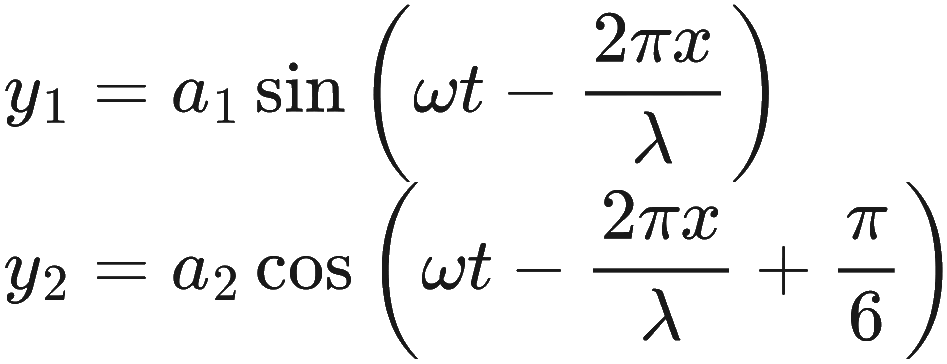 and