Physics Circle home Home Practice Hub Register / Login

Home›Practice Hub›Chapters›Wave Optics

Physics PYQs · MHT CET · JEE Main · NEET

Wave Optics

Questions
491
MHT CET
238
JEE Main
194
NEET
59
Years
1988–2026
0 of 491 attemptedPick an answer to see the solution

Q1MHT CET 2026 · 13 APR · SHIFT 1Easy

Wave Theory, Wavefronts & Doppler Effect · Newton's & Huygens' theories of light

According to corpuscular theory of light, Which is NOT the property of light?

Show answer and solution

Answer: (c)

  1. Newton's corpuscular theory predicts that light travels faster in a denser medium: vglass>vairv_{glass} > v_{air}.
  2. It does explain straight-line travel, unchanged speed after reflection and a change of speed on refraction.
  3. The statement vair>vglassv_{air} > v_{glass} contradicts the corpuscular theory.
  4. So the answer is (c).
Report a mistake
Q2MHT CET 2026 · 15 MAY · SHIFT 1Easy

Wave Theory, Wavefronts & Doppler Effect · Wavefronts & secondary wavelets

According to Huygens principle, a wave front propagates through a medium by

Show answer and solution

Answer: (d)

  1. Huygens' principle: every point on a wavefront acts as a source of secondary wavelets.
  2. The forward envelope (common tangent) of these wavelets gives the new wavefront.
  3. So the answer is (d).
Report a mistake
Q3MHT CET 2026 · 12 MAY · SHIFT 2Easy

Wave Theory, Wavefronts & Doppler Effect · Reflection & refraction of wavefronts

A Parallel beam of monochromatic light is incident on a plane reflecting surface. If width of the plane incident and reflected plane wavefront is represented by ABAB and CDCD respectively then

Show answer and solution

Answer: (c)

  1. On reflection the wave stays in the same medium, so speed is unchanged.
  2. Hence angle of reflection = angle of incidence, r=ir = i.
  3. Widths: AB=Lcos⁡iAB = L\cos i and CD=Lcos⁡rCD = L\cos r for the same length LL of the surface.
  4. So the answer is (c) AB=CDAB = CD.
Report a mistake
Q4JEE Main 2026 · 22 JAN · SHIFT 2Easy

Wave Theory, Wavefronts & Doppler Effect · Speed, wavelength & frequency in a medium

The wavelength of light, while it is passing through water is 540 nm. The refractive index of water is 4/34/3. The wavelength of the same light when it is passing through a transparent medium having refractive index of 3/23/2 is ______ nm.

Show answer and solution

Answer: (c)

  1. λmedium=λ0/μ\lambda_{medium} = \lambda_0/\mu, so λ1μ1=λ2μ2\lambda_1\mu_1 = \lambda_2\mu_2.
  2. 540×43=λ2×32540 \times \frac{4}{3} = \lambda_2 \times \frac{3}{2}
  3. λ2=7201.5=480\lambda_2 = \dfrac{720}{1.5} = 480 nm
  4. So the answer is (c) 480 nm.
Report a mistake
Q5JEE Main 2026 · 28 JAN · SHIFT 1Medium

Wave Theory, Wavefronts & Doppler Effect · Wavefronts & secondary wavelets

Given below are two statements:

Statement I: A plane wave after passing through prism remains as plane wave but passing through small pin hole may become spherical wave.

Statement II: The curvature of a spherical wave emerging from a slit will increase for increasing slit width.

In the light of the above statements, choose the correct answer from the options given below:

Show answer and solution

Answer: (c)

  1. Statement I: a prism only deviates a plane wave, which stays plane; a pinhole acts like a point source, giving a spherical wave. True.
  2. Statement II: a wider slit gives less diffraction, so the emerging wavefront is flatter and its curvature decreases. False.
  3. So the answer is (c).
Report a mistake
Q6MHT CET 2026 · 18 APR · SHIFT 2Medium

Wave Theory, Wavefronts & Doppler Effect · Reflection & refraction of wavefronts

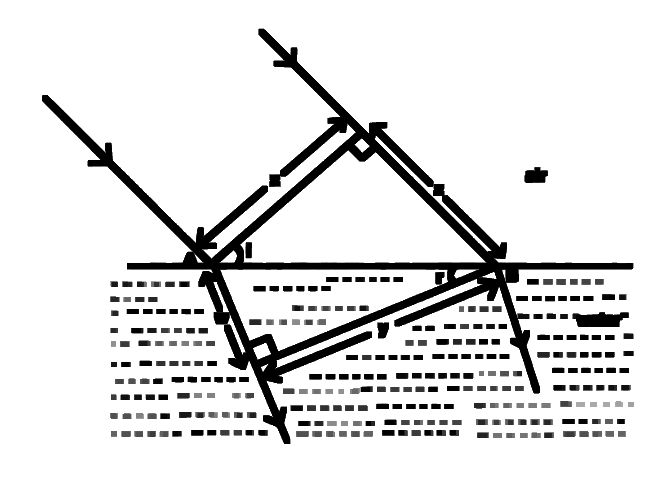
A plane wavefront of width xx, is incident on an air-water interface and the corresponding refracted wavefront has a width y as shown in figure. The refreactive index of air with respect to water in terms of distances w and z is

Figure

Show answer and solution

Answer: (a)

  1. In the same time, light travels distance zz in air and distance ww in water.
  2. So zw=cvw=aμw\dfrac{z}{w} = \dfrac{c}{v_w} = {}_a\mu_w (water w.r.t. air).
  3. Air w.r.t. water: wμa=1aμw=wz{}_w\mu_a = \dfrac{1}{{}_a\mu_w} = \dfrac{w}{z}.
  4. So the answer is (a) wz\dfrac{w}{z}.
Report a mistake
Q7MHT CET 2025 · 21 APR · SHIFT 2Easy

Wave Theory, Wavefronts & Doppler Effect · Newton's & Huygens' theories of light

According to Huygen's wave theory of light, which one of the following statements is not correct?

Show answer and solution

Answer: (b)

  1. In wave theory, colour depends on wavelength, so (a) is correct.
  2. Wave theory predicts vdenser<vrarerv_{denser} < v_{rarer} and explains reflection and refraction, so (c) and (d) are correct.
  3. Colour due to size of corpuscles belongs to Newton's corpuscular theory, not Huygens' theory.
  4. So the answer is (b).
Report a mistake
Q8JEE Main 2025 · 3 APR · SHIFT 2Easy

Wave Theory, Wavefronts & Doppler Effect · Speed, wavelength & frequency in a medium

A monochromatic light of frequency 5×10¹⁴ Hz5 \times 10^{14}\text{ Hz} travelling through air, is incident on a medium of refractive index ' 2 '. Wavelength of the refracted light will be:

Show answer and solution

Answer: (b)

  1. Wavelength in air: λ0=c/ν=3×1085×1014=6×10−7\lambda_0 = c/\nu = \dfrac{3\times10^{8}}{5\times10^{14}} = 6\times10^{-7} m =600= 600 nm.
  2. In the medium: λ=λ0/μ=600/2=300\lambda = \lambda_0/\mu = 600/2 = 300 nm.
  3. So the answer is (b) 300 nm.
Report a mistake
Q9JEE Main 2025 · 2 APR · SHIFT 1Medium

Wave Theory, Wavefronts & Doppler Effect · Wavefronts & secondary wavelets

A light wave is propagating with plane wave fronts of the type x+y+z=x + y + z = constant. The angle made by the direction of wave propagation with the xx-axis is:

Show answer and solution

Answer: (b)

  1. For the plane x+y+z=x + y + z = constant, the normal (direction of propagation) is n^=i^+j^+k^3\hat n = \dfrac{\hat i + \hat j + \hat k}{\sqrt3}.
  2. Angle with the xx-axis: cos⁡α=n^⋅i^=13\cos\alpha = \hat n \cdot \hat i = \dfrac{1}{\sqrt3}.
  3. So the answer is (b) cos⁡−1(1/3)\cos^{-1}(1/\sqrt3).
Report a mistake
Q10MHT CET 2025 · 20 APR · SHIFT 2Medium

Wave Theory, Wavefronts & Doppler Effect · Doppler effect of light

The apparent wavelength of light from a star moving away from the earth is 0.02%0.02\% more than the actual wavelength. The velocity of star is [c=[c = velocity of light =3×10⁸ m/s]= 3 \times 10^{8}\text{ m/s}]

Show answer and solution

Answer: (b)

  1. Doppler shift: Δλλ=vc\dfrac{\Delta\lambda}{\lambda} = \dfrac{v}{c}.
  2. Δλλ=0.02%=2×10⁻⁴\dfrac{\Delta\lambda}{\lambda} = 0.02\% = 2\times10^{-4}
  3. v=2×10−4×3×108=6×10⁴v = 2\times10^{-4} \times 3\times10^{8} = 6\times10^{4} m/s =60= 60 km/s
  4. So the answer is (b) 60 km/s.
Report a mistake
Q11MHT CET 2024 · 9 MAY · SHIFT 1Easy

Wave Theory, Wavefronts & Doppler Effect · Wavefronts & secondary wavelets

A wavefront is a surface

Show answer and solution

Answer: (a)

  1. A wavefront is the locus of points vibrating in the same phase.
  2. Rays (direction of energy flow) are always normal to the wavefront.
  3. So the answer is (a) perpendicular to the direction of propagation.
Report a mistake
Q12JEE Main 2024 · 5 APR · SHIFT 1Easy

Wave Theory, Wavefronts & Doppler Effect · Wavefronts & secondary wavelets

Light emerges out of a convex lens when a source of light is kept at its focus. The shape of wavefront of the light is:

Show answer and solution

Answer: (c)

  1. A point source at the focus gives a diverging spherical wavefront at the lens.
  2. The convex lens turns these rays into a parallel beam.
  3. Parallel rays correspond to a plane wavefront.
  4. So the answer is (c) plane.
Report a mistake
Q13MHT CET 2024 · 3 MAY · SHIFT 1Easy

Wave Theory, Wavefronts & Doppler Effect · Reflection & refraction of wavefronts

When wavefronts pass from denser medium to rarer medium, the width of the wavefront

Show answer and solution

Answer: (c)

  1. For the same length LL of the interface: incident width =Lcos⁡i= L\cos i, refracted width =Lcos⁡r= L\cos r.
  2. Going from denser to rarer, the ray bends away from the normal: r>ir > i.
  3. So cos⁡r<cos⁡i\cos r < \cos i and the refracted wavefront is narrower.
  4. So the answer is (c) decreases.
Report a mistake
Q14MHT CET 2023 · 9 MAY · SHIFT 1Easy

Wave Theory, Wavefronts & Doppler Effect · Ray optics limit, colours & scattering

The rays of different colours fail to converge at a point after passing through a thick converging lens. This defect is called

Show answer and solution

Answer: (d)

  1. Refractive index of glass depends on wavelength (μv>μr\mu_v > \mu_r), so focal length differs for each colour.
  2. Violet focuses closer to the lens than red, so the colours do not meet at one point.
  3. This defect is chromatic aberration, so the answer is (d).
Report a mistake
Q15NEET 2023Medium

Wave Theory, Wavefronts & Doppler Effect · Ray optics limit, colours & scattering

Figure

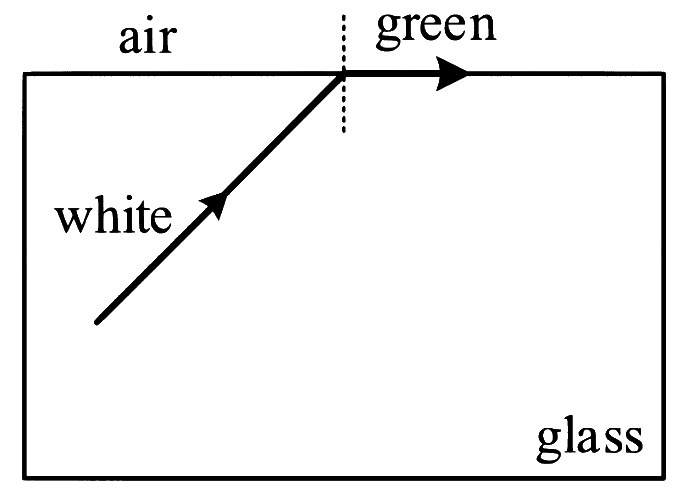
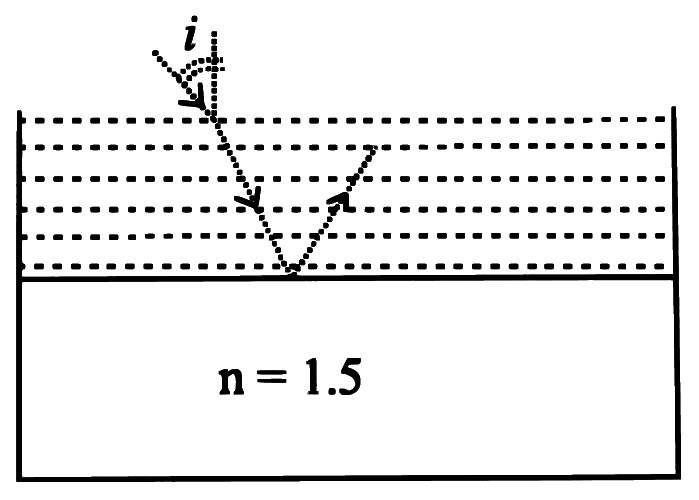
Which set of colours will come out in air for a situation shown in figure?

Show answer and solution

Answer: (a)

  1. Green just grazes the surface, so the angle of incidence equals the critical angle for green.
  2. sin⁡C=1/μ\sin C = 1/\mu; colours with smaller μ\mu (longer λ\lambda) have a larger critical angle, so for them i<Ci < C and they refract out.
  3. Blue and violet have larger μ\mu, so i>Ci > C and they are totally internally reflected.
  4. So the answer is (a) yellow, orange and red.
Report a mistake
Q16JEE Main 2022 · 26 JUN · SHIFT 2Medium

Wave Theory, Wavefronts & Doppler Effect · Doppler effect of light

For a specific wavelength 670 nm of light coming from a galaxy moving with velocity v, the observed wavelength is 670.7 nm. The value of v is:

Show answer and solution

Answer: (c)

  1. Doppler shift: v=cΔλλv = c\dfrac{\Delta\lambda}{\lambda}, with Δλ=670.7−670=0.7\Delta\lambda = 670.7 - 670 = 0.7 nm.
  2. v=3×108×0.7670≈3.13×10⁵v = 3\times10^{8} \times \dfrac{0.7}{670} \approx 3.13\times10^{5} m/s (galaxy receding).
  3. So the answer is (c) 3.13×1053.13\times10^{5} m/s.
Report a mistake
Q17JEE Main 2021 · 18 MAR · SHIFT 2Easy

Wave Theory, Wavefronts & Doppler Effect · Doppler effect of light

A galaxy is moving away from the earth at a speed of 286 kms−1{}^{-1}. The shift in the wavelength of a redline at 630 nm is x ×\times 10−-10 m. The value of x, to the nearest integer, is ____________. [Take the value of speed of light c, as 3 ×\times 108 ms−1{}^{-1}]

Numerical answer type. Work it out, then open the answer.

Show answer and solution

Answer: 6

  1. Doppler shift: Δλ=λvc\Delta\lambda = \lambda\dfrac{v}{c}.
  2. Δλ=630×10−9×286×1033×108=630×10−9×9.53×10−4\Delta\lambda = 630\times10^{-9} \times \dfrac{286\times10^{3}}{3\times10^{8}} = 630\times10^{-9} \times 9.53\times10^{-4}
  3. Δλ≈6.0×10⁻¹⁰\Delta\lambda \approx 6.0\times10^{-10} m
  4. So x=6x = 6.
Report a mistake
Q18JEE Main 2021 · 20 JUL · SHIFT 2Medium

Wave Theory, Wavefronts & Doppler Effect · Doppler effect of light

With what speed should a galaxy move outward with respect to earth so that the sodium-D line at wavelength 5890 A˚\mathring{A} is observed at 5896 A˚\mathring{A}?

Show answer and solution

Answer: (a)

  1. Doppler shift: v=cΔλλv = c\dfrac{\Delta\lambda}{\lambda}, with Δλ=5896−5890=6\Delta\lambda = 5896 - 5890 = 6 Å.
  2. v=3×108×65890≈3.06×10⁵v = 3\times10^{8} \times \dfrac{6}{5890} \approx 3.06\times10^{5} m/s
  3. v≈306v \approx 306 km/s
  4. So the answer is (a) 306 km/s.
Report a mistake
Q19MHT CET 2020 · 16 OCT · SHIFT 1Easy

Wave Theory, Wavefronts & Doppler Effect · Speed, wavelength & frequency in a medium

When a photon enters glass from air, which one of the following quantity does not change?

Show answer and solution

Answer: (d)

  1. Frequency depends only on the source, so it does not change on entering glass.
  2. Photon energy E=hνE = h\nu depends only on frequency, so EE stays the same.
  3. Speed, wavelength and momentum p=h/λp = h/\lambda all change.
  4. So the answer is (d) energy.
Report a mistake
Q20MHT CET 2019 · 2 MAY · SHIFT 1Easy

Wave Theory, Wavefronts & Doppler Effect · Doppler effect of light

If a star emitting yellow light is accelerated towards earth, then to an observer on earth it will appear

Show answer and solution

Answer: (c)

  1. For a source approaching the observer, Δλ=−λv/c\Delta\lambda = -\lambda v/c: wavelength decreases (blue shift).
  2. As the star accelerates, vv keeps increasing, so the shift keeps growing.
  3. Yellow light therefore shifts gradually towards blue.
  4. So the answer is (c).
Report a mistake
Q21JEE Main 2015Medium

Wave Theory, Wavefronts & Doppler Effect · Reflection & refraction of wavefronts

On a hot summer night, the refractive index of air is smallest near the ground and increases with height from the ground. When a light beam is directed horizontally, the Huygens' principle leads us to conclude that as it travels, the light beam:

Show answer and solution

Answer: (b)

  1. Refractive index increases with height, so the speed v=c/μv = c/\mu is smaller higher up.
  2. The upper part of each wavefront moves slower than the lower part, so the wavefront tilts.
  3. The beam (normal to the wavefront) turns towards the region of higher μ\mu.
  4. So the answer is (b) bends upwards.
Report a mistake
Q22NEET 2013Easy

Wave Theory, Wavefronts & Doppler Effect · Ray optics limit, colours & scattering

The reddish appearance of the sun at sunrise and sunset is due to

Show answer and solution

Answer: (a)

  1. At sunrise and sunset sunlight travels a long path through the atmosphere.
  2. Rayleigh scattering ∝1/λ4\propto 1/\lambda^4 removes blue light from the direct beam most strongly.
  3. Mostly red light reaches the observer, so the answer is (a) scattering of light.
Report a mistake
Q23JEE Main 2010 · AIEEEDifficult

Wave Theory, Wavefronts & Doppler Effect · Reflection & refraction of wavefronts

An initially parallel cylindrical beam travels in a medium of refractive index μ(I)=μ0+μ2I,\mu(I) = \mu_0 + \mu_2 I, where μ0\mu_0 and μ2\mu_2 are positive constants and II is the intensity of the light beam. The intensity of the beam is decreasing with increasing radius.

The initial shape of the wavefront of the beam is

Show answer and solution

Answer: (d)

  1. The beam is initially parallel, i.e. all rays are parallel to the axis.
  2. Rays are normal to the wavefront, so parallel rays mean a plane wavefront.
  3. The intensity-dependent μ\mu changes the shape only later as the beam travels.
  4. So the answer is (d) planar.
Report a mistake
Q24NEET 2007 · AIPMTEasy

Wave Theory, Wavefronts & Doppler Effect · Speed, wavelength & frequency in a medium

The frequency of a light wave in a material is 2 ×\times 1014 Hz and wavelength is 5000 A˚\mathring{A}. The refractive index of material will be

Show answer and solution

Answer: (b)

  1. Speed in the material: v=νλ=(2×10¹⁴)(5000×10−10)=1×10⁸v = \nu\lambda = (2\times10^{14})(5000\times10^{-10}) = 1\times10^{8} m/s.
  2. Refractive index n=c/v=3×1081×108=3n = c/v = \dfrac{3\times10^{8}}{1\times10^{8}} = 3.
  3. So the answer is (b) 3.00.
Report a mistake
Q25NEET 2001 · AIPMTEasy

Wave Theory, Wavefronts & Doppler Effect · Speed, wavelength & frequency in a medium

A ray of light travelling in air has wavelength λ\lambda, frequency n, velocity v and intensity II. If this ray enters into water then these parameters are λ\lambda', n', v' and II' respectively. Which relation is correct from following?

Show answer and solution

Answer: (b)

  1. Frequency is fixed by the source and does not change on refraction.
  2. In water v′=v/μv' = v/\mu and λ′=λ/μ\lambda' = \lambda/\mu, and part of the light is reflected so I′<II' < I.
  3. So the answer is (b) n=n′n = n'.
Report a mistake
Q26NEET 1995 · AIPMTEasy

Wave Theory, Wavefronts & Doppler Effect · Doppler effect of light

A star, which is emitting radiation at a wavelength of 5000 Å, is approaching the earth with a velocity of 1.5×10⁶ m/s1.5 \times 10^{6}\text{ m/s}. The change in wavelength of the radiation as received on the earth is

Show answer and solution

Answer: (a)

  1. Doppler shift for light (v≪cv \ll c): Δλ=λvc\Delta\lambda = \lambda\dfrac{v}{c}.
  2. Δλ=5000×1.5×1063×108=5000×5×10−3\Delta\lambda = 5000 \times \dfrac{1.5\times10^{6}}{3\times10^{8}} = 5000 \times 5\times10^{-3}
  3. Δλ=25\Delta\lambda = 25 Å (a decrease, since the star approaches).
  4. So the answer is (a) 25 Å.
Report a mistake
Q27NEET 1994 · AIPMTEasy

Wave Theory, Wavefronts & Doppler Effect · Ray optics limit, colours & scattering

Ray optics is valid, when characteristic dimensions are

Show answer and solution

Answer: (d)

  1. Diffraction spreads light by an angle θ≈λ/a\theta \approx \lambda/a.
  2. When the size a≫λa \gg \lambda, this spreading is negligible and light travels in straight lines (rays).
  3. So the answer is (d) much larger than the wavelength.
Report a mistake
Q28NEET 1989 · AIPMTEasy

Wave Theory, Wavefronts & Doppler Effect · Ray optics limit, colours & scattering

Ray optics is valid, when characteristic dimensions are

Show answer and solution

Answer: (d)

  1. Diffraction spreads light by an angle θ≈λ/a\theta \approx \lambda/a.
  2. When the size a≫λa \gg \lambda, this spreading is negligible and light travels in straight lines (rays).
  3. So the answer is (d) much larger than the wavelength.
Report a mistake
Q29NEET 1988 · AIPMTEasy

Wave Theory, Wavefronts & Doppler Effect · Newton's & Huygens' theories of light

Which one of the following phenomena is not explained by Huygen's construction of wavefront?

Show answer and solution

Answer: (d)

  1. Huygens' construction explains propagation effects: reflection, refraction, diffraction.
  2. The origin of spectra comes from emission and absorption by atoms (quantum transitions), which wave construction cannot explain.
  3. So the answer is (d) origin of spectra.
Report a mistake
Q30MHT CET 2026 · 17 APR · SHIFT 2Easy

Superposition, Coherence & Intensity · Conditions for interference & coherence

For obtaining maximum contrast between the bright and dark fringes in an interference pattern, the intensities of the two light coherent sources should be

Show answer and solution

Answer: (c)

  1. Imin=(I1−I2)2I_{min} = (\sqrt{I_1} - \sqrt{I_2})^2 and Imax=(I1+I2)2I_{max} = (\sqrt{I_1} + \sqrt{I_2})^2.
  2. Best contrast needs perfectly dark fringes, Imin=0I_{min} = 0, which happens only when I1=I2I_1 = I_2.
  3. So the answer is (c) equal.
Report a mistake
Q31NEET 2026Easy

Superposition, Coherence & Intensity · Conditions for interference & coherence

In interference and diffraction, the light energy is redistributed. If it reduces in one region, producing a dark fringe, it increases in another region, producing a bright fringe.

A. As there is no gain or loss of energy, these phenomena are consistent with the principle of conservation of energy.

B. Diffraction and interference are characteristics exhibited only by light waves. Choose the correct answer from the options given below:

Show answer and solution

Answer: (c)

  1. A: energy taken from dark regions appears in bright regions, so total energy is conserved. True.
  2. B: interference and diffraction are shown by all waves (sound, water waves, matter waves), not only light. False.
  3. So the answer is (c).
Report a mistake
Q32MHT CET 2026 · 19 APR · SHIFT 1Easy

Superposition, Coherence & Intensity · Phase & path conditions

In Young's double slit experiment, for the nnth dark fringe (n=1,2,3,…n = 1, 2, 3, \ldots) the phase difference of the interfering waves in radian will be

Show answer and solution

Answer: (c)

  1. Dark fringe: phase difference is an odd multiple of π\pi: π,3π,5π,…\pi, 3\pi, 5\pi, \ldots
  2. For n=1,2,3,…n = 1, 2, 3, \ldots this is ϕ=(2n−1)π\phi = (2n-1)\pi.
  3. So the answer is (c) (2n−1)π(2n-1)\pi.
Report a mistake
Q33MHT CET 2026 · 17 APR · SHIFT 2Easy

Superposition, Coherence & Intensity · Imax/Imin ratio & slit widths

In Young's experiment, the intensity ratio of the maxima and minima in an interference pattern produced by two coherent sources is 36:136 : 1. The ratio of the amplitudes of the two individual sources will be

Show answer and solution

Answer: (c)

  1. ImaxImin=(a1+a2a1−a2)2=36\frac{I_{max}}{I_{min}} = \left(\frac{a_1+a_2}{a_1-a_2}\right)^2 = 36
  2. a1+a2a1−a2=6⇒a1+a2=6a1−6a2⇒5a1=7a2\frac{a_1+a_2}{a_1-a_2} = 6 \Rightarrow a_1 + a_2 = 6a_1 - 6a_2 \Rightarrow 5a_1 = 7a_2
  3. a1a2=75\frac{a_1}{a_2} = \frac{7}{5}
  4. So the answer is (c) 7:57 : 5.
Report a mistake
Q34MHT CET 2026 · 11 APR · SHIFT 1Easy

Superposition, Coherence & Intensity · Imax/Imin ratio & slit widths

Two light waves amplitudes in the ratio 3:13 : 1 produce interference. The ratio of the maximum to minimum intensity is

Show answer and solution

Answer: (d)

  1. ImaxImin=(a1+a2a1−a2)2\frac{I_{max}}{I_{min}} = \left(\frac{a_1+a_2}{a_1-a_2}\right)^2
  2. =(3+13−1)2=22=4= \left(\frac{3+1}{3-1}\right)^2 = 2^2 = 4
  3. So the answer is (d) 4:14 : 1.
Report a mistake
Q35MHT CET 2026 · 20 MAY · SHIFT 1Medium

Superposition, Coherence & Intensity · Imax/Imin ratio & slit widths

The interference pattern is obtained with two coherent light sources of intensity (I1I_1 and I2I_2) ratio 'β\beta'. In the interference pattern, the ratio (Imax+IminImax−Imin)\left(\frac{I_{max} + I_{min}}{I_{max} - I_{min}}\right) will be (β=I2I1)\left(\beta = \frac{I_2}{I_1}\right)

Show answer and solution

Answer: (c)

  1. Imax+Imin=2(I1+I2)I_{max} + I_{min} = 2(I_1 + I_2), Imax−Imin=4I1I2I_{max} - I_{min} = 4\sqrt{I_1 I_2}
  2. Ratio =I1+I22I1I2= \frac{I_1 + I_2}{2\sqrt{I_1 I_2}}; divide by I1I_1 with β=I2I1\beta = \frac{I_2}{I_1}:
  3. =1+β2β= \frac{1+\beta}{2\sqrt{\beta}}
  4. So the answer is (c) β+12β\frac{\beta + 1}{2\sqrt{\beta}}.
Report a mistake
Q36MHT CET 2026 · 15 MAY · SHIFT 2Medium

Superposition, Coherence & Intensity · Intensity at a point

At two points PP and QQ on the screen in Young's double slit experiment, waves from slits S1S_1 and S2S_2 have a path difference of zero and λ4\frac{\lambda}{4} respectively. The ratio of intensities at PP and QQ will be (cos⁡0∘=1, cos⁡45∘=12)\left(\cos 0^\circ = 1,\ \cos 45^\circ = \frac{1}{\sqrt{2}}\right)

Show answer and solution

Answer: (b)

  1. For equal slits I=Imaxcos⁡2ϕ2I = I_{max}\cos^2\dfrac{\phi}{2} with ϕ=2πλΔx\phi = \dfrac{2\pi}{\lambda}\Delta x.
  2. At PP: Δx=0\Delta x = 0, ϕ=0\phi = 0, IP=ImaxI_P = I_{max}.
  3. At QQ: Δx=λ/4\Delta x = \lambda/4, ϕ=π/2\phi = \pi/2, IQ=Imaxcos⁡245∘=Imax2I_Q = I_{max}\cos^2 45^\circ = \dfrac{I_{max}}{2}.
  4. So the answer is (b) 2:12 : 1.
Report a mistake
Q37MHT CET 2026 · 14 MAY · SHIFT 2Medium

Superposition, Coherence & Intensity · Intensity at a point

Interference fringes are produced on a screen by using two light sources of intensities I and 9I. The phase difference between the beams is π2\frac{\pi}{2}, at point P and π\pi at point Q on the screen. The difference between the resultant intensities at points P and Q is (cos⁡π2=0,cos⁡π=−1)\left(\cos\frac{\pi}{2} = 0, \cos\pi = -1\right)

Show answer and solution

Answer: (c)

  1. I=I1+I2+2I1I2cos⁡ϕI = I_1 + I_2 + 2\sqrt{I_1 I_2}\cos\phi, with 2I⋅9I=6I2\sqrt{I \cdot 9I} = 6I.
  2. At PP (ϕ=π/2\phi = \pi/2): IP=I+9I+0=10II_P = I + 9I + 0 = 10I.
  3. At QQ (ϕ=π\phi = \pi): IQ=10I−6I=4II_Q = 10I - 6I = 4I.
  4. IP−IQ=6II_P - I_Q = 6I. So the answer is (c) 6I6I.
Report a mistake
Q38MHT CET 2026 · 13 MAY · SHIFT 1Medium

Superposition, Coherence & Intensity · Intensity at a point

The ratio of intensity at the centre of a bright fringe to the intensity at a point distant (14)th\left(\frac{1}{4}\right)^{th} of the distance between two successive bright fringes will be (cos⁡0∘=1,cos⁡90∘=0)(\cos 0^\circ = 1, \cos 90^\circ = 0)

Show answer and solution

Answer: (c)

  1. Moving one fringe width β\beta changes path difference by λ\lambda, so β/4\beta/4 gives Δx=λ/4\Delta x = \lambda/4, ϕ=π/2\phi = \pi/2.
  2. I=Imaxcos⁡2ϕ2=Imaxcos⁡245∘=Imax2I = I_{max}\cos^2\dfrac{\phi}{2} = I_{max}\cos^2 45^\circ = \dfrac{I_{max}}{2}
  3. ImaxI=2\dfrac{I_{max}}{I} = 2. So the answer is (c) 22.
Report a mistake
Q39MHT CET 2026 · 13 MAY · SHIFT 1Medium

Superposition, Coherence & Intensity · Intensity at a point

The wavelength of light used in Young's double slit experiment, is λ\lambda. The intensity at a point on the screen is I, where the path difference is λ6\frac{\lambda}{6}. If I0I_0 is the maximum intensity then the ratio I to I0I_0 is (cos⁡30∘=32)\left(\cos 30^\circ = \frac{\sqrt{3}}{2}\right)

Show answer and solution

Answer: (d)

  1. ϕ=2πλ⋅λ6=π3\phi = \dfrac{2\pi}{\lambda}\cdot\dfrac{\lambda}{6} = \dfrac{\pi}{3}
  2. II0=cos⁡2ϕ2=cos⁡230∘=34\dfrac{I}{I_0} = \cos^2\dfrac{\phi}{2} = \cos^2 30^\circ = \dfrac{3}{4}
  3. So the answer is (d) 0.750.75.
Report a mistake
Q40MHT CET 2026 · 19 APR · SHIFT 1Medium

Superposition, Coherence & Intensity · Intensity at a point

In Young's double slit experiment, the wavelength of light used is λ\lambda. The intensity on the screen at a point for path difference 'λ\lambda' is 'X'. The intensity at the point for path difference (λ6)\left(\frac{\lambda}{6}\right) is (cos⁡180∘=−1, cos⁡30∘=32\cos 180^\circ = -1,\ \cos 30^\circ = \frac{\sqrt{3}}{2})

Show answer and solution

Answer: (c)

  1. Path difference λ\lambda gives ϕ=2π\phi = 2\pi, a bright fringe, so X=ImaxX = I_{max}.
  2. For λ/6\lambda/6: ϕ=π/3\phi = \pi/3, I=Xcos⁡230∘=3X4I = X\cos^2 30^\circ = \dfrac{3X}{4}.
  3. So the answer is (c) 3X4\dfrac{3X}{4}.
Report a mistake
Q41MHT CET 2026 · 17 APR · SHIFT 1Medium

Superposition, Coherence & Intensity · Intensity at a point

In Young's double slit experiment, width of the second slit is double the width of first slit, consequently the amplitude of the light from two slits. 'ImI_m' is the maximum intensity. The resultant intensity 'II' when they interfere with the phase difference of ϕ\phi is given by

Show answer and solution

Answer: (a)

  1. Amplitudes aa and 2a2a, so intensities I0I_0 and 4I04I_0; Im=(a+2a)2∝9I0I_m = (a + 2a)^2 \propto 9I_0.
  2. I=I0+4I0+24I0cos⁡ϕ=5I0+4I0cos⁡ϕI = I_0 + 4I_0 + 2\sqrt{4}I_0\cos\phi = 5I_0 + 4I_0\cos\phi
  3. Using cos⁡ϕ=2cos⁡2ϕ2−1\cos\phi = 2\cos^2\dfrac{\phi}{2} - 1: I=I0(1+8cos⁡2ϕ2)I = I_0\left(1 + 8\cos^2\dfrac{\phi}{2}\right).
  4. With I0=Im/9I_0 = I_m/9: I=Im9(1+8cos⁡2ϕ2)I = \dfrac{I_m}{9}\left(1 + 8\cos^2\dfrac{\phi}{2}\right). So the answer is (a).
Report a mistake
Q42MHT CET 2026 · 16 APR · SHIFT 1Medium

Superposition, Coherence & Intensity · Intensity at a point

The ratio of intensities at two points on the screen in Young's double slit experiment when waves from the two slits have a path difference of zero and λ/4\lambda/4 is (λ\lambda is the wavelength of light used) (cos⁡0∘=1, cos⁡π/2=0\cos 0^\circ = 1,\ \cos\pi/2 = 0)

Show answer and solution

Answer: (b)

  1. I=Imaxcos⁡2ϕ2I = I_{max}\cos^2\dfrac{\phi}{2}, ϕ=2πλΔx\phi = \dfrac{2\pi}{\lambda}\Delta x.
  2. Δx=0\Delta x = 0: I1=ImaxI_1 = I_{max}. Δx=λ/4\Delta x = \lambda/4: ϕ=π/2\phi = \pi/2, I2=Imax/2I_2 = I_{max}/2.
  3. So the answer is (b) 2:12 : 1.
Report a mistake
Q43MHT CET 2026 · 11 APR · SHIFT 1Medium

Superposition, Coherence & Intensity · Intensity at a point

In a Young's double slit experiment, the intensities at two points, for the path difference λ4\frac{\lambda}{4} and λ3\frac{\lambda}{3} (λ\lambda being the wavelength of light used) are I1I_1 and I2I_2 respectively. If I0I_0 denotes the intensity produced by each one of the individual slits, then I1+I2I0=\frac{I_1 + I_2}{I_0} =

(cos⁡45∘=12,cos⁡60=12)\left(\cos 45^\circ = \frac{1}{\sqrt{2}}, \cos 60 = \frac{1}{2}\right)

Show answer and solution

Answer: (b)

  1. For equal slits I=4I0cos⁡2ϕ2I = 4I_0\cos^2\dfrac{\phi}{2}.
  2. Δx=λ/4\Delta x = \lambda/4: ϕ=π/2\phi = \pi/2, I1=4I0cos⁡245∘=2I0I_1 = 4I_0\cos^2 45^\circ = 2I_0.
  3. Δx=λ/3\Delta x = \lambda/3: ϕ=2π/3\phi = 2\pi/3, I2=4I0cos⁡260∘=I0I_2 = 4I_0\cos^2 60^\circ = I_0.
  4. I1+I2I0=3\dfrac{I_1 + I_2}{I_0} = 3. So the answer is (b) 33.
Report a mistake
Q44NEET 2026Medium

Superposition, Coherence & Intensity · Intensity at a point

In Young's double slit experiment, using monochromatic light of wavelength λ\lambda, the intensity of light at a point on the screen where the path difference is λ\lambda, is KK units. The intensity of light at a point where the path difference is λ3\frac{\lambda}{3} will be

Show answer and solution

Answer: (a)

  1. Path difference λ\lambda is a bright fringe, so K=ImaxK = I_{max}.
  2. For λ/3\lambda/3: ϕ=2π/3\phi = 2\pi/3, I=Kcos⁡260∘=K4I = K\cos^2 60^\circ = \dfrac{K}{4}.
  3. So the answer is (a) K4\dfrac{K}{4}.
Report a mistake
Q45JEE Main 2026 · 6 APR · SHIFT 1Medium

Superposition, Coherence & Intensity · Intensity at a point

In interference experiment the path difference between two interfering waves at a point AA on the screen is λ/3\lambda/3, where λ\lambda is the wavelength of these waves, and at another point BB the path difference is λ/6\lambda/6. The ratio of intensities at points AA and BB is ______.

Show answer and solution

Answer: (c)

  1. I=Imaxcos⁡2ϕ2I = I_{max}\cos^2\dfrac{\phi}{2}, ϕ=2πλΔx\phi = \dfrac{2\pi}{\lambda}\Delta x.
  2. At AA: ϕ=2π/3\phi = 2\pi/3, IA=Imaxcos⁡260∘=Imax4I_A = I_{max}\cos^2 60^\circ = \dfrac{I_{max}}{4}.
  3. At BB: ϕ=π/3\phi = \pi/3, IB=Imaxcos⁡230∘=3Imax4I_B = I_{max}\cos^2 30^\circ = \dfrac{3I_{max}}{4}.
  4. IAIB=13\dfrac{I_A}{I_B} = \dfrac{1}{3}. So the answer is (c) 1/31/3.
Report a mistake
Q46JEE Main 2026 · 24 JAN · SHIFT 2Medium

Superposition, Coherence & Intensity · Intensity at a point

In the Young's double slit experiment the intensity produced by each one of the individual slits is IoI_o. The distance between two slits is 2 mm. The distance of screen from slits is 10 m. The wavelength of light is 6000 A˚6000\ \text{Å}. The intensity of light on the screen in front of one of the slits is ______

Show answer and solution

Answer: (b)

  1. In front of one slit, y=d2=1 mmy = \dfrac{d}{2} = 1\ \text{mm} from the centre.
  2. Path difference Δx=ydD=(10−3)(2×10⁻³)10=2×10⁻⁷ m=λ3\Delta x = \dfrac{yd}{D} = \dfrac{(10^{-3})(2\times10^{-3})}{10} = 2\times10^{-7}\ \text{m} = \dfrac{\lambda}{3} (as λ=6×10⁻⁷\lambda = 6\times10^{-7} m).
  3. ϕ=2π3\phi = \dfrac{2\pi}{3}, so I=4Iocos⁡260∘=IoI = 4I_o\cos^2 60^\circ = I_o.
  4. So the answer is (b) IoI_o.
Report a mistake
Q47JEE Main 2026 · 2 APR · SHIFT 2Medium

Superposition, Coherence & Intensity · Intensity at a point

In a Young's double slit experiment, the intensity at some point on the screen is found to be 34\frac{3}{4} times of the maximum of the interference pattern. The path difference between the interfering waves at this point is λx\frac{\lambda}{x} where λ\lambda is wavelength of the incident light. The value of xx is _______.

Numerical answer type. Work it out, then open the answer.

Show answer and solution

Answer: 6

  1. I=Imaxcos⁡2ϕ2=34Imax⇒cos⁡ϕ2=32I = I_{max}\cos^2\frac{\phi}{2} = \frac{3}{4}I_{max} \Rightarrow \cos\frac{\phi}{2} = \frac{\sqrt{3}}{2}
  2. ϕ2=π6⇒ϕ=π3\frac{\phi}{2} = \frac{\pi}{6} \Rightarrow \phi = \frac{\pi}{3}
  3. Path difference Δx=λ2πϕ=λ6\Delta x = \frac{\lambda}{2\pi}\phi = \frac{\lambda}{6}
  4. So x=6x = 6.
Report a mistake
Q48JEE Main 2026 · 6 APR · SHIFT 2Difficult

Superposition, Coherence & Intensity · Intensity at a point

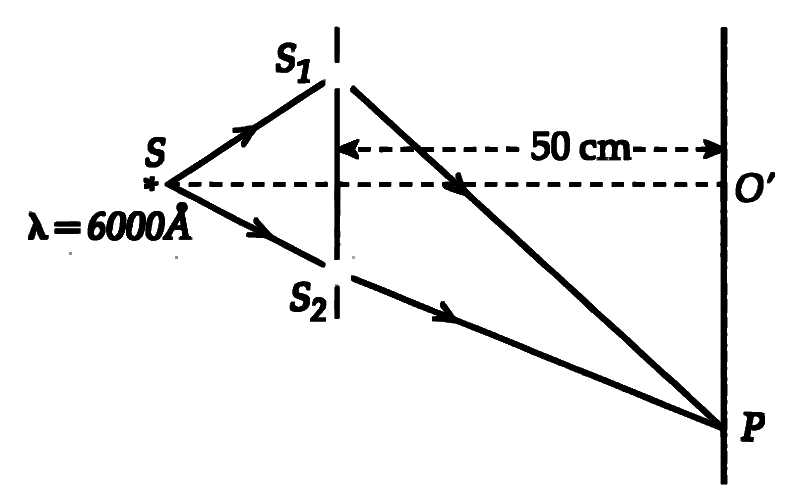
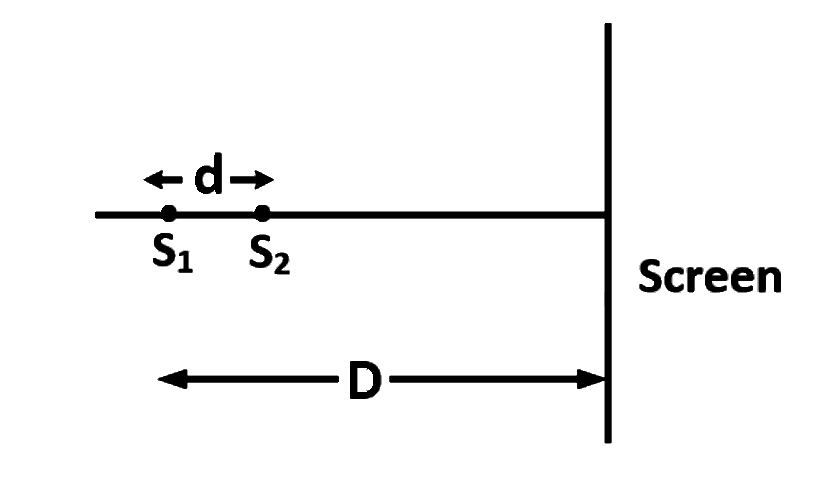
In a Young double slit experiment, the wavelength of incident light is 6000 A˚6000\ \text{Å}, the separation between slits S1S_1 and S2S_2 is 5 cm and the distance between slits plane and screen is 50 cm, as shown in the figure below. If the resultant intensity at PP is equal to the intensity due to individual slits, the path difference between interfering waves is ______ Å.

Figure

Show answer and solution

Answer: (c)

  1. Each slit gives I0I_0; resultant I=4I0cos⁡2ϕ2I = 4I_0\cos^2\frac{\phi}{2}.
  2. 4I0cos⁡2ϕ2=I0⇒cos⁡ϕ2=12⇒ϕ=2π34I_0\cos^2\frac{\phi}{2} = I_0 \Rightarrow \cos\frac{\phi}{2} = \frac{1}{2} \Rightarrow \phi = \frac{2\pi}{3}
  3. Δx=λ2π⋅2π3=λ3=60003=2000 A˚\Delta x = \frac{\lambda}{2\pi}\cdot\frac{2\pi}{3} = \frac{\lambda}{3} = \frac{6000}{3} = 2000\ \text{Å}
  4. So the answer is (c) 2000.
Report a mistake
Q49MHT CET 2025 · 25 APR · SHIFT 1Easy

Superposition, Coherence & Intensity · Conditions for interference & coherence

If the two sources of light emit waves of different amplitudes and interfere then

Show answer and solution

Answer: (a)

  1. At destructive interference the resultant amplitude is ∣A1−A2∣|A_1 - A_2|.
  2. If A1≠A2A_1 \ne A_2, this is not zero, so dark fringes are not completely dark.
  3. So the answer is (a).
Report a mistake
Q50JEE Main 2025 · 8 APR · SHIFT 2Easy

Superposition, Coherence & Intensity · Conditions for interference & coherence

In a Young's double slit experiment, the source is white light. One of the slits is covered by red filter and another by a green filter. In this case:

Show answer and solution

Answer: (d)

  1. Sustained interference needs coherent sources of the same frequency.
  2. Red and green filters pass light of different frequencies, so the two slits are not coherent.
  3. The phase difference changes rapidly and no steady fringes form; the screen is just uniformly illuminated.
  4. So the answer is (d) there shall be no interference fringes.
Report a mistake
Q51MHT CET 2025 · 20 APR · SHIFT 1Easy

Superposition, Coherence & Intensity · Phase & path conditions

In Young's double slit experiment, for the nnth dark fringe ( n=1,2,3…n = 1, 2, 3 \ldots) the phase difference of the interfering waves in radian will be

Show answer and solution

Answer: (c)

  1. Dark fringe: phase difference is an odd multiple of π\pi: π,3π,5π,…\pi, 3\pi, 5\pi, \ldots
  2. For n=1,2,3,…n = 1, 2, 3, \ldots this is ϕ=(2n−1)π\phi = (2n-1)\pi.
  3. So the answer is (c) (2n−1)π(2n-1)\pi.
Report a mistake
Q52JEE Main 2025 · 3 APR · SHIFT 2Easy

Superposition, Coherence & Intensity · Imax/Imin ratio & slit widths

Two monochromatic light beams have intensities in the ratio 1:9. An interference pattern is obtained by these beams. The ratio of the intensities of maximum to minimum is

Show answer and solution

Answer: (b)

  1. Intensity ratio 1:9⇒1:9 \Rightarrow amplitude ratio 1:31:3.
  2. ImaxImin=(1+33−1)2=164=4\frac{I_{max}}{I_{min}} = \left(\frac{1+3}{3-1}\right)^2 = \frac{16}{4} = 4
  3. So the answer is (b) 4:14 : 1.
Report a mistake
Q53JEE Main 2025 · 3 APR · SHIFT 1Easy

Superposition, Coherence & Intensity · Imax/Imin ratio & slit widths

Two coherent monochromatic light beams of intensities 4I and 9I are superimposed. The difference between the maximum and minimum intensities in the resulting interference pattern is xIxI. The value of xx is___________.

Numerical answer type. Work it out, then open the answer.

Show answer and solution

Answer: 24

  1. Imax=(4I+9I)2=(2+3)2I=25II_{max} = (\sqrt{4I}+\sqrt{9I})^2 = (2+3)^2 I = 25I
  2. Imin=(9I−4I)2=(3−2)2I=II_{min} = (\sqrt{9I}-\sqrt{4I})^2 = (3-2)^2 I = I
  3. Imax−Imin=24II_{max} - I_{min} = 24I
  4. So x=24x = 24.
Report a mistake
Q54MHT CET 2025 · 21 APR · SHIFT 2Medium

Superposition, Coherence & Intensity · Imax/Imin ratio & slit widths

The two coherent sources produce interference with intensity ratio ' bb '. In the interference pattern, the ratio Imax+IminImax−Imin\frac{I_{max} + I_{min}}{I_{max} - I_{min}}maxmaxminmin will be

Show answer and solution

Answer: (b)

  1. Imax+Imin=2(I1+I2)I_{max} + I_{min} = 2(I_1 + I_2), Imax−Imin=4I1I2I_{max} - I_{min} = 4\sqrt{I_1 I_2}
  2. Ratio =I1+I22I1I2= \frac{I_1 + I_2}{2\sqrt{I_1 I_2}}; with I1I2=b\frac{I_1}{I_2} = b this is 1+b2b\frac{1+b}{2\sqrt{b}}
  3. So the answer is (b) 1+b2b\frac{1+b}{2\sqrt{b}}.
Report a mistake
Q55MHT CET 2025 · 19 APR · SHIFT 1Medium

Superposition, Coherence & Intensity · Imax/Imin ratio & slit widths

In Young's double slit interference experiment, using two coherent sources of different amplitudes, the intensity ratio between bright to dark fringes is 5:15 : 1. The value of the ratio of resultant amplitudes of bright fringe to dark fringe is

Show answer and solution

Answer: (b)

  1. Intensity ∝\propto (resultant amplitude)2^2, so AmaxAmin=ImaxImin\frac{A_{max}}{A_{min}} = \sqrt{\frac{I_{max}}{I_{min}}}
  2. =5= \sqrt{5}
  3. So the answer is (b) 5:1\sqrt{5} : 1.
Report a mistake
Q56JEE Main 2025 · 3 APR · SHIFT 2Medium

Superposition, Coherence & Intensity · Imax/Imin ratio & slit widths

Width of one of the two slits in a Young's double slit interference experiment is half of the other slit. The ratio of the maximum to the minimum intensity in the interference pattern is:

Show answer and solution

Answer: (d)

  1. Intensity ∝\propto width: I1:I2=2:1I_1 : I_2 = 2 : 1, amplitudes 2:1\sqrt{2} : 1.
  2. ImaxImin=(2+1)2(2−1)2=3+223−22\frac{I_{max}}{I_{min}} = \frac{(\sqrt{2}+1)^2}{(\sqrt{2}-1)^2} = \frac{3+2\sqrt{2}}{3-2\sqrt{2}}
  3. So the answer is (d) (3+22):(3−22)(3+2\sqrt{2}) : (3-2\sqrt{2}).
Report a mistake
Q57JEE Main 2025 · 23 JAN · SHIFT 2Medium

Superposition, Coherence & Intensity · Imax/Imin ratio & slit widths

The width of one of the two slits in Young's double slit experiment is d while that of the other slit is x dx\,d. If the ratio of the maximum to the minimum intensity in the interference pattern on the screen is 9:49 : 4 then what is the value of xx? (Assume that the field strength varies according to the slit width.)

Show answer and solution

Answer: (d)

  1. Field amplitude ∝\propto slit width, so a1:a2=x:1a_1 : a_2 = x : 1.
  2. x+1x−1=94=32\frac{x+1}{x-1} = \sqrt{\frac{9}{4}} = \frac{3}{2}
  3. 2x+2=3x−3⇒x=52x + 2 = 3x - 3 \Rightarrow x = 5
  4. So the answer is (d) 5.
Report a mistake
Q58MHT CET 2025 · 5 MAY · SHIFT 2Medium

Superposition, Coherence & Intensity · Intensity at a point

In Young's double slit experiment, the intensity on screen at a point, where path difference is λ4\frac{\lambda}{4} is K4\frac{K}{4}. The intensity at a point when path difference is ' λ\lambda ' will be [cos⁡π2=0,cos⁡2π=1]\left[\cos\frac{\pi}{2} = 0, \cos 2\pi = 1\right]

Show answer and solution

Answer: (d)

  1. At Δx=λ/4\Delta x = \lambda/4, ϕ=π/2\phi = \pi/2, so I=Imaxcos⁡245∘=Imax2=K4I = I_{max}\cos^2 45^\circ = \dfrac{I_{max}}{2} = \dfrac{K}{4}.
  2. So Imax=K2I_{max} = \dfrac{K}{2}.
  3. At Δx=λ\Delta x = \lambda, ϕ=2π\phi = 2\pi, a maximum: I=K2I = \dfrac{K}{2}.
  4. So the answer is (d) K2\dfrac{K}{2}.
Report a mistake
Q59MHT CET 2025 · 25 APR · SHIFT 2Medium

Superposition, Coherence & Intensity · Intensity at a point

In Young's double slit experiment, at two points PP and QQ on screen, waves from slits S1S_1 and S2S_2 have a path difference of 0 and λ4\frac{\lambda}{4} respectively. The ratio of intensities at point PP to that at QQ will be (cos⁡0∘=1,cos⁡45∘=12)\left(\cos 0^\circ = 1, \cos 45^\circ = \frac{1}{\sqrt{2}}\right)

Show answer and solution

Answer: (b)

  1. I=Imaxcos⁡2ϕ2I = I_{max}\cos^2\dfrac{\phi}{2}, ϕ=2πλΔx\phi = \dfrac{2\pi}{\lambda}\Delta x.
  2. At PP: ϕ=0\phi = 0, IP=ImaxI_P = I_{max}. At QQ: ϕ=π/2\phi = \pi/2, IQ=Imax/2I_Q = I_{max}/2.
  3. So the answer is (b) 2:12 : 1.
Report a mistake
Q60MHT CET 2025 · 23 APR · SHIFT 2Medium

Superposition, Coherence & Intensity · Intensity at a point

In Young's double slit experiment, the intensity of light at a point on the screen where the path difference is λ\lambda is ' II '. The intensity at a point where the path difference is λ/6\lambda/6 is [cos⁡π6=32][λ=\left[\cos\frac{\pi}{6} = \frac{\sqrt{3}}{2}\right][\lambda = wavelength of light ][cos⁡π=−1]][\cos\pi = -1]

Show answer and solution

Answer: (b)

  1. Path difference λ\lambda is a bright fringe, so I=ImaxI = I_{max}.
  2. For λ/6\lambda/6: ϕ=π/3\phi = \pi/3, intensity =Icos⁡2π6=3I4= I\cos^2\dfrac{\pi}{6} = \dfrac{3I}{4}.
  3. So the answer is (b) 3I4\dfrac{3I}{4}.
Report a mistake
Q61MHT CET 2025 · 23 APR · SHIFT 2Medium

Superposition, Coherence & Intensity · Intensity at a point

In Young's double slit experiment, the light of wavelength ' λ\lambda ' is used. The intensity at a point on the screen is ' I ' where the path difference is λ4\frac{\lambda}{4}. If ' I0I_0 ' denotes the maximum intensity then the ratio of ' I0I_0 ' to ' I ' is (cos⁡45∘=1/2)\left(\cos 45^\circ = 1/\sqrt{2}\right)

Show answer and solution

Answer: (a)

  1. Δx=λ/4⇒ϕ=π/2\Delta x = \lambda/4 \Rightarrow \phi = \pi/2.
  2. I=I0cos⁡245∘=I02I = I_0\cos^2 45^\circ = \dfrac{I_0}{2}
  3. So the answer is (a) I0:I=2:1I_0 : I = 2 : 1.
Report a mistake
Q62MHT CET 2025 · 21 APR · SHIFT 1Medium

Superposition, Coherence & Intensity · Intensity at a point

Interference fringes are produced on the screen by using two light sources of intensities I and 9I. The phase difference between the beams is π/2\pi/2 at point P and π\pi at point Q on the screen. The difference between the resultant intensities at points P and Q is (cos⁡90∘=0,cos⁡π=−1)(\cos 90^\circ = 0, \cos\pi = -1)

Show answer and solution

Answer: (c)

  1. I=I1+I2+2I1I2cos⁡ϕI = I_1 + I_2 + 2\sqrt{I_1 I_2}\cos\phi, with 29I2=6I2\sqrt{9I^2} = 6I.
  2. At PP (ϕ=π/2\phi = \pi/2): IP=10II_P = 10I. At QQ (ϕ=π\phi = \pi): IQ=10I−6I=4II_Q = 10I - 6I = 4I.
  3. IP−IQ=6II_P - I_Q = 6I. So the answer is (c) 6I6I.
Report a mistake
Q63MHT CET 2025 · 19 APR · SHIFT 2Medium

Superposition, Coherence & Intensity · Intensity at a point

In Young's double slit experiment, the intensity on screen at a point where path difference is λ4\frac{\lambda}{4} is K2\frac{K}{2}. The intensity at a point when path difference is ' λ\lambda ' will be

Show answer and solution

Answer: (c)

  1. At Δx=λ/4\Delta x = \lambda/4: ϕ=π/2\phi = \pi/2, I=Imax2=K2I = \dfrac{I_{max}}{2} = \dfrac{K}{2}, so Imax=KI_{max} = K.
  2. At Δx=λ\Delta x = \lambda: ϕ=2π\phi = 2\pi, a maximum, so I=KI = K.
  3. So the answer is (c) KK.
Report a mistake
Q64MHT CET 2024 · 16 MAY · SHIFT 1Easy

Superposition, Coherence & Intensity · Superposition & resultant amplitude

Two sound waves each of wavelength ' λ\lambda ' and having the same amplitude ' AA ' from two source ' S1S_1 ' and ' S2S_2 ' interfere at a point P. If the path difference, S2P−S1P=λ/3S_2P - S_1P = \lambda/3 then the amplitude of resultant wave at point ' P ' will be [cos⁡(120∘)=−0.5][\cos(120^\circ) = -0.5]

Show answer and solution

Answer: (a)

  1. Phase difference ϕ=2πλ⋅λ3=2π3=120∘\phi = \dfrac{2\pi}{\lambda}\cdot\dfrac{\lambda}{3} = \dfrac{2\pi}{3} = 120^\circ.
  2. AR=A2+A2+2A2cos⁡120∘=2A2−A2A_R = \sqrt{A^2 + A^2 + 2A^2\cos120^\circ} = \sqrt{2A^2 - A^2}
  3. AR=AA_R = A
  4. So the answer is (a) AA.
Report a mistake
Q65MHT CET 2024 · 2 MAY · SHIFT 1Easy

Superposition, Coherence & Intensity · Conditions for interference & coherence

In a Young's double slit experiment, the source is white light. One of the holes is covered by a red filter and another by a blue filter. In this case

Show answer and solution

Answer: (c)

  1. Interference needs coherent waves of the same frequency.
  2. Red light from one slit and blue light from the other have different frequencies, so they are not coherent.
  3. No sustained interference pattern forms, so the answer is (c).
Report a mistake
Q66MHT CET 2024 · 11 MAY · SHIFT 2Easy

Superposition, Coherence & Intensity · Phase & path conditions

The phase difference between two waves giving rise to dark fringe in Young's double slit experiment is ( n is the integer)

Show answer and solution

Answer: (c)

  1. Destructive interference (dark fringe) needs a phase difference that is an odd multiple of π\pi.
  2. Odd multiple of π\pi is written (2n−1)π(2n-1)\pi for integer nn.
  3. So the answer is (c) (2n−1)π(2n-1)\pi.
Report a mistake
Q67JEE Main 2024 · 4 APR · SHIFT 2Easy

Superposition, Coherence & Intensity · Imax/Imin ratio & slit widths

The width of one of the two slits in a Young's double slit experiment is 4 times that of the other slit. The ratio of the maximum to the minimum intensity in the interference pattern is:

Show answer and solution

Answer: (d)

  1. Intensity ∝\propto slit width, so I1:I2=4:1I_1 : I_2 = 4 : 1 and amplitudes 2:12 : 1.
  2. ImaxImin=(2+12−1)2=9\frac{I_{max}}{I_{min}} = \left(\frac{2+1}{2-1}\right)^2 = 9
  3. So the answer is (d) 9:19 : 1.
Report a mistake
Q68JEE Main 2024 · 6 APR · SHIFT 2Easy

Superposition, Coherence & Intensity · Imax/Imin ratio & slit widths

Two coherent monochromatic light beams of intensities I and 4I4I are superimposed. The difference between maximum and minimum possible intensities in the resulting beam is xIxI. The value of xx is __________.

Numerical answer type. Work it out, then open the answer.

Show answer and solution

Answer: 8

  1. Imax=(I+4I)2=(1+2)2I=9II_{max} = (\sqrt{I}+\sqrt{4I})^2 = (1+2)^2 I = 9I
  2. Imin=(4I−I)2=(2−1)2I=II_{min} = (\sqrt{4I}-\sqrt{I})^2 = (2-1)^2 I = I
  3. Imax−Imin=8II_{max} - I_{min} = 8I
  4. So x=8x = 8.
Report a mistake
Q69MHT CET 2024 · 11 MAY · SHIFT 1Easy

Superposition, Coherence & Intensity · Intensity at a point

Two identical light waves having phase difference ϕ\phi propagate in same direction. When they superpose, the intensity of resultant wave is proportional to

Show answer and solution

Answer: (c)

  1. I=I1+I2+2I1I2cos⁡ϕI = I_1 + I_2 + 2\sqrt{I_1 I_2}\cos\phi; for identical waves I1=I2=I0I_1 = I_2 = I_0.
  2. I=2I0(1+cos⁡ϕ)=4I0cos⁡2ϕ2I = 2I_0(1+\cos\phi) = 4I_0\cos^2\frac{\phi}{2}
  3. So the answer is (c) cos⁡2(ϕ2)\cos^2\left(\frac{\phi}{2}\right).
Report a mistake
Q70NEET 2024Medium

Superposition, Coherence & Intensity · Conditions for interference & coherence

Interference pattern can be observed due to superposition of the following waves: A. y=asin⁡ωty = a\sin\omega t

B. y=asin⁡2ωty = a\sin 2\omega t

C. y=asin⁡(ωt−ϕ)y = a\sin(\omega t - \phi)

D. y=asin⁡3ωty = a\sin 3\omega t

Choose the correct answer from the options given below.

Show answer and solution

Answer: (c)

  1. Steady interference needs waves of the same frequency with a constant phase difference.
  2. A (ω\omega) and C (ω\omega, constant phase ϕ\phi) have the same frequency; B (2ω2\omega) and D (3ω3\omega) differ.
  3. So the answer is (c) A and C.
Report a mistake
Q71MHT CET 2024 · 15 MAY · SHIFT 1Medium

Superposition, Coherence & Intensity · Imax/Imin ratio & slit widths

In double slit experiment, instead of taking slits of equal widths, one slit is made twice as wide as the other. Then in interference pattern

Show answer and solution

Answer: (d)

  1. Equal slits (I,II, I): Imax=4II_{max} = 4I, Imin=0I_{min} = 0.
  2. One slit twice as wide gives II and 2I2I: Imax=(1+2)2I≈5.83II_{max} = (1+\sqrt{2})^2 I \approx 5.83I.
  3. Imin=(2−1)2I≈0.17I>0I_{min} = (\sqrt{2}-1)^2 I \approx 0.17I > 0
  4. Both maxima and minima become brighter. So the answer is (d).
Report a mistake
Q72MHT CET 2024 · 2 MAY · SHIFT 2Medium

Superposition, Coherence & Intensity · Imax/Imin ratio & slit widths

The intensity ratio of the maxima and minima in an interference pattern produced by two coherent sources of light is 9:19 : 1. The intensities of the light sources used are in the ratio

Show answer and solution

Answer: (b)

  1. a1+a2a1−a2=9=3⇒a1=2a2\frac{a_1+a_2}{a_1-a_2} = \sqrt{9} = 3 \Rightarrow a_1 = 2a_2
  2. I1I2=(a1a2)2=4\frac{I_1}{I_2} = \left(\frac{a_1}{a_2}\right)^2 = 4
  3. So the answer is (b) 4:14 : 1.
Report a mistake
Q73MHT CET 2024 · 2 MAY · SHIFT 1Medium

Superposition, Coherence & Intensity · Imax/Imin ratio & slit widths

The intensity of light coming from one of the slits in Young's double slit experiment is double the intensity from the other slit. The ratio of the maximum intensity to the minimum intensity in the interference fringe pattern observed is

Show answer and solution

Answer: (b)

  1. Intensities 2I2I and II, so amplitudes 2:1\sqrt{2} : 1.
  2. ImaxImin=(2+12−1)2=(2+1)4=17+122≈34\frac{I_{max}}{I_{min}} = \left(\frac{\sqrt{2}+1}{\sqrt{2}-1}\right)^2 = (\sqrt{2}+1)^4 = 17 + 12\sqrt{2} \approx 34
  3. So the answer is (b) 34:134 : 1.
Report a mistake
Q74MHT CET 2024 · 15 MAY · SHIFT 2Medium

Superposition, Coherence & Intensity · Intensity at a point

In Young's double slit experiment, the intensity of light at a point on the screen where the path difference is λ\lambda is x units, λ\lambda being the wavelength of light used. The intensity at a point where the path difference is λ4\frac{\lambda}{4} will be (cos⁡2π=1,cos⁡π2=0)\left(\cos 2\pi = 1, \cos\frac{\pi}{2} = 0\right)

Show answer and solution

Answer: (b)

  1. Path difference λ\lambda is a bright fringe, so x=Imaxx = I_{max}.
  2. For λ/4\lambda/4: ϕ=π/2\phi = \pi/2, I=xcos⁡245∘=x2I = x\cos^2 45^\circ = \dfrac{x}{2}.
  3. So the answer is (b) x2\dfrac{x}{2}.
Report a mistake
Q75MHT CET 2024 · 15 MAY · SHIFT 1Medium

Superposition, Coherence & Intensity · Intensity at a point

In Young's double slit experiment, 'I' is the minimum intensity and ' I1I_1 ' is the intensity at a point where the path difference is λ4\frac{\lambda}{4} where ' λ\lambda ' is the wavelength of light used. The ratio II1\frac{I}{I_1} is (Intensities of the two interfering waves are same) (cos⁡0∘=1,cos⁡90∘=0)(\cos 0^\circ = 1, \cos 90^\circ = 0)

Show answer and solution

Answer: (a)

  1. Equal intensities: Imin=(I0−I0)2=0I_{min} = (\sqrt{I_0} - \sqrt{I_0})^2 = 0, so I=0I = 0.
  2. At λ/4\lambda/4: I1=4I0cos⁡245∘=2I0≠0I_1 = 4I_0\cos^2 45^\circ = 2I_0 \neq 0.
  3. II1=0\dfrac{I}{I_1} = 0. So the answer is (a) 00.
Report a mistake
Q76MHT CET 2024 · 11 MAY · SHIFT 2Medium

Superposition, Coherence & Intensity · Intensity at a point

Considering interference between two sources of intensities ' I ' and ' 4 I ', the intensity at a point where the phase difference is π\pi is (cos⁡π=−1)(\cos\pi = -1)

Show answer and solution

Answer: (a)

  1. IR=I1+I2+2I1I2cos⁡ϕI_R = I_1 + I_2 + 2\sqrt{I_1 I_2}\cos\phi
  2. IR=I+4I+24I2(−1)=5I−4I=II_R = I + 4I + 2\sqrt{4I^2}(-1) = 5I - 4I = I
  3. So the answer is (a) II.
Report a mistake
Q77MHT CET 2024 · 9 MAY · SHIFT 2Medium

Superposition, Coherence & Intensity · Intensity at a point

In the Young's double slit experiment, the intensity at a point on the screen, where the path difference is λ(λ=\lambda(\lambda = wavelength )) is β\beta. The intensity at a point where the path difference is λ/3\lambda/3, will be cos⁡π3=1/2]\cos\frac{\pi}{3} = 1/2]

Show answer and solution

Answer: (c)

  1. Path difference λ\lambda is a bright fringe, so β=Imax\beta = I_{max}.
  2. For λ/3\lambda/3: ϕ=2π/3\phi = 2\pi/3, I=βcos⁡260∘=β4I = \beta\cos^2 60^\circ = \dfrac{\beta}{4}.
  3. So the answer is (c) β4\dfrac{\beta}{4}.
Report a mistake
Q78MHT CET 2024 · 9 MAY · SHIFT 2Medium

Superposition, Coherence & Intensity · Intensity at a point

In Young's double slit experiment using monochromatic light of wavelength ' λ\lambda ', the maximum intensity of light at a point on the screen is ' K ' units. The intensity of light at a point where the path difference is λ6\frac{\lambda}{6} is (cos⁡60∘=sin⁡30∘=0.5,sin⁡60∘=cos⁡30∘=3/2)\left(\cos 60^\circ = \sin 30^\circ = 0.5, \sin 60^\circ = \cos 30^\circ = \sqrt{3}/2\right)

Show answer and solution

Answer: (a)

  1. Δx=λ/6⇒ϕ=π/3\Delta x = \lambda/6 \Rightarrow \phi = \pi/3.
  2. I=Kcos⁡230∘=3K4I = K\cos^2 30^\circ = \dfrac{3K}{4}
  3. So the answer is (a) 3K4\dfrac{3K}{4}.
Report a mistake
Q79MHT CET 2024 · 3 MAY · SHIFT 2Medium

Superposition, Coherence & Intensity · Intensity at a point

In Young's double slit experiment using monochromatic light of wavelength ' λ\lambda ', the intensity of light at a point on the screen where path difference ' λ\lambda ' is K units. The intensity of light at a point where the path difference is λ6\frac{\lambda}{6} is [cos⁡π6=sin⁡π3=32]\left[\cos\frac{\pi}{6} = \sin\frac{\pi}{3} = \frac{\sqrt{3}}{2}\right]

Show answer and solution

Answer: (b)

  1. Path difference λ\lambda is a bright fringe, so K=ImaxK = I_{max}.
  2. For λ/6\lambda/6: ϕ=π/3\phi = \pi/3, I=Kcos⁡2π6=3K4I = K\cos^2\dfrac{\pi}{6} = \dfrac{3K}{4}.
  3. So the answer is (b) 3K4\dfrac{3K}{4}.
Report a mistake
Q80JEE Main 2024 · 29 JAN · SHIFT 2Medium

Superposition, Coherence & Intensity · Intensity at a point

In Young's double slit experiment, light from two identical sources are superimposing on a screen. The path difference between the two lights reaching at a point on the screen is 7λ/47\lambda/4. The ratio of intensity of fringe at this point with respect to the maximum intensity of the fringe is:

Show answer and solution

Answer: (a)

  1. ϕ=2πλ⋅7λ4=7π2\phi = \dfrac{2\pi}{\lambda}\cdot\dfrac{7\lambda}{4} = \dfrac{7\pi}{2}
  2. IImax=cos⁡27π4=(12)2=12\dfrac{I}{I_{max}} = \cos^2\dfrac{7\pi}{4} = \left(\dfrac{1}{\sqrt{2}}\right)^2 = \dfrac{1}{2}
  3. So the answer is (a) 12\dfrac{1}{2}.
Report a mistake
Q81JEE Main 2024 · 31 JAN · SHIFT 1Medium

Superposition, Coherence & Intensity · Intensity at a point

Two waves of intensity ratio 1:91 : 9 cross each other at a point. The resultant intensities at that point, when (a) Waves are incoherent is I1I_1 (b) Waves are coherent is I2I_2 and differ in phase by 60∘60^\circ. If I1I2=10x\frac{I_1}{I_2} = \frac{10}{x} then x=x = _________.

Numerical answer type. Work it out, then open the answer.

Show answer and solution

Answer: 13

  1. Take intensities II and 9I9I.
  2. Incoherent: I1=I+9I=10II_1 = I + 9I = 10I
  3. Coherent: I2=I+9I+2I⋅9Icos⁡60∘=10I+3I=13II_2 = I + 9I + 2\sqrt{I\cdot 9I}\cos 60^\circ = 10I + 3I = 13I
  4. I1I2=1013\frac{I_1}{I_2} = \frac{10}{13}, so x=13x = 13.
Report a mistake
Q82MHT CET 2024 · 16 MAY · SHIFT 1Difficult

Superposition, Coherence & Intensity · Intensity at a point

In Young's double slit experiment, intensity at a point is (14)\left(\frac{1}{4}\right) of the maximum intensity. The angular position of this point is

Show answer and solution

Answer: (c)

  1. I=Imaxcos⁡2ϕ2=Imax4⇒cos⁡ϕ2=12⇒ϕ=2π3I = I_{max}\cos^2\frac{\phi}{2} = \frac{I_{max}}{4} \Rightarrow \cos\frac{\phi}{2} = \frac{1}{2} \Rightarrow \phi = \frac{2\pi}{3}
  2. Path difference Δx=λ2πϕ=λ3\Delta x = \frac{\lambda}{2\pi}\phi = \frac{\lambda}{3}
  3. dsin⁡θ=λ3⇒θ=sin⁡−1(λ3d)d\sin\theta = \frac{\lambda}{3} \Rightarrow \theta = \sin^{-1}\left(\frac{\lambda}{3d}\right)
  4. So the answer is (c).
Report a mistake
Q83JEE Main 2024 · 9 APR · SHIFT 1Difficult

Superposition, Coherence & Intensity · Intensity at a point

In a Young's double slit experiment, the intensity at a point is (14)\left(\frac{1}{4}\right)th of the maximum intensity, the minimum distance of the point from the central maximum is _________ μm\mu\text{m}. (Given: λ=600 nm, d=1.0 mm,D=1.0 m\lambda = 600\text{ nm},\ d = 1.0\text{ mm}, D = 1.0\text{ m})

Numerical answer type. Work it out, then open the answer.

Show answer and solution

Answer: 200

  1. I=Imax4⇒ϕ=2π3⇒Δx=λ3I = \frac{I_{max}}{4} \Rightarrow \phi = \frac{2\pi}{3} \Rightarrow \Delta x = \frac{\lambda}{3}
  2. ydD=λ3⇒y=λD3d\frac{yd}{D} = \frac{\lambda}{3} \Rightarrow y = \frac{\lambda D}{3d}
  3. y=600×10−9×13×10−3=2×10⁻⁴ my = \frac{600\times10^{-9}\times 1}{3\times 10^{-3}} = 2\times10^{-4}\text{ m}
  4. So y=200 μmy = 200\ \mu\text{m}.
Report a mistake
Q84JEE Main 2024 · 1 FEB · SHIFT 2Difficult

Superposition, Coherence & Intensity · Intensity at a point

In Young's double slit experiment, monochromatic light of wavelength 5000 Å is used. The slits are 1.0 mm1.0\text{ mm} apart and screen is placed at 1.0 m1.0\text{ m} away from slits. The distance from the centre of the screen where intensity becomes half of the maximum intensity for the first time is _________ ×10−6 m\times 10^{-6}\text{ m}.

Numerical answer type. Work it out, then open the answer.

Show answer and solution

Answer: 125

  1. I=Imax2⇒cos⁡2ϕ2=12⇒ϕ=π2⇒Δx=λ4I = \frac{I_{max}}{2} \Rightarrow \cos^2\frac{\phi}{2} = \frac{1}{2} \Rightarrow \phi = \frac{\pi}{2} \Rightarrow \Delta x = \frac{\lambda}{4}
  2. y=λD4d=5×10−7×14×10−3y = \frac{\lambda D}{4d} = \frac{5\times10^{-7}\times 1}{4\times10^{-3}}
  3. y=1.25×10⁻⁴ m=125×10−6 my = 1.25\times10^{-4}\text{ m} = 125\times10^{-6}\text{ m}, so the answer is 125125.
Report a mistake
Q85MHT CET 2023 · 14 MAY · SHIFT 2Easy

Superposition, Coherence & Intensity · Superposition & resultant amplitude

When two light waves each of amplitude 'AA' and having a phase difference of π2\frac{\pi}{2} superimposed then the amplitude of resultant wave is

Show answer and solution

Answer: (c)

  1. AR=A2+A2+2A2cos⁡ϕA_R = \sqrt{A^2 + A^2 + 2A^2\cos\phi} with ϕ=π/2\phi = \pi/2, cos⁡ϕ=0\cos\phi = 0.
  2. AR=2A2=2 AA_R = \sqrt{2A^2} = \sqrt2\,A
  3. So the answer is (c) 2 A\sqrt2\,A.
Report a mistake
Q86JEE Main 2023 · 13 APR · SHIFT 2Easy

Superposition, Coherence & Intensity · Imax/Imin ratio & slit widths

In a Young's double slits experiment, the ratio of amplitude of light coming from slits is 2:12 : 1. The ratio of the maximum to minimum intensity in the interference pattern is:

Show answer and solution

Answer: (b)

  1. ImaxImin=(a1+a2a1−a2)2\frac{I_{max}}{I_{min}} = \left(\frac{a_1+a_2}{a_1-a_2}\right)^2
  2. =(2+12−1)2=9= \left(\frac{2+1}{2-1}\right)^2 = 9
  3. So the answer is (b) 9:19 : 1.
Report a mistake
Q87MHT CET 2023 · 13 MAY · SHIFT 2Medium

Superposition, Coherence & Intensity · Imax/Imin ratio & slit widths

Of the two slits producing interference in Young's experiment, one is covered with glass so that light intensity passing is reduced to 50%50\%. Which of the following is correct?

Show answer and solution

Answer: (b)

  1. Originally I1=I2=II_1 = I_2 = I: Imax=4II_{max} = 4I, Imin=0I_{min} = 0.
  2. Now II and 0.5I0.5I: Imax=(1+0.5)2I≈2.91II_{max} = (1+\sqrt{0.5})^2 I \approx 2.91I, Imin=(1−0.5)2I≈0.09II_{min} = (1-\sqrt{0.5})^2 I \approx 0.09I.
  3. Bright fringes get dimmer, dark fringes get brighter. So the answer is (b).
Report a mistake
Q88MHT CET 2023 · 13 MAY · SHIFT 1Medium

Superposition, Coherence & Intensity · Intensity at a point

AA and BB are two interfering sources where AA is ahead in phase by 54∘54^\circ relative to B. The observation is taken from point PP such that PB −- PA = 2.5 λ\lambda. Then the phase difference between the waves from A and B reaching point P is (in rad)

Show answer and solution

Answer: (b)

  1. Wave from BB travels 2.5λ2.5\lambda more, so it lags by 2πλ(2.5λ)=5π\dfrac{2\pi}{\lambda}(2.5\lambda) = 5\pi.
  2. AA is already ahead by 54∘=54180π=0.3π54^\circ = \dfrac{54}{180}\pi = 0.3\pi.
  3. Both effects put AA ahead: total =5π+0.3π=5.3π= 5\pi + 0.3\pi = 5.3\pi.
  4. So the answer is (b) 5.3π5.3\pi.
Report a mistake
Q89MHT CET 2023 · 12 MAY · SHIFT 2Medium

Superposition, Coherence & Intensity · Intensity at a point

The ratio of intensities of two points on a screen in Young's double slit experiment when waves from the two slits have a path difference of λ4\frac{\lambda}{4} and λ6\frac{\lambda}{6} is

(cos⁡90∘=0,cos⁡60∘=0.5)(\cos 90^\circ = 0, \cos 60^\circ = 0.5)

Show answer and solution

Answer: (b)

  1. I=Imaxcos⁡2ϕ2I = I_{max}\cos^2\dfrac{\phi}{2}, ϕ=2πλΔx\phi = \dfrac{2\pi}{\lambda}\Delta x.
  2. λ/4\lambda/4: ϕ=π/2\phi = \pi/2, I1=Imax2I_1 = \dfrac{I_{max}}{2} (using cos⁡2θ=1+cos⁡2θ2\cos^2\theta = \frac{1+\cos 2\theta}{2} with cos⁡90∘=0\cos 90^\circ = 0).
  3. λ/6\lambda/6: ϕ=π/3\phi = \pi/3, I2=Imax1+cos⁡60∘2=3Imax4I_2 = I_{max}\dfrac{1 + \cos 60^\circ}{2} = \dfrac{3I_{max}}{4}.
  4. I1:I2=12:34=2:3I_1 : I_2 = \dfrac{1}{2} : \dfrac{3}{4} = 2 : 3. So the answer is (b) 2:32 : 3.
Report a mistake
Q90MHT CET 2023 · 12 MAY · SHIFT 1Medium

Superposition, Coherence & Intensity · Intensity at a point

In Young's double slit experiment the intensities at two points, for the path difference λ4\frac{\lambda}{4} and λ3\frac{\lambda}{3} (λ=\lambda = wavelength of light used) are I1I_1 and I2I_2 respectively. If I0I_0 denotes the intensity produced by each one of the individual slits then I1+I2I0\frac{I_1 + I_2}{I_0} is equal to (cos⁡60∘=0.5,cos⁡45∘=12)\left(\cos 60^\circ = 0.5, \cos 45^\circ = \frac{1}{\sqrt{2}}\right)

Show answer and solution

Answer: (c)

  1. For equal slits I=4I0cos⁡2ϕ2I = 4I_0\cos^2\dfrac{\phi}{2}.
  2. λ/4\lambda/4: ϕ=π/2\phi = \pi/2, I1=4I0⋅12=2I0I_1 = 4I_0 \cdot \dfrac{1}{2} = 2I_0.
  3. λ/3\lambda/3: ϕ=2π/3\phi = 2\pi/3, I2=4I0⋅14=I0I_2 = 4I_0 \cdot \dfrac{1}{4} = I_0.
  4. I1+I2I0=3\dfrac{I_1 + I_2}{I_0} = 3. So the answer is (c) 33.
Report a mistake
Q91MHT CET 2023 · 10 MAY · SHIFT 2Medium

Superposition, Coherence & Intensity · Intensity at a point

Light waves from two coherent sources arrive at two points on a screen with path difference of zero and λ2\frac{\lambda}{2}. The ratio of intensities at the points is (cos⁡0∘=1,cos⁡π=−1)(\cos 0^\circ = 1, \cos \pi = -1)

Show answer and solution

Answer: (d)

  1. For equal coherent waves I=Imaxcos⁡2ϕ2I = I_{max}\cos^2\dfrac{\phi}{2}.
  2. Δx=0\Delta x = 0: I1=ImaxI_1 = I_{max}. Δx=λ/2\Delta x = \lambda/2: ϕ=π\phi = \pi, I2=0I_2 = 0 (dark fringe).
  3. I1:I2=Imax:0=∞:1I_1 : I_2 = I_{max} : 0 = \infty : 1. So the answer is (d).
Report a mistake
Q92MHT CET 2023 · 9 MAY · SHIFT 2Medium

Superposition, Coherence & Intensity · Intensity at a point

In Young's double slit experiment, the wavelength of light used is 'λ\lambda'. The intensity at a point is 'II' where path difference is (λ4)\left(\frac{\lambda}{4}\right). If I0I_0 denotes the maximum intensity, then the ratio (II0)\left(\frac{I}{I_0}\right) is (sin⁡π4=cos⁡π4=12)\left(\sin \frac{\pi}{4} = \cos \frac{\pi}{4} = \frac{1}{\sqrt{2}}\right)

Show answer and solution

Answer: (b)

  1. Δx=λ/4⇒ϕ=π/2\Delta x = \lambda/4 \Rightarrow \phi = \pi/2.
  2. II0=cos⁡2π4=12\dfrac{I}{I_0} = \cos^2\dfrac{\pi}{4} = \dfrac{1}{2}
  3. So the answer is (b) 12\dfrac{1}{2}.
Report a mistake
Q93JEE Main 2023 · 10 APR · SHIFT 2Medium

Superposition, Coherence & Intensity · Intensity at a point

The ratio of intensities at two points PP and QQ on the screen in a Young's double slit experiment where phase difference between two waves of same amplitude are π/3\pi/3 and π/2\pi/2, respectively are

Show answer and solution

Answer: (d)

  1. Same amplitudes: I=Imaxcos⁡2ϕ2I = I_{max}\cos^2\dfrac{\phi}{2}.
  2. IP=Imaxcos⁡230∘=34ImaxI_P = I_{max}\cos^2 30^\circ = \dfrac{3}{4}I_{max}, IQ=Imaxcos⁡245∘=12ImaxI_Q = I_{max}\cos^2 45^\circ = \dfrac{1}{2}I_{max}.
  3. IP:IQ=3:2I_P : I_Q = 3 : 2. So the answer is (d) 3:23 : 2.
Report a mistake
Q94JEE Main 2023 · 30 JAN · SHIFT 2Medium

Superposition, Coherence & Intensity · Intensity at a point

In a Young's double slit experiment, the intensities at two points, for the path differences λ4\frac{\lambda}{4} and λ3\frac{\lambda}{3} ( λ\lambda being the wavelength of light used) are I1I_1 and I2I_2 respectively. If I0I_0 denotes the intensity produced by each one of the individual slits, then I1+I2I0=\frac{I_1+I_2}{I_0} = __________.

Numerical answer type. Work it out, then open the answer.

Show answer and solution

Answer: 3

  1. For two equal slits, I=4I0cos⁡2ϕ2I = 4I_0\cos^2\frac{\phi}{2} with ϕ=2πλΔx\phi = \frac{2\pi}{\lambda}\Delta x.
  2. Δx=λ4\Delta x = \frac{\lambda}{4}: ϕ=π2\phi = \frac{\pi}{2}, I1=4I0cos⁡245∘=2I0I_1 = 4I_0\cos^2 45^\circ = 2I_0
  3. Δx=λ3\Delta x = \frac{\lambda}{3}: ϕ=2π3\phi = \frac{2\pi}{3}, I2=4I0cos⁡260∘=I0I_2 = 4I_0\cos^2 60^\circ = I_0
  4. I1+I2I0=3\frac{I_1+I_2}{I_0} = 3
Report a mistake
Q95JEE Main 2022 · 24 JUN · SHIFT 2Easy

Superposition, Coherence & Intensity · Imax/Imin ratio & slit widths

Two light beams of intensities in the ratio of 9: 4 are allowed to interfere. The ratio of the intensity of maxima and minima will be:

Show answer and solution

Answer: (d)

  1. Intensity ratio 9:4⇒9:4 \Rightarrow amplitude ratio 3:23:2.
  2. ImaxImin=(3+23−2)2=25\frac{I_{max}}{I_{min}} = \left(\frac{3+2}{3-2}\right)^2 = 25
  3. So the answer is (d) 25:125 : 1.
Report a mistake
Q96JEE Main 2022 · 27 JUL · SHIFT 2Medium

Superposition, Coherence & Intensity · Imax/Imin ratio & slit widths

Two coherent sources of light interfere. The intensity ratio of two sources is 1:41 : 4. For this interference pattern if the value of Imax⁡+Imin⁡Imax⁡−Imin⁡\frac{I_{\max} + I_{\min}}{I_{\max} - I_{\min}} is equal to 2α+1β+3\frac{2\alpha + 1}{\beta + 3}, then αβ\frac{\alpha}{\beta} will be:

Show answer and solution

Answer: (b)

  1. I1:I2=1:4⇒I_1 : I_2 = 1 : 4 \Rightarrow amplitudes 1:21 : 2, so Imax=9I_{max} = 9, Imin=1I_{min} = 1 (units).
  2. Imax+IminImax−Imin=108=54\frac{I_{max}+I_{min}}{I_{max}-I_{min}} = \frac{10}{8} = \frac{5}{4}
  3. Match 2α+1β+3=54\frac{2\alpha+1}{\beta+3} = \frac{5}{4}: α=2\alpha = 2, β=1\beta = 1.
  4. αβ=2\frac{\alpha}{\beta} = 2. So the answer is (b) 2.
Report a mistake
Q97JEE Main 2022 · 30 JUN · SHIFT 1Medium

Superposition, Coherence & Intensity · Imax/Imin ratio & slit widths

Find the ratio of maximum intensity to the minimum intensity in the interference pattern if the widths of the two slits in Young's experiment are in the ratio of 9: 16. (Assuming intensity of light is directly proportional to the width of slits)

Show answer and solution

Answer: (d)

  1. Intensity ∝\propto width: I1:I2=9:16I_1 : I_2 = 9 : 16, amplitudes 3:43 : 4.
  2. ImaxImin=(4+34−3)2=49\frac{I_{max}}{I_{min}} = \left(\frac{4+3}{4-3}\right)^2 = 49
  3. So the answer is (d) 49:149 : 1.
Report a mistake
Q98JEE Main 2022 · 25 JUN · SHIFT 2Medium

Superposition, Coherence & Intensity · Imax/Imin ratio & slit widths

The interference pattern is obtained with two coherent light sources of intensity ratio 4: 1. And the ratio Imax⁡+Imin⁡Imax⁡−Imin⁡\frac{I_{\max} + I_{\min}}{I_{\max} - I_{\min}} is 5x\frac{5}{x}. Then, the value of x will be equal to:

Show answer and solution

Answer: (b)

  1. 4:1⇒4 : 1 \Rightarrow amplitudes 2:12 : 1, so Imax=9I_{max} = 9, Imin=1I_{min} = 1 (units).
  2. Imax+IminImax−Imin=108=54\frac{I_{max}+I_{min}}{I_{max}-I_{min}} = \frac{10}{8} = \frac{5}{4}
  3. So x=4x = 4; the answer is (b) 4.
Report a mistake
Q99JEE Main 2022 · 25 JUN · SHIFT 1Medium

Superposition, Coherence & Intensity · Intensity at a point

The two light beams having intensities I and 9I interfere to produce a fringe pattern on a screen. The phase difference between the beams is π\pi/2 at point P and π\pi at point Q. Then the difference between the resultant intensities at P and Q will be:

Show answer and solution

Answer: (b)

  1. IR=I1+I2+2I1I2cos⁡ϕI_R = I_1 + I_2 + 2\sqrt{I_1 I_2}\cos\phi, with 29I2=6I2\sqrt{9I^2} = 6I.
  2. At PP (ϕ=π/2\phi = \pi/2): IP=10II_P = 10I. At QQ (ϕ=π\phi = \pi): IQ=4II_Q = 4I.
  3. IP−IQ=6II_P - I_Q = 6I. So the answer is (b) 6I6I.
Report a mistake
Q100JEE Main 2022 · 29 JUL · SHIFT 1Medium

Superposition, Coherence & Intensity · Intensity at a point

Two light beams of intensities 4I and 9I interfere on a screen. The phase difference between these beams on the screen at point A is zero and at point B is π\pi. The difference of resultant intensities, at the point A and B, will be _________ I.

Numerical answer type. Work it out, then open the answer.

Show answer and solution

Answer: 24

  1. At A (ϕ=0\phi = 0): IA=(4I+9I)2=(2+3)2I=25II_A = (\sqrt{4I} + \sqrt{9I})^2 = (2+3)^2 I = 25I
  2. At B (ϕ=π\phi = \pi): IB=(9I−4I)2=(3−2)2I=II_B = (\sqrt{9I} - \sqrt{4I})^2 = (3-2)^2 I = I
  3. IA−IB=24II_A - I_B = 24I, so the answer is 2424.
Report a mistake
Q101JEE Main 2022 · 27 JUL · SHIFT 1Medium

Superposition, Coherence & Intensity · Intensity at a point

Two beams of light having intensities I and 4I interfere to produce a fringe pattern on a screen. The phase difference between the two beams are π/2\pi/2 and π/3\pi/3 at points AA and BB respectively. The difference between the resultant intensities at the two points is xIxI. The value of xx will be ________.

Numerical answer type. Work it out, then open the answer.

Show answer and solution

Answer: 2

  1. IR=I1+I2+2I1I2cos⁡ϕ=5I+4Icos⁡ϕI_R = I_1 + I_2 + 2\sqrt{I_1I_2}\cos\phi = 5I + 4I\cos\phi
  2. At A (ϕ=π/2\phi = \pi/2): IA=5II_A = 5I
  3. At B (ϕ=π/3\phi = \pi/3): IB=5I+2I=7II_B = 5I + 2I = 7I
  4. Difference =2I= 2I, so x=2x = 2.
Report a mistake
Q102MHT CET 2021 · 23 SEP · SHIFT 1Easy

Superposition, Coherence & Intensity · Conditions for interference & coherence

In Young's experiment with a monochromatic source and two slits, one of the slits is covered with black opaque paper, the fringes will

Show answer and solution

Answer: (d)

  1. Interference needs light from two coherent sources.
  2. With one slit covered, only one source remains, so there is nothing to interfere with.
  3. The double-slit fringes disappear (only a faint single-slit diffraction pattern remains).
  4. So the answer is (d) not be observed.
Report a mistake
Q103MHT CET 2021 · 22 SEP · SHIFT 2Easy

Superposition, Coherence & Intensity · Conditions for interference & coherence

If two sources emit light waves of different amplitudes then

Show answer and solution

Answer: (d)

  1. At destructive interference the resultant amplitude is ∣A1−A2∣|A_1 - A_2|.
  2. If A1≠A2A_1 \ne A_2, this is not zero, so some light is present in the dark regions.
  3. So the answer is (d).
Report a mistake
Q104MHT CET 2021 · 24 SEP · SHIFT 2Easy

Superposition, Coherence & Intensity · Imax/Imin ratio & slit widths

Two monochromatic beams of intensities I and 4 I respectively are superposed to form a steady interference pattern. The maximum and minimum intensities in the pattern are

Show answer and solution

Answer: (d)

  1. Imax=(I1+I2)2I_{max} = (\sqrt{I_1}+\sqrt{I_2})^2, Imin=(I1−I2)2I_{min} = (\sqrt{I_1}-\sqrt{I_2})^2
  2. Imax=(I+2I)2=9II_{max} = (\sqrt{I}+2\sqrt{I})^2 = 9I
  3. Imin=(2I−I)2=II_{min} = (2\sqrt{I}-\sqrt{I})^2 = I
  4. So the answer is (d) 9I9I and II.
Report a mistake
Q105JEE Main 2021 · 27 AUG · SHIFT 2Easy

Superposition, Coherence & Intensity · Imax/Imin ratio & slit widths

The light waves from two coherent sources have same intensity I1 = I2 = I0. In interference pattern the intensity of light at minima is zero. What will be the intensity of light at maxima?

Show answer and solution

Answer: (d)

  1. Imax=(I1+I2)2I_{max} = (\sqrt{I_1}+\sqrt{I_2})^2
  2. With I1=I2=I0I_1 = I_2 = I_0: Imax=(2I0)2=4I0I_{max} = (2\sqrt{I_0})^2 = 4I_0 (and Imin=0I_{min} = 0).
  3. So the answer is (d) 4I04I_0.
Report a mistake
Q106JEE Main 2021 · 25 FEB · SHIFT 1Medium

Superposition, Coherence & Intensity · Imax/Imin ratio & slit widths

Two coherent light sources having intensity in the ratio 2x produce an interference pattern. The ratio Imax⁡−Imin⁡Imax⁡+Imin⁡\frac{I_{\max} - I_{\min}}{I_{\max} + I_{\min}} will be:

Show answer and solution

Answer: (a)

  1. Imax−IminImax+Imin=4I1I22(I1+I2)=2I1I2I1+I2\frac{I_{max}-I_{min}}{I_{max}+I_{min}} = \frac{4\sqrt{I_1 I_2}}{2(I_1+I_2)} = \frac{2\sqrt{I_1 I_2}}{I_1 + I_2}
  2. With I1=2x I2I_1 = 2x\,I_2: =22x2x+1= \frac{2\sqrt{2x}}{2x+1}
  3. So the answer is (a) 22x2x+1\frac{2\sqrt{2x}}{2x+1}.
Report a mistake
Q107JEE Main 2021 · 24 FEB · SHIFT 1Medium

Superposition, Coherence & Intensity · Imax/Imin ratio & slit widths

In a Young's double slit experiment, the width of the one of the slit is three times the other slit. The amplitude of the light coming from a slit is proportional to the slit-width. Find the ratio of the maximum to the minimum intensity in the interference pattern.

Show answer and solution

Answer: (a)

  1. Amplitude ∝\propto width (given), so a1:a2=3:1a_1 : a_2 = 3 : 1.
  2. ImaxImin=(3+13−1)2=4\frac{I_{max}}{I_{min}} = \left(\frac{3+1}{3-1}\right)^2 = 4
  3. So the answer is (a) 4:14 : 1.
Report a mistake
Q108JEE Main 2021 · 1 SEP · SHIFT 2Medium

Superposition, Coherence & Intensity · Imax/Imin ratio & slit widths

The width of one of the two slits in a Young's double slit experiment is three times the other slit. If the amplitude of the light coming from a slit is proportional to the slit-width, the ratio of minimum to maximum intensity in the interference pattern is x: 4 where x is ____________.

Numerical answer type. Work it out, then open the answer.

Show answer and solution

Answer: 1

  1. Amplitude ∝\propto slit width, so a1:a2=1:3a_1 : a_2 = 1 : 3.
  2. IminImax=(a2−a1)2(a2+a1)2=(3−1)2(3+1)2=416=14\dfrac{I_{min}}{I_{max}} = \dfrac{(a_2 - a_1)^2}{(a_2 + a_1)^2} = \dfrac{(3-1)^2}{(3+1)^2} = \dfrac{4}{16} = \dfrac{1}{4}
  3. Comparing with x:4x : 4 gives x=1x = 1.
  4. So the answer is 11.
Report a mistake
Q109MHT CET 2021 · 24 SEP · SHIFT 1Medium

Superposition, Coherence & Intensity · Intensity at a point

Two beams of light having intensities I and 4I interfere to produce a fringe pattern on a screen. The phase difference between the beams is π/2\pi/2 at point AA and π\pi at point BB. Then the difference between the resultant intensities at AA and BB is

Show answer and solution

Answer: (a)

  1. IR=I1+I2+2I1I2cos⁡ϕI_R = I_1 + I_2 + 2\sqrt{I_1 I_2}\cos\phi, with 24I2=4I2\sqrt{4I^2} = 4I.
  2. At AA (ϕ=π/2\phi = \pi/2): IA=5II_A = 5I. At BB (ϕ=π\phi = \pi): IB=5I−4I=II_B = 5I - 4I = I.
  3. IA−IB=4II_A - I_B = 4I. So the answer is (a) 4I4I.
Report a mistake
Q110MHT CET 2021 · 23 SEP · SHIFT 2Medium

Superposition, Coherence & Intensity · Intensity at a point

In Young's double slit experiment, the intensity at a point where path difference is λ6\frac{\lambda}{6} (λ\lambda being the wavelength of light used) is 'II'. If 'I0I_0' denotes the maximum intensity, then II0\frac{I}{I_0} is equal to (cos⁡0∘=1,cos⁡60∘=12)\left(\cos 0^\circ = 1, \cos 60^\circ = \frac{1}{2}\right)

Show answer and solution

Answer: (b)

  1. Δx=λ/6⇒ϕ=π/3\Delta x = \lambda/6 \Rightarrow \phi = \pi/3.
  2. II0=cos⁡2π6=1+cos⁡60∘2=34\dfrac{I}{I_0} = \cos^2\dfrac{\pi}{6} = \dfrac{1 + \cos 60^\circ}{2} = \dfrac{3}{4}
  3. 34\dfrac{3}{4} is not among the options; option (b) 43\dfrac{4}{3} is the inverse ratio I0I\dfrac{I_0}{I}.
  4. So II0=34\dfrac{I}{I_0} = \dfrac{3}{4} (the key marks (b) 43\dfrac{4}{3}).
Report a mistake
Q111MHT CET 2021 · 22 SEP · SHIFT 2Medium

Superposition, Coherence & Intensity · Intensity at a point

In Young's double slit experiment using monochromatic light of wavelength 'λ\lambda', the maximum intensity of light at a point on the screen is KK units. The intensity of light at point where the path difference is λ3\frac{\lambda}{3} is

[cos⁡60∘=sin⁡30∘=12]\left[\cos 60^\circ = \sin 30^\circ = \frac{1}{2}\right]

Show answer and solution

Answer: (a)

  1. Δx=λ/3⇒ϕ=2π/3\Delta x = \lambda/3 \Rightarrow \phi = 2\pi/3.
  2. I=Kcos⁡260∘=K4I = K\cos^2 60^\circ = \dfrac{K}{4}
  3. So the answer is (a) K4\dfrac{K}{4}.
Report a mistake
Q112MHT CET 2021 · 20 SEP · SHIFT 2Medium

Superposition, Coherence & Intensity · Intensity at a point

In Young's double slit experiment, the intensity at a point where the path difference is λ4\frac{\lambda}{4} [ λ\lambda is wavelength of light used] is 'II'. If 'I0I_0' is the maximum intensity then II0\frac{I}{I_0} is equal to [cos⁡π4=sin⁡π4=12]\left[\cos \frac{\pi}{4} = \sin \frac{\pi}{4} = \frac{1}{\sqrt{2}}\right]

Show answer and solution

Answer: (d)

  1. Δx=λ/4⇒ϕ=π/2\Delta x = \lambda/4 \Rightarrow \phi = \pi/2.
  2. II0=cos⁡2π4=12\dfrac{I}{I_0} = \cos^2\dfrac{\pi}{4} = \dfrac{1}{2}
  3. So the answer is (d) 1:21 : 2.
Report a mistake
Q113NEET 2020 · PHASE 2Easy

Superposition, Coherence & Intensity · Conditions for interference & coherence

Two coherent sources of light interfere and produce fringe pattern on a screen. For central maximum, the phase difference between the two waves will be,

Show answer and solution

Answer: (b)

  1. At the central maximum the path difference is Δx=0\Delta x = 0.
  2. Phase difference ϕ=2πλΔx=0\phi = \dfrac{2\pi}{\lambda}\Delta x = 0, giving maximum intensity.
  3. So the answer is (b) zero.
Report a mistake
Q114JEE Main 2020 · 8 JAN · SHIFT 2Medium

Superposition, Coherence & Intensity · Intensity at a point

In a double slit experiment, at a certain point on the screen the path difference between the two interfering waves is 18\frac{1}{8}th of a wavelength. The ratio of the intensity of light at that point to that at the centre of a bright fringe is:

Show answer and solution

Answer: (a)

  1. Δx=λ/8⇒ϕ=π/4\Delta x = \lambda/8 \Rightarrow \phi = \pi/4.
  2. IImax=cos⁡2π8=1+cos⁡45∘2=1+0.7072≈0.853\dfrac{I}{I_{max}} = \cos^2\dfrac{\pi}{8} = \dfrac{1 + \cos 45^\circ}{2} = \dfrac{1 + 0.707}{2} \approx 0.853
  3. So the answer is (a) 0.8530.853.
Report a mistake
Q115JEE Main 2020 · 6 SEP · SHIFT 2Medium

Superposition, Coherence & Intensity · Intensity at a point

A Young's double-slit experiment is performed using monochromatic light of wavelength λ\lambda. The intensity of light at a point on the screen, where the path difference is λ\lambda, is K units. The intensity of light at a point where the path difference is λ6\frac{\lambda}{6} is given by nK12\frac{nK}{12}, where n is an integer. The value of n is __________.

Numerical answer type. Work it out, then open the answer.

Show answer and solution

Answer: 9

  1. Path difference λ\lambda gives a maximum: K=4I0K = 4I_0.
  2. Path difference λ6\frac{\lambda}{6}: ϕ=π3\phi = \frac{\pi}{3}, I=Kcos⁡2π6=3K4=9K12I = K\cos^2\frac{\pi}{6} = \frac{3K}{4} = \frac{9K}{12}
  3. So n=9n = 9.
Report a mistake
Q116JEE Main 2020 · 6 SEP · SHIFT 1Difficult

Superposition, Coherence & Intensity · Intensity at a point

In the figure below, P and Q are two equally intense coherent sources emitting radiation of wavelength 20 m. The separation between P and Q is 5 m and the phase of P is ahead of that of Q by 90°. A, B and C are three distinct points of observation, each equidistant from the midpoint of PQ. The intensities of radiation at A, B, C will be in the ratio:

Figure

Show answer and solution

Answer: (b)

CPQABλ/4φ = π, I = 0φ = 0, 4I₀φ = π/2, 2I₀
  1. PQ=5 m=λ4PQ = 5\text{ m} = \frac{\lambda}{4}, so the extra path PQPQ adds a phase lag of π2\frac{\pi}{2}.
  2. At A (beyond Q): wave from P travels λ4\frac{\lambda}{4} more, lag π2\frac{\pi}{2} cancels P's lead of π2\frac{\pi}{2}: ϕ=0\phi = 0, IA=4I0I_A = 4I_0.
  3. At B (on the bisector): equal paths, ϕ=π2\phi = \frac{\pi}{2}, IB=4I0cos⁡245∘=2I0I_B = 4I_0\cos^2 45^\circ = 2I_0.
  4. At C (beyond P): wave from Q travels λ4\frac{\lambda}{4} more, total ϕ=π2+π2=π\phi = \frac{\pi}{2} + \frac{\pi}{2} = \pi, IC=0I_C = 0.
  5. IA:IB:IC=4:2:0=2:1:0I_A : I_B : I_C = 4 : 2 : 0 = 2 : 1 : 0, so the answer is (b).
Report a mistake
Q117MHT CET 2019 · 3 MAY · SHIFT 1Easy

Superposition, Coherence & Intensity · Conditions for interference & coherence

The phenomenon of interference is based on

Show answer and solution

Answer: (c)

  1. In interference energy is only redistributed: less at dark fringes, more at bright fringes.
  2. The average intensity stays I1+I2I_1 + I_2, so total energy is conserved.
  3. So the answer is (c) conservation of energy.
Report a mistake
Q118JEE Main 2019 · 8 APR · SHIFT 1Easy

Superposition, Coherence & Intensity · Imax/Imin ratio & slit widths

In an interference experiment the ratio of amplitudes of coherent waves is a1a2=13\frac{a_1}{a_2} = \frac{1}{3}. The ratio of maximum and minimum intensities of fringes will be:

Show answer and solution

Answer: (b)

  1. ImaxImin=(a1+a2a2−a1)2\frac{I_{max}}{I_{min}} = \left(\frac{a_1+a_2}{a_2-a_1}\right)^2 with a1:a2=1:3a_1 : a_2 = 1 : 3
  2. =(1+33−1)2=164=4= \left(\frac{1+3}{3-1}\right)^2 = \frac{16}{4} = 4
  3. So the answer is (b) 4.
Report a mistake
Q119JEE Main 2019 · 10 APR · SHIFT 2Medium

Superposition, Coherence & Intensity · Imax/Imin ratio & slit widths

In a Young's double slit experiment, the ratio of the slit's width is 4: 1. The ratio of the intensity of maxima to minima, close to the central fringe on the screen, will be:

Show answer and solution

Answer: (d)

  1. Intensity ∝\propto width: I1:I2=4:1I_1 : I_2 = 4 : 1, amplitudes 2:12 : 1.
  2. ImaxImin=(2+12−1)2=9\frac{I_{max}}{I_{min}} = \left(\frac{2+1}{2-1}\right)^2 = 9
  3. So the answer is (d) 9:19 : 1.
Report a mistake
Q120JEE Main 2019 · 9 JAN · SHIFT 1Medium

Superposition, Coherence & Intensity · Imax/Imin ratio & slit widths

Two coherent sources produce waves of different intensities which interfere. After interference, the ratio of the maximum intensity to the minimum intensity is 16. The intensity of the waves are in the ratio:

Show answer and solution

Answer: (b)

  1. I1+I2I1−I2=16=4\frac{\sqrt{I_1}+\sqrt{I_2}}{\sqrt{I_1}-\sqrt{I_2}} = \sqrt{16} = 4
  2. I1+I2=4I1−4I2⇒I1I2=53\sqrt{I_1} + \sqrt{I_2} = 4\sqrt{I_1} - 4\sqrt{I_2} \Rightarrow \frac{\sqrt{I_1}}{\sqrt{I_2}} = \frac{5}{3}
  3. I1I2=259\frac{I_1}{I_2} = \frac{25}{9}
  4. So the answer is (b) 25:925 : 9.
Report a mistake
Q121JEE Main 2019 · 11 JAN · SHIFT 1Medium

Superposition, Coherence & Intensity · Intensity at a point

In a Young's double slit experiment, the path difference, at a certain point on the screen, between two interfering waves is 18\frac{1}{8} th of wavelength. The ratio of the intensity at this point to that at the centre of a bright fringe is close to:

Show answer and solution

Answer: (b)

  1. Δx=λ/8⇒ϕ=π/4\Delta x = \lambda/8 \Rightarrow \phi = \pi/4.
  2. IImax=cos⁡2π8=1+cos⁡45∘2≈0.85\dfrac{I}{I_{max}} = \cos^2\dfrac{\pi}{8} = \dfrac{1 + \cos 45^\circ}{2} \approx 0.85
  3. So the answer is (b) 0.850.85.
Report a mistake
Q122NEET 2016 · PHASE 2Medium

Superposition, Coherence & Intensity · Imax/Imin ratio & slit widths

The interference pattern is obtained with two coherent light sources of intensity ratio n. In the interference pattern, the ratio Imax−IminImax+Imin\frac{I_{max} - I_{min}}{I_{max} + I_{min}} will be

Show answer and solution

Answer: (b)

  1. Imax−Imin=4I1I2I_{max} - I_{min} = 4\sqrt{I_1 I_2}, Imax+Imin=2(I1+I2)I_{max} + I_{min} = 2(I_1 + I_2)
  2. Ratio =2I1I2I1+I2= \frac{2\sqrt{I_1 I_2}}{I_1 + I_2}; with I1=nI2I_1 = nI_2:
  3. =2nn+1= \frac{2\sqrt{n}}{n+1}
  4. So the answer is (b) 2nn+1\frac{2\sqrt{n}}{n+1}.
Report a mistake
Q123NEET 2015 · AIPMTMedium

Superposition, Coherence & Intensity · Imax/Imin ratio & slit widths

Two slits in Young's experiment have widths in the ratio 1: 25. The ratio of intensity at the maxima and minima in the interference pattern, ImaxImin\frac{I_{max}}{I_{min}} is

Show answer and solution

Answer: (c)

  1. Intensity ∝\propto width: I1:I2=1:25I_1 : I_2 = 1 : 25, so amplitudes 1:51 : 5.
  2. ImaxImin=(5+15−1)2=3616=94\frac{I_{max}}{I_{min}} = \left(\frac{5+1}{5-1}\right)^2 = \frac{36}{16} = \frac{9}{4}
  3. So the answer is (c) 94\frac{9}{4}.
Report a mistake
Q124JEE Main 2015 · 11 APR · SHIFT 1Medium

Superposition, Coherence & Intensity · Intensity at a point

In a Young's double slit experiment with light of wavelength λ\lambda the separation of slits is d and distance of screen is D such that D > > d > > λ\lambda. If the Fringe width is β,\beta, the distance from point of maximum intensity to the point where intensity falls to half of maximum intensity on either side is:

Show answer and solution

Answer: (b)

  1. I=Imaxcos⁡2ϕ2=Imax2⇒ϕ=π2I = I_{max}\cos^2\dfrac{\phi}{2} = \dfrac{I_{max}}{2} \Rightarrow \phi = \dfrac{\pi}{2}, i.e. Δx=λ4\Delta x = \dfrac{\lambda}{4}.
  2. A shift of one fringe width β\beta changes Δx\Delta x by λ\lambda, so Δx=λ/4\Delta x = \lambda/4 needs y=β4y = \dfrac{\beta}{4}.
  3. So the answer is (b) β4\dfrac{\beta}{4}.
Report a mistake
Q125JEE Main 2014 · 11 APR · SHIFT 1Easy

Superposition, Coherence & Intensity · Imax/Imin ratio & slit widths

Two monochromatic light beams of intensity 16 and 9 units are interfering. The ratio of intensities of bright and dark parts of the resultant pattern is:

Show answer and solution

Answer: (d)

  1. Amplitudes ∝I\propto \sqrt{I}: 16=4\sqrt{16} = 4, 9=3\sqrt{9} = 3.
  2. ImaxImin=(4+34−3)2=49\frac{I_{max}}{I_{min}} = \left(\frac{4+3}{4-3}\right)^2 = 49
  3. So the answer is (d) 491\frac{49}{1}.
Report a mistake
Q126NEET 2014 · AIPMTMedium

Superposition, Coherence & Intensity · Intensity at a point

In the Young's double slit experiment, the intensity of light at a point on the screen where the path difference λ\lambda is K, (λ\lambda being the wavelength of light used). The intensity at a point where the path difference is λ\lambda/4 will be

Show answer and solution

Answer: (c)

  1. Path difference λ\lambda is a bright fringe, so K=ImaxK = I_{max}.
  2. For λ/4\lambda/4: ϕ=π/2\phi = \pi/2, I=Kcos⁡245∘=K2I = K\cos^2 45^\circ = \dfrac{K}{2}.
  3. So the answer is (c) K/2K/2.
Report a mistake
Q127JEE Main 2013 · 23 APR · SHIFT 1Medium

Superposition, Coherence & Intensity · Imax/Imin ratio & slit widths

nn identical waves each of intensity I0I_0 interfere with each other. The ratio of maximum intensities if the interference is (i) coherent and (ii) incoherent is:

Show answer and solution

Answer: (d)

  1. Coherent: amplitudes add, A=naA = na, so Imax=n2I0I_{max} = n^2 I_0.
  2. Incoherent: intensities add, I=nI0I = nI_0.
  3. Ratio =n2I0nI0=n= \frac{n^2 I_0}{n I_0} = n
  4. So the answer is (d) nn.
Report a mistake
Q128JEE Main 2012 · AIEEEMedium

Superposition, Coherence & Intensity · Imax/Imin ratio & slit widths

In Young's double slit experiment, one of the slit is wider than other, so that amplitude of the light from one slit is double of that from other slit. If ImI_m be the maximum intensity, the resultant intensity II when they interfere at phase difference ϕ\phi is given by:

Show answer and solution

Answer: (d)

  1. Amplitudes 2a2a and aa: Imax=Im=(3a)2=9a2I_{max} = I_m = (3a)^2 = 9a^2.
  2. I=4a2+a2+2(2a)(a)cos⁡ϕ=5a2+4a2cos⁡ϕI = 4a^2 + a^2 + 2(2a)(a)\cos\phi = 5a^2 + 4a^2\cos\phi
  3. Use cos⁡ϕ=2cos⁡2ϕ2−1\cos\phi = 2\cos^2\frac{\phi}{2} - 1: I=a2(1+8cos⁡2ϕ2)I = a^2\left(1 + 8\cos^2\frac{\phi}{2}\right)
  4. I=Im9(1+8cos⁡2ϕ2)I = \frac{I_m}{9}\left(1 + 8\cos^2\frac{\phi}{2}\right). So the answer is (d).
Report a mistake
Q129JEE Main 2007 · AIEEEMedium

Superposition, Coherence & Intensity · Intensity at a point

In a Young's double slit experiment the intensity at a point where the path difference is λ6\frac{\lambda}{6} ( λ\lambda being the wavelength of light used) is II. If I0I_0 denotes the maximum intensity, II0\frac{I}{I_0} is equal to

Show answer and solution

Answer: (a)

  1. Phase difference ϕ=2πλΔx=2πλ⋅λ6=π3\phi = \frac{2\pi}{\lambda}\Delta x = \frac{2\pi}{\lambda}\cdot\frac{\lambda}{6} = \frac{\pi}{3}
  2. I=I0cos⁡2ϕ2=I0cos⁡2π6=34I0I = I_0\cos^2\frac{\phi}{2} = I_0\cos^2\frac{\pi}{6} = \frac{3}{4}I_0
  3. So the answer is (a) 34\frac{3}{4}.
Report a mistake
Q130JEE Main 2003 · AIEEEEasy

Superposition, Coherence & Intensity · Conditions for interference & coherence

To demonstrate the phenomenon of interference, we require two sources which emit radiation

Show answer and solution

Answer: (d)

  1. A steady interference pattern needs coherent sources.
  2. Coherent means same frequency and a constant (definite) phase difference.
  3. So the answer is (d) of the same frequency and having a definite phase relationship.
Report a mistake
Q131NEET 1991 · AIPMTEasy

Superposition, Coherence & Intensity · Superposition & resultant amplitude

Ratio of intensities of two waves are given by 4: 1. Then ratio of the amplitudes of the two waves is

Show answer and solution

Answer: (a)

  1. Intensity I∝A2I \propto A^2, so A1A2=I1I2\dfrac{A_1}{A_2} = \sqrt{\dfrac{I_1}{I_2}}.
  2. A1A2=4=2\dfrac{A_1}{A_2} = \sqrt{4} = 2
  3. So the answer is (a) 2:12 : 1.
Report a mistake
Q132NEET 1989 · AIPMTEasy

Superposition, Coherence & Intensity · Conditions for interference & coherence

Interference is possible in

Show answer and solution

Answer: (c)

  1. Interference is superposition of two coherent waves, a property of all waves.
  2. Light (electromagnetic) and sound (mechanical) are both waves, so both show interference.
  3. So the answer is (c) both light and sound waves.
Report a mistake
Q133JEE Main 2026 · 23 JAN · SHIFT 1Easy

YDSE: Fringe Width & Fringe Positions · Fringe width

In two separate Young's double-slit experimental set-ups and two monochromatic light sources of different wavelengths are used to get fringes of equal width. The ratios of the slits separations and that of the wavelengths of light used are 2:12 : 1 and 1:21 : 2 respectively. The corresponding ratio of the distances between the slits and the respective screens ( D1/D2D_1/D_2) is ______。

Numerical answer type. Work it out, then open the answer.

Show answer and solution

Answer: 4

  1. Equal fringe width: λ1D1d1=λ2D2d2\frac{\lambda_1D_1}{d_1} = \frac{\lambda_2D_2}{d_2}
  2. D1D2=d1d2⋅λ2λ1=2×2\frac{D_1}{D_2} = \frac{d_1}{d_2}\cdot\frac{\lambda_2}{\lambda_1} = 2\times 2
  3. So D1D2=4\frac{D_1}{D_2} = 4.
Report a mistake
Q134MHT CET 2026 · 19 MAY · SHIFT 2Easy

YDSE: Fringe Width & Fringe Positions · Changing λ, D and d

In Young's double slit experiment, the separation between the slits is decreased to (13)th\left(\frac{1}{3}\right)^{th} of its original distance and the distance between the slits and the screen is doubled. The fringe width

Show answer and solution

Answer: (d)

  1. β=λDd\beta = \frac{\lambda D}{d}
  2. β′=λ(2D)d/3=6λDd=6β\beta' = \frac{\lambda (2D)}{d/3} = 6\frac{\lambda D}{d} = 6\beta
  3. So the answer is (d) 6 times.
Report a mistake
Q135MHT CET 2026 · 12 MAY · SHIFT 1Easy

YDSE: Fringe Width & Fringe Positions · Changing λ, D and d

In Young's double slit experiment, the fringe width is 2.42.4 mm with light of wavelength 90009000 A.U. If the light of wavelength 54005400 A.U. is used, with no other change in the experimental set up. The change in fringe width is

Show answer and solution

Answer: (b)

  1. β∝λ\beta \propto \lambda: β′=2.4×54009000=1.44\beta' = 2.4\times\frac{5400}{9000} = 1.44 mm
  2. Change =2.4−1.44=0.96= 2.4 - 1.44 = 0.96 mm, so the answer is (b).
Report a mistake
Q136MHT CET 2026 · 14 MAY · SHIFT 1Easy

YDSE: Fringe Width & Fringe Positions · Position of bright & dark fringes

If fringe width is 0.40.4 mm, the distance between fifth bright and third dark band on the same side in interference pattern of Young's double slit experiment is (in mm)

Show answer and solution

Answer: (a)

  1. nnth bright: y=nβy = n\beta; nnth dark: y=(n−12)βy = (n - \frac{1}{2})\beta
  2. 5th bright =5β= 5\beta, 3rd dark =2.5β= 2.5\beta
  3. Distance =2.5β=2.5×0.4=1= 2.5\beta = 2.5\times0.4 = 1 mm, so the answer is (a).
Report a mistake
Q137MHT CET 2026 · 16 APR · SHIFT 1Easy

YDSE: Fringe Width & Fringe Positions · Position of bright & dark fringes

In Young's double slit experiment, the fringe width is 0.4 mm. What is the distance between 44th dark band and 66th bright band on the same side of the interference pattern?

Show answer and solution

Answer: (c)

  1. nnth bright: y=nβy = n\beta; nnth dark: y=(n−12)βy = (n - \frac{1}{2})\beta
  2. 6th bright =6β= 6\beta, 4th dark =3.5β= 3.5\beta
  3. Distance =2.5β=2.5×0.4=1.0= 2.5\beta = 2.5\times0.4 = 1.0 mm, so the answer is (c).
Report a mistake
Q138MHT CET 2026 · 13 MAY · SHIFT 2Easy

YDSE: Fringe Width & Fringe Positions · Path difference & fringe order

Two coherent sources PP and QQ produce interference at a point AA on the screen where there is a dark band which is formed between 44th bright band and 55th bright band. Wavelength of light used is 60006000 Å. The path difference between PAPA and QAQA is x×10−4x \times 10^{-4} cm. The value of xx is

Show answer and solution

Answer: (b)

  1. The dark band between the 4th and 5th bright bands is the 5th dark band.
  2. Path difference for nnth dark: (2n−1)λ2=4.5λ\frac{(2n-1)\lambda}{2} = 4.5\lambda
  3. 4.5×6000×10−8 cm=2.7×10⁻⁴ cm4.5 \times 6000\times10^{-8}\text{ cm} = 2.7\times10^{-4}\text{ cm}
  4. So the answer is (b) 2.72.7.
Report a mistake
Q139MHT CET 2026 · 18 APR · SHIFT 1Easy

YDSE: Fringe Width & Fringe Positions · Fringes in a region (nλ = constant)

In a certain region of the screen, number of fringes formed is observed to be 8 in Young's double slit experiment when light of wavelength 66006600 Å is used. If the light of wavelength 44004400 Å is used, the number of fringes observed in the same region of the screen will be

Show answer and solution

Answer: (b)

  1. In a fixed region, length =nβ∝nλ= n\beta \propto n\lambda, so n1λ1=n2λ2n_1\lambda_1 = n_2\lambda_2
  2. n2=8×66004400=12n_2 = \frac{8 \times 6600}{4400} = 12
  3. So the answer is (b) 1212.
Report a mistake
Q140JEE Main 2026 · 21 JAN · SHIFT 2Easy

YDSE: Fringe Width & Fringe Positions · Angular width & angular position

Given below are two statements:

Statement I: In a Young's double slit experiment, the angular separation of fringes will increase as the screen is moved away from the plane of the slits

Statement II: In a Young's double slit experiment, the angular separation of fringes will increase when monochromatic source is replaced by another monochromatic source of higher wavelength In the light of the above statements, choose the correct answer from the options given below:

Show answer and solution

Answer: (c)

  1. Angular separation θ=λd\theta = \frac{\lambda}{d} does not depend on DD: Statement I is false.
  2. θ∝λ\theta \propto \lambda, so a higher wavelength increases it: Statement II is true.
  3. So the answer is (c).
Report a mistake
Q141MHT CET 2026 · 13 APR · SHIFT 2Medium

YDSE: Fringe Width & Fringe Positions · Position of bright & dark fringes

In Young's double slit experiment, following figure shows that QQ is the position of second bright fringe on the right side of point O. PO.\ P is the eleventh bright fringe on the other side measured from point QQ. If the wavelength of light used is 60006000 Å, then what will be the value of S1BS_1B?

Figure

Show answer and solution

Answer: (d)

  1. QQ is the 2nd bright fringe above OO; PP is 11 bright fringes from QQ on the other side, so PP is the 11−2=911 - 2 = 9th bright fringe below OO.
  2. S1BS_1B is the path difference S1P−S2PS_1P - S_2P at PP, which equals 9λ9\lambda.
  3. S1B=9×6000×10−10=5.4×10⁻⁶ mS_1B = 9 \times 6000\times10^{-10} = 5.4\times10^{-6}\text{ m}
  4. So the answer is (d) 5.4×10−65.4\times10^{-6} m.
Report a mistake
Q142MHT CET 2026 · 15 MAY · SHIFT 1Medium

YDSE: Fringe Width & Fringe Positions · Angular width & angular position

In double slit experiment, the angular width of the fringes is 0.20∘0.20^\circ for sodium light (λ=5890\lambda = 5890 \AA). To increase the angular width of the fringes by 10%10\%, the necessary change in wavelength is

Show answer and solution

Answer: (d)

  1. Angular width θ=λd\theta = \frac{\lambda}{d}, so θ∝λ\theta \propto \lambda for fixed dd.
  2. 10% increase in θ\theta needs 10% increase in λ\lambda: Δλ=0.1×5890=589\Delta\lambda = 0.1\times5890 = 589 Å
  3. So the answer is (d) increase by 589 Å.
Report a mistake
Q143MHT CET 2025 · 23 APR · SHIFT 1Easy

YDSE: Fringe Width & Fringe Positions · Fringe width

In Young's double slit experiment the wavelength of light used is 6000 A˚6000\ \text{Å}, the screen is 40 cm from the slits and the fringe width is 0.012 cm, the distance between two slits is

Show answer and solution

Answer: (d)

  1. β=λDd⇒d=λDβ\beta = \frac{\lambda D}{d} \Rightarrow d = \frac{\lambda D}{\beta}
  2. d=6×10−7×0.41.2×10−4=2×10⁻³ md = \frac{6\times10^{-7}\times 0.4}{1.2\times10^{-4}} = 2\times10^{-3}\text{ m}
  3. So d=0.2d = 0.2 cm, answer (d).
Report a mistake
Q144JEE Main 2025 · 4 APR · SHIFT 1Easy

YDSE: Fringe Width & Fringe Positions · Changing λ, D and d

In a Young's double slit experiment, the slits are separated by 0.2 mm. If the slits separation is increased to 0.4 mm, the percentage change of the fringe width is:

Show answer and solution

Answer: (b)

  1. β∝1d\beta \propto \frac{1}{d}; dd goes from 0.2 mm to 0.4 mm, so β′=β2\beta' = \frac{\beta}{2}.
  2. Percentage change =β−β/2β×100=50%= \frac{\beta - \beta/2}{\beta}\times100 = 50\% (decrease)
  3. So the answer is (b) 50%50\%.
Report a mistake
Q145JEE Main 2025 · 22 JAN · SHIFT 2Easy

YDSE: Fringe Width & Fringe Positions · Changing λ, D and d

Given below are two statements. One is labelled as Assertion (A) and the other is labelled as Reason (R).

Assertion (A): In Young's double slit experiment, the fringes produced by red light are closer as compared to those produced by blue light.

Reason (R): The fringe width is directly proportional to the wavelength of light.

In the light of the above statements, choose the correct answer from the options given below:

Show answer and solution

Answer: (c)

  1. R: β=λDd∝λ\beta = \frac{\lambda D}{d} \propto \lambda, true.
  2. A: λred>λblue\lambda_{red} > \lambda_{blue}, so red fringes are wider, not closer. A is false.
  3. So the answer is (c).
Report a mistake
Q146MHT CET 2025 · 20 APR · SHIFT 1Easy

YDSE: Fringe Width & Fringe Positions · Fringes in a region (nλ = constant)

In Young's double slit experiment, when light of wavelength 600 nm is used, 18 fringes are observed on the screen. If the wavelength of light is changed to 400 nm, the number of fringes observed on the screen is

Show answer and solution

Answer: (b)

  1. Same region: n1λ1=n2λ2n_1\lambda_1 = n_2\lambda_2
  2. n2=18×600400=27n_2 = \frac{18 \times 600}{400} = 27
  3. So the answer is (b) 27.
Report a mistake
Q147MHT CET 2025 · 26 APR · SHIFT 2Medium

YDSE: Fringe Width & Fringe Positions · Changing λ, D and d

Graph shows the variation of fringe width ( X) versus distance of the screen from the plane of the slits (D) in Young's double slit experiment. (keeping other parameters same, d=d = distance between the slits). The wavelength of light used can be calculated as

Figure

Show answer and solution

Answer: (d)

  1. X=λDdX = \frac{\lambda D}{d}, a straight line through the origin in an XX–DD graph.
  2. Slope =λd⇒λ=slope×d= \frac{\lambda}{d} \Rightarrow \lambda = \text{slope} \times d
  3. So the answer is (d) slope ×d\times d.
Report a mistake
Q148MHT CET 2025 · 20 APR · SHIFT 2Medium

YDSE: Fringe Width & Fringe Positions · Changing λ, D and d

In Young's double slit experiment with monochromatic light of wavelength 600 nm, the distance between the slits is 10−3 m10^{-3}\text{ m}. For changing the fringe width by 3×10⁻⁵ m3 \times 10^{-5}\text{ m}

a. the screen is moved away from the slit by 5 cm.

b. the screen is moved 5 cm towards the slits.

c. the screen is moved 3 cm towards the slits.

d. the screen is moved away from the slits by 3 cm.

Show answer and solution

Answer: (b)

  1. β=λDd⇒Δβ=λ ΔDd\beta = \frac{\lambda D}{d} \Rightarrow \Delta\beta = \frac{\lambda\,\Delta D}{d}
  2. ΔD=Δβ dλ=3×10−5×10−36×10−7=0.05 m=5 cm\Delta D = \frac{\Delta\beta\, d}{\lambda} = \frac{3\times10^{-5} \times 10^{-3}}{6\times10^{-7}} = 0.05\text{ m} = 5\text{ cm}
  3. Moving 5 cm away or 5 cm towards both change β\beta by this amount.
  4. So the answer is (b) both (a) and (b).
Report a mistake
Q149MHT CET 2025 · 26 APR · SHIFT 1Medium

YDSE: Fringe Width & Fringe Positions · Position of bright & dark fringes

The ratio of the distance of nnth bright band and mmth dark band from the central bright band in an interference pattern is

Show answer and solution

Answer: (c)

  1. nnth bright: y=nβy = n\beta; mmth dark: y=(m−12)βy = \left(m - \frac{1}{2}\right)\beta
  2. Ratio =n:(m−12)= n : \left(m - \frac{1}{2}\right)
  3. So the answer is (c).
Report a mistake
Q150MHT CET 2025 · 22 APR · SHIFT 1Medium

YDSE: Fringe Width & Fringe Positions · Position of bright & dark fringes

In a Young's double slit experiment wavelength of light used is 6000 A˚6000\ \text{Å}. The first order maxima and tenth order maxima fall at 14.50 mm and 16.75 mm from the particular reference point in the interference pattern respectively. If the wavelength is changed to 5500 A˚5500\ \text{\AA} then the position of zero order and tenth order maxima are respectively

[The other arrangements remaining same]

Show answer and solution

Answer: (a)

  1. From 1st to 10th maxima: 9β=16.75−14.50=2.259\beta = 16.75 - 14.50 = 2.25 mm, so β=0.25\beta = 0.25 mm
  2. Zero order lies at 14.50−0.25=14.2514.50 - 0.25 = 14.25 mm; it does not move when λ\lambda changes.
  3. New β′=0.25×55006000≈0.229\beta' = 0.25 \times \frac{5500}{6000} \approx 0.229 mm; 10th maximum at 14.25+10(0.229)≈16.5414.25 + 10(0.229) \approx 16.54 mm
  4. So the answer is (a) 14.2514.25 mm, 16.5516.55 mm.
Report a mistake
Q151JEE Main 2025 · 28 JAN · SHIFT 1Medium

YDSE: Fringe Width & Fringe Positions · Position of bright & dark fringes

A double slit interference experiment performed with a light of wavelength 600 nm forms an interference fringe pattern on a screen with 10 th bright fringe having its centre at a distance of 10 mm from the central maximum. Distance of the centre of the same 10 th bright fringe from the central maximum when the source of light is replaced by another source of wavelength 660 nm would be ________ mm.

Numerical answer type. Work it out, then open the answer.

Show answer and solution

Answer: 11

  1. yn=nλDdy_n = \frac{n\lambda D}{d}, so for the same nn, DD, dd: y∝λy \propto \lambda.
  2. y′=10×660600=11y' = 10 \times \frac{660}{600} = 11 mm
  3. So the answer is 11 mm.
Report a mistake
Q152NEET 2024Easy

YDSE: Fringe Width & Fringe Positions · Fringe width

Two slits in Young's double slit experiment are 1.5 mm1.5\text{ mm} apart and the screen is placed at a distance of 1 m1\text{ m} from the slits. If the wavelength of light used is 600×10−9 m600 \times 10^{-9}\text{ m} then the fringe separation is

Show answer and solution

Answer: (d)

  1. β=λDd=600×10−9×11.5×10−3\beta = \frac{\lambda D}{d} = \frac{600\times10^{-9}\times 1}{1.5\times10^{-3}}
  2. β=4×10⁻⁴ m\beta = 4\times10^{-4}\text{ m}, so the answer is (d).
Report a mistake
Q153MHT CET 2024 · 16 MAY · SHIFT 2Easy

YDSE: Fringe Width & Fringe Positions · Changing λ, D and d

In a double slit experiment, the distance between slits is increased 10 times, whereas their distance from screen is halved, the fringe width

Show answer and solution

Answer: (c)

  1. β=λDd\beta = \frac{\lambda D}{d}
  2. β′=λ(D/2)10d=120β\beta' = \frac{\lambda (D/2)}{10d} = \frac{1}{20}\beta
  3. So the answer is (c).
Report a mistake
Q154MHT CET 2024 · 11 MAY · SHIFT 2Easy

YDSE: Fringe Width & Fringe Positions · Changing λ, D and d

How is the interference pattern affected when violet light replaces sodium light?

Show answer and solution

Answer: (c)

  1. β=λDd∝λ\beta = \frac{\lambda D}{d} \propto \lambda
  2. Violet light has a shorter wavelength than sodium (yellow) light, so β\beta decreases.
  3. So the answer is (c).
Report a mistake
Q155MHT CET 2024 · 10 MAY · SHIFT 1Easy

YDSE: Fringe Width & Fringe Positions · Position of bright & dark fringes

In young's double slit experiment, the nnth maximum of wavelength λ1\lambda_1 is at a distance of y1y_1 from the central maximum. When the wavelength of the source is changed to λ2,(n3)\lambda_2, \left(\frac{n}{3}\right)th maximum is at a distance of y2y_2 from its central maximum. The ratio y1y2\frac{y_1}{y_2} is

Show answer and solution

Answer: (a)

  1. y=nλDdy = \frac{n\lambda D}{d}
  2. y1=nλ1Ddy_1 = \frac{n\lambda_1D}{d}, y2=n3⋅λ2Ddy_2 = \frac{n}{3}\cdot\frac{\lambda_2D}{d}
  3. y1y2=3λ1λ2\frac{y_1}{y_2} = \frac{3\lambda_1}{\lambda_2}, so the answer is (a).
Report a mistake
Q156JEE Main 2024 · 5 APR · SHIFT 1Easy

YDSE: Fringe Width & Fringe Positions · Position of bright & dark fringes

In Young's double slit experiment, carried out with light of wavelength 5000 A˚5000\ \text{Å}, the distance between the slits is 0.3 mm0.3\text{ mm} and the screen is at 200 cm200\text{ cm} from the slits. The central maximum is at x=0 cmx = 0\text{ cm}. The value of xx for third maxima is __________ mm\text{mm}.

Numerical answer type. Work it out, then open the answer.

Show answer and solution

Answer: 10

  1. x3=3λDdx_3 = \frac{3\lambda D}{d}
  2. x3=3×5×10−7×20.3×10−3=1×10⁻² mx_3 = \frac{3 \times 5\times10^{-7} \times 2}{0.3\times10^{-3}} = 1\times10^{-2}\text{ m}
  3. So x=10x = 10 mm.
Report a mistake
Q157NEET 2024Easy

YDSE: Fringe Width & Fringe Positions · White light & fringe shape

If the monochromatic source in Young's double slit experiment is replaced by white light, then

Show answer and solution

Answer: (c)

  1. At the centre the path difference is zero for every wavelength, so all colours overlap there: central fringe is white.
  2. Away from the centre fringes of different λ\lambda separate, giving a few coloured fringes before they wash out.
  3. So the answer is (c).
Report a mistake
Q158MHT CET 2024 · 15 MAY · SHIFT 2Medium

YDSE: Fringe Width & Fringe Positions · Fringe width

Sodium light (λ=6×10⁻⁷ m)(\lambda = 6 \times 10^{-7}\text{ m}) is used to produce interference pattern. The observed fringe width is 0.12 mm. The angle between the two wave trains is

Show answer and solution

Answer: (b)

  1. Fringe width β=λDd=λθ\beta = \frac{\lambda D}{d} = \frac{\lambda}{\theta}, where θ=dD\theta = \frac{d}{D} is the angle between the wave trains.
  2. θ=λβ=6×10−70.12×10−3=5×10⁻³ rad\theta = \frac{\lambda}{\beta} = \frac{6\times10^{-7}}{0.12\times10^{-3}} = 5\times10^{-3}\text{ rad}
  3. So the answer is (b) 5×10⁻³⁵\times10^{-3} rad.
Report a mistake
Q159MHT CET 2024 · 10 MAY · SHIFT 2Medium

YDSE: Fringe Width & Fringe Positions · Position of bright & dark fringes

In Young's double slit experiment, the slits are separated by 0.6 mm and screen is placed at a distance of 1.2 m from slit. It is observed that the tenth bright fringe is at a distance of 8.85 mm from the third dark fringe on the same side. The wavelength of light used is

Show answer and solution

Answer: (c)

  1. 10th bright at 10β10\beta, 3rd dark at 2.5β2.5\beta: 7.5β=8.857.5\beta = 8.85 mm, so β=1.18\beta = 1.18 mm
  2. λ=βdD=1.18×10−3×0.6×10−31.2=5.9×10⁻⁷ m\lambda = \frac{\beta d}{D} = \frac{1.18\times10^{-3} \times 0.6\times10^{-3}}{1.2} = 5.9\times10^{-7}\text{ m}
  3. So the answer is (c) 59005900 Å.
Report a mistake
Q160MHT CET 2024 · 9 MAY · SHIFT 2Medium

YDSE: Fringe Width & Fringe Positions · Position of bright & dark fringes

The fringe width in an interference pattern is ' X '. The distance between the sixth dark fringe from one side of central bright band to the fourth bright fringe on other side is

Show answer and solution

Answer: (d)

6th darkO4th bright5.5X4X
  1. 6th dark fringe on one side: (6−0.5)X=5.5X(6 - 0.5)X = 5.5X from the centre.
  2. 4th bright fringe on the other side: 4X4X from the centre.
  3. Total distance =5.5X+4X=9.5X= 5.5X + 4X = 9.5X
  4. So the answer is (d) 9.5X9.5X.
Report a mistake
Q161MHT CET 2023 · 11 MAY · SHIFT 2Easy

YDSE: Fringe Width & Fringe Positions · Changing λ, D and d

In Young's double slit experiment, green light is incident on two slits. The interference pattern is observed on a screen. Which one of the following changes would cause the observed fringes to be more closely spaced?

Show answer and solution

Answer: (b)

  1. Closer fringes means smaller β=λDd\beta = \frac{\lambda D}{d}.
  2. Reducing dd or increasing DD increases β\beta; red light (λ\lambda larger) increases β\beta.
  3. Blue light has smaller λ\lambda than green, so β\beta decreases.
  4. So the answer is (b).
Report a mistake
Q162MHT CET 2023 · 10 MAY · SHIFT 1Easy

YDSE: Fringe Width & Fringe Positions · Changing λ, D and d

In Young's double slit experiment the separation between the slits is doubled without changing other setting of the experiment to obtain same fringe width, the distance 'D' of the screen from slit should be made

Show answer and solution

Answer: (c)

  1. β=λDd\beta = \frac{\lambda D}{d} must stay the same, so D∝dD \propto d.
  2. d→2dd \to 2d needs D→2DD \to 2D.
  3. So the answer is (c) 2D2D.
Report a mistake
Q163JEE Main 2023 · 8 APR · SHIFT 2Easy

YDSE: Fringe Width & Fringe Positions · Changing λ, D and d

The width of fringe is 2 mm2\text{ mm} on the screen in a double slits experiment for the light of wavelength of 400 nm400\text{ nm}. The width of the fringe for the light of wavelength 600 nm\text{nm} will be:

Show answer and solution

Answer: (d)

  1. β∝λ\beta \propto \lambda: β′=2×600400\beta' = 2\times\frac{600}{400}
  2. β′=3\beta' = 3 mm, so the answer is (d).
Report a mistake
Q164MHT CET 2023 · 14 MAY · SHIFT 1Easy

YDSE: Fringe Width & Fringe Positions · Position of bright & dark fringes

In Young's double slit experiment, 88th maximum with wavelength 'λ1\lambda_1' is at a distance 'd1d_1 ' from the central maximum and 66th maximum with wavelength 'λ2\lambda_2' is at a distance 'd2d_2'. Then d2d1\frac{d_2}{d_1} is

Show answer and solution

Answer: (b)

  1. y=nλDdy = \frac{n\lambda D}{d}
  2. d1=8λ1Ddd_1 = \frac{8\lambda_1D}{d}, d2=6λ2Ddd_2 = \frac{6\lambda_2D}{d}
  3. d2d1=6λ28λ1=3λ24λ1\frac{d_2}{d_1} = \frac{6\lambda_2}{8\lambda_1} = \frac{3\lambda_2}{4\lambda_1}, so the answer is (b).
Report a mistake
Q165MHT CET 2023 · 11 MAY · SHIFT 2Easy

YDSE: Fringe Width & Fringe Positions · Position of bright & dark fringes

In Young's double slit experiment, the fifth maximum with wavelength 'λ1\lambda_1 ' is at a distance 'y1y_1' and the same maximum with wavelength 'λ2\lambda_2' is at a distance 'y2y_2 ' measured from the central bright band. Then y1y2\frac{y_1}{y_2} is equal to [D and dd are constant]

Show answer and solution

Answer: (a)

  1. y5=5λDd∝λy_5 = \frac{5\lambda D}{d} \propto \lambda for fixed DD, dd
  2. y1y2=λ1λ2\frac{y_1}{y_2} = \frac{\lambda_1}{\lambda_2}, so the answer is (a).
Report a mistake
Q166MHT CET 2023 · 9 MAY · SHIFT 2Easy

YDSE: Fringe Width & Fringe Positions · Position of bright & dark fringes

In Young's double slit experiment, the fringe width is 2 mm2\text{ mm}. The separation between the 1313th bright fringe and the 44th dark fringe from the centre of the screen on same side will be

Show answer and solution

Answer: (c)

  1. nnth bright: y=nβy = n\beta; nnth dark: y=(n−12)βy = (n - \frac{1}{2})\beta
  2. 13th bright =13β=26= 13\beta = 26 mm, 4th dark =3.5β=7= 3.5\beta = 7 mm
  3. Separation =26−7=19= 26 - 7 = 19 mm, so the answer is (c).
Report a mistake
Q167JEE Main 2023 · 25 JAN · SHIFT 1Easy

YDSE: Fringe Width & Fringe Positions · Position of bright & dark fringes

In Young's double slits experiment, the position of 5th^{\text{th}} bright fringe from the central maximum is 5 cm. The distance between slits and screen is 1 m and wavelength of used monochromatic light is 600 nm. The separation between the slits is:

Show answer and solution

Answer: (a)

  1. Bright fringe: y5=5λDd⇒d=5λDy5y_5 = \frac{5\lambda D}{d} \Rightarrow d = \frac{5\lambda D}{y_5}
  2. d=5×600×10−9×10.05=6×10⁻⁵ md = \frac{5 \times 600\times10^{-9} \times 1}{0.05} = 6\times10^{-5}\text{ m}
  3. So the answer is (a) 60 μ60\ \mum.
Report a mistake
Q168MHT CET 2023 · 13 MAY · SHIFT 2Easy

YDSE: Fringe Width & Fringe Positions · Path difference & fringe order

The path difference between two identical light waves at a point QQ on the screen is 3μm3\mu\text{m}. If wavelength of the waves is 5000 A˚5000\ \text{Å}, then at point QQ there is

Show answer and solution

Answer: (d)

  1. Δxλ=3×10−65×10−7=6\frac{\Delta x}{\lambda} = \frac{3\times10^{-6}}{5\times10^{-7}} = 6
  2. Path difference =6λ= 6\lambda (whole number) gives a bright band of order 6.
  3. So the answer is (d) 6th bright band.
Report a mistake
Q169NEET 2023Easy

YDSE: Fringe Width & Fringe Positions · Angular width & angular position

For Young's double slit experiment, two statements are given below:

Statement I: If screen is moved away from the plane of slits, angular separation of the fringes remains constant.

Statement II: If the monochromatic source is replaced by another monochromatic source of larger wavelength, the angular separation of fringes decreases.

In the light of the above statements, choose the correct answer from the options given below:

Show answer and solution

Answer: (b)

  1. Angular separation θ=λd\theta = \frac{\lambda}{d}, independent of DD: Statement I is true.
  2. θ∝λ\theta \propto \lambda, so a larger wavelength increases it: Statement II is false.
  3. So the answer is (b).
Report a mistake
Q170MHT CET 2023 · 10 MAY · SHIFT 1Medium

YDSE: Fringe Width & Fringe Positions · Path difference & fringe order

Two sources of light 0.6 mm0.6\text{ mm} apart and screen is placed at a distance of 1.2 m1.2\text{ m} from them. A light of wavelength 6000 A˚6000\ \text{\AA} used. Then the phase difference between the two light waves interfering on the screen at a point at a distance 3 mm3\text{ mm} from central bright band is

Show answer and solution

Answer: (d)

  1. Path difference Δx=ydD=3×10−3×0.6×10−31.2=1.5×10⁻⁶\Delta x = \frac{yd}{D} = \frac{3\times10^{-3}\times0.6\times10^{-3}}{1.2} = 1.5\times10^{-6} m.
  2. Phase difference ϕ=2πλΔx=2π×1.5×10−66×10−7=5π\phi = \frac{2\pi}{\lambda}\Delta x = \frac{2\pi\times1.5\times10^{-6}}{6\times10^{-7}} = 5\pi
  3. So the answer is (d) 5π5\pi radian.
Report a mistake
Q171NEET 2022 · PHASE 2Easy

YDSE: Fringe Width & Fringe Positions · Changing λ, D and d

If the screen is moved away from the plane of the slits in a Young's double slit experiment, then the:

Show answer and solution

Answer: (d)

  1. Linear fringe width β=λDd\beta = \frac{\lambda D}{d} increases with DD.
  2. Angular fringe width θ=λd\theta = \frac{\lambda}{d} does not depend on DD.
  3. So the answer is (d).
Report a mistake
Q172JEE Main 2022 · 29 JUN · SHIFT 1Easy

YDSE: Fringe Width & Fringe Positions · Changing λ, D and d

Using Young's double slit experiment, a monochromatic light of wavelength 5000 A˚\text{Å} produces fringes of fringe width 0.5 mm. If another monochromatic light of wavelength 6000 A˚\text{Å} is used and the separation between the slits is doubled, then the new fringe width will be:

Show answer and solution

Answer: (d)

  1. β∝λd\beta \propto \frac{\lambda}{d}
  2. β′=0.5×60005000×12=0.3\beta' = 0.5\times\frac{6000}{5000}\times\frac{1}{2} = 0.3 mm
  3. So the answer is (d).
Report a mistake
Q173JEE Main 2022 · 28 JUL · SHIFT 1Easy

YDSE: Fringe Width & Fringe Positions · Position of bright & dark fringes

In a Young's double slit experiment, a laser light of 560 nm produces an interference pattern with consecutive bright fringes' separation of 7.2 mm. Now another light is used to produce an interference pattern with consecutive bright fringes' separation of 8.1 mm. The wavelength of second light is __________ nm.

Numerical answer type. Work it out, then open the answer.

Show answer and solution

Answer: 630

  1. β=λDd\beta = \frac{\lambda D}{d}, so β∝λ\beta \propto \lambda for the same setup
  2. λ2=λ1β2β1=560×8.17.2\lambda_2 = \lambda_1 \frac{\beta_2}{\beta_1} = 560 \times \frac{8.1}{7.2}
  3. So λ2=630\lambda_2 = 630 nm.
Report a mistake
Q174NEET 2022 · PHASE 1Easy

YDSE: Fringe Width & Fringe Positions · Fringes in a region (nλ = constant)

In a Young's double slit experiment, a student observes 8 fringes in a certain segment of screen when a monochromatic light of 600 nm wavelength is used. If the wavelength of light is changed to 400 nm, then the number of fringes he would observe in the same region of the screen is

Show answer and solution

Answer: (d)

  1. Same region: n1λ1=n2λ2n_1\lambda_1 = n_2\lambda_2
  2. n2=8×600400=12n_2 = \frac{8 \times 600}{400} = 12
  3. So the answer is (d) 12.
Report a mistake
Q175JEE Main 2022 · 29 JUN · SHIFT 2Medium

YDSE: Fringe Width & Fringe Positions · Changing λ, D and d

In a double slit experiment with monochromatic light, fringes are obtained on a screen placed at some distance from the plane of slits. If the screen is moved by 5 ×\times 10−-2 m towards the slits, the change in fringe width is 3 ×\times 10−-3 cm. If the distance between the slits is 1 mm, then the wavelength of the light will be ____________ nm.

Numerical answer type. Work it out, then open the answer.

Show answer and solution

Answer: 600

  1. Δβ=λ ΔDd⇒λ=Δβ dΔD\Delta\beta = \frac{\lambda\,\Delta D}{d} \Rightarrow \lambda = \frac{\Delta\beta\, d}{\Delta D}
  2. λ=3×10−5×1×10−35×10−2=6×10⁻⁷ m\lambda = \frac{3\times10^{-5} \times 1\times10^{-3}}{5\times10^{-2}} = 6\times10^{-7}\text{ m}
  3. So λ=600\lambda = 600 nm.
Report a mistake
Q176JEE Main 2021 · 26 FEB · SHIFT 1Easy

YDSE: Fringe Width & Fringe Positions · Fringe width

In a Young's double slit experiment two slits are separated by 2 mm and the screen is placed one meter away. When a light of wavelength 500 nm is used, the fringe separation will be:

Show answer and solution

Answer: (b)

  1. β=λDd=500×10−9×12×10−3\beta = \frac{\lambda D}{d} = \frac{500\times10^{-9}\times 1}{2\times10^{-3}}
  2. β=2.5×10⁻⁴ m=0.25\beta = 2.5\times10^{-4}\text{ m} = 0.25 mm, so the answer is (b).
Report a mistake
Q177JEE Main 2021 · 16 MAR · SHIFT 1Easy

YDSE: Fringe Width & Fringe Positions · Fringe width

A fringe width of 6 mm was produced for two slits separated by 1 mm apart. The screen is placed 10 m away. The wavelength of light used is 'x' nm. The value of 'x' to the nearest integer is ____________.

Numerical answer type. Work it out, then open the answer.

Show answer and solution

Answer: 600

  1. λ=βdD=6×10−3×1×10−310\lambda = \frac{\beta d}{D} = \frac{6\times10^{-3}\times 1\times10^{-3}}{10}
  2. λ=6×10⁻⁷ m=600\lambda = 6\times10^{-7}\text{ m} = 600 nm, so x=600x = 600.
Report a mistake
Q178JEE Main 2021 · 27 JUL · SHIFT 1Easy

YDSE: Fringe Width & Fringe Positions · Changing λ, D and d

In Young's double slit experiment, if the source of light changes from orange to blue then:

Show answer and solution

Answer: (b)

  1. β∝λ\beta \propto \lambda and λblue<λorange\lambda_{blue} < \lambda_{orange}, so fringe spacing decreases.
  2. The central fringe stays bright (zero path difference) and minima stay dark for equal slits.
  3. So the answer is (b).
Report a mistake
Q179JEE Main 2021 · 24 FEB · SHIFT 2Easy

YDSE: Fringe Width & Fringe Positions · Changing λ, D and d

If the source of light used in a Young's double slit experiment is changed from red to violet:

Show answer and solution

Answer: (c)

  1. β∝λ\beta \propto \lambda and λviolet<λred\lambda_{violet} < \lambda_{red}, so consecutive fringes come closer.
  2. The central fringe stays bright (zero path difference) and minima stay dark.
  3. So the answer is (c).
Report a mistake
Q180MHT CET 2021 · 23 SEP · SHIFT 2Easy

YDSE: Fringe Width & Fringe Positions · Position of bright & dark fringes

In Young's double slit experiment, the distance of nnth dark band from the central bright band in terms of bandwidth 'β\beta' is

Show answer and solution

Answer: (c)

  1. Dark fringe positions: yn=(2n−1)λD2d=(n−12)βy_n = (2n-1)\frac{\lambda D}{2d} = \left(n - \frac{1}{2}\right)\beta
  2. So the answer is (c) (n−0.5)β(n - 0.5)\beta.
Report a mistake
Q181MHT CET 2021 · 22 SEP · SHIFT 1Easy

YDSE: Fringe Width & Fringe Positions · Position of bright & dark fringes

In Young's double slit experiment, the 1010th maximum of wavelength 'λ1\lambda_1' is at a distance of 'Y1Y_1 ' from the central maximum. When the wavelength of the source is changed to 'λ2\lambda_2 ', 5th5^{th} maximum is at a distance 'Y2Y_2 ' from the central maximum. The ratio Y1Y2\frac{Y_1}{Y_2} is

Show answer and solution

Answer: (a)

  1. Bright fringe: yn=nλDdy_n = \frac{n\lambda D}{d}
  2. Y1=10λ1DdY_1 = \frac{10\lambda_1 D}{d}, Y2=5λ2DdY_2 = \frac{5\lambda_2 D}{d}
  3. Y1Y2=10λ15λ2=2λ1λ2\frac{Y_1}{Y_2} = \frac{10\lambda_1}{5\lambda_2} = \frac{2\lambda_1}{\lambda_2}
  4. So the answer is (a) 2λ1λ2\frac{2\lambda_1}{\lambda_2}.
Report a mistake
Q182MHT CET 2021 · 20 SEP · SHIFT 1Easy

YDSE: Fringe Width & Fringe Positions · Position of bright & dark fringes

In Young's double slit experiment, the 'nthn^{\text{th}}' maximum of wavelength 'λ1\lambda_1 ' is at a distance 'y1y_1' from the central maximum. When the wavelength of the source is changed to 'λ2\lambda_2', (n2)\left(\frac{n}{2}\right)th maximum is at a distance of 'y2y_2' from its central maximum. The ratio y1y2\frac{y_1}{y_2} is

Show answer and solution

Answer: (b)

  1. Bright fringe: yn=nλDdy_n = \frac{n\lambda D}{d}
  2. y1=nλ1Ddy_1 = \frac{n\lambda_1 D}{d}, y2=(n/2)λ2Ddy_2 = \frac{(n/2)\lambda_2 D}{d}
  3. y1y2=nλ1(n/2)λ2=2λ1λ2\frac{y_1}{y_2} = \frac{n\lambda_1}{(n/2)\lambda_2} = \frac{2\lambda_1}{\lambda_2}
  4. So the answer is (b) 2λ1λ2\frac{2\lambda_1}{\lambda_2}.
Report a mistake
Q183JEE Main 2021 · 18 MAR · SHIFT 1Easy

YDSE: Fringe Width & Fringe Positions · Position of bright & dark fringes

In Young's double slit arrangement, slits are separated by a gap of 0.5 mm, and the screen is placed at a distance of 0.5 m from them. The distance between the first and the third bright fringe formed when the slits are illuminated by a monochromatic light of 5890 A˚\text{Å} is :-

Show answer and solution

Answer: (b)

  1. Distance between 1st and 3rd bright fringes =2β=2λDd= 2\beta = \frac{2\lambda D}{d}
  2. =2×5890×10−10×0.50.5×10−3=1.178×10⁻³ m= \frac{2 \times 5890\times10^{-10} \times 0.5}{0.5\times10^{-3}} = 1.178\times10^{-3}\text{ m}
  3. So the answer is (b) 1178×10−61178\times10^{-6} m.
Report a mistake
Q184MHT CET 2021 · 24 SEP · SHIFT 2Easy

YDSE: Fringe Width & Fringe Positions · Path difference & fringe order

The path difference between two interfering light waves meeting at a point on the screen is (572)λ\left(\frac{57}{2}\right)\lambda. The bond obtained at that point is

Show answer and solution

Answer: (d)

  1. Path difference is an odd multiple of λ2\frac{\lambda}{2}, so the point is dark.
  2. nnth dark: (2n−1)λ2=57λ2⇒n=29\frac{(2n-1)\lambda}{2} = \frac{57\lambda}{2} \Rightarrow n = 29
  3. So the answer is (d) 29th dark band.
Report a mistake
Q185MHT CET 2021 · 21 SEP · SHIFT 2Easy

YDSE: Fringe Width & Fringe Positions · Path difference & fringe order

Two coherent sources of wavelength 'λ\lambda' produce steady interference pattern. The path difference corresponding to 10th^{th} order maximum will be

Show answer and solution

Answer: (d)

  1. Maximum of order nn: path difference =nλ= n\lambda
  2. For n=10n = 10: 10λ10\lambda
  3. So the answer is (d) 10λ10\lambda.
Report a mistake
Q186MHT CET 2021 · 21 SEP · SHIFT 2Easy

YDSE: Fringe Width & Fringe Positions · Path difference & fringe order

Two coherent sources 'P' and 'Q' produce interference at point 'A' on the screen, where there is a dark band which is formed between 4th and 5th bright band. Wavelength of light used is 6000 A˚\text{Å}. The path difference PA and QA is

Show answer and solution

Answer: (d)

  1. The dark band between the 4th and 5th bright bands is the 5th dark band.
  2. Path difference =(2n−1)λ2=4.5λ= \frac{(2n-1)\lambda}{2} = 4.5\lambda
  3. 4.5×6000×10−8 cm=2.7×10⁻⁴ cm4.5 \times 6000\times10^{-8}\text{ cm} = 2.7\times10^{-4}\text{ cm}
  4. So the answer is (d) 2.7×10−42.7\times10^{-4} cm.
Report a mistake
Q187MHT CET 2021 · 20 SEP · SHIFT 2Easy

YDSE: Fringe Width & Fringe Positions · Path difference & fringe order

In Young's double slit experiment, with a source of light having wavelength 6300 A˚6300\ \text{Å}, the first maxima will occur when the

Show answer and solution

Answer: (d)

  1. First maximum: path difference =λ= \lambda (phase difference 2π2\pi).
  2. λ=6300\lambda = 6300 Å
  3. So the answer is (d) path difference is 63006300 Å.
Report a mistake
Q188MHT CET 2021 · 21 SEP · SHIFT 2Medium

YDSE: Fringe Width & Fringe Positions · Changing λ, D and d

In Young's experiment, fringes are obtained on a screen placed at a distance 75 cm75\text{ cm} from the slits. When the separation between two narrow slits is doubled, then the fringe width is decreased. In order to obtain the initial fringe width, the screen should be moved through.

Show answer and solution

Answer: (c)

  1. β=λDd\beta = \frac{\lambda D}{d}; to keep β\beta fixed when d→2dd \to 2d, need D→2DD \to 2D
  2. D′=2×75=150D' = 2 \times 75 = 150 cm, so the screen moves 150−75=75150 - 75 = 75 cm
  3. So the answer is (c) 7575 cm away from the slits.
Report a mistake
Q189JEE Main 2021 · 25 JUL · SHIFT 1Medium

YDSE: Fringe Width & Fringe Positions · Changing λ, D and d

In the Young's double slit experiment, the distance between the slits varies in time as d(t) = d0 + a0 sinω\omegat; where d0, ω\omega and a0 are constants. The difference between the largest fringe width and the smallest fringe width obtained over time is given as:

Show answer and solution

Answer: (b)

  1. β=λDd\beta = \frac{\lambda D}{d}; dd ranges from d0−a0d_0 - a_0 to d0+a0d_0 + a_0
  2. βmax=λDd0−a0\beta_{max} = \frac{\lambda D}{d_0 - a_0}, βmin=λDd0+a0\beta_{min} = \frac{\lambda D}{d_0 + a_0}
  3. βmax−βmin=λD(d0+a0)−(d0−a0)d02−a02=2λDa0d02−a02\beta_{max} - \beta_{min} = \lambda D \frac{(d_0 + a_0) - (d_0 - a_0)}{d_0^2 - a_0^2} = \frac{2\lambda D a_0}{d_0^2 - a_0^2}
  4. So the answer is (b).
Report a mistake
Q190JEE Main 2021 · 31 AUG · SHIFT 2Medium

YDSE: Fringe Width & Fringe Positions · Position of bright & dark fringes

In a Young's double slit experiment, the slits are separated by 0.3 mm and the screen is 1.5 m away from the plane of slits. Distance between fourth bright fringes on both sides of central bright is 2.4 cm. The frequency of light used is ______________ ×\times 1014 Hz.

Numerical answer type. Work it out, then open the answer.

Show answer and solution

Answer: 5

  1. Distance between 4th bright fringes on both sides =8β=2.4= 8\beta = 2.4 cm, so β=0.3 cm=3×10⁻³\beta = 0.3\text{ cm} = 3\times10^{-3} m.
  2. λ=βdD=3×10−3×0.3×10−31.5=6×10⁻⁷\lambda = \frac{\beta d}{D} = \frac{3\times10^{-3}\times0.3\times10^{-3}}{1.5} = 6\times10^{-7} m
  3. f=cλ=3×1086×10−7=5×10¹⁴f = \frac{c}{\lambda} = \frac{3\times10^{8}}{6\times10^{-7}} = 5\times10^{14} Hz
  4. So the answer is 5.
Report a mistake
Q191JEE Main 2021 · 26 AUG · SHIFT 1Medium

YDSE: Fringe Width & Fringe Positions · White light & fringe shape

White light is passed through a double slit and interference is observed on a screen 1.5 m away. The separation between the slits is 0.3 mm. The first violet and red fringes are formed 2.0 mm and 3.5 mm away from the central white fringes. the difference in wavelengths of red and violet light is ................ nm.

Numerical answer type. Work it out, then open the answer.

Show answer and solution

Answer: 300

  1. First bright fringe: y1=λDdy_1 = \frac{\lambda D}{d}, so Δλ=Δy dD\Delta\lambda = \frac{\Delta y\, d}{D}.
  2. Δλ=(3.5−2.0)×10−3×0.3×10−31.5=3×10⁻⁷\Delta\lambda = \frac{(3.5-2.0)\times10^{-3}\times0.3\times10^{-3}}{1.5} = 3\times10^{-7} m
  3. So the answer is 300 nm.
Report a mistake
Q192MHT CET 2020 · 16 OCT · SHIFT 1Easy

YDSE: Fringe Width & Fringe Positions · Changing λ, D and d

In Young's double slit experiment green light is incident on the two slits. The interference pattern is observed on a screen. Which one of the following changes would cause the observed fringes to be more closely spaced?

Show answer and solution

Answer: (b)

  1. Closer fringes means smaller β=λDd\beta = \frac{\lambda D}{d}.
  2. Moving the screen away, reducing dd or using red light all increase β\beta.
  3. Blue light has smaller λ\lambda than green, so β\beta decreases.
  4. So the answer is (b).
Report a mistake
Q193NEET 2020 · PHASE 1Easy

YDSE: Fringe Width & Fringe Positions · Changing λ, D and d

In Young's double slit experiment, if the separation between coherent sources is halved and the distance of the screen from the coherent sources is doubled, then the fringe width becomes:

Show answer and solution

Answer: (b)

  1. β=λDd\beta = \frac{\lambda D}{d}
  2. β′=λ(2D)d/2=4β\beta' = \frac{\lambda (2D)}{d/2} = 4\beta
  3. So the answer is (b) four times.
Report a mistake
Q194JEE Main 2020 · 2 SEP · SHIFT 2Easy

YDSE: Fringe Width & Fringe Positions · Fringes in a region (nλ = constant)

In a Young’s double slit experiment, 16 fringes are observed in a certain segment of the screen when light of a wavelength 700 nm is used. If the wavelength of light is changed to 400 nm, the number of fringes observed in the same segment of the screen would be

Show answer and solution

Answer: (a)

  1. Same segment: n1λ1=n2λ2n_1\lambda_1 = n_2\lambda_2
  2. n2=16×700400=28n_2 = \frac{16 \times 700}{400} = 28
  3. So the answer is (a) 28.
Report a mistake
Q195JEE Main 2020 · 9 JAN · SHIFT 2Easy

YDSE: Fringe Width & Fringe Positions · Fringes in a region (nλ = constant)

In a Young's double slit experiment 15 fringes are observed on a small portion of the screen when light of wavelength 500 nm is used. Ten fringes are observed on the same section of the screen when another light source of wavelength λ\lambda is used. Then the value of λ\lambda is (in nm) __________.

Numerical answer type. Work it out, then open the answer.

Show answer and solution

Answer: 750

  1. Same section: n1λ1=n2λ2n_1\lambda_1 = n_2\lambda_2
  2. λ=15×50010\lambda = \frac{15 \times 500}{10}
  3. So λ=750\lambda = 750 nm.
Report a mistake
Q196JEE Main 2020 · 3 SEP · SHIFT 1Easy

YDSE: Fringe Width & Fringe Positions · Angular width & angular position

In a Young’s double slit experiment, light of 500 nm is used to produce an interference pattern. When the distance between the slits is 0.05 mm, the angular width (in degree) of the fringes formed on the distance screen is close to

Show answer and solution

Answer: (c)

  1. Angular width θ=λd=500×10−90.05×10−3=0.01 rad\theta = \frac{\lambda}{d} = \frac{500\times10^{-9}}{0.05\times10^{-3}} = 0.01\text{ rad}
  2. θ=0.01×180∘π≈0.57∘\theta = 0.01 \times \frac{180^\circ}{\pi} \approx 0.57^\circ
  3. So the answer is (c) 0.57∘0.57^\circ.
Report a mistake
Q197JEE Main 2020 · 2 SEP · SHIFT 1Medium

YDSE: Fringe Width & Fringe Positions · Position of bright & dark fringes

Interference fringes are observed on a screen by illuminating two thin slits 1 mm apart with a light source (λ\lambda = 632.8 nm). The distance between the screen and the slits is 100 cm. If a bright fringe is observed on a screen at a distance of 1.27 mm from the central bright fringe, then the path difference between the waves, which are reaching this point from the slits is close is

Show answer and solution

Answer: (a)

  1. Path difference Δx=ydD\Delta x = \frac{y d}{D}
  2. Δx=1.27×10−3×1×10−31=1.27×10⁻⁶ m\Delta x = \frac{1.27\times10^{-3} \times 1\times10^{-3}}{1} = 1.27\times10^{-6}\text{ m} (about 2λ2\lambda, so it is a bright fringe)
  3. So the answer is (a) 1.27 μ1.27\ \mum.
Report a mistake
Q198JEE Main 2020 · 7 JAN · SHIFT 2Medium

YDSE: Fringe Width & Fringe Positions · Position of bright & dark fringes

In a Young's double slit experiment, the separation between the slits is 0.15 mm. in the experiment, a source of light of wavelengh 589 nm is used and the interference pattern is observed on a screen kept 1.5 m away. The separation between the successive bright fringes on the screen is:

Show answer and solution

Answer: (b)

  1. β=λDd=589×10−9×1.50.15×10−3\beta = \frac{\lambda D}{d} = \frac{589\times10^{-9} \times 1.5}{0.15\times10^{-3}}
  2. β=5.89×10⁻³ m\beta = 5.89\times10^{-3}\text{ m}
  3. So the answer is (b) 5.95.9 mm.
Report a mistake
Q199NEET 2019Easy

YDSE: Fringe Width & Fringe Positions · Path difference & fringe order

In a Young's double slit experiment, if there is no initial phase difference between the light from the two slits, a point on the screen corresponding to the fifth minimum has path difference

Show answer and solution

Answer: (d)

  1. nnth minimum: path difference =(2n−1)λ2= \frac{(2n-1)\lambda}{2}
  2. For n=5n = 5: 9λ2\frac{9\lambda}{2}
  3. So the answer is (d) 9λ2\frac{9\lambda}{2}.
Report a mistake
Q200JEE Main 2019 · 10 JAN · SHIFT 1Medium

YDSE: Fringe Width & Fringe Positions · Position of bright & dark fringes

In a Young’s double slit experiment with slit separation 0.1 mm, one observes a bright fringe at angle 140\frac{1}{40} by using light of wavelength λ\lambda1. When the light of wavelength λ\lambda2 is used a bright fringe is seen at the same angle in the same set up. Given that λ\lambda1 and λ\lambda2 are in visible range (380 nm to 740 nm), their values are -

Show answer and solution

Answer: (b)

  1. Bright fringe: dsin⁡θ≈dθ=nλd\sin\theta \approx d\theta = n\lambda.
  2. dθ=(0.1×10−3)×140=2.5×10⁻⁶ m=2500 nmd\theta = (0.1\times10^{-3})\times\frac{1}{40} = 2.5\times10^{-6}\text{ m} = 2500\text{ nm}
  3. λ=2500n\lambda = \frac{2500}{n} nm: n=4⇒625n = 4 \Rightarrow 625 nm, n=5⇒500n = 5 \Rightarrow 500 nm, both in the visible range; only option (b) matches.
  4. So the answer is (b) 625 nm, 500 nm.
Report a mistake
Q201NEET 2018Medium

YDSE: Fringe Width & Fringe Positions · Angular width & angular position

In Young’s double slit experiment the separation d between the slits is 2 mm, the wavelength λ\lambda of the light used is 5896 A˚\text{\AA} and distance D between the screen and slits is 100 cm. It is found that the angular width of the fringes is 0.20°. To increase the fringe angular width to 0.21° (with same λ\lambda and D) the separation between the slits needs to be changed to

Show answer and solution

Answer: (a)

  1. Angular width θ=λd\theta = \frac{\lambda}{d}, so θ∝1d\theta \propto \frac{1}{d}.
  2. d′=dθθ′=2×0.200.21=1.9d' = d\frac{\theta}{\theta'} = 2\times\frac{0.20}{0.21} = 1.9 mm
  3. So the answer is (a) 1.9 mm.
Report a mistake
Q202JEE Main 2016 · 9 APR · SHIFT 1Difficult

YDSE: Fringe Width & Fringe Positions · Angular width & angular position

In Young’s double slit experiment, the distance between slits and the screen is 1.0 m and monochromatic light of 600 nm is being used. A person standing near the slits is looking at the fringe pattern. When the separation between the slits is varied, the interference pattern disappears for a particular distance d0 between the slits. If the angular resolution of the eye is (160)∘\left(\frac{1}{60}\right)^\circ, the value of d0 is close to:

Show answer and solution

Answer: (b)

  1. Fringes vanish for the eye when angular fringe width λd0\frac{\lambda}{d_0} equals the eye's resolution.
  2. (160)∘=π180×60=2.91×10⁻⁴\left(\frac{1}{60}\right)^\circ = \frac{\pi}{180\times60} = 2.91\times10^{-4} rad
  3. d0=600×10−92.91×10−4≈2.06×10⁻³d_0 = \frac{600\times10^{-9}}{2.91\times10^{-4}} \approx 2.06\times10^{-3} m
  4. So the answer is (b) 2 mm.
Report a mistake
Q203NEET 2013Easy

YDSE: Fringe Width & Fringe Positions · Changing λ, D and d

In Young's double slit experiment the distance between the slits and the screen is doubled. The separation between the slits is reduced to half. As a result the fringe width

Show answer and solution

Answer: (b)

  1. β=λDd\beta = \frac{\lambda D}{d}
  2. β′=λ(2D)d/2=4β\beta' = \frac{\lambda (2D)}{d/2} = 4\beta
  3. So the answer is (b) four times.
Report a mistake
Q204JEE Main 2013 · 22 APR · SHIFT 1Medium

YDSE: Fringe Width & Fringe Positions · Fringes in a region (nλ = constant)

This question has Statement-1 and Statement-2. Of the four choices given after the Statements, choose the one that best describes the two Statements.

Statement-1: In Young's double slit experiment, the number of fringes observed in the field of view is small with longer wavelength of light and is large with shorter wavelength of light. Statement-2: In the double slit experiment the fringe width depends directly on the wavelength of light.

Show answer and solution

Answer: (a)

  1. Fringe width β=λDd\beta = \frac{\lambda D}{d}, so β∝λ\beta \propto \lambda: Statement-2 is true.
  2. Number of fringes in a fixed field of view =widthβ= \frac{\text{width}}{\beta}, so longer λ\lambda gives fewer fringes: Statement-1 is true.
  3. Statement-1 follows directly from Statement-2.
  4. So the answer is (a).
Report a mistake
Q205JEE Main 2013Medium

YDSE: Fringe Width & Fringe Positions · White light & fringe shape

Two coherent point sources S1S_1 and S2S_2 are separated by a small distance ′d′'d' as shown. The fringes obtained on the screen will be

Figure

Show answer and solution

Answer: (d)

  1. S1S_1 and S2S_2 lie on the line perpendicular to the screen, so the arrangement is symmetric about this axis.
  2. Path difference at a point on the screen depends only on its distance from the foot of this axis: Δx≈dcos⁡θ\Delta x \approx d\cos\theta.
  3. Points with equal path difference lie on a circle centred on the axis, so each fringe is a circle.
  4. So the answer is (d) concentric circles.
Report a mistake
Q206JEE Main 2005 · AIEEEEasy

YDSE: Fringe Width & Fringe Positions · White light & fringe shape

A Young's double slit experiment uses a monochromatic source. The shape of the interference fringes formed on a screen is

Show answer and solution

Answer: (d)

  1. With two parallel slits, each point of equal path difference lies along a line parallel to the slits.
  2. So fringes on the screen are straight bands.
  3. So the answer is (d) straight line.
Report a mistake
Q207NEET 1992 · AIPMTEasy

YDSE: Fringe Width & Fringe Positions · Changing λ, D and d

If yellow light emitted by sodium lamp in Young's double slit experiment is replaced by monochromatic blue light of the same intensity

Show answer and solution

Answer: (a)

  1. β=λDd∝λ\beta = \frac{\lambda D}{d} \propto \lambda
  2. Blue light has a shorter wavelength than yellow sodium light, so β\beta decreases; same intensity means fringes are not fainter.
  3. So the answer is (a).
Report a mistake
Q208NEET 1992 · AIPMTEasy

YDSE: Fringe Width & Fringe Positions · Position of bright & dark fringes

In Young's double slit experiment carried out with light of wavelength (λ)=5000(\lambda) = 5000 Å, the distance between the slits is 0.2 mm and the screen is at 200 cm from the slits. The central maximum is at x=0x = 0. The third maximum (taking the central maximum as zeroth maximum) will be at xx equal to

Show answer and solution

Answer: (b)

  1. Fringe width β=λDd=5×10−7×22×10−4=5×10⁻³ m=0.5 cm\beta = \frac{\lambda D}{d} = \frac{5\times10^{-7} \times 2}{2\times10^{-4}} = 5\times10^{-3}\text{ m} = 0.5\text{ cm}
  2. Third maximum: x=3β=1.5 cmx = 3\beta = 1.5\text{ cm}
  3. So the answer is (b) 1.5 cm1.5\text{ cm}.
Report a mistake
Q209NEET 1991 · AIPMTMedium

YDSE: Fringe Width & Fringe Positions · Position of bright & dark fringes

In Young's experiment, two coherent sources are placed 0.90 mm apart and fringe are observed one metre away. If it produces second dark fringe at a distance of 1 mm from central fringe, the wavelength of monochromatic light used would be

Show answer and solution

Answer: (d)

  1. 2nd dark fringe: y=1.5β=1y = 1.5\beta = 1 mm, so β=23\beta = \frac{2}{3} mm
  2. λ=βdD=(2/3)×10−3×0.9×10−31=6×10−7 m\lambda = \frac{\beta d}{D} = \frac{(2/3)\times10^{-3} \times 0.9\times10^{-3}}{1} = 6\times10^{-7}\text{ m}
  3. So the answer is (d) 6×10−56\times10^{-5} cm.
Report a mistake
Q210NEET 1990 · AIPMTEasy

YDSE: Fringe Width & Fringe Positions · Position of bright & dark fringes

The Young's double slit experiment is performed with blue and with green light of wavelengths 4360 Å and 5460 Å respectively. If xx is the distance of 4th maxima from the central one, then

Show answer and solution

Answer: (c)

  1. xn=nλDdx_n = \frac{n\lambda D}{d}, so for the same nn, DD, dd: x∝λx \propto \lambda
  2. λblue=4360\lambda_{\text{blue}} = 4360 Å <λgreen=5460< \lambda_{\text{green}} = 5460 Å
  3. So the answer is (c) x(blue)<x(green)x(\text{blue}) < x(\text{green}).
Report a mistake
Q211MHT CET 2026 · 14 MAY · SHIFT 1Easy

YDSE: Film, Medium & Two Wavelengths · Optical path & phase

The thickness of a plate (refractive index μ\mu) which will produce a change in optical path equal to half the wavelength λ\lambda of the light passing through it normally, is

Show answer and solution

Answer: (d)

  1. Extra optical path due to plate =(μ−1)t= (\mu-1)t.
  2. (μ−1)t=λ2⇒t=λ2(μ−1)(\mu-1)t = \frac{\lambda}{2} \Rightarrow t = \frac{\lambda}{2(\mu-1)}
  3. So the answer is (d).
Report a mistake
Q212MHT CET 2026 · 14 MAY · SHIFT 2Easy

YDSE: Film, Medium & Two Wavelengths · YDSE in a medium

If Young's double slit experiment is performed in water

Show answer and solution

Answer: (a)

  1. In water λ′=λμ\lambda' = \frac{\lambda}{\mu} with μ>1\mu > 1.
  2. β′=λDμd=βμ\beta' = \frac{\lambda D}{\mu d} = \frac{\beta}{\mu}, smaller than β\beta.
  3. So the answer is (a) the fringe width will decrease.
Report a mistake
Q213MHT CET 2026 · 12 MAY · SHIFT 2Easy

YDSE: Film, Medium & Two Wavelengths · YDSE in a medium

A double slit experiment is immersed in water of refractive index 1.331.33. The slit separation is 11 mm, distance between slit and screen is 1.331.33 m. The slits are illuminated by a light of wavelength 63006300 \AA. The fringewidth is x×10−4 mx \times 10^{-4}\text{ m}. The value of ′x′'x' is

Show answer and solution

Answer: (d)

  1. In water β=λDμd\beta = \frac{\lambda D}{\mu d}.
  2. β=6300×10−10×1.331.33×1×10−3=6.3×10⁻⁴\beta = \frac{6300\times10^{-10}\times1.33}{1.33\times1\times10^{-3}} = 6.3\times10^{-4} m
  3. So x=6.3x = 6.3, answer (d).
Report a mistake
Q214MHT CET 2026 · 15 APR · SHIFT 2Easy

YDSE: Film, Medium & Two Wavelengths · YDSE in a medium

A double slit experiment is immersed in water of refractive index 1.331.33. The slit separation is 1 mm, distance between slit and screen is 1.331.33 m. The slits are illuminated by light of wavelength 6300 \AA. The fringe width is

Show answer and solution

Answer: (b)

  1. In water β=λDμd\beta = \frac{\lambda D}{\mu d}.
  2. β=6300×10−10×1.331.33×1×10−3=6.3×10⁻⁴\beta = \frac{6300\times10^{-10}\times1.33}{1.33\times1\times10^{-3}} = 6.3\times10^{-4} m
  3. So the answer is (b) 6.3×10−46.3\times10^{-4} m.
Report a mistake
Q215MHT CET 2026 · 13 APR · SHIFT 1Easy

YDSE: Film, Medium & Two Wavelengths · YDSE in a medium

In Young's double slit experiment, the angular width of a fringe is found to be 0.2∘0.2^\circ on a screen placed 1m away. The wavelength of light used in 600 nm. If the entire apparatus is immersed in water of refractive index 4/3. the angular width of the fringe will be

Show answer and solution

Answer: (b)

  1. Angular width θ=λd\theta = \frac{\lambda}{d}; in water λ′=λμ\lambda' = \frac{\lambda}{\mu}, so θ′=θμ\theta' = \frac{\theta}{\mu}.
  2. θ′=0.2∘4/3=0.15∘\theta' = \frac{0.2^\circ}{4/3} = 0.15^\circ
  3. So the answer is (b) 0.15∘0.15^\circ.
Report a mistake
Q216JEE Main 2026 · 5 APR · SHIFT 1Easy

YDSE: Film, Medium & Two Wavelengths · YDSE in a medium

In Young's double slit experiment, the fringe width of the interference pattern produced on the screen is 2.4 μm2.4\ \mu\text{m}. If the experiment is carried out in another medium having refractive index 1.2, the fringe width will be ‾ μm\underline{\hspace{3em}}\ \mu\text{m}.

Show answer and solution

Answer: (b)

  1. In a medium β′=βμ\beta' = \frac{\beta}{\mu}.
  2. β′=2.41.2=2 μ\beta' = \frac{2.4}{1.2} = 2\ \mum
  3. So the answer is (b) 2.
Report a mistake
Q217MHT CET 2026 · 20 MAY · SHIFT 1Medium

YDSE: Film, Medium & Two Wavelengths · Fringe shift by a film

In the Young's double slit experiment, when a glass plate of thickness 't' is introduced in the path of one of the slits, the intensity at the position where the central maximum occurred previously remains unchanged. The minimum thickness of glass plate is [refractive index of glass plate = 1.5, wavelength of light in vacuum is λ\lambda]

Show answer and solution

Answer: (a)

  1. Intensity at the old central point is unchanged if the extra path is a whole number of wavelengths: (μ−1)t=nλ(\mu-1)t = n\lambda.
  2. Minimum: n=1n = 1, t=λ1.5−1=2λt = \frac{\lambda}{1.5-1} = 2\lambda
  3. So the answer is (a) 2λ2\lambda.
Report a mistake
Q218MHT CET 2026 · 15 MAY · SHIFT 1Medium

YDSE: Film, Medium & Two Wavelengths · Fringe shift by a film

In Young's experiment, one of the slit is covered with a transparent sheet of thickness 3.6×10−33.6 \times 10^{-3} cm due to which position of central image shifts to a position originally occupied by 30th30^{th} bright fringe. The refractive index of the sheet is (λ=6000\lambda = 6000 \AA)

Show answer and solution

Answer: (a)

  1. Shift by nn fringes: (μ−1)t=nλ(\mu-1)t = n\lambda.
  2. μ−1=30×6×10−73.6×10−5=0.5\mu - 1 = \frac{30\times6\times10^{-7}}{3.6\times10^{-5}} = 0.5
  3. So μ=1.5\mu = 1.5, answer (a).
Report a mistake
Q219MHT CET 2026 · 13 MAY · SHIFT 2Medium

YDSE: Film, Medium & Two Wavelengths · Fringe shift by a film

A double slit experiment is performed with light of wavelength 500500 nm. A thin film of thickness 2 μ2\ \mum and refractive index 1.51.5 is introduced in the path of the upper beam. The location of the central maximum

Show answer and solution

Answer: (c)

  1. Number of fringes shifted n=(μ−1)tλ=0.5×2×10−6500×10−9=2n = \frac{(\mu-1)t}{\lambda} = \frac{0.5\times2\times10^{-6}}{500\times10^{-9}} = 2.
  2. The central maximum shifts towards the side of the film, i.e. upward.
  3. So the answer is (c) shift upward by nearly two fringes.
Report a mistake
Q220MHT CET 2026 · 13 MAY · SHIFT 1Medium

YDSE: Film, Medium & Two Wavelengths · Fringe shift by a film

In Young's double slit experiment, the slit width is 11 mm and screen is at a distance 22 m from slits. Light of 600600 nm is used. If a thin glass plate of refractive index 1.51.5 of thickness 0.060.06 mm is placed over one of the slits then there will be a lateral displacement of the fringes by

Show answer and solution

Answer: (b)

  1. Shift =(μ−1)tDd= \frac{(\mu-1)tD}{d}.
  2. =0.5×0.06×10−3×21×10−3=0.06= \frac{0.5\times0.06\times10^{-3}\times2}{1\times10^{-3}} = 0.06 m
  3. So the answer is (b) 6 cm.
Report a mistake
Q221MHT CET 2026 · 18 APR · SHIFT 1Medium

YDSE: Film, Medium & Two Wavelengths · Fringe shift by a film

When a glass plate of refractive index 1.441.44 is introduced in the path of one of the interfering beams, the fringes are displaced by a distance 'yy'. If this plate is replaced by another plate of same thickness but of refractive index 1.661.66, the fringes will be displaced by a distance

Show answer and solution

Answer: (d)

  1. Shift y=(μ−1)tDd∝(μ−1)y = \frac{(\mu-1)tD}{d} \propto (\mu-1) for the same tt.
  2. y′y=1.66−11.44−1=0.660.44=32\frac{y'}{y} = \frac{1.66-1}{1.44-1} = \frac{0.66}{0.44} = \frac{3}{2}
  3. So the answer is (d) 3y2\frac{3y}{2}.
Report a mistake
Q222MHT CET 2026 · 13 APR · SHIFT 2Medium

YDSE: Film, Medium & Two Wavelengths · Fringe shift by a film

In Young's double slit experiment, two slits S1S_1 and S2S_2 are 'd' distance apart and the separation from slits to screen is DD. Now if two transparent slabs of equal thickness 0.10.1 mm but refractive index 1.511.51 and 1.551.55 are introduced in the path of beam (λ=4000\lambda = 4000 Å) from S1S_1 and S2S_2 respectively. The central bright fringe spot will shift by ___ number of fringes.

Show answer and solution

Answer: (b)

  1. Net extra optical path =(μ2−μ1)t=(1.55−1.51)×0.1×10−3=4×10−6= (\mu_2-\mu_1)t = (1.55-1.51)\times0.1\times10^{-3} = 4\times10^{-6} m.
  2. Fringes shifted n=4×10−64000×10−10=10n = \frac{4\times10^{-6}}{4000\times10^{-10}} = 10
  3. So the answer is (b) 10.
Report a mistake
Q223JEE Main 2026 · 21 JAN · SHIFT 1Medium

YDSE: Film, Medium & Two Wavelengths · Fringe shift by a film

In a double slit experiment the distance between the slits is 0.1 cm and the screen is placed at 50 cm from the slits plane. When one slit is covered with a transparent sheet having thickness tt and refractive index n(=1.5)n(= 1.5), the central fringe shifts by 0.2 cm. The value of tt is

______ cm.

Show answer and solution

Answer: (b)

  1. Shift y=(n−1)tDd⇒t=yd(n−1)Dy = \frac{(n-1)tD}{d} \Rightarrow t = \frac{yd}{(n-1)D}.
  2. t=0.2×0.10.5×50=8×10⁻⁴t = \frac{0.2\times0.1}{0.5\times50} = 8\times10^{-4} cm
  3. So the answer is (b) 8×10−48\times10^{-4} cm.
Report a mistake
Q224JEE Main 2026 · 4 APR · SHIFT 2Medium

YDSE: Film, Medium & Two Wavelengths · Fringe shift by a film

In a double slit experiment, when one of the slits is covered by a transparent mica sheet of refractive index 1.56, the central fringe shifts to the position of 77th bright fringe, obtained with both slits uncovered. If the light source wavelength is 450 nm, the thickness of mica sheet is α×10−9 m\alpha \times 10^{-9}\text{ m}. The value of α\alpha is

______.

Numerical answer type. Work it out, then open the answer.

Show answer and solution

Answer: 5625

  1. Central fringe moves to 7th bright: (μ−1)t=7λ(\mu - 1)t = 7\lambda.
  2. t=7×450 nm0.56=5625 nmt = \dfrac{7 \times 450\text{ nm}}{0.56} = 5625\text{ nm}
  3. So α=5625\alpha = 5625.
Report a mistake
Q225JEE Main 2026 · 21 JAN · SHIFT 2Medium

YDSE: Film, Medium & Two Wavelengths · Fringe shift by a film

In a Young's double slit experiment set up, the two slits are kept 0.4 mm apart and screen is placed at 1 m from slits. If a thin transparent sheet of thickness 20 μm20\ \mu\text{m} is introduced in front of one of the slits then center bright fringe shifts by 20 mm on the screen.

The refractive index of transparent sheet is given by α10\frac{\alpha}{10}, where α\alpha is ______.

Numerical answer type. Work it out, then open the answer.

Show answer and solution

Answer: 14

  1. Shift y=(μ−1)tDdy = \dfrac{(\mu - 1)tD}{d}.
  2. μ−1=ydtD=(20×10−3)(0.4×10⁻³)(20×10−6)(1)=0.4\mu - 1 = \dfrac{y d}{tD} = \dfrac{(20\times10^{-3})(0.4\times10^{-3})}{(20\times10^{-6})(1)} = 0.4
  3. μ=1.4=1410\mu = 1.4 = \frac{14}{10}, so α=14\alpha = 14.
Report a mistake
Q226MHT CET 2026 · 20 APR · SHIFT 1Medium

YDSE: Film, Medium & Two Wavelengths · Two wavelengths: coincidence & overlap

In an interference experiment, the mthm^{th} bright fringe for light of wavelength λ1\lambda_1 coincides with the nthn^{th} dark fringe for light of wavelength λ2\lambda_2. The ratio λ2λ1\frac{\lambda_2}{\lambda_1} is

Show answer and solution

Answer: (c)

  1. mmth bright: y=mλ1Ddy = \dfrac{m\lambda_1 D}{d}; nnth dark: y=(2n−1)λ2D2dy = \dfrac{(2n-1)\lambda_2 D}{2d}.
  2. mλ1=(2n−1)λ22⇒λ2λ1=2m2n−1m\lambda_1 = \dfrac{(2n-1)\lambda_2}{2} \Rightarrow \dfrac{\lambda_2}{\lambda_1} = \dfrac{2m}{2n-1}
  3. So the answer is (c) 2m(2n−1)\frac{2m}{(2n - 1)}.
Report a mistake
Q227MHT CET 2026 · 16 APR · SHIFT 1Medium

YDSE: Film, Medium & Two Wavelengths · Two wavelengths: coincidence & overlap

In Young's double slit experiment, the distance between the slits is 3 mm and the slits are 2m away from the screen. Two interference patterns can be obtained on the screen due to light of wavelength 480 nm and 600 nm respectively. The separation on the screen between the 55th order bright fringes on two interference patterns is

Show answer and solution

Answer: (d)

  1. Δy=n(λ2−λ1)Dd\Delta y = \dfrac{n(\lambda_2 - \lambda_1)D}{d}
  2. Δy=5×120×10−9×23×10−3=4×10⁻⁴ m\Delta y = \dfrac{5 \times 120\times10^{-9} \times 2}{3\times10^{-3}} = 4\times10^{-4}\text{ m}
  3. So the answer is (d) 4×10−44 \times 10^{-4} m.
Report a mistake
Q228JEE Main 2026 · 28 JAN · SHIFT 2Medium

YDSE: Film, Medium & Two Wavelengths · Two wavelengths: coincidence & overlap

A beam of light consisting of wavelengths 650 nm and 550 nm illuminates the Young's double slits with separation of 2 mm such that the interference fringes are formed on a screen, placed at a distance of 1.2 m from the slits. The least distance of a point from the central maximum, where the bright fringes due to both the wavelengths coincide, is ________ ×10−5\times 10^{-5} m.

Numerical answer type. Work it out, then open the answer.

Show answer and solution

Answer: 429

  1. Coincidence: n1×650=n2×550⇒13n1=11n2n_1 \times 650 = n_2 \times 550 \Rightarrow 13n_1 = 11n_2, so n1=11n_1 = 11.
  2. y=11×650×10−9×1.22×10−3=4.29×10⁻³ my = \dfrac{11 \times 650\times10^{-9} \times 1.2}{2\times10^{-3}} = 4.29\times10^{-3}\text{ m}
  3. So the answer is 429×10−5429 \times 10^{-5} m, i.e. 429.
Report a mistake
Q229MHT CET 2026 · 16 APR · SHIFT 2Medium

YDSE: Film, Medium & Two Wavelengths · Dark fringe opposite a slit

In Young's double slit experiment, two slits are illuminated with a light of wavelength λ\lambda. The line joining A1PA_1 P is perpendicular to A1A2A_1 A_2 as shown in figure. If the first minimum is detected at P, the value of slits separation 'a' will be

(D = distance between source and screen)

Figure

Show answer and solution

Answer: (b)

  1. Path difference at P: A2P−A1P=D2+a2−D≈a22DA_2P - A_1P = \sqrt{D^2 + a^2} - D \approx \dfrac{a^2}{2D}.
  2. First minimum: a22D=λ2⇒a=λD\dfrac{a^2}{2D} = \dfrac{\lambda}{2} \Rightarrow a = \sqrt{\lambda D}
  3. So the answer is (b) λD\sqrt{\lambda D}.
Report a mistake
Q230MHT CET 2026 · 11 APR · SHIFT 2Medium

YDSE: Film, Medium & Two Wavelengths · Dark fringe opposite a slit

In Young's double slit experiment, in an interference pattern, a minimum is observed exactly in front of one slit. The distance between the two coherent sources is 'd' and 'D' is the distance between source and screen. The possible wavelengths used are inversely proportional to

Show answer and solution

Answer: (b)

  1. In front of a slit y=d/2y = d/2, so path difference =ydD=d22D= \dfrac{yd}{D} = \dfrac{d^2}{2D}.
  2. Minimum: d22D=(2n−1)λ2⇒λ=d2(2n−1)D\dfrac{d^2}{2D} = \dfrac{(2n-1)\lambda}{2} \Rightarrow \lambda = \dfrac{d^2}{(2n-1)D}
  3. So λ∝1D,13D,15D,…\lambda \propto \dfrac{1}{D}, \dfrac{1}{3D}, \dfrac{1}{5D}, \ldots, i.e. inversely proportional to D,3D,5D,…D, 3D, 5D, \ldots
  4. So the answer is (b).
Report a mistake
Q231JEE Main 2026 · 5 APR · SHIFT 2Medium

YDSE: Film, Medium & Two Wavelengths · Dark fringe opposite a slit

The maximum intensity in a Young's double slit experiment is I0I_0. Distance between the slits (d)(d) is 5λ5\lambda, where λ\lambda is the wavelength of light used. The intensity of the fringe, exactly opposite to one of the slits on the screen, placed at D=10dD = 10d is ______.

Show answer and solution

Answer: (b)

  1. In front of a slit, Δ=d22D=d20=λ4\Delta = \dfrac{d^2}{2D} = \dfrac{d}{20} = \dfrac{\lambda}{4}, so ϕ=π2\phi = \dfrac{\pi}{2}.
  2. I=I0cos⁡2(ϕ/2)=I0cos⁡2π4=I02I = I_0\cos^2(\phi/2) = I_0\cos^2\tfrac{\pi}{4} = \dfrac{I_0}{2}
  3. So the answer is (b) I02\frac{I_0}{2}.
Report a mistake
Q232MHT CET 2025 · 22 APR · SHIFT 2Easy

YDSE: Film, Medium & Two Wavelengths · Optical path & phase

A ray of light from a monochromatic point source of light is incident at a point on the screen. If a thin mica film of thickness ' tt ' and refractive index ' nn ' is introduced in its path, then the optical path

Show answer and solution

Answer: (d)

  1. In the film, path tt counts as optical path ntnt instead of tt.
  2. Increase in optical path =nt−t=(n−1)t= nt - t = (n-1)t
  3. So the answer is (d) is increased by (n−1)t(n-1)t.
Report a mistake
Q233JEE Main 2025 · 22 JAN · SHIFT 1Easy

YDSE: Film, Medium & Two Wavelengths · YDSE in a medium

Given below are two statements: one is labelled as Assertion (A) and the other is labelled as Reason (R).

Assertion-(A): If Young's double slit experiment is performed in an optically denser medium than air, then the consecutive fringes come closer.

Reason-(R): The speed of light reduces in an optically denser medium than air while its frequency does not change.

In the light of the above statements, choose the most appropriate answer from the options given below:

Show answer and solution

Answer: (c)

  1. In a denser medium vv decreases while ff stays the same (R is true).
  2. So λ=vf\lambda = \frac{v}{f} decreases, and β=λDd\beta = \frac{\lambda D}{d} decreases: fringes come closer (A is true).
  3. R directly explains A.
  4. So the answer is (c).
Report a mistake
Q234MHT CET 2025 · 20 APR · SHIFT 1Medium

YDSE: Film, Medium & Two Wavelengths · Fringe shift by a film

In Young's double slit experiment, the distance between screen and aperture is 1 m. The slit width is 2 mm. Light of 6000 A˚6000\ \text{\AA} is used. If a thin glass plate ( μ=1.5\mu = 1.5) of thickness 0.04 mm is placed over one of the slits, then there will be a lateral displacement of the fringes by

Show answer and solution

Answer: (b)

  1. Shift =(μ−1)tDd= \frac{(\mu-1)tD}{d}.
  2. =0.5×0.04×10−3×12×10−3=0.01= \frac{0.5\times0.04\times10^{-3}\times1}{2\times10^{-3}} = 0.01 m
  3. So the answer is (b) 1 cm.
Report a mistake
Q235JEE Main 2025 · 24 JAN · SHIFT 2Medium

YDSE: Film, Medium & Two Wavelengths · YDSE in a medium

Young's double slit interference apparatus is immersed in a liquid of refractive index 1.44. It has slit separation of 1.5 mm. The slits are illuminated by a parallel beam of light whose wavelength in air is 690 nm. The fringe-width on a screen placed behind the plane of slits at a distance of 0.72 m, will be:

Show answer and solution

Answer: (d)

  1. In liquid β=λDμd\beta = \dfrac{\lambda D}{\mu d}.
  2. β=690×10−9×0.721.44×1.5×10−3=2.3×10⁻⁴ m\beta = \dfrac{690\times10^{-9} \times 0.72}{1.44 \times 1.5\times10^{-3}} = 2.3\times10^{-4}\text{ m}
  3. So the answer is (d) 0.23 mm.
Report a mistake
Q236MHT CET 2025 · 26 APR · SHIFT 1Medium

YDSE: Film, Medium & Two Wavelengths · Two wavelengths: coincidence & overlap

In Young's double slit experiment, the distance between the slits is 2 mm and the slits are 1 m away, from the screen. Two interference patterns can be obtained on the screen due to light of wavelength ' λ1\lambda_1 ' and ' λ2\lambda_2 ' respectively. The separation on the screen between the 33rd order bright fringes on the two interference patterns is ( λ2=1.5λ1\lambda_2 = 1.5\lambda_1)

Show answer and solution

Answer: (a)

  1. Δy=n(λ2−λ1)Dd\Delta y = \dfrac{n(\lambda_2 - \lambda_1)D}{d} with λ2−λ1=0.5λ1\lambda_2 - \lambda_1 = 0.5\lambda_1.
  2. Δy=3×0.5λ1×12×10−3=0.75×10³λ1\Delta y = \dfrac{3 \times 0.5\lambda_1 \times 1}{2\times10^{-3}} = 0.75\times10^{3}\lambda_1
  3. So the answer is (a) (0.75×10³)λ1(0.75 \times 10^{3})\lambda_1.
Report a mistake
Q237JEE Main 2025 · 24 JAN · SHIFT 1Medium

YDSE: Film, Medium & Two Wavelengths · Two wavelengths: coincidence & overlap

The Young's double slit interference experiment is performed using light consisting of 480 nm and 600 nm wavelengths to form interference patterns. The least number of the bright fringes of 480 nm light that are required for the first coincidence with the bright fringes formed by 600 nm light is

Show answer and solution

Answer: (c)

  1. Coincidence: n1×480=n2×600⇒n1n2=54n_1 \times 480 = n_2 \times 600 \Rightarrow \dfrac{n_1}{n_2} = \dfrac{5}{4}.
  2. Least n1=5n_1 = 5 (coincides with 4th bright of 600 nm).
  3. So the answer is (c) 5.
Report a mistake
Q238MHT CET 2025 · 26 APR · SHIFT 2Medium

YDSE: Film, Medium & Two Wavelengths · Dark fringe opposite a slit

In Young's double slit experiment, in an interference pattern second minimum is observed exactly in front of one slit. The distance between the two coherent sources is ' dd ' and the distance between source and screen is ' DD '. The wavelength of light source used is

Show answer and solution

Answer: (b)

  1. Path difference in front of a slit =d22D= \dfrac{d^2}{2D}.
  2. Second minimum: d22D=3λ2⇒λ=d23D\dfrac{d^2}{2D} = \dfrac{3\lambda}{2} \Rightarrow \lambda = \dfrac{d^2}{3D}
  3. So the answer is (b) d23D\frac{d^2}{3D}.
Report a mistake
Q239MHT CET 2025 · 21 APR · SHIFT 1Medium

YDSE: Film, Medium & Two Wavelengths · Dark fringe opposite a slit

In Young's double slit experiment, in an interference pattern, a minimum is observed exactly in front of one slit. The distance between the two coherent sources is d and DD is the distance between source and screen. The possible wavelengths used are proportional to

Show answer and solution

Answer: (b)

  1. Path difference in front of a slit =d22D=(2n−1)λ2= \dfrac{d^2}{2D} = \dfrac{(2n-1)\lambda}{2}.
  2. λ=d2(2n−1)D∝1D,13D,15D,…\lambda = \dfrac{d^2}{(2n-1)D} \propto \dfrac{1}{D}, \dfrac{1}{3D}, \dfrac{1}{5D}, \ldots
  3. So the answer is (b).
Report a mistake
Q240MHT CET 2025 · 19 APR · SHIFT 2Difficult

YDSE: Film, Medium & Two Wavelengths · Dark fringe opposite a slit

In Young's double slit experiment let 'd' be the distance between two slits and 'D' be the distance between the slits and the screen. Using a monochromatic source of wavelength ' λ\lambda ', in an interference pattern, third minimum is observed exactly in front of one of the slits. If at the same point on the screen first minimum is to be obtained, the required change in the wavelength is [ d & Dd\ \&\ D are not changed].

Show answer and solution

Answer: (c)

  1. Point opposite a slit: y=d2y = \frac{d}{2}, so path difference Δ=ydD=d22D\Delta = \frac{yd}{D} = \frac{d^2}{2D}.
  2. Third minimum: d22D=5λ2\frac{d^2}{2D} = \frac{5\lambda}{2}.
  3. First minimum with new λ′\lambda': d22D=λ′2⇒λ′=5λ\frac{d^2}{2D} = \frac{\lambda'}{2} \Rightarrow \lambda' = 5\lambda.
  4. Change =5λ−λ=4λ= 5\lambda - \lambda = 4\lambda. So the answer is (c) 4λ4\lambda.
Report a mistake
Q241MHT CET 2024 · 15 MAY · SHIFT 2Easy

YDSE: Film, Medium & Two Wavelengths · Fringe shift by a film

A plate of refractive index 1.6 is introduced in the path of light from one of the slits in Young's double slit experiment then

Show answer and solution

Answer: (b)

  1. The plate adds optical path (μ−1)t(\mu-1)t to the ray through it.
  2. Zero path difference now occurs where the geometric path from that slit is shorter, i.e. on the side of the plate.
  3. Fringe width β=λDd\beta = \frac{\lambda D}{d} is unchanged; the whole pattern just shifts.
  4. So the answer is (b) the central maximum shifts towards this side.
Report a mistake
Q242MHT CET 2024 · 10 MAY · SHIFT 2Medium

YDSE: Film, Medium & Two Wavelengths · Optical path & phase

Two light rays having the same wavelength ' λ\lambda ' in vacuum are in phase initially. Then, the first ray travels a path ' L1L_1 ' through a medium of refractive index ' μ1\mu_1 ' while the second ray travels a path of length ' L2L_2 ' through a medium of refractive index ' μ2\mu_2 '. The two waves are then combined to observe interference. The phase difference between the two waves is

Show answer and solution

Answer: (a)

  1. Optical paths: μ1L1\mu_1 L_1 and μ2L2\mu_2 L_2.
  2. Phase difference =2πλ×(optical path difference)=2πλ(μ1L1−μ2L2)= \frac{2\pi}{\lambda}\times(\text{optical path difference}) = \frac{2\pi}{\lambda}(\mu_1L_1 - \mu_2L_2)
  3. So the answer is (a).
Report a mistake
Q243JEE Main 2024 · 9 APR · SHIFT 2Medium

YDSE: Film, Medium & Two Wavelengths · Fringe shift by a film

Monochromatic light of wavelength 500 nm500\text{ nm} is used in Young's double slit experiment. An interference pattern is obtained on a screen. When one of the slits is covered with a very thin glass plate (refractive index =1.5= 1.5), the central maximum is shifted to a position previously occupied by the 44th bright fringe. The thickness of the glass-plate is __________ μm\mu\text{m}.

Numerical answer type. Work it out, then open the answer.

Show answer and solution

Answer: 4

  1. Shift to 4th bright fringe: (μ−1)t=4λ(\mu - 1)t = 4\lambda.
  2. t=4×500 nm0.5=4000 nmt = \dfrac{4 \times 500\text{ nm}}{0.5} = 4000\text{ nm}
  3. So the thickness is 4 μm4\ \mu\text{m}.
Report a mistake
Q244MHT CET 2024 · 3 MAY · SHIFT 1Medium

YDSE: Film, Medium & Two Wavelengths · Two wavelengths: coincidence & overlap

In an interference experiment, the nnth bright fringe for light of wavelength λ1(n=0,1,2,3…)\lambda_1 (n = 0, 1, 2, 3 \ldots) coincides with the mmth dark fringe for light of wavelength λ2(m=1,2,3…)\lambda_2 (m = 1, 2, 3 \ldots). The ratio λ1λ2\frac{\lambda_1}{\lambda_2} is

Show answer and solution

Answer: (c)

  1. nnth bright: y=nλ1Ddy = \dfrac{n\lambda_1 D}{d}; mmth dark: y=(2m−1)λ2D2dy = \dfrac{(2m-1)\lambda_2 D}{2d}.
  2. nλ1=(2m−1)λ22⇒λ1λ2=2m−12nn\lambda_1 = \dfrac{(2m-1)\lambda_2}{2} \Rightarrow \dfrac{\lambda_1}{\lambda_2} = \dfrac{2m-1}{2n}
  3. So the answer is (c) 2m−12n\frac{2m - 1}{2n}.
Report a mistake
Q245JEE Main 2024 · 4 APR · SHIFT 1Medium

YDSE: Film, Medium & Two Wavelengths · Two wavelengths: coincidence & overlap

Two wavelengths λ1\lambda_1 and λ2\lambda_2 are used in Young's double slit experiment. λ1=450 nm\lambda_1 = 450\text{ nm} and λ2=650 nm\lambda_2 = 650\text{ nm}. The minimum order of fringe produced by λ2\lambda_2 which overlaps with the fringe produced by λ1\lambda_1 is nn. The value of nn is _______.

Numerical answer type. Work it out, then open the answer.

Show answer and solution

Answer: 9

  1. Overlap of bright fringes: n1×450=n2×650⇒9n1=13n2n_1 \times 450 = n_2 \times 650 \Rightarrow 9n_1 = 13n_2.
  2. Smallest integers: n1=13, n2=9n_1 = 13,\ n_2 = 9.
  3. So n=9n = 9.
Report a mistake
Q246MHT CET 2024 · 10 MAY · SHIFT 2Medium

YDSE: Film, Medium & Two Wavelengths · Dark fringe opposite a slit

In Young's double slit experiment, the distance between the two coherent sources is ' d ' and the distance between the source and screen is ' D '. When the wavelength (λ)(\lambda) of light source used is d23D\frac{d^2}{3D}, then nnth dark fringe is observed on the screen, exactly in front of one of the slits. The value of ' nn ' is

Show answer and solution

Answer: (b)

  1. For the nnth dark fringe in front of a slit: λ=d2(2n−1)D\lambda = \dfrac{d^2}{(2n-1)D}.
  2. d23D=d2(2n−1)D⇒2n−1=3⇒n=2\dfrac{d^2}{3D} = \dfrac{d^2}{(2n-1)D} \Rightarrow 2n - 1 = 3 \Rightarrow n = 2
  3. So the answer is (b) 2.
Report a mistake
Q247MHT CET 2024 · 3 MAY · SHIFT 2Medium

YDSE: Film, Medium & Two Wavelengths · Dark fringe opposite a slit

In Young's double slit experiment, in an interference pattern, second minimum is observed exactly in front of one slit. The distance between the two coherent sources is ' dd ' and the distance between the source and screen is ' DD '. The wave length of light (λ)(\lambda) used is

Show answer and solution

Answer: (c)

  1. Path difference in front of a slit =d22D= \dfrac{d^2}{2D}.
  2. Second minimum: d22D=3λ2⇒λ=d23D\dfrac{d^2}{2D} = \dfrac{3\lambda}{2} \Rightarrow \lambda = \dfrac{d^2}{3D}
  3. So the answer is (c) d23D\frac{d^2}{3D}.
Report a mistake
Q248JEE Main 2024 · 29 JAN · SHIFT 1Difficult

YDSE: Film, Medium & Two Wavelengths · Dark fringe opposite a slit

In a double slit experiment shown in figure, when light of wavelength 400 nm400\text{ nm} is used, dark fringe is observed at PP. If D=0.2 mD = 0.2\text{ m}, the minimum distance between the slits S1S_1 and S2S_2 is _________ mm\text{mm}.

Figure

Numerical answer type. Work it out, then open the answer.

Show answer and solution

Answer: 0.20

  1. Path via S2S_2 (on the axis): 2D2D. Path via S1S_1: 2D2+d22\sqrt{D^2 + d^2}.
  2. Δ=2(D2+d2−D)≈d2D\Delta = 2(\sqrt{D^2+d^2} - D) \approx \frac{d^2}{D} for d≪Dd \ll D.
  3. Minimum dd for a dark fringe: d2D=λ2⇒d2=λD2=400×10−9×0.22=4×10⁻⁸ m2\frac{d^2}{D} = \frac{\lambda}{2} \Rightarrow d^2 = \frac{\lambda D}{2} = \frac{400\times10^{-9}\times 0.2}{2} = 4\times10^{-8}\ \text{m}^2.
  4. d=2×10⁻⁴ m=0.20 mmd = 2\times10^{-4}\ \text{m} = 0.20\ \text{mm}.
Report a mistake
Q249MHT CET 2023 · 11 MAY · SHIFT 1Easy

YDSE: Film, Medium & Two Wavelengths · YDSE in a medium

A double slit experiment is immersed in water of refractive index 1.33. The slit separation is 1 mm1\text{ mm}, distance between slit and screen is 1.33 m1.33\text{ m} The slits are illuminated by a light of wavelength 6300 A˚6300\ \text{\AA}. The fringe width is

Show answer and solution

Answer: (c)

  1. In water β=λDμd\beta = \frac{\lambda D}{\mu d}.
  2. β=6300×10−10×1.331.33×1×10−3=6.3×10⁻⁴\beta = \frac{6300\times10^{-10}\times1.33}{1.33\times1\times10^{-3}} = 6.3\times10^{-4} m
  3. So the answer is (c) 6.3×10−46.3\times10^{-4} m.
Report a mistake
Q250MHT CET 2023 · 14 MAY · SHIFT 2Medium

YDSE: Film, Medium & Two Wavelengths · Fringe shift by a film

On placing a thin film of mica of thickness 12×10−5 cm12 \times 10^{-5}\text{ cm} in the path of one of the interfering beams in Young's double slit experiment using monochromatic light, the fringe pattern shifts through a distance equal to the width of bright fringe. If λ=6×10⁻⁵ cm\lambda = 6 \times 10^{-5}\text{ cm}, the refractive index of mica is

Show answer and solution

Answer: (c)

  1. Shift of one fringe width: (μ−1)t=λ(\mu-1)t = \lambda.
  2. μ−1=6×10−512×10−5=0.5\mu - 1 = \frac{6\times10^{-5}}{12\times10^{-5}} = 0.5
  3. So μ=1.5\mu = 1.5, answer (c).
Report a mistake
Q251MHT CET 2023 · 12 MAY · SHIFT 2Medium

YDSE: Film, Medium & Two Wavelengths · Fringe shift by a film

In Young's double slit experiment when a glass plate of refractive index 1.44 is introduced in the path of one of the interfering beams, the fringes are displaced by a distance 'yy'. If this plate is replaced by another plate of same thickness but of refractive index 1.66, the fringes will be displaced by a distance

Show answer and solution

Answer: (a)

  1. Shift y=(μ−1)tDd∝(μ−1)y = \frac{(\mu-1)tD}{d} \propto (\mu-1) for the same tt.
  2. y′y=0.660.44=32\frac{y'}{y} = \frac{0.66}{0.44} = \frac{3}{2}
  3. So the answer is (a) 3y2\frac{3y}{2}.
Report a mistake
Q252MHT CET 2023 · 12 MAY · SHIFT 2Medium

YDSE: Film, Medium & Two Wavelengths · Fringe shift by a film

One of the slits in Young's double slit experiment is covered with a transparent sheet of thickness 2.9×10⁻³ cm2.9 \times 10^{-3}\text{ cm}. The central fringe shifts to a position originally occupied by the 2525th bright fringe. If λ=5800 A˚\lambda = 5800\ \text{\AA}, the refractive index of the sheet is

Show answer and solution

Answer: (d)

  1. Shift by nn fringes: (μ−1)t=nλ(\mu-1)t = n\lambda.
  2. μ−1=25×5800×10−102.9×10−5=1.45×10−52.9×10−5=0.5\mu - 1 = \frac{25\times5800\times10^{-10}}{2.9\times10^{-5}} = \frac{1.45\times10^{-5}}{2.9\times10^{-5}} = 0.5
  3. So μ=1.50\mu = 1.50, answer (d).
Report a mistake
Q253JEE Main 2023 · 1 FEB · SHIFT 2Medium

YDSE: Film, Medium & Two Wavelengths · Fringe shift by a film

As shown in the figure, in Young's double slit experiment, a thin plate of thickness t=10 μmt = 10\ \mu\text{m} and refractive index μ=1.2\mu = 1.2 is inserted in front of slit S1S_1. The experiment is conducted in air (μ=1)(\mu = 1) and uses a monochromatic light of wavelength λ=500 nm\lambda = 500\text{ nm}. Due to the insertion of the plate, central maxima is shifted by a distance of xβ0. β0x\beta_0.\ \beta_0 is the fringe-width before the insertion of the plate. The value of the xx is _____________.

Figure

Numerical answer type. Work it out, then open the answer.

Show answer and solution

Answer: 4

  1. Number of fringes shifted x=(μ−1)tλx = \dfrac{(\mu - 1)t}{\lambda}.
  2. x=0.2×10×10−6500×10−9=4x = \dfrac{0.2 \times 10\times10^{-6}}{500\times10^{-9}} = 4
  3. So x=4x = 4.
Report a mistake
Q254JEE Main 2023 · 30 JAN · SHIFT 1Medium

YDSE: Film, Medium & Two Wavelengths · Fringe shift by a film

In Young's double slit experiment, two slits S1S_1 and S2S_2 are 'dd' distance apart and the separation from slits to screen is DD (as shown in figure). Now if two transparent slabs of equal thickness 0.1 mm0.1\text{ mm} but refractive index 1.511.51 and 1.551.55 are introduced in the path of beam (λ=4000 A˚(\lambda = 4000\ \text{\AA}) from S1S_1 and S2S_2 respectively. The central bright fringe spot will shift by ___________ number of fringes.

Figure

Numerical answer type. Work it out, then open the answer.

Show answer and solution

Answer: 10

  1. Net extra path =(μ2−μ1)t=(1.55−1.51)(0.1×10⁻³)=4×10⁻⁶ m= (\mu_2 - \mu_1)t = (1.55 - 1.51)(0.1\times10^{-3}) = 4\times10^{-6}\text{ m}.
  2. Fringes shifted =4×10−64000×10−10=10= \dfrac{4\times10^{-6}}{4000\times10^{-10}} = 10
  3. So the central fringe shifts by 10 fringes.
Report a mistake
Q255JEE Main 2023 · 6 APR · SHIFT 2Medium

YDSE: Film, Medium & Two Wavelengths · Two wavelengths: coincidence & overlap

A beam of light consisting of two wavelengths 7000 A˚7000\ \text{\AA} and 5500 A˚5500\ \text{\AA} is used to obtain interference pattern in Young's double slit experiment. The distance between the slits is 2.5 mm2.5\text{ mm} and the distance between the plane of slits and the screen is 150 cm150\text{ cm}. The least distance from the central fringe, where the bright fringes due to both the wavelengths coincide, is n×10−5 mn \times 10^{-5}\text{ m}. The value of nn is __________.

Numerical answer type. Work it out, then open the answer.

Show answer and solution

Answer: 462

  1. Coincidence: n1×7000=n2×5500⇒14n1=11n2n_1 \times 7000 = n_2 \times 5500 \Rightarrow 14n_1 = 11n_2, so n1=11n_1 = 11.
  2. y=11×7×10−7×1.52.5×10−3=4.62×10⁻³ my = \dfrac{11 \times 7\times10^{-7} \times 1.5}{2.5\times10^{-3}} = 4.62\times10^{-3}\text{ m}
  3. So n=462n = 462.
Report a mistake
Q256MHT CET 2023 · 10 MAY · SHIFT 2Medium

YDSE: Film, Medium & Two Wavelengths · Dark fringe opposite a slit

In Young's double slit experiment, the two slits are 'd' distance apart. Interference pattern is observed on a screen at a distance 'D' from the slits. A dark fringe is observed on a screen directly opposite to one of the slits. The wavelength of light is

Show answer and solution

Answer: (d)

  1. Path difference in front of a slit =d22D= \dfrac{d^2}{2D}.
  2. Nearest (first) dark fringe: d22D=λ2⇒λ=d2D\dfrac{d^2}{2D} = \dfrac{\lambda}{2} \Rightarrow \lambda = \dfrac{d^2}{D}
  3. So the answer is (d) d2D\frac{d^2}{D}.
Report a mistake
Q257JEE Main 2023 · 29 JAN · SHIFT 1Medium

YDSE: Film, Medium & Two Wavelengths · Dark fringe opposite a slit

In a Young's double slit experiment, two slits are illuminated with a light of wavelength 800 nm800\text{ nm}. The line joining A1PA_1 P is perpendicular to A1A2A_1 A_2 as shown in the figure. If the first minimum is detected at PP, the value of slits separation 'a' will be:

Figure

The distance of screen from slits D = 5 cm

Show answer and solution

Answer: (a)

  1. Path difference at P: D2+a2−D≈a22D\sqrt{D^2 + a^2} - D \approx \dfrac{a^2}{2D}.
  2. First minimum: a22D=λ2⇒a=λD\dfrac{a^2}{2D} = \dfrac{\lambda}{2} \Rightarrow a = \sqrt{\lambda D}
  3. a=800×10−9×0.05=2×10⁻⁴ ma = \sqrt{800\times10^{-9} \times 0.05} = 2\times10^{-4}\text{ m}
  4. So the answer is (a) 0.2 mm.
Report a mistake
Q258JEE Main 2023 · 31 JAN · SHIFT 2Difficult

YDSE: Film, Medium & Two Wavelengths · Two wavelengths: coincidence & overlap

Two light waves of wavelengths 800 and 600 nm600\text{ nm} are used in Young's double slit experiment to obtain interference fringes on a screen placed 7 m7\text{ m} away from plane of slits. If the two slits are separated by 0.35 mm0.35\text{ mm}, then shortest distance from the central bright maximum to the point where the bright fringes of the two wavelength coincide will be ______ mm\text{mm}.

Numerical answer type. Work it out, then open the answer.

Show answer and solution

Answer: 48

  1. Coincidence: n1×800=n2×600⇒n1=3, n2=4n_1 \times 800 = n_2 \times 600 \Rightarrow n_1 = 3,\ n_2 = 4.
  2. y=3×800×10−9×70.35×10−3=0.048 my = \dfrac{3 \times 800\times10^{-9} \times 7}{0.35\times10^{-3}} = 0.048\text{ m}
  3. So the distance is 48 mm.
Report a mistake
Q259JEE Main 2022 · 26 JUL · SHIFT 1Easy

YDSE: Film, Medium & Two Wavelengths · YDSE in a medium

In Young's double slit experiment, the fringe width is 12 mm12\text{ mm}. If the entire arrangement is placed in water of refractive index 43\frac{4}{3}, then the fringe width becomes (in mm):

Show answer and solution

Answer: (b)

  1. In water β′=βμ\beta' = \frac{\beta}{\mu}.
  2. β′=124/3=9\beta' = \frac{12}{4/3} = 9 mm
  3. So the answer is (b) 9.
Report a mistake
Q260JEE Main 2022 · 28 JUN · SHIFT 2Easy

YDSE: Film, Medium & Two Wavelengths · YDSE in a medium

In a Young's double slit experiment, an angular width of the fringe is 0.35∘^\circ on a screen placed at 2 m away for particular wavelength of 450 nm. The angular width of the fringe, when whole system is immersed in a medium of refractive index 7/5, is 1α\frac{1}{\alpha}. The value of α\alpha is ___________.

Numerical answer type. Work it out, then open the answer.

Show answer and solution

Answer: 4

  1. Angular width θ=λd\theta = \frac{\lambda}{d}; in a medium θ′=θμ\theta' = \frac{\theta}{\mu}.
  2. θ′=0.35∘7/5=0.25∘=14\theta' = \frac{0.35^\circ}{7/5} = 0.25^\circ = \frac{1}{4}
  3. So α=4\alpha = 4.
Report a mistake
Q261JEE Main 2022 · 28 JUN · SHIFT 2Medium

YDSE: Film, Medium & Two Wavelengths · Fringe shift by a film

In Young's double slit experiment performed using a monochromatic light of wavelength λ\lambda, when a glass plate (μ\mu = 1.5) of thickness xλ\lambda is introduced in the path of the one of the interfering beams, the intensity at the position where the central maximum occurred previously remains unchanged. The value of x will be:

Show answer and solution

Answer: (b)

  1. A plate adds an extra path (μ−1)t(\mu - 1)t to one beam.
  2. Intensity at the old central point is unchanged if (μ−1)t=nλ(\mu - 1)t = n\lambda.
  3. (1.5−1)(xλ)=nλ⇒x=2n(1.5 - 1)(x\lambda) = n\lambda \Rightarrow x = 2n
  4. Smallest non-zero value: x=2x = 2. So the answer is (b) 2.
Report a mistake
Q262JEE Main 2022 · 27 JUN · SHIFT 1Medium

YDSE: Film, Medium & Two Wavelengths · Dark fringe opposite a slit

In Young's double slit experiment the two slits are 0.6 mm distance apart. Interference pattern is observed on a screen at a distance 80 cm from the slits. The first dark fringe is observed on the screen directly opposite to one of the slits. The wavelength of light will be ____________ nm.

Numerical answer type. Work it out, then open the answer.

Show answer and solution

Answer: 450

  1. First dark fringe opposite a slit: d22D=λ2⇒λ=d2D\dfrac{d^2}{2D} = \dfrac{\lambda}{2} \Rightarrow \lambda = \dfrac{d^2}{D}.
  2. λ=(0.6×10⁻³)20.8=4.5×10⁻⁷ m\lambda = \dfrac{(0.6\times10^{-3})^2}{0.8} = 4.5\times10^{-7}\text{ m}
  3. So λ=450\lambda = 450 nm.
Report a mistake
Q263MHT CET 2021 · 21 SEP · SHIFT 1Easy

YDSE: Film, Medium & Two Wavelengths · YDSE in a medium

A double slit experiment is immersed in water of refractive index 1.33. The slit separationis 1 mm\text{mm} and the distance between slit and screen is 1.33 m1.33\text{ m}. The slits are illuminated by a light of wavelength 6300 A˚6300\ \text{\AA}. The fringewidth is

Show answer and solution

Answer: (b)

  1. In water β=λDμd\beta = \frac{\lambda D}{\mu d}.
  2. β=6300×10−10×1.331.33×1×10−3=6.3×10⁻⁴\beta = \frac{6300\times10^{-10}\times1.33}{1.33\times1\times10^{-3}} = 6.3\times10^{-4} m
  3. So the answer is (b) 6.3×10−46.3\times10^{-4} m.
Report a mistake
Q264JEE Main 2021 · 27 JUL · SHIFT 2Medium

YDSE: Film, Medium & Two Wavelengths · Optical path & phase

The difference in the number of waves when yellow light propagates through air and vacuum columns of the same thickness is one. The thickness of the air column is ___________ mm. [Refractive index of air = 1.0003, wavelength of yellow light in vacuum = 6000 A˚\text{\AA}]

Numerical answer type. Work it out, then open the answer.

Show answer and solution

Answer: 2

  1. Number of waves in thickness tt: air μtλ\frac{\mu t}{\lambda}, vacuum tλ\frac{t}{\lambda}.
  2. (μ−1)tλ=1⇒t=6×10−70.0003=2×10⁻³\frac{(\mu-1)t}{\lambda} = 1 \Rightarrow t = \frac{6\times10^{-7}}{0.0003} = 2\times10^{-3} m
  3. So the answer is 2 mm.
Report a mistake
Q265MHT CET 2021 · 24 SEP · SHIFT 1Medium

YDSE: Film, Medium & Two Wavelengths · Dark fringe opposite a slit

In Young's double slit experiment, in an interference pattern, a minimum is observed exactly in front of one slit. The distance between the two coherent sources is 'dd' and 'DD' is the distance between the source and screen. The possible wavelengths used are inversely proportional to

Show answer and solution

Answer: (b)

  1. Path difference in front of a slit =d22D=(2n−1)λ2= \dfrac{d^2}{2D} = \dfrac{(2n-1)\lambda}{2}.
  2. λ=d2(2n−1)D\lambda = \dfrac{d^2}{(2n-1)D}, inversely proportional to D,3D,5D,…D, 3D, 5D, \ldots
  3. So the answer is (b).
Report a mistake
Q266JEE Main 2020 · 3 SEP · SHIFT 2Medium

YDSE: Film, Medium & Two Wavelengths · Optical path & phase

Two light waves having the same wavelength λ\lambda in vacuum are in phase initially. Then the first wave travels a path L1 through a medium of refractive index n1 while the second wave travels a path of length L2 through a medium of refractive index n2. After this the phase difference between the two waves is:

Show answer and solution

Answer: (a)

  1. Optical paths: n1L1n_1 L_1 and n2L2n_2 L_2.
  2. Phase difference =2πλ(n1L1−n2L2)= \frac{2\pi}{\lambda}(n_1L_1 - n_2L_2)
  3. So the answer is (a).
Report a mistake
Q267NEET 2019Easy

YDSE: Film, Medium & Two Wavelengths · YDSE in a medium

In a double slit experiment, when light of wavelength 400 nm was used, the angular width of the first minima formed on a screen placed 1m away, was found to be 0.2°. What will be the angular width of the first minima, (μ\muwater = 4/3) if the entire experimental apparatus is immersed in water?

Show answer and solution

Answer: (a)

  1. Angular width ∝λ\propto \lambda; in water λ′=λμ\lambda' = \frac{\lambda}{\mu}.
  2. θ′=0.2∘4/3=0.15∘\theta' = \frac{0.2^\circ}{4/3} = 0.15^\circ
  3. So the answer is (a) 0.15°.
Report a mistake
Q268JEE Main 2019 · 12 APR · SHIFT 1Medium

YDSE: Film, Medium & Two Wavelengths · Fringe shift by a film

In a double slit experiment, when a thin film of thickness t having refractive index μ\mu. is introduced in front of one of the slits, the maximum at the centre of the fringe pattern shifts by one fringe width. The value of t is (λ\lambda is the wavelength of the light used):

Show answer and solution

Answer: (d)

  1. Film adds path (μ−1)t(\mu - 1)t; a shift of one fringe means this equals λ\lambda.
  2. (μ−1)t=λ⇒t=λμ−1(\mu - 1)t = \lambda \Rightarrow t = \dfrac{\lambda}{\mu - 1}
  3. So the answer is (d) λ(μ−1)\frac{\lambda}{(\mu - 1)}.
Report a mistake
Q269JEE Main 2019 · 9 APR · SHIFT 1Medium

YDSE: Film, Medium & Two Wavelengths · Fringe shift by a film

The figure shows a Young's double slit experimental setup. It is observed that when a thin transparent sheet of thickness t and refractive index μ is put in front of one of the slits, the central maximum gets shifted by a distance equal to n fringe widths. If the wavelength of light used is λ\lambda, t will be:

Figure

Show answer and solution

Answer: (d)

  1. Shift of nn fringe widths means extra path =nλ= n\lambda.
  2. (μ−1)t=nλ⇒t=nλμ−1(\mu - 1)t = n\lambda \Rightarrow t = \dfrac{n\lambda}{\mu - 1}
  3. So the answer is (d) nλ(μ−1)\frac{n\lambda}{(\mu - 1)}.
Report a mistake
Q270MHT CET 2019 · 3 MAY · SHIFT 1Medium

YDSE: Film, Medium & Two Wavelengths · Dark fringe opposite a slit

In Young's double slit experiment fifth dark fringe is formed opposite to one of the slits. D is the distance between the slits and the screen and dd is the separation between the slits, then the wavelength of light used is

Show answer and solution

Answer: (b)

  1. Path difference in front of a slit =d22D= \dfrac{d^2}{2D}.
  2. Fifth dark: d22D=9λ2⇒λ=d29D\dfrac{d^2}{2D} = \dfrac{9\lambda}{2} \Rightarrow \lambda = \dfrac{d^2}{9D}
  3. So the answer is (b) d29D\frac{d^2}{9D}.
Report a mistake
Q271JEE Main 2019 · 10 JAN · SHIFT 2Medium

YDSE: Film, Medium & Two Wavelengths · Dark fringe opposite a slit

Consider a Young’s double slit experiment as shown in figure. What should be the slit separation d in terms of wavelength λ\lambda such that the first minima occurs directly in front of the slit (S1)?

Figure

Show answer and solution

Answer: (b)

S1S2P2d√5 ddD = 2d
  1. P is directly opposite S1S_1 with screen at 2d2d: S1P=2dS_1P = 2d.
  2. S2P=(2d)2+d2=5 dS_2P = \sqrt{(2d)^2 + d^2} = \sqrt{5}\,d (exact, since DD is not ≫d\gg d).
  3. First minimum: (5−2)d=λ2⇒d=λ2(5−2)(\sqrt{5} - 2)d = \dfrac{\lambda}{2} \Rightarrow d = \dfrac{\lambda}{2(\sqrt{5} - 2)}
  4. So the answer is (b) λ2(5−2)\frac{\lambda}{2(\sqrt{5} - 2)}.
Report a mistake
Q272JEE Main 2019 · 9 JAN · SHIFT 2Difficult

YDSE: Film, Medium & Two Wavelengths · Number of maxima

In a Young's double slit experiment, the slits are placed 0.320 mm apart. Light of wavelength λ\lambda = 500 nm is incident on the slits. The total number of bright fringes that are observed in the angular range −- 30°≤θ≤\le \theta \le30° is:

Show answer and solution

Answer: (d)

  1. Bright fringe: dsin⁡θ=nλd\sin\theta = n\lambda.
  2. nmax=dsin⁡30∘λ=0.32×10−3×0.5500×10−9=320n_{max} = \frac{d\sin 30^\circ}{\lambda} = \frac{0.32\times10^{-3}\times 0.5}{500\times10^{-9}} = 320.
  3. Fringes on each side: 320, plus the central one: 2(320)+1=6412(320)+1 = 641.
  4. So the answer is (d) 641.
Report a mistake
Q273NEET 2017Medium

YDSE: Film, Medium & Two Wavelengths · YDSE in a medium

Young's double slit experiment is first performed in air and then in a medium other than air. It is found that 8th bright fringe in the medium lies where 5th dark fringe lies in air. The refractive index of the medium is nearly

Show answer and solution

Answer: (c)

  1. In a medium λ′=λ/μ\lambda' = \lambda/\mu, so 8th bright: y=8λDμdy = \dfrac{8\lambda D}{\mu d}.
  2. 5th dark in air: y=4.5λDdy = \dfrac{4.5\lambda D}{d}.
  3. 8μ=4.5⇒μ=1.78\dfrac{8}{\mu} = 4.5 \Rightarrow \mu = 1.78
  4. So the answer is (c) 1.78.
Report a mistake
Q274JEE Main 2017Medium

YDSE: Film, Medium & Two Wavelengths · Two wavelengths: coincidence & overlap

In a Young’s double slit experiment, slits are separated by 0.5 mm, and the screen is placed 150 cm away. A beam of light consisting of two wavelengths, 650 nm and 520 nm, is used to obtain interference fringes on the screen. The least distance from the common central maximum to the point where the bright fringes due to both the wavelengths coincide is

Show answer and solution

Answer: (c)

  1. Coincidence: n1×650=n2×520⇒n1n2=45n_1 \times 650 = n_2 \times 520 \Rightarrow \dfrac{n_1}{n_2} = \dfrac{4}{5}, so n1=4n_1 = 4.
  2. y=4×650×10−9×1.50.5×10−3=7.8×10⁻³ my = \dfrac{4 \times 650\times10^{-9} \times 1.5}{0.5\times10^{-3}} = 7.8\times10^{-3}\text{ m}
  3. So the answer is (c) 7.8 mm.
Report a mistake
Q275NEET 2016 · PHASE 1Medium

YDSE: Film, Medium & Two Wavelengths · Dark fringe opposite a slit

The intensity at the maximum in a Young's double slit experiment is II0. Distance between two slits is d = 5λ\lambda, where λ\lambda is the wavelength of light used in the expreriment. What will be the intensity in front of one of the slits on the screen placed at a distance D = 10d?

Show answer and solution

Answer: (b)

  1. In front of a slit, Δ=d22D=d20=5λ20=λ4\Delta = \dfrac{d^2}{2D} = \dfrac{d}{20} = \dfrac{5\lambda}{20} = \dfrac{\lambda}{4}.
  2. Phase ϕ=2πλΔ=π2\phi = \dfrac{2\pi}{\lambda}\Delta = \dfrac{\pi}{2}.
  3. I=I0cos⁡2(ϕ/2)=I0cos⁡2π4=I02I = I_0\cos^2(\phi/2) = I_0\cos^2\tfrac{\pi}{4} = \dfrac{I_0}{2}
  4. So the answer is (b) I02\frac{I_0}{2}.
Report a mistake
Q276JEE Main 2014 · 9 APR · SHIFT 1Difficult

YDSE: Film, Medium & Two Wavelengths · YDSE in a medium

Using monochromatic light of wavelength λ\lambda, an experimentalist sets up the Young's double slit experiment in three ways as shown.

If she observes that y = β\beta', the wavelength of light used is:

Figure

Show answer and solution

Answer: (b)

  1. Setup 2 (sheet of thickness t=1.8 μmt = 1.8\ \mu\text{m}, μ=1.6\mu = 1.6 as read from the figure) shifts the central fringe by y=(μ−1)tDdy = \dfrac{(\mu - 1)tD}{d}.
  2. Setup 3 (screen at 2D2D): β′=λ(2D)d\beta' = \dfrac{\lambda(2D)}{d}.
  3. y=β′⇒λ=(μ−1)t2=0.6×1.8 μm2=0.54 μmy = \beta' \Rightarrow \lambda = \dfrac{(\mu - 1)t}{2} = \dfrac{0.6 \times 1.8\ \mu\text{m}}{2} = 0.54\ \mu\text{m}
  4. So the answer is (b) 540 nm.
Report a mistake
Q277JEE Main 2013 · 25 APR · SHIFT 1Medium

YDSE: Film, Medium & Two Wavelengths · Fringe shift by a film

A thin glass plate of thickness 25003λ\frac{2500}{3}\lambda (λ\lambda is wavelength of light used) and refractive index μ=1.5\mu = 1.5 is inserted between one of the slits and the screen in Young's double slit experiment. At a point on the screen equidistant from the slits, the ratio of the intensities before and after the introduction of the glass plate is:

Show answer and solution

Answer: (c)

  1. Before: path difference 00, so I=4I0I = 4I_0 (max).
  2. After: Δ=(μ−1)t=0.5×25003λ=41623λ\Delta = (\mu - 1)t = 0.5 \times \frac{2500}{3}\lambda = 416\tfrac{2}{3}\lambda, so phase ϕ=2π×23=4π3\phi = 2\pi \times \tfrac{2}{3} = \tfrac{4\pi}{3} (mod 2π2\pi).
  3. I′=4I0cos⁡2(ϕ/2)=4I0cos⁡22π3=I0I' = 4I_0\cos^2(\phi/2) = 4I_0\cos^2\tfrac{2\pi}{3} = I_0
  4. Ratio 4I0:I0=4:14I_0 : I_0 = 4:1. So the answer is (c) 4 : 1.
Report a mistake
Q278NEET 2013Medium

YDSE: Film, Medium & Two Wavelengths · Two wavelengths: coincidence & overlap

In Young's double slit experiment, the slits are 2 mm apart and are illuminated by photons of two ∘∘\circ \quad \circ

wavelengths λ1\lambda_1 = 12000 A˚\text{\AA} and λ2\lambda_2 = 10000 A˚\text{\AA}. At what minimum distance from the common central bright fringe on the screen 2 m from the slit will a bright fringe from one interference pattern coincide with a bright fringe from the other?

Show answer and solution

Answer: (d)

  1. Coincidence: n1λ1=n2λ2⇒n1×12000=n2×10000n_1\lambda_1 = n_2\lambda_2 \Rightarrow n_1 \times 12000 = n_2 \times 10000, smallest n1=5, n2=6n_1 = 5,\ n_2 = 6.
  2. y=n1λ1Dd=5×1.2×10−6×22×10−3=6×10⁻³ my = \dfrac{n_1\lambda_1 D}{d} = \dfrac{5 \times 1.2\times10^{-6} \times 2}{2\times10^{-3}} = 6\times10^{-3}\text{ m}
  3. So the answer is (d) 6 mm.
Report a mistake
Q279JEE Main 2013 · 25 APR · SHIFT 1Difficult

YDSE: Film, Medium & Two Wavelengths · Two wavelengths: coincidence & overlap

The source that illuminates the double-slit in 'double-slit interference experiment' emits two distinct monochromatic waves of wavelength 500 nm and 600 nm, each of them producing its own pattern on the screen. At the central point of the pattern when path difference is zero, maxima of both the patterns coincide and the resulting interference pattern is most distinct at the region of zero path difference. But as one moves out of this central region, the two fringe systems are gradually out of step such that maximum due to one wavelength coincides with the minimum due to the other and the combined fringe system becomes completely indistinct. This may happen when path difference in nm is:

Show answer and solution

Answer: (d)

  1. Need a path difference that is a whole number of one wavelength and an odd number of half-waves of the other.
  2. 1500 nm=3×5001500\text{ nm} = 3 \times 500 (bright for 500 nm) and =2.5×600= 2.5 \times 600 (dark for 600 nm).
  3. Others fail: 1000 and 2000 are not half-integral multiples of 600; 3000 is bright for both.
  4. So the answer is (d) 1500.
Report a mistake
Q280JEE Main 2009 · AIEEEDifficult

YDSE: Film, Medium & Two Wavelengths · Two wavelengths: coincidence & overlap

A mixture of light, consisting of wavelength 590 nm590\text{ nm} and an unknown wavelength, illuminates Young's double slit and gives rise to two overlapping interference patterns on the screen. The central maximum of both lights coincide. Further, it is observed that the third bright fringe of known light coincides with the 44th bright fringe of the unknown light. From this data, the wavelength of the unknown light is:

Show answer and solution

Answer: (b)

  1. Coincidence: 3λ1=4λ23\lambda_1 = 4\lambda_2.
  2. λ2=3×5904=442.5 nm\lambda_2 = \dfrac{3 \times 590}{4} = 442.5\text{ nm}
  3. So the answer is (b) 442.5 nm.
Report a mistake
Q281JEE Main 2004 · AIEEEMedium

YDSE: Film, Medium & Two Wavelengths · Number of maxima

The maximum number of possible interference maxima for slit-separation equal to twice the wavelength in Young's double-slit experiment, is:

Show answer and solution

Answer: (b)

  1. Maxima: dsin⁡θ=nλ⇒sin⁡θ=n2d\sin\theta = n\lambda \Rightarrow \sin\theta = \dfrac{n}{2} with ∣sin⁡θ∣≤1|\sin\theta| \le 1.
  2. Allowed n=0,±1,±2n = 0, \pm1, \pm2.
  3. So the answer is (b) five.
Report a mistake
Q282NEET 1993 · AIPMTEasy

YDSE: Film, Medium & Two Wavelengths · YDSE in a medium

Interference was observed in interference chamber where air was present, now the chamber is evacuated, and if the same light is used, a careful observer will see

Show answer and solution

Answer: (d)

  1. Refractive index of air is slightly more than 1, so in vacuum the wavelength λ=μairλair\lambda = \mu_{air}\lambda_{air} is slightly larger.
  2. β=λDd∝λ\beta = \frac{\lambda D}{d} \propto \lambda, so the fringe width increases slightly.
  3. So the answer is (d) interference with larger width.
Report a mistake
Q283NEET 1990 · AIPMTEasy

YDSE: Film, Medium & Two Wavelengths · YDSE in a medium

In Young's double slit experiment, the fringe width is found to be 0.4 mm. If the whole apparatus is immersed in water of refractive index 43\frac{4}{3}, without disturbing the geometrical arrangement, the new fringe width will be

Show answer and solution

Answer: (a)

  1. In a medium β′=βμ\beta' = \frac{\beta}{\mu}.
  2. β′=0.44/3=0.30\beta' = \frac{0.4}{4/3} = 0.30 mm
  3. So the answer is (a) 0.30 mm.
Report a mistake
Q284MHT CET 2026 · 19 MAY · SHIFT 1Medium

Biprism, Thin Films & Other Devices · Fresnel biprism

In a biprism experiment, using a light of wavelength 48004800 Å, a steady interference pattern was obtained on a screen 11 m away from the source. Now the source is replaced by another of wavelength 64006400 Å and the screen is moved away from it by 2020 cm. The fringewidth will

Show answer and solution

Answer: (c)

  1. β=λDd⇒β′β=λ′λ⋅D′D\beta = \frac{\lambda D}{d} \Rightarrow \frac{\beta'}{\beta} = \frac{\lambda'}{\lambda}\cdot\frac{D'}{D}.
  2. β′β=64004800×1.21=1.6\frac{\beta'}{\beta} = \frac{6400}{4800}\times\frac{1.2}{1} = 1.6.
  3. So the answer is (c): fringe width increases by 60%60\%.
Report a mistake
Q285MHT CET 2026 · 14 MAY · SHIFT 2Medium

Biprism, Thin Films & Other Devices · Fresnel biprism

The distance of a point on the screen from two slits in biprism experiment is 1.8×10−51.8 \times 10^{-5} m and 1.23×10−51.23 \times 10^{-5} m. If wavelength of light used is 60006000 Å the fringe number formed at that point is

Show answer and solution

Answer: (b)

  1. Path difference Δ=1.8×10⁻⁵−1.23×10−5=5.7×10⁻⁶ m\Delta = 1.8\times10^{-5} - 1.23\times10^{-5} = 5.7\times10^{-6}\ \text{m}.
  2. Δλ=5.7×10−66×10−7=9.5\frac{\Delta}{\lambda} = \frac{5.7\times10^{-6}}{6\times10^{-7}} = 9.5, a half-integer, so the point is dark.
  3. Dark: Δ=(2n−1)λ2⇒2n−1=19⇒n=10\Delta = (2n-1)\frac{\lambda}{2} \Rightarrow 2n-1 = 19 \Rightarrow n = 10.
  4. So the answer is (b) 10th dark.
Report a mistake
Q286MHT CET 2026 · 20 APR · SHIFT 1Medium

Biprism, Thin Films & Other Devices · Fresnel biprism

In a biprism experiment, the distance between 4th4^{th} and 13th13^{th} bright band on the same side is 'yy' when light of wavelength 60006000 Å is used. For a light of wavelength 'λ\lambda' the distance between 6th6^{th} and 16th16^{th} bright band on the same side is again 'yy'. The value of 'λ\lambda' in Å units is

Show answer and solution

Answer: (c)

  1. Distance between mmth and nnth bright bands =(n−m)β= (n-m)\beta, with β∝λ\beta \propto \lambda.
  2. 9β1=y9\beta_1 = y and 10β2=y⇒9×6000=10λ10\beta_2 = y \Rightarrow 9 \times 6000 = 10\lambda.
  3. λ=5400\lambda = 5400 Å. So the answer is (c) 5400.
Report a mistake
Q287MHT CET 2026 · 19 APR · SHIFT 2Medium

Biprism, Thin Films & Other Devices · Fresnel biprism

In a biprism experiment, a steady interference pattern is observed on the screen kept at a distance of 100 cm using a light of wavelength 50005000 Å. Without changing the distance between the virtual images of the slit, the source of light is replaced by a source of wavelength 64006400 Å. Now, to reduce the fringe width by 20%20\% of its initial value, the screen should be moved

Show answer and solution

Answer: (a)

  1. β=λDd\beta = \frac{\lambda D}{d}, dd fixed. Required: β′=0.8β\beta' = 0.8\beta.
  2. 6400 D′=0.8×5000×100⇒D′=62.5 cm6400\,D' = 0.8 \times 5000 \times 100 \Rightarrow D' = 62.5\ \text{cm}.
  3. Screen must move 100−62.5=37.5100 - 62.5 = 37.5 cm closer.
  4. So the answer is (a) towards the source by 37.5 cm.
Report a mistake
Q288MHT CET 2026 · 19 APR · SHIFT 2Medium

Biprism, Thin Films & Other Devices · Fresnel biprism

In biprism experiment, the maximum intensity is I0I_0. If the path difference between the two interfering waves is λ3\frac{\lambda}{3}, then intensity at the point on the screen is

[sin⁡30∘=cos⁡60∘=0.5, sin⁡60∘=cos⁡30∘=3/2\sin 30^\circ = \cos 60^\circ = 0.5,\ \sin 60^\circ = \cos 30^\circ = \sqrt{3}/2]

Show answer and solution

Answer: (a)

  1. Phase difference ϕ=2πλ⋅λ3=2π3\phi = \frac{2\pi}{\lambda}\cdot\frac{\lambda}{3} = \frac{2\pi}{3}.
  2. I=I0cos⁡2ϕ2=I0cos⁡260∘=I04I = I_0\cos^2\frac{\phi}{2} = I_0\cos^2 60^\circ = \frac{I_0}{4}.
  3. So the answer is (a) I04\frac{I_0}{4}.
Report a mistake
Q289MHT CET 2026 · 18 APR · SHIFT 2Medium

Biprism, Thin Films & Other Devices · Fresnel biprism

In a biprism experiment, fifth dark fringe is obtained at a point. A thin transparent film of refractive index 'μ\mu' is placed in one of the interfering paths. Now 7th7^{th} bright fringe is obtained at the same point. If 'λ\lambda' is the wavelength of light used, the thickness of film is equal to

Show answer and solution

Answer: (d)

  1. 5th dark fringe: Δ=(2×5−1)λ2=4.5λ\Delta = (2\times5-1)\frac{\lambda}{2} = 4.5\lambda. 7th bright: Δ=7λ\Delta = 7\lambda.
  2. Extra path added by the film: (μ−1)t=7λ−4.5λ=2.5λ(\mu-1)t = 7\lambda - 4.5\lambda = 2.5\lambda.
  3. t=2.5λμ−1t = \frac{2.5\lambda}{\mu - 1}. So the answer is (d).
Report a mistake
Q290MHT CET 2026 · 11 APR · SHIFT 2Medium

Biprism, Thin Films & Other Devices · Fresnel biprism

In biprism experiment, the 4th4^{th} dark band is formed opposite to one of the slits. The wavelength of light used is (D=distance between source and screen, d= the distance between the slits)

Show answer and solution

Answer: (d)

  1. Point opposite a slit: y=d2y = \frac{d}{2}, path difference =ydD=d22D= \frac{yd}{D} = \frac{d^2}{2D}.
  2. 4th dark band: d22D=7λ2\frac{d^2}{2D} = \frac{7\lambda}{2}.
  3. λ=d27D\lambda = \frac{d^2}{7D}. So the answer is (d).
Report a mistake
Q291MHT CET 2026 · 14 MAY · SHIFT 1Medium

Biprism, Thin Films & Other Devices · Thin film interference

A parallel beam of light of intensity I0I_0 is incident on a glass plate, 25%25\% of light is reflected by upper surface (I1I_1) and 50%50\% of light is reflected from lower surface (I2I_2). The ratio I2I_2 to I1I_1 is

Show answer and solution

Answer: (b)

  1. Upper surface reflects I1=0.25I0I_1 = 0.25I_0; 0.75I00.75I_0 enters the plate.
  2. Lower surface reflects 50%50\% of this: I2=0.375I0I_2 = 0.375I_0.
  3. I2I1=0.3750.25=32\frac{I_2}{I_1} = \frac{0.375}{0.25} = \frac{3}{2}. So the answer is (b) 3:23 : 2.
Report a mistake
Q292MHT CET 2025 · 25 APR · SHIFT 2Easy

Biprism, Thin Films & Other Devices · Fresnel biprism

In a biprism experiment a steady interference pattern is observed on the screen using a light of wavelength 5000 A˚5000\ \text{\AA}. Without disturbing the set up of the experiment, the source of light is replaced by a source of wavelength 6400 A˚6400\ \text{\AA}.

The fringe width will

Show answer and solution

Answer: (d)

  1. β=λDd⇒β∝λ\beta = \frac{\lambda D}{d} \Rightarrow \beta \propto \lambda.
  2. β′β=64005000=1.28\frac{\beta'}{\beta} = \frac{6400}{5000} = 1.28.
  3. So the answer is (d): fringe width increases by 28%28\%.
Report a mistake
Q293JEE Main 2025 · 22 JAN · SHIFT 2Medium

Biprism, Thin Films & Other Devices · Thin film interference

A transparent film of refractive index, 2.0 is coated on a glass slab of refractive index, 1.45. What is the minimum thickness of transparent film to be coated for the maximum transmission of Green light of wavelength 550 nm. [Assume that the light is incident nearly perpendicular to the glass surface.]

Show answer and solution

Answer: (b)

  1. Maximum transmission means minimum reflection.
  2. Air to film (1 to 2.0): phase change π\pi; film to glass (2.0 to 1.45): no phase change.
  3. With one π\pi shift, reflection is minimum when 2μt=mλ2\mu t = m\lambda; least t=λ2μt = \frac{\lambda}{2\mu}.
  4. t=5502×2.0=137.5 nmt = \frac{550}{2\times 2.0} = 137.5\ \text{nm}. So the answer is (b).
Report a mistake
Q294MHT CET 2025 · 20 APR · SHIFT 2Difficult

Biprism, Thin Films & Other Devices · Thin film interference

A ray of light of intensity ' I ' is incident on a parallel glass slab at a point ' AA ' as shown in figure. It undergoes partial reflection and refraction. At each reflection 25%25\% of incident energy is reflected. The rays ABAB and A′B′A'B' undergo interference. The ratio ImaxImin\frac{I_{max}}{I_{min}}maxmin is

Figure

Show answer and solution

Answer: (b)

  1. Ray AB (reflected at A): I1=0.25I=16I64I_1 = 0.25I = \frac{16I}{64}.
  2. Ray A'B': transmitted 0.75I0.75I, reflected at C 0.25×0.75I0.25\times0.75I, transmitted at A': I2=0.75×0.25×0.75I=9I64I_2 = 0.75\times0.25\times0.75I = \frac{9I}{64}.
  3. ImaxImin=(16+916−9)2=(71)2=49\frac{I_{max}}{I_{min}} = \left(\frac{\sqrt{16}+\sqrt{9}}{\sqrt{16}-\sqrt{9}}\right)^2 = \left(\frac{7}{1}\right)^2 = 49.
  4. So the answer is (b) 49:149 : 1.
Report a mistake
Q295JEE Main 2025 · 28 JAN · SHIFT 2Difficult

Biprism, Thin Films & Other Devices · Thin film interference

A thin transparent film with refractive index 1.4, is held on circular ring of radius 1.8 cm. The fluid in the film evaporates such that transmission through the film at wavelength 560 nm goes to a minimum every 12 seconds. Assuming that the film is flat on its two sides, the rate of evaporation is ____________ π×10−13 m3/s\pi \times 10^{-13}\text{ m}^3/\text{s}.

Numerical answer type. Work it out, then open the answer.

Show answer and solution

Answer: 54

  1. Successive transmission minima: thickness changes by Δt=λ2μ=5602×1.4=200 nm\Delta t = \frac{\lambda}{2\mu} = \frac{560}{2\times1.4} = 200\ \text{nm}.
  2. Volume lost per 12 s: πr2Δt=π(1.8×10⁻²)2×2×10−7=6.48π×10−11 m3\pi r^2 \Delta t = \pi(1.8\times10^{-2})^2 \times 2\times10^{-7} = 6.48\pi\times10^{-11}\ \text{m}^3.
  3. Rate =6.48π×10−1112=5.4π×10−12=54π×10−13 m3/s= \frac{6.48\pi\times10^{-11}}{12} = 5.4\pi\times10^{-12} = 54\pi\times10^{-13}\ \text{m}^3/\text{s}.
  4. Answer: 54.
Report a mistake
Q296MHT CET 2024 · 15 MAY · SHIFT 1Easy

Biprism, Thin Films & Other Devices · Fresnel biprism

In biprism experiment, the fringe width is 0.6 mm. The distance between 66th dark fringe and 88th bright fringe on the same side of central bright fringe is

Show answer and solution

Answer: (c)

  1. nnth dark fringe: y=(2n−1)β2y = (2n-1)\frac{\beta}{2}, so 6th dark at 5.5β5.5\beta.
  2. 8th bright fringe at 8β8\beta.
  3. Distance =8β−5.5β=2.5β=2.5×0.6=1.5 mm= 8\beta - 5.5\beta = 2.5\beta = 2.5 \times 0.6 = 1.5\ \text{mm}.
  4. So the answer is (c) 1.5 mm.
Report a mistake
Q297MHT CET 2024 · 4 MAY · SHIFT 2Easy

Biprism, Thin Films & Other Devices · Fresnel biprism

In a biprism experiment, monochromatic light of wavelength ' λ\lambda ' is used. The distance between the two coherent sources ' dd ' is kept constant. If the distance between slit and eyepiece ' DD ' is varied as D1,D2,D3,D4D_1, D_2, D_3, D_4 and corresponding measured fringe widths are W1, W2, W3, W4W_1,\ W_2,\ W_3,\ W_4 then

Show answer and solution

Answer: (b)

  1. W=λDdW = \frac{\lambda D}{d} with λ\lambda, dd fixed, so W∝DW \propto D.
  2. Hence WD=λd\frac{W}{D} = \frac{\lambda}{d} is constant.
  3. So the answer is (b) W1D1=W2D2=W3D3=W4D4\frac{W_1}{D_1} = \frac{W_2}{D_2} = \frac{W_3}{D_3} = \frac{W_4}{D_4}.
Report a mistake
Q298MHT CET 2024 · 10 MAY · SHIFT 1Medium

Biprism, Thin Films & Other Devices · Fresnel biprism

In biprism experiment, if 55th bright band with wavelength λ1\lambda_1 coincides with 66th dark band with wavelength λ2\lambda_2 then the ratio (λ1/λ2)(\lambda_1/\lambda_2) is

Show answer and solution

Answer: (c)

  1. 5th bright: y=5λ1Ddy = \frac{5\lambda_1 D}{d}; 6th dark: y=11λ2D2dy = \frac{11\lambda_2 D}{2d}.
  2. Equate: 5λ1=5.5λ25\lambda_1 = 5.5\lambda_2.
  3. λ1λ2=1110\frac{\lambda_1}{\lambda_2} = \frac{11}{10}. So the answer is (c).
Report a mistake
Q299MHT CET 2024 · 4 MAY · SHIFT 2Medium

Biprism, Thin Films & Other Devices · Thin film interference

A parallel beam of light of intensity I0I_0 is incident on a glass plate, 25%25\% of light is reflected by upper surface and 50%50\% of light is reflected from lower surface. The ratio of maximum to minimum intensity in interference region of reflected rays is

Show answer and solution

Answer: (a)

  1. I1=I04I_1 = \frac{I_0}{4}, I2=0.5×3I04=3I08I_2 = 0.5 \times \frac{3I_0}{4} = \frac{3I_0}{8}.
  2. Amplitudes ∝I\propto \sqrt{I}: 12\frac{1}{2} and 38\sqrt{\frac{3}{8}}.
  3. ImaxImin=[12+3812−38]2\frac{I_{max}}{I_{min}} = \left[\frac{\frac{1}{2} + \sqrt{\frac{3}{8}}}{\frac{1}{2} - \sqrt{\frac{3}{8}}}\right]^2. So the answer is (a).
Report a mistake
Q300MHT CET 2023 · 13 MAY · SHIFT 1Easy

Biprism, Thin Films & Other Devices · Fresnel biprism

In a biprism experiment, monochromatic light of wavelength 'λ\lambda' is used. The distance between two coherent sources 'dd' is kept constant. If the distance between slit and eyepiece 'DD' is varied as D1,D2,D3&D4D_1, D_2, D_3 \& D_4 and corresponding measured fringe widths are Z1,Z2,Z3Z_1, Z_2, Z_3 and Z4Z_4 then

Show answer and solution

Answer: (b)

  1. Z=λDdZ = \frac{\lambda D}{d} with λ\lambda, dd fixed, so Z∝DZ \propto D.
  2. Hence ZD=λd\frac{Z}{D} = \frac{\lambda}{d} is constant.
  3. So the answer is (b) Z1D1=Z2D2=Z3D3=Z4D4\frac{Z_1}{D_1} = \frac{Z_2}{D_2} = \frac{Z_3}{D_3} = \frac{Z_4}{D_4}.
Report a mistake
Q301MHT CET 2023 · 12 MAY · SHIFT 1Easy

Biprism, Thin Films & Other Devices · Fresnel biprism

In two separate setups for Biprism experiment using same wavelength, fringes of equal width are obtained. If ratio of slit separation is 2:32 : 3 then the ratio of the distance between the slit and screen in the two setups is

Show answer and solution

Answer: (a)

  1. β=λDd\beta = \frac{\lambda D}{d}; same β\beta and λ\lambda gives D∝dD \propto d.
  2. D1D2=d1d2=23\frac{D_1}{D_2} = \frac{d_1}{d_2} = \frac{2}{3}.
  3. So the answer is (a) 2:32 : 3.
Report a mistake
Q302MHT CET 2023 · 11 MAY · SHIFT 1Medium

Biprism, Thin Films & Other Devices · Fresnel biprism

In biprism experiment, if 55th bright band with wavelength λ1′\lambda_1' coincides with 66th dark band with wavelength λ2′\lambda_2' then the ratio (λ2λ1)\left(\frac{\lambda_2}{\lambda_1}\right) is

Show answer and solution

Answer: (c)

  1. 5th bright: y=5λ1Ddy = \frac{5\lambda_1 D}{d}; 6th dark: y=11λ2D2dy = \frac{11\lambda_2 D}{2d}.
  2. Equate: 5λ1=5.5λ25\lambda_1 = 5.5\lambda_2.
  3. λ2λ1=1011\frac{\lambda_2}{\lambda_1} = \frac{10}{11}. So the answer is (c).
Report a mistake
Q303MHT CET 2021 · 23 SEP · SHIFT 1Easy

Biprism, Thin Films & Other Devices · Fresnel biprism

In the interference experiment using a biprism, the distance of the slits from the screen is increased by 25%25\% and the separation between the slits is halved. If 'WW' represents the original fringewidth, the new fringewidth is

Show answer and solution

Answer: (b)

  1. W=λDdW = \frac{\lambda D}{d}.
  2. D′=1.25DD' = 1.25D, d′=0.5dd' = 0.5d: W′=1.250.5W=2.5WW' = \frac{1.25}{0.5}W = 2.5W.
  3. So the answer is (b) 2.5 W.
Report a mistake
Q304MHT CET 2021 · 21 SEP · SHIFT 1Easy

Biprism, Thin Films & Other Devices · Fresnel biprism

In biprism experiment, 21 fringes are observed in a given region using light of wavelength 4800 A˚\text{\AA}. If light of wavelength 5600 A˚\text{\AA} is used, the number of fringes in the same region will be

Show answer and solution

Answer: (a)

  1. For a fixed region NβN\beta is constant and β∝λ\beta \propto \lambda, so NλN\lambda = constant.
  2. N2=21×48005600=18N_2 = \frac{21 \times 4800}{5600} = 18.
  3. So the answer is (a) 18.
Report a mistake
Q305MHT CET 2021 · 23 SEP · SHIFT 2Medium

Biprism, Thin Films & Other Devices · Fresnel biprism

In biprism experiment, 66th bright band with wavelength 'λ1\lambda_1' coincides with 77th dark band with wavelength 'λ2\lambda_2' then the ratio λ1:λ2\lambda_1 : \lambda_2 is (other setting remains the same)

Show answer and solution

Answer: (b)

  1. 6th bright: y=6λ1Ddy = \frac{6\lambda_1 D}{d}; 7th dark: y=13λ2D2dy = \frac{13\lambda_2 D}{2d}.
  2. Equate: 6λ1=6.5λ26\lambda_1 = 6.5\lambda_2.
  3. λ1:λ2=13:12\lambda_1 : \lambda_2 = 13 : 12. So the answer is (b).
Report a mistake
Q306MHT CET 2021 · 23 SEP · SHIFT 1Medium

Biprism, Thin Films & Other Devices · Fresnel biprism

In biprims experiment, the 44th dark band is formed opposite to one of the slits. The wavelength of light used is (d=(d = distance between the slits, D=D = distance between scource and the screen)

Show answer and solution

Answer: (b)

  1. Point opposite a slit: y=d2y = \frac{d}{2}, path difference =d22D= \frac{d^2}{2D}.
  2. 4th dark band: d22D=7λ2\frac{d^2}{2D} = \frac{7\lambda}{2}.
  3. λ=d27D\lambda = \frac{d^2}{7D}. So the answer is (b).
Report a mistake
Q307MHT CET 2020 · 19 OCT · SHIFT 2Easy

Biprism, Thin Films & Other Devices · Fresnel biprism

A graph is plotted between the fringe-width Z and the distance D between the slit and eye-piece, keeping other adjustment same. The correct graph is

(A)

Figure

(B)

Figure

(C)

Figure

(D)

Figure

Show answer and solution

Answer: (d)

  1. Z=λDdZ = \frac{\lambda D}{d}, so Z∝DZ \propto D with other quantities fixed.
  2. The graph is a straight line through the origin, which is graph C.
  3. So the answer is (d) C.
Report a mistake
Q308MHT CET 2019 · 2 MAY · SHIFT 1Medium

Biprism, Thin Films & Other Devices · Fresnel biprism

In biprism experiment, the distance between source and eyepiece is 1.2 m, the distance between two virtual sources is 0.84 mm. Then the wavelength of light used if eyepiece is to be moved transversely through a distance of 2.799 cm to shift 30 fringes is

Show answer and solution

Answer: (a)

  1. 30β=2.799 cm⇒β=9.33×10⁻⁴ m30\beta = 2.799\ \text{cm} \Rightarrow \beta = 9.33\times10^{-4}\ \text{m}.
  2. λ=βdD=9.33×10−4×0.84×10−31.2\lambda = \frac{\beta d}{D} = \frac{9.33\times10^{-4}\times 0.84\times10^{-3}}{1.2}.
  3. λ≈6.53×10⁻⁷ m≈6531\lambda \approx 6.53\times10^{-7}\ \text{m} \approx 6531 Å, closest to option (a).
  4. So the answer is (a) 6533 Å.
Report a mistake
Q309JEE Main 2014 · 12 APR · SHIFT 1Difficult

Biprism, Thin Films & Other Devices · Lloyd's mirror & Newton's rings

Interference pattern is observed at 'P' due to superimposition of two rays coming out from a source 'S' as shown in the figure. The value of ′l′'l' for which maxima is obtained at 'P' is: (R is perfect reflecting surface):

Figure

Show answer and solution

Answer: (c)

SPll30°2l/√32l/√3R
  1. Direct path SP=2lSP = 2l. Reflected ray meets R at the midpoint; each leg =lcos⁡30∘=2l3= \frac{l}{\cos 30^\circ} = \frac{2l}{\sqrt{3}}.
  2. Reflected path =4l3= \frac{4l}{\sqrt{3}}, so Δ=4l3−2l=2l(2−3)3\Delta = \frac{4l}{\sqrt{3}} - 2l = \frac{2l(2-\sqrt{3})}{\sqrt{3}}.
  3. Reflection at R adds λ2\frac{\lambda}{2}, so maxima need Δ=(2n−1)λ2\Delta = (2n-1)\frac{\lambda}{2}.
  4. l=(2n−1)λ34(2−3)l = \frac{(2n-1)\lambda\sqrt{3}}{4(2-\sqrt{3})}. So the answer is (c).
Report a mistake
Q310JEE Main 2013 · 9 APR · SHIFT 1Difficult

Biprism, Thin Films & Other Devices · Thin film interference

A ray of light of intensity I is incident on a parallel glass slab at point A as shown in the diagram. It undergoes partial reflection and refraction. At each reflection, 25% of incident energy is reflected. The rays AB and A'B' undergo interference. The ratio of ImaxI_{max} and IminI_{min} is:

Figure

Show answer and solution

Answer: (a)

  1. Ray AB (reflected at A): I1=0.25I=16I64I_1 = 0.25I = \frac{16I}{64}.
  2. Ray A'B': transmitted 0.75I0.75I, reflected at C 0.25×0.75I0.25\times0.75I, transmitted at A': I2=0.75×0.25×0.75I=9I64I_2 = 0.75\times0.25\times0.75I = \frac{9I}{64}.
  3. ImaxImin=(16+916−9)2=49\frac{I_{max}}{I_{min}} = \left(\frac{\sqrt{16}+\sqrt{9}}{\sqrt{16}-\sqrt{9}}\right)^2 = 49.
  4. So the answer is (a) 49 : 1.
Report a mistake
Q311JEE Main 2011 · AIEEEDifficult

Biprism, Thin Films & Other Devices · Thin film interference

This question has a paragraph followed by two statements, Statement −1-1 and Statement −2-2. Of the given four alternatives after the statements, choose the one that describes the statements. A thin air film is formed by putting the convex surface of a plane-convex lens over a plane glass plane. With monochromatic light, this film gives an interference pattern due to light, reflected from the top (convex) surface and the bottom (glass plate) surface of the film.

Statement - 11: When light reflects from the air-glass plate interface, the reflected wave suffers a phase change of π.\pi.

Statement - 22: The center of the interference pattern is dark.

Show answer and solution

Answer: (b)

  1. Statement 1: reflection at air to glass (rarer to denser) gives a phase change of π\pi. True.
  2. Statement 2: at the centre the film thickness is zero, and the extra π\pi makes the two reflected waves cancel, so the centre is dark. True.
  3. Statement 1 explains Statement 2, not the other way round, so Statement 2 is not the explanation of Statement 1.
  4. So the answer is (b).
Report a mistake
Q312NEET 1999 · AIPMTEasy

Biprism, Thin Films & Other Devices · Thin film interference

Colours of thin soap bubbles are due to

Show answer and solution

Answer: (c)

  1. Light reflected from the top and bottom surfaces of the thin soap film interferes.
  2. Different wavelengths are reinforced at different thicknesses, giving colours.
  3. So the answer is (c) interference.
Report a mistake
Q313NEET 1995 · AIPMTMediumOld syllabus

Biprism, Thin Films & Other Devices · Fresnel biprism

In a Fresnel biprism experiment, the two positions of lens give separation between the slits as 16 cm and 9 cm respectively. What is the actual distance of separation?

Show answer and solution

Answer: (d)

  1. Displacement method: actual separation d=d1d2d = \sqrt{d_1 d_2}.
  2. d=16×9=12 cmd = \sqrt{16 \times 9} = 12\ \text{cm}.
  3. So the answer is (d) 12 cm.
Report a mistake
Q314JEE Main 2026 · 2 APR · SHIFT 1Easy

Diffraction at a Single Slit · Central maximum width

In single slit diffraction pattern, the wavelength of light used is 628 nm and slit width is 0.2 mm, the angular width of central maximum is α×10−2\alpha \times 10^{-2} degrees. The value of α\alpha is ________.

Numerical answer type. Work it out, then open the answer.

Show answer and solution

Answer: 36

  1. Angular width of central maximum =2λa= \dfrac{2\lambda}{a}.
  2. 2×628×10−90.2×10−3=6.28×10⁻³ rad\dfrac{2 \times 628\times10^{-9}}{0.2\times10^{-3}} = 6.28\times10^{-3}\text{ rad}
  3. In degrees: 6.28×10−3×180π=0.36∘=36×10−26.28\times10^{-3} \times \dfrac{180}{\pi} = 0.36^\circ = 36\times10^{-2} degrees.
  4. So α=36\alpha = 36.
Report a mistake
Q315MHT CET 2026 · 19 MAY · SHIFT 1Easy

Diffraction at a Single Slit · Secondary maxima

In the diffraction pattern due to a single slit of width 'aa' with incident light of wavelength 'λ\lambda', at an angle of diffraction 'θ\theta', the condition for the second maximum is

Show answer and solution

Answer: (d)

  1. Secondary maxima: asin⁡θ=(2n+1)λ2a\sin\theta = (2n+1)\dfrac{\lambda}{2}, n=1,2,…n = 1, 2, \dots
  2. Second maximum (n=2n = 2): asin⁡θ=5λ2a\sin\theta = \dfrac{5\lambda}{2}, i.e. 2asin⁡θ=5λ2a\sin\theta = 5\lambda.
  3. So the answer is (d).
Report a mistake
Q316MHT CET 2026 · 20 APR · SHIFT 2Easy

Diffraction at a Single Slit · Pattern features & effect of changes

In diffraction experiment from single slit, the angular width of the central maxima does NOT depend upon

Show answer and solution

Answer: (d)

  1. Angular width of central maximum =2λa= \dfrac{2\lambda}{a}.
  2. It depends on λ\lambda, on aa and on the ratio λ/a\lambda/a, but not on the slit-to-screen distance DD.
  3. So the answer is (d).
Report a mistake
Q317MHT CET 2026 · 15 APR · SHIFT 1Easy

Diffraction at a Single Slit · Pattern features & effect of changes

When the distance of separation between the slit and screen is doubled, the angular separation between fringes in single slit diffraction pattern experiment

Show answer and solution

Answer: (c)

  1. Angular positions of minima: sin⁡θ=nλa\sin\theta = \dfrac{n\lambda}{a}, so angular separation ≈λa\approx \dfrac{\lambda}{a}.
  2. This has no DD in it; doubling DD only increases the linear separation.
  3. So the answer is (c) remains same.
Report a mistake
Q318JEE Main 2026 · 22 JAN · SHIFT 2Easy

Diffraction at a Single Slit · Pattern features & effect of changes

Which of the following are true for a single slit diffraction?

A. Width of central maxima increases with increase in wavelength keeping slit width constant. B. Width of central maxima increases with decrease in wavelength keeping slit width constant. C. Width of central maxima increases with decrease in slit width at constant wavelength. D. Width of central maxima increases with increase in slit width at constant wavelength. E. Brightness of central maxima increases for decrease in wavelength at constant slit width.

Show answer and solution

Answer: (c)

  1. Width of central maximum =2Dλa= \dfrac{2D\lambda}{a}.
  2. A: larger λ\lambda gives wider maximum, true. B: false.
  3. C: smaller aa gives wider maximum, true. D: false.
  4. E: smaller λ\lambda makes the central maximum narrower, so the same light is concentrated and it looks brighter, true.
  5. So the answer is (c) A, C, E only.
Report a mistake
Q319JEE Main 2026 · 4 APR · SHIFT 1Medium

Diffraction at a Single Slit · Minima of a single slit

A slit of width aa is illuminated by light of wavelength λ\lambda. The linear separation between 11st and 33rd minima in the diffraction pattern produced on a screen placed at a distance DD from the slit system is ______.

Show answer and solution

Answer: (c)

  1. Minima on the screen: yn=nDλay_n = \dfrac{nD\lambda}{a}.
  2. y3−y1=3Dλa−Dλa=2Dλay_3 - y_1 = \dfrac{3D\lambda}{a} - \dfrac{D\lambda}{a} = \dfrac{2D\lambda}{a}
  3. So the answer is (c) 2Dλa2\dfrac{D\lambda}{a}.
Report a mistake
Q320MHT CET 2026 · 18 APR · SHIFT 1Medium

Diffraction at a Single Slit · Central maximum width

In a Fraunhofer diffraction of a single slit, when a slit is illuminated by a light of wavelength 64806480 Å, angular width of central maximum is measured. When the slit is illuminated by light of another wavelength 'λ\lambda' the angular width decreases by 25%25\%. The value of λ\lambda in Å units is

Show answer and solution

Answer: (c)

  1. Angular width of central maximum =2λa= \dfrac{2\lambda}{a}, so it is ∝λ\propto \lambda.
  2. Width decreases by 25%25\%: λ=0.75×6480\lambda = 0.75 \times 6480 Å
  3. So the answer is (c) 48604860 Å.
Report a mistake
Q321MHT CET 2026 · 15 APR · SHIFT 2Medium

Diffraction at a Single Slit · Central maximum width

Light of wavelength λ\lambda is incident on a single slit of width 'a' and the distance between slit and screen is 'D'. In diffraction pattern, if slit width is equal to the width of the central maximum then 'D' is equal to

Show answer and solution

Answer: (d)

  1. Linear width of central maximum =2λDa= \dfrac{2\lambda D}{a}
  2. Set equal to slit width: 2λDa=a\dfrac{2\lambda D}{a} = a
  3. So the answer is (d) D=a22λD = \dfrac{a^2}{2\lambda}.
Report a mistake
Q322MHT CET 2026 · 15 APR · SHIFT 1Medium

Diffraction at a Single Slit · Central maximum width

Light of wavelength λ\lambda is incident on a single slit of width 'a' and the distance between slit and screen is D. In diffraction pattern, if slit width is equal to the width of the central maximum then D is equal to

Show answer and solution

Answer: (a)

  1. Linear width of central maximum =2λDa= \dfrac{2\lambda D}{a}
  2. Set equal to slit width: 2λDa=a\dfrac{2\lambda D}{a} = a
  3. So the answer is (a) D=a22λD = \dfrac{a^2}{2\lambda}.
Report a mistake
Q323MHT CET 2026 · 20 APR · SHIFT 2Medium

Diffraction at a Single Slit · Secondary maxima

In the diffraction pattern, the first maximum is at 30∘30^\circ, when a monochromatic light of wavelength λ\lambda is incident on a slit of width aa. For the same wavelength, if the slit width is changed, so that first maximum is at 45∘45^\circ. The slit width is changed by (sin⁡30∘=12,sin⁡45∘=12)\left(\sin 30^\circ = \frac{1}{2}, \sin 45^\circ = \frac{1}{\sqrt{2}}\right)

Show answer and solution

Answer: (a)

  1. First secondary maximum: asin⁡θ=3λ2a\sin\theta = \dfrac{3\lambda}{2}
  2. At 30∘30^\circ: a1=3λ2×12=3λa_1 = \dfrac{3\lambda}{2 \times \frac{1}{2}} = 3\lambda
  3. At 45∘45^\circ: a2=3λ2×12=3λ2a_2 = \dfrac{3\lambda}{2 \times \frac{1}{\sqrt{2}}} = \dfrac{3\lambda}{\sqrt{2}}
  4. Change =3λ−3λ2=3(2−12)λ= 3\lambda - \dfrac{3\lambda}{\sqrt{2}} = 3\left(\dfrac{\sqrt{2}-1}{\sqrt{2}}\right)\lambda
  5. So the answer is (a).
Report a mistake
Q324MHT CET 2026 · 20 APR · SHIFT 1Medium

Diffraction at a Single Slit · Secondary maxima

Light of wavelength 580580 nm is incident normally on a slit of width 'aa'. The distance between slit and screen is 2.52.5 m and the distance of the second order maximum from the centre of the screen is 14.514.5 mm in a diffraction pattern. The value of 'aa' is

Show answer and solution

Answer: (b)

  1. nnth secondary maximum: yn=(2n+1)λD2ay_n = \dfrac{(2n+1)\lambda D}{2a}; for n=2n = 2, y=5λD2ay = \dfrac{5\lambda D}{2a}
  2. a=5λD2y=5×580×10−9×2.52×14.5×10−3a = \dfrac{5\lambda D}{2y} = \dfrac{5 \times 580 \times 10^{-9} \times 2.5}{2 \times 14.5 \times 10^{-3}}
  3. a=0.25×10⁻³a = 0.25 \times 10^{-3} m. So the answer is (b).
Report a mistake
Q325MHT CET 2026 · 19 APR · SHIFT 1Medium

Diffraction at a Single Slit · Secondary maxima

In a single slit diffraction pattern, the distance between the plane of the slit and the screen is 1.41.4 m. The width of the slit is 0.660.66 mm. The second maximum is formed at the distance of 2.82.8 mm from the center of the screen. The wavelength of light used is

Show answer and solution

Answer: (c)

  1. Second secondary maximum: y=5λD2a⇒λ=2ay5Dy = \dfrac{5\lambda D}{2a} \Rightarrow \lambda = \dfrac{2ay}{5D}
  2. λ=2×0.66×10−3×2.8×10−35×1.4=5.28×10⁻⁷\lambda = \dfrac{2 \times 0.66 \times 10^{-3} \times 2.8 \times 10^{-3}}{5 \times 1.4} = 5.28 \times 10^{-7} m
  3. So the answer is (c) 52805280 Å.
Report a mistake
Q326MHT CET 2026 · 17 APR · SHIFT 1Medium

Diffraction at a Single Slit · Secondary maxima

In a single slit diffraction experiment, for wavelength 'λ\lambda', half angular width of the principal maxima is 'θ\theta'. Also for wavelength of light 'pλp\lambda', the half angular width of the principal maxima is 'qθq\theta'. The ratio of the half angular widths of the first secondary maxima in the first case to second case will be

Show answer and solution

Answer: (b)

  1. Half angular width of central maximum =λa= \dfrac{\lambda}{a}; each secondary maximum has angular width λa\dfrac{\lambda}{a} too, so its half width is λ2a\dfrac{\lambda}{2a}.
  2. Both widths scale the same way with λ\lambda, so secondary-maximum width ∝\propto principal half width.
  3. Case 1 : case 2 =θ:qθ=1:q= \theta : q\theta = 1 : q
  4. So the answer is (b) 1:q1 : q.
Report a mistake
Q327MHT CET 2026 · 13 MAY · SHIFT 2Medium

Diffraction at a Single Slit · Double slit inside the central maximum

In double slit experiment, the two slits are 11 mm apart and the screen is placed 11 m away. A monochromatic light of wavelength 500500 nm is used. What will be the width of each slit for obtaining ten maxima of double slit within the central maxima of single slit pattern?

Show answer and solution

Answer: (a)

  1. Width of single-slit central maximum =2λDa= \dfrac{2\lambda D}{a}; double-slit fringe width β=λDd\beta = \dfrac{\lambda D}{d}
  2. Ten maxima inside: 2λDa=10 λDd⇒a=2d10\dfrac{2\lambda D}{a} = 10\,\dfrac{\lambda D}{d} \Rightarrow a = \dfrac{2d}{10}
  3. a=2×110=0.2a = \dfrac{2 \times 1}{10} = 0.2 mm. So the answer is (a).
Report a mistake
Q328MHT CET 2025 · 19 APR · SHIFT 2Easy

Diffraction at a Single Slit · Central maximum width

In Fraunhofer diffraction pattern, slit width is 0.2 mm and screen is at 2 m away from the lens. If the distance between the first minimum on either side of the central maximum is 1 cm, the wavelength of light used is

Show answer and solution

Answer: (c)

  1. Distance between first minima on either side (central maximum width): W=2DλaW = \dfrac{2D\lambda}{a}.
  2. λ=Wa2D=10−2×0.2×10−32×2=5×10⁻⁷ m\lambda = \dfrac{Wa}{2D} = \dfrac{10^{-2} \times 0.2\times10^{-3}}{2 \times 2} = 5\times10^{-7}\text{ m}
  3. So the answer is (c) 5000 A˚5000\text{ \AA}.
Report a mistake
Q329MHT CET 2025 · 22 APR · SHIFT 1Easy

Diffraction at a Single Slit · Pattern features & effect of changes

In a single slit diffraction pattern, identify the incorrect statement from the following.

Show answer and solution

Answer: (d)

  1. Central maximum is twice as wide as the secondary maxima, so fringe widths are unequal.
  2. Intensity of secondary maxima falls off rapidly, so intensities are unequal.
  3. Hence "equal width and equal intensity" is false.
  4. So the incorrect statement is (d).
Report a mistake
Q330JEE Main 2025 · 2 APR · SHIFT 1Medium

Diffraction at a Single Slit · Minima of a single slit

If the measured angular separation between the second minimum to the left of the central maximum and the third minimum to the right of the central maximum is 30∘30^\circ in a single slit diffraction pattern recorded using 628 nm light, then the width of the slit is _______ μ\mum.

Numerical answer type. Work it out, then open the answer.

Show answer and solution

Answer: 6

  1. nnth minimum: θn≈nλa\theta_n \approx \dfrac{n\lambda}{a} on either side of the centre.
  2. Second minimum on the left and third on the right: separation =2λa+3λa=5λa= \dfrac{2\lambda}{a} + \dfrac{3\lambda}{a} = \dfrac{5\lambda}{a}
  3. 5λa=30∘=π6\dfrac{5\lambda}{a} = 30^\circ = \dfrac{\pi}{6} rad ⇒a=30λπ=30×628×10−93.14\Rightarrow a = \dfrac{30\lambda}{\pi} = \dfrac{30 \times 628 \times 10^{-9}}{3.14}
  4. a=6×10⁻⁶a = 6 \times 10^{-6} m =6 μ= 6\ \mum
Report a mistake
Q331MHT CET 2025 · 25 APR · SHIFT 1Medium

Diffraction at a Single Slit · Central maximum width

In Fraunhofer diffraction pattern, slit width is 0.3 mm and screen is at 1.5 m away from the lens. If wavelength of light used is 4500 A˚4500\text{ \AA}, then the distance between the first minimum on either side of the central maximum is [ θ\theta is small and measured in radian.]

Show answer and solution

Answer: (d)

  1. Distance between first minima on either side =2λDa= \dfrac{2\lambda D}{a}
  2. =2×4500×10−10×1.50.3×10−3=4.5×10−3= \dfrac{2 \times 4500 \times 10^{-10} \times 1.5}{0.3 \times 10^{-3}} = 4.5 \times 10^{-3} m
  3. So the answer is (d) 4.54.5 mm.
Report a mistake
Q332MHT CET 2025 · 19 APR · SHIFT 1Medium

Diffraction at a Single Slit · Central maximum width

In a Fraunhoffer diffraction, light of wavelength ' λ\lambda ' is incident on slit of width ' d '. The diffraction pattern is observed on a screen placed at a distance ' DD '. The linear width of central maximum is equal to two times the width of the slit, then 'D' has value

Show answer and solution

Answer: (a)

  1. Linear width of central maximum =2λDd= \dfrac{2\lambda D}{d}
  2. Given 2λDd=2d\dfrac{2\lambda D}{d} = 2d
  3. So the answer is (a) D=d2λD = \dfrac{d^2}{\lambda}.
Report a mistake
Q333MHT CET 2025 · 26 APR · SHIFT 1Medium

Diffraction at a Single Slit · Secondary maxima

A single slit diffraction pattern is formed with white light. For what wavelength of light the 44th secondary maximum in diffraction pattern coincides with the 33rd secondary maximum in the pattern of light of wavelength ' λ\lambda '?

Show answer and solution

Answer: (b)

  1. nnth secondary maximum: asin⁡θ=(2n+1)λ2a\sin\theta = \dfrac{(2n+1)\lambda}{2}
  2. Coincidence: 9λ′2=7λ2\dfrac{9\lambda'}{2} = \dfrac{7\lambda}{2} (4th for λ′\lambda', 3rd for λ\lambda)
  3. So the answer is (b) λ′=7λ9\lambda' = \dfrac{7\lambda}{9}.
Report a mistake
Q334MHT CET 2025 · 25 APR · SHIFT 1Medium

Diffraction at a Single Slit · Secondary maxima

A single slit diffraction pattern is formed with light of wavelength 6384 A˚6384\text{ Å}. The second secondary maximum for this wavelength coincides with the third secondary maximum in the pattern for light of wavelength ' λ0\lambda_0 '. The value of ' λ0\lambda_0 ' is

Show answer and solution

Answer: (b)

  1. nnth secondary maximum: asin⁡θ=(2n+1)λ2a\sin\theta = \dfrac{(2n+1)\lambda}{2}
  2. 5×6384=7λ05 \times 6384 = 7\lambda_0 (2nd for 6384 Å, 3rd for λ0\lambda_0)
  3. λ0=319207=4560\lambda_0 = \dfrac{31920}{7} = 4560 Å. So the answer is (b).
Report a mistake
Q335MHT CET 2025 · 22 APR · SHIFT 2Medium

Diffraction at a Single Slit · Secondary maxima

In a single slit diffraction pattern, the distance between the plane of the slit and screen is 1.3 m. The width of the slit is 0.65 mm and the second maximum is formed at the distance of 2.6 mm from the centre of the screen. The wavelength of light used is

Show answer and solution

Answer: (c)

  1. Second secondary maximum: y=5λD2a⇒λ=2ay5Dy = \dfrac{5\lambda D}{2a} \Rightarrow \lambda = \dfrac{2ay}{5D}
  2. λ=2×0.65×10−3×2.6×10−35×1.3=5.2×10⁻⁷\lambda = \dfrac{2 \times 0.65 \times 10^{-3} \times 2.6 \times 10^{-3}}{5 \times 1.3} = 5.2 \times 10^{-7} m
  3. So the answer is (c) 52005200 Å.
Report a mistake
Q336MHT CET 2025 · 25 APR · SHIFT 2Medium

Diffraction at a Single Slit · Pattern features & effect of changes

In a single slit diffraction experiment, slit of width ' aa ' is illuminated by light of wavelength ' λ\lambda ' and the width of the central maxima in diffraction pattern is measured as ' yy '. When half of the slit is covered and illuminated by light of wavelength (1.5) λ\lambda, the width of the central maximum in diffraction pattern becomes

Show answer and solution

Answer: (c)

  1. Central width y=2λDa∝λay = \dfrac{2\lambda D}{a} \propto \dfrac{\lambda}{a}
  2. New: λ′=1.5λ\lambda' = 1.5\lambda, a′=a2a' = \dfrac{a}{2}, so y′y=1.5×2=3\dfrac{y'}{y} = 1.5 \times 2 = 3
  3. So the answer is (c) 3y3y.
Report a mistake
Q337JEE Main 2025 · 4 APR · SHIFT 2Medium

Diffraction at a Single Slit · Double slit inside the central maximum

In a Young's double slit experiment, two slits are located 1.5 mm apart. The distance of screen from slits is 2 m and the wavelength of the source is 400 nm. If the 20 maxima of the double slit pattern are contained within the central maximum of the single slit diffraction pattern, then the width of each slit is x×10−3 cmx \times 10^{-3}\text{ cm}, where xx-value is _________.

Numerical answer type. Work it out, then open the answer.

Show answer and solution

Answer: 15

  1. Central maximum width 2λDa\dfrac{2\lambda D}{a} holds 20 fringes of width λDd\dfrac{\lambda D}{d}.
  2. 2λDa=20 λDd⇒a=d10=0.15\dfrac{2\lambda D}{a} = 20\,\dfrac{\lambda D}{d} \Rightarrow a = \dfrac{d}{10} = 0.15 mm
  3. a=0.015a = 0.015 cm =15×10−3= 15 \times 10^{-3} cm, so x=15x = 15.
Report a mistake
Q338JEE Main 2024 · 8 APR · SHIFT 1Easy

Diffraction at a Single Slit · Minima of a single slit

A parallel beam of monochromatic light of wavelength 600 nm600\text{ nm} passes through single slit of 0.4 mm0.4\text{ mm} width. Angular divergence corresponding to second order minima would be _________ ×10−3 rad\times 10^{-3}\text{ rad}.

Numerical answer type. Work it out, then open the answer.

Show answer and solution

Answer: 6

  1. Minima of a single slit: asin⁡θ=nλa\sin\theta = n\lambda, so for small angles θn=nλa\theta_n = \dfrac{n\lambda}{a}.
  2. Second minimum: θ2=2×600×10−90.4×10−3=3×10⁻³ rad\theta_2 = \dfrac{2 \times 600\times10^{-9}}{0.4\times10^{-3}} = 3\times10^{-3}\text{ rad} on each side.
  3. Angular divergence between the second minima on both sides =2θ2=6×10⁻³ rad= 2\theta_2 = 6\times10^{-3}\text{ rad}.
  4. So the answer is 66.
Report a mistake
Q339JEE Main 2024 · 5 APR · SHIFT 2Easy

Diffraction at a Single Slit · Minima of a single slit

In a single slit experiment, a parallel beam of green light of wavelength 550 nm550\text{ nm} passes through a slit of width 0.20 mm0.20\text{ mm}. The transmitted light is collected on a screen 100 cm100\text{ cm} away. The distance of first order minima from the central maximum will be x×10−5 mx \times 10^{-5}\text{ m}. The value of xx is:

Numerical answer type. Work it out, then open the answer.

Show answer and solution

Answer: 275

  1. First minimum on the screen: y1=Dλay_1 = \dfrac{D\lambda}{a}.
  2. y1=1×550×10−90.20×10−3=2.75×10⁻³ m=275×10−5 my_1 = \dfrac{1 \times 550\times10^{-9}}{0.20\times10^{-3}} = 2.75\times10^{-3}\text{ m} = 275\times10^{-5}\text{ m}
  3. So x=275x = 275.
Report a mistake
Q340JEE Main 2024 · 27 JAN · SHIFT 2Easy

Diffraction at a Single Slit · Minima of a single slit

A parallel beam of monochromatic light of wavelength 5000 A˚\text{\AA} is incident normally on a single narrow slit of width 0.001 mm0.001\text{ mm}. The light is focused by convex lens on screen, placed on its focal plane. The first minima will be formed for the angle of diffraction of _________ (degree).

Numerical answer type. Work it out, then open the answer.

Show answer and solution

Answer: 30

  1. First minimum: asin⁡θ=λa\sin\theta = \lambda.
  2. sin⁡θ=5000×10−100.001×10−3=5×10−710−6=0.5\sin\theta = \dfrac{5000\times10^{-10}}{0.001\times10^{-3}} = \dfrac{5\times10^{-7}}{10^{-6}} = 0.5
  3. So θ=30∘\theta = 30^\circ.
Report a mistake
Q341MHT CET 2024 · 16 MAY · SHIFT 1Easy

Diffraction at a Single Slit · Central maximum width

The angular separation of the central maximum in the Fraunhofer diffraction pattern is measured. The slit is illuminated by the light of wavelength 6000 A˚6000\text{ \AA}. If the slit is illuminated by light of another wavelength, the angular separation decreases by 20%20\%. The wavelength of light used is

Show answer and solution

Answer: (c)

  1. Angular width of central maximum =2λa= \dfrac{2\lambda}{a}, so for the same slit it is proportional to λ\lambda.
  2. A 20%20\% decrease in angular width means λ′=0.8λ=0.8×6000 A˚\lambda' = 0.8\lambda = 0.8 \times 6000\text{ \AA}.
  3. So the answer is (c) 4800 A˚4800\text{ \AA}.
Report a mistake
Q342MHT CET 2024 · 11 MAY · SHIFT 1Easy

Diffraction at a Single Slit · Central maximum width

In Fraunhofer diffraction pattern, slitwidth is 0.5 mm and screen is at 2 m away from the lens. If wavelength of light used is 5500 A˚5500\text{ \AA}, then the distance between the first minimum on either side of the central maximum is ( θ\theta is small and measured in radian)

Show answer and solution

Answer: (c)

  1. Distance between first minima on either side: W=2DλaW = \dfrac{2D\lambda}{a}.
  2. W=2×2×5500×10−100.5×10−3=4.4×10⁻³ mW = \dfrac{2 \times 2 \times 5500\times10^{-10}}{0.5\times10^{-3}} = 4.4\times10^{-3}\text{ m}
  3. So the answer is (c) 4.4 mm4.4\text{ mm}.
Report a mistake
Q343MHT CET 2024 · 10 MAY · SHIFT 1Easy

Diffraction at a Single Slit · Secondary maxima

In a diffraction pattern due to single slit of width ' aa ', the first minimum is observed at an angle 30∘30^\circ when light of wavelength 5000 A˚5000\text{ \AA} is incident on the slit. The first secondary maximum is observed at an angle [sin⁡30=12]\left[\sin 30 = \frac{1}{2}\right]

Show answer and solution

Answer: (b)

  1. First minimum: asin⁡30∘=λ⇒a=2λa\sin 30^\circ = \lambda \Rightarrow a = 2\lambda.
  2. First secondary maximum: asin⁡θ=3λ2a\sin\theta = \dfrac{3\lambda}{2}.
  3. sin⁡θ=3λ2×2λ=34\sin\theta = \dfrac{3\lambda}{2 \times 2\lambda} = \dfrac{3}{4}
  4. So the answer is (b) sin⁡−1(34)\sin^{-1}\left(\frac{3}{4}\right) (options (a) and (b) are identical).
Report a mistake
Q344MHT CET 2024 · 2 MAY · SHIFT 2Easy

Diffraction at a Single Slit · Pattern features & effect of changes

A diffraction pattern is obtained using a beam of red light. If red light is replaced by blue light then

Show answer and solution

Answer: (b)

  1. Fringe width and angular width are proportional to λ\lambda.
  2. λblue<λred\lambda_{\text{blue}} < \lambda_{\text{red}}, so bands become narrower and closer.
  3. So the answer is (b).
Report a mistake
Q345MHT CET 2024 · 3 MAY · SHIFT 2Medium

Diffraction at a Single Slit · Minima of a single slit

A screen is placed at 50 cm from a single slit, which is illuminated with light of wavelength 600 nm. If separation between the 11st and 33rd minima in the diffraction pattern is 3 mm then slit width is

Show answer and solution

Answer: (a)

  1. Minima on the screen: yn=nDλay_n = \dfrac{nD\lambda}{a}, so y3−y1=2Dλay_3 - y_1 = \dfrac{2D\lambda}{a}.
  2. a=2Dλ3×10−3=2×0.5×600×10−93×10−3=2×10⁻⁴ ma = \dfrac{2D\lambda}{3\times10^{-3}} = \dfrac{2 \times 0.5 \times 600\times10^{-9}}{3\times10^{-3}} = 2\times10^{-4}\text{ m}
  3. So the answer is (a) 0.2 mm0.2\text{ mm}.
Report a mistake
Q346JEE Main 2024 · 29 JAN · SHIFT 2Medium

Diffraction at a Single Slit · Minima of a single slit

In a single slit diffraction pattern, a light of wavelength 6000A˚\text{\AA} is used. The distance between the first and third minima in the diffraction pattern is found to be 3 mm3\text{ mm} when the screen in placed 50 cm50\text{ cm} away from slits. The width of the slit is _________ ×10−4 m\times 10^{-4}\text{ m}.

Numerical answer type. Work it out, then open the answer.

Show answer and solution

Answer: 2

  1. Minima on the screen: yn=nλDay_n = \dfrac{n\lambda D}{a}
  2. y3−y1=2λDa=3×10⁻³y_3 - y_1 = \dfrac{2\lambda D}{a} = 3 \times 10^{-3} m
  3. a=2×6×10−7×0.53×10−3=2×10⁻⁴a = \dfrac{2 \times 6 \times 10^{-7} \times 0.5}{3 \times 10^{-3}} = 2 \times 10^{-4} m
  4. So the answer is 22 (i.e. 2×10−42 \times 10^{-4} m).
Report a mistake
Q347JEE Main 2024 · 1 FEB · SHIFT 2Medium

Diffraction at a Single Slit · Central maximum width

A microwave of wavelength 2.0 cm2.0\text{ cm} falls normally on a slit of width 4.0 cm4.0\text{ cm}. The angular spread of the central maxima of the diffraction pattern obtained on a screen 1.5 m1.5\text{ m} away from the slit, will be:

Show answer and solution

Answer: (a)

  1. First minimum: asin⁡θ=λ⇒sin⁡θ=2.04.0=12a\sin\theta = \lambda \Rightarrow \sin\theta = \dfrac{2.0}{4.0} = \dfrac{1}{2}
  2. θ=30∘\theta = 30^\circ on each side of the centre.
  3. Angular spread =2θ= 2\theta. So the answer is (a) 60∘60^\circ.
Report a mistake
Q348JEE Main 2024 · 1 FEB · SHIFT 1Medium

Diffraction at a Single Slit · Central maximum width

A monochromatic light of wavelength 6000 A˚6000\text{ \AA} is incident on the single slit of width 0.01 mm0.01\text{ mm}. If the diffraction pattern is formed at the focus of the convex lens of focal length 20 cm20\text{ cm}, the linear width of the central maximum is:

Show answer and solution

Answer: (b)

  1. With the lens, screen distance =f= f: width =2λfa= \dfrac{2\lambda f}{a}
  2. =2×6×10−7×0.201×10−5=2.4×10−2= \dfrac{2 \times 6 \times 10^{-7} \times 0.20}{1 \times 10^{-5}} = 2.4 \times 10^{-2} m
  3. So the answer is (b) 2424 mm.
Report a mistake
Q349MHT CET 2024 · 16 MAY · SHIFT 2Medium

Diffraction at a Single Slit · Secondary maxima

In a single slit diffraction experiment, for a wavelength of light ' λ\lambda ', half-angular width of the principal maxima is ' θ\theta '. Also for wavelength of light pλp\lambda, the half angular width of the principal maxima is qθq\theta. The ratio of the half-angular widths of the first secondary maxima in the first case to second case will be

Show answer and solution

Answer: (b)

  1. Half angular width of central maximum =λa= \dfrac{\lambda}{a}; the width of each secondary maximum is also set by λa\dfrac{\lambda}{a}.
  2. So the secondary-maximum widths are in the same ratio as the principal half widths.
  3. Case 1 : case 2 =θ:qθ=1:q= \theta : q\theta = 1 : q
Report a mistake
Q350MHT CET 2024 · 9 MAY · SHIFT 1Medium

Diffraction at a Single Slit · Secondary maxima

Two wavelength 590 nm and 596 nm of sodium light are used one after other, to study the diffraction taking place at a single slit of aperture 2.4 mm. The distance between the slit and screen is 2 m. The separation between the positions of first secondary maximum of the diffraction pattern obtained in the two cases is

Show answer and solution

Answer: (a)

  1. First secondary maximum: y=3λD2ay = \dfrac{3\lambda D}{2a}, so Δy=3D Δλ2a\Delta y = \dfrac{3D\,\Delta\lambda}{2a}
  2. Δλ=596−590=6\Delta\lambda = 596 - 590 = 6 nm
  3. Δy=3×2×6×10−92×2.4×10−3=7.5×10⁻⁶\Delta y = \dfrac{3 \times 2 \times 6 \times 10^{-9}}{2 \times 2.4 \times 10^{-3}} = 7.5 \times 10^{-6} m
  4. So the answer is (a).
Report a mistake
Q351MHT CET 2024 · 3 MAY · SHIFT 1Medium

Diffraction at a Single Slit · Secondary maxima

A single slit diffraction pattern is formed with light of wavelength 6195 A˚6195\text{ Å}. The second secondary maximum for this wavelength coincides with the third secondary maximum in the pattern for light of wavelength ' λ0\lambda_0 '. The value of ' λ0\lambda_0 ' is

Show answer and solution

Answer: (b)

  1. nnth secondary maximum: asin⁡θ=(2n+1)λ2a\sin\theta = \dfrac{(2n+1)\lambda}{2}
  2. 5×6195=7λ05 \times 6195 = 7\lambda_0 (2nd for 6195 Å, 3rd for λ0\lambda_0)
  3. λ0=309757=4425\lambda_0 = \dfrac{30975}{7} = 4425 Å. So the answer is (b).
Report a mistake
Q352JEE Main 2024 · 30 JAN · SHIFT 1Medium

Diffraction at a Single Slit · Secondary maxima

The diffraction pattern of a light of wavelength 400 nm400\text{ nm} diffracting from a slit of width 0.2 mm0.2\text{ mm} is focused on the focal plane of a convex lens of focal length 100 cm100\text{ cm}. The width of the 11st secondary maxima will be:

Show answer and solution

Answer: (a)

  1. A secondary maximum lies between two minima that are λfa\dfrac{\lambda f}{a} apart, so its width =λfa= \dfrac{\lambda f}{a}.
  2. =400×10−9×10.2×10−3=2×10−3= \dfrac{400 \times 10^{-9} \times 1}{0.2 \times 10^{-3}} = 2 \times 10^{-3} m
  3. So the answer is (a) 22 mm.
Report a mistake
Q353MHT CET 2024 · 4 MAY · SHIFT 2Medium

Diffraction at a Single Slit · Pattern features & effect of changes

A single slit of width dd is illuminated by violet light of wavelength 400 nm and the width of the diffraction pattern is measured as ' Y '. When half of the slit width is covered and illuminated by yellow light of wavelength 600 nm, the width of the diffraction pattern is

Show answer and solution

Answer: (c)

  1. Width of pattern (central maximum) ∝λd\propto \dfrac{\lambda}{d}
  2. Y′Y=600400×dd/2=1.5×2=3\dfrac{Y'}{Y} = \dfrac{600}{400} \times \dfrac{d}{d/2} = 1.5 \times 2 = 3
  3. So the answer is (c) 3Y3Y.
Report a mistake
Q354JEE Main 2024 · 8 APR · SHIFT 2Medium

Diffraction at a Single Slit · Double slit inside the central maximum

Two slits are 1 mm1\text{ mm} apart and the screen is located 1 m1\text{ m} away from the slits. A light of wavelength 500 nm500\text{ nm} is used. The width of each slit to obtain 10 maxima of the double slit pattern within the central maximum of the single slit pattern is __________ ×10−4 m\times 10^{-4}\text{ m}.

Numerical answer type. Work it out, then open the answer.

Show answer and solution

Answer: 2

  1. Central maximum width 2λDa\dfrac{2\lambda D}{a} holds 10 fringes of width λDd\dfrac{\lambda D}{d}.
  2. a=2d10=2×10−310=2×10⁻⁴a = \dfrac{2d}{10} = \dfrac{2 \times 10^{-3}}{10} = 2 \times 10^{-4} m
  3. So the answer is 22.
Report a mistake
Q355MHT CET 2023 · 13 MAY · SHIFT 2Easy

Diffraction at a Single Slit · Minima of a single slit

Light of wavelength 5000 A˚5000\text{ \AA} is incident normally on a slit. The first minimum of the diffraction pattern is observed to lie at a distance of 5 mm5\text{ mm} from the central maximum on a screen placed at a distance of 2 m2\text{ m} from the slit. The width of the slit is

Show answer and solution

Answer: (c)

  1. First minimum: asin⁡θ=λa\sin\theta = \lambda, with sin⁡θ≈yD\sin\theta \approx \frac{y}{D}.
  2. a=λDy=5×10−7×25×10−3=2×10⁻⁴ ma = \frac{\lambda D}{y} = \frac{5\times10^{-7}\times 2}{5\times10^{-3}} = 2\times10^{-4}\ \text{m}.
  3. a=0.02 cma = 0.02\ \text{cm}. So the answer is (c).
Report a mistake
Q356JEE Main 2023 · 15 APR · SHIFT 1Easy

Diffraction at a Single Slit · Minima of a single slit

A single slit of width aa is illuminated by a monochromatic light of wavelength 600 nm600\text{ nm}. The value of ' aa ' for which first minimum appears at θ=30∘\theta = 30^\circ on the screen will be:

Show answer and solution

Answer: (d)

  1. First minimum: asin⁡θ=λa\sin\theta = \lambda.
  2. a=600 nmsin⁡30∘=1200 nm=1.2 μma = \frac{600\ \text{nm}}{\sin 30^\circ} = 1200\ \text{nm} = 1.2\ \mu\text{m}.
  3. So the answer is (d) 1.2 μm1.2\ \mu\text{m}.
Report a mistake
Q357MHT CET 2023 · 11 MAY · SHIFT 2Easy

Diffraction at a Single Slit · Central maximum width

A beam of light of wavelength 600 nm600\text{ nm} from a distant source falls on a single slit 1 mm1\text{ mm} wide and the resulting diffraction pattern is observed on a screen 2 m2\text{ m} away. The distance between the first dark fringe on either side of the central bright fringe is

Show answer and solution

Answer: (b)

  1. Distance between first dark fringes on either side: W=2DλaW = \dfrac{2D\lambda}{a}.
  2. W=2×2×600×10−91×10−3=2.4×10⁻³ mW = \dfrac{2 \times 2 \times 600\times10^{-9}}{1\times10^{-3}} = 2.4\times10^{-3}\text{ m}
  3. So the answer is (b) 2.4 mm2.4\text{ mm}.
Report a mistake
Q358MHT CET 2023 · 10 MAY · SHIFT 2Easy

Diffraction at a Single Slit · Central maximum width

A parallel beam of monochromatic light falls normally on a single narrow slit. The angular width of the central maximum in the resulting diffraction pattern

Show answer and solution

Answer: (b)

  1. Angular width of central maximum =2λa= \dfrac{2\lambda}{a}, so it is inversely proportional to slit width aa.
  2. Wider slit gives a narrower central maximum.
  3. So the answer is (b) decreases with increase of slit width.
Report a mistake
Q359MHT CET 2023 · 9 MAY · SHIFT 2Easy

Diffraction at a Single Slit · Central maximum width

Light of wavelength ',λ\lambda' is incident on a slit of width 'dd'. The resulting diffraction pattern is observed on a screen at a distance 'DD'. The linear width of the principal maximum is then equal to the width of the slit if DD equals

Show answer and solution

Answer: (b)

  1. Linear width of central (principal) maximum =2Dλd= \dfrac{2D\lambda}{d}.
  2. Set it equal to the slit width: 2Dλd=d\dfrac{2D\lambda}{d} = d.
  3. So D=d22λD = \dfrac{d^2}{2\lambda}, answer (b).
Report a mistake
Q360MHT CET 2023 · 9 MAY · SHIFT 1Easy

Diffraction at a Single Slit · Secondary maxima

In a diffraction pattern due to single slit of width 'aa', the first minimum is observed at an angle of 30∘30^\circ when the light of wavelength 5400 A˚5400\text{ \AA} is incident on the slit. The first secondary maximum is observed at an angle of (sin⁡30∘=12)\left(\sin 30^\circ = \frac{1}{2}\right)

Show answer and solution

Answer: (a)

  1. First minimum: asin⁡30∘=λ⇒a=2λa\sin 30^\circ = \lambda \Rightarrow a = 2\lambda.
  2. First secondary maximum: asin⁡θ=3λ2⇒sin⁡θ=34a\sin\theta = \dfrac{3\lambda}{2} \Rightarrow \sin\theta = \dfrac{3}{4}.
  3. So the answer is (a) sin⁡−1(34)\sin^{-1}\left(\frac{3}{4}\right).
Report a mistake
Q361MHT CET 2023 · 14 MAY · SHIFT 1Easy

Diffraction at a Single Slit · Pattern features & effect of changes

The diffraction fringes obtained by a single slit are of

Show answer and solution

Answer: (d)

  1. Central maximum has width 2Dλa\dfrac{2D\lambda}{a}, secondary maxima have width Dλa\dfrac{D\lambda}{a}: unequal widths.
  2. Intensity is maximum at the centre and drops for successive secondary maxima: unequal intensity.
  3. So the answer is (d).
Report a mistake
Q362MHT CET 2023 · 11 MAY · SHIFT 1Easy

Diffraction at a Single Slit · Pattern features & effect of changes

In the experiment of diffraction due to a single slit, if the slit width is decreased, the width of the central maximum

Show answer and solution

Answer: (c)

  1. Width of central maximum =2Dλa∝1a= \dfrac{2D\lambda}{a} \propto \dfrac{1}{a}.
  2. Decreasing aa increases the width.
  3. So the answer is (c) increases.
Report a mistake
Q363MHT CET 2023 · 14 MAY · SHIFT 2Medium

Diffraction at a Single Slit · Secondary maxima

Two wavelengths of sodium light 590 nm590\text{ nm} and 596 nm596\text{ nm} are used one after another to study diffraction due to single slit of aperture 2×10⁻⁶ m2 \times 10^{-6}\text{ m}. The distance between the slit and the screen is 1.5 m1.5\text{ m}. The separation between the positions of first maximum of the diffraction pattern obtained in the two cases is

Show answer and solution

Answer: (d)

  1. First maximum (first secondary maximum): y=3λD2ay = \dfrac{3\lambda D}{2a}, so Δy=3D Δλ2a\Delta y = \dfrac{3D\,\Delta\lambda}{2a}
  2. Δy=3×1.5×6×10−92×2×10−6=6.75×10⁻³\Delta y = \dfrac{3 \times 1.5 \times 6 \times 10^{-9}}{2 \times 2 \times 10^{-6}} = 6.75 \times 10^{-3} m
  3. So the answer is (d) 6.756.75 mm.
Report a mistake
Q364MHT CET 2023 · 14 MAY · SHIFT 1Medium

Diffraction at a Single Slit · Pattern features & effect of changes

If I0I_0 is the intensity of the principal maximum in the single slit diffraction pattern, then what will be the intensity when the slit width is doubled?

Show answer and solution

Answer: (c)

  1. Amplitude at the principal maximum ∝\propto slit width aa, so I0∝a2I_0 \propto a^2.
  2. Doubling aa: I=22I0I = 2^2 I_0
  3. So the answer is (c) 4I04I_0.
Report a mistake
Q365MHT CET 2023 · 9 MAY · SHIFT 1Medium

Diffraction at a Single Slit · Pattern features & effect of changes

In a single slit experiment, the width of the slit is doubled. Which one of the following statements is correct?

Show answer and solution

Answer: (d)

  1. Central intensity ∝a2\propto a^2: doubling aa makes it 4 times.
  2. Angular width =2λa= \dfrac{2\lambda}{a}: doubling aa halves it.
  3. So the answer is (d).
Report a mistake
Q366MHT CET 2022 · 11 AUG · SHIFT 2Easy

Diffraction at a Single Slit · Central maximum width

A parallel beam of monochromatic light falls normally on a single narrow slit. The angular width of the central maximum in the resulting diffraction pattern

Show answer and solution

Answer: (a)

  1. Angular width of central maximum =2λa∝1a= \dfrac{2\lambda}{a} \propto \dfrac{1}{a}.
  2. Increasing slit width makes it smaller.
  3. So the answer is (a) decreases with increase of slit width.
Report a mistake
Q367MHT CET 2022 · 11 AUG · SHIFT 2Easy

Diffraction at a Single Slit · Secondary maxima

In a Fraunhofer diffraction at a single slit of width 'd' and incident light of wavelength 5500 A˚5500\text{ \AA}, the first minimum is observed at an angle 30∘30^\circ. The first secondary maxima is observed at an angle θ\theta, equal to

Show answer and solution

Answer: (b)

  1. First minimum: dsin⁡30∘=λ⇒d=2λd\sin 30^\circ = \lambda \Rightarrow d = 2\lambda.
  2. First secondary maximum: dsin⁡θ=3λ2⇒sin⁡θ=34d\sin\theta = \dfrac{3\lambda}{2} \Rightarrow \sin\theta = \dfrac{3}{4}.
  3. So the answer is (b) sin⁡−1(34)\sin^{-1}\left(\frac{3}{4}\right).
Report a mistake
Q368JEE Main 2022 · 24 JUN · SHIFT 1Medium

Diffraction at a Single Slit · Secondary maxima

Sodium light of wavelengths 650 nm and 655 nm is used to study diffraction at a single slit of aperture 0.5 mm. The distance between the slit and the screen is 2.0 m. The separation between the positions of the first maxima of diffraction pattern obtained in the two cases is ___________ ×\times 10−-5 m.

Numerical answer type. Work it out, then open the answer.

Show answer and solution

Answer: 3

  1. First maximum: y=3λD2ay = \dfrac{3\lambda D}{2a}, so Δy=3D Δλ2a\Delta y = \dfrac{3D\,\Delta\lambda}{2a}
  2. Δy=3×2.0×5×10−92×0.5×10−3=3×10⁻⁵\Delta y = \dfrac{3 \times 2.0 \times 5 \times 10^{-9}}{2 \times 0.5 \times 10^{-3}} = 3 \times 10^{-5} m
  3. So the answer is 33 (i.e. 3×10−53 \times 10^{-5} m).
Report a mistake
Q369MHT CET 2021 · 24 SEP · SHIFT 1Easy

Diffraction at a Single Slit · Central maximum width

A beam of light having wavelength 5400 A˚5400\text{ \AA} from a distant source falls on a single slit 0.96 mm0.96\text{ mm} wide and the resultant diffraction pattern is observed on a screen 2 m2\text{ m} away. What is the distance between the first dark fringe on either side of central bright fringe?

Show answer and solution

Answer: (c)

  1. Distance between first dark fringes on either side: W=2DλaW = \dfrac{2D\lambda}{a}.
  2. W=2×2×5400×10−100.96×10−3=2.25×10⁻³ mW = \dfrac{2 \times 2 \times 5400\times10^{-10}}{0.96\times10^{-3}} = 2.25\times10^{-3}\text{ m}
  3. 2.25 mm2.25\text{ mm} is closest to the given option 2.4 mm2.4\text{ mm}.
  4. So the answer is (c) 2.4 mm2.4\text{ mm}.
Report a mistake
Q370MHT CET 2021 · 20 SEP · SHIFT 1Easy

Diffraction at a Single Slit · Central maximum width

In Fraunhofer diffraction pattern, slit width is 0.2 mm and screen is at 2m away from the lens. If wavelength of light used is 5000A˚\text{\AA} then the distance between the first minimum on either side of the central maximum is (θ\theta is small and measured in radian)

Show answer and solution

Answer: (d)

  1. Distance between first minima on either side: W=2DλaW = \dfrac{2D\lambda}{a}.
  2. W=2×2×5000×10−100.2×10−3=2×10−62×10−4=10−2 mW = \dfrac{2 \times 2 \times 5000\times10^{-10}}{0.2\times10^{-3}} = \dfrac{2\times10^{-6}}{2\times10^{-4}} = 10^{-2}\text{ m}
  3. So the working gives (c) 10−2 m10^{-2}\text{ m} (1 cm1\text{ cm}).
Report a mistake
Q371MHT CET 2021 · 22 SEP · SHIFT 1Easy

Diffraction at a Single Slit · Pattern features & effect of changes

The width of central maximum of a diffraction pattern on a single slit does not depend upon

Show answer and solution

Answer: (a)

  1. Linear width of central maximum W=2DλaW = \dfrac{2D\lambda}{a}, where DD is the slit-to-screen distance.
  2. It depends on λ\lambda (and hence on frequency, since λ=c/ν\lambda = c/\nu) and on slit width aa.
  3. The source-to-slit distance does not appear (parallel beam).
  4. So the working gives (c) distance between slit and source.
Report a mistake
Q372MHT CET 2021 · 21 SEP · SHIFT 1Easy

Diffraction at a Single Slit · Pattern features & effect of changes

In diffraction experiment, from a single slit, the angular width of central maximum does NOT depend upon

Show answer and solution

Answer: (b)

  1. Angular width of central maximum =2λa= \dfrac{2\lambda}{a}.
  2. It depends on λ\lambda, aa and λ/a\lambda/a, but not on the slit-to-screen distance.
  3. So the answer is (b).
Report a mistake
Q373JEE Main 2021 · 25 FEB · SHIFT 2Easy

Diffraction at a Single Slit · Pattern features & effect of changes

Consider the diffraction pattern obtained from the sunlight incident on a pinhole of diameter 0.1 μ\mum. If the diameter of the pinhole is slightly increased, it will affect the diffraction pattern such that:

Show answer and solution

Answer: (c)

  1. Angular size of the diffraction pattern ∝λd\propto \dfrac{\lambda}{d}, so a larger pinhole gives a smaller pattern.
  2. A larger pinhole lets more light through, and it is spread over a smaller area, so intensity increases.
  3. So the answer is (c) size decreases, but intensity increases.
Report a mistake
Q374MHT CET 2021 · 20 SEP · SHIFT 2Medium

Diffraction at a Single Slit · Minima of a single slit

In a single slit diffraction pattern, the distance between the first minimum on the left and the first minimum on the right is 5 mm5\text{ mm}. The screen on which the diffraction pattern is obtained is at a distance of 80 cm80\text{ cm} from the slit. The wavelength used is 6000 A˚\text{\AA}. The width of the silt is

Show answer and solution

Answer: (c)

  1. Distance between first minima on either side: W=2DλaW = \dfrac{2D\lambda}{a}.
  2. a=2DλW=2×0.8×6×10−75×10−3=1.92×10⁻⁴ ma = \dfrac{2D\lambda}{W} = \dfrac{2 \times 0.8 \times 6\times10^{-7}}{5\times10^{-3}} = 1.92\times10^{-4}\text{ m}
  3. So the answer is (c) 0.192 mm0.192\text{ mm}.
Report a mistake
Q375MHT CET 2021 · 20 SEP · SHIFT 1Medium

Diffraction at a Single Slit · Central maximum width

Light of wavelength 'λ\lambda' is incident on a single slit of width 'a' and the distance between slit and screen is 'D'. In diffraction pattern, if slit width is equal to the width of the central maximum then D=D =

Show answer and solution

Answer: (c)

  1. Linear width of central maximum =2λDa= \dfrac{2\lambda D}{a}
  2. Set equal to slit width: 2λDa=a\dfrac{2\lambda D}{a} = a
  3. So the answer is (c) D=a22λD = \dfrac{a^2}{2\lambda}.
Report a mistake
Q376MHT CET 2021 · 22 SEP · SHIFT 1Medium

Diffraction at a Single Slit · Secondary maxima

A single slit diffraction pattern is formed with white light. For what wavelength of light the 33rd secondary maximum in diffraction pattern coincides with the 22nd secondary maximum in the pattern of red light of wavelength 6000 A˚\text{Å}?

Show answer and solution

Answer: (a)

  1. nnth secondary maximum: asin⁡θ=(2n+1)λ2a\sin\theta = \dfrac{(2n+1)\lambda}{2}
  2. 3rd for λ′\lambda', 2nd for red: 7λ′=5×60007\lambda' = 5 \times 6000
  3. λ′=300007≈4286\lambda' = \dfrac{30000}{7} \approx 4286 Å, nearest option (a) 45004500 Å.
Report a mistake
Q377MHT CET 2020 · 16 OCT · SHIFT 2Easy

Diffraction at a Single Slit · Central maximum width

A light wave of wavelength λ\lambda is incident on a slit of width dd. The resulting diffraction pattern is observed on a screen at a distance DD. If linear width of the principal maxima is equal to the width of the slit, then the distance DD is

Show answer and solution

Answer: (b)

  1. Linear width of principal maximum =2Dλd= \dfrac{2D\lambda}{d}.
  2. Equating to slit width: 2Dλd=d⇒D=d22λ\dfrac{2D\lambda}{d} = d \Rightarrow D = \dfrac{d^2}{2\lambda}.
  3. So the answer is (b) d22λ\dfrac{d^2}{2\lambda}.
Report a mistake
Q378MHT CET 2020 · 16 OCT · SHIFT 1Easy

Diffraction at a Single Slit · Pattern features & effect of changes

In diffraction experiment, from a single slit, the angular width of the central maxima does not depend upon

Show answer and solution

Answer: (b)

  1. Angular width of central maximum =2λa= \dfrac{2\lambda}{a}.
  2. It has no dependence on the slit-to-screen distance.
  3. So the answer is (b).
Report a mistake
Q379JEE Main 2020 · 7 JAN · SHIFT 1Medium

Diffraction at a Single Slit · Minima of a single slit

Visible light of wavelength 6000 ×\times 10-8 cm falls normally on a single slit and produces a diffraction pattern. It is found that the second diffraction minimum is at 60° from the central maximum. If the first minimum is produced at θ\theta1, then θ\theta1, is close to:

Show answer and solution

Answer: (c)

  1. Minima: asin⁡θn=nλa\sin\theta_n = n\lambda.
  2. Second minimum: sin⁡60∘=2λa⇒λa=34≈0.433\sin 60^\circ = \dfrac{2\lambda}{a} \Rightarrow \dfrac{\lambda}{a} = \dfrac{\sqrt3}{4} \approx 0.433.
  3. First minimum: sin⁡θ1=0.433⇒θ1≈25.7∘\sin\theta_1 = 0.433 \Rightarrow \theta_1 \approx 25.7^\circ.
  4. So the answer is (c) 25∘25^\circ.
Report a mistake
Q380JEE Main 2020 · 4 SEP · SHIFT 2Medium

Diffraction at a Single Slit · Minima of a single slit

Orange light of wavelength 6000 ×\times 10–10 m illuminates a single

slit of width 0.6 ×\times 10–4 m. The maximum possible number of diffraction minima produced on both sides of the central maximum is ___________.

Numerical answer type. Work it out, then open the answer.

Show answer and solution

Answer: 200

  1. Minima: asin⁡θ=nλa\sin\theta = n\lambda, and sin⁡θ≤1\sin\theta \le 1, so n≤aλn \le \dfrac{a}{\lambda}.
  2. aλ=0.6×10−46×10−7=100\dfrac{a}{\lambda} = \dfrac{0.6 \times 10^{-4}}{6 \times 10^{-7}} = 100
  3. 100 minima on each side, so total =2×100=200= 2 \times 100 = 200.
Report a mistake
Q381NEET 2019Easy

Diffraction at a Single Slit · Central maximum width

Angular width of the central maxima in the Fraunhofer diffraction for λ=6000\lambda = 6000 Å is θ0\theta_0. When the same slit is illuminated by another monochromatic light, the angular width decreases by 30%. The wavelength of this light is

Show answer and solution

Answer: (c)

  1. Angular width of central maximum =2λa∝λ= \dfrac{2\lambda}{a} \propto \lambda for the same slit.
  2. A 30%30\% decrease means λ′=0.7×6000 A˚=4200 A˚\lambda' = 0.7 \times 6000\text{ \AA} = 4200\text{ \AA}.
  3. So the answer is (c) 4200 A˚4200\text{ \AA}.
Report a mistake
Q382MHT CET 2019 · 2 MAY · SHIFT 2Easy

Diffraction at a Single Slit · Pattern features & effect of changes

The luminous border that surrounds the profile of a mountain just before sun rises behind it, is an example of

Show answer and solution

Answer: (d)

  1. Sunlight bends around the edge of the mountain into the geometrical shadow region.
  2. Bending of light around an obstacle is diffraction, which makes the edge glow.
  3. So the answer is (d) diffraction.
Report a mistake
Q383MHT CET 2019 · 2 MAY · SHIFT 2Medium

Diffraction at a Single Slit · Central maximum width

Light of wavelength ' λ\lambda ' is incident on a single slit of width ' aa ' and the distance between slit and screen is ' DD '. In diffraction pattern, if slit width is equal to the width of the central maximum then ' DD ' is equal to

Show answer and solution

Answer: (b)

  1. Linear width of central maximum =2λDa= \dfrac{2\lambda D}{a}
  2. Set equal to slit width: 2λDa=a\dfrac{2\lambda D}{a} = a
  3. So the answer is (b) D=a22λD = \dfrac{a^2}{2\lambda}.
Report a mistake
Q384JEE Main 2019 · 11 JAN · SHIFT 2Difficult

Diffraction at a Single Slit · Double slit inside the central maximum

∘{}^\circ

In a double-slit experiment, green light (5303A˚\text{Å}) falls on a double slit having a separation of 19.44 μ\mum and a width of 4.05 μ\mum. The number of bright fringes between the first and the second diffraction minima is:

Show answer and solution

Answer: (b)

  1. Diffraction minima: sin⁡θ=λa,2λa\sin\theta = \dfrac{\lambda}{a}, \dfrac{2\lambda}{a}; bright fringes: sin⁡θ=mλd\sin\theta = \dfrac{m\lambda}{d}
  2. Between the minima: da<m<2da\dfrac{d}{a} < m < \dfrac{2d}{a}, with da=19.444.05=4.8\dfrac{d}{a} = \dfrac{19.44}{4.05} = 4.8
  3. 4.8<m<9.6⇒m=5,6,7,8,94.8 < m < 9.6 \Rightarrow m = 5, 6, 7, 8, 9
  4. So the answer is (b) 5 bright fringes.
Report a mistake
Q385JEE Main 2018 · 15 APR · SHIFT 1Easy

Diffraction at a Single Slit · Minima of a single slit

Light of wavelength 550 nm550\text{ nm} falls normally on a slit of width 22.0×10⁻⁵ cm.22.0 \times 10^{-5}\text{ cm.} The angular position of the second minima from the central maximum will be (in radians):

Show answer and solution

Answer: (c)

  1. Second minimum: asin⁡θ=2λa\sin\theta = 2\lambda.
  2. sin⁡θ=2×550×10−922×10−7=0.5⇒θ=π6\sin\theta = \frac{2\times 550\times10^{-9}}{22\times10^{-7}} = 0.5 \Rightarrow \theta = \frac{\pi}{6}.
  3. So the answer is (c) π6\frac{\pi}{6}.
Report a mistake
Q386JEE Main 2018Difficult

Diffraction at a Single Slit · Double slit inside the central maximum

The angular width of the central maximum in a single slit diffraction pattern is 60°. The width of the slit is 1 μ\mum. The slit is illuminated by monochromatic plane waves. If another slit of same width is made near it, Young’s fringes can be observed on a screen placed at a distance 50 cm from the slits. If the observed fringe width is 1 cm, what is slit separation distance? (i.e. distance between the centres of each slit.)

Show answer and solution

Answer: (b)

  1. Central maximum 60∘60^\circ, so first minimum at 30∘30^\circ: asin⁡30∘=λ⇒λ=1×12=0.5 μa\sin 30^\circ = \lambda \Rightarrow \lambda = 1 \times \dfrac{1}{2} = 0.5\ \mum
  2. Fringe width β=λDd⇒d=λDβ\beta = \dfrac{\lambda D}{d} \Rightarrow d = \dfrac{\lambda D}{\beta}
  3. d=0.5×10−6×0.50.01=25×10−6d = \dfrac{0.5 \times 10^{-6} \times 0.5}{0.01} = 25 \times 10^{-6} m
  4. So the answer is (b) 25 μ25\ \mum.
Report a mistake
Q387JEE Main 2017 · 9 APR · SHIFT 1Easy

Diffraction at a Single Slit · Minima of a single slit

A single slit of width 0.1 mm is illuminated by a parallel beam of light of wavelength 6000 A˚\text{\AA} and diffraction bands are observed on a screen 0.5 m from the slit. The distance of the third dark band from the central bright band is:

Show answer and solution

Answer: (b)

  1. nnth dark band: y=nλDay = \frac{n\lambda D}{a}.
  2. y=3×6×10−7×0.51×10−4=9×10⁻³ my = \frac{3\times 6\times10^{-7}\times 0.5}{1\times10^{-4}} = 9\times10^{-3}\ \text{m}.
  3. So the answer is (b) 9 mm.
Report a mistake
Q388JEE Main 2017 · 8 APR · SHIFT 1Medium

Diffraction at a Single Slit · Minima of a single slit

A single slit of width b is illuminated by a coherent monochromatic light of wavelength λ\lambda. If the second and fourthminima in the diffraction pattern at a distance 1 m from the slit are at 3 cm and 6 cm respectively from the central maximum, what is the width of the central maximum? (i.e. distance between first minimum on either side of the central maximum)

Show answer and solution

Answer: (b)

  1. Minima on the screen: yn=nDλby_n = \dfrac{nD\lambda}{b}.
  2. y2=3 cm⇒Dλb=1.5 cmy_2 = 3\text{ cm} \Rightarrow \dfrac{D\lambda}{b} = 1.5\text{ cm} (consistent with y4=6 cmy_4 = 6\text{ cm}).
  3. Width of central maximum =2Dλb=3.0 cm= 2\dfrac{D\lambda}{b} = 3.0\text{ cm}.
  4. So the answer is (b) 3.0 cm3.0\text{ cm}.
Report a mistake
Q389NEET 2016 · PHASE 2Easy

Diffraction at a Single Slit · Minima of a single slit

A linear aperture whose width is 0.02 cm is placed immediately in front of a lens of focal length 60 cm. The aparture is illuminated normally by a parallel beam of wavelength 5 ×\times 10−-5 cm. The distance of the first dark band of the diffraction pattern from the centre of the screen is

Show answer and solution

Answer: (d)

  1. First dark band: y=fλay = \frac{f\lambda}{a}.
  2. y=60×5×10−50.02=0.15 cmy = \frac{60 \times 5\times10^{-5}}{0.02} = 0.15\ \text{cm}.
  3. So the answer is (d) 0.15 cm.
Report a mistake
Q390NEET 2016 · PHASE 1Easy

Diffraction at a Single Slit · Secondary maxima

In a diffraction pattern due to a single slit of width aa, the first minimum is observed at an angle 30° when light of wavelength 5000 A˚\text{\AA} is incident on the slit. The first secondary maximum is observed at an angle of

Show answer and solution

Answer: (b)

  1. First minimum: asin⁡30∘=λ⇒a=2λa\sin 30^\circ = \lambda \Rightarrow a = 2\lambda.
  2. First secondary maximum: asin⁡θ=3λ2⇒sin⁡θ=34a\sin\theta = \dfrac{3\lambda}{2} \Rightarrow \sin\theta = \dfrac{3}{4}.
  3. So the answer is (b) sin⁡−1(34)\sin^{-1}\left(\frac{3}{4}\right).
Report a mistake
Q391JEE Main 2016Difficult

Diffraction at a Single Slit · Pattern features & effect of changes

The box of a pin hole camera, of length L,L, has a hole of radius a. It is assumed that when the hole is illuminated by a parallel beam of light of wavelength λ\lambda the spread of the spot (obtained on the opposite wall of the camera) is the sum of its geometrical spread and the spread due to diffraction. The spot would then have its minimum size (say bmin⁡b_{\min}) when:

Show answer and solution

Answer: (a)

  1. Spot size = geometric spread + diffraction spread: b=a+λLab = a + \dfrac{\lambda L}{a}
  2. Minimum: dbda=1−λLa2=0⇒a=λL\dfrac{db}{da} = 1 - \dfrac{\lambda L}{a^2} = 0 \Rightarrow a = \sqrt{\lambda L}
  3. bmin⁡=λL+λL=2λL=4λLb_{\min} = \sqrt{\lambda L} + \sqrt{\lambda L} = 2\sqrt{\lambda L} = \sqrt{4\lambda L}
  4. So the answer is (a).
Report a mistake
Q392NEET 2015 · AIPMT · CANCELLED PAPEREasy

Diffraction at a Single Slit · Central maximum width

For a parallel beam of monochromatic light of wavelength 'λ\lambda', diffraction is produced by a single slit whose width 'a' is of the order of the wavelength of the light. If 'D' is the distance of the screen from the slit, the width of the central maxima will be

Show answer and solution

Answer: (c)

  1. First minima lie at θ=±λa\theta = \pm\dfrac{\lambda}{a}, at distance Dλa\dfrac{D\lambda}{a} from the centre on the screen.
  2. Width of central maximum =2×Dλa= 2 \times \dfrac{D\lambda}{a}.
  3. So the answer is (c) 2Dλa\dfrac{2D\lambda}{a}.
Report a mistake
Q393NEET 2015 · AIPMTMedium

Diffraction at a Single Slit · Minima of a single slit

At the first minimum adjacent to the central maximum of a single-slit diffraction pattern, the phase difference between the Huygen's wavelet from the edge of the slit and the wavelet from the midpoint of the slit is

Show answer and solution

Answer: (a)

  1. At the first minimum, path difference between the two edges is asin⁡θ=λa\sin\theta = \lambda.
  2. Edge and midpoint are a/2a/2 apart, so their path difference is λ2\dfrac{\lambda}{2}.
  3. Phase difference =2πλ×λ2=π= \dfrac{2\pi}{\lambda} \times \dfrac{\lambda}{2} = \pi.
  4. So the answer is (a) π\pi radian.
Report a mistake
Q394NEET 2015 · AIPMT · CANCELLED PAPERMedium

Diffraction at a Single Slit · Double slit inside the central maximum

In a double slit experiment, the two slits are 1 mm apart and the screen is placed 1 m away. A monochromatic light of wavelength 500 nm is used. What will be the width of each slit for obtaining ten maxima of double slit within the central maxima of single slit pattern?

Show answer and solution

Answer: (c)

  1. Width of single-slit central maximum =2λDa= \dfrac{2\lambda D}{a}; double-slit fringe width β=λDd\beta = \dfrac{\lambda D}{d}
  2. Ten maxima inside: 2λDa=10 λDd⇒a=2d10\dfrac{2\lambda D}{a} = 10\,\dfrac{\lambda D}{d} \Rightarrow a = \dfrac{2d}{10}
  3. a=2×110=0.2a = \dfrac{2 \times 1}{10} = 0.2 mm. So the answer is (c).
Report a mistake
Q395NEET 2014 · AIPMTEasy

Diffraction at a Single Slit · Central maximum width

A beam of light of λ=600\lambda = 600 nm from a distant source falls on a single slit 1 mm wide and the resulting diffraction pattern is observed on a screen 2 m away. The distance between first dark fringes on either side of the central bright fringe is

Show answer and solution

Answer: (d)

  1. Distance between first dark fringes on either side: W=2DλaW = \dfrac{2D\lambda}{a}.
  2. W=2×2×600×10−91×10−3=2.4×10⁻³ mW = \dfrac{2 \times 2 \times 600\times10^{-9}}{1\times10^{-3}} = 2.4\times10^{-3}\text{ m}
  3. So the answer is (d) 2.4 mm2.4\text{ mm}.
Report a mistake
Q396JEE Main 2014 · 12 APR · SHIFT 1Medium

Diffraction at a Single Slit · Secondary maxima

In an experiment of single slit diffraction pattern, first minimum for red light coincides with first maximum of some other wavelength. If wavelength of red light is 6600 A˚\text{Å}, then wavelength of first maximum will be:

Show answer and solution

Answer: (b)

  1. First minimum of red: asin⁡θ=λra\sin\theta = \lambda_r; first maximum of other light: asin⁡θ=3λ′2a\sin\theta = \dfrac{3\lambda'}{2}
  2. Same angle: λr=3λ′2⇒λ′=2×66003\lambda_r = \dfrac{3\lambda'}{2} \Rightarrow \lambda' = \dfrac{2 \times 6600}{3}
  3. So the answer is (b) 44004400 Å.
Report a mistake
Q397JEE Main 2014 · 19 APR · SHIFT 1Medium

Diffraction at a Single Slit · Double slit inside the central maximum

In a Young's double slit experiment, the distance between the two identical slits is 6.1 times larger than the slit width. Then the number of intensity maxima observed within the central maximum of the single slit diffraction pattern is:

Show answer and solution

Answer: (c)

  1. Central maximum spans sin⁡θ\sin\theta from −λa-\dfrac{\lambda}{a} to +λa+\dfrac{\lambda}{a}; interference maxima are spaced λd\dfrac{\lambda}{d} apart.
  2. Number of maxima ≈2λ/aλ/d=2da=2×6.1=12.2\approx \dfrac{2\lambda/a}{\lambda/d} = \dfrac{2d}{a} = 2 \times 6.1 = 12.2
  3. So the answer is (c) 1212.
Report a mistake
Q398NEET 2013Easy

Diffraction at a Single Slit · Minima of a single slit

A parallel beam of light of wavelength λ\lambda is incident normally on a narrow slit. A diffraction pattern is formed on a screen placed perpendicular to the direction of the incident beam. At the second minimum of the diffraction pattern, the phase difference between the rays coming from the two edges of slit is

Show answer and solution

Answer: (c)

  1. nnth minimum: path difference between edge rays asin⁡θ=nλa\sin\theta = n\lambda.
  2. Second minimum: Δ=2λ\Delta = 2\lambda, phase difference =2πλ×2λ=4π= \frac{2\pi}{\lambda}\times 2\lambda = 4\pi.
  3. So the answer is (c) 4π4\pi.
Report a mistake
Q399JEE Main 2005 · AIEEEMedium

Diffraction at a Single Slit · Pattern features & effect of changes

If I0I_0 is the intensity of the principal maximum in the single slit diffraction pattern, then what will be its intensity when the slit width is doubled?

Show answer and solution

Answer: (a)

  1. Amplitude at the principal maximum ∝\propto slit width aa, so I0∝a2I_0 \propto a^2.
  2. Doubling aa: I=22I0I = 2^2 I_0
  3. So the answer is (a) 4I04I_0.
Report a mistake
Q400NEET 1993 · AIPMTEasy

Diffraction at a Single Slit · Minima of a single slit

A parallel beam of monochromatic light of wavelength 5000 Å is incident normally on a single narrow slit of width 0.001 mm. The light is focussed by a convex lens on a screen placed in focal plane. The first minimum will be formed for the angle of diffraction equal to

Show answer and solution

Answer: (c)

  1. First minimum: sin⁡θ=λa\sin\theta = \frac{\lambda}{a}.
  2. sin⁡θ=5×10−71×10−6=0.5⇒θ=30∘\sin\theta = \frac{5\times10^{-7}}{1\times10^{-6}} = 0.5 \Rightarrow \theta = 30^\circ.
  3. So the answer is (c) 30∘30^\circ.
Report a mistake
Q401MHT CET 2026 · 12 MAY · SHIFT 1Easy

Resolving Power · Telescope

Resolving power of a telescope can be increased by

Show answer and solution

Answer: (a)

  1. Resolving power of a telescope =D1.22λ= \dfrac{D}{1.22\lambda}.
  2. It grows with the objective diameter DD; it does not depend on how far apart the objects are.
  3. So the answer is (a) increasing the diameter of objective.
Report a mistake
Q402MHT CET 2026 · 17 APR · SHIFT 1Easy

Resolving Power · Telescope

In telescopes for a given wavelength, the objectives with large aperture are used for

Show answer and solution

Answer: (a)

  1. Limit of resolution θ=1.22λD\theta = \dfrac{1.22\lambda}{D}, so a larger aperture DD gives a smaller θ\theta.
  2. Smaller θ\theta means finer detail is resolved (higher resolving power); a large aperture also gathers more light.
  3. So the answer is (a) greater resolution.
Report a mistake
Q403JEE Main 2026 · 4 APR · SHIFT 1EasyOld syllabus

Resolving Power · Telescope

A telescope with objective diameter RR is used to observe a distant star emitting light of wavelength 500 nm, at a resolution of 5×10−75 \times 10^{-7} radian. The value of RR is

______ cm.

Show answer and solution

Answer: (b)

  1. θ=1.22λR⇒R=1.22λθ\theta = \dfrac{1.22\lambda}{R} \Rightarrow R = \dfrac{1.22\lambda}{\theta}.
  2. R=1.22×500×10−95×10−7=1.22R = \dfrac{1.22\times500\times10^{-9}}{5\times10^{-7}} = 1.22 m
  3. So the answer is (b) 122 cm.
Report a mistake
Q404JEE Main 2026 · 8 APR · SHIFT 2Easy

Resolving Power · Telescope

Some distant star is to be observed by some telescope of diameter of objective lens aa, at an angular resolution of 3.0×10−73.0 \times 10^{-7} radian. If the wavelength of light from the star reaching the telescope is 500 nm, the minimum diameter of the objective lens of the telescope is ______ cm. (nearest interger)

Numerical answer type. Work it out, then open the answer.

Show answer and solution

Answer: 203

  1. θ=1.22λa⇒a=1.22λθ\theta = \dfrac{1.22\lambda}{a} \Rightarrow a = \dfrac{1.22\lambda}{\theta}.
  2. a=1.22×500×10−93.0×10−7=2.033a = \dfrac{1.22\times500\times10^{-9}}{3.0\times10^{-7}} = 2.033 m
  3. Minimum diameter ≈203\approx 203 cm.
Report a mistake
Q405MHT CET 2026 · 20 APR · SHIFT 2Easy

Resolving Power · Microscope

To improve the resolving power of a compound microscope we should

Show answer and solution

Answer: (c)

  1. Resolving power of a microscope =2nsin⁡θ1.22λ= \dfrac{2n\sin\theta}{1.22\lambda}.
  2. It increases with refractive index nn of the medium (oil immersion) and decreases with larger λ\lambda; the eyepiece has no effect.
  3. So the answer is (c) increase the refractive index of the medium between the object and objective lens.
Report a mistake
Q406MHT CET 2026 · 18 APR · SHIFT 2Easy

Resolving Power · Microscope

In an optical instrument- microscope, the wavelength of light used are λ1=6800\lambda_1 = 6800 Å and λ2=5100\lambda_2 = 5100 Å. The ratio of the resolving power of microscope corresponding to 'λ1\lambda_1 ' to that for 'λ2\lambda_2' is

Show answer and solution

Answer: (d)

  1. Resolving power ∝1λ\propto \dfrac{1}{\lambda}.
  2. RP1RP2=λ2λ1=51006800=34\dfrac{RP_1}{RP_2} = \dfrac{\lambda_2}{\lambda_1} = \dfrac{5100}{6800} = \dfrac{3}{4}
  3. So the answer is (d) 3:43:4.
Report a mistake
Q407MHT CET 2026 · 11 APR · SHIFT 2Medium

Resolving Power · Telescope

Converging lens of telescope 55 cm in diameter has focal length 2525 cm. In the focal plane of the lens the distance between the centres of the Fraunhofer diffraction pattern is (wavelength of light used = 50005000 Å, Rayleigh's criterion is satisfied)

Show answer and solution

Answer: (c)

  1. Angular separation for just-resolved images θ=1.22λD\theta = \dfrac{1.22\lambda}{D}; in the focal plane x=fθx = f\theta.
  2. x=1.22λfD=1.22×5000×255x = \dfrac{1.22\lambda f}{D} = \dfrac{1.22 \times 5000 \times 25}{5} Å
  3. x=30500x = 30500 Å
  4. So the answer is (c) 3050030500 Å.
Report a mistake
Q408MHT CET 2025 · 5 MAY · SHIFT 2Easy

Resolving Power · Telescope

Resolving power of a telescope can be increased by increasing

Show answer and solution

Answer: (d)

  1. Resolving power =D1.22λ= \dfrac{D}{1.22\lambda}, where DD is the diameter of the objective.
  2. It does not depend on the eyepiece, and it falls if λ\lambda increases.
  3. So the answer is (d) the diameter of the objective.
Report a mistake
Q409MHT CET 2025 · 22 APR · SHIFT 1Medium

Resolving Power · Human eye

Assuming human pupil to have radius of 0.25 cm and comfortable viewing distance of 25 cm, the minimum separation between the two objects that human eye can resolve at 500 nm wavelength is nearly

Show answer and solution

Answer: (b)

  1. Pupil diameter D=0.5D = 0.5 cm =5×10−3= 5\times10^{-3} m.
  2. θ=1.22λD=1.22×500×10−95×10−3=1.22×10⁻⁴\theta = \dfrac{1.22\lambda}{D} = \dfrac{1.22\times500\times10^{-9}}{5\times10^{-3}} = 1.22\times10^{-4} rad
  3. x=d θ=0.25×1.22×10−4=3.05×10⁻⁵x = d\,\theta = 0.25 \times 1.22\times10^{-4} = 3.05\times10^{-5} m
  4. So the answer is (b) 30 μ30\ \mum.
Report a mistake
Q410MHT CET 2024 · 2 MAY · SHIFT 2Easy

Resolving Power · Microscope

Two points separated by a distance of 0.1 mm can just be seen in microscope when light of wavelength 6000 A˚6000\text{ Å} is used. If the light of wavelength 4800 A˚4800\text{ Å} is used, the limit of resolution will become

Show answer and solution

Answer: (d)

  1. Limit of resolution of a microscope d=1.22λ2nsin⁡θ∝λd = \dfrac{1.22\lambda}{2n\sin\theta} \propto \lambda.
  2. d′=0.1×48006000d' = 0.1 \times \dfrac{4800}{6000}
  3. d′=0.08d' = 0.08 mm
  4. So the answer is (d) 0.08 mm.
Report a mistake
Q411MHT CET 2023 · 10 MAY · SHIFT 1Easy

Resolving Power · Microscope

A person is observing a bacteria through a compound microscope. For better observation and to improve its resolving power he should

Show answer and solution

Answer: (b)

  1. Resolving power of a microscope =2nsin⁡θ1.22λ= \dfrac{2n\sin\theta}{1.22\lambda}.
  2. Larger nn (oil immersion) raises it; larger λ\lambda or smaller objective lowers it; the eyepiece does not matter.
  3. So the answer is (b) increase the refractive index of the medium between the object and objective lens.
Report a mistake
Q412JEE Main 2023 · 29 JAN · SHIFT 2Easy

Resolving Power · Microscope

A scientist is observing a bacteria through a compound microscope. For better analysis and to improve its resolving power he should. (Select the best option)

Show answer and solution

Answer: (c)

  1. Resolving power of a microscope =2nsin⁡θ1.22λ= \dfrac{2n\sin\theta}{1.22\lambda}.
  2. Increasing nn (oil immersion) increases it; increasing λ\lambda or decreasing objective diameter reduces it; the eyepiece has no effect.
  3. So the answer is (c) increase the refractive index of the medium between the object and objective lens.
Report a mistake
Q413JEE Main 2022 · 28 JUN · SHIFT 1Medium

Resolving Power · Telescope

The aperture of the objective is 24.4 cm. The resolving power of this telescope, if a light of wavelength 2440 A˚\text{Å} is used to see the object will be:

Show answer and solution

Answer: (c)

  1. Resolving power of telescope =D1.22λ= \dfrac{D}{1.22\lambda}.
  2. RP=0.2441.22×2440×10−10=0.2442.977×10−7RP = \dfrac{0.244}{1.22\times2440\times10^{-10}} = \dfrac{0.244}{2.977\times10^{-7}}
  3. RP≈8.2×10⁵RP \approx 8.2\times10^{5}
  4. So the answer is (c) 8.2×1058.2\times10^{5}.
Report a mistake
Q414NEET 2020 · PHASE 1Easy

Resolving Power · Telescope

Assume that light of wavelength 600 nm is coming from a star. The limit of resolution of telescope whose objective has a diameter of 2 m is:

Show answer and solution

Answer: (d)

  1. Limit of resolution θ=1.22λD\theta = \dfrac{1.22\lambda}{D}.
  2. θ=1.22×600×10−92\theta = \dfrac{1.22 \times 600\times10^{-9}}{2}
  3. θ=3.66×10⁻⁷\theta = 3.66\times10^{-7} rad
  4. So the answer is (d) 3.66×10−73.66\times10^{-7} rad.
Report a mistake
Q415MHT CET 2020 · 16 OCT · SHIFT 2Easy

Resolving Power · Microscope

When wavelength of light used in optical instruments A and B are 4500A˚\text{Å} and 6000A˚\text{Å} respectively, the ratio of resolving power of A to B will be

Show answer and solution

Answer: (d)

  1. Resolving power ∝1λ\propto \dfrac{1}{\lambda}.
  2. RPARPB=λBλA=60004500=43\dfrac{RP_A}{RP_B} = \dfrac{\lambda_B}{\lambda_A} = \dfrac{6000}{4500} = \dfrac{4}{3}
  3. So the answer is (d) 4:34:3.
Report a mistake
Q416JEE Main 2020 · 9 JAN · SHIFT 1Medium

Resolving Power · Telescope

The aperture diameter of a telescope is 5m. The separation between the moon and the earth is 4 × 10⁵ km. With light of wavelength of 5500 A˚\text{Å}, the minimum separation between objects on the surface of moon, so that they are just resolved, is close to:

Show answer and solution

Answer: (d)

  1. θ=1.22λD=1.22×5500×10−105=1.34×10⁻⁷\theta = \dfrac{1.22\lambda}{D} = \dfrac{1.22\times5500\times10^{-10}}{5} = 1.34\times10^{-7} rad
  2. Separation on the moon x=Lθ=4×108×1.34×10−7x = L\theta = 4\times10^{8} \times 1.34\times10^{-7}
  3. x≈54x \approx 54 m
  4. So the answer is (d) 60 m (closest).
Report a mistake
Q417JEE Main 2019 · 9 APR · SHIFT 2Easy

Resolving Power · Telescope

Diameter of the objective lens of a telescope is 250 cm. For light of wavelength 600nm. coming from a distant object, the limit of resolution of the telescope is close to :-

Show answer and solution

Answer: (a)

  1. θ=1.22λD\theta = \dfrac{1.22\lambda}{D} with D=2.5D = 2.5 m, λ=600×10−9\lambda = 600\times10^{-9} m.
  2. θ=1.22×600×10−92.5=2.93×10⁻⁷\theta = \dfrac{1.22\times600\times10^{-9}}{2.5} = 2.93\times10^{-7} rad
  3. So the answer is (a) 3.0×10−73.0\times10^{-7} rad (closest).
Report a mistake
Q418JEE Main 2019 · 8 APR · SHIFT 2Easy

Resolving Power · Telescope

Calculate the limit of resolution of a telescope objective having a diameter of 200 cm, if it has to detect light of wavelength 500 nm coming from a star :-

Show answer and solution

Answer: (c)

  1. θ=1.22λD\theta = \dfrac{1.22\lambda}{D} with D=2D = 2 m, λ=500×10−9\lambda = 500\times10^{-9} m.
  2. θ=1.22×500×10−92=305×10−9\theta = \dfrac{1.22\times500\times10^{-9}}{2} = 305\times10^{-9} rad
  3. So the answer is (c) 305×10−9305\times10^{-9} radian.
Report a mistake
Q419JEE Main 2019 · 12 APR · SHIFT 1Medium

Resolving Power · Microscope

The value of numerical aperature of the objective lens of a microscope is 1.25. If light of wavelength 5000 A˚\text{Å} is used, the minimum separation between two points, to be seen as distinct, will be:

Show answer and solution

Answer: (c)

  1. Minimum separation d=1.22λ2 (NA)d = \dfrac{1.22\lambda}{2\,(NA)}, where NA=nsin⁡θNA = n\sin\theta.
  2. d=1.22×5000×10−102×1.25=2.44×10⁻⁷d = \dfrac{1.22\times5000\times10^{-10}}{2\times1.25} = 2.44\times10^{-7} m
  3. So the answer is (c) 0.24 μ0.24\ \mum.
Report a mistake
Q420NEET 2017Easy

Resolving Power · Microscope

The ratio of resolving powers of an optical microscope for two wavelength λ\lambda1 = 4000 A˚\text{Å} and λ2\lambda_2 = 6000 A˚\text{Å} is

Show answer and solution

Answer: (b)

  1. Resolving power ∝1λ\propto \dfrac{1}{\lambda}.
  2. RP1RP2=λ2λ1=60004000=32\dfrac{RP_1}{RP_2} = \dfrac{\lambda_2}{\lambda_1} = \dfrac{6000}{4000} = \dfrac{3}{2}
  3. So the answer is (b) 3:23:2.
Report a mistake
Q421JEE Main 2016 · 10 APR · SHIFT 1Medium

Resolving Power · Telescope

Two stars are 10 light years away from the earth. They are seen through a telescope of objective diameter 30 cm. The wavelength of light is 600 nm. To see the stars just resolved by the telescope, the minimum distance between them should be (1 light year = 9.46 ×\times 1015 m) of the order of:

Show answer and solution

Answer: (b)

  1. θ=1.22λD=1.22×600×10−90.3=2.44×10⁻⁶\theta = \dfrac{1.22\lambda}{D} = \dfrac{1.22\times600\times10^{-9}}{0.3} = 2.44\times10^{-6} rad
  2. L=10×9.46×1015=9.46×10¹⁶L = 10 \times 9.46\times10^{15} = 9.46\times10^{16} m
  3. x=Lθ=9.46×1016×2.44×10−6≈2.3×10¹¹x = L\theta = 9.46\times10^{16}\times2.44\times10^{-6} \approx 2.3\times10^{11} m =2.3×108= 2.3\times10^{8} km
  4. So the answer is (b) of the order of 10810^{8} km.
Report a mistake
Q422JEE Main 2015Medium

Resolving Power · Human eye

Assuming human pupil to have a radius of 0.25 cm0.25\text{ cm} and a comfortable viewing distance of 25 cm25\text{ cm}, the minimum separation between two objects that human eye can resolve at 500 nm500\text{ nm} wavelength is:

Show answer and solution

Answer: (d)

  1. Pupil diameter D=2×0.25=0.5D = 2 \times 0.25 = 0.5 cm =5×10−3= 5\times10^{-3} m.
  2. θ=1.22λD=1.22×500×10−95×10−3=1.22×10⁻⁴\theta = \dfrac{1.22\lambda}{D} = \dfrac{1.22\times500\times10^{-9}}{5\times10^{-3}} = 1.22\times10^{-4} rad
  3. x=0.25×1.22×10−4≈3×10⁻⁵x = 0.25 \times 1.22\times10^{-4} \approx 3\times10^{-5} m
  4. So the answer is (d) 30 μ30\ \mum.
Report a mistake
Q423JEE Main 2014 · 19 APR · SHIFT 1Easy

Resolving Power · Microscope

The diameter of the objective lens of microscope makes an angle β\beta at the focus of the microscope. Further, the medium between the object and the lens is an oil of refractive index n. Then the resolving power of the microscope.

Show answer and solution

Answer: (c)

  1. Resolving power of a microscope =2nsin⁡θ1.22λ= \dfrac{2n\sin\theta}{1.22\lambda}, where θ\theta is set by the cone of light the objective accepts.
  2. So it increases with nn and with the angle term sin⁡(angle)\sin(\text{angle}); it falls if nn or β\beta decreases.
  3. Of the options, only nsin⁡2βn\sin 2\beta increases with both nn and β\beta (for small angles).
  4. So the answer is (c) increases with increasing value of nsin⁡2βn\sin 2\beta.
Report a mistake
Q424NEET 2005 · AIPMTEasy

Resolving Power · Telescope

The angular resolution of a 10 cm diameter telescope at a wavelength of 5000 A˚\text{Å} is of the order of

Show answer and solution

Answer: (d)

  1. θ=1.22λD\theta = \dfrac{1.22\lambda}{D} with λ=5×10⁻⁷\lambda = 5\times10^{-7} m, D=0.1D = 0.1 m.
  2. θ=1.22×5×10−70.1=6.1×10⁻⁶\theta = \dfrac{1.22\times5\times10^{-7}}{0.1} = 6.1\times10^{-6} rad
  3. So the answer is (d) of the order of 10−610^{-6} rad.
Report a mistake
Q425JEE Main 2005 · AIEEEMedium

Resolving Power · Human eye

Two point white dots are 1 mm1\text{ mm} apart on a black paper. They are viewed by eye of pupil diameter 3 mm.3\text{ mm}. Approximately, what is the maximum distance at which these dots can be resolved by the eye? [ Take wavelength of light =500 nm= 500\text{ nm} ]

Show answer and solution

Answer: (b)

  1. θ=1.22λD=1.22×500×10−93×10−3=2.03×10⁻⁴\theta = \dfrac{1.22\lambda}{D} = \dfrac{1.22\times500\times10^{-9}}{3\times10^{-3}} = 2.03\times10^{-4} rad
  2. Dots resolved while xL≥θ\dfrac{x}{L} \ge \theta, so Lmax=xθL_{max} = \dfrac{x}{\theta}.
  3. Lmax=10−32.03×10⁻⁴≈4.9L_{max} = \dfrac{10^{-3}}{2.03\times10^{-4}} \approx 4.9 m
  4. So the answer is (b) 5 m.
Report a mistake
Q426NEET 2004 · AIPMTMedium

Resolving Power · Telescope

A telescope has an objective lens of 10 cm diameter and is situated at a distance of one kilometer from two objects. The minimum distance between these two objects, which can be resolved by the telescope, when the mean wavelength of light is 5000 A˚\text{Å}, is of the order of

Show answer and solution

Answer: (c)

  1. θ=1.22λD=1.22×5×10−70.1=6.1×10⁻⁶\theta = \dfrac{1.22\lambda}{D} = \dfrac{1.22\times5\times10^{-7}}{0.1} = 6.1\times10^{-6} rad
  2. Minimum separation x=Lθ=1000×6.1×10−6=6.1×10⁻³x = L\theta = 1000 \times 6.1\times10^{-6} = 6.1\times10^{-3} m
  3. This is of the order of a few mm.
  4. So the answer is (c) 5 mm.
Report a mistake
Q427JEE Main 2002 · AIEEEEasy

Resolving Power · Microscope

Wavelengths of light used in an optical instrument are λ1=4000 A˚\lambda_1 = 4000\text{ Å} and λ2=5000 A˚,\lambda_2 = 5000\text{ Å}, then ratio of their respective resolving powers (corresponding to λ1\lambda_1 and λ2\lambda_2) is:

Show answer and solution

Answer: (d)

  1. Resolving power ∝1λ\propto \dfrac{1}{\lambda}.
  2. RP1RP2=λ2λ1=50004000=54\dfrac{RP_1}{RP_2} = \dfrac{\lambda_2}{\lambda_1} = \dfrac{5000}{4000} = \dfrac{5}{4}
  3. So the answer is (d) 5:45:4.
Report a mistake
Q428MHT CET 2026 · 13 APR · SHIFT 1Easy

Polarisation · Brewster's law

Choose the correct statement from the following.

Brewster's angle for a transparent medium is

Show answer and solution

Answer: (a)

  1. Brewster's law: tan⁡ip=μ\tan i_p = \mu.
  2. μ\mu depends on wavelength (dispersion), so ipi_p changes with colour; for one colour and one medium it is fixed.
  3. So the answer is (a) different for light of different colours.
Report a mistake
Q429MHT CET 2026 · 11 APR · SHIFT 1Easy

Polarisation · Brewster's law

A ray of light is incident of the surface of a glass plate at an angle of incidence equal to Brewster's angle Φ\Phi. If μ\mu denotes the refractive index of glass w.r.t. air, then what will be the angle between reflected and refracted rays?

Show answer and solution

Answer: (b)

incidentreflectedrefractedΦΦr90°airglass
  1. At Brewster's angle, tan⁡Φ=μ\tan\Phi = \mu and Φ+r=90∘\Phi + r = 90^\circ.
  2. Reflected ray makes Φ\Phi with the normal; refracted ray makes rr on the other side.
  3. Angle between them =180∘−Φ−r=180∘−90∘=90∘= 180^\circ - \Phi - r = 180^\circ - 90^\circ = 90^\circ
  4. So the answer is (b) 90∘90^\circ.
Report a mistake
Q430MHT CET 2026 · 15 MAY · SHIFT 2Medium

Polarisation · Three or more polaroids

Three polaroid sheets are co-axially placed such that pass axis of polaroids 22 and 33 make 30∘30^\circ and 90∘90^\circ with pass axis of sheet. If I0I_0 is the intensity of unpolarised light entering first sheet, the intensity of the emergent light through 3rd3^{rd} sheet is

Show answer and solution

Answer: (b)

  1. After sheet 1: I0/2I_0/2.
  2. Sheet 2 at 30∘30^\circ: I02cos⁡230∘=3I08\frac{I_0}{2}\cos^2 30^\circ = \frac{3I_0}{8}
  3. Sheet 3 is at 90∘−30∘=60∘90^\circ - 30^\circ = 60^\circ to sheet 2: 3I08cos⁡260∘=3I032\frac{3I_0}{8}\cos^2 60^\circ = \frac{3I_0}{32}
  4. So the answer is (b) 3I032\frac{3I_0}{32}.
Report a mistake
Q431MHT CET 2026 · 12 MAY · SHIFT 1Medium

Polarisation · Three or more polaroids

Unpolarized light with intensity I0I_0 passes through three polaroids such that the transmission axis of the last polaroid is crossed with the first. If the intensity of emerging light is I1(I1=332I0)I_1\left(I_1 = \frac{3}{32}I_0\right). The angle between the first two polaroids and the angle for which the transmitted intensity is maximum are respectively {\{given, cos⁡(90)=0}\cos(90) = 0\}

Show answer and solution

Answer: (a)

  1. With θ\theta between the first two and the third crossed with the first: I1=I02cos⁡2θsin⁡2θ=I08sin⁡22θI_1 = \frac{I_0}{2}\cos^2\theta\sin^2\theta = \frac{I_0}{8}\sin^2 2\theta
  2. I08sin⁡22θ=3I032⇒sin⁡2θ=32⇒θ=12sin⁡−1(32)=30∘\frac{I_0}{8}\sin^2 2\theta = \frac{3I_0}{32} \Rightarrow \sin 2\theta = \frac{\sqrt{3}}{2} \Rightarrow \theta = \frac{1}{2}\sin^{-1}\left(\frac{\sqrt{3}}{2}\right) = 30^\circ
  3. Intensity is maximum when sin⁡2θ=1\sin 2\theta = 1, i.e. θ=45∘\theta = 45^\circ.
  4. So the answer is (a) 12sin⁡−1(32)\frac{1}{2}\sin^{-1}\left(\frac{\sqrt{3}}{2}\right) and 45∘45^\circ.
Report a mistake
Q432MHT CET 2026 · 17 APR · SHIFT 2Medium

Polarisation · Three or more polaroids

An unpolarised light of intensity 6464 Wm−2{}^{-2} passes through three polarizers successively such that the transmission axis of last polarizer is crossed with the first. The intensity of the emerging light is 66 Wm−2{}^{-2}. The angle between the transmission axis of the first two polarizers is

Show answer and solution

Answer: (a)

  1. Third polarizer crossed with the first: I=I02cos⁡2θsin⁡2θ=I08sin⁡22θI = \frac{I_0}{2}\cos^2\theta\sin^2\theta = \frac{I_0}{8}\sin^2 2\theta
  2. 6=648sin⁡22θ⇒sin⁡22θ=34⇒sin⁡2θ=326 = \frac{64}{8}\sin^2 2\theta \Rightarrow \sin^2 2\theta = \frac{3}{4} \Rightarrow \sin 2\theta = \frac{\sqrt{3}}{2}
  3. θ=12sin⁡−1(32)\theta = \frac{1}{2}\sin^{-1}\left(\frac{\sqrt{3}}{2}\right)
  4. So the answer is (a).
Report a mistake
Q433MHT CET 2026 · 16 APR · SHIFT 2Medium

Polarisation · Three or more polaroids

Three identical polaroids P1,P2P_1, P_2 and P3P_3 are placed one after another. The pass axis of P2P_2 and P3P_3 are inclined at angle of 60∘60^\circ and 90∘90^\circ with respect to axis of P1P_1. The source has an intensity I0I_0. The intensity of light finally coming out is

Show answer and solution

Answer: (b)

  1. After P1P_1: I0/2I_0/2; P2P_2 is at 60∘60^\circ to P1P_1: I02cos⁡260∘\frac{I_0}{2}\cos^2 60^\circ
  2. P3P_3 is at 90∘−60∘=30∘90^\circ - 60^\circ = 30^\circ to P2P_2: multiply by cos⁡230∘\cos^2 30^\circ.
  3. I=I02cos⁡260∘cos⁡230∘I = \frac{I_0}{2}\cos^2 60^\circ\cos^2 30^\circ
  4. So the answer is (b).
Report a mistake
Q434MHT CET 2026 · 11 APR · SHIFT 1Medium

Polarisation · Three or more polaroids

Two polaroid A and B placed in such a way that the pass-axis of polaroid are perpendicular to each other. Now, another polaroid C is placed between A and B bisecting angle between them. If intensity of unpolarised light is I0I_0 then intensity of transmitted light after passing through polaroid B will be

Show answer and solution

Answer: (c)

  1. C bisects the right angle, so it is at 45∘45^\circ to both A and B.
  2. I=I02cos⁡245∘cos⁡245∘=I02⋅12⋅12I = \frac{I_0}{2}\cos^2 45^\circ\cos^2 45^\circ = \frac{I_0}{2}\cdot\frac{1}{2}\cdot\frac{1}{2}
  3. So the answer is (c) I08\frac{I_0}{8}.
Report a mistake
Q435JEE Main 2026 · 4 APR · SHIFT 2Medium

Polarisation · Three or more polaroids

An unpolarized light of certain intensity passes through a combination of two polarizers whose transmission axes are at 30∘30^\circ and 90∘90^\circ, respectively, with respect to the horizontal axis. A third polarizer with its transmission axis at 60∘60^\circ with the horizontal axis is placed between the two existing polarizers. The ratio of the output intensities with and without the third polarizer is ______.

Show answer and solution

Answer: (c)

  1. Without the third: axes differ by 60∘60^\circ, I1=I02cos⁡260∘=I08I_1 = \frac{I_0}{2}\cos^2 60^\circ = \frac{I_0}{8}
  2. With the third at 60∘60^\circ: steps of 30∘30^\circ and 30∘30^\circ, I2=I02cos⁡230∘cos⁡230∘=9I032I_2 = \frac{I_0}{2}\cos^2 30^\circ\cos^2 30^\circ = \frac{9I_0}{32}
  3. I2I1=9/321/8=94\frac{I_2}{I_1} = \frac{9/32}{1/8} = \frac{9}{4}
  4. So the answer is (c) 9/4.
Report a mistake
Q436MHT CET 2026 · 19 APR · SHIFT 2Medium

Polarisation · Brewster's law

A ray of light is incident at polarising angle θ\theta on air-glass interface. If λa\lambda_a and λg\lambda_g are the wavelengths of light in air and glass respectively then

Show answer and solution

Answer: (b)

  1. Brewster's law: tan⁡θ=μ=λaλg\tan\theta = \mu = \frac{\lambda_a}{\lambda_g}
  2. λg=λatan⁡θ=λacot⁡θ\lambda_g = \frac{\lambda_a}{\tan\theta} = \lambda_a\cot\theta
  3. So the answer is (b).
Report a mistake
Q437JEE Main 2026 · 4 APR · SHIFT 1Medium

Polarisation · Brewster's law

An unpolarized light is incident on the plane interface of air-dielectric medium shown in figure. If the incident angle is equal to Brewster angle, identify the expression representing reflected wave.

Figure

Show answer and solution

Answer: (a)

  1. The surface is the xyxy-plane with air on the −z-z side, so the reflected wave must travel back into air: its wave vector has a −z-z component.
  2. Only (a) and (d) have a −kz-kz term; (b) runs along the surface and (c) goes into the medium.
  3. At Brewster angle the reflected light is plane polarised perpendicular to the plane of incidence; (a) with k⃗∝i^−k^\vec k \propto \hat i - \hat k has plane of incidence xzxz and field along j^\hat j (with the i^\hat i term as written in the option).
  4. So the answer is (a) (Exi^+Eyj^)sin⁡(kx−kz−ωt)(E_x\hat i + E_y\hat j)\sin(kx - kz - \omega t).
Report a mistake
Q438JEE Main 2026 · 23 JAN · SHIFT 2Medium

Polarisation · Brewster's law

When an unpolarized light falls at a particular angle on a glass plate (placed in air), it is observed that the reflected beam is linearly polarized. The angle of refracted beam with respect to the normal is ______.

(tan⁡−1(1.52)=57.7∘(\tan^{-1}(1.52) = 57.7^\circ, refractive indices of air and glass are 1.00 and 1.52, respectively.)

Show answer and solution

Answer: (d)

  1. Reflected beam linearly polarised means incidence at Brewster angle, ip=tan⁡−1(1.52)=57.7∘i_p = \tan^{-1}(1.52) = 57.7^\circ.
  2. Reflected and refracted rays are perpendicular: r=90∘−ip=90∘−57.7∘r = 90^\circ - i_p = 90^\circ - 57.7^\circ
  3. So the answer is (d) 32.3∘32.3^\circ.
Report a mistake
Q439MHT CET 2026 · 12 MAY · SHIFT 2Medium

Polarisation · Other polarisation effects

Two plane polarised light waves combine at a certain point whose electric field components are E1=E0sin⁡ωtE_1 = E_0 \sin \omega t and E2=E0sin⁡(ωt+π/3)E_2 = E_0 \sin(\omega t + \pi/3). The amplitude of the resultant wave is (cos⁡60∘=0.5\cos 60^\circ = 0.5)

Show answer and solution

Answer: (b)

  1. Same direction of vibration, phase difference ϕ=π/3\phi = \pi/3: A=E02+E02+2E02cos⁡ϕA = \sqrt{E_0^2 + E_0^2 + 2E_0^2\cos\phi}.
  2. A=2E02+2E02(0.5)=3E0A = \sqrt{2E_0^2 + 2E_0^2(0.5)} = \sqrt{3}E_0
  3. So the answer is (b) 3E0\sqrt{3}E_0.
Report a mistake
Q440JEE Main 2026 · 6 APR · SHIFT 1Medium

Polarisation · Other polarisation effects

An unpolarized light of intensity I0I_0 passes through polarizer and then through a certain optically active and finally it goes to analyser. If the angle between analyser and polariser is 0∘0^\circ and intensity of light emerged from analyser is 38I0\frac{3}{8}I_0, the angle of rotation of the light by the with respect to analyser is ______ degrees.

Numerical answer type. Work it out, then open the answer.

Show answer and solution

Answer: 30

  1. After the polariser: I1=I0/2I_1 = I_0/2.
  2. The optically active medium rotates the plane by θ\theta; the analyser is parallel to the polariser, so I=I02cos⁡2θI = \frac{I_0}{2}\cos^2\theta (Malus's law).
  3. I02cos⁡2θ=38I0⇒cos⁡2θ=34⇒θ=30∘\frac{I_0}{2}\cos^2\theta = \frac{3}{8}I_0 \Rightarrow \cos^2\theta = \frac{3}{4} \Rightarrow \theta = 30^\circ
  4. So the angle of rotation is 30∘30^\circ.
Report a mistake
Q441MHT CET 2026 · 13 APR · SHIFT 2Difficult

Polarisation · Three or more polaroids

'n' polarizing sheets are arranged such that each makes an angle 45∘45^\circ with the preceding sheet. An unpolarized light of intensity II is incident into this arrangement. The output intensity is found to be I/64I/64. The value of nn will be

Show answer and solution

Answer: (b)

  1. First sheet: I/2I/2. Each of the next (n−1)(n-1) sheets multiplies by cos⁡245∘=12\cos^2 45^\circ = \frac{1}{2}.
  2. Iout=I2(12)n−1=I2nI_{out} = \frac{I}{2}\left(\frac{1}{2}\right)^{n-1} = \frac{I}{2^n}
  3. I2n=I64⇒n=6\frac{I}{2^n} = \frac{I}{64} \Rightarrow n = 6
  4. So the answer is (b) 66.
Report a mistake
Q442MHT CET 2025 · 23 APR · SHIFT 1Easy

Polarisation · Malus's law: two polaroids

Two polaroids are oriented with their planes perpendicular to incident light and transmission axis making an angle 30∘30^\circ with each other. What fraction of incident unpolarised light is transmitted? (cos⁡30∘=3/2)\left(\cos 30^\circ = \sqrt{3}/2\right)

Show answer and solution

Answer: (d)

  1. First polaroid passes half the unpolarised light: I1=I2I_1 = \dfrac{I}{2}.
  2. Malus's law: I2=I1cos⁡230∘=I2×34=3I8I_2 = I_1\cos^2 30^\circ = \dfrac{I}{2}\times\dfrac{3}{4} = \dfrac{3I}{8}
  3. 38=37.5%\dfrac{3}{8} = 37.5\%
  4. So the answer is (d) 37.5%37.5\%.
Report a mistake
Q443NEET 2025Easy

Polarisation · Three or more polaroids

The intensity of transmitted light when a polaroid sheet, placed between two crossed polaroids at 22.5∘22.5^\circ from the polarization axis of one of the polaroids, is ( I0I_0 is the intensity of polarised light after passing through the first polaroid):

Show answer and solution

Answer: (a)

  1. Middle sheet at 22.5∘22.5^\circ to the first, so at 67.5∘67.5^\circ to the last (crossed).
  2. I=I0cos⁡222.5∘cos⁡267.5∘=I0(cos⁡22.5∘sin⁡22.5∘)2I = I_0\cos^2 22.5^\circ\cos^2 67.5^\circ = I_0(\cos 22.5^\circ \sin 22.5^\circ)^2
  3. I=I04sin⁡245∘=I04×12I = \dfrac{I_0}{4}\sin^2 45^\circ = \dfrac{I_0}{4}\times\dfrac{1}{2}
  4. So the answer is (a) I08\dfrac{I_0}{8}.
Report a mistake
Q444MHT CET 2025 · 5 MAY · SHIFT 2Medium

Polarisation · Three or more polaroids

A beam of light of intensity I0I_0 falls on a system of three polaroids which are arranged in succession such that the pass (transmission) axis is turned through 60∘60^\circ with respect to preceding one. The fraction of the incident light intensity that passes through the system is (cos⁡60∘=12)\left(\cos 60^\circ = \frac{1}{2}\right)

Show answer and solution

Answer: (b)

  1. Taking the incident beam as unpolarised, the first polaroid passes I0/2I_0/2.
  2. Each next polaroid is turned 60∘60^\circ: I=I02cos⁡260∘cos⁡260∘=I02⋅14⋅14I = \frac{I_0}{2}\cos^2 60^\circ\cos^2 60^\circ = \frac{I_0}{2}\cdot\frac{1}{4}\cdot\frac{1}{4}
  3. II0=132\frac{I}{I_0} = \frac{1}{32}
  4. So the answer is (b) 132\frac{1}{32}.
Report a mistake
Q445MHT CET 2025 · 22 APR · SHIFT 2Medium

Polarisation · Three or more polaroids

Two polaroids are placed in the path of unpolarised beam of intensity ' I0I_0 ' such that no light is emitted from the second polaroid. If a third polaroid whose polarisation axis makes an angle ' θ\theta ' with the polarisation axis of first polaroid is placed between these polaroids then the intensity of light emerging from the last polaroid will be

Show answer and solution

Answer: (b)

  1. No output means the two polaroids are crossed (90∘90^\circ).
  2. The middle one is at θ\theta to the first and 90∘−θ90^\circ - \theta to the last.
  3. I=I02cos⁡2θcos⁡2(90∘−θ)=I02cos⁡2θsin⁡2θ=I08(sin⁡2θ)2I = \frac{I_0}{2}\cos^2\theta\cos^2(90^\circ - \theta) = \frac{I_0}{2}\cos^2\theta\sin^2\theta = \frac{I_0}{8}(\sin 2\theta)^2
  4. So the answer is (b).
Report a mistake
Q446MHT CET 2025 · 21 APR · SHIFT 1Medium

Polarisation · Three or more polaroids

Three polarised sheets are co-axially placed. Pass axis of polaroids 2 and 3 make 30∘30^\circ and 90∘90^\circ with pass axis of polaroid sheet 1. If I0I_0 is the intensity of unpolarised light entering sheet 1, the intensity of the emergent light through sheet 3 is

Figure

(cos⁡30∘=3/2,cos⁡90∘=0,cos⁡60∘=1/2)\left(\cos 30^\circ = \sqrt{3}/2, \cos 90^\circ = 0, \cos 60^\circ = 1/2\right)

Show answer and solution

Answer: (b)

  1. After sheet 1: I0/2I_0/2.
  2. Sheet 2 at 30∘30^\circ: I02cos⁡230∘=3I08\frac{I_0}{2}\cos^2 30^\circ = \frac{3I_0}{8}
  3. Sheet 3 at 60∘60^\circ to sheet 2: 3I08cos⁡260∘=3I032\frac{3I_0}{8}\cos^2 60^\circ = \frac{3I_0}{32}
  4. So the answer is (b) 3I032\frac{3I_0}{32}.
Report a mistake
Q447MHT CET 2025 · 20 APR · SHIFT 2Medium

Polarisation · Three or more polaroids

Four polaroids are placed such that the optic axis of each is inclined at an angle of 30∘30^\circ the optic axis of the preceding one. If unpolarised light of intensity ' I0I_0 ' falls on the first polaroid, the intensity of light transmitted from the fourth polaroid is [cos⁡30∘=32]\left[\cos 30^\circ = \frac{\sqrt{3}}{2}\right]

Show answer and solution

Answer: (b)

  1. First polaroid passes I0/2I_0/2; each of the next three reduces by cos⁡230∘=34\cos^2 30^\circ = \frac{3}{4}.
  2. I=I02(34)3=I02⋅2764I = \frac{I_0}{2}\left(\frac{3}{4}\right)^3 = \frac{I_0}{2}\cdot\frac{27}{64}
  3. So the answer is (b) 27I0128\frac{27I_0}{128}.
Report a mistake
Q448MHT CET 2025 · 19 APR · SHIFT 1Medium

Polarisation · Three or more polaroids

Three identical polaroids P1,P2P_1, P_2 and P3P_3 are placed one after another. The pass axis of P2P_2 and P3\mathrm{P}_3 are inclined at an angle of 60∘60^\circ and 90∘90^\circ with respect to axis of P1\mathrm{P}_1. The source has an intensity 256 W/m2256\text{ W/m}^2. The intensity of light at point ' O ' is (cos⁡30∘=3/2,cos⁡60∘=0.5)\left(\cos 30^\circ = \sqrt{3}/2, \cos 60^\circ = 0.5\right)

Figure

Show answer and solution

Answer: (a)

  1. After P1P_1: 2562=128 W/m2\frac{256}{2} = 128\ \text{W/m}^2
  2. After P2P_2 (60∘60^\circ): 128cos⁡260∘=32 W/m2128\cos^2 60^\circ = 32\ \text{W/m}^2
  3. After P3P_3 (30∘30^\circ to P2P_2): 32cos⁡230∘=32×34=24 W/m232\cos^2 30^\circ = 32 \times \frac{3}{4} = 24\ \text{W/m}^2
  4. So the answer is (a) 24 W/m224\ \text{W/m}^2.
Report a mistake
Q449JEE Main 2025 · 4 APR · SHIFT 2Medium

Polarisation · Three or more polaroids

Two polarisers P1P_1 and P2P_2 are placed in such a way that the intensity of the transmitted light will be zero. A third polariser P3P_3 is inserted in between P1P_1 and P2P_2, at particular angle between P2P_2 and P3P_3. The transmitted intensity of the light passing through all three polarisers is maximum. The angle between the polarisers P2P_2 and P3P_3 is:

Show answer and solution

Answer: (c)

  1. Zero output means P1P_1 and P2P_2 are crossed. With P3P_3 at θ\theta to P1P_1: I=I08sin⁡22θI = \frac{I_0}{8}\sin^2 2\theta
  2. Maximum when sin⁡2θ=1\sin 2\theta = 1, θ=45∘\theta = 45^\circ, so P3P_3 is also at 90∘−45∘=45∘90^\circ - 45^\circ = 45^\circ to P2P_2.
  3. So the answer is (c) π4\frac{\pi}{4}.
Report a mistake
Q450MHT CET 2025 · 26 APR · SHIFT 2Medium

Polarisation · Brewster's law

The polarising angle of transparent medium is ' θ\theta '. Let the speed of light in the medium be ' v '. Then the relation between ' θ\theta ' and ' v\mathrm{v} ' is [ c=\mathrm{c} = velocity of light in air]

Show answer and solution

Answer: (c)

  1. Brewster's law: tan⁡θ=μ=cv\tan\theta = \mu = \frac{c}{v}
  2. cot⁡θ=vc⇒θ=cot⁡−1(vc)\cot\theta = \frac{v}{c} \Rightarrow \theta = \cot^{-1}\left(\frac{v}{c}\right)
  3. So the answer is (c).
Report a mistake
Q451NEET 2025Medium

Polarisation · Brewster's law

An unpolarized light beam travelling in air is incident on a medium of refractive index 1.73 at Brewster's angle. Then

Show answer and solution

Answer: (c)

  1. Brewster's law: tan⁡ip=1.73=3⇒ip=60∘\tan i_p = 1.73 = \sqrt{3} \Rightarrow i_p = 60^\circ, so the angle of reflection is 60∘60^\circ.
  2. At this angle the reflected light is completely polarised; the transmitted light is only partially polarised.
  3. So the answer is (c).
Report a mistake
Q452JEE Main 2025 · 7 APR · SHIFT 1Medium

Polarisation · Other polarisation effects

Two plane polarized light waves combine at a certain point whose electric field components are E1=E0sin⁡ωtE_1 = E_0 \sin \omega t

E2=E0sin⁡(ωt+π3)E_2 = E_0 \sin\left(\omega t + \frac{\pi}{3}\right)

Find the amplitude of the resultant wave.

Show answer and solution

Answer: (a)

  1. Phase difference ϕ=π/3\phi = \pi/3: A=E02+E02+2E02cos⁡60∘A = \sqrt{E_0^2 + E_0^2 + 2E_0^2\cos 60^\circ}.
  2. A=3E0≈1.73E0A = \sqrt{3}E_0 \approx 1.73E_0
  3. So the answer is (a) 1.7 E01.7\,E_0.
Report a mistake
Q453JEE Main 2025 · 24 JAN · SHIFT 2Difficult

Polarisation · Three or more polaroids

In a Young's double slit experiment, three polarizers are kept as shown in the figure. The transmission axes of P1P_1 and P2P_2 are orthogonal to each other. The polarizer P3P_3 covers both the slits with its transmission axis at 45∘45^\circ to those of P1P_1 and P2P_2. An unpolarized light of wavelength λ\lambda and intensity I0I_0 is incident on P1P_1 and P2P_2. The intensity at a point after P3P_3 where the path difference between the light waves from s1s_1 and s2s_2 is λ3\frac{\lambda}{3}, is

Figure

Show answer and solution

Answer: (c)

  1. After P1P_1 and P2P_2 each slit gets intensity I0/2I_0/2, polarised in perpendicular directions (they cannot interfere yet).
  2. P3P_3 at 45∘45^\circ to both: each beam becomes I02cos⁡245∘=I04\frac{I_0}{2}\cos^2 45^\circ = \frac{I_0}{4}, now with the same polarisation.
  3. Path difference λ/3⇒ϕ=2π3\lambda/3 \Rightarrow \phi = \frac{2\pi}{3}.
  4. I=I04+I04+2⋅I04cos⁡2π3=I02−I04=I04I = \frac{I_0}{4} + \frac{I_0}{4} + 2\cdot\frac{I_0}{4}\cos\frac{2\pi}{3} = \frac{I_0}{2} - \frac{I_0}{4} = \frac{I_0}{4}
  5. So the answer is (c) I04\frac{I_0}{4}.
Report a mistake
Q454JEE Main 2024 · 30 JAN · SHIFT 2Easy

Polarisation · Malus's law: two polaroids

A beam of unpolarised light of intensity I0I_0 is passed through a polaroid AA and then through another polaroid BB which is oriented so that its principal plane makes an angle of 45∘45^\circ relative to that of AA. The intensity of emergent light is:

Show answer and solution

Answer: (c)

  1. After A: I1=I02I_1 = \dfrac{I_0}{2} (unpolarised light halves).
  2. After B: I2=I1cos⁡245∘=I02×12I_2 = I_1\cos^2 45^\circ = \dfrac{I_0}{2}\times\dfrac{1}{2}
  3. I2=I04I_2 = \dfrac{I_0}{4}
  4. So the answer is (c) I0/4I_0/4.
Report a mistake
Q455JEE Main 2024 · 27 JAN · SHIFT 2Easy

Polarisation · Three or more polaroids

When a polaroid sheet is rotated between two crossed polaroids then the transmitted light intensity will be maximum for a rotation of:

Show answer and solution

Answer: (c)

  1. Middle sheet at θ\theta to the first, 90∘−θ90^\circ-\theta to the last: I=I1cos⁡2θsin⁡2θ=I14sin⁡22θI = I_1\cos^2\theta\sin^2\theta = \dfrac{I_1}{4}\sin^2 2\theta.
  2. II is maximum when sin⁡2θ=1\sin 2\theta = 1, i.e. 2θ=90∘2\theta = 90^\circ.
  3. So the answer is (c) 45∘45^\circ.
Report a mistake
Q456NEET 2024Easy

Polarisation · Brewster's law

An unpolarised light beam strikes a glass surface at Brewster's angle. Then

Show answer and solution

Answer: (d)

  1. At Brewster's angle the reflected light has only the component perpendicular to the plane of incidence, so it is completely polarised.
  2. The refracted light contains both components (only part of one is removed), so it is partially polarised.
  3. So the answer is (d) the reflected light will be completely polarised but the refracted light will be partially polarised.
Report a mistake
Q457JEE Main 2024 · 31 JAN · SHIFT 2Easy

Polarisation · Brewster's law

When unpolarized light is incident at an angle of 60∘60^\circ on a transparent medium from air, the reflected ray is completely polarized. The angle of refraction in the medium is:

Show answer and solution

Answer: (c)

  1. Completely polarised reflected ray means incidence at Brewster angle, so reflected and refracted rays are perpendicular.
  2. ip+r=90∘⇒r=90∘−60∘=30∘i_p + r = 90^\circ \Rightarrow r = 90^\circ - 60^\circ = 30^\circ
  3. So the answer is (c) 30∘30^\circ.
Report a mistake
Q458MHT CET 2024 · 4 MAY · SHIFT 1Medium

Polarisation · Three or more polaroids

Three identical polaroids P1,P2P_1, P_2 and P3P_3 are placed one after another. The pass axis of P2P_2 and P3P_3 are inclined at an angle 60∘60^\circ and 90∘90^\circ with respect to axis of P1P_1. The source has an intensity I0I_0. The intensity of transmitted light through P3P_3 is (cos⁡60∘=0.5,cos⁡30∘=32)\left(\cos 60^\circ = 0.5, \cos 30^\circ = \frac{\sqrt{3}}{2}\right)

Show answer and solution

Answer: (c)

  1. After P1P_1: I0/2I_0/2; after P2P_2 (60∘60^\circ): I02⋅14=I08\frac{I_0}{2}\cdot\frac{1}{4} = \frac{I_0}{8}
  2. After P3P_3 (30∘30^\circ to P2P_2): I08⋅34=3I032\frac{I_0}{8}\cdot\frac{3}{4} = \frac{3I_0}{32}
  3. So the answer is (c) 3I032\frac{3I_0}{32}.
Report a mistake
Q459NEET 2024Medium

Polarisation · Three or more polaroids

A beam of unpolarized light of intensity I0 is passed through a polaroid A, then through another polaroid B, oriented at 60∘60^\circ and finally through another polaroid C, oriented at 45∘{}^\circ relative to B as shown. The intensity of emergent light is:

Figure

Show answer and solution

Answer: (a)

  1. After A: I1=I0/2I_1 = I_0/2.
  2. After B (60∘60^\circ): I02cos⁡260∘=I08\frac{I_0}{2}\cos^2 60^\circ = \frac{I_0}{8}
  3. After C (45∘45^\circ to B): I08cos⁡245∘=I016\frac{I_0}{8}\cos^2 45^\circ = \frac{I_0}{16}
  4. So the answer is (a) I016\frac{I_0}{16}.
Report a mistake
Q460MHT CET 2023 · 9 MAY · SHIFT 1Easy

Polarisation · Malus's law: two polaroids

A beam of unpolarized light passes through a tourmaline crystal A and then it passes through a second tourmaline crystal B oriented so that its principal plane is parallel to that of A. The intensity of emergent light is I0I_0. Now B is rotated by 45∘45^\circ about the ray. The emergent light will have intensity (cos⁡45∘=12)\left(\cos 45^\circ = \frac{1}{\sqrt{2}}\right)

Show answer and solution

Answer: (a)

  1. With A and B parallel, the light leaving B has intensity I0I_0 (polarised along A).
  2. After rotating B by 45∘45^\circ, Malus's law: I=I0cos⁡245∘I = I_0\cos^2 45^\circ
  3. I=I0×12=I02I = I_0 \times \dfrac{1}{2} = \dfrac{I_0}{2}
  4. So the answer is (a) I02\dfrac{I_0}{2}.
Report a mistake
Q461JEE Main 2023 · 31 JAN · SHIFT 1Medium

Polarisation · Three or more polaroids

Two polaroids A\mathrm{A} and B\mathrm{B} are placed in such a way that the pass-axis of polaroids are perpendicular to each other. Now, another polaroid C\mathrm{C} is placed between A\mathrm{A} and B\mathrm{B} bisecting angle between them. If intensity of unpolarized light is I0\mathrm{I}_0 then intensity of transmitted light after passing through polaroid B\mathrm{B} will be:

Show answer and solution

Answer: (b)

  1. C bisects the right angle between A and B, so it is at 45∘45^\circ to each.
  2. I=I02cos⁡245∘cos⁡245∘=I08I = \frac{I_0}{2}\cos^2 45^\circ\cos^2 45^\circ = \frac{I_0}{8}
  3. So the answer is (b) I08\frac{I_0}{8}.
Report a mistake
Q462JEE Main 2023 · 10 APR · SHIFT 1Medium

Polarisation · Three or more polaroids

Unpolarised light of intensity 32 Wm−2-2 passes through the combination of three polaroids such that the pass axis of the last polaroid is perpendicular to that of the pass axis of first polaroid. If intensity of emerging light is 3 Wm −2-2, then the angle between pass axis of first two polaroids is ______________ ∘{}^\circ.

Numerical answer type. Work it out, then open the answer.

Show answer and solution

Answer: 30

  1. Last crossed with first: I=I02cos⁡2θsin⁡2θ=I08sin⁡22θI = \frac{I_0}{2}\cos^2\theta\sin^2\theta = \frac{I_0}{8}\sin^2 2\theta
  2. 3=328sin⁡22θ⇒sin⁡22θ=34⇒2θ=60∘3 = \frac{32}{8}\sin^2 2\theta \Rightarrow \sin^2 2\theta = \frac{3}{4} \Rightarrow 2\theta = 60^\circ
  3. So θ=30∘\theta = 30^\circ.
Report a mistake
Q463JEE Main 2023 · 29 JAN · SHIFT 1Medium

Polarisation · Three or more polaroids

As shown in the figure, three identical polaroids P11, P22 and P33 are placed one after another. The pass axis of P22 and P33 are inclined at angle of 60∘{}^\circ and 90∘{}^\circ with respect to axis of P11. The source S has an intensity of 256 Wm2\frac{W}{m^2}. The intensity of light at point O is ____________ Wm2\frac{W}{m^2}.

Figure

Numerical answer type. Work it out, then open the answer.

Show answer and solution

Answer: 24

  1. After P1P_1: 2562=128 W/m2\frac{256}{2} = 128\ \text{W/m}^2
  2. After P2P_2 (60∘60^\circ to P1P_1): 128×14=32 W/m2128 \times \frac{1}{4} = 32\ \text{W/m}^2
  3. After P3P_3 (30∘30^\circ to P2P_2): 32×34=24 W/m232 \times \frac{3}{4} = 24\ \text{W/m}^2
  4. So the intensity at O is 24 W/m224\ \text{W/m}^2.
Report a mistake
Q464MHT CET 2023 · 12 MAY · SHIFT 1Medium

Polarisation · Brewster's law

A beam of light is incident on a glass plate at an angle of 60∘60^\circ. The reflected ray is polarized. If angle of incidence is 45∘45^\circ then angle of refraction is

Show answer and solution

Answer: (a)

  1. Reflected ray polarised at 60∘60^\circ, so μ=tan⁡60∘=3\mu = \tan 60^\circ = \sqrt{3}.
  2. Snell's law at 45∘45^\circ: sin⁡r=sin⁡45∘3=123=16\sin r = \frac{\sin 45^\circ}{\sqrt{3}} = \frac{1}{\sqrt{2}\sqrt{3}} = \frac{1}{\sqrt{6}}
  3. So the answer is (a) sin⁡−1(16)\sin^{-1}\left(\frac{1}{\sqrt{6}}\right).
Report a mistake
Q465JEE Main 2023 · 24 JAN · SHIFT 1Medium

Polarisation · Brewster's law

Given below are two statements:

Statement I: If the Brewster's angle for the light propagating from air to glass is θB\theta_{\mathrm{B}}, then the Brewster's angle for the light propagating from glass to air is π2−θB\frac{\pi}{2} - \theta_B

Statement II: The Brewster's angle for the light propagating from glass to air is tan⁡−1(μg)\tan^{-1}(\mu_{\mathrm{g}}) where μg\mu_{\mathrm{g}} is the refractive index of glass.

In the light of the above statements, choose the correct answer from the options given below:

Show answer and solution

Answer: (d)

  1. Air to glass: tan⁡θB=μg\tan\theta_B = \mu_g. Glass to air: tan⁡θB′=1μg=cot⁡θB\tan\theta_B' = \frac{1}{\mu_g} = \cot\theta_B.
  2. So θB′=π2−θB\theta_B' = \frac{\pi}{2} - \theta_B: Statement I is true.
  3. Glass to air Brewster angle is tan⁡−1(1/μg)\tan^{-1}(1/\mu_g), not tan⁡−1(μg)\tan^{-1}(\mu_g): Statement II is false.
  4. So the answer is (d).
Report a mistake
Q466JEE Main 2023 · 29 JAN · SHIFT 2Medium

Polarisation · Brewster's law

Unpolarised light is incident on the boundary between two dielectric media, whose dielectric constants are 2.8 (medium −1-1) and 6.8 (medium −2-2), respectively. To satisfy the condition, so that the reflected and refracted rays are perpendicular to each other, the angle of incidence should be tan⁡−1(1+10θ)12\tan^{-1}\left(1 + \frac{10}{\theta}\right)^{\frac{1}{2}} the value of θ\theta is __________.

(Given for dielectric media, μr=1\mu_r = 1)

Numerical answer type. Work it out, then open the answer.

Show answer and solution

Answer: 7

  1. With μr=1\mu_r = 1, refractive index n=Kn = \sqrt{K}, so tan⁡iB=n2n1=(6.82.8)1/2\tan i_B = \frac{n_2}{n_1} = \left(\frac{6.8}{2.8}\right)^{1/2}
  2. 6.82.8=1+42.8=1+107\frac{6.8}{2.8} = 1 + \frac{4}{2.8} = 1 + \frac{10}{7}
  3. Comparing with (1+10θ)1/2\left(1 + \frac{10}{\theta}\right)^{1/2} gives θ=7\theta = 7.
Report a mistake
Q467JEE Main 2023 · 1 FEB · SHIFT 1Difficult

Polarisation · Three or more polaroids

'nn' polarizing sheets are arranged such that each makes an angle 45∘45^\circ with the preceding sheet. An unpolarized light of intensity I is incident into this arrangement. The output intensity is found to be I/64I/64. The value of nn will be:

Show answer and solution

Answer: (d)

  1. First sheet: I/2I/2; each of the other (n−1)(n-1) sheets multiplies by cos⁡245∘=12\cos^2 45^\circ = \frac{1}{2}.
  2. Iout=I2n=I64⇒2n=64I_{out} = \frac{I}{2^n} = \frac{I}{64} \Rightarrow 2^n = 64
  3. So the answer is (d) n=6n = 6.
Report a mistake
Q468NEET 2022 · PHASE 2Easy

Polarisation · Malus's law: two polaroids

After passing through a polariser a linearly polarised light of intensity I is incident on an analyser making an angle of 30∘{}^\circ with that of the polariser. The intensity of light emitted from the analyser will be

Show answer and solution

Answer: (d)

  1. Malus's law: I′=Icos⁡2θI' = I\cos^2\theta.
  2. I′=Icos⁡230∘=I×34I' = I\cos^2 30^\circ = I\times\dfrac{3}{4}
  3. So the answer is (d) 3I4\dfrac{3I}{4}.
Report a mistake
Q469JEE Main 2022 · 30 JUL · SHIFT 2Easy

Polarisation · Malus's law: two polaroids

Two poloroids P1P_1 and P2P_2 are placed parallel to each other with common axis.The light of intensity I0I_0 passes through a polaroid sheet P1P_1 and then passes through polaroid P2P_2. If P2P_2 is now rotated by 60∘60^\circ, then the intensity of the output light from P2P_2 will be:

Show answer and solution

Answer: (d)

  1. Unpolarised I0I_0 through P1P_1: I1=I02I_1 = \dfrac{I_0}{2}.
  2. P2P_2 at 60∘60^\circ: I2=I02cos⁡260∘=I02×14I_2 = \dfrac{I_0}{2}\cos^2 60^\circ = \dfrac{I_0}{2}\times\dfrac{1}{4}
  3. I2=I08I_2 = \dfrac{I_0}{8}
  4. So the answer is (d) I08\dfrac{I_0}{8}.
Report a mistake
Q470JEE Main 2022 · 29 JUL · SHIFT 2Easy

Polarisation · Malus's law: two polaroids

An unpolarised light beam of intensity 2I02I_0 is passed through a polaroid P and then through another polaroid Q which is oriented in such a way that its passing axis makes an angle of 30∘30^\circ relative to that of P. The intensity of the emergent light is

Show answer and solution

Answer: (c)

  1. After P: I1=2I02=I0I_1 = \dfrac{2I_0}{2} = I_0.
  2. After Q: I2=I0cos⁡230∘=I0×34I_2 = I_0\cos^2 30^\circ = I_0\times\dfrac{3}{4}
  3. So the answer is (c) 3I04\dfrac{3I_0}{4}.
Report a mistake
Q471JEE Main 2022 · 25 JUN · SHIFT 2Medium

Polarisation · Brewster's law

A light whose electric field vectors are completely removed by using a good polaroid, allowed to incident on the surface of the prism at Brewster's angle. Choose the most suitable option for the phenomenon related to the prism.

Show answer and solution

Answer: (d)

  1. The polaroid has removed the field component perpendicular to the plane of incidence, so the light vibrates only in the plane of incidence.
  2. At Brewster angle this component is not reflected at all.
  3. So there is no reflection and all light is transmitted: answer (d).
Report a mistake
Q472JEE Main 2021 · 26 AUG · SHIFT 2Medium

Polarisation · Malus's law: two polaroids

A source of light is placed in front of a screen. Intensity of light on the screen is I. Two Polaroids P1 and P2 are so placed in between the source of light and screen that the intensity of light on screen is I/2. P2 should be rotated by an angle of (degrees) so that the intensity of light on the screen becomes 3I8\frac{3I}{8}.

Numerical answer type. Work it out, then open the answer.

Show answer and solution

Answer: 30

  1. After P1P_1: I/2I/2. Screen intensity is still I/2I/2, so P2P_2 is parallel to P1P_1.
  2. Malus's law after rotating P2P_2 by θ\theta: I2cos⁡2θ=3I8\frac{I}{2}\cos^2\theta = \frac{3I}{8}
  3. cos⁡2θ=34⇒cos⁡θ=32\cos^2\theta = \frac{3}{4} \Rightarrow \cos\theta = \frac{\sqrt{3}}{2}
  4. So θ=30∘\theta = 30^\circ.
Report a mistake
Q473JEE Main 2021 · 24 FEB · SHIFT 1Medium

Polarisation · Malus's law: two polaroids

An unpolarised light beam is incident on the polarizer of a polarization experiment and the intensity of light beam emerging from the analyzer is measured as 100 Lumens. Now, if the analyzer is rotated around the horizontal axis (direction of light) by 30∘{}^\circ in clockwise direction, the intensity of emerging light will be _________ Lumens.

Numerical answer type. Work it out, then open the answer.

Show answer and solution

Answer: 75

  1. Initially polarizer and analyzer are taken parallel, so the analyzer passes the full 100 lumens.
  2. Malus's law after rotating by 30∘30^\circ: I=100cos⁡230∘=100×34I = 100\cos^2 30^\circ = 100 \times \frac{3}{4}
  3. So I=75I = 75 lumens.
Report a mistake
Q474JEE Main 2020 · 7 JAN · SHIFT 1Medium

Polarisation · Malus's law: two polaroids

A polarizer - analyser set is adjusted such that the intensity of light coming out of the analyser is just 10% of the original intensity. Assuming that the polarizer - analyser set does not absorb any light, the angle by which the analyser need to be rotated further to reduce the output intensity to be zero, is:

Show answer and solution

Answer: (c)

  1. Malus's law: I=I0cos⁡2θI = I_0\cos^2\theta; here cos⁡2θ=0.1⇒cos⁡θ=0.316⇒θ=71.6∘\cos^2\theta = 0.1 \Rightarrow \cos\theta = 0.316 \Rightarrow \theta = 71.6^\circ.
  2. Output is zero when the axes are crossed, θ=90∘\theta = 90^\circ.
  3. Further rotation =90∘−71.6∘=18.4∘= 90^\circ - 71.6^\circ = 18.4^\circ
  4. So the answer is (c) 18.4∘18.4^\circ.
Report a mistake
Q475MHT CET 2020 · 19 OCT · SHIFT 2Medium

Polarisation · Brewster's law

The Brewster's angle for the glass-air interface is (54.74)∘(54.74)^\circ. If a ray of light passing from air to glass strikes at an angle of incidence 45∘45^\circ, then the angle of refraction is

[tan⁡(54.74)∘=2,sin⁡45=12]\left[\tan(54.74)^\circ = \sqrt{2}, \sin 45 = \frac{1}{\sqrt{2}}\right]

Show answer and solution

Answer: (c)

  1. Brewster's law: μ=tan⁡54.74∘=2\mu = \tan 54.74^\circ = \sqrt{2}
  2. Snell's law: sin⁡r=sin⁡45∘2=1/22=0.5\sin r = \frac{\sin 45^\circ}{\sqrt{2}} = \frac{1/\sqrt{2}}{\sqrt{2}} = 0.5
  3. So the answer is (c) sin⁡−1(0.5)\sin^{-1}(0.5).
Report a mistake
Q476JEE Main 2020 · 4 SEP · SHIFT 1Difficult

Polarisation · Malus's law: two polaroids

A beam of plane polarised light of large

cross-sectional area and uniform intensity

of 3.3 Wm-2 falls normally on a

polariser (cross sectional area 3 ×\times 10-4 m2) which

rotates about its axis with an angular speed

of 31.4 rad/s. The energy of light passing through

the polariser per revolution, is close to:

Show answer and solution

Answer: (b)

  1. As the polariser rotates, I=I0cos⁡2ωtI = I_0\cos^2\omega t; over one revolution ⟨cos⁡2⟩=12\langle\cos^2\rangle = \frac{1}{2}, so average transmitted intensity =I0/2= I_0/2.
  2. Time per revolution T=2πω=6.2831.4=0.2 sT = \frac{2\pi}{\omega} = \frac{6.28}{31.4} = 0.2\ \mathrm{s}
  3. E=I02AT=3.32×3×10−4×0.2≈9.9×10⁻⁵ JE = \frac{I_0}{2} A T = \frac{3.3}{2}\times 3\times10^{-4}\times 0.2 \approx 9.9\times10^{-5}\ \mathrm{J}
  4. So the answer is (b) 1.0×10⁻⁴ J1.0\times10^{-4}\ \mathrm{J}.
Report a mistake
Q477JEE Main 2019 · 12 APR · SHIFT 2Medium

Polarisation · Three or more polaroids

A system of three polarizers P1, P2, P3 is set up such that the pass axis of P3 is crossed with respect to that of P1. The pass axis of P2 is inclined at 60° to the pass axis of P3. When a beam of unpolarized light of intensity I0 is incident on P1, the intensity of light transmitted by the three polarizers is I. The ratio ( I0I\frac{I_0}{I}) equals (nearly):

Show answer and solution

Answer: (a)

  1. P3P_3 is crossed with P1P_1 and P2P_2 is at 60∘60^\circ to P3P_3, so P2P_2 is at 30∘30^\circ to P1P_1.
  2. I=I02cos⁡230∘cos⁡260∘=I02⋅34⋅14=3I032I = \frac{I_0}{2}\cos^2 30^\circ\cos^2 60^\circ = \frac{I_0}{2}\cdot\frac{3}{4}\cdot\frac{1}{4} = \frac{3I_0}{32}
  3. I0I=323≈10.67\frac{I_0}{I} = \frac{32}{3} \approx 10.67
  4. So the answer is (a) 10.67.
Report a mistake
Q478JEE Main 2019 · 9 JAN · SHIFT 1Difficult

Polarisation · Brewster's law

Consider a tank made of glass(refractive index 1.5) with a thick bottom. It is filled with a liquid of refractive index μ\mu. A student finds that, irrespective of what the incident angle i (see figure) is for a beam of light entering the liquid, the light reflected from the liquid glass interface is never completely polarized. For this to happen, the minimum value of μ\mu is:

Figure

Show answer and solution

Answer: (b)

  1. Brewster angle at the liquid–glass surface: tan⁡θB=1.5μ\tan\theta_B = \frac{1.5}{\mu}, so sin⁡θB=1.5μ2+2.25\sin\theta_B = \frac{1.5}{\sqrt{\mu^2 + 2.25}}.
  2. Angle in the liquid: sin⁡r=sin⁡iμ\sin r = \frac{\sin i}{\mu}, so the largest possible rr has sin⁡rmax=1μ\sin r_{max} = \frac{1}{\mu}.
  3. Never completely polarised means rr can never reach θB\theta_B: 1μ<1.5μ2+2.25\frac{1}{\mu} < \frac{1.5}{\sqrt{\mu^2+2.25}}.
  4. μ2+2.25<2.25μ2⇒μ2>95⇒μ>35\mu^2 + 2.25 < 2.25\mu^2 \Rightarrow \mu^2 > \frac{9}{5} \Rightarrow \mu > \frac{3}{\sqrt{5}}
  5. So the answer is (b) 35\frac{3}{\sqrt{5}}.
Report a mistake
Q479NEET 2018Easy

Polarisation · Brewster's law

Unpolarised light is incident from air on a plane surface of a material of refractive index μ\mu. At a particular angle of incidence i, it is found that the reflected and refracted rays are perpendicular to each other. Which of the following options is correct for this situation?

Show answer and solution

Answer: (b)

ii90°airμreflected (polarised)refracted
  1. Reflected and refracted rays perpendicular means ii is the Brewster angle: tan⁡i=μ\tan i = \mu, so (c) and (d) are wrong.
  2. At this angle the reflected light is completely plane polarised.
  3. Its electric vector vibrates perpendicular to the plane of incidence (the parallel component is not reflected).
  4. So the answer is (b).
Report a mistake
Q480JEE Main 2018 · 15 APR · SHIFT 2Medium

Polarisation · Malus's law: two polaroids

A plane polarized light is incident on a polariser with its pass axis making angle θ\theta with x-axis, as shown in the figure. At four different values of θ,θ\theta, \theta = 8°, 38°, 188° and 218°, the observed intensities are same.

What is the angle between the direction of polarization and x-axis?

Figure

Show answer and solution

Answer: (c)

  1. If the polarisation makes angle ϕ\phi with the x-axis, I=I1cos⁡2(θ−ϕ)I = I_1\cos^2(\theta - \phi), which is symmetric about θ=ϕ\theta = \phi and repeats every 180∘180^\circ.
  2. 8∘8^\circ and 38∘38^\circ give the same II, so they are symmetric about ϕ=8∘+38∘2=23∘\phi = \frac{8^\circ + 38^\circ}{2} = 23^\circ (or 23∘+180∘23^\circ + 180^\circ).
  3. Likewise 188∘188^\circ and 218∘218^\circ are symmetric about 203∘203^\circ, the same direction as 23∘23^\circ.
  4. So the answer is (c) 203∘203^\circ.
Report a mistake
Q481JEE Main 2018 · 16 APR · SHIFT 1Medium

Polarisation · Three or more polaroids

Unpolarized light of intensity I is incident on a system of two polarizers, A followed by B. The intensity of emergent light is I/2. If a third polarizer C is placed between A and B, the intensity of emergent light is reduced to I/3. The angle between the polarizers A and C is θ\theta. Then:

Show answer and solution

Answer: (b)

  1. Output I/2I/2 with two polarizers means A and B are parallel.
  2. C at θ\theta to A is also at θ\theta to B: I2cos⁡2θcos⁡2θ=I3\frac{I}{2}\cos^2\theta\cos^2\theta = \frac{I}{3}
  3. cos⁡4θ=23⇒cos⁡θ=(23)1/4\cos^4\theta = \frac{2}{3} \Rightarrow \cos\theta = \left(\frac{2}{3}\right)^{1/4}
  4. So the answer is (b).
Report a mistake
Q482JEE Main 2018Medium

Polarisation · Three or more polaroids

Unpolarized light of intensity I passes through an ideal polarizer A. Another identical polarizer B is placed behind A. The intensity of light beyond B is found to be I/2. Now another identical polarizer C is placed between A and B. The intensity beyond B is now found to be I/8. The angle between polarizer A and C is:

Show answer and solution

Answer: (c)

  1. Output I/2I/2 means A and B are parallel, so C makes the same angle θ\theta with both.
  2. I2cos⁡4θ=I8⇒cos⁡4θ=14⇒cos⁡2θ=12\frac{I}{2}\cos^4\theta = \frac{I}{8} \Rightarrow \cos^4\theta = \frac{1}{4} \Rightarrow \cos^2\theta = \frac{1}{2}
  3. So the answer is (c) 45∘45^\circ.
Report a mistake
Q483NEET 2017Medium

Polarisation · Three or more polaroids

Two polaroids P1 and P2 are placed with their axis perpendicular to each other. Unpolarised light II0 is incident on P1. A third polaroid P3 is kept in between P1 and P2 such that its axis makes an angle 45° with that of P1. The intensity of transmitted light through P2 is

Show answer and solution

Answer: (b)

  1. P3P_3 is at 45∘45^\circ to P1P_1 and 45∘45^\circ to P2P_2.
  2. I=I02cos⁡245∘cos⁡245∘=I02⋅14I = \frac{I_0}{2}\cos^2 45^\circ\cos^2 45^\circ = \frac{I_0}{2}\cdot\frac{1}{4}
  3. So the answer is (b) I08\frac{I_0}{8}.
Report a mistake
Q484JEE Main 2015 · 11 APR · SHIFT 1Medium

Polarisation · Brewster's law

Unpolarized light of intensity I0 is incident on surface of a block of glass at Brewster's angle. In that case, which one of the following statements is true?

Show answer and solution

Answer: (c)

  1. At Brewster angle the reflected light is completely polarised (only the component perpendicular to the plane of incidence).
  2. Only part of that perpendicular component (which carries I0/2I_0/2) is reflected, so reflected intensity <I0/2< I_0/2.
  3. The transmitted light has all of the parallel component plus the rest, so it is only partially polarised with intensity >I0/2> I_0/2.
  4. So the answer is (c).
Report a mistake
Q485JEE Main 2014Medium

Polarisation · Other polarisation effects

Two beams, AA and BB, of plane polarized light with mutually perpendicular planes of polarization are seen through a polaroid. From the position when the beam AA has maximum intensity (and beam BB has zero intensity), a rotation of polaroid through 30∘30^\circ makes the two beams appear equally bright. If the initial intensities of the two beams are IA\mathrm{I}_A and IB\mathrm{I}_B respectively, then IAIB\frac{\mathrm{I}_A}{\mathrm{I}_B} equals:

Show answer and solution

Answer: (d)

  1. Initially the polaroid axis is along A's plane, so B's plane is at 90∘90^\circ to it.
  2. After rotating by 30∘30^\circ: A transmits IAcos⁡230∘I_A\cos^2 30^\circ, B transmits IBcos⁡260∘=IBsin⁡230∘I_B\cos^2 60^\circ = I_B\sin^2 30^\circ.
  3. Equal brightness: IA⋅34=IB⋅14⇒IAIB=13I_A \cdot \frac{3}{4} = I_B \cdot \frac{1}{4} \Rightarrow \frac{I_A}{I_B} = \frac{1}{3}
  4. So the answer is (d) 13\frac{1}{3}.
Report a mistake
Q486JEE Main 2014 · 19 APR · SHIFT 1Difficult

Polarisation · Brewster's law

A ray of light is incident from a denser to a rarer medium. The critical angle for total internal reflection is θ\thetaiC and the Brewster's angle of incidence is θ\thetaiB, such that sinθ\thetaiC/sinθ\thetaiB = η\eta = 1.28. The relative refractive index of the two media is:

Show answer and solution

Answer: (c)

  1. Let n=nrarerndenser<1n = \frac{n_{rarer}}{n_{denser}} < 1. Then sin⁡θC=n\sin\theta_C = n and tan⁡θB=n\tan\theta_B = n, so sin⁡θB=n1+n2\sin\theta_B = \frac{n}{\sqrt{1+n^2}}.
  2. η=sin⁡θCsin⁡θB=1+n2=1.28\eta = \frac{\sin\theta_C}{\sin\theta_B} = \sqrt{1+n^2} = 1.28
  3. n2=1.6384−1=0.6384⇒n≈0.8n^2 = 1.6384 - 1 = 0.6384 \Rightarrow n \approx 0.8
  4. So the answer is (c) 0.80.8.
Report a mistake
Q487JEE Main 2013Easy

Polarisation · Malus's law: two polaroids

A beam of unpolarised light of intensity I0I_0 is passed through a polaroid AA and then through another polaroid BB which is oriented so that its principal plane makes an angle of 45∘45^\circ relative to that of AA. The intensity of the emergent light is

Show answer and solution

Answer: (c)

  1. After A: I1=I02I_1 = \dfrac{I_0}{2}.
  2. After B: I2=I02cos⁡245∘=I02×12I_2 = \dfrac{I_0}{2}\cos^2 45^\circ = \dfrac{I_0}{2}\times\dfrac{1}{2}
  3. I2=I04I_2 = \dfrac{I_0}{4}
  4. So the answer is (c) I04\dfrac{I_0}{4}.
Report a mistake
Q488JEE Main 2013 · 9 APR · SHIFT 1Difficult

Polarisation · Brewster's law

A person lives in a high-rise building on the bank of a river 50 m wide. Across the river is a well lit tower of height 40 m. When the person, who is at a height of 10 m, looks through a polarizer at an appropriate angle at light of the tower reflecting from the river surface, he notes that intensity of light coming from distance X from his building is the least and this corresponds to the light coming from light bulbs at height 'Y' on the tower. The values of X and Y are respectively close to (refractive index of water ∼43\sim \frac{4}{3})

Figure

Show answer and solution

Answer: (b)

10 mX ≈ 13 mθBY ≈ 27 m40 mriver 50 mtan θB = 4/3
  1. Reflected light is least (fully polarised) at Brewster's angle: tan⁡θB=μ=43\tan\theta_B = \mu = \frac{4}{3} (angle from the vertical).
  2. From the person (height 10 m): tan⁡θB=X10⇒X=403≈13 m\tan\theta_B = \frac{X}{10} \Rightarrow X = \frac{40}{3} \approx 13\ \mathrm{m}
  3. From the tower: tan⁡θB=50−XY⇒Y=34(50−13.3)≈27 m\tan\theta_B = \frac{50 - X}{Y} \Rightarrow Y = \frac{3}{4}(50 - 13.3) \approx 27\ \mathrm{m}
  4. So the answer is (b) 13 m, 27 m.
Report a mistake
Q489JEE Main 2005 · AIEEEEasy

Polarisation · Malus's law: two polaroids

When an unpolarized light of intensity I0I_0 is incident on a polarizing sheet, the intensity of the light which does not get transmitted is

Show answer and solution

Answer: (b)

  1. A polarising sheet transmits the average of I0cos⁡2θI_0\cos^2\theta over all directions, i.e. I02\dfrac{I_0}{2}.
  2. Not transmitted =I0−I02=I02= I_0 - \dfrac{I_0}{2} = \dfrac{I_0}{2}
  3. So the answer is (b) 12I0\dfrac{1}{2}I_0.
Report a mistake
Q490JEE Main 2004 · AIEEEEasy

Polarisation · Brewster's law

The angle of incidence at which reflected light is totally polarized for reflection from air to glass (refractive index nn) is:

Show answer and solution

Answer: (d)

  1. Brewster's law: tan⁡ip=n\tan i_p = n for light going from air to a medium of index nn.
  2. ip=tan⁡−1(n)i_p = \tan^{-1}(n)
  3. So the answer is (d).
Report a mistake
Q491NEET 1988 · AIPMTEasy

Polarisation · Other polarisation effects

Which of the phenomenon is not common to sound and light waves?

Show answer and solution

Answer: (d)

  1. Interference, diffraction and coherence occur for all waves, longitudinal or transverse.
  2. Polarisation needs transverse vibrations; sound in air is longitudinal, so it cannot be polarised.
  3. So the answer is (d) Polarisation.
Report a mistake