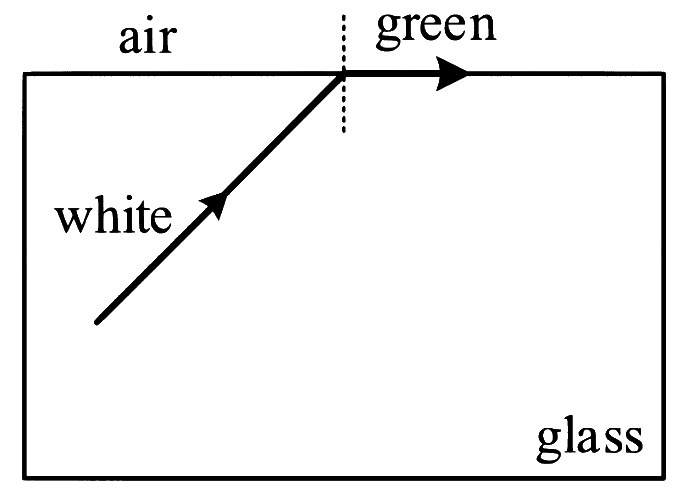
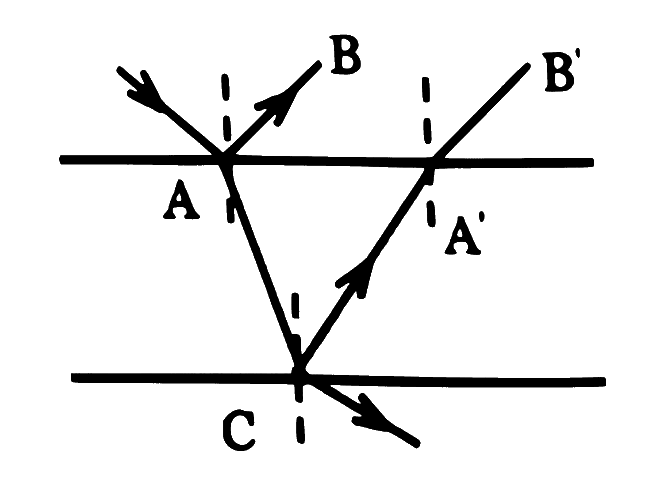
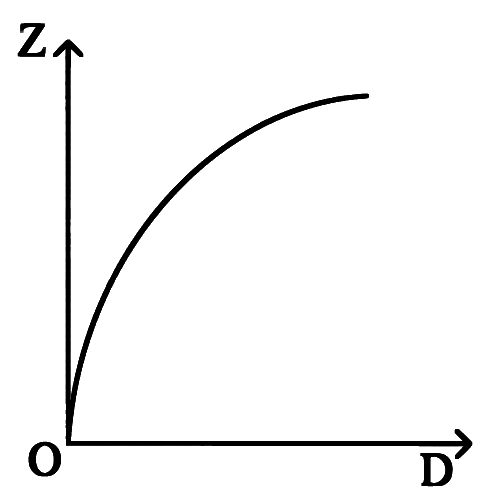
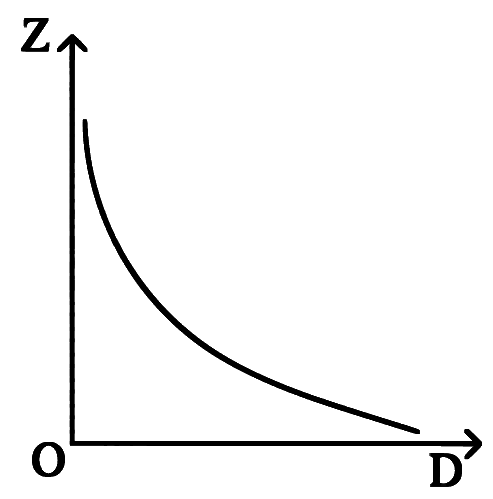
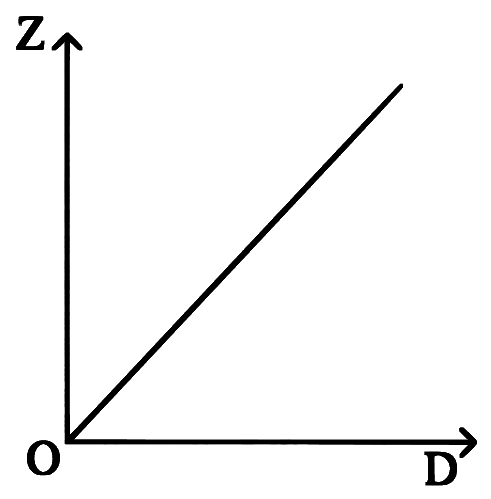
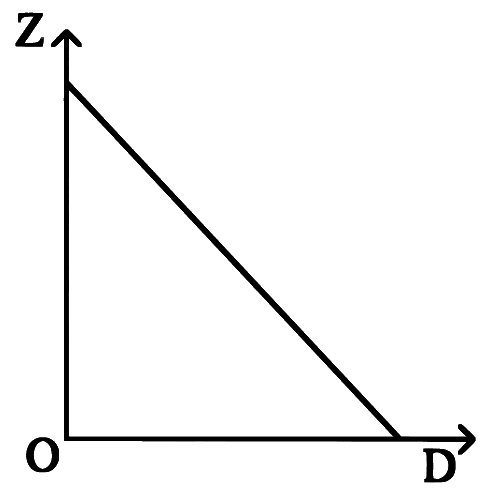
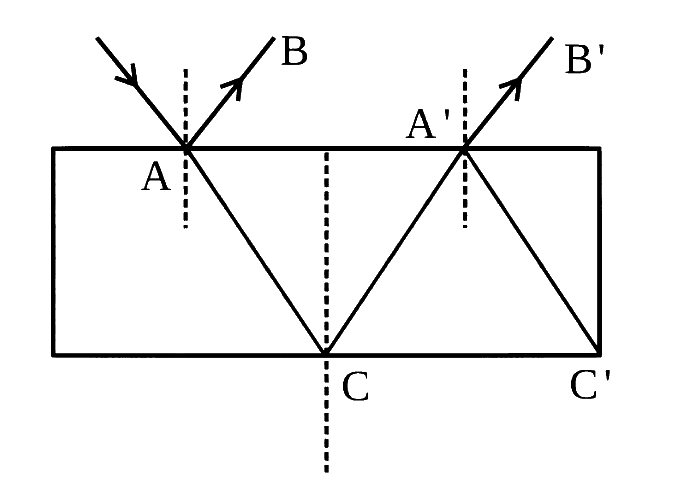
A Parallel beam of monochromatic light is incident on a plane reflecting surface. If width of the plane incident and reflected plane wavefront is represented by AB and CD respectively then
Show answer and solution
Answer: (c)
On reflection the wave stays in the same medium, so speed is unchanged.
Hence angle of reflection = angle of incidence, r=i.
Widths: AB=Lcosi and CD=Lcosr for the same length L of the surface.
Wave Theory, Wavefronts & Doppler Effect · Speed, wavelength & frequency in a medium
The wavelength of light, while it is passing through water is 540 nm. The refractive index of water is 4/3. The wavelength of the same light when it is passing through a transparent medium having refractive index of 3/2 is ______ nm.
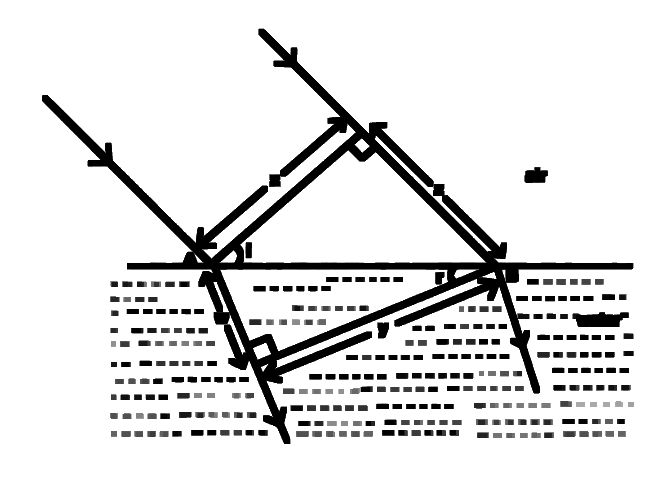
A plane wavefront of width x, is incident on an air-water interface and the corresponding refracted wavefront has a width y as shown in figure. The refreactive index of air with respect to water in terms of distances w and z is
Show answer and solution
Answer: (a)
In the same time, light travels distance z in air and distance w in water.
Wave Theory, Wavefronts & Doppler Effect · Speed, wavelength & frequency in a medium
A monochromatic light of frequency 5×10¹⁴ Hz travelling through air, is incident on a medium of refractive index ' 2 '. Wavelength of the refracted light will be:
Show answer and solution
Answer: (b)
Wavelength in air: λ0=c/ν=5×10143×108=6×10−7 m =600 nm.
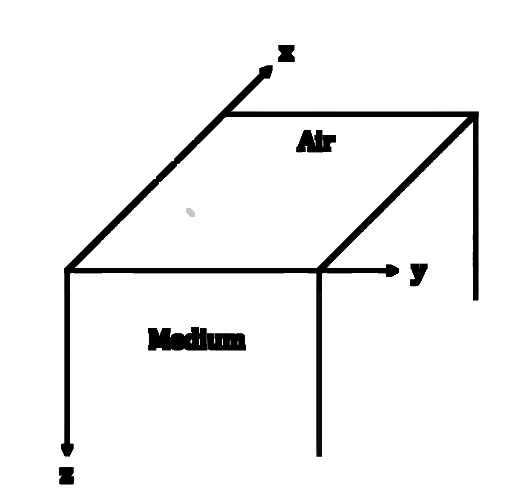
A light wave is propagating with plane wave fronts of the type x+y+z= constant. The angle made by the direction of wave propagation with the x-axis is:
Show answer and solution
Answer: (b)
For the plane x+y+z= constant, the normal (direction of propagation) is n^=3i^+j^+k^.
The apparent wavelength of light from a star moving away from the earth is 0.02% more than the actual wavelength. The velocity of star is [c= velocity of light =3×10⁸ m/s]
A galaxy is moving away from the earth at a speed of 286 kms−1. The shift in the wavelength of a redline at 630 nm is x × 10−10 m. The value of x, to the nearest integer, is ____________. [Take the value of speed of light c, as 3 × 10⁸ ms−1]
Numerical answer type. Work it out, then open the answer.
On a hot summer night, the refractive index of air is smallest near the ground and increases with height from the ground. When a light beam is directed horizontally, the Huygens' principle leads us to conclude that as it travels, the light beam:
Show answer and solution
Answer: (b)
Refractive index increases with height, so the speed v=c/μ is smaller higher up.
The upper part of each wavefront moves slower than the lower part, so the wavefront tilts.
The beam (normal to the wavefront) turns towards the region of higher μ.
An initially parallel cylindrical beam travels in a medium of refractive index μ(I)=μ0+μ2I, where μ0 and μ2 are positive constants and I is the intensity of the light beam. The intensity of the beam is decreasing with increasing radius.
The initial shape of the wavefront of the beam is
Show answer and solution
Answer: (d)
The beam is initially parallel, i.e. all rays are parallel to the axis.
Rays are normal to the wavefront, so parallel rays mean a plane wavefront.
The intensity-dependent μ changes the shape only later as the beam travels.
Wave Theory, Wavefronts & Doppler Effect · Speed, wavelength & frequency in a medium
A ray of light travelling in air has wavelength λ, frequency n, velocity v and intensity I. If this ray enters into water then these parameters are λ', n', v' and I' respectively. Which relation is correct from following?
Show answer and solution
Answer: (b)
Frequency is fixed by the source and does not change on refraction.
In water v′=v/μ and λ′=λ/μ, and part of the light is reflected so I′<I.
A star, which is emitting radiation at a wavelength of 5000 Å, is approaching the earth with a velocity of 1.5×10⁶ m/s. The change in wavelength of the radiation as received on the earth is
Superposition, Coherence & Intensity · Conditions for interference & coherence
For obtaining maximum contrast between the bright and dark fringes in an interference pattern, the intensities of the two light coherent sources should be
Show answer and solution
Answer: (c)
Imin=(I1−I2)2 and Imax=(I1+I2)2.
Best contrast needs perfectly dark fringes, Imin=0, which happens only when I1=I2.
Superposition, Coherence & Intensity · Conditions for interference & coherence
In interference and diffraction, the light energy is redistributed. If it reduces in one region, producing a dark fringe, it increases in another region, producing a bright fringe.
A. As there is no gain or loss of energy, these phenomena are consistent with the principle of conservation of energy.
B. Diffraction and interference are characteristics exhibited only by light waves. Choose the correct answer from the options given below:
Show answer and solution
Answer: (c)
A: energy taken from dark regions appears in bright regions, so total energy is conserved. True.
B: interference and diffraction are shown by all waves (sound, water waves, matter waves), not only light. False.
Superposition, Coherence & Intensity · Imax/Imin ratio & slit widths
In Young's experiment, the intensity ratio of the maxima and minima in an interference pattern produced by two coherent sources is 36:1. The ratio of the amplitudes of the two individual sources will be
Superposition, Coherence & Intensity · Imax/Imin ratio & slit widths
The interference pattern is obtained with two coherent light sources of intensity (I1 and I2) ratio 'β'. In the interference pattern, the ratio (Imax−IminImax+Imin) will be (β=I1I2)
Show answer and solution
Answer: (c)
Imax+Imin=2(I1+I2), Imax−Imin=4I1I2
Ratio =2I1I2I1+I2; divide by I1 with β=I1I2:
Superposition, Coherence & Intensity · Intensity at a point
At two points P and Q on the screen in Young's double slit experiment, waves from slits S1 and S2 have a path difference of zero and 4λ respectively. The ratio of intensities at P and Q will be (cos0∘=1,cos45∘=21)
Superposition, Coherence & Intensity · Intensity at a point
Interference fringes are produced on a screen by using two light sources of intensities I and 9I. The phase difference between the beams is 2π, at point P and π at point Q on the screen. The difference between the resultant intensities at points P and Q is (cos2π=0,cosπ=−1)
Superposition, Coherence & Intensity · Intensity at a point
The ratio of intensity at the centre of a bright fringe to the intensity at a point distant (41)th of the distance between two successive bright fringes will be (cos0∘=1,cos90∘=0)
Show answer and solution
Answer: (c)
Moving one fringe width β changes path difference by λ, so β/4 gives Δx=λ/4, ϕ=π/2.
Superposition, Coherence & Intensity · Intensity at a point
The wavelength of light used in Young's double slit experiment, is λ. The intensity at a point on the screen is I, where the path difference is 6λ. If I0 is the maximum intensity then the ratio I to I0 is (cos30∘=23)
Superposition, Coherence & Intensity · Intensity at a point
In Young's double slit experiment, the wavelength of light used is λ. The intensity on the screen at a point for path difference 'λ' is 'X'. The intensity at the point for path difference (6λ) is (cos180∘=−1,cos30∘=23)
Show answer and solution
Answer: (c)
Path difference λ gives ϕ=2π, a bright fringe, so X=Imax.
Superposition, Coherence & Intensity · Intensity at a point
In Young's double slit experiment, width of the second slit is double the width of first slit, consequently the amplitude of the light from two slits. 'Im' is the maximum intensity. The resultant intensity 'I' when they interfere with the phase difference of ϕ is given by
Show answer and solution
Answer: (a)
Amplitudes a and 2a, so intensities I0 and 4I0; Im=(a+2a)2∝9I0.
I=I0+4I0+24I0cosϕ=5I0+4I0cosϕ
Using cosϕ=2cos22ϕ−1: I=I0(1+8cos22ϕ).
With I0=Im/9: I=9Im(1+8cos22ϕ). So the answer is (a).
Superposition, Coherence & Intensity · Intensity at a point
The ratio of intensities at two points on the screen in Young's double slit experiment when waves from the two slits have a path difference of zero and λ/4 is (λ is the wavelength of light used) (cos0∘=1,cosπ/2=0)
Superposition, Coherence & Intensity · Intensity at a point
In a Young's double slit experiment, the intensities at two points, for the path difference 4λ and 3λ (λ being the wavelength of light used) are I1 and I2 respectively. If I0 denotes the intensity produced by each one of the individual slits, then I0I1+I2=
Superposition, Coherence & Intensity · Intensity at a point
In Young's double slit experiment, using monochromatic light of wavelength λ, the intensity of light at a point on the screen where the path difference is λ, is K units. The intensity of light at a point where the path difference is 3λ will be
Superposition, Coherence & Intensity · Intensity at a point
In interference experiment the path difference between two interfering waves at a point A on the screen is λ/3, where λ is the wavelength of these waves, and at another point B the path difference is λ/6. The ratio of intensities at points A and B is ______.
Superposition, Coherence & Intensity · Intensity at a point
In the Young's double slit experiment the intensity produced by each one of the individual slits is Io. The distance between two slits is 2 mm. The distance of screen from slits is 10 m. The wavelength of light is 6000A˚. The intensity of light on the screen in front of one of the slits is ______
Show answer and solution
Answer: (b)
In front of one slit, y=2d=1mm from the centre.
Path difference Δx=Dyd=10(10−3)(2×10⁻³)=2×10⁻⁷m=3λ (as λ=6×10⁻⁷ m).
Superposition, Coherence & Intensity · Intensity at a point
In a Young's double slit experiment, the intensity at some point on the screen is found to be 43 times of the maximum of the interference pattern. The path difference between the interfering waves at this point is xλ where λ is wavelength of the incident light. The value of x is _______.
Numerical answer type. Work it out, then open the answer.
Superposition, Coherence & Intensity · Intensity at a point
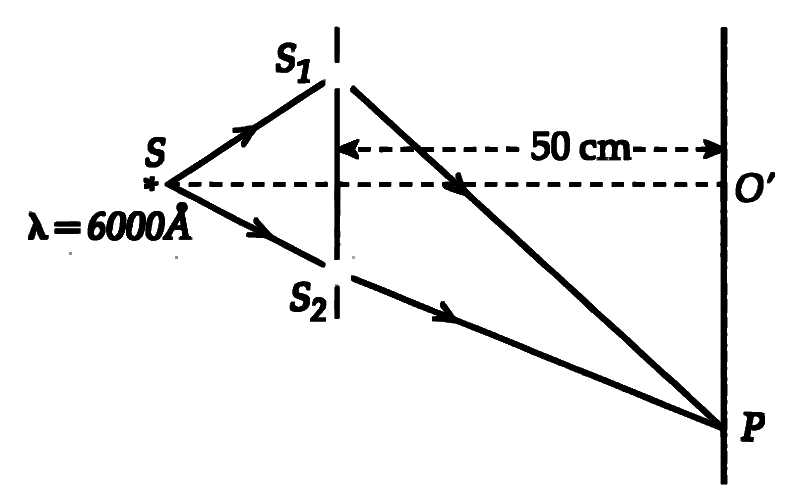
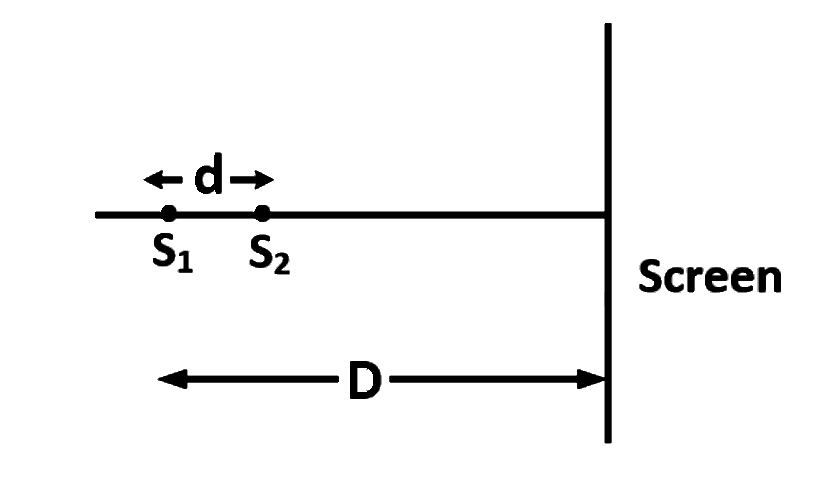
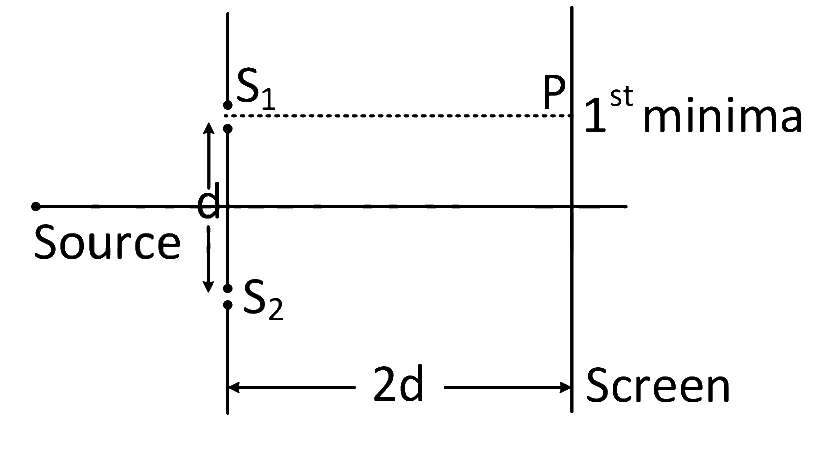
In a Young double slit experiment, the wavelength of incident light is 6000A˚, the separation between slits S1 and S2 is 5 cm and the distance between slits plane and screen is 50 cm, as shown in the figure below. If the resultant intensity at P is equal to the intensity due to individual slits, the path difference between interfering waves is ______ Å.
Superposition, Coherence & Intensity · Imax/Imin ratio & slit widths
Two monochromatic light beams have intensities in the ratio 1:9. An interference pattern is obtained by these beams. The ratio of the intensities of maximum to minimum is
Superposition, Coherence & Intensity · Imax/Imin ratio & slit widths
Two coherent monochromatic light beams of intensities 4I and 9I are superimposed. The difference between the maximum and minimum intensities in the resulting interference pattern is xI. The value of x is___________.
Numerical answer type. Work it out, then open the answer.
Superposition, Coherence & Intensity · Imax/Imin ratio & slit widths
The two coherent sources produce interference with intensity ratio ' b '. In the interference pattern, the ratio Imax−IminImax+Iminmaxmaxminmin will be
Show answer and solution
Answer: (b)
Imax+Imin=2(I1+I2), Imax−Imin=4I1I2
Ratio =2I1I2I1+I2; with I2I1=b this is 2b1+b
Superposition, Coherence & Intensity · Imax/Imin ratio & slit widths
In Young's double slit interference experiment, using two coherent sources of different amplitudes, the intensity ratio between bright to dark fringes is 5:1. The value of the ratio of resultant amplitudes of bright fringe to dark fringe is
Show answer and solution
Answer: (b)
Intensity ∝ (resultant amplitude)2, so AminAmax=IminImax
Superposition, Coherence & Intensity · Imax/Imin ratio & slit widths
Width of one of the two slits in a Young's double slit interference experiment is half of the other slit. The ratio of the maximum to the minimum intensity in the interference pattern is:
Superposition, Coherence & Intensity · Imax/Imin ratio & slit widths
The width of one of the two slits in Young's double slit experiment is d while that of the other slit is xd. If the ratio of the maximum to the minimum intensity in the interference pattern on the screen is 9:4 then what is the value of x? (Assume that the field strength varies according to the slit width.)
Superposition, Coherence & Intensity · Intensity at a point
In Young's double slit experiment, the intensity on screen at a point, where path difference is 4λ is 4K. The intensity at a point when path difference is ' λ ' will be [cos2π=0,cos2π=1]
Superposition, Coherence & Intensity · Intensity at a point
In Young's double slit experiment, at two points P and Q on screen, waves from slits S1 and S2 have a path difference of 0 and 4λ respectively. The ratio of intensities at point P to that at Q will be (cos0∘=1,cos45∘=21)
Superposition, Coherence & Intensity · Intensity at a point
In Young's double slit experiment, the intensity of light at a point on the screen where the path difference is λ is ' I '. The intensity at a point where the path difference is λ/6 is [cos6π=23][λ= wavelength of light ][cosπ=−1]
Superposition, Coherence & Intensity · Intensity at a point
In Young's double slit experiment, the light of wavelength ' λ ' is used. The intensity at a point on the screen is ' I ' where the path difference is 4λ. If ' I0 ' denotes the maximum intensity then the ratio of ' I0 ' to ' I ' is (cos45∘=1/2)
Superposition, Coherence & Intensity · Intensity at a point
Interference fringes are produced on the screen by using two light sources of intensities I and 9I. The phase difference between the beams is π/2 at point P and π at point Q on the screen. The difference between the resultant intensities at points P and Q is (cos90∘=0,cosπ=−1)
Superposition, Coherence & Intensity · Intensity at a point
In Young's double slit experiment, the intensity on screen at a point where path difference is 4λ is 2K. The intensity at a point when path difference is ' λ ' will be
Two sound waves each of wavelength ' λ ' and having the same amplitude ' A ' from two source ' S1 ' and ' S2 ' interfere at a point P. If the path difference, S2P−S1P=λ/3 then the amplitude of resultant wave at point ' P ' will be [cos(120∘)=−0.5]
Superposition, Coherence & Intensity · Imax/Imin ratio & slit widths
The width of one of the two slits in a Young's double slit experiment is 4 times that of the other slit. The ratio of the maximum to the minimum intensity in the interference pattern is:
Show answer and solution
Answer: (d)
Intensity ∝ slit width, so I1:I2=4:1 and amplitudes 2:1.
Superposition, Coherence & Intensity · Imax/Imin ratio & slit widths
Two coherent monochromatic light beams of intensities I and 4I are superimposed. The difference between maximum and minimum possible intensities in the resulting beam is xI. The value of x is __________.
Numerical answer type. Work it out, then open the answer.
Superposition, Coherence & Intensity · Intensity at a point
Two identical light waves having phase difference ϕ propagate in same direction. When they superpose, the intensity of resultant wave is proportional to
Show answer and solution
Answer: (c)
I=I1+I2+2I1I2cosϕ; for identical waves I1=I2=I0.
Superposition, Coherence & Intensity · Imax/Imin ratio & slit widths
The intensity ratio of the maxima and minima in an interference pattern produced by two coherent sources of light is 9:1. The intensities of the light sources used are in the ratio
Superposition, Coherence & Intensity · Imax/Imin ratio & slit widths
The intensity of light coming from one of the slits in Young's double slit experiment is double the intensity from the other slit. The ratio of the maximum intensity to the minimum intensity in the interference fringe pattern observed is
Superposition, Coherence & Intensity · Intensity at a point
In Young's double slit experiment, the intensity of light at a point on the screen where the path difference is λ is x units, λ being the wavelength of light used. The intensity at a point where the path difference is 4λ will be (cos2π=1,cos2π=0)
Superposition, Coherence & Intensity · Intensity at a point
In Young's double slit experiment, 'I' is the minimum intensity and ' I1 ' is the intensity at a point where the path difference is 4λ where ' λ ' is the wavelength of light used. The ratio I1I is (Intensities of the two interfering waves are same) (cos0∘=1,cos90∘=0)
Superposition, Coherence & Intensity · Intensity at a point
In the Young's double slit experiment, the intensity at a point on the screen, where the path difference is λ(λ= wavelength ) is β. The intensity at a point where the path difference is λ/3, will be cos3π=1/2]
Superposition, Coherence & Intensity · Intensity at a point
In Young's double slit experiment using monochromatic light of wavelength ' λ ', the maximum intensity of light at a point on the screen is ' K ' units. The intensity of light at a point where the path difference is 6λ is (cos60∘=sin30∘=0.5,sin60∘=cos30∘=3/2)
Superposition, Coherence & Intensity · Intensity at a point
In Young's double slit experiment using monochromatic light of wavelength ' λ ', the intensity of light at a point on the screen where path difference ' λ ' is K units. The intensity of light at a point where the path difference is 6λ is [cos6π=sin3π=23]
Superposition, Coherence & Intensity · Intensity at a point
In Young's double slit experiment, light from two identical sources are superimposing on a screen. The path difference between the two lights reaching at a point on the screen is 7λ/4. The ratio of intensity of fringe at this point with respect to the maximum intensity of the fringe is:
Superposition, Coherence & Intensity · Intensity at a point
Two waves of intensity ratio 1:9 cross each other at a point. The resultant intensities at that point, when (a) Waves are incoherent is I1 (b) Waves are coherent is I2 and differ in phase by 60∘. If I2I1=x10 then x= _________.
Numerical answer type. Work it out, then open the answer.
Superposition, Coherence & Intensity · Intensity at a point
In a Young's double slit experiment, the intensity at a point is (41)th of the maximum intensity, the minimum distance of the point from the central maximum is _________ μm. (Given: λ=600 nm,d=1.0 mm,D=1.0 m)
Numerical answer type. Work it out, then open the answer.
Superposition, Coherence & Intensity · Intensity at a point
In Young's double slit experiment, monochromatic light of wavelength 5000 Å is used. The slits are 1.0 mm apart and screen is placed at 1.0 m away from slits. The distance from the centre of the screen where intensity becomes half of the maximum intensity for the first time is _________ ×10−6 m.
Numerical answer type. Work it out, then open the answer.
Superposition, Coherence & Intensity · Imax/Imin ratio & slit widths
In a Young's double slits experiment, the ratio of amplitude of light coming from slits is 2:1. The ratio of the maximum to minimum intensity in the interference pattern is:
Superposition, Coherence & Intensity · Imax/Imin ratio & slit widths
Of the two slits producing interference in Young's experiment, one is covered with glass so that light intensity passing is reduced to 50%. Which of the following is correct?
Show answer and solution
Answer: (b)
Originally I1=I2=I: Imax=4I, Imin=0.
Now I and 0.5I: Imax=(1+0.5)2I≈2.91I, Imin=(1−0.5)2I≈0.09I.
Bright fringes get dimmer, dark fringes get brighter. So the answer is (b).
Superposition, Coherence & Intensity · Intensity at a point
A and B are two interfering sources where A is ahead in phase by 54∘ relative to B. The observation is taken from point P such that PB − PA = 2.5 λ. Then the phase difference between the waves from A and B reaching point P is (in rad)
Show answer and solution
Answer: (b)
Wave from B travels 2.5λ more, so it lags by λ2π(2.5λ)=5π.
Superposition, Coherence & Intensity · Intensity at a point
The ratio of intensities of two points on a screen in Young's double slit experiment when waves from the two slits have a path difference of 4λ and 6λ is
(cos90∘=0,cos60∘=0.5)
Show answer and solution
Answer: (b)
I=Imaxcos22ϕ, ϕ=λ2πΔx.
λ/4: ϕ=π/2, I1=2Imax (using cos2θ=21+cos2θ with cos90∘=0).
Superposition, Coherence & Intensity · Intensity at a point
In Young's double slit experiment the intensities at two points, for the path difference 4λ and 3λ (λ= wavelength of light used) are I1 and I2 respectively. If I0 denotes the intensity produced by each one of the individual slits then I0I1+I2 is equal to (cos60∘=0.5,cos45∘=21)
Superposition, Coherence & Intensity · Intensity at a point
Light waves from two coherent sources arrive at two points on a screen with path difference of zero and 2λ. The ratio of intensities at the points is (cos0∘=1,cosπ=−1)
Superposition, Coherence & Intensity · Intensity at a point
In Young's double slit experiment, the wavelength of light used is 'λ'. The intensity at a point is 'I' where path difference is (4λ). If I0 denotes the maximum intensity, then the ratio (I0I) is (sin4π=cos4π=21)
Superposition, Coherence & Intensity · Intensity at a point
The ratio of intensities at two points P and Q on the screen in a Young's double slit experiment where phase difference between two waves of same amplitude are π/3 and π/2, respectively are
Superposition, Coherence & Intensity · Intensity at a point
In a Young's double slit experiment, the intensities at two points, for the path differences 4λ and 3λ ( λ being the wavelength of light used) are I1 and I2 respectively. If I0 denotes the intensity produced by each one of the individual slits, then I0I1+I2= __________.
Numerical answer type. Work it out, then open the answer.
Superposition, Coherence & Intensity · Imax/Imin ratio & slit widths
Two coherent sources of light interfere. The intensity ratio of two sources is 1:4. For this interference pattern if the value of Imax−IminImax+Imin is equal to β+32α+1, then βα will be:
Show answer and solution
Answer: (b)
I1:I2=1:4⇒ amplitudes 1:2, so Imax=9, Imin=1 (units).
Superposition, Coherence & Intensity · Imax/Imin ratio & slit widths
Find the ratio of maximum intensity to the minimum intensity in the interference pattern if the widths of the two slits in Young's experiment are in the ratio of 9: 16. (Assuming intensity of light is directly proportional to the width of slits)
Superposition, Coherence & Intensity · Imax/Imin ratio & slit widths
The interference pattern is obtained with two coherent light sources of intensity ratio 4: 1. And the ratio Imax−IminImax+Imin is x5. Then, the value of x will be equal to:
Superposition, Coherence & Intensity · Intensity at a point
The two light beams having intensities I and 9I interfere to produce a fringe pattern on a screen. The phase difference between the beams is π/2 at point P and π at point Q. Then the difference between the resultant intensities at P and Q will be:
Superposition, Coherence & Intensity · Intensity at a point
Two light beams of intensities 4I and 9I interfere on a screen. The phase difference between these beams on the screen at point A is zero and at point B is π. The difference of resultant intensities, at the point A and B, will be _________ I.
Numerical answer type. Work it out, then open the answer.
Superposition, Coherence & Intensity · Intensity at a point
Two beams of light having intensities I and 4I interfere to produce a fringe pattern on a screen. The phase difference between the two beams are π/2 and π/3 at points A and B respectively. The difference between the resultant intensities at the two points is xI. The value of x will be ________.
Numerical answer type. Work it out, then open the answer.
Superposition, Coherence & Intensity · Imax/Imin ratio & slit widths
Two monochromatic beams of intensities I and 4 I respectively are superposed to form a steady interference pattern. The maximum and minimum intensities in the pattern are
Superposition, Coherence & Intensity · Imax/Imin ratio & slit widths
The light waves from two coherent sources have same intensity I1 = I2 = I0. In interference pattern the intensity of light at minima is zero. What will be the intensity of light at maxima?
Show answer and solution
Answer: (d)
Imax=(I1+I2)2
With I1=I2=I0: Imax=(2I0)2=4I0 (and Imin=0).
Superposition, Coherence & Intensity · Imax/Imin ratio & slit widths
In a Young's double slit experiment, the width of the one of the slit is three times the other slit. The amplitude of the light coming from a slit is proportional to the slit-width. Find the ratio of the maximum to the minimum intensity in the interference pattern.
Superposition, Coherence & Intensity · Imax/Imin ratio & slit widths
The width of one of the two slits in a Young's double slit experiment is three times the other slit. If the amplitude of the light coming from a slit is proportional to the slit-width, the ratio of minimum to maximum intensity in the interference pattern is x: 4 where x is ____________.
Numerical answer type. Work it out, then open the answer.
Superposition, Coherence & Intensity · Intensity at a point
Two beams of light having intensities I and 4I interfere to produce a fringe pattern on a screen. The phase difference between the beams is π/2 at point A and π at point B. Then the difference between the resultant intensities at A and B is
Superposition, Coherence & Intensity · Intensity at a point
In Young's double slit experiment, the intensity at a point where path difference is 6λ (λ being the wavelength of light used) is 'I'. If 'I0' denotes the maximum intensity, then I0I is equal to (cos0∘=1,cos60∘=21)
Show answer and solution
Answer: (b)
Δx=λ/6⇒ϕ=π/3.
I0I=cos26π=21+cos60∘=43
43 is not among the options; option (b) 34 is the inverse ratio II0.
Superposition, Coherence & Intensity · Intensity at a point
In Young's double slit experiment using monochromatic light of wavelength 'λ', the maximum intensity of light at a point on the screen is K units. The intensity of light at point where the path difference is 3λ is
Superposition, Coherence & Intensity · Intensity at a point
In Young's double slit experiment, the intensity at a point where the path difference is 4λ [ λ is wavelength of light used] is 'I'. If 'I0' is the maximum intensity then I0I is equal to [cos4π=sin4π=21]
Superposition, Coherence & Intensity · Conditions for interference & coherence
Two coherent sources of light interfere and produce fringe pattern on a screen. For central maximum, the phase difference between the two waves will be,
Show answer and solution
Answer: (b)
At the central maximum the path difference is Δx=0.
Phase difference ϕ=λ2πΔx=0, giving maximum intensity.
Superposition, Coherence & Intensity · Intensity at a point
In a double slit experiment, at a certain point on the screen the path difference between the two interfering waves is 81th of a wavelength. The ratio of the intensity of light at that point to that at the centre of a bright fringe is:
Superposition, Coherence & Intensity · Intensity at a point
A Young's double-slit experiment is performed using monochromatic light of wavelength λ. The intensity of light at a point on the screen, where the path difference is λ, is K units. The intensity of light at a point where the path difference is 6λ is given by 12nK, where n is an integer. The value of n is __________.
Numerical answer type. Work it out, then open the answer.
Superposition, Coherence & Intensity · Intensity at a point
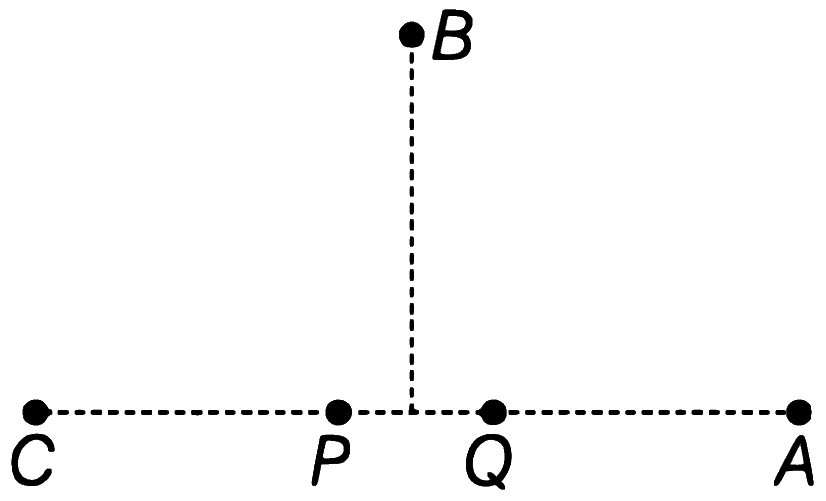
In the figure below, P and Q are two equally intense coherent sources emitting radiation of wavelength 20 m. The separation between P and Q is 5 m and the phase of P is ahead of that of Q by 90°. A, B and C are three distinct points of observation, each equidistant from the midpoint of PQ. The intensities of radiation at A, B, C will be in the ratio:
Show answer and solution
Answer: (b)
PQ=5 m=4λ, so the extra path PQ adds a phase lag of 2π.
At A (beyond Q): wave from P travels 4λ more, lag 2π cancels P's lead of 2π: ϕ=0, IA=4I0.
At B (on the bisector): equal paths, ϕ=2π, IB=4I0cos245∘=2I0.
At C (beyond P): wave from Q travels 4λ more, total ϕ=2π+2π=π, IC=0.
Superposition, Coherence & Intensity · Imax/Imin ratio & slit widths
In an interference experiment the ratio of amplitudes of coherent waves is a2a1=31. The ratio of maximum and minimum intensities of fringes will be:
Superposition, Coherence & Intensity · Imax/Imin ratio & slit widths
In a Young's double slit experiment, the ratio of the slit's width is 4: 1. The ratio of the intensity of maxima to minima, close to the central fringe on the screen, will be:
Superposition, Coherence & Intensity · Imax/Imin ratio & slit widths
Two coherent sources produce waves of different intensities which interfere. After interference, the ratio of the maximum intensity to the minimum intensity is 16. The intensity of the waves are in the ratio:
Superposition, Coherence & Intensity · Intensity at a point
In a Young's double slit experiment, the path difference, at a certain point on the screen, between two interfering waves is 81 th of wavelength. The ratio of the intensity at this point to that at the centre of a bright fringe is close to:
Superposition, Coherence & Intensity · Imax/Imin ratio & slit widths
The interference pattern is obtained with two coherent light sources of intensity ratio n. In the interference pattern, the ratio Imax+IminImax−Imin will be
Superposition, Coherence & Intensity · Imax/Imin ratio & slit widths
Two slits in Young's experiment have widths in the ratio 1: 25. The ratio of intensity at the maxima and minima in the interference pattern, IminImax is
Show answer and solution
Answer: (c)
Intensity ∝ width: I1:I2=1:25, so amplitudes 1:5.
Superposition, Coherence & Intensity · Intensity at a point
In a Young's double slit experiment with light of wavelength λ the separation of slits is d and distance of screen is D such that D > > d > > λ. If the Fringe width is β, the distance from point of maximum intensity to the point where intensity falls to half of maximum intensity on either side is:
Show answer and solution
Answer: (b)
I=Imaxcos22ϕ=2Imax⇒ϕ=2π, i.e. Δx=4λ.
A shift of one fringe width β changes Δx by λ, so Δx=λ/4 needs y=4β.
Superposition, Coherence & Intensity · Imax/Imin ratio & slit widths
Two monochromatic light beams of intensity 16 and 9 units are interfering. The ratio of intensities of bright and dark parts of the resultant pattern is:
Superposition, Coherence & Intensity · Intensity at a point
In the Young's double slit experiment, the intensity of light at a point on the screen where the path difference λ is K, (λ being the wavelength of light used). The intensity at a point where the path difference is λ/4 will be
Superposition, Coherence & Intensity · Imax/Imin ratio & slit widths
n identical waves each of intensity I0 interfere with each other. The ratio of maximum intensities if the interference is (i) coherent and (ii) incoherent is:
Superposition, Coherence & Intensity · Imax/Imin ratio & slit widths
In Young's double slit experiment, one of the slit is wider than other, so that amplitude of the light from one slit is double of that from other slit. If Im be the maximum intensity, the resultant intensity I when they interfere at phase difference ϕ is given by:
Superposition, Coherence & Intensity · Intensity at a point
In a Young's double slit experiment the intensity at a point where the path difference is 6λ ( λ being the wavelength of light used) is I. If I0 denotes the maximum intensity, I0I is equal to
In two separate Young's double-slit experimental set-ups and two monochromatic light sources of different wavelengths are used to get fringes of equal width. The ratios of the slits separations and that of the wavelengths of light used are 2:1 and 1:2 respectively. The corresponding ratio of the distances between the slits and the respective screens ( D1/D2) is ______。
Numerical answer type. Work it out, then open the answer.
YDSE: Fringe Width & Fringe Positions · Changing λ, D and d
In Young's double slit experiment, the separation between the slits is decreased to (31)th of its original distance and the distance between the slits and the screen is doubled. The fringe width
YDSE: Fringe Width & Fringe Positions · Changing λ, D and d
In Young's double slit experiment, the fringe width is 2.4 mm with light of wavelength 9000 A.U. If the light of wavelength 5400 A.U. is used, with no other change in the experimental set up. The change in fringe width is
YDSE: Fringe Width & Fringe Positions · Position of bright & dark fringes
If fringe width is 0.4 mm, the distance between fifth bright and third dark band on the same side in interference pattern of Young's double slit experiment is (in mm)
Show answer and solution
Answer: (a)
nth bright: y=nβ; nth dark: y=(n−21)β
5th bright =5β, 3rd dark =2.5β
Distance =2.5β=2.5×0.4=1 mm, so the answer is (a).
YDSE: Fringe Width & Fringe Positions · Position of bright & dark fringes
In Young's double slit experiment, the fringe width is 0.4 mm. What is the distance between 4th dark band and 6th bright band on the same side of the interference pattern?
Show answer and solution
Answer: (c)
nth bright: y=nβ; nth dark: y=(n−21)β
6th bright =6β, 4th dark =3.5β
Distance =2.5β=2.5×0.4=1.0 mm, so the answer is (c).
Two coherent sources P and Q produce interference at a point A on the screen where there is a dark band which is formed between 4th bright band and 5th bright band. Wavelength of light used is 6000 Å. The path difference between PA and QA is x×10−4 cm. The value of x is
Show answer and solution
Answer: (b)
The dark band between the 4th and 5th bright bands is the 5th dark band.
YDSE: Fringe Width & Fringe Positions · Fringes in a region (nλ = constant)
In a certain region of the screen, number of fringes formed is observed to be 8 in Young's double slit experiment when light of wavelength 6600 Å is used. If the light of wavelength 4400 Å is used, the number of fringes observed in the same region of the screen will be
Show answer and solution
Answer: (b)
In a fixed region, length =nβ∝nλ, so n1λ1=n2λ2
Statement I: In a Young's double slit experiment, the angular separation of fringes will increase as the screen is moved away from the plane of the slits
Statement II: In a Young's double slit experiment, the angular separation of fringes will increase when monochromatic source is replaced by another monochromatic source of higher wavelength In the light of the above statements, choose the correct answer from the options given below:
Show answer and solution
Answer: (c)
Angular separation θ=dλ does not depend on D: Statement I is false.
θ∝λ, so a higher wavelength increases it: Statement II is true.
YDSE: Fringe Width & Fringe Positions · Position of bright & dark fringes
In Young's double slit experiment, following figure shows that Q is the position of second bright fringe on the right side of point O.P is the eleventh bright fringe on the other side measured from point Q. If the wavelength of light used is 6000 Å, then what will be the value of S1B?
Show answer and solution
Answer: (d)
Q is the 2nd bright fringe above O; P is 11 bright fringes from Q on the other side, so P is the 11−2=9th bright fringe below O.
S1B is the path difference S1P−S2P at P, which equals 9λ.
In double slit experiment, the angular width of the fringes is 0.20∘ for sodium light (λ=5890 \AA). To increase the angular width of the fringes by 10%, the necessary change in wavelength is
Show answer and solution
Answer: (d)
Angular width θ=dλ, so θ∝λ for fixed d.
10% increase in θ needs 10% increase in λ: Δλ=0.1×5890=589 Å
In Young's double slit experiment the wavelength of light used is 6000A˚, the screen is 40 cm from the slits and the fringe width is 0.012 cm, the distance between two slits is
YDSE: Fringe Width & Fringe Positions · Changing λ, D and d
In a Young's double slit experiment, the slits are separated by 0.2 mm. If the slits separation is increased to 0.4 mm, the percentage change of the fringe width is:
YDSE: Fringe Width & Fringe Positions · Fringes in a region (nλ = constant)
In Young's double slit experiment, when light of wavelength 600 nm is used, 18 fringes are observed on the screen. If the wavelength of light is changed to 400 nm, the number of fringes observed on the screen is
YDSE: Fringe Width & Fringe Positions · Changing λ, D and d
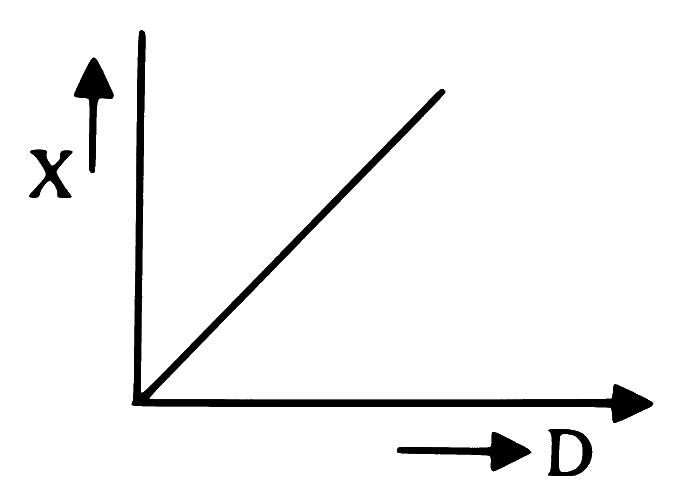
Graph shows the variation of fringe width ( X) versus distance of the screen from the plane of the slits (D) in Young's double slit experiment. (keeping other parameters same, d= distance between the slits). The wavelength of light used can be calculated as
Show answer and solution
Answer: (d)
X=dλD, a straight line through the origin in an X–D graph.
YDSE: Fringe Width & Fringe Positions · Changing λ, D and d
In Young's double slit experiment with monochromatic light of wavelength 600 nm, the distance between the slits is 10−3 m. For changing the fringe width by 3×10⁻⁵ m
a. the screen is moved away from the slit by 5 cm.
b. the screen is moved 5 cm towards the slits.
c. the screen is moved 3 cm towards the slits.
d. the screen is moved away from the slits by 3 cm.
Show answer and solution
Answer: (b)
β=dλD⇒Δβ=dλΔD
ΔD=λΔβd=6×10−73×10−5×10−3=0.05 m=5 cm
Moving 5 cm away or 5 cm towards both change β by this amount.
YDSE: Fringe Width & Fringe Positions · Position of bright & dark fringes
In a Young's double slit experiment wavelength of light used is 6000A˚. The first order maxima and tenth order maxima fall at 14.50 mm and 16.75 mm from the particular reference point in the interference pattern respectively. If the wavelength is changed to 5500A˚ then the position of zero order and tenth order maxima are respectively
[The other arrangements remaining same]
Show answer and solution
Answer: (a)
From 1st to 10th maxima: 9β=16.75−14.50=2.25 mm, so β=0.25 mm
Zero order lies at 14.50−0.25=14.25 mm; it does not move when λ changes.
New β′=0.25×60005500≈0.229 mm; 10th maximum at 14.25+10(0.229)≈16.54 mm
YDSE: Fringe Width & Fringe Positions · Position of bright & dark fringes
A double slit interference experiment performed with a light of wavelength 600 nm forms an interference fringe pattern on a screen with 10 th bright fringe having its centre at a distance of 10 mm from the central maximum. Distance of the centre of the same 10 th bright fringe from the central maximum when the source of light is replaced by another source of wavelength 660 nm would be ________ mm.
Numerical answer type. Work it out, then open the answer.
Two slits in Young's double slit experiment are 1.5 mm apart and the screen is placed at a distance of 1 m from the slits. If the wavelength of light used is 600×10−9 m then the fringe separation is
YDSE: Fringe Width & Fringe Positions · Position of bright & dark fringes
In young's double slit experiment, the nth maximum of wavelength λ1 is at a distance of y1 from the central maximum. When the wavelength of the source is changed to λ2,(3n)th maximum is at a distance of y2 from its central maximum. The ratio y2y1 is
YDSE: Fringe Width & Fringe Positions · Position of bright & dark fringes
In Young's double slit experiment, carried out with light of wavelength 5000A˚, the distance between the slits is 0.3 mm and the screen is at 200 cm from the slits. The central maximum is at x=0 cm. The value of x for third maxima is __________ mm.
Numerical answer type. Work it out, then open the answer.
YDSE: Fringe Width & Fringe Positions · Position of bright & dark fringes
In Young's double slit experiment, the slits are separated by 0.6 mm and screen is placed at a distance of 1.2 m from slit. It is observed that the tenth bright fringe is at a distance of 8.85 mm from the third dark fringe on the same side. The wavelength of light used is
Show answer and solution
Answer: (c)
10th bright at 10β, 3rd dark at 2.5β: 7.5β=8.85 mm, so β=1.18 mm
YDSE: Fringe Width & Fringe Positions · Position of bright & dark fringes
The fringe width in an interference pattern is ' X '. The distance between the sixth dark fringe from one side of central bright band to the fourth bright fringe on other side is
Show answer and solution
Answer: (d)
6th dark fringe on one side: (6−0.5)X=5.5X from the centre.
4th bright fringe on the other side: 4X from the centre.
YDSE: Fringe Width & Fringe Positions · Changing λ, D and d
In Young's double slit experiment, green light is incident on two slits. The interference pattern is observed on a screen. Which one of the following changes would cause the observed fringes to be more closely spaced?
Show answer and solution
Answer: (b)
Closer fringes means smaller β=dλD.
Reducing d or increasing D increases β; red light (λ larger) increases β.
Blue light has smaller λ than green, so β decreases.
YDSE: Fringe Width & Fringe Positions · Changing λ, D and d
In Young's double slit experiment the separation between the slits is doubled without changing other setting of the experiment to obtain same fringe width, the distance 'D' of the screen from slit should be made
YDSE: Fringe Width & Fringe Positions · Changing λ, D and d
The width of fringe is 2 mm on the screen in a double slits experiment for the light of wavelength of 400 nm. The width of the fringe for the light of wavelength 600 nm will be:
YDSE: Fringe Width & Fringe Positions · Position of bright & dark fringes
In Young's double slit experiment, 8th maximum with wavelength 'λ1' is at a distance 'd1 ' from the central maximum and 6th maximum with wavelength 'λ2' is at a distance 'd2'. Then d1d2 is
Show answer and solution
Answer: (b)
y=dnλD
d1=d8λ1D, d2=d6λ2D
d1d2=8λ16λ2=4λ13λ2, so the answer is (b).
YDSE: Fringe Width & Fringe Positions · Position of bright & dark fringes
In Young's double slit experiment, the fifth maximum with wavelength 'λ1 ' is at a distance 'y1' and the same maximum with wavelength 'λ2' is at a distance 'y2 ' measured from the central bright band. Then y2y1 is equal to [D and d are constant]
YDSE: Fringe Width & Fringe Positions · Position of bright & dark fringes
In Young's double slit experiment, the fringe width is 2 mm. The separation between the 13th bright fringe and the 4th dark fringe from the centre of the screen on same side will be
YDSE: Fringe Width & Fringe Positions · Position of bright & dark fringes
In Young's double slits experiment, the position of 5th bright fringe from the central maximum is 5 cm. The distance between slits and screen is 1 m and wavelength of used monochromatic light is 600 nm. The separation between the slits is:
The path difference between two identical light waves at a point Q on the screen is 3μm. If wavelength of the waves is 5000A˚, then at point Q there is
Show answer and solution
Answer: (d)
λΔx=5×10−73×10−6=6
Path difference =6λ (whole number) gives a bright band of order 6.
For Young's double slit experiment, two statements are given below:
Statement I: If screen is moved away from the plane of slits, angular separation of the fringes remains constant.
Statement II: If the monochromatic source is replaced by another monochromatic source of larger wavelength, the angular separation of fringes decreases.
In the light of the above statements, choose the correct answer from the options given below:
Show answer and solution
Answer: (b)
Angular separation θ=dλ, independent of D: Statement I is true.
θ∝λ, so a larger wavelength increases it: Statement II is false.
Two sources of light 0.6 mm apart and screen is placed at a distance of 1.2 m from them. A light of wavelength 6000A˚ used. Then the phase difference between the two light waves interfering on the screen at a point at a distance 3 mm from central bright band is
Show answer and solution
Answer: (d)
Path difference Δx=Dyd=1.23×10−3×0.6×10−3=1.5×10⁻⁶ m.
YDSE: Fringe Width & Fringe Positions · Changing λ, D and d
Using Young's double slit experiment, a monochromatic light of wavelength 5000 A˚ produces fringes of fringe width 0.5 mm. If another monochromatic light of wavelength 6000 A˚ is used and the separation between the slits is doubled, then the new fringe width will be:
YDSE: Fringe Width & Fringe Positions · Position of bright & dark fringes
In a Young's double slit experiment, a laser light of 560 nm produces an interference pattern with consecutive bright fringes' separation of 7.2 mm. Now another light is used to produce an interference pattern with consecutive bright fringes' separation of 8.1 mm. The wavelength of second light is __________ nm.
Numerical answer type. Work it out, then open the answer.
YDSE: Fringe Width & Fringe Positions · Fringes in a region (nλ = constant)
In a Young's double slit experiment, a student observes 8 fringes in a certain segment of screen when a monochromatic light of 600 nm wavelength is used. If the wavelength of light is changed to 400 nm, then the number of fringes he would observe in the same region of the screen is
YDSE: Fringe Width & Fringe Positions · Changing λ, D and d
In a double slit experiment with monochromatic light, fringes are obtained on a screen placed at some distance from the plane of slits. If the screen is moved by 5 × 10⁻² m towards the slits, the change in fringe width is 3 × 10⁻³ cm. If the distance between the slits is 1 mm, then the wavelength of the light will be ____________ nm.
Numerical answer type. Work it out, then open the answer.
In a Young's double slit experiment two slits are separated by 2 mm and the screen is placed one meter away. When a light of wavelength 500 nm is used, the fringe separation will be:
A fringe width of 6 mm was produced for two slits separated by 1 mm apart. The screen is placed 10 m away. The wavelength of light used is 'x' nm. The value of 'x' to the nearest integer is ____________.
Numerical answer type. Work it out, then open the answer.
YDSE: Fringe Width & Fringe Positions · Position of bright & dark fringes
In Young's double slit experiment, the 10th maximum of wavelength 'λ1' is at a distance of 'Y1 ' from the central maximum. When the wavelength of the source is changed to 'λ2 ', 5th maximum is at a distance 'Y2 ' from the central maximum. The ratio Y2Y1 is
YDSE: Fringe Width & Fringe Positions · Position of bright & dark fringes
In Young's double slit experiment, the 'nth' maximum of wavelength 'λ1 ' is at a distance 'y1' from the central maximum. When the wavelength of the source is changed to 'λ2', (2n)th maximum is at a distance of 'y2' from its central maximum. The ratio y2y1 is
YDSE: Fringe Width & Fringe Positions · Position of bright & dark fringes
In Young's double slit arrangement, slits are separated by a gap of 0.5 mm, and the screen is placed at a distance of 0.5 m from them. The distance between the first and the third bright fringe formed when the slits are illuminated by a monochromatic light of 5890 A˚ is :-
Show answer and solution
Answer: (b)
Distance between 1st and 3rd bright fringes =2β=d2λD
Two coherent sources 'P' and 'Q' produce interference at point 'A' on the screen, where there is a dark band which is formed between 4th and 5th bright band. Wavelength of light used is 6000 A˚. The path difference PA and QA is
Show answer and solution
Answer: (d)
The dark band between the 4th and 5th bright bands is the 5th dark band.
YDSE: Fringe Width & Fringe Positions · Changing λ, D and d
In Young's experiment, fringes are obtained on a screen placed at a distance 75 cm from the slits. When the separation between two narrow slits is doubled, then the fringe width is decreased. In order to obtain the initial fringe width, the screen should be moved through.
YDSE: Fringe Width & Fringe Positions · Changing λ, D and d
In the Young's double slit experiment, the distance between the slits varies in time as d(t) = d0 + a0 sinωt; where d0, ω and a0 are constants. The difference between the largest fringe width and the smallest fringe width obtained over time is given as:
YDSE: Fringe Width & Fringe Positions · Position of bright & dark fringes
In a Young's double slit experiment, the slits are separated by 0.3 mm and the screen is 1.5 m away from the plane of slits. Distance between fourth bright fringes on both sides of central bright is 2.4 cm. The frequency of light used is ______________ × 1014 Hz.
Numerical answer type. Work it out, then open the answer.
Show answer and solution
Answer: 5
Distance between 4th bright fringes on both sides =8β=2.4 cm, so β=0.3 cm=3×10⁻³ m.
White light is passed through a double slit and interference is observed on a screen 1.5 m away. The separation between the slits is 0.3 mm. The first violet and red fringes are formed 2.0 mm and 3.5 mm away from the central white fringes. the difference in wavelengths of red and violet light is ................ nm.
Numerical answer type. Work it out, then open the answer.
YDSE: Fringe Width & Fringe Positions · Changing λ, D and d
In Young's double slit experiment green light is incident on the two slits. The interference pattern is observed on a screen. Which one of the following changes would cause the observed fringes to be more closely spaced?
Show answer and solution
Answer: (b)
Closer fringes means smaller β=dλD.
Moving the screen away, reducing d or using red light all increase β.
Blue light has smaller λ than green, so β decreases.
YDSE: Fringe Width & Fringe Positions · Changing λ, D and d
In Young's double slit experiment, if the separation between coherent sources is halved and the distance of the screen from the coherent sources is doubled, then the fringe width becomes:
YDSE: Fringe Width & Fringe Positions · Fringes in a region (nλ = constant)
In a Young’s double slit experiment, 16 fringes are observed in a certain segment of the screen when light of a wavelength 700 nm is used. If the wavelength of light is changed to 400 nm, the number of fringes observed in the same segment of the screen would be
YDSE: Fringe Width & Fringe Positions · Fringes in a region (nλ = constant)
In a Young's double slit experiment 15 fringes are observed on a small portion of the screen when light of wavelength 500 nm is used. Ten fringes are observed on the same section of the screen when another light source of wavelength λ is used. Then the value of λ is (in nm) __________.
Numerical answer type. Work it out, then open the answer.
In a Young’s double slit experiment, light of 500 nm is used to produce an interference pattern. When the distance between the slits is 0.05 mm, the angular width (in degree) of the fringes formed on the distance screen is close to
YDSE: Fringe Width & Fringe Positions · Position of bright & dark fringes
Interference fringes are observed on a screen by illuminating two thin slits 1 mm apart with a light source (λ = 632.8 nm). The distance between the screen and the slits is 100 cm. If a bright fringe is observed on a screen at a distance of 1.27 mm from the central bright fringe, then the path difference between the waves, which are reaching this point from the slits is close is
Show answer and solution
Answer: (a)
Path difference Δx=Dyd
Δx=11.27×10−3×1×10−3=1.27×10⁻⁶ m (about 2λ, so it is a bright fringe)
YDSE: Fringe Width & Fringe Positions · Position of bright & dark fringes
In a Young's double slit experiment, the separation between the slits is 0.15 mm. in the experiment, a source of light of wavelengh 589 nm is used and the interference pattern is observed on a screen kept 1.5 m away. The separation between the successive bright fringes on the screen is:
In a Young's double slit experiment, if there is no initial phase difference between the light from the two slits, a point on the screen corresponding to the fifth minimum has path difference
YDSE: Fringe Width & Fringe Positions · Position of bright & dark fringes
In a Young’s double slit experiment with slit separation 0.1 mm, one observes a bright fringe at angle 401 by using light of wavelength λ1. When the light of wavelength λ2 is used a bright fringe is seen at the same angle in the same set up. Given that λ1 and λ2 are in visible range (380 nm to 740 nm), their values are -
Show answer and solution
Answer: (b)
Bright fringe: dsinθ≈dθ=nλ.
dθ=(0.1×10−3)×401=2.5×10⁻⁶ m=2500 nm
λ=n2500 nm: n=4⇒625 nm, n=5⇒500 nm, both in the visible range; only option (b) matches.
In Young’s double slit experiment the separation d between the slits is 2 mm, the wavelength λ of the light used is 5896 A˚ and distance D between the screen and slits is 100 cm. It is found that the angular width of the fringes is 0.20°. To increase the fringe angular width to 0.21° (with same λ and D) the separation between the slits needs to be changed to
In Young’s double slit experiment, the distance between slits and the screen is 1.0 m and monochromatic light of 600 nm is being used. A person standing near the slits is looking at the fringe pattern. When the separation between the slits is varied, the interference pattern disappears for a particular distance d0 between the slits. If the angular resolution of the eye is (601)∘, the value of d0 is close to:
Show answer and solution
Answer: (b)
Fringes vanish for the eye when angular fringe width d0λ equals the eye's resolution.
YDSE: Fringe Width & Fringe Positions · Changing λ, D and d
In Young's double slit experiment the distance between the slits and the screen is doubled. The separation between the slits is reduced to half. As a result the fringe width
YDSE: Fringe Width & Fringe Positions · Fringes in a region (nλ = constant)
This question has Statement-1 and Statement-2. Of the four choices given after the Statements, choose the one that best describes the two Statements.
Statement-1: In Young's double slit experiment, the number of fringes observed in the field of view is small with longer wavelength of light and is large with shorter wavelength of light. Statement-2: In the double slit experiment the fringe width depends directly on the wavelength of light.
Show answer and solution
Answer: (a)
Fringe width β=dλD, so β∝λ: Statement-2 is true.
Number of fringes in a fixed field of view =βwidth, so longer λ gives fewer fringes: Statement-1 is true.
YDSE: Fringe Width & Fringe Positions · Position of bright & dark fringes
In Young's double slit experiment carried out with light of wavelength (λ)=5000 Å, the distance between the slits is 0.2 mm and the screen is at 200 cm from the slits. The central maximum is at x=0. The third maximum (taking the central maximum as zeroth maximum) will be at x equal to
Show answer and solution
Answer: (b)
Fringe width β=dλD=2×10−45×10−7×2=5×10⁻³ m=0.5 cm
YDSE: Fringe Width & Fringe Positions · Position of bright & dark fringes
In Young's experiment, two coherent sources are placed 0.90 mm apart and fringe are observed one metre away. If it produces second dark fringe at a distance of 1 mm from central fringe, the wavelength of monochromatic light used would be
YDSE: Fringe Width & Fringe Positions · Position of bright & dark fringes
The Young's double slit experiment is performed with blue and with green light of wavelengths 4360 Å and 5460 Å respectively. If x is the distance of 4th maxima from the central one, then
YDSE: Film, Medium & Two Wavelengths · Optical path & phase
The thickness of a plate (refractive index μ) which will produce a change in optical path equal to half the wavelength λ of the light passing through it normally, is
YDSE: Film, Medium & Two Wavelengths · YDSE in a medium
A double slit experiment is immersed in water of refractive index 1.33. The slit separation is 1 mm, distance between slit and screen is 1.33 m. The slits are illuminated by a light of wavelength 6300 \AA. The fringewidth is x×10−4 m. The value of ′x′ is
YDSE: Film, Medium & Two Wavelengths · YDSE in a medium
A double slit experiment is immersed in water of refractive index 1.33. The slit separation is 1 mm, distance between slit and screen is 1.33 m. The slits are illuminated by light of wavelength 6300 \AA. The fringe width is
YDSE: Film, Medium & Two Wavelengths · YDSE in a medium
In Young's double slit experiment, the angular width of a fringe is found to be 0.2∘ on a screen placed 1m away. The wavelength of light used in 600 nm. If the entire apparatus is immersed in water of refractive index 4/3. the angular width of the fringe will be
YDSE: Film, Medium & Two Wavelengths · YDSE in a medium
In Young's double slit experiment, the fringe width of the interference pattern produced on the screen is 2.4μm. If the experiment is carried out in another medium having refractive index 1.2, the fringe width will be μm.
YDSE: Film, Medium & Two Wavelengths · Fringe shift by a film
In the Young's double slit experiment, when a glass plate of thickness 't' is introduced in the path of one of the slits, the intensity at the position where the central maximum occurred previously remains unchanged. The minimum thickness of glass plate is [refractive index of glass plate = 1.5, wavelength of light in vacuum is λ]
Show answer and solution
Answer: (a)
Intensity at the old central point is unchanged if the extra path is a whole number of wavelengths: (μ−1)t=nλ.
YDSE: Film, Medium & Two Wavelengths · Fringe shift by a film
In Young's experiment, one of the slit is covered with a transparent sheet of thickness 3.6×10⁻³ cm due to which position of central image shifts to a position originally occupied by 30th bright fringe. The refractive index of the sheet is (λ=6000 \AA)
YDSE: Film, Medium & Two Wavelengths · Fringe shift by a film
A double slit experiment is performed with light of wavelength 500 nm. A thin film of thickness 2μm and refractive index 1.5 is introduced in the path of the upper beam. The location of the central maximum
Show answer and solution
Answer: (c)
Number of fringes shifted n=λ(μ−1)t=500×10−90.5×2×10−6=2.
The central maximum shifts towards the side of the film, i.e. upward.
So the answer is (c) shift upward by nearly two fringes.
YDSE: Film, Medium & Two Wavelengths · Fringe shift by a film
In Young's double slit experiment, the slit width is 1 mm and screen is at a distance 2 m from slits. Light of 600 nm is used. If a thin glass plate of refractive index 1.5 of thickness 0.06 mm is placed over one of the slits then there will be a lateral displacement of the fringes by
YDSE: Film, Medium & Two Wavelengths · Fringe shift by a film
When a glass plate of refractive index 1.44 is introduced in the path of one of the interfering beams, the fringes are displaced by a distance 'y'. If this plate is replaced by another plate of same thickness but of refractive index 1.66, the fringes will be displaced by a distance
YDSE: Film, Medium & Two Wavelengths · Fringe shift by a film
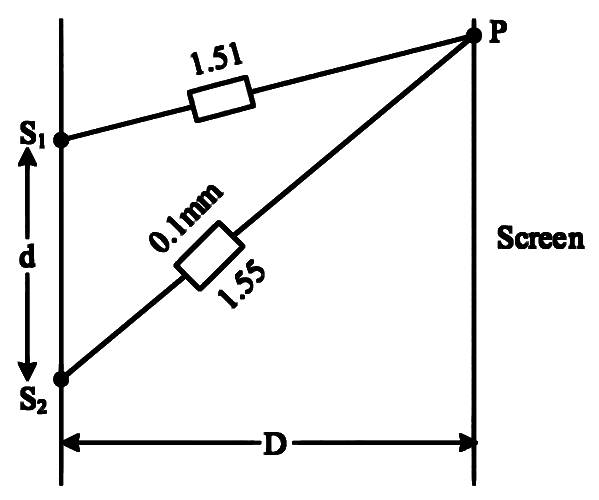
In Young's double slit experiment, two slits S1 and S2 are 'd' distance apart and the separation from slits to screen is D. Now if two transparent slabs of equal thickness 0.1 mm but refractive index 1.51 and 1.55 are introduced in the path of beam (λ=4000 Å) from S1 and S2 respectively. The central bright fringe spot will shift by ___ number of fringes.
Show answer and solution
Answer: (b)
Net extra optical path =(μ2−μ1)t=(1.55−1.51)×0.1×10−3=4×10⁻⁶ m.
YDSE: Film, Medium & Two Wavelengths · Fringe shift by a film
In a double slit experiment the distance between the slits is 0.1 cm and the screen is placed at 50 cm from the slits plane. When one slit is covered with a transparent sheet having thickness t and refractive index n(=1.5), the central fringe shifts by 0.2 cm. The value of t is
YDSE: Film, Medium & Two Wavelengths · Fringe shift by a film
In a double slit experiment, when one of the slits is covered by a transparent mica sheet of refractive index 1.56, the central fringe shifts to the position of 7th bright fringe, obtained with both slits uncovered. If the light source wavelength is 450 nm, the thickness of mica sheet is α×10−9 m. The value of α is
______.
Numerical answer type. Work it out, then open the answer.
YDSE: Film, Medium & Two Wavelengths · Fringe shift by a film
In a Young's double slit experiment set up, the two slits are kept 0.4 mm apart and screen is placed at 1 m from slits. If a thin transparent sheet of thickness 20μm is introduced in front of one of the slits then center bright fringe shifts by 20 mm on the screen.
The refractive index of transparent sheet is given by 10α, where α is ______.
Numerical answer type. Work it out, then open the answer.
YDSE: Film, Medium & Two Wavelengths · Two wavelengths: coincidence & overlap
In an interference experiment, the mth bright fringe for light of wavelength λ1 coincides with the nth dark fringe for light of wavelength λ2. The ratio λ1λ2 is
YDSE: Film, Medium & Two Wavelengths · Two wavelengths: coincidence & overlap
In Young's double slit experiment, the distance between the slits is 3 mm and the slits are 2m away from the screen. Two interference patterns can be obtained on the screen due to light of wavelength 480 nm and 600 nm respectively. The separation on the screen between the 5th order bright fringes on two interference patterns is
YDSE: Film, Medium & Two Wavelengths · Two wavelengths: coincidence & overlap
A beam of light consisting of wavelengths 650 nm and 550 nm illuminates the Young's double slits with separation of 2 mm such that the interference fringes are formed on a screen, placed at a distance of 1.2 m from the slits. The least distance of a point from the central maximum, where the bright fringes due to both the wavelengths coincide, is ________ ×10−5 m.
Numerical answer type. Work it out, then open the answer.
Show answer and solution
Answer: 429
Coincidence: n1×650=n2×550⇒13n1=11n2, so n1=11.
YDSE: Film, Medium & Two Wavelengths · Dark fringe opposite a slit
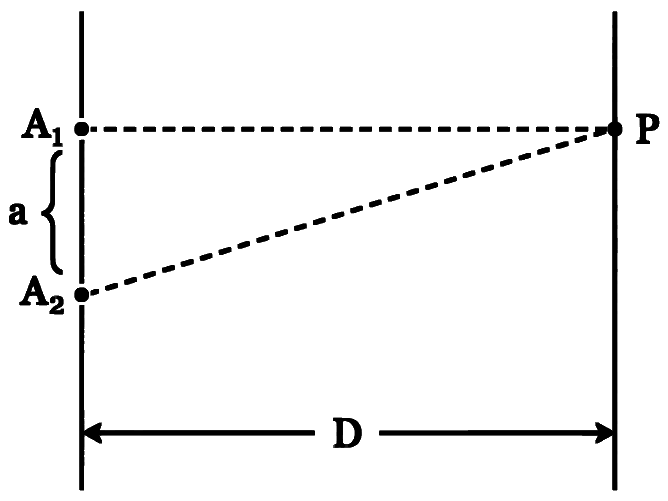
In Young's double slit experiment, two slits are illuminated with a light of wavelength λ. The line joining A1P is perpendicular to A1A2 as shown in figure. If the first minimum is detected at P, the value of slits separation 'a' will be
YDSE: Film, Medium & Two Wavelengths · Dark fringe opposite a slit
In Young's double slit experiment, in an interference pattern, a minimum is observed exactly in front of one slit. The distance between the two coherent sources is 'd' and 'D' is the distance between source and screen. The possible wavelengths used are inversely proportional to
Show answer and solution
Answer: (b)
In front of a slit y=d/2, so path difference =Dyd=2Dd2.
Minimum: 2Dd2=2(2n−1)λ⇒λ=(2n−1)Dd2
So λ∝D1,3D1,5D1,…, i.e. inversely proportional to D,3D,5D,…
YDSE: Film, Medium & Two Wavelengths · Dark fringe opposite a slit
The maximum intensity in a Young's double slit experiment is I0. Distance between the slits (d) is 5λ, where λ is the wavelength of light used. The intensity of the fringe, exactly opposite to one of the slits on the screen, placed at D=10d is ______.
YDSE: Film, Medium & Two Wavelengths · Optical path & phase
A ray of light from a monochromatic point source of light is incident at a point on the screen. If a thin mica film of thickness ' t ' and refractive index ' n ' is introduced in its path, then the optical path
Show answer and solution
Answer: (d)
In the film, path t counts as optical path nt instead of t.
YDSE: Film, Medium & Two Wavelengths · Fringe shift by a film
In Young's double slit experiment, the distance between screen and aperture is 1 m. The slit width is 2 mm. Light of 6000A˚ is used. If a thin glass plate ( μ=1.5) of thickness 0.04 mm is placed over one of the slits, then there will be a lateral displacement of the fringes by
YDSE: Film, Medium & Two Wavelengths · YDSE in a medium
Young's double slit interference apparatus is immersed in a liquid of refractive index 1.44. It has slit separation of 1.5 mm. The slits are illuminated by a parallel beam of light whose wavelength in air is 690 nm. The fringe-width on a screen placed behind the plane of slits at a distance of 0.72 m, will be:
YDSE: Film, Medium & Two Wavelengths · Two wavelengths: coincidence & overlap
In Young's double slit experiment, the distance between the slits is 2 mm and the slits are 1 m away, from the screen. Two interference patterns can be obtained on the screen due to light of wavelength ' λ1 ' and ' λ2 ' respectively. The separation on the screen between the 3rd order bright fringes on the two interference patterns is ( λ2=1.5λ1)
YDSE: Film, Medium & Two Wavelengths · Two wavelengths: coincidence & overlap
The Young's double slit interference experiment is performed using light consisting of 480 nm and 600 nm wavelengths to form interference patterns. The least number of the bright fringes of 480 nm light that are required for the first coincidence with the bright fringes formed by 600 nm light is
Show answer and solution
Answer: (c)
Coincidence: n1×480=n2×600⇒n2n1=45.
Least n1=5 (coincides with 4th bright of 600 nm).
YDSE: Film, Medium & Two Wavelengths · Dark fringe opposite a slit
In Young's double slit experiment, in an interference pattern second minimum is observed exactly in front of one slit. The distance between the two coherent sources is ' d ' and the distance between source and screen is ' D '. The wavelength of light source used is
YDSE: Film, Medium & Two Wavelengths · Dark fringe opposite a slit
In Young's double slit experiment, in an interference pattern, a minimum is observed exactly in front of one slit. The distance between the two coherent sources is d and D is the distance between source and screen. The possible wavelengths used are proportional to
Show answer and solution
Answer: (b)
Path difference in front of a slit =2Dd2=2(2n−1)λ.
YDSE: Film, Medium & Two Wavelengths · Dark fringe opposite a slit
In Young's double slit experiment let 'd' be the distance between two slits and 'D' be the distance between the slits and the screen. Using a monochromatic source of wavelength ' λ ', in an interference pattern, third minimum is observed exactly in front of one of the slits. If at the same point on the screen first minimum is to be obtained, the required change in the wavelength is [ d&D are not changed].
Show answer and solution
Answer: (c)
Point opposite a slit: y=2d, so path difference Δ=Dyd=2Dd2.
YDSE: Film, Medium & Two Wavelengths · Optical path & phase
Two light rays having the same wavelength ' λ ' in vacuum are in phase initially. Then, the first ray travels a path ' L1 ' through a medium of refractive index ' μ1 ' while the second ray travels a path of length ' L2 ' through a medium of refractive index ' μ2 '. The two waves are then combined to observe interference. The phase difference between the two waves is
YDSE: Film, Medium & Two Wavelengths · Fringe shift by a film
Monochromatic light of wavelength 500 nm is used in Young's double slit experiment. An interference pattern is obtained on a screen. When one of the slits is covered with a very thin glass plate (refractive index =1.5), the central maximum is shifted to a position previously occupied by the 4th bright fringe. The thickness of the glass-plate is __________ μm.
Numerical answer type. Work it out, then open the answer.
YDSE: Film, Medium & Two Wavelengths · Two wavelengths: coincidence & overlap
In an interference experiment, the nth bright fringe for light of wavelength λ1(n=0,1,2,3…) coincides with the mth dark fringe for light of wavelength λ2(m=1,2,3…). The ratio λ2λ1 is
YDSE: Film, Medium & Two Wavelengths · Two wavelengths: coincidence & overlap
Two wavelengths λ1 and λ2 are used in Young's double slit experiment. λ1=450 nm and λ2=650 nm. The minimum order of fringe produced by λ2 which overlaps with the fringe produced by λ1 is n. The value of n is _______.
Numerical answer type. Work it out, then open the answer.
Show answer and solution
Answer: 9
Overlap of bright fringes: n1×450=n2×650⇒9n1=13n2.
YDSE: Film, Medium & Two Wavelengths · Dark fringe opposite a slit
In Young's double slit experiment, the distance between the two coherent sources is ' d ' and the distance between the source and screen is ' D '. When the wavelength (λ) of light source used is 3Dd2, then nth dark fringe is observed on the screen, exactly in front of one of the slits. The value of ' n ' is
Show answer and solution
Answer: (b)
For the nth dark fringe in front of a slit: λ=(2n−1)Dd2.
YDSE: Film, Medium & Two Wavelengths · Dark fringe opposite a slit
In Young's double slit experiment, in an interference pattern, second minimum is observed exactly in front of one slit. The distance between the two coherent sources is ' d ' and the distance between the source and screen is ' D '. The wave length of light (λ) used is
YDSE: Film, Medium & Two Wavelengths · Dark fringe opposite a slit
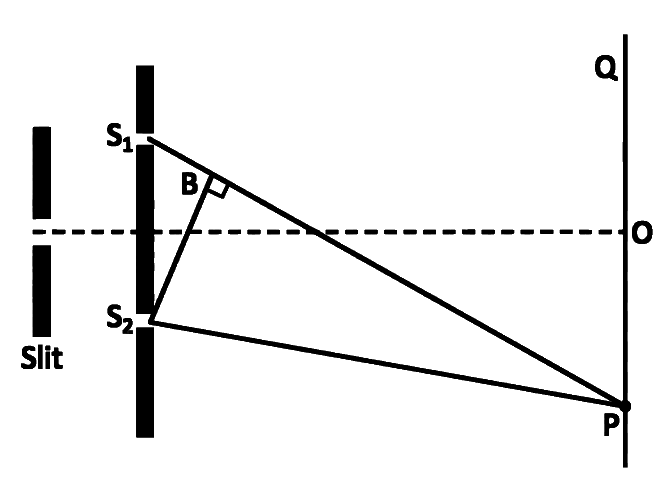
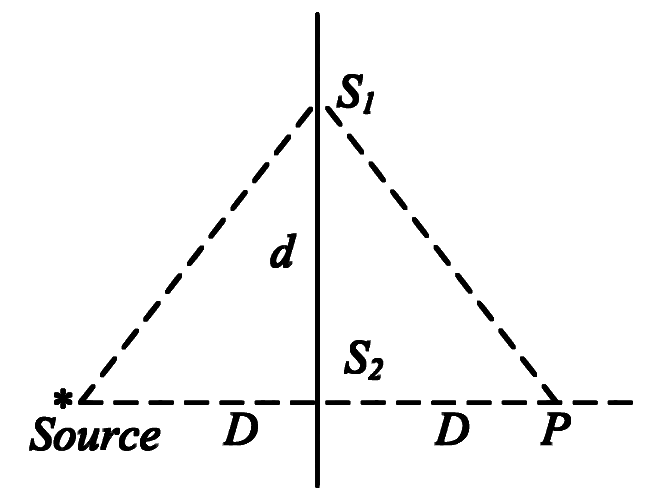
In a double slit experiment shown in figure, when light of wavelength 400 nm is used, dark fringe is observed at P. If D=0.2 m, the minimum distance between the slits S1 and S2 is _________ mm.
Numerical answer type. Work it out, then open the answer.
Show answer and solution
Answer: 0.20
Path via S2 (on the axis): 2D. Path via S1: 2D2+d2.
Δ=2(D2+d2−D)≈Dd2 for d≪D.
Minimum d for a dark fringe: Dd2=2λ⇒d2=2λD=2400×10−9×0.2=4×10⁻⁸m2.
YDSE: Film, Medium & Two Wavelengths · YDSE in a medium
A double slit experiment is immersed in water of refractive index 1.33. The slit separation is 1 mm, distance between slit and screen is 1.33 m The slits are illuminated by a light of wavelength 6300A˚. The fringe width is
YDSE: Film, Medium & Two Wavelengths · Fringe shift by a film
On placing a thin film of mica of thickness 12×10−5 cm in the path of one of the interfering beams in Young's double slit experiment using monochromatic light, the fringe pattern shifts through a distance equal to the width of bright fringe. If λ=6×10⁻⁵ cm, the refractive index of mica is
YDSE: Film, Medium & Two Wavelengths · Fringe shift by a film
In Young's double slit experiment when a glass plate of refractive index 1.44 is introduced in the path of one of the interfering beams, the fringes are displaced by a distance 'y'. If this plate is replaced by another plate of same thickness but of refractive index 1.66, the fringes will be displaced by a distance
YDSE: Film, Medium & Two Wavelengths · Fringe shift by a film
One of the slits in Young's double slit experiment is covered with a transparent sheet of thickness 2.9×10⁻³ cm. The central fringe shifts to a position originally occupied by the 25th bright fringe. If λ=5800A˚, the refractive index of the sheet is
YDSE: Film, Medium & Two Wavelengths · Fringe shift by a film
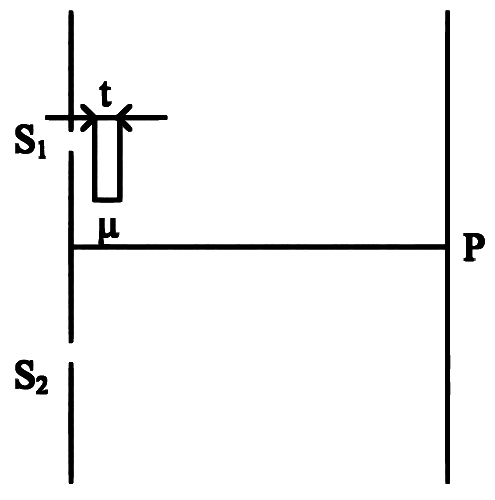
As shown in the figure, in Young's double slit experiment, a thin plate of thickness t=10μm and refractive index μ=1.2 is inserted in front of slit S1. The experiment is conducted in air (μ=1) and uses a monochromatic light of wavelength λ=500 nm. Due to the insertion of the plate, central maxima is shifted by a distance of xβ0.β0 is the fringe-width before the insertion of the plate. The value of the x is _____________.
Numerical answer type. Work it out, then open the answer.
YDSE: Film, Medium & Two Wavelengths · Fringe shift by a film
In Young's double slit experiment, two slits S1 and S2 are 'd' distance apart and the separation from slits to screen is D (as shown in figure). Now if two transparent slabs of equal thickness 0.1 mm but refractive index 1.51 and 1.55 are introduced in the path of beam (λ=4000A˚) from S1 and S2 respectively. The central bright fringe spot will shift by ___________ number of fringes.
Numerical answer type. Work it out, then open the answer.
Show answer and solution
Answer: 10
Net extra path =(μ2−μ1)t=(1.55−1.51)(0.1×10⁻³)=4×10⁻⁶ m.
YDSE: Film, Medium & Two Wavelengths · Two wavelengths: coincidence & overlap
A beam of light consisting of two wavelengths 7000A˚ and 5500A˚ is used to obtain interference pattern in Young's double slit experiment. The distance between the slits is 2.5 mm and the distance between the plane of slits and the screen is 150 cm. The least distance from the central fringe, where the bright fringes due to both the wavelengths coincide, is n×10−5 m. The value of n is __________.
Numerical answer type. Work it out, then open the answer.
Show answer and solution
Answer: 462
Coincidence: n1×7000=n2×5500⇒14n1=11n2, so n1=11.
YDSE: Film, Medium & Two Wavelengths · Dark fringe opposite a slit
In Young's double slit experiment, the two slits are 'd' distance apart. Interference pattern is observed on a screen at a distance 'D' from the slits. A dark fringe is observed on a screen directly opposite to one of the slits. The wavelength of light is
YDSE: Film, Medium & Two Wavelengths · Dark fringe opposite a slit
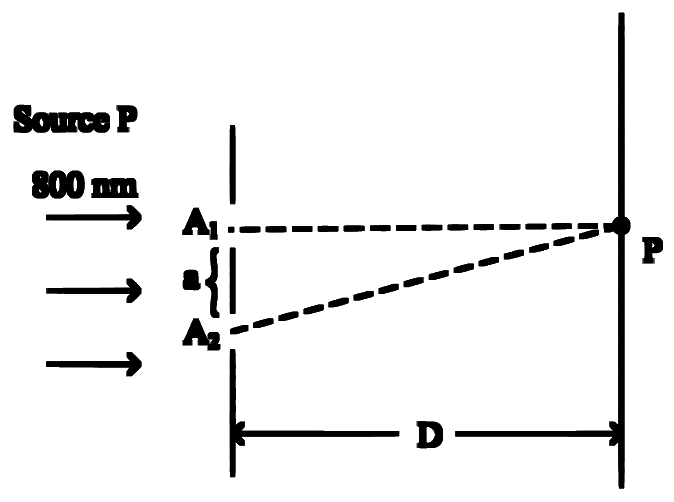
In a Young's double slit experiment, two slits are illuminated with a light of wavelength 800 nm. The line joining A1P is perpendicular to A1A2 as shown in the figure. If the first minimum is detected at P, the value of slits separation 'a' will be:
YDSE: Film, Medium & Two Wavelengths · Two wavelengths: coincidence & overlap
Two light waves of wavelengths 800 and 600 nm are used in Young's double slit experiment to obtain interference fringes on a screen placed 7 m away from plane of slits. If the two slits are separated by 0.35 mm, then shortest distance from the central bright maximum to the point where the bright fringes of the two wavelength coincide will be ______ mm.
Numerical answer type. Work it out, then open the answer.
YDSE: Film, Medium & Two Wavelengths · YDSE in a medium
In Young's double slit experiment, the fringe width is 12 mm. If the entire arrangement is placed in water of refractive index 34, then the fringe width becomes (in mm):
YDSE: Film, Medium & Two Wavelengths · YDSE in a medium
In a Young's double slit experiment, an angular width of the fringe is 0.35∘ on a screen placed at 2 m away for particular wavelength of 450 nm. The angular width of the fringe, when whole system is immersed in a medium of refractive index 7/5, is α1. The value of α is ___________.
Numerical answer type. Work it out, then open the answer.
YDSE: Film, Medium & Two Wavelengths · Fringe shift by a film
In Young's double slit experiment performed using a monochromatic light of wavelength λ, when a glass plate (μ = 1.5) of thickness xλ is introduced in the path of the one of the interfering beams, the intensity at the position where the central maximum occurred previously remains unchanged. The value of x will be:
Show answer and solution
Answer: (b)
A plate adds an extra path (μ−1)t to one beam.
Intensity at the old central point is unchanged if (μ−1)t=nλ.
(1.5−1)(xλ)=nλ⇒x=2n
Smallest non-zero value: x=2. So the answer is (b) 2.
YDSE: Film, Medium & Two Wavelengths · Dark fringe opposite a slit
In Young's double slit experiment the two slits are 0.6 mm distance apart. Interference pattern is observed on a screen at a distance 80 cm from the slits. The first dark fringe is observed on the screen directly opposite to one of the slits. The wavelength of light will be ____________ nm.
Numerical answer type. Work it out, then open the answer.
Show answer and solution
Answer: 450
First dark fringe opposite a slit: 2Dd2=2λ⇒λ=Dd2.
YDSE: Film, Medium & Two Wavelengths · YDSE in a medium
A double slit experiment is immersed in water of refractive index 1.33. The slit separationis 1 mm and the distance between slit and screen is 1.33 m. The slits are illuminated by a light of wavelength 6300A˚. The fringewidth is
YDSE: Film, Medium & Two Wavelengths · Optical path & phase
The difference in the number of waves when yellow light propagates through air and vacuum columns of the same thickness is one. The thickness of the air column is ___________ mm. [Refractive index of air = 1.0003, wavelength of yellow light in vacuum = 6000 A˚]
Numerical answer type. Work it out, then open the answer.
Show answer and solution
Answer: 2
Number of waves in thickness t: air λμt, vacuum λt.
YDSE: Film, Medium & Two Wavelengths · Dark fringe opposite a slit
In Young's double slit experiment, in an interference pattern, a minimum is observed exactly in front of one slit. The distance between the two coherent sources is 'd' and 'D' is the distance between the source and screen. The possible wavelengths used are inversely proportional to
Show answer and solution
Answer: (b)
Path difference in front of a slit =2Dd2=2(2n−1)λ.
YDSE: Film, Medium & Two Wavelengths · Optical path & phase
Two light waves having the same wavelength λ in vacuum are in phase initially. Then the first wave travels a path L1 through a medium of refractive index n1 while the second wave travels a path of length L2 through a medium of refractive index n2. After this the phase difference between the two waves is:
YDSE: Film, Medium & Two Wavelengths · YDSE in a medium
In a double slit experiment, when light of wavelength 400 nm was used, the angular width of the first minima formed on a screen placed 1m away, was found to be 0.2°. What will be the angular width of the first minima, (μwater = 4/3) if the entire experimental apparatus is immersed in water?
YDSE: Film, Medium & Two Wavelengths · Fringe shift by a film
In a double slit experiment, when a thin film of thickness t having refractive index μ. is introduced in front of one of the slits, the maximum at the centre of the fringe pattern shifts by one fringe width. The value of t is (λ is the wavelength of the light used):
Show answer and solution
Answer: (d)
Film adds path (μ−1)t; a shift of one fringe means this equals λ.
YDSE: Film, Medium & Two Wavelengths · Fringe shift by a film
The figure shows a Young's double slit experimental setup. It is observed that when a thin transparent sheet of thickness t and refractive index μ is put in front of one of the slits, the central maximum gets shifted by a distance equal to n fringe widths. If the wavelength of light used is λ, t will be:
YDSE: Film, Medium & Two Wavelengths · Dark fringe opposite a slit
In Young's double slit experiment fifth dark fringe is formed opposite to one of the slits. D is the distance between the slits and the screen and d is the separation between the slits, then the wavelength of light used is
YDSE: Film, Medium & Two Wavelengths · Dark fringe opposite a slit
Consider a Young’s double slit experiment as shown in figure. What should be the slit separation d in terms of wavelength λ such that the first minima occurs directly in front of the slit (S1)?
Show answer and solution
Answer: (b)
P is directly opposite S1 with screen at 2d: S1P=2d.
YDSE: Film, Medium & Two Wavelengths · Number of maxima
In a Young's double slit experiment, the slits are placed 0.320 mm apart. Light of wavelength λ = 500 nm is incident on the slits. The total number of bright fringes that are observed in the angular range − 30°≤θ≤30° is:
Show answer and solution
Answer: (d)
Bright fringe: dsinθ=nλ.
nmax=λdsin30∘=500×10−90.32×10−3×0.5=320.
Fringes on each side: 320, plus the central one: 2(320)+1=641.
YDSE: Film, Medium & Two Wavelengths · YDSE in a medium
Young's double slit experiment is first performed in air and then in a medium other than air. It is found that 8th bright fringe in the medium lies where 5th dark fringe lies in air. The refractive index of the medium is nearly
YDSE: Film, Medium & Two Wavelengths · Two wavelengths: coincidence & overlap
In a Young’s double slit experiment, slits are separated by 0.5 mm, and the screen is placed 150 cm away. A beam of light consisting of two wavelengths, 650 nm and 520 nm, is used to obtain interference fringes on the screen. The least distance from the common central maximum to the point where the bright fringes due to both the wavelengths coincide is
Show answer and solution
Answer: (c)
Coincidence: n1×650=n2×520⇒n2n1=54, so n1=4.
YDSE: Film, Medium & Two Wavelengths · Dark fringe opposite a slit
The intensity at the maximum in a Young's double slit experiment is I0. Distance between two slits is d = 5λ, where λ is the wavelength of light used in the expreriment. What will be the intensity in front of one of the slits on the screen placed at a distance D = 10d?
YDSE: Film, Medium & Two Wavelengths · Fringe shift by a film
A thin glass plate of thickness 32500λ (λ is wavelength of light used) and refractive index μ=1.5 is inserted between one of the slits and the screen in Young's double slit experiment. At a point on the screen equidistant from the slits, the ratio of the intensities before and after the introduction of the glass plate is:
Show answer and solution
Answer: (c)
Before: path difference 0, so I=4I0 (max).
After: Δ=(μ−1)t=0.5×32500λ=41632λ, so phase ϕ=2π×32=34π (mod 2π).
YDSE: Film, Medium & Two Wavelengths · Two wavelengths: coincidence & overlap
In Young's double slit experiment, the slits are 2 mm apart and are illuminated by photons of two ∘∘
wavelengths λ1 = 12000 A˚ and λ2 = 10000 A˚. At what minimum distance from the common central bright fringe on the screen 2 m from the slit will a bright fringe from one interference pattern coincide with a bright fringe from the other?
YDSE: Film, Medium & Two Wavelengths · Two wavelengths: coincidence & overlap
The source that illuminates the double-slit in 'double-slit interference experiment' emits two distinct monochromatic waves of wavelength 500 nm and 600 nm, each of them producing its own pattern on the screen. At the central point of the pattern when path difference is zero, maxima of both the patterns coincide and the resulting interference pattern is most distinct at the region of zero path difference. But as one moves out of this central region, the two fringe systems are gradually out of step such that maximum due to one wavelength coincides with the minimum due to the other and the combined fringe system becomes completely indistinct. This may happen when path difference in nm is:
Show answer and solution
Answer: (d)
Need a path difference that is a whole number of one wavelength and an odd number of half-waves of the other.
1500 nm=3×500 (bright for 500 nm) and =2.5×600 (dark for 600 nm).
Others fail: 1000 and 2000 are not half-integral multiples of 600; 3000 is bright for both.
YDSE: Film, Medium & Two Wavelengths · Two wavelengths: coincidence & overlap
A mixture of light, consisting of wavelength 590 nm and an unknown wavelength, illuminates Young's double slit and gives rise to two overlapping interference patterns on the screen. The central maximum of both lights coincide. Further, it is observed that the third bright fringe of known light coincides with the 4th bright fringe of the unknown light. From this data, the wavelength of the unknown light is:
YDSE: Film, Medium & Two Wavelengths · YDSE in a medium
Interference was observed in interference chamber where air was present, now the chamber is evacuated, and if the same light is used, a careful observer will see
Show answer and solution
Answer: (d)
Refractive index of air is slightly more than 1, so in vacuum the wavelength λ=μairλair is slightly larger.
β=dλD∝λ, so the fringe width increases slightly.
So the answer is (d) interference with larger width.
YDSE: Film, Medium & Two Wavelengths · YDSE in a medium
In Young's double slit experiment, the fringe width is found to be 0.4 mm. If the whole apparatus is immersed in water of refractive index 34, without disturbing the geometrical arrangement, the new fringe width will be
Biprism, Thin Films & Other Devices · Fresnel biprism
In a biprism experiment, using a light of wavelength 4800 Å, a steady interference pattern was obtained on a screen 1 m away from the source. Now the source is replaced by another of wavelength 6400 Å and the screen is moved away from it by 20 cm. The fringewidth will
Show answer and solution
Answer: (c)
β=dλD⇒ββ′=λλ′⋅DD′.
ββ′=48006400×11.2=1.6.
So the answer is (c): fringe width increases by 60%.
Biprism, Thin Films & Other Devices · Fresnel biprism
The distance of a point on the screen from two slits in biprism experiment is 1.8×10⁻⁵ m and 1.23×10⁻⁵ m. If wavelength of light used is 6000 Å the fringe number formed at that point is
Show answer and solution
Answer: (b)
Path difference Δ=1.8×10⁻⁵−1.23×10−5=5.7×10⁻⁶m.
λΔ=6×10−75.7×10−6=9.5, a half-integer, so the point is dark.
Biprism, Thin Films & Other Devices · Fresnel biprism
In a biprism experiment, the distance between 4th and 13th bright band on the same side is 'y' when light of wavelength 6000 Å is used. For a light of wavelength 'λ' the distance between 6th and 16th bright band on the same side is again 'y'. The value of 'λ' in Å units is
Show answer and solution
Answer: (c)
Distance between mth and nth bright bands =(n−m)β, with β∝λ.
Biprism, Thin Films & Other Devices · Fresnel biprism
In a biprism experiment, a steady interference pattern is observed on the screen kept at a distance of 100 cm using a light of wavelength 5000 Å. Without changing the distance between the virtual images of the slit, the source of light is replaced by a source of wavelength 6400 Å. Now, to reduce the fringe width by 20% of its initial value, the screen should be moved
Show answer and solution
Answer: (a)
β=dλD, d fixed. Required: β′=0.8β.
6400D′=0.8×5000×100⇒D′=62.5cm.
Screen must move 100−62.5=37.5 cm closer.
So the answer is (a) towards the source by 37.5 cm.
Biprism, Thin Films & Other Devices · Fresnel biprism
In biprism experiment, the maximum intensity is I0. If the path difference between the two interfering waves is 3λ, then intensity at the point on the screen is
Biprism, Thin Films & Other Devices · Fresnel biprism
In a biprism experiment, fifth dark fringe is obtained at a point. A thin transparent film of refractive index 'μ' is placed in one of the interfering paths. Now 7th bright fringe is obtained at the same point. If 'λ' is the wavelength of light used, the thickness of film is equal to
Show answer and solution
Answer: (d)
5th dark fringe: Δ=(2×5−1)2λ=4.5λ. 7th bright: Δ=7λ.
Extra path added by the film: (μ−1)t=7λ−4.5λ=2.5λ.
Biprism, Thin Films & Other Devices · Fresnel biprism
In biprism experiment, the 4th dark band is formed opposite to one of the slits. The wavelength of light used is (D=distance between source and screen, d= the distance between the slits)
Show answer and solution
Answer: (d)
Point opposite a slit: y=2d, path difference =Dyd=2Dd2.
Biprism, Thin Films & Other Devices · Thin film interference
A parallel beam of light of intensity I0 is incident on a glass plate, 25% of light is reflected by upper surface (I1) and 50% of light is reflected from lower surface (I2). The ratio I2 to I1 is
Show answer and solution
Answer: (b)
Upper surface reflects I1=0.25I0; 0.75I0 enters the plate.
Biprism, Thin Films & Other Devices · Fresnel biprism
In a biprism experiment a steady interference pattern is observed on the screen using a light of wavelength 5000A˚. Without disturbing the set up of the experiment, the source of light is replaced by a source of wavelength 6400A˚.
The fringe width will
Show answer and solution
Answer: (d)
β=dλD⇒β∝λ.
ββ′=50006400=1.28.
So the answer is (d): fringe width increases by 28%.
Biprism, Thin Films & Other Devices · Thin film interference
A transparent film of refractive index, 2.0 is coated on a glass slab of refractive index, 1.45. What is the minimum thickness of transparent film to be coated for the maximum transmission of Green light of wavelength 550 nm. [Assume that the light is incident nearly perpendicular to the glass surface.]
Show answer and solution
Answer: (b)
Maximum transmission means minimum reflection.
Air to film (1 to 2.0): phase change π; film to glass (2.0 to 1.45): no phase change.
With one π shift, reflection is minimum when 2μt=mλ; least t=2μλ.
Biprism, Thin Films & Other Devices · Thin film interference
A ray of light of intensity ' I ' is incident on a parallel glass slab at a point ' A ' as shown in figure. It undergoes partial reflection and refraction. At each reflection 25% of incident energy is reflected. The rays AB and A′B′ undergo interference. The ratio IminImaxmaxmin is
Show answer and solution
Answer: (b)
Ray AB (reflected at A): I1=0.25I=6416I.
Ray A'B': transmitted 0.75I, reflected at C 0.25×0.75I, transmitted at A': I2=0.75×0.25×0.75I=649I.
Biprism, Thin Films & Other Devices · Thin film interference
A thin transparent film with refractive index 1.4, is held on circular ring of radius 1.8 cm. The fluid in the film evaporates such that transmission through the film at wavelength 560 nm goes to a minimum every 12 seconds. Assuming that the film is flat on its two sides, the rate of evaporation is ____________ π×10−13 m3/s.
Numerical answer type. Work it out, then open the answer.
Show answer and solution
Answer: 54
Successive transmission minima: thickness changes by Δt=2μλ=2×1.4560=200nm.
Volume lost per 12 s: πr2Δt=π(1.8×10⁻²)2×2×10−7=6.48π×10−11m3.
Biprism, Thin Films & Other Devices · Fresnel biprism
In biprism experiment, the fringe width is 0.6 mm. The distance between 6th dark fringe and 8th bright fringe on the same side of central bright fringe is
Show answer and solution
Answer: (c)
nth dark fringe: y=(2n−1)2β, so 6th dark at 5.5β.
Biprism, Thin Films & Other Devices · Fresnel biprism
In a biprism experiment, monochromatic light of wavelength ' λ ' is used. The distance between the two coherent sources ' d ' is kept constant. If the distance between slit and eyepiece ' D ' is varied as D1,D2,D3,D4 and corresponding measured fringe widths are W1,W2,W3,W4 then
Show answer and solution
Answer: (b)
W=dλD with λ, d fixed, so W∝D.
Hence DW=dλ is constant.
So the answer is (b) D1W1=D2W2=D3W3=D4W4.
Biprism, Thin Films & Other Devices · Thin film interference
A parallel beam of light of intensity I0 is incident on a glass plate, 25% of light is reflected by upper surface and 50% of light is reflected from lower surface. The ratio of maximum to minimum intensity in interference region of reflected rays is
Show answer and solution
Answer: (a)
I1=4I0, I2=0.5×43I0=83I0.
Amplitudes ∝I: 21 and 83.
IminImax=[21−8321+83]2. So the answer is (a).
Biprism, Thin Films & Other Devices · Fresnel biprism
In a biprism experiment, monochromatic light of wavelength 'λ' is used. The distance between two coherent sources 'd' is kept constant. If the distance between slit and eyepiece 'D' is varied as D1,D2,D3&D4 and corresponding measured fringe widths are Z1,Z2,Z3 and Z4 then
Show answer and solution
Answer: (b)
Z=dλD with λ, d fixed, so Z∝D.
Hence DZ=dλ is constant.
So the answer is (b) D1Z1=D2Z2=D3Z3=D4Z4.
Biprism, Thin Films & Other Devices · Fresnel biprism
In two separate setups for Biprism experiment using same wavelength, fringes of equal width are obtained. If ratio of slit separation is 2:3 then the ratio of the distance between the slit and screen in the two setups is
Biprism, Thin Films & Other Devices · Fresnel biprism
In the interference experiment using a biprism, the distance of the slits from the screen is increased by 25% and the separation between the slits is halved. If 'W' represents the original fringewidth, the new fringewidth is
Biprism, Thin Films & Other Devices · Fresnel biprism
In biprism experiment, 21 fringes are observed in a given region using light of wavelength 4800 A˚. If light of wavelength 5600 A˚ is used, the number of fringes in the same region will be
Show answer and solution
Answer: (a)
For a fixed region Nβ is constant and β∝λ, so Nλ = constant.
Biprism, Thin Films & Other Devices · Fresnel biprism
In biprism experiment, 6th bright band with wavelength 'λ1' coincides with 7th dark band with wavelength 'λ2' then the ratio λ1:λ2 is (other setting remains the same)
Biprism, Thin Films & Other Devices · Fresnel biprism
In biprims experiment, the 4th dark band is formed opposite to one of the slits. The wavelength of light used is (d= distance between the slits, D= distance between scource and the screen)
Show answer and solution
Answer: (b)
Point opposite a slit: y=2d, path difference =2Dd2.
Biprism, Thin Films & Other Devices · Fresnel biprism
In biprism experiment, the distance between source and eyepiece is 1.2 m, the distance between two virtual sources is 0.84 mm. Then the wavelength of light used if eyepiece is to be moved transversely through a distance of 2.799 cm to shift 30 fringes is
Biprism, Thin Films & Other Devices · Lloyd's mirror & Newton's rings
Interference pattern is observed at 'P' due to superimposition of two rays coming out from a source 'S' as shown in the figure. The value of ′l′ for which maxima is obtained at 'P' is: (R is perfect reflecting surface):
Show answer and solution
Answer: (c)
Direct path SP=2l. Reflected ray meets R at the midpoint; each leg =cos30∘l=32l.
Reflected path =34l, so Δ=34l−2l=32l(2−3).
Reflection at R adds 2λ, so maxima need Δ=(2n−1)2λ.
Biprism, Thin Films & Other Devices · Thin film interference
A ray of light of intensity I is incident on a parallel glass slab at point A as shown in the diagram. It undergoes partial reflection and refraction. At each reflection, 25% of incident energy is reflected. The rays AB and A'B' undergo interference. The ratio of Imax and Imin is:
Show answer and solution
Answer: (a)
Ray AB (reflected at A): I1=0.25I=6416I.
Ray A'B': transmitted 0.75I, reflected at C 0.25×0.75I, transmitted at A': I2=0.75×0.25×0.75I=649I.
Biprism, Thin Films & Other Devices · Thin film interference
This question has a paragraph followed by two statements, Statement −1 and Statement −2. Of the given four alternatives after the statements, choose the one that describes the statements. A thin air film is formed by putting the convex surface of a plane-convex lens over a plane glass plane. With monochromatic light, this film gives an interference pattern due to light, reflected from the top (convex) surface and the bottom (glass plate) surface of the film.
Statement - 1: When light reflects from the air-glass plate interface, the reflected wave suffers a phase change of π.
Statement - 2: The center of the interference pattern is dark.
Show answer and solution
Answer: (b)
Statement 1: reflection at air to glass (rarer to denser) gives a phase change of π. True.
Statement 2: at the centre the film thickness is zero, and the extra π makes the two reflected waves cancel, so the centre is dark. True.
Statement 1 explains Statement 2, not the other way round, so Statement 2 is not the explanation of Statement 1.
Biprism, Thin Films & Other Devices · Fresnel biprism
In a Fresnel biprism experiment, the two positions of lens give separation between the slits as 16 cm and 9 cm respectively. What is the actual distance of separation?
Diffraction at a Single Slit · Central maximum width
In single slit diffraction pattern, the wavelength of light used is 628 nm and slit width is 0.2 mm, the angular width of central maximum is α×10−2 degrees. The value of α is ________.
Numerical answer type. Work it out, then open the answer.
Show answer and solution
Answer: 36
Angular width of central maximum =a2λ.
0.2×10−32×628×10−9=6.28×10⁻³ rad
In degrees: 6.28×10⁻³×π180=0.36∘=36×10−2 degrees.
In the diffraction pattern due to a single slit of width 'a' with incident light of wavelength 'λ', at an angle of diffraction 'θ', the condition for the second maximum is
Diffraction at a Single Slit · Pattern features & effect of changes
When the distance of separation between the slit and screen is doubled, the angular separation between fringes in single slit diffraction pattern experiment
Show answer and solution
Answer: (c)
Angular positions of minima: sinθ=anλ, so angular separation ≈aλ.
This has no D in it; doubling D only increases the linear separation.
Diffraction at a Single Slit · Pattern features & effect of changes
Which of the following are true for a single slit diffraction?
A. Width of central maxima increases with increase in wavelength keeping slit width constant. B. Width of central maxima increases with decrease in wavelength keeping slit width constant. C. Width of central maxima increases with decrease in slit width at constant wavelength. D. Width of central maxima increases with increase in slit width at constant wavelength. E. Brightness of central maxima increases for decrease in wavelength at constant slit width.
Show answer and solution
Answer: (c)
Width of central maximum =a2Dλ.
A: larger λ gives wider maximum, true. B: false.
C: smaller a gives wider maximum, true. D: false.
E: smaller λ makes the central maximum narrower, so the same light is concentrated and it looks brighter, true.
Diffraction at a Single Slit · Minima of a single slit
A slit of width a is illuminated by light of wavelength λ. The linear separation between 1st and 3rd minima in the diffraction pattern produced on a screen placed at a distance D from the slit system is ______.
Diffraction at a Single Slit · Central maximum width
In a Fraunhofer diffraction of a single slit, when a slit is illuminated by a light of wavelength 6480 Å, angular width of central maximum is measured. When the slit is illuminated by light of another wavelength 'λ' the angular width decreases by 25%. The value of λ in Å units is
Show answer and solution
Answer: (c)
Angular width of central maximum =a2λ, so it is ∝λ.
Diffraction at a Single Slit · Central maximum width
Light of wavelength λ is incident on a single slit of width 'a' and the distance between slit and screen is 'D'. In diffraction pattern, if slit width is equal to the width of the central maximum then 'D' is equal to
Diffraction at a Single Slit · Central maximum width
Light of wavelength λ is incident on a single slit of width 'a' and the distance between slit and screen is D. In diffraction pattern, if slit width is equal to the width of the central maximum then D is equal to
In the diffraction pattern, the first maximum is at 30∘, when a monochromatic light of wavelength λ is incident on a slit of width a. For the same wavelength, if the slit width is changed, so that first maximum is at 45∘. The slit width is changed by (sin30∘=21,sin45∘=21)
Light of wavelength 580 nm is incident normally on a slit of width 'a'. The distance between slit and screen is 2.5 m and the distance of the second order maximum from the centre of the screen is 14.5 mm in a diffraction pattern. The value of 'a' is
Show answer and solution
Answer: (b)
nth secondary maximum: yn=2a(2n+1)λD; for n=2, y=2a5λD
In a single slit diffraction pattern, the distance between the plane of the slit and the screen is 1.4 m. The width of the slit is 0.66 mm. The second maximum is formed at the distance of 2.8 mm from the center of the screen. The wavelength of light used is
In a single slit diffraction experiment, for wavelength 'λ', half angular width of the principal maxima is 'θ'. Also for wavelength of light 'pλ', the half angular width of the principal maxima is 'qθ'. The ratio of the half angular widths of the first secondary maxima in the first case to second case will be
Show answer and solution
Answer: (b)
Half angular width of central maximum =aλ; each secondary maximum has angular width aλ too, so its half width is 2aλ.
Both widths scale the same way with λ, so secondary-maximum width ∝ principal half width.
Diffraction at a Single Slit · Double slit inside the central maximum
In double slit experiment, the two slits are 1 mm apart and the screen is placed 1 m away. A monochromatic light of wavelength 500 nm is used. What will be the width of each slit for obtaining ten maxima of double slit within the central maxima of single slit pattern?
Show answer and solution
Answer: (a)
Width of single-slit central maximum =a2λD; double-slit fringe width β=dλD
Diffraction at a Single Slit · Central maximum width
In Fraunhofer diffraction pattern, slit width is 0.2 mm and screen is at 2 m away from the lens. If the distance between the first minimum on either side of the central maximum is 1 cm, the wavelength of light used is
Show answer and solution
Answer: (c)
Distance between first minima on either side (central maximum width): W=a2Dλ.
Diffraction at a Single Slit · Minima of a single slit
If the measured angular separation between the second minimum to the left of the central maximum and the third minimum to the right of the central maximum is 30∘ in a single slit diffraction pattern recorded using 628 nm light, then the width of the slit is _______ μm.
Numerical answer type. Work it out, then open the answer.
Show answer and solution
Answer: 6
nth minimum: θn≈anλ on either side of the centre.
Second minimum on the left and third on the right: separation =a2λ+a3λ=a5λ
Diffraction at a Single Slit · Central maximum width
In Fraunhofer diffraction pattern, slit width is 0.3 mm and screen is at 1.5 m away from the lens. If wavelength of light used is 4500A˚, then the distance between the first minimum on either side of the central maximum is [ θ is small and measured in radian.]
Show answer and solution
Answer: (d)
Distance between first minima on either side =a2λD
Diffraction at a Single Slit · Central maximum width
In a Fraunhoffer diffraction, light of wavelength ' λ ' is incident on slit of width ' d '. The diffraction pattern is observed on a screen placed at a distance ' D '. The linear width of central maximum is equal to two times the width of the slit, then 'D' has value
A single slit diffraction pattern is formed with white light. For what wavelength of light the 4th secondary maximum in diffraction pattern coincides with the 3rd secondary maximum in the pattern of light of wavelength ' λ '?
A single slit diffraction pattern is formed with light of wavelength 6384A˚. The second secondary maximum for this wavelength coincides with the third secondary maximum in the pattern for light of wavelength ' λ0 '. The value of ' λ0 ' is
In a single slit diffraction pattern, the distance between the plane of the slit and screen is 1.3 m. The width of the slit is 0.65 mm and the second maximum is formed at the distance of 2.6 mm from the centre of the screen. The wavelength of light used is
Diffraction at a Single Slit · Pattern features & effect of changes
In a single slit diffraction experiment, slit of width ' a ' is illuminated by light of wavelength ' λ ' and the width of the central maxima in diffraction pattern is measured as ' y '. When half of the slit is covered and illuminated by light of wavelength (1.5) λ, the width of the central maximum in diffraction pattern becomes
Diffraction at a Single Slit · Double slit inside the central maximum
In a Young's double slit experiment, two slits are located 1.5 mm apart. The distance of screen from slits is 2 m and the wavelength of the source is 400 nm. If the 20 maxima of the double slit pattern are contained within the central maximum of the single slit diffraction pattern, then the width of each slit is x×10−3 cm, where x-value is _________.
Numerical answer type. Work it out, then open the answer.
Show answer and solution
Answer: 15
Central maximum width a2λD holds 20 fringes of width dλD.
Diffraction at a Single Slit · Minima of a single slit
A parallel beam of monochromatic light of wavelength 600 nm passes through single slit of 0.4 mm width. Angular divergence corresponding to second order minima would be _________ ×10−3 rad.
Numerical answer type. Work it out, then open the answer.
Show answer and solution
Answer: 6
Minima of a single slit: asinθ=nλ, so for small angles θn=anλ.
Second minimum: θ2=0.4×10−32×600×10−9=3×10⁻³ rad on each side.
Angular divergence between the second minima on both sides =2θ2=6×10⁻³ rad.
Diffraction at a Single Slit · Minima of a single slit
In a single slit experiment, a parallel beam of green light of wavelength 550 nm passes through a slit of width 0.20 mm. The transmitted light is collected on a screen 100 cm away. The distance of first order minima from the central maximum will be x×10−5 m. The value of x is:
Numerical answer type. Work it out, then open the answer.
Diffraction at a Single Slit · Minima of a single slit
A parallel beam of monochromatic light of wavelength 5000 A˚ is incident normally on a single narrow slit of width 0.001 mm. The light is focused by convex lens on screen, placed on its focal plane. The first minima will be formed for the angle of diffraction of _________ (degree).
Numerical answer type. Work it out, then open the answer.
Diffraction at a Single Slit · Central maximum width
The angular separation of the central maximum in the Fraunhofer diffraction pattern is measured. The slit is illuminated by the light of wavelength 6000A˚. If the slit is illuminated by light of another wavelength, the angular separation decreases by 20%. The wavelength of light used is
Show answer and solution
Answer: (c)
Angular width of central maximum =a2λ, so for the same slit it is proportional to λ.
A 20% decrease in angular width means λ′=0.8λ=0.8×6000A˚.
Diffraction at a Single Slit · Central maximum width
In Fraunhofer diffraction pattern, slitwidth is 0.5 mm and screen is at 2 m away from the lens. If wavelength of light used is 5500A˚, then the distance between the first minimum on either side of the central maximum is ( θ is small and measured in radian)
Show answer and solution
Answer: (c)
Distance between first minima on either side: W=a2Dλ.
In a diffraction pattern due to single slit of width ' a ', the first minimum is observed at an angle 30∘ when light of wavelength 5000A˚ is incident on the slit. The first secondary maximum is observed at an angle [sin30=21]
Show answer and solution
Answer: (b)
First minimum: asin30∘=λ⇒a=2λ.
First secondary maximum: asinθ=23λ.
sinθ=2×2λ3λ=43
So the answer is (b) sin−1(43) (options (a) and (b) are identical).
Diffraction at a Single Slit · Minima of a single slit
A screen is placed at 50 cm from a single slit, which is illuminated with light of wavelength 600 nm. If separation between the 1st and 3rd minima in the diffraction pattern is 3 mm then slit width is
Show answer and solution
Answer: (a)
Minima on the screen: yn=anDλ, so y3−y1=a2Dλ.
Diffraction at a Single Slit · Minima of a single slit
In a single slit diffraction pattern, a light of wavelength 6000A˚ is used. The distance between the first and third minima in the diffraction pattern is found to be 3 mm when the screen in placed 50 cm away from slits. The width of the slit is _________ ×10−4 m.
Numerical answer type. Work it out, then open the answer.
Diffraction at a Single Slit · Central maximum width
A microwave of wavelength 2.0 cm falls normally on a slit of width 4.0 cm. The angular spread of the central maxima of the diffraction pattern obtained on a screen 1.5 m away from the slit, will be:
Diffraction at a Single Slit · Central maximum width
A monochromatic light of wavelength 6000A˚ is incident on the single slit of width 0.01 mm. If the diffraction pattern is formed at the focus of the convex lens of focal length 20 cm, the linear width of the central maximum is:
In a single slit diffraction experiment, for a wavelength of light ' λ ', half-angular width of the principal maxima is ' θ '. Also for wavelength of light pλ, the half angular width of the principal maxima is qθ. The ratio of the half-angular widths of the first secondary maxima in the first case to second case will be
Show answer and solution
Answer: (b)
Half angular width of central maximum =aλ; the width of each secondary maximum is also set by aλ.
So the secondary-maximum widths are in the same ratio as the principal half widths.
Two wavelength 590 nm and 596 nm of sodium light are used one after other, to study the diffraction taking place at a single slit of aperture 2.4 mm. The distance between the slit and screen is 2 m. The separation between the positions of first secondary maximum of the diffraction pattern obtained in the two cases is
A single slit diffraction pattern is formed with light of wavelength 6195A˚. The second secondary maximum for this wavelength coincides with the third secondary maximum in the pattern for light of wavelength ' λ0 '. The value of ' λ0 ' is
The diffraction pattern of a light of wavelength 400 nm diffracting from a slit of width 0.2 mm is focused on the focal plane of a convex lens of focal length 100 cm. The width of the 1st secondary maxima will be:
Show answer and solution
Answer: (a)
A secondary maximum lies between two minima that are aλf apart, so its width =aλf.
Diffraction at a Single Slit · Pattern features & effect of changes
A single slit of width d is illuminated by violet light of wavelength 400 nm and the width of the diffraction pattern is measured as ' Y '. When half of the slit width is covered and illuminated by yellow light of wavelength 600 nm, the width of the diffraction pattern is
Diffraction at a Single Slit · Double slit inside the central maximum
Two slits are 1 mm apart and the screen is located 1 m away from the slits. A light of wavelength 500 nm is used. The width of each slit to obtain 10 maxima of the double slit pattern within the central maximum of the single slit pattern is __________ ×10−4 m.
Numerical answer type. Work it out, then open the answer.
Show answer and solution
Answer: 2
Central maximum width a2λD holds 10 fringes of width dλD.
Diffraction at a Single Slit · Minima of a single slit
Light of wavelength 5000A˚ is incident normally on a slit. The first minimum of the diffraction pattern is observed to lie at a distance of 5 mm from the central maximum on a screen placed at a distance of 2 m from the slit. The width of the slit is
Diffraction at a Single Slit · Minima of a single slit
A single slit of width a is illuminated by a monochromatic light of wavelength 600 nm. The value of ' a ' for which first minimum appears at θ=30∘ on the screen will be:
Diffraction at a Single Slit · Central maximum width
A beam of light of wavelength 600 nm from a distant source falls on a single slit 1 mm wide and the resulting diffraction pattern is observed on a screen 2 m away. The distance between the first dark fringe on either side of the central bright fringe is
Show answer and solution
Answer: (b)
Distance between first dark fringes on either side: W=a2Dλ.
Diffraction at a Single Slit · Central maximum width
A parallel beam of monochromatic light falls normally on a single narrow slit. The angular width of the central maximum in the resulting diffraction pattern
Show answer and solution
Answer: (b)
Angular width of central maximum =a2λ, so it is inversely proportional to slit width a.
Wider slit gives a narrower central maximum.
So the answer is (b) decreases with increase of slit width.
Diffraction at a Single Slit · Central maximum width
Light of wavelength ',λ' is incident on a slit of width 'd'. The resulting diffraction pattern is observed on a screen at a distance 'D'. The linear width of the principal maximum is then equal to the width of the slit if D equals
Show answer and solution
Answer: (b)
Linear width of central (principal) maximum =d2Dλ.
In a diffraction pattern due to single slit of width 'a', the first minimum is observed at an angle of 30∘ when the light of wavelength 5400A˚ is incident on the slit. The first secondary maximum is observed at an angle of (sin30∘=21)
Two wavelengths of sodium light 590 nm and 596 nm are used one after another to study diffraction due to single slit of aperture 2×10⁻⁶ m. The distance between the slit and the screen is 1.5 m. The separation between the positions of first maximum of the diffraction pattern obtained in the two cases is
Show answer and solution
Answer: (d)
First maximum (first secondary maximum): y=2a3λD, so Δy=2a3DΔλ
Diffraction at a Single Slit · Pattern features & effect of changes
If I0 is the intensity of the principal maximum in the single slit diffraction pattern, then what will be the intensity when the slit width is doubled?
Show answer and solution
Answer: (c)
Amplitude at the principal maximum ∝ slit width a, so I0∝a2.
Diffraction at a Single Slit · Central maximum width
A parallel beam of monochromatic light falls normally on a single narrow slit. The angular width of the central maximum in the resulting diffraction pattern
Show answer and solution
Answer: (a)
Angular width of central maximum =a2λ∝a1.
Increasing slit width makes it smaller.
So the answer is (a) decreases with increase of slit width.
In a Fraunhofer diffraction at a single slit of width 'd' and incident light of wavelength 5500A˚, the first minimum is observed at an angle 30∘. The first secondary maxima is observed at an angle θ, equal to
Sodium light of wavelengths 650 nm and 655 nm is used to study diffraction at a single slit of aperture 0.5 mm. The distance between the slit and the screen is 2.0 m. The separation between the positions of the first maxima of diffraction pattern obtained in the two cases is ___________ × 10−5 m.
Numerical answer type. Work it out, then open the answer.
Diffraction at a Single Slit · Central maximum width
A beam of light having wavelength 5400A˚ from a distant source falls on a single slit 0.96 mm wide and the resultant diffraction pattern is observed on a screen 2 m away. What is the distance between the first dark fringe on either side of central bright fringe?
Show answer and solution
Answer: (c)
Distance between first dark fringes on either side: W=a2Dλ.
Diffraction at a Single Slit · Central maximum width
In Fraunhofer diffraction pattern, slit width is 0.2 mm and screen is at 2m away from the lens. If wavelength of light used is 5000A˚ then the distance between the first minimum on either side of the central maximum is (θ is small and measured in radian)
Show answer and solution
Answer: (d)
Distance between first minima on either side: W=a2Dλ.
Diffraction at a Single Slit · Pattern features & effect of changes
Consider the diffraction pattern obtained from the sunlight incident on a pinhole of diameter 0.1 μm. If the diameter of the pinhole is slightly increased, it will affect the diffraction pattern such that:
Show answer and solution
Answer: (c)
Angular size of the diffraction pattern ∝dλ, so a larger pinhole gives a smaller pattern.
A larger pinhole lets more light through, and it is spread over a smaller area, so intensity increases.
So the answer is (c) size decreases, but intensity increases.
Diffraction at a Single Slit · Minima of a single slit
In a single slit diffraction pattern, the distance between the first minimum on the left and the first minimum on the right is 5 mm. The screen on which the diffraction pattern is obtained is at a distance of 80 cm from the slit. The wavelength used is 6000 A˚. The width of the silt is
Show answer and solution
Answer: (c)
Distance between first minima on either side: W=a2Dλ.
Diffraction at a Single Slit · Central maximum width
Light of wavelength 'λ' is incident on a single slit of width 'a' and the distance between slit and screen is 'D'. In diffraction pattern, if slit width is equal to the width of the central maximum then D=
A single slit diffraction pattern is formed with white light. For what wavelength of light the 3rd secondary maximum in diffraction pattern coincides with the 2nd secondary maximum in the pattern of red light of wavelength 6000 A˚?
Diffraction at a Single Slit · Central maximum width
A light wave of wavelength λ is incident on a slit of width d. The resulting diffraction pattern is observed on a screen at a distance D. If linear width of the principal maxima is equal to the width of the slit, then the distance D is
Diffraction at a Single Slit · Minima of a single slit
Visible light of wavelength 6000 × 10-8 cm falls normally on a single slit and produces a diffraction pattern. It is found that the second diffraction minimum is at 60° from the central maximum. If the first minimum is produced at θ1, then θ1, is close to:
Diffraction at a Single Slit · Central maximum width
Angular width of the central maxima in the Fraunhofer diffraction for λ=6000 Å is θ0. When the same slit is illuminated by another monochromatic light, the angular width decreases by 30%. The wavelength of this light is
Show answer and solution
Answer: (c)
Angular width of central maximum =a2λ∝λ for the same slit.
Diffraction at a Single Slit · Central maximum width
Light of wavelength ' λ ' is incident on a single slit of width ' a ' and the distance between slit and screen is ' D '. In diffraction pattern, if slit width is equal to the width of the central maximum then ' D ' is equal to
Diffraction at a Single Slit · Double slit inside the central maximum
∘
In a double-slit experiment, green light (5303A˚) falls on a double slit having a separation of 19.44 μm and a width of 4.05 μm. The number of bright fringes between the first and the second diffraction minima is:
Diffraction at a Single Slit · Minima of a single slit
Light of wavelength 550 nm falls normally on a slit of width 22.0×10⁻⁵ cm. The angular position of the second minima from the central maximum will be (in radians):
Diffraction at a Single Slit · Double slit inside the central maximum
The angular width of the central maximum in a single slit diffraction pattern is 60°. The width of the slit is 1 μm. The slit is illuminated by monochromatic plane waves. If another slit of same width is made near it, Young’s fringes can be observed on a screen placed at a distance 50 cm from the slits. If the observed fringe width is 1 cm, what is slit separation distance? (i.e. distance between the centres of each slit.)
Show answer and solution
Answer: (b)
Central maximum 60∘, so first minimum at 30∘: asin30∘=λ⇒λ=1×21=0.5μm
Diffraction at a Single Slit · Minima of a single slit
A single slit of width 0.1 mm is illuminated by a parallel beam of light of wavelength 6000 A˚ and diffraction bands are observed on a screen 0.5 m from the slit. The distance of the third dark band from the central bright band is:
Diffraction at a Single Slit · Minima of a single slit
A single slit of width b is illuminated by a coherent monochromatic light of wavelength λ. If the second and fourthminima in the diffraction pattern at a distance 1 m from the slit are at 3 cm and 6 cm respectively from the central maximum, what is the width of the central maximum? (i.e. distance between first minimum on either side of the central maximum)
Diffraction at a Single Slit · Minima of a single slit
A linear aperture whose width is 0.02 cm is placed immediately in front of a lens of focal length 60 cm. The aparture is illuminated normally by a parallel beam of wavelength 5 × 10⁻⁵ cm. The distance of the first dark band of the diffraction pattern from the centre of the screen is
In a diffraction pattern due to a single slit of width a, the first minimum is observed at an angle 30° when light of wavelength 5000 A˚ is incident on the slit. The first secondary maximum is observed at an angle of
Diffraction at a Single Slit · Pattern features & effect of changes
The box of a pin hole camera, of length L, has a hole of radius a. It is assumed that when the hole is illuminated by a parallel beam of light of wavelength λ the spread of the spot (obtained on the opposite wall of the camera) is the sum of its geometrical spread and the spread due to diffraction. The spot would then have its minimum size (say bmin) when:
Diffraction at a Single Slit · Central maximum width
For a parallel beam of monochromatic light of wavelength 'λ', diffraction is produced by a single slit whose width 'a' is of the order of the wavelength of the light. If 'D' is the distance of the screen from the slit, the width of the central maxima will be
Show answer and solution
Answer: (c)
First minima lie at θ=±aλ, at distance aDλ from the centre on the screen.
Diffraction at a Single Slit · Minima of a single slit
At the first minimum adjacent to the central maximum of a single-slit diffraction pattern, the phase difference between the Huygen's wavelet from the edge of the slit and the wavelet from the midpoint of the slit is
Show answer and solution
Answer: (a)
At the first minimum, path difference between the two edges is asinθ=λ.
Edge and midpoint are a/2 apart, so their path difference is 2λ.
Diffraction at a Single Slit · Double slit inside the central maximum
In a double slit experiment, the two slits are 1 mm apart and the screen is placed 1 m away. A monochromatic light of wavelength 500 nm is used. What will be the width of each slit for obtaining ten maxima of double slit within the central maxima of single slit pattern?
Show answer and solution
Answer: (c)
Width of single-slit central maximum =a2λD; double-slit fringe width β=dλD
Diffraction at a Single Slit · Central maximum width
A beam of light of λ=600 nm from a distant source falls on a single slit 1 mm wide and the resulting diffraction pattern is observed on a screen 2 m away. The distance between first dark fringes on either side of the central bright fringe is
Show answer and solution
Answer: (d)
Distance between first dark fringes on either side: W=a2Dλ.
In an experiment of single slit diffraction pattern, first minimum for red light coincides with first maximum of some other wavelength. If wavelength of red light is 6600 A˚, then wavelength of first maximum will be:
Show answer and solution
Answer: (b)
First minimum of red: asinθ=λr; first maximum of other light: asinθ=23λ′
Diffraction at a Single Slit · Double slit inside the central maximum
In a Young's double slit experiment, the distance between the two identical slits is 6.1 times larger than the slit width. Then the number of intensity maxima observed within the central maximum of the single slit diffraction pattern is:
Show answer and solution
Answer: (c)
Central maximum spans sinθ from −aλ to +aλ; interference maxima are spaced dλ apart.
Diffraction at a Single Slit · Minima of a single slit
A parallel beam of light of wavelength λ is incident normally on a narrow slit. A diffraction pattern is formed on a screen placed perpendicular to the direction of the incident beam. At the second minimum of the diffraction pattern, the phase difference between the rays coming from the two edges of slit is
Show answer and solution
Answer: (c)
nth minimum: path difference between edge rays asinθ=nλ.
Second minimum: Δ=2λ, phase difference =λ2π×2λ=4π.
Diffraction at a Single Slit · Pattern features & effect of changes
If I0 is the intensity of the principal maximum in the single slit diffraction pattern, then what will be its intensity when the slit width is doubled?
Show answer and solution
Answer: (a)
Amplitude at the principal maximum ∝ slit width a, so I0∝a2.
Diffraction at a Single Slit · Minima of a single slit
A parallel beam of monochromatic light of wavelength 5000 Å is incident normally on a single narrow slit of width 0.001 mm. The light is focussed by a convex lens on a screen placed in focal plane. The first minimum will be formed for the angle of diffraction equal to
Q403JEE Main 2026 · 4 APR · SHIFT 1EasyOld syllabus
Resolving Power · Telescope
A telescope with objective diameter R is used to observe a distant star emitting light of wavelength 500 nm, at a resolution of 5×10⁻⁷ radian. The value of R is
Some distant star is to be observed by some telescope of diameter of objective lens a, at an angular resolution of 3.0×10⁻⁷ radian. If the wavelength of light from the star reaching the telescope is 500 nm, the minimum diameter of the objective lens of the telescope is ______ cm. (nearest interger)
Numerical answer type. Work it out, then open the answer.
In an optical instrument- microscope, the wavelength of light used are λ1=6800 Å and λ2=5100 Å. The ratio of the resolving power of microscope corresponding to 'λ1 ' to that for 'λ2' is
Converging lens of telescope 5 cm in diameter has focal length 25 cm. In the focal plane of the lens the distance between the centres of the Fraunhofer diffraction pattern is (wavelength of light used = 5000 Å, Rayleigh's criterion is satisfied)
Show answer and solution
Answer: (c)
Angular separation for just-resolved images θ=D1.22λ; in the focal plane x=fθ.
Assuming human pupil to have radius of 0.25 cm and comfortable viewing distance of 25 cm, the minimum separation between the two objects that human eye can resolve at 500 nm wavelength is nearly
Two points separated by a distance of 0.1 mm can just be seen in microscope when light of wavelength 6000A˚ is used. If the light of wavelength 4800A˚ is used, the limit of resolution will become
Show answer and solution
Answer: (d)
Limit of resolution of a microscope d=2nsinθ1.22λ∝λ.
A scientist is observing a bacteria through a compound microscope. For better analysis and to improve its resolving power he should. (Select the best option)
Show answer and solution
Answer: (c)
Resolving power of a microscope =1.22λ2nsinθ.
Increasing n (oil immersion) increases it; increasing λ or decreasing objective diameter reduces it; the eyepiece has no effect.
So the answer is (c) increase the refractive index of the medium between the object and objective lens.
The aperture diameter of a telescope is 5m. The separation between the moon and the earth is 4 × 10⁵ km. With light of wavelength of 5500 A˚, the minimum separation between objects on the surface of moon, so that they are just resolved, is close to:
Diameter of the objective lens of a telescope is 250 cm. For light of wavelength 600nm. coming from a distant object, the limit of resolution of the telescope is close to :-
Calculate the limit of resolution of a telescope objective having a diameter of 200 cm, if it has to detect light of wavelength 500 nm coming from a star :-
The value of numerical aperature of the objective lens of a microscope is 1.25. If light of wavelength 5000 A˚ is used, the minimum separation between two points, to be seen as distinct, will be:
Two stars are 10 light years away from the earth. They are seen through a telescope of objective diameter 30 cm. The wavelength of light is 600 nm. To see the stars just resolved by the telescope, the minimum distance between them should be (1 light year = 9.46 × 10¹⁵ m) of the order of:
Assuming human pupil to have a radius of 0.25 cm and a comfortable viewing distance of 25 cm, the minimum separation between two objects that human eye can resolve at 500 nm wavelength is:
The diameter of the objective lens of microscope makes an angle β at the focus of the microscope. Further, the medium between the object and the lens is an oil of refractive index n. Then the resolving power of the microscope.
Show answer and solution
Answer: (c)
Resolving power of a microscope =1.22λ2nsinθ, where θ is set by the cone of light the objective accepts.
So it increases with n and with the angle term sin(angle); it falls if n or β decreases.
Of the options, only nsin2β increases with both n and β (for small angles).
So the answer is (c) increases with increasing value of nsin2β.
Two point white dots are 1 mm apart on a black paper. They are viewed by eye of pupil diameter 3 mm. Approximately, what is the maximum distance at which these dots can be resolved by the eye? [ Take wavelength of light =500 nm ]
A telescope has an objective lens of 10 cm diameter and is situated at a distance of one kilometer from two objects. The minimum distance between these two objects, which can be resolved by the telescope, when the mean wavelength of light is 5000 A˚, is of the order of
Wavelengths of light used in an optical instrument are λ1=4000A˚ and λ2=5000A˚, then ratio of their respective resolving powers (corresponding to λ1 and λ2) is:
A ray of light is incident of the surface of a glass plate at an angle of incidence equal to Brewster's angle Φ. If μ denotes the refractive index of glass w.r.t. air, then what will be the angle between reflected and refracted rays?
Show answer and solution
Answer: (b)
At Brewster's angle, tanΦ=μ and Φ+r=90∘.
Reflected ray makes Φ with the normal; refracted ray makes r on the other side.
Three polaroid sheets are co-axially placed such that pass axis of polaroids 2 and 3 make 30∘ and 90∘ with pass axis of sheet. If I0 is the intensity of unpolarised light entering first sheet, the intensity of the emergent light through 3rd sheet is
Show answer and solution
Answer: (b)
After sheet 1: I0/2.
Sheet 2 at 30∘: 2I0cos230∘=83I0
Sheet 3 is at 90∘−30∘=60∘ to sheet 2: 83I0cos260∘=323I0
Unpolarized light with intensity I0 passes through three polaroids such that the transmission axis of the last polaroid is crossed with the first. If the intensity of emerging light is I1(I1=323I0). The angle between the first two polaroids and the angle for which the transmitted intensity is maximum are respectively {given, cos(90)=0}
Show answer and solution
Answer: (a)
With θ between the first two and the third crossed with the first: I1=2I0cos2θsin2θ=8I0sin22θ
An unpolarised light of intensity 64 Wm−2 passes through three polarizers successively such that the transmission axis of last polarizer is crossed with the first. The intensity of the emerging light is 6 Wm−2. The angle between the transmission axis of the first two polarizers is
Show answer and solution
Answer: (a)
Third polarizer crossed with the first: I=2I0cos2θsin2θ=8I0sin22θ
Three identical polaroids P1,P2 and P3 are placed one after another. The pass axis of P2 and P3 are inclined at angle of 60∘ and 90∘ with respect to axis of P1. The source has an intensity I0. The intensity of light finally coming out is
Show answer and solution
Answer: (b)
After P1: I0/2; P2 is at 60∘ to P1: 2I0cos260∘
P3 is at 90∘−60∘=30∘ to P2: multiply by cos230∘.
Two polaroid A and B placed in such a way that the pass-axis of polaroid are perpendicular to each other. Now, another polaroid C is placed between A and B bisecting angle between them. If intensity of unpolarised light is I0 then intensity of transmitted light after passing through polaroid B will be
Show answer and solution
Answer: (c)
C bisects the right angle, so it is at 45∘ to both A and B.
An unpolarized light of certain intensity passes through a combination of two polarizers whose transmission axes are at 30∘ and 90∘, respectively, with respect to the horizontal axis. A third polarizer with its transmission axis at 60∘ with the horizontal axis is placed between the two existing polarizers. The ratio of the output intensities with and without the third polarizer is ______.
Show answer and solution
Answer: (c)
Without the third: axes differ by 60∘, I1=2I0cos260∘=8I0
With the third at 60∘: steps of 30∘ and 30∘, I2=2I0cos230∘cos230∘=329I0
A ray of light is incident at polarising angle θ on air-glass interface. If λa and λg are the wavelengths of light in air and glass respectively then
An unpolarized light is incident on the plane interface of air-dielectric medium shown in figure. If the incident angle is equal to Brewster angle, identify the expression representing reflected wave.
Show answer and solution
Answer: (a)
The surface is the xy-plane with air on the −z side, so the reflected wave must travel back into air: its wave vector has a −z component.
Only (a) and (d) have a −kz term; (b) runs along the surface and (c) goes into the medium.
At Brewster angle the reflected light is plane polarised perpendicular to the plane of incidence; (a) with k∝i^−k^ has plane of incidence xz and field along j^ (with the i^ term as written in the option).
When an unpolarized light falls at a particular angle on a glass plate (placed in air), it is observed that the reflected beam is linearly polarized. The angle of refracted beam with respect to the normal is ______.
(tan−1(1.52)=57.7∘, refractive indices of air and glass are 1.00 and 1.52, respectively.)
Show answer and solution
Answer: (d)
Reflected beam linearly polarised means incidence at Brewster angle, ip=tan−1(1.52)=57.7∘.
Reflected and refracted rays are perpendicular: r=90∘−ip=90∘−57.7∘
Two plane polarised light waves combine at a certain point whose electric field components are E1=E0sinωt and E2=E0sin(ωt+π/3). The amplitude of the resultant wave is (cos60∘=0.5)
Show answer and solution
Answer: (b)
Same direction of vibration, phase difference ϕ=π/3: A=E02+E02+2E02cosϕ.
An unpolarized light of intensity I0 passes through polarizer and then through a certain optically active and finally it goes to analyser. If the angle between analyser and polariser is 0∘ and intensity of light emerged from analyser is 83I0, the angle of rotation of the light by the with respect to analyser is ______ degrees.
Numerical answer type. Work it out, then open the answer.
Show answer and solution
Answer: 30
After the polariser: I1=I0/2.
The optically active medium rotates the plane by θ; the analyser is parallel to the polariser, so I=2I0cos2θ (Malus's law).
'n' polarizing sheets are arranged such that each makes an angle 45∘ with the preceding sheet. An unpolarized light of intensity I is incident into this arrangement. The output intensity is found to be I/64. The value of n will be
Show answer and solution
Answer: (b)
First sheet: I/2. Each of the next (n−1) sheets multiplies by cos245∘=21.
Two polaroids are oriented with their planes perpendicular to incident light and transmission axis making an angle 30∘ with each other. What fraction of incident unpolarised light is transmitted? (cos30∘=3/2)
Show answer and solution
Answer: (d)
First polaroid passes half the unpolarised light: I1=2I.
The intensity of transmitted light when a polaroid sheet, placed between two crossed polaroids at 22.5∘ from the polarization axis of one of the polaroids, is ( I0 is the intensity of polarised light after passing through the first polaroid):
Show answer and solution
Answer: (a)
Middle sheet at 22.5∘ to the first, so at 67.5∘ to the last (crossed).
A beam of light of intensity I0 falls on a system of three polaroids which are arranged in succession such that the pass (transmission) axis is turned through 60∘ with respect to preceding one. The fraction of the incident light intensity that passes through the system is (cos60∘=21)
Show answer and solution
Answer: (b)
Taking the incident beam as unpolarised, the first polaroid passes I0/2.
Each next polaroid is turned 60∘: I=2I0cos260∘cos260∘=2I0⋅41⋅41
Two polaroids are placed in the path of unpolarised beam of intensity ' I0 ' such that no light is emitted from the second polaroid. If a third polaroid whose polarisation axis makes an angle ' θ ' with the polarisation axis of first polaroid is placed between these polaroids then the intensity of light emerging from the last polaroid will be
Show answer and solution
Answer: (b)
No output means the two polaroids are crossed (90∘).
The middle one is at θ to the first and 90∘−θ to the last.
Three polarised sheets are co-axially placed. Pass axis of polaroids 2 and 3 make 30∘ and 90∘ with pass axis of polaroid sheet 1. If I0 is the intensity of unpolarised light entering sheet 1, the intensity of the emergent light through sheet 3 is
Four polaroids are placed such that the optic axis of each is inclined at an angle of 30∘ the optic axis of the preceding one. If unpolarised light of intensity ' I0 ' falls on the first polaroid, the intensity of light transmitted from the fourth polaroid is [cos30∘=23]
Show answer and solution
Answer: (b)
First polaroid passes I0/2; each of the next three reduces by cos230∘=43.
Three identical polaroids P1,P2 and P3 are placed one after another. The pass axis of P2 and P3 are inclined at an angle of 60∘ and 90∘ with respect to axis of P1. The source has an intensity 256 W/m2. The intensity of light at point ' O ' is (cos30∘=3/2,cos60∘=0.5)
Two polarisers P1 and P2 are placed in such a way that the intensity of the transmitted light will be zero. A third polariser P3 is inserted in between P1 and P2, at particular angle between P2 and P3. The transmitted intensity of the light passing through all three polarisers is maximum. The angle between the polarisers P2 and P3 is:
Show answer and solution
Answer: (c)
Zero output means P1 and P2 are crossed. With P3 at θ to P1: I=8I0sin22θ
Maximum when sin2θ=1, θ=45∘, so P3 is also at 90∘−45∘=45∘ to P2.
The polarising angle of transparent medium is ' θ '. Let the speed of light in the medium be ' v '. Then the relation between ' θ ' and ' v ' is [ c= velocity of light in air]
In a Young's double slit experiment, three polarizers are kept as shown in the figure. The transmission axes of P1 and P2 are orthogonal to each other. The polarizer P3 covers both the slits with its transmission axis at 45∘ to those of P1 and P2. An unpolarized light of wavelength λ and intensity I0 is incident on P1 and P2. The intensity at a point after P3 where the path difference between the light waves from s1 and s2 is 3λ, is
Show answer and solution
Answer: (c)
After P1 and P2 each slit gets intensity I0/2, polarised in perpendicular directions (they cannot interfere yet).
P3 at 45∘ to both: each beam becomes 2I0cos245∘=4I0, now with the same polarisation.
A beam of unpolarised light of intensity I0 is passed through a polaroid A and then through another polaroid B which is oriented so that its principal plane makes an angle of 45∘ relative to that of A. The intensity of emergent light is:
When unpolarized light is incident at an angle of 60∘ on a transparent medium from air, the reflected ray is completely polarized. The angle of refraction in the medium is:
Show answer and solution
Answer: (c)
Completely polarised reflected ray means incidence at Brewster angle, so reflected and refracted rays are perpendicular.
Three identical polaroids P1,P2 and P3 are placed one after another. The pass axis of P2 and P3 are inclined at an angle 60∘ and 90∘ with respect to axis of P1. The source has an intensity I0. The intensity of transmitted light through P3 is (cos60∘=0.5,cos30∘=23)
Show answer and solution
Answer: (c)
After P1: I0/2; after P2 (60∘): 2I0⋅41=8I0
A beam of unpolarized light of intensity I0 is passed through a polaroid A, then through another polaroid B, oriented at 60∘ and finally through another polaroid C, oriented at 45∘ relative to B as shown. The intensity of emergent light is:
A beam of unpolarized light passes through a tourmaline crystal A and then it passes through a second tourmaline crystal B oriented so that its principal plane is parallel to that of A. The intensity of emergent light is I0. Now B is rotated by 45∘ about the ray. The emergent light will have intensity (cos45∘=21)
Show answer and solution
Answer: (a)
With A and B parallel, the light leaving B has intensity I0 (polarised along A).
After rotating B by 45∘, Malus's law: I=I0cos245∘
Two polaroids A and B are placed in such a way that the pass-axis of polaroids are perpendicular to each other. Now, another polaroid C is placed between A and B bisecting angle between them. If intensity of unpolarized light is I0 then intensity of transmitted light after passing through polaroid B will be:
Show answer and solution
Answer: (b)
C bisects the right angle between A and B, so it is at 45∘ to each.
Unpolarised light of intensity 32 Wm−2 passes through the combination of three polaroids such that the pass axis of the last polaroid is perpendicular to that of the pass axis of first polaroid. If intensity of emerging light is 3 Wm −2, then the angle between pass axis of first two polaroids is ______________ ∘.
Numerical answer type. Work it out, then open the answer.
Show answer and solution
Answer: 30
Last crossed with first: I=2I0cos2θsin2θ=8I0sin22θ
As shown in the figure, three identical polaroids P1, P2 and P3 are placed one after another. The pass axis of P2 and P3 are inclined at angle of 60∘ and 90∘ with respect to axis of P1. The source S has an intensity of 256 m2W. The intensity of light at point O is ____________ m2W.
Numerical answer type. Work it out, then open the answer.
A beam of light is incident on a glass plate at an angle of 60∘. The reflected ray is polarized. If angle of incidence is 45∘ then angle of refraction is
Statement I: If the Brewster's angle for the light propagating from air to glass is θB, then the Brewster's angle for the light propagating from glass to air is 2π−θB
Statement II: The Brewster's angle for the light propagating from glass to air is tan−1(μg) where μg is the refractive index of glass.
In the light of the above statements, choose the correct answer from the options given below:
Show answer and solution
Answer: (d)
Air to glass: tanθB=μg. Glass to air: tanθB′=μg1=cotθB.
So θB′=2π−θB: Statement I is true.
Glass to air Brewster angle is tan−1(1/μg), not tan−1(μg): Statement II is false.
Unpolarised light is incident on the boundary between two dielectric media, whose dielectric constants are 2.8 (medium −1) and 6.8 (medium −2), respectively. To satisfy the condition, so that the reflected and refracted rays are perpendicular to each other, the angle of incidence should be tan−1(1+θ10)21 the value of θ is __________.
(Given for dielectric media, μr=1)
Numerical answer type. Work it out, then open the answer.
Show answer and solution
Answer: 7
With μr=1, refractive index n=K, so taniB=n1n2=(2.86.8)1/2
'n' polarizing sheets are arranged such that each makes an angle 45∘ with the preceding sheet. An unpolarized light of intensity I is incident into this arrangement. The output intensity is found to be I/64. The value of n will be:
Show answer and solution
Answer: (d)
First sheet: I/2; each of the other (n−1) sheets multiplies by cos245∘=21.
After passing through a polariser a linearly polarised light of intensity I is incident on an analyser making an angle of 30∘ with that of the polariser. The intensity of light emitted from the analyser will be
Two poloroids P1 and P2 are placed parallel to each other with common axis.The light of intensity I0 passes through a polaroid sheet P1 and then passes through polaroid P2. If P2 is now rotated by 60∘, then the intensity of the output light from P2 will be:
An unpolarised light beam of intensity 2I0 is passed through a polaroid P and then through another polaroid Q which is oriented in such a way that its passing axis makes an angle of 30∘ relative to that of P. The intensity of the emergent light is
A light whose electric field vectors are completely removed by using a good polaroid, allowed to incident on the surface of the prism at Brewster's angle. Choose the most suitable option for the phenomenon related to the prism.
Show answer and solution
Answer: (d)
The polaroid has removed the field component perpendicular to the plane of incidence, so the light vibrates only in the plane of incidence.
At Brewster angle this component is not reflected at all.
So there is no reflection and all light is transmitted: answer (d).
A source of light is placed in front of a screen. Intensity of light on the screen is I. Two Polaroids P1 and P2 are so placed in between the source of light and screen that the intensity of light on screen is I/2. P2 should be rotated by an angle of (degrees) so that the intensity of light on the screen becomes 83I.
Numerical answer type. Work it out, then open the answer.
Show answer and solution
Answer: 30
After P1: I/2. Screen intensity is still I/2, so P2 is parallel to P1.
Malus's law after rotating P2 by θ: 2Icos2θ=83I
An unpolarised light beam is incident on the polarizer of a polarization experiment and the intensity of light beam emerging from the analyzer is measured as 100 Lumens. Now, if the analyzer is rotated around the horizontal axis (direction of light) by 30∘ in clockwise direction, the intensity of emerging light will be _________ Lumens.
Numerical answer type. Work it out, then open the answer.
Show answer and solution
Answer: 75
Initially polarizer and analyzer are taken parallel, so the analyzer passes the full 100 lumens.
Malus's law after rotating by 30∘: I=100cos230∘=100×43
A polarizer - analyser set is adjusted such that the intensity of light coming out of the analyser is just 10% of the original intensity. Assuming that the polarizer - analyser set does not absorb any light, the angle by which the analyser need to be rotated further to reduce the output intensity to be zero, is:
Show answer and solution
Answer: (c)
Malus's law: I=I0cos2θ; here cos2θ=0.1⇒cosθ=0.316⇒θ=71.6∘.
The Brewster's angle for the glass-air interface is (54.74)∘. If a ray of light passing from air to glass strikes at an angle of incidence 45∘, then the angle of refraction is
A system of three polarizers P1, P2, P3 is set up such that the pass axis of P3 is crossed with respect to that of P1. The pass axis of P2 is inclined at 60° to the pass axis of P3. When a beam of unpolarized light of intensity I0 is incident on P1, the intensity of light transmitted by the three polarizers is I. The ratio ( II0) equals (nearly):
Show answer and solution
Answer: (a)
P3 is crossed with P1 and P2 is at 60∘ to P3, so P2 is at 30∘ to P1.
Consider a tank made of glass(refractive index 1.5) with a thick bottom. It is filled with a liquid of refractive index μ. A student finds that, irrespective of what the incident angle i (see figure) is for a beam of light entering the liquid, the light reflected from the liquid glass interface is never completely polarized. For this to happen, the minimum value of μ is:
Show answer and solution
Answer: (b)
Brewster angle at the liquid–glass surface: tanθB=μ1.5, so sinθB=μ2+2.251.5.
Angle in the liquid: sinr=μsini, so the largest possible r has sinrmax=μ1.
Never completely polarised means r can never reach θB: μ1<μ2+2.251.5.
Unpolarised light is incident from air on a plane surface of a material of refractive index μ. At a particular angle of incidence i, it is found that the reflected and refracted rays are perpendicular to each other. Which of the following options is correct for this situation?
Show answer and solution
Answer: (b)
Reflected and refracted rays perpendicular means i is the Brewster angle: tani=μ, so (c) and (d) are wrong.
At this angle the reflected light is completely plane polarised.
Its electric vector vibrates perpendicular to the plane of incidence (the parallel component is not reflected).
A plane polarized light is incident on a polariser with its pass axis making angle θ with x-axis, as shown in the figure. At four different values of θ,θ = 8°, 38°, 188° and 218°, the observed intensities are same.
What is the angle between the direction of polarization and x-axis?
Show answer and solution
Answer: (c)
If the polarisation makes angle ϕ with the x-axis, I=I1cos2(θ−ϕ), which is symmetric about θ=ϕ and repeats every 180∘.
8∘ and 38∘ give the same I, so they are symmetric about ϕ=28∘+38∘=23∘ (or 23∘+180∘).
Likewise 188∘ and 218∘ are symmetric about 203∘, the same direction as 23∘.
Unpolarized light of intensity I is incident on a system of two polarizers, A followed by B. The intensity of emergent light is I/2. If a third polarizer C is placed between A and B, the intensity of emergent light is reduced to I/3. The angle between the polarizers A and C is θ. Then:
Show answer and solution
Answer: (b)
Output I/2 with two polarizers means A and B are parallel.
Unpolarized light of intensity I passes through an ideal polarizer A. Another identical polarizer B is placed behind A. The intensity of light beyond B is found to be I/2. Now another identical polarizer C is placed between A and B. The intensity beyond B is now found to be I/8. The angle between polarizer A and C is:
Show answer and solution
Answer: (c)
Output I/2 means A and B are parallel, so C makes the same angle θ with both.
Two polaroids P1 and P2 are placed with their axis perpendicular to each other. Unpolarised light I0 is incident on P1. A third polaroid P3 is kept in between P1 and P2 such that its axis makes an angle 45° with that of P1. The intensity of transmitted light through P2 is
Unpolarized light of intensity I0 is incident on surface of a block of glass at Brewster's angle. In that case, which one of the following statements is true?
Show answer and solution
Answer: (c)
At Brewster angle the reflected light is completely polarised (only the component perpendicular to the plane of incidence).
Only part of that perpendicular component (which carries I0/2) is reflected, so reflected intensity <I0/2.
The transmitted light has all of the parallel component plus the rest, so it is only partially polarised with intensity >I0/2.
Two beams, A and B, of plane polarized light with mutually perpendicular planes of polarization are seen through a polaroid. From the position when the beam A has maximum intensity (and beam B has zero intensity), a rotation of polaroid through 30∘ makes the two beams appear equally bright. If the initial intensities of the two beams are IA and IB respectively, then IBIA equals:
Show answer and solution
Answer: (d)
Initially the polaroid axis is along A's plane, so B's plane is at 90∘ to it.
After rotating by 30∘: A transmits IAcos230∘, B transmits IBcos260∘=IBsin230∘.
A ray of light is incident from a denser to a rarer medium. The critical angle for total internal reflection is θiC and the Brewster's angle of incidence is θiB, such that sinθiC/sinθiB = η = 1.28. The relative refractive index of the two media is:
Show answer and solution
Answer: (c)
Let n=ndensernrarer<1. Then sinθC=n and tanθB=n, so sinθB=1+n2n.
A beam of unpolarised light of intensity I0 is passed through a polaroid A and then through another polaroid B which is oriented so that its principal plane makes an angle of 45∘ relative to that of A. The intensity of the emergent light is
A person lives in a high-rise building on the bank of a river 50 m wide. Across the river is a well lit tower of height 40 m. When the person, who is at a height of 10 m, looks through a polarizer at an appropriate angle at light of the tower reflecting from the river surface, he notes that intensity of light coming from distance X from his building is the least and this corresponds to the light coming from light bulbs at height 'Y' on the tower. The values of X and Y are respectively close to (refractive index of water ∼34)
Show answer and solution
Answer: (b)
Reflected light is least (fully polarised) at Brewster's angle: tanθB=μ=34 (angle from the vertical).
From the person (height 10 m): tanθB=10X⇒X=340≈13m