0 of 263 attemptedPick an answer to see the solution
Q1MHT CET 2026 · 13 MAY · SHIFT 1Easy
Work by a Constant Force · Work as a dot product: W = F·s
A particle moves from position 3i^+2j^−6k^ to 14i^+13j^+9k^ due to uniform force of (4i^+j^+3k^) N. If displacement is in metre then work done will be
Work by a Constant Force · Work as a dot product: W = F·s
A 1 kg block subjected to two simultaneous forces (2i^+3j^+4k^) N and (3i^−j^−2k^) N is moved a distance of 25 m along (3i^−4j^) direction. The work done in this process is ______ J.
Numerical answer type. Work it out, then open the answer.
Show answer and solution
Answer: 35
Net force F=(2+3)i^+(3−1)j^+(4−2)k^=5i^+2j^+2k^ N
Unit vector along 3i^−4j^ is 53i^−4j^, so s=25⋅53i^−4j^=15i^−20j^ m
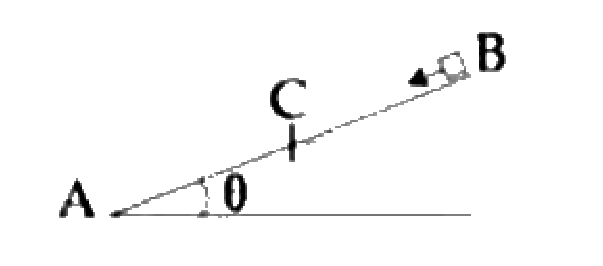
A mass of 1 kg is kept on an inclined plane with 30∘ inclination with respect to horizontal plane and it is at rest initially. Then the whole assembly is moved up with constant velocity of 4 m/s. The work done by the frictional force in time 2 s is ______ J. (Take g=10 m/s2)
Show answer and solution
Answer: (a)
Block stays at rest on the incline, so static friction balances mgsin30∘: f=1×10×21=5 N, directed up the incline.
The assembly moves vertically up by s=vt=4×2=8 m.
Friction makes angle 60∘ with the vertical, so its vertical component is fsin30∘=2.5 N.
Work by a Constant Force · Work as a dot product: W = F·s
A particle is displaced from point P(3 m,4 m,5 m) to a point Q(2 m,3 m,4 m) under a constant force F=(3i^+4j^+5k^) N. The work done by the force in this process is
Work by a Constant Force · Work as a dot product: W = F·s
A force F=2i^+bj^+k^ is applied on a particle and it undergoes a displacement i^−2j^−k^. What will be the value of b, if work done on the particle is zero.
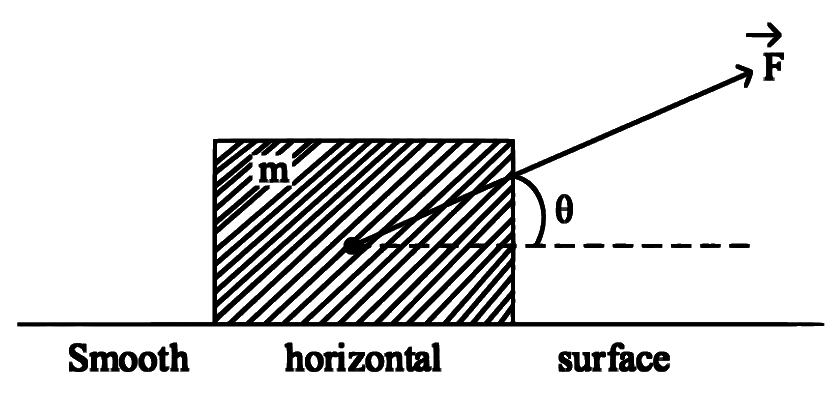
A block of mass 25 kg is pulled along a horizontal surface by a force at an angle 45∘ with the horizontal. The friction coefficient between the block and the surface is 0.25. The block travels at a uniform velocity. The work done by the applied force during a displacement of 5 m of the block is:
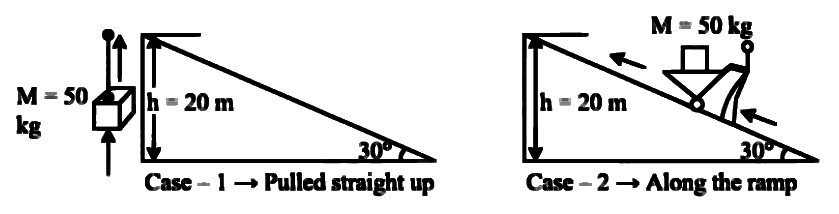
A body of mass 50 kg is lifted to a height of 20 m from the ground in the two different ways as shown in the figures. The ratio of work done against the gravity in both the respective cases, will be:
Show answer and solution
Answer: (c)
Work against gravity depends only on the vertical rise: W=mgh (gravity is conservative).
A block of mass 100 kg slides over a distance of 10 m on a horizontal surface. If the co-efficient of friction between the surfaces is 0.4, then the work done against friction (in J) is:
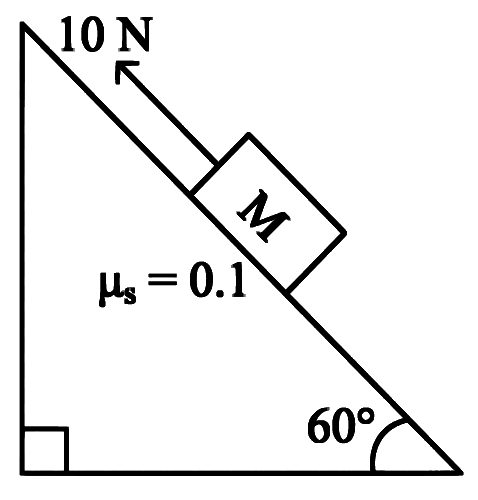
A block of mass 1 kg is pushed up a surface inclined to horizontal at an angle of 60∘ by a force of 10 N parallel to the inclined surface as shown in figure. When the block is pushed up by 10 m along inclined surface, the work done against frictional force is:
Work by a Constant Force · Work as a dot product: W = F·s
A small particle moves to position 5i^−2j^+k^ from its initial position 2i^+3j^−4k^ under the action of force 5i^+2j^+7k^ N. The value of work done will be __________ J.
Numerical answer type. Work it out, then open the answer.
To maintain a speed of 80 km/h by a bus of mass 500 kg on a plane rough road for 4 km distance, the work done by the engine of the bus will be ____________ kJ. [The coefficient of friction between tyre of bus and road is 0.04.]
Numerical answer type. Work it out, then open the answer.
Show answer and solution
Answer: 784
Constant speed, so engine force = friction =μmg=0.04×500×9.8=196 N
Work by a Constant Force · Work at an angle: W = Fs cosθ
Two persons A and B perform same amount of work in moving a body through a certain distance d with application of forces acting at angle 45∘ and 60∘ with the direction of displacement respectively. The ratio of force applied by person A to the force applied by person B is x1. The value of x is .....................
Numerical answer type. Work it out, then open the answer.
A porter lifts a heavy suitcase of mass 80 kg and at the destination lowers it down by a distance of 80 cm with a constant velocity. Calculate the work done by the porter in lowering the suitcase. (take g = 9.8 ms−2)
Show answer and solution
Answer: (c)
Constant velocity, so the porter's upward force F=mg.
Displacement is downward, so the angle is 180∘: W=−mgh.
Work by a Constant Force · Work as a dot product: W = F·s
A force (F)=−5i^−7j^+3k^ acting on a particle causes a displacement (s)=3i^−2j^+ak^ in its own direction. If the work done is 14 J, then the value of ' a ' is
Work by a Constant Force · Positive, negative & zero work
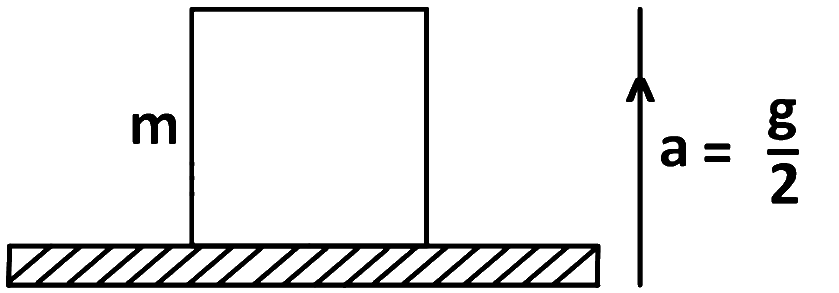
A block of mass m is kept on a platform which starts from rest with constant acceleration g/2 upward, as shown in figure. Work done by normal reaction on block in time t is -
Show answer and solution
Answer: (b)
On the block: N−mg=m2g⇒N=23mg
Displacement from rest: s=21⋅2gt2=4gt2 (upward, along N)
Work by a Constant Force · Work as a dot product: W = F·s
A uniform force of (3i^+j^) newton acts on a particle of mass 2 kg. Hence the particle is displaced from position (2i^+k^) metre to position (4i^+3j^−k^) metre. The work done by the force on the particle is
A particle of mass 100 g is thrown vertically upwards with a speed of 5 m/s. The work done by the force of gravity during the time the particle goes up is
Show answer and solution
Answer: (b)
Work-energy theorem: Wg=ΔK=0−21mu2 (speed becomes zero at the top).
Work by a Constant Force · Work as a dot product: W = F·s
A force F=(5i+3j+2k) N is applied over a particle which displaces it from its origin to the point r=(2i−j) m The work done on the particle in joules is
Work by a Constant Force · Positive, negative & zero work
A particle is acted upon by a force of constant magnitude which is always perpendicular to the velocity of the particle, the motion of the particles takes place in a plane. It follows that
Show answer and solution
Answer: (a)
A force always perpendicular to velocity does zero work: P=F⋅v=0.
By the work-energy theorem, KE (and speed) stays constant.
The force changes direction, so acceleration and velocity are not constant and the path is a circle, not a straight line.
So the answer is (a) its kinetic energy is constant.
Work by a Constant Force · Work at an angle: W = Fs cosθ
A body moves a distance of 10 m along a straight line under the action of a 5 N force. If the work done is 25 J, then angle between the force and direction of motion of the body is
Work by a Variable Force · Force as a function of x: W = ∫F dx
A particle of mass M moves along a horizontal x axis from x=0 to x=L. The coefficient of kinetic friction varies as a function of x as μk(x)=μ0−αx, where μ0,α are constants of appropriate dimensions, so that μk(L)=0. The total work done by the frictional force during the motion is nμ0MgL, where g is the acceleration due to gravity. The value of n is:
Work by a Variable Force · Force as a function of x: W = ∫F dx
A force F=α+βx2 acts on an object in the x -direction. The work done by the force is 5 J when the object is displaced by 1 m. If the constant α=1 N then β will be
Show answer and solution
Answer: (c)
Taking the displacement from x=0 to x=1 m: W=∫01(α+βx2)dx=α+3β
Work by a Variable Force · Force in two dimensions: line integral
A force f=x2yi^+y2j^ acts on a particle in a plane x+y=10. The work done by this force during a displacement from (0,0) to (4 m,2 m) is _________ Joule (round off to the nearest integer)
Numerical answer type. Work it out, then open the answer.
Show answer and solution
Answer: 152
W=∫fxdx+∫fydy=∫x2ydx+∫y2dy
Using the given constraint y=10−x in the first term: ∫04x2(10−x)dx=310x3−4x404=3640−64≈149.3 J
Work by a Variable Force · Force as a function of x: W = ∫F dx
An object moving along horizontal x-direction with kinetic energy 10 J is displaced through x=(3i^) m by the force F=(−2i^+3j^) N. The kinetic energy of the object at the end of the displacement x is
Work by a Variable Force · Force as a function of x: W = ∫F dx
A force F=(2+3x)i^ acts on a particle in the x direction where F is in newton and x is in meter. The work done by this force during a displacement from x=0 to x=4 m, is __________ J.
Numerical answer type. Work it out, then open the answer.
Work by a Variable Force · Force as a function of x: W = ∫F dx
A force F=(5+3y2) acts on a particle in the y-direction, where F is in newton and y is in meter. The work done by the force during a displacement from y=2 m to y=5 m is ___________ J.
Numerical answer type. Work it out, then open the answer.
Work by a Variable Force · Force as a function of x: W = ∫F dx
A block of mass 10 kg is moving along x-axis under the action of force F=5x N. The work done by the force in moving the block from x=2 m to 4 m will be __________ J.
Numerical answer type. Work it out, then open the answer.
Work by a Variable Force · Retardation proportional to displacement
A particle of mass 10 g moves in a straight line with retardation 2x, where x is the displacement in SI units. Its loss of kinetic energy for above displacement is (x10)−n J. The value of n will be __________
Numerical answer type. Work it out, then open the answer.
Work by a Variable Force · Force as a function of x: W = ∫F dx
An object of mass 'm' initially at rest on a smooth horizontal plane starts moving under the action of force F = 2N. In the process of its linear motion, the angle θ (as shown in figure) between the direction of force and horizontal varies as θ=kx, where k is a constant and x is the distance covered by the object from its initial position. The expression of kinetic energy of the object will be E=knsinθ. The value of n is ___________.
Numerical answer type. Work it out, then open the answer.
Show answer and solution
Answer: 2
Only the horizontal component does work on the smooth floor: dW=Fcosθdx with θ=kx.
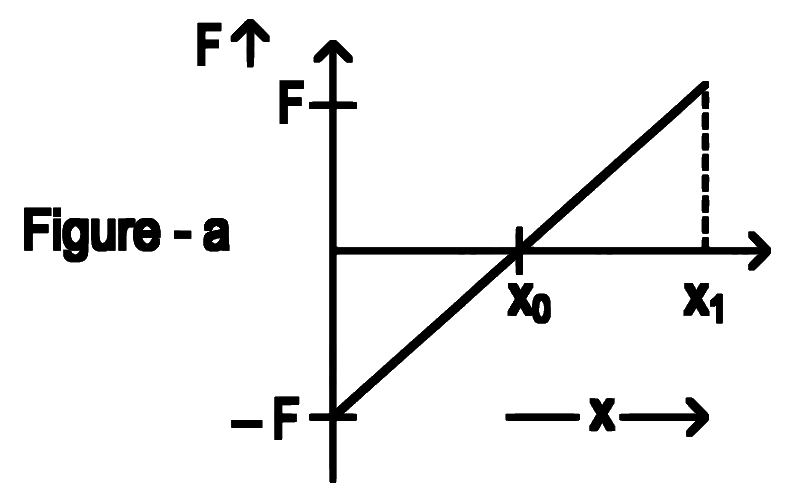
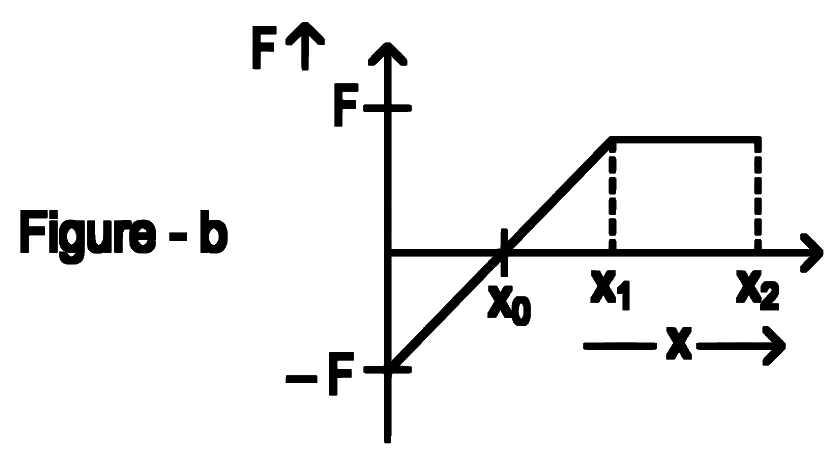
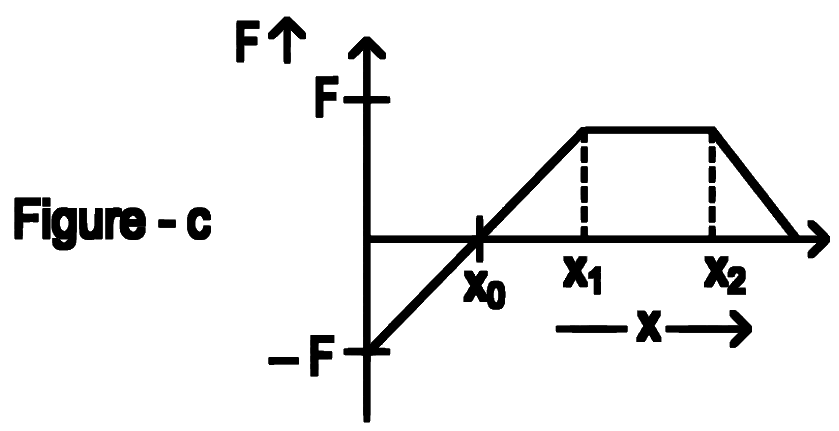
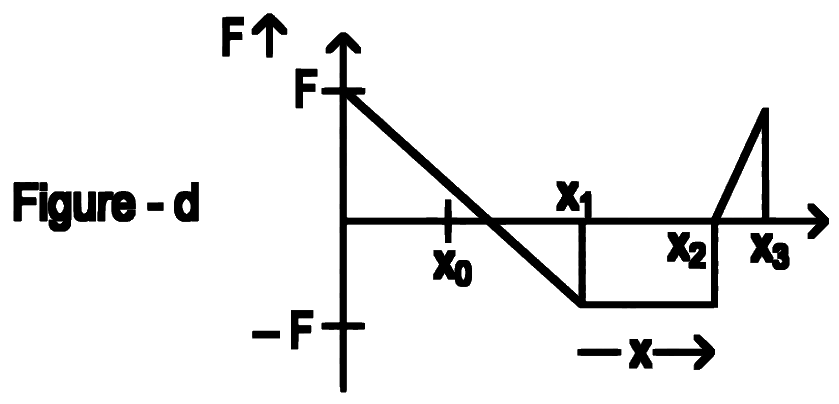
Arrange the four graphs in descending order of total work done; where W1, W2, W3 and W4 are the work done corresponding to figure a, b, c and d respectively.
Show answer and solution
Answer: (a)
Work = signed area under each F-x graph (below the axis counts negative).
(a): small negative triangle (0→x0) + positive triangle (x0→x1).
(b): same as (a) plus a positive rectangle (x1→x2), so W2>W1.
(c): same as (b) plus a positive triangle beyond x2, so W3>W2.
(d): a small positive part, then a large negative area up to x2; net is the least, so W4 is smallest.
Work by a Variable Force · Force as a function of x: W = ∫F dx
A block of mass 2 kg moving on a horizontal surface with speed of 4 ms−1 enters a rough surface ranging from x = 0.5 m to x = 1.5 m. The retarding force in this range of rough surface is related to distance by F = − kx where k = 12 Nm−1. The speed of the block as it just crosses the rough surface will be:
Show answer and solution
Answer: (c)
Work by the retarding force: W=−∫0.51.512xdx=−6(1.52−0.52)=−12 J
Initial KE =21(2)(4)2=16 J, so final KE =16−12=4 J
Work by a Variable Force · Force in two dimensions: line integral
A particle experiences a variable force F=(4xi^+3y2j^) in a horizontal x-y plane. Assume distance in meters and force is newton. If the particle moves from point (1, 2) to point (2, 3) in the x-y plane, then Kinetic Energy changes by:
A person pushes a box on a rough horizontal platform surface. He applies a force of 200 N over a distance of 15 m. Thereafter, he gets progressively tired and his applied force reduces linearly with distance to 100 N. The total distance through which the box has been moved is 30 m. What is the work done by the person during the total movement of the box?
Show answer and solution
Answer: (b)
Work = area under the F-x graph.
First 15 m (constant 200 N): W1=200×15=3000 J
Next 15 m (200 N falling linearly to 100 N, trapezium): W2=21(200+100)(15)=2250 J
Work by a Variable Force · Force in two dimensions: line integral
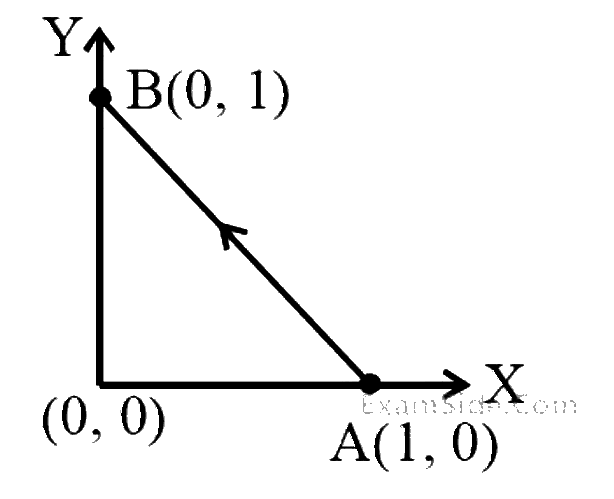
Consider a force F=−xi^+yj^. The work done by this force in moving a particle from point A(1, 0) to B(0, 1) along the line segment is: (all quantities are in SI units)
Work by a Variable Force · Force as a function of x: W = ∫F dx
A force F = 20 + 10y acts on a particle in y-direction where F is in newton and y in meter. Work done by this force to move the particle from y = 0 to y = 1 m is:
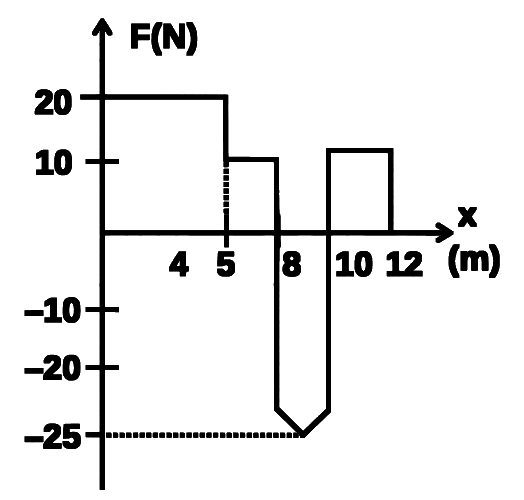
An object of mass 500 g, initially at rest, is acted upon by a variable force whose X-component varies with X in the manner shown. The velocities of the object at the points X = 8 m and X = 12 m, would have the respective values of (nearly)
Show answer and solution
Answer: (d)
Work = area under the F-x graph, and W=ΔK (starts from rest, m=0.5 kg).
0→8 m: W=20×5+10×3=130 J, so v8=0.52×130=520≈23 m/s.
8→12 m: the large negative dip (down to −25 N) outweighs the +10 N strip, so net work is negative (about −24 J) and the speed must drop below 23 m/s.
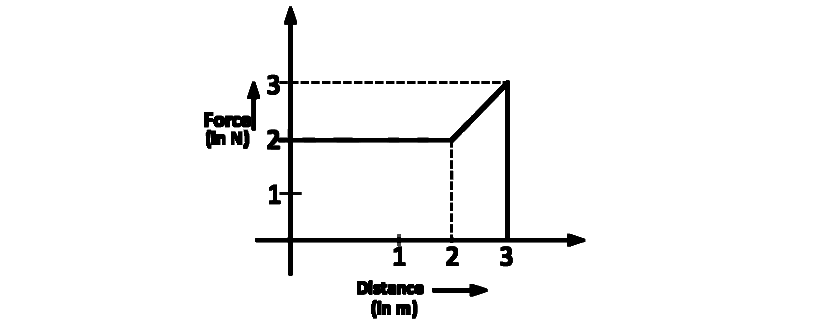
A particle moves in one dimension from rest under the influence of a force that varies with the distance travelled by the particle as shown in the figure. The kinetic energy of the particle after it has travelled 3m is:
Show answer and solution
Answer: (a)
Starting from rest, K=W= area under the F-x graph.
Work by a Variable Force · Force as a function of x: W = ∫F dx
A block of mass 10 kg, moving in x direction with a constant speed of 10 m s−1, is subjected to a retarding force F = 0.1x J/m during its travel from x = 20 m to 30 m. Its final KE will be
Show answer and solution
Answer: (c)
Initial KE =21(10)(10)2=500 J
Work by retarding force W=−∫20300.1xdx=−0.05(900−400)=−25 J
Work by a Variable Force · Force as a function of x: W = ∫F dx
When a rubber-band is stretched by a distance x, it exerts restoring force of magnitude F=ax+bx2 where a and b are constants. The work done in stretching the unstretched rubber-band by L is:
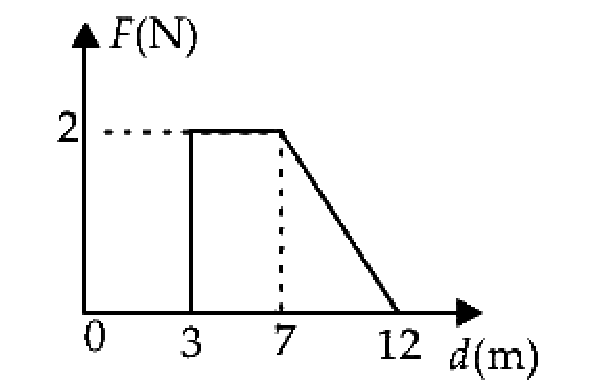
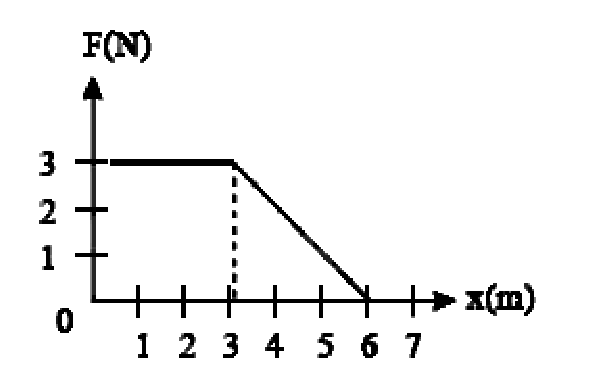
on an object varies with distance x as shown here. The force is in N and x in m. The work done by the force in moving the object from x = 0 to x = 6 m is
Work by a Variable Force · Retardation proportional to displacement
A particle moves in a straight line with retardation proportional to its displacement. Its loss of kinetic energy for any displacement x is proportional to
Work by a Variable Force · Force as a function of x: W = ∫F dx
A body, constrained to move in y-direction, is subjected to a force given by F=(−2i^+15j^+6k^) N. The work done by this force in moving the body through a distance of 10j^ m along y-axis, is
Kinetic Energy & Momentum · K = p²/2m and percentage change
A car accelerates from rest to u m/s. The energy spent in this process is E J. The energy required to accelerate the car from u m/s to 2u m/s is nE J. The value of n is ____________.
Numerical answer type. Work it out, then open the answer.
Kinetic Energy & Momentum · Force, momentum & KE change
A body of mass 5 kg is moving with a momentum of 10 kg ms−1. Now a force of 2 N acts on the body in the direction of its motion for 5 s. The increase in the Kinetic energy of the body is ___________ J.
Numerical answer type. Work it out, then open the answer.
Show answer and solution
Answer: 30
Initial p1=10 kg m/s; impulse =Ft=2×5=10 N s, so p2=20 kg m/s.
Kinetic Energy & Momentum · K = p²/2m and percentage change
A boy is rolling a 0.5 kg ball on the frictionless floor with the speed of 20 ms-1. The ball gets deflected by an obstacle on the way. After deflection it moves with 5% of its initial kinetic energy. What is the speed of the ball now?
Kinetic Energy & Momentum · Equal KE: heavier body has more momentum
Three bodies P, Q and R have masses 'm' kg, '2m' kg and '3m' kg respectively. If all the bodies have equal kinetic energy, then greater momentum will be for body/bodies.
Show answer and solution
Answer: (b)
Equal KE: p=2mK∝m.
R has the largest mass 3m, so it has the greatest momentum. The answer is (b) R.
Kinetic Energy & Momentum · Equal momentum: lighter body has more KE
A particle of mass m1 is moving with a velocity v1 and another particle of mass m2 is moving with a velocity v2. Both of them have the same momentum but their different kinetic energies are E1 and E2 respectively. If m1 > m2 then:
The rain drop of mass 1 g, starts with zero velocity from a height of 1 km. It hits the ground with a speed of 5 m/s. The work done by the unknown resistive force is ______ J.
Work-Energy Theorem · Work from v(x), x(t) or a v-t graph
A body of mass 2 kg is moving along x-direction such that its displacement as function of time is given by x(t)=αt2+βt+γ m, where α=1 m/s2,β=1 m/s and γ=1 m. The work done on the body during the time interval t=2 s to t=3 s, is ________ J.
The kinetic energies of two similar cars A and B are 100 J and 225 J respectively. On applying brakes, car A stops after 1000 m and car B stops after 1500 m. If FA and FB are the forces applied by the brakes on cars A and B respectively, then the ratio of FBFA is
Show answer and solution
Answer: (d)
Work-energy theorem: braking force × stopping distance = initial KE, so F=dK.
Work-Energy Theorem · Work from v(x), x(t) or a v-t graph
A particle of mass m moves on a straight line with its velocity increasing with distance according to the equation v=αx, where α is a constant. The total work done by all the forces applied on the particle during its displacement from x=0 to x=d, will be:
A bullet is fired into a fixed target loses one third of its velocity after travelling 4 cm. It penetrates further D×10−3 m before coming to rest. The value of D is:
A lift of mass M=500 kg is descending with speed of 2 ms−1. Its supporting cable begins to slip thus allowing it to fall with a constant acceleration of 2 ms−2. The kinetic energy of the lift at the end of fall through to a distance of 6 m will be _____________ kJ.
Numerical answer type. Work it out, then open the answer.
A spherical body of mass 2 kg starting from rest acquires a kinetic energy of 10000 J at the end of 5th second. The force acted on the body is ________ N.
Numerical answer type. Work it out, then open the answer.
Show answer and solution
Answer: 40
21mv2=10000⇒v2=22×10000=104, so v=100 m/s at t=5 s.
Statement I: A truck and a car moving with same kinetic energy are brought to rest by applying brakes which provide equal retarding forces. Both come to rest in equal distance. Statement II: A car moving towards east takes a turn and moves towards north, the speed remains unchanged. The acceleration of the car is zero.
In the light of given statements, choose the most appropriate answer from the options given below
Show answer and solution
Answer: (b)
Statement I: Fs=K; same K and same F give the same s. Correct.
Statement II: the direction of velocity changes, so velocity changes and acceleration is not zero. Incorrect.
Work-Energy Theorem · Work from v(x), x(t) or a v-t graph
A body of mass 0.5 kg travels on straight line path with velocity v=(3x2+4) m/s. The net workdone by the force during its displacement from x=0 to x=2 m is:
Work-Energy Theorem · Work from v(x), x(t) or a v-t graph
A particle of mass 500 gm is moving in a straight line with velocity v = b x5/2. The work done by the net force during its displacement from x = 0 to x = 4 m is: (Take b = 0.25 m−3/2 s−1).
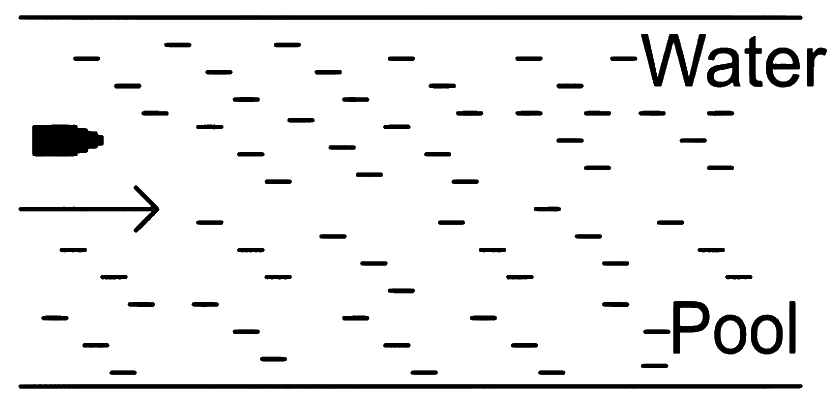
A bullet of mass 200 g having initial kinetic energy 90 J is shot inside a long swimming pool as shown in the figure. If its kinetic energy reduces to 40 J within 1 s, the minimum length of the pool, the bullet has to travel so that it completely comes to rest is
A cricket ball of mass 0.15 kg is thrown vertically up by a bowling machine so that it rises to a maximum height of 20 m after leaving the machine. If the part pushing the ball applies a constant force F on the ball and moves horizontally a distance of 0.2 m while launching the ball, the value of F (in N) is (g = 10 ms–2) ____.
Numerical answer type. Work it out, then open the answer.
Show answer and solution
Answer: 150
KE given by the machine becomes PE at the top: F×0.2=mgh.
A vehicle of mass m is moving with momentum p on a rough horizontal road. The coefficient of friction between the tyres and the horizontal road is μ. The stopping distance is (g= acceleration due to gravity)
A particle which is experiencing a force, given by F=3i^−12j^, undergoes a displacement of d=4i particle had a kinetic energy of 3 J at the beginning of the displacement, what is its kinetic energy at the end of the displacement?
Work-Energy Theorem · Work from v(x), x(t) or a v-t graph
A force acts on a 2 kg object so that its position is given as a function of time as x = 3t2 + 5. What is the work done by this force in first 5 seconds?
Work-Energy Theorem · Work from v(x), x(t) or a v-t graph
A body of mass m starts moving from rest along x-axis so that its velocity varies as v=as where a is a constant and s is the distance covered by the body. The total work done by all the forces acting on the body in the first t seconds after the start of the motion is:
Show answer and solution
Answer: (a)
v2=a2s; compare with v2=2acs: constant acceleration ac=2a2.
Consider a drop of rain water having mass 1 g falling from a height of 1 km. It hits the ground with a speed of 50 m s−1. Take 'g' constant with a value 10 m s−2. The work done by the (i) gravitational force and the (ii) resistive force of air is
Work-Energy Theorem · Work from v(x), x(t) or a v-t graph
A time dependent force F = 6t acts on a particle of mass 1 kg. If the particle starts from rest, the work done by the force during the first 1 sec. will be:
A body of mass 1 kg is thrown upwards with a velocity 20 m/s. It momentarily comes to rest after attaining a height of 18 m. How much energy is lost due to air friction? (g = 10 m/s2)
Show answer and solution
Answer: (d)
Initial KE =21(1)(20)2=200 J
PE gained at 18 m =mgh=1×10×18=180 J
Energy lost to air friction =200−180=20 J, so the answer is (d).
Work-Energy Theorem · Work from v(x), x(t) or a v-t graph
A body of mass 3 kg is under a constant force which causes a displacement s in metres in it, given by the relation s = 31 t2, where t is in seconds. Work done by the force in 2 seconds is
A ball of mass 0.2 kg is thrown vertically upwards by applying a force by hand. If the hand moves 0.2 m while applying the force and the ball goes upto 2 m height further, find the magnitude of the force. (consider g=10 m/s2 ).
Show answer and solution
Answer: (d)
From start (rest) to top (rest): Whand+Wgravity=ΔK=0.
A bullet fired into a fixed target loses half of its velocity after penetrating 3 cm How much further it will penetrate before coming to rest assuming that it faces constant resistance to motion?
Show answer and solution
Answer: (c)
Constant resistance F: work done Fx equals KE lost.
Speed v→2v: KE falls from K to 4K, so 43K is lost in 3 cm.
Remaining 4K is one-third of 43K, so it needs 33=1 cm more.
Work-Energy Theorem · Work from v(x), x(t) or a v-t graph
A force acts on a 3.0 g particle in such a way that the position of the particle as a function of time is given by x=3t−4t2+t3, where x is in metre and t in second. The work done during the first 4 s is
A bullet of mass 10 g leaves a rifle at an initial velocity of 1000 m/s and strikes the earth at the same level with a velocity of 500 m/s. The work done in joule overcoming the resistance of air will be
Show answer and solution
Answer: (b)
Same level, so gravity does no net work; the KE loss is the work against air resistance.
Potential Energy & Equilibrium · Conservative & non-conservative forces
Given below are two statements:
Statement I: An object moves from position r1 to position r2 under a conservative force field F. The work done by the force is W=−∫r1r2F⋅dr.
Statement II: Any object moving from one location to another location can follow infinite number of paths. Therefore, the amount of work done by the object changes with the path it follows for a conservative force.
In the light of the above statements, choose the correct answer from the options given below:
Show answer and solution
Answer: (c)
Statement I: work done by the force is W=+∫r1r2F⋅dr; the minus sign gives ΔU, not W. False.
Statement II: work by a conservative force is independent of path. False.
Potential Energy & Equilibrium · U-x graphs & allowed region
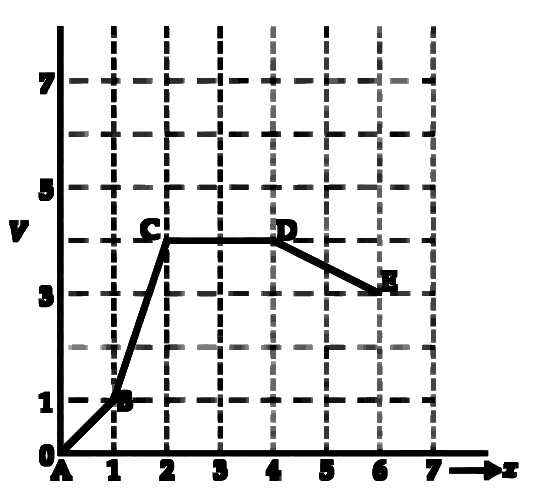
Potential energy ( V) versus distance ( x) is given by the graph. Rank various regions as per the magnitudes of the force ( F) acting on a particle from high to low.
Potential Energy & Equilibrium · Conservative & non-conservative forces
Given below are two statements: one is labelled as Assertion A and the other is labelled as Reason R
Assertion A: In a central force field, the work done is independent of the path chosen. Reason R: Every force encountered in mechanics does not have an associated potential energy. In the light of the above statements, choose the most appropriate answer from the options given below
Show answer and solution
Answer: (b)
A: a central force F(r)r^ is conservative, so its work is path-independent. True.
R: forces like friction have no potential energy. True.
R talks about non-conservative forces, so it does not explain A.
Potential Energy & Equilibrium · Force from potential: F = −dU/dx
The potential energy function (in J) of a particle in a region of space is given as U=(2x2+3y3+2z). Here x,y and z are in meter. The magnitude of x-component of force (in N) acting on the particle at point P(1,2,3) m is:
Potential Energy & Equilibrium · Equilibrium from U(r)
Potential energy as a function of r is given by U=r10A−r5B, where r is the interatomic distance, A and B are positive constants. The equilibrium distance between the two atoms will be:
Potential Energy & Equilibrium · U-x graphs & allowed region
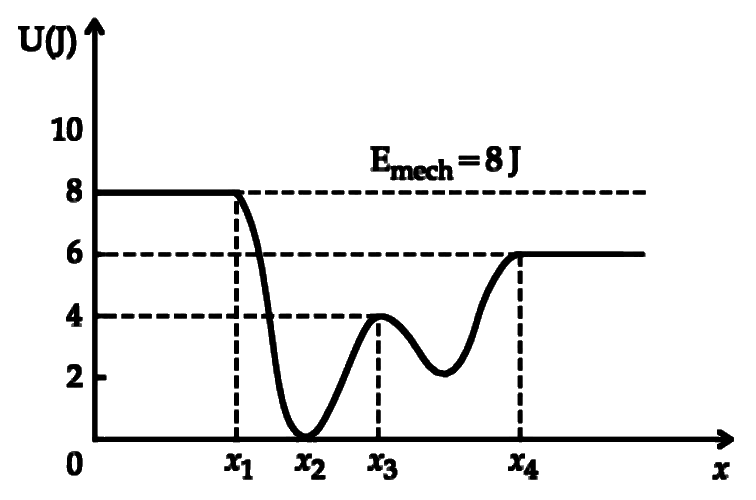
Given below is the plot of a potential energy function U(x) for a system, in which a particle is in one dimensional motion, while a conservative force F(x) acts on it. Suppose that Emech = 8 J, the incorrect statement for this system is:
[ where K.E. = kinetic energy ]
Show answer and solution
Answer: (b)
K=E−U=8−U.
(a) x>x4: U=6, K=2 J constant. True.
(b) x<x1: U=8, K=0, so the particle is at rest, not moving. Incorrect.
Potential Energy & Equilibrium · Equilibrium from U(r)
The potential energy of a particle in a force field is U=r2A−rB where A and B are positive constants and r is the distance of particle from the centre of the field. For stable equilibrium, the distance of the particle is
Show answer and solution
Answer: (b)
Equilibrium: drdU=−r32A+r2B=0⇒r=B2A
dr2d2U=r46A−r32B=r31(3B−2B)>0 there, so it is stable.
Potential Energy & Equilibrium · U-x graphs & allowed region
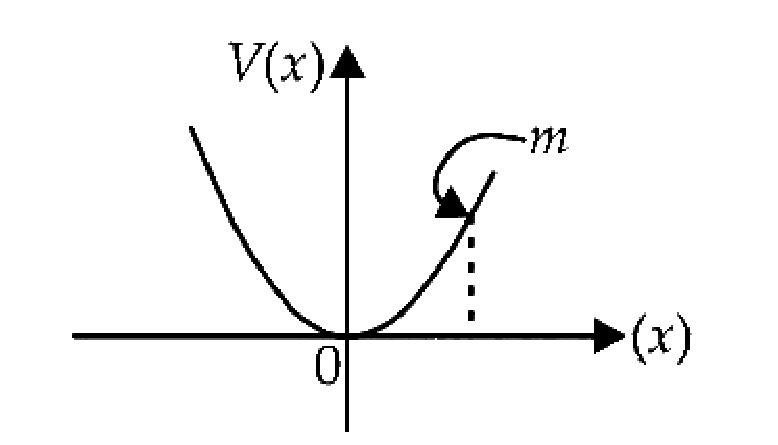
A particle of mass m is released from rest and follows a parabolic path as shown. Assuming that the displacement of the mass from the origin is small, which graph correctly depicts the position of the particle as a function of time?
Show answer and solution
Answer: (b)
V∝x2 gives F=−kx, so the motion is SHM about x=0.
Released from rest at a positive x, so x=Acosωt: starts at maximum, smooth curve.
Potential Energy & Equilibrium · Equilibrium from U(r)
The potential energy function for the force between two atoms in a diatomic molecule is approximately given by U(x)=x12a−x6b, where a and b are constants and x is the distance between the atoms. If the dissociation energy of the molecule is
Potential Energy & Equilibrium · U-x graphs & allowed region
The potential energy of a 1 kg particle free to move along the x-axis is given by V(x)=(4x4−2x2) J. The total mechanical energy of the particle is 2 J. Then, the maximum speed (in m/s) is
Show answer and solution
Answer: (a)
Speed is maximum where V is minimum: dxdV=x3−x=0⇒x=±1.
Potential Energy & Equilibrium · Equilibrium from U(r)
The potential energy between two atoms, in a molecule, is given by U(x)=x12a−x6b where a and b are positive constants and x is the distance between the atoms. The atom is in stable equilibrium, when
A block of mass 'm' moving on a frictionless horizontal surface collides with a spring of spring constant 'K' and compresses it through a distance 'x'. The maximum momentum of the block after collision is
Show answer and solution
Answer: (b)
Momentum is maximum just before compression starts (all energy is kinetic).
Spring & Elastic Energy · Stretching from x1 to x2
The spring is initially in unstretched condition. It is first stretched by a length 'x' and the work done is W1. Then again it is stretched by further length 'x' when the work done is W2. The value of W2 is given by
Spring & Elastic Energy · Same force or same stretch
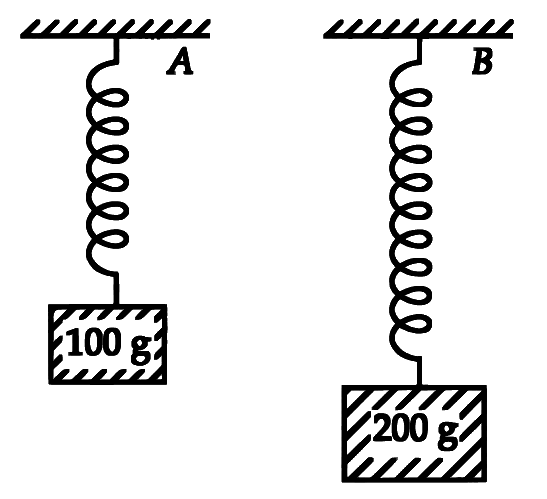
Two blocks with masses 100 g and 200 g are attached to the ends of springs A and B as shown in figure. The energy stored in A is E. The energy stored in B, when spring constants kA,kB of A and B, respectively satisfy the relation 4kA=3kB, is:
Show answer and solution
Answer: (d)
Each spring holds its block in equilibrium: F=mg, so E=2kF2.
A sphere of mass 50 gram is placed on a vertical spring. It is compressed by 0.4 m using a force 10 N. When the spring is released the sphere will reach to a height of (g=10 m/s2)
Spring & Elastic Energy · Falling or hanging on a spring
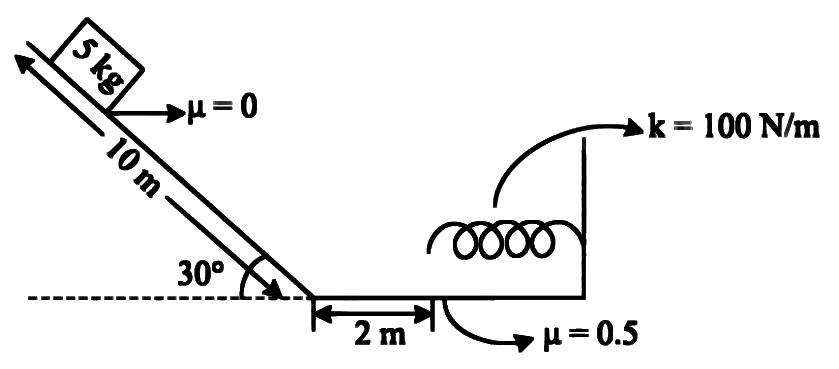
A block is simply released from the top of an inclined plane as shown in the figure above. The maximum compression in the spring when the block hits the spring is:
Show answer and solution
Answer: (d)
Height of incline top: h=10sin30∘=5 m, so energy =mgh=5×10×5=250 J.
Friction on the 2 m rough patch: μmgd=0.5×50×2=50 J.
Energy given to spring: 250−50=200=21(100)x2⇒x2=4
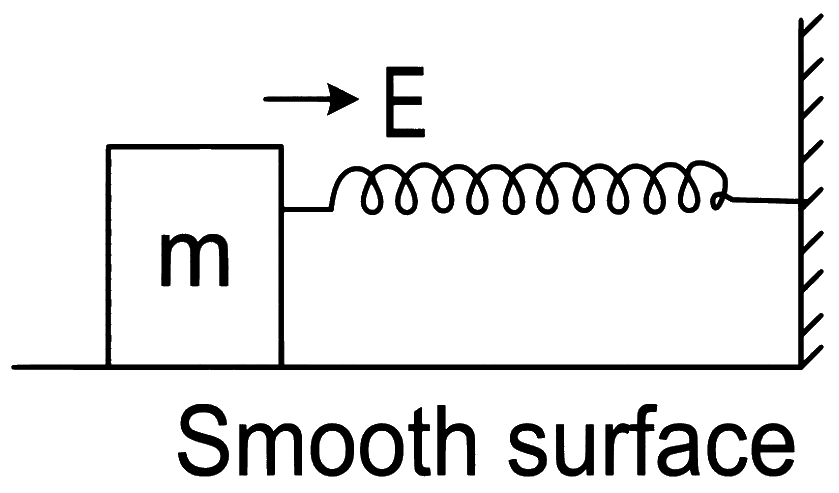
A block is fastened to a horizontal spring. The block is pulled to a distance x=10 cm from its equilibrium position (at x=0) on a frictionless surface from rest. The energy of the block at x=5 cm is 0.25 J. The spring constant of the spring is ___________ Nm−1
Numerical answer type. Work it out, then open the answer.
Show answer and solution
Answer: 67
Released from rest at x=10 cm; at x=5 cm the kinetic energy equals the loss in spring PE.
Spring & Elastic Energy · Falling or hanging on a spring
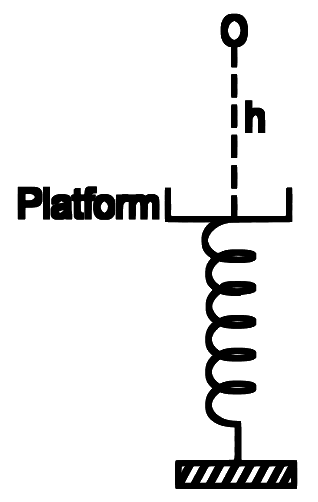
A ball of mass 'm' is dropped from a height 's' on a horizontal platform fixed at the top of a vertical spring. The platform is depressed by a distance 'h'. The spring constant is ( g= acceleration due to gravity)
Show answer and solution
Answer: (b)
The ball falls a total height s+h; all this PE is stored in the spring at maximum depression.
As per the given figure, two blocks each of mass 250 g are connected to a spring of spring constant 2 Nm−1. If both are given velocity v in opposite directions, then maximum elongation of the spring is:
Show answer and solution
Answer: (b)
Momenta are equal and opposite, so at maximum elongation both blocks are momentarily at rest.
A block of mass 'm' (as shown in figure) moving with kinetic energy E compresses a spring through a distance 25 cm when its speed is halved. The value of spring constant of used spring will be nE Nm−1 for n= _________.
Numerical answer type. Work it out, then open the answer.
Show answer and solution
Answer: 24
Speed halves, so KE becomes E/4; spring stores E−4E=43E.
A 0.5 kg block moving at a speed of 12 ms−1 compresses a spring through a distance 30 cm when its speed is halved. The spring constant of the spring will be _______________ Nm−1.
Numerical answer type. Work it out, then open the answer.
Show answer and solution
Answer: 600
Initial KE =21(0.5)(122)=36 J; at half speed KE =9 J.
Spring & Elastic Energy · Falling or hanging on a spring
A ball of mass 100 g is dropped from a height h = 10 cm on a platform fixed at the top of a vertical spring (as shown in figure). The ball stays on the platform and the platform is depressed by a distance 2h. The spring constant is _____________ Nm−1.
(Use g = 10 ms−2)
Numerical answer type. Work it out, then open the answer.
Show answer and solution
Answer: 120
The ball falls h+2h=0.15 m in all; this PE goes into the spring.
A ball of mass 4 kg, moving with a velocity of 10 ms−1, collides with a spring of length 8 m and force constant 100 Nm−1. The length of the compressed spring is x m. The value of x, to the nearest integer, is ____________.
Numerical answer type. Work it out, then open the answer.
A sphere of mass 25 gram is placed on a vertical spring. It is compressed by 0.2 m using a force 5 N. When the spring is released, the sphere will reach a height of (g=10 m/s2)
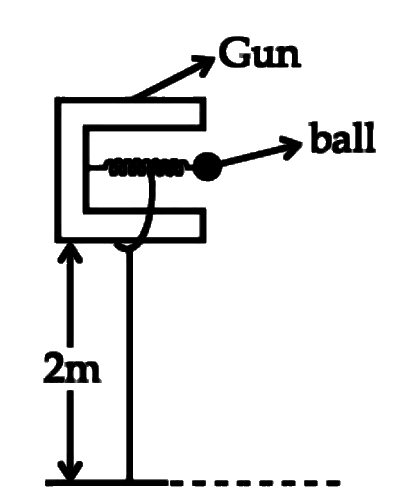
In a spring gun having spring constant 100 N/m a small ball 'B' of mass 100 g is put in its barrel (as shown in figure) by compressing the spring through 0.05 m. There should be a box placed at a distance 'd' on the ground so that the ball falls in it. If the ball leaves the gun horizontally at a height of 2 m above the ground. The value of d is _________ m. (g = 10 m/s2).
Numerical answer type. Work it out, then open the answer.
Show answer and solution
Answer: 1
Launch speed: 21kx2=21mv2⇒v=xk/m=0.051000≈1.58 m/s
An engine is attached to a wagon through a shock absorber of length 1.5 m. The system with a total mass of 40,000 kg is moving with a speed of 72 kmh−1 when the brakes are applied to bring it to rest. In the process of the system being brought to rest, the spring of the shock absorber gets compressed by 1.0 m. If 90% of energy of the wagon is lost due to friction, the spring constant is ____________ × 105 N/m.
Numerical answer type. Work it out, then open the answer.
Spring & Elastic Energy · Falling or hanging on a spring
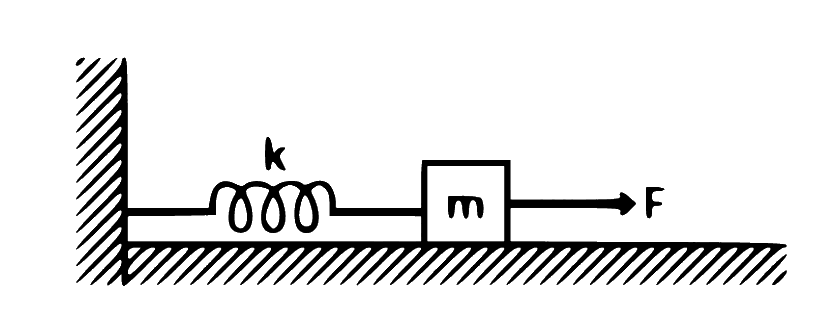
A block of mass m, lying on a smooth horizontal surface, is attached to a spring (of negligible mass) of spring constant k. The other end of the spring is fixed, as shown in the figure. The block is initially at rest in its equilibrium position. If now the block is pulled with a constant force F, the maximum speed of the block is:
Show answer and solution
Answer: (d)
Speed is maximum where net force is zero: kx=F⇒x=F/k.
Spring & Elastic Energy · Same force or same stretch
Two similar springs P and Q have spring constants KP and KQ, such that KP > KQ. They are stretched first by the same amount (case a), then by the same force (case b). The work done by the springs WP and WQ are related as, in case (a) and case (b) respectively
Show answer and solution
Answer: (a)
Same stretch: W=21kx2∝k, and KP>KQ, so WP>WQ.
A block of mass m = 0.1 kg is connected to a spring of unknown spring constant k. It is compressed to a distance x from its equilibrium position and released from rest.
After approaching half the distance (2x) from equilibrium position, it hits another block and comes to rest momentarily, while the other block moves with a velocity 3 ms−1. The total initial energy of the spring is:
Show answer and solution
Answer: (b)
The block stops and the other block moves at 3 m/s, so (equal-mass elastic collision) the block's speed at x/2 was 3 m/s.
KE at x/2: 21(0.1)(32)=0.45 J
This equals spring PE released: 21k(x2−4x2)=43E0
A spring of unstretched length l has a mass m with one end fixed to a rigid support. Assuming spring to be made of a uniform wire, the kinetic energy possessed by it if its free end is pulled with uniform velocity v is:
Show answer and solution
Answer: (d)
An element at distance y from the fixed end moves with speed lvy; its mass is lmdy.
Spring & Elastic Energy · Same force or same stretch
Two springs of force constants 300 N/m (Spring A) and 400 N/m (Spring B) are joined together in series. The combination is compressed by 8.75 cm. The ratio of energy stored in A and B is EBEA. Then EBEA is equal to:
Show answer and solution
Answer: (a)
In series both springs carry the same force F, so E=2kF2.
Spring & Elastic Energy · Same force or same stretch
This question has Statement 1 and Statement 2. Of the four choices given after the Statements, choose the one that best describes the two Statements.
If two springs S1 and S2 of force constants k1 and k2, respectively, are stretched by the same force, it is found that more work is done on spring S1 than on spring S2.
STATEMENT 1: If stretched by the same amount, work done on S1 is more than that on S2 STATEMENT 2: k1<k2
Show answer and solution
Answer: (a)
Same force: W=2kF2; more work on S1 means k1<k2, so Statement 2 is true.
Same stretch: W=21kx2; since k1<k2, work on S1 is less, so Statement 1 is false.
A solid cylinder of mass 3 kg is rolling on a horizontal surface with velocity 4 m s−1. It collides with a horizontal spring of force constant 200 N m−1. The maximum compression produced in the spring will be
Show answer and solution
Answer: (b)
Rolling solid cylinder: KE=21mv2+21⋅21mr2ω2=43mv2.
Spring & Elastic Energy · Falling or hanging on a spring
A block of mass M is attached to the lower end of a vertical spring. The spring is hung from a ceiling and has force constant value k. The mass is released from rest with the spring initially unstretched. The maximum extension produced in the length of the spring will be
Show answer and solution
Answer: (a)
At maximum extension the block is momentarily at rest.
Loss in gravitational PE = gain in spring PE: Mgx=21kx2
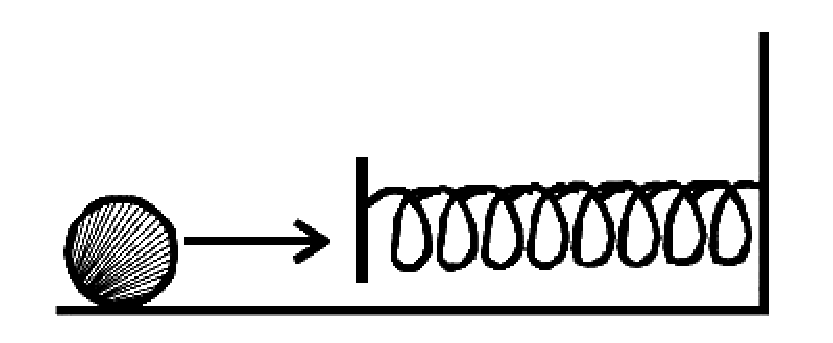
A 2 kg block slides on a horizontal floor with a speed of 4 m/s. It strikes an uncompressed spring and compresses it till the block is motionless. The kinetic friction force is 15 N and spring constant is 10,000 N/m. The spring compresses by
Spring & Elastic Energy · Falling or hanging on a spring
A vertical spring with force constant k is fixed on a table. A ball of mass m at a height h above the free upper end of the spring falls vertically on the spring so that the spring is compressed by a distance d. The net work done in the process is
A mass of 0.5 kg moving with a speed of 1.5 m/s on horizontal smooth surface, collides with a nearly weightless spring of force constant k = 50 N/m. The maximum compression of the spring would be
Show answer and solution
Answer: (a)
All kinetic energy goes into the spring: 21mv2=21kx2.
Spring & Elastic Energy · Stretching from x1 to x2
A spring of spring constant 5×10³ N/m is stretched initially by 5 cm from the unstretched position. Then the work required to stretch it further by another 5 cm is
Spring & Elastic Energy · Same force or same stretch
Two springs A and B having spring constant KA and KB (KA = 2KB) are stretched by applying force of equal magnitude. If energy stored in spring A is EA then energy stored in B will be
Conservation of Energy · Projectile: KE & PE at the top
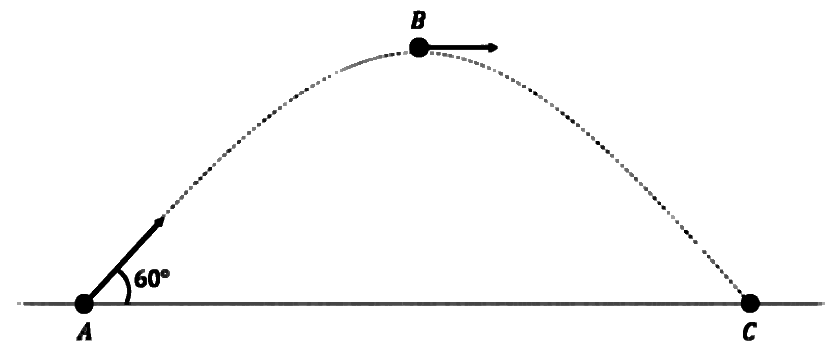
An object is projected with kinetic energy K from a point A at an angle 60∘ with the horizontal. The ratio of the difference in kinetic energies at points B and C to that at point A (see figure), in the absence of air friction is:
Show answer and solution
Answer: (a)
A and C are at the same level, so KC=KA=K.
At the top B only ucos60∘ remains: KB=Kcos260∘=4K.
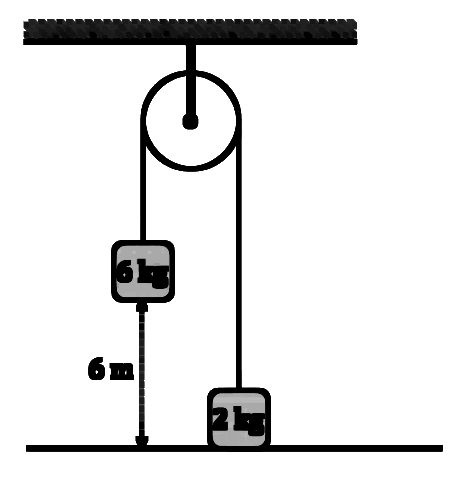
The velocity at which 6 kg mass (shown in figure) strikes the ground when it is released from a height of 6 m above the ground is m/s. Assume pulley is massless and string is light and inextensible. (Take g=10 m/s2)
Show answer and solution
Answer: (a)
Energy conservation for the system: the 6 kg falls 6 m while the 2 kg rises 6 m; both have the same speed v.
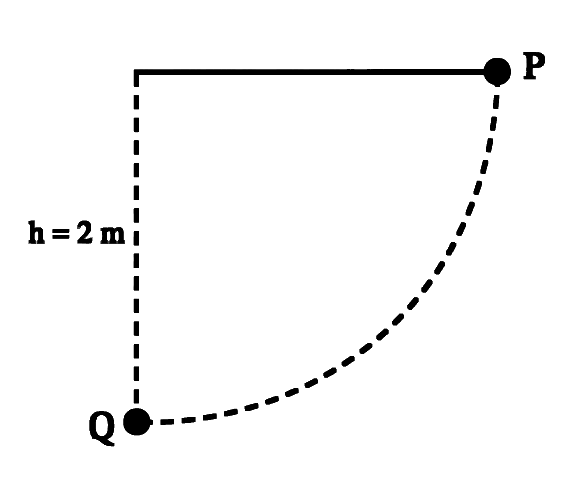
The bob of a simple pendulum of length 2m is kept at P. It is released and when it reaches Q, it losses 20% of its total energy due to air resistance. Its velocity at Q is [Take g=9.8 m/s2 ]
Show answer and solution
Answer: (c)
Bob falls through h=2 m from P to Q; total energy (relative to Q) is mgh.
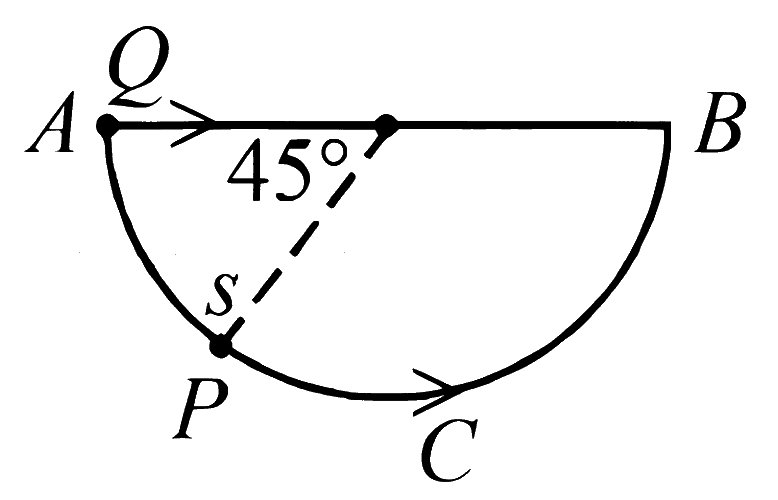
A bead P sliding on a frictionless semi-circular string (ACB) and it is at point S at t=0 and at this instant the horizontal component of its velocity is v. Another bead Q of the same mass as P is ejected from point A at t=0 along the horizontal string AB, with the speed v, friction between the beads and the respective strings may be neglected in both cases. Let tP and tQ be the respective times taken by beads P and Q to reach the point B, then the relation between tP and tQ is
Show answer and solution
Answer: (a)
Bead Q has constant speed v along AB: tQ=v2R.
At S the radius is at 45∘, so the velocity is at 45∘ too: speed of P =cos45∘v=2v.
Path of P is arc SCB =43πR≈2.36R; at speed 2v this takes about 1.41v2.36R≈1.67vR.
P speeds up while dipping to C, so its time stays below 2R/v (a full calculation gives tP≈0.83 to 0.95tQ).
Conservation of Energy · Projectile: KE & PE at the top
A ball having kinetic energy KE, is projected at an angle of 60∘ from the horizontal. What will be the kinetic energy of ball at the highest point of its flight?
Conservation of Energy · Free fall: K and U at a height
A particle is released from height S above the surface of the earth. At certain height its kinetic energy is three times its potential energy. The height from the surface of the earth and the speed of the particle at that instant are respectively.
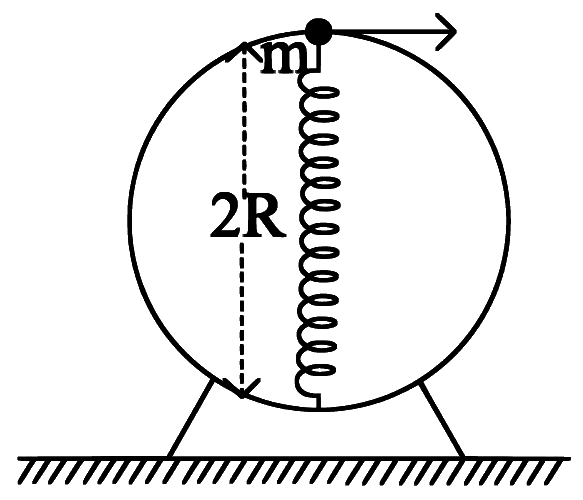
A bead of mass ' m ' slides without friction on the wall of a vertical circular hoop of radius ' R ' as shown in figure. The bead moves under the combined action of gravity and a massless spring (k) attached to the bottom of the hoop. The equilibrium length of the spring is ' R '. If the bead is released from top of the hoop with (negligible) zero initial speed, velocity of bead, when the length of spring becomes ' R ', would be (spring constant is ' k ', g is acceleration due to gravity)
Show answer and solution
Answer: (b)
Spring length becomes R at the point where chord from the bottom =R: 2Rsin2θ=R⇒θ=60∘ from the bottom.
Height of that point above the bottom =R(1−cos60∘)=2R, so the bead falls 2R−2R=23R.
At the top the spring (length 2R) is stretched by R; at the new point it is relaxed.
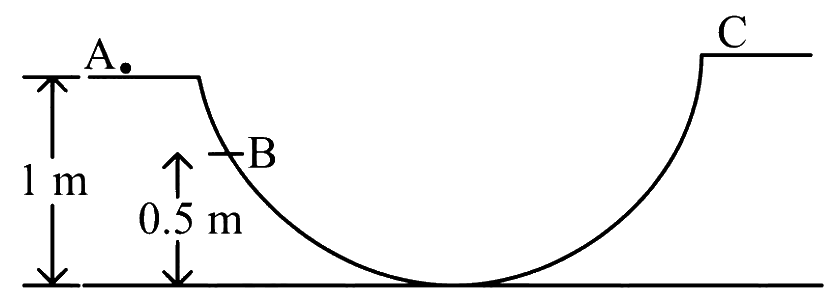
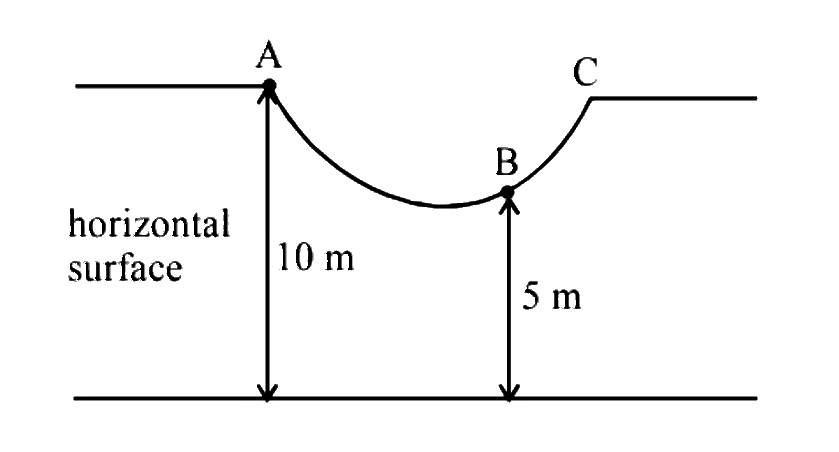
A particle is placed at the point A of a frictionless track ABC as shown in figure. It is gently pushed towards right. The speed of the particle when it reaches the point B is:
(Take g=10 m/s2).
Show answer and solution
Answer: (c)
Track is frictionless, so loss of PE = gain of KE: v=2gΔh.
Conservation of Energy · Projectile: KE & PE at the top
A ball ' A ' is projected vertically upwards with certain initial speed. Another ball 'B' of same mass is projected at an angle of 30∘ with vertical with the same initial speed. At the highest point, the ratio of potential energy of ball A to that of ball B will be
(sin90∘=1,sin60∘=cos30∘=23,sin30∘=cos60∘=21)
Show answer and solution
Answer: (a)
PE at the top =mgH with H=2guy2, so U∝uy2.
Ball A: uy=u. Ball B (at 30∘ with vertical): uy=ucos30∘=23u.
A simple pendulum of length L has mass m and it oscillates freely with amplitude A. At extreme position, its potential energy is ( g= acceleration due to gravity)
Show answer and solution
Answer: (d)
Height at the extreme: h=L(1−cosθ)≈2Lθ2 for small θ.
A lead bullet moving with velocity ' V ' strikes a wall and stops. If 75% of its energy is converted into heat, then the increase in temperature is ( s= specific heat of lead, J= mechanical equivalent of heat)
Show answer and solution
Answer: (a)
Heat produced =75% of KE: Q=43⋅21mV2 (in joule).
A carpet of mass ' M ' made of a material is rolled along its length in the form of a cylinder of radius ' R ' and kept above the rough floor. If the carpet is unrolled without sliding to a radius ' R/2 '. The change in potential energy is ( g= acceleration due to gravity)
Show answer and solution
Answer: (b)
Mass ∝r2, so the roll of radius R/2 has mass 4M; the unrolled 43M lies flat on the floor (PE ≈0).
Initial PE =MgR (centre at height R).
Final PE =4Mg2R=8MgR
Change =MgR−8MgR=87MgR (decrease). So the answer is (b).
Conservation of Energy · Projectile: KE & PE at the top
A stone is projected at angle 30∘ to the horizontal. The ratio of kinetic energy of the stone at point of projection to its kinetic energy at the highest point of flight will be -
Conservation of Energy · Free fall: K and U at a height
A 0.4 kg mass takes 8s to reach ground when dropped from a certain height 'P' above surface of earth. The loss of potential energy in the last second of fall is __________ J.
(Take g = 10 m/s2)
Numerical answer type. Work it out, then open the answer.
Show answer and solution
Answer: 300
Distance fallen in the nth second from rest: sn=2g(2n−1).
Conservation of Energy · Projectile: KE & PE at the top
A stone is projected vertically upwards with speed 'v'. Another stone of same mass is projected at an angle of 60∘ with the vertical with the same speed 'v'. The ratio of their potential energies at the highest points of their journey is [sin30∘=cos60∘=0.5,cos30∘=sin60∘=23]
Show answer and solution
Answer: (a)
PE at the top =mgH with H=2guy2, so U∝uy2.
Vertical stone: uy=v. Other stone (at 60∘ with vertical): uy=vcos60∘=2v.
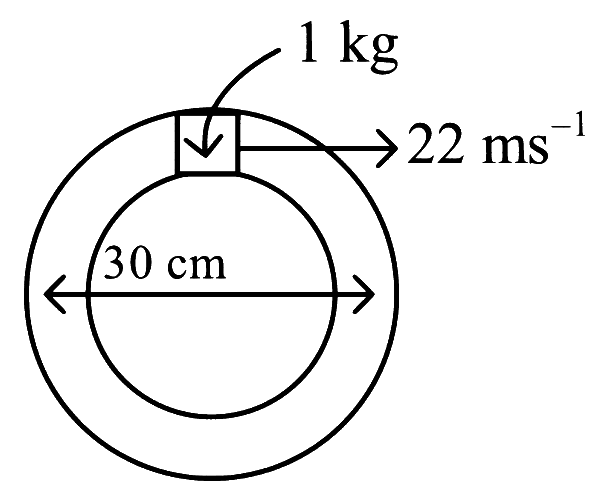
A closed circular tube of average radius 15 cm, whose inner walls are rough, is kept in vertical plane. A block of mass 1 kg just fits inside the tube. The speed of block is 22 m/s, when it is introduced at the top of tube. After completing five oscillations, the block stops at the bottom region of tube. The work done by the tube on the block is __________ J. (Given g = 10 m/s2).
Numerical answer type. Work it out, then open the answer.
Show answer and solution
Answer: 245
Work-energy theorem: Wtube+Wgravity=ΔK.
Block goes from top to bottom: Wgravity=mg(2r)=1×10×0.3=3 J.
ΔK=0−21×1×222=−242 J
Wtube=−242−3=−245 J, i.e. magnitude 245 J (negative work by friction).
Conservation of Energy · Projectile: KE & PE at the top
A ball is projected with kinetic energy E, at an angle of 60∘ to the horizontal. The kinetic energy of this ball at the highest point of its flight will become:
Show answer and solution
Answer: (c)
At the top only the horizontal velocity ucosθ remains, so Ktop=Ecos2θ.
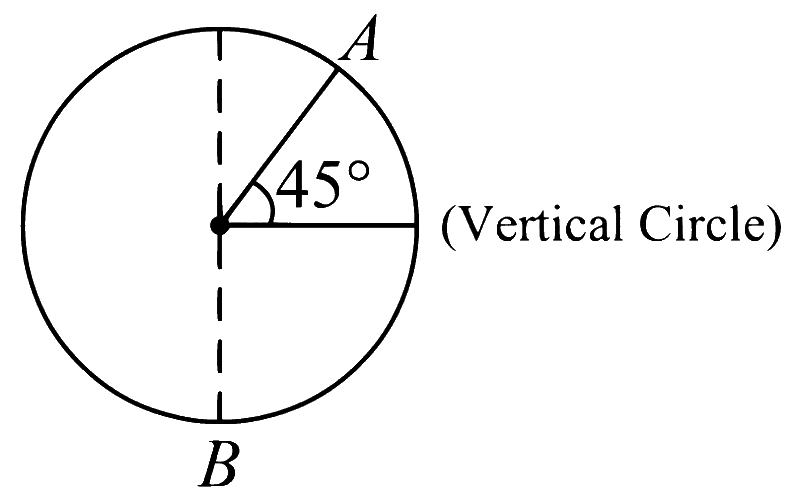
As shown in the figure, a particle of mass 10 kg is placed at a point A. When the particle is slightly displaced to its right, it starts moving and reaches the point B. The speed of the particle at B is x m/s. (Take g = 10 m/s2)
The value of 'x' to the nearest integer is __________.
Numerical answer type. Work it out, then open the answer.
Conservation of Energy · Free fall: K and U at a height
A particle is released from height S from the surface of the Earth. At a certain height its kinetic energy is three times its potential energy. The height from the surface of earth and the speed of the particle at that instant are respectively -
Conservation of Energy · Projectile: KE & PE at the top
A stone is projected vertically upwards with velocity 'V'. Another stone of same mass is projected at an angle of 60∘ with the vertical with the same speed (V). The ratio of their potential energies at the highest points of their journey, is
[sin30∘=cos60∘=0.5,cos30∘=sin60∘=23]
Show answer and solution
Answer: (b)
PE at the top =mgH with H=2guy2, so U∝uy2.
Vertical stone: uy=V. Other stone (at 60∘ with vertical): uy=Vcos60∘=2V.
A pendulum bob has a speed of 3 m/s at its lowest position. The pendulum is 50 cm long. The speed of bob, when the length makes an angle of 60 ∘ to the vertical will be (g = 10 m/s2) ____________ m/s.
Numerical answer type. Work it out, then open the answer.
A uniform chain of length 3 meter and mass 3 kg overhangs a smooth table with 2 meter lying on the table. If k is the kinetic energy of the chain in joule as it completely slips off the table, then the value of k is .................. (Take g = 10 m/s2)
Numerical answer type. Work it out, then open the answer.
Show answer and solution
Answer: 40
Smooth table, so KE gained = loss of PE. Take the table top as zero; mass per metre =1 kg/m.
Initially 1 m (1 kg) hangs, CM 0.5 m below: Ui=−1×10×0.5=−5 J.
Finally all 3 m (3 kg) hangs, CM 1.5 m below: Uf=−3×10×1.5=−45 J.
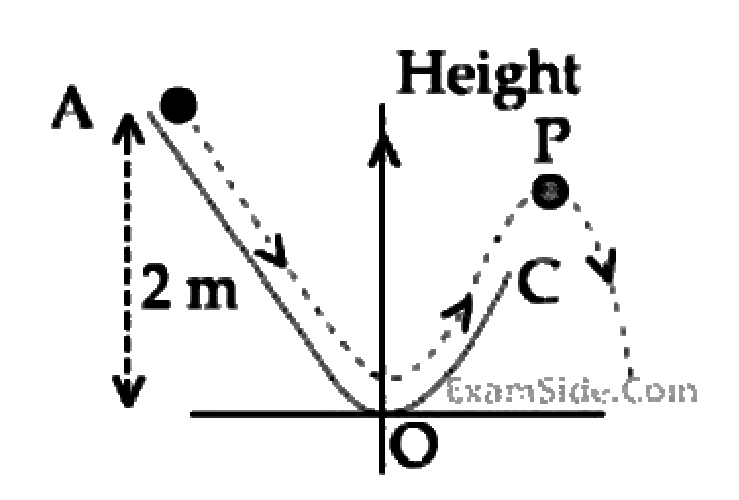
A particle (m = 1 kg) slides down a frictionless track (AOC) starting from rest at a point A (height 2 m). After reaching C, the particle continues to move freely in air as a projectile. When it reaches its highest point P (height 1 m), the kinetic energy of the particle (in J) is:
(Figure drawn is schematic and not to scale; take g = 10 ms-2)
Numerical answer type. Work it out, then open the answer.
Show answer and solution
Answer: 10
No friction or air drag, so total mechanical energy is conserved.
A small block starts slipping down from a point B on an inclined plane AB, which is making an angle θ with the horizontal section BC is smooth and the remaining section CA is rough with a coefficient of friction μ. It is found that the block comes to rest as it reaches the bottom (point A) of the inclined plane. If BC = 2AC, the coefficient of friction is given by μ = ktan θ. The value of k is _________.
Numerical answer type. Work it out, then open the answer.
A block starts moving up an inclined plane of inclination 30° with an initial velocity of v0. It comes back to its initial position with velocity 2v0. The value of the coefficient of kinetic friction between the block and the inclined plane is close to 1000I. The nearest integer to I is____.
Numerical answer type. Work it out, then open the answer.
A uniform cable of mass 'M' and length 'L' is placed on a horizontal surface such that its (1/n)th part is hanging below the edge of the surface. To lift the hanging part of the cable upto the surface, the work done should be:
Show answer and solution
Answer: (c)
Hanging part: mass nM, length nL, centre of mass 2nL below the edge.
A person trying to lose weight by burning fat lifts a mass of 10 kg upto a height of 1 m1000 times. Assume that the potential energy lost each time he lowers the mass is dissipated. How much fat will he use up considering the work done only when the weight is lifted up? Fat supplies 3.8×10⁷ J of energy per kg which is converted to mechanical energy with a 20% efficiency rate. Take g=9.8 ms−2:
Show answer and solution
Answer: (b)
Work in lifting: W=1000mgh=1000×10×9.8×1=9.8×10⁴ J.
Only 20% of fat energy becomes work: energy from fat =0.29.8×104=4.9×10⁵ J.
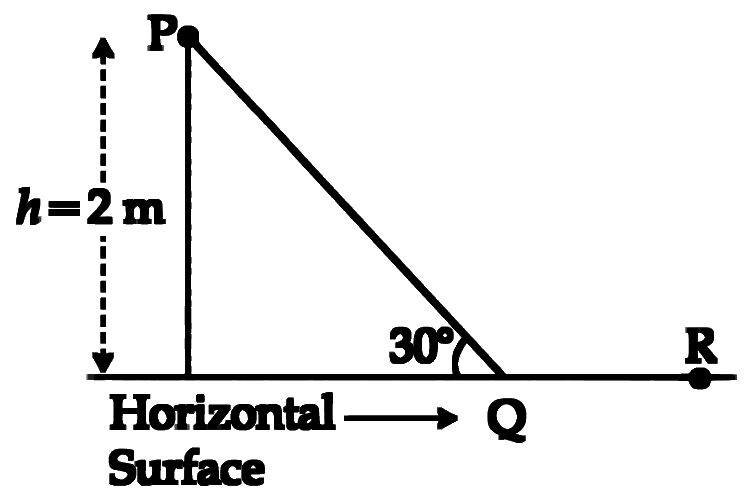
A point particle of mass m, moves along the uniformly rough track PQR as shown in the figure. The coefficient of friction, between the particle and the rough track equals μ. The particle is released, from rest from the point P and it comes to rest at point R. The energies, lost by the ball, over the parts, PQ and QR, of the track, are equal to each other, and no energy is lost when particle changes direction from PQ to QR.
The value of the coefficient of friction μ and the distance x(=QR), are, respectively close to:
Show answer and solution
Answer: (a)
Length PQ=sin30∘h=4 m. Loss on PQ =μmgcos30∘×4=23μmg.
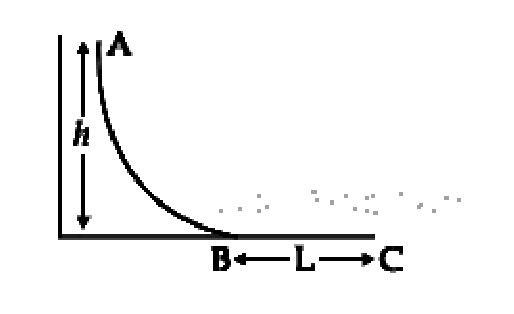
A small ball of mass m starts at a point A with speed vo and moves along a frictionless track AB as shown. The track BC has coefficient of friction μ. The ball comes to stop at C after travelling a distance L which is:
Show answer and solution
Answer: (b)
From A to C all mechanical energy is used up against friction on BC only.
The average mass of rain drops is 3.0 × 10⁻⁵ kg and their average terminal velocity is 9 m/s. Calculate the energy transferred by rain to each square meter of the surface at a place which receives 100 cm of rain in a year.
Show answer and solution
Answer: (b)
100 cm of rain on 1 m2: volume =1 m3, mass =1000 kg.
All drops reach the ground at terminal speed 9 m/s; drop size does not matter.
A mass of M kg is suspended by a weightless string. The horizontal force that is required to displace it until the string makes an angle of 45∘ with the initial vertical direction is
Show answer and solution
Answer: (d)
A constant horizontal force F takes the mass from rest at the bottom to rest at 45∘: work by F = gain in PE.
A spherical ball of mass 20 kg is stationary at the top of a hill of height 100 m. It rolls down a smooth surface to the ground, then climbs up another hill of height 30 m and finally rolls down to a horizontal base at a height of 20 m above the ground. The velocity attained by the ball is
Show answer and solution
Answer: (b)
Smooth surface: only the net height drop matters, v=2gΔh.
Start at 100 m, end on the base at 20 m: Δh=80 m (the 30 m hill is lower than 100 m, so it is crossed).
The upper half of an inclined plane with inclination ϕ is perfectly smooth while the lower half is rough. A body starting from rest at the top will again come to rest at the bottom if the coefficient of friction for the lower half is given by
Show answer and solution
Answer: (d)
Let the full length be l. Body starts and ends at rest, so loss of PE = work against friction on the lower half.
Conservation of Energy · Free fall: K and U at a height
A ball of mass 2 kg and another of mass 4 kg are dropped together from a 60 feet tall building. After a fall of 30 feet each towards earth, their respective kinetic energies will be in the ratio of
A uniform chain of length 2 m is kept on a table such that a length of 60 cm hangs freely from the edge of the table. The total mass of the chain is 4 kg. What is the work done in pulling the entire chain on the table?
Show answer and solution
Answer: (b)
Mass of hanging part: m=24×0.6=1.2 kg; its centre of mass is 0.3 m below the edge.
Conservation of Energy · Projectile: KE & PE at the top
A ball whose kinetic energy is E, is projected at an angle of 45∘ to the horizontal. The kinetic energy of the ball at the highest point of its flight will be
Show answer and solution
Answer: (c)
At the highest point the speed is ucosθ, so Ktop=Ecos2θ.
A body of mass 1kg begins to move under the action of a time dependent force F=(ti^+3t2j^) N where i^ and j^ are the unit vectors along x and y axis. The power developed by the above force at time t=2 s will be (in watt)
Show answer and solution
Answer: (a)
m=1 kg, so a=ti^+3t2j^; from rest v=2t2i^+t3j^.
A body of mass 2 kg begins to move under the influence of time dependent force F=(2ti^+6t2j^) N, where i^ and j^ are unit vectors along x and y -axis respectively. The power produced by the force at t=2 s is ______ W.
Numerical answer type. Work it out, then open the answer.
A body of mass 4 kg is placed on a plane at a point P having coordinates (3,4) m. Under the action of forceF=(2i^+3j^) N, it moves to a new point Q having coordinates (6,10) m in 4 sec. The average power and instantaneous power at the end of 4 sec are in the ratio of:
Show answer and solution
Answer: (d)
Displacement s=(6−3)i^+(10−4)j^=3i^+6j^ m.
W=F⋅s=6+18=24 J, so Pavg=424=6 W.
a=mF=0.5i^+0.75j^; from rest v=at=2i^+3j^ m/s at 4 s.
A body of mass 1 kg begins to move under the action of a time dependent force F=(ti^+2t2j^) N, where i^ and j^ are unit vectors along x and y axis. The power developed by above force at time t=3 second will be
Show answer and solution
Answer: (a)
m=1 kg, so a=ti^+2t2j^; from rest v=2t2i^+32t3j^.
A sand dropper drops sand of mass m(t) on a conveyer belt at a rate proportional to the square root of speed (v) of the belt, i.e., dtdm∝v. If P is the power delivered to run the belt at constant speed then which of the following relationship is true?
A body of mass 1 kg starts from rest and moves with uniform acceleration. In 2 seconds, its velocity is 10 m/s. The power exerted on the body in one second is
At any instant of time t, the displacement of any particle is given by 2t−1 (SI unit) under the influence of force of 5 N. The value of instantaneous power is (in SI unit):
The power (P) is supplied to a rotating body having moment of inertia ' I ' and angular acceleration ' α '. Its instantaneous angular velocity ' ω ' is
A body of mass 2 kg begins to move under the action of a time dependent force given by F=(6ti^+6t2j^)N. The power developed by the force at the time t is given by:
A particle moves with a velocity (5i^−3j^+6k^) m s−1 horizontally under the action of constant force (10i^+10j^+20k^) N. The instantaneous power supplied to the particle is:
The ratio of powers of two motors is x+13x, that are capable of raising 300 kg water in 5 minutes and 50 kg water in 2 minutes respectively from a well of 100 m deep. The value of x will be
Show answer and solution
Answer: (a)
P=tmgh.
P1=300300×10×100=1000 W, P2=12050×10×100=31250 W
A block of mass 5 kg starting from rest is pulled up on a smooth inclined plane making an angle of 30∘ with horizontal with an effective acceleration of 1 m s−2. The power delivered by the pulling force at t=10 s from the start is ___________ W.
[use g=10 m s−2 ]
(calculate the nearest integer value)
Numerical answer type. Work it out, then open the answer.
A body of mass 1kg begins to move under the action of a time dependent force F=(ti^+3t2j^) N, where i^ and j^ are the unit vectors along x and y axis. The power developed by above force, at the time t = 2s, will be ____________ W.
Numerical answer type. Work it out, then open the answer.
Show answer and solution
Answer: 100
m=1 kg, so a=ti^+3t2j^; from rest v=2t2i^+t3j^.
If the maximum load carried by an elevator is 1400 kg ( 600 kg - Passengers + 800 kg - elevator), which is moving up with a uniform speed of 3 m s−1 and the frictional force acting on it is 2000 N, then the maximum power used by the motor is __________ kW(g=10 m/s2)
Numerical answer type. Work it out, then open the answer.
A body of mass 2 kg is initially at rest. It starts moving unidirectionally under the influence of a source of constant power P. Its displacement in 4 s is 31α2P m. The value of α will be ______.
Numerical answer type. Work it out, then open the answer.
An electric lift with a maximum load of 2000 kg (lift + passengers) is moving up with a constant speed of 1.5 ms−1. The frictional force opposing the motion is 3000 N. The minimum power delivered by the motor to the lift in watts is: (g = 10 ms−2)
Sand is being dropped from a stationary dropper at a rate of 0.5 kg s−1 on a conveyor belt moving with a velocity of 5 m s−1. The power needed to keep the belt moving with the same velocity will be:
Show answer and solution
Answer: (d)
Sand lands with zero horizontal speed, so the belt must supply force F=vdtdm.
Water falls from a height of 60m at the rate of 15 kg/s to operate a turbine. The losses due to frictional force are 10% of the input energy. How much power is generated by the turbine? (g = 10 m/s2)
A body at rest is moved along a horizontal straight line by a machine delivering a constant power. The distance moved by the body in time 't' is proportional to:
A constant power delivering machine has towed a box, which was initially at rest, along a horizontal straight line. The distance moved by the box in time 't' is proportional to :-
A car of mass 'm' moving with velocity 'u' on a straight road in a straight line, doubles its velocity in time t. The power delivered by the engine of a car for doubling the velocity is
An automobile of mass 'm' accelerates starting from origin and initially at rest, while the engine supplies constant power P. The position is given as a function of time by:
A particle is moving unidirectionally on a horizontal plane under the action of a constant power supplying energy source. The displacement (s) - time (t) graph that describes the motion of the particle is (graphs are drawn schematically and are not to scale):
Show answer and solution
Answer: (b)
Constant power gives v∝t1/2, so s∝t3/2.
s∝t3/2 starts at the origin, and its slope dtds∝t1/2 keeps increasing.
So the graph curves upward (concave up) from the origin.
An elevator in a building can carry a maximum of 10 persons, with the average mass of each person being 68 kg. The mass of the elevator itself is 920 kg and it moves with a constant speed of 3 m/s. The frictional force opposing the motion is 6000 N. If the elevator is moving up with its full capacity, the power delivered by the motor to the elevator (g = 10 m/s2) must be at least:
A 60 HP electric motor lifts an elevator having a maximum total load capacity of 2000 kg. If the frictional force on the elevator is 4000 N, the speed of the elevator at full load is close to: (1 HP = 746 W, g = 10 ms-2)
A body of mass 2 kg is driven by an engine delivering a constant power of 1 J/s. The body starts from rest and moves in a straight line. After 9 seconds, the body has moved a distance (in m) _______.
Numerical answer type. Work it out, then open the answer.
A body of mass 1 kg begins to move under the action of a time dependent force F=(2ti^+3t2j^)N, where i^ and j^ are unit vectors along x and y axis. What power will be developed by the force at the time t?
A car of weight W is on an inclined road that rises by 100 m over a distance of 1 km and applies a constant frictional force 20W on the car. While moving uphill on the road at a speed of 10 ms−1, the car needs power P. If it needs power 2P while moving downhill at speed v then value of v is:
Show answer and solution
Answer: (b)
sinθ=1000100=101, so the gravity component along the road is 10W.
Uphill: P=(10W+20W)(10)=1.5W
Downhill (magnitude of net resisting force): 2P=(10W−20W)v=20Wv
The heart of a man pumps 5 litres of blood through the arteries per minute at a pressure of 150 mm of mercury. If the density of mercury be 13.6 × 10³ kg/m3 and g = 10 m/s2 then the power (in watt) is
Show answer and solution
Answer: (c)
Power of a pump P=p×tV (pressure × volume flow rate).
A particle of mass m is driven by a machine that delivers a constant power k watts. If the particle starts from rest the force on the particle at time t is
One coolie takes 1 minute to raise a suitcase through a height of 2 m but the second coolie takes 30 s to raise the same suitcase to the same height. The powers of two coolies are in the ratio
A wind-powered generator converts wind energy into electrical energy. Assume that the generator converts a fixed fraction of the wind energy intercepted by its blades into electrical energy. For wind speed v, the electrical power output will be most likely proportional to
A 70 kg man leaps vertically into the air from a crouching position. To take the leap the man pushes the ground with a constant force F to raise himself. The center of gravity rises by 0.5 m before he leaps. After the leap the c.g. rises by another 1 m. The maximum power delivered by the muscles is: (Take g = 10 ms−2)
Show answer and solution
Answer: (b)
Work-energy over the whole motion: F(0.5)=mg(0.5+1)⇒F=3mg=2100 N, net upward force F−mg=1400 N.
Take-off speed (rises 1 m after leaving ground): v=2g×1=20=4.47 m/s
Speed is largest at take-off, so power is maximum there: P=(F−mg)v=1400×4.47≈6.26×10³ W
A car of mass m starts from rest and accelerates so that the instantaneous power delivered to the car has a constant magnitude P0. The instantaneous velocity of this car is proportional to
A body projected vertically from the earth reaches a height equal to earth's radius before returning to the earth. The power exerted by the gravitational force is greatest
Show answer and solution
Answer: (b)
Power of gravity P=F⋅v=mgvcosθ.
Speed is largest at the earth's surface (and g is also largest there).
Just after projection v is opposite to gravity, so P is negative; just before hitting, v is along gravity, so P is maximum positive.
An engine pumps water through a hose pipe. Water passes through the pipe and leaves it with a velocity of 2 m/s. The mass per unit length of water in the pipe is 100 kg/m. What is the power of the engine?
Show answer and solution
Answer: (a)
Mass leaving per second =λv (λ = mass per unit length).
An engine pumps water continuously through a hose. Water leaves the hose with a velocity v and m is the mass per unit length of the water jet. What is the rate at which kinetic energy is imparted to water?
Water falls from a height of 60 m at the rate of 15 kg/s to operate a turbine. The losses due to frictional forces are 10% of energy. How much power is generated by the turbine? (g = 10 m/s2)
A body of mass m is accelerated uniformly from rest to a speed v in a time T. The instantaneous power delivered to the body as a function of time is given by
A body of mass ’m’, accelerates uniformly from rest to ’v1’ in time T. The instantaneous power delivered to the body as a function of time is given by
An object falls from a height of 10 m above the ground. After striking the ground it loses 50% of its kinetic energy. The height upto which the object can rebound from the ground is:
If a rubber ball falls from a height h and rebounds upto the height of h/2. The percentage loss of total energy of the initial system as well as velocity of ball before it strikes the ground, respectively, are:
Show answer and solution
Answer: (a)
Initial energy mgh, final energy mg2h, so loss =50%.
A body is dropped on ground from a height 'h1 ' and after hitting the ground, it rebounds to a height 'h2'. If the ratio of velocities of the body just before and after hitting ground is 4, then percentage loss in kinetic energy of the body is 4x. The value of x is ____________.
Numerical answer type. Work it out, then open the answer.
Collisions · Perfectly inelastic: bullet in a block
A bullet of mass 0.1 kg moving horizontally with speed 400 m s−1 hits a wooden block of mass 3.9 kg kept on a horizontal rough surface. The bullet gets embedded into the block and moves 20 m before coming to rest. The coefficient of friction between the block and the surface is __________. (Given g=10 m/s2)
Collisions · Perfectly inelastic: bullet in a block
A bag of sand of mass 9.8 kg is suspended by a rope. A bullet of 200 g travelling with speed 10 ms−1 gets embedded in it, then loss of kinetic energy will be:
A block moving horizontally on a smooth surface with a speed of 40 m/s splits into two parts with masses in the ratio of 1: 2. If the smaller part moves at 60 m/s in the same direction, then the fractional change in kinetic energy is :-
A block moving horizontally on a smooth surface with a speed of 40 ms−1 splits into two equal parts. If one of the parts moves at 60 ms−1 in the same direction, then the fractional change in the kinetic energy will be x: 4 where x = ___________.
Numerical answer type. Work it out, then open the answer.
An object is dropped from a height h from the ground. Every time it hits the ground it loses 50% of its kinetic energy. The total distance covered as t →∞ is:
Show answer and solution
Answer: (a)
Each bounce keeps half the KE, so each rebound height is half the previous: h,2h,4h,…
Two particles A and B, move with constant velocities v1 and v2. At the initial moment their position vectors are r1 and r2 respectively. The condition for particles A and B for their collision is
Show answer and solution
Answer: (c)
Collision at time t: r1+v1t=r2+v2t
r1−r2=(v2−v1)t with t>0, so the two vectors point the same way.
Equal unit vectors: ∣r1−r2∣r1−r2=∣v2−v1∣v2−v1
On a frictionless surface, a block of mass M moving at speed v collides elastically with another block of same mass M which is initially at rest. After collision the first block moves at an angle θ to its initial direction and has a speed 3v. The second block's speed after the collision is
Show answer and solution
Answer: (c)
Elastic collision: kinetic energy is conserved, 21Mv2=21M(3v)2+21Mv22
A ball is thrown vertically downwards from a height of 20 m with an initial velocity v0. It collides with the ground, losses 50 percent of its energy in collision and rebounds to the same height. The initial velocity v0 is
(Take g = 10 m s−2)
Show answer and solution
Answer: (d)
Energy at ground before impact: 21mv02+mgh
Half is lost and the rest lifts it back to h: 21(21mv02+mgh)=mgh
Collisions · Perfectly inelastic: bullet in a block
A mass m moving horizontally (along the x-axis) with velocity v collides and sticks to a mass of 3m moving vertically upwards (along the y-axis) with velocity 2v. The final velocity of the combination is
Show answer and solution
Answer: (b)
Momentum is conserved in each direction; total mass 4m.
A ball moving with velocity 2 m/s collides head on with another stationary ball of double the mass. If the coefficient of restitution is 0.5, then their velocities (in m/s) after collision will be
A mass of 1 kg is thrown up with a velocity of 100 m/s. After 5 seconds, it explodes into two parts. One part of mass 400 g comes down with a velocity 25 m/s. The velocity of other part is (Take g = 10 ms−2)