A certain gas is isothermally compressed to (31)rd of its initial volume (Vo=3 litre) by applying required pressure. If the bulk modulus of the gas is 3×10⁵ N/m2, the magnitude of work done on the gas is ______ J.
Numerical answer type. Work it out, then open the answer.
The increase in pressure required to decrease the volume of a water sample by 0.2% is P×105 Nm−2. Bulk modulus of water is 2.15×10⁹ Nm−2. The value of P is _________.
Numerical answer type. Work it out, then open the answer.
A sample of a liquid is kept at 1 atm. It is compressed to 5 atm which leads to a change of volume of 0.8 cm3. If the bulk modulus of the liquid is 2 GPa, the initial volume of the liquid was _______ litre. (Take 1 atm = 105 Pa)
Numerical answer type. Work it out, then open the answer.
Bulk Modulus & Compressibility · Fractional compression at depth
The fractional compression (VΔV) of water at the depth of 2.5 km below the sea level is __________ %. Given, the Bulk modulus of water = 2×10⁹ N m−2, density of water = 103 kg m−3, acceleration due to gravity g=10 m s−2.
Bulk Modulus & Compressibility · Fractional compression at depth
If average depth of an ocean is 4000 m and the bulk modulus of water is 2×10⁹ Nm−2, then fractional compression VΔV of water at the bottom of ocean is α×10−2. The value of α is _______ (Given, g=10 ms−2,ρ=1000 kg m−3)
Numerical answer type. Work it out, then open the answer.
Under isothermal condition, the pressure of a gas is given by P=aV−3, where a is a constant and V is the volume of the gas. The bulk modulus at constant temperature is equal to
A certain pressure 'P' is applied to 1 litre of water and 2 litre of a liquid separately. Water gets compressed to 0.01% whereas the liquid gets compressed to 0.03%. The ratio of Bulk modulus of water to that of the liquid is x3. The value of x is ____________.
Numerical answer type. Work it out, then open the answer.
An object is located at 2 km beneath the surface of the water. If the fractional compression VΔV is 1.36%, the ratio of hydraulic stress to the corresponding hydraulic strain will be ____________. [Given: density of water is 1000 kgm−3 and g = 9.8 ms−2]
Bulk Modulus & Compressibility · Fractional compression at depth
When a rubber ball is taken to a depth of __________m in deep sea, its volume decreases by 0.5%. (The bulk modulus of rubber = 9.8 × 10⁸ Nm−2, Density of sea water = 103 kgm−3, g = 9.8 m/s2)
Numerical answer type. Work it out, then open the answer.
Bulk Modulus & Compressibility · Density of compressed matter
The normal density of a material is ρ and its bulk modulus of elasticity is K. The magnitude of increase in density of material, when a pressure P is applied uniformly on all sides, will be:
Bulk Modulus & Compressibility · Density of compressed matter
The density of a metal at normal pressure p is ρ. When it is subjected to an excess pressure, the density becomes ρ′. If K is the bulk modulus of the metal, then the ratio ρρ′ is
A solid sphere of radius r made of a soft material of bulk modulus K is surrounded by a liquid in a cylindrical container. A massless piston of area a floats on the surface of the liquid, covering entire cross section of cylindrical container. When a mass m is placed on the surface of the piston to compress the liquid, the fractional decrement in the radius of the sphere, (rdr) is:
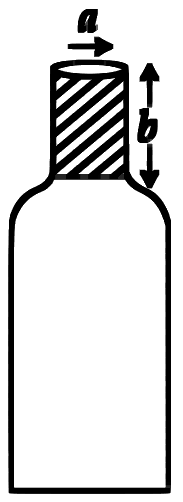
A bottle has an opening of radius a and length b. A cork of length b and radius (a + Δa) where (Δa < < a) is compressed to fit into the opening completely (See figure). If the bulk modulus of cork is B and frictional coefficient between the bottle and cork is μ then the force needed to push the cork into the bottle is:
Bulk Modulus & Compressibility · Fractional compression at depth
The approximate depth of an ocean is 2700 m. The compressiblity of water is 45.4 × 10⁻¹¹ Pa−1 and density of water is 103 kg/m3. What fractional compression of water will be obtained at the bottom of the ocean?
The Bulk moduli of Ethanol, Mercury and water are given as 0.9, 25 and 2.2 respectively in units of 109 Nm−2. For a given value of pressure, the fractional compression in volume is VΔV. Which of the following statements about VΔV for these three liquids is correct?