Applications of Dimensional Analysis · Dimensions of constants in an equation
The potential energy of a particle changes with distance x from a fixed origin as V=x+BAx, where A and B are constants with appropriate dimensions. The dimensions of AB are ______
Applications of Dimensional Analysis · Conversion of units
The speed of light in vacuum is taken as unity. If light takes 6 min 40 s to reach the Earth from the Sun, the distance between the Sun and the Earth in new unit is:
Applications of Dimensional Analysis · Conversion of units
A new unit ( α) of length is chosen such that it is equal to the speed of light in vacuum. What is the distance between Venus and Earth in terms of α units if light takes 6 min. 40 s to cover this distance?
Applications of Dimensional Analysis · Deriving relations by dimensions
A ball of radius r and density ρ dropped through a viscous liquid of density σ and viscosity η attains its terminal velocity at time t, given by t=Aρarbηcσd, where A is a constant and a,b,c and d are integers. The value of a+db+c is ______.
Numerical answer type. Work it out, then open the answer.
Applications of Dimensional Analysis · Dimensions of constants in an equation
In an electromagnetic system, the quantity representing the ratio of electric flux and magnetic flux has dimension of MPLQTRAS, where value of ' Q ' and ' R ' are
Applications of Dimensional Analysis · Dimensions of constants in an equation
The equation for real gas is given by (P+V2a)(V−b)=RT, where P,V,T and R are the pressure, volume, temperature and gas constant, respectively. The dimension of ab−2 is equivalent to that of:
Applications of Dimensional Analysis · Deriving relations by dimensions
A balloon is made of a material of surface tension S and its inflation outlet (from where gas is filled in it) has small area A. It is filled with a gas of density ρ and takes a spherical shape of radius R. When the gas is allowed to flow freely out of it, its radius r changes from R to 0 (zero) in time T. If the speed v(r) of gas coming out of the balloon depends on r as ra and T∝SαAβργRδ then
Applications of Dimensional Analysis · Dimensions of constants in an equation
Applying the principle of homogeneity of dimensions, determine which one is correct, where T is time period, G is gravitational constant, M is mass, r is radius of orbit.
Applications of Dimensional Analysis · Dimensions of constants in an equation
Consider two physical quantities A and B related to each other as E=AtB−x2 where E,x and t have dimensions of energy, length and time respectively. The dimension of AB is
Applications of Dimensional Analysis · Dimensions of constants in an equation
The equation of state of a real gas is given by (P+V2a)(V−b)=RT, where P,V and T are pressure, volume and temperature respectively and R is the universal gas constant. The dimensions of b2a is similar to that of:
Applications of Dimensional Analysis · Dimensions of constants in an equation
In the equation [X+Y2a][Y−b]=RT,X is pressure, Y is volume, R is universal gas constant and T is temperature. The physical quantity equivalent to the ratio ba is:
Applications of Dimensional Analysis · New base quantities
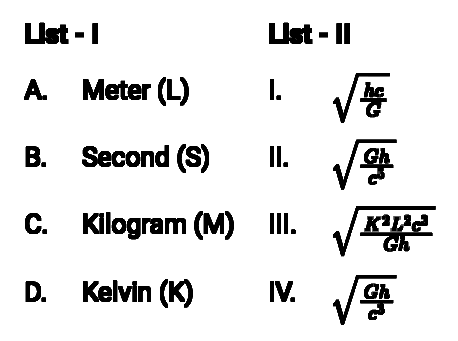
If the velocity of light c, universal gravitational constant G and Planck's constant h are chosen as fundamental quantities. The dimensions of mass in the new system is:
Applications of Dimensional Analysis · Dimensions of constants in an equation
(P+V2a)(V−b)=RT represents the equation of state of some gases. Where P is the pressure, V is the volume, T is the temperature and a,b,R are the constants. The physical quantity, which has dimensional formula as that of ab2, will be:
Applications of Dimensional Analysis · Dimensions of constants in an equation
The equation of a circle is given by x2+y2=a2, where a is the radius. If the equation is modified to change the origin other than (0, 0), then find out the correct dimensions of A and B in a new equation: (x−At)2+(y−Bt)2=a2. The dimensions of t is given as [T−1].
Applications of Dimensional Analysis · Deriving relations by dimensions
The speed of a wave produced in water is given by v=λagbρc. Where λ,g and ρ are wavelength of wave, acceleration due to gravity and density of water respectively. The values of a,b and c respectively, are:
Applications of Dimensional Analysis · Dimensions of constants in an equation
An expression of energy density is given by u=βαsin(ktαx), where α,β are constants, x is displacement, k is Boltzmann constant and t is the temperature. The dimensions of β will be:
Applications of Dimensional Analysis · Dimensions of constants in an equation
In van der Waal equation [P+V2a] [V − b] = RT; P is pressure, V is volume, R is universal gas constant and T is temperature. The ratio of constants ba is dimensionally equal to:
Applications of Dimensional Analysis · Dimensions of constants in an equation
Consider the efficiency of Carnot's engine is given by η=sinθαβlogekTβx, where α and β are constants. If T is temperature, k is Boltzmann constant, θ is angular displacement and x has the dimensions of length. Then, choose the incorrect option:
Applications of Dimensional Analysis · Dimensions of constants in an equation
Velocity (v) and acceleration (a) in two systems of units 1 and 2 are related as v2=m2nv1 and a2=mna1 respectively. Here m and n are constants. The relations for distance and time in two systems respectively are:
Applications of Dimensional Analysis · Dimensions of constants in an equation
An expression for a dimensionless quantity P is given by P=βαloge(βxkt); where α and β are constants, x is distance; k is Boltzmann constant and t is the temperature. Then the dimensions of α will be:
Applications of Dimensional Analysis · Dimensions of constants in an equation
If E, L, M and G denote the quantities as energy, angular momentum, mass and constant of gravitation respectively, then the dimensions of P in the formula P = EL2M−5G−2 are:
Applications of Dimensional Analysis · Dimensions of constants in an equation
The entropy of any system is given by
S=α2βln[Jβ2μkR+3] where α and β are the constants. μ, J, k and R are no. of moles, mechanical equivalent of heat, Boltzmann constant and gas constant respectively.
Applications of Dimensional Analysis · Dimensions of constants in an equation
In a typical combustion engine the workdone by a gas molecule is given by W=α2βekT−βx2, where x is the displacement, k is the Boltzmann constant and T is the temperature. If α and β are constants, dimensions of α will be:
Applications of Dimensional Analysis · Dimensions of constants in an equation
The work done by a gas molecule in an isolated system is
given by, W=αβ2e−αkTx2, where x is the displacement, k is the Boltzmann constant and T is the temperature. α and β are constants. Then the dimensions of β will be:
Applications of Dimensional Analysis · Dimensions of constants in an equation
Which of the following equations is dimensionally incorrect?
Where t = time, h = height, s = surface tension, θ = angle, ρ = density, a, r = radius, g = acceleration due to gravity, v = volume, p = pressure, W = work done, Γ = torque, ϵ = permittivity, E = electric field, J = current density, L = length.
Applications of Dimensional Analysis · Dimensions of constants in an equation
The dimension of stopping potential V0 in photoelectric effect in units of Planck's constant 'h', speed of light 'c' and Gravitational constant 'G' and ampere A is:
Applications of Dimensional Analysis · New base quantities
A quantity x is given by (WL4IFv2) in terms of moment of inertia I, force F, velocity v, work W and Length L. The dimensional formula for x is same as that of:
Applications of Dimensional Analysis · Deriving relations by dimensions
A quantity f is given by f=Ghc5 where c is speed of light, G universal gravitational constant and h is the Planck's constant. Dimension of f is that of:
Applications of Dimensional Analysis · Dimensions of constants in an equation
The force of interaction between two atoms is given by F = αβexp (−αkTx2); where x is the distance, k is the Boltzmann constant and T is temperature and α and β are two constants. The dimension of β is:
Applications of Dimensional Analysis · New base quantities
If surface tension (S), Moment of inertia (I) and Planck's constant (h), were to be taken as the fundamental units, the dimensional formula for linear momentum would be :-
Applications of Dimensional Analysis · Conversion of units
The density of a material in SI units is 128 kg m–3. In certain units in which the unit of length is 25 cm and the unit of mass is 50 g, the numerical value of density of the material is -
Applications of Dimensional Analysis · New base quantities
The characteristic distance at which quantum gravitational effects are significant, the Planck length, can be determined from a suitable combination of the fundamental physical constants G, h and c. Which of the following correctly gives the Planck length?
Applications of Dimensional Analysis · New base quantities
Time (T), velocity (C) and angular momentum (h) are chosen as fundamentalquantities instead of mass, length and time. In terms of these, the dimensions of mass would be:
Applications of Dimensional Analysis · Dimensions of constants in an equation
A physical quantity of the dimensions of length that can be formed out of c, G and 4πε0e2 is [c is velocity of light, G is the universal constant of gravitation and e is charge]
Q66JEE Main 2016 · 10 APR · SHIFT 1 (One or more correct)Medium
Applications of Dimensional Analysis · Dimensions of constants in an equation
A, B, C and D are four different physical quantities having different dimensions. None of them is dimensionless. But we know that the equation AD = C ln (BD) holds true. Then which of the combination is not a meaningful quantity?
Applications of Dimensional Analysis · New base quantities
Planck's constant (h), speed of light in vacuum (c) and Newton's gravitional constant (G) are three fundamental constants. Which of the following combinations of these has the dimension of length?
Applications of Dimensional Analysis · New base quantities
If electronic charge e, electron mass m, speed of light in vacuum c and Planck's constant h are taken as fundamental quantities, the permeability of vacuum μ0 can be expressed in units of:
Applications of Dimensional Analysis · New base quantities
If the capacitance of a nanocapacitor is measured in terms of a unit 'u' made by combining the electronic charge 'e', Bohr radius 'a0 ', Planck's constant 'h' and speed of light 'c' then:
Applications of Dimensional Analysis · Deriving relations by dimensions
If dimensions of critical velocity vc of a liquid flowing through a tube are expressed as [ηxρyrz] where η,ρ and r are the coefficient of viscosity of liquid, density of liquid and radius of the tube respectively, then the values of x, y and z are given by
Applications of Dimensional Analysis · Deriving relations by dimensions
A beaker contains a fluid of density ρ kg / m3, specific heat S J/kgoC and viscosity η. The beaker is filled up to height h. To estimate the rate of heat transfer per unit area ( Q˙/A) by convection when beaker is put on a hot plate, a student proposes that it should depend on η⋅(hSΔθ) and (ρg1) when Δθ (inoC) is the difference in the temperature between the bottom and top of the fluid. In that situation the correct option for (Q˙/A) is:
Applications of Dimensional Analysis · New base quantities
From the following, the quantity (constructed from the basic constants of nature), that has the dimensions, as well as correct order of magnitude, vis-a-vis typical atomic size, is:
Applications of Dimensional Analysis · Deriving relations by dimensions
A metal sample carrying a current along X-axis with density Jx is subjected to a magnetic field Bz (along z-axis). The electric field Ey developed along Y-axis is directly proportional to Jx as well as Bz. The constant of proportionality has SI unit.
Applications of Dimensional Analysis · Deriving relations by dimensions
If the time period t of the oscillation of a drop of liquid of density d, radius r, vibrating under surface tension s is given by the formula t=r2bscda/2. It is observed that the time period is directly proportional to sd. The value of b should therefore be:
Applications of Dimensional Analysis · Conversion of units
The density of a material in CGS system of units is 4 g cm−3. In a system of units in which unit of length is 10 cm and unit of mass is 100 g, the value of density of material will be
Applications of Dimensional Analysis · Dimensions of constants in an equation
An equation is given here (P+V2a)=bVθ where P = Pressure, V = Volume and θ = Absolute temperature. If a and b are constants, the dimensions of a will be
Applications of Dimensional Analysis · Deriving relations by dimensions
Turpentine oil is flowing through a tube of length l and radius r. The pressure difference between the two ends of the tube is P. The viscosity of oil is given by η=4vlP(r2−x2) where v is the velocity of oil at a distance x from the axis of the tube. The dimensions of η are
Applications of Dimensional Analysis · Deriving relations by dimensions
The frequency of vibration f of a mass m suspended from a spring of spring constant k is given by a relation f=amxky, where a is a dimensionless constant. The values of x and y are
Applications of Dimensional Analysis · Dimensions of constants in an equation
According to Newton, the viscous force acting between liquid layers of area A and velocity gradient Δv/ΔZ is given by F=−ηAΔZΔv, where η is constant called coefficient of viscosity. The dimensional formula of η is