
Kinetic Energy & Momentum · K = p²/2m and percentage change
If 'm' is the mass of the body moving with velocity 'v' having kinetic energy 'E', then the linear momentum of the body is
Show answer and solution
Answer: (d)
Loading the solution…
Home›Practice Hub›Chapters›Work, Energy and Power›Kinetic Energy & Momentum
Work, Energy and Power PYQs · MHT CET · JEE Main · NEET
Kinetic Energy & Momentum · K = p²/2m and percentage change
If 'm' is the mass of the body moving with velocity 'v' having kinetic energy 'E', then the linear momentum of the body is
Answer: (d)
Kinetic Energy & Momentum · Equal KE: heavier body has more momentum
The kinetic energy of light body and a heavy body is same. Which one of the following statement is true?
Answer: (b)
Kinetic Energy & Momentum · Equal KE: heavier body has more momentum
A kg mass and kg mass are moving with equal kinetic energies. The ratio of the magnitudes of their linear momenta is
Answer: (b)
Kinetic Energy & Momentum · K = p²/2m and percentage change
If the momentum of a body of mass ' ' is increased by then its kinetic energy increases by
Answer: (a)
Kinetic Energy & Momentum · K = p²/2m and percentage change
When kinetic energy of a body becomes 36 times of its original value, the percentage increase in the momentum of the body will be:
Answer: (b)
Kinetic Energy & Momentum · Equal KE: heavier body has more momentum
Three bodies A, B and C have equal kinetic energies and their masses are and respectively. The ratio of their linear momenta is:
Answer: (a)
Kinetic Energy & Momentum · Equal momentum: lighter body has more KE
Four particles of mass , have same momentum, respectively. The particle with maximum kinetic energy is:
Answer: (d)
Kinetic Energy & Momentum · K = p²/2m and percentage change
A car accelerates from rest to . The energy spent in this process is E J. The energy required to accelerate the car from to is . The value of is ____________.
Numerical answer type. Work it out, then open the answer.
Answer: 3
Kinetic Energy & Momentum · Equal KE: heavier body has more momentum
If a lighter body of mass '' and velocity '' and a heavy body (mass and velocity ) have the same kinetic energy then
Answer: (d)
Kinetic Energy & Momentum · Equal momentum: lighter body has more KE
Two bodies are having kinetic energies in the ratio 16: 9. If they have same linear momentum, the ratio of their masses respectively is:
Answer: (c)
Kinetic Energy & Momentum · Force, momentum & KE change
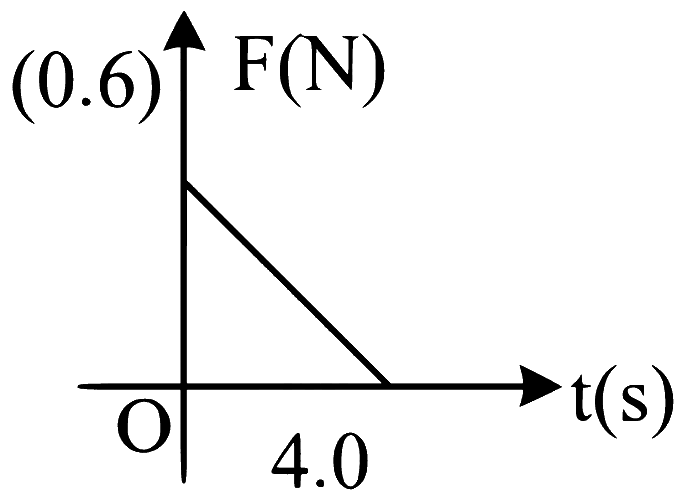
Using variation of force and time given below, final velocity of a particle of mass moving with initial velocity will be
Answer: (c)
Kinetic Energy & Momentum · Force, momentum & KE change
A body of mass is moving with a momentum of . Now a force of acts on the body in the direction of its motion for . The increase in the Kinetic energy of the body is ___________ .
Numerical answer type. Work it out, then open the answer.
Answer: 30
Kinetic Energy & Momentum · K = p²/2m and percentage change
A boy is rolling a 0.5 kg ball on the frictionless floor with the speed of 20 ms-1. The ball gets deflected by an obstacle on the way. After deflection it moves with 5% of its initial kinetic energy. What is the speed of the ball now?
Answer: (c)
Kinetic Energy & Momentum · Equal KE: heavier body has more momentum
The kinetic energy of a light body and a heavy body is same. Which one of them has greater momentum?
Answer: (b)
Kinetic Energy & Momentum · Equal KE: heavier body has more momentum
Three bodies P, Q and R have masses 'm' kg, '2m' kg and '3m' kg respectively. If all the bodies have equal kinetic energy, then greater momentum will be for body/bodies.
Answer: (b)
Kinetic Energy & Momentum · K = p²/2m and percentage change
An athlete in the Olympic games covers a distance of in His kinetic energy can be estimated to be in the range
Answer: (d)
Kinetic Energy & Momentum · Equal momentum: lighter body has more KE
A particle of mass m1 is moving with a velocity v1 and another particle of mass m2 is moving with a velocity v2. Both of them have the same momentum but their different kinetic energies are E1 and E2 respectively. If m1 > m2 then:
Answer: (a)
Kinetic Energy & Momentum · Equal momentum: lighter body has more KE
Two bodies with kinetic energies in the ratio are moving with equal linear momentum. The ratio of their masses is
Answer: (d)
Kinetic Energy & Momentum · Equal KE: heavier body has more momentum
Two bodies of masses and are moving with equal kinetic energies. The ratio of their linear momenta is
Answer: (a)
Kinetic Energy & Momentum · Equal KE: heavier body has more momentum
Two masses of and are moving with equal kinetic energies. The ratio of the magnitudes of their respective linear momenta is
Answer: (c)
Kinetic Energy & Momentum · Equal KE: heavier body has more momentum
Two bodies of masses and are moving with equal kinetic energies. The ratio of their linear momenta is
Answer: (a)
No questions match these filters.